/


Text
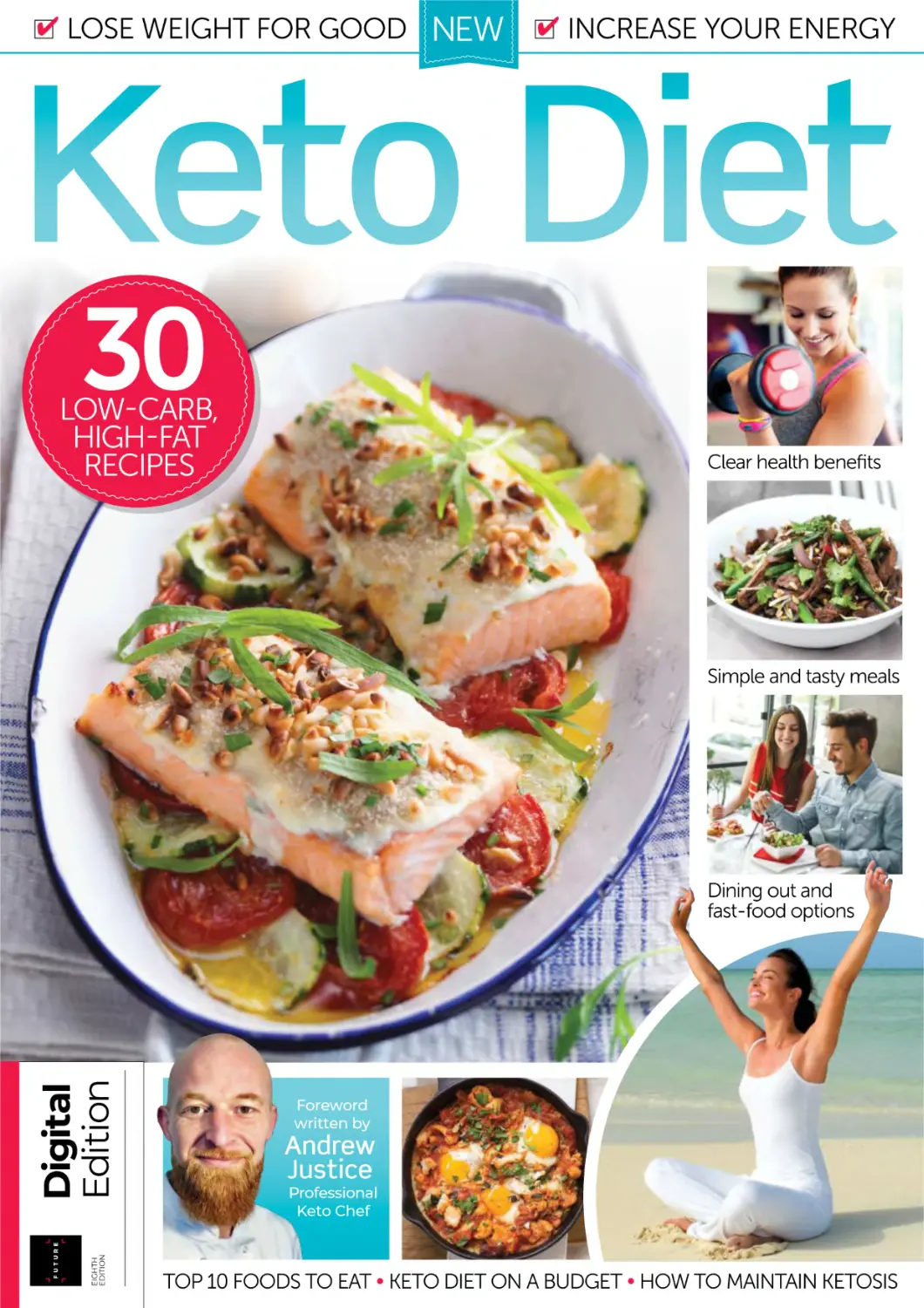
                    LOSE WEIGHT FOR GOOD NEW

INCREASE YOUR ENERGY

Keto Diet
30
LOW-CARB,
HIGH-FAT
RECIPES

Clear health benefits

Simple and tasty meals

EIGHTH
EDITION

Digital
Edition

Dining out and
fast-food options

Foreword
written by

Andrew
Justice
Professional
Keto Chef

TOP 10 FOODS TO EAT • KETO DIET ON A BUDGET • HOW TO MAINTAIN KETOSIS

Welcome to

Keto Diet
The ketogenic or ‘keto’ diet has revolutionised the way people view
different food groups. By studying the science behind what we’re
putting into our bodies, and analysing the many health benefits of
the keto diet, it’s clear to see why so many people are losing weight,
becoming healthier and generally feeling better when adopting a
high-fat, low-carb diet. The Keto Diet book breaks it all down and
explains exactly what the diet is, what’s involved and what the
benefits are. It looks at what you need to do to reach ketosis, how to
know you’ve reached it, and how you can maintain this state, as well
as exploring the side effects and impact on physical performance.
You’ll learn all about the foods you can and should eat, as well as
how to make meal-planning simple, save money, and still enjoy eating
out. With 30 delicious recipes inside for breakfasts, lunches, dinners,
desserts and snacks, discover how the keto diet can improve your life.

:
e
c
i
t
s
u
J
w
e
r
d
n
A

RY
MY STO

ts of
le even
rge-sca
la
ple,
o
ht o u t
,000 pe
– straig
up to 3
6
ing
9
e
9
b
1
lights
role
back in
my high
my first
ond
career
d
m
y
n
r
ia
a
la
D
n
li
’s
y cu
unate to
e. From
Q ueen
ir
rt
e
h
fo
s
th
a
s
lympic
c
b e gan m
a
O
n
w
nd the
rt of L a
nger.
hool. I
a
a
c
o
e
s
e
tr
h
e
s
h
il
e
e
b
ig
w
Ju
of h
r y gre
. For th
tel in th
in 2012
d cooke
ch e f
f in a ho
e
l
n
e
a
d
h
ra
c
t
d
e
ra
n
v
a
o
a
e
e
P
as
d in s
n for fo
rs, I sp
everal
unit y to
g worke
few yea
y passio
rt
in
t
o
gside
v
m
x
p
n
a
,
e
p
h
n
lo
re
,
aging s
o
a
e
e
e
th
ct man
orking
ll,
t decad
je
a
I got th
w
x
,
H
ro
e
e
e
on.
y
p
n
ir
d
m
r
,
h
n
e
ti
u
s
my
nteurs
mlesb
L anca
u n d Lo
Over th
restaura
toric Sa
style
and aro
is
rset and
g
to my
n
h
o
in
in
k
w
s
D
e
c
d
o
e
a
d
th
in
y
ri
b
u
b
roles
d
m ov e
c ase m
nd eate
ch e n a t
ha
w
it
to
ig
k
o
h
d
ts
h
n
e
t
n
s
a
I h ea d e
w
id
ra
s
yo
restau
There,
4, I d e c
s able to
.
s well a
1
a
e
a
0
h ea d m
ir
w
h as
2
t,
h
I
c
n
s
in
u
a
e
re
n,
ironm
f L anc
lients s
hire. He
But the
ing env
ounty o
ng for c
as
c
in
L an c as
ri
d
r,
e
te
e
a
e
m
y
c
n
w
o
la
,
in a fi
rious h
G ar y P
up a n e
m p a ny
lo
y
o
d
r
g
c
a
a
e
d
ts
h
n
n
and flair
e
nder
e leg
hed to
b a l e ve
nts.
orked u
pproac
o and th
up a glo
e n d e ve
hire. I w
, I was a
r
ick Fald
s
8
e
a
N
0
.
c
s
ir
0
rm
n
S
d
2
a
t my
fo
n
L
rs
golfe
belt, bu
ur y bra
Then, in
self is a
y tham,
t
eral lux
d e r my
ious
ho him
v
sed in L
n
g
a
e
w
u
the righ
ti
s
,
b
s
s
s
e
s
t
a
d
c
a
re
n
d
n
p
w
well
ained
I felt it
restaura
experie
y
g
rrick Do
.
I
a
m
is
w
,
s
W
g
th
re
ro
w
f,
in
e
ll
g
e
ie
g to
wc a s
me h
d ch
e rev
I had a
s startin
the hea
wn , sh o
ng my ti
y positiv
te
mily wa
o f my o
lar. Duri
as m an
fa
y
o
ll
n
ll
h
e
nd priva
a
a
c
a
w
s
p
t
m
s
x
s
n
m
a
Ro u
the eve
nition,
up a co
g
t
in
e
o
s
h
c
it
re
to
w
n
time
lents
ef: The
Micheli
low
e and ta
asterch
tics
lises in
ugh! I
owledg
ed for M
n
ro
li
k
p
th
p
t
a
o
from cri
I
t, specia
g
d
I
r,
is
r.
,
n
rt
te
ore
a
e
to
A
s
,
c
la
iv
ri
y
e
fs
ars
il carn
y surp
ulinar
nal che
dining s
Two ye
se-to-ta
ny, AJ C
e
uch to m
o
a
rofessio
n
th
M
p
p
f
.
d
d
m
o
ls
k
n
o
a
te
e
a
o
c
n
n
io
My
to co
d stag
genic
er tale
Profess
rivilege
e,
te, keto
e secon
inst oth
ohydra
ay to th
ad the p
ity for m
ted aga
rb
w
h
ssors
e
n
a
u
p
y
e
fe
c
d
rt
m
th
ro
a
o
o
ll
e
p
p
c
rs and
ade it a
career.
. I’ve alr
zing op
a
to
g
m
y
c
in
m
m
w
o
k
a
s
o
d
st
o
s
n
h
t
o
co
grea
was a
so m e
progre
a ps m
e of the
e h ea d
als. This
ation to
as. Perh
m
n
v
th
fi
o
re
ti
s
a
d
ic
ro
r
n
e
e
re
m
e
s
fo
rt
u
qua
ketog
hin the
me the
kly sec
ented a
ying wit
ffice,
m
ts, I quic
lso gave
d
o
a
h
le
d
tu
it
p
ig
s
a
s
d
e
im
y
n
a
m
er’s h
ntly, I’ve
ndon in
e.
ew s p a p
r that, I
importa
With Lo
wn h om
ardian n
ng. Afte
u
ri
G
te
d
e
a
e
s
c
in my o
th
a
t
t
b
n
le
a
e
y
ty
v
le
n
s
e
a
ro
fe
p
d
li
com
ch e f
VIP an
events
ning
oversaw
stigious
ded run
re
lu
p
where I
c
a
in
r
s
llenge
work fo
o n . Ch a
went to
o f Lo n d
rt
a
e
h
in the
at
s to wh
nsure a
u
le
k for
tt
o
li
t are a
ideal bo
diet bu
is is the
at
to
e
th
e
k
n
to
e
e
f th
ed th
foods
heard o
get start
re.
n which
o
o
to
m
n
w
s
o
f you’ve
o
ti
d
h
a
and loa
t inform
o ut a n d
fe
a
b
li
a
re
f
ll
g
o
s
a
a
f
it ’s
d ide
full o
is way
ipes an
ts of th
packed
tion rec
e benefi
tu
you. It is
th
ti
oth
,
s
b
b
id
,
u
o
a
s
v
e pizz
good
ich to a
ubergin
ith a low
eriously
a
an d wh
s
i
w
e
in
it
m
m
g
o
re s
ese an d
replacin
n
t
g
n
There a
ie
lo
d
o
tti b
te ingre
courge
ohydra
s u ch a s
can help
igh carb
h
e
as they
th
g
to
e
in
K
v
ven if
o
to
rem
life, or e
.
re new
way of
getable
if you a
y
ring
e
l
h
v
a
te
lt
e
a
a
rb
id
e
w
a
h
c
r n ew
mouth
ipes are
u
e
c
o
y
m
re
e.
o
e
s
to
s
o
t
The
wa n
e ve r y n
p h ase
ing for
hile and
ansition
th
w
tr
e
a
e
r
m
o
th
fo
s
with
ere is
togenic
rtoire, th
been ke
ur repe
you’ve
o
y
to
to add
recipes

I

I

g!
cookin
Happy

A ndrew

Main image; Getty Images

CONTENTS
KETO DIET
08

What is a keto diet?

10

The benefits of a keto diet

14

What to eat on a keto diet

18

How to reach ketosis

22

Know when you’re in ketosis

24

Managing your macros

26

Different types of keto diet

28

Physical performance

30

Side effects & dangers

34

How your body reacts

36

Meal planning & budgeting

40

Top 10 keto foods

46

Eating out & fast food

50

Maintain the keto diet

52

Top 10 keto tips

18

72

100

122

BREAKFAST
60

Avocado with baked egg
and salsa

62

Tofu omelette with courgette

64

Quark with blueberries and
flaxseeds

66

Shakshuka with cauliflower,
parsley and pumpkin seeds

68

Quinoa and apple muffins

62

6

64

28

76

10

120
94

Marinated chicken breast
with Mediterranean
oven-roasted vegetables

96

Stir-fried beef with beans
and bean sprouts

98

Quick vegetable soup
with meatballs

100 Pork chops with tomato
and fennel confit

102 Chicken and mushroom

96

stir-fry with bok choy,
carrots and black beans

104 Gratinated salmon fillet

116

LUNCH
72

Pea pancakes with avocado
purée and poached eggs

74

Chard and tomato omelette
with pine nuts

76

94

Avocado, cucumber, cress
and lettuce with smoked
salmon and lemon

78

Stuffed pepper

80

Courgetti bolognese

82

Roasted aubergine with
vegetarian curry & coriander

84

Low-carb pizza with a
beetroot and sunflower seed
base, topped with grilled
vegetables and feta cheese

with tarragon on a tomato
and cucumber medley

DESSERT
108 Coconut ice cream
110 Strawberry-yoghurt
ice cream pops

112 Stack of healthy raw cashew
butter chocolate cups

114 Mint ice cream with
chocolate chips

116 Chia seed pudding
with berries

SNACKS
120 Turkey, grilled courgette

DINNER

and mozzarella bites

Grilled chicken kebabs with
cucumber raita

122 Mini aubergine pizzas

90

Steamed salmon on a bed
of rocket

124 Beetroot hummus

92

Cashew and coconut chicken
curry with cauliflower rice

88

without a base

126 Low-carb sesame seed
crackers with sunflower seeds
and pumpkin seeds

7

KETO DIET

A keto diet eliminates
most carbs, and
instead focuses mainly
on sources of fat,
with some protein
and above-ground
vegetables

What is a keto diet?
We explore the basic principles of a keto diet, how it works and what
happens inside your body

K

eto is a short term for ‘ketogenic’ and refers to
a low-carbohydrate, high-fat (or ‘LCHF’) diet.
There have been many variants of a low-carb
approach to eating over the years. These diets come
in and out of fashion, lauded by many as ‘miracle
weight-loss systems’ and discredited by others.
The ketogenic diet, however, has its roots in the
medical world. It is widely used to treat certain types
of hard-to-control epilepsy in children. By inducing
a state of ketosis (more on this later in the book), it
is thought to lead to a reduction in the frequency of
epileptic seizures. A ketogenic diet has been used
in this way since the 1920s, and is monitored and
controlled by doctors.
Interest in a ketogenic diet has been growing over
the last two decades. The diet has moved into the
mainstream and is now used as a lifestyle option,
primarily to lose weight, though there are other
reputed benefits.

Understanding carbs
If you’re going to be reducing a major food group
from your diet, it’s worth understanding what role it
plays. Carbohydrates (carbs) are one of the three key
macronutrients (macros) in our food, alongside fat

8

and protein. Most foods will have a combination of all
three macros in various quantities, so it’s impossible
to avoid carbs completely.
There are three types of carbs: sugar (both
natural and additive), starch (found in products
made from plants, such as pasta or bread) and fibre
(found in the cell walls of plant foods, which is why
wholewheat is best as the fibre isn’t stripped).
These carbs are used by the body as our main
source of energy. They are broken down into glucose
(sugar) and absorbed into the blood stream. The
glucose is helped by the production of insulin
to enter the body’s cells. Any leftover glucose is
converted to glycogen in the liver and muscles.
Excess glucose that can’t be converted to glycogen is
stored as fat, for long-term energy.
Good-quality carbs that are high in fibre and starch
release this glucose into the blood more slowly,
which is why they give you a consistent energy
release and keep you feeling full. Carbs that are
primarily sugar, like sweets, cakes, biscuits and so on,
release sugar quickly. This is why they give you a fast
energy burst that is often short-lived, and leave you
feeling hungry again a little while later.
Fibre is important to our health, as it helps with
healthy digestion, can reduce cholesterol and may be

WHAT IS A KETO DIET?

While many fruits are
ruled out for being
high in carbs, berries
are allowed on the keto
diet, and make a good
option for snacks

Ketogenic macros
associated with a lower risk of certain diseases like
type 2 diabetes and bowel cancer (source: NHS UK).

Going low-carb
So, if carbohydrates are so essential to our bodily
systems, why would you want to cut them out?
The basic idea behind a keto diet is instead of using
carbs, and therefore glucose, as your primary energy
source, you use fat. Your body will naturally access
glucose energy first, as it is the easiest to release,
so any energy from fats is stored until it is needed.
If you reduce the amount of carbs you eat, you will
become low on glucose and force the body to break
down that stored fat for energy instead.
This causes the production of ketones in your
blood. If you continue to build up these ketones,
your body will go into a state called ketosis. This is
a natural survival process in the body used when
food is scarce. Of course, this isn’t a situation we
usually find ourselves in these days, so a keto diet is
a deliberate attempt to put the body into ketosis and
burn ketones as a primary energy source.

We have mentioned macros, with the three
key macros being carbs, fat and protein.
In a traditional diet, just over a third of our
diet should be fruit and veg, just over a third
should be starchy carbohydrates, and the rest
made up of dairy/dairy alternatives, sources
of protein and unsaturated fats. There are
many different ketogenic ratios out there, but
they are all approximately the same. At least
70 per cent of your calories should be from
fat, 15 to 25 per cent from protein, and 10 per
cent from carbs. However, many forms of the
diet will have carbs as low as 5 per cent.

A keto diet
A keto diet is essentially low in carbs and high in fat.
It’s not ‘no carbs’, but around five to ten per cent of
your diet or less should be carbs. Up to 80 per cent
is then made up of fat, with the rest coming from
protein. The diet aims for ‘adequate’ protein intake –
if there are limited carbs in your diet, protein will be
converted into glucose too. Therefore, it’s important
to balance the right amount of protein in a keto diet
to achieve true ketosis.
A keto diet focuses on good-quality foods; it’s not
reliant on high saturated fats like some low-carb
diets are. It’s a diet rich in lean meat, non-starchy
vegetables, high-fat dairy products, low-carb fruits,
healthy fats, nuts and seeds.
Throughout this book, we’ll explore the keto diet,
its benefits and what you can eat, with plenty of top
tips and advice too.

A typical keto meal
might be steak with
lots of leafy greens

9

Keto dIet

The benefits of a keto diet
It’s not just about weight loss – the keto diet has a number of reported
benefits for both mind and body

L

ow-carb diets have been around for a long
time, and their benefits are well reported. Over
the years, they have received some negative
press, with many believing that the high fat intake
was damaging, causing an increase in heart-disease
risk factors and cholesterol levels.
However, in the last couple of decades, many
studies have been undertaken looking into the merits
of a low-carb lifestyle. These studies have found that
a low-carb diet can in fact be healthy and beneficial,
debunking many of the older beliefs.
The diets themselves have also evolved. The
keto diet, while low carb, is based around healthy,
balanced eating. It’s about choosing a good variety
of foods to nourish your body and being mindful
about what you eat.

Weight loss
One of the main reasons many people are drawn to a
low-carb way of eating is to lose weight. Cutting the
carbs from your diet is a quick and easy way to drop
fat and lose pounds. In the initial stages, there can be
a sudden and dramatic weight loss, but this is mostly
water weight. However, following the diet long-term
can lead to substantial but steady weight loss, and
then help you to maintain your target weight.
There are a few reasons why low-carb diets are
more effective than, for example, low-fat diets. For a
start, the increase in eating fat-based foods means
you generally feel fuller for longer. When removing
carbs from your diet, while eating moderate protein
and high-fat products, appetite tends to decrease.
This naturally leads to fewer calories being consumed
and therefore a drop in weight. This is significant.
Many dieters fail because, simply, they are hungry.
Hunger encourages bad food choices. Take hunger
away and you’re far more likely to be able to stick to
your diet.
The sustained weight loss comes from treating the
switch to keto as a lifestyle change and not a diet.
Pushing the body into ketosis and then stopping
once you hit your target weight will send your body
yo-yoing and increase the likelihood of weight gain.
It’s much better to enter into a keto diet as a longterm plan. Once you are at goal weight, you may be
able to introduce slightly more carbs from a healthy
source and still retain the benefits.

Improved blood results
There are many benefits of the keto diet that you
can’t see on the outside as noticeably as weight loss.
One of these is an increase in HDL cholesterol levels.

10

As previously mentioned, one of the concerns about
a diet high in fat was increased cholesterol, but it is
important to understand how cholesterol works in
the body.
First, your body has both cholesterol and
lipoproteins, the latter of which are carriers that
transport cholesterol around your body. These
molecules are made up of fat and protein. There are
quite a few different types of lipoproteins, but the
ones we hear about most often are LDL and HDL,
standing for low-density lipoproteins and highdensity lipoproteins respectively.

There are many benefits of
a keto diet, including weight
loss, increased energy,
better mental focus and
improved wellbeing

BeNeFItS

There is a lot of research that shows that
the keto diet could help to reduce and
prevent the risk of heart disease. It helps
to raise good cholesterol levels and lower
blood pressure, among other benefits

LDL cholesterol is the ‘bad’ type. It carries
cholesterol from the liver and into the rest of the
body, where it can be damaging. It’s important to
keep this LDL cholesterol low. HDL cholesterol does
the opposite job: it carries cholesterol away from
your body and to the liver, where it can be used as
needed or removed as a waste product. High levels of
HDL cholesterol lower your risk of heart disease. HDL
cholesterol levels can be increased by eating good
sources of fat, which is the main component of the
keto diet. Low levels of HDL cholesterol can decrease
the risk of diabetes as well as heart problems.
Worldwide studies have shown that a low-carb diet
can help to increase HDL cholesterol levels.
The keto diet is also reported to help lower
triglyceride levels. Triglycerides are fat molecules
found in your blood. A high level of triglycerides
can increase your risk of heart disease. Triglycerides
are usually checked at the same time as cholesterol,
though they are different. High levels of triglycerides
may thicken the walls of the arteries, which can lead
to a stroke or heart attack. High triglycerides can
sometimes be noted alongside other conditions too,
such as type 2 diabetes, thyroid problems and liver
disease. Therefore, it’s important to control your
triglyceride levels.
Some of the best ways to reduce your triglyceride
levels are to lose weight if you need to, reduce excess
calorie consumption, avoid sugary, refined and simple
carbohydrates, and eat plenty of healthy fats. You
can see why the keto diet would have such a good
effect, as it ticks all of these boxes.
Finally, the keto diet has a positive impact on your
blood pressure – it helps to lower it. A lower blood
pressure means a reduced risk of many diseases
and conditions.

Seeking professional
advice and guidance
We’ve mentioned here the many reported
benefits of the keto diet in relation to treating
or preventing various ailments. If you do
have diabetes, high blood pressure, high
cholesterol or any other condition, you should
always speak to a doctor before undertaking
a new diet, including the keto diet. While
the diet is safe for many people, it is wise
to have medical guidance and advice. Your
doctor can help you to get started on the
diet, tell you if they think it will be of benefit
to you, and be there to keep you on track and
monitor your symptoms.

11

Keto dIet

The keto diet can help with controlling
insulin, which means that it could be
beneficial to those with type 2 diabetes

Keto as a
therapeutic diet
The ketogenic diet has been used medically,
as well as chosen as a lifestyle choice. A lowcarb diet has been used to treat children with
difficult-to-control epilepsy. Studies have
shown that by entering a state of ketosis and
having an elevated number of ketone bodies
passing through the brain, the frequency of
epileptic seizures is reduced.
These diets are given under very strict
conditions. For growing children, it’s
important that an adequate amount of
protein is eaten, as well as the right number
of calories for their age and weight. This
‘classic therapeutic ketogenic’ diet has been
around since the 1920s, but it isn’t as widely
used now thanks to massive improvements in
modern anti-seizure medication.
The ketogenic diet has also been studied
as a way of improving or reducing the risk of
other diseases and conditions. To date, there
are reported links between a keto diet and
potential therapeutic uses for Alzheimer’s
disease, motor neurone disease, autism, brain
cancer, severe headaches, Parkinson’s disease
and sleep disorders. Much more work needs
to be done medically in this area, but it’s very
exciting research.
Another area where the keto diet could
be beneficial in a therapeutic sense is in the
treatment and control of diabetes. According
to Diabetes.co.uk: “ketogenic diets are very
effective at achieving two common aims of
diabetes control, lowering blood glucose
levels and reducing weight.” As type 2
diabetes is becoming far more prevalent, it’s
good news that there have been such great
results. The Diabetes.co.uk website also has
a forum, which is useful for talking to other
diabetics about a low-carb lifestyle and the
control of insulin.

12

Impact on insulin
When we eat carbohydrates, they are broken down
into sugars – mainly glucose – which we can use
as fuel. Our body is very efficient at doing this,
especially as we have been eating carbs for so long.
This glucose enters the blood stream and raises our
blood sugar levels – a natural process. The body
then responds to this rise in blood sugar levels by
producing insulin. Insulin is an important hormone
with many key roles to play in the body. It tells the
liver, muscle and fat cells when blood sugar levels
are high and they need to take in glucose from the
blood, using it for energy. This helps to control blood
glucose levels. If the body has enough energy, insulin
signals the liver to take the excess glucose and store
it as glycogen.
People who are unable to produce significant
levels of insulin are type 1 diabetic. As the body has
no signal to take glucose from the blood, the body
will search for alternative sources of fuel. The liver
will produce ketones to compensate for energy.
However, in this case, the high levels of ketones
can lead to ketoacidosis, which is a very dangerous
condition for a diabetic. It’s important to note that,
despite sounding similar, ketoacidosis and ketosis are
very different things. Diabetic ketoacidosis (DKA)
is life-threatening and caused by the combination
of high blood sugar, high levels of ketones and
insufficient insulin. This is why it is important for type
1 diabetics to monitor their diet and inject the correct
amount of insulin.
Type 2 diabetes is when the body is not
responding effectively to the insulin it’s producing.
It is commonly associated with being overweight
or inactive. The body is then less able to take the
glucose from the blood, leading to higher blood
sugar levels. The keto diet may be beneficial in
helping to treat and manage the symptoms of type 2
diabetes. It helps to lower blood sugar levels naturally
by not consuming carbohydrates. This, in turn, lowers
the need for insulin.

BeNeFItS

Wellbeing
The keto diet can have a positive impact on your
brain health and wellbeing too. The brain is used to
using glucose as its fuel source, but it can also run
on ketones. It’s thought that using ketones can have
many positive impacts on the brain. Much of this is
embedded in complex science, but followers of the
diet give anecdotal evidence of improvements.
One of the common responses is that the diet
results in better mental clarity and improved focus.
Some describe it as a ‘fog’ lifting that they never
knew was there. A keto diet can also contribute to a
reduction in migraines and improvements in memory.
One theory behind this is that eating high levels of
carbohydrates, especially simple ones full of sugar,
causes our blood sugar levels to rise and fall rapidly.
Remember that 3pm afternoon slump you may have
experienced? It’s often due to your blood sugar
levels dropping after lunch and causing lethargy
and fatigue. It’s hard to stay focused on what you’re
doing when you feel this way. Following a keto diet
means that you will avoid those rises and falls of
blood sugar, so that your energy levels will stay
steady all day.
As well as feeling more mentally alert, followers
often say their energy levels start to increase. This
is especially true once the cravings for carbs as an
energy source start to abate and the body gets more
productive at using ketones for fuel. Part of this
is due to the way that insulin levels are stabilised,
as mentioned above. Also, there is plenty of fat in
the body for energy use. Now that your body has
become good at using fat for fuel, it can start to tap

in to these reserves, giving you plenty of energy.
There are also reports that people start sleeping
better once on the keto diet, though there is less
evidence to suggest why this might happen. It’s one
benefit that is certainly a positive, regardless.
General wellbeing is often improved by the diet
itself, but part of it is moving away from a previous
unhealthy lifestyle. By taking control of the food you
eat, you become less reliant on giving in to junk-food
cravings, which can be quite empowering.

Varied benefits
While we have discussed many of the most common
benefits of the keto diet here, delve into the online
forums and websites and you will read many, many
more benefits. Most of these are contributed by
people who have tried the diet and found that it has
had great impact on areas in their life.
For example, the anti-inflammatory benefits of
eating a keto diet could aid those with IBS. It has
been shown that reducing sugar intake can help to
control IBS symptoms.
Another possible benefit is for women who suffer
from polycystic ovary syndrome (PCOS), which is
often linked to insulin resistance. The keto diet could
help to manage hormone levels and improve the side
effects of the condition.
The best way to find out the benefits is to try
the diet for yourself. It might be worth keeping a
diary as you progress, so that you can mark down
improvements as you notice them. It’s a great way to
stay motivated if you feel the urge to eat some carbs
and end the diet.

You may experience increased energy levels
after adapting to the keto diet, which help
you to stay active and focused

13

KETO DIET

Knowing what you can
and can’t eat is key to
success on the keto diet

What to eat on a keto diet
If ‘What can I eat?’ is your first question, we’re here with a detailed
guide to what’s on the keto menu

Y

ou’re interested in trying the keto diet and
embracing the low-carb lifestyle. But you’re
also worried about planning meals; knowing
what to eat and what not to eat; how to decipher
how many carbs are in a food; and so on. Taking on
the keto diet does involve a bit of research and a
mindshift, but it’s not too difficult to get started.
Here we look at the very basics of the diet, so you
know what you should be eating. We also look at the
foods to avoid, as this makes it easier to see what
needs to change in your current diet.

14

The basics
The first thing you need to do is understand how
many carbs are in foods. If you’re buying packaged
products, this means reading the nutritional
information (see the box on the following page for
differences in labelling practice around the world).
As you get to grips more with the diet, you will
need to think about macros and the exact number of
carbs you can eat in a day, based on your own height,
weight and activity level (see page 24 for further
information). However, as a beginner, a good rule of

WHAt to eAt

thumb is to stick to foods that have fewer than five
per cent carbs.
You’re aiming for high fat, adequate protein and
low carb. This is what you should have in mind when
preparing meals. You can eat meat, but you don’t
need to eat it in excessive amounts. Just a standard
portion is perfect. Meat is low in carbohydrates, but a
good source of protein too. This isn’t a high-protein
diet – excess protein will be converted to glucose,
which will make your ultimate goal of achieving
ketosis that much harder.
Try and avoid processed meats if you can, but
if you do want to eat some sausages or ham, for
example, always read the label first. Where possible,
choose organic, grass-fed meat and the best quality
you can afford. A good alternative to meat is fish,
which is full of good fats. Oily fish at least once a
week is a healthy choice, as well as more meaty fish.
Try and have at least two meals based around fish
every week.
You’ll likely get through a lot of eggs on the keto
diet, as they are so versatile. They can be boiled,
fried, scrambled, made into omelettes, a basis for
egg muffins… so many choices from one humble
ingredient! Buy free-range and organic if you can.

Healthy fats
Next, you should include lots and lots of natural fats.
You want the majority of your calories to come from
fat, so it’s important to include it in every meal. There
is a lot of fat in the meat, fish and eggs that we’ve
already mentioned, but there are plenty of other
ways to get fat into your diet.
An easy way to add fat is to use it to cook with.
There are so many good oils available now, such as
olive oil and coconut oil. Use oils to cook your meat
and fish, or drizzle over a salad. Again, buy the best
quality you can afford, as this will have the greatest
health benefits. You can also opt to cook with
butter, which is lovely particularly when cooking a
nice steak. Butter is a good base for high-fat sauces
too. You can easily make a garlic butter or a classic
Béarnaise sauce, for example.
Dairy products are another high source of fat.
Always opt for the full-fat version of everything, as
low-fat products tend to add sugar or sweeteners for
flavour to replace the fat. Use real butter wherever
possible – for cooking, baking and spreading.
Packaged spreads are often full of nasties that you
don’t want in your diet. If you find real butter hard
to spread, look for spreadable butter that is made
with just butter and oil, and has no sugar or artificial
sweeteners in it.
Cheese is definitely on the menu, as it is packed
with fat. Pretty much any cheese variety is fine, so
you can really mix it up to get different flavours.
Add in creams, such as double or whipping cream
for sauces, or for pouring over berries. You can have
high-fat yoghurt too, which is great again for cooking
or making a healthy pudding.
Nuts are another source of fat, though they are
high in calories. They are great for snacking on, but
do be aware of the carb levels in certain varieties.

Carb counting:
UK vs USA
You might think carb counting is as simple as
adding up the number of carbs in a product,
wherever you are in the world. It’s not quite
so straightforward, due to the differences
in labelling. The value you need to know
is ‘net carbs’, which are indigestible carbs.
This is the total value of carbohydrates in
a food, minus the fibre. In the UK (and the
EU), the fibre content is already deducted
and listed separately. This means you take
the carbohydrate value given and count it all.
If you’re in the USA, fibre is included in the
total carbohydrate value, with a breakdown
underneath of how much is sugars and how
much is fibre. You must deduct the fibre from
the total carbohydrate figure to get your
net carbs.

Using oil when cooking
and drizzling it over your
salads is a good way to
increase your fat intake
at every meal

15

KETO DIET

Fruits and vegetables

What about drinks?
It’s very easy to ruin all your hard work with
your food by drinking the wrong things. Some
drinks have a lot of carbs and they could
very easily and quickly take you over your
carbohydrate level.
Ideally, you would drink mostly water. You
need a lot of water on the keto diet, as your
body will be expelling more than normal. Your
body is used to storing glycogen in water in
your muscles. As it breaks down and burns
through that glycogen, the water is released.
You need to ensure that you are replacing
that water.
Water is also a good way to manage your
cravings, keep your kidneys functioning well
and help your body with the fat-burning
process. If you find water dull, you can try
adding some flavour to it with lemon or
lime slices.
If you wish to vary your drinks a little,
then both coffee and tea are good choices,
as they have next to no carbs or calories.
The hit of caffeine can help you through the
initial tiredness when you start the keto diet.
You can add a dash of your chosen milk, but
make sure it’s unsweetened. You could also
try adding a touch of spice or experimenting
with different teas, such as green tea or
herbal tea.
If you quite like to have a drink of alcohol at
the weekend, this should be in small amounts.
All alcohol products have carbs and sugars.
Cocktails, anything flavoured, beer and cider
are all high in carbs and won’t do you any
good. Clear spirits are best, as long as they
are unflavoured, as they don’t raise blood
sugar like other alcohols. Some wines might
be okay for the odd glass, but read the label.
The sweeter the wine, the higher the carbs
are likely to be. You can also get some lowcarb beers, but do make sure you check the
label before drinking.

16

We’re always told that fruits and vegetables should
be the staples of a healthy diet. However, on a keto
diet, you have to be careful about what you choose.
Most fruits are not keto-friendly, as they are high in
carbs. You can still have fruit, but you need to make
wise choices. You are better off sticking with berries,
such as raspberries, strawberries and blackberries.
These are lower in carbs than some other fruits,
and give you a nice, sweet hit. Blueberries have the
highest amount of carbs, so you should only have a
very small portion.
Other than berries, lower-carb options include
coconut flesh, plums and apricots, but even these
are higher in carbs than many other food options. As
with all fruits, we’re talking about eating very small
amounts. One orange, for example, could contain 15
grams of carbs, which is the majority of your intake
for the entire day.
Vegetables, however, are still on the menu, but
you do need to know which ones you can eat. In
general, vegetables grown below the ground, so
root vegetables, are the ones with the highest carbs.
This includes things like potatoes (both white and
sweet), squash, carrots, parsnips, onion, beetroot
and celeriac. You may get away with, for example,
some diced onions in a meal, or a few carrots grated
for a salad. But if you start having too many of these
types of vegetables, you will very easily go over your
carb limit.
Vegetables that grow above ground are a much
better choice. These tend to be far lower in carbs, so
you can eat more of them. They are good for filling
your plate at mealtimes, and they give you lots of
nutrients. Things you should eat include spinach,
lettuce, asparagus, olives, tomatoes, aubergine,
cucumber, cauliflower, green beans, kale and so on.
Avocado is very popular on low-carb diets, as it is
also very high in fat.
You can experiment with these vegetables to give
you carb-like foods, such as cauliflower rice, avocado
chocolate mousse, courgetti (ribbons of courgette to
replace spaghetti) and broccoli pesto.

Most salad vegetables
are low carb and make a
good choice for a healthy
lunch. Fill your bowl
high and drizzle with
high-fat oil

WHAt to eAt

Junk food is firmly off the keto menu.
The amount of sugar in these products
means they are very high in carbs

Foods to avoid
So, there is plenty that you can eat on a keto diet.
Here we will run through the things you can’t eat. A
lot of it is common sense. As with any diet, you need
to eliminate sources of sugar and simple carbs. This
means things like chocolate, biscuits, sweets, cakes,
crisps, doughnuts… basically all junk food. Clear these
things out of your kitchen cupboards in order to
resist the temptations.
You also need to eliminate starchy carbs, so that’s
your pasta, potatoes and rice. If you are used to
basing your meals on these staples, you will need to
have a bit of a change in the way you prepare meals.
It can take a little getting used to, as these products
are so easily accessible and commonly used.
You should also avoid most fruit, non-diet soft
drinks, fruit juices, drinking squash and bread. All
grains are also out, so that includes wheat, barley,
oats, rice, rye, quinoa, bulgur wheat, millet – and
anything made from these grains. Most beans are
also too high in carbs, which means avoiding kidney
beans, chickpeas, lentils, peas, butter beans, blackeye beans and so on.
Sugar comes in many guises. It’s important to
recognise these so you can avoid them. Look out
for anything with added honey, agave, maple syrup,
high-fructose corn syrup and similar.
While artificial sweeteners are not high in carbs,
they are not always suitable on the keto diet.
Everyone reacts differently to sweeteners; they could
affect your blood sugar levels or cause cravings
that can be difficult to manage. Sweeteners include
aspartame, saccharin, sucralose, Splenda and so on.
This is why you should avoid zero-calorie soft drinks.
While they are generally low carb, they can still have
adverse effects.

Low-carb packaged food
It can be tempting to save time and grab foods that
are packaged and listed as ‘low carb’. Many food
producers are creating products to appeal to those
on a low-carb diet. They are not always suitable
for use on the keto diet and should therefore be
approached with caution.
There are many people who switch to eating fewer
carbs, which means significantly less than they were
eating before. They may not, however, be looking to
eat so few carbs as to induce ketosis. These tailored
low-carb products might simply have fewer carbs
than the full-carb alternative. While still a healthy
option for many people, they could seriously affect
your keto diet.
It’s important to read the label properly to see how
many carbs they do contain. Be wary of the portion
size and the amount of carbs per serving. Sometimes
these products will have a very small serving size,
which makes for a low carb level, but won’t be very
filling or satisfying.
There are some grab-and-go products that are
keto-friendly, though they are less available in the
shops and tend to be more expensive. You are much
better off making your own snacks, if you need them.
There are plenty of keto websites with recipes for
quick snacks. Make them in bulk and carry with you
for when a craving hits.

The final word
This might seem difficult at first, and it can take some
getting used to. However, if you want to experience
the benefits of the diet, you need to follow the rules
as closely as possible.
We recommend going through your kitchen and
identifying the products you have that are not
suitable for a keto diet. If you can, get rid of them
to reduce temptation. However, for those with
families, this might not be possible if they are eating
a different diet. Try and keep all these non-ketofriendly foods in one place, to make it easier for you
to make healthy decisions.

When eating the keto way, eggs
are a great source of fat and
protein. You should also include
high-fat dairy, such as butter and
cheese, and some milk

17

KETO DIET

How to reach ketosis
It’s not quite as simple as cutting carbs. Here we
look at how to get your body into a state of ketosis

T

he aim of the keto diet is to get your body
into a state of ketosis. This takes some serious
work, as your body will want to fight against
the change. Its natural state is to find quick and easy
sources of fuel, which is why it will have a preference
for carbs.
When you cut carbs, the body will crave them.
This can be very hard to manage and it is why many
people who start a keto diet will ultimately fail, as
they give in to these cravings. It does take some
serious willpower to get through the initial stages so
you can start to feel the benefits.
So, how do you reach the state of ketosis? And
how long will it take you? We take a look at the most
effective techniques to get your body into ketosis
and keep it there.

Ketosis timescale
Ketosis isn’t something that happens overnight. You
can’t just decide one day that you want to ditch the
carbs and expect overnight results. It takes time and
patience to reach a true state of ketosis. Your body
has been relying on the glycogen from carbohydrates
for your entire life, and it doesn’t really want to
change. It will take time for the effects of a low-carb
diet to take hold, and for your body to switch to
producing and burning ketones for fuel instead.
The transition period varies a lot from person to
person. You may find that you start a keto diet and
you reach ketosis within a few days. It may take up
to a week. There are a lot of factors that affect how
long it takes for you to reach ketosis. We will look
at some of these in more detail over the next few
pages. The first thing is getting the right carb ratio
– this takes some practice, and the basic formula
might need tweaking for your body. Your body type
and your activity level will also play key parts, as will
your weight. How you were eating before might also
make a difference, and whether you were relying very
heavily on white, starchy carbs, or you were already
eating a healthy, moderate-carb diet.
It’s also worth bearing in mind that just because
you reach ketosis, that’s not it forever. You can very
easily end up right back out of ketosis. Some people
do this deliberately, as part of a ketogenic cycle or to
fuel up for exercise, but often it’s caused by eating
too many carbs and pushing your body back to
burning glucose.

The carb equation
The most important part of the equation for
achieving ketosis is to cut your carbs right down, and

18

Exercise is one thing
you can do to help your
body achieve a state of
ketosis, as it forces your
body to deplete your
glycogen stores

HOW TO REACH KETOSIS

also to find the right level for you. We look at the
concept of macronutrients in more detail on page
24, but a good starting point is about 30 grams of
carbs per day. However, most people need between
20 and 50 grams of carbs to reach ketosis, which is
quite a wide range. This is why we say to start with
30 grams, but be aware that you may need fewer to
actually reach ketosis. Conversely, you may also need
more if you find the side effects too severe. It’s very
much trial and error. Once you find the right carb
ratio for you, you will be able to get into a state of
ketosis much more easily.
Some people like to ease into a low-carb diet
by gradually dropping carbs from their diet a bit
at a time. While this can offset some of the initial
symptoms of the diet, it isn’t the fast route. And there
is nothing wrong with that. If you are looking to start
a whole new keto lifestyle, it doesn’t matter if you
take it slow and steady. If you want to get to ketosis
fast, however, the only way is a drastic change in your
carb intake.
It’s very easy to let carbs into your diet in the first
few weeks. Many of us don’t realise how many carbs
are hiding in things like sauces or fruits, and we can
slip up without knowing. This will affect your body’s
ability to get into ketosis, as it will always burn the
glucose from carbs if it gets some.

Pick very high fats
While you are making sure that you are lowering your
carbs enough, you must think about your fat intake,
as this is the other side of the equation. Without a
high intake of fats, your body has nothing left to

Fasting and
the keto diet
Some people combine intermittent fasting
with the keto diet, particularly if they are
hoping to lose weight. There are different
methods of fasting. One of the most common
is the 5:2 diet, where you eat a normal
amount of calories for five days, and then
reduce your caloric intake drastically (to
around 500-600 calories) for two days a
week. Other people do daily fasting, where
they eat all their food for the day within an
‘eating window’ and then don’t eat for the
rest of the time. The idea is that during this
time when you’re not eating, or not eating
as much, your body breaks down extra fat to
meet your body’s requirements. Fasting can
also help you reach ketosis quicker, as it helps
you deplete your glycogen stores.

Coconut oil is a great source of
healthy fats, and they are a particular
type that can be absorbed by the
body easily, helping your liver to
produce ketones

19

KETO DIET

What are ketone
supplements?
If you are really keen to get into ketosis fast,
then there are such things as exogenous
ketones. These are ketones that come from
outside your body that you can take as a
supplement to your diet. These are usually
based on beta-hydroxybutyrate (BHB), one of
the ketones naturally produced in your body.
The idea behind supplementing is that
it can be very hard to get into a state
of ketosis and stay there. For some, the
lifestyle is difficult to maintain, but they
want the benefits of using ketones as fuel.
Supplements are useful if you are just
transitioning into ketosis and you want to
give your body a quick boost of ketones –
they are designed to be used when your body
isn’t currently in a state of ketosis. They help
get your body into, or back into, ketosis very
quickly, rather than the usual wait of a few
days to a week.
You can get raw ketones, which are called
‘ketone esters’. They are very expensive, so
they are only if you want to make a significant
investment into your diet. These can be used
by the body very quickly, so you can start
using the ketones straight away. However,
there are some side effects, including gastric
distress, and they are not the most pleasant
to taste.
Ketone salts are also based on BHB, but
they are combined with essential salts. The
ketones are not quite as easily accessible in
this form, but they taste better, have fewer
side effects, and also help you increase your
salt levels. Ketone salts are the most freely
available and are not as expensive to buy, so
they are the ones most commonly used by
people interested in supplementing.

20

burn. The point of the keto diet is for your body to
switch from burning glucose from carbs to burning fat.
Healthy sources of fat are therefore essential, so
your body has enough fuel. You need to ensure that
your fat intake accounts for 70 to 80 per cent of your
entire daily food, which can be really hard at first.
It’s such a different way of eating, but if you want to
reach ketosis, you need to get your head around it.
There are some sure-fire foods that will ramp up
your fat. Coconut oil is a popular choice, and can
really help you achieve ketosis. It contains a certain
type of fats called medium chain triglycerides
(MCTs). These fats are absorbed very quickly by the
body and are available to the liver for immediate
conversion into ketones and energy. You can eat
coconut oil as it is, though that does take some
getting used to. Try starting with a teaspoon each
day and see if you can increase that over time. You
can also use it for cooking and baking with.
More oils to include are extra virgin olive oil,
avocado oil and nut oils. You can also get MCT oil
supplements, which can help. Other sources of goodquality fats that you can eat to get you into ketosis
include egg yolks, butter, nut butters and olives.

Monitor your
protein intake
You do need to eat protein while on the keto diet,
but monitoring your intake is really important. Eating
too much protein will stop you from entering a state
of ketosis, but eating too little will have a negative
effect on your body. You are aiming to have about 20
to 25 per cent of your daily food intake from protein.
High-fat protein is a good way of both limiting your
protein intake while also introducing more fat into
your diet. Lean protein should be served with fatty
sauces and sides.
Protein is very important for your body to continue
to function. The liver needs protein to produce
amino acids, which are used for gluconeogenesis.

Getting the balance of protein in
your diet right is so important. Not
enough and you risk losing muscle
mass, but too much and you could
suppress ketone production

HOW TO REACH KETOSIS

Find an exercise you enjoy and
you’re more likely to stick to it,
plus it can help you reach ketosis

This process creates glucose in the body. Yes, the
glucose that we are trying to restrict through cutting
carbs. Glucose does play an important role in the
body, which is to provide energy for certain organs
and functions. This includes parts of the brain, red
blood cells and some areas of the kidneys. These
organs cannot use ketones as fuel, so you do need to
produce some glucose. It is much better for this to
come from sources of protein rather than carbs on
this diet.
Protein is also important for maintaining your
muscle mass. Not enough and you may lose more
muscle than you want to. The body will be looking
for fuel it can burn in the absence of carbs, and you
don’t want it to turn to your muscles and eat away
at them. Therefore, getting your protein right is very
important. Just beware that if your protein level is too
high, it may suppress ketone production. It really is a
fine balance, and it takes practice to get just right.

Increase your exercise
If you really want to get into ketosis and fast, you
absolutely need to be doing some kind of exercise.
When you undertake any kind of exercise, you
deplete your glycogen stores. These stores usually
come from the stored, unused glucose after eating
carbs. In a normal diet, you would deplete your
glycogen and then replenish it with a carb-heavy meal.
However, when you are on the keto diet, your
glycogen levels will stay low. This is what triggers
the production of ketones, as the body searches
for an alternative source of fuel. Some studies have
shown that exercise may increase the speed at which
ketones are produced.

It can be hard to exercise when you first start the
keto diet, as you will feel a temporary lack of energy.
You may also find that as your body transitions to
burning ketones rather than glucose, you will notice a
dip in your physical ability.
However, carrying on with exercise is beneficial
for your body and can help you transition into a
state of ketosis quicker, as well as contribute to
keeping it there. It doesn’t really matter what type
of exercise you do, but it’s easier to stick to a routine
if it’s something that you enjoy. Try running, team
sports, hitting the gym, going to a class, swimming…
anything that suits your lifestyle, as long as it’s
getting your heart rate up.

Check your ketone levels
If you really want to reach ketosis and be sure, you
can check your ketone levels. We look at this again in
more detail on page 22, where we explore the signs
that tell you when you’re in ketosis.
There are various monitors available that you can
use. These help you to see exactly what is happening
inside your body. If you know your ketone levels, you
can make adjustments to your diet until you reach
ketosis. This is great for people who like to see solid
evidence of their goals being reached, but it can be
more expensive to have to buy strips to test ketone
levels on a regular basis.
It is much better to be patient and listen to your
body. If you follow the tips on these pages, you will
be driving your body towards a state of ketosis.
When you get there, you will notice various signs and
symptoms that tell you that your body is beginning
the transition into burning ketones.

21

KETO DIET

Initial rapid weight loss and a
long-term increase in energy
levels are two signs that your
body has reached ketosis

Know when you’re in ketosis
The aim of this diet is to achieve a ketosis state, but how do you know
when you have reached your goal?

A

s we’ve mentioned previously in this book,
the aim of the keto diet is to reach a point
where your body is in ketosis (see page 18
for more information). But this is something that
happens inside your body, so how do you know when
you have reached this state and you have begun
burning fat instead of glucose?
There are luckily some tell-tale signs to watch out
for. Unfortunately, when you first start the keto diet,
not all of the signs are very pleasant. However, your
body is adapting to an entirely new system, so there
are inevitably side effects. These are all manageable
and not all of them are long-term.

Body changes
One of the first things you might notice is that you
lose a lot of weight, especially at the beginning. Your
diet, after removing all the carbs, is going to be a
bit of a shock to your body, and some people report
losing nearly a stone in the first week alone. Not
everyone has such drastic initial results, especially if
you don’t have much weight to lose, but the scales
usually show a reduction. Generally, this is due to

22

your stored carbs being used up for energy, but
not replenished. It’s also the loss of water weight,
previously held by your fat cells. As you start to burn
these fat cells, the water is released, accounting for
a dramatic drop in weight. The sudden weight loss
should ease off after the first week, though you can
still continue to lose weight steadily while on the diet.

Hunger and energy
Another sign of entering ketosis you may notice is
that you’re not as hungry as usual. When you start
eating high fat and moderate protein, you will feel
fuller for longer. Refined carbohydrates, in particular
sugars, cause a sudden energy surge. When your
blood sugar drops, you lose that energy and feel the
need to eat again to restore it. On the keto diet, your
body should get better at recognising true hunger,
and you won’t feel the need to constantly snack and
graze throughout the day.
As well as the mid-afternoon munchies
disappearing, the post-lunch energy slump is likely to
stop as well. Fans of the keto diet report feeling more
energetic and focused all day after starting the diet.

KNOW WHEN YOU’RE IN KETOSIS

Side effects
We’ll be looking at the side effects of the keto diet in
more detail later on in this book (see page 30), but
there are a few that we should mention now as they
are good signs that your body has reached the point
of ketosis.
One of the most common side effects of the keto
diet is bad breath, which is caused by the high
ketone levels in your body. Your body is creating
more acetone, which needs to be expelled from
the body through either your urine or your breath.
You will likely notice this most when you first wake
up in the mornings, but it gets better after a good
brush of your teeth. Many people find it dissipates
throughout the day, so other people are not likely to
notice. If you do feel less than fresh during the day,
try chewing on a sugar-free gum or mint, or brush
your teeth again after lunch. It’s not the nicest of
side effects, but it is a very clear sign that the diet is
working. It’s not usually permanent either, and should
pass as you get used to the diet.
While the keto diet will help your energy levels
long term, when you first start the diet and reach
ketosis for the first time, you may feel fatigued. This
is common in the first week or so, as your body looks
for its previous energy source – glucose – and is
unable to find it. Make sure that you drink plenty of
water. You may even find that you need to drink an
electrolyte mixture just to help your body through
this initial stage.
If you’re still not sure whether you have reached
ketosis, there are various testing kits available that
can measure your ketones and give you a more
definite verdict.

Testing kits for ketosis
There are various ways to test for ketosis,
which involve measuring your ketones. You
can buy testing kits that you can administer
at home. The most accurate method is
through blood testing – ketosis lowers blood
sugar levels and increases ketones in the
blood. This involves a finger prick to draw
blood, which is not for everyone. You can
also use a breathalyser to test for ketones in
your breath, or strips to test for ketones in
your urine. These are widely available in some
pharmacies, or you can order online through
websites like Amazon. They are relatively
cheap and handy if you prefer to be certain.

Bad breath is not a pleasant side
effect, but it is a very clear sign
that your body has entered ketosis
and is dispelling acetone through
your breath

23

KETO DIET

Managing your macros
What are macros and how do you calculate the right ratios
for a ketogenic diet?

A

t the core of a ketogenic diet is the idea
of ‘macros’. Macros is a shortened name
for macronutrients, and it is a bit of a buzz
word for modern diets. Where diets in the ’70s and
’80s predominately focused on calorie reduction
for weight loss, many more recent diets will instead
focus on your macro balance. This is true for a lot
of different types of diets, including ketogenic. The
difference between diets is that the ratios will vary.

What are macros?
Macronutrients are the key elements that make up all
foods, namely protein, carbohydrates and fat. Each
of these elements contributes to the food’s overall
calorie count. Protein and carbs give about four
calories per gram, whereas fat is about nine calories
per gram. Food is also packed with micronutrients,
which are things like vitamins and minerals. It’s
important to get a good balance of micronutrients
across your diet, but they are not as simple to track.
The idea behind watching your macros is that you
control your intake of protein, carbohydrate and fat
by ensuring that whatever you eat throughout the

day fits into a certain ratio. A typical person’s diet, so
someone not on a specific diet plan, would probably
be aiming to eat 50 per cent carbohydrates, 25 per
cent protein and 25 per cent fat.
By playing with these ratios, we essentially end up
with a whole range of different diet plans. Low-carb
plans lower the carb ratio and up both the protein
and fat ratios. Low-fat plans do the opposite. The
ketogenic diet takes the carb ratio incredibly low,
with a very high proportion of fat and an adequate
proportion of protein.

Applying it to the keto diet
There are no exact fixed ratios to aim for on the
ketogenic diet, as there are many variations. However,
they do all fall within the same ballpark. A ‘classic’
ketogenic diet is usually considered to be 75 per cent
fat, 20 per cent protein and 5 per cent carbohydrates.
This is normally where most people start on a keto
diet, and the ratios are quite straightforward. Some
versions of the plan can have up to 10 per cent carbs.
There are plenty of ketogenic macro calculators
online, which you can use to get ratios slightly more

A key part of the keto
diet is watching what you
eat every day to ensure
you have the right ratio of
macros, that is fat, carbs
and protein

24

MANAGiNG MACRoS

tailored to you. These will ask for your gender, age,
height and weight. This will work out your basal
metabolic rate (BMR), which is the number of calories
you use every day at rest (what your body needs to
function). You then add in your activity level, which
takes into account calories expended during exercise
or from an active job. You then need to determine
if you are looking to lose weight, gain weight or
maintain your current weight. The calculator can
build in the appropriate calorie deficit or surplus
needed to meet your goals. Once all of this has been
done, the calculator can give you your personal
macro targets based on the typical ketogenic ratios.
These macro targets will tell you how many grams
of each food type you can eat each day to remain in
a keto state, as well as meet your weight goals. You
can then add up how many grams of protein, fat and
carbohydrates are in every bit of food you eat to
ensure you stick to the right ratios.

Keeping track of your macros is important.
Write down everything you eat each day,
along with its carbs, protein and fat amount
in grams to ensure you eat the right amount

Tracking your macros
This sounds like a lot of work, and at first it is. You
need to get used to reading labels on food packaging
and logging down everything you eat. You may
like to do this using an app or website (see the box
below-right), or by manually writing it down in a
diary. You may find it useful to add it up after every
meal for a cumulative total for the day so far, to
ensure you stay on track.
It’s best to try and balance your macros out over
the day. For every meal, look at trying to get the
rough ratios right for each food group. This is a lot
easier than getting to dinner time and realising you
haven’t eaten enough of one food type, and have to
think on your feet about what to eat.
It also helps if you meal plan (more on this on page
36), as this takes the guesswork out of picking food
each day. A comprehensive meal plan of all your food
for the week will make shopping easier and enable
you to be more organised.
As time goes on, you will learn what foods are
made up of, and you will naturally start to pick
products that have the right ratios or low-carb levels.
This makes the diet a lot easier to manage day to
day, as you won’t have to log everything quite so
much and still hit your targets.

Get the rough
ratios right for
each food group
for every meal

FAt
70-80%

CARBS
5-10%

PRoteiN
20-25%

Macro-tracking apps
There are a number of smartphone apps and
websites you can use to input your food and
monitor your macros. These are useful, as
they often have all the data already inputted
and save you reading labels. They are also
good for non-packaged fresh foods, like fruits
and vegetables.
One worth looking at is MyFitnessPal
(www.myfitnesspal.com), which is available
online or as an app for iOS and Android.
It’s free for the basic counter, with optional
upgrades. You can input your own macros
and monitor them easily. Another popular
option is MyNetDiary (www.mynetdiary.com),
which again is both available online and as
apps for all popular devices.

25

KETO DIET

Depending on your physical
performance requirements,
you may need to adapt your
keto diet, particularly if you
lift weights regularly

Different types of keto diet
Did you know there is more than one type of keto diet, and each
variation has slightly different aims and goals?

T

hroughout this book, we refer to ‘the keto
diet’. However, there is in fact more than one
type of ketogenic diet. It’s important to know
which one is best for you, as they all work in slightly
different ways. Here, we look at the three different
types of ketogenic diet and who they are aimed at.

The classic ketogenic diet
The first type of ketogenic diet is the one most
people will end up following. This is the standard
ketogenic diet (SKD) and is likely the one you have
heard of, even if you didn’t know what it was called. If
you are new to the keto diet, this is where you should
start. It’s also the one best suited to those who want
to change their lifestyle and/or lose weight.
It follows the standard macro ratio of 75 per
cent fat, 20 per cent protein and 5 per cent carbs.
What this equates to varies from person to person,
depending on your weight, height and gender, but
you will probably be eating about 20 to 50 grams
of carbs per day. This is net carbs, which is the total

26

carbs minus the carbs from fibre. If you are eating
less than about 30 grams of carbs per day, this
should be enough to push your body into ketosis.

The targeted ketogenic diet
The targeted ketogenic diet (TKD) is different, as it
involves eating your carb limit at very specific times
of the day to enhance the performance of your
workouts. This is usually used by people who are very
familiar with the effects of the keto diet. This means
having practised the keto diet and learned exactly
how many grams of carbs the body can handle. It’s
certainly not for beginners.
The aim of this diet is to maintain your exercise
performance. You eat the right amount of carbs
in a window before planned exercise to give your
body a quick hit of energy. The body can then use
this effectively during the workout and burn it off,
without interrupting the state of ketosis for too long.
The aim is to eat 25 to 50 grams of carbs (pretty
much your entire daily limit) 30 to 60 minutes before

TYPES OF KETO DIET

Some variations of
the keto diet include
eating targeted carbs
to increase workout
performance or
introducing a carb-load
cycle every week

an exercise session. You need to pick carbs that
are easily digestible, as you need the energy to be
released quickly so you can use it. You also risk an
upset stomach if you go for anything too sugary or
high in fructose. After the exercise, you would then
aim to eat a high-protein meal without too much fat.
Fat eaten straight after exercise can limit your muscle
recovery, whereas protein enhances it.

The ketogenic diet for
athletes and bodybuilders
Finally, there is the cyclical ketogenic diet (CKD),
which is very much aimed at experienced athletes.
It’s not for beginners and it’s not suitable for the
majority of people. It’s used by people who want to
lose fat quickly, but also build plenty of lean muscle
mass. It is particularly popular with bodybuilders.
It involves a cycle of eating that changes from
high-carb days to low-carb days, and is aimed at
those who need an injection of carbs for their sport
and physique. It takes experience to know how your
personal cycle should work to undertake this diet.
Most of the time you’re following a normal
ketogenic diet, with 20 to 50 grams of carbs per day.
This is usually five to six days per week. Then, for one
to two days, you would increase your carb intake
by a huge amount, up to 450 to 600 grams per day
(about 50 per cent of your daily intake). This is called
a ‘carb-loading’ phase.
There is a big difference between the use of TKD
and CKD among active people. TKD is for those
who work out frequently, but want to maintain
muscle glycogen at a moderate level. It gives your
body an extra push of glycogen when it needs it –
so just before exercise – so that you can work out
hard and improve your physical performance. Then
you return immediately back to your standard
diet that your body is used to. CKD, however, uses
the longer periods of ketosis between carb loads
to completely deplete muscle glycogen and then
restore it on carb days.
TKD and CKD are for those whose physical
performance really matters – if they have specific
goals to meet or are competitive, for example. For
most people, the SKD is perfect, and you can retain
a normal, healthy level of activity without changing
your keto diet. Turn over to find out more about the
effect of the keto diet on physical performance.

High-protein diets
There is a fourth version of the diet that some
use. It’s a variation on the SKD, but with a
higher level of protein. Many people believe
that during ketosis, your body’s protein is
broken down. In fact, as your body gets used
to ketosis, it will minimise loss of muscle
tissue, even on SKD. Increasing protein too
much will affect your ketosis state and you
may not reach your goals. However, for some
people, particularly those who use weights
on a regular basis (four to six times a week),
a ratio of 60 per cent fat, 35 per cent protein
and 5 per cent carbs could be effective.

You can keep up an active, healthy
lifestyle on the standard keto
diet without making any specific
changes to your macro ratios

27

KETO DIET

Physical performance
Will the keto diet impact on your exercise regime and workouts,
and how do you combat this?

O

ne concern of many newcomers to the keto
diet is whether they can exercise at the
same level as before and whether ketosis
will impact on their performance. Some research
has been done in this area, though the focus is on
athletes at the top-end of sports. Still, much of the
findings are relevant to anyone who intends on being
active while undertaking a ketogenic diet.

However, these studies are often carried out shortterm, and it’s generally believed that physicalperformance gains from a keto diet come over time
as the body adapts.
If strength is key to you, then it might be worth
considering whether you need to move to one of the
other types of ketogenic diets (see page 26), where
carbs are used in a more targeted way to enhance
physical performance.

Keto for endurance
There has been a bit of a mindshift recently when it
comes to sports nutrition. Traditionally, those who
undertake cardio exercise are told that carbs are
key for physical performance. Those who have ever
trained for a running race, for example, will have read
about carb-loading in the week before an event for a
good result. This is still the standard advice. However,
a lot of research has been done into using fat as the
primary source of fuel during this kind of exercise.
The idea is that you would switch to a LCHF diet,
like the keto diet, and your body would get used to
burning fat as a main source of energy. Not only does
this help with performance during an event, but it
also helps with fat loss day to day. A reduced body
mass can help with speed and endurance.
However, this isn’t an overnight change. Your body
is used to using carbs for fuel when exercising. Most
sports drinks and supplements will be high in carbs,
so you will have to rethink your entire sports nutrition
strategy. If you are training for a long-distance
event like a marathon, for example, you will need
to experiment with any food or drink you intend on
using during the race. You will have to try completely
new products to ensure you stay on your keto diet.
It can take many months for your body to adapt to
burning fat as a primary energy source, so you will
likely experience a drop in your endurance and speed
at first. This can put some people off the diet, but it’s
important to work through this initial stage in order
to reap the benefits.

Keto for strength
Another group among whom physical performance
is a concern is those who are trying to build or
maintain a strong physique, through the use of
weights. Strength is important to weightlifters, as
well as those who use their own body weight, such as
gymnasts or CrossFit enthusiasts.
Studies are inconclusive, with some showing that
those following a keto diet reduced their body weight
and fat without losing muscle mass; while others
showed a loss in muscle mass and performance.

28

The keto diet may have
some impact on your
endurance and stamina,
but your body should
adapt over time

phYSiCAL peRFORMANCe

The effects of the keto diet on elite
athletes are inconclusive, with some studies
suggesting that the body’s fat cannot produce
energy quick enough, but for moderate-intensity
exercise, endurance could be enhanced

Intensity matters
The intensity of your workout makes a difference
to how your keto diet affects your performance.
Some studies have shown that fat provides more
energy when performing lower-intensity activities.
For higher-intensity activities, carbs provide more
energy. The body only stores enough glycogen from
carbs in muscles for about two hours’ activity. If this
isn’t replenished, then you could hit the wall and feel
fatigued. This is why most athletes will carb-load in
the days leading up to an event and consume more
carbs during a race.
Carb-reliant athletes aren’t as efficient at burning
fat because the body is used to using carbs. When it
runs out of carbs and switches to burning fat, it can
be a bit of a shock to the system. Low-carb athletes
who have adapted to the keto diet are far more
efficient at burning fat as fuel, and would not feel this
shock. Some studies suggest that fat might not be
able to produce energy fast enough to meet demand.
However, this is based on the needs of elite athletes,
which most of us are not.
Following a low-carb keto diet maximises your
body’s ability to burn fat, which could help to
preserve muscle glycogen when you exercise. A
keto diet can also prevent you from tiring during
prolonged exercise.
Therefore, if you are working for a long period of
time at a moderate intensity, you should find the keto
diet – once you have adapted to it – will actually help
your physical performance, while also helping you
to lose more fat. If you are undertaking very intense
exercise, you may notice a drop in performance.

Exercises when
in ketosis
If you want to undertake an exercise regime
when you’re on the keto diet, there are some
great workouts that can really help you to
feel strong and healthy. It’s good to do some
kind of cardio activity, such as running,
walking at a good pace, or an exercise class.
To maximise your fat loss, aim to work at a
lower intensity for a long period of time. You
should also include some anaerobic exercise,
where you work very hard for a short period
of time. This includes activities like HIIT (High
Intensity Interval Training) and using weights.
Finally, you should include both flexibility (like
yoga or gentle stretching) and strength (core
exercises) work in your weekly routine.

29

KETO DIET

Side effects & dangers
While the keto diet is safe for many people, there are some side effects
and dangers you should be aware of and look out for

W

hen you first start the keto diet, you may
experience some side effects. Many of
these are temporary and signs that your
body is adjusting to a new diet, adapting to burning a
different source of energy.
Some things, like bad breath, tiredness and rapid
weight loss, are expected with such an extreme
change in diet. These side effects, while not always
pleasant, are experienced by a large proportion of
people who go on the keto diet, and should pass
once your body has adapted.
However, it’s worth being aware of other side
effects, and knowing what’s normal and what isn’t.

Some side effects
of the keto diet may
include a change
in toilet habits,
cramps and fatigue
– though these
should pass

Keto flu
A common side effect for those new to the
ketogenic way of eating is referred to as ‘keto
flu’. This isn’t overly pleasant, and symptoms can
include headaches, aches and pains; weakness in the
body; fatigue; a drop in energy levels; and difficulty
concentrating – much like normal flu, in fact. Keto flu
usually hits in the first week of the keto diet, usually
around days three to five, although it varies from
person to person. Not everyone experiences it, and
some might only have a few symptoms. Many of the
symptoms are caused by the water and salts that
you’re losing.
Keto flu should pass by itself fairly rapidly as you
get used to the diet. However, for some people,
it doesn’t. If you’re struggling, you may need to
increase your carb intake, and transition more slowly
into a keto diet, starting with a more moderate, lowcarb diet, and taking it one step at a time. These
carbs should come from healthy sources, rather than
starchy carbs. This way, you will still get many of the
benefits of a low-carb diet.
If you are experiencing keto flu, you can help
yourself in a few ways. First, make sure that you are
eating enough. It might sound obvious, but you need
just as many calories as you did before. It’s easy to
remove high-calorie carbs and not replace them
with enough keto-friendly foods. You need calories
to function, and eating more can help with keto flu
symptoms. These calories should mostly come from
fat. Increasing your fat intake gives your body more
to work with when it’s processing energy, so you
should start to feel some of the fatigue lift. Exercise
can also help to lift your energy levels and combat
brain fog, so do try to keep moving.

Salt and fluid loss
When you start to eat a keto diet, your body changes
how it processes water and electrolytes (salts, like
sodium, potassium and magnesium). You will find
that you need to drink a lot more water than normal
when you are on a keto diet. But just plain water
doesn’t help replace the lost salts, and drinking lots
of water will weaken your electrolyte balance even
further. This can cause a lot of problems. Dehydration
can affect your memory, concentration and focus.
A lack of electrolytes can lead to muscle cramps,
headaches and constipation. This can happen very
quickly, and an ongoing lack of water and salts can
develop into something quite dangerous.
It’s really important to ensure you are replacing
both water and lost salts. You need to drink, at a very

30

side effeCts & dANGeRs

Don’t underestimate the
importance of salt – add
it to your food if you
need a sodium boost
and to avoid cramps

Who should avoid
the keto diet?
While the keto diet may be right for many of
us, there are some people who should not
follow a keto diet without checking with a
medical professional. If you fall into any of
these categories, we recommend speaking
to your doctor, who can discuss whether the
diet is right for you:
minimum, eight glasses of water a day. You can also
drink tea and coffee to get more fluid in you. Keep
an eye on your urine, which should be a pale yellow if
you are well hydrated.
You can drink an electrolyte solution using special
salt tablets that dissolve in water, or you can increase
the salt in your food and choose products rich in
magnesium and potassium.
Not drinking enough water and losing too many
salts can lead, in the long term, to far more serious
effects. There is some research that suggests those
on a keto diet are more at risk of developing kidney
stones if they’re not drinking enough water.

• Those with diabetes, either type 1 or type 2
• Those with a history of kidney disease or
kidney stones
• Those with pre-existing liver or
pancreatic conditions
• Those with rare conditions like
Muscular Dystrophy
• Pregnant or nursing mothers
• Those with a history of eating disorders
• Children under the age of 18
• Those on prescribed medications

If you are on any regular
medication, you should check with
your prescribing doctor before
beginning the keto diet

31

KETO DIET

Changes to your
toilet habits

Keto for
underweight people
The keto diet is mainly associated with weight
loss, and is often used by people who are
overweight and want to improve their health.
One of the side effects of the keto diet is, at
least at first, rapid weight loss. Much of this
comes from water and fluid, which is released
from the body as it adapts to burning fat as a
source of energy.
Those who are underweight already might
struggle with the keto diet. It could cause
more weight loss than is advised. Some
people lose weight more easily than others,
and the effects of the keto diet can therefore
be more pronounced. Also, some people who
are underweight struggle with vitamin and
mineral deficiencies, which can become more
serious on the keto diet.
If you do want to try it, it’s really important
to ensure that you eat enough calories and
plenty of healthy fats. You want to offset the
weight-loss side effects of the keto diet as
much as possible, and aim to maintain your
current weight, or gain if you need to. It’s not
easy and it is a fine balance.
If you are someone who has a history
of eating disorders, then the keto diet is
not usually recommended. This is because
vitamin and mineral deficiencies are a
common side effect of eating disorders, and
therefore can be harder to manage on the
keto diet.
You may be able to manage on a moderatecarb diet, with adequate protein and high fat,
rather than the extremes of the keto diet. You
can also get your carbs from healthy, natural
sources and still get many of the benefits of a
low-carb lifestyle.

32

Another possible side effect is changes to your
toilet habits. With any dietary change, it can take
time for everything to fall into place, and your bowel
movements can change. Some people have no
problem at all with the switch, but it’s more than
likely that initially you will have a couple of changes.
You may experience constipation, particularly if you
remove too much fibre from your diet.
Conversely, you may go the other way and suffer
from diarrhoea when you start eating more fat. In
both cases, a few tweaks to your diet will help, as will
giving it time.
Of the two, constipation is more common. This is
caused by removing carbs, and probably your main
source of fibre, from your diet. Also, if you’re not
drinking enough, that can cause constipation. Not
only is it uncomfortable, but it is not good for you
to be constipated for too long, as it can increase the
risk of things like haemorrhoids. You may also feel
bloated and have stomach cramps.
If you do get constipated, you need to increase
your water intake straight away. You also need to
make sure that you’re eating enough fibre-rich foods
from non-carb sources. This includes vegetables like
asparagus, broccoli and spinach. You can also get
fibre from avocados, blackberries and strawberries.
Some seeds are high in fibre, but you can easily rack
up the carbs if you have too many.

Vitamin and mineral
deficiencies
We’re used to getting many of our vitamins and
minerals from carbohydrate sources, so it’s quite
easy when you first start a keto diet to find yourself
deficient in certain micronutrients. You may not be
used to planning your food to such a degree, and it’s
easy to overlook things you have taken for granted in
the past.
However, it’s really important to try and eat a wide
range of foods to cover all micronutrients. There
are plenty of low-carb foods that contain a range
of vitamins and minerals; it just takes a little more
research and planning to ensure that your keto meals
are nutrient-rich.
There are some micronutrient deficiencies that
are common when starting a keto diet. One of them,
sodium, we have already mentioned. It’s essential
for the human body to function properly. You want
to have 3,000 to 5,000mg of sodium every day.
The other key salts – potassium and magnesium –
are equally important. Increase your potassium by
eating mushrooms, kale, avocado and spinach. For
magnesium-rich meals, eat oysters, pumpkin seeds
and chard.
If you become deficient in salts, particularly
sodium, you may experience leg cramps, which is
a common side effect of the ketogenic diet. While
usually not serious, this is an indicator that you will
need to monitor your electrolyte intake until the leg
cramps pass.

side effeCts & dANGeRs

More serious risks

If you are pregnant, trying to conceive or
breastfeeding, then the keto diet is not
normally recommended. It may lead to
development issues in pregnancy, so it is
better to eat a moderate amount of carbs

Women’s health
When you first start on the keto diet, it can put the
body under quite a bit of stress. This can have some
impact on the female body and its hormonal cycles.
If you’re not eating enough calories on the diet, and
sometimes just because of the lack of carbs, you
may find that your periods stop for a few months or
become irregular.
This isn’t very well documented yet, and most
of the evidence is anecdotal. However, if this does
happen to you, it’s important to talk to a doctor.
They can give you some advice on why it might be
happening and whether it is safe for you to continue
the keto diet. You may need to increase your carb
intake a little to resume your normal cycle.
If you are trying to get pregnant, having an
irregular cycle can make it far more difficult to
predict when you are ovulating. If you are trying
to conceive, it is not advised to start or continue
with any diet without consulting with your doctor
first. They can help you ascertain any risks and plan
your nutritional needs with you. There is evidence
that prolonged maternal ketosis can affect the
development of a baby, including its brain and
nervous system. It is not usually recommended to
follow a keto diet in pregnancy.
Women who are breastfeeding may also need to
maintain a higher carb intake to ensure that their
baby gets all of the energy and nutrients that they
need. A moderate rather than high carb level is
considered okay, but always check with a medical
professional first.

Many of the things we have covered here are side
effects, and many have a solution by adapting what
you are eating and drinking. However, there are some
far more serious risks and dangers with the keto diet.
These may only affect a very tiny percentage of all
keto dieters, but your health should always come
first, and you should stop the keto diet if you have
any concerns. Seek medical advice if you have any
worrying symptoms.
If you have underlying kidney or liver problems, the
keto diet may not be right for you. You are putting
additional stress on these organs by producing
ketones and losing more water. If you have a history
of kidney stones, for example, you should speak to
your doctor before switching to a keto diet.
For diabetics, there are many potential benefits to
following a keto diet, as it does help to lower your
blood sugar levels. However, if you are using insulin,
you must speak to your diabetic health professional
first. A keto diet may not be suitable when taking
certain medications, and may even increase your risk
of hypoglycaemia.
People with thyroid issues should also be careful
on the keto diet. While a moderate-carb diet may
help with some thyroid conditions, a very low-carb
diet could increase some of the symptoms. It can
make things like the brain fog, insomnia and digestive
issues more pronounced. If you do wish to follow a
low-carb diet, you should consult with your doctor
first. Should you start the keto diet and find that your
condition is worsening, you will need to increase your
carb intake to find the right amount you need for
your body.
The underlying rule here is that if you have any
health conditions, you should always speak to a
health professional before undertaking a new diet.
It’s not to say you can’t try the keto diet, but it is
recommended to do so under medical supervision.

If you’re not sure if the keto diet
is right for you, always consult
with a doctor who can give you
advice on how to proceed

33

KETO DIET

How your body reacts
We take a look at what is actually going on inside your body when you
attempt to put it into ketosis

A

s with any diet, your body will have to go
through a period of adjustment as it gets
used to the new regime. This is certainly true
with the ketogenic diet, as your body has probably
been through years, if not decades, of relying on
carbohydrates for energy.
We have already looked at some of the side effects
that you might experience (page 30), but here we
will look in more detail at what is actually going on
inside your body. This will help you to understand the
process that it’s going through, so if you’re finding it
tough at first, you know why.

Starting the change
Your body is used to dealing with carbs. They are
pretty easy to break down and get energy from.
Your body doesn’t have to work that hard and it will
naturally always look for the most accessible form
of energy. Because your body is used to carbs and
expecting them, it has everything in place ready to
break them down.
Now you are taking away the carbs and therefore
the glucose that it relies on for energy, your body
is going to have to start working a lot harder. It has
fewer enzymes ready to specifically deal with fat
and release its energy. So, when you first start the
diet, your body isn’t equipped to deal with this new
energy source.
As your body starts to go into ketosis, it will search
for any remaining glucose and use that up first. Your
body will become depleted of all glycogen sources,
including what’s in your muscles. It’s no wonder, then,
that you’re likely to experience a drop in your energy
levels, fatigue, weakness and headaches.

Water and salt loss
Another factor is that when you enter ketosis, this
has a diuretic effect – it makes you urinate more.
As you’re passing water more rapidly, you are also
affecting the careful balance of electrolytes in your
body. A loss of these salts will make you feel unwell
and tired.
You need to remember to increase your water
intake from the very beginning, but you equally
need to add in lost salts. You might find that a
specific electrolyte drink is required to help keep you
hydrated and replenish your electrolytes. You can buy
electrolyte tablets from most supermarkets (usually
in the sports nutrition section), which dissolve in
water. One of these a day should help a lot.
While your body is going through the process of
creating more enzymes and losing more water, you’re

34

There’s a lot going
on inside your
body when you
switch to a lowcarb keto diet,
which will impact
on the way you
initially feel

HoW YoUR BodY ReACtS

You may feel unwell at the
beginning of a new keto diet as
your body adapts to the process
of burning fat instead of glucose.
This is called ‘keto flu’

going to feel a bit rough. This is such a common
reaction when first starting on this diet that it even
has its own name: keto flu. It’s the body’s natural
reaction to entering ketosis for the first time. As your
body adapts to fat burning over glucose burning, the
symptoms will subside. It’s important to not give up
in the first couple of weeks without giving your body
the chance to adapt properly.

Adapting to ketosis
How long it takes for your body to adapt to ketosis
varies from person to person. The process towards
ketosis usually starts within the first few days of
adopting your new diet lifestyle. This is when you
will start to experience any side effects or general
unwellness. This period of adaptation can then take
anything from a week to ten days, but sometimes
more. Most people start to feel much better from the
end of the second week onwards, though in some
cases, you may not feel right until three weeks in.
This is why it’s important to try and stick with the
diet and not give up in the initial period.
Once your body has completed its adaptation to
fat-burning as its primary source of fuel, you will
likely feel a lot better. Your energy levels will start to
increase and your mental clarity will return to normal.
You will also find that any hunger cravings will start
to disappear as the extra fat in your diet fills you up
for longer.
If at any point you choose to stop the keto diet,
you should reintroduce carbs very slowly. Your body
will need to go through the adaptation process
again, and too many carbs too soon can upset your
digestive system and energy levels.

Coping with keto flu
The symptoms of keto flu are no fun, but they
are temporary. You may feel like your brain is
foggy, you’re dizzy and weak, and you have
cramps and nausea. In the meantime, you
need to look after yourself and your body as
it goes through this period of change. First,
make sure you’re drinking plenty of water
and replacing lost salts. Ensure you’re eating
enough fat to fuel your body. This should
help you fill up and prevent lightheadedness.
It should also help with any intense cravings.
Try and do a little low-impact exercise too,
such as walking or yoga. And finally, get to
bed at a reasonable time! Sleep will help your
body to do its work, and a decent night’s
sleep will make you feel much better.

35

Keto DIet

Prep as much of your food for the
week as possible, as this will not
only save you time and decision
making, but also lower costs

Meal planning & budgeting
The secret to success with the keto diet lies in being prepared. Here, we
will look at the best ways to plan your meals and stick to a budget

B

“

y failing to prepare, you are preparing to fail,”
said Benjamin Franklin, and how right he was.
This applies to every area of your life, including
your diet. If you want to succeed on the keto diet,
you must be willing to get organised. This means
doing a detailed meal plan for each week, going
shopping with a list so you get everything you need,
prepping your food in advance – and doing all that
while being mindful of your budget.

Why meal plan?
There are numerous advantages to meal planning.
First, it can be really hard in the early days to know

36

what you can and can’t eat on a keto diet. It takes
a while to get your head around the macros and
what this relates to in real food terms. It’s very easy
to exceed your carb limit in the beginning, as you
might not realise which foods contain carbs and in
what quantities. You will need to get into the habit of
checking every single label.
When you sit down to plan your week’s meals, it is
much easier to do it in one go. You can have a list of
keto-friendly foods in front of you and start to build
your meals from these. You can add up your daily
carbs as you go, ensuring that each day has the right
macro ratios. Yes, this does take a bit of time, but you
will save a lot more time in the week when you are

MeAL PLANNING & BUDGetING

busy. Having to think on the spot and come up with
meals that are correctly balanced is far more difficult.
It’s too easy to grab something quick and make a
bad decision if you are in a hurry. Having a meal plan
takes away any guesswork – you don’t need to think
about what to have for your next meal.
Another advantage of meal planning is that it
saves you money. By being organised and putting a
meal plan together, you can create a comprehensive
shopping list of exactly what you need. You can plan
to make extra of one meal and eat the rest for lunch
the next day, meaning you don’t have to buy lots
of ingredients to make just one dish. When you go
shopping with a list, you are less tempted to throw
anything in your trolley that you don’t need. Having
a week’s worth of food to get in one go also means
that you can look for bulk savings, especially on
things like meat, which will quickly become one of
your biggest costs.

How to create a
good meal plan
When you sit down to do your first meal plan, it can
be a bit overwhelming. It is wise to put aside a set
time and day each week for your meal planning.
Many people like to do it on a Sunday to set them
up for the week. However, it’s important to pick
something that fits in with your schedule and when
you are able to go shopping for your ingredients.
Get a notepad or specific meal organiser and write
down all the days of the week. Next, split the days up
into the times you will be eating, with key meals and
any snacks.
The next thing to do is to write in anything on your
schedule that will affect your eating pattern. For
example, if you know that you have to take the kids
swimming, or if you have a long day at work, make a
note of it. These things can mean you need to have a
quick meal that day, or switch your main meal around
to lunchtime – it’s all about making this diet fit into
your lifestyle. You are far more likely to be successful

Set aside a time each week when you can
plan your meals and write your shopping
list without being disturbed

A typical keto day
When you are meal planning, you will need to
think about your breakfast, lunch and dinner,
as well as any snacks you are planning on
having. There are plenty of diet plans online,
which can give you a jumping-off point. Here
is a typical day on the keto diet:
• Breakfast: Scrambled eggs with avocado
• Lunch: Baked salmon with green, leafy
vegetables
• Dinner: Grass-fed steak sautéed in butter
and garlic, with asparagus and tomatoes
• Snacks: Boiled eggs, a handful of nuts,
cream cheese

if you work like this. Also mark down any days when
you are likely to be eating out, as this can affect that
day’s macros and you need to know to compensate
for that.
Next, you should have a look at what you already
have in the house. Check your fridge and cupboards
and note down what you have to hand. This is a really
useful way to save money and reduce waste. Try and
plan your meals around products you have and need
using up.
The next stage is to start picking what food you
are going to eat. It helps if you have some recipes on
hand that you can fall back on, but it is also nice to
try new things each week to expand your repertoire.
Fill in all your meals and snacks for each day. There
are loads of brilliant websites out there with keto
recipes to inspire you. Make sure that if you have a
busy day, you pick quick and easy meals that require
very little preparation. If you have a slow cooker, this
can be useful for those days, as you can pop some
meat in the slow cooker in the morning and it’ll be
ready for you when you get home.
Make sure there is plenty of variety so you don’t
get bored. It’s fine to repeat meals as much as you
need to, but you can always make small changes, by
pairing meat with a different sauce, or adding new
vegetables. Your weekly diet needs to include lots of

37

Keto DIet

colours and produce to ensure you get a wide range
of vitamins and minerals. By planning the whole
week in one go, it’s much easier to do this, as you can
clearly see what you are missing.
If you have a family you need to cook for as well,
try and make your meals and their meals as similar
as possible, so you’re not cooking twice. It can be as
simple as preparing a lovely meat dish in a creamy
sauce, then adding vegetables to your plate and a
carb option to the other plates. Anything you can do
to make your life easier is worth it.
Once you have all your meals and snacks planned,
you can then make a shopping list of everything
you need. You may find it useful to write your list in
sections such as ‘meat’, ‘chilled’ and ‘cupboard’, as
this makes it much quicker when you are shopping.

Quick cost-saving tips
If you’re on a budget and want to give the
keto diet a try, then here are our top tips to
help you get on track without overspending.

1 Drink water, tea or coffee

Get rid of everything else that you drink.
If you love soft diet drinks, now is the time to
stop drinking them. It’s easy to see why they
are so attractive – they give you a sweet hit
but without the carbs or the calories. But you
simply don’t need to be pumping your body
with the chemicals and artificial sweeteners.
Plus, they will only increase your cravings for
other sugary snacks. They’re also not cheap
to buy, so removing them from your diet
benefits both your health and your wallet.
Stick to tea or coffee, and otherwise just lots
and lots of water.

2 Use spices wisely

Spices are quite cheap to buy dried and
jarred, and they really do go a long way. Build
yourself a decent selection of spices and
herbs, and you can lift any meal, no matter
how low-cost the ingredients. Try warming
pepper, paprika, turmeric and cinnamon in a
chicken stew, or go for herbs like rosemary
and basil with your beef. Lots of herbs and
spices have additional health benefits too
– for example, ginger is well known for its
anti-sickness properties and it’s an antiinflammatory too.

3 Ditch the snacks

We live in a snacking culture and many of
us see our snacks as an essential part of our
day. Getting rid of snacks can be liberating
and also save money. Make sure that your
three main meals are full of good fats, as this
will keep you fuller for longer. Drink plenty of
water between meals, too. You shouldn’t need
a snack to fuel your body if you’re eating
enough at meal times.

38

Having a prep day
The next step is to put aside some time for meal
preparation. This will really help you to stay on your
new keto diet. It can take some getting used to and
it is time consuming, but you will be grateful in the
week that you did all your prep in advance.
You already know what you are going to eat in the
week, so now you need to think about what you can
prepare in advance. Snacks are a good place to start,
if you decide to keep snacks in your diet. It can be
so easy when hunger strikes while you’re out to run
into the nearest shop and grab something. You don’t
know that you will be able to find a keto-friendly
option. Take away the temptation and make sure you
always have snacks you can eat in your bag.
For example, you could have small pots of cooked
meat, a boiled egg or nuts and seeds. These are easy
to prepare and put into individual portions ready for
when you need them. There are some keto-friendly,

Preparing in bulk and freezing
saves money and ensures you
always have a meal to hand

MeAL PLANNING & BUDGetING

Go to different
supermarkets to
find the best
deals and save the
most money. Visit
more than one, if
you have time, to
get everything
you need at the
best prices

low-carb snack bars available, so you could always
invest in a couple of those to carry with you if you
need them.
Next, turn your attention to your main meals. You
might like to batch cook some of your staple meals at
the weekend, then portion them out and pop them in
the freezer. This means that in the week when you’re
rushing around, you can simply defrost and reheat for
a super-fast meal. If you eat lunch at work, prepare as
many lunches as you can in advance, and have them
ready to simply grab and go each day. It takes away
any decision making, which means you’re more likely
to stick to your plan.

Cut costs
One concern for many starting out on the keto diet
is that it will be more expensive. However, it doesn’t
have to be. For a start, the meal planning and
preparation that we’ve already mentioned will help to
keep costs lower. You’re only buying what you need,
and you can batch cook large portions to spread
across many days.
There are other ways to save money. First, if you
can buy in bulk then this can be incredibly cost
effective. If you have a wholesale supermarket near
you, then it is worth becoming a member so you

can take advantage of the huge discounts. There are
also online delivery services that specialise in meat,
delivered direct to your door in special keep-frozen
packaging, which can work out incredibly low-cost.
Make sure you have plenty of freezer space, as you
will need to portion out and freeze what you don’t
need immediately.
Don’t be afraid to shop around either, if you have
the time. Scope out the best supermarkets for certain
products and keep an eye on offers. You might find it
cheaper to go to more than one supermarket for your
shopping to get the best deals.
Your shopping list should help you to only buy what
you need and not get any expensive extras or impulse
buys. If you prefer, you can shop online, as this means
you can’t be distracted and you can get exactly what
you need. It does mean you can’t see fresh produce
and check you are happy, but it is good for time saving.
Although you may be spending more on your main
shop due to the fresh, unprocessed ingredients you
are buying, don’t forget to look at the bigger picture.
If you used to buy a daily coffee and pastry, for
example, this can easily add up to quite a lot each
week. If you forgo these treats in favour of freshly
prepared, home foods, you will be making a saving.
It’s perfectly possible to eat a healthy, balanced keto
diet without breaking the bank.

39

KETO DIET

TOP
10
KETO FOODS
It can be hard to know what to eat when
you start a new lifestyle. Our detailed
guide explains the best foods to
include in a keto diet

40

TOP 10 KETO FOODS

1

Nuts and seeds

When you need a snack between meals, a
handful of mixed nuts and seeds can be a great
idea. They are packed with good fats and are high
in fibre, so they keep you feeling full for longer. They
also have many reported health benefits, such as a
reduction in heart disease risk factors.
There are a lot of different types of nuts and seeds
you can choose from. You will need to educate
yourself a little on the carb levels in each variety, as
they do cover quite a wide range. The lowest carb
options include Brazil nuts, with 3 grams of total
carbs per 30-gram approximate portion. However,
of those 3 grams of carbs, about two-thirds is from
fibre, making it a good balanced choice.
You could also try adding flaxseeds (or linseeds)
to your diet. These super-seeds are a rich source
of lignans and omega-3 fatty oils. They are great to
sprinkle over salads for an easy health boost.
Chia seeds are slightly higher in carbs, but they
are incredibly useful. When you soak them in water,
they expand in size and can make a very viable
alternative to porridge for breakfast. You can make
a keto-friendly chia seed pudding by soaking the
seeds in your choice of nut/plant milk and adding
flavour. Consider cinnamon, dark chocolate cocoa
nibs, mint, vanilla extract or a natural sweetener –
definitely something worth experimenting with.
Nuts and seeds are also a useful addition to main
meals, as they give another texture dimension and a
bit of crunch. They are also lovely on their own, and
a handy snack to carry with you.

There are plenty of tasty
foods you can eat on the
keto diet. Eating a wide
variety and planning
meals is key

2

Berries

Many fruits are off the keto menu due to the
amount of carbs they pack in. However, one
type of fruit that is still allowed, in moderation, is
berries. They are a fantastic exception to the no-fruit
rule, though they do still have higher carb ratios
than other foods.
Berries have many healthy properties that
make them worth eating. For example, they have
flavonoids. This is what gives them their vibrant
colours, but it is also responsible for their antiinflammatory properties. Benefits of eating berries
include improved memory function and brain health,
as well as protection from certain diseases. If you
need a sweet pudding, berries are a great way to
curb those cravings. Add a little cream or yoghurt
and you have a perfect after-dinner snack. You can
also have them on their own as a snack, especially
when they are in season and at their freshest.
Of course, you do need to watch those carbs.
Some berries have more than others. Your
best options are raspberries, blueberries and
strawberries, which have around 5 to 6 grams net
carbs (which is the total carb value, minus fibre) per
100 grams. Blueberries, while tasty, are higher in
carbs, with around 12 grams net carbs and 14 grams
total carbs.
Just because they’re healthy, it doesn’t mean you
can indulge too much. Berries should be treated
as an occasional treat, rather than an everyday
inclusion. The carbs will soon add up if you eat them
too frequently, which could kick your body out of
ketosis. However, it is much better for you to reach
for berries than it is to opt for cakes or biscuits, as
you may have done before starting this diet.

41

KETO DIET

3

Eggs

Eggs are incredibly versatile and a key part of
your keto diet. They are perfect nutritionally,
as there are only trace carbohydrates in an egg. A
medium egg has around 6.4 grams of protein and
4.6 grams of fat. They are one of the best sources
of natural protein, and full of essential fats. Not only
that, they also contain vitamins B2, B12, D and A,
among other vitamins and minerals. They are quick
and easy to prepare, making it straightforward to
incorporate them into your daily meals.
While many diets demonise eggs, more
specifically the yolk, on the keto diet you are
better off eating the whole egg rather than just
egg whites. The yolk is full of fatty acids, protein,
minerals and vitamins. They also contain the bulk
of the flavour. One of the big concerns about eggs
is the cholesterol levels; however, current evidence
suggests that eating dietary cholesterol “doesn’t
actually increase the risk of heart disease in most
healthy people,” (according to www.egginfo.co.uk).
Eggs can help you to feel fuller for longer, which
is good when you are first starting out on the diet
and you’re not used to the reduced carb levels. This
can help to lower your overall calorie intake and aid
with weight loss, if that is your primary aim. Always
get the best eggs you can afford. The better-lookedafter the chickens, the better quality the eggs. If you
can source directly from a local farm, that’s brilliant,
but otherwise look for organic, free-range produce.
There are so many things you can do with your
eggs to help vary your diet. You can easily make
them into omelettes for a main meal, or make baked
egg muffins for an on-the-go snack. They go well
with avocado for a perfectly balanced breakfast, too.
There’s no need to
avoid eggs while on
the keto diet

42

4

Oils

Using oils in your daily meal preparation is a
good way to increase your fat intake. There are
many great oil choices you can make too, so you can
mix it up to find different flavour combinations.
Coconut oil is a great store-cupboard staple. It can
be pricey, but some of the low-cost supermarkets
have started to stock it at a fraction of the price,
making it more accessible. Sales of this product
have been rapidly rising, thanks to its popularity
on many diets. It is high in saturated fat, more
so than things like butter or lard. This has always
been a concern, with worries that this would raise
cholesterol levels and increase the risk of heart
disease or strokes. However, recent studies (for
example, a test carried out for BBC’s Trust Me, I’m
A Doctor) have shown that coconut oil can actually
help to raise levels of ‘good’ cholesterol without
increasing the levels of ‘bad’ cholesterol.
There are other good oil options that you should
add into your diet too, including the popular olive
oil. This is a key component of a Mediterranean diet,
which is widely considered to be very healthy. It
contains no carbs and is perfect for drizzling over
salads. Always choose extra virgin olive oil, which is
high in antioxidants and might help to reduce heart
disease risk factors.
Olive oil isn’t the best oil to cook with, as it is less
stable at high temperatures. Keep it for your salads
and experiment with other cooking oils, such as
sesame oil or rapeseed oil.

TOP 10 KETO FOODS

6

Salmon is
high in protein and
packed with omega-3

5

Seafood

As well as eating plenty of meat, you should
aim to put seafood in your diet a couple of
times a week. This includes both fish and shellfish,
and gives you a wide variety of meals to choose
from. The UK government recommends that we
all have two portions of fish a week, including one
portion of oily fish.
When it comes to fish, you can’t really go wrong
with salmon. This is a very meaty fish that pairs
beautifully with leafy, green vegetables. Other fish
to try and include are mackerel, tuna, trout, halibut
and cod. All of these fish are easy to get hold of,
but the fresher the better. Larger supermarkets will
have a dedicated fish counter, or if you can get to
a fish market, you’ll be able to get the freshest fish
possible, straight out of the sea.
Fish is a brilliant source of protein, and it’s
important to ensure that you do have a moderate
amount of protein each day when on the keto diet.
It is also packed with essential fatty acids. Omega-3
fats are important for our brain health, and oily fish
is said to lower blood pressure and reduce fat buildup in the arteries.
Shellfish is also important, as it provides zinc,
copper and vitamin B12. However, be careful when
selecting shellfish, as some varieties do have higher
carb levels than others. This doesn’t mean you can’t
eat them, but you do need to be mindful and check
they fall within your overall daily carb limit. Try crab
and shrimp, which have the lowest amount of carbs,
but be careful when it comes to clams or mussels.

Meat and poultry

Meat and poultry are the basis of most main
meals on the keto diet. They are virtually carbfree, but good sources of high-quality protein. Meat
and poultry also have a lot of B vitamins and a range
of minerals.
It’s important to get the best-quality meat and
poultry you can afford. Ideally, you want 100 per
cent grass-fed and organic produce. We know
that’s not always possible but, as with everything,
always look for the best within your own budget.
Many of the low-cost supermarkets in the UK now
have an excellent meat and poultry section, where
you can get locally sourced and ethically produced
food at a far more affordable price point. It’s worth
shopping around and seeing what is available near
you. Sometimes, local farmers’ markets are good for
fresh meat, and there are online delivery services
that offer bulk ordering for cost saving.
Don’t be afraid to vary the meat you eat, either.
You’ll soon get bored of your new diet if you rely
solely on steak and chicken all the time. Mix it up
and try new things.
Meat and poultry are high in protein, so you don’t
need huge amounts. Too much protein and it will
affect your body’s ketosis state. Rather, have a
moderate portion and fill your plate with other lowcarb options, like leafy, green vegetables. You can
have fish or shellfish as a good protein option on
days you don’t have meat.
Preferably, you want to eat unprocessed meats.
Processed meats, like sausages or ham, can often
have increased carb levels due to additional
ingredients or the way they are processed. Always
check the labels before buying anything packaged.

43

KETO DIET

Kale can be roasted and
turned into crisps, for a
healthy snack

7

Cruciferous vegetables

While starchy vegetables might be off the
menu, there are still plenty of vegetables that
you can, and should, include in your diet.
Cruciferous vegetables are definitely worth keeping
in your meals, because they are low in carbs
but packed with health benefits. This family of
vegetables includes cauliflower, cabbage, cress,
broccoli and sprouts. As you get more invested
in the diet, it is worth varying the cruciferous
vegetables you eat so you get a wide spectrum of
vitamins and minerals.
Many of these vegetables can be made into
carb-like alternatives. For example, cauliflower rice
is popular to serve with meat dishes. It’s simple
to prepare and does add another dimension to
your meals. You can also make a good pesto with
broccoli, olive oil, pine nuts and parmesan cheese.
This tastes good spread over a piece of salmon as
a main meal option. If you need a healthy snack
between meals, kale can be roasted into crisps that
taste great on their own.
You do still need to keep an eye on your carb
intake and include these vegetables in your daily
allowance. Cruciferous vegetables range from 1 to 8
grams of carbs per cup. The benefits are worth the
carb intake, though. These vegetables contain more
vitamin K and vitamin A than other vegetables, and
they also contain fibre to aid your digestive system.
Furthermore, they create a compound called
sulforaphane when eaten. It’s reported (though
not yet scientifically proven) that this compound
protects cells from ‘oxidative stress’, and removes
toxins from the body.

44

8

Cheese

So many diets will tell you to give up cheese,
but that’s not the case on the keto diet. There
are so many different types of cheese, and nearly all
of them are very low in carbs and very high in fat.
This gives you lots of options when cooking, and
adds a great deal of flavour to your meals. Cheese
is also high in calcium, which is important for bone
health, as well as being a good source of protein to
help balance your diet.
When it comes to soft cheese, consider things
like mozzarella, brie and blue cheese. All of these
are great for having on their own, but also using in
meals to add extra taste. A blue-cheese sauce can
be perfect with some fish and meat.
You can also use things like ricotta or mascarpone
to stir into meals for a creamy texture that gives you
a rich, filling sauce. Don’t forget about hard cheese
either, like cheddar or parmesan, which are great for
grating over meals. Feta is a lovely addition to
salads too.
All cheese contains certain nutrients, such as
vitamin B12 and zinc. They are, however, quite high
in calories, so be mindful when choosing cheese,
and watch your portion size. A normal 30-gram
portion of cheddar cheese, for example, will be more
than 100 calories, but go for 30 grams of ricotta to
half that, while still getting the benefits.

TOP 10 KETO FOODS

9

Yoghurt and cream

High-fat dairy is a good way of increasing your
intake of fats while helping you to feel full
after meals and snacks. They also tend to be a good
source of protein, which is important for ensuring
you eat enough. They do have low levels of carbs,
but you should include this in your daily intake to
gain the health benefits they promote.
For example, try full-fat Greek yoghurt. The low-fat
varieties are often packed with sugar or sweeteners
to give them taste, and often have higher carb levels
as a result. It is much better to go for the full-fat
versions when on a keto diet. Yoghurt is great to eat
on its own, but you can easily create a tasty pudding
too. For example, why not add some berries to your
yoghurt for a good, quick breakfast option? You can
top your yoghurt with nuts and seeds, and even a
sprinkle of cinnamon for an extra flavour boost. This
will help to keep hunger at bay.
Cream is also a good option. Heavy cream, or
whipping cream, has a very low level of carbs –
around 0.4 grams per serving of approximately 30
grams. This can add up if you use too much of it, so
do bear that in mind. However, it is very useful for
cooking with. It can add a really pleasant texture
and taste to your meals, as well as increasing fat and
protein. You can also use double cream, which is
easy to source in the UK.

Choose chocolate with a
high percentage of cocoa

10

Berries and full-fat
yoghurt make for a great
breakfast or dessert

Dark chocolate

No diet is complete without a little treat!
Just because you’re doing the keto diet, it
doesn’t mean that all goodies are off limits. But if
you are going to have a little something, then make
sure it’s still delivering healthy benefits and keeping
you within your carb limits.
Dark chocolate has many positives and is worth
including in your diet from time to time. It contains
antioxidants and flavanols, which can help to
decrease blood pressure, heart disease risk factors
and insulin resistance.
However, this isn’t an excuse to go crazy on
chocolate! You can quickly ruin your keto diet by
eating too much, even of the healthy dark variety.
First, you need to make sure that you pick a
chocolate with a high level of cocoa. You need to
look for a bar that has a minimum of 70 per cent
cocoa solids, but ideally higher if you can.
You also need to check how the chocolate has
been sweetened. If there has been sugar added,
this will negatively affect the amount of carbs in
a bar. Check the labels carefully to see how many
carbs there are. Unsweetened chocolate that is 100
per cent cocoa has around 3 grams of carbs per
30-gram portion, which rises to about 10 grams for
sweetened 70 to 85 per cent cocoa dark chocolate.
Hunt around in the health-food aisles of your
local supermarket, as you will now find some dark
chocolates that have been sweetened using lowcalorie sweetener instead, and these are usually
lower in carbs. You can also buy cocoa powder,
which you can add to your choice of milk for a
warming winter drink.

45

KETO DIET

You can still dine out with friends
when on the keto diet, as long as
you stick to the basic rules

Eating out & fast food
Whether it’s socialising or grabbing food on the go, sticking to keto
when out and about doesn’t have to be difficult

W

hen you first start any new diet, the
thought of eating out can be quite
daunting. When you’re in your own home,
you have complete control over what you’re eating
and how it’s prepared. You can plan your meals and
prep your food, making it nearly impossible to make
bad choices.
Having to eat out or grab fast food on the go is far
more difficult. The first challenge is knowing what
you can eat without consuming too many carbs. The
second challenge is resisting temptation. When you
enter a restaurant or food outlet, your senses will be
overwhelmed by the smells and visual appeal of all
the foods you can’t eat. In the early days of the diet
this is particularly hard, as you have possibly only
just given up many of these items and you will still be
craving them.
However, it is possible to eat out, grab fast food
and enjoy yourself without stopping your keto diet.
Read on to find out how.

46

Plan ahead
The first bit of advice is to, where possible, plan
ahead. If you know you’re going to eat out, see if you
can find out where you’ll be going. That way, you can
research the restaurant, look at the menu and decide
what you can have in advance. This takes away any
last-minute decision making. It also means you go
into the situation with a plan and you’re less likely to
make unhealthy choices. You can also research which
food stores or cafes you have near where you work,
or any other place you visit regularly. This makes
going to grab lunch much easier, as you know where
you can go and what is available.
There are plenty of online resources and blogs
where other keto dieters have eaten out in lots of
different places. They have chronicled their finds
and done the hard work for you. You may have some
success by simply putting into a search engine:
‘[name of restaurant or food outlet] keto options’.

eatinG oUt & FaSt Food

Fast food can be very
tempting and very non-keto
friendly! Don’t be afraid to
customise and order a burger
without the bun, for example

Watch the portion size
Fast food
It’s not always possible to plan ahead, and you
might find yourself in a situation where you need to
grab some food unexpectedly. Fast food can be the
hardest, as it’s often based on carbs – think pizza
slices, burgers, chips and sandwiches.
However, times have changed and there are often
healthier options available without the carbs. You still
get a filling and nutritious lunch, but without ruining
your diet. Here are some options at certain popular
fast-food establishments.

1 Subway

(www.subway.com)
Subway might be home to the submarine-style
sandwich, but it’s actually not bad for an on-the-go,
low-carb place to eat. Instead of having your fillings
in a sub, you can ask for it in a tub. The good thing
about Subway, and similar deli-style sandwich shops,
is that you can select your own salad items and
protein sources. It’s easy to pick plain meat, cheese,
leafy veg and olives, for example, making the perfect
keto pot. Avoid any sauces, as these will usually
be sweetened and it’s hard to know the exact carb
levels. You may also want to add some mayonnaise
for a hit of fat.

2 McDonald’s

(www.mcdonalds.com)
The cheap-and-easy home of the burger is
probably not the first place that comes to mind for
low-carb eaters! It’s certainly not ideal, but if you
find yourself in this situation, you do have some
options. First, one great thing about McDonald’s
is its website. If you go to the Menu section and
pick what you’re interested in eating, you can add
it to the Nutrition Calculator. This tool shows you
the complete nutritional breakdown of your meal,
including the carbs. Even better, you can untick each
individual component of the item to customise what
you are going to be eating. So, pick that burger you
fancy and then remove the bun to start off with. You

When you’re eating out, particularly if you are
grabbing something in a supermarket quickly,
be sure to read the label thoroughly. Many
producers will try to make their nutritional
information look healthier by giving the
amounts per portion. You may easily assume
that the whole pack is the portion (it often
looks that way), but it could be listed as two
portions. Be sure that you know how much
you can eat, or you can easily go over your
carb limit without realising. Getting label
savvy is important if you want to keep up
your keto lifestyle on the go.

can then eliminate any other items you don’t want to
eat, such as ketchup (which is high in sugar) or any
other sweet sauces. When you order, you can ask
for exactly what you want, knowing what your carb
intake will be. Or you can order the complete meal
and take out the bits you don’t want yourself.

3 KFC

(www.kfc.co.uk)
It’s not actually that easy to eat keto-friendly
food at KFC, even though it is based around chicken.
The way it’s cooked in a special coating and served
with sweet sauces means there is a huge amount
of carbs in even the most basic dishes. At a push,
you could probably get away with ordering a side of
Hot Wings, which come in at 7.7 grams of carbs for
two wings. You can also order a plain salad pot and
not use the dressing. It’s certainly not ideal, but it is
possible to stick within your carb limits, especially if
you can adapt your other meals that day to suit.
Sandwich shops and supermarkets, where you might
also need to grab a quick lunch on the go, are slowly
offering more keto-friendly options. Read the labels
carefully, and you’ll usually find something you can
eat. Some supermarket counters now offer individual
items you can build your own meal with, like boiled
eggs with spinach, cooked chicken and salad.

47

Keto diet

Dining out
If you’re eating out with friends and going to a
restaurant, it is perfectly possible to stick to your
keto diet. Don’t feel awkward about ordering what
you need. The keto diet has plenty of options you can
eat; focus on those and you can have a fulfilling, tasty
meal. If you choose carefully, it’s unlikely anyone will
even notice you are having a specific type of meal.
Some restaurants are more difficult than others.
If you have any choice in the matter, try and pick
restaurants where you know you will be able to have
something tasty to eat. Otherwise, it’s just a case of
doing the best you can in the situation.

1 Chinese and Thai food
Having a drink
Many social occasions that involve food also
come with a side of alcohol. If you’re sticking
to your keto diet, you will need to be careful
with your drinks. Most alcoholic drinks are
carb-heavy and it’s very easy to overdo it.
Beer, cider and wine are the worst culprits, so
try and stick to spirits. Spirits are made from
carbs, such as sugar, grains and potatoes,
but that sugar is converted to ethyl alcohol
during production, which makes it lower in
carbs when you drink it. Bear in mind that if
you are in ketosis, you may feel lightheaded
or even drunk more quickly than you’re used
to. You may also find that you get a worse
hangover than normal, so be sure to drink
plenty of water. Many keto dieters opt to
avoid alcohol altogether.
If you are picking spirits, be careful with any
mixers you use, as these usually have carbs in
them. Here is a quick rundown of the average
net carbs for popular drinks:
approximate
measures

Carbs per
serving

Vodka (30ml)........................................................................................ 0g
Whiskey (30ml) ................................................................................. 0g
Tequila (30ml) ..................................................................................... 0g

This is one of the most difficult cuisines when
you’re eating low-carb, as so much of it is based
on sticky, sweet sauces. If you can, ask for a plain,
roasted meat such as chicken or duck. Most Chinese
restaurants will have crispy roasted duck with
pancakes – simply ask for it without the pancakes
and sauce, but keep the spring onions and cucumber
slices. Look at the side dishes too, as you may be
able to get some greens or beansprouts.

2 Indian food

Again, look at avoiding sauces where possible.
Chicken Tikka can be a good option, as this is usually
chicken coated in spices and oven baked. There may
be some good vegetable sides. Any sauces may
have been thickened with flour or a similar starchy
product, which means they can be very high carb.
Also, avoid anything like pakoras or samosas, which
are battered.

3 Greek food

You are likely to find some really good options in
a Greek restaurant. They love the use of feta cheese
and olives, and have loads of salad vegetables. A
classic Greek salad can be a good place to start.
There may also be some grilled meats and fish.

4 Seafood restaurants

This is a great choice for those on a keto diet,
as fish is a good protein source and full of healthy
fats. You should be able to get a nice piece of fish,
a cream or oil-based sauce, and some leafy greens,
making for a very pleasant meal.

Rum (not spiced) (30ml) ...................................................... 0g
Spiced rum (30ml) ................................................................... 0.5g
Gin (30ml)................................................................................................. 0g
Red wine (150ml) .................................................................3.5-4g
White wine (150ml) ................................................................ 3-5g
Champagne (150ml) ......................................................... 3-3.5g
Beer (pint) ............................................................................ up to 18g
(low-carb beers are available)

48

A Greek salad is a good
option in a restaurant, as the
feta and olives add fat, and
the vegetables are low-carb

eatinG oUt & FaSt Food

Delis and sandwich shops where you
can pick your own individual items
are a good, quick option. Select your
choice of salad and meat, and ask for
it in a tub, rather than bread

At other people’s homes

General guidance

It can be awkward if you’re invited to eat in someone
else’s home. If you can, speak to them in advance and
ask what they’re planning to serve. Explain that you
are on a diet and that you don’t want to cause any
problems for them as a host. If you can, just ask for
yours to be served without, for example, the potatoes
or rice. It is much better to speak about it in advance,
rather than turn up on the day and find yourself in a
difficult position.
If it’s family or friends you know well, you could
offer to take a dish for everyone. This could be a
mixed salad, with lots of toppings and a fat-based
sauce, which you can eat and share with others.
Barbecues are quite a good option, as these tend to
be based on meat anyway, grilled on coals without
any additional sauces. You can just avoid the
condiments, rolls and side dishes.
If you are staying with someone overnight, plan your
breakfast the next day. Eggs are a great option, as
they are easy and quick. Plus, it’s not that unusual to
have eggs for breakfast, so it’s likely to be something
that can be easily accommodated.
Accept that your diet might not fit in easily with
others in the household and be gracious. Offer to
prep your own food or provide anything you need to
make meals keto-friendly.

If you stick to some general rules, you will certainly
be able to eat in most places. Stick to what you
know: meat or fish, cheese and vegetables. Simple
ingredients offer less chance of you eating more carbs
than you want to. The sauces can often have hidden
thickeners or carbs, so avoid them if you don’t know
what’s in them. The same applies to condiments, as
these are often sweet and carb-heavy.
Don’t be afraid to customise meals on the menu
either. You can ask for advice from your server and
they may be able to put a special request in for you.
Otherwise, order a normal meal and put to one side
the things you can’t have. No one is forcing you to eat
anything, and you can stay in control. Take croutons
out of salads, eat burgers without the bun, keep
sauces on the side and so on. Eating low-carb isn’t
all that unusual anymore, and it’s a lot easier to eat a
normal meal outside of the home while on the keto
diet than with many other types of diets.
A keto diet isn’t supposed to make life difficult.
At the end of the day, if you are away from home
and eating out, things are not always going to be as
straightforward as they usually are. You just need to
do the best you can and know that it’s a temporary
blip, which you can resolve as soon as you are back in
your normal routine.

49

KETO DIET

Retain the health
benefits of the keto diet
long-term in the best
way that suits you

Maintain the keto diet
Once you have been on the keto diet for a while and reached ketosis,
how do you maintain it long-term?

G

etting to grips with the keto diet and
achieving the state of ketosis is the first aim
of the diet, but what do you do when you
get there? There are two parts to this: maintaining
the state of ketosis until you reach your goals, and
staying on the keto diet long-term.

How to stay in ketosis
Once you get to ketosis, it’s very easy to fall back out
of it again. As a beginner on the diet, it’s likely you’ll
make a mistake at least once and eat something
without thinking. One-off carb intakes like this might
not affect your ketosis, and as long as you get back

50

on the plan as soon as possible, there’s no harm
done. If you want to stay in ketosis, you need to be
monitoring your food intake every single day. It’s easy
to get complacent once you’re experienced with the
diet, but if you want to stay on track, use an app or
website to log everything you eat. It’s quite common
to eat too much protein without realising, which can
prevent you from staying in ketosis.
If you’ve worked out your macros, make sure you
stay within your personal daily limits. You should
adjust your macros from time to time – as you lose
weight, or you increase your exercise, for example,
you will likely have to eat slightly different amounts
of food to compensate. As you go on with the diet,

MAINTAIN THE KETO DIET

you will start to become more aware of your body
and naturally know if you need to adjust your carb or
protein intake.
You can, if you need to, test your ketone levels
regularly to ensure you stay in the zone. Using blood
prick tests or urine strips can give you a really clear
way to see if you are in ketosis.

Long-term keto
The keto diet is intended to be a lifestyle and not
just a diet. While many start it with a view to losing
weight, once they feel the benefits they decide to
stay low-carb for the long-term.
Once you have met your initial goals, there are a
few paths open to you going forward.

1 Stay on the keto plan

You can choose to stay on the keto diet
completely, maintaining your carb levels at around
five to ten per cent. Lots of people continue to eat
this way and keep feeling the benefits. If you went
on the diet to lose weight and you have now reached
your target, you may need to increase your calories
to a level where you can maintain your weight rather
than lose any more. This extra calorie intake should
come from increased fat and protein, in line with your
macros. If you are staying on the keto plan long-term,
you should try to meet your carb macros. Having
zero carbs can be unhealthy, as you’re missing out on
key nutrients. Instead, make sure you have the right
amount, but from the best sources possible, such as
leafy, green vegetables, berries and nuts. You may
also need to consider taking a supplement to ensure
you’re getting the right vitamins and minerals.

2 Switch to a cyclical keto diet

We have looked at other types of keto diet (on
page 26), which show that the keto diet can be used
in a flexible manner once you are used to it. This is
something that some people opt to move on to once
they have been through the initial phase of the keto
diet. There are a few options. You might choose to
reintroduce good carbs before exercise for an energy
boost. You might try a version of the diet where you
eat keto five days a week and have carbs on the
other two days. Or you may simply decide that you
will do regular keto cycles of 30 days whenever you
feel you need a health boost.

Vitamin and mineral
supplements
If you’re staying on the keto diet long-term,
you may consider taking supplements.
They’re not essential, but can fill any
nutritional gaps in your diet. This is especially
important at first while you are new to the
diet, as it’s easier to miss out certain key
nutrients without realising. Here are some
vitamins and minerals worth considering:

Magnesium This helps to regulate muscle
and nerve function, blood sugar levels and
bone health.

Vitamin D Even on a normal diet, it can
be hard to get enough vitamin D, which helps
your body absorb calcium, magnesium and
other minerals.
Fish oils Particularly omega-3, which is
important for brain and heart health.

Once you have reached ketosis, you may
be able to add in small amounts of healthy
carbs, such as carrots and onions

3 Change to a low-carb diet

You might decide that you don’t want to stick
to the extremely low-carb intake of the keto diet, but
that you want to retain many of the benefits. Some
keto followers will transition into eating more carbs,
but still far fewer than before. To do this, you slowly
raise your daily carb intake by around 10 to 20 grams.
You then stop at each level to assess how it feels. You
can find your perfect carb intake so you feel at your
best. These extra carbs should come from healthy
sources, such as some root vegetables (not usually
white potatoes), legumes or grains. You would still
avoid starchy white carbs and sugars, junk food and
high-sugar fruits.

51

KETO DIET

TOP 10 KETO TIPS
We share the secrets to success on the keto diet.
Follow our words of advice to get started and
stay on track with the keto lifestyle

Focus on good foods, set
measurable goals and prepare
you kitchen to help you stay
on track on the keto diet

52

TOP 10 TIPS

1

Set clear goals

Whenever you’re looking to overhaul any area
of your life, you should set goals. Goals help to
give you purpose and drive. It’s what motivates us to
keep pushing through when the going gets tough.
The best goals are SMART goals. These are goals
that are Specific, Measurable, Achievable, Realistic
and Time-bound. With the keto diet, many people
initially come to it to lose weight, so let’s use that as
a good example of how to set a SMART goal. A nonSMART goal would be something like ‘I want to lose
weight’. It’s very open to interpretation, plus how do
you know when you’ve achieved it?
It’s much better to follow the SMART system
here. Your goal should be Specific, so ‘I want to
lose a stone in weight to improve my health’. This
is something that is Measurable, as you can record
your weight at the beginning and keep a record
of your weight as it changes every week. Is it
Achievable? This is very much tied in with being
Realistic. You are not going to lose a stone in a
week – that would be an unrealistic expectation. You
might lose a lot at first on the keto diet, but then it’s
likely to slow down. A good rule of thumb is to aim
for one to two pounds a week, and this helps you to
make your goal Time-bound. Your final goal might
be, ‘I want to lose a stone in weight to improve
my health. I want to lose weight at a steady and
sustainable pace. I aim to have lost one stone within
two months of starting my new lifestyle’. This meets
all the criteria of a SMART goal, and it also gives you
a very clear motivation to continue with your new
lifestyle. It doesn’t have to be weight loss, of course;
you may want to lose inches, tone up, feel more
energetic and so on.

2

Focus on what
you can eat

When you start a new diet, it’s very easy
to get caught up in what you’re ‘giving up’.
This mindset makes it far more difficult to stay
motivated, as it feels like you’re punishing yourself.
You need to try to take your focus away from what
you’re not eating, and instead turn your attention to
what you can have. This is a far more empowering
way of thinking.
There are lots of nice things you can eat on
the keto diet, and many of them you would find
eliminated from other diets. So, think about the
different types of cheeses or meats or eggs you
might like to have. Plan colourful and appetising
meals that you want to eat.
It’s much better if you can home-cook as much
as possible, as this helps you to understand what’s
going into your food. Cooking can make you more
excited about eating. Try to make your meals similar
to those of your family members, so you don’t feel
deprived. It also makes your life easier.
It’s the same when you’re eating out. Don’t look at
the menu and think, ‘Well, I can’t have that. Or that.
Or that!’ Go straight to what you can have, weigh up
your options, and make a decision you know will be
good for you and your health.
If you really need a sweet treat, there are plenty
of keto-friendly snack ideas out there online. You
can make chocolate brownies and biscuits using
ground nuts instead of flour, which are not great for
everyday eating, but perfect for one-off treats.
Remember, your cravings will pass and it will get
easier. If you can stay strong in the first few weeks,
you’ll find you won’t miss your old foods as much.

53

KETO DIET

3

Prepare your kitchen

Before you start the keto diet, you can get your
kitchen ready to make it straightforward to
begin your new way of eating.
The first thing to do is have a big clearout. Get
rid of any food you can’t eat on the diet. If it’s not
in the house, you can’t be tempted. In the fridge,
watch out for flavoured yoghurts, carb-laden root
vegetables, fresh pasta and low-fat spreads – you
don’t need any of it. Check the freezer for iced
treats, leftover meals, pizzas or convenience food.
In the cupboards, you will probably find a lot of
staples, like rice and pasta. If you can no longer eat
it, you need to get rid of it.
Food waste is a big issue, so one option is to
deliver it to a food bank where appropriate, as
donations are often well received. You could offer
the excess food to friends or family too. You could, if
you give yourself enough notice, have a week or two
of eating through the food you have before you get
started, with the plan of starting the keto diet when
you’re ready.
If you have other people in your house who will
be eating food that you can’t, try and organise your
kitchen so that it’s all in one place and easy for you
to avoid.
Next, you need to fill those cupboards back up
again! Have a good first shop for all the staples of
the keto diet and grab your fresh produce for the
first week. Plan your meals and have everything you
need to prepare food to hand. The more organised
you are, the more likely you are to succeed.

54

4

Log your food

Logging your food and being accountable for
what you eat is key for keto-diet success. You
need to make sure you include everything, even if
it’s picking off the kids’ plates at dinner time, eating
leftovers, grabbing a spoonful of nut butter as you
pass the cupboard… if you eat it, log it!
It can be time-consuming at first, as you need to
really weigh and measure everything that you eat to
get the right portion sizes inputted. The point is that
you are learning as you go. You start to understand
what’s in your food and how much of it you can and
should eat in one go.
Most calorie-counting apps will break everything
down into macros and you can input your own
values. This way, you can see how you are doing
throughout the day and adapt your meals to suit.
It also means that if you’re not getting the results
you want, you can look back over your food diary
and highlight any potential issues. If you are at the
upper end of low-carb, you can try adjusting this
slightly to give you a lower-carb ratio. Or you may
find the opposite is true and you need to up your
carbs ever so slightly to feel at your best.
With everything written down, you can stay in
control of your food and your progress. Also, by
having to log everything you eat, you are less likely
to ‘cheat’ on the diet. You may also like to add
friends to your profile, as they can see what you are
eating and this can help you to stay on track. If you
know others who are also on the keto journey, it can
be helpful to have someone who understands and
can help review your food diary from time to time.

TOP 10 TIPS

6

5

Know what to expect

Always do your research and know what to
expect before changing to a new diet. The keto
diet is quite an extreme departure from your old diet
for many people and, as such, will take some getting
used to.
There are, inevitably, some side effects that most
people will experience. The majority of these are
temporary and will pass as you get used to the
state of ketosis. However, if you are not prepared
for what’s to come, you may find it harder to push
through this stage.
Keto flu, which we talk about elsewhere in this
book, is a very real side effect that a lot of new
low-carb dieters suffer from. The symptoms can be
quite unpleasant and you may feel very run-down
for a couple of days. If you’re not expecting this to
happen, you could easily take this as a sign that your
body is rejecting the diet, and that you should stop
and resume eating carbohydrates. Know that this is
normal and that it will pass – as long as you give it a
chance to.
Similarly, you may find that your bowel habits
change, which can be uncomfortable. Again, this will
pass with time and also with changes to your diet. If
you stay in control and adjust your diet as needed,
you can get through the worst of it fairly quickly.
See page 30 for more information.
If you know that these side effects are likely to
happen, you can prepare for them. You can tell
yourself that this is a short-term downside to reach
a long-term goal. Stay focused and keep to your
plan, and you will reap the benefits soon enough.

Understand
portion sizes

One of the biggest downfalls for a keto dieter
is getting portion sizes wrong. It’s so easy to use
guesswork and struggle to get into ketosis without
knowing why. Too much protein, for example, could
suppress your ketone production. You can very
easily eat too many carbs without realising, too. You
might be having some almond butter, for example,
and put more on your plate than you realise. A
tablespoon too much will add around 100 calories
and three grams of net carbs! It’s easy to see how
these kinds of things can really add up.
The most important piece of kitchen equipment
that you need to start off with is a good pair of
kitchen scales. Weigh and measure absolutely
everything you eat for the first week or so. This will
reset your mind to what is the right size for different
foods. As time goes on, you’ll be able to make better
judgements without the scales.
Protein is one area where it’s very easy to go
wrong. Everyone needs a different amount of
protein when trying to achieve ketosis. This depends
on your personal statistics, such as height and
weight, as well as the amount and type of exercise
you do. If you do intense weight training, you will
need more than someone who does mainly cardio
exercise, who will in turn need more than someone
who doesn’t exercise much at all. This is why
working out your own macros is key. Once you know
how many grams of protein you need a day, you can
work out what the right portion size is for you.

55

KETO DIET

8

7

Incorporate water
into your routine

We really can’t say this enough, but you need
to drink a lot of water when you’re on the keto diet.
The normal amount we should be drinking is around
eight glasses, or two litres, per day. Most people
don’t drink anywhere close to enough as it is, but
not drinking enough while doing the keto diet will
have repercussions.
If you don’t drink much already, start by aiming for
eight glasses. You need to find ways to fit this into
your daily routine so it becomes habit. When you
wake up in the morning, make a large glass of water
the first thing you consume. It’s a great way to start
the day, as you haven’t drunk anything for the whole
night and need to rehydrate.
Have another glass of water with your breakfast
and every meal throughout the day. Make sure you
have a drink in between meals too. If you work in an
office, you can take a screen break to go and get a
glass of water mid-morning and mid-afternoon. This
will soon become habit.
If you exercise, make sure you have some water
before, during and after, to offset the loss of water
through sweat. If you feel tired or fatigued at any
point in the day, have a drink then, as this can perk
you up.
Invest in a good bottle you can carry with you all
day. Make sure you take it everywhere – to work,
on the bus, in the car, in front of the TV and so on.
Get used to drinking from it regularly and top it up
as needed. If you need to, set a reminder on your
phone to alert you every so often to go and get a
drink of water. Some food-logging apps will also
enable you to input your water intake, which can be
useful to make sure you’re getting enough.

56

Find a community

Being able to speak to others when first
starting out on the keto diet is a great way
of staying on track. However, for many of us, our
closest family and friends might not understand.
They may not be able to give you the support you
need, or understand what you are going through (or
why!) in the first few weeks.
Sometimes you need to chat with someone who
has been exactly where you are. There are plenty
of online communities based around the keto
diet. These are really useful as sources of advice,
motivation and success stories. The forums will
usually have specific threads for different topics, so
you can search for what you need help with.
A lot of the time, what you need is simply an
outlet. You can discuss with other people in the
same boat how you are feeling, and be comforted
that others are feeling the same. You can also ask
for advice on specific topics, which can be really
reassuring if you’re concerned about anything.
There will be a range of experiences on a forum, and
someone will inevitably have been through the same
as you.
It’s also good to have people who have been
on the keto diet for a while to chat to. When you
are finding it difficult, you can see their success
and this will motivate you to continue. These
communities are usually a good place for inspiration
too, especially if you’re having a hard time putting
together an interesting and varied menu each week.
When you’re more used to the diet, it’s always nice
to give something back. You could be the one giving
advice and support to others who are just getting
started on the keto diet.

TOP 10 TIPS

9

Exercise regularly

Exercising and the keto diet go hand in hand,
and together contribute to a much healthier
lifestyle. When you exercise, you are depleting your
glycogen stores completely and your body will
need to burn fat for fuel. It also helps to activate
something called the GLUT-4 receptor, which is
found in the liver and muscle tissue. This receptor
is what takes sugar from the blood and stores it
as glycogen. As you get used to your new diet,
you may be able to handle slightly more carbs,
as the body will want to store the excess sugars
as glycogen for energy in the muscle tissue and
liver. This can help with maintaining ketosis and
managing your blood sugar level.
The kind of exercise you do is up to you. It is a
good idea to get a balance between resistance
training and cardio work. You should do some highintensity work and some low-intensity work, as well
as give yourself time to recover. Consider weights
in the gym, running, bodyweight exercises, aerobic
classes, HIIT workouts and walking.
Exercise isn’t just about the physical benefits,
though. It is also very important for our mental
wellbeing. Exercising can help to clear your mind
and lift the fog that can come in the early days of
the keto diet. It can also help you to stay on track
and focus on your goals when the going gets tough.
Try to get into a regular exercise schedule. A
routine will help to create good habits. If you can
arrange to work out with a friend, you’re more
likely to do the session. Don’t forget to incorporate
rest days or easier days when you concentrate on
strength and flexibility through practices like yoga
or pilates, for example.

10

Focus on the lifestyle

Our final tip is to try not to see this as a
diet. The word ‘diet’ comes with so many
negative connotations. It’s all about deprivation and
giving up all the foods you love. It’s about salads
and exercise and no more nice treats.
The keto diet, while it’s called a ‘diet’, is more of a
lifestyle change. Yes, it focuses heavily on what you
eat and aims to make huge changes to that. But the
ethos behind the keto diet is about improving your
health and wellbeing.
Advocates of the keto diet claim they have lost
weight, sleep better, have more energy and are
stronger since starting on the keto diet. It has
become part of their life and the way they eat. And
there are still plenty of healthy, tasty and enjoyable
foods on the menu.
When you first start on the keto diet, you
might face some criticism from those who don’t
understand what it’s about. Common comments
include concern for the high levels of fat and the
impact on your cholesterol levels and heart disease
risk; the fact that you ‘need’ carbs to survive; and
how you’re putting yourself at risk of contracting
illnesses. These have all now been discredited and
there is plenty of information online on these issues.
Inform yourself and you can inform others if they
raise any concerns. Your new lifestyle is important to
you, and the support of your loved ones will help. If
you can get them on board with your choices, you
will find this lifestyle a lot easier to manage.

57

BREAKFAST
60

Avocado with baked
egg and salsa

62

Tofu omelette with courgette

64

Quark with blueberries
and flaxseeds

66

Shakshuka with cauliflower,
parsley and pumpkin seeds

68

Quinoa and apple muffins

“Mix and match
various foods to create
delicious breakfasts
that will keep you full
for much longer”

62

64

58

60

66

68

59

BREAKFAST

Avocado with baked egg and salsa
Prep and cook time: 35 min • Difficulty: Easy • Servings: 4 • Cannot be frozen ✘

INGREDIENTS
4 medium avocados,
halved and pitted
8 small eggs
150g | 5oz | 1 cup
pitted green olives,
chopped
2 vine tomatoes, cored,
seeded and diced
1 small shallot,
finely chopped
1 garlic clove,
finely chopped
2 tbsp extra-virgin olive oil
1 handful curly parsley,
roughly chopped, plus
extra to serve
Salt
Freshly ground
black pepper

METHOD
Preheat the oven to 200°C
(180°C fan) | 400°F | gas 6.

1
2

Scoop out a little of
the avocado flesh from
the avocado halves using a
tablespoon. Arrange the halves
in a baking dish.
Crack the eggs into the
cavities and season with a
little salt and pepper.

3

4
5

Bake for about 20 minutes
until the egg whites are set.

In the meantime, stir together
the olives, tomatoes, shallot,
garlic, olive oil, parsley, and some
salt and pepper to taste in a small
mixing bowl.

Remove the avocado eggs
from the oven when ready.
Transfer to plates and spoon over
the salsa before serving with a
garnish of parsley.

6

NUTRITIONAL
INFORMATION
Calories....................................................498
Protein.................................................. 13.4g
Carbs......................................................... 19.5g
Sugars .......................................................... 1.2g
Fat...................................................................42.9g
Saturated fat .......................... 6.9g
Fibre ........................................................... 12.4g
Sodium ....................................... 1125mg

60

BREAKFAST

61

BREAKFAST

Tofu omelette with courgette
Prep and cook time: 40 min • Difficulty: Easy • Servings: 4 • Cannot be frozen ✘

INGREDIENTS

METHOD

2 tbsp olive oil
2 large courgettes, diced
1 small bunch rosemary,
roughly torn
400g | 2 1/2 cups firm
silken tofu
100g | 1/2 cup hummus
4 tbsp nutritional yeast

Heat the olive oil in a large
sauté pan set over a medium
heat until hot.

1

Add the courgettes, rosemary
and a generous pinch of salt
to the pan. Sauté for 4-6 minutes,
stirring and tossing occasionally,
until golden and tender to the
bite. Set aside to cool.

2

3 tsp cornflower
1 tbsp water, plus extra
as needed
2 tbsp coconut oil
Salt
Freshly ground
black pepper

Combine the tofu, hummus,
nutritional yeast, cornflour, a
pinch of salt and 1 tbsp water in a
food processor. Process on high
until smooth, scraping down the
sides of the processor as needed;
thin out with more water if too
thick – it should be pourable.

3

Let the omelette set, and cook
until golden underneath, 3-4
minutes. Flip and cook the other
side for a further 2-3 minutes
before sliding out onto a plate.
Cover with foil to keep warm.

5

6
7

Repeat steps 4 and 5 for the
remaining omelettes.

When ready to serve, reheat
the courgettes over a medium
heat for 1-2 minutes.

Divide the omelettes
between plates and top
with the sautéed courgettes
before serving.

8

Melt 1/2 tbsp coconut oil in a
crêpe or omelette pan set
over a medium heat, and add
a small ladle of the omelette
mixture, tilting the pan to coat the
surface completely.

4

NUTRITIONAL
INFORMATION
Calories.................................................... 254
Protein.................................................... 11.4g
Carbs............................................................ 9.4g
Sugars ...........................................................2.1g
Fat.....................................................................19.0g
Saturated fat ............................ 7.7g
Fibre ..................................................................3.1g
Sodium ....................................... 425mg

62

BREAKFAST

63

BREAKFAST

Quark with blueberries
and flaxseeds
Prep and cook time: 5 min • Difficulty: Easy • Servings: 4 • Cannot be frozen ✘

INGREDIENTS
500g | 18oz | 2 cups quark
250g | 9oz | 1 cup
coconut milk yoghurt
2 tbsp erythritol
1 vanilla pod, split in half
with seeds scraped out
125g | 41/2oz | 3/4 cup
blueberries

METHOD

1

Beat the quark with the
yoghurt, erythritol and a splash
of hot water in a mixing bowl until
smooth and creamy.

2

Divide between bowls and
top with the vanilla seeds,
blueberries, flaxseeds and bee
pollen if using.

3-4 tbsp flaxseeds
1 tsp bee pollen, optional

NUTRITIONAL
INFORMATION
Calories....................................................... 312
Protein................................................ 25.6g
Carbs....................................................... 24.7g
Sugars .................................................... 12.4g
Fat.........................................................................6.5g
Saturated fat ........................... 3.3g
Fibre .............................................................. 4.9g
Sodium ............................................110mg

64

BREAKFAST

65

BREAKFAST

Shakshuka with cauliflower,
parsley and pumpkin seeds
Prep and cook time: 40 min • Difficulty: Easy • Servings: 4 • Cannot be frozen ✘

INGREDIENTS
2 tbsp olive oil
1 small onion, finely sliced
1 small green pepper, cored,
seeded and finely sliced
1 large garlic clove,
finely chopped
2 tsp smoked paprika

METHOD

1

5

2

6

Heat the olive oil in a cast-iron
pan set over a medium heat
until hot.

Add the onion, green pepper,
garlic and a pinch of salt,
sweating until softened, about
5-6 minutes.

3

/2 tsp dried oregano

Stir in the spices and herbs,
and continue to cook for
a further minute. Stir in the
cauliflower, tomatoes and stock.

1 medium cauliflower head,
prepared into florets

4

1 tsp ground coriander
/2 tsp ground cumin

1
1

4 small vine tomatoes,
cored and diced

Remove the lid and break up
the tomatoes with the back of
a spoon. Season to taste with salt
and pepper.

Make four pockets in the
sauce and crack in the eggs.
Cover with a lid and cook over a
medium heat until the whites and
yolks are set, about 5-6 minutes.

7

Serve from the pan with a
garnish of chopped pumpkin
seeds and parsley on top.

Bring to a simmer, cover with
a lid, and cook over a low
heat until the cauliflower is very
tender, about 8-10 minutes.

200ml | 7 fl oz | 7/8 cup
vegetable stock
4 large eggs
2-3 tbsp pumpkin seeds,
chopped
1 handful flat-leaf parsley,
leaves only, chopped
Salt
Freshly ground
black pepper

NUTRITIONAL
INFORMATION
Calories.....................................................255
Protein.................................................. 12.6g
Carbs......................................................... 18.9g
Sugars .......................................................4.4g
Fat..................................................................... 13.8g
Saturated fat ...........................2.9g
Fibre .............................................................. 6.6g
Sodium ..........................................714mg

66

BREAKFAST

67

BREAKFAST

Quinoa and apple muffins
Prep and cook time: 35 min • Difficulty: Easy • Servings: 12 • Can be frozen ✔

INGREDIENTS
2 large eggs
100g | 31/2oz | 1/2 cup
erythritol
100ml | 31/2 fl oz | 7 tbsp
coconut oil, melted
1 tsp vanilla extract
200g | 7oz | 11/2 cups
quinoa flour

METHOD
Preheat the oven to 180°C
(160°C fan) | 350°F | gas 4.
Line a 12-hole muffin or cupcake
tin with paper cases.

1

Beat together the eggs,
erythritol, coconut oil and
vanilla extract in a large
mixing bowl until the erythritol
has dissolved.

2

3 tbsp arrowroot
/4 tsp ground cinnamon

3

2 tsp bicarbonate of soda
/2 tsp baking powder

1

/2 tsp salt

1

Fold in the quinoa flour,
arrowroot, cinnamon,
bicarbonate of soda, baking
powder and salt to make a
rough batter; it shouldn’t be
totally smooth.

3

Fold in the apple and
cranberries if using. Divide
between the paper cases.

4

Bake for 20-25 minutes until
risen and golden-brown on
top; a toothpick should come out
virtually clean from their centres.

5

Remove from the oven and
transfer to a wire rack to cool
completely before serving.

6

2 small eating apples,
peeled, cored and diced
2 tbsp dried cranberries,
optional

NUTRITIONAL
INFORMATION
Calories...................................................... 164
Protein.........................................................3.1g
Carbs.......................................................23.4g
Sugars .......................................................... 1.9g
Fat..................................................................... 10.2g
Saturated fat ............................ 7.5g
Fibre ...........................................................10.5g
Sodium ........................................383mg

68

BREAKFAST

69

LUNCH
72

Pea pancakes with avocado
purée and poached eggs

74

Chard and tomato omelette
with pine nuts

76

Avocado, cucumber, cress
and lettuce with smoked
salmon and lemon

78

Stuffed pepper

80

Courgetti bolognese

82

Roasted aubergine with
vegetarian curry & coriander

84

Low-carb pizza with a
beetroot and sunflower seed
base, topped with grilled
vegetables and feta cheese

“Feel more energised
and less sluggish
for the afternoon”
72

70

74

78

76

84

80

82

71

LUNCH

Pea pancakes with avocado purée
and poached eggs
Prep and cook time: 1 h 10 min • Difficulty: Medium • Servings: 4 • Cannot be frozen ✘

INGREDIENTS

METHOD

For the pancakes:

1

450g | 16oz | 3 cups
frozen peas
50g | 13/4oz | 1/3 cup
feta, crumbled
3 tbsp ground flaxseed,
plus extra as needed
2 tbsp almond flour
2 large eggs
/2 tsp salt

For the pancakes: Bring
250ml water to the boil in a
large saucepan. Add the frozen
peas, cover with a lid, and
simmer over a low heat until
tender, 5-7 minutes.

Drain thoroughly. Purée half
the peas with the feta, ground
flaxseed, almond flour, eggs,
and salt and pepper in a food
processor or blender.

2

1

/4 tsp freshly ground
black pepper
1

Olive oil, for frying

To serve:
2 large avocados, halved,
pitted, peeled and diced
1 garlic clove, minced
1 tbsp olive oil
2 tbsp white wine vinegar
8 large eggs

Add the remaining peas, and
pulse a few times until just
combined. Turn out the mixture
into a bowl, adding a little more
ground flaxseed to tighten the
mixture if it’s too sloppy.

3

Heat a generous drizzle of
olive oil in a non-stick frying
pan set over a moderate heat
until hot.

4

To serve: Mash the avocado
with the garlic, olive oil, and
some salt and pepper to taste in
a mixing bowl. Cover and chill
until needed.

8

Bring a large saucepan of
water to a rapid simmer. Stir in
the white wine vinegar.

9

Working in two batches,
crack four eggs into the
simmering water and poach for
3 minutes.

10

Using a slotted spoon,
remove to a plate lined with
kitchen paper to drain. Repeat
step 10 for the remaining eggs.

11

To serve, place a pea
pancake on a serving
plate and top with the avocado
purée, another pancake and two
poached eggs.

12

Cooking two at a time, spoon
2-3 tbsp of the mixture
into the pan for each pancake,
carefully shaping and flattening
them into rounds with the back of
a spoon.

5

Cook for 3-5 minutes until set
and golden-brown underneath
before carefully flipping. Cook
for a further 3-4 minutes before
sliding out of the pan. Cover and
keep warm with aluminium foil.

6

Repeat steps 5 & 6 for the
remaining pancakes, cooking
eight in total; use more fresh olive
oil as needed for frying.

7

72

NUTRITIONAL
INFORMATION
Calories.................................................... 554
Protein................................................ 25.5g
Carbs.......................................................24.4g
Sugars ....................................................... 6.4g
Fat.................................................................. 40.5g
Saturated fat .......................... 9.6g
Fibre .............................................................. 11.2g
Sodium .......................................880mg

LUNCH

73

LUNCH

Chard and tomato omelette
with pine nuts
Prep and cook time: 40 min • Difficulty: Easy • Servings: 4 • Cannot be frozen ✘

INGREDIENTS
1 small bunch Swiss chard,
thick stems removed
2 tbsp olive oil
1 large shallot,
finely chopped
8 large eggs
200ml | 7 fl oz | 7/8 cup
almond milk, unsweetened
200g | 7oz | 11/3 cups
cherry tomatoes, half diced,
half halved
2 tbsp pine nuts

METHOD
Preheat the oven to 200°C
(180°C fan) | 400°F | gas 6.

1
2

Steam the chard leaves in
a covered steaming basket
set over a half-filled saucepan of
simmering water until just tender,
about 2-3 minutes.
Remove from the basket
and refresh in a bowl of iced
water. Drain again, and wring
out between sheets of kitchen
paper to extract as much water as
possible. Roughly chop.

3

Salt
Freshly ground
black pepper

Heat the olive oil in a 25cm |
10” non-stick pan set over
a medium heat. Add the shallot
and a pinch of salt, sweating until
softened, about 5 minutes.

4

Pour into the pan and cook for
5-6 minutes until the frittata is
partially set.

6

Transfer the pan to the oven
and bake until the frittata is
golden and puffed, about
10-15 minutes.

7

Toast the pine nuts in a dry
drying pan until golden and
aromatic. Tip out into a bowl.

8

Remove the frittata from
the oven when ready and let
stand for 5 minutes before turning
out and cutting into slices.

9

Serve with the remaining
tomatoes and the pine nuts
as a garnish.

10

Thoroughly beat the eggs
with the almond milk,
chopped chard, diced tomatoes,
and some salt and pepper to taste
in a mixing bowl.

5

NUTRITIONAL
INFORMATION
Calories..................................................... 275
Protein...................................................15.3g
Carbs.............................................................9.5g
Sugars ....................................................... 4.8g
Fat..................................................................20.0g
Saturated fat ..........................4.4g
Fibre ...............................................................2.6g
Sodium ........................................ 748mg

74

LUNCH

75

LUNCH

Green salad with avocado,
cucumber, cress and lettuce with
smoked salmon and lemon
Prep and cook time: 10 min • Difficulty: Easy • Servings: 4 • Cannot be frozen ✘

INGREDIENTS

METHOD

1 large Romaine lettuce,
chopped

1

1 cucumber, quartered
and diced
2 avocados, halved, pitted,
peeled and diced

Arrange the lettuce, cucumber
and avocado in the bases of
four serving jars.

2

Drizzle with olive oil and
squeeze over a little lemon
juice, tossing to combine.

4 tbsp extra-virgin olive oil
1 lemon, cut into wedges
8 smoked salmon slices,
~100g
1 handful cress, snipped
Freshly ground black pepper

3

Dress the smoked salmon
slices with some more lemon
juice and season with a little
freshly ground black pepper.

4

Arrange on top of the salads
along with the cress. Serve
with any remaining lemon wedges
on the side.

NUTRITIONAL
INFORMATION
Calories................................................... 309
Protein.......................................................7.8g
Carbs............................................................ 9.6g
Sugars ............................................................. 1.1g
Fat....................................................................28.7g
Saturated fat ............................. 4.1g
Fibre ................................................................ 7.3g
Sodium ........................................ 577mg

76

LUNCH

77

LUNCH

Stuffed pepper
Prep and cook time: 50 min • Difficulty: Medium • Servings: 4 • Cannot be frozen ✘

INGREDIENTS

METHOD

600g | 21oz | 4 /2 cups
cauliflower florets

1

1

2 tbsp olive oil, plus extra
for drizzling
1 small onion, diced

Preheat the oven to 180°C
(160°C fan) | 350°F | gas 4.
Working in batches, pulse the
cauliflower in a food processor
until rice-like in texture.

1

/2 tsp dried oregano

Heat the olive oil in a large
sauté pan set over a medium
heat until hot. Add the onion,
garlic and a pinch of salt, sweating
until softened, 5-6 minutes.

200 ml | 7 fl oz | 7/8 cup
vegetable stock

3

2 garlic cloves,
finely chopped
11/2 tsp smoked paprika

2

2 vine tomatoes, cored
and diced

Stir in the paprika and
oregano, cooking for about
1 minute. Stir in the cauliflower
‘rice’ and stock.

1 handful flat-leaf parsley,
chopped

4

2 large white peppers,
or yellow peppers, if
not available

Stir in the tomatoes, parsley,
and some salt and pepper to
taste. Set aside to cool.

5

Cut the peppers in half and
remove any seeds and white
ribs. Arrange in a baking dish and
fill with the cauliflower mixture.
Drizzle with olive oil.

6

Bake for 25-30 minutes until
the peppers are tender to the
tip of a knife.

7

8

Remove from the oven and let
stand briefly before serving.

Bring to the boil before
reducing to a simmer for 3-4
minutes, stirring frequently, until
tender to the bite.

Salt
Freshly ground
black pepper

TIP
White Holland peppers
are sometimes available
from speciality food stores
or greengrocers.

NUTRITIONAL
INFORMATION
Calories....................................................... 175
Protein...................................................... 3.7g
Carbs..........................................................16.7g
Sugars ........................................................ 3.2g
Fat.....................................................................10.8g
Saturated fat ............................. 1.6g
Fibre ..............................................................4.4g
Sodium .......................................709mg

78

LUNCH

79

LUNCH

Courgetti bolognese
Prep and cook time: 1 h 20 min • Difficulty: Medium • Servings: 4 • Can be frozen ✔

INGREDIENTS

METHOD

For the bolognese:

1

2 tbsp olive oil
1 small onion,
finely chopped
1 small carrot, finely diced
/2 small red pepper, cored,
seeded and finely diced
1

For the bolognese: Heat the
olive oil in a casserole dish or
saucepan set over a medium heat
until hot.

Add the onion, carrot, red
pepper, garlic and a pinch
of salt, sweating for 6-8 minutes
until softened.

2

2 garlic cloves, minced
450g | 16oz | 3 cups
beef mince
250ml | 9 fl oz | 1 cup
beef stock
250g | 9oz | 1 cup
tomato passata
Salt
Freshly ground
black pepper

For the courgette
‘spaghetti’:

Increase the heat slightly and
add the beef mince, browning
well all over.

3

For the courgette spaghetti:
Cut the ends away from the
courgettes. Feed onto a spiraliser
and turn the handle to turn out
courgette spaghetti.

6
7
8

Gather in a bowl and toss with
some salt and pepper.

Heat the olive oil in a large
sauté pan set over a moderate
heat until hot. Add the courgette
and cover with a lid.

4

Cover with the beef stock and
passata, stirring thoroughly.
Bring to the boil and then reduce
to a simmer.

9

Cook over the reduced heat
for 40-45 minutes, stirring
occasionally, until thickened.
Season to taste with salt and
pepper and keep warm to
one side.

10

5

Cook for 2-3 minutes until
just softened. Remove the lid
and continue to sauté until just
browned, 2-3 minutes.

To serve: Divide the
courgette between bowls
and top with the bolognese
sauce. Garnish with basil leaves
before serving.

4 large courgettes
2 tbsp olive oil

To serve:
Basil leaves

NUTRITIONAL
INFORMATION
Calories....................................................394
Protein................................................ 26.5g
Carbs............................................................ 11.2g
Sugars ........................................................ 5.7g
Fat.....................................................................27.5g
Saturated fat ...........................8.2g
Fibre ...............................................................2.6g
Sodium ....................................... 720mg

80

LUNCH

81

LUNCH

Roasted aubergine with
vegetarian curry and coriander
Prep and cook time: 1 h • Difficulty: Medium • Servings: 4 • Cannot be frozen ✘

INGREDIENTS
1 onion, chopped
4 garlic cloves, chopped
1 tbsp fresh ginger,
peeled and chopped
1 green chilli, chopped
4 tbsp ghee
2 tsp ground cumin
2 tsp ground coriander
1 tsp ground turmeric
1 tsp garam masala
1 tsp mild curry powder
150g | 5oz | 2 cups
white mushrooms, brushed
clean and roughly chopped
1 large vine tomato,
cored and chopped
250g | 9oz | 1 cup
canned chickpeas, drained

METHOD
Purée the onion, garlic, ginger
and chilli with a splash of water
in a food processor or blender.

1

Heat 2 tbsp ghee in a
saucepan set over a
moderate heat until hot. Add the
onion purée and fry until dried
out and starting to colour, about
6-8 minutes.

2

Sprinkle over the spices, stir
well, and cook over a slightly
reduced heat for a further 2
minutes. Stir in the mushrooms
and tomato and continue to fry
for 3-4 minutes until softened.

3

Stir in the chickpeas and
enough warm water to make
a gravy. Bring to a simmer and
then cook over a low heat as you
prepare the aubergines.

4

Preheat the oven to 200°C
(180°C fan) | 400°F | gas 6.
Line a rimmed baking tray with
aluminium foil.

5

Cut the aubergines in half,
scoring the flesh with the tip
of a knife with diagonal lines.

6

Arrange on the prepared tray
and brush the flesh with the
remaining ghee. Season with salt
and pepper.

7

Roast for 25-30 minutes until
tender to the tip of a knife.
Remove from the oven and let
them cool briefly.

8

When ready to serve, arrange
the aubergines on plates, and
top with the curry and a garnish
of coriander.

9

2 large aubergines,
split in half
1 handful coriander, torn
Salt
Freshly ground
black pepper

NUTRITIONAL
INFORMATION
Calories.................................................... 294
Protein..................................................... 8.0g
Carbs...................................................... 34.9g
Sugars .....................................................12.2g
Fat..................................................................... 15.9g
Saturated fat ............................. 9.1g
Fibre .................................................................11.1g
Sodium ...................................... 840mg

82

LUNCH

83

LUNCH

Low-carb pizza with a beetroot and
sunflower seed base, topped with
grilled vegetables and feta cheese
Prep and cook time: 2 h • Difficulty: Medium • Servings: 4 • Can be frozen ✔

INGREDIENTS

METHOD

For the
beetroot bases:

1

3 medium beetroot,
scrubbed
65g | 21/4oz | 1/2 cup
ground flaxseed
65g | 21/4oz | 1/2 cup
sesame seeds
1 tsp baking powder
/2 tsp salt

1

1 large egg
1 tbsp extra-virgin olive oil

For the toppings:
4 small pointed peppers,
halved, cored and seeded
1 red onion, cut into wedges
1 large courgette,
thinly sliced into discs

For the beetroot bases:
Preheat the oven to 200°C
(180°C fan) | 400°F | gas 6� Wrap
the beetroot in aluminium foil and
arrange on a baking tray�
Roast for 45-60 minutes until
tender to the tip of a knife�
Remove from the oven, unwrap,
and let cool�

2

Bake for 18-25 minutes until
dried out, set and just starting
to colour at the edges� Remove
from the oven�

5

For the toppings: Preheat the
grill to hot� Toss the peppers,
red onion, and courgette with
the olive oil, and some salt and
pepper to taste�

6

3

Once cool enough to handle,
peel and dice the flesh� Purée
with the ground flaxseed, sesame
seeds, baking powder, salt, egg
and olive oil in a food processor�

7

Line two baking trays with
greaseproof paper� Spoon
four mounds of the beetroot
mixture onto the trays, wellspaced apart� Smooth out into
0�75cm | 0�333” thick rounds with
the back of a damp tablespoon�

8

4

Spread out on a grilling tray
and grill for 6-8 minutes,
turning occasionally, until lightly
charred and tender to the tip of
a knife�

Remove from the grill and
arrange on top of the beetroot
bases� Top with a sprinkle of
crumbled feta and some sliced
parsley before serving�

2 tbsp olive oil
125g | 41/2oz | 3/4 cup
feta, crumbled
1 handful flat-leaf parsley,
leaves only, sliced
Flaked sea salt
Freshly ground
black pepper

84

NUTRITIONAL
INFORMATION
Calories�������������������������������������������������������421
Protein���������������������������������������������������13�3g
Carbs����������������������������������������������������������21�5g
Sugars ���������������������������������������������������������7�8g
Fat������������������������������������������������������������������� 33�2g
Saturated fat �������������������������� 8�6g
Fibre ���������������������������������������������������������������8�3g
Sodium ���������������������������������������1128mg

LUNCH

85

DINNER
88

Grilled chicken kebabs
with cucumber raita

90

Steamed salmon on a
bed of rocket

92

Cashew and coconut chicken
curry with cauliflower rice

94

Marinated chicken breast
with Mediterranean
oven-roasted vegetables

96

Stir-fried beef with beans
and bean sprouts

98

Quick vegetable soup
with meatballs

88

100 Pork chops with tomato
and fennel confit

102 Chicken and mushroom
stir-fry with bok choy,
carrots and black beans

104 Gratinated salmon fillet
with tarragon on a tomato
and cucumber medley

“From light dishes to
hearty meals, create
dinners with flavour”

90

86

100

104

96

102
92

94

98

87

DINNER

Grilled chicken kebabs
with cucumber raita
Prep and cook time: 30 min • Soaking time: 30 min • Marinading time: 12 h 30 min
Difficulty: Medium • Servings: 4 • Cannot be frozen ✘

INGREDIENTS

METHOD

For the chicken:

1

5

4 large chicken breasts,
boneless and skinless, cut
into bite-sized pieces
2-3 tbsp lemon juice

For the chicken: Place the
chicken in a shallow dish, and
season with salt, pepper and the
lemon juice. Cover and leave to
marinade for 30 minutes.

To assemble: Preheat the grill
to hot. Skewer the chicken
onto wooden skewers and arrange
on a rimmed grilling or baking tray.

2

6

Freshly ground
black pepper

For the marinade: Mix
together the yoghurt, coconut
oil, tandoori curry powder, ginger
and garlic in a mixing bowl.

For the marinade:

3

7

Salt

200g | 7oz | 7/8 cup
coconut milk yoghurt
2 tbsp coconut oil, melted
2-3 tsp tandoori
curry powder

Add the chicken and
stir to coat. Cover and
chill overnight.

Grill for 8-10 min turning
occasionally until lightly
charred and cooked through;
brush with the marinade from
time to time.
Remove from the grill and
let cool for 5 minutes before
serving with the raita.

4

For the raita: The next
day, stir together all the
ingredients for the raita with some
salt and ground black pepper to
taste. Cover and chill until needed.

2 tsp fresh ginger,
peeled and minced
2 garlic cloves, minced

For the raita:
1 cucumber, grated
250g | 9oz | 1 cup
coconut milk yoghurt
1 tbsp mint, chopped
/2 tsp ground cumin

1

/2 tsp ground coriander

1

To assemble:
4-6 wooden skewers,
soaked in water for
30 minutes beforehand

88

NUTRITIONAL
INFORMATION
Calories................................................... 605
Protein.................................................57.0g
Carbs.............................................................. 7.7g
Sugars ........................................................3.6g
Fat...................................................................36.8g
Saturated fat ..................... 28.9g
Fibre .............................................................. 0.7g
Sodium ...................................... 540mg

DINNER

89

DINNER

Steamed salmon on a bed of rocket
Prep and cook time: 15 min • Difficulty: Easy • Servings: 4 • Cannot be frozen ✘

INGREDIENTS

METHOD

200g | 7oz | 1 /3 cups
cherry tomatoes,
scored with an ‘X’
on their undersides

1

1

4 skinless salmon fillets,
~175g each, pin-boned
150g | 5oz | 6 cups
rocket, washed
1 handful micro salad
Basil leaves, to garnish
2 tbsp extra-virgin olive oil
Salt
Freshly ground
black pepper

Line a large steaming basket
with a round of greaseproof
paper. Arrange the salmon and
tomatoes on the paper, seasoning
them with salt and pepper.

2

Cover the steaming basket
with a lid. Place over a halffilled saucepan of simmering
water, steaming until the salmon
is cooked through and opaque in
appearance, about 5-7 minutes.

3

Remove the basket from
the heat. Carefully peel the
tomatoes, discarding the skins,
and roughly chop the flesh.

4

Arrange the rocket leaves
between serving plates, and
top with the tomatoes, salmon,
micro salad and basil leaves.

5

Drizzle with some extra-virgin
olive oil before serving.

NUTRITIONAL
INFORMATION
Calories....................................................407
Protein................................................ 35.6g
Carbs................................................................3.1g
Sugars .......................................................... 1.9g
Fat................................................................... 28.3g
Saturated fat ...............................7.1g
Fibre .................................................................... 1.1g
Sodium ....................................... 629mg

90

DINNER

91

DINNER

Cashew and coconut chicken curry
with cauliflower rice
Prep and cook time: 1 h • Soaking time: 30 min • Difficulty: Medium • Servings: 4
Cannot be frozen ✘

INGREDIENTS
For the curry:
4 shallots, chopped
4 garlic cloves, chopped
2 tbsp fresh ginger,
peeled and chopped
2 red chillies
21/2 tbsp ghee
2 tsp ground cumin

METHOD

1

For the curry: Combine the
shallots, garlic, ginger and
chillies in a food processor. Blend
on high until paste-like.

6

Heat the ghee in a large
saucepan set over a moderate
heat until hot. Add the onion
paste and a generous pinch of
salt, frying until dried out and
starting to colour, 6-8 minutes.

7

2

2 tsp ground coriander
2 tsp Madras curry powder,
or mild curry powder

Sprinkle over the spices and
stir well. Cook over a reduced
heat for 2-3 minutes.

3

1 tsp ground turmeric
1 tsp paprika
2 large chicken breasts,
skinless and boned, cut
into chunks
165g | 6oz | 11/2 cups
raw cashews, soaked
in hot water for 30
minutes, drained
400ml | 14 fl oz | 12/3 cups
coconut milk, full fat

Stir in the chicken and cook
for a further 2-3 minutes. In
the meantime, blend the drained
cashews with the coconut milk in
the food processor.

4

Gradually stir the coconutcashew milk into the
saucepan. Bring the curry to a
rapid simmer and then reduce to a
low heat.

5

Gently simmer for 25-30
minutes until the chicken is
cooked through and the gravy
has thickened.
For the cauliflower rice: In
the meantime, pulse the
florets in a food processor until
rice-like in consistency.

Melt the coconut oil in a large
sauté pan set over a moderate
heat until hot. Add the curry
leaves, riced cauliflower, chicken
stock, and a pinch of salt and
pepper, sautéing for 3-4 minutes
until the cauliflower is tender to
the bite.

8

To serve: Ladle the curry
into warm bowls, and top
with some cashews and mint
leaves. Serve with bowls of the
cauliflower rice on the side.

9

Salt
Freshly ground black pepper

For the cauliflower rice:
400g | 14oz | 3 cups
cauliflower florets

NUTRITIONAL
INFORMATION

1 tbsp coconut oil
1 tbsp fresh curry leaves,
optional
100ml | 31/2 fl oz | 7 tbsp
chicken stock

To serve:
Raw cashews
Mint leaves

92

Calories...................................................... 661
Protein.............................................. 40.0g
Carbs......................................................... 18.9g
Sugars ........................................................6.5g
Fat.................................................................. 46.3g
Saturated fat ...................... 27.6g
Fibre ...............................................................3.8g
Sodium ........................................897mg

DINNER

93

DINNER

Marinated chicken breast
with Mediterranean
oven-roasted vegetables
Prep and cook time: 1 h 5 min • Chilling time: 30 min • Difficulty: Easy
Servings: 4 • Cannot be frozen ✘

INGREDIENTS
4 tbsp olive oil
2 tbsp coconut aminos
2 garlic cloves, minced

METHOD
Whisk together half the olive
oil with the coconut aminos,
garlic, herbs, and some salt and
pepper to taste in a shallow bowl.

1

/2 tsp dried oregano

1

/2 tsp dried basil

1

4 large chicken breasts,
boneless and skinless,
trimmed

Add the chicken breasts,
turning to coat. Cover and chill
for 30 minutes.

2

2 courgettes, diced

After chilling, remove from
the marinade and let stand for
10 minutes. Preheat the oven to
180°C (160°C fan) | 350°F | gas 4.

/2 small kohlrabi,
peeled and diced

4

2 aubergines, diced

1

1 handful flat-leaf parsley
Salt

3

Roast the chicken and
vegetables in the oven
for 30-40 minutes until the
chicken is cooked through
and the vegetables are golden
at the edges; the thickest part
of the breasts should register
at least 74°C | 165°F on a
meat thermometer.

5

Remove from the oven and
let rest for 5 minutes before
serving with a garnish of parsley.

6

Place on a rimmed baking
tray. Toss the vegetables
with the remaining olive oil, and
some salt and pepper to taste in a
roasting tray.

Freshly ground
black pepper

NUTRITIONAL
INFORMATION
Calories...................................................... 501
Protein................................................58.4g
Carbs..........................................................19.7g
Sugars ....................................................10.6g
Fat...................................................................20.5g
Saturated fat ...........................3.6g
Fibre .............................................................. 8.6g
Sodium ....................................1028mg

94

DINNER

95

DINNER

Stir-fried beef with beans
and bean sprouts
Prep and cook time: 25 min • Difficulty: Easy • Servings: 4 • Cannot be frozen ✘

INGREDIENTS
3 tbsp coconut oil
500g | 18oz
sirloin steak, trimmed
and cut into strips

METHOD

1

Melt 2 tbsp coconut oil in a
large wok set over a high heat
until hot.

2

2 red chillies,
seeded and sliced

Season the steak with salt and
pepper. Add to the wok and
stir-fry until golden, about 3-4
minutes. Remove to a plate.

250g | 9oz | 2 cups
green beans, trimmed

3

2 shallots, sliced

2 handfuls beansprouts
2 tbsp blanched almonds,
chopped
2 tbsp coconut aminos
1 lime, juiced
1 large handful coriander,
leaves only
Salt
Freshly ground
black pepper

Melt the remaining coconut oil
in the wok. Add the shallots,
chillies and green beans, stirfrying for 3-4 minutes.

4

Return the steak to the wok
along with the beansprouts
and almonds.

5

Continue to stir-fry for 1
minute. Season to taste with
coconut aminos, lime juice and
some freshly ground black pepper
to taste.

6

Divide between bowls and
top with coriander leaves
before serving.

NUTRITIONAL
INFORMATION
Calories.................................................... 423
Protein................................................42.6g
Carbs..........................................................12.2g
Sugars ........................................................5.8g
Fat...................................................................... 23.1g
Saturated fat .......................13.0g
Fibre ............................................................... 3.3g
Sodium ....................................... 929mg

96

DINNER

97

DINNER

Quick vegetable soup
with meatballs
Prep and cook time: 50 min • Difficulty: Easy • Servings: 4 • Cannot be frozen ✘

INGREDIENTS

METHOD

500g | 18oz | 31/2 cups
pork mince

1

/2 tsp dried oregano

1

/2 tsp dried marjoram

1

2 tbsp olive oil, plus extra
for oiling

Scrunch together the pork
mince, dried herbs, and some
salt and pepper to taste in a large
mixing bowl.

2

Divide and shape into
meatballs between oiled
palms. Arrange on a rimmed
baking tray.

5

Stir in the stock and bring
to a steady simmer. Once
simmering, add the meatballs
to the broth and simmer for 15
minutes, skimming away any
scum that rises to the surface.

6

2 large carrots, peeled
and diced

3

1500ml | 53 fl oz | 6 cups
low-sodium vegetable stock
or chicken stock

Heat the olive oil in a large
casserole dish or saucepan set
over a medium heat until hot.

Add the pasta to the broth
and continue to simmer for
5 minutes. Stir in the beans and
peas, and continue to simmer for
a further 5 minutes until the pasta
and vegetables are tender.

4

7

1 small leek, sliced, washed
and drained

60g | 2oz | 1 cup conchiglie

Add the leek, carrots and a
pinch of salt, sweating until
softened, 6-8 minutes.

Season to taste with salt and
pepper. Divide between warm
serving bowls before serving.

250g | 9oz | 2 cups
green beans, trimmed
225g | 8oz | 11/2 cups
frozen peas
Salt
Freshly ground
black pepper

TIP
The pasta can be omitted
for a lower-carb version.

NUTRITIONAL
INFORMATION
Calories.................................................... 437
Protein................................................29.9g
Carbs........................................................29.7g
Sugars .................................................... 10.2g
Fat...................................................................22.0g
Saturated fat ...........................6.5g
Fibre ............................................................... 6.7g
Sodium .................................... 1453mg

98

DINNER

99

DINNER

Pork chops with tomato
and fennel confit
Prep and cook time: 1 h 35 min • Difficulty: Medium • Servings: 4 • Cannot be frozen ✘

INGREDIENTS

METHOD

For the confit
and chops:

1

4 tbsp olive oil
2 medium fennel bulbs,
finely diced, fronds
chopped and reserved
600g | 21oz | 4 cups
heirloom tomatoes, halved
3-4 rosemary sprigs
4-5 thyme sprigs
2 bay leaves
2 tbsp sherry vinegar

For the confit: Preheat the oven
to 140°C (120°C fan) | 275°F |
gas 1.
Heat the olive oil in a large,
heavy-based casserole dish
set over a medium heat until hot.
Add the fennel, tomatoes and a
generous pinch of salt, sweating
for 6-8 minutes until the fennel
is softened.

2

Stir in the rosemary, thyme,
bay leaves, sherry vinegar,
extra-virgin olive oil and some
freshly ground pepper.

3

3 tbsp extra-virgin olive oil
4 thick pork chops, ~225g
each, center cut preferably
2 tbsp coconut oil, melted
11/2 tbsp ghee

Stir thoroughly to combine
before transferring to the
oven. Leave to slowly roast for
about 1 hour until the tomatoes
are deeply red and juicy, and the
fennel is caramelised and soft.

4

Salt
Freshly ground
black pepper

For the gremolata:
1 lemon, zest only,
finely grated
1 small bunch flat-leaf
parsley, chopped
2 tbsp thyme leaves,
chopped

Meanwhile, heat a large castiron pan or heavy-based
frying pan over a moderate heat
until hot. Rub the pork chops
with coconut oil, and season
generously with salt and pepper.

5

6

them carefully away from you
in the pan. Leave untouched for
2-3 minutes until golden-brown
underneath before flipping.
Reduce the heat slightly and sear
for a further 2-3 minutes.
Once all four chops have been
seared, dot them with ghee
and set aside, covered loosely
with aluminium foil.

7

When the confit has been in
the oven for 40 minutes,
place the chops on top of the
confit and return the dish to the
oven for 20 minutes.

8

Remove the confit when
ready and adjust the
seasoning to taste.

9

For the gremolata: Stir
together the lemon zest,
chopped parsley, thyme, garlic,
and a little salt in a small bowl.

10

Sprinkle some over the
chops and confit, serving the
remainder on the side.

11

Working in batches, sear
two chops at a time, laying

NUTRITIONAL
INFORMATION

2 garlic cloves, minced
Calories.................................................... 659
Protein.................................................. 49.1g
Carbs...................................................... 20.4g
Sugars ........................................................5.6g
Fat..................................................................... 46.1g
Saturated fat ..................... 15.9g
Fibre .............................................................. 5.4g
Sodium .................................. 1080mg

100

DINNER

101

DINNER

Chicken and mushroom stir-fry with
bok choy, carrots and black beans
Prep and cook time: 20 min • Difficulty: Easy • Servings: 4 • Cannot be frozen ✘

INGREDIENTS
3 tbsp coconut oil
2 large chicken breasts,
boneless and skinless, diced
4 large carrots, peeled
and cut into thin batons
150g | 5oz | 2 cups
mixed exotic mushrooms,
brushed clean, large
mushrooms halved
1 red pepper, cored,
seeded and thinly sliced

METHOD

1
2

Melt 2 tbsp coconut oil in a wok
set over a high heat until hot.

Season the chicken with salt
and pepper. Add to the wok
and stir-fry until starting to colour,
3-4 minutes.

3

Add the carrots, mushrooms,
red pepper and a pinch of
salt. Continue to stir-fry for 2-3
minutes until the mushrooms start
to soften.

1 minute, cover with a lid, and
cook over a reduced heat until all
the vegetables are just tender and
the chicken is cooked through,
about 2 minutes.

5

Once ready, season to taste
with coconut aminos and
some more pepper.

6

Divide between plates
and serve immediately for
best results.

4 bok choy, roughly sliced
250g | 9oz | 2 cups
mangetout

4

Add the bok choy, mangetout
and black beans. Stir-fry for

150g | 5oz | 3/4 cup
canned fermented black
beans, drained
2-3 tbsp coconut aminos
Salt
Freshly ground
black pepper

TIP
Fermented black beans are
available from good oriental
or ethnic food stores.

NUTRITIONAL
INFORMATION
Calories......................................................401
Protein..................................................41.4g
Carbs....................................................... 26.5g
Sugars ......................................................... 7.5g
Fat.....................................................................14.9g
Saturated fat ........................... 9.7g
Fibre ............................................................... 6.7g
Sodium ......................................... 901mg

102

DINNER

103

DINNER

Gratinated salmon fillet with tarragon
on a tomato and cucumber medley
Prep and cook time: 30 min • Difficulty: Medium • Servings: 4 • Cannot be frozen ✘

INGREDIENTS
1 small cucumber
2 vine tomatoes, cored
and sliced
4 tbsp extra-virgin olive oil
2 large skinless salmon
fillets, ~250g each,
pin-boned
2 tbsp olive oil

METHOD
Peel the cucumber at even
intervals, leaving some of the
skin intact. Cut into slices.

6

Arrange the cucumber and
tomato slices in a heatproof
ceramic or cast-iron dish,
overlapping them. Spoon over the
extra-virgin olive oil and season
with salt and pepper.

7

2

3 tbsp mayonnaise
2 tsp Dijon mustard
2 tbsp nutritional yeast
2 tbsp pine nuts, chopped
2 tbsp tarragon, chopped,
plus sprigs to garnish
Salt
Freshly ground
black pepper

Place the cucumber and
tomato medley under the
grill. Grill until the tomato and
cucumber slices are wilted and
wrinkled at the edges.

1

Preheat the grill to a
moderately hot temperature.
Rub the salmon fillets with
olive oil, and season with salt
and pepper.

3

Carefully remove the dish, and
sit the salmon fillet on top of
the medley. Return to the grill for
about 2 minutes until the fish is
gratinéed and the pine nuts are
golden-brown.

Carefully remove from the grill
and sprinkle the salmon with
chopped tarragon. Serve with
tarragon sprigs as a garnish.

8

Arrange on a grilling tray and
grill until the flesh is firm to
the touch with a slight spring; the
flesh should be turning opaque.
Remove and set aside to cool.

4

Stir together the mayonnaise
and Dijon mustard in a small
bowl. Slather over the salmon
fillets. Top with the nutritional
yeast and pine nuts.

5

NUTRITIONAL
INFORMATION
Calories....................................................470
Protein................................................ 28.5g
Carbs.............................................................6.5g
Sugars ...........................................................2.1g
Fat...................................................................36.6g
Saturated fat .......................... 4.9g
Fibre ................................................................. 1.9g
Sodium ........................................ 673mg

104

DINNER

105

DESSERT
108 Coconut ice cream
110 Strawberry-yoghurt
ice cream pops

112 Stack of healthy raw cashew
butter chocolate cups

114 Mint ice cream with
chocolate chips

116 Chia seed pudding
with berries

“The keto diet doesn’t
mean you can’t enjoy
sweet treats – just be
creative and opt for
healthier puddings”

110

114

106

108

116

112

107

DESSERT

Coconut ice cream
Prep and cook time: 35 min • Freezing time: 4 h • Difficulty: Easy
Servings: 4 • Can be frozen ✔

INGREDIENTS

METHOD

400ml | 14 fl oz | 1 /3 cups
coconut milk, full fat

1

2

140g | 5oz | 2/3 cup
erythritol

Combine the coconut milk,
erythritol, vanilla extract and
salt in a heavy-based saucepan.

2

1 pinch salt

Cook over a medium heat,
whisking frequently, until the
erythritol has dissolved.

/4 tsp arrowroot, dissolved
in 1 tbsp water

3

2 tsp vanilla extract

3

2 tbsp coconut rum
or coconut liqueur

Gradually whisk in the
arrowroot mixture and
continue to simmer until smooth,
2-3 minutes.

500ml | 18 fl oz | 2 cups
whipping cream

4

Pass through a fine sieve into
a bowl. Cover the surface
with a sheet of clingfilm and let
the mixture cool completely; it
will thicken.

6

Transfer to an ice cream
machine and churn according
to the manufacturer’s instructions
until set and softly frozen, about
15-20 minutes.

7

Transfer to a freezable
container. Cover and freeze for
at least 4 hours.

8

When ready to serve, remove
from the freezer and let stand
for 5 minutes before scooping
and serving.

5

Whip the cream with the
coconut rum in a mixing bowl
until softly peaked. Fold in the
vanilla and coconut milk mixture
until evenly combined.

NUTRITIONAL
INFORMATION
Calories.....................................................293
Protein..................................................... 4.9g
Carbs.......................................................38.9g
Sugars ........................................................ 5.5g
Fat....................................................................23.7g
Saturated fat ....................... 18.9g
Fibre ......................................................... 29.8g
Sodium ............................................ 115mg

108

DESSERT

109

DESSERT

Strawberry-yoghurt
ice cream pops
Prep and cook time: 30 min • Freezing time: 4 h • Difficulty: Easy
Servings: 6 • Can be frozen ✔

INGREDIENTS
450g | 16oz | 3 cups
frozen strawberries
250g | 9oz | 1 cup
plain Greek yoghurt
120ml | 4 fl oz | /2 cup
double cream
1

1 tsp vanilla extract
6 wooden lolly sticks

METHOD
Let the strawberries thaw for
15 minutes.

1
2

Purée with the remaining
ingredients in a food
processor or blender until smooth.

3
4

Divide between a six-hole ice
lolly mould. Freeze for 1 hour.

Remove from the freezer and
gently push lolly sticks into
the semi-frozen ice cream pops.
Return to the freezer for another
2-3 hours until solid.
Once solid, remove from
freezer and let stand for 5-10
minutes before serving.

5

NUTRITIONAL
INFORMATION
Calories.......................................................142
Protein...................................................... 2.3g
Carbs........................................................ 10.0g
Sugars ....................................................... 6.4g
Fat..................................................................... 10.7g
Saturated fat .......................... 6.6g
Fibre ................................................................. 1.6g
Sodium ............................................. 35mg

110

DESSERT

111

DESSERT

Stack of healthy raw cashew
butter chocolate cups
Prep and cook time: 15 min • Chilling time: 2 h • Difficulty: Easy • Servings: 12
Cannot be frozen ✘

INGREDIENTS

METHOD

75g | 2 /2oz | /3 cup
coconut oil, melted

1

1

1

80g | 3oz | 3/4 cup
raw cocoa powder
4 tbsp erythritol
80g | 3oz | 1/3 cup
raw cashew butter
1 1/2 tbsp hot water
1 tsp vanilla extract
1 pinch salt
3 tbsp mixed seeds e.g.
black poppy and white
sesame seeds

Line 12 holes of a mini
cupcake tin with mini paper
cupcake cases.

2

Stir together the coconut oil,
cocoa powder and erythritol in
a mixing bowl until smooth.

3

Stir together the cashew
butter, hot water, vanilla
extract, salt and mixed seeds in a
small mixing bowl.

4

Divide between the lined
paper cupcake cases,
spreading them out evenly with
the back of a damp teaspoon.
Top with the cocoa mixture,
smoothing the tops flat.

5

Cover and chill for 2 hours
until set. Let stand briefly at
room temperature before serving.

NUTRITIONAL
INFORMATION
Calories.......................................................126
Protein......................................................2.9g
Carbs.............................................................9.8g
Sugars .......................................................... 0.1g
Fat.........................................................................9.8g
Saturated fat ...........................5.6g
Fibre ................................................................ 7.2g
Sodium ............................................... 19mg

112

DESSERT

113

DESSERT

Mint ice cream with chocolate chips
Prep and cook time: 35 min • Freezing time: 4 h • Difficulty: Easy
Servings: 4 • Can be frozen ✔

INGREDIENTS

METHOD

400ml | 14 fl oz | 1 /3 cups
coconut milk, full fat

1

2

140g | 5oz | 2/3 cup
erythritol
11/2 tsp vanilla extract
21/2 tsp peppermint extract
1 pinch salt
3
/4 tsp arrowroot, dissolved
in 1 tbsp water

500ml | 18 fl oz | 2 cups
whipping cream

Combine the coconut milk,
erythritol, vanilla extract,
peppermint extract and salt in a
heavy-based saucepan.

2

Cook over a medium heat,
whisking frequently, until the
erythritol has dissolved.

3

Gradually whisk in the
arrowroot mixture and
continue to simmer until smooth,
2-3 minutes.

100g | 3 1/2 oz | 1/2 cup
sugar-free chocolate chips,
e.g. stevia-sweetened,
finely chopped

4

TIP

5

You can add a drop or
two of natural green food
colouring if desired in
step 6.

Pass through a fine sieve into
a bowl. Cover the surface
with a sheet of clingfilm and let
the mixture cool completely; it
will thicken.

6

Transfer to an ice cream
machine, add the chopped
chocolate chips, and churn
according to the manufacturer’s
instructions until set and softly
frozen, about 15-20 minutes.

7

Transfer to a freezable
container. Cover and freeze for
at least 4 hours.

8

When ready to serve, remove
from the freezer and let stand
for 5 minutes before scooping
and serving.

Whip the cream in a mixing
bowl until softly peaked. Fold
in the minty coconut milk mixture
until evenly combined.

NUTRITIONAL
INFORMATION
Calories.....................................................332
Protein..................................................... 5.0g
Carbs.......................................................42.9g
Sugars ........................................................ 5.5g
Fat................................................................... 25.9g
Saturated fat ....................... 20.1g
Fibre .........................................................29.9g
Sodium .......................................... 137mg

114

DESSERT

115

DESSERT

Chia seed pudding with berries
Prep and cook time: 10 min • Standing time: 30 min • Chilling time: 8 h
Difficulty: Easy • Servings: 4 • Cannot be frozen ✘

INGREDIENTS
600ml | 21 fl oz | 21/2 cups
coconut milk, full fat
400g | 14oz | 13/4 cups
coconut milk yoghurt,
stirred
2 tbsp erythritol
120g | 4oz | 3/4 cup
chia seeds
3 tbsp raspberries
2 tbsp blackberries

METHOD

1

Whisk together the coconut
milk, coconut milk yogurt and
erythritol in a mixing bowl until
the erythritol has dissolved.

2

Add the chia seeds, whisk
again, and leave to stand for
30 minutes.

3

After the chia pudding has
stood for 30 minutes, give it a
quick stir. Divide between serving
glasses, cover with clingfilm, and
chill overnight.

4

When ready to serve, top with
a mixture of the berries.

NUTRITIONAL
INFORMATION
Calories.................................................... 383
Protein..................................................10.5g
Carbs..........................................................21.2g
Sugars .......................................................... 1.6g
Fat....................................................................33.7g
Saturated fat ..................... 23.5g
Fibre ........................................................... 18.5g
Sodium ............................................. 79mg

116

DESSERT

117

SNACKS
120 Turkey, grilled courgette
and mozzarella bites

122 Mini aubergine pizzas
without a base

124 Beetroot hummus
126 Low-carb sesame seed
crackers with sunflower
seeds and pumpkin seeds

“Being organised and
preparing simple,
tasty snacks means
you’re less likely to
make bad choices”
122

118

120

126

124

119

SNACKS

Turkey, grilled courgette
and mozzarella bites
Prep and cook time: 20 min • Difficulty: Easy • Servings: 4 (or for 12 bites)
Cannot be frozen ✘

INGREDIENTS
2 large turkey breast
escalopes, ~500g, trimmed
2 medium courgettes, cut
into 1cm | 0.5” thick discs
12 bocconcini, mini
mozzarella balls, drained
Red chilli flakes
2 tbsp olive oil
12 wooden toothpicks
Mixed leaf salad, to serve

METHOD
Preheat the grill to hot. Line a
grilling or rimmed baking tray
with aluminium foil.

1

Cut the turkey escalopes
into 12 evenly sized portions.
Arrange on the grilling tray and
brush with olive oil. Season with
salt and pepper.

2

Grill for 5-6 minutes,
turning once, until almost
cooked through.

3

Salt
Freshly ground
black pepper

Remove from the grill and top
with a courgette slice and a
little more salt and pepper.

4

Return to the grill for 2-3
minutes until the courgette
is softened. Top with bocconcini,
skewering them to the turkey and
courgette with a toothpick.

5

Season with red chilli flakes
and some salt and pepper.
Return to the grill for 2-3 minutes
until just melted.

6

Remove from the grill and let
cool briefly before serving
with a garnish of mixed leaf salad
and some more red chilli flakes.

7

NUTRITIONAL
INFORMATION
Calories......................................................... 113
Protein................................................... 12.7g
Carbs............................................................ 0.3g
Sugars .......................................................... 0.1g
Fat........................................................................ 4.8g
Saturated fat ..........................0.9g
Fibre ................................................................. 0.1g
Sodium ........................................ 273mg

120

SNACKS

121

SNACKS

Mini aubergine pizzas without a base
Prep and cook time: 30 min • Difficulty: Easy • Servings: 4 (or for 12 bites)
Cannot be frozen ✘

INGREDIENTS

METHOD

2 large aubergines, cut into
at least 12 0.75cm | 0.333”
thick discs

1

1 tbsp olive oil, plus extra
for brushing and drizzling
1 garlic clove, minced
200g | 7oz | 1 cup
tomato passata
/2 tsp dried basil

1

Salt both sides of the
aubergine slices and arrange
in a single layer on sheets of
kitchen paper to drain as you
prepare the sauce.
Heat the olive oil in a small
saucepan set over a
medium heat until hot. Add the
garlic and fry for 20-30 seconds
until fragrant.

2

/2 tsp dried oregano

1

250g | 9oz fresh
mozzarella, drained and
cut into 12 small slices
1 small bunch basil,
leaves only
Salt
Freshly ground
black pepper

Stir in the tomato passata,
dried herbs, and some salt and
pepper to taste. Bring to a simmer
and cook until thickened and
starting to dry out, 5-6 minutes.
Set aside.

3

Arrange the aubergine
between two rimmed baking
trays and brush with olive oil.

5

Grill for 2-3 minutes until just
tender. Remove from the grill
and spread their tops with the
tomato sauce.

6
7
8

Top with a slice of mozzarella
and some salt and pepper.

Return to the grill for 3-4
minutes until the cheese is
golden-brown and bubbling.
Remove from the grill and let
cool briefly before serving
with a garnish of basil leaves.

9

Preheat the grill to hot. Wipe
away any water and excess
salt from the aubergine slices with
more kitchen paper.

4

NUTRITIONAL
INFORMATION
Calories......................................................... 121
Protein......................................................5.9g
Carbs............................................................ 6.8g
Sugars .......................................................... 4.1g
Fat.........................................................................8.2g
Saturated fat ........................... 3.2g
Fibre ............................................................... 2.3g
Sodium .......................................290mg

122

SNACKS

123

SNACKS

Beetroot hummus
Prep and cook time: 1 h 20 min • Chilling time: 2 h • Difficulty: Easy • Servings: 4
Cannot be frozen ✘

INGREDIENTS
2 large beetroot, scrubbed
/2 lemon, juice and zest,
finely grated
1

1 large garlic clove, minced
2 tbsp tahini
/2 tsp salt

1

/4 tsp freshly ground
black pepper

1

4 tbsp extra-virgin olive oil
2 tbsp flat-leaf parsley,
chopped

METHOD
Preheat the oven to 190°C
(170°C fan) | 375°F | gas 5.

1
2

Wrap the beetroot in sheets of
aluminium foil and place on a
baking tray. Roast for about 1 hour
until tender to the tip of a knife.
Remove from the oven and
chill in the fridge until cool
to the touch, about 1 hour.

3

Add the remaining ingredients
and pulse until mostly smooth;
there should still be some texture.
Season to taste with more salt
and pepper as needed.

5

6
7

Scrape into a bowl, cover and
chill for 1 hour.
When ready to serve, garnish
with chopped parsley on top.

Once cool, peel and dice
the beetroot. Place in a
food processor and pulse until
finely chopped.

4

NUTRITIONAL
INFORMATION
Calories.................................................... 203
Protein......................................................2.8g
Carbs...............................................................11.1g
Sugars ........................................................ 5.5g
Fat........................................................................ 18.1g
Saturated fat ...........................2.6g
Fibre ...............................................................3.6g
Sodium .......................................509mg

124

SNACKS

125

SNACKS

Low-carb sesame seed crackers with
sunflower seeds and pumpkin seeds
Prep and cook time: 4 h 10 min • Difficulty: Easy • Servings: 12 • Cannot be frozen ✘

INGREDIENTS
125g | 4 /2oz | /4 cup
sesame seeds
1

METHOD

3

40g | 11/2oz | 1/4 cup
golden linseeds
85g | 3oz | 1/2 cup
sunflower seeds
3 tbsp pumpkin seeds

1

Preheat the oven to 110°C
(100°C fan) | 225°F | gas 1/4.
Line a large baking tray with
greaseproof paper.

5

2

In a large bowl, combine all
the seeds with the water for
20 minutes.

6

Add the salt and whisk well to
combine. Grease the tray with
a little coconut oil.

7

Remove the tray from the
oven and carefully flip the
cracker sheet over, peeling away
the greaseproof paper.

Bake for a further 1 hour 45
minutes and then remove
from the oven.

2 tbsp flaxseeds
400ml | 14 fl oz | 12/3 cups
water

3

11/2 tsp salt
3 tbsp coconut oil, melted

Spread out the seed mixture
onto the tray in a thin, even
layer. Brush the top with the
remaining coconut oil before
baking for 1 hour 45 minutes.

4

Let cool for 10 minutes before
cutting out round crackers
from the cracker sheet using a
cookie cutter.

8

Move to wire racks to finish
cooling before serving.

NUTRITIONAL
INFORMATION
Calories.......................................................163
Protein........................................................ 4.1g
Carbs.............................................................6.2g
Sugars ....................................................... 0.2g
Fat.....................................................................14.4g
Saturated fat .......................... 4.2g
Fibre ...............................................................2.9g
Sodium ....................................... 307mg

126

SNACKS

127

Discover
adventures of a
lifetime with our
inspiring travel
books

Understand
human behaviour
from our mental
health to our
emotions

Get essential
advice on how
to make positive
changes to
your health and
wellbeing

INSPIRING READS
FOR A HAPPIER YOU
From travel and food to mindfulness and fitness,
discover motivational books to enrich and enhance your life

Learn
delicious recipes
and nutritional
information for
all tastes and
lifestyles

Follow us on Instagram

@futurebookazines

www.magazinesdirect.com

ON SALE NOW!

No gym? No problem! Stay
in shape from home instead
From blood-pumping cardio regimens to muscle-toning routines that will sculpt
your arms, abs, legs and more, the Home Workout Handbook has everything you
need to stay in shape. So what are you waiting for? Start your fitness journey today.

Ordering is easy. Go online at:

WWW.MAGAZINESDIRECT.COM
Or get it from selected supermarkets & newsagents

Keto Diet
Future PLC Quay House, The Ambury, Bath, BA1 1UA

Editorial
Editor Sarah Bankes
Designers Ali Innes & Katy Stokes
Compiled by Drew Sleep & Thomas Parrett
Senior Art Editor Andy Downes
Head of Art & Design Greg Whitaker
Editorial Director Jon White
Contributor
Julie Bassett
Cover images
Image Professionals, Getty Images, Alamy
Advertising
Media packs are available on request
Commercial Director Clare Dove
International
Head of Print Licensing Rachel Shaw
licensing@futurenet.com
www.futurecontenthub.com
Circulation
Head of Newstrade Tim Mathers
Production
Head of Production Mark Constance
Production Project Manager Matthew Eglinton
Advertising Production Manager Joanne Crosby
Digital Editions Controller Jason Hudson
Production Managers Keely Miller, Nola Cokely,
Vivienne Calvert, Fran Twentyman
Printed in the UK
Distributed by Marketforce, 5 Churchill Place, Canary Wharf, London, E14 5HU
www.marketforce.co.uk Tel: 0203 787 9001
All recipes and recipe images © Image Professionals

Keto Diet Eighth Edition (HOB5382)
© 2023 Future Publishing Limited
We are committed to only using magazine paper which is derived from responsibly managed,
certified forestry and chlorine-free manufacture. The paper in this bookazine was sourced
and produced from sustainable managed forests, conforming to strict environmental and
socioeconomic standards.
All contents © 2023 Future Publishing Limited or published under licence. All rights reserved.
No part of this magazine may be used, stored, transmitted or reproduced in any way without
the prior written permission of the publisher. Future Publishing Limited (company number
2008885) is registered in England and Wales. Registered office: Quay House, The Ambury,
Bath BA1 1UA. All information contained in this publication is for information only and is, as far
as we are aware, correct at the time of going to press. Future cannot accept any responsibility
for errors or inaccuracies in such information. You are advised to contact manufacturers and
retailers directly with regard to the price of products/services referred to in this publication. Apps
and websites mentioned in this publication are not under our control. We are not responsible for
their contents or any other changes or updates to them. This magazine is fully independent and
not affiliated in any way with the companies mentioned herein.

Future plc is a public
company quoted on the
London Stock Exchange
(symbol: FUTR)
www.futureplc.com

Chief Executive Zillah Byng-Thorne
Non-Executive Chairman Richard Huntingford
Chief Financial and Strategy Officer Penny Ladkin-Brand

Tel +44 (0)1225 442 244

LOSE
WEIGHT FOR
GOOD &
FEEL MORE
ENERGISED

Keto Diet

9000

9021

Change your lifestyle today with expert advice,
top tips and 30 low-carb, high-fat recipes

WHAT IS IT?

THE BEST FOODS

LONG-TERM TIPS

Understand how the keto diet
works and its health benefits

Discover simple and tasty food,
whether cooking or dining out

Learn how to set goals, plan
ahead, budget and exercise

MEAL RECIPES

TREATS & SNACKS

Delicious ideas for easy
breakfasts, lunches and dinners

Additional recipes for healthy
desserts and on-the-go bites