/













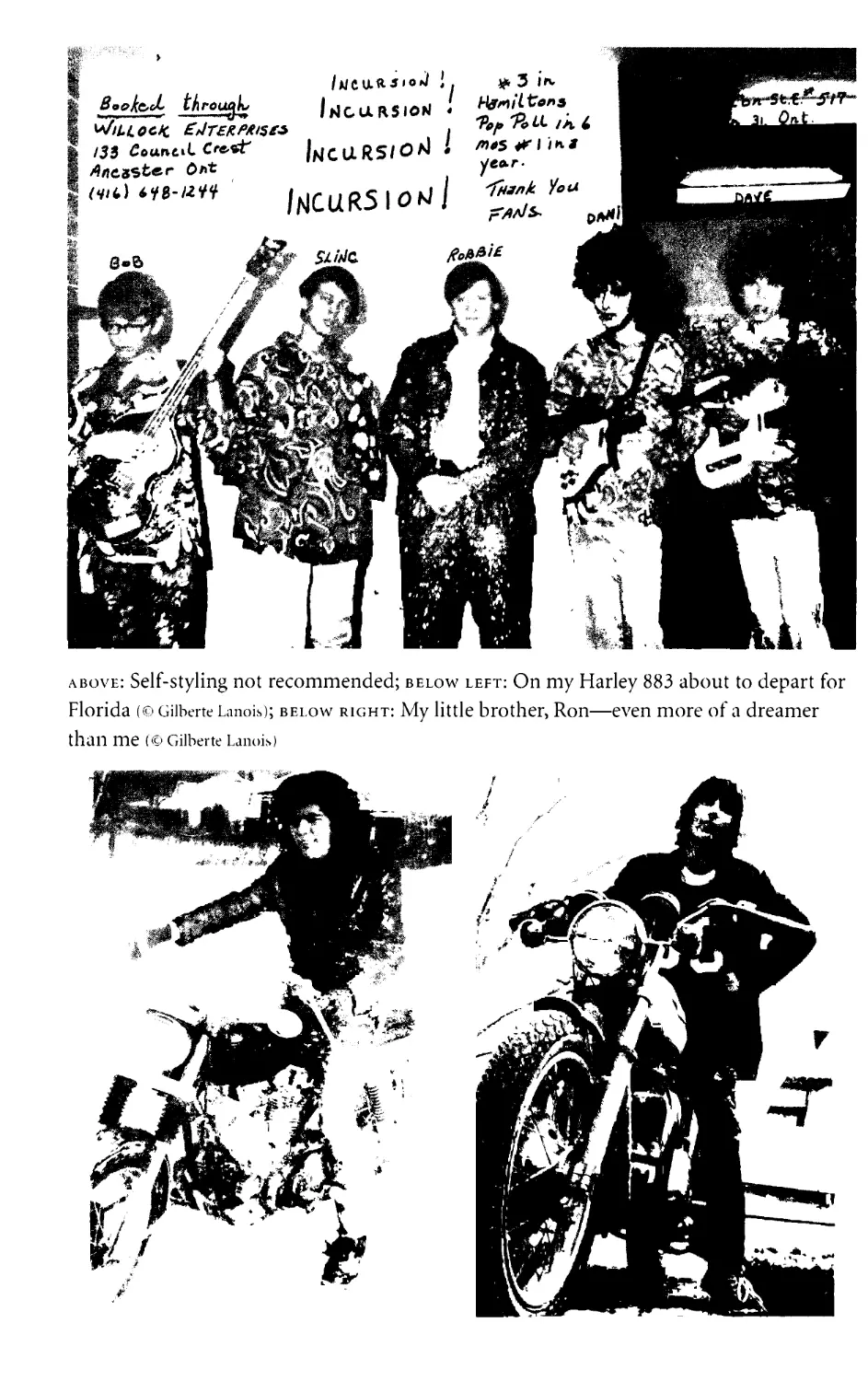
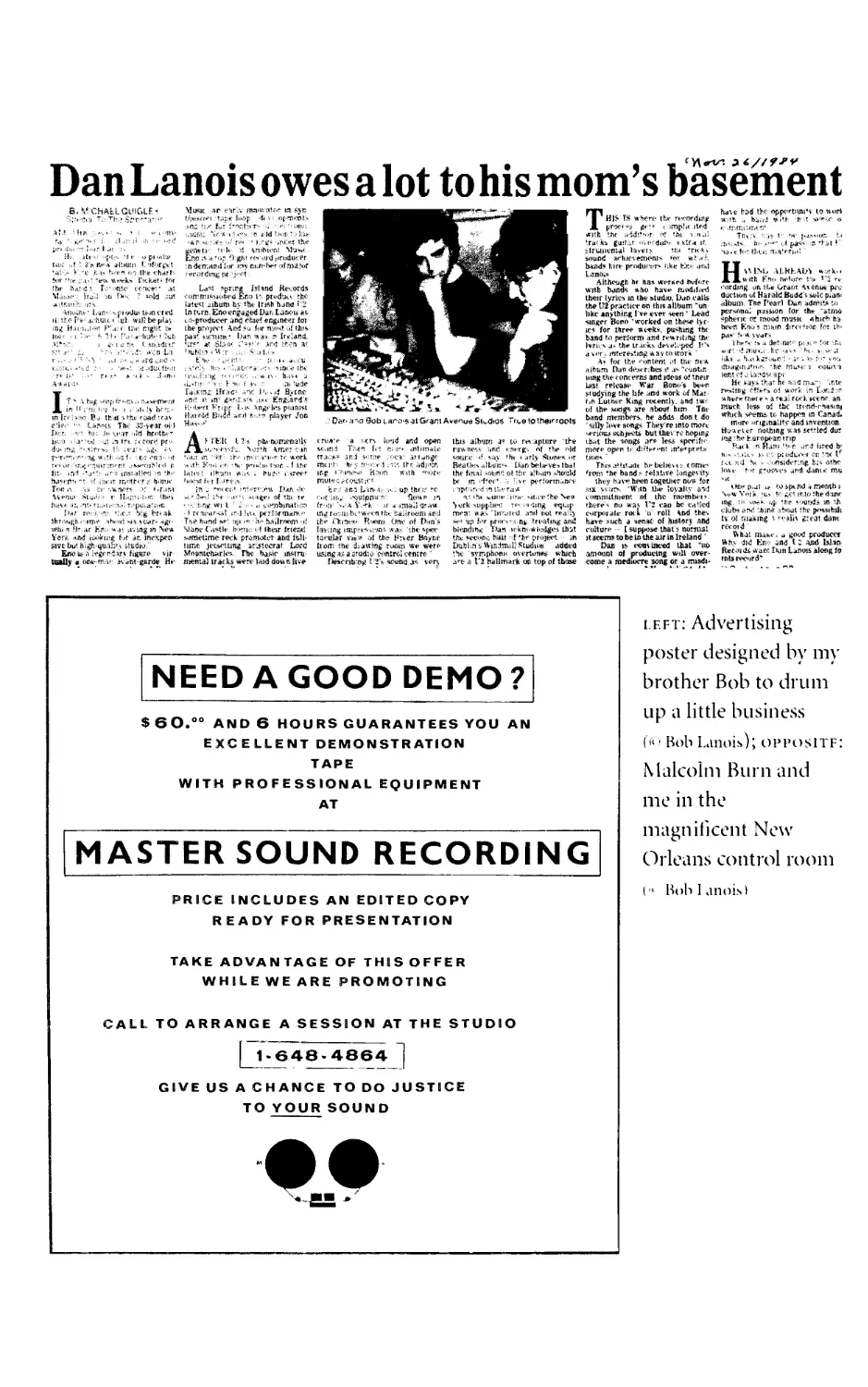








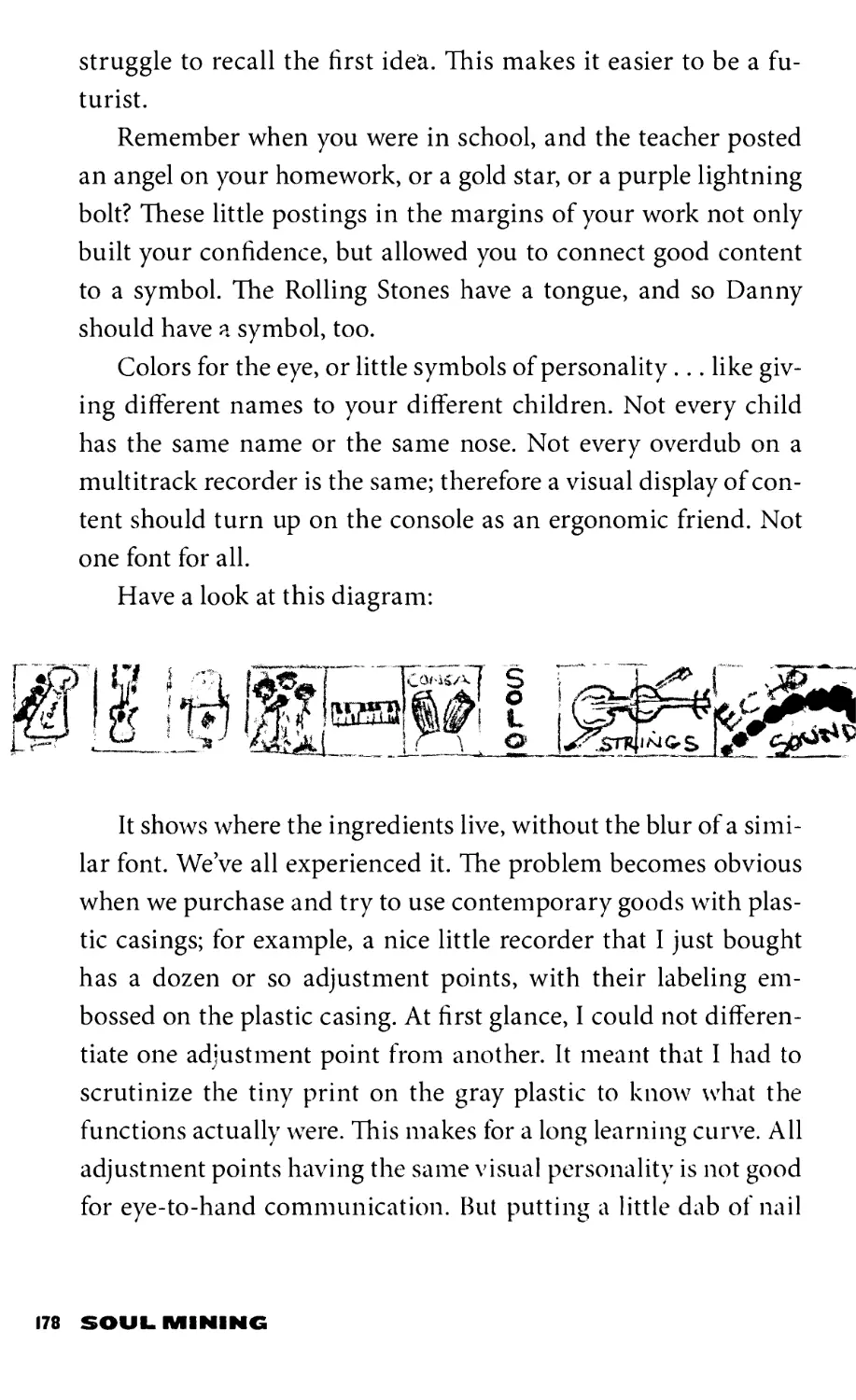















Text
I DANIEL LANOISj
..хкАЛь
MINIMI TROS
SOUL
<4
WITH KEISHA KALFIN
Faber and Faber, Inc.
An affiliate of Farrar, Straus and Giroux
18 West 18th Street, New York 10011
Copyright © 2010 by Daniel Lanois
All rights reserved
Distributed in Canada by D&M Publishers, Inc.
Printed in the United States of America
First edition, 2010
Library of Congress Cataloging-in-Publication Data
Lanois, Daniel.
Soul mining: a musical life / Daniel Lanois.— 1st ed.
p. cm.
Includes index.
ISBN 978-0-86547-984-5 (hardcover: alk. paper)
1. Lanois, Daniel. 2. Singers—Canada—Biography. 3. Sound recording
executives and producers—Canada—Biography. 1. Title.
ML420.L239 A3 2010
781.64092—dc22
[B]
2010010278
Designed by Abby Kagan
w w w.fsgboo ks.com
10 9 8 7 6 5 4 3 2 1
CONTENTS
I.	FOUR KIDS AND FIVE HUNDRED MILES	3
2.	SLING BLADE	28
3.	FLORIDA	36
4.	SOUND PRESSURE	45
5.	THE NORTH	50
6.	WAIST DEEP IN TWO-INCH TAPE	72
7.	LATE NIGHT AND HIGH NOON IN LOS ANGELES	88
8.	NEW YORK TO NEW ORLEANS	91
9.	BEAUTIFUL DAY	III
IO.	THE BELLS OF OAXACA	114
II.	THE SAUSAGE STAND AT THE ECHO	129
12.	EIWHVTYLOU HARRIS	133
13.	THE ONE-POINT SOURCE	140
14.	TIME OUT OF MIND	145
15.	THE WALKING IVIULTITRACK	171
16.	JAMAICA	182
17.	FOUR DAYS WITH WILLIE NELSON	194
18.	SOUL MINING	203
ACKNOWLEDGMENTS	219
INDEX
221
I
FOUR KIDS AND FIVE HUNDRED MILES
The Ottawa River is the dividing line between Ontario
and Quebec, or between English- and French-speaking
Canada. When I was a child, as far as the eye could see,
the river was often covered by miles and miles of floating logs
making their way to the paper mill. That heavy sulfur smell in
the air was taken for granted. The riverside road was flanked by
log mountains, long-nosed cranes pouring their mysterious
solution—one step closer to paper pulp. My parents lived on the
Quebec side of the river, the French side, in a government hous-
ing community by the name of Projet Dusseau. We were French
Canadian. I spoke only French until the age of ten, and I remem-
ber having a wonderful upbringing in that community. I never
thought much about the fact that we were poor. Kids don’t think
that way.
The Quebec landscape was fascinating to me. Wooden
bridges were covered up like birdhouses to keep the snow away.
Wooden staircases with roofs were a common sight. If the snow
piles up too high, and the weather goes mild, you might not be able
to get out till springtime. Chains wrapped around tires for better
traction. Cars commonly equipped with tow ropes and battery
booster cables. This maple-sugar country is very aware of the power
of seasons.
If you weren’t ready for the winter, you could freeze and die.
In those parts, preparation for survival comes naturally, even to
a young boy. Preparation for survival is always in the wings, con-
stantly kicking at your shin—even the shin of a young boy.
When the thaw comes, you can hear the waking maples creak-
ing, drinking in the snow water that creeps up the branches of
dormant trees—that’s how you get maple water. A spike in the
tree interrupts the flow to the branches, and if your hillsides
are clean, nature’s nectar makes for a nice drink. The varying
densities in the journey from maple water to maple syrup to ma-
ple sugar are dependent on how long one keeps the water boiling.
Much like the winemaking valleys of France or the Bourbon-
making valleys of Kentucky, the maple-sugar-making valleys
of Quebec produce their limited quantities and fine vintages,
with taste relative to the quality of the local soil, the intensity of
the sun, and the tender love and care of a specific maple-sugar
farm.
I remember the springtime ritual—the pouring of boiling
maple water into the white snowbanks. As the water crystallizes
against the snow, children run up with sticks and twirl the toffee
into a homemade confection—nature’s gift to the sweet tooth.
Back in the day, my grandfather’s sled—horse-drawn, hot bricks
laid down beneath the feet of the passengers to keep everybody
warm—was the family vehicle.
Sunday church runs, people wrapped in furs—the house of God
was the house of cooperation. The priest's sermon could easily
segue into village news: someone just had a baby, hand-me-down
clothes needed, so-and-so's well just dried out, announcement of the
church bazaar, help needed to raise a barn. Yes, the house of God
4 SOUL MINING
was a crossing point for relevant village information. The barter
system was in use then. My eggs for your wood, my plowing for your
corn, and so on.
Every house was a food-making house, and my grandmother
Aurore’s house was no exception. She really knew how to work
the maple sugar. Her sucre a la creme (maple sugar fudge), refined
by generations of home recipes, was pretty much the best. At the
savory end of the spectrum, my grandmother of course made
tourtiere (spicy meat pie). These old recipes were closely guarded.
Boasting of a better creme or tourtiere was not uncommon from
one house to the next.
Kids walked to school in those days—I liked that about the
project. We were on the edge of rural land and so my brother Bob
and I wandered everywhere after school and did whatever we
wanted. Many hours were spent by the railway tracks or at the
river’s edge doing boy things: skipping stones, laying pennies on
the rail lines, watching them get squashed by the train. We were
fascinated by the writing on the sides of the railcars, like Cana-
dian Pacific Railway, Canadian National Rail; others were more
specific to provinces and towns. Exotic names like Saskatoon,
Thunder Bay, Wa Wa, and Mississauga sure stirred the imagina-
tion. Rolls of steel coming from the west, cattle cars, empty flat-
beds, boxcars with open doors—we made up stories about their
sources and destinations.
A ceramic tile factory by the name of Primco was our second
backyard. Bob and I collected various discarded tiles and would
make up games with them. A few of the Primco workers were
sympathetic to our curiosity, slipping us a few irregular tiles to
expand our little homemade building set. I loved the smell of
that factory. They had kilns burning all the time, and the non-
stop action appealed to me. It must have been a kick to see the
faces of two brothers sticking their heads inside the Primco
FOUR KIDS AND FIVE HUNDRED MILES 5
windows, looking for tile handouts. Even at that tender age, Bob
and I loved the feeling of productivity.
It was a happy childhood, and I was oblivious to the fact that
my parents were having marital problems, until I started hearing
arguments in the night. Bob, my younger brother, Ron, and I slept
in one room, and my parents slept in the other. The arrival of my
sister, Jocelyne, meant that we had outgrown the two-bedroom
place. Four kids and work not going all that well strained my
parents’ relationship, and then it all started. My dad was hitting
not only the bottle, but also my mother. I later wrote a song
about this called “Jolie Louise,” the rise and fall of hopes and
dreams as seen from the perspective of my dad.
Ma jolie, how do you do?
Mon nom est Jean-Guy Thibault-Leroux
I come from east of Gatineau
My name is Jean-Guy, ma jolie
J’ai une maison a Lafontaine
where we can live, if you marry me
Une belle maison a Lafontaine
where we will live, you and me
Oh Louise, ma jolie Louise
Tous les matins au soleil
I will work ’til work is done
Tous les matins au soleil
I did work ’til work was done
And one day, the foreman said
“Jean-Guy, we must let you go”
Et pis mon nom, у est pas bon
at the mill anymore ...
6 SOUL MINING
Oh Louise, I’m losing my head,
I’m losing my head
My kids are small, four and three
et la bouteille, she’s mon ami
I drink the rum ’til I can’t see
It hides the shame Louise does not see
Carousel turns in my head,
and I can’t hide, oh no, no, no, no
And the rage turned in my head
and Louise, I struck her down,
down on the ground
I’m losing my mind, I’m losing my mind
En Septembre ’63
kids are gone, and so is Louise.
Ontario, they did go
near la ville de Toronto
Now my tears, they roll down,
tous les jours
And I remember the days,
and the promises that we made
Oh Louise, ma jolie Louise, ma jolie Louise
After my mother had had enough domestic mistreatment, she
put the four kids on a train and took us from Quebec to Hamilton,
Ontario—about a five-hundred-mile journey—and never looked
back. Her brother had found wrork in Hamilton (near Toronto) as
a bartender, and had managed to purchase a rooming house that
we lived in the back of until my mom got on her feet. My dad was
not happy about all of this, and so a few months later he came to
fetch his boys. We were walking to school and he pulled up; we
FOUR KIDS AND FIVE HUNDRED IMIA.ES 7
were happy to see him so we jumped in the car and that was it—
five hundred miles back to Quebec. He put us in a cabin by a lake
in rural Quebec, and that’s where we lived for a good few months.
My dad was doing carpentry work in town, and so during the week
we lived by ourselves. He would come to visit on weekends—we
had a blast. We were twelve, nine, and five.
My dad was a greaseball, as were his friends. They were the
smart-dressing kind of greaseballs—no jeans. They were slick
and dapper, and as this was the tail end of the fifties, there was a
lot of excitement about cars. A two-tone 1957 Chevy and all, lots
of looking under the hood. My dad was a good dancer. He was
funny and looked sharp—very charming, and women like men
who are charming. So much gets overlooked in the name of charm.
It was a macho time and I liked it.
My dad and his friends were hunters. There was a lot of my-
thology about the ways of the woods. I remember my dad teaching
me how to walk in the woods. He had learned from the Indians;
it was all about being at one with the wilderness—one step and
then a pause to listen. The results of the “listen” determine the next
step, and then another “listen,” and another step. Humans are only
ever guests in the woods. In the way that a sailor never underes-
timates the power of the sea, the hunter never forgets the ways
of the woods. Animals have much hearing power; they know a
clumsy human intruder from far away. The listening pause be-
tween every step puts a human closer to the instinct of the animal.
Wintertime adds another dimension to the ways of the
woods. The snowbanks hold secrets. One careless footstep might
disturb the peace. Only experience can teach what terrain lies
underneath the mysterious white snow. Snow time is better for
tracking, but the advantage of seeing tracks in the soft surface
could easily be crushed by a hunter’s fall due to not understand-
ing what lies underneath the beautiful white snow.
8 SOUL MINING
When the weather is hot, the flies can eat you alive. The sap
running down from the pine trees could be your savior. Old
Jocko Proux, one of the elders of the community, had survived
the woods for an entire week by covering his whole body with pine
sap as a barrier against the flies.
They say we walk in circles—we humans—in circles when
we’re lost. A marking on a white birch, connected with the mark-
ing on yet another white birch two hundred feet away, connected
with a marking on yet another white birch another two hundred
feet away, keeps a circling human going straight. The birch-to-
birch technique is common knowledge as remedy for anyone lost
in the woods.
Preparation is a big part of survival in these isolated northern
Quebec communities, many of which have no electricity. The
seasons are the governors and dictators of all human behavior.
If you want ice for your icebox in the summer, then you must cut
your ice from the lake in the winter. Ice cutting is a collective effort:
a group of men, bucksaws in hand, cutting through two feet of
ice. The ice is lifted out of the water with massive pliers and placed
on skids to be dragged back to shore. The gaping hole has a slip-
pery edge. One mistake and somebody might drown. This dan-
gerous task is the cold-climate version of Mennonite community
barn building—everybody chips in to fill one family’s sawdust-
filled cedar icehouse. Remarkably, the sawdust acts as an insula-
tor and keeps the massive blocks of ice intact for the entire warm
season. The family that does not fill their icehouse in the winter
will not be able to keep their fish cold in the summer.
When my dad left us in the cabin, we pretty much did what-
ever we wanted. Bob and I shot rifles a lot, and Bob got really
good—he could have been a sniper. I liked the smell of bullets ex-
ploding in my face. We three boys—we all loved shooting those ri-
fles. We had a .303, a Winchester, and a .22. The .303 was a serious
FOUR KIDS AND FIVE HUNDRED M!LES 9
deer-hunting rifle, but even the .22 gave quite a kick because
we shot .22 longs (these were the longer .22 shells for longer dis-
tance). There was a sandpit nearby where we shot arrows into the
sky. We closed our eyes and waited for them to land, and sure
enough they did, sometimes right next to us. It was a sort of “Que-
bec Roulette”—we could have gotten one in the head. What does
all this mean? It just shows the madness of boys. Ron, the youn-
gest, didn’t do the arrow thing. He was busy cooking, five years
old, standing on a chair at a woodstove. Everybody survived, and
as crazy as it may seem, I believe those were good learning times.
My mother eventually came to steal us back, and so five hun-
dred miles back to Hamilton. That was the end of the volley. I
know my dad loved his kids, but I believe my mom did the right
thing. It was all a bit mad, but I appreciate that my parents made
decisions for themselves without the involvement of courtrooms.
I have always been fascinated with the fact that people do not
take responsibility for their actions. Some judge somewhere will
decide what now needs to happen regarding a situation that you
happily waltzed into? A completely personal matter will now be
dealt with by some stranger? It all avalanches from there, lawsuits
and accusations. My parents never spoke again. My dad didn’t
get pushed into any child-support scheme; it was a nice clear
severance.
We resettled into Hamilton in my uncle’s back apartment. It
was a one-bedroom place. We three boys slept in the bedroom
and my mom slept on a foldout couch with my sister. The boys'
room had two bunk beds, and another bed in the corner. It was
hard to adjust to the English language, but aside from that we
had a good time. We walked to school, about a mile and a half. I
loved walking, forever fascinated with the factories along the way.
There was often a burning smell in the air, as Hamilton is a steel-
making town. We attended a French school, and our teachers
10 SOULMINING
were nuns. It was a big old place that had fallen into disarray and
would soon be knocked down. Every kid brought a lunch bag
from home, and when lunchtime rolled around, we ate at our
desks. The school provided every kid with a little carton of milk.
There was no refrigerator, and so the milk cartons were lined up
on the windowsill to keep cool.
The school was closely associated with the church, and when
the nuns concluded that I might be a candidate for the priest-
hood, I was introduced to some of the decision makers at the
church. I remember a mild-mannered, curious man in a black
robe, speaking tenderly as he pointed out paragraphs for me to
read from the literature that he had brought. I was made to feel
special, and I liked the idea of belonging to this club. They gave
me an outfit, a robe with ornamental ribbons that I wore as they
began to teach me the way of the altar. I became an altar boy, and
the church was my hangout. It was like being backstage. There
was wine, a few things to eat, and I got to ring the bells. I loved it.
The priest would give me a wink, and I would whack the bells.
Perhaps it was the camaraderie that appealed to me, like being in
a band. This went on for a few years, until girls started looking
more interesting than priests. That was the end of my priesthood.
Back in Quebec, music had been all around me. My dad was a
violoneux, which means a violin player or fiddler, as was his dad,
my grandfather. Grandfather Lanois was good on the violin, and
though he was not a professional, he played at neighborhood
events, weddings, and other ceremonies. On my mom’s side there
were singers. My uncles and aunts sang old Quebec folk songs,
and it all added up to a self-entertaining environment. Our gath-
erings were typical of the Quebec culture of the time. Big fami-
lies, late-night card playing, lots of laughing, shouting, banging on
FOUR KIDS AND FIVE HUNDRED Mli.ES II
tables, kids piled up in the bed while the adults went crazy in the
other room. No babysitters—people didn't use babysitters.
The music of Quebec has always stayed with me, especially
the melodies, and although I didn’t play an instrument yet, I was
already thinking about music. I wanted a clarinet, which some-
where along the way I had gotten it into my head that I should
play. Probably something I saw on television.
My mother allowed me one dollar a week as personal spend-
ing money, and I spent it on Saturdays when I would walk
downtown by myself and see a movie. This was the time of bib-
lical movies, so I got to see films like David and Goliath and
Samson. I loved them. I thought they were sexy—robes, skimpy
outfits, and pretty girls. On one Saturday, walking to the cin-
ema, I was distracted by a plastic pennywhistle in the front
window of a music store. It was white plastic with red finger
holes. It didn’t look quite like a clarinet, but it was close. The
price tag on it said one dollar. On that Saturday, I didn’t make it
to the movies—but I did walk through the door that led me to a
new life.
My little plastic pennywhistle and me. My new companion
that I played nonstop for the next two years. In order to remem-
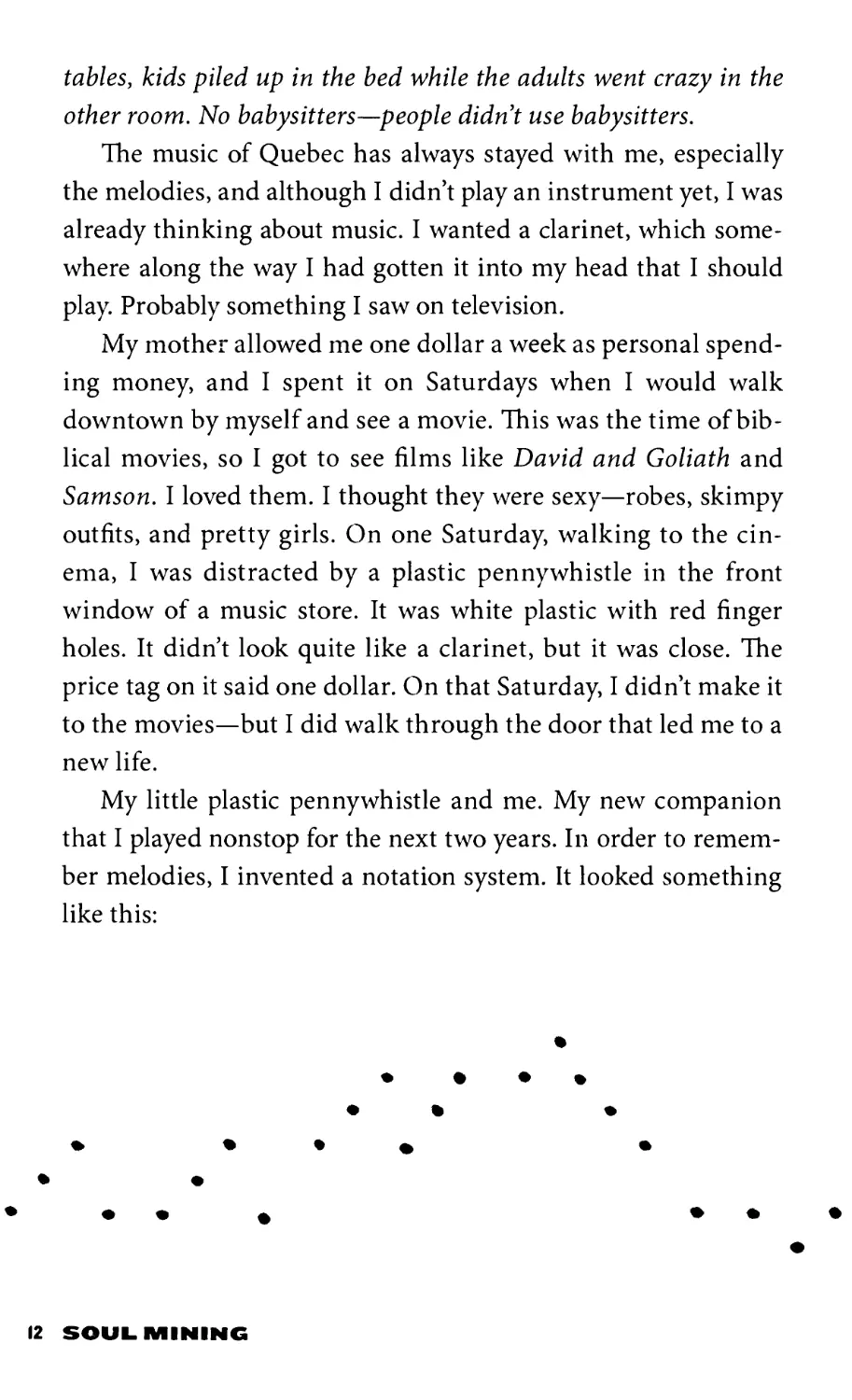
ber melodies, I invented a notation system. It looked something
like this:
12 SOULMINING
The first dot on the left related to a specific fingering on my
pennywhistle, and then, much like the reading of a sentence, I
would read it left to right; my melody was now carved in stone.
That seemed to work pretty well as a way of remembering. This
little self-made system was my way of remembering what was im-
portant to me.
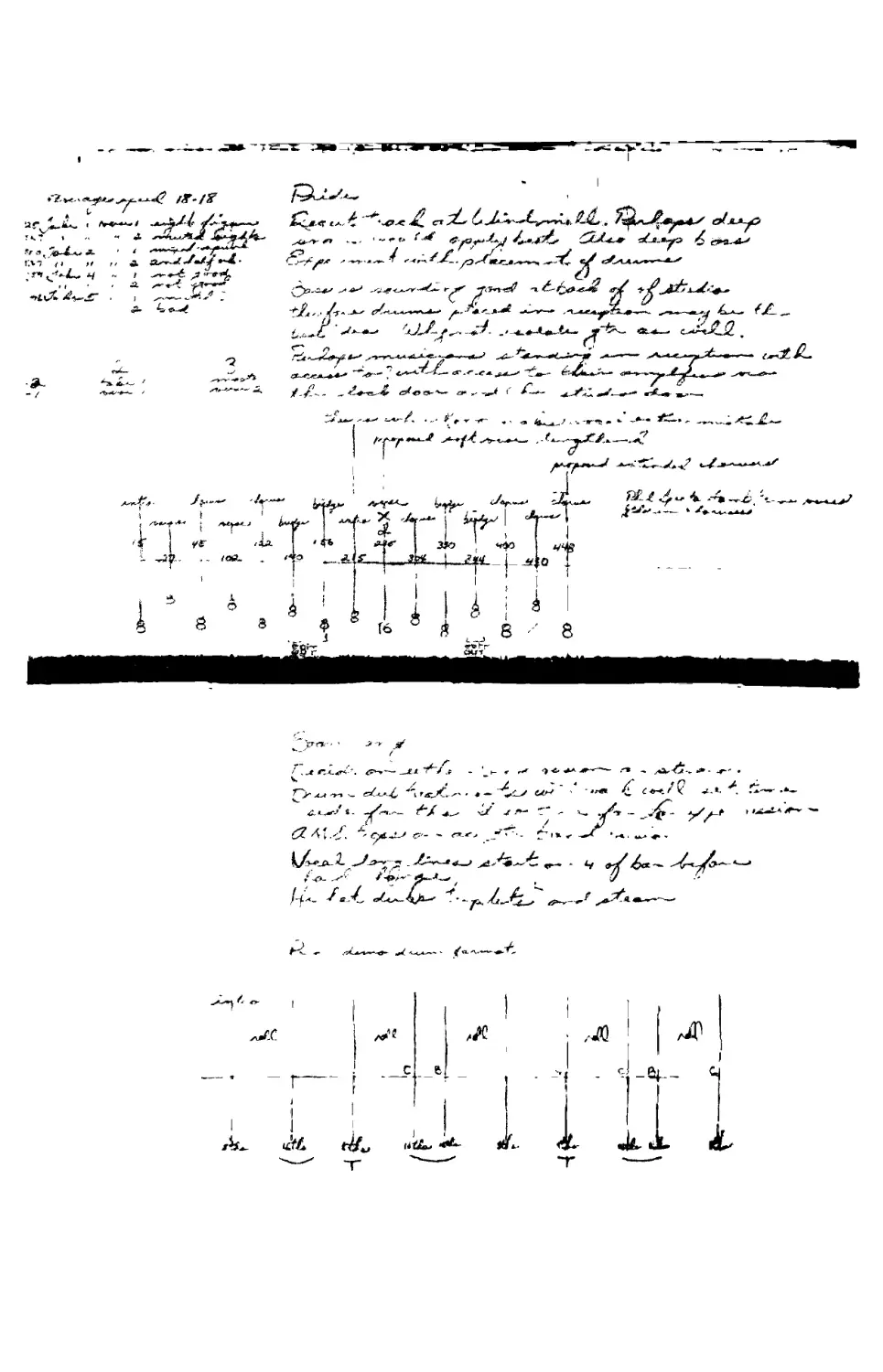
This next diagram is a two-page memo that I pulled out
of a workbook of mine, circa 1984. The diagram includes song-
structure reminders plus various ideas relating to further devel-
opment of the song.
This diagram precedes the recording of the final version of
U2’s song “Pride (in the Name of Love).” Note-keeping is a big part
of what I do. There is nothing like being fully informed: knowl-
edge equals ease of operation.
This sort of diagram dominates my workbooks. Sometimes
they are enough to make me crazy, but I’ve never known a way
around them. Keeping track of arrangements and ideas on paper
has always been part of my work process. Remembering is just
another word for choosing. The world turns the same way for
everybody but different people choose to see different things. I
decided to remember the little pieces that matter to me. This is
the same way that I see God, as little pieces flying by, tiny mo-
lecular pieces of information constantly flying by. Some people
see them, some people don’t. A godly moment may be sparkling
in only a tiny way—too small to make a difference in its singular
form—but stacked up with others the sparkle begins to build shapes.
The shapes are the instigators of sound, soul, and dreams. Dreams
allow you to then see more possibilities, and in my case, my dreams
become realities. Not quickly, maybe only one piece at a time over,
say, three years, before it all falls together.
I have discovered that many of my collaborators were also
obsessed with documentation, even as children. The Edge, of U2,
FOUR KIDS AND FIVE HUNDRED MILES 13

is such a man. His notes regarding composition and arrangements
are forensic. Eno is a master of the pen. His books are incredible,
complete with intricate diagrams to support his theories. I sup-
pose this is the sort of process one learns in university, but why
wait for university when you can figure it out as a teenager?
A man knocked on my mother’s door and asked if she had any
kids that liked music. She said that she had one who liked to play
the pennywhistle. Having passed the aptitude test, the man ex-
plained to my mother that his school taught only accordion and
slide guitar. Accordion didn’t appeal to me, and so I became a
slide guitar player. Now, once a week, I was walking to my music
lesson carrying an acoustic guitar with very high action—the
strings were about an inch off the neck—and I played it with a
steel bar. I loved it.
My teacher was a curious man who experimented with hyp-
notism. At the beginning of every lesson, he would hypnotize me
by placing a little object on the music stand as a focal point. He
made me look at it until everything got blurry, as he repeated
“you’re getting sleepy.” Once I was hypnotized, the lesson would
start, and sure enough, it worked. I got really good on the slide, and
my interest in music broadened by the week. I now lived in the
most incredible world, up at 4:00 a.m. to deliver the morning pa-
per, and then rushing home to open the cases of my pennywhis-
tle and slide guitar. I loved the smell of them, and I played these
instruments until my fingers bled and my mind got sharp.
My brother Bob and I are of similar mind. It’s the kind of
mind that dismantles the engine of the family car and then reas-
sembles it before my mother gets home. The mind that looks at
the electrical transformer up on a pole and figures out high-voltage
current reduction to 220 and then down to 110. The kind of mind
FOUR KIDS AND FIVE HUNDRED Mli.ES 15
that memorizes the complicated morning paper route. That mem-
orizes each and every name of each customer. The mind that wants
to know what goes on behind the doors of factory buildings, wants
to know the sidelines of the steel business in Hamilton and how they
make wire all stacked up in a yard on large industrial spools. The
mind that wants to know the next newspaper customer. The cus-
tomer range was wide. My factory and industrial clients were reli-
able, but my drunk customers living in the York Street Hotel were
not. Much of my time was spent banging on doors in smelly hall-
ways, trying to collect from transient customers. Rooms by the
week, rusted-out Cadillacs, barflies drowning sorrows—this sketchy
part of town sure was an education for an eleven-year-old.
Through my little grapevine, I had heard about the job op-
portunity. A kid in school who was a little older than me was
moving away, and he made his newspaper route available to me.
A hundred and twenty copies of The Globe and Mail every morn-
ing made for a big route, but I took it on anyhow. Every morning
I woke up at 4:00 or 5:00, put on my warm clothes, and put my
wire-cutting key in my pocket. I headed for the newspaper drop-
off, my route in my head. I always worried that I might not re-
member the address of every customer, and the seasons dictated
whether I could use my bicycle or not. If I couldn’t use the bike, I
carried the papers in a sack—120 papers cutting into my shoul-
der. My morning route afforded me some isolated time away
from adults, time for a child’s imagination to grow. There’s some-
thing powerful that happens when you rise before the rest of the
world. The feeling of freedom or rebirth that I imagine the birds
feel every morning also belongs to a newspaper delivery boy. The
two voices or characters in my head would inevitably start talking.
They would argue and discuss, the one trying to outwit the other, or
win the argument, both characters played by myself. Is this a men-
tal illness? Or a necessary preparation for the psychological journey
16 SOULMINING
one must embark on to be good in the recording studio? I still play
the two characters today. Sometimes I get strange looks from people.
I was trying to find a place in the world, as were my brothers.
My sister was just a baby then, raised by my grandmother while
my mother worked. My grandmother was beautiful, with an over-
sized thumb, three times bigger than a normal one—I never knew
why. She sang while doing the dishes. Everything pretty much
happened in one room—one big kitchen with a porch to sit out
on. The backyard was pretty, a yard that we shared with my grand-
mother because her apartment was right next door. My grand-
mother Aurore kept a bird; she loved that bird. I love birds too—my
affection for them must come from Aurore. As the world trips over
itself, chasing the latest gadget, the birds do what they’ve always
done.
My brother Bob was always the scientist of us two. We were
pretty much inseparable once we got our recording studio going.
Bob and I would stay up late nights challenging every situation
with bright ideas. I love all ideas, even absurd ones. After all, push-
ing the envelope is such a large part of innovation. Bob and I al-
ways had a tape recorder around the house. Our first one was an
old flea-market machine, everything on board—microphone,
speakers—really easy to use. It had a warbly, muted sound. My
friends would come over, and we’d have a laugh recording our
voices and listening back.
My next setup was in the basement. The machine was a
Roberts, again with onboard speakers. Reel to reel, quarter-inch
quarter-track, which meant you could flip the reel over and record
more music using the same spool. My next rig was great, a Sony
TC-630. Again fully contained, mics, speakers, the lot, except
it had a “sound on sound” feature. I had now found my secret
weapon. The Sony allowed me to record on channel 1, and then
on listening back I could transfer that sound onto channel 2,
FOUR KIDS AND FIVE HUNDRED MILES 17
along with some more singing or playing in the room. A mira-
cle! I could now stack up tracks by bouncing from channel to
channel. A technological deficiency became my friend. The more
transferring I did, the more muted the early recordings became.
This meant that the earlier parts became more faraway sound-
ing, giving the last part added a more upfront, brighter, closer-
sounding position. Voila! Auto-mixing and automatic “depth of
field.” I began to plan my recordings in anticipation of this defi-
ciency. I would stack up my performances but wait to record my
up-front information as my last layer. This was also an excellent
training for commitment to a blend. Mixing along the way be-
came part of my technique then and is still with me today.
The “sound on sound” technique also persisted, even into the
next chapter of my career. At this point, Bob and I had purchased
two Revox quarter-inch recorders, excellent Swiss machines. We
would record onto the first Revox, and if we liked the result, we
would record more playing and singing on top as we trans-
ferred onto the second Revox. The quality was amazing—nice,
big, punchy, full sound. At any stage of the transfer system, you
could decide that that was enough, and that was it. The final
Revox recording became the master tape. This was a big thrill,
and the buzz was out—the Lanois brothers had built a sound.
People came from all over the place to record in my mom’s base-
ment. We took it a step further, and offered a package vinyl deal.
Two days in the studio, artwork, and a thousand pieces of vinyl
delivered to your door. Our little business started to boom.
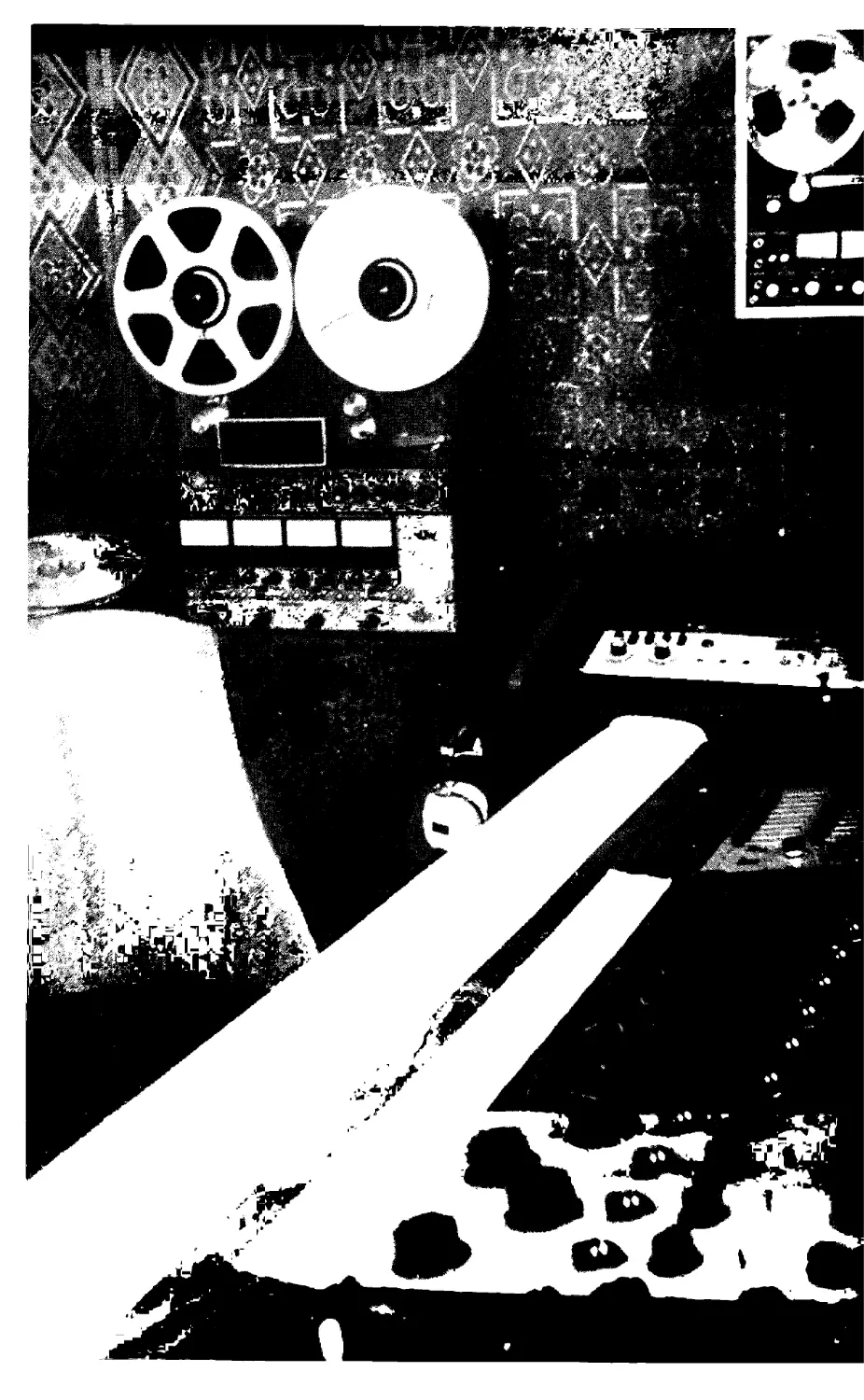
The next setup was a four-track. Our homemade console was
built by two local technicians and my brother Bob; it was origi-
nally created with a stereo output, but Bob later modified it to
accommodate the four-track Teac. rlhe Teac, of course, could
only hold so much information, and so Bob and I invented the
six-track system. Legato information, like strings or background
18 SOUL MINING
vocals, would be mixed down to the Revox, freeing up tracks for
more recording on the Teac. The strings and the background
vocals would just sit on the Revox until the mix. Come mixing
time, a single large button triggered the Teac and Revox to start
at the same time, with the help of china marks on the tapes. If
the markings were accurate, it would all be in sync, and the six
tracks were then combined onto the other Revox. Magic! Pro-
duction was now complete with strings and background vocals.
The four-track studio is where I recorded Rick James. Rick
lived in Buffalo, New York, which is located on the Canada/United
States border not far from the burbs of Hamilton, where our
studio was located. A friend of mine, Eddie Roth, was playing
organ with Rick and recommended my studio as a cool place to
make demos.
The master musical mind of Rick James is still with me today.
He was a monster arranger, full productions pouring out of the
speakers within twenty minutes. I felt like I was in the presence
of Bach or Beethoven. His understanding of the tapestry of funk
in my experience remains unparalleled. Rick breezed in and out
of my life but remains one of my great teachers. I didn’t even
mind that Rick never paid me for the session.
The nonstop flow of people in and out of my mother’s house
was incredible; the place became a hangout. My mother even
cooked for clients. The kitchen table that had seen everything
was about to see even more. I can’t imagine what the neighbors
were thinking—what was Rick James doing in their neighbor-
hood? The house had only one bathroom, and as I think about it
now, the invasion of privacy was something that my mom could
easily have been angry about, but she reversed the energy and em-
braced the entire situation. Some of the recording sessions, like
the Jamaican reggae sessions, accommodated up to thirty people.
Picnic blankets on the front lawn, immediate and extended fam-
FOUR KIDS AND FIVE HUNDRED MILES 19
ilies all welcome. When nighttime came, they’d end up watch-
ing TV in my mother’s front room. It was not a regular house.
The basement studio hosted the recordings of hundreds of
albums, including a lot of gospel quartets. The quartets were a big
part of my education. The four parts keep the brain sharp, the
melody is being chased constantly by the three harmonies. Oc-
casionally, the melody may even become subservient to the har-
mony. What an amazing world of invention! I believe my ability
to come up with harmonies has a lot to do with these early lessons.
I should mention something here about Raffi. Raffi was a folk-
singer from Toronto who decided to make a record for kids. His
wife was a teacher, so he had a connection to the school system.
In 1976, Raffi, Ken Whiteley, and I recorded an album called Sing-
able Songs for the Very Young. If I remember right, we gave Raffi
a package deal, all-inclusive—studio time and all the help I could
give him, beginning to end, for $1,500. That’s the way it was done
then, a nice clean deal everybody was happy with. The record
went on to sell millions. We were rootin’ for Raffi. We made three
other albums together. They all shot through the roof. Raffi’s kind-
ness guided him to humanitarian work that he involves himself
with to this day. He remains the king of kid’s music.
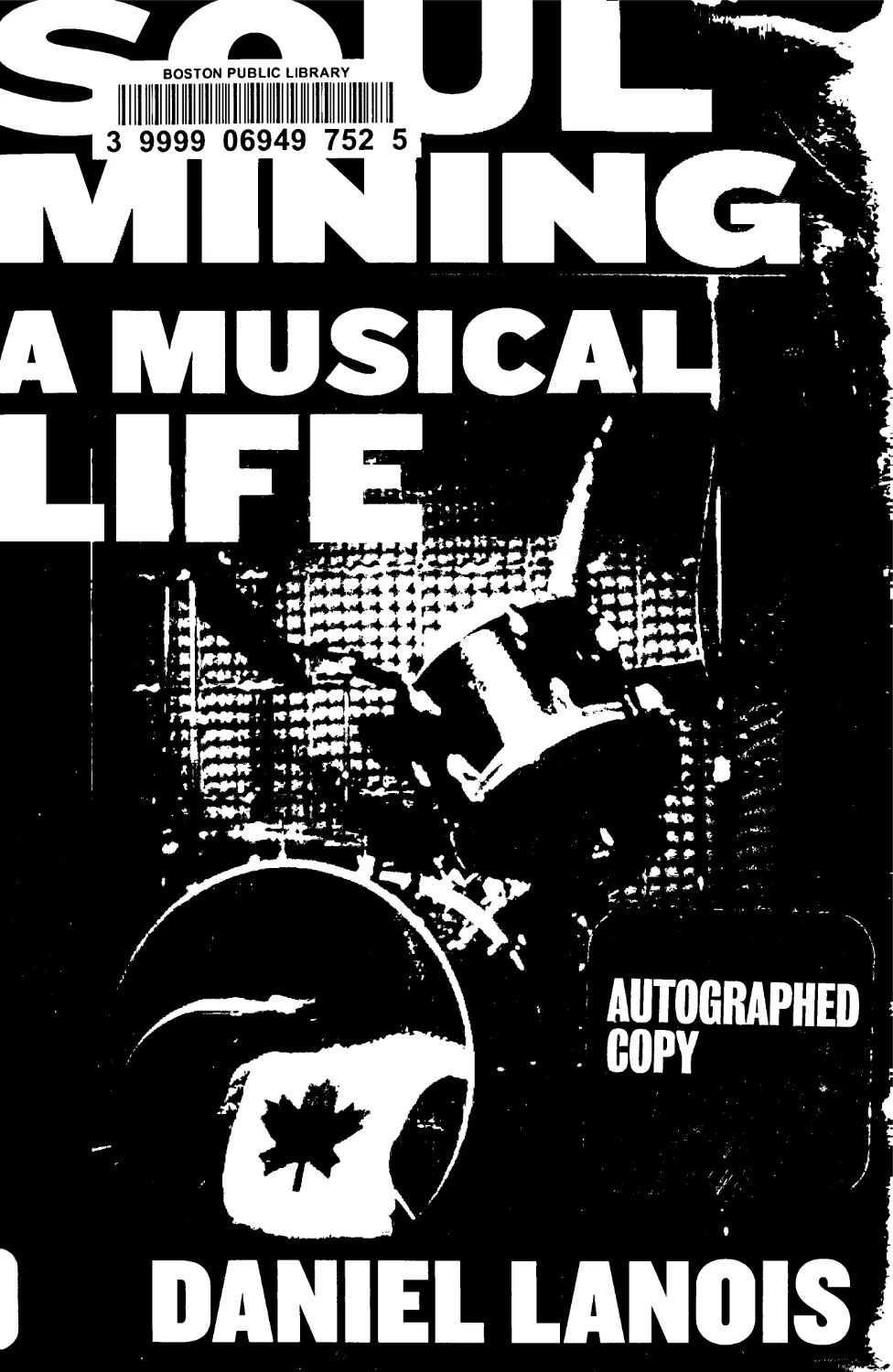
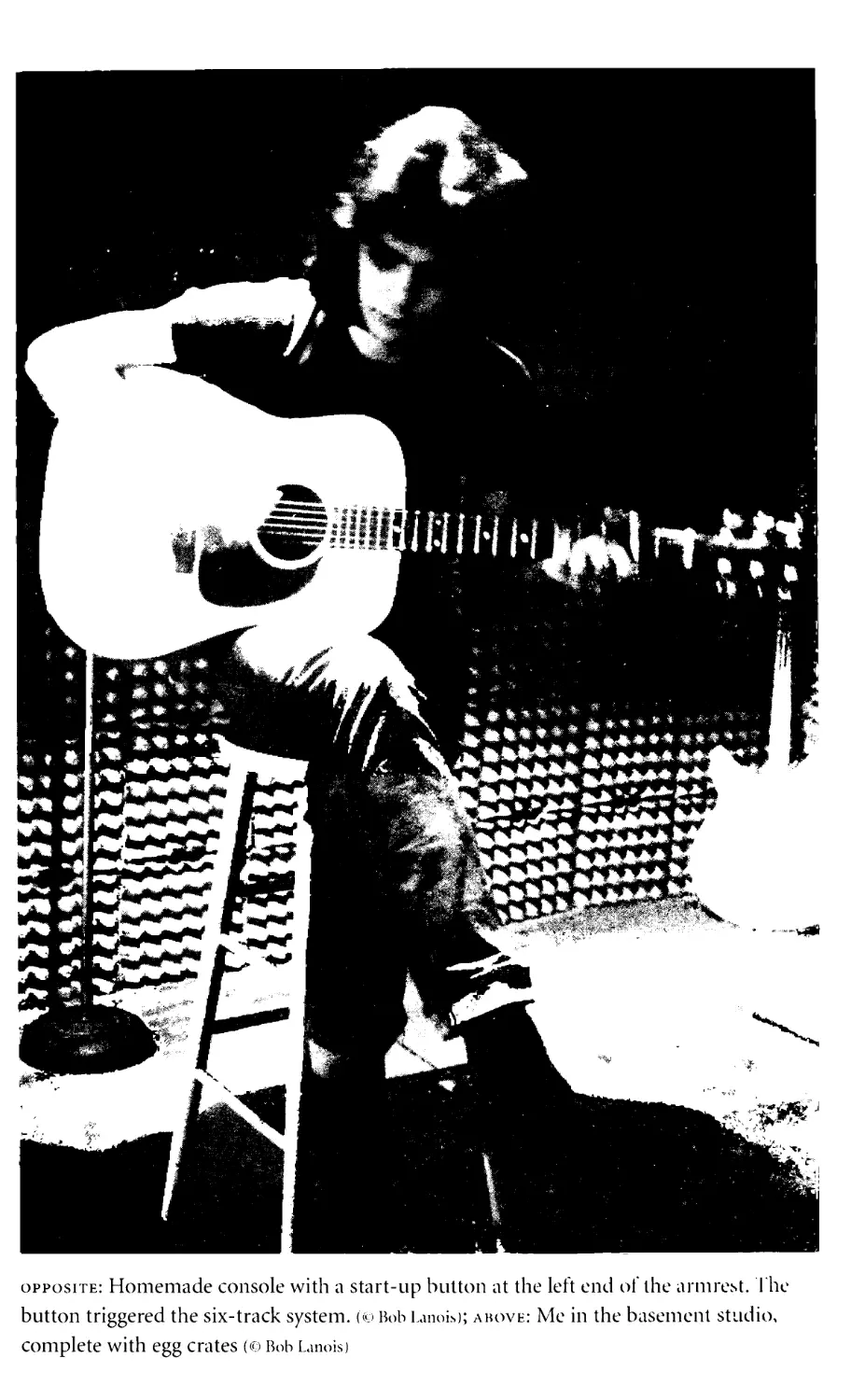
Our drum kit was surrounded by egg crates that I had pur-
chased from the egg man; the crates were meant to deaden the
spitting high frequencies. The microphone technique seems cu-
rious to me now. I think we could safely say that faith was the
major ingredient in my drum sound of the time (see the cover of
this book for an illustration). The studio also had an upright
Japanese piano that I sweated over many long nights, trying to
tune the thing for the morning session. I couldn’t afford a piano
tuner, so I learned how to do it myself.
Old Man Baker, who lived two streets over, was a harpsichord
builder who didn’t like wood; he liked metal. His heart had been
20 SOUL MINING
broken too many times by wood, with its never-ending swelling
and contracting relative to the level of humidity in the air. He
was now building harpsichords out of metal. Old Man Baker
broke the rule of the suburbs. Rather than the obligatory mani-
cured front lawn, he opted for a jungle of spices, veggies, and
fruits, including grapes. Constantly drunk on homemade wine,
he ranted on about his metal-versus-wood theories. He was an
outrageous character, and his house, like my mother’s, was often
a home for wayward teenagers. Everybody thought he was a kook,
but in retrospect he was the only guy in the neighborhood who
made any sense.
Old Man Baker taught me the theory of equal temperament,
which was designed to accommodate any key on the piano. It
works like this: first you tune middle C to your tuning fork, and
then you tune the next C an octave above it, also to the tuning
fork, which means those two notes are now perfectly in tune, and
not to be changed. The E note above middle C will now be tuned
by ear, so that it sounds nice when played with middle C. The
relationship between middle C and the E is described as a major
third. Now that the E sounds nice against the C, we must make
the G-sharp above the E also sound nice. In other words, the re-
lationship between the E and the G-sharp needs to sound as
pleasing as the relationship between the C and the E. Once we
have that, the C above the G-sharp, which we already tuned to
the tuning fork and which cannot be changed, must sound nice
against the G-sharp. If the C does not sound nice against the
G-sharp, then we must backtrack and alter the E a little bit, and
then alter the G-sharp a little bit, until the relationship sounds
equally good between all three intervals. This is called dividing
up the octave.
The terrible part about all this is that each of these intervals
will sound just a little sour to the ear. Long ago Western music
FOUR KIDS AND FIVE HUNDRED MILSS 21
decided to embrace a grand compromise in the name of flexibil-
ity. The result was that every major chord will be a little out of
tune in itself: i.e., the third of any major triad will always be a
little bit sharp. This is enough to make me crazy, as I am a pedal
steel guitar player, and my ear constantly searches for perfect pitch.
I don’t like compromise, but the flaw in equal temperament sug-
gests that compromise must be lived with.
We eventually moved into a new studio on Grant Avenue. By
that time Bob and I had moved up to a sixteen-track American
recorder made by MCI. The console was also MCI. Bob built the
new studio while I kept going in the basement. The renovations
exceeded our budget, and we were pushed to accept a second
mortgage at a rate of 17 percent, an insane amount that we paid
for years.
The habit from my newspaper route of getting up very early
was still with me, except now I was up at four in the morning to
go to the studio and work on my sounds. I had early sampling gear
that I was excited about. In fact, the term sample had not been
invented yet—I called them traps. I would catch little fragments
from vinyl records and then manipulate my sources to the point
of nonrecognition. These experiments were made prior to my
meeting Eno.
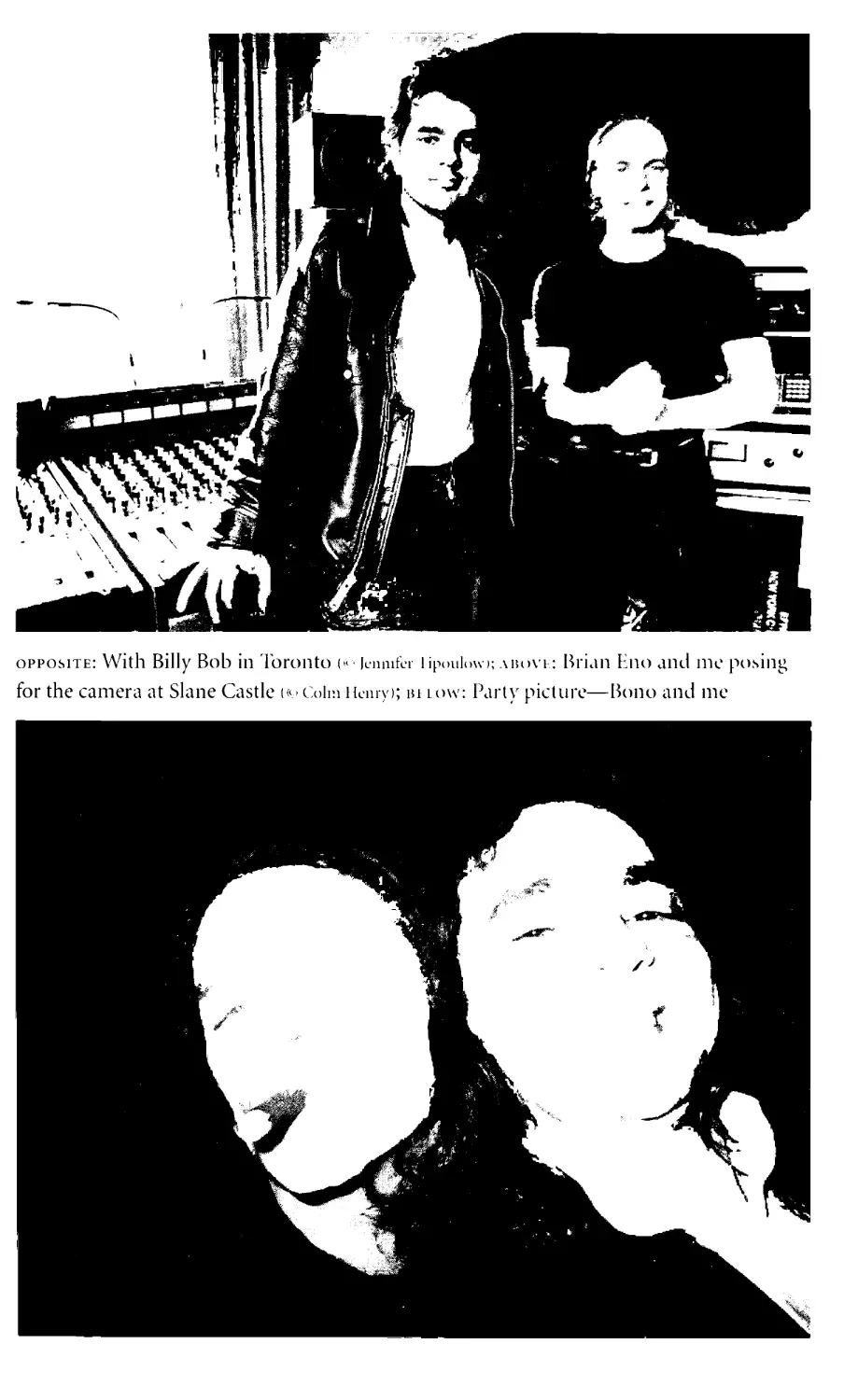
Brian Eno became aware of my work while he lived in New
York City. I had recorded some inventive demos with a group from
Toronto called the Time Twins. My friend Billy Bryans had in
fact produced these demos, and they were full of sonic delights
and the songs themselves were very unusual. The Twins took
their wares to New York and somehow bumped into Eno. They
played him the tapes, and he was curious about where they were
made. The Twins told Eno that a kid from Canada named Danny
22 SOUL MINING
Lanois made them in his studio. Coincidentally, Eno was plan -
ning a trip to Toronto, and he chance-booked a session with me.
I had never heard of him, and so 1 advised Bob to insist that Eno
bring cash. He turned out to be a reliable sort and initiated a ma-
jor turning point in my life.
Eno came into my world as an incredible force of work ethic
and dedication. Time stood still as I became a conduit for the most
progressive thinking I had ever been exposed to. Before Eno, I
had been in a sort of limbo, building my skills but not with any
specific direction. Eno arrived with a suitcase full of bells, ac-
quired on Canal Street in New York. The first thing he said to me
was that he wanted to record the bells as he walked around the
studio for forty-five minutes, the idea being that the bells would
ring throughout the entire record. I set up six microphones and
Eno proceeded to walk around as I recorded. There were a few
creaks in the floor that I had never noticed before, because peo-
ple don’t usually walk around studios. The bells were meant to be
a companion to the 71/2 IPS tapes that Eno had brought with him
from New York. As I transferred them to my sixteen-track re-
corder, they revealed the most beautiful, delicate, melodic, and
romantic piano playing, which sounded like a sort of contempo-
rary version of the great French composer Eric Satie. The artist
was Harold Budd.
Punk had just exploded and anger seemed to be a common
ingredient in the music I had been recording in the few years pre-
ceding the Eno visit. The Eno/Budd work had no anger in it. It had
stillness, acceptance, and premonition. It had patience, subtlety,
and refinement. The anger was left outside in the busy hustling
world. My heart rate slowed down and time stood still. The vibe
got thicker by the day. I began to live for nothing else—I cared
only about the work. I felt like a forensic expert or a scientist or a
doctor, on the verge of solving some great, menacing riddle.
FOUR KIDS AND FIVE HUNDRED MILES 23
Eno’s early years had been very different from mine. He had
gone to art school, and so had a broad knowledge of art and
contemporary urban philosophies and trends. He had already
recorded some very significant records—some of Talking Heads’
best work, Remain in Light, for example; My Life in the Bush of
Ghosts with David Byrne; David Bowie classics like Low, Lodger,
and Heroes, and Brian’s own records, of course, like Before and
After Science, Another Green World, and Music for Airports, all
regarded as groundbreaking. I was highly skilled but isolated and
not aware of the revolution that Eno had been a part of.
Years of preparation and skill-building had now found a
home. I loved working with Eno. He came in like a breath of
fresh air, like some sort of redemption after many years of labor-
ing through bill-paying projects. Brian’s work did not accommo-
date the expectations of pop music; it was something timeless.
Finally I felt that my work had relevance. Eno was about to be
my teacher—not of music, not of the recording process, but my
teacher of dedication and belief. Choose your passion and enter
the arena! One note of Harold Budd’s piano crushed the back of
years of struggle and disappointment. I felt I was on my way.
Eno liked the fact that I was musical. Yes, I was a good
technician—but more important, I was a musician. Perhaps this
is the right time to talk about faith. Being faithful to skill-building
without knowledge of practical future application has always
been part of me. Running on excitement, I will pursue a skill or
an idea, trusting that one day it will find a home.
My tools have always been dear to me, and I continue to em-
brace tools—technology and musical instruments—as they come
my way. Back in the late sixties I purchased my first steel guitar
from the great Canadian steel guitarist Bob Lucier. Bob was play-
ing at the Edison, a country music club near the Brown Derby,
24 SOULMINING
where I was playing in a show band to make some cash. Th is was
all happening on Yonge Street in Toronto, pretty much at the
sunset of the great Toronto nightclub era. Levon Helm explains it
beautifully in his book This Wheel's on Fire.
Lucier was a god to me. His calmness and harmonious way
of playing appealed to me. He was also a “Frenchy,” and so I was
instantly comforted by his French Canadian accent. He spoke
slowly like me, and had a machinist’s way of explaining the work-
ings of the steel guitar. Bob agreed to teach me the ins and outs of
the steel, and offered to supply me with my first Sho-Bud. He was
kind and wise, and I felt a fatherly embrace in his guidance. When
you don’t grow up with a father around, you notice these fatherly
moments, even from strangers. Bob was a force and I looked for-
ward to my weekly lesson with him.
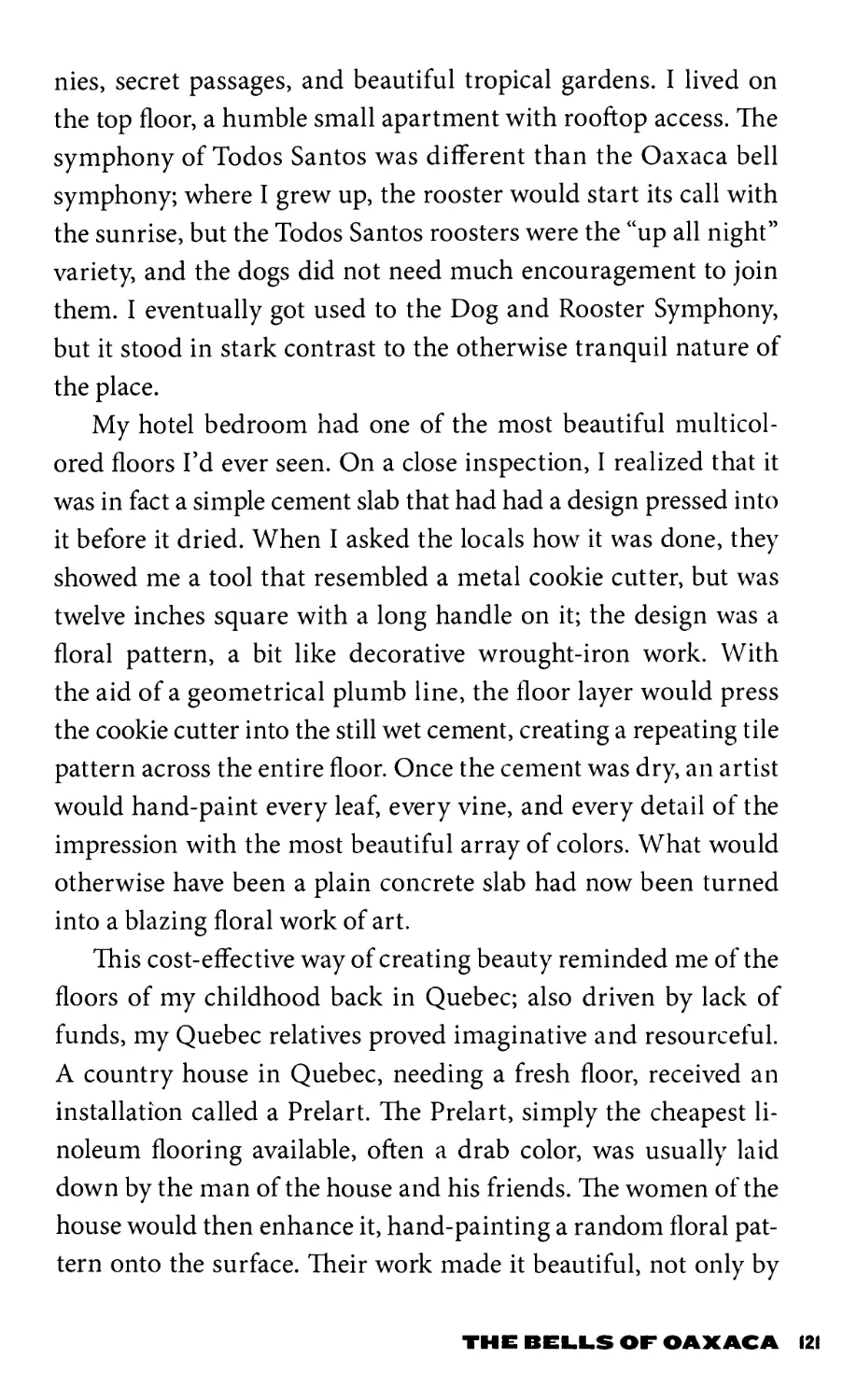
The emptiness that I had reached with church during my
school years had now been filled with joy by Bob Lucier. I played
my little Sho-Bud bird’s-eye maple guitar and all kinds of pictures
came into my mind about the future. I saw myself playing with
Dolly Parton, with my name written across the front of my gui-
tar, just as I’d seen on TV. Maybe I could be on the Porter Wag-
oner show. Maybe I could be on TV with Willie Nelson or with
the “Sweetheart of America,” Emmylou Harris.
My early studies in finger picking sure helped me out. All of a
sudden, years of classical guitar training made sense. I was able
to skate around the steel like a magician. My right hand was ad-
vanced and took quickly to the steel. I could play in an original
way because I did not come up in the conventional steel guitar
manner.
My tone was full and deep—I wasn’t fast, but I had tone. The
years of radio listening in my mother’s basement had taught me
that it took very little to make a listener feel something. Fewer
FOUR KIDS AND FIVE HUNDRED MILES 25
notes were often better; like Albert King or John Lee Hooker
or Booker T. Heartfelt strokes would outlast speed. I had reached
a crossroads in my musical life, another pivotal moment of clarity.
The steel would be my “Church in a Suitcase” and a friend for the
rest of my life.
The Eno sessions dominated my time, and I was glad that Bob
was taking care of business. Eno, my brother, and I developed
a friendship—we became the dedicated men of ambient music.
Eno had been working on his ambient music theory for some
time. Years before, he had been hit by a taxicab in London. While
lying in the hospital bed he noticed that the classical music
playing over the speaker in his room was audible only at the
crescendos of the arrangements. In the quieter passages, there
was seemingly silence, but as the orchestra ramped up its energy,
a moment would rear its head—the loud passages were the only
audible bits. The randomness of the risings appealed to Eno. He
liked the fact that the music was not constant, like a gentle wind
blowing a sweet scent your way, which then disappears and reap-
pears. This was the beginning of Eno’s Ambient Music Theory.
By 1980, Eno and I were working together regularly. He came
up from New York as often as he could and we continued with
the ambient recordings. Eno had been invited to supply music for
a documentary about the Apollo space missions, and as this was
intriguing to him, he accepted. The ambient music makers were
now about to create music for outer space.
There was a country-music tone to the space project because
the astronauts were from Texas. The banter between the astro-
nauts and ground control all had a bit of a twang to it. My steel
guitar had found a new home. Eno encouraged me to overdub on
a dreamy celestial track called “Deep Blue Day” to complement a
26 SOUL MINING
piano track played by his brother, Roger, who also had been in-
vited to Canada to join in on the project. “Deep Blue Day” became
an ambient classic thirteen years later after it was used in the
toilet bowl scene in the film Trainspotting. My steel guitar may
have been memorialized by a toilet bowl, but “Deep Blue Day” is
still one of my favorite instrumentals. The album ultimately was
named Apollo, and is a memorable journey through space. Apollo
also includes “An Ending Ascent,” one of my favorite creations
by Eno. A good many ambient records were made during this
chapter of innovation, and as always, dedicated work segues into
a next chapter. We were now about to bring ambience to Dublin.
Eno received an invitation in 1983 to produce a record for a
new band in Ireland called U2. He agreed to a meeting and asked
if I could come along as we were on a creative roll: the “Ambient
Junkies” were now in Dublin. We found ourselves crammed in a
car with all the U2 guys and Eno and I in the backseat, cassettes
being played at full volume, Bono shouting melodies and making
up choruses. It was all a bit mad, but very exciting. Bono’s enthu-
siasm was contagious, and even though we didn’t hear finished
songs, there seemed to be enough to go on. Eno had originally
planned on introducing me to U2, and then thought he would
walk away and leave me with the project. I suppose that all changed
in the heat of the moment and he finally said yes. All crunched
up in the back of the car, I nodded my head and somehow I was
now on board with Eno and U2.
FOUR KIDS AND FIVE HUNDRED MILES 27
2
SLING BLADE
Sometimes things in your life just line up in a way you
don’t expect, but that you somehow initiate based on
a gut feeling. Back in Canada, before meeting U2,1 had
been experimenting with making recordings in Hamilton’s old
disused library. The library had relocated and the massive archi-
tecturally significant edifice had become my playground for
sonic experimentation. It was the setting for the making of a rock
’n’ roll record with a local Hamilton band called Common Lan-
guage. I loved the library for its endless possibilities for sound.
There were all kinds of fascinating hallways, back rooms, and
mezzanines. The suffocation I had felt in a dead, padded studio
was no longer with me. 1 became addicted to having a broad pal-
ette of possibilities.
Coincidentally, U2 were also interested in recording outside
the formal studio. Perhaps this was another sign that we were
destined to collaborate. When they mentioned Slane Castle (on
Ireland’s River Boyne) as a location, I felt that my instincts re-
garding alternative location recording had allowed me to step
into the future. (Sometimes there is no rhyme or reason to a
maneuver, but you feel something, and so you chase up an idea,
even if it doesn’t seem practical.)
There have been other coincidences regarding the design of
my shop. I had no idea what was going to happen when I rented
an old Mexican cinema house on the Pacific Coast Highway, in a
town called Oxnard in California. I’ve always loved cinema houses,
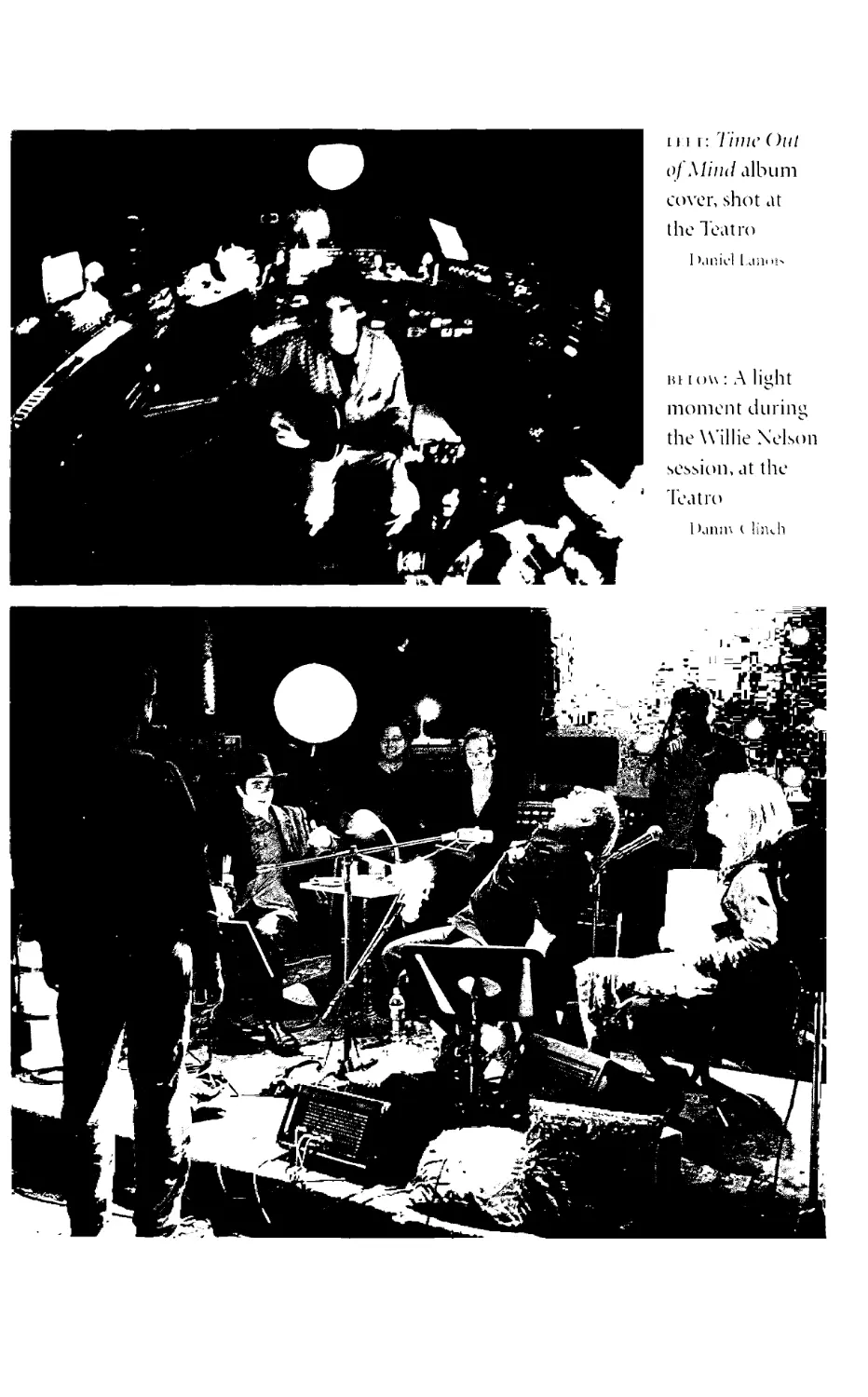
and so when I saw the marquee of the Teatro with a “For Rent”
sign on it, I rolled the dice and moved in with my studio. Little
did I know that the Teatro would play a substantial role in the
building of Bob Dylan’s Time Out of Mind. Little did I know that
the Teatro was about to be a composer’s dream location for Billy
Bob Thornton’s Sling Blade soundtrack.
When an invitation came to compose the music for Sling Bladey
I felt that I had built the perfect shop for the project. To make a
movie soundtrack in a movie theater—genius! I was sent a copy
of Sling Blade to watch, a curious view of America through the
eyes of a mentally handicapped man, just released from the in-
sane asylum, who returns to society after having been locked up
for thirty years. I never would have thought my music could fit
such a story. I watched Sling Blade with my Canadian friend Brian
Patti. He loved it and advised me to take the project on. Billy Bob
called and asked if I liked the film—I told him I did. Billy talked
about the commitment he and all those involved had poured into
the film so far and asked if he could expect the same commitment
from me. I told him “yes, of course”; he could expect at least that.
I was now Billy’s composer.
The spirit of the Teatro was such that it had performance
breathing from the walls. Having no natural light proved to be
an asset; it allowed for a consistency in mood. My old friend and
engineer Mark Howard helped me chip away at the aesthetics.
Parachutes, purchased at the army surplus store down the street
and hung from the ceiling, helped in deadening high-frequency
SLING BLADE 29
spitting and also looked pretty. The theater had a stage with
long maroon velvet curtains and a huge screen, and also an
orchestra pit.
Howard and I had set up weather balloons as surfaces for
16 mm film projections. We sat the balloons on drainpipes six
feet high and eighteen inches across standing up. The balloons
on the pipes were like large crystal balls. The spheres each had two
images, front and back (if a sphere can have a front and back).
Our projections onto them were alive, two projections for the
price of one. It’s hard to describe the mysterious, awesome result,
kind of like floating images from an unknown source. It was a
playground of musical instruments, motorcycles, and art. How
good does it get!
Howard had picked up a cheap remote switcher that would
command various relays around the place, turning equipment
on and off remotely. During playback, he would be at the helm and
part of his duty was to provide a light show as he saw fit. We
had 16 mm loops of all kinds—old boxing movies mixed with
curious newsreels from the forties.
All around the place, we had couches and diner booths ele-
vated to different heights on risers, like a cool old Cuban night-
club. Our fleet of motorcycles flanked the entranceway, along
with my 1959 Brunswick pool table, waiting to lure visitors into a
humbling ass-kicking by Danny La Noise. The bathroom was a
cave with mood lighting and my Nikon 35 mm military-grade
camera set up with a foot-switch remote and an invitation to
create a self-portrait. We were not about to be accused of peep-
ing through a hole in the wall—every bathroomgoer was now in
charge of their own peeping. Lots of cool pictures came out of
that.
The rear of the Teatro housed my Dutch PA back system. Four
18-inch subwoofers and two tops, all self-powered. Not many
30 SOULMINING
studios can boast a full-scale PA sound. The Teatro had it. The
front stacks were made of two Claire Brothers subs and Westlake
tops, the same models I used on U2’s The Joshua Tree. Rigged and
flown above the middle area were two EV Sentry 500s, great
speakers that have since been discontinued. So there it was—a
kickass surround-sound system, better than you would likely hear
anywhere in a room of that size. At any point, the power of this
sound system could turn the Teatro into a pounding nightclub—
sometimes pumping up the volume is the best way to inspire
performance.
We were interested in accommodating visitors at this shop.
It would not only be a place of privacy for recording, it would
be a place of performing for a crowd. Bleachers, couches, cinema
stock seating, and old massive dining booths from the Mexican
restaurant across the street made it possible to seat, say, two
hundred people. The speaker system that I just described would
reach all listeners but still feel intimate. This was my way of
protesting the ineffective front-speaker-stack system that pretty
much all live performance places embraced. The front speaker
stack is good for about twenty rows. If you’re not in the lucky
front twenty rows, it gets hard to hear the words of the song. It’s
all pretty simple: bass frequencies travel far, high frequencies don’t.
If you want your audience to hear what you’re singing about, then
you better get a speaker near them, speakers right by them—say
five or ten feet, max. Don’t make them strain to hear what you’re
talking about. In the Teatro, my surround-sound dream had come
true.
For Billy Bob and Sling Blade, I assembled an orchestra of
Canadian musicians, and there was definitely a clubhouse vibe. I
put the musicians in the motel next door, kind of a seedy-hooker
place, but they seemed to be happy enough with it. The good thing
about the Canadians was that they were happy to be dedicated
SLINGBLADE 31
solely to this project. I had worked out a package deal with them,
and they were ready to live and breathe only for Sling Blade. I
have never liked the idea of employing studio musicians by the
hour. It works best for me when I assemble a group of folks dedi-
cated solely to the project.
Some of the compositions for Sling Blade were made without
the orchestra. I would rise up in the night from the orchestra pit
and plug into my ever-evolving guitar rig. At the time I was very
excited about a recording box called the Boomerang. This would
allow me to record a chord sequence and then play on top of it
without anyone else in the room. This brought back memories of
some of my very early recording rigs when I was a kid. The sound-
on-sound technique that I used back then was still with me twenty
years later at the Teatro.
Billy would roll down with a jar of white lightning, some kind
of hard-hitting stuff that a friend of his had brought back from
Arkansas. Billy was having migraines then, and there were times
when I didn’t know if he was in the Teatro or not. He would pass
out upstairs in the projector booth and then wake up half a day
later and be standing there like a ghost. I never knew where he
lived then, but I can remember having long conversations with
him. He would call from a phone booth because he didn’t like to
be in his house much. I had this strange view of him, like he was
some sort of a nowhere man.
Some people have said that Billy and I look similar. I’ve seen
the resemblance myself in photographs, but I think the real re-
semblance lies in obsession. We are similar in our fundamental
values of kindness and lust for quality. Some late nights at Billy
Bob’s (I’m talking up-all-night late nights) have slowly revealed
what’s underneath his character, and, for that matter, mine. Billy
said to me that some built-in anger in our beings had yet to be ex-
orcised, and as much as we are driven by the wonderful vehicles
32 SOULMINING
of music and film, we are still only trying to burn out the anger.
I’m still trying to figure out what anger Billy’s talking about, but
I have to say I can’t disagree with him. There are times when
something takes over, and I become this other person. I usually
just ask this other person if he can play guitar and make records,
and he always says yes. This can be an interesting experience be-
cause I get to sit on the sidelines and watch the angry guy work.
It’s a curious experiment, relative to the fuel poured in—a few
espressos and you get theories, pour in a few whiskeys and you’ll
get the rebel mind.
The late night continued—Billy weaved his hands in front of
his face. There it was, that little shining moment of liftoff. Billy
went on talking about the lens. The single camera perspective
appealed to him as a filmmaker. Why couldn’t the camera move
around the room relative to the action? The community that re-
lies on three or four cameras for cross-editing purposes might
never get the magic of the single moving camera. “Whoever made
up the rule Never look in the lens?” Billy says. “I look in the lens
all the time, it’s another dimension, like looking into somebody’s
soul.”
The quiet moments of nonaction in a film are storytelling
moments for Billy. Hearing somebody breathe, a split second
of doubt, looking across the room for reassurance, finding it in
someone, and throwing the ball back. I’ve thrown the ball back
at Billy many times, and he has done it for me. Two people in a
room can make for the best volley. The relationship that Billy
and I had on Sling Blade avoided compromise. The one-on-one
director-composer relationship is the best. I had it with Billy on
the Sling Blade soundtrack, Wim Wenders had it with Ry Cooder
on Paris, Texas, and Fellini had it with Nino Rota on Juliet of the
Spirits. It’s a wonderful feeling to know that you’re at one with
your mate. Too often I’ve felt the opposite: decisions made in
SLING BLADE 33
boardrooms, democracy at its worst. Billy and I keep threatening
to realign our singularities. I hope to make a soundtrack for him
one day made up of pure steel guitar. Billy and I are both bird-
men, or perhaps we ourselves are birds, still in cages. I always say
goodbye to Alice when I’m leaving Billy’s house, his mynah bird
in a cage, a mynah bird as a butler.
Billy loved the Teatro. He loved the roughness of it, that it was
continuously evolving and blowing through the confinements of
design. Studio designs assume that you know what you want
ahead of time. But what about what you don’t know? That’s the
part that interests me—the unknown. The Teatro was all about
the unknown. Located inconveniently far away from L.A. in Ox-
nard, the possibility of a chance meeting was nonexistent. You
had to be self-contained, technologically and emotionally.
The opening piece of music in Sling Blade invokes a dark,
menacing, haunting mood, built with my Boomerang and Les
Paul rig. Howard would crawl into the Teatro in the morning
and proceed to his station to further manipulate my discoveries.
No multitrack was used for this composition; it was essentially
a live performance. Every stage of the Boomerang lasted roughly
forty-five seconds, every new stage accommodated the preceding
one. Each stage would be a roll of the dice because if you made a
mistake, you’d have to start all over again.
Howard would manipulate as I contemplated the introduc-
tion of the next stage. This opening piece of music is called “Asy-
lum.” I believe it is one of the most reaching pieces of music I’ve
ever created, very much in the Eno tradition, built with just a few
tools, but with much concentration. “Asylum” runs through the
entire beginning of Billy’s movie. It sets a tone, keeps you on the
edge of your seat, like a snowbank crystallizing and cracking in
the sun.
Any suggestion that Billy Bob had could be instantly put into
34 SOULMINING
play, as we had all the players and equipment right there. There
were many moments of spontaneity. Billy Bob would listen to my
melodies and choose his favorites, suggesting variations for other
scenes. This unorthodox approach seemed appropriate to Billy
Bob’s renegade way of thinking. Sling Blade had been made with
love and passion, and the love and passion continued at the Teatro.
My sound equipment was sophisticated, but my film equip-
ment was crude. Billy would bring by a VHS with scenes on it
and our little orchestra would play the music while watching the
tape. I didn’t bother using any time code or anything; we would
simply use a visual cue point to start up the band. If it all worked
out, we would make Billy a VHS dub with my music on it for him
to take home. Billy would then pass that VHS on to his editor and
the editor would simply replicate the starting point of the music
for the picture.
Magic was in the air and momentum was working in our fa-
vor; Billy Bob and I felt like brothers. He has a quiet dedication
that is similar to mine. The Teatro workshop was not built with
Sling Blade in mind but the strangeness of the Teatro was perfect
for my strange friend. Perhaps it was that premonitional force at
work again, and it saw the future even if I couldn’t.
Sling Blade became a contemporary classic; it won an Oscar,
and Billy was catapulted to stardom. I keep in touch with Billy.
We both miss the Teatro and fantasize about having another the-
ater one day.
SLING BLADE 35
3
FLORIDA
ileft a note on the steering wheel of my mother’s car, ex-
plaining to her that I had to go. My best friend, Twig, and
I had decided to hitchhike to Florida from Canada. Twig’s
brother Walt and their foster brother, Chris, had already left, and
we were to meet them there. Twig and I hitchhiked across the
Detroit border; eighteen-wheeler drivers sympathetic to two young
traveling boys offered Twig and me transport. I was fifteen, Twig
was fourteen.
Hitchhiking still had romance and dignity associated with it
back then, perhaps because owning a car was not everybody’s
privilege. Mid-century generosity was still somewhat alive. The
term “Good Samaritan” still had a position. A hitchhiker back
then was viewed as searching and wayward, and not necessarily
as a creep. Technology was on the rise, and North America was
operating at the beginning of several media. To have a camera in
your hand was still special and not commonplace. Not every-
body had a TV, not everybody had a car, and consequently, there
was a window of dynamic range available to the have-nots. There
was plenty of time for acquisition, and you were not regarded to be
second rate just because you weren’t surrounded by status sun-
dries. The maverick was not a bum. Looking at a beautiful conti-
nent through hopeful eyes had poetry and Jack Kerouac in it, not
Charles Manson. Calculated cult murders and suicides had not
happened yet. Magazine culture was not yet dominating all the
senses; if you wanted to live life and see more, you stuck your
thumb out and the road was your friend.
We made it all the way down to Florida, and I got a job at the
IHOP in Hollywood Beach. Twig and I had met up with Walt
and Chris, and everybody was broke, four Canadians living in one
room, and me working at the IHOP to bring home the bacon. I
literally brought home the bacon, also pancakes, home fries, and
bread. I was the busboy, my finger was on the pulse. Good leftovers
didn’t get thrown in the garbage, they ended up in my backpack.
The boys were always happy to see me after work. I was the hand
that fed them.
We met some girls at the beach. They had a rich father, so they
became our chauffeurs with the use of Daddy’s car. The girls lived
on a horse ranch on the outskirts of town. Consequently, I devel-
oped a keen interest in horseback riding. Their father was a six-
foot-seven handsome John Wayne sort of guy, who tolerated our
presence with a watchful eye. I could just imagine what was going
on in his mind—better his girls in the hands of polite Canadian
boys than some of the whacked-out locals. We had a sense of
adventure and we weren’t carrying guns. The girls were wild, and
they supplied us with everything: transport, booze and drugs,
lots of late-night fun. I suppose girls have always liked something
about ramblers. How does a girl feel when she finally tames a
rambler?
I got fired from the IHOP without pay when they realized I
was Canadian with no American Social Security number. We
were still broke, but our bellies were full. The foster brother,
FLORIDA 37
Chris, never left Florida. Walt became a painter and moved to
Belgium. I still see Twig regularly—he’s a builder and art collector
in Canada—and as for myself, I now have my U.S. work permit.
It wasn’t too many years after that I got into motorcycles and
began to feel the call of the open road once more. My first Harley-
Davidson was a 1968 Sportster with a 1965 engine. The mismatch
of frame to engine is always grounds for suspicion. My brother
Bob and I had bought this bike from some heavy local bikers,
who were likely unloading it cheap because it was hot. We gave the
bikers eight hundred dollars cash and hauled the bike out of their
basement without having ridden it. They gave it a kick in the base-
ment, it started up okay, and that was good enough for us.
The bike was a bitch to start, and sometimes the only way to
get it going was to tie a rope to the front forks and pull it with my
mother’s Chevy, Bob at the wheel, me on the bike. It was a mag-
neto rig, which means no battery. The force of a kick or the turn-
ing of the back wheel provided a spark to the cylinders, much
like an old-school generator that physically rubs on the front
wheel of a bicycle to run the headlamp. There’s a kind of genius
to the concept, because you never have to rely on battery power.
Th is technology was abandoned nonetheless and now all motor-
cycles have battery/electric start. I can remember pulling the
Sportster with my mother’s car to get it started in front of the
license bureau to pass my motorcycle license test. 'Hie license
bureau instructor rolled his eyes, and in the name of the raw bra-
vado of two teenage brothers, he sympathetically granted me my
license.
Bob and I had saved up a bit of cash, and we were now ready
to buy a second bike. There it was, right in the front window—a
brand-new red metal-flake Norton Commando. No electric start,
38 SOUL MINING
a kicker with high compression. Both of these bikes were beasts,
and if you weren’t careful, they could backfire, throw you up in
the air, and really hurt your leg. We had to master top dead cen-
ter, which is a term that describes the optimum position of the two
cylinders before you throw your full weight into the kick. A lot
of bikers damage their knees from not being careful. You could
think of this as a relative to those films you see of old prop plane
ground operators, spinning the prop with their hands for the
engine to then catch and ignite. Electric starters were beginning
to come into fashion, but if you were a real biker, you still kicked.
By the time we were ready to roll across the continent, Bob
and I had already lived our nine lives. My poor mother had put
up with everything: delinquency, drugs, cosigning for bank loan
qualification, the lower part of her house closed off to her. The
experiments that happened in the basement were unspeakable;
the only possible savior for her two sons was music and that re-
cording studio. We closed the studio to accommodate this mad
wintertime motorcycle adventure.
This was around the time of the Peter Fonda, Jack Nicholson,
Dennis Hopper film Easy Rider. Motorcycle appreciation was in
the air, and we were out to see what America had to offer to two
wayward sons. I blew out the front tire of my Sportster doing
ninety miles an hour outside London, Ontario. My brother
watched me hit the ditch; he was riding behind me on the Nor-
ton. The blowout forced us to spend the night in a snowy field. A
couple of sympathetic cops radioed to have some help sent to us
for a tire replacement.
Having crossed the border at Detroit, Highway 75 took us
through a bleak Ohio, and as we approached Kentucky and Ten-
nessee, the snow started to melt and the vista became incredible:
blue green pines cutting into forever-blue skies. Everybody we
met along the way was kind. American idealism was on the rise.
FLORIDA 39
Black ice was everywhere,
at every corner, but we didn’t care.
Silver riding, silver nights, silverado.
The depth of the dream we fell in
Not for any tongue to speak in
Ah yes, it’s all right to see
The light to eternal and
Silver riding, silver nights, Silverado.
The laughter would not quit;
it really felt like it was it.
The fever was so strong, the nights were never wrong.
Sweet empire times, before the bomb burned out the rye.
No worries came to mind, we walked through doors of time,
drunk on a silver moon, singin’ out sweet our tune.
Silver nights with my brother, Silverado.
Two Canadian brothers at the peak of their curiosity, we
couldn’t wait to see what would happen over the next hill. My
Fender Telecaster guitar was in my backpack in two pieces; I’d
had to unbolt the neck. We rolled into Cape Kennedy and rented
an old Airstream trailer for the night. The rent was cheap, and the
trailer park woman was kind. We put our stuff in the trailer, and
went into town to eat. When we got back, the walls of the trailer
were crawling with cockroaches. We spent the night sleeping on
the beach.
Bob and I found a better place the next day—an unfurnished
apartment made of wood and built up on stilts, with an orange
tree in the back. The oranges didn’t look pretty on the outside, but
they were delicious. The apartment had some leftover building
materials underneath. A large disused roll of chicken wire was
about to become the comfortable foundation to our new design:
the chicken-wire bed. Our carpentry experience from the time
40 SOULMINING
spent living with my dad was about to be put to use. The frame of
the bed was made of two-by-twos nailed together, with the
chicken wire slung across the frame. The Chicken-Wire Ham-
mock! Let’s call George Foreman. My neck was pretty numb
from the three-thousand-mile run on my rattling Sportster. It’s
still a little bit numb today.
The beach was nearby, and there was a cool scene going on
there: blasting sound systems on the roofs of cars, all kind of hip-
pies and renegades congregating for a music-driven good time.
Julie was a wild child whose sunshine beauty caught my eye. My
Sportster didn’t have a backseat, so Julie had to sit on the fender
as we rode through the ins and outs of Florida’s balmy seaside
nights.
I loved Julie, so I went to her house to meet her father. I don’t
think her father liked me or my motorcycle. He liked my jacket
even less—I was wearing a military jacket with stripes on the
shoulder. Apparently, more stripes than the old man had acquired
through his entire military career. He did not allow me to leave
the premises until I had removed these stripes, stitch by stitch,
in his presence. I was not trying to insult the military; I just liked
the jacket. My Canadian naivete had deemed me not a poten-
tial son-in-law, so that was the end of the romance. I rattled the
house’s windows with the straight pipes of my 883. I never saw
Julie again.
There was revolution in the air; the Vietnam War was being
highly questioned. Protests had hit the streets, and American
music was tainted by the event. “Fortunate Son” by Creedence
Clearwater Revival addressed the issue of the sons of the rich
carefully guarded by connection, bypassing being shipped off
to Vietnam to be put at risk. Jimmy Hendrix had reduced or el-
evated the American national anthem to a dive-bomb, physio-
logical experience. Four dead in Ohio, the military was gunning
FLORIDA 41
down white American youth. America went crazy. This was
pretty much the turning point of America’s involvement in Viet-
nam; no way was America gonna put up with college students
getting shot on campus by the military. The senselessness of it
all was knocking the wind out of the wide-eyed naive spirit of
America.
When brass shavings from fractured bushings started showing
up in the oil of the crankcase of my Harley-Davidson, I knew the
bike had only a few more miles left in it. The Harley packed it in
on the exit ramp to Gainesville, Florida. This college town would
become my home for the next seven months. The Norton Com-
mando was still running fine, and so Bob rode back to Canada
solo, and I moved into a large hippie house in Gainesville.
The house had a guy we called Wacko in it, a harmonica
player from New York. Wacko had had trouble with drugs, and
was recovering in this house of camaraderie. The rest of the resi-
dents were all students. I made a living by making sand-cast can-
dles. Somebody before me at the house had built a candle-making
operation in a little shed in the back. They had moved out, but
all their equipment was still there, so I took over. My method of
candle making involved creating an impression in the sand, and
pouring hot wax into it. When the wax cooled down, the lump of
sand roughly resembled the impression and with a small knife, I
turned the lump into a beautiful sand sculpture. Part of the trick
of course, was to accommodate the wick while the wax was still
hot. My candles became more beautiful at every step. I experi-
mented with different colors of dyes, and I became a popular
local candle maker.
Music festivals were on the rise and Gainesville was about to
be my first pop festival. 1 set up my candle display outside the
event. The place was an outdoor sports stadium, capacity roughly
ten thousand. To my surprise, the concertgoers bought all my
42 SOUL MINING
candles. I was rich and I got to go to the show. Grand Funk Rail-
road was on stage when I walked in—a powerful trio with great
vocals. The next act was Ian and Sylvia and the Great Speckled
Bird. Ian and Sylvia sang beautifully; they were part of the
country rock movement of the time, white trooper light drip-
ping over Sylvia’s white dress, her high, quivering folksinging
accompanied by raindrop steel guitar notes. Little did I know
that that would soon be me, playing steel guitar for Sylvia Tyson.
There were not a lot of steel players around Toronto, and I still
don’t know if it was the power of my dreams or good old-
fashioned word of mouth, but an invitation did come, and I did
join Sylvia’s band, and I did find myself at Maple Leaf Gardens
in Toronto playing to ten thousand people. It was just like I re-
membered it in Gainesville—white trooper light dripping on
Sylvia’s white dress—but it was me next to her playing the rain-
drop steel.
The Allman Brothers from Macon, Georgia, had also crossed
into my world. Their commitment had gotten under my skin.
They were also part of the country rock and blues movement
of the time. Timmy Thomas, from Florida, was another artist
who touched me with his deeply soulful solo organ rendition of
his song “Why Can’t We Live Together.” Appalachian melodies,
whether I actually heard them or just felt them blowing through
the evergreens of Tennessee and Kentucky, were also with me.
These melodies, distant relatives of ancient Irish tunes, were part
of the building of rock ’n’ roll: Appalachian melodies pushed to
the south, Mississippi and Louisiana slave chants pushed to the
north, Texas swing pushed to the east, and rock ’n’ roll was born.
I was only a bystander in the evolution of this great music, but a
small taste was all I needed to carry on with my music in the
north.
My candle-making career came to an end when the students
FLORIDA 43
from my hippie house took over the college campus in protest of
the war in Vietnam. All kinds of FBI and narcotics agents started
hanging around town. I unbolted the neck from my Telecaster
guitar, put it in my backpack, and that was the end of Florida.
I returned to Canada, fueled by the music I had heard.
44 SOUL MINING
4
SOUND PRESSURE
I’ve always loved thematic continuity in architecture, and I
love it in records. The house that I stay in when I’m in Los
Angeles is called Bella Vista. Built in 1929, Bella Vista has
its name cast in the heavy iron of its commanding, swinging front
gate. The metalworking hands of that time were dedicated, driven
by a master aesthetic plan. The gothic floral ironwork of the gate
shows up in different parts of the house, even in vestibules, con-
necting hallways and back bathrooms. It might take years to
fully understand and digest the surprising details of the Bella Vista
ironwork, but it means that the story unfolds over the course of
time. This makes for longevity and lasting appeal. I like the rec-
ords I make to have that thematic lasting potency.
Thematic continuity can be accomplished by simply having
a few ground rules to operate by. For example, Eno’s Ambient
series records were built to provide atmosphere. They are reliably
instrumental, mood-enhancing, and uninterruptive. The records
were designed with the listener in mind; the listener is invited
to be a member of the orchestra simply by being in the room of
playback.
Every record should have ground rules that relate to the ex-
pectations of the artist. A ground rule that seems to work is to
simply say, “We will make a record with what we have to work
with.” Five people in a room, no more. Five sounds, no more.
Expanding on available ingredients has always been part of
my thing. Sometimes it’s better to make more of an existing re-
source. On a recent Dobro guitar recording, I used the conven-
tional microphone in front of the guitar but combined it with
a version of the signal played through a spooky-sounding old
Silvertone amplifier. The onboard tremolo and reverb provided
the Dobro with a new dimension—let’s call it the second dimen-
sion (the Dobro has a little electric guitar pickup). I had been
after this multidimensional sound ever since I heard a cool old
John Lee Hooker recording, with his vocal—bone dry—occupying
center stage, his guitar clearly coming through an amp with
tremolo and reverb, and then John Lee’s third dimension: the
sound of his foot stomping.
I’ve added a fourth dimension to this John Lee Hooker type
of setup by introducing effects pedals—say a wah-wah, a distor-
tion, or an envelope follower—to yet another guitar amplifier
(optionally hidden in a side room, so as not to disturb John Lee).
This little station of effects expression is controlled by me or
another musical person involved in the project to perform sound-
effects moves relative to the main guitar player’s performance.
All of these sounds are variations on the pure-source guitar
performance.
On listening back to the recording, 1 can now introduce the
fifth dimension. Much like the ironworkers who carried a theme
through the beautiful Bella Vista, during this part of my work I
am only repeating or enhancing or magnifying details of an al-
ready existing motif. I use sampling machines to catch fragments
46 SOULMINING
with the view of spinning them back into the song with a new
texture.
This technique allows me to build an orchestra of sounds that
relate to the song because they come from it. It’s kind of interest-
ing to think of the process as skin grafting or laboratory cell di-
vision from a donor or the magnification of a clothing motif, i.e.,
if the dress has a floral pattern, I would put a pocket on the dress
with the same floral pattern, but blow it up twenty times bigger.
Looking at the pocket would not tell you that it is the same pat-
tern, but the tone and color would be relative. I’ve spent hours
sampling, enhancing, and spinning these kinds of samples back
into songs so that artists can have a beautiful custom sonic or-
chestra at their disposal. It has taken me twenty years to master
this technique. The Zen of it appeals to me. The results are unique
and original.
I had a little Gretsch Gadabout amplifier that I used to pro-
cess Bob Dylan’s vocals on Time Out of Mind. This processing was
an extension of the same philosophy—take a sound that you al-
ready have and build a new dimension. In the case of Time Out of
Mind, we wanted Bob’s vocals to sound as great as the vocals
on the rock ’n’ roll records of the fifties. Other dimensions were
added to his vocals by using some of my tried-and-true echoes
a la Lee “Scratch” Perry (no reverb, only ever echo). Dimension on a
song relates to “depth of field.” As human beings we find comfort
in depth: something that sounds far away is not an immediate
danger; we are programmed to relax when prey is at a distance.
Close sounds can be quiet and comforting, like the whispering
of sweet nothings. A sweet nothing will still communicate over
thunder, as long as the thunder is in the distance.
Back in 1987 in Dublin, my engineer and co-producer, Flood,
and I wanted to build a new dimension for Larry Mullen’s drums
SOUND PRESSURE 47
on “Bullet the Blue Sky” from U2’s The Joshua Tree. Flood and I
(mostly Flood) piped the acoustic recording of Larry’s drum per-
formance into a massive PA in the warehouse next door to the
studio. The PA, as PAs do, made the drums sound “tankier” and
more aggressive—it introduced a mid-range that the high-hat
seemed to like. This new sonic emphasis on the high-hat made
every hit more relevant. This is good, as Larry Mullen himself
plays a mean high-hat. The inherent low-frequency punch of the
PA also added a new level of excitement to the bass drum. The
overall sensation was a chestier one. Our new drum sound had
just crossed the line into physiological. This is where it gets ab-
stract. This is where we record makers operate as illusionists.
I get this comment all the time: “You should have heard them
live!”
People who hear a lot of bands live are addicted to the adren-
aline and euphoria that is felt in the presence of stage charisma,
mysterious light, and, most important to us record makers, sound
pressure. Sound pressure is what you feel from the music when it
is piped through a PA at 120 decibels. One hundred and twenty
decibels starts to rattle the organs in your body. As your body re-
sponds to resonant frequencies, everything becomes exciting. The
place is hot, the crowd is optimistic, and the moment is theatri-
cal, but we record makers, we have to shut our eyes, because in
the end we cannot depend on decibels, resonant frequencies of
nightclubs, or charisma. We have to create the illusion of sound
pressure. We have to make things sound loud even though they
are being played back quietly on a little iPod. Oftentimes records
sound cleaner than people would like, perhaps compression gets
added by engineers to make things more exciting, but that doesn’t
give the same thrill.
48 SOUL MINING
The remiking of the drums through the PA worked for “Bul-
let the Blue Sky.” The Gretsch Gadabout worked on Dylan’s voice
for Time Out of Mind, but those formulas may not apply to other
projects. Ultimately it’s a complete ad lib—it sure keeps me shak-
ing in my boots—how to make records that have the feeling of
sound pressure and still have body and fidelity intact.
SOUND PRESSURE 49
5
THE NORTH
The circuit of the north had me living like a monk. I was
cooking all my own food in an electric frying pan. I
knew why I was out there—I had to save money.
I got to see plenty of the north of Ontario and Quebec—deep
black lakes, granite formations cutting into the clean water of
Canada. Pine trees reflecting, some fallen in the water, some point-
ing at the sky. Most people who visit the north are just vacation-
ing. I worked my way there, and through there, playing in show
bands.
This is not a glamorous chapter; it’s a chapter of limbo that
takes place before Eno, before any of the big albums. It’s about
putting in time because I had no better invitations to respond to,
and so to pay the bills and to keep on playing music, I hit the
road for a long time, making a hundred and fifty dollars a week.
I’ve tried to block out this chapter, so I don’t remember exactly
how old I was, but for sure I remember my hundred and fifty dol-
lars a week, sent home to my brother Bob to help keep the lights
on in the recording studio.
A booking agent in Hamilton by the name of Sid kept twenty-
five bands on the road, weaving them in and out of different
towns in the north, playing one-week stints at hotels. Some of the
stops were way up north, places like Kapuskasing, Thunder Bay,
and Timmins. These places operated either because of mining
or forestry. The clientele at those hotels was made up of workers—
tough people all around, including the women. But we were also
tough; you had to be to live the kind of life we were living. I kept
my nose clean and to the grindstone.
All of my free time was spent playing the guitar. I had my steel
on the road; I also played flute, tenor banjo, and of course regular
electric guitar. My skills as a multi-instrumentalist were put to
use on the show-band circuit. It had always been part of my thing:
let’s get Lanois because he plays a lot of different instruments.
Even in my brief career playing in pit orchestras and full-size
dance bands, this fact kept my name in the hat. My expertise on
the Mini Moog, for example, made me valuable to the theater
companies as an orchestra member. I supplied them with not only
my regular music, but also the sounds of thunder, wind, and other
special effects.
The theater companies got hooked on me, because I gave
them more than they had bargained for—a full Foley department
for the price of one guitar player. The Mini Moog was the begin-
ning of the synthesizer becoming a common and available musi-
cal instrument; previously, synthesizers had lived in the electronic
music departments of colleges, viewed as a relative of musique con-
crete. Further back, the Theremin, the first synthesizer ever, had
reared its head as the solo operatic spooky, haunting voice heard
in many early horror films. The Theremin, with a sine wave at its
core, had only two controls: volume and pitch. The right hand
went over an antenna to control volume, and the left hand over
the other antenna to control pitch.
The Mini Moog synthesizer was similar to the Theremin,
THE NORTH 51
except rather than having one sound source, it had two. It also
had tonal variety. The Theremin had the sound of a female opera
singer, but the Mini Moog went into the reeds section. You could
get saxophone and bassoon sounds out of it. I became obsessed
with the Mini Moog—I consider it the most exciting instrument
of its time. But as advanced as it was, the Mini Moog had its
limitations. Essentially a monophonic instrument, it didn’t
offer quick switching from one sound to another. I kept the
parameter settings for my homemade sounds on diagrammed
sheets of paper, essentially drawings of the front panel of the
Moog.
As the pit orchestra performed the music for the play, I franti-
cally set all the controls of the Mini Moog to ready myself for my
next cue. In any given play, I might have twenty cues. Once cue
number 8 had gone by (say, the sound of rain), I had to change
all my settings to get ready for cue number 9 (which might be the
sound of a stampede).
The electronic music explosion ran in tandem with the psy-
chedelic music explosion. The pendulum swung wide—from Sly
and the Family Stone playing down the street at the Town Hall,
to Frank Zappa at the Rockpile in Toronto, to the psychedelic
electronic music installation at the CNE (Canadian National
Exhibition), complete with a two-hundred-speaker installation
by the great Toronto equipment company Traynor. The Traynor
installation still blows my mind today. A ten-thousand-square-
foot room with two hundred speakers hanging from the ceiling,
four feet above the heads of a thick crowd of psychedelic hope-
fuls. The lighting was the typical psychedelic lighting of the six-
ties, but the layout of the overhead speaker system was timeless; I
can’t think of a design that betters it. The only performers since
that I’ve seen come close to using this idea are those of Cirque du
Soleil. They have a center cluster of speakers that provides the
52 SOULMINING
same sound to all members of the audience by pointing a speaker
evenly to every seating position in the room. But the CNE system
was so much more: Have you ever been in a room with three
thousand people in it, where every person gets to enjoy the sound
within ten feet of a speaker?
I’ve already spoken of my disappointment with the usual
front-speaker stacks in clubs. This incredible CNE system had
no clutter on the floor, no visible wires, and sounded fantastic. The
pulsing electronic music pouring out of two hundred Traynor
speakers made the electro experience a physical one. People were
touched by the sounds. Perhaps Traynor had found the resonant
frequency of flesh and bone, or, better yet, serotonin. Imagine a
future generation of eventgoers high on resonant frequency, no
hangover. I’ve been wanting to reproduce it ever since.
The synthesizer movement of the sixties was all part of a mu-
sical cultural revolution. Check out Walter Carlos’s Switched
On Bach, and then Stevie Wonder, of course, when the synthe-
sizer went polyphonic. Stevie Wonder’s seventies masterpieces are
dominated by these polyphonic sounds. The music instrument
company Yamaha brought out a great polyphonic synthesizer—
the CS-80. Eno and I used the CS-80 as the workhorse for many
ambient recordings. “An Ending Ascent,” on Apollo, is not only a
fine example of Eno’s genius, but also a representation of the won-
derful CS-80 sound.
The northern Canada hotel gigs included accommodation. These
funky old places oftentimes had the toilet down the hall, like in
rooming houses. I can remember a big old rope, coiled up, an-
chored on the floor of my hotel room in Sturgeon Falls. This was
the fire escape. If a fire broke out, the idea was to smash the win-
dow if you couldn’t open it, throw the rope out the window, and
THE NORTH 53
climb down four stories to the ground. (It sounds archaic, but
the more I think about it, the more the idea appeals to me these
days. Some high-tech version of this might well apply to fire-
escape design for contemporary high-rise buildings. To my knowl-
edge, there is no “out the window” fire escape ever talked about
in high-rise buildings, but I wouldn’t want to depend on an ele-
vator or an inner staircase if a burning building was full of smoke.
If a window cleaner can dangle on a wire twenty-eight floors up,
why can’t a potential burn victim?)
Our agent, Sid, promised variety to hotel owners, and so each
band had to have its own shtick. We traveled with a female im-
personator named Ricky Day, a great old-school entertainer. It
was pretty much Ricky’s show. Ricky could really work the audi-
ence, handle any kind of heckling situation, outwit and quell the
noisiest goofball in the crowd. The guys in the band were all young
and good-looking, so that helped to bring in the female clientele.
The male clientele, they showed up to see the stripper action in
our show, the Delightful Delilah.
Ricky Day did a few numbers mixed in with comedy; then our
singer was introduced. She did three numbers with the band be-
fore the big moment—Delightful Delilah! After being stuck in a
nickel mine all week, a northern Canadian worker got to watch
the Beautiful and Talented Delilah strip off her clothes and take
a bath on stage. This embarrassingly low-grade entertainment
unit was my family for a good long time.
Delilah had to leave after she accidentally sprayed hairspray
in her eye; the poor girl’s eye was really messed up. Sid sent us a
replacement: Miss Montego, a very funny Jamaican woman with
massive breasts—I mean size 54 quadruple E, something crazy.
Business shot up; we became Sid’s top band and I got worked
into the act. Montego had apparently chosen me as the cute gui-
tar player whose face she gyrated her breasts into. The lumber-
54 SOUL MINING
jacks shrieked and wahooed in envy, practically starting a riot
every night. Montego then tasseled her nipples with tampons
dipped in lighter fluid, and proceeded to light them on fire. This
really brought the house down. Our lighting director (doubling
as bass player) killed the lights on cue, as Montego wildly ma-
neuvered her breasts, spinning the tampon tassels in one direction,
and then the other, and then the real showstopper—one breast
one way, the other breast the other way, all to a Gene Krupa
drumbeat. The place went nuts, all kinds of drunken miners and
lumberjacks falling down at the drool trough. It was like a bad
dream, something out of the Old West.
Sid kept us moving. Every Saturday night after packing up
our equipment, we received Sid’s travel instructions to the next
stop. This merry-go-round that Sid had invented was my limbo
for a couple of years. The only saving grace was my capacity to
dream. I couldn’t wait to get back to the recording studio. This
northern circuit was not providing me with any window of
opportunity.
Perhaps Sid had been sent to me as penance for delinquency.
Ah, the Dark Age, and my poor mother. What did she ever do to
deserve what I did? I was different. A French Canadian in an Anglo
burb, maybe it’s as simple as that. But my mother was a fighter,
and so was I.
Flashback to grade eight, elementary school. My gang and I were
not liked by the principal; we pretty much ran the schoolyard.
We even dictated the kinds of clothes that students wore: no
brown socks. If you wore brown socks, you qualified for a dunk-
ing in the open mouth of the underground spring, at the bottom
of the schoolyard field, at the edge of the woods. On hearing
about a recent dunking, the principal called me into his office.
THE NORTH 55
This was still the time of the strap, but this called for a more se-
rious punishment. The school principal bypassed the strap and
hit me straight in the face with hands and fists. I left the office
bleeding at the mouth. The other guys in the gang got the same
treatment.
I knew where the principal lived; my mind started building a
plan for retaliation. That weekend, in the night, I filled two large
cans (say five gallons each) with gasoline and made my way to the
principal’s house, a one-mile journey through ravines and back
routes, so as not to be seen. I poured the entire contents of the cans
around the principal’s house and dropped a match. The whole
neighborhood lit up in orange flame with black smoke. I ran for it,
feeling that the principal and I were now back to even, a blank
canvas. The cops picked me up the next day. I was real lucky, in
fact, because the principal and his family were not in the house at
the time of explosion. The house didn’t burn down, because it was
made of brick, but the paint on the windows and doors got pretty
messed up, and the trees and bushes didn’t do so well either.
What a great guy: the principal didn’t press charges, and I
agreed to have the house repainted and replace all his burnt bushes.
This started my career in the gardening business. I got a job at the
local nursery to make some cash and to have access to better prices
on bushes. At this point, I was still delivering the paper in the
mornings, so I worked at the garden center after school.
The place was run by a European woman who made me lift
whole trees, roots balled up in burlap, really heavy. I lifted them
into the trunks of customers’ cars or I carried them off trucks for
planting in the back of the nursery. It was hard labor. Once I had
enough money to deal with the damage to the principal’s house,
I jumped the garden center fence and walked to the nearby diner.
I ordered French fries and gravy, a cherry Coke, dialed up “Wipe
56 SOUL MINING
Out” by the Surfaris on the deep bass jukebox, and never looked
back. That was the end of my gardening career.
Not far from the diner was the bowling alley, complete with a
nice lunch counter and pool hall downstairs. This place was viewed
as a bad-boy hangout, not a place for a kid, but I didn’t care. I had
a few friends that were much older than me. They had already
quit school and drove customized hot rods.
The custom car scene was big at the time. A young man was a
real man only if he knew his cars. If you could boast a hand-
polished intake manifold, increasing “fuel to spark” efficiency, if
you could boast nine coats of hand-rubbed lacquer, if you had
managed to increase the power of your engine by adding a few
horses to the already ridiculous horsepower rating of one of
these Detroit City big-blocks—then you were a man. Cruising
with your girl, with “no particular place to go”; purple dash lights;
Hurst shifter, custom black ceramic shifter ball in the heat of your
palm; Booker T. and the MG’s “Green Onions” cornin’ at you from
a one-point-source coaxial oval-shaped Jensen speaker; whip-
ping down the escarpment into dead man’s curve. Backcountry
concession road, midnight daredevil racetrack. Two cars half a
mile apart, one set of headlights one way, another set of head-
lights the other way—the race would start. Foot to the floor, the
big-blocks roared. This greaseball version of medieval knights
jousting was essentially a game of chicken. At redline r.p.m., the
clutch popped, and the race began. This is where it got intense:
two young men purposely screaming their engines into a full
head-on collision. Who would be the first to get out of the way?
That was the game. Whoever chickened out first lost the race.
The Lanois garage had pretty much been turned into a car-
customizing shop by my brother Bob. My mother’s 1966 Chevy
Belair, 283 under the hood, two-speed automatic, Positraction
THE NORTH 57
rear end, became the neighborhood curiosity, with its Bob La-
nois custom sound system. The rear speaker addition boasted a
nice, deep sounding spring reverb system. Adding reverb to the
a.m. radio broadcasts made our Chevy the talk of the street.
There was a musical merge going on at this point in time in
North America, forces coming in from varied sources. You can
think of it as a boiling point. Gospel music had swung all the way
from the church to the top of the charts—Aretha Franklin, Sam
Cooke, and Cissy Houston went from church singers to household
names. The recording studio had evolved from a place of docu-
mentation to a place of innovation. Films like Easy Rider and later
Apocalypse Now gave classic orchestral film scoring a new com-
panion: rock ’n’ roll. Hells Angels culture, hippie culture, the De-
troit big-block had not been yet tamed by practicality, high gas
prices, or feminism.
Music culture had not yet oversaturated itself. It was hard to
fool a listener, so you had to be great. If you couldn’t play, you
couldn’t get a foot in the door. Ravi Shankar could play, Jimi Hen-
drix could play, the Beach Boys could sing, Bob Dylan could
write, Neil Young had his thing down, and the Beatles were not
too shabby. There seemed to be no end in sight to the potential
that we felt all around us, of space travel mixed with steamy nights
of rock ’n’ roll and hot-rod culture.
My brother Bob went from understanding the workings of
a car engine to understanding the signal path of the electronics
used in our studio experiments. For years my mother’s basement
was littered with breadboards. Breadboard is an electronics term
used to describe a work in progress, essentially an open-faced ver-
sion of the invention without a casing around it. lhe open face
makes it easy to quickly try modifications by changing the values
of components.
Understanding a chain of events from top to bottom requires
58 SOUL MINING
a lot of wisdom. Troubleshooting requires cool—you gotta be
chilled to fully decipher a sequence of events from source to end.
This is why young people are not surgeons. A surgeon will take
symptoms into consideration that life and professional experi-
ence have shown him, but he has the entire signal path laid out
in his head. The earlier you start understanding signal paths, the
better chance you have at being a surgeon. The electronic world
is the same, and my brother was the best. His understanding of
the past made him cool enough under pressure to deal with the
symptom, the inconvenient problem in the present.
But what about the future? This is where Bob and I are like
twins; we both always look to the future. We have always operated
by “feel,” even when coming up with designs. My brother is an in-
teresting cat, because he feels music deeply. His inventions for
the studio always had a foot in the future because they were built
to optimize productivity, for ease of ergonomic operation, and
ultimately to maximize “feel.” Our parallel dedications to detail,
musical for me, electronic for my brother, meant that we always
rode in tandem, whether we were cruising on motorcycles or
building records.
The recording studio in my mother’s basement boasted many
Bob Lanois in-house electronic inventions—in no way was this
a “straight out of the box” recording service. We wanted a dis-
tinct sound, like Motown in Detroit or Sun Studio in Memphis
had. It wasn’t hard to locate our window of opportunity. The
other recording studios in the region offered a blank generic ser-
vice, and so we went the other way. Pretty early on, Bob and I
started collecting unique musical instruments. A band could
show up at our studio and not even bring any of their own stuff.
We had it all—a variety of drums, my personal guitar collection,
a finely tuned in-house bass sound, pianos and keyboards al-
ready miked up, ready to go, hand-picked microphones plugged
THE NORTH 59
in, already set up with a good sound. We even had the sounds
ready—the best Hammond B-3, unorthodox custom sound ef-
fects chains and a prepatched, instant sound, instant karma, in-
house radio transmitter, for purposes of broadcasting mixes to
the car radio. A client could drive around the block in his car to
check the balance of a mix.
All these techniques were building blocks in a growing my-
thology. The word was out, Bob and I were doing something dif-
ferent. We even had in-house musicians, guys who could really
play. Eddie Roth, for example, who worked for us since the base-
ment days as a staff writer, was the best keyboard player around,
a genius organist and composer, and an electronics wizard on
top of all that. Eddie was addicted to coffee and cigarettes—this
guy could outmarathon anybody. He had played with Rick James
and everybody, and was always happy to accommodate a request
to play a spontaneous overdub. The Lanois brothers didn’t want
to be generic; we wanted to have our own sound. This simple
philosophy has been with me ever since.
Because Bob spoke the car lingo, he was part of that club of true
customizers. I only ever stood on the outside. These guys, still
hanging on to fifties values, knew the ins and outs of pool-hall
and nightclub life, and I hung on their stories about the hot steamy
nights of the summertime beach resorts, the dance-hall culture,
places like Port Dover, Sauble Beach, and Grand Bend. Later on
I had a chance to play these summer rock ’n’ roll hangouts, in a
six-piece soul band with my best friend, Bob Doidge.
We didn’t expect the band to make money; we were happy
playing for the love of music. Our singer, Wayne, was a native from
the Six Nations reserve, with an incredible voice and charisma,
a powerhouse sweet, musclebound, skinny-legged, sharp-suit-
60 SOUL MINING
wearing descendant of Joe Tex. Our repertoire developed in the
basement of my girlfriend Karen’s father’s farmhouse, way out in
Copetown, where the Doidge and I would hitchhike, him blow-
ing his trumpet into the sky and me waving my arms and ranting
about dreams and places to go. Nothing could stop us, especially
with the Doidge’s talent; he could play “Flight of the Bumble
Bee” on his Olds Mendez trumpet when he was only five years
old. I felt blessed to be in the company of his genius. The hitch-
hiking trip sometimes took hours, but we didn’t care. “Silver rid-
ing, silver nights, Silverado.”
Murray, the father of my girlfriend Karen, filled the role of
my missing father. Al Gore would have liked to meet Murray,
back then. A fifth-generation farmer born in the house that we
were rehearsing in, Murray knew plenty about climate change;
the pond down the hill, for example, didn’t freeze over anymore,
the very pond that Murray had skated on when he was small. The
intelligence of Murray burned through me. He could stand on
that TH&B (Toronto, Hamilton, and Buffalo) railway bridge
and tell you exactly what was going on with the economy, rela-
tive to the freight train action: Massey Ferguson farming equip-
ment heading south, Detroit automobile industry cars coming
north. Murray could tell you if the harvest had been good; he
could smell the difference between two batches of diesel fuel, and
he could tell you by the smell of the diesel if the train had fueled
up in Canada or Stateside. The struggling, roaring sound of an
engine trying to creep its way up the Niagara Escarpment would
tell Murray, even when he was lying in bed, what kind of frost the
Canadian National diesel engines were fighting against on that
cold Canadian winter morning.
Karen’s brother Brian, who played rhythm in the soul band,
was my freight-train-hopping friend, who pushed my ass up into
an empty boxcar on many occasions when the struggling CN
THE NORTH 61
diesels provided the opportunity, as they chugged up the escarp-
ment by Murray’s house, doing ten miles an hour. Once the die-
sel had pulled its cargo past the long grade, it had won the battle
and it was smooth sailing all the way to Sault St. Marie. Two teen-
agers in a boxcar, wondering if the train was ever going to stop.
Karen herself was beautiful and amazing, and if arranged mar-
riage had been part of our culture, I would have been happy if
Murray had chosen me to be her lifelong.
“Mercy! Mercy! Mercy!” rang up the stairs from the Murray
Bonham house. The basement was a storage area meant for pre-
serves, but we didn’t care that we were standing on a dirt floor.
We were just happy to be playing music, to be living off the sweat
of soul and rock ’n’ roll. As I think about it now, how remarkable
it was: that the power of Otis Redding, Sam and Dave, Joe Tex,
James Brown, and Sam Cooke could have gotten under the skins
of six white kids in a basement in Copetown, Ontario.
The Grand Bend dance hall was a beauty. It was essentially
a big-band-era construction, all made of wood, with very large
booths; each could fit sixteen people. The stage was massive,
built to accommodate full-size bands. Summer fair ground
rides across the parking lot provided a romantic dim neon light
to lovers in the grass. You could hear it in the wind, “under the
boardwalk,” “only the lonely,” “two silhouettes on the shade,”
“Sleepwalk” by Santo and Johnny, “Boom boom boom boom ...
oohoohoohooh white lightning!” All the fantastic melting-pot
music of that era had slowly but surely reached the great white
north.
At the dance hall, a young man’s bravado was his friend—to
chance a walk across the dance floor, to hold out a hand to a girl
whom he liked, to pull her onto the floor, to risk her saying no—
cheek to cheek, sweat mixed with makeup and perfume. The
Doidge would be screeching on his trumpet, me on my white
62 SOULMINING
Strat, our conductor, Wayne the Indian, screaming at the top of
his lungs—a better night than any night could ever be. That’s
where the older custom-car greaseballs brought their stories
back from.
Tony, one of the hometown custom-car heroes, told me about a
pinsetting job that I might be able to get at the bowling alley, and
put in a word for me. The Chinese owner turned a blind eye to
my being too young, and said okay, five pins, one lane at a time. I
sat on top of the rail at the end of the lane just above the pins and
waited for the bowler to smash them down. If a strike didn’t hap-
pen, I jumped down and got rid of the fallen ones, to ready the
lane for the next throw. When I got better, they gave me two
lanes to work at a time. Some of the pinsetters had been there for
years; they had all kinds of scars on their faces from the flying
pins.
I loved everything about this job. The shiny lacquered bird’s-
eye-maple bowling lanes reminded me of the maple slab of my
Fender Telecaster. The little markings on the bowling alley were
like the recessed markings on the neck of my guitar. The juke-
box was pumping, the girls were hot, and I could eat at the lunch
counter. It was all pure rock ’n’ roll, plus they were paying me
money. I was hooked on work, and I realized something simple
then: skill was an automatic ticket to any interesting scene. I
made a decision that I would never ask for anything from the
table, I would always bring something instead.
My pinsetting career came to an end when the owner brought
in an automated system. Down the road was the butcher shop, so
I took a job there as the hamburger grinder. The only hard part
about grinding hamburger is that you have to be standing in the
meat cooler to do it; otherwise it’s pretty simple. All the shop’s
THE NORTH 63
extra trimmings of meat, fat, and scraps got dumped in a huge
barrel, whose contents I would lift out and pour into a massive
tray. At the end of the tray was a large open mouth, which led to
the grinding blades of the burger maker. The machine spat out a
soft, spaghetti-like pulp, which my hands guided onto yet another
tray for display at the counter. The only mysterious part of the
process was the “goof.” The butcher-shop man had made it clear
that I shouldn’t worry my pretty little head about it, and so, no
questions asked, I would sprinkle an entire fist of white powder
“goof” (like powdered sugar on a cake) over the pinky white
mounds of ground meat to watch them magically turn bright
blood red in twenty minutes. This butcher shop boasted the best
burger meat in town, even if aided considerably by red dye num-
ber 3.
The butcher shop taught me the fundamentals of business.
The stuff gets delivered in the back, and you sell it out the front.
If what you sell it for at the front is more than what you paid for
it in the back, and the cost of your staff and keeping the lights on
doesn’t kill you ... then you’re floating. You’re in business.
I fell in love with the cashier, an older woman—age seven-
teen. We both worked at the butcher shop after school. There was
a makeshift dressing room in the back of the shop where the cash-
ier used to change into her work outfit. My curiosity was cer-
tainly fueled by the changing-room action in the back, but I kept
my feelings to myself. A small crack in the door of the dressing
room could easily have made a thirteen-year-old hamburger
grinder into a Peeping Tom.
That meat cooler eventually made me sick, and I began to
think about how I could make money and be outside at the same
time. There were rumblings of a job opportunity at the local golf
course. If you managed to work your way up through the ranks
64 SOUL MINING
of caddying, you could make a lot of bucks. It all sounded better
than the meat cooler. I moved on to the golf course, and that was
the end of the butcher business.
Caddying was not everything I’d hoped it would be. My wa-
terlogged Hush Puppies felt pretty bad on my feet after eighteen
holes in the morning dew. Golfers didn’t use motorized golf carts
much back then; walking the eighteen holes was just as impor-
tant as playing them. I learned the lingo and caught on to golfing
and its rules pretty quickly. The club, however, had a built-in snot-
tiness; its members were the rich or the descendants of impor-
tant people, and this might very well be the place where I first felt
racism. My complexion was especially dark in those days, and
golf here was dominated by a white, largely Scottish presence.
If you were French Canadian like me, or Native, or Italian, or
Portuguese, or, God forbid, black, this place was not very wel-
coming. It took a while, but all that has changed—Otis Redding
could sing better than everybody, James Brown was the funkiest
man on the planet, no great white hope lasted long in front of Mu-
hammad Ali, and then the cherry on the cake—Tiger Woods kicked
everybody's ass, including Scottish ass, at golf
My uncle Paul slipped me a few of his old clubs, and that was
the beginning of my golfing career. My mother’s house was not
far from the course. At the dead end of our street, there was a
wooded access to the eighth hole. Hiding in the woods, my brother
and I could easily spot a window of opportunity, as a cluster of
golfers moved on to the ninth. This is where I made my hole in
one. I smacked the ball with a 5 iron; it soared over the eighth—a
par three with a pond—hit the green, and bounced in the cup. I
ran back into the woods with my brother: we could see golfers
coming on to the seventh.
Bob and I wanted to improve our putting. We decided that
THE NORTH 65
making our own green in our mother’s backyard was the way to
do it. The season was already half gone, so it would have taken too
long to grow the grass properly So late one night, we rolled a
wheelbarrow to the green of the seventh hole, and with good sharp
knives in hand, we carefully cut and lifted a fifteen-by-fifteen-
foot patch of it. The predug empty dirt patch in my mother’s yard
was soon covered with the most exquisite blue-green sod do-
nated by our local golf club. Several back-and-forth trips com-
pleted the transplant, and then as the finale, we added the cup
and the flagpole. My mother was mystified by the sudden green
in her yard, but at this point she had pretty much lost control of
her boys. She rolled her eyes and went to work. The relocation of
the seventh is impressive on a level of determination, but the dis-
honesty still hurts.
Long drives in the north can make you forget that people even
exist. The ancient landscapes are timeless. Our old Bell telephone
van rattled on the highway to North Bay, a thick vibe in the air
because our singer was quitting the band. North Bay was to be
her last week. She couldn’t handle hotel existence, and the cold
trips between cities, traveling in a stuffy van, finally pushed her
back east to her mom. Sid sent us two new singers: Fran Ceslo and
Noreen Mullen.
Fran was a powerhouse singer, and Noreen was her impecca-
bly accurate harmony singer. The level of quality in the vocal
department shot up, and Fran, Noreen, and I worked up a lot
of cool harmonies. Now, not only did we have Miss Montego, we
had the best harmony singing in the entire Sid roster. Fran would
turn around with daggers in her eyes if 1 sang out of tune. 1 have
a tendency to sing sharp, and 1 have to say that she was a hell of
66 SOULMINING
an Italian auto-pitch corrector. One glare from Fran was enough
to set me straight for the rest of the night.
Our band got so good that Sid booked us into the Brown Derby
on Yonge Street in Toronto. The Derby was the best old-school
entertainment club in Toronto. It wasn’t enough to play a string
of songs; you had to have a show. The club boasted a connection
with Las Vegas, and come to think of it, we might even have been
billed as “Direct from Las Vegas.” The Derby was next door to Le
Coq d’Or, which was the Toronto crossroads for traveling blues
artists. I went to see Muddy Waters there. In between the Brown
Derby sets, I would slip into Le Coq d’Or and hear frighteningly
deep blues music.
The blues music of the Coq resonated all the way back to the
cotton fields. This music had a search for freedom resonating from
the core of its bones. The Edison, next door, featured country
music. That’s where I first heard Bob Lucier, my French Canadian
steel guitar teacher-to-be.
To maximize my sleep, I lived in Toronto at the bass player’s
house. It made it easier on me because we never got out of the
Derby till three in the morning, and so my friend let me use his
couch. This was an interesting time for Toronto. Two years later
all those cool clubs on Yonge Street were knocked down to build
a shopping mall. It was not long after all this that I decided to
leave the Toronto area, partly due to a work invitation in Europe,
but mostly because I wasn’t hearing any music in Toronto that
satisfied my appetite for soul. Soul music is music that rises up
from inside you because it has to. It operates outside the re-
strictions and preconceptions of the music business.
By the time of the Brown Derby, our band had added a great
singer named John Lovet. Lovet was a funk man, and he pushed
the repertoire to a rhythmic place I had not known before. All
THE NORTH 67
the northern trudging began to make some kind of sense, as my
funk guitar chops grew quickly. A guitar style that I had begun
as a flirtation was now something that belonged to me. Lovet him-
self was a great funk guitar player, a crazy, obsessive Iggy Pop sort
of character—all muscle, steak, and coffee. Late nights, he worked
on his dance moves while I worked on my funk rhythms; we never
stopped, we just did the funk. I believe my time with Lovet was
like a college course preparing me for my later work with the
Neville Brothers. I studied the funk like a student studies an-
thropology; the ghosts of Jimmy Nolan, Leo Nocentelli, and John
Lovet pushed me to a new level of knowledge about rhythm.
Without exposing all the intimate details, I have to admit that
the drug culture of the time did swallow me up for a while. When
I just about got shot in the face by a paranoid speed freak holding
a hunting rifle, I decided that this volatile drug world could op-
erate without Danny Lanois. Music, my angel savior, came down
to see me one more time and whispered: The long road may make
you sweat, but the short road will make you bleed.
When our show band disintegrated, everybody went their
own ways. I decided to hook up with my old friend Curlie for my
next chapter of live performances. We had grown up together; he
was the best singer in our neighborhood. Curlie knew hundreds
of songs. His capacity to remember lyrics and musical details still
impresses me today. We used to wave our arms around in the
basement of my mother’s house, pretending to be orchestra con-
ductors. His imagination was even crazier than mine. Curlie was
really good with harmonies, and his encouragement has a lot to
do with the fact that 1 am singing at all today.
Curlie lived in a tree house and read Henry David Thoreau.
His father was the village doctor, my doctor, in fact. The annual
68 SOULMINING
checkup never amounted to much, other than being drilled by
Curlie’s dad about who was taking drugs in our circle of friends.
Curlie’s tree house overlooked the Speed River in Cambridge,
Ontario. The river bend by the tree house was a landing point for
the great blue heron. This bird, with its prehistoric beauty, made
a lasting impression on my brain.
Ey Bebette, danse avec moi
Ce soir au fais do-do
Danse avec moi, bebette
Under the stormy sky
I hear the whippoorwill cry
I see the blue heron fly over sugar hill snowy white
big blue siren in the night
Come with me, hey Bebette
Under the stormy sky
My heart is sad to leave sugar town
Goodbye sugar hill on this stormy night
Curlie and I were a duo. Having just two of us helped to avoid
problems with band politics. Our new streamlined operation was
about to hit the road in response to an invitation to tour Bobby
Orr’s pizza chain. Bobby Orr, one of our most famous Canadian
hockey players, had eight pizza shops sprinkled around Ontario.
Curlie and I had gotten the job directly from the Bobby Orr
office, and so there was no agent to pay, no more Sid.
I strapped my homemade PA on the roof of Curlie’s tiny Aus-
tin Mini 850, and off we went. It must have been quite a sight. The
850 rolling down the highway with something bigger than itself
on its back, with a Wurlitzer electric piano, two banjos (tenor and
five-string), steel guitar, acoustic and electric guitars, amps and
accessories crammed inside. The Bobby Orr pizza tour paid good
THE NORTH 69
money. Curlie was great with the crowd, and the fact remains: we
sounded fantastic together. Curlie’s deep velvet voice kept the
girls coming back, and where the girls are, the boys will follow.
During this time period I was also studying with Tony Braden.
There was nothing rock ’n’ roll about Tony. He was an old-school
big-band guitarist who a lot of players in the area had studied
with. Once a week, I drove to Toronto to study the structure of
harmony and arrangement of music. Tony taught me the shapes
of chords, and how a particular inversion of a chord could be
more harmonious to a melody than another. A D chord on a gui-
tar can be played in many positions. A beginner, someone play-
ing a common folk song like “Red River Valley,” would likely
play the D chord in its first position, and it would sound great.
However, as compositions and melodies become more complex,
the hand may do better to use a different position. A D chord will
usually have the D note in the bottom as its fundamental, but
adding the third in the bass, which in the case of the D chord is
F-sharp, creates a rising effect. It is still just a D chord, but has
a different feeling. This new, second-position D chord, with the
F-sharp in the bass, creates a feeling of optimism and opens the
doorway to the fourth, which in the key of D will be the G chord.
You can hear what I’m talking about in U2’s song “In a Little
While,” which uses this “third in the bass” Tony Braden trick. You
can also hear it in Marvin Gaye’s “Sexual Healing.” Tony Braden
might have been from another generation, but he was very
musical and patient, and much like the hands of the great Garth
Hudson, Tony’s hands held secrets that rock ’n roll didn’t know.
I took the Tony Braden teachings back to Hamilton with me ev-
ery week and passed on whatever I could of it to the kids I was
teaching myself, in the front room of my mother's house, three
nights a week. The cycle of information is interesting to me.
70 SOUL MINING
When you have to teach somebody something, you become a
better learner.
Business boomed and so it was time for a bigger vehicle. Curlie
and I traded in the 850 for a nice Ford cargo van. We couldn’t
believe how good the deal was. The 850 plus five hundred bucks
got us the van ... but there was a catch. The used-car dealer said
we had to take the cargo that was already in the back of the van.
The cargo just looked like a big pile of leaves and shrubbery,
and so we agreed, and drove off into a cold Ontario night.
The next morning was hot and sunny. We loaded up our mu-
sical equipment on top of the heap of shrubbery. Twenty minutes
out of town, the van started to smell really bad. Curlie pulled over,
and on close inspection, the used-car salesman had gotten the
better part of the deal. The layer of shrubbery was in fact a thin
cosmetic disguise to a ton of human waste. The Ford cargo van
had apparently been the dumping site for the contents of several
portable toilets. When a deal is too good to be true, it probably is.
The Bobby Orr pizza tour ended, and as we drove into Ham-
ilton at sunrise, the cargo van packed it in. The smoke signals ris-
ing up from the overheated burned-out engine was a sign that I had
had enough. I swore to be dedicated to my recording studio from
there on.
THE NORTH 71
G
WAIST DEEP IN TWO-INCH TAPE
I wish I had a snapshot of myself in 1986 standing in Peter
Gabriel’s control room after having been up all night edit-
ing Robbie Robertson’s “Sweet Fire of Love.” This was a
track we had cut at Adam Clayton’s house, the house where we
had worked on The Joshua Tree back in Dublin. U2 had kindly
agreed not only to host Robbie’s visit to their studio, but also to
be Robbie’s band for a couple of songs. I was now standing in Peter’s
room with two-inch tape up to my waist after frantically editing
together a bunch of takes to make sense of the backing track. Per-
haps Larry Mullen had been right about cutting one more take.
We hadn’t, and I was paying the price. Just one slippery bar in the
performance meant that I had to create a Band-Aid to repair it. This
meant either making twenty-four-track copies of good bars to be
cut back into the multi, or finding the replacement bar from some
other take. In the morning Robbie walked in, worried that 1 looked
sick, and in fact 1 was; sick like the many times before. It was the
familiar “up all night” feeling; fighting for a track, I was like a guy
trying to manicure a sandy beach to look pretty after a hurricane.
The sick “up all night” feeling never gets talked about in my
line of work, because it doesn’t hold any anecdotes. You’re there
alone, knowing that the progress of the session is hinging on your
ability to raise the work to the next level of stability. Like being a
dressmaker with the most beautiful design, realizing that he is
just a bit short of material. The Robbie Robertson record had
taken longer than expected, so there I was in the middle of mak-
ing U2’s The Joshua Tree, trying to also finish Robbie’s work. Bring-
ing the Robbie record to Europe was my way of making Robbie,
a fellow Canadian, feel connected with the rest of what was going
on workwise in my life; and I also felt it would be good for Rob-
bie’s record to have some European rock ’n’ roll flavors.
Peter Gabriel let us use his place in the West Country of En-
gland for a few days and also agreed to help out on a song for
Robbie called “Broken Arrow.” I was no stranger to Peter’s studio.
It had been my home for a year during the making of his So al-
bum. So had just gone through the roof, playing on radio every-
where. The single “Sledgehammer” was number 1 in America. MTV
played the song’s innovative video on an endless loop, catapult-
ing Peter to a new level of stardom. But there I was, considered to
be one of the top record producers in the world, waist deep in two-
inch tape, sick, up all night, trying to make sense of all these
pieces of tape, china-marked with arrows and instructions about
which way to glue them all back together. I felt like some special-
ist surgeon, unraveling cancerous intestines, cutting out the bad
parts, and sticking it all together again to give somebody back
their life. If there was an Olympic team for tape editing, I would
have been on it. I had reached some bizarre level of madness with
a razor blade, like those kids you see on spelling-contest shows;
you couldn’t stump me. You didn’t even have to feed me. I was
living off the fumes from the tape. I was sleeping, eating, dreaming
WAIST DEEP IN TWO-INCH TAPE 73
tape. I had become a piece of tape. The sheer stamina alone was
enough to justify an honorary Ph.D.
The year spent with Peter Gabriel for the making of So had
been good. I loved him like a brother. I fought for him at every
bend in the road. Peter had been introduced to my work by his
friend David Rhodes, who loved the Harold Budd records I had
worked on with Eno. Peter’s initial invitation was for me to pro-
duce a soundtrack for an Alan Parker film called Birdie. The film
told the story of a young American soldier (featuring a young
Nicolas Cage), who returns from Vietnam shell-shocked and
permanently perching like a bird. The soundtrack had gone well
and Peter invited me to stay on and work on his singing record
So. Peter’s studio was a converted cattle barn. The control room
was not much to look at, but it sounded great and the view was
magnificent. It was just outside Bath, and the running grassy hills,
often garnished with a burst of sudden biblical sunshine, took
my breath away. Peter was in a good place with his ideas, and
nothing meant more to me than to harness them all together for
my new friend.
There have been times on meeting someone when I have felt
I have known them from the past. When I first arrived at Peter
Gabriel’s and saw him at a distance, 1 felt 1 had met him before.
He had the eyes of a relative, a bit like my cousin Michel who I
spent summers with in rural Quebec. Michel used to shout at me,
“Rame, Dan! Rame, Dan!” which means “Row the boat, Dan! Row
the boat, Dan!” as we floated over black lakes, seeking out a choice
bouleau (birch) for the building of a tree house. Two boys on the
black water—no life jackets, no parental eyes, no questions about
our motives, just us. When 1 saw Peter, 1 trusted my feelings, and
accepted that I was working with a relative. We didn’t know what
we were about to do, but 1 knew that Peter was made of good.
That was enough for me to go on.
74 SOULMINING
The strange ability that I have to focus is hard to understand,
even by me. I’m not saying this to honk my own horn; I’m saying
it because it’s a psychological curiosity I don’t even know if intel-
ligence can be brought into the equation. During this chapter of
my work, I never had a chance to think about the broader pic-
ture. The obsessive condition of my brain would have been a study
in itself. I wouldn’t wish it upon anyone. It was a very hard time,
a very successful time—it hurts to think about it.
As I look through my old workbooks, I sense the level of ob-
session I had reached. The intricate details covering every nuance
of song arrangements border on forensic. The planned psycho-
logical maneuvers to steer Peter in a certain direction, the pain
I felt when it was not going well—I saw every problem as a per-
sonal obstacle to knock down. Now that I can stand back, I can
see that the technique used on the Peter Gabriel record was a
good one. The core of So was made with only three people: Peter,
David Rhodes, and me. No drums or bass were used until much
later in the project. It kind of sounds like a backward way of
working: shouldn’t you start with drums and bass first and then
add everything else on top? Yes is the usual answer, except that
Peter’s songs were not fully written yet, and so my job was to
chaperone the songwriting process. I chose to do that with as few
people around as possible. David Rhodes lived nearby; we called
ourselves the Three Stooges. Every day we turned up for work
wearing yellow construction worker safety hats. I believe the
song “Sledgehammer” came out of all that humor: “LeTs hit it with
a sledgehammer!” was part of our bravado and lingo. The entire
foundation of the record was built on top of rhythm-box beats.
Peter had done a lot of preparation with these beats, and as sim-
ple as some of them seemed to me at the time, I believe they were
part of the success of our disciplined way of work.
David Rhodes and I played our guitars; Peter played his
WAIST DEEP IN TWO-INCH TAPE 75
keyboards and sang. The sparseness of this ensemble allowed the
clarity of the songs to shine through. I could tell immediately if
something felt right. There was not a lot of clutter to fool the ear.
It’s curious to hear the songs of So at that stage, before all the
overdubs. The foundations had feel and soul like bread crumbs
on a path—we could always find our way back. We could stray
and venture off into experimentation, but the bread crumbs were
always there to get us back to the source inspiration.
Because there were only three people in the room, it made it
easy to change the course of how we were playing. Three people,
or the triangle, is, in my opinion, the optimum for fast idea ex-
change. The bigger the ensemble, the bigger the ship—no fast
turns, bad for spontaneity. There’s something that happens when
musicians stray from a planned or written arrangement, perhaps
it’s that place that jazz musicians go to. It’s the feeling of freedom
within a framework, connected to our human instinct to keep
reinventing, changing, and modifying. Children certainly have
it in them with playtime, that endless corridor of the imagina-
tion. I’ve seen that childlike euphoria come out of people in the
recording studio, perhaps as a response to the pressure that stu-
dios seem to inherently exude. I love the aftermath of a take,
where the musicians cut loose, jam out, have fun, take risks; those
are often the best pieces.
When you’re working with fixed time (as is the case when
you’re working to a beat box) you have the luxury of making use
of the aftermaths by juggling them back into the main body of
the song (with edits). The Peter Gabriel record benefited from
this technique. “Sledgehammer,” for example, busted into a long
fun jam once the planned arrangement had run its course. Peter
conjured up the most incredible spontaneous vocal ad lib, some
of it nonlyrical or nonsensical, pure fun, jump-up-and-dance
lines like “I’ve been feeding the rhythm”; “Show for me and Г11
76 SOULMINING
show for you”; “this is the new stuff I go dancing in.” It was a
shock to all of us. Were we not meant to be making a profound,
mystical, West Country record? Peter, Rhodes, and I surrendered
to this ride: an all-encompassing dance party, a kind of new
craze, everybody included, family, friends, a bringing of the
house, a rebirth, a celebration of life. The “Sledgehammer” video
pretty much says it all. The unexpected jam-out became my fa-
vorite part of the song. I chopped the front part down so that we
could fit in the crazy party ending. This has happened to me
many times, where the unexpected becomes the thing I’m most
excited about.
Peter Gabriel is made of good, he’s made of dreams. His song
“Don’t Give Up” touched a lot of hearts because Peter addressed
a real-life situation: a story of compassion at a time when work is
not going well. We’ve all been at that bottleneck in life when sweet
words of encouragement were necessary to cross a hurdle. Kate
Bush stopped in to sing on “Don’t Give Up” with Peter. I love the
video for this song, Peter and Kate slowly spinning like two wed-
ding cake figurines, a nice reminder that the simplest ideas are
often the best. I’m still baffled by the curious bass line that Tony
Levin played; he was just trying to mimic Peter’s drum pattern.
In fact, the song started out only as a drum pattern. The curious,
slow evolution of “Don’t Give Up” still mystifies me. The senti-
ment of this song is not very rock ’n’ roll, but it might just outlive
rock ’n’ roll.
The West Country was magical in many ways, and I feel that
my crossing into Peter’s world had destiny attached to it. I lived
in a tiny room upstairs from the studio. The source of heat was
a small coal-burning fireplace. When I woke up in the night, I
made journal entries, some work-related, like how to provide Peter
with encouragement. Other entries were more dream-driven, per-
haps emerging from a rapid-eye-movement state.
WAIST DEEP IN TWO-INCH TAPE 77
~	. .г Z ^^.‘,	.-t^-	0~—> * ъ*"-^
- г/ал^^^ ^<-«.-^	'^—^^J^.-Z:\.-
This two-page clip, from my Peter Gabriel work journal, is an
example of a nighttime note to myself.
At this busy time, my books and diagrams were meticulously
kept. Discipline is always a friend to business, and an organized
book makes for organized work. Peter’s control room didn’t have
very good ventilation, and I couldn’t find a fan in England that I
liked. So I shipped in one of my own from Canada—one of those
big square beer drinkers’ fans. That fan, wedged in the doorway
of Peter’s studio was my friend and my source of fresh West Coun-
try air, first for the making of So, and for this final stage of Robbie
Robertson’s solo record.
The humdrum of everyday life is a constant monster on my
back. Nobody wants humdrum on a record; everybody wants
magic. Robbie Robertson’s storytelling ability was always magic
to me. I loved listening to Robbie talk about his times in Arkan-
sas with his buddy Levon Helm. I pushed Robbie to go into the
labyrinth of the backwater swamp: dimly lit one-room shacks,
sparsely spread out on the river’s edge; one story led into another.
The magic of the Delta, the birth of rock ’n’ roll, the mixture of
bluegrass, the slide guitar, the cotton-field songs, work songs mixed
in with lust, the warble of Blind Willie Johnson, the darkness, the
mystery, America finally admitting to its sexuality by embracing
the blues, it was all there in “Somewhere Down the Crazy River.”
The little Suzuki Omnichord toy instrument that Eno had intro-
duced me to had now been passed on to Robbie Robertson. The
irregular chord sequences available on the Suzuki became the
musical backbone to that song.
I’ll be forever grateful to Peter Gabriel and U2 for helping
me out with Robbie’s record, as hosts and contributors. In
their unspoken way, I believe they were proud that I was fight-
ing for a Canadian comrade; pulling resources, available tools,
WAIST DEEP IN TWO-INCH TAPE 79
and people together. Building a scene with my friends while try-
ing to do good work. Scene building is very important.
When I was a kid in the early seventies, there was a cool scene
back home in Hamilton. The YWCA had closed down, and some-
how or other, a bunch of local bands had taken over the place. It
was fantastic, two bands per floor, a strange blend of competition
and brotherhood. It felt like there was some sort of cultural revo-
lution at play, ail kinds of people living there—musicians, run-
aways, drug dealers. This bizarre crossroads of energy became a
mecca for hopefuls. It was a scene, and I love scenes. I was living
with the legendary image of the Montreal poets’ society that
Leonard Cohen had been a part of, but that I had never experi-
enced. There I was, living on the fourth floor of the YWCA, imag-
ining that this was our time to build our own poets’ society, in
Hamilton of all places. Hamilton was a steelworker town that
had been at one time a touring stop, sometime during the big-
band era, but now we had to invent something else. The YWCA
echoed rock ’n’ roll, all day and all night; it had the smell of com-
mitment. The scene did not last for long, but it sure gave me an
appetite for more.
The ambient music chapter in Hamilton with Eno was a con-
tinuation of scene building (at least in my own head). Scenes are
necessary because they are door openers. Why did Motown in
Detroit suddenly have a cultural explosion? Why was Sun Studio
in Memphis so prolific? Because they believed in building a scene.
It was bigger than the actions of any one artist. The studio I
would build later in New Orleans had a scene surrounding
it. The rise of U2 in Dublin during the more industrial time of
Temple Bar had a scene in it. Scenes are simply people collec-
tively marching in a direction. Money may not buy it—collective
thinking buys it.
80 SOULMINING
I was not able to finish Robbie’s record within the time allowed. I
felt bad to leave him, but I had to return to U2 to stay on track
with my calendar commitments. Robbie was kind; he said he
could use the time for writing and sent me on my way with a bless-
ing. We agreed to hook back up after The Joshua Tree.
Back in Ireland, everything was good. I went from living in
Peter Gabriel’s bell tower to an attic room in Adam Clayton’s
house. The first chapter of The Joshua Tree had gone well, and
confidence was in the air after a successful initial start. The Edge
has always managed to create a new guitar sound for each U2
album, and he had just received his infinite-sustain guitar, in-
vented by my Canadian friend Michael Brook. It can be heard on
“With or Without You,” an infinite stratospheric sound never
heard before. “With or Without You” was built with a technique
similar to the Peter Gabriel one I spoke about: cut to a beat box
with drums added last, but in this case Adam Clayton’s bass part
was put on early. Adam then had the luxury of concentrating on
his work with a fully arranged song structure. I say luxury be-
cause Adam is often tossed around the studio in a constant wave
of evolving chord progressions. Composing in the studio as U2
does often means that the bass part has to be redone to try and
catch up to the new bit that somebody just wrote. But in the case
of “With or Without You,” the chords were carved in stone. Adam
chose to play a new Japanese bass he had recently acquired; a
nice short-scale instrument by Ibanez. Short-scale basses are like
small grand pianos; the notes are the same as a larger instru-
ment, but the strings are shorter. Some may regard a six-foot
grand piano to be a lesser instrument than a nine-foot grand
piano, but if you close your eyes there is a harmonic overtone to
WAIST DEEP IN TWO-INCH TAPE 81
a shorter string that is musical and not to be surpassed by the
longer string. The Gibson company made a series of short-scale
basses that are absolute rockers, the EB series. I still use one my-
self. Play it soft, turn it up loud, it gives you a jukebox bottom. To
apply physics as I understand it, the shorter string does not re-
quire as much tension as the longer string to reach the desired
pitch, and so it flops around a little bit more, like a big soft rubber
band. Adam delivered a fabulous performance on top of the
Yamaha beat box. Beautifully played, it had infinity in itself, on
top of the infinite-sustain guitar.
There was now a big beautiful hole in the center for Bono’s
lead vocal. His delivery had a quiet tension in it, like a lover ex-
pressing admiration and gratitude, while at the same time ad-
dressing the evolution of emotion; it was about change, really.
We all change, which creates forks in the road. The path hasn’t
been wrong up to the fork, it just means there is new information
to decipher and accommodate. It’s about loving what you have,
yet still wondering where it’s going. The journey of love is repre-
sented in the arrangement of “With or Without You.” Just when
you think you’ve seen it all, the Edge comes in with the last kiss,
delivering a memorable riff as the song fades out.
One production technique does not work for all songs. Some-
times it’s best to accept a little piece of magic as a gift, and let that
become the foundation for everything else. U2’s “I Still Haven’t
Found What I’m Looking For” was built on top of one of these
moments, created by the magic of Larry Mullen. A leftover drum
track from a provisional title, “Under the Weather,” had always
haunted me, and I wanted this magic and original Larry Mullen
effort to get on the U2 record somehow. These kinds of gems turn
up and live in the orphanage of a record; by-products, essentially,
or offshoots of what was meant to be the best-laid plan, they col-
82 SOULMINING
lect themselves into a sort of menu of good ideas. The unexpected
bits and pieces are often the very interesting bits; I never throw
them away. They may turn out to be the pieces that give a record
its unique personality.
We were about to start the process of superimposition on “I
Still Haven’t Found What I’m Looking For.” I regard this to be a
relative to the technology of sampling. Sampling is done because
people want to cop a good feel from an already existing record;
instant gratification, really. In this case, we were not sampling from
someone else’s work; we were copping a feel from Larry Mullen
Jr. The Edge, inspired by the Larry Mullen drum track, came up
with an acoustic guitar part that had one foot rooted in gospel
music. The chord changes were classic: 1-4-5, or C-F-G, like many
classic songs ranging from “Blueberry Hill” to “Rock Around the
Clock.” Bono had a go at a vocal ad lib, and it all seemed to be
pointing at rhythm and blues. My usual melodic whisperings in
his ear mixed with his great lead-singer instinct to provide us
with a futuristic church song. The Edge took a copy of the work
home and came in the next day with a catchphrase: “But I still
haven’t found what I’m looking for.” We had broken the back of
it. Bono wrote his verses, Eno, the Edge, and I sang the group
vocals, and it was all stacking up into something that felt right.
This song was a personal pet project, and I devoted a lot of
time to the details. Adam and I must have tried twenty different
bass lines to arrive at the ultimate hybrid that made the finish
line. The Edge delivered a classic echo Stratocaster part. We must
have had a go at the Stratocaster part a good dozen different times,
always trying to improve the sound and delivery. Once the clock
strikes midnight, the Edge is on some kind of natural speed; you
better get ready, because you’re gonna be up all night! Guys who
have a lot of kids are used to the “up all night.” The Edge also has
WAIST DEEP IN TWO-INCH TAPE 83
an amazing capacity to remember all factual information; he
might have been Einstein in another life. Nothing escapes the
Edge. Definitely the scientist of the band.
The song was mixed at the Edge’s house in a thrown-together
control room, three of us hands on: the Edge, Pat McCarthy, and
myself. When I listen to that song now, I can still feel the adrena-
line pumping. We didn’t use a computer mixing system. As mu-
sicians, we are capable of understanding the twists and turns of
an arrangement. We love to know the position of our ingredients,
we respond to an unexpected swell of the moment like a lover
surprising you with a whisper, causing you to fall more deeply in
love. A three-and-a-half minute song mixed with tender care by
a dedicated team should add up to soul music. As I listen to “I
Still Haven’t Found What I’m Looking For” now, it sounds curi-
ous and eccentric; I could never repeat those sounds again, they
belong to that moment in time.
I forget the reason, but sometime in the middle of The Joshua
Tree we moved out of Adam’s house down to the Edge’s place,
which hosted the building of “Where the Streets Have No
Name.” I missed the large rooms of Adam’s house, but I believe
the Edge’s was better for mixing. One thing to note for those
readers interested in the “gear”: our monitors—a pair of West-
lake Audio boxes with twin 12s—were always kept in a near-held
position, so the room didn’t get a chance to color our perspec-
tive. The speakers were always in our faces.
“Where the Streets Have No Name” was started by the Edge
on his little home recorder. He had crafted a beautiful symphonic
piece that shows up as the introduction, and sets the mood for
the rest of the song. It was not easy to build onto because of
odd bar lengths that made the process more scientific than the
rhythm section would have liked, but once the groove got going, it
was cool. I can well remember standing in front of this huge black-
84 SOUL MINING
board like a science teacher, pointing and conducting the band
through the labyrinth of chord changes. The sound of speed is
built into this song; I see telephone poles flying by every time I
hear it.
There is a term that I like to use: liftoff. Liftoff is when all the
ingredients gel and harmonic interplay works in your favor. Har-
monic interplay is a result of a collision of ingredients. I suppose
the best display of harmonic interplay would be a string quartet
arrangement, or a four-part choral arrangement. In the case of the
quartet or the choral arrangement, their design on paper would
be a big part of their success. In the case of U2, the collisions are
more abstract but essentially the same in the sense that there are
usually four active ingredients.
Perhaps this is the right time to big up my friend Bono, as one
of the great singers and improvisers. His ability to transform the
direction of a piece of music is really something. Once he gets to
that zone, it’s like some other being has entered his body as he
challenges the rest of us to rise to that same level of nonthinking,
only performing. This is a wonderful magic place to get to, the
room of splintered metal I call it, where you can only respond to
what is thrown your way. Years of knowledge and life experience
exorcized out of minds and bodies. The room of splintered metal
and shattered glass is the birthplace of some of my U2 favorites:
“Bullet the Blue Sky” was born there. “Elvis Presley in America”
was born there. I suppose “Bad” could fall in the same category,
and, for that matter, “Beautiful Day.”
The time of The Joshua Tree was a time of great concentration.
The houses had not been fully renovated, the children had not
all been born, half of Dublin was still boarded up, and our work-
shop had a lot of alpha males in one room. We cared about our
work deeply; I hope that level of care never goes away. One of the
great pleasures for me is to hear the ultimate conclusion of my
WAIST DEEP IN TWO-INCH TAPE 85
work at a U2 show. “Where the Streets Have No Name” found its
ultimate glorious position when it provided the magic carpet
ride for a stadium of sixty thousand people.
Back in Los Angeles, standing on the Santa Monica Pier out-
side the Shangri-La Hotel, I felt a wave of emotion relating to my
work with Robbie Robertson. I didn’t feel that L.A. was much of
a friend to me. Robbie’s record started out as a companion to a
film idea called “American Roulette.” As we progressed with our
songs, the film association dissipated. I spent many hours at the
pier contemplating life, wondering how and why we Canadians
ended up in Los Angeles. Robbie and the Band made a great im-
pression on me as a kid coming up in Canada. To a lot of us back
home, Robbie was the living embodiment of adventure and ex-
cellence. There were times when I looked at the empty sky of Los
Angeles and wondered if there was any rock ’n’ roll left in it. I
opened up my wallet and pulled out a tattered photograph of me
and my girl. My hands wrapped in her raven hair, in a faded pic-
ture on the back stair.
We were narrow we were steady, trembling and ready to give it
hell in this rocky world. You said, Do I look like I could be a strong
mother? And raised the good side of a young daughter. In the hotel
Shangri-La let me tell ya, I’ve been thinking of her in this rocky
world. Jenny has religion, she sinks in her chair. She’s made a deci-
sion to color her hair. While the black man cut the sugar cane,
she watched the rain sheltered from this rocky world. Mon ami
Romond, do you wonder maybe when you crawl into bed and
you’re half feeling dead, the mouth that you feed in the absence of
greed. You’ve been working for something in this rocky world.
Would you build me a building, a chapel out there at the top of the
hill, in the still blue air? Near the weather vane, by the track and
train.
Bury me in the rocky world. I’ll tell you something I’ll never
86 SOULMINING
forget, the sight of you in silhouette. Outside Sault St. Marie you
really threw me when you pulled me down to your rocky bed in a
crowded room I stood there empty, looking for salvation and glory.
When a shot turned my head, I saw you instead walking into my
rocky world.
I finished the Robby Robertson record on the sweet little API
console in a backroom studio at A&M Records. The mixes were
greasy, salty, punchy, and raw. I believe that the limitation of the
equipment of that little mixing room pushed me to build clear
and full-bodied blends. Sometimes a lack of options makes for
better work. Robbie’s record was remixed by Bob Clearmountain.
It would be an interesting study to compare my greasy mixes
against Clearmountain’s mixes, now that much water has passed
under the bridge.
WAIST DEEP IN TWO-INCH TAPE 87
7
LATE NIGHT AND HIGH NOON
IN LOS ANGELES
One late night, Harry Dean Stanton did not want to go
home. He was nervous about sleeping in his house be-
cause he had recently been robbed. Harry asked me
if we could kill a few more hours until the sun came up. In my
room at the Chateau Marmont hotel, he told me about his life—a
wide range of experiences, from his love of traditional Mexican
folk songs all the way to Buddhism. I asked Harry if he had any
kids; he said he had one back east. He then told me that he had
been with many great women and still had an eye for greatness. At
that moment, an idea came into my head. A song idea about an
angel who is the last visitor to a womanizer’s lair.
I said to Harry:
You’re traveling full speed and your heels are sliding down
that muddy hollow
You’ve lost your grip and the distant call is feeble, it’s
nothing that you can follow
Desperation sends a shock to your brain now you must fight
Disintegrate the arms of your Brutus with her light
Harry play for your angel tonight. Your angel tonight
Let the water pass, let a stranger feel your power and esteem
Let him know your secrets, your passions none have ever
seen
While the beauties and the bloodless trample at your mat
Telling you do it again, but Harry watch your back
Harry play for your angel tonight. Your angel tonight
Your messages are branded on the face that holds a desperate
ugly scream
You’ve been running your charisma, down the walls of the
rusted dream machine
As you’re lying there in your Cuban heels, there’s not much
coming in
No transmissions, no interest, no offers on your skin
Harry play for your angel tonight, for your angel tonight
She always reaches deep and tells you she loves you from
her lip
Then you feel the silence escaping down to your fingertips
Harry play for your angel tonight, for your angel tonight
Harry play for your angel, come on let’s hear you sing
We want to feel regret plummet down below the batting of
her wing
Remember what it was like to be driven to embrace
Before the years took their toll on that pretty face
Harry be with your angel tonight. She’s coming tonight.
She’s coming tonight.
Harry Dean Stanton left with the sunrise.
High noon, New Year’s Day, L.A. I’m stirring my pot of soup.
Two Mexican speed freaks appear in my kitchen out of nowhere,
LATE NIGHT AND HIGH NOON IN LOS ANGELES 89
a foot from my face. I greet them with a “Happy New Year” and
ask them “What’s up?” and offer them each a beer. These guys are
completely whacked out, sweating like pigs on crystal, crazed
look in their eyes. They say they’re lookin’ for Tommy. I say Tom-
my’s not here yet, would they like to play some pool? I give them
a rant about the healing powers of my turkey soup. I criticize the
grade of local crystal. I suggest to them that they get hip to Cana-
dian crystal. Something about the humidity of the Canadian cli-
mate makes the crystal meth last longer. Better flavor. I threaten
to kick both of their asses at pool.
My heart is racing, thinking that any second, one of them will
pull a gun out of his knapsack. I think about Harry Dean Stan-
ton; I should have been an actor. My friend Keisha walks in, she
looks scarier than they do. I’m glad that that Russian jailhouse
tattoo on her exposed stomach has found a practical use. She
slips out, calls Gersh my neighbor. Gersh turns up with his weapon:
a bottle of wine. The speed freaks are stupid, confused—maybe
they think I’m crazier than them. I sink the last black ball. Gersh
ushers them down the hill, out the gate. I take a breath, call the
cops. The cops say that they have never heard of such a welcom-
ing tactic, regarding speed-freak home invasion. I tell them: “I
might be Canadian, but I grew up in a steel town. If you sense
danger, you become one of them.”
90 SOUL MINING
8
NEW YORK TO NEW ORLEANS
Any artist with a burning heart wants to live in New
York City (or at least, any artist on the North Ameri-
can side of the pond). I was no exception.
New York City—the great crossroads for hopes and dreams.
The underlying promise of NYC suggests that, by simply being
there physically, you might just bump into other likeminded
hopefuls, or other dreamers, or businesspeople looking for
dreamers. If you make it to NYC, then you’ve “gotten on the bus.”
I made two attempts to move to New York. The first was in
1983 when I took an apartment on MacDougal Street with a
roommate by the name of Romano; the second was in 1988, at
Tenth Street and University Place. The 1983 attempt was brief, as
I ended up working in Ireland with U2 for the whole time, and in
fact I didn’t live in New York at all. Being a good Canadian, I
kept paying my rent to Romano in spite of my never having
turned up, beyond having bought some bedding and a few sticks
of furniture.
The Macdougal apartment was just around the corner from
where Eno had a place for a while. In fact, my fascination with
New York had arisen after my first visit to Eno’s loft, where he
lived for a brief patch. Eno had built a soundproof room for him-
self that he used for isolation from the din of the city. He had a
nice rig of equipment, including a Revox reel to reel and a Strato-
caster guitar. Eno placed the Stratocaster in my hands when I
walked in the door, and in a matter of minutes, all kinds of sounds
were pouring out of the speakers.
Eno had obviously been preparing his sounds prior to my ar-
rival. My walking in completed the two vital ingredients: a fresh
naive musician and a fantastically prepared sonic room of de-
lights. We were like two kids in a sandbox, his preparations mixed
with my guitar melodies. This is the formula Eno and I operate
by—always bring something to the table.
There was a tiny window that Eno kept a video camera in,
shooting the rooftop landscape of SoHo. He never moved the
camera, the only change was the light of the city, and whatever
color manipulations he made on the few controls on board the
camera. Occasionally birds cut across the frame for some action,
otherwise it was a beautiful still frame with changing colors, like
the changing of the seasons.
This visual work was related to what Eno had been working
on in our sound recordings back in Canada: gentle shifts in mood,
but not hard cuts. I liked this contradiction: serenity against
the manic pace of NYC. Eno didn’t keep his place for long; per-
haps New York had said what it needed to say. SoHo had had its
artistic heyday. Yes, the artists had moved in and elevated a
dilapidated warehouse neighborhood to a happening cultural
crossroads. By 1981, the high rents of SoHo were attracting de-
signer ware and pushing out the up-and-comers. Manhattan was
not about to let up. lhe mutual-fund brigade was coming in to
take command. Commerce leads the way, even if it means push-
ing the artists to the outer limits. Brooklyn? When I squinted, I
92 SOULMINING
could feel the energy of the Ramones, Nico and Lou Reed, Andy
Warhol, and the rise of punk. Eno didn’t want to be in New York
anymore. Sometimes it’s best to leave the party early.
Even though my first New York move did not pan out, it was
certainly the start of a long journey of drifting through different
cultures, either from work invitations or driven by thirst for in-
formation. When I hear about the lives of sailors or ranch hands,
who move according to work availability, I feel that I have trav-
eled in a similar way. Perhaps the melancholy of my music comes
from this drift. Questioning, searching, learning—all of this is a
running away of sorts, but I’d rather be running than be caught
in the bear trap of suburban life. A lot of my time has been spent
in hotels, and there is a wisdom to that. A front desk to deal with
packages, acquisition kept at bay, a good setting for concentra-
tion, and somebody else to do the gardening.
I kept working in Europe for a while. Nose to the grindstone,
my skills were high and my concentration was even better. By
the time I left, the records I had worked on there had become
massive hits. Peter Gabriel’s So album had ubiquitously taken
the world, and U2’s The Joshua Tree had been received as a force
of its time. A second try at New York City put me at Tenth and
University—an already furnished apartment in a corner brick
building, with a diner on the ground floor. rIhe natural light was
bad, but the place was cute. The woman I was renting from had
four ropes tucked under the bed, each tied to a bedpost. I never
put them to use, but I bet she had.
Perhaps the New York I was looking for had already passed
by in time. The Washington Square Park that I had read about was
now a tourist hangout. The East Village was on the rise, but the
university area and the West Village did not have a lot of bohemia
left in them. The New York that once welcomed the artist with a
small pocketbook was evolving into a place for only the rich.
NEW YORK TO NEW ORLEANS 93
I was lonely in New York, but I didn’t mind. After all, I didn’t
know anyone there. There I was, a musician with no instruments,
and so off to Forty-eighth Street to pick out some gear. It was all
there: Manny’s Music (where Jimi Hendrix had acquired his
Stratocasters) and We Buy Guitars (run by the Friedman family,
from whom I later bought many fine pieces). The Forty-eighth
Street shopping trip provided me with all I needed to write songs
for my first record. This was my setup: a used Les Paul Junior with
gold Grover keys, and a used Jazzmaster also with gold Grovers;
a 16-channel Hill mixer and a twelve-track Akai analog recorder,
monitoring line-in through a blaster, and a Korg delay unit to
plug my guitar into, which the Edge had introduced me to, and
which I still use today. The setup was fantastic, no noises from cool-
ing fans because the equipment didn’t have any. I still look for
equipment that has no cooling fans to this day.
My head was buried in that blaster for a good few months,
and I became master of the Korg echo box. My custom-made
sounds became an extension of my fingers, heart, and soul. Those
sounds became part of who I was, and I was proud to have risen
above the level of generic store-bought presets.
This seems like a good time to talk about the importance of
choosing one’s tools. Confidence building is really at the heart of
this matter, and I strongly believe that making choices with re-
gard to tools is the beginning of finding one’s voice. It’s about
believing that a song lives in a guitar, by just looking at it up on
a wall. You can think of it as a sort of crystal ball: the capacity to
see the future of a song. I have always had a high regard for tools,
and I care for them the best I can. When they break or get dusty,
I know my life needs readjustment.
I love New York City as I love all large cities—waves of hopes
and dreams, so many hearts pushing and pulling. It’s all fasci-
nating, as I believe that we are designed to do best in villagelike
94 SOUL MINING
settings, whose smaller populations lead to greater compassion
and care for others. And yet we build these incredible massive ur-
ban centers where the weak have little chance.
My music started taking shape. All that loneliness funneled
down to my music. I had found my own voice at the age of
thirty-five. I picked up a magazine that had a feature on New
Orleans—beautiful black-and-white photographs of street per-
formers, with old French and Spanish architecture surrounding
them. “That’s where I should finish my songs,” I decided, and so
I packed up my belongings and took the train to New Orleans.
Echoes of Fats Domino, the Meters, Little Richard, and Louis
Armstrong rang in my head as I rode the train through the back-
side of towns from New York to Louisiana. The poverty struck
me sharply and I could see evidence of a shifting economy and
culture. The steel industry had subsided considerably back home
in Hamilton, and I could see the same sort of remission in the
northern American towns. I guess it was all part of the begining
of fewer goods being manufactured in North America. Cheap for-
eign labor was starting to have a visible effect.
The farther south I went, the more old-fashioned the disinte-
gration looked. The very poor small towns through Mississippi
were likely the same as they had been for a long time. The decline
of the steel industry in the north did not apply here. These were
full on, very poor, old black neighborhoods. I was pretty much
fearless back then, and my naive way of looking at situations was
very much part of my strength. Naivete is an interesting trait; it
can help one dive into a situation, even at the risk of being wrong.
It’s a curious part of one’s instinct; it might be a survival intelli-
gence, perhaps it’s related to “love is blind.” How many times have
I found myself working three times harder than I initially antici-
pated? The answer is every time.
I arrived in New Orleans. It was dilapidated and beautiful.
NEW YORK TO NEW ORLEANS 95
Lots of boarded-up buildings in the areas of commerce, little
wooden shotgun houses, multicolored like a display in a candy
store. My little apartment was a guesthouse on Saint Ann Street
in the French Quarter. The place was run by a couple who had left
England for warmer weather and a more exotic life. I liked the
apartment, made up of three rooms and a bathroom. The ceilings
were high, which is good for sound.
Brian Patti, my old friend from Canada, had kindly agreed to
drive some of my equipment from Canada down to New Or-
leans. The Patti had beaten me there, and so he greeted me at the
train station with a smiling face. The Patti said he was not sure
about this place, something felt wrong, and his instinct caused
him to advise me against New Orleans. Part of me wishes I had
listened.
The next few months were prolific times, as I fell into the
depths of guitar playing and songwriting. I had no phone, so I
would walk to a nearby hotel to use the pay phone when I needed
it. In the age of the cell phone, such a limitation might be good for
these contemporary times: more action, less talk.
My apartment was right by Rampart Street near Congo Square.
The square had been a place of congregation, stretching back to
slavery days, a meeting place where the black folks of that time
were permitted to play drums and sing songs, what part of them
they could remember from back in Africa.
Then there is the legend of the Mardi Gras Indians to bring
into the equation. Displaced Native Americans had also congre-
gated at Congo Square. Legend has it that runaway slaves were
guided by the Native Americans to a new village life, hidden in
the backwaters of the Louisiana swamps. Пае adaptation of the
fancy native dress by the blacks was the birth of the Mardi Gras
Indians tradition, which exists to this day.
Every neighborhood has a tribe. rlhe Pretty White Eagles is one,
96 SOUL MINING
another is called the Ninth Ward Hunters, there are the Wild
Magnolias, and most significant to myself, the Wild Tchoupitou-
las. Significant to me, because the Wild Tchoupitoulas include
the presence and talent of the great Neville family. Hie Neville
Brothers came up through the ranks of their tribe. Their uncle Jolly
had taught them the old songs, songs designed to build testoster-
one and confidence, like the bagpipe does for the Scotsman; the
Mardi Gras Indian chants were built to boost unity and identity
within a neighborhood gang. Working with the Neville Brothers
allowed me to enter this wonderful world.
They say that the funk comes from the tuba. The high humid-
ity content in the air of New Orleans provides a tuba player with
a better seal at every gasket, at every valve, and in the way the Sonar
signal of a whale reaches a long distance with the water as its
transmitter, the New Orleans thick moist air is a loyal, relentless
conductor of tone.
The parade drumming pounds, the appetite for celebration
never subsides. The unveiling of the costumes on Mardi Gras is
still a source of great pride to the Indians and their communities.
In New Orleans, neighborhood is the teacher of music and tra-
dition. Back in Quebec when I was a kid, I felt the strength of
neighborhood. There was not a lot of money to go around, so the
folks were self-entertaining; visiting one another’s houses and
bringing the kids along was normal. The adults would go crazy
playing cards all night, while the kids were piled up in a bed in
a room. As I mentioned earlier, my grandfather and my dad were
violoneux. Busting out the violins was all part of the celebration.
It didn’t take much for the night to break into song, and there
was some kind of genius to the music rising up at the pinnacle of
the night. Music was never background; if it existed, it existed in
the foreground, and when the violins went back in their cases, it
was time for more laughter and more storytelling. That rule is
NEW YORK TO NEW ORLEANS 97
still with me now. I hate music to be background. If you want
music, make music; if you want food, make food—not the two at
once.
New Orleans was good to me; I felt I had come to the right
place. I could work on my own music there and learn plenty about
the source of rock ’n’ roll. Jim Phelan, my manager at the time,
put two and two together. The Neville Brothers live in New Or-
leans; let’s get Lanois producing a Neville Brothers record. So
there we were, the Neville Brothers and me, in my new and bigger
apartment. Still in the Quarter, but now an upstairs place with
lots of steps—not a friend to Art Neville’s Hammond B-3 organ.
The demos went well; Aaron Neville wanted to record a version
of Bob Dylan’s “Ballad of Hollis Brown,” which turned out great.
Live off the floor, vocal and all, I mixed the song on my Hill
mixer to a Sony cassette deck. I never bettered the mix, so I used
the cassette as the master. Much confidence came out of the demo
sessions, and so the Nevilles and I decided to jump into the full
swing of a record.
At this point I had just employed this kid, Mark Howard
from Canada, to be my assistant. Howard had had a lot of road
experience, so he was very resourceful in regard to setups. I chal-
lenged him to find us a location for the record, and he did find
one. An apartment building, of all places, was about to become
the home for the Neville Brothers’ Yellow Moon album—a nice old
six-story building, complete with one of those cool old accordion-
gate elevators. 1 lived on the top floor, the studio lived on the
second floor, Howard and Malcolm Burn, whom 1 had employed
to help me with engineering, lived on some other floors. It was
pretty much a mattresses-on-the-floor scenario. Charles Neville
lived in the basement. This was on Saint Charles, one of the main
boulevards in New Orleans.
In those days, I offered record companies a package deal. Hie
98 SOUL MINING
offer was simple: pay me one hundred and fifty thousand dollars,
and I’ll deliver you a great record, no questions asked. Rather
than piss away the money on someone else’s studio, I simply as-
sembled gear and personnel and guaranteed my label a full heart-
and-soul operation and result. For the Nevilles, I brought in a PA
console, made by a great British company called Amek. Amek had
served me well in Ireland, 36 channels, more than I needed to do
good work, great equalizers, and a good punch to the summing
amplifiers. I held on to this beast for years, and I hated to let it go,
but the crackling pots finally got to me. I eventually sold it to
Pearl Jam (if memory serves me right).
Back to the Nevilles. My gear was limited—just a few effects
boxes and a few external Neve mic preamps. Lots of dynamic
mics, often hitting the onboard Amek mic preamps, because I
thought they had a sound. Good for drum miking and guitar
amp miking, etc. The Neves were kept for the singing. My recorder
was a two-inch Studer A80 wide body. I still have it, 24 channels
of Dolby running at 15 i.p.s.; great sound. The computer age
would render this masterpiece of technology practically worth-
less. Evolution of economics is powerful; a cheaper way of doing
things will usually win out. I was sad to see Technicolor disap-
pear, and I am sad to see the A80 disappear.
The Neville Brothers’ record was going well, the vibe was
thick and significant. Bob Dylan happened to be touring in Lou-
isiana, and my agent Bono had gotten me on the phone to arrange
a rendezvous for Dylan and myself. Bono has a good instinct
about him, and I believe he thought that this matchmaking was
perfectly timed. Dylan, of course, had come up through the amaz-
ing cultural revolution of New York City. He was used to rene-
gade behavior, having broken a few rules along the way himself.
Dylan walked into my studio and I knew he had an appetite
for dedication. He had a vibe on him like a boxer who had fallen
NEW YORK TO NEW ORLEANS 99
out of the limelight, looking to come back in to regain his throne.
There was nothing to be discussed about the past. I knew he was
a futurist, even if he was fighting for a position in the present.
Dylan was touring nonstop, and I can remember a few heads say-
ing to me that it was too much. In retrospect, Dylan was right to
stay on the road. No time to get fat, firmly devoted to his first love.
A performer must have his audience.
I had created a vibe on Saint Charles, and Bob felt it when he
walked in. The studio was built for speed; no shred of perfor-
mance could escape me. My crew was eating and breathing the
Neville Brothers. No distractions, no phone calls regarding other
work, no disturbances, one thing at a time, celebrate the moment—
just like the violin players of Quebec.
The renegade setup promoted commitment and, as usual, an
appetite for innovation was at the forefront. Respect for tradition
was unspoken, but clearly the spine of our work. You don’t make
a Neville Brothers record without having done your homework.
The forefathers and mothers were ghosts and guardian to all—
cotton-field singers, Lee Dorsey, the Meters, Uncle Jolly, Profes-
sor Longhair, Dr. John, to name a few of the angels looking
down upon us. The city that had spawned jazz had kindly laid out
a welcome mat to me, the traveling Canadian. If I could align
myself for a minute with Alan Lomax (one of the great field col-
lectors of folk music, who recorded hundreds of artists across the
states), my forays into this Neville Brothers’ neighborhood never
crossed the line of respect.
Bob Dylan listened to a few songs of the Nevilles’ record, in-
cluding a version of his own “God on Our Side” sung by Aaron
Neville. Aaron’s performance was riveting, and at the end of the
playback, Bob looked at me and said, “That sounds like a record.”
After some philosophical exchange, we agreed to hook up in the
spring and make his next album. Bob is no fool; he knew that
100 SOULMINING
something was going on here. The entire package appealed to
him. All he needed to do was turn up on the doorstep, and La-
nois would have everything ready to go. Perhaps Bono had been
right about this matchmaking. Synchronicity was at play, and a
Dylan-Lanois dark-night record was on the horizon.
The Nevilles lived on Valence Street around the corner, ex-
cept for Charles, of course, who was living in the basement of the
studio complex. It made it easy for everybody to go home and
chill if need be, while I prepared the studio for the next bit of
work. New Orleans was special to me, and 1 gave it all I had. My
research and study in anticipation of making the Nevilles’ record
had taken me to different people’s houses, seeking out inspira-
tion for song material. Art had dug up an old pile of cassettes
of the Meters rehearsing back in the day. They were barely deci-
pherable to a Canadian, but the rehearsal banter between the
drummer, Zigaboo, and the rest of the band was impressive. I
understood where the funk came from—from the hearts of young
men carrying the torch of the groove. It was something to be taken,
in my opinion, as seriously as anyone might take Stravinsky, Mo-
zart, or Beethoven.
I felt blessed as my education broadened—to be exposed to
this kind of phrasing felt like knives stabbing into me. To be in a
room with Art, Aaron, Cyril, and Charles, that was something
else. Aaron had a stack of lyrics, some that he had written in jail.
In fact, the title song, “Yellow Moon,” had come from the big house;
Aaron with a tattoo of a dagger on his face, singing to the moon
and wondering if his girl is missing him. I wish that song had
become a hit; I think it’s some of my best work. Every note drips
with excellence. So much has to be aligned for music to reach the
masses. I can only do what I can do, and then I wait to see if others
can carry the work to its next position. That’s life.
Any instinct that I might have as a commercial animal is not
NEW YORK TO NEW ORLEANS 101
even there at the beginning of a record. Perhaps it’s a part of the
process for making records that have soul. I let everything un-
fold naturally, all ideas considered, even song choices. Never say
no. As time travels, some song or some part of the record will raise
its hand as the commercial member of the family. That’s when
the doors open. Product managers are welcome, radio program-
mers, publicists, and support systems. Come one, come all to the
table. Once the identity of an album has been found and the
likely hits earmarked, I like having businesspeople around; they
will carry the torch while I sleep.
Eno agreed to help me with the Neville recordings. This was
before the commercial part of the recording, when we were still
children chanting in the sandbox. I loved having Eno around
with his nonstop stream of sonics. The Nevilles were very curi-
ous about him. At an impressed moment, Art Neville leaned over
to me, pointed at Eno, and whispered in my ear: “Where did you
find this cat?” Art was so impressed with Eno’s sonics that he paid
him the greatest compliment, “That’s some cold-blooded shit,”
and then the ultimate compliment: “That’s some other kind of
shit.” Art knew what he was talking about. Check out his hit from
the fifties called “Mardi-Gras Mambo”—definite soul, with a kick-
ass sax solo, tone big as a house.
Eno was living next door. I had gotten him a nice big suite at
the old Columns Hotel. The vibe of the place was such that it could
have been a hundred and fifty years ago. 1 was happy to have my
friend with me. Eno’s presence on the Nevilles’ record is a nice
reminder about the surprises of life, and that spontaneous invi-
tations should always be put into motion at the moment of mis-
chievous conception.
The Nevilles’ record was finished with dignity. All input from
all the brothers had been accommodated: Cyril’s political stance
properly echoed in the recording of “Sister Rosa”; Aaron had
102 SOUL MINING
sung “God on Our Side”; Charles’s saxophone instrumental won
us a Grammy Award; and Art is there in spite of much personal
hardship, with the loss of his woman’s life. I never knew all the
details. There were a few times when I had to go to his house to
cheer him up and convince him to come to work. I love Art, he’s
one of the world’s greats. The Canadian school system might teach
you breathing technique, but standing next to Art Neville will
teach you how to phrase from soul places unknown.
My own music was streaming through cracks of available
time. My little baby Fender Mustang guitar had provided me with
a lonely instrumental that I nurtured, edited, and built into a
sonic sculpture. In fact, I named this piece of music “White Mus-
tang,” ultimately completed with a full Eno backdrop atmosphere.
At the early stages of building “White Mustang,” I heard the most
beautiful muted trumpet sound wafting through the window of
my New Orleans apartment. I stuck my head out and there he
was—a street performer set up on the cobblestones, top hat on
the ground, playing beautifully. I could not believe he was play-
ing in the same key as my song. I ran down and introduced my-
self. He said his name was James May. James agreed to play on
my song for a set fee. I helped him pack his few things, and we
spent the next hour recording trumpet on “White Mustang.” His
soul was intact, and I am thankful to James May for his gift. He
and I have done a few other things since; in fact, I saw him in
New Orleans somewhat recently and he asked me if I could em-
bellish his original payment with a few extra bucks, given that
“White Mustang” had turned up on an episode of Hie Sopranos;
of course I was happy to oblige. Katrina left a lot of musicians
hollow, but James was the same as he had always been. The cas-
cading melody of James May still rings in my head.
My next move was over to Soniat Street, to a classic wooden
house with a brick drive and enough privacy to accommodate
NEW YORK TO NEW ORLEANS 103
Mr. Dylan for the making of his Oh Mercy album. The house also
had a swimming pool, and Jane Birkin was living up the street.
I befriended two little boys, twins, about eight years old, and
they loved hanging around. I believe they were living with their
grandparents, single mom working, daddy-o missing—classic
story. The kids liked to draw, and if the drawings were good
enough, I paid them a few bucks and stuck them on my refrig-
erator. I became their source of income. I had an old ’65 Cadillac
in those days, and car washing added to the twins’ income. I
quickly put a stop to all that when I caught them washing my
Caddy with S.O.S pads. Saturday was swimming day. What
started out as the two boys swimming evolved into every neigh-
borhood kid dive-bombing into my pool. It got way out of con-
trol, and so I asked my friend Christine to act as lifeguard. In
retrospect, the swimming thing was a huge liability, but I am
kind and Canadian, and we Canadians don’t sue people, so I let
them swim, and a good time was had by all.
Dylan turned up as planned with a set of songs. A few of
them I had already heard on the piano back at his place. One of
my favorites, called “Most of the Time,” was still haunting me. I
had already designed the bass line in my head, and in fact that’s
the line I played, and the one that made the finish line. The Oh
Mercy studio was essentially a kitchen. Bob and I sat like two guys
on a porch. He played on my nice 1952 butterscotch Telecaster
that I plugged into an early sixties Fender Concert amp tucked
around the corner, five feet from Bob, with moving blankets
around the mic to avoid vocal spill. When Bob moved on to the
acoustic guitar, he played my Gibson Country Western model
(circa late fifties). I used a Lawrence clip-on pickup, and ran the
acoustic through the same Fender Concert; so Bob’s guitar sound
was always coming out of the same amp, electric or acoustic. As
for myself, 1 mostly played my steel-bodied Dobro from the
104 SOUL MINING
twenties, its neck as thick as an oar, through a Fender blackface
Twin head that was powering a Champ speaker, pretty low vol-
ume. That was the rig; we never changed it. My red Peavey bass
from Mississippi was plugged in DI, and at the end of the night if
we had a take, I would overdub the bass part. Malcolm Burn, who
was engineering, had a couple of keyboards at the console, and
he was always welcome to play along. I had my Vox AC30 ampli-
fier in a cubbyhole for louder parts, as can be heard on “Most of
the Time”—distant distorted guitars, like a chamber orchestra of
Les Paul Juniors. The Vox and Les Paul rig, turned all the way up
to 10. Bob sang into one of my Sony C-37As, acquired in Canada
when they were refurbishing the sound system at Massey Hall.
Nobody knew much about Sony tube mics back then, and I be-
lieve I singlehandedly drove up the price of these Sonys by brag-
ging about them in interviews. I still have my original, the same
mic I would later use on Bob’s voice for Time Out of Mind.
Bob was private and punctual, never wasted any time, still
one of the most focused people I’ve ever worked with. I had a lit-
tle coffee machine that he would wander up to, as he stood touch-
ing up his lyrics. A drum kit was set up to my right, Bob sat to
my left, and if we needed a drummer, I’d call in Willie Green,
drummer for the Nevilles and one of New Orleans’s funkiest. Wil-
lie lived in the next neighborhood. How cool is that?—“Mean
Willie Green,” one fast phone call away. I thanked the gods for
having dropped me down into this rich musical environment.
Outside the boundary line where numbers don’t add up
Beyond segregation, below down on your luck
Temptation—love way out of balance,
In a wooden shack, over on Valence
Pictures of Jesus, memorabilia,
Cold air blowing on Ophelia
NEW YORK TO NEW ORLEANS 105
Rats swaggin’ on wires, ’65 Cadillac,
Gonna buy up a lot of things if Daddy ever come back
Scraping of the wagon wheel
Orange steel
Abandoned couches on the medium
Men fighting off the tedium
Outside the boundary line where nobody adds up.
The numbers below down on your luck.
We experimented with a few guest musicians, including
Rockin’ Dopsie’s band, to back us up. Dopsie was a great zydeco
artist, one of the last remaining old-school rock ’n’ rollers of
America. I say “was” because he passed away in 1993. His band
sounded fantastic, great rhythm section and a great sax player
named Johnny Hart. I loved Johnny’s playing—full-bodied, fat
sexy sound, lots of air and feeling. Clearly he had not been
touched by the unfortunate evolution of the saxophone tone, that
terrible squeaky sound that contemporary sax players have gen-
erally adopted. Uptown memories—me standing looking in the
window of an old storefront, Dopsie’s drummer sitting in the
window, the place goin crazy—Saturday night at the Maple Leaf
Lounge.
Dopsie’s band offered a strange Lafayette dance-hall feeling
to the Dylan record, as heard on the track called “Shooting Star.”
The Dopsie sessions were cut short when we realized that Dopsie
could play in only two keys, D or G. The button accordion is a
great but limited instrument. I still have a few rolls of two-inch
tape of Dopsie’s band demonstrating the various Lafayette
grooves that could have been on Bob’s record.
“Ring Them Bells” is one of my favorites from the Oh Mercy
album, a fantastic live vocal and piano performance from the
man himself. There’s something special about the cohesion of a
106 SOUL MINING
one-point source, when the piano and the vocal are done simul-
taneously. Bob performed “Ring Them Bells” at my rented Stein-
way B, which I later purchased and recently sold to John Cusack.
John loves “Ring Them Bells,” and so now he has my piano at his
place in Chicago.
The sessions started later and later every day, and we were
soon working only at night. Bob trusted the night as the record
became more dark and mysterious. It got to a point where Bob
was suspicious of any work done in the daytime; only nighttime
work was allowed. I’ve heard it said that different tempos and
rhythms are pleasing to our bodies relative to the time of day.
Nighttime pushes the tempos slower, and tonalities are likely to
be deeper and more profound after dark. The song “Man in a Long
Black Coat” was born in and inspired by the nights of New Or-
leans, a view of a life without adventure that sees a chance for a
new beginning, a sort of run-away-and-join-the-circus story. Bob
was inspired, and I was proud of our progress, though I know
that part of him was pining for more of a full-band setup, which
had served him well in the past. There were moments of in-
security regarding our back-porch-kitchen-with-two-chairs ap-
proach, but we had a great vocal sound, and I felt that our nucleus
was intact.
A certain kind of communication exists at the small table,
two people keeps it tight, a safeguard against boardroom opin-
ion. Small tables are not boardroom tables. Eno once said to
me, “I’ll agree with whatever you say if you agree with whatever
I say.” There’s nothing worse than an outside opinion if it contra-
dicts the direction of the record I’m interested in. A table for
two—one pair of eyes stares into the other on a handshake, no
other opinions are considered. The world loves a record that is
specific in its stance. I will gladly embrace dictatorship if it cre-
ates a better chance for potent directed work. The setting for Oh
NEW YORK TO NEW ORLEANS 107
Mercy promoted a “staring eyes” feeling—one pair of eyes star-
ing into another, or out into the darkness of New Orleans. The
chance encounter of Dylan and I had established a secret and
mysterious tone; like a train passing through a station without
making a stop. We were on our own, we could do whatever we
wanted. Sometimes freedom is frightening. Oh Mercy has been a
constant source of compliments, from people who listen to rec-
ords. A record may be bought, but will a record be played? Oh
Mercy lives on in the playlists of those who listen.
Mark Howard and I had acquired some cool old Harley-
Davidsons that Dylan liked, and so Mark found Bob a real beauty.
He rode that bike around New Orleans, and I can imagine the
freedom he felt, not only from the bike experience but a freedom
away from the usual duties at more familiar turf. The record took
shape, material took a direction, and a few songs fell by the way-
side. One of my personal faves, called “Series of Dreams,” later
turned up on a bootleg, but was not on the official record. “Series
of Dreams” had frailty in it and testimony, and as I hear it now,
Bob might have been right to leave it off Oh Mercy. Maybe it
should have existed on Time Out of Mind. The shame about
being expert and knowledgeable is that when you are in the
depths of your work, you have the least amount of objectivity. If
a button could be pushed to fully cleanse the palate and beam
you back into the situation with a full sense of awareness, that’s
the button I’d pay any amount of money for. Leaving off “Series
of Dreams” might have been the right decision, but it might have
been the wrong one.
I’ve always been a fan of Dylan’s paintings and drawings. I
love his hockey player painting, used by the Band on their LP
cover for Music from Big Pink. I also love Dylan’s painting for
his own album Self Portrait. Before we parted, I asked Bob if he
could do a charcoal drawing of me, and he did. But he did not
108 SOUL MINING
sign it. Later that night, in a heavy rain, the doorbell rang; it was
Bob, soaking wet at the gate. He had come back to sign the little
drawing. I was touched. We spoke a bit about dreams, and I felt
that I had not only made a good record for Bob, but that I had
opened a door for him to look through with a view of the future.
Ten years later we would meet again.
My first record, Acadie, was finished in the Soniat house with
the ghost of Bob Dylan at the coffee machine. The setup stayed
the same, and I regard my record as stage three of the New Or-
leans trilogy: Yellow Moon first, Oh Mercy second, and then my
Acadie. Distance from my home turf clarified stories from the
past. A lot of confidence had come my way regarding my sonics,
largely through the trenches I had been fighting in with U2,
Peter Gabriel, and for that matter, Eno, but I believe my time
with Bob inspired me to look at my own life stories. Enough time
had passed, and my geographical distance brought me clarity,
and my songs poured out. My mother, packin’ up four kids and
driving five hundred miles away from my dad, of course showed
bravery, but I decided to look at the situation through the eyes of
my father. A man who hits the bottle might lose his kids, but that
doesn’t mean that he has lost his love for them.
All the images in my head were clearly Canadian. The Grand
River cutting through the Six Nations reserve, the native eyes
that I had stared into, eyes with alcohol in them, were the eyes of
inspiration for my song “Still Water,” a song that explains depar-
ture, but a song that is also there for the return. Tobacco picking
in Ontario is a dirty-dog job, historically performed by young
French Canadian men workin’ for the Anglo farmers. My song
“Oh Marie” describes the labor and the backbreaking disinte-
gration of morale. The best money-saving intentions might all go
out the window, come the weekend blowout at the tavern in town.
“Ma blonde elle attend apres moi,” means “My girlfriend, she
NEW YORK TO NEW ORLEANS 109
waits for me,” but the man who returns from the tobacco farm
with his money already spent might not be able to keep his girl.
Images of the Great Lakes, snowbanks crystallizing at a mild
weather moment, freezing back down to thirty below zero, branches
of trees ready to give up the ghost under the strain of a three-inch-
thick coat of ice, freight train rides, the great blue heron landing on
the Speed River, the sequoia pines threatened by logging. The lonely
whistle of the prairie wind, and me drifting like a gambler.
All images intact, relating to true experiences in Canada. That
is my Acadie.
110 SOUL MINING
9
BEAUTIFUL DAY
By-products are never underestimated in my line of
work. They might suddenly become the unexpected jolt
that unlocks the door to the fabulous unknown . ..
to a beautiful day
It all began when Bono brought a chord sequence to the table
that the Edge adapted, and that became the backbone to a song.
Many days were spent knocking the sequence around, mostly in
the band room, where it is noisy and bombastic. Like working in
the open hearth of a steel mill, the heat is such that you can’t re-
move your fireproof suit. Instructions are given by hand signal,
and pouring the burning ingots requires muscle from all.
After much labor, “Beautiful Day” was not beautiful yet. It
had a good foundation rooted in the tradition of Bo Diddley, or
Iggy Pop’s “Lust for Life,” but the sound of it was a bit stuck in
the barroom, and as usual our expectations were high. We wanted
to feel the future and not just the past.
Eno and I historically have turned up at the U2 studio in the
early morning before the band’s arrival. Not too many words get
said, he and I plug in and get our sounds going. Eno had been
frustrated by the lack of progress with the engine room versions,
and so he dialed up a beat-box rhythm and played a piano and
string part over top as I laid on a Telecaster part that related har-
monically to the Edge s chord sequence. The Telecaster part played
the third above the Edge’s root, providing a choral quality, like
harmony singing. The beat box gave the song a feeling of speed
and travel. I should take this moment to emphasize that Eno is
one of the great interpreters. His ability to present a new angle on
an already existing theme remains unsurpassed. When the band
came in, there was a good mood in the air; everybody could feel
the fresh angle.
Larry was able to play a triplet feel against the beat box, and
Adam could now hold the beast down with his Clayton-Bo Did-
dley riff. It was all stacking up, and as usual when the vibe gets
good, the ideas start flowing. The Edge’s sound got greasier by the
bar, and at the end of the twenty-minute version, it was sounding
like shattered, splintered metal coming at you like a meteor storm.
It was a high-life euro-rock euphoric sensation, and just like
“Sledgehammer,” the outro lifted off, and out of nowhere, Bono
shouted: “And it’s a beautiful day/Beautiful day/Don’t let it get
away.”
After the lunch break, Eno and I rushed back to our stations
and transferred Bono’s “beautiful day” shout to earlier places in
the jam, and the song started taking shape. The outro soon be-
came our chorus, and the luxury of fixed time allowed us to move
the “beautiful day” outro section to be chopped in as the chorus
for the rest of the song.
The Edge and I picked up mics as Bono encouraged us to sing
background vocals to the now new choruses. 1 sang a low doo-
wop melody—a sort of distant relative to “The Lion Sleeps To-
night” as the Edge sang a high fifth above me at the top of his
112 SOUL MINING
range. We doubled them up, and then Eno processed our singing
and turned us into a choir.
Bono then built the bridge. He had had an idea about looking
at Earth the way the astronauts could see it from outer space, a
view of human existence without boundaries, from the aborigi-
nal bonfires of Australia to the shooting stars over the tundra.
Bono took the track home and wrote his verses. I’m leaving a lot
out regarding mixes and all, but that was pretty much the build-
ing process. It was a lot of fun. The running of a relay race has
selflessness built into it. You carry the stick for five hundred
yards, to then hand it to your mate for their five hundred yards.
You cannot win the race on your own. The best days in the studio
with a team are days of relay.
BEAUTIFUL DAY 113
10
THE BELLS OF OAXACA
didn’t know whether to barrel through the roadblock—or
stop. There were ten people holding a rope across the little
—“ Mexican road. I thought for sure I would kill them if I
drove through, so I stopped. They were roadside beggars, asking
for a donation for having fixed up the road. You hear stories about
Mexico and how you can easily get robbed in this fashion. I gave
them some money, tried my best to speak Spanish; they tried
their best to speak English.
A chance encounter with Sally Grossman had fueled my en-
thusiasm for making this trip to Oaxaca. Sally’s husband, Albert,
managed Bob Dylan back in the day; he was a giant of a man,
well known in New York City for his wisdom and guidance at the
rise of rock ’n’ roll, not only for Bob Dylan, but for other artists
like Ian and Sylvia and the Lovin’ Spoonful. I met Albert briefly
before he passed. He had a fatherly aura about him, and part of
me wishes that he had been around for my initial Oh Mercy work
with Bob Dylan, but he was already gone. Sally had kindly in-
vited me to make use of her house, in a small village in the hills
outside Oaxaca. If memory serves me right, this was around
1990. I had finished an avalanche of work, including U2’s The
Joshua Tree, Peter Gabriel’s So, Bob Dylan’s Oh Mercy, Robbie
Robertson’s solo album, the Neville Brothers’ Yellow Moon, and
my own Acadie. I felt good, but my brain was a muddle from work.
I wanted my Mexican sabbatical to rest my brain, but also to
broaden my education.
There’s something about Mexican music that I’ve always loved.
It sounds great on the jukebox. It’s the bass, really. Deep bass had
brought me south to New Orleans, and my hunger for bass was
about to take me south again, this time south of the Mexican bor-
der. I’m still trying to figure out Mexican bass lines. They are deep
in tone and complex in phrasing, distantly related to Argentin-
ean dance music or Cuban salsa. Mexican music must have had
a similar historical evolution to the zydeco music of Louisiana:
both have bass lines designed with dance and celebration in
mind. If you want to understand a form, go to the source, and
so ... off to Mexico.
My first stop between Mexico City and Oaxaca was Puebla, a
Spanish-style town, with evidence of wealth in its architecture.
The city center was sweet, little shops feeding life, the food store,
the clothes store, the toy store, and the coffin store. Where I grew
up, I never saw a coffin store. Coffins were kept hidden, until some-
body died. In Mexican culture, everyday life sits closer to death,
the way that in French culture, everyday life sits closer to sex.
The single-lane mountain road from Puebla to Oaxaca was
blocked for a good eighty miles by a traveling circus caravan going
ten miles per hour. With dangerous cliff drop-offs, there was no
passing the caravan. In the car I was listening to Miles Davis’s
Kind of Blue: its city sound blended curiously with the passing
mountain ranges. I finally made it to Sally’s bed, in a tiny moun-
tain village up above Oaxaca, but the rain kept me awake, pitter-
patter all night. I went outside in the pitch blackness, but there
THE BELLS OF OAXACA 115
was no rain. What I was hearing was the sound of termites eat-
ing the roof of the house. Two bats lived in there with me, and a
donkey guarded the back gate.
Sally’s house had no hot water, and so I bathed in midday
sun. For someone who had largely been an urbanite, the silence
of the mountain village was a new experience. The silence was so
deep, it gave the word lonely a whole new meaning. Every move
of my fingen> made a magnified scratching sound on my baby
Stella guitar—the guitar, with its mid-range Dobro-like sound,
pushed me to new sonic territory. The Lawrence magnetic pickup
that the Edge had introduced me to sounded great plugged into
my tiny battery-operated Peavey street-busker’s amp. The com-
bination was magic—no magnetic-field interference, clear mid-
range tone, no buzzing or hum, just pure guitar.
Everything here spoke to an ancient way of life: dirt-floor
houses, chickens living inside with the people; the community
grinding house for making cornmeal was in the town center.
Women walked long distances to the grinding house to crush
their corn. The corn they brought looked mutated and dried-out
compared to the perfect-smile corn we North Americans are
used to from the supermarket.
Nothing was wasted in this tiny village outside Oaxaca. The
field workers wore sandals made of rubber car tires, with raw
leather ankle straps holding them on to their feet—the result
was strangely both biblical and futuristic. In a place like this,
nothing gets overlooked. Every piece of string, every berry, every
hair had a purpose. It reminded me of my days with my grand-
mother Aurore. She threw nothing away. Her collected rags
made their way into her hand-woven circular carpets, beautiful
carpets, made of curious combinations of different-colored scraps.
She could even make old panty hose blend in to look pretty, wo-
ven alongside discarded rags, T-shirts, pant legs, anything, really.
116 SOULMINING
Her bed quilts were similar; patchwork blends of scraps, beauti-
ful enough to make you cry. We grew up sleeping under these
quilts. I wish I had some left, but they were never viewed as col-
lectibles in the environment of need; they all wore out.
I made friends with a farmer across the road. He had never
left the village. He wasn’t even aware of the other villages nearby.
I pointed at the mountain in the distance, on which I could see
the little steeple of another village’s chapel. My new farmer friend
agreed to jump in the car to pay a visit. To his surprise, this new
village offered another kind of life; the people there were special-
ists with color. They collected bugs, berries, and plants of all sorts
to make different-color dyes. They had crushed bougainvillea for
staining wood, and little black berries that I had never seen for
staining wool and hair.
This new village was a little less isolated than its neighbors.
Once a week, the dye-makers took their wares to Oaxaca. We fol-
lowed them down to one of the most amazing open markets I’ve
ever seen, a strange relative to those in Fez, Morocco. It was al-
most a replication of the Moroccan medina there, but with less
defense in its architecture—perhaps these people had not lived
with so many invasions. I was unfamiliar with many of the avail-
able foods. A curious heap of one food, about seven feet high and
as wide as a room, had a hive of people around it, scooping the
matter into paper bags. On closer inspection, the heap was in
fact made up of millions of grasshoppers cured in cayenne pep-
per. Where I grew up, a locust storm was a plague. In Oaxaca, it
was a source of protein.
The starlit nights, uninterrupted by man-made light, were a
profound inspiration for my music. I went deeper and deeper into
my open tunings, and my right-hand fingerpicking reached a
new level of expertise. I wonder if surgeons operate with the gift
of music. I’ve never stitched arteries back together, but I imagine
THE BELLS OF OAXACA 117
that the place I had gotten to with my right hand would be simi-
lar to where surgeons’ hands get.
A man is a man, if a man has a bull. Saturday is the day of ro-
deo. On that day, the bull does not pull the plow. The men bring
their prized possessions to the rodeo, where young teenage boys
risk their lives riding the backs of the bulls to test their bravado.
The bull is caged in a small corral, where the teenager climbs on it,
a single rope wrapped around the animal’s belly. The boy spits on
the bull, it’s cut loose from the corral, and all hell breaks loose. In
most cases, the boy is thrown in the air and lands in the mud, the
bull mad as hell, ready to kill. The girls are dressed prettily, the
mariachi band begins to play—three violins, three horns, upright
bass, and guitarron. The public address system is a single metal
horn resembling a megaphone, and there is only one microphone
on stage for the featured singer. This little village is one of hun-
dreds, hidden in the hills of Oaxaca.
Every village has a chapel. Every chapel rings its bell at seven
in the evening, to signify the end of work. The seven o’clock sym-
phony of bells had a very profound effect on me. I wished that
Eno had been there with me to hear this Oaxaca mountains real-
ization of an Eno composition—the randomness of the ringing,
chance clusterings of notes, the way the wind was blowing, the
frequency of the bell ringers’ pull, mixed with the discipline of
fixed components, the bells and the villages, which had been there
for a long time. They were the long-standing members of the
symphony orchestra. It broke my heart when I dropped my re-
cording machine on the floor. My broken tape recorder was not
able to document the ringing chapel bells of Oaxaca. I would later
go on to simulate the bells. And there is a little piece of them on
my record Here Is What Is.
Mexico’s ancient beauty drew me in, and so I decided that
this was where I should make my music. Mainland Mexico was
118 SOUL MINING
not as geographically friendly ,as the parts near California, and
so I chose to work in Baja. Howard drove an eighteen-wheeler to
the “Birdhouse.” The Birdhouse, carved in the rock formations of
the hills of the Baja Peninsula, not far from Todos Santos, was
about to be my home and music-making house for the next year.
My drummer friend Brian Blade, my bass player friend Daryl
Johnson, and I had just finished a considerable world tour, and I
invited them to join me in Mexico so that I could fully tap into
the power of our trio. The house was half inside, half outside, a
few hundred yards from the Pacific Ocean.
My fascination with the bells was still with me. Down the road
from the Birdhouse was a blacksmith’s shop. The blacksmith
forged and welded metal to accommodate the needs of local
farmers. The display of his wares included beautiful handmade
cowbells. It was all right there in front of me, the makings of my
new cowbell marimba. I went back to the shack to get my guitar
tuner. I carefully selected the bells relating to concert pitch.
(Concert pitch is a term used to refer to an agreed pitch at which
all musicians can operate. The European-American concert pitch
is A440.) The blacksmith, in fact, had enough bells to cover the
entire chromatic scale. My new cowbells were about to become a
homemade marimba, built from found objects. This simple idea
for building an instrument without a hefty pocketbook belongs
to anybody.
This was a great time for my psychedelic music—mostly in-
strumental, very sonically inventive. Howard was at a peak with
sound processing; everyday was a nonstop journey through the
labyrinths of experimentation. I was at my weakest then, in terms
of my own confidence. Something had happened to me, and I
had lost my musical direction. We were very prolific, but some-
thing was eluding me; I didn’t feel I had anything to hang on
to. The very thing I was excited with one day was the thing I’d
THE BELLS OF OAXACA 119
abandon the next. As I listen to the Birdhouse music now, I feel
that my enemy at the time was my self-editing system—so much
beauty never released. I’m stronger now, and so the Birdhouse
jewels will slowly and surely be released.
Lucy, who cooked for us, had ancient wisdom in her brow. She
had nothing, and she was happy.
Where nobody has and everybody gives.
There is no sad where death lives, in San Juan.
Meet me in San Juan, baby I’ll be true.
I will whisper sweet everythings to you.
Yellow cactus rose, cotton blown by wind,
beaten brown hands, perfect skin.
The magnetic-field interference that had been my enemy in
the recording studio all my life, the buzzing radio frequency in-
terference that had plagued me, was nonexistent in my Mexican
studio. The single-coil guitar pickup—the best-sounding guitar
pickup made, visible in the Fender Stratocaster (like Jimi Hen-
drix played)—is also an antenna for magnetic-field interference.
Back home in Canada, I couldn’t use the single-coil pickup for
delicate guitar playing, because the interference was so invasive.
The signal-to-noise ratio was not good. But here in Mexico, the
signal-to-noise ratio was reversed. They say that high-current
power lines and other electrical and electronic communication
systems introduce problematic waves into the air. The magnetic-
field problems I’d experienced in Los Angeles, Toronto, and other
urban crossroads did not exist at the Birdhouse. This rural Pa-
cific coastal town had not been tainted by electro technology.
I checked into a little hotel in Todos Santos to get away from
the shop, to regain objectivity about my music. The sweet little
hotel was made up of curious hallways, stairs, nooks and cran-
120 SOULMINING
abovh My grandparents; bi k>\v: (left to right) Bob, Ron, and me
above: Self-styling not recommended; below left: On my Harley 883 about to depart for
Florida (© Gilberte Lanois); below right: My little brother, Ron—even more of a dreamer
than me (© Gilberte Lanois)
Danny Lanois who played 53 hours in the marathon.
Ancaster youth in guitar marathon
A 15 year old Ancaster
Youth, Danny Lanois, son
of Mrs. Jll Lanois, 311 Rob-
Ina Drive was one of four
participants in a guitar mar-
athon which concluded in
Hamilton Saturday.
Held at Mel Pallo’s Music
Studios and Supplies on
Parkdale North, the marath-
on saw 22 year old Fred
Vanderwal, Hamilton captu-
re the honors and win a $500
guitar, case and amplifier.
The marathon got under-
way Wednesday evening,
May 24 at 8.30 p.m. It ended
at 5,50 p.m. May 27.
Danny dropped out at 8.05
a.m. Saturday morning. A 21
year old Dundas Youth, Ger-
hard Stegmaier, 56 Mercer
Street dropped out at 3,50
p.m. Saturday.
The fourth contestant, 30
year old Barry Walker of
Hamilton conceded to Van-
derwal.
Vanderwal’s record of
playing was 61 hours and 55
minutes. The American re-
cord was 57 hours and 48
minutes.

opposite: Homemade console with a start-up button at the left end of the armrest. The
button triggered the six-track system. (<v Bob Lanois); above: Me in the basement studio,
Complete with egg Crates (© Bob Lanois)
Dan Lanois owes a lot to his mom’s basement
this aibuni J' to recaptere the
>irk wpi’K- •> ‘-mg equ|
’тк-п w Ih <h J j'mI not \
•и ’ up ! v p»«.	and
bt<'4>(W JMn » *0’ *i dgvs thj!
innw Mt t'tr	л
Dublin s H Hictaiik Studios added
the тпршк wvcrton*^ which
ач a 12 hallmark on lop of those
NEED A GOOD DEMO?
$60.00 AND 6 HOURS GUARANTEES YOU AN
EXCELLENT DEMONSTRATION
TAPE
WITH PROFESSIONAL EQUIPMENT
AT
MASTER SOUND RECORDING
PRICE INCLUDES AN EDITED COPY
READY FOR PRESENTATION
TAKE ADVANTAGE OF THIS OFFER
WHILEWEARE PROMOTING
CALL TO ARRANGE A SESSION AT THE STUDIO
I 1-648-4864 ~|
GIVE US A CHANCE TO DO JUSTICE
TO YOUR SOUND
left: Advertising
poster designed by my
brother Bob to drum
up a little business
(« Bob Lanois); OPPOSITE':
Malcolm Burn and
me in the
magnificent New
Orleans control room
(“ Bob lanois)


opposite: With Billy Bob in Toronto (« Jennifer 1 ipoulow); above: Brian Eno and me posing
for the camera at Slane Castle и- Colm Henry); be low: Party picture—Bono and me
Recording with the Neville Brothers. I loward looking twelve tears old.
me looking eighteen t < < ]1Гы1пе \jK.
liii: Time Out
of Mind album
cover, shot at
the Teatro
I >aniel I an< «ь
bi i ow : A light
moment during
the Willie Nelson
session, at the
Teatro
iLmm ( linJi
Willie Nelson and Emmylou Harris at the Teatro w Donata Wenders)
Me and Willie at the Teatro < • I hmaia Wendris’
(О Donald Wenders)
With in\ buddy Robbie Robertson i > Damn < imJi1

above: My church in a suitcase (» Donata Wenders); «flow: The aftermath of a moment of
anger Keisha Kalfin i
nies, secret passages, and beautiful tropical gardens. I lived on
the top floor, a humble small apartment with rooftop access. The
symphony of Todos Santos was different than the Oaxaca bell
symphony; where I grew up, the rooster would start its call with
the sunrise, but the Todos Santos roosters were the “up all night”
variety, and the dogs did not need much encouragement to join
them. I eventually got used to the Dog and Rooster Symphony,
but it stood in stark contrast to the otherwise tranquil nature of
the place.
My hotel bedroom had one of the most beautiful multicol-
ored floors I’d ever seen. On a close inspection, I realized that it
was in fact a simple cement slab that had had a design pressed into
it before it dried. When I asked the locals how it was done, they
showed me a tool that resembled a metal cookie cutter, but was
twelve inches square with a long handle on it; the design was a
floral pattern, a bit like decorative wrought-iron work. With
the aid of a geometrical plumb line, the floor layer would press
the cookie cutter into the still wet cement, creating a repeating tile
pattern across the entire floor. Once the cement was dry, an artist
would hand-paint every leaf, every vine, and every detail of the
impression with the most beautiful array of colors. What would
otherwise have been a plain concrete slab had now been turned
into a blazing floral work of art.
This cost-effective way of creating beauty reminded me of the
floors of my childhood back in Quebec; also driven by lack of
funds, my Quebec relatives proved imaginative and resourceful.
A country house in Quebec, needing a fresh floor, received an
installation called a Prelart. The Prelart, simply the cheapest li-
noleum flooring available, often a drab color, was usually laid
down by the man of the house and his friends. The women of the
house would then enhance it, hand-painting a random floral pat-
tern onto the surface. Their work made it beautiful, not only by
THE BELLS OF OAXACA 121
their choices of motif and shape, but by their homespun dedica-
tion. The painted motif eventually fades as the paint on the Mex-
ican floor does, but the wear and tear is all part of the beauty.
I would have liked to stay longer in Mexico, but the calendar
caught up to me, and I found myself on a plane to Berlin to fulfill
my commitment to U2 and Eno. We were starting U2’s new rec-
ord, AchtungBaby. The wall had just come down, and Berlin was a
hive of activity—money coming into the city, people migrating
this way and that way, celebrating their newfound freedom. Ren-
egade roadside markets sprang up selling all kind of objects that
looked strange to my Canadian eye: bits and pieces of antiquated
military equipment, winter clothing from another time. I lived
in a hotel on the east side of Berlin, but Hansa Studios, where we
were working, was just on the west side of where the wall had
existed. That very large complex, complete with a handsomely
designed old orchestra room, was about to be the birthplace of
Achtung Baby.
The U2 artillery had arrived before me. The orchestra room
was fully equipped with band gear and a complete, sophisticated
live-performance mixing console that would be used to provide
stage-monitor and headphone blends for the band members, Eno,
and me. The control room was down the hall; communication was
via camera. This is always challenging, but we felt that the inspir-
ing orchestra room was fair-enough compensation for the dis-
comfort of separating our recording crew from the performance
crew; and besides, we had Joe O’Herlihy in charge of running the
monitor console. Joe has been mixing live sound for U2 since
the eighties. He is not only the best at his work; he is a rock-solid
individual and a dear friend. Flood, who had engineered U2’s The
Joshua Tree, had agreed to be at the helm in the Berlin control
122 SOULMINING
room. This was great news, as we had the winning team fully in-
tact. Our hearts were burning with desire. We were in a rare
creative position; massive commercial success under the belt, re-
inventing rock ’n’ roll in our dreaming minds. We all wanted to
make a masterpiece.
The mountain villages of Oaxaca had offered me the sym-
phony of the bells, and Todos Santos had brought me the sym-
phony of dogs and roosters. Now Berlin was bringing me the
streetcar train symphony. The hotel was a stone’s throw from a
cul-de-sac that marked the end of the trains’ journey through
the city. As the trains turned, their wheels made a beautiful
symphonic sound. Every cold winter morning, armed with my
now-repaired Sony tape recorder, 1 took the time to record the
symphonic sounds of wheels squealing their high-pitched melo-
dies at the end point of their route. The primal metal cries were
beautiful to me. Perhaps part of the beauty was the state of mind
that staying quiet in one place, say for one hour without moving,
brings. I had felt this feeling before back in Canada, when Eno
and I went to the bird lands to record the symphony of birds as the
sun rose outside Hamilton, Ontario. To sit with a friend and say
nothing for an hour is an experience I would recommend to all.
It’s a relative of meditation, I’m sure; a time for the mind to slow
down and empty itself.
These early Berlin recordings of trains let my mind go to far-
away places that I should probably revisit in my current busy
times. Berlin was cold and harsh, so why were we there? U2 wanted
to make a record that had European rock ’n roll flavor. David
Bowie had worked in Hansa Studios in the seventies and made
great records, coincidentally with Eno. Now, twenty years later,
Eno was standing in the same room he had stood in with Bowie
and Iggy Pop. Rumor has it they shared lodging at that time as
well. It must have been quite a creative force—Iggy Pop with his
THE BELLS OF OAXACA 123
punk wild ways, Bowie with his imagination and charisma, and
Eno at the height of his seventies sonic experiments.
We found a cool old drum kit in the closet of Hansa, a set of
Sonars from the sixties. Larry Mullen first played them for kicks,
but then kept playing them as we realized that in fact they were
great recording drums. This little pearl white kit pretty much
dominated the drum corner for the rest of Achtung Baby. Larry
had gotten really great on the drums by this point, and to this day,
I love listening to Achtung Baby, largely due to the drumming
energy. The song “You’re So Cruel” is a fine example of where we
had gotten the drums to; a throwback to the funk drum sounds
of the early seventies, surrounded by futuristic electro.
Adam Clayton was still using his throaty Ampeg SVT sound
then, and I have to say, it’s fucking great. Adam has evolved to a
deeper bass sound, but in recent conversation, we decided that it
might be nice to pull out the snarly old Clayton sound for a few
numbers.
Flood and I spent a lot of days treating the beats of Achtung
Baby. This was all before digital technology’s ease of operation,
and so there were many late sessions of us jockeying drums around
from take to take, to fully optimize Larry’s best playing. All kinds
of echo manipulations were applied. In fact, the entire album
was dominated by sound experiments. Between Eno, Flood, the
Edge, and me, there was never a moment where we weren’t push-
ing the sonic envelope.
As I hear that record now, I am mystified about how it all
happened. Bono was at a turning point in his lyrics, during which
the complexities of life and human emotion fueled him to write
new kinds of songs. He wanted songs that showed the dark side
of love as much as the beauty. The song “Love Is Blindness” ad-
dresses the issue of someone being driven by an ideal to the point
of contaminating the very fiber of his morals. rlhe song “One”
124 SOULMINING
was born in Berlin, a song of hope that talks about how differences
of opinion should not block the way to higher levels of friend-
ship and communication. Misassumption is often the enemy of
admiration. Talk to someone, let him in and learn what he is
about. Your differences may not matter once you have a relation-
ship.
By this point with U2, Eno and I were very welcome to play
our instruments and be guest members of the band. Wherever it
made sense, we were happy to lend a musical hand. Eno and I
have always played well together, and that’s what we like to do
once all the planning and philosophizing goes quiet. For me, the
song “One” has echoes of “I Still Haven’t Found What I’m Look-
ing For” built into it. I embraced it with all my love and might. It
was one of those songs that stands outside of an artist’s control;
it lives because it needs to. My prunings and contributions to
“One” were steady and driven by care.
During one of our morning sessions, Eno and I provided a
mantra repeating-line melody. It was a Les Paul and unison syn-
thesizer, blues-based part, like something you might hear on an
old Muddy Waters record. It stands as a constant in the tapestry
of guitar parts, acting as the dividing line between two sides of
a story. Like the flow of a river dividing two sides of a city. A later
guitar part, the hammer-on guitar at the beginning of the song,
is a part I played at Bono’s request. Could you play a little some-
thing, Danny? Bono always likes to hear a fresh ingredient to in-
spire a vocal take. My little hammer-on made the finish line. The
Edge’s chord sequences are beautiful. As I study the song “One”
now, I hear the sophistication of the Edge’s chordal twists and
turns, ghostly shifting with Bono’s emotional turns in the lyrics.
Sometimes I wonder if we are all driven by premonition and in-
stinct. God bless mystery.
It’s been said that Berlin was a tough emotional time for all of
THE BELLS OF OAXACA 125
us, but I remember it as a time of search for direction. There’s
nothing wrong with searching; the worst that can happen is that
it may make you feel lost, but when you find something special
after a long search, the reward will be all the greater.
Record production has always been a feeding ground for me.
If I do good work on someone’s record, I come back to mine with
a belly full of confidence and ideas, the power of osmosis. The
Birdhouse setup was still intact when I returned to Mexico. How-
ard was in a good place with his sounds, and when he had to go
back to Canada, my old friend Wayne Lorenz, who has been very
supportive of my music, took over as engineer. Wayne still crosses
through my world today. We’re currently working together on a
project, restoring a Toronto Buddhist temple as my new Canadian
shop.
Most of the offers that come my way I have to say no to, of-
tentimes because of schedule congestion, but there are some in-
vitations that you simply have to say yes to. Would Lanois like to
record his own version of a Leonard Cohen song? Yes, I said, and
I chose “The Stranger.” This song had been a favorite of mine for-
ever, and so I huddled up the band to build a rendition in the
Birdhouse Mexican environment.
Capitol Records was behind this compilation project. Many
artists had been invited to make contributions, and so I was hon-
ored and very happy that they let me have a go at “The Stranger.”
I found my way into “The Stranger” perhaps by having been one
myself. We’re all strangers to somebody. I’ve always questioned
the phrase “Don’t talk to any strangers.” What might be reason-
able advice to a child walking home from school might not be
good life advice. I’ve met the most wonderful people through
chance encounters, people with the most amazing life stories
that I would not have heard if 1 had kept cautiously to myself. I’ve
126 SOUL MINING
been hurt a few times, but the enrichment that has come to me
by trusting people could never be replaced.
Daryl Johnson came in with a wonderful melodic bass line,
and Brian Blade played a dark rolling tom-tom figure. This new
“Stranger” had found its own magic, and I couldn’t wait to play
it for Leonard. On the outskirts of Hancock Park in Los Angeles,
I knocked on Leonard’s door. Leonard greeted me with a platter
and asked if I wanted any chopped liver. His place was simple,
and felt like home—various bits of furnishings from different
eras. I accepted a glass of wine, as Leonard listened to my version
of “The Stranger” on my Walkman headphones. I was nervous
because I had left out two verses to try and bring the song in at
a reasonable length. Leonard removed the headphones, and said
it was the best rendition of any of his songs for this project he
had heard. I apologized for having left out two verses. He said
don’t worry, it’s all fine, as long as there’s some mention of “The
Stranger” somewhere. The mysterious visit faded, and as I write
this, I feel like it might have even been a mirage. I was given
the axe by some head at Capitol Records, and my recording of “The
Stranger” never got included in the compilation; but I’d do it all
again for a chopped-liver evening with Leonard.
My time in Mexico ran out, and Howard drove the eighteen-
wheeler back to the States. When you move this much equipment
around, you have to deal with brokers that issue licenses called
carnets. My carnet had expired, and so off to California, to the
house of “Desert Fred” in Joshua Tree. Desert Fred looked after
my equipment, and I got to use his house. When I wasn’t there, he
was welcome to do his own recordings. The bleakness of the des-
ert appealed to me. Sometimes the loudest sound was a fly buzz-
ing around the room. I put my speakers on the roof of my car,
and blasted the Joshua Tree canyon with my new recordings—I
THE BELLS OF OAXACA 127
loved it, but my insecurities were still with me. Running to a new
location had not made me more decisive. Howard was also messed
up in the head; he disappeared for a while. Everything ground to
a halt, and I didn’t know who I was. The motorcycle was the only
thing I felt connected to.
128 SOUL MINING
II
THE SAUSAGE STAND AT THE ECHO
My friend Jennifer Tefft invited me to go to the Echo.
Jennifer books bands in Silverlake at a club called
Spaceland, and is also associated with the Echo. The
two clubs promote all kinds of mixtures of live music. On the
right night, on Jennifer’s cue, I roll down with my customized
motorcycle, twenty-one-inch counterweighted wheel and all, to
catch a glimpse of what other people are doing. A lot of what I
hear there is not industry fed. It is driven by hungry hearts and
the love of music. A recent Spaceland visit exposed me to the beau-
tiful singing of Rocco Deluca, a blues-based futurist accompa-
nied by a traditional Brazilian cajon, which is a sit-down drum
with a deep sound. A thousand yards from my bed in Silverlake,
I heard Rocco’s commitment and it touched me—inspired me to
keep pushing the envelope of my own music.
Farther down the boulevard is the Echo. Along the filthy
sidewalk, under a concrete bridge, five hundred people are lined
up to get into the back door of the club for a night of transforma-
tion, young people looking to be lifted out of their skins. Tefft and
I join the line to the Echo, with the aroma of sausages cooking
under the bridge. The health department is not here to give a rat-
ing to the sausage-stand operation. The operators are not static
enough to ever be tagged.
South-of-the-border folks, Guatemalan or Mexican perhaps,
see the sidewalk vending as a livelihood, cooking sausages and
onions on a cold Echo Park night. There is something Republi-
can about them. They’re hardworking family people, making cash
to feed their kids and send them to school. Somewhere up on a
hill, a fortunate established white perspective sees them as ille-
gal border jumpers. But what kind of person drags equipment to
the roadside under a concrete bridge in Echo Park to cook sau-
sages and onions late into the night? Someone who wants a better
life and is willing to work hard for it. Abiding by the Ten Com-
mandments, if not the local bylaw, the sausage-stand people have
everything in them that the early American spirit embraced. The
sausages steamed; the Echo Park clubgoers, unstoppable with
their appetite for music (and sausages), were beautiful.
This congregation under the concrete bridge did not exist
two years ago, but somebody had rolled the dice on the Eastside.
Let’s use “Eastside” as a figure of speech for the bad neighborhood
with affordable rents. The rise of the Eastside is driven by econ-
omy. The more established expensive neighborhoods don’t at-
tract newcomers without cash, therefore these newcomers must
go to the affordable Eastside. And that’s how it starts—the rise of
a new scene.
People starting out, dreamers, really—dreaming of owning
a club, a shop, or just having an apartment—all begin coming to
the Eastside. Soon, what was regarded as a dangerous place that
you wouldn’t want to go to, becomes cool. The little shops are
innovative, new designers, etc. Coffee shops pop up, the restau-
rants get good, and it all becomes more interesting than the tired,
“seen it all before,” more rich but used-up tourist hood. Perhaps
130 SOULMINING
the term “Birth of the Cool” applies. This is not happening just
because people are cool. It’s happening because of economics.
Memories of the Riverboat come to mind. The Riverboat was
a tiny club in Toronto, a crossroads for a lot of great touring
music artists of the sixties and seventies. Joni Mitchell played
there, Dylan and all kinds of folkies cornin’ up waltzed through
the Riverboat. I used to play there myself as a young guitar
player. The vibe was well established, silence was expected at show
time. There was depth, humor, and respect. A good night at the
Riverboat promised a lasting experience that equaled the experi-
ence of having read an interesting book.
The Red Devils motorcycle club operated on the next block.
Nimbus 9 recording studio—host to Alice Cooper and the Guess
Who, and where Peter Gabriel made his first solo album—was on
the other block. Head shops, leatherworkers, and clothes makers
were all part of the cultural revolution. It was the hippest place in
Toronto.
How do you keep a cool village going without the franchise-
driven mentality muscling in to bring it all down to the lowest
common denominator? The Village in Toronto is still around,
but records aren’t being made there. The Riverboat is gone, as are
the bikers. You have to be rich to keep an apartment, and if you
can’t afford nine hundred dollars a night at the Four Seasons, or
can’t afford to clothe yourself in designer wear, then you’re out.
That’s fine, but it will not be a welcome mat to the new wave of
artistic and innovative minds. They are going to the Eastside.
There are those of us who do not appreciate Jamba Juice butted
up against Target, butted up against Taco Bell, butted up against
Burger King, with condos on top. The Eastside is made of hopes
and dreams, and I like it. The Silverlake Eastside has a motor-
cycle customization shop that just popped up, with two guys in
it that are great; they’re part of an aesthetic awareness that is
THE SAUSAGE STAND AT THE ECHO 131
catching on—some kind of synchronicity at play—where people
are more aware of lines, lines of design. Referencing the seventies
in search of a classic, related somehow to the sampling of music
from another time. The contemporary motorcycle engines, brakes,
and general moving-part efficiency is better than ever, but the
lines of the seventies are not to be forgotten. These young motor-
cycle customizers are futurists who also embrace the classics.
The Eastsiders are enjoying the luxury of postmodern times.
They want to make improvements and not just have straight-out-
of-the-box stock looks. The same way that Eno will devote a year
of his life to the building of his own sounds on a synthesizer. He
also doesn’t like things straight out of the box. He likes his own
creations to be his sonics, and we love him for that. That’s why he’s
Eno. There wouldn’t be an Eno if he had surrendered to the com-
monplace. He is a customizer of sound, a transformer of rooms,
a chaser of ideas, a fighter for beauty—he is a futurist. He is a liv-
ing example of his own philosophy, a modifier like I try to be.
I can remember standing in a club in New York City circa
1985, listening to the Fat Boys, a rare and inventive trio. Acro-
batic sounds came from their mouths into a stage microphone,
providing their rhythms—a human beat box, essentially, with
poetry and prose riding over top. It was the first chapter of rap.
From the street, from the hearts of these young men, a sound
and expression had risen up, a sound that had nothing to do with
the usual artillery of rock n’ roll. They were flesh and bone and
three microphones. They had decided to customize.
I suppose the moral of the story is that of resourcefulness.
God bless the hearts of the Fat Boys and anyone willing to roll the
dice on the Eastside—including the sausage makers under the
concrete bridge.
132 SOUL MINING
12
EMMYLOU HARRIS
On motorcycles, the counterweight on the twenty-one-
inch wheel is an afterthought that helps achieve a per-
fectly balanced wheel. It looks like a little piece of lead
stuck on the rim of a wheel, placed there by a dedicated mind
to ensure that the motorcycle does not start wobbling at higher
speed. Records are that way to me—I don’t like them to wobble
at high speed. I want their balance and finely tuned harmonic
structure to resonate in the high winds of time. I want the voice of
Emmylou Harris to touch hearts, even if it is excavated from a
postapocalyptic, postnuclear tar pit in the year 3007. This state of
microscopy is a condition that I am happy to live with, if it means
I can make better records.
The call came through my office, and I was sent a cassette re-
cording of Emmylou Harris demonstrating a few song choices
for her up-and-coming album Wrecking Ball. Emmy had noticed
and liked my solo record Acadie, as well as my many productions
on other peoples’ records. The simplicity of her recording touched
me. I heard the frailty inside the confidence of this master singer’s
voice. I had grown up listening to Emmy, and in fact some of her
past work had been a point of reference for me as a steel guitar
player. You couldn’t be a steel player and not know “Love Hurts”
(sung by Emmy and Gram Parsons), for example. There was a
whole movement happening in the seventies that Emmy had been
part of—country music meeting rock ’n’ roll, really, with the
likes of Neil Young rising through the ranks of Buffalo Spring-
field and Crosby, Stills and Nash. Agreeing to meet Emmylou, I
found myself in Nashville on a rainy night, waiting for her to
pick me up from a hotel. The plan was to go back to her place and
listen to some music. She picked me up in a Jeep (stick shift, basic
model), and halfway to her house she hit the ditch and just about
rolled us over. In her defense, the ditch had filled with water and
could easily have been mistaken for a puddle (I took a cab back).
We made it to the house okay, and I met the entire Harris clan.
The house trembled with the dignity of American values that
I have not felt very often. Decency and compassion were there at
every turn, photos and collectibles of historical family signifi-
cance in every room. Emmy’s father had been a pilot in the war,
and there was a quiet pride in his photographic presence. I had
felt this atmosphere in other houses growing up, houses where
ancestry was intact. Where books had been kept and wisdom
passed on. Where folk-music collections made it possible to trace
sources of inspiration. Some small back shelf might contain the
secret Peruvian melody adapted by a young Jewish hopeful in
the fifties, fascinated with the bohemian life of New York City.
The kinds of shelves that Paul Simon and Bob Dylan might have
rummaged through, looking to absorb the richness of story, mel-
ody, and song.
In this house, I felt the presence of Johnny Cash, Dolly Parton,
Gram Parsons, Linda Ronstadt, the Carter Family, and George
Jones—like the ghosts that had looked down upon me, as guard-
ians on the Nevilles’ project. But this was a new set of ghosts, new
134 SOULMINING
guardians for the making of Wrecking Ball. I felt deep American
patriotism in the walls of Emmy’s home, and I was humbled by
the unspoken dedication to values that I had never known. These
were highly intelligent people whose opinions on important
matters of freedom, American foreign policy, and fundamental
humanitarian rights I could trust. Emmy’s house made me sad
some, too; sad that I had never come up in this kind of privi-
leged, informative, intellectual environment. Where I had grown
up, this kind of access to information belonged only to the rich.
I knew I was going to produce a record for Emmy five min-
utes into my visit to her house. As always, I was attracted to the
unknown. Her life journey and experiences were about to jump
on me. I knew I would come out of this project with valuable
knowledge. We listened to various records and song choices that
Emmy liked. Yes, I listened, but mostly I fantasized. When a vibe
jumps on me, it triggers my imagination. I was already putting a
band together, a band that would represent tradition and yet give
Emmy a chance to broaden her scope. I made a decision that I
would build a record guided by Emmy’s emotional makeup. Rec-
ords ring true when they represent the emotional position of
an artist.
The usual record company enthusiasm was around, lots of
handshaking, one big happy family. Nice folks and all, but I had
seen it all before, and it didn’t make a stick of difference to me. I
knew what it took to deliver the goods. You can place a bet on a
boxer and slap him on the back, then sponge him down and fill
him with bravado and instruction. But when the bell rings,
those faces on the other side of the ropes are a blur. The punches
come and you dodge them, or you may take them full on—all
the endorsements and promises become insignificant, and as the
sweat rolls off of your face, you punch like a madman and fight
with every ounce for what you believe in. Life flashes by in front
EIVIIVIYLOU HARRIS 135
of you, years of Travis Picking study, of memorizing sequences
and arrangements. “The Tennessee Waltz” cheers you on; “The
Tennessee Stud” rides by. Choruses of men hauling iron ore shout
out, “I owe my soul to the company store.” You can hear them tear
down Darlin’ Corey’s “Still House” as Jimi Hendrix demands to be
considered a folk hero alongside Pete Seeger and Woody Guthrie,
as civil rights goes into battle headed by generals—Muhammad
Ali, John Coltrane, Elvin Jones, Sister Rosa, James Brown, the
Temptations, Stevie Wonder—generals fighting with the ultimate
weapon, excellence. Excellence lived in Emmylou’s house. I felt
privileged to be invited to the table.
I decided I was going to build a classic. The overwhelming
sensation that I have felt at every moment of great decision rode
over me like a wave; I was going in and I would not let up until we
were there. What resources did I have that I could apply? Larry
Mullen on the drums, yes. Larry loves country music, and every
part that he plays sounds deep. I don’t know where his thing comes
from, but Larry sounds deep and he is deep, and I don’t even want
to know where it comes from, not yet. I’m happy to receive his
playing as a gift, and to get his thing on as many records as he
wants to be on with me. Larry Mullen, whom I’ve known for
twenty-five years, and who I still don’t know.
I invited Malcolm Burn to engineer and play piano, and to
also play his usual electro keyboards at the console, much like we
had done for Dylan. Malcolm and I play well together. We hit
on a blend of honky-tonk piano and electric mandolin, and the
haunting harmonic interplay between these two instruments be-
came part of the sound of Wrecking Ball, sometimes further
embellished by dulcimers that I had picked up at Emmy’s house.
The multiple strings of these instruments ringing in unison cre-
ated a harmonic cohesion, a sort of choral group, moving with
every chord change. A symphony of Appalachian instruments,
136 SOUL MINING
“Wrecking Ball” is harmonious and rich, largely due to this
discovery.
A strange and beautiful balance was struck on this album.
The sound of some of my favorite records from the sixties had
just appeared in front of me, like a dream come true, like a fan-
tasy never realized coming into reality. I felt that I had a chance
to make a record as spine-chilling as Phil Spector’s production
of the Crystals, featuring Darlene Love, coincidentally one of
Emmy’s heroes. Of course I was at a great advantage; I had Em-
mylou Harris in the room. Her flawless live vocals became the
last leaf falling onto a fall harvest.
It was all there, all that family history, those deeply rooted
American values, Appalachian memories, echoes of ancient Irish
melodies giving comfort to the brave new pioneers settling in the
mountains of America. Canadians are a strange breed, with a
dogged capacity to curate and trace sources. Burn and I became
guardians of Emmylou. The production of Wrecking Ball started
in Nashville, and then moved down to New Orleans, all mem-
bers of the cast living in my house. There was no escape.
“Wrecking Ball” is the title of a Neil Young song that we de-
cided to include on Emmy’s record. A cool track had been cut,
complete with heavy Larry Mullen tom-toms. Against all odds,
Neil Young flew into New Orleans on a private jet and selflessly
gave his all to our project. When he arrived, we played him our
version of “Wrecking Ball.” He rose to his feet and slow-danced
with his wife, Pegi, who had joined him on this trip. 1 was
touched and took it as a sign that Neil approved of our rendition.
Neil sat at my Steinway В and worked up a harmony for the
song. He then added a harmonica and also sang background on
“Sweet Old World”; it was all kind of surreal. There I was one
more time, the Canadian kid surrounded by his heroes. The bot-
tom end of the record had been well covered by Tony Hall, whom
EIVIIVIYLOU HARRIS 137
I had worked with on the Nevilles’ record, and who had also
played the memorable bass line on my own song “The Maker.”
Lucinda Williams and Steve Earle had kindly stopped by and
lent their charisma to their songs chosen for Wrecking Ball. Lu-
cinda had written “Sweet Old World” and Steve had written
“Goodbye.”
Emmylou has had a long-standing friendship with the Mc-
Garrigle Sisters. These great Canadian singers have a beautiful
and special blend, a sort of warbling bird sound. The sisters trav-
eled to New Orleans to sing on a few selections, including their
own song “Goin Back to Harlan,” which we’d cut a version of.
Their egoless dedication reminded me of what group singing is
all about: blend. It’s not a time to stand out; it’s a time of consid-
eration for others. Even in the absence of a lyric, a blend can cause
a listener to feel emotion, it can speak to us, take us to a higher
state. The McGarrigles with Emmylou—that is a higher state.
Daryl Johnson, my old friend and a master falsetto singer, stopped
in and sang some spine-chilling top parts, high up above Emmy—
what a sound. There’s something wonderful about a man singing
above a woman.
My brother Bob was filming the entire process, and managed
to pull off a cool video of Emmylou in my lush garden. Bob also
did the artwork for the cover, and the documentary that he shot
called Building the Wrecking Ball pretty much tells the whole
story. It was all adding up to soul music—generous input was sup-
plied by all. Wrecking Ball won a Grammy Award, and is already
considered to be a classic.
The French Quarter was alive with action as the hipster zone
was expanding all the way over to Frenchmen Street. Cafe Brasil,
run by my Brazilian friend Ade, was jumping every night, all kinds
of bands playing there. In fact, that’s where I first heard Brian
Blade play when I was out on a walk with Iggy Pop. Perhaps my
138 SOUL MINING
instinct had been right when I had built my studio in New Or-
leans. Bohemian life was high, and once again I felt that I was in
the heart of a significant movement and scene.
After a fruitful chapter, it all came to an end. For personal
reasons I moved to Mexico and eventually sold the house. That
was it for New Orleans, but from the bottom of my heart, I can
say that I gave that city my all. Storms come and go, as people
come and go. We are all mini-hurricanes and perhaps I would not
have gone to New Orleans at all if Hurricane Katrina had already
happened. But I hope that if one was to add up all the albums
recorded in New Orleans, relative to my being there, one might
see a ripple in the Mississippi River—Bob Dylan paddling along-
side Louis Armstrong, the Neville Brothers alongside Billie Holi-
day, Pearl Jam alongside Lee Dorsey, R.E.M. alongside the Dixie
Cups, maybe Danny Lanois alongside Leo Nocentelli. A little
Canadian ripple, like a piece of ice, that somehow floated all
the way down to the Gulf of Mexico.
One final sad part of leaving the city was having to let go of
my collection of Harley-Davidsons. My friend Big Al from Texas
came by with a truck, handed me a big bag of cash, and drove all
the bikes away. I haven’t seen Al for a while.
Bye-bye, New Orleans.
EIVIIVIYLOU HARRIS 139
13
THE ONE-POINT SOURCE
/Хг у first band could afford only one guitar amplifier.
In fact, it belonged to the bass player, Mau. Mau’s
amp was a cute little one-volume-knob, three-input-
jacks, eight-inch-speaker National; the first input for the bass,
the second for the guitar, and the third for the singer’s micro-
phone. The National amp was our entire public address system.
The eight-inch speaker did its best to project; we were a democ-
racy controlled by the dictatorship of a suffocating speaker. The
speaker did its best to accommodate the transients, the sudden
loud sounds that momentarily poked out to feature a dynamic
moment, as expressed by the musicians. Not all expressions at
once, only the loudest expression at a given moment.
This technological limitation offered something beautiful. A
one-point source is a dynamic delivery of a group effort. In its
primal way, it did away with competition. Think of the many
times that you’ve seen a band live, and you can’t hear the singer
because somebody else is playing too loud. Too many mics, too
many pieces of equipment might put all instruments on the same
plane, but it can create mumbo jumbo. 1 like the idea of a one-
point source, not only in a guitar amplifier, but in a human deliv-
ery. Some of my favorite recordings that I’ve done have been a
snapshot of an already well-balanced group of musicians and
singers; Emmylou Harris’s Wrecking Ball qualifies as an example.
The instruments in the room were never louder than the singing.
The human source was balanced such that even one single mono
microphone would still give the listener pleasurable and bal-
anced listening. Get your source right, and your end will be right.
I was recently impressed by a Blind Willie Johnson recording.
That very old recording gave me the sensation of a one-point
source. It felt like I was standing in front of Blind Willie Johnson,
rather than listening to a record. There was a darkness in the
guitar, a warble in the voice, but the two ingredients had unity.
These two sounds were blended by the performance environ-
ment, i.e., by the room or the back porch or by the weather, and not
by the multimicrophone, multitracking separation-of-ingredients
technique that is the norm of our contemporary times. I believe
the human ear finds comfort in these more snapshotlike, techni-
cally noncomplex recordings, like the human eye finds comfort
in a movie scene that is shot with one camera. The single camera
pans across the room, relative to the action, the same way that
our human eye moves to explore a scene, relative to its point of
interest. The opposite would be fast edits to multiple camera an-
gles. Fast edits may create excitement, but staying with one cam-
era for an extended time will make what you see believable. The
long-lasting single-camera shot is a philosophy that I recently
tried to exercise in the making of the Here Is What Is film, which
is made up of camera documentation of my work in various stu-
dios over the course of a year. The resulting feeling is one of look-
ing through someone’s diary—musical-performance-room action
vs. film-editing-room action.
Think of the comfort of the kitchen radio. A recent visit to a
THE ONE-POINT SOURCE 141
friend’s restaurant reinforced my one-point-source philosophy.
He couldn’t afford a big sound system, and so he had only a small
blaster on his open kitchen counter. A lack of funds might have
led to a stroke of genius. The cook got to be the DJ. The cook, who
is obviously in tune with the action of the room, plays what he
wants at the volume that he wants on a nice little blaster. A simple
one-point-source device provided a cozy kitchen sensation for
my friend’s one-room restaurant. Much like sitting around a fire-
place, sitting by a simple little blaster can provide warmth and
comfort. A quick reach for the volume knob makes for an adjust-
ment relative to the demands of the room. That would be hard to
pull off if one had to run down the hall to adjust racks of ampli-
fiers, crossovers, and graphic equalizers designed to make the
cook feel inadequate. Give me a Blaupunkt mono one-point-
source radio out of a 1972 Mercedes and I’m happy.
The one-point source continues. Imagine eight people in a
phone booth—they would certainly have to get along. The sum-
ming amplifier is a sort of phone booth; it’s a collecting place for
sounds. You can think of it like a final stage of congregation be-
fore songs make it to a record, much like the little National am-
plifier of my first band. The summing amplifier will respond the
best it can to the sound information it is sent. If you send a lot of
bass to the summing amp, and then also send it high-frequency
information like a mandolin, the amplifier may have trouble han-
dling both signals. Consequently, it will favor one or the other
depending on the dynamic action, and here we have it again—a
self-mixing system. The more tracks we use in recording (Pro
Tools, for example), the further away we get from the help of the
summing amp.
How did the Beatles ever do it in the sixties with only four
tracks? They combined a group of instruments to a summing
amplifier and committed to that blend, to a single track. rlhe limi-
142 SOUL MINING
tation of the summing amplifier was now carved in stone. Come
mixing time, the pushing of a single fader might give you 50 per-
cent of the sound of your record. Adding equalization, compres-
sion, or filtering to that group of instruments now living on a
single track will fast bring about personality results, based on the
decision that you can’t change your mind about—marriage with-
out the escape of divorce.
Shirley doesn’t ask for more
She works at the diner
She mops the floor
Her baby said momma
I’m gonna buy you a mountain
Momma said you can’t own a mountain
You can sit on it for a while
She said baby I know
I know it’s getting late
You have broken through walls
Through so many gates
But there is one that I think you’ve missed
Its evil iron is shattered by a kiss
The acquisitions keep coming in
Till the brain bags out the skin
Till the fingers don’t know how to touch
And the heart beats double-dutch
She said baby I know it’s hard to stop
Cause your engine drive is the drug that you’ve got
Some kind of nomad blood won’t let you rest
Some kind of nomad blood running through your chest
But I want you
But I want you like a turbo wants a charge
THE ONE-POINT SOURCE 143
Momma’s milk never wanted this
Drop that sword and swallow her kiss
I will love you in the presence of doubt
I will love you when there’s no food for your mouth
Give up the ghost that won’t let you go
You’ve got to get out before you’re sick you know
Sirens ringing on the hotel window
Dreams dried up of wheat and silo
The bass drum pounds the load of a dusty road ahead
And another strangled heart lying sad on a bed
You want to be special
You want to know dark and din
But your stomach is sinking for fame
A taste of win
I’m coming to you like a runaway train
Coming to you like ancient refrain
Coming to you to dominate the money
And be your sweet soul honey
Sweet honey
Sweet honey
Sweet honey
Sweet honey
144 SOUL MINING
14
TIME OUT OF MIND
ob Dylan read me the lyrics to Time Out of Mind in a
hotel room in New York City. He asked if I thought we
had a record, and I said yes. I hadn’t heard a note or
any melody, but an overwhelming sensation came over me. I was
stunned by the power of the lyrics. Bob had written from a per-
spective that few had seen. Decades of life experience and testi-
mony lay on the pages in front of me. The myth that rock ’n’ roll
belonged only to youth was about to be shattered by the steel blue
eyes of the man himself. The darkness of the lyric was even darker
than me.
I left with inspiration and a list of records that Bob recom-
mended as good rock ’n’ roll references: Charlie Patton, Little
Walter, Arthur Alexander, and others. I listened to these records
and I understood. I understood that the technology that existed
in the forties and fifties was not meant to handle rock ’n’ roll. The
preamplifiers of that era were built for distant miking, for sym-
phonic or big-band applications. When rock ’n’ roll arrived, it over-
drove those preamps, pushing the gear beyond the manufacturer’s
recommended use. The birth of this great new medium called
rock ’n’ roll was afforded the luxury of overdrive.
Bob wanted that sound, and I felt I knew how to get it. As a
kid I had experienced the back end of that era. My own studio in
Canada had suffered from those same problems, too much level
for the microphone preamps to handle. The result is overdrive, a
nice quality for rock ’n’ roll. The rebel stance of the era was chal-
lenging the medium. We like being naughty—that’s what kids
do, they do what their parents didn’t do. New discoveries on the
horizon—a new birth with the old dogs under your arm, like a
stack of classic books. You’re not gonna rewrite the same book,
but you’re gonna be smart enough to at least read through it. Rel-
evance is content measured up against the past. Bob wanted rel-
evance, and I vowed to give it to him.
Bob and I had gone the distance back in ’88 on his record Oh
Mercy, and his description of it all in his book Chronicles is pretty
accurate. I couldn’t disagree with any of it; perhaps the chronol-
ogy was different than I remembered. That was New Orleans,
and we were different people back then. They say that every cell in
the body regenerates every seven years. The racehorse that I used
to be was now a workhorse. My guitar playing, and for that mat-
ter, my understanding of the blues, had come a long way.
Oh Mercy was built on a chance encounter; I wasn’t supposed
to make a record with Bob Dylan. I was just pushing my thing
around, like a big ball of soft snow. rlhe incredible weight build-
ing at every roll, that crunching you hear as you push your shoul-
der into a ball that weighs five hundred pounds, every roll picking
up more snow until you stare at the result of the momentum.
What had I built? A rolling stone gathers no moss; the big ball of
snow that I had rolled from Canada had done the opposite. This
big heavy ball had everything rolled into it. Bits of leaves mixed
with temptation, regret covered up by generosity, the dying breed
146 SOUL MINING
of significant content gasping for air as the ball rolled. Bob came
around and hooked in; he didn’t know what I was about, but he
knew I wasn’t about to let him down—because I cared.
There is a difference between admiring something from a
distance and being in it. Every now and again, something rises
out of the ground overnight, like a mushroom, or like a vine grow-
ing on a concrete bridge—no soil, just growing—and you won-
der how it even happened. One little seed in the wind catches
in a crack and it starts—nothing to do with planning. The vine
creeps, and it might just become the very thing that eventually
holds up the bridge. Bob had been that vine before, I knew he
could be again. I didn’t mind tropical nights, storms—whatever
Louisiana had to offer was fine by me. Perhaps some of my ances-
tors were already down here, my skin color was right; I could read
their signs, I knew what Pontchartram meant. The buzzing wires,
rats swaggin’ on poles, cypress trees whispering the same song
they had always whispered. “Snowball Lanois” in Louisiana.
Sometimes things are just the way they are.
Bob had been wearing a hood for a long time, like a boxer
keeping warm before the first round. I liked watching his face,
that hood flapping in the midnight New Orleans air. I wasn’t
gonna be there for long, but what I was about to do was gonna be
there after I was gone. But that was Oh Mercy, it was the past, and
now we were about to make Time Out of Mind.
No matter where you are or who you are, you’re only ever
gonna sit in a chair and sing your song or play your guitar if some-
body wants to hear you. The publicists may have had a go at build-
ing up your legend, or the journalists might have spun the yarns
about your significance, but all that is nothing but oil floating on
top of the new rain. Two guys sitting in two chairs lookin’ at the
new rain ... As a motorcycle rider, you have to be aware of the
new rain. The pores of the road clogged with sticky oil open up
TIMEOUT OF MIND 147
when they feel the new rain, the baby rain, washing away the old
grime, the oil. It doesn’t even try to do it, it just happens. If I
didn’t slip on the first risings and could make it through an unlit
night, then surely I could harness the new morning.
I took the suggestions that Bob made regarding old blues and
rock ’n’ roll records very seriously. My buddy Pretty Tony Man-
gurian had a little studio in Manhattan at the time, and he and
I got together and checked out some of the records Bob wanted
me to hear. I was already familiar with these records, but had not
heard them in a while. Bob was right. They were vibrant and had
a sense of urgency rising up from their sounds. Tony and I played
along—we closed our eyes and transported ourselves to the Char-
lie Patton orchestra, fast and furious. We piled on heaps of rene-
gade overdubs. I squinted until Mangurian’s hole-in-the-wall
Manhattan studio turned into Link Wray’s cabin; people beating
on walls, shouting “Fire and brimstone,” the ghost of Bo Diddley,
maraca dominating the blend, Little Richard lookin’ in the
window—“Good Golly Miss Molly!” Link’s rockabilly, twangy
surf-sound guitar, even the banjo had gotten in there, somebody
drumming on a suitcase. The complexity of the rhythmic inter-
play is staggering. Link and his friends had funneled varied mu-
sical sources into a paradigm. The Link Wray cabin—a mini Delta
in itself. If a drummer only ever had Wray’s “Fire and Brimstone”
or “In Time” by Sly and the Family Stone from a record called
Fresh to listen to, they would likely be fine.
Link Wray was half-breed, and for that matter, so was Elvis.
James Brown got some of that in him, too. The native blood also
runs through my veins, just a small amount, but enough to keep
me connected, even if only by some distant genetic instinct. I
love those old Link Wray records, and if you listen to “Fire and
Brimstone” you will hear that the complexity in the layerings
relates (at least rhythmically) to the records I’ve tried to make, or
248 SOULMINING
at least to the record I was wanting to make with Bob. Tony and I
listened back to our jams, and selected the best, inspired group of
bars—say eight-bar sections. We then deleted the source inspira-
tions and just listened to our performances—they had a vibe.
Even in the absence of the sources, there was a vibe. This was
good. Tony and I had two or three sessions like this, and I left the
Manhattan studio with fifteen or so grooves that might work for
Time Out of Mind.
At this point, Bob was rolling down to my own studio regu-
larly. This was the one in Oxnard, California, the old Mexican
theater known as the Teatro. The place had been abandoned
for a long time. My engineer buddy Mark Howard and I found
stacks of old Mexican movie posters in the projector booth. They
were fantastic, from a time when you had to leave your house
for entertainment. The county fair—the cherry pie competition,
the raffle, the door prize, people dressed up, somebody making
love in the grass—it was all there. Howard and I transformed the
popcorn/reception area of the Teatro into the most beautiful dis-
play of poster art. I didn’t realize their value, and I wish I still had
a few of them now. I believe that Bob also has a regard for art of
this kind, as is evident in his current adverts when he tours. The
Mexican poster display set a nice tone, and I believe Bob had a
good time turning up at the Teatro.
It was always just Bob, Howard, and me. Pretty Tony later came
in for a stretch of demos, as I wanted him to be around to help
out with the technology, especially regarding the loops that we
had already built in New York. Bob is a roaring piano player with
a great left hand, and he made my old Steinway sound like a barrel-
house full of birds. The vocals he sang at the piano were full-
bodied and deep. Tony and I monitored the prepared Manhattan
loops in our headphones (as we were the timekeepers) and Bob
played and sang along with us. The loop could then be heard in
TIME OUT OF MIND 149
the overall blend for playbacks and mixes. We had stumbled
upon a magic formula. We had found the sound for Time Out of
Mind. I was so excited I couldn’t sleep. Bob had written powerful
lyrics, and I felt that we were on the verge of something great. We
had found a way to embrace the sound of old American records,
and my mind started to race. This could be the greatest record
ever. Bob was at a lyrical peak, and as for myself, I saw the poten-
tial for a new level of sonics on the horizon. I became obsessed
with the idea of making a heartfelt, dangerous, and monumental
record.
Bob’s visits became more frequent. We had no schedule. He
turned up like a ghost whenever he wanted. Everything around
us was unorthodox. The eeriness of the Teatro was making its
way into the work; behind closed doors, time was nonexistent. It
could have been any era. We had designed a license to disobey
the rules of contemporary technology. The demos were dripping
with emotion, but our minds were clear.
Howard had never been to school, but had a wealth of knowl-
edge acquired through years of road experience and by having
lived through impossible demands placed upon him by myself.
This is a guy who had driven an eighteen-wheeler to Mexico and
set up my studio on a mountainside outside Todos Santos, on the
coast of Baja. We had been to battle on many challenging proj-
ects. His stamina for building studios in unlikely locations could
not be surpassed by anyone. We had telepathic communication,
but when that needed to be supplemented, Howard would strap
a walkie-talkie to his head with a bandanna, and I would direct
him from the back of the Teatro by shouting into my walkie-
talkie, preparing him for upcoming twists and bends in the ar-
rangements, like a general ordering him to take aim into hillsides.
It was a great system that I have never seen anyone else use.
150 SOULMINING
I had pretty much reached a crossroads in my work life.
Domestic life had not even come close to taming me and I felt
a deep connection to the song “Desperado.” I would lock myself
in the Teatro and play my steel guitar for weeks at a time, every
drop of sorrow in me dripping down to my fingers and onto the
steel guitar. It’s not a comfortable place to be, but I can safely say
that those isolated sessions were part of the emotional building
blocks for Time Out of Mind. Whatever I was feeling at that time
would be part of the album.
Bob paid more visits, and the recordings became greasier and
more strange and displaced-sounding. Pretty Tony Mangurian,
a tortured soul in his own right, already had displacement living
inside him, a bandito drifting, like he had just stepped out of one
of my Mexican movie posters. Howard and I were still dedicated
to the motorcycle culture. Not only was the Teatro a great shop
for recording music, it was a great showcase for the motorcycle
collection. Back in the late eighties, we had acquired a master-
piece of a Harley-Davidson for Bob. Motorcycle camaraderie had
been our friend then, and was still our friend now. Howard and
I had made some good new Harley-Davidson repair contacts in
the Oxnard area. When Dylan told us that he was having trouble
with his old Harley, we were able to hook him up. With the help
of the motorcycle, Bob, Howard, and I were back on even ground.
Bob had come up through the era of large-displacement Amer-
ican engines known as the big-blocks. Size, power, and torque
were top priorities—clearly a time when gasoline was affordable.
American designers wanted to provide their customers with that
special feeling of lots of horsepower under the hood. The 327
Chevy comes to mind. These 327 cubic inches were available in
the most common family model provided by Chevrolet, the 1967
Impala. Engines of this time had power, the lines of the car were
TIME OUT OF MIND 151
sexy, and the bench seats were ideal for making out with your
girl on a Saturday night. Long before the air bag and the baby
seat, pleasure ran in tandem with practicality.
Harley-Davidson was also at the forefront of the large engine,
available as a twin cylinder in their motorcycles. The bike we
got for Bob boasted the Shovelhead—an engine design that ran
through the seventies and was regarded as one of America’s sexi-
est engines, if not the most reliable. This motor technology came
up at the same time as rock ’n’ roll, and for me, it was all
connected to the sounds of the American records that Bob had
referenced.
Certain musical values had not evolved well in America. Many
of America’s best grooves had pretty much been abandoned. Per-
haps this is a by-product necessary to a nation that places a high
regard on the new. Perhaps, in order to feel comfortable with
building something new, America must be seen to have forgotten
the past. Strangely enough, America would soon find itself em-
bracing Buena Vista Social Club, a film built on the amazing val-
ues of the past. Cuba has not abandoned its best grooves—the
artists in that great Wim Wenders film might be in their eighties
but they will never be seen as antiquated. A year later О Brother,
Where Art Thou? would make the country curious about the rich-
ness of its spiritual and bluegrass past, if only for a season.
Things were going well with Bob, and I was the most excited
I had been regarding production in a long time. Then came the
crushing phone call; he wanted to leave the Teatro. He explained
to me that it had become evident to him that we needed to as-
semble a band and make the record in Miami. The Miami part of
the call has always mystified me, but I couldn’t disagree with his
suggestion about assembling a band. Bob had put some thought
into this, and when he described the power of Jim Dickinson’s
piano playing to me, I was left speechless. Bob said if we could
152 SOUL MINING
get Dickinson, we might not even need anyone else in the build-
ing. Dickinson had been a force who Bob was clearly curious
about. He was from Memphis, and had been around for much of
what Bob felt had been a major influence on American rock ’n’
roll. I had to trust Bob on this, as I felt shamefully out of the loop,
with no knowledge of Dickinson’s work.
Tony Garnier, who was already playing bass in Bob’s road
band, was invited to play on the record. This was a suggestion I
liked, as I was aware of Tony’s reputation as a rock-solid player
with Louisiana values. He could play any style, and it was com-
forting to me that he had spent a lot of time in the hidden parts of
Louisiana, where some of the only remaining American rock ’n’
roll exists. To this day, you can go to dance halls on the outskirts
of Lafayette and hear that wonderful dance-hall rock, guaran-
teed to give you a quiver and tempt you into doing the two-step.
Texas also has a few hidden pockets of that original rock ’n’ roll
culture still alive, like the Continental Club in Austin, but I don’t
know how long they’re going to last.
Garnier is a pillar of a man, always there with a big-brotherly
embrace and the musical knowledge to back it all up. Bob sug-
gested other players—Cindy Cashdollar; Bucky Baxter, Bob’s
pedal steel player; Duke Robillard; Robert Britt; and Augie
Meyers. I was familiar with Augie’s reputation—he had played on
many great Tex-Mex recordings and was regarded as a force on
the Vox combo organ, pretty much a shuffle player. This was good,
as a few of Bob’s songs had gone up that street. The shuffle is
often referred to as a thing of the past, but it’s always in my mind,
and it’s a hard thing to get right. I knew that if we had Augie, the
skank upbeat would be authentic and soulfully played.
Bob and I talked about Miami. Perhaps we could find a the-
ater or banquet hall with a stage, which sounded exciting to me,
especially as Howard and I had the gear and the know-how to
TIME OUT OF MIND 153
pull something like this off. Jeff Kramer, Bob’s manager, did his
best to find us such a location. But in the end it didn’t pan out and,
as the start date of the record was creeping up on us, we opted
for a more conventional studio, which turned out to be Criteria
Sound.
Howard and I chose a selection of my favorite equipment
from the Teatro. Two small sidecar Neve consoles would act as
the preamp stations (for all the microphones to plug into). We
had a simple and strict rule—keep the main console constantly
in mix-and-listening mode, which would enable us to lay down a
mix anytime, even in the middle of a band-track day. Experience
has taught me that you never know when you are going to get a
mix; leaving ourselves open to every possibility has always
been ingrained in my work technique, and so the philosophy
continues.
There were other pieces of equipment, like the Sony C-37A
microphone that I had used on Bob’s voice back in ’88, some
LA-2A compressors and Sennheiser 409 mics that are great on
guitar amps, and many other pieces of processing gear that I
won’t go into—I don’t want to give away all my secrets. The equip-
ment was put in a truck with a couple of motorcycles, and Howard
drove it from California to Florida. When I arrived in Miami,
Howard had already been there for a few days, and like he always
does, he had the room completely set up. There was one problem,
though—the room didn’t sound any good. The drums sounded
crap and the room was dead. The usual studio design cliches were
there—lots of angled wood, a few rocks on a wall, carpeted
hallways—and you couldn’t imagine any fragment of rock ’n’ roll
existing in there at all. My heart sank and I began to pine for the
Teatro. dhe Teatro had vibe dripping from the walls. Now in
Miami, it felt like everything that I had worked for had slipped
through my fingers. My amazing turn-of-the-century Steinway
154 SOUL MINING
grand piano was collecting dust in California as I stared into the
mouth of a generic Yamaha monster.
The studio manager could obviously feel my disappointment
and suggested that there might be a possibility of us moving into
the orchestra room down the hall. The problem was, the orches-
tra room had already been booked by someone else. After a few
days of negotiation, we were allowed to switch rooms. The move
cheered me up considerably, as the dimensions of our new digs
fit into my way of looking at Time Out of Mind. My way of look-
ing at Time Out of Mind was about “depth of field.” Take old Dr.
John records, for example. When you listen to Dr. John records,
you can feel and imagine the presence and placement of people
in a room; the background singers, for example, sound like they
are in the back of the room and they probably were. Given that
Bob wanted a large group of people in the band, I treated it as an
opportunity to chase my dream of great natural depth of field on
a record.
The new room proved to be much better than the initial dead
room. There was enough space for our many road cases and we
went as far as setting up a little workshop for guitar repairs and
wiring up the different kinds of adapters that I always seem to
need. Bob had not arrived yet, so I spent time with the band re-
fining our setup. I chose to position Bob at the grand piano over
to one side of the studio, with my rig about five feet from him so
I could read his facial cues and then conduct the rest of the band
accordingly. We rented a pump organ for Dickinson, and Augie
had his organ rig behind a sliding-glass door, but he wasn’t too
far away. The drummer Bob had invited did not work out, and I
had to do what I’ve hardly ever done—send him home and call in
some heavyweights.
Brian Blade is a southern drummer, and in my experience
southern drummers have always had the best feel for blues, funk,
TIME OUT OF MIND 155
and shuffles, the kinds of grooves we were about to investigate.
Blade learned to play in his father’s church, and so he had those
authentic church grooves down and was used to serving singers.
The subtleties of a drummer’s strokes are important to me on
records. Perhaps live you can get away with a few rough turns in
the bend of a song, but there is no forgiveness on a recording,
and I was not about to accept a risk in this touchy territory. There
have been songs that have changed the way I see drums working
on records, like the way Sly and the Family Stone used a drum kit
and a rhythm box on “In Time,” one of the great marriages of
technology and human playing and definitely one of the funkiest
tracks ever. And on the Supremes’ version of “You Keep Me Hang-
ing On” there are two acoustic drummers. In one speaker you
have the more conventional kit, and in the other, a second kit
plays a sort of percussion part—it’s a great sound.
Ihe twin-drummer idea has always appealed to me and,
given that Bob had invited a larger group to play, I rolled the dice
and also invited Jim Keltner. Jim is a seasoned, accomplished,
and unusual drummer. Brian would be the engine, as he is the
master of the sock cymbal (high-hat), and Jim would be the per-
cussionist, the secret passage to unknown surprises. The idea
worked; Brian was there with his deep soul, the church in him
dripping from every stroke, the sound of a long history of dedi-
cation flowing through this young man. Jim had played with
Bob before, and beyond his ability to fit in with Mr. Blade, he
brought with him a certain kind of wisdom; later in the project
he would also be a shoulder for me to cry on when things got
tough. The two drummers sat close together and I felt I had made
the right decision.
Tony Mangurian had also arrived. I wasn’t trying to have
these three drummers play all at once; I wanted Tony there as the
gatekeeper of the technology we had prepared early on in Man-
156 SOULMINING
hattan for the project. On “Million Miles” and “Highlands,” for
example, the grooves that we had built were the mood-setting
foundations, essentially dictators of feel. We piped the prepared
grooves into the headphones of the drummers, and no matter
what happened around the room, they were there as beacons of
time and vibe. This technique was particularly helpful in “High-
lands.” This song is very long, and part of its beauty is that it never
budges in tempo, like a long walk under a starlit sky, a constant
canopy embracing the ever-evolving story that Bob wanted to tell.
Bob had once told me that you “can’t buy feel,” and I agree with
him. You might be in the best studio with the best people and
intentions, and you may not get it on that day; this is all part of
the ongoing mystery of the studio. Waiting for the magic is not
a comfortable place to be, because it can wear people out and I
could not afford days like that, and so the Lanois/Mangurian New
York City preparations were my insurance policy. I knew I could
trust the feel of these preps, and they could be an instant remedy
to a troubled day. After all, this was a Bob Dylan record, and we
would have his attention for only so long. Bob moves fast and
fresh, and the minutes you have him for could be minutes of ge-
nius unfolding. I didn’t want to waste them. Other producers had
wasted those precious Dylan moments, by not noticing them fly-
ing by, those molecular pieces looking for congregation. That
was it, we were a congregation—our denomination could not be
described, it would disintegrate before anyone knew anything
about it. We would already have left Miami by the time anyone
would even hear about it. Vaporized outside of memory, like
Time Out of Mind had never happened. Even the musicians in-
volved would be mystified by the finished work, even on the
stage of the Grammys. Even when we were holding the Grammy
for Best Album of the Year, Tony Garnier said to me that he
couldn’t remember how it all had happened.
TIME OUT OF MIND 157
Technological challenges are fine, as years of experience al-
lowed me to land on my feet at any challenge. But psychological
challenges are the slippery ones. Questions like “Why are you
doing this?” would come up, and I wasn’t doing it for the money.
The truth of the matter is that I don’t care very much about “re-
cord production.” I always thought “producer” was a stupid title
that I had been given, like I was a dog or something, wearing
a collar that says producer, or some tag-wearing, obedient sub-
servient member of a convention, or a disposable and replace-
able serviceman at a parts counter. “Let’s bring Lanois in and get
that Lanois magic sound,” as if it’s like bringing in a stylist that
places a yellow tie on you, and then has you dancing with pretty
girls. I am not a stylist. I am a child of God, of my mother, of the
values that guide my work. I am a child of dedication and possi-
bilities, of experimental sonics that want to fly over the cuckoo’s
nest of both postmodernism and tradition. I love the past and re-
spect the forefathers and mothers of significant music, but I want
to make groundbreaking futuristic records.
One of the reasons I accepted the invitation to make Time Out
of Mind with Bob is that I wanted my sonics to be challenged by
a level of lyric that only Bob could write. Bob has always seen
the studio as a place of documentation. That’s why he values the
presence of a good band. Who could argue with the idea of docu-
mentation? But is every snapshot in the end a portrait? It takes
a lot of care and curiosity to see the possibilities in that portrait.
I wanted the shadows to hold hidden secrets, for the details to
pique the curiosity of a viewer, time and time again. I wanted the
sunlight in the portrait to outlive us all, and be blazing with pre-
monition, hope, and redemption, to be the ultimate piece of doc-
umentation of ’97—the documentation of the dedicated minds
of Time Out of Mind.
I lived in the Marlin Hotel and rode my bike to work every
158 SOULMINING
day. The Marlin was owned by my old friend Chris Blackwell,
who had been a mentor to me all along, even if in a distant man-
ner. Chris had been a sort of godfather to the U2 projects I had
been involved with since the eighties. He had been a big part of
the export of Jamaican rock ’n’ roll. I call it rock n’ roll because
what we know as the most famous reggae music of Jamaica—say
Bob Marley—had an interesting evolution, from calypso to rock
steady to ska, etc. When I spoke to Chris about it all, he explained
to me that the reggae music everybody loved around the world
had had its birth in the studio—in fact it had not been a docu-
mentation of what was happening on the street. It was people
like Lee “Scratch” Perry that had stumbled onto a “sound” using
repeat-echo machines and other gadgets that turned up on the
recording gear of the time. These early pioneers had invented a
sound that would speak to the world and that held the four vital
ingredients—sexuality, godliness, joy, and groove. The Lee Perry
sound would become the pedestal at which the likes of Bob Mar-
ley could stand and let their sermons be heard.
As I listened to Chris, I realized that what he was talking
about was more than just the basic process of documentation. It
was also the process of invention. The Jamaican studio had been
the birthplace of a form. The studio people were artists, not just
technicians. If I had been born twenty years earlier, I likely would
have been more of a traditional documentary recording person,
but that wasn’t me. My years with Eno had provided me with an
appetite for innovation, and so my time in Miami was all about
providing Bob with a futuristic way of looking at his work.
Howard had a full-size Harley and I was riding a BMW GS
Enduro. We would leave the studio each night promising to be
good boys and not race. As soon as we got to the open stretch
across the causeway, the race would begin. Howard was a better
rider, but my bike was faster. We knew where the cops had their
TIME OUT OF MIND 159
usual radar spots, and we wofild wave at them as we rode by at
30 m.p.h., to then start the race back up when they were out of
sight. The motorcycle kept me sane. I love the commitment re-
quired to handle these dangerous iron beasts. You would not find
us rummaging through a bag at a stoplight, never on a cell phone,
not reading a script or plucking an eyebrow. We were dedicated
men of the Iron Horse. The psychological skill required to read the
faces of drivers behind the wheels of cars is a constant benefit to
the mind that deals with the psychological challenges of the studio.
Howard and I had reached a level of communication where
one wink of an eye or one gesture of a finger was all we needed to
know the direction of the ship. It might be mysterious to some
why Time Out of Mind drips blood, lyrically but also sonically.
It’s because the forefathers of the art form were all there, at least
in my mind: Eno, Lee “Scratch” Perry, even Arthur Alexander
and Hendrix. In case anyone is interested, Arthur Alexander is a
hero of mine. Check out his high-hat sound on his song “Anna,”
long before the Beatles came along. Sometimes I think I’m losing
my mind, referencing an obscure high-hat part from the fifties,
living with the warbling guitar sound of Blind Willie Johnson—
ghosts in my head, constantly tugging at my sleeve, and the pop
music industry looking at me like a last standing member of a
fading veterans’ club. I was walking the blues tightrope—how to
operate within a form and avoid the roadhouse sand trap to the
left and the barroom tar pit to the right.
Bob had his own set of concerns, I’m sure; suddenly a room
full of musicians and Lanois running around like a worried hen.
My brother Bob had been invited on my recommendation to film
the recording process, so he was there too, and perhaps this was
not a great idea, as Dylan was not really in a filming frame of
mind. My brother was asked to go home and nothing ever hap-
160 SOUL MINING
pened with the footage he shot. If I remember right, at least half
of the Miami session was filmed, but all that footage was handed
on to Dylan’s camp. The Time Out of Mind chapter was still very
much a chapter of privacy and mystery for Bob. He went much
more public after that album. He wrote Chronicles and released
a documentary film with Martin Scorsese’s help, and then to ev-
eryone’s surprise, hosted a fantastic satellite radio show called
Theme Time Radio Hour.
Pool halls, late nights, hangin’ out with the wrong crowd sug-
gest a misspent youth. But what about those who operate outside
of the usual confines of education? What were people thinking
about Bob Dylan as he went on a mysterious teenage lyrical pil-
grimage? What goes on in somebody’s head cannot be measured
by any system. Imagine becoming a master of the pen or a mas-
ter of the word without anybody pushing you around. The mis-
spent or well-spent youth of Bob Dylan allowed him to reach the
level of Ph.D. outside of any guidelines and become a national
treasure of lyricism. Every mother should hope that her child
reaches such a position of independence. I cherish my time spent
with the man himself.
I had pretty much memorized all of Bob’s songs, given that I
had been through the demo-making process. As I listen to Time
Out of Mind, I hear my angry Goldtop (my gold-top Les Paul, circa
1956, with a Vox AC30 amplifier, circa 1962) charging through the
tapestry of our invited guitar players. I also had my Mando gui-
tar, which turns up on “Standing in the Doorway,” playing the
hook leading up to Bob’s vocal, an innocent heart in the presence
of lost love. It plays the role of hope, reminding you of the rea-
sons you got into all this to begin with.
Bob likes strong hooks, as I do, and I can remember he and I
both plugged into my Vox amp, playing the riff to “Love Sick” as
TIME OUT OF MIND 161
an overdub. This was a nice reminder of how musical two instru-
ments in one amp can be. It’s the same philosophy as sending
a few different sources of sound to one summing amplifier, the
way I’ve heard they worked on early Beatles recordings—lots
of instruments stacked up on just a few tracks. There is a musical
result to be had from a one-point source, two guitar players in
one amp or four singers on one mic. As technology has evolved,
we’ve gotten further away from this idea. Contemporary record-
ing devices offer an endless amount of tracks, and so people use
them. The components of contemporary records all exist on iso-
lated tracks. But the components of rock ’n’ roll records from the
fifties existed in a group, because isolated tracks were not avail-
able. That limitation in technology forced people to make deci-
sions about blends that they could not change their minds about.
Simply put, mixing decisions were made along the way and not
just on “mix day.” The one-point source is a musical friend. If rock
n’ roll was meant to be spontaneous, perhaps options are the
enemy.
I felt a darkness spreading like an ether. Everything I ever
fought against was spilling down the walls like blood in a horror
movie. Cliches are like scabs, you can only shake ’em off after
healing. My past had a lot of scabs. Years of record making back
in Canada with studio musicians. What an idea: studio musicians.
It was all too close to the jingle-making factories for my taste.
We were walking a tightrope. How can you get “soul” out of mu-
sicians who have done too much? I had to remind myself of why
I had gotten into all of this to begin with, which was probably the
same reason that everybody else in the room got into it. We love
music.
Cindy Cashdollar is beautiful, and I wanted her to play
beautifully. Without direction, musicians can go on autopilot. I
wanted the playing to have a sense of purpose—no filler, every note
162 SOULMINING
living in harmony with the vocal. When the singer sings, you
might do best to play nothing or the sound of nothing, just a
breeze, that’s okay. Like a Nelson Riddle arrangement: wait for
the singer to be finished and then play with harmonious rele-
vance, or just stab the hook, like the “slam slam” of “Love Sick.”
Rambling responses might have had a moment in Nashville some-
where in the time of bluegrass, at a time when fast-flash guitar
picking might have attracted regard, but this was not a tourist
attraction. That had all been done before. I was very happy to
have the souls of our invited guitar players be simply hanging in
the wind, just to be trembling leaves. No Nashville flash pickin’,
no hee-haw, no straw—just characters in the landscape: shadows,
dew on the meadow, rough-cut pine, barbed wire, open fields, or
a herringbone motif disappearing into infinity, however Bob’s
storytelling dictates what you might play. This was an atmosphere.
You had to leave your clothes at the door to step into the future.
The large orchestra room accommodated the little workshop
that I mentioned earlier, plus a little private area curtained off
from the rest of the studio where Bob liked to have his meal. He
had a friend with him and they’d have some time to talk in pri-
vacy during the eating hour. There was a parking lot right out-
side the studio-loading door where Bob and I would slip out and
discuss our approach to the next song.
When you have a large group in a room, instructions must be
Shakespearean. There’s no room for too much fat or indecision.
Bob took me aside. The parking lot was our “war room.” Angles
and choices of grooves were private matters. We had two of the
best drummers in the world waiting in the orchestra room. I
wanted the groove to drive this record. Atmospheres are like
mist—beautiful only when viewed against the mountain range,
but take away the mountain and you may just drive by and not
know the mist. Keltner and Blade—my mountain range. Memories
TIME OUT OF MIND 163
of “Sad-Eyed Lady of the Lowlands,” a waltz groove from Bob’s
past, came to mind, a fertile mountain that might be just the
bedrock for Bob’s “Standing in the Doorway.”
Bob listened. His songs can go so many ways. I’ve been in the
room when there was the sudden surprise of a change in time
signature, or suddenly a different key. I never knew if he was
doing this to keep the musicians on their toes—after all, we are
only cats landing on our feet. The shifting of the time signature,
maybe that’s good. It might just add a little more punch, and
knock the predictability out of a pose. I was playing my little man-
dolin, and a hook started building in my head
Tradition, tradition, tradition—Bob and I both had plenty of
it under our belts. How could this generic parking lot have
become my office, with a chain-link fence blocking out the
badlands—the same kind of fence that my tongue had stuck on
when I gambled and licked it, on the edge of some junkyard by a
frozen lake in Canada. But here I didn’t want to keep the bad-
lands out. We were in the badlands, and everybody wanted to
know what was going on in the bad man’s head.
All the waltzes that I had ever known flashed in front of my
face like it was my last minute. That was it—the waltz. My Keltner/
Blade mountain range. The rest of us were mist and smoke ma-
chines, we only needed to provide a little atmosphere so Bob
could be “sufferin’ like a fool.” My little mandolin floated on top,
like the old dozen roses. We just needed another three weeks—
perhaps the fence was there to keep the animals in, rather than
the badlands out. Decision made, Bob and I walked back in and
went public. “Standing in the Doorway” was now a waltz.
My mando guitar was overdubbed as soon as we had the
track. Bob was very supportive of my little melodic invention, as
it qualified as a riff. We had reached a harmonious place, and
Howard provided us with the most inspired playbacks. rfhey
164 SOUL MINING
sounded so great that Howard and I took careful notes of our
settings, as they would likely have to be replicated later.
Bob’s vocals were penetrating and had that sound that would
frighten a young child. Perhaps Neil Young’s theory could apply
here—if it sounds dangerous, you’re on the right track. Howard
and I had introduced Bob to a treated vocal sound that inspired
him. We sent his vocal back into a little Gretsch guitar amplifier.
It was a little tube amp from the sixties, and it seemed to auto-
matically give the vocal that sound of the old records Bob had
recommended I listen to. I made sure that this vocal sound was
heard on all playbacks, as it is always a good idea to juice people
up around the room, and I wanted Bob to know that we had un-
locked the secret of those old Charlie Patton records. The little
Gretsch amp was my secret weapon to recapturing that overdrive
sound. Bob was pleased with the device, and there were times
on mixes where the amp sound was as loud as the clean signal
straight from the mic. Different bands have come out since using
that sound, and in fact it was pretty much the same sound I had
used on Bono’s vocal in the early nineties on a song called “It’s
No Secret” on Achtung Baby.
Everything was moving along well, and we cranked out the
tracks, sometimes two a day. The vibe was good and I could
sense that Bob was appreciative of Brian Blade’s presence. He was
the unlikely inclusion, and we all knew that he had brought in a
feeling of truth and dedication. This was not a hired gun, not a
man who was jaded by having done too many sessions. He came
in with a pure heart, with virtuosity in every stroke, and I felt he
had found a friend in Jim Keltner. They made a fine team and I
was a proud papa. Bob continued to tear me apart with the lyrics;
his constant amendments seemed to improve the songs at every
turn. He even wrote a song on the spot called “Make You Feel My
Love.” Built on top of a classic chord sequence, the vocal is fat
TIME OUT OF MIND 165
with emotional delivery. I was even able to forgive the second-rate
piano that I’d been forced to use. Bob was flying high, as I was.
Perhaps this is the right time to explain what a searching per-
son I am. It gets covered up with work. It is a kind of genetic fam-
ily condition and I really don’t know where it comes from—this
constant questioning of results and forever imagining im-
provements. Apparently my father was this way, a sort of wan-
derer who would not keep friends. He would be impressive in a
new situation, and then disappear and lose touch with people. It is
built into my character and I don’t want to hurt people with it,
but I can’t help it. There have been many times where this dys-
function has added to the creation of songs that became hits,
which include complex emotions woven into their tapestries. It is
a constant struggle for me and I don’t like to subject others to my
searching, but there are moments of epiphany. It’s laboratory
work, really, and any scientist will tell you that research is trial
and error, and sometimes by-products are more interesting than
what you thought you were supposed to be going after. Doubt is
just part of the recipe. Bob is the opposite—very sure of himself,
and pointed in a specific direction. I love that about him.
So there I was in Miami, the kid from a steel town wondering
what the hell it was all about, banging into brick walls, hoping to
find a way to make it all work. I was not about to be a casualty
of mediocrity. Innovation is costly—it eats away at your life, your
time. It makes a mockery of you as you stand there with your
pants down, as you make noises in the studio. It laughs at every
failure and has no patience for dreams. I still suffer the blows of
insecurity, as I get it all wrong twenty times, but on the twenty-
first time I may get it right, and the gray clouds will let sunshine
through.
Mangurian was sent home when things took a dark turn. I
had wanted a “hit” for Bob. A “hit” means a great song, a rendition
166 SOULMINING
that touches people’s hearts in a universal manner. I felt that
Bob’s song “Can’t Wait” held that chance. We had it on the
demo—a roaring vocal delivery, Bob at the piano, me on the Les
Paul, and Mangurian on the kit. We were now rerecording the
song, and I felt that its potential as a hit was disintegrating in
front of my eyes. I begged Bob to reconsider the feel of the demo.
I even sent Mangurian out there for a take, but Bob didn’t have
the desire and Tony was sent home. “Can’t Wait” has a convinc-
ing feel on the record, but it did not become a hit. “Can’t Wait”
had been my ace, and now my arms had been paralyzed and I
couldn’t move to play my card.
Bob is a sort of jazzman—he likes to deliver what he feels at
the moment, and who can argue with that? But I was asking him
to study not only Charlie Patton, but his own demo successes. I
wanted to make sure the groove was right. Build and maximize.
If I could align myself with some of the hip-hop greats, get your
groove first and then build your song. Bob didn’t go for it and that
was pretty much the end of Miami. I never got him a hit. I got him
a Grammy, but not a hit. Time Out of Mind will remain a great
American classic, but I didn’t get him a hit, and I could have.
The Miami sessions came to a close. Howard packed every-
thing up and drove back to California. We would soon huddle up
back at the Teatro, where it had all started. Bob had reviewed the
recordings, as I had, and there was definitely something there.
He started turning up at the Teatro with lyrical amendments and
entirely new stanzas that Howard and I worked in, couplets float-
ing from song to song till they found their most potent home.
We had to technologically mimic the leakage in Bob’s vocal to
insure that his insertions were flawlessly made to fit. Bob’s wish
to change some of the chords, long after the band had gone home,
meant that I replayed all the harmonic instruments, punching
into Tony’s bass track, sitting at the piano, punching in minor
TIME OUT OF MIND 167
chords where there had been majors and so on. I didn’t mind all
this, it was all part of the same philosophy that had always driven
me—feel first, and everything else will follow.
Bob asked if I had a camera, and would I take a photograph of
him. I said I would. In fact, I take good pictures even though I
wouldn’t be regarded as a professional. I shot one roll of 35 mm
black and white on my old Nikon military-grade camera. There
was little light in the Teatro, and so I held the camera on a guitar
case for stability and gave the film a three-second exposure as
Bob sat in the middle of the fantastically equipped theater, hold-
ing my baby Stella acoustic guitar. The contact sheet came back
and Bob chose his favorite of the shots taken. I organized a nice
large print to be made as the master, but in the end Bob preferred
the vibe of the contact sheet, and that became the record cover.
When Bob went home after his vocal repairs, Howard and I
worked on mixes. The Miami mixes sure had a sound, and it
took a while for us to get back to that sweaty Florida feel. My con-
sole was the same brand as the Miami console, but a different
model. They had a Neve 8078 and mine was an 8068, same era
and all. The 8078 had four-band equalizers and mine had three
bands. The three-band isn’t a lesser animal than the four-band;
it’s just a little different. Probably the biggest difference was that
we were in a different place in time.
As I rode my motorcycle to deliver my mixes to Bob, I passed by
a strange and renegade community between Ventura and Mal-
ibu, in a sort of sand basin that was essentially a relative of the
Los Angeles River without the concrete (the Los Angeles River is a
giant drain to the sea built to accommodate flash-flood runoff
that can happen during the rainy season). This between-Ventura-
and-Malibu basin was not covered in concrete, in fact this area
168 SOUL MINING
was pretty much rural, as money had not come in to rebuild or
divert. The basin had been occupied by a community of perhaps
illegal migrant workers who pick the strawberries for America.
They had seen this unused land as a place to live, and were living
under homemade roofs with walls made out of sticks and stones.
What they had built was not dirty, they were not dirty, and their
thoughts were not dirty. They were simply working hard, build-
ing their nests and feeding their children, living like the birds
and animals around them. They were honest. They were not plac-
ing more demands on the earth, and in a respectful and harmo-
nious way, had settled in the best manner possible.
At this point, having been in Oxnard for a few years running
my studio, I had a relationship with some cops in the area. When
I was hanging out with one of my police friends, I was told a story
that broke my heart. This community would soon be smashed up
and the people there driven away.
I arrived at Bob’s hotel, where someone greeted me with gen-
tleness but suspicion. They recognized that I was not a president
killer, took the tapes, and I rode off into the night. Gradually the
record was completed. I have to say that Bob’s attention to mix-
ing details at this point was impressive. He would scrutinize the
mixes, and report back to the Teatro with razor-sharp observa-
tions. He also went on to overdub a few electric guitar parts; in
fact, some of the solos are his. The naive spirit and stabbing
bravado of Bob’s playing has always appealed to me. The events
around this time are a bit of a blur, but I know that Bob got really
sick, some peculiar infection around his heart. We talked about
it some, and he told me that it had been more pain than he had
ever felt.
Months later I saw Bob on the Pacific Coast Highway, wear-
ing a cowboy hat and driving a nice old El Dorado. We pulled over,
had a coffee, and talked about life. I’ve not seen him since, but I
TIMEOUT OF MIND 169
believe I got a Christmas card from him once. I felt relieved
when the ultimate conclusion to our work turned up on televi-
sion. “Love Sick” had become the theme for the new Victoria’s
Secret sexy women’s underwear campaign. The penetrating sound
of my Goldtop Les Paul and Bob’s Telecaster had reached the
masses. I felt it had all been worthwhile—Bob and I had had
our hit.
Bob has gone on to make records since Time Out of Mind in
my absence, and from the bottom of my heart, I wish him the
best and I feel our lives crossed for reasons beyond our practical
understanding. I think we could safely say that both Bob and
I are eccentric people. Our eccentricities may be running in two
different directions, but they are definitely running.
Bob called me in the middle of the night...
I said, “Bob, what time is it?”
He said, “It’s dark out”
I said, “Where are you?”
He said, “I’m drifting.”
170 SOUL MINING
THE WALKING MULTI TRAC К
no and 1 wandered through the corridors of the medina
in Fez, Morocco, wearing digital Minidisc recorders
around our necks. The medina is the ancient part of
Fez, essentially a marketplace. Nonstop cacophony, people pull-
ing and pushing every which way, with an incredible range of
merchant action. The small alleyways cannot accommodate cars,
only donkeys, people, and pushcarts. Every few feet presents a
wildly different display, goat heads at one boutique, carpets and
woodcarvings at the next. Some of the lanes are frighteningly
narrow. Apparently, part of the defense mechanism of the city
involved luring an enemy into the medina, with the understand-
ing that they’d simply get lost and not be able to find their way
out of the labyrinth; a sort of ancient roach motel.
Eno and I had coincidentally purchased the same model of
Sony digital recorder, equipped with stereo microphone and
speakers, and as an experiment we recorded our walk through
the medina. Sometimes we were close together talking, other times
we were separated by the market action, say twenty feet apart, and
then we would wander back together. After our twenty-minute
outing, we returned to the hotel to listen to our recordings. We
placed our machines on the table and put both of them into play-
back mode. After a couple of tries, we had them synchronized, and
the playback was fantastic. The result was a true representation of
the depth of field we had experienced on our walk. It got me think-
ing about the walking multitrack system.
Armed with half a dozen of these little recorders in my jacket,
I could turn up anywhere and strategically place them, set to re-
cord, in a room, say, where there was musical action. Because the
recorders run on batteries, this could be done without making
too much of a fuss; no extension cords, no cables, no crew. After
the event, the content from my little recorders could be dropped
into my main computer, much the same way that snapshots from
a digital camera can be dropped into a laptop for editing and
sequencing. My renegade recordings can now be easily synchro-
nized by shifting them around a bit (an option readily available
in all laptop sound recorders) and, voila! A multitrack recording
with the curious advantage of a six-point stereo source, relative
to where the pocket recorders were initially placed. These little
machines cost about $300 each.
In a similar way, on reviewing footage of session documenta-
tion, I’ve noticed that the sound from the video camera’s on-
board stereo microphone is always exciting, as it shifts relative to
the camera movement. What an exciting dimension to consider,
microphones moving relative to the action in the room. This
could be the future of the next dimension of depth of field in au-
dio recording. I could walk onto any plane, my six little recorders
and a notebook in my trench coat, and be ready to record any-
thing anywhere. I think I may have finally found a good use for
digital technology.
Flashback to Eno, 1980. The introduction of the Walkman
was the beginning of the “on the go” personal entertainment sta-
172 SOULMINING
tion. I can remember a dinner-table Eno rant. The Walkman
promised mobility, but introduced isolation. Yes, it’s wonderful
to be an individual. Well-jogged, fit, and fabulously self-sufficient,
but the earplugs put out a message: “Don’t bother me now.” What
might be regarded as an antiharassment tactic could also be
viewed as the erosion of neighborhood “good morning” etiquette.
Twenty-five years later, every face is buried in a computer, every
ear is plugged with headphones, the art of proposing a toast has
fallen into decline—if you’re not writing up a business proposal,
you must not be with it. But looking somebody in the eye with
cheerfulness and optimism should never fall out of fashion.
TAG-TEAM MIXING
The problem with mixing is that it takes too long. Given that
it’s usually the last stage in the record-making process, all of the
pressure and expectations are coming to a head. Consequently,
everybody is piled in a room together, throwing in their sugges-
tions, and it can go on for hours with seemingly no significant
changes, just turning up one little high-hat there, turning down
one little background vocal somewhere else, and to make mat-
ters worse, the computer mixing system has finally kicked the
last bit of wind out of any spontaneity.
The remedy: throw everybody out of the room and let one
guy do a mix; but he gets only fifteen minutes. This is something
Eno and I started a long time ago. I do my fifteen-minute mix,
commit it to stereo; Eno then walks in and does his fifteen-
minute mix. There’s only one rule—you have to lay down a mix
after fifteen minutes. Nothing’s sacred; you can change anything
you want. The back-and-forth tag-team work goes on for, say, two
hours. At the end of two hours, you have eight mixes. Every mix
THE WALKING MULTITRACK 173
will have something unique about it, because each has freshness
and spontaneity in its spine.
The two hours have now produced interesting and surprising
results. This is good, because it’s only a matter of time before the
recording studio starts breeding “studioitis,” where work just
inches along or hardly moves at all. Listening to the playback of
these mixes is now fun for the rest of the gang. The time invested
in these mixes is small, therefore emotional attachment is not a
problem. Even if you have to go back in to have another try, at
least this time you already have surprising mixes that can act as
a template for a cool blend. Moving fast can make up for a lot of
hard labor.
THE BACKWARD TECHNIQUE
Once a mix is done, don’t change anything on the console. The
effects chain—individual fader levels and idiosyncratic tonal pref-
erences relating to one specific song—will not likely make any
sense when you then put up the multitrack for the next song.
Here is the idea: you pour yourself a cup of coffee, sit in the
back of the control room, and listen to the songs of your entire
album through the complex setup that exists on the console,
relating to the song you just mixed.
Result: whacked-out balances, detailed, faraway information
is now in the front, meat-and-potatoes information further back,
some overdub that was not even meant to be there is now super-
loud, the hand-clap part has a crazy echo on it, etc.
Yes, most of it will be laughable, but some of it will not. Some
of it will be surprisingly ingenious. For the price of sitting back
and having a cup of coffee, you may stumble onto a balance that
could be special to the record. Given that objectivity is harder
174 SOUL MINING
and harder to come by the deeper you get into the process, this
simple and fun technique might just put a second wind back into
you.
A suggestion: play all the songs on the record twice: once for-
ward, once backward. Backward may very well create fantastic
new melodies.
Another nice simple technique I’ve been using for years: if I
stumble onto an effect that I like, I always print it back to the mul-
titrack. Effects are slippery, they can never be dialed up exactly
the same on another day. Like the Jamaican reggae recordings,
committing to an echo on the original day is better than apply-
ing it as an afterthought on a later day.
DON’T ASK ONE BOX TO DO TOO MUCH
After years of frustration regarding communication in the stu-
dio, I finally figured it out. My Teatro shop in California was a
massive place. I liked listening in the back of the shop while How-
ard was mixing in the front. By not having my face right in a
speaker, I was holding the position of an objective listener, and it
was easier for me to have an accurate idea of blend and balance.
The problem was, anytime I wanted to make a suggestion to How-
ard, I had to wave my arms and yell.
Solution: I strapped a headband onto Howard with a walkie-
talkie built into it. I could now talk to him from the back of the
room with the other walkie-talkie in my hand, kind of like
those newscasters who wear little earplugs to receive coaching
from the production room. The system was great; I could walk
Howard through the twists and turns of an arrangement, I
was able to give him countdowns to upcoming background-
vocal cues, I could spontaneously call out a spin-echo command,
THE WALKING MULTITRACK 175
conduct him gracefully on a'fade. What a dream come true—
communication without a bunch of shouting.
Conclusion: never use a talkback system built into a console,
always use a separate talking system.
ROPE ON A LEG
When Eno came to visit me in New Orleans to help with the Nev-
ille Brothers’ Yellow Moon album, we developed the “rope on a leg”
communication system. Malcolm Burn, who was engineering,
had a habit of always looking down at the console. After failing
to get his attention a good few times, Eno, who was about twenty
feet from Malcolm, decided that the best way to get his attention
was to pull on a rope tied to his leg.
PETER GAGRIEL’S COW BARN
Peter Gabriel had not fully finished the lyrics to the songs on So.
The studio was made up of two rooms: the control room that I
hung out in, and the cow barn part, with a big industrial sliding
door, where Peter wrote his lyrics. Peter and I had an arrange-
ment: I would fiddle with the sounds in the control room, and he
would write his lyrics behind the sliding door in the barn—and
then it started, telephone interruptions. Peter would go missing
out of the barn and I’d find him distracted on the phone.
Solution: the next time Peter went into the barn, I took these
giant railway spikes and nailed him in. The big sliding door was
permanently closed. I’m not sure that all the lyrics came out of
that one session, but it was a good tone-setter for discipline, even
if it almost got me deported from the West Country of England.
176 SOULMINING
MUSCLE MEMORY
The way that a song’s components interact and influence the di-
rection of a song is something that I’m still trying to understand,
but I know for sure that it happens. As I’m playing a song back
through the console, the moves that I make, or volume shifts in
the first part of the song, will dictate or inspire the volume shifts
for the next part of the song. You can think of it like conversation
in a room: sixteen people, someone says something, someone else
laughs, the laughter is contagious, and the mood rises to a place
of humor. The humor is now the governor of the next bend
the conversation will take.
That’s how it works with mixing. The blend of the verse builds
expectation, therefore the chorus coming around the corner must
deliver the punch line that the verse has set up. We’ve all seen
it in a great comic, the joke that gets funnier and funnier. They
milk the situation for all it’s worth, relative to the response of
the room. Or in the proposal of a toast that includes the char-
acters of a room: include your characters, and the moment is
more special. That’s the way I feel about my ingredients. They
are characters in a room, or characters in a play. The words for
the play are written and carefully carved in stone, but the de-
livery of them is up to the actors. The delivery of my ingredients
at the console at the moment has everything to do with me,
therefore I must know what they look like, know their names,
and know where they are. Every character has its own per-
sonality, therefore give them each a look that celebrates their
uniqueness.
A little voice came to me and said: Think about your ergo-
nomics, think of your brain as a muscle. Let it learn to the point
of forgetting, like riding a bicycle. When you move from one idea
to another, the brain will operate on its own without having to
THE WALKING IVIULTITRACK 177
struggle to recall the first idea. This makes it easier to be a fu-
turist.
Remember when you were in school, and the teacher posted
an angel on your homework, or a gold star, or a purple lightning
bolt? These little postings in the margins of your work not only
built your confidence, but allowed you to connect good content
to a symbol. The Rolling Stones have a tongue, and so Danny
should have a symbol, too.
Colors for the eye, or little symbols of personality... like giv-
ing different names to your different children. Not every child
has the same name or the same nose. Not every overdub on a
multitrack recorder is the same; therefore a visual display of con-
tent should turn up on the console as an ergonomic friend. Not
one font for all.
Have a look at this diagram:
It shows where the ingredients live, without the blur of a simi-
lar font. We’ve all experienced it. The problem becomes obvious
when we purchase and try to use contemporary goods with plas-
tic casings; for example, a nice little recorder that I just bought
has a dozen or so adjustment points, with their labeling em-
bossed on the plastic casing. At first glance, I could not differen-
tiate one adjustment point from another. It meant that I had to
scrutinize the tiny print on the gray plastic to know what the
functions actually were. This makes for a long learning curve. All
adjustment points having the same visual personality is not good
for eye-to-hand communication. But putting a little dab of nail
178 SOUL MINING
polish (say, red polish) on the volume adjustment point will
quickly train my eye to understand that “red” means input vol-
ume. Gold nail polish on the output volume control for my head-
phones will teach my brain to know that “gold” means headphone
volume, and definitely not microphone volume. They are differ-
ent, and their difference should not be diluted by making every-
thing gray plastic. The cost cutting of mass production should
not undermine one’s skill or interfere with one’s ability to act
quickly at the moment of inspiration. A unique color or a little
picture speeds up the process of learning your ingredients’ loca-
tions. Once your brain knows where your ingredients live, you
get to be fast, increasing your chances of tapping into the won-
derful world of spontaneity.
On a more technical level, my interest in increasing room
communication started in the mid-eighties, when I first worked
with Peter Gabriel. A manufacturer by the name of Solid State
Logic had provided Peter with a fantastic battleship of a console,
with a total recall automation system that boasted an onboard
computer screen. The screen was a display of:
1.	Song arrangement
2.	Track listing
3.	Clock time of song
4.	Fader movement
5.	Memory time left for storage
All of these various bits of information were valuable, but
could only be viewed one at a time. The display screen was a bit
small and lay flat, recessed in the console in front of the engineer.
If I wasn’t at the engineer’s position, I couldn’t see the screen, and
for that matter, neither could anyone else in the room. And if
THE WALKING MULTITRACK 179
only one man sees and works at the screen, you have elitism. Elit-
ism leads to isolation, isolation leads to alienation, alienation leads
to the breakdown of communication.
Imagine an airplane cockpit with only one tiny screen—it
would be madness.
Under what circumstance would it make any sense for your
pilot to be allowed to see only one piece of information at a
time, that is, only the fuel gauge, or only the altitude, or only en-
gine temperature? The airplane cockpit displays all information,
visible to the pilot and copilot. This is a sensible, safe, and fast
ergonomic, machine-to-human communication system. My sug-
gestion to Solid State Logic was to solve their problem by having
eight small screens on top of the meter bridge, giving everyone
access to all the information all the time. I want my control room
to be a cockpit, with no hidden information, and so I came up
with the idea of a public information system to include all mem-
bers of the work team, be they engineers, producers, assistants,
arrangers, tea boys, guitar techs, musicians, or singers.
Let’s start with a public clock, for example. My control room
has a clock high up on the wall that displays minutes and sec-
onds relative to the song were listening to. If the drummer hears
a slippery bar, he looks at the clock and knows exactly where
a problem lives and can reference that number to talk about the
repair with the rest of the team. As simple as this idea may seem,
it makes the work go faster, builds momentum, and reduces
frustration.
Remember science class in school, the teacher pointing with
a stick so that the people in the back row could understand the
lesson? My control room has science teacher blackboards. One
blackboard with song titles (essentially a menu display of the al-
bum) with little boxes next to the titles, reminding us of the chores
left to do to bring the song home. Another blackboard is more of
180 SOUL MINING
a calendar laying out the work schedule and various people’s
availabilities, and so on, reminders of birthdays, dental appoint-
ments, management and record company visits, someone has to
fly to New York, the stylists are stopping in, does anyone need
a haircut? Zithromax, sleeping pills, painkillers ... all available
Friday at 4:00 from the rock ’n’ roll doctor. The PTA meeting, the
blood-works report. Everybody out on Thursday night. . . blow
out the cobwebs. The bigger the band, the bigger the meeting-to-
work ratio, and so the big blackboards are a necessary friend.
THE WALKING MULTITRACK 181
№
JAMAICA
he old neighborhoods of Kingston felt dangerous to
me. But I had a good driver: Jimmy Cliff. In the presence
of royalty, every back alley and every door had welcome
in them. 1 hit it off with Jimmy right away—he was a spirit man,
and I felt it. I gave him a little book of Native American proverbs.
The wise sayings of many chiefs resonated with him. Our bible
was called “That Little Indian Book.”
“I Walk with Love” was the first song that Jimmy and I had
a go at. The bones of this recording had already been laid, and
Jimmy’s vocal was killing. I was brought in to spin some kind of
sheen around him. I innocently suggested a maraca overdub. This
was my attempt to ease into the hand-played feel that I thought
the track needed. Jimmy volunteered. Having come up in the Ja-
maican calypso era, he was no stranger to the maraca. I couldn’t
believe my ears and eyes as Jimmy shredded through the track
with frighteningly skilled hands. 1 overdubbed an electric man-
dolin, someone else overdubbed a DX100 electro bass line. Ihe
drummer arrived—his high-hat feel just about did me in. Jimmy
sang harmony, and then our time was up. 1 took a mix and
walked through a ganja-smoke-filled waiting room, up to Straw-
berry Hill. I went to bed and woke up in the night.
Perhaps I had come close to death, decades of images crammed
into one dream. Helicopter blades whipping over the Blue Moun-
tains, pathways weaving through shantytowns, Kingston on the
horizon, my first day at work at Tuff Gong Studios in Jamaica.
Tuff Gong, originally a BBC orchestral-style recording studio, had
seen a lot of change. Why should a white kid from Canada be
able to help Jimmy Cliff? But Chris Blackwell had rolled the dice
on me, and brought me into his world in Jamaica.
Blackwell, two generations ahead of me, was pretty much sin-
glehandedly responsible for the export of Jamaican rock ’n’ roll
(ska, rock steady, reggae). Running in tandem with the explosion
of rock ’n’ roll, he started his business by bringing Jamaican re-
cordings to Britain in 1959, where the expanding Jamaican popu-
lation presented a window of opportunity. His first hit was Millie
Small singing the song “My Boy Lollipop.” It became a smash hit
in England, not only in the Jamaican neighborhoods, but every-
where else. This was the beginning of the new Blackwell empire
called Island Records. Chris had an ear for what people wanted.
Cat Stevens would soon be on his label; Jimmy Cliff and Bob Marley
also joined Island and became universal household names. Black-
well remains a cultural monument to originality and risk taking.
“Build your audience, and let the campaign follow,” was Chris’s
conclusive statement during a recent conversation.
There was a party booming down the road, with a roadside
PA, faces coming up at you, seemingly from a fog. The place was
underlit. It had mystery, darkness, and joy, all blended together.
Nobody here could afford any lights, but the event seemed to be
fine with just a couple of lightbulbs. Underlighting can be dra-
matic, like a Tom Waits show, lit by the open door of a refrigera-
tor. Renegade roadside action is common in Jamaica. It doesn’t
JAMAICA 183
take much to get a party going—music, people, food, drink. This
sort of congregation, driven by celebration, not restricted by per-
mit application, has a freedom within it: organizing something
like this in Toronto would push you into a labyrinth of permit
and bylaw complexities. Sometimes freedom is easier to come by
in a third-world setting.
The next morning I listened to the track on my blaster sys-
tem, and it had soul. Soul at the end of one day means you get to
go in for a second day. Chris Blackwell trusted that I cared; even
though he didn’t fully understand whatever it was that I operated
by, he knew that Jimmy Cliff was at least in the hands of a com-
mitted artisan.
Blackwell likes soul music, and so do I. That’s what he likes
about the U2 records that I produced with Eno. You can frame
your work with whatever you want, but the center must have soul.
Blackwell and I have a history; in fact, Island Records has re-
leased most of the U2 records that I’ve worked on. A visit from
Chris to the U2 studio prior to the release of an album always
gave us the sensation of reassurance from a godfather. I can re-
member Chris whispering in my ear after listening to “You’re So
Cruel” on Achtung Baby. He said to me, “That’s the kind of groove
that I like.”
On the other hand, the sonic experiments that Eno, U2, and I
had brought to the campaign table made for a very full meal for
Chris Blackwell to digest. New faces are always hard to pinpoint.
Just when you think you’ve seen it all, in walks that blue-eyed kid
with the oyster-pearl complexion, to reduce it all to ashes with
a new birth of idealism. One naive curly haired entrance could
knock the dust off of the old guard. Isn’t it great when a hit rec-
ord causes everybody to perk up and look at the same old world
in a fresh way? Innovation has always been at the forefront of my
priorities, and I was hoping that this simple Canadian appetite
184 SOULMINING
was enough to allow me to sit at the table of Jimmy Cliff. Four
notes of Jimmy singing the opening of “Many Rivers to Cross”
had brought me to tears. It was one hell of a party invitation, but
an even bigger hell of a responsibility to take it all to the next level.
I’d felt this feeling before, of being thrown to the lions with a
sword made of what? Or with no sword at all. Determination was
my only weapon.
Flash forward to 2008 and I’m in my Jamaican cottage, recharg-
ing the battery after an Eno/U2 marathon in Europe. I’m feeling
that old feeling of a new level of confidence that I’ve only ever felt
from breaking new sonic ground. The sketches for the new U2
record are dripping in atmosphere, a different atmosphere than
I’ve ever known before. One of my favorite songs, provisionally
titled “No Line on the Horizon,” has come to the forefront. Rock
songs are always the hardest to come by or at least the hardest to
succeed at—the kind of song that will satisfy a hungry crowd in a
full-size arena. “No Line on the Horizon” may very well have it:
speed, euphoria, and a welcoming animal quality.
“Welcome” is a big part of this U2 record. Open the door and
let the listener into the huddle. Believe in what you’re doing and
they will believe in you. This song is made up of two Larry Mul-
len drumbeats—one loop, one played—trance-bass relentless; the
Edge conducts the chord changes, with me and Eno floating on
top, and a nice spitting lyric from Bono, with a catchy yodel, a
slight Germanic flavor, a distant relative to “Beautiful Day.” My
head is still swimming from the delivery of a full lyric by the man
himself, while the Edge sang his harmony. This is the kind of rock
song I want to listen to.
What a wonderful first day. Day two is not as good. I am de-
pressed after a day of struggle. I concluded that a full day of
JAMAICA 185
effort had not brought any improvement to our original Moroc-
can demo. The cottage I’m in is beautiful, the pounding sea is
calming, but I am depressed. I’ve always taken failure personally
and day two was no exception. Doubt had followed me home, and
everything became a question. Thoughts of isolation entered
my head, images of Canada, snowfall, clean water on the bank of
Lake St. Clair, a cabin structurally sound against the elements, my
supplies plentiful in the event of a long winter. I’m rethinking
everything, my psychological needs, my body’s needs. Are we jazz
artists, who play something once, never to be repeated again?
Why could we not repeat the feel from Morocco? The song had
fallen through my fingers like sand. Maybe we were just too tired.
The feeling of a bad day in the studio is enough to make me want
to become a fisherman.
As I look out over the Caribbean, I see Ramsey coming in in
his small boat. Ramsey has lived on the Goldeneye property since
Ian Fleming’s time, and he goes out every morning to lift his traps
out of the sea: he might catch a crab, he might catch a fish. I wave
and shout at Ramsey, “What did you catch?” Not enough to eat, he
says. There was a time when Ramsey and his fishermen friends
could catch enough fish for their own eating, and also for the
making of profit. The fish are not so plentiful anymore, they have
been depleted, much like the cod off the coasts of Newfoundland.
The greed and shortsightedness that allowed massive factory
trawler fishing off the east coast of Canada was rumbling in other
parts of the world. If every 7-Eleven provides a tuna sandwich,
what is happening to the tuna population?
Ramsey comes up to shore, and I ask him if he has any fresh
eggs for me; Ramsey’s house is right by the chicken house. Ramsey
responds that all the eggs have turned into chickens and he is sad
to say that the only eggs being served on the property are “elec-
tric chicken eggs.”
186 SOULMINING
A telephone conversation with Bono about dreams, about
hymns of the future, had already set the tone in my head about
where we could go. Bono expressed interest in Morocco, which
he saw as a crossroads for a new spiritual music that we could tap
into. I had never been to Morocco, but already its exotic tones
started coming into my head. This is where it gets abstract. As
momentum starts to build toward an idea or a dream place, the
imagination starts building an image that is real, even if only in
a dream state.
The power to dream has always been my friend. Coming up
as a kid in Canada, there were times when dreaming was all I had
to go on. There was no one around to teach me what I know, and
so I would invent something for myself, or go to the radio. The
radio broadcasts through my teenage years were fantastic. Ham-
ilton, where I lived as a teenager, is sandwiched between Detroit
and Buffalo. At that time these were two of the great soul music
cities of America. I got to hear all the greats from the basement
of my mother’s house. Toronto radio was also innovative. There
were a few whacked-out, late-night disk jockeys, probably high
on something, who would take their listeners on musical jour-
neys. These guys would play an entire side of an album, and then
go into a poetic rant. Radio was my university. None of it seemed
to be driven by demographics. Programming belonged to disk
jockeys, and not to advertising companies.
This was all happening before music television. I seldom saw
guitar-playing fingers on camera; I had to imagine how parts were
played. Just about everything around me was made up of dreams.
The Sears catalog’s display of musical instruments was enough
incentive to keep me delivering my morning paper. After enough
saving, I could order an electric guitar from Sears, a dream come
true. There was only ever one little picture to look at, but that
one little Sears catalog picture was enough to go on for months.
JAMAICA 187
Anything else surrounding the picture of this guitar had to be
filled in by imagination. I pretty much jockeyed between the two
relevant sections of the catalog: the electric guitar section and
the girls’ underwear section.
When there is not much to work with, the imagination goes
wild. The dreaming begins, and in my case the dream magically
became reality. I dreamed that I could play “House of the Rising
Sun,” and then I could. I taught the saxophone player down the
street how to play the melody. The rooftop of my mother’s house
became a rehearsal space. My little band became a window to
any music I wanted to play. From the Sears catalog to my moth-
er’s rooftop to “House of the Rising Sun” to being at one with
my band mate ... the dream was building. I kept dreaming and
building, always adding to an existing formula, never throwing
anything away. I kept my dreams in one place, like a little trea-
sure box in my head; stacking them up, like my own books in my
own school. Soon the dreams were stacked so high, I felt I could
make a contribution to any musical situation. I was seventeen.
For the longest time, my recordings never had good bass. I
dreamed about good bass but I wasn’t getting it. It always seemed
to be on other people’s records, and not mine. The ghosts of good
bass—Bob Marley, Charles Wright, George Porter of the Meters,
James Jamerson—visited me every night. I didn’t have any bass
players to teach me in my Canadian neighborhood, and so I
looked to these ghosts as my beacons and bodyguards. Simply by
dreaming about bass and wanting it in my own work, my bass
got better. Perhaps through osmosis, my education broadened.
Just being near a speaker cabinet for five minutes in a little reg-
gae record store brought me closer to living my dream. My bass
education has always been like that, small amounts of strong
doses, usually in unexpected dark nightclubs. I recently found
myself running out of a nightclub after hearing a cool bass part
188 SOULMINING
that I wanted to remember, the way that I’ve run out of a mu-
seum after seeing a Rothko that I liked. That one Rothko will be
with me forever, but if I had seen a Picasso, Monet, or Van Gogh
at the same point, my image of the Rothko would have been di-
luted. When I hear a bass line that I love, I run and hide and re-
member. My collection of dreams built momentum, before I
had even been to Morocco, and Eno, U2, and I did create exotic
futuristic hymns, just like Bono and I had imagined in our phone
conversation.
I felt that we had crossed into new territory, not only with the
future hymns idea, but with the Edge’s new approach to the gui-
tar. The Edge and I were very excited with the tonal personality
of this rising new guitar sound. His tone historically has had a
very shining silver sound; this new tone was from deeper in the
throat, related to an old-school “Pop Staples” sound (Pop Staples
is a great reference point for a soulful, dark, tremolo guitar sound).
This new tone seemed kind to the slide. The guttural sound in
the low mid-range provided the Edge a new color to run with. I’ve
seen this before, the Edge excited about a sound that leads to
the invention of a riff or melody. We in the U2 camp wait for these
moments, as they are potentially pillars of sonic identity.
There is a term, “coming into one’s voice,” that is used to de-
scribe finding your own voice as a musician. The finding can
happen more than once. I’ve seen it happen to people I’ve worked
with over the years, as their taste evolves and as life challenges
them. It’s a sort of seven-year itch. Guidelines that one operates
with for the first seven years may not apply to the next seven. The
straight-to-the-bone, carved-in-stone, fixed-melody Edge that 1
had known was stepping into a world of improv. On this last
stretch of work in France, 1 felt that the Edge had a new aura of
freedom about him.
The insects and tree frogs created the most beautiful symphony
JAMAICA 189
for the firefly light show in my Jamaican cottage. Chris Blackwell
was arriving later that night, and I’d been invited to join him for
a midnight rum punch. Midnight rolled. I felt like Martin Sheen,
standing in front of Marlon Brando at the end of Apocalypse
Now, Blackwell dimly lit, weaving his hands in and out of his face
as he described to me his dream of Oracabessa.
Oracabessa is a town that butts up against the old Ian Flem-
ing estate, on the north coast of Jamaica, not far from Port Anto-
nio. This is where Fleming wrote many of the James Bond novels.
Chris bought the estate sometime back and has preserved it ever
since. The estate is pretty much as Fleming would remember
it, except that six cottages have been added; I use one of them for
myself. Oracabessa is a town that has not been touched by devel-
opment. Blackwell’s dream is to turn Oracabessa into the model
town of the future. As I flew along the coast of Jamaica, I saw what
Blackwell was talking about. Careless quick-profit development
was making the Jamaican coastline generic, catering to tourism
in volume. Chris wanted Oracabessa to be different: quality con-
struction, futuristic eco-architecture, a town that could not be
severed by greed. Oracabessa should blossom with its own indi-
viduality. It should not be the home to Burger King. An island
that boasts the finest tropical produce and access to fresh fish
should be the supplier of the finest foods for Oracabessa. I didn’t
fully understand Chris, but I’ve never fully understood a dream-
er’s campaign. The most idealistic thinkers in my experience
have been the most abstract. Blackwell wavered from complexity
to simplicity and back to complexity with his description of
this ideal town. rfhe residents should be the owners. A balance
of commerce, support system for old folks, babies, everyone in
between. No politician in Oracabessa could ever grow to be
crooked.
Blackwell’s delivery was obscure, but it had fire. I had felt a
/
190 SOULMINING
similar sensation years back at a Dublin dinner table, when Bono
proposed his idea of debt cancellation—a variation on the idea of
jubilee. Jubilee is another word for a new start, every fifty years
all debts are canceled, and we all start from scratch again. There
was debate at the table, as some of the other heads thought it ri-
diculous to imagine that any banker could agree to not be paid
back. Not long after, Bono made debt cancellation a reality.
I could have argued with Blackwell—it’s so easy to drop a rain
cloud on idealism—but it’s best to let ideas be brought to conclu-
sion. Somebody always knows something I don’t know. If I had
said no in the recording studio to ideas I did not fully understand,
I wouldn’t have made records with nearly as much soul. Letting
something you don’t understand come to fruition is an intelli-
gence in itself.
The man who singlehandedly exported Bob Marley’s music
to the rest of the world was pouring himself into the dream of
Oracabessa. I listened and I believed, even if I didn’t fully under-
stand. I walked back to my cottage, swimming in these Blackwell
ideas. 1 felt all charged up and brave to pursue my own idealisms.
My conversations with him every now and again are a nice reas-
surance that I’m not going crazy. My idealistic rants always make
sense on a night of Chris Blackwell. Downtown Los Angeles,
for example, has a wonderful new monument—the Walt Disney
Concert Hall, designed by Frank Gehry. I’ve been thinking about
Frank, he is a fellow Canadian. I’m sure he would have an opin-
ion about the condition of the Great Lakes in Canada. I used to
swim in Lake Ontario as a kid, but that was pretty much the last
chapter of it. Lake Ontario is so badly polluted by human and
factory waste that you can’t swim in there anymore. If 1 could be
allowed my moment of dream and idealism, how fantastic would
it be for me to be able to swim in Lake Ontario again before my
time is up?
JAMAICA 191
Idea: In-house waste management—the Space Age return of
the septic tank. No toilet in Toronto flushes to the lake. Every
building in Toronto manages its own waste. In-house sewage and
water treatment, plus in-house collected rainwater. The return
of the rain barrel. (The rainy season dumps billions of gallons of
water into the sewers. Six months later, people have no water for
irrigation because of drought.)
Idea #2: There is a park in Toronto that is very large and not
pretty. The grass is yellow and there aren’t many trees. The tax-
payer’s dollar is pretty much maxed out in Toronto, and so there
is no cash to fix up the park. Let’s call Frank Gehry. Let’s ask
Frank to rim the park with five hundred Frank Gehry futuristic
award-winning villas to be sold to the rich. Each villa sells for
five million dollars. Five hundred times five million, and voila!
A 2.5-billion-dollar budget provided by the rich, to finance the
most futuristic eco-friendly park town in the world. The rich oc-
cupy the edge of the park, and they get what they want: a two-
hundred-acre backyard, security, privacy, a blue chip investment.
The people of Toronto now have access to the best park in the
world, complete with exotic botanical gardens, day care for young
and old, windmills to generate electricity, year-round swimming,
a high-tech information-center library, the best foods, a 24/7
farmers’ market, and a considerate, exclusive park police force.
I’m saying all this because change is slow, and these kinds of
examples can set the tone for more change to happen. Oracabessa
and the Frank Gehry Park are dreams—but that’s how everything
starts.
I finished my work with Jimmy Cliff. I worked on four tracks
with him and left the rest of the business to the Chris Blackwell
camp. As I flew over the Jamaican coastline, part of me was con-
192 SOUL MINING
cerned about the destiny and direction of Jamaican music. The
collective force that existed at the peak of the freedom movement
seemed now to be a mirage of sorts, or dust in the distance. The
beginning of a new wave of electronically driven dance hall with
aggressive rap toppings was coming in, more muscle than soul.
It all concerned me, and I wished I’d been born twenty years
earlier—I could have been in New York for the Beat Generation,
made records with Jimi Hendrix, and been in Jamaica for “Stand
Up for Your Rights.”
JAMAICA 193
FOUR DAYS WITH WILLIE NELSON
mages of the River Liffey in Dublin in 1984, and walking
home every night along its banks, the river almost spilling
its black ink water into the dockland warehouse area.
My home was the Gresham Hotel. I was working with U2 on The
Unforgettable Fire. My route home would take me by the two
Guinness ships, often docked by the studio, having their bellies
filled, readying for the twice-a-week Guinness transport to Liv-
erpool. The black calmness of the river at night made it look like
a mirror. On a moonlit night I could see my reflection, and when
I listened the river spoke to me.
Oh deep water, black and cold like the night, I stand with
arms wide open.
I’ve run a twisted line, I’m a stranger in the eyes of the Maker.
1 could not see for the fog in my eyes,
I could not feel for the fear in my life,
from across the great divide,
in the distance I saw a light,
Jean Baptiste walking to me with the Maker.
My body is bent and broken by long and dangerous sleep,
I can’t work the fields of Abraham and turn my head away,
I’m not a stranger in the hands of the Maker.
Brother John, have you seen the homeless daughter standing
there with broken wings?
I have seen the flaming sword there, over there east of Eden,
burning in the eyes of the Maker.
Oh river rise from your sleep, river rise from your sleep, rise
from your sleep.
The lyrics to “The Maker” had come up from the river. The
music came out of New Orleans. Now, fifteen years later, a Willie
Nelson rendition was about to make this personal spiritual song
more public.
Somehow or other, the plan was for me to meet Willie Nelson
in Las Vegas, where he was finishing up a performance. The idea
was to ride back to California on Willie’s bus, where we’d work up
the songs for the up-and-coming Teatro. Emmylou Harris kindly
agreed to jump on the bus with the view of singing the back-
ground vocals for this new endeavor.
There is something Spanish in Willie’s guitar playing that I
love. A European tone, with a Django Reinhardt spark to it. Django,
one of the great Gypsy jazz guitarists of Europe, had been an
influence on many guitar players, including Willie Nelson. I was
looking for an angle for this record that would be fun, soulful,
and fresh. As usual, I studied the ingredients that were available
to me. The Spanish tone in Willie’s playing is what I decided to
feature and run with. The motley crew of musicians that I had
selected as his band, gypsy enough in themselves, were already
waiting for me in the Teatro back in Oxnard. (Just to clarify, my
studio in California was called El Teatro because that’s what it said
on the marquee. Willie Nelson and the gang liked the name,
FOUR DAYS WITH WILLIE! NELSON 195
which simply means “theater” in Spanish, and so we decided to
use it for his album’s title.)
As our song arrangements evolved on Willie’s bus, I kept a
hotline open with Howard, who was readying the setup at the
Teatro. The Teatro was already an advantage to Willie Nelson; it
had a dance-hall feeling to it, and the early days of Willie Nelson
were all about the dance hall. His early band, in fact, had been a
dance band, providing a two-step opportunity for folks wanting
a good time on their Saturday night.
Willie’s dance-hall repertoire from back in the day included a
crowd-pleaser titled “Lonely Nights.” He told me that he had been
singing the song regularly since those days. I was fascinated with
this dance-hall image. The two drummers I had chosen, Victor
Endrizzo and Tony Mangurian, could surely put the dance-hall
spark into this new and exciting Spanish-Cuban Willie Nelson
record.
My instructions to Howard were clear—put Willie Nelson up
on a riser, with Emmylou Harris to his left and Danny Lanois to
his right. Our two Cuban drummers (as we called them) were set
up at one large drum kit—possible because Mangurian plays as
a lefty and Endrizzo plays right-handed—with a nice lamppost
light overhead and a massive antique ashtray dead center to han-
dle the chain-smoking habits of our two drummers. Willie’s sis-
ter Bobbie sat at a rig that 1 prepared for her. Bobbie, who normally
plays a grand piano, was now presented with my antique electric
Wurlitzer and a cool cello-string sound; both keyboards were
coming through a sweet little butterscotch Fender Deluxe guitar
amplifier. I did not want to confuse Bobbie with too much tech-
nology, and I felt that giving her the job of supplying the string
arrangements for the session was not only a way of compliment-
ing her on her musical knowledge, but, selfishly speaking, was also
196 SOULMINING
my way of insuring that the string arrangements would be con-
nected emotionally and played with love for Willie.
Mickey Raphael, Willie’s harmonica player, also joined us. In
the bottom of Mickey’s harmonica box, I noticed a very large
bass harmonica that I had seen before. This curious, seldom-used
piece jogged my memory of early childhood. Diamond Jim’s, a
nightclub that I used to walk past on my way to my music les-
son, displayed a marquee advertising the entertainers of the week:
one week the Three Reeds, a postvaudeville novelty touring
act featuring three harmonicas (including the bass harmonica),
were touring through Hamilton. On the way back from my les-
son, I stuck my head into Diamond Jim’s and heard the magic
sound of the Three Reeds. The bass harmonica, with its comical
limitations—only ever one note at a time, a bit like a tuba—had
a built-in feeling of fun. The Three Reeds and other traveling
acts of that nature were soon to disappear. The Eci Sullivan Show,
the most famous American variety show of the sixties, could be
viewed as the last standing giant that promoted this sort of
naive variety. The Three Reeds, the Ventriloquist, the Dog Act,
the Beatles and Zsa Zsa Gabor, all featured at one stop.
But variety, the spice of life in the sixties, soon splintered into
compartments. At a certain point programmers decided to seg-
regate in order to optimize their attractiveness to advertisers,
aiming specific programming at specific demographics. Variety
became a thing of the past. Civil rights had won many battles,
but segregation within programming was on the rise.
So the harmonica was fished out of the bottom of Mickey’s
box and became the bass instrument on a good few songs for
Willie’s Teatro. A strange blend of active Latin drumming and
singular bass harmonica notes became part of our sound, and
I invited two other secret weapons: Aaron Embry and Brian
FOUR DAYS WITH WILLIE NELSON 197
Griffiths. Aaron is a sonic inventor whom I’ve worked with for
years, and who never fails to surprise me with the strange and
wonderful. I still don’t know how he does it. His toolbox is made
up of found objects—thumb pianos, rare knickknacks, and anti-
quated cheap Casio keyboards, a nonstop jack-in-the-box of in-
vention. And Brian is my favorite Canadian guitar player, master
of the slide. I didn’t invite a bass player, because I wanted to play
the bass myself. Brad Mehldau (one of the great pianists of our
time) also agreed to make a cameo appearance.
I made it clear to Howard that I didn’t want to use any of Wil-
lie’s energy for sound testing. As soon as Willie hit the chair and
picked up his guitar, I wanted to be recording. Years of experi-
ence meant that telepathy was at play between Howard and me.
And just like I’d pictured it, when Willie, Emmy, and I rolled in,
the Teatro was ready to strike up the band.
Willie Nelson is not an artist who likes to spend a lot of time
in the studio. His maverick ways are part of his music, and it
would be wrong to force him to be static. To make a fast record
with a lot of soul is a challenge—preparation is everything—and
so the hotline between Howard and me was constantly buzzing
from Willie’s bus to the Teatro. Willie had written some new ma-
terial, including a touching song inspired by carrying a picture
of his son everywhere he went. rlhe little photograph in a locket
could be pulled out at any moment as a reminder of fatherly love
toward a son. When we arrived at the Teatro, Willie stayed on
the bus; in fact, Willie pretty much lives on his bus. I’ve seen him
pull up to a hotel and never even enter it. I’ve heard it said that
when he goes back to his ranch in Texas, he still sleeps on the
bus. There is a similarity here between Willie Nelson and Bob
Dylan, both tireless troubadours, both relying on the call of the
road. The nonstop rolling of the wheels of Willie’s bus, the non-
stop turning of Bob Dylan’s mind were snug harbors that had
198 SOULMINING
saved them time and time again from the storms of life, the moss
that they had chosen to avoid. I am proud to be associated with
these national treasures.
Fast records have never been my thing. I had four days to make
a record with Willie Nelson. I’ve come up through the ranks of
studio composition and invention. Willie, on the other hand, is
cut from a different cloth, he carries his songs in his heart and
his phrasing in his head; he is a fast operator. In order to tap into
the fast-and-furious ways of Willie Nelson, I had to outsmart
even myself. And so my Teatro became a time machine of sorts—a
squinting of the eye had all the ghosts I needed, cheering me
on in the arena. The Spanish-Cuban theme had been expressed
clearly to my crew—Cuban cigars in stock, drummers prepro-
grammed for Latin grooves. The stage for Willie, Emmy, and me
nicely set up to provide Willie with a sense of the performance
hall. No headphones needed, nice full surround-sound PA, mu-
sicians and technicians on the same plane of congregation.
We opened with a guitar-and-piano Django Reinhardt-
inspired feature. Willie’s fingers danced across Trigger, his old
faithful, well-worn Spanish guitar. The instrumental segued
straight into “I’ll Take You Everywhere I Go.” The lovely blend of
Spanish guitar and Willie’s dedication of love toward his son es-
tablished the direction and mood of the record; we could never
lose our way. With Emmylou flawlessly following the details of
Willie’s unpredictable phrasing, we quickly got a take.
I can remember a Christmas at my mother’s house. We had
only one record to play; it was a Willie Nelson record. I was a kid
then, and the vocals were strange and beautiful to my Canadian
ear, but what was even stranger was Willie’s phrasing. He always
knows where the beat is, but the positioning of his singing flirts
with the beat, sometimes behind, sometimes ahead, moving like
trembling leaves in the wind. Ray Charles has the same effect on
FOUR DAYS WITH WILLIE NELSON 199
me. These masters of phrasing had not just stumbled onto their
skill; years of live performance and audience response had edu-
cated them to reach this ultimate place. Dylan is the same.
Just as I suspected, my “Cuban” drummers had lit a new fire
under Willie Nelson. While he waited on his bus, I would warm
up the band and walk them through the grooves and arrange-
ments of the songs. When I felt they were ready, I would go out and
fetch Willie from the parking lot, and after a few general instruc-
tions we lashed into a rendition. The vocals were spotless, and
the band wasn’t far behind. Usually three takes max, perhaps an
edit or two, provided us with a result. Quick bass overdub and
then a mix as we listened back. I never take a blend for granted—
blends that have a sense of purpose. An instant playback of an
inspired performance usually has something to it that is relevant.
A blend on a later day might be a re-creation of a vibe, but a
blend on the original day draws its relevance from the physical
presence of the musicians. These blends are not thought out; they
are instinctive and often the most musical. All of the mixes on
Teatro were done that way: a fast documentation of a blend rele-
vant to the workroom.
I had to reassure the fire department that there was no fire at
the Teatro; it was only a visit to Willie Nelson’s bus by Woody
Harrelson. I think we could safely say that the Oxnard Police De-
partment was very accommodating in turning a blind eye to the
smoke signals rising up from the Teatro. Emmylou sang like a
bird, and she deserves a Grammy for her ability to follow Willie’s
mysterious and fascinating phrasing.
When you have quite a few musicians in a large room, you get
a natural depth of field. Teatro is one of my favorite productions;
it has a sense of presence and urgency at every turn. Brad Mehl-
dau did make his appearance and broke everyone’s heart with
200 SOUL MINING
his piano accompaniment on a sad and wonderful song called
“Home Motel.” Largely driven by instinct, we blasted through
twenty songs. The outtakes of Teatro are enough to springboard
another Willie Nelson record.
Early on I could tell that our melange held the promise of a
classic, and I began to think that it might be a missed opportu-
nity to not document such an event. A phone call to Melanie Cic-
cone (the force behind my business at the time) sparked the idea
of inviting the great German filmmaker Wim Wenders to make
a Willie Nelson film. To my surprise, Wenders said yes. He was
living in Los Angeles at the time, and a fortunate window in his
schedule made a filming of the Willie project possible. This was
a great honor, as Wim Wenders is one of my favorite filmmakers.
Wings of Desire; Paris, Texas; and Buena Vista Social Club are all
classics that are part of me.
The Teatro had no natural light, and so it was a challenge for
Wim to pull the lighting and filming crew together in time for
the actual recording. We finished Teatro, and Willie got back on
his bus. I had met the four-day deadline, and was looking forward
to Willie Nelson’s return for the Wim Wenders part of the project.
The innocent invitation to film escalated into full-scale scaffold-
ing, industrial lighting, Genie hoist operators, and Steadicam
experts, and my cottage industry Teatro had now become a full-
production Hollywood set. Our job now was to replicate the cre-
ation of the album. I now saw Wim Wenders’s film as a film about
a Willie Nelson performance, rather than the documentation of
the making of Teatro.
We invited an audience and great dancers called the Pussy Cat
Dolls from L.A. The idea was to now turn the Teatro into a Cuban
nightclub. Willie’s dance-hall instincts kicked into play. The
material was fresh in our heads, and we provided Wim with the
FOUR DAYS WITH WILLIE NELSON 201
best renditions we could. Everything happened fast, everyone
pretty much acting on instinct. Wim’s film was not a blockbuster,
but it has heart and soul. It was nominated for a Grammy
Every now and again I bump into Willie, usually on his bus
in some unexpected faraway city His lust for life and sense of
gratitude remain an inspiration to me.
202 SOULMINING
18
SOUL MINING
ooms and buildings are almost as much of an addic-
^on ^ог me as music I make in them. If I didn’t love
architecture so much, perhaps I would be more bohe-
mian, a wandering musician. After working on Yellow Moon, Oh
Mercy, and Acadie, I could have left New Orleans but the archi-
tecture of the city pulled me back in. I found myself near the
Mississippi River in one of the large edifices of the French Quar-
ter at Esplanade and Chartres, one block from the French
Market. My new digs, 13,000 square feet of amazing rooms and
corridors and staircases. I set about turning the impressive
three-story mansion into one of the great recording studios of
America.
My studio had an API recording console, which I purchased
from the legendary Record Plant in New York City (it was one
of the largest APIs, built and customized for that studio). I pur-
chased it in late 1989 or early 1990. Howard drove it down from
New York City to New Orleans, and somehow contracted a case of
the measles along the way and almost died. But he fought his way
through it and made it to my place with the console intact. The
closing of the Record Plant was the beginning of the landslide of
a fading recording era. Their console had limited effects sends,
but really good graphic equalizers (equalizer being a fancy name
for tone control).
The API console was a discrete circuitry giant; its technology
preceded the integrated circuit or silicon chip. The miracle of the
silicon chip would be that you no longer needed a large circuit
board of components. All those expensive components had now
been reduced to a tiny, affordable chip. The electronics industry
was very excited with this breakthrough, but there would be side
effects—less headroom, for example, meaning less ability to han-
dle transients or surprise loud sounds. The isolated circuitry would
turn a transient or an overload into a musical effect—the sound
would compress a bit and then bounce back, and it all added up
to something unexpected and exciting. The new, more econom-
ical silicon chip has what you might call a threshold. If you dis-
obey this threshold, like crossing a line drawn in the sand, you
get a nasty, unmusical distortion. The silicon chip is a more af-
fordable technology with less forgiving guidelines.
The evolution of technology always insinuates improvement.
But as we saw the disappearance of this kind of console, I believe
we left behind some of the best tools that record making ever had.
As the giants fell, as we “progressed” from the analog to the digi-
tal, the downloads began to happen. At this point most of them
are illegal, but most of the people who download would not con-
sider themselves dishonest. I had coffee with a friend recently
who said that a neighbor had come over for dinner. The neighbor
brought his laptop and dumped an entire file of albums into my
friend’s iPod. These were not bad people. They saw themselves as
file sharers. In fact, it was more music than he could listen to in
a lifetime. He had entire catalogs of jazz, classics, and contempo-
raries. At best, my friend would skate over the surface of the
204 SOULMINING
many choices and likely never become intimate with someone’s
dedicated work. Perhaps this way of listening to music is a natu-
ral reaction to the sheer volume of fifty years of rock ’n’ roll fi-
nally falling upon us.
My new New Orleans studio, the house of the API console,
was meticulously managed by Karen Brady, and welcomed many
incredible acts: Iggy Pop, R.E.M., Pearl Jam, and Blind Melon, to
name a few of the hundreds. The great house was a crossroads for
many, including a few stray dogs looking to ground themselves
and write songs, like my friend Chris Whitley. I still welcome
stray dogs into my house.
I had met Chris in New York City through a friend of mine,
Karen Kuehn, a great New York photographer. Chris had found
his voice, but not his career. I could tell he was looking for some-
thing, and I was not sure he would find it in New York. I invited
him to come and live in my house in New Orleans, where I intro-
duced him to my team and a few business folks who offered him
a publishing deal that led to a record deal. With the help of Mal-
colm Burn, Chris made Living with the Law, a great first record.
You can hear his haunting voice if you watch the film Thelma
and Louise; that’s him singing “Kicking Stones” as Brad Pitt is
rolling in the hay with Geena Davis.
Tortured and caught in limbo between tradition and trend,
Chris made his music at a time when the cowboy boot was
frowned upon. His images of the big skies of Texas and his ro-
mantic association with the Dobro were not in step with the
journalist’s desire for the urban and the new. New York was cruel
to Chris, and I was happy that he had found a place in the world,
in my humble abode in New Orleans. He was a great singer and a
deep soul diverted by the bottle at unfortunate moments in his
career. I loved Chris, and introduced him to every opportunity
that I could, including sitting at the family Christmas table in
SOUL MINING 205
Canada, at a time when I felt he needed a shoulder to lean on. My
sister, Jocelyne, was a good friend to Chris, and we were all sup-
porters. In the end, his body wore out and he died. I miss him
and I wrote a piece of music for him called “For Chris,” which I
released on Santiago, the third volume of my Omni series.
The Omni series is a division I set up with my friend Adam
Samuels, within a website called RedFloorRecords.com. Adam
and I are both excited with the new technologies that enable very
quick artist-to-listener contact—any artist can now have their
own store. Should I decide to make available a piece of music I’ve
just created, a simple spontaneous announcement is made on the
site, and the listener can then digitally download the song. This
hardly replaces the romance of record store rummaging, but there
is a certain sweetness and satisfaction in bypassing the com-
plexities of physical releases.
My friend has a seven-year-old boy. I call him Leonardo, as in
“Da Vinci.” Leonardo is fantastically inventive. He makes up his
own little songs, loves to bounce and dance around, and writes
his own stories; much the same way that I did at his age. The next
chapter in his life, say nine, ten, or eleven years old, introduces
new demands and expectations. If you want to be a Boy Scout, be
in the school play, hang around with a certain group of friends,
206 SOULMINING
or play sports, you have to “fit in.” One’s behavior must now be
modified to fit the rules of these new interests. Speaking for
myself, when I decided to become a navy cadet, I had to wear the
uniform and march in the way that they taught me to fit into
their club. It’s part of human nature to want to fit in, but the more
that we fit in, the less individualistic we become.
It will be a sad day for me if Leonardo ever loses his imagina-
tive inclinations in order to “fit in” ... but we all do, the irony of
it being that we want to seem fabulously unique and original by
the time we get to be twenty.
A few years back, my hometown university very kindly pre-
sented me with an honorary Ph.D. Once I got past the tasseled
chapeau and the photo with Mom, I was left with the dean’s com-
pliment. He said to me that he hopes his university students reach
my place of accomplishment. I assumed that he meant a place of
passion and individuality, the very components strongly driving
Leonardo.
Present day: workaholic tendencies still intact. But maybe being
a workaholic is a good thing. After all this, getting in a van full of
equipment—driving to Las Vegas to get in the trenches one more
time—would seem like a good idea. Yes, at the peak of my career,
pulling into a strip mall. Old carpets and coffee stains, empty
pizza boxes and lots of Slurpees ... Yes, in the studio one more
time. This time with Brandon Flowers from the Killers.
Razor-sharp kind of guy, musicologist by labor and self-
appointment, the stories unfold as I get to know my new friend. I
see the honesty and beauty in him and immediately understand
that he is driven by the right engine. If his good values can enter
the music, then we should be all right. Nobody thinks of Las Ve-
gas as a place where talent comes from. Normally Las Vegas has
SOULMINING 207
talent visiting. I can hear Brandon’s influences, and that’s okay
by me; we all got into this because we fell in love with already ex-
isting works. The part of me that looks for the original turns a
blind eye to the influences and a good eye to the imagination of
this young man. Aha, he’s a storyteller! There it is, the never-
ending frontier—storytelling. Life experience lives beyond the
medium.
We have a good couple of fast days, as the rise of Brandon
Flowers and his way of looking at the world becomes my point
of interest. He talks about dreaming as a young boy; he tells me
about leaving home at sixteen to come to the big city of Las Ve-
gas. His new home, his aunt’s house, had a piano in it. Brandon
had just found the key to his creative future. His story reminds
me of my own. I encourage him to write a song about his calling.
Images of black hills, desertscape, hard work, teenage love, early-
days Vegas, Brandon busing tables, echoes of my pin-setting days
bump up against Brandon’s, a song starts unfolding. We huddle
up in the band room; a performance erupts, a journey starts, five
minutes later the story is told. We laugh about the pitfalls of
the spontaneous arrangement, but there is magic there. Magic in
the front and magic in the back. Cut out a bit of the middle and
nobody notices the fat. Back at the hotel, physical exhaustion,
margaritas, and gamblers, to bed and then more coffee.
The phone rings; Neil Young is on the line. Would I record an
acoustic record for him? Yes, I would. I’ve been waiting all my
life to make a Neil Young record. Full moon is on the rise, Neil
Young is in the drive. My team and I are ready to surprise Neil
with new sounds. Neil gets hooked on the mechanics of my ex-
periments. He hears sounds he’s never heard before. The acoustic
record has just gone electro. Same old beast, tandem tradition and
future. Neil sings about love and war, about a polar bear floating
on an iceberg, about the coming of industry to America, about
208 SOULMINING
the rivers drinking the poison of our waste. He sings about love
of man, about the dancing waves of the ocean. He loves the gui-
tar as I do. We rummage through my collection of handpicked
guitar amplifiers and accessories—two kids in a candy store.
Down-on-all-fours-interfacing, Sears-catalog-order gadgets mixed
with high-end professional equipment. My Canadian tempera-
ment seems to suit my Canadian friend. The full moon passes
eight songs later. Neil and I agree to hook back up on the next
moon.
I always felt that the rhythmic part of me had not been fully
tapped into, and so when a phone call came from a young R & В
artist by the name of Ne-Yo, I felt that my chance had finally come.
West Hollywood, coffee stains and pizza boxes, suspicion and
then hand-slapping, rifling through a lobby of posse. The secret
door in the cork-lined wall reveals the man himself. Ne-Yo, cut,
sharply dressed, explains to me that he doesn’t like what’s on
radio; he wants to make a difference. Howard pulls into the back
alley with a purple van full of my gear. Pretty Tony is there too.
We set up and start. Ne-Yo spots something in my guitar playing
that he likes; my riff suggests a groove. He bangs the bass drum
part with his hand on the console—Pretty Tony mimics. I steal a
diminished chord from Neil Young, and maybe Brandon Flowers
is in there, too. Maybe we are like Keith Haring or Banksy, pick-
ing up influences that sooner or later come bursting back out.
Ne-Yo hums a melody, I work it into the guitar part. We decide
on an arrangement and lash into a first take ... and then it hap-
pens, like I’ve never seen before. In half an hour, Ne-Yo has a
finished lyric. The second take is fully fleshed out—Ne-Yo’s phras-
ing is the best. I wonder what goes on in this young man’s mind.
This is where it gets interesting. To excel at something is to
have seen an open door to an idea. With all my experience, I
have never gone where Ne-Yo has gotten to. At another time
SOULMINING 209
he might have been a little Mozart or a little Beethoven. His
understanding of harmony is greater than mine. Ne-Yo needs no
encouragement, like Neil Young doesn’t want encouragement.
They know what needs to be done, like a fighter going in for an-
other round. Encouragement from your corner will not provide
the blow necessary to be champion. As the sweat rolls off, you see
that momentary chance to get in and strike. Ne-Yo layers his har-
mony parts with full knowledge of what has been and what will
be. The chorus is a good chorus, but becomes a great chorus by
the time Ne-Yo is done. My little church in a suitcase is ready for
garnishing. A bit of processing and I have it sounding like a
Trinidadian steel drum. Ne-Yo lights up; he has never heard this
sound before. The climate is urban, but the soul is old. The soul
in our piece of music has church in it. A bit of church in West
Hollywood is not so bad. The day is done; we pile into the purple
van and head back to Silverlake.
Neil Young is on the phone. He wants to know if I can locate
him some guitar strings that he can’t find anymore. Strings and
tubes and amps, chasing grounds, buzzes, and hums. It may be a
fast and technological world, but we still work with finger articu-
lation and the never-ending frontier—the lyrical journey. Ne-Yo,
Neil, Brandon, and I all come from very different places, but in
the end we are happy to get our hands dirty.
A roaring amount of decibels rings in the lobby of Bella Vista.
I think I hear Neil Young’s ’58 El Dorado pulsing up the herring-
bone drive. Let’s get ready, because it’s gonna be good under full
moon and forever skies.
I thank God for giving me the ability to be excited. Sometimes I
think it’s the only fuel I have to run on. If I’m in the right mood,
inspiration comes to me in the strangest ways. Music is, of course,
210 SOULMINING
the main thing that I do and what people know me for, but music
never starts with just music. It starts with inspiration. Looking
in the face of someone doing janitorial work can bring me inspi-
ration: maybe the janitor has found happiness in the humdrum,
because he gets to go home and feed his kids, maybe the janitor
knows how to whistle better than me. He knows the song of
gratitude. Half a life of suffering in another country has made
him very grateful to have any income at all. The janitor sees the
sky, and breathes the miracle air, and is happy to be alive. He
may not be a songwriter, but I am. I feel that it’s my responsibility
to write a song of gratitude for this janitor and others like him
who may not be fortunate enough to ever hold an instrument in
their hands. A bird on a wire is a symbol of freedom, if you take
the time to look up.
Some of us were not born to belong to this time. The contem-
porary urban demands placed upon us may not consider the
fragile heart. In a village, the fragile heart might have a better
chance of survival, because he has a built-in watchful eye from
friends and relatives. Some of the homeless people that I’ve got-
ten to know in Los Angeles, for example, have brilliant minds that
simply could not respond to the fundamental “red tape” demands
of big cities. A hardworking wheat-field worker should be loved
and accepted for the value of his work. That same person in down-
town Los Angeles might be sleeping under a cardboard box in
the cold.
In 2003 I gave the keynote address at the South by Southwest
music festival in Austin, Texas. My speech, called “Soul Mining,”
was fueled with fantasia and images of climbing down a mine
shaft looking for gold and gems in the midst of debris; it was meant
to be an analogy for anyone trudging through the mire, looking
for dignity and quality (in anything, really). Quality is a lifelong
quest, and I’ve run along with enough dedicated hopefuls to be
SOULMINING 211
regarded as part of the team that has gone thirsty looking for
that artesian well at the end of a long desert.
My little brother had died two days before, and I almost can-
celed my keynote speech, but in the end, in the name of little Ron-
nie, I persisted, and in my own quiet way, I dedicated the speech
to him, as he was a soul searching for dignity and for a place in
the world where he could be a significant contributor to life and
quality. Chris Whitley himself died not long after. Now that this
somber part is out of the way, I can carry on talking about hopes
and dreams for the living. And so my dedication to my brother:
SOUL MINING
Why has Danny Lanois been invited to speak here in Austin at
the convention?
They must think he knows something.
The French Canadian kid who put a recording studio in the
basement of his mother’s house, with his brother Bob, and pro-
ceeded to make hundreds of albums—he must know something.
About feel, time, crackles and buzzes, magnetic field.
He must know how to tune a piano, how to tune a drum kit.
He must know that the 24-inch Zildjian is different from the
Paiste.
He must know that sometimes you have to go next door and
pay off the neighbor to get him to stop cutting the grass so you
can finish your vocal overdub.
He must know that you gotta say something when it all seems
wrong.
He must know that when someone tells you you can’t do some-
thing, you prove them wrong—that you smile and you find out
how to get in the back door.
212 SOULMINING
He must know that you help people, give guidance, and with-
out any expectation you give it your all, and then one day some-
one calls you a record producer, and invitations come.
It’s like baking—you mix invitation with preparation, and
like magic you get a big fat cherry pie. Somebody eats the cherry
pie and they ask for more and you can honestly look them in the
eye and say, there’s plenty more where that came from.
Danny Lanois knows that the cherry pie was there to cele-
brate years of soul mining, going down deep, looking for that
moment that might make a difference, eyes practically shut from
coal dust, looking for that original fragment that will give a piece
of music a chance to be recognized as unique.
That feeling you get when you are walking on the street and
you hear a song and you can say, Yeah, that’s the one—that one
that’s different from all the others. The people who made that
record found something fresh and unique, some way of looking
at the world and letting everybody else in on it.
And then Danny Lanois goes down a little deeper, more dust
in the eyes, looking for another glimmer. He goes down and hears
the sound of a drum beating the senses across the back with a
stick. Somebody is pounding the vacant industrial neighborhood
of Dublin, oblivious to the easy, breezy contamination of radio,
their hearts resonating with the belief that they can make a dif-
ference with caring.
Little Danny Lanois is there hanging on to old values—
wearing the hands of a bricklayer, getting up early, chasing away
crackles and hums, wondering why the computer fan is so damn
noisy in the control room where we will be singing on the day,
wondering why the stupidity of the in-line console has managed
to become the standard of the industry.
He challenges the elitism of the control room.
Why not make the ergonomics of the recording studio such
SOULMINING 213
that they be public to the members of the band? Are we not here
to have a common language, to facilitate ease of operation? I
want the guitar player to be the engineer if he wants, for the ar-
rangement of the song to be open for discussion—no hidden in-
formation, no shared functions. I don’t want my steering wheel
to be my brake pedal.
Then Danny Lanois goes digging deeper in the soul mine and
there it is—the mother lode. Sitting in the corner of the room,
wearing glasses, that seemingly silent voice that suddenly be-
comes the musical identity of the song, that sonic signature that
will allow all of us to recognize that song from across the street.
He harnesses it, stops the press, puts the kid wearing the glasses
up on the pedestal and says, You are great and this is your song—
this is your moment of originality. I’m going to do everything in
my power to let the world hear it, but it is only the beginning—
the idea is rough and is going to need labor, love, and building.
We shake off the coal dust and imagine that there are other
people in the world who want to feel the way we feel right now.
We have synchronicity in our favor—we believe we see the future.
And at a time when everything seems to sound the same—a voice
of a generation is born, the channeling is open wide, the future is
bright and clear, the baby-face killer mixing with the burning
spear.
Chris Blackwell with little Bob Marley—coming in to dis-
play their wares of soul mining. New Orleans radio reached the
shores of Jamaica and osmosis once again shook the genes of
invention—in the absence of regulation, in the hands of disc
jockeys, our spirits were lifted.
Farther down the mine shaft I bump into Jimmy Iovine. I say,
Jimmy, you’re looking good. He says, I’ll tell you why I’m looking
good—I eat dinner with my kids, we don’t spend our lives in res-
taurants around here—we spend our lives making records.
214 SOULMINING
Johnny Cash walked in and said, What’s all the fuss—can’t
you keep it close to the bone—and he lashed into the Tennessee
stud.
I promised myself to be reincarnated as the man in black
where crickets are chirping—the water is high
there’s a soft cotton dress—on the line hangin’ dry
windows wide open—African trees
bent over backward—from a hurricane breeze
not a word of goodbye—not even a note
she’s gone with the man in the long black coat
farther down the shaft Leonard Cohen is working with Dre
some kind of thing just another way to say
the word is still the final frontier
the word belongs to anybody
don’t need cash to tell your story—don’t need cash to worry
don’t need cash to know the feeling
of four kids being raised on a hairdresser’s salary—me one of
them—
so I went farther down the shaft without the comfort of
college
without the reassurance of any business community
just the will and the presence of my brother Bob
we brainstormed and said—what if—what if—what if
until we were there looking at Brian Eno—who said, Master
your simple tools and make your music
low baggage—high mileage—passion before commerce—
intelligence before waste
the four-track, acting as a door stop, talks back
Geoff Emerick doesn’t know how he did it
he used 8 tracks, we need 108
Emmylou Harris and Porter Wagoner walk in and ask
SOULMINING 215
me—Why did Soul Train sound better than the David
Letterman show?
I tell them that the race to the extension of the high-
frequency part of the spectrum is choking the shadows of
the bass
if you light your picture too bright you will lose your
shadows
Danny Lanois went deeper down the shaft to where there
was silence and his ears were pure
so pure there was no music—you couldn’t hear anything
it was a luxury of deafness—a kind of cotton wool
and in that lower level—that cave—he saw ten strings and a
piece of green maple
he picked it up and he prayed that something would lift him
up out of the claws of debris—
the plastic faces pretending to be speaking melted
hidden-agenda lifestyle protection hypocrisy faded
people spoke the truth and told it like it is
the voice of Aaron Neville made a mockery of injustice
little Jimi Hendrix—James Brown and Willie Nelson
had a hit called humanitarian efforts
and so I pick up the piece of green maple with ten strings
and I practice and put my heart and soul into every note
my passion becomes the same as the one I felt at nine years
old
I invite everyone here this morning to ignite—reignite—or
just plain old turn up the flame in what you believe in and
get to the top of the mountain that you see
invention is in your brain—
and that never-ending commodity is in the bottom of your
heart—
216 SOUL MINING
it’s called passion.
Danny Lanois is going down one more time with coal dust
in his eyes
going down-
soul mining.
SOULMINING 217

ACKNOWLEDGMENTS
I was reluctant to write a book because I’m not a book writer, but
I am a songwriter, and songs tell stories. On the strength of the
storytelling part of things, I decided to give the book a try. After
a couple of test chapters, I found that there was something in
there that could at least be inspiring to somebody else. Simply
put, the driving force behind the work seemed as interesting as
the work itself.
Thank you to all my friends who are included in this book
who didn’t get a chance to tell their side of the story. Members of
the cast: Eno, U2, Billy Bob Thornton, Harry Dean Stanton, Wim
Wenders, Bob Dylan, Emmylou Harris, Willie Nelson, Leonard
Cohen, Peter Gabriel, Jimmy Cliff, Rick James, Raffi, Chris Black-
well, Robbie Robertson, the Neville Brothers, Ne-Yo, Brandon
Flowers, Neil Young, my family, my mother, Gilberte, my brother
Bob, my brother Ron, my sister, Jocelyne, Brian Patti, Jennifer
Tefft, James May, Brian Blade, Mark Howard, Pretty Tony
Mangurian, Jim Keltner, Aaron Embry, Malcolm Burn, Adam
Samuels, and Chris Whitley.
I’d like to thank my anti-sabotage team: Margaret Marissen,
who takes care of my business in Toronto; Keisha Kalfin, who
helped me write the book; and the girls at Faber and Faber, Denise
Oswald, Chantal Clarke, and Mitzi AngeL Thanks to Ava Stander
for making the introduction to Faber, to Bettina Rosenthal for
her longtime friendship and encouragement to write the book,
and to Tomaz Jardim, Renee Pietrangelo, and Cathy Cutz for
their support. I’d also like to thank all my photographer friends
for their kindness: Donata Wenders, Danny Clinch, Christina
Alicino, Colm Henry, Jennifer Tipoulow, Bob Lanois, Gilberte
Lanois, Adam Vollick, Keisha Kalfin, and any photographers whom
we may have overlooked.
220 ACKNOWLEDGMENTS
INDEX
Acadie: recording of, 109-10, 115,
133
Achtung Baby: recording of, 122-26,
165, 184
Akai analog recorder, 94
Alexander, Arthur, 160; “Anna,” 161
Ali, Muhammad, 136
Allman Brothers, 43
alternate location recording, 28-29
ambient music, 26-27, 45, 80
Amek, 99
AmpegSVT, 124
amplifiers, 47, 49, 105, 140, 154, 161,
165, 196; one-point source,
140-44, 162; summing, 142-43
A&M Records, 87
animals, 8
antiwar movement, 41-42, 44
API recording console, 203-204, 205
Apocalypse Now, 58, 190
Apollo, 26-27, 53
Appalachian melodies, 43, 136, 137
Armstrong, Louis, 139
“Asylum,” 34
Austin, Texas, 153; South by
Southwest music festival, 211, 212
backward technique, 174-75
Baja, 119
Baker, Old Man, 20-21
Band, 86; Music from Big Pink, 108
banjo, 51
bass, 75, 81-82, 83, 105, 124, 153,
182, 188-89, 198; short-scale,
81-82
Baxter, Bucky, 153
Beach Boys, 58
Beat Generation, 193
Beatles, 58, 142, 161, 162, 197
“Beautiful Day,” 85; recording of,
111-13
Bella Vista, Los Angeles, 45-46
bells, 23, 118-19
Berlin, 122-26
big-block engines, 151-52
birch-to-birch technique, 9
Birdhouse music, 119-20, 126
Birdie soundtrack, 74
birds, 17, 123
Blackwell, Chris, 159, 183, 184,
190-91, 192, 214
Blade, Brian, 119, 127, 138, 155-56,
163, 164, 165
Blind Melon, 205
bluegrass, 152, 163
blues, 67, 146, 148, 155
Bobby Orr pizza tour, 69-71
Bono, 27, 80-85, 99, 101, 111-13,
122-26, 165, 185-91
Boomerang, 32, 34
Bowie, David, 24, 123, 124; Heroes,
24
bowling alleys, 63-64
Braden, Tony, 70-71
Brady, Karen, 205
breadboards, 58
Britt, Robert, 153
Brook, Michael, 81
Brown, James, 62, 65, 136, 148,
216
Bryans, Billy, 22
Budd, Harold, 23, 24, 74
Buena Vista Social Club, 152, 201
Buffalo Springfield, 134
Building the Wrecking Ball, 138
Burn, Malcolm, 98, 105, 136-37, 176,
205
Bush, Kate, 77
butchers, 63-64
Byrne, David, 24; My Life in the Bush
of Ghosts, 24
Cage, Nicolas, 74
Canada, 3-27, 28, 43, 50-71, 79-80,
109-10, 121, 123, 126, 131, 187-88,
191-92,209
candle making, 42-44
Capitol Records, 126,127
Carter Family, 134
Cash, Johnny, 134, 215
Cashdollar, Cindy, 153, 162-63
Ceslo, Fran, 66-67
Charles, Ray, 199-200
Ciccione, Melanie, 201
clarinet, 12
Clayton, Adam, 72, 80-85, 112,
124
Clearmountain, Bob, 87
Cliff, Jimmy, 182-85; “I Walk with
Love,” 182-83; Lanois and,
182-85, 192; “Many Rivers to
Cross,” 185
CNE system, 52-53
Cohen, Leonard, 80, 127, 215; “The
Stranger,” 126-27
Coltrane, John, 136
Common Language, 28
communication systems: in
recording studio, 175-76
computers, 172-73
concert pitch, 119
Cooder, Ry, 33
Cooke, Sam, 58, 62
Cooper, Alice, 131
country music, 25, 26, 133-39,
194-202
country rock, 43
Creedence Clearwater Revival:
“Fortunate Son,” 41
Criteria Sound, Miami, 154-55
Crosby, Stills and Nash, 134
Crystals, 137
CS-80, 53
Curlie, 68-70
Cusack, John, 107
custom cars, 57-59, 60
222 INDEX
dance halls, 153, 196
Davis, Miles: Kind of Blue, 115
debt cancellation, 191
“Deep Blue Day,” 26-27
Deluca, Rocco, 129
Dickinson, Jim, 152-53, 155
Diddley, Bo, 11, 112, 148
digital technology, 124, 142, 172-73,
204, 206
dividing up the octave, 21
Dixie Cups, 139
Dobro guitar, 46, 104-105
Doidge, Bob, 60-62
Dopsie, Rockin’, 106
Dorsey, Lee, 139
Dr. John, 100, 155
drug culture, 68
drums, 47-48, 59, 75, 105, 124, 136,
155-57, 185, 196, 200; twin drums
on Time Out of Mind, 155-57, 163,
164, 165
Dublin, 27, 47, 72, 80-86, 191, 194
dulcimer, 136
Dylan, Bob, 58, 99, 114, 131, 136, 139,
198-99, 200; artwork by, 108-109;
“Can’t Wait,” 167; Chronicles, 146,
161; “Highlands,” 156; Lanois and,
99-101,104-109,114,145-70; “Love
Sick,” 161-62, 163, 170; “Make You
Feel My Love,” 165-66; “Man in a
Long Black Coat,” 107; “Million
Miles,” 157; “Most of the Time,”
104-105; Oh Mercy, 104-109, 114,
115, 146-47; radio show of, 161;
“Ring Them Bells,” 106-107;
“Sad-Eyed Lady of the Lowlands,”
164; Self-Portrait, 108; “Series of
Dreams,” 108; “Shooting Star,”
106; “Standing in the Doorway,”
161, 164; Time Out of Mind, 29, 47,
49, 105, 145-70; “With God on
Our Side,” 100
Earle, Steve, 138
Easy Rider, 39, 59
Echo,129-32
Edge, The, 13-15, 80-85, 94, 111-13,
116, 122-26, 185, 189
Ed Sullivan Show, Vie, 197
effects pedals, 46
electronic music, 51-53, 125
Embry, Aaron, 197-98
Endrizzo, Victor, 196
England, 73-79, 176, 183
Eno, Brian, 15, 22, 27, 74, 79, 80, 83,
91-93, 107, 109, 111-13, 132, 160,
215; ambient music theory, 26-27,
45, 80; Another Green World, 24;
Apollo, 26-27, 53; background of,
24; Before and After Science, 24;
“Deep Blue Day,” 26-27; “An
Ending Ascent,” 27, 53; Lanois and,
22-27,53, 92, 102, 111-13, 118, 159,
171-73, 176, 184, 185; Music for
Airports, 24; Neville Brothers and,
102-103; recording, 22-7, 53, 92;
U2 and, 111-13, 122-26, 184, 185
Eno, Roger, 27
equal temperament, theory of, 21-22
Fat Boys, 132
Fellini, Federico, 33
Fender Concert amp, 104
Fender Stratocaster, 83, 92, 94, 120
Fender Telecaster, 40,44, 104,112,170
Fez, Morocco, 171-72
film soundtracks, 29-35; see also
specific films and musicians
INDEX 223
fingerpicking, 117-18
Fleming, Ian, 190
flies, 9
Flood, 47-48, 124
Florida, 36-44, 152-67
Flowers, Brandon, 207-208, 209
flute, 51
folk music, 100
four-track studio, 18-19, 142
France, 189
Franklin, Aretha, 58
funk, 68, 97, 101, 155, 156
Gabriel, Peter, 72-79, 81, 93, 109,
131; “Don’t Give Up,” 77; Lanois
and, 73-79, 93, 115, 176, 179;
“Sledgehammer,” 73-77, 112; So,
73-77, 78, 79, 93, 115, 176
Garnier, Tony, 153, 157
Gaye, Marvin: “Sexual Healing,” 70
Gehry, Frank, 191, 192
Germany, 122-26
Gibson EB series bass guitars, 82
Goldtop Les Paul, 161, 170
golf, 65-66
gospel music, 20, 58
Grammys, 157, 167, 202
Grand Funk Railroad, 43
graphic equalizers, 204
Green, Willie, 105-106
Gretsch amplifiers, 47, 49, 165
Griffiths, Brian, 197-98
Grossman, Albert, 114
Grossman, Sally, 114, 115-16
Guess Who, 131
guitar, 15, 24-26, 51, 59, 75, 94;
acoustic, 15, 204, 168; choice of,
94; classical, 25, 26; electric, 51;
steel, 15, 22, 24-26, 27, 34, 43, 51,
134, 151, 153; see also specific
guitars
Guthrie, Woody, 136
Hall, Tony, 137-38
Hamilton, Ontario, 7, 10-11,
16, 19, 28, 50, 70, 80, 95,
123, 187
Hammond B-3, 60
Hansa Studios, Berlin, 122-26
harmonica, 197
Harrelson, Woody, 200
Harris, Emmylou, 25, 133-39, 195,
196, 199, 200, 215; “Goin’ Back to
Harlan,” 138; “Goodbye,” 138;
Lanois and, 133-39, 141; “Love
Hurts,” 134; “Sweet Old World,”
137-38; Wrecking Ball, 133-39,
141
Hart, Johnny, 106
Helm, Levon, 79; This Wheel's on
Fire, 25
Hendrix, Jimi, 41, 58, 94, 120, 136,
160, 193, 216
Here Is What Is, 118, 141
high-hat, 48
hitchhiking, 36
Holiday, Billie, 139
Hooker, John Lee, 26,46
hotels, Canadian, 53-54
“House of the Rising Sun,” 188
Houston, Cissy, 58
Howard, Mark, 29, 30, 34, 98, 108,
119, 126-28, 149, 150, 154,
159-60, 164-65, 167-68, 175, 196,
198, 203
Hudson, Garth, 70
hunting, 8
hypnosis, 15
224 INDEX
Ian and Sylvia, 43, 114
Ibanez, 81
ice cutting, 9
Indians, 8
Iovine, Jimmy, 214
Ireland, 27,28,47,80-86, 194
Island Records, 183, 184
Jamaica, 159, 182-93; reggae
recordings, 19, 159, 175, 182-93
Jamerson, James, 188
James, Rick, 19, 60
Jazzmaster, 94
Johnson, Blind Willie, 141, 160
Johnson, Daryl, 119, 127, 138
“Jolie Louise,” 6-7
Jones, Booker T., 26
Jones, Elvin, 136
Jones, George, 134
Joshua Tree, The, 30, 47-48, 49, 72,
73, 80-86, 93, 115, 122; recording
of, 80-86
Joshua Tree, California, 127-28
Kapuskasing, 51
Katrina, Hurricane, 103, 139
Keltner, Jim, 156, 163, 164, 165
Killers, 207
King, Albert, 26
Korg echo box, 94
Kramer, Jeff, 154
Lake Ontario, 191
Lanois, Bob, 6-11, 15-22, 26, 38-42,
50, 57-60, 65-66, 138, 160-61, 215
Lanois, Daniel: Acadie, 109-10, 115,
133; childhood of, 3-18, 55-66,
109, 116-17, 187, 199, 206; Jimmy
Cliff and, 182-85, 192; Dylan and,
99-101, 104-109, 114, 145-70;
early jobs of, 16-17, 22, 42-44,
65-66; early musical interests,
studios, and recordings, 11-22,
24-25,43-44, 50-71, 140, 187-88;
education of, 10-11, 15-16, 55-56,
70, 207; Brian Eno and, 22-27, 53,
92, 102, 111-13, 118, 159, 171-73,
176, 184, 185; in Florida, 36-44,
152-67; “For Chris,” 206; Peter
Gabriel and, 73-79, 93, 115, 176,
179; Grammys won by, 157;
Emmylou Harris and, 133-39,
141; Here Is What Is, 118, 141;
inspiration and, 210-12; Jamaican
reggae recordings, 19, 159, 175,
182-93; “The Maker,” 194-95; in
Mexico, 114-22, 123, 126-28, 139;
as multi-instrumentalist, 51; Willie
Nelson and, 194-202; Neville
Brothersand, 98-103, 115, 176;
in New Orleans, 95-100, 137-39,
146, 203-206; in New York, 91-95;
notation system invented by, 11,
11, 12; note-keeping and diagrams,
12, 13, 13, 14, 15, 78, 79; one-point
source recording and, 140-44, 162;
parents of, 6-12, 15-17, 19, 25, 36,
55, 66, 97, 109, 166, 188, 199, 207;
recording innovations, 171-81;
Robbie Robertson and, 72-73,
79-81, 86-87, 115; Santiago, 205;
Sling Blade soundtrack, 29-35;
“Soul Mining” speech, 211-17; as
steel guitarist, 15, 24-26, 43, 51,
134, 151; “The Stranger,” 126-27;
Teatro recordings, 29-35, 149-54,
167-68, 175, 195-202; U2 and,
INDEX 225
Lanois, Daniel (cont.)
80-86, 111-13, 122-26, 159, 165,
184, 185-91, 194; Neil Young and,
137, 208-210
Lanois, Ron, 6, 10, 11, 212
Las Vegas, 195, 207-208
Lawrence magnetic pickup, 116
Les Paul Goldtop, 161, 170
Les Paul Junior, 94, 105
Levin, Tony, 77
liftoff, 85
Little Richard, 148
Lomax, Alan, 100
Lorenz, Wayne, 126
Los Angeles, 45-46, 86, 88-90, 120,
168-69, 191,201,211
Louisiana, 95-110, 115, 147, 153
Love, Darlene, 137
Lovet, John, 67-68
Lovin’ Spoonful, 114
Lucier, Bob, 24-25, 67
magnetic-field resonance, 120
Mando guitar, 161
mandolin, 136, 164, 182
Mangurian, Tony, 148, 149, 151,
156-57, 166-67, 196
maple sugar, 4, 5
Mardi Gras, 97
Mardi Gras Indians, 96, 97
Marley, Bob, 159, 183, 188, 191,
214; “Stand Up for Your Rights,”
193
May, fames, 103
McCarthy, Pat, 84
McGarrigle Sisters, 138
MCI, 22
media, 147
Mehldau, Brad, 198, 200-201
Meters, 100, 101
Mexico, 114-22, 123, 126-28, 139,
150; culture, 115-22
Meyers, Augie, 153
Miami, 152-67, 168
microphones, 59-60, 105, 140, 154,
172; one-point source, 140-44
Mini Moog, 51-52
Mississauga, 5
Mississippi, 95
Mitchell, Joni, 131
mixing, 84, 87, 122, 143, 154, 162, 168,
169, 177, 200; tag-team, 173-74; see
also recording; specific musicians,
studios, and equipment
Montreal poets’ society, 80
Morocco, 171-72, 187
motorcycles, 38-42, 108,128,129, 131,
132, 133, 139, 147, 151-52, 159-60,
168
Motown, 59, 80
MTV, 73
Mullen, Larry, 47-48, 72, 80-85, 112,
124, 136, 137, 185
muscle memory, 177-81
Nashville, 134-37, 163
National amp, 140, 142
Nelson, Willie, 25, 194-202, 216;
“Home Motel,” 201; “I’ll Take
You Everywhere I Go,” 199;
Lanois and, 194-202; Teatro,
195-202
Neve 8068,168
Neve 8078, 168
Neville, Aaron, 98, 100-103, 216
Neville, Art, 98, 101-103
Neville, Charles, 98, 101-103
Neville, Cyril, 101
Neville Brothers, 68, 97, 98-103, 105,
134, 138, 139; recording, 98-103,
226 INDEX
115, 176; “Sister Rosa,” 102; “With
God on Our Side,” 103; Yellow
Moon, 98-103, 109, 115, 176
New Orleans, 80, 95-110, 137, 146-47,
195, 203-206; recording studio,
80, 99-110, 137-39, 146, 203-206
New York City, 22, 23, 91-95, 99, 114,
132, 134, 145, 148, 149, 193, 205
Ne-Yo, 209-10
Nico, 93
note-keeping and diagrams, 12, 13,
13,14, 15, 78, 79
Oaxaca, 114-22, 123
О Brother, Where Art Thou?, 152
O’Herlihy, Joe, 122-23
“Oh Marie,” 109
Oh Mercy: recording of, 104-109,
114, 115, 146-47
Omni series, 206
one-point source, 140-44, 162
Ontario, 7, 10-11, 28, 50, 69, 123,
187
Oracabessa, 190, 191, 192
organ, 155
Ottawa River, 3
overdrive, 146
Paris, Texas, 33, 201
Parker, Alan, 74
Parsons, Gram, 134
Parton, Dolly, 25, 134
PA sound, 30-31, 48, 99, 199
Patti, Brian, 96
Patton, Charlie, 145, 148, 165, 167
Pearl Jam, 99, 139, 205
Peavey bass, 105
pennywhistle, 12-13, 15
Perry, Lee “Scratch,” 47, 159, 160
Phelan, Jim, 98
piano, 20, 21, 59, 76, 106-107, 136,
149, 152-53, 155, 196-97
pickups, 120
Pop, Iggy, 123-24, 205; “Lust for
Life,” 111
Porter, George, 188
poster art, 149
preamplifiers, 145-46, 154
Presley, Elvis, 148
Primco, 5-6
Projet Dusseau, 3
Pro Tools, 142
Proux, Jocko, 9
psychedelic music, 52-53
pump organ, 155
punk, 23, 93, 124
Quebec, 3-7, 8-10, 50, 97, 121; music,
11-12; wilderness survival, 9-10
R.E.M., 139, 205
radio, 161, 187
Raffi, 20
Ramones, 93
Raphael, Mickey, 197
recording, 17-22; alternate location,
28-29; backward technique,
174-75; communications systems,
175-76; of Dylan’s Oh Mercy,
104-109, 114, 115, 146-47; of
Dylan’s Time Out of Mind, 29, 47,
49, 105, 145-70; early, 17-22; Brian
Eno and, 22-27, 53, 92; four-track,
18-19, 142; of Peter Gabriel’s So,
73-77, 78, 79, 93, 115, 176; of
Emmylou Harris’s Wrecking Ball,
133-39, 141; innovations, 171-81;
Jamaican reggae, 19, 159, 175,
INDEX 227
recording (cont.)
182-93; muscle memory, 177-81;
of Willie Nelson’s Teatro, 195-202;
of Neville Brothers, 98-103, 115,
176; New Orleans, 98-110, 137-39,
146, 203-206; nighttime, 107;
one-point source, 140-44; of Raffi,
20; sixteen-track, 22, 23; six-track,
18-19; of Sling Blade soundtrack,
29-35; “sound on sound”
technique, 18; tag-team mixing,
173-74; Teatro, 29-35, 149-54,
167-68, 175, 195-202; of U2’s
Achtung Baby, 122-26, 165, 184;
of U2’s “Beautiful Day,” 111-13; of
U2’s The Joshua Tree, 80-86;
walking multitrack system,
171-73; see also mixing; specific
musicians, albums, equipment,
studios, and techniques
Record Plant, 204
Redding, Otis, 62, 65
Reed, Lou, 93
reggae, 19, 159,182-93; Jamaican
recordings, 19, 159, 175, 182-93
Reinhardt, Django, 195, 199
religion, 11
Revox recorders, 18, 19
Rhodes, David, 74-77
Riddle, Nelson, 163
rifles, 9-10
Riverboat, Toronto, 131
Robertson, Robbie, 72-73, 79-80,
81, 86-87; “Broken Arrow,” 73;
Lanois and, 72-73, 79-81, 86-87,
115; “Somewhere Down the Crazy
River,” 79; “Sweet Fire of Love,”
72-73
Robillard, Duke, 153
rock ’n roll, 58, 62, 145-46, 153,
161, 183
Ronstadt, Linda, 134
“rope on a leg” communication
system, 176
Rota, Nino, 33
Roth, Eddie, 19, 60
Rothko, Mark, 189
Sam and Dave, 62
sampling, 22, 46-47, 83
Samuels, Adam, 206
Saskatoon, 5
Satie, Eric, 23
saxophone, 103, 106
Scorsese, Martin, 262
Seeger, Pete, 136
Shankar, Ravi, 58
Sho-Bud guitar, 25
shuffles, 153, 156
silicon chip, 204
Silverlake Eastside, 129-32
Silvertone amplifier, 46
Singable Songs for the Very Young,
20
single-coil guitar pickup, 120
Sister Rosa, 136
sixteen-track recording, 22, 23
six-track studio, 18-19
ska, 183
Slane Castle: recording at, 28-29
“Sledgehammer”: recording of,
73-77
Sling Blade soundtrack, 29-35
Sly and the Family Stone, 52, 148; “In
Time,” 148, 156
Small, Millie, “My Boy Lollipop,” 183
snow, 8
So: recording of, 73 -77, 78, 79, 93, 115,
176
Solid State Logic, 179, 180
Sony С-37Л microphone, 105, 154
228 INDEX
Sony digital recorders, 171-72
Sony TC-630, 17-18
Sony tube mics, 105
Sopranos, The, 103
“Soul Mining” (speech), 211-17
soul music, 62, 67, 184
“sound on sound” technique, 18
South by Southwest music festival,
211
space project, 26-27
Spector, Phil, 137
Stanton, Harry Dean, 88-90
Staples, Pop, 189
Stella guitar, 116, 168
Stevens, Cat, 183
“Still Water,” 109
strippers, 54-55
Studer A80 wide body, 99
sucre a la creme, 5
summer, 9
Sun Studio, 59, 80
Supremes: “You Keep Me Hanging
On,” 156
surround-sound system, 31
Suzuki Omnichord, 79
synthesizers, 51-53, 125; polyphonic,
53
tag-team mixing, 173-74
Talking Heads, 24; Remain in Light,
24
talking system, separate, 175-76
Teac, 18,19
Teatro recordings (Oxnard,
California), 29-35, 167-68, 175,
195-202; Sling Blade soundtrack,
29-35; Teatro, 195-202; Time Out
of Mind, 149-54, 167-68
Tefft, Jennifer, 129
Temptations, 136
Texas, 153, 205,211
Thelma and Louise, 205
thematic continuity, 45-49
Theme Time Radio Hour, 161
Theremin, 51, 52
Thomas, Timmy, 43
Thornton, Billy Bob, 29-35; Sling
Blade soundtrack, 29-35
Three Reeds, 197
Thunder Bay, 5, 51
Time Out of Mind, 29, 47, 49, 105,
145-70; recording of, 145-70
Time Twins, 22
Todos Santos, 120-21, 123
Toronto, 22, 23, 25, 43, 52, 67-71.
120, 126, 131, 187, 192
tourtiere, 5
trains, 5, 123
Trainspotting, 27
Traynor equipment, 52 -53
trumpet, 103
tuba, 97
Tuff Gong Studios, Jamaica, 183
Tyson, Sylvia, 43
U2, 13, 27, 28-29, 72, 79, 80-86, 91,
109, 122-26, 185-91; Achtung
Baby, 122-26, 165, 184; “Bad,” 85;
“Beautiful Day,” 85, 111-13, 185;
“Bullet the Blue Sky,” 48, 49, 85;
“In a Little While,” 70; “1 Still
Haven’t Found What I’m Looking
For,” 82-84, 125; “It’s No Secret,”
165; The Joshua Tree, 30, 47-48,
49, 72,73, 80-86, 93, 115, 122;
Lanois and, 80-86, 111-13, 122-26,
159, 165, 184, 185-91, 194; “Love Is
Blindness,” 124; “No Line on the
Horizon,” 185; “One,” 124-25;
“Pride (in the Name of Love),”
INDEX 229
U2 (cont.)
13, 14; The Unforgettable Fire, 194;
“Welcome,” 185; “Where the
Streets Have No Name,” 84-85,
86; “With or Without You,” 81-82;
“You’re So Cruel,” 124, 184
VHS, 35
Vietnam War, 41-42, 44, 74
violin, 11, 97
violoneux, 11, 97
Vox AC30 amplifier, 105, 161
Vox combo organ, 153
Wagoner, Porter, 25
walking multitrack system, 171-73
Walkman, 172-73
waltzes, 164
Waters, Muddy, 67, 125
Wa Wa, 5
weather balloons, 30
Wenders, Wim, 33, 152, 201; Willie
Nelson documentary, 201-202
West Country, England, 73-79, 176
Whiteley, Ken, 20
“White Mustang,” 103
Whitley, Chris, 205-206, 212; Living
with the Law, 205
wilderness, 8-10; survival, 9-10
Williams, Lucinda, 138
Wings of Desire, 201
winter, 8, 9
Wonder, Stevie, 53, 136
Wray, Link, 148; “Fire and
Brimstone,” 148-49
Wrecking Ball: recording of, 133-39,
141
Wright, Charles, 188
Yellow Moon: recording of, 98-103,
109, 115, 176
Young, Neil, 58, 134, 137-38, 165,
208-210; Lanois and, 137,
208-210; “Wrecking Ball,” 137
Young, Pegi, 137
Zappa, Frank, 52
zydeco, 106, 115
230 INDEX


Г
WITHDRAWN
No longs? ths	of the
Boston Public Library.
Sale of tti« materiel benefited the Library
MUSIC AUTOBIOGRAPHY
ISBN: 978-O-B6547 984 5
9
7 О О В 6 5
479045