/
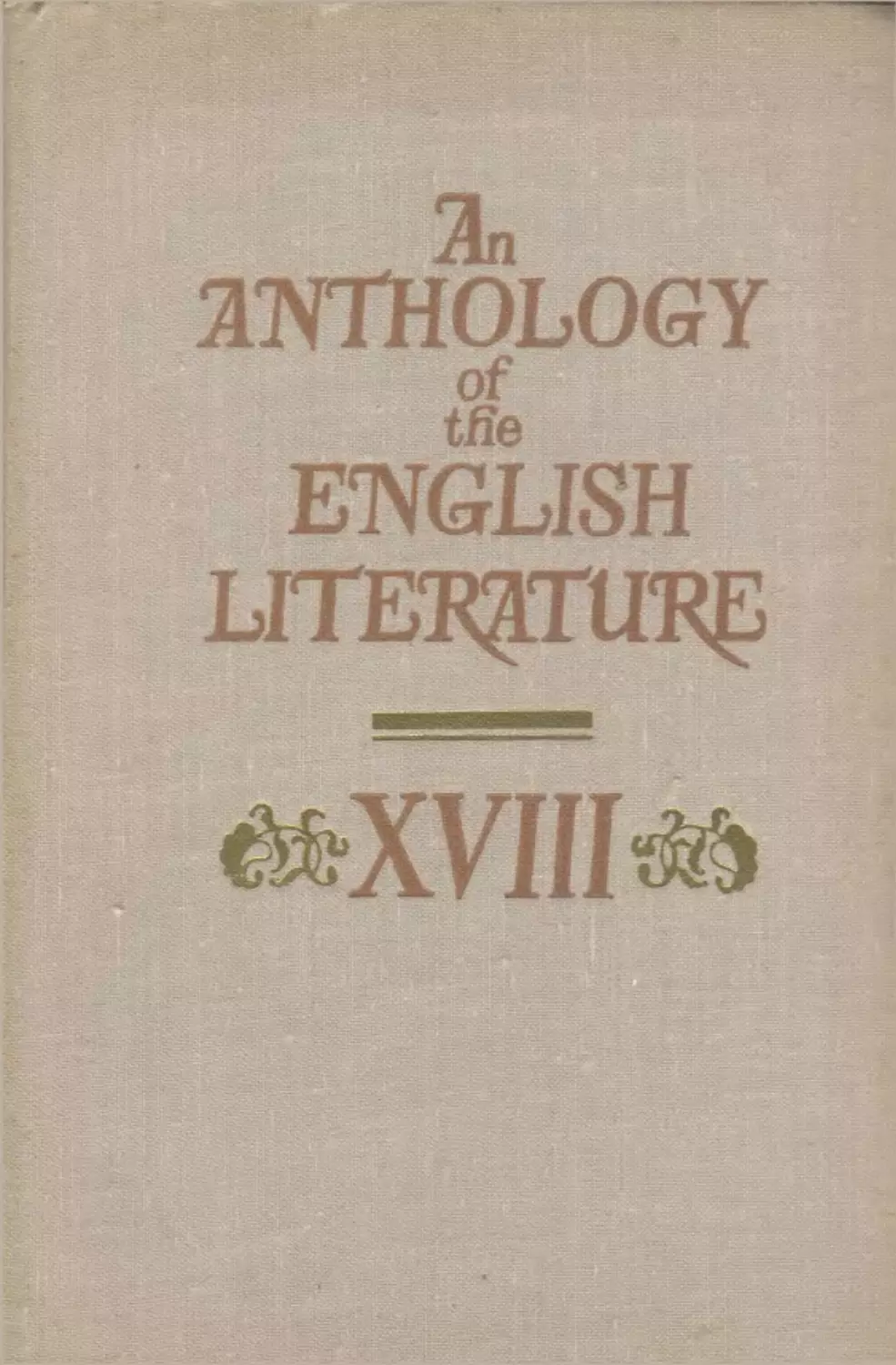


Text
И. В. СТУПНИКОВ
английской
литературе
в®XVIII зй
Допущено
Министерством про свещения СССР
в качестве учебного пособия д л я студентов
педагог ич еских институтов
и факультетов иностранных яз ыко в
Ленинград
«ПРОСВЕЩЕНИЕъ
Ленинградское отделение
1975
4И(Англ)
С88
Ступников И. В.
С88 Хрестоматия по английской литературе XVIII века. Учеб,
пособие для студентов пед. ин-тов и фак. иностр. яз. Л.,
«Просвещение», 1974.
304 с.
Хрестоматия знакомит студентов с подлинниками произведений ан
глийских писателей XVIII века.
В хрестоматию включены отрывки из произведений Свифта, Дефо,
Фильдинга, Ричардсона, Бернса и др.
Тексты снабжены подробным историко-лингвистическим ко ммента
рием. Текстам предшествует статья, в которой дается хар актеристика
английской культуры и л итературы XVIII века.
60602—0Б9
С 103(03)—75
45-74
4И(Англ)
Изд ательство «Просвещение», 1975 г.
THE EIGHTEENTH GENTURY
In the eighteenth century E ngland achieved, politically and economically,
the position of a great power in Europe. By its victories over the armies of
Louis XIV, E ngland eliminated the danger of military domination by France.
The naval victories of the eighteenth century had already established Eng
land ^ maritime supremacy; and this supremacy was reinforced by the capture
of Gibraltar and the island of Minorca which gave England the control of the
western Mediterranean. The eighteenth century witnessed many ups and downs
of England’s foreign policy: the major among them are the foundation of British
rule in India and the loss of the thirteen colonies which achieved their inde
pendence as the United States of America.
Along with military success and political expansion E ngland achieved
financial and commercial pre-eminence. London, throughout the centu ry a city
of some 800,000 inhabitants, became the world’s greatest seaport and financial
centre. This developm ent involved the gr owth in numbe rs and influence of a
great middle class of merchants and tradesmen. A network of canals was con
structed and highways were paved to make possible the transportation of goods.
In the later decades of the century Arkwright’s spinning jenny, Cartwright’s
power-loom, and W att’s steam engine set the stage for the far-reaching industrial
re volution of the nin ete enth century.
Eighteenth-century E ngland was distinguished also in science and philoso
phy. Sir Isaac Newton, who had announced his discovery of the law of gravita
tion in 1686, published in 1704 his very important Optics. From 1703 until his
death in 1727 he was p r esid ent of the Royal Society. He was re cognized every
where as Europe’s foremost scientist. Very influential in France as well as in
Great Britain was the S cottish philosopher, David Hume (1711—76). Another
Scotsman, Adam Smith, inaugurated the modern science of economics by the
publication of his epoch-making Wealth of Nations (1776).
Many of the fundamental ideas which have determined the character of the
modern wo rld either originated or received new emphasis in the eighteenth
century . After the fo u nd ation of the Royal Society in 1660, the experimental
sciences were, with increasing suc cess, e stablishing in men’s mind s the idea
that the universe in which we live is a world of ordered and invariable law.
As the centu ry advances, the ideal of democracy mak es ste ady headway; before
the centu ry was ended the armie s of the French Republic were proclaiming to
all Europe the do ctrin es of lib erty, frater nity, and equality.
At the beginning of the century there appeared one of the most brilliant
groups of writers that has ever graced English literature. In 1704 were published
Swift’s Tale of a Tub and The Battle of the Books. From 1709 till 1712 Steele
and Addison pleased all England with the kindly wit of The Tatler and The
Spectator. In 1709 young Pope won recognition by the poetry of his Pastorals,
and consolidated his reputation by the Essay on Criticism (1711) and The Rape
of the Lo ck (1712, 1714). A lesser poet, J oh n Gay, published his Shepherd’s
Week in 1714.
It was a period of great political unrest, in which each of the parties sought
to win and hold public opinion by the aid of literatu re . There were Whig poems
and Tory poems, besid es a flood of pamphlets,
1
—
3—
It is not easy to define sh a rply the difference between Whig and Tory.
When Swift’s Gulliver visits the pygmy kingdom of Lilliput, he finds the coun-
terp a rt of Tory and Whig in the fa ctions of high-heeled and low-heeled bo ots.
The distinction between the p arties is not so much one of principles as one of
different economic and social interests. Owners of great landed estates were
mo stly Tories; those whose inte re sts were m erca ntile and fin ancial were likely
to be Whigs.
During the period of the Commo nwealth, the people of E ngland had been
subjected to the austere regime of Puritan prohibitions. With the Restoration of
1660 came, as a natural reaction, a time when — at any rate in those fashionable
circles which most influenced literature — the life of England was marked by
general profligacy and by a cynical disregard of moral principles. It was the
task of the early decades of the eighteenth century to re-establish a reasonable
balance in the moral life of the nation. “The Queen Anne wits” were neither
P u ritans nor lib ertines, b ut sober-minded and accomplished men of the world.
To them both Puritan “enthusiasm” and the profligacy of the Restoration “ fop”
were equally offenses against good taste and good sense. It was the avowed
purpose of Addison and Steele in The Spectato r to make vice ridic ulo us, and to
bring to the cause of decency and virtue the powerful allies of wit and good
breeding.
In England and in France it was a time when reason, and its practical
corollary good sense, were the final court of appeal in matters of belief and
conduct, and of a rt and literature also. The philosophical rationalism of Descar
tes, the empiricism of Hobbes and of Locke, the newly awak ened inte re st in
natural sciences, of which Sir Isaac Newton is a great exemplar, and in Eng
land the reaction against seventeenth-century preoccupation with questions of
religion, all conspired to tu rn me n’s mind s away from the my ste rie s of life and
to focus their attention on its actualities. And so the literature of eighteenth-
century England is primarily concerned w;th the everyday facts and interests of
well-ordered, civilized human life, as it transacts itself in L ondon and in the
quiet English countryside. It is on life’s many-coloured surface that the litera
ture of the period turned its brilliant searchlight; it is pre-eminently a social
literatu re, whose school is the coffee-house and tav e rn or the polite salo n. Swift
sends his Gulliver to strange lands of fancy only that we may thus see contem
porary England from a new angle of vision. The masterpiece of Pope’s art —
The Rape of the Lock — has its scene in a fashionable drawing-room . Gay writes
of the busy streets of London. Thomson t u r n s his back on the life of the city,
but only that he may record with equal fidelity to truth the varying phenomena
of the shifting seasons.
This complete devotion to the real a nd a ctu al, this preoc cupation with the
everyday life of no rmal men and women somehow discourag ed flights of poeti
cal imagination; but it gave us instead, by way of compensation, much shrewd
wisdom, sound sense, and flashing wit. It made possible such a great biography
as Boswell’s completely realistic portrait of Johnson and his contemporaries; it
encouraged the kindly human art of letter-writing^nd gave us such great
collections of personal letter s as those of Gray, Horace Walpole, and Cowper,
it expressed itself in the fa milia r e ssays of Addison and Goldsmith.
The novel of the eighteenth century further developed by the great novelists
of the nineteenth century, has become for the twentieth century the literary form
of widest general appeal, the form that is most indubitably alive. The novel
does not ordinarily demand profound learning or even a wide range of literary
awareness. The eighteenth-century novel was read by middle-class families,
rapidly increasing in numbers and importance. The pioneers in England in this
new literary form were the tradesm an and journalist, Defoe, and the printer,
Samuel Richardson, neither of whom would have been rated as a “gentleman”
by their more aristo c ratic conte mpo rarie s.
With Defoe the interest in plot still overshadows the interest in characters
and manners, so that his tales are on the dividing line between the romance of
adventure and the modern novel. But his stories of adventurers like Robinson
Crusoe (1719) and Captain Singleto n (1720), or of adventuresses like Moll
—
4—
Flanders (1722) and Roxana (1724), purport to be the biographies of real per*
sons, who live in a real world.
With Samuel Rich ards on the E nglish novel took a long step forward. A mi*
mute psy chological a n alysis of ch ara ct er and vivid presentm ent of social man
ne rs and customs clearly oversh adow the events of the story. Dr. Joh nso n, who
greatly admired Richardson, once said th at if one were to read him for the sto ry
one would hang oneself. Richarson’s novels are told by an imaginary series of
letters, a device that makes possible a subtle characterization but does not make
for a rapid flow of n ar rative . The seven volumes of Clarissa (1748) contain the
events of a single year. Pamela (1740) has been called the first English novel.
The heroine, Pamela Andrews, is a servant girl whose constancy under repeated
temptation by the son of her mistress finally brings the reward of marriage to
that gentleman and promotion to a higher social class. A rather preposterous
plot is redeemed by the reader’s intimate acquaintance with every flutter of
Pamela’s heart. Richardson’s novels were promptly translated into French,
German and Russia n and were widely read throughout western Europe.
Henry Fielding was at first the author of some very successful plays. Struck
by the fact that Pamela Andrews makes a very good thing out of her chastity,
he began a parody on the virtuous career of Pamela’s brother, Joseph; but what
bega n as parody developed into a novel, Joseph Andrews (1742). A much
greater achievement, and a novel that still ranks among the supreme master
pieces of English fiction, is its successor Tom Jones (1749), a realistic narrative
of English life in the mid-eighteenth centu ry — in the country, on po stroads,
a t wayside inns, and in Lond on. There is a wide v ariety of vividly realized,
clearly differentiated characters, and a most skillfully constructed plot that
keeps the reader guessing up the concluding chapters.
A Scottish do ctor, Tobias Smollett, had served for a time as surge o n ’s-mate
in the Royal Navy and mak es in R od erick Rando m (1748) and Peregrine Pickle
(1751) rich use of his experiences at sea. One of his best works, however, is his
•last novel, The E xpedition of Humphry Clinke r (1771), which revives Richard
son’s device of telling the story by a series of letters.
Laurence Sterne, a whimsical clergyman of the Established Church, took all
England and all Europe by storm with his novel, Tristram Shandy (1759—67).
It has almo st no plot at all, but abou nds in eccentric ch a racters drawn with a
•strange mixtu re of d elicate sentiment a nd with humour which is frequently
indelicate. Less boisterous, but even subtler in its wit and sentiment, is A Senti
men tal Journey (1768), published in the ye ar of its author ’s death.
Goldsmith’s Vicar of Wakefield (1766) has in its structure much that is
clumsy or naive, but its central figure, Dr. Primrose, is one of the great crea
tions of the E nglish novel.
It is in the novel that the eighteenth century holds “the mirror up to nature”
and shows “the very age and body of the time his form and pressure.”
To the repertory of English drama the eighteenth century made only a very
few contributions that still hold a place in the theatre or greatly repay the mod
e r n re ader. The Drury Lane Theatr e (reb uilt by Sir Christopher Wren in 1673),
the Haym ark et (built in 1720), the Covent Garde n Theatre (built in 1731), and
fiom time to time iesser theatre s also, provided at six o’clock every evening
some so rt of dra matic entertain m e nt. There were revivals of Shakespeare, Ben
Jonson, Beaumont and Fletcher, ruthlessly revised to meet the taste of the
eighteenth century; there was the Italian opera, the absurdities of which Addison
ridicule s in The Spectator , there were “se ntimental comedies,” of which the best
is Sir Richard Steele ’s The Conscious Lovers (1722); there were pompous tr a g e
dies in blank verse of which Henry Fielding’s The Life and Death of Tom
Thumb the Great (1730) is a delicious parody. The b rillia nt group of comic
dramatists who flourished at the end of the seventeenth century lived on into
the eighteenth; but except for Farquhar, whose best play, still often acted, The
Beaux* Stratagem, was produced in 1707, their significant work was finished.
John Gay’s The Beggar's Opera (1728) still delights English and American
aud ie nces of the pr ese nt day. Late in the centu ry Goldsmith and Sheridan-
offered a gay, but brief, defiance to the do min ant vogue of “sen timental comedy,”
—
5—
Goldsmith’s She Stoops to Conquer (1773) and Sheridan’s The Rivals (1775Y
and The School for Scandal (1777) are always read and always success
ful on the stage. The prevalent temper of the age was not favourable to tragedy,
and most of the tragic drama of the period may safely be ignored. George
Lillo’s The London Merchant, or the History of George Barnwell (1731) is sig
nificant because its author, himself a London tradesman, appealed to the now
influential middle class by w riting a domestic tragedy of middle-class life, and*
because he wrote it in prose rather than in verse.
Writers of the eighteenth century , a nd their eve r-widening circle of readers,,
were keenly interested in the actualities of everyday life about them and highly
critical of the many absurdities resulting from man’s failure to live up adequate
ly to the rule of right reason. This critical temper expressed itself in b rilliant
and witty satire, which ranges all the way from the fierce indignation of Swift,
and the keen strokes of Pope a nd Sh erid an, to the kindly, humorous s atire of
Addison and Goldsmith.
The eighteenth century excelled also in the “formal satire” in verse, modelled
on Horace and Juvenal, of which Pope’s Epistle to Dr. Arbuthnot and John
son’s Vanity of Human Wishes are supreme examples. Eighteenth-century satire
is often serious, but it is seldom solemn. The prevailing spirit of the century is
the spirit of comedy — of wit and humour and daring jest.
Alexander Pope’s name is the first to be mentioned when one starts discuss
ing the poetry of the eighteenth century.
Pope lived till 1744; and the prestige of his talent, and that of his master
Dryden, dominates the fir st half of the century. To the body of c ritical prin ci
ples which und erlie Pope’s poetry — the p rinciples that a re fo rmulated in his
Essay on Criticism and in the A rt Poetique of the Fr ench poet-critic Boileau —
literary histo ria ns have given the name “ ne o-c lassicis m.” Like all such labels*
the te rm “neo -c la ssic al” is not easy to define, for within the school are included
several varying gr oup s; but the chief qualities implied by it are good sense*
reasonableness, scrupulous fidelity to the normal and constant sentiments of
human nature, adherence to the form and spirit of the great writers of classical
antiquity who seemed most completely to exemplify the principles of reasonable
ness and tru th to natu re. Neo-classicism is the foe of obsc urity and b ombast, o f
the far-fetched conceits of the sev ente enth-ce ntu ry metaphysical poets, such a s
Donne and Herbert, of all th at is improbable, ab no rm al, no t immediately rec
ognizable by the average intelligent man as part of the universal experience
of human nature. In particular, it had) nothing but scorn for the extravagant
adventu res of medieval romance. In so f ar as this school of criticism has m ad e
for sanity and cla rity, its influence on literatu re has been a wholesome one; but
its principles, when narrowly applied, unduly restrict the field of poetry. For
the human spirit must be free to range beyond the region of established fact, to
concern itself with realities that tra n sc end eve ryday experience.
Under the sturdy championship of Samuel Johnson the neo-classic theory of
literature continued to dominate the second half of the eighteenth century; but
it was increasingly subject to dissent and open attack. In 1749 a hitherto ob
scure Frenchman, Jean Jacques Rousseau, suddenly emerged into European fame
by an essay which undertook to prove that “the progress of sciences and of
letters has tended to corrupt morals.” This insistence, extended and developed
in Rousseau’s later writings, that civilization is not a blessing but a curse, or
at best a serious menace, was to become a prime a rticle in the creed of the
Romantic Movement of the early nineteenth century and is an important shaping
principle in the literary revolt against neo-classic doctrine which is already
showing itself in the second half of the eighteenth century.
If civilization breeds corruption, we had better turn, in imagination at any
rate, to more primitive modes of life. And so the author propose s to ad mire the
“noble savage,” the South Sea Islander or the red Indfan of the North Ameri
can forests, who, free from the curse of civilization, w as suppos ed to be a
pattern of all the virtues — generous as well as brave, giving spontaneous ex
pression to the essential goodness of unspoiled human nature. Next best to the
“noble savage” is the rustic peasant, untouched by the breath of the city, where
—
6—
civilization is at its most virulent, the unspoiled “child of nature.” Gray’s Elegy
(1750) confo rms in the main to the principles of ne o-cla ssical poetry;"but it is
“written in a country churchyard,” where sleep the “rude forefathers of the
hamlet.” In The Progress of Poetry (1754) Gray speculates on the beautiful
poetry, “in loose numbers wildly sweet,” that must surely be composed by noble
savages among the “ice-built mountains” of Lapland or in “Chile’s boundless
forests.” Goldsmith in The Deserted Village (1770) paints a very rosy picture of
the simple rustics, with their “rural virtues,” who were driven by the encroach
ments of luxurious wealth from “sweet Auburn, loveliest village of the plain.”
Cowper sometimes maintains a neo-classical fidelity to fact; but the facts that
he poetically records are those of the quiet English countryside rather than of the
•city. “God made the country, and ma n made the town,” he declares. When in
1786 Burns published his Kilmarnock volume of poems, w ritten on rural themes
and in a rustic dialect, he was hailed as the “plowman poet,” the “child of
nature,” who owed nothing to Aristotle and the schools. He is a realist and
a satirist and owes much to the tradition of eighteenth-century English poetry,
as well as to the poetical tradition of his own native Scotland.
Another important element in the romantic revolt of the later eighteenth
century is a revival of interest in the Middle Ages. It was a region of imagina
tive escape from the civilized ord erlin ess of the eighteenth century.
Horace Walpole, son of the “g r e at ” Whig prime minister, built himself at
Strawberry Hill, a dozen mile s from London, an imitation of a medieval castle,
and there he wrote The Castle of Otranto (1765), a sentimental love-story the
scene of which is laid in Italy at the time of the crusades. There is much the
atrical machinery of supernatural terror — ghosts, curses, ancestral portraits
that step out of their frames, subterranean passages, dark prophecies — the
m y stery and rem oten ess of the Middle Ages. Walpole at first declared that it
was a translation of an old Italian book, but in the second edition admitted
that it was his own invention. In the same category of the “Gothic novel” are
The Old English Baron (1777) by Miss Clara Reeve and The Mysteries of Udol-
pho (1794) by Mrs. Ann Radcliffe .
In the same year that saw the publication of Walpole’s novel of medieval
terror, Thomas Percy, a scholarly clergyman and antiquary and later a bishop,
published his Reliques of Ancient English Poetry (1765). He had found in the
house of a friend a manuscript written in the seventeenth century, which con
tained some old roman ces and, more imp orta nt, a colle ction of the p opular
ballads. The manuscript was being used page by page, to supply fire-lighters.
Percy rescued it and published its conte nts. The book did much to familiarize
eighteenth-cen tu ry read e rs with the medieval past. Among the pieces included
in it is the grimly tragic ballad, Edward.
In 1762, Ja me s Ma cpherson, a yo u ng Scottish schoolteacher, published a
book, destined for enormous success, entitled Fingal, An Ancient Epic Poem in
Six Books. According to Macpherson it was a faithful translation into rhythmi
cal English prose of a Gaelic poem written in the third century A. D. by a
Celtic bard named Ossian. In the primitive world of very long ago we meet
heroic figures of most exalted character who are indeed “noble savages.” The
book was popula r in Europe. It was a fav ourite of Napoleon and of Goethe, and
of Thomas J effe rso n in fa raw ay Virginia . There were, however, sceptics who
demanded to be shown the Gaelic o riginal which Macpherson stubbornly refused
to produce. We now know that “Ossian” was a fraud. Fingal was composed not
by a mysterious Celtic bard of the third century but by Janfes Macpherson, an
entirely civilized eighteenth- cen tu ry g entleman.
In August, 1770, there died a very strang e but highly gifted boy of eight
een, Thomas Chatterton . Born of humble p are nts in Bristol he spent, a s a child,
long hours in the b ea utiful Gothic church of St. Mary Redcliffe. He composed
poems which he copied out in arch aic spelling on pieces of old parchment. He
declared tha t he h ad fou nd them in an old oaken chest in St. Ma ry’s church,
and that they were the work of a fifteenth-century Bristol monk, Thomas Row-
ley. Both the poems and the poet were the creation of the boy Chatte rto n . Many
of the poems have a h aunting beauty. The world has long since forgiven the
—
7—
boy his deception. He became, indeed, for the romantic poets of the early nin e
teenth century a sort of patron saint and martyr. Wordsworth refers to him as-
the “marvelous Boy, the sleepless soul that perished in his prid e.” Keats in
scribed Endymio n to his memory.
Of the eighteenth-century Englishmen in revolt against the established liter
ary order, the one most read and most r eg arded in the twentieth centu ry is
William Blake (1757—1827). He is a f a s cin ating figure , both in his drawings*
and in his verse. At his best, as in the Songs of Innocence, he shows poetic
power of a very high order. In his lo ng “prophetic ” poems he expounds, ofterr
with distu rbing obs curity, a s t ra ng e mystic philosophy. He is a lonely figure,
little influenced by his contemporaries, and little known by them. He goes
farther than any of them in his departure from the sanity, clarity, and serenity
of spirit on which the neo-cla ssical theory of poetry insist s.
The romantic rev olt of the second h alf of the eighteenth centu ry reached
with the coming of the nineteenth century the proportions of a full-fledged
succ essful revolution. The serenity and sec urity of a fully establi shed social'
ord er which had been disturbingly challenged by the American Revolution, was*
shaken to) its foundations by the cataclysm of the French Revolution. The new
hopes, the new set of human values, ushered in by the Fall of the Bastille
(1789), had a profound effect on Englishmen as well as Frenchmen and left an
ind elible mark on E nglish literatu re. The publication in 1798 of a thin volume
of verse by two you ng men, William Wo rdsworth and his friend Samuel Taylor
Coleridge, entitled Lyrical Ballads, is a literary landmark of first importance
which may be thought of as inaugurating, in subject matter and in poetic style,.
the Romantic Movement of nineteenth-century E ngland. Other phases of this
movement are exemplified by Byron, Shelley , a nd Keats. The literatu re of the
Romantic Movement is of a high ord er of excellence; but the qu alities that mak e
it great are very different from the reasoned good sense, the discipline and
order, the steady serenity of spirit that mark the neo-classic literature of th e
eighteenth centu ry.
and
1672—
~17l9
One of the literary forms which
the eighteenth century brought
to supreme perfection is th at
blending of literature and journal
ism which we call the periodical
essay — a short essay, on some
4opic of general interest, published
as the principal mate rial of a four-
page periodical appearing several
times a week. Though the idea of
such a publication was not original
with Addison and Steele, it was
they who first fully reali zed its
possibilities. In the Tatter and the
Spectator they set a model that
was imitated throughout the cen
tury by many simil ar, though less
famous, pe riodicals, such a s Dr.
Johnson’s Rambler and Idler and
Goldsmith's Chinese L ett ers w rit
ten for the Public Ledger, later
-collected unde r the title of The
Citizen of the World.
The fatter and the Spectator
-are
asso ciated with tha t very popu
lar institution of eighteenth cen
tury London, the coffee-house.
Though the population of London
was not over 800,000, there are
said to have been as many as three thousand of these places of public enter
tain ment, where one could drop in for a cup of tea, coffee, or chocolate — or
s tro ng e r beverages if one preferred — and where one could ord er also a fresh
c lay pipe and a filling of tobacco. One paid a small admissio n fee at the door,
and was then free to stay as long as one pleased, writing letters, reading the
pap ers, or bett er still joining in the conv ersation at one of the round tables.
They took the place of the modern club-house. Indeed some of them were ulti
mately bought by a group of habitual frequenters who turned them into private
club s. In the eighteenth centu ry the word “club ” meant a group of friends who
met at regular intervals at some place of public resort, and did not imply an
e stablished club-house. The Tatler and the Spectato r are avowedly the literatu re
o f the coffee-house. Some of the Tatler papers are dated from Will’s Coffee*
house or White’s Chocolate House; and Mr. Spectator gives as one of his chief
qualifications that he is constantly to be seen at one or another of them. Many
of the papers seem to have been sugg ested by a coffee-house conversation. As
we read them, we can easily imagine that we are listening in on the wise and
witty talk at Will’s in Bow Street or Button’s in Covent Garden.
—
9—
Addison and Steele were bom
within a few weeks of one another
in the spring of 1672 — Addison-
in a quiet English village where
his father was the clergyman,
Steele in the city of Dublin. They
were school-fellows at the Ch arte r-
house School in London, and u n
dergraduates together at Oxford,.
Lifelong friends, their names a re
inseparably linked in the annals
of English literature. In tempera
ment, however, they were diff er ent
eno ugh. Addison was the q uiet,
re se rved sch olar, shy and with some
times an almost forbidding cold
ness; Steele, with his Irish birth,
was gay, warm-heated, extrava
gant, an eager participant in all
social amuse ments.
From Oxford Addison d epa rted
for a tour of France and Italy,
seeking out the places famous in
ancient history or ancient litera
ture. Steele joined the army, where
presently he became Captain Steele.
Then they both drifted to Lo ndon,
where they were caught up inta
the literary-political life of the capital as. staunch supporters of the Whig party.
Addison’s poem The Campaign (1704), i n celebration of the b attle of Blenheim,
won by the g reat Whig general, Marlborbugh, led ultimately to his appointment
as Secretary of State. Steele edited the Gazette, official publication of the gov
ernment, a nd in 1715 was made Sir Richard Steele a nd supervisor of Drury
Lane Theatre. Besides his work as an es sayist, Steele was one of the most
successful comic d ra m atists of his day, his best known play being The Con
scious Lovers (1722), an o u tsta nd ing example of “se n timental comedy.” Addison
was the author of Cato (1713), a tragedy in blank verse which, though seriously
deficient in dramatic interest, won great notoriety because of its political import,
a nd continued to be read becau se of the fine rheto ric of its speeches.
The most memorable work of Addison and Steele was their joint editorship
of the Tatler (1709—1710) and the Spectato r (1711— 1712, 1714). The ea rlie r
periodical, which app eared three times a week, was begu n by Steele alone; but
Addison contrib uted ab out forty of the pap ers. Fo r its successor, which w as
issued every day but Sunday, Addison wrote about half the numbers. Occasional
papers were contributed by other writers. It was the avowed purpose of the
Spectator to popularize morality and culture, to bring “philosophy out of closets
and lib raries, schools and colleges, to dwell in club s and assemblies, at te a-
tables and in coffee-houses.” Avoiding carefully any bias of party politics, it
portrays with kindly humour, and criticizes with sound good sense, the manners
and customs of eighteenth-century life, all the vanities and petty foibles of
the staid city merchant, of the “fine lady” and the “pretty fellow” of the West
End. Sometimes the “speculation” of the day is a wise but entertaining discourse
on m orals and philosophy, some times a piece of literary criticism. The p rev ail
ing manner is that proper to the familiar essay — witty, whimsical, conversa
tional.
In later issues Steele adopted the more serious purpose of serving as a
moral influence and speaking out against the negligence and improprieties of
his contemporaries. The subject matter of the periodicals were literature, man
ners and morals. With good-natured satire, tolerance and common sense, Addison
and Steele sought to reform social tastes and behaviour.
—
10—
The publication every morning of such a paper as the Spectator was a se-
-vete test of the versatility and resourcefulness cf the authors. The membership
•of the club which Addison adopted in his pape r represe nted all sections of the
English public; Sir Roger de Coverley stood for the Tory pa rt of the society.
An eccentric Tory c o untry squire, he used to sup with lords and nobles, in him
Addison sh ows a mellowed s u rvivor of Resto ration days.
Sir Roger
The first of our society is a gentleman of Worcestershire, of
ancient descent, a baronet, his name Sir Roger de Coverley. His
great grandfather was inventor of that famous country-dance *
which is called after him. All who know that shire are very well
acquainted with the parts and merits of Sir Roger. He is a gentle
man that is very singular in his behaviour, but his singularities
proceed from his good sense, and are contradictions to the man
ners of the world, only as * he thinks the world is in the wrong:
However, this humour creates him no enemies, for he does noth
ing with sourness or obstinacy; and his being unconfined to modes
and forms, makes him but the readier and more capable to
please and oblige all who know him. When he is in town, he lives
in Soho Square. It is said, he keeps himself a bachelor, by rea
son he was crossed in love by a perverse beautiful widow of the
next county to him. Before this disappointment, Sir Roger was
what you call a fine gentleman, had often supped with my lord
Rochester * and Sir George Etherege,* fought a duel upon his
first coming to town, and kicked Bully Dawson * in a public cof:
.fee-house, for calling him youngster. But, being ill used by the
above mentioned widow, he was very serious for a year and a
half; and though, his temper being naturally jovial, he at last got
over it, he grew careless of himself, and never dressed * after
wards. He continues to wear a coat and doublet of the same cut,
that were in fashion at the time of his repulse, which, in his merry
humours, he tells us, has been in and out * twelve times since he
first wore it. He is now in his fifty-sixth year, cheerful, gay, and
hearty; keeps a good house both in town and country; a great lov
er of mankind; but there is such a mirthful cast in his behaviour,
that he is rather beloved than esteemed.
His tenants grow rich, his servants look satisfied, all the young
women profess love to him, and the young men are glad of his
company; when he comes into a house, he calls the servants by
their names, and talks all the way up stairs to a visit. I must not
omit, that Sir Roger is a justice of the quorum: * that he fills the
chair at a quarter-session with great abilities, and three months
ago, gained universal applause, by explaining a passage in the
game act.
II. SIR ROGER AT HOME
—
Hie tibi copia
Manabid ad plenum b enigno
Ruris honorum op ule nta corn u.
Horace, Odes, i. 17.14.
Here Plenty’s liberal horn shall pour
Of fruits for thee a copious shower,
Rich honours of the quiet plain.
Having often received an invitation from my friend Sir R oger
de Coverley to pass away a month with him in the country, I last
week accompanied him thither, and am settled with him for some
time at his country house, where I intend to form several of my
ensuing speculations. Sir Roger, who is very well acquainted with
my humour, lets me rise and go to bed when I please; dine at his
own table or in my chamber as I think fit, sit still and say nothing
without bidding me be merry. When the gentlemen of the country
come to see him, he only shews me at a distance: as I have been
walking in his fields I have observed them stealing a sight of me*
over an hedge, and have heard the knight desiring them not to let
me see them, for that * I hated to be stared at.
^
I
am the more at ease in Sir Roger’s family, because it consists
of sober and staid persons; for as the knight is the best m aster
in the world, he seldom changes his servants; and as he is belov
ed by all about him, his servants never care for leaving him; by
this means his domestics are all in years, and grown old with
their master. You would take his Valet-de-chambre * for his broth-
er, his butler is grey-headed, his groom is one of the gravest men*
that I have ever seen, and his coachman has the look of a pdvy-
counsellor. You see the goodness of the master even in the old
house-dog, and in a grey pad that is kept in the stable with great
care and tenderness out of regard to his past services, though he-
has been useless for several years.
I
could not but observe with a great deal of pleasure the joy
that appeared in the countenance of these ancient domestics orr
my friend’s arrival at his country-seat. Some of them could not
refrain from tears at the sight of their old master; every one of
them pressed forward * to do something for him, and seemed dis
couraged if they were not employed. At the same time the good
old knight, with a mixture of the father and the master of the fam
ily, tempered the inquiries after his own affairs with several
kind questions relating to themselves. This humanity and good
nature engages everybody to him, so that when he is pleasant
upon * any of them, all his family are in good humour, and none-
so much as the person whom he diverts himself with: on the con
trary, if he coughs, or betrays any infirmity of old age, it is easy
for a stander-by to observe a secret concern in the looks of his*
servants.
<2-
My worthy friend has put me under the particular care of
his butler, who is a very prudent man, and, as well as the rest of
his fellow-servants, wonderfully desirious of pleasing me, because
they have often heard their master talk of me as of his particular
friend.
My chief companion, when Sir Roger is div erting himself in
the woods or the fields, is a very venerable man who is ever with
Sir Roger, and has lived at his house in the nature of * a chap
lain above thirty years. This gentleman is a person of good sense
and some learning, of a very regular life and obliging conversa
tion: he heartily loves Sir Roger, and knows that he is very much
in the old knight’s esteem, so that he lives in the family rather as
a relation than a dependent.*
I
have observed in several of my papers, that my friend Sir
Roger, amidst all his good qualities, is something of an humour
ist; and that his virtues, as well as imperfections, are, as it were,
tinged by a certain extravagance, which makes them particularly
his, and distinguishes them from those of other men. This cast of
mind, as it is generally very innocent in itself, so it renders his
conversation highly agreeable, and more delightful than the same
degree of sense and virtue would appear in their common or ordi
nary colours. As I was walking with him last night, he asked me
how I liked the good man whom I have just now mentioned; and,
without staying for my answer, told me that he was afraid of
being in sulted with Latin and Greek at his own table; for which
reason he desired a particular friend of his at the university to
find him out a clergyman rather of plain sense than much learn
ing, of a good aspect, a clear voice, a sociable temper: and, if
possible, a man that understood a little of back-gammon. “My
friend,” says Sir Roger, “found me out this gentleman, who, be
sides the endowments required of him, is, they tell me, a good
scholar, though he does not shew it. I have given him the parson
age of the parish; and because I know his value, have settled
upon him a good annuity for life. If he outlives me, he shall find
that he is higher in my esteem than perhaps he thinks he is. He
has now been with me thirty years; and, though he does not know
I have taken notice of it, has never in all that time asked anything
of me for himself, though he is every day soliciting me for some
thing in behalf of one or other of my tenants, his parishioners.
There has not been a lawsuit in the parish since he has lived among
them; if any dispute arises they apply themselves to him for the
decision: if they do not acquiesce in his judgment, which I think
never happened above once or twice at most, they appeal to me.
At his first settling with me, I made him a present of all the good
sermons which have been printed in English, and only begged of
him that every Sunday he would pronounce one of them in the
pulpit. Accordingly, he has digested them into such a series that
13—
they follow one another naturally, and make a continued “system
of practical divinity” .
As Sir Roger was going on in his story, the gentleman we were
talking of came up to us; and upon the knight’s asking him who
preached to-morrow (for it was Saturday night), told us the Bish
op of St. Asaph * in the morning, and Dr. South * in the after
noon. He then shewed us his list of preachers for the whole year,
where I saw with a great deal of pleasure archbishop Tillotson, *
bishop Saunderson, * Dr. Barrow, * Dr. Calamy, * with several liv
ing authors who have published discourses of practical divinity.
I no sooner saw this venerable man in the pulpit, but I very much
approved of my friend’s insisting upon the qualifications of a
good aspect and a clear voice; for I was so charmed with the grace
fulness of his figure and delivery, as well as the discourses he
pronounced, that I think I never passed any time more to my satis
faction. A sermon repeated after this manner, is like the compo
sition of a poet in the mouth of a graceful actor.
I
could heartily wish that more of our country clergy would
follow this example; and, instead of wasting their spirits in la
borious compositions of their own, would endeavour after a hand
some elocution, and all those other talents that are proper to en
force what has been penned by greater masters. This would not
only be more easy to themselves, but more edifying to the peo
ple. — L.
The Tatler
ON DUELLING
The Tatler, No. 25.
Tuesday, June 7, 1709
Whate’er men do, or say, or think, or dream,
Our motley p ap er seizes for its theme.
White 's Chocolate H ouse, June 6
A letter from a young lady, written in the most passionate
terms, wherein she laments the misfortune of a gentleman, her lov
er, who was lately wounded in a duel, has turned my thoughts
to that subject and inclined me to examine into the causes which
precipitate men into so fatal a folly. And as it has been proposed
to treat of subjects of gallantry in the article from hence,* and no
one point in nature is more proper to be considered by the coim
pany who frequent this place than that of duels, it is worth our
consideration to examine into this chimerical, groundless humour
and to lay every other thought aside, until we have stripped it of
all its false pretenses to credit and reputation amongst men.
But I must confess, when I consider what I am going about,
and run over in my imagination all the endless crowd of men of
—
14—
honour who will be offended at such a discourse, I am undertaking,
methinks, a work worthy an invulnerable hero in romance, rather
than a private gentleman with a single rapier: but as I am pretty
well acquainted, by great opportunities, with the nature of man,
and know of a truth that all men fight against their will, the dan
ger vanishes and resolution rises upon this subject. For this rea
son, I shall talk very freely on a custom which all men wish ex
ploded, though no man has courage enough to resist it.
But there is one unintelligible word, which I fear will ex
tremely perplex my dissertation, and I confess to you I find very
hard to explain, which is the term “satisfaction.” An honest coun
try gentleman had the misfortune to fall into company with two
or three modern men of honour, where he happened to be very ill-
treated; and one of the company, being conscious of his offence,
sends a note to him in the morning and tells him he was ready
to give him satisfaction. “This is fine doing,” says the plain fel
low, “last night he sent me away cursedly out of humour, and this
morning he fancies it would be a satisfaction to be run through
the body.”
As the matter at present stands, it is not to do handsome actions
denominates a man of honour; it is enough if he dares to defend
ill ones. Thus you often see a common sharper in competition with
a gentleman of the first rank, though all mankind is convinced
that a fighting gamester is only a pickpocket with the courage of
a highway-man . One cannot with any patience reflect on the unac
countable jumble of persons and things in this town and nation;
which occasions very frequently that a brave man falls by a hand
below that of a common hangman, and yet his executioner escapes
the clutches of the hangman for doing it. I shall, therefore, hereaf
ter consider how the bravest men in other ages and nations have
behaved themselves upon such incidents as we decide by combat;
and show, from their practice, that this resentment neither has its
foundation from true reason or solid fame; but is an imposture,
made of cowardice, falsehood, and want of understanding. For
this work, a good history of quarrels would be very edifying to
the public; and I apply myself to the town for particulars and cir
cum stances within their knowledge, which may serve to embellish
the dissertation with proper cuts. Most of the quarrels I have ever
known have proceeded from valiant coxcomb’s persisting in the
wrorrg, to defend some prev ailing folly, and preserve himself
from the ingenuousness of owning a mistake.
By this means it is called “giving a man satisfaction,” to urge
your offense again st him with your sword; which puts me in
mind of Peter’s order to the keeper in The Tale of a Tub: “if you
neglect to do all this, damn you and your generation for ever: and
so we bid you heartily farewell.” If the contradiction in the very
terms of one of our challenges were as well explained and turned
into downright English, would it not run after this manner?
—
15—
“‘Sir:
“Your extraordinary behaviour last night, and the liberty you
were pleased to take with me, makes me this morning give you
this, to tell you, because you are an ill-bred puppy, I will meet
you in Hyde Park an hour hence; and because you want both breed
ing and humanity, I desire you would come with a pistol in your
hand, on horseback, and endeavor to shoot me through the head,
to teach you more manners. If you fail of doing me this pleasure,
I shall say you are a rascal on every post in town: and so, sir, if
you will not injure me more, I shall never forgive what you have
done already. Pray, sir, do not fail of getting everything ready;
and you will infinitely oblige, Sir, Your most obedient humble serv
ant, etc.”
The Spectator
THE USES OF THE SPECTATOR
The Spectator, No. 10.
Monday, March 12, 1711
So the boat’s brawny crew the current stem,
And slow advancing, struggle with stream:
But if they slack their hands, or cease to strive,
Then down the flood with headlong haste they
drive.
Dryden
It is with much satisfaction that I hear this great city inquir
ing day by day after these my papers, and receiving my morning
lectures with a becoming seriousness and attention. My publisher
tells me that there are already three thousand of them distributed
every day: so that if I allow twenty readers to every paper, which
I look upon as a modest computation, I may reckon about three
score thousand disciples in London and Westminster, who I hope
will take care to distinguish themselves from the thoughtless herd
of their ignorant and unattentive brethren. Since I have raised to
myself so great an audience, I shall spare no pains to make their
instruction agreeable, and their diversion useful. For which rea
sons I shall endeavor to enliven morality with wit, and to temper
wit with morality, that my readers may, if possible, both "ways
find their account in the speculation of the day. And to the end
that their virtue and discretion may not be short, transient, inter
mitting starts of thought, I have resolved to refresh their memo
ries from day to day, till I have recovered them out of that despe
rate state of vice and folly into which the age is fallen. The mind
that lies fallow but a single day sprouts up in follies that are only
to be killed by a constant and assiduous culture. It was said of
—
16—
Socrates, that he bro ught philosophy down from heaven, to inhab
it among men; and I shall be ambitious to have it said of me
that I have brought philosophy out of closets and libraries, schools
and colleges, to dwell in clubs and assemblies, at tea-tables and
in coffee-houses.
I
would, therefore, in a very particular manner recommend
these my speculations to all well-regulated families, that set apart
an hour in every morning for tea and bread and butter; and would
earnestly advise them for their good to order this paper to be punc
tually served up, and to be looked upon as a part of the tea equi
page.
Sir Francis Bacon * observes that a well-written book, com
pared with its rivals and antagonists, is like Moses’s serpent,*
that immediately swallowed up and devoured those of the Egyp
tians. I shall not be so vain as to think that where the Spectator
appears the other public prints will vanish; but shall leave it to
my reader’s consideration, whether is it not much better to be let
into the knowledge of one’s self, than to hear what passes in Mus
covy * or Poland; and to amuse ourselves with such writings as
tend to the wearing out of ignorance, passion, and prejudice, than
such as naturally conduce to inflame hatreds and make enmities
irreconcilable?
In the next place, I would recommend this paper to the daily
perusal of those gentlemen whom I cannot but consider as my
good brothers and allies; I mean the fraternity of spectators who
live in the world without having anything to do in it, and either
by the affluence of their fortunes, or laziness of their dispositions,
have no other business with the rest of mankind but to look upon
them. Under this class of men are comprehended all contemplative
tradesmen, titular physicians, fellows of the Royal Society,* Tem
plars that are not given to be contentious, and statesmen that
are out of business; in short, everyone that considers the world
as a theatre, and desires to form a right judgment of those who
are the actors on it.
There is another set of men that I must likewise lay a claim
to, whom I have lately called the blanks of society, as being alto
gether unfurnished with ideas till the business and conversation
of the day has supplied them. I have often considered these poor
souls with an eye of great commiseration, when I have heard them
asking the first man they have met with, whether there was any
news stirring? and by that means gathering together materials
for thinking. These needy persons do not know what to talk of
till about twelve o’clock in the morning; for by that time they are
pretty good judges of the weather, know which way the wind sits,
and whether the Dutch mail be come in. As they lie at the mercy
of the first man they meet, and are grave or impertinent all the
day long, according to the notions which they have imbibed in the
—
17—
morning, I would earnestly entreat them not to stir out of their
chambers till they have read this paper, and do promise them that
I will daily instill into them such sound and wholesome senti
ments, as shall have a good effect on their conversation for the
ensuing twelve hours.
But there are none to whom this paper will be more useful
than to the female world. I have often thought there has not been
sufficient pains taken in finding out proper employments and di
versions for the fair ones. Their amusements seem contrived for
them, rather as they are women, than as they are reasonable crea
tures; and are more adapted to the sex than to the species. The
toilet is their great scene of business, and the right adjusting of
their hair the principal employment of their lives. The sorting of
a suit of ribbons is reckoned a very good morning’s work; and if
they make an excursion to a mercer’s, or a toy-shop, so great
a fatigue makes them unfit for anything else all the day after.
Their more serious occupations are sewing and embroidery, and
their greatest drudgery the preparation of jellies and sweetmeats.
This, I say, is the state of ordinary women; though I know there
are multitudes of those of a more elevated life and conversation,
that move in an exalted sphere of knowledge and virtue, that join
all the beauties of the mind to the ornaments of dress, and inspire
a kind of awe and respect, as well as love, into their male behold
ers. I hope to increase the number of these by publishing this
daily paper, which I shall always endeavor to make an innocent,
if not an improving, entertainment, and by that means at least
divert the minds of my female readers from greater trifles. At the
same time, as I would fain give some finishing touches to those
which are already the most beautiful pieces in human nature,
I shall endeavor to point out all those imperfections that are the
blemishes, as well as those virtues which are the embellishments,
of the sex. In the meanwhile I hope these my gentle readers, who
have so much time on their hands, will not grudge throwing away
a quarter of an hour in a day on this paper, since they may do it
without any hindrance to business.
I know several of my friends and well-wishers are in great
pain for me, lest I should not be able to keep up the spirit of a pa
per which I oblige myself to furnish every day; but to make them
easy in this particular, I will promise them faithfully to give it
over as soon as I grow dull. This I know will be matter of great
raillery to the small wits; who will frequently put me in mind of
my promise, desire me to keep my word, assure me that it is high
time to give over, with many other little pleasantries of the like
nature, which men of a little smart genius cannot forbear throwing
out against their best friends, when they have such a handle given
them of being witty. But let them remember that I do hereby enter
my caveat against * this piece of raillery.
—
18—
DISSECTION OF A BEAU’S HEAD
The Spectator, No. 275.
Tuesday, January 15, 1712
A Head No Hellebore Can Cure.
I was yesterday engaged in an assembly of virtuosos, where
one of them produced many curious observations which he had
lately made in the anatomy of an human body. Another of the com
pany communicated to us several wonderful discoveries, which
he had also made on the same subject, by the help of very fine
glasses. This gave birth to a great variety of uncommon remarks,
and furnished discourse for the remaining part of the day.
The different opinions which were started on this occasion pre
sented to my imagination so many new ideas that, by mixing with
those which were already there, they employed my fancy all the
last night, and composed a very wild extravagant dream.
I was invited, methought, to the dissection of a beau’s head,
and of a coquette’s heart, which were both of them laid on a table
before us. An imaginary operator opened the first with a great
deal of nicety, which, upon a cursory and superficial view, ap
peared like the head of another man; but, upon applying our glasses
to it, we made a very odd discovery, namely, that what we looked
upon as brains, were not such in reality, but an heap of strange
materials wound up in that shape and texture, and packed to
gether with wonderful art in the several cavities of the skull. For,
as Homer tells us that the blood of the gods is not real blood, but
only something like it; so we found that the brain of a beau is
not real brain, but only something like it.
The pineal gland, which many of our modern philosophers
suppose to be the seat of the soul, smelt very strong of essence
and orange-flower * water, and was encompassed with a kind of
horny substance, cut into a thousand little faces or mirrors, which
were imperceptible to the naked eye; insomuch that the soul, if
there had been any here, must have been always taken up in con
templating her own beauties.
We observed a large antrum * or cavity in the sinciput, that
was filled with ribbons, lace, and embroidery, wrought together
in a most curious piece of network, the parts of which were like
wise imperceptible to the naked eye. Another of these antrums or
cavities was stuffed with invisible billet-doux, * love-letters,
pricked dances, * and other trumpery of the same nature. In another
we found a kind of powder, which set the whole company a sneez
ing, and by the scent discovered itself to be right Spanish. The
several other cells were stored with commodities of the same kind,
of which it would be tedious to give the reader an exact inventory.
There was a large cavity on each side of the head, which
I must not omit. That on the right side was filled with fictions,
—
19—
flatteries, and falsehoods, vows, promises, and protestations; that
on the left with oaths and imprecations. There issued out a duct
from each of these cells, which ran into the root of the tongue,
where both joined together, and passed forward in one common
duct to the tip of it. We discovered several little roads or canals
running from the ear into the brain, and took particular care to
trace them out through their several passages. One of them extend
ed itself to a bundle of sonnets and little musical instruments.
Others ended in several bladders which were filled either with
wind or froth. But the large canal entered into a great cavity of
the skull, from whence there went another canal into the tongue.
This great cavity was filled with a kind of spongy substance,
which the French anatomists call galimatias, and the English non
sense.
The skins of the forehead were extremely rough and thick, and,
what very much surprised us, had not in them any single blood
vessel that we were able to discover, either with or without our
glasses; from whence we concluded that the party when alive must
have been entirely deprived of the faculty of blushing.
The os cribriforme * was exceedingly stuffed, and in some
places damaged with snuff. We could not but take notice in partic
ular of that small muscle, which is not often discovered in dissec
tions, and draws the nose upwards, when it expresses the con
tempt which the owner of it has, upon seeing anything he does
not like, or hearing anything he does not understand. I need not
tell my learned reader, this is that muscle which performs the
motion so often mentioned by the Latin poets, when they talk of
a man’s cocking his nose, or playing the rhinoceros.
We did not find anything very remarkable in the eye, saving
only that the musculi amatorii, or as we may translate it into
English, the ogling muscles, were very much worn and decayed
with use; whereas on the contrary, the elevator, or the muscle
which turns the eye toward heaven, did not appear to have been
used at all.
I have only mentioned in this dissection such new discoveries
as we were able to make, and have not taken any notice of those
parts which are to be met with in common heads. As for the skull,
the face, and indeed the whole outward shape and figure of the
head, we could not discover any difference from what we observe
in the heads of other men. We were informed, that the person to
whom this head belonged, had passed for a man above five and
thirty years; during which time he eat and drank like other people,
dressed well, talked loud, laughed frequently, and on particular
occasions had acquitted himself tolerably at a ball or an assembly;
to which one of the company added, that a certain knot of ladies
took him for a wit. He was cut off in the flower of his age by the
blow of a paring-shovel, having been surprised by an eminent
citizen, as he was tendering some civilities to his wife.
—
23—
When we had thoroughly examined this head with all its apart
ments, and its several kinds of furniture, we put up the brain*
such as it was, into its proper place, and laid it aside under
a broad piece of scarlet cloth, in order to be prepared, and kept
in a great repository of dissections; our operator telling us that
the preparation would not be so difficult as that of another brain,
for that he had observed several of the little pipes and tubes
which ran through the brain were already filled with a kind of
mercurial substance, which he looked upon to be true quicksilver.
He applied himself in the next place to the coquette’s heart,
which he likewise laid open with great dexterity. There occurred
to us many particularities in this dissection; but being unwillingly
to burden my reader’s memory too much, I shall reserve this sub
ject for the speculation of another day.
34TM*,
V
1688~
-1744
ope
One of the great names in
English poetry of the early eight
eenth century is that of Alexander
Pope. As a little boy of twelve,
Pope had gazed with pupil’s eyes
a t the figure of the elderly Dry-
den, seated in his favourite chair
a t Will’s Coffee-house. Only a few
years later Mr. Pope was ac
claimed as Dryden’s successor in the
first rank of English poets. Pope’s
father, a well-to-do linen-draper in
London, was a Roman Catholic;
and the laws of eighteenth-century
England placed upon Roman Catho
lics very serio u s disabilities. A Ro
man Catholic could not send his
son to great public schools or to
the universities, no r even send him
abroad. Poper’s education was
gained irregularly from private
tutors and from his own voracious
reading. He was deprived of usual
human contacts of school and uni
versity. A severe illness at the age
of twelve left him for the rest of
his life a crippled invalid. He was
abo ut four feet, six inches tall,
hump-backed, subject to frequent and terrible h eadaches. His religion
made him ineligible for any g ov ernme nt offices, such a s those held by
Addison and by Steele, and closed to him the lea rn ed profe ssio ns; his physical
deformity cut him off from many other activities. Befo re the ag e of fifteen he
had written an epic poem, which he la ter destroyed. His P astorals, p ublished
in 1709, won instant recognition by the exquisite music of their verse. Then in
quick succession came the Essay on Criticism (1711), The R ape of the L ock
(1712, revised 1714), an d Windsor Forest (1713). Before he was twenty-five,
Pope was clearly recognized as the greatest living poet. When in 1713 he pro
posed a translation of Homer’s Iliad, it was regarded as a great national event*
Everyo ne of importanc e subscribed in advance for copies of the work, which
- appeared in six volumes, publish ed at inte rv als between 1715 and 1720. His
translation of the Odyssey (1725—26) was a great success.
The next ten years of Pope’s life were occupied with finishing his transla
tions of Homer and in editing, not at all adequately, the plays of Shakespeare
(1725). Pope’s “Homer” takes many liberties with the original; the characteristic
^beauties of the Greek are made over into the poetical graces fashionable in
—
22—
Pope’s own generation. But if it is not properly Homer, it is at least a brilliant
retelling of Homer’s tale of Troy, rapid in movement, full of life and fire, stilt
the most readable rendering of Homer into English verse.
When the great and laborious task of translating Homer was brought to*
an end, Pope turned to another sort of writing — satiric and didactic or reflec
tive poetry in which he is the acknowledged ma ste r. First came The Dunciad,
a mock-heroic epic, more vigorous, though much less gra ceful than The Rape o f
the Lock, which holds up to ridicule pedantic learning and false pretentions to<
literary art. Then, from 1731 to 1738, appe ared in rapid succession the series of
satires and “moral epistles,” of which the most brilliant examples are Epistle I
of the Essay on Man (1733) and the Epistle to Dr. Arbuthnot (1735). These-
poems make no prete nce to the more exalted levels of poetry. Pope realized th at
their subject matter was close to that of prose. Their manner is familiar rather
than elevated; but the abstract ideas of Pope’s philosophizing and moralizing
are mad e vivid by concrete im ag es of high poetic quality, and are made musical
by his mastery of English verse. His satire has behind it the driving force of
Pope’s vigorous antipathy against the corruptions of false taste, and the more
deadly corruption of the stock-jobbing avarice that was undermining the social
and political life of the England which he loved.
Pope’s philosophy was rationalis m. Rationalism is a conviction that one
should think and behave rationally — according to reason; it takes for granted
the idea that the world is put together in such a way that the human mind can
grasp it. To help an ordinary human mind grasp the structure of this world,
a poet, Pope believed, h as to describe the universe in words — not completely,
but well enough, as the English philosopher John Locke said, for human pur
poses. In d eciding what to write about, Pope bore in mind those whom he called
“common readers.” His basic concern is one of close interest to all: human
beings amo ng their fellows, rich people and poor, human joys and sorrows.
Within the limits of the heroic couplet, a form that he b ro ught to its supreme
perfection, he has a marvellous range of metrical power — from the music
of his more elevated poems to the easy colloquial flow of the Moral Essays
and the satires. He is a m a ste r also of terse, epigrammatic diction; his sense f o r
the right word and the right phrase is so sure that he has given to the English*,
language more familiar quotations than any other poet save Shakespeare.
An Essay on Criticism
Essay on Criticism, a dida ctic poem by Pope, in heroic couplets, publishecL
anonymously in 1711.
’Tis hard to say, if greater Want of Skill
Appear in Writing or in Judging ill;
But, of the two, less dang’rous is th’ * Offence
To tire our Patience, than mis-lead our Sense; *
Some few in that, but Numbers err in this,
Ten Censure wrong for one who Writes amiss;
A Fool might once himself alone expose,
Now One in Verse makes many more in Prose.
’Tis with our Judgments as our Watches, none
Go ju st alike, yet each believes his own.
In Poets as true Genius is but rare,
True Taste as seldom is the Critick’s * Share;
Both must alike from Heav’n derive their Light,
—
23—
These born to Judge, as well as those to Write.
Let such teach others who themselves excell,*
And censure freely who have written well.
Authors are partial to their Wit,* ’tis true,
But are not Criticks to their Judgment too?
Yet if we look more closely, we shall find
Most have the Seeds of Judgment in the Mind;
Nature affords at least a glimm’ring Light;
The Lines, tho’ touch’d but faintly, are drawn right.
But as the slightest Sketch, if justly trac’d
Is by ill Colouring but the more disgrac’d
So by false Learning is good Sense defac’d
Some are bewilder’d in the Maze of Schools,
And some made Coxcombs * Nature meant but Fools.
In search of Wit these lose their common Sense,
And then turn Criticks in their own Defence.
Each burns alike, who can, or cannot write,
Or with a Rival’s, or an Eunuch’s Spite.
All Fools have still * an Itching * to derive,
And fain wou’d be upon the Laughing Side:
If Maevius * Scribble in Apollo’s spight,*
There are, who judge still worse than he can write.
Some have at first for Wits,* then Poets past,
Turn’d Criticks next, and prov’d plain Fools at last;
Some neither can for Wits nor Criticks pass,
As heavy Mules are neither Horse nor Ass.
Those half-learn’d Witlings, num ’rous in out Isle,
As half-form’d Insects on the Banks of Nile;
Unfinish’d Things, one knows not what to call,
Their Generation’s so equivocal: *
To tell * ’em, Wou’d a hundred Tongues require,
Or one vain Wit’s * that wou’d a hundred tire.
But you who seek to give and merit Fame,
And justly bear a Critick’s noble Name,
Be sure your self and your own Reach to know,
How far your Genius, Taste, and Learning go;
Launch not beyond your Depth, but be discreet,
And mark that Point where Sense and Dulness * meet.
Nature to all things fix’d the Limits fit,
And wisely curb’d proud Man’s pretending * Wit:
As on the Land while here the Ocean gains,
In other Parts it leaves wide sandy Plains;
Thus in the Soul while Memory * prevails,
The solid Pow’r of Understanding fails;
Where Beams of warm imagination play,
The Memory’s soft Figures melt away.
One Science * only will one Genius fit;
So vast is Art, so narrow Human Wit: *
24—
Not only bounded to peculiar * Arts,
But oft in those, confin’d to single Parts.
Like Kings we lose the Conquests gain’d before,
By vain Ambition still to make them more:
Each might his sev’ral Province well command,
Wou’d all but stoop to what they understand.
First follow Nature, and your Judgment frame
By her just Standard, which is still the same:
Unerring Nature, still divinely bright,
One clear, unchang’d, and Universal Light,
Life, Force, and Beauty, must to all impart,
At once the Source, and End, and Test of Art.
Art from the Fund each just Supply provides;
Works without Show,* and without Pomp presides:
In some fair Body thus th’ informing * Soul.
With Spirits feeds, with Vigour fills the whole,
Each Motion guides, and ev’ry Nerve sustains;
It self unseen, but in th ’ Effects, remains.
Some, to whom Heav’n in Wit * has been profuse,
Want as much more * to turn it to its Use;
For Wit and Judgement often are at strife,
Tho’ meant each other’s Aid, like Man and Wife.
’Tis more to guide than spur the Muse’s Steed;
Restrain his Fury, than provoke his Speed;
The winged Courser, Like a gen’rous Horse,
Shows most true Mettle when you check his Course.
Those Rules of old discover’d, not devis’d,
Are Nature still, but Nature Methodiz’d;
Nature, like Liberty, is but restrain’d
By the same Laws which first herself ordain’d.
The Rape of the Lock
An Heroi-Comical Poem
First published 1712; revised edition 1714. H a zlitt * called The Rape of the
Lock “the triumph of insignificance.” Its subject is insignificant enough. Among
the circle of Pope’s acquaintance a young nobleman in a spirit of frolic snipped
off a lock of h air from the head of a you ng lady, and the escapade led to a
quarrel between the fa milie s of the two young people. This trifling episode
Pope has elaborated by bringing in all the “insignificances” of fashionable
life — the lady’s toilet-table, making coffee, playing cards. “The little is made
great, and the great little.” The whole is handled with the mock solemnity of
a heroic epic. If the substance is insignificant, the result is a supreme triumph
of wit and fancy. The moral is pointed in lines 15—34 of Canto V, which insist
on the virtues of “good sense” and “good humour.” In the first three cantos the
satire is directed against the lack of good sense, in the remainder of the poem
against the lack of good humour. So that, magnificent trifle though it is, The
25
.Rape of the Lock is not without significance. If it makes little things great, is
not that what we are continually doing in our social lives — magnifying the
importance of dress and conventional manners, losing our tempers over trifling
slights and annoyances?
CANTO Ilf
Close by those meads, for ever crowned with
flowers,
Where Thames with pride surveys his rising
towers
There stands a structure of majestic frame,
Which from the neighbouring Hampton * takes
its name.
Here Britain’s statesmen oft the fall fore
doom *
Of foreign tyrants, and of nymphs at home;
Here, thou, great Anna! whom three realms
obey,*
Dost sometimes counsel take — and some
times tea.
Hither the Heroes and the Nymphs resort,
To taste awhile the pleasures of a court;
In various talk th’ instructive hours they
past,
Who gave the ball, or paid the visit last;
One speaks the glory of the British Queen,
And one describes a charming Indian screen;
A third interprets motions, looks, and eyes;
At every word a reputation dies.
Snuff, or the fan, supply each pause of chat,
With singing, laughing, ogling, and all that.
Meanwhile, declining from the noon of day,
The sun obliquely shoots his burning ray;
The hungry judges soon the sentence sign,
And wretches hang that jurymen may dine;
The merchant from th’ Exchange returns in
peace,
And the long labours of the toilet cease.
Belinda now, whom thirst of fame invites,
Burns to encounter two adventurous knights,
At Ombre * singly to decide their doom,
And swells her breast with conquests yet to
come.
Straight the three bands prepare in arms to
join,
Each band the number of the sacred Nine.*
Soon as she spreads her hand, th’ aerial guard
—
26—
Descend, and sit on each important card:
First Ariel * perched upon a Matadore,*
Then each according to the rank they bore;
For Sylphs,* yet mindful of their ancient
race,
Are, as when women, wondrous fond of place.
Behold four Kings in m ajesty revered,
With hoary whiskers and a forky beard;
And four fair Queens, whose hands sustain a
flower,
Th’ expressive emblem of their softer power;
Four Knaves, in garbs succinct,* a trusty
band,
Caps on their heads, and halberds in their
hand;
And party-coloured troops, a shining train,
Draw forth to combat on the velvet plain.
The skilful nymph reviews her force with
care;
“Let Spades be trumps!” she said, and trumps
they were.
Now move to war her sable Matadores,
In show like leaders of the swarthy Moors.
Spadillio first, unconquerable lord!
Led off two captive trumps, and swept the
board.
As many more Manillio forced to yield,
And marched a victor from the verdant field.*
Him Basto followed, but his fate more hard
Gained but one trump and one plebeian card.
With his broad sabre next, a chief in years,
The hoary Majesty of Spades appears,
Puts forth one manly leg, to sight revealed;
The rest his many coloured robe concealed.
The rebel Knave, who dares his prince en
gage,
Proves the just victim of his royal rage.
Even mighty Pam,* that kings and queens
o’erthrew,
And mowed down armies in the fights of
Loo,
Sad chance of war! now destitute of aid,
Falls undistinguished by the victor Spade.
Thus far both armies to Belinda yield;
Now to the Baron Fate inclines the field.
His warlike amazon her host invades,
Th’ imperial consort of the crown of Spades.
The Club’s black tyrant first her victim died,
—
28—
Spite of his haughty mien and barbarous
pride:
What boots the regal circle on his head,
His giant limbs, in state unwieldy spread;
That long behind he trails his pompous robe,
And of all monarchs only grasps the globe?
The Baron now his Diamonds pours apace;
Th’ embroidered King who shows but half
his face,'
And his refulgent Queen, with powers com
bined,
Of broken troops an easy conquest find.
Clubs, Diamonds, Hearts, in wild disorder
seen,
With throngs promiscuous strew the level
green.
Thus when dispersed a routed army runs,
Of Asia’s troops, and Afric’ sable sons,
With like confusion different n ations fly,
Of various habit, and of various dye;
The pierced battalions disunited fall
In heaps on heaps; one fate o’erwhelms them
all.
The Knave of Diamonds tries his wily arts,
And wins (oh shameful chance!) the Queen of
Hearts.
At this, the blood the virgin’s cheek forsook,
A livid paleness spreads o’er all her look;
She sees, and trembles at th’ approaching ill,
Just in the jaws of ruin, and Codille.*
And now (as oft in some distempered state)
On one nice trick depends the general fate!
An Ace of Hearts steps forth: the King un
seen
Lurked in her hand, and mourned his captive
Queen.
He springs to vengeance with an eager pace,
And falls like thunder on the prostrate Ace.
The nymph, exulting, fills with shouts the
sky;
The walls, the woods, and long canals re-
ply.
Oh thoughtless mortals! ever blind to fate,
Too soon dejected, and too soon elate.
Sudden these honours shall be snatched away,
And cursed for ever this victorious day.
For lo! the board with cups and spoons is
crowned,
—
29—
The berries * crackle, and the mill turns round;
On shining altars of japan * they raise
The silver lamp; the fiery spirits blaze:
From silver spouts the grateful liquors glide,
While China’s earth * receives the smoking
tide.
At once they gratify their scent and taste,
And frequent cups prolong the rich repast
Straight hover round the Fair her airy band;
Some, as she sipped, the fuming liquor fanned,
Some o’er her lap their careful plumes dis
played,
Trembling, and conscious of the rich brocade.
Coffee (which makes the politician wise,
And see thro’ all things with his half-shut
eyes)
Sent up in vapours to the Baron’s brain
New stratagems, the radiant Lock to gain.
Ah, cease, rash youth! desist ere ’tis too late,
Fear the just Gods, and think of Scylla’s * fate!
Changed to a bird, and sent to flit in air,
She dearly pays for Nisus’ injured hair!
But when to mischief m ortals bend their
will,
How soon they find fit instruments of ill!
Just then, Clarissa drew with tempting grace
A two-edged weapon from her shining case:
So ladies in romance assist their knight,
Present the spear, and arm him for the
fight.
He takes the gift with reverence, and extends
The little engine on his fingers’ ends;
This just behind Belinda’s neck he spread,
As o’er the fragrant steams she bends her
head.
Swift to the Lock a thousand sprites repair;
A thousand wings, by turns, blow back the
hair;
And thrice they twitched the diamond in her
ear;
Thrice she looked back, and thrice the foe
drew near.
Just in that instant, anxious Ariel sought
The close recesses of the virgin’s thought.
As on the nosegay in her breast reclined,
He watched th’ ideas rising in her mind,
Sudden he viewed, in spite of all her art,
An earthly Lover lurking at her heart.
—
30—
Amazed, confused, he found his power expired,
Resigned to fate, and with a sigh retired.
The Peer now spreads the glittering forfex *
wide,
To inclose the Lock; now join s it, to divide.
Even then, before the fatal engine closed,
A wretched Sylph too fondly interposed;
Fate urged the shears, and cut the Sylph in
twain
(But airy substance soon unites again).
The meeting points the sacred hair dissever
From the fair head, for ever, and for ever!
Then flashed the living lightning from her
eyes,
And screams of horror rend th’ affrighted
skies.
Not louder shrieks to pitying Heaven are
cast,
When husbands, or when lapdogs breathe
their last;
Or when rich China vessels, fallen from high,
In glittering dust and painted fragments lie!
“Let wreaths of triumph now my temples
twine,”
The Victor cried, “the glorious prize is mine!
While fish in streams, or birds delight in air,
Or in a coach and six the British Fair,
As long as Atalantis * shall be read,
Or the small pillow grace a lady’s bed,
While visits shall be paid on solemn days,
When numerous wax-lights in bright order
blaze:
While nymphs take treats, or assignations
give,
So long my honour, name, and praise shall
live!
What Time would spare, from Steel receives
its date,*
And monuments, like men, submit to Fate!
Steel could be labour of the Gods * destroy,
And strike to dust th’ imperial towers of
Troy;
Steel could the works of mortal pride con
found
And hew triumphal arches to the ground.
What wonder, then, fair Nymph! thy hairs
should feel
The conquering force of unresisted steel?”
Daniel Foe — it was not till he was thirty-five years old that he assumed
the more high-sounding name Defoe — was born in 1660, the son of James Foe,
a London butcher. For much of his career the biographer must depend on in
ference and speculation, rather than on clearly ascertained fact. Many of his
activities were of a so rt which de manded concealment, and this concealment
modern scholarship has been able only partially to p en etr ate. (Only recently has
the year of his birth been ascertained.) As a boy he was sent for four or five
years to a non-conformist * school at Newington Green to prepare for the Pres
byterian ministry. Though he never became a ministe r, he is in all his books an
ind efatigable preacher. Throughout his life he had the knack of picking up in
formation on a wide variety of subjects — history, economics, geography, demo
nology. At some time in his ea rli er manhood he lived for a while in Spain; and
his travels seem to have taken him also to France and Italy and Bavaria.
In 1684 we find him establi sh ed as a L ondon m erch ant in the hosiery trad e,
prosperous enough to get married. His bu siness was on a la rg e scale, for in
1692 he failed for the very consid erable sum of £ 17,000. These debts, and the
fear of a debtor’s prison, hung like a millstone around his neck for many years.
He had published a satire in verse in 1691, but his first public ation of any
impo rtance was A n Essay upon Proje cts in 1697. In 1701 appeared The Tr ue-
Born Englishman, a vigorous satire in verse, the purport of which is that the
English, as a mixed race, sh ould not object to the fo reign birth of King Wil
liam III. Defoe is writing as a staunch Whig and supporter of the Revolution in
1688, and as one to whom King William had shown special favour. It was in
a similar spirit that Defoe wrote in prose The Shortest Way with the Dissenters
(1702), an ironical argument urging that the surest way to safeguard the
Established Church was ruthless persecution of the Dissenters. The Sh o rtest
Way* was publicly condemned as a piece of seditious writing; and its author
was fined, impriso ned in Newgate, and on three successive d ays exposed in the
pillory, a punishme nt o rdin a rily imposed on the lowest clas s of offenders. The
London populace, however, decided to make Defoe its hero, and pelted him with
flowers.
It was not until Defoe was ne arly sixty that he discovered the literary vein
of realistically written romance that was to ass ure the permanence of his fame.
In 1719 appeared The Life and Strange Surprizing Adventures of Robinson
Crusoe, of York, Mariner, of which four editions were published in as many
months; in 1720 The Life, Adventu res, and Piracies of the Famous Captain Single -
tow, in 1722 The Fortunes a nd Misfortu nes of the Famous Moll Flanders a nd
A Journal of the Plague Year; in 1724 Roxana. The journalist found his true
vocation as the teller of stories which are of the nature of a heightened jour
nalism. They all purport to be the narration of authentic fact, and the fiction is
so vividly realized, and supported with so circ um stantial an ar ray of convincing
details, that one can h ardly withhold belief. And whatever the theme — even in
so solid a story of vice and thievery as Moll Flanders — the middle-class author
provided his a udien c e of middle-class re ad e rs with moralizing comment which
put the book into the category of “improving” reading.
Defoe was not the man to be satisfied with fictitious people and events,
even if they could be made to point a moral. He had been in the thick of public
—
32—
affairs too long to give up his chosen part as debater of sharp social issues and
interpreter of the contemporary social scene.
One of the great virtues of Defoe’s writing is the quality of his English
prose — vigorous, homely, ra cy — with no affectation of fine writing , yet al
ways adequate. In his Co mplete E nglish Tradesm an (1726) he recommends a
‘‘plain and homely style” : “Easy, plain and familiar language is the beauty of
speech in ge ner al, and is the excellency of all writing , on whatever subject, o r
to whatever persons they are we write or speak. The end of speech is that men
might understand one another’s meaning.” The homely, racy style is particularly
ap pr op riate when put into the mouth of such middle-class or lower-class p e r
sonages as Robinson Crusoe and Moll Flanders.
Robinson Crusoe
In 1704 Alexand er Selkirk, son of a shoemaker of Larg o, who had ru n away
to sea and joined a p rivate ering expedition under Captain William Dampier, '
was, at his own request, put ashore on the uninhabited island of Juan Fernan
dez. He was rescued in 1709 by Woodes Ro g e r s .12 Defoe embellished the n a rra
tive of his resid en ce on the isla nd with many incidents of his imagination and.
presented it as a true story. The extraordinarily convincing account of the ship
wrecked Cru so e’s successful effo rts to make himself a tole rable existence in his
solitude first revealed Defoe’s g eniu s for vivid fiction. The author tells in mi
nute d etail the method s by which, with the help of a few sto res and ute nsils saved
from the wreck and the exercise of infinite ing enuity, Cruso e built himself a
house, do mesticated goats , and made himself a boat. He describes the p e rtu rb a
tion of his mind caused by the visit of can nibal savag es to his island, and his
rescue of the poor sav ag e Friday from death; and finally the coming of a a
English ship, whose crew are in a state of mutiny, the subduing of the muti
neers, a nd Crus oe’s rescue.
The book had immediate and permanent success, was translated into many
langu ag es, and inspired many imitations. It was followed, also in 1719, by
Defoe’s The Farther Adventures of Robinson Crusoe, in which, with Friday, he
revisits his island, is attacked by a fleet of canoes on his departure, and loses
Frid ay in the encounter. The S erio us Reflection... of Robinson Crusoe, with His.
Vision on the A ng elick World app eared in 1720.
PART I
Our ship was about one hundred and twenty ton burden, car
ried six guns, and fourteen men, besides the master, his boy, and
myself; we had on board no large cargo of goods, except of such
1 Dampier, William (1652— 1715)— buccaneer, pirate, circ umnavigato r, cap
tain in the navy, and hydrog rapher. In 1708 he engaged himself as pilot on
board the Duke p rivateer, commanded by Captain Woodes Rogers, which, in
company with the Duchess, sailed from E ngland in August 1708, passed round
Cape Horn into the Pacific, rescued Selkirk from his solitary imp ris onm ent
on J ua n Fe rnand ez, captured one of the Ma nila ships, crossed the Pacific, and,
coming home by the Cape of Good Hope, arrived in the Thames on 14 Oct. 1711*
bringing with them specie a nd merchandise.
2 Rogers, Woodes (d. 1732)— s ea -c aptain and govern or of the Bahamas*
was in 1708 appointed c aptain of the Duke a nd commander-in -chief of the two
ships Duke and Duchess, private-men -of-war filled out by some merch ants o£
Bristol to cruise against the Spaniards in the South Seas.
2 H. B. CrynHHKOB
—
33—
toys as were fit for our trade with the Negroes, such as beads,
bits of glass, shells, and other trifles, especially little looking-
glasses, knives, scissors, and the like.
The same day I went on board we set sail standing away to
the northward upon our own coast, with design to stretch over for
the African coast, when they came about ten or twelve degrees
of northern latitude, which, it seems, was the manner of their
course in those days. We had very good weather, only excessive
hot, all the way upon our own coast, till we came to the height of *
Cape St. Augustino; * from whence, keeping further off at sea, we
lost sight of land, and steered as if we were bound for the isle
Fernando de Noronha, holding our course N. E. by N., and leaving
those isles on the east. In this course we passed the line in about
twelve days’ time, and were, by our last observation, in 7 degrees
22 minutes northern latitude, when a violent tornado, or hurri
cane, took us quite out of our knowledge; it began from the south
east, came about to the north-west, and then settled in the north
east; from whence it blew in such a terrible manner, that for
twelve days together we could do nothing but drive, and, scudding
away before it, let it carry us whither ever fate and the fury of
the winds directed; and during these twelve days, I need not say
that I expected every day to be swallowed up; nor, indeed, did any
in the ship expect to save their lives.
In this distress, we had, besides the terror of the storm, one
of our men die of the calenture, and one man and the boy washed
overboard. About the twelfth day, the weather abating a little, the
master made an observation as well as he could, and found that
he was in about 11 degrees north latitude, but that he was 22 de
grees of longitude difference west from Cape St. Augustino; so
that he found he was gotten upon the coast of Guiana, or the
north part of Brazil, beyond the river Amazone, towards that of
the river Orenoque, commonly called the Great River; and began
to consult with me what course he should take, for the ship was
leaky and very much disabled, and he was going directly back to
the coast of Brazil.
I was positively against that; and looking over the charts of
the sea-coast of America with him, we concluded there was no
inhabited country for us to have recourse to, till we came with —
in the circle of the Caribbee islands, and therefore resolved to
stand away for Barbadoes; which, by keeping off at sea, to avoid
the in-draft of the bay or gulf of Mexico, we might easily perform,
its we hoped, in about fifteen days’ sail; whereas we could not
possibly make our voyage to the coast of Africa without some
assistance, both to our ship and to ourselves.
With this design, we changed our course, and steered away
N. W. by W., in order to reach some of our English islands, where
I hoped for relief; but our voyage was otherwise determined; for,
being in the latitude of 12 degrees 18 minutes, a second storm
—
34—
2*
came upon us, which carried us away with the same impetuosity
westward, and drove us so out of the way of all human commerce,
that had all our lives been saved as to the sea, we were rather
in danger of being devoured by savages than ever returning to
our own country.
In this distress, the wind still blowing very hard, one of our
men early in the morning cried out, “Land!” and we had no soon
er run out of the cabin to look out, in hopes of seeing where
abouts in the world we were, but the ship struck upon a sand, and
in a moment, her motion being so stopped, the sea broke over her
in such a manner, that we expected we should all have perished
immediately; and we were immediately driven into our close q uar
ters, to shelter us from the very foam and spray of the sea.
It is not easy for any one, who has not been in the like con
dition, to describe or conceive the consternation of men in such
circumstances. We knew nothing where we were, or upon what
land it was we were driven; whether an island or the main, wheth
er inhabited or not inhabited; and as the rage of the wind was
still great, though rather less than at first, we could not so much
as hope to have the ship hold many minutes, without breaking in
pieces, unless the winds, by a kind of miracle, should turn imme
diately about. In a word, we sat looking upon one another, and
expecting death every moment; and every man acting accordingly,
as preparing for another world; for there was little or nothing
more for us to do in this: that which was our present comfort, and
all the comfort we had, was, that, contrary to our expectation, the
ship did not break yet, and that the master said the wind began
to abate.
Now, though we thought that the wind did a little abate, yet
the ship having thus struck upon the sand, and sticking too fast
for us to expect her getting off, we were in a dreadful condition
indeed, and had nothing to do but to think of saving our lives as
well as we could. We had a boat at our stern just before the storm,
but she was first staved by dashing against the ship’s rudder,
and, in the next place, she broke away, and either sunk, or was
driven off to sea; so there was no hope from her. We had another
boat on board, but how to get her off into the sea was a doubtful
thing; however, there was no room to debate, for we fancied the
ship would break in pieces every minute, and some told us she
was actually broken already.
In this distress, the mate of our vessel lays hold of the boat,
and with the help of the rest of the men, they got her slung over
the ship’s side; and getting all into her, let go, and committed
ourselves, being eleven in number, to God’s mercy, and the wild
sea: for though the storm was abated considerably, yet the sea
went dreadful high upon the shore, and might be well called den
wild zee, as the Dutch call the sea in a storm.
—
36—
And now our case was very dismal indeed; for we all saw
plainly, that the sea went so high, that the boat could not live,
and that we should be inevitably drowned. As to making sail, we
had none: nor, if we had, could we have done any thing with it;
so we worked at the oar towards the land, though with heavy
hearts, like men going to execution; for we all knew that when
the boat came nearer the shore, she would be dashed in a thousand
pieces by the breach of the sea. However, we committed our souls
to God in the most earnest manner; and the wind driving us to
wards the shore, we hastened our destruction with our own hands,
pulling as well as we could towards land.
What the shore was, whether rock or sand, whether steep or
shoal, we knew not; the only hope that could rationally give us
the least shadow of expectation, was, if we might happen in some
bay or gulf, or the mouth of some river, where by great chance
we might have run our boat in, or got under the lee of the land,
ond perhaps made smooth water. But there was nothing of this
appeared; but as we made nearer and nearer the shore, the land
looked more frightful than the sea.
After we had rowed or rather driven, about a league and a
half, as we reckoned it, a raging wave, mountain-like, came roll
ing astern of us, and plainly bade us expect the coup de grace*
In a word, it took us with such a fury, that it overset the boat at
once; and separating us, as well from the boat as from one an
other, gave us not time hardly to say, “O God!” for we were all
swallowed up in a moment.
Nothing can describe the confusion of thought which I felt,
when I sunk into the water; for though I swam very well, yet
I could not deliver myself from the waves so as to draw breath,
till that wave having driven me, or rather carried me, a vast way
on towards the shore, and having spent itself, went back, and left
me upon the land almost dry, but half dead with the water I took
in. I had so much presence of mind, as well as breath left, that
seeing myself nearer the main land than I expected, I got upon
my feet, and endeavoured to make on towards the land as fast as
I could, before another wave should return and take me up again;
but I soon found it was impossible to avoid it; for I saw the sea
come after me as high as a great hill, and as furious as an enemy,
which I had no means or strength to contend with: my business
was to hold my breath, and raise myself upon the water, if I could;
and so, by swimming, to preserve my breathing, and pilot myself
towards the shore, if possible; my greatest concern now being,
that the sea, as it would carry me a great way towards the shore
when it came on, might not carry me back again with it when it
gave back towards the sea.
The wave that came upon me again, buried me at once twenty
or thirty feet deep in its own body, and I could feel myself carried
—
37—
with a mighty force and swiftness towards the shore a very great
way; but I held my breath, and assisted myself to swim still for
ward with all my might. I was ready to burst with holding my
breath, when, as I felt myself rising up, so, to my immediate re
lief, I found my head and hands shoot out above the surface of the
water; and though it was not two seconds of time that I could
keep myself so, yet it relieved me greatly, gave me breath and new
courage. I was covered again with water a good while, but not
so long but I held it out; and finding the water had spent itself,
and began to return, I struck forward against the return of the
waves, and felt ground again with my feet. I stood still a few
moments, to recover breath, and till the waters went from me, and
then took to my heels and ran, with what strength I had, further
towards the shore. But neither would this deliver me from the fury
of the sea, which came pouring in after me again; and twice more
I was lifted up by the waves and carried forwards as before, the
shore being very flat.
The last time of these two had well nigh been fatal to me; for
the sea having hurried me along, as before, landed me, or rather
dashed me, against a piece of a rock, and that with such force, as
it left me senseless, and indeed helpless, as to my own deliverance;
for the blow taking my side and breast, beat the breath, as it were,
quite out of my body; and had it returned again immediately,
I must have been strangled in the water: but I recovered a little
before the return of the waves, and seeing I should be covered
again with the water, I resolved to hold fast by a piece' of the
rock, and so to hold my breath, if possible, till the wave went
back. Now, as the waves were not so high as at first, being near
er land, I held my hold till the wave abated, and then fetched
another run, which brought me so near the shore, that the next
wave, though it went over me, yet did not so swallow me up as
to carry me away: and the next run I took, I got to the main land;
where to my great comfort, I clambered up the cliffs of the shore,
and sat me down upon the grass, free from danger, and quite out
of the reach of the water.
I was now landed, and safe on shore, and began to look up
and thank God that my life was saved, in a case wherein there
was, some minutes before, scarce any room to hope. I believe it
is impossible to express, to the life, what the ecstacies and trans
ports of the soul are, when it is so saved, as I may say, out of
the very grave: and I do not wonder now at the custom, viz., that
when a malefactor, who has the halter about his neck, is tied up,
and just going to be turned of, and has a reprieve brought to
him; I say, I do not wonder that they bring a surgeon with it, to
let him blood * that very moment they tell him of it, that the sur
prise may not drive the animal spirits from the heart, and over
whelm him.
-
38—
The Fortunes and Misfortunes
of the Famous Moll Flanders
This purports to the autobiography of the daughter of a woman who had
been transported to Virginia for theft soon after her child’s birth. The child,
abandoned in England, is brought up in the house of the compassionate mayor
of Colchester. The story relates her seduction, her subsequent marriages and
liaisons, and her visit to Virginia, where she finds her mother and discovers
that she was unwittingly married to her own brother. After leaving him and
returning to England, she is presently reduced to destitution. She becomes an
extremely successful pickpocket and thief, b ut is pre sently detected and tran s
ported to Virginia , in comp any with one of her former h usb and s, a highwayma n.
With the funds that each has amassed, they set up as planters, and Moll more
over finds that she has inherited a plantation from her mother. She and her
husband spend their declining years in an atmosphere of penitence and pros
perity.
I was now left in a dismal and disconsolate case indeed, and
in several things worse than ever. First, it was past the flourish
ing time with me, when I might expect to be courted for a mis
tress; that agreeable part had declined some time, and the ruins
only appeared of what had been; and that which was worse than
all was this, that I was the most dejected, disconsolate creature
alive; I that had encouraged my husband, and endeavoured to sup
port his spirits under his trouble, could not support my own;
I wanted that spirit in trouble which I told him was so necessary
for bearing the burthen.*
But my case was indeed deplorable, for I was left perfectly
friendless and helpless, and the loss my husband had sustained
had reduced his circumstances so low, that though indeed I was
not in debt, yet I could easily foresee that what was left would not
support me long; that it wasted daily for subsistence, so that it
would be soon all spent, and then I saw nothing before me but
the utmost distress, and this represented itself so lively to my
thoughts, that it seemed as if it was come, before it was really
very near; also my very apprehensions doubled the misery, for
I fancied every sixpence that I paid for a loaf of bread, was the
last I had in the world, and that to-morrow I was to fast, and be
starved to death.
In this distress I had no assistant, no friend to comfort or
advise me; I sat and cried and tormented myself night and day;
wringing my hands, and sometimes raving like a distracted wom
an; and indeed I have often wondered it had not affected my
reason, for I had the vapours to such a degree, that my under
standing was sometimes quite lost in fancies and imaginations.
I lived two years in this dismal condition, wasting that little
I had, we&jHfig continually over my dismal circumstances, and as
it were only bleeding to death, without the least hope or prospect
of help; and now I had cried so long, and so often, that tears were
exhausted, and I began to be desperate, for I grew poor apace.
—
39—
For a little relief, I had put off my house and took lodgings;;
and as I was reducing my living, so I sold off most of my goods,
which put a little money in my pocket, and I lived near a year
upon that, spending very sparingly, and ekeing things out to the
utmost; * but still when I looked before me, my heart would sink
within me at the inevitable approach of misery and want. O let
none read this part without seriously reflecting on the circum
stances of a desolate state, and how they would grapple with want
of friends and want of bread; it will certainly make them think
not of sparing what they have only, but of looking up to heaven
for support, and of the wise man’s prayer, Give me not poverty,,
lest I steal.
Let them remember that a time of distress is a time of dread
ful temptation, and all the strength to resist is taken away; pov
erty presses, the soul is made desperate by distress, and what can
be done? It was one evening, when being brought, as I may say,
to the last gasp, I think 1 may truly say I was distracted and rav
ing, when prompted by I know not what spirit, and as it were,
doing I did not know what, or why, I dressed me (for I had still
pretty good clothes), and went out: I am very sure I had no man
ner of design in my head, when I went out; I neither knew, or con
sidered where to go, or on what business; but as the devil carried
me out, and laid his bait for me, so he brought me to be sure to
the place, for I knew not whither I was going, or what I did.
Wandering thus about, I knew not whither, I passed by an
apothecary’s shop in Leadenhall-street, where I saw lie on a stool
just before the counter & little bundle wrapt in a white cloth;
beyond it stood a maid-servant with her back to it, looking up to
wards the top of the shop, where the apothecary’s apprentice, as
I suppose, was standing upon the counter, with his back also to
the door, and a candle in his hand, looking and reaching up to
the upper shelf, for something he wanted, so that both were en
gaged, and nobody else in the shop.
This was the bait; and the devil who laid the snare, prompted
me, as if he had spoke, for I remember, and shall never forget it,
’twas like a voice spoken over my shoulder, “Take the bundle; be
quick; do it this moment.” It was no sooner said but I stepped into
the shop, and with my back to the wench, as if I had stood up for
a cart that was going by, I put my hand behind me and took the
bundle, and went off with it, the maid or fellow not perceiving me,
or any one else.
It is impossible to express the horror of my soul all the while
I did it. When I went away I had no heart to run, or scarce to
mend my pace: I crossed the street indeed, and went down the
first turning I came to, and I think it was a street that went
through into Fenchurch-street; from thence I crossed and turned
through so many ways and turnings, that I could never tell which
way it v/as, nor where I went; I felt not the ground I stept on*
—
40—
and the farther I was out of danger, the faster I went, till tired
and out of breath, I was forced to sit down on a little bench at
a door, and then found I was got into Thames-street, near Billings
gate: * I rested me a little and went on; my blood was all in
a fire, my heart beat as if I was in a sudden fright: in short, I was
under such a surprise that I knew no whither I was agoing, or
what to do.
After I had tired myself thus with walking a long way about,
and so eagerly, I began to consider, and make home to my lodg
ing, where I came about nine o’clock at night.
What the bundle was made up for, or on what occasion laid
where I found it, I knew not, but when I came to open it, I found
there was a suit of childbed-linen in it, very good, and almost
new, the lace very fine; there was a silver vporringer of a pint,
a small silver mug, and six spoons, with some other linen, a good
smock, and three silk handkerchiefs, and in the mug a paper, 18s.
6d. in money.
All the while I was opening these things I was under such
dreadful impressions of fear, and in such terror of mind, though
I was perfectly safe, that I cannot express the manner of it; I sat
me down, and cried most vehemently; Lord, said I, what am
I now? a thief! why, I shall be taken next time, and be carried to
Newgate,* and be tried for my life! and with that I cried again
alongtime,andIamsure,aspoorasIwas,ifIhaddurstfor
fear, I would certainly have carried the things back again; but
that went off after a while. Well, I went to bed for that night, but
slept little, the horror of the fact was upon my mind, and I knew
not what I said or did all night, and all the next day. Then I was
impatient to hear some news of the loss; and would fain'know how
it was, whether they were a poor body’s goods, or a rich; perhaps,
said I, it may be some poor widow like me, that had packed up
ihese goods to go and sell them for a little bread for herself and
a poor child, and are now starving and breaking their hearts, for
want of that little they would have fetched; and this thought tor
mented me worse than all the rest, for three or four days.
But my own distresses silenced all these reflections, and the
prospect of my own starving, which grew every day more fright
ful to me, hardened my heart by degrees. It was then particularly
heavy upon my mind, that I had been reformed, and had, as I
hoped, repented of all my past wickedness; that I had lived a sober,
grave, retired life for several years, but now I should be driven
by the dreadful necessity of my circumstances to the gates of de
struction, soul and body; and two or three times I fell upon my
knees, p raying to God, as well as I could, for deliverance; but
I cannot but say, my prayers had no hope in them: I knew not
what to do, it was all fear without, and dark within; and I re
flected on my past life as not repented of, that heaven was now
-
41-
beginning to punish me, and would make me as miserable as
I had been wicked.
Had I gone on here I had perhaps been true penitent; but I had
an evil counsellor within, and he was continually prompting me
to relieve myself by the worst means; so one evening he tempted
me again by the same wicked impulse that had said, take that
bundle, to go out again and seek for what might happen.
I went out now by daylight, and wandered about I knew not
whither, and in search of I knew not what, when the devil put
a snare in my way of a dreadful nature indeed, and such a one
as I have never had before or since. Going through Aldersgate-
street, there was a pretty little child had been at a dancing-school,
and was agoing home all alone; and my prompter, like a true
devil, set me upon this innocent creature. I talked to it, and it
prattled to me again, and I took it by the hand and led it along
till I came to a paved alley that goes into Bartholomew-close, and
I led it in there; the child said, that was not its way home; I said,
Yes, my dear, it is, I ’ll show you the way home; the child had
a little necklace on of gold beads, and I had my eye upon that,
and in the dark of the alley I stooped, pretending to mend the
child’s clog that was loose, and took off her necklace and the
child never felt it, and so led the child on again. Here, I say, the
devil put me upon killing the child in the dark alley, that it might
not cry, but the very thought frighted me so that I was ready to
drop down; but I turned the child about and bade it go back
again, for that was not its way home; the child said, so she would,
and I went through into Bartholomew-close, and then turned round
to another passage that goes into Long-lane, so away into Char
terhouse-yard, and out into St. John’s street; then crossing into
Smith-field, went down Click-lane, and into Field-lane, to Hol-
born-bridge when mixing with the crowd of people usually passing
there, it was not possible to have been found out; and thus I made
my second sally into the world.
The thoughts of this booty put out all the thoughts of the first,
and then reflections I had made wore quickly off; poverty hard
ened my heart, and my own necessities made me regardless of
anything. The last affair left no great concern upon me, for as
I did the poor child no harm, I only thought I had given the par
ents a just reproof for their negligence, in leaving the poor lamb
to come home by itself, and it would teach them to take more care
another time.
This string of beads was worth about 121. or 141. I suppose it
might have been formerly the mother’s, for it was too big for the
child’s wear, but that, perhaps, the vanity of the mother to have
her child look fine at the dancing-school, had made her let the
child wear it, and no doubt the child had a maid sent to take care
of it, but she, like a careless jade, was taken up perhaps with
—
42—
some fellow that had met her, and so the poor baby wandered till
it fell into my hands.
However, I did the child no harm; I did not so much as fright
it; for I had a great many tender thoughts about me yet, and did
nothing but what, as I may say, mere necessity drove me to.
I had a great many adventures after this, but I was young in
the business, and did not know how to manage, otherwise than as
the devil put things into my head; and indeed he was seldom back
ward to me. One adventure I had which was very lucky to me;
I was going through Lombard-street in the dusk of the evening,
just by the end of Three Kingcourt, when on a sudden comes a fel
low running by me as swift as lightning, and throws a bundle
that was in his hand just behind me, as I stood up against the
corner of the house at the turning into the alley; just as he threw
it in, he said, God bless you, mistress, let it lie there a little, and
away he runs: after him comes two more, and immediately a young
fellow without his hat, crying, Stop thief; they pursued the two
last fellows so close, that they were forced to drop what they had
got, and one of them was taken into the bargain; the other got
off free.
I stood stockstill all this while, till they came back dragging
the poor fellow they had taken, and lugging the things they had
found, extremely well satisfied that they had recovered the booty,
and taken the thief; and thus they passed by me, for I looked only
like one who stood up while the crowd was gone.
Once or twice I asked what was the matter, but the people
neglected answering me, and I was not very importunate; but af
ter the crowd was wholly passed, I took my opportunity to turn
about and take up what was behind me and walk away; this indeed
I did with less disturbance than I had done formerly, for these
things I did not steal, but they were stolen to my hand. I got safe
to my lodgings with this cargo, which was a piece of fine black
lustring silk, and a piece of velvet; the latter was but part of
a piece of about eleven yards; the former was a whole piece of
near fifty yards; it seems it was a mercer’s shop that they had
rifled; I say rifled, because the goods were so considerable that
they had lost; for the goods that they recovered were pretty many,
and I believe came to about six or seven several pieces of silk:
how they came to get so many I could not tell; but as I had only
robbed the thief, I made no scruple at taking these goods, and
being very g lad of them too.
I had pretty good luck thus far, and I made several adventures
more, though with but small purchase, yet with good success, but
I went in daily dread that some mischief would befall me, and
that I should certainly come to be hanged at last. The impression
this made on me was too strong to be slighted, and it kept me
from making attempts, that for aught I knew, might have been
very safely performed; but one thing I cannot omit, which was
—
43—
a bait to me many a day. I walked frequently out into the villages
round the town to see if nothing would fall in my way there; and
going by a house near Stepney,* I saw on the windowboard two
rings, one a small diamond ring, and the other a plain gold ring,
to be sure laid there by some thoughtless lady, that had more mon->
ey than forecast, perhaps only till she washed her hands.
I walked several times by the window to observe if I could
see whether there was anybody in the room or no, and I could see
nobody, but still I was not sure; it came presently into my thoughts
to rap at the glass, as if I wanted to speak with somebody, and if
anybody was there they would be sure to come to the window, and
then I would tell them to remove those rings, for that I had seen
two suspicious fellows take notice of them. This was a ready
thought; I rapt once or twice, and nobody came, when I thrust
hard against the square of glass, and broke it with little noise,
and took out the two rings, and walked away; the diamond ring
was worth about 31., and the other about 9s.
I was now at a loss for a market for my goods, and especially
for my two pieces of silk. I was very loath to dispose of them for
a trifle, as the poor unhappy thieves in general do, who after they
have ventured their lives for perhaps a thing of value, are forced
to sell it for a song when they have done; but I was resolve<$
I would not do thus, whatever shift I made; however, I did not
well know what course to take. At last I resolved to go to my old
governess, and acquaint myself with her again; I had punctually
supplied the 5 1. a year to her for my little boy as long as I was
able; but at last was obliged to put a stop to it. However, I had
written a letter to her, wherein I had told her that my circum
stances were reduced; that I had lost my husband, and that I was
not able to do it any longer, and begged the poor child might not
suffer too much for its mother’s misfortunes.
I now made her a visit, and I found that she drove something
of the old trade still, but that she was not in such flourishing cir
cumstances as before; for she had been sued by a certain gentle
man, who had had his daughter stolen from him, and who it seems
she had helped to convey away; and it was very narrowly that
she escaped the gallows. The expense also had ravaged her, so
that her house was but meanly furnished, and she was not in such
repute for her practice as before; however, she stood upon her legs,
as they say, and as she was a bustling * woman, and had some
stock left, she was turned pawnbroker, and lived pretty well.
She received me very civilly, and with her usual obliging m an
ner told me she would not have the less respect for me for my
being reduced; that she had taken care my boy was very well
looked after, though I could not pay for him, and that the woman
that had him was easy, so that I needed not to trouble myself
about him, till I might be better able to do it effectually.
—
44—
I told her I had not much money left, but that I had some
things that were money’s worth, if she could tell me how I might
turn them into money. She asked what it was I had? I pulled out
the string of gold beads, and told her it was one of my husband’s
presents to me; then I showed her the two parcels of silk which
I told her I had from Ireland, and brought up to town with me;
and the little diamond ring. As to the small parcel of plate and
spoons, I had found means to dispose of them myself before; and
as for the childbed-linen I had, she offered me to take it herself,
believing it to have been my own. She told me that she was turned
pawnbroker, and that she would sell those things for me as
pawned to her, and so she sent presently for proper agents that
bought them, being in her hands, without any scruple, and gave
good prices too.
I now began to think this necessary woman might help me
a little in my low condition to some business; for I would gladly
have turned my hand to any honest employment if I could have
got it; but honest business did not come within her reach. If I had
been younger, perhaps she might have helped me, but my thoughts
were off of that kind of livelihood, as being quite out of the way
after fifty, which was my case, and so I told her.
She invited me at last to come, and be at her house till I could
find something to do, and it should cost me very little, and this
I gladly accepted of; and now living a little easier, I entered into
some measures to have my little son by my last husband taken off;
and this she made easy too, reserving a payment only of 51. a year^
if I could pay it. This was such a help to me, that for a good while
I left off the wicked trade that I had so newly taken up; and
gladly 1 would have got work, but that was very hard to do for
one that had no acquaintance.
However, at last I got some q uilting work for ladies* beds,
petticoats, and the like; and this I liked very well, and worked
very hard, and with this I began to live; but the diligent devil
who resolved I should continue in his service, continually prompt
ed me to go out and take a walk, that is to say, to see if anything
would offer in the old way.
Jonathan.-
~wifi
1667—
-ms S
Jonathan Swift wrote without regard for any man, in his works he re
presented the vision of life as he saw it. Swift has often been presented as a
diseased mis anthropist, who saw his fellow-men as the Yahoos of the fo urth
book of Gulliver. Little of this is true. Swift’s works, his dia rie s show th at his
fellow-men liked him and that he, in return, could bring out a genuine affec
tion. Many of Swift’s pamphlets show his genuine understanding of people’s
needs, joys and sorrows. Proud he may have been, and even arrogant, but this
arose from the indictment of the higher society for refusing reason and be
nevolence as the ways of life.
Nothing could seem more heartless than his Modest Proposal (1729) — that
the poverty-stricken children of Ireland should be sold to the landlords for butch
er’s meat. Yet in every line of it throbs an intense and passionate indignation
at the social and economic evils of eighteenth-century Ireland — evils which
were in large measure the result of the policy of England in treating Ireland
as a land to be exploited in the interests of English trade.
Swift’s life was a mixture of galling disappointments and hollow triumphs.
He was born in 1667 in Ireland, though of English ancestry, and was educated,
with the fin ancial help of a rich uncle, a t Trinity College, Dublin. At the age
of twenty-two he entered the household of Sir William Temple, s tates m a n and
author, at Moor Park near London, to whom he became private secretary, where
with several interruptions he continued for ten years till Sir William’s death.
In 1704, he published anonymously A Tale of a Tub, a very vigorous and
brilliant and often coarse satire on the divisions of the Christian Church. This
satire , which goes far beyond its immediate subject and in cludes a s cathing
analysis of many aspects of human life, is in some wray the most masterly ex
pression of Swift’s g reat powers. In the same volume was published The B attle
of the Books, a brilliant satire on literary controversy. Both works had been
written several years before their publication. In 1708 was published the A rg u
ment against Abolishing Christianity, a masterpiece of comic irony. At last, d ur
ing the Tory ministry of 1710—14, Swift had his day of triumph, when his
enormou s powers of intelle ct had a chance to mak e themselves felt. It was
ess ential to the Gove rn ment that it should win and hold public opinion. Swift’s
vitriolic pen became its chief support. It is no exaggeration to say that he kept
the Tory ministry in office. Cabinet ministers sought not only his aid as pam
phleteer, but his shrewd advice. He wa s actu ally the most powerful man in
England. He writes exultantly, but scornfully, of it all in the Journal to Stella,
a diary addressed to his dearest friend, Miss Esther Johnson.
Swift had struggled through poverty and bad health to gain power. For his
services to the Government he expected to be rewarded by appointment to a
bishopric; but it is said that Queen Anne thought that the author of A Tale of
a Tub was not a fit man to be a bishop. Instead he was given in 1713 the
deanship of St. Patrick’s, Dublin. When in 1714 the death of Queen Anne and
the accession of George I ended all the hopes of the Tory party, he went to
Dublin, and lived there the rest of his life, with only occasional visits to E ng
land. This life seemed to him little better than exile.
He identified himself with the in tere sts of Ireland . In The Drapier’s Lette rs
(1724) he vigorously espoused the cause of Ireland ag ain st English injustice
—
46—
and oppression. He became the most popular figure in Dublin and in all Ire
land; but he scorned this pop ula rity even more than he had the deference paid
to him d u ri ng the period of his political power in London. Gulliver’s Travels,
his most famous wo rk, a pp eared in 1726.
Swift is one of the world’s greatest satirists; he is also one of the greatest
m aste rs of E nglish prose, a p rose tha t exemplifies his own definition of style:
“proper wo rds in pr ope r places.” He is alway s clear, always vigorous, but never
orn ate. Swift wrote also a very co nsiderable body of verse, thoroughly compe
tent verse, fluent and entertaining; its tone is familiar, conversational, and
humorous.
^
ATaleofaTub*
A satire in prose by Swift, written, a cc ording to his own statem ent, about
1696, but not published until 1704.
^The author explains in a preface that it is the practice of seamen when they
meet a whale to throw him out an empty tub to divert him from attacking the
ship. Hence the title of the satire, which is inte nded to divert Hobbes’s Levia
than and the wits of the ag e from picking holes in the weak sides of religion
and government. The author proceeds to tell the story of a father who leaves as
a legacy to his three sons, Peter, Martin, an d Jack, a co at apiece, with direc
tions that on no account are the coats to be altered. Peter symbolizes the Roman
Church, M artin (from M a rtin L uther) the Anglican, Jack (from John Calvin) the
dissenters. The sons g r ad u ally disobey the inju nction, finding excuses for adding
shoulder-knots or gold lace according to the prevailing fashion. Finally Martin
and Jack quarrel with the arrogant Peter, and then with each other, and sepa
rate. The satire is directed with especial vigour ag ainst Peter, his bulls and
dispensations and the doctrine of transubstantiation. But Jack is also treated
with contempt. M a rtin , as re p re senting the church to which Swift himself be
longed, is spared, though not very reverently dealt with. The narrative is freely
interspersed with digression s, on critics, on the prevailing dispute as to ancient
and modern learning, and on madness — this last an early example of Swift’s
love of paradox and of his misanthropy.
SECTION II
Once upon a time there was a man who had three sons by one
wife,1 and all at a birth, neither could the midwife tell certainly
which was the eldest. Their father died while they were young;
and upon his death-bed, calling the lads to him, spoke thus:
“Sons, because I have purchased no estate, nor was born to
any, I have long considered of some good legacies to bequeath
you; and at last, with much care, as well as expense, have provid
ed each of you (here they are) a new coat.12. Now, you are tp
understand that these coats have two virtues contained in them;
one is, that with good wearing they will last you fresh and sound
as long as you live; the other is, that they will grow in the
same proportion with your bodies, lengthening and widening of
1 By these three sons, P eter, Martin, and Jack, Popery, the Church of
England, and Protestant dissenters are designed. — W.
2 The Ch ristian Religion,
—
47—
themselves, so as to be always fit.1 Here; let me see them on you
before I die. So; very well; pray, children, wear them clean, and
brush them often.12 You will find in my will, here it is,3 full in stru c
tions in every particular concerning the wearing and manage
ment of your coats; wherein you must be very exact, to avoid the
penalties I have appointed for every transgression or neglect, upon
which your future fortunes will entirely depend. I have also com
manded in my will that you should live together in one house like
brethren and friends, for then you will be sure to thrive, and not
otherwise.”
Here the story says,vthis good father died, and the three sons
went all together to seek their fortunes.
I shill not trouble you with recounting what adventures they
met for the first seven years,* any farther than by taking notice
th at they carefully observed their father’s will, and kept their
coats in very good order: that they travelled through several coun
tries, encountered a reasonable quantity of giants, and slew cer
tain dragons.*
Being now arrived at the proper age for producing them
selves,* they came up town, and fell in love with the ladies, but
especially three, who about that time were in chief reputation; the
Duchess d’Argent, Madame de Grands Titres, and the Countess
d ’Orgueil.4 On their first appearance our three adventurers met
"with a very bad reception; and soon with great sagacity guessing
out the reason, they quickly began to improve in the good qualities
of the town; they wrote, and rallied, and rhymed, and sung, and
said, and said nothing; they drank, and fought, and whored, and
slept, and swore, and took snuff; they went to new plays on the
first night, haunted the chocolate-houses, beat the watch, lay on
bulks,* and got claps; * they bilked hackney-coachmen, ran in debt
-with shopkeepers, and lay with their wives; they killed bailiffs,
kicked fiddlers down s tairs, eat at Locket’s,5 loitered at Will’s ,6
they talked of the drawing-room , and never came there; dined
with lords they never saw; whispered a duchess, and spoke never
a word; exposed the scrawls of their laundress for billets-doux *
■of quality; came ever just from court, and were never seen in it;
attended the levee sub dio\ * got a list of peers by heart in one
company, and with great familiarity retailed them in another.
Above all, they constantly attended those committees of senators
who are silent in the house and loud in the coffee-house; while
1 i. e. Admits of decent ceremonies acc ording to times and places.
2 Keep up to the purity of religion.
3 The Bible.
4 Their mistre sses signify: covetou sn ess , amb ition, and pride; the three
vices that the ancient fathers inveighed against. — W.
5 A noted tavern.
6 Will’s Coffee-house, in Covent Garde n; formerly the place where the poets
visually met.
-
48—
they nightly adjourn to chew the cud of politics, and are encom
passed with a ring of disciples, who lie in wait to catch up their
droppings. The three brothers had acquired forty other qualifica
tions of the like stamp, too tedious to recount, and by consequence
were justly reckoned the most accomplished persons in the town;
but all would not suffice, and the ladies aforesaid continued still
inflexible. To clear up which difficulty I must, with the reader’s
good leave and patience, have recourse to some points of weight,
which the authors of that age have not sufficiently illustrated.
For about this time it happened a sect arose 1 whose tenets
obtained and spread very far, especially in the grand monde, and
among everybody of good fashion. They worshipped a sort of idol,12
who, as their doctrine delivered, did daily create men by a kind
of m an ufactory operation. This idol they placed in the highest
part of the house, on an altar erected about three foot; he was
shown in the posture of a Persian emperor, sitting on a super
ficies, with his legs interwoven under him. This god had a goose
for his ensign; whence it is that some learned men pretend to de
duce his original from Jupiter Capitolinus.* At his left hand, be
neath the altar, hell seemed to open and catch at the animals the
idol was creating; to prevent which, certain of his priests hourly
flung in pieces of the uninformed * mass, or substance, and some
times whole limbs already enlivened, which that horrid gulf insa
tiably swallowed, terrible to behold. The goose was also held
a subaltern divinity or deus minorum gentium* before whose
shrine was sacrificed that creature whose hourly food is human
gore, and who is in so great renown abroad for being the delight
and favourite of the Egyptian Cercopithecus.3 Millions of these
animals were cruelly slaughtered every day to appease the hunger
of that consuming deity. The chief idol was also worshipped as the
inventor of the yard and needle; whether as the god of seamen,
or on account of certain other mystical attributes, has not been
sufficiently cleared.
The worshippers of this deity had also a system of their be
lief, which seemed to tu rn upon the following fundamentals. They
held the universe to be a large suit of clothes, which invests eve
rything; that the earth is invested by the air; the air is invested by
the stars; and the stars are invested by the primum mobile * Look
on this globe of earth, you will find it to be a very complete and
fashionable dress. What is that which some call land but a fine
coat faced with green? or the sea, but a waistcoat of water-tabby?
Proceed to the particular works of the creation, you will find how
curious journeyman Nature has been to trim up the vegetable
1 This is an occ asio nal satire upon dress and fashion in order to introduce
what follows.
2 By this idol is meant a tailor.
3 The Egyptians worshipped a monkey. *
—
49—
beaux; observe how sparkish a periwig adorns the head of a beech,
and what a fine doublet of white satin is worn by the birch. To
conclude from all, what is man himself but a micro-coat,1 or rath
er a complete suit of clothes with all its trimmings? As to his
body there can be no dispute; but examine even the acquirements
of his mind, you will find them all contribute in their order to
wards furnishing out an exact dress: to instance no more; is not
religion a cloak, honesty a pair of shoes worn out in the dirt,
self-love a surtout,* vanity a shirt, and conscience a pair of
breeches, which, though a cover for lewdness a well as nastiness,
is easiyl slipt down for the service of both? 12
These postulata being admitted, it will follow in due course of
reasoning that those beings, which the world calls improperly
suits of clothes, are in reality the most refined species of animals;
or, to proceed higher, that they are rational creatures or men. For,
is it not manifest that they live, and move, and talk, and perform
all other offices of human life? are not beauty, and wit, and mien,
and breeding, their inseparable proprieties? in short, we see noth
ing but them, hear nothing but them. Is it not they who walk the
streets, fill up parliament-, coffee-, play-, bawdy-houses? It is true,
indeed, that these animals, which are vulgarly called suits of
clothes, or dresses, do, according to certain compositions, receive
different appellations. If one of them be trimmed up with a gold
chain, and a red gown, and a white rod, and a great horse, it is
called a lord-mayor: if certain ermines and furs be placed in a cer
tain position, we style them a judge; and so an apt conjunction of
lawn and black satin we entitle a bishop.
Others of these professors, though agreeing in the main system,
were yet more refined upon certain branches of it; and held that
man was an animal compounded of two dresses, the natural and
celestial suit, which were the body and the soul: that the soul was
the outward, and the body the inward clothing; that the latter was
ex traduce; * but the former of daily creation and circumfusion; *
this last they proved by scripture, because in them we live, and
move, and have our being; as likewise by philosophy, because
they are all in all, and all in every part. Besides, said they, sepa
rate these two and you will find the body to be only a senseless
unsavoury carcase: by all which it is manifest that the outward
dress must needs be the soul.
To this system of religion were tagged several subaltern doc
trines, which were entertained with great vogue: as particularly
the faculties of the mind were deduced by the learned among them
in this manner; embroidery was sheer wit, gold fringe was agree
able conversation, gold lace was repartee, a huge long periwig
1 Alluding to the word microcosm, or a little world , as man h as been called
by philosopher.
2 A satire upon the fanatics.
—
50
■was humour, and a coat full of powder was very good raillery —
all which required abundance of finesse * and delicatesse * to man
age with advantage, as well as a strict observance after times and
fashions.
I have,, with much pains and reading, collected out of ancient
authors this short summary of a body of philosophy and divinity,
which seems to have been composed by a vein and race of thinking
very different from any other systems either ancient or modern.
And it was not merely to entertain or satisfy the reader’s curiosity,
but rather to give him light into several circumstances of the fol
lowing story; that, knowing the state of dispositions and opinions
in an age so remote, he may better comprehend those great events
which were the issue of them. I advise, therefore, the courteous
reader to peruse with a world of application, again and again,
whatever I have written upon this matter. And so leaving these
broken ends, I carefully gather up the chief thread of my story
and proceed.
These opinions, therefore, were so universal, as well as the
practices of them, among the refined part of court and town, that
our three brother adventurers, as their circumstances then stood,
were strangely at a loss. For, on the one side, the three ladies
they addressed themselves to, whom we have named already, were
ever at the very top of the fashion, and abhorred all that were
below it but the breadth of a hair. On the other side, their father’s
will was very precise; and it was the main precept in it, with the
greatest penalties annexed, not to add to or diminish from their
coats one thread, without a positive command in the will. Now,
the coats their father had left them were, it is true, of very good
cloth, and besides so neatly sewn, you would swear they were all
of a piece; but at the same time very plain, and with little or no
ornament: and it happened that before they were a month in town
great shoulder-knots * came up ** — straight all the world was
shoulder-knots — no approaching the ladies’ ruelles * without the
quota * of shoulder-knots. That fellow, cries one, has no soul;
where is his shoulder-knot? Our three brethren soon discovered
their want by sad experience, meeting in their walks with forty
mortifications and indignities. If they went to the playhouse the
door-keeper showed them into the twelvepenny gallery; if they
called a boat, says a waterman, “I am first sculler;” * if they stepped
to the Rose * to take a bottle, the drawer would cry, “Friend, we
sell no ale;” if they went to visit a lady, a footmen met them at
the door with “Pray send up your message.” In this unhappy case
they went immediately to consult their father’s will, read it over1
1
The first part of the Tale is the history of Peter, thereby Popery is
exposed; everybody knows the P apists have made great additions to Christianity:
accordingly Peter begins his pranks with adding a shoulder-knot to his
doat. — W.
—
51
and over, but not a word of the shoulder-knot. What should they
do? — what temper should they find? * — obedience was absolute
ly necessary, and yet shoulder-knots appeared extremely requi
site. After much thought one of the brothers, who happened to be
more book-learned than the other two, said he had found an expe
dient. It is true, said he, there is nothing here in this will, totidem
verbis* making mention of shoulder-knots: but I dare conjecture
we may find them inclusive, or totidem syllabis * This distinction
was immediately approved by all, and so they fell again to exam
ine; but their evil star had so directed the matter that the first
syllable was not to be found in the whole writings. Upon which
disappointment, he who found the former evasion took heart, and
said, “Brothers, there are yet hopes; for though we cannot find
them totidem verbis, nor totidem syllabis, I dare engage we shall
make them out tertio modo or totidem Uteris. ” * This discovery was
also highly commended, upon which they fell once more to the
scrutiny, and soon picked out S, H, O, U, L, D, E, R; when the
same planet, enemy to their repose, had wonderfully contrived that
a K was not to be found. Here was a weighty difficulty! but the
distinguishing brother, for whom we shall hereafter find a name,
now his hand was in, proved by a very good argument that K was
a modern, illegitimate letter, unknown to the learned ages, nor
anywhere to be found in ancient manuscripts. It is true, said he,
the word Calendae hath in Q. V. C. 1 been sometimes written with
a K, but erroneously; for in the best copies it has been ever spelt
with a C. And, by consequence, it was a gross mistake in our lan
guage to spell knot with a K; but that from henceforward he would
take care it should be written with a C .12 Upon this all farther dif
ficulty vanished — shoulder-knots were made clearly out to be
jure paterno * and our three gentlemen swaggered with as large
and as flaunting ones as the best. But, as human happiness is of
a very short duration, so in those days were human fashions, upon
which it entirely depends. Shoulder-knots had their time, and we
must now imagine them in their decline; for a certain lord came
just from Paris, with fifty yards of gold lace upon his coat, exact
ly trimmed after the court fashion of that month. In two days
all mankind appeared closed up in bars of gold lace:3 whoever
durst peep abroad without his complement of gold lace was as
scandalous as a —, and as ill received among the women: what
should our three knights do in this momentous affair? they had
sufficiently strain ed a point already in the affair of shoulder-
knots: upon recourse to the will, nothing appeared there but altum
silentium * That of the shoulder-knots was a loose, flying, circum
1 Quibu sdam vete rib us codicibus; some ancie nt ma nu scripts .
2 The schoolmen a re here ridiculed.
3 Probably new methods of forcing and perverting scripture.
—
52—
stantial point; but this of gold lace seemed too considerable an
alteration without better w arrant; it did aliquo modo essentioe ad-
hoerere* and therefore required a positive precept. But about this
time it fell out that the learned brother aforesaid had read Aristo-
telis dialectical and especially that wonderful piece de interpre-
tatione, which has the faculty of teaching its readers to find out
a meaning in everything but itself; like commentators on the Reve
lations, who proceed prophets without understanding a syllable
of the text. Brothers, said he, you are to be informed that of wills
duo sunt genera, * nuncupatory * 1 and scriptory: * that in the
scriptory will here before us there is no precept or mention about
gold lace, conceditur: * but si idem affirmetu r de nuncupatorio, ne-
gatur* For, brothers, if you remember, we heard a fellow say when
we were boys that he heard my father’s man say that he would
advise his sons to get gold lace on their coats as soon as ever
they could procure money to buy it. By G —! that is very true,
cries the other;12 I remember it perfectly well, said the third. And
so without more ado they got the largest gold lace in the parish,
and walked about as fine as lords.
A while after there came up all in fashion a pretty sort of
flame-coloured satin 3 for linings; and the mercer brought a pat
tern of it immediately to our three gentlemen; An please your wor
ships,* said he, my lord Conway and Sir John Walters * had lin
ings out of this very piece last night: it takes wonderfully, and
I shall not have a remnant left enough to make my wife a pincush
ion by to-morrow morning at ten o’clock. Upon this they fell
again to rummage the will, because the present case also required
a positive precept — the lining being held by orthodox writers to
be of the essence of the coat. After a long search they could fix
upon nothing to the matter in hand, except a short advice af their
father in the will to take care of fire and put out their candles be
fore they went to sleep.4 This, though a good deal for the purpose,
and helping very far to ward s self-conviction, yet not seeming
wholly of force to establish a command (being resolved to avoid
further scruple as well as future occasion for scandal), says he
that was the scholar, I remember to have read in wills of a codicil
annexed, which is indeed a part of the will, and what it contains
has equal authority with the rest. Now, I have been considering
of this same will here before us, and I cannot reckon it to be com
plete for want of such a codicil: I will therefore fasten one in its
1 By this is meant tradition, allowed by the Papists to have equal authority
with the Scripture.
2 When the papists cannot find anything which they want in Scripture they
go to oral tradition. — W.
3 The fire of purgatory; and praying for the dead is set forth as linings.
4 That is, to take care of hell, and, in order to do that, to subdue their
lusts,
—
53-
proper place very dexterously — I have had it by me some time —
it was written by a dog-keeper * of my grandfather’s, and talks
a great deal, as good luck would have it, of this very flame-col
oured satin. The project was immediately approved by the other
two; an old parchment scroll was tagged on according to art in the
form of a codicil annexed, and the satin bought and worn.
Next winter a player, hired for the purpose by the corporation
of fringe-makers, acted his p art in a new comedy, all covered with
silver fring e,1 and, according to the laudable custom, gave rise
to that fashion. Upon which the brothers, consulting their father’s
will, to their great astonishment found these words; item * I charge
and command 12 my said three sons to wear no sort of silver fringe
upon or about their said coats, etc., with a penalty, in case of dis
obedience, too long here to insert. However, after some pause,
the brother so often mentioned for his erudition, who was well
skilled in criticisms, had found in a certain author, which he said
should be nameless, that the same word which in the will is called
fringe does also signify a broomstick: 3 and doubtless ought to have
same interpretation in this paragraph. This another of the broth
ers disliked, because of that epithet silver, which could not, he
humbly conceived, in propriety of speech be reaso nably applied
to a broomstick: but it was replied upon him that this epithet was
understood in a mythological and allegorical sense. However, he
objected ag ain why their father should forbid them to wear a
broomstick on their coats — a caution that seemed unnatural and
impertinent; upon which he was taken up short, as one that spoke
irreverently of a mystery, which doubtless was very useful and
significant, but ought not to be over-curiously pried into or nicely
reasoned upon. And, in short, their father’s authority being now
considerably sunk, this expedient was allowed to serve as a lawful
dispensation for wearing their full proportion of silver fringe.
A while after was revived an old fashion, long antiquated of
embroidery with Indian figures of men, women, and children.4
Here they remembered but too well how their father had always
abhorred this fashion; that he made several paragraphs on pur
pose, importing his utter detestation of it, and bestowing his ever
lasting curse to his sons whenever they should wear it. For * all
this, in a few days they appeared higher in the fashion than any
body else in the town. But they solved the matter by saying that
these figures were not at all the same with those that were for
merly worn and were meant in the will. Besides, they did not wear
them in the sense as forbidden by their father; but as they were
1 Introducing the pomps and habits of temporal grandeur positively pro
hibited in the gospel.
2 A prohibition of idola ry.
3 Glosses and interpretations of Scripture. — W.
4 Images of S aints, etc.
—
54—
a commendable custom, and of great use to the public.1 That these^
rigorous clauses in the will did therefore require some allowance
and a favourable interpretation, and ought to be understood cum
grano satis*
But fashions perpetually altering in that age, the scholastic
brother grew weary of searching farther evasions, and solving
everlasting contradictions. Resolved, therefore, at all hazards, to
comply with the modes of the world, they concerted matters to
gether, and agreed unanimously to lock up their father’s will in
a strong box,12 brought out of Greece or Italy,3 I have forgotten
which, and trouble themselves no farther to examine it, but only
refer to its authority whenever they thought fit. In consequence
whereof, a while after it grew a general mode to wear an infinite
number of points, most of them tagged with silv er:45upon which
the scholar pronounced, ex cathedra,* 5 that points were absolute
ly jure paterno, as they might very well remember. It is true,
indeed, the fashion prescribed somewhat more than were directly
named in the will; however, that they, as heirs-general of their
father, had power to make and add certain clauses6 for public
emolument, though not deducible, totidem verbis, from the letter
of the will, or else multa absurda sequerentur * This was under
stood for canonical, and therefore, on the following Sunday, they
came to church all covered with points.
The learned brother, so often mentioned, was reckoned the best
scholar in all that or the next street to it, insomuch as, having run
something behindhand in the world, he obtained the favour of
a certain lo rd 7 to receive him into his house, and to teach his
children. A while after the lord died, and he, by long practice
upon his father’s will, found the way of contriving a deed of con
veyance8 of that house to himself and his heirs; upon which he
took possession, turned the young squires out, and received his
brothers in their stead.
1 The excuse made for the worship of images by the Church of Rome, that
they were help to devotional recollection.
2 The papists forbade the use of Scripture in the vu lgar tongue: therefore
Peter locks up his father’s will in a strong box. — W.
3 New Testament written in Greek; and the vulgar Latin, the authentic
edition of Bible in the Church of Rome is in the language of old Italy. — W.
4 Gainful rites of the Church of Rome.
5 The Popes in their decretals and bulls have given their sanction to many
gainful d octrin es unknown to Sc ripture or the primitive Church. — W.
6 Alluding to the abu se of power in the Roman Church.
7 The lord who patronized Peter is Constantine the Great (274?—337) —
a Roman empe ror, who first to ler ated Ch ristianity in the Roman empire. The
Bishops of Rome enjoy ed their privileg es o riginally by the favour of the Em
perors; whom at last they extruded from their own capital, and, to justify their-
usurpation of temporal power forged or alleged a donation from Constantine-
of “the patrimony of St. Peter”.
8 Pope’s shallenge of temporal sovereignity.
—
55—
The Drapier’s Letters
In the seven Drapier’s Lette rs (1724—25) Swift ad opts the p ers on a of a
Dublin linen draper, thus reversing his usual method of negative identification.
Here he speaks directly for the cause of Irish equ ality, though in the guise of
a common, if rather more enlightened citizen. The immediate occasion for The
Drapier’s Letters was the issuance by the Crown of a patent to one William
Wood in July, 1722, for the manufacture of a new copper coinage to be distrib
uted in Ireland. The grievance of the Irish was twofold: neither their P arlia
ment nor their Commission ers of Revenue had been c onsulted, a nd both the
quantity and the quality of the new money seemed to portend a devaluation of
the currency. Pr ote sts , official and otherwise, h as been loud and frequent, but
they met with little satisfaction , and the Irish appeared much in need of a
champion when Swift took up the g a u ntlet . The first of The Drapier’s Lette rs
was written in Februa ry , 1724; the fou rth resulted in the prose cution of the
printer and a price on the author’s head. Unintimidated, Swift kept up the bar
r age and was preparing a seventh lette r for public ation in the summer of 1725
when word came that the p ate nt had been revoked.
To the Tradesmen, Shop-Keepers, Farmers, and Country-People
in General, of the Kingdom of Ireland.
Brethren, Friends, Countrymen, and Fellow -Subjects
What I intend now to say to you, is, next to your Duty to God,
and the Care of your Salvation, of the greatest Concern to your
selves, and your Children; your Bread and Cloathing, and every
common Necessary of Life entirely depend upon it. Therefore I do
most earnestly exhort you as Men, as Christians, as Parents, and
as Lovers of your Country, to read this Paper with the utmost
Attention, or get it read to you by others; which that you may do
at the less Expence, I have ordered the Printer to sell it at the
lowest Rate.
It is a great Fault among you, that when a Person writes with
no other Intention than to do you Good, you will not be at the
Pains to read his Advices: One Copy of this Pap er may serve
a Dozen of you, which will be less than a Farthing a-piece. It is
your Folly, that you have no common or general Interest in your
View, not even the Wisest among you; neither do you know or
enquire, or care who are your Friends, or who are your Enemies.
About four Years ago, a little Book * was written to advise all
People to wear the Manufactures of this our own Dear Country:
It had no other Design, said nothing against the King or Parlia
ment, or any Person whatsoever, yet the Poor Printer * was pro
secuted two Years, with the utmost Violence; and even some Weav
ers themselves, for whose Sake it was written, being upon the Jury,
Found Him Guilty. This would be enough to discourage any Man
from endeavouring to do you Good, when you will either neglect
him, of fly in his Face for his Pains; and when he must expect only
Danger to himself, and to be fined and imprisoned, perhaps to
his Ruin.
—
56—
However, I cannot but warn you once more of the manifest
Destruction before your Eyes, if you do not behave your selves as
you ought.
I will therefore first tell you the plain Story of the Fact; and
then I will lay before you, how you ought to act in common Pru
dence, and according to the Laws of your Country.
The Fact is thus; It having been many Years since Copper
Half-Pence or Farthings were last Coined in this Kingdom, they
have been for some Time very scarce, and many Counterfeits
passed about under the Name of Raps: Several Applications were
made to England, that we might have Liberty to Coin New Ones,
as in former Times we did; but they did not succeed. At last one
Mr. Wood, a mean ordinary Man, a Hard-Ware Dealer,* procured
a Patent under His Majesty’s Broad Seal, to coin 108000 1. in Cop
per for this Kingdom; which Patent however did not oblige any
one here to take them, unless they pleased. Now you must know,
that the Half-Pence and Farthings in England pass for very little
more than they are worth: And if you should beat them to Pieces,
and sell them to the Brazier, you would not lose much above
a Penny in a Shilling. But Mr. Wood made his Half-Pence of such
Base Metal, and so much smaller than the English ones, that the
Brazier would h ardly give you above a Penny of good Money for
a Shilling of his; so that this sum of 108000 1. in good Gold and
Silver, m ust be given for Trash that will not be worth above Eight
or Nine Thousand Pounds real Value. But this is not the Worst;
for Mr. Wood, when he pleases, may by Stealth send over another
108000 1. and buy all our Goods for Eleven Parts in Twelve, under
the Value. For Example, if a Hatter sells a Dozen of Hats for
Five Shillings a-piece, which amounts to Three Pounds, and re
ceives the Payment in Mr. Wood’s Coin, he really receives only
the Value of Five Shillings.
Perhaps you will wonder how such an ordinary Fellow as this
Mr. Wood could have so much Interest as to get His Majesty’s
Broad Seal for so great a Sum of bad Money, to be sent to this
poor Country; and that all the Nobility and Gentry here could
not obtain the same Favour, and let us make our own Half-Pence,
as we used to do. Now I will make that Matter very plain. We are
at a great Distance from the King’s Court, and have no body there
to solicit for us, although a great Number of Lords and Squires,
whose Estates are here, and are our Countrymen, spend all their
Lives and Fortunes there. But this same Mr. Wood was able to
attend constantly for his own Interest; he is an Englishman and
had Great Friends,* and it seems knew very well where to give
Money, to those that would speak to Others that could speak to
the King, and would tell a Fair Story. And His Majesty, and per
haps the great Lord* or Lords who advised him, might think it
Was for our Country’s Good; and so, as the Lawyers express it,
the King was deceived in his Grant; which often happens in all
—
57—
"Reigns. And I am sure if His Majesty knew that such a Patent,
if it should take Effect according to the Desire of Mr. Wood, would
utterly ruin this Kingdom, which hath given such great Proofs of
its Loyalty; he would immediately recall it, and perhaps shew his
Displeasure to Some Body or Other: But a Word to the Wise is
enough. Most of you must have heard with what Anger our Hon
ourable House of Commons received an Account of this Wood’s
Patent. There were several Fine Speeches made upon it, and plain
Proofs, that it was all a Wicked Cheat from the Bottom to the
Top; and several smart Votes * were printed, which that same
Wood had the Assurance to answer likewise in Print, and in so
confident a Way, as if he were a better Man than our whole Par
liament put together.
This Wood, as soon as his Patent was passed, or soon after,
sends over a great many Barrels of those Half-Pence, to Cork *
■and other Sea-Port Towns, and to get them off, offered an Hun
dred Pounds in his Coin for Seventy or Eighty in Silver: But the
Collectors of the King’s Customs very honestly refused to take
them, and so did almost every body else. And since the Parliam ent
hath condemned them, and desired the King that they might be
stopped, all the Kingdom do abominate them.
But Wood is still working under hand to force his Half-Pence
upon us; and if he can by help of his Friends in England prevail
so far as to get an Order that the Comissioners and Collectors of
the King’s Money shall receive them, and that the Army is to be
paid with them, then he thinks his Work shall be done. And this
is the Difficulty you will be under in such a Case: For the common
Soldier when he goes to the M arket or Alehouse, will offer this
Money, and if it be refused, perhaps he will swagger and hector,
and threaten to beat the Butcher or Ale-wife, or take the Goods by
Force, and throw them the bad Half-Pence. In this and the like
Cases, the Shop-keeper, or Victualler, or any other Tradesman has
no more to do, than to demand ten times the Price of his Goods,
if it is to be paid in Wood’s Money; for Example, Twenty Pence
of that Money for a Quart of Ale, and so in all things else, and
not part with his Goods till he gets the Money.
For suppose you go to an Ale-house with that base Money, and
the Landlord gives you a Quart for Four of these Half-Pence, what
must the Victualler do? His Brewer will not be paid in that Coin,
-or if the Brewer should be such a Fool, the Farmers will not take
it from them for their Bere,1 because they are bound by their Leases
to pay their Rents in Good and Lawful Money of England,
which this is not, nor of Ireland neither, and the ’Squire their
Landlord will never be so bewitched to take such Trash for his
Land; so that it must certainly stop somewhere or other, and whe
rever it stops it is the same Thing, and we are all undone.
1 A Sort of Barley in Ireland.
—
58—
The common Weight of these Half-Pence is between four and
five to an Ounce; suppose five, then three Shillings and four Pence
will weigh a Pound, and consequently Twenty Shillings will weigh
Six Pounds Butter Weight.* Now there are many hundred Farmers
who pay Two hundred Pound s a Year Rent: Therefore when one
of these Fa rm ers comes with his Half-Year’s Rent, which is One
hundred Pound, it will be at least Six hundred Pound weight,
which is Three Horses Load.
If a ’Squire has a mind to come to Town to buy Cloaths and
Wine and Spices for himself and Family, or perhaps to pass the
Winter here; he must bring with him five or six Horses loaden
with Sacks as the Farmers bring their Corn; and when his Lady
comes in her Coach to our Shops, it must be followed by a car
loaded with Mr. Wood’s Money. And I hope we shall have the
Grace to take it for no more than it is worth.
They say ’Squire Conolly * has Sixteen Thousand Pounds
a Year; now if he sends for his Rent to Town, as it is likely he
does, he must have Two Hundred and Fifty Horses to bring up
his Half Year’s Rent, and two or three great Cellars in his House
for Stowage. But what the Bankers will do I cannot tell. For I am
assured, that some great Bankers keep by them Forty Thousand
Pounds in ready Cash to answer all Payments, which Sum in
Mr. Wood’s Money, would require Twelve Hundred Horses to
carry it.
For my own Part, I am already resolved what to do; I have
a pretty good Shop of Irish Stuffs and Silks, and instead of taking
Mr. Wood’s bad Copper, I intend to Truck with my Neighbours
the Butchers, and Bakers, and Brewers, and the rest, Goods for
Goods, and the little Gold and Silver I have, I will keep by me
like my Heart’s Blood * till better Times, or until I am just ready
to starve, and then I will buy Mr. Wood’s Money, as my Father
did the Brass Money in King Jam es’s Time; * who could buy Ten
Pound of it with a Guinea, and I hope to get as much for a Pis
tole, and so purchase Bread from those who will be such Fools
as to sell it me.
These Half-pence, if they once pass, will soon be Counterfeit*
because it may be cheaply done, the Stuff is so Base. The Dutch
likewise will probably do the same thing, and send them over t»
us to pay for our Goods; and Mr. Wood will never be at rest, but
coin on: So that in some Years we shall have at least five Times
10800 1. of this Lumber. Now the current Money of this Kingdom
is not reckoned to be above Four Hundred Thousand Pounds in
all; and while there is a Silver Six-Pence left, these Blood-suckers
will never be quiet.
When once the Kingdom is reduced to such a Condition, I will
tell you what must be the End: The Gentlemen of Estates will all
turn off their Tenants for want of Payment; because, as I told you
before, the Tenants are obliged by their Leases to pay Sterling,
—
59—
which is Lawful Current Money of England; then they will turn
their own Farmers, as too many of them do already, run all into
Sheep * where they can, keeping only such other Cattle as are
necessary; then they will be their own Merchants, and send their
Wool, and Butter, and Hides, and Linnen beyond Sea for ready
Money, and Wine, and Spices, and Silks. They will keep only a few
miserable Cottagers. The Farmers must Rob or Beg, or leave
their Country. The Shop-keepers in this and every other Town,
must Break and Starve: For it is the Landed-man that maintains
the Merchant, and Shop-keeper, and Handicrafts-Man.
But when the ’Squire turns Farmer and Merchant himself, all
the good Money he gets from abroad, he will hoard up to send
for England, and keep some poor Taylor or Weaver, and the like,
in his own House, who will be glad to get Bread at any Rate.
I should never have done, if I were to tell you all the Miseries
that we shall undergo, if we be so Foolish and Wicked as to take
this Cursed Coin. It would be very hard, if all Ireland should be
put into One Scale, and this sorry Fellow Wood into the other:
That Mr. Wood should weigh down this whole Kingdom, by which
England gets above a Million of good Money every Year clear into
their Pockets: And that is more than the English do by all the
World besides.
But your great Comfort is, that, as his M ajesty’s Patent doth
not oblige you to take this Money, so the Laws have not given the
Crown a Power of forcing the Subjects to take what Money the
King pleases: For then by the same Reason we might be bound to
take Pebble-stones, or Cockle-shells, or stamped Leather * for Cur
rent Coin; if ever we should happen to live under an ill Prince;
who might likewise by the same Power make a Guinea pass for
Ten Pounds, a Shilling for Twenty Shillings, and so on; by which
he would in a short Time get all the Silver and Gold of the King
dom into his own Hands, and leave us nothing but Brass or Leath
er, or what he pleased. Neither is any thing reckoned more Cruel
or Oppressive in the French Government, than their common Prac
tice of calling in all their Money after they have sunk it very low,
and then coining it a-new at a much higher Value; which how
ever is not the Thousandth Part so wicked as this abominable
Project of Mr. Wood. For the French give their Subjects Silver
for Silver, and Gold for Gold; but this Fellow will not so much
as give us good Brass or Copper for our Gold and Silver, nor even
a Twelfth Part of their Worth.
Having said this much, I will now go on to tell you the Judg
ments of some great Lawyers in this Matter; whom I fee’d on pur
pose for your Sakes, and got their Opinions under their Hands,*
that I might be sure I went upon good Grounds.
A Famous Law-Book called the Mirrour of Justice,* discours
ing of the Charters (or Laws) ordained by our Ancient Kings,
declares the Law to be as follows: It was ordained that no King
—
60—
of this Realm should Change, or Impair the Money, or make any
other Money than of Gold or Silver without the Assent of all the
Counties, that is, as my Lord Coke * says, without the Assent of
Parliament.
This Book is very Ancient, and of great Authority for the Time
in which it was wrote, and with that Character is often quoted by
that great Lawyer my Lord Coke. By the Laws of England, the
several Metals are divided into Lawful or true Metal and unlawful
or false Metal; the Former comprehends Silver or Gold, the Latter
all Baser Metals: That the Former is only to pass in Payments,
appears by an Act of Parliament //made the Twentieth Year of
Edward the First,* called the Statute concerning »the passing of
Pence; which I give you here as I got it translated into English;
For some of our Laws at that time were, as I am told, writ in
Latin: Whoever in Buying or Selling presumes to refuse an Half
penny or Farthing of Lawful Money, bearing the Stamp which it
ought to have, let him be seized on as a Contemner of the King’s
Majesty, and cast into Prison.
By this Statute, no Person is to be reckoned a Contemner of
the King’s Majesty, and for that Crime to be committed to Prison;
but he who refuses to accept the King’s Coin made of Lawful Met
al: by which as I observed before, Silver and Gold only are intend
ed.
That this is the true Construction of the Act, appears not only
from the plain Meaning of the Words, but from my Lord Coke’s
Observation upon it. By this Act (says he) it appears, that no
Subject can be forced to take in Buying or Selling or other Pay
ments, any Money made but of lawful Metal; that is, of Silver
or Gold.
The Law of England gives the King all Mines of Gold and
Silver, but not the Mines of other Metals; the Reason of which
Prerogative or Power, as it is given by my Lord Coke, is because
Money can be made of Gold and Silver; but not of other Metals.
Pursuant to this Opinion, Half-pence and Farthings were
anciently made of Silver, which is evident from the Act of Parlia
ment of Henry the IVth.* Chap. 4. whereby it is enacted as fol
lows: Item, for the great Scarcity that is at present within the
Realm of England of Half-pence and Farthings of Silver; it is
ordained and established, that the Third Part of all the Money of
Silver Plate which shall be brought to the Bullion, shall be made
in Half-pence and Farthings. This shews that by the Words Half
penny and Farthing of Lawful Money in that Statute concerning
the passing of Pence, is meant a small Coin in Half-pence and
Farthings of Silver.
This is further manifest from the Statute of the Ninth Year of
Edward the Hid.* Chap. 3. which enacts, That no sterling Half
penny or Farthing be Molten for to make Vessels, or any other
—
61
thing by the Gold-smiths, nor others, upon Forfeiture of the Money
so molten (or m elted).
By another Act in this King’s Reign, Black Money * was not
to be current in England. And by an Act made in the Eleventh
Year of his Reign, Chap. 5. Galley Half-pence * were not to pass:
What kind of Coin these were I do not know; but I presume they
were made of Base Metal. And these Acts were no New Laws, but
further Declarations of the old Laws relating to the C oin.'
Thus the Law stands in Relation to Coin. Nor is there any
Example to the contrary, except one in Davis’s Reports; * who
tells us, that in the time of Tyrone’s Rebellion,* Queen Elizabeth
ordered Money of mixt Metal to be coined in the Tower of London,
and sent over hither for Payment of the Army; obliging all People
to receive it; and Commanding, that all Silver Money should be
taken only as Bullion, that is, for as much as it weighed. Davis
tells us several Particulars in this M atter too long here to trouble
you with, and that the Privy Council of this Kingdom obliged
a Merchant in England to receive this mixt Money for Goods
transmitted hither.
But this Proceeding is rejected by all the best Lawyers, as
contrary to Law, the Privy Council here having no such legal
Power. And besides it is to be considered, that the Queen * was
then under great Difficulties by a Rebellion in this Kingdom as
sisted from Spain. And, whatever is done in great Exigences and
dangerous Times, should never be an Example to proceed by in
Seasons of Peace and Quietness.
I will now, my dear Friends, to save you the Trouble, set be
fore you in short, what the Law obliges you to do; and what it
does not oblige you to.
First, you are obliged to take all Money in Payments which
is coined by the King, and is of the English Standard or Weight;
provided it be of Gold or Silver.
Secondly, you are not obliged to take any Money which is not
of Gold or Silver; not only the Half-pence of Farthings of Eng
land, but of any other Country. And it is meerly for Convenience,
or Ease, that you are content to take them; because the Custom of
coining Silver Half-pence and Farthings hath long been left off;
I suppose, on Account of their b eing subject to be lost.
Thirdly, Much less are we obliged to take those Vile Half-pence
of that same Wood, by which you must lose almost Eleven-Pence
in every Shilling.
Therefore, my Friends, stand to it One and All: Refuse this
Filthy Trash. It is no Treason to rebel against Mr. Wood. His
Majesty in his Patent obliges no body to take these Halfpence:
Our Gracious Prince hath no such ill Advisers about him; or if
he had, yet you see the Laws have not left it in the King’s Power,
to force us to take any Coin but what is Lawful, of right Stand
ard, Gold and Silver. Therefore you have nothing to fear.
62—
And let me in the next Place apply my self particularly to you
who are the poorer Sort of Tradesmen: Perhaps you may think
you will not be so great Losers as the Rich, if these Half-pence
should pass; because you seldom see any Silver, and your Custom
ers come to your Shops or Stalls with nothing but Brass; which
you likewise find hard to be got. But you may take my Word, when
ever this Money gains Footing among you, you will be utterly
undone. If you carry these Half-pence to a Shop for Tobacco or
Brandy, or any other Thing you want; the Shop-keeper will ad
vance his Goods accordingly, or else he must break and leave the
Key under the Door.* Do you think I will sell you a Yard of Ten-
penny Stuff for Twenty of Mr. Wood’s Half-pence? No, not under
Two Hundred at least; neither will I be at the Trouble of counting,
but weigh them in a Lump. I will tell you one Thing further; that
if Mr. Wood’s Project should take, it will ruin even our Beggars:
For when I give a Beggar a Half-penny, it will quench his Thirst,
or go a good Way to fill his Belly; but the Twelfth Part of a Half
penny will do him no more Service than if I should give him three
Pins out of my Sleeve.
In short; these Half-pence are like the accursed Thing, which,
as the Scripture tells us, the Children of Israel were forbidden to
touch. They will run about like the Plag ue and destroy every one
who lays his Hands upon them. I have heard Scholars talk of
a Man who told the King that he had invented a Way to torment
People by putting them into a Bull of Brass with Fire under it:
But the Prince put the Projector first into his own Brazen Bull
to make the Experim ent. This very much resembles the Project of
Mr. Wood; and the like of this may possibly be Mr. Wood’s Fate;
that the Brass he contrived to torment this Kingdom with, may
prove his own Torment, and his Destruction at last.
N. B. The Author of this Paper is informed by Persons who
have made it their Business to be exact in their Observations on
the true Value of these Half-pence; that any person may expect
to get a Quart of Two-penny Ale for Thirty Six of them.
I desire that all Families may keep this Paper carefully
by them to refresh their Memories whenever they shall have
farthe Notice of Mr. Wood’s Half-pence, or any other the like
Imposture.
Gulliver’s Travels
Gulliver’s Travels purports to be the adventures, related by the traveller
himself, of one C aptain Lemuel Gulliver, whose p o rtr ait was prefixed to the first
edition. Swift’s name did not appear, though his authorship was not long a
secret. The book was an immediate and great success, and ha s ever since been
one of the g reat classics of English prose. In it Swift is making fun of the
many books of trav el, spiced with marvello us adventu re, which were popular in
his day. But the satire goes much deeper. It was written, he tells us, “to vex
—
63—
the world rather than divert it.” It is a satire on government and society. In
Lilliput we see essential pettiness of English life. The account of this land of
pygmies, where all natu re is reduced to a scale of inches for feet, is elabo rated
with such delightful wit and fancy that one is in danger of forgetting the bitter
sa tire, the pessimism and misa nthropy, which underlie it — qualities which come
out with increasing clearness in the three remaining voyages. Lilliput stands for
England, and the neighbouring kingdom of Blefuscu for France; Whigs and
Tories have their c ou nte rp a rt in the Lilliputian p a rties of low-heels and high;
religious dissension a nd bitter perse cution appe ar in the dispute as to the proper
end at which one should break on e’s b re akf ast egg. On his second voyage,
Gulliver visits a land of giants, who listen with contemptuous scorn to his
glowing account of European civilization, and conclude that our huma nity is
“the most pernicious race of little odious vermin that Nature ever suffered to
crawl upon the surface of the earth.”
In the fo urth voyage, Gulliver visits a country ruled by a race of complete
ly reasonable horses. Subject to them is the loathsome race of Yahoos, whose
form is that of human beings, and whose disgusting viciousness is terribly
like that of deg raded human beings.
The book is of universal appeal, the profundity of Swift’s thought chal
lenges the most matu re intelligence.
PART I
A VOYAGE TO LILLIPUT
Chapter IV
Mildendo, the metropolis of Lilliput, described, together with
the Emperor's palace. A conversation between the Author and
a principal Secretary, concerning the affairs of th at empire. The
Author's offer to serve the Emperor in his wars.
The first request I made after I had obtained my liberty, was,
that I might have licence to see Mildendo, the metropolis; which
the Emperor easily granted me, but with a special charge to do
no hurt either to the inhabitants or their houses. The people had
notice by proclamation of my design to visit the town. The wall
which encompassed it, is two foot and a half high, and at least
eleven inches broad, so that a coach and horse may be driven very
safely round it; and it is flanked with strong towers at ten foot
distance. I stepped over the great Western Gate, and passed very
gently, and sideling * through the two principal streets, only in
my short waistcoat, for fear of damaging the roofs and caves of
the houses with the skirts of my coat. I walked with the utmost
circumspection, to avoid treading on any stragglers, that might
remain in the streets, although the orders were very strict, that
all people should keep in their houses, at their own peril. The g ar
ret windows and tops of houses were so crowded with spectators,
that I thought in all my travels I had not seen a more populous
place. The city is an exact square, each side of the wall being five
—
64—
hundred foot long. The two great streets, which run cross and
divide it into four quarters, are five foot wide. The lanes and
alleys, which I could not enter, but only viewed them as I passed,
are from twelve to eighteen inches. The town is capable of hold
ing five hundred thousand souls. The houses are from three ta
five stories. The shops and m arkets well provided.
The Emperor’s palace is in the centre of the city, where the
two great streets meet. It is enclosed by a wall of two foot high,
and twenty foot distant from the buildings. I had his Majesty’s
permission to step over this wall; and the space being so wide
between that and the palace, I could easily view it on every side.
The outward court is a square of forty foot, and includes two other
courts: in the inmost are the royal apartments, which I was very
desirous to see, but found it extremely difficult; for the g re at
gates, from one square into another, were but eighteen inches high,
and seven inches wide. Now the b uildings of the outer court were
at least five foot high, and it was impossible for me to stride over
them without infinite damage to the pile, though the walls were
strongly built of hewn stone, and four inches thick. At the same
lime the Emperor had a great desire that I should see the magnif
icence of his palace; but this I. was not able to do till three days
after, which I spent in cutting down with my knife some of the
largest trees in the royal park, about an hundred yards distant
from the city. Of these trees, I made two stools, each about three
foot high, and strong enough to bear my weight. The people hav
ing received notice a second time, I went again through the city
to the palace, with my two stools in my hands. When I came to
the side of the outer court, I stood upon one stool, and took the
other in my hand: this I lifted over the roof, and gently set it
down on the space between the first and second court, which was
eight foot wide. I then stept over the buildings very conveniently
from one stool to the other, and drew up the first after me with
a hooked stick. By this contrivance I got into the inmost court;
and lying down upon my side, I applied my face to the windows
of the middle sto ries, which were left open on purpose, and discov
ered the most splendid apartm ents that can be imagined. There
I saw the Empress and the young princes, in their several lodgings
with their chief attendants about them. Her Imperial Majesty was
pleased to smile very graciously upon me, and gave me out of the
window her hand to kiss.
But I shall not anticipate the reader with farther descriptions
of this kind, because I reserve them for a greater work, which is
now almost ready for the press, containing a general description
of this empire, from its first erection, through a long series of
princes, with a particular account of their wars and politics, laws,
learning, and religion: their plants and animals, their peculiar
manners and customs, with other matters very curious and useful;
my chief design at present being only to relate such events and
3 H. B . Ctviihhkob
—
65—
transactions as happened to the public, or to myself during a
residence of about nine months in that empire.
One morning, about a fortnight after I had obtained my lib
erty, Reldresal, Prin cipal Secretary (as they style him) of Pri
vate Affairs, came to my house attended only by one servant. He
ordered his coach to wait at a distance, and desired I would give
him an hour’s audience; which I readily consented to, on account
of his quality and personal merits, as well as the many good of
fices he had done me during my solicitations at court. I offered to
lie down, that he might the more conveniently reach my ear; but
he chose rather to let me hold him in my hand during our conver
sation. He began with compliments on my liberty; said he might
pretend to some merit in it; but, however, added, that if it had not
been for the present situation of things at court, perhaps I might
not have obtained it so soon. For, said he, as flourishing a condi
tion as we may appear to be in to foreigners, we labour under two
mighty evils; a violent faction at home, and the danger of an inva
sion by a most potent enemy from abroad. As to the first, you are
to understand, that for about seventy moons past there have been
two struggling parties in this empire, under the names of Tratneck-
sati and Slamecksan* from the high and low heels on their
shoes, by which they distinguish themselves. It is alleged indeed,
that the high heels are most agreeable to our ancient constitution:
but however this be, his Majesty hath determined to make use of
only low heels in the administration of the government, and all
offices in the gift of the Crown, as you cann ot but observe; and
particularly, that his Majesty’s Imperial heels are lower at least
by a drurr than any of his court; (drurr is a measure about the
fourteenth part of an inch). The animosities between these two
parties run so high, that they will neither eat nor drink, nor talk
with each other. We compute the Tramecksan, or High-Heels, to
exceed us in number; but the power is wholly on our side. We
apprehend his Imperial Highness, the Heir to the Crown, to have
some tendency towards the High-Heels; at least we can plainly
discover one of his heels higher than the other, which gives him
a hobble in his gait.* Now, in the midst of these intestine dis
quiets, we are threatened with an invasion from the Island of Ble-
fuscu, which is the other great empire of the universe, almost as
large and powerful as this of his Majesty.* For as to what we
have heard you affirm, that there are other kingdoms and states
in the world inhabited by human creatures as large as yourself,
our philosophers are in much doubt, and would rather conjecture
that you dropped from the moon, or one of the stars; because it
is certain, that an hundred mortals of your bulk would, in a short
time, destroy all the fruits and cattle of his M ajesty’s dominions.
Besides, our histories of six thousand moons make no mention of
any other regions, than the two g reat empires of Lilliput and
Blefuscu. Which two mighty powers have, as I was going to tell
—
66—
you, been engaged in a most obstinate war for six and thirty
moons p ast. It began upon the following occasion. It is allowed
on all hands, that the primitive way of breaking eggs, before we
eat them, was upon the larger end: but his present Majesty’s
grandfather, while he was a boy, going to eat an egg, and break
ing it according to the ancient practice, happened to cut one of
his fingers. Whereupon the Emperor his father published an edict,
commanding all his subjects, upon great penalties, to break the
smaller end of their eggs. The people so highly resented this law,
that our histories tell us there have been six rebellions raised on
that account; wherein one Emperor lost his life, and another his
crown. These civil commotions were constantly fomented by the
monarchs of Blefuscu; and when they were quelled, the exiles
always fled for refuge to that empire. It is computed, that eleven
thousand persons have, at several times, suffered death, rather
than submit to break their eggs at the smaller end. Many hundred
large volumes have been published upon this controversy: but the'
books of the Big-Endians have been long forbidden, and the whole
party rendered incapable by law of holding employments. * Dur
ing the course of these troubles, the Emperors of Blefuscu did
frequently expostulate by their ambassadors, accusing us of mak
ing a schism in religion, by offending against a fundamental
doctrine of our great prophet Lustrog, in the fifty-fourth chapter
of the Blundecral * (which is their Alco ran). This, however, is
thought to be a mere strain upon the text: for the words are these;
That all true believers break their eggs at the convenient end: and
which is the convenient end, seems, in my humble opinion, to be
left to every man’s conscience, or at least in the power of the
chief m agistrate to determine. Now the Big-Endian exiles have
found so much credit in the Emperor of Blefuscu’s court, and so
much private assistance and encouragement from their party here
at home, that a bloody war has been carried on between the two
empires for six and thirty moons with various success; during
which time we have lost forty capital ships, and a much greater
number of smaller vessels, together with thirty thousand of our
best seamen and soldiers; and the damage received by the enemy
is reckoned to be somewhat greater than ours. However, they have
now equipped a numerous fleet, and are just preparing to make
a descent upon us; and his Imperial Majesty, placing great con
fidence in your valour and strength, has commanded me to lay
this account of his affairs before you.
I desired the Secretary to present my humble duty to the Em
peror, and to let him known, that I thought it would not become
me, who was a foreigner, to interfere with parties; but I was ready,
with the hazard of my life, to defend his person and state against
all invaders.
3*
—
67—
A Modest Proposal
For preventing the children of poor people in Ireland from be
ing a burden to their parents or country, and for making them
beneficial to the public.
For a century and more Ireland had been held by the English virtually as
a conquered province; and the rap acio us greed of English landlo rd s, h ad reduced
the great mass of its population to the most terrible and abject poverty. Swift
gave himself whole-heartedly to the Irish cause. His heart burned with indigna
tion at the famine and sordid mis ery which he saw all about him, “which would
move tears and pity in the most savage and inhuman breast.” And so with
grim irony he proposes his remedy, which he elaborates with relentless in
genuity. This new table delicacy will be “very proper for landlords, who, as
they have already devoured most of the parents, seem to have the best title to
the children.”
It is a melancholy object to those who walk through this great
town * or travel in the country, when they see the streets, the
roads, and cabin doors, crowded with beggars of the female sex,
followed by three, four or six children, all in rags and importuning
every passenger for an alms. These mothers, instead of being able
to work for their honest livelihood, are forced to employ all their
time in strolling to beg sustenance for their helpless infants: who
as they grow up either turn thieves for want of work, or leave
their dear native country to fight for the pretender in Spain,* or
sell themselves to the Barbadoes.*
I think it is agreed by all parties that this prodigious number
of children in the arms, or on the backs, or at the heels of their
mothers, and frequently of their fathers, is in the present deplor
able state of the kingdom a very great additional grievance; and,
therefore, whoever could find out a fair, cheap and easy method
of making these children sound, useful members of the common
wealth, would deserve so well of the public as to have his statue
set up for a preserver of the nation.
But my intention is very far from being confined to provide
only for the children of professed beggars; it is of a much greater
extent, and shall take in the whole number of infants at a certain
age who are born of parents in effect as little able to support them
as those who demand our charity in the streets.
As to my own part, having turned my thoughts for many years
upon this important subject, and maturely weighed the several
schemes of our projectors, I have always found them grossly mis
taken in their computation. It is true, a child just dropped from
its dam may be supported by her milk for a solar year, with little
other nourishment; at most not above the value of 2s., which the
mother may certainly get, or the value in scraps, by her lawful
occupation of begging; and it is exactly at one year old that I pro
pose to provide for them in such a manner as instead of being
a charge upon their parents or the parish, or wanting food and
raiment for the rest of their lives, they shall on the contrary con
—
68—
tribute to the feeding, and partly to the clothing, of many thou
sands.
There is likewise another great advantage in my scheme, that
it will prevent those voluntary abortions, and that horrid practice
of women murdering their bastard children, alas! too frequent
among us! sacrificing the poor innocent babes I doubt more to
avoid the expense than the shame, which would move tears and
pity in the most savage and inhuman breast.
The number of souls in this kingdom being usually reckoned
one million and a half, of these I calculate there may be about
200,000 couple whose wives are breeders; from which number
I subtract 30,000 couple who are able to maintain their own chil
dren (although I apprehend there cannot be so many, under the
present distresses of the kingdom); but this being granted, there
will remain 170,000 breeders. I again subtract 50,000 for those
women who miscarry, or whose children die by accident or disease
within the year. There only rem ains 120,000 children of poor p a r
ents annually born. The question therefore is, how this number
shall be reared and provided for? which, as I have already said,
under the present situation of affairs, is utterly impossible by all
the methods hitherto proposed. For we can neither employ them in
handicraft or agriculture; we neither build houses (I mean in the
country) nor cultivate land; * they can very seldom pick up a live
lihood by stealing, till they arrive at six years old, except where
they are of towardly parts; * although I confess they learn the
rudiments much earlier; during which time, they can however be
properly looked upon only as probationers; as I have been in
formed by a principal gentleman in the county of Cavan, * who pro
tested to me that he never knew above one or two instances under
the age of six, even in a part of the kingdom so renowned for the
quickest proficiency in that art.
I am assured by our merchants, that a boy or a girl before
twelve years old is no saleable commodity; and even when they
come to this age they will not yield above 3 1. or 3 1. 2s. 6d. at most
on the exchange; which cannot turn to account * either to the par
ents or kingdom, the charge of nutriment and rags having been
at least four times that value.
I shall now therefore humbly propose my own thoughts, which
I hope will not be liable to the least objection.
I have been assured by a very knowing American of my ac
quaintance in London, that a young healthy child well nursed is at
a year old a most delicious, nourishing, and wholesome food,
whether stewed, roasted, baked, or boiled; and I make no doubt
that it will equally serve in a fricassee or a ragout.
I do therefore humbly offer it to public consideration that of
the 120,000 children already computed, 20,000 may be reserved
for breed, whereof only one-fourth part to be males; which is more
than we allow to sheep, black cattle, or swine; and my reason is,
—
69—
that these children are seldom the fruits of marriage, a circum
stance not much regarded by our savages, therefore one male will
be sufficient to serve four females. That the remaining 100,000 may„
at a year old, be offered in sale to the persons of quality and for
tune through the kingdom; always advising the mother to let them
suck plentifully in the last month, so as to render them plump and
fat for a good table. A child will make two dishes at an entertain
ment for friends; and when the family dines alone, the fore o r
hind quarter will make a reasonable dish, and seasoned with
a little pepper or salt will be very good boiled on the fourth day,,
especially in winter.
I have reckoned upon a medium that a child just born wilt
weigh 12 pounds, and in a solar year, if tolerably nursed, wilt
increase to 28 pounds.
I grant this food will be somewhat dear, and therefore very
proper for landlords, who, as they have already devoured most of
the parents, seem to have the best title to the children.
Infant’s flesh will be in season throughout the year, but more
plentifully in March, and a little before and after: for we are told
by a grave author,* an eminent French physician, that fish being;
a prolific diet, there are more children born in Roman Catholic
countries about nine months after Lent than at any other season;
therefore, reckoning a year after Lent, the markets will be more
glutted than usual, because the number of popish infants is at
least three to one in this kingdom: and therefore it will have one
other collateral advantage, by lessening the number of papists
among us.
I have already computed the charge of nursing a beggar’s
child (in which list I reckon all cottagers,* labourers, and four-
fifths of the farmers) to be about 2s. per annum, rags included;
and I believe no gentleman would repine to give 10s. for the car
cass of a good fat child, which, as I have said, will make four
dishes of excellent nutritive meat, when be has only some p articu
lar friend or his own family to dine with him. Thus the squire will
learn to be a good landlord, and grow popular among the tenants;
the mother will have .8 s. net profit, and be fit for work till she
produces another child.
Those who are more thrifty (as I must confess the times re
quire) may flay the carcass; the skin of which artificially * dressed
will make admirable gloves for ladies, and summer boots for fine
gentlemen.
As to our city of Dublin, shambles may be appointed for this
purpose in the most convenient parts of it, and butchers we may
be assured will not be wanting; although I rather recommend buy
ing the children alive, and dressing them hot from the knife as
we do roasting pigs.
A,very worthy person, a true lover of his country, and whose
virtues I highly esteem, was lately pleased in discoursing on this
—
70—
m atter to offer a refinement upon my scheme. He said that many
gentlemen of this kingdom, having of late destroyed their deer, he
conceived that the want of venison might be well supplied by the
bodies of young lads and maidens, not exceeding fourteen years
of age nor under twelve; so great a number of both sexes in every
country being now ready to starve for want of work and service;
and these to be disposed of by their parents, if alive, or otherwise
by their nearest relations. But with due deference to so excellent
a friend and so deserving a patriot, I cannot be altogether in his
sentiments; for as to the males, my American acquaintance assured
me, from frequent experience that their flesh was generally tough
and lean, like that of our schoolboys by continual exercise, and
Iheir taste disagreeable; and to fatten them would not answer
fhe charge. Then as to the females, it would, I think, with humble
submission be a loss to the public, because they soon would be
come breeders themselves: and besides, it is not improbable that
some scrupulous people might be apt to censure such a practice
(although indeed very unjustly), as a little bordering upon cruelty;
which, I confess, has always been with me the strongest objection
against any project, how well soever intended.
But in order to justify my friend, he confessed that this expe
dient was put into his head by the famous Psalmanazar,* a native
of the island Formosa, who came from thence to London about
twenty years ago; and in conversation told my friend, that in his
country when any young person happened to be put to death, the
executioner sold the carcass to persons of quality as a prime dain
ty; and that in his time the body of a plump girl of fifteen, who
was crucified for an attempt to poison the emperor, was sold to
his imperial majesty’s prime minister of state, and other great
mandarins of the court, in joints from the gibbet, at 400 crowns.
Neither indeed can I deny, that if the same use were made of sever
al plump young girls*in this town, who without one single groat
to their fortunes cannot stir abroad without a chair,* and appear
at playhouse and assemblies in foreign fineries which they never
will pay for, the kingdom would not be the worse.
Some persons of a desponding spirit are in great concern about
that vast number of poor people, who are aged, diseased, or maimed,
and I have been desired to employ my thoughts what course may
be taken to ease the nation of so grievous an encumbrance.
But I am not in the least pain upon that matter, because it is very
well known that they are every day dying and rotting by cold and
famine, and filth and vermin, as fast as can be reasonably expect
ed. And as to the young* labourers, they are now in as hopeful
a condition; they cannot get work, and consequently pine away
for want of nourishment, to a degree that if any time they are
accidentally hired to common labour, they have not strength to
perform it; and thus the country and themselves are happily de
livered from the evils to come.
—
71—
I have too long digressed, and therefore shall return to my
subject. I think the advantages by the proposal which I have made
are obvious and many, as well as of the highest importance.
For first, as I have already observed, it would greatly lessen
the number of papists, with whom we are yearly overrun, being
the principal breeders of the nation as well as our most danger
ous enemies; and who stay at home on purpose to deliver the
kingdom to the Pretender,* hoping to take their advantage by the
absence of so many good protestants, who have chosen rather to
leave their country than stay at home and pay tithes against their
conscience to an episcopal curate.
Secondly, The poor tenants will have something valuable of
their own, which by law may be made liable to distress * and help
to pay their landlord’s rent, their corn and cattle being already
seized, and money a thing unknown.
Thirdly, Whereas the mainten an ce of 100,000 children from two
years old and upward, cannot be computed at less than 10 s*
a-piece per annum, the nation’s stock will be thereby increased
50,000 per annum, beside the profit of a new dish introduced to
the tables of all gentlemen of fortune in the kingdom who have
any refinement in taste. And the money will circulate among our
selves, the goods being entirely of our own growth and manu
facture.
Fourthly, The constant breeders, beside the gain of 8 s. ster
ling per annum by the sale of their children, will be rid of the
charge of maintaining them after the first year.
Fifthly, This food would likewise bring great custom to tav
erns; where the vintners will certainly be so prudent as to pro
cure the best receipts for dressing it to perfection, and conse
quently have their houses frequented by all the fine gentlemen, who
justly value themselves upon their knowledge in good eating: and
a skilful cook, who understands how to oblige his guests, will
contrive to make it as expensive as they please.
Sixthly, This would be a great inducement to marriage, which
all wise nations have either encouraged by rewards or enforced
by laws and penalties. It would increase the care and tenderness
of mothers toward their children, when they were sure of a settle
ment for life to the poor babes, provided in some sort by the pub
lic, to their annual profit instead of expense. We should see an
honest emulation among the married women, which of them could
bring the fattest child to the market. Men would become as fond
of their wives during the time of their pregnancy as they are now
of their mares in foal, their cows in calf, their sows when they are
ready to farrow; nor offer to beat or kick them (as is too frequent
a practice) for fear of a miscarriage.
Many other advantages might be enumerated. For instance,,
the addition of some thousand carcasses in our exportation of bar
reled beef, the propagation of swine’s flesh, and improvement in
—
72—
the art of making good bacon, so much wanted among us by the
great destruction of pigs, too frequent at our table; which are no
way comparable in taste or magnificence to a well-grown, fat,
yearling child, which roasted whole will make a considerable figure
at a lord mayor’s feast or any other public entertainment. But this
and many others I omit, being studious of brevity.
Supposing that 1000 families in this city would be constant
customers for infants’ flesh, beside others who might have it at
merry-meetings, particilarly at weddings and christenings, I com
pute that Dublin would take off annually about 20,000 carcasses;
and the rest of the kingdom (where probably they will be sold
somewhat cheaper) the remaining 80,000.
I can think of no one objection that will possibly be raised
against this proposal, unless it should be urged that the number
of people will be thereby much lessened in the kingdom. This
I freely own, and it was indeed one principal design in offering
it to the world. I desire the reader will observe, that I calculate
my remedy for this one individual kingdom of Ireland and for no
other that ever was, is, or I think ever can be upon earth. There
fore let no man talk to me of other expedients: of taxing our ab
sentees * at 5 s. a pound: of using neither clothes nor household
furniture except what is of our own growth and manufacture: of
utterly rejecting the materials and instruments that promote for
eign luxury: of curing the expensiveness of pride, vanity, idleness,
and gaming in our women: of introducing a vein of parsimony,
prudence, and temperance: of learning to love our country, in the
want of which we differ even from Laplanders and the inhabitants
of Topinamboo: * of quitting our animosities and factions, or act
ing any longer like the Jews, who were murdering one another
at the very moment their city was taken: * of being a little cau
tious not to sell our country and conscience for nothing: of teach
ing landlords to have at least one degree of mercy toward their
tenants: lastly, of putting a spirit of honesty, industry, and skill
into our shopkeepers; who, if a resolution could now be taken to
buy only our native goods, would immediately unite to cheat and
exact upon us in the price, the measure, and the goodness, nor
could ever yet be brought to make one fair proposal of just deal
ing, though often and earnestly invited to it.
Therefore I repeat, let no man talk to me of these and the like
expedients, till he has at least some glimpse of hope that there
will be ever some hearty and sincere attempt to put them in prac
tice.
But as to myself, having been wearied out for many years with
offering vain, idle, visionary thoughts, and at length utterly de
spairing of success, I fortunately fell upon this proposal; which, as
it is wholly new, so it has something solid and real, of no expense
and little trouble, full in our own power, and whereby we
can incur on danger in disobliging England. For this kind of
—
73—
commodity will not bear exportation, the flesh being of too tender
a consistence to admit a long continuance in salt, although perhaps
I could name a country which would be glad to eat up our whole
nation without it.
After all, I am not so violently bent upon my own opinion as
to reject any offer proposed by wise men, which shall be found
equally innocent, cheap, easy, and effectual. But before something
of that kind shall be advanced in contradiction to my scheme, and
offering a better, I desire the author or authors will be pleased
maturely to consider two points. First, as things now stand, how
they will be able to find food, and raiment for 100,000 useless
mouths and backs. And secondly, there being a round million of
creatures in human figure throughout this kingdom, whose whole
subsistence put into a common stock would leave them in debt
2,000,000 1. sterling, adding those who are beggars by profession to
the bulk of farmers, cottagers, and labourers, with the wives and
children who are beggars in effect; I desire those politicians who
dislike my overture, and may perhaps be so bold as to attempt an
answer, that they will first ask the parents of these mortals, wheth
er they would not at this day think it a great happiness to have
been sold for food at a year old in the manner I prescribe, and
thereby have avoided such a perpetual scene of misfortunes as
they have since gone through by the oppression of landlords, the
impossibilty of paying rent without money or trade, the want of
common sustenance, with neither house nor clothes to cover them
from the inclemencies of the weather, and the most inevitable pros
pect of entailing the like or greater miseries upon their breed for
ever.
I profess, in the sincerity of my heart, that I have not the least
personal interest in endeavouring to promote this necessary work,
having no other motive than the public good of my country, by
advancing our trade, providing for infants, relieving the poor, and
giving some pleasure to the rich. I have no children by which
I can propose to get a single penny; the youngest being nine years
old, and my wife past child-bearing.
Verses on the Death of Dr. Swift, D. S. P. D., *
Occasioned by Reading a Maxim in Rochefoucault
The Time is not remote, when I
Must by the Course of Nature dye: *
When I foresee my special Friends,
Will try to find their private Ends:
Tho’ it is hardly * understood,
Which way my Death can do them good;
Yet, thus methinks, I hear ’em speak;
—
74—
“‘See, how the Dean begins to break: *
Poor Gentleman, he droops apace,
You plainly find it in his Face:
That old Vertigo in his Head,
Will never leave him, till he’s dead;
Besides, his Memory decays,
He recollects not what he says;
He cannot call his Friends to Mind;
Forgets the Place where last he din’d
Plyes you with Stories o’er and o’er,
He told them fifty Times before.
How does he fancy we can sit,
To hear his out-of-fashion’d Wit?
But he takes up with younger Fokes.*
Who for his Wine will bear his Jokes:
Faith, he must make his Stories shorter,
Or Change his Comrades once a Quarter;
In half the Time, he talks them round; *
There must another Sett * be found.
““For Poetry, he’s past his Prime,
And takes an Hour to find a Rhime:
His Fire is out, his Wit decay’d
His Fancy sunk, his Muse a Jade.
I ’d have him throw away his Pen;
But there’s no talking to some Men.”
And, then their Tenderness appears,
By adding largely to my Years:
“ He’s older than he would be reckon’d,
And well remembers Charles the Second.” *
“ He hardly * drinks a Pint of Wine;
And that, I doubt, is no good Sign.
His Stomach too begins to fail:
Last Year we thought him strong and hale;
But now, he’s quite another Thing;
I wish he may hold out till Spring.”
Then hug themselves, and reason thus;
“Itisnotyet sobad withus.”
Is such a Case they talk in Tropes,*
And, by their Fears express their Hopes:
Some great Misfortune to portend,
No Enemy can match a Friend;
With all the Kindness they profess,
The Merit of a lucky Guess,
75—
(When daily Howd’y ’s * come of Course, *
And Servants answer, Worse and Worse)
Wou’d please ’em better than to tell,
That, God be prais’d, the Dean is well.
Then lie who prophecy’d the best,
Approves * his Foresight to the rest:
“You know, I always fear’d the worst,
And often told you so at first:”
He’d rather chuse * that I should dye,
Than his Prediction prove a Lye.*
Not one foretels * I shall recover;
But, all agree, to give me over.*
Yet shou’d some Neighbour feel a Pain,
Just in the Parts, where I complain;
How many a Message would he send?
What hearty Prayers that I should mend?
Enquire what Regimen I kept;
What gave me Ease, and how I slept?
And more lament, when I was dead,
Than all the Sniv’llers * round my Bed.
My good Companions, never fear,
For though you may mistake a Year;
Though your Prognosticks * run too fast.
They must be verify’d at last.
^
rrparqufiar
1078~
H
^
-1707J.
George Farquhar has been called the last of the Restoration dramatists, but
the wit of his plays rises above the ethical indiffere nce of his predecessors:
William Wycherley, George Ethereg e a nd William Congreve. To them, a g e ntle
man was a natural rake; Farquhar’s beaux may start out as gay deceivers, but
love mak es them ho ne st and good.
Farquhar’s first connection with the theatre was as an actor. After badly
wounding his opponent in a duel scene in Dryden’s The Indian Emperor, he
abandoned the stage and began to write. His first comedy, Love and a Bottle
(1699) was a success. He followed it with The Constant Couple (1700) in which
Robert Wilks, a fa mo us acto r of the time, ma de a hit; its sequel, Sir Harry
Wildair (1701) was not so p opula r. Succeeding plays increased neither F a r
quhar’s reputation nor his fortune; indeed they left him in dire straits. The only
exceptions are his la st plays The R e cruiting Officer (1706) and The B ea ux '
Stratagem.
The Re cr uiting Officer deals with the hu mou rs of recr uiting in a country
town, with a vividness suggesting that the author drew on his own experience.
The plot is slender: it presents Captain Plume making love to women in order
to secure their followe rs as rec ruits; Kite, his re so urceful sergea nt, e mploying
his wiles and assuming the character of an astrologer, for the same purpose;
while Sylvia, daughter of Justice Balance, who is in love with Plume,
but has promised not to marry him without her father’s consent, runs away
from home disguised as a man, gets herself arrested for scandalous conduct,
is b ro ught before her father, and by him delivered over to Captain Plume, as
a recruit.
In 1707, during the last six weeks of his life, while he was living on funds
provided by Robert Wilks, Farquhar wrote his masterpiece The Beaux’ Strata
gem, a social comedy which shows no trace of the fatal illness he wa s u nd er
going. He lived scarc ely beyond the third night of its p erformance, b ut he knew
the play was a success and that his two daughters would be provided for.
The play pictu res two gentlemen, Archer and Aimwell, without resources
but quite resourceful, who decide to work tog ether toward a wealthy marriage.
Archer pa ss es as the serv ant of Aimwell. The two friends arrive at the inn at
Litchfield. There is much speculation as to who they are, and Boniface, the in n
keeper, concludes that they are highwaymen . This curiosity is shared by Dorinda,
daughter of the wealthy Lady Bountiful, who has falle n in love with Aimwell
at first sight, and Mrs. Sullen, wife of Lady Bountiful’s son, a dru nken sot.
While Aimwell woos Dorinda , Archer and Mrs. Sullen fall in love. Aimwell
comes to love Dorind a and confesse s that he is pen niless and passes himself off
as his older brother, Lord Aimwell. Ho nesty is rewarded: Aimwell’s brother dies,
leaving him title and estate. Mrs. Sullen wins a divorce and is free to marry
Archer, and all end s happily.
There is in The Beaux’ Stratagem a general tone of humanity which is far
above the level of the age. Aimwell and Archer, adventu re rs though they be,,
are ne ither b rutal no r wholly unscrupulous. Aimwell’s co nfessing his p erso na
tion is a tr ait of conscience inconceivable in the typical hero of the period. But
it is not in d efinite and positive acts that the moral advance is chiefly to be
—
77—
noted. It is in the sub stitution of wholesome fresh air for the black, bitter, crue l
atmosphere that weighs on us in the works of the majority of Farquhar’s con
temporaries. In The Beaux’ Stratagem there are traces of an actual interest in
moral problems, wholly different from the down right conte mpt for the very
idea of morality which pervad es the R esto ration comedy as a whole. In the play
Farquhar gives a general preponderance to kindness over cruelty and good over
evil.
Farquhar introduced us to the life of the country, the activities of the inn,
the market-place, the manor house. F a rq uh a r widened the rang e of comedy, the
ran g e of its heroes showing us the country squire, the ju stice, the innke eper, the
highwayme n, the country belle and half a score of excellent ru stic types.
The Beaux’ Stratagem was for some time one of the most frequently played
English comedies, enjoying constant revivals for a century.
Several of the minor characters in the play have won lasting attention.
Scrub, the serva nt of Squire Sullen, is a gem of this kind, one of the clevere st
English descendants of the slave in the classical drama who holds the secrets
and fo rwards the d esigns of the lovers. Boniface, the b ea ming innkeeper, was
so popular that his name became prov erbial for a ge nial host, a nd similarly
“Lady Bountiful” became the general term for a wealthy and generous though
somewhat gullible woman.
The Beaux’ Stratagem matches the wit and the lively movement of the best
of the Resto ration comedies, while replacing their irrespo nsible lic entiousness
with a deeper understanding and a kindlier portraiture of the basic good quali
ties in human n atu re.
The Beaux' Stratagem
ACT I
Aimwe11: The Coast’s clear, I see—Now my dear Archer,
welcome to Litchfield.
Archer: I thank thee, my dear Brother in Iniquity.
A i m w e 11: Iniquity! prithee, leave Canting; you need not
change your Style with your Dress.
Archer: Don’t mistake me, Aimwell, for ’tis still my Maxim,
that there is no Scandal like Rags, nor any Crime so shameful as
Poverty.
Aimwell: The World confesses it every Day in its Practice,
tho’ Men won’t own it for their Opinion: Who did that worthy
Lord, my Brother, single out of the Side-box * to sup with him
t ’other Night?
Archer: Jack Handycraft, a handsome, well dress’d, man
nerly, sh arping Rogue, who keeps the best Company in Town.
Aimwell: Right; and, pray, who marry’d my Lady Mans
laughter t ’other Day, the great Fortune?
Archer: Why, Nick Marrabone, a profess’d Pickpocket, and
a good Bowler; but he makes a handsom Figure, and rides in his
Coach, that he formerly used to ride behind.
Aimwell: But did you observe poor Jack Generous in the
Park last Week?
Archer: Yes, with his Autumnal Perriwig, shading his melan-
cholly Face, his Coat older than any thing but its Fashion, with
—
78—
one Hand idle in his Pocket, and with the other picking his use
less Teeth; and tho’ the Mall * was crowded with Company, yet
was poor Jack as single and solitary as a Lyon in a Desert.
A i m w e 11: And as much avoided, for no Crime upon Earth
but the want of Money.
Archer: And that’s enough; Men must not be poor, Idleness
is the Root of all Evil; the World’s wide enough, let ’em bustle;
Fortune has taken the Weak under her Protection, but Men of
Sense are left to their Industry.
A i m w e 11: Upon which Topick we proceed, and, I think, lucki
ly hitherto: Wou’d not any Man swear now, that I am a Man of
Quality, and you my Servant, when if our intrinsick Value were
known —
Archer: Come, come, we are the Men of intrin sick Value,
who can strike our Fortunes out of our selves, whose Worth is
independent of Accidents in Life, or Revolutions in Government;
we have Heads to get Money, and Hearts to spend it.
Aimwe11: As to our Hearts, I grant’ye, they are as willing
Tits * as any within Twenty Degrees; but I can have no great Opin
ion of our Heads from the Service they have done us hitherto,
unless it be that they brought us from London hither to Litchfield,
made me a Lord, and you my Servant.
Archer: That’s more than you cou’d expect already. But what
Money have we left?
Aimwe11: But Two hundred Pound.
Archer: And our Horses, Cloaths, Rings, etc. Why, we have
very good Fortunes now for moderate People; and let me tell you
besides, that this Two hundred Pound, with the Experience that
we are now Masters of, is a better Estate than the Ten Thousand
we have spent — Our Friends indeed began to suspect that our
Pockets were low; but we came off with flying Colours, shew’d no
signs of Want either in Word or Deed.
Aimwell: Ay, and our going to Brussels was a good Pre
tence enough for our sudden disappearing; and, I warrant you, our
Friends imagine, that we are gone a volunteering.*
Archer: Why, Faith, if this Prospect fails, it must e’en come
to that. I am for venturing one of the Hundreds if you will upon
this knight-Errantry; but in case it should fail, we’ll reserve t’oth
er to carry us to some Counterscarp, * where we may die as we
liv’d in a Blaze.
Aimwell: With all my Heart; and we have liv’d justly, Arch
er, we can’t say that we have spent our Fortunes, but that we
have enjoy’d ’em.
Archer: Right, so much Pleasure for so much Money, we
have had our Penny-worths, and had I Millions, I wou’d go to the
same M arket again. O London, London! well, we have had our
Share, and let us be thankful; Past Pleasures, for ought I know
are best, such we are sure of, those to come may disappoint us.
—
79—
Aim we 11: It has often griev’d the Heart of me, to see how
some inhumane Wretches murther * their kind Fortunes; Those
that by sacrificing all to one Appetite, shall starve all the rest —
You shall have some that live only in their Palates, and in their
sense of tasting shall drown the other Four: Others are only
Epicures * in Appearances, such who shall starve their Nights to
make a Figure a Days, and famish their own to feed the Eyes of
others: A contrary Sort confine their Pleasures to the dark, and
contract their spacious Acres to the Circuit of a Muff-string.
Archer: Right; but they find the Indies * in that Spot where
they consume ’em, and, I think, your kind Keepers have much the
best on’t; for they indulge the most Senses by one Expence. There’s
the Seeing, Hearing, and Feeling, amply gratify’d; and some
Philosophers will tell you, th at from such a Commerce, there
arises a sixth Sense, that gives infinitely more Pleasure than the
other five put together.
Aimwell: And to pass to the other Extremity, of all Keep
ers, I think those the worst that keep their Money.
Archer: Those are the most miserable Wights in Being, they
destroy the Rights of Nature, and disappoint the Blessings of Provi
dence: Give me a Man that keeps his Five Senses keen and bright
•as his Sword, that has ’em always drawn out in their just order
and strength, with his Reason, as Commander at the Head of ’em,
that detaches ’em by turns upon whatever Party of Pleasure agree
ably offers, and commands ’em to retreat upon the least Appear
ance of Disadvantage or Danger: — For my part I can stick to
my Bottle, while my Wine, my Company, an d my Reason, holds
good; I can be charm’d with Sappho’s * Singing, without falling
in Love with her Face: I love Hunting, but would not, like Acteon,*
be eaten up by my own Dogs; I love a fine House, but let another
keep it; and just so I love a fine Woman.
Aimwell: In that last Particular you have the better of me.
Archer: Ay, you’re such an amorous Puppy, that I’m afraid
you’ll spoil our Sport; you can’t counterfeit the Passion without
feeling it.
Aimwell: Tho’ the whining part be out of doors in Town,
’tis still in force with the Country Ladies: — And let me tell you,
Frank, the Fool in that Passion shall out-doe * the Knave at any
time.
Archer: Well, I won’t dispute it now; you Command for the
Day, and so I submit; — At Nottingham you know I am to be
Master.
Aimwell: And at Lincoln, I again.
Archer: Then, at Norwich * I mount, which, I think, shall be
our last Stage; for, if we fail there, we’ll imbark for Holland,*
bid adieu to Venus,* and welcome Mars.*
—
80—
. Jofin
v
—1726 V
anbrugfi
Sir John Vanbrugh, dramatist
and architect, was the son of a
London tradesman. Vanbrugh was
the most spontaneous of the play
wrights of his time, and many of
his plays are written much as he
might have talked. The result is
that the dialogue remains surpris
ingly fresh and lively.
In one year, 1697, Vanbrugh
saw on stage his two greatest suc
cesses, The Relapse and The Pro
vok'd Wife. The latte r continued
popular throughout the eighteenth
c entury. There were London reviv
a ls in 1919 and 1936.
One of Vanbrugh's best works
is The Co nfed era cy (1705), a play
of strong characters and vivid hu
mour. Clarissa
and Araminta ,
wives of two scriveners, Gripe and
Moneytrap, join in a co nspiracy
against their husbands. But though
the play was long popular as The
City Wives'
Confederacy, its
strength lies equally in the counter
plot of Dick Amlet’s pu rs uit of
Gripe’s daughter Corinna, aided by his friend Brass and the maid Flippanta, and
involving the suppression of Dick’s re lationship with his mother, Mrs. Amlet,
“ a Seller of all So rts of private Affair s to the Ladies.” The play makes a comic
an alysis of bou rg eois greed and idle ne ss, a shrewd revelation of the false inno
cence of the sixte en-y ear old Co rinna, and a sh arp c aricatu re of snobbery in
a ction — as Br as s says to his pretended master: “You soared up to adultery
with the mistress, while I was at humble fornication with the maid.”
The Confederacy is a play of strong characters which displays Vanbrugh’s
custo ma ry gu sto . The plot of the play is magnifice ntly developed, the outlines
of some of the figures are forceful, the ch ar acte rs such as Gripe and Moneytrap,
Dick Amlet and his mother, s tand out with a certainty sh ared by but few figures
in contemporary drama.
The play fully deserv es William H a zlitt’s com mendation as “a comedy of
infinite contrivance and intrigue, with a matchless spirite of impudence,” and
as “a fine, careless exposure of heartless want of principle.” The play has the
strict virtu es of English realistic comedy and is more concerned with avaricious
than with amorous gratification.
The Confederacy
ACT I. SCENE I
(Covent-Garden. Enter Mrs. Amlet and Mrs. Cloggit, meeting.)
A m 1e t: Good morrow, neighbour; good morrow, neighbour
Cloggit. How does all at your house this morning?
Cloggit: Thank you kindly, Mrs. Amlet, thank you kindly;
how do you do, I pray?
Amlet: At the old rate, neighbour, poor and honest: these are
hard times, good lack.*
Cloggit: If they are hard with you, what are they with us?
You have a good trade going; all the great folks in town help you
off with your merchandise.
Amlet: Yes, they do help us off with them indeed; they buy
all.
Cloggit: And pay.
Amlet: For some.
Cloggit: Well, ’tis a thousand pities, Mrs. Amlet, they are
not as ready at one as they are at ’tother; * for, not to wrong
tk?m, they give very good rates.
Amlet: Oh, for that, let’s do them justice, neighbour; they
never make two words upon the price; all they haggle about is
the day of payment.
Cloggit: There’s all the dispute, as you say.
Amlet: But that’s wicked one. For my part, neighbour, I’m
just tired off my legs with trotting after them; besides, it eats out
all our profit. Would you believe it, Mrs. Cloggit, I have worn out
four pair of patten s with following my old Lady Youthful for one
set of false teeth, and but three pots of paint.
Cloggit: Look you there now!
Am 1et: If they would but once let me get enough by ’em, to
keep a coach to carry me a dunning * after ’em, there would be
some conscience * in it.
Cloggit: Ay, that were something. But, now you talk of
conscience, Mrs. Amlet, how do you speed amongst your city cus
tomers?
Amlet: My city customers! Now, by my truth,* neighbour,
between the city and the court (with reverence be it spoken),
there’s not a — to choose. My ladies in the city, in times past, were
as full of gold as they were of religion, and as punctual in their
payments as they were in their prayers; but since they have set
their minds upon quality, adieu one! adieu ’tother! their money and
their consciences are gone, Heaven knows where. “There is not
a goldsmith’s wife to be found in town, but’s as hard-hearted as
an ancient judge, and as poor as a towering duchess.”
—
82—
Cloggit: But what the murrain have they to do with quali
ty? Why don’t their husbands make them mind their shops?
Am let: Their husbands! their husbands, say’st * thou, wom
an? Alack, alack, they mind their husbands, neighbour, no more
than they do a sermon!
Cloggit: Good lack-a-day,* that women born of sober p ar
ents should be prone to follow ill examples! But, now we talk of
quality, when did you hear of your son Richard, Mrs. Amlet? My
daughter Flipp says she met him ’tother day, in a laced coat, with
three fine ladies, his footman at his heels, and as gay as a
bridegroom.
Amlet: Is it possible? Ah, the rogue! Well, neighbour, all’s
well that ends well; but Dick will be hanged.
Cloggit: That were pity.
Amlet: Pity, indeed; for h e’s a hopeful young man to look
on; but he leads a life — Well, where he has it, Heaven knows;
but, they say, he pays his club * with the best of them. I have seen
him but once these three months, neighbour, and then the varlet
wanted money; but I bid him march, and march he did, to some
purpose; for, in less than an hour, back comes my gentleman into
the house, walks to and fro in the room, with his wig over his
shoulder, his hat on one side, whistling a minuet, and tossing
a purse of gold from one hand to t ’other, with no more respect,
Heaven bless us! than if it had been an orange. Sirrah, says I,
where have you got that? He answers me never a word, but sets
his arms a-kimbo, cocks his saucy hat in my face, turns about upon
his ungracious heel, as much as to say, kiss — and I’ve never set
eye on his since.
Cloggit: Look you there now! To see what the youth of this
age are come to!
Amlet: See what they will come to, neighbour. Heaven
shield,* I say; but Dick’s upon the gallop.* Well, I must bid you
good morrow; I’m going where I doubt I shall meet but a sorry
welcome.
Cloggit: To get in some old debt, I’ll warrant you?
Amlet: Neither better nor worse.
Cloggit: From a lady of quality?
Amlet: No, she’s but a scrivener’s wife; but she lives as wrell,
and pays as ill, as the stateliest countess of them all.
(Exeunt several ways.)
(Enter Brass.)
Brass: Well, surely, through the world’s wide extent, there
never appeared so impudent a fellow as my schoolfellow, Dick. To
pass himself upon the town for a gentleman, drop into all the best
company with an easy air, as if his natu ral element were in the
sphere of quality; when the rogue had a kettle-drum to his father,
—
83—
who was hanged for robbing a church; and has a pedlar to
his mother, who carries her shop under her arm.* But here he
comes.
(Enter Dick.)
Dick: Well, Brass, what news? Hast thou given my letter to
Flippanta?
Brass: I’m but just come; * I ha’n ’t knocked at the door yet.
But I’ve a damn’d piece of news for you.
Dick: As how?
Brass: We must quit this country.
Dick: We’ll be hang’d first.
Brass: Soyouwill,ifyou stay.
Dick: Why, what’s the matter?
Brass: There’s a storm a-coming.
Dick: From whence?
Brass: From the worst point in the compass, the law.
Dick The law! Why, what have I to do with the law?
Brass: Nothing; and therefore it has something to do with
you.
Dick: Explain.
Brass: You know you cheated a young fellow at piquet t ’oth
er * day of the money he had to raise his company.
Dick: Well, what then?
Brass: Why, he’s sorry he lost it.
Dick: Who doubts that?
Brass: Ay, but that’s not all; he’s such a fool to think of
complaining on’t.*
Dick: Then I must be so wise to stop his mouth.
Brass: How?
Dick: Give him a little back;* if that won’t do, strangle
him.
Brass: You are very quick in your methods.
Dick: Men must be so that will dispatch business.
Brass: Hark you, colonel, you father died in’s * bed.
Dick: He might have done, if he had not been a fool.
Brass: Why, he robbed a church.
Dick: Ay, but he forgot to make sure of the sexton.
Brass: Are not you a great rogue?
Dick: Or I should wear worse clothes.
Brass: Hark you; I would advise you to change you life.
Dick: And turn ballad-singer.
Brass: Not so neither.
Dick: What then?
Brass: Why, if you can get this young wench, reform, and
live honest.
Dick: That’s the way to be starved.
—
84—
Brass: No, she has money enough to buy you a good place,,
and pay me into the bargain, for helping her to so good a
match. You have but this throw left to save you; for you are not
ignorant, youngster, that your morals begin to be pretty well known
about town: have a care your noble birth, and your honourable
relations are not discovered too; there needs but to have you tossed
in a blanket,* for the entertainment of the first company of ladies
you intrude into; and then, like a dutiful son, you may daggle about
with your mother, and sell paint; she’s old and weak, and wants
somebody to carry her goods after her. How like a dog will you
look, with a pair of plod * shoes, your hair cropped up to your
ears, and a band-box under your arm!
Dick: Why, faith, Brass, I think thou art in the right on’t;
I must fix my affairs quickly, or Madam Fortune will be playing
some of her bitch-tricks with me; therefore I ’ll tell thee what we’ll
do: we’ll pursue this old rogue’s daughter heartily; we’ll cheat
his family to purpose, and they shall atone for the rest of man
kind.
Brass: Have at her then. I ’ll about your business presently.
Dick: “One kiss — and” success attend thee.
(Exit Dick.)
Brass: A great rogue — Well, I say nothing, But when
I have got the thing into a good posture, he shall sign and seal,
or HI have him tumbled out of the house like a cheese. Now for
FlipparTa.
(He knocks.)
(Enter Flippanta.)
F1ippanta: Who’sthat?Brass!
Brass: Flippanta!
Flippanta: What want you, rogue’s face?
Brass: Is you mistress dress’d?
Flippanta: What, already! Is the fellow drunk?
Brass: Why, with respect to her looking-glass, it’s almost
two.
Flippanta: What then, fool?
Brass: Why, then it’s time for the mistress of the house to
come down and look after her family.
Flippanta: P r’ythee,* don’t be an owl. Those that go to
bed at night may rise in the morning; we that go to bed in the
morning rise in the afternoon.
Brass: When does she make her visits then?
Flippanta: By candle-light; it helps off a muddy comple
xion; we women hate inquisitive sunshine. But do you know that
my lady is going to turn good house-wife?
—
85—
Brass: What, is she going to die?
F1ippanta: Die!
Brass: Why, that’s the only way to save money for her
family.
Flippant a: No; but she has thought of a project to save
chair-hire.*
Brass: As how?
F1ippanta: Why, allthecompany she usedtokeep abroad,
she now intends shall meet her at her own house. Your master has
advised her to set up a basset-table.
Brass: Nay, if he advised her to it, it’s right. But has she
acquainted her husband with it yet?
F1ippanta: Whatto do?Whenthecompany meet,he’ll see
them.
Brass: Nay, that’s true, as you say, he’ll know it soon
enough.
F1ippanta: Well, I must begone; *have you anybusiness
with my lady?
Brass: Yes, as ambassador from Araminta, I have a letter
for her.
F1ippanta:Giveitme.
Brass: Hold — and, as first minister of state to the colonel,
3 have an affair to communicate to thee.
F1ippanta: Whatisit?Quick.
Brass: Why — he’s in love.
F1ippanta: Withwhat?
Brass: A woman — and her money together.
F1ippanta: Whoisshe?
Brass: Corinna.
F1ippanta: Ather—ifshe’s atleisure.
F1ippanta: Whichway?
Brass: Honourably — He has ordered me to demand her of
thee in marriage.
F1ippanta: Ofme!
Brass: Why, when a man of quality has a mind to a city-
fortune, wouldst * have him apply to her father and mother?
F1ippanta: No.
Brass: No, so I think; men of our end of the town are better
bred than to use ceremony. With a long periwig we strike the lady,
with a you-know-what we soften the maid; and when the parson
has done his job, we open the affair to the family. Will you slip
this letter into her prayer-book, my little queen? It’s a very pas
sionate one; it’s sealed with a heart and dagger; you may see by
th at what he intends to do with himself.
F1ippanta: Are there any verses in it? If not, I won’t
touch it.
Brass: Not one word in prose; it’s dated in rhime.*
—
86—
(She takes it.)
F1ippant a: Well, but—have you brought nothing else?
Brass: Gad * forgive me? I’m the forgetfullest dog — I have
a letter for you too — here — ’tis in a purse — but it’s in proses
you won’t touch it.
F1ippanta: Yes, hang it, it is not good to betoo dainty.
Brass: How useful a v irtue is humility! Well, child, we s h all
have an answer to-morrow, sha’n ’t we?
F1ippanta: I can’t promise you that; for our young gen*
tlewoman is not so often in my way as she would be. Her father
(who is a citizen from the foot to the forehead of him) lets her
seldom converse with her mother-in-law and me, for fear she should
learn the airs of a woman of quality. But I’ll take the first occa
sion — See, there’s my lady; go in, and deliver your letter to her.
(Exeunt.)
In the winter of 1713—14 a group of friends met from time to time under
the name of the Scriblerus Club to make fun of all foolish pretenders to litera
ture and learning. Swift and Pope and Dr. Arbuthnot were the leading spirits.
With them often met the two great Tory statesmen, Harley and St. John. The
club included also a very temp e ram ental person, one Mr. Joh n Gay, a man full
of kindly charm, but with no sense of resp on sibility, who h as been called the
“ spoiled child of the Queen Anne wits.” Swift and Pope and Dr. Arbuthnot
were his devoted friends, and co ntinually gave him literary advice and fin a ncial
assista nce . They were very fond of him, though their patience was often sorely
tried.
He was born at Barnstaple in the lovely but remote country of Devonshire,
the yo ungest child in a family of very limited means. He was ed ucated in the
Latin grammar school at Barnstaple, from which he went to London as appren
tice to a tradesman. But trade was not to his inclination, and presently we find
him launched on a literary career. His first poem of a ny impo rtance, R ural
Sports (1713), was dedicated to Mr. Pope. Then at Pope’s suggestion he wrote
The Shepherd's Week, a set of pastorals which substitutes for the conventional
shepherds and shepherdesses usual in the artificial pastoral the actual country
folk of rural England. For the best of his longer poems, Trivia, or the Art of
Walking the Streets of London (1716), which treats with the mock seriousness
of the didactic poem the bustling life of the great city, Gay received “several
hints” from Swift, who had already contributed to the Tatler two short poems
of a similar ch a racter — A Description of the M o rning (1709) and A Description
of a City Shower (1710). In 1720, he published by subscription in two sumptu
ous volumes a collected edition of his poems. In 1727 was published the first
series of Fables. A second series appeared five ye ars after his de ath.
The gr eat success of Gay ’s life came in 1728 with the p rod uction of The
Beggar's Opera.
The Beggar's Opera arose out of a suggestion by Swift to Gay that a
Newgate pastoral “might make an odd pretty sort of thing.” This musical play
was a satire on the conniving with the London world of unscrupulous politicians
and the artificial principles of Italian opera very much in vogue at that time.
In the midst of the play’s underworld figures, the audience recognized the
portrait of a judge who had recently been fined an enormous sum for taking
bribes; they saw in the character of Peachum the living presentation of an
actual informer (later hanged); and they had the delight of watching the Prime
Minister and Ch anc ellor of the Exchequer, Sir Rob ert Walpole, cry “Enco re!” to
the satire on himself. (Walpole had his revenge: Polly, the sequel to The Beg
gar's Opera, was forbidden the stage .)
The Beggar's Opera, produced in 1728 by John Rich at Lincoln’s Inn Fields,
was an instantaneous success, setting a record for its day of 62 performances.
With clever songs neatly interwoven with the dialogue, the play gives an
a mu singly satiric picture of the disr ep utable London world of the eighteenth
ce ntu ry. The principal ch ar acters are Peachum, a receiver of stole n g ood s, who
also makes a living by informing ag ainst his clients; his wife, and his pretty
daughter, Polly; Lockit, warder of Newgate, and his daughter Lucy; and Captain
—
88—
Macheath, highway man and lighthearted winner of women’s hearts. Polly falls
desp erately in love with Macheath, who marrie s her. Her father, furiou s at her
folly, decides to place her in the comfo rtable e state of widowhood by info rming
against Macheath, who is arrested and sent to Newgate. Here he makes a con
quest of Lucy’s h ea rt, and there is a spirited conflict between Polly and Lucy,
the rival claim a nt s to his affection. In spite of her je alo usy, Lucy procures the
escape of Macheath. By treating this material almost in a spirit of romance, by
artificializing, by jesting, by exaggerating, Gay has been able to create a new
world of his own.
The Beggar’s Opera has been one of the most frequently revived plays in
the E nglish th eatre. In 1928, B e rtholt Brecht wrote a Germa n version, Die Drei-
groschenoper, with music by Kurt Weill, which, retranslated into English as The
Three-Penny Opera, has had a great success.
Long without rival, The Beggar’s Opera, the first of the great satirical
comedies, is a play that is both excellent fun and a sh arply pointed satire.
The Beggar’s Opera
Introduction
Beggar. Player.
Beggar. If Poverty be a title to Poetry, I am sure nobody
can dispute mine. I own myself of the company of Beggars; and
I make one at their weekly festivals at St. Giles’s.* I have a small
yearly Salary for my Catches, and am welcome to a dinner there
whenever I please, which is more than most Poets can say.
Player. As we live by the Muses, it is but gratitude in us
to encourage poetical merit where-ever we find it. The Muses,
contrary to all other ladies, pay no distinction to dress, and never
partially mistake the pertness of embroidery for wit, nor the mod
esty of want for dulness. Be the author who he will, we push his
Play as far as it will go. So (though you are in want) I wish you
success heartily.
Beggar. This piece I own was o rig inally writ for the cele
brating the marriage of James Chanter and Moll Lay, two most
excellent ballad-singers. I have introduc’d the Similes that are
in all your celebrated Operas: * The Swallow, the Moth, the Bee,
the Ship, the Flower, etc. Besides, I have a Prison Scene, which the
ladies always reckon charmingly pathetick. As to the parts, I have
observ’d such a nice impartiality to our two ladies,* that it is
impossible for either of them to take offence. I hope I may be for
given, that I have not made my Opera throughout unnatural, like
those in vogue; for I have no Recitative: excepting this, as I have
consented to have neither Prologue nor Epilogue, it must be
allow’d an Opera in all its forms. The piece indeed hath been here
tofore frequently represented by ourselves in our great room at
St. Giles’s, so that I cannot too often acknowledge your charity
in bringing it now on the stage.
Player. But I see ’tis time for us to withdraw; the Actors
are preparing to begin. Play away the Ouverture.
(Exeunt.)
—
89—
ACT I. SCENE I
SCENE Peachum’s * House.
Peachum sitting at a Table with a large Book of Accounts be
fore him.
AIR I. An old woman cloathed in gray, etc.*
Through all the employments of life
Each neighbour abuses his brother;
Whore and Rogue they call Husband and Wife;
All professions be-rogue one another.
The Priest calls the Lawyer a cheat,
The Lawyer be-knaves the Divine;
And the Statesman, because he’s so great,
Thinks his trade as honest .as mine.
A Lawyer is an honest employment, so is mine. Like me too
he acts in a double capacity,* both ag ainst Rogues and for ’em;
for ’tis but fitting that we should protect and encourage Cheats,
since we live by ’em.
SCENE II
Peach um, Filch.
Filch: Sir, black Moll hath sent word her tryal comes on in
the afternoon, and she hopes you will order matters so as to bring
her off.
Peachum: Why, she may plead her belly * at worst; to my
knowledge she hath taken care of that security. But as the wench
is very active and industrious, you may satisfy her that I’ll soften
the evidence.
Filch: Tom Gagg, Sir, is found guilty.
Peachum: A lazy dog! When I took him the time before,
I told him what he would come to if he did not mend his hand.
This is death without reprieve. I may venture to book him.
(Writes.) For Tom Gagg, forty pounds. Let Betty Sly know that
I’ll save her from Transportation,* for I can get more by her stay
ing in England.
Filch: Betty hath brought more goods into our Lock * to-
year * than any five of the gang; and in truth, ’tis a pity to lose
so good a customer.
Peachum: If none of the gang take her off, she may, in
the common course of business, live a twelve-month longer. I love
to let women scape. A good sportsman always lets the Hen-Part
ridges fly, because the breed of the game depends upon them. Be-
—
90—
sides, here the Law allows us no reward; there is nothing to be
got by the death of women — except our wives.
Filch: Without dispute, she is a fine women! ’Twas to h e r
I was oblig’d for my education, and (to say a bold word) she h ath
train ’d up more young fellows to the business * than the Gaming
table.
P e a chum: Truly, Filch, thy observation is right. We and
the Surgeons are more beholden to women * than all the profes
sions besides.
AIR II. The bonny gray-ey’d morn, etc.
Filch: ’Tis woman that seduces all mankind,
By her we first were taught the wheedling arts:
Her very eyes can cheat; when most she’s kind,
She tricks us of our money with our hearts.
For her, like Wolves by night we roam for prey,
And practise ev’ry fraud to bribe her charms;
For suits of love, like law, are won by pay,
And Beauty must be fee’d into our arms.
P e a chum: But make haste to Newgate,* boy, and let my'
friends know what I intend; for I love to make them easy one way
or other.
Filch: When a gentleman is long kept in suspence, peni
tence may break his spirit ever after. Besides, certainty gives
a man a good air upon his tryal, and makes him risque another
without fear or scruple. But I’ll away, for ’tis a pleasure to be the:
messenger of comfort to friends in affliction.
Very little is known ab out George Lillo. He was quite possibly the descend
an t of Flemish refugees, and is said to have carried on the trad e of jeweller
in London.
The Merchant, better known as The London Merchant, or the History of
George Barnwell, presented at Drury Lane, London, June 22, 1731, created a
furore, for George Lillo had written the fir st serio us prose d ram a of which th e
chief figures are not of the nobility, the first domestic, or sentimental, trag edy,
It was promptly translated into French, German, and Dutch, and was highly
commended by Diderot and by Lessing, who modelled on it his Miss Sarah
Sampson.
Based on an old ballad, the play tells the story of the destruction of the
apprentice Barnwell by the courtes an Millwood. Und er her influence he robs his
employer, Thorowgood, then murde rs his uncle. Fo r these deeds, Millwood and
Barnwell are executed. The play tells its sto ry directly and with force, b ut the
characters are not deeply probed. The play is important as the first domestic
drama in modern prose, pointing the way toward the most frequent type of
play in late r periods.
The London Merchant
ACT III
Scene V. — A walk at some distance from a Country-Seat
Barnwell
Barnwell: A dismal gloom obscures the face of day. Either
the sun has slipped behind a cloud, or journeys down the west of
heaven with more than common speed, to avoid the sight of what
I am doomed to act. Since I set forth on this accursed design,
where’er I tread, methinks the solid earth trembles beneath my
feet. Yonder limpid stream, whose hoary fall has made a natural
cascade, as I passed by, in doleful accents seemed to murmur
“Murder!” The earth, the air and water seem concerned, but that’s
not strange; the world is punished, and Nature feels the shock,
when Providence permits a good man’s fall. Just Heaven! Then
what should I be! For him that was my father’s only brother —
and, since his death, has been to me a father; who took me up an
infant and an orphan, reared me with tenderest care, and still
indulged me with most paternal fondness? Yet here I stand avowed
—
92—
his destined murderer — I stiffen with horror at my own im
piety. Tis yet unperformed — what if I quit my bloody purpose,
and fly the place? (Going, then stop s.) — But whither, oh, whither
shall I fly? My master’s once friendly doors are ever shut against
me; and without money Millwood will never see me more; and life
is not to be endured without her. She’s got such firm possession
of my heart and governs there with such despotic sway. — Avt
there’s the cause of all my sin and sorrow: ’tis more than love;
’tis the fever of the soul and madness of desire. In vain does na
ture, reason , conscience, all oppose it; the impetuous passion bears
down all before it, and drives me on to lust, to theft, and murder.
Oh, conscience! feeble guide to virtue! who only shows us when
we go astray, but wants the power to stop us in our course! —
Ha! in yonder shady walk I see my uncle. He’s alone. Now for my
disguise. (Plucks out a visor.)
— This is his hour of private medita
tion. Thus daily he prepares his soul for Heaven; whilst I — But
what have I to do with Heaven? Ha! no struggles, conscience —
Hence, hence, remorse, and ev'ry thought that's good:
The storm that lust began must end in blood.
(Puts on the visor, draws a pistol and exit.)
Scene VI. — A close walk in a Wood
Uncle
Uncle: If I were superstitious, I should fear some danger
lurked unseen, or death were nigh. A heavy melancholy clouds my
spirits. My imagination is filled with ghastly forms of dreary
graves, and bodies changed by death; when the pale lengthened
visage attracts each weeping eye, and fills the musing soul at once
with grief and horror, pity and aversion. — I will indulge the
thought. The wise man prepares himself for death by making it
familiar to his mind. When strong reflections hold the mirror near,
and the living in the dead behold their future selves, how does each
inordinate passion and desire cease, or sicken at the view! The
mind scarce moves; the blood, cu rdling and chilled, creeps slowly
through the veins: fixed still, and motionless like the solemn ob
ject of our thought, we are almost at present what we must be
hereafter; till curiosity awakes the soul, and sets it on inquiry.
Scene VII. — Uncle. George Barnwell at a distance
Uncle: O Death! thou strange mysterious power,seen every
day, yet never understood but by the incommunicative dead, what
art thou? The extensive mind of man, that with a thought circles
the earth’s vast globe, sinks to the centre, or ascends above the
stars; that worlds exotic finds, or thinks it finds, thy thick clouds
attempts to pass in vain, lost and bewildered in the horrid gloom;
—
93—
defeated, she returns more doubtful than before; of nothing cer
tain but of labour lost.
(During this speech Barnwell sometimes presents the pistol,
and draws it back again; at last he drops it, at which
his uncle starts and draws his sword.)
Barnwell: Oh, ’tis impossible!
Uncle: A man so near me! armed and masked —
Barnwell: Nay, then there’s no retreat.
(Plucks a poignard * from his bosom, and stabs him.)
Uncle: Oh, I am slain! All-gracious Heaven, regard the pray
er of thy dying servant; bless, with thy choicest blessings, my
dearest nephew; forgive my murderer, and take my fleeting soul
to endless mercy.
(Barnwell throws off his mask; runs to him; and kneeling
by him, raises and chafes him.)
Barnwell: Expiring saint! Oh, murdered, m artyred uncle!
lift up your dying eyes, and view your nephew in your murder
er! — Oh, do not look so tenderly upon me! — Let indignation
lighten from your eyes, and blast me ere you die! — The mur
dered, in the agonies of death, weeps for his murderer. — Oh, speak
your pious purpose; pronounce my pardon, then, and take me with
you! — He would, but cannot. — Oh, why, with such fond affection,
do you press my murdering hand? — What! will you kiss me!
(Kisses him. Uncle groans and dies.) He is gone for ever — and
oh! I follov. (Swoons away upon his uncle’s dead body.) Do
I still live to press the suffering bosom of the earth? Do I still
breathe, and taint with my infectious breath the wholesome air!
Let Heaven from its high throne, in justice or in mercy, now look
down on that dear murdered saint, and me the murderer. And, if
his vengeance spares, let pity strike and end my wretched being! —
Murder the worst of crimes, and parricide the worst of murders,
and this the worst of parricides! Cain,* who stands on record from
the birth of time, and must to its last final period, as accursed,
slew a brother favoured above him. Detested Nero * by another’s
hand dispatched a mother that he feared and hated. But I, with
my own hand, have murdered a brother, mother, father, and a
friend, most loving and beloved. This execrable act of min e’s
without a parallel. O may it never stand alone — the last of mur
ders, as it is the worst!
The rich man thus, in torment and despair,
Preferred his vain, but charitable prayer.
The fool, his own soul lost, would fain be wise
For others’ good; but Heaven his suit denies.
By laws and means well known we stand or fall,
And one eternal rule remains for all.
Samvel. c ,.j
I689~
‘'D 'cfordson
—17611
Samuel Rich ardso n was born
in Derbyshire, in the family of a
joiner. Samuel, one of nine chil
dren, wa s intend ed for the church,
but losses of money compelled his
father to put him to trade instead
of sending him to the univer
sity.
In 1706 he was apprenticed to
a stationer. After serving his time,
Richard so n worked for some yea rs
as a compo sitor and c orrecto r of
the press at a p rinting office, and
in 1719 took up his freedom and
started a printing business, first in
Fleet Street London, then in Sa
lisb ury Court, London, where he
lived for the rest of his life. He
was employed a s p rinter to the
House of Commons. At the req ue st
of two other p rinte rs he prepared
“a little volume of letters, in a
common style, on such s ubject as
might be of use to country readers
who are unable to indite for
themselves. ” This appeared in 1741
and provided, in addition, direc
tions “how to think and act justly
and prude ntly in the Common
Concerns of Human Life.” Out of the tr eatm e nt of this theme arose Richard
son’s first novel, Pamela, of which two volumes appeared in 1740 and 1741.
One of the subjects emphasized in this collection was the da ng er sur rou nd
ing the position of a you ng woman — especially when goodlooking — as a fam
ily serva nt.
This wa s followed by Richa rdso n’s second and greate st novel Clarissa, or
the History of a Young Lady, which surpassed the success of Pamela, and won
Richa rd so n E u rop ean fame. It was published in 1747 and 1748. The sto ry, which
comprises the lo nge st English novel, is told by means of 537 letters between
Clarissa , the heroine, and her “most intimate frie nd ”, Miss Howe, and by Robert
Lovelace and his “principal intimate and confidant”, John Belford. The novel, as
the title-page shows, was intended as a warning of “the Distresses that may
attend Misconduct both of Parents and Children in relation to Marriage”, and
was thus in s<5me sort a complement of Pamela. His Sir Charles Grandison
(1753—54), though it never held so high a position as Clarissa, was also
received with enthusia sm . Sir Charles Grandis on , a gentleman of high cha racter
and fine app ea ra nce , supposed to be the ideal embodiment of masculine cha ra c
—
95—
ter and sentiment, as Clarissa Harlowe was of feminine. As in Richardson’s
previous novels, the sto ry is told by means of letters.
Grandison was p ublished in 1753, and by this time Richa rds on wa s 64.
Although the book was welcomed as wa rmly as were its prede cesso rs he wrote
no other novel, co n te nting himself inste ad with ind exing his works, and com
piling an anthology of the “maxims”, “cautions” and “instructive sentiments”
they contained. To these thing s, as a p rofess ed mor ali st, he had always atta ched
the gre ate st importance .
Judged merely as a writer of stories, Richardson would not stand high, but,
as we know, the novel is a sto ry told in a special way and with a special p ur
pose. It is Richardson’s “special way” that declares his genius. The writer’s
strength lay in the knowledge of the human heart, in the delineation of the
shades of sentiment, as they shift and cha nge, and the cross-pu rpo se s which
trouble the mind moved by emotion. Conte nt with his humble s e rv ants, and his
middle-class figures, Richard so n evoked the min ute incid ents of their lives,
through which their emotions were r ealized , with absolute cla rity of a master.
Richardson is the father of the novel of sentimental analysis. As Walter
Scott has said, no one befo re had dived so deeply into the hu man h eart. No
one, moreover, had brought to the study of feminine character so much pro
longed research , so much patience of ob se rvation , so much intere sted and
indulgent apprehension.
His three works had a marked influ ence on sub seque nt writers of fiction,
both in England and abroad.
Pamela
Pamela, the fifteen-year-old daughter of poor humble parents, is taken by
the widow of a rich country gentleman as her personal maid. Her mistress
becomes very fond of the sweet girl and train s her to do fine sewing, to write,
to keep accounts, and to read. However, P am ela ’s m istre ss sh ortly dies, re
commending Pam ela to the care of her son and heir — a handsome, well-edu
cated young gentleman. Her new m aster falls in love with the be autiful Pamela
and following the attitude of his rank and age toward the lower classes, he
pursues her with unwelcome attention but with no idea of marriage. Pamela
has, however, imbibed from her parents firm ideas of right conduct and re
sourcefully resists his advances through three long volumes of letters in which
she describes to her p a re nts every detail of her experiences and every thought
that passes through her mind, also transcribing for them each letter she receives
from or writes to her master. The yo ung man deeply in love and convinced both
that he can never win her without marriage and that she is a pearl among
women of any cla ss, makes her his wife. Modern opinion would question wheth
er it was any great reward to obtain a husband of this type. To eighteenth-
century readers Pamela was the middle class triumphant, earning by merit the
breeding, wealth, and position and imposing on the loose-lived a risto cra cy the
sober middle-class standards of decency.
My Dearest Mr. B.,
Having in my former letters said as much as is necessary to
let you into my notion of the excellent book you put into my hands,
and having touched those points in which the children of both
sexes may be concerned (with some art in my intention, I own), in
hope that they would not be so much out of the way, as to make
you repent of the honour you have done me, in committing the
dear Miss Goodwin * to my care; I shall now very quickly set
myself about the proposed little book.
You have been so good as to tell me (at the same time that
you disapprove not these my specimen letters as I may call them),
that you will kindly accept of my intended present, and encourage
me to proceed in it; and as I shall leave one side of the leaf blank
for your corrections and alterations, those corrections will be a fine
help and instruction to me in the pleasing task which I propose
myself, of assisting in the early education of your dear children.
And as I may be years in writing it, as the dear babies improve,
as I myself improve, by the opportunities which their advances in
years will give me, and the experience I shall gain, I may then
venture to give my notions on the more material and nobler parts
of education as well as the inferior: for (but that I think the sub
jects above my present abilities) Mr. Locke’s book * would lead
me into several remarks, that might not be unuseful, and which
appear to me entirely new; though that may be owing to my slen
der reading and opportunities, perhaps.
But what I would now touch upon, is a word or two still more
particularly upon the education of my own sex; a topic which na
turally arises to me from the subject of my last letter. For there,
dear Sir, we saw, that the mothers might teach the child this part
of science, and that part of instruction; and who, I pray, as our
sex is generally educated, shall teach the mothers? How, in
a word, shall they come by their knowledge?
I know you’ll be apt to say, that Miss Goodwin gives all the
promises of becoming a fine young lady, and takes her learning,
loves reading, and makes very pretty reflections upon all she reads,
and asks very pertinent questions, and is as knowing, at her years,
as most young ladies. This is very true, Sir; but it is not every one
that can boast of Miss Goodwin’s capacity, and goodness of tem
per, which have enabled her to get up a good deal of lost time,
as I must call it; for her first four years were a perfect blank, as
far as I can find, just as if the pretty dear was born the day she
was four years old; for what she had to unlearn as to temper, and
will, and such things, set against what little improvements she had
made, might very fairly be compounded for, as a blank.
I would indeed have a girl brought up to her needle, but
I would not have all her time employed in samplers, and learning
to mark, and do those unnecessary things, which she will never,
probably, be called upon to practise.
And why, pray, are not girls entitled to the same first educa
tion, though not to the same plays and diversions, as boys; so far,
at least, as is supposed by Mr. Locke a mother can instruct them?
Would not this lay a foundation for their future improvement,
and direct their inclinations to useful subjects, such as would make
them above the imputations of some unkind gentlemen who allot
to their part common tea-table prattle, while they do all they can
to make them fit for nothing else, and then upbraid them for
it? And would not the men find us better and more suitable
4 H. B. OrynHHKOB
—
97—
companions and assistants to them in every useful purpose of
life? — O that your lordly sex were all like my dear Mr. B.— I don’t
mean that they should all take raw, uncouth, unbred, lowly girls, as
I was, from the cottage, and, destroying all distinction, make such
their wives; for there is a far greater likelihood, that such a one,
when she comes to be lifted up into so dazzling a sphere, would
have her head made giddy with her exultation, than that she would
balance herself well in it: and to what a blot, over all the fair
page of a long life, would this little drop of dirty ink spread it
self! What a standing disreputation to the choice of a gentleman!
But this I mean, that after a gentleman had entered into the
marriage state with a young creature (saying nothing at all of
birth or descent) far inferior to him in learning, in parts, in knowl
edge of the world, and in all the graces which make conversa
tion agreeable and improving, he would, as you do, endeavour to
make her fit company for himself, as he shall find she is willing
to improve, and capable of improvement: th at he would direct her
taste, point out to her proper subjects for her amusement and
instruction; travel with her now and then, a month in a year per
haps; and shew her the world, after he has encouraged her to put
herself forward at his own table, and at the houses of his friends,
and has seen, that she will not do him great discredit any where.
What obligations, and opportunities too, will this give her to love
and honour such a husband, every hour, more and more! as she
will see his wisdom in a thousand instances and experience his
indulgence to her in ten thousand, to the praise of his politeness,
and the honour of them both! — And then, when select parties of
pleasure or business engaged him not abroad, in his home conver
sation, to have him delight to instruct and open her views, and
inspire her with an ambition to enlarge her mind, and more and
more to excel! What an intellectual kind of married life would such
persons find theirs! And how suitable to the rules of policy and
self-love in the gentleman; for is not the wife, and are not her
improvements, all his own? — Absolutely, as I may say, his own?
And does not every excellence she can be adorned by, redound to
her husband’s honour because she is his, ever more than to her
own? — In like manner as no dishonour affects a man so much,
as that which he receives from a bad wife.
But where is such a gentleman as Mr. B. to be met with? Look
round and see where, with all advantages of sex, of education, of
travel, of conversation in the open world, a gentleman of his abil
ities to instruct and inform, is to be found? And there are others,
who, perhaps, will question the capacities or inclinations of our
sex in general, to improve in useful knowledge, were they to meet
with such kind instructors, either in the characters of parents or
husbands.
As to the first, I grant, that it is not easy to find such a gen
tleman: but for the second (if excusable in me, who am one of the
—
98—
sex, and so may be thought partial to it), I could by comparisons
drawn from the gentlemen and ladies within the circle of my own
acquaintance, produce instances, which are so flagrantly in their
favour, as might make it suspected, that it is policy more than
justice, in those who would keep our sex unacquainted with that
more eligible turn of education, which gives the gentlemen so
many advantages over us in that\ and which will shew, they have
none at all in nature or genius.
I know you will pardon me, dear Sir; for you are so exalted
above your Pamela, by nature and education too, that you cannot
apprehend any inconvenience from bold comparisons. I will beg,
therefore, to mention a few instances among our friends, where
the ladies, notwithstanding their more cramped and confined edu
cation, make more than an equal figure with the gentlemen in all
the graceful parts of conversation, in spite of the contempts
poured out upon our sex by some witty gentlemen, whose writings
I have in my eye.
To begin then with Mr. Murray, and Miss Darnford that was;
Mr. Murray has the reputation of scholarship, and has travelled
too; but how infinitely is he surpassed in every noble and useful
quality, and in greatness of mind, and judgment, as well as wit,
by the young lady I have named! This we saw, when last at the
Hall,* in fifty instances, where the gentleman was, you know, Sir,
on v isit to Sir Simon and his lady.
Next, dear Sir, permit me to observe, that my good Lord Da-
vers, with all his advantages, born a counsellor of the realm, and
educated accordingly, does not surpass his lady.
My countess, as I delight to call her, and Lady Betty, her
eldest daughter, greatly surpassed the Earl and her eldest brother
in every point of knowledge, and even learning, as I may say,
although both ladies owe that advantage principally to their own
cultivation and acquirement.
Let me presume, Sir, to name Mr. H.: and when I have named
him, shall we not be puzzled to find any where in our sex, one re
move from vulgar life, a woman that will not out-do Mr. H.
Lady Darnford, upon all useful subjects, makes a much bright
er figure than Sir Simon, whose knowledge of the world has not
yet made him acquainted with himself. — Mr. Arthur excels not
his lady.
Mrs. Towers, a maiden lady, is an over-match for half a dozen
of the neighbouring gentlemen I could name, in what is called
wit and politeness, and not inferior to any of them in judgment.
I could multiply such instances, were it needful, to the confu
tation of that low, and I had almost said, unmanly contempt with
which a certain celebrated genius treats our sex in general in most
of his pieces, I have seen; particularly his Letter of Advice to
a new married Lady\ so written, as most disgust, instead of in
struct; and looks more like the advice of an enemy to the sex, and
4*
—
99—
a bitter one too, than a friend to the particular Lady. But I ought
to beg pardon for this my presumption, for two reasons; first, be
cause of the truly admirable talents of this writer; and next, be
cause we know what ladies the ingenious gentleman may have
fallen among in his younger days.
Upon the whole, therefore, I conclude, that Mr. B. is almost
the only gentleman, who excels every lady that I have seen; so
greatly excels, that even the emanations of his excellence irradiate
a low cottage-born girl, and make her pass among ladies of birth
and education for somebody.
Forgive my pride, dear Sir; but it would be almost a crime in
your Pamela not to exult in the mild benignity of those rays, by
which her beloved Mr. B. endeavours to make her look up to his
own sunny sphere: while she, by the advantage only of his reflect
ed glory, in his absence, which makes a dark night to her, glides
along with her paler and fainter beaminess, and makes a dis
tinguishing figure among such lesser planets, as can only poorly
twinkle and glimmer, for want of the aid she boasts of.
I dare not, Sir, conjecture whence arises this more than parity
in the genius of the sexes, among the above persons, notwithstand
ing the disparity of education, and the difference in the opportu
nities of each. This might lead one into too proud a thought in fa
vour of a sex too contemptuously treated by some other wits
I could name, who, indeed, are the less to be regarded, as they
love to jest upon all God Almighty’s works: yet might I better do
It, too, than anybody, since I am so infinitely transcended by my
.husband, that no competition, pride or vanity, could be apprehend
ed from me.
But however, I would only beg of those who are so free in
their contempts of us, that they would, for their own sakes (and
that, with such generally goes a great way), rather try to improve
than depreciate us: we should then make better daughters, better
wives, better mothers, and better mistresses: and who (permit me,
Sir, to ask them) would be so much the better for these opportuni
ties and amendments as our upbraiders themselves!
On re-perusing this, I must repeatedly beg your excuse for
these proud notions in behalf of my sex, which, I can truly say, are
not owing to partiality because, I have the honour to be one of
it; but to a far better motive; for what does this contemptuous
treatment of one half, if not the better half, of the human species,
naturally produce, but libertinism * and abandoned wickedness?
for does it not tend to make the daughters, the sisters, the wives
•of gentlemen, the subjects of profligate attempts? — Does it not
render the sex vile in the eyes of the most vile? — And when a lady
is no longer beheld by such persons with that dignity and rever
ence, with which perhaps, the graces of her person, and the inno
cence of her mind, should sacredly, as it were, encompass her, do
—
100 —
n o t her very excellencies become so many incentives for base
wretches to attempt her virtue, and bring about her ruin?
What then may not wicked wit have to answer for, when its
possessors prostitute it to such unmanly purposes! And as if they
had never had a mother, a sister, a daughter of their own, thrown
down, as much as in them lies, those sacred fences which may lay
the fair inclosure open to the invasion of every clumsier and viler
beast of prey; who, though destitute of their wit, yet corrupted by
it, shall fill their mouths, as well as their hearts, with the bor
rowed mischief, and propagate it from one to another to the end of
time; and who, otherwise, would have passed by the uninvaded
fence, and only shewed their teeth, and snarled at the well se
cured fold within it?
You cannot, my dearest Mr. B. I know be angry at this roman
tic painting: since you are not affected by it: for when at worst,
you acted (more dangerously, ’tis true, for the poor innocents)
a principal part, and were as a lion among beasts — Do, dear Sir,
let me say among, this one time — You scorned to borrow any
m an ’s wit; and if nobody had followed your example, till they had
had your qualities, the number of rakes would have been but small.
Yet, don’t mistake me, neither; I am not so mean as to bespeak
your favour by extenuating your failings; if I were, you would de
servedly despise me. For undoubtedly (I must say it, Sir), your
faults were the greater for your perfections: and such talents mis
applied, as they made you more capable of mischief, so did they
increase the evil of your practices. All then that I mean by saying
you are not affected by this painting, is, that you are not affected
by my description of clumsy and sordid rakes, whose wit is bor
rowed, and their wickedness only what they may call their own.
Then, dear Sir, since that noble conversation you held with
me at Tunbridge, in relation to the consequences that might, had
it not been for God’s grace intervening, have followed the mas
querade affair, I have the inexpressible pleasure to. find a thorough
reformation, from the best motives, taking place;,and your joining
with me in my closet (as opportunity permits) in my evening du
ties, is the charming confirmation of your kind and voluntary, and
I am proud to say, pious assurances; so that this makes me fear
less of your displeasure, while I rather triumph in my joy, for
your precious soul’s sake, than presume to think of recriminating;
and when (only for this once) I take the liberty of looking back
from the delightful, now to the painful formerlyt
But, what a rambler am I again! You command me to write
to you all I think, without fear. I obey, and, as the phrase is, do
it without either fear or wit.
If you are not displeased, it is a mark of the true nobleness of
your nature, and the sincerity of your late pious declarations.
If you are, I shall be sure I have done wrong in having applied
& corrosive to eat away the proud flesh of a wound, that is not yet
—
101 —
so thoroughly digested, as to bear a painful application, and re
quires balsam and a gentler treatment. But when we were at
Bath,* I remember what you said once of the benefit of retrospec
tion: and you charged me, whenever a proper opportunity offered,
to remind you, by that one word, retrospection, of the charming
conversation we had there, on our return from the rooms.
If this be not one of them, forgive, dearest Sir, the unreason
ableness of your very impertinent, but, in intention and resolu
tion, ever dutiful.
P. B.
Clarissa
This was the second of Richarson’s novels and, as in others, the story is
told by means of letters between the heroine Clarissa and her friend Miss Howe,
and between the other principal ch ar acter Robert Lovelace a nd his friend Joh n
Belford. Clarissa, a young lady of good family, “of great Delicacy, mistress of
all the Accomplishments, natural and acquired, that adorn the Sex”, is wooed
by Lovelace, an attractive and versatile but unscrupulous man of fashion.
Clarissa ’s family oppose the match because of his do ubtful rep utation , and
Clarissa for a time resists his advances. But she is secretly fascinated by him,
and he succeeds in carrying her off. Clarissa dies of shame, and Lovelace is
killed in a duel by her cousin, Colonel Morden.
Preface
LETTER I
Miss Anna Howe to Clarissa Harlowe
Jan. 10.
I am extremely concerned, my dearest friend, for the disturb
ances that have happened in your family. I know how it must
hurt you to become the subject of the public talk: and yet upon an
occasion so generally known, it is impossible but that whatever re
lates to a young lady whose distinguished merits have made her
the public care, should engage every body’s attention. I long to
have the particulars from yourself; and of the usage I am told
you receive upon an accident you could not help; and in which*
as far as I can learn, the sufferer was the aggressor.
Mr. Diggs, the surgeon, whom I sent for at the first hearing of
the rencounter, to inquire, for your sake, how your brother was*
told me, that there was no danger from the wound, if there were
none from the fever; which it seems had been increased by the
perturbation of his spirits.
Mr. Wyerley drank tea with us yesterday; and though he is far
from being partial to Mr. Lovelace, as it may be well supposed,
yet both he and Mr. Symmes blame your family for the treatm ent
—
102 —
they gave him when he went in person to inquire after your
brother’s health, and to express his concern for what had hap
pened.
They say, that Mr. Lovelace could not avoid drawing his
sword: and that either your brother’s unskilfulness or passion left
him from the very first pass entirely in his power.
This, I am told, was what Mr. Lovelace said upon it; retreating
as he spoke: “Have a care, Mr. Harlowe — your violence puts you
out of your defence. You give me too much advantage. For your
sister’s sake, I will pass by every thing: — if
—”
But this the more provoked his rashness, to lay himself open to
the advantage of his adversary — who, after a slight wound given
him in the arm, took away his sword.
There are people who love not your brother, because of his nat
ural imperiousness and fierce and uncontrolable temper; these
say, that the young gentleman’s passion was abated on seeing his
blood gush plentifully down his arm; and that he received the gen
erous offices of his ad versary (who helped him off with his coat
and waistcoat, and bound up his arm, till the surgeon could come)
with such patience, as was far from making a visit afterwards
from that adversary to inquire after his health, appear either in
sulting or improper.
Be this as it may, every body pities you. So steady, so uniform
in your conduct: so desirous, as you always said, of sliding through
life to the end of it unnoted; and, as I may add, not wishing
to be observed even for your silent benevolence; sufficiently happy
in the noble consciousness which attends it: rather useful than glar
ing, your deserved motto; though now to your regret pushed into
blaze, as I may say: and yet blamed at home for the faults of
others — how must such a virtue suffer on every hand! — Yet it
must be allowed, that your present trial is but proportioned to
your prudence.
As all your friends without doors * are apprehensive that some
other unhappy event may result from so violent a contention, in
which it seems the families on both sides are now engaged, I must
desire you to enable me, on the authority of your own information,
to do you occasional justice.
My mother, and all of us, like the rest of the world, talk of no
body but you on this occasion, and of the consequences which may
follow from the resentments of a man of Mr. Lovelace’s spirit;
who, as he gives out, has been treated with high indignity by your
uncles. My mother will have it, that you cannot now, with any de
cency, either see him, or correspond with him. She is a good deal
prepossessed by your uncle Antony; who occasio nally calls upon
us, as you know; and on this rencounter, has represented to her
the crime which it would be in a sister to encourage a man who is
to wade into her favour (this was his expression) through the
blood of her brother.
-
103 —
Write to me therefore, my dear, the whole of your story front
the time that Mr. Lovelace was first introduced into your family;
and particularly an account of all that passed between him and
your sister; about which there are different reports; some people
scrupling not to insinuate that the younger sister has stolen a lov
er from the elder: and pray write in so full a manner as may sat
isfy those who know not so much of your affairs as I do. If any
thing unhappy should fall out from the violence of such spirits as
you have to deal with, your account of all things previous to it
will be your best justification.
You see what you draw upon yourself by excelling all your
sex. Every individual of it who knows you, or has heard of you,,
seems to think you answerable to her for your conduct in points
so very delicate and concerning.
Every eye, in short, is upon you with the expectation of an
example. I wish to heaven you were at liberty to pursue your own
methods: all would then, I dare say, be easy, and honourably end
ed. But I dread your directors and directresses; for your mother*
admirably well qualified as she is to lead, must submit to be led.
Your sister and brother will certainly put you out of your course..
But this is a point you will not permit me to expatiate upon:
pardon me therefore, and I have done. — Yet, why should I say*
pardon me? When your concerns are my concerns? When your hon
our is my honour? When I love you, as never woman loved anoth
er? And when you have allowed of that concern and of that love;
and have for years, which in persons so young may be called many*
ranked in the first class of your friends,
Your ever grateful and
affectionate,
Anna Howe.
Will you oblige me with a copy of the preamble to the clauses in
your grandfather’s will in your favour; and allow me to send it
to my aunt Harman? — She is very desirous to see it.'Yet your
character has so charmed her, that, though a stranger to you per
sonally, she assents to the preference given you in that will, be
fore she knows the testator’s reasons for giving you that pref
erence.
LETTER II
Miss Clarissa Harlowe to Miss Howe.
Harlowe Place, Jan. 1&
How you oppress me, my dearest friend, with your politeness!
I cannot doubt your sincerity; but you should take care that you
give me not reason from your kind partiality to call in question
your judgment. You do not distinguish that I take many admirable
hints from you, and have the art to pass them upon you for my
—
104 —
■own: for in all you do, in all you say, nay, in your very looks (so
animated!) you give lessons to one who loves you and observes
you as I love and observe you without knowing that you do — So
pray, my dear, be more sparing of your praise for the future, lest
after this confession we should suspect that you secretly intend to
praise yourself, while you would be thought only to commend an
other.
Our family has indeed been strangely discomposed. — Discom
posed! — It has been in tumults, ever since the unhappy transac
tion; and I have borne all the blame; yet should have had too
much concern from myself, had I been more justly spared by every
one else.
For, whether it be owing to a faulty impatience, having been
too indulgently treated to be inured to blame, or to the regret
I have to hear those censured on my account whom it is my duty
to vindicate; I have sometimes wished, that it had pleased God to
have taken me in my last fever, when I had every body’s love and
good opinion; but oftener that I had never been distinguished by
my grandfather as I was: since that distinction has estranged
from me my brother’s and sister’s affections; at least, has raised
a jealousy with regard to the apprehended favour of my two un
cles, that now and then overshadows their love.
My brother being happily recovered of his fever, and his wound
in a hopeful way, although he has not yet ventured abroad, I will
be as particular as you desire in the little history you demand of
me. But heaven forbid that any thing should ever happen which
may require it to be produced for the purpose you mention!
I will begin, as you command, with Mr. Lovelace’s address to
my sister; and be as brief as possible. I will recite facts only;
and leave you to judge of the truth of the report raised that the
younger sister has robbed the elder.
It was in pursuance of a conference between Lord M. and my
uncle Antony, that Mr. Lovelace (my father and mother not for
bidding) paid his respects to my sister Arabella. My brother was
ihen in Scotland, busying himself in viewing the condition of the
considerable estate which was left him there by his generous god
mother, together with one as considerable in Yorkshire. I was
also absent at my Dairy-house* as it is called, busied in the
accounts relating to the estate which my grandfather had the
goodness to devise to me; and which once a year are left to my
inspection, although I have given the whole into my father’s
power.
My sister made me a visit there the day after Mr. Lovelace had
been introduced; and seemed highly pleased with the gentleman.
His birth, his fortune in possession, a clear 20001. a year, as
Lord M. had assured my uncle: presumptive heir to that noble
m an’s large estate: his great expectations from Lady Sarah Sad-
ieir, and Lady Betty Lawrence; who with his uncle interested
—
105 —
themselves very warmly (he being the last of his line) to see him;
married.
“So handsome a man! — O her beloved Clary!” (for then she
was ready to love me dearly, from the overflowings of her good
humour on his account!) “He was but too handsome a man for
her\ — Were she but as amiable as somebody, there would be a
probability of holding his affections! — For he was wild, she heard;
very wild, very gay; loved intrigue — but he was young; a man of
sense: would see his error, could she but have patience with his
faults, if his faults were not cured by marriage!”
Thus she ran on; and then wanted me “to see the charming
man”, as she called him. — A gain concerned, “that she was not
handsome enough for him;” with, “a sad thing, that the man
should have the advantage of the woman in that particular!” —
But then, stepping to the glass, she complimented herself, “that
she was very well: that there were many women deemed passable
who were inferior to herself: that she was always thought comely;
and comeliness, let her tell me, having not so much to lose as
beauty had, would hold, when that would evaporate or fly off: nay,
for that matter, (and again she turned to the glass) her features
were not irregular; her eyes not at all amiss.” And 1 remember
they were more than usually brilliant at that time. “Nothing, in
short, to be found fault with, though nothing very engaging she
doubted — was there, Clary?”
Excuse me, my dear, I never was thus particular before; no*
not to you. Nor would I now have written thus freely of a sister,
but that she makes a merit to my brother of disowning that she
ever liked him; as I shall mention hereafter: and then you will
always have me give you minute descriptions, nor suffer me to
pass by the air and manner in which things are spoken, that are
to be taken notice of; rightly observing, that air and manner often
express more than the accompanying words.
1 congratulated her upon her prospects. She received my com
pliments with a g reat deal of selfcomplacency.
She liked the gentleman still more at his next visit; and yet
he made no particular address to her, although an opportunity
was given him for it. This was wondered at, as my uncle had intro
duced him into our family declaredly as a visitor to my sister. But
as we are ever ready to make excuses when in good humour with
ourselves for the perhaps not unwilful slights of those whose ap
probation we wish to engage; so my sister found out a reason much
to Mr. Lovelace’s advantage for his not improving the opportunity
that was given him. — It was bashfulness, truly, in him. (Bash
fulness in Mr. Lovelace, my dear!) — Indeed, gay and lively as he
is, he has not the look of an impudent man. But I fancy, it is many*
many years ago since he was bashful.
Thus, however, could my sister make it out — “Upon her word
she believed Mr. Lovelace deserved not the bad character he had
—
106 —
as to women. — He was really, to her thinking, a modest man. He
would have spoken o ut she believed: but once or twice as he
seemed to intend to do so, he was under so agreeable a confusion!
such a profound respect he seemed to shew her! a perfect rever
ence, she thought: she loved dearly that a man in courtship should
shew a reverence to his mistress” — so indeed we all -do, I be
lieve: and with reason; since, if I may judge from what I have
seen in many families, there is little enough of it shewn after
wards. — And she told my aunt Hervey, that she would be a little
less upon the reserve next time he came: “She was not one of those
flirts, not she, who would give pain to a person that deserved to
be well-treated; and the more pain for the greatness of his value
for her.” — I wish she had not somebody whom I love in her eye.
In his third visit, Bella governed herself by this kind and con
siderate principle: so that, according to her own account of the
matter, the man might have spoken out. — But he was still bash
ful: he was not able to overcome this unseasonable reverence. So
this visit went off as the former.
But now she began to be dissatisfied with him. She compared
his general character with this his particular behaviour to her;
and having never been courted before, owned herself puzzled how
to deal with so odd a lover. “What did the man mean, she won
dered? Had not her uncle brought him declaredly as a suitor to
her? — It could not be bashfulness (now she thought of it) since
he might have opened his mind to her uncle, if he wanted courage
to speak directly to her. — Not that she cared much for the man
neither: but it was right, surely, that a woman should be put out
of doubt early as to a man’s intentions in such a case as this, from
his own mouth. — But, truly, she had begun to think, that he was
more solicitous to cultivate her mamma's good opinion, than
hers! — Every body, she owned, admired her mother’s conversa
tion; but he was mistaken if he thought respect to her mother only
would do with her. And then, for his own sake, surely he should
put it into her power to be complaisant to him, if he gave her rea
son to approve of him. This distant behaviour, she must take upon
her to say, was the more extraordinary, as he continued his visits,
and declared himself extremely desirous to cultivate a friendship
with the whole family; and as he could have no doubt about her
sense, if she might take upon her to join her own with the general
opinion; he having taken great notice of, and admired many of
her good things as they fell from her lips. Reserves were painful,
she must needs say, to open and free spirits, like hers: and yet
she must tell my aunt” (to whom all this was directed) “that she
should never forget what she owed to her sex, and to herself, were
Mr. Lovelace as unexceptionable in his morals as in his figure,
and were he to urge his suit ever so warmly.”
I was not of her council. I was still absent. And it was agreed
upon between my aunt Hervey and her, that she was to be quite
—
107 —
solemn and shy in his next visit, if there were not a peculiarity
in his address to her.
But my sister it seems had not considered the matter well. This
was not the way, as it proved, to be taken for matters of mere
omission, with a man of Mr. Lovelace’s penetration. Nor with any
man; since if love has not taken root deep enough to cause it to-
shoot out into declaration, if an opportunity be fairly given for
it, there is little room to expect, that the blighting winds of anger
or resentment will bring it forward. Then my poor sister is not nat
urally good-humoured. This is too well-known a truth for me to=
endeavour to conceal it, especially from you. She must therefore,.
I doubt, have appeared to great disadvantage when she aimed to-
be worse-tempered than ordinary.
How they managed it in their next conversation I know not.
One would be tempted to think by the issue, that Mr. Lovelace-
was ungenerous enough to seek the occasion given, and to im
prove it. Yet he thought fit to put the question too: — but, she says,
it was not till, by some means, or other (she knew not how) he
had wrought her up to such a pitch of displeasure with him, that
it was impossible for her to recover herself at the instant. Never
theless he reurged his question, as expecting a definitive answer,
without waiting for the return of her temper, or endeavouring to-
mollify her; so that she was under a necessity of persisting in her
denial: yet gave him reason to think she did not dislike his ad
dress, only the manner of it; his court being rather made to her
mother than to herself, as if he was sure of her consent at any
time.
A good encouraging denial, I must own: — as was the rest of
her plea; to wit, “A disinclination to change her state. — Exceed*
ingly happy as she was; she never could be happier!” and such
like consenting negatives, as I may call them, and yet not intend
a reflection upon my sister: for what can any young creature in>
the like circumstances say, when she is not sure but a too ready
consent may subject her to the slights of a sex that generally val
ues a blessing either more or less as it is obtained with difficulty
or ease? Miss Biddulph’s answer to a copy of verses from a gen
tleman, reproaching our sex as acting in disguise, is not a bad one,
although you perhaps may think it too acknowledging for the fe
male character.
Ungen’rous sex! — to scorn us if we’re kind;
And yet upbraid us if we seen severe!
Do you, t ’encourage us to tell our mind,
Yourselves put off disguise and be sincere.
You talk of coquetry! — Your own false hearts
Compel our sex to act dissembling parts.
Here I am obliged to lay down my pen. I will soon resume it.
Best known today as a novelist, Fielding also pursued a busy literary ca-
reer as a comic playwright, a satirist and a journalist. But whatever his choice
of expressive means, his p rev ailing busin ess was reform: a s a critic and writer
always concerned with the identity and integrity of the various literary kinds,
he sought to reform stage tragedy, the novel, and even the travel book; as a
journalist and as a p ractising London police magistrate he *laboured to amend
manners, morals, and the administration of criminal jurisprudence.
Henry Fielding was born in 1707 in Somerset. He attended Eton, where he-
was given a thorough grounding in the Greek and Latin classics. He next w ent
to Leyden, in Holland, where he studied law and literature at the university for
two years, returning to England' only when his money ran out. For the rest
of his life he struggled against poverty.
He established himself in London and, at the age of twenty, began writing*
for the stage. Between 1728 and 1737 he wrote twenty-four plays and became
the most conspicuous dramatist of the day. He managed his own theatre, the
New Theatre in the Haym ark et, where he produced his Co ngrevian comedies of
intrigue, his farc es, his b allad operas, and, most successfully, his dram atic
burlesques, of which Tom Thumb (1730) revised as The Tragedy of Tragedies
in 1731 is the best known. The political satire in Pasquin (1736) and The Histor -
ical Register for the Year 1736 (1737) enraged the Walpole administration,
which retaliated by passing the Licensing Act of 1737. This Act, which reduced
the number of London theatres to two — Drury Lane and Covent Garden —
an d which subjected new play s to the censorship of the Lord Cha mberlain,
effectively put Fielding out of business as a writer for the stage.
Even his success as a comic dramatist had not brought him a sufficient
living, and he turned next to the law as a livelihood. Resuming his legal
studies, this time at the Middle Temple, he emerged as a barrister in 1740. To help
sup p ort himself while he re ad law, he conducted a thrice-weekly anti-Jacobite *
periodical, The Champion (1739—41), most of whose essays he wrote himself.
He had always had a flair for parody, as The Tragedy of Tragedies re
veals. The app ea ran ce of Samuel Richa rd so n’s highly rega rded Pamela, or Virtue
Rewarded (1740), the prudential morality of which heartily disgusted him*
tempted him to satire. The next year he published An Apology for the Life of
Mrs. Shamela Andrews, by Mr. Conny Keyber, a riotous, indecent parody not
only of Rich ardso n’s epistola ry technique and of his heroi ne’s pseudovirtuous.
s elf -re g ard , but also of Colley Cibber’s naive self- satisfa ction and the Reverend
Conyers Middleto n’s sycophancy in d edic ations. Fielding nev er acknowledged
the authorship of Shamela. He made a second assault on Richardson in Joseph
Andrews (1742), a novel that begins as a parody of the action of Pamela but
soon assumes a picaresque shape of its own. Thus it was Fielding’s moral re
action at the work of Richardson — who responded by calling Joseph Andrews
“a lewd and ungenerous engraftment” on Pamela — that turned him into a
novelist.
In 1743 he collected much of his wo rk in three volumes of Miscellanies ,
which included poems (chiefly Horatian epistles), essa ys, tra n slations, farces,
a nd prose satires. Here appe ared for the first time his ironic Life of Mr. Jon a
than Wild the Great, a corrosive satire on the ideal of the “great man” which
109 —
Sir Robert Walpole’s faction had done its best to foster. Fielding ’s grim n a rr a
tive presents a notorious criminal — hanged in 1725 — as an admirable exemplar
of an unscrupulous, powerful, and therefore “g re at” man. The implication is
that of Peachum’s song in Gay’s Beggar9s Opera (1728): “The Statesman,
because he is so great, Thinks his trade as honest as mine.” Sir Robert and his
friends were not amused. Appointed Justice of the Peace for Westminster in
1748, Fielding was soon presiding over London’s busiest police court. He was
an energetic and conscientious magistrate, as the swarm of thieves, highway
men, and mu rd ere rs who infested London soon le arned . Du ring the next few
years he wrote tirelessly on judicial, crimin al, an d social topics, p rod ucing such
reformist works as A n Enquiry into the Causes of the Late Increase of Robbers
(1751) and A Proposal for Making an Effectual Provision for the Poor, for
Amending Their Morals, and for Rendering Them Useful Members of the So
ciety (1753).
His masterpiece, the huge but lively and highly plotted History of Tom
Jones, a F oundling, appeared in six volumes in 1749. Unlike most of his earlier
work, it bore its author’s name. One of the innovations in Tom Jones is Field
ing’s frequent regular interruption of the narrative to theorize in brief essays
about his genre (“our labours have sufficient title to the name of history”);
about his theory of character (“it is often the same person who represents the
villain and the hero”); and about the talents required for novel writing (genius,
learning — a hit at Richardson — and “a good heart”).
Despite the gusto he obviously lavished on Tom Jones, Fielding was fondest
of his final novel, Amelia (1751), a narrative of the domestic distresses of a
beautiful and virtuous woman. More sombre than the earlier novels, Amelia out
sold them, although it did not match their critical success.
Although his h ealth had been failing since his mid -thirties , Fielding so me
how found the energy to conduct during 1752 The Covent-Garden Journal, his
last journalistic venture. But his body was wearing out. Emaciated from years
of gout, asthma, and dropsy, he set off for Portugal in 1754 in search of a
healthier climate. His experiences on the trip are recorded in his p osthumously
published Journal of a Voyag e to Lisbon (1755).
Fielding died in 1754 and was buried in the English cemetery at Lisbon.
Joseph Andrews
This was the first of Fielding’s novels and was begun as a skit on Ri
chardson’s Pamela. As the latter had related the efforts of Pamela Andrews, the
serving-maid, to escape the attentions of her master, so her brother Joseph, in
Fielding’s book, is exposed to attacks on his virtue. Joseph shows himself
adamant against seduction either by Lady Booby or by her woman Mrs. Slip
slop. Thus, the situation is reversed and what is understandable and sometimes
even awesome in Richardson’s novel sounds funny and ridiculous in Fielding’s
narrative. One of Fielding’s satirical methods lies in the fact that we have to
follow, when reading Joseph Andrews, two plots simultaneously, quite involun
tary and constantly comparing inwardly the situations of Pamela with those of
Joseph And rews.
.
-
*■
Mr. B. of Pamela becomes y o ung Squire Booby, a nd mild fun is made of
Pamela herself. But presently the satire is in the main dropped, Jo seph sink s
rather into the background, and the hero of the remainder of the novel is Par
son Adams, the simple, good-hearted, slightly ridiculous but loveable curate in
Sir Thomas Booby’s family.
Joseph Andrews having been dismiss ed fro m service in that family for
repelling the advances of Lady Booby and her amorous attendant, Mrs. Slip
slop, sets out on foot for the villag e, where his sw eetheart, F an ny , lives. He is
knocked down and stripped by robbers and carried to an inn, where he is found
by Parson Adams. After this the pair travel together and meet with many
ridiculous adventures, until the story brings Joseph and Fanny, Parson Adams,
—
no—
Lady Booby, and Mrs. Slipslop all together in the parish of Lady Booby’s
country-seat. Lady Booby’s malevolence pursues the unfortunate Joseph, but the
timely arrival of young sq uire Booby, who h as now married Pamela, effects
his b rother-in -law’s rescue from her persecution. Joseph presently tu rns out
to be not Pamela’s brother at all, but the son of persons of much greater con
sequence, and the story ends with his marriage to Fanny. Among the other
am u sing cha ra cter s in this comedy are Mrs. Tow-wouse, the shrewish h ostes s
of the inn, P eter Pounce, the rascally steward, and Trulliber, the boorish farmer-
parson. The character of Parson Adams was drawn from William Young, with
whom Fielding collaborated in the translation of the Plutus of Aristophanes,
BOOK lf chapter XII
Containing many surprising adventures which Joseph Andrews
met w ith on the road, scarce credible to those who have never
travelled in a stage-coach
Nothing remarkable happened on the road till their arrival at
the inn to which the horses were ordered; whither they came about
tw$
XI?? moon then shone very bright; and Joseph,
making his friend a present of a pint of wine, and thanking him
for the favour of his horse, notwithstanding all entreaties to the
contrary, proceeded on his journey on foot.
He had not gone above two miles, charmed with the hope of
shortly seeing his beloved Fanny, when he was met by two fel
lows in a narrow lane, and ordered to stand and deliver.* He readi
ly gave them all the money he had, which was somewhat less
than two pounds; and told them he hoped they would be so gener
ous as to return him a few shillings, to defray his charges on his
way home.
One of the ruffians answered with an oath, “Yes, we’ll give you
something presently: but first strip andbed-n ’dtoyou.” — “Strip,”
cried the other, “or I’ll blow your brains to the devil.” Joseph, re
membering that he had borrowed his coat and breeches of a friend,
and that he should be ashamed of making any excuse for not re
turning them, replied, he hoped they would not insist on his
clothes, which were not worth much, but consider the coldness of
the night. “You are cold, are you, you rascal?” said one of the
robbers: “I’ll warm you with a vengeance”; and, damning his eyes,
snapped a pistol at his head; which he had no sooner done than the
other levelled a blow at him with his stick, which Joseph, who was
expert at cudgel-playing,* caught with his, and returned the fa
vour* so successfully on his adversary, that he laid him sprawl
ing at his feet, and at the same instant received a blow from be
hind, with the butt end of a pistol, from the other villain, which
felled him to the ground, and totally deprived him of his senses.
The thief who had been knocked down had now recovered him*
self; and both together fell to belabouring poor Joseph with their
sticks, till they were convinced they had put an end to his miser-
—
ill -
able being: they then stripped him entirely naked, threw him into
a ditch, and departed with their booty.
The poor wretch, who lay motionless a long time, just began
to recover his senses as a stage-coach came by. The postillion,
hearing a man’s groans, stopt his horses, and told the coachman
he was certain there was a dead man lying in the ditch, for he
heard him groan. “Go on, sirrah,” says the coachman; “we are
confounded * late, and have no time to look after dead men.”
A lady, who heard what the postillion said, and likewise heard
the groan, called eagerly to the coachman to stop and see what
was the matter. Upon which he bid the postillion alight, and look
into the ditch. He did so, and returned, “that there was a man sit
ting upright, as naked as ever he was born.” — “O J-sus!” cried
the lady; “a naked man! Dear coachman, drive on and leave him.”
Upon this the gentlemen got out of the coach; and Joseph begged
them to have mercy upon him: for that he had been robbed and
almost beaten to death. “Robbed!” cries an old gentleman: “let us
make all the haste imaginable, or we shall be robbed too.” A young
man who belonged to the law answered, “He wished they had
passed by without taking any notice; but that now they might be
proved to have been last in his company; if he should die they
might be called to some account for his murder. He therefore
thought it advisable to save the poor creature’s life, for their own
sakes, if possible; at least, if he died, to prevent the jury’s finding
that “they fied for it.” * He was therefore “of opinion” to take the
man into the coach, and carry him to the next inn.” The lady insist
ed, “That he should not come into the coach. That if they lifted him
in, she would herseff alight: for she had rather stay in that place to
all eternity that ride with a naked man.” The coachman objected,
"“That he could not suffer him to be taken in unless somebody
would pay a shilling for his carriage the four miles.” Which the
two gentlemen refused to do. But the lawyer, who was afraid of
some mischief happening to himself, if the wretch was left behind
in that condition, saying no man could be too cautious in these
matters, and that he remembered very extraordinary cases in the
books, threatened the coachman, and bid him deny taking him up
a t his peril; for that, if he died, he should be indicted for his mur
der, and if he lived, and brought an action against him, he would
willingly take a brief in it. These words had a sensible effect on
the coachman, who was well acquainted with the person who
spoke them; and the old gentleman above mentioned, thinking the
naked man would afford him frequent opportunities of showing
his wit to the lady, offered to join with the company in giving
a mug of beer for his fare; till, partly alarmed by the threats of
the one, and partly by the promises of the other, and being per
haps a little moved with compassion at the poor creature’s con
dition, who stood bleeding and shivering with the cold, he at length
agreed; and Joseph was now advancing to the coach, where, see-
—
112
ing the lady, who held the sticks of her fan before her eyes, he
absolutely refused, miserable as he was, to enter, unless he was
furnished with sufficient covering to prevent giving the least of
fence to decency — so perfect modest was this young man; such
mighty effects had the spotless example of the amiable Pamela,
and the excellent sermons of Mr. Adams, wrought upon him.
Though there were several greatcoats about the coach, it was
not easy to get over this difficulty which Joseph had started. The
two gentlemen complained they were cold, and could not spare
a rag; the man of wit saying, with a laugh, that charity began at
home; and the coachman, who had two greatcoats spread under
him, refused to lend either, lest they should be made bloody; the
lady’s footman desired to be excused for the same reason, which
the lady herself, notwithstanding her abhorrence of a naked man,
approved: and it is more than probable poor Joseph, who obsti
nately adhered to his modest resolution, must have perished, un
less the postillion (a lad who hath been since transported for rob
bing a henroost) had voluntarily stript off a greatcoat, his only
garment, at the same time swearing a great oath (for which he
was rebuked by the passengers), “that he would rather ride in
his shirt all his life than suffer a fellow-creature to lie in so mis
erable a condition.”
Joseph, having put on the greatcoat, was lifted into the coach,
which now proceeded on its journey. He declared himself almost
dead with the cold, which gave the man of wit an occasion to ask
the lady if she could not accommodate him with a dram. She an
swered, with some resentment, “She wondered at his asking her
such a question; but assured him she never tasted any such thing.”
The lawyer was inquiring into the circumstances of the robbery,
when the coach stopt, and one of the ruffians, putting a pistol in,
demanded their money of the passengers, who readily gave it
them; and the lady, in her fright, delivered up a little silver bottle,
of about a half-pint size, which the rogue, clapping it to his mouth,
and drinking her health, declared, held some of the best Nantes *
he had ever tasted: this the lady afterwards assured the company
was the mistake of her maid, for that she had ordered her to fill
the bottle with Hungary-water.*
As soon as the fellows were departed, the lawyer, who had, it
seems, a case of pistols in the seat of the coach, informed the com
pany, that if it had been day-light, and he could have come at his
pistols, he would not have submitted to the robbery: he likewise
set forth that he had often met-highwaymen when he travelled on
horseback, but none ever durst attack him; concluding that, if he
had not been more afraid for the lady than for himself, he should
not have now parted with his money so easily.
As wit is generally observed to love to reside in empty pockets,
so the gentleman whose ingenuity we have above remarked, as-
soon as he had parted with his money, began to grow wonderfully
—
113
facetious. He made frequent allusions to Adam and.Eve, and said
many excellent things on figs and fig-leaves; which perhaps gave
more offence to Joseph than to any other in the company.
The lawyer likewise made several very pretty jests without de
parting from his profession. He said, “If Joseph and the lady were
alone, he would be more capable of making a conveyance to her,
as his affairs were not fettered with any incumbrance; * he’d war
rant he soon suffered a recovery by a writ of entry, which was
the proper way to create heirs in tail; that, for his own part, he
would engage to make so firm a settlement in a coach, that there
should be no danger of an ejectment,” with an inundation of the
like gibberish, which he continued to vent till the coach arrived
at an inn, where one servant-maid only was up, in readiness to
attend the coachman, and furnish him with cold meat and a dram.
Joseph desired to alight, and that he might have a bed prepared
for him, which the maid readily promised to perform; and, being
a good-natured wench, and not so squeamish as the lady had been,
she clapt a large fagot on the fire, and, furnishing Joseph with
a greatcoat belonging to one of the hostlers, desired him to sit
down and warm himself whilst she made his bed. The coachman,
in the meantime, took an opportunity to call up a surgeon, who
lived within a few doors; after which, he reminded his passengers
how late they were, and, after they had taken leave of Joseph, hur
ried them off as fast as he could.
The wench soon got Joseph to bed, and promised to use her
interest to borrow him a shirt; but imagining, as she afterwards
said, by his being so bloody, that he must be a dead man, she ran
with all speed to hasten the surgeon, who was more than half
drest, apprehending that the coach had been overturned, and some
gentleman or lady hurt. As soon as the wench had informed him
at his window that it was a poor footpassenger who had been
stripped of all he had, and almost murdered, he chid her for dis
turbing him so early, slipped off his clothes ag ain , and very qui
etly returned to bed and to sleep.
Aurora now began to show her blooming cheeks over the hills,
whilst ten millions of feathered songsters, in jocund chorus, re
peated odes a thousand times sweeter than those of our laureat,*
and sung both the day and the song; when the master of the inn,
Mr. Tow-wouse, arose, and learning from his maid an account of
the robbery, and the situation of his naked guest, he shook his
head, and cried, “good-lack-a -day!” * and then ordered the girl
to carry him one of his own shirts.
Mrs. Tow-wouse was just awake, and had stretched out her
arms in vain to fold her departed husband, when the maid entered
the room. “Who’s there? Betty?”— “Yes, madam.”— “Where’s your
master?” — “He’s without, madam; he hath sent me for a shirt
to lend a poor naked man, who hath been robbed and mur
dered.” — “Touch one if you dare, you slut,” said Mrs. Tow-wouse;
—
114 —
“your master is a pretty sort of a man, to take in naked vaga
bonds, and clothe them with his own clothes. I shall have no such
doings. If you offer to touch anything, I ’ll throw the chamber-pot
at your head. Go, send your master to me.” — “Yes, madam,”
answered Betty. As soon as he came in, she thus began: “What the
devil do you mean by this, Mr. Tow-wouse? Am I to buy shirts to
lend to a set of scabby rascals?”— “My dear,” said Mr. Tow-wouse,
“this is a poor wretch.” — “Yes,” says she, “I know it is a poor
wretch; but what the devil have we to do with poor wretches? The
law makes us provide for too many already. We shall have thirty
or forty poor wretches in red coats * shortly.” — “My dear,” cries
Tow-wouse, “this man hath been robbed of all he hath.” — “Well
then ,” said she, “where’s his money to pay his reckoning? Why
doth not such a fellow go to an alehouse? I shall send him packing
as soon as I am up, I assure you.” — “My dear,” said he, “common
charity won’t suffer you to do that.” — “Common charity, a f-t?”
says she, “common charity teaches us to provide for ourselves and
our families; and I and mine won’t be ruined by your charity,
I assure you.” — “Well,” says he, “my dear, do as you will, when
you are up; you know I never contradict you.” — “No,” says she;
“if the devil was to contradict me, I would make the house too
hot to hold him.”
With such like discourses they consumed near half-an -hour,
whilst Betty provided a shirt from the hostler, who was one of
her sweethearts, and put it on poor Joseph. The surgeon had like
wise at last visited him, and washed and drest * his wounds,
and was now come to acquaint Mr. Tow-wouse that his guest was
in such extreme danger of his life, that he scarce saw any hopes
of his recovery. “Here’s a pretty kettle of fish,” cries Mrs. Tow-
wouse, “you have brought upon us! We are like to have a funeral
at our own expense.” Tow-wouse (who, notwithstanding his char
ity, would have given his vote as freely as ever he did at an elec
tion, that any other house in the kingdom should have quiet pos
session of his guest) answered, “My dear, I am not to blame; he
was brought hither by the stage-coach, and Betty had put him to
bed before I was stirring.” — “I ’ll Betty her,” says she. — At
which, with half her garments on, the other half under her arm,
she sallied out in quest of the unfortunate Betty, whilst Tow-wouse
and the surgeon went to pay a visit to poor Joseph, and inquire
into the circumstance of this melancholy affair.
Tom Jones
In his Torn Jones, a Foundling, Fielding has taken an ordinary young man
with the manriers and morals of his age, but with a sincere and manly admira
tion for virtue when he sees it, and follows him through all his youthful esca
pades, mora l laps es, an d b lu nder s, till he is happily united to the lovely Sophia
Western, daughter of a redoubtable country squire who is a true descendant of
Chaucer’s jolly Franklin.
—
115 —
Tom’s parentage is unknown and he has been left as a foundling on the
doorstep of Squire Allworthy. As a m atter of fact, he is illegitimate child of
Allworthy’s sister, but this is not revealed till the end of the story. Allworthy
is guardian of another nephew as Tom, and the uncle rears the two together.
Tom is the open-hearted type who is always falling into trouble, and taking the
blame to protect his companions in mischief. Blifil is the sly hypocrite, who con
stantly tells on Tom and poisons his uncle’s mind against him. Tom falls out of
Squire Allworthy’s favour as a result of one of his lapses, a love affair with
Molly Seagrim, a gamekeeper’s daughter. The Squire sends Tom away.
Tom sets out on his travels, accompanied by the schoolmaster Partridge*
a simple lovable creature, and meets with many adventures on the road after he
leaves home.
Finally Tom is discovered to be the son of Allworthy’s siste r, Blifil’s tre a ch
ery through the yea rs comes to light, Sophia fo rgives Tom his infid elities,
and all ends happily.
BOOK I. chapter III
An odd accident which befel * Mr. Allworthy at his return home.
The decent behaviour of Mrs. Deborah Wilkins, with some proper
animadversions on bastards
I have told my reader, in the preceding chapter, that Mr. All
worthy inherited a large fortune; that he had a good heart, and
no family. Hence, doubtless, it will be concluded by many that he
lived like an honest man, owed no one a shilling, took nothing but
what was his own, kept a good house, entertained his neighbours
with a hearty welcome at his table, and was charitable to the
poor, i. e., to those who had rather beg than work, by giving them
the offals from it; that he died immensely rich and built an hos
pital.
And true it is that he did many of these things; but had he
done nothing more I should have left him to have recorded his
own merit on some fair freestone * over the door of that hospital.
Matters of a much more extraordinary kind are to be the subject
of this history, or I should grossly mis-spend my time in writing
so voluminous a work; and you, my sagacious friend, might with
equal profit and pleasure travel through some pages which cer
tain droll authors have been facetiously pleased to call The His
tory of England.
Mr. Allworthy had been absent a full quarter of a year in Lon
don, on some very particular business, though I know not what
it was; but judge of its importance by its having detained him so
long from home, whence he had not been absent a month at a time
during the space of many years. He came to his house very late
in the evening, and after a short supper with his sister, retired
much fatigued to his chamber. Here, having spent some minutes
on his knees — a custom which he never broke through on any
account — he was preparing to step into bed, when, upon opening
the cloathes, to his great surprize he beheld an infant, wrapt up in
—
116 —
some coarse linen, in a sweet and profound sleep, between his
sheets. He stood some time lost in astonishment at this sight; but,
as good nature had always the ascendant in his mind, he soon be
gan to be touched with sentiments of compassion for the little-
wretch before him. He then rang his bell, and ordered an elderly
woman-servant to rise immediately, and come to him; and in the-
meantime was so eager in contemplating the beauty of innocence,
appearing in those lovely colours with which infancy and sleep
always display it, that his thoughts were too much engaged to
reflect that he was in his shirt when the matron came in. She had
indeed given her master sufficient time to dress himself; for out
of respect to him, and regard to decency, she had spent many min
utes in adjusting her hair at the looking-glass, notwithstanding-
all the hurry in which she had been summoned by the servant, and
though her master, for aught she knew, lay expiring in an apo
plexy, or in some other fit.
■It will not be wondered at that a creature who had so strict
a regard to decency in her own person, should be shocked at the-
least deviation from it in another. She therefore no sooner opened
the door, and saw her master standing by the bedside in his shirt,
with a candle in his hand, than she started back in a most terrible
fright, and might perhaps have swooned away, had he not now
recollected his being undrest,* and put an end to her terrors by
desiring her to stay without the door till he had thrown some
cloathes over his back, and was become * incapable of shocking the
pure eyes of Mrs. Deborah Wilkins, who, though in the fifty-second
year of her age, vowed she had never beheld a man without his
coat. Sneerers and prophane * wits may perhaps laugh at her
first fright; yet my graver reader, when he considers the time of
night, the summons from her bed, and the situation in which she
found her master, will highly justify and applaud her conduct,
unless the prudence which must be supposed to attend maidens
at that period of life at which Mrs. Deborah had arrived, should
a little lessen his admiration.
When Mrs. Deborah returned into the room, and was acquaint
ed by her master with the finding the little infant, her consterna
tion was rather greater than his had been; nor could she refrain
from crying out, with great horror of accent as well, as look, “My
good sir! what’s to be done?” Mr. Allworthy answered, she must
take care of the child that evening, and in the morning he would
give orders to provide it a nurse. “Yes, sir,” says she; “and I hope
your worship will send out your warrant to take up the hussy its
mother, for she must be one of the neighbourhood; and I should
be glad to see her committed to Bridewell, and whipt at the cart’s
tail.* Indeed, such wicked sluts cannot be too severely punished.
I’ll warrant ’tis not her first, by her impudence in laying it to
your worship.” “In laying it to me, Deborah!” answered Allworthy:
“I can’t think she hath any such design. I suppose she hath only
H7—
taken this method to provide for her child; and truly I am glad
she hath not done worse.” “ I don’t know what is worse,” cries
Deborah, “than for such wicked strumpets to lay their sins at hon
est men’s doors; and though your worship knows your own inno
cence, yet the world is censorious; and it hath been many an hon
est man’s hap to pass for the father of children he never begot;
and if your worship should provide for the child, it may make the
people the apter to believe; besides why should your worship pro
vide for what the parish is obliged to maintain? For my own part,
it goes against me to touch these misbegotten wretches, whom
I don’t look upon as my fellow-creatures. Faugh! how it stinks! It
doth not smell like a Christian. If I might be so bold to give my
advice, I would have it put in a basket, and sent out and laid at
the churchwarden’s door. It is a good night, only a little rainy and
windy; and if it was well wrapt up, and put in a warm basket, it
is two to one but it lives till it is found in the morning. But if it
should not, we have discharged our duty in taking proper care
of it; and it is, perhaps, better for such creatures to die in a state
of innocence, than to grow up and imitate their mothers; for noth
ing better can be expected of them.”
There were some strokes in this speech which perhaps would
"have offended Mr. Allworthy, had he strictly attended to it; but
he had now got one of his fingers into the infant’s hand, which,
by its gentle pressure, seeming to implore his assistance, had cer
tainly out-pleaded * the eloquence of Mrs. Deborah, had it been
ten times greater than it was. He now gave Mrs. Deborah positive
orders to take the child to her own bed, and to call up a maid
servant to provide it pap, and other things, against it waked. He
likewise ordered that proper cloathes should be procured for it
early in the morning, and that it should be brought to himself as
:soon as he was stirring.*
Such was the discernment of Mrs. Wilkins, and such the re
spect she bore her master, under whom she enjoyed a most excel
lent place, that her scruples gave way to his peremptory
commands; and she took the child under her arms, without any
apparent disgust at the illegality of its birth; and declaring
it was a sweet little infant, walked off with it to her own cham
ber.
Allworthy here betook himself to those pleasing slumbers which
a heart that hungers after goodness is apt to enjoy when thor
oughly satisfied. As these are possibly sweeter than what are occa
sional by any other hearty meal, I should take more pains to dis
play them to the reader, if I knew any air to recommend him to
lor the procuring such an appetite.
book xvi, chapter V
In which Jones receives a letter from Sophia, and goes to a play
with Mrs. Miller * and Partridge *
I-..] In the first row then of the first gallery did Mr. Jones, Mrs.
Miller, her youngest daughter, and Partridge, take their places.
Partridge immediately declared it was the finest place he had ever
been in. When the first music was played, he said, “It was a won
der how so many fiddlers could play at one time, without putting
one another out.” While the fellow was lighting the upper candles,
he cried out to Mrs. Miller, “Look, look, madam, the very picture
of the man in the end of the commonprayer book before the gun
powder-treason service.” * Nor could he help observing, with
a sigh, when all the candles were lighted, “That here were candles
enough burnt in one night to keep an honest poor family for
a whole twelve-month.”
As soon as the play, which was Hamlet, Prince of Denmark,
began. Partridge was all attention, nor did he break silence till
the entrance of the ghost; upon which he asked Jones, “What man
that was in the strange dress; something,” said he, “like what
I have seen in the picture. Sure it is not armour, is it?” Jones
answered, “That is the ghost.” To which Partridge replied with
a smile, “Persuade me to that, sir, if you can. Though I can’t say
I ever actually saw a ghost in my life, yet I am certain I should
know one, if I saw him, better than that comes to. No, no, sir,
ghosts don’t appear in such dresses as that, neither.” In this mis
take, which caused much laughter in the neighbourhood of Part
ridge, he was suffered to continue, till the scene between the ghost
and Hamlet, when Partridge gave that credit to Mr. Garrick,*
which he had denied to Jones, and fell into so violent a trembling
that his knees knocked against each other. Jones asked him what
was the matter, and whether he was afraid of the warrior upon
the stage? “O la! sir,” said he, “I perceive now it is what you told
me, I am not afraid of anything; for I know it is but a play. And
if it was really a ghost, it could do one no harm at such a dis
tance, and in so much company; and yet if I was frightened, I am
not the only person.” “Why, who,” cries Jones, “dost thou take to be
such a coward here besides thyself?” “Nay, you may call me cow
ard if you will; but if that little man there upon the stage is not
frightened, I never saw any man frightened in my life. Ay, ay; go
along with you! Ay, to be sure! Who’s fool ,then? Will you? Lud *
have mercy upon such fool-hardiness? Whatever happens, it is good
enough for you. — Follow you? I’d follow the devil as soon. Nay,
perhaps it is the devil — for they say he can put on what likeness
he pleases. — Oh! here he is again. — No farther! No, you have
gone far enough already; farther than I’d have gone for all the
—
120 —
king’s dominions.” Jones offered to speak, but Partridge cried
“Hush, Hush! dear sir, don’t you hear him?” And during the whole
speech of the ghost he sat with his eyes fixed partly on the ghost
and partly on Hamlet, and with his mouth open; the same pas
sions which succeeded each other in Hamlet, succeeding likewise
in him.
When the scene was over Jones said, “Why, Partridge, you
exceed my expectations. You enjoy the play more than I conceived
possible.” “Nay, sir” answered Partridge, “if you are not afraid of
the devil, I can’t help it; but to be sure, it is natural to be sur
prised at such things, though I know there is nothing in them; not
that it was the ghost that surprised me, neither; for I should have
known that to have been only a man in a strange dress; but when
I saw the little man so frightened himself, it was that which took
hold of me.” “And dost thou imagine, then, Partridge,” cries Jones,
“that he was really frightened?” “Nay, sir,” said Partridge, “did
not you yourself observe afterwards, when he found it was his own
father’s spirit, and how he was murdered in the garden, how his
fear forsook him by degrees, and he was struck dumb with sorrow,
as it were, just as I should have been, had it been my own case? —
But hush! O la! what noise is that! There he is again. — Well, to
be certain, though I know there is nothing at all in it, I am glad
I am not down yonder, where those men are.” Then turning his
eyes again upon Hamlet, “Ay, you may draw your sword; what
signifies a sword against the power of the devil?”
During the second aGt Partridge made very few remarks. He
greatly admired the fineness of the dresses; nor could he help ob
serving upon the king’s countenance. “Well,” said he, “how people
may be deceived by faces! Nulla fides fronti * is, I find, a true
saying. Who would think, by looking in the king’s face, that he
had ever committed a murder?” He then inquired after the ghost;
but Jones, who intended he should be surprised, gave him no other
satisfaction, than, “that he might possibly see him again soon, and
in a flash of fire.”
Partridge sat in a fearful expectation of this; and now, when
the ghost made his next appearance, Partridge cried out, “There,
sir, now; what say you now? is he frightened now or no? As much
frightened as you think me, and, to be sure, nobody can help
some fears. I would not be in so bad a condition as what’s his
name, squire Hamlet, is there, for all the world. Bless me! what’s
become of the spirit? As I am a living soul, I thought I saw him
sink into the earth.” “Indeed, you saw right,” answered Jones.
“Well, well,” cries Partridge, “I know it is only a play; and be
sides, if there was anything in all this, Madam Miller would not
laugh so; for as to you, sir, you would not be afraid, I believe, if
the devil was here in person. — There, there — Ay, no wonder.you
are in such a passion, shake the vile wicked wretch to pieces. If
she was my own mother, I would serve her so. To be sure all duty
—
121 —
to a mother is forfeited by such wicked doings. — Ay, go about
your business, I hate the sight of you.”
Our critic was now pretty silent till the play which Hamlet
introduces before the king. This he did not at first understand, till
Jones explained it to him; but he no sooner entered into the spirit
of it, than he began to bless himself that he had never committed
murder. Then turning to Mrs. Miller, he asked her, “If she did not
imagine the king looked as if he was touched; though he is,” said
he, “a good actor, and doth all he can to hide it. Well, I would not
have so much to answer for, as that wicked man there hath, to sit
upon a much higher chair than he sits upon. No wonder he run
away; for your sake I’ll never trust an innocent face again.”
The grave-digging scene next engaged the attention of Part
ridge who expressed much surprise at the number of skulls thrown
upon the stage. To which Jones answered, “That it was one of the
most famous burial-places about town.” “No wonder then,” cries
.Partridge, “that the place is haunted. But I never saw in my life
—
122 —
a worse grave-digger. I had a sexton when I was clerk, that should5
have dug three graves while he is digging one. The fellow handles
a spade as if it was the first time he had ever had one in his hand.
Ay, ay, you may sing. You had rather sing than work, I believe.”—
Upon Hamlet’s taking up the skull, he cried out, “Well it is strange
to see how fearless some men are: I never could bring myself to
touch anything belonging to a dead man, on any account. — He
seemed frightened enough too at the ghost, I thought: Nemo omni
bus horis sapit." *
Little more worth remembering occurred during the play, at
the end of which Jones asked him, “Which of the players he had
liked best?” To this he answered, with some appearance of indig
nation at the question, “The king, without doubt.” “Indeed, Mr..
Partridge,” says Mrs. Miller, “you are not of the same opinion
with the town; for they are all agreed that Hamlet is acted by the
best player who ever was on the stage.” “He the best player!”
cries Partridge, with a contemptuous sneer, “why, I could act as
well as he myself. I am sure, if I had seen a ghost, I should have
looked in the very same manner, and done just as he did. And:
then, to be sure, in that scene, as you called it, between him and
his mother, where you told me he acted so fine, why, Lord help me,,
any man, that is, any good man, that had such a mother, would,
have done exactly the same. I know you are only joking with me;
but indeed, madam, though I was never to a play in London, yet
I have seen acting before in the country; and the king for my mon
ey; * he speaks all his words distinctly, half as loud again as
the other. — Anybody may see he is an actor.” [...]
Thus ended the adventure at the play-house; where Partridge
had afforded great mirth, not only to Jones and Mrs. Miller, but to
all who sat within hearing, who were more attentive to what he:
said, than to anything that passed on the stage.
Tobias
1721
1771 s
mollett
Tobias George S mollett, novel
ist and journalist, was born in
Dunbartonshire, in western Scot
land. After a grammar-school edu
cation, he became a Glasgow sur
geon’s apprentice at the age of
fifteen and attended medical lec
tures at the University, where he
acquired a local reputation as a
w riter of earthy satires.. When he
was eighteen he set off for London
to try his hand at literature: his
stock in trade was the manuscript
of a tragedy, The Regicide, which
he found, did not excite the Lo n
don theatre managers. The outbreak
of the naval war with Spain in
1739 created a sudden need for
ship’s doctors, and Smollett, mo
mentarily discouraged with litera
ture sailed on Chichester as sur
geon ’s second mate. After p a rtici
pating in the bloody battle at Car
tagena in 1741—42, he was released
from the Navy in the West Indies
where he re main ed for some time.
He returned to England in 1744
with ambitious plans for a medical
career, but although he practised for sev eral years both in London and in the
neghbouring village of Chelsea, he was not a great success as a doctor. Thus he
drifted gradually back into literature. In his first novel, Roderick Random
(1748), he tran sfo rmed his naval experien ces into vigorous picaresq ue fiction —
the novel was intended, he explain ed, a s “ a s atire upon mankind.” Pereg rine
Pickle, an other lu sty satiric novel, followed in 1751.
The work is a series of episodes concerning the adventures of the rascally
hero, Peregrine Pickle, on the Continent and in England. Smollett’s humour and
satiric skill are very much in evidence, but the principal merit of the book is in
its excellent cha ra cte riz ations.
A rapid writer with a family to support, Smollett laboured for the next
twelve years as a journalist and publisher’s hack. He supervised a translation
of Don Quixote, was a proprietor and editor of The Critical Review, and pro
duced a hasty four-volume History of England. In addition he was responsible
for the translation of the writings of Voltaire, a geographical reference work,
and several digests of travels. But all this frantic production barely kept his bill
paid. He wrote to a friend in 1758, “ I wish to God my Circumstan ces would
allow me to consign my Pen to oblivion.” These years of hack work under
—
124 —
constant pressure damaged his health, and in 1763, suffering from asthma and
tube rculo sis, he spent two y ears ab ro ad in sea rch of beneficial climate. The
literary result of this tour was Travels Through France and Italy (1766). In
1769 appeared his coarse and vigorous satire on public affairs intitled The
Adventures of an Atom where he was actually attacking conditions in England
under George III.
In 1771 his masterpiece appeared, The Expedition of Humphry Clinker, a
satiric novel in epistolary form, presenting the peripatetic search for health of
a n ir ascible Welsh invalid , M atthew Bramble, who is accompanied on his travels
by a comical retinue of relatives and servants. It is primarily Humphry Clinker,
that has secured Smollett a permanent place among the other eighteenth-century
m as te rs of fiction, Defoe, Richardson, Fielding and Sterne.
As a broad satirist, Smollett devotes himself to arousing what he calls
“ that generous indignation which ought to animate the reader against the
sordid and vicious disposition of the world.” And like most satirists, the vehe
mently idealistic Smollett performs his task primarily through revelations of the
alarming distance between human possibility and human actuality.
In his works Smollett displayed the great gifts of narrative gusto, signifi
cant satire, masterly prose, and, with all these, a rare power of provoking
laughter. His caricatures are reminiscent of the comic characters of Ben Jonson,
and he helps to transmit the tradition of grotesque characterization to Scott
an d Dickens.
The Adventu res of Roderick Random
This is the first important work by Smollett. It is modelled on Le Sage’s
Gil B ia s , and is a series of episode s, told with infinite vigour and vividness,
strung together on the life of the selfish and unprincipled hero, who relates
them. Its chief interest is in the picture that it gives, drawn from the personal
exp erienc e, of the British n avy and the British sailo r of the day.
Roderick, left penniless by his grandfather (his father has been disinherited
and has left the country), is befriended by his uncle, Lieut. Tom Bowling of
the Navy. Accompanied by an old schoolfellow, Strap, he goes to London, meets
with many adventures at the hands of rogues of various kinds, and qualifies as
a surgeon’s mate in the navy. He is pressed as a common sailor on board the
m an-o f-war Thunde r, becomes m ate to the Welsh s urgeon, Mo rg an, is present
at the siege of Cartagena (1741), and after suffering much misery and ill-treat
ment returns to England. Here he meets with further adventures, falls in love
with Narcissa, and is carried by smugglers to France, where he finds and re
lieves his uncle Tom Bowling. His fortunes are rehabilitated by his generous
friend Strap, who even undertakes to serve Roderick as his valet, and he sets
out to marry a lady of fortune but his matrimonial enterprises are not success
ful. Having lost all his money at play, he embarks as surgeon on a ship
co mmand ed by Tom Bowling, a nd in the course of the voyage meets Don Rode-
rigo, a wealthy trader, who turns out to be Roderick’s father. They return to
England, Roderick is married to Narcissa, and Strap to her maid, Miss Wil
liams.
Chapter XXIV
/ am reduced to great misery — assaulted on Tower-hill by
a press-gang, who put me on board a tender — my usage there —
my arrival on board the “Thunder” man-of-war, where I am put
in irons, and afterwards released by the good offices of Mr. Thomp
son, who recommends me as assistant to the surgeon — he relates
his own story, and makes me acquainted with the characters of the
captain, surgeon, and first mate.
—
125 —
I applauded the resolution of Miss Williams, who, a few days
after, was hired in quality of bar-keeper, by one of the ladies who
had witnessed in her behalf at the Marshalsea: * and who, since
that time, had got credit with a wine-merchant, whose favourite
she was, to set up a convenient house of her own. Thither my fel
low-lodger repaired, after having taken leave of me with a torrent
of tears, and a thousand protestations of eternal gratitude; assur
ing me, she would remain in this situation no longer than she
could pick up money sufficient to put her other design in execu
tion.
As for my own part, I saw no resource but the army or navy,
between which I hesitated so long, that I found myself reduced to
a starving condition. My spirit began to accommodate itself to my
beggarly fate, and I became so mean, as to go down towards Wap-
ping,* with an intention to inquire for an old school-fellow, who
(I understood) had got the command of a small coasting vessel,
then in the river, and implore his assistance. But my destiny pre
vented this abject piece of behaviour; for, as I crossed Tower-
wharf, a squat tawny fellow, with a hanger by his side, and a cudg
el in his hand, came to me, calling, “Yo, ho! brother, you must
come along with me.” As I did not like his appearance, instead of
answering his salutation, I quickened my pace, in hope of ridding
myself of his company; upon which he whistled aloud, and imme
diately another sailor appeared before me, who laid hold of me by
the collar, and began to drag me along. Not being in a humour to
relish such treatment, I disengaged myself of the assailant, and
with one blow of my cudgel laid him motionless on the ground;
and, perceiving myself surrounded in a trice by ten or a dozen
more, exerted myself with such dexterity and success, that some
of my opponents were fain to attack me with drawn cutlasses; and
after an obstinate engagement, in which I received a large wound
on my head, and another on my left cheek, I was disarmed, taken
prisoner, and carried on board a pressing tender: where, after
being pinioned like a malefactor, I was thrust down into the hold,
among a parcel of miserable wretches, the sight of whom well
nigh distracted me. As the commanding officer had not humanity
enough to order my wounds to be dressed, and I could not use my
own hands, I desired one of my fellow-captives, who was unfet
tered, to take a handkerchief out of my pocket, and tie it round my
head to stop the bleeding. He pulled out my handkerchief, ’tis
true, but, instead of applying it to the use for which I designed it,
went to the grating of the hatchway, and with astonishing compo
sure sold it before my face to a bum-boat woman,1 then on board,
for a quart of gin, with which he treated his companions, regard
less of my circumstances and entreaties.
> A bum-b oat woman is one who sells bread, cheese, gree ns, liquor, and
fresh provisions to the sailors, in a small boat that lies alongside the ship.
—
126 —
I complained bitterly of this robbery to the midshipman on
deck, telling him at the same time, that, unless my hurts were
dressed, I should bleed to death. But compassion was a weakness
of which no man could justly accuse this person, who, squirting
a mouthful of dissolved tobacco upon me through the gratings,
told me, “I was a mutinous dog, and that I might die and be
d-n’d.” Finding there was no other remedy, I appealed to patience,
and laid up this usage in my memory, to be recalled at a fitter
season. In the meantime, loss of blood, vexation, and want of food,
contributed, with the noisome stench of the place, to throw me into
a swoon; out of which I was recovered by a tweak of the nose,
administered by the tar who stood sentinel over us, who at the
same time regaled me with a draught of flip, and comforted me
with the hopes of being put on board the Thunder next day, where
I should be freed of my handcuffs, and cured of my wounds by
the doctor.
I no sooner heard the name of Thunder, than I asked, if he
had belonged to that ship long; and he giving me to understand
he had belonged to her five years, I inquired if he knew Lieutenant
Bowling. “ Know Lieutenant Bowling!” said he; “odds my life! *
and that I do; and a good seaman he is, as ever stepped upon
forecastle — and a brave fellow as ever cracked biscuit; — none
of your guinea-pigs, nor your fresh-water, wishy-washy, fair-weath
er fowls. Many a taught gale of wind has honest Tom Bowling
and I weathered together. Here’s his health with all my heart,
wherever he is, aloft or alow * — in heaven or hell — all’s one for
that — he needs not be ashamed to show himself.” I was so much
affected with this eulogium,* that I could not refrain from telling
him, that I was Lieutenant Bowling’s kinsman; in consequence of
which connection, he expressed an inclination to serve me, and,
when he was relieved, brought some cold boiled beef in a platter,
and biscuit, on which we supped plentifully, and afterward drank
another can of flip together.
While we were thus engaged, he recounted a great many ex
ploits of my uncle, who, I found, was very much beloved by the
ship’s company, and pitied for the misfortune that had happened
to him in Hispaniola,* which I was very glad to be informed was
not so great as I imagined; for Captain Oakum had recovered of
his wounds, and actually at that time commanded the ship. Having
by accident in my pocket my uncle’s letter, written from Port
Louis, I gave it my benefactor (whose name was Jack Rattlin)
for his perusal; but honest Jack told me frankly he could not read,
and desired to know the contents, which I immediately communi
cated. When he heard that part of it, in which he says he had writ
ten to his landlord in Deal,* he cried, “Body o’me! * that was old
Ben Block, — he was dead before the letter came to hand. Ey, ey,
had Ben been alive, Lieutenant Bowling would have no occasion
to skulk so long. Honest Ben was the first man who taught him to
—
127 —
hand,* reef, and steer — Well, well, we must all die, that’s cer-
tain — we must all come to port sooner or later — at sea or on
shore; we must be fast moored one day: death’s like the best bower
anchor, as the saying is, it will bring us all up.’’
I could not but signify my approbation of the justness of Jack’s
reflections; and inquired into the occasion of the quarrel between
Captain Oakum and my uncle, which he explained in this manner:
“Captain Oakum, to be sure, is a good man enough, besides, he’s
my commander; but what’s that to me? — I do my duty, and value
no man’s anger of a rope’s end.* Now the report goes as how he’s
a lord, or baron knight’s brother, whereby (d’ye see me) he carries
a s trait arm,* and keeps aloof from his officers, thof mayhap,*
they may be as good men in the main as he. Now we lying at an
chor in Tuberon Bay,* Lieutenant Bowling had the middle watch,
and, as he always kept a good look-out, he made * (d’ye see) three
lights in the offing, whereby he ran down to the great cabin * for
orders, and found the captain asleep; whereupon he waked him,
which put him in a main * high passion, and he swore woundily *
at the lieutenant, and called him louzy Scotch son of a whore (for
I, being then sentinel in the steerage, heard all), and swab, and
lubber, whereby the lieutenant returned the salute, and they jawed
together fore and aft a good spell, till at last the captain turned
out, and, laying hold of a rattan, came athwart Mr. Bowling’s
quarter: whereby he told the captain, that, if he was not his com
mander, he would heave him over-board, and demanded satisfac
tion ashore; whereby, in the morning watch, the captain went
ashore in the pinnace, and afterward the lieutenant carried the
cutter ashore; and so they, leaving the boat’s crews on their oars,
went away together; and so (d’ye see), in less than a quarter of
an hour we heard firing, whereby we made for the place, and found
the captain lying wounded on the beach, and so brought him on
board to the doctor, who cured him in less than six weeks. But the
lieutenant clapped on all the sail he could bear, and had got far
enough ahead before we knew anything of the matter; so that we
could never after get sight of him, for which we were not sorry,
because the captain was mainly wrath, and would certainly have
done him a mischief; for he afterward caused him to be run on
the ship’s books,* whereby he lost all his pay, and, if he should be
taken, would be tried as a deserter.”
This account of the captain’s behaviour gave me no advanta
geous idea of his character; and I could not help lamenting my
own fate, that had subjected me to such a commander. However,
making a virtue of necessity, I put a good face on the matter,
and next day was, with the other pressed men, put on board of the
Thunder, lying at the Nore.* When we came alongside, the mate,
who guarded us thither, ordered my handcuffs to be taken off,
that I might get on board the easier; this circumstance being per
ceived by some of the company who stood upon the gangboards
—
128 —
to see us enter, one of them called to Jack Rattlin, who was busied
in doing this friendly office for me “Hey, Jack, what Newgate
galley * have you boarded in the river as you came along? Have
we not thieves enow among us already?” Another, observing my
wounds, which remained exposed to the air, told me, my seams
were uncaulked, and that I must be now payed. A third, seeing my
hair clotted together with blood, as it were, into distinct cords,
took notice that my bows were manned * with the red ropes, in
stead of my side. A fourth asked me, if I could not keep my yards
square without iron braces? And, in short, a thousand witticisms
of the same nature were passed upon me, before I could get up
the ship’s side.
After we had been all entered upon the ship’s books, I inquired
of one of my shipmates where the surgeon was that I might have
my wounds dressed, and had actually got as far as the middle
deck (for our ship carried eighty guns), in my way to the cock-pit,
when I was met by the same midshipman who had used me so
5
H. B. C/rynHHKOB
—
129 —
barbarously in the tender: he, seeing me free from my chains,
asked, with an insolent air, who had released me? To this question
I foolishly answered, with a countenance that too plainly declared
the state of my thoughts, “Whoever did it, I am persuaded did not
consult you in the affair.” I had no sooner uttered these words,
than he cried, “D-n you, you saucy son of a bitch, I ’ll teach you
to talk so to your officer.” So saying, he bestowed on me several
severe stripes, with a supple jack he had in his hand; and, going
to the commanding officer, made such a report of me, that I was
immediately put in irons by the master-at-arms ,* and a sentinel
placed over me. Honest Rattlin, as soon as he heard of my condi
tion, came to me, and administered all the consolation he could,
and then went to the surgeon in my behalf, who sent one of his
mates to dress my wounds. This mate was no other than my old
friend Thompson, with whom I became acqu ainted at the Navy-
office, as before mentioned. If I knew him at first sight, it was not
easy for him to recognise me, disfigured with blood and dirt, and
altered by the misery I had undergone. Unknown as I was to him,
he surveyed me with looks of compassion, and handled my sores
with great tenderness. When he had applied what he thought prop
er, and was about to leave me, I asked him if my misfortunes
had disguised me so much, that he could not recollect my face?
Upon this address he observed me with great earnestness, for
some time, and at length protested he could not recollect one fea
ture of my countenance. To keep him no longer in suspense, I told
him my name, which, when he heard, he embraced me with affec
tion, and professed his sorrow at seeing me in such a disagree
able situation. I made him acquainted with my story, and, when
he heard how inhumanly I had been used in the tender, he left me
abruptly, assuring me I should see him again soon. I had scarce
time to wonder at his sudden departure, when the master-at-arms
came to the place of my confinement, and bade me follow him to
the quarter-deck, where I was examined by the first lieutenant,
who commanded the ship in the absence of the captain, touching
the treatment I had received in the tender from my friend the mid
shipman, who was present to confront me.
I recounted the particulars of his behaviour to me, not only in
the tender, but since by being on board the ship, part of which
being proved by the evidence of Jack Rattlin and others, who had
no great devotion for my oppressor, I was discharged from confine
ment to make way for him, who was delivered to the master-at-
arms to take his turn in the bilboes. And this was not the only
satisfaction I enjoyed, for I was, at the request of the surgeon,
•exempted from all other duty than that of assisting his mates in
making and administering medicines to the sick. This good office
I owed to the friendship of Mr. Thompson, who had represented
me in such a favourable light to the surgeon, that he demanded
me of the lieutenant to supply the place of his third mate, who
—
133 —
was lately dead. When I had obtained this favour, my friend
Thompson carried me down to the cock-pit, which is the place
allotted for the habitation of the surgeon’s mates; and, when he
had shown me their berth (as he called it), 1 was filled with aston
ishment and horror. We descended by divers ladders to a space
as dark as a dungeon, which 1 understood was immersed several
feet under water, being immediately above the hold. 1 had no soon
er approached this dismal gulf, than my nose was saluted with
an intolerable stench of putrified * cheese and rancid butter, that
issued from an apartment at the foot of the ladder, resembling
a chandler’s shop, where, by the faint glimmering of a candle,
I could perceive a man with a pale meagre countenance, sitting
behind a kind of desk, having spectacles on his nose, and a pen in
his hand. This (I learned of Mr. Thompson) was the ship’s stew
ard, who sat there to distribute provision to the several messes,
and to mark what each received. He therefore presented my name
to him, and desired 1 might be entered in his mess; then, taking
a light in his hand, conducted me to the place of his residence,,
which was a square of about six feet, surrounded with the medi
cine-chest, that of the first mate, his own, and a board by way of
table fastened to the after powder-room; it was also enclosed with
canvas nailed round to the beams of the ship, to screen us from
the cold, as well as from the view of the midshipmen and quarter
master, who lodged within the cabletiers on each side of us. In
this gloomy mansion, he entertained me with some cold salt pork,
which he brought from a sort of locker, fixed above the table; and,
calling for the boy of the mess, sent for a can of beer, of which he
made excellent flip to crown the banquet.
By this time I began to recover my spirits, which had been
exceedingly depressed with the appearance of everything about me,
and could no longer refrain from asking the particulars of Mr.
Thompson’s fortune, since I had seen him in London. He told me,
that, being disappointed in his expectations of borrowing money
to gratify the rapacious s — t
— y at the Navy-office, he found him
self utterly unable to subsist any longer in town, and had actu
ally offered his service, in quality of a mate, to the surgeon of a
merchant ship bound to Guinea on the slaving trade; when, one
morning, a young fellow, of whom he had some acquaintance,
came to his lodgings, and informed him, that he had seen a war
rant made out in his name at the Navy-office, for surgeon’s second
m ate of a third rate. This unexpected piece of good news he could
segfeely believe to be true; more especially, as he had been found
qualified at Surgeons’ Hall for third mate only: but, that he might
not be wanting to himself, he went thither to be assured, and actu
ally found it so; whereupon, demanding his warrant, it was deliv
ered to him, and the oaths administered immediately. That very
afternoon he went to Gravesend * in the tilt-boat, * from whence
5*
—
131 -
he took a place in the tide-coach * for Rochester; * .next morning
got on board the Thunder, for which he was appointed, then lying
in the harbour at Chatham; * and the same day was mustered by
the clerk of the cheque. * And well it was for him that such expe
dition was used; for, in less than twelve hours after his arrival,
another William Thompson came on board, affirming that he was
the person for whom the warrant was expedited, * and that the
other was an impostor.
My friend was grievously alarmed at this accident, the more
so, as his namesake had very much the advantage over him both
in assurance and dress. However, to acquit himself of the suspi
cion of imposture, he produced several letters written from Scot
land to him in that name, and, recollecting that his indentures
were in a box on board, he brought them up, and convinced all
present that he had not assumed a name which did not belong to
him. His competitor, enraged that they should hesitate in doing
him justice (for, to be sure, the warrant had been designed for
him), behaved with so much indecent heat, that the commanding-
officer (who was the same gentleman I had seen) and the surgeon
were offended at his presumption, and, making a point of it with
their friends in town, in less than a week got the first confirmed
in his station. ‘ I have been on board,” said he, “ever since; and,
as this way of life is become familiar to me, have no cause to com
plain of my situation. The surgeon is a good-natured indolent
man; the first mate (who is now on shore on duty) is indeed a lit
tle proud and choleric, as all Welshmen are, but in the main a
friendly honest fellow. The lieutenants I have no concern with; and,
as for the captain, he is too much of a gentleman to know a sur
geon’s mate, even by sight.”
The Adventures of Peregrine Pickle
The hero is a scou ndrel and a swash-buckler, with little to his c redit except
w it and courage; and the book is mainly occupied by his adventures in Eng
land and on the Continent, many of them of an amatory character. In the
course of these he visits the Netherlands, hoaxes the physicians of Bath, sets
up as a magician, endeavours to enter parliament, is imprisoned and re
leased on inheriting his father’s property, finally marrying Emily Gauntlet
^ young lady whom he has, from the outset of the story, intermittently pursued
with his atte ntions.
The principal, attraction of the work lies in the amusing characters that it
includes: Peregrine’s father, the phlegmatic Gamaliel, and his au nt Grizzle; and
chief of all, the old se a-dog Commodore Haws er Tru n nio n, the ferocity of ' “"hose
language is equalled only by the kindness of his heart. His house is called “the
^garrison,” and is ru n like a fo rtr ess, with the assistan c e of Lieut. Hatchway,
“a very brave man and a great joker,’’ who has had one leg shot away; and
t h e b oatswain , Tom Pipes, who becomes the devoted c ompanion of Pereg rin e
Pickle on his foreign travels. The last part ef the book contains much satire on
th e social, literary and political c onditions of the day.
—
132 —
Chapter I
An account of Mr. Gamaliel Pickle — The disposition of his
sister described — He yields to her solicitations, and returns to the
country.
In a certain county of England, bounded on one side by the
sea, and at the distance of one hundred miles from the metropo
lis, lived Gamaliel Pickle, Esq.; the father of that hero whose ad
ventures we propose to record. He was the son of a merchant in
London, who (like Rome) from small beginnings had raised him
self to the highest honours of the city, and acquired a plentiful
fortune, though, to his infinite regret, he died before it amounted
to a plum, conjuring his son, as he respected the last injunction of
a parent, to imitate his industry and adhere to his maxims, until
lie should have made up the deficiency, which was a sum consider*
ably less than fifteen thousand pounds.
This pathetic remonstrance had the desired effect upon his rep-
jesentative, who spared no pains to fulfil the request of the de
ceased; but exerted all the capacity with which nature had endowed
him, in a series of efforts, which, however, did not succeed; for by
that time he had been fifteen years in trade, he found himself five
thousand pounds worse than he was when he first took possession
-of his father’s effects: a circumstance that affected him so nearly,
as to detach his inclinations from business, and induce him to re
tire from the world, to some place where he might at leisure de
plore his misfortunes, and, by frug ality, secure himself from want,
and the apprehensions of a gaol, with which his imagination was
incessantly haunted. He was often heard to express his fears of
coming upon the parish; and to bless God that on account of his
having been so long a housekeeper, he was entitled to that pro
vision. In short, his talents were not naturally active, and there
was a sort of inconsistency in his character; for, with all the de
sire of amassing which any citizen could possibly entertain, he
was encumbered by a certain indolence and sluggishness that pre
vailed over every interested consideration, and even hindered him
from profiting by that singleness of apprehension, and moderation
of appetites, which have so frequently conduced to the acquisition
of immense fortunes, qualities which he possessed in a very re
markable degree. Nature, in all probability, had mixed little or
nothing inflammable in his composition; or, whatever seeds of
excess she might have sown within him, were effectually stifled
and destroyed by the austerity of his education.
The sallies of his youth, far from being inordinate or criminal,
never exceeded the bounds of that decent jollity which an extraor
dinary pot,* on extraordinary occasions, may be supposed to have
produced in a club of sedate book-keepers, whose imaginations
were neither very warm nor luxuriant. Little subject to refined
—
133 —
sensations, he was scarce ever disturbed with violent emotions of
any kind. The passion of love never interrupted his tranquillity;
and if, as Mr. Creech * says after Horace,
Not to admire is all the art I know,
To make men happy, and to keep them so;
Mr. Pickle was undoubtedly possessed of that invaluable secret;
at least, he was never known to betray the faintest symptom of
transport, except one evening at the club, when he, observed, with
some demonstration of vivacity, that he had dined upon a delicate
loin of veal.
Notwithstanding this appearance of phlegm, he could not help
feeling his disappointments in trade; and upon the failure of a
certain underwriter, by which he lost five hundred pounds, de
clared his design of relinquishing business, and retiring to the
country. In this resolution he was comforted and encouraged by his
only sister, Mrs. Grizzle, who had m anaged his family since the
death of his father, and was now in the thirtieth year of her maid
enhood, with a fortune of five thousand pounds, and a large stock
of economy and devotion.
These qualifications, one would think, might have been the
means of abridging the term of her celibacy, as she never ex
pressed any aversion to wedlock; but, it seems, she was too delicate
in her choice, to find a mate to her inclination in the city: for
I cannot suppose that she remained so long unsolicited; though
the charms of her person were not altogether enchanting, nor her
manner over and above agreeable. Exclusive, of a very wan (not
to call it sallow) complexion, which perhaps was the effects of
her virginity and mortification, she had a cast in her eyes that was
not at all engaging, and such an extend of mouth, as no art or
affectation could contract into any proportionable dimension: then
her piety was rather peevish than resigned, and did not in the-
least diminish a certain stateliness in her demeanour and conver
sation, that delighted in communicating the importance and hon
our of her family, which, by-the-bye, * was not to be traced two
generations back, by all the power of heraldry or tradition.
She seemed to have renounced all the ideas she had acquired
before her father served the office of sheriff; and the era which reg
ulated the dates of all her observations, was the mayoralty of
her papa. Nay, so solicitous was this good lady for the support
and propagation of the family name, that, suppressing every self
ish motive, she actually prevailed upon her brother to combat
with his own disposition, and even surmount it so far as to de
clare a passion for the person whom he afterwards wedded, as we
shall see in the sequel. Indeed, she was the spur that instigated
him in all his extraordinary undertakings; and I question whether
or not he would have been able to disengage himself from that
—
134 —
-co u rse
of life in which he had so long mechanically moved, unless
he had been roused and actuated by her incessant exhortations.
London, she observed, was a receptacle of iniquity, where an hon
est unsuspecting man was every day in danger of falling a sac
rifice to craft; where innocence was exposed to continual tempta
tions, and virtue eternally persecuted by malice and slander; where
everything was ruled by caprice and corruption, and merit utterly
discouraged and despised. This last imputation she pronounced
with such emphasis and chagrin, as plainly denoted how far she
considered herself as an example of what she advanced; and real
ly the charge was justified by the constructions that were put upon
her retreat by her female friends, who, far from imputing it to the
laudable motives that induced her, insinuated, in sarcastic com
mendations, that she had good reason to be dissatisfied with
a place where she had been so long overlooked; and that it was
certainly her wisest course to make her last effort in the country,
where, in all probability, her talents would be less eclipsed, and
her fortune more attractive.
Be this as it will, her admonitions, though they were powerful
enough to convince, would have been insufficient to overcome the
languor and vis inertiae * of her brother, had she not reinforced
her arguments, by calling in question the credit of two or three
merchants, with whom he was embarked in trade.
Alarmed at these hints of intelligence, he exerted himself effec
tually, he withdrew his money from trade, and laying it out in
Bank stock and India bonds,* removed to a house in the country
which his father had built near the seaside, for the convenience
of carrying on a certain branch of traffic in which he had been
deeply concerned.
Here then Mr. Pickle fixed his habitation for life, in the six-
and-thirtieth year of his age; and though the pangs he felt at part
ing with his intimate companions, and quitting all his former con
nections, were not quite so keen as to produce any dangerous dis
order in his constitution, he did not fail to be extremely discon
certed at his first entrance into a scene of life to which he was
totally a stranger. Not but that he met with abundance of people
in the country, who, in consideration of his fortune, courted his
acquaintance, and breathed nothing but friendship and hospital
ity; yet even the trouble of receiving and returning these civilities,
was an intolerable fatigue to a man of his habits and disposition.
He therefore left the care of the ceremonial to his sister, who in
dulged herself in all the pride of formality, while he himself hav
ing made a discovery of a public-house in the neighbourhood,
went thither every evening, and enjoyed his pipe and can; * being
very well satisfied with the behaviour of the landlord, whose com
municative temper was a great comfort to his own taciturnity; for
he shunned all superfluity of speech, as much as he avoided any
other unnecessary expense.
—
135 —
He is made acquainted with the characters of Commodore Trun
nion and his adherents; meets with them by accident, and con
tracts an intimacy with that commander.
This loquacious publican soon gave him sketches of all the
characters in the country; and, among others, described that of
his neighbour, Commodore Trunnion, which was altogether sin
gular and odd. “The commodore and your worship,” said he, “will
in a short time be hand and glove; he has a power of money, and
spends it like a prince — that is in his own way — for to be sure
he is a little humoursome, as the saying is, and swears woundily;
though I’ll be sworn he means no more harm than a sucking babe.
Lord help us! it will do your honour’s heart good to hear him tell
a story, as how he lay alongside of the French, yard-arm and
yard-arm, board and board, and of heaving grapplings, and stink
pots, and grapes, and round and double-headed partridges,* crows,
and carters.* Lord have mercy upon us! he has been a great war
rior in his time, and lost an eye and a heel in the service. Then he
does not live like any other Christian landman; but keeps garrison
in his house, as if he were in the midst of his enemies, and makes
his servants turn out in the night, watch and watch (as he calls
it), all the year round. His habitation is defended by a ditch, over
which he has laid a draw-bridge, and planted his courtyard with
patereroes * continually loaded with shot, under the direction of
one Mr. Hatchway, who had one of his legs shot away, while ho
acted as lieutenant on board the commodore’s ship; and now being
on half-pay, lives with him as his companion. The lieutenant is
a very brave man, a great joker, and, as the saying is, hath got
the length of his commander’s foot — though he has another fa
vourite in the house called Tom Pipes, that was his boatswain’s
mate, and now keeps the servants in order. Tom is a man of few
words, but an excellent hand at a song concerning the boatswain’s
whistle, hustle-cap,* and chuck-farthing— there is not such another
pipe in the county — so that the commodore lives very happy in his
own manner; thof he be sometimes thrown into perilous passions
and quandaries, by the application of his poor kinsmen, whom he
can’t abide, because as how some of them were the first occasion
of his going to sea. Then he sweats with agony at the sight of an
attorney; just for all the world, as some people have an antipathy
to a cat; for it seems he was once at law, for striking one of his
officers, and cast in a sw inging sum. He is, moreover, exceedingly
afflicted with goblins that disturb his rest, and keep such a racket
in his house, that you would think (God bless us!) all the devils
in hell had broke loose upon him. It was no longer ago than last
year abbift this time, that he was tormented the livelong night by
two mischievous spirits that got into his chamber and played
a thousand pranks about his hammock (for there is not one bed.
Chapter II
—
136 —
^within his walls). Well, sir, he rung his bell, called up all his
servants, got lights, and made a thorough search; but the devil
a goblin was to be found. He had no sooner turned in again, and
the rest of the family gone to sleep, than the foul fiends began
their game anew. The commodore got up in the dark, drew his
cutlass, and attacked them both so manfully, that, in five minutes,
everything in the apartment went to pieces. The lieutenant hear
ing the noise, came to his assistance. Tom Pipes, being told what
was the matter, lighted his match, and going down to the yard,
fired all the patereroes as signals of distress. Well to be sure, the
whole parish was in a pucker: some thought the French had land
ed; others imagined the commodore’s house was beset by thieves:
for my own part, I called up two dragoons that are quartered upon
me; and they swore with deadly oaths, it was a gang of smugglers
engaged with a party of their regiment that lies in the next vil
lage; and mounting their horses like lusty fellows, rode up into
the country as fast as their beasts could carry them. Ah, master!
these are hard times, when an industrious body cannot earn his
bread, without fear of the gallows. Your worship’s father (God
rest his soul!) was a good gentleman, and as well respected in
this parish, as e’er a he that walks upon neat’s leather. And if
your honour should want a small parcel of fine tea or a few ankers
of right Nantes,* I’ll be bound you shall be furnished to your
heart’s content. But, as I was saying, the hubbub continued till
morning, when the parson being sent for, conjured the spirits into
the Red Sea; and the house has been pretty quiet ever since. True it
is, Mr. Hatchway makes a mock of the whole affair; and told his
commander in this very blessed spot, that the two goblins were
no other than a couple of jackdaws which had fallen down the
chimney, and made a flapping with their wings up and down the
apartment. But the commodore, who is very choleric, and does not
like to be jeered, fell into a main high passion, and stormed like
a perfect hurricane, swearing that he knew a devil from a jackdaw
as well as e’er a man in the three kingdoms. He owned, indeed,
that the birds were found, but denied that they were the occasion
of the uproar. For my own part, master, I believe much may be
said on both sides of the question; thof to be sure, the devil is
always going about, as the saying is.”
This circumstantial account, extraordinary as it was, never al
tered one feature in the countenance of Mr. Pickle, who having
heard it to an end, took the pipe from his mouth, saying with a look
of infinite sagacity and deliberation, “I do suppose he is of the Cor
nish Trunnions. What sort of a woman is his spouse?” — “Spouse!”
cried the other; “odds-heart! * I don’t think he would marry
the queen of Sheba.* Lack-a -day! * sir, he won’t suffer his own
maids to lie in the garrison, but turns them into an outhouse every
night before the watch is set. Bless your honour’s soul, he is, as
ft were, a very oddish kind of a gentleman. Your worship would
—
137 —
have seen him before how; for, when he is well, he and my good'
master Hatchway come hither every evening, and drink a couple
of cans of rumbo * apiece; but he has been confined to his house*
this fortnight by a plaguy fit of the gout, which, I ’ll assure your
worship, is a good penny out of my pocket.”
At that instant, Mr. Pickle’s ears were saluted with such
a strange noise, as even discomposed the muscles of his face,
which gave immediate indications of alarm. This composition of
notes at first resembled the crying of quails, and croaking of bull
frogs; * but as it approached nearer, he could distinguish articu
late sounds pronounced with great violence, in such a cadence as-
one would expect to hear from a human creature scolding through
the organs of an ass. It was neither speaking nor braying, but
a surprising mixture of both, employed in the utterance of terms
absolutely unintelligible to our wondering merchant, who had just
opened his mouth to express his curiosity, when the landlord, start
ing up at the well-known sound, cried, “Odd’s niggers! * there is
the commodore with his company, as sure as I live;” and with his
apron began to wipe the dust off an elbow-chair placed at one side
of the fire, and kept sacred for the case and convenience of this
infirm commander. While he was thus occupied, a voice still more
uncouth than the former bawled aloud, “Ho! the house, a-hoy!”
Upon which the publican, clapping a hand to each side of his head,
with his thumbs fixed to his ears, rebellowed in the same tone,-
which he had learned to imitate, “Hilloah.” The voice again ex
claimed, “Have you got any attorneys aboard?” and when the land
lord replied, “No, no,” this man of strange expectation * came in,
supported by his two dependants, and displayed a figure every
way answerable to the oddity of his character. He was in stature
at least six feet high, though he had contracted a habit of stooping,
by living so long on board; his complexion was tawny, and his
aspect rendered hideous by a large scar across his nose, and
a patch that covered the place of one eye. Being seated in his
chair, with great formality the landlord complimented him upon
his being able to come abroad again; and having in a whisper
communicated the name of his fellow-guest, whom the commodore
already knew by report, went to prepare, with all imaginable dis
patch, the first allowance of his favourite liquor, in three separate
cans (for each was accommodated with his own portion ap art),
while the lieutenant sat down on the blind side of his commander;
and Tom Pipes, knowing his distance, with great modesty took
his station in the rear. After a pause of some minutes, the conver
sation was begun by this ferocious chief, who, fixing his eye upon’
the lieutenant with a sterness of countenance not to be described,
addressed him in these words: “D-n my eyes! Hatchway, I always
took you to be a better seaman than to overset our chaise in such
fair weather. Blood! * didn’t I tell you we were running bump
ashore, and bid you set in the lee-brace, and haul upon a wind?”—
—
138 —
■"Yes,” replied the other with an arch sneer, “I do confess as how
you did give such orders, after you had run us foul of * a post, so
as that the carriage lay along, and could not right herself.” “I run
you foul of a post!” cried the commander; “d-n my heart! you’re
a pretty dog, an ’t you, to tell me so above-board to my face? Did
I take charge of the chaise? Did I stand at the helm?” — “No,”
answered Hatchway; “I must confess you did not steer; but how-
somever, you cunned * all the way, and so, as you could not see
how the land lay, being blind of your larboard eye, we were fast
ashore before you knew anything of the matter. Pipes, who stood
abaft, can testify the truth of what I say.” — “D-n my limbs!” re
sumed the commodore, “1 don’t value what you or Pipes say
a rope-yarn. You’re a couple of mutinous — I ’ll say no more; but
you shan’t run your rig upon me, d-n ye. I am the man that learnt
you, Jack Hatchway, to splice a rope and raise a perpendicular.”
The lieutenant, who was perfectly well acquainted with the trim
of his captain, did not choose to carry on the altercation any far
ther; but taking up his can, drank to the health of the stranger;
who very courteously retu rned the compliment, without, however,
presuming to join in the conversation, which suffered a consider
able pause. During this interruption, Mr. Hatchway’s wit displayed
itself in several practical jokes upon the commodore, with whom
he knew it was dangerous to tamper in any other way. Being with
out the sphere of his vision, he securely pilfered his tobacco,
drank his rumbo, made wry faces, and (to use the vulgar phrase)
cocked his eye at him, to the no small entertainment of the specta
tors, Mr. Pickle himself not excepted, who gave evident tokens of
uncommon satisfaction at the dexterity of this marine pantomime.
Meanwhile, the captain’s choler gradually subsided, and he
was pleased to desire Hatchway, by the familiar and friendly di
minutive of Jack, to read a newspaper that lay on the table before
him. This task was accordingly undertaken by the lame lieutenant,
who, among other paragraphs, read that which follows, with an
elevation of voice that seemed to prognosticate something extra
ordinary. “We are informed, that Admiral Bower will very soon be
created a British peer, for his eminent service during the war,
particularly in his late engagement with the French fleet.” Trun
nion was thunderstruck at this piece of intelligence. The mug
dropped from his hand and shivered into a thousand pieces; his eye
glistened like that of a rattlesnake, and some minutes elapsed be
fore he could pronounce, “Avast! overhaul that article again.” It
was no sooner read the second time, than smiting the table with
his fist, he started up, and with the most violent emphasis of rage
and indignation exclaimed, “D — n my heart and liver! ’tis a land
lie, d ’ye see; and I will maintain it to be a lie, from the sprit-saii
yard * to the mizen-top-sail haulyards! * Blood and thunder! Will
Bower a peer of this realm! a fellow of yesterday, that scarce
Juiows a mast from a manger; a snotty-nose boy, whom I myself
—
139 —
have ordered to the gun, for stealing eggs out of the hencoops!'
and I, Hawser Trunnior, who commanded a ship before he could
keep a reckoning, am laid aside, d ’ye see, and forgotten! If so be
as this be the case, there is a rotten plank in our constitution,,
which ought to be hove down and repaired, d — n my eyes! For
my own part, d ’ye see, I was none of your guinea-pigs; * I did not
rise in the service by parliamenteering * interest, or a handsome
b — h of a wife. I was not hoisted over the bellies of better men,,
nor strutted athwart the quarter-deck in a laced doublet, and:
thingumbobs at the wrists. D — n my limbs! I have been a hard
working man, and served all offices on board from cook’s shifter *
to the command of a vessel. Here, you Tunley, there’s the hand of
a seaman, you dog.” So saying, he laid hold on the landlord’s fist*,
and honoured him with such a squeeze, as compelled him to ro ar
with great vociferation, to the infinite satisfaction of the commo
dore, whose features were a little unbended, by this acknowledg
ment of his vigour; and he thus proceeded in a less outrageous,
strain: “They make a d — n ’d noise about this engagement with
the French; but, egad! it was no more than a bumboat battle, in
comparison with some that I have seen. There was old Rook and
Jennings,* and another whom I’ll be d — n ’d before I name, that
knew what fighting was. As for my own share, d ’ye see, I am none-
of those that hollow in their own commendation: * but if so be*
that I were minded to stand my own trumpeter,* some of those
little fellows that hold their heads so high, would be tak en all
aback, as the saying is: they would be ashamed to show their col
ours, d — n my eyes! I once lay eight glasses alongside of the
Flour de Louse, * a French man-of-war, though her metal was-
heavier, and her complement larger by a hundred hands than mine.
You, Jack Hatchway, d — n ye, what d’ye grin at? D’ye think I tell
a story because you never heard it before?”
“Why, look ye, sir,” answered the lieutenant, “I am glad to
find you can stand your own trumpeter on occasion: thof * I wish
you would change the tune; for that is the same you have been
piping every watch for these ten months past. Tunley himself will
tell you he has heard it five hundred times.” — “God forgive you,
Mr. Hatchway,” said the landlord, interrupting him; “as I’m an
honest man and a housekeeper, I never heard a syllab * of the
matter.”
This declaration, though not strictly true, was extremely agree
able to Mr. Trunnion, who, with an air of triumph, observed, “Aha!
Jack, I thought I should bring you up with your gibes and your
jokes; but suppose you had heard it before, is that any reason why
it shouldn’t be told to another person! There’s the stranger, belike
he has heard it five hundred times too; han’t * you, brother?” ad
dressing himself to Mr.^Pickle; who, replying with a look expressing
curiosity, “No, never;” he thus went on: “Well, you seem to be an
honest, quiet sort of a man; therefore you must know, as I said be-
—
149 —
fore, I fell in with a French man-of-war, Cape Finisterre* b earing
about six leagues on the weather bow, and the chase three leagues
to leeward, going before the wind: whereupon I set my studding
sails, and, coming up with her, hoisted my jack and ensign, and
poured in a whole broadside, before you could count three rat-
tlins * in the mizen shrouds; for I always keep a good look-out, and
love to have the first fire.” — “That I’ll be sworn,” said Hatchway:
“for the day we made the Triumph, you ordered the men to fire
when she was hull-to,* by the same token we below pointed the
guns at a flight of gulls; and I won a can of punch from the gun
ner by killing the first bird.” Exasperated at this sarcasm, he re
plied with great vehemence, “You lie, lubber! d — n your bones!
what business have you to come always athwart my hause * in
this manner? You, Pipes, was upon deck, and can bear witness
whether or not I fired too soon. Speak, you blood of a —, and that
upon the word of a seaman: now did the chase bear of us, when
I gave orders to tire?”
Pipes, who had hitherto sat silent, being thus called upon to
give his evidence, after divers strange gesticulations, opened his
—
141 -
mouth like a gasping cod, and with the cadence like that of the
east wind singing through a cranny, pronounced, “Half a quar
ter of a league right upon our lee-beam.” — “Nearer, you porpuss-
fac’d * swab!” cried the commodore, “nearer by twelve fathom: but
howsomever, that’s enough to prove the falsehood of Hatchway’s
jaw — and so, brother, d’ye see” (turning to Mr. Pickle), “I lay
alongside of the Flour de Louse, yard-arm and yard-arm , plying *
our great guns and small-arms, and heaving in * stinkpots, pow
der-bottles,* and hand-grenades, till our shot was all expended,
double-headed,* partridge, and grape: then we loaded with iron
crows, marlin spikes, and old nails; but finding the Frenchman
took a great deal of drubbing, and that he had shot away all our
rigging* and killed and wounded a great number of our men, d ’ye
see, I resolved to run him on board upon his quarter, and so or
dered our grapplings * to be got ready; but Monsieur perceiving
what we were about, filled his topsails and sheered off, leaving us
like a log upon the water, and our scuppers running with blood.”
Mr. Pickle and the landlord paid such extraordinary attention
to the rehearsal of this exploit, that Trunnion was encouraged to
entertain them with more stories of the same nature; after which
he observed, by way of encomium on the Government, that all he
had gained in the service was a lame foot and the loss of an eye.
The lieutenant, who could not find in his heart to lose any oppor
tunity of being witty at the expense of his commander, gave a loose
to his satirical talent once more, saying, “I have heard as how you
came by your lame foot, by having your upper decks overstowed
with liquor, whereby you became crank, and rolled, d ’ye see, in
such a manner, that by a pitch of the ship your starboard heel was
jammed in one of the scuppers; and as for the matter of your eye,
that was knocked out by your own crew when the Lightning was
paid off: there’s poor Pipes, who was beaten into all the colours
of the rainbow for taking your part, and giving you time to sheer
off; and I don’t find as how you have rewarded him according as
he deserves.” As the commodore could not deny the truth of these
anecdotes, however unseasonably they were introduced, he affect
ed to receive them with good humour, as jokes of the lieutenant’s
own inventing; and replied, “Ay, ay, Jack, everybody knows your
tongue is no slander: but howsomever, I ’ll work you to an oil *
for this, you dog.” So saying he lifted up one of his crutches, in
tending to lay it gently across Mr. Hatchway’s pate; but Jack,
with great agility tilted up his wooden leg, with which he warded
off the blow, to the no small admiration of Mr. Pickle, and utter
astonishment of the landlord, who, by-the-bye, had expressed the
same amazement at the same feat, at the same hour, every night
for three months before. Trunnion then directing his eye to the
boatswain’s mate, “You Pipes,” said he, “do you go about and tell
people that I did not reward you for standing by me, when I was
hustled by these rebellious rapscallions; d — n you, han’t you been
—
142 —
rated on the books * ever since?” Tom, who indeed had no words
to spare, sat smoking his pipe with great indifference, and never
dreamed of paying any regard to these interrogations; which being
repeated and reinforced with many oaths, that (however) produced
no effect, the commodore pulled out his purse, saying, “Here you
b — h’s baby, here’s something better than a smart ticket;” * and
threw it at his silent deliverer, who received and pocketed his
bounty, without the least demonstration of surprise or satisfaction;
while the donor, turning to Mr. Pickle, “You see, brother,” said
he, “I make good the old saying, we sailors get money like horses
and spend it like asses; come, Pipes, let’s have the boatswain’s
whistle, and be jo vial.” This musician accordingly applied to his
mouth the silver instrument that hung at a button-hole of his jack
et, by a chain of the same metal, and though not quite so rav
ishing as the pipe of Hermes,* produced a sound so loud and
shrill, that the stranger (as it were instinctively) stopped his ears*
to preserve his organs of hearing from such a dangerous invasion.
The prelude being thus executed, Pipes fixed his eyes upon the egg
of an ostrich that depended from the ceiling, and without once
moving them from that object, performed the whole cantata in
a tone of voice that seemed to be the joint issue of an Irish bagpipe
and a sowgelder’s horn; * the commodore, the lieutenant, and
landlord joined in the chorus, repeating this elegant stanza:
Bustle, bustle, brave boys!
Let us sing, let us toil,
And drink all the while,
Since labo u r’s the price of our joys.
The third line was no sooner pronounced, than the can was lift
ed to every m an’s mouth with admirable uniformity; and the next
word taken up at the end of their draught with a twang equally
expressive and harmonious. In short, the company began to under
stand one another; Mr. Pickle seemed to relish the entertainment*
and a correspondence immediately commenced between him and
Trunnion, who shook him by the hand, drank to farther acquaint
ance, arid even invited him to a mess of pork and pease in the
garrison. The compliment was returned, good fellowship prevailed,
and the night was pretty far advanced, when the merchant’s man
arrived with a lantern to light his master home; upon which, the
new friends parted, after a mutual promise of meeting next eve
ning in the same place.
The Expedition of Humphry Clinker
This is the last of Smollett’s novels. It relates, in the form of letters, the
adventures of Mr. Matthew Bramble’s family party as they travel through Eng
land and Scotland. The party consists of Bramble himself, an outwardly misan
thropical b ut re ally kind -hea rted old b ach elor; his siste r Tabitha, a virago bent
on ma trimo ny; his nephew Jery , an amiable y oung spark, and his sister Lydia;
—
143 —
Mrs. Winifred Je nkin s, the maid; and Humphry Clinker, a ra g g ed ostler whom
they pick up on the way as postilion, and who turns out a creature of much
resou rc e and devotion. Their wa nde ring s, which take them to Bath, London,
Harrogate, Edinburgh, and the Highlands, are made the occasion for many
amusing adventures and episodes, for conveying much interesting information
about contemporary manners, and for many discussions on matters political and
other. The thread of n ar rative is slende r. There is the lov e-affair of Lydia with
a good-looking young actor, who turns out to be a gentleman of good family.
Humphry becomes a Methodist and suffers a short imprisonment on a false
charge of robbery. At Durham the party is joined by an eccentric Scottish sol
dier, Lieutenant Obadiah Lismahago, no less proud than he is needy. He wins
the heart and hand of Miss Tabitha. Finally Humphry himself turns out to be
the natural son of Matthew Bramble, and is united to Winifred Jenkins.
To Sir Wat kin Phillips, Bart., at Oxon
Dear Knight,
I believe there is something mischievous in my disposition for
nothing diverts me so much as to see certain characters tormented
with false terrors. — We last night lodged at the house of Sir Tho
mas Bullford, an old friend of my uncle, a jolly fellow, of mode
rate intellects,* who, in spite of the gout, which hath lamed him,
is resolved to be merry to the last; and mirth he has a particular
knack in extracting from his guests, let their humour be never so
caustic or refractory. — Besides our company, there was in the
house a fatheaded justice of the peace, called Frogmore, and
a country practitioner in surgery, who seemed to be our landlord’s
chief companion and confidant. — We found the knight sitting on
a couch, with his crutches by his side, and his feet supported on
Cushions; but he received us with a hearty welcome, and seemed
greatly rejoiced at our arrival. — After tea, we were entertained
with a sonata on the harpsichord by Lady Bullford, who sung and
played to admiration; but Sir Thomas seemed to be a little asinine
in the article of ears, though he affected to be in raptures, and
hegged his wife to favour us with an arietta of her own compos
ing. — This arietta, however, she no sooner began to perform,
than he and the justice fell asleep; but the moment she ceased
playing, the knight waked snorting, and exclaimed, “0 Cara! *
what d’ye think, gentlemen? Will you talk any more of your Per-
golesi * and your Corelli?” *
At the same time, he thrust his tongue in one cheek, and
leered with one eye at the doctor and me, who s at on his left
hand. — He concluded the pantomime with a loud laugh, which he
•could command at all times extempore. — Notwithstanding his
disorder, he did not do penance at supper, nor did he ever refuse
his glass when the toast went round, but rather encouraged a quick
circulation, both by precept and example.
I soon perceived the doctor had made himself very necessary
to the baronet. — He was the whetstone of his wit, the butt of his
satire, and his operator in certain experiments of humour, which
-
144 —
were occasionally tried upon strangers. — Justice Frogmore was
an excellent subject for this species of philosophy; sleek and corpu
lent, solemn and shallow, he had studied Burns with uncommon
application, but he studied nothing so much as the art of living
(that is, eating) well — This fat buck had often afforded good
sport to our landlord; and he was frequently started with tolerable
success, in the course of this evening; bi>* the baronet’s appetite
for ridicule seemed to be chiefly excited by the appearance, ad
dress, and conversation of Lismahago, whom he attempted to all
the different modes of exposition; but he put me in mind of a con
test that I once saw betwixt a young hound a'nd an old hedge
h o g — The dog turned him over and over, and bounced and
barked, and mumbled; but as often as he attempted to bite, he felt
a prickle in his jaws, and recoiled in manifest confusion; — The
captain, when left to himself, will not fail to turn his ludicrous
side to the company, but if any man attempts to force him into
that attitude, he becomes stubborn as a mule, and unmanageable
as an elephant unbroke.*
Divers tolerable jokes were cracked upon the justice, who ate
a most unconscionable supper, and among other things, a large
plate of broiled mushrooms, which he had no sooner swallowed
than the doctor observed, with great gravity, that they were of
the kind called champignons, which in some constitutions had
a poisonous effect. — Mr. Frogmore, startled at this remark, asked,
in some confusion, why he had not been so kind as to give him
that notice sooner. — He answered, that he took it for granted, by
his eating them so heartily, that he was used to the dish; but as
he seemed to be under some apprehension, he prescribed a bumper
of plague water,* which the justice drank off immediately, and re
tired to rest, not without marks of terror and disquiet.
At midnight we were shewn to our different chambers, and in
half an hour, I was fast asleep in bed; but about three o’clock in
the morning I was waked with a dismal cry of Fire! and starting up,
ran to the window in my shirt. — The night was dark and stormy;
and a number of people half-dressed ran backwards and forwards
through the court-yard, with links and lanthorns, * seemingly
in the utmost hurry and trepidation. — Slipping on my clothes in
a twinkling, I ran down stairs, and, upon enquiry, found the fire
was confined to a back-stair, which led to a detached apartment
where Lismahago lay. — By this time, the lieutenant was alarmed
by bawling at his window, which was in the second story, but he
could not find his clothes in the dark, and his roomdoor was
locked on the outside. — The servants called to him, that the house
had been robbed, that, without all doubt, the villains had taken
away his clothes, fastened the door, and set the house on fire, for
the stair-case was in flames. — In this dilemma the poor lieutenant
ran about the room naked like a squirrel in a cage, popping out his
head at the window between whiles,* and imploring assistance. —
—
145 —
At length, the knight in person was brought out in his chair, attend
ed by my uncle and all the family, including our aunt Tabitha,
who screamed, and cried, and tore her hair, as if she had been dis
tracted. — Sir Thomas had already ordered his people to bring
a long ladder which was applied to the captain’s window, and now
he exhorted him earn estly to descend. — There was no need of
much rhetoric to persuade Lismahago, who forthwith * made his
exit by the window, roaring all the time to the people below to
hold fast the ladder.
Notwithstanding the gravity of the occasion, it was impossible
to behold this scene without being seized with an inclination to
laugh. The rueful aspect of the lieutenant in his shirt, with a quilt
ed night-cap fastened under his chin, and his long lank limbs and
posteriors exposed to the wind, made a very picturesque appear
ance, when illumined by the links and torches which the servants
held up to light him in his descent. All the company stood round
the ladder, except the knight, who sat in his chair, exclaiming from
time to time, “Lord, have mercy upon us! — save the gentleman’s
life! — mind your footing, dear captain! — softly! — stand fast! —
clasp the ladder with both hands! — there! — well done, my dear
boy! — O bravo! — an old soldier for ever! — bring a blanket —
bring a warm blanket to comfort his poor carcass — warm the bed
in the green room— give me your hand, dear captain — I’m rejoiced
to see thee safe and sound with all my heart.” Lismahago was
received at the foot of the ladder by his inamorata, who snatching
a blanket from one of the maids, wrapped it about his body; two
menservants took him under the arms, and a female conducted
him to the green room, still accompanied by Mrs. Tabitha, who
saw him fairly put to bed. — During this whole transaction, he
spoke not a syllable, but looked exceeding * grim, sometimes at
one, sometimes at another of the spectators, who now adjourned
in a body to the parlour where we had supped, every one surveying
another with marks of astonishment and curiosity.
The knight being seated in an easy chair, seized my uncle by
the hand, and bursting into a long and loud laugh, “Matt, (cried
he) crown me with oak, or ivy, or laurel, or parsley, or what you
will, and acknowledge this to be a coup de maitre * in the way of
waggery — ha, ha, ha! — Such a camisicata, scagliata beffata!
0 che roba! * — O, what a subject! — O, what caricatural — O, for
a Rosa, a Rembrandt, a Schalken! * — Zooks,* I ’ll give a hundred
guineas to have it painted! — what a fine descent from the cross,
or ascent to the gallows! what lights and shadows! — what a group
below! — what expression above! — what an aspect! — did you
mind the aspect? — ha, ha, ha! — and the limbs, and the mus
cles — every toe denoted terror! — ha, ha, ha! — then the blanket! —
O, what costume! St. Andrew! St. Lazarus! St. Barrabas! — ha,
ha, ha!” “After all then (cried Mr. Bramble very gravely), this
was no more than a false alarm — We have been frightened out
—
146 —
of our beds, and almost out of our senses, for the joke’s sake.”
“Ay, and such a joke! (cried our landlo rd) such a farce! such
a denoument! * such a catastrophe/” *
“Have a little patience (replied our ’squire); we are not yet
come to the catastrophe; and pray God it may not turn out a trage
dy instead of a farce. — The captain is one of those saturnine
subjects, who have no idea of humour. — He never laughs in his
own person; nor can he bear that other people should laugh at
his expense — Besides, if the subject had been properly chosen,
the joke was too severe in all conscience.” “ ’Sdeath! * (cried the
knight), I could not have bated him an ace had he been my own
father, and as for the subject, such another does not present itself
once a century.” Here Mrs. Tabitha interposing, and bridling up,
declared, she did not see that Mr. Lismahago was a fitter subject
for ridicule than the knight himself; and that she was very much
afraid, he would very soon find he had mistaken his man. — The
baronet was a good deal disconcerted by this intimation, saying,
that he must be a Goth and a barbarian, if he did not enter into
the spirit of such a happy and humorous contrivance. — He begged,
however, that Mr. Bramble and his sister would bring him to
reason; and this request was reinforced by Lady Bullford, who did
not fail to read the baronet a lecture upon his indiscretion, which
lecture he received with submission on one side of his face, and
a leer upon the other.
We now went to bed for the second time; and before I got up,
my uncle had visited Lismahago in the green room, and used such
arguments with him, that when we met in the parlour he seemed
to be quite appeased. — He received the knight’s apology with
good grace, and even professed himself pleased at finding he had
contributed to the diversion of the company. — Sir Thomas shook
him by the hand, laughing heartily; and then, desired a pinch of
snuff, in token of perfect reconciliation — The lieutenant, putting
his hand in his waistcoat pocket, pulled out, instead of his own
Scotch mull, a very fine gold snuff-box, which he no sooner per
ceived than he said, “Here is a small mistake.” “No mistake at all
(cried the baronet): a fair exchange is no robbery. — Oblige me
so far, captain, as to let me keep your mull as a memorial.” “Sir,
(said the lieutenant) the mull is much at your service; but this
machine I can by no means retain. — It looks like compounding
a sort of felony in the code of honour. — Besides, I don’t know but
there may be another joke in this conveyance; and I don’t find
myself disposed to be brought upon the stage again. — I won’t
presume to make free with your pockets, but I beg you will put it
up again with your own hand.” — So saying, with a certain auster
ity of aspect, he presented the snuff-box to the knight, who received
it in some confusion, and restored the mull, which he would
by no means keep except on the terms of exchange.
17
Eighteenth-century London was not only the political capital, it was also
the literary capital of the English-speaking nation. Every young man who
aspired to be an author put in his pocket as many shillings as he could scrape
together, and mad e his way to London.
But though Thomson, like most other poets of his age, chose to live within
easy reach of London, he did not, like Pope, sing the drawing rooms of Hamp
ton Court, no r like Joh n Gay, write abo ut the city stre ets. He is the fir st British
poet to devote his art primarily to the beauties of out-of-door nature.
Thomson was born in September, 1700, at Ednam in the county of Rox
burgh, where his father was minister of the parish. His boyhood was spent at
Southdean in the same Scottish county, where his father moved two months
after his birth. There he had about him the beautiful natural scenery of the
Cheviots; and these surroundings of his early years may help to explain the
fact that he became a poet of la ndsc ape. At the age of fifteen he entered the
university at Edinburgh by way of preparation for the ministry of the Pres
byterian Kirk. But he nev er entered the ministry . His university course finished ,
he suddenly decided to try his fortunes in London as a poet. Thither he jour
neyed in the early months of 1725. A year later he published Winter, the first
install me nt of The Seaso ns, which was an immediate success, and e stablished
him at once as a recognized poet. By 1730 he had completed The Seaso ns. With
less success, he tried his hand at trag edie s and at a didactic epic poem, Liberty.
The late r yea rs of his life, which were marked with a g rowing indolence of
character, were spent in a pleasant suburban house in Richmond, where among
other friends he entertained the poet Pope, who lived just across the river at
Twickenham, and who gr eatly admired The Se asons. Here w as w ritten The
Castle of Indolence, a playful fantasy abounding in passages of exquisite de
scription. It was published in 1748, s ho rtly befo re his death.
The Seasons is an original and epoch-making work in that never before had
any poet, ancient or modern, devoted a poem of anything like such length
primarily to the description of natural scenery. With the eye of a great painter,
Thomson sees the forms and glowing colours of external nature, and poetically
records them with perfect fidelity to truth. He is c ompletely objective, neve r
inte rp osing his own p er son ality between the read er and the scene described.
See, Winter comes, to rule the varied year,
Sullen and sad, with all his rising train —
Vapours, and clouds, and storms. Be these
my theme,
These, that exalt the soul to solemn thought,
The Seasons
WINTER
—
148 —
And heavenly musing. Welcome, kindred
glooms!
Cogenial * horrors, hail! with frequent foot,
Pleased have I, in my cheerful morn of life,
When nursed by careless solitude I lived,
And sung of Nature with unceasing joy,
Pleased have I wandered through your rough
domain;
Trod the pure virgin-snows, myself as pure;
Heard the winds roar, and the big torrent
burst;
Or seen the deep-fermenting tempest brewed,
In the grim evening-sky. Thus passed the
time,
Till through the lucid chambers of the south
Looked out the joyous Spring, looked out,
and smiled.
To thee, the patron of this first essay,
The Muse, O Wilmington! * renews her song.
Since has she rounded the revolving year: *
Skimmed the gay Spring; on eagle-pinions
borne,
Attempted through the Summer-blaze to rise;
Then swept o’er Autumn with the shadowy
gale;
And now among the Winter cloud again,
Rolled in the doubling storm, she tries to soar;
To swell her note with all the rushing winds;
To suit her sounding cadence to the floods;
As is her theme, her numbers * wildly great: *
Thrice happy, could she fill thy judging ear
With bold description, and with manly
thought.
Nor art thou skilled in awful schemes alone,
And how to make a mighty people thrive;
But equal goodness, sound integrity,
A firm unshaken, uncorrupted soul
Amid a sliding age, and burning strong,
Not vainly blazing, for thy country’s weal,
A steady spirit, regularly free —
These, each exalting each, the statesman’s
light
Into the patriot; these, the public hope
And eye to thee converting,* bid the Muse
Record what envy dares not flattery call.
Now when the cheerless empire of the sky
To Capricorn the Centaur-Archer yields,*
And fierce Aquarius stains the inverted year; *
—
149 —
Hung o’ver the farthest verge of heaven, the
sun
Scarce spread s o’er ether the dejected day.
Faint are his gleams, and ineffectual shoot
His struggling rays, in horizontal lines,
Through the thick air; as clothed in cloudy
storm,
Weak, wan, and broad, he skirts the southern
sky;
And, soon descending, to the long dark
night,
Wide-shading all, the prostrate world resigns.
Nor is the night unwished; while vital heat,
Light, life, and joy the dubious day forsake.
Meantime, in sable cincture, shadows vast,
Deep tinged and damp, and congregated
clouds,
And all the vapoury turbulence of heaven,
Involve * the face of things. Thus Winter
falls,
A heavy gloom oppressive o’er the world,
Through Nature shedding influence malign,
And rouses up the seeds of dark disease.
The soul of man dies in him, loathing life,
And black with more than melancholy views.
The cattle droop; and o’er the furrowed land,
Fresh from the plough, the dun discoloured
flocks,
Untended spreading, crop the wholesome
root.*
Along the woods, along the moorish fens,
Sighs the sad genius * of the coming storm;
And up among the loose disjointed cliffs,
And fractured mountains wild, the brawling
brook,
And cave, presageful,* send a hollow moan,
Resounding long in listening fancy’s ear.
Then comes the father of the tempest forth,
Wrapt in black glooms. First, joyless rain s
obscure
Drive through the mingling skies with vapour
foul,
Dash on the mountain’s brow, and shake the
woods,
That grumbling wave below. The unsightly
plain
Lies a brown deluge; as the low-bent clouds
Pour flood on flood, yet unexhausted still
—
150 —
Combine, and deepening into night, shut up
The day’s fair face. The wanderers of heavenr
Each to his home, retire; save those that love
To take their pastime in the troubled air,
Or skimming flutter round the dimply pool.
The cattle from the untasted fields return,
And ask, with meaning low,* their wonted
stalls,
Or ruminate in the contiguous shade.
Thither the household feathery people crowd, *
The crested cock, with all his female train,
Pensive, and dripping; while the cottage-hind *
Hangs o’er th’ enlivening blaze, and taleful *
there
Recounts his simple frolic: much he talks,
And much he laughs, nor recks the storm
that blows
Without, and rattles on his humble roof.
Wide o’er the brim, with many a torrent
swelled,
And the mixed ruin of its banks o’erspread,
At last the roused-up river pours along:
Resistless, roaring, dreadful, down it comes,
From the rude mountain and the mossy wild,
Tumbling through rocks abrupt, and sound
ing far;
Then o’er the sanded valley flo ating Spreads,
Calm, sluggish, silent: till again, constrained
Between two meeting hills, it bursts away.
Where rocks and woods o’erhang the turbid
stream;
There gathering triple force, rapid and deep,
It boils, and wheels, and foams, and thunders
through.
Nature! great parent! whose unceasing hand:
Rolls round the seasons of the changeful year.
How mighty, how majestic, are thy works!
With what a pleasing dread they swell the
soul,
That sees astonished! and astonished singsl
A.Romas
i7i6— Cray
'-'1771 W
The poetical works of Thomas Gray can all be printed in a very slender
volume; but that volume will contain one poem which is still today, after the
lapse of nea rly two centu ries, widely known. So completely has the E le gy
Written in a Country Churchyard (1750) sung itself into the minds and h e arts
of English-speaking people, that almost every line of it has become a familiar
quotation. The importance of Gray as a poet is in striking contrast with the
very slend er compass of his work. He wa s by professio n a scholar, one of the
most learned men of his generation — though in the field of scholarship also
he published very little. P oetry was his recreation , b ut a rec re ation to which he
gave the most painstaking labour, writing and rewriting until his verse should
more nearly satisfy his exacting poetic taste.
Gray was born in London on December 26, 1716. His childh ood c an n ot have
been a happy one; for his father, a Lo ndo n busin ess man whose occupation is
described as that of “money scrivener,” was a worthless person who was bru
tally cruel to his wife. Gray’s mother, to whom he was deeply attached, support
ed Thomas — her only surviving child — through school and college by the
proceeds of a small millinery shop which she and an old er sister kept.
Gray was sent to Eton College, where his mother’s brother was one of the
masters. There he made the friend ship of Horace Walpole, son of the g r e at
prime minister, and of Richard West, whose early death was the occasion of
a fine sonnet. From Eton he went to Cambridge, where he complained that he
was forced to study mathematics and metaphysic s, when he wished in stead to
read the Greek and Latin poets. He left Cambridge without bothering to qualify
for a degree, and in 1739 started off on a grand tour of the Continent as the
guest of his rich scho olmate-friend, Walpole . From Switzerland he w rote home
long letter to West and to his mother with glowing acco unts of the romantic
wildness of the Alps. But the two friends had a falling-out in Italy, and in 1741
Gray returned to E ngland alone. The quarrel was later patched up and the
friendship resumed.
After two years spent with his mother in the little village of Stoke Poges,
the scene of his Country Churchyard, he returned to Cambridge with the inten
tion of studying law. The rest of his life, save for summer vacation jaunts and
a period of study at the newly opened British Museum, he sp ent in college
rooms at Cambridge in sch olarly seclusion , se eing little company , taking no
part in the affairs of the university, reading and annotating the Greek classic
authors, studying z oology and botany. In 1757 he w as offered the la ure ate ship,
but declined; in 1768 he accepted an appointm ent as p rofes sor of histo ry and
modern lang u ag e s in Ca mbridge, but never delivered any lectures. He h ad time
to write long and charming letters to distant friends. He never married. He died
in 1771, and was buried at Stoke Poges.
His poetry exhibits within its narrow compass a Striking literary develop
ment. The odes on Spring and on Eton College reflect the conve ntions of mid
eighteenth-century verse of the school which had turned back for literary inspira
tion to Spenser and Milton. There is an excessive use of personification and of
“ elevated” diction. The famous Elegy, while continuing in this tradition, rises
—
152 —
a bov e it. It expresses in p erfectly chiseled phrases, and in exquisite harmonies,,
a mood of tender melancholy thoroughly characteristic of its author. In the
words of Dr. Johnson, it “abounds with images which find a mirror in every
mind, and with sentiments to which every bosom retu rn s a n echo.”
Ode on the Spring
Lo! where the rosy-bosomed Hours,
Fair Venus’ train appear,
Disclose the long-expecting flowers,
And wake the purple year!
The Attic warbler * pours her throat,
Responsive to the cuckoo’s note,
The untaught harmony of spring:
While, whispering pleasure as they fly,
Cool Zephyrs thro’ the clear blue sky
Their gathered fragrance fling.
Where’er the oak’s thick branches stretch
A broader browner shade;
Where’er the rude and moss-grown beech
O’er-canopies * the glade,
Beside some water’s rushy brink
With me the muse shall sit, and think
(At ease reclined in rustic state)
How vain the ardour of the crowd,
How low, how little are the proud,
How indigent the great!
Still is the toiling hand of care:
The panting herds repose:
Yet hark, how thro’ the peopled air
The busy murmur glows!
The insect youth are on the wing,
Eager to taste the honied spring,
And float amid the liquid noon:
Some lightly o’er the current skim,
Some shew their gaily-gilded trim
v Quick-glancing to the sun.
To contemplation’s sober eye
Such is the race 6f man:
And they that creep, and they that fly,
Shall end where they began.
Alike the bu§y and the gay
6ut flutter thto’ life’s little day,
In fortune*s varying colours drest: *
—
153 —
"Brushed by the hand of rough mischance,
Or chilled by age, their airy dance
They leave, in dust to rest.
Methinks I hear in accents low
The sportive kind reply:
Poor moralist! and what a rt thou?
A solitary fly!
Thy joys no glittering female meets,
No hive hast thou of hoarded sweets,
No painted plumage to display:
On hasty wings thy youth is flown;
Thy sun is set, thy spring is gone —
We frolic, while ’tis May.
Elegy
Written in a Country Churchyard
The curfew tolls the knell of parting day,
The lowing herd wind slowly o’er the lea
The ploughman homeward plods his weary
way,
And leaves the world to darkness and to me.
Now fades the glimmering landscape on the
sight,
And all the air a solemn stillness holds,
Save where the beetle wheels his d roning
flight,
And drowsy tinklings lull the distant folds;
Save that from yonder ivy-mantled tower,
The moping owl does to the moon com
plain
Of such, as wandering near her secret bower,
Molest her ancient solitary reign.
Beneath those rugged elms, that yew-tree’s
shade,
Where heaves the turf in many a moldering
heap,
Each in his narrow cell for ever laid,
The rude forefathers of the hamlet sleep.
The breezy call of incense-breathing Morn,
The swallow twittering from the straw-
built shed,
—
154 —
The cock’s shrill clarion, or the echoing horn,*
No more shall rouse them from their lowly
bed.
For them no more the blazing hearth shall
burn,
Or busy housewife ply her evening care:
No children run to lisp their sire’s return,
Or climb his knees the envied kiss to share.
Oft did the harvest to their sickle yield,
Their furrow oft the stubborn glebe has
broke;
How jocund did they drive their team afield!
How bowed the woods beneath their sturdy'
stroke!
Let not Ambition mock their useful toil,
Their homely joys, and destiny obscure;
Nor Grandeur hear with a disdainful smile,
The short and simple annals of the poor.
The boast of heraldry,* the pomp of power,
And all that beauty, all that wealth e’er
gave,
Awaits alike th’ inevitable hour:
The paths of glory lead but to the grave.
Nor you, ye proud, impute to these the fault,
If Memory o’er their tomb no trophies
raise,
Where thro’ the long-drawn aisle and fretted
vault
The pealing anthem swells the note of
praise.
Can storied urn * or animated bust
Back to its mansion call the fleeting breath?
Can Honour’s voice provoke the silent dust,
Or Flattery soothe the dull cold ear of
Death?
Perhaps in this neglected spot is laid
Some heart once pregnant with celestial
fire;
Hands, that the rod of empire might have
swayed,
Or waked to extasy the living lyre.
—
155 —
But Knowledge to their eyes her ample page
Rich with the spoils of time did ne’er
unroll;
’Chill Penury repressed their noble rage,
And froze the genial * current of the soul
Full many * a gem of purest ray serene,
The dark unfathomed * caves of ocean bear:
Full many a flower is born to blush unseen,
And waste its sweetness on the desert air.
Some village-Hampden,* that with dauntless
breast
The little tyrant of his fields withstood;
Some mute inglorious Milton here may rest,
Some Cromwell, guiltless of his country’s
blood.
Th’ applause of listening senates to command,
The threats of pain and ruin to despise,
To scatter plenty o’er a smiling land,
And read their history in a nation’s eyes,*
Their lot forbad: nor circumscribed alone
Their growing virtues, but their crimes
confined;
Forbad to wade through slaughter to a
throne,
And shut the gates of mercy on mankind;
The struggling pangs of conscious truth to
hide,
To quench the blushes of ingenuous shame,
Or heap the shrine of Luxury and Pride
With incense kindled at the Muse’s flame.*
Far from the madding * crowd’s ignoble strife,
Their sober wishes never learned to stray;
Along the cool sequestered vale of life
They kept the noiseless tenor of their way.
Yet even these bones from insult to protect
Some frail memorial still erected nigh,
With uncouth rhymes and shapeless sculp
ture decked,
Implores the passing * tribute of a sigh.
—
156 —
Their name, their years, spelt by th’ unlet
tered muse,*
The place of fame and elegy supply:
And many a holy text around she strews,
That teach the rustic moralist to die.
For who, to dumb Forgetfulness a prey,
This pleasing anxious being e’er resigned.
Left the warm precincts of the cheerful day,
Nor cast one longing lingering look behind?
On some fond breast the parting soul relies,
Some pious drops the closing eye re
quires;
Even from the tomb the voice of Nature cries,
Even in our ashes live their wonted fires.
For thee, who, mindful of th’ unhonoured dead,
Dost in these lines their artless tale relate;
If chance,* by lonely contemplation led,
Some kindred spirit shall inquire thy
fate, —
Haply some hoary-headed swain may say,
“Oft have we seen him at the peep of dawn
Brushing with hasty steps the dews away
To meet the sun upon the upland lawn.
“There at the foot of yonder nodding beech
That wreathes its old fantastic roots so
high,
His listless length at noontide would he
stretch,
And pore upon the brook that babbles by.
“ Hard by yon wood, now smiling as in
scorn,
Muttering his wayward fancies * he would
rove;
Now drooping, woeful wan, like one forlorn,
Or crazed with care, or crossed in hopeless
love.
"“One morn I missed him on the customed * hill,
Along the heath and near his favourite tree;
Another came; not yet beside the rill,
Nor up the lawn, nor at the wood was he;
—
157 —
“The next, with dirges due in sad array *
Slow thro’ the church-way path we saw
him borne; —
Approach and read (for thou can ’st * read) the
lay,
Graved on the stone beneath yon aged
thorn/’ *
The Epitaph
Here rests his head upon the lap of Earth,
A Youth, to Fortune and to Fame unknown:
Fair Science frowned not on his humble birth,*
And Melancholy marked him for her own.
Large was his bounty, and his soul sincere,
Heaven did a recompence as largely send:
He gave to Misery all he had, a tear,
He gained from Heaven (’twas all he wished)
a friend.
No farther seek his merits to disclose,
Or draw his frailties from their dread abode,
(There they alike in trembling hope repose,)
The bosom of his Father and his God.
Edward Young was bo rn in the Hampshire village of Upham, where his
father wa s rector. He e nte red Winch ester in 1695 and New College, Oxford, in
1702; within the y ea r he moved to Corpu s Christi College, Oxford. Law was
his subject and in 1708 he became a fellow of All Souls College, where he p ro
ceeded Bachelor of Civil Laws in 1714 and Doctor in 1719. Oxford was his
headquarters until his mid-forties. As a young university scholar, he belonged
to a coterie of minor poets, and occasio nally visited the London coffee-houses
to hear the literary conversation of Addison and his circle; before long he had
met Colley Cibber and Richard Steele, and late r he knew Pope, Swift and
Richards on .
His fir st atte mpt to recommend himself to those who controlled perquisites
and sinecures was An Epistle to the Right Honourable Lord Lansdown (1713),
a pan egyric in heroic couplets. When this perfo rman ce failed of its purpose, he
brought out A Poem on the Last Day (1714), a diffuse couplet treatment of the
Day of Judgement. His third try was The Force of Religion, or Vanquished
Love (1714), a couplet poem on the tragedy of Lady Jane Grey; but again he
was disappointed. After one more atte mpt of this kind, A Paraphrase on Part
o f the B ook of Job (1719), Young, by now a slightly disillusio ned man of the
town, turned to the writing of blank verse tragedy.
His B usiris, King of E gypt, produced at Drury Lane in 1719, retained many
of the mannerisms of Restoration heroic drama and provided Fielding with a
re ady object of ridicule in The Tr agedy of Trag edies (1731). Young had better
luck with The R eve ng e, produced in 1721, which proved popular throughout the
c entury. His la st play, The B rothers , although prob ably finished by 1726, waited
u ntil 1753 for production. Satire engaged him next. In 1728 appeared his Love
of Fame, the Universal Passion, in Seven Characteristical Satires, a volume
that collected the heroic-c ouplet s atires he had been publi shing since 1725. These
Horation satires, which Johnson pronounced “a very great performance,” anti
cipated by some eight years P ope ’s triu mphs in this genre. And most contem
porary critics rank ed them ju st below Pop e’s. But by his forty-fo urth year,
having tried in suc cession p anegyric, religious verse, trag edy and satire, Young
despaired not merely of attaining preferment by his writing but even of earning
a steady income. He co nseq uently took holy orders. Because he soon became
Royal Chaplain to Geo rge II, he ea sily assumed that richer sinecures were in
the offing. But he received only the clerical living at Welwyn, a Hertford shire
villag e some twenty miles fro m London. Here he moved in 1730, and here he
lived for the rest of his life.
He married in 1731 and for nine ye ars led a quiet rur al family life. When
his wife died in 1740, he was p rofo undly affected . Two y ears late r he brought
ou t a curiou sly sombre m editative and a rg um e ntative poem in bla nk verse, The
Complaint, or N ight Thoughts on Life, Death and Immortality. Further copious
installments followed until the work was complete in nine “Nights” — and over
nine thousand lines — in 1746. Collected and reissued in 1747, it swept into vast
popularity both in England and on the Continent.
Despite the fame the Night Thoughts brought him, Young remained placidly
at Welwyn. In 1755 his moral disgust at the age boiled over in his anonymous
—
159 —
treatise The Centaur Not Fabulous, which, in Five Letters to a Friend, attacked
the infidelity and sensuality of “The Life in Vogue” . His enthusiasm for the
idea of the dignity and the power of the human will found expressio n once
more before his death, in his famous Conjectures on Origin al Composition
(1759), published when he was seventy six. Finally, in 1761, he was granted a
court place as Clerk of the Closet to the P rincess Dowager, but by this time
he was feeble and almost blind . His last long poem, published when he was
seventy-seven, is titled Resignation . He died in 1765.
Night Thoughts
NIGHT FIRST
On Life, Death, and Immortality
Tired Nature’s sweet restorer, balmy Sleep!
He, like the world, his ready visit pays
Where Fortune smiles; the wretched he forsakes;
Swift on his downy pinion flies from woe,
And lights on lids unsullied with a tear.
From short (as usual) and disturb’d repose,
I wake: how happy they, who wake no more!
Yet that were vain, if dreams infest the grave.
1 wake, emerging from a sea of dreams
Tumultuous; where my wreck’d desponding thought
From wave to wave of fancied misery
At random drove, her helm of reason lost.
Though now restored, ’tis only change of pain,
(A bitter change!) severer for severe:
The day too short for my distress; and night,
Even in the zenith of her dark domain,
Is sunshine to the colour of my fate.
Night, sable goddess! from her el}on thronej
In rayless majesty, now stretches forth
Her leaden sceptre o’er a slumbering world.
Silence, how dead! and dark ness, how profound!
Nor eye, nor listening ear, an object finds;
Creation sleeps. ’Tis as the general pulse
Of life stood still, and nature made a pause;
An awful pause! prophetic of her end.
And let her prophecy be soon fulfill’d;
Fate! drop the curtain; I can lose no more.
Silence and darkness: solemn sisters! twins
From ancient Night, who nurse the tender thought
To reason, and on reason build resolve
(That column of true majesty in man),
Assist me: I will thank you in the grave;
The grave, your kingdom: there this frame shall fall
—
163 —
A victim sacred to your dreary shrine.
But what are ye? —
Thou, who didst put to flight
Primeval Silence,* when the morning stars,
Exulting, shouted o’er the rising ball; *
O Thou, whose word from solid darkness struck
That spark, the sun; strike wisdom from my soul;
My soul, which flies to thee, her trust, her treasure,
As misers to their gold, while others rest.
Through this opaque of nature, and of soul,
This double night, transmit one pitying ray,
To lighten, and to cheer. O lead my mind,
(A mind that fain would wander from its woe,)
Lead it through various scenes of life and death;
And from each scene the noblest truths inspire.
Nor less inspire my conduct, than my song;
Teach my best reason, reason; my best will
Teach rectitude; and fix my firm resolve
Wisdom to wed, and pay her long arrear: *
Nor let the phial of thy vengeance, pour’d
On this devoted head, be pour’d in vain.
The bell strikes one.
***
How poor, how rich, how abject, how august.
How complicate, how wonderful, is man!
How passing wonder He who made him such!
Who centred in our make such strange extremesT
From different natures marvellously mix’d,
Connexion exquisite of distant worlds!
Distinguish’d link in being’s endless chain!
Midway from nothing to the Deity!
A beam ethereal, sullied and absorb’d!
Though sullied and dishonour’d, still divine!
Dim miniature of greatness absolute!
An heir of glory! a frail child of dust!
Helpless immortal! insect infinite!
A worm! a god! — I tremble at myself,
And in myself am lost! At home a stranger,
Though wanders up and down, surprised, aghast,
And wondering at her own: how reason reels!
O what a miracle to man is man,
Triumphantly distress’d! what joy, what dread!
Alternatively transported and alarm’d!
What can preserve my life, or what destroy?
An angel’s arm can ’t snatch me from the grave;
Legions of angels can’t confine me there.
H. B. CTynHHKOB
-
161 -
’Tis past conjecture; all things rise in proof:
While o’er my limbs sleep’s soft dominion spread,
What though my soul fantastic measures trod
O’er fairly fields;
***
This is the desert, this the solitude:
How populous, how vital, is the grave!
This is creation’s melancholy vault,
The vale funereal, the sad cypress gloom;
The land of apparitions, empty shades!
All, all on earth, is shadow, all beyond
Is substance; the reverse is Folly’s creed:
How solid all, where ch ange sh all be no more!
This is the bud of being, the dim dawn,
The twilight of our day, the vestibule;
Life’s theatre as yet is shut, and death,
Strong death, alone can heave the massy bar,
This gross impediment of clay remove,
And make us embryos of existence free.
From real life, but little more remote
Is he, not yet a candidate for light,
The future embryo, slumbering in his sire.
Embryos we must be, till we burst the shell,
Yon ambient azure shell, and sp ring to life,
The life of gods, O transport! and of man.
Yet man, fool man! here buries all his thoughts;
Inters celestial hopes without one sigh.
Prisoner of earth, and pent beneath the moon,
Here pinions all his wishes; wing’d by heaven
To fly at infinite; and reach it there,
Where seraphs gather immortality,
On life’s fair tree, fast by the throne of God.
What golden joys ambrosial * clustering glow
In His full beam, and ripen for the just,*
Where momentary ages are no more!
Where time, and pain, and chance, and death, expire!
And is it in the flight of threescore years
To push eternity from human thought,
And smother souls immortal in the dust?
A soul immortal, spending all her fires,
Wasting her strength in strenuous idleness
Thrown into tumult, raptured, or alarm’d,
At aught this scene can threaten or indulge,
Resembles ocean into tempest wrought,
To waft a feather, or to drown a fly.
n
13—
\
—1768O
aurence
tetne
Laurence Sterne, the son of a sub altern in the army, was born at Clonmel in
1713, and after some years of wandering from garrison to garrison spent eight
years at school at Halifa x. He w as left penniless and was sent by his cousin
as a sizar to Jesus College, Cambridge. In 1738 he took orders and became
vicar of S utto n -in -the-F o re st more for economic than for religious reasons. In
1759 he published A Political Romance, a satire that gave him impetus to write
Tristram Sha ndy, the first two books of which probably appeared late in the
same year, though dated 1760. The remaining seven volumes were published at
irreg ula r in terv als between 1760 and 1767. Be cause of its eccentric humour,
whimsicality, and indecorum, the novel won an immediate success, and Sterne-
was lionized in London.
The fir st two volumes of S erm o ns of Mr. Yorick also appeared in 1760.
Consumption from which Sterne h ad lo ng suffered, cause d him to go to Franc e
in 1762 and again to France and Italy in 1765. In 1768, shortly before his death,
he published two of the projected four volumes of A Sentimental Journey
through France and Italy. In it, the humour of Tristram Shandy gives place to
sentiment as the predominant element.
Sterne died of pleurisy in 1768. Several volumes of his letters were pub
lished in 1775. There were n umero us forgeries, imitations and continuations of his
novels and letters.
In spite of the title, the book gives us very little of the life, and nothing
of the opinions, of the nominal hero, who gets born only in volume IV, and
breeched in volume VI, and then disappeares from the story. Instead we have
a group of humorous figures: Walter Shandy of Shandy Hall, Tristram’s father,
peevish but frank a nd generous, full of parado xical notions, which he de
fends with great show of learning; “my Uncle Toby”, his brother, wounded in
the g roin at the siege of Namur, whose hobby is the science of attacking
fortified towns, which he studies by means of miniatu re scarps, ravelins, and
bastions on his bowling-green, a man “of unparalleled modesty” and amiability;
Corporal Trim, his se rv ant, wounded in the knee at Landen, devoted to his
master and sharing his enthusiasm for the military art, voluble but respectful.
Behind these three majo r figures, the min or cha racte rs, Yorick the pa rson, Dr.
Slop, Mrs. S handy, a nd the widow Wadman, play a more elusive part. The book,
which is chiefly occupied with exposing the author’s own pe rs onality and whim
sical imaginations, presents very few incidents. The first three volumes are
concerned, amid m any digressio n s, with the circ umstances atte nding the hero ’s
birth; after which the author finds time to write his preface; vol. IV begins with
the story of Slawkenbergins, the author of a treatise on noses; followed by
the naming of the infant “Tristram” by mistake for “Trismegistus”. Vol. V
c o ntain s the notable discourse of Corpo ral Trim on morality; vol. VI the affecting
The Life and Opinions
of Tristram Shandy, Gentleman
6*
—
163 —
episode of Le Fever and the delightful dialogue between Mr. and Mrs. Shandy
on the breeching of Tristram. Vols. VII and VIII abandon the narrative to
give an account of the author’s travels in France and the story of the king of
Bohemia; a nd vol. IX is concerned mainly with the lov e-affair of Uncle Toby
and the widow Wadma n.
BOOK VI, chapter V
You see ’tis high time, said my father, addressing himself equal
ly to my uncle Toby and Yorick, to make this young creature out
of these women’s hands, and put him into those of a private gov
ernor. Marcus Antoninus * provided fourteen governors all at
once to superintend his son Commodus’s * education, — and in six
weeks he cashiered five of them; — I know very well, continued
my father, that Commodus’s mother was in love with a gladiator
at the time of her conception, which accounts for a great many of
Commodus’s cruelties when he became emperor; — but still I am
of opinion, that those five whom Antoninus dismissed, did Commo
dus’s temper, in that short time, more hurt than the other nine
were able to rectify all their lives long.
Now as I consider the person who is to be about my son, as
the mirror in which he is to view himself from morning to night,
and by which he is to adjust his looks, his carriage, and perhaps
the inmost sentiments of his heart; — I would have one, Yorick,
if possible, polished at all points, fit for my child to look into. —
This is very good sense, quoth my uncle Toby to himself.
—
There is, continued my father, a certain mien and motion of
the body and all its parts, both in acting and speaking, which
argues a man well within; and I am not at all surprised that Gre
gory of Nazianzum, * upon observing the hasty and untoward ges
tures of Julian, * should foretell he would one day become an apos
tate;— or that St. Ambrose * should turn his Amanuensis out of
doors, because of an indecent motion of his head, which went back
wards and forwards like a flail; — or that Democritus * should
conceive Protagoras * to be a scholar, from seeing him bind up a
faggot, and thrusting, as he did it, the small twigs inwards. —
There are a thousand unnoticed openings, continued my father,
which let a penetrating eye at once into a man’s soul; and I main
tain it, added he, that a man of sense does not lay down his hat
in coming into a room, — or take it up in going out of it, but
something escapes, which discovers him.
It is for these reasons, continued my father, that the governor
I make choice of shall neither 1 lisp, or squint, or wink, or talk
loud, or look fierce, or foolish; — or bite his lips, or grind his teeth,
or speak through his nose, or pick it, or blow it with his
fingers. —
1 Vid. Pellegrina.
—
164 —
He shall neither walk fast, — or slow, or fold his arms, — for
that is laziness; — or hang them down, — for that is folly; or hide
them in his pocket, for that is nonsense. —
He shall neither strike, or pinch, or tickle, — or bite, or cut his
mails, or hawk, or spit, or snift,* or drum with his feet or fingers
in company; — nor (according to Erasmus) shall he speak to any
one in making water, — nor shall he point to carrion or excre
m en t. — “Now this is all nonsense again, quoth my uncle Toby to
himself.
I will have him, continued my father, cheerful, facete,* jovial;
:at the same time, prudent, attentive to business, vigilant, acute,
argute, inventive, quick in resolving doubts and speculative ques
tions; — he shall be wise, and judicious, and learned: — And why
not humble, and moderate, and gentle-tempered, and good? said
Yorick: — And why not, cried my uncle Toby, free, and generous,
•and bountiful, and brave? — He shall, my dear Toby, replied my
father, getting up and shaking him by his hand. — Then, brother
Shandy, answered my uncle Toby, raising himself off the chair,
and laying down his pipe to take hold of my father’s other hand,—
I humbly beg I may recommend poor Le Fever's son to you; —
■a tear of joy of the first water sparkled in my uncle Toby's eye,
and another, the fellow to it, in the corporal’s, as the proposition
was made; — you will see why when you read Le Fever's story: —
fool that I was! nor can I recollect (nor perhaps you) without turn
ing back to the place, what it was that hindered me from letting
the corporal tell it in his own words; — but the occasion is lost, —
I must tell it now in my own.
—
165 —
BOOK vi, chapter XVIII
We should begin, said my father, turning himself half round in
bed, and shifting his pillow a little towards my mother’s, as he
opened the debate — We should begin to think, Mrs. Shandy, of
putting this boy into breeches. —
We should so, — said my mother. — We defer it, my dear, quoth
my father, shamefully. —
I think we do, Mr. Shandy, — said my mother.
—
Not but the child looks extremely well, said my father, in
his vests and tunics.* —
—
He does look very well in them, — replied my mother. —
—
And for that reason it would be almost a sin, added my fa
ther, to take him out of ’em. —
—
It would so, — said my mother: — But indeed he is growing
a very tall lad, — rejoined my father.
—
He is very tall for his age, indeed, said my mother. —
—
I can not (making two syllables of it) imagine, quoth my
father, who the deuce he takes after. —
I cannot conceive, for my life, — s aid my mother. —
Humph! — said my father.
(The dialogue ceased for a moment.)
—
I am very short myself, — continued my father gravely.
You are very short, Mr. Shandy, — said my mother.
Humph! quoth my father to himself, a second time: in m uttering
which, he plucked his pillow a little further from my mother’s, —
and turning about again, there was an end of the debate for three
minutes and a half.
—
When he gets these breeches made, cried my father in a high
er tone, he’ll look like a beast in ’em.
He will be very awkward in them at first, replied my mother. —
—
And ’twill be lucky, if that’s the worst on’t,* added my
father.
It will be very lucky, answered my mother.
I suppose, replied my father, — making some pause first, —
he’ll be exactly like other people’s children. —
Exactly, said my mother. —
—
Though I shall be sorry for that, added my father: and so
the debate stopped again.
—
They should be of leather, said my father, turning him about
again.
They will last him, said my mother, the longest.
But he can have no linings to’em, replied my father. —
He cannot, said my mother.
’Twere better to have them of fustian, quoth my father.
Nothing can be better, quoth my mother. —
—
Except dimity,* — replied my father: — ’Tis best of all, —
replied my mother.
—
166 —
—
One must not give him his death,* however, — interrupted
my father.
By no means, said my motheer: — and so the dialogue stood
still again.
I am resolved, however, quoth my father, b reaking silence the
fourth time, he shall have no pockets in them. —
—
There is no occasion for any, said my mother. —
I mean in his coat and waistcoat, — cried my father.
—
I mean so too, — replied my mother.
—
Though if he gets a gig or top — Poor souls! it is a crown
and a sceptre to them, — they should have where to secure it. —
Order it as you please, Mr. Shandy, replied my mother. —
—
But don’t you think it right? added my father, pressing the
point home to her.*
Perfectly, said my mother, if it pleases you, Mr. Shandy. —
—
There’s for you! cried my father, losing temper — Pleases
me! — You never will distinguish, Mrs. Shandy, nor shall I ever
teach you to do it, betwixt a point of pleasure and a point of con
venience. — This was on the Sunday night: — and further this chap
ter sayeth * not.
A Sentimental Journey through France
and Italy by Mr. Yorick
A narrative by Laurence Sterne of his adventures in France in 1765-66.-
The work was to co nsi st of four volumes, of which only two were finished. Ini
it, the humour of Tristram Shandy gives place to sentiment as the predominant
element. The author travels to Calais, Rouen, Paris, and nearly to Lyone, where
the book abruptly ends. At every turn h f meets with a sentimental adventure,,
and finds pleasure in ev erything .
The Desobligeant — Calais
When a man is discontended with himself, it has one advan
tage however, that it puts him into an excellent frame of mind for
making a bargain. Now there being no travelling through France-
and Italy without a chaise — and nature generally prompting us-
to do the thing we are fittest for, I walk’d out into the coach-yard
to buy or hire something of that kind to my purpose: an old !De-
sobligeant in the further corner of the court hit my fancy at first
sight, so I instantly got into it, and finding it in tolerable harmony
with my feelings, I ordered the w aiter to call Monsieur Dessein,.
the master of the hotel — but Monsieur Dessein being gone to ves
pers, and not caring to face the Franciscan, * whom I saw on the
opposite side of the court, in conference with a lady just arrived:
at the inn — I drew the taffeta curtain betwixt us, and being de
termined to write my journey, I took my pen ink, and wrote the-
preface to it in the Desobligeant.
In the Desobligeant — Preface
It must have been observed by many a peripatetic philosopher,.
That nature has set up by her own unquestionable authority cer
tain boundaries and fences to circumscribe the discontent of man:,
she has effected her purpose in the quietest and easiest manner,,
by laying him under almost insuperable obligations to work out
his ease, and to sustain his suffering at home. It is there only that
she has provided him with the most suitable objects to partake of
his happiness, and bear a part of that burden, which, in all coun
tries and ages, has ever been too heavy for one pair of shoulders..
Tis true, we are endued with an imperfect power of spreading our
happiness sometimes beyond her limits, but ’tis so ordered, that,
from the want of languages, connections, and dependencies, and
from the difference in educations, customs, and habits, we lie un
der so many impediments in communicating our sensations out of
our own sphere, as often amount to a total impossibility.1
1 A chais, so called in France, from its holding but one person.
—
168 —
It will always follow from hence, that the balance of sentimen
tal commerce * is always against the expatriated adventurer: he
must buy what he has little occasion for, at their own price — his
“Conversation will seldom be taken in exchange for theirs without
a large discount — and this, by the bye, eternally driving him into
the hands of more equitable brokers, for such conversation as he
can find, it requires no great spirit of divination to guess at his
party —
This brings me to my point; and naturally leads me (if the
•see-saw of this Desobligeant will but let me get on) into the effi
cient as well as final causes of travelling —
Your idle people that leave their native country, and go abroad
tor some reason or reasons which may be derived from one of
these general causes —
Infirmity of body, Imbecility of the mind, or Inevitable neces
sity.
—
169 -
The two first include all those who travel by land or by water,
labouring with pride, curiosity, vanity, or spleen, subdivided and
combined in infinitum.*
The third class includes the whole army of peregrine m artyrs;
more especially those travellers who set out upon their travels
with the benefit of the clergy, either as delinquents travelling un
der the direction of governors recommended by the magistrate —
or young gentlemen transported by the cruelty of parents and
guardians, and travelling under the direction of governors recom
mended by Oxford, Aberdeen, and Glasgow. *
There is a fourth class, but theirs is so small that they would
not deserve a distinction, was it not necessary in a work of this na
ture to observe the greatest precision and nicety, to avoid a confu
sion of character. And these men I speak of, are such as cross the
seas and sojourn in a land of strangers, with a view of saving mon
ey for various reasons and upon various pretences: but as they
might also save themselves and others a great deal of unnecessary
trouble by saving their money at home — and as their reasons for
travelling are the least complex of any other species of emigrants,
I shall distinguish these gentlemen by the name of
Simple Trav ellers
Thus the whole circle of travellers may be reduced to the follow
ing Heads:
Idle Travellers, Inquisitive Travellers, Lying Travellers, Proud
Travellers, Vain Travellers, Splenetic Travellers.
Then follow The Travellers of Necessity, The delinquent and
felonious Traveller, The unfortunate and innocent Traveller, The
simple Traveller,
And last of all (if you please) The Sentimental Traveller (mean
ing thereby myself), who have travell’d, and of which I am now
sitting down to give an account — as much out of Necessity, and
the besoin de Voyager, * as any one in the class.
I am well aware, at the same time, as both my travels and ob
servations will be altogether of a different cast from any of my
fore-runners; that I might have insisted upon a whole nitch * en
tirely to myself — but I should break in upon the confines of the
Vain Traveller, in wishing to draw attention towards me, till I have
some better grounds, for it, than the mere Novelty of my Vehicle.
It is sufficient for my reader, if he has been a Traveller himself,
that with study and reflection hereupon he may be able to deter
mine his own place and rank in the catalogue — it will be one
step towards knowing himself, as it is great odds but he retains
some tincture and resemblance of what he imbibed or carried out,
to the present hour.
The man who first transplanted the grape of Burgundy to the
Cape of Good Hope (observe he was a Dutchman) never dreamt
—
170 —
of drinking the same wine at the Cape, that the same grape pro
duced upon 'the French mountains — he was too phlegmatic for
that — but undoubtedly he expected to drink some sort of vinous
liquor; but whether good, bad, or indifferent — he knew enough of
this world to know, that it did not depend upon his choice, but that
wh at is generally called chance was to decide his success: how
ever, he hoped for the best: and in these hopes, by an intemperate
confidence in the fortitude of his head and the depth of his discre
tion, Mynheer might possibly overset both in his new vineyard;
and by discovering his nakedness, become a laughing-stock to his
people.
Even so it fares with the poor Traveller, sailing and posting
through the politer kingdoms * of the globe, in pursuit of knowl
ed ge and improvements.
Knowledge and improvements are to be got by sailing and post
ing for that purpose; but whether useful knowledge and real im
provements, is all a lottery — and even where the adventurer is
successful, the acquired stock must be used with caution and so
briety, to turn to any profit — but as the chances run prodigiously
the other way, both as to the acquisition and application, I am of
opinion, That a man would act as wisely, if he could prevail upon
himself to live contented without foreign knowledge or foreign im
provements, especially if he lives in a country that has no absolute
want of either — and indeed, much grief of heart has it oft and
many a time cost me, when I have observed how many a foul step
the inquisitive Traveller has measured to see sights and look into
discoveries; all which, as Sancho Pa nz a said to Don Quixote, they
might have seen dry-shod at home. It is an age so full of light,
that there is scarce a country or corner of Europe, whose beams
are not crossed and interchanged with others — Knowledge in most
of its branches, and in most affairs, is like music in Italian street
whereof those may partake, who pay nothing — But there is no
nation under heaven — and GOD is my record (before whose tribu
nal I must one day come and give an account of this work) that
I do not speak it vauntingly— But there is no nation under heav
en abounding with more variety of learning — where the sciences
may be more fitly woo’d, or more surely won, than here — where
art is encouraged, and will soon rise high — where Nature (take
her altogether) has so little to answer for — and, to close all,
where these is more wit and variety of character to feed the mind
with — Where then, my dear countrymen, are you going —
—
We are only looking at this chaise, said they — Your most
obedient servant, said I, skipping out of it, and pulling off my
hat — We were wondering, said one of them, who, I found, was
an inquisitive traveller, — what could occasion its motion — ’Twas
the agitation, said I coolly, of writing a preface. — I never heard,
said the other, who was a simple traveller, of a preface wrote in
—
171 —
a Desobligeant. — It would have been better, said I, in a Vis:
a Vis.*
As an Englishman does not travel to see English men, I re
tired to my room.
The Passport
Versailles
I found no difficulty in getting admittance to Monsieur le*
Count de B ****. The set of Shakespeares was laid upon the table,,
and he was tumbling them over! I walk’d up close to the table,,
and giving first such a look at the books as to make him conceive-
I knew what they were — I told him I had come without any one-
to present me, knowing I should meet with a friend in his ap art
ment, who I trusted, would do it for me — it is my countryman the-
great Shakespeare, said I, pointing to his works — et ayez la bon-
te, mon cher ami, apostrophizing his spirit, added I, de me fair?
cet honneur-la. —” *
The Count smiled at the singularity of the introduction; and:
seeing I look’d a little pale and sickly, insisted upon my taking an
arm-chair; I sat down; and to save him conjectures upon a visit
so out of all rule, I told him simply of the incident in the booksel
ler’s shop,* and how that had impelled me rather to go to him
with a story of a little embarrassment I was under, than to any
other man in France — And what is your embarrassment? let me-
hear it, said the Count. So I told him the story * just as I have
told it to the reader. —
—
And the master of my hotel, said I, as I concluded it, will
needs have it, Monsieur le Count, that I should be sent to the
Bastile * — but I have no apprehensions, continued I — for in fall
ing into the hands of the most polish’d people in the world, and
being conscious I was a true man, and not come to spy the naked
ness of the land, I scarce thought I laid at their mercy. — It does
not suit the gallantry of the French, Monsieur le Count, said I, to>
show it against invalids.
An animated blush came into the Count de B **** ’s cheeks as
I spoke this — Ne craignez rien — Don’t fear, said he — Indeed’
I don’t, replied I again — Besides, continued I a little sporting
ly,* I have come laughing all the way from London to Paris, and
I do not think Monsieur le Due de Choiseul is such an enemy to*
mirth, as to send me back crying for my pains. — My application
to you, Monsieur le Count de B **** (making him a low bow), is-
to desire he will not.
The Count heard me with great good-nature, or I had not saidi
half as much — and once or twice said — C*est bien dit. * So I rest
ed my cause there — and determined to say no more about it.
The Count led the discourse: we talk ’d of indifferent things —
—
172 —
of books, and politics, and men — and then of women — God bless
them all! said I, after much discourse about them — there is not
a man upon earth who loves them so much as I do: after all the
foibles I haye seen, and all the satires I have read against them
still I love them; being firmly persuaded that a man, who has not
a sort of an affection for the whole sex, is incapable of ever loving
a s ingle one as he ought...................................................................
—
173 —
Excuse me, Monsieur le Count, said I — as for the nakedness
of your land, if I saw it, I should cast my eyes over it with tears
in them — and for that of your women (blushing at the idea he
had excited in me), I am so evangelical in this, and have such
a fellow — feeling for whatever is weak about them, that I would
cover it with a garment, if I knew how to throw it on — But I could
wish, continued I, to spy the nakedness of their hearts, and through
the different disguises of customs, climates, and religion, find out
what is good in them to fashion my own by — and therefore am
I come.
It is for this reason, Monsieur le Count, continued I, that
I have not seen the Palais Royal * — nor the Luxembourg * — nor
the Facade of the Louvre * — nor have attempted to swell the cat
alogues we have of pictures, statu es, and churches..........................
The Count said a great many civil things to me upon the occa
sion; and added, very politely, how much he stood obliged to Shake
speare for making me known with him — But, a-propos, said
he, — Shakespeare is full of great things — he forgot a small punc
tilio of announcing your name — it puts you under a necessity
of doing it yourself.
There is not a more perplexing affair in life to me, than to set
about telling any one who I am — for there is scarce any body
I cannot give a better account of than myself; and I have often
wish’d I could do it in a single word — and have an end of it. It
was the only time and occasion in my life I could accomplish this
to any purpose — for Shakespeare lying upon the table, and recol
lecting I was in his books, I took up Hamlet, and turning imme
diately to the grave-diggers-scene in the fifth act, I laid my finger
upon YORICK, and advancing the book to the Count, with my fin
ger all the way over the name — Me void! * said I.
Now whether the idea of poor Yorick’s was put out of the
Count’s mind by the reality of my own, or by what magic he could
drop a period of seven or eight hundred years, makes nothing in
this account — ’tis certain the French conceive better than they
combine — I wonder at nothing in this world, and the less at this;
inasmuch as one of the first of our own church, for whose candour
and paternal sentiments I have the highest veneration, fell into
the same mistake in the very same case, — “He could not bear,”
he said, “to look into the sermons wrote by the king of Denmark’s
jester.” — Good my lord! said I; but there are two Yoricks. The
Yorick your lordship thinks of has been dead and buried eight
hundred years ago; he flourish’d in Horwendillys’s court — the
other Yorick is myself, who have flourish’d, my lord in no court —
He shook his head — Good God! said I, you might as well con
found Alexander the Great with Alexander the Coppersmith,* my
lord — ’Twas all one, he replied. —
—
If Alexander king of Macedon could have translated * your
lordship, said I, I ’m sure your lordship would not have said so.
—
174 —
The poor Count de B **** fell but into the same error — Et,
Monsieur, est-il Yorick? cried the Count — Je le suis, said I . —
Vous? — Moi — moi qui ai Vhonneur de vous parler, Monsieur le
Comte. — Mon Dieu! said he, embracing m e— Vous etes Yorick!*
The Count instantly put the Shakespeare into his pocket, and
left me alone in his room.
I could not conceive why the Count de B **** had gone so ab
ruptly out of the room, any more than I could conceive why he
had put the Shakespeare into his pocket. — Mysteries which must
explain themselves are not worth the loss of time which a con-
jecture about them takes up: ’twas better to read Shakespeare; so
taking up Much Ado about Nothing, I transported myself instantly
from the chair I sat in to Messina in Sicily, and got so busy with
Don Pedro and Benedict and Beatrice, that I thought not of Ver
sailles, the Count, or the P as sp o rt....................................................
When I had got to the end of the third act, and Count de B ****
entered with my passport in his hand. Mons. le Due de C ****,
said the Count, is as good a prophet, I dare say, as he is a states
man. — Un homme qui rity said the duke, ne sera jamais dange-
reux* — Had it been for any one but the king’s jester, added the
Count, I could not have got it these two hours — Pardonnez moi*
Mons. le Count, said I — la m not the king’s jester. — But you are
Yorick? — Yes. — Et vous plaisantez? * — I answered. Indeed I did
jest — but was not paid for it — ’twas entirely at my own expence.
We have no jester at court, Mons. le Count, said I; the last we
had was in the licentious reign of Charles II * — since which time
our manners have been so gradually refining, that our court at
present is so full of patriots, who wish for nothing but the honours
and wealth of their country — and our ladies are all so chaste, so
spotless, so good, so devout — there is nothing for a jester to make
ajestof. —
Voila un persiflage! * cried the Count.
As the Passport was directed to all lieutenant-governors, gov
ernors, and commandants of cities, generals of armies, justicia
ries, and all officers of justice, to let Mr. Yorick the king’s jester,
and his baggage, travel quietly along — I own the triumph of ob
taining the Passport was not a little tarnish’d by the figure I cut
in it — But there is nothing unmix’d in this world, and some of
the gravest of our divines have carried it so far as to affirm, that
enjoyment itself was attended even with a sigh — and that the
greatest they knew of terminated in a general way, is little better
than a convulsion.................................................................................
,7^hVQoklsmtfl
~1774M
In The Deserted Village, there is a couplet which admirably sugge sts the
qualities which have ende ared Oliver Gold smith to many g e ne rations of read ers:
To me more dear, cong enial to my heart,
One native charm, than all the gloss of art.
Wherever one opens a volume of his writing s , whether in v erse or in prose, one
finds that indefinable quality which we call “charm,” a natural charm which
seems to come straight from the author’s kindly heart. Actually he was a most
painstaking literary artist; The Deserted Village was written and revised and
rew ritten many times. But Gold smith has that final excellence of a rt which
con ceals its own artistry. There is none of the “gloss ” of self-c onsc ious art.
Goldsmith is one of the most versatile of English authors. He died in his
middle forties, and his serious work as a ma n of lette rs did not begin until he
was nearly thirty; but during the fifteen years of his literary activity he pro-
ducted maste rpieces in four different kinds of writing .
She Stoops to Conquer (1773) is one of the great comedies of the language,
delightful to read and always successful on the stage. Like Sheridan, Goldsmith
believed that comedy should prefer laughter to sentiment and tears. His play is
deliciously ludicrous in situation and characters, totally unsentimental, and
without any attempt at mo ral edification. Some of his co nte mporaries, p refe rring
‘‘sentimental comedy”, denounced the play as “low”; but they were la ughed
down by a delighted audience.
The Vicar of Wakefield (1766) is the most widely read and one of the most
beloved novels of the eighteenth centu ry . Its plot involves some pretty serious
improbabilities; but the cha racte r of Dr. Prim rose , the vicar, is one of the g re at
creations of English fiction. He is, like his c reator, lovable b ut impra ctical. His
trustful simplicity and kindly benevolence are no match for the corrupt world
in which he lives. But however low his fo rtu n e s sink, he keeps his cou rage and
integ rity undimrned; and at the end he is restored to p ro spe rous happiness.
The Citizen of the World (1760—61) is a b rillia nt collection of witty, s a tiri
c al essays, full of sh rewd wisdom and keen ob se rvation of men and man ners,
written in a simple, direct style, which never fails to ch arm a nd hold the read er.
The Traveller (1764) and The Deserted Villag e (1770) take high place in
the poetry of the eighteenth century , and The Deserted Village is second only
to Gray’s Elegy in popular appeal.
Goldsmith was born probably in 1730 (but the date is not certain), the son
of a country clergyman of the Anglican Church of Ireland. He spent his boy
hood in the Irish village of Lissoy (later idealized as the “Auburn” of The
Deserted Villag e), and was edu cated at Trinity College, Dublin, where he was
frequently in hot wate r with the college authorities. He wa s first intended for
the Church, decided next to study law, and finally at the age of twenty-four
a ctu ally studied medicine, first at Edinbu rgh, late r at Leyden. After a p enniless
lour of the Continent which lasted a full year, a journey made for the most
p art on foot, he came to London in 1756, where he made for the next half-do zen
—
176 —
years a precarious living by hack-writing, by teaching in a boys’ school, and
by a most desultory p ractice of his professio n as a physician. In 1761, he met
Dr. Johnson, whose warm friendship seems to have given to his vaga
bond genius the discipline and intellectual fibre necessary to sustained literary
•effort.
The Vicar of Wakefield
The sto ry is told by Dr. Primrose, the Vicar, kindly, c haritable, devoid of
wordly wisdom and not without some literary vanity. At first the Vicar, his
wife and children are prosperous and contented but misfortunes presently come
upon them thick and fast. The Vicar loses his indep endent fortu ne through the
bankruptcy of a merchant. They move to a new living under the patronage of
a ce rtain Squire Thornhill. Thornhill, who is an unp rincipled ruffia n, seduces
Olivia after a mock ce remony of m a rriag e , and deserts her. She is discovered
by her father and brought home, but his humble vicarage is destroyed by fire.
He himself is thrown into p rison for debt at the suit of Thornhill, and George
Primrose, who challenges the latter to a duel to avenge his sister, is over
powe red by ruffian s and likewise sent to prison. The Vicar’s second daughter,
Sophia, is forcibly carried off in a p ostchaise by an unknown villain , and Olivia,
who h as been pining away since her desertion, is reported to the Vicar to be
dead. All these misfortunes he bears with fortitude and resignation.
On their removal to their new vicarage the Primrose family have made the
ac q u aintan c e of a c ertain Mr. Burchell, who app ears to be a broken-down gen
tleman , k ind-he arted but somewhat eccentric. He o ccasionally visits them, and
offers advice concerning the disposal of the daughters, which, though wise, is
unpalatable to the ambitious Mrs. Primrose. This leads to a breach in their
relations, and he is even suspected of being Olivia’s seducer. By good fortune
he is now the means of rescueing Sophia, thereby increasing the regard she
alre ady feels for him. It thereupon appears that he is in reality the benevolent
Sir William Thornhill, the squire’s uncle. The squire’s villainy is now exposed,
and it appears that the abduction of Sophia was carried out by his design. All
no w ends happily. Sir William marrie s Sophia. Olivia is n ot found to be dead,
and her marriage to the squire is shown to have been, contrary to his intentions,
legal. The Vicar’s fortune is restored to him, and George marries the young
lady of his heart, from whom he had been separated by his father’s misfortunes.
Chapter XXVI
A reformation in the jail.— To make laws complete, they should
reward as well as punish.
The next morning early I was awakened by my family, whom
I found in tears at my bedside. The gloomy strength of everything
about us, it seems, had daunted them. I gently rebuked their sor
row, assuring them I had never slept with greater tranquillity,and
next inquired after my eldest daughter, who was not among them.
They informed me that yesterday’s uneasiness and fatigue had in
creased her fever, and it was judged proper to leave her behind.
My next care was to send my son to procure a room or two to
lodge the family in, as near the prison as conveniently could be
found. He obeyed; but could only find one ap artm ent, which was
hired at a small expense for his mother and sisters, the jailer with
—
177 -
humanity consenting to let him and his two little brothers lie in
the prison with me. A bed was therefore prepared for them in
a corner of the room, which I thought answered very conveniantl>\
I was willing, however, previously to know whether my little chil
dren chose to lie in a place which seemed to fright them upon their
entrance.
“Well,” cried I, “my good boys, how do you like your bed?
I hope you are not afraid to lie in this room, dark as it appears?”
“No, p ap a,” says Dick; “I am not afraid to lie anywhere where
you are.”
“And I,” says Bill, who was yet but four years old, “love every
place best that my papa is in.”
After this I allotted to each of the family what they were to do.
My daughter was particularly directed to watch her declining sis
ter’s health; my wife was to attend to me; my little boys were
to read to me. “And as for you, my son,” continued I, “it is by the
labour of your hands we must all hope to be supported. Your wages
as a daylabourer will be fully sufficient, with proper frugality, to
maintain us all, and comfortably too. Thou art now sixteen years
old, and hast strength; and it was given thee, my son, for very
useful purposes, for it must save from famine your helpless par
ents and family. Prepare, then, this evening to look out for work
against to-morrow, and bring home every night what money you
earn for our support.”
Having thus instructed him, and settled the rest, I walked down
to the common prison, where I could enjoy more air and room. But
I was not long there when the execrations, lewdness, and brutal
ity that invaded me on every side drove me back to my apartment
again. Here I sat for some time pondering upon the strange in
fatu ation of wretches, who, finding all mankind in open arms *
against them, were labouring to make themselves a future and
a tremendous enemy.
Their insensibility excited my highest compassion, and blotted
my own uneasiness from my mind. It even appeared a duty incum
bent upon me to attempt to reclaim them. I resolved, therefore,
once more to return, and, in spite of their contempt, to give them
my advice, and conquer them by perseverance. Going, therefore,
among them again, I informed Mr. Jenkinson * of my design, at
which he laughed, but communicated it to the rest. The proposal
was received with the greatest good humour, as it promised to
afford a new fund of entertainment to persons who had now no
other resource for mirth but what could be derived from ridicule
or debauchery.
I therefore read them a portion of the service with a loud,
unaffected voice, and found my audience perfectly merry upon the
occasion. Lewd whispers, groans of contrition burlesqued, winking,
and coughing, alternately excited laughter. However, I continued
with my natural solemnity to read on, sensible that what I did
—
178 —
might mend some, but could itself receive no contamination
from any.
After reading, I entered upon my exhortation, which was rather
calculated at first to amuse than to reprove. I previously observed
that no other motive but their welfare could induce me to this;
that I was their fellow-prisoner, and now got nothing by preach
ing. I was sorry, I said, to hear them so very profane; because
they got nothing by it, but might lose a great deal. “For be as
sured, my friends,” cried I, “for you are my friends, however the
world may disclaim your friendship, though you swore a thousand
oaths in a day, it would not put one penny in your purse. Then
what signifies calling every moment upon the devil, and courting
his friendship, since you find how scurvily he uses you? He has
given you nothing here, you find, but a mouthful of oaths and an
empty belly; and by the best accounts I have of him, he will give
you nothing that’s good hereafter.
—
179 —
“If used ill in our dealings with one man, we naturally go
elsewhere. Were it not worth your while, then, just to try how you
may like the usage of another Master, who gives you fair promises
at least to come to Him? Surely, my friends, of all stupidity in the
world, his must be the greatest who, after robbing a house, runs
to the thief-takers for protection. And yet how are you more wise?
You are all seeking comfort from one that has already betrayed
you, applying to a more malicious being than any thief-taker of
them all; for they only decoy, and then hang you; but he decoys
and hangs, and, what is worst of all, will not let you loose after
the hangman has done.”
When I had concluded, I received the compliments of my audi
ence, some of whom came and shook me by the hand, swearing
that I was a very honest fellow, and that they desired my further
acquaintance. I therefore promised to repeat my lecture next day,
and actually conceived some hopes of making a reformation here;
for it had ever been my opinion that no man was past the hour of
amendment, every heart lying open to the shafts of reproof, if the
archer could but take a proper aim. When I had thus satisfied my
mind, I went back to my apartment, where my wife prepared
a frugal meal; while Mr. Jenkinson begged leave to add his dinner
to ours, and partake of the pleasure, as he was kind enough to
express it, of my conversation. He had not yet seen my family; for
as they came to my apartment by a door in the narrow passage
already described, by this means they avoided the common prison.
Jenkinson, at the first interview, therefore, seemed not a little
struck with the beauty of my youngest daughter, which her pensive
air contributed to heighten; and my little ones did not pass unno
ticed.
“Alas, doctor,” cried he, “these children are too handsome and
too good for such a place as this!”
“Why, Mr. Jenkinson,” replied I, “thank Heaven my children
are pretty tolerable in morals; and if they be good, it matters little
for the rest.”
“I fancy, sir,” returned my fellow-prisoner, ’that it must give
you great comfort to have this little family about you.”
“A comfort, Mr. Jenkinson!” replied I; “yes, it is indeed a com
fort, and I would not be without them for all the world; for they
can make a dungeon seem a palace. There is but one way in this
life on wounding my happiness, and that is by injuring them.”
“I am afraid, then, sir,” cried he, “that I am in some measure
culpable; for I think I see here (looking at my son Moses) “one
that I have injured, and by whom I wish to be forgiven.” *
My son immediately recollected his voice and features, though
he had before seen him in disguise, and taking him by the hand,
with a smile forgave him. “Yet,” continued he, “I can’t help won
dering at what you could see in my face to think me a proper
mark for deception,”
—
180 —
“My dear sir,” returned the other, “it was not your face, but
your white stockings, and the black riband in your hair, that al
lured me. But no disparagement to your parts, I have deceived
wiser men than you in my time; and yet, with all my tricks, the
blockheads have been too many for me at last.”
“I suppose,” cried my son, “that the narrative of such a life
as yours must be extremely instructive and amusing.”
“Not much of either,” returned Mr. Jenkinson. “Those relations
which describe the tricks and vices only of mankind, by increasing
our suspicion in life, retard our success. The traveller that dis
trusts every person he meets, and turns back upon the appearance
of every man th at looks like a robber, seldom arriv es in time at
his journey’s end.
“Indeed, I think, from my own experience, that the knowing
one is the silliest fellow under the sun. I was thought cunning
from my very childhood. When but seven years old the ladies would
say that I was a perfect little man; at fourteen I knew the world,
cocked my hat, and loved the ladies; at twenty, though I was per
fectly honest, yet every one thought me so cunning that not one
would trust me. Thus at last I was obliged to turn sharper in my
own defence, and have lived ever since, my head throbbing with
—
181 —
schemes to deceive, and my heart palpitating with fears of de
tection. I used often to laugh at your honest, simple neighbour
Flamborough, and one way or another generally cheated him once
a year. Yet still the honest man went forward suspicion, and grew
rich, while I still continued tricksy and cunning, and was poor,
without the consolation of being honest. However,” continued he,
“ let me know your case, and what has brought you here; perhaps,
though I have not skill to avoid a jail myself, I may extricate my
friends.”
In compliance with his curiosity, I informed him of the whole
train of accidents and follies that had plunged me into my present
troubles, and my utter inability to get free.
After hearing my story, and pausing some minutes, he slapt
his forehead, as if he had hit upon something material, and took
his leave, saying he would try what could be done.
The Deserted Village
To Sir Joshua Reynolds *
Dear Sir, — I can have no expectations in an address of this
hind, either to add to your reputation, or to establish my own.
You can gain nothing from my admiration, as I am ignorant of
that art in which you are said to excel; and I may lose much by
the severity of your judgment, as few have a juster taste in poetry
than you. Setting interest therefore aside, to which I never paid
much attention, I must be indulged at present in following my
affections. The only dedication I ever made was to my brother,
because I loved him better than most other men. He is since dead.
Permit me to inscribe this poem to you.
How far you may be pleased with the versification and mere
mechanical parts of this attempt, I do not pretend to inquire: but
I know you will object (and indeed several of our best and wisest
friends concur in the opinion) that the depopulation it deplores is
nowhere to be seen, and the disorders it laments are only to be
found in the poet’s own imagination. To this I can scarce make
any other answer, than that I sincerely believe what I have writ
ten; that I have taken all possible pains in my country excursions,
for these four or five years past, to be certain of what I allege;
and that all my views and inquiries have led me to believe those
miseries real which I here attempt to display. But this is not the
place to enter into an inquiry, whether the country be depopulat
ing or not; the discussion would take up much room, and I should
prove myself, at best, an indifferent politician, to tire the reader
^with a long preface, when I want his unfatigued attention to
.a long poem.
—
182 —
In regretting the depopulation of the country, I inveigh ag ainst
the increase of our luxuries; and here also I expect the shout of
modern politicians against me. For twenty or thirty years past it
has been the fashion to consider luxury as one of the greatest na
tional advantages; and all the wisdom of antiquity, in that partic
ular, as erroneous. Still, however, I must remain a professed an
cient on that head, and continue to think those luxuries prejudi
cial to states by which so many vices are introduced, and so many
kingdoms have been undone. Indeed so much has been poured out
of late on the other side of the question, that, merely for the sake
of novelty and variety, one would sometimes wish to be in the
right.
I am, dear sir, your sincere friend, and ardent admirer,
Oliver Goldsmitli
Sweet Auburn! loveliest village of the plain,
Where health and plenty cheered the labouring
swain,
Where smiling spring its earliest visit paid,
And parting summer’s lingering blooms de
layed:
Dear lovely bowers of innocence and ease,
Seats of my youth, when every spo rt could
please:
How often have I loitered o’er thy green,
Where humble happiness endeared each scene!
How often have I paused on every charm,
The sheltered cot, the cultivated farm,
The never failing brook, the busy mill,
The decent church that topt the neighbouring
hill,
The hawthorn bush, with seats beneath the
shade,
For talking age and whispering lovers made!
How often have I blest the coming day,
When toil remitting lent its turn to play,
And all the village train, from labour free,
Led up their sports beneath the spreading
tree;
While many a pastime circled in the shade,
The young contending as the old surveyed;
And many a gambol frolicked * o’er the ground,
And sleights of art and feats of strength went
round.
And still, as each repeated pleasure tired,
Succeeding sports the mirthful band inspired;
The dancing pair that simply sought renown,
By holding out to tire each other down;
—
183 —
The swain, m istrustless of his smutted face,
While secret laughter tittered round the place;
The bashful virgin’s sidelong looks of love,
The matron’s glance that would those looks
reprove.
These were thy charms, sweet village! sports
like these,
With sweet succession taught even toil to
please;
These round thy bowers their cheerful influ
ence shed,
These were thy charms — but all these
charms are fled.
Sweet smiling village, loveliest of the lawn,
Thy sports are fled, and all thy charms with
drawn;
Amidst thy bowers the tyrant’s * hand is seen,
And desolation saddens all thy green:
One only master grasps the whole domain,
And half a tillage stints thy smiling plain;
No more thy glassy brook reflects the day,
But choked with sedges works its weedy way;
—
184 —
Along thy glades, a solitary guest,
The hollow-sounding bittern guards its nest;
Amidst thy desert walks the lapwing flies,
And tires their echoes with unvaried cries.
Sunk are*thy bowers in shapeless ruin all,
And the long grass o’ertops the mouldering
wall;
And, trembling, shrinking * from the spoiler’s
hand,
Far, far away thy children leave the land.
Ill fares the land, to hastening ills a prey,
Where wealth accumulates, and men decay;
Princes and lords may flourish, or may fade;
A breath can make them, as a breath has
made:
But a bold peasantry, their country’s pride,
When once destroyed, can never be supplied.
A time there was, ere England’s griefs
began,
When every rood of ground maintained its
man;
For him light labour spread her wholesome
store,
Just gave what life required, but gave no
more:
His best companions, innocence and health,
And his best riches, ignorance of wealth.
But times are altered; trad e’s unfeeling train
Usurp the land, and dispossess the swain;
Along the lawn, where scattered hamlets rose,
Unwieldly wealth, and cumbrous pomp repose;
And every want to opulence allied,
And every pang that folly pays to pride.
Those gentle hours that plenty bade to bloom,
Those calm desires th at asked but little room,
Those healthful sports th at graced the peace
ful scene,
Lived in each look, and brightened all the
green;
These, far departing, seek a kinder shore,
And rural mirth and manners are no more.
Sweet Auburn! parent of the blissful hour,
Thy glades forlorn confess the tyrant’s power.
Here, as I take my solitary rounds,
Amidst thy tangling walks and ruined
grounds,
And, many a year elapsed, return to view
—
185 —
Where once the cottage stood, the hawthorn
grew,
Remembrance wakes with all her busy train,
Swells at my breast, and turns the past to
pain.
She Stoops to Conquer:
or,
The Mistakes of a Night
The principal characters of the play are Hardcastle, who loves “everything
that’s old; old friends, old times, old manners, old books, old wine”, Mrs. Hard
castle and Miss Hardcastle their daughter; Mrs. Hardcastle’s son by a former
marriage, Tony Lumpkin, a frequenter of the “Three Jolly Pigeons”, idle and
ignorant, but cunning and mischievous, and doted on by his mother; and young
Marlow, “one of the most bashful and reserved young fellows in the world”,
except with bar maids and servant girls. His father, sir Charles Marlow, has
proposed a match between young Marlow and Miss Hardcastle, and the young
man and his friend Hastings, accordingly travel down to pay the Hardcastles
a visit. Lossing their way they arrive at night at the “Three Jolly Pigeons”,
where Tony Lumpkin directs them to a n eighbouring inn, which is in reality the
Hardcastles’ house. The fun of the play arises largely from the resulting misunder
standing, Marlow treating Hardcastle as the landlord of the supposed inn,
a n d making violent love to Miss Ha rd ca stle, whom he takes for one of the
servants. This contrasts with his bashful attitude when presented to her in der
r e a l ch ara cte r. The arrival of Sir Charles Marlow clea rs up the misconception
and all ends well, including a subsidiary love-affair between Hastings and Miss
Hardcastle’s cousin, Miss Neville, whom Mrs. Hardcastle destines for Tony
Lumpkin.
The mistaking of a private residence for an inn is said to have been founded
o n an a ctu al incident in Gold smith’s boyhood.
ACT I
SCENE, A Chamber in an old-fashioned House. Enter Mrs.
Hardcastle and Mr. Hardcastle.
Mrs. Hardcastle: I vow, Mr. Hardcastle, you’re very par
ticular. Is there a creature in the whole country, but ourselves,
that does not take a trip to town now and then, to rub off the rust
a little? There’s the two Miss Hoggs, and our neighbour, Mrs.
Grigsby, go to take a month’s polishing every winter.
Hardcastle: Ay, and bring back vanity and affectation to
last thefti the whole year. I wonder why London cannot keep its
own fools at home. In my time, the follies of the town crept slowly
among us, but now they travel faster than a stage-coach. Its fop
peries come down, not only as inside passengers, but in the very
basket.*
—
186 —
Mrs. Hardcastle: Ay, your times were fine times, indeed'
you have been telling us of them for many a long year. Here we
live in an old rumbling mansion, that looks for all the world like
an inn, but that we never see company. Our best visitors are old
Mrs. Oddfish, the curate’s wife, and little Cripplegate, the lame
dancing-master: And all our entertainment your old stories of
Prince Eugene * and the Duke of Marlborough.* I hate such old-
fashioned trumpery.
Hardcastle: And I love it. I love every thing that’s old:
old friends, old times, old manners, old books, old wine; and,.
I believe, Dorothy, (taking her hand) you’ll own I have been pretty
fond of an old wife.
Mrs. Ha-rdcastle: Lord, Mr. Hardcastle, you’re for ever
at your Dorothy’s and your old wife’s. You may be a Darby,* but
I’ll be no Joan, * I promise you. I’m not so old as you’d make me,
by more than one good year. Add twenty to twenty, and make mon
ey of that.
Hardcastle: Let me see; twenty added to twenty, m akes
just fifty and seven.
Mrs. Hardcastle: It’s false, Mr. Hardcastle: I was but.
twenty when I was brought to bed of Tony, that I had by Mr.
Lumpkin, my first husband; and he’s not come to years of discre
tion yet.
Hardcastle: Nor ever will, I dare answer for him. Ay, you-
have taught him finely.
Mrs. Hardcastle: No matter, Tony Lumpkin has a good
fortune. My son is not to live by his learning. I don’t think a boy
wants much learning to spend fifteen hundred a year.
Hardcastle: Learning , quotha! A mere composition of
trick s and mischief.
Mrs. Hardcastle: Humour, my dear: nothing but humour.
Come, Mr. Hardcastle, you must allow the boy a little humour.
Hardcastle. I ’d sooner allow him an horse-pond.* If burn
ing the footmens shoes, frighting the maids, and worrying the
kittens, be humour, he has it. It was but yesterday he fastened my
wig to the back of my chair, and when I went to make a bow^
I popt my bald head in Mrs. Frizzle’s face.
Mrs. Hardcastle: And am I to blame? The poor boy w a s
always too sickly to do any good. A school would be his death.
When he comes to be a little stronger, who knows what a year o r
two’s Latin may do for him?
Hardcastle: Latin for him! A cat and fiddle.* No, no, th e
ale-house and the stable are the only schools he’ll ever go to.
Mrs. Hardcastle: Well, we must not snub the poor boy
now, for I believe we shan’t have him long among us. Any body
that looks in his face may see he’s consumptive.
Hardcastle: Ay, if growing too fat be one of the symptoms.
Mrs. Hardcastle: He coughs sometimes.
—
187 —
Hardcastle: Yes, when his liquor goes the wrong way.
Mrs. Hardcastle: I’m actu ally afraid of his lungs.
Hardcastle: And truly so am I; for he sometimes whoops
like a speaking trum pet— (Tony hallooing behind the Scenes) —
O there he goes — A very consumptive figure, truly.
(Enter Tony, crossing the Stage.)
Mrs. Hardcastle. Tony, where are you going, my charm
er? Won’t you give papa and I a little of your company, lovee? *
Tony: I’m in haste, mother, I cannot stay.
Mrs. Hardcastle: You shan’t venture out this raw eve
ning, my dear: You look most shockingly.
Tony: I can’t stay, I tell you. The Three Pigeons expects me
down every moment. There’s some fun going forward.*
Hardcastle: Ay; the ale-house, the old place: I thought so.
Mrs. Hardcastle: A low, p altry set of fellows.
Tony: Not so low neither. There’s Dick Muggins the excise
man, Jack Slang the horse doctor, Little Aminadab that grinds
the music box,* and Tom Twist that spins the pewter platter.
Mrs. Hardcastle: Pray, my dear, disappoint them for one
night at least.
T o n y: As for disappointing them, I should not so much mind;
but I can’t abide to disappoint myself.
Mrs. Hardcastle (Detaining him): You shan’t go.
Tony: I will, I tell you.
Mrs. Hardcastle: I say you shan’t.
Tony: We’ll see which is strongest, you or I.
(Exit, bawling* her out)
Hardcastle. Solus.
Hardcastle: Ay, there goes a pair that only-spoil each
other. But is not the whole age in a combination to drive sense and
discretion out of doors? There’s my pretty darling Kate; the fash
ions of the times have almost infected her too. By living a year
or two in town, she is as fond of gauze, and French frippery, as
the best of them.
(Enter Miss Hardcastle.)
Hardcastle: Blessing s on my pretty innocence! Drest out
as usual my Kate. Goodness! What a quantity of superfluous silk
has thou got about thee, girl! I could never teach the fools of this
age, that the indigent world could be cloathed out of the trim
mings of the vain.
Miss Hardcastle: You know our argeement, Sir. You al
low me the morning to receive and pay visits, and to dress in my
own manner; and in the evening, I put on my housewife’s dress
to please you.
—
188 —
Hardcastle: Well, remember I insist on the terms of our
agreement; and, by the bye,* I believe I shall have occasion to try
your obedience this very evening.
MissHardcastle:! protest, Sir, I don’t comprehend your
meaning.
Hardcastle: Then, to be plain with you, Kate, I expect the
young gentleman I have chosen to be your husband from town
this very day. I have his father’s letter, in which he informs me his
son is set out, and that he intends to follow himself shortly after.
MissHardcastle: Indeed! I wish I had known something
of this before. Bless me, how shall I behave? It’s a thousand to
one I shan’t like him; our meeting will be so formal, and so like
a thing of business, that I shall find no room for friendship or
esteem.
Hardcastle: Depend upon it, child, I ’ll never controul *
your choice; but Mr. Marlow, whom I have pitched upon, is the
son of my old friend, Sir Charles Marlow, of whom you have heard
me talk so often. The young gentleman has been bred a scholar,
•and is designed for an employment in the service of his country.
I am told he’s a man of an excellent understanding.
MissHardcastle: Is he?
Hardcastle: Very generous.
MissHardcastle: I believe I shall like him.
Hardcastle: Young and brave.
MissHardcastle: I’m sure I shall like him.
Hardcastle: And very handsome.
Miss Hardcastle: My dear Papa, say no more (kissing
his hand) he’s mine, I ’ll have him.
Hardcastle: And to crown all, Kate, he’s one of the most
bashful and reserved young fellows in all the world.
MissHardcastle: Eh! you have frozen me to death again.
That word reserved, has undone all the rest of his accomplish
ments. A reserved lover, it is said, always makes a suspicious
husband.
Hardcastle: On the contrary, modesty seldom resides in
a breast that is enriched with nobler virtues. It was the very fea
ture in his character that first struck me.
Miss Hardcastle: He must have more striking features
to catch me, I promise you. However, if he be so young, so hand
some, and so every thing, as you mention, I believe he’ll do still.
1-think I’ll have him.
Hardcastle: Ay, Kate, but there is still an obstacle. Its
more than an even wager, he may not have you.
Miss Hardcastle: My dear Pap a, why will you mortify
one so? — Well, if he refuses, instead of breaking my heart at his
indifference, I ’ll only break my glass for its flattery. Set my cap
to some newer fashion, and look out for some less difficult admirer.
—
189 —
Hardcastle: Bravely resolved! In the mean time I ’ll go
prepare the servants for his reception; as we seldom see company
they want as much training as a company of recruits, the first
day’s muster. (Exit.)
(Miss Hardcastle. Sola.)
MissHardcastle: Lud,* this news of Pap a’s, puts me all
in a flutter. Young, handsome; these he put last; but I put them
foremost. Sensible, good-natured; I like all that. But then re
served, and sheepish, that’s much against him. Yet can’t he be cured
of his timidity, by being taught to be proud of his wife? Yes, and
can’t I — But I vow I’m disposing of the husband, before I have
secured the lover.
(Enter Miss Neville.)
Miss Hardcastle: I’m g lad you’re come,* Neville, my
dear. Tell me, Constance, how do I look this evening? Is there any
thing whimsical about me? Is it one of my well looking days,
child? Am I in face * to day?
Miss Neville: Perfectly, my dear. Yet now I look again —
bless me! — sure no accident has happened among the canary
birds or the gold fishes. Has your brother or the cat been med
dling? Or has the last novel been too moving?
Miss Hardcastle: No; nothing of all this. I have been
threatened — I can scarce get it out — I have been threatened
with a lover.
MissNevi11e:Andhisname—
MissHardcastle: Is Marlow.
MissNevi11e:Indeed!
MissHardcastle: The son of Sir Charles Marlow.
Miss Neville: As I live, the most intimate friend of Mr.
Hastings, my admirer. They are never asunder. I believe you must
have seen him when we lived in town.
Miss Hardcastle: Never.
MissNevi11e: He’s a very singular character, I assureyou.
Among women of reputation and virtue, he is the modestest man
alive; but his acquaintance give him a very different character
among creatures of another stamp: you understand me.
Miss Hardcastle: An odd character, indeed. I shall nev
er be able to manage him. What shall I do? Pshaw, think no more
of him, but trust to occurrences for success. But how goes on your
own affair my dear, has my mother been courting you for my broth
er Tony, as usual?
Miss Neville: I have just come from one of our agreeable
tete-a -tetes. She has been saying a hundred tender things, and set
ting off her pretty monster as the very pink of perfection.
—
190 —
Miss Hardcastle: And her partiality is such, that she
actually thinks him so. A fortune like your’s is no small tempta
tion. Besides as she has the sole management of it, I ’m not sur
prized to see her unwilling to let it go out of the family.
Miss Neville: A fortune like mine, which chiefly consists
in jewels, is no such mighty temptation. But at any rate if my dear
Hastings be but constant, I make no doubt to be too hard for her
at last. However, I let her suppose that I am in love with her son,
and she never once dreams that my affections are fixed upon
another.
Miss Hardcastle: My good brother holds out stoutly.
I could almost love him for hating you so.
MissNevi11e: Itisagoodnatured creature atbottom, and
I’m sure would wish to see me married to any body but himself.
But my aunt’s bell rings for our afternoon’s walk round the im
provements. * Allons, * Courage is necessary as our affairs are
critical.
Miss Hardcastle: Would it were bed time and all were
well.
(Exeunt.)
‘J^jcfiard J3tinsley
~ Reridan
1751' -
'
~
1816 s
Richard Brinsley Sheridan was born in Dublin in 1751. His g randfather had
been an intimate friend of Dean Swift; his father, Thomas Sherida n, w as an
actor and elocutionist, who wrote a book to prove th at o rato ry and elo cution
are the most important subjects in the education of a young gentleman; his
mother, F rances She ridan, wa s the author of a su ccessful comedy and a succe ss
ful novel. Literature and the theatre lay about Richard from his earliest days.
He was sent to school first in Ireland and then, at the age of eleven, to Harrow,
At seventeen his formal edu cation came to an end.
In 1770 Thomas Sheridan settled in the fashionable health-resort city of
Bath, where he opened an academy for oratorical education. It was there that
Richard, aged nineteen, met Miss Elizabeth Linley, aged sev enteen, an accom
plished professional singe r a nd a r aving beauty. They were married in April,
1773. How should a penniless young man of twenty-two support his pretty
young wife? He p roudly refused to let her continue her career as a concert
singer. The most obvious way to earn some money was to write a play .
The Rivals was produced at Covent Garden Theatre, London, on January
17, 1775, with very dubious success. For eleven days its author worked hard at
revising it. From its second performance on January 28 to the present day it
has been one of the “sure -fire” successes of the English and American stage.
In November Sh erid a n scored another success with a comic opera, The Du enn a ,
In September, 1776, he succeeded Garrick as m a n age r of Drury Lane Theatre;
and that theatre saw, on May 5, 1777, the triumphant first performance of The
School for Scandal, which Sheridan had written directly for the remarkable
stock company of able actors that Garrick had gathered together and trained.
In 1779 was produced The Critic, or a Tr ag edy Rehea rs ed , which makes merry
with contemporary c onv entions of tragic dram a. And there the sto ry ends, save
for an undistinguished tragedy produced in 1799, so far as English literature
is concerned. In 1780 Sheridan was elected to Parliament, where his gifts as
an orator and his intelligent good sense made him a very influential figure.
Sheridan d elib erately set out, as Goldsmith had done in The Good Natu red
Man (1768) and in She Stoops to Conquer (1773), to write comedies that should
provoke laughter rather than tears, that should have the wit and animation of
Restoration comedy while scrup ulo usly avoiding its indecencies. The School for
Scand al, like Cong reve’s masterpiece, The Way of the World (1700), is one
continuous sparkle of wit. Its plot is most ingeniously handled. The story of
Sir P ete r Teazle and his high-spirited young wife, who so narrowly escapes
disaster; the reclamation of the p rodigal and dis sipated but esse ntially good-1
hearted Cha rles Surface, and the showing-up of his hypocritical b rother Jo seph,
who pretends to be a “man. of se ntiment” like the hero es of sentimental comedy;
the satire of scandal-mongering; all these themes are inextricably knit together
into what the spectator — or the reader — thinks of as a single action. The
screen-scene in the fo urth act, the most famous d ram atic situation in the whole
of English comedy, brings Lady Teazle to her senses at the same moment that
the unstable edifice of Jo seph Surf ac e’s hypocritical moral se ntiments comes
tumbling about his ears — along with the screen.
—
192 —
The School for Scandal was presented at Drury Lane, London, on May 8,
1777. In this play, the author’s masterpiece, Sheridan contrasts two brothers,
Joseph Surfac e the hypocrite, and Ch arle s S urface the g ood -natu red reckless
sp e ndthrift. Cha rle s is in love with Maria , Sir Peter Teazle’s ward, and his
affection is returned; and Joseph is courting her for her fortune, while at the
same time making love to Lady Teazle. Sir Peter, an old man who has married
a yo u ng wife six mo nths before, is made mis erable by her frivolity. The scand al
mo ng ers, Sir Benja min Backbite, Lady Sneerwell, and Mrs. Candour, who*
“strikes a character dead at every word”, provide the background.
Sir Oliver Surface, the rich uncle of Joseph and Charles, re tu rn s unexp ected
ly from India and decides to test the characters of his nephews before reveal
ing himself. He visits Charle s in the cha ra cter of a money-lender, and Charles-
light-h e artedly sells him the family picture s, but refuses to sell at any price
the p o rtr ait of the ill-lo oking little fellow over the settee, who is Sir Oliver
himself, and thus wins the old man’s heart.
Meanwhile Joseph receives a visit from Lady Teazle in his lib ra ry a nd
insidiously attempts to seduce her. The sudden arrival of Sir Peter obliges
Lady Teazle to hide behind a screen, where she is p ut to shame by having
proof of Sir P e te r’s gen erosity to her, though he suspects an atta chm ent be
tween her and Charles. The arrival of Charles sends Sir Peter in turn to cover.
Sir P eter d etects the presence of a woman behind the screen, b ut is told by
Joseph that it is a little French milliner, and takes refuge in a cupboard. The
co nv ers ation between Jo seph and Cha rle s proves to Sir Pete r that his suspicion
of Charles was unfounded, and the throwing down of the screen reveals Lady
Teazle.
Scarcely is the rev elation of J oseph’s hypocrisy accomplished when Sir
Oliver visits him in the character of a needy but deserving relative applying for
a ssista nc e, which Joseph refuse s on the plea of the stinginess of his uncle. This
complete s the exp osu re of Joseph. Charles is united to Maria, and Sir P ete r is
reconciled to Lady Teazle.
The School for Scandal
ACT IV. SCENE III
A Library
(Discovered: Joseph Surface and a Servant.)
Josephs.: No letter from Lady Teazle?
Serv.: No, sir.
Joseph S.: I am surprised she has not sent, if she is pre
vented from coming. Sir Peter certainly does not suspect me. Yet,
I wish I may not lose the heiress, through the scrape I have drawn
myself into with the wife; however, Charles’s imprudence and bad
character are great points in my favour.
(Knocking heard without.)
Serv.: Sir, I believe that must be Lady Teazle.
Joseph S.: Hold! See whether it is or not before you go to
the door: I have a particular message for you, if it shoyld be my
brother.
7 H. B. CrynHHKOB
—
193 —
S e r v.: ’Tis her ladyship, sir; she always leaves her chair at
the milliner’s in the next street.
Josephs.: Stay, stay; draw that screen before the window —
that will do; my opposite neighbour is a maiden lady of so anxious
a temper. (Servant draws the screen, and exit.) I have a difficult
hand to play in this affair. Lady Teazle has lately suspected my
views on Maria; but she must by no means be let into that se
cret — at least, till I have her more in my power.
(Enter Lady Teazle.)
Lady T.: What, sentiment in soliloquy now? Have you been
very impatient? O Ludl * don’t pretend to look grave. I vow
I couldn’t come before.
Josephs.: Oh, madam, punctuality is a species of constancy,
a very unfashionable quality in a lady.
Lady T.: Upon my word you ought to pity me. Do you know,
Sir Peter is grown so ill-natured to me of late, and so jealous of
Charles too; that’s the best of the story, isn’t it?
Joseph S. (aside): I am glad my scandalous friends keep
that up.
LadyT.: I am sureI wishhe would letMaria marryhim, and
then perhaps he would be convinced. Don’t you, Mr. Surface?
Joseph S. (aside): Indeed I do not. — Oh, certainly I do!
for then my dear Lady Teazle would also be convinced how wrong
her suspicions were of my having any design on the silly girl.
Lady T.: Well, well, I ’m inclined to believe you. But isn ’t it
provoking, to have the most ill-natured things said of one? And
there’s my friend, Lady Sneerwell, has circulated I don’t know how
many scandalous tales of me, and all without any foundation too;
that’s what vexes me.
Joseph S.: Ay, madam, to be sure, that is the provoking cir
cumstance — without foundation. Yes, yes, there’s the mortifica
tion, indeed; for when a scandalous story is believed against one,
there certainly is no comfort like the consciousness of having de
served it.
Lady T.: No, to be sure, then I’d forgive their malice; but to
attack me, who am really so innocent, and Who never say an ill-
natured thing of anybody — that is, of any friend; and then Sir
Peter too, to have him so peevish, and so suspicious, when I know
the integrity of my own heart! indeed ’tis monstrous!
Joseph S.: But, my dear Lady Teazle, ’tis your own fault if
you suffer it. When a husband entertains a groundless suspicion
of his wife, and withdraws his confidence from her, the original
compact is broken, and she owes it to the honour of her sex to out
wit him.
Lady T.: Indeed! so that if he suspects me without cause, it
follows, that the best way of curing his jealousy is to give him
reason for’t.
—
194 —
Joseph S.: Undoubtedly; for your husband should never be
deceived in you; and in that case it becomes you to be frail in com
pliment to his discernment.
Lady T.: To be sure, what you say is very reasonable, and
when the consciousness of my innocence —
Joseph S.: Ah! my dear madam, there is the great mistake:
’tis this very conscious innocence that is of the greatest prejudice
to you. What is it makes you negligent of forms and careless of
the world’s opinion? Why, the consciousness of your own inno
cence. What makes you thoughtless in your own conduct, and apt
to run into a thousand little imprudences? Why, the consciousness
of your own innocence. What makes you impatient of Sir Peter’s
temper, and outrageous of his suspicions? Why, the consciousness
of your innocence.
LadyT.: ’Tis verytrue!
Josephs.: Now, my dear Lady Teazle, if you would but once
make a trifling faux pas,* you can’t conceive how cautious you
would grow, and how ready to humour and agree with your hus
band.
LadyT.: Doyouthink so?
Joseph S.: Oh! I’m sure on’t; and then you would find all
scandal would cease at once; for, in short, your character at pres
ent is like a person in a plethora, absolutely dying from too much
health.
Lady T.: So, so; then I perceive your prescription is, that
I must sin in my own defence, and part with my virtue to secure
my reputation?
Joseph S.: Exactly so, upon my credit, m a ’am.
Lady T.: Well, certainly this is the oldest doctrine and the
newest receipt for avoiding calumny!
J o s e p h S.: An infallible one, believe me. Prudence, like expe
rience, must be paid for.
L a d y T.: Why, if my understanding were once convinced —
Joseph S.: Oh, certainly, madam, your understanding should
be convinced. Yes, yes; heaven forbid I should persuade you to do
anything you thought wrong. No, no, I have too much honour to
desire it.
Lady T.: Don’t you think we may as well leave honour out of
the question?
Josephs.: Ah! the ill effects of your country education, I see,
still remain with you.
L a d y T.: I doubt they do indeed; and I will fairly own to you,
that if I could be persuaded to do wrong, it would be by Sir Pe
ter’s ill usage sooner than your honourable logic, after all.
Joseph S.: Then, by this hand, which he is unworthy of —
(Taking her hand.)
7*
195 —
’Sdeath,* you blockhead! What do you want?
S e r v.: I beg your pardon, sir, but I thought you would not
choose Sir Peter to come up without announcing him.
Josephs.: Sir Peter! — Oons * — the devil!
L a dy T.: Sir Peter! O Lud, I ’m ruined! I’m ruined!
S e r v.: Sir, ’twasn’t I let him in.
L a d y T.: Oh, I ’m quite undone! What will become of me? Now,
Mr. Logic. Oh! he’s on the stairs. I ’ll get behind here; and if ever
I ’m so imprudent again —
(Goes behind the screen.)
Joseph S.: Give me that book.
(Sits down. Servant pretends to adjust his hair.)
(Enter Sir Peter.)
S i r Peter T.: Ay, ever improving himself. Mr. Surface! Mr.
Surface!
Joseph S.: Oh! my dear Sir Peter, I beg your pardon. (Gap
ing, throws away the book.) I have been dozing over a stupid
Look. Well, I am much obliged to you for this call. You haven’t
been here, I believe, since I fitted up this room. Books, you know,
are the only things in which I am a coxcomb.
S i r Peter T.: ’Tis very neat indeed. Well, well, that’s prop
er; and you can make even your screen a source of knowledge;
hung, I perceive, with maps.
Joseph S.: Oh, yes, I find great use in that screen.
S ir Peter T.: I dare say, you must, certainly, when you want
to find anything in a hurry.
Josephs, (aside): Ay, or to hide anything in a hurry, either.
SirPeterT.:Well,Ihavealittleprivatebusiness—
Joseph S. (to the Servant): You need not stay.
Serv.: No, sir.
Josephs.: Here’s a chair, Sir Peter. I beg —
SirPeterT.: Well, now we are alone, thereis a subject, my
<Jear friend, on which I wish to unburden my mind to you — a point
of the greatest moment to my peace; in short, my dear friend, Lady
Teazle’s conduct of late has made me extremely unhappy.
Josephs.: Indeed! I am very sorry to h ear it.
SirPeterT.: Ay, ’tis tooplain shehas nottheleast regard
to r me; but, what’s worse, I have pretty good authority to suppose
she has formed an attachment to another.
Josephs.: Indeed! you astonish me!
S ir Peter T.: Yes; and, between ourselves, I think I’ve dis
covered the person.
Josephs.: How! you alarm me exceedingly.
(Enter Servant.)'
—
196 —
S ir Peter T.: Ay, my dear friend, I knew you would sympa
thize with me!
Josephs.: Yes, believe me, Sir Peter, such a disoovery would
hurt me just as much as it would you.
SirPeterT.:Iamconvincedofit.Ah!itisahappinessto
have a friend whom we can tru st even with one’s family secrets.
But have you no guess I mean?
Joseph S.: I haven’t the most distant idea. I can’t be Sir
Benjamin Backbite!
SirPeterT.: Oh,no!What sayyoutoCharles?
Josephs.: My brother! impossible!
SirPeterT.: Oh!mydearfriend,thegoodness ofyour own
heart misleads you. You judge of others by yourself.
Josephs.: Certainly, Sir Peter, the heart that is conscious of
its own integrity is ever slow to credit another’s treachery.
Sir P et e r T.: True; but your brother has no sentiment; you
never hear him talk so.
Joseph S.: Yet I can’t but think Lady Teazle herself has too
much principle.
S ir Peter T.: Ay; but what is principle against the flattery
of a handsome, lively young fellow?
Josephs.: That’s very true.
S i r Peter T.: And there’s, you know, the difference of our
ages makes it very improbable that she should have any very great
affection for me; and if she were to be frail, and I were to make
i t public, why the town would only laugh at me, the foolish old
bachelor, who had married a girl.
Josephs.: That’s true, to be sure; they would laugh.
S ir Peter T.: Laugh — ay, and make ballads, and para
graphs, * and the devil knows what of me.
Josephs.: No; you must never make it public.
S ir Peter T.: But then again — that the nephew of my old
friend, Sir Oliver, should be the person to attempt such a wrong,
hurts me more nearly.
Joseph S.: Ay, there’s the point. When ingratitude barbs the
dart of injury, the wound has double danger in it.
SirPeterT.: I,that was, in a manner, lefthisguardian; in
whose house he had been so often entertained; who never in my
life denied him — my advice.
Joseph S.: Oh, ’tis not to be credited. There may be a man
capable of such baseness, to be sure; but, for my part, till you can
give me positive proofs, I cannot but doubt it. However, if it should
be proved on him, he is no longer a brother of mine. I disclaim
kindred with him; for the man who can break the laws of hospi
tality, and tempt the wive of his friend, deserves to be branded as
pest of society.
SirP eter T.: What a differencethereisbetween you!What
noble sentiments!
—
197 —
'Joseph S.: Yet, I cannot suspect Lady Teazle’s honour-
SirPeterT.: I am sure I wish to think well of her, and t6-
remove all ground of guarrel between us. She has lately reproached
me more than once with having made no settlement on her;
and, in our last quarrel, she almost hinted that she should not
break her heart if I was dead. Now, as we seem to differ in our
ideas of expense, I have resolved she shall have her own way, and
be her own mistress in that respect for the future; and if I were to-
die, she will find I have not been inattentive to her interest while
living. Here, my friend, are the drafts of the two deeds, which,
I wish to have your opinion on. By one, she will enjoy eight hun
dred a year independent while I live; and, by the other, the bulk of
my fortune at my death.
Joseph S.: This conduct, Sir Peter, is indeed truly gener
ous. — {Aside.) I wish it may not corrupt my pupil.
SirPeterT.: Yes, I am determined she shall have no cause
to complain, though I would not have her acquainted with the lat
ter instance of my affection yet awhile.
Joseph S. (aside): Nor I, if I could help it.
SirPeterT.: And now, my dear friend, if you please, we will
talk over the situation of your affairs with Maria.
Joseph S. (softly): Oh, no, Sir Peter; another time, if you-
please.
SirPeterT.: I am sensibly ch agrin ed at the little progress-
you seem to make in her affections.
Joseph S. (softly): I beg you will not mention it. What are
my disappointments when your happiness is in debate! — (Aside.)
’Sdeath, I shall be ruin ed every day.
SirPeterT.: And though you are so averse to my acquaint
ing Lady Teazle with your passion for Maria, I’m sure she’s not
your enemy in the affair.
Joseph S.: Pray, Sir Peter, now, oblige me. I am really too
much affected by the subject we have been sp eaking of, to bestow
a thought on my own concerns. The man who is intrusted with
his friend’s distresses can never —
(Enter Servant.)
Well, sir?
S e r v.: Your brother, sir, is speaking to a gentleman in the
street, and says he knows you are within.
Joseph S.: Sdeath, blockhead, I ’m not within; I’m out for
the day.
S i r Peter T.: Stay — hold — a thought has struck me: you
shall be at home.
Josephs.: Well, well, let him up.
—
198 —
(Aside.) He’ll interrupt Sir Peter, however.
SirPeterT.: Now, my goodfriend, oblige me, I entreatyou.
Before Charles comes, let me conceal myself somewhere; then do
you tax him on the point we have been talking, and his answer
may satisfy me at once.
Joseph S.: O fie, Sir Peter! would you have me join in so
mean a trick? — to trepan my brother, too?
SirPeterT.: Nay,youtell meyou are sureheisinnocent;
if so, you do him the greatest service by giving him an opportunity
do clear himself, and you will set my heart at rest. Come, you shall
n ot refuse me; here, behind this screen will be — Hey! what the
devil! there seems to be one listener there already. I ’ll swear I saw
a petticoat!
Joseph S.: Ha! ha! ha! Well, this is ridiculous enough. I ’ll
tell you, Sir Peter, though I hold a man of intrigue to be a most
despicable character, yet, you know it does not follow that one is
to be an absolute Joseph * either! Hark’ee, ’tis a little French mil
liner— a silly rogue that plagues me — and having some char
acter to lose, on your coming, sir, she ran behind the screen.
S ir Peter T.: Ah! you rogue! But, egad, she has overheard
^11 I have been saying of my wife.
Joseph S.: Oh, ’twill never go any farther, you may depend
upon it.
S i r Peter T.: No; then faith, let her hear it out. Here’s
a closet will do as well.
Joseph S.: Well, go in there.
SirPeterT.: Slyrogue! sly rogue!
(Going into the closet.)
J o s e p h S.: A narrow escape, indeed! and a curious situation
3’m in, to part man and wife in this manner.
L a d y T. (peeping): Couldn’t I steal off?
Josephs.: Keep close, my angel!
S i r Peter T. (peeping): Joseph, tax him home.
Josephs.: Back, my dear friend!
L a d y T. (peeping): Couldn’t you lock Sir Peter in?
JosephS.: Bestill, mylife!
SirPeterT. (peeping): You’re sure the little milliner won’t
“blab?
Joseph S.: In, in, my good Sir Peter. (Aside.) ’Fore Gad,
lwishIhadakeytothedoor.
(Enter Charles Surface.)
C h a r 1e s S.: Holloa! brother, what has been the matter? Your
fellow would not let me up at first. What! have you had a Jew or
a wench with you?
(Exit Servant.)'
—
199 —
Joseph S.: Neither, brother, I assure you.
Charles S.: But what has made Sir Peter steal off? I thought
he had been with you.
Joseph S.: He was, brother; but hearing you were coming,
he did not choose to stay.
Charles S.: What! was the old gentleman afraid I wanted
to borrow money of him?
Joseph S.: No, sir; but I am sorry to find, Charles, you have
lately given that worthy man grounds for great uneasiness.
Charles S.: Yes, they tell me I do that to a great many'
worthy men. But how so, pray?
JosephS.: Tobeplain with you, brother, hethinks you are
endeavouring to gain Lady Teazle’s affections from him.
Charles S.: Who, I? O Lud! not I, upon my word. Ha! ha!
ha! ha! so the old fellow has found out that he has a young wife,
has he? Or, what is worse, Lady Teazle has found out she has an
old husband?
Joseph S.: This is no subject to jest on, brother. He who can
laugh —
Charles S.: True, true, as you were going to say — theyp se
riously, I never had the least idea of what you charge me with,
upon my honour.
Joseph S. (raising his voice): Well, it will give Sir P eter
great satisfaction to hear this.
Char1es S.: To be sure, I once thought the lady seemed to
have taken a fancy to me; but, upon my soul, I never gave her the
least encouragement; besides, you know my attachment to Maria.
Joseph S.: But sure, brother, even if Lady Teazle had be
trayed the fondest partiality for you —
Charles S.: Why, look’ee, Joseph, I hope I shall never de
liberately do a dishonourable action; but if a pretty woman was
purposely to throw herself in my way; and that pretty woman m ar
ried to a man old enough to be her father —
Josephs.: Well —
Charles S.: Why, I believe I should be obliged to borrow
a little of your morality, th at’s all. But, brother, do you know now
that you surprise me exceedingly, by naming me with Lady
Teazle? for, ’faith, I always understood you were her favourite.
Joseph S.: Oh, for shame, Charles! This retort is foolish.
Char1esS.: Nay,I swear Ihave seen you exchange such sig
nificant glances —
Josephs.: Nay, nay, sir, this is no jest.
Charles S.: Egad, I ’m serious. Don’t you remember one d ay
when I called here —
Josephs.: Nay, prithee, Charles —
Char1esS.:Andfoundyoutogether—
Josephs.: Zounds,* sir! I insist —
C h a r 1e s S.: And another time when your servant —
—
200 —
Joseph S.: Brother, brother a word with you!— (Aside.)
Gad, I must stop him.
Char1esS.: Informed,Isay,that—
Josephs.: Hush! I beg your pardon, but Sir Peter has over
heard all we have been saying. I knew you would clear yourself,
or I should not have consented.
Char1esS.:How, SirPeter!Whereishe?
Joseph S.: Softly; there!
(Points to the closet.)
Charles S.: Oh, ’fore heaven, I ’ll have him out. Sir Peter,
come forth!
Josephs.: No, no —
Charles S.: I say, Sir Peter, come into court. (Pulls in Sir
Peter.) What! my old gu ardian! What! turn inquisitor, and take
evidence incog? *
S i r Peter T.: Give me your hand, Charles. I believe I have
suspected you wrongfully; but you mustn’t be angry with Joseph;
’tw as my plan!
Char1esS.:Indeed!
SirPeterT.: ButIacquityou. IpromiseyouIdon’t think
near so ill of you as I did. What I have heard has given me great
satisfaction.
Charles S.: Egad, then, ’twas lucky you didn’t hear any
more; (Apart to Joseph.) wasn’t it, Joseph?
SirPeterT.:Ah!you would have retorted onhim.
Char1esS.:Ay,ay,thatwasajoke.
S i r Peter T.: Yes, yes, I know this honour too well.
Charles S.: But you might as well have suspected him as
me in this matter, for all that; (Apart to Joseph.) mightn’t he,
Joseph?
SirPeterT.:Well,well,Ibelieveyou.
Joseph S. (aside): Would they were both well out of the
ioom!
(Enter Servant, and whispers Joseph Surface.)
S i r Peter T.: And in future perhaps we may not be such
strangers.
Joseph S.: Gentlemen, I beg pardon, I must wait on you
downstairs; here is a person come on particular business.
Charles S.: Well, you can see him in another room. Sir Pe
ter and I have not met a long time, and I have something to say
to him.
Joseph S. (aside): They must not be left together. — I ’ll
•.send this man away, and return directly. (Apart to Sir Peter.)
.Sir Peter, not a word of the French milliner.
—
201 —
S ir Peter (apart to Joseph): I! not for the world— {Exit
Joseph.) Ah! Charles, if you associated more with your brother,
one might indeed hope for your reformation. He is a man of sen
timent. Well, there is nothing in the world so noble as a man of
sentiment.
Charles S.: Pshaw! he is too moral by half, and so appre
hensive of his good name, as he calls it, that I suppose he would
as soon let a priest into his house as a girl.
S i r Peter T.: No, no; come, come; you wrong him. No, not
Joseph is no rake, but he is no such saint either in that respect. —
(Aside.) I have a great mind to tell him; we should have a laugh
at Joseph.
Charles S.: Oh, hang him! He’s a very anchorite, a young
hermit.
S ir Peter T.: Hark’ee; * you must not abuse him; he may
chance to hear of it again, I promise you.
Char1esS.:Why,youwon’t tellhim?
SirPeterT.: No—but—this way—(Aside.) Egad,I’lltell
him. — Hark’ee; have you a mind to have a good laugh at Joseph?
Char1esS.: Ishouldlikeitofallthings.
S i r Peter T.: Then, i’faith, we will; I’ll be quit with him
for discovering me. He had a girl with him when I called.
Char1esS.: What!Joseph!youjest.
SirPeterT.: Hush! alittleFrench milliner, and thebest of
the jest is, she’s in the room now.
Char1esS.: Thedevil sheis!
SirPeterT.: Hush!Itellyou! (Points.)
Charles S.: Behind the screen! ’Slife,* let’s unveil her!
S ir Peter T.; No, no — he’s coming — you sha’nt, indeed!
Charles S.: Oh, egad, we’ll have a peep at the little milli
ner!
S i r Peter T.: Not for the world; Joseph will never forgive
me—
Char1esS.:I’llstandbyyou—
SirPeterT.:Odds,hereheis.
(Joseph Surface enters just as Charles Surface throws down the
screen.)
C h a r 1e s S.: Lady Teazle, by all that’s wonderful!
SirPeterT.: Lady Teazle, by all th at ’s damnable!
C h a r 1e s S.: Sir Peter, this is one of the smartest French mil
liners I ever saw. Egad, you seem all to have been diverting your
selves here at hide and seek, and I don’t see who is out of the
secret. Shall I beg your ladyship to inform me! Not a word! Broth
er, w.ill you be pleased to explain this matter? What! is Morality
dumb too? Sir Peter, though I found you in the dark, perhaps you
are not so now! All mute! Well, though I can make nothing of the
—
202 —
affair, I suppose you perfectly understand one another, so I’ll
leave you to yourselves. (Going.) Brother, I ’m sorry to find you
have given that worthy man cause for so much uneasiness. Sir Pe-
4er! there’s nothing in the world so noble as a man of sentiment!
(Exit Charles.)
(They stand for some time looking at each other.)
Joseph S.: Sir Peter — notwithstanding — I confess — that
appearances are against me — if you will afford me your pa
tience — I make no doubt — but I shall explain everything to your
satisfaction.
SirPeterT.:Ifyouplease,sir.
Josephs.: The fact is, sir, th at Lady Teazle knowing my pre
tensions to your ward Maria — I say, sir. Lady Teazle, being ap
prehensive of the jealousy of your temper — and knowing my
friendship to the family — She, sir, I say — called here — in order
that — I might explain these pretensions — but on your coming —
of your jealousy — she withdrew — and this, you may depend on
it, is the whole truth of the matter.
S i r Peter T.: A very clear account, upon my word; and
I dare swear the lady will vouch for every article of it.
La dy T.: For not one word of it, Sir Peter!
S i r Peter T.: How! don’t you think it while to agree
in the lie?
L a d y T.: There is not one syllable of truth in what that gen
tleman has told you.
SirPeterT.: Ibelieveyou,upon mysoul, ma’am!
Joseph S. (aside to Lady Teazle): ’Sdeath, madam, will you
'betray me?
Lady T.: Good Mr. Hypocrite, by your leave, I ’ll speak for
myself.
S i r Peter T.: Ay, let her alone, sir; you’ll find she’ll make
•out a better story than you, without prompting.
L a d y T.: Hear me, Sir Peter! I came hither on no matter re
lating to your ward, and even ignorant of this gentleman’s preten
sions to her. But I came seduced by his insidious arguments, at
least to listen to his pretended passion, if not to sacrifice your hon
our to his baseness.
Sir P et e r T.: Now, I believe, the truth is coming indeed!
Josephs.: The woman’s mad!
L a d y T.: No, sir, she has recovered her senses, and your own
arts have furnished her with the means. Sir Peter, I do not expect
you to credit me, but the tenderness you expressed for me, when
I am sure you could not think I was a witness to it, has penetrated
so to my heart, that had I left the place without the shame of this
discovery, my future life should have spoken the sincerity of my
gratitude. As for that smooth-tongued hypocrite, who would have
—
203
seduced the wife of his too credulous friend, while he affected hon
ourable addresses to his ward, I behold him now in a light so^
truly despicable, that I shall never again respect myself for having
listened to him., (Exit Lady Teazle.)
Joseph S.: Notwithstanding all this, Sir Peter, Heavens^
knows —
Sir Peter T.: That you are a villain! and so I leave you to
your conscience.
Joseph S.: You are too rash, Sir Peter; you shall hear me*.
The man who shuts out conviction by refusing to —
S ir Peter T .: 0 damn your sentiments.
(Exeunt Sir Peter and Surface talking.)
End of the Fourth Act
WlL
1731~
r^owpev
—
1800 U
tarn
William Cowper was born in 1731 in a quiet country village, where his
father was rector of the parish. He came of a good family; many of his rela
tives were people of influence and distinction. His first sorrow came to him at
the age of six, when he lost his mother, his childhood memories of whom are
touchingly recorded in his poem On the Receipt of my Mother’s Picture (1790),
At the age of ten he was sent to Westminster School, whence he went at eigh
teen to the Middle Temple in London as a stud ent of the law. He was called
to the bar at the age of twenty-three.
While still a law student, he suffered from his first attack of mental dis
order. After some ten years of not very exacting legal practice, years in which
he had much leisure for reading and social conversation, his disease returned
in a very violent form. When he recovered he had no heart to return to the life
of London. He took lodgings at Huntingdon, near*Cambridge, in the family of
a cle rgy ma n named Unwin, whose gra cio u s a nd lovely wife, Mary, a woman
seven years older than Cowper, became the closest and dearest friend of his
life, an elder sister, almost a mother, to him until her death six years before
his own. Cowper’s own sense of what he owed her is exp ressed in his lines To
Mary (1793). After her husband’s death, she and Cowper went to live at the
little villag e of Olney in Bu ckinghamshire. Mary Unwin ’s devotion to Cowper
nursed him through repeated relapses into his mental trouble until her death
in 1794. It was in the last of these periods of depression that he wrote The
Castaway (1799). Cowper died in 1800. The house in which he and Mary lived
at Olney is preserved as a Cowper museum.
It was for a means of escape from his distress of mind and spirit that
Cowper tu r ned serio usly to poetry. As a you ng er man, he had occasio nally
written ve rse; but the work for which he is remembered was not done till he
was fifty years old. In 1782 appeared a volume of Poems, written in heroic
couplets, on such themes as “The Progress of Error”, “Truth”, “Conversation”.
Then in 1785 came his g r eate st work, The Task. A friend asked him to write in
blank verse, and playfully assigned him as subject the parlor sofa. But the
“ta sk” so assigned rapidly developed beyond its playful beginning. Its six books
have no single subject.'Cowper passes with easy and graceful transitions from
one theme to another. What we have is a picture of his own daily life, of the
life of the surrounding countryside, and of the thoughts which fill his mind.
The manner is co nv ersational, coloured by tender se ntiment, lightened by quiet
wit and humour, with an occasional fla sh of indignation at the sp read of evil
manners. The poem has in the highest degree the quality of poetic truth. Cowper
describes what he h as himself seen, and with minute a ccuracy of detail.
He writes with his eye on the object. His own thoughts and feelings he
rec ords with an intimate sin cerity of self-rev elation wholly unlike the w riting
of most eighteenth-century poets. Indeed the charm of his poetry is in larg e
mea sure the ch arm of his own kindly soul. It is the same qualities which make
his p erson al letters, full of graciou s kindliness, sh rewd common sense, an d
playful humour, among the delightful ever written in the English language.
—
205 —
The Task
BOOK IV
THE WINTER EVENING
Argument of the Fourth Book: The post comes in — The news
paper is read — The world contemplated at a distance — Address
to winter — The rural amusements of a winter evening compared
with the fashionable ones.
Hark! ’tis the twanging horn o’er yonder
bridge,
That with its wearisome but needful length
Bestrides the wintry flood, in which the moon
Sees her unwrinkled face reflected bright; —
He comes, the herald of a noisy world,
With spattered boots, strapped waist, and
frozen locks;
News from all nations lumbering at his back.
True to his charge, the close-packed load
behind,
Yet careless what he brings, his one concern
Is to conduct it to the destined inn:
And, having dropped th’ * expected bag, pass
on.
He whistles as he goes, light-hearted wretch,
Cold and yet cheerful: messenger of grief
Perhaps to thousands, and of joy to some;
To him indifferent whether grief or joy.
Houses in ashes, and the fall of stocks,
Births, deaths, and marriages, epistles wet
With tears, that trickled down the writer’s
cheeks
Fast as the periods from his fluent quill,
Or charged with amorous sighs of absent
swain s,
Or nymphs responsive, equally affect
His horse and him, unconscious of them all.
But oh th’ important budget! ushered in
With such heart-shaking music, who can say
What are its tidings? have our troops awaked?
Or do they still, as if with opium drugged,
Snore to the murmurs of th’ Atlantic wave?
Is India free? and does she wear her plumed
And jewelled turb an with a smile of peace,
Or do we grind her still? The grand debate,*
The popular harangue, the tart reply,
—
2C6 —
The logic, and the wisdom, and the wit,
And the loud laugh — I long to know them
all;
I burn * to set th’ imprisoned wranglers free,
And give them voice and utterance once again.
Now stir the fire, and close the shutters
fast.
Let fall the curtains, wheel the sofa round,
And, while the bubbling and loud-hissing urn
Throws up a steamy column, and the cups,
That cheer but not inebriate, wait on each,
So let us welcome peaceful evening in.
Not such his evening, who with shining face
Sweats in the crowded theatre, and, squeezed
And bored with elbow-points through both
his sides,
Out-scolds * the ranting actor on the stage:
Nor his, who patient stands till his feet throb,
And his head thumps, to feed upon the breath
Of patriots, bursting with heroic rage,
Or placemen, all tranquillity and smiles.
This folio of four pages, happy work!
Which not even critics criticise; that holds
Inquisitive attention, while I read,
Fast bound in chains of silence, which the
fair,
Though eloquent themselves, yet fear to
break;
What is it, but a map of busy life,
Its fluctuations, and its vast concerns?
Here runs the mountainous and craggy ridge
That tempts ambition. On the summit see
The seals of office glitter in his eyes;
He climbs, he pants, he grasps them! At his
heels,
Close at his heels, a demagogue ascends,
And with a dexterous jerk soon twists him
down,
And wins them, but to lose them in his turn;
Here rills of oily eloquence in soft
Meanders lubricate * the course they take;
The modest speaker is ashamed and grieved
T’ * engross a moment’s notice, and yet begs,
Begs a propitious ear for his poor thoughts,
However trivial all that he conceives.
Sweet bashfulness! it claims at least this
praise,
The dearth of information and good sense
—
207 —
That it foretells us always comes to pass.
Cataracts of declamation thunder here;
There forests of no meaning spread the page,
In which all comprehension wanders, lost;
While fields of pleasantry amuse us there
With merry descants on a nation’s woes.
The rest * appears a wilderness of strange
But gay confusion; roses for the cheeks,
And lilies * for the brows of faded age,
Teeth for the toothless, ringlets for the bald,
Heaven, earth, and ocean, plundered of their
sweets,
Nectareous * essences, Olympian dews,
Sermons, and city feasts, and favourite airs,
Aethereal * journies, submarine exploits,
And Katterfelto,* with his h air on end
At his own wonders, wondering for his bread.
’Tis pleasant through the loop-holes of
retreat
To peep at such a world; to see the stir
Of the great Babel,* and not feel the crowd;
To hear the roar she sends through all her
gates
At a safe distance, where the dying sound
Falls a soft murmur on th’ uninjured ear.
Thus sitting, and surveying thus at ease
The globe and its concerns, I seem advanced
To some secure and more than mortal height,
That liberates and exempts me from them all.
It turns submitted to my view, turns round
With all its generations: I behold
The tumult, and am still. The sound of war
Has lost its terrors ere it reaches me;
Grieves, but alarms me not. I mourn the
pride
And avarice that make man a wolf to man;
Hear the faant echo of those brazen throats
By which he speaks the language of his heart,
And sigh, but never tremble at the sound.
He travels and expatiates, as the bee
From flower to flower, so he from land to land;
The manners, customs, policy of all
Pay contribution to the store he gleans;
He sucks intelligence in every clime,
And spreads the honey of his deep research
At his return — a rich repast for me.
He travels, and I too. I tread his deck,
Ascend his topmast, through his peering eyes
—
208 —
Discover countries, with a kindred heart
Suffer his woes, and share in his escapes;
While fancy, like the finger of a clock,
Runs the great circuit, and is still at home.
Oh Winter, ruler of th’ inverted year,
Thy scattered h air with sleet like ashes filled,
Thy breath congealed upon thy lips, thy
cheeks
Fringed with a beard made white with other
snows
That those of age, thy forehead wrapt in
clouds,
A leafless branch thy sceptre, and thy throne
A sliding car, indebted to no wheels,
But urged by storms along its slippery way,
I love thee, all unlovely as thou seem’st,*
And dreaded as thou art! Thou hold’st * the
sun
A prisoner in the yet undawning east,
Shortening his journey between morn and
noon,
And hurrying him, impatient of his stay,
Down to the rosy west; but kindly still
Compensating his loss with added hours
Of social converse and instructive ease,
And gathering, at short notice, in one group
The family dispersed, and fixing thought,
Not less dispersed by day-light and its cares.
I Crown thee, king of intimate delights,
Fire-side enjoyments, home-born happiness,
And all the comforts th at the lowly roof
Of undisturbed retirement, and the hours
Of long uninterrupted evening, know.
No rattling wheels stop short before these
gates;
No powdered pert,* proficient in the art
Of sounding an alarm, assaults these doors
Till the street rings; no stationary steeds
Cough their own knell, while, heedless of the
sound,
The silent circle fan themselves, and quake:
But there the needle plies its busy task,
The pattern grows, the well-depicted flower,
Wrought patiently into the snowy lawn,
Unfolds its bosom; buds, and leaves, and
sprigs,
And curling tendrils, gracefully disposed,
Follow the nimble finger of the fair;
—
209 —
A wreath that cannot fade, of flowers that
blow
With most success when all besides decay.
The poet’s or historian’s page, by one
Made vocal for th’ amusement of the rest;
The sprightly lyre, whose treasure of sweet
sounds
The touch from many a trembling chord
shakes out;
And the clear voice symphonious,* yet dis
tinct,
And in the charming strife triumphant still;
Beguile the night, and set a keener edge
On female industry: the threaded steel *
Flies swiftly, and, unfelt, the task proceeds.
The volume closed, the customary rites
Of the last meal commence. A Roman * meal;
Such as the mistress of the world once found
Delicious, when her patriots' of high note,
Perhaps by moonlight, at their humble doors,
And under an old oak’s domestic shade,
Enjoyed — spare feast! — a radish and an egg!
Discourse ensues, not trivial, yet not dull,
Nor such as with a frown forbids the play
Of fancy, or proscribes the sound of mirth:
Nor do we madly, like an impious world,
Who deem religion frenzy, and the God
That made them an intruder on their joys,
Start at his awful name, or deem his praise
A jarring note. Themes of a graver tone,
Exciting oft our gratitude and love,
While we retrace with memory’s pointing
wand,
That calls the past to our exact review,
The dangers we have ’scaped, the broken
snare,
The disappointed foe, deliverance found
Unlooked for, life preserved and peace re
stored —
Fruits of omnipotent eternal love.
& e°firabbe
54~
f,
—1832U
George Crabb e was bo rn in Aldborough in Suffolk, where his father wa s
a collector of salt taxes. He grew up in a setting of rustic lawlessness and
misery and bore this harsh environment for twenty-five years; he attended local
grammar schools , served app renticeships with two local surge ons, assisted an
a pothecary , practised a little medicine, an d earned e xtra money by moving
c as ks on the wharves. But he somehow found time also to r^ad in the English
poets, especially Shak esp e are and Pope, and to practise writing verse. When
he was twenty-one he published Inebriety, a Popean satire on drink, which went
almost unnoticed. By the age of twenty-six he found that he could endure Ald
borough no longer. Abandoning his hopes of a medical career, he went to
London to try his hand at literature. His next poem, The Candidate (1780), a
s t ri n g of self-conscious co uplets on the p oet’s desire for fame, failed to rescue
him from pov erty.
Discouraged by the sluggish beginnings of his literary career, Crabbe turned
n o w to the Church. After a brief period of study, he w as ordain ed in 1781, and
the next year he assumed the duties of c urate "back in Aldborough. Some time
later he attained an appointment as domestic chaplain in the Duke of Rutland’s
household at Belvoir Ca stle, in Leicestershire, in this aristo cratic setting the
r us tic Crabbe re mained for three uncomfortable and occasio nally humiliating
years. He had meanwhile been writing (and destroying) vast amounts of poetry.
In 1783 appeared The Village, and this poem established his reputation as a
poet. A long interv al followed d u ring which Crabbe published n othing of im
portance. In 1807 appeared a volume containing among other poems The Parish
Register, which first revealed the gifts of Crabbe as a narrative poet. The same
volume co ntain ed Sir E ustace Grey, the t errible account, in eight-lin ed sta nz as ,
by a patient in a madhouse, of his decline from happiness and prosperity. In
1810 he published The Borough, a poem in twenty-four letters, in which he
illustrates by various stories the life of a country town. Crabbe begins by
focusi ng on the Church, the p rofe ssio ns of law and medicine, and the middle-
class amusements of clubs and social meetings. Halfway through he turns to
explore once ag ain (but now in a serie s of self-contained sh ort sto ries in verse)
the dark underworld of the indigent, the frustrated, the criminal, and the insane.
This was followed in 1812 by Tales , twenty-on e sto ries in which the poet ag ain
shows his power of narrative and character-drawing. Tales also revealed
Crabbe’s so mewhat grim sen se of humour. His reputation was now at its height.
Byron proclaimed him “Nature’s sternest painter, yet the best.” In 1814 Crabbe
was appointed vicar of Trowbridge, and in 1819 he published Tales of the Hall,
s to ries ag ain , terrible , humorous, or sad. In Tates of the Hall Crabbe turn ed
from the miseries of the humble to those of the rich, but most critics found him
more at home in his earlier narratives of the poor, based upon his youthful
observations of his native place. This was the last volume published in his
lifetime, but the collected edition of his works issued by his son in 1834 con
tai ned some fresh tales of con siderable merit, such as The Equal Marrige a n d
Silford Hall.
—
211 —
The Village
In 1783 Crabbe gave his friend Sir Joshua Reynolds the manuscript of
The Village to show to Samuel John so n. * After sug g e sting some improvements
in phrasing Johnson returned the manuscript and commented in a letter to
Reynolds:
I have sent You back Mr. Crabb e’s poem which I read with great delight*
It is original, vigorous, and elegant. The alterations which I have made, I do
not require him to adopt, for my lines are perhaps not often better than his
own, but he may take mine and his own tog ether, and perhap s between them
produce something better than either.
Boswell, * in his Life of Johnson, offers an explanation of Johnson’s high
satisfaction with the poem: “Its sentiments as to the false notions of rustick
happiness and ru stick virtue, were quite conge nial with his own .”
BOOK I
The Subject proposed — Remarks upon Pastoral Poetry —
A Tract of Country near the Coast described — An impoverished
Borough — Smugglers and their Assistants — Rude Manners of
the Inhabitants — Ruinous Effect of a high Tide — The Village
Life more generally considered: Evils of it— The youthful Lab our
er — The Old Man: his Soliloquy — The P arish Workhouse: its
Inhabitants — The sick Poor: Their Apothecary — The dying Pau
per — The Village Priest.
The village life, and every care that reigns
O’er youthful peasants and declining swains;
What labour yields, and what, that labour past,
Age, in its hour of languor, finds at last;
What form the real picture of the poor,
Demand a song — The Muse can give no more.
Fled are those times, when, in harmonious strains,
The rustic poet praised his native plains:
No shepherds now in smooth alternate verse,
Their country’s beauty or their nymphs’ rehearse;
Yet still for these we frame the tender strain,
Still in our lays fond Corydons * complain,
And shepherds’ boys their amorous pains reveal,
The only pains, alas! they never feel.
On Mincio’s * banks, in Caesar’s bounteous reign,
If Tityrus * found the golden age again,
Must sleepy bards the flattering dream prolong,
Mechanic echoes of the Mantuan * song?
From Truth and Nature shall we widely stray,
Where Virgil, not where fancy leads the way?
—
212 —
Yes, thus the Muses sing of happy swains,
Because the Muses never knew their pa'ins;
They boast their peasants’ pipes, but peasants now
Resign their pipes and plod behind the plough;
And few amid the rural-tribe have time
To number syllables and play with rhyme;
Save honest Duck,* what son of verse could share
The poet’s rapture and the peasant’s care?
Or the great labours of the field degrade
With the new peril of a poorer trade?
From this chief cause these idle praises spring,
That, themes so easy, few forbear to sing;
For no deep thought the trifling subjects ask;
To sing of shepherds is an easy task:
The happy youth assumes the common strain,
A nymph his mistress and himself a swain:
With no sad scenes he clouds his tuneful prayer,
But all, to look like her, is painted fair.
I grant indeed that fields and flocks have charms,
For him that grazes or for him that farms;
But when amid such pleasing scenes I trace
The poor laborious natives of the place,
And see the mid-day sun, with fervid ray,
On their bare heads and dewy temples play;
While some, with feebler heads and fainter hearts,
Deplore their fortune, yet sustain their parts,
Then shall I dare these real jlls to hide,
In tinsel trappings of poetic pride?
No, cast by Fortune on a frowning coast,
Which neither groves nor happy valleys boast;
Where other cares than those the Muse relates,
And other shepherds dwell with other mates;
By such examples taught, I paint the cot,
As truth will paint it, and as bards will not;
Nor you, ye poor, of letter’d scorn complain,
To you the smoothest song is smooth in vain;
O’ercome by labour and bow’d down by time,
Feel you the barren flattery of a rhyme?
Can poets soothe you, when you pine for bread,
By winding myrtles round you ruin’d shed?
Can their light tales your weighty griefs o’erpower,
Or glad with airy mirth the toilsome hour?
—
213
To! where the heath, with withering brake grown
o’er,
Lends the light turf that warms the neighbouring poor;
From thence a length of burning sand appears,
Where the thin harvest waves its wither’d ears;
Rank weeds, that every art and care defy,
Reign o’er the land and rob the blighted rye:
There thistles stretch their prickly arms afar,
And to the ragged infant threaten war;
There the blue bugloss * paints the sterile soil;
Hardy and high, above the slender sheaf,
The slimy mallow waves her silky leaf;
O’er the young shoot the charlock throws a shade,
And clasping tares cling round the sickly blade;
With mingled tints the rocky coasts abound,
And a sad splendour vainly shines around.
So looks the nymph whom wretched arts adorn,
Betray’d by man, then left for man to scorn;
Whose cheek in vain assumes the mimic rose,
While her sad eyes the troubled breast disclose;
Whose outward splendour is but Folly’s dress,
Exposing most, when most it gilds distress.
Here joyless roam a wild amphibious race,
With sullen woe display’d in every face;
Who, far from civil arts and social fly,
And scowl at strangers with suspicious eye.
Here too the lawless merchant of the main
Draws from his plough th’intoxicated swain;
Want only claim’d the labour of the day,
But vice now steals his nightly rest sway.
Where are the swains, who, daily labour done,
With rural games play’d down the setting sun;
Who struck with matchless force the bounding ball.
Or made the pond’rous quoit obliquely fall;
While some huge Ajax, terrible and strong,
Engag’d some artful stripling of the throng,
And fell beneath him, foil’d, while far aro und
Hoarse triumph rose, and rocks return’d the
sound?
Where now are these? Beneath you cliff they stand,
T o show the freighted pinnace Where to land;
T o load the ready steed with guilty haste,
—
214 —
To fly in terror o’er the pathless waste,
Or when detected in their straggling course,
To foil their foes by cunning or by force;
Or, yielding part (which equal knaves demand),
To gain a lawless passport through the land.
Here wand’ring long amid these frowning fields,
I sought the simple life that Nature yields;
Rapine and Wrong and Fear usurp’d her place,
And a bold, artful, surly, savage race;
Who, only skill’d to take the finny tribe,
The yearly dinner,* or septennial * bribe,
Wait on the shore, and as the waves run high,
On the tost vessel bend their eager eve;
Which to their coast directs its vent’rous way,
Their’s or the ocean’s miserable prey.
As on their neighbouring beach yon swallows stand.
And wait for favouring winds to leave the land;
While still for flight the ready wing is spread:
So waited I the favouring hour, and fled;
Fled from these shores where guilt and famine reign.
And cry’d, Ah! hapless they who still remain;
Who still remain to hear the ocean roar,
Whose greedy waves devour the lessening shore;
Till some fierce tide, with more imperious sway,
Sweeps the low hut and all it holds away;
When the sad tenant weeps from door to door,
And begs a poor protection from the poor.
But these are scenes where Nature’s niggard hand
Gave a spare portion to the famish’d land;
Her’s is the fault if here mankind complain
Of fruitless toil and labour spent in vain;
But yet in other scenes more fair in view,
Where Plenty smiles — alas! she smiles for few,
And those who taste not, yet behold her store,
Are as the slaves that dig the golden ore,
The wealth around them makes them doubly poor;
Or will you deem them amply paid in health,
Labour’s fair child, that languishes with Wealth?
Go then! and see them rising with the sun,
Through a long course of daily toil to run;
See them beneath the dog-star’s raging heat,*
When the knees tremble and the temples beat;
Behold them leaning on their scythes, look o’er
The labour past, and toils to come explore;
—
215 —
See them alternate suns and showers engage,
And hoard up aches and anguish for their age;
Thro’ fens and marshy moors their steps pursue,
When their warm pores imbibe the evening dew;
Then own that labour may as fatal be
To these thy slaves, as thine excess to thee.
Amid this tribe too oft a manly pride
Strives in strong toil the fainting heart to hide;
There may you see the youth of slender frame
Contend with weakness, weariness, and shame;
Yet urged along, and proudly loth to yield,
He strives to join his fellows of the field;
Till long contending nature droops at last,
Declining health rejects his poor repast,
His cheerless spouse the coming da ng er sees,
And mutual murmurs urge the slow disease.
Yet grant them health, ’tis not for us to tell,
Though the head droops not, that the heart is well;
Or will you praise that homely, healthy fare,
Plenteous and plain, that happy peasants share!
Oh! trifle not with wants you cannot feel,
Nor mock the misery of a stinted meal;
Homely not wholesome, plain not plenteous, such
As you who praise would never deign to touch.
Ye gentle souls who dream of rural ease,
Whom the smooth stream and smoother sonnet please;
Go! if the peaceful cot your praises share,
Go look within, and ask if peace be there:
If peace be his — that drooping weary sire,
Or their’s, that offspring round their feeble fire;
Or her’s that matron pale, whose trembling hand
Turns on the wretched hearth th’ expiring brand!
Nor yet can time itself obtain for these
Life’s latest comforts, due respect and ease;
For yonder see that hoary swain, whose age
Can with no cares except his own engage;
Who, propt * on that rude staff, looks up to see
The bare arms broken from the withering tree;
On which, a boy, he climb’d the loftiest bough,
Then his first joy, but his sad emblem now.
He once was chief in all the rustic trade;
His steady hand the straightest furrow made;
Full many a prize he won, and still is proud
—
216 —
To find the triumphs of his youth allow’d;
A transient pleasure sparkles in his eyes,
He hears and smiles, then thinks again and sighs:
For now he journeys to his grave in pain;
The rich disdain him; nay, the poor disdain;
Alternate masters now their slave command,
Urge the weak efforts of his feeble hand;
And, when his age attempts its task in vain,
With ruthless taunts of lazy poor complain.
Oft may you see him when he tends the sheep,
His winter charge, beneath the hillock weep;
Oft hear him murmur to the winds that blow
O’er his white locks, and bury them in snow;
When rouz’d * by rage and muttering in the morn,
He mends the broken hedge with icy thorn.
“Why do I live, when I desire to be
At once from life and life’s long labour free?
Like leaves in spring, the young are blown away,
Without the sorrows of a slow decay;
I, like yon wither’d leaf, remain behind,
Nipt by the frost and shivering in the wind;
There it abides till younger buds come on,
As I, now all my fellow swains are gone;
Then, from the rising generation thrust,
It falls, like me, unnotic’d to the dust.
“ These fruitful fields, these numerous flocks I see„
Are others’gain, but killing cares to me;
To me the children of my youth are lords,
Cool in their looks, but hasty in their words;
Wants of their own demand their care, and who
Feels his own want and succours others too?
A lonely, wretched man, in pain I go,
None need my help and none relieve my woe;
Then let my bones beneath the turf be laid,
And men forget the wretch they would not aid. ’r
Thus g roan the old, till by disease opprest,*
They taste a final woe, and then they rest.
Their’s is yon house that holds the parish poor,
Whose walls of mud scarce bear the broken door;
There, where the putrid vapours flagging, play,
And the dull wheel hums doleful through the day;
There children dwell who know no parents’ care,
Parents, who know no children’s love, dwell there;,
Heart-broken matrons on their joyless bed,
—
217 —
Forsaken wives and mothers never wed;
Dejected widows with unheeded tears,
And crippled age with more than childhood-fears;
The lame, the blind, and, far the happiest they!
The moping idiot and the madman gay.
Here too the sick their final doom receive,
Here brought amid the scenes of grief, to grieve;
Where the loud groans from some sad chamber flow,
JVlixt with the clam ours of the croud * below;
Here sorrowing, they each kindred sorrow scan,
And the cold charities of man to man.
Whose laws indeed for ruin’d age provide,
And strong compulsion plucks the scrap from pride;
But still that scrap is bought with many a sigh,
And pride embitters what it can’t deny.
Say ye, opprest by some fantastic woes,
Some jarring nerve that baffles your repose;
Who press the downy couch, while slaves advance
With timid eye, to read the distant glance;
Who with sad prayers the weary doctor teaze *
To name the nameless ever-new disease;
Who with mock patience dire complaints endure,
Which real pain, and that alone can cure;
Mow would ye bear in real pain to lie,
Despis’d, neglected, left alone to die?
How would ye bear to draw your latest breath,
Where all that’s wretched paves the way for death?
Such is that room which one rude beam divides,
And naked rafters form the sloping sides;
Where the vile bands that bind the thatch are seen,
And lath and mud are all that lie between;
Save one dull pane, that, coarsely patch’d gives way
To the rude tempest, yet excludes the day:
Here, on a matted flock,* with dust o’erspread,
The drooping wretch reclines his languid head;
For him no hand the cordial cup applies,
Or wipes the tear that stagnates in his eyes;
No friends with soft discourse his pain beguile,
O r promise hope till sickness wears a smile.
But soon a loud and hasty summons calls,
Shakes the thin roof, and echoes round the walls;
Anon, a figure enters, quaintly neat,
All pride and business, bustle and conceit;
With looks unalter’d by these scenes of woe,
—
218 —
With speed that entering, speaks his haste to go;
He bids the gazing throng around him fly,
And carries fate and physic in his eye:
A potent quack, long vers’d in human ills,
Who first insults the victim whom he kills;
Whose murd’ous hand a drowsy bench protect,
And whose most tend er mercy is neglect.
Paid by the parish for attendance here,
He wears contempt upon his sapient sneer;
In haste he seeks the bed where misery lies,
Impatience mark’d in his averted eyes;
And, some habitual queries hurried o’er,
Without reply, he rushes on the door;
His drooping patient, long inur’d to pain,
And long unheeded, knows remonstrance vain;
He ceases now the feeble help to crave
Of man; and silent sinks into the grave.
But ere his death some pious doubts arise,
Some simple fears which “bold bad” men despise;
Fain would he ask the parish priest to prove
His title certain to the joys above;
For this he sends the murmuring nurse, who calls
The holy stranger to these dismal walls;
And doth not he, the pious man, appear,
He, “passing rich with forty pounds a year?” *
Ah! no, a shepherd of a different stock,
And far unlike him, feeds this little flock;
A jovial youth, who thinks his Sunday’s task
As much as God or man can fairly ask;
The rest he gives to loves and labours light,
To fields the morning and to feasts the night;
None better skill’d, the noisy pack to guide,
To urge their chace,* to cheer them or to chide;
A sportsman keen, he shoots through half the day,.
And, skill’d at whist, devotes the night to play:
Then, while such honours bloom around his head,.
Shall he sit sadly by the sick man’s bed
To raise the hope he feels not, or with zeal
To combat fears that e’en the pious feel?
Now once ag ain the gloomy scene explore,
Less gloomy now; the bitter hour is o’er,
The man of many sorrows sighs no more. —
Up yonder hill, behold how sad ly slow
The bier moves winding from the vale below;
There lie the happy dead, from trouble free;
No more, O Death! thy victim starts to hear
—
219 —
■Churchwarden stern, or kingly overseer;
No more the farm er claims him humble bow,
Thou art his lord, the best of tyrants thou!
Now to the church behold the mourners come,
Sedately torpid and devoutly dumb;
The village children now their game suspend,
To see the bier that bears their antient * friend;
For he was one in all their idle sport,
And like a monarch rul’d their little court;
The pliant bow he form’d, the flying ball,
The bat, the wicket, were his labours all;
Ttim now they follow to his grave, and stand
Silent and sad, and gazing, hand in hand;
"While bending low, their eager eyes explore
The mingled relicks * of the parish poor;
The bell tolls late, the moping owl flies round,
Fear marks the flight and magnifies the sound;
The busy priest, detain’d by weightier care,
Defers his duty till the day of prayer;
And waiting long, the crowd retire distrest,*
To think a poor man’s bones should lie unblest.*
James Macpherson wa s bo rn in 1736 in Ruthven , Sc otland, in the family
o f a farmer. He was educated at Aberdeen and Edinburgh Universities and was
schoolmaster in the parish of his birth. He was a man of considerable literary
ability, with some k nowledge of Gaelic p oetry, which was p opula r in the district
o f his birth. His early poems, based, he said, on traditional Celtic stories, pleased
some Scotch men of letters who saw them. They urged him to seek more ma
terial and make more translations. Aided financially, he made a search through
the Highlands and in 1760 published Fragments of Ancient Poetry Collected in
the Highlands of Scotland, and Translated front the Gaelic or Erse Language.
Then with the assistance of several gentlemen in the Highlands he produced in
1762 Fingal, an Ancient Epic Poem in Six Books and in 1763 Temora, another
•epic, in eight books, purporting to be translations from the Gaelic of a poet
•called Os sia n. The poems m a nif est the gen uin e Celtic te nd erness, melancholy,
and love of nature and were much admired (by Goethe among others) for their
romantic spirit and rhythm; but their authenticity was challenged, notably by
Dr. Johnson. A committee appointed after his death to investigate the Ossianic
poems rep orted that Macpherson had lib erally edited traditional Gaelic poems
and inserted passages of his own, and subsequent investigation supports this
view. Macpherson also published in 1775 a History of Great Britain from the
Restoration till the Accession of George /.
He died in 1796 and was buried in Westminster Abbey.
The Poems of Ossian
FINGAL
Fin g al is the name given by Macpherson in his Ossianic poems to Finn,
the principal hero of the cycle of Irish legends. He is the son of the giant
Comhal, and king of Morven, the land of the north-west Caledonians. In the
-epic entitled Fingal he crosses to Ireland and aids Cuthullin, vice-gerent of the
Irish kingdom during Cormac’s minority, against Swaran, the Scandinavian
king of Lochlin, who invades Ireland. Swaran is defeated and captured by
Fingal. The story is continued in the further epic Temora. Fingal moreover
figures, chiefly as a Tighter of wrongs and defender of the oppressed, in many
of the other Ossia nic poems.
It is noteworthy that Macpherson brings together Fingal and Cuthullin,
who according to leg end were divided by centu ries, and makes the Irish Finn
into a Scot.
Morning is grey on Cromla.* The sons of the sea ascend. Cal-
mar * stood forth to meet them in the pride of his kindling soul.
But pale was the face of the chief. He leaned on his father’s
—
221 —
spear: That spear which he brought from Lara, when the soul of
his mother was sad; the soul of the lonely Alcletha,* waning in
the sorrow of years. But slowly now the hero falls, like a tree on
the plain. Dark Cuthullin stands alone like a rock in a sandy vale.
The sea comes with its waves, and roars on its hardened sides.
Its head is covered with foam; the hills are echoing around.
Now from the grey mist of the ocean, the white-sailed ships of
Fingal appear. High is the grove * of their masts, as they nod,
by turns, on the rolling wave. Swaran saw them from the hill.
He returned from the sons of Erin.* As ebbs the resounding sea
through the hundred isles of Inistore; * so loud, so vast, so im
mense, return the sons of Lochlin * against the king. But bending,
weeping, sad, and slow, and dragging his long spear behind,
Cuthullin sunk in Cromla’s wood, and mourned his fallen friends.
He feared.the face of Fingal, who was wont to greet him from the
fields of renown!
“How many lie there of my heroes! the chiefs of Erin’s race!
they that were cheerful in the hall, when the sound of the shells *
arose! No more shall I find their steps on the heath; no more shall
I hear their voice in the chase. Pale, silent, low on bloody beds,
are they who were my friends! O spirits of the lately dead, meet
Cuthullin on his heath! Speak to him on the wind, when the rus
tling tree of Tura’s* cave resounds. There, far remote, I shall lie
unknown. No bard shall hear of me. No grey stone shall rise to
my renown. Mourn me with the dead, O Bragela! * departed is
my fame.” Such were the words of Cuthullin, when he sunk in the
woods of Cromla.
Fingal, tall in his ship stretched his bright lance before him.
Terrible was the gleam of the steel; it was like the green meteor
of death, setting in the heath of Malmor,* when the traveller is
alone, and the broad moon is darkened in heaven.
“The battle is past,” said the king. “I behold the blood of my
friends. Sad is the heath of Lena! * mournful the oaks of Cromla!
the hunters have fallen in their strength: the son of Semo is no
more! Ryno and Fillan, my sons, sound the horn of Fingal. Ascend
that hill on the shore; call the children of the foe. Call them from
the grave of Lamdarg,* the chief of other times. Be your voice
like that of your father, when he enters the battles of his strength.
I wait for the mighty stranger. I wait on Lena’s shore for Swaran.
Let him come with all his race; strong in battle are the friends of
the dead!”
Fair Ryno as lightning gleamed along: dark Fillan rushed like
the shade of autumn. On Lena’s heath their voice is heard. The
sons of ocean heard the born of Fingal. As the roaring eddy of
ocean returning from the kingdom of snows; so strong, so dark,
so sudden, came down the sons of Lochlin. The king in their front
appears, in the dismal pride of his arms! Wrath burns on his dark-
brown face: his eyes roll in the fire of his valour. Fingal beheld the
—
222 —
son of Starno: * he remembered Agandecca.* For Swaran with
tears of youth had mourned his white-bosomed sister. He sent
Ullin * of songs to bid him to the feast of shells: for pleasant on
Fingal’ soul returned the memory of the first of his loves!
Ullin came with aged steps, and spoke to Starno’s son. “O thou
that dwellest afar, surrounded, like a rock, with thy waves! come
to the feast of the king, and pass the day in rest. To-morrow let
us fight, O Swaran, and break the echoing shields.” — “To-day,”
said Starno’s wrathful son, “We break the echoing shields: to-mor
row my feast shall be spread: but Fingal shall lie on earth.” —
“To-morrow let his feast be spread,” said Fingal with a smile.
“To-day, O my sons! we shall break the echoing shields. Ossian,
stand thou near my arm. Gaul,* lift thy terrible sword. Fergus,*
bend thy crooked yew.* Throw, Fillan, thy lance through heaven.
Lift your shields, like the darkened moon. Be your spears the me
teors of death. Follow me in the path of my fame. Equal my deeds
in battle.”
As a hundred winds on Morven; as the streams of a hundred
hills; as clouds fly successive over heaven; as the dark ocean as
sails the shore of the desert; so roaring, so vast, so terrible, the
armies mixed on Lena’s echoing heath. The groan of the people
spread over the hills: it was like the thunder of night, when the
cloud bursts on Cona,* and a thousand ghosts shriek * at once on
the hollow wind. Fingal rushed on in his strength, terrible as
—
223 —
the spirit of Trenmor; * when in a whirlwind he comes to Morven,
to see the children of his pride. The oaks resound on their moun
tains, and the rocks fall down before him. Dimly seen as lightens
the night, he strides largely from hill to hill. Bloody was the hand
of my father, when he whirled the gleam of his sword. He remem
bers the battles of his youth. The field is wasted in his course!
Ryno went on like a pillar of fire. Dark is the brow of Gaul.
Fergus rushed forward with feet of wind. Fillan like the mist of
the hill. Ossian, like a rock, came down. I exulted in the strength
of the king. Many were the deaths of my arm! dismal the gleam of
my sword! My locks were not then so grey; nor trembled my hands
with age. My eyes were not closed in darkness; my feet failed not
in the race!
Who can relate the deaths of the people? who the deeds of
mighty heroes? when Fingal, burning in his wrath, consumed the
sons of Lochlin? Groans swelled on groans from hill to hill, till
night had covered all. Pale staring like a herd of deer, the sons
of Lochlin convene on Lena. We sat and heard the sprightly harp,
at Lubar’s * gentle stream. Fingal himself was next to the foe. He
listened to the tales of his bards. His godlike race were in the
song, the chiefs of other times. Attentive, leaning on his shield,
the king of Morven sat. The wind whistled through his locks; his
thoughts are of the days of other years. Near him, on his bending
spear, my young, my valiant Oscar * stood. He admired the king
of Morven: his deeds were swelling in his soul.
“Son of my son,” begun the king, “O Oscar, pride of youth!
I saw the shining of thy sword, I gloried in my race. Pursue the
fame of our fathers; be thou what they have been, when Trenmor
lived, the first of men, and Trathal,* the father of heroes! They
fought the battle in their youth. They are the song of bards. O Os
car! bend the strong in arm; but spare the feeble hand. Be thou
a stream of many tides against the foes of thy people; but like
the gale, that moves the grass, to those who ask thine aid. So Tren
mor lived; such Trathal was; and such has Fing al been. My arm
was the support of the injured; the weak rested behind the light
ning of my steel.”
Robert Burns is Scotland’s greatest poet. He is more than that; he is the
great national hero of the Scottish people. All over Scotland one finds monu
ments and other memorials erected in his honour. In all parts of the world
where Scotsmen have migrated they have promptly organized a local Burns
Society, where they have gathered to sing his songs and to pledge his name.
It is a striking tribute of honour and affection.
Burns was born at Alloway, near Ayr, in southwestern Scotland, in 1759.
His father, a tenant farmer who had built with his own hands the clay cottage
in which the poet was born, was an intelligent man of admirable character, but
never su ccessful in his calling . The hou sehold in which Burns grew to manhood
is pictured with some idealizing in The Cotter’s Saturday Night (1785—86),
Burns had a few years of schooling, during which he read all the stray books
on which he could lay his hands, and acquired a fair reading knowledge of
French. But when he was a lad of fifteen, he was already doing the full work
of a farm labourer. One must never forget that Burns was a peasant, though
a very extraordinary one. Until he was twenty-eight he had never travelled
more than ten miles from his birthplace. His poems and songs were written in
the first instance for his friends and neighbours in rural Scotland. Discouraged
by the hardship and poverty of his life, he decided to emigrate to Jamaica. To
ra is e money for his voyage, he published in 1786, at the near-by town of Kil
marnock, a collection of his poems. It cleared him twenty pounds, and made a
small sensation. This edition exhausted, he decided to print another, this time at
Edinburgh, whither the fame of his Kilmarnock volume had already spread.
Late in the year Burns went himself to Edinburgh, where he stayed off and
on for a little over a year. The Edinburgh edition of 1787 brought him in five
hundred pounds, out of which he made a generous gift to his brother Gilbert,
still struggling on at the old farm in Ayrshire. His Edinburgh friends dined
him and wined him; butfor practical encouragement of his genius they could
do nothing better than get him an appointment in the excise service, where he
was to measure beer barrels and prevent smuggling. He took a farm at Ellis-
land n e ar Dumfries, a nd combined fa rmi ng with his duties as exciseman. There,
and later at the town of Dumfries, he lived for the ten years that remained to
him of life, co mpo sing in his leisu re time the song s which are the most popular
part of his work. For them he refused to receive any remuneration; they were
done for old S cotland’s sake, as a patriotic service of love. These years were
n ot happy. His d uties in the excise did not intere st him; his outsp oken sym
pathy with the cause of the French Revolution prevented rapid advancement.
The old poverty was closing in about him. In 1796 he died, a disappointed man.
only thirty- sev en y ea rs old, and Sc otland lo st her most famous poet.
His po etry deals alm ost e xclusively with his own day and his own imme
diate surroundings. He has a keen eye for some of the beauties of natural
scenery — flowing streams, trees waving in the wind, nature in motion. There
is a little description of natural scenery for its own sake; nature is but a pleas
ant background for the daily life of man. Burns’s theme was “the sentiments
and m a n n ers he felt and saw in himself and his rustic compeers around him.”
These he p o rtray s with cle ar in sight and vivid realism, even to the most sordid
details. If his range is restricted, he makes up for the limitation by his intensity.
8
H. B . CrynHHKOB
—
225 —
The Jolly Beggars
A CANTATA
The Jolly Beggars is in some ways Burns’s masterpiece. The poet once
entered in his commonplace book the ob serv ation “that every man, even the
worst, has something good about him.” In this poem he has taken humanity at
its lowest pitch of wretched squalor, and chosen for his setting a disreputable
and dirty tavern. His beggars are drunken, lustful vagabonds, to all appearance
“down and out. ” He has concealed nothing, and has made no apologies; but he
has found in them gaiety and courage which is not mere bra#do. The poem
is the triumphant justification of the assertion that “a man ’s a man for a’ that.”
It was written in 1785, but was not published till after the poet’s death.
RECITATIVO
1
When lyart * leaves bestrow * the yird,*
Or, w avering like the bauckie-bird,*
Bedim cauld * Boreas’ blast;
When hailstanes * drive wi’ * bitter skyte,*
And infant frosts begin to bite,
In hoary cranreuch * drest; *
Ae*nightate’en*amerrycore*
O’ randie, gangrel bodies *
In Poosie-Nansie’s held the splore,*
To drink their orra duddies: *
Wi’ quaffing and laughing
They ranted * an’ * they sang,
Wi’ jumping an’ thumping
The vera * girdle * rang.
2
First, niest * the fire, in auld * red rags
Ane * sat, weel * braced wi’ mealy bags
And knapsack a’ * in order;
His doxy lay within his arm;
Wi’ usquebae * an ’ blankets warm,
She blinket * on her sodger.*
An’ay*hegies*thetozie*drab
The tither * skelpin * kiss,
While she held up her greedy gab *
Just like an aumous dish: *
Ilk * smack still did crack still
Like onie * cadger’s * whup; *
Then, swaggering an’ staggering,
He roared this ditty up: —
—
226 —
AIR
Tune: Soldiers Joy
1
I am a son of Mars,* who have been in many
wars,
And show my cuts and scars wherever I come:
This here was for a wench, and that other in a
trench
When welcoming the French at the sound
of the drum.
Lai de daudle, etc.
2
My prenticeship * I past,* where my leader
breathed his last,
When the bloody die was cast on the
heights of Abram; *
And I served out my trade when the gallant
game was played,
And the Moro * low was laid at the sound
of the drum.
3
I lastly was with Curtis * among the floating
batt’ries,
And there I left for witness an arm and a limb;
Yet let my country need me, with Eliott * to
head me
I ’d clatter on my stumps at the sound of the
drum.
4
And now, tho’ I must beg with a wooden arm
and leg
And many a tatter’d rag hanging over my
bum,
I’m as happy with my wallet, my bottle, and
my callet *
As when I used in scarlet to follow a drum.
—
227 —
5
What tho’ with hoary locks I must stand the
winter shocks,
Beneath the woods and rocks oftentimes
for a home?
When the tother bag I sell, and the tother
bottle tell,
I could meet a troop of Hell at the sound
of a drum.
Lai de daudle, etc.
RECITATIVO
He ended; and the kebars * sheuk *
Aboon * the chorus roar;
While frighted rattons * backward leuk,*
An’ seek the benmost bore: *
A fairy fiddler frae * the neuk,*
He skirled * out Encore!
But up arose the martial chuck,
An’ laid the loud uproar: —
AIR
Tline: S odger Laddie
1
1 once was a maid, tho’ I cannot tell when,
And still my delight is in proper young men.
Some one of a troop of dragoons was my
daddie: *
No wonder I’m fond of a sodger laddie!
Sing, lal de dal, etc.
2
The first of my loves was a swaggering blade:
To rattle the thundering drum was his trade;
His leg was so tight, and his cheek was so
ruddy,
Transported I was with my sodger laddie.
—
228 —
3
But the godly old chaplain left him in the
lurch;
The sword I forsook for the sake of the church;
He risked the soul, and I ventured the body;
’Twas then I proved false to my sodger laddie.
4
Full soon I grew sick of my sanctified sot;
The regiment at large for a husband I got;
From the gilded spontoon to the fife I was
ready:
3 asked no more but a sodger laddie.
5
But the Peace it reduced me to beg in despair,
Till I met my old boy in a Cunningham
Fair;
His rags regimental they fluttered so gaudy;
My heart it rejoiced at a sodger laddie.
6
And now I have lived — I know not how
long!
But still I can join in a cup and a song;
And whilst with both hands I can hold the
glass steady,
Here’s to thee, my hero, my sodger laddie!
Sing, lal de dal, etc.
RECITATIVO
Poor Merry-Andrew * in the neuk
Sat guzzling wi’ a tinkler-hizzie; *
They mind’t * na * wha *the chorus teuk,*
Between themselves they were sae * busy,
At length, wi’ drink an’ courting dizzy,
He stoitered * up an’ made a face;
Then turned an’ laid a smack on Grizzie,
Syne * tuned his pipes wi’ grave grimace: —
—
229 —
To a Mouse
On Turning Her up in Her Nest with
the Plough, November, 1785
1
Wee,* sleekit,* cowrin, tim ’rous beastie,
O, what a panic’s in thy breastie!
Thou need na start awa * sae hasty
Wi’ bickering brattle! *
Iwad*belaith*to rin *an’chasethee,
Wi’ murdering pattle! *
2
I’m truly sorry man’s dominion
Has broken Nature’s social union,
An’ justifies that ill opinion
Which makes thee startle
At me, thy poor, earth-born companion
An’ fellow mortal!
3
I doubt na, whyles,* but thou may thieve;
What then? poor beastie, thou maun * live!
A daimen icker in a thrave *
’S * a sma’ * request;
I’ll get a blessin wi’ the lave,*
An’ never miss’t!
4
Thy wee-bit * housie, too, in ruin!
Its silly wa’s * the win’s * are strewin! *
An’ naething,* now, to big * a new ane,*
O’ fogg ag e * green!
An’ bleak December’s win’s ensuin,*
Baith * snell * an’ keen!
5
Thou saw the fields laid bare an’ waste,
An’ weary winter comin fast,
An’ cozie * here, beneath the blast,
Thou thought to dwell,
Till crash! the cruel coulter past
Out thro’ thy cell.
—
230 —
6
That wee bit heap o’ leaves an’ stibble,*
Has cost thee monie * a weary nibble!
Now thou’s turned out, for a’ thy trouble,
But house or hald,*
To thole * the winter’s sleety dribble,
An’ cranreuch * cauld!
7
But Mousie, thou art no thy lane,*
In proving foresight may be vain:
The best-laid schemes o’ mice an’ men
Gang aft * agley,*
An’ lea’e * us nought but grief an’ pain,
For promised joy!
8
Still thou art blest, compared wi’ me!
The present only toucheth * thee:
But och! I backward cast my e’e,*
On prospects drear!
An’ forward, tho’ I canna * see,
I guess an’ fear!
My Nanie, O
1
Behind yon hills where Lugar flows
’Mang * moors an’ mosses many, O
The wintry sun the day has closed
And I’ll awa to Nanie, O.
2
The westlin * wind blaws * loud an ’ shill,*
The night’s baith mirk * and rainy, O;
But I’ll get my plaid, an ’ out I’ll steal,
An’ owre * the hill to Nanie, O.
3
My Nanie’s charming, sweet, an ’ young;
Nae * artfu’ wiles to win ye, O:
May ill befa’ * the flattering tongue
That wad beguile my Nanie, O!
—
231 —
4
Her face is fair, her heart is true:
As spotless as she’s bonie, O,
The op’ning gowan,* wat * wi’ dew,
Nae purer is than Nanie, O.
5
A country lad is my degree,
An’ few there be that ken * me, O;
But what care I how few they be?
I’m welcome ay * to Nanie, O.
6
My riches a ’s my penny-fee,*
An’ I maun guide it cannie,* O;
But warl’s * gear ne’er troubles me,
My thoughts are a’ — my Nanie, O.
7
Our auld guidman * delights to view
His sheep an’ kye * thrive bonie, O;
But I’m as blythe * that hauds * his pleugh,*
An’ has nae care but Nanie, O.
8
Come weel,* come woe, I care na by;
I’ll tak * what Heav’n will send me, O;
Nae ither * care in life have I,
But live, a n ’ love my Nanie, O.
Green Grow the Rashes, * O
Chorus
Green grow the rashes, O;
Green grow the rashes, O;
The sweetest hours that e’er I spend,
Are spent among the lasses, O.
1
There’s nought but care on ev’ry han’, *
In every hour that passes, O:
What signifies the life o’ man,
An’ * ’twere nae for the lasses, O.
—
232 —
2
The w ar’ly * race may riches chase,
An’ riches still may fly them, O;
An’ tho’ at last they catch them fast,
Their hearts can ne’er enjoy them, O.
3
But gie * me a cannie * hour at e’en,
My arms about my dearie,* O,
An’ war’ly cares an’ war’ly men
May a’ gae * tapsalteerie,* O!
4
For you sae * douce,* ye sneer at this;
Ye’re nought but senseless asses, O;
The wisest man the warl’ e’er saw,
He dearly loved the lasses, O.
5
Auld Nature swears, the lovely dears
Her noblest work she classes, O:
Her prentice han’ she tried on man,
An’ then she made the lasses, O.
Chorus
. Green grow the rashes, O;
Green grow the rashes, O;
The sweetest hours that e’er I spend,
Are spent among the lasses, O.
John Anderson My Jo
1
John Anderson my jo,* John,
When we were first acquent,*
Your locks were like the raven,
Your bonie brow was brent; *
But now your brow is beld,* John,
Your locks are like the snaw,*
But blessings on your frosty pow,*
John Anderson my jo!
—
233 —
2
John Anderson my jo, John,
We clamb * the hill thegither,*
And monie a cantie * day, John,
We’ve had wi’ ane anither: *
Now we maun totter down, John,
And hand in hand well go,
And sleep thegither at the foot,
John Anderson my jo!
Is There for Honest Poverty
1
Is there for honest poverty
That hings * his head, an ’ a ’ that?
The coward slave, we pass him by —
We dare be poor for a’ that!
For a’that, an’ a’that,
Our toils obscure, an ’ a ’ that,
The rank is but the guinea’s stamp,
The man’s the gowd * for a’ that.
2
What though on hamely * fare we dine,
Wear hoddin grey,* a n ’ a ’ that?
Gie fools their silks, and knaves their wine —
A man’s a man for a’ that.
Fora’that, an’a’that,
Their tinsel show, an ’ a ’ that,
The honest man, tho’ e’er * sae poor,
Is king o’ men for a’ that.
3
Ye see yon birkie * ca’d * “a lord,”
Wha struts, an’ stares, an ’ a’ that?
Tho’ hundreds worship at his word,
He’s but a cuif * for a’ that.
For a’that, an’ a’that.
His ribband, star,* an’ a ’ that,
The man o’ independent mind,
He looks an’ laughs at a’ that.
—
234 —
4
A prince can mak * a belted knight,
A marquis, duke, an ’ a ’ that!
But an honest man’s aboon his might —
Guid * faith, he mauna * fa’ * that!
For a’that, an’ a’that,
Their dignities, an ’ a ’ that,
The pith o’ sense an ’ pride o’ worth
Are higher rank that a’ that.
5
Then let us pray that come it may
(As come it will for a’ that)
That Sense and Worth o’er a ’ the earth
Shall bear the gree * an’ a’ that!
For a’that, an’ a’that,
It’s comin * yet for a’ that,
That man to man the world o’ er
Shall brithers * be for a’ that.
A Red, Red Rose
1
O, my luve * is like a red, red rose,
That’s newly sprung in June.
O, my luve is like the melodie,
That’s sweetly played in tune.
2
As fair art thou, my bonie * lass,
So deep in luve am I,
And I will luve thee still, my dear,
Till a’ the seas gang * dry.
3
Till a’ the seas gang dry, my dear,
And the rocks melt wi’ the sun!
And I will luve thee still, my dear,
While the sands o’ * life shall run.
—
235 —
4
And fare thee weel, my only luve,
And fare thee weel a while!
And I will come ag ain , my luve,
Tho’ it were ten thousand mile!
Epigram Written at Inverary
Whoe’er he be that sojourns here,
I pity much his case,
Unless he come to wait upon
The Lord their God, his Grace.
There’s naething here but Highland pride-
And Highland scab and hunger;
If Providence has sent me here,
’Twas surely in his anger.
Epigram on a Noted Coxcomb
Light lay the earth on Billy’s breast,
His chicken heart so tender;
But build a castle on his head,
His skull will prop it under.
Epigram on the Roads
Between Kilmarnock and Stew arton
I’m now arrived, thanks to the gods!
Thro’ pathways rough and muddy, —
A certain sign that making roads
Is not this people’s study.
And tho’ I ’m not with scripture crammed,.
I’m sure the bible says
That heedless sinners shall be damned
Unless they mend their ways.
Ann Radcliffe, an E nglish nov elist, was bo rn in London in 1764.
Her first book, The Castles of Athlin and Dunbayne, a short story of little
m e rit appeared in 1789, and was followed in the ensuing ye ar by A Sicilian
Romance of which several Italian versions have appeared. The interest, however,
depended entirely upon in cid ent and d escription, to which in its successor, The
Romance of the Forest (1791), something like a study of the effect of circum
s tan c e s upon cha ra cter was added. Its success paved the way for The Mysteries
o f Udolpho (1794) which was tr an sl ated into French and proved the most
popular of the novels. Her next novel, The Italian, or the Confessional of the
Black Penitents (1797), a romance of inquisition, is also r egard ed as one of
her b est works.
In her novels, especially in the last three, she used the E nglish scenery and
ruins she loved to view as background for romantic tales of villainy and horror
that are the arch etypes of the so-called Gothic novel.
Ann Radcliffe’s novels may not be much read, either now or in the future,
but she will always retain in English literature the important position due to
the fo under of a school who was als o its most emin ent representative. She had
a peculiar art of exciting terror and impatient curiosity by the invention of in
cidents apparently supernatural, but eventually receiving a natural explanation.
The construction of her tales is exceedingly ingenious, and great art is evinced
in the contrivances by which the action is from time to time interrupted and
the reader’s suspense prolonged. To this day she has had few superiors in the
a r t of poetical landscape, which she may almo st be said to have introduced into
th e mod ern novel.
In 1795 she published an account of A Journey Made in the Summer of
1794 through Holl and a nd the Western Frontier of Germany, which is rich in
picto rial description, an d also in political and economic observations , and mad e
copious notes of her E nglish exqursion s.
Ann Rad cliffe died in 1823. Athough her novels were later surpa ss ed in
the multiplication of the mysterious she remains among the most readable nov
e lists of the genre.
Mysteries of Udolpho
The period of the sto ry is the end of the 16th centu ry. Emily de St. Aubert,
the beautiful daughter or a Gascon family, loses her mother and her father, and
comes under the despotic guardianship of an aunt, "Madam Cheron. An affection
has sprung up between Emily and Valancourt, a young man of good family but
m od er ate means. The aunt, who has more ambitious views, and h as h erself
married a sinister Italian, Signor Montoni, carries off Emily to the sombre
c a stle of Udolpho in the Apen nines, the home of Montoni. Here, with all the
apparatus of sliding panels, secret passages, abductions, and a suggestion of
237 —
the supernatural, dark dealings are carried on. Emily escapes, returns to Lan
guedoc, meets Valancourt again, and after further vicissitudes is finally united
to him. Montoni, who proves to be the chief of a robber band, is captured and
suffers the penalty of his crimes.
Chapter XXVIII
“ Such are those thick and gloomy shadows damp
Oft seen in charnel-vaults and sepulchres.
Lingering, and sitting by a new-made grave.”
Milton
On the following day Montoni sent a second excuse to Emily,
who was surprised at the circumstance. “This is very strange!” said
she to herself: “his conscience tells him the purport of my visit,
and he defers it to avoid an explanation.” She now almost resolved
to throw herself in his way, but terror checked the intention; and
this day passed as the preceding one, with Emily, except that
a degree of awful expectation, concerning the approaching night,
now somewhat disturbed the dreadful calmness that had pervaded
her mind.
Towards evening the second part of the band which had made
the first excursion among the mountains returned to the castle,
where as they entered the courts, Emily, in her remote chamber,
heard their loud shouts and strains of exultation, like the orgies
of furies over some horrid sacrifice. She even feared they were
about to commit some barbarous deed: a conjecture from which,
however, Annette * soon relieved her, by telling that the people
were only exulting over the plunder they had brought with them.
This circumstance still further confirmed her in the belief that
Montoni had really commenced to be a captain of banditti, and
meant to retrieve his broken fortunes by the plunder of travellers!
Indeed, when she considered all the circumstances of his situa
tion — in an armed and almost inaccessible castle, retired far
among the recesses of wild and solitary mountains, along whose
distant skirts were scattered towns and cities, whither wealthy trav
ellers were continually passing — this appeared to be the situa
tion of all others most suited for the success of schemes of rapine;
and she yielded to the strange thought, that Montoni was become
a captain of robbers. His character also, unprincipled, dauntless,
cruel, and enterprising, seemed to fit him for the situation. Delight
ing in the tumult and in the struggles of life, he was equally
a stranger to pity and to fear; his very courage was a sort of ani
mal ferocity; not the noble impulse of a principle such as inspirits
the mind against the oppressor in the cause of the oppressed; but
a constitutional hardiness of nerve that cannot feel, and that, there
fore, cannot fear.
—
238 —
Emily’s supposition, however natural, was in part erroneous;
for she was a stranger to the state of this country, and to the cir
cumstances under which its frequent wars were partly conducted.
The revenues of the many states of Italy being at that time insuffi
cient to the support of standing armies, even during the short pe
riods which the turbulent habits both of the governments and the
people permitted to pass in peace, an order of men arose not
known in our age, and but faintly described in the history of their
own. Of the soldiers disbanded at the end of every war, few re
turned to the safe but unprofitable occupations then usual in peace.
Sometimes they passed into other countries, and mingled with
armies which still kept the field. Sometimes they formed them
selves into bands of robbers, and occupied remote fortresses, where
their desperate character, the weakness of the governments which
they offended and the certainty that they could be recalled to the
armies when their presence should be again wanted, prevented
them from being much pursued by the civil power; and sometimes
they attached themselves to the fortunes of a popular chief, by
whom they were led into the service of any state which could settle
with him the price of their valour. From this latter practice arose
their name — Condottieri; a term formidable all over Italy, for
a period which concluded in the earlier part of the seventeenth
century, but of which it is not so easy to ascertain the com
mencement.
Contests between the smaller states were then, for the most
part, affairs of enterprise alone; and the probabilities of success
were estimated, not from the skill but from the personal courage
of the general and the soldiers. The ability which was necessary
to the conduct of tedious operations, was little valued. It was
enough to know how a party might be led towards their enemies
with the g reatest secrecy, or conducted from them in the compact-
est order. The officer was to precipitate himself into a situation
where, but for his example, the soldiers might not have ventured;
and as the opposed parties knew little of each other’s strength, the
event of the day was frequently determined by the boldness of the
first movements. In such services the Condottieri were eminent;
and in these, where plunder always followed success, their char
acters acquired a mixture of intrepidity and profligacy which
awed even those whom they served.
When they were not thus engaged, their chief had usually his
own fortress, in which, or in its neighbourhood, they enjoyed an
irksome rest; and though their wants were at one time partly sup
plied from the property of the inhabitants, the lavish distribution
of their plunder at others prevented them from being obnoxious;
and the peasants of such districts gradually shared the character
of their warlike visitors. The neighbouring governments sometimes
professed, but seldom endeavoured, to suppress these military com
munities; both because it was difficult to do so, and because a
—
239
disguised protection of them ensured for the service of their wars
a body of men who could not otherwise be so cheaply maintained
or so perfectly qualified. The commanders sometimes even relied
so far upon this policy of the several powers as to frequent their
capitals; and Montoni, having met them in the gaming parties of
Venice and Padua, conceived a desire to emulate their characters
before his ruined fortunes tempted him to adopt their practices.
It was for the arrangement of his present plan of life that the mid
night councils were held at his mansion in Venice, and at which
Orsino and some other members of the present community then
assisted with suggestions which they had since executed with the
wreck of their fortunes.
On the return of night, Emily resumed her station at the case
ment. There was now a moon; and as it rose over the tufted
woods, its yellow light served to show the lonely terrace and the
surrounding objects more distinctly than the twilight of the stars
had done, and promised Emily to assist her observations, should
the mysterious form return. On this subject she again wavered in
conjecture, and hesitated whether to speak to the figure, to which
a strong and almost irresistible interest urged her; but terror, at
intervals, made her reluctant to do so.
“If this is a person who has designs upon the castle,” said she,
“ my curiosity may prove fatal to me; yet the mysterious music and
the lamentations I heard, must surely have proceeded from him;
if so, he cannot be an enemy.”
She then thought of her unfortunate aunt, and shuddering with
grief and horror, the suggestions of imagination seized her mind
with all the force of truth, and she believed that the form she had
seen was supernatural. She trembled, breathed with difficulty, an
icy coldness touched her cheeks and her fears for awhile overcame
her judgment. Her resolution now forsook her, and she determined,
if the figure should appear, not to speak to it.
Thus the time passed as she sat at her casement, awed by expec
tation and by the gloom and stillness of midnight; for she saw
obscurely in the moonlight only the mountains and woods, a clus
ter of towers that formed the west angle of the castle, and the ter
race below; and heard no sound except now and then the lonely
watchword passed by the sentinels on duty, and afterwards the
steps of the men who came to relieve guard, and whom she knew
a t a distance on the rampart by their pikes that glittered in the
moonbeam and then by the few short words in which they hailed
their fellows of the night. Emily retired within her chamber while
they passed the casement. When she returned to it, all was again
quiet. It was now very late; she was wearied with watching, and
began to doubt the reality of what she had seen on the preceding
night; but she still lingered at the window, for her mind was too
perturbed to admit of sleep. The moon shone with a clear lustre
that afforded her a complete view of the terrace; but she saw only
—
240 —
a solitary sentinel pacing at one end of it; and at length, tired
with expectation, she withdrew to seek rest.
Such, however, was the impression left on her mind by the
music and the complaining she had formerly heard as well as by
the figure which she fancied she had seen, that she determined to
repeat the watch on the following night.
Montoni on the next day took no notice of Emily’s appointed
visit; but she, more anxious than before to see him, sent Annette
to inquire at what hour he would admit her. He mentioned eleven
o ’clock, and Emily was punctual to the moment; at which she
called up all her fortitude to support the shock of his presence, and
the dreadful recollections it enforced. He was with several of his
officers in the cedar room; on observing whom she paused; and
her agitation increased while he continued to converse with them,
apparently not observing her, till some of his officers turning
round saw Emily, and uttered an exclamation. She was hastily
retiring when Montoni’s voice arrested her, and in a faltering
accent she said, “I would speak with you, Signor Montoni, if you
are at leisure.”
“These are my friends,” he replied; “whatever you would say
they may hear.”
Emily, without replying, turned from the rude gaze of the che
valiers; and Montoni then followed her to the hall, whence he led
her to a small room, of which he shut the door with violence. As
she lobked on his dark countenance, she again thought she saw the
murderer of her aunt; and her mind was so convulsed with horror,
that she had not power to recall thought enough to explain the
purport of her visit; and to trust herself with the mention of Mad
ame Montoni was more than she dared.
Montoni at length impatiently inquired what she had to say.
“ I have no time for trifling,” he added, “my moments are impor
tant.”
Emily then told him that she wished to return to France, and
came to beg that he would permit her to do so. — But when he
looked surprised, and inquired for the motive of the request, she
hesitated, became paler than before, trembled, and nearly sunk at
his feet. He observed her emotion with apparent indifference, and
interrupted the silence by telling her he must be gone. Emily, how
ever, recalled her spirits sufficiently to enable her to repeat her
request. And when Montoni absolutely refused it, her slumbering
mind was roused.
“I can no longer remain here with propriety, sir,” said she, “and
I may be allowed to ask by what right you detain me?”
“It is my will that you remain here,” said Montoni, laying his
hand on the door to go; “let that suffice you.”
Emily, considering that she had no appeal from this will, for
bore to dispute his right, and made a feeble effort to persuade him
to be just. “While my aunt lived, sir,” said she in a tremulous
—
241 —
voice, “my residence here was not improper; but now that she is no
more, I may surely be permitted to depart. My stay cannot benefit
you, sir, and will only distress me.”
“Who told you that Madame Montoni was dead?” said Montoni
with an inquisitive eye. Emily hesitated, for nobody had told her
so, and she did not dare to avow the having seen that spectacle
in the portal-chamber * which had compelled her to the belief.
“Who told you so?” he repeated more sternly.
“Alas! I know it too well,” replied Emily; “spare me on this ter
rible subject.”
She sat down on a bench to support herself.
“If you wish to see her,” said Montoni, “you may; she lies in
the east turret.”
He now left the room without awaiting her reply, and returned
to the cedar chamber, where such of the chevaliers as had not be
fore seen Emily began to rally him on the discovery they had
made; but Montoni did not appear disposed to bear this mirth,
and they changed the subject.
Having talked with the subtle Orsino on the plan of an excur
sion which he meditated for a future day, his friend advised that
they should lie in wait for the enemy; which Verezzi impetuously
opposed, reproached Orsino with want of spirit, and swore that
if Montoni would let him lead on fifty men, he would conquer all
that should oppose him.
Orsino smiled contemptuously; Montoni smiled too, but he also
listened. Verezzi then proceeded with vehement declamation and
assertion, till he was stopped by an argument of Orsino, which he
knew not how to answer better than by invective. His fierce spirit
detested the cunning caution of Orsino, whom he constantly op
posed, and whose inveterate though silent hatred he had long ago
incurred. And Montoni was a calm observer of both, whose differ
ent qualifications he knew, and how to bend their opposite char
acter to the perfection of his own designs. But Verezzi in the
heat of opposition, now did not scruple to accuse Orsino of cow
ardice; at which the countenance of the latter, while he made no
reply, was overspread with a livid paleness; and Montoni who
watched his lurking eye, saw him put his hand hastily into his
bosom. But Verezzi, whose face glowing with crimson formed
a striking contrast to the complexion of Orsino, remarked not the
action, and continued boldly declaiming against cowards to Ca-
vigni, who was slyly laughing at his vehemence, and at the silent
mortification of Orsino, when the latter, retiring a few steps be
hind, drew forth a stiletto to stab his adversary in the ba'ck. Mon
toni arrested his half-extended arm, and with a significant look
made him return the poniard into his bosom, unseen by all except
himself; for most of the party were disputing at a distant window,
on the situation of a dell where they meant to form an ambu
scade.
—
242 —
When Verezzi had turned round, the deadly hatred expressed
■on the features of his opponent, raising, for the first time, a suspi
cion of his intention, he laid his hand on his sword, and then, seem
ing to recollect himself, strode up to Montoni.
“Signor,” said he, with a significant look at Orsino, “we are not
a band of assassins; if you have business for brave men, employ
me on this expedition; you shall have the last drop of my blood:
if you have any work for cowards — keep him,” pointing to Orsino,
“ and let me quit Udolpho.”
Orsino, still more incensed, again drew forth his stiletto, and
rushed towards Verezzi, who at the same instant advanced with
his sword, when Montoni and the rest of the party interfered and
separated them.
“This is the conduct of a boy,” said Montoni to Verezzi, “not of
a man: be more moderate in your speech.”
“Moderation is the virtue of cowards,” retorted Verezzi; “they
are moderate in every thing — but in fear.”
“ I accept your words,” said Montoni, turning upon him with
a fierce and haughty look, and drawing his sword out of the scab
bard.
“With all my h eart,” cried Verezzi, “though I did not mean
them for you.”
He directed a pass at Montoni: and while they fought, the vil
lain Orsino made another attempt to stab Verezzi, and was again
prevented.
The combatants were at length separated: and, after a very
long and violent dispute, reconciled. Montoni then left the room
with Orsino, whom he detained in private consultation for a con
siderable time.
Emily, meanwhile, stunned by the last words of Montoni, for
got, for the moment, his declaration that she should continue in
the castle, while she thought of her unfortunate aunt, who, he had
said, was laid in the east turret. In suffering the remains of his
wife to lie thus long unburied, there appeared a degree of bru
tality more shocking than she had suspected even Montoni could
practise.
After a long struggle she determined to accept his permission
to visit the turret, and to take a last look of her ill-fated aunt: with
this design she returned to her chamber, and, while she waited for
Annette to accompany her, endeavoured to acquire fortitude suffi
cient to support her through the approaching scene; for, though
she trembled to encounter it, she knew that to remember the per
formance of this last act of duty would hereafter afford her con
soling satisfaction.
Annette came, and Emily mentioned her purpose, from which
the former endeavoured to dissuade her, though without effect, and
Annette was with much difficulty prevailed upon to accompany
—
243 —
her to the turret; but no consideration could make her promise to
enter the chamber of death.
They now left the corridor, and having reached the foot of the
staircase, which Emily had formerly ascended, Annette declared
she would go no further, and Emily proceeded alone. When she
saw the track of blood which she had before observed, her spirits
fainted, and being compelled to rest on the stairs, she almost de
termined to proceed no further. The pause of a few moments re
stored her resolution, and she went on.
As she drew near the landing-place upon which the upper cham
ber opened, she remembered that the door was formerly fastened,,
and apprehended that it might still be so. In this expectation, how
ever she was mistaken; for the door opened at once into a dusky
and silent chamber, round which she fearfully looked, and then
slowly advanced, when a hollow voice spoke. Emily, who w as
unable to speak, or to move from the spot, uttered no sound of ter
ror. The voice spoke again; and then, thinking that it resembled
that of Madame Montoni, Emily’s spirits were instantly roused;
she rushed towards a bed that stood in a remote part of the room*
and drew aside the curtains. Within, appeared a pale and emaciat
ed face. She started back, then again advanced, shuddered as she
took up the skeleton hand that lay stretched upon the quilt; then
let it drop, and then viewed the face with a long unsettled gaze.
It was that of Madame Montoni, though so changed by illness
that the resemblance of what it had been could scarcely be traced
in what it now appeared. She was still alive, and, raising her
heavy eyes, she turned them on her niece.
“Where have you been so long?” said she in the same hollow'
tone; “I thought you had forsaken me.”
“Do you indeed live,” said Emily, at length, “or is this but a ter
rible apparition?” She received no answer, and again she snatched
up the hand. “This is substance,” she exclaimed; “but it is cold —
cold as marble!” She let it fall. “O, if you really live, speak!” said
Emily in a voice of desperation, “that I may not lose my senses —>
say you know me!”
“I do live,” replied Madame Montoni, “but — I feel that I am
about to die.”
Emily clasped the hand she held, more eagerly, and groaned.
They were both silent for some moments. Then Emily endeavoured
to soothe her, and inquired what had reduced her to this present
deplorable state.
Montoni, when he removed her to the turret under the improb
able suspicion of having attempted his life, had ordered the men
employed on the occasion to observe a strict secrecy concerning
her. To this he was influenced by a double motive. He meant to
debar her from the comfort of Emily’s visits, and to secure an op
portunity of privately despatching her, should any new circum
stances occur to confirm the present suggestions of his suspecting
—
244 —
mind. His consciousness of the hatred he deserved, it was natural
enough should at first lead him to attribute to her the attempt that
had been made upon his life; and though there was no other rea
son to believe that she was concerned in that atrocious design, his
suspicions remained; he continued to confine her in the turret, un
der a strict guard; and, without pity or remorse, had suffered her
to lie, forlorn and neglected, under a raging fever, till it had re
duced her to the present state.
The track of blood which Emily had seen on the stairs, had
flowed from the unbound wound of one of the men employed to
carry Madame Montoni, and which he had received in the late
affray. At night these men, having contented themselves with secur
ing the door or their prisoner’s room, had retired from guard; and
then it was that Emily, at the time of her first inquiry, had found
the turret so silent and deserted.
When she had attempted to open the door of the chamber, her
aunt was sleeping, and this occasioned the silence which had con
tributed to delude her into a belief that she was no more; yet had
her terror permitted her to persevere longer in the call, she would
probably have awakened Madame Montoni, and have been spared
much suffering. The spectacle in the portal-chamber, which after
wards confirmed Emily’s horrible suspicion, was the corpse of
a man who had fallen in the affray, and the same which had been
borne into the servants’ hall, where she took refuge from the tu
mult. This man had lingered under his wounds for some days; and,,
soon after his death, his body had been removed, on the couch on
which he died, for interment in the vault beneath the chapel,
through which Emily and Barnardine * had passed to the
chamber.
Emily, after asking Madame Montoni a thousand questions
concerning herself, left her, and sought Montoni; for the more sol
emn interest she felt for her aunt, made her now regardless of
the resentment her remonstrances might draw upon herself, and
of the improbability of his granting what she meant to entreat.
“Madame Montoni is now dying, sir,” said Emily, as soon as
she saw him. “Your resentment, surely, will not pursue her to the
last moment! Suffer her to be removed from that forlorn room to
her own apartment, and to have necessary comforts adminis
tered.”
“Of what service will that be, if she is dying?” said Montoni,
with apparent indifference.
“The service, at least, of saving you, sir, from a few of those
pangs of conscience you must suffer, when you shall be in the
same situation,” said Emily with imprudent indignation: of which
Montoni soon made her sensible, by commanding her to quit his
presence. Then, forgetting her resentment, and impressed only by
compassion for the piteous state of her aunt dying without suc
cour, she submitted to humble herself to Montoni, and to adopt-
—
245 —
*every persuasive means that might reduce him to relent towards
his wife.
For a considerable time he was proof against all she said, and
all she looked; but at length the divinity of pity, beaming in Emi
ly’s eyes, seemed to touch his heart. He turned away, ashamed of
Tiis better feelings, half sullen and half relenting; but finally con
sented that his wife should be removed to her own apartment, and
th a t Emily should attend her. Dreading equally that this relief
m ight arrive too late, and that Montoni might retract his conces
sion, Emily scarcely stayed to thank him for it; but, assisted by
Annette, she quickly prepared Madame Montoni’s bed, and they
carried her a cordial that might enable her feeble frame to sustain
the fatigue of a removal.
Madame was scarcely arrived in her own apartment, when an
order was given by her husband that she should remain in the
turret; but Emily, thankful that she had made such despatch, hast
ened to inform him of it, as well as that a second removal would
instantly prove fatal; and he suffered his wife to continue where
she was.
During this day, Emily never left Madame Montoni, except to
prepare such little nourishing things as she judged necessary to
sustain her, and which Madame Montoni received with quiet ac
quiescence, though she seemed sensible that they could not save
her from approaching dissolution, and scarcely appeared to wish
for life. Emily meanwnile watched over her with the most tender
solicitude, no longer seeing her imperious aunt in the poor object
before her, but the sister of her late beloved father, in a situation
that called for all her compassion and kindness. When night came,
she determined to sit up with her aunt; but this the latter posi
tively forbade, commanding her to retire to rest, and Annette alone
to remain in her chamber. Rest was, indeed, necessary to Emily,
whose spirits and frame were equally wearied by the occurrences
and exertions of the day; but she would not leave Madame Mon
toni till after the turn of midnight, a period then thought so crit
ical by the physicians.
Soon after twelve, having enjoined Annette to be wakeful, and
to call her should any change appear for the worse, Emily sorrow
fully bade Madame Montoni good-night and withdrew to her cham
ber. Her spirits were more than usually depressed by the piteous
condition of her aunt, whose recovery she scarcely dared to expect.
To her own misfortunes she saw no period,* inclosed as she was,
in a remote castle, beyond the reach of any friends, had she pos
sessed such, and beyond the pity even of strangers; while she knew
herself to be in the power of a man capable of any action which
his interest or his ambition might suggest.
Occupied by melancholy reflections and by anticipations as
sad, she did not retire immediately to rest, but leaned thoughtfully
o n her open casement. The scene before her of woods and moun
246 —
tains reposing in the moonlight, formed a regretted contrast with:
the state of her mind; but the lonely murmur of these woods, and
the view of this sleeping landscape, gradually soothed her with
emotions, and softened her to tears.
She continued to weep, for some time, lost to everything but to
a gentle sense of her misfortunes. When she at length took the
handkerchief from her eyes, she perceived, before her, on the t er
race below, the figure she had formerly observed, which stood
fixed and silent immediately opposite to her casement. On perceiv
ing it, she started back, and terror for some time overcame curi
osity; at length she returned to the casement, and still the figure
was before it, which she now compelled herself to observe; but
was utterly unable to speak, as she had formerly intended. The
moon shone with a clear light, and it was perhaps the agitation
of her mind that prevented her distinguishing, with any degree of
accuracy, the form before her. It was still stationary, and she be
gan to doubt, whether it was really animated.
Her scattered thoughts were now so far returned, as to remind
her that her light exposed her to dangerous observation, and she
was stepping back to remove it, when she perceived the figure
move, and then wave what seemed to be its arm, as if to beckon
her; and while she gazed, fixed in fear, it repeated the action. She
now attempted to speak, but the words died on her lips, and she
went from the casement to remove her light; as she was doing
which, she heard from without a faint groan. Listening, but not
daring to return, she presently heard it repeated.
“Good God! what can this mean?” said she.
Again she listened, but the sound came no more; and after
a long interval of silence, she recovered courage enough to go to
the casement, when she again saw the same appearance! It beck
oned again, and again uttered a low sound.
“That groan was surely human!” said she. “ I will speak. — Who
is it,” cried Emily in a faint voice, “that wanders at this late hour?”
The figure raised its head, but suddenly started away, and glid
ed down the terrace. She watched it for a long while passing
swiftly in the moonlight, but heard no footstep, till a sentinel from
the other extremity of the rampart walked slowly along. The man
stopped under her window, and, looking up, called her by name.
She was retiring precipitately; but a second summons inducing her
to reply, the soldier then respectfully asked if she had seen any
thing pass. On her answering that she had, he said no more; but
walked away down the terrace, Emily following him with her eyes,
till he was lost in the distance. But, as he was on guard, she knew
he could not go beyond the rampart, and therefore resolved to
wait his return.
Soon after, his voice was heard at a distance, calling loudly;,
and then a voice still more distant answered, and in the next mo
ment the watchword was given, and passed along the terrace. As.
—
247 —
"the soldiers moved hastily under the casement, she called to in
quire what had happened, but they passed without regarding her.
Emily’s thoughts returning to the figure she had seen, “It can
not be a person who has designs upon the castle,” said she; “such
a one would conduct himself very differently. He would not ven
ture where sentinels were on watch, nor fix himself opposite to
a window where he perceived he m ust be observed: much less
would he beckon, or utter a sound of complaint. Yet it cannot be
a prisoner, for how could he obtain the opportunity to wander
thus?”
If she had been subject to vanity, she might have supposed
this figure to be some inhabitant of the castle, who wandered un
der the casement in the hope of seeing her, and of being allowed
to declare his admiration: but this opinion never occurred to Emi
ly; and if it had, she would have dismissed it as improbable, on
considering that, when the opportunity of speaking had occurred,
it had been suffered to pass in silence; and that, even at the mo
ment in which she had spoken, the form had abruptly quitted the
place.
While she mused, two sentinels walked up the rampart in ear
nest conversation, of which she caught a few words, and learned
from these that one of their comrades had fallen down senseless.
Soon after, three other soldiers appeared slowly advancing from
the bottom of the terrace, but she heard only a low voice, that
came at intervals. As they drew near, she perceived this to be
voice of him who walked in the middle, apparently supported by
his comrades; and she again called to them, inquiring what had
happened. At the sound of her voice they stopped, and looked up,
while she repeated her question, and was told that Roberto, their
fellow of the watch, had been seized with a fit, and that his cry
as he fell had caused a false alarm.
“Is he subject to fits?” said Emily.
“Yes, signora,” replied Roberto; “but if I had not, what I saw
was enough to have frightened the Pope himself.”
“What was it?” inquired Emily trembling.
“I cannot tell what it was, lady, or what I saw, or how it van
ished,” replied the soldier, who seemed to sh udder at the recol
lection.
“Was it the person whom you followed down the rampart, that
has occasioned you this alarm?” said Emily, endeavouring to con
ceal her own.
“Person!” exclaimed the man, — “it was the Devil, and this is
not the first time I have seen him!”
“Nor will it be the last,” observed one of his comrades, laughing.
“No, no, I warrant not,” said another.
“Well,” rejoined Roberto, “you may be as merry now as you
please; you was none so jocose the other night, Sebastian, when
you was on watch with Launcelot.”
—
248 —
“Launcelot need not talk of that,” replied Sebastian; “let him re
member how he stood trembling, and unable to give the word, till
the man was gone. If the man had not come so silently upon usr
I would have seized him, and soon made him tell who he was.”
“What man?” inquired Emily.
“ It was no man, lady,” said Launcelot, who stood by, “but the
Devil himself, as my comrade says. What man, who does not live
in.the castle, could get within the walls at midnight? Why I might
just as well pretend to march to Venice, and get among all the
senators when they are counselling; and I warrant I should have
more chance of getting out again alive, than any fellow that we
should catch within the gates after dark. So I think I have proved
plainly enough that this can be nobody that lives out of the castle;
and now, I will prove that it can be nobody that lives in the cas
tle — for, if he did — why should he be afraid to be seen? So after
this, I hope nobody will pretend to tell me it was anybody. No,
I say again, by holy Pope! it was the Devil, and Sebastian, there
knows this is not the first time we have seen him.”
“When did you see the figure then, before?” said Emily, half
smiling; who, though she thought the conversation somewhat too
much, felt an interest which would not permit her to conclude it.
“About a week ago, lady,” said Sebastian, taking up the story.
“And where?”
“On the rampart, lady, higher up.”
“Did you pursue it, that it fled?”
“No, signora. Launcelot and I were on watch together, and eve
rything was so still you might have heard a mouse stir, when sud
denly Launcelot says — ‘Sebastian! do you see nothing?’ I turned
my head a little to the left, as it might be — thus. ‘No,’ says I.
‘Hush!’ said Launcelot, — ‘look yonder — just by the last cannon
on the ram part!’ I looked, and then thought I did see something
move; but there being no light but what the stars gave, I could
not be certain. We stood quite silent, to watch it, and presently
saw something pass along the castlewall just opposite to us!”
“Why did you not seize it then?” cried a soldier, who had
scarcely spoken till now.
“Aye, why did you not seize it?” said Roberto.
“You should have been there to have done that,” replied Seba
stian: “you would have been bold enough to have taken it by the
throat; though it had been the Devil himself; we could not take
such a liberty, perhaps, because we are not so well acquainted with
him as you are. But, as I was saying, it stole by us so quickly,
that we had not time to get rid of our surprise before it was gone.
Then, we knew it was in vain to follow. We kept constant watch
all that night, but we saw it no more. Next morning we told some
of our comrades, who were on duty on other parts of the ramparts,
what we had seen; but they had seen nothing, and laughed at us,
and it was not till to-night that the same figure walked again.”
—
249 —
“Where did you lose it, friend?” said Emily to Roberto.
“When I left you, lady,” replied the man, “you might see me go
•down the rampart, but it was not till I reached the east terrace
that I saw anything. Then, the moon shining bright, I saw some
th ing like a shadow flitting before me, as it were, at some distance.
I stopped, when I turned the corner of the east tower, where I had
seen this figure not a moment before, — but it was gone! As
I stood looking through the old arch which leads to the east ram
part, and where I am sure it had passed, I heard, all of a sudden,
such a sound! — It was not like a groan, or a cry, or a shout, or
anything I ever heard in my life. I heard it only once, and that
-was enough for me; for I know nothing that happened after, till
I found my comrades here about me.”
“Come,” said Sebastian, “let us go to our posts — the moon is
setting. Good-night, lady!”
“Aye, let us go,” rejoined Roberto. “Good-night, lady.”
“Good-night: the Holy Mother guard you!” said Emily, as she
closed her casement, and retired to reflect upon the strange cir
cumstance that had just occurred, connecting which with what
had happened on former night, she endeavoured to derive from
the whole something more positive than conjecture. But her imagi
nation was inflamed, while her judgm ent was not enlightened,
an d the terrors of superstition again pervaded her mind.
William Godwin, an E nglish political philosopher, novelist, biog rapher a n d
historian, was born at Wisbeach, England, in 1756. He was educated at a dis
senting academy and began life as a dissenting minister, but after five years
he turned to radical political and religious speculation under the influence of
the philosophers of the Fr ench Revolution and their E nglish disciples. He be
came a notable figure in London among the radical thinkers during the decade
following the French Revolution and the source of inspiration for many brilliant
youths, amo ng them Wo rdswo rth, Coleridge , and Southey. Godwin gave ex
pressio n to his philosophy in a copious stre am of novels and miscella ne ous
ess ay s. In 1793 he published Enq uiry Concerning Political Justice, in which h e
exposed his philosophical a nd political views. It is pe rh aps the g re ate st mon u
ment of strictly philosophic radicalism in English political literature. It became
the principal medium through which French revolutionary ideas were b rought
into England. It is not, then, a treatment of political justice in the narrow
sense. His two fundamental theses about the nature of man are that character
is shaped by environment and that men are capable of directing all their volun
tary actions by reason, if they are let alone by authority. The first involves the
denial of the existen ce of in n ate principles and, therefore, the denial of any
innate tenden cy to evil. The second involves the displacement of a uthority by
reason in the pursuit of truth and the determination of conduct. With reason as^
the only guide to virtue, his uncompromising logic led him to argue gravely
against any special claims of affection, against gratitude to benefactors, against
all corporal punishment, against private property rights, against marriage as
an institution established by law, against pardon, against patriotism, and
against all established religion. With the enthronement of reason in the indi
vidual through universal education, he looked forward to the simplification and
eventual elimination of government without violence through the mental and
moral competence of the av erag e man. He believed that men acted ac co rdingly
to reason, that it was impossible to be rationally persuaded and not act accord
ingly, that reason taught benevolence, and that therefore rational creatures
could live in harmony without laws and institutions.
The best known of his novels is The Adventures of Caleb Williams, o r
Things as They Are (1794). In it Godwin sharply contrasts the power possessed
by the privileg ed a nd the helplessness of the lowly. He also published, amon g
other works, St. Leon, a Tale of the Sixteenth Century (1799), Life of Chaucer
(1803), History of the Co mmonwe alth (1824—28).
The Adventures of Caleb Williams
This novel is interesting as an early example of the propagandist novel
and the novel of crime and its detection. It was designed to show “the tyranny
and perfidiousness exercised by the powerful members of the community against
those who are less privileged than themselves.” The first part of the book deals
with the misdeeds of Tyrrel, an arrogant and tyrannical country squire, who
—
251
ruins a tenant of his estate, Hawkins, for refusing to yield to one of his whims,
and drives to the grave his niece, Miss Melville, for refusing to marry a boor
of his selection. In the course of these doings he comes into conflict with Falk
land, a neighbouring squire of high-minded and benevolent disposition, knocks
him down in public, and is shortly afterward found murdered. Suspicion falls
on Falkland as the murderer, but is diverted to Hawkins and his son, who are
tried and executed. From this time F alkland becomes eccentric a nd solitary.
Caleb Williams, the self-e du c ated son of humple p ar ents , is app ointed his sec
retary, and presently becomes convinced that Falkland is in fact the murderer
of Tyrrel. The remainder of the book is'taken up with the unrelenting persecu
tion of Williams by Falkla nd , in spite of Williams’s devotion to his employer,
and his refusal to betray the latter’s secret. By Falkland’s cunning dispositions,
Williams is imprisoned on a charge of robbing his employer. He escapes from
prison, but is tracked from concealment to concealment by Falkland’s agents,
until, driven to desperation, he lays a charge of murder against Falkland, is
confronted with him, and although he has no proof to offer, by the generosity
and sincerity of his statement, wins from the murderer a confession of his own
guilt.
,
Chapter IX
Mr. Falkland had experienced the nullity of all expostulation
with Mr. Tyrrel, and was therefore content in the present case
with confining his attention to the intended victim. The indigna
tion with which he thought of his neighbour’s character was now
grown to such a height, as to fill him with reluctance to the idea
of a voluntary interview. There was indeed another affair which
had been contemporary with this, that had once more brought
these mortal enemies into a state of contest, and had contributed
to raise into a temper little short of madness, the already inflamed
and corrosive bitterness of Mr. Tyrrel.
There was a tenant of Mr. Tyrrel, one Hawkins; — I cannot
mention his name without recollecting the painful tragedies that
are annexed to it! This Hawkins had originally been taken up by
Mr. Tyrrel, with a view of protecting him from the arbitrary pro
ceedings of a neighbouring squire, though he had now in his turn
become an object of persecution to Mr. Tyrrel himself. The first
ground of their connexion was this: — Hawkins, beside a farm
which he rented under the abovementioned squire, had a small
freehold estate that he inherited from his father. This of course
entitled him to a vote in the county elections; and, a warmly con
tested election having occurred, he was required by his landlord
to vote for the candidate in whose favour he had himself engaged.
Hawkins refused to obey the mandate, and soon after received
notice to quit the farm he at that time rented.
It happened that Mr. Tyrrel had interested himself strongly in
behalf of the opposite candidate; and, as Mr. Tyrrel’s estate bor
dered upon the seat of Hawkins’ present residence, the ejected
countryman could think of no better expedient than that of riding
over to this gentleman’s mansion, and relating the case to him.
Mr. Tyrrel heard him through with attention. “Well, friend,” said
—
252 —
he, “it is very true that I wished Mr. Jackman to carry his elec
tion; but you know it is usual in these cases for tenants to vote
just as their landlords please. I do not think proper to encourage
rebellion.” — “All that is very right, and please you,” * replied
Hawkins, “and I would have voted at my landlord’s bidding for
any other man in the kingdom but Squire Marlow. You must know
one day his huntsman rode over my fence, and so through my best
field of standing corn. It was not above a dozen yards about * if
he had kept the cartroad. The fellow had served me the same
sauce, an it please your honour,* three or four times before. So
I only asked him what he did that for, and whether he had not
more conscience than to spoil people’s crops o’that fashion? * Pres
ently the squire came up. He is but a poor, weazen-face chicken
of a gentleman, saving your honour’s reverence. And so he flew
into a woundy * passion, and threatened to horsewhip me. I will
do as much in reason to pleasure my landlord as arr a tenant he
has; * but I will not give my vote to a man that threatens to horse
whip me. And so, your honour, I and my wife and three children
are to be turned out of house and home, and what I am to do to
maintain them God knows. I have been a hard-working man, and
have always lived well, and I do think the case is main * hard.
Squire Underwood turns me out of my farm; and if your honour
do not take me in, I know none of the neighbouring gentry will,
for fear, as they say, of encouraging their own tenants to run
rusty * too.”
This representation was not without its effect upon Mr. Tyrrel.
“Well, well m an,” replied he, “we will see what can be done. Order
and subordination are very good things; but people should know
how much to require. As you tell the story, I cannot see that you
are greatly to blame. Marlow is a coxcombical prig, that is the
truth on’t; * and if a man will expose himself, why, he must even
take what follows. I do hate a Frenchified fop with all my soul;
and 1 cannot say that 1 am much pleased with my neighbour Un
derwood for taking the part of such a rascal. Hawkins, I think, is
your name? You may call on Barnes, my steward, to-morrow, and
he shall speak to you.”
While Mr. Tyrrel was speaking, he recollected that he had
a farm vacant, of nearly the same value as that which Hawkins at
present rented under Mr. Underwood. He immediately consulted
his steward, and, finding the thing suitable in every respect, Haw
kins was installed out of hand in the catalogue of Mr. Tyrrel’s
tenants. Mr. Underwood extremely resented this proceeding, which
indeed, as being contrary to the understood conventions of the
country gentlemen, few people but Mr. Tyrrel would have ven
tured upon. There was an end, said Mr. Underwood, to all regula
tion, if tenants were to be encouraged in such disobedience. It
was not a question of this or that candidate, seeing that any gen
—
253 —
tleman, who was a true friend to his country, would rather lose his
election than do a thing which, if once established into a practice,
would deprive them for ever of the power of managing any elec
tion. The labouring people were sturdy and resolute enough of
their own accord; it became every day more difficult to keep them
under any subordination; and, if the gentlemen were so ill advised
as to neglect the public good, and encourage them in their inso
lence, there was no foreseeing where it would end.
Mr. Tyrrel was not of a stamp to be influenced by these remon
strances. Their general spirit was sufficiently conformable to the
sentiments he himself entertained; but he was of too vehement
a temper to maintain the character of a consistent politician; and,
however wrong, his conduct might be, he would by no means admit
of its being set right by the suggestions of others. The more his
patronage of Hawkins was criticised, the more inflexibly he ad
hered to it; and he was at no loss in clubs and other assemblies to
overbear and silence, if not to confute, his censurers. Beside which,
Hawkins had certain accomplishments which qualified him to be
a favourite with Mr. Tyrrel. The bluntness of his manner and the
ruggedness of his temper gave him some resemblance to his land
lord; and, as these qualities were likely to be more frequently exer
cised on such persons as had incurred Mr. Tyrrel’s displeasure,
than upon Mr. Tyrrel himself, they were not observed without some
degree of complacency. In a word, he every day received new
marks of distinction from his patron, and after some time was ap
pointed coadjutor to Mr. Barnes under the denomination of bailiff.
It was about the same period that he obtained a lease of the farm
of which he was tenant.
Mr. Tyrrel determined, as occasion offered, to promote every
part of the family of this favoured dependent. Hawkins had a son,
a lad of seventeen, of an agreeable person, a ruddy complexion,
and of quick and lively parts. This lad was in an uncommon de
gree the favourite of his father, who seemed to have nothing so
much at heart as the future welfare of his son. Mr. Tyrrel had no
ticed him two or three times with approbation; and the boy, being
fond of the sports of the field, had occasionally followed the
hounds, and displayed various instances, both of agility and sa
gacity, in presence of the squire. One day in particular he exhibit
ed himself with uncommon advantage; and Mr. Tyrrel without
further delay proposed to his father, to take him into his family,
and make him whipper-in to his hounds, till he could provide him
with some more lucrative appointment in his service.
This proposal was received by Hawkins with various marks of
mortification. He excused himself with hesitation for not accepting
the offered favour; said the lad was in many ways useful to him;
and hoped his honour would not insist upon depriving him of his
assistance. This apology might perhaps have been sufficient with
any other man than Mr. Tyrrel; but it was frequently observed of
—
254 —
this gentleman that, when he had once formed a determination,
however slight, in favour of any measure, he was never afterwards
known to give it up, and that the only effect of opposition was to
make him eager and inflexible, in pursuit of that to which he had
before been nearly indifferent. At first he seemed to receive the
apology of Hawkins with good humour, and to see nothing in it
but what was reasonable; but afterwards, every time he saw the
boy, his desire of retaining him in his service was increased, and
he more than once repeated to his father the good disposition in
which he felt himself towards him. At length he observed that the
lad was no more to be seen mingling in his favourite sports, and
he began to suspect that this originated in a determination to
thwart him in his projects.
Roused by this suspicion, which, to a man of Mr. Tyrrel’s char
acter, was not of a nature to brook delay, he sent for Hawkins to
confer with him. “Hawkins,” said he, in a tone of displeasure,
“ I am not satisfied with you. I have spoken to you two or three
times about this lad of yours, whom I am desirous of taking into
favour. What is the reason, sir, that you seem unthankful and
averse to my kindness? You ought to know that I am not to be
trifled with. I shall not be contented, when I offer my favours, to
have them rejected by such fellows as you. I made you what you
are; and, if I please, can make you more helpless and miserable
than you were when I found you. Have a care!”
“An it please you honour,” said Hawkins, “you have been
a very good master to me, and 1 will tell you the whole truth.
I hope you will na * be angry. This lad is my favourite, my com
fort, and the stay of my age.”
“Well, and what then? Is that a reason you should hinder his
preferment?”
“Nay, pray your honour, hear me. I may be very weak for aught
I know in this case, but I cannot help it. My father was a clergy
man. We have all of us lived in a creditable way; and I cannot
bear to think that this poor lad of mine should go to service. For
my part, I do not see any good that comes by servants. I do not
know, your honour, but, I think, I should not like my Leonard to
be such as they. God forgive me, if I wrong them! But this is
a very dear case, and I cannot bear to risk my poor boy’s welfare,
when I can so easily, if you please, keep him out of harm’s way.
At present he is sober and industrious, and, without being pert or
surly, knows what is due to him. I know, your honour, that it is
main foolish of me to talk to you thus; but your honour has been
a good master to me, and I cannot bear to tell you a lie.”
Mr. Tyrrel had heard the whole of this harangue in silence, be
cause he was too much astonished to open his mouth. If a thun
derbolt had fallen at his feet, he could not have testified greater
surprise. He had thought that Hawkins was so foolishly fond of
his son, that he could not bear to trust him out of his presence;
—
255 —
but had never in the slightest degree suspected what he now found
to be the truth.
“Oh, ho, you are a gentleman, are you? A pretty gentleman
truly! your father was a clergyman! Your family is too good to
enter into my service! Why, you impudent rascal! was it for this
that I took you up, when Mr. Underwood dismissed you for your
insolence to him? Have I been nursing a viper in my bosom? Pret
ty master’s manners will be contaminated truly! He will not know
what is due to him, but will be accustomed to obey orders! You
insufferable villain! Get out of my sight! Depend upon it, I will
have no gentleman on my estate! I will off with them, root and
branch, bag and baggage! So do you hear, sir? come to me to
morrow morning, bring your son, and ask my pardon; or, take my
word for it, I will make you so miserable, you shall wish you had
never been born.”
th is treatment was too much for Hawkins’s patience.
“There is no need, your honour, that I should come to you
again about this affair. I have taken up my determination, and no
time can make any change in it. I am main sorry to displease your
worship, and I know that you can do me a great deal of mischief.
But I hope you will not be so hardhearted as to ruin a father only
for being fond of his child, even if so be that his fondness should
make him do a foolish thing. But I cannot help it, your honour:
you must do as you please. The poorest neger,* as a man may say,
has some point that he will not part with. I will lose all that
I have, and go to day-labour, and my son too, if needs must; but
I will not make a gentleman’s servant of him.”
“Very well, friend; very well!” replied Mr. Tyrrel, foaming with
rage. “Depend upon it, I will remember you! Your pride shall have
a downfall! God damn it! is it come to this? Shall a rascal that
farms his forty acres, pretend to beard the lord of the manor?
I will tread you into paste! Let me advise you, scoundrel, to shut
up your house and fly, as if the devil was behind you! You may
think yourself happy, if I be not too quick for you yet, if you es
cape in a whole skin! I would not suffer such a villain to re
main upon my land a day longer, if I could gain the Indies *
by it!”
“Not so fast, your honour,” answered Hawkins, sturdily. “I hope
you will think better of it, and see that I have not been to blame.
But if you should not, there is some harm that you can do me,
and some harm that you cannot. Though I am a plain, working
man, your honour, do you see? yet I am a man still. No; I have
got a lease on my farm, and I shall not quit it o’thaten.* I hope
there is some law for poor folk, as well as for rich.”
Mr. Tyrrel, unused to contradiction, was provoked beyond bear
ing at the courage and independent spirit of his retainer. There
was not a tenant upon his estate, or at least not one of Hawkins’s
mediocrity of fortune, whom the general policy of landowners, and
—
256 —
still more the arbitrary and uncontrollable temper of Mr. Tyrrel,
did not effectually restrain from acts of open defiance.
“Excellent, upon my soul! God damn my blood! but you are
a rare fellow. You have a lease, have you? You will not quit, not
you! a pretty pass things are come to,* if a lease can protect such
fellows as you against the lord of a manor! But you are for a trial
of skill? Oh, very well, friend, very well! With all my soul! Since
it is come to * that, we will show you some pretty sport before we
have done! But get out of my sight, you rascal! 1 have not another
word to say to you! Never darken my doors again.”
Hawkins (to borrow the language of the world) was guilty in
this affair of a double imprudence. He talked to his landlord in
a more peremptory manner than the constitution and practice of
this country allow a dependent to assume. But above all, having
been thus hurried away by his resentment, he ought to have fore
seen the consequences. It was mere madness in him to think of
contesting with a man of Mr. Tyrrel’s eminence and fortune. It
was a fawn contending with a lion. Nothing could have been more
easy to predict, than that it was of no avail for him to have right
on his side, when his adversary had influence and wealth, and
therefore could so victoriously justify any extravagancies that he
might think proper to commit. This maxim was completely illustrat
ed in the sequel. Wealth and despotism easily know how to en
gage those laws as the coadjutors of their oppression, which were
perhaps at first intended (witless and miserable precaution!) for
the safeguards of the poor.
From this moment Mr. Tyrrel was bent upon Hawkins’s destruc
tion; and he left no means unemployed that could either harass
or injure the object of his persecution. He deprived him of his
appointment of bailiff, and directed Barnes and his other depend
ents to do him ill offices upon all occasions. Mr. Tyrrel, by the
tenure of his manor, was impropriator * of the great tithes, and
this circumstance afforded him frequent opportunities of petty al
tercation. The land of one part of Hawkins’s farm, though covered
with corn, was lower than the rest; and consequently exposed to
occasional inundations from a river by which it was bounded.
Mr. Tyrrel had a dam belonging to this river privately cut, about
a fortnight before the season of harvest, and laid the whole under
water. He ordered his servants to pull away the fences of the high
er ground during the night, and to turn in his cattle, to the utter
destruction of the crop. These expedients, however, applied to only
one part of the property of this unfortunate man. But Mr. Tyrrel
did not stop here. A sudden mortality took place among Hawkins’s
live-stock, attended with very suspicious circumstances. Hawkins’s
vigilance was strongly excited by this event, and he at length
succeeded in tracing the matter so accurately, that he conceived
he could bring it home to Mr. Tyrrel himself.
Hawkins had hitherto carefully avoided, notwithstanding the
9 H. B. CiynHHKOB
—
257 —
injuries he had suffered, the attempting to right himself by legal
process; being of opinion that law was better adapted for a weapon
of tyranny in the hands of the rich, than for a shield to protect the
humbler part of the community against their usurpations. In this
last instance, however, he conceived that the offence was so atro
cious, as to make it impossible that any rank could protect the
culprit against the severity of justice. In the sequel, he saw reason
to applaud himself for his former inactivity in this respect, and to
repent that any motive had been strong enough to persuade him
into a contrary system.
This was the very point to which Mr. Tyrrel wanted to bring
him, and he could scarcely credit his good fortune, when he was
told that Hawkins had entered an action. His congratulation *
upon this occasion was immoderate, as he now conceived that the
ruin of his late favourite was irretrievable. He consulted his attor
ney, and urged him by every motive he could devise, to employ
the whole series of his subterfuges in the present affair. The direct
repelling of the charge exhibited against him was the least part
of his care; the business was, by affidavits, motions, pleas, demur
rers, flaws, and appeals, to protract the question from term to
term, and from court to court. It would, as Mr. Tyrrel argued, be
the disgrace of a civilized country, if a gentleman, when insolently
attacked in law by the scum of the earth, could not convert the
cause into a question of the longest purse, and stick in the skirts *
of his adversary till he had reduced him to beggary.
Mr. Tyrrel, however, was by no means so far engrossed by his
law-suit, as to neglect other methods of proceeding offensively
against his tenant. Among the various expedients that suggested
themselves, there was one, which, though it tended rather To to r
ment than irreparably injure the sufferer, was not rejected. This
was derived from the particular situation of Hawkins’s house,
barns, stacks, and outhouses. They were placed at the extremity
of a slip of land connecting them with the rest of the farm, and
were surrounded on three sides by fields, in the occupation of one
of Mr. Tyrrel’s tenants most devoted to the pleasures of his land
lord. The road to the market-town ran at the bottom of the largest
of these fields, and was directly in view of the front of the house.
No inconvenience had yet arisen from that circumstance, as there
had always been a broad path, that intersected this field, and led
directly from Hawkins’s house to the road. This path, or private
road, was now, by concert of Mr. Tyrrel and his obliging tenant,
shut up, so as to make Hawkins a sort of prisoner in his own do
mains, and oblige him to go near a mile about for the purpose of
his traffic.
Young Hawkins, the lad who had been the original subject of
dispute between his father and the squire, had much of his father’s
spirit, and felt an uncontrollable indignation against the succes
sive acts of despotism of which he was a witness. His resentment
—
258 —
•was the greater, because the sufferings to which his parent was
•exposed, all of them flowed from affection to him, at the same time
That he could not propose removing the ground of dispute, as by
-so doing he would seem to fly in the face of his father’s paternal
-k indness. Upon the present occasion, without asking any counsel
but of his own impatient resentment, he went in the middle of the
night, and removed all the obstructions that had been placed in
the way of the old path, broke the padlocks that had been fixed,
and threw open the gates.
In these operations he did not proceed unobserved, and the
next day a warrant was issued for apprehending him. He was
accordingly carried before a meeting of justices, and by them com
mitted to the county gaol, to take his trial for the felony at the
next assizes. Mr. Tyrrel was determined to prosecute the offence
"with the greatest severity; and his attorney, having made the prop
ter enquiries for that purpose, undertook to bring it under that
clause of the act 9 Geo. I commonly called the Black Act,* which
declares that “any person, armed with a sword, or other offensive
■weapon, and having his face blackened, or being otherwise dis
guised, appearing in any warren or place where hares or conies
liave been or shall be usually kept, and being thereof duly convict
ed, shall be adjudged guilty of felony, and shall suffer death, as
in cases of felony, without benefit of clergy .” Young Hawkins, it
seemed, had buttoned the cape of his great coat over his face, as
•soon as he perceived himself to be observed, and he was furnished
with a wrenching-iron for the purpose of breaking the padlocks.
The attorney further undertook to prove, by sufficient witnesses,
-that the field in question was a warren in which hares were regu
larly fed. Mr. Tyrrel seized upon these pretences with inexpressible
satisfaction. He prevailed upon the justices, by the picture he drew
of the obstinacy and insolence of the Hawkinses, fully to commit
"the lad upon this miserable charge; and it was by no means so
-c ertain as paternal affection would have desired, that the same
overpowering influence would not cause in the sequel the penal
clause to be executed in all its strictness.
This was the finishing stroke to Hawkins’s miseries: as he was
not deficient in courage, he had stood up against his other perse
cutions without flinching. He was not unaware of the advantages
which our laws and customs give to the rich over the poor, in
contentions of this kind. But, being once involved, there was
a stubbornness in his nature that would not allow him to retract,
and he suffered himself to hope, rather than expect, a favourable
Issue. But in this last event he was wounded in the point that was
nearest his heart. He had feared to have his son contaminated and
•debased by a servile station, and he now saw him transferred to
The seminary of a gaol. He was even uncertain as to the issue of
iiis imprisonment, and trembled to think what the tyranny of
•wealth might effect to blast his hopes for ever.
9*
—
259 -
From this moment his heart died within him. He had trusted to
persevering industry and skill, to save the wreck of his little prop
erty from the vulgar spite of his landlord. But he had now no
longer any spirit to exert those efforts which his situation m ore
than ever required. Mr. Tyrrel proceeded without remission in his
machinations; Hawkins’s affairs every day grew more desperate,,
and the squire, watching the occasion, took the earliest opportu
nity of seizing upon his remaining property in the mode of a dis
tress for rent.
It was precisely in this stage of the affair, that Mr. Falkland
and Mr. Tyrrel accidentally met in a private road near the habi
tation of the latter. They were on horseback, and Mr. Falkland
was going to the house of the unfortunate tenant, who seemed
upon the point of perishing under his landlord’s malice. He had
been just made acquainted with the tale of this persecution. It had
indeed been an additional aggravation of Hawkins’s calamity,,
that Mr. Falkland, whose interference might otherwise have saved
him, had been absent from the neighbourhood for a considerable
time. He had been three months in London, and from thence had
gone to visit his estates in another part of the island. The proud
and self-confident spirit of this poor fellow always disposed him
to depend, as long as possible, upon his own exertions. He h ad
avoided applying to Mr. Falkland, or indeed ind ulging himself in
any manner in communicating and bewailing his hard hap, in the
beginning of the contention; and, when the extremity grew more
urgent, and he would have been willing to recede in some degree
from the stubbornness of his measures, he found it no longer in
his power. After an absence of considerable duration, Mr. Falk
land at length returned somewhat unexpectedly; and h aving
learned, among the first articles of country intelligence, the dis
tresses of this unfortunate yeoman, he resolved to ride over to his
house the next morning, and surprise him with all the relief it was
in his power to bestow.
At sight of Mr. Tyrrel in this unexpected rencounter, his face
reddened with indignation. His first feeling, as he afterwards said,,
was to avoid him; but finding that he must pass him, he con
ceived that it would be want of spirit not to acquaint him with his
feelings on the present occasion.
“Mr. Tyrrel,” said he, somewhat abruptly, “I am sorry for
a piece of news which I have just heard.”
“And pray, sir, what is your sorrow to me?”
“A great deal, sir: it is caused by the distresses of a poor ten
ant of yours, Hawkins. If your steward have proceeded without
your authority, I think it right to inform you what he has done;
and, if he have had your authority, I would gladly persuade you
to think better of it.”
“Mr. Falkland, it would be quite as well if you would mind
—
260 -
;your own business, and leave me to mind mine. I want no mon
itor, and I will have none.”
“You mistake, Mr. Tyrrel; I am minding my own business. If
I see you fall into a pit, it is my business to draw you out and
save your life. If I see you pursuing a wrong mode of conduct, it
is my business to set you right and save your honour.”
“Zounds, sir, do not think to put your conundrums upon me!
Is not the man my tenant? Is not my estate my own? What signi
fies calling it mine, if I am not to have the direction of it? Sir,
IpayforwhatIhave;Iowenomanapenny;andIwillnot
put my estate to nurse to you, nor the best he * that wears
a head.”
“ It is very true,” said Mr. Falkland, avoiding any direct no
tice of the last words of Mr. Tyrrel, “that there is a distinction of
ranks. I believe that distinction is a good thing, and necessary to
the peace of mankind. But, however necessary it may be, we must
acknowledge that it puts some hardship upon the lower orders of
society. It makes one’s heart ache to think, that one man is born
to the inheritance of every superfluity, while the whole share of
another, without any demerit of his, is drudgery and starving;
and that all this is indispensable. We that are rich, Mr. Tyrrel,
must do every thing in our power to lighten the yoke of these un
fortunate people. We must not use the advantage that accident has
given us with an unmerciful hand. Poor wretches! they are pressed
almost beyond bearing as it is; and, if we unfeelingly give another
tu rn to the machine, they will be crushed into atoms.”
This picture was not without its effect, even upon the obdurate
mind of Mr. Tyrrel. — “Well, sir, I am no tyrant. I know very well
ihat tyranny is a bad thing. But you do not infer from thence that
these people are to do as they please, and never meet with their
deserts?”
“Mr. Tyrrel, I see that you are shaken in your animosity. Suf
fer me to hail the new-born benevolence of your nature. Go with
me to Hawkins. Do not let us talk of his deserts! Poor fellow! he
has suffered almost all that human nature can endure. Let your
forgiveness upon this occasion be the earnest of good neighbour
hood und friendship between you and me.”
“No, sir, I will not go. I own there is something in what you
■say. I always knew you had the wit to make good your own story,
and tell a plausible tale. But I will not be come over * thus. It has
teen my character, when I had once conceived a scheme of venge
ance, never to forego it; and I will not change that character.
I took up Hawkins when every body forsook him, and made a man
of him; and the ungrateful rascal has only insulted me for my
pains. Curse me, if I ever forgive him! It would be a good jest
indeed, if I were to forgive the insolence of my own creature
at the desire of a man like you that has been my perpetual
plague.”
—
261 —
“For God’s sake, Mr. Tyrrel, have some reason in your resent
ment! Let us suppose that Hawkins has behaved unjustifiably, and
insulted you: is that an offence that never can be expiated?1
Must the father be ruined, and the son hanged, to glut your re*
sentment?”
“Damn me, sir, but you may talk your heart out; you shall get
nothing of me. I shall never forgive myself for having listened to-
you for a moment. I will suffer nobody to stop the stream of my
resentment; if 1 ever were to forgive him, it should be at nobody’s
entreaty but my own. But, sir, I never will. If he and all his family
were at my feet, I would order them all to be hanged the next min
ute, if my power were as good as my will.”
“And this is your decision, is it? Mr. Tyrrel, I am ashamed of
you! Almighty God! to hear you talk gives one a loathing for the-
institutions and regulations of society, and would induce one to fly
the very face of man! But, no! society casts you out; man abomi
nates you. No wealth, no rank, can buy out your stain. You will
live deserted in the midst of your species; you will go into crowd
ed societies, and no one will deign so much as to salute you.
They will fly from your glance as they would from the ga2e of
a basilisk.* Where do you expect to find the hearts of flint that
shall sympathise with yours? You have the stamp of misery, inces
sant, undivided, unpitied misery!”
Thus saying, Mr. Falkland gave spurs to his horse, rudely
pushed beside Mr. Tyrrel, and was presently out of sight. Flaming
indignation annihilated even his favourite sense of honour, and he
regarded his neighbour as a wretch, with whom it was impossible
even to enter into contention. For the latter, he remained for the
present motionless and petrified. The glowing enthusiasm of Mr.
Falkland was such as might well have unnerved the stoutest foe.
Mr. Tyrrel, in spite of himself, was blasted with the compunctions
of guilt, and unable to string * himself for the contest. The picture
Mr. Falkland had drawn was prophetic. It described what Mr. Tyr
rel chiefly feared; and what in its commencements he thought he-
already felt. It was responsive to the whispering of his own medi
tations; it simply gave body and voice to the spectre that haunted
him, and to the terrors of which he was an hourly prey.
By and by, however, he recovered. The more he had been tem
porarily confounded, the fiercer was his resentm ent when he came
to himself. Such hatred never existed in a human bosom without
marking its progress with violence and death. Mr. Tyrrel, however,
felt no inclination to have recourse to personal defiance. He was-
the furthest in the world from a coward; but his genius sunk be
fore the genius of Falkland. He left his vengeance to the disposal
of circumstances. He was secure that his animosity would never
be forgotten nor diminished by the interposition of any time o r
events. Vengeance was his nightly dream, and the uppermost of
his waking thoughts.
—
262 —
Mr. Falkland had departed from this conference with a con
firmed disapprobation of the conduct of his neighbour, and an unal
terable resolution to do every thing in his power to relieve the
distress of Hawkins. But he was too late. When he arrived, he
found the house already evacuated by its master. The family was
removed nobody knew whither; Hawkins had absconded, and what
was still more extraordinary, the boy Hawkins had escaped on the
very same day from the county gaol. The enquiries Mr. Falkland
set on foot after them were fruitless; no traces could be found of
the catastrophe of these unhappy people. That catastrophe I shall
shortly have occasion to relate, and it will be found pregnant with
horror beyond what the blackest misanthropy could readily have
suggested.
I go on with my tale. I go on to relate those incidents in which
my own fate was so mysteriously involved. I lift the curtain, and
bring forward the last act of the tragedy.
One of the most baffling (as well as truly original) figures in English
literatu re, William Blake, was born in London in 1757. At times in his w riting
as simple as a child, at other times so ecstatic that he appe ars insane, he seemed
driven throughout his life by a tremendous impulse to express himself, re g ard
less of conventions or popular approval.
Blake was a painter and an engraver as well as a poet, often combining
all his arts in the production of a piece. Ne arly all his books, in fact, were
published by Blake himself. He engraved the poem upon a plate , with the
illustration or de sign to fit it; and his devoted wife bou nd the printed sh eets
into a book. His best lyrics appeared in Poetical Sketches (1783), Songs of
Innocence (1789), and S o n gs of Experience (1794). In addition to his poems, he
composed a la rge number of “prophetic b ook s,” weird in their f anta sy , obscure,
and difficult; and sev eral books in which he pleaded the cause of liberty.
Among the drawings that he made for writings by others may be mentioned
his illustrations for the Book of Job (considered by some as his best), for
Dante’s Divine Comedy, and for poems of Young and Blair and Gray.
Songs of Innocence:
Introduction
Piping down the valleys wild,
Piping songs of pleasant glee,
On a cloud I saw a child,
And he laughing said to me:
“Pipe a song about a Lamb!” *
So I piped with merry cheer.
“Piper, pipe that song again;”
So I piped: he wept to hear.
“Drop thy pipe, thy happy pipe;
Sing thy songs of happy cheer!”
So I sang the same again,
While he wept with joy to hear.
“ Piper, sit thee down and write
In a book, that all may read.”
So he vanished from my sight,
And I plucked a hollow reed,
—
264 —
And I made a rural pen,
And I stained the water clear,
And I wrote my happy songs
Every child may joy to hear.
INFANT JOY
“ I have no name;
I am but two days old.”
—
What shall I call thee?
“ I happy am;
Joy is my name.”
—
Sweet joy befall thee!
Pretty joy!
Sweet joy, but two days old;
Sweet joy I call thee:
Thou dost smile:
I sing the while,
Sweet joy befall thee!
THE LITTLE BLACK BOY
My mother bore me in the southern wild,
And I am black, but O my soul is white!
White as an angel is the English child,
But I am black, as if bereaved of light.
My mother taught me underneath a tree,
And, sitting down before the heat of day,
She took me on her lap and kissed me,
And, pointing to the east, began to say:
“Look on the rising sun; — there God does
live,
And gives His light, and gives His heat
away;
And flowers and trees and beasts and men
receive
Comfort in morning, joy in the noonday.
“And we are put on earth a little space,
That we may learn to bear the beams of
love;
And these black bodies and this sunburnt
face
Is but a cloud, and like a shady grove.
—
265 —
“For when our souls have learned the heat to
bear,
The cloud will vanish, we shall hear His
voice,
Saying: ‘Come out from the grove, my love
and care,
And round my golden tent like lambs re
joice.’ ”
Thus did my mother say, and kissed me;
And thus I say to little English boy.
When I from black, and he from white cloud
free,
And round the tent of God like lambs we
joy.
I’ll shade him from the heat, till he can
bear
To lean in joy upon our Father’s knee;
And then I’ll stand and stroke his silver hair;
And be like him, and he will then love
me.
A CRADLE SONG
Sweet dreams, form a shade
O’er my lovely infant’s head!
Sweet dreams of pleasant streams
By happy, silent, moony beams!
Sweet sleep, with soft down
Weave thy brows an infant crown.
Sweet sleep, Angel mild,
Hover o’er my happy child!
Sweet smiles, in the night
Hover over my delight;
Sweet smiles, m other’s smile,
All the livelong night beguile.
Sweet moans, dovelike sighs,
Chase not slumber from thy eyes.
Sweet moans, sweeter smile,
All the dovelike moans beguile.
Sleep, sleep, happy child,
All creation slept and smiled;
—
266 -
Sleep, sleep, happy sleep,
While o’er thee thy mother weep.
Sweet babe, in thy face
Holy image I can trace.
Sweet babe, once like thee,
Thy Maker lay and wept for me;
Wept for me, for thee, for all,
When He was an infant small.
Thou His im age ever see,
Heavenly face that smiles on thee!
Smiles on thee, on me, on all;
Who became an infant small.
Infant smiles are His own smiles;
Heaven and earth to peace beguiles.
LAUGHING SONG
When the green woods laugh with the voice
of joy,
And the dimpling stream runs laughing by;
When the air does laugh with our merry
wit,
And the green hill laughs with the noise
of it;
When the meadows laugh with lively green,
And the grasshopper laughs in the merry
scene;
When Mary and Susan and Emily
With their sweet round mouths sing “Ha ha
he!”
When the painted birds laugh in the shade,
Where our table with cherries and nuts is
spread:
Come live, and be merry, and join with me,
To sing the sweet chorus of “Ha ha he!”
THE CHIMNEY SWEEPER
When my mother died I was very young
And my Father sold me while yet my tongue
Could scarcely cry “’weep! * ’weep! ’weep! ’weep!”
So your chimneys I sweep, & in soot I sleep.
—
267 —
There’s little Tom Dacre, who cried when his head,
That curl’d like a lamb’s back, was shav’d: so I said
“Hush, Tom! never mind it, for when your head’s bare
You know that the soot cannot spoil your white hair.”
And so he was quiet, & that very night,
As Tom was a-siaeping, he had such a sight!
That thousands of sweepers, Dick, Joe, Ned, & Jack,
Were all of them lock’d up in coffins of black.
And by came an Angel who had a bright key,
And he open’d the coffins & set them all free;
Then down a green plain leaping, laughing, they run.
And wash in a river, and shine in the Sun.
Then naked & white, all their bags * left behind,
They rise upon clouds and sport in the wind;
And the Angel told Tom, if he’d be a good boy,
He’d have God for his father, & never want joy.
And so Tom awoke; and we rose in the dark,*
And got with our bags & our brushes to work.
Tho’ the morning was cold, Tom was happy & warm;
So if all do their duty they need not fear harm.
Songs of Experience
HOLY THURSDAY*
Is this a holy thing to see
In a rich and fruitful land,
Babes redu c’d to misery,
Fed with cold and usurous * hand?
Is that trembling cry a song?
Canitbeasongofjoy?
And so many children poor?
It is a land of poverty!
And their sun does never shine,
And their fields are bleak & bare,
And their ways are fill’d with thorns:
It is eternal winter there.
For where-e’er * the sun does shine,
And where-e’er the rain does fall,
Babe can never hunger there,
Nor poverty the mind appall.
—
268 —
THE TIGER
Tiger! Tiger! burning bright
In the forests of the night,
What immortal hand or eye
Could frame thy fearful symmetry?
In what distant deeps or skies
Burnt the fire of thine eyes?
On what wings dare he aspire?
What the hand dare seize the fire?
And what shoulder, and what art,
Could twist the sinews of thy heart?
And when thy heart began to beat,
What dread hand and what dread feet?
What the hammer? what the chain?
In what furnace was thy brain?
What the anvil? what dread grasp
Dare its deadly terrors clasp?
When the stars threw down their spears,
And watered heaven with their tears,
Did He smile his work to see?
Did He who made the Lamb make thee?
Tiger! Tiger! burning bright
In the forests of the night,
What immortal hand or eye
Dare frame thy fearful symmetry?
THE LITTLE VAGABOND
Dear Mother, dear Mother, the Church is cold,
But the Ale-house is healthy & pleasant & warm;
Besides I can tell where I am used well.
Such usage in heaven will never do well.
But if at the Church they would give us some Ale,
And a pleasant fire our souls to regale,
We’d sing and we’d pray all the live-long day,
Nor ever once wish from the Church to stray.
Then the Parson might preach, & drink, & sing,
And we’d be as happy as birds in the spring;
And modest dame Lurch, who is always at Church,
Would not have bandy children, nor fasting, nor birch.
—
269 —
And God, like a father rejoicing to see
His children as pleasant and happy as he,
Would have no more quarrel with the Devil or the Barrel,
But kiss him, & give him both drink and apparal.
THE LITTLE BOY LOST
“Nought loves another as itself,
Nor venerates another so,
Nor is it possible to thought
A greater than itself to know:
“■And, Father, how can I love you
Or any of my brothers more?
I love you like the little bird
That picks up crumbs around the door.”
The Priest sat by and. heard the child,
In trembling zeal he seized his hair
He led him by his little coat,
And all admired the priestly care.
And standing on the altar high,
“Lo! what a fiend is here,” said he,
“One who sets reason up for judge
Of our most holy mystery.”
The weeping child could not be heard,
The weeping parents wept in vain;
They stripped him to his little shirt,
And bound him in an iron chain;
And burned him in a holy place,
Where many had been burned before.
The weeping parents wept in vain.
Are such things done on Albion’s shore?
COMMENTARIES
JOSEPH ADDISON AND RICHARD STEELE
Sir Roger
to page 11
country-dance — an anglicised form, due to a misconception, of the French
co ntre -da nse , so called beca us e the dan cers stood oppo site one another
as (here)—in sofar as
Soho Square — this was at that time a very fashionable quarter. The
building of it was beg un in 1681, and it was originally called King Square
after Ch arle s I, then changed to Soho. The district asso ciated with foreign
restaurants and grocery shops.
Lord Rochester, John Wilmot (1647—1680)—a dissolute favourite of
Charles II
Etherege, Sir G eorge (1634—1691)—English dramatist and pioneer of
Resto ration comedy of m ann ers. His most famous play is The Man of Mode
(1676) which contains the character of Sir Fopling Flutter, a satirical picture
•of the Re sto ration dandy.
B u lly D aw s o n — a swaggering ruffianly sharper who frequented Black-
friars in the latter part of the 17th century. His name became a byword for
blustering scoundrelism, and long survived him.
never dressed —never troubled about hisdress
in and out (here) —in fashion and out of fashion
justice of the quorum — in the commissions, written in Latin, appointing
gentlemen as justices of the peace, it was customary to mention some par
ticularlybyname, in thephrase Quorum unum A. B. esse volumus, ‘of whom
we will that A. B. be one ’. The court could not be constituted without the
presence of the ju stices so named. Hence, the use of the word quorum now
-as the le ast nu mber of any committee or board that is competent to act.
to page 12
for that —because
Valet-de-chambre (Fr.)
—
a ma n- serv a nt performing duties chiefly relating
to the person of his master, a gentleman’s personal attendant
to press forward (rare) —to hurry
pleasant upon — jocular with
to page 13
in the nature of (obs.)
—
in the function
than a dependent —in Addison’s time, as in the earlier times, the country
gentleman’s chaplain was only a superior domestic, sitting at the servants’
table, and often employed in what would now be considered menial offices
to page 14
Bishop of St. A saph — probably William Fleetwood (1652—1723), a cele
brated preacher, a Whig, and a favo urite with Queen Anne
D r. S o u t h (1633—1716)— rector of Islip in Oxfordshire, a witty and bril
liant preache r
Archbishop Tillotso n (1630—1694)— archbishop of Canterbury, one of the
most popular of preachers
Bishop S au nd erso n (1587—1662)—bishop of Lincoln, famous for his
clearness and his pure style
D r . B a r r o w (1630—1677)— master of Trinity College, Cambridge, and
Jamous as a mathematician
D r . Calamy (1600—1666)— perpetual c urate of St. Mary Aldermanbury
-
271 -
The Tatler
On Du elling \
to page 14
from hence — 1. e. from White’s Chocolate House, a fav ou rite h au nt of men
of fashio n
The Spectator
The Uses of the Spectator
to page 17
Francis Bacon (1561— 1626)— E nglish philosopher, s tate s m a n and
ess ayist
Moses’s se rpent — a serpent of b r as s which, acco rding to a Biblical legend ,
was made by Moses, a prophet and lawgiver, to save the people from fiery
serp ents sent among the men by god for they spoke ag ain st him. To save
one ’s life, everybody who was bitten by a fiery serp ent had to look upon the
serpent of brass set on a pole. Figuratively, a symbol of redemption and
salvation.
Muscovy — the name of the prin cipality of Moscow, applied by extensio n
to Russia gen erally
The Royal Society — a seciety incorp orated by Charles II in 1662 for the
pursuit and advancement of the physical sciences
to page 18
to enter a caveat against (here) — to enter a caution against, to warn
Dissection of a Beau’s Head
to page 19
oran ge-flower = o rang e blossom
antr um (rued.)
—
a cavity, esp. in a bone
billet-do ux (Fr.)
—
a love-lette r
to page 20
os cribriforme — one of the ethmoid bones of the nose
ALEXANDER POPE
An Essay on Criticism
to page 23
th’ — a clipped form of the , esp. when the following word begins with
vowel or h
sense (here) — judgment
critick = critic
to page 24
to excell = to excel
wit (arch.)
—
genius, tale nt, cleverness
coxcomb (obs.)
—
a pretender to le arning and taste
still (here obs.)
—
always
itching (fig.) = itch
Maevius — a wretched poet, co nte mp orary with Horace and Virgil
spight— an obsolete form of spite
wit (arch.)
—
a man of talent or intellect; a genius
half -fo rm’d... equivocal — in se cts were believed to be formed by the action
of the sun on the slimy banks of the Nile, but because this was not known
for certain it was equivocal, or doubtful
—
272 —
to tell {here) = to count, reckon
w it (here) —writer
dulness = dullness
pretending (here) —aspiring
m em o ry (here) — an aid to learning, so learning itself
scien ce (here) — object of knowledge, subject matter
w i t (arch.) — mental capacity, understanding, intellect, reason
to page 25
peculiar (here) —particular
without show — Horace had counselled that art should conceal its presence
informing (here) — animating
wit (arch.)
—
genius
more — more intelligence
The Rape of the Lock
to page 25
H a z lit t , W illia m (1778—1830) — British literary critic and essayist, famous:
for such essays on literature as English Comic W riters, Dramatic Literature
of the Age of Elizabeth, Characters of Shakespeare Plays and a series of criti
cisms on the leading intellectual characters of his time The Spirit of the A g e
to page 26
H am p to n Court— a royal palace near London
to foredoom —to doombeforehand
Anna!... ob ey — queen Anne was ruler of England, Scotland, and Ireland
(1702— 1714)
Ombre — a fashionable card game
the sacred nin e — the nine cards in each player’s hand are compared to*
the nine Muses of the Greeks
to page 28
Ariel —the spirit of the air; in Shakespeare’s Tempest —a servant of Pro-
spe ro, the Duke of Milan
the three best cards — Spadillo, ‘ace of spades, Manillio, a trump, and
Basto, ace of clubs — were each called a Matadore (Spanish for the slayer in
a bull-fight)
Sylph — one of a race of beings or spirits supposed to inhabit the air
succinct (here) — close fitting
v erd ant field —the ombre table was covered with green cloth
P a m — the knave of clubs, the highest card in the game of loo
to page 29
Codille — a term meaning the defeat of the lone hand
to page 30
berries (h e re ) — coffee-beans
altars of jap an —lacquered tables
earth (here) = earthenware
Scylla— a character in Greek mythology, the daughter of Nisus, king of
Mega ra. Scylla fell in love with Minos, who was besieging Meg ara. The safety
of the kingdom depended on the preservation of a purple hair that grew on
her father’s head. Scylla plucked it out, but when she offered it to Minos,
he was horrified at her impiety. After his victory, Minos sailed a\vay. Scylla
clung to his ship until her father, who had become a bird, beat her off. Then
she too became a bird.
to page 31
forfex (Lat.)
—
sh ears
The New Atalan tis — a libellous novel by Mary de la Riviere Manley
(1663—1724), playwright and political pamphleteer, published in 1709. The
10 H. B. OrynHHKOB
—
273 -
s la nd ers of persons of quality which it contain ed led to the author’s ar rest.
The book was read by everybody,
date (here) — end
the labour of the Gods — the walls of Troy were thought to have been
built by the two gods Apollo and Poseid on
DANIEL DEFOE
to page 32
non-conformist — or iginally in the ye arly part of the 17th centu ry , one who,
while adhering to the doctrine of the Church of England, refused to conform
to its discipline and practice. L ater, esp. after the p a s si ng of the Act of Uni
formity of 1662 and the consequent ejection from their living s of those who
refused to conform, a member of a religious body which is sepa rated from the
Church of England; Protestant Dissenter
Robinson Crusoe
to page 34
came to the height of — reached the latitude of
Cape St. Aug ustino — Cape Sao Agostinhos, abo ut four degrees n orth o'
Sao Salvad or in E ast Brazil
to page 37
coup de grace (Fr.)
—
a decisive, finishing stroke
to page 38
to let him blood — to bleed him
The Fortunes and Misfortunes of the
Famous Moll Flanders
to page 39
burthen = burden
to page 40
ekeing things out to the utmost (here) — wearing things out to the
utmost
to page 41
Billingsgate — the name of one of the gates of London, and hence of the
fish-market there established
Newgate — a famous old prison in London, raz ed in 1902
to page 44
Stepney — an ea ste rn borough of London bounded by the river Thames
and the City of London which forms p art of the E ast End
bustling (obs.)
—
struggling, contending
JONATHAN SWIFT
ATaleofaTub
Section II
In 1690 Sir William Temple (1628—1699), Swift’s patron , published his
best-known essay Of Ancient and Modern Learning, which by its uncritical
praise of the spurious epistles of Phalaris (a tyrant of Agrigentum in Sicily,
probably in the first half of the 6 th century B. C.) led to a vigorous contro
versy. Temple’s opponents were William Wotton, who replied to the essay in
—
274 —
fav ou r of the mod ern s and Richard Bentley, who wa s also again st the ancients
and proved the epistles of Phalaris to be spurious.
Swift took up his pen in defence of his patron , and, pretending the quarrel
had spread to the books in St. J am e s’s Library, of which Bentley was curato r,
wrote the mock-heroic F ull and, Free Accou nt of the B attle fought last Friday
between the A ncie nt and the Modern B ooks in St. James's Library, describing
the forces on each side, and the pitched battle. On the whole the ancients have
the advantage.
Proceeding with his criticism in A Tale of a Tub Swift uses as foot-notes
to his text some extracts from Wotton’s essay written against Swift after the
publication of A Tale of a Tub in which the author accuses Swift of atheism
and gives his explanations of the hints the book contains. The rest of the foot
no tes belong either to the author himself or to the publisher.
to page 48
the first seven years —the first seven centuries after Christ, when the
Church in the main preserved its unity and extended its sway into many pagan
cou ntries
a reasonable quantity of giants, and... certain dragons —heretics and
sc his matics
to produce themselves —tointroducebeforethepublic
lay on bulks — spent their nights in the street sleeping on a bulk; a bulk
(here) — a framework projecting from the front of a shop; a stall; hence: b u lk
e r (obs. slang) — one who sleeps on a bulk; a low-lived person
claps (obs.)
—
gonorrhoe a
billet-doux —see notetop.19
sub dio (Lat.)
—
u nde r the open sky, in the open air
to page 49
Jupiter Capitolinus —it was in the temple of Juno, not of Jupiter, on the
Capitol at Rome, that the sacred geese were kept, whose cockling saved the
citadel from surprise by the Gauls — to which Swift alludes here, as an in
stan ce of the circuitous and far-fetched e xplanations of “some learned men”
uninform ed (here) —without form, formless
deus minorum gentium (Lat.)
—
god of minor tribes
a m o n k e y — the long-tailed monkey which Juvenal says received divine
honours in Egypt; the monkey tribe are fond of lice, here styled devourers of
human gore
primum mobile (Lat.)
—
first moving thing , a prime source of motion or
action
to page 50
surtout — a man’s great-coat or overcoat
J
ex traduce (Lat.)— from or after the fashion of a layer; hence, derived
as from a parent stock. Swift alludes here to the traducian doctrine of the
origin of human soul. Traducians held that the soul of a child, like the body,
is propagated by or inherited from the parents,
circumfusion — pouring or diffusion around
to page 51
finesse (obs.)
—
fineness, refinement, refined grace
delicatesse (Fr.) — delicacy
sh ould er-knot— a kind of ribbon or lace, sometimes enriched with jewels,
worn on the sho ulde r by men of fashion in the 17th and 18th centuries
to come up (here) — to come into use, become the fashion
r u e l l e — a bedroom, where ladies of fashion in the 17th and 18th centuries,
especially in Fr anc e, held a morning reception of persons of distinction
quota (here) — a part or share which is, or ought to be, paid or con
trib uted by somebody
“ I am first sculler” — this sculler onlyforgentlemen
T h e R o s e — one of the fashionable restaurants in Russel street, London
10*
—
275 —
what temper should they find? —what middle course, what compromise
sh ould they discove r or devise?
totidem verbis (Lat.) —just in these words
totidem syilabis (Lat.)
—
in syllables
tertio modo or totidem Uteris (Lat.)
—
in the third way, in letters
jure paterno (Lat.)
—
father’s right; Swift’s parody on jure divino — by
•divine right
altum silentium (Lat.)
—
deep silence
aliquo modo essentioe adhoerere (Lat.)
—
in some way adheres to the
essence
Aristotelis dialectica —by this Swift probably means one of the Latin
■translations of Aristotle’s treatises on logic. As to his treatise “De interpre-
tatione”, it is quite simple and understandable,
duo sunt genera (Lat.)
—
there are two kind s
nuncupatory —nuncupative, oral, verbal
scriptory —expressed in writing, written
conseditur (Lat.)
—
let us assume that
si idem affirmetur de nuncupatorio, negatur (Lat.)
—
if anybody affirm s
th e same about the oral will, we shall deny it
an please your worships = and pleaseyour worships
Sir John W alters —a member of Parliament in 1697
to page 54
dog-keeper —the part of the Apocrypha containing the story of Tobit and
his dog
ite m (here) — likewise, also; used to introduce a new fact o r statement
fo r — in spite of, notwithstanding that
to page 55
cum grano salis (Lat.)
—
with a grain of salt, i. e. with some caution o r
reserve
ex cathedrA (Lat.)
—
from the chair, i. e. in the manner of one speaking
iro m the seat of office or professio n al chair, with authority, officially
multa absurda sequerentur (Lat.)
—
a lot of ab su rd things will follow
The Drapier’s Letters
to page 56
a little Book —one of Swift’s preceding pamphlets, entitled, A Proposal
$or the Universal Use of Irish M anufacturers (1720)
the Poor Printer —EdwardWaters
to page 57
a H ard-W are D ealer —William Wood (1671—1730) was an ironmaster
and mine owner, and not so “mean” or “ordinary” a man as Swift would
make out
Great Friends —it was rumoured that Wood had procured the patent by
buying it from the King’s mistress, the Duchess of Kendal
th e g re at L ord — Sir Robert Walpole (1676—1745) notorious for his dis
honest habits
to page 58
sm art Votes —in the form of “Humble Addresses” to the King (Septem
ber, 1723)
C o rk — in the 18th century one o f the largest seaports in Ireland
to page 59
Butter W eight —eighteen or more ounces to the pound
’S quire C onolly —William Conolly (d. 1729), Speaker of the Irish House
o f Commons from 1715, s upported Wood’s pate nt
to page 52
—
276 —
I will keep by me like my Heart's Blood = I will cherish asthe appleof
any eye
as my Father did the Brass Money in King James’s Time—James II
(1633— 1701) — king of Gr eat Britain a nd Irela nd . After his abdication d uring
*‘The Glorious Revolution” came to Irela nd atte mpting to reg ain the throne. In
order to pay o ff Irish soldiers used devaluated money.
to page 60
they will ... run all into Sheep —they will use their land as pasturage
for sheep
stam p ed L eath er— an ornamental wall-hanging made of leather covered
with silver leaf
under their Hands —withtheir signatures
M irrour of Justice — a compilation in Old French by Andrew Hord
(d. 1328), Chamberlain of London. It was translated into English in the sev
enteenth century.
to page 61
L o rd C o k e (1552—1634)— the eminent English jurist and author of the
Institutes of the Laws of England
Edward the First —king of Englandin 1272—1307
Henry the IV th —king of England in 1399—1413
Edward the Illrd —king of England in 1336—1360
to page 62
Black Money —money made of base metal
Galley Half-pence — silver coins believed to have been brought into Eng
land by the sailors on trading galleys
D avis's R eports — Sir John Davies (1569—1626), Attorney General for
Ireland and poet, published his Le Premier Report, a compilation in French
■of legal cases decided in the royal courts in Ireland, in 1615
Tyrone's R ebellion — the rebellion against English authority led by the
Earl of Tyrone and supported by Spain; it began in 1598 and ended in 1603,
when Tyrone surrendered his tribal authority
Queen E lizab eth —queen of England and Ireland in 1558—1603
to page 63
and leave the Key undertheDoor—andgo bankrupt
Gulliver's Travels
Part I
A Voyage to Lilliput
Chapt er IV
to page 64
sideling (here adv.)
—
in a sid elo ng direction, sideways
to page 66
Tramecksan and Slamecksan —Tories andWhigs
George I favoured the Whigs; the Prince of Wales (afterwards George II)
indicated favour to both parties, hence his hobble
Blefuscu stands for France. E ngland and France were the principal oppo
nen ts in the War of the Spanish Succession (1701—1713), in progress at the
time of Gulliver’s adventure.
Swift is referring to three related conflicts: 1) that originally between
England and Rome, during which Henry VIII issued an “Edict” denying P a
pal authority; 2) that within England, between Roman Catholics (Big-Endi
a n s) and Protestants (Little-Endians), which resulted in the execution of
—
277 —
Charles I, the forced exile of Ja mes II, and the impo sing of restrictions orr
native Catholics; and 3) that between Protestant England and Catholic France,,
during which France harbo ur ed Catholic exiles, and was accused of plotting
against England.
to page 67
Blundecral — Bible or Koran of Lilliput
A Modest Proposal
to page 68
this great town — Dublin
the pretender — Philip V (1683—1746), duke of Anjou, king of Spain. His
strong passion was to provide for his succession to the throne of France.
Philip V showed courage on the field of battle, both in Italy and Spain, dur
ing the War of the Spanish Succession.
Ireland was long a natural recruiting ground for France and Spain ii>
their wars against England.
Barbadoes— an island in the West Indies. The West Indies attracted the
impoverished Irish in ala rming n umbers. They sold themselves by ag re eing to-
work for a period of time in return for their transportation.
to page 69
Irish agriculture was severely restricted by England’s promotion of the
woollen industry , which required e xtensive p a stu r ag e for sheep,
towardly parts — ready abilities
C av an — a county in the province of Ulster, Ireland
turn to account —be ofprofit
to page 70
a grave author (Swift’s note)—Rabelais; the reference is to Gargantua
and Pantagruel
c o t t a g e r s — tenant farmers; usually called cottiers in Ireland
artificially (here) —skilfully
to page 71
George P salm an azar (1679—1763)—a Frenchman who travelled in Europe
and England posing as a Formos an. His Historical a nd Geographical De
scription of Formosa (1704) was exposed not long after its p ublication,
chair —sedan chair
to page 72
the Pretender — James Francis Edward Stuart (1688—1766), prince of
Wales, the son of Ja.mes II, known to the Jacobites as James III and to the
Hanove rian party as
. the Gld Pretender. On the death of his father he was
immediately proclaimed king by Louis XIV of France,
distress (here) —seizure for debt
to page 73
absentee (here) —a landlord who lives abroad and is rarely or never
seen by his tenants
Topinamboo —a district ofBrazil
their city w as taken —Jerusalem, a city in Palestine, the ancient capital of
the Hebrews. Jeru salem was besieged, take n and destroyed b y the Emp eror Titus
in70A.D.
Verses on the Death of Dr. Swift
to page 74
D.S.P.D. —
Dean of St. Patrick’s, Dublin
todye= todie
h a r d l y (here obs.) — with difficulty
—
278 —
to b reak (here) — to fail in he alth
fokes — an obsolete form of folks
he talks them round —he exhausts his stories and has to start over
sett = set
Charle s the Second died in 1685, when Swift was eighteen years old
hardly —see notetop.74
in tropes — figuratively
to page 76
Howd’y 's —How ishe?
o f c o u r s e (here) — automatically, in ordinary or due course, according to
the customary order
to approve (here) —to commend
to chuse = to choose
lye = lie
foretels = foretells
to give over (here) = to give up
sniveller — one who snivels or whines
prognostick = prognostic
GEORGE FARQUHAR
The Beaux’ Stratagem
to page 75
io page 78
side-box—abox or enclosed seat attheside of atheatre
io page 79
th e M all — a fashionable promenade in S t. James’s Park in London
t i t — a nag, a serviceable horse
our going to Brussels ... we are gone a volunteering...
—
many Euro
pean countries at that time participated in the War of the Spanish Succession
counterscarp —the outer wall or slope of the ditch, which supports the
c overed way; sometimes extended to include the covered way and glacis
to page 80
murther = murder
E p i c u r e (from Epicurus, 342—270 B. C., Greek philosopher erroneously
regarded as teaching a doctrine of refined voluptuousness) — a luxurious sen
sualist, especially in matters of food and drink
The Indies— a name given to India and the adjacent regions and is
land s and also to those land s of the We stern hemisphere discovered by Euro
peans in the 15th and 16th centuries; used allusively for a region or place
yielding great wealth or to which profitable voyages may be made
S a p p h o (flourished about 600 B. C .) — Greek poetess
A c t e o n — in Greek mythology a huntsman who, having surprised Diana
bathing, was changed into a stag, and killed by his own hounds
out-doe = outdo
Nottingham, Lincoln, Norwich —English towns
. ..imbark for Holland —takepartinthe war
Venus —the Roman goddess of beaty and love
Mars —theRomangod ofwar
JOHN VANBRUGH
The Confederacy
io page 82
good lack, good lack-a -day —obsolete interjections
’tother (now dial.)
—
the other
—
279 —
a dunning — arch, or dial, use of a with verbal substantives to show
action, process or motion (see below a-coming)
conscience (obs., rare) — reasonableness, understanding, sense
by my truth (06 s.) — an asseveration
to page 83
say’st = sayest — 2 nd person singular of the verb to say
club (here obs.)
—
the share of a joint expense contributed by, or due
from an individual; e. g. to defray the expense of an entertainment
Heaven shield = God shield — a deprecatory phrase
to be upon the gallop — here in transferred sense, figuratively
to page 84
under her arm — under his mother’s control, directed by her
I'm but just come — in ME and Early English the verb to be was some
times used in Pe rfect forms of the verb s of motion
V — northern English dial, form of the, before a vowel or consonant
on’t (common in literary use about 1750, now dial, or vulgar) = of it
to give one the back — to turn away from, to disregard him
in’s = in his
to page 85
to toss in a blanket — to throw a person upward repeatedly from a blank
et held slackly at each corner. Tossing in a blanket was a rough irregular
mode of punishment administered to the offenders.
plod (here) — h eavy
pr’ythee = I pray thee = prithee
to page 86
chair — see note to p. 71
begone — really two words be gone, long used in the imperative as ex
pressing a single notion, and so written as one word, then extended to the in
finitive
wouldst — 2 nd person singular of would
rhime (a frequent spelling till late in the 18th century) = rhyme
to page 87
Gad (arch.) — substituted for God, in various phrases, chiefly assevera-
iive, or exclamatory
JOHN GAY
The B egg ar’s Opera
$o page 89
St. Giles — named after the patron saint of beggars and lepers, the par
ish of St. Giles’s-in-the-Fields had many lodging-houses which every night
were crowded with beggars and vagabonds at twopence a head. It was a no
torious haunt of thieves and prostitutes. Hogarth portrayed a scene in St.
Giles’s in his Gin Lane.
. . . a l l your celebrated Operas — the play is a satire on Italian Opera,,
which was striving to establish itself in the 18th century London at the ex
pense of native music and native drama
our two ladies — the two leading divas of the Italian Opera, F austina
and Cuzzoni, had quarrelled publicly to the v ast delight of those who dis
liked opera
to page 90
Peachum = “peach them”. “Peach” was colloquial for impeach — to accuse
and prosecute for felony and treason.
Air I.An old woman clothed in gray, etc.
— the music of the play was-
not written for the occasion but was adapted from popular old English airs*
—
280 —
So, the number of each air is followed by a line from the ballad the tune
o f which sh ould be used.
he acts in a double capacity — Peachum is a professional criminal, an
organizer, who operates both outside the law and within it: he trains young
criminals in the arts of robbery and theft; if he sees that a particular thief
is not productive, he can„ make money by arresting him for a forty-pound
•reward according to the “Highwayman Act*’ of 1692, and by persuading other
gan g members to give false evidence.
plead her belly — a plea of pregnancy due to which many convicted women
escaped hanging
transportation — a sentence of exile to America and West Indian planta
tions for a seven or fourteen year period
lock — a) a wareh ouse where stolen goods are deposited; b) a buyer of
stolen goods
to-year — in this year
to page 91
.. .train'd up more young fellows to the business — in order to support
a prostitute like Betty Sly, a young man like Filch would need more money
th a n he could get honestly; he would then turn to crime and hence, in order
to sell stolen goods, into “business" with the gang
we and the surgeons are more beholden to women... — su rgeons (i. e.
doctor s) would receive money for tr e atin g both female co mplaints and vene
real diseases, and would also receive the bodies of hanged criminals (who
were originally the victims of prostitutes) for dissection
Newgate — see note to p. 41
GEORGE LILLO
The London Merchant
-to page 94
poignard — a dagger
Cain (Bibl.) — son of Adam and Eve, who slew his younger brother Abel;
.a
m urd erer. God drove him from his presence, b ut relieved his fea rs by ap
pointing for him a sign “ lest anyone finding him should smite him".
Nero (37—68 B. C.)
—
Roman emperor famo us for his cruelty
SAMUEL RICHARDSON
Pamela
•to page 96
Miss Goodwin — Mr. B.'s niece who was given up to Pamela’s care
to page 97
Mr. Locke — John Locke (1632—1704), an E nglish philosopher; his p rin
cipal philosophical work' is the Essay con cerning Human Unde rstanding (1609).
Among other works he published in 1693 treatises On Education.
to page 99
The Hall — a large country house, usually one that belongs to the chief
landowner in the district, a large building or room for public business or
entertainments
to page 100
libertinism •— d isregard of moral restraint, esp. in relation between the
sexes; licentious or dissolute practices or habits of life
—
281 —
Bath— a well-known city in the west of England, with hot mineral
sp rings
to page 102
Clarissa
Letter 1
to page 103
without doors = out of d oo rs (here) — not at home, ab road
Letter 2
to page 105
Dairy-house — her grandfather in order to invite her to him as often as
her other friends would spare her, indulged her in erecting and fitting up a
dairy-hous e in her own ta ste . When finished, it was so much admired fo r its*
eleg a nt simplicity and convenience, th at the whole seat (before, of old time,
from its situation called The Grove) was generally known by the name of
The Dairy-house. Her grandfather in particular was fond of having it so
called.
HENRY FIELDING
to page 109
Jacobites— a party in Great Britain who after the Revolution of 1688-
continued to be the adh erents of the dethroned King James II, his descendants-
and, after the death of the last male representative, of the descendants of
Charles I, i. e. the exiled house of Stuart. Its members were chiefly, though
not exclusively, Roman Catholics. In a year or two after the Revolution the
Jacobite party gained consid erable influenc e and continued to distu rb the
gove rnment of William throughout his reign. After the accession of Anne and
the death of James their efforts slackened for a time, but towards the close
of her reign they revived and being in treaty with the son of James II ne
gotiated for a restoration. Jacobitism began to lose ground after the acces
sion of George I. The suppression of the rebellion of 1715 and the unsuccess
ful rebellion of 1745 put an end to its political importance.
Joseph Andrews
Book I, chapter XII
to page 111
to deliver (here) — to give entirely, to sur rende r
cudgel-playing — the playing of cudgels; the art of combat with cudgels*
to return the favour (here) — to pay back, to take vengeance on some
body
to page 112
confounded = confoundedly
to prevent the jury’s finding that “they fled for it” — apart from the
imprisonment, transportation or death penalty consequent upon a conviction
for felony, a prison er was liable to the fo rfeiture of his prop erty for att em pt
ing to escape from justice. Every felony tacitly produced a fo rfeiture, b ut
flight was a sep arate offence for which a person could be pu nish ed even if
found not guilty on the indictment.
to page 113
Nantes — brandy matured in Nante s in France
Hungary-water — a distilled water, denominated from a queen of Hun
gary for whose use it was first prepared, made of rosemary flowers infused
in rectified spirit of wine, and thus distilled
—
282 —
incumbrance = incumbency
o u r l a u r e a t — Colley Cibber (1671—1757), British dramatist, theatre man
ager, and actor
Good-lack-a -day! —see notetop.82
to page 115
poor wretches in red coats — soldiers. The compulsory billetting of foot
s o ld ie r s on in nkeepe rs was of frequent occurrence.
drest = dressed
to page 114
Tom Jones
Book I, chapter III
to page 116
betel = befell
freestone — any fine-grained sandstone or limestone that can be cut o r
sawn easily
to page 117
undrest —see notetop.115
was become—see notetop.84
prophane — an obsolete form ofprofane
cart’s tail —the hinder part of a cart, to which offenders were tied to
he whipped through the streets
to page 118
to out-plead —to surpass, excel or outdo in the action of pleading
to stir (here obs.)
—
to rouse from sleep or rest, to wake up
Book XVI, chapter V
to page 120
M rs. M iller — the mistress of the house where Mr. Jones lodged in Lon
don
P a r t r i d g e — Tom’s faithful attendant, formerly a schoolmaster, later a
-barber
the gun-powder-treason
service —a
special service drawn up by the
■Church of England on the disclosure of the Gunpowder Plot — a conspiracy
of Catholics for blowing up King James I and the parliament on the 5th of
November 1605. Ja m es himself was fav ou rable to the Roman Catholics and
had treated the Roman Catholic lords in Scotland with great leniency, in
spite of their plots and rebellio ns. But he found that religious tole ration was
difficult in practice. James’s expectations that the Pope would prevent dan
gerous and seditious persons from entering the country were unfulfilled and
ihe numbers of the Jesuits and Roman Catholics greatly increased. It was de
termin ed fin ally to retu rn to the earli er policy of repression, which caused the
Gunpowder Plot. It was aimed at the whole Elizabethan legislation against
the Roman Catholic s and perh aps derived some impulse at first from the
leniency lately shown by the administration, afterwards gaining support from
the opposite cause, the retu rn of the g ov ern ment to the policy of repression.
But the king was informed about the plot and Guy Fawkes, the man who pre
pared the explosion, and other conspirators were executed.
M r . G a r ri c k — David Garrick (1717—1779), English actor, theatre mana
ger and dramatist; the dominant figure on the London stage of his day. His
great innovation as an actor was to revive an easy, natural style, even in
"his g r e at tragic roles (Hamlet, Macbeth, L ea r), in place of the elab orate,
histrio nic style then in favour.
Lud (obs.)
—
minced form of Lord\ was used a s an exclamation or in
trivial phrases
—
283 —
to page 121
Nulla tides fro nti (Lat.)
—
Never trust in a face
to page 123
Nemo omnibus horis sapit. (Lat.)
—
No man is always wise,
and the king for my money — it is what everybody would find worth its;
price
TOBIAS SMOLLETT
Roderick Random
Chapter XXIV
to page 126
Marshalsea — a court and a prison attached to the court formerly held
before the steward and the knight-marshal of the royal household of England,,
originally for the purpose of hearing cases between the king’s servants, but
afterwards with wider jurisdiction. Abolished in 1849.
Wapping — a part of London close to the Docks
to page 127
odds my life! — is used as an asseverative phrase or an oath
alow — low down, below
eulogium = eulogy
Hisp aniola — the former name of S anto -Domingo (Haiti), the second in)
size of the West Indian Islands, given by Columbus
Deal — a market town, seaport and municipal borough of Kent, England
Body o’me! — is used as an oath or a forcible ejac ulation
to page 128
to hand (naut.) — to take in, furl (a sail)
I... value no man’s anger of a rope’s end — as to somebody’s anger it is.
not my business
to carry a strait arm — to treat people in an ungenerous, exacting way/
thof mayhap (obs., dial.) — though perhap s, perchance
Tuberon = Tiburon, an island in the Gulf of California situated in the*
upper part of the gulf; hence the name of the bay
mad e (here) — recognized
great cabin — captain’s cabin
main (adv., now dial.)
—
very, exc eedingly
woundily (o&s.) — extremely
to be run on the ship’s books — to be struck off the ship’s books
Nore — obsolete variant of North
to page 129
galley (here) = g all ey-s lave
to man (here) — to equip, to furnish
to page 130
m as ter- at-a rms — the principal police-officer on bo ard a ship of the mer
cantile marine
to page 131
putrify == putrefy
Gravesend — a municipal and parliamentary borough, river-port and mar
ket town of Kent, E ngland, on the right bank of the Thames
tilt-boat — a large rowing boat having a tilt or awning, formerly used
on the Thames, esp. as a pa sse ng e r bo at between London and Gravesend
to page 132
tide-coach = tide-boat — a boat or small vessel which travels with or by;
means of the tide
—
284 —
R o c h e s t e r — a city, municipal and parliamentary borough of Kent, Eng*
land, on the river Medway
C h a th a m — a port and municipal and parliamentary borough of Kent*
England, on the right bank of the Medway
clerk of the cheque (obs.) —the title of officers of control appointed in
t h e royal ports and dockyards
to ex p edite (now rare)—to send out, issue officially (a document, etc.)
The Adventures of Peregrine Pickle
Chapter I
to page 133
p o t (here) — drinking, potation
to page 134
C reech , T h o m a s (1659—1700)—English classical scholar whose fame
rests on his translations of classical writers (Lucretius, Horace, Ovid, Virgil*
Juvenal and others) from both Greek and Latin into English
b y - th e - b y e (o&s.) — incidentally, casually, in passing
to page 135
vis inertiae (Lat.)
—
inertia
India b o nd s — Mr. Pickle invested his money in India bonds belonging to
the East India Company. Such an investment was profitable at his time be,r
cause the shares of the Company were going up.
c a n (here obs.)
—
a kind of drinking vessel
Chapter II
to page 136
partridge (mil.)
—
a kind of charge for cannons consisting of a number
of missiles fired together, similar to case-shot
carter (obs.) —some kind of missile
paterero —a small gun
hustle-cap (o&s.) —a form of pitch-and-toss, in which the coins were
hustled or shaken together in a cap before being tossed
to page 137
Nantes —see notetop.113
o d d s heart! — an ejaculation of surprise or exclamatory invocation
Sheba [$i: b a] or Saba* — an ancient state in Southern Arabia. The Sa-
baeans carried on an extensive trade with India, Europe, Egypt and Syria, in
gold, ivory, ebony, fine te xtiles and sweet spices. Their wealth became fa*
mou s in the O rie nt a nd their queen paid a visit to Solomon with rich gifts*
as cited in the Scripture.
Lack-a -day! —an obsolete interjection
to page 138
rumbo (obs.)
—
a kind of strong punch, made chiefly of rum
bull-frog — the name given to certain large American frogs, a species 6 *
or 8 inches long, which has a deep bass croak
odd’s niggers!—an oath
this man of strange expectation —this man welcome in such a strange
way
blood! — formerly used in oaths and forcible ejaculations
to page 139
to run foul of — to come into collision with
to cun — to give sailing directions to the steersman
sp rit-sail yard — a yard slung under the bowsprit to support a sprit-sail;
s p ritsail (naut.)
—
a sail extended by a sp rit; formerly also a sail attached
to a yard slung under the bowsprit of large vessels
—
285 —
m izen-top-sail —the sail above the mizen-sail, the sail set on the mizen-
topmast; mizen top-mast — the mast next above the lower mize n-mast; mizen-
mast — the aftermost m ast of three -masted ship
haulyard — a rope or tackle used for raising or lowering a sail, yard,
spar, or flag
to page 140
guine a-pig (naut .)
—
inefficient seaman
to p a rlia m e n te e r — to be engaged in parliamentary affairs, electioneering;
hence: parliamenteering interest
shifter (naut., obs.)
—
a perso n appointed to assist the ship’s cook
Old Rook, Sir G eorge (1650—1700)—English naval commander; Jen
n i n g s , S ir J o h n (1664—1743)— admiral of fleet; both participated in the War
of the Spanish Succession
...
that hollow in their own commendation —those who praise them
selves
to stand one’s own trumpeter = to be one’s own trumpeter — to sound
on e’s own praises, b oast
Flour de Lo use = Fleur de Lys (L illy), co rrupted by the commodore
thof (obs., dial.)
—
though
s y llab (obs., dial.) = syllable
h a n ’t — a vulgar contraction of have not
to page 141
* Cape Finisterre —in Finistere, the most western department of France
rattlin = ratlin(e)
hull-to (naut., o b s .) — to drift to the wind with sails furled, to lie a-hull
(h u ll — a body or frame of a ship, apart from the masts, sails, and rigging)
hause = hawse
to page 142
porp u ss (18th century use)= porpoise
t o ply (here) — to attack, or assail vigourously or repeatedly
to heavy in (mil.) — to bomb; from heavy — a heavy bomber or a large
bomb
powder-bottle —a fire arm
double-headed = double-headed shot —a shot consisting of two balls
joined together
grappling = grapnel
to work to an oil —to give a good lesson
to page 143
to be rated on the books (naut.)
—
to be placed in a certain class in a
ship’s books or records
smart ticket (naut.)
—
a certificate g ra nted by the surgeo n in favo ur of
any person who ha s been wounded or h u rt in the service, in order that he
may receive a single g ratuity, or a pension from Greenwich Hospital
H erm es — in Greek mythology the son of Zeus and Maia (called by the
Romans Mercurius). According to lege nd , four hours after his birth he in
vented the lyre which he made by killing a tortoise and stringing the shell
with three or seven strings. He then sang to it the loves of Zeus and his
mother Maia.
sowgelder’s horn —the horn blown by the gelder to announce his arrival
at a place
The Expedition of Humphry Clinker
to page 144
i n t e l l e c t s — intellectual powers; mental faculties; very common in 17—
18th centuries, now archaic or v ulg ar
O Cara! (It.)
—
O , dearl
—
286 —
Pergolesi Giovanni Battista (1710—1736)—Italian composer, famous for
his sacred music
^
C o relli A rg a n g elo (1653—1713)—Italain violin-player and composer,
whose compositions for violin ma rk an epoch in the histo ry of chamber music
to page 145
unbroke = unbroken
a bumper of plague water —a glass filled to thebrim with some medi
cine
ianthorn — archaic variety of lantern
between whiles — at intervals, now and then
to page 146
forth w ith (obs.) —immediately, at once
exceeding (here) = exceedingly
coup de maitre (Fr.) — a master’s stroke
Camisic ata, st ag liat a , b effata! O che roba! (corrupted Italian,) — The
shirt, the ladder, the wagg ery! How disgr aceful!
R o s a S a l v a t o r (1615—1673)— Italian painter of the Neopolitan school;
Rembrandt Harmens Van Rijn (1606—1669)—Dutch painter; Schalken
(1643— 1706) — Dutch painte r
Zooks (obs.)
—
an exc lamation or minced oath, e xpressing vexation, su r
prise, or other emotion; short for gadzooks\ g a d = God, the second element
is unmeaning or corrupt
to page 147
denoument (Fr.) —an end
catastrophe (Fr.)
—
the final stag e , where everything is made clear, in
the development of the plot of a sto ry, play, etc.
’Sdeath (arch.)
—
co rrupted form of God's death used as an expletive
JAMES THOMSON
The Seasons
Winter
to page 149
c o g e n i a l = congenial — partaking of the same temperament, kindred
W ilm in g to n — Sir Spencer Compton (1673—1743), Speaker of the House
of Commons, was appointed Lord Privy Seal in the Walpole Administration
and was created Earl of Wilmington, both in 1730. Four years earlier he had
been addressed in the Dedic ation to the first public ation of Winter.
the revolving year — although the first of The Seasons to be written and
published, Winte r wa s placed la st in the collected edition
numbers —verses
great (verb, obs.)
—.to become g reat, to in crease
converting — turning
to ... yield s — the sun passes from Sagittarius to Capricorn on Decem
ber 21
and ... year — the sun passes into Aquarius on January 21
to page 150
to involve (here) —to envelop so as to obscure
the wholesome root —turnip
geniu s (here) —tutelary spirit
p re s a g e f u l *—full of presage; portentous, ominous
to page 151
meaning low (obs.)
—
meaningful cry
to crowd —to crow, as a cock
cottage-hind —a farm-hand
t a l e f u l — full of tales; making a long story; talkative
—
287 —
THOMAS GRAY
Ode on the Spring
io page 153
the Attic warbler — nightingale
to over-canopy—to form a canopy over; to extend over or cover as or
with a canopy
drest — see note to p. 115
Elegy Written in a Country Churchyard
io page 155
horn (here) — the horn of the hunter
heraldry — the study of coats of arms; the boast of heraldry refers to the
prid e of h aving a noble family
storied u rn — an urn inscribed with pictures that tell the story of the de
ceased
io page 156
genial (obs.) — natural
full ma ny (arch.)
—
very many
unfathomea— of uncertain depth, immense
John H ampden (1594—1643)—English statesman and patriot known for
Tiis resi sta nce to Charles I
This whole stanza is the object of forbad in the first line of the next
stanza.
Orheap the shrine of Luxury and Pride
With incense kindled at the M use's flam e —write flattering verses to win
favour
mad ding (poet.)
—
wild, furious
th e passing — the passer-by
io page 157
unlettered muse —untaught poet
if chance —perchance
fancies (here) —inventions
custom ed (obs.) —usual, customary
io page 158
array (here) —case
c a n ’s t (obs.) — 2nd person singular of the verb can
thorn (here) —hawthorn
Fair Science frowned not on his humble birth —his humble birth had
not prevented his having a good education
EDWARD YOUNG
Night Thoughts
io page 161
Silence (here) — is used allusively to denote the state beyond this life;
w ith initial capital
ball (here) — the earth, the globe
arrear — duty or liability overdue or still remaining undischarged
io page 162
ambrosial (here) — worthy of the gods; heavenly
just (here a Biblical archaism) — one who does what is morally right*
righteous
—
288 —
The Life and Opinions of Tristram Shandy
Book VI, chapter V
to page 164
Marcus Aurelius Antoninus (121—180 A.D.) —Roman emperor and Stoic
philosopher
Commodus (161— 192) — e mpe ro r of Rome
Gregory o f N a z i a n z u m (329—389)— theologian, one of the great fathers
of Church
Julian (331—363)— Roman emperor, commonly called Julian the Apostate
for his apostasy from Ch ristianity
St. A m b ro s e (340—397)—bishop of Milan, one of the most eminent
fathers of the Church in the 4th century
Democritus, Protagoras (5thcenturyB.C.)
—
Greek philosophers
to page 165
to snift (now chiefly dial.)
—
t o sniff
facete (arch.) —facetious
Book VI, chapter XVIII
to page 166
tu n i c (here) — a garment resembling a shirt
on’t —seenotetop.84
d im i ty — a stout cotton fabric usually employed for beds and bedroom
hangings, and sometimes for garments
to page 167
one must not give him his death —one must not let himcatch hisdeath
of cold
pressing the point home to her —having his own way, insisting on the
point
sayeth (arch.) —3rd person singular of the verb to say
A Sentimental Journey through France and Italy
to page 168
Franciscan — belonging to the order founded by St. Francis of Assisi
in 1209
to page 169
sentimental commerce —exchange of sentiments
to page 170
in infinitum (Lat.)
—
to infinity, without end
Oxford, Aberdeen, and Glasgow —universitiesaremeant
besoin de Voyager (Fr.)
—
nec essity to travel
n itc h — obsolete variant of niche
to page 171
the politer k in g d o m s — the more cultured, refined countries
to page 172
Vis a Vis (Fr., obs.)
—
a light carriag e for two persons sitting face to face
et ayez la bonte, mon cher ami ... de me faire cet honneur-la (Fr.)
—
be so kind, my dear friend, at to do me the honour of
the incid ent in the bookseller’s sh op —the bookseller told Yorick that the
Count de B**** loved English books, an d what was more to his honour, he
loved the E nglish too, th at was why Yorick, when in difficulties, decided to
go to the Count de B****
LAURENCE STERNE
—
289 —
I told him the story —Yorick had not taken into consideration the fact
that at the time of his journey England was at war with France and there
was no getting there without a passport
B a s t i i e — the name was originally applied to several of the principal
points in the ancie nt fortifications of Paris. Grad u ally it became restricted to
the castle of S aint Antoine, the political impo rtan ce of which made it practi
cally the only bastille of Paris. The building had originally a military purpose
and appeared as a fo rtre ss on s everal occasions in French history. At a very
e arly period, however, the Bastille was employed for the custody of state p ris
oners, and it was ultimately much more of a prison than a fortress, where
the prisoners were kept with great strictn es s. But the most freq uent and most
notorious use of the Bastille was to imprison those who attack ed the g ov er n
ment and persons in power. It was this which made it so hated as an emblem
of despotism, and caused its capture and demolition in the Revolution. After
a vigorous resistanc e the Ba stille was take n and razed to the gro und on the
14th of July 1789.
sp ortingly (obs.) — as a matter of amusement; in or with jesting words
or speech; not seriously
C’est bien dit (Fr.) —well said
to page 174
Palais Royal —a collection of buildings in the Rue Richelieu in Paris,
composed of a palace and public gardens. The Palace was built in 1629—1636
for Cardinal Richelieu by Lemercier. The Theatr e F ra n^ ais and the Theatre du
Palais Royal form p art of the b uildings.
Luxembourg Palace — a structure famous for its architecture, art gallery
and garde ns. It was built in 1615— 1620 for Marie de Medicis by the
architect Solomon de Brosse. The name of the P ala ce is derived from the Duke
of Piney-L uxembo urg, whose mansio n once stood on the same site. Since 1879
in has been occupied by the Senate, since 1940 it is the seat of the Council of
the republic.
L o u v re — an old royal palace in Paris used from the days of Philippe
Auguste until Louis XIV built the p alace at Versailles. Since 1793 the g re ate r
part of the inferior has been occupied by the famous museums and art gallerie s
of the Louvre. It contains the museums of paintings, drawings, engravings,
bronze antiques, sculptures, anc ient and mode rn, tap e strie s, f urniture , tog ether
with special collections of antiquities and an ethnog raphical collection. The
collection of painting is one of the largest in the world.
Me void (Fr.) —Here I am
Alexander the Coppersmith —a biblical character
to tran slate (here) —to remove from one see to another
to page 175
Et, Monsieur, est-il Yorick? — Je le suis.
—
Vous? —Moi— moi qui ai I’hon-
neur de vous parler, Monsieur le Comte.
—
Mon Dieu! — Vous etes Yorick!
(Fr.)—Are you Yorick? — Yes, I am. — You? — Me, who h as the honour to
speak to you, Mons. le Count. — My God! — You are Yorick!
Un homme qui rit ne sera jamais dangereux. (Fr.)
— The man who laughs
will never be da ng ero us.
Pardonnez-moi (Fr.) —Excuse me
Et vous plaisantez? (Fr.)
—
And you do je st, don ’t you?
C h a rl e s II (1630—1685) — king of Great Britain and Ireland in 1660—1685
Voila un persiflage! (Fr.) —That’s a joke!
OLIVER GOLDSMITH
The Vicar of Wakefield
to page 178
in open arm s — armed, prepared to fight
M r . J e n k i n s o n — a venerable-looking old swindler who swindled the vicar’s
son Moses out of his horse
—
293 —
to page 180
Here Mr. Jenkin so n means the episode at the fair when he swindled Moses
ou t of his horse.
The Deserted Village
to page 182
Reynolds, Sir Jo sh u a (1723—1792)—English portrait painter, one of the
most prominent figures in the E nglish school of painting, the fir st president of
the Royal Academy
to page 183
to frolick = to frolic
to page 184
t h e t y r a n t — a certain English landlord who evicted many tenants
to page 185
to sh rink (now rare) —to withdraw from a place, to slip or slink away
She Stoops to Conquer
to page 186
b a s k e t (arch.) —the overhanging back compartment on the outside of a
stage- coa ch sometimes used for lu gg ag e, sometimes for pa ss eng ers, o ccasion ally
for both
to page 187
Duke of M arlbo rough (1650—1722)—English general and statesman.
During the W ar of the Spanish Succession (1701—1713), in which the English,
the Dutch and the A ustria ns were allied ag ain st Louis XIV of France, he
gained the victory of Blenheim (1704), one of the critical b attles of this war.
Prince E ug en e of Savoy (1663—1736)—Austrian general who commanded
the allied armies with Marlbo rough in the W ar of the Spanish Succession
D arby and Joan — a jocose appellation for an attached husband and wife
who are “ all in all to each other”, especially in advanced years and in humble
life. The source of the names is unknown.
horse-pond —a pond for watering and washing horses; proverbial as a
ducking-place for obnoxious pe rson s
a cat and fiddle —the phrase is used to show that Tony and Latin is as
impossible combination as a cat and fiddle
to page 188
lovee — lo v ey —a term of affectionate address; = dear love, darling
to go forward (here) —to go on
music box —a barrel-organ
to hawl = tohaul
to page 189
by the bye (obs.)
—
see note to p. 134
to controul = to control. Both in verb and substantive the spelling con-
troul was almost universal in the 18th century and early part of the 19th
century.
to page 190
Lud —see notetop.120
you’re come — see note to p. 84
to be in face —to be looking one’s best
to page 191
improvement (obs.)
—
a piece of la nd improved or re ndered more prof
itably by inclosure, cu ltivation, the erection of building , etc.
allons (Fr.) —let’s go, come on!
—
291
RICHARD SHERIDAN
The School for Scandal
to page 194
Lud (obs.)
—
see note to p. 120
to page 195
faux pas (Fr.) — a false step
to page 196
’Sd eath — see note to p. 147
Oons (Zounds) — an abbreviation of God's wounds, used as a mild oath
to page 197
paragraph — a pamphlet, an article in a newspaper
to page 199
an absolute Joseph — the Joseph who, according to a legend, refused the
attention of the wife of Potiphar, an Egyptian, an officer of Pharaoh, captain
of the g uard
to page 201
incog (coll.) = in cognito
to page 202
Hark’ee = ha rk ye — listen, give ear, give head to
’Slife — corru pted form of God's life; used as an expletive
WILLIAM COWPER
The Task
to page 206
th’— see note to p.23
the g ra nd debate (here) — a fo rmal discu ssion of some question of public
interest in a legislative or the other assembly
to page 207
to burn (here) — to desire ard ently
to out-scold — to outdo or get the b etter of in scolding
to lubricate (here) — used f iguratively
t ’ — shortened form of to before a vowel, formerly in use
to page 208
the rest — advertisements
lilies (here fig.)
—
applied to p erso ns or thing s of exceptional whiteness,
fair ness or purity, e. g. a fair lady; the white of a be autiful complexion
(cf. rose)
nectareous — of the nature of, consisting of, or resembling nectar
aethereal = ethereal
Katterfelto — a popular sleight-of-hand performer, who advertised with
the phrase “Wonders! Wonders! Wo nd ers!”
Babel (here) — a scene of confusion , a confused asse mblage
to page 209
seem’st, h old ’st (arch.)
—
2nd person singular of the verbs to seem, to
hold
a pert (obs.) — a pert person or thing
to page 210
symphonious (only in literary use) — sounding pleasantly together or with
something else; con cordant, ha rmonious
—
292 —
steel (here dial.)
—
a needle, a knitting needle
Roman (here) — of a type or kind cha ra cteristic of, or exemplified by, th e
Romans
GEORGE CRABBE
The Village
to page 212
Joh n s o n S a m u el (1709—1784) — an English lexicographer, essayist, and
p o e t . His famous Dictionary of the English Language was published in 1755.
Boswell James (1740—1795)—an English man of letters, notable as a
diarist and biographer of Dr. Samuel Johnson. His famous Life of Samuel
Joh nso n appeared in 1791.
C o ry d o n — a proper name, applied by Virgil (70—19 B. C.) to a shepherd,
a generic proper name in pastoral poetry for a rustic
M in c i o — a river running through -the Northern Italian city of Mantua, the
traditional birthplace of Virgil; Virgil began his career by writing pastoral,
poems.
T ity r u s — a character through whom Virgil speaks in his first eclogue
Mantuan —Virgilian
to page 213
D u c k S t e p h e n (1705—1756)— a self-educated farmer who became stylish
as the “Thresher Poet’* and was patronized by George II ’s consort, Queen
Caroline
to page 214
b u g l o s s — a name applied to several English plants which have rough,
bristly leaves resembling an ox tongue; the viper’s bugloss, with its blue flow
er s, a common weed in co rn-field s
to page 215
yearly dinner — often given to tenants by their landlords at Christmas
s e p t e n n i a l — parliamentary elections were held every seven years
dog-star’s
...
h e a t — the hot weather of July and August was once attri
buted to the influence of Sirius, the “dog-star”
to page 216
propt = propped
to page 217
rouz’d —an obsolete form of roused
opprest = oppressed
to page 218
croud —an obsolete form of crowd
teaze = tease
m atted flock —a bed made of small fragments of torn-up cloth
to page 219
passing ... y e a r— an allusion to line 142 of Goldsmith’s The Deserted
Villag e, where Gold smith draw s an idealized portrait of a virtuo us village-
preache r
chace— an obsolete form of chase
to page 220
antient = ancient
relicks = relics
distrest — a variant of distressed
unblest = unblessed
—
293 —
JAMES MACPHERSON
Fingal
do page 221
Cromla —the name of the hill
Calmar — the son of Matha, lord of Lara, who had advised the first
%attle, came wounded from the field, and told Cuthullin of Swaran’s design to
-s urprise the remains of the Irish army
do page 222
Alcletha — Ald-Clatha — fading beauty
grove — used figuratively
Erin —the name of Irela nd; from ear or far, west, and in, an island
Isles of Inistore — the Orkney islands
Lochlin —the Gaelic name of Sc andin avia in ge neral
the sound of the sh ells — the ancient Scots drank in shells; hence it is
th at we so often meet, in the old poetry, with chief of shells and the h alls
of shells
Tura— a castle of Ulster
Bragela— the wife of Cuthullin
Malmor —the name of a high hill
Lena —the name of a mountain ridge
Landarg — an ancient Irish hero
to page 223
Starno — king of Lochlin, the father of Swaran and Agandecca whom h er
father killed on account of her discovering to Fingal a plot laid against
his life
Ullin — the chief of Fingal’s bords
Gaul, Fergus — the two of Cuthullin’s bravest heroes
yew (here) — a bow made of the wood of the yew
Cona — the highest hill of Lena
a thousand ghosts shriek — it was long the opinion of ancient Scots, that
a ghost was heard shrieking near the place where a death was to happen
-soon
after
do page 224
Trenmor — great grandfather to Fingal
Lubar — a river in Ulster; labh ar— loud, noisy
Oscar — the son of Ossian
Trathal — the father of Trenmor
ROBERT BURNS
The Jolly Beggars
to page 226
lyart —faded
to bestrow (obs.) —to bestrew
yird —earth
bauckie-bird —bat
cauld —cold
hailstanes —hailstones
wi’ — with
skyte —spirt
cranreuch —hoar-frost
drest —see note to p. 115
ae—one
«c’e n — evening
—
294 —
core — company
O’ randie, gangrel bodies —of lawless vagabonds
splore —carousal
to drink their orra duddies —to sell their extra clothesfordrink,
ranted —rollicked
an’— and
vera —very
g ird l e — a circular plate of iron for toasting cakes on the fire
niest —next
auld — old
ane —one
weel —well
a’— all
usquebae —whisky
blinket —smirked
sodger —soldier
ay (poet.)
—
ever, alway s, c ontinually
gies — gives
tozie — tipsy
tither —the other
skelpin — smacking
gab —mouth
aumous dish —almsbasin
ilk — each
onie (obs. or dial.)
—
any
cadger’s — hawker’s
whup —whip
to page 227
Mars—seenotetop.80
prenticeship = apprenticeship
past (here) —passed
on the heights of Abram — at Quebec. In 1759 Quebec was captured by
a British army u nder Wolfe.
Moro — the fortress at Santiago de Cuba, stormed by the British in 1762
Curtis, Sir Roger (1746—1816) — admiral, who had a very important share
in the defence of Gibr altar . Since 1462 Gib raltar belonged to Spain. In the War
of the Spanish Succession the Spaniard s were obliged to surrende r this for
tress to the British admiral Rooke. It was secured to Britain by the Peace
of Utrecht in 1713. But the Spaniard s had nev er been reconciled to the pos
session of Gibraltar by the English. In the war which broke out between.
Britain and Spain in 1779 the last attempt was made for the recovery of
Gibraltar. It now underwe nt the famous four y ea rs ’ siege from 1779 till 1783,
but was ably and succ essfully defended by the British. It was secured to
Britain by the peace of 1783.
Eliott, George A ugustus (1717—1790)—general and a heroic defender
of Gibraltar, the governor of the fortress
callet —wench
to page 228
kebars —rafters
sheuk —shook
aboon —above
rattons —rats
leuk — look
benmost bore —inmost hole
frae — from
neuk —corner
skirled —screamed
daddie — father
—
295 —
Merry-Andrew — acrobat and clown
tinkler-hizzie — tinker-wench
’t — shortened form of it
na-—not, no
wha— who
teuk — took
sae—so
stoitered — staggered
syne — then
io page 229
To a Mouse
io page 230
wee — little
sleekit — sleek
awa — away
bickering brattle — sc ampering haste
wad — would
laith — loath
rin — run
pattle — a plough-spade
whyles — sometimes
maun — must
a daimen icker in a thrave— an occasional ear in a pile of twenty-four
sheaves
’s —is
sma ’ — small
lave — the rest
bit — little
silly wa’s — puny wall s
win’s — winds
s trewin — str ewing
naething — nothing
to big — to build
ane — one
foggage — herbage
ensuin — ensuing
baith — both
snell — bitter, biting
cozie — cozy
io page 231
stibble — stubble
monie — many
but house or hald — without house or abiding-place
thole — to suffer, to endure
cranreuch — hoar frost
lane — alone
aft — often
agley — off the right line, asquint
lea’e — leave
toucheth — 3rd person singular of the verb to touch
e’e — eye
canna — cannot
My Nanie, O
’mang — among
westlin — western
blaw — blow
shill — shrill
mirk—murky
owre— over, too
nae—no
beta* — befall
to page 232
gowan — daisy
wat—wet
ken — know
ay — always
penny-fee — wages
c a n n i e (here)— carefully
warl—world
guidman — husbandman
kye — cows
blythe = blithe
haud — to hold
pleugh — plough
weel— well
tak — to take
ither — other
Green Grow the Rashes, O
rashes —rushes
han’—hand
an*—if
to page 233
w ar’ly —worldly
gie —give
cannie (here) —quiet
dearie = deary
gae—go
tapsalteerie —topsy-turvy
sae—so
douce — grave, sober, mod est, gentle
John Anderson My Jo
j o — sweetheart, joy
acquent —acquainted
b r e n t — high, smooth, unwrinkled
beld — bald
snaw —snow
pow —head
to page 234
clamb — Past tense of the verb to climb
thegither — together
c a ntie — che erful, lovely
anither — another
Is There for Honest Poverty
hing — to hang
gowd — gold
hamely — homely
hoddin grey homespun coarse cloth
e’er = e —obs. form ofhe\ er—obs. form of are (be)
birkle— fellow
—
297 —
ca’d —named
cuif—ninny, fool
ribband, star —insignia of titles and honours
to page 235
mak —make
guid —good
mauna —mustnot
fa’—claim
bear the gree —have thefirst place, take the prize
comin —coming
brithers —brothers
A Red, Red Rose
luve —love
bonie —beautiful
gang —togo
o’—of
ANN RADCLIFFE
Mysteries of Udolpho
to page 238
Annette — Madam Montoni’s woman
to page 242
portaI-chamber —the chamber over the portal
to page 245
B a rn a rd i n e — the porter in Signor Montoni’s castle who accompanied
Emily to the po rtal-chamber where she hoped to find her au nt
to page 246
p e r i o d (here arch.) — termination, conclusion, end
WILLIAM GODWIN
The Adventures of Caleb Williams
to page 253
and please you = if you please; see below: an it please your honour = if
it please your honour — formerly usual in deferential phrases of address or
request
about (here) — to go round
o’ th at fashion (arch.)
—
in that fashion
woundy (obs.) — extreme
I will do as much in reason to pleasure my landlord as arr a tenant he
‘has. — As far as possible I will do as much as any other tenant to pleasure my
landlord .
main (dial.)
—
see note to p. 128
ru s ty (coll.)
—
ill-tempered, cros s, n as ty
that is the truth on’t — see note to p. 84
to page 255
na (Scot.)
—
not
to page 256
neg er (north, dial, and Scot, fo rm) — Negro
the Indies (obs.)
—
see note to p. 80
o ’thaten (dial.)
—
in that way, in that manner, like that
298 —
to page 257
a pretty pass things are come to, see below: it is come to — see note*
top.84
imp ropriato r — one to whom a benefice is impropriated, a layman in pos
se ssio n of a living or its revenues; to improp riate — to appropriate , to mak e
one’s own
to page 258
congratulation (here obs.)
—
satisfaction, rejoicing
to stick (to sit) in (on, upon) the skirts (coll.) — to press hard upon
somebody, to deal heavily with, to punish severely
to page 259
the act 9 Geo. 1 commonly called the Black Act — the act issued in the
ninth year of George I ’s reign (1722) prosecuting for pillage and poaching
to page 261
the best he = the best man; he (arch, and poet.)
—
man, person, perso nage-
to come ov er (coll.)
—
to cheat, trick; impose on
to page 262
basilisk — according to ancient authors (Pliny), a kind of serpent whose-
glance and breath were fatal to living things
to string (here fig.)
—
to make tense, to give vigour or tone to (the nerves,
sinews, the mind)
WILLIAM BLAKE
Introduction
to page 264
Lamb (Bibl.)
—
God ’s Lamb, the Lamb of God
The Chimney Sweeper
to page 267
’weep (“Sweep”) — the chimney sweeper’s street cry
to page 268
bags — used for carrying away chimney soot
to page 268
in the dark — sweepers generally began work at five in the morning in>
winter, seven in the morning in summer. An Act of Parliament had been,
passed in 1788 limiting their working hours and prohibiting their employm ent
befo re the ag e of eight. It was not enforced.
Holy Thursday
Holy Thursday — the fortieth day after E aste r, commemo rating the As
cension
usurous (obs., rare) = usurious
e’er — variant of ever
BIBLIOGRAPHY
I. General
Bate, W. J . From classic to romantic . Cambridge, 1946.
Bateson, F. W. E nglish comic d rama, 1700— 1750. New York, 1963.
Beljame, A. Men of letters and the E nglish public in the eighteenth cen
tury . London, 1948.
Block, A. The E nglish novel, 1740— 1850. London, 1939.
Bond, R. P . English bu rlesq ue poetry, 1700—1750. New York, 1964.
Bond, R. P. The Tatler. The making of a literary journal. Cambridge
(Mass.) , 1971.
Clifford, J. L. and Landa, L. A. (eds.) Pope and his contemporaries.
Oxford , 1949.
Cordasco, F. The eighteenth centu ry novel. Brooklyn, 1950.
Dobree, B. English literature in the early eighteenth century, 1700—1740.
Oxford, 1959.
Dyson, H. V. A ug u sta n s and rom antics, 1689—1830. London, 1940.
Elton, O. A survey of English literatu re, 1730— 1780. 2 vols, London, 1928.
Fitzgerald, M. M. First follow nature. Primitivism in E nglish poetry,
1725—1750. New York, 1947.
Gosse, Edmund. A Histo ry of eighteenth centu ry literatu re , 1660— 1780.
London, 1922.
Knights, L. C. Drama and society in the age of John so n. London , 1937.
Loftis, J. Comedy and society from Cong reve to Fielding. Stanfo rd , 1959.
Sutherland, J. A Preface to eighteenth century poetry. Oxtord, 1948.
Thackeray, W. M. The E nglish humourists of the eighteenth century. Lon
don, 1949.
Tillotson, G. (ed.) Eighteenth-century English literature. New York, 1969.
Varma, D. P . The Gothic flame. A History of the Gothic novel in E ngland.
London, 1957.
Watt, I. The rise of the novel. London, 1957.
II. Authors
Addison, Joseph
Aikin, L. The Life of Jo seph Addison. London, 1843.
Courthope, W. J . Addison. London, 1919.
Smithers, P. The Life of J oseph Addison. Oxford, 1954.
Blake, William
Frye, N. (ed.) Blake. A collection of critical essay s. E nglewo od Cliffs,
1966.
Hagstrum, J. H. William Blake, poet and painter. Chicago — Lo ndon, 1966.
Ostriker, A. Vision and verse of William Blake. Univ. of Wisconsin
press, 1965.
Burns, Robert
Crawford, Th. Burns. A study of the poems and songs. Edinburgh —
London, 1960.
Dent, A. Burn s in his time. London, 1966;
Lindsay, M. Robe rt Burns. London, 1954.
Cowper, William
Nicholson, N. William Cowper. London, 1960.
Quinlan, M. J . William Cowper. Univ. of Minnesota press, 1953.
Smith, G. Cowper. London, 1904.
Defoe, Daniel
Moore, J. R. Daniel Defoe, citizen of the modern world. Chicago, 1958.
Sutherland. J . R. Daniel Defoe. Cambridge (Mass.), 1971.
Farquhar, George
Farmer, A. J . George Farquhar. London, 1966.
Fielding, Henry
Cross, W. L. The Histo ry of Henry Fielding. New Haven, 1918.
Dudden , F. H. Hen ry Fielding . His life, works, and times. Oxford, 1952.
Johnson, M. O. Fielding’s art of fiction. Philadelphia, 1961.
Levine, G. R. Henry Fielding and the dry mock. Hague — Paris, 1967.
Rawson, C. J . Hen ry Fielding . London, 1968.
Wright, A. H. Hen ry Fielding. Ma sk and feast. London, 1965.
Gay, John
Warner, O. J oh n Gay. London, 1964.
Godwin, William
Godwin, W. The adventu re s of Caleb Williams or Things as they are.
With an introd u ction by George Sh erbu rn. New York, 1963.
Goldsmith, Oliver
Dobson, A. Life of Oliver Gold smith. London, 1888.
Forste r, J. The life and adventu res of Oliver Goldsmith. London, 1848.
Wardle, R. M. Oliver Goldsmith. Univ. of Kansas press, 1957.
Gray, Thomas
Cecil, D. The po etry of Thomas Gray. London, 1946.
Golden, M. Thomas Gray. New York, 1964.
Li llo, George
Pallette, D. B. Notes for a biography of George Lillo. — “Philological
Quarterly”, XIX, 1940.
Macpherson, Jam es
Nutt, A. Ossian and the ossianic literature. London, 1899.
Smart, J. James Macpherson. London, 1905.
Pope, Alexander
Clark, D. B. Alexande r Pope. New York, 1967.
Knight, G. W. The p oetry of Pope. London, 1965.
Stephen, L. Alexande r Pope. Lo ndon, 1914.
Radcliffe, Ann
Varma, D. P . The Gothic flame. A Histo ry of the Gothic novel in England#
London, 1957,
—
301 —
Richardson, Samuel
Dobson, A. Samuel Richardson London, 1902.
McKillop, A. D. Sa muel Richardson, p rinte r and novelist. Univ. of North
Carolina press, 1936.
Sheridan, Richard Brinsley
Oliphant, M. Sheridan. Lond on and New York, 1889.
Moore, T. Memoirs of the life of... Richard Brinsley Sheridan. P aris. 1825.
Sand ers, L. C. Life of Richard Brin sl ey Sherid an. Lo ndon, 1891.
Smollett, Tobias
Knapp, L. M. Tobias S mollett, doctor of men and mann ers. P rin ceto n ,
1949.
Steele, Richard
Bond, R. P. The Tatler. The making of a literary journal. Cambridge
(Mass .), 1971.
Sterne, Laurence
Shaw, M. R. L aurence Sterne. The making of a hu mourist. Lo ndon, 1957.
Traugott, J. Tristram Shandy’s world. Univ. of California press, 1954.
Swift, Jonathan
Davis, H. Jonathan Swift. New York, 1964.
Ehrenpreis, I. Swift. The man, his works, and the age. London, 1962.
Jackso n, R. W. Swift and his circle. Dublin, 1945.
Johnstone, D. In search of Swift. Dublin, 1959.
Roseheim, E. W. Swift and the sa tiri st’s art. Chic ago — London, 1967.
Stephen, L. Swift. London, 1909.
Thomson, James
McKillop, A. D. The b ackground of Thomson ’s The S easo ns.
Spacks, P. M. The varied god. A critical study of Thomson ’s The Seasons.
Univ. of Califo rnia press, 1959.
Vanbrugh, John
Harris, B. Sir Joh n Vanbrugh. London, 1967.
Young, Edward
The poetical works of Edward Young. With a Memoir. Vol. 1—2. Boston,
1875.
CONTENTS
The Eighteenth C e n t u r y ....................................................................................
Joseph Addison and Richard S t e e l e ............................................................
S ir R o g e r ..............................................................................................................
The T a t l e r ..............................................................................................................
On D u e l l i n g ...............................................................................................
The S p e c t a t o r .........................................................................................................
The Uses of the S p e c t a t o r ......................................................................
Dissection of a Beau’s H e a d .................................................................
Alexande r P o p e .............................................................................................
An E ssay on C r it ic i s m .........................................................................................
The Rape of the L o c k .........................................................................................
Daniel D e f o e ..................................................................................................
Robins on C r u s o e ...................................................................................... .... . .
The Fortunes and Misfortunes of the Famous Moll Flanders ......
Jonathan S w i f t .............................................................................................
A Tale of a T u b ..................................................................................................
The D rapier ’s L e t t e r s ........................................................................................
Gu lliv er’s T r a v e l s ..................................................................................................
A Mod est P r o p o s a l ..............................................................................................
Verses on the Death of Dr. Swift, D. S. P . D., Occasioned by Reading
a Maxim in R o c h e f o u c a u l t...................................................................................
George F arquh a r ........................................................................................
The Beau x’ S t r a t a g e m ........................................................................................
John V a n b r u g h .............................................................................................
The C o n f e d e r a c y ....................................................................................................
Joh n Gay ......................................................................................................
The Be gg a r ’s O p e r a ..............................................................................................
George L i l l o ..................................................................................................
The London M e r c h a n t ........................................................................................
Samuel R i c h a r d s o n ....................................................................................
P a m e l a ....................................................................................................................
C l a r i s s a ...................................................................................................................
Henry F i e l d i n g .............................................................................................
Joseph A n d r e w s ....................................................................................................
Tom J o n e s ............................................................................................................
Tobias S m o l l e t t .............................................................................................
The Adventu re s of Roderick R a n d o m ............................................................
The Adventu res of Pereg rine P i c k l e .............................................................
The Expedition of Humphry C lin k e r .................................................................
James T h o m s o n .............................................................................................
The S easo n s ...........................................................................................................
Thomas G r a y ..................................................................................................
Ode on the S p r i n g .............................................................................................
Elegy Written in a Country C h u r c h y a r d ........................................................
Edward Y o u n g .............................................................................................
Night T h o u g h t s ...................................................................................................
Laurence Sterne .............................................................................................
The Life and Opinions of Tristram Sh andy, G e n t l e m a n ................................
A Sentimental Journey through France and Italy by Mr. Y o r i c k ..................
Oliver G o l d s m i t h ........................................................................................
The Vicar of W a k e f i e l d ....................................................................................
The Deserted V i l l a g e ........................................................................................
She Stoop s to C o n q u e r .........................................................................................
Richard Brinsley S h e r i d a n ..........................................................................
The School for S c a n d a l ....................................................................................
William C o w p e r ....................................................................................
The T a s k ............................................................................................................. ’
George Crabbe ...............................................................................
3
9
11
14
16
19
22
23
25
32
33
39
46
47
56
63
68
74
77
78
81
82
88
89
92
95
96
102
109
110
115
124
125
132
143
148
152
153
154
159
160
163
168
176
177
182
186
192
193
205
206
211
—
303 —
The V i l l a g e .............................................................................................................. 212
James M a c p h e r s o n .................................................................................... «221
The Poems of Ossia n. F i n g a l ............................................................................... —
Robert B u r n s ............................................................
225
The Jolly B e g g a r s ................................................................................................ 226
To a M o u s e .............................................................................................................. 230
My Nanie, О
..........................................................................................................231
Green Grow the Rashes, О ..................................................................................232
John Anderson My J o ........................................................................................... 233
Is There for Hone st P o v e r t y ............................................................................. 234
A Red, Red R o s e ..................................................................................................... 235
Epigram Written at I n v e r a r y ..............................................................................236
Epigram on a Noted C o x c o m b .............................................................................. —
Epigram on the Roads Between Kilmarnock and S t e w a r t o n ........................... —
Ann R a d c l if f e ..................................................................................................... 237
Mysteries of U d olpho ........................ ' ................................................................ —
William G o d w i n .................................................................................................251
The Adventures of Caleb W i l l ia m s ..................................................................... —
William G o d w i n ................................................................................................. 264
Songs of I n n o c e n c e ................................................................................................. —
Infa nt J o y ...................................................................................................................265
The Little Black B o y .......................................................................................... —
A Cradle S o n g ......................................................................................................... 266
Laughing S o n g .......................................................................................................... 267
The Chimney S w e e p e r ......................................................................................... —
Songs of E x p e ri e n c e ................................................................................................ 268
Holy T h u r s d a y ...........................................................................................................—
The Tiger . ...... ....................................................................................................... 269
The Little V a g a b o n d ............................................................................................. —
The Little Boy L o s t ............................................................................................... 270
C o m m e n t a r i e s ......................................................................................................... 271
Bibliography ..........................................................................................................300
Игорь Ва сильеви ч Ступников
ХРЕСТОМАТИЯ ПО АНГЛИЙСКОЙ ЛИТЕРАТУРЕ XVIII ВЕКА
Редактор Я. Я. Тихонов.
Художник
Л. А . Яценко.
Художественный редак
тор В. Б . Михневич. Технический редактор Л. Ф . Лаврентьева. Корректор Я. Я. Зисман.
Сдано в набор 3/VII 1974 г. Подписано к печати 4/II 1975 г. Бумага типографская No 2.
Формат бумаги бОхЭО1/^ Печ. л. 19. Уч.-и зд. л. 21,85. Тираж 80 000 экз. Цена без перепле
та 62 коп. Переплет коленкоровый 21 коп.
Ленинградское отделение ордена Трудового Красного Знамени 'издательства «Просвеще
ние» Государственного комитета Совета Министров РСФСР по делам издательств, поли
графии и книжной торговли. 191186- Ленинград, Д-186. Невский пр., 28. Заказ No 305.
Ордена Трудового Красного Знамени Ленинградская типография No 2 имени Евгении
Соколовой Союзполиграфпрома при Государственном комитете Совета Министров СССР
по делам издательств, полиграфии и книжной торговли. 198052, Ленинград, Л-52, Измай
ловский проспект, 29.