/














Text
                    OXFORD
oxford
exam
support
Third Edition
Solutions
Elementary
Elementary
Workbook
Tim Falla Paul A Davies
OXTORD
UNIVERSITY PRESS
OXZORD
UNIVERSITY PRESS
Great Clarendon Street, Oxford, 0x2 6dp, United Kingdom
Oxford University Press is a department of the University of Oxford.
It furthers the University’s objective of excellence in research, scholarship,
and education by publishing worldwide. Oxford is a registered trade
mark of Oxford University Press in the UK and in certain other countries
© Oxford University Press 2017
The moral rights of the author have been asserted
e-Book Edition
isbn: 978 о 19 456205 8
First published in 2017
No copying or tile sharing
This digital publication is protected by international copyright laws.
No part of this digital publication may be reproduced, modified, adapted,
stored in a retrieval system, or transmitted, in any form or by any means,
to any other person or company without the prior permission in writing
of Oxford University Press, or as expressly permitted by law. Enquiries
concerning reproduction outside the scope of the above should be sent to
the ELT Rights Department. Oxford University Press, at the address above
You must not modify, adapt, copy, store, transfer or circulate the contents
of this publication under any other branding or as part of any other product.
You may not print out material for any commercial purpose or resale
Any websites referred to in this publication are in the public domain and
their addresses are provided by Oxford University Press for information only.
Oxford University Press disclaims all and any responsibility for the content
of such websites
ACKNOWLEDGEMENTS
Back cover photograph: Oxford University Press building/David Fisher
Illustrations by: Andy Parker pp.6, 7.57,64, 74; Ben Scruton/Meiklejohn pp.l 1,
20. 25, 26, 35, 69: David Behnonte/Beehive Illustration pp.30, 31, 34,45; Fred
Van Deelen/The Organisation pp.58: Kate Rochester/Pickled Ink pp.54: Moreno
Chiacchiera/Beehive Illustration pp.42, 52, 68, 96; Paul Williams/Sylvie Poggio
pp.21.23,28. 78.
The publisher would like to thank the following for pennission to reproduce
photographs: 123RF pp.6 (instruments/andegro4ka), 6 (football/Roman Sotola),
6 (hotel icons/Kittisak Taramas), 6 (violin icon/Vladimir Yudin), 6 (Chinese
calligraphy/Ian Stopka), 27 (computer/Dmitry Kalabin), 57 (world map/
Thitisak Mongkornipath), 57 (navigation icons/Vladimir Yudin), 66 (dolphins/
Mike Price). 77 (group photo/My Make OU), 86 (sport icons/Carl Eriksson),
86 (extreme sport icons/jiakingl), 86 (dancing pictogram/Khoon Lay Gan).
108 (family portrait/Cathy yeulet), 113 (Chinchilla melon festival/Newspix);
Alamy Stock Photo pp.4 (KTM RC8/mauritius images GmbH). 24 (tutoring/
RayArt Graphics), 36 (students/MBI), 44 (foraged fruits/Tim Gainey),
57 (market/National Geographic Creative). 66 (17 foot long Reticulated
Python/John James), 69 (bigfoot/Dale O’Dell), 70 (bear & camping/Juniors
Bildarchiv GmbH). 70 (tourists/Devon Stephens), 70 (safari tourists/Danita
Delimont), 79 (cheerleaders/H. Mark Weidman Photography). 91 (Dara Torres/
PCN Photography). 98 (estate agent window/Iain Masterton), 101 (village in
Wales/David Angel). 101 (Staylittle villagesign/David Hunter). Ill (London
police/Alex Segre), 116 (smallest house in Great Britain/Joana Kruse); Corbis
p.68 (palm trees/Tim Graham); Getty Images pp.4 (Volvo car/Heritage
Images), 4 (smartphone/T3 Magazine). 4 (B52 bomber/myLoupe/Universal
Images). 5 (girl with braces/Zoran Milich), 8 (family/OJO Images), 12 (Will
Smilh/Michael Tran), 12 (Williams sisters/Clive Brunskill/), 13 (siblings/JGI/
Jamie Grill/Blend Images), 13 (brothers/Hero Images), 14 (bearded man/
Jessica Peterson), 14 (friends enjoying food/Franek Strzeszewski), 18 (The
Hound of the Baskervilles/Silver Screen Collection), 22 (school/Matthew
Lloyd). 25 (Rum From The Singing Sands/www.bazpics.com), 32 (teen on
phone/John Lund). 44 (foraging/John Rensten). 45 (siblings preparing food/
Raphye Alexius). 46 (vending machines/Justin Sullivan). 47 (noodles/Jenny
Acheson). 53 (Philadelphia skyline/Tony Shi Photography). 56 (students/
Phil Boorman), 57 (foundry/David Turnley), 57 (ice trekking/www.flickr.com/
photos/grace3737), 59 (Gisborough Hall/LatitudeStock - TTL), 64 (grey wolf/
Jerry Young), 65 (cheetah/Shem Compion), 66 (white handed gibbons/Thierry
Falise/LightRocket), 75 (robots/Gianni Portincasa/EyeEm), 76 (girl with laptop/
izusek), 79 (Kaitlyn Collins/Peter Kramer/NBC/NBC NewsWire), 80 (salesman/
echo). 87 (laughing woman/Dimitri Otis). 90 (Ultra Marathon/David McNew).
90 (open water swimming/Roman Kruchinin), 91 (Emil Zapotek/Bettmann).
91 (Bonnie Blair/Bettmann), 102 (teen bedroom/Kasia Wandycz/Paris Match).
102 (hotel room/Yvan Cohen/LightRocket). 102 (vintage family/SSPL).
102 (apartment/Kelvin Murray). 109 (seven children/Ainbassador), 113 (Battle
of the Oranges during the Ivrea Camival/Pacific), 113 (decorated houses/Ania
Blazejewska), 116 (girl doing homework/Hero Images), 116 (Thanksgiving
family dinner/Larry Williams); Oxford University Press pp.l4 (teen girl/Chris
King), 15 (teen boy/MJTH), 33 (milkshake/Brand X Pictures), 36 (boy with
mobile/Monkey Business Images Ltd), 43 (cereal/Oliver Hoffmann), 54 (smiling
boy/Edyta Pawlowska). 54 (smiling woman/Fotoluminate LLC). 55 (Mexico City/
Jess Kraft), 55 (Shinjuku/Thomas Henderson). 55 (New York/upthebanner),
62 (dinosaur in museum/Nigel Reed QEDimages), 62 (Times Square, New
York/Buena Vista Images), 81 (snake/Kristian Bell), 84 (tortoise/Karel
Gallas). 87 (student/Goodluz), 87 (college student/OPOLJA), 87 (young man/
Monkey Business Images), 99 (bedroom/Chris King), 116 (women chatting/
Chris King); Press Association Images p.4 (traffic jam/Anna Gowthorpe/PA
Archive); Rex Shutterstock pp.9 (Two and a Half Men/Wamer Bros.TV/Chuck
Lorre Prod./Greg Gayne), 88 (climber Ueli Steck/Jon Griffith/Solent News);
Shutterstock pp.4 (notebook/manaemedia), 6 (wind instruments/nahariyam).
7 (school supplies/Africa Studio), 8 (family/amelaxa), 10 (Mother & daughter/
Monkey Business Images), 14 (studying/Dean Drobot), 14 (teenage girl/
Serafima), 24 (happy girl/alexis kapsaskis), 25 (Scotland/Rainer Lesniewski),
27 (badminton rackets/Zonda), 30 (couple/Majesticca), 40 (fashion catwalk/
FashionStock.com), 54 (teen boy/Olena Zaskochenko), 55 (factoiy icons/
fad82), 62 (aeroplane on runway/1000 Words), 64 (chaffinch/Maria Gaellman).
67 (elephants/Andrzej Kubik), 71 (climber/Inu), 75 (broken computer/Anake
Seenadee), 78 (electronics/Rashevskyi Viacheslav). 84 (bonobo monkey/
Gudkov Andrey), 84 (American black bears/Derek R. Audette). 84 (zookeeper
feeding penguins/Pavel L Photo and Video), 85 (digital camera/cobalt88),
85 (video cainera/igorlale), 86 (yoga icons/Leremy), 86 (sport icons/Kenshi991),
90 (Tour de France/Radu Razvan). 101 (Wales/Atlaspix). 107 (people on running
machines/Aleksandr Markin), 107 (indoor football game/Dmitry Argunov),
113 (Lemon Festival, France/anitasstudio), 114 (mobile payment/REDPIXEL.
PL), 114 (lost mobile/cunaplus), 116 (teens doing homework/Monkey Business
Images), 117 (Etgar Keret Israeli poet/MediaPictures.pl), 117 (house on rock/
risteski goce).
The authors and publisher are grateful to those who have given pennission to reproduce
the following extracts and adaptations of copyright material: pp.34, 46, 100
Definitions from Oxford Student’s Dictionary. 3rd Edition © Oxford University
Press 2012. Reproduced by permission.
Unit
A Vocabulary I В Grammar
C Vocabulary I D Grammar
Introduction	p4	Personal information	be and have got	Talking about ability and asking for permission	Articles: the, a / an, some; this / that / these / those
Unit		A Vocabulary	В Grammar	C Listening	D Grammar	E Word Skills	I F Reading	I G Speaking	H Writing
1 Family and friends	p8	Family	Present simple (affirmative)	Spelling and pronunciation	Present simple (negative and interrogative)	Singular and plural nouns	Sibling rivalry	Describing people	A personal profile
Review 1	p16
Exam Skills Trainer 1	pl8	Reading: True / false • Listening: Multiple matching • Use of English: Multiple-choice cloze • Speaking: Description of a person • Writing: A personal profile
2 School days	p20	Daily routine	have to	Unusual schools	Adverbs of frequency; question words	Prepositions of time	Small schools	Giving advice	An announcement
Review 2	p28
3 Style	p30	Clothes	Present continuous	Catwalk fashion	Contrast: present simple and present continuous	Adjectives: opposites	Teenage pressures	Making arrangements	An email
Review 3	p38
Exam Skills Trainer 2	p40	Reading: Missing sentences • Listening: Multiple choice •			Use of English: Open cloze • Speaking: Conversation • Writing: An information email
4 Food	p42	Are you hungry?	there is / there are; some and any	Eating in the wild!	how much / how many, much / many / a lot of, a few/a little	Adjective + preposition	Online dining	In a restaurant	An invitation
Review 4	pSO
5	p52	Places	Comparatives	Town or country?	Superlatives	Words that go together	Unusual cities	Asking for and giving directions	An article
In the city
Review 5	p60
Exam Skills Trainer 3	p62	Reading: Short text multiple choice •		Listening: Multiple choice • Use of English: Open cloze •			Speaking: Role-play	• Writing: An article
6 Going wild	p64	Wild animals	Past simple (affirmative): regular	Missing sounds	Past simple: be and can	Prepositions of movement and place	Stranger than fiction?	Photo description	A postcard
Review 6	P72
Digital world	p74	Computing	Past simple (affirmative): irregular	Listening to instructions	Past simple (negative and interrogative)	Introduction to phrasal verbs	Say no to cyberbullying	In a shop	A narrative
Review 7	p82
Exam Skills Trainer 4	p84	Reading: Multiple matching • Listening: True / false • Use of English: Multiple-choice cloze • Speaking: Role-play •						Writing: A story / narrative
8	p86	Sports and hobbies	going to	Prediction	will	Noun suffixes	Against the odds	Negotiating	An informal letter
Be active!
Review 8	p94
9 Home sweet home!	p96	My home	Present perfect (affirmative)	University accommodation	Present perfect (negative and interrogative)	do, make, have, take, bring	In the middle of nowhere	Photo comparison	A description
Review 9	pl04
Exam Skills Trainer 5	p106	Reading: Multiple choice • Listening: Summary completion (short answers) • Writing: A description (of a place)				Use of English: Word formation • Speaking: Picture comparison •
Cumulative Review! p!08 (Units 1-1)
Cumulative Review 2 pllO (Units 1-3)
Cumulative Review 3 pl12 (Units l-S)
Cumulative Review 4 pl14 (Units 1-7)
Cumulative Review 5 p116 (units I-9)
Writing Bank p118 Functions Bank p!20 Wordlist pl22 Irregular verbs p128
Introduction
I Vocabulary I
Personal information
I can exchange basic personal information.
1 Put the words in the correct order to make questions. Then
write true answers.
1	name/what’s/your
__________________?
Answer:.
2	that/spell/you / how/do
?
Answer:.
3	old /you I how / are
	?
Answer:.
4	you/from/where/are
?
Answer:.
2 Find fourteen countries in the wordsearch and write them
below.
Listen and write the letters and numbers.
1 This car is a Volvo
2 This phone is an
p	0	L	A	N	D	J	D		E		G	R	0
X	A	W	C	F	R	A	N		C		E	T	L
в	R	A	Z	I	L	P	E		R		R	T	L
E	G	К	E	Q	U	A	P		0		M	u	N
S	E	J	C	W	Z	N			A		A	R	I
G	N	U	A	A	N	D	Y		T		N	К	A
I	T	A	L	Y	I	A	X				Y	E	Y
M	I	I	N	0	A	U			A		К	Y	0
L	N	S	H	U	N	G	A		R		Y	S	P
U	A	5	P	A	I	N	0				A	D	I
К	A	R	I	T	Y	R	U		S		S	I	A
D	U	К	R	A	I	N	E		U		Y	C	N
3 This aircraft is a
4 This road is the
in England.
1 A	8	J
2 В	9	P
3 C	10	R
4 F	11	S
5 G	12	T
6 H	13	U
7 I	14	the	U
3 tTIlM Listen. Write the names of the people and the
countries they are from.
1	Viktoria is from Hungary.
2		is from____________________________________.
5 This motorbike is a
6 This is an
laptop.
3 			is from			 •
4 			is from		•
5 			is from		•
Unit I Introduction
Л
IB

—
be and have got
I can use be and have got.
1 Write affirmative or negative sentences with the correct
form of the verb be.
1	they/cousins/
They aren’t cousins.
2	she/from Croatia X
3	you/at school /
4	I/a student/
5	we/hungry/
6	you / on holiday/
7	I / 27years old X
8	he/from Spain X * 1 2 *
2 Put the words in the correct order to make questions. Then
write short answers.
1 seventeen/are/you
____________________________________________________?
____________________________________________________ X
2 they /from / Britain/are
____________________________________________________?
4 Look at the table. Write questions and short answers with
the correct form of have got.
	Liam	Zoe
a skateboard	/	X
a smartphone	/	J
a dictionary	X	J
a bike	X
1 Liam/a skateboard?
2 Zoe / a skateboard?
_______________________________________________________?
3 Liam and Zoe / smartphones?
___________________________________________________?
4 Liam/a dictionary?
?
5 Liam and Zoe/bikes?
____________________________________________________?
5 Complete the email to a penfriend. Use be and have got,
affirmative, negative and interrogative.
3	cold/today/it/is
	?
________________________________________________ X
4	in/we/an English lesson/are
	?
5	she/is/very tall
?
___________________ X
3 Write true sentences. Use the affirmative or negative form
of have got.
1	I a bike.
2	We computers in all our classrooms.
3	My best friend brown eyes.
4	My pa rents two ca rs.
5	I a pet.
6	My teacher black hair.
To: lucy@email.com
Hi Lucy,
My name1___________________Emily.
12________________seventeen
years old. How old
3________________you?
My home town is Bristol, in
England. But 14_________________
English - I'm American. My
parents5__________________from
California. 16________________lots of cousins in the USA. Where
7	you from?
This 8_	_ a photo of me. 19	brown
hair and blue eyes. 110_______________a brother - his name is
Jake, and he11________________blue eyes too - but I
12________________a sister. And we13_________________a cat called
Charlie. He14_________________a year old and very friendly.
15________________you16_________________any brothers and sisters?
Write soon!
Emily
Unit I Introduction
Talking about ability and asking for permission
/ can talk about ability and ask for permission.
Label the instruments with the words below.
clarinet drums flute guitar piano saxophone
2 Look at the table. Then write sentences with can or can’t.
		cfe
Ted	/	J	X	X
Marie	X	у	X	✓
Mason	X	у	J	/
Sophie	J	J		/
1	Ted/the violin
Ted can't play the violin.
2	Marie/Chinese
3	Mason/a bike
4	Ted and Sophie/football
5	Marie and Sophie/the violin
3 Write questions with Can... ? and the information in
brackets. Then write answers using the table in exercise 2.
1	(Ted / football) Can Ted play football? Yes. he can.
2	(Marie /violin)_________________________________________
3	(Sophie and Mason I bike)_______________________________
4	(Marie and Mason / Chinese)
5	(Mason / football)______________________________________
4 Put the words in the correct order to ask for permission.
Then add them to the correct mini-dialogues (1-6).
a question/ask/1/can/a Can I ask a question?
b borrow/pencil/сап/а/I ?
c book / share /1 /your / can ?
d copy / answer /1 / can / your?
e use / dictionary / can /your 11 ?
f borrow/сап/1/£1 ?
1	A Can I ask a question?
В Yes, of course. What is it?
2	A Write your name here, please.
В OK.___________________________________________________
3	A Have you got money for the bus?
В No, I haven't. _
4	A I don’t understand question 3.
В No, you can’t!
5	A Turn to page 56.
В Oh no! My book is at home.
6	A How do you spell'clarinet'?
В I'm not sure._________________________________________
5 Write true sentences about your abilities using can I can’t
and the verbs in brackets.
1	(swim) I can swim. /1 can’t swim.
2	(sing)__________________________________________________
3	(dance)_________________________________________________
4	(ski)___________________________________________________
5	(ride a horse)__________________________________________
6	(speak French)__________________________________________
6 Now write five sentences about what your friends and
family can or can’t do.
1	My friend Adam can speak Russian.
2
3
4
5
6
6 Ted / Chinese
Unit I Introduction
I Grammar I
Articles: the, a I an, some; this I that / these I those
I can use articles and this, that, these and those correctly.
1 Complete the classroom words with a, e, i, о and u. Then
write a, an or some in front of the nouns.
1	 b n
2__________ bl ckb___rd
3__________ c_Ic_I__t_r
4_____ ch rs
5	 c mp t r
6	 c pb rds
7__________ d_sk
8	 r 5 r
9		 _x rc s b_________к
10	nt r ct v wh_ _t b  rd
11		 p_n
12		 p__nc Is
13		 p nc I	c s
14	 p______nc I	sh rp n r
15		 r_l_rs
16	sch_______lb___g
17		 sh lv s
3 There are one or two mistakes with articles in each
sentence. Circle the mistakes and rewrite the sentences
correctly.
1	I've got a cat and a dog.(§)cat is called Jimmy and the dog is
called Rex.
I’ve got a cat and a dog. The cat is called Jimmy and the
dog is called Rex.
2	There's a elephant and the giraffes at our local zoo.
3	We’ve got some apple tree in our garden. It’s very beautiful.
4	I’ve got some phone and an MP3 player. I've got the phone
with me, but an MP3 player is at home.
5	There are a exercise books and some dictionary on my
table.
2 Complete the sentences with a, an, some or the.
4 Write sentences about the pictures. Use this, that, these
and those and the words below.
book calculator pen pencil schoolbag shoe
1	I've got pens in my pencil case. I’ve also
got eraser and pencil,
pencil case is in my schoolbag.
2	I've got exams next week. There’s
maths exam on Monday and
geography exam on Tuesday. I think maths
exam is really difficult!
3	There are good films on TV tonight. There's
horror film and science
fiction film.science fiction film is at 7 p.m.
and horror film is at 9 p.m.
4	My dad has got motorbike and my mum has
got	old car.	 motorbike is red
and car is blue.
5	I’ve got photos of my family on my phone.
But I can’t see them because phone is
broken.
1 This is a pen.
3 _________________________
Unit I Introduction
Family and friends
I Vnrahulary I
Family
I can talk about family members.

5 Look at the family tree. Write sentences about the people
in brackets.
1 Complete the sentences with the correct family member
from the words below.
cousins granddaughter grandfather grandparents
grandson nephew niece sister uncle
1	My son’s son is my grandson.
2	My dad’s brother is my.
3	My mum's father and mother are my.
4	My parents' daughter is my.
5	My father’s father is my.
6	My father’s sister's children are my.
7	My brother's daughter is my.
8	My daughter’s daughter is my.
9	My sister's son is my.
2 Complete three more sentences like those in exercise 1.
1	My is my grandmother.
2	My is my aunt.
3	My a re my n ieces.
3 Add the apostrophes in the correct places. Then choose the
correct answer, a or b.
1	My mothers new husband is my.
a father-in-law	b stepfather
2	My sisters husband is my.
a brother-in-law	b stepbrother
3	My sons wife is my.
a son-in-law	b daughter-in-law
4	My fathers wifes daughter is my.
a sister-in-law	b stepsister
1	(Mark / Andy) Mark is Andy’s brother.
2	(Ben / Anna)__________________________________________
3	(Joanna / Rob)________________________________________
4	(Mark / Ben)__________________________________________
5	(Rob / Lucy)__________________________________________
6	(Zak/Emma)
7	(Sa m / Andy)_________________________________________
8	(Amel ia / E11 ie)____________________________________
9	(Anna / Ellie)________________________________________
10	(Sam / Rob)__________________________________________
6 Listen to a girl and boy talking about a photo of the
family in exercise 5. What is the girl’s name? Use the family
tree to help you.
She is.
tTDMi Listen again. Which four members of the family
from exercise 5 are in the photo? Label them.
8 Write sentences about three members of your own family.
I’ve got a sister. Her name is Olivia.
4 Look at the apostrophes. Tick the correct sentence (a or b).
1	a My children's dog is at their uncle's house. (3
b My childrens'dog is at their uncles’house. Q
2	a That is my wifes’ sister’s car. Д
b That is my wife’s sister’s car. Д
3	a My nephew’s mother is my brothers' wife. [
b My nephews’ mother is my brother's wife. Q
fl Unitl Family and friends
_J Grammar I
Present simple (affirmative)
J / can use the present simple affirmative correctly.
1 Complete the descriptions using the present simple
affirmative form of the verbs in brackets. Can you match
each description with a TV show below?
3rd Rock from the Sun Friends How I Met Your Mother
The Simpsons Two and a Half Men
1	3rd Rock from the Sun
Dick Solomon and his family are not really humans:
they(come) from another part of the
universe. But they(live) on Earth and
(study) humans. Dick
(teach) at a university.
2
The children(go) to Springfield
Elementary School and their father
(work) at a nuclear power plant.
3
Two friends, Joey and Chandler,(share)
an apartment. Rachel and Monica
(live) in the same block. Monica’s brother Ross often
_________(visit) them.
4
Ted Mosby(live) in Manhattan. He
(go) out with lots of friends, but he only
(meet) his wife in the final series.
5
Charlie Harper(live) in Malibu. His
brother, Alan,(come) to live with him
and Alan's son(visit) at weekends.
У
3 Complete the sentences with the third person singular
forms from exercise 2.
1	My uncle is from Paris and he the city really
well.
2	My brother to a music club every Monday.
3	My little sister a computer for her
homework.
4	This lesson at 3.05 p.m.
5	My grandad TV every evening.
6	My cousin piano lessons every weekend.
7	Ourdog really his walks.
8	My best friend at university in Istanbul.
4 Complete the information with the present simple
affirmative forms of the verbs in brackets.
I_________(live) in Montreal with my family. We
__________(speak) French at school, but I-
(speak) English at home with my family. My mum--
(work) in a shop and my dad(play) the guitar in a
band.
I'm from Miami, Florida. I _____________________ (|ive) with
parents and my three brothers. My grandma	____
(live) in the same street. She_____________________ (visit) us
every day. She_____________________(speak) Spanish.
I (live) in Perth, in Australia. In the
summer, I (go) to the beach eberg dag
and I (siPim) in the sea. Mg brother
(lobe) sport. He(plag)
cricket for Western Australia juniors.
My family and I(live) in Aberdeen, in
Scotland. We(speak) English - but
my grandad
__	(know) Gaelic too. 1
(play) the violin in a folk band and my sister
(sing). She ___________________(dance) too!
'-----------------------(live) in Dublin, in Ireland. School________________
(finish) at three o'clock everyday Afterschool, /._____________________(ride)
my bike or I.(skateboard). Then I_________
(have) dinner with my mum. My dad(work) in a hotel. H<
----------------------(have) dinner at work.
2 Write the third person singular forms of the verbs below.
1 enjoy	5	know
2 have 	6	go
3 finish	7	use
4 study	8	watch
Write a short message about yourself like the ones in
exercise 4. Use verbs from this page.
Unitl Family and friends
Spelling and pronunciation
I can distinguish between words with very similar sounds in them.
Revision: Student’s Book page 11
1 Complete the housework activities with the verbs
below.
clean cook do(x2) go load/unload
set tidy wash
1	my bedroom
2	dinner
3	the dishes
4	the washing
5	to the supermarket
6	the	table
7	the dishwasher
8	the house
9	the ironing
I_______________________________________________________J
Listening Strategy 1
In English, you cannot always predict how a word sounds
by looking at the spelling. Learning how words are
pronounced will allow you to understand them when you
hearthem.
3 Circle the word with the different vowel sound.
1	a	book	b	soon	c	cook	d	wood
2	a	car	b	cat	c	bag	d	am
3	a	big	b	sit	c	child	d	is
4	a	one	b	phone	c	come	d	love
5	a	ruler	b	student	c	computer	d	Sunday
Listening Strategy 2
Some words sound similar, but have very different
meanings. Being able to detect the small difference in
pronunciation will helpyou to understand them when
you hear them. Use the context to help you too.
4 tTlxM Read Listening Strategy 2. Circle the word you hear.
1	a	and	b	end
2	a	match	b	much
3	a	park	b	pack
4	a	let	b	late
5	a	eat	b	it
5 ®ЕЕЭ Listen to a dialogue between a teenager and her
mother. Are the sentences true (T) or false (F)?
2 Read Listening Strategy 1. Look at the underlined letters in
the words in the table. Put the words below in the correct
group.
at break bus can cool find foot France good in
jeans June know month mother music park pool
print right run so steak teach
Spelling	Sounds like	Sounds like
	1	3
	2	4
a	father	grandson
	5	7
	6	8
i	wife	Italy
	9	11
	10	12
0	go	son
	13	15
	14	16
ea	eat	great
	17	19
	18	20
и	university	mum
	21	23
	22	24
1	Anna is happy to unload the dishwasher. | |
2	Anna's brother loads the dishwasher every evening. | I
3	Anna thinks her brother isn't tidy. Ц
4	Anna’s mum wants her to cook dinner. [
5	Anna’s mum can’t help Anna with maths. (
6	Anna’s brother isn’t at home.
6 Look at the pairs of words. Are the underlined sounds the
same or different? Tick the correct answers.
Same Different
1 please	dean
2 unload	supermarket
3 bedroom	cook
4 bathroom	maths
5 nice	tired
6 worried	clothes
 Unitl Family and friends
ч
ID
I Grammar I________________________________________
Present simple (negative and interrogative)
/ can ask questions about facts and everyday events.
1 Put the words in the correct order to make sentences.
1	doesn’t/Tom/like/ice cream
2	geography / at school / study / we / don’t
3	work / don't / my parents / at the weekend
4	the piano/doesn’t/Josh/play
5	tidy /1 / my / don’t / at weekends / bedroom
6	do/doesn’t/dad/the washing/my
7	and /1 / play / don’t / my friends I after school / football
8	from / doesn't / Manuela / Spain / come
2 Complete the sentences. Use the present simple negative.
1	We in London, (not live)
2	I’m sorry. I this word.
(not understand)
3	David TV in his bedroom, (not watch)
4	My parents in an office, (not work)
5	Sally her bike to school, (not ride)
6	Sam and Ben ice hockey, (not play)
3 Complete the sentences with the verbs below. Use the
present simple affirmative or negative.
argue do know like listen play sing walk
1	'What’s the capital of Peru?' 'Sorry, I.'
2	I haven't got a bike. I to school
every day.
3	I geography and history. They’re
really interesting.
4	I like my sister, but I sometimes with
her.
5	Emma the washing, but she does
the ironing.
6	I haven’t got a phone or MP3 player so I
to music when I’m out.
7	Harry computer games because he
hasn’t got a computer.
8	Sally and Kate play the guitar, but they
	in a band.
4 Complete the questions and short answers. Use do, does,
don’t and doesn’t.
1	Harry work in London?
Yes, he.
2	Mario and Helen live in Paris?
No, they.
3	you do the ironing?
Yes, I.
4	you and Ryan like volleyball?
Yes, we.
5	you go to the supermarket on Saturdays?
No, I.
6	Catherine sing in a band?
No, she.
5 Put the words in the correct order to make questions. Then
write true answers about yourself.
1	best friend / Arabic / speak I does /your
	?
2	get up/you/on Sundays/do/early
	?
 •
3 wash/does/the dishes/yourdad
_________________________________________________?
4 go / do /you and your friends / skateboarding
_________________________________________________?
II	I •
5	do/at school/study/German/you
	?
6	fast cars/parents/your/do/drive
	?
——- •
7	rain a lot / country / does / it / in your
__________________________________________________?
— •
Unitl Family and friends £
Skills
xnguiarana plural nouns
can form the plural of a range of regular
nouns.

1 Complete the spelling rules in column A with the plural
endings below.
-es -es -ies -s -s -s -ves
1 To make the plural of most nouns we add	.	1 singer-singers 2
2 If the noun ends in -s, -sh, -ch, -z, or -x, we add	.	3
	4
	5
3 If the noun ends in-o, we add	or sometimes 	 •	6

4 If the noun ends in a consonant + -y, we change -y to	.	7
	8
	9
	10
5 If the noun ends in a vowel+ -y, we add	.	11
6 If the noun ends in /or -fe, we change /or fe to	.	12
2 Complete column В in exercise 1 with the underlined nouns
in the text below. Write the singular and plural forms.
3 Which rules in exercise 1 do these nouns follow? Write 1,2,
3,4, 5 or 6.
a dictionary	4	d	box
b day		e	potato
c knife		f	brother
4 Complete the sentences with the plural forms of the nouns
in exercise 3.
1	There are seven in a week.
2	We've got fifteen English on the shelf
in our classroom.
3	I’ve got a sister and two.
4	I keep my CDs in two	 under my bed.
5	Let’s have steak,and peas for dinner.
6	Can you put the plates,, forks and
spoons on the table, please?
5 Look at the italic words in the text in exercise 2. Add them
to the rules below. If possible, write the singular and plural
forms.
1	Some nouns have irregular plural forms.
2	Some nouns are always plural.
3	Some nouns have no plural form. We call these
uncountable nouns.
Famous families
WILL SMITH is a famous
actor. His wife, Jada Pinkett
Smith, is an actress, singer and
businesswoman. They have got
two children, Jaden and Willow.
Jaden is an actor too - the star of
‘The Karate Kid’ - and Willow is a
singer and dancer. The family have got a charity, The
Will and Jada Smith Family Foundation. It helps poor
young people in American cities.
SERENA AND VENUS
WILLIAMS come from a large
family - with five girls and no
boys! They are both famous
tennis players. Venus is the
winner of seven singles Grand
Slams. She is the first black
woman to be Number 1 in the world. Venus has got
a clothes company that makes dresses, skirts and
tops. Serena is the winner of more tennis matches
than any other female player. She speaks French,
Italian and Spanish - and English, of course. She
has got a tattoo of a heart on her neck.
6 Complete the sentences with the words below. Sometimes
you need to change the form.
help jeans man sunglasses tooth water
1	Can you give me some with my
homework? It's very difficult.
2	'I'm thirsty.' 'Have a glass of.’
3	Always brush your before you go to bed.
4	The sun is very bright. Where are my?
5	Joe has got a white top and blue.
6	Can you see those two over there?
They’re my uncles.
VOCAB BOOST!
When you learn a new noun, make a note of the plural
form and check if it follows one of the rules in exercise
1 or if it is irregular. You can find the plural forms in a
dictionary.
7	Read the Vocab boost! box. Write the plural forms of the
nouns below. Use a dictionary to help you.
1 key keys	4	mouse
2 half	5	sheep
3 ski	6	roof
} Unitl Family and friends
Sibling rivalry
I can understand a text about brothers and sisters.
Revision: Student’s Book page 14
1 Complete the sentences with the prepositions below,
about for from in of on to with
1	Is the teacher angry your homework?
2	My dad is very similar his brother.
3	Barbados is famous its beautiful
beaches.
4	My sister is very proud her exam results.
5	I’m not very interested sport.
6	Are you keen music?
7	Jake is very different his father.
8	Are you pleased your new bike?
2 Read the text. Match paragraphs 1-5 with the headings
below (a-e).
a Educational advantages d Girl power
b Step-siblings	e Learning important skills
c Introduction
Reading Strategy
When you want to know if a sentence fits a gap, read the
sentences before and after as well as the sentence itself,
and ask yourself these questions:
•	Does it make sense?
•	Does it fit grammatically? (Think about tense,
pronouns, singular and plural, this I that, etc.)
•	Does it match the topic of the paragraph?
3 Read the Reading Strategy. Then match gaps 1-4 in the text
with sentences A-E. There is one extra sentence.
A This is because they help you with homework.
В Boys with sisters are also good at talking to girls.
C Do they offer the same advantages?
D Nobody is very keen on arguments, but in fact, they can be
a good thing.
E Do you get on well with your brother or sister?
THE SIBLING EFFECT
1 c We don't always get on well with our brothers and sisters -
but we get a lot of benefits from them. Research shows that siblings
have a big effect on our personalities - and in general, it's a good
effect.
2  When you're young, you argue with your brothers and sisters.
It's part of life.1 Why? Because you learn important skills from
these arguments. And according to research, you don't get these
skills from friends, only from siblings.
3	| ] A big brother or sister is also an advantage at school.
According to research, when your big brother or sister does well at
school, you do well too.2 They can also give you important
information about your school and your teachers. The research
shows that a big brother or sister can bring you an extra 4% in your
exams! (And for children from poor families, it's 11%.)
4	( | Some benefits are only true when your sibling is a girl.
For example, according to research at the University of Ulster, in
Northern Ireland, boys with sisters are usually good at talking about
emotions. This helps them to be happy, because when they feel
worried about something, they can share their feelings.3
5	[_J But what about stepbrothers and stepsisters?4 The
answer is: yes, they do - but only when they are part of the family
for six years or more.
Unitl Family and friends
3
Describing people
/ can describe my friends.
1 Look at photos A and B. Complete the sentences with the
words below.
beard dark fair glasses moustache short
1	Photo A: He's got ,ha i r a nd
	 •
2	Photo B: He’s got hair, a and a
Speaking Strategy
•	Speak in a loud, clear voice.
•	Look at the other person when he or she is speaking to
you and when you are speaking to him or her.
•	Listen very carefully to everything the other person
says so that you can reply appropriately.
Listen to a conversation at a party. Look at the
photo below. Label the people with the names below.
Camilla George Marcus Zoe
Read the task and look at the photo below. Make notes
describing the people. Include information about
appearance (hair, face, clothes) and position (next to...,
between..., and...).
Describe the four people labelled in the photo.
Max He's got short___________________________________
2	Read the Speaking Strategy. Then look at photos C
and D. Listen and correct the sentences.
She’s got dark hair.
She hasn't got dark hair.
She's got fair hair.
He’s next to_______________________________________
Amy________________________________________________
Toby_______________________________________________
3	Write a sentence describing the people in photos C and D.
1 ___________________________________________________________
2
Charlotte__________________________________________________
Now do the task in exercise 5 using your notes.
} Unitl Family and friends
A personal profile
/ can write a personal profile.

Preparation
Writing Guide
Complete the personality adjectives using a, e, i, о and u.
Then tick the three most important, in your opinion.
acr. _t_ v,
b fr ndly Q
ch rd-w________rk ng
d h n_______st [ |
Writing Strategy 1
You can use contractions (e.g. I’m and she's) in letters to
friends and family, emails and other informal texts.
2 Read Writing Strategy 1. Then rewrite the sentences below
using contractions instead of full forms.
1 My name is Megan and I am sixteen.
My name's Megan and I'm sixteen.
2 My dad is not English. He is Russian.
3 I have got two brothers. They are ten and twelve.
4 We have got two dogs. They are both black.
5 My mum is a doctor.
3 Read the personal profile below. Underline three full forms
which could be contractions.
1 Hello! My name’s Sam and I'm sixteen years old. I live in
Brighton with my parents and my two sisters. They are
twelve and fourteen.
2 We all go to Millwood Secondary School. It is a large school,
but it's very friendly. I love it! My favourite subjects are art and
drama. I’m very creative!
3 At weekends, I play tennis and volleyball and I go swimming. I
’ also have piano lessons - but I am not very good!
4 My ambition is to become an actor. I want to be on TV and in
films one day.
Writing Strategy 2
Always write in paragraphs. A paragraph usually contains
two or more sentences about the same topic. When you
prepare a piece of writing, make a paragraph plan.
6 Read Writing Strategy 2. Then complete the paragraph plan
for Harry’s profile. Add the words and phrases below to the
correct part of the plan.
become a doctor football and rugby listen to music
pet dog travel around the world two brothers
Westford School Year 11
Paragraph 1: Home and family
Paragraph 2: School
Paragraph 3: Hobbies and interests
Paragraph 4: Ambitions
4 In which paragraph (1-4) does Sam write about these
topics?
a ambitions Д	c school (3
b home and family | ) d hobbies and interests
5 Choose the correct preposition to complete these sentences.
1	I ride my bike for / to school every day.
2	I play basketball to / with my friends.
3	I listen to/with music on the bus.
4	I’m at/in Year 12.
5	My brother is at / on university.
6	I have guitar lessons at / in the weekend.
7	Imagine you are Harry. Write a personal profile using the
paragraph plan from exercise 6. Invent extra details.
[ CHECK YOUR WORK
Have you...
4-| [ ] followed the paragraph plan?
used contractions (short forms)?
; checked your spelling and grammar?
<________________________________________________________>
Unitl Family and friends
5
Review
Unit
Vocabulary
1 Complete the sentences with a family member.
1	My mother's sister is my.
2	My brother’s daughter is my.
3	My father’s mother is my.
4	My uncle’s daughter is my.
5	My brother's wife is my.
6	My grandad's mother is my.
7	My mother’s new husband is my
5 Match the definitions with the words below.
creative friendly honest patient polite sensible
A person who:
1 waits and doesn’t get angry.
2 always says what is true.
3 says ‘please’ and 'thank you’.
4 is good at making things.
5 always does the right thing.
6 is kind and helpful.
Mark:	/7
Mark: /6

2 Match a word from A with a word from В to make
housework activities. Then complete the sentences.
A clean cook do go load set
В dinner the dishwasher the house the table
the washing to the supermarket
1 You when you need to buy
food.
2 You when you’re hungry.
3 You before you have dinner.
4 You when you need some clean
clothes.
5 You afteryou have dinner.
6 You when it's dirty.
Mark:
/6
3 Match the first parts of sentences 1-6 with the second
parts (a-f).
Word Skills
6 Rewrite the following sentences with plural forms. Use the
numbers in brackets.
1	Our flat has got a bedroom, (six)
2	We've got a class before lunch, (four)
3	Matt has got a shelf in his room, (five)
4	My sister has got a child, (three)
5	I’ve got a party this weekend, (two)
6	My friend has got a photo on his phone, (sixty)
Mark:	/6
1	We’re excited Д
2	My town is famous
3	She’s frightened
4	Amy is good Q
5	I’m interested | |
6	My brother is keen
a in fashion.
b on sport.
c at tennis.
d for its food.
e about the holidays.
f of big dogs.
Mark:
/6
4 Complete the sentences with the words below.
beard blue glasses good-looking medium-length
straight
1 My dad has got eyes.
2 She’s got, wavy, dark hair.
3 I wear.
4 My English teacher has got a
5 Jessie has got long,, fair hair.
6 Alex is.
Grammar
7	Complete the text with the correct present simple
affirmative form of the verbs below.
come go help like live rain see speak stay win
My best friend is David. He1 in the same block
of flats as me, but he2 to a different school. We
3	each other most weekends. We both
4	football, so we often go to the park to play.
When it3 4 5, we 6 at home. David
sometimes7 to my house, but I usually go to
his. We like playing video games together, and I usually
8 I David's mum is from London, so he and his
brother9 very good English. He often
10	me with my English homework.
Mark:	/10
Mark:	/6
} Unitl Family and friends
Review Unit 1
8 Complete the dialogue with the correct negative or
interrogative present simple form of the verbs in brackets.
Helen Have you got a big family, Linda?
Linda Yes, I have.
Helen What1? (your parents / do)
Linda My dad's got a restaurant. He works there every day,
so 12(not see) him very
much. My mum 3(not
work) in the restaurant. She stays at home and looks
after us.
Helen 4 in a big house? (you / live)
Linda No, it’s quite small. 15
(not like) my house very much, because I
haven’t got my own room. How about you?
6 a room? (you I share)
Helen No, I don't. I haven’t got any brothers and sisters. It’s
just my mum and me.
Linda What7? (your mum / do)
Helen She’s a doctor. She works in the hospital, but she
8(not like) it very much.
Come on! I can show you my room.
Mark:	/8
Use of English
9 Choose the correct answers.
The TV programme Gogglebox is similar1 other
reality shows, because it's about people and their
reactions. But the people on this show2 on an
island or in a big house together; they're families and
friends in their own homes. On Gogglebox, we 3
their reactions to some programmes they watch on TV.
Two cameras in each house film the 4 reactions,
which are not always the same. At the end of an
important football match, for example, some are pleased
with the result and others are angry5 it. The same
people are on the show every week, but each group is
different6______the others. For example, Jonathan and
Nikki Tapper appear on the show with their7,
Josh and Amy. Christopher Steed8 some of the
programmes with his friend Stephen. Husband and
9 Leon and June Bernicoff sit on the sofa together,
talking about the shows. But not everyone has
something to say. Jay Makin 10 a lot on the show,
but you know his reaction from the look on his face.
1	a	of	b to	c	with
2	a	aren’t	b don’t	c	isn’t
3	a	see	b sees	c	doesn't see
4	a	people	b people's	c	peoples’
5	a	about	b of	c	with
6	a	at	b with	c	from
7	a	children	b sons	c	daughters
8	a	watch	b watches	c	don’t watch
9	a	niece	b sister	c	wife
10	a	not talk	b don’t talk	c	doesn’t talk
Mark:	/10
Total: ”/65
/ can...
Read the statements. Think about your progress and tick one of
the boxes.
П = 1 need more practice. ЦД = 1 sometimes find this difficult. = No problem!

1 can talk about family members.
1 can use the present simple affirmative correctly.
1 can distinguish between words with very similar sounds in them.
1 can ask questions about facts and everyday events.
1 can form the plural of a range of regular and irregular nouns.
1 can understand a text about brothers and sisters.
1 can describe my friends.
1 can write a personal profile.
Unitl Family and friends £
Reading
* ********* •••••• • • • • • • • • ••  • • • • ••••••••••••• ••
Strategy
In true or false tasks, the information in the text you need
to answer the questions follows the order of the questions.
For each question, underline the sentences in the text that
has the information in the question. Compare the sentences
with the question and decide if the sentence is true or false.
1 Read the Strategy. Then look at the statements below and
read the first paragraph of the text in exercise 2. Underline
the sentences in the text that have the information in the
statements. Are they true (T) or false (F)? Why?
1	Arthur Conan Doyle is a detective. Q
2	Dr Watson doesn’t know Sherlock Holmes before they
share a flat together. Д
2 Read the text. Are the sentences 1-8 true (T) or false (F)?
Famous friends
Sherlock Holmes and Dr Watson are two very famous detectives.
They appear in the books by the writer Arthur Conan Doyle.
Watson first meets Holmes when Holmes is looking for a person
to share his flat at 221B Baker Street. The two men like each
other, so they decide to live together.
Holmes and Watson are about the same age, but they look
quite different. Holmes is tall and thin with dark hair. Watson
is neither tall nor thin and he has fair hair. He also has a
moustache. The two men are also quite different in character.
Holmes is a very private person, and he has a lot of secrets.
Watson is the opposite. He's friendly, open and honest. The two
men soon become good friends.
At first, Watson doesn't know that Holmes is a detective. When
a lot of strange people start to visit the flat, Watson asks
Holmes about them. Holmes tells him about his work.
The two men have a housekeeper called Mrs Hudson, who does
the housework. Holmes spends most of his time doing detective
work. Watson works as a doctor, but he helps Holmes in his
free time. He isn't as intelligent as Holmes, but he knows a lot
about medicine, and Holmes doesn't.
Holmes and Watson are single when they first meet. Later,
Watson gets married, and he goes to live with his wife. But he
still sees Holmes and they continue working together. Watson
goes back to live with Holmes when his wife dies. In Conan
Doyle's stories, the two friends solve more than 60 crimes
together.
1	The two men don’t look very different. ___
2	Holmes doesn’t like talking about himself. Q
3	Watson knows that Holmes is a detective before he goes
to live with him. (_
4	Mrs Hudson does most of the cooking and cleaning for
Holmes and Watson. [_
5	Watson helps Holmes with his detective work, but he
also has another job. Q
6	Watson is useful to Holmes because he is a doctor. (3
7	Holmes is married, but he doesn’t live with his wife, d
8	Watson lives in the Baker Street flat in all of the Sherlock
Holmes stories.
Listening
Strategy
Before you listen, underline the key words in the questions
and think about what the speakers might say about these
things.
3 Read the Strategy. Then read the exam task in exercise 4
and underline the key words in the questions (A-G). Match
A-G with the examples 1-7 below.
1	music, sport, cinema Q
2	how to cook, play the guitar, speak French Q
3	slowly, quickly, in a rush Q
4	teacher, doctor, journalist [3
5	Candy Crush, chess, Fallout 4 Q
6	straight, wavy, curly [_
7	friendly, patient, sensible Q
4 tTUfcM Listen to six people talking about who they are
like in their family. Match speakers 1-6 with A-G. There is
one extra sentence.
Speaker 1
Speaker 2
Speaker3
Speaker 4
Speaker 5
Speaker 6
A enjoys playing the same game as someone else in their
family.
В has the same hair as someone else in their family.
C moves like someone else in their family.
D has the same job as someone else in their family.
E looks like someone else in their family, but they have
different interests.
F has a similar personality to someone else in theirfamily.
G learns from someone else in their family.
} Exam Skills Trainer 1
Exam Skills Trainer 1
Use of English
Strategy
Before looking at the options in a gapfill task, complete
the gaps using your knowledge of English. Then look at the
options to see if the word you wrote is included. If it is, it
might be the correct answer. Remember first to check the
other options before deciding.
5 Read the Strategy. Then complete the sentences with the
words that first come to you.
1	My niece and have both got blue eyes and
curly fair hair.
2	My uncle has got short brown hair, a beard and a
•
3 We’re very about our holiday - we’re going
to Australia for a month!
4 In my house, my dad usually cooks the dinner, and I
__________________the dishes.
6 Read the text and choose the correct option (A-C) to
complete the gaps.
Father and son
Enrique Iglesias is 1 famous Spanish singer.
He was born in Madrid, Spain, but he 2 in Spain
today. He 3 a very big house in Miami, USA. Enrique
is bilingual: he 4 English and Spanish fluently.
Enrique's father is Julio Iglesias, another famous Spanish singer.
Julio has eight5, five boys and three girls. He is
married to his second 6, Miranda Rijnsburger. The
couple also live in a big house in Miami, but they don't see Enrique
very often. Julio 7 speak a lot of different languages
such as Spanish, English, French, Italian and Portuguese. Enrique
and his father both have brown eyes and dark brown hair. Julio's
got wavy hair, but8 hair is straight. Enrique's now
in his forties and Julio 9 more than seventy years
old. Julio says that he is very 10 of his son.
1	A	a	В an	C the
2	A	doesn't live	В don’t live	C	not live
3	A	got	В 's got	C	've got
4	A	speak	В speaking	c	speaks
5	A	child	В children	c	sons
6	A	aunt	В niece	c	wife
7	A	can	В has	c	is
8	A	Enriques	В Enrique's	c	Enriques’
9	A	does	В has	c	is
10 A		interested	В pleased	c	proud
Speaking
Strategy
We usually describe people in the following order:
1 body shape, 2 hair and eyes, 3 other features (glasses,
moustache, etc.), 4 clothes.
Read the Strategy. Then put the sentences in the correct
order (1-4).
What does Erik look like?
3) He's got short blond hair and blue eyes.
3] His trousers are black and he's got a red T-shirt.
3] He's very tall - about 190 cm - and he’s quite thin.
3) He’s got a blond beard and a moustache.
8 Read the exam task. Decide who is Student A and who is
Student B. Follow the instructions.
Students A and B: Write down the names of three famous
people, but don’t let your partner see.
Student A: Ask Student В to describe the first person. Try to
guess the name.
Student B: Describe your first person.
Change roles and continue describing the people and
guessing their names.
Writing
Strategy
When you write a personal profile, start each paragraph
with a short sentence introducing the topic. Then continue
with one or two sentences which give examples or expand
on the topic.
9 Read the Strategy. Then match two sentences a-h with
introduction sentences 1-4.
1
2
3
4
Hi! I’m Poppy Evans.
I play tennis in my free time. | 11 ]
At home, I usually help with the housework.
I’m friendly and very hard-working. [ | Q
a I tidy my bedroom on Saturday mornings.
b I enjoy talking to people.
c I'm sixteen years old.
d I always load the dishwasher after dinner.
e I’m in the school team.
f I’m in Year 11 at Bristol Grammar School.
g We sometimes play matches at the weekend.
h I want to go to university when I finish school.
10 Imagine you are looking for a summer job in a hotel. Write
a personal profile about yourself to poston a jobs website.
Include the information below.
•	Your name, how old you are and whatyearyou are in
at school.
•	What you do in your free time.
•	What housework you usually do at home.
•	What your personality is like.
Exam Skills Trainer 1
9
School days
I Vocabulary I____________________________
Daily routine
I can describe my daily routine at school and at home.
1 Complete the phrases with the verbs below,
arrive get go have(x3) leave wake
1		up	5	lunch
2 		dressed	6	school
3 		breakfast	7 		dinner
4		at school	8	to bed
2 Look at the pictures and label the times. Use the phrases in
the table.
5 Label the lessons with six of the school subjects below.
art and design biology chemistry economics English
French geography German history I.C.T. maths music
P.E. physics R.E.
one, two... twelve o’clock
five/ten/quarter/ twenty / twenty-five	to/ past	one, two, three, four,... ten, eleven, twelve
half	past
1 	5
2 	6
3 	7
4 	8
6 Listen. What lesson is it? Choose four other
subjects from exercise 5.
1 	3
2 	4
7 Write your school timetable for Monday. Include the times
for each lesson and your breaks.
з НЕЭ Listen and draw the times on the clocks.
4 Choose five verbs from exercise 1. Write sentences saying
what time you do these activities on a normal school day.
1 I wakeup at half past seven.
2 ________________________________________________________
3 ________________________________________________________
4 ________________________________________________________
5 ________________________________________________________
6 ________________________________________________________
8 Answer the questions about your timetable in exercise 7.
1 Do you have English on Monday?
2 What time is your first lesson?
3 What time is your last lesson?
4 How many breaks do you have?
5 Do you enjoy th is day? Why?/Why not?
J Unit 2 School days
- 2В
ч
have to
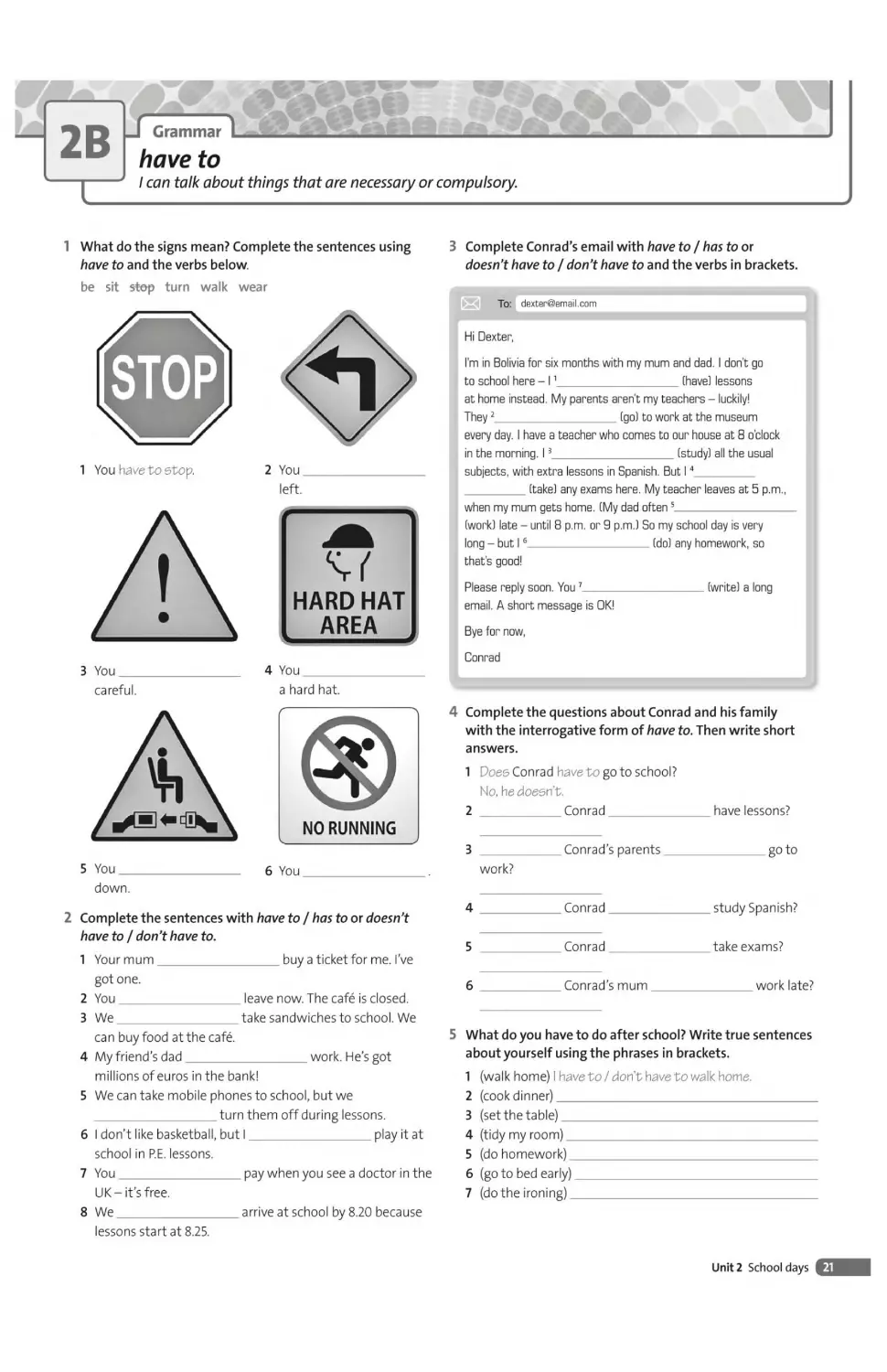
I can talk about things that are necessary or compulsory.
1 What do the signs mean? Complete the sentences using
have to and the verbs below.
3 Complete Conrad’s email with have to I has to or
doesn’t have to I don’t have to and the verbs in brackets.
be sit step turn walk wear
1 You have to stop.
To: dexter@email.com
Hi Dexter,
I’m in Bolivia for six months with my mum and dad. I don't go
to school here -1* 1______________________(have) lessons
at home instead. My parents aren't my teachers - luckily!
They2_________________________(go) to work at the museum
every day. I have a teacher who comes to our house at 8 o'clock
in the morning. 13________________________(study) all the usual
subjects, with extra lessons in Spanish. But 14___________
(take) any exams here. My teacher leaves at 5 p.m.,
when my mum gets home. (My dad often5_____________________________
(work) late - until 8 p.m. or 9 p.m.) So my school day is very
long - but 16________________________(do) any homework, so
that’s good!
Please reply soon. You7________________________(write) a long
email. A short message is OK!
Bye for now,
Conrad
3 You_______________________
careful.
4 You
a hard hat.
4 Complete the questions about Conrad and his family
with the interrogative form of have to. Then write short
answers.
1	Does Conrad have to go to school?
No, he doesn't.
2	Conrad have lessons?
5 You
down.
6 You___________________
3	Conrad’s parents go to
work?
2 Complete the sentences with have to I has to or doesn’t
have to I don’t have to.
1	Your mum buy a ticket for me. I've
got one.
2	You leave now. The cafe is closed.
3	We take sandwiches to school. We
can buy food at the cafe.
4	My friend's dad work. He’s got
millions of euros in the bank!
5	We can take mobile phones to school, but we
turn them off during lessons.
6	I don’t like basketball, but I play it at
school in P.E. lessons.
7	You pay when you see a doctor in the
UK-it's free.
8	We arrive at school by 8.20 because
lessons start at 8.25.
4	Conrad	. study Spanish?
5 Conrad take exams?
6 Conrad’s mum work late?
5 What do you have to do after school? Write true sentences
about yourself using the phrases in brackets.
1 (walk home) I have to I don't have to walk home.
2 (cook dinner)_____________________________________________
3 (set the table)___________________________________________
4 (tidy my room)
5 (do homework)_____________________________________________
6 (go to bed early)_________________________________________
7 (do the ironing)__________________________________________
Unit 2 School days
Unusual schools
can
understand numbers,
dates and times.
1 Complete the text about the West London Free School. Use
the words below.
chew do go punish study wear(x2)
In the West London Free School...
•	students have to1	Latin.
•	students have to2 a uniform.
•	teachers can3 the students if their
hair is very short.
•	students can’t4 chewing gum.
•	students have to5 to after-school
clubs four days a week.
•	students have to6 an hour of
homework every evening.
•	teachers have to7 long black
gowns (like the teachers in Harry Potter?).
Listening Strategy
Make sure you know how dates, times and numbers are
spoken so that you can identify them when you hear them.
2	Read the Listening Strategy. Then listen and tick
the times and dates that you hear.
1 a
2 a
3 a
4 a
5 a
6 a
7 a
8 a
c
11.15	П	t	10.45			c 11.45
12.10		t	10.12			c 11.50
6.30		t	5.30			c 6.50
8.25		t	8.35			c 7.35
22.04.2001			Г	b 02.04.2001
04.09.2020				b 05.12.2012
21 July 2010				b July 31 2002
16 February 2006
February 15 2016
22.04.2010 □
05.09.2020 □
31 July 2010 □
b February 16 2016
c
c
c
3	Write the dates and years as we say them.
1 12.12 thetwelfthof December/December the twelfth
2 01.08________________________________________________
3 10.03________________________________________________
4 23.10________________________________________________
5 2001_________________________________________________
6 2015_________________________________________________
7 1995_________________________________________________
8 2020_________________________________________________
4	Write the numbers you hear.
1 1,345	5
2		6
3		7
4		8
5	ffPn Listen and complete the sentences with the
number, date or time you hear. (Write numbers not words
where possible.)
1	My date of birth is.
2	School starts at.
3	This term ends on.
4	There are students in my school.
5	I usually have breakfast at.
6	My mum’s birthday is on.
6 ИДЭ Listentoastudentatthe West London Free
School talking about the school. Are the sentences true (T)
or false (F)?
1 Anna doesn’t like school very much. Q
2 She learns a musical instrument. О
3 She does homework before dinner every day.
7	Listen again. Choose the correct answers.
1	The school opened in...	c 2012.
	a 2011.	b 2010.
2	School starts at... a 8.30.	b 8.40.	c 8.50.
3	Anna has... lessons every day. a 3	b 5	c 6
4	The lessons are... minutes long, a 40	b 50	c 60
5	Anna has lunch at... a 12.35.	b 12.45.	c 12.55.
6	She has dinner at... a 6.00.	b 7.00.	c 9.00.
Unit 2 School days
2D
Adverbs of frequency; question words
/ can use adverbs of frequency and question words.
1 Put the adverbs of frequency in the correct order.
always hardly ever never often sometimes usually
2 Put the adverbs of frequency in brackets in the correct
place in the sentences.
1 School starts at 830. (always)
2 Matt does the washing, (never)
3 I'm tired in science lessons, (sometimes)
4 My parents work on Sundays, (hardly ever)
5 We are thirsty after P.E. lessons, (often)
6 You sit next to me. (usually)
3 Tick the answers that are true for you.
5 Put the words in the correct order to make questions.
1	you / how/to/do/school/get
__________________________________________________?
2	want / do / to do /you / this evening / what
	?
3	brothers /you / how many / have I got / and sisters
?
4	your/when/birthday/is
?
5	you/do/live/where
	?
6	do / play /you / how often / computer games
__________________________________________________?
7	you / what time / do / to bed / usually / go
__________________________________________________?
8	skateboard/whose/this/is
__________________________________________________?
9	you / do / which / cola or lemonade / prefer,
__________________________________________________?
10	a scarf, hat and gloves / got / have / you / why
___________________________________________________?
11	is/who/maths/teacher/your
?
6 Match the questions in exercise 5 with the answers below.
a In St James Road.
b At nine o'clock. [ ]
c By bike. Q
d Because I’m cold! _
e Three. | |
f Alexandra’s.
g Go to the cinema,
h Lemonade. [_
i 24 July. □
j Mrs Stephens. [3
к Everyday. L
1 How often do you forget to do your homework?
Never. | | Hardly ever. | ] Sometimes, d
Often.
7 Write questions. Then write true answers for you.
2 Do you have lunch at school?
No, never. Д Yes, sometimes. I 1 Yes, usually. Q
Yes, always. I I
3 How often do you go to after-school clubs?
Never. | | Hardly ever. [ 1 Sometimes. [ I Often. | |
1 what time / usually/get up?
2 how / get home from school?
4 Do you enjoy maths lessons?
No, never. | | No, hardly ever. [ | Yes, usually. Q
Yes, always. (3
5 How often are you late for school?
Never. [ | Hardly ever. [ ] Often. | | Sometimes.
3 what/usually/have for lunch?
4 who/usually/see/at weekends?
4 Look at your answers in exercise 3. Write sentences using
adverbs of frequency.
1 I never forget to do my homework.
2 ______________________________________________________
3 ______________________________________________________
4 ______________________________________________________
5 ______________________________________________________
6 ______________________________________________________
5 what / usually / do on Friday evening?
Unit 2 School days
Skills
Prepositions of time
/ can use a variety of prepositions of time.
1 Complete the rules. Use in, on and at.
1	We use			with months (e.g. May).
2	We use		with times (e.g. one o’clock).
3	We use	with parts of the day (e.g. the afternoon).
4	We use			with days (e.g. Monday).
5	We use			with years (e.g. 2015).
6	We use	with celebrations (e.g. New Year).
7	We use	with festival days (e.g. Children’s Day).
8	We use			with dates (e.g. 20 March).
9	We use			with seasons (e.g. autumn).
10	We use			with night and the weekend.
2 Complete the text with the correct prepositions: in, on
and at.
HOME
EDUCATION
Liam Brown lives with his mum on a small island
in Scotland. They live a long way from a town, so
Liam doesn't go to school. His mum teaches him
at home.
3 In the text in exercise 2, underline examples of the
prepositions below.
after before during from ...to until
4 Complete the sentences with prepositions from exercise 3.
1 In our school, lunch break is 12.30
____________1.30.
2	Lessons finish at four.that, I usually goto a
school club.
3	We have to study six subjects we are
sixteen. After that we can choose subjects.
4	I always do my homework dinner. After
dinner I watch TV and play computer games.
5	We can’t use mobile phones lessons.
5 Underline the mistakes with prepositions in these
sentences. Rewrite the sentences correctly.
1	I don't go to school in Sunday. X
2	I like to play football during the weekend. X
3 Do you give people presents at New Year’s Day? X
4 I do my homework on the evening. X
'I have lessons from Monday to Thursday. Mum lets me
sleep until nine in the morning and we start lessons
1 ten, after breakfast. The kitchen is my classroom
and the kitchen table is my desk! We have a break at
11.30. During the break Mum lets me play computer
games! My mum always gives me homework. I usually
do it before dinner.2 Fridays we travel to a city
and visit museums and art galleries. I don't meet other
children very often so I also go to a badminton club there
J the afternoon.4 the weekend I don’t have
lessons.5 Saturday mornings I play tennis with my
dad or we sometimes go walking. I study all the usual
subjects and I take national exams. My next exams are
next year. I think they're6__June. I have the normal
school holidays in the summer, and I don't have school
20 September - that's my birthday!'
5 The supermarket is open to six o’clock. X
6 I often go to the beach on the summer. X
I VOCAB BOOST!
/' к When you learn new words or phrases, say them out loud
four or five times. This will help you to remember them.
6 Read the Vocab boost! box. Choose four phrases that
include prepositions of time from this page and repeat
each one four times.
Small schools
/ can understand a text about very small schools.
Revision: Student’s Book page 24
1 Look at the pictures and complete the labels with the
adjectives below.
dangerous dry large narrow safe small wet
wide
Reading Strategy
When you match sentences to texts, make sure the
whole sentence matches the information in the text. Do
not just look for one or two words that are in the text
and the sentence.
path
boat
path
3 Read the Reading Strategy. Then match the sentences (a-g)
with the texts (1-3). Write 1, 2 or 3 in each box.
Which text talks about...
a two different schools? |
b a school without a teacher? (
c a school not in Scotland? (
d a school with more than one student? (
e a head teacher with an easy job? Ц
f a teacher who plays games at lunchtime? Q
g a region without a shop? Q
5 a__________________
rope
rope
SMALL
is beautiful?
7 a___________________
bridge
8 a__________________
bridge
Scoraig, a small region in the north of Scotland,
needs a new teacher for its primary school. It's a very
beautiful place, but nobody wants to work there.
It’s a real problem for the local council! So why can’t
they find a teacher? Well, perhaps one reason is the
isolated location. You can’t drive to Scoraig; you have
to walk along a narrow, four-kilometre path next to
the sea or take a boat. The region does not have a
shop or a post office, and every home has to find its
own supply of water and electricity. The school itself
is small - very small. In fact, only five children go
there! But those five children need a teacher, so the
council hopes to find one soon.
2 Read the texts opposite. What is unusual about the
schools?
Rum and Canna are two very small islands near the
west coast of Scotland. Rum has about 40 inhabitants
and Canna only has twelve. Each island has a small
primary school and the same head teacher is in charge
of both schools. At the moment, the head teacher does
not have a difficult job because the schools have no
students! So why do the islands need a head teacher
for their schools? According to the local council,
the answer is simple: ‘Things can change. We need
schools for tomorrow’s children.’ So for now, the head
teacher’s job is safe.
Budaixi Primary School is in an isolated region of
central China. It is difficult to find jobs here, so a lot
of families leave the region and move to big cities.
Because of this, the schools in the region are often
very small. Budaixi Primary School only has one
student. Her name is Xianzi and she is six years old.
Her teacher, Mr Guo, teaches her maths and Chinese.
Because Xianzi is the only child at the school, she
can't play games with other children at lunchtime - so
Mr Guo plays with her. They enjoy table tennis and
basketball. Then it is time for lessons again. And of
course, Xianzi is always top of the class!
Unit 2 School days
Giving advice
' advice.
can
ask for and give
1 Look at the pictures. Complete the sentences with should
or shouldn't and the verbs below.
answer go(x2) sit swim wear
1 He
down.
2 She
to bed.
3 She____________________
her helmet.
4 He
his phone.
3 Complete the dialogue with the words below,
course do problem right see something tell that
Beth Hi, Leo. Can I ask your advice about1?
Leo Yes,of2.What’sthe
J?
Beth Well, I’m worried about my schoolwork.
Leo Really? But you’re good at every subject!
Beth But I have to work in my parents' shop at weekends. So
it’s really difficult to do my homework.
Leo Yes, 14.
Beth What do you think I should5?
Leo You should talk to your mum and dad. You should
6 them how you feel.
Beth Should I say I can’t work at the shop?
Leo No, you shouldn't do7. They need
your help. But perhaps you can just work there in the
mornings.
Beth Yes, you’re8. Thanks, Leo.
4 trim Listen to three dialogues. Complete the summaries
with the words below.
angry brother parents sad show
teacher team words worried
1 The girl is with her.
The boy says that she should talk to her.
2 The boy is about the school
. The girl says that he should practise his
____________with her.
3 The girl is because she is not in a sports
. The boy says that she should talk to the
5 They_________________________
in this river.
6 They________________________
inside.
5 Read about these problems. What do you think the people
should do? Write one piece of advice for each person.
1 Jack: Tm always tired. But I can’t go to bed early because I
share a bedroom with my brother.'
2 Put the words in the correct order to make sentences giving
advice. Use should or shouldn’t.
1	(that/you /sandwich/eat) You shouldn’t eat that
sandwich. It’s a week old!
2	(go / we / park /the /to)___________________________
___________________. It’s a beautiful day.
3	(go/you/now/home)
	. Your dinner is ready.
4	(homework / my /1 / finish)_________________________
. I have to give it to the teacher
tomorrow.
5	(road / in / skateboard /you /the)
	. It’s dangerous.
6	(music /we /to / listen)____________________________
. My dad needs to sleep.
2 Sarah: 'I can’t study at weekends because we always have
visitors. I’m worried about my exams!’
3 Freya: Tm embarrassed about my bike. It’s really old and
it's a bit small for me.’
6 Now act out a dialogue to give advice using your ideas
from exercise 5.
) Unit2 Schooldays
Writing
An announcement
J I can write an announcement for a school event.
Preparation
1 Complete the school events. Use a, e, i, о, и andy.
1 c nc rt
2 m s c I
3 pl_______
4 sch I c mp
5 sch _	I cl _ _ b
6 sch I tr p
7 sp____rts d_________
2 Complete the announcements with the verbs below. Which
are imperatives? Circle them.
are come is meet phone play practise want
4 Put the words in the correct order to make imperatives.
1 forget/to tell /your friends/don’t
_____________________________________________________!
2 visit / this number / call / our website / or
i
3 make/friends/new
_____________________________________________________!
4 play/and/fit/football/get
i
5 it/don't/miss
______________________________________________________I
BADMINTON CLUB
Writing Guide
1______ you already a badminton player?
Do you2 to learn to play badminton?
Everyone3 welcome at our club,
especially beginners.
We4_______________in the school gym every
Thursday at 4 p.m. We5 for fun, but we also play
matches and 6 our skills.
to our club!
5 Make notes for an announcement for one of the clubs
below (or choose your own club).
Sports clubs: basketball club cycling club football club
gymnastics club hockey club
Other clubs: art club bookclub chess club dance club
debating club music club photography club
1 Name of club:
8 Laura on 07700 900227.
2 Meet where?

are come learn like meet play visit wait
3 Meet when (day and time)?___________________________________
J
4 What do you do at the club?.
COMPUTER CLUB
0° y°u 9 computers?
'°-----------you interested in programming?
Then ”to our computer club!
We 12----------every Monday in the computer lab
after school from 3.30.
We do programming, we 13_______to use software and we
14—-_________games online too. It's great fun!
Don't 15_________! Come to our club! Or _______
our website for more information, www.ourcomputerclub.com
• ’I* W-muneii	——---------------

5 Contact name and number, and website:
Writing Strategy
Make sure that you include all the information required
in the task. As you make notes in preparation, tick off the •
key points in the task as you deal with them.	•
6 Read the Writing Strategy. Then write the announcement.
Tick off the points in exercise 5 as you deal with them.
3 Complete the table with information from the
announcements.
Badminton Club	Computer Club
Day and time?
1	2
Where?
3	4
Activities
5	8
6	9
7	10
Contact for more information
11	12
I CHECK YOUR WORK
Have you...
^-i Q included all the information in exercise 5?
used some imperatives?
О checked your spelling and grammar?
Unit 2 School days
Review
Unit

Vocabulary
1	Complete the daily routine phrases in the text. Write one
word.
11 up at 7.20 a.m. during the week, and I get
up at 730. First, I have a shower and then 12
dressed. Next, 13 breakfast. I usually walk
to school. 14 at school at 830 a.m. In the
afternoon, 15 school at 230 p.m. After that, I do
my homework and see friends. 16 to bed early
because I have to go to school the next day.
Mark:	/6
2	Complete the days of the week with the missing letters.
1	M у
2	T---------------у
3	W______________________у
4	Th_______________у
5	F____________У
6	S__________________у
7	5____________у
Mark:	/7
3 Complete the definitions with school subjects.
1	is the study of numbers, measurements and
shapes.
2	is the study of the way people and countries
spend money and make, buy and sell things.
3	is the study of things that happened in the
past.
4	is the study of the Earth and everything on
it, such as mountains, rivers, land and people.
5	is the study of the life of animals and plants.
Mark:	/5
4 Complete the second sentence using the opposite of the
adjectives in the first sentence.
1	China is a large country.
Andorra.
2	During the day, New Orleans is safe.
At night,.
3	This road is very wide.
That path.
4	Summer in Portugal is usually dry.
Winter in Portugal.
Mark:	/4
5	Complete the sentences with the words below,
boat bridge jungle mountain river valley
1	The Golden Gate is in San Francisco.
2	The Thames is in London.
3	Kilimanjaro is a in Tanzania.
4	The river in the bottom of this is called the
Rhine.
5	The Amazon rainforest is a large in South
America.
6	The only way to visit the Statue of Liberty in New York is by
Mark:	/6
6	Choose the correct answers.
1	Emma is. She wants to goto bed.
a angry	b sad	c tired
2	Maxis. He can't find his phone.
a happy	b embarrassed	c worried
3	We're. Our holiday starts tomorrow.
a excited	b worried	c angry
4	I'm. I can’t remember your name.
a tired	b embarrassed	c happy
5	The teacher is. All the students are late.
a angry	b excited	c happy
6	Charlotte’s. She doesn’t like her new school.
a excited	b sad	c tired
Mark:	/6
Word Skills
7	Match the first parts of the sentences (1-6) with the second
parts (A-F).
1	My friends go on holiday in Q
2	It’s my birthday on L
3	Rob plays basketball at (3
4	I wash the dishes after Q
5	My English class is from Q2
6	We all get up early during (_
A dinner.
В 930a.m.toll a.m.
C August.
D the week.
E the weekend.
F Sunday.
Mark:	/6
Unit 2 School days
Grammar
Use of English
8 Complete the dialogue with the correct form of have to and
the verbs in brackets.
Louise Do you help with the housework at home, Thalia?
Thalia Yes, I do.
Louise What1? (you / do)
Thalia Well, 12(not clean) the
house, but 13(set) the
table for dinner every day. My brother does more
housework than me.
Louise What4? (your brother / do)
Thalia He5(load) the dishwasher
every night after dinner. But he6
(not / unload) it. My dad does that in the
morning.
Mark:	/6
9 Choose an adverb of frequency in brackets to replace the
words in bold. Then rewrite the sentence.
1 My parents go to the cinema once a year, (always / hardly
ever/often)
My parents.
2 I play tennis twice a month, (never/sometimes / usually)
I.
3 We don’t watch TV in English, (never / sometimes / usually)
We.
4 Jo wears jeans every day. (always / hardly ever / often)
Jo.
5 They have pasta for lunch on Mondays, Tuesdays and
Fridays, (always / hardly ever / often)
They.
6 Mike gets up early from Monday to Friday, (never I
sometimes/usually)
Mike.
Mark:	/6
10 Complete the dialogues with the correct question words.
1 A do you do your homework?
В In the evening.
2 A does your mum get to work?
В By car.
3 A do you usually have for lunch?
В A sandwich.
4 A do your grandparents live?
В In Scotland.
5 A does your sister live with?
В Two friends.
6 A do you prefer, French or German?
В German.
Mark:	/6
11 Complete the text. Write one word in each space.
1 do you do when you have a problem?
Problems usually get bigger if you don't do
something about them. If you've got a problem, you
2	always ask for help; 3
keep your problems to yourself. If it's a problem at
school,4 to a member of your family
when you get home5 the afternoon. If
it's a problem at home, tell a friend when you arrive
6 school the next day. People often feel
better when they talk about things. So,7
is the best person for you to talk to?
Mark:	/7
Total:	/65
I can...
Read the statements. Think about your progress and tick one of
the boxes.
П need more practice.
| = I sometimes find this difficult.
| = No problem!
1 can describe my daily routine at school and at home.
1 can talk about things that are necessary or compulsory.
1 can understand numbers, dates and times.
1 can use adverbs of frequency and question words.
1 can use a variety of prepositions of time.
1 can understand a text about dangerous journeys to school.
1 can ask for and give advice.
1 can write an announcement for a school event.
Unit 2 School days
Clothes
I can describe people’s clothes.
1	Find fifteen more items of clothing in the wordsearch and
write them below.
2  10
3 	11
4 	12
5  13
6  14
7 	15
2	Write three items of clothing which:
1	onlygirlsand women usually wear.
2	people often wear to do sport.
3	people often wear on a cold day.
4	people often wear on a hot, sunny day.
4	Listen and match the names with pictures A-F in
exercise 3. Write the letters in the boxes.
1 Ava | ]	3 Zoe | ]	5 Mia Q
2 Ethan [ |	4 Logan | )	6 Lucas [3
5 tTMH Listen again. For each teenager, find one item of
clothing in the picture that is not in the description.
1	Ava has got a cap.
2	Ethan.
3	Zoe.
4	Logan.
5	Mia.
6	Lucas.
6 Look at the photo. Write a
description of the woman’s
clothes or the man’s clothes.
3 Look at the pictures (A-F). Are the sentences true (T) or
false (F)?
1	The girl with the cap
has got a long coat. Q
2	The boy with the shorts
hasn’t got socks. Q
3	The boy with the cap
has got trainers. Q
4	The girl with the jacket
has got a long skirt. Q
5	The girl with the dress
has got a cardigan. (_
6	The boy with the scarf
has got jeans. (
 Unit3 Style
- ЗВ
ч
Present continuous
/ can talk about things that are happening now.
1 Put the words in the correct order to make sentences in the
present continuous.
1	with/housework/helping/the/Гт
I'm helping with the housework.
2	watching/my brothers/TV/are
4 Look at the picture. Complete the sentences using the
affirmative or negative form of the present continuous of
the verbs in brackets. Correct the negative sentences.
3 our rabbit/eating/is/food/its
4 the/shining/is/sun
5 a/Maria/coat/wearing/is
6 very well /you’re / the guitar / playing
7 my / me / sitting / is / best friend / next to
8 leaving/our bus/soon/is
2 Make the sentences in exercise 1 negative.
1	I’m not helping with the housework.
2
3
4
5
6
7
8
3 Complete the questions using the present continuous form
of the verbs in brackets. Then write true answers.
1	it	. (rain) outside?
2________the sun(shine)?
3________your friends(sit) near you?
4____you(wear) jeans?
5	you(listen) to music
at the moment?
6 you(eat) anything
at the moment?
1	The man with a hat isn't reading (read) a magazine.
He’s buying a magazine.
2	The woman with glasses(watch) TV.
3	The boy with the cap(play).
4	The girl with long dark hair(sit) on her bag.
5	The man with glasses(wait) at the cafe.
6	The woman in a dress(walk) past the cafe.
5 Complete the email. Use the present continuous form
(affirmative, negative or interrogative) of the verbs in
brackets.
To: ted@email.com
Dear Ted,
How are you?1_________________________(enjoy) your new school?
Everyone here is fine, but 12______________________(get) really
angry with my brother. He3_________________________(do) lots
of exams this term, so he4________________________(work) very
hard. He spends every evening at his desk. I have to do all his jobs
around the house because he5__________________________(help) with
the housework at all. It's so unfair!
That’s all for now. Mum6________________________(call) me. Dinner
is ready! When7_________________________(plan) to visit us?
Love,
Poppy
Unit3 Style
Catwalk
fashion
stress
can identify stress patterns
in
two
- and three-syllable words.
1 Complete the adjectives. Use a, e, i, о, и andy.
1	b gg
2	c S______I
3	d г к
4	I ght
5	I —ng
6	1 _ n g - si v _d
7 p tt rn d
8 p I n
9 s h__rt
10 sh rt-sl v
11 sm___rt
12 t_ght
2 Say the words below. Notice the stress patterns. Put them
into the correct place in the tables.
address afternoon apartment basketball eraser father
grandfather introduce lemonade lesson moustache
parent tattoo teenager together
Listening Strategy
In English, words with more than one syllable have the
stress on one of the syllables. This means that the syllable
is louder than the others. Being familiar with word stress
makes it easier to recognise words when you hearthem.
5 iTiAEl Listen to the phone call. Choose the correct answers.
1	Millie is waiting for Tanya
a at home.
b at a party,
c in her bedroom.
2	Tanya is
a having problems with her outfit.
b phoning Millie for advice.
c leaving her house.
3	Millie is wearing
a a smart dress,
b a casual outfit and boots,
c jeans and a smart top.
4	Millie
a thinksthat Jake's outfit is smart.
b likes Amy's outfit.
c says that Greg is wearing his usual clothes.
5	Tanya asks Millie
a where to go.
b what time to arrive,
c what clothes to wear.
з ffm Read the Listening Strategy. Then listen to pairs of
words. Is the stress pattern the same or different? Write S
for the same or D for different.
1 D 2  3  4 __________________________________ 5
6 _________ 7 __________ 8 ___________ 9 _________
4 Circle the word with the different stress pattern.
1	computing	excellent	educate	instrument
2	family	musician	Saturday	holiday
3	Japanese	seventeen	Bangladesh	beginning
4	answer	correct	canteen	unload
5	trousers	complete	jumper	sister
6	children	teacher	water	along
6	Decide which syllable is stressed in the following words.
Write 1,2 or 3.
1 again
2 always
3 attractive
4 because
5 decide
6 fantastic
7 horrible
8 idea
9 outfit
10 together____
11 trainers
12 twenty-five
7	Complete the sentences with the words in exercise 6.
1 It’s seven.
2 I can't what
_______to wear!
3 They look.
4 She thinks it's, but it’s
5 I wea r jea n s a nd
I can't wear them I
6 Thanks! Wonderful!
3D
I Grammar I
Contrast: present simple and present continuous
/ can talk about what usually happens and what is happening now.
1 Complete the rules. Write present simple or present
continuous.
We use the:
1	for something that happens
regularly, always or never.
2	for something happening at
this moment
3	for something happening around
this time.
4	for a fact that is always true.
5	with certain verbs that we don’t
usually use in continuous tenses, e.g. believe, know, etc.
2 Match the sentences (a-h) with the rules in exercise 1.
Write 1,2, 3,4 or 5.
a
b
c
d
e
f
g
h
This week my dad is working in London.
I’m wearing a blue T-shirt. (3
School finishes at four o’clock. Q
Do you understand this word? [
I don't want a sandwich. | ]
The sun comes up in the east. CI
We usually walk to school. [3
Why are you smiling? [_
3 Complete the email. Use the present simple or present
continuous form of the verbs in brackets.
To: mel@email.com
Hi Mel,
What1________________________(you / do) at the moment?
12______________________(sit) in Mario’s cafe.
13______________________(drink) a milkshake. This cafe
4_______________________(make) the best milkshakes in town!
15_________________________(often / come) here after school with
my friend Sally. In fact, 16_______________________(wait) for her
now. She’s always late. 17_________________________
4 Complete the sentences with the correct form of the verbs
in brackets. Use the present simple in one gap and the
present continuous in the other.
1	Tom often trainers to school, but
today he shoes, (wear)
2	We a DVD at the moment, but we
TV most evenings, (watch)
3	I usually a sandwich for lunch, but
today I some soup, (have)
4	My mum in an office in Manchester,
but this month she in Glasgow.
(work)
5	It hardly ever here, but
it at the moment, (snow)
6	Jason and Tilly their bedrooms right
now, but they usually them at the
weekend, (tidy)
5 Complete the sentences with the verbs below. Use the
affirmative or negative form of the present simple orthe
present continuous.
have know laugh like prefer sing watch
1	Which you, history or
geography?
2	'Where’s George?' ‘He a shower.'
3	I this pizza. It’s horrible!
4	'We the answer to this question.'
‘Well, ask the teacher.'
5	'What’s that terrible noise?’ 'Kate!'
6	'Why Ben?’
'Because he a funny film.'
6 There are mistakes in five of these sentences. Find the
mistakes and write the five sentences correctly.
1 'Are you wanting an ice cream?’ 'No, thanks.’
2 Right now I do my homework.
(not understand) why! Anyway,
3 I’m reading a really good book about Cristiano Ronaldo.
can I borrow your geography
textbook? 18_______________________
(need) it for that test next week. I can’t
find mine. Oh, Sally9_________________
(come) into the cafe now.
Bye, see you later!
Dan
4 Josh and Sam are hating maths.
5 I don’t believe in ghosts.
6 I’m sometimes play the guitar in my bedroom.
7 It's sometimes raining a lot in Scotland.
Unit3 Style
Skills
Adjectives: opposites
/ can use a variety of adjectives.
1	Match the adjectives below to make pairs of opposites,
awful different difficult expensive fantastic good
large low new safe true wrong
1	bad	7	terrible
2	great 8	high
3	similar 9	old
4	easy	10	right
5	cheap 	11	dangerous
6	false 12	small
2	Complete the sentences with adjectives from exercise 1.
1 Don’t play with that knife. It isn't.
2 £500 for a jacket? That's I
3	The shelf is very. I have to stand on a
chair to reach it.
4	Well done! All the answers in your test are
5	British English is a bit from American
English.
6	That calculation is very. I can't do it.
7	Joe says he’s seventeen. But that isn’t
He’s only fifteen.
5 Choose three adjectives from exercises 1 and 3 that you
could use to describe these things. Try not to use any
adjective more than once.
A a pair of jeans
1  2  3
В a city
1  2  3
C an exercise
1  2  3
D the weather
1  2  3
E a classmate
1  2  3
I VOCAB BOOST!
y> In entries for adjectives in most learner’s dictionaries you
can often find the adjective with the opposite meaning.
When you look up an adjective, make a note of the
opposite too, if it is given.
6 Read the Vocab boost! box. Then study the dictionary
entries below. Complete the pairs of adjectives.
3 Complete the adjectives. Use a, e, i, о, и andy. Which prefix
do we add to make the adjectives negative?
1 fr ndl
2 k_nd
3 h_pp_
4 t_d_
Negative prefix:
5 us__I
6 n _c_ss_r_
7 < mf_rt_bl
1	awake	Opposite:
2	late	Opposite:
3	beautiful	Opposite:
4	thick	Opposite:
5	near	Opposite:
6	soft	Opposite:
4 Complete the labels with negative forms of adjectives from
exercise 3.
awake /o'weik/ adjective not sleeping: The children are
still awake. > opposite asleep
3-
1 an_______________________
chair
3 an____________________
flower
5 an___________________
boy
J Unit3 Style
2 an__________________
room
4 an________________________
child
early /'sili/ adjective before the usual or right time: The
train arrived ten minutes early. > opposite late
ugly /'Acjli/ adjective not pleasant to look at: The house
was really ugly. > opposite beautiful
thick /Oik/ adjective far from one side to the other: The
walls are very thick. > opposite thin
far2 /fa:(r)/ adjective a long way away: Let's walk - it’s
not far. > opposite near
hard1 /ha:d/ adjective not soft: These apples are very
hard. > opposite soft
Teenage pressures
I can understand a text about the pressures on teenagers to look good.
Revision: Student’s Book page 37
1 Complete each pair of labels using the opposite
adjectives below.
artificial fake female
male natural ordinary real
a fake photo
photo
animal
animal
____________hair colour
_____________hair colour
2 Read the text. Which of the four teenagers sometimes tries
to copy the appearance of famous people?
Personal perspectives
Oscar
2
friends are the same as me.
'I'm not interested in images from the internet or magazines.
Celebrities all look the same these days. And a lot of girls my
age try to copy them. But I'm different - I try to find my own
look. I usually buy my clothes at charity shops, and I
have my own ideas about make-up too. My friends say I
look great - but my dad doesn't always agree!'
Elsie
16
I m not really interested in celebrities, but I care about my
appearance and I want to be fit and muscular. I go to the gym
four times a week. It s a good place to meet friends. And it s
a healthy hobby. I never take tablets, but I sometimes have
special drinks for building muscles. They aren t bad for
my health. Is it a problem? I don t think so. A lot of my
3
'A lot of the girls at school talk about hairstyles all the time
- and make-up and fashion. They all have favourite celebrities
and they try to copy their look. But I find all that boring. I've
got other hobbies - like sport. I go swimming three times a
week and I'm in the basketball and volleyball teams at school.
My close friends are similar to me. They don't worry
about their appearance, they just want to be fit and
healthy.'
Bella
15
'When I'm on my own, I wear very casual clothes - just a
tracksuit, or a sweatshirt with jeans. I don't wear make-up.
But when I'm with my friends, we sometimes dress up in nice
clothes and change our hairstyles. We wear make-up too. We
sometimes copy pictures of celebrities from magazines or the
internet - but that isn't a problem for us. We don't worry
about our appearance, we're just having fun. What's
wrong with that?'
Grace
15
Reading Strategy
When you do a matching task, check your answers by
trying to match the extra headings with each paragraph.
They should not match any of them.
3 Read the Reading Strategy. Then match paragraphs (1-4)
in the text with headings (a-f) below. There are two extra
headings.
cake an cake
a Fun with friends
b Body beautiful
c Pressure to look good
d A personal style
e Sad about looking ordinary
f Preferring sports
Unit3 Style
Making arrangements
. can make arrangements to meet somebody.
make
1	Complete the dialogue with the questions below.
how about 2.30? do you fancy going bowling on Saturday?
shall I come to your house and pick you up on the way?
what about Sunday? what time?
Max Hi, Daisy.1
Daisy That’s a great idea. But I'm afraid I can’t. I'm busy on
Saturday. I'm going shopping in London with my sister.
Max Well,2 Are you free
then?
Daisy Well, I’m going to the cinema in the morning, but I’m
free in the afternoon.
Max OK, why don’t we go after lunch then?3
Daisy Great idea.4___________________
Max 5________________________________
Daisy Cool. See you at my house at 2.30.
2	Complete the table with the words below.
the beach a cafe cards computer games dinner football
friends ice skating swimming a walk
Free-time activities
play	1	/ tennis / 2	/’.
go	bowling/4	/dancing/ rollerblading/5
go to	the cinema /6	/ 7
go for	8
have	1 unch /9
meet	10
3 Complete the suggestions below with five different
activities from exercise 2. Use the correct form of the verb
(-ing form or the infinitive without to).
1 Do you fancy this evening?
2 Sha 11 we tomorrow night?
3 Why don’t we at the weekend?
4 How about on Sunday?
5 Let's tomorrow morning.
4	Put the phrases below into the correct groups.
Cool I’m afraid I can’t Great idea No, thanks
Sorry, but I’m busy That sounds fun Yes, I’d love to
Agreeing to a suggestion
5	tVIfrM Listen to a dialogue. Choose the correct answers.
1 Sam doesn't want to go ice skating because
3)	he’s busy. I I he doesn’t like ice skating.
2	Sam is free on
Q Saturday morning. Ц Saturday evening.
3	They agree to meet at 10.30 at
Ц the cafe. О the cinema.
4	They agree to have lunch
[ ] before the film. [ | after the film.
6	Listen again. Tick the phrases in exercise 4 that you
hear.
7	Which tense do we use for future arrangements? Choose
the correct answer.
the present simple О the present continuous [
8	Write notes about your future arrangements.
1 What are you doing this evening?
2 What are you doing tomorrow morning?
3 What are you doing on Saturday?
9 Now act out a dialogue to make arrangements using your
notes from exercise 8.
Unit3 Style
An email
can
write
an
informal email.

Preparation
1 Complete phrases 1-8 with the words below,
for from of soon things to (x2) wishes
1	Give my love your parents.
2	Thanks your email.
3	That's all me.
4	Best,
5	H о w a re?
6	Lots love,
7	Say'Hi'your sister.
8	I hope to see you.
Writing Strategy
There are certain expressions that are used to begin and
end an informal email, like Dear... and Best wishes... But
emails usually include a few other ‘social phrases’ near
the beginning and end. These make the email sound
more natural and friendly.
4 Complete the sentences with the correct linking words
below. Sometimes more than one answer is possible,
and because but or so
1	I’m tired I want to goto bed.
2	I’d like to go out this evening,I can’t.
3	I can speak French my mum’s from
France.
4	Let’s go to the newsagent’s buy a
newspaper.
5	Do you want to eat at home go to a
restaurant?
6	My name’s Lisa I’m your new penfriend.
5 Read the task. In what order does Holly cover the three
points in exercise 2? Number them 1-3.
Write an email to your friend in which you:
• talk about a future arrangement. Q
• suggest an activity to do together. Ц
• say what you are doing now. [ |
2 Read the Writing Strategy. Then choose three phrases from
exercise 1 to complete the email below. (More than one
answer is possible.)
To: james@email.com
Hi James,
1___________________________________I hope you and your family
are well. What are you doing at the moment? I’m trying to finish
my homework, but I so it’s taking a long time!
How about meeting in town one day soon? I want to try the new
cafe on Market Street because my mum says it’s very good.
We can go there after school because / or meet for lunch one
Saturday.
I’m going to Ava’s barbecue next Saturday. Are you going too? It’s
at her house. I’m helping her with the preparations because I so
I’m arriving early. I hope I see you there!
2___________________________________I have to get my things
ready for tomorrow morning. Please write soon!
з
Holly
Writing Guide
6	Plan an email for the task in exercise 5. Make notes about:
1 a future arrangement.
2 a suggestion for an activity.
3 your current activity.
7	Write an email following your plan from exercise 6. (You
can choose a different order for points 1-3.) Include phrases
from exercise 1.
I CHECK YOUR WORK
<S> Have you...
4-i П covered all three points in the task?
used phrases from exercise 1?
( J used linking words to join your ideas?
П checked your spelling and grammar?
3 Circle the correct linking words in the email.
Review
Unit

Vocabulary
1 Circle the words that are different.
1	boots scarf shoes
2	cardigan jumper skirt
3	dress jeans leggings
4	coat jacket shorts
5	cap socks hat
6	tie tracksuit trainers
Mark:	/6
2 Complete the sentences with the adjectives below,
dark long plain short-sleeved smart tight
1	I'm wearing a dress to my job interview because I need to
look.
2	You have to wear trousers to the restaurant.
You can’t wear shorts.
3	This jacket is. It isn’t very comfortable.
4	Wear a shirt to the barbecue. It’s a beautiful
day.
5	People in my country usually wear colours in
the winter and lighter colours in the summer.
6	I’m looking for a white T-shirt to wear under
this jumper.
Mark:	/6
3 Choose the correct word to complete the sentences.
1	My brother is a female/male model.
2	That photo is fake / real. You haven’t really got blue eyes.
3	It’s an ordinary / a special day, so I'm going to the
hairdresser’s in the morning.
4	Kate hasn’t really got fair hair. It isn't her artificial / natural
colour.
Mark:	/4
4 Complete the sentences with the negative form of the
adjectives below.
friendly happy kind necessary tidy usual
1	Those children are very. They say bad things
to people who are different from them.
2	Lily is with her new haircut. It’s very short.
3	I think make-up is. I prefer to look natural.
4	The shop assistants are very in that shop. I
never buy my clothes there.
5	Sam can't find his favourite T-shirt. His room's very
5 Complete the dialogues with the words below.
afraid busy cool fancy how idea let’s love shall
sounds
Dialogue 1
Chloe Do you1 playing tennis this afternoon?
Poppy I'm 2 I can’t. I’m going swimming with
my sister.
Chloe What about tomorrow afternoon?
Poppy Yes, I’d3 to.4 I book a
tennis court?
Chloe Great5 I
Dialogue 2
Mark 6 go to the new burger bar tomorrow.
Sean Sorry, I’m7. I’m going to the beach
with my cousins.
Mark 8 about going bowling in the evening?
Sean That9 fun.
Mark Come to my house at 7.30. We can go together.
Sean 10.
Mark:	/10
Word Skills
6 Complete the dialogues using the opposite adjectives.
1	A Is that jacket new?
В No, it’s.
2	A Am I right?
В No, you're.
3	A Is chemistry easy?
В No, it’s.
4	A Are your boots similarto mine?
В No, they’re.
5	A Is that sport dangerous?
В No, it's.
6	A Is that answer true?
В No, it's.
7	A Is that a good idea?
В No, it’s very.
8	A Are their prices high?
В No, they’re quite.
9	A Is it a great film?
В No, it’s.
Mark:	/9
6 My cousin's clothes are. She often makes
them herself.
Mark:	/6
Unit3 Style
, Review Unit 3
Grammar
7 Complete the dialogue with the correct present continuous
form of the verbs in brackets.
Ben Hi, Eddie. What1? (you /
do)
Eddie Hi, Ben. 12(study)
geography.
Ben Me, too. What's that noise?
3(your sister / listen) to
music?
Eddie No, she 4(not listen) to
music. She5(play)
the guitar.
Ben Oh. And I can hear voices. Is that your parents talking?
Eddie No, it’s the TV. My parents 6
(not talk). They7(watch) a
film.
Ben Your house is very noisy, Eddie.
Eddie Yes, I know. 18(not learn)
anything!
Ben Why don’t you study at my house?
Eddie Good idea. I’m on my way!
Mark:	/8
8 Complete the sentences with the present simple or present
continuous form of the verbs below.
buy go not go out not like make not want not wear
work
1 I a skirt for the party, but it isn’t
finished.
2 I this shop. It’s expensive.
3 Tina usually	clothes shopping with
her friends.
4 My sister’s at the shopping centre. She
a dress for her friend’s wedding.
5 Tony’s cold. He a coat.
6 My brother to buy new trousers. He’s
happy with his old jeans.
7 We're ti red. We to n i ght.
8 People in clothes factories in Bangladesh
___________________very long hours.
Mark:	/ 8
Use of English
9 Choose the correct answers.
The Inuit people1______in northern Canada, Alaska,
Greenland, and in the north of Russia. Here the temperature
is very2- it can go down to -50°C. The Inuit usually
modern clothes, like jeans, T-shirts and jumpers. But
today is4	, because it’s the first day of spring. Many
of the Inuit people5 traditional clothes, such as coats
made of animal skins. They’ve got animal-skin 6 on
their feet, too. Some of the women have got beautiful
belts of many colours. What8______in cold weather in
your country?
1 a live
2 a high
3 a wears
4 a artificial
5 a are wearing
6 a boots
7 a dark
8 a are you wearing
b is living
b low
b are wearing
b ordinary
b wear
b leggings
b patterned
b do you wear
c lives
c small
c wear
c special
c wears
c trousers
c plain
c you wear
I can...
Read the statements. Think about your progress and tick one of
the boxes.
Q = l need more practice.
ЦД = I sometimes find this difficult.
| = No problem!
1 can describe people’s clothes.
1 can talk about things that are happening now.
1 can identify stress patterns in two- and three-syllable words.
1 can talk about what usually happens and what is happening now.
1 can use a variety of adjectives.
1 can understand a text about the pressures on teenagers to look good.
1 can make arrangements to meet somebody.
1 can write an informal email.
Unit3 Style
Exam
Skills
Trainer

Reading
Listening
Strategy
In a gapped sentences task, words in the missing sentences
such as pronouns (they, them, etc.) and possessive adjectives
(their, etc.) can help you choose the correct answer.
Underline these words in the missing sentences and see if
they match the people or things in the text before or after
the gaps.
1 Read the Strategy. Then look at the missing sentences
(A-H) in exercise 2 and underline the pronouns and
possessive adjectives.
Strategy
One or more of the questions in a listening task usually asks
about the context of the recording, for example:
Who are the speakers? Where are they?
When is the conversation happening?
3 Read the Strategy. Then look at the questions in exercise 4.
Which question doesn’t ask about context? [_
Listen to four short recordings. Choose the correct
answer (A-D).
2 Match gaps 1-7 in the text with sentences A-H below.
There is one extra sentence.
A You can use a theatre, a shopping centre, or your
school hall.
В Then see how long it takes them to walk down the
catwalk.
C Schools often organise events to help them.
D When it's over, you can sit back and relax.
E They shouldn't be very expensive.
F Ask if you can borrow some outfits for a few days.
G The first thing you need is a team.
H Ask your friends at school ifthey wantto be models for a
day.
How to organise a charity fashion show
1 Who is speaking to the students?
A A doctor.	C A parent.
В A police officer.	D A head teacher.
2 When does Sean ask his mother about the jumper?
A At the weekend. C Afterschool.
В Before school.	D At night.
3 What do Rita and Karl think about school uniforms?
A They like them. C Only Rita likes them.
В Only Karl likes them.	D They dislike them.
4 Where can you hear the announcement?
A On the radio.	C At a train station.
В At school.	D In a library.
Use of English
Charities like UNICEF and OXFAM
always need money.1 One
thing they sometimes do is to
have a fashion show. Read on
for some tips on organising a
successful show.
It's impossible for one person to
organise a fashion show alone.
2 Ask friends and family
for help, and give everyone a
job to do.
The next thing you need is a
place for the show. 3 You
need to have a catwalk for the
models to walk on and some chairs for the audience.
After that, you need to find some clothes. Talk to students at
a fashion college or visit some shops. 4 Remember to
give them back on time.
Now you've got the clothes, you need to find people to wear
them. 5 If they aren't interested, look on social media,
like Facebook.
Before the show, you need to practise. Ask the models to try
on the clothes to check that they are the right size. 6
The show should last about 20 minutes.
Strategy
In a gapfill task, some of the gaps may test auxiliary verbs.
Remember to use the correct form of do for present simple
questions and negatives and the correct form of be for
present continuous.
5 Complete the sentences with the correct form of do or be.
1	It’s hot! Why you wearing a coat?
2	My sister going to the festival because she
hasn't got any money.
3	What time the concert start?
4	We staying in a hotel - we’ve got a tent.
5	I like music, but I play a musical instrument.
On the big night, ask a good friend to be your assistant
director. A fashion show is a lot of work, and there's always a
lot to do. 7______It's time for your cleaning team to tidy up!
} Exam Skills Trainer 2
Exam Skills Trainer 2

6 Read the text and complete it with the correct words. Use
one word in each gap.
Welcome to Glastonbudget
It1	raining, but there are black clouds in the sky.
There is music, just like Glastonbury, but this isn't Glastonbury.
For one thing, it's only May, and the Glastonbury Festival is
2	June. This is Glastonbudget, a music festival
similar3 Glastonbury, but not quite the same.
People 4 watching the Arctic Monkeys on the main
stage right now; it's the Antarctic Monkeys. Lisa Gaga
5 singing on the second stage. These bands are
tribute bands - they look and sound exactly like the real thing.
Glastonbudget is a three-day festival, and you 6
camp there, just like at Glastonbury. There are cafes and
restaurants where you can 7 breakfast, lunch and
dinner too. So, 7 8 * you fancy going to a music
festival? The problem with Glastonbury is that it's very
to buy tickets. Glastonbudget 10
cost as much and the music is just as good.
8 Decide who is Student A and who is Student B. You have to
do a project together for homework. Make an arrangement
to work on the project together. Follow the prompts below.
A Greet B. Ask if В wants
to do the project at
the weekend.
A
Decline B’s suggestion.
Give a reason. Suggest
another day/ part of a
day.	B
A Suggest a time and
place to do the project.
Writing
В
Decline A's suggestion.
Give a reason. Suggest
another day/part of a
day.
Agree to the
suggestion. Ask about
the place.
Agree.
Speaking
Strategy
In a guided conversation make sure you respond to your
partner before moving on to a new point.
Strategy
When we write an email to a friend, we often use informal
language, rather than formal language. Informal language
includes contractions (/ am = I’m), imperatives (Canyou
tell me... = Tell me...) and informal vocabulary (thankyou =
thanks).
7 Read the Strategy. Then match sentences 1-5 with
responses A-E.
1 Do you fancy going for a walk? Q
2 It’s a lovely day. Ц
3 Are you free this weekend? (3
4 Is that new restaurant expensive? [2
5 I think we should stay in tonight. I I
A I don't think so. Let's look at the website.
В Great idea. Where shall we go?
С I agree. Shall we watch a DVD?
D Sorry, but I’m busy. How about next weekend?
E You’re right. Let’s go to the beach.
9 Read the Strategy. Then rewrite the sentences using more
informal language.
1	Dea r C h I oe,________________
2	I hope you are well.
3	That is all from me.
4	Can you call me next week?
5	Goodbye for now._____________________
6	Can you ask your parents?
10 Write an informal email to a friend. Include the information
below.
•	Thank your friend for his/her email.
•	Mention an event you’re organising at your school.
•	Describe the event.
•	Invite your friend to the event.
•	An appropriate ending.
Exam Skills Trainer 2 (
4
Are you hungry?
I can talk about breakfast, lunch and dinner.
1 Complete the puzzles with the types of food in each
picture.
3	Listen to four couples in the supermarket. Match
three of the couples with the shopping lists (A-C) in
exercise 2. (One couple does not match any of the lists.)
1	Jack and Mary: List____
2	Leo and Darcy: List
3	Arthur and Megan: List
4	Finley and Amber: List
4 Listen again. What does the other couple buy?
Write the four food items.
1 	3
2 	4
Listen to the phone call in a hotel. Which breakfast
does the guest order? Tick the correct picture.
10
2 Complete the shopping lists. Use a, e, i, о and u.
What do you usually have for breakfast? Describe it.
On school days, I usually have____________________
At weekends, I usually have_______________________
Unit 4 Food
ч
4В
I Grammar I_______ _________________________
there is / there are; some and any
I can use there is / are and some / any correctly.
1 Choose There’s or There are to complete the sentences.
Are the sentences true or false for you? Correct the false
sentences.
1	There’s / There are four people in my home.
True / False_____________________________________________
2	At my school, there’s / there are a gym.
True / False_____________________________________________
3	There’s/There are a swimming pool in my town.
True/False
4	There’s/There are six letters in my first name.
True I False_____________________________________________
5	There’s / There are a lot of shops in my town.
True / False_____________________________________________
6	There’s / There are a beach near my house.
True / False_____________________________________________
2 Complete the sentences with some or any.
1	We haven’t got milk for the cereal.
2	I don't want lettuce in my sandwiches.
3	We need olives for this recipe.
4	Please buy mushrooms at the supermarket.
5	I can’t see prawns in the fridge.
6	Have we got large tomatoes?
7	Have rice with your chicken.
8	Are we having fish at the barbecue?
3 Make the sentences negative. Be careful with some and any.
1	There's some chicken in the fridge.
There isn’t any chicken in the fridge.
2	I want some prawns on my pizza.
3	I’m eating some melon with my breakfast.
4	There’s a pineapple on the table.
5	There are some tomatoes in the shopping bag.
6	I want an egg for breakfast.
7	I’ve got some apples.
8	There are some sandwiches for your friends.
4 Put the words in the correct order to make questions.
Then look at the picture above and write short answers.
1	is/fish/any/there
Is there any fish?
Yes, there is.
2	sandwiches/there/any/are
_________________________________________________?
3	are/mushrooms/any/there
	?
6	prawns/there/any/are
	?
5 Complete the questions about your English classroom.
Use the interrogative form of there is I are and any or a /
an. Then write short answers.
1	Are there any windows?
Yes, there are. / No, there aren't.
2	bin in the room?
3	whiteboard?
4	shelves on the walls?
5	ta ble for the teacher?
6	cupboards?
7	computer?
3
Unit4 Food
—
Ff
F listening 1
Eating in the wild!
/ can identify and understand unstressed words.

M .
What are wild foragers? They
are people who look for food
in the countryside. They do
this because the food is free,
and it is fresh and healthy.
Wild foragers believe that
rich countries grow too much
food - and that isn’t good for
the environment. There is
already a lot of wild food in the
countryside. You can find lots
of mushrooms, leaves, grasses,
fruit, vegetables, seeds, herbs
and nuts in different seasons. So
why do we buy food, when we
can find food for free?
1 Read the text about wild foraging. Choose the correct
option (a-c) for sentences 1-3.
1	A wild forager is someone who looks for in the
countryside.
a wild animals b things to eat c plants
2	Wild foragers believe that wild foraging is.
a healthy b difficult c bad for the
environment
3	Wild foragers think that rich countries too much food,
a buy	b grow c eat
>••••••••••••••••••••• • ••••••••••••••••••••••••••••••••••
: Listening Strategy
•	Unstressed words can be difficult to catch in natural
•	speech. Being able to recognise the unstressed form of
•	words will help you to understand them when you hear
•	them.
3 63E3 Listenandcompletethesentences. Are the words
you wrote stressed or unstressed?
1	Liam swim.
2	Put on the table.
3	Where's salt?
4	That's apple.
5	Juan’s Spain.
6	Here’s water.
.26
Listen to an interview with a wild forager. Are the
sentences true (T) or false (F)?
1	Stacey studies and collects wild plants that are safe
to eat. (_
2	Stacey goes foraging once a month. (
3	Stacey never buys food in a supermarket. Q
4	There are some places that you can’t collect food from.
5	A lot of Stacey's visitors don’t enjoy her cooking. [ |
Read the Listening Strategy. Underline the stressed
‘content words’ in these sentences. Then listen, check and
repeat.
1	Steve is in the bathroom.
2	Where is the milk?
3	When’s your birthday?
4 Give me a sandwich
5 Goto bed!
6 Kate can ride a bike.
5 Underline the stressed words in these sentences.
1 I go with my friends and we look for food.
{Underlinefour words.)
2 And it isn't good for the environment.
{Underline two words.)
3 How often do you collect this kind of food?
{Underlinefour words.)
4 It's tasty, it's good for you and it’s free!
{Underlinefour words.)
} Unit 4 Food
4D
how much I how many, much I many I a lot of, a few I a little
I can talk and ask about quantity.
1 Complete the sentences with much or many.
1	There aren’t pens in my pencil case.
2	He hasn’t got rice.
3	They haven’t got bananas.
4	There isn’t water in the bottle.
5	We haven't got sugar.
6	There aren’t books on the shelf.
2 Complete the dialogue. Choose how much or how many.
Francis Let’s have some lunch. Do you want a sandwich?
Melanie Yes, OK. But ’how much / how many bread is
there?
Francis There’s a lot.
Melanie Good. We need some butter too. 2How much /
How many butter have we got? Look in the fridge.
Francis There’s a lot of butter too.
Melanie I'd like a tomato sandwich. 3How much /
How many tomatoes are there?
Francis There aren’t any tomatoes.
Melanie Oh. What about eggs? 4How much / How many
eggs are there?
Francis Six.
Melanie Let’s have egg sandwiches, then.
3 Complete the questions with how much and how many,
and is there and are there.
1 How many crisps are there?
2 ____________________cheese______________________?
3 			grapes			7
4 			sandwiches			?
5 			lettuce		7
6 			olives		? 	 •
7			chicken			?
8 			strawberries			7
4 Look at the picture below. What’s left after the party?
Answer the questions in exercise 3. Use There isn't much. I
There are a lot. I There aren't many.
1	There are a lot.
2
3
4
5
6
7
8
5 Complete the sentences. Use a little or a few.
1	We’ve got carrots in the fridge.
2	There’s only milk.
3	Can I have sugar, please?
4	There are apples on the table.
5	'Would you like some pasta?’ 'Just.
I’m not very hungry.’
6	I often go out with friends at
the weekend.
7	I sometimes have sugar in my coffee.
8	We usually buy newspapers at
the weekend.
9	I’ve only got time before I have to
go to school.
10	We need tomatoes and
cheese to make the pizzas.
Unit4 Food
Adjective + preposition
can use adjective
preposition
collocations.


1 Choose the correct prepositions.
1	popular to/with
2	bad on/for
3	responsible for/about
4	keen on/with
5	used about/to
6	worried about/with
2 Complete the text with the adjectives and prepositions in
exercise 1.
3 Complete the sentences with the adjectives below,
bad disappointed full good kind
1 Fruit and vegetables are for
your health.
2 I'm good at science, but at
art and music.
3	These snacks are of sugar and salt.
4	Always try to be to other people.
5	I'm very with my exam results.
4 Complete the sentences with the prepositions below.
at for in of (x2)
1	Are you interested art and photography?
2	Josh is afraid spiders! He hates them!
3	France is famous its cheese and wine.
4	Thank you foryour help. It's very kind	you.
5	I like maths, but I’m not very good it.
J VOCAB BOOST!
When you record new adjectives, record any prepositions
that go with them. You can find this information in a
dictionary, often in the example sentences.
duertfcin
A lot of parents and teachers are 1__
advertising in schools. Some food
companies put up posters in schools and give
leaflets to the students. Some companies give
sports equipment to schools if students buy
a lot of chocolate bars or crisps. Of course, a lot of
students are 2____________________these snacks
and are happy to buy them. In some schools
there are vending machines. These machines sell
drinks and snacks that are 3___________________
teenagers - they love them! But the drinks and
food are also 4___________________your health,
and some people say they are 5
__________obesity in children. Other people
say that students are 6
advertisements and the students don't buy more
snacks and drinks because of them.
5 Read the Vocab boost! box. Then look at the dictionary
entries below and note down the prepositions that go with
these adjectives.
1 proud	4 excited
2 late	5 bored
3 similar_______________
bored /bo:d/ adjective not interested; unhappy because
you have nothing interesting to do: I’m bored with this
book.
excited /ik’saitid/ adjective not calm, for example
because you’re happy about something that’s going to
happen: He’s getting very excited about his holiday.
similar /'simolo(r)/ adjective the same in some ways, but
not completely the same: Rats are similar to mice, but
they are bigger.
proud /praod/ adjective pleased about something that
you or others have done: They are proud of their new
house.
late Zlcit/ adjective, adverb after the usual or right time:
I was late for school today.
Unit 4 Food
Online dining
I can understand a text about an unusual online service.
I Revision: Student’s Book page 46
(•*** 1 Complete the messages on the internet forum.
Use the words below.
chef customers fork knife menu service tray
waiters
I love this restaurant. The1_____________is from
Italy and makes fantastic pizzas. There are lots of
great pasta dishes on the2_______________too.
And the3_________________are really friendly,
ooooo
I don’t like the atmosphere. The 4 5.
are all over 40 and eat their pizzas with a
5________________and 6__________________. It isn’t
for young people!	О О
Don’t go there! It’s really expensive. You pay £18
for a small7_______________of bread, olives and
other starters. Main courses are about £20 each.
And then they add 15% to your bill for
e________________I	О
2 Read the text. Tick the best definition of mukbang.
a Buying meals online and eating them alone. | )
b Finding friends online and going out for meals together,
c Paying to watch somebody online eat a meal. [_
Reading Strategy
When you have to complete sentences with information
from a text, start by deciding which part of the text
contains the information you need. Remember that the
sentences follow the same order as the text.
3 Read the Reading Strategy. Complete the sentences with
information from the text. Write one or two words in each
gap-
1 When Lee Chang-hyun starts work, he sits in front of his
2 While Lee Chang-hyun is working, he gets messages from
his.
3 About 3,500 people in South Korea in
mukbang.
4 Park Seo-yeon earns $9,000 from
mukbang.
5 Park Seo-yeon thinks people pay to watch her eat because
they don’t want to eat a lot of or sugar.
6
TV DINNERS
Lee Chang-hyun lives in Seoul, the capital of South Korea, and
he has a very unusual job. He starts work at midnight. He sits in
front of his computer, connects to the internet, and starts to eat.
He doesn't eat quietly- he makes lots of noise! While he eats,
people can watch a live video of his meal online. And every day,
about 10,000 people watch him. These viewers send messages
to him. The messages appear on his computer and he answers
Perhaps South Koreans enjoy watching people eat online
because a lot of them live.
For the viewers, mukbang is like eating with
Watching people eat is a popular online activity in South Korea.
You can also watch on a special TV channel. The name ofthe
hobby in Korean is mukbang. About 3,500 South Koreans take
part in it and a small number of them are famous. For example,
Park Seo-yeon is well known online as TheDiva. She earns
S9,000 a month from her viewers and it is now her full-time job.
But why do the viewers pay? Park Seo-yeon believes that health
is the main reason. People love dishes with lots of fat and sugar,
but they don't want to eat them, so they ask her to eat them
- and they watch! But can you really enjoy watching a meal but
not eating it? Or is there another reason for the popularity of
mukbang?
Perhaps there are social reasons for its popularity. These days, a
lot of South Koreans live alone. When you eat dinner alone every
evening, it's easy to feel sad. But with mukbang, you can eat with
others. It is a kind of online dinner party. And when you visit the
website often, it is almost like visiting friends.
At the moment mukbang is only popular in South Korea, not in
other countries. But perhaps it just needs some time ...
them while he's eating. And all the time, he is earning money.
Unit 4 Food (
I can order food and drink in a restaurant.
1 Complete the menu with the words below.
beef cheesecake chocolate pepper pie rice
starters
Tomato and red1 soup
Mini fishcakes
Thai2 salad
main courses
Beef and mushroom3
Chicken curry and4
Prawn stir-fry
desserts
Strawberry mousse
Lemon5__________
Home-made6 ice cream
2 Complete the dialogue with five of the phrases below.
There are two extra phrases.
And for you, sir? And for your main course?
And what would you like, madam? Are you ready to order?
Let’s leave a tip. The same for me.
Would you like anything to drink?
Waiter 1____________________________________________________
Man Yes, we are. I’d like the fishcakes to start, please.
Waiter Certainly.2__________________________________________
Man Can I have the chicken curry, please?
Wa ite r Of co u rse.3______________________________________
Woman To start, the soup. Followed by the prawn stir-fry.
Wa ite r Ve ry good.4_______________________________________
Woman Can I have water, please?
Man 5_______________________________________________________
Waiter Of course.
3 Rewrite the sentences in a polite way using would like,
affirmative or interrogative. Use please if necessary.
1	Do you want some rice?
2	What do you want for dinner?
3	I want a cup of coffee.
4	Where do you want to sit?
5 We want the bill.
4
Listen to three dialogues in the same restaurant.
When does each dialogue take place? Choose the correct
words.
Dialogue 1 takes place before / during / after a meal.
Dialogue 2 takes place before / during / after a meal.
Dialogue 3 takes place before / during / after a meal.
5	Read and complete these lines from the dialogues. Write
one word in each gap. Then write ‘Waiter’ and ‘Customer’
next to the correct lines.
1	Waiter:everything OK for you?
: Yes,fine, thanks.
2	: Can I have water, please?
: Yes,course, sir.
3	: Can we have a table two,
please?
: Certainly, sir. Follow.
4	: Would you to order some
drinks?
:, please.
5	: Can we the bill, please?
: Certainly.moment.
6:it include service?
: No, it.
6
Listen again and check your answers to exercise 5.
7 Look at the menu below. Imagine you are eating alone at
this restaurant. Choose and circle a starter, a main course
and a dessert.
menu
STARTERS
French onion soup
Salmon mousse
Olive pate
MAIN COURSES
Chicken and mushroom pie
Fish pie
Vegetable curry
DESSERTS
Melon with strawberries
Coffee cake with ice cream
Lemon mousse
8 Now act out a dialogue in a restaurant. Use your menu in
exercise 7 and phrases from exercises 2 and 5.
Unit 4 Food
- 4Н
ч
An invitation
/ can write an invitation.
Preparation
1 Match 1-7 with a-g to make key phrases for invitations.
1 I’m having a party
2 I’m О
3	Would you like L
4	Can you please [_
5	Put it □
6	I hope (3
7	Hope you L_
a in your diary!
b you can come. Let me know!
c planning (a party).
d can make it.
e to celebrate (my birthday).
f to join us?
g bring (some CDs)?
3 Read the Writing Strategy. Then find and underline one
mistake in each sentence below. Write G for a grammar
mistake, Vfor a vocabulary mistake and 5 for a spelling
mistake.
1 How much CDs can you bring? \G
2 The party should be funny! | ]
3	Can you pleese bring some food? QI
4	I inviting all my friends. | |
5	I’m having a berthday party. Q
6	Don’t remember to let me know if you can come.
2 Complete the invitations with key phrases from exercise 1.
To: lisa@email.com
Hi Lisa,
1_____________________________________. It’s on Saturday 11 April
from 7 o’clock. I'm inviting lots of friends and my cousins from
London too.
2_____________________________________? It should be fun. I don't
have much good music so3_________________________________________?
Or can you bring your MP3 player? I’ve got some speakers. Don't
forget the date: 11 April -4_____________________________________I
Love, George
To:
Hi Marcus,
5	to celebrate the end of the
school year. I'm inviting lots of people from our year at school.
We're going to the lake and we’re having a BBQ. Please bring some
food - maybe some burgers and sausages for the BBQ - and
some lemonade or cola.6-
you've got my mobile number.
Love, Alice
marcus@email com
Writing Strategy
When you have finished writing, check your work
carefully for mistakes. Read once for grammar, once for
choice of vocabulary and once for spelling.
4 Rewrite the sentences in exercise 3 correctly.
1 How_______________________________________________________
2 __________________________________________________________
3 __________________________________________________________
4 __________________________________________________________
5 __________________________________________________________
6 __________________________________________________________
Writing Guide
5 Plan an invitation for one of the events below. Make notes.
barbecue birthday party end-of-exams party
fancy dress party New Year’s Eve party street party
1 What is the event? Why are you holding it?
2 When and where is the event?
3 What should the person do or bring?
6 Write the invitation using your notes from exercise 5.
I CHECK YOUR WORK
<B> Have you...
Q used some key phrases from exercise 1?
Q checked the grammar?
П checked your choice of vocabulary?
□ checked the spelling?
Unit4 Food
Review Unit 4
Vocabulary
1 Circle the word that is different.
1	apples onion pineapple strawberries
2	carrots	mushrooms	peas	prawns
3	beef	chicken eggs	lamb
4	bread	milk pasta	rice
5	crisps	cucumber lettuce	tomatoes
6	butter cheese fish yoghurt
Mark:	/6
2 Complete the sentences with the words below.
chef customers fork knife menu service tray
waiter
4 Complete the invitations with the phrases below,
can make it can you bring celebrate my birthday
I’m planning put it would you like
Hi Karen,
i
--------------------- a sleepover at
my house on Friday night with some friends.
to join us? I’ve got
Pictionan,and Tanya is bringing another game, so it
should be a lot of fun.
Hope you 3_
1	The was bad, because the waiters were
very slow, so we aren’t leaving a tip.
2	I can’t cut this meat because I haven't got a.
3	I can't eat my salad because I haven’t got a.
4	Let’s ask the for the bill.
5	That restaurant always has a lot of. It’s very
popular.
6	Would you like to see the dessert?
7	Please tell the that the fish was excellent.
8	We often have dinner on a in front of the TV.
Mark:	/8
Love,
Joanna
Dear Richard,
4	___next
I’m having a party to---------------------------
m0nth. Ife on Saturday 3 February at my house. I m
organising the drinks, but5------------------
some food?
6	in your diary!
3 Match the first parts of the sentences (1-8) with the
second parts (a-h).
1	Let's leave Q
2	Can we see Q
3	Is everything [
4	Would you like (
5	Can we have a (_
6	I’d like □
7	Can we [_
8	Does it include
a table for two, please?
b service?
c some water, please.
d OK for you?
e a tip.
f have the bill, please?
g a coffee or a tea?
h the menu, please?
Mark:	/8
Best wishes,
Mark:	/6
Word Skills
5 Complete the sentences with the correct prepositions.
1	We were very disappointed our meal. The
food was terrible!
2	My little sister is afraid the dark, so she
sleeps with a lighten.
3	They live in Mexico, so they’re used hot,
spicy food.
4	Some doctors say that eating a lot of meat is bad
	you.
5	It’s very kind you to invite us for dinner.
6	Many people think fizzy drinks are responsible
the obesity problem.
Mark:	/6
} Unit 4 Food
Review Unit 4

Grammar
Use of English
6 Complete the sentences with the correct form of there is or
there are (affirmative, negative or interrogative).
9 Complete the text. Write one word in each space.
1	a jacket on the chair. Is it yours?
2	any people in the cafe.
3	any meat in this pie?
4	a Japanese restaurant here, so we can’t
have sushi.
5	any apples on the tree?
6	any sugar in my tea.
7	a dishwasher in the flat?
Mark:	/7
7 Complete the dialogue with a, an, some or any.
Alice We need to go shopping. Let’s make a list.
Tania OK. Here’s a pen. You can write.
Alice Perfect. So, have we got1 fruit?
Tania There’s2 pineapple in the fridge, but we
haven’t got3 oranges.
Alice Right. Have we got4 vegetables?
Tania We've got a lettuce, some tomatoes and a cucumber.
Oh and there's5 onion.
Alice OK. What about rice and pasta?
Tania We've got6 7 pasta, but there isn't
7 rice.
Alice Right. What else?
Are you keen 1 hot dogs - you know,
those sausages in a long bread roll? So, how
2 hot dogs do you think you can eat for
dinner? 3	is a restaurant in New York
called Nathan's, which is famous4 its
hot dog eating competition. It's very popular
5 customers and about twenty
people take part every year. On 4 July, all of the
competitors stand behind6 long table.
A lot of other customers stand and watch. There
7 some big plates of hot dogs on the
table. There are also8 drinks, but not
many. They haven't got9 time to eat
the hot dogs because the clock stops after ten
minutes. A lot10	the competitors stop
eating before then, but most of them finish. An
American called Joey Chestnut holds the record
with 69 hot dogs in ten minutes.
Mark:	/10
Total:	/65
Mark:	/7
8 Complete the sentences with the words below.
a few a little a lot of how many how much many
much
/ can...
Read the statements. Think about your progress and tick one of
the boxes.
1 I don't want chips with my fish, just a few.
2 bread do you eat every day?
3 My little brother only eats vegetables.
4 My friends eat junkfood, especially burgers
and pizza.
5 I only want milk in my coffee, please.
6 sweets do you buy a week?
7 We don’t eat ice cream - only in the
summer.
□ need more practice.
| = I sometimes find this difficult.
FTT1 = No problem!
Mark:	/7
1 can talk about breakfast, lunch and dinner.
1 can use there is / are and some / any correctly.
1 can identify and understand unstressed words.
1 can talk and ask about quantity.
1 can use adjective + preposition collocations.
1 can understand a text about unusual restaurants.
1 can order food and drink in a restaurant.
1 can write an invitation.
Unit 4 Food |
In the city
I Vocabulary 1
Places
I can describe places in a city.
3 tTlfrM Look at the pictures and listen to the sentences.
Are the sentences true or false? Tick the correct answer.
1 Complete the names of these places and match them with
the pictures (a-h) below.
2 Match the sentences with the places in town below.
bank cinema hospital hotel library museum
park police station post office shopping centre
train station zoo
1 'Hello. I'm Doctor Langton. How is your arm today?'
2 ‘Excuse me. I’m looking for a book about the rainforest'
3 ‘The 9.35 from London to York is arriving at platform four.’
4 ‘I need to report a crime.’
5 ‘Can I have a room for three nights, please?’
6 'I need to send this letter to Canada, by air.’
7 ‘Excuse me. Where are the lions and tigers?’
8 ‘Look at that Greek plate. It's 3,000 years old!’
9 Td like to change some money into euros, please.’
10 ‘Be quiet! The film is starting!’
11 'Let's play football, then have a picnic.’
12 ‘You can stay here in the cafe. I need to go to the clothes
shop and then the bookshop.’
1 a TrueQ False [ | b True Q False Д cTruel ] False
Unit5 In the city
- 5В
-
Comparatives
/ can make comparisons.
1 Complete the travel blog. Use the comparative form of the
adjectives in brackets.
After a week in New York, I’m now in Philadelphia. It's
much1________________________(quiet) here, but it’s still a
big city, with lots of restaurants, museums and famous
buildings. The centre of Philadelphia is2____________________
(small) than Manhattan, so you can walk everywhere.
I think the people here are3______________________
(friendly) and4______________________(polite). But I prefer
New York. It’s5______________________(interesting) and
6______________________(exciting) than Philadelphia. And
public transport is8 7____________________(good), so it’s
8______________________(easy) to get around.
3 Complete the facts with the comparative form of the
adjectives in brackets. Include than. Use the correct form of
be, affirmative or negative, to make the facts true.
1	Antarctica (big)Australia.
2	Mars (far)from the Sun
	Earth.
3	Tigers (la rge)cheeta hs.
4	Mount Fuji (high)Mount Kilimanjaro.
5	The North Pole (cold)the South Pole.
6	London (rainy)Rome.
7	Beijing (polluted)Tokyo.
8	Gold (expensive)silver.
4 Write true sentences comparing yourself with a friend or
family member. Use the adjectives in brackets.
1	(patient) I’m more patient than my brother.
2	(kind)____________________________
3	(noisy)___________________________
4	(tidy)____________________________
5	(sensible)________________________
6	(cool)____________________________
7	(creative)
5 Write questions comparing the words below. Then write
your own opinion beginning with I think.
1	Which/easy / English/German?
Which is easier. English or German?
I think English is easier.
2	Who/funny / Ben Stiller/Jim Carrey?
3	Which/casual/a T-shirt/a shirt?
4 Which / bad / a broken leg / a broken arm?
2 Look at the prompts and write sentences. Use the
affirmative of be and the comparative form of the adjective
with than.
1	Prince Harry /young / Prince William
Prince Harry is younger than Prince William.
2	Crocodiles/dangerous/sharks
5 Who / famous / Lionel Messi / Taylor Swift?
6 Which/nice/chocolate/cheese?
3 Chinese/difficult/English
7 Which / attractive / a flower / a butterfly?
4 Friends/important/money
5 Twitter / new / Facebook
8 Which / good / a good exam result / a nice present?
6 Brown rice/natural/white rice
7 Six out often / bad / fourteen out of twenty
Unit5 In the city

Town or country?
can
identify
the
main it
of a listening text.
Revision: Student’s Book page 55
1 Label the pictures. Use the words below,
crowd farm field hill lake office block
shopping centre street traffic valley village wood
1 	7
2 	8
3 	9
4 	10
5 	11
6 	12
2	Read the Listening Strategy. Then listen to three
people. What are they talking about? Match them with the
correct topic (a-c).
1 Jonnie
a buses
b traffic
c shops
2 Ian
a a town
b a library
c a cinema
3 Milla U
a a hotel
b an office block
c a shopping centre
3	Listen and match speakers (1-4) with the sentences
(a-e). There is one extra sentence. Remember not to worry
if you don’t understand everything.
Which speaker...
a is showing visitors his/her new house in the country? | I
b explains what there is to do where he/she lives? Д
c is giving a tour of a town? [ |
d would like to live in the country? [
e wants to go on holiday to a city? Q
Listening Strategy
Sometimes it isn't necessary to understand all of the
details when you listen, as long as you understand the
main ideas. In these cases, focus on what you need
to know and do not worry if you do not understand
every word.
4 tTIfrbi Listen again and answer the questions.
1	Which country would speaker 1 like to visit?
2	Which buildings does speaker 2 mention?
3	Which does speaker 3 prefer, her old home or her new
home?
4 Why does speaker 4 dislike the place where he lives now?
Units In the city
1 Complete the forms of transport. Use a, e, i, о and u.
1	b	s	6	s h	p
2	c	r	7	t	x
3	c	ch	8	t r	n
4	m	t	rb	к		9	t r	m
5	pl	n		10		nd	rgr	nd
2 Write the superlative form of the adjectives.
1	warm 	5	exciting
2	noisy 	6	bad
3	wide	7	talented
4	big	8	easy
3 Complete the sentences. Use the superlative form of the
adjectives in brackets.
1 Planes are(quick) form of
transport.
2 Is chicken(healthy) type of
meat?
3 Which are, (comfortable)
trams, trains or buses?
4 I think Saturday is(good)
day of the week.
5 July is often(hot) month
of the year.
6 London isn’t(safe) city in
the UK.
4 Put the words in the correct order to make sentences.
1	river / is / The Amazon / the / in the world. / longest
2	from the sun. / furthest I Neptune / planet / is / the
3	friendliest / Who / in the class? / girl / is / the
4	animals I Chimpanzees I in the world. I are / most
intelligent/the
5	the / exams / worst. / are / maths / In my opinion,
5 Underline the mistakes. Rewrite the sentences correctly.
1	Josh is the taller boy in the class. X
2	Zurich is most expensive city in Europe. X
3	The Pacific is the most largest ocean in the world. X
4	James's exam results are the goodest in the class. X
5	The farest I travelled last year was to New York. X
6 Look at the table. Write sentences with comparative
Mexico City	Tokyo	New York
1,485 km2	2,188 km2	1,214 km2
ddd	ddddd	dddd
$$		$$$$$
Max: 27°C Min: 5°C	Max: 30°C Min: 2°C	Max: 25°C Min: -3°C
[Ы	(Iffy,	llffri llffrt	Ilffri llffti llflri
1 (big) Mexico City is bigger than New York, but Tokyo is the
biggest.
2 (small)________________________________________________________
3 (wet)__________________________________________________________
4 (dry)__________________________________________________________
5 (cheap)________________________________________________________
6	(expensive)___________________________________________________
7	(hot)_________________________________________________________
8	(cold)________________________________________________________
9	(clean)_______________________________________________________
10	(polluted)___________________________________________________
Unit5 In the city £
Words that go together
can
use
range
of travel
-related collocations.
a


1 Complete the collocations with the verbs below.
3 Answer the questions.
buy catch get on get out of go by
go up take travel to
1	taxi/bus/tram / train / plane, etc.
2	get to /school / work / London
3	/ get off a train / a bus / a tram, etc.
4	get in /a car / a taxi I a van, etc.
5	the stairs/the escalator
6	a ticket
7	a taxi / a train / a tram, etc.
8	a bus / a plane, etc. (but not a taxi)
1 How do you usually get to school?
2 How do your parents usually get to work?
3 When you go shopping, how do you usually get to the
shops?
cross drive give go lose miss ride wait for	4
9	a train / a bus I a tram / a plane, etc.
10	on foot
11	a bicycle I a scooter / a horse, etc.
12	your way
13	the road / street
14	to work / into town / to London
15	a bus / a tram I a train, etc.
16	somebody
2 Complete the texts with the
words below.
ftC>VS PO you
ger to $cuo&^
a lift by bus school the bus
Find and underline one mistake in each sentence. Rewrite
the sentences correctly.
1	What time do you arrive to London?/
2	Taxis are expensive, but I always catch a taxi to town. X
3	I usually arrive to home at 4.40 in the afternoon. X
4	Take a map with you so you don’t missyour way. X
5	My mum arrives to work at nine o'clock. X
6	Joe is waiting the bus at the bus stop. X
7	The plane arrives at Italy at ten o’clock. X
8	Sally usually walks on foot to school. X
Millie: How do I get to* 1? That depends.
My mum drives to2 3 4 on Mondays,
Tuesday and Wednesdays, so she gives me
3.	On Thursdays and Fridays, I go
4.	If I miss5, then
I have to walk.
a tram bicycle for a tram the road
Jacob: In the winter I always take 6 to
school. It's the best way. It stops in front of my
flat -1 only have to cross7.
I never have to wait long8 in the
morning. In summer I sometimes walk or ride my
9
a ticket a train on foot the train
Daisy: I live a long way from the school, so I have to walk
to the station and catch 10. I buy
11 in September at the start of the
school year. I get off12 near my
school and then go13. The
journey takes an hour.
I VOCAB BOOST!
You can record and learn words by topic. For example, for
the topic of transport, you can record forms of transport
(e.g. bus), jobs (e.g. driver), places (e.g. station), verbs
(e.g. drive), collocations (e.g. catch a bus).
5 Read the Vocab boost! box. Then put the words and phrases
below into the correct groups.
book a ticket change trains coach station depart ferry
flight attendant land moped taxi rank ticket collector
Topic: Travel
1 Forms of transport: bus. train, plane
2 Jobs: pilot, driver,_____________________________________
3 Places: train station, motorway,
n —________________________
4 Verbs: fly, walk, ride,
5 Collocations; buy a ticket, lose your way,
Revision: Student’s Book page 58
1 Match the continents with 1-7 on the map and the
compass points with а-d on the diagram.
east О
north L
south C
west
Africa
Antarctica
Asia | 1
Australia
Europe
North America
South America
Reading Strategy
When you do a matching task, read all the texts first to
get a sense of the overall meaning. Then, go through
the questions one by one. Decide which text you think
contains the answer and look for it carefully. If you can’t
find it, look in the other texts.
4 Read the Reading Strategy. Then match each question (1-7)
with one of the texts (A-C).
Which text is about a city which...
1	has around a million inhabitants? [3
2	does not have clean air? | |
3	does not have cold winters?
4	is not very safe for visitors? О
5	is not good for the health of its inhabitants? Q
6	is near to some very beautiful scenery? [_
7	is very, very cold in winter? Q
2 Read the texts opposite (A-C). Which two cities are in the
same continent? Which continent are they in?
and are in
3 Match the texts (A-C) with the pictures (1-3) below.
Norilsk
Norilsk is in Russia and is further north than any other large
city in the world. It is a very cold place, often -30°C in winter.
You can’t get to Norilsk by car or bus because there aren’t
any roads. You have to fly or, in summer, arrive by boat. (In
winter, the sea turns to ice.) The city has a population of around
180,000. A lot of these people work for Norilsk Nickel, one of
the biggest metal companies in the world. The factories there
cause a lot of pollution. In fact, the average life of an inhabitant
of Norilsk is ten years shorter than other Russians.
Punta Arenas
El Alto
Punta Arenas is in the south of Chile, in South America. It is
the furthest south of any large city in the world. It is near the
Antarctic circle, but because of the ocean, the winters are
not very cold (usually above 0°C). The population of Punta
Arenas is around 110,000. The city has a main square with
large, attractive buildings. There are also interesting museums.
And Punta Arenas is a good place to start a walking holiday,
because it is on the edge of Patagonia, a region with amazing
scenery. You can explore mountains and beaches - and see
penguins too!
C
El Alto is the second largest city in Bolivia, a country in South
America. It is also the highest large city in the world, with an
altitude of 4,150 metres above sea level. It is near the capital, La
Paz, but is bigger than the capital, with a population of about
a million people. El Alto is not an easy place to live. There is a
lot of traffic and the climate is cold: around -3°C in winter and
only around 7°C in summer. And there are often problems with
the water supply. The city's main attraction is a large open-air
market. Tourists sometimes come to El Alto to visit the market,
but they have to be careful - there is a lot of crime in this region.
Units In the city
5G
I Speaking I______________________________
Asking for and giving directions
/ can ask for and give directions.
4
3 Complete the key phrases with the words below. Then
match them with the pictures.
along at end first past over straight under
1	Go on.
2	Go King’s Rd. (ZZ
3	Take the left. CZ
4	Go to the of the
road.
Qi-32.
5 Go the bank.
6 Turn right__________the
crossroads. L
7 Go the bridge.
8 Go the bridge.
Listen to the directions. Start from ‘You are here’
on the map. Where do the people want to go? Mark the
routes on the map.
Speaking Strategy
If you don’t understand, ask the person you are talking to
to slow down, repeat or clarify.
Could you speak more slowly please? (ZZ
Could you repeat that, please? О
What does... mean? | |
1 Look at the map and complete the sentences with the
words below.
between corner left next to opposite
1	The police station is the bus station.
2	The library is the cafe and the hotel.
3	The restaurant is the fire station.
4	The gym is on the, next to the bank.
5	Go down William Street. The department store is on your
, near the traffic lights.
5 Read the Speaking Strategy. Tick the two questions that
the speakers use.
6 Prepare a dialogue giving directions from ‘You are here’ to
these places. Make notes.
1 The police station:_________________________________________
2 The restaurant:_____________________________________________
3 The library:___________________________________________________________
2
Listen and look at the map. Write the places.
1 supermarket
2 ___________________
3 ___________________
4 ___________________
5 ___________________
6 ___________________
7 Now act out a dialogue asking for directions. Use your
ideas from exercise 6 and phrases from exercises 1 and 3.
Я Units In the city
An article
I can write an article about a town.
Preparation
1	Read the text about Northwick. Match each paragraph
(1-3) with one of the topics below.
eating out entertainment getting around history
places of interest places to stay shopping
Paragraph 1 topic:____________________
Paragraph 2 topic:____________________
Paragraph 3 topic:____________________
Northwick
JJ Northwick is a very interesting town. The streets
are very narrow. Every Saturday, there's a market in
the square - a tradition that is about 500 years old!
And near the town, Northwick Hall is the old home
of Lord Northwick, a friend of Queen Victoria.
JJ One of the best things about Northwick is the
public transport. There are lots of trams and buses,
and tickets are cheap. Also, there are no cars in the
centre, so it's nice to walk or cycle there.
Л There are two hotels: The Residence and The
Eastgate. Both are comfortable, but the rooms at The
Residence arc larger. There is also a youth hostel.
The youth hostel is very cheap, but you have to share
a room with other people.
2	In the model text above, find the name of this building
near Northwick.
Writing Strategy
Write in paragraphs of two or more sentences. Give each
paragraph its own topic and introduce the topic in the
first sentence. Plan your paragraphs before you begin
writing.
3	Read the Writing Strategy. Then answer questions 1 and 2.
1 Which paragraph (1-3) in the model text does not begin
with a sentence to introduce the topic?
Paragraph |
2 Which is the best sentence to introduce that paragraph:
a, b orc?
a I think The Residence is the best hotel in Northwick.
b Northwick is very popular for a number of reasons.
c For people who need somewhere to stay, Northwick
offers a wide choice.
Writing Guide
4 Look at the paragraph plan below for an article about a
town called Southport. Read the notes and write the topic
for each paragraph. Use topics from exercise 1.
Paragraph 1 topic:
•	small town (20,000 people) but lots of restaurants
•	pubs - good food at good prices
Paragraph 2 topic:________________________________________
•	famous for art shops - but expensive!
•	large shopping centre outside town
Paragraph 3 topic:________________________________________
•	zoo outside town - small but interesting
•	two pubs have live music - local bands only
5 Add sentences a-c to the paragraph plan in exercise 4.
a small shops in town centre
b cinema - cheaper tickets on Thursdays
c great fish and chip shop - cheap!
6 Write an article about Southport using the plan from
exercise 4, including the extra sentences from exercise 5
J CHECK YOUR WORK
( Have you ...
1 followed the paragraph plan?
[ ] started each paragraph with a sentence to introduce
। the topic?
checked your spelling and grammar?
Unit5 In the city £
Review
Unit

Vocabulary
Match words 1-6 with words a-f to make places
in towns and cities.
1	bus
2	car QI
3	post Q
4	shopping
5	swimming
6	town | 1
a centre
b hall
c office
d park
e pool
f station
Mark:	/6
2 Complete the sentences with the correct prepositions
of place.
1	There’s a bank о the cinema. You have to
cross the road to take some money out.
2	The library is b the museum and the
supermarket.
3	The train station is n my house. It's a ten-
minute walk.
4	There’s a gym i the hotel. It's free for guests.
5	There’s a park n t the hospital,
on the left.
Mark:	/5
3 Complete the definitions.
1	a big area of water with land all around it
2	a high piece of land that is not as high as a mountain
3	a lot of people together
4	a piece of land used for animals or growing crops
5	a big group of trees
Mark:	/5
4 Choose the correct answers.
1	My grandparents usually fly to Spain on holiday. They go by
coach I plane/train.
2	We often ride to the park at the weekend. We go by
motorbike / ship I plane.
3	My dad always drives to work. He goes by bus I car /
underground.
4	My sister sometimes stays out late on Saturday nights, so
she goes home by plane / ship /taxi.
5	There’s always a lot of traffic on the roads in the morning,
so we go to school by car / coach / underground.
Mark:	/5
5 Complete the sentences with the words below.
Africa Asia east Europe North America south
1	France is in.
2	Marseille is in the of France and Paris is in
the north.
3	Kenya is in.
4	China is in.
5	Berlin is in the of Germany and Dusseldorf is
in the west.
6	Canada is in.
Mark:	/6
6 Complete the directions with the verbs below. You can
use one verb more than once.
go take turn
1	over the bridge.
2	the first left.
3	past the fire station.
4	straight on.
5	left at the crossroads.
6	along Station Road.
Mark:	/6
Word Skills
7	Match the first parts of sentences 1-6 with the second
parts (a-f).
1	Let’s go
2	Don’t lose Q
3	Can you give (
4	Don’t get off Q
5	Don’t miss d
6	Get in (_
a me a lift, please?
b your way in the park!
c the last train!
d the car quickly.
e the train here.
f on foot.
Mark:	/6
Units In the city
4
, Review Unit 5
Grammar
Use of English
8 Rewrite the sentences using the comparative form of the
opposite adjectives.
1	Fridays are better than Mondays.
Mondays are.
2	Chinese is more difficult than English.
English is.
3	Country roads are narrower than city streets.
City streets are.
4	Winter is colder than summer.
Summer is.
5	Cars are safer than motorbikes.
Motorbikes are.
6	Spain is more expensive than Portugal.
Portugal is.
7	The River Danube is longer than the River Thames.
The River Thames is.
8	The bus is slower than the train.
The train is,
Mark:	/8
9	Complete the sentences with the superlative form of the
adjectives in brackets.
1	Brazil is(big) country in South
America.
2	Mont Blanc is(high) mountain in the
Alps.
3	The Nile is(long) river in Africa.
4	New Zealand is(far) country from
the UK.
5	The underground is(good) way to
get around London.
6	Physics is(easy) subject for me.
7	Iceland is	. (safe) country in the world.
8	Oxford and Cambridge are(old)
universities in the UK.
Mark:
10	Choose the correct answers.
Krakow’s Main Square is one of1 largest squares in
Europe. It is also one of the2 beautiful. In the middle of the
square, there’s a large building called the Cloth Hall.3 the
Cloth Hall, there are a lot of shops for tourists. There’s a museum
under the building, and if you4 the stairs to the first floor,
there’s an art gallery. Next5 the Cloth Hall, there’s a statue
of Adam Mickiewicz, a famous Polish writer. Along the sides of
the square are many other buildings, some of them older6
the Cloth Hall and some are7 modern. The square is quite
8 to the train station, so it's easy to get to. But if you don’t
want to go9 foot, you can always10 a taxi.
1	a	the	b	these	c	those
2	a	more	b	most	c	very
3	a	Indoors	b	Inside	c	Into
4	a	go above	b	go over	c	go up
5	a	from	b	of	c	to
6	a	as	b	than	c	that
7	a	more	b	most	c	the
8	a	close	b	far	c	next
9	a	at	b	in	c	on
10	a	catch	b	go	c	take
Mark:	/10
Total:	/65
I can...
Read the statements. Think about your progress and tick one of
the boxes.
□ 1 need more practice.
= I sometimes find this difficult.
= No problem!
1 can describe places in a city.
1 can make comparisons.
1 can identify the main idea of a listening text.
1 can use superlative adjectives.
1 can use a range of travel-related collocations.
1 can understand a text about unusual cities.
1 can ask for and give directions.
1 can write an article about a town.
Unit5 In the city
Exam
Skills
Trainer

Reading
Tourist information
Strategy
Words from the text are sometimes repeated in the options.
This doesn’t mean that the option is correct. To choose the
correct option, find a sentence in the text which has the
same meaning as the option, not the same words.
1 Read the Strategy. Then read the paragraph and the
question below. Which words from the options can you
find in the text? Why are these options wrong?
New Yorkers Love going to Central Park, especially to do sport.
There are tennis and volleyball courts and two large ice skating
rinks. In the summer, one changes into a children's amusement
park and the other into a swimming pool. From January to
December, Park Drive is often full of people walking, running or
riding their bikes.
Which sport can you do all year round in Central Park?
A ice skating В cycling C swimming Dice hockey
There are various ways of
getting to central London from
Heathrow Airport. The quickest
is the Heathrow Express, which
takes 15-20 minutes to get to
Paddington Station. At £21.50
each way, this is also the most
expensive. Heathrow Connect
runs cheaper trains, which only take ten minutes longer. The
fare is £10.10 per journey. The cheapest way to get to the
city centre is by underground. The journey to Piccadilly Circus
costs only £5.70, but it takes nearly an hour.
3 The author of the text
A describes Heathrow Airport.
В tells you the best way to get to London.
C gives you some different travel options.
D explains how to use the London Underground.
Listening
2 Read the texts and answer the questions. Choose the
correct answer, А, В, C or D.
Visit to a museum
The Natural History Museum
in London is one of the oldest
museums in the world. Start
your visit in the beautifully
decorated Central Hall, with
its enormous model dinosaur.
Then, continue through the
dinosaur gallery and the
mammal exhibitions of the Blue Zone. Next, see thousands
of birds and insects in the Green Zone and after that, learn
about the history of the Earth in the Red Zone. Finally, leave
the museum through the wildlife garden of the Orange Zone.
1 The text gives readers
A a history of a museum.
В suggestions for a tour around a museum.
C a description of a dinosaur.
D an explanation about an exhibit in a museum.
The many attractions of Times Square
Times Square is my favourite
place in New York. It's one of
the most famous landmarks in
New York. It's near Broadway,
where all the theatres are, and
there are lots of lights. There
are always a lot of people.
Around 330,000 people cross
the square every day, including those who live or work nearby.
You have to be careful when you're walking because they can
get very angry if you stop suddenly in front of them!
2 What does the writer advise people NOT to do in Times
Square?
A Visit the landmarks. C Go to the theatre.
В Cross the square. D Stop walking.
Strategy
Most of the questions in a multiple-choice task ask you
to find specific information in a recording. Sometimes a
question asks you about the gist which is the main idea or
general meaning of a whole recording.
3 Read the Strategy. Then look at questions 1-5 in exercise 4.
Which question asks about gist? Q
4 MM Listen to a radio programme about the best city
to live in. Choose the correct answer, A, В or C.
1 According to the study by The Economist, the best cities to
live in are all
A capital cities.
В cities where only a few people live.
C medium-sized cities.
2 In this particular list,
A Helsinki is in a higher position than Zurich.
В Zurich and Helsinki are in the same position.
C Helsinki is lower then Zurich.
3 The country with the most cities in the top ten is
A Australia.
В Canada.
C New Zealand.
4 Melbourne gets full marks in
A health and environment.
В transport and health.
C health and education.
5 The aim of the radio programme is to
A describe the best cities that people live in.
В inform listeners about the best cities to live in.
C encourage listeners to vote on the best cities to live in.
) Exam Skills Trainer 3
Use of English
Strategy
For each gap, decide what kind of word you need: an article,
time preposition, quantifier, question word, comparative or
superlative, preposition in a collocation, etc.
5	Read the Strategy. Then read the examples a-f below.
What kinds of words are they?
a much, many, a lot, some, any, a few, a little
b a, an, the
c in, on, at_______________
d what, when, where, why, who, how
e (worried) about, (used) to, (get) in I out of
f worse, more important, the best, the most interesting
6	Read the text in exercise 7. What kind of word is needed
for each gap? Match gaps 1-10 with the examples a-f in
exercise 5.
7	Read the text and add one missing word in each gap.
Kashgar Sunday Market
Kashgar is 1 city in the west of China, near the
border with Tajikistan and Kyrgyzstan. It isn't easy to get
2 Kashgar because there's a desert to the
south and mountains on the other three sides. You can go
3 bus from the nearest big city, Urumqi, but the
journey takes three days.4 do people go there?
Because of the market. Kashgar has probably the 5
incredible Sunday market in the world. Farmers from all around
bring their products to the market, so there is a 6
of different food. There are also people selling clothes - there are
stalls full7 hats! This is a typical street market,
so there aren't 8 fixed prices on the products
- customers have to argue with the sellers. The crowds start
to arrive as soon as the market opens 9 Sunday
morning. There are only a 10 tourists because of
the long and uncomfortable journey.
Speaking
Strategy
Remember that we use the imperative to give directions.
8	Read the Strategy. Then complete the directions with the
imperative form of the verbs below. You can use the verbs
more than once.
cross go take turn
1	past the hospital.
2	left at the crossroads.
3	the road.
4	over the bridge.
5	straight on.
6	the second right.
7	along Princess Street.
8	to the end of the road.
9	Read the exam task and decide who is Student A and who
is Student B. Then do the role-play. Swap roles.
Student A: You are an exchange student. Choose two places
and ask Student В for directions. Choose from the places
below or use your own ideas, if necessary.
Student B: Give directions to Student A from your school.
bus station cinema gym park post office supermarket
Writing
Strategy
When we join two clauses with and we can sometimes omit
some of the words.
The waiters are friendly and the waiters are helpful.
The drinks ate-eheap and the snacks are cheap.
10	Read the Strategy. Cross out the words we can omit from the
sentences.
1	The restaurant serves lunch and the restaurant serves
dinner.
2	There's chicken on the menu and there’s lamb on the
menu.
3	Their uniforms are smart and their uniforms are
comfortable.
11 Write an article for a student magazine describing a
restaurant in your town. Include information about:
•	the location.
•	the restaurant.
•	the food.
•	the service.
Exam Skills Trainer 3 (
I Going wild
I Vocabulary I________________
Wild animals
I can talk about different wild animals.
1 Do the puzzle using the picture clues. What are the two hidden animals?
2 Look at the pictures of a wolf and a bird. Match items 1-8
in the pictures with the words below.
ear | | legs | | paw I ] tail I I
eye Q mouth Q teeth Q wing (3
3 Answer the questions with animals from exercises 1 and 2.
Which animals...
1 haven't got any legs?
2 have got wings?______________________________________
3 have got six or eight legs?________________________________
4 have got four arms I legs and a tail?
4 [TH1^ Listen to four people describing animal photos.
Which animal is each speaker talking about? Choose from
the animals in exercise 1.
Speaker 1 is describing a photo of a.
Speaker 2 is describing a photo of an.
Speaker 3 is describing a photo of a.
Speaker 4 is describing a photo of a.
I Grammar I
Past simple (affirmative): regular
/ can talk about past events.
1 Complete the email. Use the past simple affirmative form
of the verbs in brackets.
To: mason@email.com
Dear Mason,
I really1______________________(enjoy) the safari holiday in
Tanzania. We2_________________________(arrive) by plane at
Kilimanjaro Airport. Then we3________________________(travel)
by bus to the Serengeti National Park. After that, we
4________________________(explore) the park for five days in a
Jeep with a guide. During that time, 15______________________
(photograph) lots of elephants and giraffes, but I really
6________________________(want) to see some big cats - lions or
cheetahs. And then, on the last day, a family of cheetahs
7________________________(walk) in front of our Jeep. We
8________________________(stop) and9_________________________
(wait). The cheetahs10_______________________(stay) near us and
we11________________________(watch) them for about ten minutes.
Amazing! We12_________________________(return) home to the UK
two days ago. What a fantastic holiday!
See you soon!
Madison
3 Complete the past simple sentences. Use the words in
brackets.
1	I usually walk to school, (cycle)
Yesterday, I cycled to school.
2	I usually watch TV before school, (listen to music)
This morning,___________________________________________
3	Most weekends, I play football, (play basketball)
Last weekend,___________________________________________
4	We’re visiting the USA. (live there)
Ten years ago,__________________________________________
5	She's often late for school, (arrive early)
Yesterday morning,______________________________________
6	This month, the weather is fantastic, (rain every day)
Last month,_____________________________________________
7	I usually go on holiday with friends, (travel alone)
Last summer,____________________________________________
4 Complete the sentences with your own ideas. Use the past
simple form of the verbs from exercises 1-3.
1	Last weekend____________________________________________
2	Two years ago,__________________________________________
3	Yesterday,
4	Last summer,____________________________________________
5	Yesterday morning,______________________________________
6	Last month,_____________________________________________
5 Underline one mistake in each sentence. Write the
sentences correctly.
1	I started school ago six years. X
2	We trainned for six months for this competition. X
3	I chat to my cousins in Italy last night. X
4	We planed our holiday this morning. X
2 Complete the sentences with the past simple affirmative
form of the verbs below.
cross invent marry sail start stop study watch
1	My mum chemistry at Oxford
University.
2	Our clock at exactly half past seven.
3	That comment nearly a fight!
4	We the Cup Final on TV in my hotel
room.
5	They from Dublin to New York.
6	My great-grandfather a new kind of
bicycle.
7	My uncle a woman from New
Zealand.
8	They Antarctica on foot.
5 I watched a great DVD afternoon yesterday. X
6 My parents both studyed maths. X
7 My uncle moved to Canada last summer ago. X
8 The bus stoped in front of the town hall. X
Missing sounds
/ can understand words which are joined together in connected speech.
1	Complete the brochure about Northfield Safari Park. Use the words below,
climb feed hold leave look run watch
10.00
11.00
15.00 Snake Talk
Visit the reptile house and you can
6_________________a beautiful snake in your hands!
13.00 Baby Wolves'Playtime
4_______________at our cute new babies in the
Park. Watch them5______________and play.
16.00 Elephant Bath Time
Don't7_______________before you see the
elephants in their huge bath!
12.00 Water Show
3_________________our wonderful, intelligent
dolphins do amazing tricks for you in the pool!
Look what's happening today!
Kangaroo Breakfast
Come and help us to1_____________the
kangaroos. They're always hungry and they're
funny!
Monkey Games
At the ape house watch the monkeys and gorillas
jump and2______________the trees.
Listening Strategy
In connected speech, some sounds disappear when we
join words together. This is especially true of/d/ and Л/
sounds at the end of a word, when the next word begins
with a consonant. The more you listen, the more you will
get used to this.
2	Read the Listening Strategy. Read the sentences and circle
the /d/ and /t/ sounds that will probably disappear. (They
don’t all disappear.)
1	The elephants moved slowly by.
2	Jim walked into the living room.
3	Stella liked watching the birds in her garden.
4	Tom studied drama at school.
5	My parents watched the news.
6	The cat climbed up the tree.
3	tTHJA Listen. Decide if the verbs in the sentences are past
simple, or present simple. Write Past, Present, or DK (don’t
know) if you cannot tell the tense just by listening.
4	Listen to four people describing their experiences
with wild animals. Match the speakers (1-4) with the
sentences (a-e). There is one extra sentence.
The speaker...
a explains how this wild animal lives. [
b describes a scary experience. О
c explains how a friend lost something. Q
d explains why he doesn’t have a photo of a wild
animal he watched. [
e describes an experience with some wildlife on holiday.
5	Read these sentences from the recording in exercise 4.
Circle the /d/ and /t/ sounds that will probably disappear.
1	We were too surprised to remember our cameras!
2	Mum carried the shopping bags in.
3	Mum closed the bag and called the vet.
4	My friends and I visited the zoo last weekend.
5	But the funniest bit was at the monkey house.
6	My family and I were in the north of Scotland last summer.
7	On our last day we travelled by boat back to the airport.
1
2 ___________________
3 ___________________
4
5 _____________
6 _____________
} Unit6 Going wild
6D
Past simple: be and can
I can talk about the past using be and can.
1 Circle the correct words to complete the sentences.
1	Jason was / wasn’t at school. He was on holiday.
2	Pete and Kate was / were at the theatre last night.
3	Wendy and Jo were / weren’t with me. Was / Were they
with you?
4	'Was / Were you at home last night?’ 'Yes, I was / were.’
5	Harry was / were in Spain last summer.
6	The weather was / were really nice last weekend - warm
and sunny.
2 Look at the table. Write sentences about where the people
were. Use the past simple form of be, affirmative or
negative.
Day	Freddy	Nola
Mon	London	Manchester
Tues	Cardiff	Cardiff
Wed	Bristol	London
Thur	Newcastle	Bristol
Fri	Liverpool	Liverpool
Sat and Sun	Plymouth	Nottingham
1 Freddy/Manchester/Monday
Freddy wasn’t in Manchester on Monday.
2 Nola/London/Wednesday
3 Freddy and Nola / Newcastle / Tuesday
4 Freddy / Plymouth / Saturday and Sunday
5 Nola/London/Monday
6 Freddy and Nola / Liverpool / Friday
4 What could Sarah and Mike do at these ages? Look at the
table and write questions and answers. Use be and can.
	Sarah	Mike
swim	age three	age four
read	age five	age three
ride a bike	age six	age six
1 Mike / swim / three? Could Mike swim when he was three?
No, he couldn’t.
2 Sarah / swim /four?____________________________________
3 Mike/read/three?_______________________________________
4 Sarah / read/four?
5 Mike and Sarah / ride a bike / six?
5 Complete the dialogue. Use the correct past simple form of
be and can (affirmative, negative and interrogative).
3 Where were you? Write questions and true answers.
1 at two o’clock in the morning?
Where were you at two o'clock in the morning?
I was in bed.
2 at ten o’clock yesterday morning?
3 at three o'clock yesterday afternoon?
4 at seven o’clock on Friday evening?
5 at eleven o'clock on Saturday night?
Zoe Hi, Erin. Are you having a good time in Africa?
Erin Yes, I am. I phoned you on Saturday, but you
1 at home. Then I tried to phone you
yesterday. But 12 get a signal.
Zoe Where are you now?
Erin In Zanzibar. We arrived two days ago. Yesterday we
J at the beach. I tried surfing, but it was
really difficult -14 stand up!
Zoe 5 there any sharks?
Erin No! Well, 16 see any!
Zoe 7 you in Tanzania last week?
Erin Yes, we8. We climbed Mount Kilimanjaro.
The view from the top9 fantastic!
110 see for miles!
Zoe Wow! That sounds amazing!
Unite Going wild £
Skills
Prepositions of movement and place
/ can use prepositions of movement.
1 Match three of the pictures with the prepositions below,
across along past round through to
I VOCAB BOOST!
When you record words in your notebook you can:
•	make a note of the part of speech (verb, noun, adjective,
adverb, etc.).
•	write a translation in your language.
•	draw a picture (if appropriate).
•	add an example sentence. (This can be the sentence in
which you first saw the word.)
2 Put the prepositions below into five pairs of opposites.
away from down into off onto out of
over towards under up
1	away from - towards
2	-
3	-
4	-
5	-
3 Choose the correct prepositions to complete the text.
4 Read the Vocab boost! box. Choose four words from the
text in exercise 3 (or other words from this unit) and record
the meanings below.
Word:	Picture:
Translation:_____________________ ___________________________
Example:_____________________________________________________
Word:
Translation:
Picture:
1	a	down	b over	c	through
2	a	at	b in	c	on
3	a	into	b to	c	towards
4	a	at	b on	c	in
5	a	out of	b into	c	off
6	a	over	b towards	c	out of
7	a	along	b across	c	under
8	a	at	b in	c	on
9	a	along	b under	c	over
10	a	in	b by	c	on
11	a	in	b by	c	on
12	a	at	b in	c	by
Example:
Word:.
Translation:
Picture:
Example:_______________________________________________
Word:	Picture:
Translation:______________________ ___________________________
Example:______________________________________________________
Eventually, Juliane arrived8_____a river and she started to walk9_____it. At
night she stayed in a tree or10____the ground11________the river. She was tired
and very hungry and she couldn’t travel fast. After ten days, she arrived at a hut.
It belonged to three rainforest workers. When they returned to their hut, they were
very surprised! A seventeen-year-old girl was inside!
Now there is a documentary, a film and a book about Juliane’s amazing story of
survival12______the jungle.
Juliane Koepcke was seventeen when she travelled with her mother by plane
1_______the Amazon rainforest to their home2___________Peru. There was bad
weather, and suddenly the plane started to fall from the sky, and crashed
the jungle. When Juliane opened her eyes, she wasn’t in the plane. She
was4_________the rainforest, and she was alone. She shouted for her mother,
but she couldn’t find her. There wasn’t much food - just some sweets. Juliane
needed to get5_________the rainforest quickly. She started to walk through the
jungle. She climbed6__________tree trunks and crawled7__________bushes. She
couldn't see well because her glasses were missing. So she listened for the
sound of water.
SURVIVAL IN THE JUNGLE
6
8
3
4
s_Id____r
s____l_r
sc____nt _ st
Stranger than fiction?
/ can understand a text about a strange creature.
2 Read the text opposite. Whose story is easier to believe,
On the west coast of Canada, there are stories of a
very large creature, half human and half animal. Some
according to the writer: Mr Ostman’s or Mrs Ultrup’s?
people call it ‘Bigfoot’, but there are other names too, like
Revision: Student’s Book page 68
1 Complete the professions with a, e, i, о and u. Then
match them with the pictures (a-h) below.
xpl _r_r |
f_sh_rm_n
j___rn _ I _ si
Reading Strategy
When you do a multiple-choice task, treat each option as
a true or false task. Remember that only one option - the
correct answer - is true.
3 Read the Reading Strategy. Then read the text again.
Choose the correct answer: a, b or c.
1	Sasquatch and Bigfoot are
a two creatures from different parts of North America.
b two different names for the same creature.
c completely different creatures: one is real, the other is
mythical.
2	Bigfoot is similar to a human because
a it is about the same size as an adult human.
b its hair is similarto a human's hair.
c it moves in a similar way to a human.
3	Who or what did the Dewey Lake Monster attack,
according to the stories?
a Mrs Ultrup.
b A dog.
c Three teenagers.
4	The writer doesn’t think people invented stories about the
Dewey Lake Monster to get attention. Why not?
a Because they don’t want to talk about it.
b Because the stories appeared in newspapers and
news programmes.
c Because they called the police after seeing the creature.
‘Sasquatch’. The descriptions of the creature are all very
similar. It is about three metres tall. It stands and walks
like a human, but it has thick, dark hair all over its body,
like a bear or a gorilla. Sometimes, people take photos
or videos of the creature, but most of them are not very
clear - and scientists usually say they are fake. People
tell stories about meeting Bigfoot, but they probably
invent the stories because they want money or attention
For example, a man called Albert Ostman described a
meeting with a Sasquatch in 1924: it captured him and
carried him to its home. He stayed there for six days
with the creature and its family, he said. But not many
people believe this story.
However, one story is more believable. It happened in
Michigan, USA, in a place called Dewey Lake. In the
summer of 1964, a woman called Mrs Ultrup described
a meeting with a strange creature. It was about three
metres tall and covered in hair. It chased her into her
house and attacked her dog. She called the police. When
they arrived, there were huge footprints in the ground
outside Mrs Ultrup’s house. The police photographed the
footprints, and the local newspaper reported the events.
But this was not the end of the story. Other people in
the Dewey Lake area reported seeing the creature.
Three teenage girls called the police after seeing the
creature beside the lake. Suddenly, the ’Dewey Lake
Monster’ was on news programmes around the country
and people arrived with guns to look for it. But they
couldn’t find it. To this day, the Dewey Lake Monster is
still a mystery. The people at the centre of the stories are
certainly not looking for attention or money; in fact, they
do not want to talk about their experiences at all.
Unite Going wild (
Photo description
/ can describe photos.
1 Complete the natural world nouns. Use a, e, i, о, и andy.
Can you see any of these things in photos A and B? Write
three or four of the words below each photo.
1	b ch
2	cl______d
3	gr_ss
4	fl__w r
5	gr nd
6	m_______n
7	m_______nt______ns
8	s nd
9 sk
10	s______
11	sn___w
12	st_ rs
13	s nr s
14	s ns t
15	tr
16	w _ _t___r
2 tVHM Listen to two students describing photos A and В
above. Which nouns from exercise 1 do the students use?
Student 1 uses. Student 2 uses
,and.
Speaking Strategy
When you describe a photo, begin by saying what the
photo shows in general. Then describe different parts of
the photo using phrases like 'in the centre'. Remember to
use present tenses in your description.
3	Read the Speaking Strategy. Then listen again.
Which advice does each student follow? Tick the boxes.
Student 1		Student 2
1 begins by saying what the photo shows in general
2 describes different parts of the photo
3 uses present tenses
4 Circle the correct words to complete the sentences.
Photo A:
1	In/On the centre,there's a bear.
2	There’s a man in/on the right.
3	The man is facing/looking the bear.
4	The bear is sitting / standing by the tent.
5	There are some trees in the background / foreground.
Photo B:
1	In the background / foreground there are two people.
2	At / In the distance, there’s an island.
3	At the top / bottom of the photo there are two dolphins.
4	The man and the woman are standing I lying in the water.
5	The man and the woman are / aren’t facing the dolphins.
5 Look at the photo. Answer the questions below.
1	What kind of animal is in the foreground?
2	What is in the centre of the photo?
3	Is the animal sitting, lying or standing?
4	Are the people sitting, lying or standing?
5	Is the animal facing the people?
6	What can you see in the background?
6 Now describe the photo using your ideas from exercise 5.
} Unit6 Going wild
Preparation
Read the postcard. Tick the activities that are mentioned.
Circle the activity you can see in the photo.
1
2
3
4
5
6
7
abseil Q
bungee-jump
climb Д
cycle Д
explore | |
go caving (
kayak Д
8 kite-surf
9 go riding [
10 swim [_
11 surf Д
12 trek Д
13 watch wildlife
14 windsurf
Hi Caitlin,
This is my second day in Wales. We arrived last Saturday. The
journey by coach from London was very long! Were staying at
a campsite near a lake in Snowdonia National Park It's very
beautiful here and the weather is fantastic - warm and sunny.
Yesterday we trekked up a mountain and then climbed up a
clrff. Then we abseiled down the cliff! It was really fun. Today we
explored the countryside nearthe lake, and then cycled to a
town near here.
Tomorrow were kayaking on the lake, and maybe were going
caving too. I can't wait!
Say hello to Jimmy. Wish you were here!
Bye for now!
Jo
Writing Strategy
When you write a postcard:
1	Use the present continuous to say where you are
staying.
2	Use the past simple to describe activities that you did.
Use past time expressions where appropriate.
3	Use the present continuous for future arrangements
that you have made.
3 Complete the phrases with the words below.
day days hello here love soon
thinking time weather
1	I’m having a great in (Italy).
2	This is my third in (India).
3	The is (fabulous / OK / terrible).
4	We’ve only got two / three / four to go.
5	Wish you were I
6	of you I
7	Say to (David).
8	Give my to (your brother).
9	See you.
Writing Guide
Imagine you are on an adventure holiday in your country.
Plan a postcard. Include the following information:
•	where you are staying • the weather
•	activities you did • activities you are planning
4 Read the task above. Make notes for your postcard. Include
activities from exercise 1, phrases from exercise 3 and the
tenses mentioned in the Writing Strategy.
Where?
The weather?
Activities (past):
Activities (future):
5 Now write your postcard using your notes from exercise 4.
I CHECK YOUR WORK
<@> Have you...
П used the present continuous and past simple?
] included some phrases from exercise 3?
[ ’ checked your spelling and grammar?
2 Read the Writing Strategy. Then, in the postcard in exercise 1:
1 underline all the examples of the present continuous.
2 circle all the examples of the past simple.
Unit6 Going wild
Review
Unit

Vocabulary
1 Complete the definitions with six of the animals below,
bee butterfly crocodile dolphin eagle elephant frog
hippo shark snake spider wolf
1	AI An is an insect with big coloured wings.
2	A / An is a reptile with a long thin body and
no legs.
3	A / An is a very big mammal from Africa or
Asia with big ears and a long nose.
4	A / An	is	a	large bird that can see very well.
5	A / An is	a	big fish that lives in the sea.
6	A / An is	a	small green animal that lives in
and near water.
5 Complete the sentences.
1 It's a beautiful day. There isn’t a cloud in the.
2 In the Himalayas, there's always snow on the
________________ •
3 When I was a child, I loved playing with the sand on the
4 It was a clear night, so we could see the moon and all the
________________ •
5 We stopped to have lunch on the grass under a
6 My sister doesn't like driving in the dark, so she always tries
to get home before.
Mark:	/6
Mark:	/6
6 Match the first parts of sentences 1-6 with the second
parts (a-f).
2 Answer the questions with parts of an animal.
What does an animal use...
1 to make sounds and to eat?
2 to fly?	_____________
3 to hear?
4 to see?
5 to walk and to stand?
Mark:	/ 5
1 The women are walking |____
2 The boy is climbing Ц
3 The children are lying Д
4 The girl is looking down | ]
5 The men are facing Д
6 People are standing Q
a at the bus stop,
b at the floor.
c a tree.
d along a path.
e on the ground.
f the door.
Mark:
/6
3 Complete the sentences with ago, last or yesterday.
1	My grandparents arrived a few minutes.
2	I watched a film on TV night.
3	My dad walked to work morning.
4	Maria started studying English ten years.
5	We travelled to Canada summer.
Mark:	/5
4 Complete the sentences with the professions formed from
the words in bold.
1 Joseph Pulitzer worked for different journals and
newspapers. He was a.
2 Marco Polo explored China and Central Asia. He was an
3 John F. Kennedy worked in politics in the 1950s and 60s. He
was a.
4 Captain James Cook was the first European to sail to
Australia. He was a.
5 Marie Curie was good at science, especially physics and
chemistry. She was a.
Mark:	/5
Word Skills
7 Choose the correct answers.
1	Holly is going	the shop to buy a newspaper,
a along	b down	c into
2	We walked the road when the cars stopped,
a across	b off	c past
3	Take the lift to the ground floor or go the
stairs,
a down	b onto	c under
4	Drive the bridge and then turn right.
a into	b over	c up
5	We can go the long way round or take a shortcut
	the wood.
a across	b along	c through
6	The cat jumped the chair and stayed there
all evening.
a onto	b round	c to
Mark:	/6
) Unit6 Going wild
Grammar
8	Complete the text with the correct past simple affirmative
form of the verbs below.
arrive carry chat decide describe finish start walk
When Cheryl Strayed was 26, she was very
unhappy, so she1 to walk part
of the Pacific Crest Trail, a 4,286 km path up the
west coast of the USA. She2
her walk in June 1995, in the Mojave Desert
in California. She3 all her
food and clothes and a tent to sleep in. She
4 alone most of the time, but
sometimes she5 to other
walkers. She6 the walk 94 days
later, when she7 at the border
between Oregon and Washington. She
8 her 1,650 km walk in the book
Wild, which today is also a film.
Mark:	/8
9	Complete the dialogue with the correct form of be or could
(affirmative, negative or interrogative).
Tracy Can you remember your first school, Pat?
Pat Yes, I can.
Tracy How old1 you?
Pat 12 five years old on my first day
at school.
Tracy 3 you read at the age of five?
Pat Yes, 14. But 15
write. My hand was too small to hold the pencil!
Tracy Who6	your favourite teacher?
Pat All the teachers7 very kind.
But my favourite8 my class
teacher, Miss Adcock.
Mark:	/ 8
Use of English
10	Complete the text. Write one word in each space.
26-year-old Chase Dellwo is in hospital.1
week, a bear nearly killed him. Chase and his brother
2 in the country at the time, but they
3 together. Chase was at the bottom of a hill,
and his brother was at the top. They wanted to catch
some animals. The animals were about 100 metres from
Chase. He walked 4 them until they were only
30 metres away, and then he suddenly stopped. There
was a bear lying on the ground in front of him. It
5 see him because it was asleep. Chase started
to move 6 from the bear, but he wasn't quick
enough. The bear opened its eyes. Now it7 see
Chase, and it attacked him. Chase was very frightened.
Then, he remembered a story from a magazine. He put
his arm in the back of the bear's mouth. The bear
8 very surprised and it stopped attacking
him. It looked at Chase for a moment, then it turned
around and walked9 the woods. Chase's
brother carried him10 his car and took him to
hospital. Chase is very lucky to be alive.
Mark:	/10
Total:	/ 65
I can...
Read the statements. Think about your progress and tick one of
the boxes.
□ need more practice.
ГЛ = I sometimes find this difficult.
ГУП = No problem!

1 can talk about different wild animals.
1 can talk about past events.
1 can understand words which are joined together in connected speech.
1 can talk about the past using be and can.
1 can use prepositions of movement.
1 can understand a text about real animals which people thought were myths.
1 can describe photos.
1 can write a postcard.
Unite Going wild (
world

д Computing
I can talk about computer equipment.
1	Find twelve computing nouns in the wordsearch. Use eight
of them to label the pictures below.
G	U	c	H	A	R	G	E	R	P
W	5	P	E	A	К	E	R	S	R
E	P	L	A	P	T	0	P	M	1
В	M	0	D	W	E	V	L	0	N
C	0	M	P	U	T	E	R	N	T
A	u	c	H	A	D	0	L	1	E
M	s	R	0	U	T	E	R	T	R
G	E	T	N	E	w	X	U	0	P
Q	U	К	E	Y	в	0	A	R	D
V	1	M	S	T	A	В	L	E	T

2	Complete the explanation below using the other four
words from exercise 1.
To use a1,you need a separate keyboard
and2. But a ’has
its own screen and keyboard. A4 does
not have a keyboard. When you need to type, a keyboard
appears on the screen.
3	Put the words in the correct order to make sentences.
a document / an / they / scanning / are / important
b uploading/he/is/some/photos
c contact / her I she / entering / details / is
d they / a / downloading / internet / the / from / are / song
e comment / posting / a / she / Facebook / on / is
f she / photos / deleting / her/ from /tablet / is
4	Listen to dialogues 1-5. Match them with
sentences a-f from exercise 3. There is one extra sentence.
5	tTHM Listen again. Write the missing word in these
sentences.
1	You just need to on the link.
2	The connection isn’t very good.
3	I need to it to the Chinese embassy.
4	Is the full on your tablet?
5	Whose are you looking at?
6	Write five sentences about how you use a computer,
laptop, tablet or smartphone. Include adverbs of frequency
(often, sometimes, never, etc.).
1 ______________________________________________________
2
3 ______________________________________________________
4 ______________________________________________________
5 ______________________________________________________
Unit 7 Digital world
- 7В
Past simple (affirmative): irregular
/ can talk about past events.
1	Complete the text. Use the past simple affirmative form of
the irregular verbs in brackets.
when he was very young. When he* 1 2(be)
only seven years old, he3(build) his own
robot. The robot4(can) move around a
room and follow instructions. Sam’s father teaches at
the university in Lome, the capital of Togo. At a young
age, Sam often 5	(go) with his father to
work and 6(read) books in the library
there. His favourite books7(be) about
electronics. Sam8(begin) to make things
using old parts from broken TVs and other electrical
devices. Sometimes, he
9(break) his own
toys to get the parts! When
he was fifteen, he
10(make) his
first smartphone and PC. Now
Sam has his own computer
company in Togo.
2	In some of these sentences, the past simple form is
incorrect. Underline the incorrect verbs and write the
sentence correctly. Tick the correct sentences.
1	I taked a lot of photos yesterday.
2	I did my homework this morning.
3	We speaked to the teacher earlier.
4	I had cereal for breakfast.
3 Complete the sentences with the past simple affirmative
form of the verbs below. All the verbs are irregular.
buy catch draw dream fall find see think
1	When I was at the beach, I a picture of a
face in the sand.
2	She’s in hospital because she off her horse.
3	He presents for all of his family.
4	She about her answer for a long time
before speaking.
5	My friend a gold ring at the bottom of a
swimming pool.
6	They the last bus home at midnight.
7	She about becoming a film star.
8	The teacher me using my smartphone in
class.
Which of the verbs also has a regular past simple form?
4 Write sentences in the past simple affirmative. Some verbs
are regular and some are irregular.
1	we / see / an interesting film / last night
2	I /travel / around Japan / last summer
3	my brother / bring / home / a cat / yesterday
4	I/get/a good grade/lastterm
5	my cousins / arrive / a few minutes ago
6	the lesson /finish / an hour ago
7	I/cook/dinner/yesterday evening
8	my parents / teach / abroad / ten years ago
5 Choose six irregular verbs from the words below. Write six
true sentences about yourself. Include some of the time
expressions from exercise 4.
be become begin buy come do find get
go have read see take
1 ______________________________________________________
2 ______________________________________________________
3 ______________________________________________________
4 ______________________________________________________
5 ______________________________________________________
6 ______________________________________________________
5 You corned home late last night.
6 My grandfather fighted in World War 2.
Unit 7 Digital world f
Listening to instructions
can
understand instructions.
Revision: Student’s Book page 77
•* * 1 Match 1-9 with A-l to make instructions for setting
up a new scanner.
1	Take the scanner from the box and remove Д
2	Connect the scanner Д
3	Turn on (Д
4	Connect the scanner to your computer Ц
5	Install the [ I
6	Follow the I 1
7	Restart your Д
8	Visit the □
9	Download the (_
A on-screen instructions.
В computer.
C all packaging.
D scanner website.
E to the power source.
F the computer. (The green light flashes.)
G operating instructions.
H with the cable.
I scanner software.
3
Listening Strategy
When you are listening to a set of instructions, it can
help if you can first identify the steps. You can do this by
identifying sequencing words (e.g. first of all, secondly,
then, etc.). This will make it easier to understand the
detail when you listen again.
Read the Listening Strategy. Then listen to three
dialogues. Write the sequencing words from exercise 2 that
you hear.
Dialogue 1
a
Dialogue 2
a _____________________
b _____________________
c _____________________
d _____________________
Dialogue 3
a _____________________
b _____________________
c
4
Listen again. Choose the correct answers.
2 Complete the sequencing words and expressions. Use a, e,
i, о, и and y.
1	t st rt ________ff w th
2	f_rst (_f ll)
3	s c nd I
4	th rd I
5	n___w
6	n___xt
7	th n
8	f n  11
9	_ft_r th_t
Dialogue 1
1	The girl can't
a logon.
b logout.
c remember her password.
2	There was a spelling mistake in the
a password.
b website address.
c username.
Dialogue 2
3	The boy has a problem
a with his laptop.
b with an external hard drive.
c with his homework.
4	The girl lends the boy
a a DVD.
b an external hard drive.
c her laptop.
Dialogue 3
5	The girl
a can't find the Wi-Fi network.
b can't get online.
c finds that the Wi-Fi connection is very slow.
6	What is the cause of the problem?
a Other people are using the network at the same time.
b The router is broken.
c The girl needs to be nearer to the router.
 Unit 7 Digital world
7D
I Grammar I
Past simple (negative and interrogative)
/ can say what did and didn't happen in the past
1	Make the sentences negative.
1	We went to the music festival.
2	Jason listened to music last night.
3	The dog ate its food.
4	Henry tidied his bedroom at the weekend.
5	I wanted to go to school on Friday.
6	George forgot to do his homework.
2	Write negative sentences. Use the past simple form of the
verbs below.
do have play see send snow study surf
1	Fred and I volleyball in the gym.
2	Harry and Dean the internet.
3	I a bad dream last night.
4	Amy any homework last night.
5	My sister biology at school.
6	It last month.
7	Joanne a text to her brother.
8	We a film at the cinema.
3	Write true sentences about what you did last weekend. Use
the past simple affirmative or negative.
1 go to the cinema
I	went to the cinema. /1 didn't go to the cinema.
2	phone my friend
3	buy a magazine
4	read a newspaper
5	help with the housework
6	take a photo
4	Put the words in the correct order to make questions.
1	yesterday / did / have /you / lunch I where
_____________________________________________________?
2	to school / did / what time / get / on Monday /you
	?
3	did/for breakfast/you/what/this morning/have
?
4	in / did / next to / sit / last English lesson /your /
you I who
___________________________________________________?
5	yesterday / how much /you / water/drink / did
_____________________________________________________?
6	watch /you / television / last night I did
	?
7	this morning/to school/get/how/you/did
_____________________________________________________?
5	Write full answers to the questions in exercise 4. Use the
past simple.
1
2
3
4
5
6
7	_____________________________________________________
6	Write questions and answers. Use the past simple.
1	Josh/rideto school? X
Did Josh ride to school?
No, he didn’t.
2	Dan / break his leg? /
3	Millie/find her phone? X
4	Jess and Oliver/watch a DVD? /
5 Beth and Jamie / help in the kitchen? X
6 William/buy any new clothes? X
Unit 7 Digital world
I Word Skills I_
Introduction
। to phrasal verbs
/ can use a range of computer-related phrasal verbs.
1 She
a printer.
I VOCAB BOOST!
/4 When you do vocabulary exercises in your Workbook,
use a pencil. Then rub the answers out and do them
again. Leave as much time as possible between the two
attempts.
1	Read the Vocab boost! box. Follow the advice as you
complete the exercises on this page.
2	Complete the phrasal verbs about computers with the
words below.
down(x3) in (x3) off(x2) on (x2) up(x2)
1 back	7	shut
2 break	8	turn
3 log	9	turn
4 log	10	turn
5 plug	11	turn
6 scan	12	type
3 Which three phrasal verbs in exercise 2 are intransitive?
(They don’t take a direct object.)
1
2
3
4 Use the transitive phrasal verbs from exercise 2 to
complete the table.
1 plug in	a printer, a TV, a computer, etc.
2	the TV, the light, the radio, the printer, etc.
3	the TV, the light, the radio, the printer, etc.
4	a document, a drawing, a photo, etc.
5	your work, etc.
6	the volume, the radio, the TV, etc.
7	the volume, the radio, the TV, etc.
8	your username, your password, etc.
9	a computer
5 Look at the pictures. What are the people doing? Use
phrasal verbs from exercise 2. Use the present continuous.
3 She______________
a photo.
Force Quit
Sleep
Restart
Shut Down
Log Out
2 He
the volume.
Username
chaz1996
Password
**********
4 He_________________
5 She 6 He
her laptop.
the radio.
6 Complete the sentences with the phrasal verbs below. Use
the past simple.
backup breakdown logoff turnon turnup type in
1	I finished my homework. Then I my
work. I didn’t want to lose it!
2	I visited a shopping website. After I finished shopping,
I.
3	I my username and password, but
there was a problem -1 couldn’t log on.
4	I my printer because I needed to
print some documents.
5	I bought a new computer last weekend, but it
yesterday. I'm taking it back to
the shop.
6	Joe the TV because the volume was
very low.
} Unit 7 Digital world
Say no to cyberbullying
/ can understand a text about a social media campaign.
Revision: Student’s Book page 80
1 Complete the phrases in these sentences using the
words below.
account campaign internet media page story
1	She read about the story on a well-known
	fo ru m.
2	He closed his Twitter because of
cyberbullying.
3	We use social to tell people about
our meetings.
4	They started a hashtag to save the
local library.
5	Over a million people have visited her fundraising
6	His reply to the bullies quickly became a viral
<__________________________________________________________________>
Reading Strategy
When you do a gapped sentence task, think about the
order of events within a text. Having a clear idea of the
sequence helps you to check that your sentence fits.
2 Read the Reading Strategy. Then read the text and put
events a-f in the correct order. Write a-f in the table.
a People posted unkind comments about Kaitlyn's
appearance.
b Kaitlyn made a video and posted it on YouTube.
c Somebody deleted the photo of Kaitlyn from Facebook.
d Somebody uploaded a photo of Kaitlyn to Facebook.
e Kaitlyn’s video became a viral story.
f Kaitlyn started her own YouTube channel.
3 Match gaps 1-4 in the text with sentences A-E. Use your
answers to exercise 2 to help you. There is one extra
sentence.
A Within a few days, there were hundreds of comments
about the cheerleader.
В The comments did not make Kaitlyn feel sad; they made
her feel angry.
C Of course, they sometimes make negative comments
about other teams and players too!
D They said that it was not cyberbullying, according
to their rules.
E Soon, it had nearly a million views on YouTube.
A cheerleader fights back


The Green Bay Packers and the Chicago Bears are two American
Football teams. Both teams have a lot of fans, and the fans have
their own websites and internet forums. On these pages, they share
photos, stories and jokes about the games and the players. '___
But one day in 2013, a 'joke' became an example of cyberbullying.
A fan uploaded a photo of a Green Bay Packers cheerleader to
the Chicago Bears' Facebook page. He added an unkind comment
about her appearance and invited other Chicago Bears fans to do
the same.2 They called her ugly and said that the Green Bay
Packers had the worst cheerleaders in America. To them, it was all
a big joke. But how did that cheerleader feel?
The name of the Green Bay Packers cheerleader in the photo was
Kaitlyn Collins. She found her photo on the Chicago Bears' Facebook
page, read the comments and was very upset. She complained to
Facebook, but they did not remove the photo.3 So Kaitlyn
decided to fight against the bullies in her own way. She made a
video and posted it on YouTube.

In her video, she did not speak; she wrote messages on paper
and showed them to the camera. She explained that most of the
Facebook comments were 'too horrible to repeat' but they had the
cheerleaders
same theme: they said she was 'ugly'. She also explained that
some comments were different - they were kind. One comment
said: 'I'm a Bears fan, but she is not ugly - and she is also
somebody's daughter.’Her video became a viral story.4_______
After that, somebody from the Chicago Bears fan club deleted the
photo from its Facebook page. In its place is a message about the
dangers of cyberbullying. And now Kaitlyn has her own channel
on YouTube. Her videos continue the fight against cyberbullying.
Unit? Digital world £
In a shop
/ can talk about products and prices.
1 Use the words below to complete the names of the
features of gadgets.
4G card card slot Fi life
sensor speakers webcam
1 a motion
2 head_______________
3 wireless______________
4 battery
5 built-in_____________
6 an HDMI________________
phones port (x2) screen
7 a built-in
8 a SIM______________
9 Wi-_____________
10 a touch-____________
11 a USB_____________
12 a memory_______________
2 Match 1-13 with a-m to
1 How can I (
2 I’m just Q
3 Next, Q
4 How much [
5 That comes to £2
6 How would you L
7 Can I pay by ££
8 Can I pay (3
9 Enter your Q
10 Here's your [
11	Could I have О
12	Would you like L
13	Would you | |
make phrases.
a incash?
b debit card/by credit card?
c like anything else?
d (£10), please.
e is it/are they?
f a receipt, please?
g help you?
h looking, thanks.
i a bag?
j like to pay?
к change and receipt.
I PIN, please.
m please!
3 Listen and write the prices.
1 ____________________
2 ____________________
3 ____________________
4 ____________________
5 _________________
6 _________________
7 _________________
8 _________________
4 Complete the dialogue with phrases from exercise 2.
Sales assistant 1
Girl I’m looking for a laptop.
SA Well, the Pro-computer is very popular.
Girl 2_________________________________________
SA It's £449.99.
Girl Have you got anything a bit cheaper?
SA Yes, the DX 800 is only £299.99.
Girl What features has it got?
SA It’s got Wi-Fi of course, a built-in webcam and a
touch-screen.
Girl That’s great. I’ll take it.
SA 3___________________________________________
Girl No, thanks. That’s all.4__________________
SA Yes, we accept any type of card. So, that’s £299.99,
please.5... Thank you.
6
Girl No, thanks. I can put it in my backpack.
5 tTH1^ Listen to another dialogue. Complete the
information below about the gadget the boy buys.
Gadget:_________________________________________________
Features: 1_____________________________________________
2______________________________________________
What else does he buy?
Total price:____________________________________________
Payment method:_________________________________________
6 Look at the information about the phones below. Put the
words in the correct order to complete the customer’s
questions.
1 smartphones / a few / can I recommend /you
_________________________________________________?
2 what / the Cybernet 2000 / features / does / have
?
3 much/how/phones/the/are
_________________________________________________?
4 can/pay/credit card/by/1
?
Ultra 48	Cybernet 2000	Touch Plus 3
Price: £120	Price: £99	Price: £75
Features:	Features:	Features:
• memory card slot	• touch-screen	• touch-screen
•4G	•4G	•4G
•touch-screen	• headphones	• free case
Payment method: no credit cards (cash and debit cards only)
7 Imagine you are a sales assistant in a shop. Write answers
to the questions in exercise 6.
1 ___________________________________________________________
2 ___________________________________________________________
3 ___________________________________________________________
4 ___________________________________________________________
8 Now act out the dialogue using your ideas from exercise 7.
Use phrases from exercises 2 and 4.
) Unit 7 Digital world
A narrative
can
write
narrative.
a
Preparation
1	Complete the time expressions with the words below,
ago at day end few last moments next some
a a weeks ago
b one_____________
c time last year
d weekend
e the day
f a few later
g that moment
h a few months
i in the_____________
2	Read the task and the text below. Underline five time
expressions from exercise 1 in the story.
Write a story about a time when you were in a difficult
situation and your phone (or another electronic device)
helped you.
A bite for lunch by Logan
A few months ago, I was on a camping holiday with my
friend, Jack. One day, we went for a walk in some woods.
We stopped to have lunch and sat down in some long
grass. At that moment, Jack jumped up.
Ow! My leg! he said. He showed me his leg. There was a
large red mark on the skin and it was very painful.
‘Was it a snake?’ I asked.
I don t know. I didn t see anything,’ he replied.
Fortunately, my mum is a doctor. We took a photo
of Jack's leg on my phone and sent it to her. A few
moments later, she called. Don't worry,’ she said. ‘It isn’t
a snake bite. It's probably an insect.’
‘So is it an emergency?’ I asked.
‘No, it isn’t,’ she replied. ‘You don’t have to go to hospital.’
And she was right: the next day, Jack’s leg was fine.
3	Explain in your own words how an electronic device helped
Logan and Jack.
4	Form adverbs from these adjectives. Then add them to the
sentences below.
amazing hard polite safe unfortunate
1	They worked and finished quickly.
2	It was a bad flight, but we arrived on
the island.
3	, I got 100% in my maths test.
4	She smiled and asked for her keys.
5	, we lost the match.
Writing Strategy
Try to include some direct speech when you write a
narrative.
Put quotation marks around the words that the person
speaks. Put a comma, question mark or exclamation
mark before the closing quotation marks.
‘Who are you?’ I asked. Tm Joe,’ he said.
5 Read the Writing Strategy. Then add the missing
punctuation to these sentences.
1	‘How long is the film I asked.
2	Lucy smiled. I don’t know she replied.
3	'Who are you she asked. And why are you here
4	'Help me he shouted. I can’t swim!
5	Don't worry said Ben. The water isn’t very deep.
Writing Guide
6	Plan your own story using the task in exercise 2. Answer the
questions with your own ideas.
1	Where were you? When? Who were you with?
2	What was the problem or difficult situation?
3	What kind of electronic device helped you?
4	How did you use the device to solve the problem?
5	What happened in the end?
7 Write a story. Use your notes from exercise 6.
I CHECK YOUR WORK
<g> Have you...
4~-| [ ] included some direct speech with correct punctuation?
□ checked your spelling and grammar?
[~~| used at least one adverb?
<_________________________________________________________/
Unit 7 Digital world
Review
Unit

Vocabulary
1 Match a word from A with a word from В to make
computing nouns. Then complete the definitions.
A head key lap memory web
В board cam phones stick top
1	A is a set of buttons with letters and
numbers that you use to write on a computer screen.
2	A shows your image to other people over
the internet.
3	are things you put over your ears to listen to
music without other people hearing it.
4	A is a thing you use to copy and store
important information.
5	A is a small computer you can carry around
with you.
Mark:	/5
2 Complete the sentences with the correct words.
1	I don’t many comments on social media
sites.
a install	b post	c surf
2	Why don't you all the files on your computer
that you don't need any more?
a delete	b follow	c upload
3	I decided to my old photos to make a digital
copy of them.
a connect to b remove	c scan
4	You need to your password to log on to the
site.
a enter	b restart	c visit
5	the receipt and take it with you to collect
your tickets.
a Install	b Print	c Upload
6	Do you any famous people on Twitter?
a scan	b enter	c follow
Mark:	/6
3 Circle the correct words to complete the sentences.
Howto upload a photo on social media
’First of all / Now go to your homepage.2 Finally / Then,
choose the option 'upload photo’. ’Next / To start off with,
select the photo that you want to upload from your files.
“After that / Secondly, write a comment about the photo.
’Finally / Next, click on the ‘post’ button to upload the
photo to your homepage, where all your friends can see it.
4 Complete the sentences with the words below,
account campaigns forums media page story
1	Companies today are using hashtag to
market their products.
2	What’s the last viral you can remember?
3	Have you got a Twitter?
4	The band opened a fundraising to pay for
their European tour.
5	Do you ever take part in discussions on internet
	?
6	News travels very fast on social.
Mark:	/6
5 Complete the dialogue with the phrases below.
Here’s your change and your receipt. How much is it?
How can I help you? How would you like to pay?
That comes to £27.50. Would you like anything else?
Customer Excuse me?
Assistant 1
Customer I’m looking for a mouse that I can use with my
laptop.
Assistant This wireless mouse is very popular.
Customer 2____________________________________________
Assistant It's £9.50.
Customer That's fine.
Assistant 3___________________________________________
Customer Yes, I'm looking for a laptop case, too.
Assistant Do you like this one? It’s £18.
Customer Yes, that’s perfect.
Assistant 4___________________________________________
Customer In cash.
Assistant OK.5________________________________________
Customer Here you are.
Assistant Thank you.6
Customer Thanks very much.
Mark:	/6
6 Complete the questions.
1	What's the battery of your tablet?
2	Has your laptop got a built-in you can use
for talking on Skype?
3	Where’s the memory card on this games
console?
4	How many USB has your computer got?
5	Where can I get a new SIM for my phone?
Mark:	/5
Mark:	/5
} Unit 7 Digital world
Word Skills
Use of English
7 Match the first parts of sentences 1-6 with the second
parts (a-f).
1 Don’t forget to back Д
2 How often do you log
3 It's time to shut | |
4 Please can you plug (3
5 Please can you turn Q
6	You need to type Q
a off your phone?
b in the printer?
c up your work.
d in your username,
e down my laptop,
f on at home?
Mark:
Grammar
8 Complete the text with the correct past simple affirmative
form of the verbs below.
bring come go have live see take teach
When I was little, I only1 my grandparents
once a year because they2 abroad. Every year,
my grandfather3 me a new model plane
when they4 to stay. In the afternoons, my
grandfather and 15 the planes to the park and
he6 me how to fly them. We7 a
lot of fun together, and we often8 home very
late. Today, I’ve got great memories of my grandfather and
those planes.
Mark:	/8
9 Complete the dialogue with the correct past simple
negative or interrogative form of the verbs in brackets.
Pete 1(you / have) a good weekend, Matt?
Matt Yes, I did. It was my birthday.
Pete Really? Happy birthday! What2
(you / do)?
Matt I went to London for the weekend.
Pete Wow! Who3(you / go) with?
Matt I went with my family. It was great!
Pete 4(you / drive) there?
Matt No, we5(not go) by car; we went
by train. We saw all the sights: Big Ben, the Houses of
Parliament, the London Eye, I loved it! But I
6(not like) Buckingham Palace,
because there were a lot of people.
Pete Yes, London is always really busy.7
(you / buy) any souvenirs?
Matt No, 18(not have) time to go
shopping!
Mark:	/8
10 Choose the correct answers.
that the first mobile phone call happened more than
forty years ago? When Martin Cooper2 the call on
3 April 1973, his phone3 like the mobile phones we use
today. It4 thin and stylish like a smartphone, and he
put it in his pocket because it was too big. Instead, he
had to carry the 1.1 kg phone in one hand and its enormous
battery in the other. The phone had a keypad with numbers,
not a 6 for making calls. Today s mobile phones are
more like computers than telephones. Most homes have
7, which make it easy to connect to the internet. This
means that we can8 all kinds of files. We can listen to
music on our phones, or send the music to 9_for
everyone to hear. The only problem with today's
smartphones is that we never seem to10 them off.
1 a 2 a	You know made	b b	Did you know make	c c	You knew makes
3 a	doesn’t look	b	not look	c	didn't look
4 a	not be	b	wasn’t	c	didn’t be
5 a	couldn’t	b	didn’t can	c	not could
6 a	case	b	monitor	c	touch-screen
7 a	chargers	b	printers	c	routers
8 a	download	b	enter	c	install
9 a	built-in 4G	b	motion sensors	c	wireless speakers
10 a	break	b	turn	c	log
Mark:	/10
Total:	/ 65
I can...
Read the statements. Think about your progress and tick one of
the boxes.
□ I need more practice.
| = I sometimes find this difficult.
ЦДЦ = No problem!

1 can talk about computer equipment.
1 can talk about past events.
1 can understand instructions.
1 can say what did and didn’t happen in the past.
1 can use a range of computer-related phrasal verbs.
1 can understand a text about a social media campaign.
1 can talk about products and prices.
1 can write a narrative.
Unit 7 Digital world £
Exam
Skills
Trainer
4

Reading
Listening
Strategy
When you do a matching task, read the headings first and
underline the key words. Then think of three words related
to the topic of the words you underlined. This will help you
match the headings to the paragraphs.
1 Read the Strategy. Then look at the headings A-E in
exercise 2 and underline the key words. For each heading,
choose three words below that are related to the topic.
Compare your ideas with a partner.
banana calendar count days drawings fish images
lunch maths photos six spelling word write late
Heading A _____________
Heading В
H ea d i ng C _________
Heading D _____________
H ea d i ng E _________
Strategy
Before you listen, read the task. Underline the name of the
person in the statements. Think about what they might say.
3 Read the Strategy. Then look at the exam task in exercise
4 and underline the names in the statements. Match
statements 1-8 with sentences A-H below.
A I agree with you.
В I don't like them. [3
С I surf the internet to find photos. (_
D I went on Saturday. Ц
E I didn’t enjoy it. Ц
F I never visit them. Д
G I love animals.
H My parents and my brother and sister were there.
Listen to Tony and Celeste talking about zoos.
Are the sentences true (T) or false (F)?
2 Read the text. Match paragraphs 1-4 with headings A-E.
There is one extra heading.
A Knowing their numbers
В A snack for a correct answer
C Learning with letters
D Passing the time
E Say it with pictures
Animals and touch-screens
1	Tony went to the zoo at the weekend. _
2	Tony went with all his family. L
3	Tony and Celeste both like animals very much. [_
4	Celeste isn’t happy about zoos. Q
5	Tony thinks the same about zoos as Celeste. I 1
6	Celeste sometimes looks at pictures of animals on her
computer. Q
7	Tony doesn't watch programmes about animals on TV.
8	Celeste didn’t like the programme about sharks. Q
1_______
Esme, Molly, Quinn and Emily
have each got a touch-screen
tablet. Esme and Quinn push
the blue circle on the right
of the screen, but nothing
happens. So, they move to the
left of the screen, put their
noses to the other circle, and they get a snack. Molly and
Emily don't get a snack because they don't push the correct
button. The tablets are part of an experiment at the University
of Vienna. But Esme, Molly, Quinn and Emily aren't humans:
they're tortoises.
2_______
Of course, the tortoises in
Austria aren't the first animals
to use this technology. More
than thirty years ago, a male
bonobo monkey called Kanzi
learned how to use a large
touch-screen to communicate
with a human. Kanzi lives with other bonobos at the Great Ape
Trust in Des Moines, Iowa, USA. He 'talks' to his trainer, Sue
Savage-Rumbaugh, using a screen with 400 lexigrams - simple
images that represent words.
3_______
Scientist Jennifer Vonk also uses
touch-screens with the animals she
studies. A few years ago, she did an
experiment with three young black
bears: Brutus, Dusty and Bella. At
the time, people thought that only
animals who lived in groups could count. Vonk experimented
with bears because they usually live alone. Using extra strong
touch-screen tablets, she found that the bears could count just
like animals in groups - the group isn't important in learning
how to count.
4_______
But animals don't only use
touch-screens in experiments. The
penguins at a zoo near Los Angeles
have a tablet that they use for
entertainment. Two young male
penguins, Jeremy and Newsome,
particularly like an app called Game for Cats. In the game they
have to 'catch' a mouse on the screen. The game exercises
their minds and helps to make their lives in the zoo more
interesting.
8-
} Exam Skills Trainer 4
Exam Skills Trainer 4
Use of English
Strategy
In a multiple-choice cloze task, sometimes the answers are
phrasal verbs. Learning these verbs will help you to select
the right option in the task.
5 Read the Strategy. Then cross out the word that cannot be
used with the phrasal verbs 1-3.
1	plugin	a charger	a	phone	a SIM card
2	scan in	a document	a	keyboard	a photo
3	turn off	an email	a	laptop	a monitor
6 Read the text. Choose the correct options (A-C) to
complete the gaps.
The changing face of wildlife documentaries
Today it's much easier to make a wildlife documentary than it
1 in the past. Fifty years 2, cameras were so big that
it was difficult to carry them 3 jungles or up mountains.
Now, they are 4, so filmmakers can take them anywhere.
In the past, cameramen 5 film at night. Today, cameras
with motion 6 can find animals in the dark. In the past,
filmmakers 7 camera drones - small planes that can take
pictures from the sky. Of course, the problem with technology is
that machines sometimes 8. Film makers have to 9. all
their work so that they don't lose any of it. You can see the result
when you 10 your TV at home and watch the documentary.
1	A	did	В was	C	were
2	A	ago	В last	C	past
3	A	along	В over	c	through
4	A	smaller	В smallest	c	the smallest
5	A	can’t	В couldn’t	c	wasn't
6	A	ports	В sensors	c	slots
7	A	hadn't	В not have	c	didn’t have
8	A	break down	В download	c	turn down
9	A	back up	В turn up	c	upload
10 A		connect to	В logon	c	turn on
Speaking
Strategy
We don’t usually use the imperative in English when we are
in a shop. Instead we use polite phrases with Can/Could I
have... ? or I’d like... to ask for things.
8 Decide who is Student A and who is Student B. Do the
role-play. Then swap roles.
Photofirst £249.99
Vidmax £432.20
Student A: You are the customer. Look at the pictures and
follow the points below.
•	Say what you are looking for.
•	Ask a question about the features.
•	Ask how much the products are.
•	Say which product you would like.
•	Ask about the payment method.
Student B: You work in a shop. Serve the customer.
Writing
Strategy
When you write a narrative, you need to set the scene at
the beginning. Say where you were, when you were there,
and who you were with. At the end, you need to write a
sentence to finish the narrative. Say how the story ended
and if it ended well or not.
9 Read the Strategy. Then look at sentences 1-4. Do they come
from the beginning or the end of a narrative? Write В or E.
1	A few years ago, I went to the park with my brother to play
football. Q
2	After that, I always went a different way to school. |_
3	One day last summer, I was at the beach with some
friends. [
4	I never saw the dog again. [
10 Write a story about a time when you had a frightening
experience with an animal. Include the information below.
•	Where you were, when you were there, and who you
were with.
•	What the animal did.
•	What you did when you saw the animal.
•	How it all ended.
7 Read the Strategy. Then put the words in order to make
polite phrases.
1 have/please?/Could/a/l/bag,
2 like / please. / some / I’d / wireless speakers,
3 please?/have/а/1/Can/receipt,
Exam Skills Trainer 4 £
Be active! Щ|в.
[vocabulary L———————__________
Sports and hobbies
I can talk about different sports and activities.
1	Label pictures 1-16 with the words below.
basketball climbing cycling dancing football golf
gymnastics ice hockey ice skating karate skiing surfing
swimming table tennis volleyball yoga
2	Complete the sentences with the correct form of play, go
or do.
1	I roller skating with my friends yesterday.
2	We badminton in the garden. Do you
want to join us?
3	My dad athletics when he was at school.
4	I judo on Mondays after school.
5	My sister aerobics every weekend.
6	We sometimes handball in P.E. lessons.
7	Do you want to skateboarding now?
8	My father tennis for the UK in the 1980s.
3 Work in pairs. Match each group below (1-4) with as many
sports and activities from exercises 1 and 2 as possible.
1 You need a ball for these:
2 You need water, ice or snow for these:
3 You only need one person for these:
4 These nearly always take place outside:
4
Listen. Match each speaker (1-4) with two sports
and hobbies from exercises 1 and 2.
Speaker 1:and
Speaker 2:and
Speaker 3:and
Speaker 4:and
Listen again. Match each speaker (1-4) with one of
the sentences (a-f) below. There are two extra sentences.
This speaker:
a learned a new sport at school.___
b does one ofthe activities at home.
c is keen to watch the Winter Olympics one day.
d played sport with three friends last summer.
e plans to take part in the Olympic Games.
f is not keen on sports in general.
15
16
Unit8 Be active!
1 Complete the sentences with the affirmative form of
going to and one of the verbs below.
do have move play study tidy visit watch
1	They’re going to play volleyball at the beach.
2	I TV at home tonight
3	We our cousins in
Spain next summer.
4	She physics at
university next year.
5	My best friend to the
USA.
6	My brother and I_________________________________
karate this evening.
7	You your bedroom this
evening!
8	My friends a barbecue
next weekend.
2 Complete the sentences with the affirmative or negative
form ongoing to and the verbs in brackets.
1	They(play) football,
they’re going to watch it.
2	He(walk) to school, he’s
going to cycle.
3	I(have) lunch because I’m
not hungry.
4	She(go) to bed early
because she’s tired.
5	I’m interested in athletics, so I
(watch) the Olympic Games on TV.
6	We(go) shopping, we're
going to stay at home.
7	I(finish) my homework
tonight, I’m going to do it tomorrow.
8	I(write) a long email and
then send it to my friend in Spain.
9	We(buy) a new car
because our old car is fine.
3 Complete the future time expressions with the words
below. Use each word once.
afternoon day in next this tomorrow week weeks
1	evening
2	month
3	a few days
4	next
5	this
6	the after tomorrow
7	in a few
8__________________
4 Look at the table about the teenagers’ plans for the
weekend. Complete the questions and write short answers.
	Ava	Г Leo	<1 Lily	Rory
go shopping	X	/	X
play tennis	/	X	X
do yoga	X	X
visit friends	/	J		у
watch a DVD	/		✓
make a cake	X	J	X
1 (Ava / make a cake)
Is Ava going to make a cake?
No, she isn’t.
2 (Ava/visitfriends)
3 (Leo/playtennis)
4 (Lily and Rory/watch a DVD)
5 (Rory/visitfriends)
6 (Ava and Leo/do yoga)
7 (Lily/goshopping)
5 Write about your own plans. Use the affirmative or
negative form of going to and the verbs below. Include a
time expression from exercise 3.
1 listen to music
I’m going to listen to music this evening.
2 take an exam
3 go cycling
4 visit my cousins
5 do a lot of homework
Units Be active!

Prediction
can
‘listen
ahead’
and predict
what I
'm going
to hear.
Listening Strategy
When you listen in your own language, you 'listen ahead'
and can often predict how a phrase or sentence will
finish. Try to do this when you are listening to English too.
1 Read the Listening Strategy. Try to predict the end of these
sentences. Write one word.
1 Harry is eighteen years.
2 Write the answers in your exercise.
3 There are some pens in my pencil.
4 I don’t clean the house, but I sometimes unload the
5 Emma has got long, curly.
6	I was tired so I went to.
7	Joe has got two sisters and one.
8	When you get home, send me a text
9	Josh started a hashtag.
2
Listen. Predict the last word of each sentence.
1 _________________
2 _________________
3 _________________
4 _________________
5 _______________
6 _______________
7 _______________
3 Try to predict the end of these sentences. You can write
more than one word. There is more than one possible
answer.
1 She can play the guitar really well, but she can't
______________________________________________________ •
2 My grandparents got married in
______________________________________________________ •
3 Remember to shut down your
4 After dinner we all watched___________________________
5 My uncle and aunt live in a large
6 My English exam is on the fifteenth of
6
Listen. Try to predict the end of each sentence.
You can write more than one word. There is more than one
possible answer.
Listen to the story of climber Ueli Steck. What
record did he set?
Q The fastest climb to the top of Mont Blanc.
[ | The first person to climb Mont Blanc.
J The first person to climb Mont Blanc on his own.
A
Listen again. Choose the correct answers.
1 What nationality is Ueli Steck?
a French b Swiss c Austrian
2 How high is the Grandes Jorasses face?
a 2,011 m b 1,220 m	c 2,210 m
3 How much weight did he lose before the climb?
a 3 kg b 8 kg	c 10 kg
4 Why wasn’t Steck afraid of falling?
a Because he didn’t think about it.
b Because he never feels afraid.
c Because he was more worried about the weather.
5 It took Steck
a about three hours to reach the top.
b about two hours to reach the top.
c about two and a half hours to reach the top.
Unit8 Be active!
J I can talk about the future and make predictions.
1 Complete the sentences with will I won’t and the verbs
below.
be cost get not be not get not leave rise see
1	Dad won’t get home until ten o’clock tonight.
2	It’s my grandmother's birthday tomorrow. She
	80.
3	Jason his exam results next Monday.
He’s very nervous.
4	Samantha at the party this evening
because she isn’t feeling well.
5	The sun at six o’clock tomorrow
morning.
6	Goodbye. I you tomorrow morning at
ten o’clock.
7	Robert school until he is eighteen
years old.
8	Tickets£100 for the music festival
next summer.
2 Write questions with will. Then write true answers.
1	tomorrow/be Tuesday?
Will tomorrow be Tuesday?
Yes, it will. / No, it won’t.
2	you / go to university in another country?
3 the World Cup/take place next year?
3	Complete the dialogues. Use the correct form of will and
the words in brackets.
Barney Are you going to Sam’s barbecue?
Christina I’m not sure. When is it?
Barney On Friday.1(it / be) great!
Christina 2(Tamara / go), do you think?
Barney Yes, I think she3.
Christina Then 4(I / go) too. I like
Tamara.
Tom I’m going to watch Chelsea play on Saturday.
Do you want to come?
Sarah	No, 15(not be) here.
Tom	Where6(you / be)?
Sarah In Oxford.7(I / watch) the
match on TV. Maybe8(I / see)
you in the crowd!
4	Make predictions about the next fifty years. Use I think or
I don’t think and the phrases below.
1 people/travel to Mars
4 you / leave home before you are 20?
2 people/live for more than 125 years
5 you/be rich and famous?
3 teachers / be robots
4 people/buy everything online
6 it/be warm and sunny tomorrow?
5 computers / be more intelligent than people
7 you and your family/go abroad next summer?
6 everyone in the world / have enough food to eat
8 there / be important exams at the end of the year?
7 the European Union/still exist
Unit8 Be active!
Skills
Noun suffixes
can form nouns with a range of suffixes.
nouns
1 Complete the table.
3 Read the text below and complete it with nouns formed
Verb / Adjective		Noun
1 converse (verb)		conversation
sad		2
3	— (adj)	darkness
advertise (verb)		4
5	_ (verb)	discussion
happy (adj)		6
7	_ (verb)	permission
treat (verb)		8
9	_ (verb)	argument
homesick (adj)		10
11		(verb)	explanation
organise (verb)		12
13	_ (verb)	arrangement
rude (adj)		14
from the adjectives and verbs below.
accommodate achieve describe donate fit inform
prepare suggest
ГVOCAB BOOST!
When you learn a new verb or adjective, find out if there is
4^ a related noun and write that down too. Add an example
sentence for each word.
4 Read the Vocab boost! box. Write down the related noun
for each word below, and add an example sentence for
each word. Use a dictionary to help you.
1 Adjective: weak
Example:________________________________________________
Noun:______________________
Example:________________________________________________
2 Verb: translate
Example:________________________________________________
2 Complete the sentences with nouns from exercise 1.
1 I saw an for some great speakers.
I think I’ll buy them.
2 Tom should apologise to Lisa for his
He really upset her.
3 I had a terrible with my brother last
Noun:_____________________
Example:______________________________________________
3 Adjective: high
Example:______________________________________________
Noun:_____________________
Example:______________________________________________
4 Verb: decide
night. Now he isn’t speaking to me!
4 I hope my parents will give me to go
Example:___________________________________________
Noun:___________________
to a music festival this summer.
Example:____________________________________________
5 We had an interesting in class
extreme!
Here are some1_______________________that will make your event successful...
CAUTION!
HEAT
DANGER
___________________________ RKSV ЛВ* г*?*
TIPS FOR ENDURANCE EVENTS
yesterday. The topic was: ‘Can money bring you
6____________________is sometimes a problem when
people live abroad for a long time.
7 My grandfather is having___________________for cancer.
8 I couldn’t do a maths question, but my teacher gave a very
good_______________________, so now I understand it.
Before you start, do lots of* 1 2 *_______________. Plan your route and book
3_______________________in advance (campsites, hostels, hotels).4____________________
is very important too - do lots of exercise before you start. It's important that people
can find out about the event, so post5	___ ________ _ about the event on social
media. Create a fund-raising page and write a 6______________________of the event and
explain why you are doing it. Don't be afraid to tell people about your event - it will be
an amazing7_________________________! They will be impressed! You can continue to
receive8_______________________after the event. So leave your fund-raising page open for
a few weeks.
Unit8 Be active!
Q Г -I Reading L________________ _____ , ......
or Against the odds
—I----J / can understand a text about inspiring sporting achievements.
Revision: Student’s Book page 91
1 Write the nationality adjectives for these countries.
1 America American
2 Australia_________________
3 Brazil_________________
4 Britain_________________
5 Canada__________________
6 China__________________
7 France__________________
8 Germany___________________
9 Hungary___________________
10 Italy_________________
11 Japan__________________
12 Poland__________________
13 Russia
14 Slovakia__________________
15 Spain__________________
16 Sweden____________________
17 Turkey_________________
<________________________________________________________>
2 Read the texts and answer the questions. Write D (Dara),
E (Emil) or В (Bonnie).
Which sportsperson...
1	won three gold medals at one Olympic Games?
2	competed most recently?_____
3	competed in the Winter Olympics?____
4	won the most gold medals?
5	had the longest Olympic career?
Д/IMZING
OLYMPIANS
Dara Torres
Dara Torres was born in Los Angeles in the
USA. She was part of a large family, with
four older brothers and a younger sister. At
school her best sport was swimming.
At the 1984 Olympic Games in Los Angeles,
Dara was part of the American team and
she won a gold medal in the relay. She also
competed at the Olympics in 1988, when
she won two medals, and 1992, when
she won one gold medal. After a break of seven years without
competitions, Dara won five medals at the 2000 Games in Sydney,
including two gold. And amazingly, she competed again in Beijing
in 2008. She won three silver medals at those games. In total, Dara
won twelve Olympic medals, including four gold medals.
Reading Strategy
Make sure you answer every question in a multiple-
choice task. If you are not sure of an answer, try to
exclude one option and then guess between the other
two. You have a 50:50 chance of being correct!
3 Read the Reading Strategy. Then choose the correct
answers (a-c).
1	Dara Torres was part of a family with
a four children, b five children, c six children.
2	Dara Torres did not compete in the Olympic Games in
a 1992. b 2004. c 2008.
3	In how many Olympic Games did Emil Zatopek compete?
a one b two c three
4	In his first marathon, Emil Zatopek
a came second out of a hundred runners.
b stopped running because of an injury.
c came first and set a new record.
5	In how many different events did Bonnie Blair win gold?
a one b two c three
6	How many Olympic gold medals did she win in total?
a three b four c five
Emil Zatopek
Emil Zatopek was born in Czechoslavakia in
1922, the youngest of six children. At the
age of fifteen, Emil started work at a shoe
factory. The factory organised an athletics
competition and Emil came second out of
100 runners. He started to train seriously,
and in 1948, he competed in the London
Olympics, where he won the 10,000 metres
and came second in the 5,000 metres.
But his greatest achievement was at the next Olympic Games, in
Helsinki in 1952. He won gold medals in the 5,000 and 10,000
metres. Then he decided to enter the marathon too. It was his first
marathon ever - and he won it. He set new Olympic records in all
three of his events. He competed at the 1956 Games, but didn't
win any medals because he had a bad leg. He retired in 1957.
,J
Bonnie Blair
Bonnie Blair was bom in 1964 in New York,
USA, and learned to ice skate when she was
only two years old. Her whole family loved
speed skating but Bonnie was the most
talented. In 1984, Bonnie competed in the
Winter Olympics in Sarajevo, but she didn't
win any medals. Four years later, however,
she won gold in the 500 metres, and in
1992 she won gold medals in the 500 and
I
1,000 metres. Because of a change in the rules, the next Winter
Olympics took place after only two years, in 1994. Bonnie won gold
medals in the same two events. She retired from skating in 1995.
Unite Be active!
Negotiating
I can negotiate when discussing plans.
1 Complete the key phrases using the words below. Then
match them to group A or B.
fancy good instead not prefer rather would
1	I don’t really doing that.
2	I'd to...
3	I’d rather.
4	I’d...
5	I think...be better.
6	I don’t think that’s a idea.
7	Do you fancy...?
A: Rejecting a suggestion-| )
B: Suggesting an alternative -
2
Listen and complete the dialogue with phrases
from exercise 1.
5 Read the Speaking Strategy. Then put the words in the
correct order to make phrases for reacting.
1 right/you're
You're right.
2 right/that/is/?
3 so/think/you/do/?
4 so/1/suppose
5 see/l/mean/you/what
6
Listen again. Tick the phrases in exercise 5 that the
speakers use for reacting.
Sam Hi, Kylie. It’s Sam. Are you going to the activity camp
next week?
Kylie Yes, I am. And I need to choose my activities.
Sam Me too. Why don’t we choose the same ones?
Kylie Great idea! Do you fancy playing water polo?
Sam 1 *. I'm not very good at swimming.
2 hockey.
Kylie 5____________________________________________
4 do athletics.
Sam OK. I like athletics too. What about our second activity?
Would you like to try climbing?
Kylie s____________________________________________
I’m scared of heights!6 doing judo
____________?
Sam OK. Good idea!
3 Which two sports do Sam and Kylie choose to do? Which
other sports do they mention?
They choose:
They also mention:_____________________________________
Listen to two more dialogues. Which two sports
does each pair choose? Which other sports do they
mention?
1 Lily and Jack choose:________________________________
2 They also mention:___________________________________
3 Toby and Maya choose:________________________________
4 They also mention:___________________________________
Speaking Strategy
When you are interacting with another speaker, react to
what they say in an appropriate way.
7 Complete the explanations with too and one of the
adjectives below.
big dark expensive tired untidy young
1	My sister can’t come to see that film.
She’s.
2	I'd rather not go to the party tonight.
I’m.
3	I don’t want to go to the Italian restaurant.
It’s.
4	We can’t play board games in my bedroom.
It’s.
5	I can’t ride your brother’s new bicycle.
It’s.
6	We can’t play tennis outside this evening.
It’s.
8 You are A. Prepare your part of a dialogue like the one in
exercise 2.
A Suggest an activity.
A Reject B’s suggestion.
Give a reason.
A Agree to B's suggestion.
Then suggest a second
activity.
D
В rejects your
suggestion and
suggests an alternative.
В suggests another
activity.
В agrees to your
suggestion.
9 Now act out a dialogue to suggest and agree a plan. Use
your notes from exercise 8 and phrases from exercises 1
and 5.
Unit8 Be active!
I Writing I____________
An informal letter
/ can write an informal letter.
Preparation
1 Complete the key phrases with the words below.
know that... ?
thing,...
what!
ifyou/we could...
about (+ -ing form)?
replying sooner,
wrote to you.
tell you that... / about... ?
we/you could...
news!
reply sooner.
could...
don’t you / we... ?
guess what (happened ...)
A Apologising
1 Sorry, it’s ages since I________________________
2 Sorry I did n’t_________________________
3 Apologies for not___________________________
В Giving news
4 Listen, did I
5 Guess_____________________________
6 You’ll never___________________________
7 Good news! / Bad____________________________
8 By the way, did you___________________________
9 Oh, and another_____________________________
Writing Guide
: Writing Strategy
•	Spend a few minutes planning and making notes before
•	you start writing your letter.
3 Read the Writing Strategy. Then read the task below and
make notes.
Write a letter to a friend. Include the following points:
•	Apologise for not writing sooner.
•	Describe a sports event that you are going to watch.
•	Invite your friend and tell him I her how much the tickets
cost.
•	Say who else is going to the event.
1 Opening phrases
2 What is the sporting event?
(which sport? teams? where? when?)
C Making suggestions
10	How_________________________
11	Maybe you/we
12	Why
13	It would be great_____________________
14	If you like,____________________
3 Phrases to make a suggestion
4 How much are the tickets?
2 Read the letter. Where do we write these things? Write the
correct numbers (1-3).
Extra information
Date
Writer’s address | |
5 Who else is going?
4 Write your letter. Lay out the letter correctly and include
2
Dear Bradley,
Thanks for your letter. Apologies for not replying sooner. I'm very
busy at the moment with revision for my exa ms. I have to study
every evening for two or three hours!
Listen, did I tell you that I’m going to see Plymouth play next week?
Would you like to come along? The match is on Saturday at 3 p.m.
at the stadium in Plymouth. The team are playing really well at the
moment and I think that they will win. Tickets are only £8. I'll get one
for you if you like. Gemma and Poss are going too, so it will be fun. It
would be great if you could come.
That’s all for now.
phrases from exercise 1.
I CHECK YOUR WORK
Have you...
[ included phrases from exercise 1?
П checked the spelling and grammar?
laid out your letter correctly?
□ included all the points in the task?
Love.
Alice
з
Units Be active!
Review
Unit

Vocabulary
1 Read the definitions and write the name of a sport.
1	Physical exercises that people do in classes, with music.
2	A game for two tea ms of five players who try to throw a
ball into a high net.
3	A game that you play by hitting a small ball into holes with
a long stick.____________
4	A sport where two people fight and try to throw each
other onto the floor.
5	The sport of moving down mountains covered in snow
using two long flat pieces of metal or plastic that are fixed
to your boots._____________
6	A game where two teams try to hit a ball over a high net
with their hands.
7	A system of exercises that helps relax both your body and
your mind._______________
8	The sport of moving over the ground standing on a long
piece of wood on wheels.
Mark:	/8
2 Complete the text with the future time expressions below,
the day after tomorrow this afternoon tomorrow tonight
next weekend next year
Today is the first day of a big adventure for me. I’m going
to walk part of the Camino de Santiago in Spain with some
friends. I’m having lunch right now, and1
I have to pack. We're leaving at 9 p.m.2
on the night train to Sarria. We arrive3
morning and we’re going to start walking straight after
breakfast. We’re doing the shortest part of the walk, which
is only five days. We’re spending the first night in Portomarin
and 4 we'll be in Palas de Rei. Then it's
only three more days to Santiago. We’re staying there
5 to visit the city. We'll probably do a
different part of the walk6 if we like it.
Mark:	/6
3 Complete the sentences with nationalities.
1	Murat was born in Istanbul. He's.
2	I’m from Vancouver. I’m.
3	Yan and Suyin are from Beijing. They’re.
4 We’re from Stockholm. We’re.
5 Paola lives in Rio de Janeiro. She’s.
6 Our friends are from Paris. They’re.
Mark:	/6
4 Match the sentences with the athletics events below.
100 metres long jump marathon pole vault relay
shot put
1 You have to run in a team.
2 You have to throw a heavy metal ball as far as possible.
3 You have to run a long way.
4 You have to go very high.
5 You have to run very fast.
6 You have to jump as far as possible.
Mark:	/6
5 Complete the dialogues. Write one word in each space,
better fancy prefer rather right suppose
1	A Let's go skiing next winter.
В I'd not. It's very dangerous!
2	A It’s getting late. Shall we go now?
В I so. We need to catch the last bus.
3	A Why don't we play football?
В I'd to play basketball if that's OK.
4	A Do you fancy going climbing?
В Not really. I think that skateboarding would be
5	A This match is boring.
В You’re. Shall we watch something else?
6	A Shall we watch the swimming?
В I don’t really that. Let’s go for a walk.
Mark:	/6
Word Skills
6 Complete the sentences with the noun form of the words
below. Some of the answers may be plural.
accommodate advertise describe discuss happy inform
organise
1	Do you think that money can give you?
2	I find the on TV really annoying.
3	We gave the police a of the man we saw
outside the bank.
4	Everyone helps with the of our school’s
Sports Day.
5	We had an interesting about positive
thinking in class yesterday.
6	I need more before I decide what to do
when I leave school.
7	I always book my flights and holiday on the
internet.
Mark:
Unit8 Be active!
Review Unit 8

Grammar
7 Complete the dialogue with the correct form of going to
and the verbs in brackets.
Ryan Chad,1 the football final at
the weekend? (you I watch)
Chad No, 12 here at the weekend.
(not be)
Ryan Really? Why’s that?
Chad I'm going to a music festival with some friends.
Ryan Are you? Who3? (you / see)
Chad A lot of different bands. The festival is all weekend.
Ryan Right. Where 4? (you / stay)
Chad We’re camping. There are four of us, so we5
___________________a tent, (take)
Ryan You 6(not sleep) very much
if there are four of you in the tent! How
7 there? (you / get)
Chad One of my friends has a car, so he8
(drive). I’m really looking forward to it!
Mark:	/8
8 Complete the dialogues with the correct form of w/7/ and
the verbs below.
be not come not get like pass see snow notwin
1 A I’m really nervous about tomorrow’s exam.
В Don’t worry. You.
2 A Are you inviting Ruth and Angela to your party?
В Yes, but they. They never do.
3 A you your maths teacher
today?
В I don’t think so. I haven’t got maths.
4 A I’m going to give my mum some flowers for her
birthday.
В Good idea! I’m sure she them.
5	A Good luck with the ice hockey.
В Thanks, but we.The other team is better
than us.
6	A I’m going to a sports club meeting tonight.
В Oh.you home late?
7	A Winters are getting colder.
В You’re right. I think it this winter.
8	A Ivan has got an interview next week.
В I know, but he the job. He can’t speak
English.
Mark:	/8
Use of English
9 Complete the text with the correct form of the word in
brackets.
When1(Germany) doctor Ludwig Guttmann
arrived at Stoke Mandeville hospital in 1944, he was very
unpopular. He was not surprised by the2(rude)
of the nurses because his country was at war with theirs.
His patients were all3(Britain) soldiers so
4(argue) were normal. Dr Guttmann’s job was to
open a new section of the hospital for the5(treat)
of these men, who all had back injuries. When he arrived,
the patients spent all day in bed. They were suffering from
depression and 6(homesick). Dr Guttmann
wanted to give them hope to live, so he took away their
medicine and started to work on their7(fit). He
gave them wheelchairs to move around and then he asked
8(permit) to borrow some sports equipment.
The patients played hockey and basketball together. Then,
Dr Guttmann made9(arrange) for the Stoke
Mandeville Games. The competition was held on the same
day as the opening ceremony of the 1948 London Olympic
Games. Of all Dr Guttmann’s10(achieve), this
was probably the greatest, because the event later became
the Paralympic Games we know today.
Mark:	/10
Total: /65
I can...
Read the statements. Think about your progress and tick one of
the boxes.
□ 1 need more practice.
ЕЛ = I sometimes find this difficult.
= No problem!
1 can talk about different sports and activities.
1 can talk about plans.
1 can 'listen ahead' and predict what I’m going to hear.
1 can talk about the future and make predictions.
1 can form nouns with a range of suffixes.
1 can understand a text about inspiring sporting achievements.
1 can negotiate when discussing plans.
1 can write an informal letter.
Units Be active!
Home sweet home!
I Vocabulary 1___________________
My home
I can describe different kinds of furniture.

Listen to a dialogue about an apartment. In which
1 Label the parts of the home (1-13) with the words below,
bathroom basement bedroom dining room garage
garden hall kitchen living room loft study toilet
utility room
2 Match a-z in the picture with the words (1-26) below.
order do they visit these rooms? Number them from 1 to 6.
bedroom
bathroom
dining room
kitchen Д
living room
utility room
1	bath Q
2	bedQ
3	bin | |
4	blinds(
5	bookcase [3
6	carpet (3
7	chest of drawers
8	clock (3
9	cookerQ
10	cupboard ( |
11	curtains Q
12	desk[3
13	dishwasher
14 hi-fi | |
15 lampQ
16 light | |
17 mirror (
18 rugQZ
19 shelves Q
20 shower Q2
21 sink ( |
22 sofa (3
23 stool Q
24 toilet Q
25 wardrobe Q
26 washing machine
Listen again and complete the sentences from the
dialogue. Use words from exercise 2.
1	The looks really modern.
2	The are electric too.
3	That is	enormous!
4	The on	the wall is beautiful.
5	The looks very comfortable.
6	The are	an unusual colour.
7	That is	very attractive.
Unit 9 Home sweet home!
к
9В
I Grammar I______________________________
Present perfect (affirmative)
/ can talk about recent events using the present perfect.
1 Complete the text messages using the present perfect
affirmative form of the verbs in brackets. All of the verbs
are regular.
and 15
(email) her. And she
(reply). Can I go now?
I7
8
Hi, Mum. Oscar 1_
(invite) me to his house. Can I go?
No, it isn’t. He2
(move). Remember? I can cycle there. Dad
3______________________(repair) my bike.
16___________________________(start)
them. I can finish them tonight.
And are you going to email Grandma?
Yes, OK. I’ll stop asking questions. Have fun!
Good! And what about the thank-you
letters for your birthday presents?
OK. But what about your homework?
And your bedroom?
How are you going to get there?
It’s a long way.
(finish) all of my homework
(tidy) my room.
2 Add these irregular past simple forms and past participles
to the correct column in the table.
ate forgotten gave written come been broke took
was/were broken seen spoke done eaten spoken
taken came did forgot given saw wrote
Infinitive without to	Past simple	Past participle
be
break
come
do
eat
forget
give
see
speak
take
write
3 Complete the sentences. Use the present perfect
affirmative form of verbs from exercise 2.
1	My sister can’t run because she
her leg.
2	I can’t connect to the Wi-Fi network because
I my password.
3	My brother and sister home from
university for the summer.
4	We to the hotel manager and he is
going to find a better room for us.
5	He a really big lunch, and now he just
wants to sleep!
6	Have we got any homework? I don’t know because
I ill.
7	My parents some amazing photos of
our holiday.
8	I your phone number on my hand, so
I can call you later.
4 Complete the second sentence in each pair. Use just and
the present perfect affirmative form of the verbs below,
give make meet see send stop tell
1	Matt is definitely at school today. I've just seen him.
2	I can’t change the email now. I it!
3	We can go outside now. The rain.
4	We bought a present for Freya’s birthday. We
it to her.
5	You should know what to do. The teacher
	us!
6	Your brother is really nice. I him.
7	Are you hungry? My dad some pasta
for lunch.
5 Underline one mistake in each sentence. Rewrite the
sentences correctly.
1	I written about 20 emails today!
2	Our cousins have came to stay with us for the weekend.
3 The train just has arrived at the station.
4 We’re seen that film five times.
5 My uncle has spend two weeks in hospital.
Unit 9 Home sweet home!
л
can
iversity accommodation
understand words which sound differei
in connected speech.
Revision: Student’s Book page 99
1 Match the words below with the way they are pronounced in connected speech.
can you want to lots of going to can I do you don’t know are you have to kind of did you there are
1	kinda kind of	5 gunna		9 didya
2	wonna	6 cunya			10 dya _
3	havta		7 dunno				11 cuna
4	lotsa 		8 ah-ya				12 thera
Listening Strategy
In connected speech, auxiliary and modal verbs (have,
can, want, do, etc.), prepositions (to,for, etc.) and
pronouns (you, he, etc.) are usually unstressed, and the
sounds sometimes change. It isn’t necessary to copy this
pronunciation when speaking, but it is important to be
able to recognise these words in connected speech.
.0^,18.
Read the Listening Strategy. Then listen and tick
the words you hear.
1 a
2 a
3 a
4 a
5 a
6 a
going to □
are you Ц
do you [ I
want to Q
can I Q
don't know
b want to _
b do you Q
b did you
b have to Q
b can you L
b going to
Listen and complete the sentences.
1	What______________do?
2	What car got?
3	cups in the cupboard.
4	go out this evening?
5	Where___________________________go this evening?
6	I don't do homework at the
weekend.
7	put your jacket in the wardrobe?
8	getup
early tomorrow?
9	tidy your bedroom?
4 Listen to a dialogue. Choose the correct answers.
1	She's going to move to York in
2D October. [ | November.
2	The girl is looking for
3)	a house. Q a flat.
3	She wants to live
_| in the centre. | ] further out.
4	She wants to live
[ | on her own. | | with other students.
5	They agree to meet again tomorrow at
Q ten o’clock. О eleven o'clock.
5 гота Listen again and complete the sentences.
1	How_________________helpyou?
2	I’m move to York.
3	We’ve got flats.
live in the town centre?
4	show me some flats that are further out?
5	share or
looking for your own flat?
6	come to the office at ten?
2
Unit 9 Home sweet home!
9D
I Grammar I_________________________________________
Present perfect (negative and interrogative)
/ can talk about recent events.
1 Put the words in the correct order to make sentences.
1	had/breakfast/we/haven’t
2	her /Jessica / homework / hasn't /finished
3	that film / and / haven't / Lily / Alfie / seen
4	haven’t/my/you/email/answered
5	stopped/it/snowing/hasn’t
6	haven’t/l/the/done/shopping
2 Write replies using the present perfect affirmative with
already.
1	Pack your schoolbag, please.
I’ve already packed it.
2	Do you want to read this book?
3	Jeff needs to email Tamara.
4	When are they going to do their homework?
5	Isabella should phone Edward.
6	Don’t forget to set the table.
4 Write questions withyet, and short answers.
1 George / tidy his bedroom X
Has George tidied his bedroom yet?
No, he hasn't.
2 Molly and Fred/dean the bathroom /
3 you/changethe bedsX
4 Mum/do the washing up X
5 David/do the washing/
3 Write sentences using the present perfect affirmative or
negative with already or yet.
1	Jake/tidy his room /
Jake has already tidied his room.
2	Martha /hooverthe livingroom/
Martha hasn’t hoovered the living room yet.
3	Sophia / buy a new mobile phone X
4 I/visit Italy X
5 You/eatyour breakfast /
6 Mia and William / arrive at school /
7 We / listen to the news X
8 I / phone my friend Sam /
9 He/unloaded the dishwasher/
6 Sarah/dothe ironing/
7 Emily and Joe/cook dinner X
5 Write true sentences about your day using the phrases
below. Use the present perfect affirmative with already or
just and the present perfect negative withyet.
1	have a shower I've already had a shower. /1 haven’t had a
shower yet.
2	do my homework________________________________________
3	have a drink
4	text a friend
5	recharge my mobile____________________________________
Unit 9 Home sweet home!
I Word Skills I
do, make, have, take, bring
I can use do, make, have, take and bring.
1 Complete the table. Use the words below.
5 Circle the correct verbs to complete the sentences.
an argument abed the bus the cleaning a conversation
a drink friends the hoovering housework
nothing/something a shower somebody's advice
2 Complete the dialogues. Use the correct form of do, make,
have and take.
1
Elvina How are you, Jed?
Jed Not very well. I've got a bad headache.
Elvina Lie down.1 a rest.2 a
drink of water and 3 some painkillers.
Jed I’ve done those things. I’m going to4 an
appointment to see the doctor.
Elvina Do you want to borrow my phone to5.
the phone call?
Jed Yes, please. And can you 6 me another
favour? Can you give me a lift to the doctor's?
Elvina Sure. No problem.
2
Amelia Shall we1 a game of cards?
Alfie No, sorry. I haven't got time. I have to8
the washing up. Then I have to9 the
rubbish out and10 my homework. That
will11 ages!
3 Complete the sentences with the words below,
your best breakfast dinner the exam mistakes a photo
the shopping
1	What time did you have this morning?
2	When you take, don’t worry if you make
. Just do.
3	I took of the beautiful sunset.
4	Mum’s doing at the supermarket.
5	Dad's in the kitchen. He's making for us.
4 Complete the rules. Use away from and towards.
1 We use bring when the direction of travel is
the speaker: Please bring me a glass of
water.
2 \Ne use take when the direction of travel is
the speaker: Don’t forget to take your
homework to school.
1	Don’t forget to bring / take your passport when you go to
the airport.
2	I'm hungry. Can you bring/take me a sandwich?
3	Can I bring / take a friend to your party?
4	Please bring / take this letter to the post office for me.
5	Bring /Take an umbrella when you go out.
6	Bring /Takeyour holiday photos to show me.
I VOCAB BOOST!
In dictionary entries for common verbs like do, make, have
<5 and take, you can find useful set phrases and idioms. If
you find a useful phrase or idiom, make a note of it. They
are often in the example sentences. For example, in this
extract from the entry for take, we can find the phrases
take medicine and take advice.
take /teik/ verb 4 to eat or drink something: don’t
forget to take your medicine. 5 to agree to have
something; to accept something: If you take my advice,
you’ll forget all about him.
6 Read the Vocab boost! box. Then look at the dictionary
entry for have. Read the examples in points 2,3 and 4 of
the entry, and find 9 nouns that you can use with have I
have got.
have2 /hov/ verb 1 (also have got) to own or keep
something: She has blue eyes • They’ve got ( = have got) a
big car • Do you have any brothers and sisters? 2 a word
that you use with many nouns to talk about doing
something: What time do you have breakfast? • Let’s
have a drink • I had a shower. • Jill and I have had a
fight. 3 a word that you use with many nouns to talk
about experiencing something: Have fun! • He has had
an accident. • Did you have a good holiday? 4 (also have
got) to be ill with something: She’s got a headache • I
have flu.
Point 2
a have__________________
b have a_________________
c have a_________________
d have a_________________
Point 3
e have__________________
f have an
g have a_________________
Point 4
h have / have got a
i have / have got
100
Unit 9 Home sweet home!
In the middle of nowhere
/ can understand a text about a remote village.
I Revision: Student’s Book page 102
(•*'* 1 Match the words from box A with words from box
В to make collocations. Use the collocations to
complete the text below.
A	В
basic daily free next-door sandy tropical	beaches island life neighbour supplies time
My ’went on holiday last summer
to a2 in the middle of the ocean.
She sent me a photo of the beautiful, long,
3. According to her,
4 is not difficult for the people
who live on the island. They don’t have much to do
and have lots of5. They can buy
all their6 in a little shop on the
island.
s___________________________________________________________________>
2 Read the text. What caused the situation in Staylittle to
become worse recently? Circle the correct answer.
a a satellite dish
b a newspaper article
c a storm
Reading Strategy
To check if a sentence fits a gap, think about any words
in the sentence which refer back to people, things, places
or situations / events / ideas mentioned in the sentences
before the gap. Check that the reference makes sense.
3 Read the Reading Strategy. Then match the gaps in the text
(1-4) with the sentences below (A-F). Use the underlined
words to help you. There are two extra sentences.
A Their owners can get online and send emails.
В Now they can get online easily using their mobile phones.
C He also complained that the telephone lines in the village
did network well.
D But in fact they have become worse recently.
E That was bad news for the villagers.
F Unfortunately, the company refused to bring it here.
4 Look at the sentences you matched with gaps 1-4 in
exercise 2. What do the underlined words in those
sentences refer to?
1	refers to
2	refers to
3	refers to
4	refers	to
village without phones
The UK is not a big country, and it certainly is not a poor country. So you probably think communications are very
good and everybody can use the internet and mobile phones. But this is not true. In some remote parts of the
country, communications are very bad.
Staylittle is a village in the centre of Wales. In 1965, a journalist wrote about the village in a newspaper. He said,
'it is miles from anywhere'.1 That was a long time ago, but communications in the village have not changed
very much. You cannot use a mobile phone in Staylittle because there is no signal. There are also problems
with the telephone lines. When the villagers make phone calls, they often hear other people's conversations
at the same time!
The people who live there are tired of these problems. 'You need good telephone lines these days,' said
one woman. 'Last month I tried to buy something online.2 That was because I couldn't give them a
phone number.' Other people have stopped using their phones completely. They've started writing letters to
friends and relatives instead, just like in the past.
The British government is spending money to improve internet connections in remote
parts of the country. For this reason, most of the people in Staylittle hope that
communications will get better soon.3 A few days ago, there was a bad storm
in the area. Because of this, most of the telephone lines to Staylittle have stopped
working completely. Now the village has only got one telephone, in the post office.
A few houses in the village have internet access.4	However, it isn't a good idea
to use email in an emergency. 'Imagine there's a fire,' said one man. 'You can't email
the fire station and hope that they read it. You need to
penfforddlasA phonethem!
STAYLITTLE
Unit 9 Home sweet home!
101
Photo comparison
1 two photos.
can
compare
1 Complete the adjectives to describe rooms. Use a, e, i, о, и
a nd у.
1	br ght	6r___I x ng
2	c mf rt bl  7 sm II
3	c. _ s 	8 t d
4d rk	9 ___nc mf_______rt___bl_
5	I rg	10 nt d
2 Which group do these key phrases belong to: comparing
and contrasting (c) or speculating (s)? Write the correct
letter in the box.
Both photos show... | ]|
I think... probably... | ||
I would say that... | || |
In the first photo..., but in the second photo... [ 11
It looks as if... | 1ГП
Perhaps he/she/it/they... | ||
The first photo shows..., whereas the second photo
shows... | || |
They look (+ adjective). He / She / it looks (+ adjective). | ][
You can see... in both photos. I 11
Listen to a student comparing photos 1 and 2. Tick
the phrases in exercise 2 that she uses.
Speaking Strategy
In a photo comparison task, remember to:
•	compare the photos, pointing out any obvious
similarities and differences.
•	describe the people in the photos and say what they
are doing.
•	give your opinion and/or speculate about the people
and situation.
4 Read the Speaking Strategy. Then look at photos 3 and 4
above of bedrooms and prepare to compare them. Make
notes below.
1 Similarities
2 Differences
3 What are the people doing / wearing?
4 Your opinion / Speculation_______________________________
5 Now do the task in exercise 4 using your notes.
I Writing I
A description
/ can write a description of a home.
Preparation
Writing Guide
1 Read the task and the model text. Which paragraph in the
text (1,2 or 3) tells you about...
a the size ofthe rooms in the apartment? [3
b whatthey sometimes do in the evening? [_
c where the apartment is? L
d the other buildings near the apartment? Q
e how many rooms there are in the apartment? [ |
A website for students has invited its readers to send in
a description of their home. Write a description ofyour
home for the website. In addition to the description, include
information about your home's location and about going out
in the area.
1 I live in a fairly small apartment with my parents and
my younger brother. The apartment is in a large block
just outside the town. There are two other blocks, a
supermarket and a cinema in the same street. There
aren’t any other shops in the area, although it’s very
easy to get a bus into town.
2 The apartment only has two bedrooms, so I have
to share a room with my brother. There are two
bathrooms, a kitchen and a living room. The kitchen
is not very large, but there’s a table. I usually do my
homework in the kitchen because it’s quieter than the
living room.
3 We often go to the cinema in the evening, because
it’s very near our home. It’s also pretty cheap. We
don’t eat in restaurants very often, but we sometimes
have a special meal when it’s somebody’s birthday.
There aren’t any restaurants nearby, so we have to
get a bus into town.
Writing Strategy
We often use modifiers like very or fairly before
adjectives when we are writing a description. Modifiers
make the description sound more natural.
The apartment is very / fairly modern.
3 Read the Writing Strategy. Then complete the sentences
using a modifier and an adjective from the list below. More
than one answer is possible.
Modifiers: extremely fairly not very pretty really very
Adjectives: busy expensive large modern noisy popular
1	There's an French
restaurant in the next street.
2	Our house is in a part
of town with lots of shops.
3	There’s a cafe opposite our house and it's
with teenagers.
4	All three bedrooms are
5	The streets are during
the day, but quiet at night.
6	There’s a TV and a hi-fi in the living room, but they aren’t
4 Add the sentences (1-6) in exercise 3 to the paragraph plan
below. Write the numbers in the boxes. Then add two ideas
ofyour own for each paragraph.
Paragraph 1: location ofthe house
Sentences [ land О from exercise 3.
My ideas:_____________________________________________
Paragraph 2: inside the house
Sentences О and О from exercise 3.
My ideas:_______________________________________________
2 Rewrite each pair of sentences as a single sentence. Include
the conjunction in the brackets.
1	The house is modern. It’s very comfortable, (although)
Although the house is modern, it’s very comfortable.
2	We were tired. We went to bed early, (because)
3	We stayed at home. It was a cold evening, (so)
4	The cinema is expensive. Tickets for children are cheaper.
(although)
5	The cafe closed. It was not very popular, (because)
Paragraph 3: going out near the house
Sentences | land I I from exercise 3.
My ideas:_________________________________________________
5 Write a description following your plan from exercise 4.
Invent more details if necessary.
I CHECK YOUR WORK
Have you...
( used conjunctions correctly?
П included modifiers in your description?
□ checked your spelling and grammar?
Unit 9 Home sweet home!
103
Review
Unit

Vocabulary
1 Circle the item that is not usually in the room.
1 BEDROOM
a bed
c cooker
2 BATHROOM
a bath
c mirror
3 KITCHEN
a bin
c sofa
4 LIVING ROOM
a carpet
c shelves
5 STUDY
a blinds
c lamp
6 UTILITY ROOM
a bookcase
c sink
b chest of drawers
d curtains
b desk
d toilet
b clock
d dishwasher
b hi-fi
d wardrobe
b chair
d shower
b cupboards
d washing machine
Mark:	/6
2 Match the definitions with the parts of a house below,
basement dining room garage garden hall loft
utility room
1 a room where people eat
2 the room in a house that is near the front door
3 a room in a part of a building that is under the ground
4 a part of a house where you keep your car
5 the room under the roof of a house
6 a piece of land by your house where you can grow flowers,
fruit and vegetables
7 a room where people often keep their washing machine
Mark:	/7
3 Complete the sentences with the words below.
basic daily free next-door sandy tropical
1	One of my best friends is my neighbour.
2	The shop in the village sells supplies, but you
have to go into the town to find a supermarket.
3	The south of Spain is famous for its beaches.
4	Curasao is a island in the Caribbean.
5	life in Antarctica is hard because of the
extreme cold.
6	What do you enjoy doing in your time?
4 Match the sentences (1-6) with the phrases (a-f).
1	You can easily get three cars in their garage. Q
2	You can’t stand up in the loft. П
3	That room has a lot of windows.
4	Our living room is warm and comfortable. | |
5	There are a lot of clothes on the floor of your room.
6	You can’t see anything in the basement. | |
a It's cosy.
b It’s uncomfortable.
c It’s dark.
d It’s large.
e It’s untidy.
f It’s bright.
Mark:	/6
Word Skills
5 Choose the correct answers.
1	Can I borrow your mobile? I need to a phone call,
a do	b have
c make	d take
2	Tom and Kiera stop talking to each other every time they
	an argument.
a do	b have
c make	d take
3	Can you the rubbish out later, please?
a do	b	have
c make	d	take
4	You don’t have to win the race; just your best.
a do	b	have
c make	d	take
5	It’s too far to walk; let’s the bus.
a do	b	have
c make	d	take
6	I always my bed before I go to school.
a do	b	have
c make	d	take
7	I’m going to a party on my birthday.
a do	b	have
c make	d	take
8	We stopped on the way home to some shopping.
a do	b	have
c make	d	take
Mark:	/8
Mark:	/6
104
Unit 9 Home sweet home!
Review Unit 9

Grammar
6 Complete the sentences with the present perfect
affirmative form of the verbs below,
be come eat finish make meet see take
1 We this programme. Can we watch
something different?
2 Do you want to stay for lunch? My sister a
lasagne.
3 I’m tired. It a long day.
4 The film. I’m going to bed.
5 I can’t make a sandwich because you all the
bread.
6 My mum can’t give me a lift to the station because my dad
_______________the car.
7 It’s my birthday, so my grandparents to my
house for dinner.
8 I know you; I you before.
Mark:	/8
7 Complete the dialogue with the correct present perfect
form of the verbs in brackets.
Trisha 1 you about my sister, Judy?
(I/tell)
Judy No, I don’t think so.
Trisha She2 a new flat, (buy)
Judy That's great! Is she living there yet?
Trisha No, she3 in yet. (not move)
But she 4 most of her
things, (pack)
Judy 5 her new flat? (you / see)
Trisha No, I 6 time, (not have)
Judy Is she decorating the flat before she moves?
Trisha Yes, Mum and Dad are helping her paint.
Judy 7? (they /finish)
Trisha No, they8 the living room
yet. (not paint)
Judy When is your sister going to move?
Trisha This weekend!
Mark:	/8
8 Circle the correct words to complete the sentences.
1 I've just/yet got home! The traffic was awful.
2 Take your time. The match hasn't started already /yet.
3 We aren’t hungry. We’ve already/yet eaten.
4 Dinner's ready. Have you set the table just/yet?
5 It’s too late to give me your dirty clothes. I’ve already / yet
done the washing.
6 Don’t talk to Laura. She’s just / yet got up.
Mark:	/6
Use of English
9 Complete the text with the words below,
already comfortable do have just large make small
take yet
The owner of a house in north London has
1 finished getting it ready to sell. The house
is cheaper than most houses in the capital because
it's very2- only 25 m2. There is only one
room in the house. The new owners will sleep on a
bed on a 3 shelf above the floor. They will
4 dinner in the 'kitchen' under the bed.
It won't be easy for them to5 a shower,
because it's impossible to move in the 'bathroom'. They
won't want to spend much time in the house because
the 'living room’ isn't very6; there are
only two stools to sit on. But the good thing is that they
won't have to7 much cleaning! The owner
decided to8 some photos to advertise the
house, and it looks quite cosy. He has9
received a lot of phone calls about it, but he hasn't sold
it10.
Mark:	/10
Total:[~ /65
I can...
Read the statements. Think about your progress and tick one of
the boxes.
□ need more practice.
= I sometimes find this difficult.
= No problem!
I can describe different kinds of furniture.
1 can talk about recent events using the present perfect.
1 can understand words which sound different in connected speech.
1 can talk about recent events.
1 can use do, make, have, take and bring.
1 can understand a text about a remote island home.
1 can compare two photos.
1 can write a description of a home.
Unit 9 Home sweet home!
105
Reading
• *•••••••• •••••• • ••• •• •• •• • • • • • ••••••••••••• •
Strategy
When you don’t know the meaning of a word, look at the
words before and after it to see what information they give
you about it. This will helpyou guess the meaning ofthe
word.
Unusual homes
1 Read the Strategy above. Then look at the words in bold
in the text. Read the sentences containing the words and
match the words to the definitions below.
1	a young person who is learning a job
2	a thing that you press to turn something on and off
A Brazilian artists Tiago Primo and his brother Gabriel live on
a climbing wall on the side of a building in Rio de Janeiro.
There aren't any stairs or a lift, so they have to climb from
one 'room' to the next. The 'house' has got a hammock to
sleep in instead of a bed, but the brothers have to use the
bathroom in the art gallery next door.
В Another artist, Moussa Kalo, designed the Crocodile House
in Abidjan, capital of the Ivory Coast. He built it with
the help of his apprentice, Thierry Atta, who wanted to
become an artist like him. The house looks like a large
crocodile, but there's enough space inside for a bedroom.
Mr Kalo died before it was finished, but Thierry completed
it, and then went to live there.
3	something that you usually lie on or under when you sleep
4	a bed made of cloth or rope that you hang up at two ends
C Czech builder Bohumil Lhota isn't an artist, but people say
that his house is a work of art. The 73-year-old was bored
with building ordinary houses, so he designed a new place
in a village to the north of Prague. Mr Lhota's house turns
around, so that he can choose the view that he wants. He
can also move it up and down by pushing a switch.
2	Read the text and choose the correct answer (A-D).
1	How do the Primo brothers move around their house?
A They take the lift.
В They go up the stairs.
C They use the climbing wall.
D They stand on the bed.
2	Why is the house in Abidjan called the Crocodile House?
A A crocodile killed the man who built it.
В A lot of crocodiles live there.
C There's a painting of a crocodile on the walls.
D It's in the shape of a crocodile.
3	Why did Mr Lhota design a house that turns?
A He wanted to build something different.
В He didn't like the view from his window.
C He had more time when he retired.
D He entered an art competition.
4	Why does Liu Lingchao carry his house around with him?
A He doesn't like being in crowds.
В Because it weighs 60 kg.
C He prefers to be outside.
D He doesn’t work in one place.
5	What do all ofthe houses in the text have in common?
A They were all built by artists.
В They don’t look like other houses.
C They are all in big cities.
D They all move.
D
Liu Lingchao's house
also moves, but that is
because he is carrying
it. The house is made
of bamboo, pieces of
plastic and bed sheets,
and it weighs around 60
kg. Mr Liu collects used
water bottles on the
road and sells them at
the next town he gets
to. He travels all over southern China and he carries
everything he needs with him.
Listening
Strategy
Before you listen, read the task and look at the gaps. Ask
yourself questions about the missing words. This will help
you identify the information you need from the recording to
complete the gaps.
3	Read the Strategy. Then read the task in exercise 4 and
match gaps 1-8 in the summary with questions a-h below.
a Which other sport can you do in the house?_
b What has the house got that is high?
c What is behind the house?__
d How much is the house?
e When did the builders finish the house?
f Which company built something?
g What is there in many ofthe rooms?
h What does the house have?
106
Exam Skills Trainer 5
Exam Skills Trainer 5
,	У
4	Listen to part of a radio report. Add one or two
words or numbers in each gap.
Four houses for sports fans
Summerlin, Nevada
House with indoor basketball court, glass wall and
1 in many of the rooms.
Price: over $2 million.
Ankara, Turkey
House with a high3 with the appearance
of natural rock, built by an4 company.
Castle Rock, Colorado
House with a5. Surrounded by a
fence and with6 behind it.
Updown, near London
$150 million house completed in7. Has a
gym and facilities for bowling, horse-riding, squash and
8
Use of English
Strategy
To complete the gaps, first decide which part of speech
you need. If the word is a noun, should it be singular or
plural? If it is an adjective, should it be positive or negative,
comparative or superlative?
6 Read the Strategy. Then read the sentences and decide
which two are more general and which two are more
specific. Write G or 5.
1	In the first photo, the people look happy because they’re
smiling, whereas in the second photo they look hot and
tired._____
2	In the first photo, they’re skiing, while in the second photo
they're playing tennis._____
3	In both photos the people are doing sport.____
4	The people in the first photo are wearing warm jackets and
trousers, but in the other photo, they’re wearing T-shirts
and shorts.
7 Work in pairs. Compare and contrast the photos.
Writing
5	Read the Strategy. Then complete the text with words
formed from the words in brackets.
Living on Mars
Until now, man's greatest1(achieve) in space has
been the moment two astronauts walked on the moon. In July
1969, Neil Armstrong and Buzz Aldrin stood on the moon for the
first time. Now NASA has said that it wants to send humans to
Mars.2(science) hope that people will live on the
planet by the 2030s. But right now, conditions on the planet are
very 3(comfort). Robots have collected
4(inform) that suggests it will be difficult to live
there. It is 5(cold) on Mars than it is on Earth
because Mars is 6(far) from the sun. There is also
a lot of7(danger) radiation. NASA will have to
design the right kind of 8(accommodate) before
people can live there. The first humans on Mars will be hundreds of
thousands of kilometres away from home, so NASA will also have to
find a 9(solve) for ’°(homesick).
Strategy
When you write a description, the sentences should not be
too short or too long. Each one should have two or three
pieces of information. Remember you can join two ideas
with conjunctions such as and, but, so or because.
••••••••••••••••••••••••••••••••••••••••••••••••••••«•••••••a
8	Read the Strategy. Then use a conjunction to rewrite the
two sentences as one.
1	It isn’t in the city centre. It’s quiet and peaceful.
2	I’m not lonely. My friends often visit me.
3	It's a large flat. It’s on the tenth floor.
4 It’s got a lot of windows. The rooms are very bright.
Speaking
Strategy
When you are comparing and contrasting people in two
photos, talk first about the people in general, and then be
more specific.
9 Write a description of your ideal home. Include
information about:
•	the location.
•	the rooms.
•	your room.
Exam Skills Trainer 5
107
Listening
1 Read sentences 1-8. How do you pronounce the words in bold?
Choose the correct word to complete each sentence.
1	Fatima’s dad / did is German. Q
2	She’s got four/far cousins in Germany.
3	She’s got two/true aunts in India. Q
4	Fatima’s grandmother is 18/80. Q
5	Her grandmother leaves / lives in a house alone. (_
6	Fatima's family in India have a party when she’s there / them. |_
7	Her I Hair family in Germany often spends time with friends. [_
8	Fatima doesn’t like the food/foot in India. О
2 SHD Listen to a dialogue between two friends. Are the sentences in
exercise 1 true or false? Write T or F next to the sentences.
Speaking
3 Work in pairs. Look at the photo and follow the instructions.
1	Student A. Ask Student В to describe Andy, Kate and Max.
2	Student B. Ask Student A to describe Maria, Paul and Holly.
ONC€
SEVEN
CHILDREN
Reading
4 Read the article about an unusual family. Match sentences A-G with gaps
1-5 in the article. There are two sentences that you do not need.
A Alexis and Natalie would like to be teachers and Kelsey wants to be a
beautician.
В At mealtimes, all the family eat together in their enormous kitchen.
C Their father says they can only have cars when they get a job.
D The couple are very proud of the septuplets because they are now eighteen
years old.
E Each one is different, but they all have some things in common.
F Some of them have tablets and three of them have mobile phones.
G She has to do a lot of housework every day while her husband is at work.
5 Look at exercise 4 again. Underline the words in the sentences that help
you find the answers. Why are the answers correct?
The McGaughey family of Carlisle, Iowa,
in the USA, is very special. Seven of
Bobbi and Kenny McGaughey’s eight
children are septuplets - they were all
born on the same day.1 Alexis,
Kelsey, Natalie, Brandon, Joel, Kenny
Junior, Nathan and their older sister
Mikayla Marie are all adults, but for now,
they still live at home.
For Bobbi, it isn’t easy being a mother of
eight.2_____Her children help by doing
their own washing. Bobbi says that the
family does the washing between fifteen
and seventeen times a week. They have
two washing machines to wash their
108
Cumulative Review
clothes, two dishwashers to wash the dishes after meals
and two microwaves to heat up food.
The thing Bobbi finds most difficult is going to the
supermarket. She has to buy a lot of food for the family
and this gets very expensive. She also grows vegetables
in the family’s garden.3 Bobbi does the cooking,
but the children put the food on their plates. After dinner,
they all help to load the dishwasher.
While Bobbi is at home, the septuplets are in their
final year at school. 4 All seven play a musical
instrument, and they’re all in the school band. They also
enjoy sport. Five of them go running, one - Kelsey -
plays football, and two of the boys like wrestling, which
is a kind of fighting where two people try to throw each
other onto the ground.
As for school itself, the septuplets are very hard-working,
and they want to go to university next year.5 Kenny
Junior and Joel aren’t sure what to study, but Brandon
wants to go into the army after university and Nathan
wants to work in science. After an unusual start, the
future of the McGaughey septuplets is looking good.
Grammar and vocabulary
6 Choose the correct answers.
Ji€u£ti£inaua£
FAMILIES
1 the same language at home and at school?
In the UK, nearly one in five pupils use a language
at school that is different2 the one they use
at home. Usually, this is because their parents are
from a different country.3 children are bilingual
because they speak two languages: English and the
language their4 speak. Sometimes, their mother
and father come from different countries. In this case,
their children can 5 three languages, so they are
trilingual. Fifteen-year-old Hasan Blomgren is one of
these children. Hasan 6 in the UK with his parents
and his younger brother Zack. 7 mother was born
in Turkey, and his father is from Sweden. His father's
Turkish isn't very good and his mother8 Swedish,
so the couple speak English together. But they each
speak their own language to their9. Hasan and
Zack are very good 10 languages because they
both speak Turkish, Swedish and English perfectly.
1	a	You speak	b Speak you	c	Do you speak
2	a	from	b of	c	with
3	a	A	b The	c	An
4	a	parents	b parent	c	fathers
5	a	speak	b speaks	c	to speak
6	a	live	b living	c	lives
7	a	Hasans	b Hasan's	c	Hasans’
8	a	not speak	b doesn't speak	c	don’t speak
9	a	brothers	b husbands	c	sons
10	a	at	b in	c	on
Writing
7 You want to take part in an international language
exchange programme. Write a personal profile about
yourself to post on the programme’s website. Include
information about:
•	yourself.
•	your family.
•	the languages you speak.
•	two countries you would like to visit and why.
Cumulative Review
109
Cumulative Review 2 (Units 1-3)
Listening
1
Listen to a radio programme and complete the notes below.
What to wear to a wedding
>•--------—--------------------------------------------------
Winter wedding
Women: a warm dress in red, blue or green; change1
before the ceremony
Men: a dark suit with a 2________under the jacket
Summer wedding
Women: a dress in3___________colours
Men: a shirt and jacket: a 4_______isn't necessary
A casual wedding
Don’t wear jeans or5; wear clothes you're happy to
wearto 6____________
A formal wedding
Women: a long dress and high-heeled shoes with a7
Men: a black suit and tie with black 8_____
| < Never wear the colour 9:10 on your
feet
Speaking
2 Work in pairs. Student A has a job interview and needs some help.
Prepare a dialogue following the prompts below.
A Greet B. Tell В about your job
interview. Say that you need
some advice.
A Ask for some advice about
what to wear.
A Thank В for the advice.
A
Agree to B’s suggestion.
Suggest a particular day.
В
Suggest a time and a place
to meet.
Ask A what the problem is.
Give one or two pieces of
advice.
Suggest buying the new
outfit together.
Agree to the suggestion.
Ask about the time.
Agree.
Reading
3 Read the article about police uniforms. Match headings A-G with
paragraphs 1-5 in the article. There are two headings that you do
not need.
A Designer uniform	E Different coats for men and
В New country, new clothes	women
C Spell it out	F A casual look
D Changing hats with the seasons G Wearing a country’s colours
4 Look at the extra headings in exercise 3. Explain why they do not
match any of the paragraphs.
Same job,
different uniform
Find out what the police wear in five
European countries
1_____
For eight months a year, the police in Sweden
wear a dark blue cap to go with their dark blue
jacket and trousers. But from the end of May
to the end of September, they wear their white
summer caps. Both caps are easy to carry, so
the officers often take them off, especially when
they’re driving. This makes the uniform more
comfortable.
2_____
In Italy, the police (Polizia) wear a blue jacket and
grey trousers with a purple stripe, but the military
police (Carabinieri) have a different uniform. Their
uniform, designed by Valentino, is black with a
red stripe on the trousers. The Carabinieri wear
a short-sleeved shirt in summer and they don't
wear a coat. They always look very smart.
3_____
In the UK, the police no longer wear formal
jackets with silver buttons. Today, their uniform is
more casual and sporty. Both male and female
officers wear a dark blue jacket and trousers
with either a white or blue shirt and a black tie
or scarf. They both wear hats with a black and
white pattern, but the men’s hats are different
from the women’s hats.
4_____
In Portugal, both the police (policia) and the
military police (Guardia Nacional Republicana)
wear blue. The uniform of the ordinary police
is quite casual, and officers wear their trousers
inside their boots. They wear the red and green
national flag on the left shoulder of their uniforms
and the symbol of the police, a star, on their
caps.
5_____
The dark blue jacket of the Latvian police has
two letters on the collar: LV. The letters stand
for the name of the country. Police officers also
wear a dark blue cap with the national symbol
of Latvia on it. The symbol is a picture of a sun,
and it’s by the artist Rihards Zarins. The design
is from 1918, but the police only started using it
in 1991.
110
Cumulative Review
Cumulative Review 2 (Units 1-3)
Grammar and vocabulary
5 Choose the correct answers.
APPEARANCE is important for
famous people, so they always
have 1 good. When
they're in front of a camera, they
can't be natural, even if it's late
2_____night and they're tired
and they want to 3. When
celebrities get old, internet
websites and magazines 4 their photos to make
them look young. But there's one Hollywood actress
who is angry 5 this. Kate Winslet, star of Titanic,
The Reader and The Dressmaker, is now in her forties.
As well as acting, she sometimes models for beauty
companies, such as L'Oreal. Kate isn't embarrassed
about her age, so when she's a model, she 6___
companies to change her photograph. Right now, Kate
7 a new perfume for Lancome. In her contract it
8, 'No photoshopping!' 9 isn't Kate happy
about photoshopping? Because she believes that young
people see too many 10 photos today and this can
be dangerous for them.
1 a 2 a	look at	b b	to look in	c c	looking on
3 a	wake up	b	get dressed	c	go to bed
4 a	change often	b	often change	c	often changes
5 a	about	b	for	c	with
6 a	doesn’t want	b	isn't wanting	c	not want
7 a	advertises	b	advertising	c	is advertising
8 a	is saying	b	say	c	says
9 a	What	b	When	c	Why
10 a	natural	b	fake	c	real
Writing
6 You are organising a competition to design a new uniform
for your school. Write an announcement to publicise the
competition and encourage people to take part. Include
information about:
•	what people have to do.
•	when the closing date is.
•	where people have to hand in their ideas.
•	what the prize is.
Cumulative Review
Cumulative Review 3 (Units 1-5)
Listening
1 Read questions 1-4. Underline the words which tell you
what you need to know to answer the questions.
1	What is the speaker’s main aim in Conversation 1?
a To recommend the best places to eat in Brighton.
b To encourage people to visit Brighton.
c To give information about the history of Brighton.
2	In Conversation 2, when does the woman make the phone
call?
a The same day as she wants to travel.
b Two days before she wa nts to travel.
c The day before she wants to travel.
3	Which place in Edinburgh does the man in Conversation 3
recommend to visit?
a A castle.
b A museum.
c A park.
4	What is the speaker in Conversation 4 talking about?
a An important person in history.
b An important journey in history.
c An important invention in history.
2 frYIH Listen to four conversations and choose the correct
answers in exercise 1.
Speaking
3 Work in pairs. Take turns asking for and giving directions
from where you are now to four of the places below.
the gym the library the nearest bank the nearest hotel
the police station the swimming pool the town hall
Reading
4 Read the article about food festivals. Are the sentences
true (T) or false (F)?
1	The Chinchilla Melon Festival is in February every year. (
2	During the festival, there are a lot of things for visitors to
see and do. CZ
3	People eat a lot of fruit during the Battle ofthe
Oranges. Д
4	The festival lasts for three days in February. (3
5	People use more than one kind of fruit in the Menton
Lemon Festival. [ |
6	Visitors have to go to one of Menton's parks to see the fruit
figures. Q
7	The Pahiyas Festival is the shortest ofthe four festivals in
the article. L
8	People cook the fruit and vegetables from their decorations
the day after the festival. Q
Food
festivals
around
the
world
Some of the world’s food festivals feature
different kinds of fruit and vegetables.
Below are four of the most famous.
Chinchilla in Queensland produces a quarter of all of
the melons Australians eat. Every two years, there	H
is a four-day melon festival in February. Visitors to	"
the festival take part in a lot of different activities with
watermelons. In melon skiing, for example, they have W
to ‘ski’ along a special path wearing watermelons
on their feet. There are also some markets, some
concerts, a street parade and a light show at the	।
Chinchilla Melon Festival.
The city of Ivrea in the north of Italy also has a food
festival in February, but theirs is more violent than the
melon festival. Every year, the people of the city throw
more than 500,000 kg of oranges at each other during
the Battle of the Oranges. The festival celebrates a
moment in history when the people of the city won a
fight with their leader. Nearly 4,000 people take part in
the three-day battle, and many visitors go to watch.	V
Oranges also play an important part in a festival in a
town in the south of France. Every year, the people of
Menton make large figures of animals and objects out
of oranges and lemons to celebrate the end of winter.
For the two weeks of the Menton Lemon Festival
visitors can see the figures in the Bioves Garden of the
town. On Thursdays and Sundays, people take a few
of them on a parade through the streets.
It isn’t only fruit that forms part of the Pahiyas Festival
in Lucban in the Philippines, but also vegetables.	В
On 15 May every year, people decorate their houses	|J
with many different products from their farms to
celebrate their success. They want to have the most
colourful decorations because the best house wins a
prize. After a big parade through the streets, people
give the products from their decorations to the visitors
at the festival.
Cumulative Review
Cumulative Review 3 (Units 1-5)
Grammar and vocabulary
5 Choose the correct answers.
A VILLAGE AND ITS
FAMOUS CHEESE
Cheddar is about 26 km from the city of Bristol in
the south-west of England. The village is famous
1 making Cheddar cheese,2 popular
cheese in the UK. People3 Cheddar all over
the world, but in the past the cheese only came
from here. Today 4 only one cheese-making
company in the village, the Cheddar Gorge
Cheese Company. The company's cheese is
stronger5_____other kinds of Cheddar because
they use a traditional method to make it. They also
leave the cheese for nearly a year before they
sell it. 6 people visit Cheddar to buy7
Cheddar cheese and to see the village. There
are shops, banks and 8 historic buildings,
as well as cafes and gift shops for tourists. There
are also some beautiful walks in the area through
the woods and fields surrounding the village.
Cheddar no longer has a train station, so the
9 way to get there is to go10 car.
1 a	for	b	of	c	with
2 a	most	b	the more	c	the most
3 a	are making	b	make	c	making
4 a	there are	b	there’s	c	there has
5 a	as	b	than	c	that
6 a	Much	b	A lot	c	Many
7 a	a few	b	much	c	some
8 a	a few	b	a little	c	a lot
9 a	best	b	better	c	good
10 a	by	b	in	c	on
Writing
6 Write an article about a place where you like to eat. Include
information about:
•	the location.
•	the place.
•	the food.
•	the service.
Cumulative Review
3
Cumulative Review 4 (Units 1-7)

Listening
1	Listen to six speakers talking about what they use
their smartphones for. Match speakers 1-6 with sentences
A-G. There is one extra sentence.
Speaker! Q
Speaker? Q
Speakers Q
Speaker 4
Speaker 5
Speaker 6
A He/She watches videos.
В He/She uses it to get directions.
C He/She makes arrangements to meet friends.
D He/She reads the news.
E He/She sends and receives emails.
F He/She listens to music.
G He/She makes phone calls.
The dangers of
losing a smartphone
□ Today’s mobile phones are like small
computers. They contain important
information about your life, your family,
your friends and your money. If you lose
your smartphone, you are leaving your life
story open for other people to read. And not
everyone who finds a phone is honest.
Speaking
2	Work in pairs. Student A describes photo A. Student В
describes photo B.
Reading
3	Read the article. Choose the correct answer. Why are the
other answers wrong?
1	Why is it worse to lose your mobile phone today than it
was in the past?
a Because people are more dishonest.
b Because smartphones have more information on them.
c Because people often download books onto their
phones.
d Because smartphones are more expensive.
2	The article is about an experiment
a in the USA.
b using five different smartphones.
c by some computer experts.
d in 50 different cities.
Cumulative Review
Cumulative Review 4 (Units 1-7)
Grammar and vocabulary
4 Choose the correct answers.
И What exactly happens when someone loses their
mobile? IT company Symantec recently did an experiment
to find out. They put some invented information on 50
smartphones and left them at different places in five
big cities: New York, Washington, Los Angeles and
San Francisco in the USA and Ottawa in Canada. They
installed a special program to follow the actions of the
finders of the phones. Then they sat back and waited.
XI The results of the experiment were quite frightening.
The ‘lost’ smartphones had no security protection so it
wasn’t necessary to type in a password. 48 of the people
who found the phones turned them on and tried to open
at least one of the apps on the phone. 36 of these people
looked at the photos, and 30 of them logged on to social
media or email accounts. But the scariest thing of all was
that 21 finders opened the owner’s online banking app.
X The experiment shows how important it is to look after
your mobile phone. You should always know where it is.
When you’re out, keep it in your hand, in your pocket or
in your bag, and if you give it to someone, watch it until
you get it back. Never leave your smartphone on a table
or on the counter of a shop - it is very easy to forget that
you put it there.
XI What should you do if you lose your phone? The
finders in the experiment took between one and ten hours
to open the ‘lost’ smartphones, so you have to move
fast. Change your social media and banking passwords
as soon as possible, to stop other people from entering
the sites. And then, like the scientists at Symantec, sit
back and wait to see if someone returns your phone.
Remember that there’s a 50% chance of that happening!
3 Only two of the people who found the lost smartphones
didn’t try to
a look for information on the phone.
b find out how much money the owner had.
c read emails sent to the owner.
d look at the owner's photos.
4 What advice does the writer give in paragraph four?
a Don’t give your phone to other people.
b Leave your phone at home when you go out.
c Try to remember where you put your phone.
d Keep your phone in a safe place.
5 The article says that people who find smartphones...
return them.
a always
b usually
c hardly ever
d never
10S1D
fOUND
1_____that you can
use your smartphone
I to find a lost pet?
A few years 2,
John Polimeno saw a
'lost dog' poster and
remembered the day he lost his
own dog. He wanted to design some software to help
find lost pets, but he 3 4 enough about technology.
Scientists at the University of Utah helped him make
an app called 'Finding Rover', which people can
4 onto their phones. There are 5 other apps
like John's, but they all work in a similar way. 6_,
the owner takes a photo of his or her pet7 the
camera. Then they upload the photo on to the app
and 8 their postcode. If the dog goes missing,
the app 9 a digital poster on an interactive map.
When someone finds a lost dog, they take a photo
and upload it with their postcode so that a 'Found
Dog' poster appears. Since the app began, hundreds
of dog owners have found their lost pets while they
were10 their smartphones.
1	a	Did you know	b You did know	c	Did know
2	a	last	b ago	c	yesterday
3	a	didn’t knew	b not know	c	didn't know
4	a	scan	b download	c	surf
5	a	a little	b a lot	c	a few
6	a	First of all	b After that	c	Secondly
7	a	sitting	b standing	c	facing
8	a	scan in	b type in	c	plug in
9	a	posts	b follows	c	prints
10	a	plugged in	b turned on	c	connected to
Writing
5 Write a story about something you lost and found. Include
information about:
•	whereyou were and who you were with.
•	what you lost and why.
•	how you felt when you lost the object.
•	how you found the object and how you felt.
Cumulative Review (
5
Cumulative Review 5 (Units 1-9)
Listening
Listen to a radio programme about a tour of
Reading
3 Read the three texts and choose the best answers.
Buckingham Palace. Choose the correct answers.
1 The tour includes
a all ofthe rooms except the bathrooms.
b the nineteen State Rooms in the palace.
c all ofthe rooms in the palace.
d all of the rooms except the State Rooms.
2 Finley's favourite thing on the tour is
a a piece of furniture.
b a beautiful carpet.
c an old staircase.
d a famous painting.
3 Today, the palace often serves dinners for a lot of people in
a the Ballroom.
b the Music Room.
c one ofthe drawing rooms.
d the Throne Room.
4 A photographer took a photo of Prince William in the
Throne Room just after
a he was born.
b he started school.
c he finished university.
d he got married.
5 What did one ofthe Kings of England do in the garden
ofthe palace?
a He swam in the lake.
b He planted a lot of trees and flowers.
c He played tennis.
d He drank tea there every afternoon.
Speaking
2 Work in pairs. Look at the photos and follow the instructions.
1	Student A. Compare and contrast photos A and B.
2	Student B. Compare and contrast photos C and D.
1 What is the aim ofthe first text?
a To recommend places to visit in Warsaw.
b To give directions to Keret House.
c To describe an unusual house.
d To explain how builders built the house.
2 What does the writer like about the house?
a It has a nice name.
b It’s in a good location.
c It has the right number of rooms.
d It’s very light inside.
3 Where do you think the second text is from?
a A book about the history of Wales.
b A tourist information leaflet.
c An online encyclopedia.
d A website about decorating small houses.
World’s narrowest house
Most people walk straight past Keret House in Warsaw,
because it’s so narrow. The house measures only 92 cm
at its narrowest point and 152 cm at its widest and
it fits nicely in the space between the two much
larger buildings on eitherside. Polish architect Jakub
Szczesny designed the house and Israeli writer and
filmmaker Etgar Keret gave it its name because he was
the first person to live in it. There are two floors with
one bedroom, a bathroom, a kitchen and a living area,
and there’s a ladder to go upstairs. The house has two
windows, which are always closed, but what is great is
that the glass walls and white interior mean that the
rooms are nice and bright.
UK’s smallest house
iThe smallest house in the UK is in the pretty town of
Conwy in North Wales. It's easy to find because it's the
only red house in a line of white ones by the sea. The
house is only 3.1 m high and 1.8 m wide, but it has two
floors. A fisherman called Robert Jones was the last
person to live there in 1900. He was nearly 2 m tall, so he
м couldn’t stand up inside and he had to move out after
a few years. Today the house is part of Conwy’s history
and it’s very popular with tourists. It’s too dangerous
for visitors to
go upstairs, but
they can see
everything they
need to from the
ground. So, if
you’re in the area
this summer, why
not come and
visit?
116
Cumulative Review
4 Apart from its size, how is the smallest house different
from the other houses around it?
a It’s got a downstairs and an upstairs.
b It’s a fisherman’s house.
c It's a different colour.
d It's near the coast.
5 What's the writer’s aim in the third text?
a To give details about the history of the house.
b To describe the area around the house.
c To encourage people to visit the country.
d To explain what the house looks like.
6 What does the house on the rock have in common with
the other two houses?
a There’s only one floor.
b It isn’t very large.
c There aren’t any neighbours.
d It has a separate bedroom.
Grammar and vocabulary
4 Choose the correct answers.
Tokyo is one of the most crowded cities
in the world. Some people say that the
population 1 more than 14 million
by 2020. All of these people need
some form of 2, so the houses
are usually very small. Sometimes more
than one family lives in the same house,
which can be very 3. Recently,
4 architect Sou
unusual
Fujimoto 5 a way to
build a bigger house in
house
a small space. His latest
achievement is the NA House -
a thin building, which is
6_____than normal houses, so
there is more space. Fujimoto has7
designed some very unusual houses
and the NA House is no different. The
house is made of glass, so you can see
everything inside. Everybody knows
when the couple who live there are
8______housework. When they 9_________
have dinner, you can see them cooking
in the kitchen. The only time you can't
see inside is at night when the couple
10 the lights and close the
curtains.
О The wettest house
In the middle of the River Drina in Serbia, there’s a house
that stands on a rock. It’s near the village of Bajina Basta
and it's a popular attraction for visitors these days.
Back in 1968, a group of young swimmers were in the
river when they needed somewhere to rest. They found
the rock and went there every day. Soon, they wanted
somewhere more
comfortable, so they
lay some wood on the
1 a 2 a	is accommodation	b b	will be accommodate	c c	was accommodations
3 a	remote	b	uncomfortable	c	untidy
4 a	Japan	b	Japans	c	Japanese
5 a	finds	b	has found	c	have found
6 a	taller	b	more tall	c	tallest
7 a	yet	b just		c	already
8 a	doing	b	making	c	taking
9 a	going to	b	will	c	a re going to
10 a	log off	b	turn off	c	turn up
rock. Next, they started
to build some walls to
protect themselves from
the sun. The following
year, they came back to
the area with a project
to build a small house
there. The house has
only one room, but it
has stood on the rock for
around fifty years now.
Writing
5 Imagine that you’ve just moved house. Write an informal
letter to a friend. Include information about:
•	how you felt when you got your friend's letter.
•	news about your move.
•	a description of your new house.
•	a suggestion foryour friend to visit.
Cumulative Review
Personal profile
Your school website has asked students to send in descriptions of themselves. Write a personal profile.
•	Giveyourname, age and school year.
•	Describe your home and family.
•	Mention one or two hobbies.
•	Describe your ambition.
•	We can start the profile with a greeting
like Hello!, Hi there! or Hi!
•	We don’t use formal language in this kind
of message. We use contractions like I’m
and haven’t instead of full forms.
•	We use paragraphs when we write a text.
Each paragraph contains information
about one topic (for example, hobbies).
Hi there! My name is Maya and I'm sixteen years old. I'm in Year 11
My favourite subjects are art and music.
Hive near the centre of Manchester with my mum, my two sisters
and my stepdad. I haven't got any brothers.
I love sport. I'm not really into football, but I usually play basketball
or tennis at the weekend. I like music too. I can play the guitar and I
write songs.
My ambition is to be a teacher at a primary school. I'm very creative
and I love young children.
Announcement
You want to get new members for a club at school. Write an announcement.
•	Give the name and type of club.
•	Explain where and when the club meets.
•	Describe what the club does.
•	Explain how people can join.
Drama CCuO _ _
Do you want to be on stage?
Join the drama club and take part in our next show!
We meet every Wednesday after school from 4 p.m. to 6 p.m. in the music room.
Every term, we put on a different show in the school hall for students and teachers. We also
make a video of the show and put it online. Visit our website and watch our old shows!
For more details, email Connor (info@dramaclub.org) or come to a meeting on Wednesday.
Invitation
• An announcement usually has
a title.
• The first sentence should draw
attention to the announcement
It shouldn't be too long. Using a
question can often get people’s
interest.
• We often use imperatives in
announcements.
You are planning a party for your friends. Write an invitation.
•	Explain what type of party it is.
•	Say where and when the party is taking place.
•	Explain what the person needs to do / wear / bring.
•	Ask for a reply to the invitation.
•	We can start the invitation with Dear or Hi and the person's name.
•	We often use abbreviations like e.g., etc., St, or Rd.
•	We don’t usually divide the text into paragraphs.
•	We can finish with Love or Best wishes and our name.
Hi Aliska,
/ hi having a birthdayparty on Saturday 30
October from 8p.m. until late. Please come!
It's at the village hall in Back St. It's a fancy
dress party, so you need to wear a costume.
Can you bring a music CD too? Hopeyou can
make it. Fleose let me know!
Love,
118
Writing Bank
Writing Bank
Informal letter / email
VI
An exchange student is planning to visit your school and needs some information about it. Write an informal letter / email.
• Include an introduction.
•	Describe the school timetable.
•	Explain when and where to have lunch.
•	Mention one or two important rules.
•	Start the letter with Dear and the
person’s first name.
•	We sometimes start a letter by asking
how the person is.
•	We can end the letter with an
expression like Write soon, Best wishes,
or Take care, and your first name. If we
know the person well, we can use Love,
Lots of love or With love from.
•	Use P.S. to add extra information or ask
a question at the end of the letter.
Dear Holly,
How are you? Welcome to Green Hill Secondary School. I hope you enjoy
your week with us. Here is some information about our school.
Lessons start at 9.00 in the morning, but you have to be at school by
&.50 for assembly. Morning break is at 10.30. There are two lessons
before the break and two after. There are usually three lessons in the
afternoon, but on Wednesdays we do sport. You have to bring shorts,
a T-shirt and trainers.
Lunch is from 12.00until 1.00. You can bring sandwiches or buy lunch
in the canteen. The food is OK but it isn’t brilliant!
I hope this information is helpful!
Best wishes,
Fiona
RS. You have to switch off your phone in lessons!
Postcard
Imagine you are on holiday. Write a postcard.
•	Say where you are.
•	Describe the weather.
•	Mention one or two things you have done.
•	Mention one or two things you are planning to do.
•	We can start a postcard
with Dear or Hi and the
person’s first name.
•	Use short forms, e.g.
We’re and I’ll.
Dear Amelia,
We’re on holiday in Italy. We’re staying in a nice hotel
near the sea. The weather is OK - it isn’t sunny at
the moment, but it’s warm and dry. The people here
•	We don't have to
divide the text into
paragraphs.
•	Finish the postcard
with a friendly phrase
such as See you soon,
Wish you were here,
Love or Bye for now!
are very friendly and the food is great. I have pasta
every day! Yesterday, we visited a castle. It was really
interesting. Tomorrow we’re going on a boat trip. I
need to buy some souvenirs too. I hope we can find a
good shop.
Bye for now,
Zoe
Writing Bank
9
Functions Bank
Giving personal information
Ordering food and drink
I'm in Year... (1H)
I watch DVDs with my friends. (1H)
I listen to music. (1H)
I walk to school. (1H)
She’s at university. (1H)
At the weekend... (1H)
Expressing opinions
I really believe that... (3F)
In myview,... (3F)
To be honest... (3F)
Personally, I think... (3F)
In myopinion,... (3F)
Making suggestions
Do you fancy going... ? (3G)
Shall I come to your house? (3G)
Why don’t you have lunch with us? (3G)
How about seeing a film? 3G
Let's meet at the cinema. (3G)
Can we have a table for..., please? (4G)
Can we see the menu, please? (4G)
Is everything OK for you? (4G)
I’d like some water, please. (4G)
And for you, madam? (4G)
Would you like a coffee or a tea? (4G)
Can we have the bill, please? (4G)
Does it include service? (4G)
Let’s leave a tip. (4G)
Giving directions
Agreeing to and declining suggestions
Cool. (3G)____________
Great idea. (3G)
I’m afraid I can't. (3G)
No, thanks. (3G)
That sounds fun. (3G)
Sorry, but I'm busy. (3G)
Yes, I’d love to. (3G)
Go straight on. (5G)
Go along... (5G)
Take the first left. (5G)
Go to the end ofthe road. (SC)
Go past the bank. (5G)
Turn right at the crossroads. (5G)
Cross the road.(5G)
Go under/overthe bridge. (SG)
Location
The... is next to the... (5G)
It's between the... and the... (5G)
It's opposite the... (5G)
It’s on the corner. (SG)
Go past the bank. It’s on your right / left. (SG)
Describings photo
In the centre... (6G)
In the background/the foreground ... (6G)
In the distance... (6G)
On the left / the right... (6G)
At the bottom / the top... (6G)
120
Functions Bank
Functions Bank
Postcards
Rejecting a suggestion
I’m having a great time in... (6H)
This is my third day in... (6H)
We’ve only got... more days here. (6H)
Thinking of you! (6H)
Wish you were here! (6H)
Say hello to... (6H)
Give my love to... (6H)
See you soon. (6H)
I don’t really fancy doing that. 8G)
I’d rather not. (8G)
I don’t think that’s a good idea. (8C)
Suggesting an alternative
I’d prefer to... (8G)
Do you fancy... instead? (8G)
I’d rather... (8G)
I think... would be better. (8G)
Computer collocations
Click on a button. (7A)
Press return. (7A)
Check your emails. (7A)
Get an error message. (7A)
Visit a web page. (7A)
Reacting
You’re right. (8G)
I suppose so. (8G)
I see what you mean. (8G)
Doyou think so? (8G)
Is that right? (8G)
Time expressions for setting the scene
A few weeks / months ago... (7H)
Last weekend... (7H)
One day last summer... (7H)
Recently... (7H)
Sometime last year... (7H)
Speculating about a photo
It looks as if... (9G)
I would say that... (9G)
I think... probably... (9G)
Perhaps he / she / it / they... (9G)
They look... He / She / It looks... (9G)
An informal letter
Sorry I didn’t reply sooner. (8H)
Apologies for not replying sooner. (811)
Sorry, it’s ages since I wrote to you. (8H)
Guess what! (8H)
You’ll never guess what happened... (8H)
Good news!... / Bad news!... (8H)
By the way, did you know that...? (8H)
Listen, did I tell you that / about...? 8H)
Oh, and another thing,... (8H)
How about...? (8H)
Why don’t you / we... ? (8H)
It would be great if you could... (8H)
If you like, we /you could... (8H)
Maybe you / we could... (8H)
Comparing and contrasting photos
The first photo shows..., whereas the second photo shows... (9G)
In the first photo..., but in the second photo... (9G)
You can see... in both photos. (9G)
Both photos show... (9G)
Functions Bank
21
Wordlist

Unit I
Argentina (n)	/,a:d3on'ti:no/
Australia tn)	/o'streilio/
bin (n)	/bin/
blackboard (n)	/blrekboid/
Brazil (n)	/bro'zil/
calculator (n)	/'kaelkjuleitofry
Canada (n)	/'kienodo/
chair (n)	/tjcmr)/
China (n)	/TJaina/
clarinet (n)	(kkcro'net/
computer (n)	/kam'pju:to(ry
Croatia (n)	/kroo’eifo/
cupboard (n)	/'kAbad/
dance (v)	/dams/
desk (n)	/desk/
drums (n)	/drAmz/
Egypt (n)	/•i:d3ipt/
eraser(n)	/i'rcizo(ry
exercise book (n)	/'eksosaiz bok/
flute (n)	/flu:t/
France (n)	/frums/
Germany (n)	/Уззнпэт/
Greece (n)	/gri:s/
guitar (n)	/gi’ta:(ry
Hungary (n)	/'hAggori/
India (n)	/’india/
interactive whiteboard
(n)	/jntor'aiktiv 'waitbo:d/
Italy (n)	/'itoli/
Japan (n)	/dsa'pien/
keyboard (n)	/•ki:bo:d/
Mexico (n)	/'meksikoo/
pen (n)	/реп/
pencil (n)	/’pens!/
pencil case (n)	/'pensi keis/
pencil sharpener (n)	/'pensl Ja:pna(ry
piano (n)	/'pjamou/
play (basketball) (v)	/plci/
Poland (n)	/'poolond/
ride (a bike) (v)	/raid/
ruler (n)	/*ги:1э(гУ
Russia (n)	/*гл/о/
saxophone (n)	/•scuksofoon/
schoolbag (n)	/'sku:l b<vg/
shelf (n)	/Jelf/
sing (v)	/sig/
skate (v)	/skeit/
skateboard (n)	/lskeitbo:d/
ski (v)	/ski:/
Spain (n)	/spcin/
speak (v)	/spi:k/
swim (v)	/swim/
the UK (n)	/do ,ju: 'kei/
the USA (n)	/do ,ju: es 'ei/
trumpet (n)	/ЧглтрП/
Turkey (n)	/'txki/
Ukraine n)	/jufkrein/
violin In)	/,vaio'lin/
Unitl
angry (adj)	Aerjgri/
aunt (n)	/amt/
blue adj)	/blu:/
brother (n)	/'Ьглдо(г)/
child (n)	/tfaild/
children (n)	/‘tfildron/
dean (the house) (v)	/klim/
cook (dinner) (v)	/кок/
cousin (n)	/'kAZn/
creative (adj)	/kri'eitiv/
dad (n)	/dred/
daughter (n)	/'do:ta(ry
do (the ironing) v)	/du:/
father (n)	/Та:дэ(гУ
friendly adj)	/Trend li/
glasses (n)	/glu:siz/
go (to the supermarket) M	/дао/
grandad (n)	/'gnvndcvd/
grandchild (n)	/'gnvntjaild/
grandchildren (n)	/'gram tfildron/
granddaughters)	/'gramdo:to(ry
grandfather (n)	/'gramfa:do(r)/
grandma (n)	/'gramma:/
grandmother (n)	/'дгаептлдэ(гУ
grandparent (n)	/'gnenpeoront/
grandson (n)	/'gnunsAn/
hard-working (adj)	Zha:d 'w3:kin/
honest (adj)	/'on 1st/
husband (n)	/'hAzbond/
interested adj)	/'intros! id/
keen (adj)	/ki:n/
load (the dishwasher) (v)	/loud/
long (adj)	/log/
mother (n)	/'тлдо(гУ
moustache (n)	/mo'sta:J7
mum (n)	/тлт/
nephew (n)	/'ncfju:/
niece fn)	/ni:s/
parent (n)	/'peoront/
patient (n)	/'peijnt/
polite (adj)	/po'lait/
proud (adj)	/praud/
sensible (adj)	/'sensobl/
set (the table) (v)	/set/
short idj)	/fo:t/
sister (n)	/'sistofry
son (n)	/SAP/
straight (adj)	/streit/
tidy (my bedroom) (vl	/'taidi/
uncle (n)	/'лдк1/
wash (the dishes) (v)	/woJ7
122
Wordlist
wavy (adj)	/'weivi/
wife (n)	/waif/
worried (adj)	/'wArid/
Unit 2
always (adv)	fxlwciz/
arrive (at school) (v)	/o'raiv/
art and design (n)	/a:t rend di'zam/
biology (n)	/bai'obdsi/
boat (n)	/boot/
bridge (n)	/bridj/
chemistry (n)	/'kcmistri/
concert (n)	Z'knnsot/
dangerous (adj)	/'dcindsoros/
dry (adj)	Zdrai/
economics (n)	/.eko'nnmiks/
embarrassed (adj)	/im'brerost/
English (n)	/•iriglij/
excited (adj)	/1k1 salt id/
French (n)	/frentJ7
Friday n)	/’fraidi/
geography (n)	/dsi’ngrofi/
German (n)	/'dsazmon/
get dressed (phrv)	/get drest/
goto bed (phrv)	/goo to bed/
happy (adj)	/'hcupi/
hardly ever (adv)	/'hurdli 'evo(r)/
have breakfast (phrv)	/ov 'brekfost/
have dinner (phrv)	/ov 'dino(r)/
have lunch (phrv)	/ov 1л nt J/
history (n)	Z'histri/
I.C.T. [information	/.info'meijn rend
and communication	kotmju:ni'keijh
technology] (n)	tek'nnlodsi/
jungle (n)	/'dsAogl/
large (adj)	/lords/
leave school (phrv)	/li:v sku:l/
maths (n)	ZmreOsZ
Monday (n)	/'niAndi/
mountain (n)	/'inaonton/
music n)	/'injuizik/
musical play (n)	/'mju:zikl plei/
narrow (adj)	/'nreroo/
never (adv)	/'ncvo(r)/
often (adv)	/'ofn/
RE. [physical education] (n)	/’fizikl .edsu'keijh/
path (n)	/pu:0/
physics (n)	/'fiziks/
R.E. [religious education] (n)	/n'lidjos .edsu'keijn/
river (n)	/'rivo(r)/
rope (n)	/гоор/
sad (adj)	/sred/
safe (adj)	/seif/
Saturday (n)	/'sretodi/
school camp (n)	/sku:l kremp/
school club (n)	/sku:l к!лЬ/
school trip (n) small (adj)	/sku:l trip/		 /smo:l/
sometimes adv)	/sAmtaimz/
sports day (n)	/'sports dci/
Sunday (n)	/'sAndi/
Thursday (n)	/'fhzzdi/
tired (adj)	/'taiod/
Tuesday (n)	/‘tju:zdi/
usually (adv)	/'juzsuoli/
valley (n)	/'vreli/
wake up (phrv)	/weik лр/
Wednesday (n)	/'wenzdi/
wet (adj)	/wet/
wide (adj)	/waid/
worried (adj)	/* WArid/
Unit3
artificial (adj)	/.urti'fifl/
awful (adj)	/'o:fl/
bad (adj)	/bred/
baggy (adj)	/'bregi/
beige (adj)	/beij/
black (adj)	/blrek/
boots (n)	/bu:ts/
bracelet (n)	/'breislot/
brown (adj)	/braon/
cap(n)	/к.тр/
cardigan (n)	/'kurdigon/
casual (adj)	/'kresuol/
cheap adj)	/tfirp/
clothes (n)	/klooz/
coat (n)	/koot/
cream (adj)	/kriim/
dark (adj)	/du:k/
different (adj)	/•difront/
difficult (adj)	/'difikolt/
dress (n)	/dres/
easy (adj)	/'i:zi/
expensive (adj)	/ik’spensiv/
factory (n)	/Trektri/
fake (adj)	/feik/
false (adj)	/foils/
fantastic (adj)	/fren'trestik/
female (idj)	/Tirmeil/
good (adj)	/god/
great (adj)	/greit/
green (adj)	/grim/
grey (adj)	/grei/
hat (n)	/hret/
headphones (n)	/'hedfoonz/
high (adj)	/hai/
jacket n)	/’djrekit/
jeans (n)	/dsiznz/
jumper (n)	/’d3Ampo(r)/
leggings (n)	/'leginz/
light (adj)	/lait/
long-sleeved (adj)	/lr>rj sli:vd/
Wordlist
123
low (adj)	/loo/
make (v)	/meik/
male (adj)	/mei!/
natural (adj)	/'mctjrol/
new (adj)	/njui/
old (adj)	/oold/
orange (adj)	/'nrindj/
ordinary (adj)	/'oidnri/
patterned (adj)	/‘paitornd/
pink (adj)	/pigk/
plain (adj)	/plem/
purple (adj)	/'рз:р1/
pyjamas (n)	/po'dsarmoz/
real (adj)	/'riiol/
red (adj)	/red/
right (adj)	/rait/
scarf (n)	/skuif/
sew (v)	/sou/
sewing machine (n)	/’sooii) mojim/
shirt (n)	/J3lt/
shoes (n)	/Juiz/
shorts (n)	/Jolts/
short-sleeved (adj)	/Joit sliivd/
similar (adj)	/’simolotr)/
sit (v)	/sit/
skirt (n)	/skait/
smart adj)	/smuit/
socks (n)	/snks/
special (adj)	/'spejl/
sunglasses (n)	/'sAngluisiz/
sweatshirt (n)	/'swetjjit/
terrible (adj)	/'terobl/
tie (n) (v)	/tai/
tight (adj)	/tait/
tracksuit (n)	/'tneksuit/
trainers (n)	/'treinoz/
trousers (n)	/'traozoz/
true (adj)	/trui/
T-shirt (n)	/•tiijait/
unhappy (adj)	/An'hiepi/
unkind (adj)	/An'kaind/
unnecessary idj)	/An'nesosori/
untidy (adj)	/An'taidi/
violet (adj)	/'vaiobt/
wallet (n)	/•wnlit/
white (adj)	/wait/
woman (n)	/'womon/
work (v)	/walk/
worker (n)	/'W3iko(ry
wrong (adj)	/год/
yellow (adj)	/•jeloo/
Unit 4
apple (n)	/'cupl/
beef (n)	/biif/
bread (n)	/bred/
carrot (n)	/'k<erot/
cheese (n)
chef (n)
chicken (n)
crisps (n)
cucumber (n)
customer (n)
egg (n)
fish (n)
fork (n)
fresh (adj)
fruit (n)
green pepper (n)
knife (n)
lamb(n)
lemon (n)
lettuce (n)
lookat(phrv)
melon (n)
menu (n)
mushroom (n)
olives (n)
onion (n)
order (n) (v)
pasta (n)
peas (n)
pineapple (n)
potato (n)
prawns (n)
red pepper (n)
restaurant (n)
rice (n)
rubbish bin (n)
sandwich (n)
sausages (n)
service (n)
strawberry (n)
table (n)
throwaway iadj)
tomato (n)
tray (n)
vegetable (n)
waiter (n)
write (v)
Unit5
Africa (n)
airport (n)
Antarctica (n)
Asia (n)
attractive (adj)
bank(n)
behind (prep)
better (adj)
between (prep)
big (adj)
bigger (adj)
bus(n)
/tjiiz/
/Jef/
/'tjikm/
/krisps/
/'kjuikAmbofry
/'kAstomo/
/ед/
/fij/
/folk/
/frej/
/fruit/
/,gri:n 'реро(гУ
/naif/
/кет/
/'lemon/
/‘letis/
/lok <et/
/'melon/
/'menjui/
/'тл/гот/
/'ollVZ/
/'Anjon/
/bidofr)/
/'piusto/
/piiz/
/'paimepl/
/po'teitoo/
/promz/
/.red ’pcpofr)/
/'rest rnnt/
/га is/
/'rAblJ bin/
/'samwitj/
/'snsidsiz/
/'S3IVIS/
/'stroibori/
/'teibl/
/'Grouowei/
/to'mu it 00/
/trei/
/'vedjtobl/
/'weitofr)/
/rait/
/'<efnko/
/'copoit/
/am'tuikliko/
/'eiso/
/o'tnektiv/
/Ьгсдк/
/bi'haind/
/'beto(r)/
/bi'twim/
/big/
/'bigo(r)/
/bAS/
124
Wordlist
bus station (n)	/bAS 'stcijn/
busy (adj)	/'bizi/
car (n)	/ка:(г)/
car park (n)	Z'ka: pa:k/
church (n)	/tj3:t|7
cinema (n)	/'sinomo/
clean (adj) (v)	/к li:n/
cleaner (adj)	/'kli:no(r>/
close to (prep)	/кloos to/
coach (n)	ZkootjZ
crossroads (n)	/'krnsroodz/
crowd (n)	Zkraud/
dirty (adj)	Z’dxtiZ
easier (adj)	Z'i:zio(r)/
east (n)	fust/
Europe (n)	Z'joorop/
exciting (adj)	/ik'sait irj/
far (adv)	Zfa:(r)Z
farm (n)	/farm/
field (n)	/fi:ld/
fire station (n)	/'faio steijn/
friendlier (adj)	/'frendliofn/
gym (n)	Zdsim/
hall (n)	/hod/
hospital (n)	/'hospitl/
hotel (n)	Zhoo'tel/
in (prep)	/in/
inside (prep)	Z.m'said/
in front of (prep)	Zin frAnt nvZ
lake (n)	Zleik/
library (n)	/'laibrori/
more exciting (adj)	Zmo:(r) ik'saitirj/
mosque (n)	/ninsk/
motorbike (n)	Z'mootobaik/
museum (n)	/mju'zirom/
near (prep)	/то(гУ
next to (prep)	/'nekst tu:/
noisy (adj)	Z'noizi/
north (n)	/по:0/
North America (n)	/no:0 o'mei iko/
office block (n)	/•ofis blnk/
opposite (prep)	Z'nposit/
outside (prep)	/.aot'said/
park (n)	/park/
plane (n)	/plain/
police station (n)	Zpo'liis steijn/
post office (n)	fpoost (nfis/
quieter (n)	Z'kwaioto(ry
rainy (adj)	Z'rcini/
roundabout (n)	Z'raondobaot/
safer (adj)	/'scifofr)/
ship(n)	/Jip/
shopping centre (n)	Z'Jbpig sentofr)/
south (n)	/saoO/
South America (n)	ZsaoO o'mcnkoZ
square (n) (adj)	Zskwco(r)/
station (n)	/'steijn/
street (n)	ZstriitZ
sunny (adj)	Z’sAni/
swimming pool (n)	/'swimm pud/
taxi (n)	Z’tcvksiZ
town (n)	Ztaon/
traffic (n)	/'trrefik/
traffic lights ( n)	Z’tncfik laits/
train (n) (v)	Zt rein/
ugly (adj)	Z'Agli/
underground (n)	Z^ndo'graondZ
	 village (n)	Z’vilidsZ
warm (adj)	/worm/
west (n)	/west/
wood (n)	/wod/
	 zoo (n)	/zur/
Unit 6
abseil (v)	ftcbseil/
across (prep)	Za'kros/
along (prep)	/o'loiV
away from (prep)	/o'wei from/
beach (n)	/bi:tJ7
bear (n)	/Ьеэ(гУ
bee (n)	/biz/
butterfly (n)	/'bAtaflai/
climb (v)	/к 1 a i m/
cloud (n)	/klaod/
crocodile (n)	/' к r nkod a 11/
cycle (v)	/•saikl/
dolphin (n)	/' d D1 f I n /
down (prep)	/daun/
eagle (n)	/*i:gl/
ear(n)	/io(r)/
elephant (n)	/'el i font/
explore (v)	/ik'splor(r)/
explorer (n)	/ik'spb:ra(ry
eye (n)	/ai/
feed (v)	/fi:d/
feet (n)	/fi:t/
fisherman (n)	/fijornon/
flower (n)	/'flaoofr)/
foot (n)	/fot/
frog (n)	/f rr>g/
from (prep)	/from/
giraffe (n)	/dso'rarf/
gorilla (n)	/go' r 11 о/
grass (n)	/grass/
ground (n)	/graond/
hippo (n)	/Чпроо/
into (prep)	/inla/
journalist (n)	/'d33:nolist/
kangaroo (n)	/.kivggo'r u:/
kayak (n)	/'kaiack/
keep (n)	/kiip/
last (month) (det)	ZlmstZ
leg (n)	/leg/
lion (n)	/'laion/
Wordlist £
25
look (v)	/lok/
monkey (n)	/‘niAgki/
moon (n)	/mu:n/
mouth (n)	/maoG/
off (adv)	/of/
onto (prep)	/‘onto/
over (adv)	/'aovafry
past (adj)	/pa:st/
paw (n)	/pa:/
pilot (n)	/'pailat/
politician (n)	/.pnb'tij’n/
rely (n)	Zn’lai/
rock (n)	/гок/
round (adj)	/raond/
run (v)	/глп/
sailor (n)	/'seib(r)/
sand (n)	/sivnd/
scientist (n)	/'saiontist/
sea (n)	/si У
shark (n)	ZJa:k/
sky (n)	ZskaiZ
sleeping bag (n)	/'slizpig bieg/
snake (n)	/sncik/
snow (n)	/snacV
soldier (n)	/'soold3a(ry
spider (n)	/*spaido(ry
star(n)	/stu:(ry
sunrise (n)	/'sAnraiz/
sunset (n)	Z'sAnset/
surf (n) (v)	/S3Zf/
tail (n)	/teil/
teeth (n)	/ti:0/
(ten years) ago (adv)	/a’gao/
tent (n)	/tent/
through (prep)	/9ru:/
tiger (n)	/'taigotry
to (prep)	Ли/
tooth (n)	Ли:0/
towards (prep)	/ta'wozdz/
tree (n)	/triy
trek (n) (v)	/trek/
under (prep)	/'Andatry
up (prep)	/лр/
walk (v)	/wa:k/
water (n)	/'wa:ta(r)/
whale (n)	/well/
wing (n)	/wig/
wolf (n)	/wolf/
Unit 7
after that (prep)	/'u:fto(r) diet/
an HDMI port (n)	/<en ,eitj di: cm 'ai pa:t/
back up (phrv)	/Ьа?к лр/
battery life (n)	/'b;ctori laif/
breakdown (v)
built-in webcam (n)
case (n)
charger (n)
computer (n)
connect to (phrv)
delete (v)
download (v)
enter (v)
finally (adv)
fundraising page (n)
hashtag campaign (n)
internet forum (n)
laptop (n)
log off (phrv)
logon (phrv)
memory (n)
memory card slot (n)
monitor (n)
motion sensor (n)
mouse (n)
next (adv)
now (adv)
plug in (phrv)
post (v)
print (v)
printer (n)
router (n)
scan (v)
secondly (adv)
shutdown (phrv)
SIM card (n)
social media (n)
speakers (n)
stick (n)
tablet (n)
then (adv)
thirdly (adv)
to start off with (adv)
touch-screen (n)
turn down (phrv)
turn off (phrv)
turn on (phrv)
turn up (phrv)
twitter account (n)
type in (phrv)
upload (v)
USB port (n)
viral campaign (n)
webcam (n)
Wi-Fi (n)
wireless speakers (n)
Z'breikdaon/	___________________________
/bilt in 'webkaem/ ____________________________________
/keis/	___________________________
/'tfa:d30(ry	___________________________
/k3m'pju:to(r)/
/ko'nekt to/
/di'liit/	___________________________
/'daonlood/
/'ento(r)/
Z'famali/
/'fAnd reizig peidj/ __________________________________
/'h;vft<ey kasm'pem/
/'internet 'fo:ram/
/'kept пр/
/Ing nf/	___________________________
/Ing on/
/'memari/
Z'memari ku:d slot/
/'monitor)/
Z'moojh 'scnsa(r)/
/maos/
/nekst/
/пао/
/р!лд in/	___________________________
/poost/	___________________________
/print/	___________________________
/' p г i nt э(гУ	___________________________
/'raoto(ry	___________________________
Zskien/	___________________________
/'sekondli/
/JXt daon/
/sim ku:d/
Z'saojl 'mi:db/	___________________________
Z'spkkaz/
/st i к/	___________________________
/'trebbt/	___________________________
/den/
/'03:dli/	___________________________
/ta start of wid/
/tAtJ skri:n/
Лз:п daon/
Лз:п nf/
Лз:п nn/
Лз:п лр/
/'twita(r) a'kaont/
/taip in/
/‘Aplaod/
/,ju: es 'bi: pa:t/
/'vairal kium'pein/ ___________________________________
/'wcbk.em/
/'wai fai/	___________________________
/'waiabs ’spi:kazZ
126
Wordlist
Unit 8
Unit 9
aerobics (n)	/ea'raubiks/
athletics (n)	AeO'letiks/
Australian (adj)	/ai'streilian/
badminton (n)	/baedm intan/
basketball (n)	/baiskitbo:!/
bike (n)	/baik/
Brazilian (adj)	/bra'zilion/
Canadian (adj)	/ko'ncidion/
Chinese (adj)	/|tjai'ni:z/
climbing (n)	/'klaimig/
cycling (n)	/'saikhg/
dancing (n)	/’duinsig/
football (n)	/'fotbail/
German (adj)	/'d33imon/
goggles (n)	/’ynglz/
golf(n)	/golf/
gymnastics (n)	/dsim'nxstiks/
handball (n)	/'hrcndba:!/
helmet in)	/'helmit/
high jump (n)	/*hai d3Amp/
Hungarian (adj)	/hAg'gearian/
ice hockey (n)	/*ais hoki/
ice skating (n)	/*ais skeitig/
in a few days (adv)	/in a fju: dciz/
Italian (adj)	Zi'taelian/
Japanese (adj)	/.d^vepo'nizz/
judo(n)	/’d3u:dou/
karate (n)	/ka'raiti/
longjump (n)	/‘Ing d3Amp/
marathon (n)	/’microOon/
next (month) (det)	/nekst/
pole vault (n)	/’paul vailt/
Polish (adj)	/'paulif/
relay (n)	/'riilei/
rollerskating (n)	/*raula skeitig/
running (n)	/'глшд/
running shoes (n)	/'гаnig fuzz/
Russian (adj)	/'гл/п/
shot-put (n)	/'Jot put/
skateboarding (n)	/'skeitbaidig/
skiing (n)	/•sking/
Slovak (adj)	/’slauvaek/
Spanish (adj)	/'sp<vniJ7
surfing (n)	/'s3ifig/
Swedish (adj)	/'swiidij?
swimming (n)	/'swimig/
table tennis (n)	/'teibl terns/
tennis (n)	/’terns/
this (afternoon) (det)	/dis/
tomorrow (n)	/ta'mnrou/
tonight (n)	/ta'nait/
volleyball (n)	/’volibail/
wetsuit (n)	/'wetsuit/
yoga (n)	/’jooga/
a bit (adv)	/a bit/
basement (n)	/'beismant/
basic supplies (n)	/'bcisik sa'plaiz/
bath (n)	/bciiO/
bathroom (n)	/'buiOruim/
bed (n)	/bed/
bedroom (n)	/‘bedruim/
blinds (n)	/blaindz/
bookcase (n)	/'bukkcis/
bright (adj)	/bra it/
carpet (n)	/'kuipit/
chest of drawers (n)	Ztfest av 'drazz/
clock (n)	/kink/
comfortable (adj)	/'kAinftabl/
cooker (n)	/koko(r)/
cosy (adj)	/'kaozi/
curtains (n)	/'kxtnz/
daily (adj)	/'deili/
dining room (n)	/'daimg ru:m/
dishwasher (n)	/'difwnfarr)/
extremely (adv)	/ik'striimli/
fairly (adv)	/'feali/
free time (n)	/fri: taim/
garage (n)	/'qieruis/
garden (n)	/'guidn/
hi-fi (n)	/'hai fai/
kitchen (n)	/'kitfin/
lamp(n)	/kemp/
light (n)	/lait/
living room (n)	/'livig ru:m/
loft (n)	/Inft/
mirror in)	/'miracrV
next-door neighbour (n)	/nekst da:(r) 'nciba(r)/
not very (adv)	/nnt 'veri/
pretty (adj)	/'pnti/
quite (adv)	/к wait/
really (adv)	/'ri:di/
relaxing (adj)	/n'laeksig/
rug (n)	/глд/
sandy (adj)	/'saindi/
shelves (n)	/Jelvz/
shower (n)	/•Jaoafr)/
sink (n)	/sigk/
sofa (n)	/'saufa/
stool (n)	/stuil/
study (n)	/'st Adi/
tidy (adj)	/'taidi/
toilet (n)	/'toilat/
tropical island (n)	/'trnpikl 'ailand/
uncomfortable (adj)	/An'kAmftabl/
utility room (n)	/ju'tibti ru:m/
wardrobe (n)	/'waidraob/
washing machine (n)	/'wnfig majun/
Wordlist
127
Base form	Past simple	Past participle
be	was/were	been
become	became	become
begin	began	begun
bend	bent	bent
bite	bit	bitten
blow	blew	blown
break	broke	broken
bring	brought	brought
build	built	built
burn	burned / burnt	burned / burnt
buy	bought	bought
Base form	Past simple	Past participle
lend	lent	lent
lose	lost	lost
make	made	made
mean	meant	meant
meet	met	met
overcome	overcame	overcome
pay	paid	paid
put	put	put
can	could	been able to
catch	caught	caught
choose	chose	chosen
come	came	come
cost	cost	cost
cut	cut	cut
do	did	done
draw	drew	drawn
drink	drank	drunk
drive	drove	driven
eat	ate	eaten
fall	fell	fallen
feel	felt	felt
fight	fought	fought
find	found	found
fly	flew	flown
forget	forgot	forgotten
get	got	got
give	gave	given
go	went	gone
grow	grew	grown
hang	hung	hung
have	had	had
hear	heard	heard
hide	hid	hidden
hit	hit	hit
keep	kept	kept
know	knew	known
lay	laid	laid
lead	led	led
learn	learned / learnt	learned / learnt
leave	left	left
read	read	read
ride	rode	ridden
ring	rang	rung
run	ran	run
say	said	said
see	saw	seen
sell	sold	sold
send	sent	sent
set	set	set
shake	shook	shaken
shine	shone	shone
shoot	shot	shot
show	showed	shown/-ed
shut	shut	shut
sing	sang	sung
sink	sank	sunk
sit	sat	sat
sleep	slept	slept
smell	smelled / smelt	smelled / smelt
speak	spoke	spoken
spell	spelled / spelt	spelled / spelt
spend	spent	spent
spill	spilled / spilt	spilled / spilt
stand	stood	stood
steal	stole	stolen
swim	swam	swum
take	took	taken
teach	taught	taught
tell	told	told
think	thought	thought
throw	threw	thrown
understand	understood	understood
wake	woke	woken
wear	wore	worn
win	won	won
write	wrote	written
128
J
Irregular verbs