/














































































































































































































Tags: medicine
Year: 1987

Text
                    MEDICAL SERVICE IN THE
MEDITERRANEAN
AND MINOR THEATERS
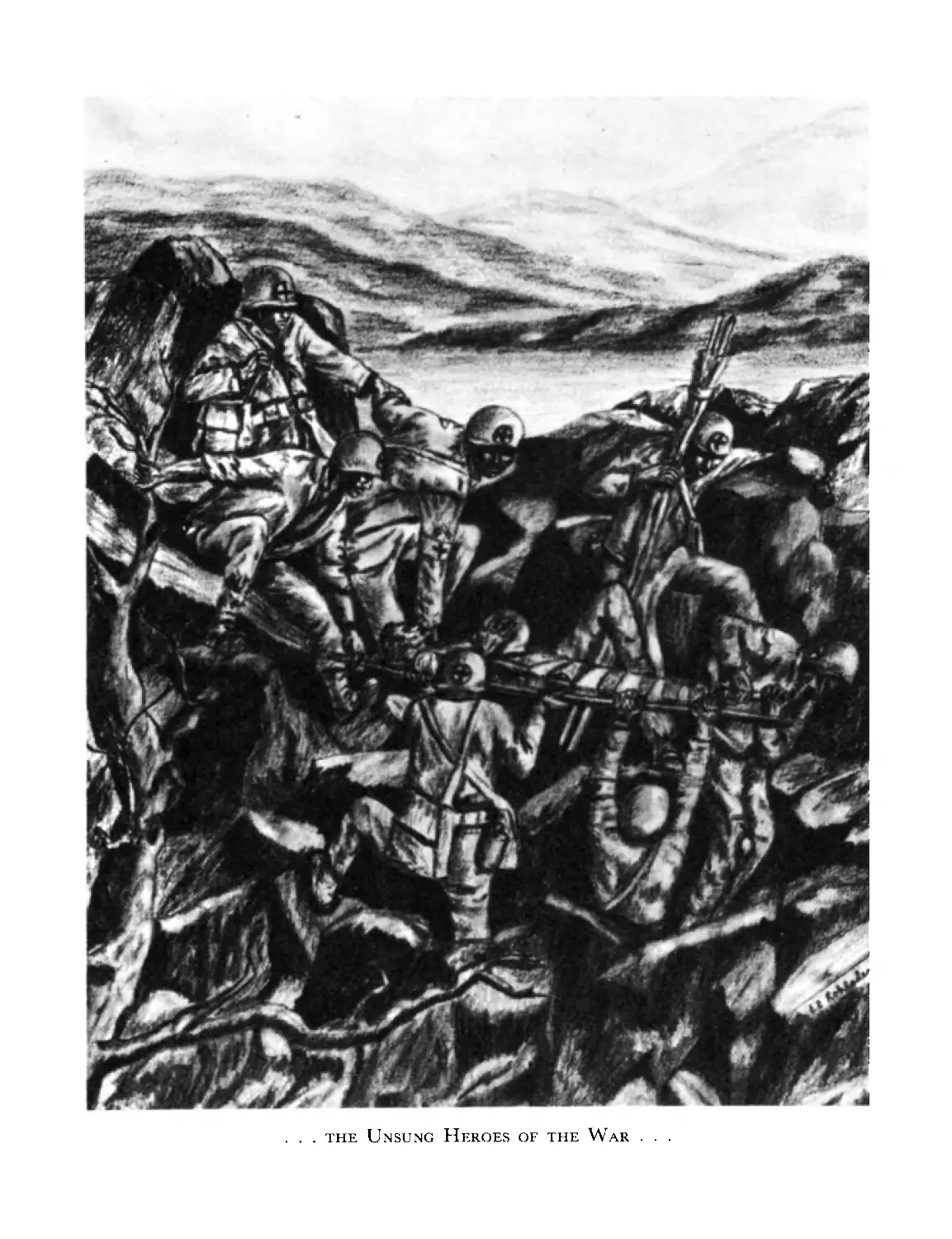
. . . the Unsung Heroes of the War . .
UNITED STATES ARMY IN WORLD WAR II
The Technical Services
THE MEDICAL DEPARTMENT:
MEDICAL SERVICE IN THE
MEDITERRANEAN AND
MINOR THEATERS
by
Charles M. Wiltse
CENTER OF MILITAR Y HISTOR Y
UNITED STATES ARMY
WASHINGTON, D.C., 1987
Library of Congress Catalog Card Number: 64-60004
First Printed 1965—CMH Pub 10-8
For sale by the Superintendent of Documents, U.S. Government Printing Office
Washington, D.C. 20402
UNITED STATES ARMY IN WORLD WAR II
Stetson Conn, General Editor
Advisory Committee
(As of 15 September 1963)
Fred C. Cole
Washington and Lee University
William R. Emerson
Yale University
Earl Pomeroy
University of Oregon
Theodore Ropp
Duke University
Bell I. Wiley
Emory University
Maj. Gen. Hugh M. Exton
U.S. Continental Army Command
Maj. Gen. Tom R. Stoughton
Industrial College of the Armed Forces
Brig. Gen. Ward S. Ryan
U.S. Army War College
Col. Elias C. Townsend
U.S. Army Command and General Staff Coll
Col. Vincent J. Esposito
United States Military Academy
Office of the Chief of Military History
Brig. Gen. Hal C. Pattison, Chief of Military History
Chief Historian
Chief, Histories Division
Chief, Editorial and Graphics Division
Editor in Chief
Stetson Conn
Col. Albert W. Jones
Col. Walter B. Mackenzie
Joseph R. Friedman
History of
THE MEDICAL DEPARTMENT
prepared under the direction of Lt. Gen. Leonard D. Heaton
The Surgeon General, U.S. Army
Hospitalization and Evacuation, Zone of Interior
Medical Service in the Mediterranean and Minor Theaters
Medical Service in the European Theater
Medical Service in the Asiatic-Pacific Theater
The Historical Unit, United States Army Medical Service
Col. John Boyd Coates, Jr., MC, USA
Charles J. Simpson
Charles M. Wiltse, Ph. D., Litt. D.
Lt. Col. Frederick Bell, Jr., MSC, USA
Ernest Elliott, Jr.
Lt. Col. Jerome Rudberg, MSC, USA
Roderick M. Engert
Hazel G. Hine
Director
Executive Officer
Chief Historian
Chief, Special Projects Branch
Chief, Editorial Branch
Chief, Information Activities
Branch
Chief, General Reference and
Research Branch
Chief, Administrative Branch
vi
. . to Those Who Served
Foreword
Improvements in medical practice and in standards of living in the
U.S. Army in World War II meant for the American soldier better medical
service than during any previous war. Improved techniques in the treatment
of wounds and in the prevention and cure of disease went far toward pre-
serving the lives and bodies of Army men and women both at the fighting
fronts and in the bases and lines of communication that led to them. The
author in this volume tells first about the medical provisions for the Atlantic
outposts of the United States established before the substantial deployment
and engagement of Army forces in Mediterranean and European areas, and
then devotes major attention to the Army medical service in the Mediter-
ranean campaigns in North Africa, Sicily, the mainland of Italy, and southern
France. An appendix suggests some similarities and contrasts between Ger-
man and American practice during the war.
The book is a natural sequel to one published in this series in 1956
entitled, The Medical Department: Hospitalization and Evacuation, Zone
of Interior, and is to be followed by two dealing with medical service in the
European Theater of Operations and in Pacific-Asiatic areas. Other related
volumes are being published in the series, “Medical Department United
States Army in World War II.” While the author of this work has addressed
himself primarily to the interests and needs of the military student and
reader, a wider audience should find in his account both practical lessons in
the provision of mass medical care and assurance that such care was adequate-
ly given to those who fought in the largest of American wars.
Washington, D.C.	HAL C. PATTISON
23 September 1963	Brigadier General, USA
Chief of Military History
ix
Introductory Note
The invasion of North Africa on 8 November 1942 was the first ground
offensive for U.S. troops against the European Axis Powers, and so the
beaches of Algeria and Morocco, the barren hills and dry wadies of Tunisia,
became the proving grounds for equipment, for tactics, and for men. From
North Africa the battle line moved up to Sicily, to Italy, and into southern
France, but for the Medical Department the Mediterranean remained a
“pilot” theater whose accumulated experience saved countless lives on other
fronts. Medical units that had served well in the static warfare of World
War I were modified or discarded on the basis of their performance in the
Mediterranean. New techniques, such as the treatment of psychiatric cas-
ualties in the combat zone, and the use of penicillin in forward surgery,
were tested. The smaller, more mobile field and evacuation hospitals be-
came the workhorses of the theater. Jeeps fitted with litter racks served as
front-line ambulances, while transport planes, their cargoes delivered at
forward airfields, were pressed into service to evacuate the wounded.
In the grand strategy of the war the bloody Italian campaign was a di-
version, to engage as many enemy troops as possible with the smallest possi-
ble commitment of Allied strength. This meant, for the combat troops,
being always outnumbered. It meant over and again, for medical and line
commanders alike, giving up formations with priceless battle experience in
exchange for willing but untried replacements. In physical terms the
theater imposed the extremes of desert, marsh, and mountain barrier; of
exposed plains crossed by swollen rivers; and the hazards of rain, snow,
sleet and mud, each demanding of the supporting medical complements
revised techniques and new expedients. In no other American combat zone
was there anything comparable to the desert warfare of Tunisia, to the long
martyrdom of Anzio, or to the bitter ridge-by-ridge encounters of the
Apennines. Small wonder that the medical service described in these pages
was often improvised and always pushed to the very limit of its means, yet
nowhere did the Medical Department attain a higher level of effectiveness.
The author of Medical Service in the Mediterranean and Minor The-
aters, Charles M. Wiltse, is a graduate of West Virginia University, earned
his Ph. D. at Cornell, and holds an honorary Litt. D. from Marshall Uni-
versity. In addition to numerous articles, essays, reviews, and government
reports, Dr. Wiltse is the author of The Jeffersonian Tradition in Amer-
xi
ican Democracy; of a three-volume historical biography of John C. Calhoun,
completed with the aid of two Guggenheim Fellowships; of a volume in
the “Making of America” series, The New Nation: 1800—1845; and is co-
author of the official War Production Board history, Industrial Mobiliza-
tion for War.
Washington, D.C.
23 September 1963
LEONARD D. HEATON
Lieutenant General, U.S. Army
The Surgeon General
xii
Preface
Medical Service in the Mediterranean and Minor Theaters is one of
three volumes dealing with the overseas administrative history of the United
States Army Medical Department in World War II. Companion studies
will deal respectively with the European Theater of Operations and the war
against Japan in the Pacific and China-Burma-India Theaters. These
volumes differ from the more extensive clinical series, separately published
by the Office of The Surgeon General, in that they are concerned primarily
with the support given by the Medical Department to the actual combat
operations: the collection of the wounded on the battlefield; the establish-
ment of hospitals; the chain of evacuation from the point of contact with
the enemy back to the communications zone and on to the zone of interior;
and the methods and problems of medical supply in the field. Clinical mat-
ters, such as the incidence of disease, the types of wounds predominating,
and problems of sanitation, are subordinated to the less technical story of
the Medical Department in action. The administrative volumes thus relate
both to -the general combat history told elsewhere in the series UNITED
STATES ARMY IN WORLD WAR II and to the medical story proper
recorded in the 40-odd volumes of the clinical series appearing under the
imprint of the Office of The Surgeon General. They are complemented by
Clarence McKittrick Smith’s Hospitalization and Evacuation, Zone of In-
terior; and by four functional volumes, being published by the Office of
The Surgeon General, which deal respectively with Organization and Ad-
ministration of the Medical Department, Personnel, Training, and Medical
Supply.
The manuscript of this volume was submitted in draft form to a sub-
stantial cross section of those who participated in the actions described.
Those who offered substantiation, corrections, or additions were: Abram
Abeloff, M.D.; Lt. Col. James J. Adams, MSC; William H. Amspacher, M.D.;
Col. Richard T. Arnest, MC, USA (Ret.) ; Col. Rollin L. Bauchspies, MC,
USA (Ret.); Col. Charles H. Beasley, MC, USA (Ret.) ; Austin W. Bennett,
M.D.; Lt. Col. Stephen D. Berardinelli, MC; Col. Daniel J. Berry, MC, USA
(Ret.) ; Frank B. Berry, M.D.; Col. Albert A. Biederman, MC; Col. Charles
O. Bruce, MC; Col. Gordon G. Bulla, MC, USAF; J. P. Cameron, M.D.;
Col. Joseph Carmack, MSC, USA (Ret.) ; Lt. Col. Dan Crozier, MC; Brig.
Gen. Henry C. Dooling, MC, USA (Ret.); Col. Daniel Franklin, MC, USA
xiii
(Ret.) ; Frank P. Gilligan, M.D.; Brig. Gen. L. Holmes Ginn, Jr., MC, USA
(Ret.) ; Michael Q. Hancock, M.D.; Norman L. Heminway, M.D; Col. John
A. Isherwood, MC; Maurice M. Kane, M.D.; Col. Paul A. Keeney, MC,
USA (Ret.); Col. Emmett L. Kehoe, MC; Maj. Gen. Albert W. Kenner,
MC, USA (Ret.); Col. William F. Lawrence, MSC; Col. George E. Leone,
MC; Col. John F. Lieberman, MC, USA (Ret.) ; Gunnar Linner, M.D.;
John R. McBride, M.D.; John C. McSween, M.D.; Col. William C. Munly,
MC, USA (Ret.) ; Robert Bruce Nye, M.D.; Col. Forrest R. Ostrander, MC,
USA (Ret.); Benjamin M. Primer, M.D.; Col. Matthew C. Pugsley, MC, USA
(Ret.); Maj. Gen. Clement F. St. John, MC; Brig. Gen. Crawford F. Sams,
MC, USA (Ret.) ; Col. John W. Sherwood, MC, USA (Ret.); Charles F.
Shook, M.D.; Maj. Gen. Earle Standlee, MC, USA (Ret.); Maj. Gen. Mor-
rison C. Stayer, MC, USA (Ret.) ; William S. Stone, M.D.; Col. John H.
Sturgeon, MC, USA (Ret.) ; Col. E. M. P. Sward, MC, USA (Ret.); Brig.
Gen. Lynn H. Tingay, DC, USA (Ret.) ; Col. Hall G. Van Vlack, MC, USA
(Ret.) ; Col. Dean M. Walker, MC, USA (Ret.); and Thomas G. Ward,
M.D. To each of these the author wishes to express his thanks. Without
their considerable help much authenticity would be lacking.
Sections of the volume dealing with strictly military events were checked
by knowledgeable members of the Office of the Chief of Military History
(OCMH) staff, including Martin Blumenson, Ernest F. Fisher, Jr., and
Robert Ross Smith. If the combat narrative lacks at any point in accuracy,
it is through no fault of these conscientious reviewers.
The manuscript was read in its entirety by Dr. Donald O. Wagner,
former Chief Historian, The Historical Unit, U.S. Army Medical Service
(USAMEDS), before his retirement early in i960; by Col. John Boyd
Coates, Jr., Director of The Historical Unit; and by Dr. Stetson Conn, Chief
Historian, Office of the Chief of Military History. Each of these critics
offered pertinent and valuable suggestions for improvement.
Mr. William K. Daum did much of the research for chapters I and II
and prepared preliminary drafts of both.
For expert and unfailing aid in locating and procuring the thousands
of documentary sources on which the work is based, the author makes
special acknowledgment to Mrs. Josephine P. Kyle, former chief of the
General Reference and Research Branch of The Historical Unit, and to
her assistant, the late Mrs. Eleanor Alfonso, whose cheerful willingness never
faultered despite the constant presence of fatal illness. Mrs. Kyle’s suc-
cessors, Maj. Albert C. Riggs, Jr., MSC, and Mr. Roderick M. Engert, did
not participate until the book had reached the stage of review and final re-
vision, but both were unstinting of their time and expert knowledge.
The author is also indebted to the Medical Statistics Division, Office of
The Surgeon General, and especially to Mr. Carroll I. Leith, Jr.,—himself
a veteran of the Mediterranean campaigns—who verified figures and tabu-
lations, and in many instances proposed better ways of presenting them.
xiv
Preliminary editorial work was done by Mrs. Cyrilla E. Hickey of The
Historical Unit, USAMEDS, and the final publications editing by Miss
Mary Ann Bacon of OCMH. Copy editor for the volume was Mrs. Marion
P. Grimes. The book is undoubtedly the better for having passed through
the capable hands of these three editors. The excellent medical situation
maps that make the text so much easier to follow were prepared by Miss
Elizabeth P Mason, assisted by Miss Jean A. Saffran, both of The Historical
Unit, USAMEDS. The photographs were selected by the author. The
index was compiled by Susan Stevens New.
Washington, D.C.
23 September 1963
CHARLES M. WILTSE
XV
Contents
Chapter	Page
PROLOGUE: THE GIFT OF LIFE ....................................... 1
I.	MEDICAL SERVICE IN THE ATLANTIC DEFENSE AREAS .	7
The Atlantic Approaches to War........................... 7
The North Atlantic Bases................................ 10
Bermuda Base Command .	. ..	...... ............. 26
U.S. Army Forces in the Azores	29
U.S. Army Forces in Eastern and Central Canada.......... 30
The Caribbean Defense Command .......................... 34
The South Atlantic Theater ............................. 46
II.	ARMY MEDICAL SERVICE IN AFRICA AND THE MIDDLE
EAST...................................................... 56
The Beginnings of Medical Service in the Middle East.... 56
The Middle East as an Active Theater of Operations, 1942—43	60
The Middle East as a Supply and Service Theater, 1944—45 ....	80
Medical Supplies and Equipment..........................	87
Professional Services .................................. 88
Decline of Medical Activities in the Demobilization Period. 103
III.	CONQUEST OF NORTH AFRICA................................... 104
Prelude to Invasion .	. . .	............................ 104
Medical Support in the Landing Phase....................108
Medical Support of II Corps in the Tunisia Campaign...	121
Evacuation From II Corps	.................... 137
Medical Supplies and Equipment......................... 141
Professional Services.................................. 142
IV.	SICILY AND THE MEDITERRANEAN ISLANDS ....................... 147
Medical Preparations for Operation HUSKY .............. 147
Medical Support of Seventh Army in the Field........... 150
Hospitalization and Evacuation ........................ 163
Medical Supplies and Equipment ........................ 168
Professional Services . .	  170
Medical Support in the Seizure of Sardinia and Corsica..... 174
xvii
Chapter	Page
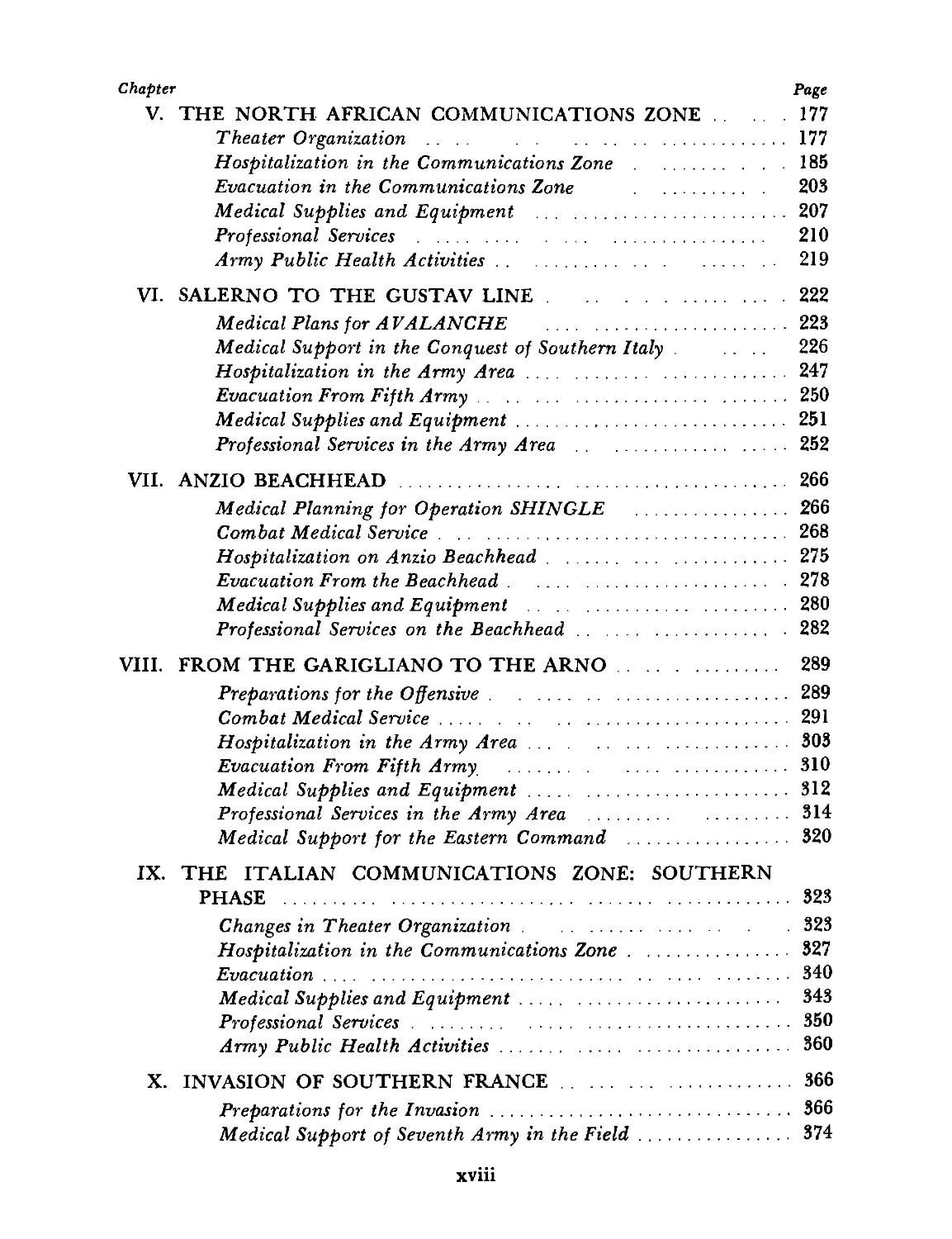
V.	THE NORTH AFRICAN COMMUNICATIONS ZONE.......................177
Theater Organization ....	 177
Hospitalization in the Communications Zone ..............185
Evacuation in the Communications Zone ................. 203
Medical Supplies and Equipment .......................... 207
Professional Services ................................. 210
Army Public Health Activities............................ 219
VI.	SALERNO TO THE GUSTAV LINE.................................222
Medical Plans for A VALANCHE ............................ 223
Medical Support in the Conquest of Southern Italy .	....	226
Hospitalization in the Army Area......................... 247
Evacuation From Fifth Army............................. 250
Medical Supplies and Equipment......................... 251
Professional Services in the Army Area ..................252
VII.	ANZIO BEACHHEAD .......................................... 266
Medical Planning for Operation SHINGLE ................ 266
Combat Medical Service................................. 268
Hospitalization on Anzio Beachhead..................... 275
Evacuation From the Beachhead...........................278
Medical Supplies and Equipment ........................ 280
Professional Services on the Beachhead................ .	282
VIII.	FROM THE GARIGLIANO TO THE ARNO........................... 289
Preparations for the Offensive..........................289
Combat Medical Service..................................291
Hospitalization in the Army Area........................303
Evacuation From Fifth Army .............................310
Medical Supplies and Equipment......................... 312
Professional Services in the Army Area ................ 314
Medical Support for the Eastern Command ............... 320
IX.	THE ITALIAN COMMUNICATIONS ZONE: SOUTHERN
PHASE ................................................... 323
Changes in Theater Organization.........................323
Hospitalization in the Communications Zone............. 327
Evacuation............................................. 340
Medical Supplies and Equipment......................... 343
Professional Services.................................. 350
Army Public Health Activities.......................... 360
X.	INVASION OF SOUTHERN FRANCE...............................366
Preparations for the Invasion.......................... 366
Medical Support of Seventh Army in the	Field........... 374
xviii
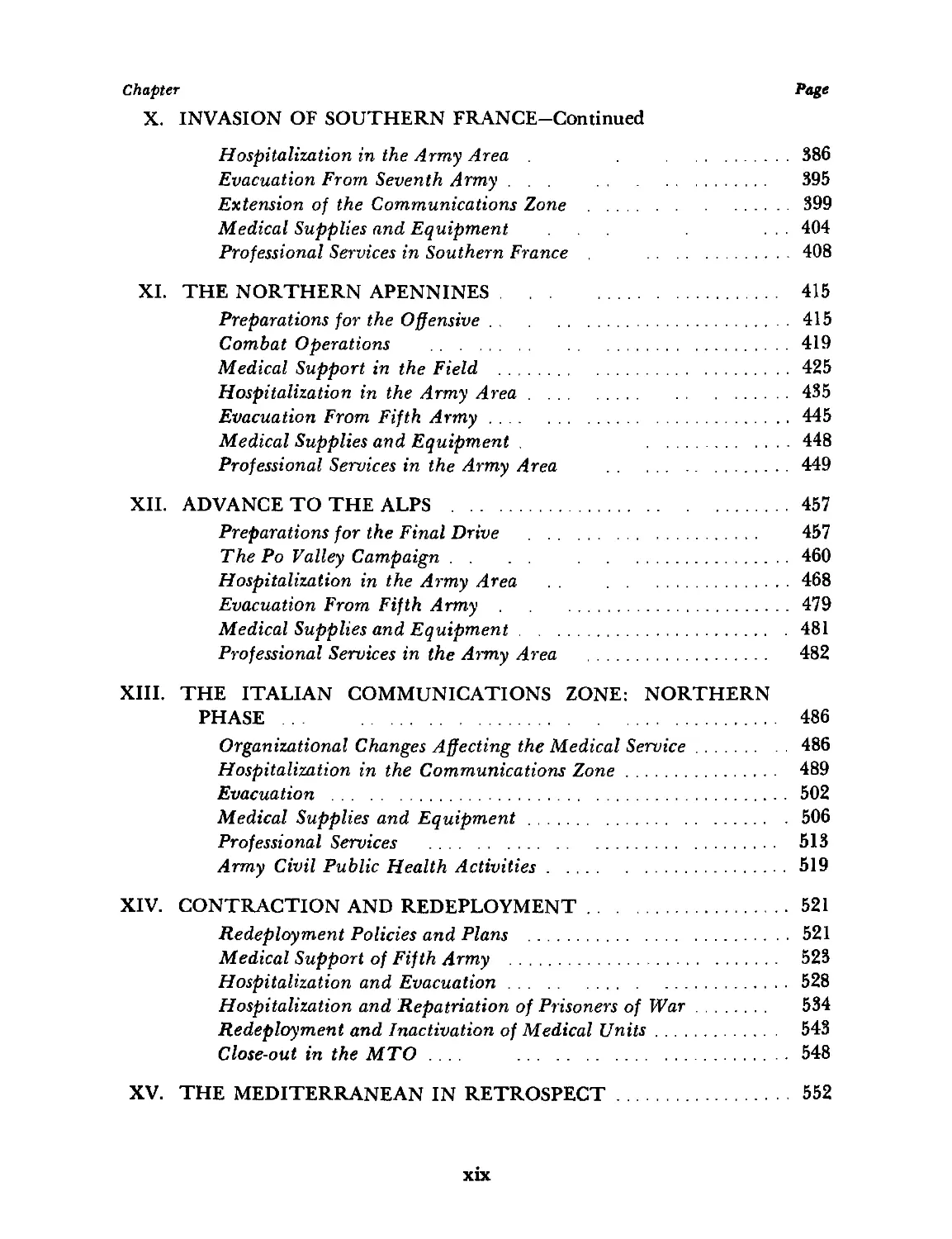
Chapter	Page
X.	INVASION OF SOUTHERN FRANCE-Continued
Hospitalization in the Army Area	 386
Evacuation From Seventh Army ...	395
Extension of the Communications Zone ....................399
Medical Supplies and Equipment ...	... 404
Professional Services in Southern France	 408
XI.	THE NORTHERN APENNINES...................................... 415
Preparations for the Offensive...........................415
Combat Operations .......................................419
Medical Support in the Field ........................... 425
Hospitalization in the Army Area.........................435
Evacuation From Fifth Army...............................445
Medical Supplies and Equipment .	 448
Professional Services in the Army Area ..................449
XII.	ADVANCE TO THE ALPS .........................................457
Preparations for the Final Drive	457
The Po Valley Campaign . .	.....................460
Hospitalization in the Army Area	..................468
Evacuation From Fifth Army ..............................479
Medical Supplies and Equipment.......................... 481
Professional Services in the Army Area ................. 482
XIII.	THE ITALIAN COMMUNICATIONS ZONE: NORTHERN
PHASE ...	.......................................... 486
Organizational Changes Affecting the Medical Service.... 486
Hospitalization in the Communications Zone.............. 489
Evacuation ............................................. 502
Medical Supplies and Equipment...........................506
Professional Services .................................. 513
Army Civil Public Health Activities......................519
XIV.	CONTRACTION AND REDEPLOYMENT............................... 521
Redeployment Policies and Plans ........................ 521
Medical Support of Fifth Army .......................... 523
Hospitalization and Evacuation...........................528
Hospitalization and Repatriation of Prisoners of War..	534
Redeployment and Inactivation of Medical Units.......... 543
Close-out in the MTO ....	...........................548
XV.	THE MEDITERRANEAN IN RETROSPECT............................. 552
xix
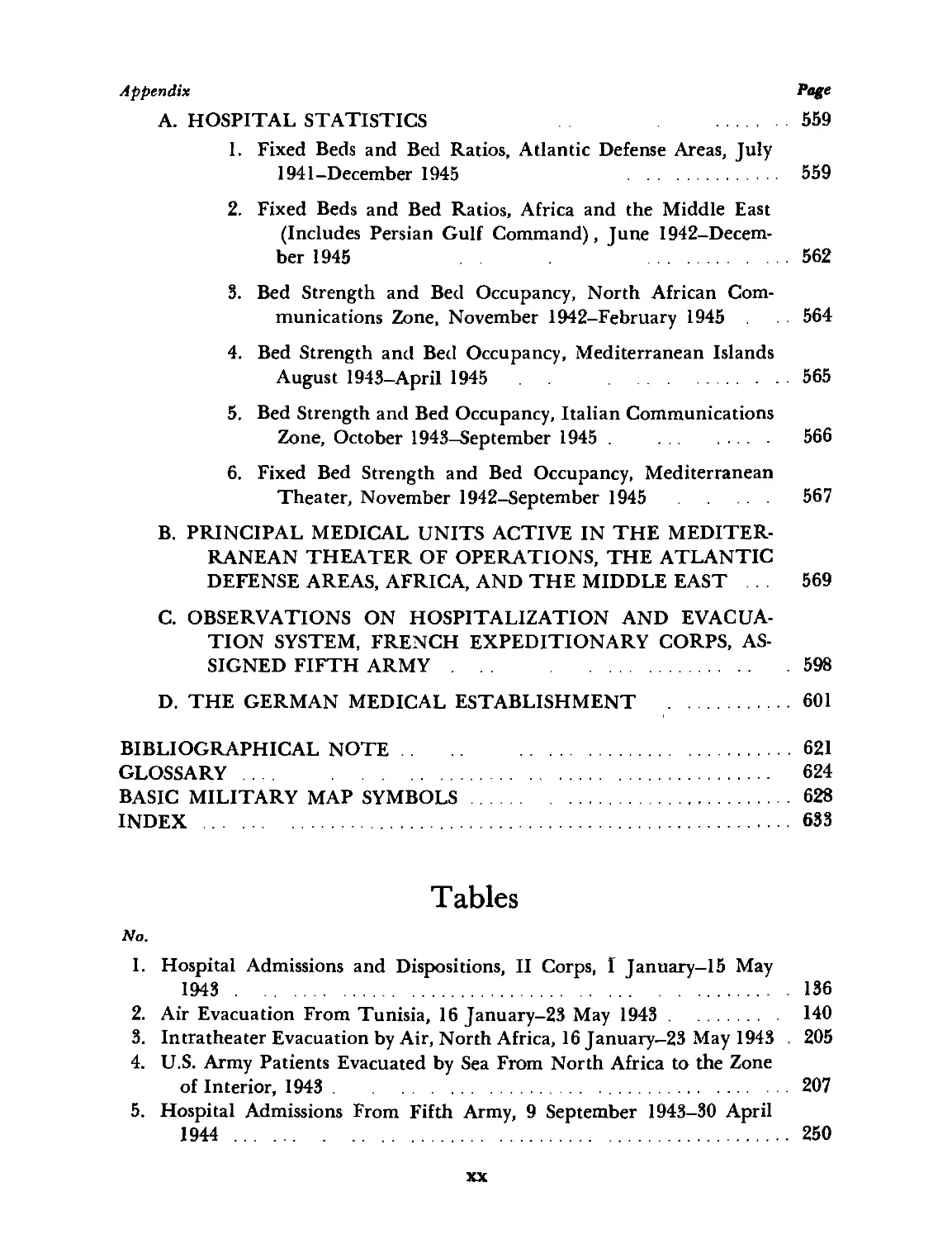
Appendix	Page
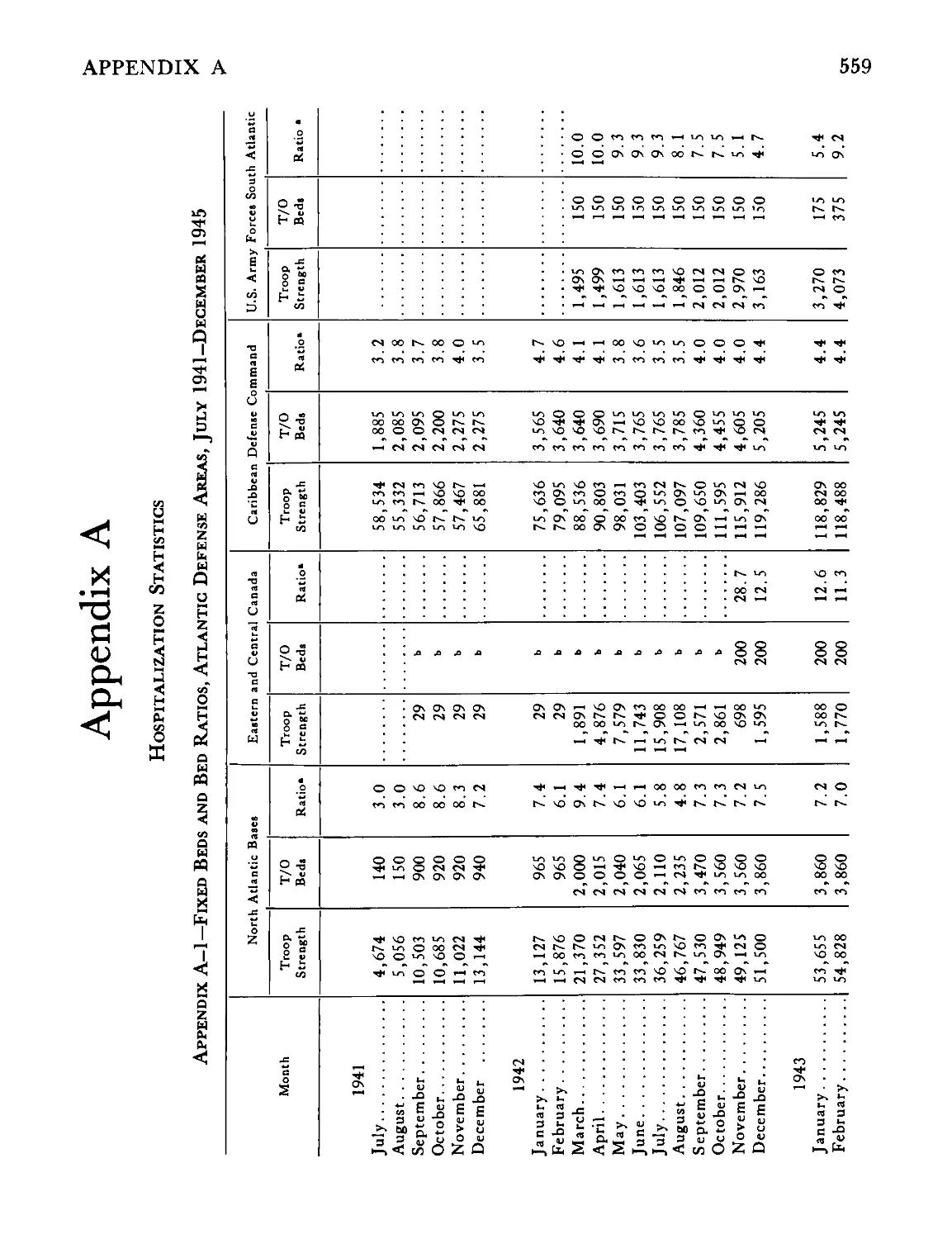
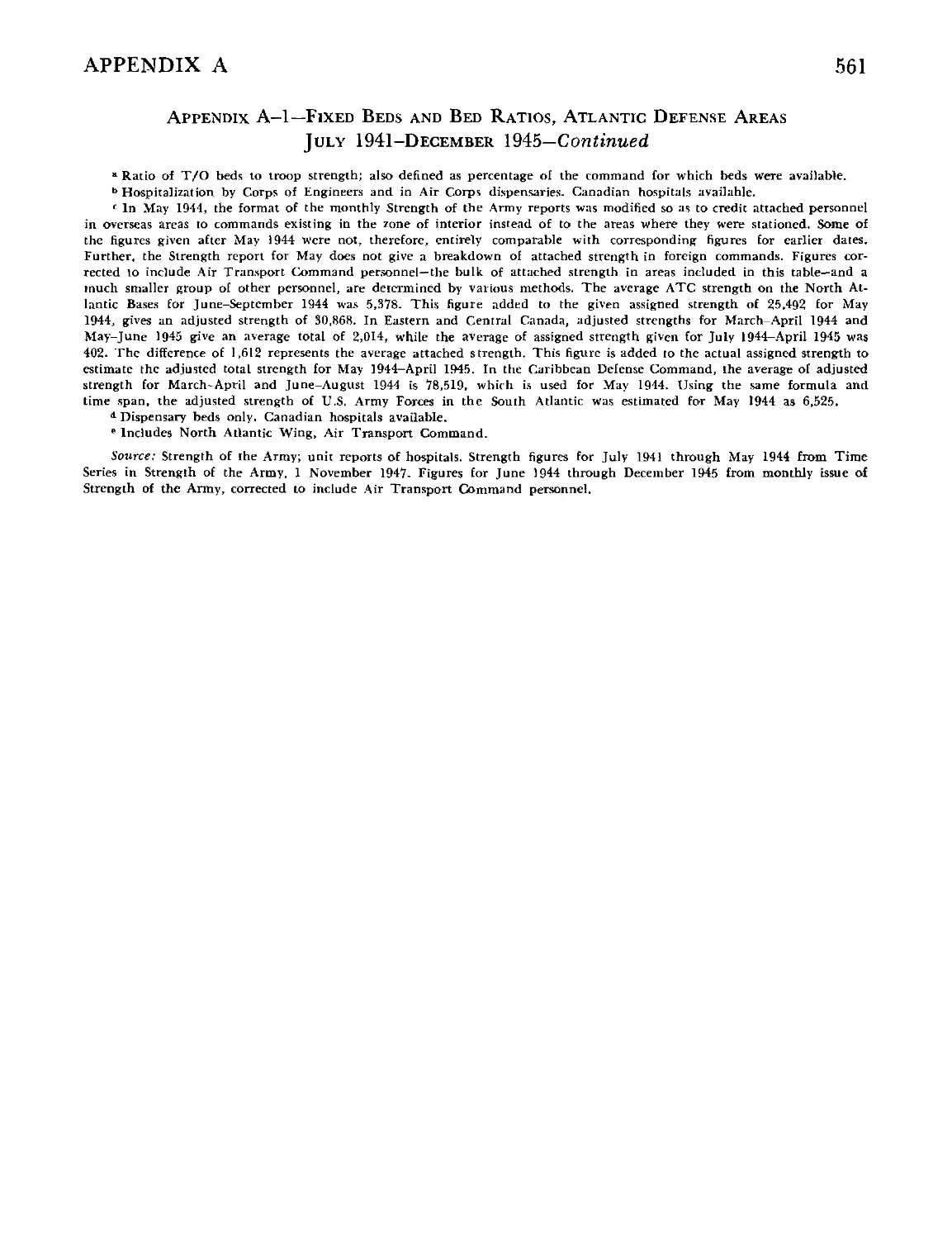
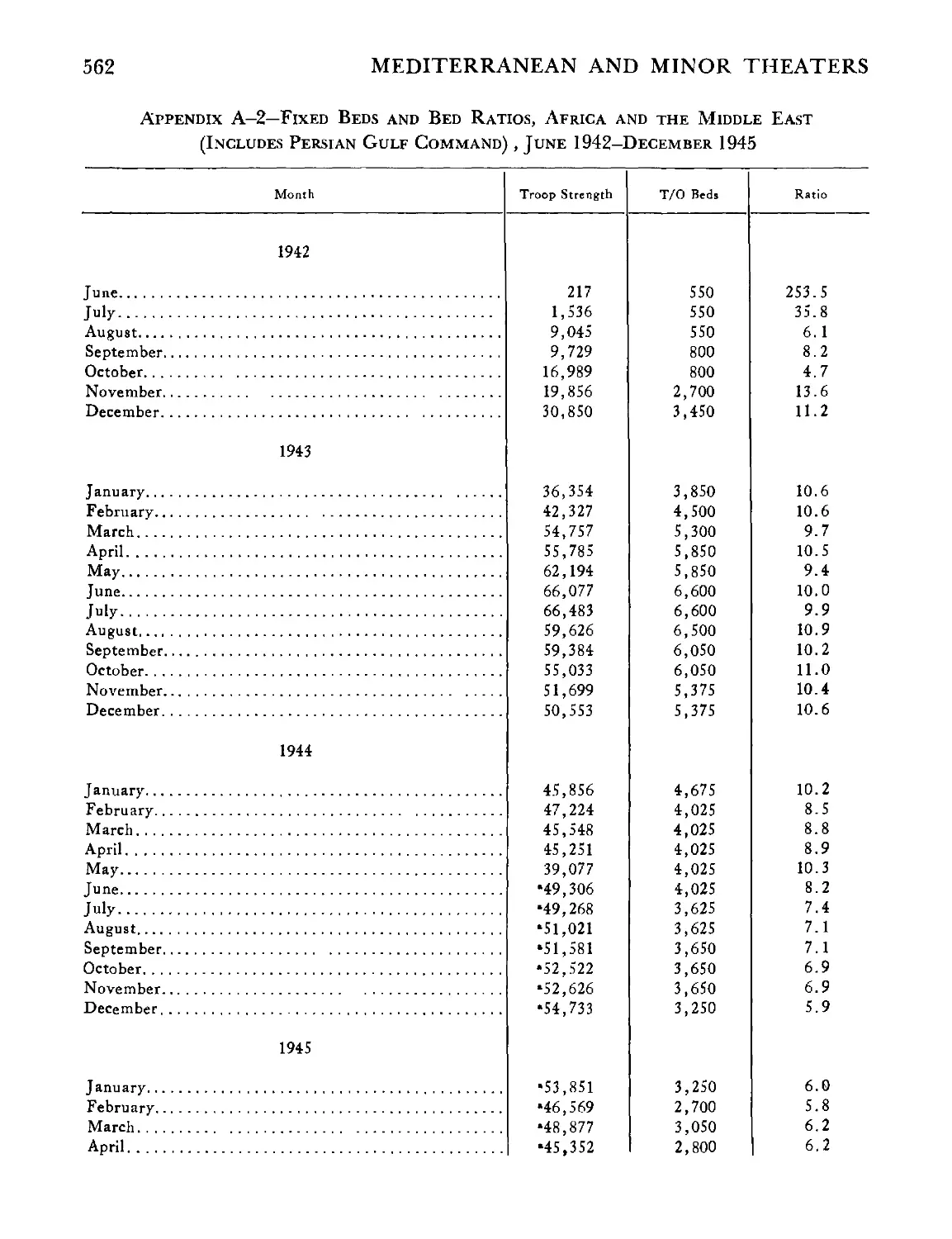
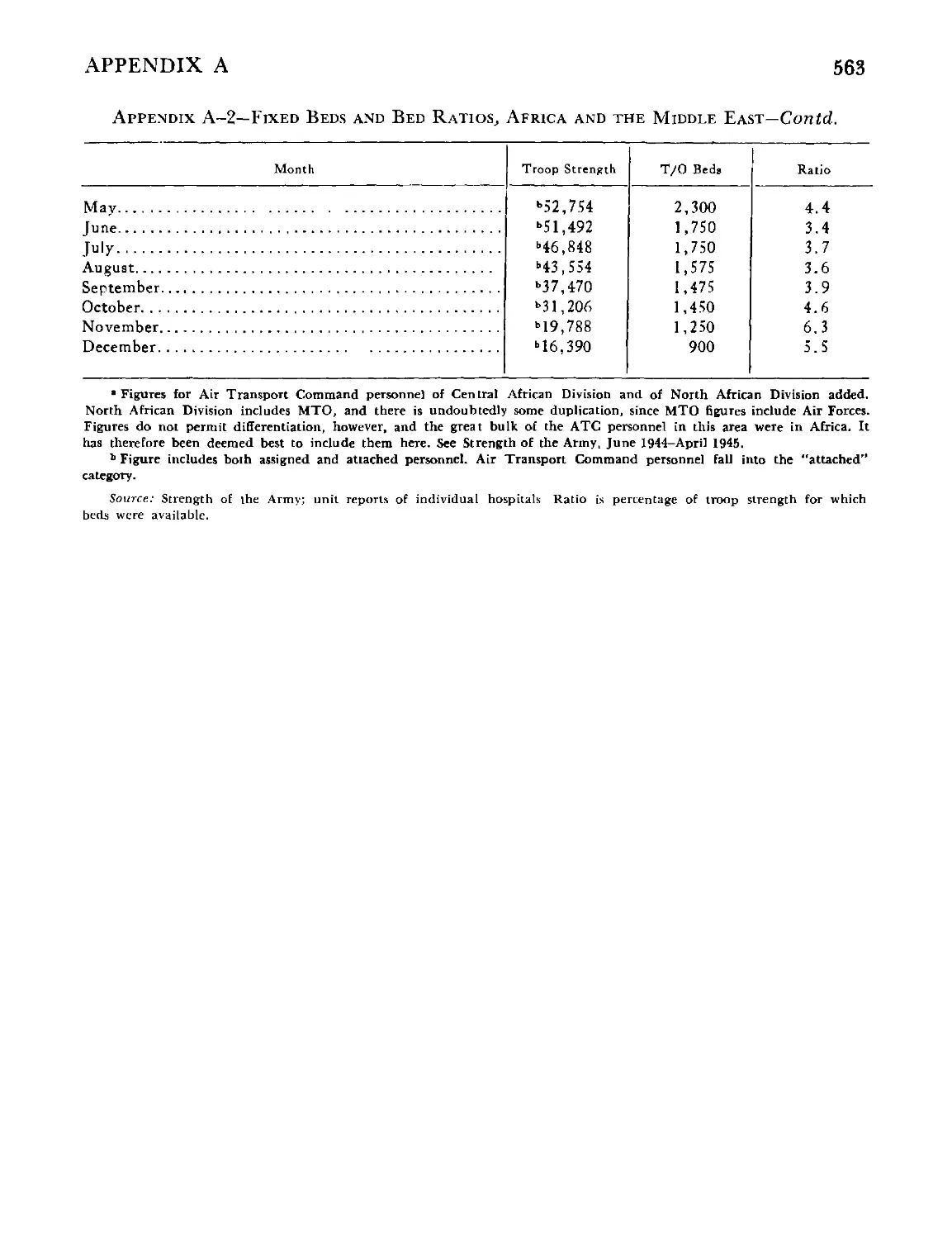
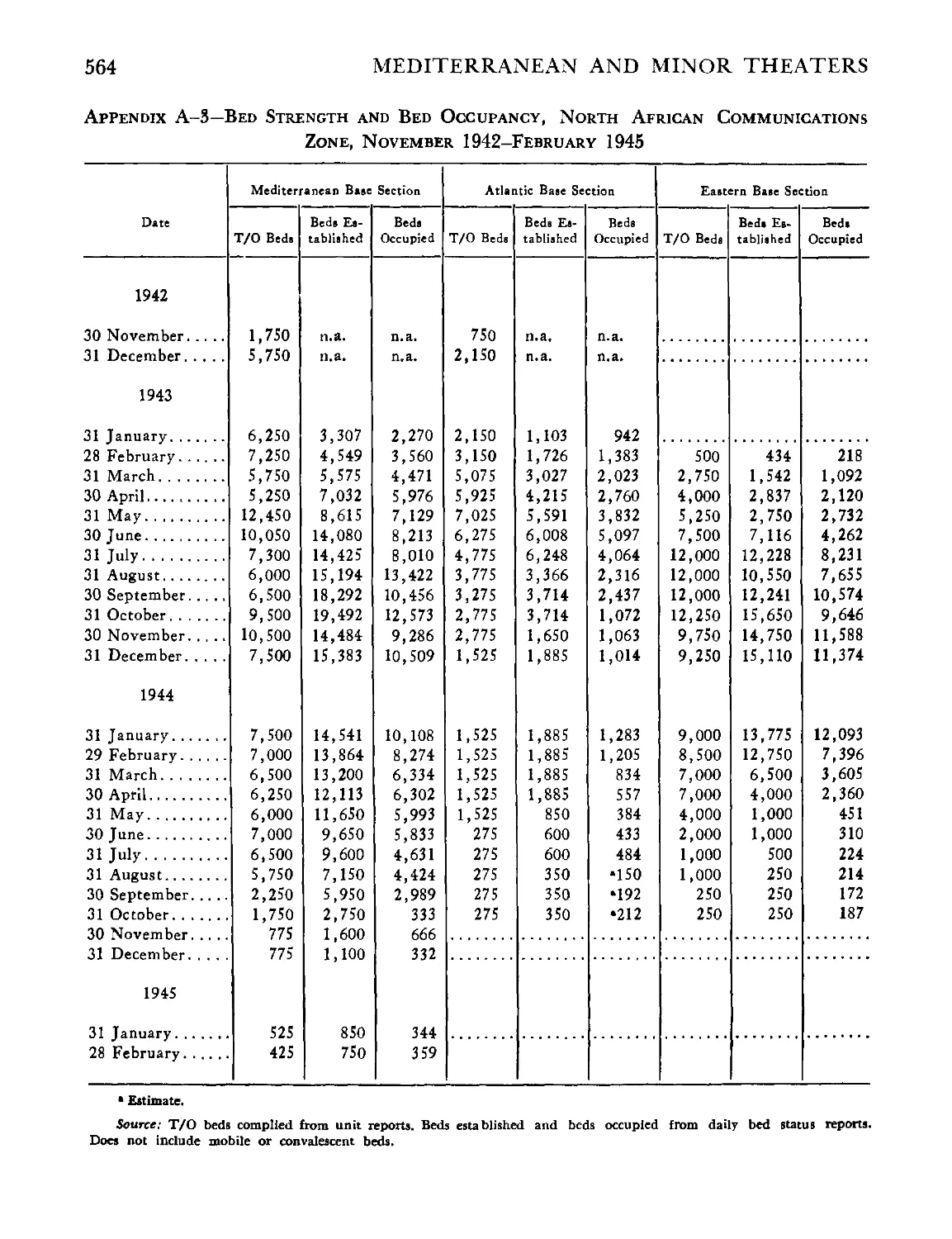
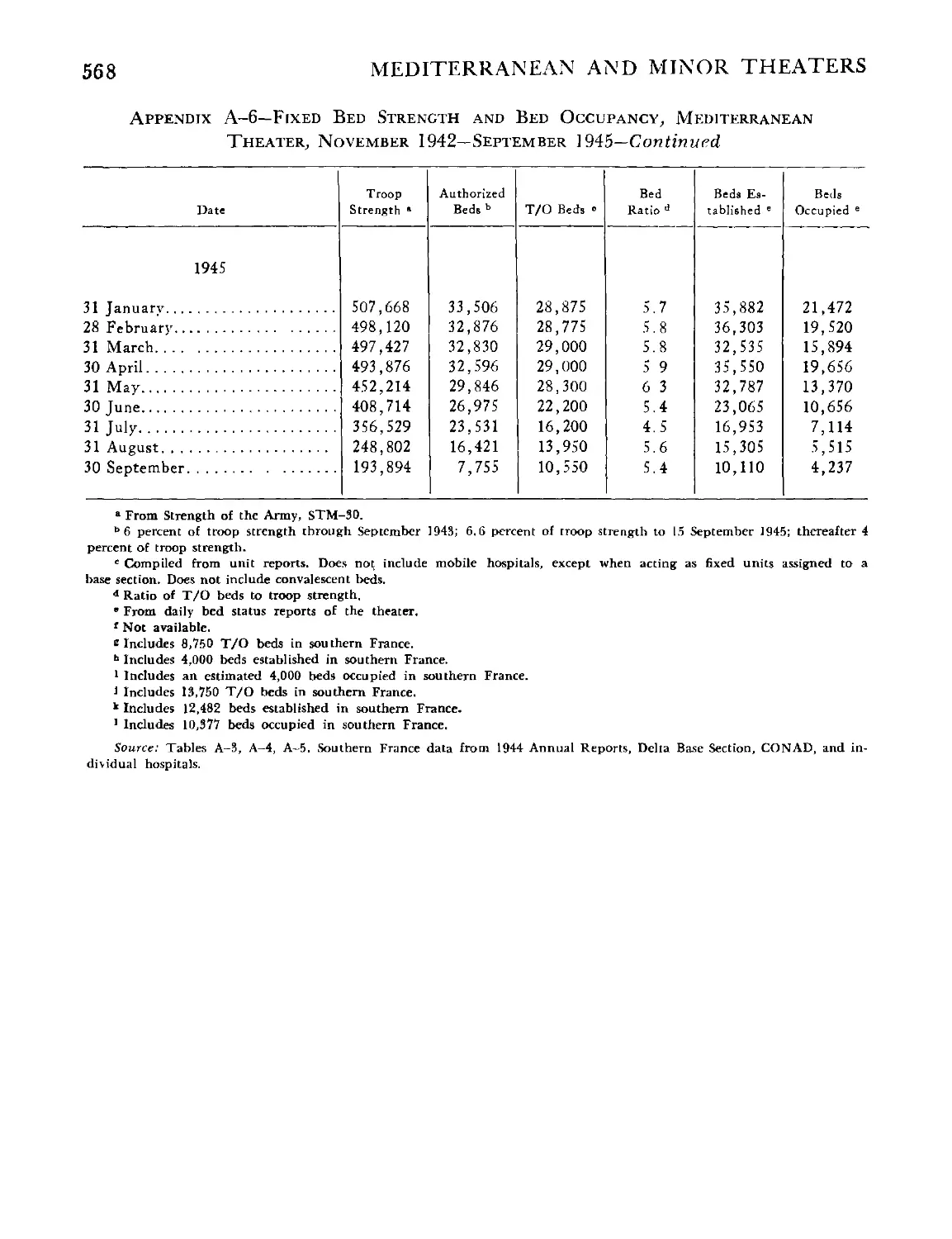
A.	HOSPITAL STATISTICS	 559
1.	Fixed Beds and Bed Ratios, Atlantic Defense Areas, July
1941-December 1945	  559
2.	Fixed Beds and Bed Ratios, Africa and the Middle East
(Includes Persian Gulf Command), June 1942-Decem-
ber 1945	........... 562
3.	Bed Strength and Bed Occupancy, North African Com-
munications Zone, November 1942-February 1945	. . 564
4.	Bed Strength and Bed Occupancy, Mediterranean Islands
August 1943—April 1945	............... 565
5.	Bed Strength and Bed Occupancy, Italian Communications
Zone, October 1943—September 1945 .	........... 566
6.	Fixed Bed Strength and Bed Occupancy, Mediterranean
Theater, November 1942-September 1945	......... 567
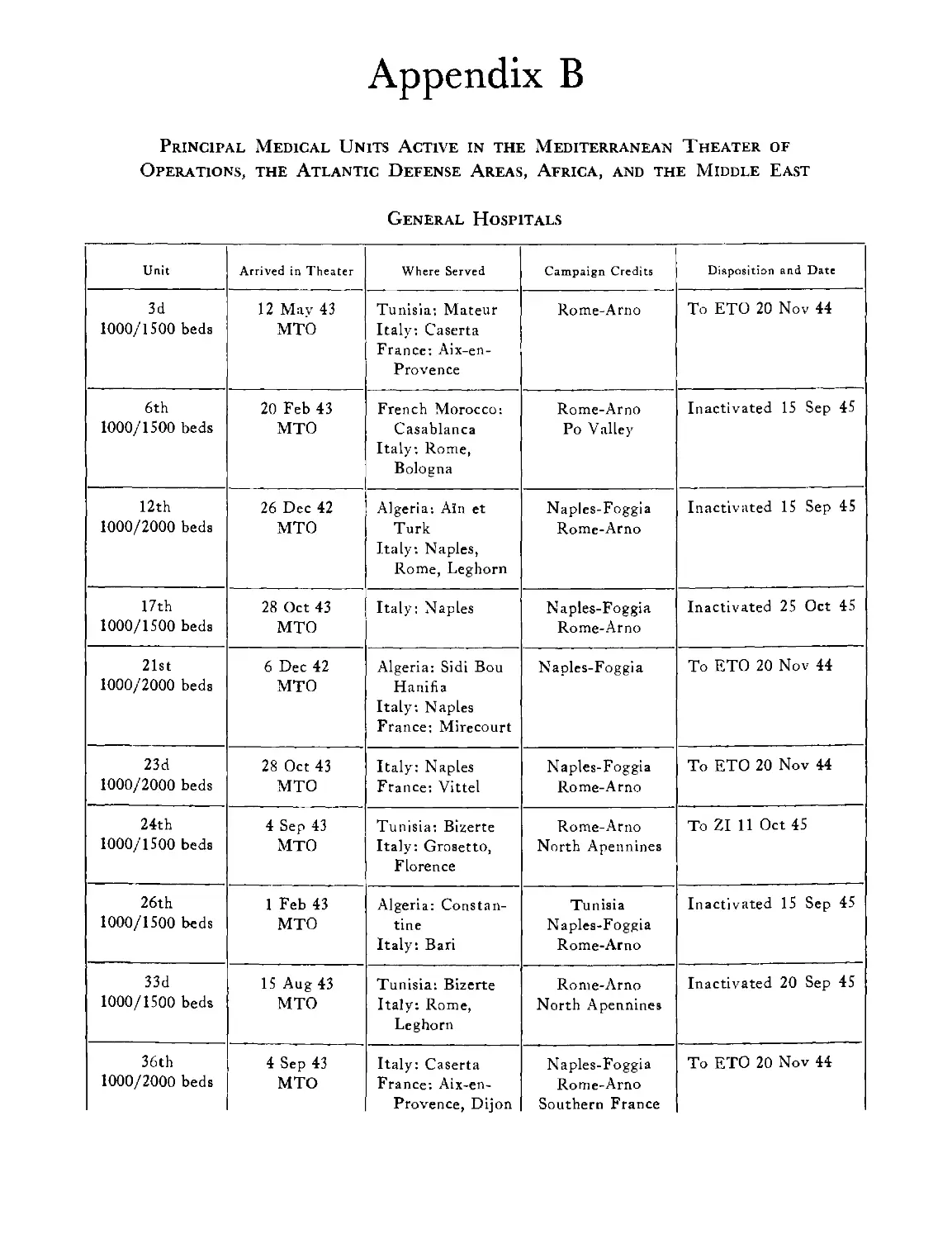
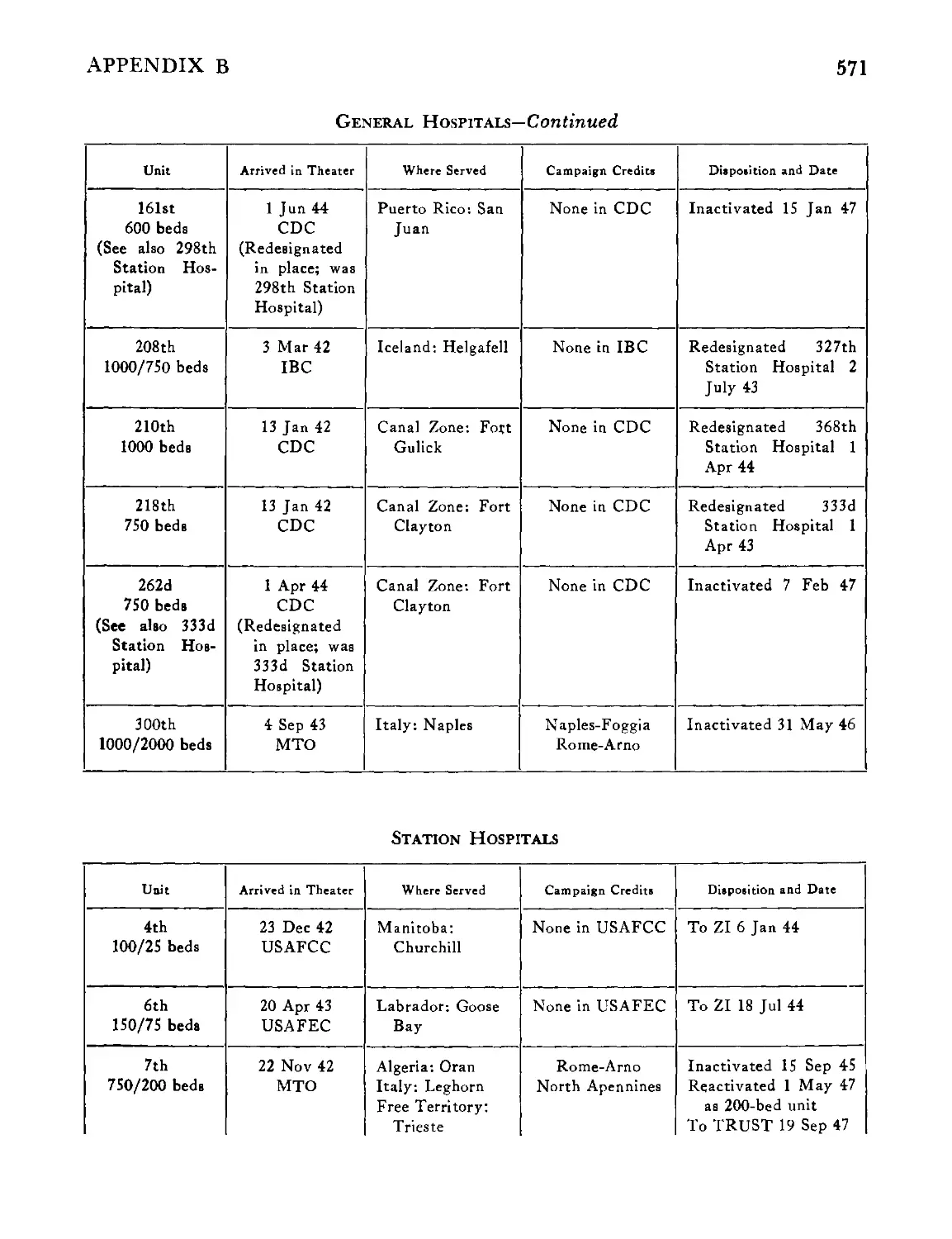
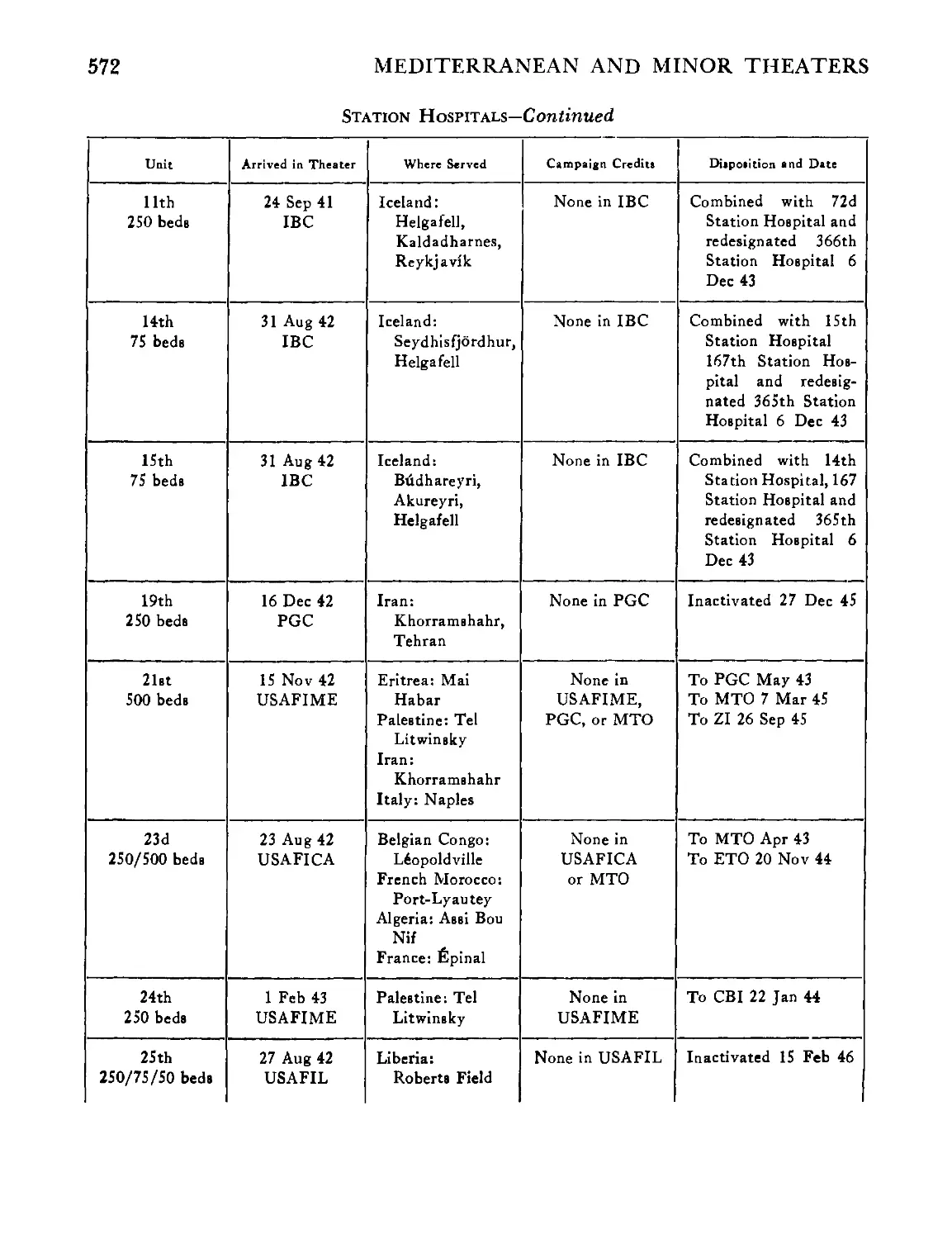
B.	PRINCIPAL MEDICAL UNITS ACTIVE IN THE MEDITER-
RANEAN THEATER OF OPERATIONS, THE ATLANTIC
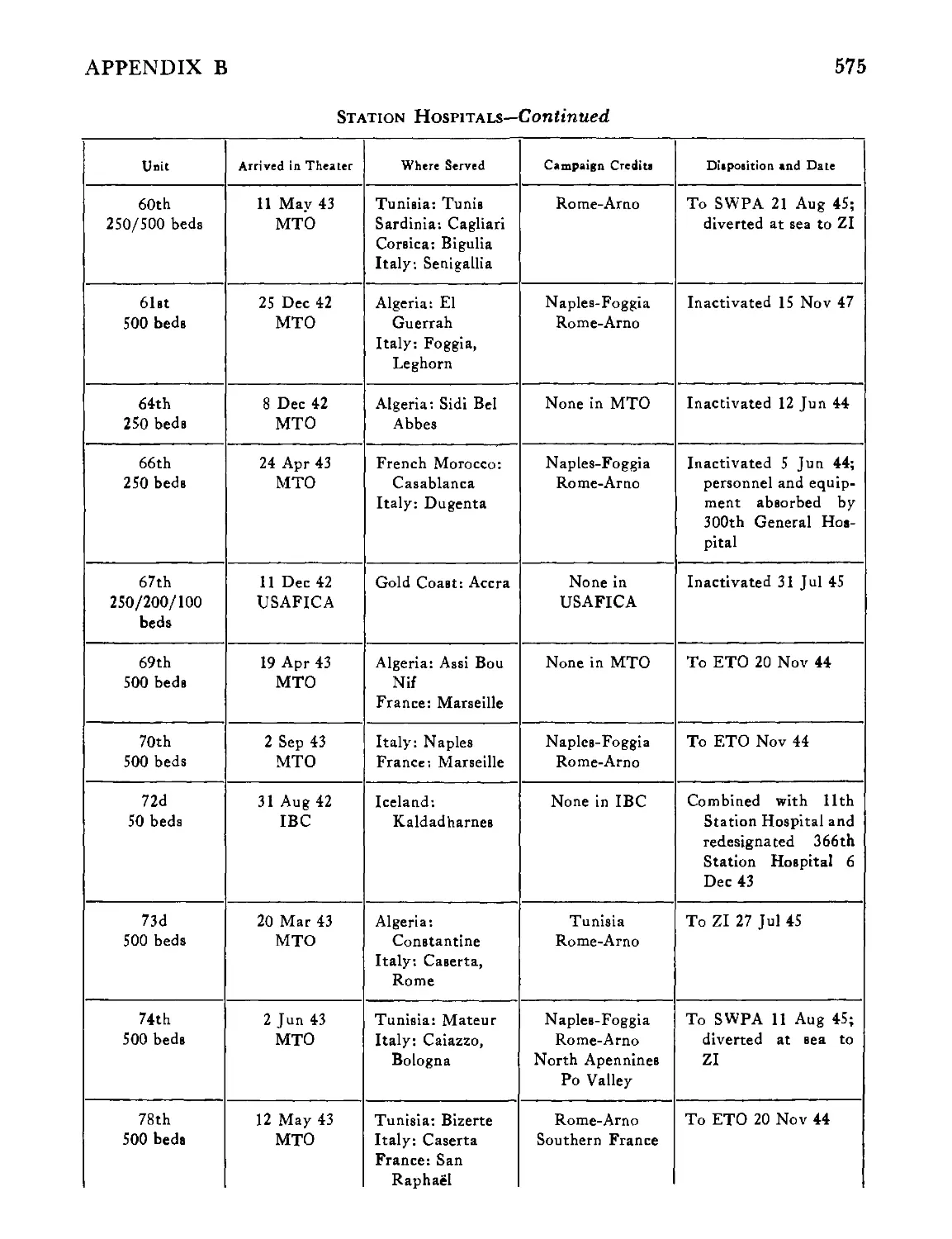
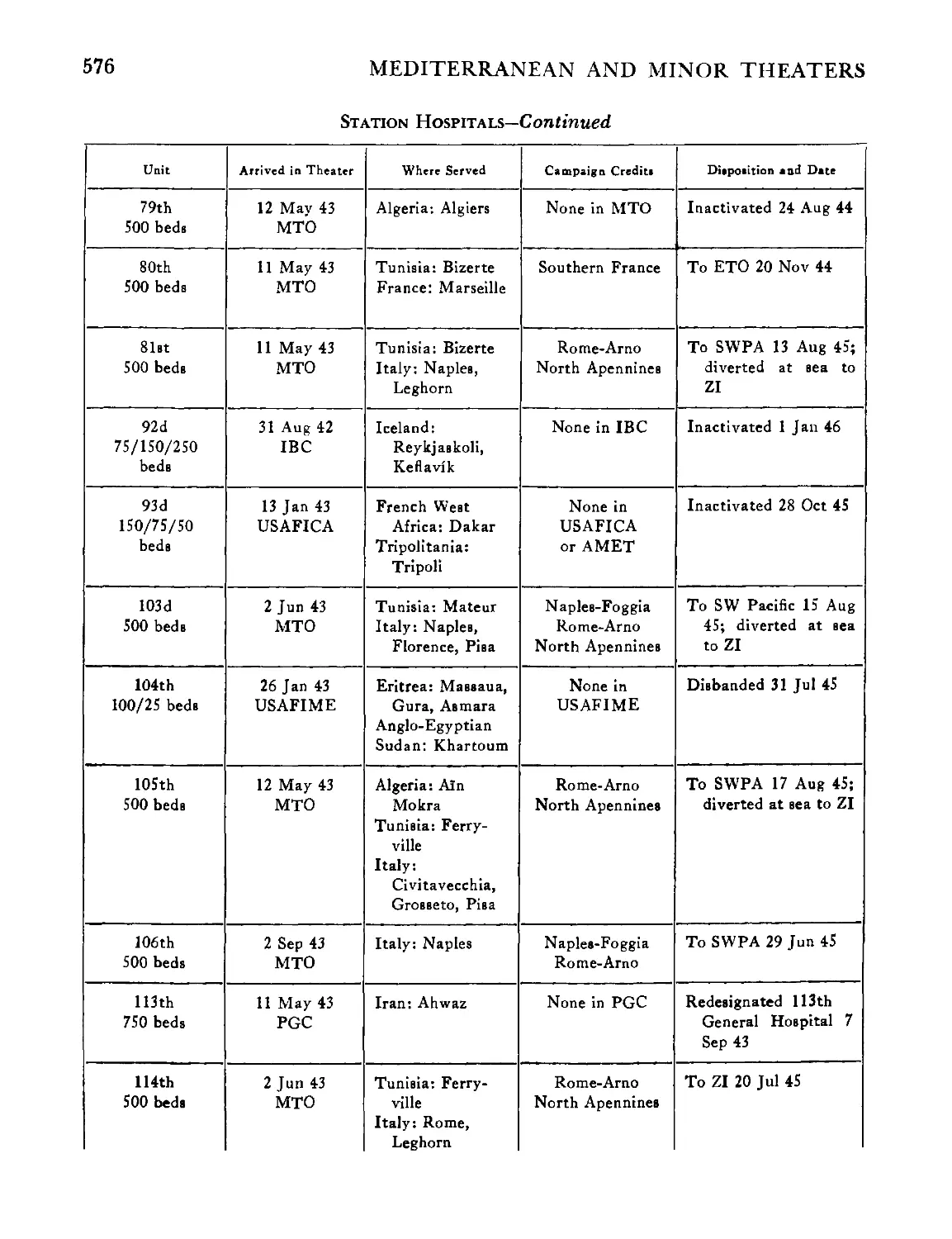
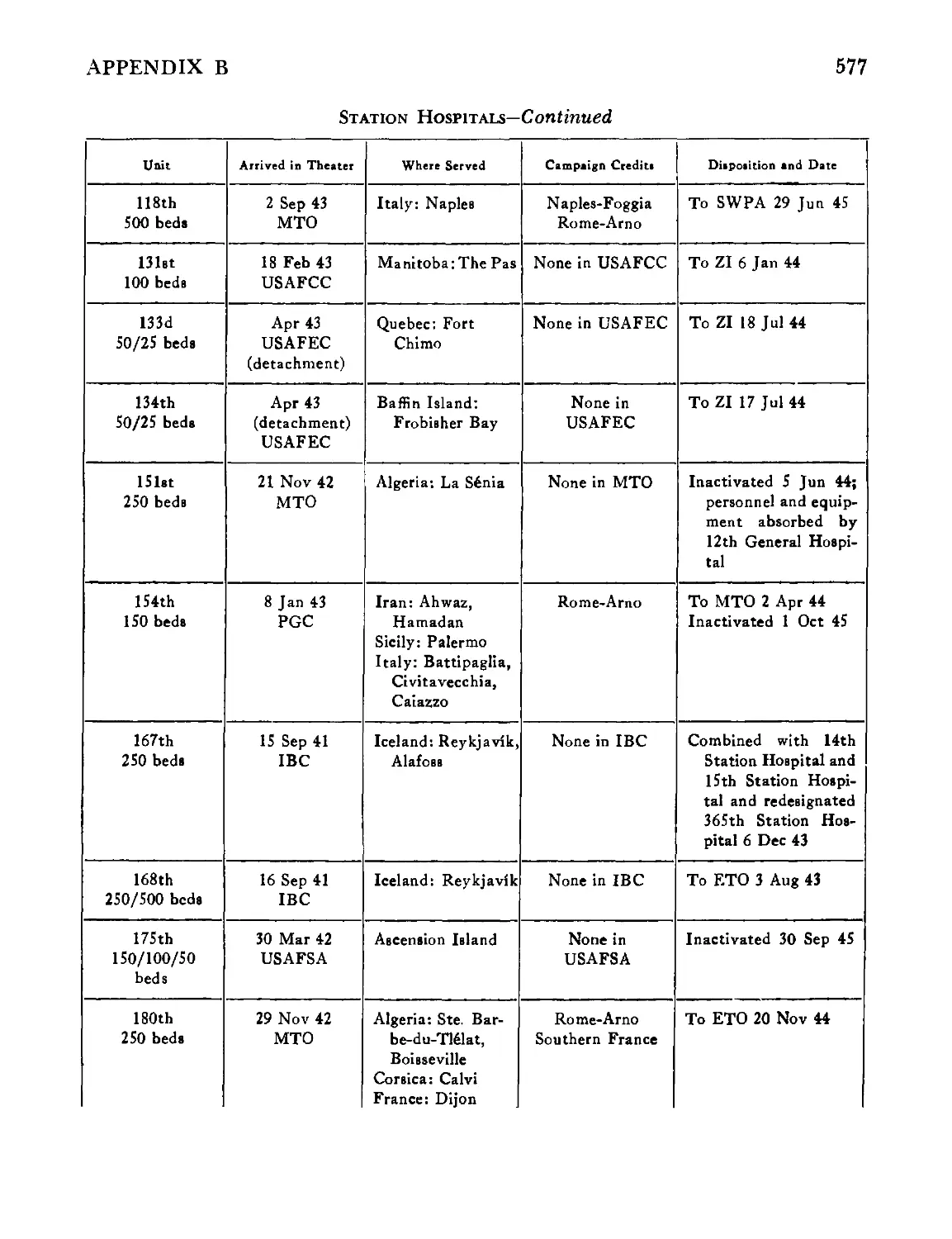
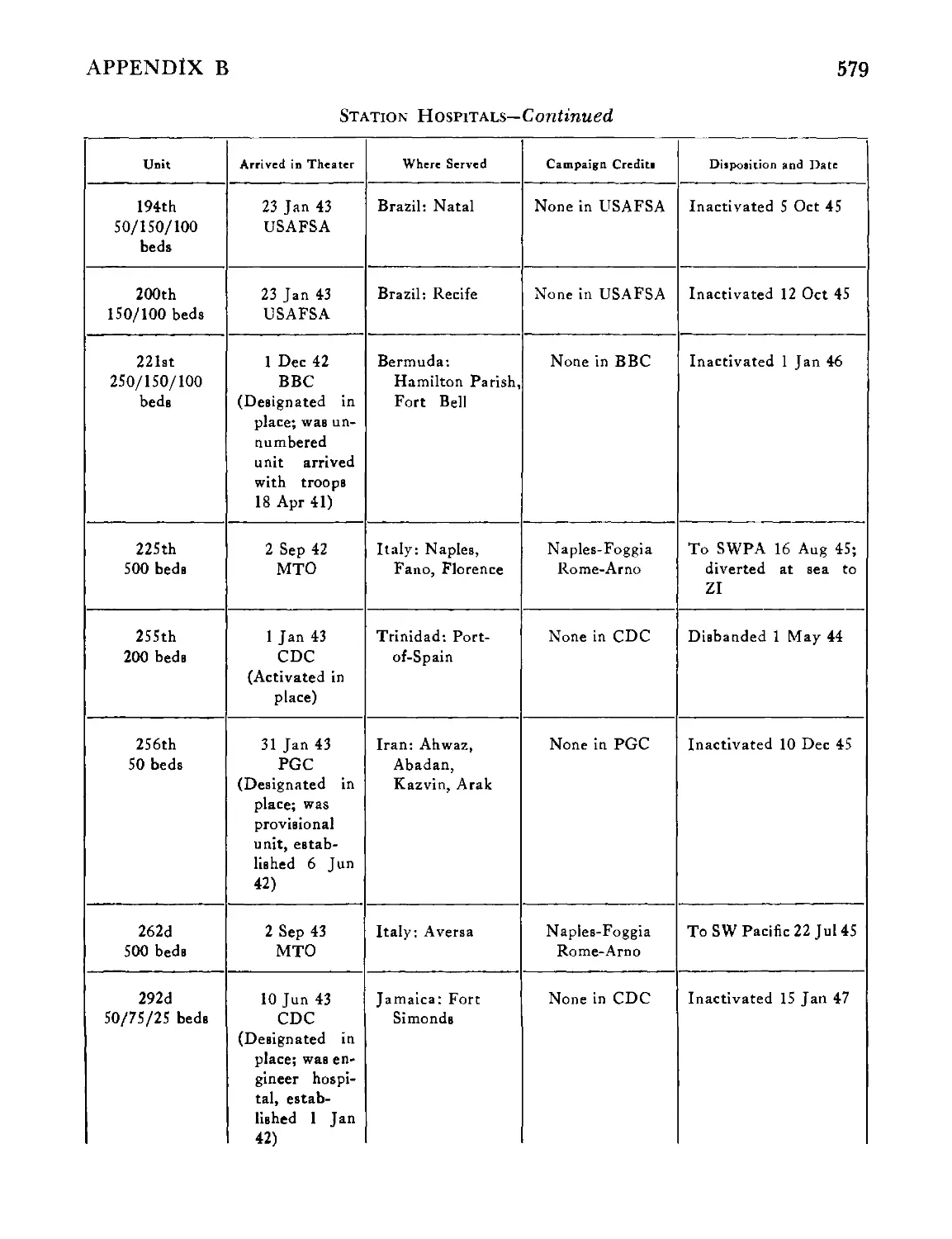
DEFENSE AREAS, AFRICA, AND THE MIDDLE EAST .	569
C.	OBSERVATIONS ON HOSPITALIZATION AND EVACUA-
TION SYSTEM, FRENCH EXPEDITIONARY CORPS, AS-
SIGNED FIFTH ARMY........................................598
D.	THE GERMAN MEDICAL ESTABLISHMENT ................... 601
BIBLIOGRAPHICAL NOTE........................................621
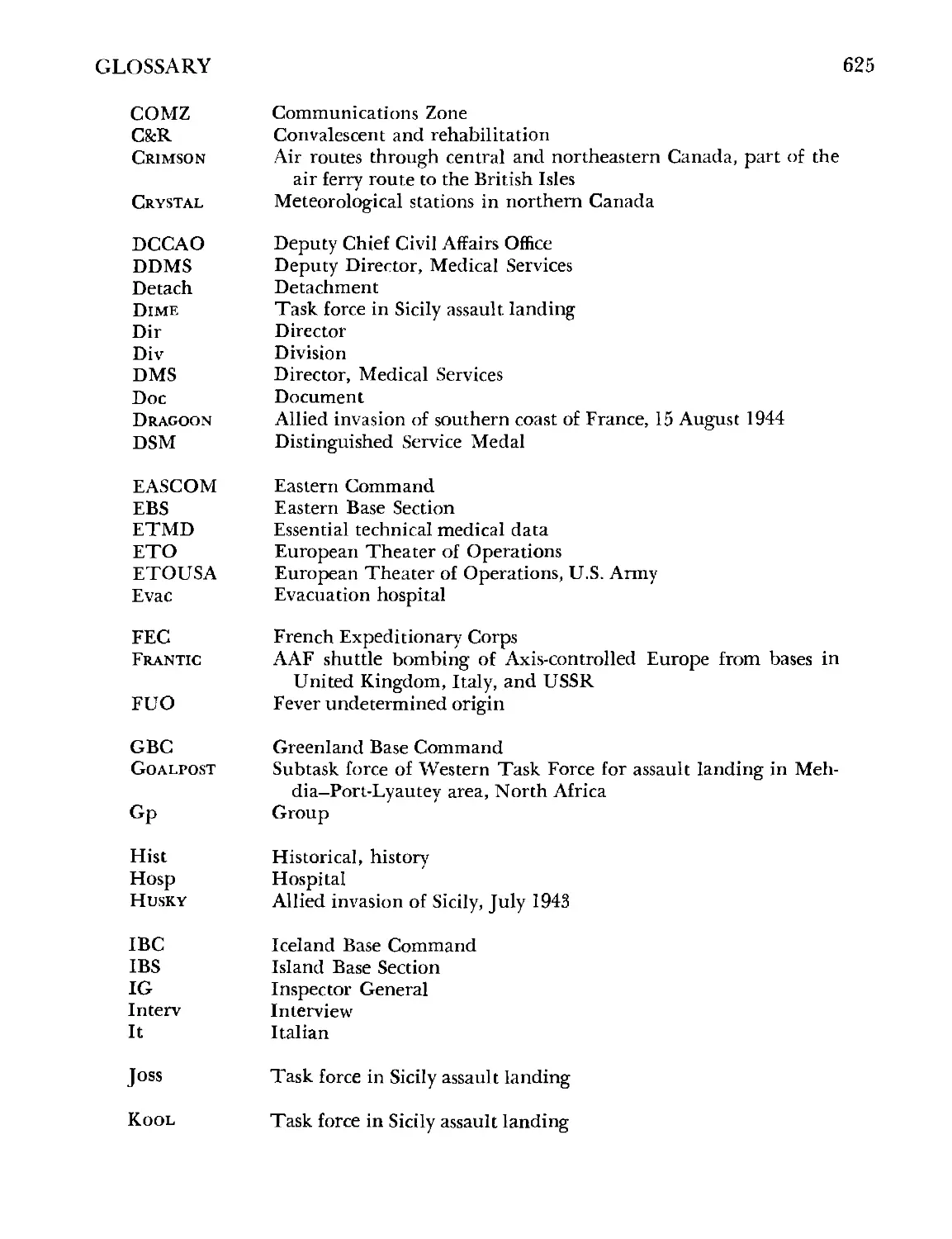
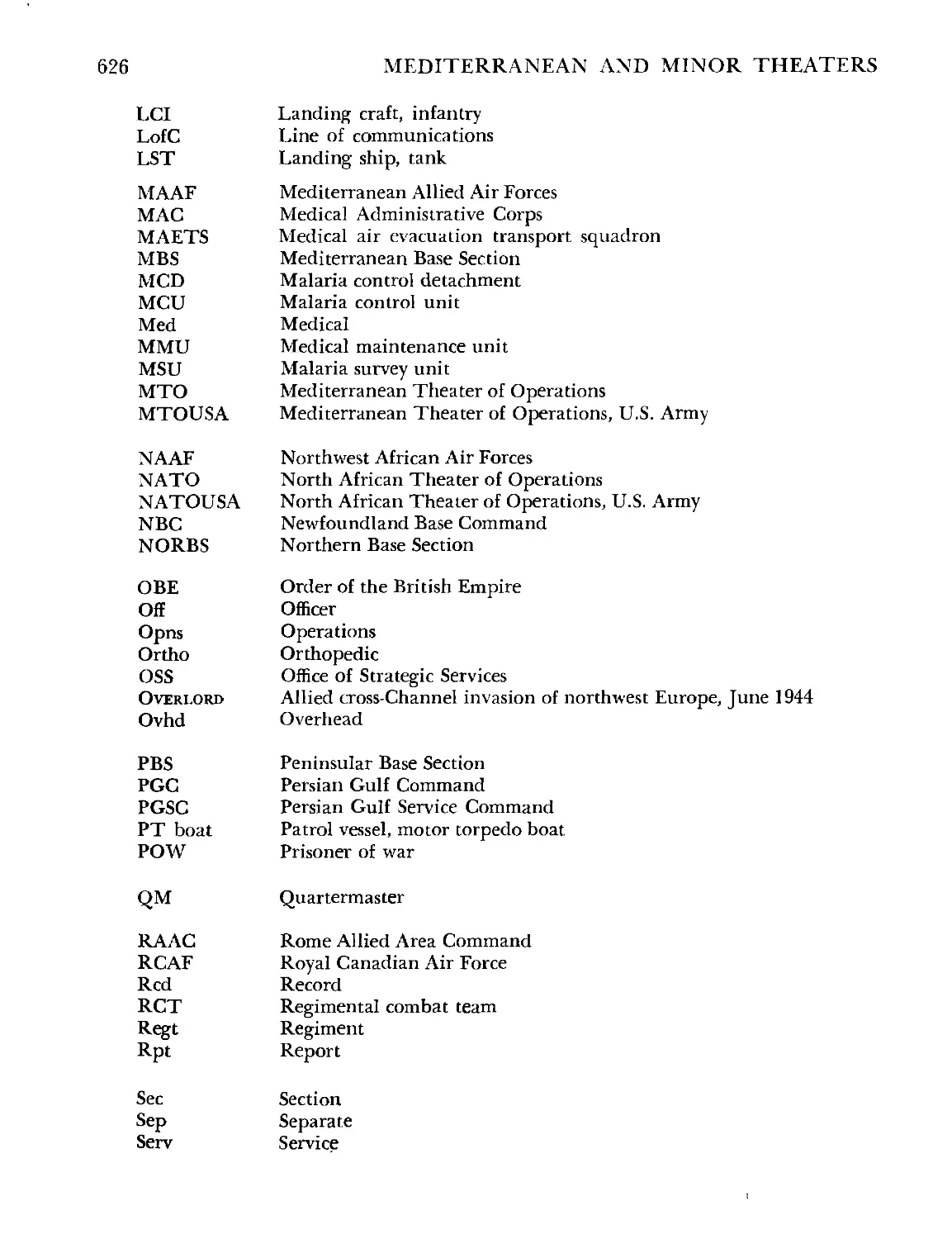
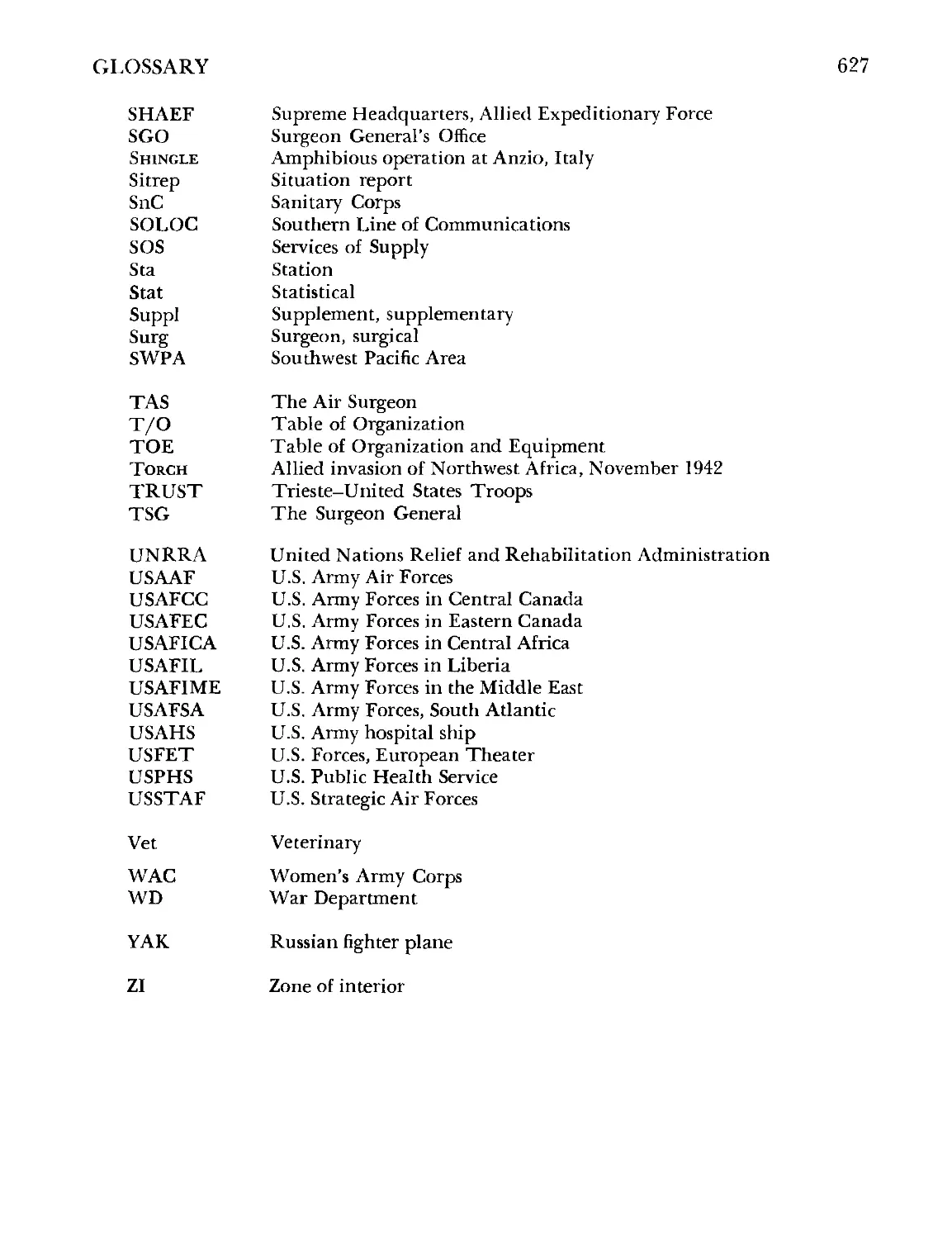
GLOSSARY................................................... 624
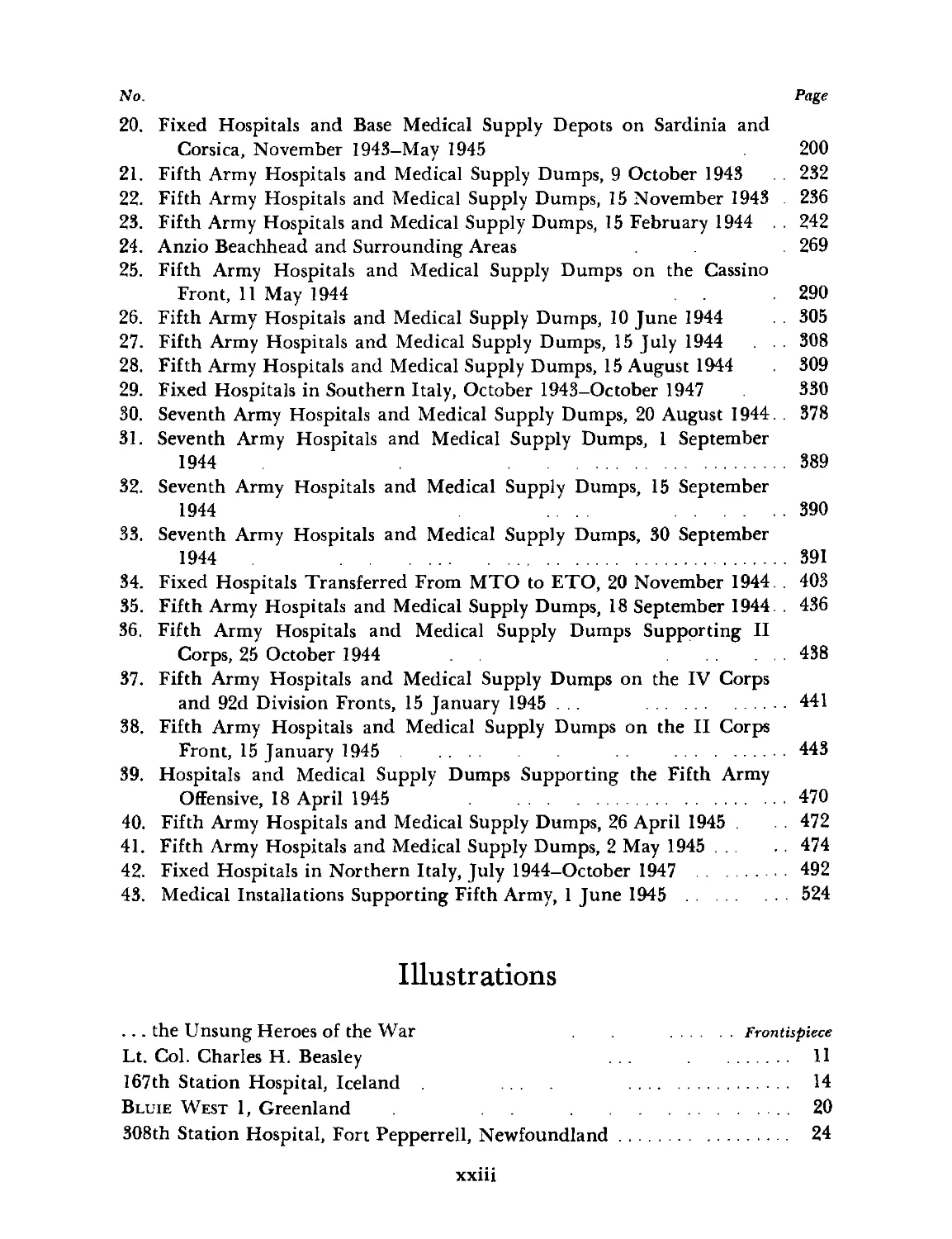
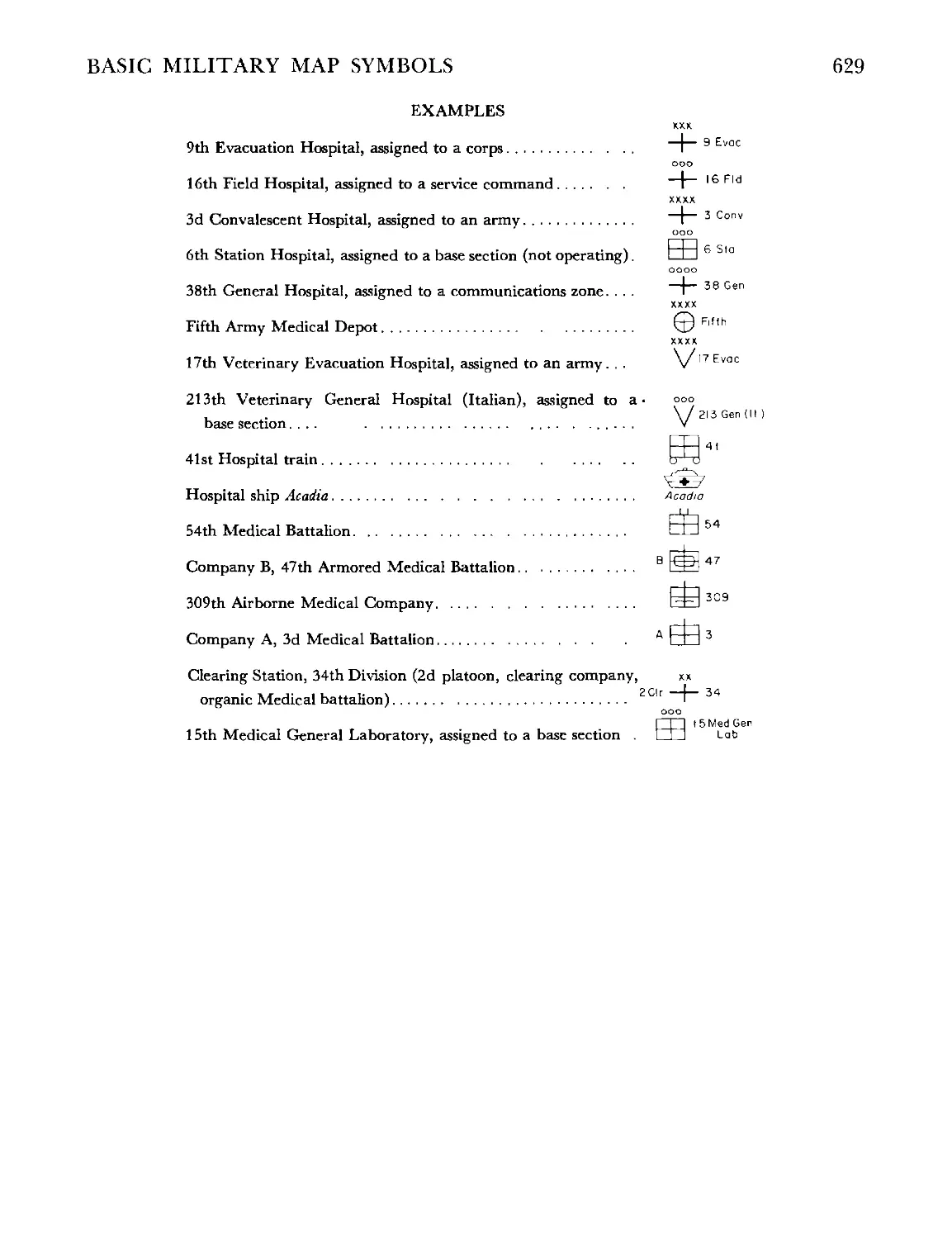
BASIC MILITARY MAP SYMBOLS ................................ 628
INDEX ..................................................... 633
Tables
No.
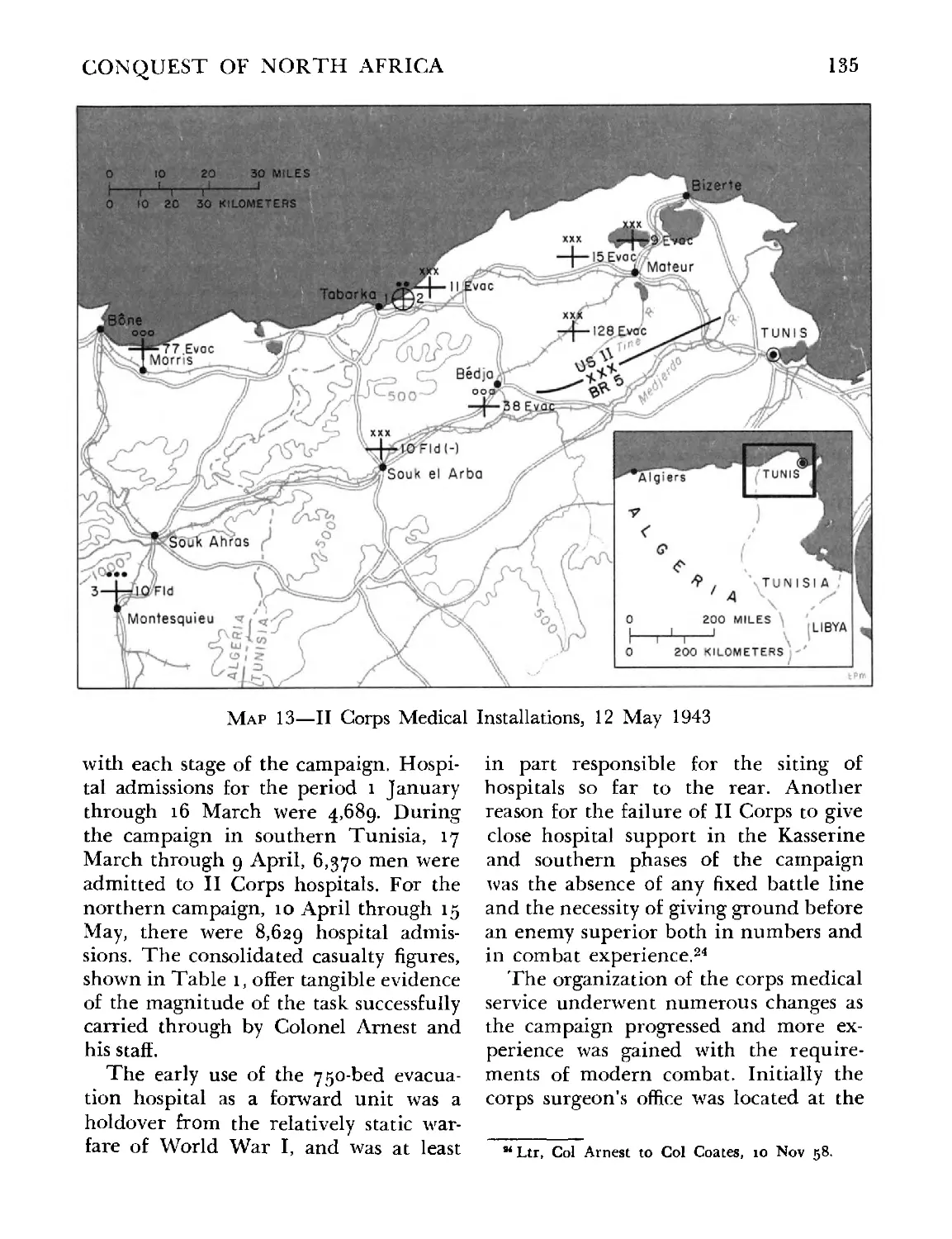
1.	Hospital Admissions and Dispositions, II Corps, I January—15 May
1943 ..................................................... 136
2.	Air Evacuation From Tunisia, 16 January-23 May 1943 .... 140
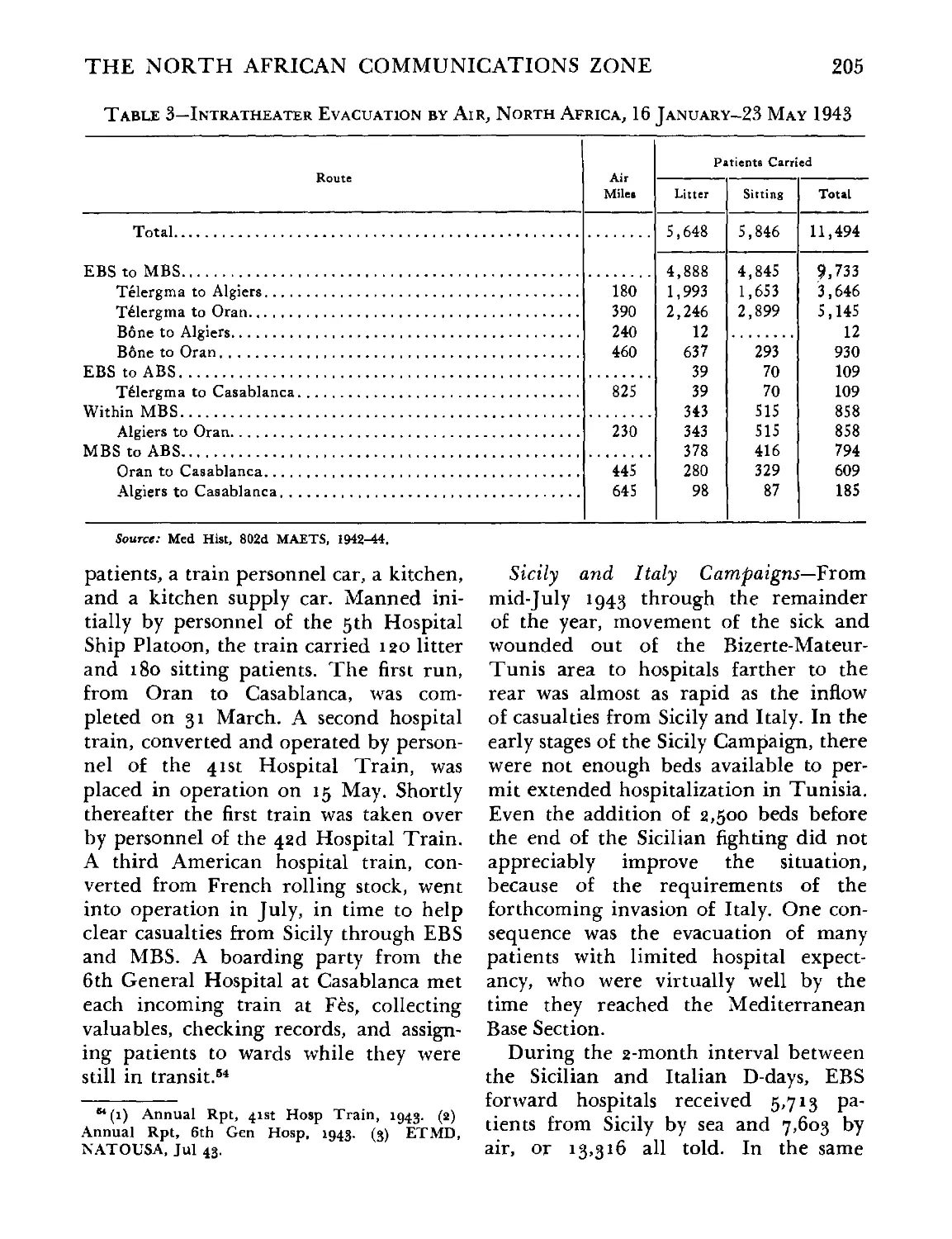
3.	Intratheater Evacuation by Air, North Africa, 16 January—23 May 1943 . 205
4.	U.S. Army Patients Evacuated by Sea From North Africa to the Zone
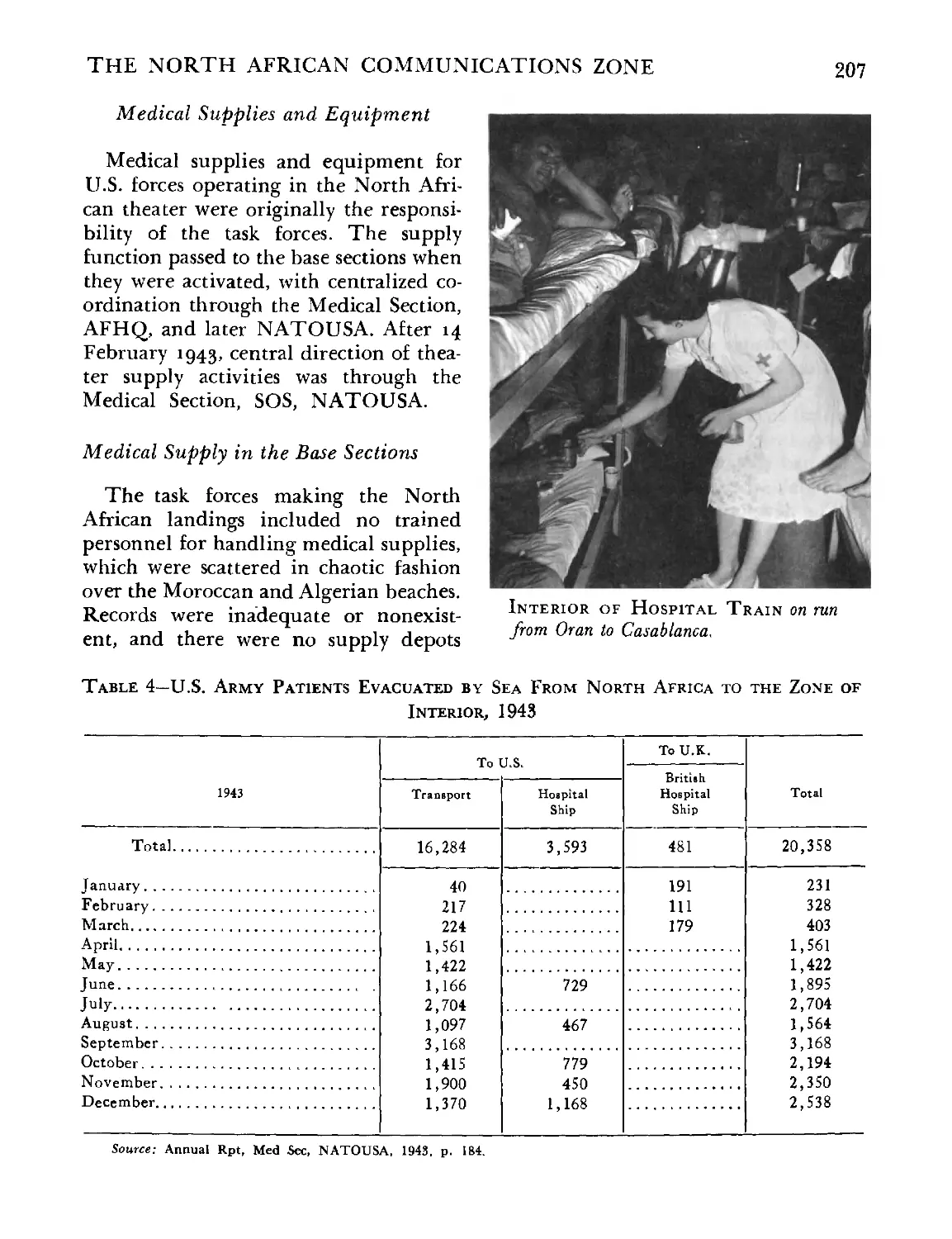
of Interior, 1943 ........................................ 207
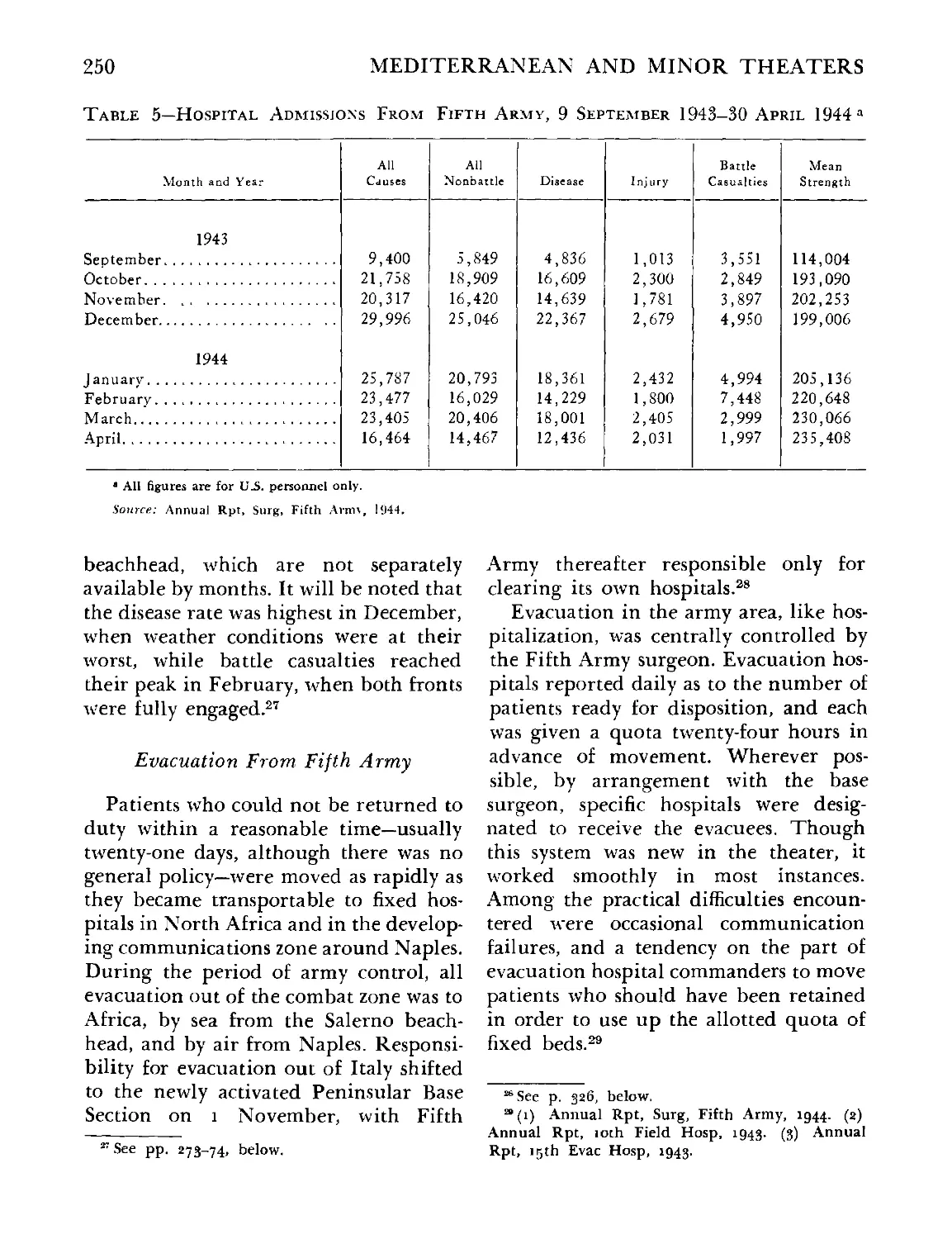
5.	Hospital Admissions From Fifth Army, 9 September 1943-30 April
1944 ..................................................... 250
xx
No.	Page
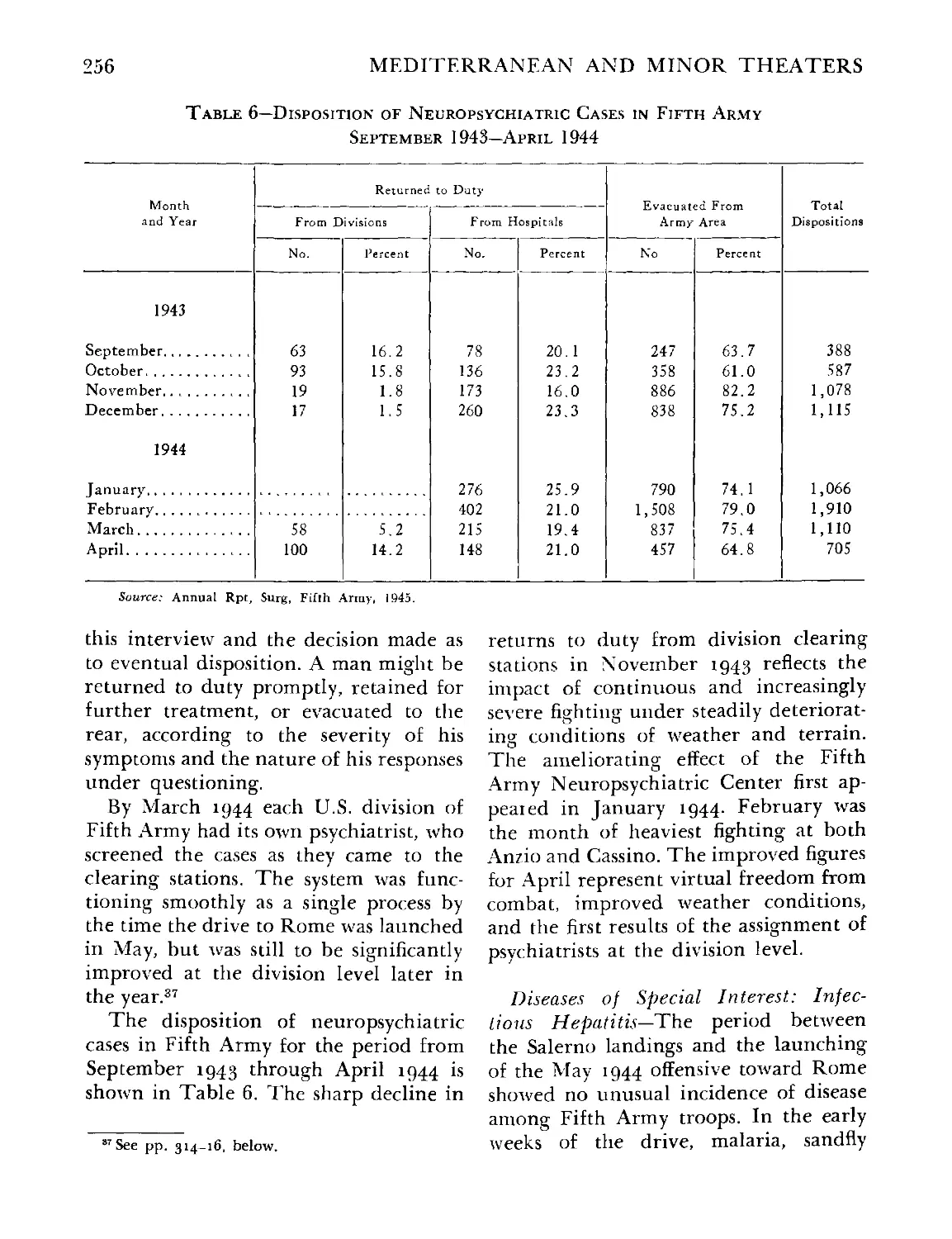
6.	Disposition of Neuropsychiatric Cases in Fifth Army, September 1943-
April 1944	256
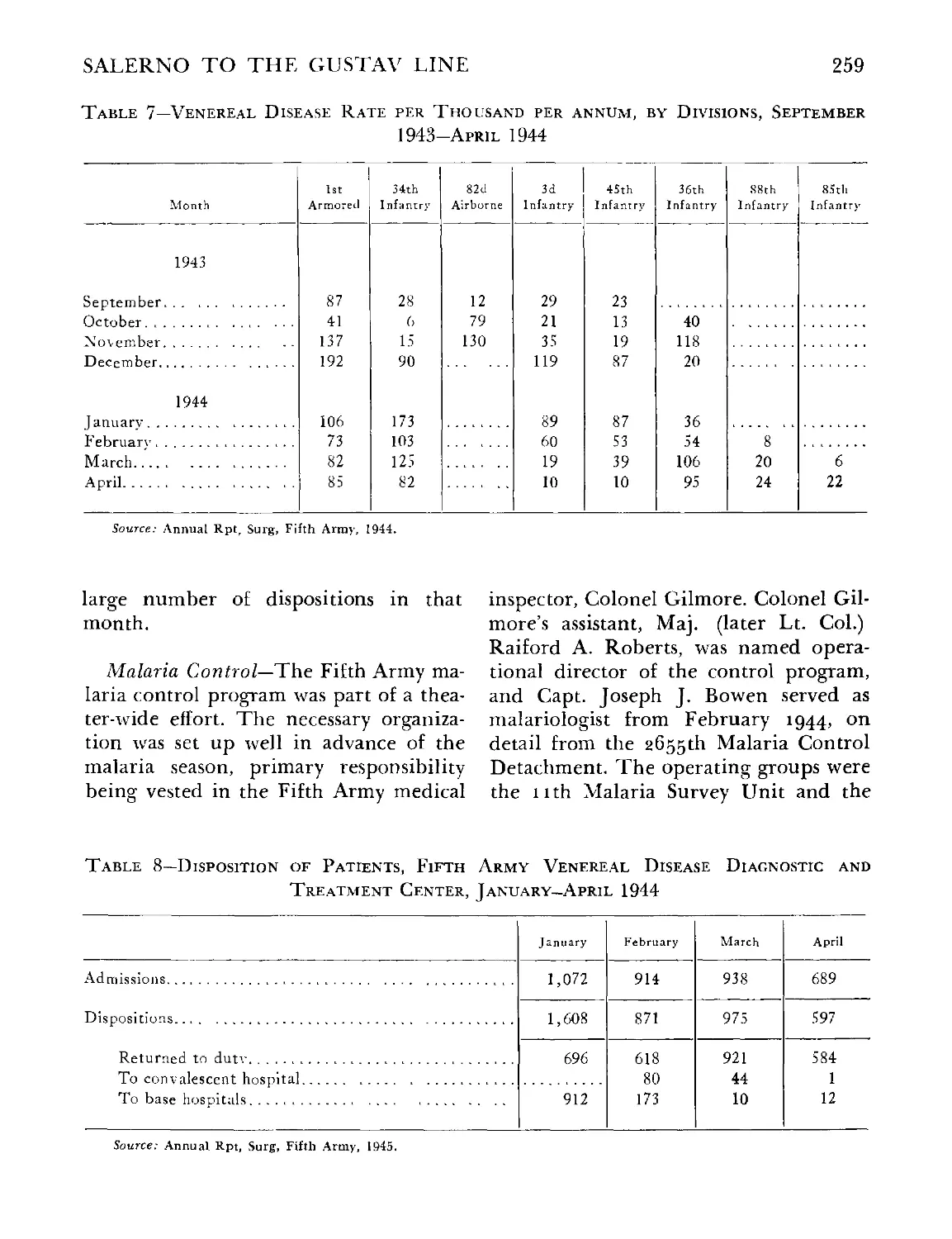
7.	Venereal Disease Rate per Thousand per Annum, by Divisions, Sep-
tember 1943—April 1944	........... 259
8.	Disposition of Patients, Fifth Army Venereal Disease Diagnostic and
Treatment Center, January—April 1944	...	259
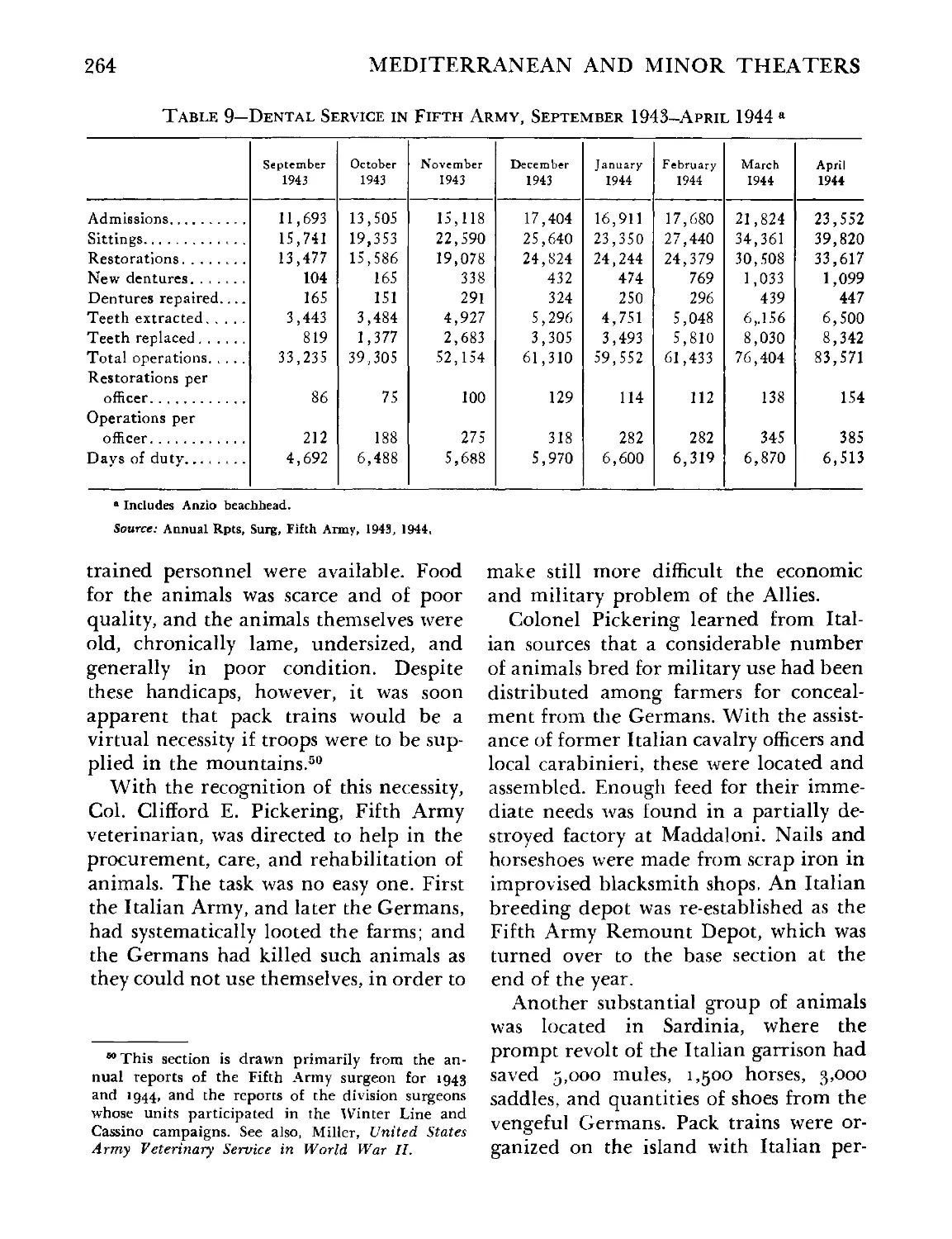
9.	Dental Service in Fifth Army, September 1943—April 1944	....... 264
10.	Disposition of Problem Cases in the 3d Division, 4 March-30 April
1944 ................................................................   285
11.	Admissions to Hospital and Quarters From Fifth Army, May-August
1944 ................................................................   310
12.	Air Evacuation From Fifth Army Hospitals, 26 May—31 August 1944 ... 311
13.	Evacuation From Fifth Army to PBS Hospitals, 1 Januarv—31 August
1944 .................................................................. 312
14.	Disposition of Neuropsychiatric Cases in Fifth Army, May-August
1944 ................................................................   316
15.	Venereal Disease Rates by Divisions, Fifth Army, May—August 1944 . . . 317
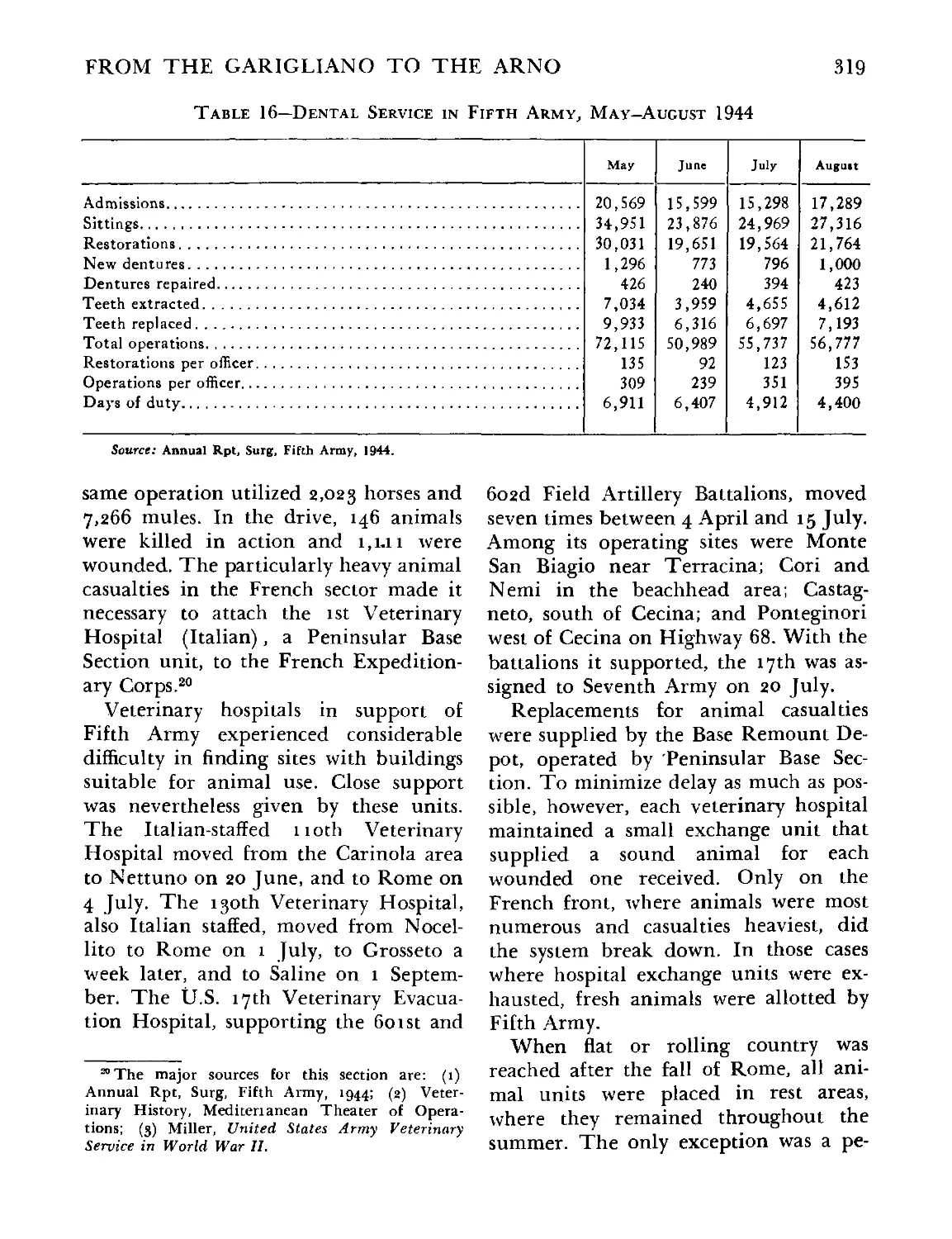
16.	Dental Service in Fifth Army, May-August 1944	................. 319
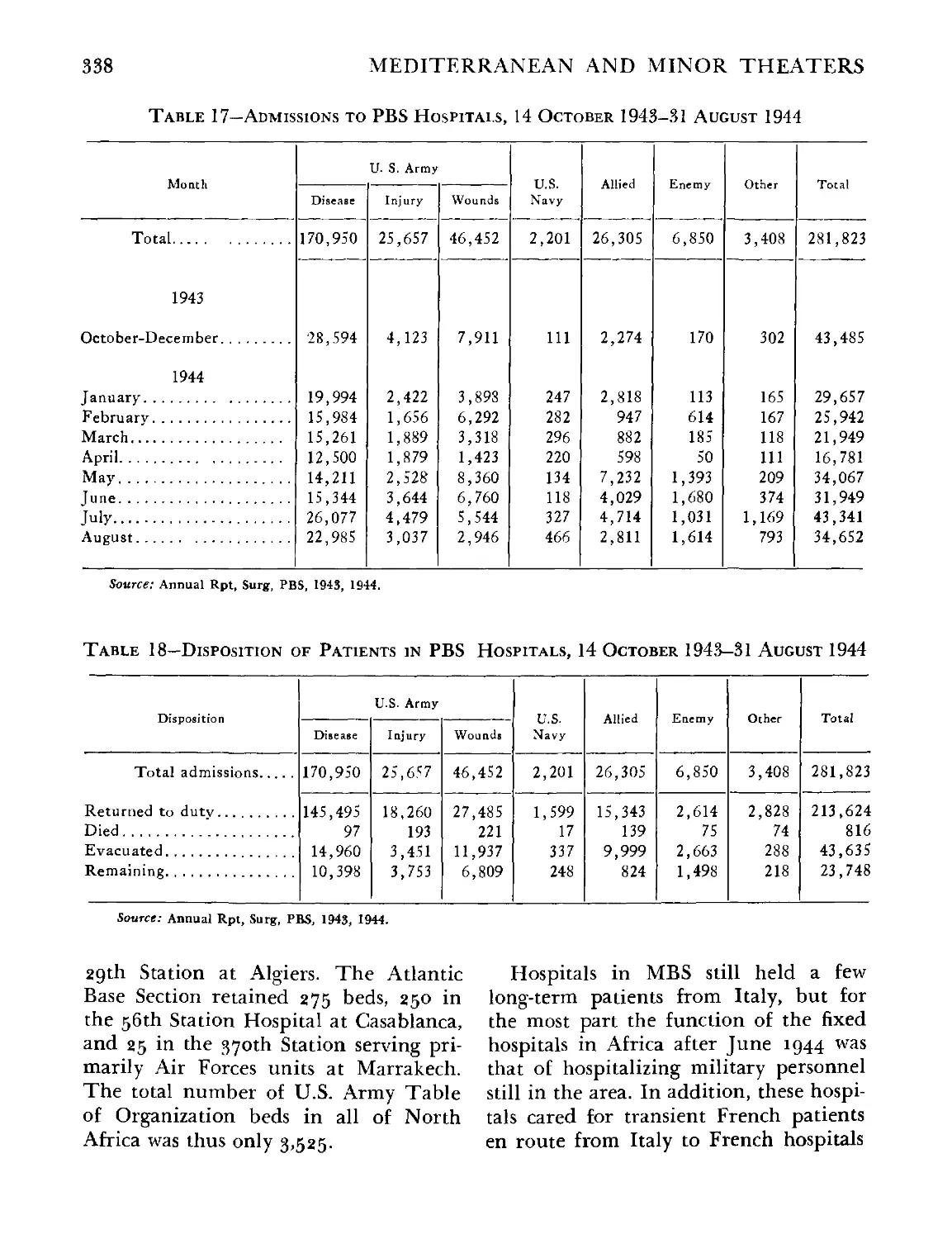
17.	Admissions to PBS Hospitals, 14 October 1943-31 August 1944 ....... 338
18.	Disposition of Patients in PBS Hospitals, 14 October 1943-31 August
1944 .................................................................. 338
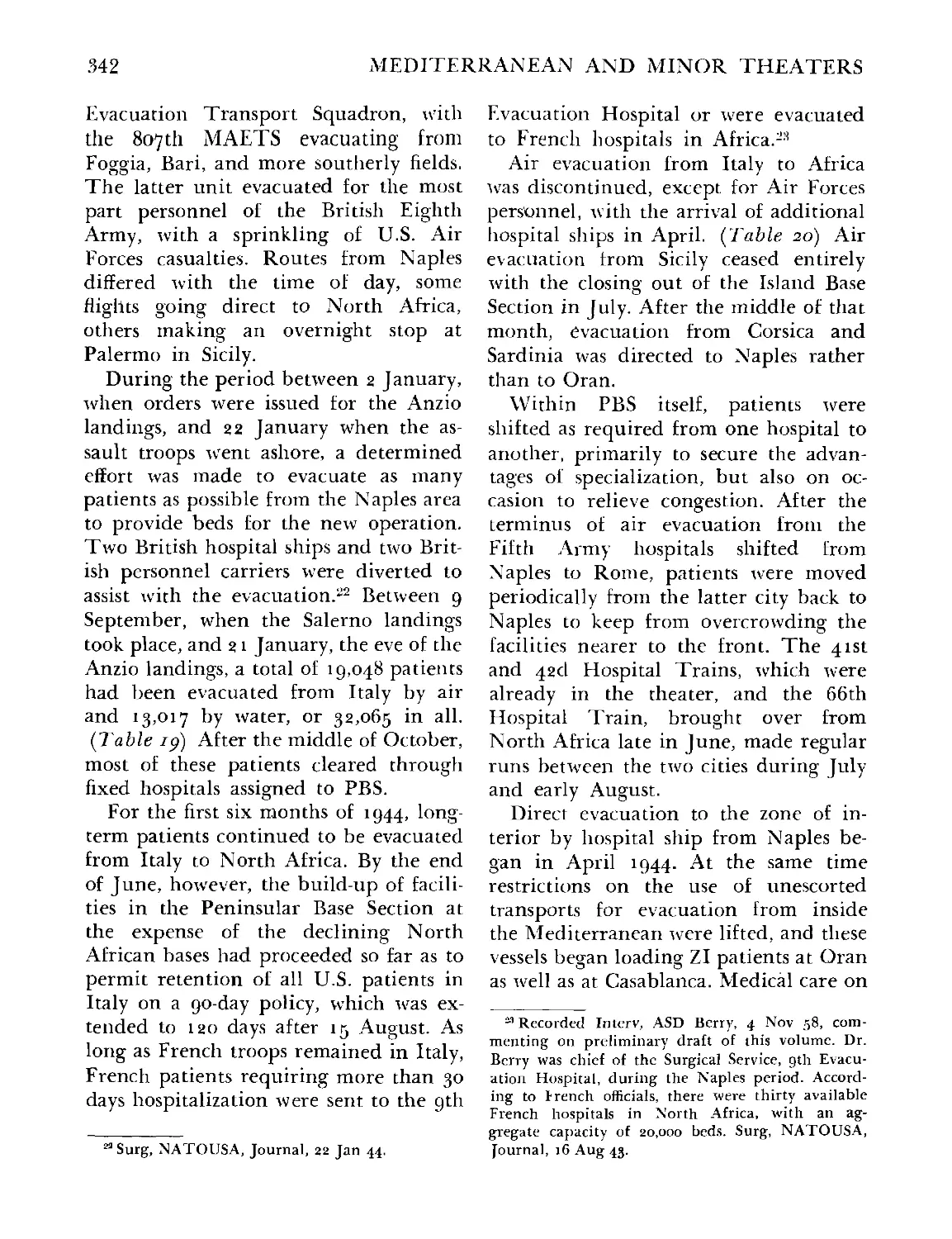
19.	Evacuation From Italy to North Africa, 9 September 1943-21 January
1944 .................................................................. 343
20.	Evacuation From Italy to North Africa, January-August 1944 ........ 344
21.	Evacuation From the Mediterranean to the Zone of Interior, January-
August 1944 .........................................................   344
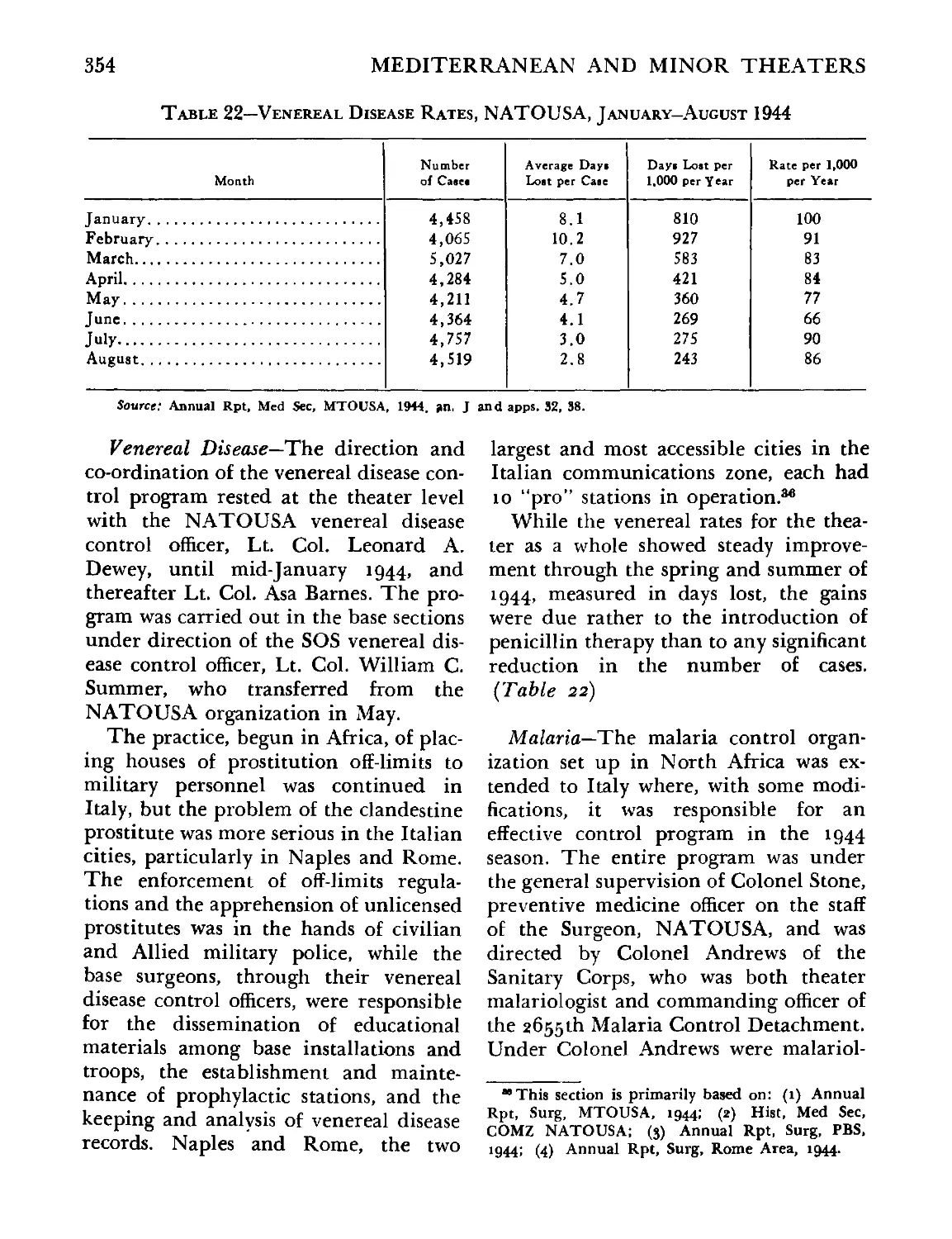
22.	Venereal Disease Rates, NATOUSA, January-August 1944 .............. 354
23.	Admissions and Dispositions, Seventh Army Medical Installations, 15-
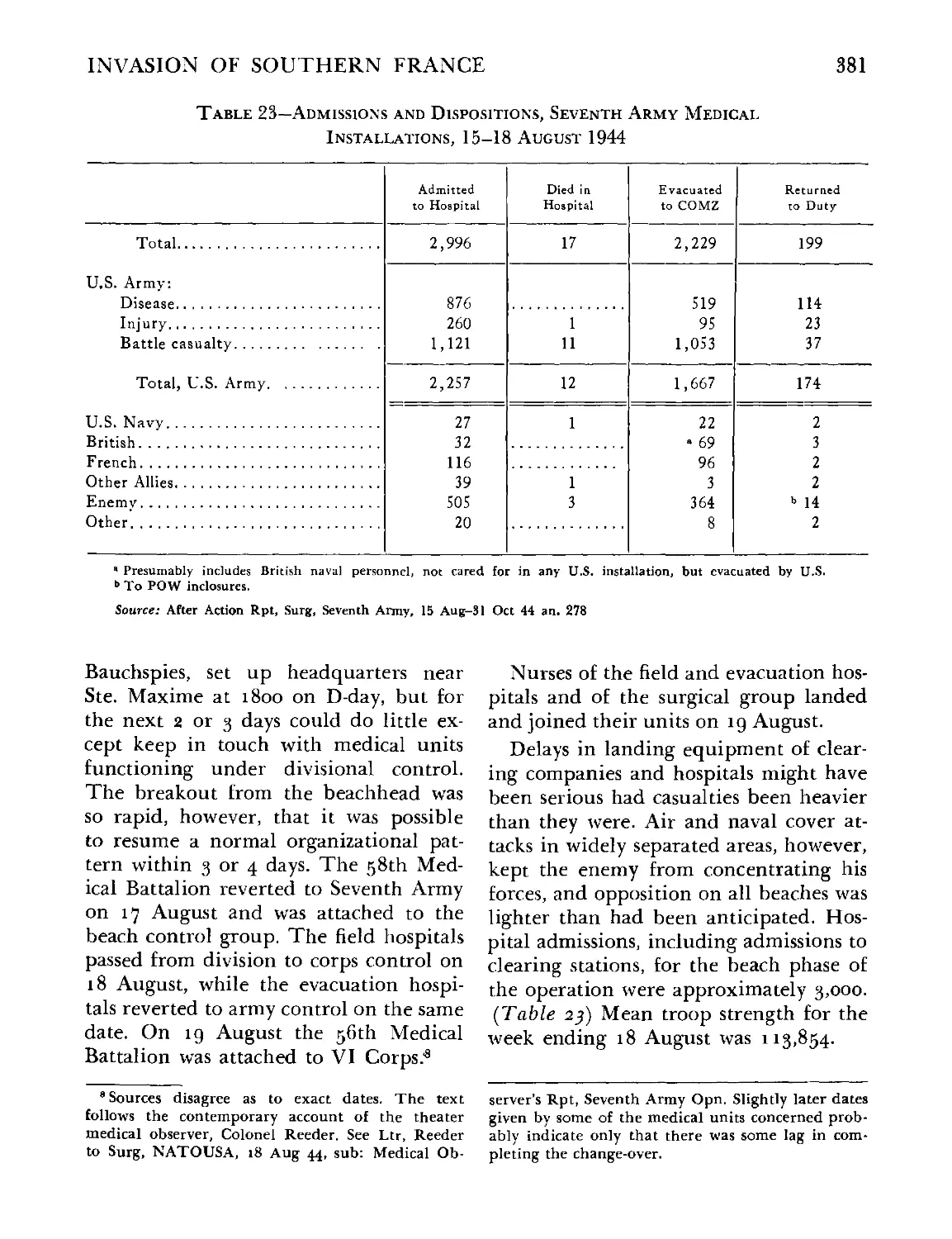
18 August 1944 ................................................   381
24.	Admissions and Dispositions, Seventh Army Medical Installations, 15
August-29 September 1944 .............................................. 394
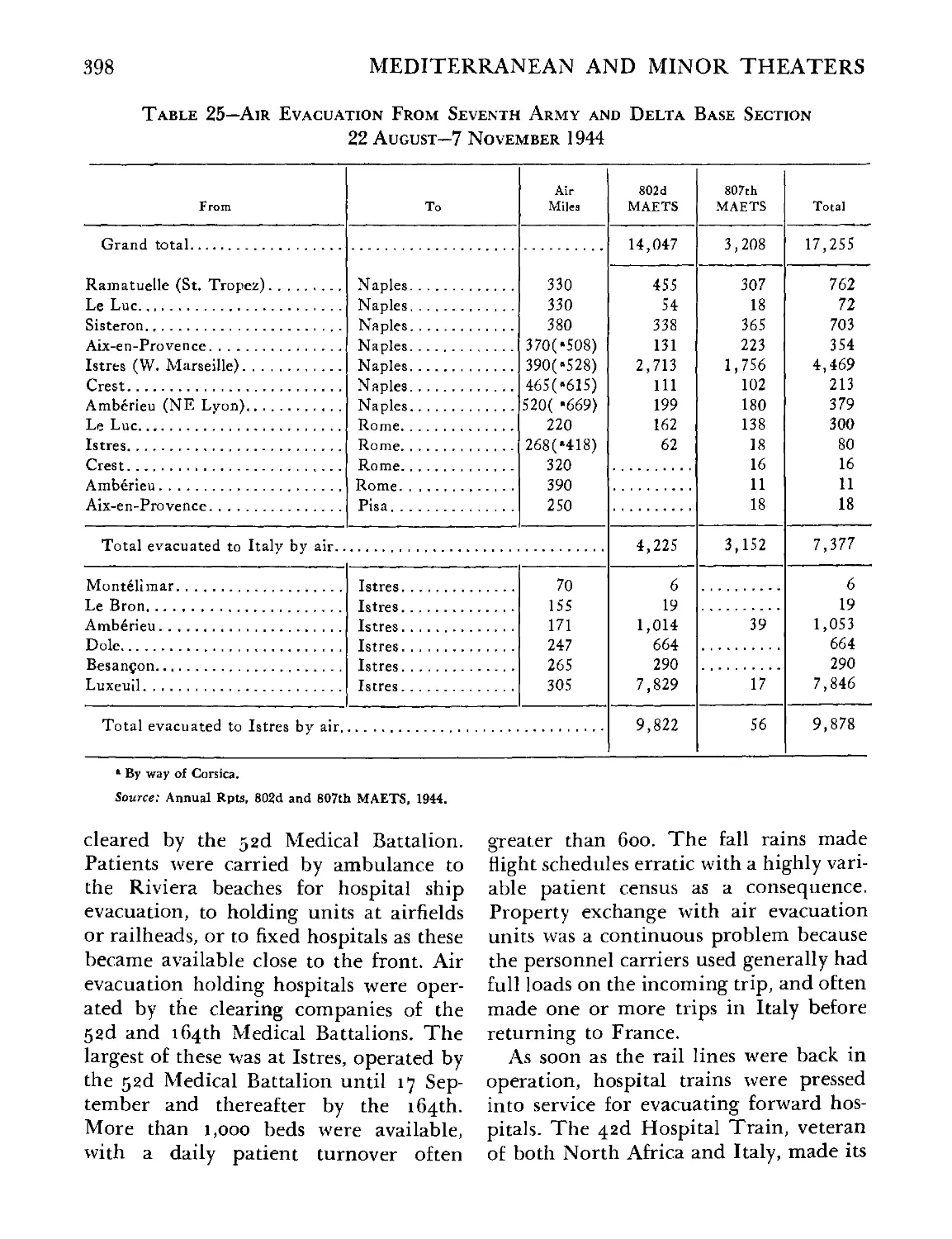
25.	Air Evacuation From Seventh Army and Delta Base Section, 22 Au-
gust—7 November 1944	.	............................. 398
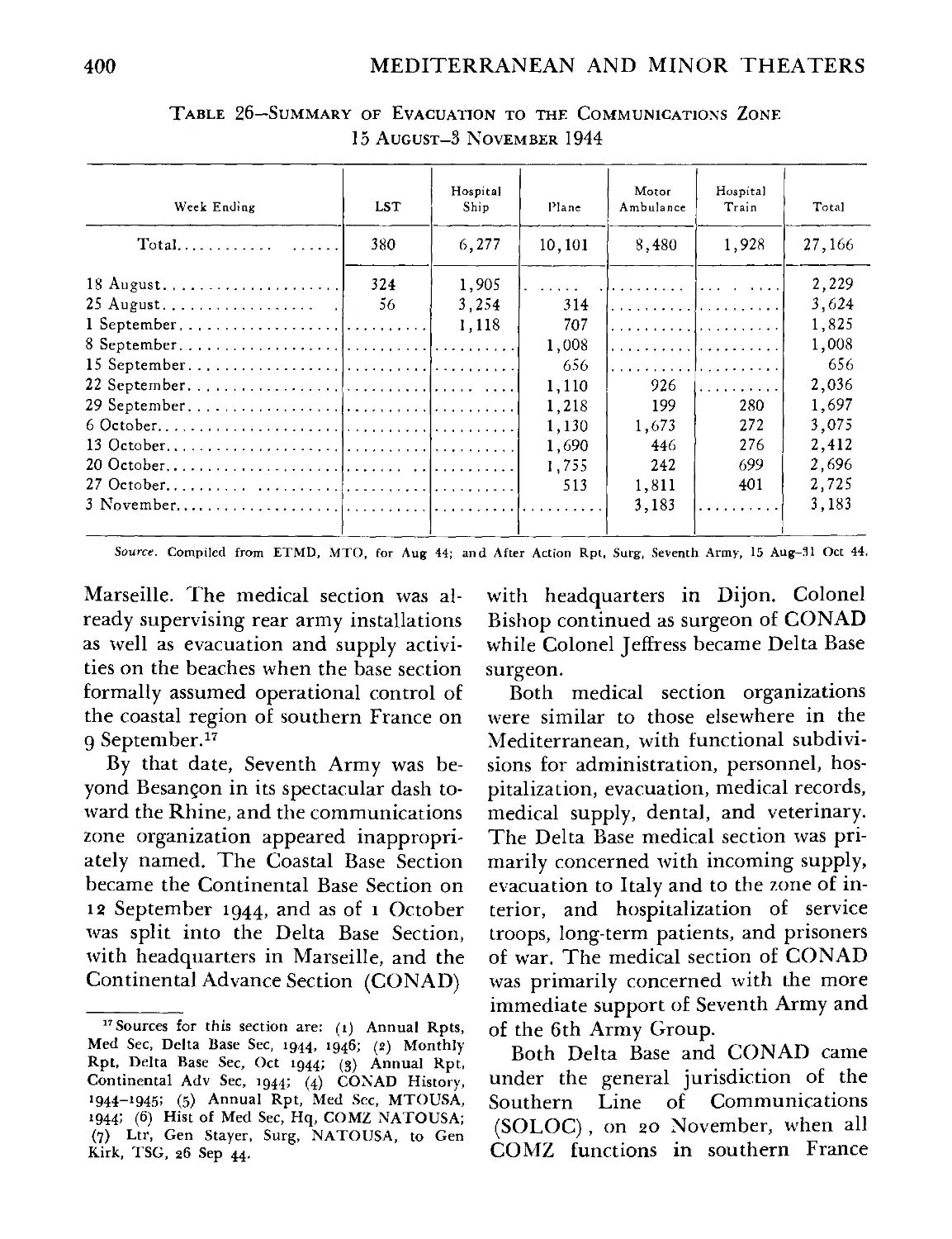
26.	Summary of Evacuation to the Communications Zone, 15 August-
3 November 1944	........................................... 400
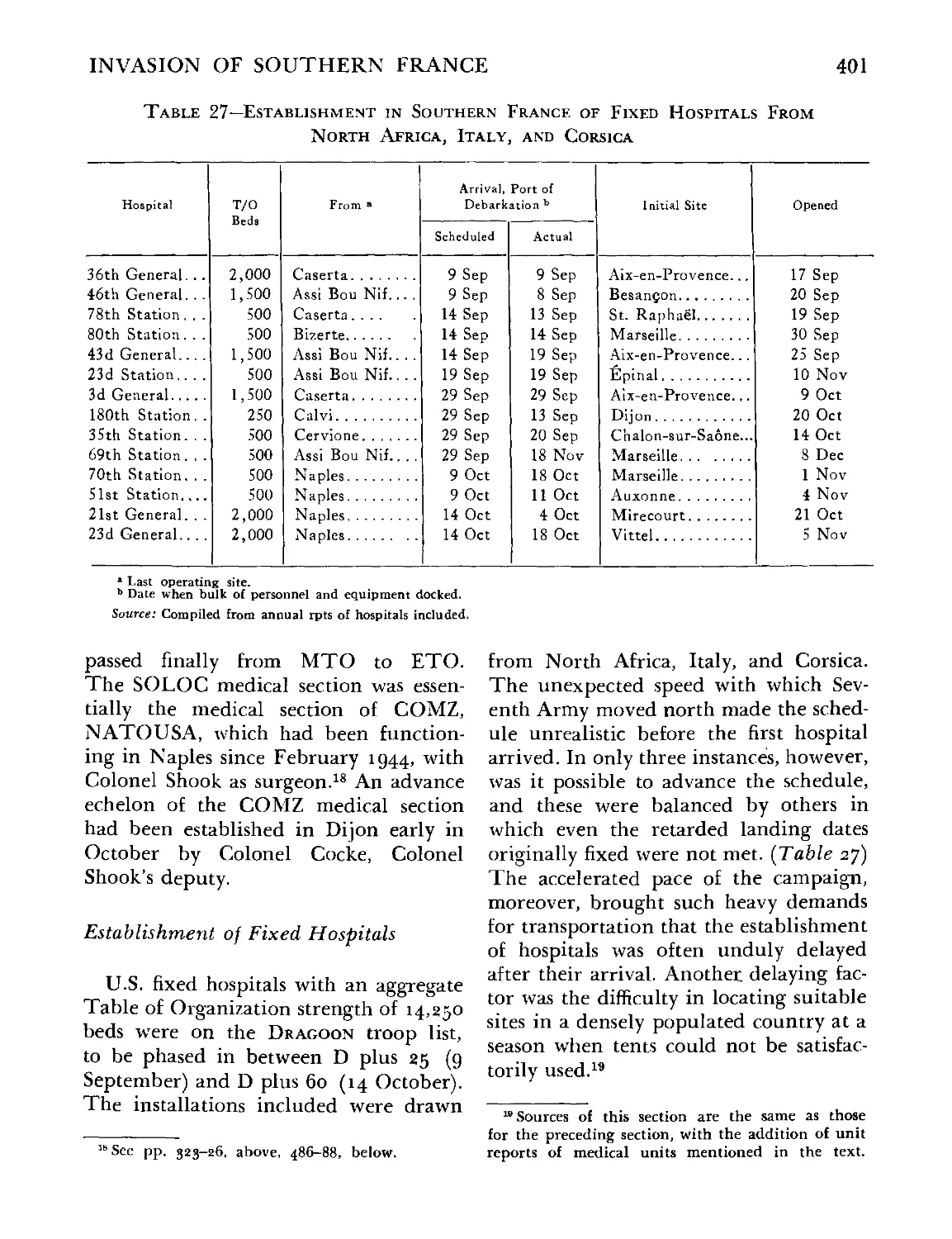
27.	Establishment in Southern France of Fixed Hospitals From North
Africa, Italy, and Corsica..............................................401
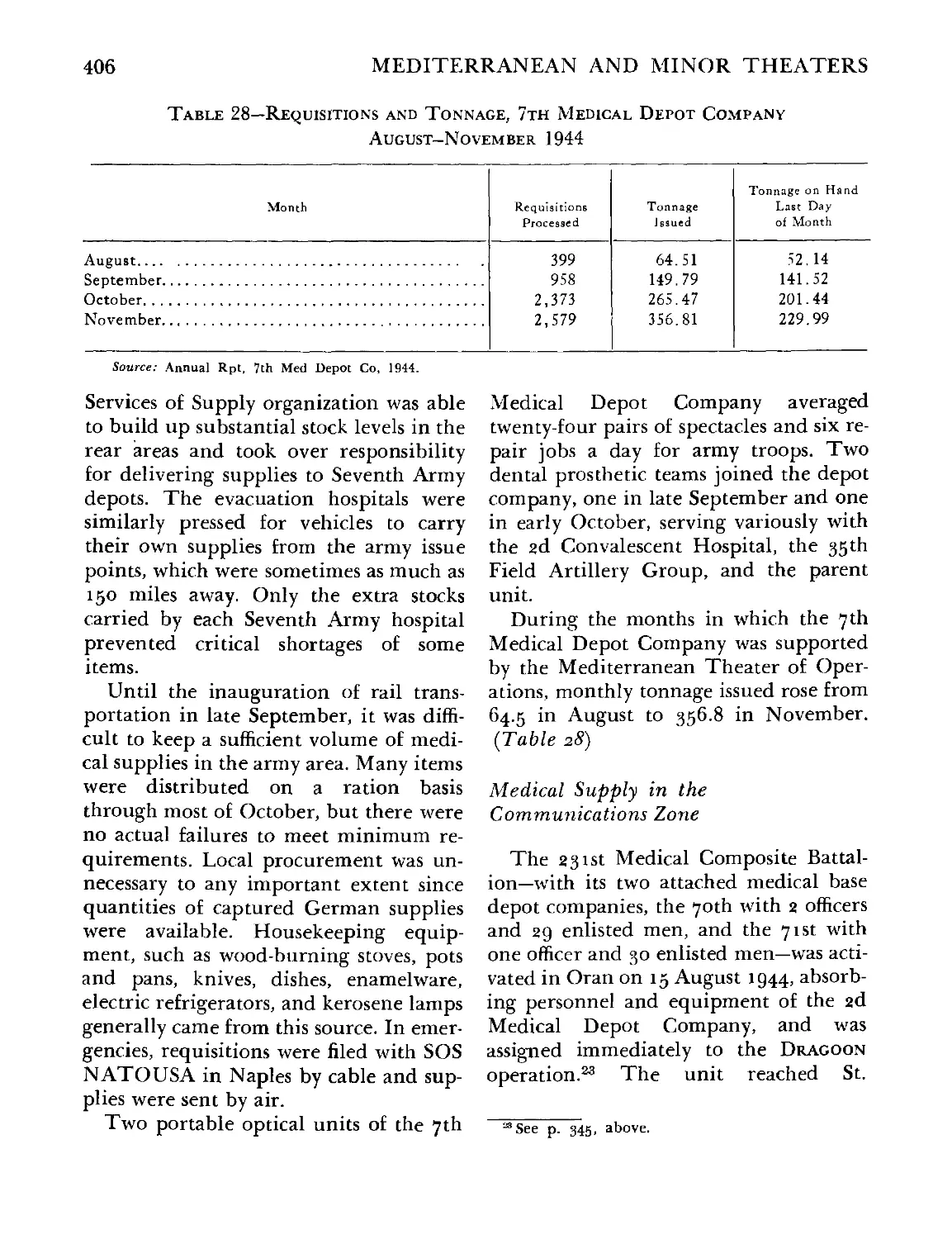
28.	Requisitions and Tonnage, 7th Medical Depot Company, August-
November 1944	............................................. 406
29.	Receipts and Issues, 231st Medical Composite Battalion, September-
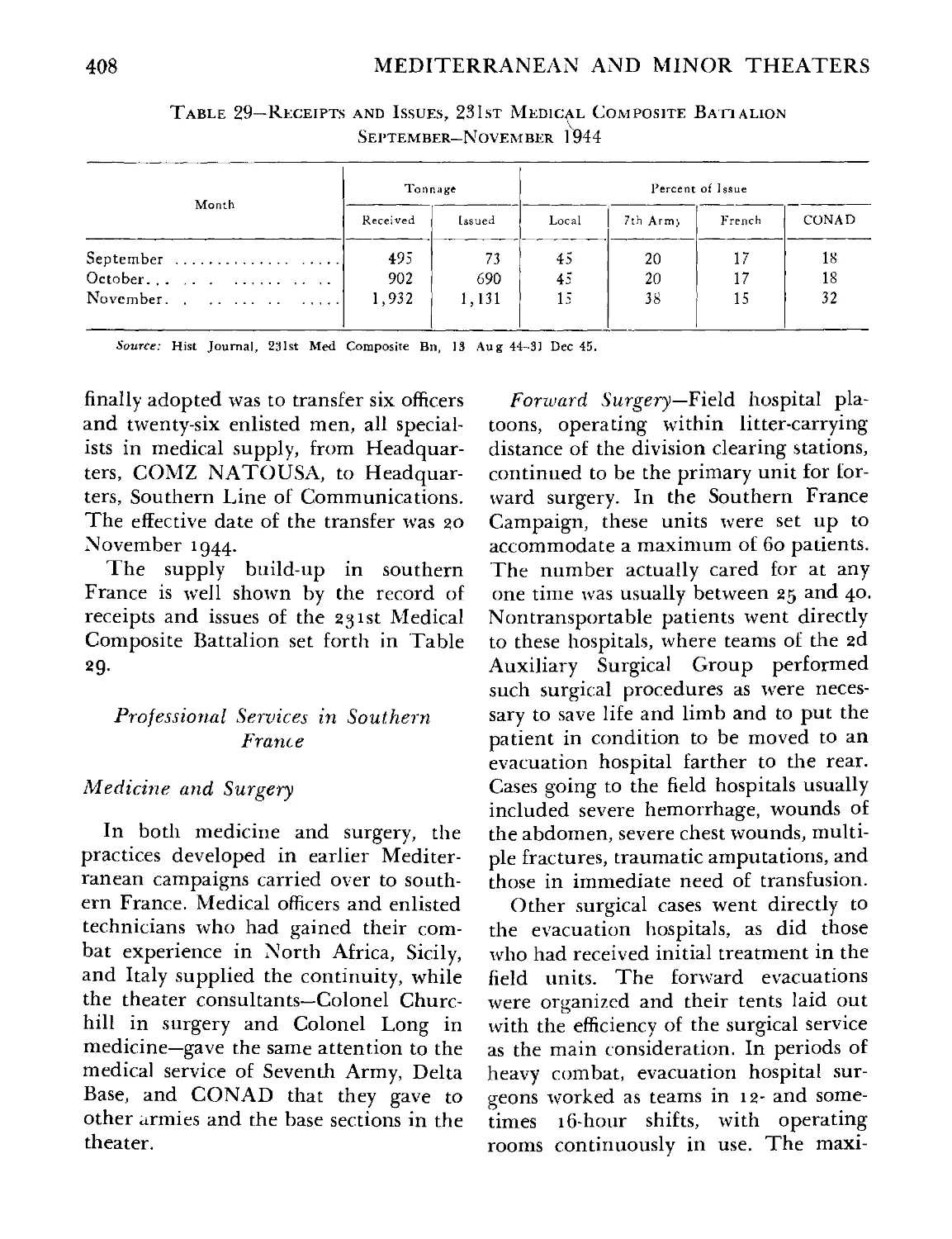
November 1944 .......................................................   408
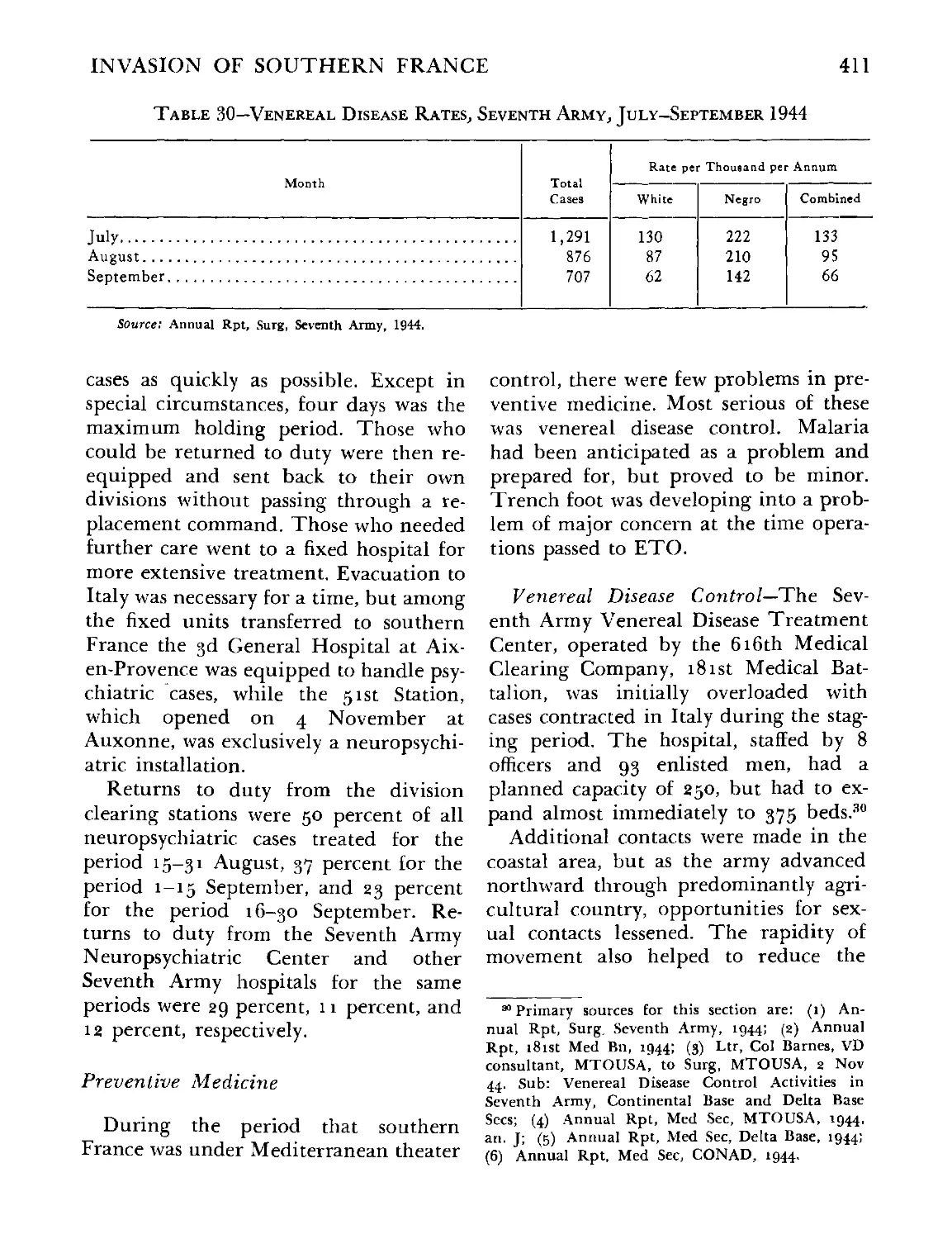
30.	Venereal Disease Rates, Seventh Army, July—September 1944 ......... 411
xxi
No.	Page
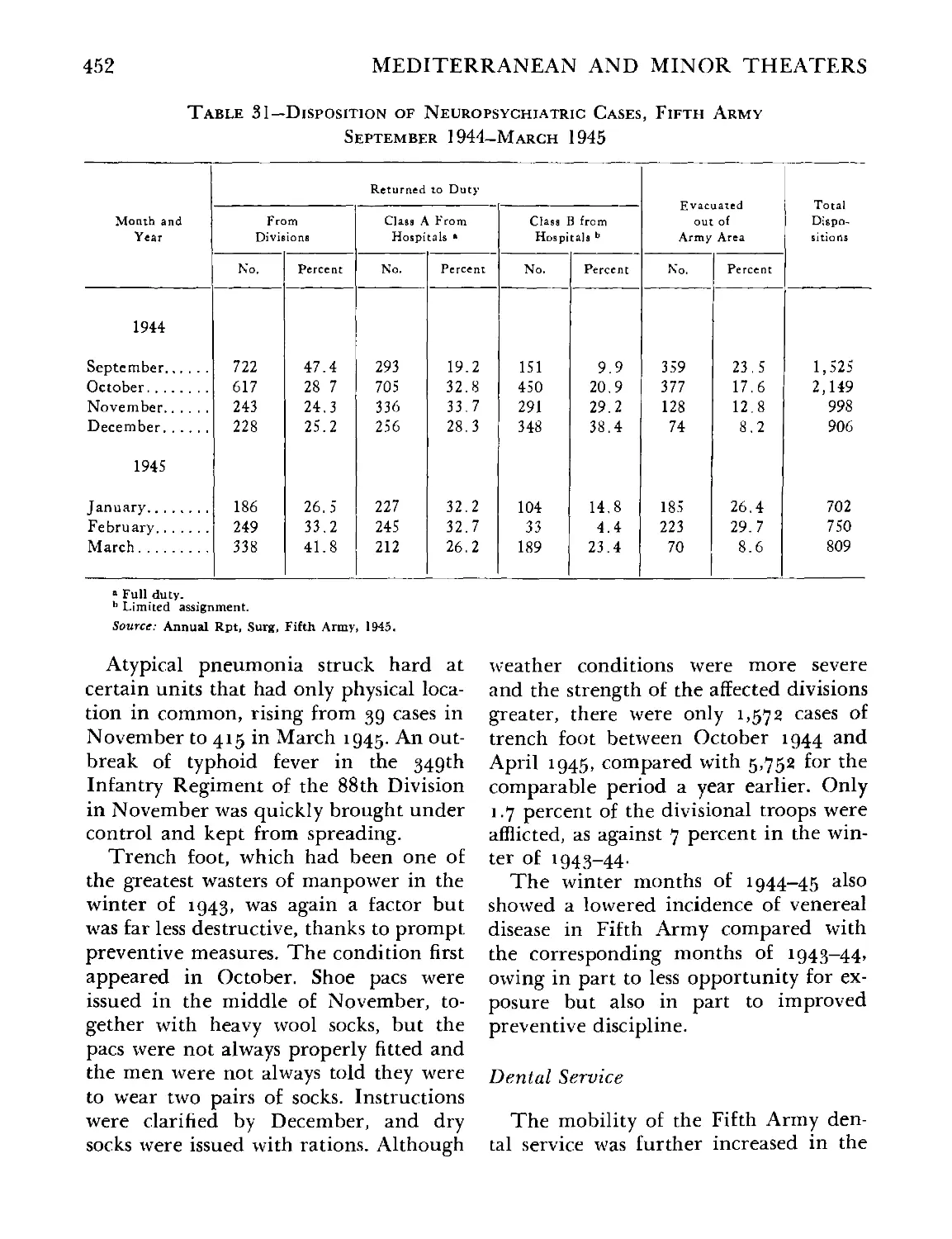
31.	Disposition of Neuropsychiatric Cases, Fifth Army, September 1944-
March 1945	.............. 452
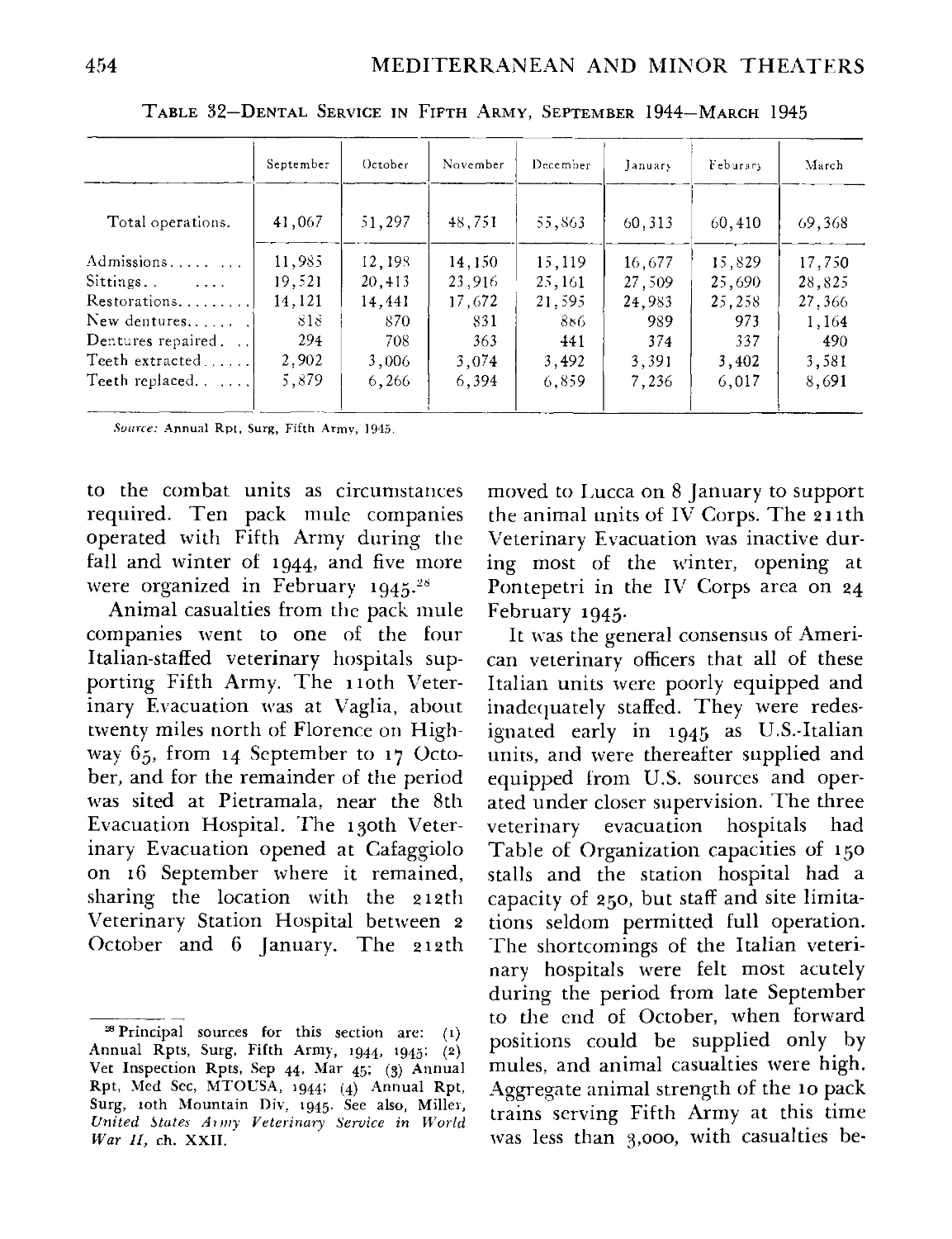
32.	Dental Service in Fifth Army, September 1944-March 1945	. .	454
33.	Wounded in Action in the Po Valley Campaign, Fifth Army, 1 April-
15 May 1945	. .	.......... 468
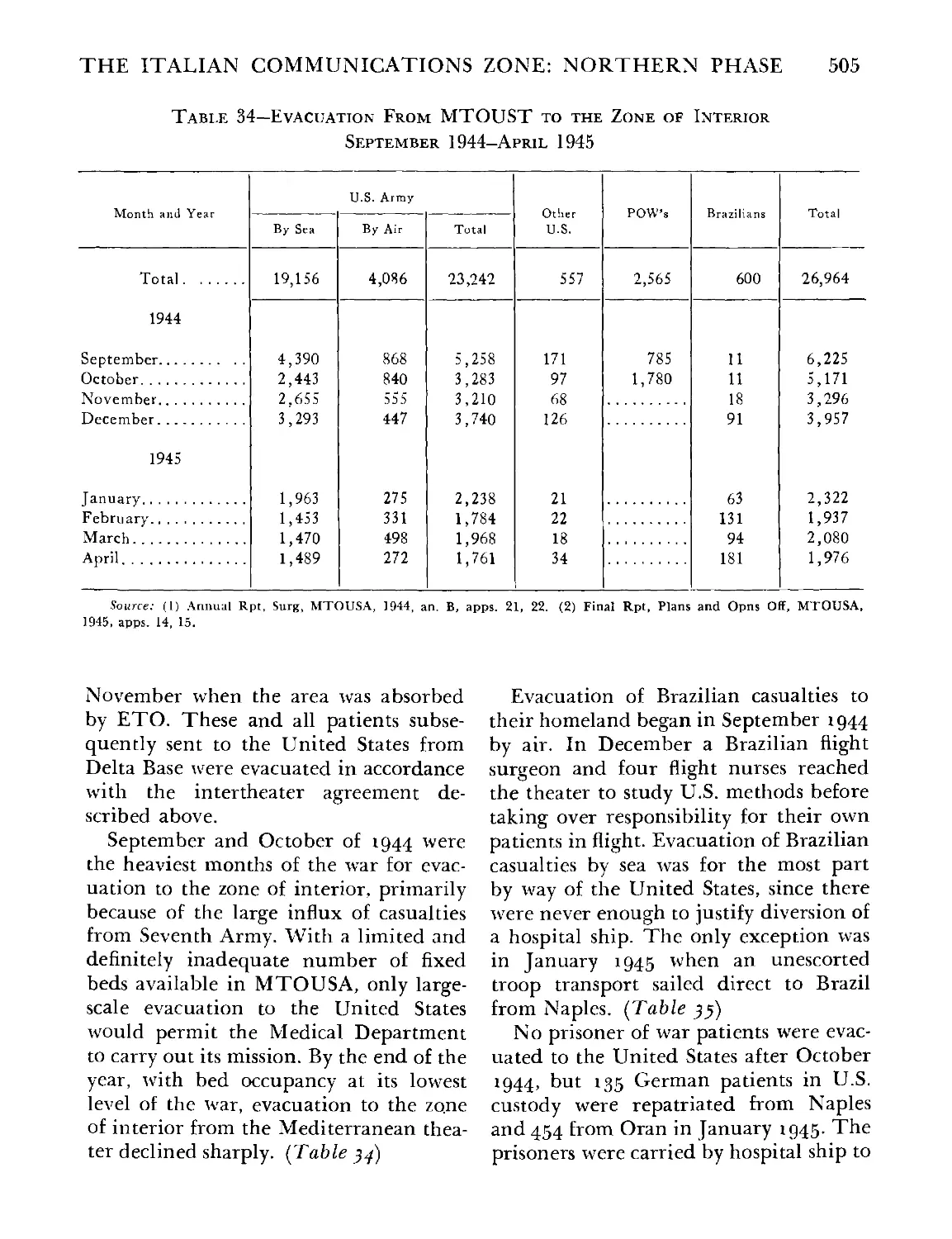
34.	Evacuation From MTOUSA to the Zone of Interior, September 1944-
April 1945	.505
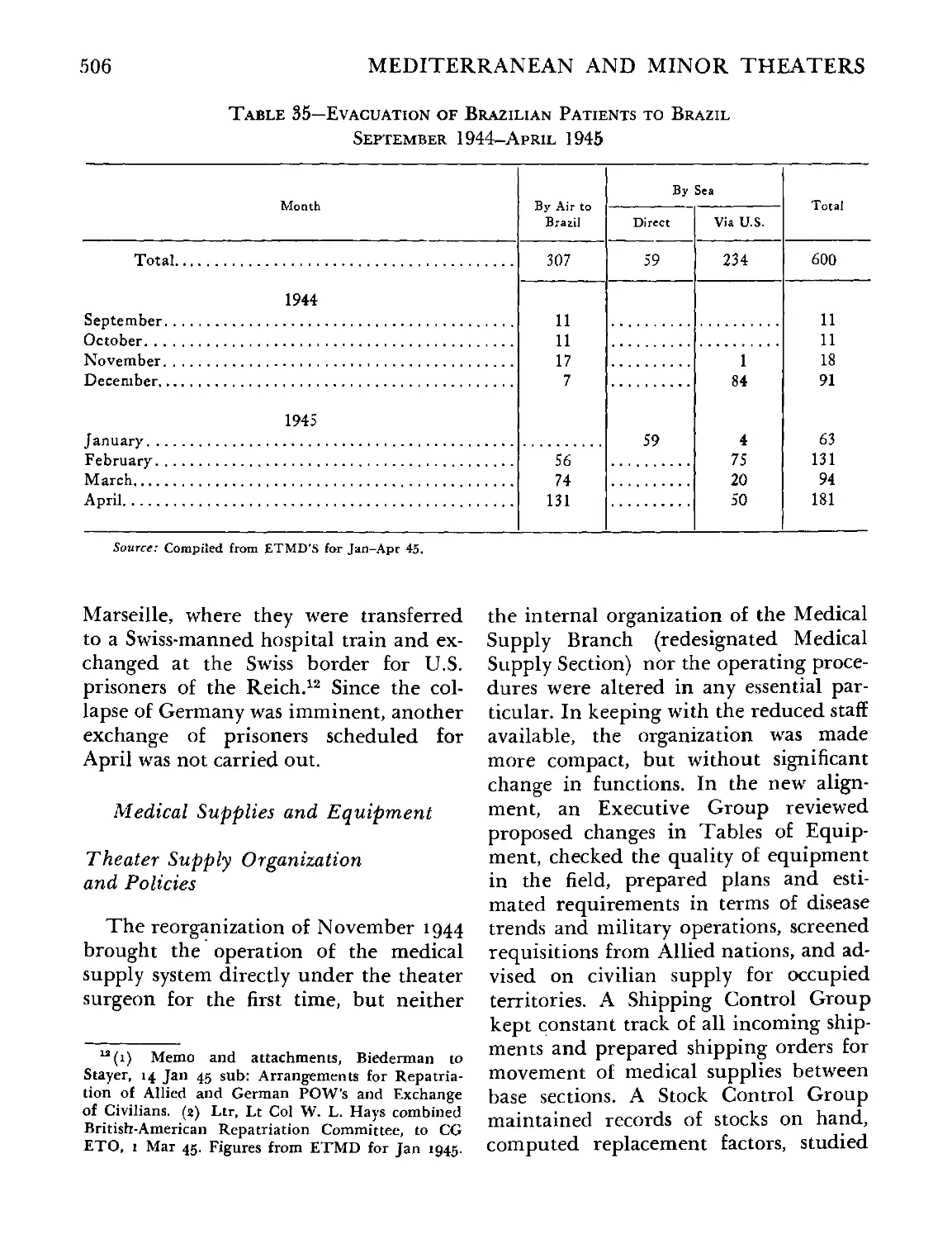
35.	Evacuation of Brazilian Patients to Brazil, September 1944-April 1945. 506
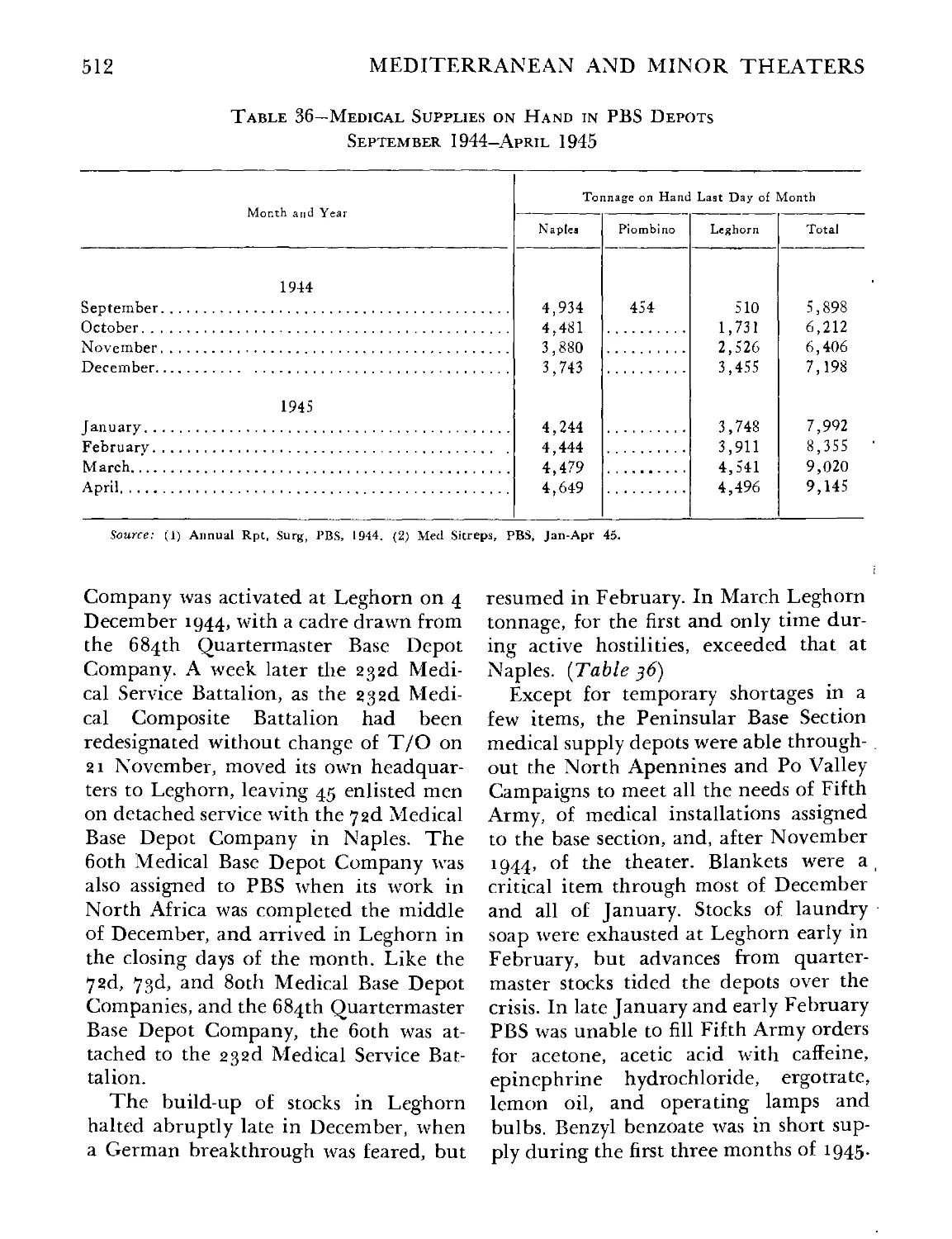
36.	Medical Supplies on Hand in PBS Depots, September 1944-April 1945 . 512
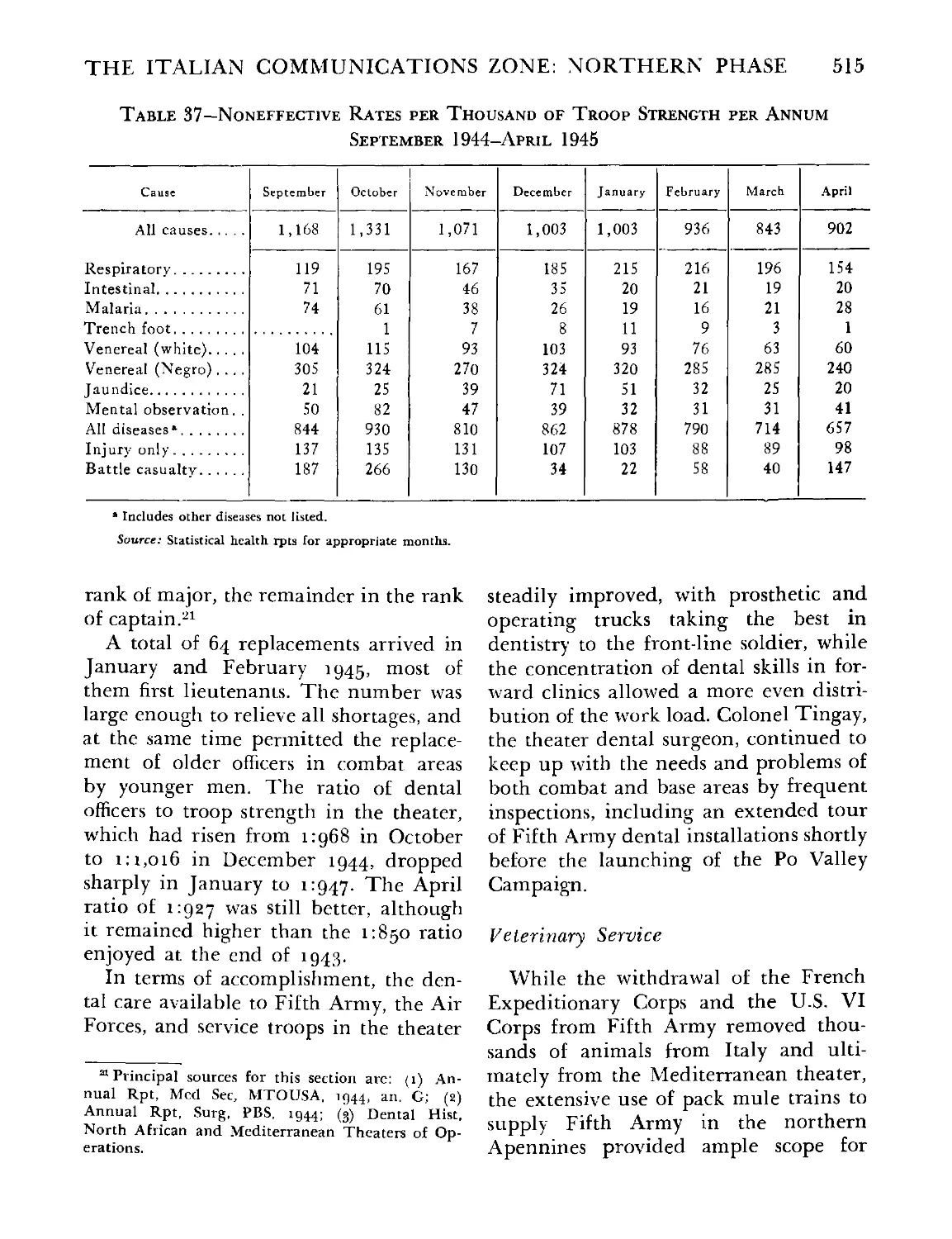
37.	Noneffective Rates per Thousand of Troop Strength per Annum, Sep-
tember 1944-April 1945	515
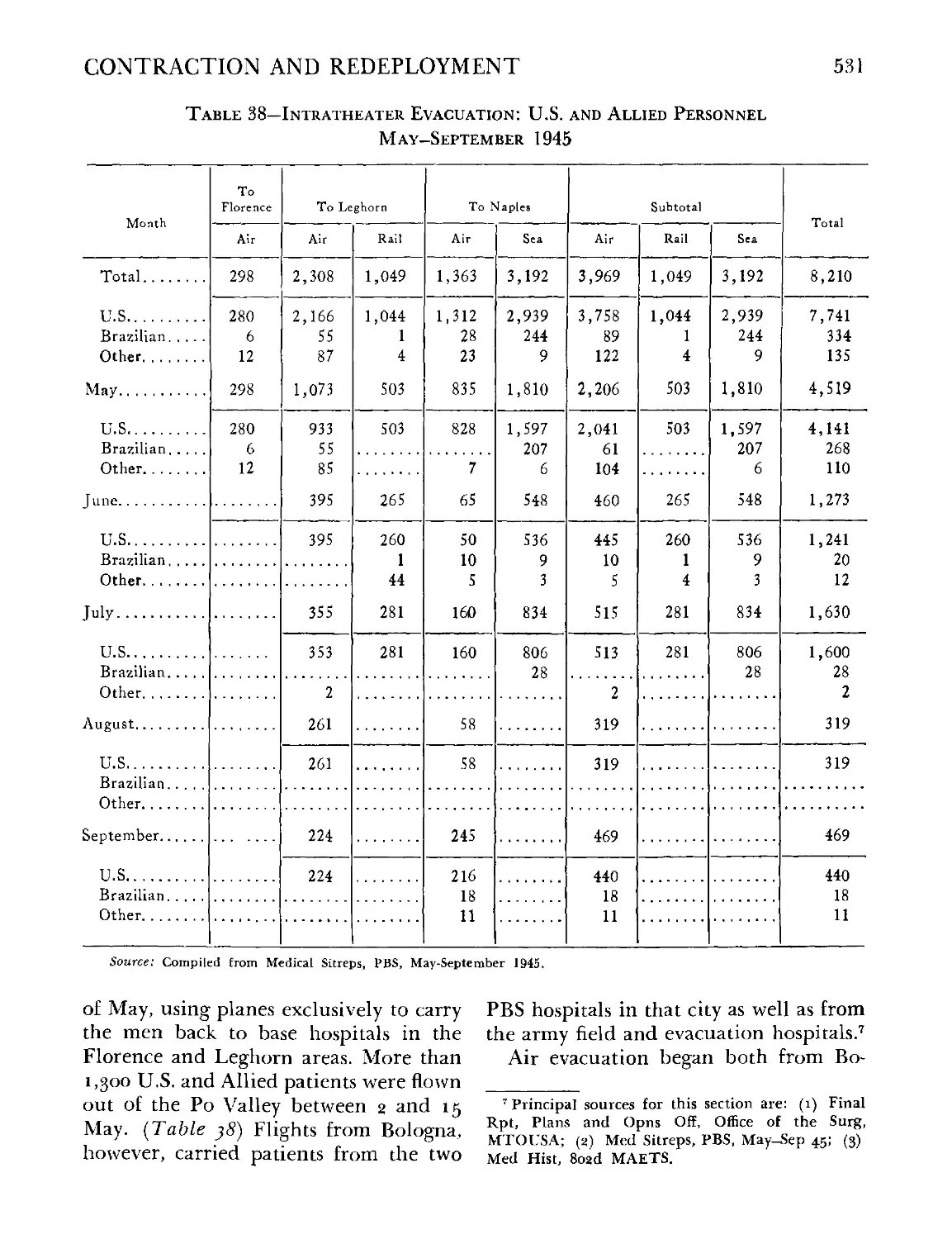
38.	Intratheater Evacuation: U.S. and Allied Personnel, May—September
1945 .............................................................. 531
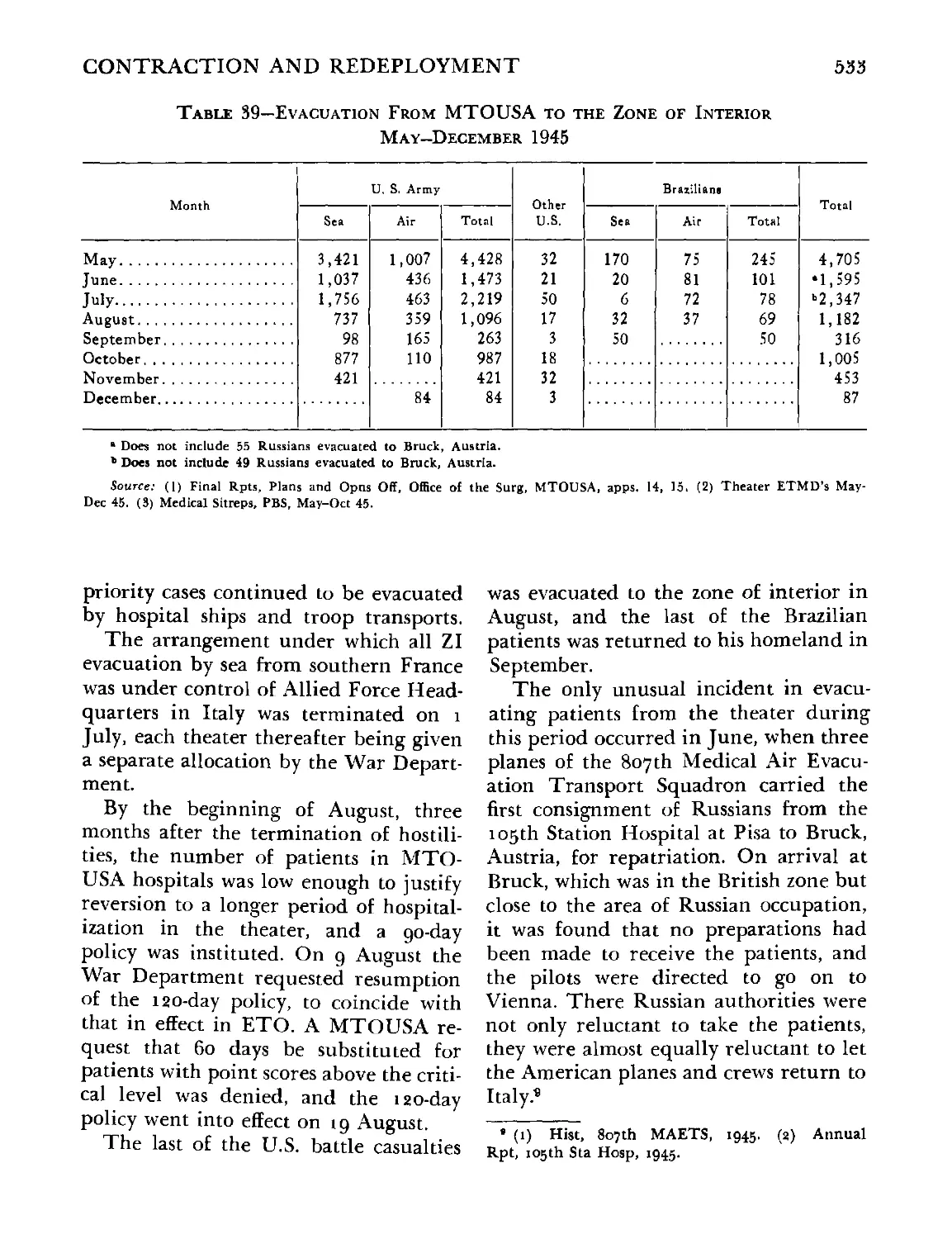
39.	Evacuation From MTOUSA to the Zone of Interior, May-December
1945 .............................................................. 533
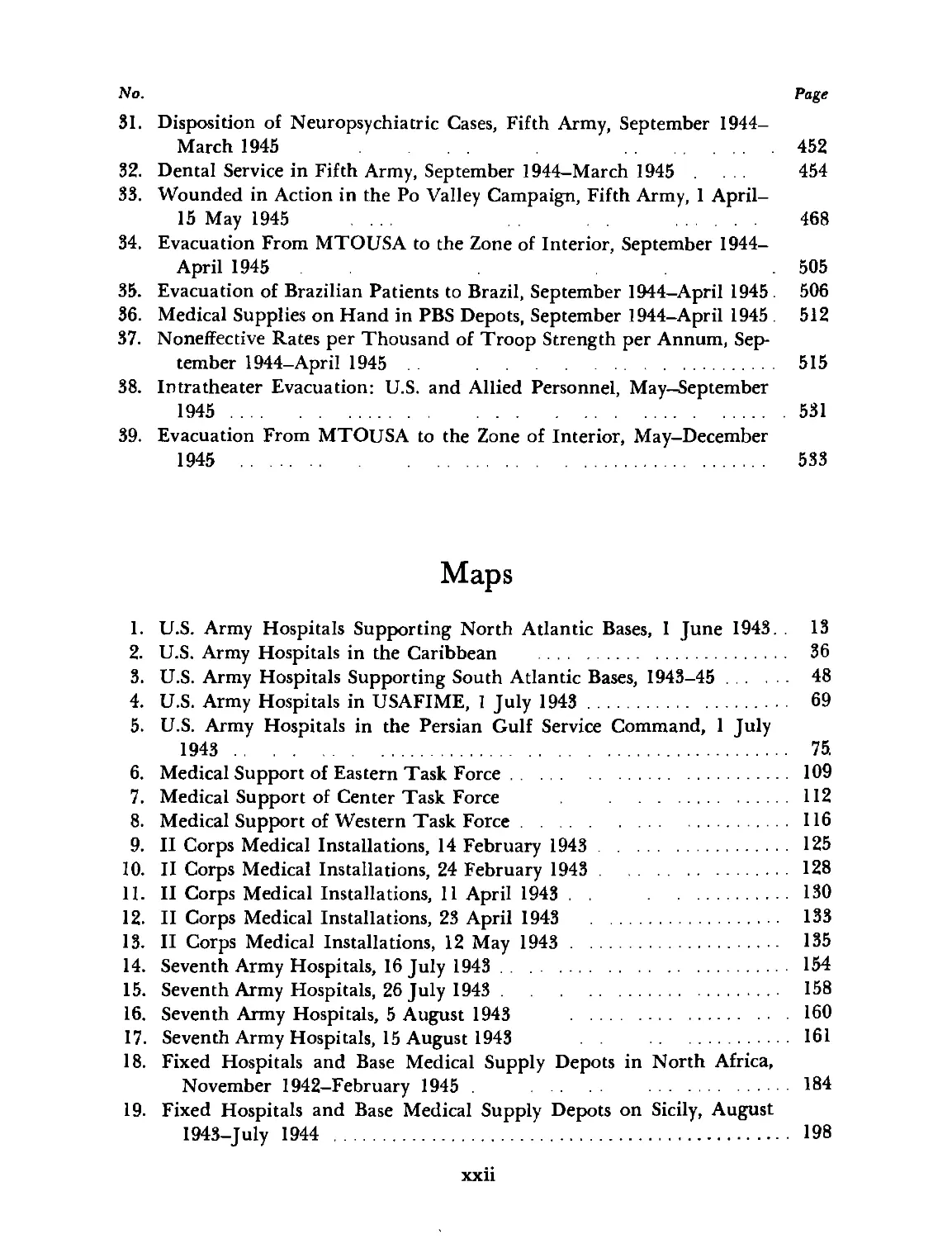
Maps
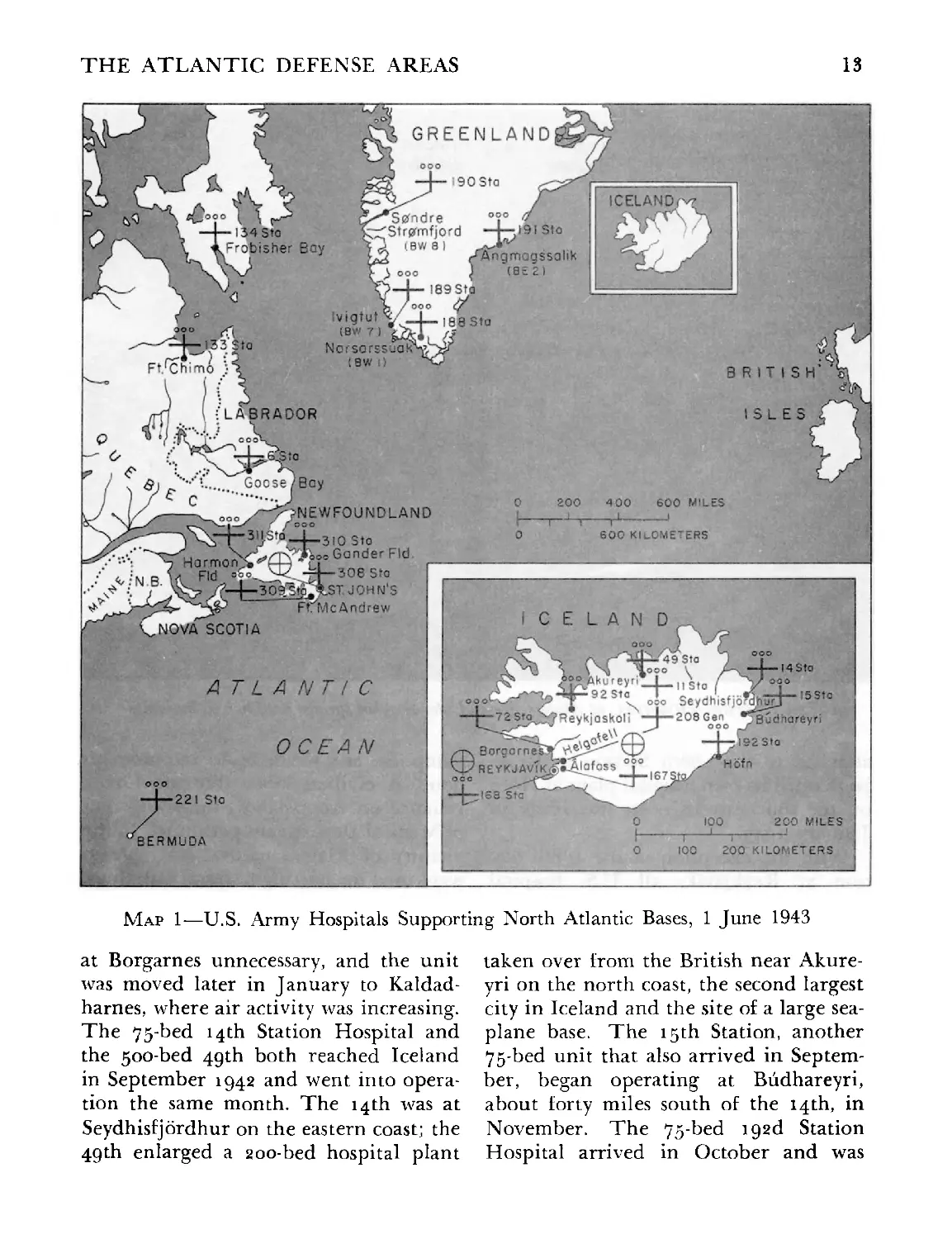
1.	U.S. Army	Hospitals Supporting North Atlantic	Bases,	1	June 1943. . 13
2.	U.S. Army	Hospitals in the Caribbean ................................. 36
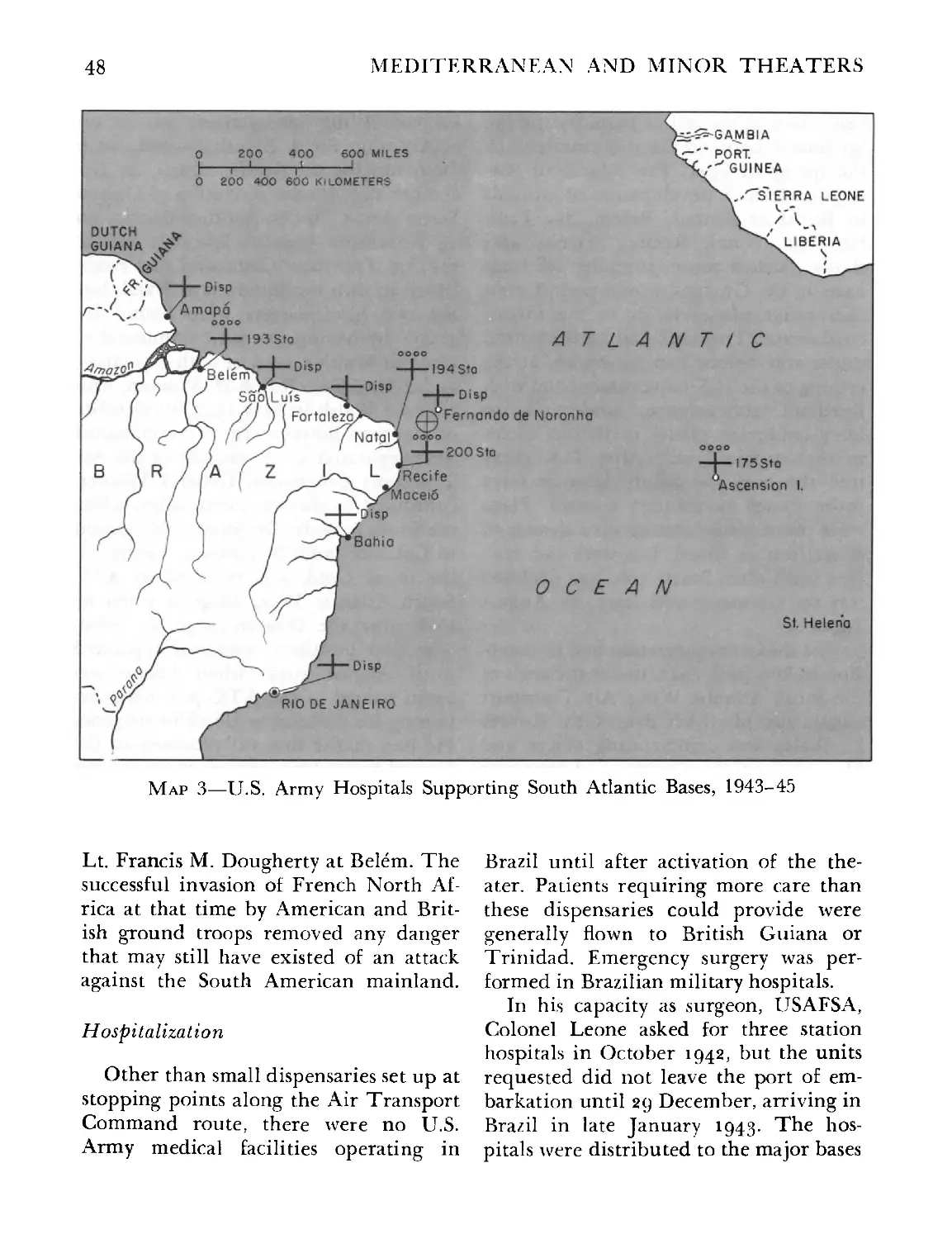
3.	U.S. Army	Hospitals Supporting South Atlantic Bases,	1943-45 ......... 48
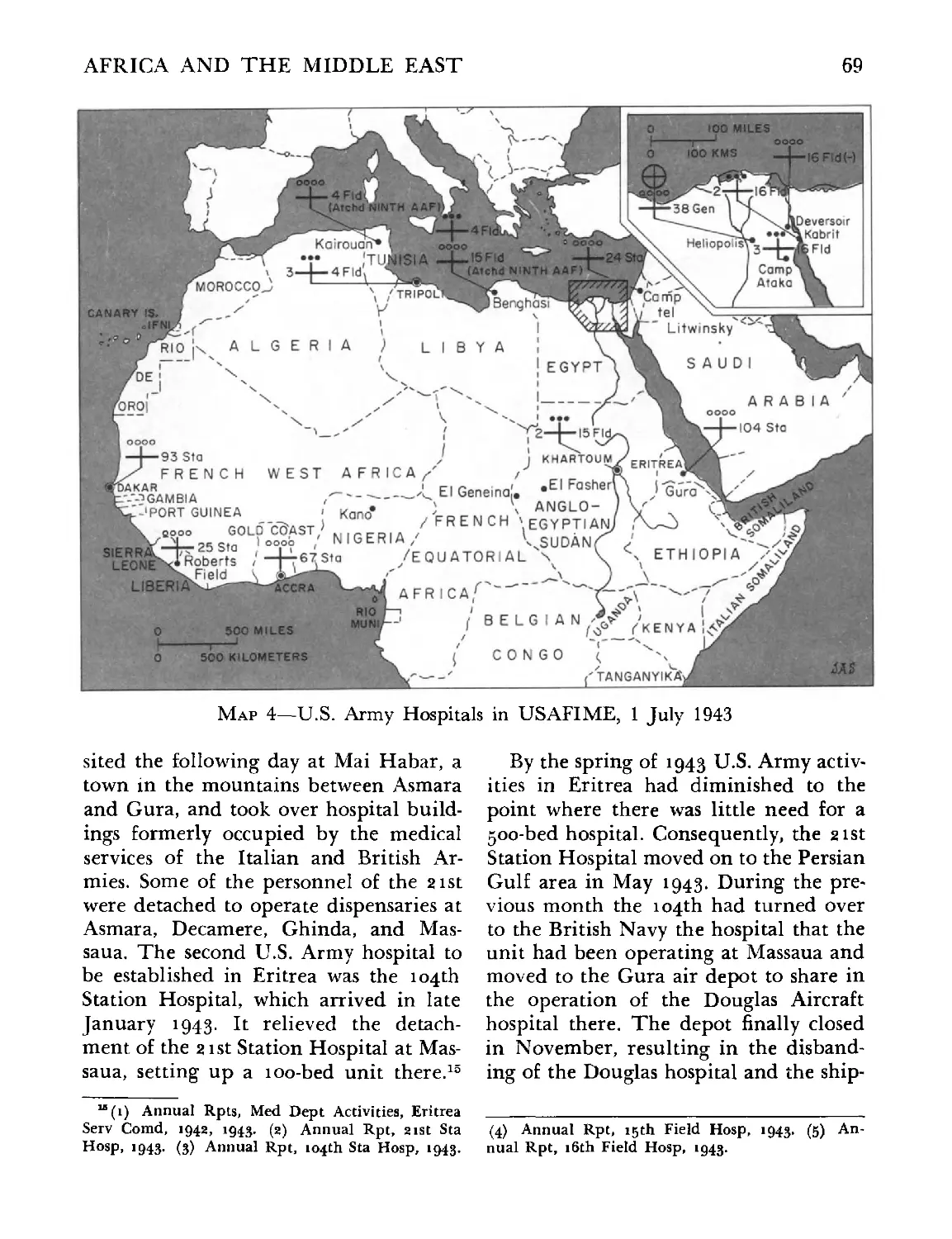
4.	U.S. Army	Hospitals in USAFIME, 1 July 1943 .......................... 69
5.	U.S. Army Hospitals in the Persian Gulf Service Command, 1 July
1943 ..................................................................... 75.
6.	Medical Support of Eastern Task Force.................................. 109
7.	Medical Support of Center Task Force	 112
8.	Medical Support of Western Task Force...................................116
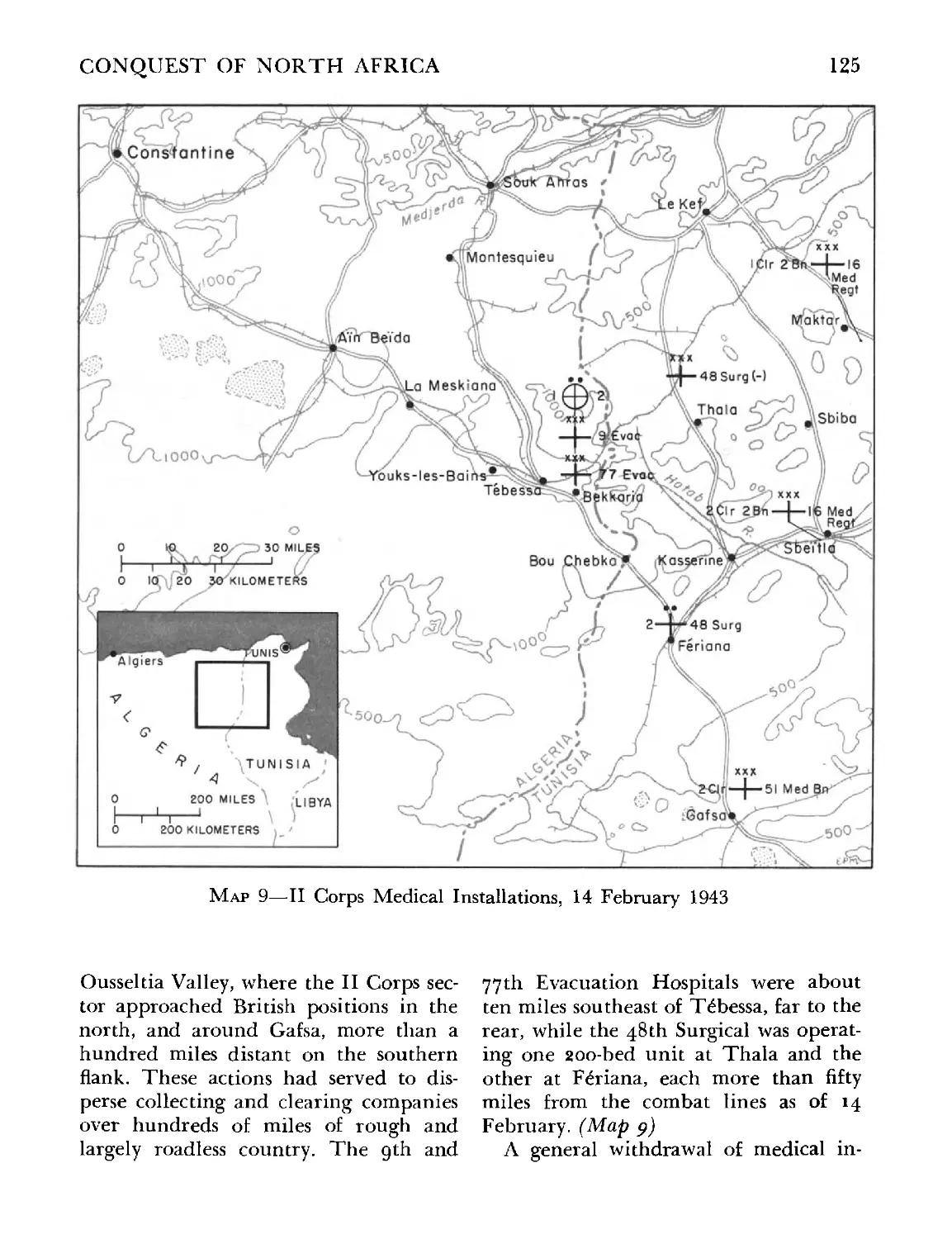
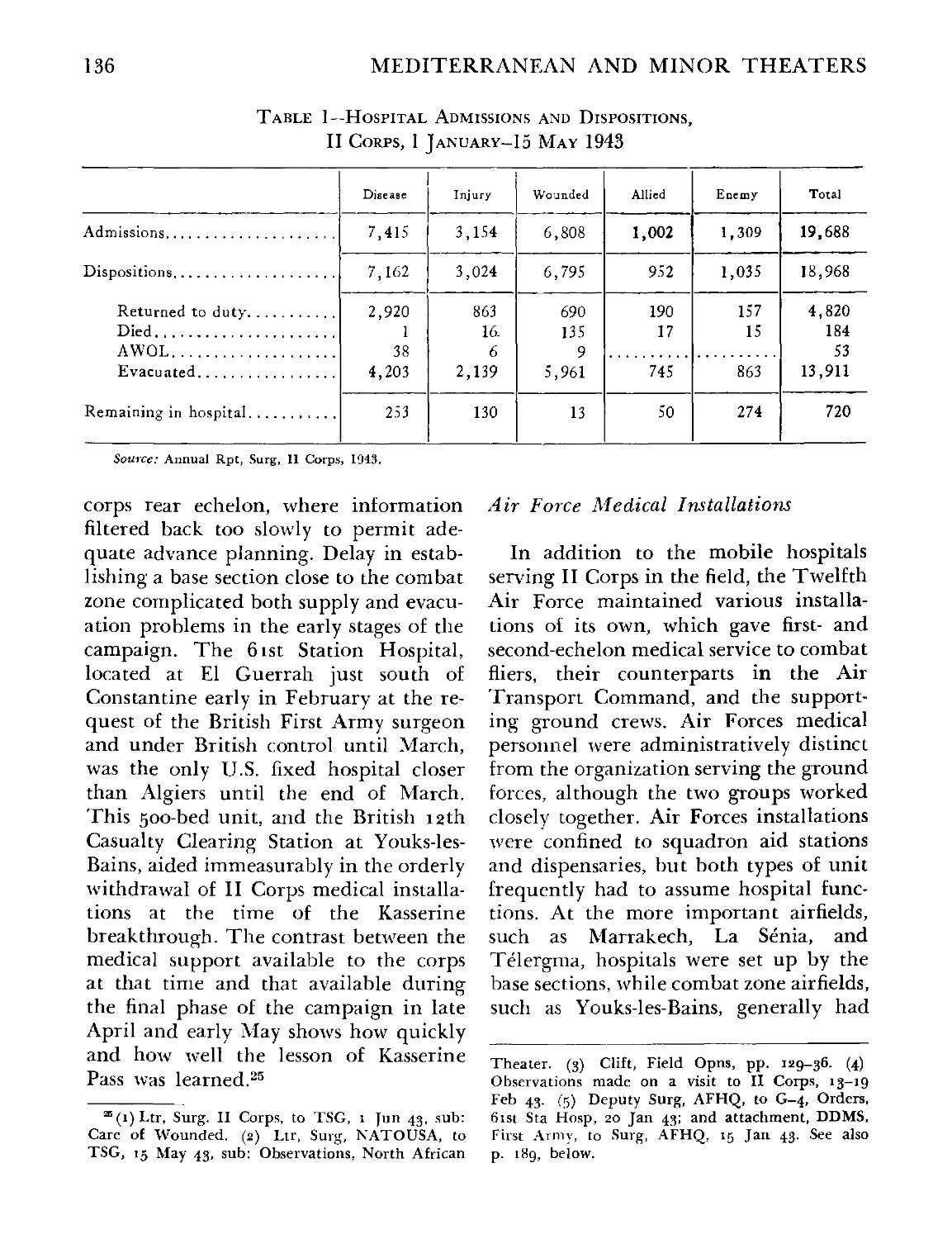
9.	II	Corps	Medical Installations,	14	February 1943 ..................... 125
10.	II	Corps	Medical Installations,	24	February 1943 ..................... 128
11.	II	Corps	Medical Installations,	11	April 1943 . .	  130
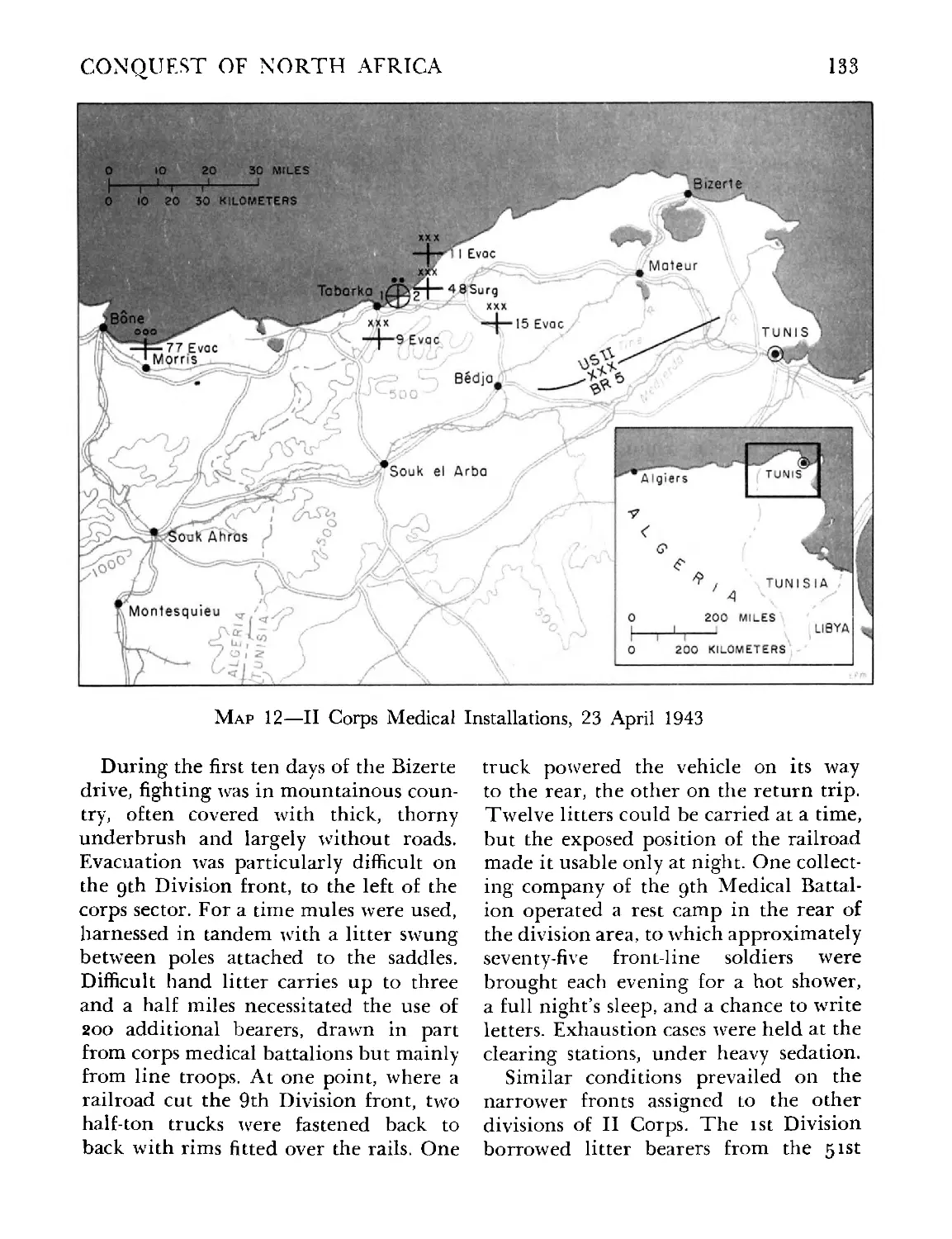
12.	II	Corps	Medical Installations,	23	April 1943	  133
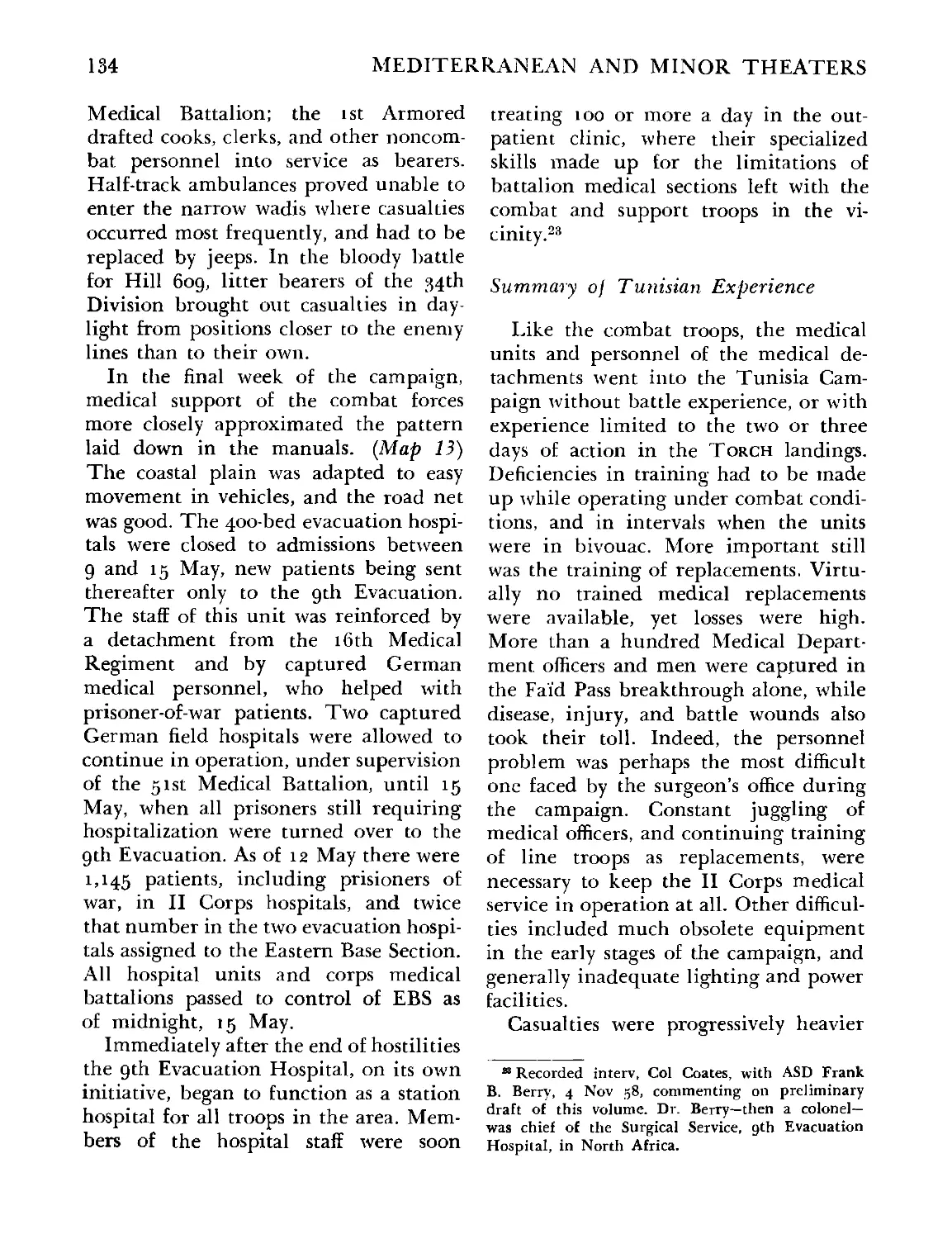
13.	II Corps Medical Installations, 12 May 1943 .......................... 135
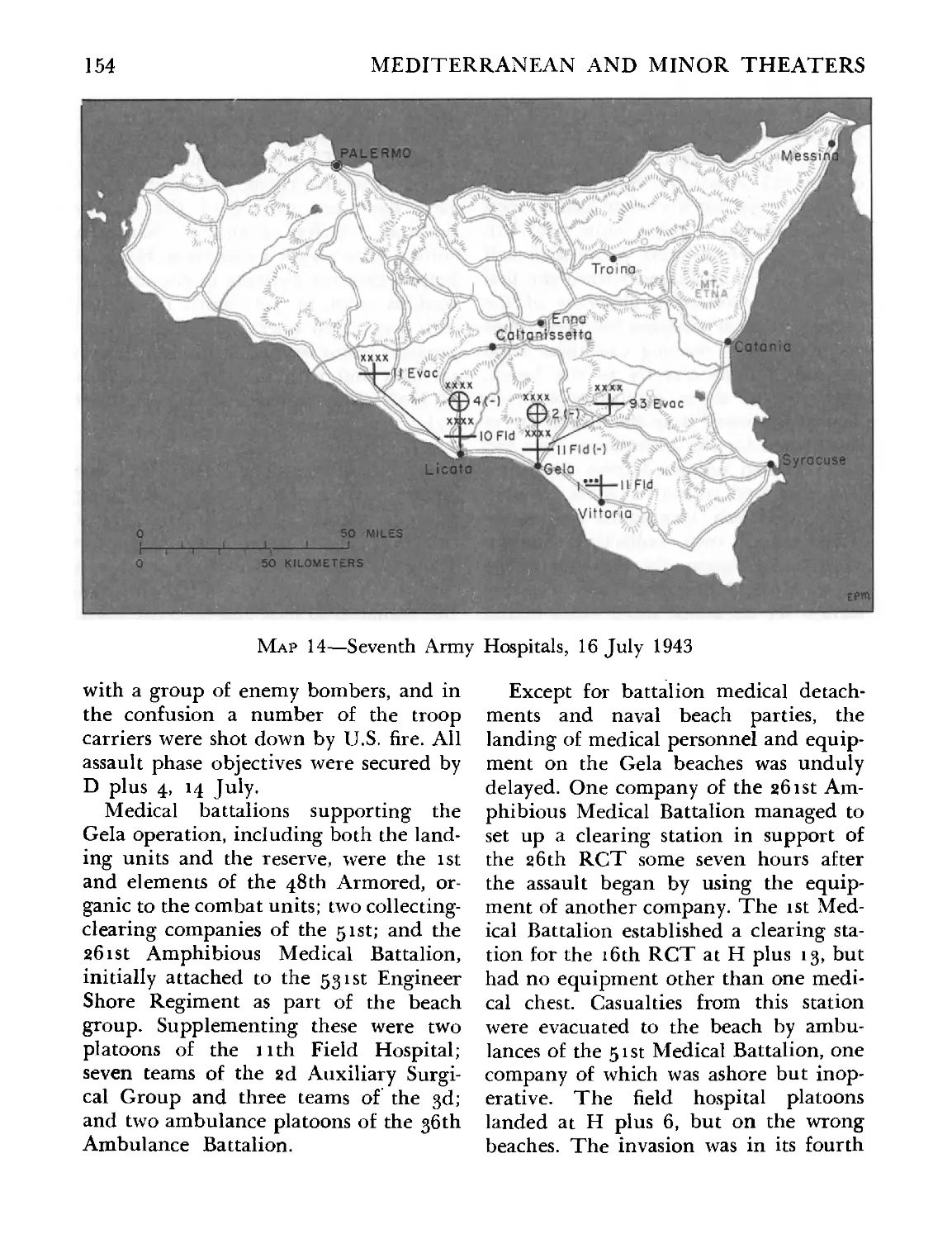
14.	Seventh Army Hospitals, 16 July 1943 . . ............................. 154
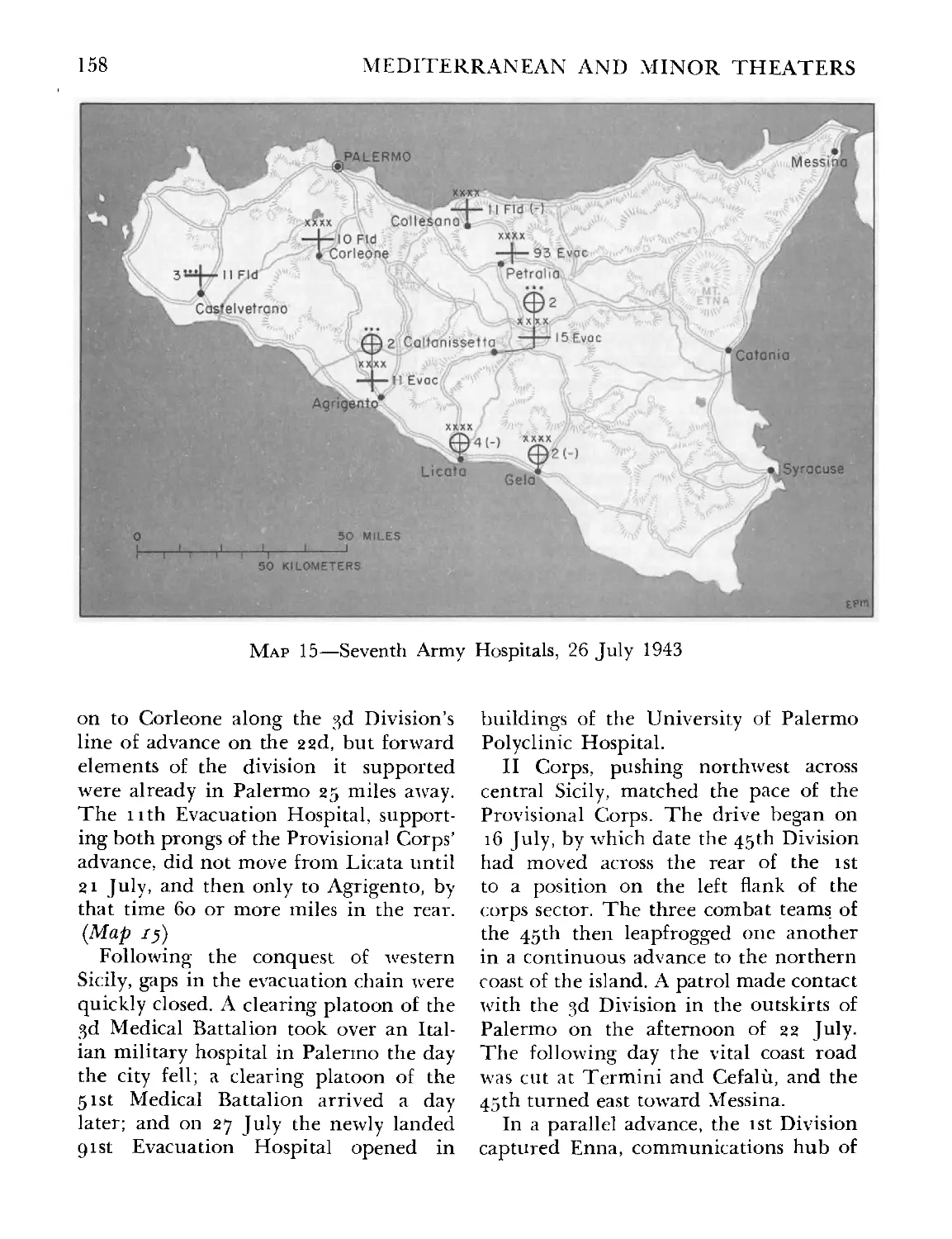
15.	Seventh Army Hospitals, 26 July 1943 ................................. 158
16.	Seventh Army Hospitals, 5 August 1943	  160
17.	Seventh Army Hospitals, 15 August 1943	. .	................ 161
18.	Fixed Hospitals and Base Medical Supply Depots in North Africa,
November 1942-February 1945 .	........ ................... 184
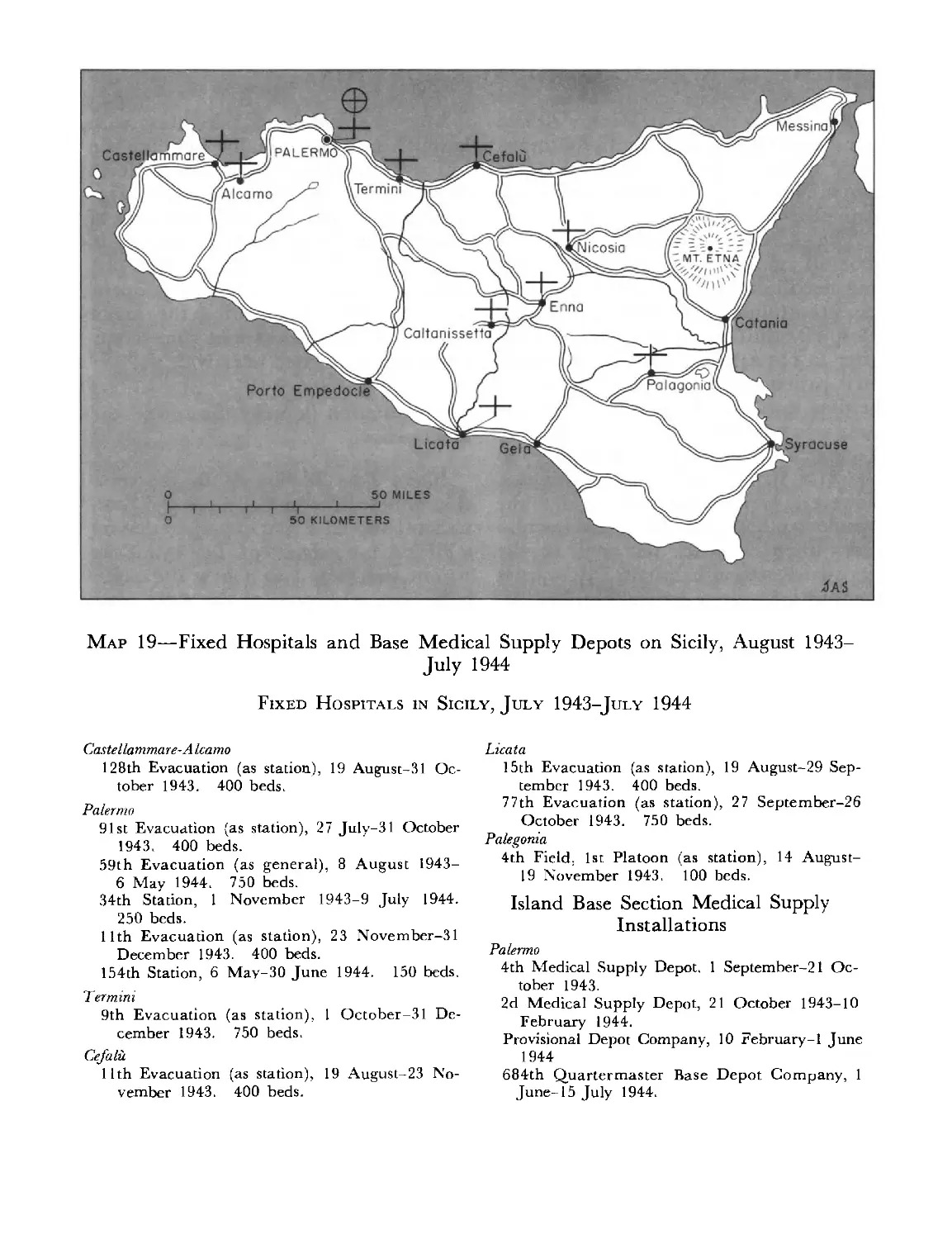
19.	Fixed Hospitals and Base Medical Supply Depots on Sicily, August
1943-July 1944 ........................................................... 198
xxii
No.	Page
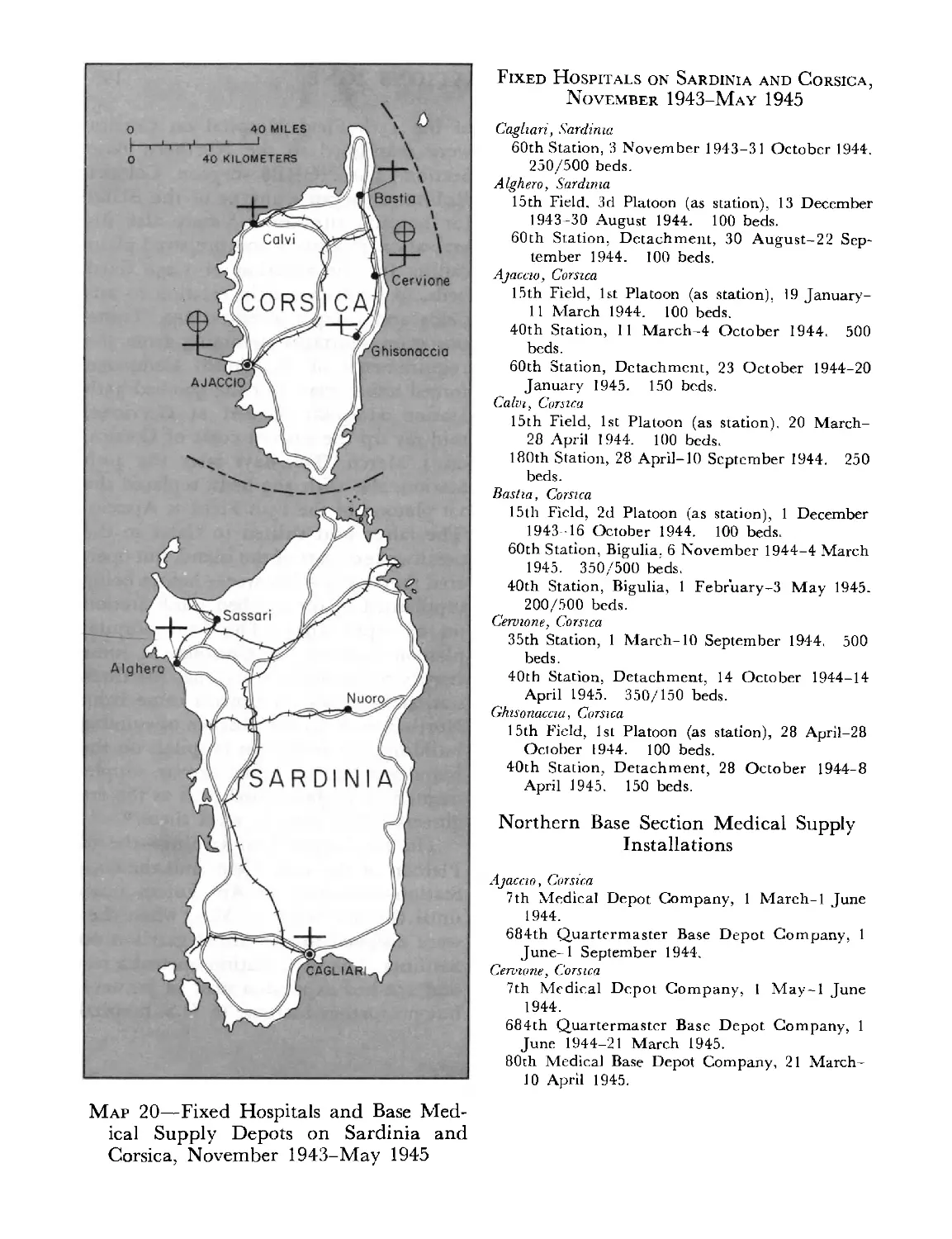
20.	Fixed Hospitals and Base Medical Supply Depots on Sardinia and
Corsica, November 1943—May 1945	200
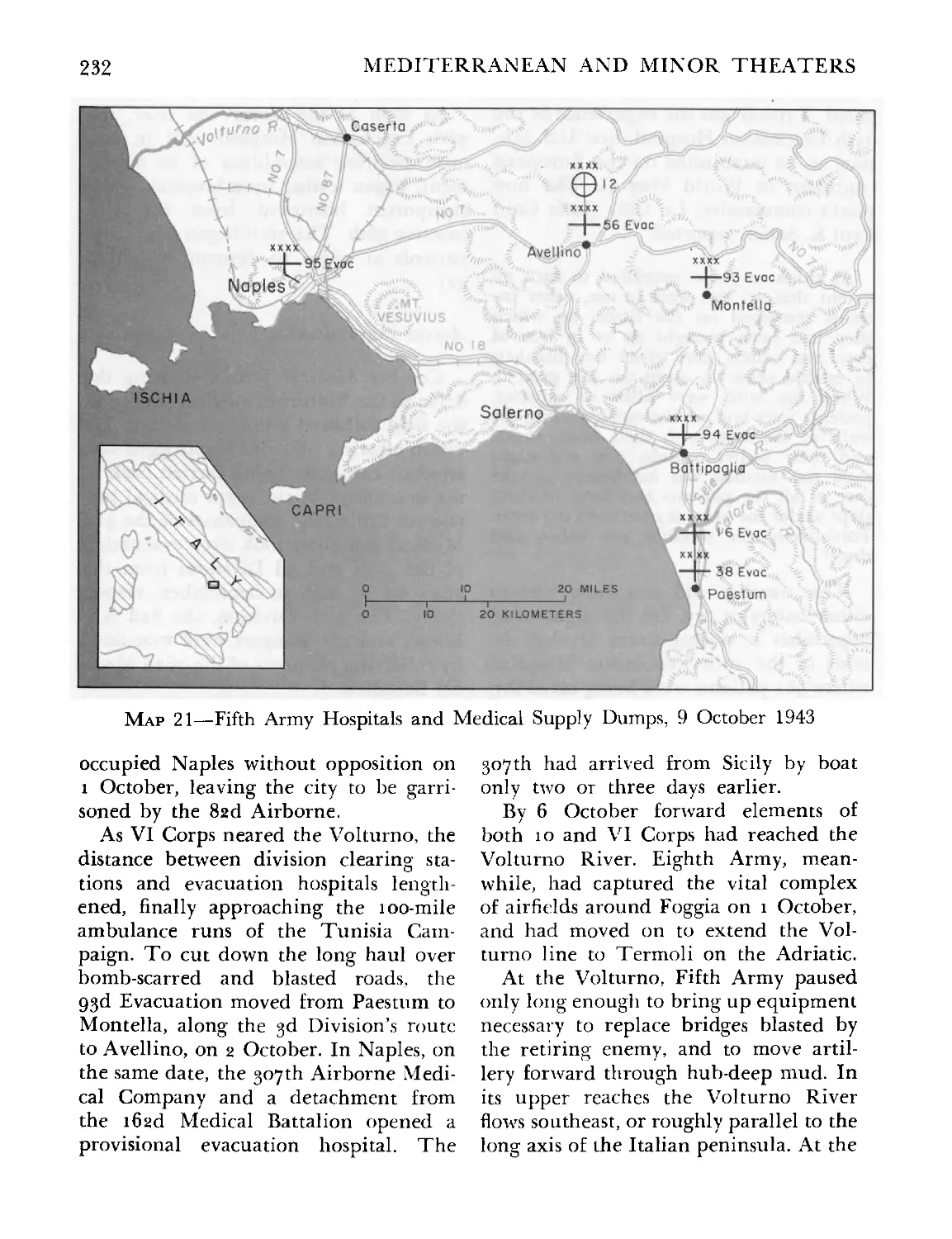
21.	Fifth	Army	Hospitals	and Medical	Supply Dumps,	9	October 1943	. .	232
22.	Fifth	Army	Hospitals	and Medical	Supply Dumps,	15	November 1943 .	236
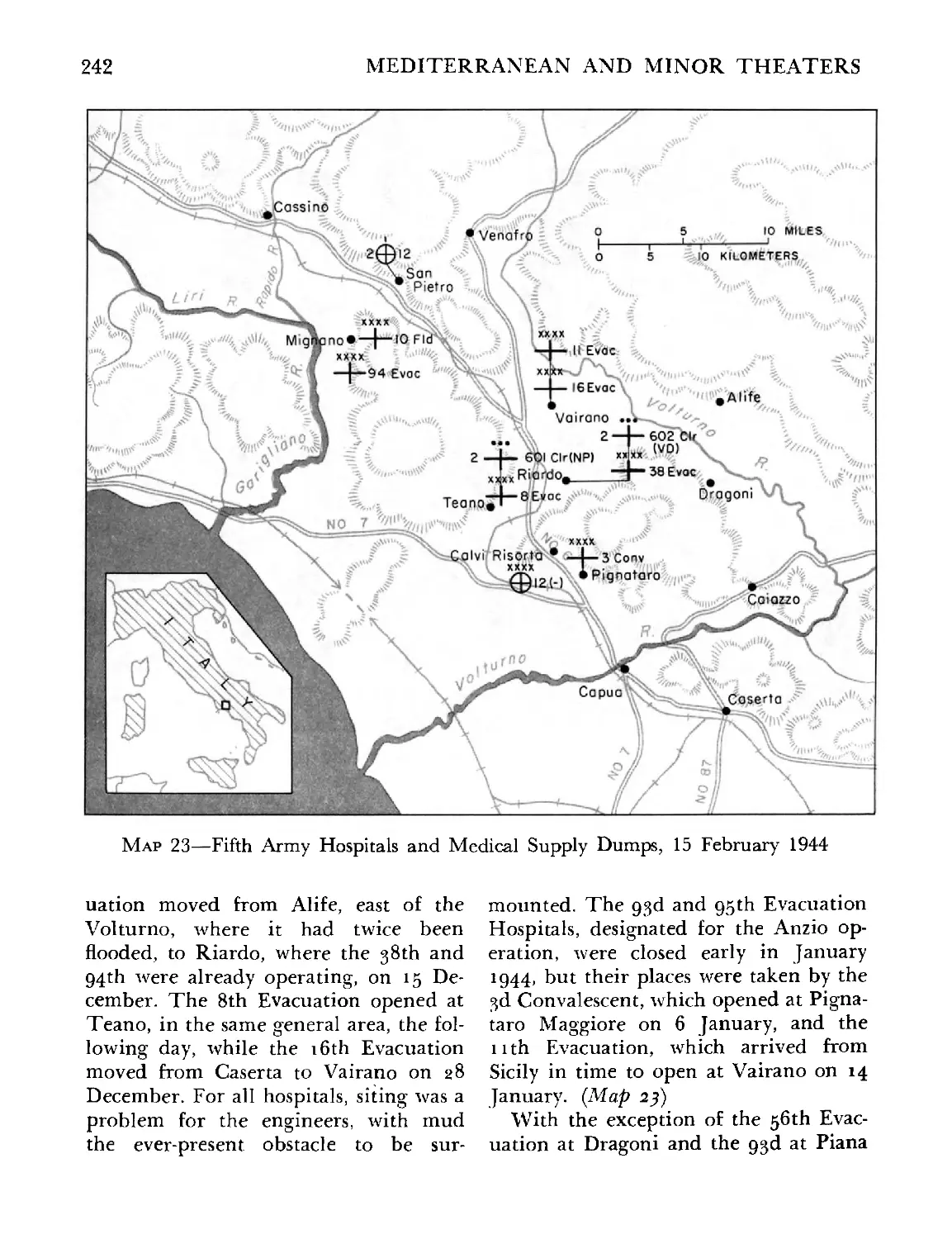
23.	Fifth	Army	Hospitals	and Medical	Supply Dumps,	15	February 1944	. .	242
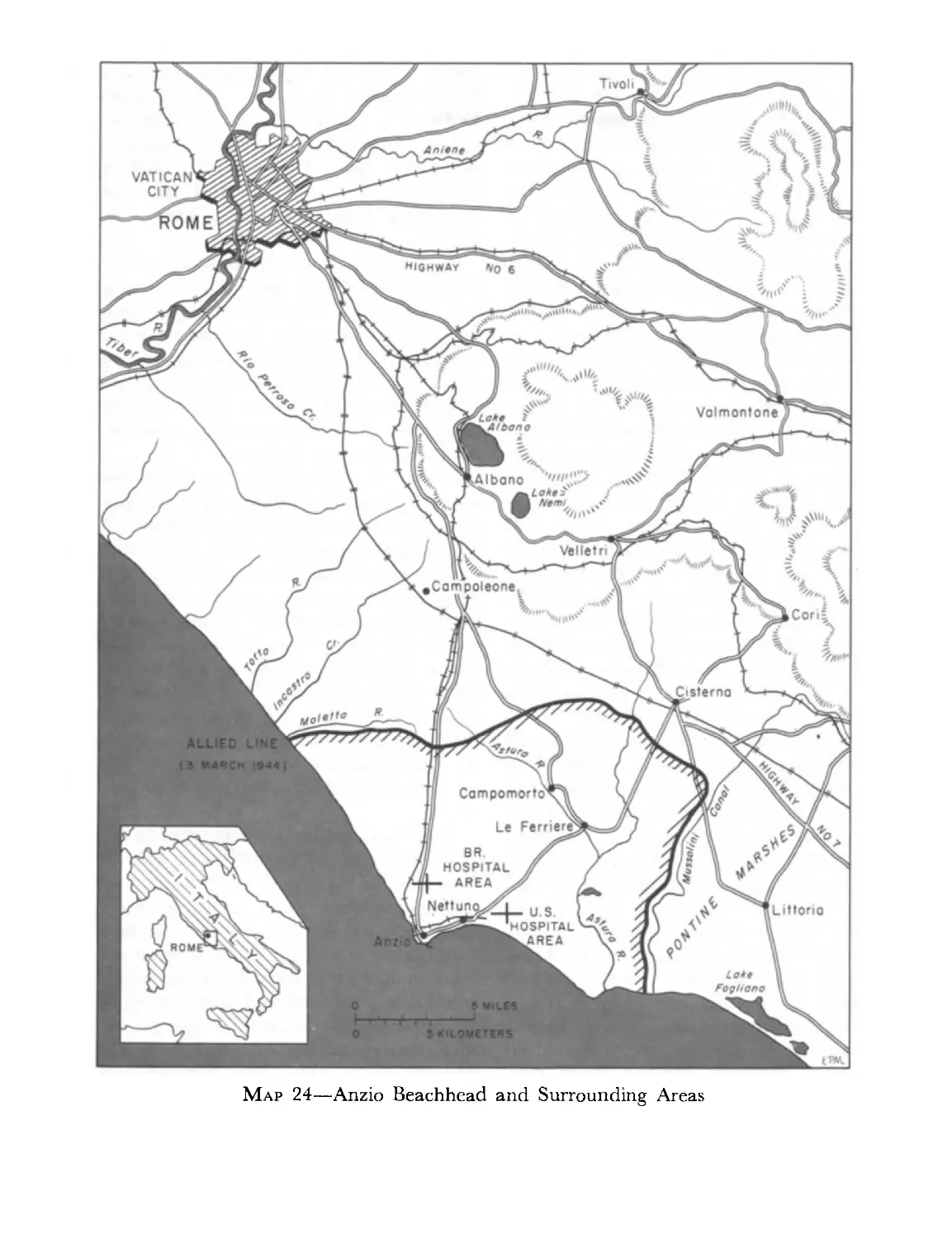
24.	Anzio Beachhead and	Surrounding	Areas	269
25.	Fifth Army Hospitals and Medical Supply Dumps on the Cassino
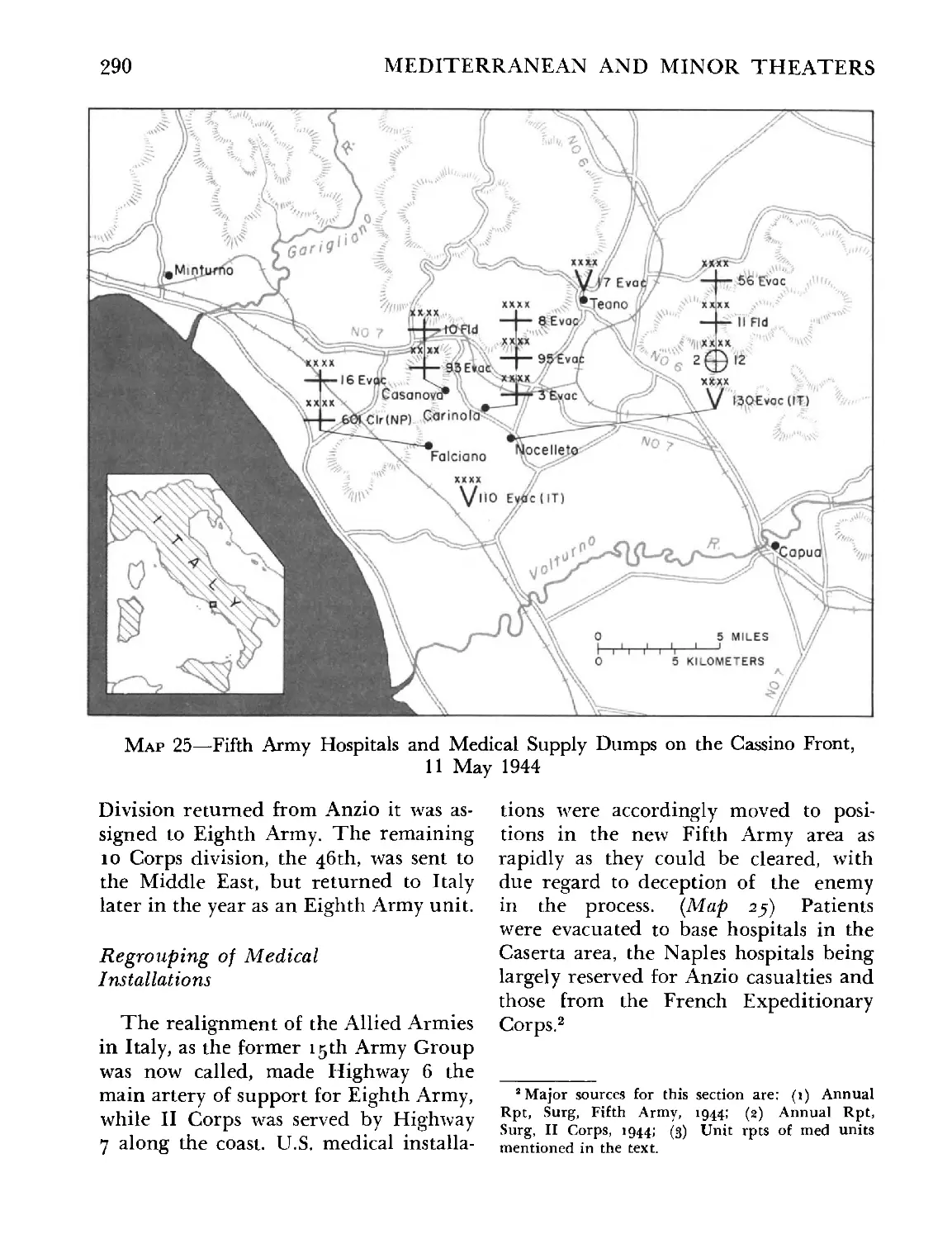
Front, 11 May 1944	290
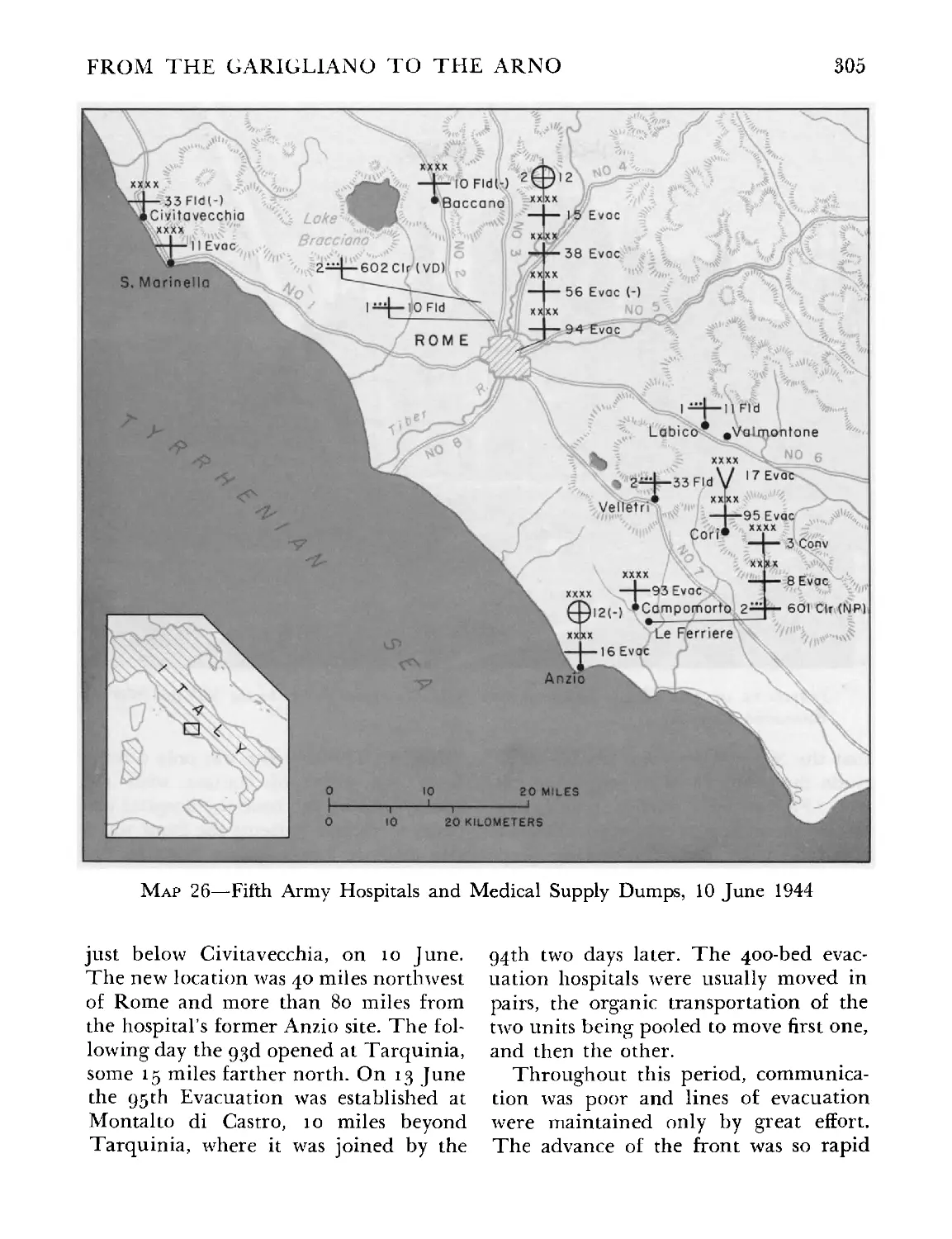
26.	Fifth Army Hospitals and Medical Supply Dumps, 10 June 1944	. . 305
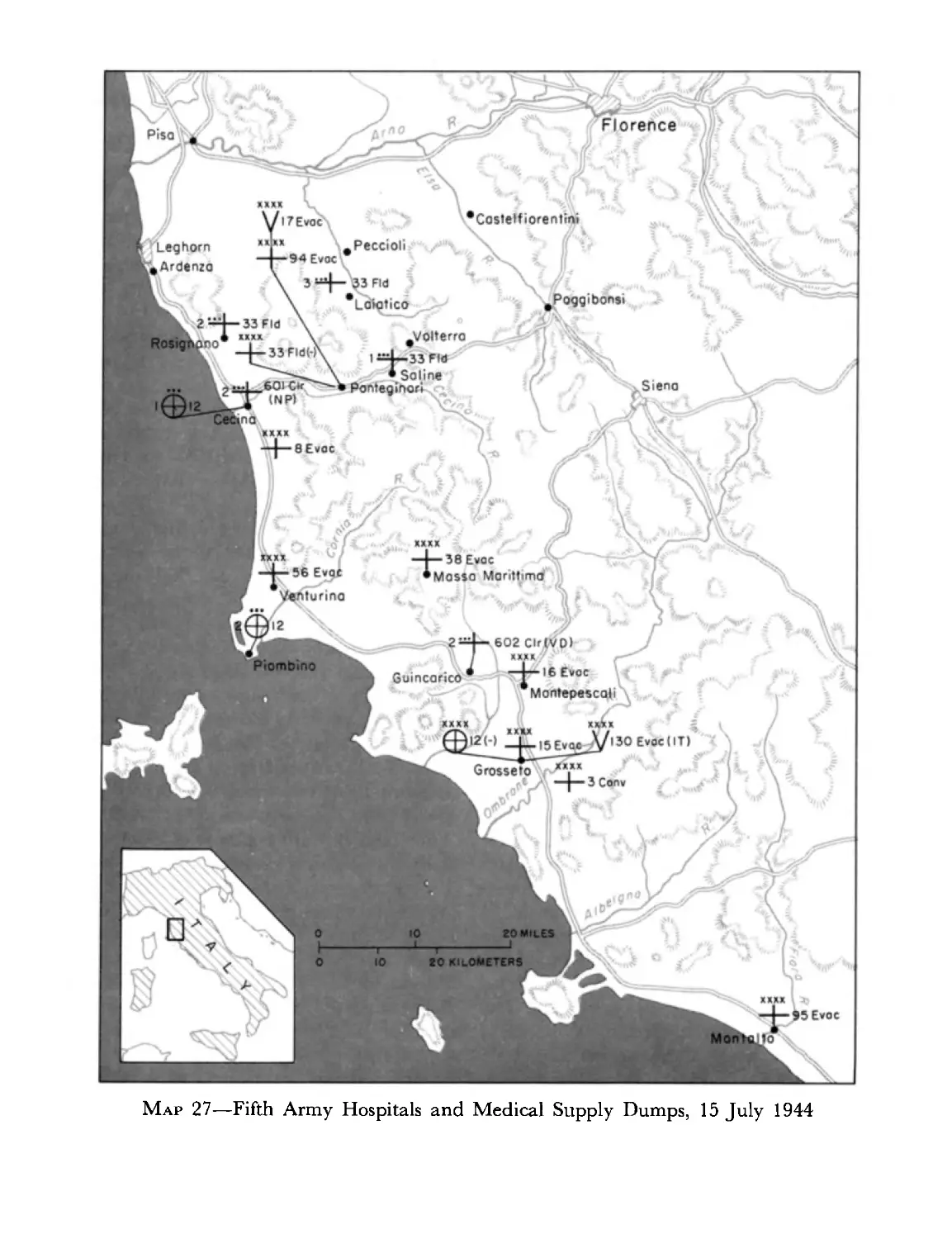
27.	Fifth Army Hospitals and Medical Supply Dumps, 15 July 1944	. . 308
28.	Fifth Army Hospitals and Medical Supply Dumps, 15 August 1944	309
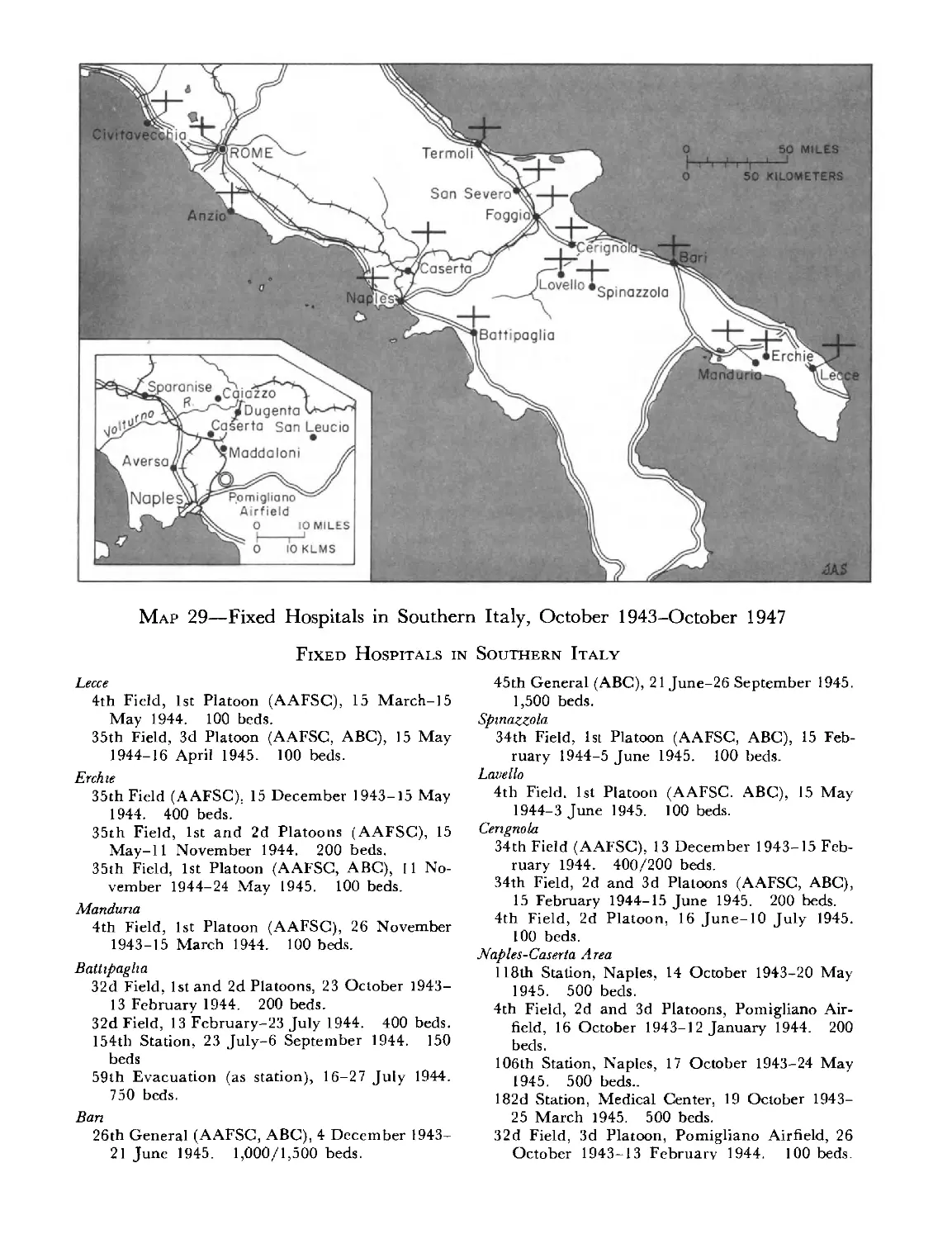
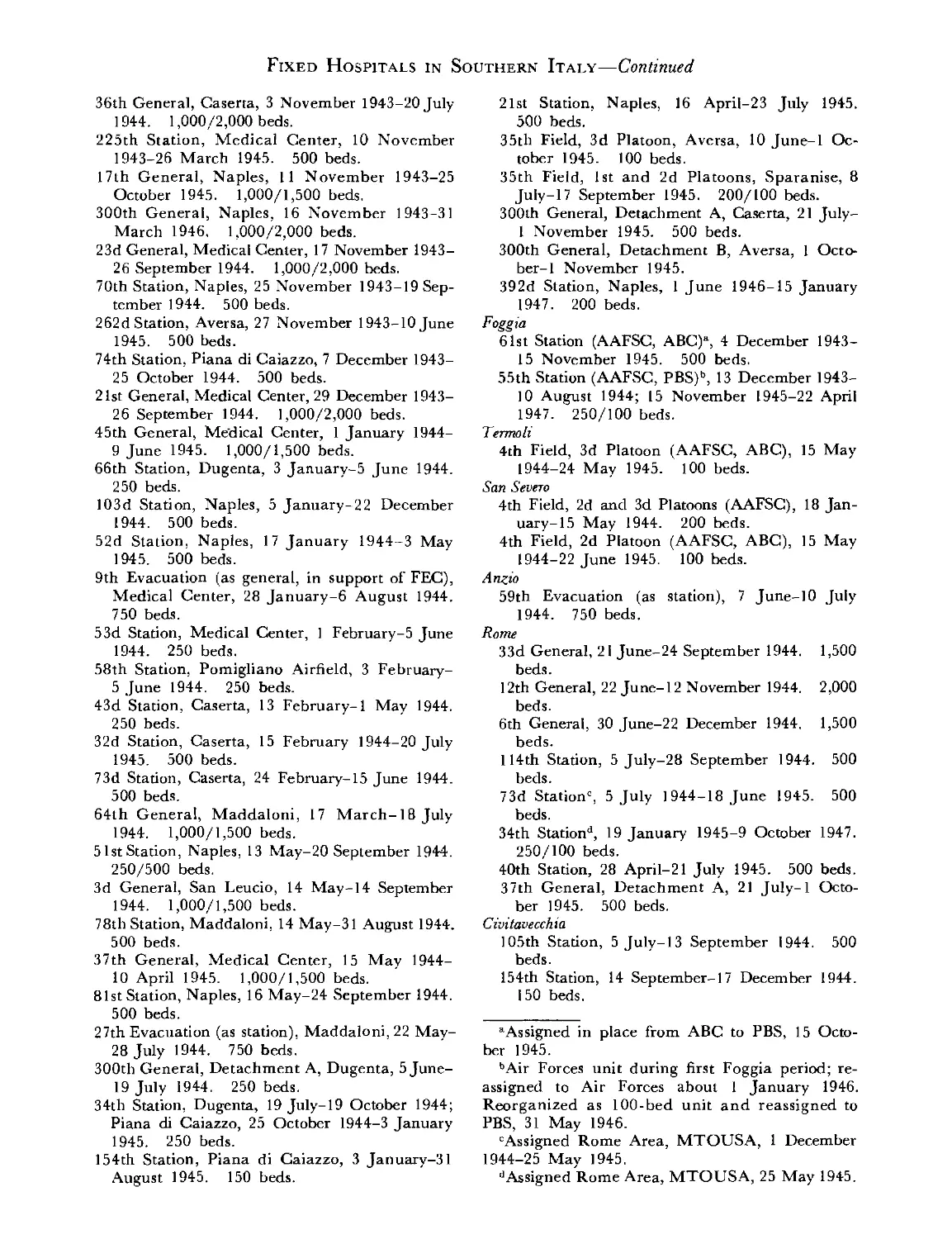
29.	Fixed Hospitals in Southern Italy, October 1943-October 1947	330
30.	Seventh Army Hospitals and Medical Supply Dumps, 20 August 1944. . 378
31.	Seventh Army Hospitals and Medical Supply Dumps, 1 September
1944	.............................. 389
32.	Seventh Army Hospitals and Medical Supply Dumps, 15 September
1944	. .	............ 390
33.	Seventh Army Hospitals and Medical Supply Dumps, 30 September
1944	................................................. 391
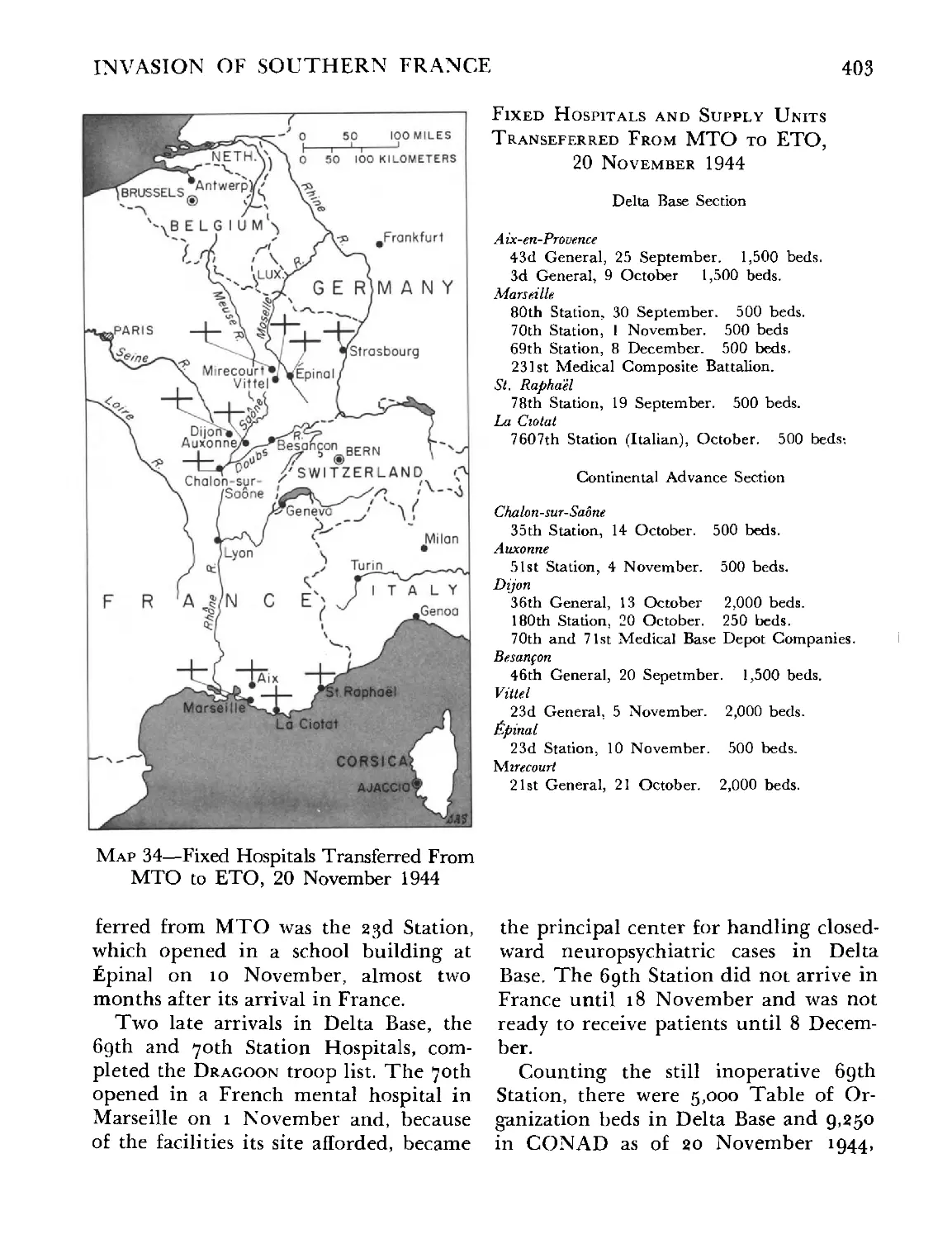
34.	Fixed Hospitals Transferred From MTO to ETO, 20 November 1944. . 403
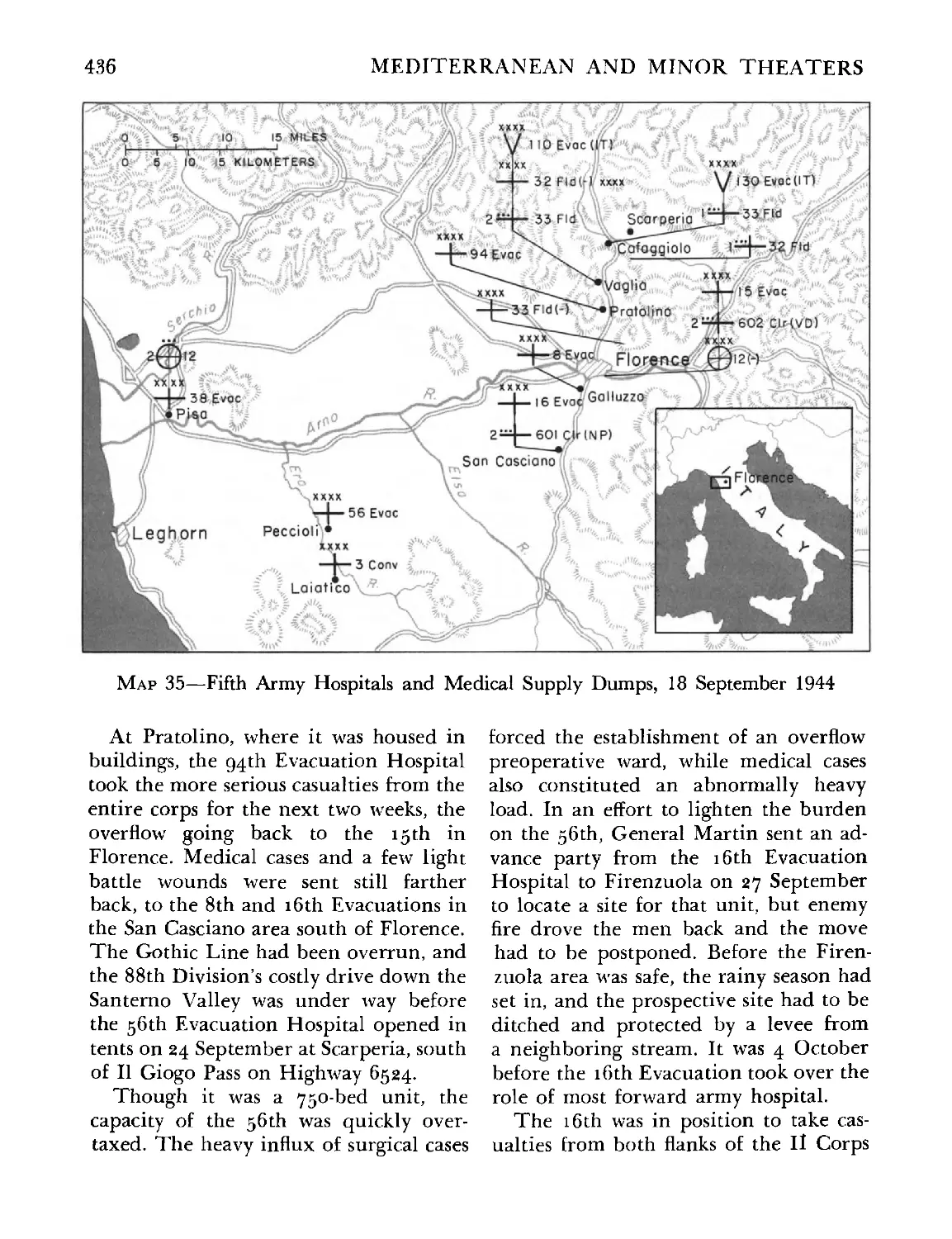
35. Fifth Army Hospitals and Medical Supply Dumps, 18 September 1944. . 436
36.	Fifth Army Hospitals and Medical Supply Dumps Supporting II
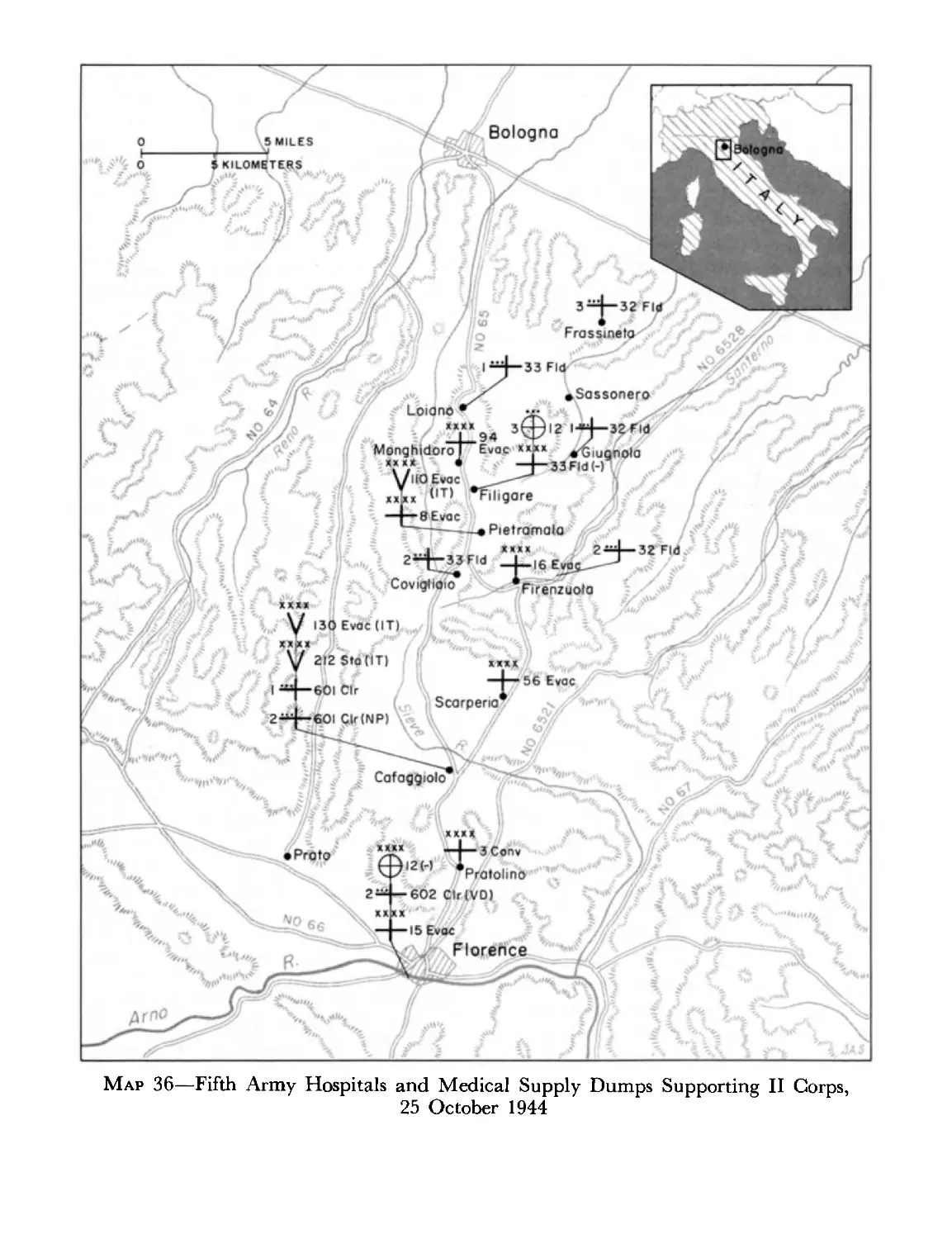
Corps, 25 October 1944	............ 438
37.	Fifth Army Hospitals and Medical Supply Dumps on the IV Corps
and 92d Division Fronts, 15 January 1945 ...	................. 441
38.	Fifth Army Hospitals and Medical Supply Dumps on the II Corps
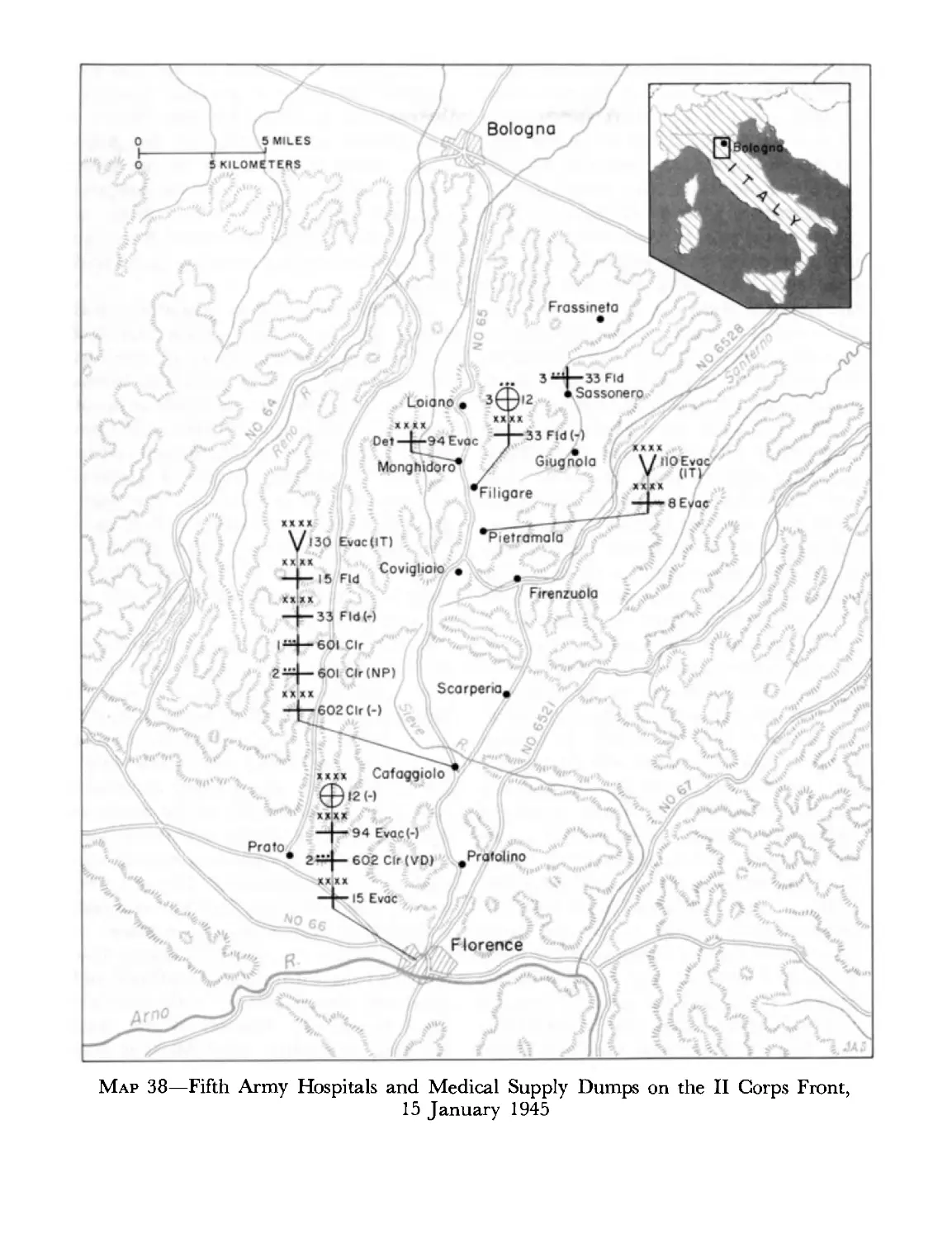
Front, 15 January 1945 ................................................   443
39.	Hospitals and Medical Supply Dumps Supporting the Fifth Army
Offensive, 18 April 1945	.............................. 470
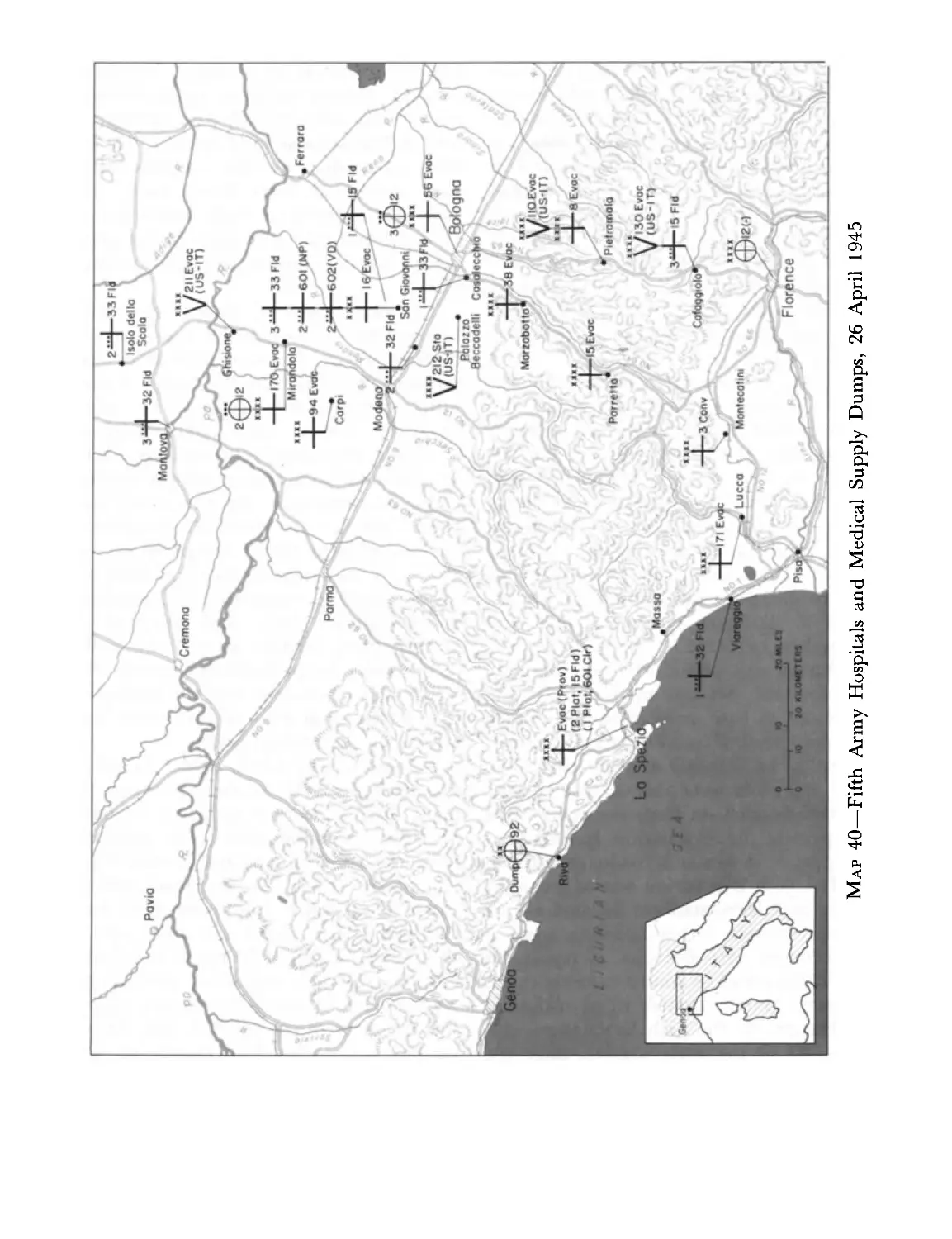
40.	Fifth Army Hospitals and Medical Supply Dumps, 26 April	1945 .	. . 472
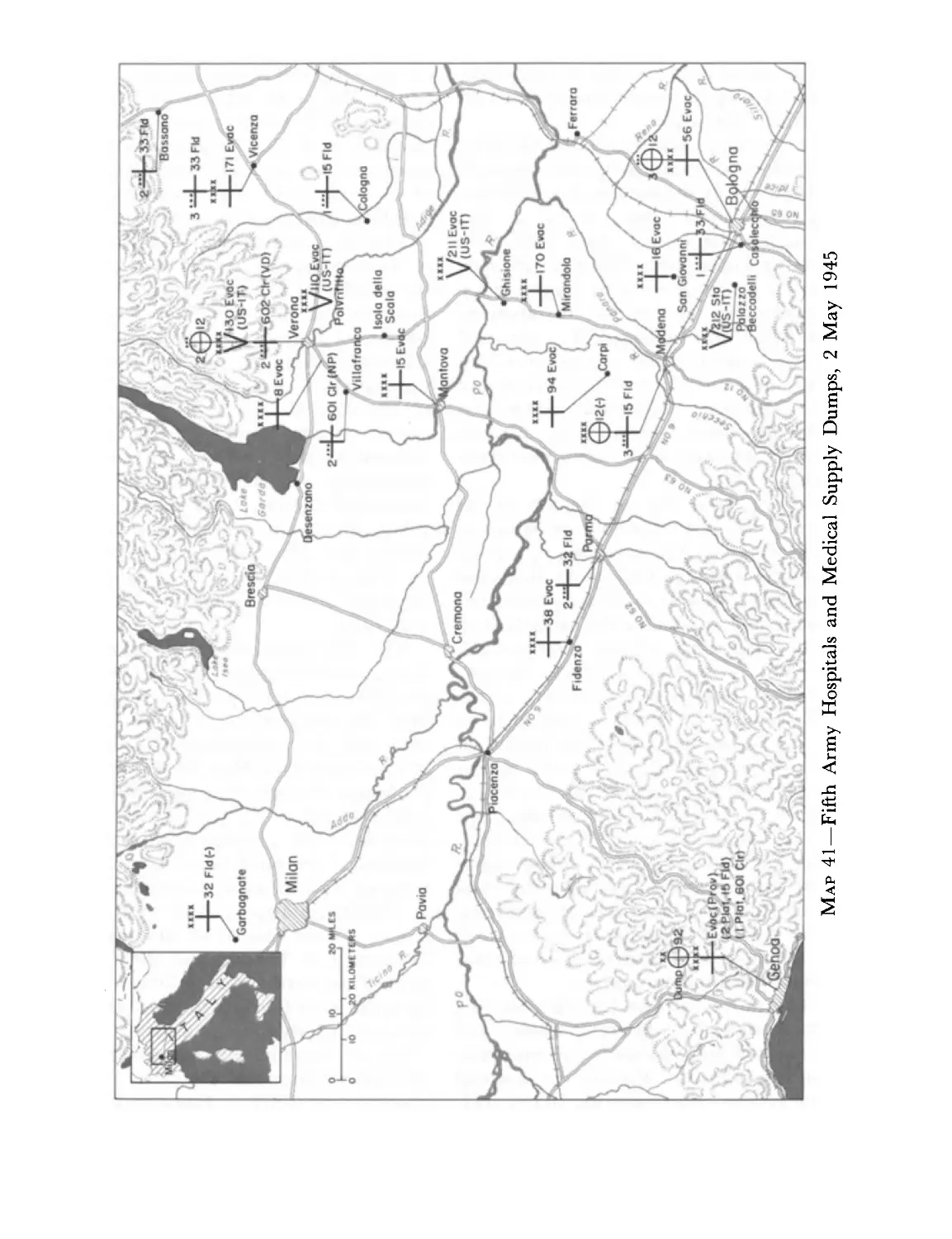
41.	Fifth Army Hospitals and Medical Supply Dumps, 2 May 1945 ........... 474
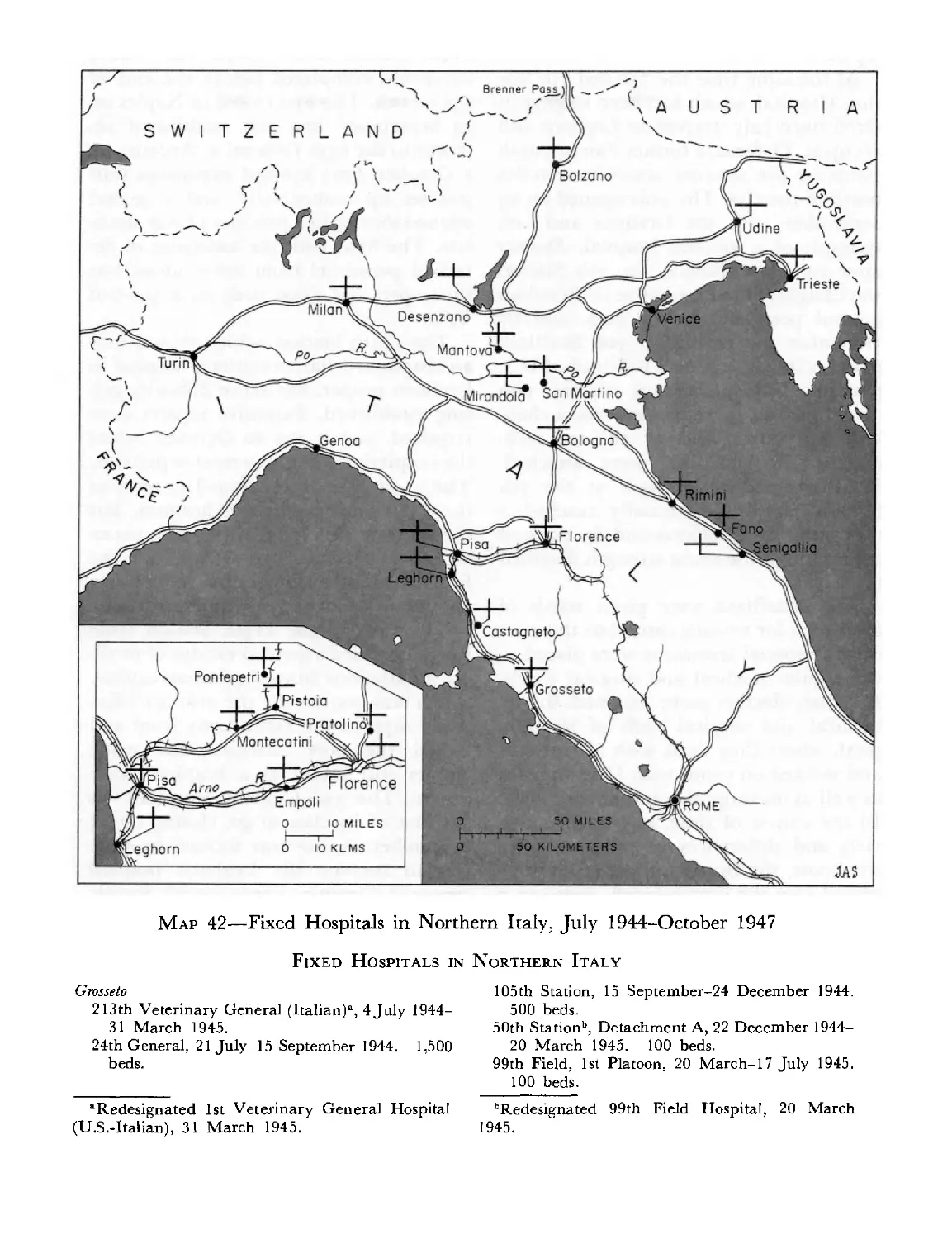
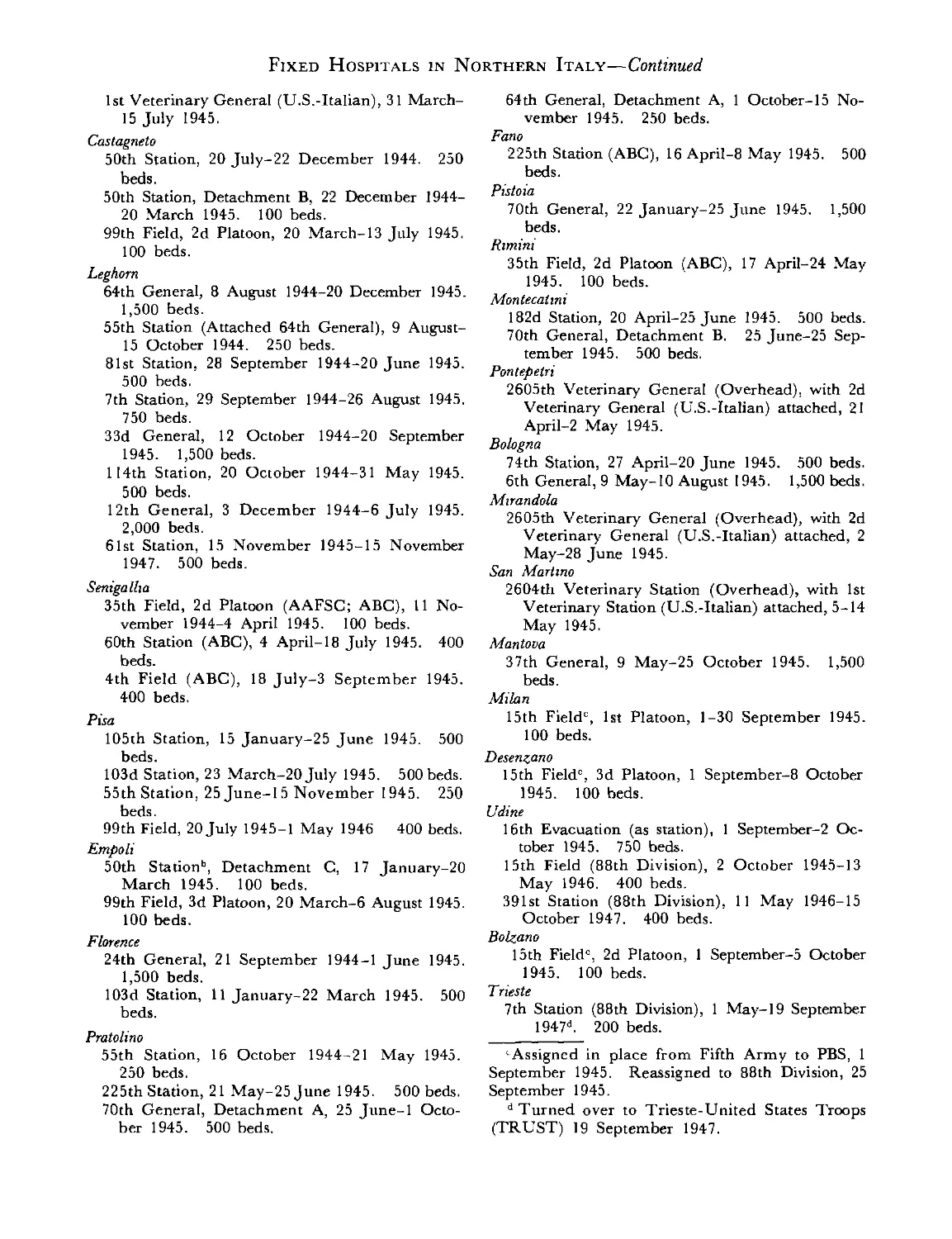
42.	Fixed Hospitals in Northern Italy, July 1944-October 1947	........... 492
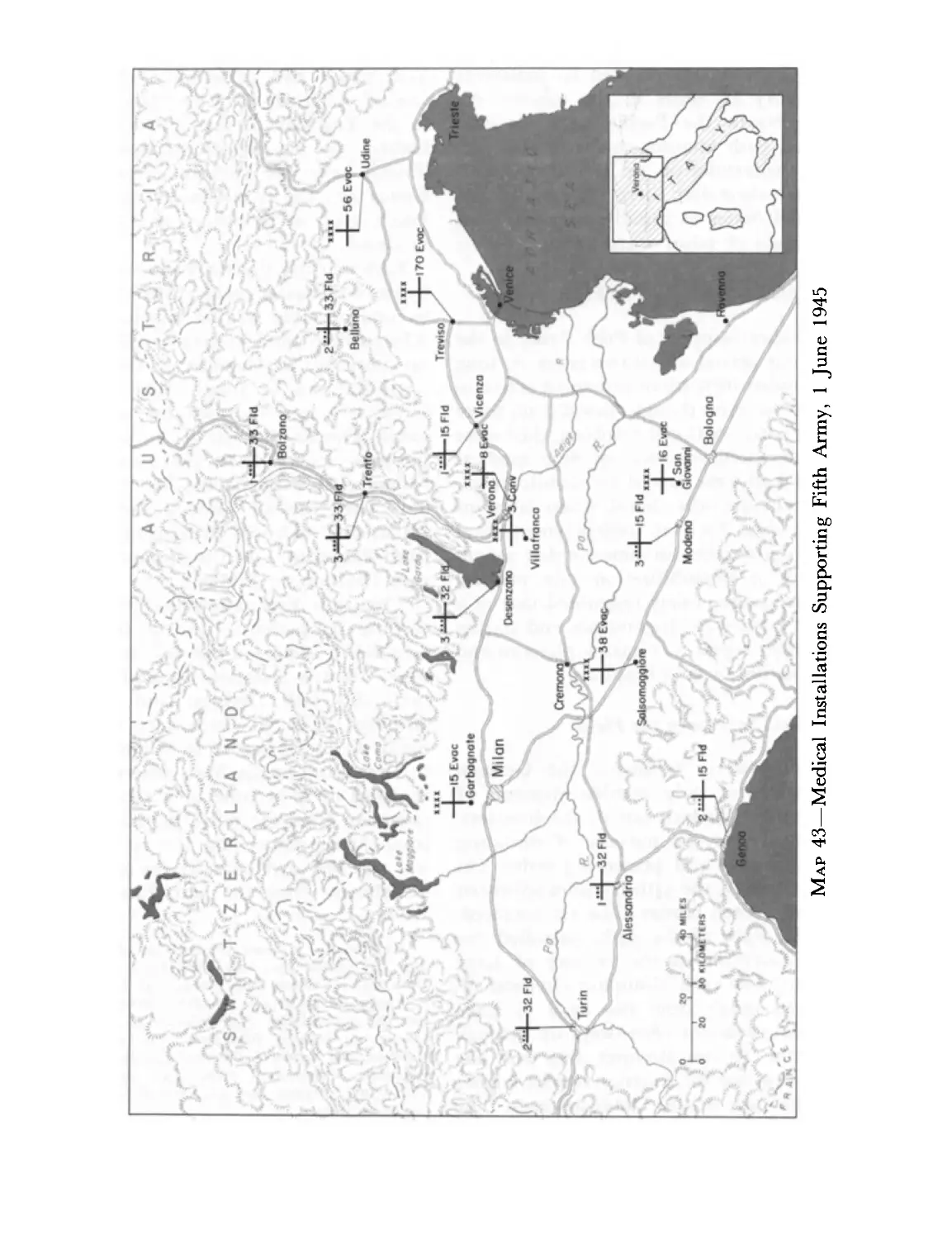
43.	Medical Installations Supporting Fifth Army, 1 June 1945	........... 524
Illustrations
. . . the Unsung Heroes of the War	......Frontispiece
Lt. Col. Charles H. Beasley	...	............. 11
167th Station Hospital, Iceland	...	................. 14
Bluie West 1, Greenland	......................	20
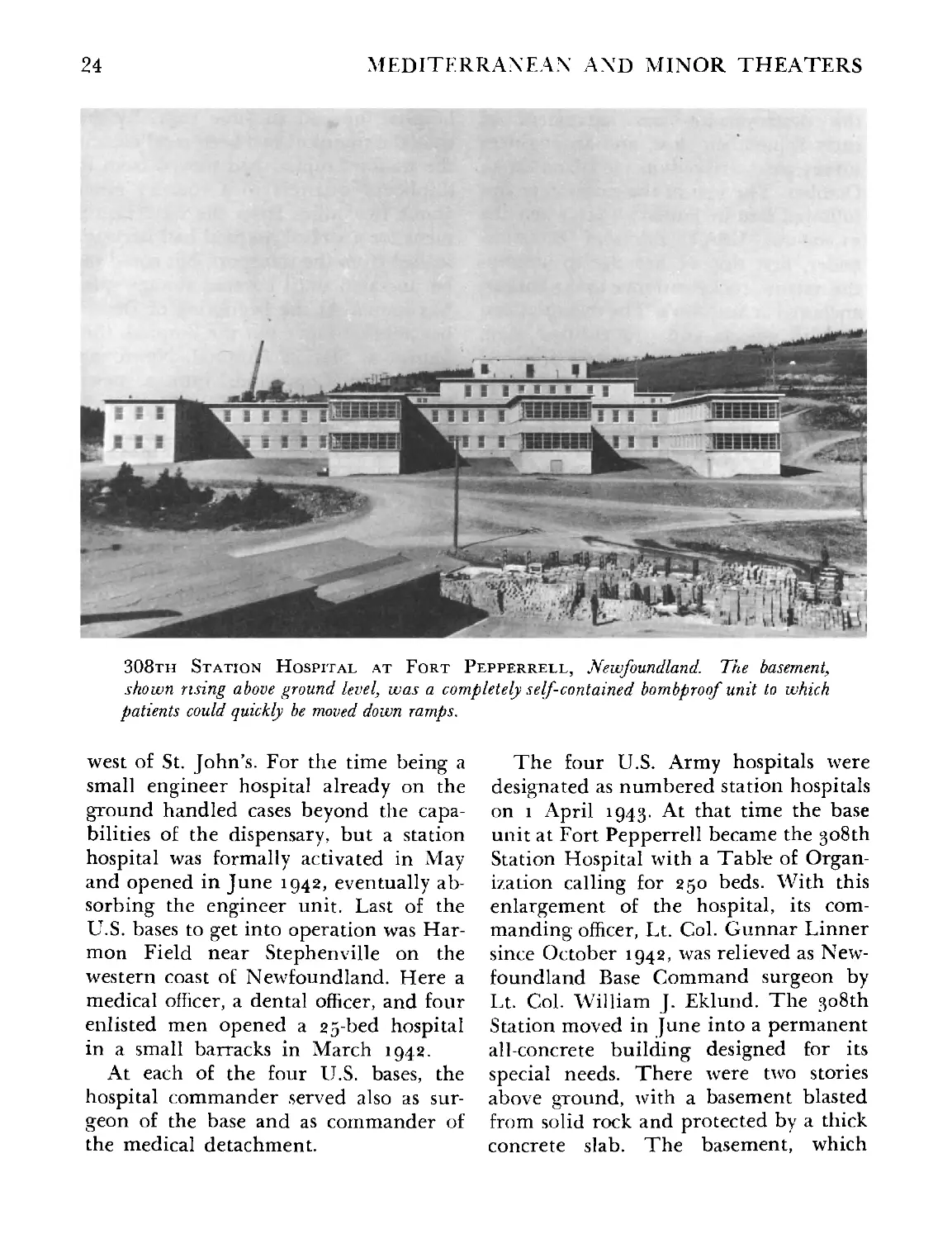
308th Station Hospital, Fort Pepperrell, Newfoundland...................... 24
xxiii
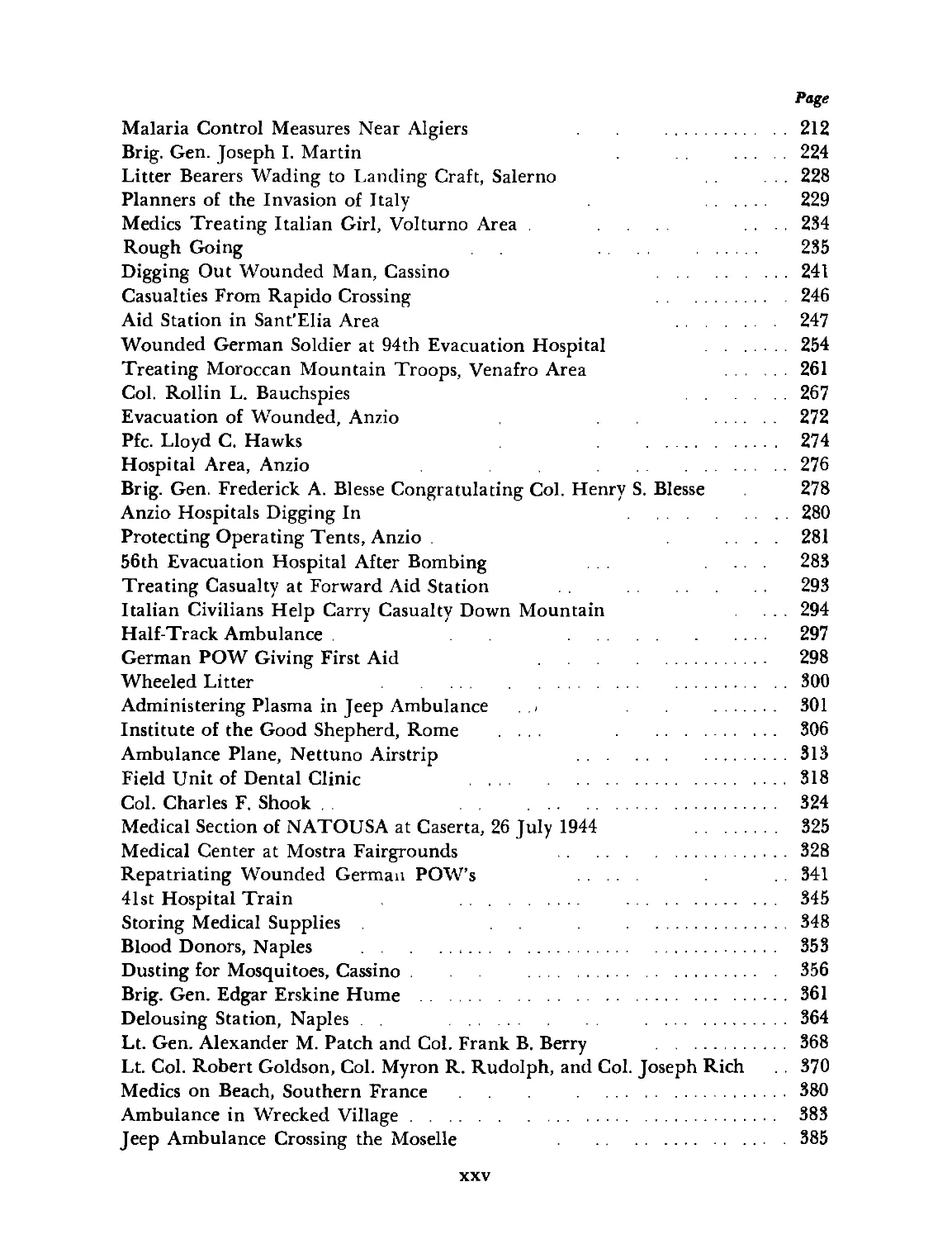
Page
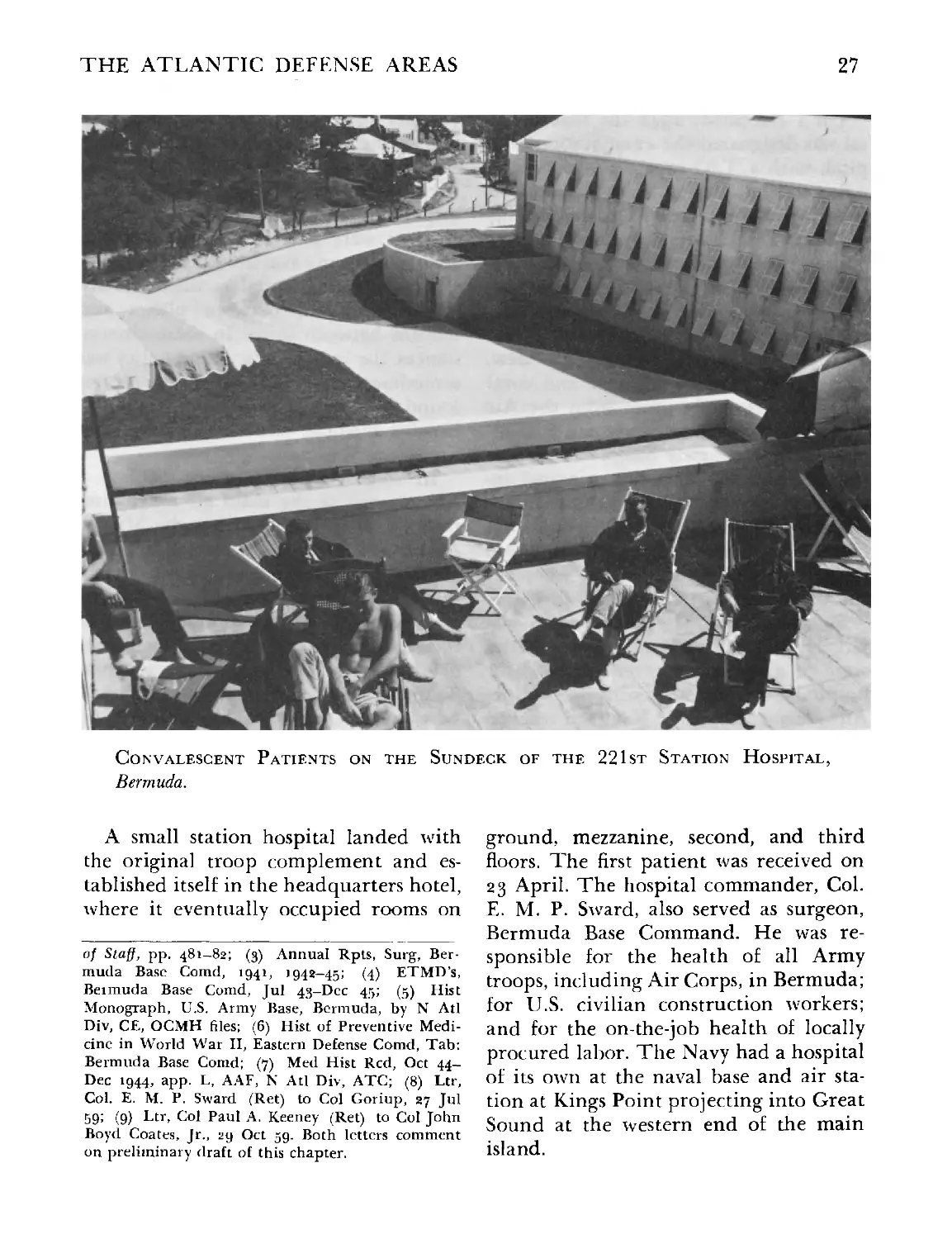
Convalescent Patients, Bermuda	.......... 27
Col. Gordon G. Bulla	.......... 34
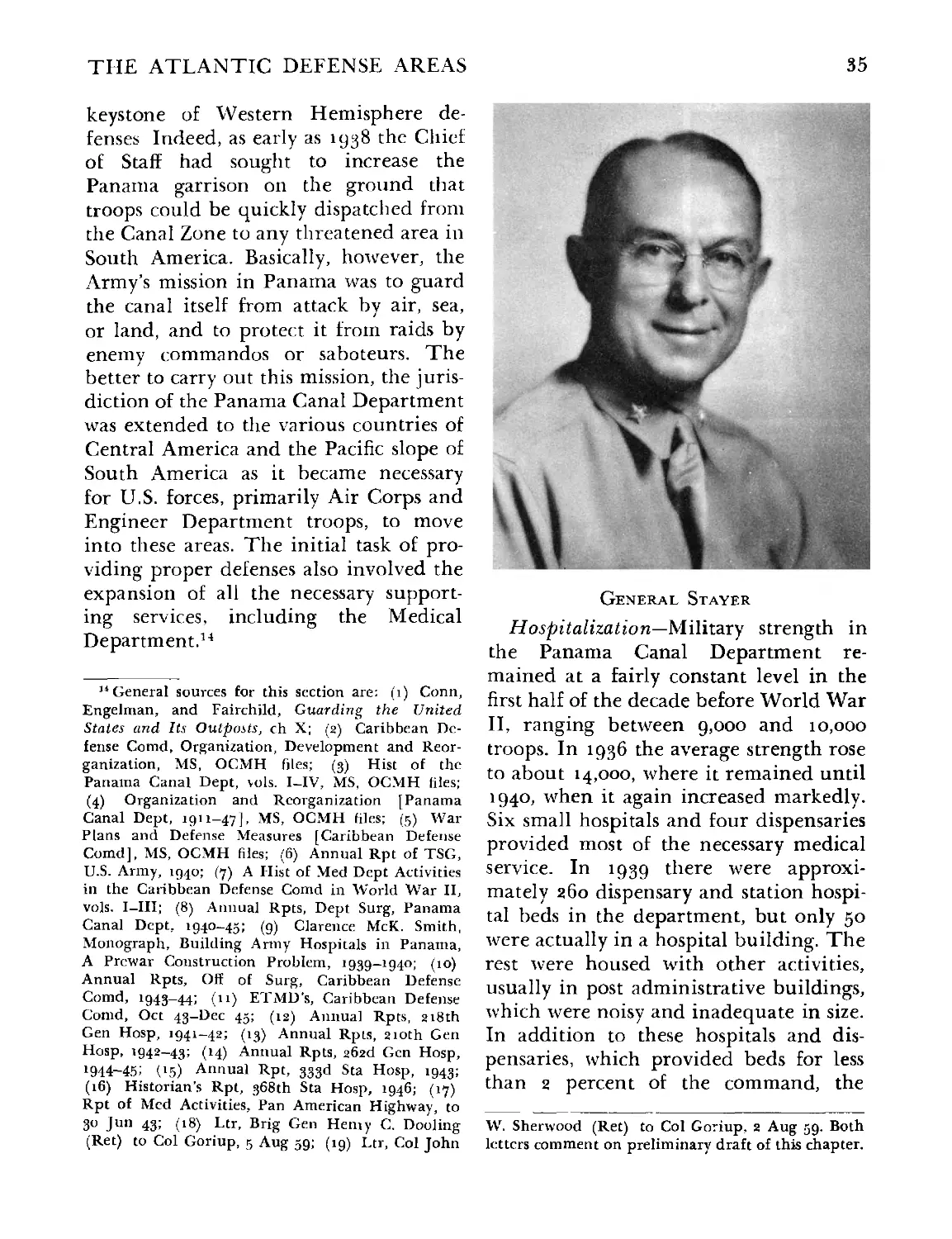
Brig. Gen. Morrison C. Stayer ......................................... 35
Air Evacuation, Panama . .	......................... 40
Col. George E. Leone .................................................. 46
Malaria Control Unit, Brazil	52
Col. Crawford F. Sams	...	...	.... 58
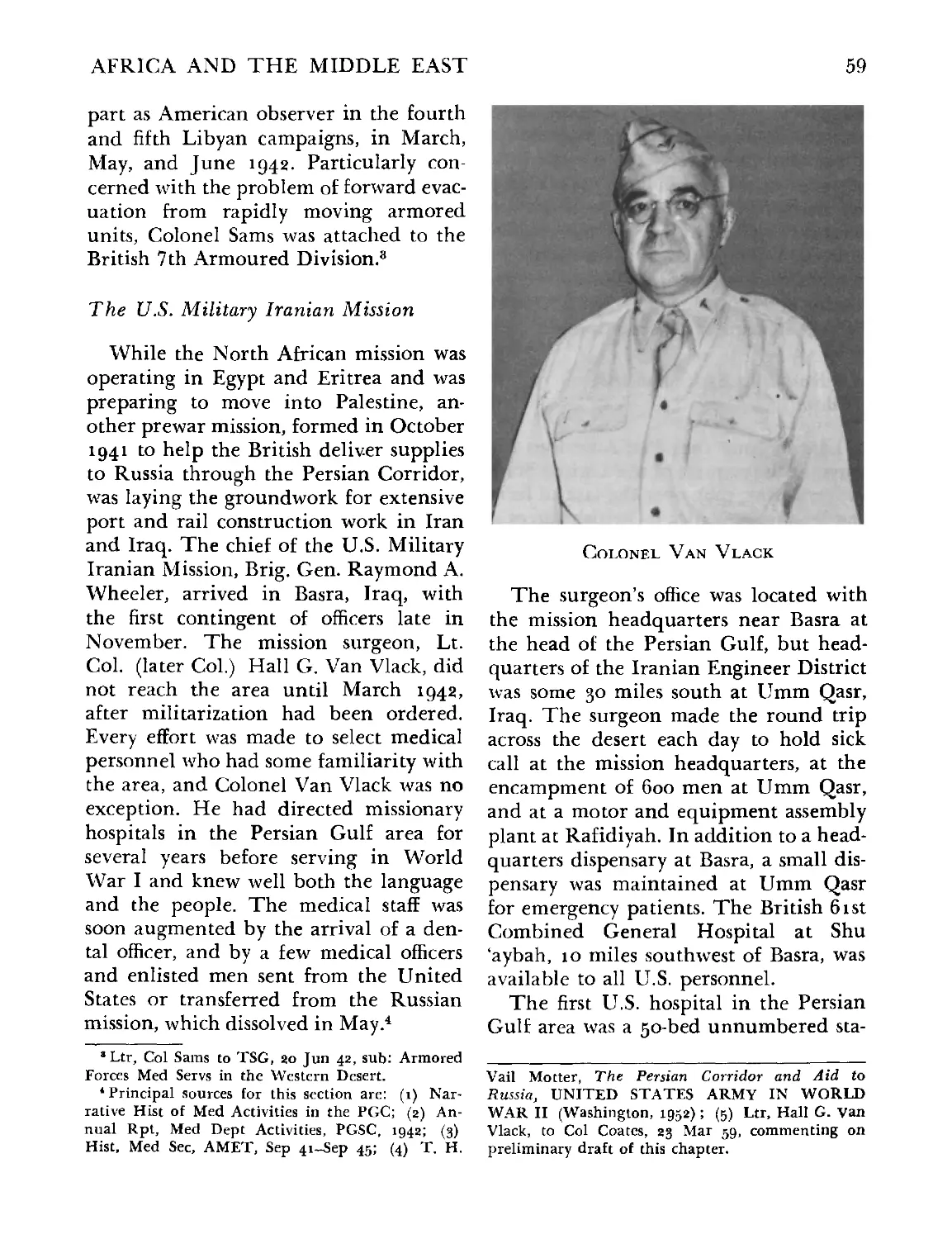
Col. Hall G. Van Vlack	.............. 59
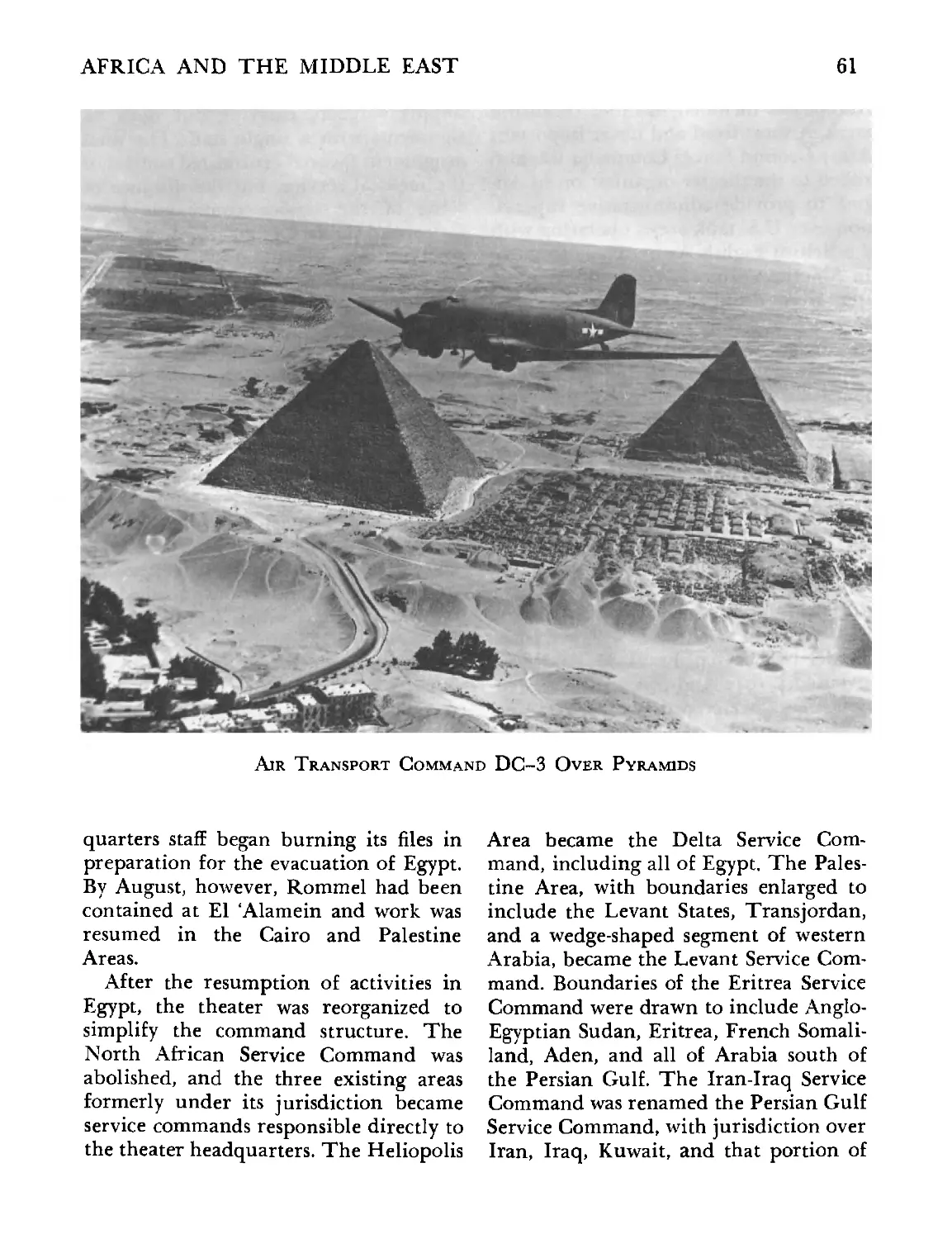
DC-3 Over Pyramids	...	61
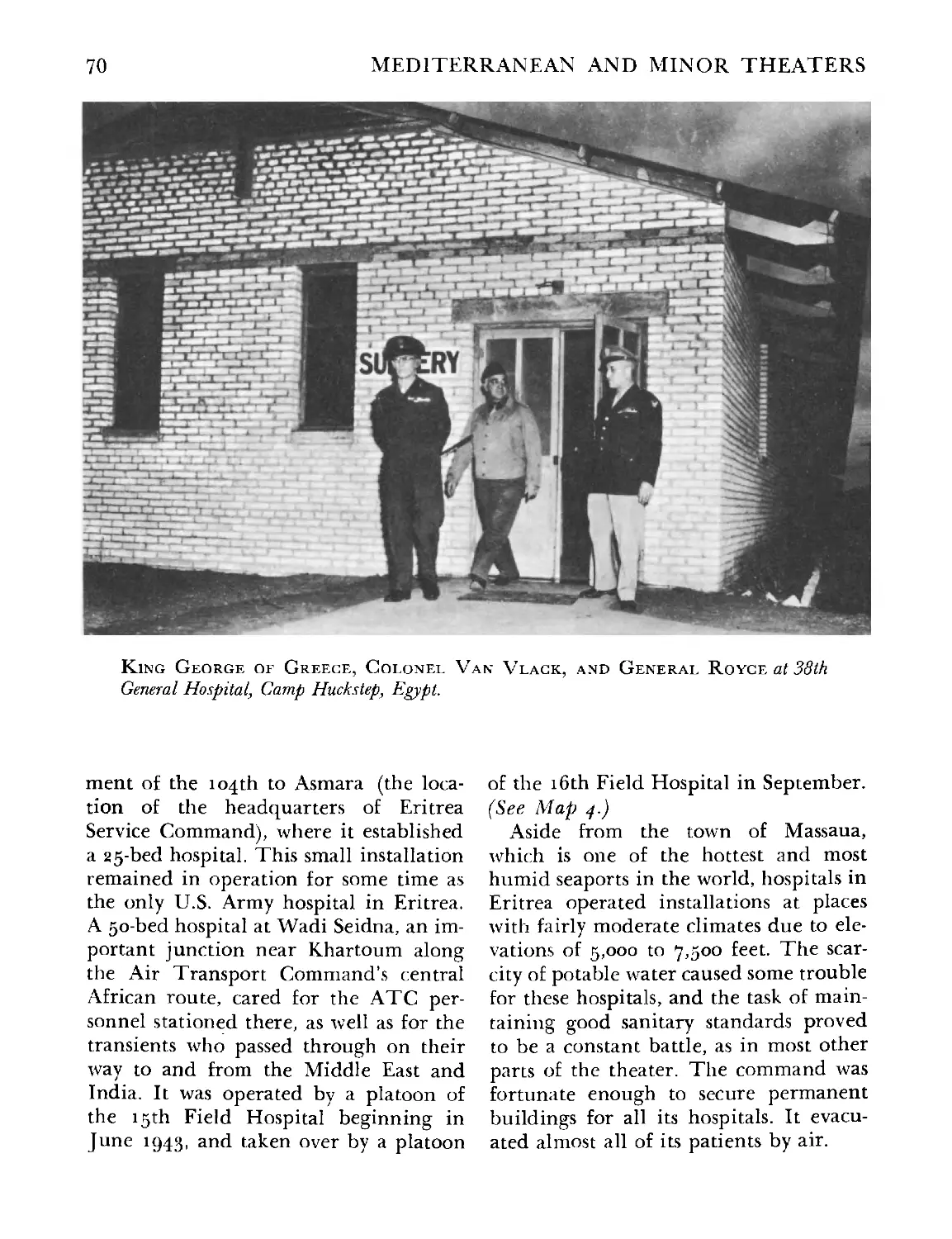
King George of Greece at 38th General Hospital, Heliopolis	.. 70
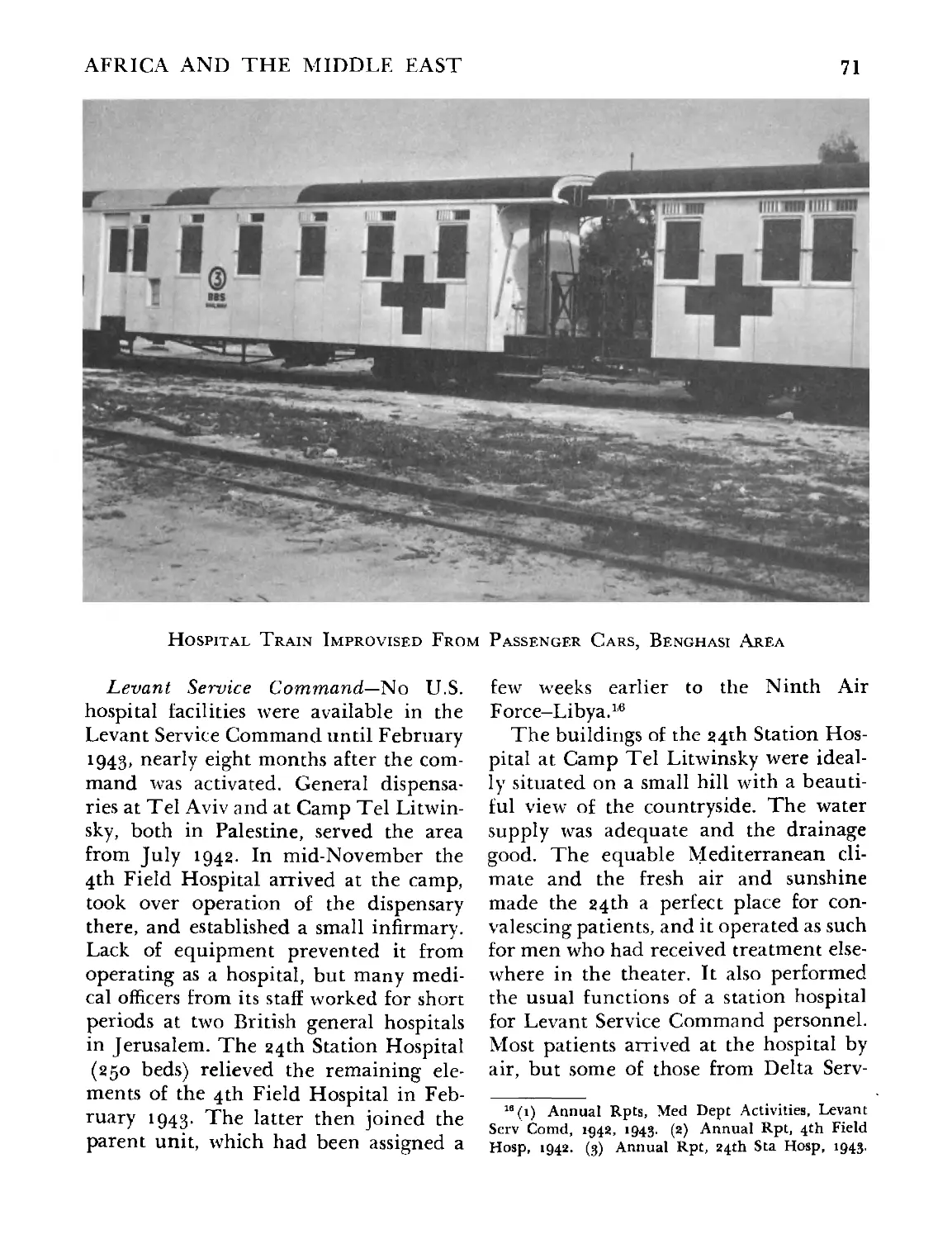
Hospital Train, Benghasi Area	......................... 71
Partially Dug-In Hospital Tents Near Tripoli	.	.............. 72
113th General Hospital at Ahwaz, Iran ................................. 74
167th Station Hospital at Accra, Gold Coast	.................... 78
Loading a Patient by Fork Lift, Casablanca	.......... 85
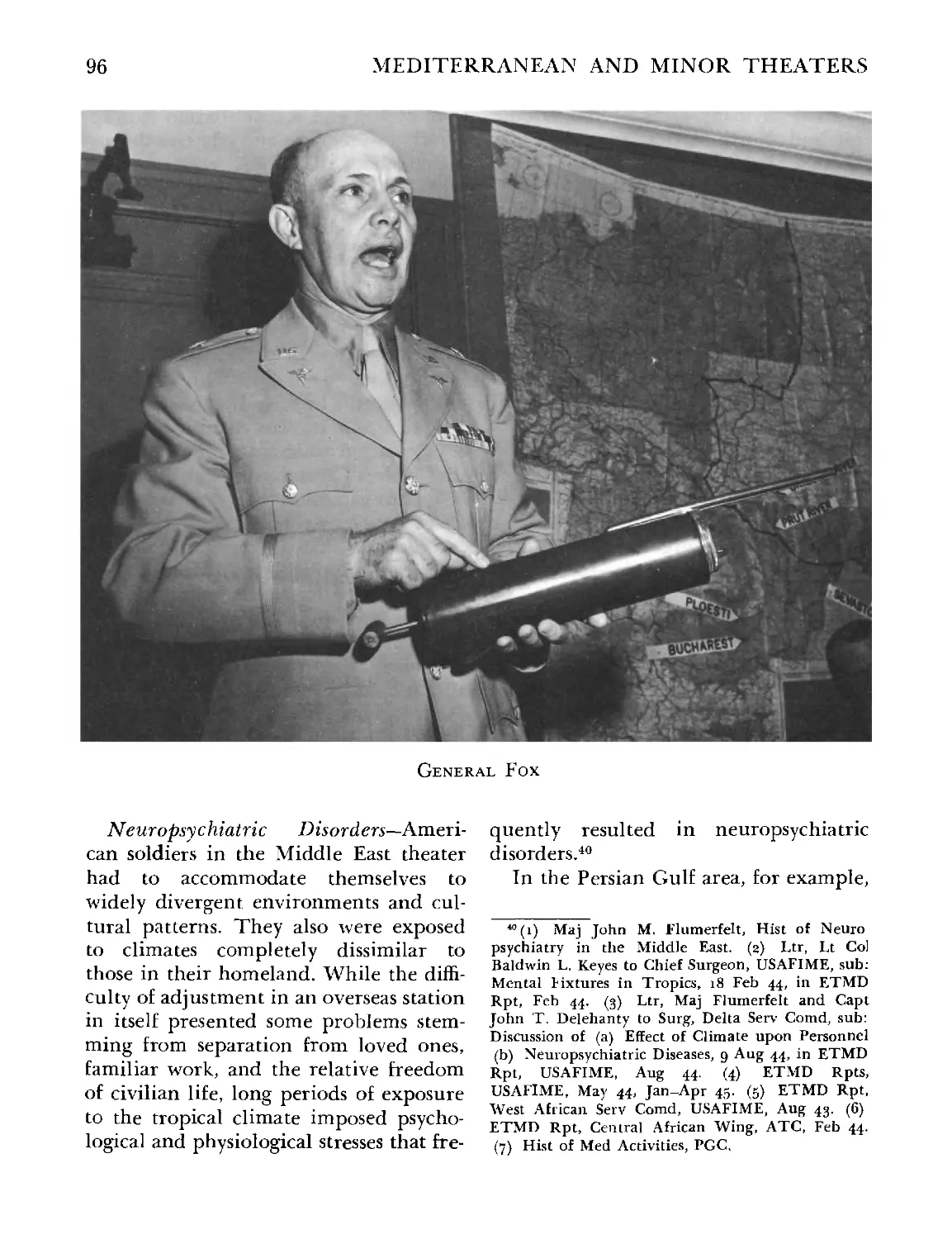
Brig. Gen. Leon A. Fox	96
Dental Clinic at Khorramshahr, Iran	.......................101
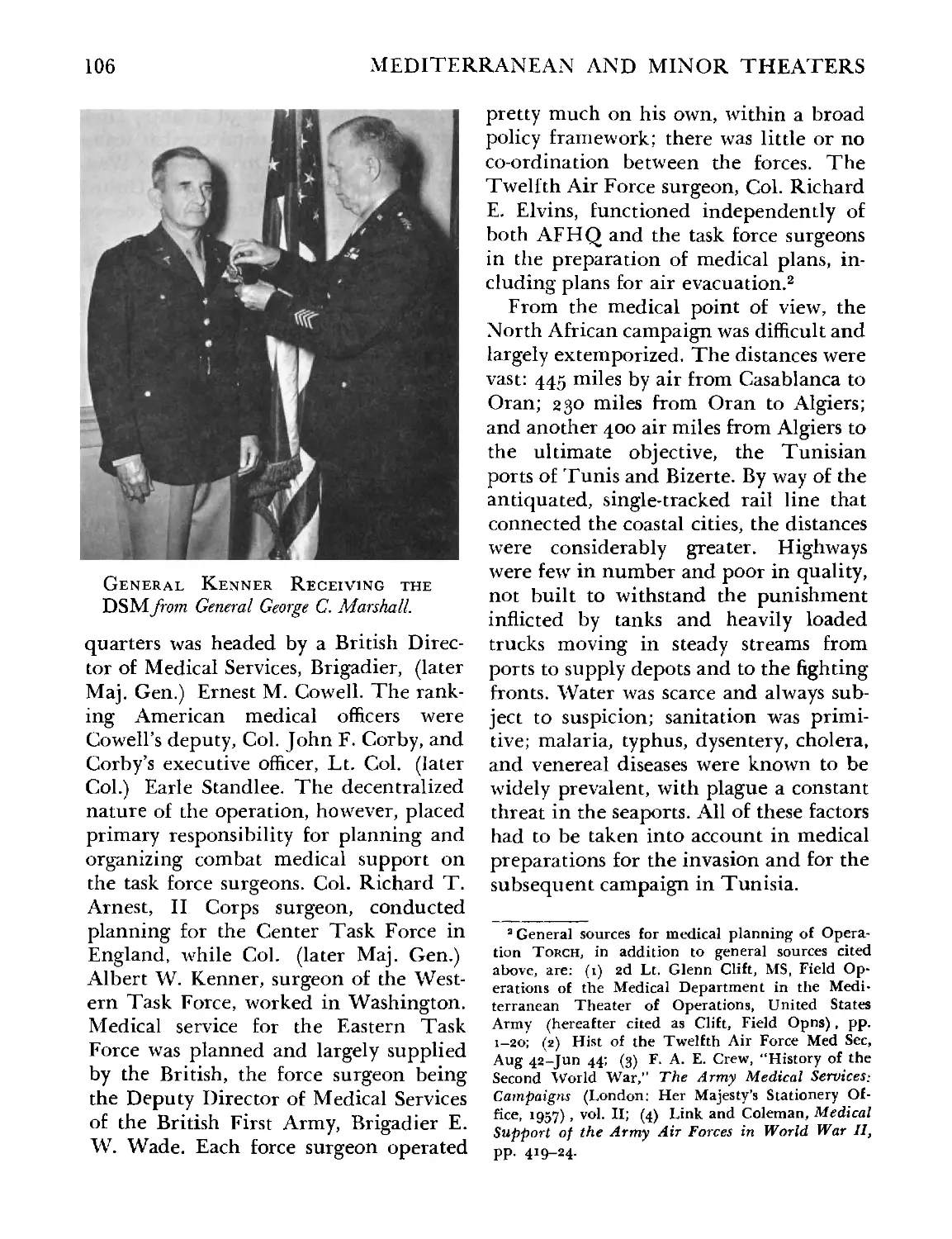
Brig. Gen. Albert W. Kenner and General George C. Marshall ...	106
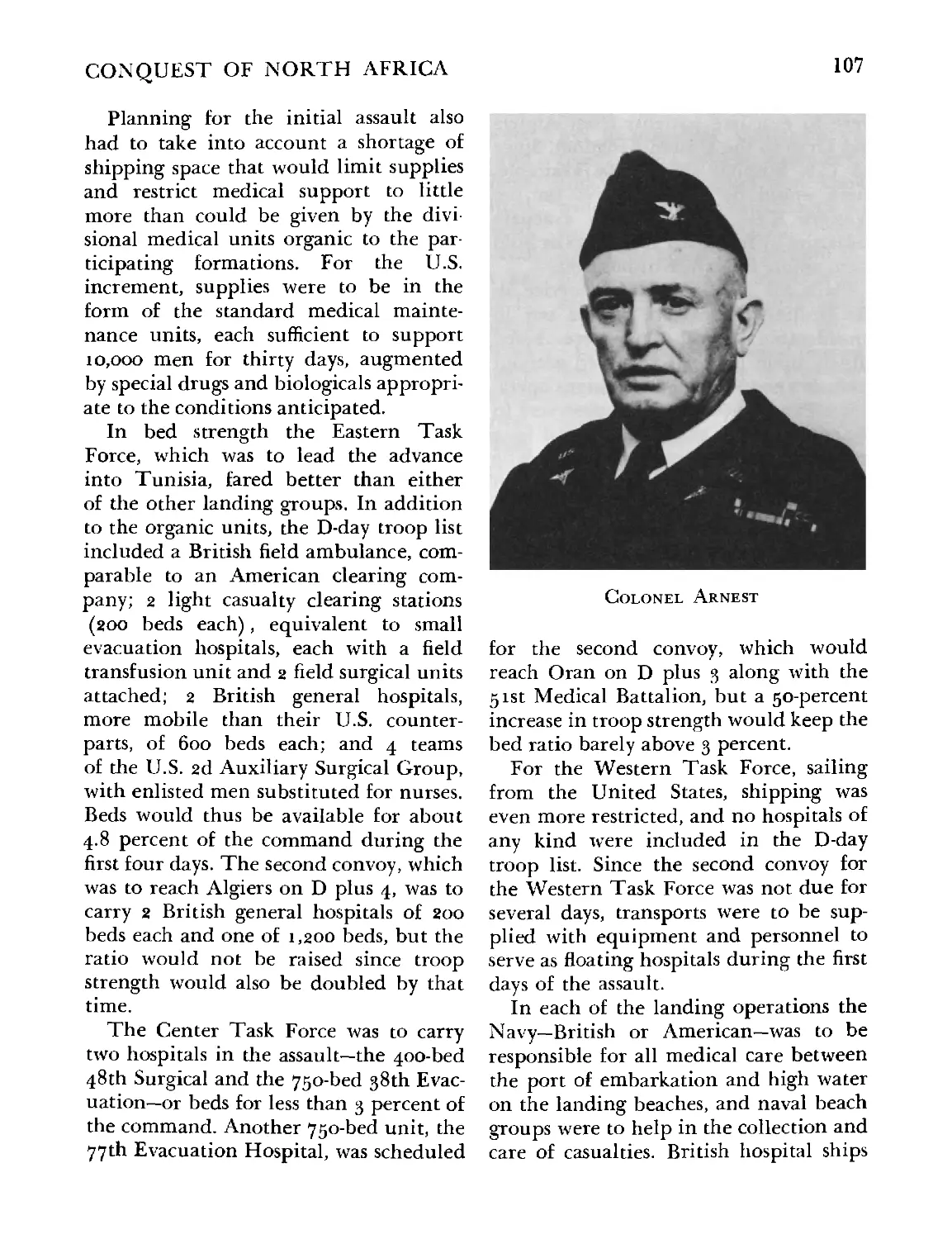
Col. Richard T. Arnest	... ..................... ...	107
Nurses Arriving in Arzew, Algeria .....................................114
Soldier Being Evacuated at Fedala, French Morocco	.............. 118
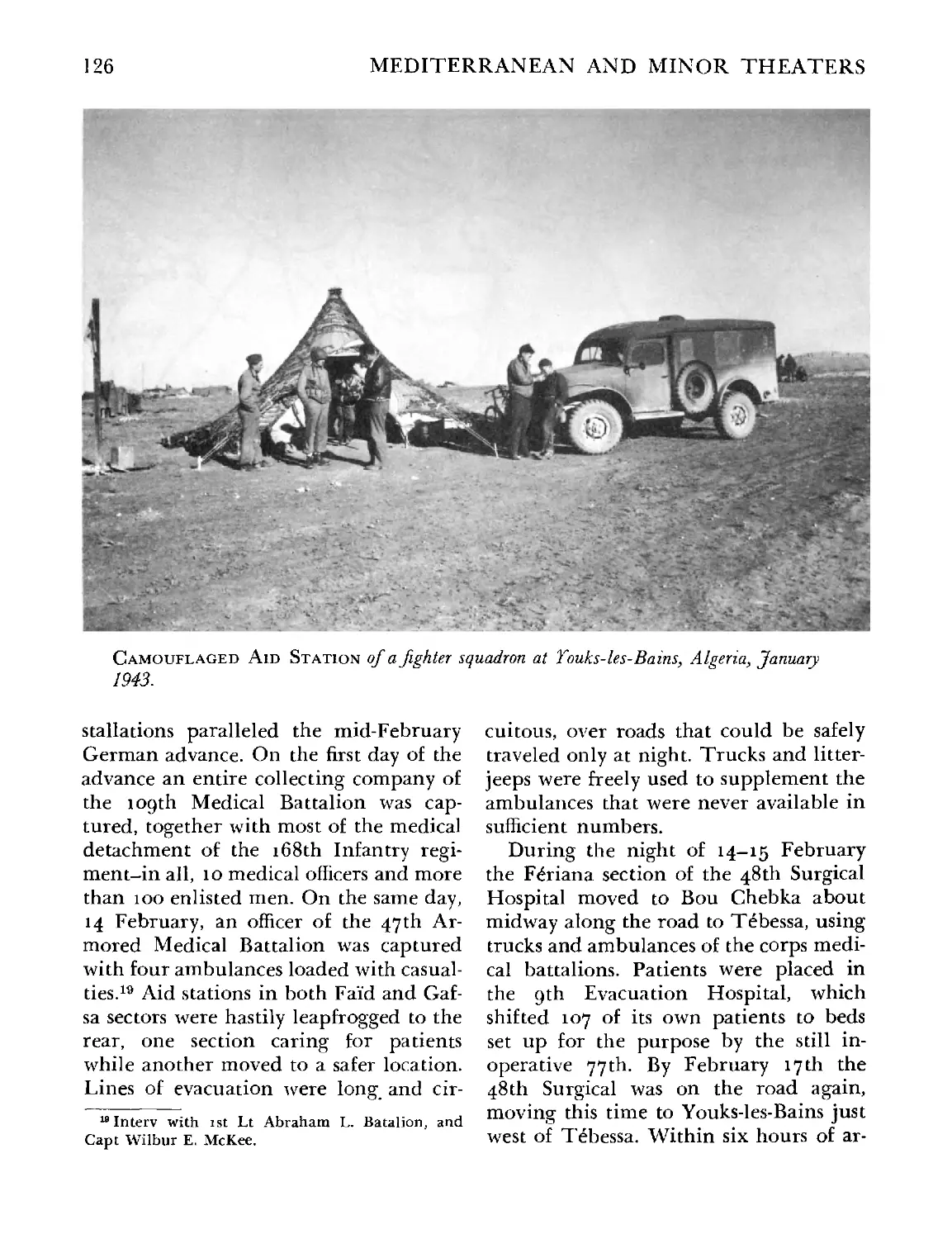
Camouflaged Aid Station, Algeria . . .	126
Mobile Surgical Truck, Tunisia ........................................181
Wrecked Ambulance, Tunisia	............... .... 137
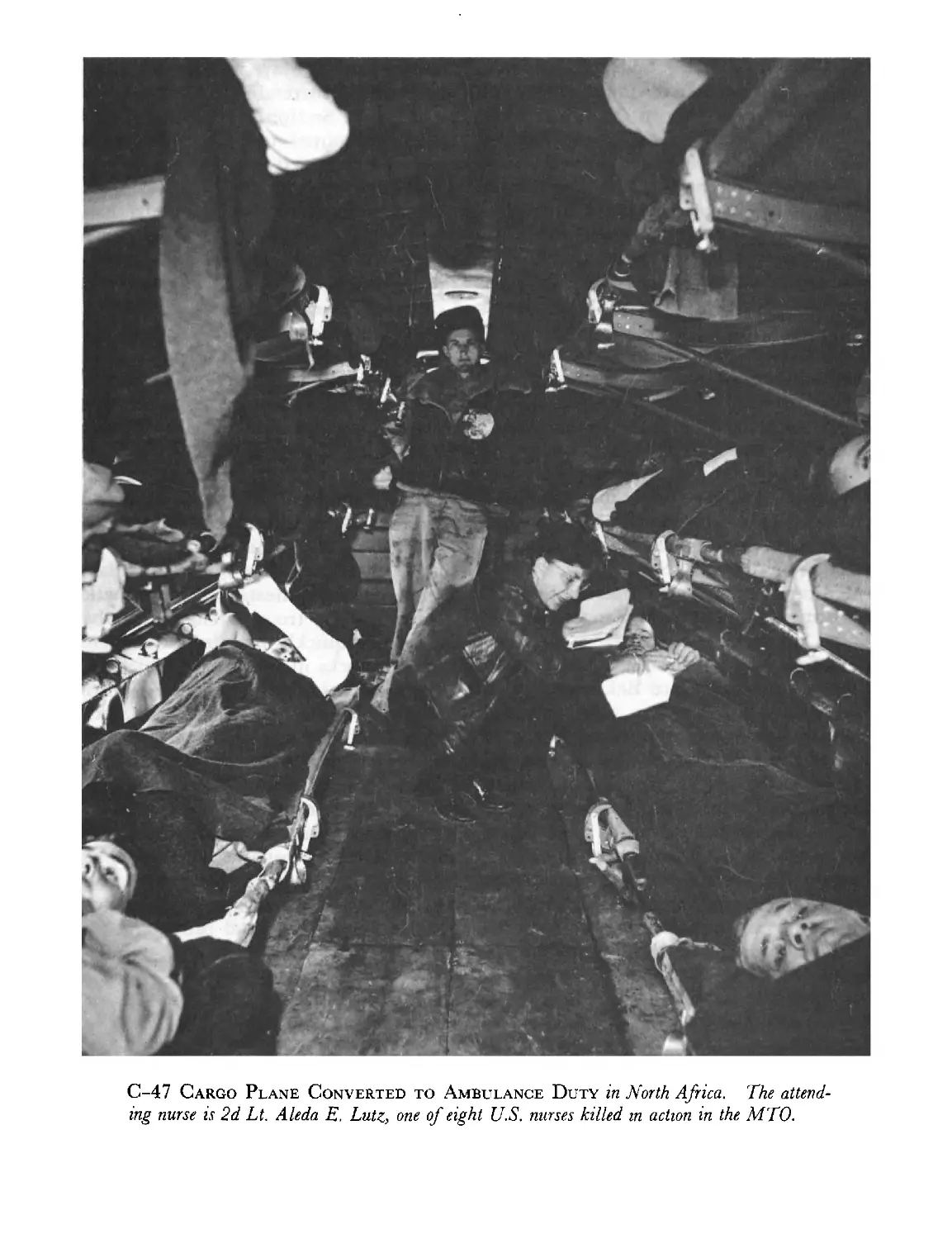
2d Lt. Aleda E. Lutz in Converted C—47 .	....................... 141
Medical Supplies on Beach, Algeria . .	.................... 143
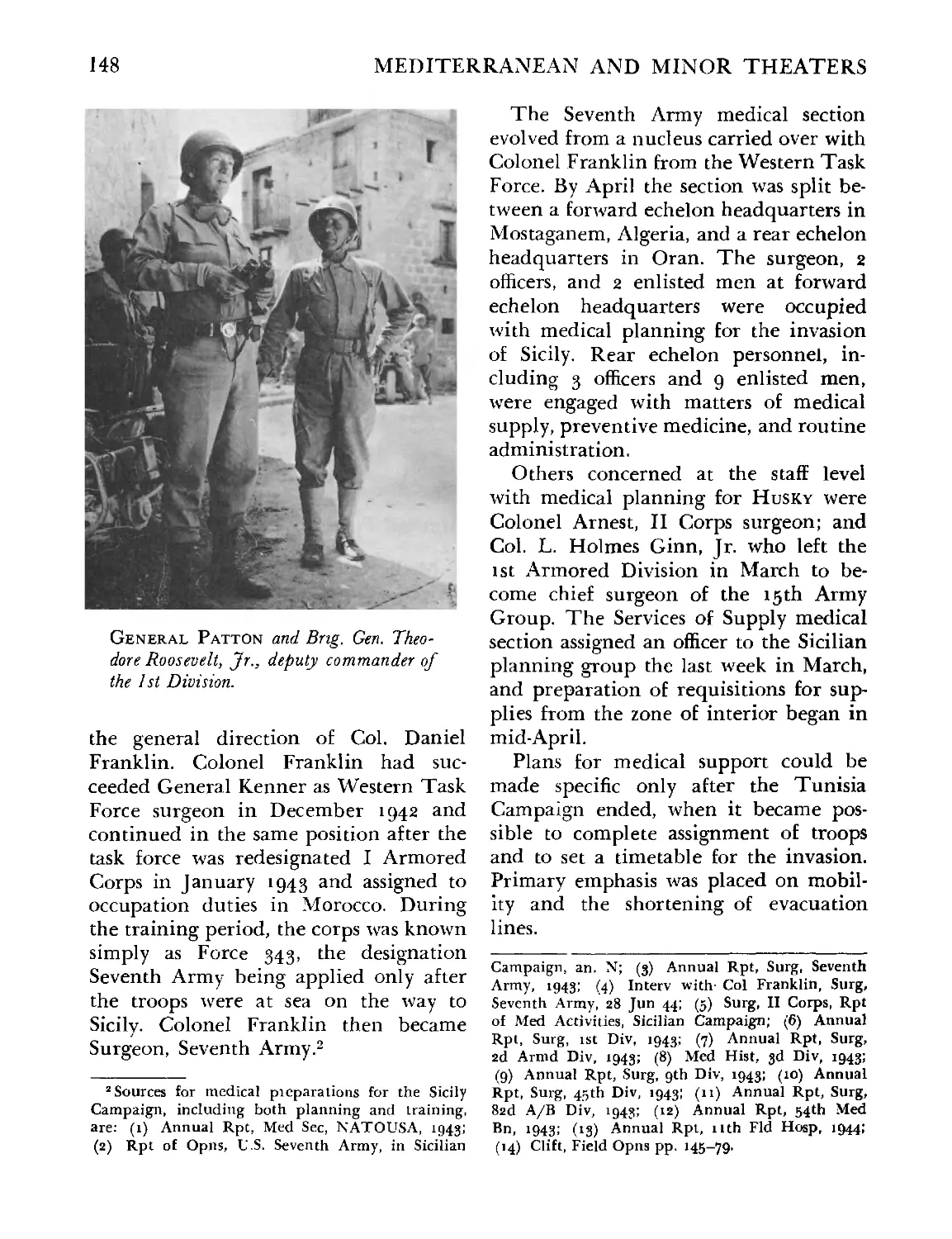
Lt. Gen. George S. Patton, Jr., and Brig. Gen. Theodore Roosevelt, Jr..148
Col. Daniel Franklin	...................................150
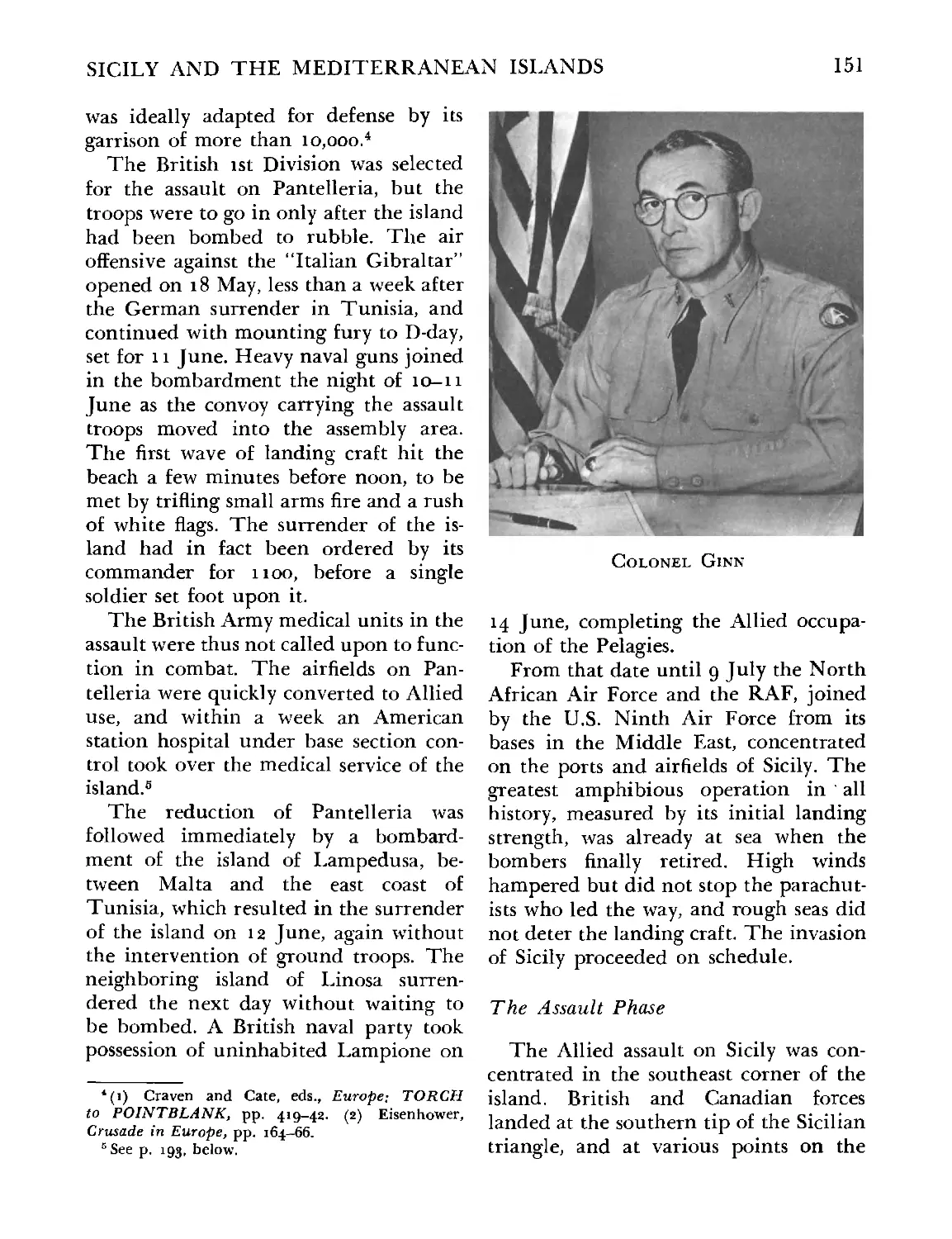
Col. L. Holmes Ginn, Jr. ...	......................... 151
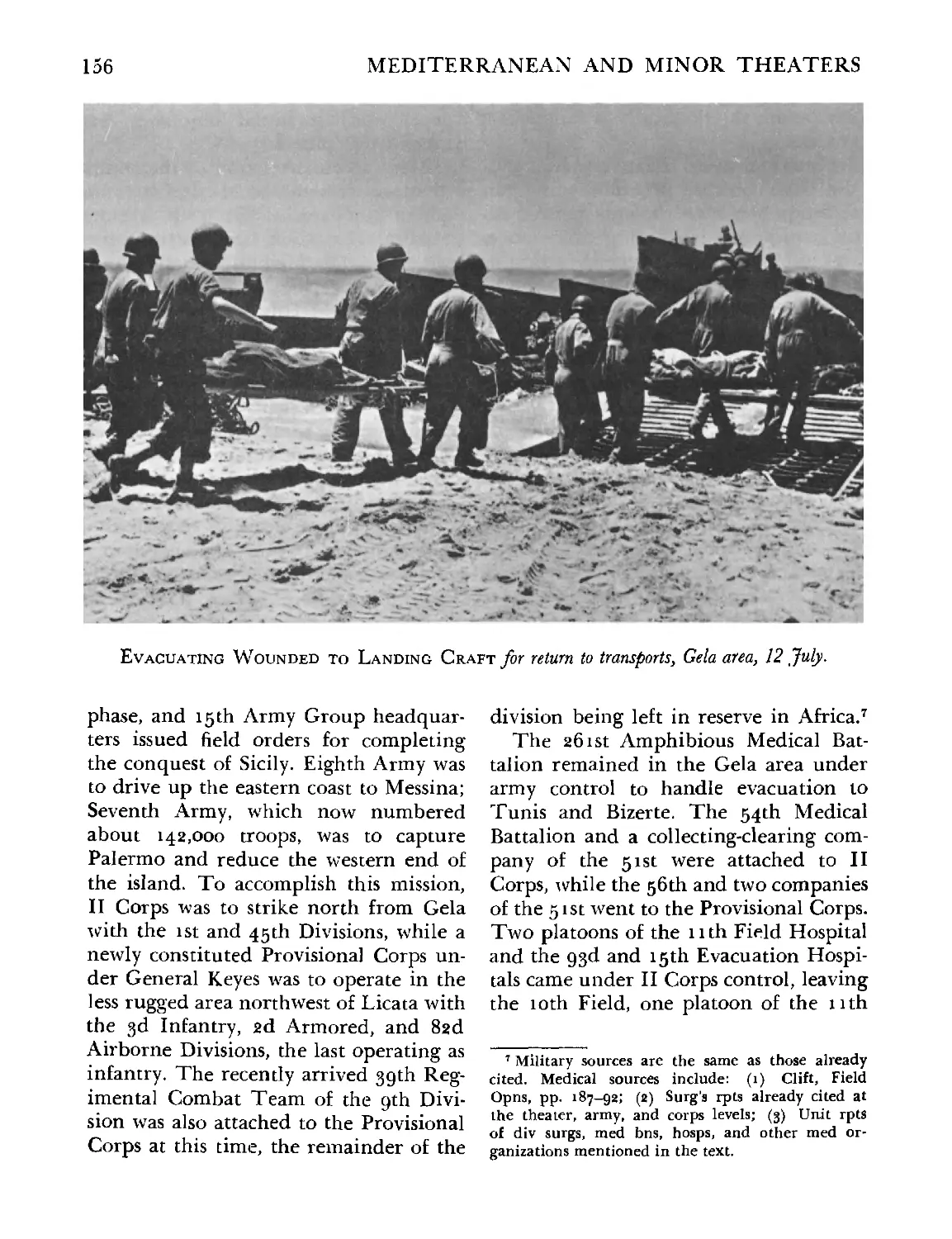
Evacuating Wounded to Landing Craft, Sicily .......................... 156
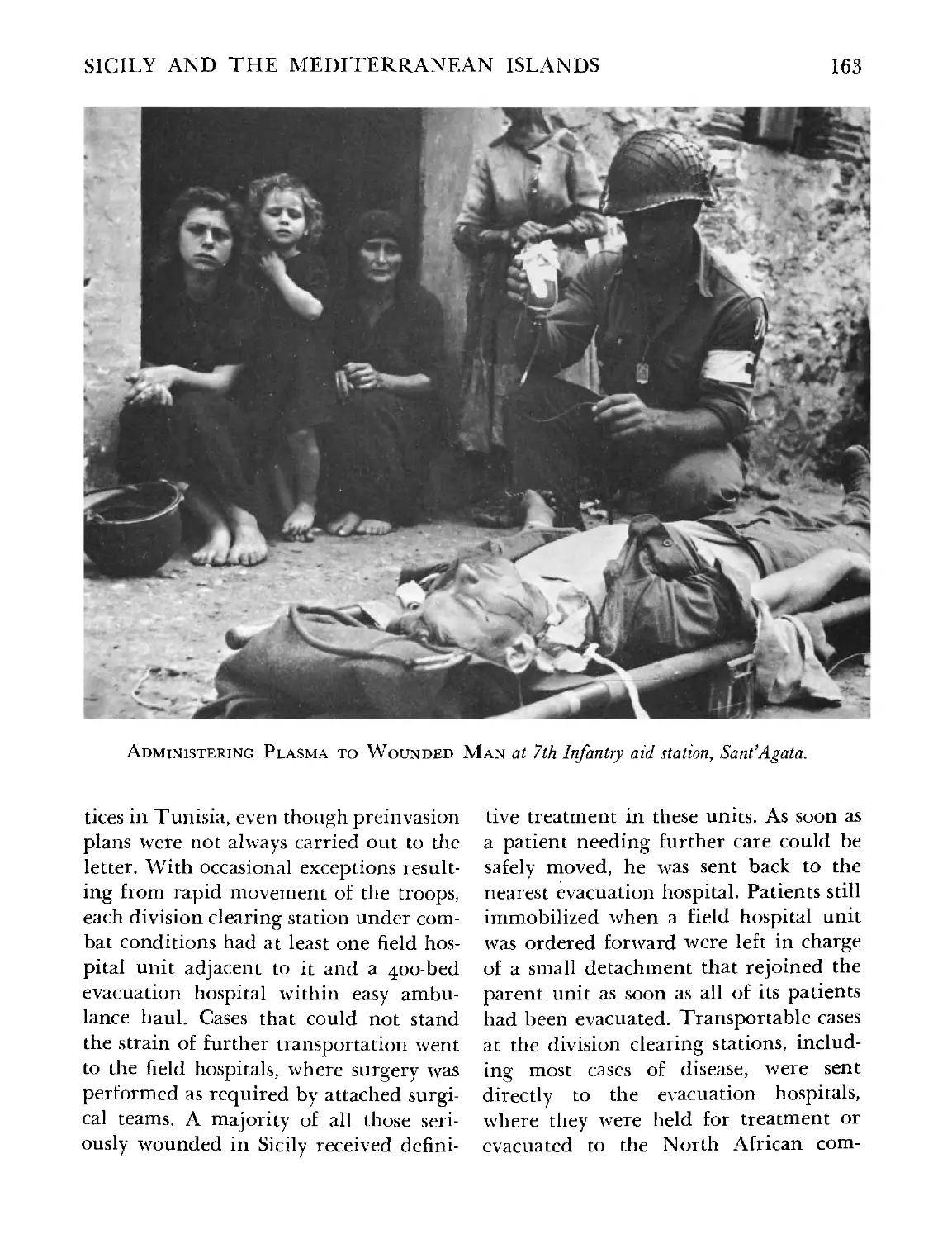
Administering Plasma, Sicily	.........................163
Evacuation by Muleback .............................................   164
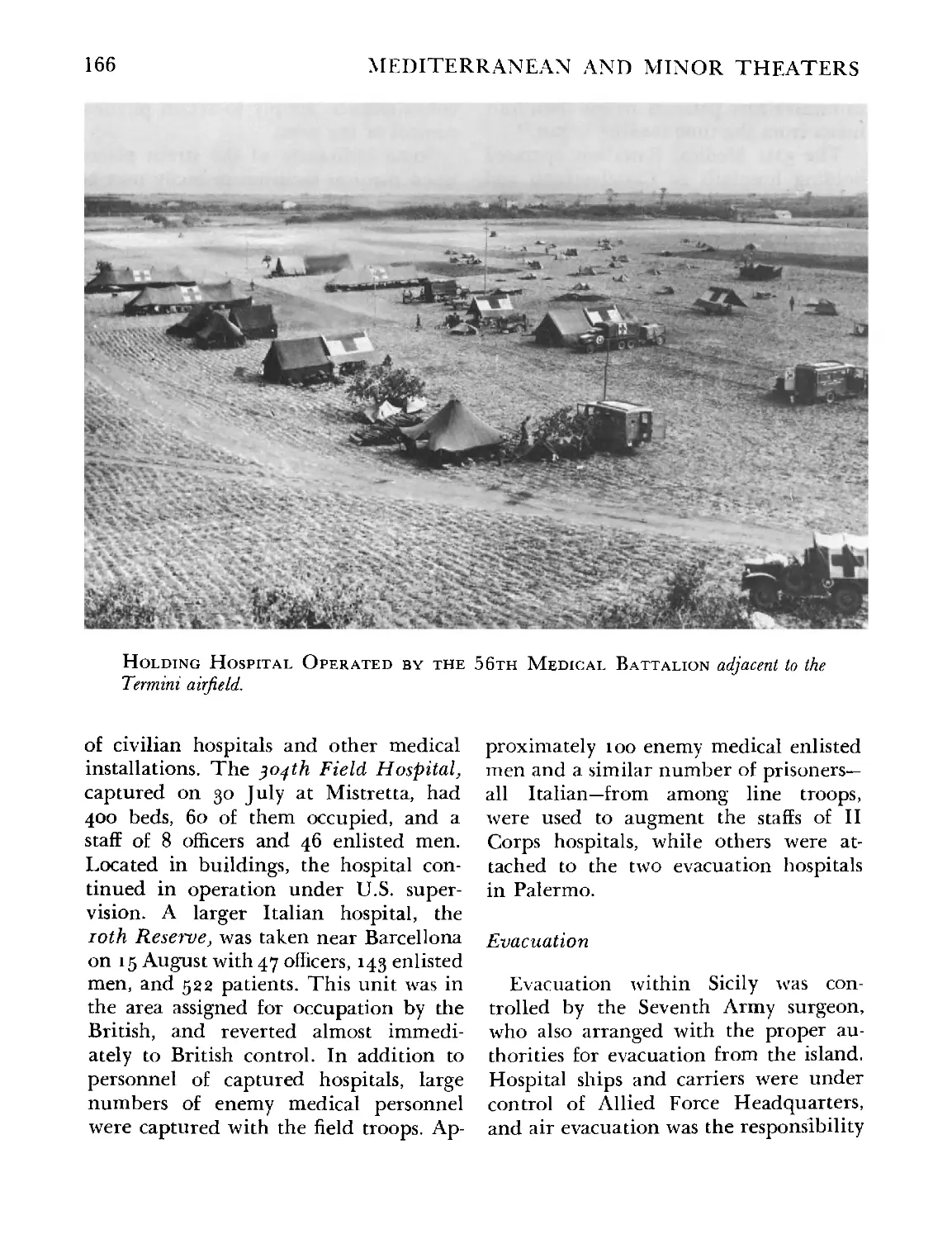
Holding Hospital, Termini Airfield, Sicily .	....................166
Forward Surgical Unit, Sicily ...	............ ................... 171
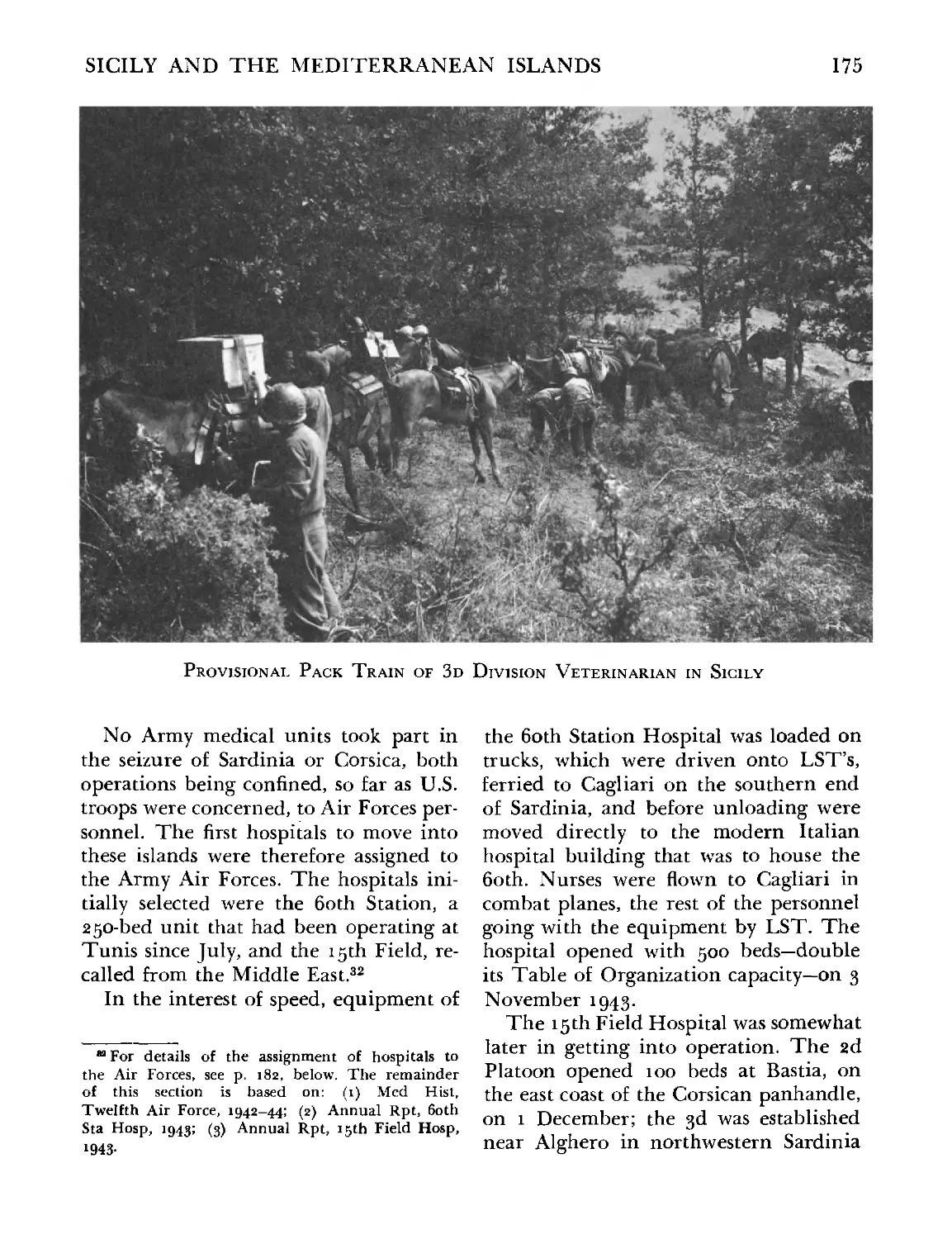
Pack Train in Sicily .	................................175
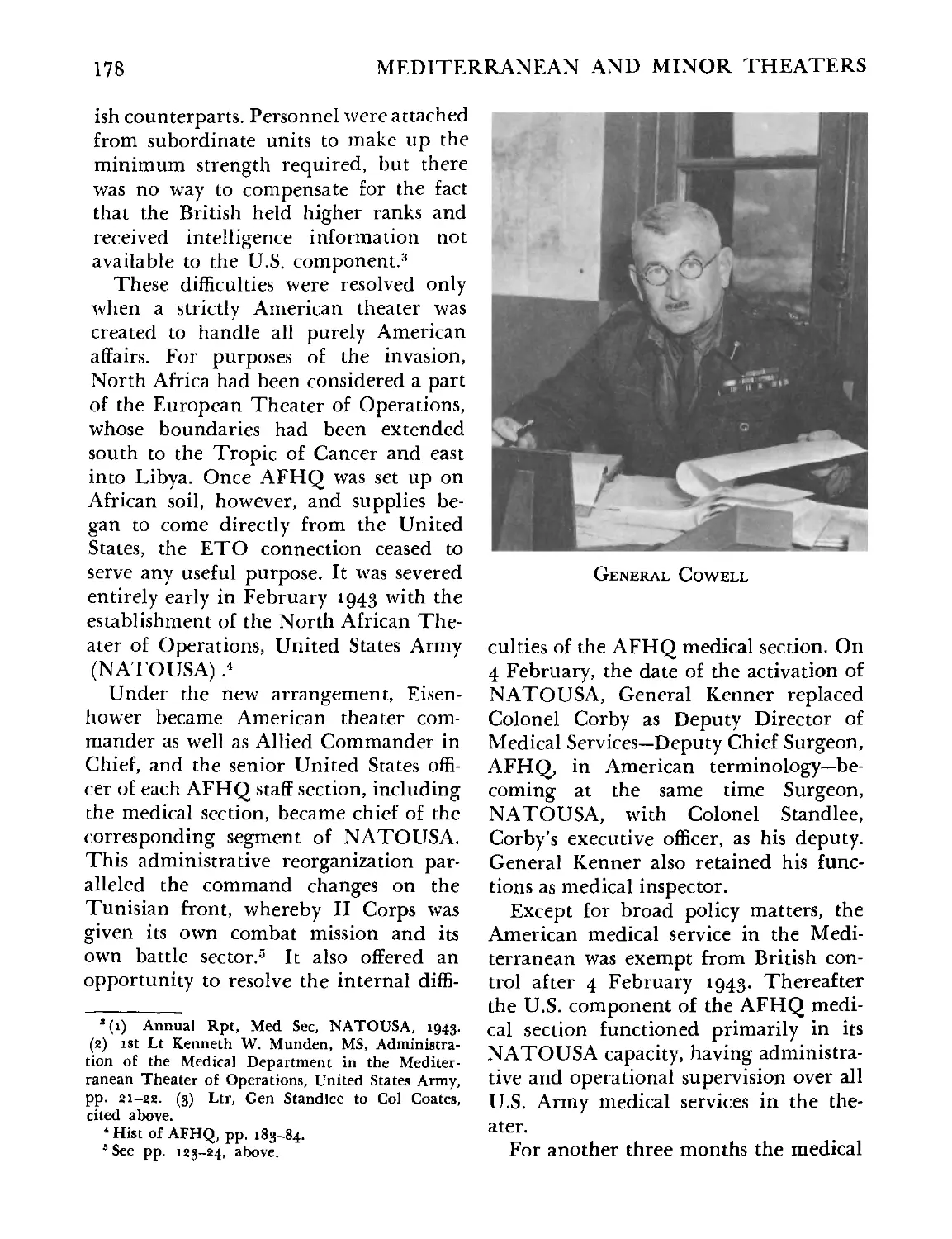
Maj. Gen. Ernest M. Cowell	................................178
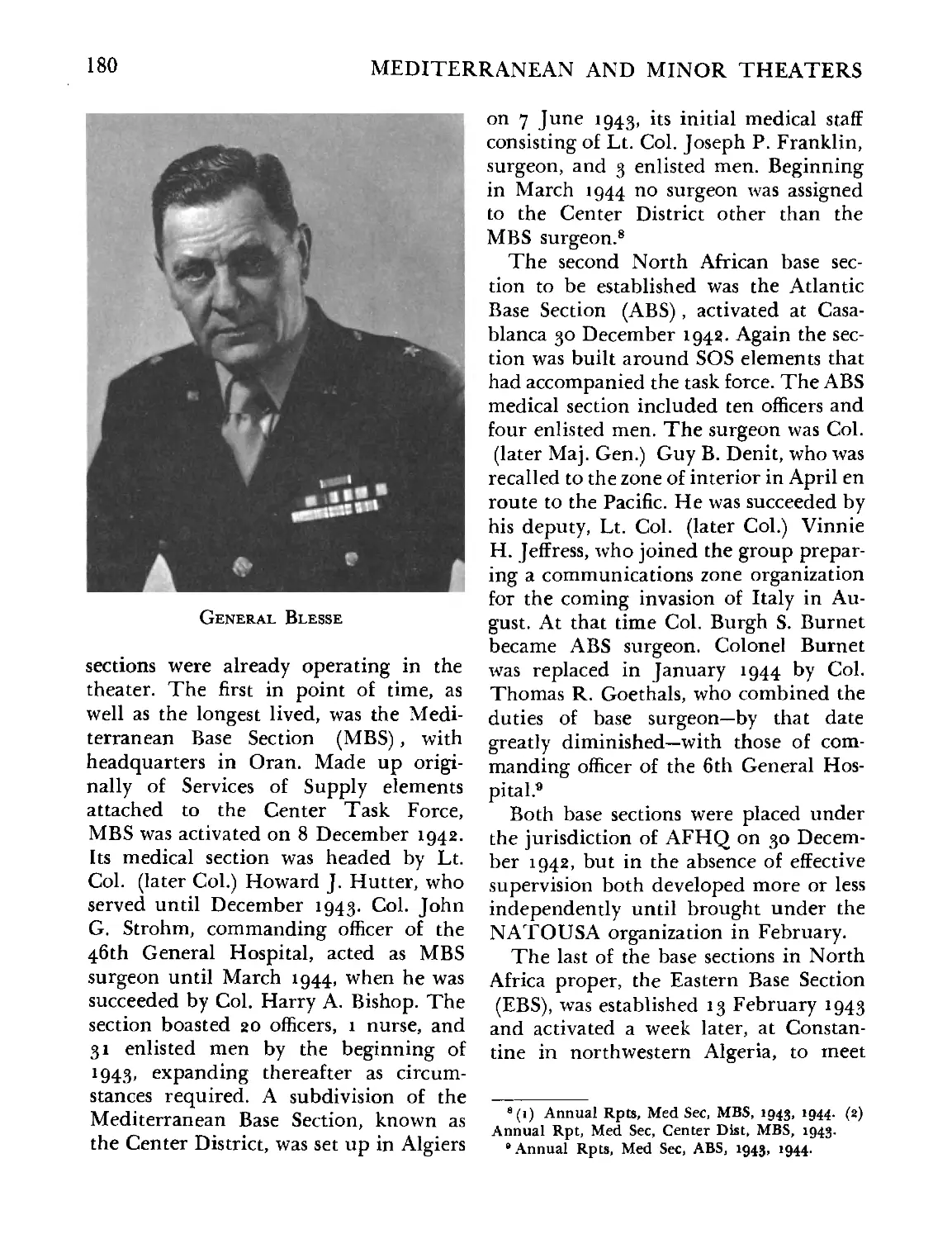
Brig. Gen. Frederick A. Blesse .....................................   180
6th General Hospital, Casablanca .	.................... 187
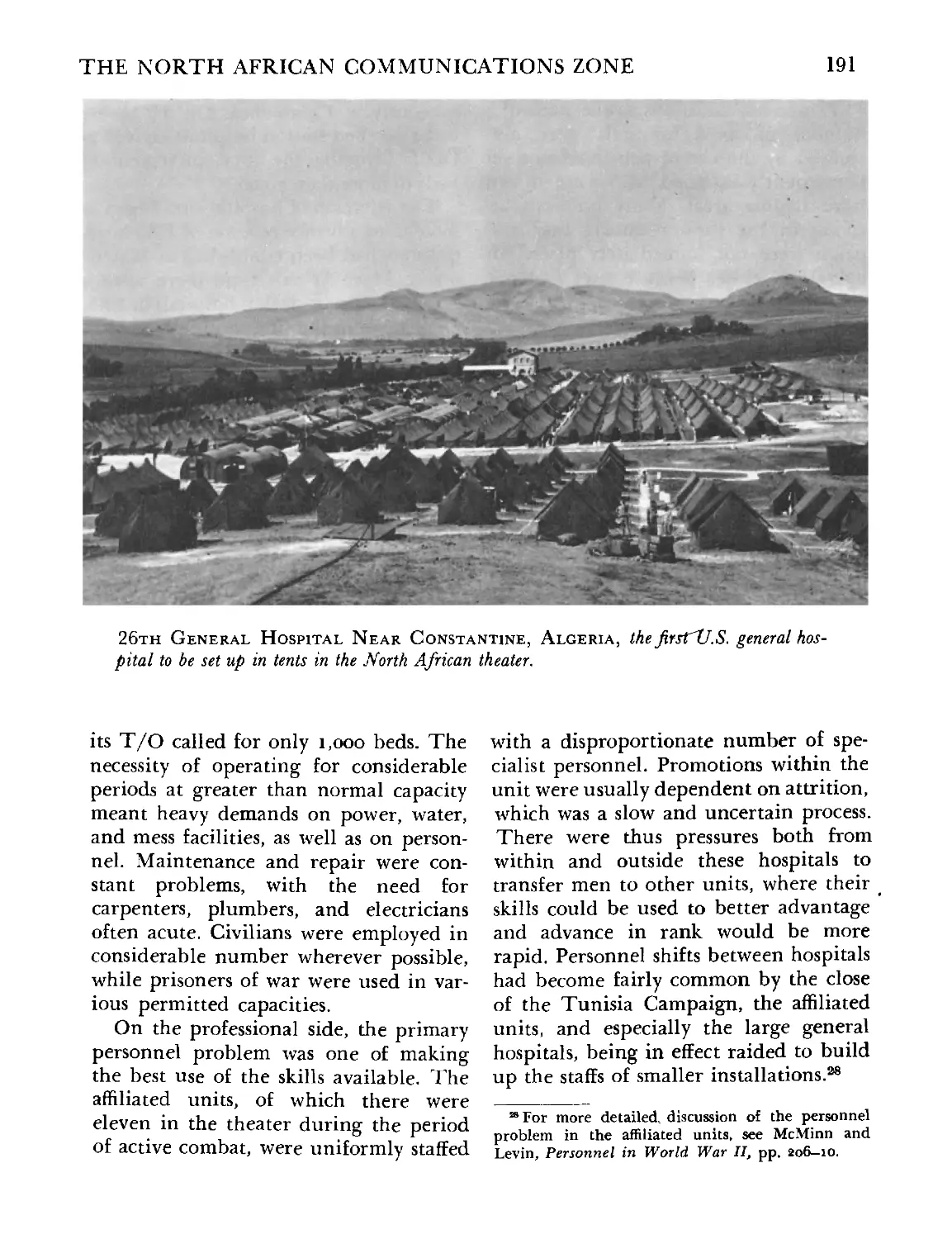
26th General Hospital Near Constantine, Algeria ...................... 191
Aerial View of Hospital Groupment, Algeria ............................195
Prison Stockade of the 180th Station Hospital Near Oran................203
Interior View of Hospital Train........................................207
Col. William S. Stone..................................................211
xx iv
Page
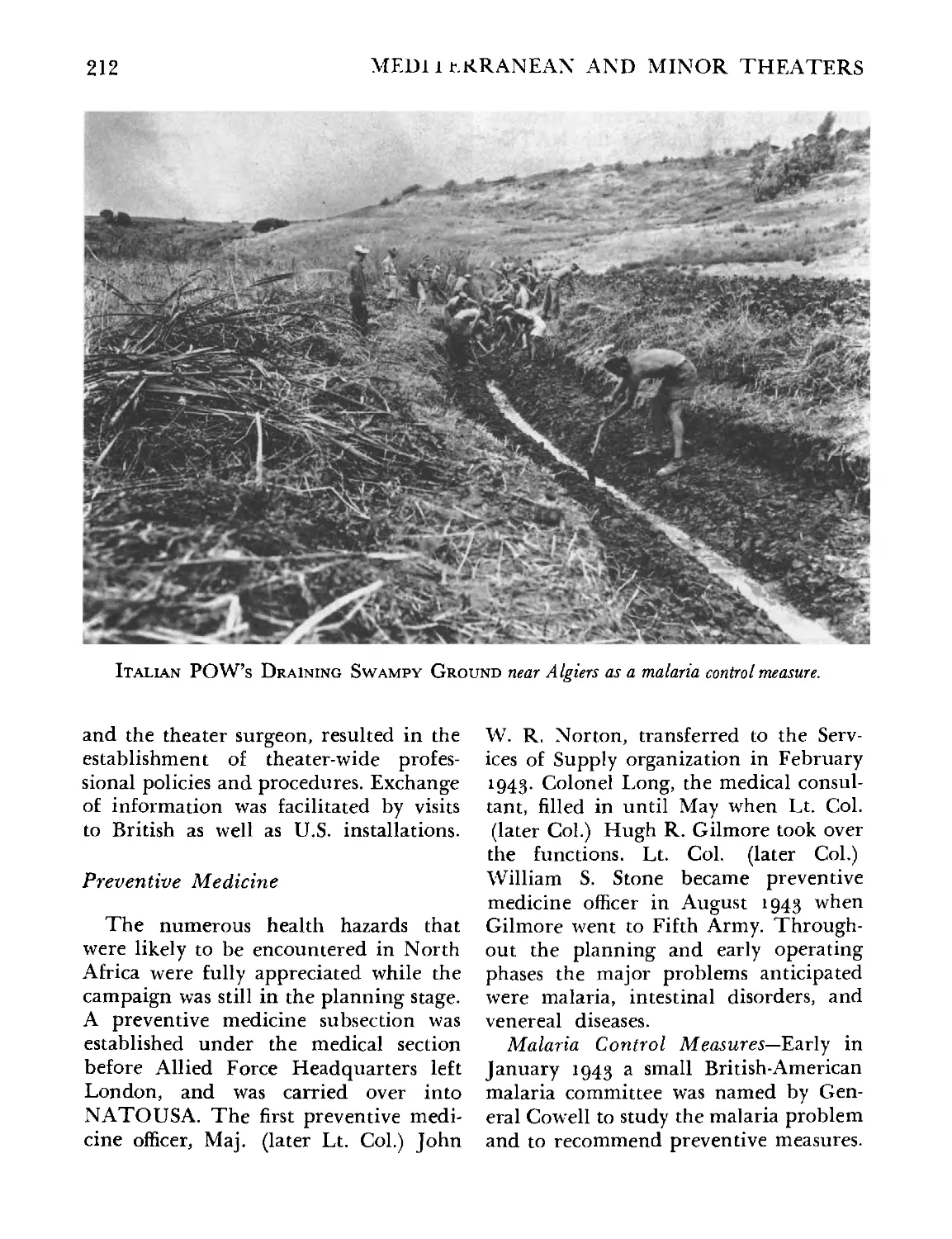
Malaria Control Measures Near Algiers	............ 212
Brig. Gen. Joseph I. Martin	.....224
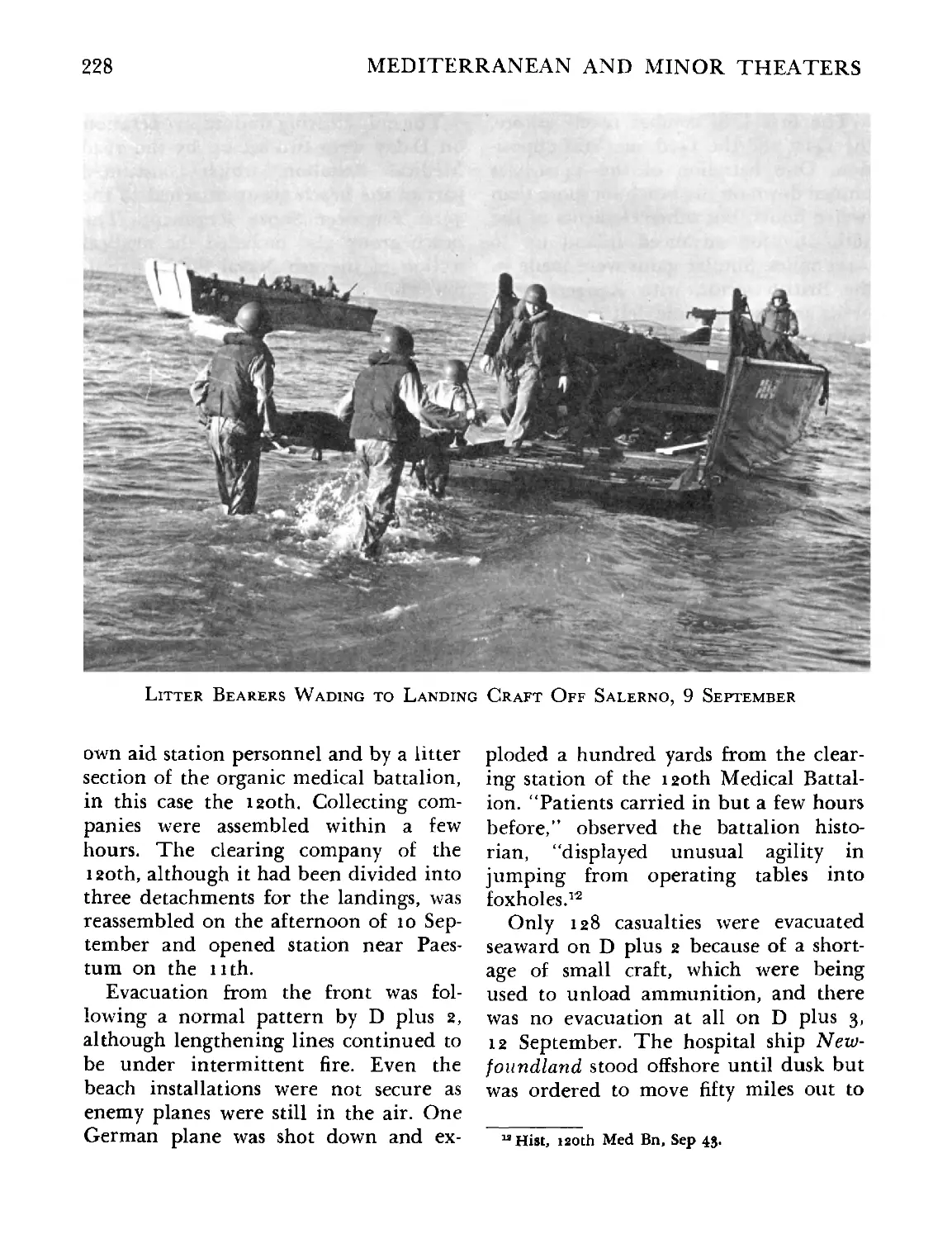
Litter Bearers Wading to Landing Craft, Salerno	... 228
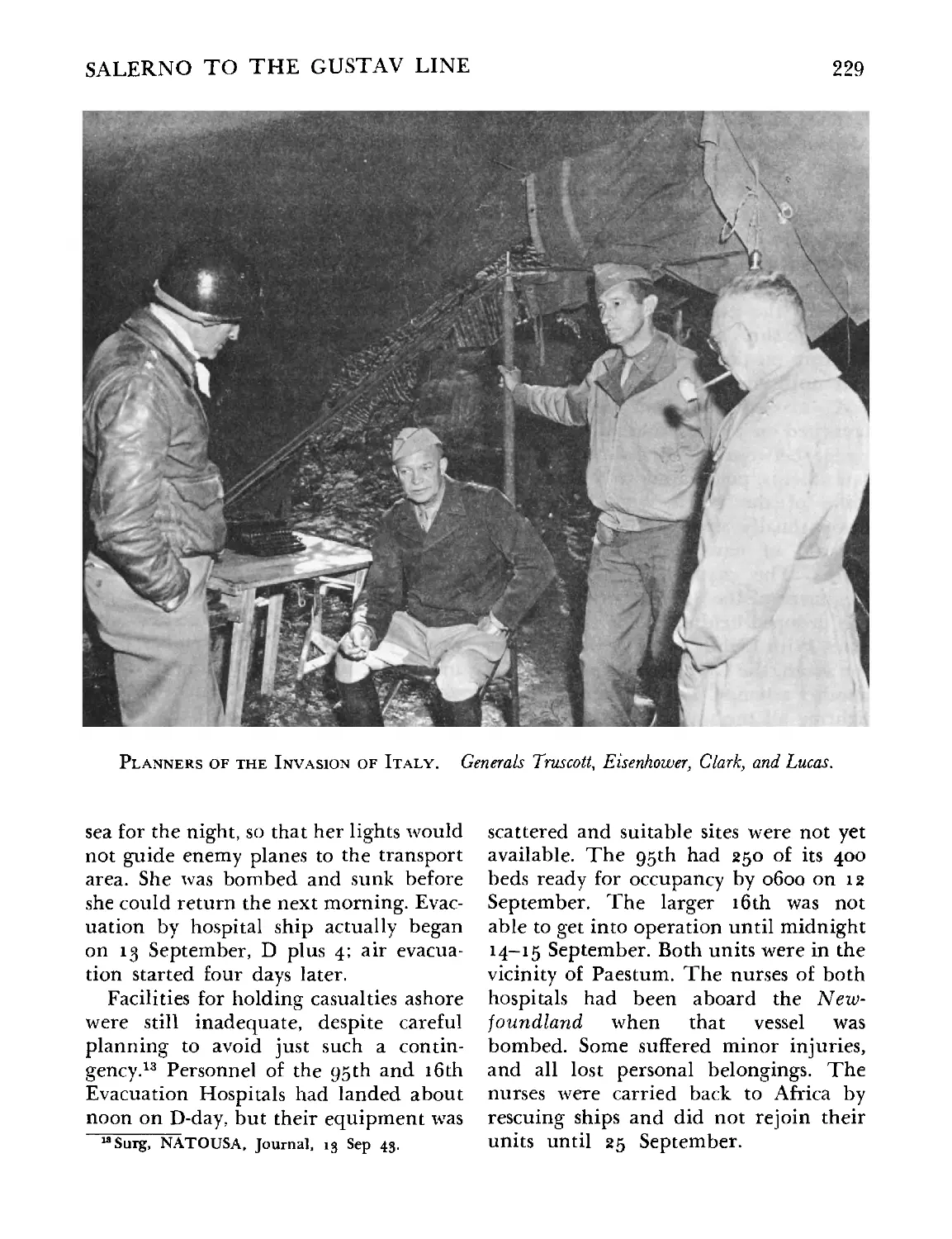
Planners of the Invasion of Italy	...... 229
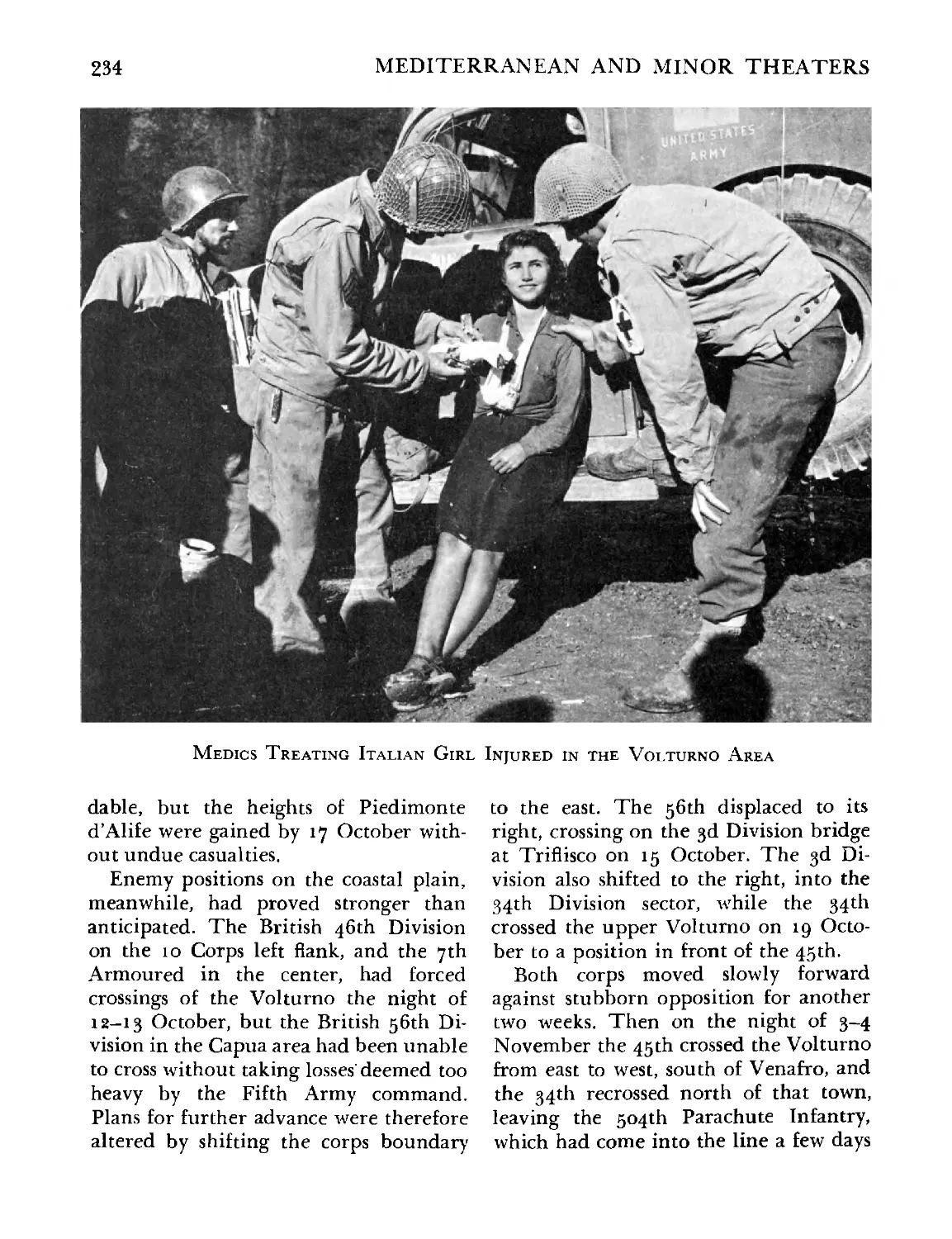
Medics Treating Italian Girl, Volturno Area .	....	.... 234
Rough Going	  235
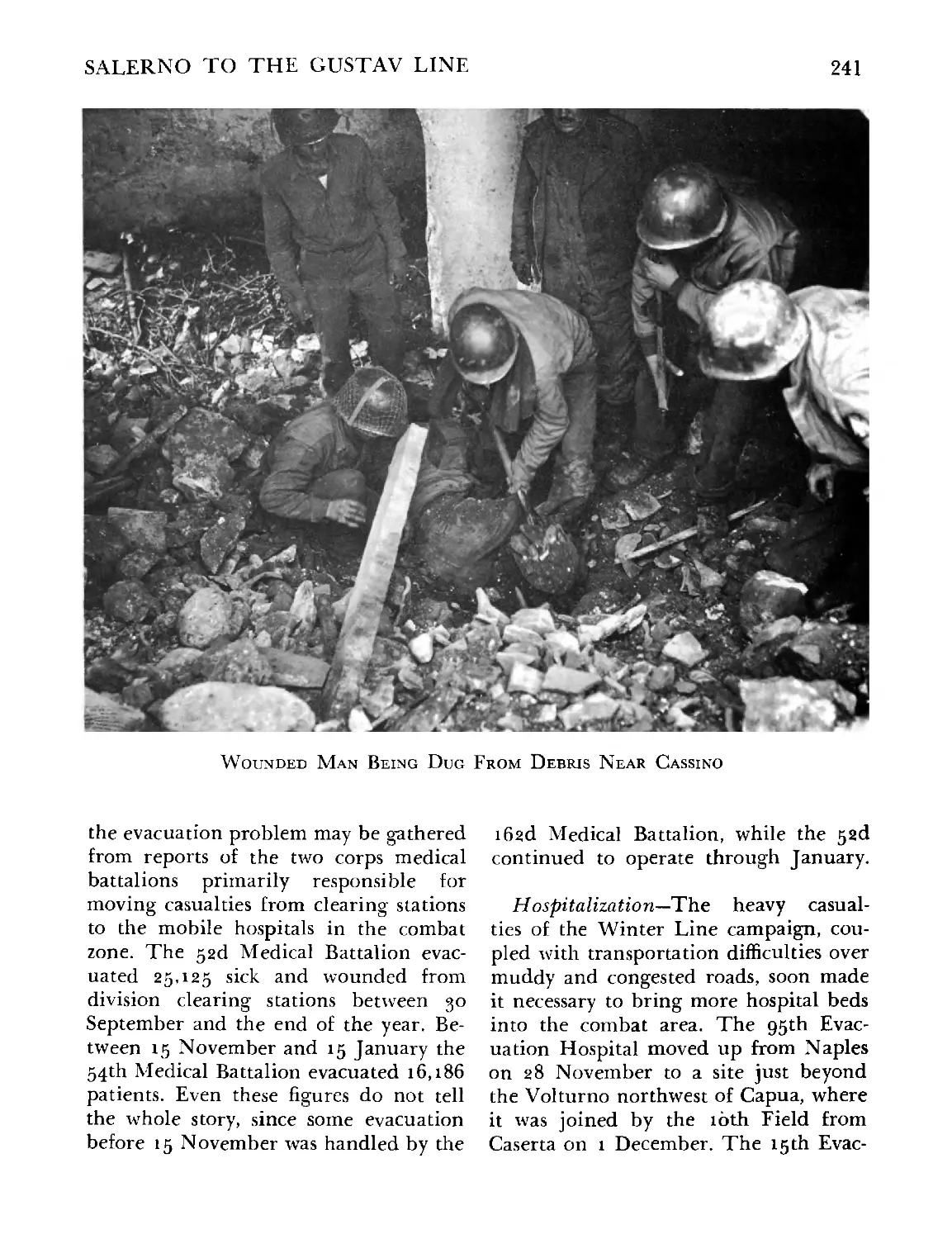
Digging Out Wounded Man, Cassino	 241
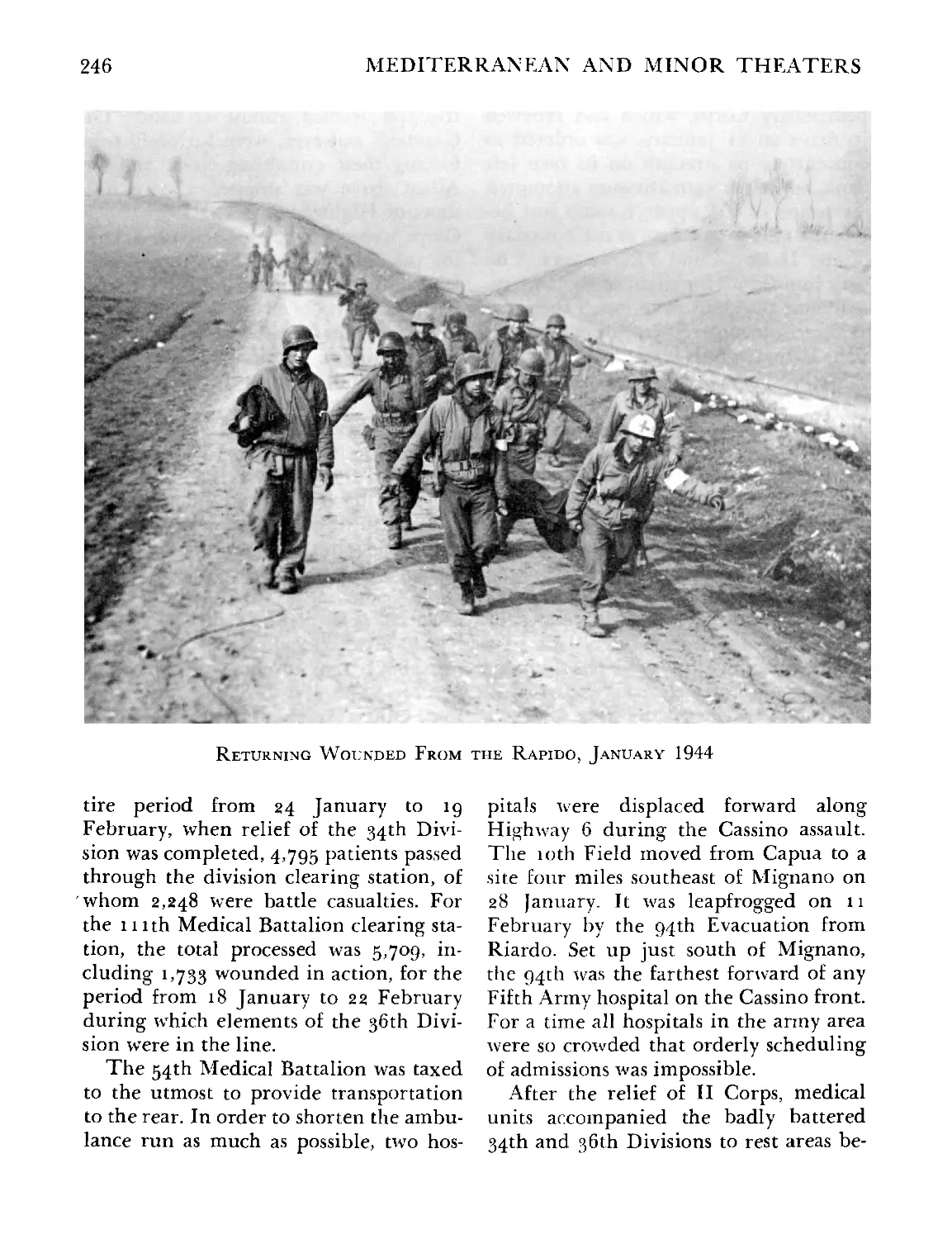
Casualties From Rapido Crossing	 246
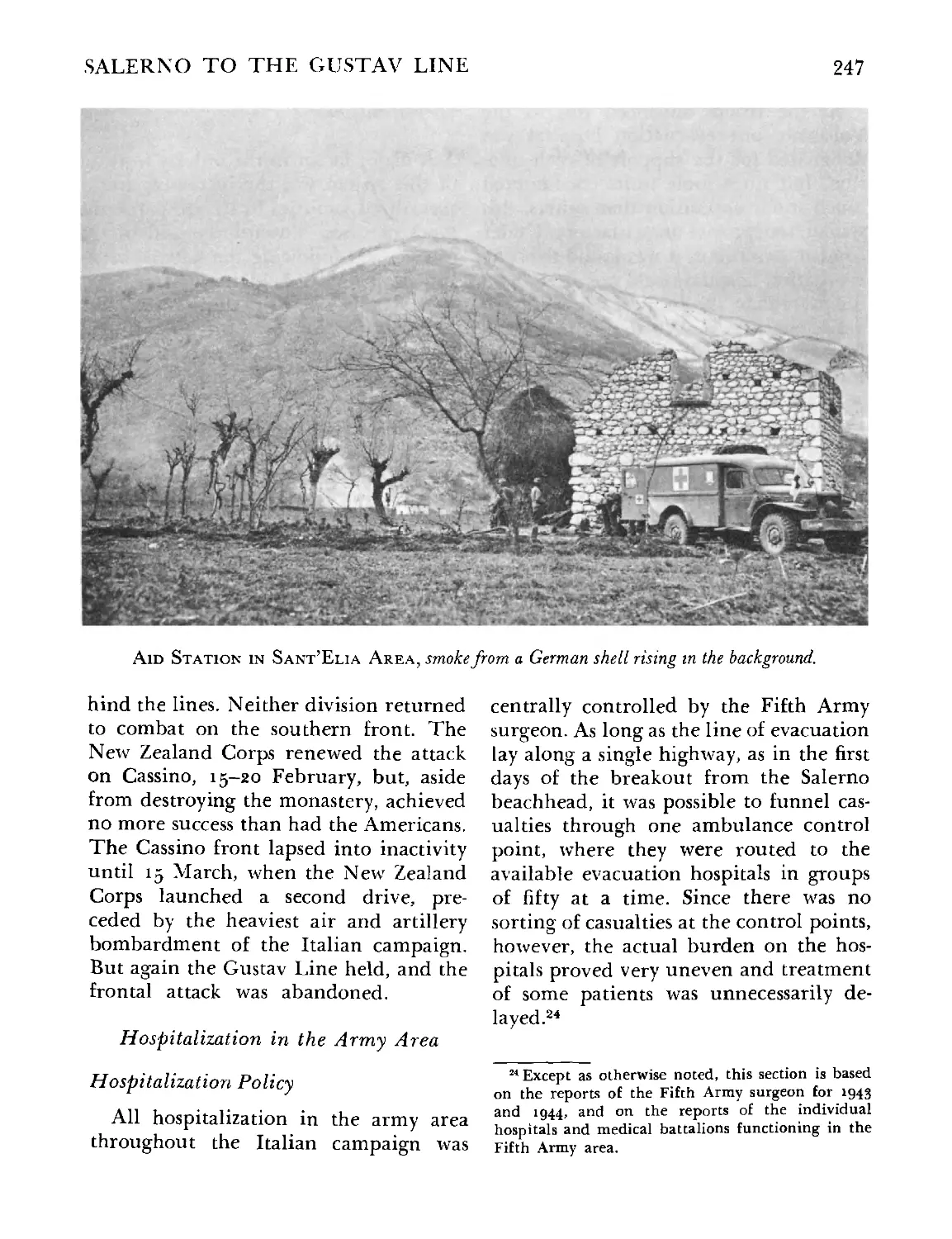
Aid Station in Sant’Elia Area	............ 247
Wounded German Soldier at 94th Evacuation Hospital	........254
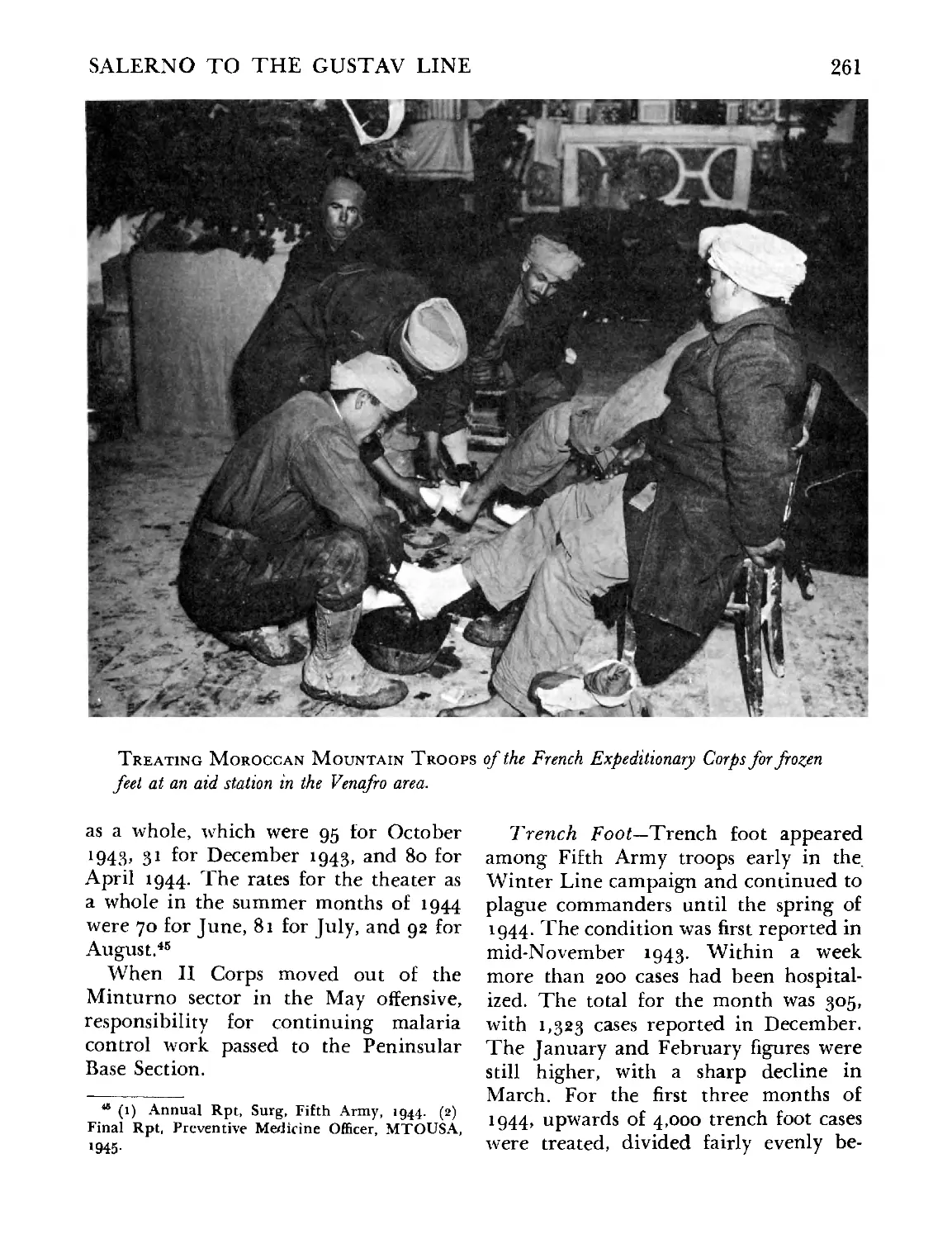
Treating Moroccan Mountain Troops, Venafro Area	.....261
Col. Rollin L. Bauchspies	 267
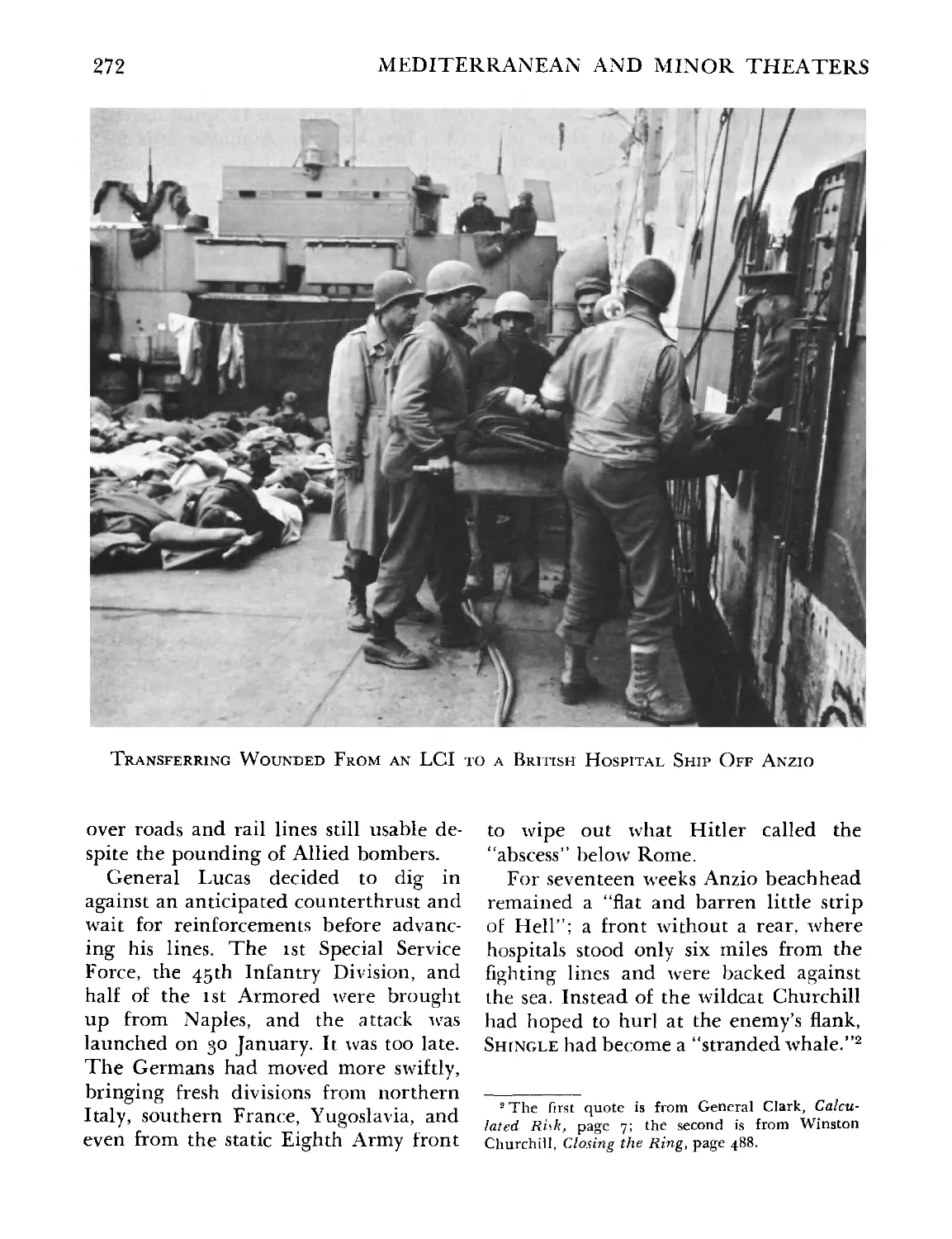
Evacuation of Wounded, Anzio	  272
Pfc. Lloyd C. Hawks	  274
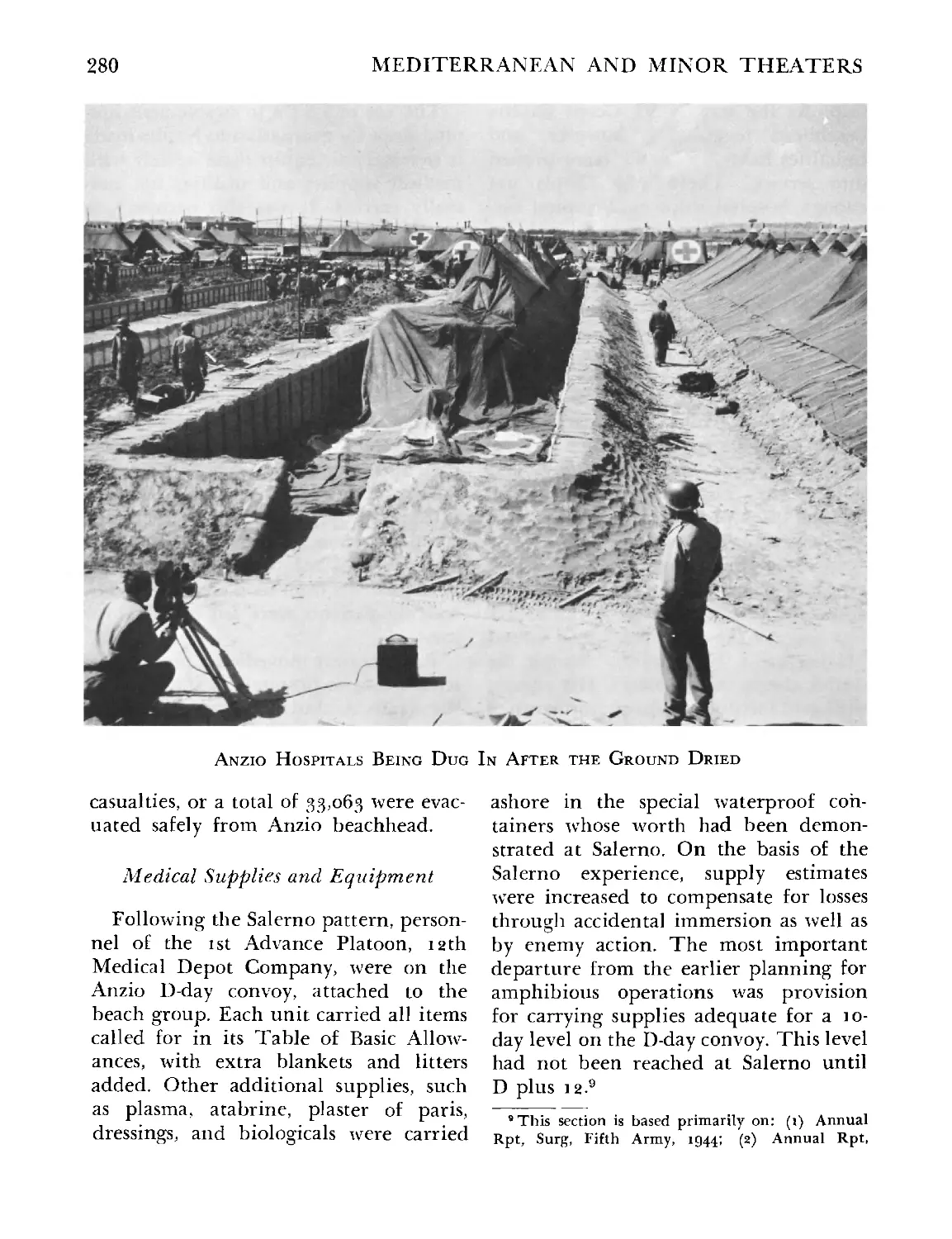
Hospital Area, Anzio	 276
Brig. Gen. Frederick A. Blesse Congratulating Col. Henry S. Blesse	278
Anzio Hospitals Digging In	 280
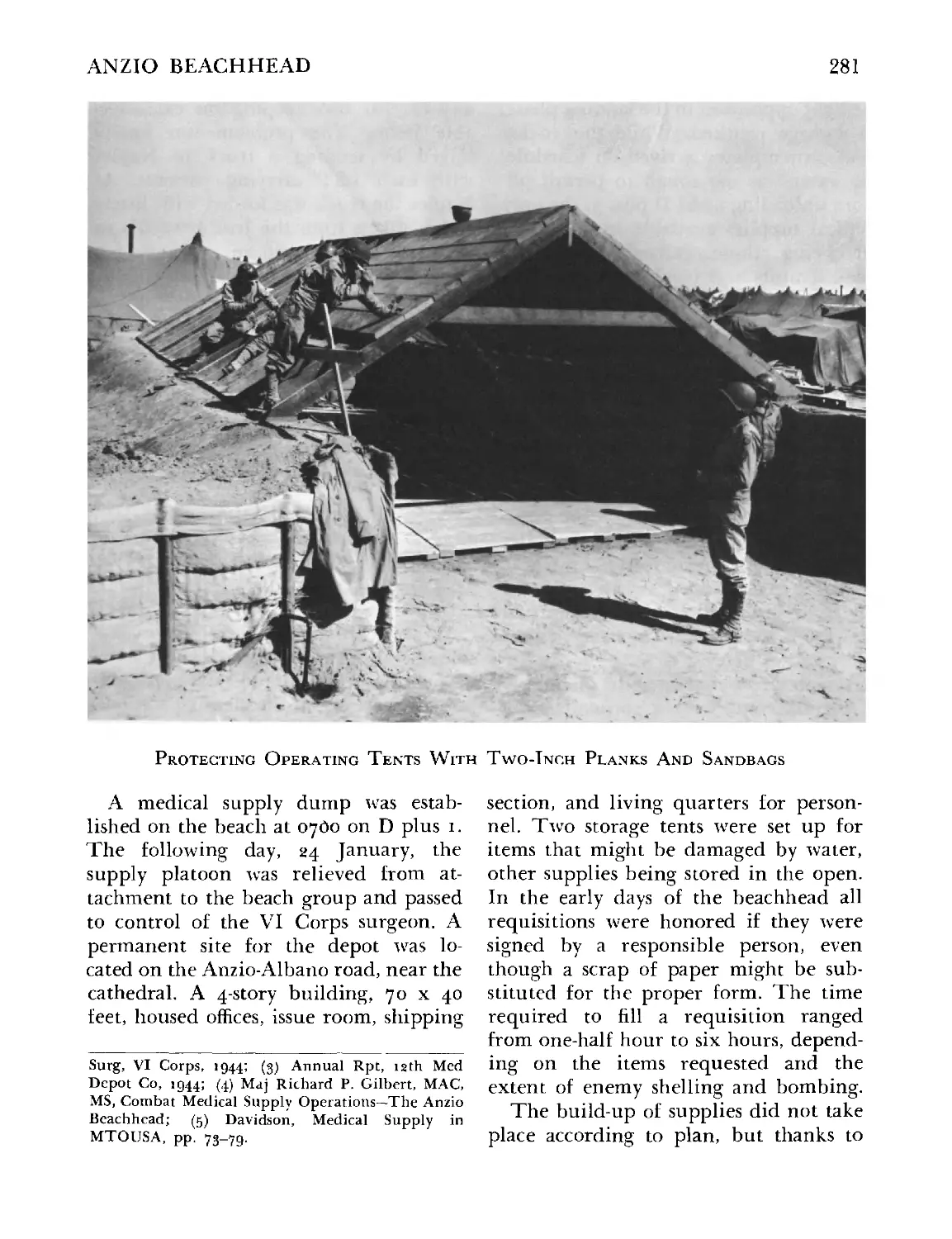
Protecting Operating Tents, Anzio	..... 281
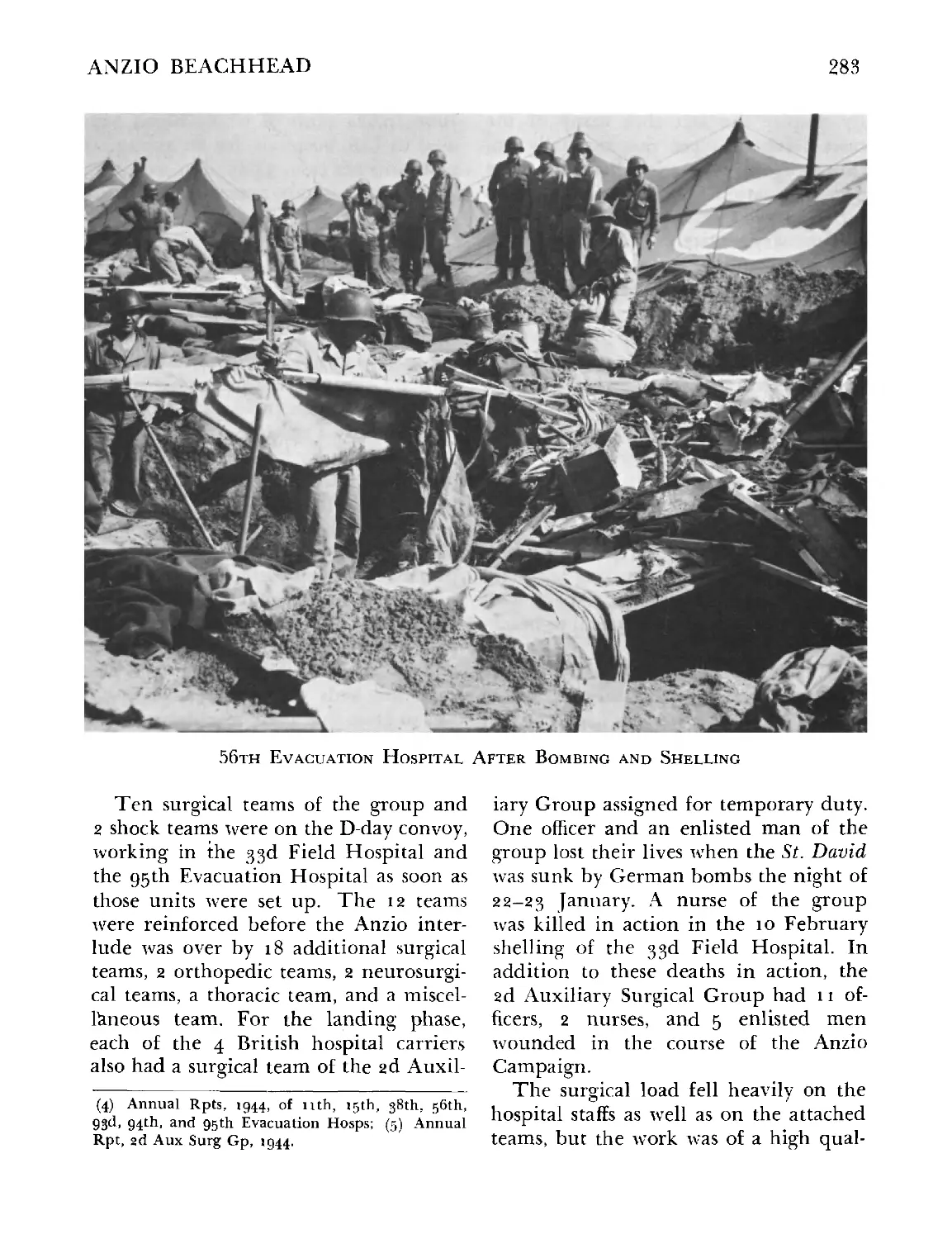
56th Evacuation Hospital After Bombing	...	...	283
Treating Casualty at Forward Aid Station	.............. 293
Italian Civilians Help Carry Casualty Down Mountain	... 294
Half-Track Ambulance ,	  297
German POW Giving First Aid	  298
Wheeled Litter	 300
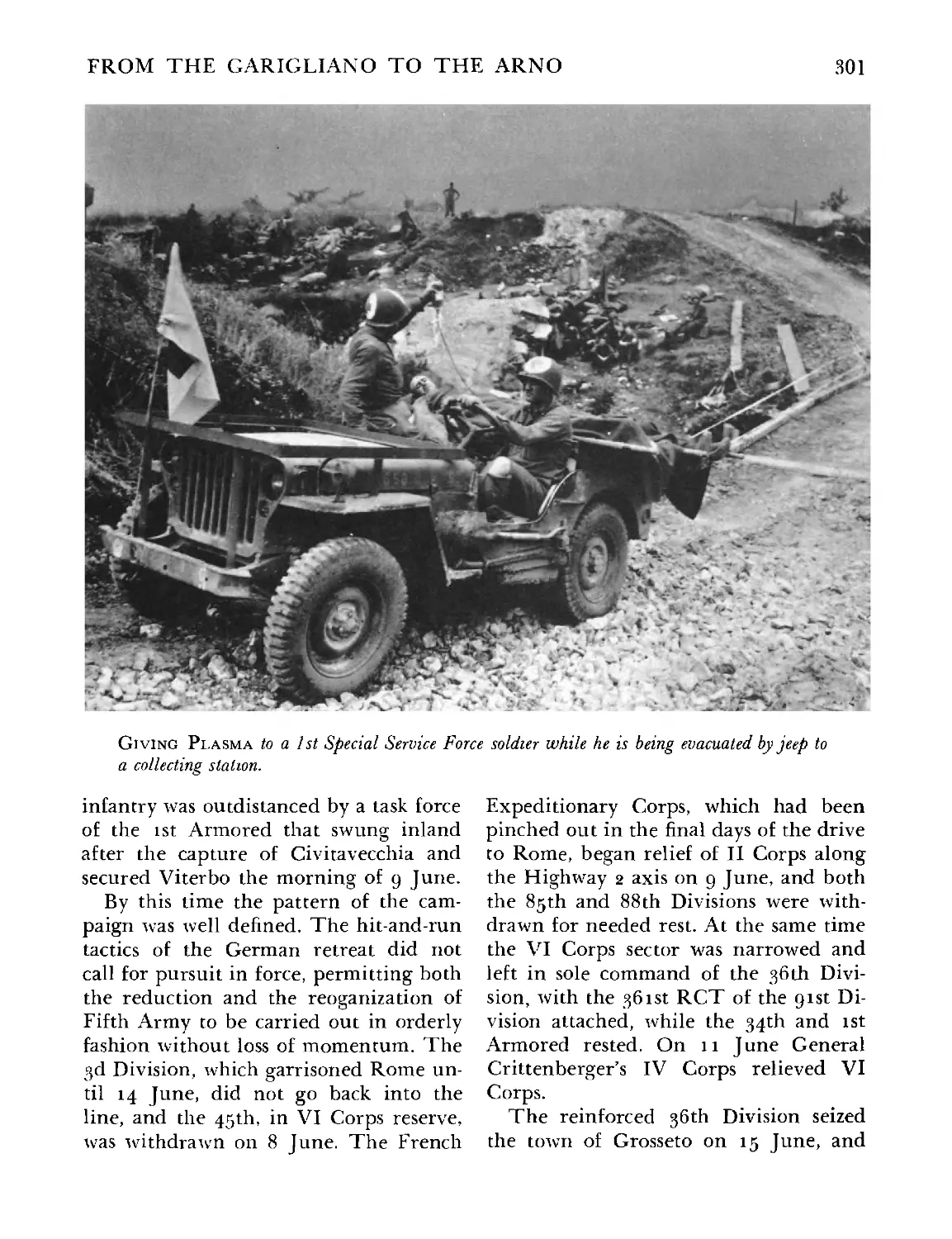
Administering Plasma in Jeep Ambulance .	........ 301
Institute of the Good Shepherd, Rome ....	................ 306
Ambulance Plane, Nettuno Airstrip	 313
Field Unit of Dental Clinic	 318
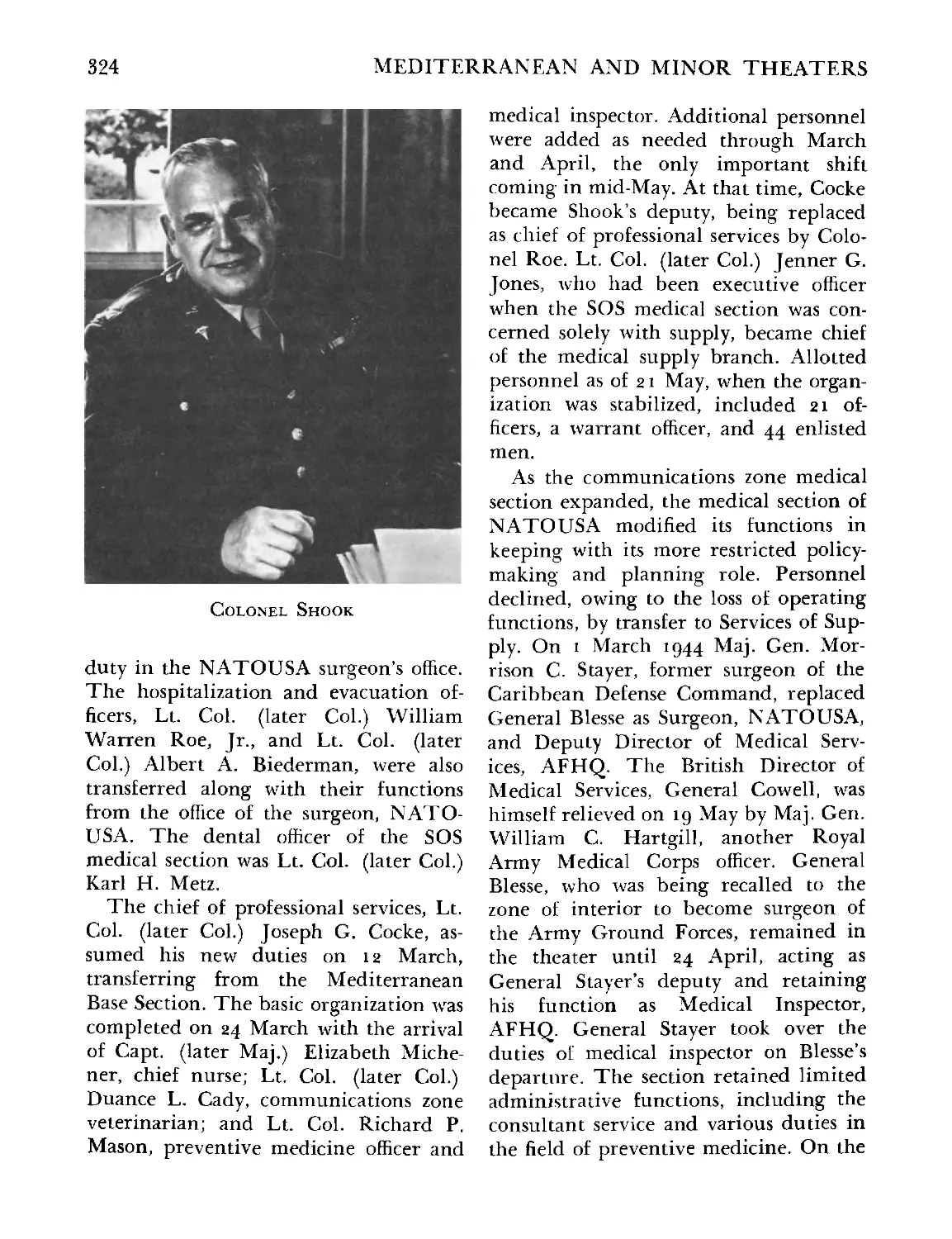
Col. Charles F. Shook . .	324
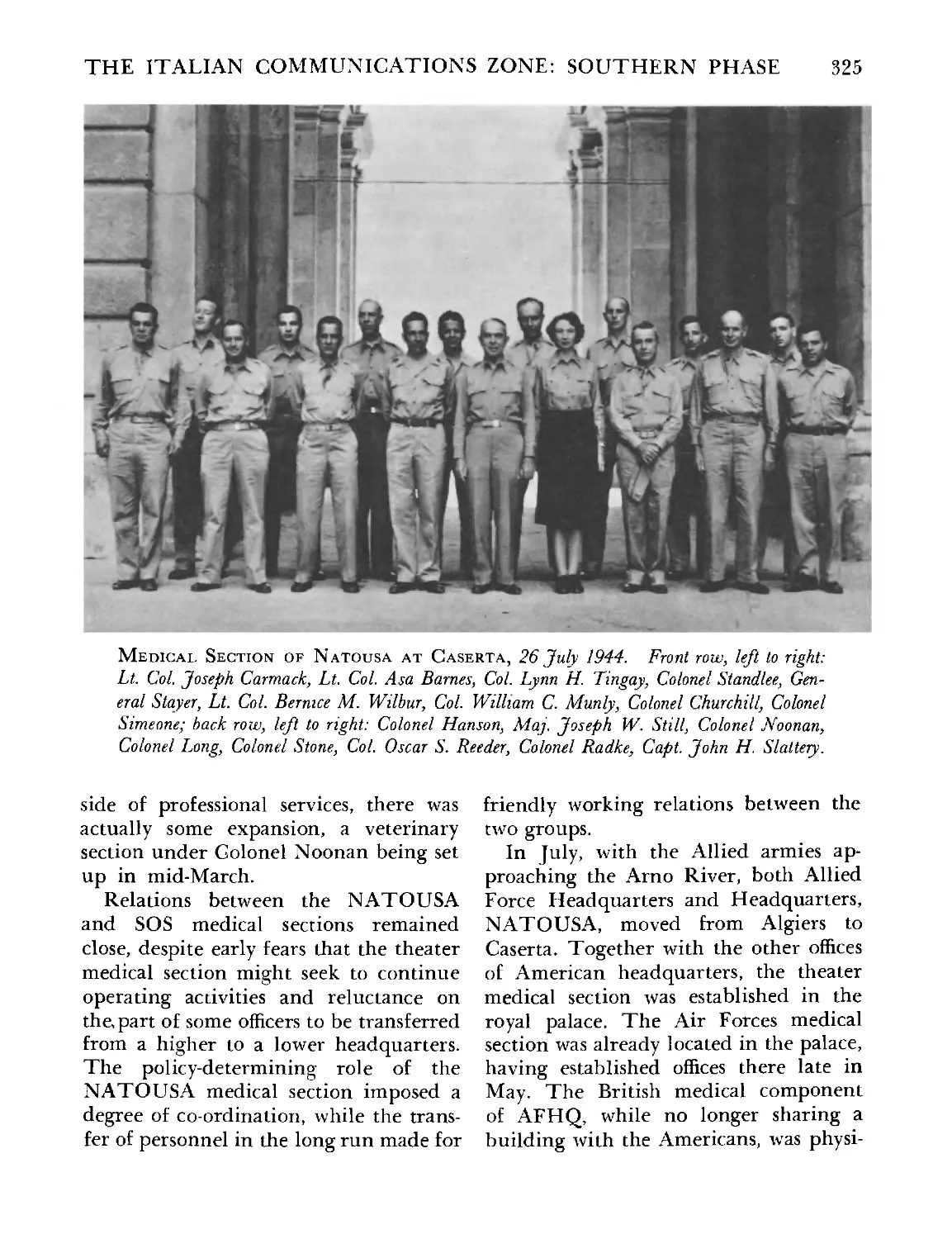
Medical Section of NATOUSA at Caserta, 26 July 1944	........ 325
Medical Center at Mostra Fairgrounds	 328
Repatriating Wounded German POW’s	..... . . 341
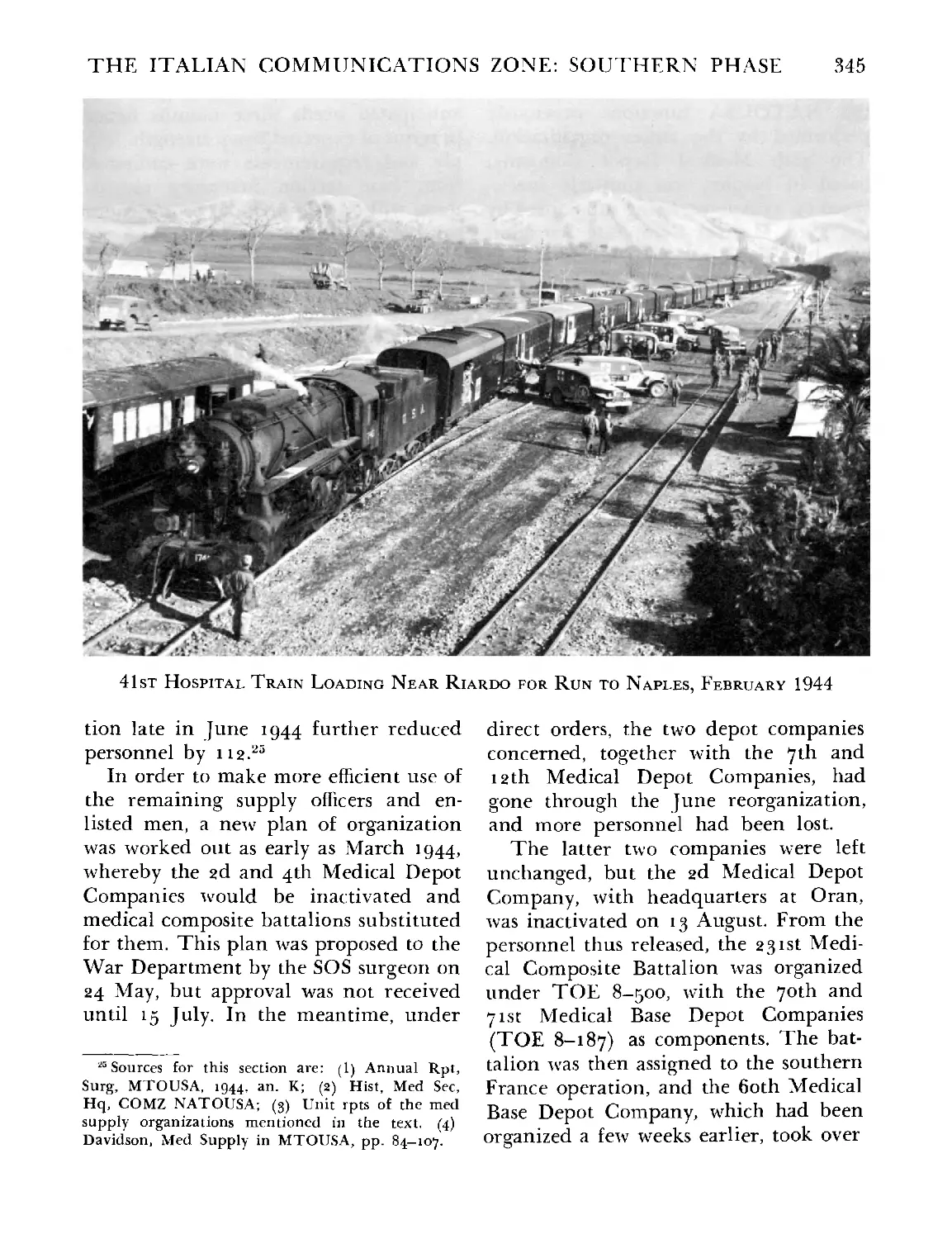
41st Hospital Train	  345
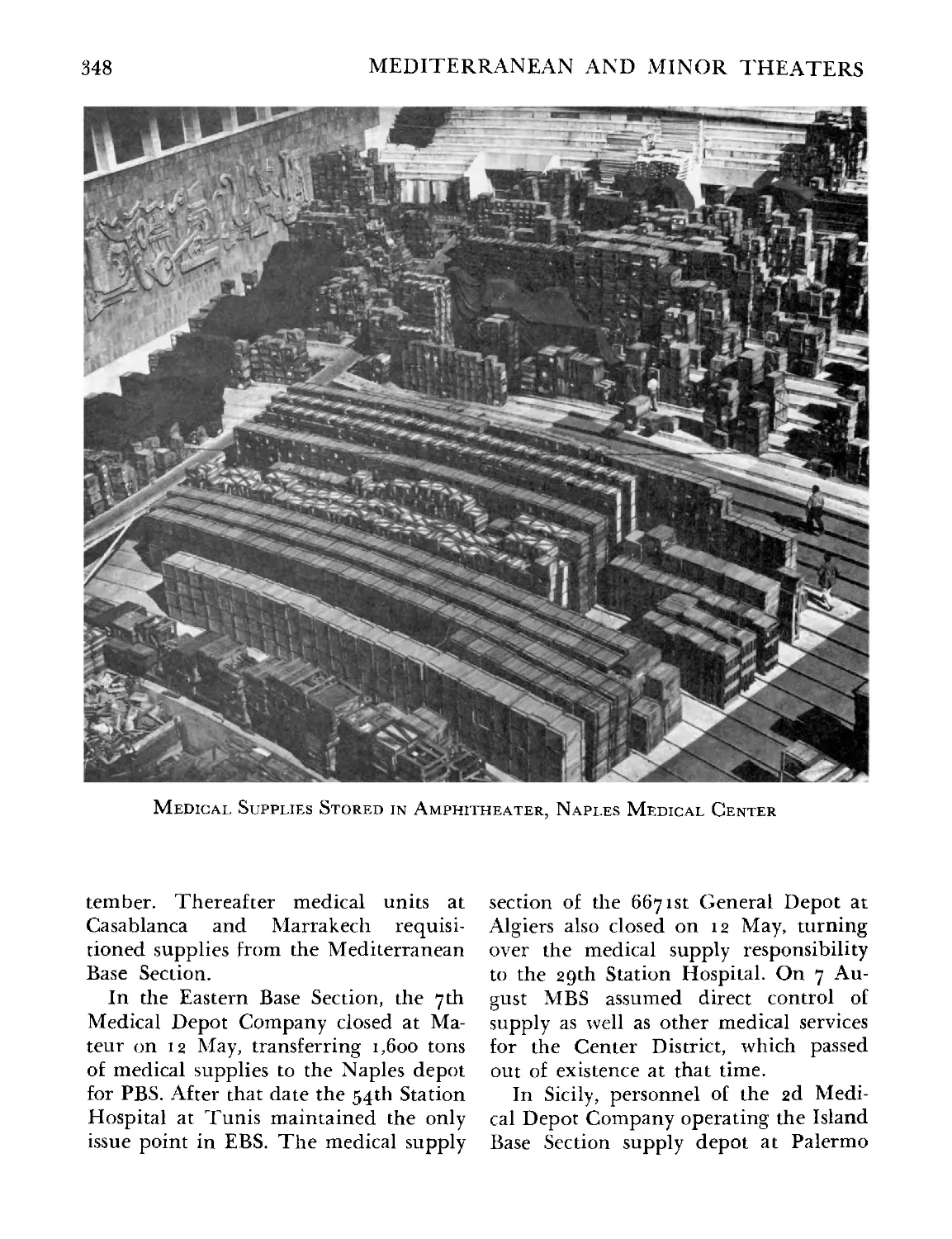
Storing Medical Supplies	  348
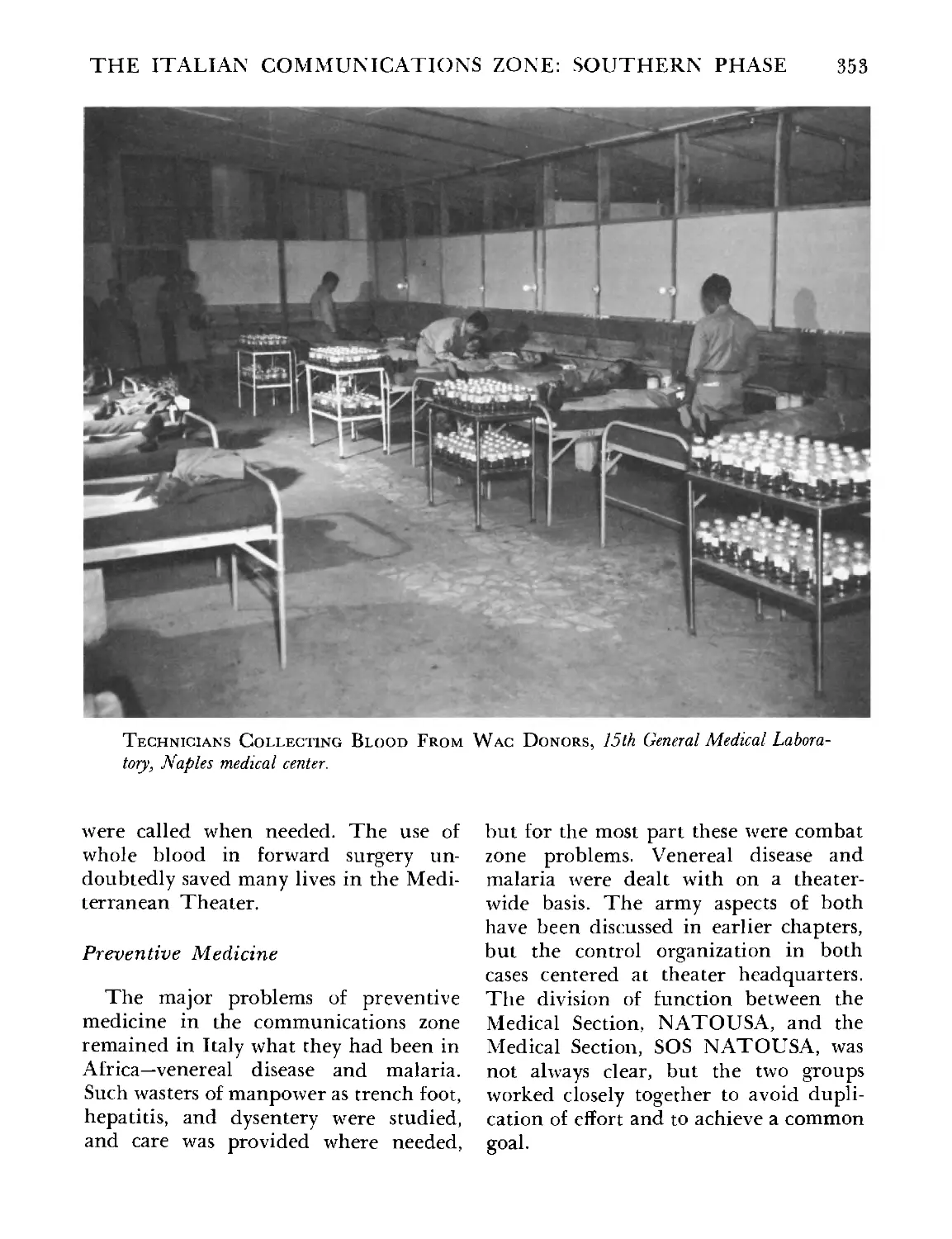
Blood Donors, Naples	353
Dusting for Mosquitoes, Cassino	  356
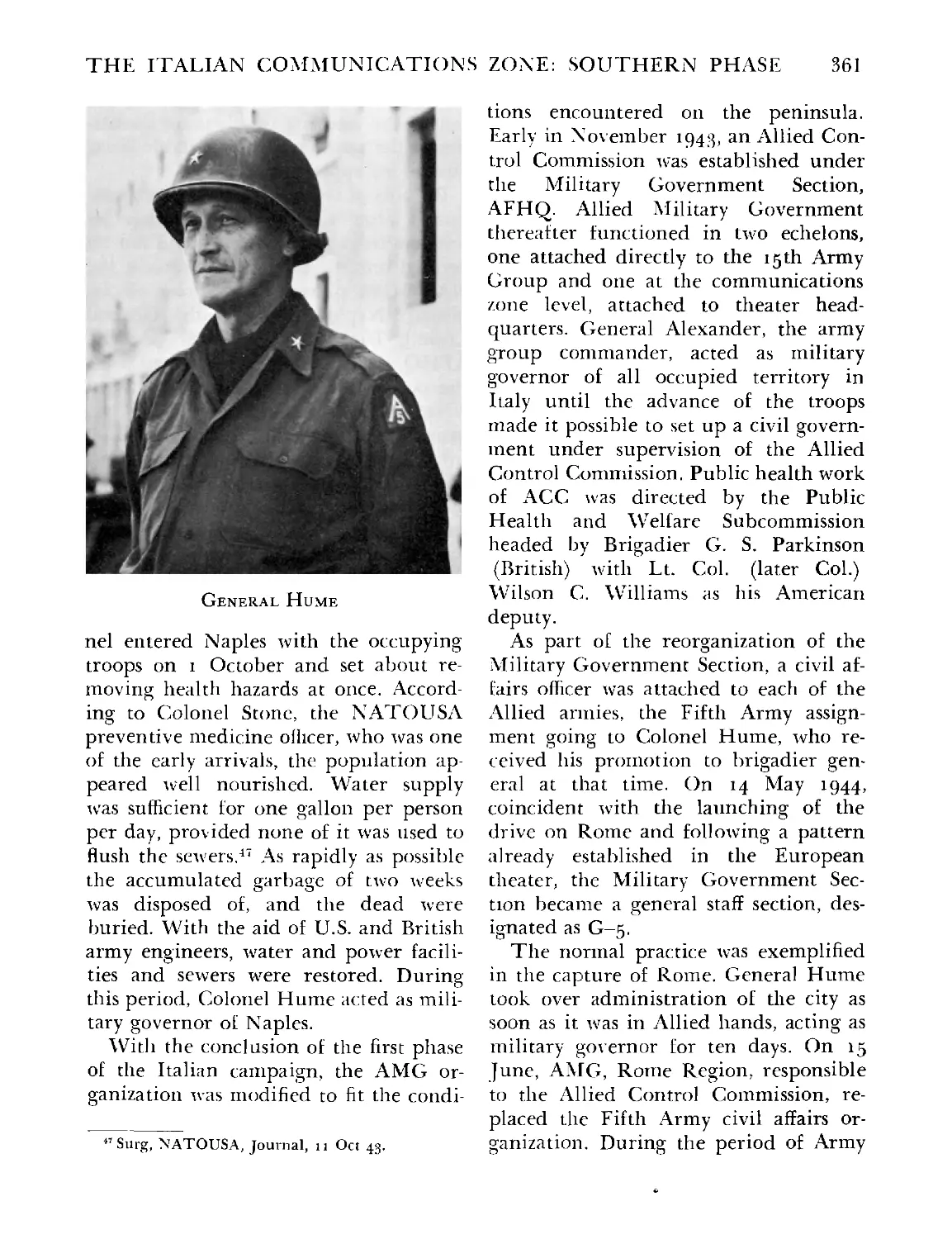
Brig. Gen. Edgar Erskine Hume .........................................361
Delousing Station, Naples . .	.............. .................... 364
Lt. Gen. Alexander M. Patch and Col. Frank B. Berry .................. 368
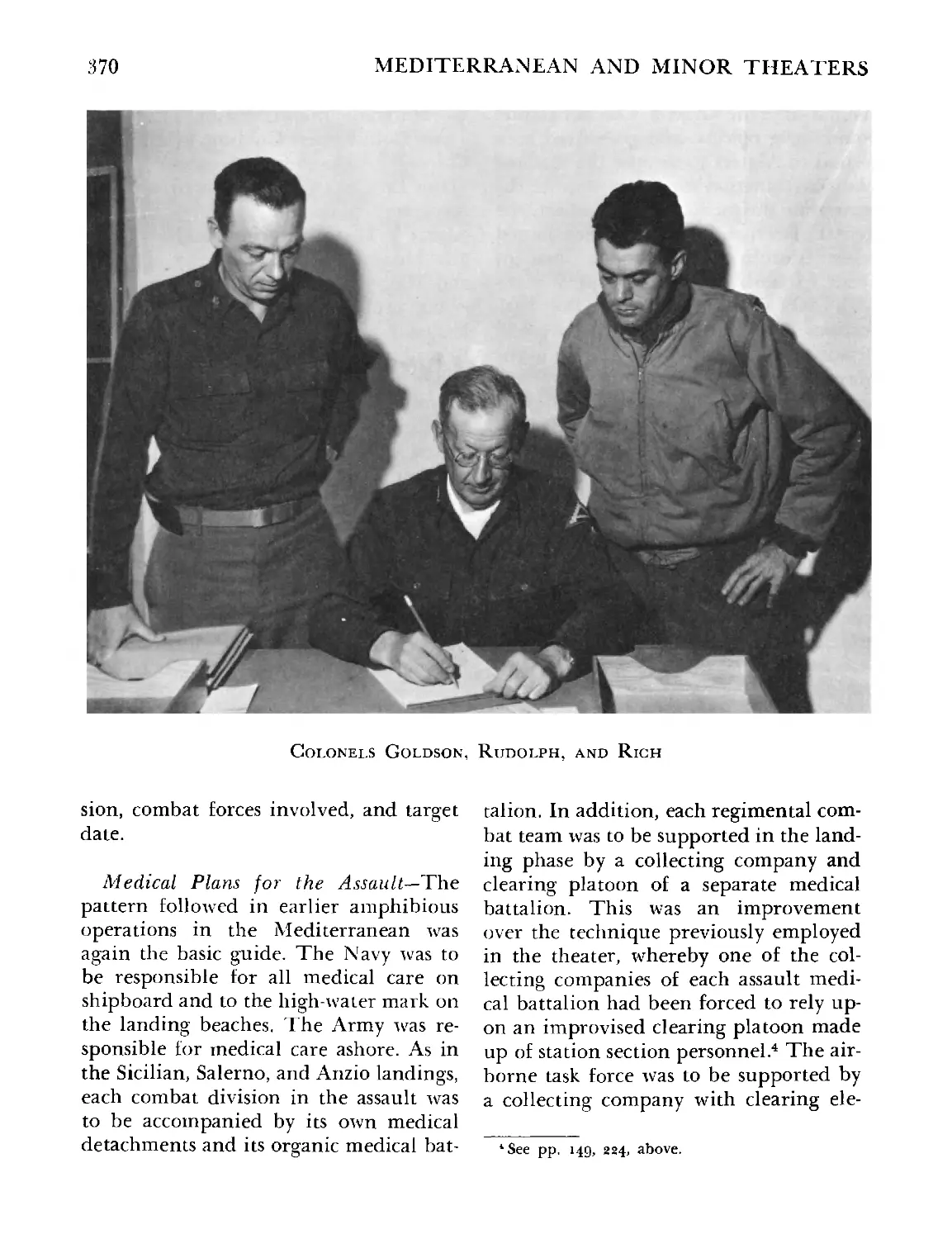
Lt. Col. Robert Goldson, Col. Myron R. Rudolph, and Col. Joseph Rich . 370
Medics on Beach, Southern France	.....................380
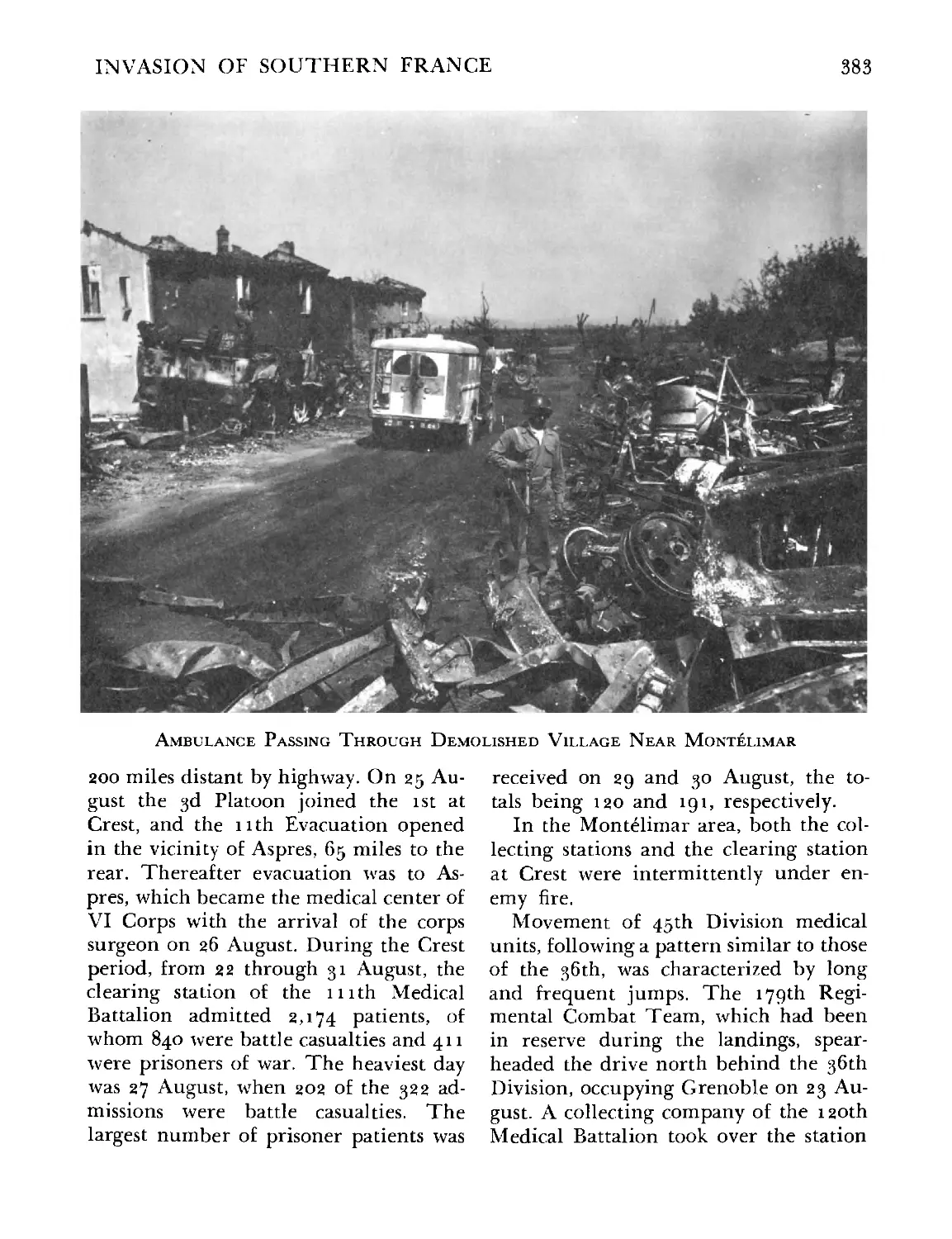
Ambulance in Wrecked Village.......................................... 383
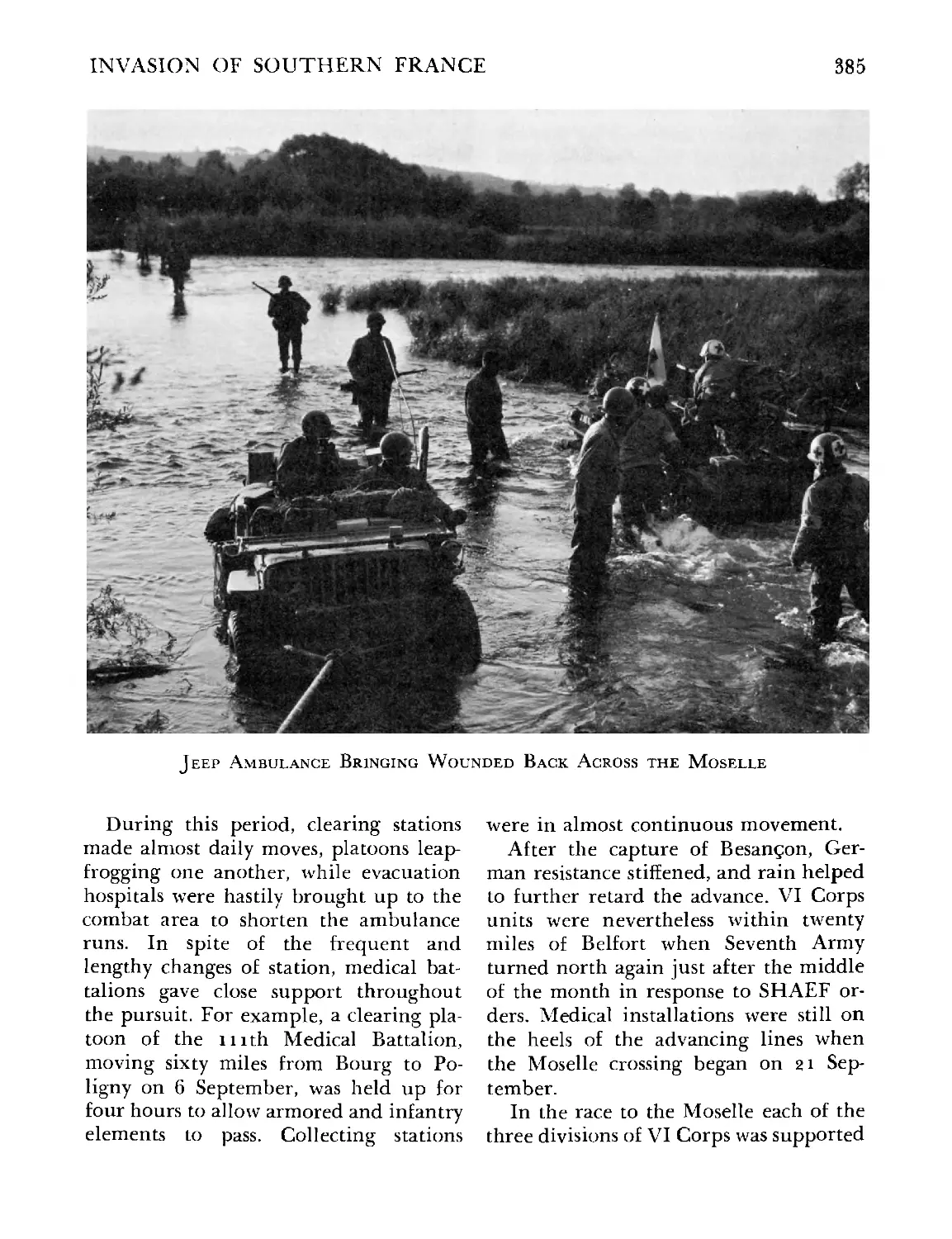
Jeep Ambulance Crossing the Moselle	........................385
XXV
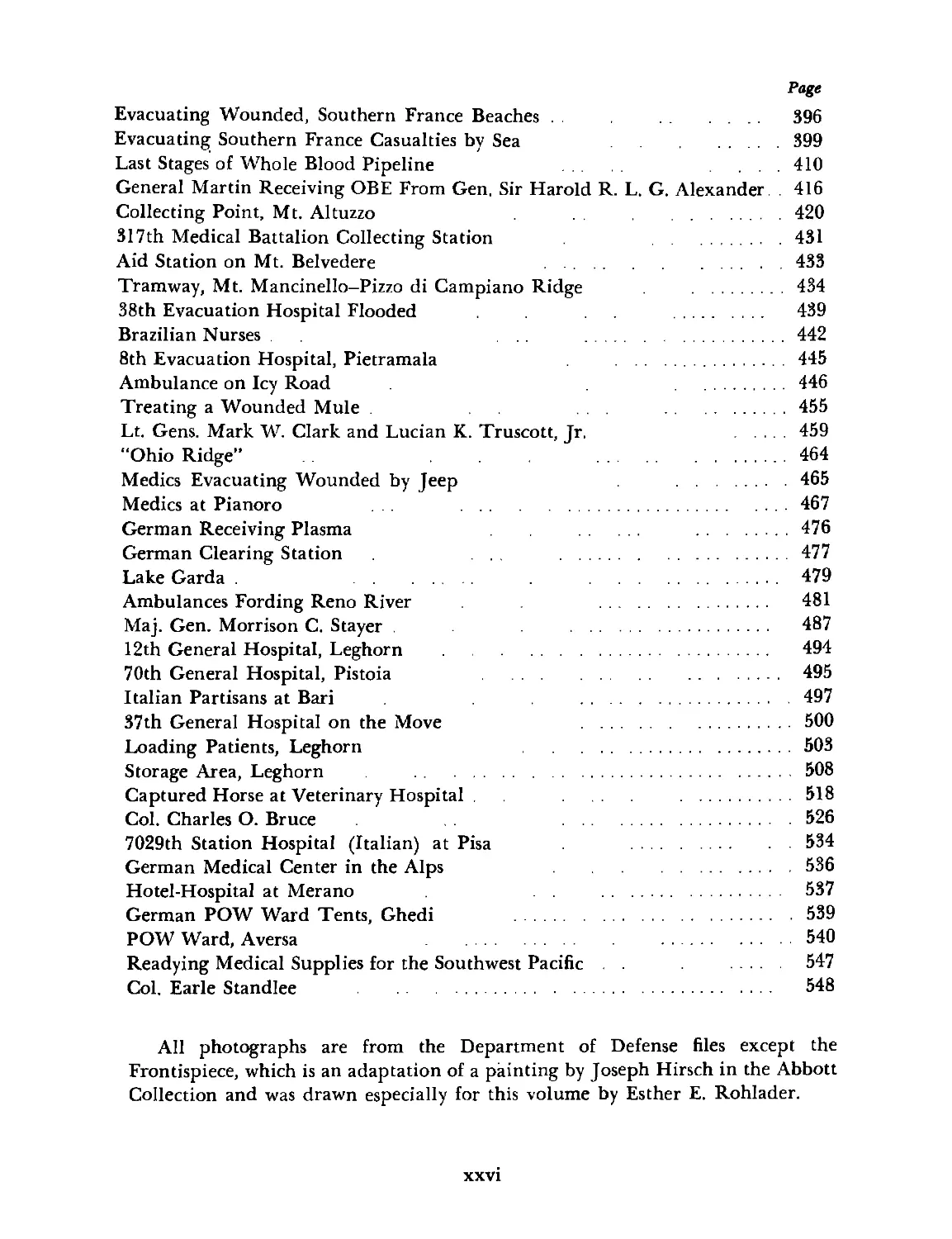
Page
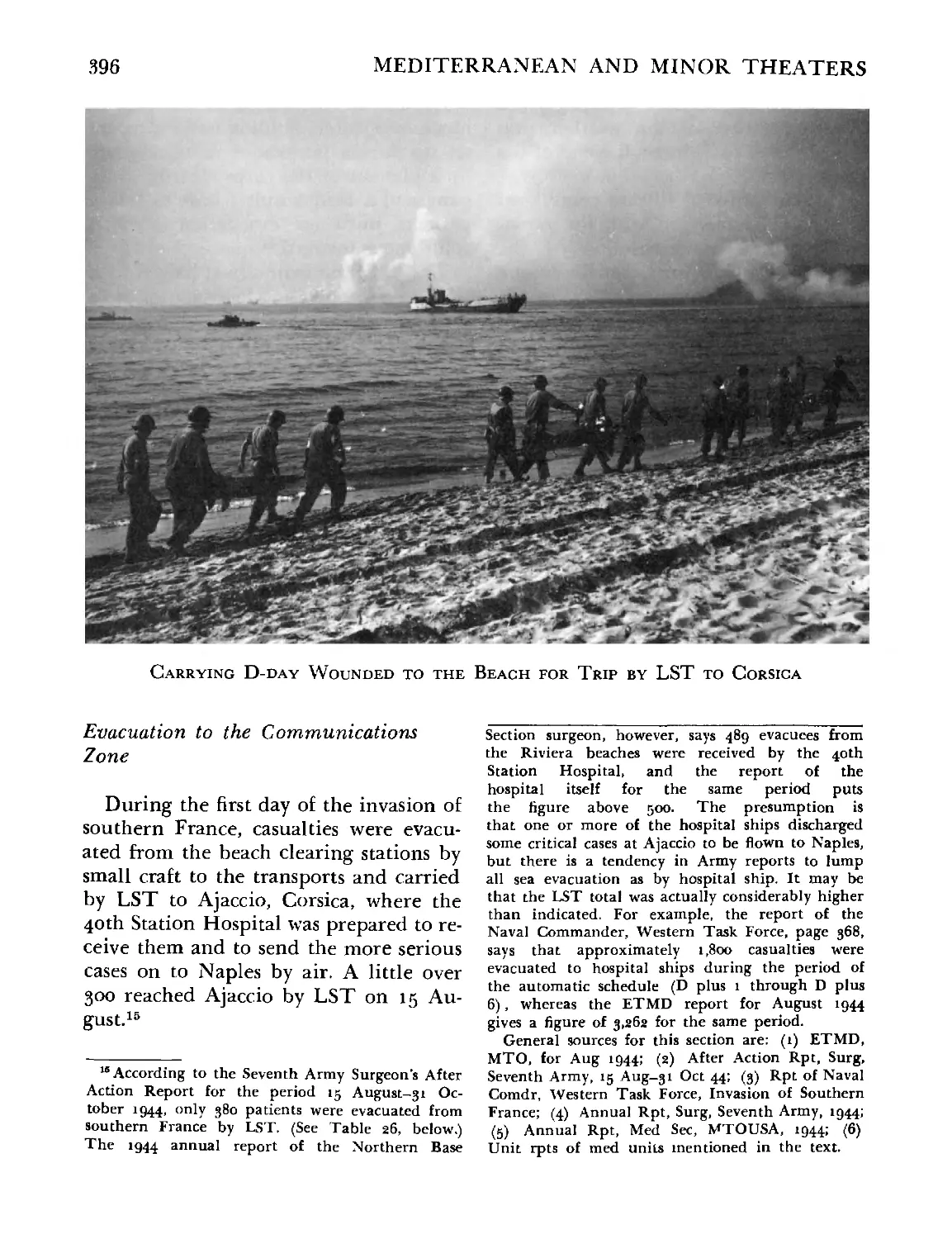
Evacuating Wounded, Southern France Beaches .	............ 396
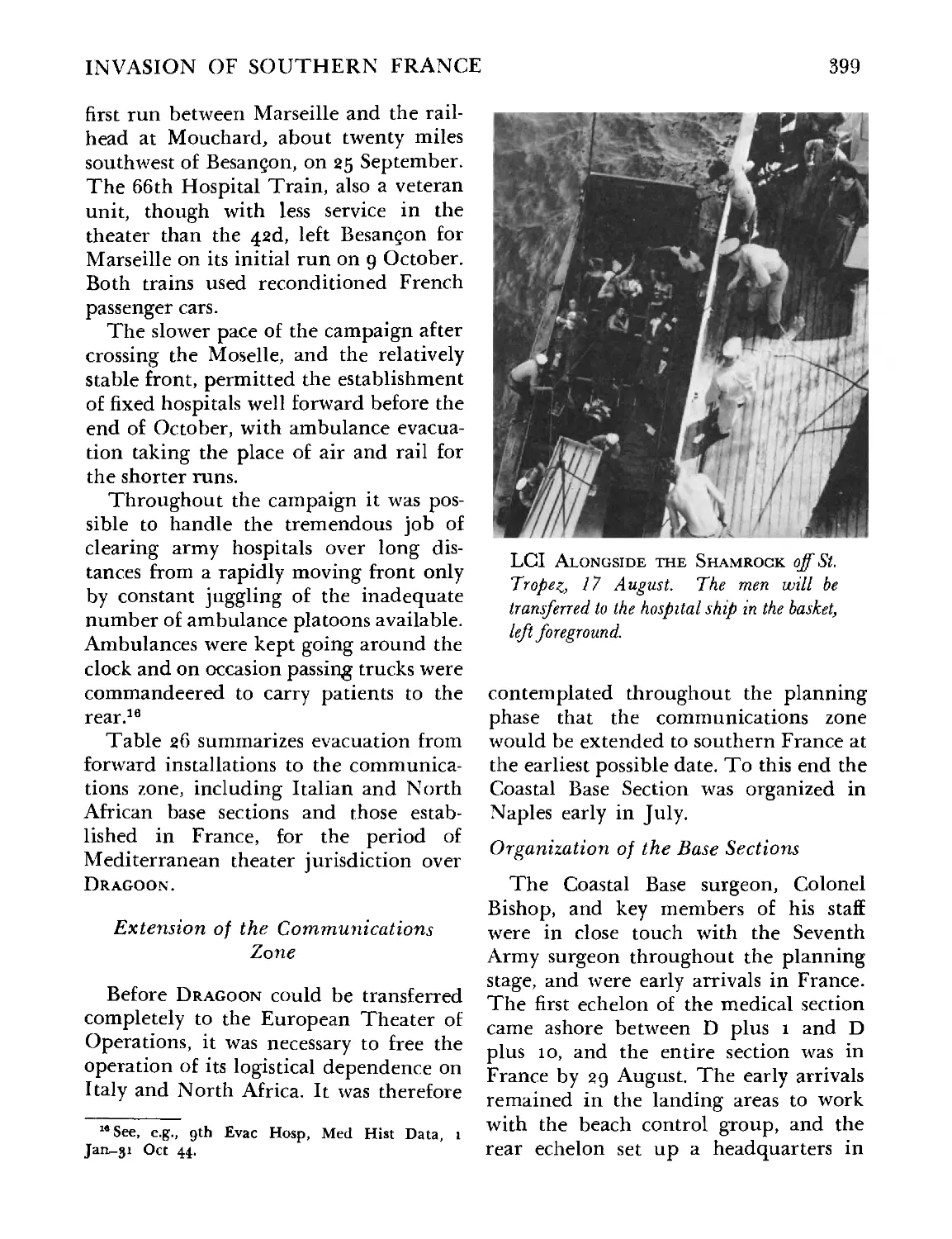
Evacuating Southern France Casualties by Sea	.................399
Last Stages of Whole Blood Pipeline	..... .... 410
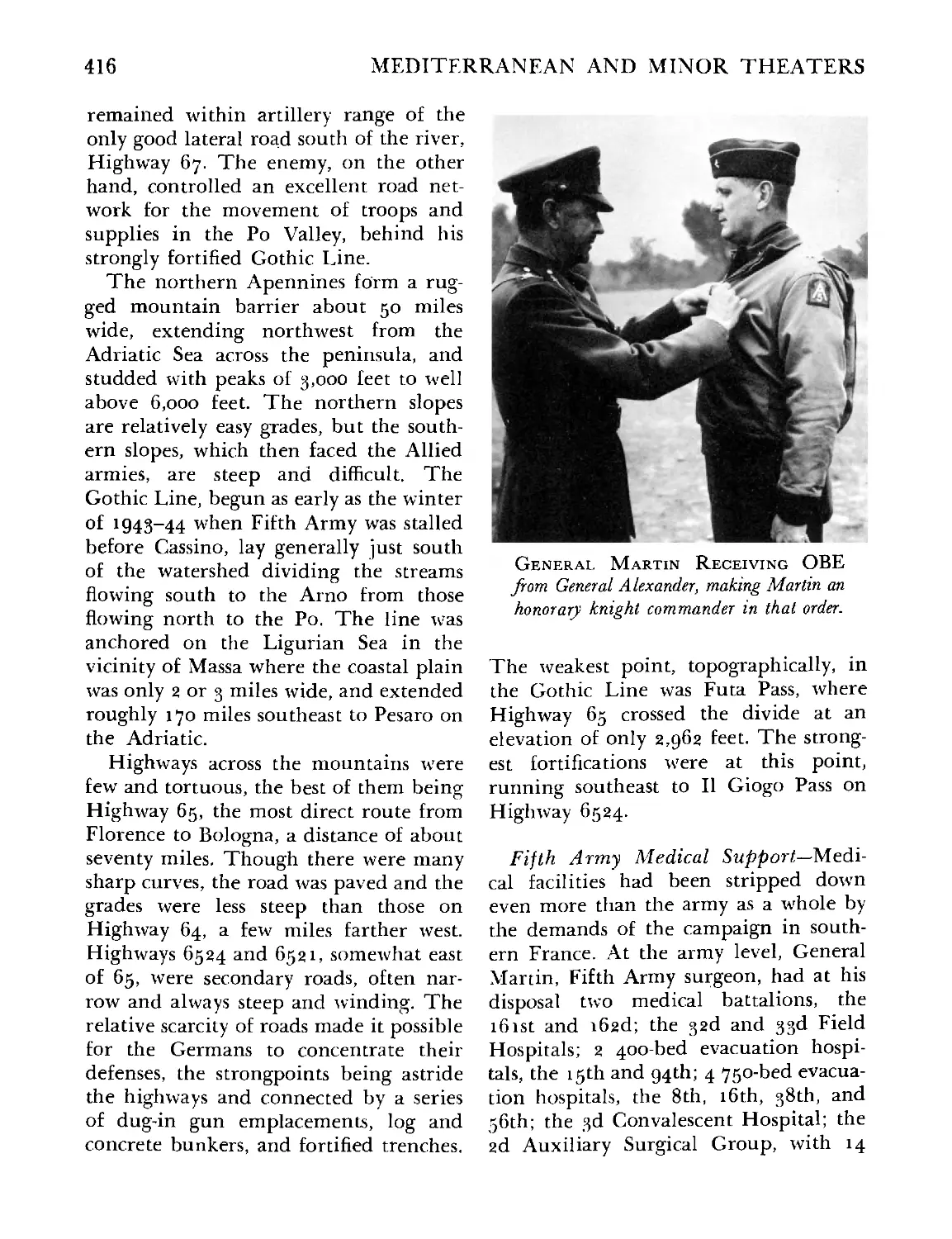
General Martin Receiving OBE From Gen. Sir Harold R. L. G. Alexander . 416
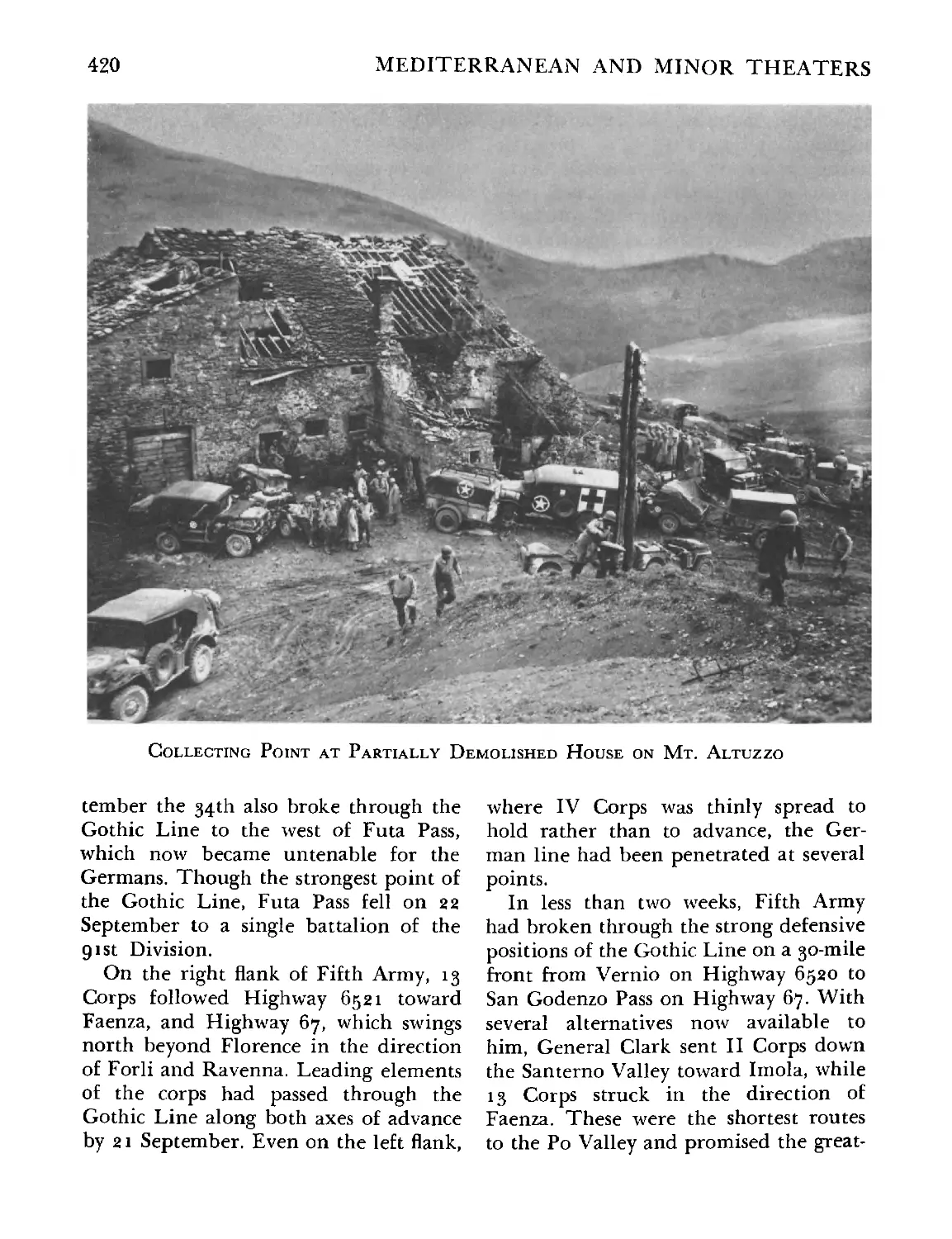
Collecting Point, Mt. Altuzzo	.................420
317th Medical Battalion Collecting Station	............431
Aid Station on Mt. Belvedere	......................433
Tramway, Mt. Mancinello-Pizzo di Campiano Ridge	.......... 434
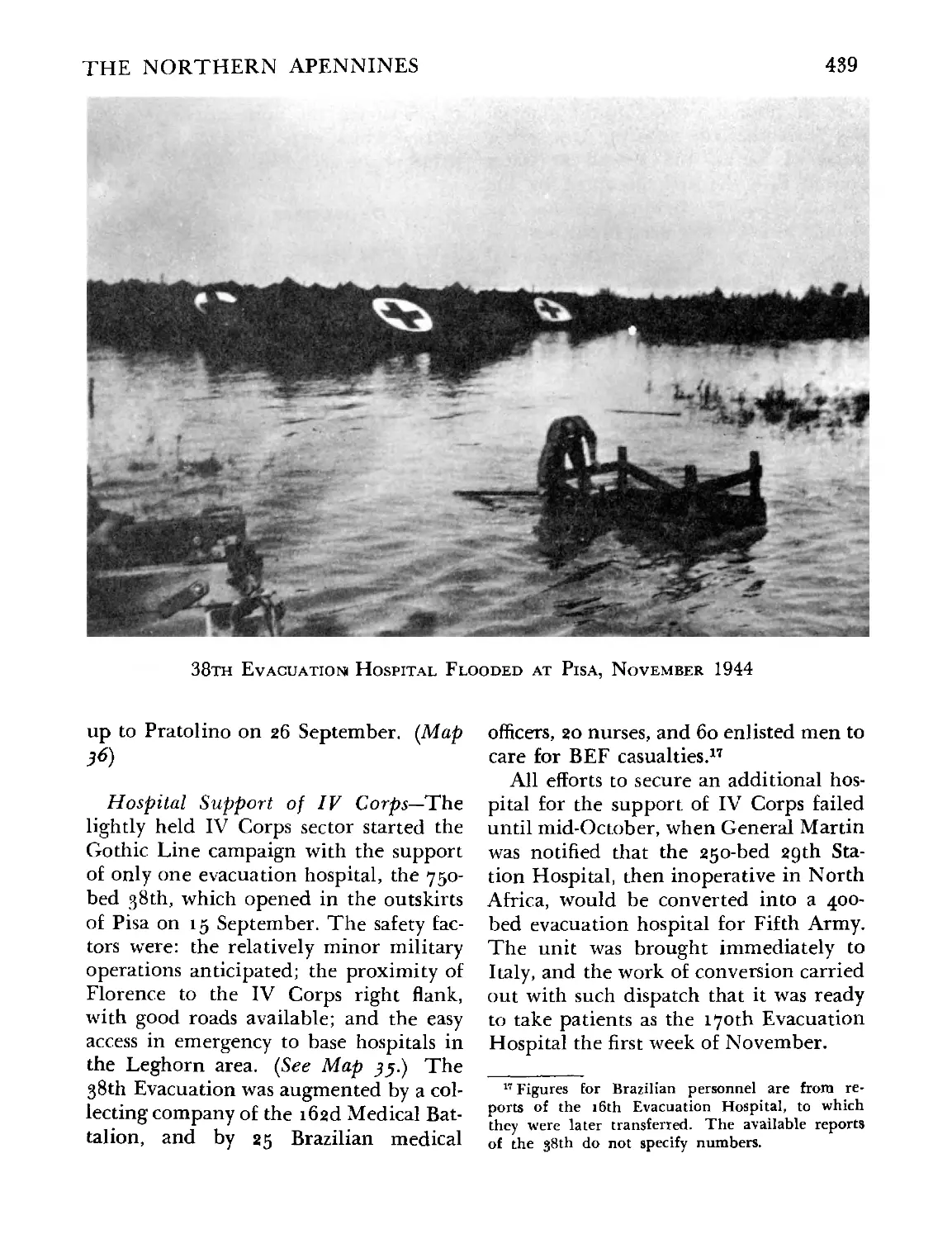
38th Evacuation Hospital Flooded	............ 439
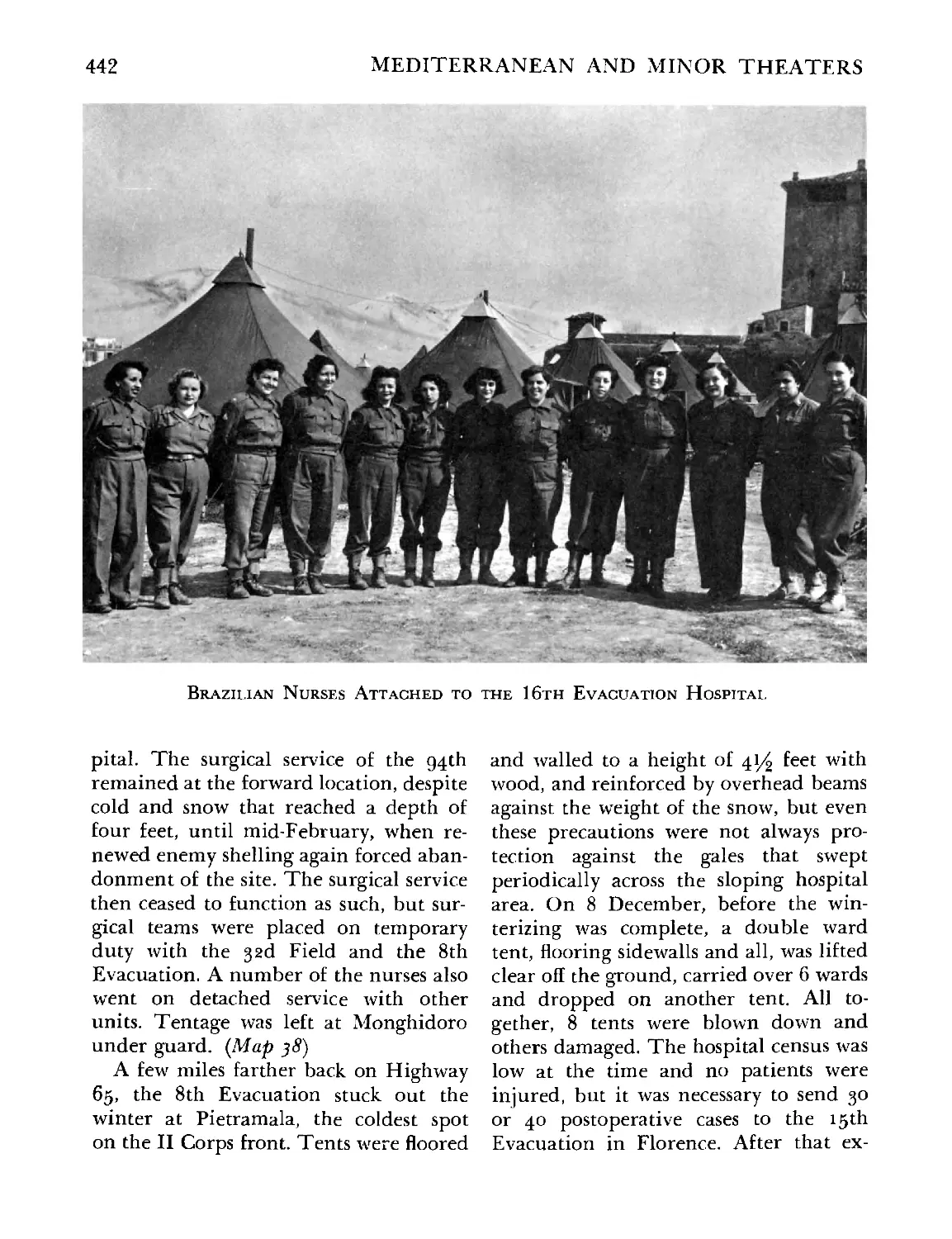
Brazilian Nurses .	. ..	......................442
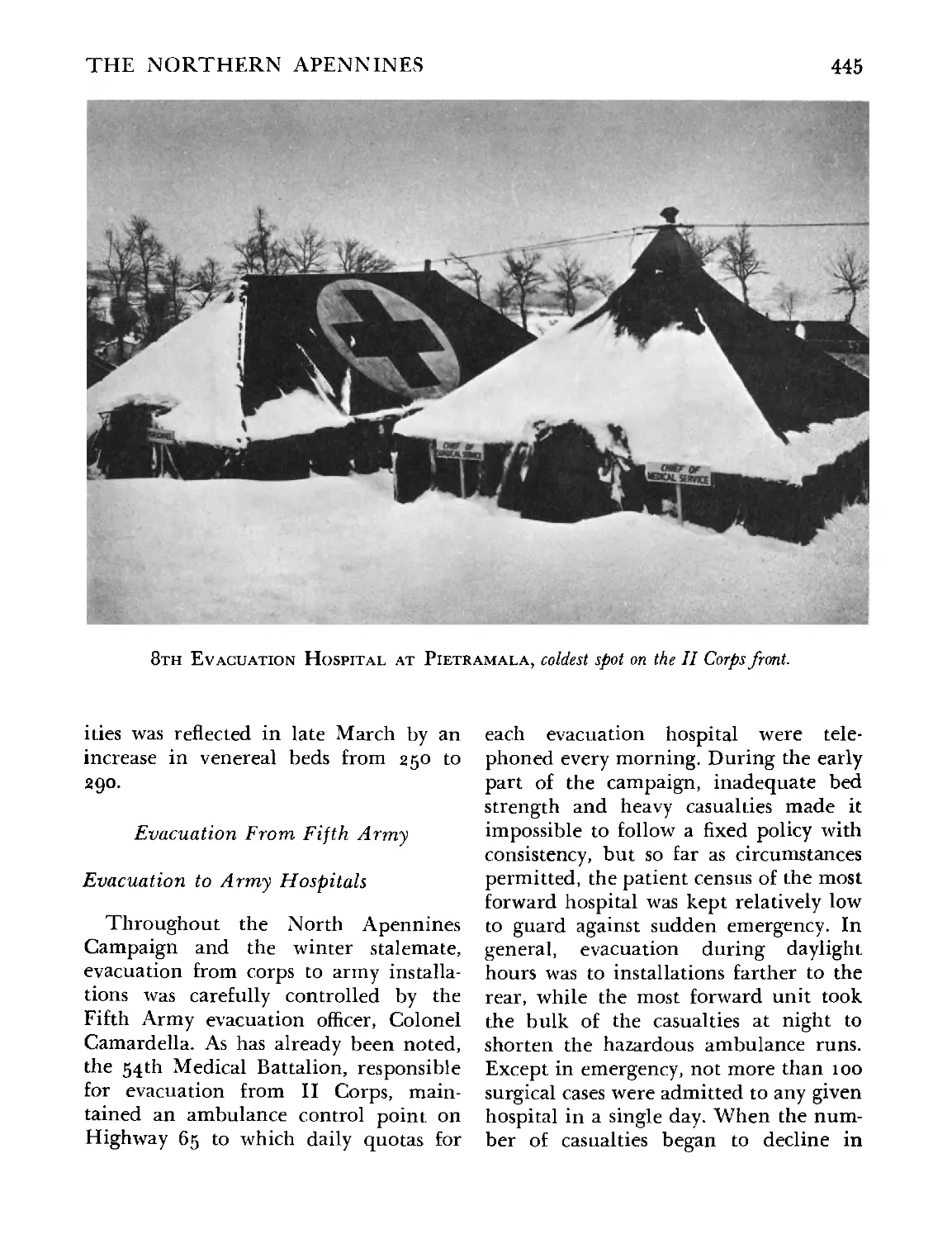
8th Evacuation Hospital, Pietramala	................. 445
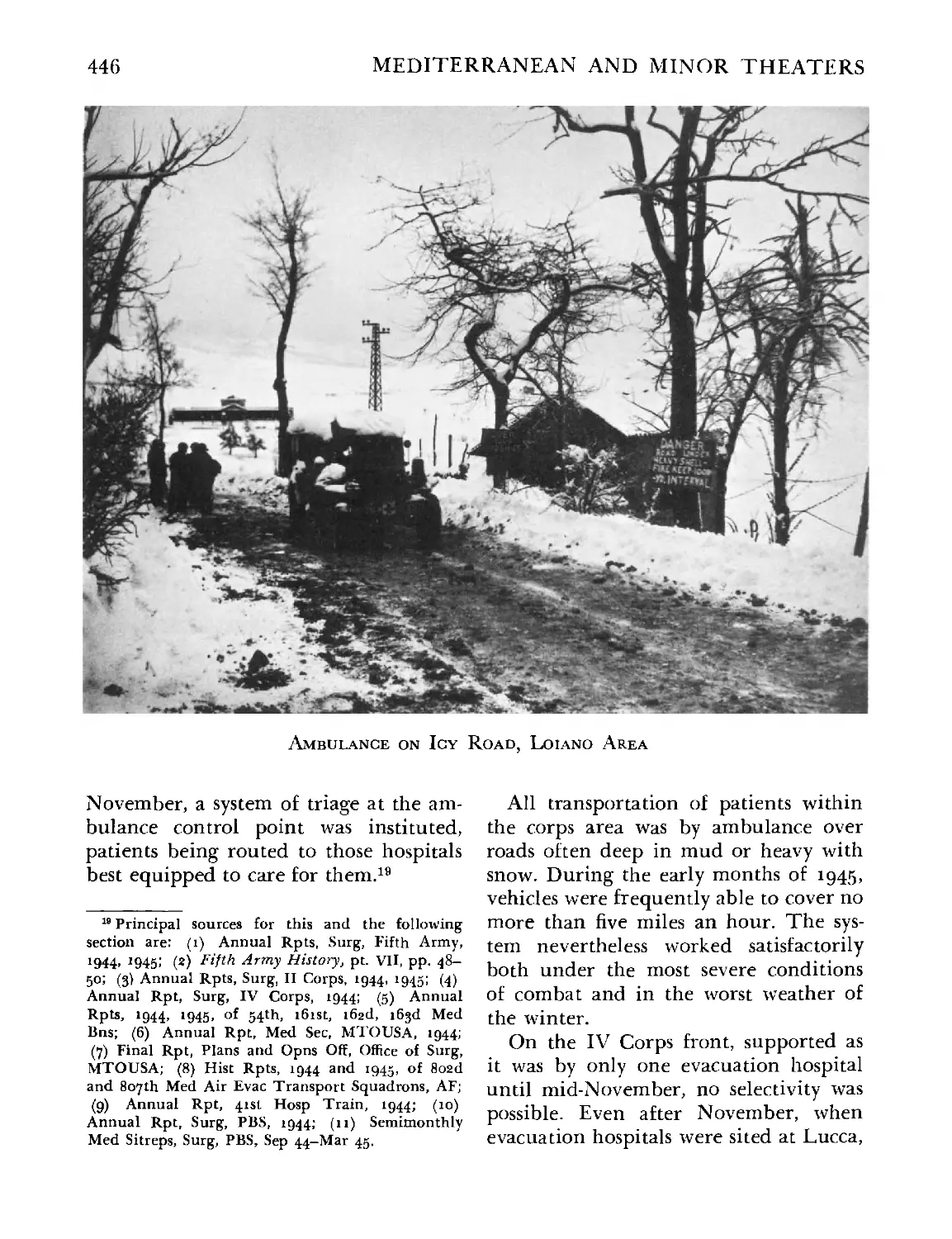
Ambulance on Icy Road	............446
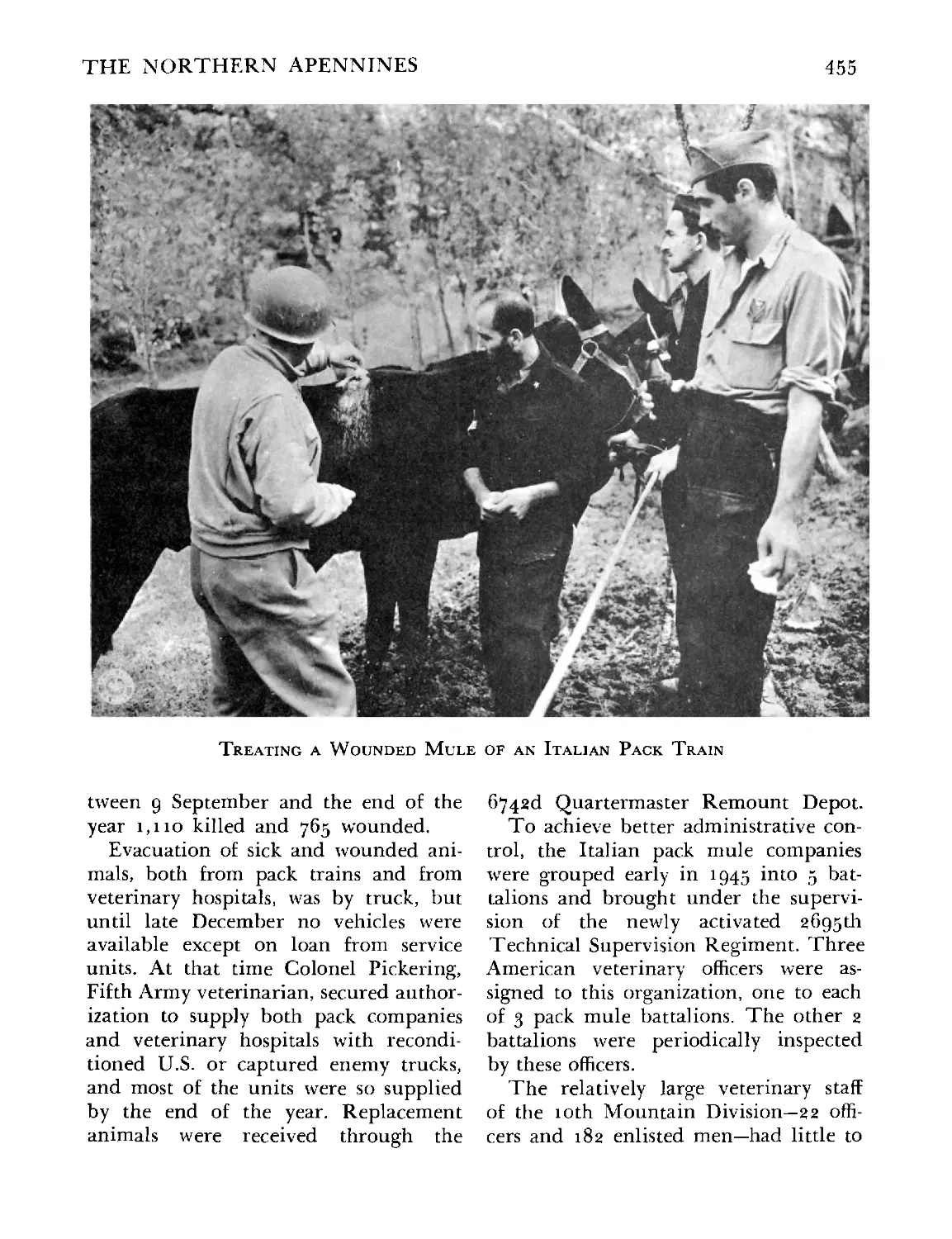
Treating a Wounded Mule .	...	............455
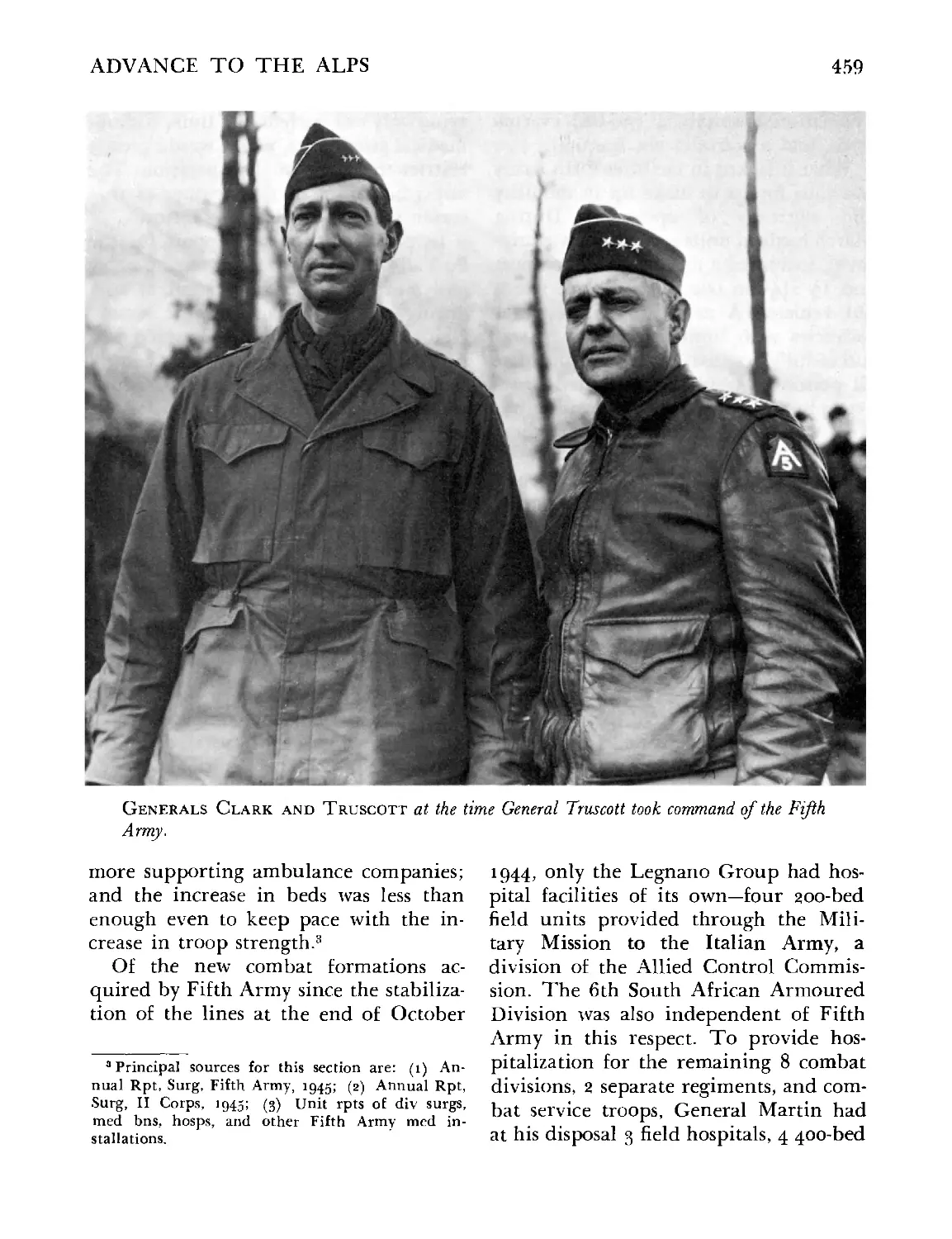
Lt. Gens. Mark W. Clark and Lucian K. Truscott, Jr.	.....459
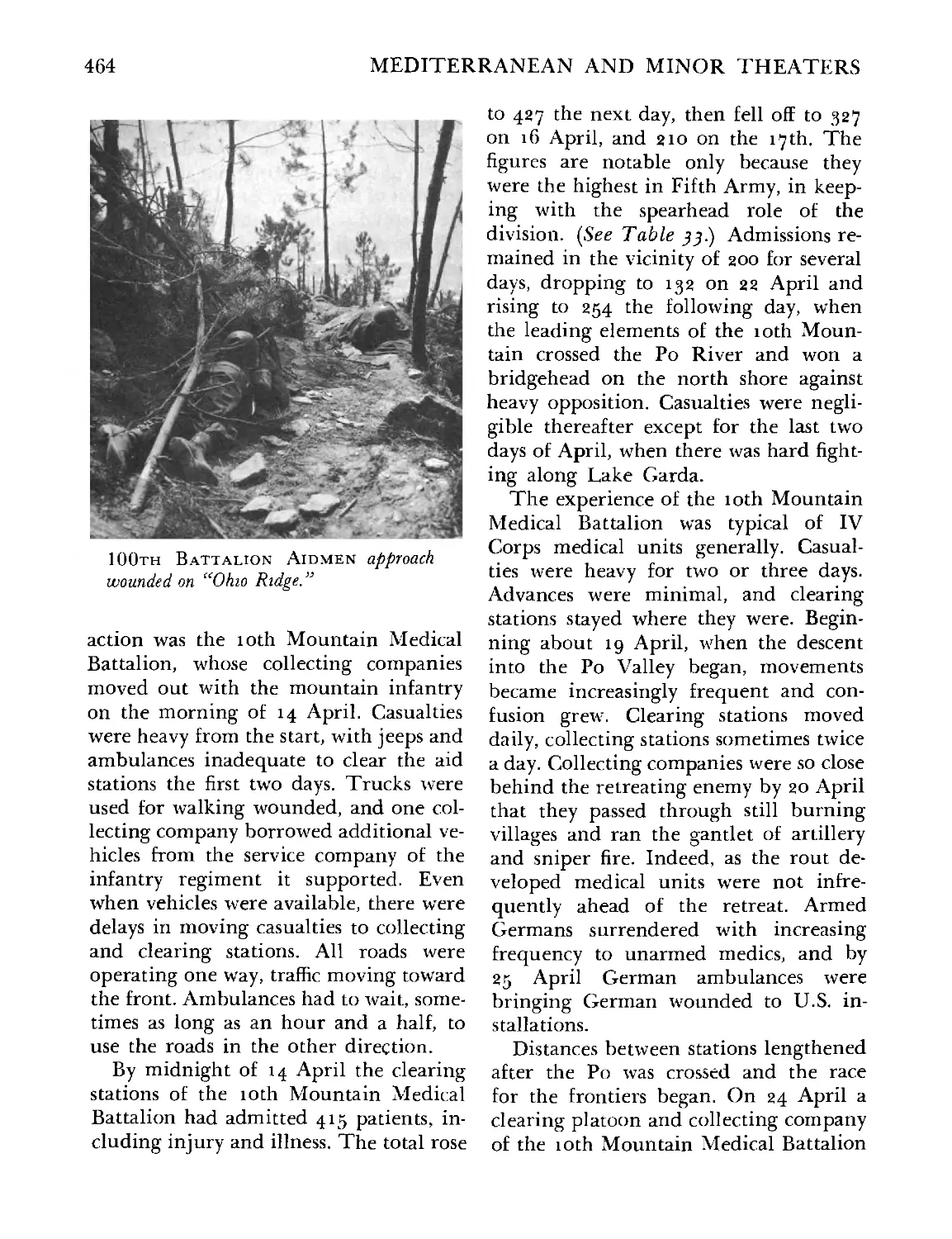
“Ohio Ridge”	 464
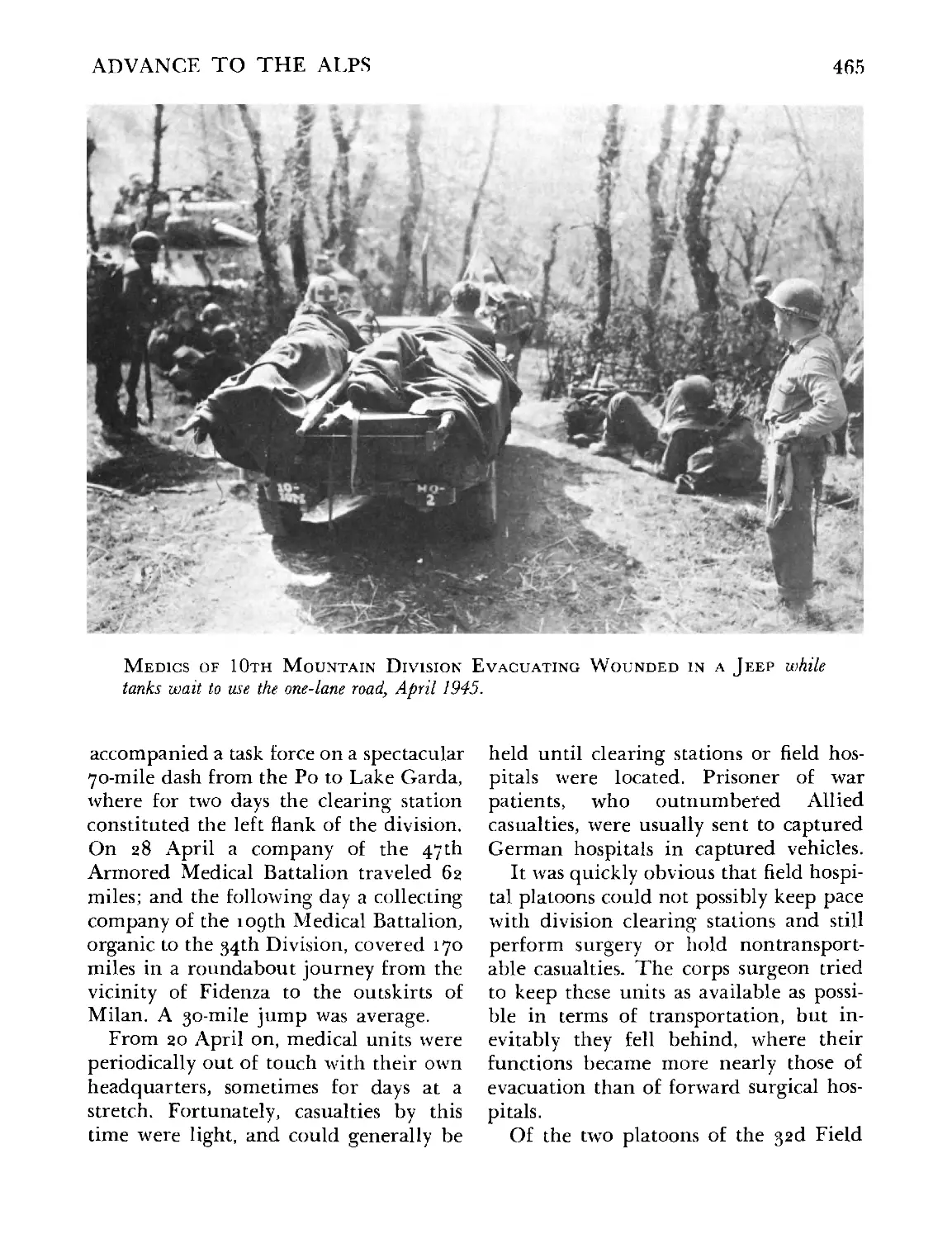
Medics Evacuating Wounded	by Jeep	 465
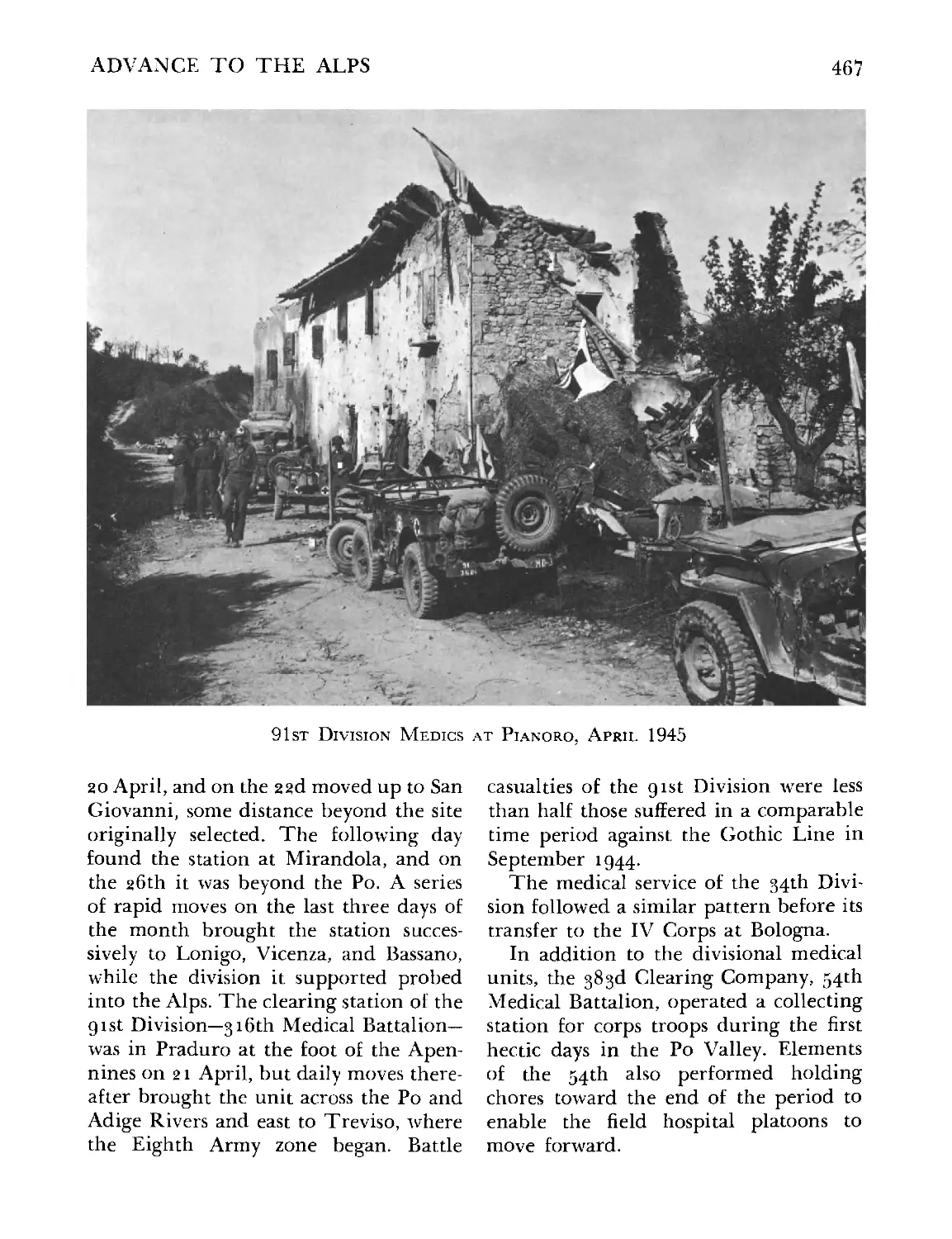
Medics at Pianoro	...	..................................467
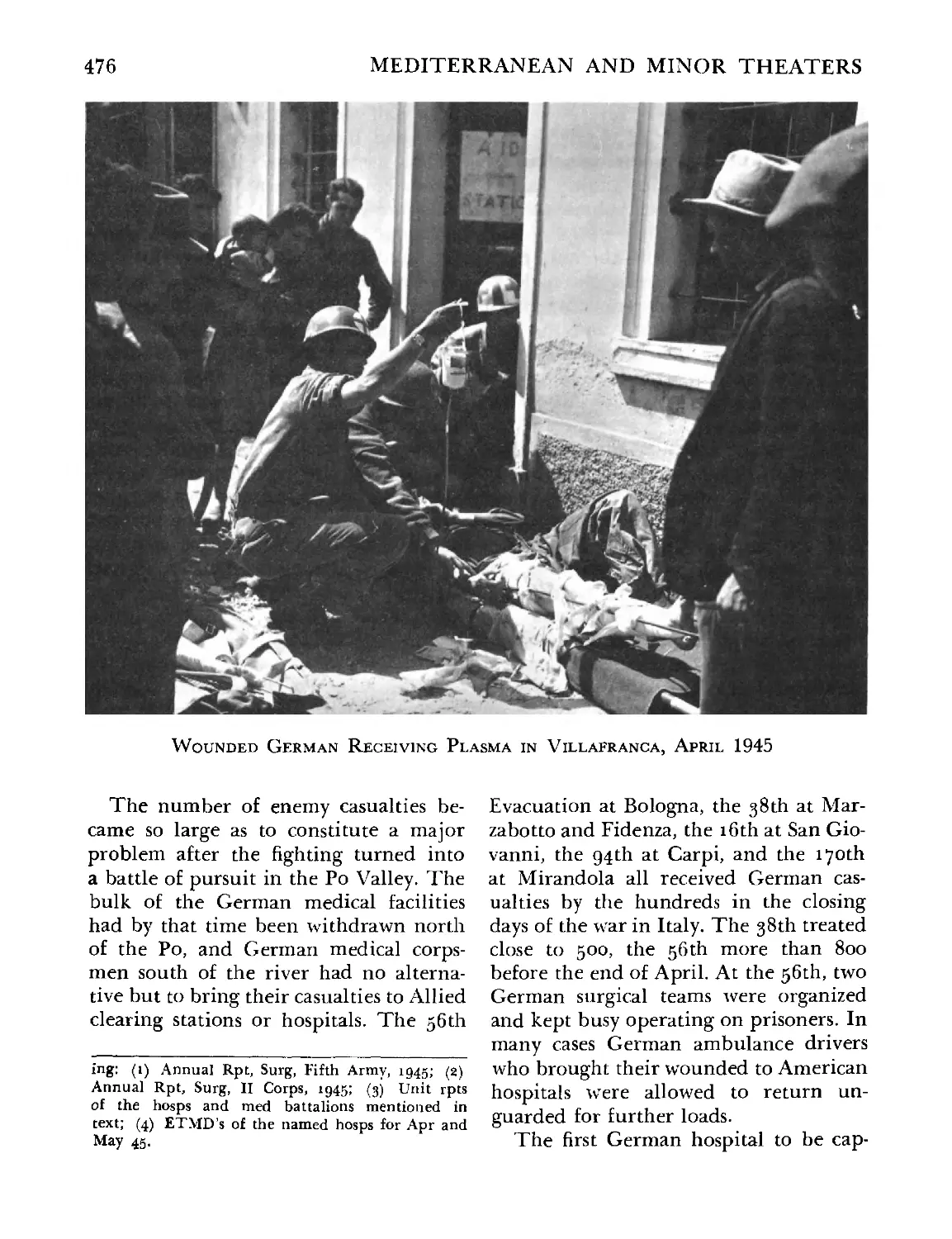
German Receiving Plasma	   476
German Clearing Station	...	......................477
Lake Garda .	  479
Ambulances Fording Reno River	481
Maj. Gen. Morrison C. Stayer .	...................... 487
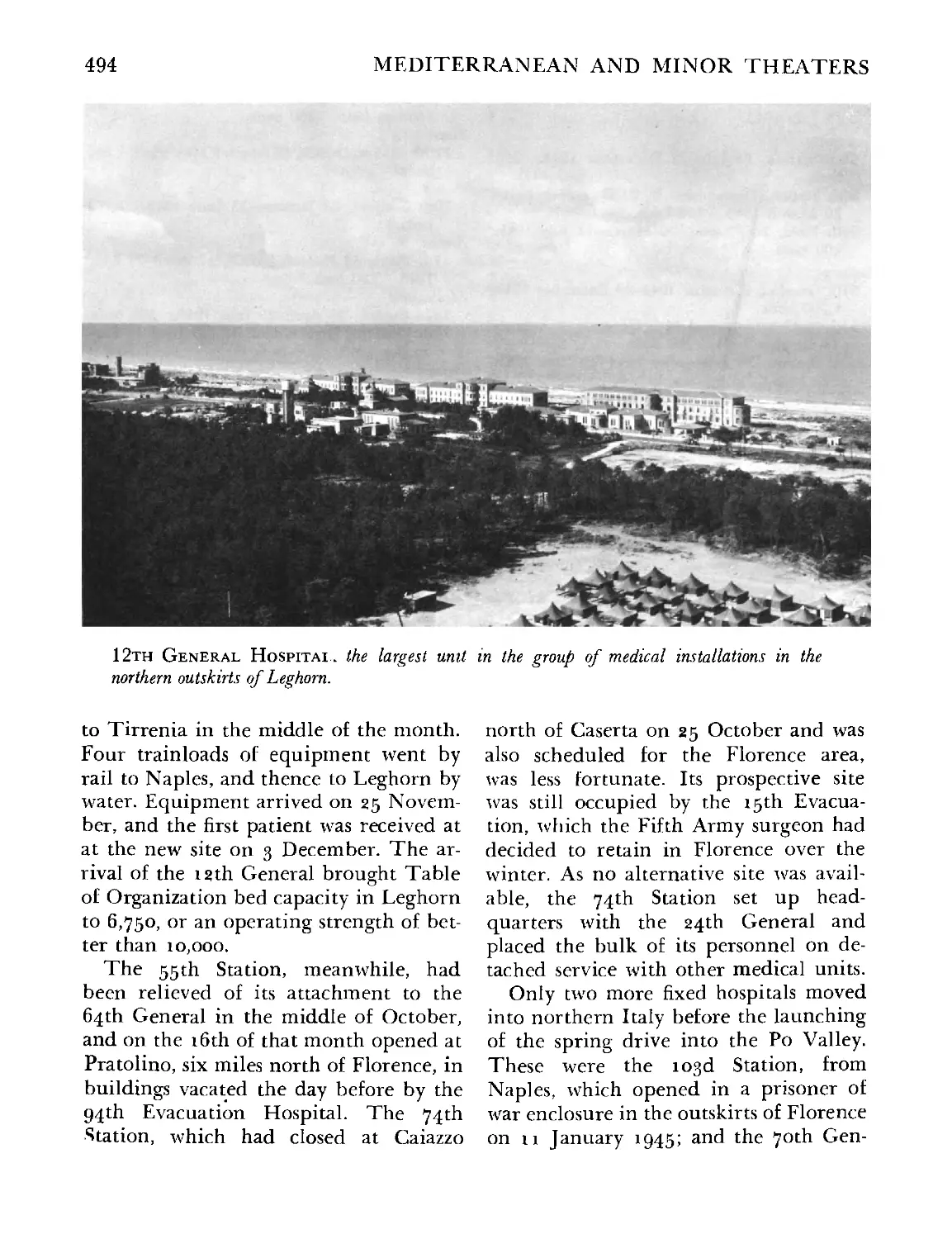
12th General Hospital, Leghorn ........................................ 494
70th General Hospital, Pistoia	 495
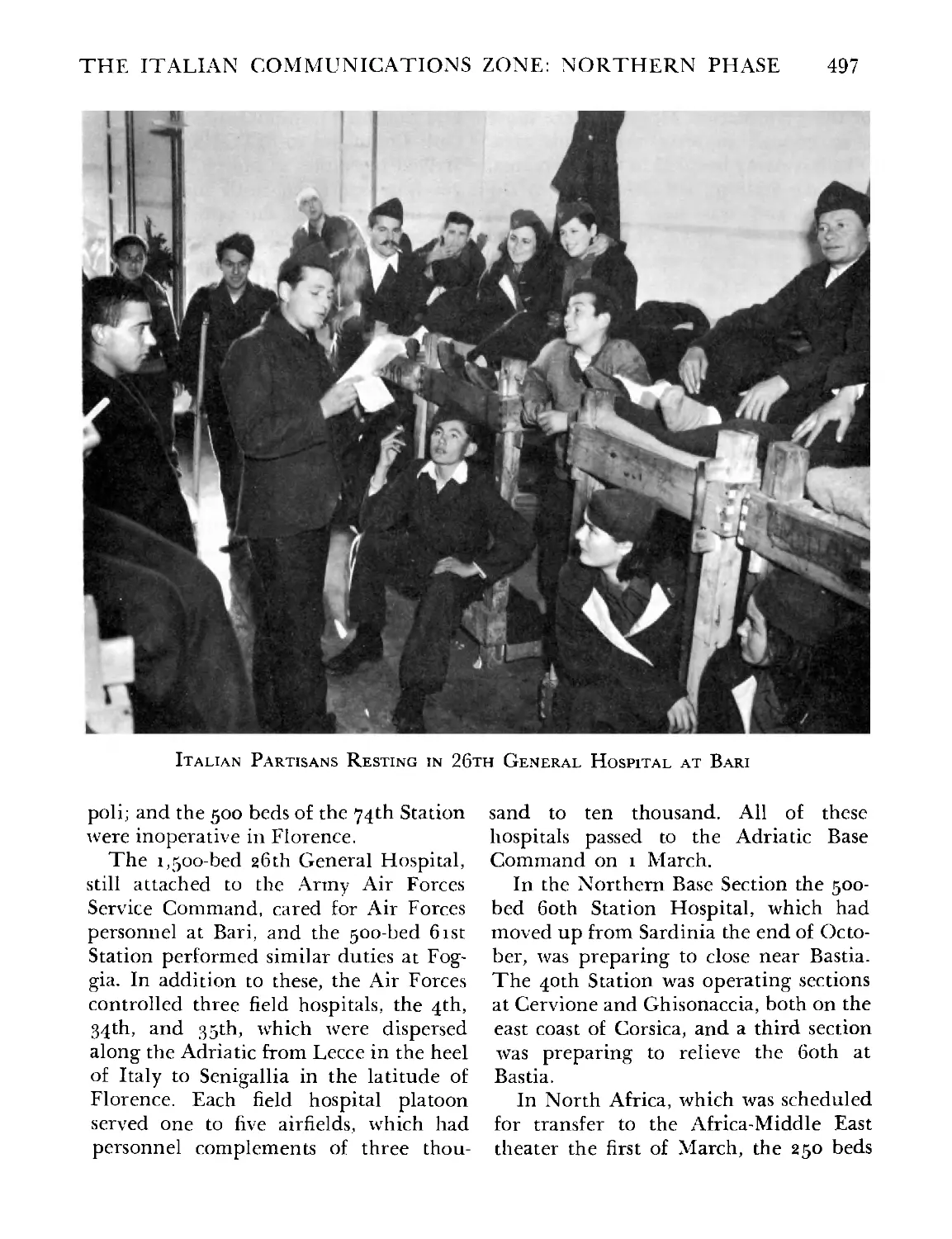
Italian Partisans at Bari	 497
37th General Hospital on the Move	......................500
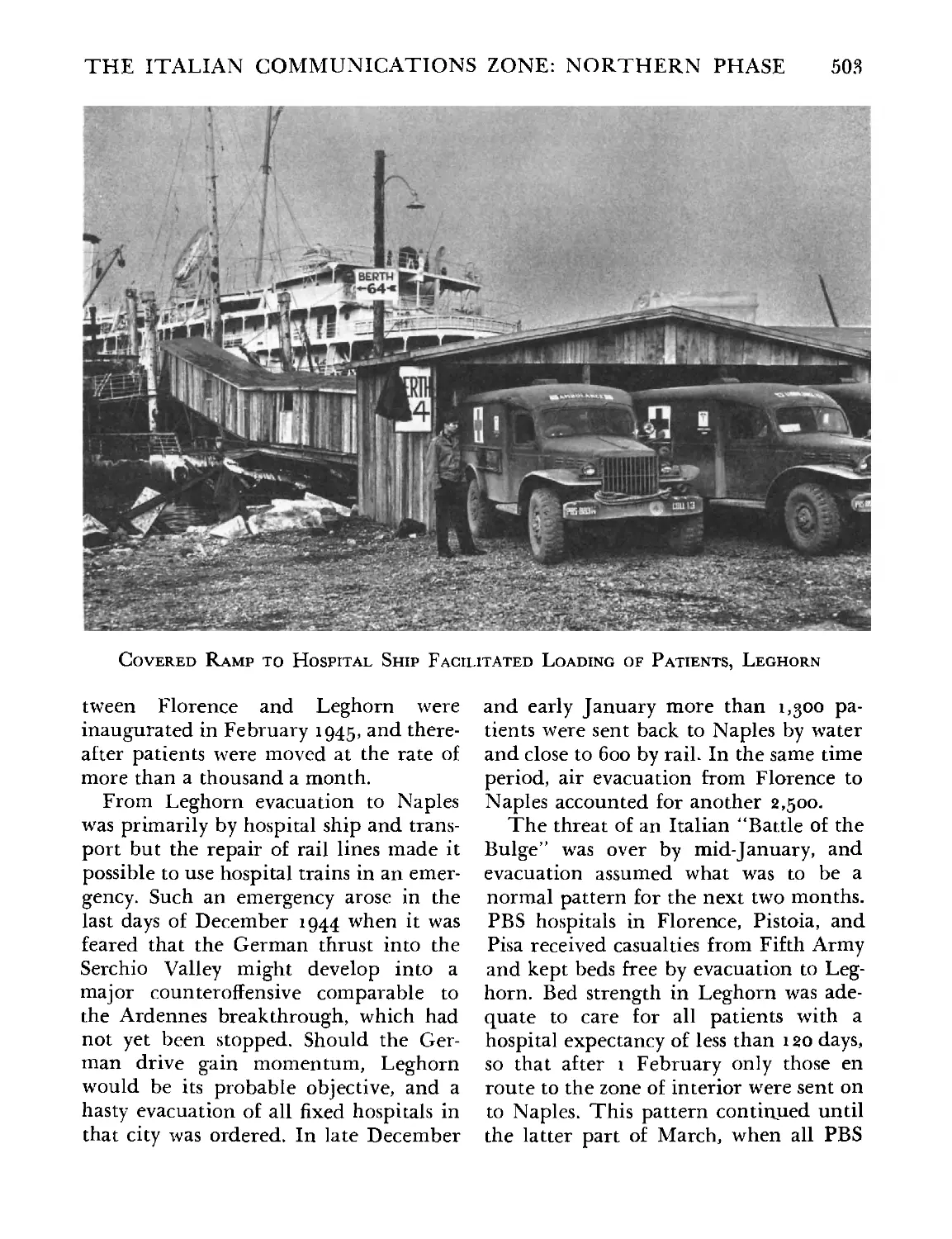
Loading Patients, Leghorn	 503
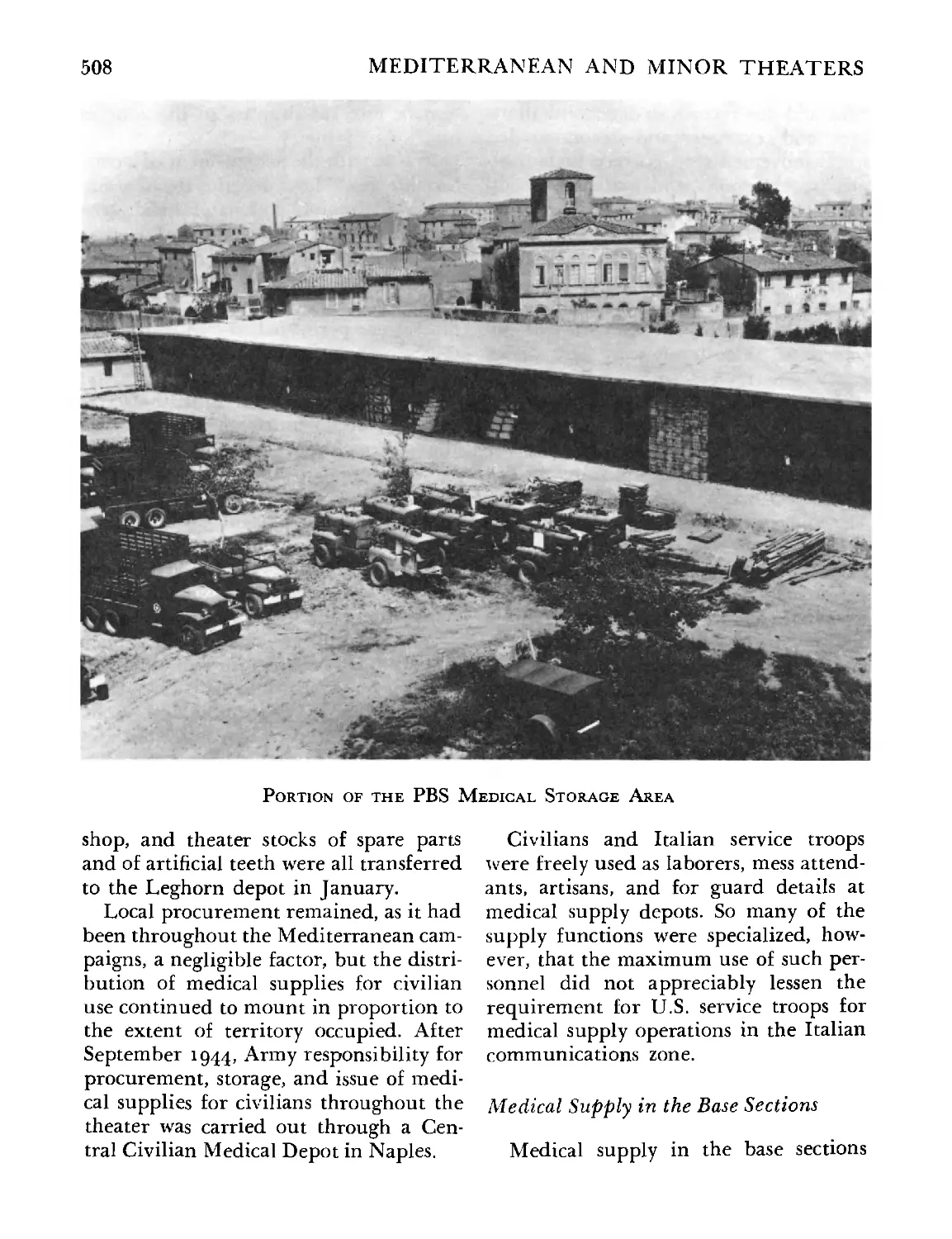
Storage Area, Leghorn	 508
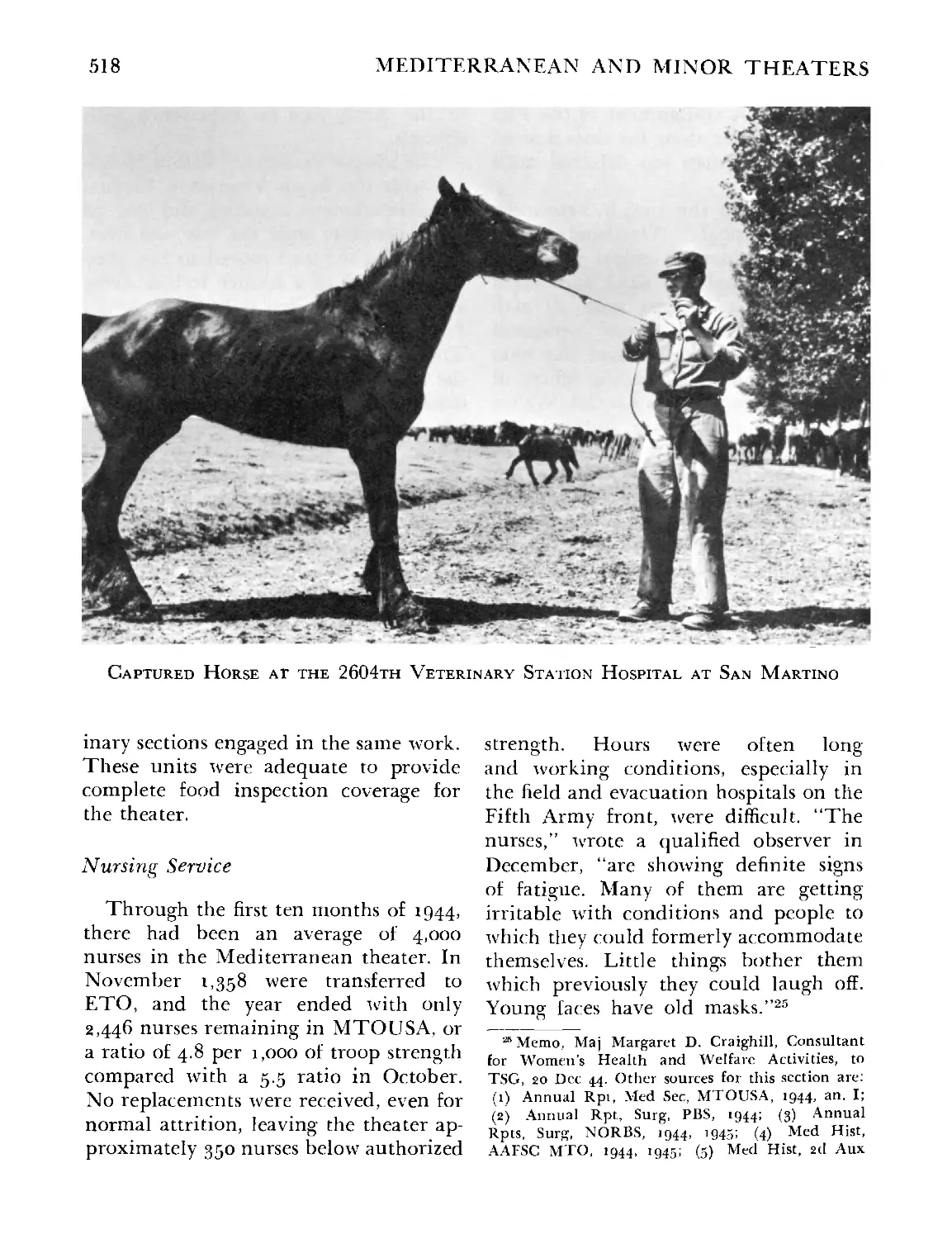
Captured Horse at Veterinary Hospital	.......... 518
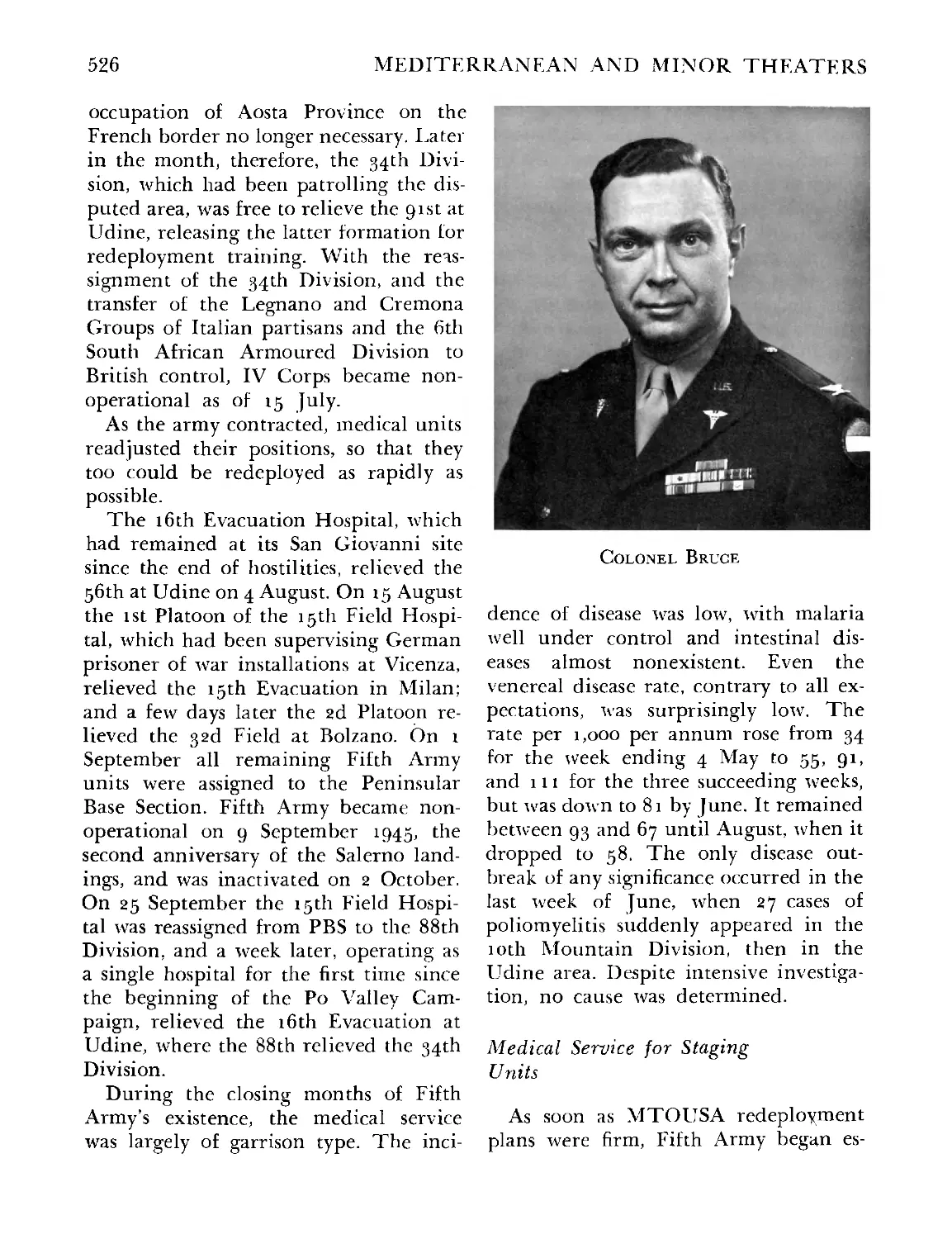
Col. Charles O. Bruce	 526
7029th Station Hospital (Italian) at Pisa	 534
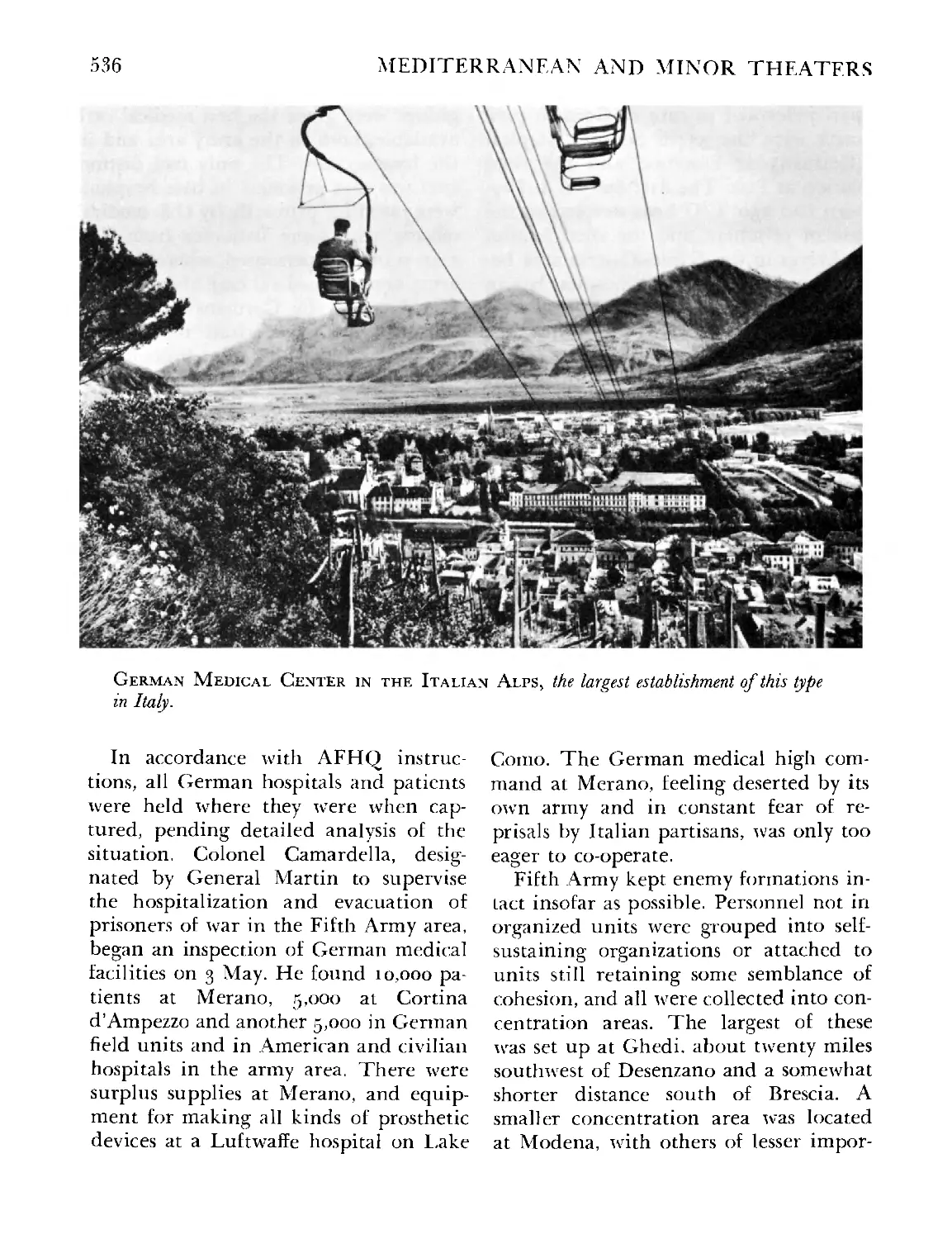
German Medical Center in the Alps	 536
Hotel-Hospital at Merano	537
German POW Ward Tents, Ghedi ...........................................539
POW Ward, Aversa	   540
Readying Medical Supplies for the Southwest Pacific	..... 547
Col. Earle Standlee	548
All photographs are from the Department of Defense files except the
Frontispiece, which is an adaptation of a painting by Joseph Hirsch in the Abbott
Collection and was drawn especially for this volume by Esther E. Rohlader.
xxvi
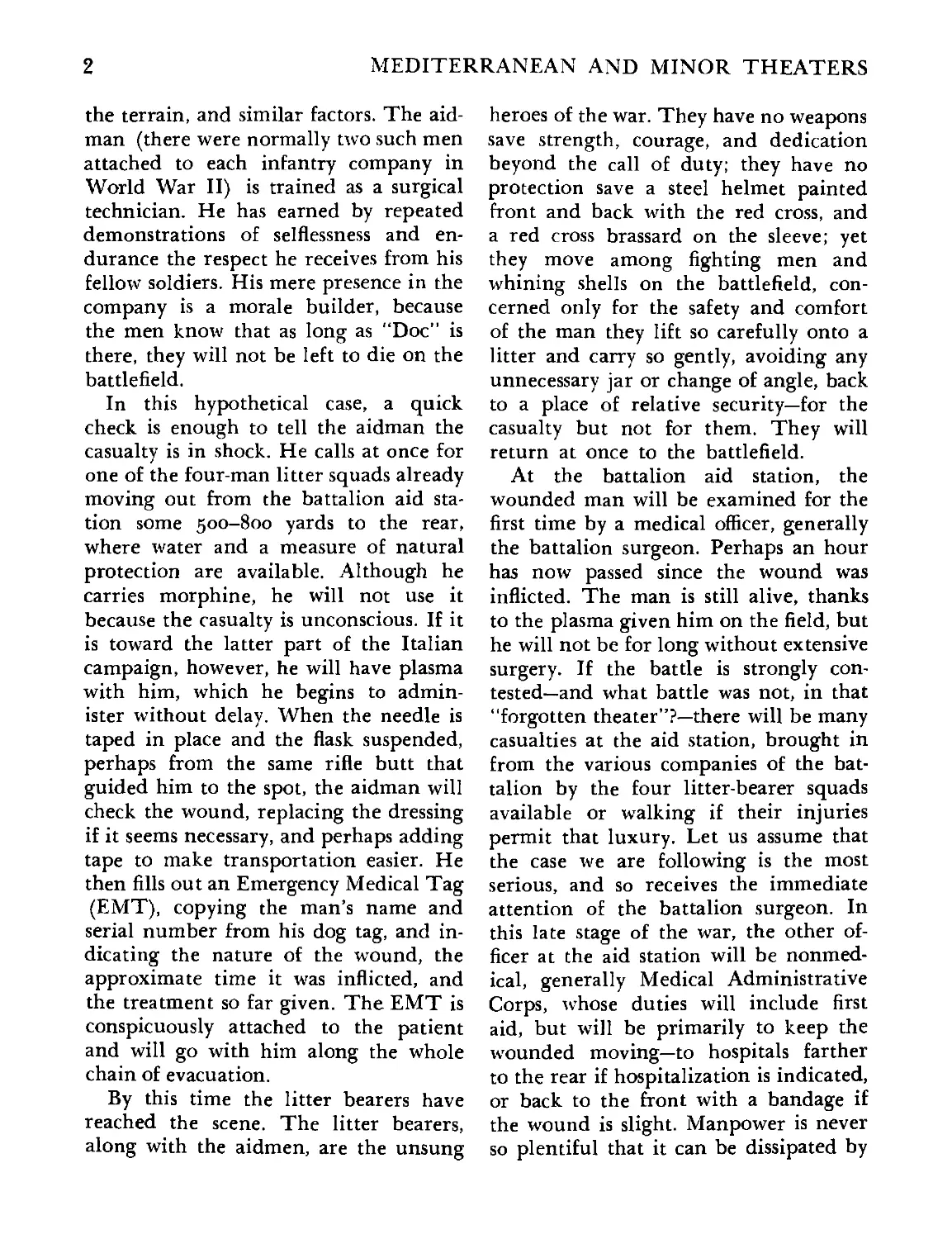
PROLOGUE
The Gift of Life
The soldier struck down on the field
of battle, if his wounds are more than
superficial, may count his life expectancy
in hours, or even minutes, unless he re-
ceives prompt medical aid. To give him
that succor, and with it the gift of life,
is the responsibility of the Army Med-
ical Service, still called in World War II
the Medical Department. Most of those
whose wounds are not immediately mor-
tal may be saved if the flow of blood is
quickly stanched, the onset of infection
halted, the effects of shock minimized,
and, above all, if the casualty is speedily
but gently moved to a place of safety
where needful surgery can be performed.
These “ifs” are many, but all of them
fall within the medical mission. Each has
its place in one of the most smoothly
functioning organizations ever devised.
So well did the Medical Department do
its work in the Mediterranean theater
that the chances of surviving battle
wounds were 27 to 1: of 112,000
wounded, only 4,000 died.1
The cry “Medic!” uttered by a
wounded man, or by a fellow soldier
1 These figures do not include 35,000 killed in
action, 20,000 taken prisoner, nor some 9,000
missing. All of these, by definition, were "battle
casualties,” but did not come within the purview
of the Medical Department.
who has paused long enough to mark
the spot, sets the machinery in motion
and begins the chain of evacuation, of-
ficially defined as “the entire group of
successive installations engaged in the
collection, transportation, and hospital-
ization of the sick and wounded.” If the
casualty is conscious and has some mo-
bility, he may help himself with anti-
septics from his own first aid packet, or
perhaps a tourniquet fashioned of a
handkerchief or of a strip torn from his
clothing. If he cannot help himself, and
the tide of battle leaves no one else
nearby, he waits. It will not be for long.
A company aidman will soon be there,
guided by voice, by some conspicuous
marker such as a rifle stuck upright in
the ground or a helmet hung from a low
branch, or by instinct sharpened through
months of combat. To illustrate the
process, let us assume a case in which
the wound is abdominal and severe, and
let us say that the wounded man has
applied sulfanilamide crystals and a
dressing before consciousness begins to
fade.
The wounded soldier will probably
be found in ten to thirty minutes, de-
pending on the movement of the battle,
the number of wounded, the nature of
2
MEDITERRANEAN AND MINOR THEATERS
the terrain, and similar factors. The aid-
man (there were normally two such men
attached to each infantry company in
World War II) is trained as a surgical
technician. He has earned by repeated
demonstrations of selflessness and en-
durance the respect he receives from his
fellow soldiers. His mere presence in the
company is a morale builder, because
the men know that as long as “Doc” is
there, they will not be left to die on the
battlefield.
In this hypothetical case, a quick
check is enough to tell the aidman the
casualty is in shock. He calls at once for
one of the four-man litter squads already
moving out from the battalion aid sta-
tion some 500-800 yards to the rear,
where water and a measure of natural
protection are available. Although he
carries morphine, he will not use it
because the casualty is unconscious. If it
is toward the latter part of the Italian
campaign, however, he will have plasma
with him, which he begins to admin-
ister without delay. When the needle is
taped in place and the flask suspended,
perhaps from the same rifle butt that
guided him to the spot, the aidman will
check the wound, replacing the dressing
if it seems necessary, and perhaps adding
tape to make transportation easier. He
then fills out an Emergency Medical Tag
(EMT), copying the man’s name and
serial number from his dog tag, and in-
dicating the nature of the wound, the
approximate time it was inflicted, and
the treatment so far given. The EMT is
conspicuously attached to the patient
and will go with him along the whole
chain of evacuation.
By this time the litter bearers have
reached the scene. The litter bearers,
along with the aidmen, are the unsung
heroes of the war. They have no weapons
save strength, courage, and dedication
beyond the call of duty; they have no
protection save a steel helmet painted
front and back with the red cross, and
a red cross brassard on the sleeve; yet
they move among fighting men and
whining shells on the battlefield, con-
cerned only for the safety and comfort
of the man they lift so carefully onto a
litter and carry so gently, avoiding any
unnecessary jar or change of angle, back
to a place of relative security—for the
casualty but not for them. They will
return at once to the battlefield.
At the battalion aid station, the
wounded man will be examined for the
first time by a medical officer, generally
the battalion surgeon. Perhaps an hour
has now passed since the wound was
inflicted. The man is still alive, thanks
to the plasma given him on the field, but
he will not be for long without extensive
surgery. If the battle is strongly con-
tested—and what battle was not, in that
“forgotten theater”?—there will be many
casualties at the aid station, brought in
from the various companies of the bat-
talion by the four litter-bearer squads
available or walking if their injuries
permit that luxury. Let us assume that
the case we are following is the most
serious, and so receives the immediate
attention of the battalion surgeon. In
this late stage of the war, the other of-
ficer at the aid station will be nonmed-
ical, generally Medical Administrative
Corps, whose duties will include first
aid, but will be primarily to keep the
wounded moving—to hospitals farther
to the rear if hospitalization is indicated,
or back to the front with a bandage if
the wound is slight. Manpower is never
so plentiful that it can be dissipated by
PROLOGUE: THE GIFT OF LIFE
3
evacuating men still able-bodied. In ad-
dition to the litter bearers, there will
be a group of enlisted technicians, who
will change dressings, administer drugs,
keep records, and perform such other
duties as may be required.
There is nothing rigid about the field
medical service. Improvisation and adap-
tation were the rule in World War II
as they are today. There is a job to be
done, and quickly, with whatever means
are at hand. The job, in the case we are
considering, is to get a man to surgery
with the least possible delay consistent
with keeping him alive. The battalion
surgeon will probably not change the
dressings the company aidman has ap-
plied, but will administer more plasma
and perhaps morphine if the man show’s
signs of returning consciousness. The
wound will be immobilized so far as its
location permits to minimize the shock
of further transportation, additional en-
tries will be made on the EMT, and the
patient will be speeded on the next
stage of his journey. His destination now'
will be the clearing station of his di-
vision, located five to ten miles behind
the front, and the field hospital set up
adjacent to it specifically for forward
surgery. When he leaves the battalion
aid station he will pass from first to sec-
ond echelon medical service—from regi-
mental to divisional control.
Before we move on to the division
clearing station with our hypothetical
casualty, some further explanation may
be in order. In the Mediterranean, as in
other overseas theaters in World War II,
each division was served by twTo different
bodies, of medical troops. Up to this
point we have been dealing with per-
sonnel of the medical detachment,
headed by the division surgeon. In the
medical detachment of an infantry di-
vision toward the end of 1944 there were
32 officers, including dental and admin-
istrative as well as medical, and 383 en-
listed men. Each regiment and each
battalion had its medical section under
a medical officer, with enlisted techni-
cians attached as aidmen at the company
level. In addition to the medical detach-
ment, each division had an organic
medical battalion, organized into a head-
quarters, three collecting companies, and
a clearing company. The collecting com-
panies, generally attached one to each
regiment of the division, were basically
ambulance and litter-bearer units. The
clearing company, on the other hand,
was equipped to function as a small—
and sometimes not so small—hospital; or
rather, two hospitals, for its two platoons
were always prepared to set up inde-
pendently. The usual procedure was to
have one platoon in operation, the other
packed and ready to “leapfrog” forward
as the line of battle advanced. Between
the clearing station and the battalion aid
stations there might or might not be a
collecting station, set up by the appro-
priate collecting company. In Italy,
w'here the roads were relatively good and
rugged country offered protection for
clearing stations close to the front, the
intermediate step was often bypassed.
Ambulances, or jeeps fitted with litter
racks, picked up casualties at the bat-
talion aid stations, or if these were not
accessible to vehicles, at ambulance load-
ing posts within reasonable litter carry
of the aid stations. If a collecting station
were established, it would be located to
serve two aid stations, or three if all the
battalions of the regiment were engaged.
At the clearing station patients were
again sorted—the French term triage is
4
MEDITERRANEAN AND MINOR THEATERS
still used in the medical service to refer
to this process—so that those whose
wounds were critical might be cared for
first; so that specialized needs would be
referred to specialized skills; and as at
the aid station, so that no man would be
sent farther to the rear than his bodily
condition required. Here there would
be medical cases as well as battle wounds
and injuries, for the clearing station was
in effect the most forward hospital serv-
ing the division and therefore the most
accessible from the front lines, where
disease might claim as many victims as
bullets. The system that developed in
the Mediterranean about the middle of
1943 was to set up as close as possible to
each division clearing station a platoon
of a field hospital to receive those casual-
ties in need of immediate surgery. The
field hospital itself was a versatile new
unit, capable of operating as a single
400-bed hospital, or / as three separate
100-bed hospitals. When split three ways
the surgical staff was wholly inadequate,
but the deficiencies were made up by
attaching teams from an auxiliary sur-
gical group, some general, some special-
ized, but each a fully functioning unit
with its own equipment as well as its
own personnel.
Now let us get back to the casualty
whose progress we are following along
the chain of evacuation. He is picked up
at the battalion aid station by a squad
of litter bearers from the collecting com-
pany, sent forward from an ambulance
loading post that might be only 300 or
400 yards away as the crow flies, but half
to three-quarters of a mile by the nar-
row, winding trail that must be used.
The tedious and difficult hand carry
once completed, he will be delivered at
the clearing station along with other
wounded men of his regiment in a mat-
ter of minutes. It is now two hours or
more since he received his wound, but
he is still alive and his chances are now
good, for he is only moments away from
the finest in surgical skill and facilities.
The field hospital to which he is im-
mediately carried is a tent with packed
earth floor, heated if necessary by oil
stoves and lighted by generator-driven
electric lamps. In physical appearance it
is not at all like the fine modern hos-
pitals at home, but in its equipment and
in the skill and motivation of the two
surgeons, anesthetist, and surgical nurse
who with two enlisted technicians make
up a surgical team, it is as good or
better.
From the field hospital rearward prog-
ress is relatively standardized. The pa-
tient will be retained until he is strong
enough to be moved without damage—
possibly as much as a week. If the front
advances significantly in that time, an-
other field hospital platoon will set up
adjacent to the new site of the division
clearing station, leaving the old hospital
or a detachment from it to operate
where it is until all its patients are trans-
portable. Our casualty, along with other
holdovers, will next be moved to an
evacuation hospital, still in the combat
zone, in all probability still under can-
vas, but considerably farther to the rear.
These units in World War II Tables of
Organization were of two types: a 400-
bed hospital that could be moved quick-
ly in two installments with its own
organic transportation, and a 750-bed
hospital in which mobility was sacrificed
for somewhat more complete facilities.
Ideally one 400-bed “evac” backed up
each division, some eight to twelve miles
behind the clearing station, with one of
PROLOGUE: THE GIFT OF LIFE
5
the larger units supporting two divisions.
Both types of evacuation hospital were
prepared to give definitive treatment to
all casualties. They were staffed and
equipped, that is, to do whatever might
be necessary for the recovery of the pa-
tient. The primary difference between
these hospitals and the so-called “fixed”
hospitals of the communications zone
was their proximity to the front lines.
For that very reason, however, they
could not hold patients for any great
length of time. As a rule only those who
could be returned to duty within a week
or two or, alternatively, passed on to a
convalescent hospital, were retained.
The convalescent hospital was another
combat zone unit, where the man no
longer in need of constant medical or
surgical care but not yet strong enough
to fight could regain his vigor. It con-
served both professional and combat
manpower by operating with a low ratio
of medical officers to beds, and by re-
taining in the army area men whose
services might otherwise have been lost
indefinitely in the complex machinery
of the replacement center. Those whose
treatment would require a longer period
of time were transferred to the com-
munications zone. The particular cas-
ualty whose treatment and evacuation
we are discussing will be one of these.
Had he been less severely wounded
his injuries would have been dressed
and rebandaged at the clearing station
and he would have been moved to an
evacuation hospital for surgery. As it is,
he will be a transient at the evac, on his
way to the communications zone. When
he moves from the field hospital unit to
the evacuation hospital he will pass from
division to army control, at the same
time entering the third echelon in the
chain of evacuation. He will be brought
to the evac by an ambulance of a col-
lecting company, but this time it will
be a company of a medical battalion
(separate) —not organic to any forma-
tion, but in this case assigned to army
and under control of the army surgeon.
The next stage of his journey, which will
bring him into the fourth echelon of the
chain, will be in all probability too long
for an ambulance run.
After a day or two at the evacuation
hospital, with a fresh dressing on his
wound and a new entry on his Emer-
gency Medical Tag, our casualty will
be moved by ambulance to a nearby
railhead, port, or airstrip to continue
rearward by whichever mode of trans-
port is most convenient to the location.
In Italy, except for Anzio where all
transportation was by water, it would
have been by hospital train, or by C-47
cargo plane rigged with litter racks to
hold 18 or 20 nonambulatory patients
and staffed by personnel of a medical
air evacuation transport squadron.
Either way, responsibility and control
would have rested with the communica-
tions zone, most likely in the Mediter-
ranean with a base section. This
particular casualty will require further,
probably extensive, surgery before his
damaged organs are restored to relative-
ly normal use, so that a general hospital
is indicated.
The numbered general hospital over-
seas (as distinct from the named general
hospital in the zone of interior), singly
or in a grouping or center, enjoys the
relative safety of the communications
zone. It had in World War II 1,000 to
2,000 beds, with many specialties repre-
sented on its staff and equipment ade-
quate for almost any situation it might
6
MEDITERRANEAN AND MINOR THEATERS
be called upon to meet. A less difficult
case than the one we are following might
go to a station hospital, which would
perform most of the functions of a gen-
eral hospital—indeed might be acting as
a general hospital—but would be smaller,
with fewer specialists and less complete
equipment. The World War II station
hospital had anywhere from 25 to goo
beds; in the Mediterranean most were
500 beds. The station hospital normally
serves a post or garrison, referring its
more serious cases to a general hospital,
but in a theater of operations require-
ments dictate use. In the Mediterranean
the station hospital in practice was often
indistinguishable from the general hos-
pital, although a larger proportion of its
patients were apt to be service or other
rear echelon troops. In both types medi-
cal cases usually outnumbered surgical.
In the general hospital our casualty
might have another, more leisurely, op-
eration, but this will depend on the
probable length of his stay, which will
be determined by the theater evacuation
policy and by the judgment of the med-
ical officers on his case. An evacuation
policy establishes the number of days
of hospitalization the theater medical
authorities feel they can give to any one
case. The policy in the Mediterranean
Theater varied from 30 to 120 days, but
for most of the time it was go. This
meant that if a patient admitted to a
communications zone hospital would in
the opinion of his doctors be fit for duty
in go days or less he would be retained
and treated, being returned to his unit
or sent to a replacement center when he
was recovered. If, on the other hand, the
chances of his recovery within that time
were remote or nonexistent, he would
be sent to the zone of interior as soon as
he could safely be moved so great a dis-
tance. It is clearly to the advantage of a
theater to have as long an evacuation
policy as possible, because the longer the
policy the more sick and wounded will
be kept in the theater for future combat
operations. It is the availability of beds
and of trained personnel in relation to
the incidence of battle wounds, injuries,
and disease that determines the policy.
Full recovery, in the case we are fol-
lowing, will take months or possibly
years of prolonged and specialized treat-
ment. The patient will therefore not
stay long at the general hospital, but will
be sent home to the United States as
quickly as possible. When he boards
hospital ship or plane, according to the
availability of transportation and the
urgency of his case, he will enter the
fifth and final echelon of the chain of
evacuation. Thus it may well be that
two weeks after being severely wounded
in the mountains of northern Italy, this
particular soldier will be admitted to
Walter Reed Army Hospital in Wash-
ington, or to one of the other named
general hospitals that may be closer to
his home. There he will remain until
cured, or until everything that can be
done for him has been done. If his doc-
tors believe he is still in need of medical
attention, he will be transferred to a
Veterans’ Administration hospital. He
is perhaps not quite as whole as he was,
but he is alive and capable of useful
citizenship. That gift of life he owes to
the dedication and skill of the men and
women who make up the medical serv-
ice of the U.S. Army.
CHAPTER I
Medical Service in the Atlantic
Defense Areas
The war against Germany, which be-
gan for United States ground forces with
the invasion of North Africa on 8 No-
vember 1942, could never have been
won if the Atlantic approaches had not
first been secured. Although less spec-
tacular than combat operations, the
establishment and defense of sea and air
routes to Europe, Africa, and the Middle
East were no less essential to the final
victory. The few permanent installations
in the Panama Canal Zone and Puerto
Rico were supplemented in the early
years of the war by new bases stretching
from the Arctic Circle to the Equator
and from central Canada to the Azores.1
The area involved is tremendous, and
the diversity of climate and socioeco-
nomic conditions great. Each base where
Army troops served had its own special
problems, but there was a common pat-
tern. Together, the bases formed a screen
of defensive outposts. They were also
land links in three major transatlantic
air routes, and some had additional
strategic value as jumping-off points for
future operations.* 1 2
1 This account excludes Alaska, Hawaii, and
western Canada, which are treated in connection
with the war against Japan.
1 There is pertinent background material in the
following volumes of UNITED STATES ARMY IN
WORLD WAR II: (i) Mark Skinner Watson, Chief
The Atlantic Approaches
to War
Establishment of Atlantic Bases
The German conquest of France in
May 1940, with its immediate threat to
Great Britain, stimulated the formula-
tion in the United States of detailed
plans for a dynamic defense of the West-
ern Hemisphere that would include out-
posts far from the shores of the American
of Staff: Prewar Plans and Preparations (Washing-
ton, 1950); (2) Kent Roberts Greenfield, Robert R.
Palmer, and Bell I. Wiley, The Organization of
Ground Combat Troops (Washington, 1947); (3)
Ray S, Cline, Washington Command Post: The Op-
erations Division (Washington, 1951); (4) Maurice
Matloff and Edwin M. Snell, Strategic Planning for
Coalition Warfare, 1941-1943 (Washington, 1953);
(5) Stetson Conn and Byron Fairchild, The Frame-
work of Hemisphere Defense (Washington, i960);
(6) Stetson Conn, Rose C. Engelman, and Byron
Fairchild, Guarding the United States and Its Out-
posts (Washington, 1963). Also valuable for back-
ground are: (7) Samuel Eliot Morison, "History of
United States Naval Operations in World War II,”
vol. I, The Battle of the Atlantic, September 1939—
May 1943 (Boston: Little, Brown and Company,
1947); and (8) the following volumes from "The
Army Air Forces in World War II,” edited by
Wesley Frank Craven and James Lea Cate, and
published by the University of Chicago Press: vol. I,
Plans and Early Preparations: January 1939 to
August 1942 (1948), vol. П, Europe: TORCH to
POINTBLANK, August 1942 to December 1943
(1949), and vol. VII, Services Around the World
(1958) •
8
MEDITERRANEAN AND MINOR THEATERS
continents. The swiftly moving events
of the summer culminated on 2 Septem-
ber in a U.S.-British agreement to ex-
change fifty overage U.S. destroyers for
bases on British soil in the Caribbean
and the Atlantic. The agreement cov-
ered Army, Navy, and Air Corps bases
in the Bahamas, Jamaica, Antigua, St.
Lucia, Trinidad, and British Guiana on
gg-year lease. At the same time the right
to establish U.S. bases in Newfoundland
(then a crown colony) and in Bermuda
was granted as a gift. Early in 1942 the
British Government also authorized
establishment of an American air base
on Ascension Island, between Brazil and
Africa. Studies of possible sites began in
the fall of 1940 and early the next year
American troops began moving into
some of the new bases.
In mid-1941 American forces began
relief of the British garrison in Iceland,
after diplomatic arrangements with the
Icelandic Government. A similar move-
ment of U.S. forces into Greenland was
authorized by the Danish minister in
Washington, D.C., who functioned with
his staff as a government in exile after
the absorption of his country by the
Nazis. Agreements with representatives
of the Dutch Government led to Amer-
ican relief of British troops on Aruba
and Curasao Islands, Netherlands West
Indies, and to an American occupation
of Surinam. The establishment of air
routes across both the North and the
South Atlantic led to stationing consid-
erable numbers of Army Air Corps and
other service personnel in central and
eastern Canada, and in Brazil.
During the period before American
entry into the war, U.S. Army strength
was built up in Panama and Puerto
Rico, and the number of troops in the
newly acquired bases also increased
rapidly. An Axis attack across the South
Atlantic against Brazil was regarded by
both the Army and the Navy as a dis-
tinct possibility, whereas a Japanese
attack on Pearl Harbor was thought to
be less likely because of the presence of
the Pacific Fleet. When the less likely
attack came on 7 December 1941, atten-
tion shifted abruptly to the Pacific, and
estimates of Army strength necessary to
maintain the security of the Atlantic
were revised in the light of the new
conditions. Expansion continued, but at
a relatively slower pace. Nevertheless,
by December 1942 there were 175,000
U.S. troops in the defensive bases along
the eastern coasts of North and South
America and on the islands linking the
Western Hemisphere to Europe and
Africa. This figure exceeded the Amer-
ican strength in the United Kingdom
at that time, and was half of the U.S.
Army strength in the Pacific, where ac-
tual combat had been in progress for a
year. Troop strength in some areas be-
gan to decline while others were still
building, so that the over-all figure never
was much above that at the end of 1942.
The peak month was May 1942, when
181,867 U.S. soldiers garrisoned the At-
lantic bases.
These bases were set up as semitactical
organizations, with enough ground com-
bat troops in most instances to hold off
a hostile landing force until help could
be sent. Engineer troops were usually
present in considerable numbers in the
early stages of occupation, giving way
to Air Forces units, mostly Air Trans-
port Command (АТС) personnel, when
the construction work was finished.
Naval forces were also stationed at many
of the bases. Administratively, the new
THE ATLANTIC DEFENSE AREAS
9
bases in the Caribbean were brought
under the pre-existing military depart-
ments having jurisdiction over Puerto
Rico and the Panama Canal Zone. In
Brazil a theater-type organization was
set up to supersede control by the Air
Transport Command. In the North At-
lantic, however, the various major bases
were established as independent com-
mands and were only brought together
under the Eastern Defense Command in
the middle of 1944. All of the North
Atlantic bases ultimately passed to con-
trol of the Air Transport Command.
Medical Service in the Atlantic Bases
In Puerto Rico and the Panama Canal
Zone, medical facilities were part of the
Army’s peacetime establishment. War-
time needs were met primarily by ex-
pansion of units, just as they were in
the zone of interior. In the new bases,
however, all medical facilities had to be
sent in. For the most part, buildings
were constructed by the Corps of Engi-
neers, whose troops generally preceded
both ground and air personnel. Indeed,
the engineers often supplied medical
service as well as buildings for a time
after the combat troops arrived. To care
for thousands of civilian workers on its
various airfield and other projects at the
new bases, the engineers had been forced
to establish a medical service of their
own. Directing it for the eastern division
was Col. (later Brig. Gen.) Leon A. Fox.
Usually by the time ground troops ar-
rived at a base, the engineers had in
operation an infirmary or small hospital,
which served until Medical Department
units could be unpacked and housed.3
•For more detailed treatment, see Blanche B.
Armfield, "Medical Department, United States
The Air Transport Command similar-
ly had its own medical service, which at
some bases co-existed with the Army
medical service, and at others merged
with it. Where command of the base it-
self passed to the АТС after the war,
Army medical facilities and installations
were transferred to the new jurisdiction.
Bed requirements for the new bases
were computed on the same 5-percent
ratio used for hospitals in the United
States, but in practice the ratio was never
more than a rough rule of thumb, more
nearly true in the aggregate than in de-
tail. Initially, hospital care at the bases
was provided by medical detachments,
the provisional hospitals established be-
ing activated in place later on as num-
bered station hospitals. It was not until
the fall of 1941 that the first numbered
hospital units activated in the United
States were shipped out to Iceland. Be-
fore the war was over, the number of
such units in the Atlantic defense areas
increased to a peak of 5 general hospi-
tals, 45 numbered station hospitals, a
handful of unnumbered hospitals of
varying sizes, and 10 or more dispen-
saries equipped to function as small
hospitals. Excluding dispensaries and
hospital expansion units, the Table of
Organization (T/O) bed strength
totaled a maximum of 10,145 in June
1943, at which time the bed ratio (per-
centage of the command for which beds
were available) was 5.8Л
Medical Department activities at all
of the Atlantic bases included dental and
Army,” Organhation and Administration, in World
War II (Washington, 1963), ch. II.
•See app. A-i. For various other comparisons,
including Medical Department strength, see John
H. McMinn and Max Levin, "Medical Department,
United States Army,” Personnel in World War II
(Washington, 1963) , ch. XI.
10
MEDITERRANEAN AND MINOR THEATERS
veterinary work, but for the most part
no special problems were encountered in
carrying out these functions.
The North Atlantic Bases
Iceland Base Command
As a precaution against possible Ger-
man occupation, the British in May 1940
sent troops to garrison Iceland. By the
spring of 1941, however, the British were
too hard pressed in Africa to waste man-
power on a purely defensive situation.
After some hesitation, but with the ap-
proval of the Icelandic Government (Ice-
landers felt there would be less risk in
being occupied by a nonbelligerent)
President Franklin D. Roosevelt decided
early in June 1941 to relieve the British
garrison with American troops. An ini-
tial force of 4,100 marines landed in Ice-
land on 7 July- The marines were
followed on 6 August by the 33d Pursuit
Squadron, whose P-4o’s were flown in
from an aircraft carrier. The first incre-
ment of ground troops—some 6,000 offi-
cers and men of the 5th Division-
arrived on 15 September. The Iceland
Base Command (IBC) was established
as the British garrison was relieved, and
U.S. forces prepared to protect the trans-
atlantic air transport and ferry routes
and the vital sea lanes to the British
Isles, less than 800 miles away?
8 Principal sources for this section include: (i)
Conn, Engelman, and Fairchild, Guarding the
United States and Its Outposts, chs. XVIII, XIX;
(st) Narrative Hist, Iceland Base Comd, Always
Alert, 16 Sep 41-1 Dec 45, MS, OCMH files; (3)
Lt. Col. William L. Thorkelson, The Occupation
of Iceland during World War II, MA Thesis, Syra-
cuse University, September, 1949; (4) Annual Rpts,
Surg, IBC, 1941-44; (5) Annual Rpts, Surg, 5th
Div, 1942-43; (6) Annual Rpts, 208th Gen Hosp,
1942, 1943; (7) Annual Rpts, 11th, 167th, 168th
Command headquarters was estab-
lished at Camp Pershing, about two
miles east of Reykjavik. Several other
camps lay north of headquarters, within
a 10-20-mile strip close to the coast and
centering around Alafoss. Eighty percent
of the U.S. force was concentrated in
these camps. The remainder was scat-
tered at isolated airfields and radar sta-
tions around the rim of the island.
The IBC reached peak strength in
May 1943 when, with 40,712 ground,
air, and service troops, it was exceeded
in size only by the Panama Canal Zone
among Atlantic defense areas. Ground
forces included engineer and service
troops and the entire 5th Division. Air
combat strength was augmented, as soon
as suitable fields could be made avail-
able, by the 9th Bomber Squadron (H)
and the 1st Observation Squadron. The
bulk of the Air Forces units in Iceland,
however, were elements of the Air Trans-
port Command, whose home base, shared
with the bombers, was Meeks Field near
Keflavik on the southwest tip of the
island.
By the time peak strength was reached,
the threat of German invasion of Iceland
was negligible. In August 1943 the garri-
son was cut by more than 25 percent;
the entire 5th Division was withdrawn.
Thereafter, a steady decline in troop
strength brought the total to less than
1,800 men by the end of 1945, more
Sta Hosps, 1941-43; (8) Annual Rpts, 14th, 15th,
49th, 72d, igad Sta Hosps, 1942, 1943; (9) Annual
Rpts, gad Sta Hosp, 1942-45; (10) Annual Rpts,
365 th Sta Hosp, 1943, 1944; (11) Annual Rpts,
366th Sta Hosp, 1943-45; (,2) Arctic Laboratory,
Sep 41-Jun 44, AAF, N Atl Wing, АТС, app. F;
(13) Med Hist Red, Oct 44-Dec 44, app. E, AAF,
N Atl Wing, АТС; (14) Hist of Med Dept, АТС,
May 41-Dec 44; (15) Ltr, Col Charles H. Beasley
(Ret) to Col O. F. Goriup, 10 Aug 59, commenting
on preliminary draft of this volume.
THE ATLANTIC DEFENSE AREAS
11
than a third of them Air Forces person-
nel. The Iceland Base Command, which
was under the European Theater of
Operations (ETO) from June 1942 on,
passed to control of the Eastern De-
fense Command in the middle of 1944.
The Air Transport Command, which
retained an interest in Iceland after the
war was over, assumed control of all
remaining U.S. Army activities there on
1 January 1946.
Medical Organization—The strength
of the Medical Department in Iceland
rose from 749 at the end of 1941 to
2,959 a year later. By the end of 1943
the total number of officers, nurses, and
enlisted men of the Medical Department
had declined to 1,163 and was down to
429 by the end of 1944. T/O bed
strength went through a corresponding
expansion and decline, from an initial
750 to a peak of 2,600 in October 1942,
declining to 400 by the middle of 1944.
The base command surgeon during
the most active period was Lt. Col.
(later Col.) Charles H. Beasley, who had
accompanied the initial Marine contin-
gent in July in order to make a medical
evaluation of the island. Colonel Beasley
returned to Iceland with the Army
ground troops, remaining until August
1943, when he was relieved by Col. John
F. Lieberman. Lt. Col. John C. McSween
became IBC surgeon in early 1944. In
addition to its regular function as guard-
ian of the health of the U.S. troops in
the command, the base surgeon’s office
did much to win over the Icelandic
people. Army hospitals treated large
numbers of Icelandic citizens who had
been injured in the vicinity of American
camps, and also cared for civilians who
were struck by military vehicles. Mem-
Colonel Beasley
bers of the Medical Department co-oper-
ated freely with the local public health
authorities, and Army veterinarians help-
ed their Icelandic colleagues examine,
test, and treat livestock, and aided them
in other agricultural matters. Many of
the most prominent doctors of Iceland
inspected U.S. Army hospitals and at-
tended Army medical meetings. In turn
American medical officers visited Ice-
landic patients in consultation. On sev-
eral occasions the Army supplied local
hospitals with urgently needed drugs and
biologicals, while the American Red
Cross contributed hospital and medical
supplies to its Icelandic counterpart.
The work of the surgeon's office re-
volved around the system of hospital-
ization and evacuation and the related
medical supply function, each of which
will be discussed under a separate head-
ing. Supplementing these activities at
the base command level was the divi-
sional medical service, which operated
12
MEDITERRANEAN AND MINOR THEATERS
camp dispensaries and treated 5th Di-
vision personnel wherever they were
stationed. The organic 5th Medical
Battalion furnished routine evacuation
service from unit dispensaries to nearby
station hospitals and from the hospitals
back to the dispensaries. The medical
battalion also operated a dispensary for
the port of Reykjavik and ran a provi-
sional hospital in the Keflavik area until
a permanent station hospital was estab-
lished there. Air Forces units maintained
their own dispensaries and operated
crash aid stations for emergency treat-
ment at the various airfields. Engineer
troops, which preceded the Army combat
elements by about a month, had their
own medical detachments, but anything
of a serious or complicated nature went
to Marine and later to Army instal-
lations.
Hospitalization—The disposition of
U.S. Army hospitals in Iceland was
dictated by the combination of moun-
tains, lava beds, and glaciers that circum-
scribed roads and airfields, and by the
rugged coast line, turbulent seas, and
icebergs that made water evacuation haz-
ardous much of the year. Although the
bulk of the beds were in the Reykjavik-
Alafoss area to serve the largest concen-
tration of troops, it was still necessary
to supply hospital facilities wherever
American soldiers were stationed. Three
numbered station hospitals arrived with
the main body of troops in mid-Septem-
ber 1941, and two of these were in oper-
ation before the close of the year. The
168th Station Hospital was established
in Reykjavik in a permanent building
formerly used by a British hospital. The
main frame structure held too beds,
and Nissen huts were used to bring the
hospital up to its 250-bed T/O capacity.
The first patient was admitted on 24
September. The following week the 11th
and 167th Station Hospitals, both 250-
bed units, which had arrived in Iceland
at the same time as the 168th, were at-
tached to the latter until suitable sites
could be prepared. The nth Station
Hospital opened on 22 December in a
section of a British hospital at Camp
Helgafell, some ten miles north of
Reykjavik. The 167 th remained at-
tached to the 168th until April 1942,
when it moved into newly erected Nissen
huts at nearby Alafoss. (Map 1.)
During 1942 six more station hospitals
and one general hospital arrived on the
island to serve an increasing number of
Army troops coming in from the United
States. The 1,000-bed 208th General
Hospital came in March and began oper-
ating before the end of the month at
Camp Helgafell, where it shared quar-
ters with a British general hospital and
the U.S. 11th Station Hospital. The nth
moved in June to Kaldadharnes, some
twenty-five miles southeast of Reykjavik,
where it served personnel of an airfield.
The British hospital was withdrawn to
the United Kingdom in August, leaving
the 208 th General in sole possession of
the hospital plant.
The 72d and 92d Station Hospitals
both arrived in August 1942. The 92d,
with 75 beds, began operating in Sep-
tember at Reykjaskoli near the head of
Hrutafjbrdhur on the north coast of Ice-
land. The 7 2d—a 50-bed unit—was
scheduled for Borgarnes about thirty
miles north of Reykjavik but, because
of a variety of construction difficulties,
did not get into operation until the be-
ginning of January 1943. By then changes
in troop dispositions had made a hospital
THE ATLANTIC DEFENSE AREAS
18
Map 1—U.S. Army Hospitals Supporting North Atlantic Bases, 1 June 1943

at Borgarnes unnecessary, and the unit
was moved later in January to Kaldad-
harnes, where air activity was increasing.
The 75-bed 14th Station Hospital and
the 500-bed 49th both reached Iceland
in September 1942 and went into opera-
tion the same month. The 14th was at
Seydhisfjordhur on the eastern coast; the
49th enlarged a 200-bed hospital plant
taken over from the British near Akure-
yri on the north coast, the second largest
city in Iceland and the site of a large sea-
plane base. The 15th Station, another
75-bed unit that also arrived in Septem-
ber, began operating at Budhareyri,
about forty miles south of the 14th, in
November. The 75-bed i92d Station
Hospital arrived in October and was
14
MEDITERRANEAN AND MINOR THEATERS
167th Station Hospital at Alafoss, Iceland, showing hot springs used to heat buildings.
attached to the 168th Station at Reyk-
javik until its own hospital plant at Hbfn
on the southeastern coast was ready in
January 1943.
With the exception of the 168th Sta-
tion at Reykjavik, all U.S. hospital
plants, including those taken over from
the British, were Nissen, Quonset, or
similar types of corrugated steel huts.
Even with prefabricated buildings, how-
ever, construction was difficult. Materials
for drains, plumbing, and electrical fix-
tures were not always available. Little
could be accomplished during the winter
months, when the nights were twenty
hours long, and even the brief periods of
daylight W’ere often marred by cold,
dampness, and winds up to 130 miles an
hour. A civilian labor shortage forced
reliance on troop labor, including that
of Medical Department personnel. In the
vicinity of Alafoss natural hot springs
were used for heating hospital buildings.
The officers, nurses, and enlisted men
of Iceland Base Command’s hospitals, in
addition to caring for all U.S. Army per-
sonnel in the command, provided hos-
pitalization for members of the American
Red Cross and for U.S. civil service em-
ployees. They also treated and hospital-
ized on occasion U.S. Navy and Marine
Corps personnel, certain British Army,
Air Force, and Navy men, some members
of the Norwegian Army and Navy, and
THE ATLANTIC DEFENSE AREAS
15
American and Allied merchant marine
casualties and survivors from sea mis-
haps. However, the bulk of patients were,
of course, from the various camps of the
command.
As the threat of German invasion of
Iceland faded during 1943, the with-
drawal of troops and relocation of re-
maining forces brought a number of
changes in hospital dispositions. In April
the 193d Station left Hofn for the
Reykjavik area, where most of its per-
sonnel were already on detached service
with the 168th Station, but the hospital
did not resume independent operation.
Further shifts came in June when the
15th Station, no longer needed at
Biidhareyri, was attached to the 49th at
Akureyri, and the 93d Station, including
patients, was transferred from Reykjas-
koli to Alafoss.
On 24 June the ig2d Station Hospital
was disbanded and its personnel and
equipment were transferred to the g2d,
which was reorganized as a 150-bed unit.
On the same date the 208th General
Hospital at Camp Helgafell was reduced
from 1,000 to 750 beds, and the 168th
Station in Reykjavik was expanded from
250 to 500 beds, in preparation for a
mission elsewhere.
A few days later, on 2 July 1943, the
208th General was redesignated the 327th
Station Hospital, without change of site
or mission. On the same day the 500-bed
49th Station closed at Akureyri, leaving
the smaller 15th Station to care for re-
maining patients in that area, and a week
later sailed for the United Kingdom. It
was followed by the 168th Station on 3
August.
The 11th Station, meanwhile, had
shifted from Kaldadharnes to Reykjavik
to replace the 168th. It was joined there
by the 73d Station on 19 August. Two
days later the g2d Station Hospital
opened near Keflavik, adjacent to the
Meeks Field headquarters of the Air
Transport Command.
By this time the bulk of the ground
force troops had left, as had many of the
air and service forces. When the 15th
Station from Akureyri and the 14th from
Seydhisfjordhur both moved to the
Alafoss-Helgafell area late in September,
all U.S. hospitals were concentrated in
the Reykjavik area. It remained only to
consolidate the units for more efficient
operation.
The first step in this direction was
taken on 30 October when the 327th Sta-
tion sailed for England. A consolidation
of the remaining hospitals was effected
on 6 December 1943. The 11th and 73d
Station Hospitals were combined at
Reykjavik to form the 150-bed 366th
Station, while the 14th, 15th, and 167th
Stations were combined at Camp Helga-
fell to form the 365th Station Hospital,
with a T/O of 500 beds. At the end of
1943 only the 93d, 365th, and 366th Sta-
tion Hospitals remained in Iceland, with
a combined bed strength of 800. Seven
months earlier there had been one gen-
eral and nine station hospitals, with an
aggregate of 2,600 T/O beds.
Except for Iceland’s strategic function
as a stop on the air route to Europe, the
war there was over. Hospitalization was
on a garrison basis, with the garrison
steadily decreasing in size. The 365th
Station transferred to the United King-
dom on 26 June 1944. On the first of that
month the g2d Station had increased its
bed strength from 150 to 250, but the
number of beds on the island was still
halved. The 366th was inactivated early
in 1945, leaving the 92d Station the only
16
MEDITERRANEAN AND MINOR THEATERS
U.S. Army hospital in Iceland. It was
transferred to the jurisdiction of the Air
Transport Command on i January 1946,
along with the remains of the Iceland
Base Command.
Evacuation—From most of the army
camps in Iceland patients were evacuated
by ambulance from the unit dispensary
to the nearest station hospital. Those
who required general hospital care were
moved on to the 208th General Hospital
at Camp Helgafell, by ambulance from
station hospitals in the western part of
Iceland, by sea or air from those in more
isolated areas. Evacuation by boat
through coastal waters proved to be a
very efficient method of handling pa-
tients from the eastern and northern
parts of the command except during the
long winter season, and was more fre-
quently used than air evacuation.
The 120-day evacuation policy set up
by the War Department for evacuation
from Iceland to the United States proved
to be entirely satisfactory. Both air and
water transportation were used. In either
case, patients to be evacuated to the zone
of interior were cleared through the
208th General Hospital or, after its
departure, through a station hospital act-
ing as a general. Although the number of
evacuees was not unduly large—327 in
1942, 1,180 in 1943, and 248 in 1944—
there was generally a backlog because of
unavailability of transportation or lack
of proper facilities, especially for neuro-
psychiatric and other cases requiring
medical attendance. Psychiatric cases
amounted to 33 percent of those evac-
uated in 1942, 32 percent in 1943, and
56 percent in 1944.
The medical facilities of the Iceland
Base Command were also available, to
the extent needed, to care for 19,589
transient patients who were flown from
the ETO to the zone of interior by
way of Iceland between 1 January 1944
and 1 July 1945. To accommodate these,
an unnumbered holding hospital was set
up at Meeks Field, including mess facil-
ities for walking patients. Litter cases
were served hot meals aboard the planes.
If a plane were held because of poor fly-
ing conditions, the 92d Station took care
of the patients until they could continue
their journey. The hospital also took care
of any patients whose condition made
it unsafe to continue. Medical attention
was similarly available to 5,930 able-
bodied men from the ETO who passed
through Iceland between June and Sep-
tember 1945 on their way to the States.
Medical Supplies and Equipment—
Medical supplies for the Iceland Base
Command were handled through a main
depot in Reykjavik and a subdepot and
a package storage depot in the Alafoss
area. The main depot—two fish-drying
houses leased for the purpose—had more
than 11,000 square feet of floor space for
storage; the subdepot, in three prefabri-
cated huts, had 2,880 square feet of stor-
age space; and the package warehouse
about a mile distant had 4,000 square
feet. Individual hospital and other medi-
cal units maintained supply levels of
from 90 to 180 days, the larger stocks
being held by installations on the north-
ern and eastern coasts, which were not
readily accessible in bad weather. The
depots held a 120-day supply by the end
of 1942.
Six officers and 75 enlisted men were
authorized for operation of the medical
supply system in Iceland, but this num-
ber was never reached. Five officers and
THE ATLANTIC DEFENSE AREAS
17
50 enlisted men were sent, but even these
figures were reduced by attrition to 4 and
45 respectively before the end of 1942.
The supply system was reorganized early
in August 1943 and again in mid-Decem-
ber. In August a Base Depot Section,
20th Medical Depot Company, was or-
ganized to carry on the medical supply
function, but was supplanted in Decem-
ber by the 300th Medical Composite
Platoon. Under the latter form of organ-
ization the depots were operated by two
supply teams, one with an officer and 11
enlisted men, the other with 2 officers
and 27 enlisted men.
While some medical units encountered
a number of delays in getting their nor-
mal equipment, medical supplies as a
whole were plentiful. Some items, such
as quinine, mosquito bars, and various
combat items, were never required in
Iceland, and other items became surplus
as the strength of the command declined.
During 1943 excess British medical sup-
plies to a total of 130,000 pounds, and
2,325,000 pounds of excess U.S. medical
supplies were shipped to the United
Kingdom. The year’s end still found the
depots bulging with supplies for 60 days
of operation, 90 days’ maintenance, and
a further 90-day final reserve of certain
necessary items, held in dispersed loca-
tions. These levels were sharply reduced
during 1944 to a 30-day operating and
30-day maintenance level.
Professional Services—In spite of un-
familiar and unfavorable climatic condi-
tions, the incidence of disease among
U.S. troops in Iceland was exceptionally
low. There were no diseases peculiar to
the country, no mosquitoes, few insects
of any kind. Common respiratory dis-
eases constituted overwhelmingly the
largest single cause for hospitalization.
Half of all hospital admissions in 1942
were for respiratory diseases. In 1943 the
respiratory disease rate was 190 per 1,000
per annum, including mild cases treated
in quarters as well as those hospitalized.
The 1944 rate, similarly computed, was
down to 95. The command experienced
a sharp rise in rates for such diseases
after the arrival of each new troop con-
tingent, but the situation would return
to normal in about a month.
An outbreak of jaundice in May 1942
claimed 478 in that month. In June the
number of cases climbed to 661, drop-
ping to 170 in July and only 11 in Au-
gust. The total number of cases for the 4-
month period was 1,320. There were no
deaths from jaundice. The cause was not
determined. Large numbers of the rats
that abounded in Iceland were exam-
ined, but none were found to be diseased.
There appeared, however, to be some
connection with yellow fever inocula-
tions. All but 7 of the 1,320 men who
came down with jaundice had been inoc-
ulated for yellow fever from the same lot
of vaccine before leaving the United
States.
An epidemic of mumps in the civilian
population in 1942 was kept from spread-
ing to the troops by prompt preventive
measures. Only 128 sporadic cases were
reported. Venereal disease, scourge of the
Mediterranean and European theaters,
was notable in Iceland chiefly for its al-
most total absence. Venereal rates for
the base command were 4.4 per 1,000
per annum in 1942; 5.3 in 1943; and 6.2
in 1944. Only mental disorders showed a
significant rise as time went on. Isolation,
boredom, lack of recreation, adjustment
problems, and a feeling of contributing
little to the war effort combined to pro-
18
MEDITERRANEAN AND MINOR THEATERS
duce relatively high neuropsychiatric
rates.
The general health of the U.S. troops
in Iceland, excellent at all times, steadily
improved throughout the war. The non-
effective rate for 1942 was 29.5 per 1,000;
in 1943 it was only 25.37; and *п J944
was a startling 16.28. There were, of
course, no combat wounds, and the acci-
dent rate-primarily plane crashes—was
relatively low.
The dental service in the Iceland Base
Command encountered no unusual dif-
ficulties. Dispersal of troops made it
expedient to assign dentists to areas
rather than to clinics, but for the most
part the work itself was routine. The
Veterinary Corps encountered more
serious problems, stemming largely from
inadequate sanitary standards on the part
of the local authorities. From their
arrival on the island, U.S. veterinary
personnel worked with the Icelandic
authorities and with individual farmers
and food processers to improve methods
and standards.
Greenland Base Command
After months of indecision, officials
of the State, War, and Navy Departments
agreed early in February 1941 that air-
fields and other facilities in Greenland
would be needed for hemisphere defense,
and that in view of the Monroe Doctrine
the United States could permit no other
power—not even friendly Canada—to
take the initiative there. A survey expedi-
tion sailed in March. Less than a month
later, on 9 April, the project received
formal sanction when the Danish Minis-
ter in Washington (still recognized by
the United States) and the Secretary of
State signed an agreement under which
the United States guaranteed the security
of Greenland in return for the right to
construct, maintain, and operate the re-
quired facilities. The first echelon of the
Greenland force—469 officers and men—
sailed from New York on 19 June and
anchored off Narsarssuak on the south-
west coast of Greenland on 6 July.8
To the United States and Great Brit-
ain, Greenland was considerably more
than the “raw structure of rock and salt
water and ice, all united by the eternal
cold’’ that Col. Bernt Balchen had de-
scribed. It was a potential stop on an air
ferry route that could enable fighter
planes to move from American factories
to British bases under their own power;
it was the only known commercial source
of natural cryolite, invaluable as an
electrolyte in the production of alumi-
num; and it was the gathering point for
the storms that would influence air and
naval activity in western Europe. The
Germans had recognized the importance
of obtaining weather data in Greenland
and had established several meteorologi-
cal stations that were subsequently elimi-
nated by the British in the summer of * 6
’Sources for this section are: (1) Conn, Engel-
man, and Fairchild, Guarding the United States
and Its Outposts, ch. XVII, ch. XX; (2) Craven
and Cate, eds., Plans and Early Operations, pp.
122-23, *57-58, 342-48, 641-44; (3) Bernt Balchen,
Corey Ford, and Oliver LaFarge, War Below Zero:
The Battle for Greenland (Boston: Houghton Mif-
flin Company, 1944); (4) Annual Rpts, Med Dept
Activities, Greenland Base Comd, 1941-44; (5) An-
nual Rpt, Base Hosp, Greenland Base Comd, 1946;
(6) ETMD’s (Essential Technical Medical Data),
Greenland Base Comd, Jul 43-Nov 45; (7) Interv
with Lt Col Otho R. Hill, 6 Sep 44; (8) Interv
with Lt Col Norman L. Heminway, Dec 43; (9)
Annual Rpts, 188th, 190th, 191st Sta Hosps, 1943-
44; (10) Annual Rpt, 189th Sta Hosp, 1943; (11)
Med Hist Red, Oct-Dec 44, app. E, AAF N Atl
Wing, АТС; (12) Ltr, Norman L. Heminway to
Col Goriup, 16 Aug 59; (13) Ltr, John R. McBride
to Goriup, 28 Jul 59. Both letters comment on pre-
liminary draft of this volume.
THE ATLANTIC DEFENSE AREAS
19
1940. Later, however, another German
weather station was believed to be in
operation. This was located and de-
stroyed by an American force, but the
Germans continued to obtain Greenland
weather reports from a submarine kept
in the area for that purpose.
In addition to its responsibility for the
health of Army and Air Corps personnel
and employees of civilian contractors
stationed there, the Medical Department
in Greenland supplied hospital facilities
for the crews of Navy, Coast Guard, and
merchant vessels and of transient air-
craft. A small detachment of Medical
Department officers and enlisted men
arrived with the first contingent at Nar-
sarssuak, where the first U.S. military
post, Bluie West 1, was established. In
August 1941 the medical detachment
there set up a 10-bed field-type tent hos-
pital, which operated for two months be-
fore a suitable building could be erected.
A 5-wing cantonment-type building was
eventually built. The wings were con-
nected by heated corridors. Supply rooms
and the mess hall were off the main
corridor, opposite the clinic and hospital
wings. Initially, only one wing with
twenty beds was required for inpatients.
It was not until January 1943, when sur-
vivors from the torpedoed USAT Dor-
chester were brought to Bluie West 1,
that two other wings were made ready,
expanding capacity to approximately
sixty beds.
In October 1941 a post was established
at the head of S0ndre Str0mfjord on the
west coast of Greenland about fifteen
miles inside the Arctic Circle. Known as
Bluie West 8, this post was under com-
mand of the famed arctic explorer, Capt.
(later Col.) Bernt Balchen, with Maj.
(later Col.) John R. McBride as sur-
geon. Bluie West 8 included civilian
construction workers, who had been
there since September, and Army engi-
neers. The engineer medical officer,
Capt. (later Lt. Col.) Stephen W. On-
dash, was responsible for the health of
the civilians. The first hospital set up on
the post, an engineer unit available to
all, opened on 10 December 1941.
In November a post was established
at Angmagssalik on the eastern coast of
Greenland about forty miles below the
Arctic Circle. Bluie East 2, as the new
post was called, was primarily a weather
and communications station. It included
a medical officer and an engineer dis-
pensary operated by civilians. In March
1942 a post was set up at Ivigtut, about
100 air miles west of Narsarssuak, where
the cryolite mine was located. The Ivig-
tut base was called Bluie West 7. By
June a small building had been erected
for a dispensary.
The Greenland Base Command, with
headquarters at Bluie West 1, had mean-
while been formally activated on 26 No-
vember 1941, although Army forces in
Greenland had been using that designa-
tion since their arrival. There was no
surgeon for the tvhole command, how-
ever, until November 1942, when Colo-
nel McBride, as the senior Air Forces
medical officer on the island, was assigned
that responsibility. He was succeeded in
March 1943 by Maj. (later Col.) Norman
L. Heminway, commanding officer of the
188th Station Hospital and surgeon of
the Bluie West 1 base. In December
Colonel Heminway was transferred,
being succeeded in each of his three
capacities by Maj. (later Lt. Col.) Otho
R. Hill.
Under War Department authority
granted in September 1942, four num-
20
MEDITERRANEAN AND MINOR THEATERS
Bluie West 1, Narsarssuak, Greenland, May 1943, with the 133th Station Hospital under
construction in right foreground.
bered station hospitals were activated to
replace the makeshift units then func-
tioning. (See Map z.) Cadres were
drawn from Medical Department person-
nel already on the ground and actually
operating the existing hospitals and dis-
pensaries that were to be elevated to
numbered status by the new arrange-
ment. Authorizations were given for hos-
pitals of 250, 200, 150, and 25 beds, for
BW-i, BW-8, BE-2, and BW-7 re-
spectively. Construction of buildings be-
gan in the fall of 1942, continuing into
the late months of 1943. The bulk of the
work was completed by the end of that
year, when the troop build-up reached
its maximum strength of about 5,300.
The unduly long construction time was
due in part to weather hazards, in part to
low priority in a very restricted labor
market, and in part to the necessity for
importing all building materials from
the United States.
Largest of the hospitals, the 188th Sta-
tion, opened at Bluie West 1 in its new
buildings in December 1943. One of the
finest examples of an overseas hospital,
the installation was located for maxi-
THE ATLANTIC DEFENSE AREAS
21
mum terrain protection. It was built at a
cost of $1,769,022. Its 32 cantonment-
type buildings on 22.5 acres were con-
nected by heated and insulated corridors.
Central heating, electricity, running hot
and cold water, and a modern sewage
system made it a comfortable haven in
the frozen wasteland of Greenland. The
188th Station, in addition to its function
as post hospital, received patients from
other units, mostly by air, who required
further observation or treatment. It also
acted as clearing and processing point for
cases being evacuated to the United
States.
Additional hospital construction at the
smaller posts in Greenland during 1943
made conditions less crowded, but bed
requirements were never as great as had
been anticipated. The 190th Station
Hospital, originally authorized as a 200-
bed unit, was reduced to a 50-bed hospi-
tal by the time it moved into its
permanent quarters at Bluie West 8.
The 191st Station at Bluie East 2 also
operated as a 50-bed unit, although its
original authorization had been for 150
beds. The smallest of the four Green-
land hospitals, the 189th at Bluie West
7, remained a 25-bed unit throughout its
period of operation. At none of the four
post hospitals was medical service seri-
ously interrupted during the period of
construction. New plants were occupied
by echelon, as space became available,
without closing down the old until the
new was functioning. Such unavoidable
curtailment of minor services as occurred
was compensated for by treating as many
cases as possible on a “quarters” basis.
During the greater part of the year,
transportation by water was very difficult
or impossible. Therefore, each of the
four main Army bases in Greenland had
to be largely self-sufficient from the stand-
point of supply. In practice this imposed
no handicap as supplies for the base com-
mand as a whole were more than ample
throughout the war. The months of iso-
lation envisaged by the planners never
materialized.
In addition to the four bases them-
selves, there were a dozen or more
weather observation and radio posts
operating out of one or another of the
Bluies. For the larger outposts of this
type a medical officer was provided; for
the smaller, only a trained Medical De-
partment enlisted man could be spared.
Although the climate was much more
severe and the setting far more bleak
than anything the men had before ex-
perienced, there were no adverse effects
on health. There were no indigenous
diseases. The native Eskimos suffered
heavily from tuberculosis, but contacts
between the natives and the U.S. troops
were so infrequent as to remove the haz-
ard. The only venereal cases were among
those who had been infected outside of
Greenland. Respiratory diseases made
up the largest item in the disease cate-
gory, with newly arrived troops the most
frequent victims. On the whole, however,
the incidence of disease in Greenland
was very low. Injuries, directly related
to the treacherous and rugged terrain,
ship loading and unloading, and con-
struction work accounted for the largest
number of patients admitted to hospitals,
as well as about a quarter of all those
evacuated to the zone of interior. The
second largest group returned to the zone
of interior, accounting for about 18 per-
cent of the total, were the neuropsychi-
atric cases, stemming from the pro-
longed service in an isolated, unpleasant
environment, combined with constant
22
MEDITERRANEAN AND MINOR THEATERS
monotony and a complete lack of normal
social contacts. A general apathy, called
by the men stationed in Greenland,
“The Arctic Stare,” developed in a ma-
jority of troops after a year’s stay on the
island. It was notable, however, that even
in the most difficult year, 1944, neuropsy-
chiatric cases constituted only about 4
percent of hospital admissions. The sui-
cide rate was also relatively low. Admis-
sions for all causes to the main hospital
of the command, the 188th Station Hos-
pital, numbered 1,821 in 1943 and 2,137
during 1944.7
Evacuation of patients within Green-
land moved from the outposts to the
main bases, where the permanent hospi-
tals were established, and thence, if more
elaborate treatment or ZI evacuation
were indicated, to the 188th Station Hos-
pital. Patients could be evacuated to the
188th from other parts of Greenland only
by air and by sea, while those within
BW-i came in by bus or ambulance.
Most of the patients sent to the zone of
interior for further treatment were trans-
ported there by air; a few went by ship.
Weather problems frequently compli-
cated evacuation procedures in Green-
land. Poor flying conditions or ice packs
—which prevented the passage of ships—
were responsible for many delays. Green-
land Base Command sent an average of
15 to 25 patients a month to the United
States for general hospital treatment. Be-
ginning in 1944 the personnel of the
188th Station Hospital and the Air
Transport Command fed and furnished
professional services to transient patients
being evacuated by air from Europe to
7 No detailed admission statistics are available for
the other hospitals of Greenland Base Command,
but admissions to the 188th Station Hospital con-
stituted the bulk of all hospital admissions.
the United States. From May to October,
471 such cases passed through the com-
mand, 34 of which were temporarily
hospitalized.
General reductions in strength during
1944 resulted in practically all ground
force units being withdrawn from the
command, leaving mostly air and service
personnel. The base established to pro-
tect the cryolite mine at Ivigtut closed
during the summer, and the 189th Sta-
tion Hospital, which was located there,
ceased operations in August. At the end
of that month, Colonel Hill left the
Greenland Base Command, being suc-
ceeded as post surgeon and commanding
officer, 188th Station Hospital, by Capt.
(later Maj.) John A. Jones, and as
Greenland Base Command surgeon by
Maj. Andrew W. Shea. Medical units op-
erated below T/O authorizations when
possible. Excess medical personnel and
large amounts of surplus medical sup-
plies were returned to the United States.
Greenland Base Command had be-
come primarily an Air Transport Com-
mand stopover and a weather forecasting
center a year before the АТС assumed
full responsibility for all U.S. activities
on the island in January 1946. Only the
hospital at Bluie West 1 continued ac-
tive at this time.
Newfoundland Base Command
The island of Newfoundland lies on
the great circle route between New York
and the British Isles, controlling both sea
and air lanes and blocking the mouth of
the St. Lawrence. Its strategic import-
ance had made its defense an object of
concern to the United States and Canada
early in the war. The right to establish
U.S. bases there was given at the time of
THE ATLANTIC DEFENSE AREAS
23
the destroyers-for-bases agreement of
early September 1940, and an engineer
survey party arrived on the island on 13
October. The first of the garrison troops
followed late in January 1941 when the
21,000-ton USAT Edmund B. Alex-
ander, first ship of her size to attempt
the narrow, rocky entrance to the harbor,
anchored at St. John’s. The transport car-
ried 58 officers and 919 enlisted men,
including personnel to operate a 40-bed
hospital, which was activated on ship-
board.®
The St. John’s base, to be known as
Fort Pepperrell, was not yet ready to
receive either troops or hospital. For the
next four and a half months the Alex-
ander served as a floating barracks, while
the hospital continued to function on
the ship. Medical supplies could not be
reached until the ship was partially un-
loaded, but needed items were procured
ashore. Civilian hospitals in St. John's
cared for engineer troops and civilian
construction workers until late February,
when an engineer medical officer arrived
and opened a small dispensary at the
base. The dispensary grew into a 25-bed
’The main sources for this section are: (i) Conn,
Engelman, and Fairchild, Guarding the United
States and Its Outposts, ch. XIV; (a) Watson, Chief
of Staff, pp. 479-81; (3) Annual Rpt, Sta Hosp,
Newfoundland Base Command, 1941; (4) Annual
Rpt, Med Activities, Newfoundland Comd, 194г;
(5) Med Bases in Newfoundland District doc in-
cluded in Health Service, Caribbean, Apr 42; (6)
Annual Rpt, Sta Dispensary, U.S. Army Air Base,
Newfoundland, 1941; (7) Annual Rpts, 308th Sta
Hosp, 1943, 1944; (8) Annual Rpt, 309th Sta Hosp,
1944; (9) Annual Rpts, 310th, 311th, Sta Hosps,
1943; (10) Arctic Laboratory, Sep 41-Jun 44, AAF,
N Atl Wing, АТС, apps. I, J; (11) ETMD’s, New-
foundland Base Comd, Jul 43-Dec 45; (12) Ltr,
Col Daniel J. Berry (Ret) to Col Goriup, 2 Aug
59; (13) Ltr, Col Emmett L. Kehoe to Col Goriup,
5 Aug 59; (14) Ltr, Gunnar Linner to Goriup, 10
Aug 59. Last three letters comment on preliminary
draft of this chapter.
hospital, opened 16 June 1941. By this
time the transport had been recalled, and
the station hospital had moved from its
shipboard quarters to a country estate
about two miles from the city. Equip-
ment for a 50-bed hospital had been un-
loaded from the transport, but could not
be uncrated until covered storage space
was found. At the beginning of Decem-
ber another move put the hospital, then
known as Station Hospital, Newfound-
land Base Command, into a newly
completed barracks at Fort Pepperrell.
Designed to accommodate 125 men, the
building was readily converted into a 60-
bed hospital, to be occupied pending
completion of a suitable hospital build-
ing. (See Map /.) The commanding
officer of the hospital, Maj. (later Col.)
Daniel J. Berry, also acted as Newfound-
land Base Command surgeon.
A second U.S. hospital had meanwhile
been established at Newfoundland Air
Base near Gander. The base, still under
construction but already occupied by
units of the Royal Canadian Air Force,
was one of the largest in the world. The
American portion of the base, called
officially U.S. Army Air Base, Newfound-
land, but unofficially known as Gander
Field, was occupied in May 1941. A 25-
bed hospital to serve the base was acti-
vated at the same tipie and sited in a
portion of the RCAF hospital function-
ing there. Evacuation was to Fort Pepper-
rell, 250 miles away by rail but only half
of that distance by air. The hospital
moved into its own building in Decem-
ber 1942 with a rated capacity of 150
beds.
A third U.S. Army hospital was set up
originally as a 25-bed dispensary in Janu-
ary 1942 at Fort McAndrew, near the
naval base of Argentia, seventy-five miles
24
MEDITERRANEAN AND MINOR THEATERS
308th Station Hospital at Fort Pepperrell, Newfoundland. The basement,
shown rising above ground level, was a completely self-contained bombproof unit to which
patients could quickly be moved down ramps.
west of St. John’s. For the time being a
small engineer hospital already on the
ground handled cases beyond the capa-
bilities of the dispensary, but a station
hospital was formally activated in May
and opened in June 1942, eventually ab-
sorbing the engineer unit. Last of the
U.S. bases to get into operation was Har-
mon Field near Stephenville on the
western coast of Newfoundland. Here a
medical officer, a dental officer, and four
enlisted men opened a 25-bed hospital
in a small barracks in March 1942.
At each of the four U.S. bases, the
hospital commander served also as sur-
geon of the base and as commander of
the medical detachment.
The four U.S. Army hospitals were
designated as numbered station hospitals
on 1 April 1943. At that time the base
unit at Fort Pepperrell became the 308th
Station Hospital with a Table of Organ-
ization calling for 250 beds. With this
enlargement of the hospital, its com-
manding officer, Lt. Col. Gunnar Linner
since October 1942, was relieved as New-
foundland Base Command surgeon by
Lt. Col. William J. Eklund. The 308th
Station moved in June into a permanent
all-concrete building designed for its
special needs. There were two stories
above ground, with a basement blasted
from solid rock and protected by a thick
concrete slab. The basement, which
THE ATLANTIC DEFENSE AREAS
25
could be immediately converted into an
underground hospital should the upper
portion of the building be bombed, had
complete facilities, including operating
rooms, kitchens, refrigerators, stored
food supplies, and a diesel electric power
plant. It could be completely sealed and
supplied with air drawn in through de-
contamination canisters. Patients could
be moved down ramps from the main
hospital in a matter of minutes. Located
at base command headquarters and ad-
jacent to the capital and principal port of
Newfoundland, the 308th took patients
by transfer from the smaller and less
well-equipped units and processed all
patients being evacuated to the United
States.
The post hospital at Fort McAndrew
became the 309th Station Hospital, with
a T/O of 100 beds. The 310th Station
(150 beds) succeeded the post hospital
at Gander Field, and the small Harmon
Field unit became the 25-bed 311th Sta-
tion Hospital. Maximum T/O bed
strength of 450 was reached at this time,
to serve a troop strength of approxi-
mately 9,000. Troop strength increased
to a peak of 10,500 in June 1943 but
soon fell back below the 9,000 level. The
310th and 31 ith both passed to the juris-
diction of the Air Transport Command
in September but continued to report to
the base surgeon until July 1944, when
both were disbanded. The bulk of the
personnel and equipment were allotted
to newly organized dispensaries, which
were really small hospitals under the
North Atlantic Wing of the Air Trans-
port Command.9
•See Clarence McKittrick Smith, The Medical
Department: Hospitalization and Evacuation, Zone
of Interior, UNITED STATES ARMY IN WORLD
WAR II (Washington, 1956), pp. 174—75.
By mid-1944 the Newfoundland Base
Command was little more than a stop on
the air route to Europe. Lt. Col. Emmett
L. Kehoe, who had relieved Colonel
Eklund as base surgeon in January 1944,
also relieved Colonel Linner as com-
manding officer of the 308th Station Hos-
pital in March, thus recombining the two
positions. In December 1944 the 308th
Station was reduced to 150 beds and the
309th to 75. In September 1945 the
309th was disbanded and the 308th re-
duced to 25 beds. On 1 January 1946 all
remaining installations were turned over
to the Air Transport Command.
Evacuation from Newfoundland was
never a problem, though evacuation
within the island was often difficult
owing to the virtual absence of roads.
Gander and Harmon Fields were con-
nected with St. John’s by railroad but
the distances were considerable—250
rail miles from Gander and close to 500
from Harmon—and the service in winter
was erratic because of the heavy snow-
falls. Air evacuation was faster, but it
was even more subject to the hazards of
unpredictable weather. For this reason,
a medical officer of better than average
surgical skill was assigned at each hospi-
tal. Evacuation to the United States was
by sea until late 1942, when transport
planes equipped with litter racks also
began to be used.
After the invasion of Normandy in
June 1944, Harmon Field became in-
creasingly important as a stopover point
for patients being evacuated from Eu-
rope. A 72-bed transient hospital was
built to accommodate these patients
when poor weather conditions made it
impossible to continue the flight. A new
post hospital of 75-bed capacity, com-
pleted in March 1945, also had more than
26
MEDITERRANEAN AND MINOR THEATERS
half of its beds available for transients.
When flights were not interrupted, lit-
ter patients were given a warm meal on
the planes. Plasma and whole blood were
available for those who needed them.
Fresh milk was flown up from Presque
Isle, Maine, especially for use of evac-
uees passing through Harmon Field.
In general the health of the command
was good. The climate was relatively
mild, resembling that of northern New-
England. Although the winters were
characterized by sudden changes from
sunshine to snow or sleet, with a pene-
trating northeast wind, the thermometer
seldom dropped below zero. The troops
were housed in permanent buildings and
had proper clothing. The incidence of
respiratory diseases was not unduly high,
and intestinal diseases were at a mini-
mum. In 1942 there were 25 cases of
catarrhal jaundice, which, like the paral-
lel but more severe outbreak in Iceland,
were apparently related to yellow fever
immunization.
A venereal disease rate that climbed
to 35 per thousand per annum in Octo-
ber 1942 and averaged in the neighbor-
hood of 20 during 1943 was considered
excessive by Medical Department offi-
cers in Newfoundland, although that
rate compared very favorably with those
in other areas.10 11 The establishment of
prophylactic stations and the issue of
individual prophylactics to the men, to-
gether with a stepped-up educational
program and excellent co-operation from
the local authorities, brought the rate
down to a negligible figure by 1945. A
local health problem was tuberculosis,
which was widely prevalent among the
Newfoundlanders and thus constituted
10 See pp. 92-94, helow.
a serious threat to U.S. troops. Diphthe-
ria, also common among the residents,
never seriously menaced the American
forces.
On the supply side, there were early
difficulties brought about more by lack of
storage facilities than by lack of supplies
themselves. After the bases were well
established, medical supplies were quite
adequate—large quantities were even
returned to the United States during
1944. The base medical depot at Fort
Pepperrell was discontinued late in 1943,
the function passing to the 308th Station
Hospital.
Bermuda Base Command
Geographically, Bermuda was the key
to the North Atlantic defenses. It lies
near the center of a line from Nova Scotia
to Puerto Rico, which is to say the center
of an arc shielding the Atlantic coast of
North America whose ends are New-
foundland and Trinidad. Only New-
foundland preceded Bermuda among
the bases acquired from Great Britain.
As in Newfoundland, engineer troops
were first to reach the island, the van-
guard arriving in November 1940. An
engineer medical officer reached Ber-
muda in January 1941, but no engineer
hospital was established until August.
The Bermuda Base Command, mean-
while, had been activated on shipboard
on 18 April 1941 and established head-
quarters two days later in the Castle Har-
bour Hotel some two miles across the
water from the site selected for the U.S.
Army base and airfield near the eastern
end of the islands. (See Map /.)11
11 Chief sources for this section are: (1) Conn,
Engelman, and Fairchild, Guarding the United
States and Its Outposts, ch. XIV; (a) Watson, Chief
THE ATLANTIC DEFENSE AREAS
27
Convalescent Patients on the Sundeck of the 221st Station Hospital,
Bermuda.
A small station hospital landed with
the original troop complement and es-
tablished itself in the headquarters hotel,
where it eventually occupied rooms on
of Staff, pp. 481-82; (3) Annual Rpts, Surg, Ber-
muda Base Comd, 1941, 1942—45; (4) ETMD's,
Bennuda Base Comd, Jul 43—Dec 45; (5) Hist
Monograph, U.S. Army Base, Bermuda, by N Atl
Div, СЕ, OCMH files; (6) Hist of Preventive Medi-
cine in World War II, Eastern Defense Comd, Tab:
Bermuda Base Comd; (7) Med Hist Red, Oct 44-
Dec 1944, app. L, AAF, N Atl Div, АТС; (8) Ltr,
Col. E. M. P. Sward (Ret) to Col Goriup, 27 Jul
59; (9) Ltr, Col Paul A. Keeney (Ret) to Col John
Boyd Coates, Jr., 29 Oct 59. Both letters comment
on preliminary draft of this chapter.
ground, mezzanine, second, and third
floors. The first patient was received on
23 April. The hospital commander, Col.
E. M. P. Sward, also served as surgeon,
Bermuda Base Command. He was re-
sponsible for the health of all Army
troops, including Air Corps, in Bermuda;
for U.S. civilian construction workers;
and for the on-the-job health of locally
procured labor. The Navy had a hospital
of its own at the naval base and air sta-
tion at Kings Point projecting into Great
Sound at the western end of the main
island.
28
MEDITERRANEAN AND MINOR THEATERS
On i December 1942 the base hospi-
tal was designated the 221st Station Hos-
pital, with a T/O capacity of 250 beds.
Army medical personnel in Bermuda at
this time numbered 29 officers and 137
enlisted men; troop strength in the
islands was approximately 4,000 climb-
ing to a peak of about 4,500 in March
1943-
The hospital moved from the Castle
Harbour Hotel on 1 May 1943 to a new,
modern building of concrete and coral
only a quarter of a mile from the Air
Transport Command terminal at Kin-
dley Field, the newly completed Ameri-
can air base that was the principal in-
stallation of Fort Bell. A dispensary
previously maintained at the field was
closed, but the hospital continued to
maintain other dispensaries wherever
the troop population warranted.
Since by mid-1943 construction was
largely finished and military activities
were of a routine nature, the need for
hospital beds was beginning to decline.
An agreement with the Navy was reached
during the summer, and in September
1943 the naval hospital transferred all
patients to the 221st Station, preparatory
to closing. Thereafter all Navy personnel
requiring more than dispensary care, in-
cluding transients from the Atlantic
Fleet, were treated at the base hospital.
Col. Paul A. Keeney was hospital com-
mander and base surgeon.
The work load had lightened appre-
ciably before the end of 1943, with troop
strength standing at 2,800 in November.
As of 1 June 1944, with less than 2,300
U.S. troops still in the command, the
221st Station Hospital was reorganized
as a 150-bed unit, and in August 1945
was further reduced to 100 beds. Troop
strength was then below 2,000. On 1
January 1946 the hospital passed to con-
trol of the Air Transport Command.
Evacuation to the United States was
irregular. In the absence of hospital
ships or medical air evacuation planes,
patients were evacuated by commercial
airline or by any available ship equipped
with adequate hospital facilities. There
might be weeks between planes and
months between ships. In these circum-
stances, the 120-day evacuation policy was
sometimes exceeded, and the 221st
found it necessary to give more compre-
hensive medical care than was normal
for station hospitals.
In August 1944 Bermuda became a
stop on one of the main air evacuation
routes from Europe, Africa, the Middle
East, and the China—Burma—India The-
ater. A medical air evacuation detach-
ment consisting of nurses and enlisted
men was stationed at Kindley Field to
rotate with personnel of incoming planes
of the 830th Medical Air Evacuation
Transport Squadron. At the Bermuda
base, the 221st Station Hospital was re-
sponsible for feeding transient patients,
treating them where necessary, and, if
circumstances required, hospitalizing
them. Although the hospital had been
reduced to 150 beds before this time,
ample accommodations were available.
Indeed, in January 1945, when the
USAHS St. Mihiel ran aground in the vi-
cinity, the 221st Station cared for more
than 500 patients of the hospital ship for
two weeks. From September 1944 until
several months after the end of the war,
well over 1,000 patients a month passed
through Bermuda on their way to the
zone of interior. March 1945 was the
peak month with 1,837.
The medical service of the 221st Sta-
tion Hospital saw only routine cases, with
THE ATLANTIC DEFENSE AREAS
29
even the venereal disease rate relatively
low. The surgical service dealt with a
number of accident cases, but the only
combat wounds hospitalized there were
suffered at sea by personnel of the Atlan-
tic Fleet or one of the Allied naval
units based on Bermuda.
U.S. Army Forces in the Azores
U.S. planners in 1941 contemplated
the occupation of the Portuguese Azores
by a U.S. military force, but the project
was postponed in favor of relieving the
British garrison in Iceland, where the
urgency seemed greater. In mid-1943,
after defeat of the German and Italian
forces in North Africa and the subse-
quent conquest of Sicily, the use of the
Azores as a link in a new central Atlantic
route to Europe, the Middle East, and
Asia was definitely planned, pending
agreement with the Portuguese Govern-
ment. In October 1943 the British suc-
ceeded in getting permission to use the
islands for military purposes under the
terms of an old treaty. A British naval
base and an air base near Lagens on
Terceira Island, were quickly estab-
lished, and in December American per-
sonnel began to share the airfield with
the British. This joint occupancy con-
tinued until September 1944, when the
Portuguese finally gave the United
States permission to establish an exclu-
sively American base on Santa Maria
Island, about 150 miles southeast of Ter-
ceira.12
12 Sources for this section are: (1) Matloff and
Snell, Strategic Planning for Coalition Warfare, pp.
44-451 («) Hist of the Med Dept, АТС, May 41-
Dec 44; (3) Arctic Laboratory, Sep 41-Jan 44, AAF,
N Atl Wing, АТС, pt. I, pp. 40-43, pt. II, pp. 1-5,
and app. L; (4) Med Hist Red Oct 44-Dec 44,
AAF, N Atl Div, АТС, pt. I, pp. 30—35, pt. II, pp.
Organizationally, the U.S. base in the
Azores was set up as part of the North
African theater, but did not long remain
in that status. In May 1944, under the
designation U.S. Army Forces in the
Azores, jurisdiction over American per-
sonnel and installations in the islands
passed to the Eastern Defense Command.
In February 1945 the North Atlantic
Division of the Air Transport Command
took over control of all U.S. interests in
the Azores.
Medical support of U.S. Army troops
on Terceira Island consisted initially of
a dispensary with evacuation to a British
hospital for cases requiring more than a
few days’ confinement. By February 1944
the dispensary had grown until it occu-
pied several Nissen huts. Other prefab-
ricated buildings were added between
February and May. Forty-four regular
beds enabled American troops to be hos-
pitalized in their own area, which greatly
facilitated the operation of the medical
service. In addition, another 35 or 40
beds were available to accommodate
evacuees from other theaters on their
way to the zone of interior. A 170-bed
medical installation was requested by
the Azores Base Command, but no such
unit was established there until after the
war. On Santa Maria Island the Medical
Department began operating a dispen-
sary with the arrival of the first troops in
September 1944. During the remainder
of the year the Medical Department on
the island acquired frame buildings and
tentage to maintain a 120-bed dispensary.
The dispensaries on Terceira and Santa
Maria remained in operation through
the end of the war and into the postwar
2-6, and apps. К and P; (5) Annual Rpt of Med
Dept Activities, Base Hosp, Azotes Air Transport
Sta, Atl Div, АТС, 1947.
30
MEDITERRANEAN AND MINOR THEATERS
period, when the one on Terceira Island
became a 50-bed hospital. Both installa-
tions had been in effect hospitals from
the start, but continued to be called dis-
pensaries because of the reluctance of
the Medical Department to assign hospi-
tals to Air Forces commands. They
served a combined U.S. troop population
that averaged about 1,200, plus an indefi-
nite number of transients.
The threat of plague was the most
serious medical problem facing the Medi-
cal Department in the Azores. It had
occurred sporadically for a number of
years in all three forms: bubonic, pneu-
monic, and septicemic. The latter two
types invariably proved fatal. All troops
destined for the Azores received one
inoculation of plague vaccine before
departure from the United States and
another after arriving in the islands. The
Medical Department in the Azores con-
ducted a vigorous rat extermination
program and regularly inspected the
quarters and all other buildings used by
the Army. Not a single case of plague
developed among U.S. Army troops in
the Azores. Typhoid fever and venereal
diseases were two other dangers to the
health of troops, but control measures
prevented the former and lessened the
latter disease. As in most of the other
North Atlantic bases, respiratory diseases
and injuries accounted for the majority
of cases requiring hospitalization.
Air evacuation to the United States
through the Azores began on a large
scale after the invasion of western Eu-
rope. When most of France fell into
Allied hands, it was possible to evacuate
casualties direct from the Continent to
the United States. By the end of 1944 a
winter evacuation route using the Azores
rather than Iceland was adopted, thus
offsetting the disadvantages of cold
weather operations in northern latitudes
and reducing evacuation time from
France to the United States. About 2,000
patients a month passed through the
Azores during the winter of 1944-45.
U.S. Army Forces in Eastern
and Central Canada
The primary mission of the U. S. forces
in eastern and central Canada was to
speed delivery of planes to the United
Kingdom—first lend-lease planes for the
hard-pressed Royal Canadian Air Force,
then fleets of bombers and fighters to be
flown in combat by American crews.
The quickest, and in the long run the
safest, way to deliver a plane was under
its own power. It needed only a line of
bases close enough together to be within
the range of fighter craft, and adequate
weather information. A direct route for
heavy and medium bombers from New-
foundland to Scotland had been pio-
neered in 1940, but it was hazardous at
best. Greenland was the key, and the
way was cleared for its use in the spring
of 1941. The first U.S. troops in the areas
designated for bases in eastern and cen-
tral Canada were Engineer Corps per-
sonnel under direct command of the
General Staff.13
“Principal sources for this section are: (i) Conn
and Fairchild, Framework of Hemisphere Defense,
ch. XV; (2) Samuel Milner, "Establishing the
Bolero Eerry Route," Military Affairs, vol. XI
(Winter 1947), pp. 213-22; (3) Craven and Cate,
eds., Plans and Early Operations, pp. 313-18; (4)
Colonel Stanley W. Dziuban, Military Relations
Between the United States and Canada, zpjp-itijy,
UNITED STATES ARMY IN WORLD WAR II
(Washington, 1959); (5) Arctic Laboratory, Sep
41-Jun 44, AAF N Atl Wing, АТС, pt. I, chs. 1
and 2, and apps. D, G, H, and K; (6) Med Hist
Red, Oct 44-Dec 44, AAF N Atl Wing АТС, apps.
THE ATLANTIC DEFENSE AREAS
31
The Air Ferry Routes
An air ferry route from Presque Isle,
Maine, to Prestwick, Scotland, was well
along by the end of 1941. The first hop
would be to Gander, Newfoundland, or
alternatively, because of crowding at
Gander, to Goose Bay, Labrador, where
the Canadian Government began con-
struction of an airfield late in September.
Bluie West 1 at the southern tip of
Greenland, under construction since
July, would be the second stop, and
Reykjavik, Iceland, the third. Air dis-
tances were approximately 570 miles
from Presque Isle to Goose Bay, 775
miles from Goose Bay to Bluie West 1,
another 775 miles to Iceland, and the
final and longest hop of 840 miles from
Reykjavik to Prestwick. Fighter planes
would need extra fuel tanks, but they
would make it. Weather stations estab-
lished in September 1941 at Fort Chimo
in northern Quebec Province, at Frob-
isher Bay on Baffin Island, and on Pad-
loping Island off the shore of Baffin
Island just above the Arctic Circle were
to supply information for the guidance
of pilots. These weather stations were
designated respectively Crystal 1, Crys-
tal 2, and Crystal 3.
The air ferry route through Labrador,
Greenland, and Iceland was barely oper-
ational when the whole program was re-
vised and enlarged in the middle of 1942.
The enlarged project was known as
Crimson. Entry of the United States into
D, G, and J; (7) ETMD’s, USAFCC, Oct 43-Sep
45, and USAFEC, Oct 43-Sep 44; (8) Annual Rpt,
4th Sta Hosp, 1943; (9) Final Rpt, Surg, USAFCC,
29 Sep 45; (10) Annual Rpt, Surgeon, USAFEC,
1943; (11) Rpt of Inspection, Med Serv, Crimson
Project, Eastern Sector, by Brig Gen Albert W. Ken-
ner to TSG, n.d., inspection between 20 and 30
J«1 43-
the war had increased the pressure to
get planes to the British Isles, and the
entire Eighth Air Force was to be flown
to its British base. The new plan in no
way canceled out the old, but added to
it a route through central Canada that
would tap the aircraft production cen-
ters in California and the middle west.
Stations on the central route would be
Great Falls, Montana, The Pas in west
central Manitoba, Churchill on Hudson
Bay in northern Manitoba, Coral Har-
bour on Southampton Island just below
the Arctic Circle, and thence to Bluie
West 8, the northernmost Greenland
base, and on to Iceland and Scotland.
Additional airfields were to be located
at Mingan on the north shore of the Gulf
of St. Lawrence, about midway between
Presque Isle and Goose Bay, and at the
weather posts at Fort Chimo and Fro-
bisher Bay. Nine additional weather ob-
servation posts were to be established in
the central area.
Work on these arctic bases went for-
ward feverishly during the brief summer
season of 1942. Engineer troops were
supplemented by Air Corps ground
crews as runways neared completion, and
before the winter of 1942-43 closed in,
nearly 900 planes of the Eighth Air
Force were flown to Scotland by one or
another of these routes. The number of
U.S. military personnel in central and
eastern Canada, including those assigned
to the Crystal and Crimson projects,
climbed from 1,891 in March 1942 to
more than 17,000 in August, then
dropped abruptly to 2,571. For the first
six months of 1943 the average troop
strength was about 1,350. By that date
the project stage was past. In July 1943
the United States Army Forces in Cen-
tral Canada was set up as an independent
32
MEDITERRANEAN AND MINOR THEATERS
command. At the same time jurisdiction
over the bases in eastern Canada was as-
signed to the North Atlantic Wing of the
Air Transport Command. A theater-type
organization, the U.S. Army Forces in
Eastern Canada was created early in Sep-
tember, but with little change in any-
thing but name. The Commanding
General, North Atlantic Wing, АТС,
doubled as Commanding General,
USAFEC, until October 1944, when the
theater organization was discontinued
and the Air Transport Command re-
sumed direct control.
Medical Support on the
Air Ferry Routes
No Army hospitals went into either
eastern or central Canada until Novem-
ber 1942, when the airfields and weather
stations had assumed the character of
permanent operating posts. The con-
struction and maintenance crews that
had swelled the personnel totals in the
summer of that year had been cared for
in temporary engineer hospitals and in
dispensaries set up by Air Forces medical
detachments.
While the eastern route was in use first,
the earliest U.S. medical support, other
than the transient engineer and air units,
went to bases in central Canada. Ade-
quate hospital facilities were available in
the eastern sector at Presque Isle, at
Gander, and in Greenland. Of the major
fields along this route, only Goose Bay
was without U.S. hospital facilities, but
for the time being the Royal Canadian
Air Force hospital there served person-
nel of both nations.
On the central route, every effort was
made to supply medical service for all
bases before the winter of 1942-43
brought varying degrees of isolation.
A 25-bed dispensary was set up at Coral
Harbour, Southampton Island, on 17
August 1942. The 131st Station Hospital,
of 100 beds, opened at The Pas on 10
November, and two days later the 4th
Station, also a 100-bed unit, got into
operation at Churchill. The theater
surgeon, Capt. (later Maj.) Michael
Q. Hancock, was based at the Winni-
peg headquarters of the U.S. Army
Forces in Central Canada, where a
one-man dispensary supplemented the
facilities available in Canadian Army
and Air Force hospitals. The various
weather observation posts, each in charge
of a noncommissioned officer with 5 to 9
men, relied on the skills of medical en-
listed men. Emergencies were diagnosed,
and treatment was prescribed by radio
until one of the theater’s 4 medical offi-
cers could reach the spot, or until the pa-
tient could be brought out.
By the end of 1943, with the sub-
marine menace virtually eliminated and
good alternative air routes to share the
load, the air ferry route through central
Canada declined in importance. The two
hospitals were inactivated in December
and moved from the theater, each being
replaced by a 10-bed dispensary, operated
by a medical officer and eight enlisted
men. In April 1944 Capt. (later Maj.)
Allen G. Thurmond succeeded Hancock
as theater surgeon, and was relieved in
turn by Capt. Werner Lehmann, for-
merly post surgeon at Churchill, at the
end of the year. The dispensaries at
Churchill and The Pas were both inacti-
vated in July, as was the dispensary at
Coral Harbour in August. The head-
quarters dispensary, last U.S. medical in-
stallation in central Canada, closed late
in September 1944 as the theater itself
THE ATLANTIC DEFENSE AREAS
33
passed out of existence.
In eastern Canada the 6th Station
Hospital (150 beds) was established at
Goose Bay in April 1943. In the same
month two 50-bed units were opened
farther north—the 133d Station Hospi-
tal at Fort Chimo, Quebec, and the
134th at Frobisher Bay on Baffin Island.
In August a 10-bed dispensary was set
up at Mingan, Quebec, south of Goose
Bay. The 6th Station, meanwhile, had
been reduced to 75 beds. The authorized
bed strength of the 133d and 134th
Station Hospitals was similarly halved in
September. A medical officer and a quan-
tity of medical supplies continued to be
maintained on Padloping Island because
of its remote and isolated position.
All of the Army medical installations
in eastern Canada were withdrawn in
July 1944, so that the reorganization of
October did not affect the MedicaL De-
partment as such. Medical service at
Goose Bay and such other fields in the
sector as remained in use was thereafter
exclusively supplied by the North Atlan-
tic Wing, Air Transport Command. The
change in command, so far as the medical
service was concerned, was nominal,
since the wing surgeon, Col. Gordon G.
Bulla, had served also as theater surgeon
throughout the life of USAFEC.
The problems faced by the Medical
Department in Canada were initially
those of getting established in an un-
familiar and often inhospitable environ-
ment. In arctic and subarctic stations,
weather was always a factor. Clothing
originally issued quickly proved inade-
quate, but the men were not long in
adopting the Eskimo mukluks, Indian
moccasins, or the heavy felt shoes sold
by the Hudson Bay Company as prefer-
able to the shoes issued by the Quarter-
master. There were similar difficulties
with mittens and parkas. Suitable hous-
ing for medical installations offered an-
other problem. The 4th Station Hospital
at Churchill, for example, occupied build-
ings without insulation, with unheated
corridors, and with cracks in eaves and
window ledges through which snow sift-
ed. A modern, completely insulated hos-
pital plant, with hot and cold running
water, electric lights, and steam heat was
constructed, but owing to labor shortages
and low priority it was not finished until
January 1944, after the hospital had been
inactivated.
In addition to Army and transient Air
Forces personnel, all the Army hospitals
treated civilian construction workers.
Those farthest north also treated local
Eskimos and Indians, who were at first
sent to the American doctors by the
Royal Canadian Mounted Police and
later came of their own accord.
Once the difficulties of adjustment
were overcome, the health record was
remarkably good. Cold injury was a
rarity, upper respiratory diseases were
less frequent than experience in cold
climates would have indicated, and
venereal diseases, though by no means
unknown, were largely the result of ex-
posures outside of the theater. Even
neuropsychiatric disorders—a frequent ac-
companiment of service in isolated posts
—were relatively infrequent.
Evacuation was by plane from the re-
mote areas such as Coral Harbour and
Padloping Island, and emergency evacu-
ation was always by plane if feasible. In
Manitoba routine evacuation was by rail,
with one train a week between Churchill
and The Pas, and on alternate days from
The Pas to Winnipeg. The more isolated
weather stations could be reached only
34
MEDITERRANEAN AND MINOR THEATERS
Colonel Bulla
by planes equipped with skis or pontons,
and at times only by tractor or dog sled.
A plane normally based in Winnipeg was
available on call for emergency evacua-
tion and could be notified by radio when
on a mission. Evacuation from the post
hospitals and dispensaries was normally
direct to Army hospitals in the United
States, but Canadian hospitals were
always available in emergency.
Medical supplies were adequate, even
abundant—at times large surpluses piled
up and eventually had to be returned to
supply depots in the United States.
The Caribbean Defense
Command
The Caribbean Defense Command,
authorized by the Secretary of War in
January >941, was officially activated the
following month, but its organization was
not completed until 29 May 1941. It in-
cluded the existing Panama Canal and
Puerto Rican Departments, and U.S.
bases and other Army operations in Cen-
tral America, the British and Dutch
West Indies, the Guianas, Venezuela,
Colombia, and Ecuador. For administra-
tive purposes the command was set up
with three main subdivisions: a Puerto
Rican Sector, a Panama Sector, and a
Trinidad Sector. The Puerto Rican
and Trinidad Sectors were merged in
June 1943. The top command and its
administrative divisions supplemented
rather than supplanted the existing com-
mands in Panama and Puerto Rico,
which remained throughout the war the
two major administrative elements in
the Caribbean area.
The Caribbean Defense Command
had no surgeon until October 1943, when
Brig. Gen. (later Maj. Gen.) Morrison
C. Stayer assumed the duties as its sur-
geon, but without giving up his assign-
ment as chief health officer of the
Panama Canal Zone. He had been advis-
ing the Commanding General, Carib-
bean Defense Command, informally since
the activation of the command. General
Stayer was succeeded in both capacities
1 March 1944 by Brig. Gen. Henry C.
Dooling.
The Panama Canal Department
By the beginning of World War II the
Panama Canal Department had func-
tioned as a military organization for
more than a quarter of a century. It was
therefore one of the well-established,
permanent garrisons of the U.S. Army.
Army planners regarded the canal as the
THE ATLANTIC DEFENSE AREAS
35
keystone of Western Hemisphere de-
fenses Indeed, as early as 1938 the Chief
of Staff had sought to increase the
Panama garrison on the ground that
troops could be quickly dispatched from
the Canal Zone to any threatened area in
South America. Basically, however, the
Army’s mission in Panama was to guard
the canal itself from attack by air, sea,
or land, and to protect it from raids by
enemy commandos or saboteurs. The
better to carry out this mission, the juris-
diction of the Panama Canal Department
was extended to the various countries of
Central America and the Pacific slope of
South America as it became necessary
for U.S. forces, primarily Air Corps and
Engineer Department troops, to move
into these areas. The initial task of pro-
viding proper defenses also involved the
expansion of all the necessary support-
ing services, including the Medical
Department.14 * *
14 General sources for this section are: (1) Conn,
Engelman, and Fairchild, Guarding the United
States and Its Outposts, ch X; (2) Caribbean De-
fense Comd, Organization, Development and Reor-
ganization, MS, OCMH files; (3) Hist of the
Panama Canal Dept, vols. I-IV, MS, OCMH files;
(4) Organization and Reorganization [Panama
Canal Dept, 1911-47], MS, OCMH files; (5) War
Plans and Defense Measures [Caribbean Defense
Comd], MS, OCMH files; (6) Annual Rpt of TSG,
U.S. Army, 1940; (7) A Hist of Med Dept Activities
in the Caribbean Defense Comd in World War II,
vols. I—III; (8) Annual Rpts, Dept Surg, Panama
Canal Dept, 1940-45; (9) Clarence McK. Smith,
Monograph, Building Army Hospitals in Panama,
A Prewar Construction Problem, 1939-1940; (10)
Annual Rpts, Off of Surg, Caribbean Defense
Comd, 1943-44; (11) ETMD’s, Caribbean Defense
Comd, Oct 43-Dec 45; (12) Annual Rpts, 218th
Gen Hosp, 1941-42; (13) Annual Rpts, 210th Gen
Hosp, 1942-43; (14) Annual Rpts, 262d Gen Hosp,
*944-45; (15) Annual Rpt, 333d Sta Hosp, 1943;
(16) Historian's Rpt, 368th Sta Hosp, 1946; (17)
Rpt of Med Activities, Pan American Highway, to
3° Jun 43; (18) Ltr, Brig Gen Нету C. Dooling
(Ret) to Col Goriup, 5 Aug 59; (19) Ltr, Col John
General Stayer
Hospitalization—Military strength in
the Panama Canal Department re-
mained at a fairly constant level in the
first half of the decade before World War
II, ranging between 9,000 and 10,000
troops. In 1936 the average strength rose
to about 14,000, where it remained until
1940, when it again increased markedly.
Six small hospitals and four dispensaries
provided most of the necessary medical
service. In 1939 there were approxi-
mately 260 dispensary and station hospi-
tal beds in the department, but only 50
were actually in a hospital building. The
rest were housed with other activities,
usually in post administrative buildings,
which were noisy and inadequate in size.
In addition to these hospitals and dis-
pensaries, which provided beds for less
than 2 percent of the command, the
W. Sherwood (Ret) to Col Goriup, 2 Aug 59. Both
letters comment on preliminary draft of this chapter.
Map 2—U.S. Army Hospitals in the Caribbean
THE ATLANTIC DEFENSE AREAS
37
Army had an allotment of some 400 beds
in two hospitals operated by the Panama
Canal Health Department—the Gorgas
Hospital on the Pacific side of the canal
and the Margarita Hospital on the Atlan-
tic side. It was the continuous availa-
bility of these hospitals—especially the
Gorgas Hospital—for handling unusual
or difficult cases that kept the medical
service at a high level despite inadequate
bed strength at the military posts. The
policy of allocating beds in the Panama
Canal Health Department hospitals con-
tinued during the war, but with the
allotment reduced to 250 beds after 1943,
by which time new Army hospitals had
become available. (Map 2) The Panama
Canal Department surgeon when the
United States entered the war was Col.
John W. Sherwood, who was succeeded
in May 1943 by Col. Wesley C. Cox.
A plan for the construction of per-
manent Army hospitals in the Panama
Canal Zone was developed in 1935 by
the Panama Canal Department surgeon
in co-operation with The Surgeon Gen-
eral of the Army. Congress approved the
plan in 1937, authorizing the construc-
tion of a 528-bed hospital at Fort Clayton
on the Pacific side of the canal, a 401-bed
hospital at Fort Gulick on the Atlantic
side, and a 60-bed hospital for the com-
bined posts of Fort Kobbe and Howard
Field in the Pacific sector. Funds for the
hospital construction program did not
materialize until a year later, by which
time construction costs had so increased
that it became necessary to reduce the
capacity of the two larger hospitals by
150 beds each. The War Department ap-
proved the plans on that basis in 1939,
but there were further delays. The Med-
ical Department was not satisfied that
the program as approved was adequate;
the governor of the Canal Zone thought
the construction of Army hospitals un-
necessary; there were delays in the prep-
aration of plans and specifications; funds
were inadequate for the number of beds
desired; there were difficulties in obtain-
ing materials and equipment; the heavy
rainfall hampered construction.
By June 1940 the Panama Canal De-
partment had doubled its 1939 strength,
but still no beds were added to the al-
ready insufficient number. The bed
shortage was reported critical by repre-
sentatives of the Medical Department
returning from the Canal Zone. As an
expedient, temporary beds were in-
stalled in a converted barracks, while
station hospitals were expanded, pend-
ing the construction of permanent medi-
cal facilities. In general, expansion of the
department dictated that hospitals be
operated at nearly all posts in the com-
mand.
The new Army hospitals at Fort Gu-
lick and Fort Clayton, finally completed
in September 1943, opened with rated
capacities of 251 and 378 beds, respec-
tively. By making full use of the very
spacious porches, the hospitals almost
doubled their capacities. A third new
hospital, located at Fort Kobbe and ready
for use in June 1943, never functioned
as originally intended, but served as a
dispensary through the war years. The
maximum strength of the Army in Pan-
ama, about 65,000, had been reached
late in 1942, well before the completion
of the permanent hospitals. As a result,
hospitals operating in converted bar-
racks and other nonhospital buildings
cared for the peak loads of patients. With
the two largest hospitals completed and
occupied by the end of the summer of
1943, the other post, or station, hospitals
38
MEDITERRANEAN AND MINOR THEATERS
in the Canal Zone were reduced to dis-
pensaries. The Panama Canal Depart-
ment had an average of 2,120 beds avail-
able during 1943, roughly 4 percent of
the average strength of the command.
The Medical Department units that
operated the major hospitals in the
Panama Canal Department did consider-
able shifting about, both in place and in
designation, because of construction de-
lays and reorganizations. The two largest
units, the 210th and 218th General Hos-
pitals, arrived in Panama in January
1942. The 210th upon arriving at Fort
Gulick, the site of the new permanent
hospital then still in the process of con-
struction, immediately occupied fourteen
recently finished permanent barracks on
the post and began admitting patients
three weeks later. The 218th General
Hospital, which was to occupy the new
permanent hospital building at Fort
Clayton, could not do so because con-
struction on this post was far from com-
pleted. Its personnel was thereupon
split up and dispersed on temporary
duty mainly to post hospitals at Fort
Amador and Fort Kobbe on the Pacific
side of the canal, and in smaller numbers
to several other posts in the Canal Zone,
pending the completion of the Fort Clay-
ton hospital.
The 218th General was redesignated
the 333d Station Hospital in April 1943,
but the hospital’s personnel were not
brought together until September 1943,
when it moved into the newly completed
Fort Clayton hospital. It continued op-
erating this plant as the 333d Station
Hospital until April 1944, when the unit
again became a general hospital with a
capacity of 750 beds. The 262d General
Hospital, as it was then called, ran the
Fort Clayton hospital for the remainder
of the war. Over on the Atlantic end of
the canal, the 210th General Hospital,
which had operated in barracks build-
ings since January 1942, moved into the
new hospital plant on the Fort Gulick
post in September 1943. This general
hospital was reorganized as the 368th
Station Hospital (450 beds), in April
1944, the chief reason being the decrease
in the number of troops in the Atlantic
sector of the Canal Zone. It continued
operating at Fort Gulick throughout the
remainder of the war, but was further
reduced to 300 beds in December 1944.
The new hospital construction in the
Canal Zone followed the pattern of the
Gorgas Hospital, that is, tropical con-
struction of reinforced concrete, with
broad overhanging eaves on each floor
for protection against the sun, and wide
porches with jalousies to keep out the
driving tropical rains. The solidly con-
structed buildings compared favorably
with any hospital in the United States
and satisfied the needs of the Army in
Panama for years to come.
In the Central American and South
American countries under the jurisdic-
tion of the Panama Canal Department,
medical service was supplied largely by
small hospitals and dispensaries under
control of the Sixth Air Force or the
Corps of Engineers. During 1942 hos-
pitals with capacities of 25 beds each
were established at David, Republic of
Panama; Guatemala City, Guatemala;
Salinas, Ecuador, and Talara, Peru. The
Air Forces had a 75-bed hospital con-
structed on Seymour Island in the Gala-
pagos Island group, strategically located
1,000 miles from Panama in the Pacific
Ocean, protecting the western approaches
to the canal. (See Map 2.) All of these
hospitals were constructed as tempo-
THE ATLANTIC DEFENSE AREAS
39
rary, theater-of-operations-type build-
ings. Eight dispensaries of temporary
construction, having to beds each, were
built at other locations in the Repub-
lic of Panama during 1942. Most of
the hospitals expanded their capacities
during 1943, and an additional 25-bed
hospital and two 10-bed dispensaries
opened during that year. In 1944 the
hospital at David and those in Ecuador
and Peru became station dispensaries.
Most of the dispensaries had ceased op-
erating by 1945, but three of the hospi-
tals and two dispensaries remained open
through the greater part of the year.
Still another Army group maintained a
medical service in the area: the Corps of
Engineers, who were responsible for
building the Pan American Highway. In
December 1942 and January 1943 medi-
cal personnel arrived to operate dis-
pensaries at various points along the
route of the highway in Guatemala, El
Salvador, Honduras, Nicaragua, Costa
Rica, and Panama. The health of be-
tween 1,500 and 2,500 American work-
ers and technicians employed on the
highway, together with that of thou-
sands of local laborers was the chief con-
cern of the Pan American Highway
medical service, under the direction of
Lt. Col. E. T. Norman. At the end of
August 1943 there were 13 medical offi-
cers, 2 dental officers, a sanitary officer,
and 50 assorted male nurses, attendants,
technicians, and pharmacists supporting
the highway builders.
Health Problems—Malaria and vene-
real disease were the two major med-
ical problems in the Panama Canal
Department. The work of the Medical
Department during 1940-45 succeeded
in bringing the admission rates for these
diseases down to an all-time low. The
admission rate per thousand per year for
malaria in 1940 was 57.2. It reached a
peak of 116.4 in *942, but declined
steadily thereafter, to the rate of only 9.3
in 1945. A primary factor in the upward
spurt early in the war was the establish-
ment of antiaircraft batteries in remote
jungle areas; and the removal of
troops from screened barracks in sani-
tated zones to tent camps in more distant
locations as a precaution against antici-
pated air raids. Venereal disease rates
amounting to 71.7 per thousand per year
in 1940 were also steadily brought down
to 17.6 in 1945, the lowest ever recorded
in the Panama Canal Department up to
that time. The malaria and venereal
disease control programs were operated
under the guidance of the Medical De-
partment in co-operation with civil
health authorities, but basically control
measures rested with the individual
Army units, whose command responsi-
bility in these matters consisted of thor-
oughly indoctrinating their personnel.
Medical Supply—Some difficulty was
experienced in obtaining medical sup-
plies in adequate quantities during
1940-42, the period of rapid growth of
military strength in the Canal Zone. Pro-
duction facilities were being expanded,
shipping was short, and there were many
claimants for each item available. In
1942 German submarine activity in the
Caribbean was responsible for the de-
struction of some medical supplies and
for delay in the delivery of others. By
1943, however, shortages in medical sup-
plies had disappeared. The system of
automatic supply through the shipment
of medical maintenance units, which had
prevailed during the early period, was
40
MEDITERRANEAN AND MINOR THEATERS
Loading a Sick Soldier Onto a Small Plane in Darien Province, Panama, for
evacuation to one of the Canal fpne hospitals.
discontinued in September 1943 when
the department began making monthly
requisitions for all supplies. In common
with the usual experience of noncombat
areas, an excess eventually accumulated,
which was shipped back to the United
States in 1943 and 1944. Because of the
high humidity, certain medical supplies,
notably metal instruments and canvas,
were vulnerable to deterioration. The
use of dry rooms, equipped with electri-
cal heating units to reduce the moisture
in the air, prevented the loss of much
valuable equipment.
Evacuation—The volume of evac-
uation from Panama to the United
States never reached a very high level.
Hospital admissions consisted largely of
disease cases, with a lesser number of
injuries, and no battle casualties. Many
cases that would have to be evacuated
from more isolated areas in the Western
Hemisphere could easily be treated in
the modern general hospital facilities in
the Canal Zone. Proximity to the United
States facilitated the evacuation of
patients when necessary. A 90-day hos-
pitalization policy existed in the early
THE ATLANTIC DEFENSE AREAS
41
part of the war, but by 1943 it had in-
creased to a 120-day policy, which, in
effect, precluded evacuation unless pro-
tracted treatment was needed. In gen-
eral, only men deemed unfit for further
duty were returned to the zone of in-
terior. Within the Canal Zone the
Medical Department moved sick and in-
jured men from their units to points of
hospitalization by motor ambulance. In
most instances this procedure meant a
trip of less than twenty miles. Boat evac-
uation was used to transport patients
from installations around Gatun Lake
and from otherwise inaccessible locations
in the interior of Panama. The Panama
Canal Railroad transported most of the
patients requiring movement from one
end of the canal to the other. The air
bases in the Republic of Panama and in
Central and South America evacuated
their patients to Canal Zone hospitals
by air. The department sent most of its
ZI patients to New Orleans by ship,
but a small number of cases made the
trip to the United States by air. The
latter method was used especially in
those cases requiring an immediate
change of environment and climate, or
for patients needing very specialized
treatment of a type not available in
Panama.
Puerto Rico and the Antilles
The U.S. Army had maintained a
garrison on Puerto Rico from the time
that island was ceded to the United
States at the conclusion of the Spanish-
American War. In the period before
World War II troops there were under
the jurisdiction of the Second Corps
Area. This attachment to the zone of
interior ceased when the War Depart-
ment established Puerto Rico and the
Virgin Islands as a territorial depart-
ment on 1 July 193g. The Puerto Rican
Department, as the new command was
named, served a dual role: first, as the
most advanced U.S. possession from
which American sea and land operations
could be projected southward or east-
ward: and, second, as a forward defen-
sive barrier protecting the eastern
approach to the Panama Canal. After
the destroyers-for-bases agreement of
1940, the U.S. Army extended its fringe
defenses of the canal into other islands in
the Caribbean, providing at the same
time a defense of the bauxite “lifeline"
from the Guianas to Trinidad and the
United States. Included were bases
leased from the British on Jamaica, An-
tigua, St. Lucia, and Trinidad, and bases
on Aruba and Curasao leased from the
Dutch Government. Other bases for
American troops were established in the
Guianas and in Cuba, while U.S. soldiers
remained for a considerable time in
Venezuela, on training mission. The
Puerto Rican Department, renamed the
Antilles Department in June 1943, ab-
sorbed all the above named-areas during
the course of the war.15
“(1) Conn and Fairchild, Framework of Hemi-
sphere Defense, ch. X. (2) War Plans and Defense
Measures [Carribbean Defense Comd], (3) A Hist
of Med Dept Activities in the Caribbean Defense
Comd in World War II, vols. I—III. (4) Annual
Rpts, Med Dept Activities, Puerto Rican Dept, 1941
and 1942. (5) Annual Rpts, Medical Dept Activ-
ities, Antilles Department, 1943-45. (6) ETMD’s,
Caribbean Defense Comd, Oct 43-Dec 45. (7) An-
nual Rpt, Med Dept Activities, Trinidad Sector and
Base Comd, 1942 and 1943. (8) Annual Rpt, Med
Dept Activities, British Guiana Base Comd, 1942.
(9) Health Service, Caribbean, 1942. (10) Annual
Rpts, Sta Hosps, Borinquen Field, P.R., Losey Field,
P.R., Ft. Read, Trinidad, and Aruba, N.W.I., 1942.
(11) Annual Rpt, 161st Gen Hosp, Ft. Brooke, San
Juan, P.R., 1945. (12) Annual Rpt, Med Dept Ac-
tivities, U.S. Army Forces in Surinam, 1942. (13)
42
MEDITERRANEAN AND MINOR THEATERS
Puerto Rico eventually had the
largest concentration of U.S. Army troops
in the Caribbean, outside the Panama
Canal Zone. When formed as a territo-
rial department in July 1939, the total
strength amounted to 931 officers and en-
listed men, serving at the main post of
Fort Brooke in San Juan and at the
subpost of Henry Barracks near Cayey.
By December the strength had risen to
2,913 and continued upward through
1940, reaching more than 13,000 in De-
cember of that year. These troops were
divided among six posts in Puerto Rico
and one in the Virgin Islands. Army
strength in the Puerto Rican Depart-
ment continued to enlarge beyond any
legitimate military need, mainly because
the operation of the Selective Service
System brought more Puerto Ricans into
the Army than could be used elsewhere.
Military strength doubled in 1941 over
that of the previous year and doubled
again during 1942. At the time of the
formation of the Antilles Department,
the command had a strength of over
50,000. It reached a peak of more than
57,000 in September 1943, which
amounted to only about 8,000 less than
the maximum strength attained by the
Panama Canal Department.
Hospitalization—The most important
prewar Medical Department facility in
Puerto Rico was the old station hospital
at Fort Brooke housed in buildings
turned over to the United States by the
Spanish Government at the conclusion
of the Spanish-American War. The hos-
pital buildings dated back to the 18th
century, but during the course of World
Ltr, Col Dean M. Walker (Ret) to Col Goriup,
8 JUI 59, commenting on preliminary draft of this
chapter.
War II, approximately a million dollars
was spent to modernize and improve the
buildings and to make them more suit-
able for modern hospital use. In 1941
the hospital had a capacity of about 600
beds and acted as a general hospital for
the entire Puerto Rican Department. At
Fort Buchanan, about seven miles south
of San Juan, another station hospital,
originally activated as a medical detach-
ment on the post of Fort Buchanan in
October 1939, became the post hospital
in late 1941, with a capacity of 150 beds.
(See Map 2.)
Borinquen Field, the main air base,
located in the northwest corner of
Puerto Rico, had a Medical Depart-
ment dispensary servicing the field from
the time the first troops arrived there in
September 1939. In May 1941, a 150-bed
station hospital began operating at the
field. Another airfield, known as Losey
Field, situated near Ponce in the south
central part of the island, was the loca-
tion of a 100-bed station hospital, which
began operating for the garrison there
in April 1941. The old established post
of Henry Barracks served as a subpost of
Fort Brooke until December 1939. In
March 1940, a station hospital of 10 beds
was established for the post, and by Oc-
tober of 1941 it had a capacity of 55 beds.
Most troops stationed at Camp Tortu-
guero, a post in the northern part of the
island west of San Juan, used the Fort
Brooke station hospital. A hospital ward,
completed at Camp Tortuguero in July
1941, took care of mild medical and sur-
gical cases. A dispensary, opened in
March 1941, administered to the needs
of the garrison at Benedict Field, located
on St. Croix, Virgin Islands.
In the year before Pearl Harbor, the
Medical Department had operated these
THE ATLANTIC DEFENSE AREAS
43
seven stations with a minimum of person-
nel. There were less than 400 officers
and enlisted men of the Medical Depart-
ment in the command at the beginning
of 1941, but the number had more than
doubled by the end of the year. Col.
Walter P. Davenport was the surgeon of
the Puerto Rican Department.
Growing troop strength in Puerto
Rico in 1942 resulted in the expansion
of most existing medical facilities and
the establishment of others. The Medi-
cal Department had little choice in the
selection of hospital sites since medical
installations had to be located at points
where large concentrations of troops
existed. New hospital construction in
Puerto Rico and other islands of the
Antilles was characterized by the use of
temporary, wooden, theater-of-opera-
tions-type structures. Where a post was
planned as a permanent military instal-
lation, as in the case of Borinquen Field,
hospital construction was eventually of
a permanent type.
The main hospital at San Juan in-
creased its capacity to 750 beds during
1942. To it were evacuated all neuro-
psychiatric patients in the department,
all cases requiring lengthy hospitaliza-
tion, and all those destined for the zone
of interior. Most of the other hospitals
increased their capacities in 1942, and a
new 100-bed station hospital, completed
during the year, began serving the troops
stationed at Camp O’Reilly in eastern
Puerto Rico near the town of Gurabo.
In late 1941 and 1942 garrisons were
sent to Jamaica and Antiqua after the
Puerto Rican Department was expanded
to include these British islands. Tem-
porary hospitals of 25 beds each served
the U.S. Army troops there. A small hos-
pital of 18 beds was established on St.
Thomas, Virgin Islands, in 1942, and the
dispensary that had operated on the is-
land of St. Croix became a 25-bed hos-
pital during the same year.
Medical service in the southern half
of the Caribbean area, which included
bases in Trinidad, St. Lucia, Aruba,
Curasao, British Guiana, and Dutch
Guiana, did not come under the juris-
diction of the headquarters in Puerto
Rico until the establishment of the
Antilles Department in June 1943. Prior
to that time, U.S. bases in the area were
under the jurisdiction of the Trinidad
Sector and Base Command, of which Col.
Dean M. Walker was surgeon. American
troops moved into Trinidad, southern
anchor of a defensive arc that included
Newfoundland and Bermuda, in May
1941, but for several months had no med-
ical support other than that supplied by
their own medical detachments, backed
up by British hospitals. In December
1941 construction was begun on a plant
to house a 500-bed station hospital at
Fort Read, the principal U.S. base on the
island, but it was September 1942 before
the hospital opened. By that date an ad-
ditional temporary hospital plant was
under construction to provide transient
hospitalization should it be necessary to
evacuate substantial numbers of casual-
ties from the forthcoming invasion of
North Africa. Since operations in
Morocco and Algeria produced only a
minimal number of casualties, the tem-
porary hospital was never called upon to
serve its original purpose. The main unit
meanwhile was redesignated on 1 De-
cember 1942 as the 41st General Hospi-
tal, and was to have an ultimate capacity
of 1,000 beds. The first commanding
officer was Col. John A. Isherwood.
The 41st General Hospital served as
44
MEDITERRANEAN AND MINOR THEATERS
regional unit for the whole command,
taking patients from all the southern
Caribbean and the Guianas. It was sup-
plemented at Port-of-Spain, Trinidad,
by a small 20-bed unit established early
in 1941 and supplanted in the spring of
1942 by a 200-bed hospital activated as
the 255th Station Hospital on 1 January
1943. Both Trinidad hospitals were con-
structed of wood and regarded as semi-
permanent structures. St. Lucia had a
25-bed permanent Army hospital, which
began operating in November 1942. On
the two Dutch islands of Aruba and
Curasao, the Army maintained station
hospitals of 75 beds each beginning in
early 1942. The base in British Guiana
had a 50-bed permanent-type station hos-
pital located at Atkinson Field, near
Georgetown. Two station hospitals op-
erated at bases in Dutch Guiana, one 50-
bed unit at Paramaribo and a 25-bed
hospital at nearby Zanderij Field. (See
Map 2.)
Coincident with the creation of the
Antilles Department in June 1943, many
of the post hospitals scattered along the
Caribbean island chain and the north
coast of the South American mainland
were activated as numbered station hos-
pitals, often with T/O bed capacities in
excess of those then existing. The post
hospital at Fort Simonds, Jamaica, be-
came the 292d Station Hospital, with a
capacity of 75 beds. At Antigua the post
hospital was converted into the 293d Sta-
tion Hospital, also of 75 beds. The 294th
Station (25 beds) absorbed the post
hospital at St. Thomas, Virgin Islands.
In Puerto Rico the 295th Station Hos-
pital, of 150 beds, supplanted the post
hospital at Henry Barracks; the Camp
Tortuguero hospital was redesignated
the 296th Station (50 beds) ; at Fort
Buchanan the 297th Station (75 beds)
replaced the existing unit; and the 100-
bed hospital at Camp O’Reilly was re-
designated the 326th Station Hospital
with a T/O of 250 beds. Two new sta-
tion hospitals were also established in
Cuba supplanting earlier installations:
the 299th (150 beds) at San Julian, and
the 300th (50 beds) at Batista Field.
Most important of the midyear designa-
tions was that of the post hospital at San
Juan, which became the 298th Station
Hospital with an authorized capacity of
600 beds. Attached to it in September
was the newly activated 301st Station
Hospital (100 beds) which was moved to
Losey Field when the Air Forces resumed
operations there in June 1944. At that
time the unit was reduced to 25 beds.
Another group of hospitals had their
designations, and sometimes their sizes,
altered in November 1943. These in-
cluded the post hospital at Borinquen
Field, Puerto Rico, which became the
150-bed 330th Station Hospital; the 41st
General Hospital at Fort Read, Trini-
dad, which was redesignated the 359th
Station Hospital with a T/O strength of
600 beds; and the small post hospitals at
Zanderij Field, Surinam (352d Station,
25 beds) ; Atkinson Field, British Guiana
(353d Station, 75 beds) ; Paramaribo,
Surinam (354th Station, 50 beds); St.
Lucia, British West Indies (355th Sta-
tion, 50 beds) ; Curasao, Netherlands
West Indies (356th Station, 75 beds); and
Aruba, Netherlands West Indies (358th
Station, 50 beds) .
With the Axis virtually no threat to
the Western Hemisphere by mid-1943,
except for occasional U-boat raids on
shipping, the strategic importance of
Puerto Rico and other islands in the
Caribbean declined. The Medical De-
THE ATLANTIC DEFENSE AREAS
45
partment was at peak strength when the
Puerto Rican Department and the Trini-
dad Sector were merged to form the
Antilles Department, with Col. Clyde C.
Johnston as its surgeon. There were at
this time more than 2,200 officers and en-
listed men serving in medical installa-
tions from Cuba through the Guianas. A
steady contraction began in 1944, which
continued to the end of the war. The
298th Station Hospital at San Juan be-
came the 161st General Hospital in June
1944, serving the entire Antilles Depart-
ment, but its T/O still called for only
600 beds. Other hospitals throughout the
area reduced bed strength, converted to
dispensary status, or disbanded alto-
gether. By the end of 1945, only nine
hospitals remained in the Antilles De-
partment, with a total of 1,225 beds. The
161st General Hospital in San Juan, with
600 beds, accounted for almost half of
the total. Outside Puerto Rico only the
292d Station Hospital (25 beds) in
Jamaica, the 300th (25 beds) at Batista
Field in Cuba, and the 359th on Trini-
dad remained in operation.
Evacuation—Evacuation activities in
the Antilles Department followed a pat-
tern much like that of the Panama Canal
Department. It was necessary to evacuate
only a small number of men during the
entire war. Within the various island
bases, men needing medical attention
were taken to the nearest dispensary or
hospital, usually by ambulance but oc-
casionally by air in the case of isolated
units. Further evacuation to a larger hos-
pital was normally accomplished by ship,
although air transport came into play if
great distances were involved. The large
hospitals in Puerto Rico and Trinidad
enabled the Antilles Department to give
fairly definitive care to most serious ill-
nesses, and since the situation was not
one of combat there was no pressing
need for evacuation to the zone of inte-
rior. About half of the patients moreover,
were Puerto Ricans, and so would not
normally have been evacuated to the
mainland under any circumstances.
Medical Supply—Problems of medical
supply in the Antilles proved similar to
those in Panama, but tended to be some-
what more difficult in the early days. The
lack of a well-developed military estab-
lishment in Puerto Rico at the beginning
of the emergency period in 1939 and the
extreme dispersion of island bases in the
Antilles were important factors in creat-
ing supply problems. The absence of a
major United States activity comparable
to the Panama Canal also complicated
matters. The new island bases felt the
scarcity of supplies in the early days of
the war much more strongly than the
established facilities in Panama.
Common Diseases—As in Panama, the
two major health problems throughout
the Antilles Department were malaria
and venereal disease, and in both cases
the answer was found in improved pre-
ventive measures. The malaria rate for
the department as a whole was cut from
84 per thousand per annum in 1941 and
88 in 1942 to 37 in 1943, 12 in 1944, and
9 in 1945. Measures taken included larvi-
ciding, drainage, use of atabrine, and
constant education and experimentation.
A unique problem existed around Fort
Read, Trinidad, where a water-catching
parasite on shade trees planted to protect
the cocoa plantations proved a prolific
breeder of mosquitoes. It was eventually
discovered that a copper sulfate spray
46
MEDITERRANEAN AND MINOR THEATERS
Colonel Leone
would destroy the parasites. In the fight
against venereal disease, eternal reitera-
tion of the danger was primary, together
with the establishment of well-located
prophylactic stations and steady co-opera-
tion with local authorities where local
laws and customs permitted some meas-
ure of control. The venereal rate was re-
duced from 81 per thousand per annum
in 1942 to 72 in 1943, 47 in 1944, and 31
in 1945-
The South Atlantic Theater
It was clear to U.S. and Brazilian mili-
tary leaders by the summer of 1939 that
only the United States could provide the
forces necessary to defend the Brazilian
bulge in the event of an attack from
Africa, a short 1,800 miles across the
South Atlantic. Military planning in
both countries accepted this reality, al-
though Brazil accepted it with reluc-
tance. The fall of France a year later and
the subsequent control of French West
Africa by the collaborationist Vichy re-
gime, gave renewed urgency to prepara-
tions for defense of the strategically most
vulnerable point in the hemisphere.
Army and Navy staff agreements were
THE ATLANTIC DEFENSE AREAS
47
negotiated in the fall of 1940. By specific
agreement between the two countries in
the spring of 1941, Pan American Air-
ways undertook development of airfields
in Brazil at Amapa, Belem, Sao Luis,
Fortaleza. Natal, Recife, Maceio, and
Bahia. Such a route, jumping off from
bases in the Guianas, would permit even
short-range planes to fly to the threat-
ened sector. The work had hardly gotten
under way before Pan American, at the
request of the U.S. Government and with
Brazilian concurrence, undertook to
ferry lend-lease planes to British forces
in the Middle East.16 After U.S. entry
into the war, the South Atlantic ferry
route passed to military control. Plans
were prepared for setting up a theater of
operations in Brazil, but were not real-
ized until after Brazil, too, had declared
tear on Germany and Italy, 22 August
1942.* 17
The theater organization had its incep-
tion in late June 1942, under the aegis of
the South Atlantic Wing, Air Transport
Command, of which Brig. Gen. Robert
L. Walsh was commanding officer and
Maj. (later Col.) George E. Leone was
18 See p. 360, below.
17 The main sources for this section are: (1)
Watson, Chief of Staff, ch. IV; (2) Conn and Fair-
child, Frame-work of Hemisphere Defense, chs. XI,
XII; (3) Hist, USAFSA, MS, OCMH files; (4) Of-
ficial Hist of the S Atl Div, АТС, MS, OCMH files;
(5) Med Hist, World War II, USAFSA; (6) An-
nual Rpts, Med Dept Activities, USAFSA, 1942—44;
(7) Annual Rpt, Med Dept Activities, S Atl Div,
АТС, 1944; (8) Annual Rpt, Surgeon, Composite
Force 8012, Ascension Island, 1943; (g) Annual
Rpts, 175th Sta Hosp, 1943 and 1945; 193d Sta
Hosp, 1943-45; 194th Sta Hosp, 1943-45; and 200th
Sta Hosp, 1943-45. (10) ETMD's, USAFSA, Jul
44-Oct 45; (11) A Med Hist of the Brazilian Ex-
peditionary Force in Brazil, by Maj R. H. Lackay;
(12) Ltr, Col George E. Leone, to Col Goriup, 30
Jul 59; (13) Ltr, J. P. Cameron, to Goriup, 5 Aug
59; (14) Ltr, Frank P. Gilligan, to Goriup, 18
Aug 59- Last three letters comment on preliminary
draft of this chapter.
surgeon. Wing headquarters was set up
at Atkinson Field, British Guiana, on 9
July, moving to Recife, Brazil, in De-
cember after formal activation of United
States Army Forces, South Atlantic, on
24 November 1942. A few days earlier
the Air Transport Command had estab-
lished its own headquarters at Natal, but
the two headquarters were bound to-
gether by having the same commander.
General Walsh served in both capacities,
as did Maj. Gen. Ralph H. Wooten, who
relieved Walsh in May 1944. In October
of that year, however, the two commands
were separated at the request of the Air
Transport Command. General Wooten
continued as theater commander, while
the South Atlantic Division, АТС, passed
to Col. Cortlandt S. Johnson. Leone, on
the other hand, was replaced as АТС
South Atlantic Wing surgeon when he
took over the theater surgeon’s office.
The two positions remained separated
until August 1943, when Leone was
again named to the АТС post while re-
taining his position as USAFSA surgeon.
He had in the interval returned to the
United States long enough to attend the
School of Aviation Medicine at Ran-
dolph Field, Texas, in order to qualify
as a flight surgeon. Throughout the life
of the theater close liaison was main-
tained with the medical service of the
Fourth Fleet, and with Brazilian doctors,
military and civilian.
During the British Guiana interlude,
Leone, who was promoted to lieutenant
colonel at this time, surveyed the medical
situation in Brazil. Valuable informa-
tion, particularly as to the incidence of
malaria and venereal disease, was se-
cured from the two U.S. flight surgeons
already stationed at Brazilian airfields—
Capt. Fred A. Heimstra at Natal and 1st
48
MEDITERRANEAN AND MINOR THEATERS
Map 3—U.S. Army Hospitals Supporting South Atlantic Bases, 1943-45
Lt. Francis M. Dougherty at Belem. The
successful invasion of French North Af-
rica at that time by American and Brit-
ish ground troops removed any danger
that may still have existed of an attack
against the South American mainland.
Hospitalization
Other than small dispensaries set up at
stopping points along the Air Transport
Command route, there were no U.S.
Army medical facilities operating in
Brazil until after activation of the the-
ater. Patients requiring more care than
these dispensaries could provide were
generally flown to British Guiana or
Trinidad. Emergency surgery was per-
formed in Brazilian military hospitals.
In his capacity as surgeon, USAFSA,
Colonel Leone asked for three station
hospitals in October 1942, but the units
requested did not leave the port of em-
barkation until 29 December, arriving in
Brazil in late January 1943. The hos-
pitals were distributed to the major bases
THE ATLANTIC DEFENSE AREAS
49
of the theater—the 193d Station Hospital
(50 beds) to Belem, the 194th Station
Hospital (100 beds) to Natal, and the
200th Station Hospital (150 beds) to
Recife. None of the hospital buildings
had been completed at the time the units
arrived, but by May and early June all
began operating. The 175th Station Hos-
pital (150 beds), arrived on Ascension
Island, some 1,250 miles east of the
Brazilian coast, in March 1942, before
the creation of the South Atlantic the-
ater. The U.S. Army had landed some
2,000 men on this British possession with
the mission of protecting it from attack
and building an airfield. The 175th was
under the control of a composite force
headquarters until November 1942,
when the South Atlantic theater as-
sumed jurisdiction over U.S. troops on
the island. (Map 3)
Hospital construction in Brazil fol-
lowed closely the standard U.S. Army
cantonment-type plant common in the
United States. The use of local materials,
especially hollow tile blocks, which were
stuccoed on the outside and plastered on
the inside, and red tiles for roofing, re-
sulted in more permanent structures
than the wooden ZLtype station hospi-
tals. The 193d Station Hospital at
Belem, just below the mouth of the
Amazon River, was situated in a tropical
location almost on the equator. It fur-
nished care to the immediate area and
received patients from the jungle air
base at Amapa, the airfield at Sao Luis,
and weather stations at Clevelandia and
Camocim.
Nine hundred miles east on the Brazil-
ian coastal “hump,” the 194th Station
Hospital at Natal administered medical
care to patients from the air bases at
Fortaleza, Fernando de Noronha Island,
and from the vicinity of Natal itself. The
194th also accommodated all patients en
route from other theaters to the United
States. It was a very active unit because
of the great number of transients and
daily landings and takeoffs.
The 200th Station Hospital, just 150
miles south of Natal near the city of
Recife, served as a “theater” hospital
since no general hospital operated in
Brazil. It received patients from all other
medical installations in the command
that required prolonged hospitalization
or ultimate evacuation to the United
States. The 200th was especially well
equipped and had a very well-balanced
professional staff. Specialists from the
200th made trips to other stations in the
theater where they consulted on patients
who could not be transferred to Recife.
The hospital laboratory was supple-
mented to function as a provisional the-
ater laboratory.
On Ascension, the steppingstone be-
tween Brazil and Africa, the 175th Sta-
tion Hospital had started operating in a
newly constructed hospital in May 1942,
providing medical care for U.S. Army
and Navy personnel stationed there,
transients passing through, and survivors
of torpedoed ships. Its buildings con-
sisted of wood-frame tarpaper-covered
structures, which lasted satisfactorily
through the war. Except for a very small
dispensary operated by a retired British
naval officer, no other medical facility
existed on the island. The 175th min-
istered to about one-fourth of the total
strength of the South Atlantic theater.
The medical service for the South At-
lantic theater maintained itself with a
minimum of personnel, but still made
medical care equally available to all per-
manent and transient Army personnel, as
50
MEDITERRANEAN AND MINOR THEATERS
well as to members of the U.S. Navy and
certain civilians at each base. The the-
ater strength reached its wartime peak
of about 8,000 in January 1944. There
were approximately 600 Medical Depart-
ment personnel in the theater at that
time, and an aggregate of 500 T/O beds
in fixed hospitals.18 In keeping with a de-
clining military population, medical
strength was cut to 450 in July 1944
when the 175th Station Hospital on As-
cension was reduced to 100-bed capacity;
and to 350 in November when the 175th
lost another 50 beds and the 200th Sta-
tion at Recife was reduced to 100 beds.
In addition to the beds provided by the
station hospitals, dispensaries of from 10
to 20 beds each operated at Amapa, Sao
Luis, Fortaleza, Bahia, Fernando de
Noronha, and Rio de Janeiro. Except
for the unit at Rio, which existed pri-
marily to provide medical care to U.S.
personnel of the Joint Brazil-United
States Military Commission, these dis-
pensaries were operated by medical per-
sonnel of the Air Transport Command.
At Clevelandia, Camocim, and Porto
Alegre, very small stations where a dis-
pensary could not be justified, Medical
Department enlisted men provided emer-
gency medical care.
Evacuation
While there was limited air evacuation
of nonbattle casualties from Africa, the
Middle East, and even from the China-
Burma-India theater before the begin-
ning of 1943 over the air ferrying route
by way of Brazil, it was on an individual
18 See app. A-i. Theater strength exceeded 10,000
for the immediate postwar months of June, July
and August 1945, when evacuation from the Medi-
terranean and redeployment brought about a sub-
stantial increase in Air Transport Command
strength at Brazilian bases.
basis and records as to its extent are not
available. Similarly, patients were flown
informally from Brazil to British Guiana
or Trinidad without being officially re-
corded. As the war in the Mediterranean
spread during 1943 from Africa to Sicily
and Italy, air evacuation through Brazil
became more general. Late in September
of that year the 808th Medical Air Evac-
uation Transport Squadron took over
the flights from northern Brazil to
Miami, continuing in operation until
the patient load declined sharply late in
1944. All together, 957 patients from
other theaters passed through the South
Atlantic theater by air on their way to
the zone of interior in 1943, and 2,092 in
1944. Only 165 patients followed the
Brazilian route in 1945 before the service
was discontinued in July in favor of the
more direct North Atlantic routes.
For the South Atlantic theater itself,
the evacuation policy for all hospitals,
except the 200th Station Hospital, was
60 days. Other hospitals sent patients
whose condition precluded recovery
within this period to the 200th for more
extended treatment, or for evacuation to
the United States if recovery within 120
days seemed unlikely. Because of the
abundance of air transportation avail-
able, patients usually traveled to the
United States by plane. A smaller num-
ber, notably mental cases, sailed aboard
ships from the port of Recife. In 1943
the number evacuated from the South
Atlantic theater to the ZI was 189, of
whom 29 went by sea; in 1944 there were
78 evacuated by water and 268 by air, or
a total of 346; and in 1945 the figures
were 64 by sea and 151 by air, for a total
of 215. The 3-year aggregate was 750,
with more than three-fourths being sent
by air.
THE ATLANTIC DEFENSE AREAS
51
U.S. medical officers and enlisted Med-
ical Department personnel helped train
Brazilian medical troops before the de-
parture of the Brazilian Expeditionary
Force for Italy in July-November 1944,
but neither time nor facilities were avail-
able to do a completely satisfactory job.
Medical personnel of the theater also
assisted the Brazilian Army by unloading
sick and wounded members of the Brazil-
ian Expeditionary Force returning from
Italy by ship and plane.
Medical Supply
In the early days the theater experi-
enced some difficulty in procuring medi-
cal supplies in sufficient quantities, but
by mid-1943 enough stocks had been ac-
cumulated to meet the needs of all medi-
cal installations in the command. In only
two instances were large shiploads of
supplies from the United States delayed
for so long that emergency air shipments
had to be made. A general depot estab-
lished at Recife in early 1943, provided
medical supplies for the entire theater
and distributed them to the widely sepa-
rated medical installations of the com-
mand by air and sea transportation. Most
items of supply came from the United
States, but the Army bought some of the
heavier equipment such as chairs, desks,
tables, and X-ray units, and also a small
quantity of drugs from Brazilian dealers.
Before the Recife depot was established,
the Trinidad Sector depot at Fort Read
was often called upon to send medical
supplies both to Brazil and to Ascension
Island.
Professional Service
Common Disc' sew-Because of the ab-
sence of land combat in the South
Atlantic theater, the operation of a satis-
factory hospital system posed no unusual
difficulties. The operation of medical in-
stallations was generally routine, with
emphasis on the control of venereal and
tropical diseases. Patients stayed in the
hospital for only short periods, since
acute diseases of brief duration ac-
counted for most of the admissions.
Injuries from plane crashes and other ac-
cidents made up the remainder. The gen-
eral health of the troops was excellent,
and tropical diseases never became a
problem, due mainly to the preventive
measures employed by the Medical De-
partment. The largest single medical
problem was the great reservoir of vene-
real disease near the U.S. Army bases.
Prostitution flourished freely with very
little being done about infected carriers
of venereal diseases. Control measures
proved difficult because the Army, being
only a visitor in a friendly foreign coun-
try, did not have control over the civilian
population. Areas and individual houses
could be placed “off limits’’ but resi-
dents of these houses could and did find
other places to carry on their trade. Con-
sequently, the Army directed its control
program at the individual soldier by
means of education. The incidence of
venereal disease on Ascension Island was
zero because of the absence of women,
but for the theater as a whole the vene-
real rate was 83 per thousand per
annum for December 1942, averaged
101 for 1943, and 72 for 1944. The rate
dropped to a low of 36 in May 1945 but
shot up again to 99 in August with the
influx of transients. The everpresent
danger of malaria in northeastern Brazil
resulted in a vigorous control program
in collaboration with the Brazilian
52
MEDITERRANEAN AND MINOR THEATERS
Members of Malaria Control Unit Spraying a Swamp Area in Brazil
health authorities. Individual malaria
control measures were also practiced
with highly successful results. At no time
did malaria become a serious threat to
the physical fitness of U.S. Army troops
in the theater, although the rate per
thousand per annum reached a high of
98 in March 1943. The worst month in
1944 was June, when the rate was 34.
The 1945 peak was reached in May and
June, with rates of 24.9 and 27.2, re-
spectively.
A good example of how the Army
overcame the deteriorative effects of
tropical diseases in Brazil was the work
accomplished by the Medical Depart-
ment at the jungle outpost of Amapd.
This location is among the most unfavor-
able of any in the world for the mainte-
nance of good health. During 1943 the
rainfall measured around fifteen feet,
and in 1944 it totaled almost thirteen
feet. The entire swampy area was alive
with malaria, which took a heavy toll
among personnel of survey teams enter-
ing the vicinity in 1942. A small dis-
pensary that arrived there in early 1943
helped keep the state of health of Army
troops and Brazilian workers on a rea-
sonably high level, mainly because of
immediate evacuation to Ве1ёт of all
patients needing bed care. During 1944
the dispensary’s staff increased, and more
supplies and equipment arrived, which
THE ATLANTIC DEFENSE AREAS
53
made it possible to care for many more
patients on the spot. The men assigned
to the dispensary had to be versatile.
Each enlisted medical assistant was at
some time a laboratory technician, nurse,
or even a doctor. In 1944 the base sur-
geon delivered six babies for Brazilian
workers, and in every case the enlisted
men assisted the surgeon during delivery.
The Brazilians at the Amapa base
suffered from many chronic diseases
rarely found among American soldiers.
The surgeon explained each case enter-
ing the dispensary to the enlisted assist-
ants, who were required to participate
in the treatment. With all the bad en-
vironment caused by the heat, tremen-
dous rainfall, and poor sanitation of the
local population, the dispensary records
showed only 600 per thousand illnesses
or injuries among Army personnel,
which amounted to 131 per thousand less
than the South Atlantic theater rate as
a whole. Not a single case of malaria
developed among American troops dur-
ing 1944, despite the fact that this disease
had previously been highly endemic. At
the end of that year this small group,
composed of one officer and four enlisted
men, were giving valuable medical serv-
ice to approximately 1,000 people.
The Disinsectization Program—In
1930 a very severe epidemic of malaria
had ravaged the area around Natal. The
disease proved to be carried by the
Anopheles gambiae mosquito, a species
common in equatorial Africa but pre-
viously unknown in Brazil. It was
believed that the vector had been intro-
duced by fast French destroyers from
Dakar. It had taken ten years of hard
work on the part of the Brazilian Health
Department to stamp out the gambiae,
and the Brazilian Government was not
prepared to see the scourge reintroduced
by aircraft from infested areas of Africa.
Colonel Leone and his staff worked on
the problem with Brazilian health offi-
cials, representatives of the Rockefeller
Foundation, and ground and air com-
manders. Brazilian officials were not sat-
isfied with the routine spraying of planes
after they had landed in Brazil. Between
October 1941, when Pan American Air-
ways began its flights between Brazil and
Africa, and July 1942, when U.S. Army
medical service was established in Brazil,
gambiae were found on seven occasions
on planes arriving in Natal from Africa.
As a result aircrews were given strict
regulations on the subject, which in-
cluded spraying before departure from
Africa. Early in 1943, by Presidential
decree, the Brazilian health authorities
took over responsibility for ridding in-
coming planes of arthropods. Procedures
were stringent, including the closing of
all vents and shutting off air renovation
apparatus before the plane landed, and
disinfestation before any passengers or
crewmen were allowed to deplane or any
Ireight was unloaded. In August Colonel
Leone accompanied Dr. Fabio Carneiro
de Mendonca, Director of the Brazilian
Port Sanitary Service, on a visit to Africa
to study conditions at the fields from
which planes left for Brazil. At a confer-
ence early in November 1943, it was
agreed that U.S. Medical Department
personnel should supervise the disinfes-
tation at African points of departure, and
that qualified Brazilian observers should
’’Elliston Farrell, “The Anopheles Gambiae Prob-
lem in Brazil and West Africa, 1941-44,” Bulletin,
US. Army Medical Department, vol VIII, (Feb-
ruary 1948), pp. 110-24.
54
MEDITERRANEAN AND MINOR THEATERS
be present at these points, most impor-
tant of which were Dakar and Accra.
With these practices in effect, the rec-
ord was impressive. In 1943, gambiae
were found on 100 out of 819 planes
from Africa. The total number of gam-
biae found was 281, of which 8 were still
living. Although the number of flights
increased in 1944 to 2,552, only 30 gam-
biae, one living, were found, distributed
among 9 planes. In 1945 only 9 gambiae
were found, all of them dead, distributed
among 9 planes out of 4,841.
Dental Service—Dental service began
in the South Atlantic before a theater
organization was set up. On Ascension
Island there was a dental officer with the
175th Station Hospital, but early arrivals
at the Brazilian bases relied on local
civilian dentists until September 1942.
At that time 1st Lt. (later Maj.) Julian
M. Rieser of the Air Transport Com-
mand arrived with one incomplete Chest
MD No. 60. Deficiencies were made up
by local purchase or improvisation, and
Lieutenant Rieser established his head-
quarters at Natal, flying the rounds of
the other bases.
The station hospitals arriving early in
1943 had dental officers on their staffs
but little or no dental equipment. The
dentist attached to the 193d Station Hos-
pital at Belem was unable to function
until March. The dental officer of the
200th Station Hospital at Recife carried
on as best he could in the field dis-
pensary set up by the Air Transport
Command until enough equipment was
received from the United States to open
the hospital dental clinic in May. The
194th Station was somewhat more for-
tunate in procuring equipment for its
dental officer, whose presence freed the
АТС Wing dental surgeon for more ex-
tended visits to other bases.
For a time the dentist of the 194th
Station also served as theater dental sur-
geon. In September, with additional den-
tal officers available, a policy of rotation
was put into effect, and dentists were
shifted from one base to another. At this
time Rieser, now a captain, became the-
ater dental surgeon with headquarters
in Recife. By the end of 1943 there were
eight dental officers in the theater, and
equipment was adequate to maintain a
clinic at each of the four station hos-
pitals. Complete dental service was avail-
able to the entire command and
continued to be throughout the remain-
ing life of the theater. The number of
dental officers increased to 10 in 1944,
and the service became more mobile,
dental officers going as far afield as
Asuncion, Paraguay, and Montevideo,
Uruguay.
Veterinary Service—Like his dental
counterpart, the first veterinary officer in
the theater, Capt. (later Maj.) James R.
Karr, was assigned to the South Atlantic
Wing, Air Transport Command. Captain
Karr reached Natal in November 1942
and was at once placed on detached serv-
ice in the theater surgeon’s office. Addi-
tional veterinary officers arrived in 1943,
together with a few trained enlisted men.
Their task, in a country of lax sanitary
standards, was immense. All meat, eggs,
milk, and many other food products had
to be inspected before they could be
used. Supervision of slaughterhouses and
pasteurization plants was included in
the veterinarians’ work, and before the
end of 1943 they were themselves raising
chickens and hogs.
For purposes of food inspection, the
THE ATLANTIC DEFENSE AREAS
55
Brazilian bases were divided into three
areas, centering at the three station-hos-
pital cities. The Belem area included
the Amapa and Sao Luis bases; the Natal
area included Fortaleza and Fernando
de Noronha; and the Recife area in-
cluded Bahia. One veterinarian served
each area, the Recife man serving also as
theater veterinarian and making trips as
needed to Ascension Island.
Close-out hi Brazil
The Army started planning a general
reduction and eventual discontinuance
of its activities in Brazil and on Ascension
Island in March 1945. The Green Proj-
ect, which was an air redeployment
movement of combat troops from the
European and Mediterranean theaters
to the United States, for transshipment
to the Pacific, suddenly increased activi-
ties in the South Atlantic during that
summer, but this operation came to an
end after the defeat of Japan. Almost
half of those sent to the United States
under the “Green Project” traveled via
the South Atlantic theater. Medical facil-
ities handled the extra load by obtaining
additional medical personnel from the
Air Transport Command and from
among those being redeployed. In early
September, preparations for inactivating
all station hospitals began, and the plans
made the previous spring were put into
operation. By the end of the month the
175 th and 193d Station Hospitals had
been inactivated, followed by the 194th
and 200th in early October. The theater
itself disbanded on 31 October 1945, and
the South Atlantic Wing of the Air
Transport Command assumed responsi-
bility for the administration and opera-
tion of the remaining personnel and
facilities.
CHAPTER II
Army Medical Service in Africa and the
Middle East
The U.S Army entered the scene of
conflict in the Middle East on a limited
scale in 1941 as a result of the urgent
need of the British and Russian Armies
for military supplies and equipment. Aid
to the British in the Middle East began
with the first deliveries of American
planes to the Royal Air Force in the
spring of that year, and the arrival of
U.S. Army Signal Corps and Ordnance
Department technicians during the sum-
mer to instruct the British in the use and
maintenance of American equipment.
Aid to Russia by way of the Persian Cor-
ridor began in November, but was held
to a minimum pending the enlargement
of port and rail facilities and the con-
struction of roads in Iran. Military
planes were ferried from the United
States to the Middle East by way of
Brazil and central Africa before the end
of 1941. Transport planes following the
same route carried both American civil-
ian and military personnel.
The Beginnings of Medical Service
in the Middle East
The U.S. Military North African
Mission
The expanding needs of the British
forces in the Middle East were met by
the creation in September 1941 of the
United States Military North African
Mission, with Brig. Gen. Russell L. Max-
well as its chief. The mission surgeon,
Maj. (later Col.) Crawford F. Sams,
joined the group in October and pre-
pared a medical plan based on informa-
tion available in Washington before
personnel of the mission went overseas.
The group traveled by air across the
Pacific, arriving in Cairo on 22 Novem-
ber. Major Sams was joined there on the
27th by his assistant surgeon, 1st Lt.
(later Maj.) Dan Crozier.1
Projects to be carried out under con-
trol of the U.S. Military North African
Mission included construction of port
facilities and establishment of shops for
the repair and maintenance of aircraft,
tanks, locomotives, and signal equip-
ment. Because the United States was not
a belligerent, the work was to be done
1 Principal sources for this section are: (i) Hist,
Med Sec, Africa-Middle East Theater, Sep 41-Sep
45;	(2) Annual Rpt, Med Dept Activities,
USAFIME, 1942; (3) Annual Rpt, Med Dept Ac-
tivities, Eritrea Serv Comd, USAFIME, 1942; (4)
Hist of AMET to 1 Jan 46, Summary Outline, MS,
OCMH files; (5) Matloff and Snell, Strategic Plan-
ning for Coalition Warfare, 1941-42, pp. 250-55;
(6) Edward R. Stettinius, Jr., Lend-Lease: Weapon
for Victory (New York: Macmillan Company, 1944),
pp. 89-98; (7) Ltr, Brig Gen Crawford F. Sams
(Ret) to Col Coates, 12 Mar 59, commenting о»
preliminary draft of this chapter.
AFRICA AND THE MIDDLE EAST
57
under lend-lease by civilian contractors,
but the mission surgeon was responsible
for the medical care of all civilians em-
ployed, as well as for the health of Amer-
ican military personnel in the area.2
Within a few weeks, Major Sams had
completed sanitary surveys of Egypt,
Eritrea, Anglo-Egyptian Sudan, and
Palestine, using local civilian, British,
and captured Italian records as well as
personal reconnaissance. The informa-
tion so developed was used to locate
bases for medical operations and to mod-
ify preliminary plans in terms of actual
conditions. Port Sudan was eliminated
as a hospital location, and plans to estab-
lish a юо-bed unit at Port Elizabeth,
near Capetown on the long Cape of
Good Hope route to India and the Far
East, were indefinitely deferred. For the
time being the British supplied hospi-
talization of all U.S. personnel, both
civilian and military, although 2,150
U.S. beds were scheduled for the area.
Medical supplies from the United States
reached the area through three different
channels: the various contractors were
responsible for procuring supplies
needed by civilians employed by them;
medical supplies for American civilian
and military personnel under military
control were requisitioned by the mis-
sion surgeon; British forces in the area
a Military personnel, although not yet engaged in
actual combat, were not immune to combat wounds.
The first U.S. battle casualty in the Middle East
occurred less than a week after Major Sams's ar-
rival. S. Sgt. Delmar E. Park, a Signal Corps ob-
server and instructor with a British combat unit,
was killed by German machine-gun fire near Sidi
‘Omar, Libya, on 27 November 1941, ten days be-
fore the United States entered the war. The Signal
Corps has erected a plaque to Sergeant Park's
memory at Fort Monmouth, NJ. Annual Rpt, Med
Dept Activities, USAFIME, 1942, with confirmation
from a Signal Corps historian.
were supplied under the Lend-Lease
Act. Entry of the United States into the
war resulted in some interruption to de-
liveries until the future status of the
various construction projects about to
get under way could be determined, but
no immediate change of medical plans
was required.
In Egypt, a headquarters dispensary
was set up in Cairo in mid-December
1941 with Lieutenant Crozier as attend-
ing physician. Another dispensary in
Heliopolis, a Cairo suburb where repair
and maintenance shops were under con-
struction, was established in February
1942. Hospitalization for all U.S. per-
sonnel continued to be provided in Brit-
ish hospitals, while native workers were
cared for in Egyptian hospitals.
In Eritrea, where a naval base at Mas-
saua, an air depot at Gura, and an arse-
nal and signal installations at Asmara
were the principal projects, medical
service began early in February 1942
with the arrival of Capt. (later Maj.)
Thomas C. Brandon. With a male nurse,
an X-ray technician, and six hospital
attendants—all civilians—Captain Bran-
don established dispensaries at Asmara
and Gura in February and, the follow-
ing month, at Massaua and at Ghinda,
where a large housing project for
Massaua personnel was under develop-
ment. Until additional medical officers
arrived late in April, Brandon made the
rounds of all four stations himself, cover-
ing a circuit of about 120 miles of moun-
tainous country. American personnel
were hospitalized in British hospitals,
while Italian hospitals cared for Italian
and native workers under insurance
carried by the contractors.
The War Department, meanwhile,
had directed on 18 February that all proj-
58
MEDITERRANEAN AND MINOR THEATERS
Colonel Sams
ects sponsored by the U.S. Military
North African Mission be converted
from civilian to military status within six
months. Two months proved sufficient.
The mission was completely militarized
by i о April. By special arrangement, some
2,500 civilian employees of the Douglas
Aircraft Corporation were to continue
operating the Gura depot for another six
months, and about 2,000 employees of
engineer contractors were to remain on
civilian status, but all projects were
brought under military control.
Following militarization, three area
commands were organized to supervise
construction work in the three main
centers of activity. These were the Heli-
opolis Area; the Eritrea Area, with head-
quarters at Asmara; and the Palestine
Area, with headquarters at Tel Aviv.
Medical plans under the new organiza-
tion called for military hospitals in these
areas with an aggregate capacity of 2,450
beds. Since work had not yet been started
in Palestine and medical personnel was
at a premium, surgeons were named only
for Eritrea and Heliopolis.
In Eritrea, Captain Brandon was suc-
ceeded as area surgeon on 1 May by Maj.
(later Lt. Col.) William A. Hutchinson,
who had arrived with two other medical
officers a few days earlier. The area was
organized at that time into four districts
—Gura, Massaua, Asmara, and Ghinda—
each with its own dispensary. The first
U.S. hospital in Eritrea was a 250-bed
unit established at Gura by the Douglas
Aircraft Corporation on 17 June 1942.
Although all personnel were civilians,
the Army furnished the supplies and
equipment, and the hospital functioned
under control of the area surgeon. Its
services were available to all Americans
in Eritrea. In addition to this unit, plans
called for a 500-bed station hospital at
Asmara, 250 beds at Ghinda, and too
beds at Massaua.
The Heliopolis Area medical section
was set up by Crozier, now a captain, on
12 May. Captain Brandon succeeded
Captain Crozier as Heliopolis Area
surgeon on 22 May. Dispensary and out-
patient service was provided for Ameri-
cans and for native workmen, but
hospitalization continued to be provided
by the British, pending construction of a
goo-bed station hospital planned for the
Heliopolis depot. The Palestine area was
to be served by a 450-bed station hospital
in the vicinity of Camp Tel Lit winsky,
near Tel Aviv, whenever it should be re-
quired.
In his capacity as Surgeon, U.S. Mili-
tary North African Mission, Crawford F.
Sams, by then lieutenant colonel, took
AFRICA AND THE MIDDLE EAST
59
part as American observer in the fourth
and fifth Libyan campaigns, in March,
May, and June 1942. Particularly con-
cerned with the problem of forward evac-
uation from rapidly moving armored
units, Colonel Sams was attached to the
British 7th Armoured Division.3
The U.S. Military Iranian Mission
While the North African mission was
operating in Egypt and Eritrea and was
preparing to move into Palestine, an-
other prewar mission, formed in October
1941 to help the British deliver supplies
to Russia through the Persian Corridor,
was laying the groundwork for extensive
port and rail construction work in Iran
and Iraq. The chief of the U.S. Military
Iranian Mission, Brig. Gen. Raymond A.
Wheeler, arrived in Basra, Iraq, with
the first contingent of officers late in
November. The mission surgeon, Lt.
Col. (later Col.) Hall G. Van Vlack, did
not reach the area until March 1942,
after militarization had been ordered.
Every effort was made to select medical
personnel who had some familiarity with
the area, and Colonel Van Vlack was no
exception. He had directed missionary
hospitals in the Persian Gulf area for
several years before serving in World
War I and knew well both the language
and the people. The medical staff was
soon augmented by the arrival of a den-
tal officer, and by a few medical officers
and enlisted men sent from the United
States or transferred from the Russian
mission, which dissolved in May.4
•Ltr, Col Sams to TSG, 20 Jun 42, sub: Armored
Forces Med Servs in the Western Desert.
4 Principal sources for this section are: (1) Nar-
rative Hist of Med Activities in the PGC; (2) An-
nual Rpt, Med Dept Activities, PGSC, 1942; (3)
Hist, Med Sec, AMET, Sep 41-Sep 45; (4) T. H.
Colonel Van Vlack
The surgeon’s office was located with
the mission headquarters near Basra at
the head of the Persian Gulf, but head-
quarters of the Iranian Engineer District
was some 30 miles south at Umm Qasr,
Iraq. The surgeon made the round trip
across the desert each day to hold sick
call at the mission headquarters, at the
encampment of 600 men at Umm Qasr,
and at a motor and equipment assembly
plant at Rafidiyah. In addition to a head-
quarters dispensary at Basra, a small dis-
pensary was maintained at Umm Qasr
for emergency patients. The British 61st
Combined General Hospital at Shu
‘aybah, 10 miles southwest of Basra, was
available to all U.S. personnel.
The first U.S. hospital in the Persian
Gulf area was a 50-bed unnumbered sta-
Vail Motter, The Persian Corridor and Aid to
Russia, UNITED STATES ARMY IN WORLD
WAR II (Washington, 1952); (5) Ltr, Hall G. Van
Vlack, to Col Coates, 23 Mar 59, commenting on
preliminary draft of this chapter.
60
MEDITERRANEAN AND MINOR THEATERS
tion hospital (later designated the 256th
Station Hospital), originally destined for
Umm Qasr but diverted to Ahwaz, Iran,
where it opened on 6 June 1942. Under
command of Colonel Van Vlack, the hos-
pital was staffed by U.S. Army medical
officers, civilian male nurses from the
construction companies, Polish refugee
nurses, and a few first aid men borrowed
from their regular construction jobs.
Air Routes to Africa and the
Middle East
Late in June 1941 Pan American Air-
ways, at the request of the United States
Government, took over the task of ferry-
ing lend-lease planes to British forces in
the Middle East. The route followed ran
from Florida across the Caribbean to
Natal, Brazil, and thence over the nar-
rowest point of the South Atlantic to
Bathurst in the British colony of Gambia
in West Africa. From Gambia the planes
were flown to Khartoum in Anglo-
Egyptian Sudan by way of Nigeria and
French Equatorial Africa. A regular
transport service over this route and on
to Cairo was opened in mid-November at
the request of the U.S. Military North
African Mission?
After Pearl Harbor, the AAF took
over operation of the ferrying and
transport services. Roberts Field, Libe-
ria, became the west African terminus of
the route, which was extended east to
Karachi, India, over alternative courses.
One route ran from Khartoum to Cairo,
Palestine, and Basra; the other was by
way of Eritrea and Aden. Before medical
service along the route was established,
aircrews and passengers were treated for
6 Craven and Cate, eds., Plans and Early Opera-
tions, pp. 320-87.
malaria, dysentery, and other ills at the
headquarters dispensary of the U.S. Mili-
tary North African Mission in Cairo.
The Middle East as an Active Theater of
Operations, 1942-43
Both the North African and the Ira-
nian missions passed out of existence late
in June 1942. They were replaced by
the United States Army Forces in the
Middle East (USAFIME), organized as
a theater of operations under command
of General Maxwell. Headquarters was
in Cairo. Under USAFIME, the North
African Service Command took over
operations in Egypt and Palestine, while
the Iran-Iraq Service Command sup-
planted the existing organization in the
Persian Gulf area, now commanded by
Col. Don G. Shingler, without change
of functions. At the same time, a newly
organized U.S. Army Middle East Air
Force, commanded by Maj. Gen. Lewis
H. Brereton, former commander of the
Tenth Air Force in India, was brought
under theater control?
Coincident with activation of USA-
FIME, Generalfeldmarschall Erwin
Rommel’s Afrika Korps broke through
British positions in Libya and drove to
within 70 miles of Alexandria. Work
was hastily suspended on all U.S. Army
projects in Egypt and Palestine. Civilian
construction workers and many military
personnel were moved to relative safety
in Eritrea. The North African Service
Command shifted its headquarters to
Gura early in July, and the theater head-
°Thc chief sources for this section are: (i) Hist,
Med Sec, AMET; (2) Hist of AMET to 1 Jan 46,
Summary Outline: (3) Motter, Persian Corridor
and Aid to Russia, pp. 85-93: (4) Craven and Cate,
eds.. Plans and Early Operations, pp. 341-42.
AFRICA AND THE MIDDLE EAST
61
Air Transport Command DC-3 Over Pyramids
quarters staff began burning its files in
preparation for the evacuation of Egypt.
By August, however, Rommel had been
contained at El ‘Alamein and work was
resumed in the Cairo and Palestine
Areas.
After the resumption of activities in
Egypt, the theater was reorganized to
simplify the command structure. The
North African Service Command was
abolished, and the three existing areas
formerly under its jurisdiction became
service commands responsible directly to
the theater headquarters. The Heliopolis
Area became the Delta Service Com-
mand, including all of Egypt. The Pales-
tine Area, with boundaries enlarged to
include the Levant States, Transjordan,
and a wedge-shaped segment of western
Arabia, became the Levant Service Com-
mand. Boundaries of the Eritrea Service
Command were drawn to include Anglo-
Egyptian Sudan, Eritrea, French Somali-
land, Aden, and all of Arabia south of
the Persian Gulf. The Iran-Iraq Service
Command was renamed the Persian Gulf
Service Command, with jurisdiction over
Iran, Iraq, Kuwait, and that portion of
62
MEDITERRANEAN AND MINOR THEATERS
Arabia not included in other command
areas. A short-lived and never important
Army Ground Forces Command was also
added to the theater organization in Au-
gust to provide administrative supervi-
sion over U.S. tank crews operating with
the British Eighth Army. Plans to move
an American armored corps into the the-
ater were dropped when invasion of
Morocco and Algeria received priority,
and the Army Ground Forces Command
was eventually inactivated. That portion
of Libya reconquered from the Axis
forces was set up as the Libyan Service
Command in December 1942.
Organization at the theater level was
completed early in November with the
creation of a Services of Supply head-
quarters, to which the service commands
were thereafter responsible. General
Maxwell became commanding general
of the theater Services of Supply (SOS),
being replaced briefly as USAFIME com-
mander by Lt. Gen. Frank M. Andrews.
In January 1943 Andrews was succeeded
by General Brereton, who also retained
his command of the Ninth U.S. Air
Force into which the Middle East Air
Force had been merged. As in the Eu-
ropean theater at this time, the air mis-
sion was the primary combat function of
USAFIME between May 1942 and Sep-
tember 1943.
Organization of the Medical
Service
Theater Headquarters—The surgeon
of the North African Mission, Crawford
F. Sams—promoted to the rank of lieu-
tenant colonel in February and colonel
in August 1942—became USAFIME sur-
geon on the creation of the theater. In
November he was also made Services of
Supply surgeon, carrying out both as-
signments with a single staff. The dual
assignment favored centralized control of
the medical service, but the distance of
some of the service commands from
Cairo, and the lack of good rail and road
communications put obstacles in the
way. The surgeon was forced in large
measures to rely on air travel as a means
of co-ordinating the medical affairs of
the widely dispersed commands.7
Contact with health department rep-
resentatives of the various countries of
the Middle East, and particularly with
the Egyptian Ministry of Health, was
an essential part of the medical section’s
activities. The theater surgeon was a
member of a medical advisory commit-
tee of the Middle East Supply Council
(and of its executive committee), which
controlled the requisitions of medical
supplies for the civilian populations of
the countries within the theater. He
kept in close touch with the medical au-
thorities of the various Allied armies,
especially with the Medical Directorate
at General Headquarters, British Army
Middle East Forces, and the Surgeon
General, Egyptian Army.
The theater surgeon’s office super-
vised the provision of medical services,
the operation of the medical supply sys-
tem, and the program for prevention of
disease. The staff provided professional
information to the theater commander;
prepared medical records and reports,
co-ordinating those sent in by the service
commands; and inspected medical instal-
lations. It assigned personnel to the
’Principal sources for this section are: (i) Hist,
Med Sec, AMET; (2) Annual Rpts, Med Dept
Activities, USAFIME, 1942 and 1943; (3) Interv,
W. K. Daum, Historian, with Col Eugene W. Bil-
lick, 11 Jul 52; (4) Intervs, Blanche B. Artnficld,
Historian, with Gen Sams, 18 Jan and 30 Jan 50.
AFRICA AND THE MIDDLE EAST
63
offices of service command surgeons and
the Ninth Air Force and advised them
on local medical problems. It also super-
vised the medical service supporting the
Ninth Air Force in its movement across
the Western Desert. As U.S. Army troops
engaged in little fighting in the Middle
East theater, many of the activities un-
dertaken by the theater surgeon’s office
were those directed at prevention of dis-
ease. The provision of a supply of pure
food and water and the establishment
and maintenance of good facilities for
disposal of waste were two important un-
dertakings.
The Service Commands—The service
commands set up under the U.S. Army
Forces in the Middle East remained rela-
tively stable until near the end of 1943,
when the mission of the theater under-
went considerable change. The head-
quarters of each service command had a
medical section in charge of a surgeon
who was under the direction of Colonel
Sams in his Services of Supply capacity.8
The administrative center of medical
service in Delta Service Command was at
the command’s headquarters in Heli-
opolis, where a medical staff section op-
erated an office patterned on the theater
headquarters medical section. It also con-
trolled an antimalaria unit and a general
8 This section is based primarily on the following
documents: (t) Hist, Med Sec, AMET; (2) Annual
Rpt, Med Dept Activities, USAFIME, 1942; (3)
Med Hist, Delta Serv Comd, 1942; (4) Annual
Rpts, Med Dept Activities, Eritrea Serv Comd,
*942> 1943; (5) Annual Rpt, Med Dept Activities,
Levant Serv Comd, 1942; (6) Narrative Hist, Med
Activities, PGC; (7) Annual Rpt, Med Dept Ac-
tivities, PGC, 1943; (8) Ltr, Gen Sams to Col
Coates, 12 Mar 59; (9) Lti, Van Vlack to Col
Coates, 23 May 59; (10) Ltr, Lt Col James J. Adams
to Col Coates, 7 Apr 59. Last three letters comment
on preliminary draft of this chapter.
dispensary. A few miles from Heliopolis,
at Camp Russell B. Huckstep, the site of
a large quartermaster depot, was a small
medical section consisting of a post sur-
geon, a veterinarian, and a dental officer.
Three dispensaries operated by unit sur-
geons, a dental dispensary, and a medical
subdepot were located there. When the
surgeon’s office of Delta Service Com-
mand moved from Heliopolis to Camp
Huckstep in May 1943, it absorbed the
post surgeon’s office. The 38th General
Hospital, which was to be the leading
hospital of the theater, was established
at Camp Huckstep in late 1942.
Delta Service Command served a num-
ber of other areas in some phase or other
of its medical programs. The medical
subdepot at Camp Huckstep frequently
furnished medical supplies to the whole
Middle East area. American air forces
battle casualties occurring over Libya,
Tunisia, Sicily, Italy, and southeastern
Europe were cared for in the command’s
hospitals. Medical care for U.S. Army
personnel stationed in the vicinity of the
Suez Canal ports was provided by Delta
Service Command, except for a brief pe-
riod from March to October 1943 when
an independent Suez Port Command was
active. A port surgeon’s office, a general
dispensary, and the platoons of a field
hospital served troops in the canal area.
A medical staff section of Eritrea Serv-
ice Command was located at the com-
mand headquarters, which was estab-
lished in August 1942 at Asmara, the
capital city of Eritrea. A surgeon placed
in each of four districts of the command
maintained the health and sanitation of
his particular area. Medical Department
personnel stationed throughout the com-
mand were responsible for the health of
Army personnel, American civilians, and
64
MEDITERRANEAN AND MINOR THEATERS
Italian laborers working for the U.S.
Army. By the end of 1942 about 150
American military hospital beds were
available to troops of the command; the
civilian hospital of the Douglas Aircraft
Corporation relieved the Army of the
necessity of caring for civilians. With the
decrease in construction of port and air
base facilities in 1943, personnel strength
in Eritrea was cut back to the minimum
necessary for servicing bases and fuel
dumps of the Air Transport Command,
and for operating extensive radio instal-
lations. The need for medical service
diminished proportionately.
In Levant Service Command, a medi-
cal staff section was set up in August
1942 at Tel Aviv, Palestine. The section
included the surgeon of the command
and a staff of veterinary, sanitary, and
administrative officers, assisted by several
enlisted men. Because of the lack of sup-
plies and incomplete construction of
American hospital facilities in 1942,
British military hospitals in the area
furnished most of the hospitalization of
U.S. Army patients. For a time Levant
Service Command was important as a
base for the operation of American Air
Forces units, but activities never devel-
oped to the extent originally antici-
pated, and by June 1943 the command
was on the decline. The headquarters of
the command moved from Tel Aviv to
Camp Tel Litwinsky, some eight miles
away, the site of a repair depot for engi-
neer and ordnance equipment and of a
steel container manufacturing plant. At
this time the members of the medical
section were relieved from duty with
the exception of the veterinarian, and
the commanding officer of the 24th Sta-
tion Hospital (a unit that had arrived in
February 1943) assumed the additional
assignment as service command surgeon.
Libyan Service Command, established
in early December 1942, did not have a
medical staff section until March 1943.
The surgeon’s office was composed of a
surgeon, a medical inspector, a veteri-
nary officer, a Medical Administrative
Corps officer, and a medical officer in
charge of the headquarters general dis-
pensary. This command functioned only
until the end of active operations against
the Axis in North Africa. In late May it
was divided into Tripoli Base Command
and Benghasi Base Command." The new
commands were disbanded in the fall of
1943, and their areas and installations
were absorbed by Delta Service Com-
mand.
The medical section of the Persian
Gulf Service Command (PGSC) was in-
herited with little change from the Ira-
nian mission. Headquarters remained at
Basra, Iraq, until January 1943, then
moved to Tehran, Iran, pending com-
pletion of permanent headquarters at
Camp Amirabad two miles from that
city. A surgeon’s office, responsible to
Colonel Van Vlack, the command sur-
geon, teas maintained in each of the
three districts into which the gulf area
was divided. The command surgeon’s
office instituted the medical policies for
the whole command, but the emphasis
was on the operating agencies—the hospi-
tal units. The headquarters medical sec-
tion consisted only of the surgeon, a
small staff, and a minimum of enlisted
personnel to handle reports and records.
The district headquarters also operated *
• In the Middle East theater a base command was
normally one step below a service command. Since
Libyan Service Command no longer existed, Tripoli
and Benghasi Base Commands dealt directly with
their next highest echelon, SOS USAFIME.
AFRICA AND THE MIDDLE EAST
65
with minimum staffs. In April 1943
Colonel Van Vlack was succeeded as
PGSC surgeon by Col. Forrest R. Ost-
rander, former commanding officer of
the 38th General Hospital.
Although it was administratively
bound to the Middle East theater, the
first major step toward autonomy came
for the command in January 1943 when
Cairo headquarters gave PGSC permis-
sion to requisition supplies directly upon
the War Department, handle its own
personnel procurement, assignments,
and promotions; and deal with the Brit-
ish and Iranians without reference to
theater headquarters. While the com-
mand still remained in the Middle East
theater organization, this decisive action
gave it a very independent status. Com-
plete autonomy came with an order from
Washington on 10 December 1943,
which redesignated the command the
Persian Gulf Command and made it di-
rectly responsible to the War Depart-
ment through the Operations Division of
the General Staff. With a simplified com-
mand relationship solidly established,
the Persian Gulf Command was better
able to carry on its mission of aid to the
Soviet Union.
The Ninth Air Force—The Ninth Air
Force, which at its peak had about 25,-
000 troops, was the major American com-
bat force in the Middle East theater. It
was organized in August 1942 by Gen-
eral Brereton, at which time the head-
quarters of U.S. Army Middle East Air
Force was discontinued. During 1942
and 1943 the Ninth Air Force operated
against enemy targets in Libya, Tunisia,
Sicily, Italy, Greece, and Rumania. Un-
der supervision of the theater surgeon,
Col. Edward J. Kendricks, Jr., who had
served as surgeon of the U.S. Army Mid-
dle East Air Force became General
Brereton’s Ninth Air Force surgeon. At
the Cairo headquarters of the air force,
Colonel Kendricks organized an office
containing an assistant surgeon, a dental
officer, a plans and training officer, a
sanitation team, an adjutant, and some
enlisted men. At first Colonel Kendricks
doubled as Ninth Air Force Service Com-
mand surgeon, but a separate surgeon
was later appointed to that element of
the air force. The bomber and fighter
commands had their own surgeons from
the outset. Colonel Kendricks and his
staff left the Middle East for England
with the Ninth Air Force in October
1943 10 *
The Air Transport Command—In
July 1942 a headquarters to administer
Army activities in the vast reaches of
central Africa was organized at Accra,
Gold Coast, and named United States
Army Forces in Central Africa (USA-
FICA). Its major mission was to main-
tain bases for the Air Transport Com-
mand. Although it never had a large
number of troops, the command was
originally organized like a theater. Un-
der the theater headquarters was SOS
USAFICA, an organization that fur-
nished supplies and services needed for
the operation of Air Transport Com-
mand units throughout Africa.11
10 (1) Hist, Med Sec, AMET. (2) Annual Rpts,
Med Dept Activities, USAFIME, 1942, 1943. See
also p. 80, below.
n Major sources for this section are: (1) Hist,
Med Sec, AMET; (2) Annual Rpt, Office of Surg,
USAFICA, 1942; (3) Hist of the АТС in Central
Africa and the Middle East, pt. 2, Hist of the
AMEW, АТС (30 Jun-14 Dec 43) . vol. Ill, Hist
of Supply and Servs, Files of Hist Br, MATS; (4)
Annual Rpt, Med Sec, West African Serv Comd,
USAFIME, 1943; (5) Annual Rpt, Sta Surg's Of-
66
MEDITERRANEAN AND MINOR THEATERS
As in other areas where transportation
was the Army’s primary mission, com-
mand of the theater was given to the
AAF, in this case to the Commanding
General, Africa-Middle East Wing, Air
Transport Command, Brig. Gen. Shepler
W. Fitzgerald. The Army retained con-
trol of the supply function through Col.
James F. C. Hyde, commanding the SOS
USAFICA, and for the time being of the
medical function, which was in the hands
of Lt. Col. (later Col.) Don. G. Hilldrup,
simultaneously surgeon of the theater,
the SOS headquarters, and the Africa-
Middle East Wing of АТС. By Decem-
ber 1942, however, activities had grown
to a point that made this triple duty no
longer feasible. Following an inspection
by Brig. Gen. (later Maj. Gen.) David
N. W. Grant, the air surgeon, Lt. Col.
(later Col.) James G. Moore was made
surgeon, AMEW, relieving Hilldrup of
all responsiblity for Air Transport Com-
mand medical service except for furnish-
ing hospitalization and medical supplies,
both included among his SOS functions.
Colonel Hilldrup was relieved in mid-
L943 by Col. Thomas E. Patton, Jr.
Later in the year the central African
command was dissolved and its territory
absorbed by the Middle East theater. In
its place theater headquarters established
the West African Service Command,
with headquarters at Accra. The com-
manding officers of the 67th Station Hos-
pital at Accra, Maj. George F. Piltz and,
from early 1944, Maj. (later Lt. Col.)
Leslie E. Knapp, served also as surgeons
of the West African Service Command.
At the end of 1943 the Africa-Middle
East Wing of the Air Transport Com-
mand was split into Central African and
North African wings, with Maj. (later
Lt. Col.) James W. Brown and Lt. Col.
(later Col.) Clarence A. Tinsman, the
respective surgeons.
Another important base in the West
African Service Command was the city
of Dakar, in French West Africa.12 Soon
after control of the area passed to the
Allies with the invasion of North Africa,
a complete airport had been constructed
that could handle up to 100 planes a day,
and a camp for all permanent personnel
had been built and fully equipped. It
was later necessary to move the airport
to a new site because the swampy mos-
quito-infested surroundings contributed
to an excessively high malaria rate.
The command, known as U.S. Army
Forces in Liberia, which established its
headquarters in mid-1942, was to provide
services along the АТС route through
Liberia, defend the U.S. Army installa-
tions as well as the facilities of the Fire-
stone Tire and Rubber Co. plantation,
and carry out certain diplomatic com-
mitments for training Liberian military
forces and for the construction of roads.
The presence of a force of about 2,000
men in Liberia in this early period had
the added advantage of posing some
threat to the pro-Vichy French around
Dakar and in French Guinea and the
Ivory Coast.
Medical activities in Liberia were ad-
ministered at the station surgeon’s office
at Roberts Field, some thirty miles east
fice, Roberts Field, Liberia, Hq, USAFIL, 1943; (6)
Interv, Blanche B. Armfield with Lt Col Stephen D.
Berardinelli; (7) Ltr, Col Berardinelli to Col
Coates, Z4 Mar 59, commenting on preliminary
draft of this chapter.
12 Dakar was actually within the boundaries of
the North African theater, but the city and a small
area around it came under control of U.S. Army
Forces in Central Africa and later of the West
African Service Command.
AFRICA AND THE MIDDLE EAST
67
of Monrovia, where central control over
medical matters was maintained and
medical reports on the Liberian force
were completed. The 25th Station Hos-
pital (250 beds) near the field cared for
the medical needs of the entire com-
mand. From June 1942 until April 1943,
Lt. Col. (later Col.) Loren D. Moore
served as station surgeon. Under the ex-
perienced direction of Lt. Col. (later
Col.) Justin M. Andrews, Colonel Moore
carried out extensive malaria survey and
control work. When the entire Liberian
Task Force, commanded by Brig. Gen.
Percy L. Sadler, arrived in the spring of
1943, both Moore and Andrews were
transferred to the new' North African
theater. Lt. Col. Stephen D. Berardinelli,
commanding officer of the 25th Station
Hospital, succeeded Moore as station sur-
geon. Medical department personnel in
Liberia w ere responsible for the medical
care of a large force of construction engi-
neers during the period when the base
was being built, and later gave support
to all elements of the defense forces in
Liberia. Air Transport Command per-
sonnel, some members of the Royal Air
Force, and natives working for the Army
also received medical care. In September
1943, the Liberian command was sub-
ordinated to the Middle East theater, but
this action did not change its basic mis-
sion.
Hospitalization and Evacuation
The extreme heat of the Africa-Mid-
dle East area, originally thought to be
one of the greatest problems in planning
for hospitalization, proved to be less im-
portant than anticipated. Except in the
Persian Gulf, the experience of the Med-
ical Department demonstrated that ad-
verse climatic factors were overrated as
to their effect on the general health of
troops. Excessive heat lasting for 24
hours of the day during the long summer
season occurred in only a few locations,
but the appalling list of diseases endemic
in the population of the area caused
great concern on the part of medical of-
ficers. Malaria, yellow fever, typhus,
smallpox, dysentery, all forms of vene-
real diseases, and many other diseases
represented a serious danger to troops
working in close contact with the in-
habitants of the region. In the face of
centuries of ignorance, maintaining good
sanitation was a major task.13
Medical officers tried to create “iso-
lated foci of cleanliness” in and around
the immediate areas of hospital plants
and other U.S. Army installations. This
method proved to be the only practical
way to handle the sanitation problem,
since troops were concentrated in places
widely separated from each other, mak-
ing a comprehensive program impos-
sible. Hospitalization in the Middle East
theater was almost entirely associated
with the service commands, and rear-
area-type hospitals predominated
throughout the theater. No mobile hos-
pitals operated in the Middle East, al-
though platoons of the field hospitals
supporting the Ninth Air Force during
its operations over Libya and Tunisia
moved about more frequently than most
other hospitals.
13 General sources for hospitalization and evacua-
tion in the theater as a whole are: (t) Hist, Med
Sec. AMET; (2) Annual Rpts, USAFIME, 1942,
1943; (3) Hist of Preventive Medicine in the
Middle East, tg Oct 41-23 Jun 44, by Lt Col
Thomas G. Ward; (4) Hist of AMET to 1 Jan 46,
Summary Outline.
68
MEDITERRANEAN AND MINOR THEATERS
Delta Service Command—Delta Serv-
ice Command occupied a central position
in the theater. The most important U.S.
Army medical installation in the theater,
the 38th General Hospital (1,000 beds),
arrived in the command in late October
1942 and moved into partially completed
buildings in the desert near Heliopolis,
adjacent to a large Quartermaster depot.
It began admitting patients on 11 No-
vember, and by early 1943 was the focal
point for fixed hospitalization in the
Middle East. (Map 4} Until September
1943, when a general hospital was set up
in the Persian Gulf Service Command,
there was no other hospital with com-
parable resources in the theater. The
chiefs of the medical, surgical, and neu-
ropsychiatric services of the 38th also
acted as consultants in their respective
specialties to the theater surgeon.14
Beginning in the spring of 1943, pla-
toons of the 16th Field Hospital were set
up as small hospitals along the route of
the Suez Canal, to give medical care to
U.S. troops stationed there. (See Map
4.) Another hospital unit served the
Ninth Air Force for a short time at an
airfield near Alexandria. The command
also established dispensaries in scattered
places having only small garrisons. A
medical supply depot operating as the
medical section of the quartermaster de-
pot at Heliopolis served as the main dis-
tribution point for medical supplies and
equipment for all parts of the theater
except the Persian Gulf area.
Medical Department facilities in Delta
Service Command used permanent build-
“ (1) Annual Rpts, Med Dept Activities, Delta
Serv Comd, 1942, 1943. (2) Annual Rpts, 38th Gen
Hosp, 1942, 1943. (3) Annual Rpt, 16th Field Hosp,
'943- (4) Ltr. Gen Sams to Col Coates, 12 Mar 59,
commenting on preliminary draft of this chapter.
ings, with the exception of the field hos-
pital platoons, which were under canvas.
The Egyptian climate on the whole did
not hinder operations, but spells of ex-
treme heat and dust storms caused some
difficulties. An adequate supply of pure
water was often lacking, except in large
cities such as Cairo and Alexandria. To
avoid using the contaminated and heav-
ily silted water of the Nile, the command
had sunk deep wells and extended pipe-
lines. A water purification plant was in-
stalled at Camp Huckstep.
The general line of evacuation for the
command, as well as for the whole thea-
ter, pointed toward the 38th General
Hospital, whether a patient was an Ord-
nance Department soldier from the Suez
Canal region sick with malaria, or an
Air Force pilot wounded over Libya.
Patients journeyed by ambulance from
nearby places such as the Suez Canal, but
if coming from Libya, Syria, Eritrea, or
Iran, they traveled by air to Cairo and
then by ambulance to the 38th General.
Delta Service Command also served as
the focal point for shipment of patients
to the zone of interior by ship and plane,
the latter method being employed most
of the time.
Eritrea Service Command—Most of the
U.S. Army medical installations in Eri-
trea Service Command were within
Eritrea itself, although the boundaries of
the command embraced the Anglo-Egyp-
tian Sudan and the southern half of
Arabia as well. In addition to the civilian
hospital operated by the Douglas Air-
craft Corporation at Gura, two hospitals
were established in Eritrea. The 21st
Station Hospital (500 beds), the first
complete Army unit to arrive, debarked
at Massaua on 13 November 1942. It was
AFRICA AND THE MIDDLE EAST
69
Map 4—U.S. Army Hospitals in USAFIME, 1 July 1943
sited the following day at Mai Habar, a
town in the mountains between Asmara
and Gura, and took over hospital build-
ings formerly occupied by the medical
services of the Italian and British Ar-
mies. Some of the personnel of the 21st
were detached to operate dispensaries at
Asmara, Decamere, Ghinda, and Mas-
saua. The second U.S. Army hospital to
be established in Eritrea was the 104th
Station Hospital, which arrived in late
January 1943. It relieved the detach-
ment of the 21st Station Hospital at Mas-
saua, setting up a 100-bed unit there.15
“(i) Annual Rpts, Med Dept Activities, Eritrea
Serv Comd, 1942, 1943. (2) Annual Rpt, 21st Sta
Hosp, 1943. (3) Annual Rpt, 104th Sta Hosp, 1943.
By the spring of 1943 U.S. Army activ-
ities in Eritrea had diminished to the
point where there was little need for a
500-bed hospital. Consequently, the 21st
Station Hospital moved on to the Persian
Gulf area in May 1943. During the pre-
vious month the 104th had turned over
to the British Navy the hospital that the
unit had been operating at Massaua and
moved to the Gura air depot to share in
the operation of the Douglas Aircraft
hospital there. The depot finally closed
in November, resulting in the disband-
ing of the Douglas hospital and the ship-
(4) Annual Rpt, 15th Field Hosp, 1943. (5) An-
nual Rpt, 16th Field Hosp, 1943.
70
MEDITERRANEAN AND MINOR THEATERS
King George of Greece, Colonel Van Vlack, and General Royce at 38th
General Hospital, Camp Huckstep, Egypt.
ment of the 104th to Asmara (the loca-
tion of the headquarters of Eritrea
Service Command), where it established
a 25-bed hospital. This small installation
remained in operation for some time as
the only U.S. Army hospital in Eritrea.
A 50-bed hospital at Wadi Seidna, an im-
portant junction near Khartoum along
the Air Transport Command’s central
African route, cared for the АТС per-
sonnel stationed there, as well as for the
transients who passed through on their
way to and from the Middle East and
India. It was operated by a platoon of
the 15th Field Hospital beginning in
June 1943, and taken over by a platoon
of the 16th Field Hospital in September.
(See Map 4.)
Aside from the town of Massaua,
which is one of the hottest and most
humid seaports in the world, hospitals in
Eritrea operated installations at places
with fairly moderate climates due to ele-
vations of 5,000 to 7,500 feet. The scar-
city of potable water caused some trouble
for these hospitals, and the task of main-
taining good sanitary standards proved
to be a constant battle, as in most other
parts of the theater. The command was
fortunate enough to secure permanent
buildings for all its hospitals. It evacu-
ated almost all of its patients by air.
AFRICA AND THE MIDDLE EAST
71
Hospital Train Improvised From Passenger Cars, Benghasi Area
Levant Service Command—No U.S.
hospital facilities were available in the
Levant Service Command until February
1943, nearly eight months after the com-
mand was activated. General dispensa-
ries at Tel Aviv and at Camp Tel Litwin-
sky, both in Palestine, served the area
from July 1942. In mid-November the
4th Field Hospital arrived at the camp,
took over operation of the dispensary
there, and established a small infirmary.
Lack of equipment prevented it from
operating as a hospital, but many medi-
cal officers from its staff worked for short
periods at two British general hospitals
in Jerusalem. The 24th Station Hospital
(250 beds) relieved the remaining ele-
ments of the 4th Field Hospital in Feb-
ruary 1943. The latter then joined the
parent unit, which had been assigned a
few weeks earlier to the Ninth Air
Force-Libya.16
The buildings of the 24th Station Hos-
pital at Camp Tel Litwinsky were ideal-
ly situated on a small hill with a beauti-
ful view of the countryside. The water
supply was adequate and the drainage
good. The equable Mediterranean cli-
mate and the fresh air and sunshine
made the 24th a perfect place for con-
valescing patients, and it operated as such
for men who had received treatment else-
where in the theater. It also performed
the usual functions of a station hospital
for Levant Service Command personnel.
Most patients arrived at the hospital by
air, but some of those from Delta Serv-
le(i) Annual Rpts, Med Dept Activities, Levant
Serv Comd, 154a, 1943. (a) Annual Rpt, 4th Field
Hosp, 1942. (3) Annual Rpt, 24th Sta Hosp, 1943.
72
MEDITERRANEAN AND MINOR THEATERS
Partially Dug-In Hospital Tents
May 1943.
ice Command came in by rail. (See Map
4-)
Military activities in the command
began declining by mid-1943. The com-
mand headquarters moved from Tel
Aviv to Camp Tel Litwinsky, and the
commanding officer of the 24th Station
Hospital started serving as surgeon of the
command in addition to his duties at the
hospital. By October, the 24th Station
Hospital closed, evacuated its patients to
the 38th General Hospital in Egypt, and
made ready to depart for the China-
Burma-India Theater.
Libyan Service Command—By the
time that the British Eighth Army had
passed Benghasi in its advance through
the Western Desert, a new service com-
of the 3d Platoon, 4th Field Hospital, near Tripoli,
mand was added to the original five. A
short-lived command—formed on 7 De-
cember 1942 and disbanded on 26 May
1943—the Libyan Service Command in-
cluded the area within the territorial
boundaries of Libya not occupied by
enemy forces. At first comprising only
eastern Libya, the command grew in area
as the Eighth Army advanced westward.
The major American participants in the
sixth Libyan campaign were members of
the U.S. Ninth Army Air Force. Hospi-
tal care for the personnel of the force
was provided first by British Army hospi-
tals and later by hospitals of the Middle
East theater.17
Beginning in January 1943 the pla-
17 (1) Annual Rpt, 4th Field Hosp, 1943. (2) An-
nual Rpt, 15th Field Hosp, 1943.
AFRICA AND THE MIDDLE EAST
73
toons of the 4th Field Hospital, assigned
to the Libyan Service Command, had
the job o£ receiving Ninth Air Force
patients from their squadron aid stations
and evacuating them back to Egypt. The
4th Field also cared for Services of Sup-
ply troops stationed in the Libyan
Service Command. The first unit of the
4th Field Hospital to begin work in
Libya was the 1st Platoon, which arrived
at Gambut on 26 January 1943 and
began receiving patients three days later.
It relieved pressure on the British hospi-
tals in the area by taking American
patients of the IX Bomber Command
and Services of Supply personnel in the
vicinity. It changed location on 28 Feb-
ruary, moving forward to Benghasi
where it established another hospital.
The 3d Platoon and the headquarters
section of the 4th Field Hospital arrived
in Tripoli on 26 March 1943 and set up
a hospital for units of the Ninth Air
Force and Services of Supply troops in
western Libya and southeastern Tunisia.
The 2d Platoon entered the field last,
opening on 19 April at Sfax, Tunisia,
where it supported two bombardment
groups. Soon after the surrender of the
Axis forces in Africa in mid-May, it
moved back to Benghasi. Another field
hospital, the 15th, arrived in Libya on
13 May and relieved the 1st Platoon of
the 4th Field Hospital at Benghasi. (See
Map 4.)
The most characteristic feature of
field hospital operations in Libya was
the independent functioning of the pla-
toons, often separated by hundreds of
miles. Except for buildings obtained by
one of the platoons of the 4th Field
Hospital, all hospital installations used
tents. British tropical-type tents supple-
mented the regular ward tents with good
results. The extreme heat of the desert
was 150 to 2O°F. less inside the British
tent. During the period of active fight-
ing, the platoons of the 4th Field Hospi-
tal habitually dispersed and dug their
tents in for maximum protection from
bomb fragments. Life in the desert un-
der field conditions made it necessary to
get along with what was on hand—noth-
ing was wasted that could be turned into
a useful item for the hospital. Water,
though fairly adequate in quantity, had
to be hauled for considerable distances.
Evacuation from southern Tunisia and
Libya was generally by ambulance or
plane from squadron aid stations of the
Ninth Air Force and dispensaries of
Services of Supply units to the platoons
of the field hospitals, where planes
picked up patients for delivery to the
38th General Hospital in Egypt. A curi-
osity of the situation was the parallel
existence of an evacuation system under
the control of the North African theater
moving casualties from Tunisia west-
ward to Algiers, so that two supply and
evacuation routes ran at an angle of 180°
to each other. A similar situation pre-
vailed during the invasion of Sicily when
the Ninth Air Force again supported the
British Eighth Army. The Middle East
theater ran its chain of evacuation from
Sicily by way of Tripoli to Egypt, while
the North African Theater evacuated
from Sicily to Bizerte and thence west-
ward.
Persian Gulf Service Command—In
the Persian Gulf area the first substan-
tial shipment of U.S. troops arrived at
Khorramshahr, Iran, on 11 December
1942. With them came the personnel of
2 station hospitals, the first major in-
crement of Medical Department troops
74
MEDITERRANEAN AND MINOR THEATERS
113th General Hospital at Ahwaz, Iran, laid out in radial pattern with connecting
wings.
to arrive in the command. The 2 hospi-
tals, the igth and goth Station Hospitals,
both 250-bed units, began operating in
early January 1943, the igth at Khorram-
shahr and the goth at Tehran. Later in
January the temporary 50-bed hospital
at Ahwaz was designated the 256th Sta-
tion Hospital. Between January and the
end of June, 3 more station hospitals
(the 21st, 113th, and 154th) and 3 field
hospitals (the 18th, igth, and 26th) were
established in Iran. No additional hospi-
tal units arrived there during the exist-
ence of the command.18 (Map 5)
18 (1) Hist, Med Activities, PGC. (2) Annual
Rpts, Med Dept Activities, PGSC, 1942, 1943. (3)
Annual Rpt, 113th Gen Hosp, 1943. (4) Annual
The 113th Station Hospital (750
beds), the largest American hospital in
Iran, began acting as a general hospital
for the command soon after it arrived at
Ahwaz in May. It offered complete treat-
ment for all diseases and injuries and
served as a clearinghouse for patients
being evacuated to the zone of interior
through the 38th General Hospital in
Egypt. It also provided station hospital
care for nearby troops. In September
the unit was reorganized as the 113th
General Hospital and was given person-
nel to operate a 1,000-bed plant. Another
Rpts, 19th, 21st, 30th, 154th, 256th Sta Hosps,
1943. (5) Annual Rpts, 18th, 19th, 26th Field
Hosps, 1943.
C A S Pi А /V
5 ЕА
Tabnz
• Kazvin
30Sto
IB Fld(-)
113 Slo
18 Fid
2
PERSIA «V
100
 SO MILES
ISO KILOMETERS
GULF
Khorramobod
Andimeshk
oooo
—19 Fid
256 Sto
Ahwoz
Basra"	_
Khorromshahr Bondar Snohpur
TEHRAN
Map 5—U.S. Army Hospitals in the Persian Gulf Service Command, 1 July 1943
16
MEDITERRANEAN AND MINOR THEATERS
of the larger units in the command, the
2 ist Station Hospital (500 beds), began
functioning at Khorramshahr in mid-
May, replacing the 19th Station Hospi-
tal, which moved to Tehran. The 154th
Station Hospital, a smaller unit of 150
beds, first established a tented hospital
at Ahwaz in February, but moved north
to its permanent station at Hamadan in
June. The 50-bed 256th Station Hospital,
displaced at Ahwaz by the 113 th General,
moved late in August to Abadan on the
Shatt-al-Arab near the Persian Gulf.
With one exception—the 19th Field
Hospital at Andimeshk—the field hospi-
tals in Iran dispersed their platoons to
scattered locations where each was able
to run a hospital of at least 100 beds.
Installations operated by field hospital
platoons were, in effect, small station
hospitals and were usually housed in per-
manent buildings. They shifted from
place to place much more frequently
than the command’s station hospitals.
During 1943 the 18th and 26th Field
Hospitals used all their platoons sepa-
rately most of the time, the 18th operat-
ing hospitals at Sultanabad, Ahwaz, and
Bandar Shahpur, and the 26th function-
ing at Abadan, Kazvin, and Khorrama-
bad.
By early December 1943 almost 2,700
beds, provided by one general, four sta-
tion, and three field hospitals, were in
operation in the Persian Gulf Command.
Provisional dispensaries and aid stations
had also been set up as they were needed
at road camps, railway installations, and
other work sites along the supply routes
to the Soviet Union. These small units
supplemented those maintained by the
Ordnance Department and the Engi-
neer, Quartermaster, and Signal Corps
for their own personnel. Where the in-
stallation was large enough to justify it,
a medical officer was placed in charge.
Where the installation was no more
than an aid station, it was generally in
charge of a trained enlisted man, sharing
with other such stations the supervision
of one medical officer. In the southern
part of the command, dispensaries oper-
ated heatstroke centers consisting of air-
conditioned rooms with beds and special
facilities for heat cases.
Few hospitals in the Persian Gulf area
operated under conditions that ap-
proached those prevailing in the United
States or even in some overseas theaters.
All of the locations were deplorable as
far as sanitation was concerned, and
many were at the mercy of the sweltering
heat for a good part of the year. Dust
storms, combined with temperatures of
150° and 1600 F. in the sun (one station
reported a reading of 183°F. ), made
service in some parts of Iran an ordeal
to bear. To make matters worse Iran
was a land of pestilence, the population
being a reservoir of malaria, typhus, ven-
ereal diseases, intestinal infections, small-
pox, and a variety of other diseases.
Scarcely a place could be found where
the water supply was not heavily con-
taminated. Water had to be filtered and
then either boiled or chlorinated before
it was safe to drink. Because of the prac-
tice of fertilizing with human feces, most
of the locally grown vegetables and
thin-skinned fruits required thorough
cooking or dipping in boiling water be-
fore they could be safely eaten. Flies,
mosquitoes, and other insects provided
another source of disease as well as a
constant annoyance.
Housing for hospitals posed a serious
problem. Tented hospitals functioned
briefly, but eventually almost all hospi-
AFRICA AND THE MIDDLE EAST
77
tai construction rose from the ground up,
using native mud, brick, and stone. Win-
dow ramps and doors fashioned from
cratings of automobiles and trucks sent
to the USSR, and plastic for glass win-
dowpanes put the finishing touches on
many hospital buildings. Men of the
hospital detachments made many of their
own items of equipment such as tables,
chairs, and desks. The buildings them-
selves were always one storied and
frequently were built in a rosette pattern
with central rotundas from which five
wards radiated. In the southern part of
Iran, hospitals had air conditioning units
in some of their buildings, making the
heat of summer more endurable for both
patients and hospital personnel.
By the fall of 1943 the Persian Gulf
Command had reached a strength of
some 29,500, a figure that varied no
more than 2,000 during the following
year. Although the command had hospi-
tal beds available for 10 percent of the
strength during most of 1943, at no time
was it necessary to use the full bed capac-
ity. The average of hospitalization
varied from 4.5 to 6.5 percent of the total
strength. From the time the command
was formed until 1 October 1943, total
admissions numbered 24,889. The aver-
age rates per 1,000 per annum for disease
and injury admissions in 1943 were 1,172
and 155 respectively. During the first
nine months of 1943 the three main
communicable diseases treated in PGSC
hospitals were common diarrhea, which
accounted for 4,348 admissions with a
rate of 293 per 1,000 per annum; com-
mon respiratory disease, with 2,511 ad-
missions and a rate of 169; and venereal
disease, accounting for 1,563 admissions
with a rate of 104. Specific dysentery,
amebic dysentery, and pappataci fever
were three other important causes for
admission to hospitals.
Evacuation within the command was
by rail, motor, and air transport, the
more serious cases being sent from the
station and field hospitals to the 113th
Station Hospital at Ahwaz. Patients need-
ing prolonged treatment traveled to
Cairo by air for care at the 38th General
Hospital. Soon after the 113th officially
became a general hospital in mid-Sep-
tember 1943, it cared for many more
serious and complicated cases. Here a
board of medical officers examined
patients and their records, and if it de-
cided that an individual could not be
successfully treated in the Persian Gulf
Service Command, he would be shipped
directly to the zone of interior by the
air transport route across Africa. Al-
though patients from the Persian Gulf
area would frequently stop at the 38th
General Hospital while waiting for a
plane, their status was strictly transient,
and the 38th could not change the de-
cision made by the 113th General Hospi-
tal in Iran.
Central and West Africa—Except for
a few dispensary beds at places along the
route of the Air Transport Command,
there were no U.S. Army hospital facili-
ties under the U.S. Army Forces in Cen-
tral Africa until early December 1942,
when the 67th Station Hospital (250
beds) arrived at Accra.1®
The following month another medical
unit, the 93d Station Hospital (150
“ The 23d Station Hospital had been set up in
L6opoldville, Belgian Congo, in September 1942 to
provide medical care for a southern branch route
of the АТС, but it never got into full operation
because the proposed route was abandoned by the
end of the year. The idle 23d was finally sent to
the North African theater in April 1943.
78
MEDITERRANEAN AND MINOR THEATERS
167th Station Hospital at Accra, Gold Солят
beds) debarked at Dakar, French West
Africa. The major function of both hos-
pitals was to give medical support to the
bases of the Air Transport Command.
Between Dakar and Accra a third hospi-
tal, the 25th Station (250 beds), had
been operating since June 1942 near
Roberts Field, Liberia, a major airfield
of the Air Transport Command.20
The three major points of U.S. Army
hospitalization remained at Accra, Dakar,
20 (1) Annual Rpt, Med Dept Activities,
L’SAFICA, 1942. (2) Annual Rpt, Med Dept Ac-
tivities, West African Serv Comd, 1943. (3) Annual
Rpts, Med Dept Activities, USAFIL, 1942, 1943.
(4) Annual Rpt, Med Dept Activities, Central
African Wing, АТС, 1943. (5) ETMD Rpt,
USAFICA, Aug 1943. (6) Mae Mills Link and
Hubert A. Coleman, Medical Support of the Army
Air Forces in World War II (Washington, 1955),
PP. 588-9°-
and Roberts Field throughout the war.
Since all three station hospitals were
well within the tropics, their personnel
were subject to high temperatures, ma-
laria, venereal disease, and a host of trop-
ical diseases. Malaria in particular took
its toll in thousands of man-days lost.
The hospital buildings built or acquired
for these units followed a simple one-
storied hospital plant layout. The dis-
pensaries at the stations of the Air
Transport Command sent patients need-
ing hospital care by air to the hospital
nearest their landing fields. During 1943
west African hospitals evacuated some
300 patients to the United States, most
of them by air transport. Since all those
evacuated were general-hospital cases,
shipment west to the United States on
AFRICA AND THE MIDDLE EAST
79
the return air route was preferable to
sending patients farther away from the
zone of interior by going east across
Africa to the nearest general hospital in
Egypt.
Summary—From the beginning of the
theater, the medical service in the Mid-
dle East was one that had served widely
dispersed troop concentrations. The
prevailing pattern of small station hospi-
tals and field hospital platoons operating
in the same capacity was the most logical
approach to supplying medical service to
one of the largest U.S. Army theaters in
the world in terms of land area. In phys-
ical plant the hospitals of the Middle
East theater compared favorably with
many cantonment-type hospitals in the
United States, considering the difficul-
ties imposed by unfavorable climate,
poor sanitary standards, and endemic
diseases. All these factors caused extra
work that would be largely unnecessary
in some theaters. Hospital plants often
took the additional precaution of enclos-
ing their areas with barbed wire fences
to prevent pilfering.
The theater reached its peak strength
in July 1943, when it had 66,483 troops.
Maximum hospital bed strength was
reached at the same time, with 6,600
fixed beds scattered from Liberia to
Tehran.21 Approximately half of the to-
tal, or 3,200, were in the Persian Gulf Serv-
ice Command. Delta Service Command
had 1,000; Eriterea Service Command
had 450, including those in the civilian
hospital of the Douglas Aircraft Corpora-
tion; and U.S. Forces in Central Africa
were served by 400 beds. There were 400
beds under jurisdiction of the short-lived
Suez Port Command; 400 in the Libyan
11 See app. A-a.
Base Command; 500 in the Tripoli Base
Command; and 250 each in the Levant
Service Command and in Liberia.
Although the ratio of fixed beds to
troop strength was high—9.9 in the peak
month—the general average of beds oc-
cupied at any one time rarely exceeded
5 percent of theater strength.
Admissions to fixed hospitals in the
Middle East theater during the period
of greatest activity—1 July 1942 through
30 September 1943—totaled 53,863. of
which 24,889 were in the Persian Gulf
Service Command. The five leading
causes of admissions were intestinal dis-
ease, respiratory disease, injury (exclu-
sive of battle casualties), cutaneous dis-
ease, and venereal disease. The 120-day
evacuation policy originally planned for
the medical service of the theater proved
adequate. Evacuation within the theater
emphasized the use of airplanes because
of the wide dispersal and lack of other
adequate facilities. No special ambu-
lance planes operated for this purpose,
but regular transport planes were used
when available. During the period under
consideration most evacuees to the zone
of interior traveled by Air Transport
Command plane from Cairo. By October
1943, approximately 1,000 patients had
made the trip to the United States.
At no time were U.S. hospital ships
available for evacuation from the Mid-
dle East. In the early period, a few
patients were sent to the zone of interior
from the Persian Gulf on cargo ships by
way of the Cape of Good Hope. Space
on British hospital ships in the eastern
Mediterranean was sometimes available.
The British hospital ships, however,
generally excluded psychotics, and the
АТС planes would carry patients of this
class only when accompanied by a medi-
80
MEDITERRANEAN AND MINOR THEATERS
cal officer or nurse. As a result, some
psychotics were held at the 38th General
Hospital for more than a year. In other
instances a medical officer who could not
easily be spared was nevertheless detailed
for this service.22
The Middle East as a Supply and
Service Theater, 1944-45
The United States Army Forces in the
Middle East reached a peak strength of
more than 65,000 in midsummer of 1943,
but combat activities in the area were
rapidly coming to a close. Ground Forces
headquarters was discontinued during
the summer because no American ground
combat troops remained in the Middle
East. The Ninth Air Force supported the
British Eighth Army in the invasion of
Sicily early in July, and later that month
participated in the bombing of Rome,
but the successful raid on the Ploesti oil
fields of Rumania in August was the
last combat mission for the Ninth Air
Force in the Middle East. Transfer of
personnel to the Twelfth Air Force in
North Africa began in July, and head-
quarters moved to the United Kingdom
in October.
After departure of the Ninth Air
Force, operations in the Middle East
were those characteristic of a large com-
munications zone, consisting almost ex-
clusively of maintaining supply lines and
transporting supplies and personnel.
Organizational Changes
Theater Headquarters—With the de-
parture of General Brereton in Septem- 23
23 Ltr, Van Vlack to Col Coates, 23 Mar 59, com-
menting on preliminary draft of this chapter.
ber 1943, Maj. Gen. Ralph Royce as-
sumed command of the United States
Army Forces in the Middle East. The
separate services of supply headquarters
was discontinued at this time, but with-
out in any way affecting the work of the
Medical Department in the theater. Colo-
nel Sams, who had returned to the
United States in August, was succeeded
as theater surgeon by Col. Eugene W.
Billick.
While activity declined in the eastern
Mediterranean in the fall of 1943, ac-
tivity in the Persian Gulf area was still
increasing. The independent mission of
the Persian Gulf Service Command was
recognized early in December when its
administrative tie with Cairo was cut and
the command was made directly respon-
sible to the War Department. In effect,
the redesignated Persian Gulf Command
remained an independent theater until
1 March 1945, when it was merged with
USAFIME and the Mediterranean Base
Section from the Mediterranean theater
to form the Africa-Middle East Thea-
ter of Operations.
The staff of the theater surgeon’s office
in Cairo underwent numerous changes
during 1944 and 1945. Many of the origi-
nal officers on Colonel Billick’s staff re-
turned to the United States, their duties
being carried on either by newly ap-
pointed officers (of lower rank than
their predecessors), absorbed by other
subsections of the office, or handled by
officers assigned to Medical Department
installations. The head of the dental
section, for example, had a triple assign-
ment, since he was also dental surgeon of
a service command and of a general hos-
pital. The preventive medicine section,
the one element where expansion oc-
curred, had a malariologist (stationed in
AFRICA AND THE MIDDLE EAST
81
West Africa) assigned to it, as well as a
nutrition officer.
A contingent of the Women’s Army
Corps, which arrived in the middle of
1944, replaced practically all the enlisted
men in the theater surgeon’s office. The
turnover in commissioned personnel was
heavy in 1945, and the loss acutely felt,
especially since the theater had experi-
enced a substantial expansion in terri-
tory. A new development during early
1945 was the appointment of medical,
surgical, dental, and neuropsychiatric
consultants. They worked not only as
members of the theater surgeon’s staff
but also as chiefs of services in the 38th
General Hospital. During the course of
the year many sections of the surgeon’s
office were merged, and it was common
to find medical staff officers combining
two or more assignments.
The Service Commands—With the
Persian Gulf Command autonomous by
the beginning of 1944, the remaining
service commands in Africa and the Mid-
dle East were regrouped into two major
commands. The Middle East Service
Command was established in February,
merging the Delta, Levant, and Eritrea
Service Commands. The Levant Service
Command was disbanded, while Eritrea
became a base command subordinate to
the new headquarters. The West African
Service Command remained substan-
tially as it had been organized in the fall
of 1948-23 23
23 The main sources for this section include: (1)
Hist, Med Sec, AMET; (2) Hist of AMET, Sum-
mary Outline; (3) Annual Rpt, Med Dept Ac-
tivities, Middle East Serv Comd, 1944; (4) Annual
Rpt, Med Dept Activities, West African Scrv Comd,
*944: (5) Annual Rpt, Sta Surg, Roberts Field,
Liberia, 1944; (6) Hist, Med Activities, Persian
Gulf Comd; (7) Annual Rpt, Med Dept Activities,
PGC, 1944.
The medical service in the Middle
East Service Command was responsible
for the care of all American troops and
associated personnel in Egypt, the Anglo-
Egyptian Sudan, Eritrea, Libya, Pales-
tine, Syria, and Arabia. When formed,
the commanding officer of the 38th Gen-
eral Hospital at Camp Huckstep, Egypt,
assumed the additional job of service
command surgeon. Various other officers
of the command surgeon’s office also had
primary assignments with Medical De-
partment units and installations. The
surgeon’s office was located at the 38th
General Hospital. Eritrea Base Com-
mand was a subcommand of the Middle
East Service Command during most of
1944, but was established as a separate
command directly under theater head-
quarters in December. The commander
of the 104th Station Hospital at Asmara
served as the base command surgeon
throughout the year. Activities in the
West African Service Command centered
around the command headquarters in
Accra and the base command at Dakar.
The medical service, primarily for the
benefit of Air Transport Command per-
sonnel, continued to provide hospitaliza-
tion, medical supplies, sanitary services,
and malaria control. The command
surgeon was also the commanding officer
of the 67th Station Hospital at Accra.
The Medical Department in Liberia
experienced some difficulties in carrying
on medical and administrative measures
for controlling malaria and venereal dis-
ease because of reductions in medical
personnel.
Coincident with the territorial expan-
sion of 1 March 1945, French Morocco,
Algeria, and Tunisia were organized into
a new command, the North African Serv-
ice Command, under the Africa-Middle
82
MEDITERRANEAN AND MINOR THEATERS
East theater. The offices of the Mediter-
ranean Base Section at Casablanca
became the new command’s headquar-
ters, and the commanding officer of the
56th Station Hospital in that city re-
ceived the additional assignment of
North African Service Command sur-
geon. By the end of June 1945, all U.S.
Army activities in the West African
Service Command were placed under the
control of the North African Service
Command. Medical Department units
in West Africa were thereafter admin-
istered by the Southern Town Com-
mand, a subcommand whose function
it was to handle the liquidation of
U.S. Army installations in that area.
Southern Town Command, with head-
quarters at Accra, was one of four sub-
divisions under North African Service
Command, the others being Eastern
Town Command, Center Town Com-
mand, and Western Town Command,
with headquarters at Tunis, Algiers, and
Oran, respectively. After the Central Af-
rican Wing of the Air Transport Com-
mand had been inactivated in July,
installations along its route through
the Southern Town Command and the
Middle East Service Command were
either closed or greatly reduced. The
bulk of air traffic passed through the
northern part of Africa for the remain-
der of the year.
The Persian Gulf Command reached
the peak of deliveries of war materials
to the USSR during 1944. The separation
of the command from the Middle East
theater in December 1943 had no effect
upon the medical service other than the
forwarding of reports, which no longer
required routing through Cairo. The
Medical Department of the command
continued to provide the best possible
care for troops and carried on its never-
ending task of refining preventive meas-
ures to combat the numerous diseases
of Iran. Col. John E. McDill became
PGC surgeon in January 1944. In the
summer of that year, when the command
was near its greatest strength, Colonel
McDill exercised staff supervision over
more than 2,400 Medical Department
officers and enlisted men.
By the end of 1944 the motor transport
routes to the Soviet Union started closing
down, narrowing the major supply activ-
ities to the more confined route of the
railroad from Khorramshahr to Tehran.
Progressive reductions in tonnage
through the first half of 1945 completed
the primary mission of the Persian Gulf
Command by 1 June, after which it
packed and shipped excess supplies,
turned over surpluses to a liquidation
commission, provided security detach-
ments for remaining fixed installations
until they could be disposed of, and con-
tinued to supply the Air Transport Com-
mand. These residual duties required
fewer troops and many soon began mov-
ing out of the command. The Medical
Department’s responsibility was to re-
duce its own personnel and installations
to conform with the command’s pro-
gram without impairing the efficiency of
its services to the remaining troops.
Air Transport Command—During
1943 the Africa-Middle East Wing of
the Air Transport Command had de-
veloped stations at many towns and
cities in northern, central, and eastern
Africa, and in countries of the Middle
East, which lay along the АТС routes
to Karachi, India. The northern arm
of its system stretched across French
West Africa, French Morocco, Algeria,
AFRICA AND THE MIDDLE EAST
83
Tunisia, and through the Middle East to
India, the most important stations being
within the North African theater. All
the airfields of the central route lay with-
in the boundaries of the Middle East the-
ater, passing through the countries of
west, central, and eastern Africa, across
southern Arabia, and on to India. By the
end of 1943 the Africa-Middle East
Wing had been split in two—the North
African Wing with headquarters at Mar-
rakech, French Morocco, and the Cen-
tral African Wing with headquarters at
Accra, Gold Coast. Since the latter was
most closely associated with the Middle
East theater, it is discussed here in more
detail than the northern route.24
The primary objective of the Central
African Wing was the delivery of high-
priority freight and of military and
civilian personnel, mail, and military
aircraft across Africa. It transferred its
cargoes to the North African Wing at
Dakar and Cairo and to the India-China
Wing at Karachi. The Central African
Wing surgeon’s medical responsibilities
were limited to preventive medicine
measures and the maintenance of dis-
pensaries at the stations, including sta-
tions at which theater service command
hospitals were located. The territorial
command within which the wing oper-
ated furnished medical supplies as well
as hospitalization. Near the end of 1943
24 (1) Hist, Med Sec, AMET, (a) Hist of AMET,
Summary Outline. (3) Rpt of Med Dept Activities
in the Africa-Middle East Wing, АТС, for 1943,
Off of Surg, Sta #1. (4) Med Hist, Central African
Div, АТС, sz Sep 44, by Maj Ralph N. Green, Jr.,
Div Med Historian, Air Staff files. (5) Hist of Cen-
tral African Wing, АТС, AAF, by Capt John W.
Dienhart, Wing Historian, on file at Hist Br,
MATS. (6) Hist of the Med Dept, АТС May 1944,
Cpl Celia M. Servareid, editor, Off of Surg, Hq,
АТС, Air Staff files.
the Central African Wing was relieved
of the major medical problem of ma-
laria control, which was placed under
the direction of the theater command.
Nineteen officers and seventy-one en-
listed men of the Medical Department
served at the thirteen stations of the
wing in December 1943. At some of the
smaller stations a medical officer could
be on duty only part of the time, but
Medical Department enlisted men
served at all the dispensaries. Some dis-
pensaries had facilities to handle person-
nel with minor illnesses and injuries,
but serious cases were evacuated by air
to the nearest U.S. Army hospital.
Transportation of patients homeward
from the Middle East along the route of
the Central African Wing was handled
by detachments of the 805th and 808th
Medical Air Evacuation Transport
Squadrons. Each air evacuation flight
was composed of a medical officer, six
nurses, and eight enlisted men. From
March 1943 to August 1944, 2,500 pa-
tients traveled westward across mid-
Africa, then on to Brazil and the United
States. Beginning in September 1944,
however, air evacuation activities were
transferred to the North African Wing.
Preventive medical problems consti-
tuted the chief concern of medical men
stationed at the bases of the Central
African Wing. Many of its stations were
in highly malarious areas and on the
edge of jungles and bush country, both
insect ridden. Despite the presence of
a large variety of tropical and other dis-
eases (yaws, yellow fever, filariasis, ty-
phus, dysentery, bubonic plague,
smallpox, and so forth), malaria caused
more illness among wing personnel than
any other disease. Aircraft accidents re-
sulted in the death of more wing person-
84
MEDITERRANEAN AND MINOR THEATERS
nel than any other cause, and the medical
care of pilots flying the Central African
route was an important matter to the
medical service. Flight surgeons required
that pilots take a semiannual flight
physical examination to determine the
flyer’s fitness for duty. All airports had
emergency plans in readiness in the
event of crashes, including specially
equipped ambulances and other crash
vehicles. Near the coast, air-sea rescue
teams used motor launches and amphib-
ious planes when an aircraft fell into
the sea. Trained Medical Department
enlisted men extricated patients from
downed planes and gave first aid treat-
ment to the crash victims.
As the much shorter trans-African
route across North Africa developed, the
importance of the more southern route
under the Central African Wing dimin-
ished. However, the latter was still
thought to be a military necessity since
it provided a sure contact with India,
and it continued in operation until July
1945. Its dispensaries were inactivated
as the wing closed its stations during
June and early July, and the dispensary
equipment was shipped to the nearest
hospital or medical supply depot. The
medical service provided along the north-
erly route, under the North African
Wing, now lay within the boundaries of
the Middle East theater since the theater
had absorbed all of northern Africa in
March. The North African Wing oper-
ated dispensaries from Dakar and Casa-
blanca in the west, across the coast of
northern Africa to Egypt, and on through
the Persian Gulf Command to India.
During 1945 it was responsible for evacu-
ating a large number of patients from
the Mediterranean, India-Burma, and
China theaters to the United States.
Hospitalization and Evacuation
The need for hospitalization in the
Middle East declined with the changing
mission of the theater. Toward the end
of 1943 the 4th and 15th Field Hospitals
were shifted to the Mediterranean thea-
ter. In January 1944 the 24th Station
Hospital left Palestine for Jorhat, India;
and the following month the 16th Field
was transferred to the European theater.
In other hospitals, bed strength was re-
duced as patient loads became minimal.25
In Eritrea the 104th Station Hospital
continued to operate a 25-bed unit at
Asmara through 1944. Late in 1943 per-
sonnel not needed by this hospital were
detached to form the 367th Station Hos-
pital, activated as a 50-bed unit in Janu-
ary 1944 and sent to Wadi Seidna, near
Khartoum, Anglo-Egyptian Sudan, where
it relieved a platoon of the 16th Field
Hospital. In Egypt, the 38th General
Hospital at Camp Huckstep was reduced
from 1,000 to 750 beds early in 1944. In
West Africa the 67th Station Hospital
(250 beds) at Accra, the 93d Station
(150 beds) at Dakar, and the 25th Station
at Roberts Field, Liberia, remained in
place throughout 1944. The 25th Station
was reduced from 250 to 50 beds in
January 1944, then increased to 75 beds
in September.
The acquisition of Northwest Africa
from the Mediterranean theater on 1
March 1945 brought three additional
ж(1) Hist, Med Sec, AMET. (2) Annual Rpt,
Med Dept Activities, Middle East Serv Comd, 1944.
(3) Annual Rpt, West African Serv Comd, 1944.
(4) Hist, Med Activities, PGC. (5) Annual Rpt,
Med Dept Activities, PGC, 1944. (6) Unit Rpts of
hospitals mentioned in the text. (7) ETMD’s for
1944, 1945.
AFRICA AND THE MIDDLE EAST
85
Fork-Lifting a Patient aboard a
transport plane, Casablanca, May 1945.
hospitals under jurisdiction of the Mid-
dle East theater, and offered an oppor-
tunity to relocate some of the hospitals
already serving in the command. Those
acquired were the 56th Station (250
beds) at Casablanca; the 57th Station
(150 beds) at Tunis; and the 370th Sta-
tion (25 beds) at Marrakech. At this
time the 150-bed 93d Station was trans-
ferred from Dakar to Tripoli, being
replaced at Dakar by the 50-bed 367th
Station from the Khartoum area. The
25-bed 104th Station from Asmara re-
placed the 367th at Khartoum, leaving a
medical composite platoon in charge of
the hospital at Asmara.
The end of the war in Europe brought
a further reduction of activity in the
Middle East, but air traffic through the
theater increased, both from the Far
East by way of India and from Europe
by way of North Africa. In order to pro-
vide medical care for thousands of
transient patients en route from India
and Burma to the zone of interior, the
38th General Hospital—a 500-bed unit
since June 1945—was moved to Casa-
blanca in August. The 56th Station,
which had been more than two years at
Casablanca, took over the Camp Huck-
step site of the 38th General near Cairo.
Also in August, the 53d Station Hospital
was reactivated as a 50-bed unit and was
established at Oran.26
The evacuation of patients to the zone
of interior rose considerably during
1944, due primarily to the inauguration
in August of an evacuation service
through the Africa-Middle East theater
for patients from the China-Burma-In-
dia theater. The Persian Gulf Command
also sent many homeward-bound pa-
tients through the theater. While these
transient cases were not formally admit-
ted to a hospital, they put a strain upon
the theater’s small number of medical
installations because in some instances
they had to be held several days while
awaiting a plane. Total evacuations to
the United States including patients
from the China-Burma-India theater,
the Persian Gulf Command, and the
Africa-Middle East theater itself, num-
bered well over 3,000 during 1944. This
figure rose to more than 5,000 for 1945,
the transient patients constituting most
of the total. The evacuation policy
changed from 120 days to 60 days in
August 1945 in order to filter patients
back to the United States more rapidly.
In the Persian Gulf Command a gen-
eral reduction in bed strength, based on
” See pp. 497-98, below.
86
MEDITERRANEAN AND MINOR THEATERS
the experience of a year and a half of
operation, began before the end of 1943,
while activity in the area was still in-
creasing. The 30th Station Hospital, with
250 beds, left the Persian Gulf area for
the China-Burma-India theater in No-
vember 1943. In January 1944 the 150-
bed 154th Station was transferred to the
Mediterranean theater, and the following
month the 113th General Hospital was
reduced from 1,000 to 750 beds. The
18th Field Hospital left the command
in July 1944, and the 26th Field in
December.
By the beginning of 1944, practically
all hospital construction in the Persian
Gulf area had been completed. The
need for air-conditioned wards was recog-
nized early, especially for hospitals lo-
cated in the gulf and desert areas, but
only a limited number of cooling units
were available during the first year of
operation. Installation of additional
equipment in hospitals was begun in
March 1944 and completed by the first
of July, resulting in many completely
air-conditioned wards at five hospitals.
Approximately 1,248 beds in hospitals
located at Andimeshk, Ahwaz, Khorram-
shahr, Bandar Shahpur, and Abadan had
the benefits of air conditioning readily
available.
The year 1944 saw' a progressive re-
duction of illness in the command. At
no time during the year did disease rates
approach the peak rates of 1943. After
July 1944 all the curves followed a steady
downward trend. This decline, in a
country rife with diseases, was a direct
result of the effectiveness of the Medical
Department’s preventive medicine pro-
gram.
By the beginning of 1945 there were
1,850 T/O beds remaining in the Persian
Gulf Command, or a ratio of 6.9 to troop
strength. Hospitals still operating at this
time were the 113th General (750 beds)
at Alrwaz, the 21st Station (500 beds)
at Khorramshahr, the 19th Station (250
beds) at Tehran, and the 256th Station
(50 beds) at Arak. The 19th Field
Hospital had 200 beds in operation at
Andimeshk and 100 beds at Bandar
Shahpur.
Early in February the 21st Station was
transferred to Italy, being replaced at
Khorramshahr by the 113th General. A
platoon of the 19 th Field took over the
Ahwaz site. At the beginning of April
the 113th General wras further reduced
to 500 beds and was closed for movement
out of the theater later that month. The
end of June 1945 found only the 19th
and 256th Station Hospitals and one
platoon of the 19th Field Hospital still
active in the command, with an aggre-
gate of 400 beds.
Patients were evacuated from the
Persian Gulf Command to the zone of
interior on a 180-day policy, moving
through the 113th General Hospital.
For the period January 1943-September
1945, 1,168 patients were returned to
the zone of interior. All patients were
transported by air to Cairo and from
there by air or w'ater to the United
States. Up to September 1944 the Persian
Gulf Command furnished attendants
for patients being evacuated to Cairo,
but after that date Air Transport Com-
mand planes had one flight nurse and
one enlisted man as attendants. A flight
surgeon examined all patients before
departure from Iran. The four leading
causes for evacuation were neuropsychi-
atric diseases, injuries, cardiovascular
diseases, and respiratory diseases. Most
of the evacuation within the command,
AFRICA AND THE MIDDLE EAST
87
that is from the station and field hospi-
tals to the general hospital, was by a
weekly railroad ambulance car, motor
ambulance, or a combination of the two.
The command used air evacuation for
emergency cases occurring within its
boundaries.
Medical Supplies and Equipment
When early in the war, American units
arrived in the Middle East short of medi-
cal equipment, the British furnished the
necessary supplies, sometimes from
lend-lease stores. Occasionally difficulties
developed in the use of British supplies
since American medical officers did not
always regard British standards as equal
to those of the U.S. Army. During the
latter part of 1942, supplies in larger
quantities began arriving from the
United States, having been shipped by
automatic issue of medical maintenance
units. The supply situation was one of
general disorder in the early period, as it
was in most new theaters. Thousands of
unlabeled boxes had to be opened to dis-
cover what had been received. To make
matters worse, many Medical Depart-
ment hospital units arrived without any
supplies and equipment, their assem-
blies having been shipped separately.
Fortunately, acquisitions from the Brit-
ish, improvisations from materials on
hand, and a small number of local pur-
chases enabled hospitals to operate with-
out waiting for all their equipment to
arrive.27
” The chief sources for this section are: (1) Hist,
Med Sec, AMET; (2) Annual Rpts, Med Dept Ac-
tivities, USAFIME, 1942, 1943; (3) Hist of Med
Activities, PGC; (4) Annual Rpts, Med Dept Ac-
tivities, PGC, 1943, 1944, 1945;	(5) ETMD,
USAFIME, Jan 1944
The theater experienced some short-
ages during 1942 and the early part of
1943, but medical supply conditions im-
proved after the middle of the year. The
4th Medical Depot Company, which had
arrived on 1 November 1942, established
three medical supply subdepots in the
Middle East theater—at Camp Huckstep,
Egypt; Decamere, Eritrea; and Tel Lit-
winsky, Palestine. By February 1943 the
military situation in the theater had so
changed That the subdepots in Eritrea
and Palestine were closed. All medical
supply depot work was then concentrated
at Camp Huckstep, where the 4th
Medical Depot Company became the
medical section of the theater’s quarter-
master general depot. Automatic supply
from the zone of interior was discon-
tinued in October 1943, and thereafter
the theater ordered medical supplies by
quarterly requisitions on the United
States.
The medical supply authorities in the
Middle East theater found that the ex-
perience gained during the theater’s
most active period indicated that a better
plan to equip medical troops would have
been to establish an assembly depot well
stocked with all types of medical supplies
at or near the port of debarkation. Such
a depot could have assembled equipment
for each unit after notification of its
embarkation from the United States had
been received. In effect, the Middle East
theater used this plan for all medical
units arriving after February 1943, and
the units so equipped were better able
to perform their duties than those
equipped with assemblies sent them
from the zone of interior. The action
taken within the theater helped medical
units begin efficient operation sooner,
since otherwise some units would have
88
MEDITERRANEAN AND MINOR THEATERS
had to wait many months before certain
essential items arrived. Furthermore,
unit assemblies from theater supplies
had fewer shortages because the element
of loss through handling was reduced to
the minimum. Only items actually re-
quired by the unit to perform its mission
were issued, thereby saving both equip-
ment and transportation from depot to
station.
Medical supply presented no serious
problems in the Persian Gulf Service
Command. Although the flow’ of supplies
was slow7 in 1942 and early 1943, this
situation improved by the middle of
1943, and adequate quantities of sup-
plies were on hand after this time. A
great deal of breakage and spoiling of
perishable items occurred because of
improper packing, poor handling, and
exposure to the terrific heat of the Per-
sian Gulf climate. Stock levels that had
been built up during 1943 were reduced
by 50 percent in January 1944, and the
final reserve (a до-day level of supplies
set aside for emergency use) was abol-
ished. About this time the automatic
shipment of selected medical supplies
was discontinued. Supplies were there-
after requisitioned on the basis of Table
of Organization and Equipment (TOE)
authorization and consumption. The
overstockage that resulted wjas corrected
by declaring excesses, which were even-
tually shipped back to the United States.
Vaccines, which had previously been
shipped by water, arrived in the Persian
Gulf Command by air beginning in
1944, thus eliminating considerable loss
in spoilage of vaccine before it could be
used. In 1945 all surplus supplies and
equipment not in use by medical instal-
lations were reported to an Army-Navy
Liquidation Commission for disposition.
Professional Services
Major Medical Problems
The relatively limited combat activity,
the difficult climatic conditions, and the
low health and sanitary standards of the
native populations all combined to chan-
nel the activities of the Medical Depart-
ment in the direction of preventive
medicine. In Central and West Africa
the most serious problem wras malaria;
in the Persian Gulf area, respiratory dis-
eases were common. Gastrointestinal
disorders, venereal disease, and neuro-
psychiatric problems sw'elled the non-
effective rates throughout the theater.
Disease patterns in the Middle East were
observed by medical officers with the
original North African and Iranian mili-
tary missions and the problems that
would be encountered w'ere fully appre-
ciated from the start.
Malaria—American medical officers in
the Middle East had first hand experi-
ence with malaria and other insect-borne
diseases months before the standard
malaria control and survey units devel-
oped by the Surgeon General’s Office
wTere available for overseas duty. Based
on this experience, an antimalaria unit
consisting of one Sanitary Corps officer
and five enlisted men was developed in
the theater late in 1942. One such unit,
supplemented by civilian laborers,
worked in each service command.2a
28 (1) Hist, Med Sec, AMET. (2) Rpt of Gambiae
Control and Malaria Prevention at U.S. Army Bases
in West Africa, by Maj Elliston Farrell, 1944. (3)
Rpt of Malaria Control at U.S. Army Installations
in West Africa, 1941-44, Hq, West African Serv
Comd, USAFIME, to CG, USAFIME, attn Chief
Surg. (4) Malaria: Its Prevalence, Control, and Pre-
vention in the Africa—Middle East Area, by J. W. H.
Rehn.
AFRICA AND THE MIDDLE EAST
89
In March 1943 the standard, more
specialized units developed by the Sur-
geon General's Office for the purpose of
malaria control were requested after the
theater was informed of their existence.
The one survey unit and two control
units asked for did not reach the theater,
however, until September 1943 because
of shipping delays. About that date
malaria became the most important dis-
ease in terms of man-days lost in this
theater where disease problems were
now paramount and combat injuries
nonexistent. This was the date when two
highly malarious areas, those of the
Central African and Liberian commands,
were included in the theater’s bound-
aries. In October the malaria rate at
Dakar reached almost 2,000 per thousand
men per year; in Accra it reached 580
and in Liberia over 800. Half of all hos-
pital admissions in West Africa were
caused by malaria. In Dakar 50 percent of
the enlisted men of the 93d Station Hos-
pital came down with the disease at the
height of the 1943 malaria season.
Efforts to control malaria were con-
centrated in western Africa, particularly
at Dakar, in Liberia, and at Accra, the
three worst areas. At the end of 1943 a
malaria survey unit was at work in each
of the three locations. In addition, Li-
beria and Accra each had a malaria
control unit, two control units were as-
signed to Dakar, and a fifth one was
assigned to Delta Service Command.
Early in 1944 all these units were placed
under more centralized control at thea-
ter headquarters, largely as a result of a
visit to the theater by a group of officers
from the Surgeon General’s Office and
the Medical Inspector, USAFIME. This
malaria control commission made its
investigation in West Africa in Novem-
ber and December 1943.29 It was pri-
marily concerned with ridding the West
African coastal airports of anopheles
gambiae mosquitoes in order to prevent
the introduction of this malaria vector
by plane into Brazil.30 A secondary pur-
pose was to check on the accuracy of re-
ports of excessively high malaria rates
among Eighth Air Force combat crews
who passed through Air Transport Com-
mand installations in Africa on the way
to England. A third matter for investiga-
tion was the appalling malaria rates
among U.S. military personnel stationed
on the West African coast. These were
among the highest in the entire Army,
not excepting the rates for combat troops
in New Guinea, Guadalcanal, and Sicily.
The fact that the troops were living in
relatively permanent installations made
the theater medical inspector, Lt. Col.
Thomas G. Ward, term the situation “a
disgrace to the U.S. Army.”
The causes were pointed out by Colo-
nel Ward in a report to the Chief
Surgeon, USAFIME. The Central Afri-
can command had failed to organize and
maintain malaria control even after high
rates had developed. The Africa-Middle
East Wing, АТС, had similarly failed
to provide a sound malaria control or-
ganization and policy after it had agreed
with the Central African command to
take over malaria prevention measures
at the West African airfields. Shortages
of personnel and equipment had pre-
vented the wing from carrying out effec-
tive control measures. The Corps of
29 Members of the commission were Col. William
A. Hardenbergh, SnC, SGO, Washington, D.C.;
Col. Paul F. Russell, Malariologist, NATOUSA;
Lt. Col. Karl R. Lundeberg, MC, SGO, Washington,
D.C.; and Maj. Elliston Farrell, MC, Office of the
Air Surgeon, Washington, D.C.
30 See pp. 53-54, above.
90
MEDITERRANEAN AND MINOR THEATERS
Engineers and those charged with the
maintenance of post utilities were in
part responsible because of their failure
to make the buildings mosquitoproof
where the permanent personnel lived and
where combat aircrews and passengers
stayed while in transit. Finally, the
medical and line officers at the West
African posts had not developed an ef-
fective educational program to acquaint
permanent and transient personnel with
the dangers of malaria.31
The commission concluded in its re-
port to The Surgeon General that
malaria control in the theater was the
responsibility of the theater commander
and that personnel engaged in it should
be part of the theater organization. The
commission pointed out that, with avail-
able air transportation, one malariolo-
gist could maintain close supervision over
malaria control work in the widely
separated malarious areas around Dakar,
Roberts Field, and Accra.32
The special malaria control organiza-
tion that developed was headed by Maj.
Elliston Farrell, the Army Air Forces
representative on the visiting commis-
sion. He was assigned in February 1944
to the Medical Section, USAFIME, as
theater malariologist, succeeding Lt.
Col. Daniel Wright who had held that
post since early 1942. Major Farrell was
stationed in Accra, where he could di-
rect operations on the coast of West
Africa. He also acted as disinsectization
officer for the South Atlantic, North
African, and Central African Wings of
" Memo, Col Ward, Med Insp, USAFIME, to
Chief Surgeon, USAFIME, 21 Dec 43, sub: Malaria
in West Africa.
e Memo, Col Hardenbergh, Col Lundeberg, and
Maj Farrell for The Surgeon General, 4 Dec 43,
sub: Mosquito and Malaria Control at West African
Airfields.
the Air Transport Command and as liai-
son officer with the Brazilian Port
Health Service. Two doctors of the Bra-
zilian Department of Public Health
were stationed at Dakar and Accra as
liaispn officers with the U.S. Army au-
thorities. They were permitted to visit
other Army airports in Africa that
routed planes to Brazil, all in the inter-
est of keeping Brazil free of gambiae.33
Working with the theater malariol-
ogist at the Accra, Liberia, and Dakar
bases were assistant malariologists, en-
tomologists, engineers, and the enlisted
personnel of the control and survey units.
Malaria control measures were usually
restricted to a perimeter or protected
area around a U.S. military installation.
In some areas the U.S. Army and the
British and French carried out success-
ful co-operative schemes. The interallied
scheme for malaria control developed by
the British and American forces stationed
in and around Accra was one of the
larger efforts along these lines. It
achieved integration of British and
American direction, engineering, sur-
vey, and control activities.
Although the theater malariologist
was responsible for co-ordinating and su-
pervising malaria control activities in
West Africa, he had no power of com-
mand. Consequently he found it difficult
to deal with station commanders. Major
Farrell revealed some of the trouble he
had in Accra when he stated:
Directives were not followed and as ex-
ample the station commander was inter-
ested in building an officers’ club and we
“ Elliston Farrell, "The Anopheles Gambiae Prob-
lem in Brazil and West Africa, 1941-44,” Bulletin,
US. Army Medical Department, vol. VIII, (Feb-
ruary 1948), pp. 110-24.
AFRICA AND THE MIDDLE EAST
91
were interested in having screened build-
ings in the camp. . . . The officers’ club was
opened for general use the 5th of October
[1944]. It was started the 29th of May
and was built by men working 12 hours a
day, 7 days a week, during the height of
our [malaria] season. It was built at a
time when lumber was not available for
essential screening work. When the officers’
club was finished the screening was done
and by that time it was September and we
didn’t need it. . . .
We are educating the soldiers in the
malaria program, but we are not sufficiently
educating the Generals and Colonels. I am
actually convinced, from the reaction of
the station commander, that he had no
idea that malaria could be eliminated from
the base. I had breakfast with him a few
days before he was reassigned and he asked
me how many cases of malaria we had last
week. 1 told him two and that in the same
time in 1943 there were forty or fifty. He
was so obviously astonished that I realized
for the first time that he had thought we
were just pestering him. He had thought
that when he had put in a good system of
malaria discipline, nothing further could
be done about it. He didn’t know that by
attacking malaria at its source it could be
eliminated.34
Major Farrell also believed that the
efficacy of the malaria program could
have been greatly increased if there had
been a single battalion attached to the-
ater headquarters under the direction of
the theater malariologist in lieu of a
larger number of scattered malaria units.
In his opinion a theater battalion for
malaria control would have provided a
much better system of centralized control
over the movement of units. Such a bat-
talion could have had a commander re-
“Interv, Oprs Serv, SGO, with Maj Farrell, 1
Dec 44, Rpt of Med Dept Activities in Accra, Gold
Coast, West Africa. See also, Ltr, Van Vlack, to
Col Coates, 23 Mar 59, commenting on preliminary
draft of this chapter.
sponsible for the flow of orders. Major
Farrell found it a disadvantage to be
3,000 miles from the theater headquar-
ters in Cairo and thus out of touch with
the top command. It would have been
better, he thought, if he had had some-
one else to do the supervisory work on
the West African coast and had himself
remained in Cairo nearer the source of
authority. He concluded that the effec-
tiveness of a malaria control program
“depends on the success with which you
attain the support of the highest author-
ity in the theater. The only way to
reach lower commanders is to get action
from above.”35
The 1944 malaria control program in
West Africa followed traditional lines
(insecticiding, larviciding, and malaria
discipline) except for the use of DDT,
which was introduced during the spring
and summer months. By the close of 1944
the rates for Army personnel at Accra
and Dakar were reduced to the lowest
ever known at those stations. Although
they dropped in Liberia too, a reason-
ably low rate was not attained at Roberts
Field until late the following year. By
1945 malaria incidence throughout the
entire theater had decreased greatly, the
highest theater-wide rate being only
about 15 per 1,000 per annum in Janu-
ary. The majority of cases continued to
occur in Liberia.
The program went on to the close of
the war, the malaria control organization
assisting, as in other theaters, with the
control of various insect-borne diseases
besides malaria—bubonic plague, sleep-
ing sickness, filariasis, and yellow fever.
By the end of the war it had become
evident that the small number of U.S.
Army installations remaining in the the-
ж Farrell Interv.
92
MEDITERRANEAN AND MINOR THEATERS
ater would no longer require a malaria
control organization of the size that had
developed. After the surrender of Japan,
most of the survey and control units were
scheduled for inactivation with the ex-
ception of a survey unit located in Casa-
blanca at the headquarters of the North
African Service Command and a control
unit at Roberts Field.
Venereal Diseases—The control of
venereal disease was one of the most im-
portant medical problems in the Middle
East theater. No reliable statistics ex-
isted as to the local incidence of venereal
diseases, but Medical Department offi-
cers knew that the populations of all of
the Middle Eastern countries were heav-
ily infected. It was believed that in some
areas almost too percent of the women
with whom American soldiers came in
contact had one or more venereal dis-
eases. The Medical Department warned
U.S. personnel of the danger through
lectures, demonstrations, motion pic-
tures, and other educational devices. It
established prophylactic stations, used
special investigation teams, and co-oper-
ated with civil public health authorities
in finding the sources of infection.30
From an average of about 40 per 1,000
per annum for the period July-De-
“ General sources for this section are: (1) An-
nual Rpts, Med Dept Activities, USAFIME, 194a,
1943; (2) Annual Rpt, Med Dept Activities, Levant
Serv Comd, 194a; (3) Hist of Med Activities,
Persian Gulf Comd; (4) Annual Rpts, Med Dept
Activities, PGC, 1943, 1944, 1945; (5) Annual Rpts,
Med Dept Activities, Eritrea Serv Comd, 194г, 1943,
1944; (6) Annual Rpts, Med Dept Activities, West
African Serv Comd, 1943, 1944; (7) Annual Rpt,
Med Dept Activities, Task Force 5889 (Liberia),
194г; (8) Annual Rpts, Med Dept Activities,
USAFIL, 1943, 1944, 1945; (9) Annual Rpts of
Venereal Disease Control Activities, USAFIL, 1942-
45i (ю) Med Stat Div, SGO, Morbidity and Mor-
tality in the United States Army, 1940-45.
cember 1942, the rate increased in 1943,
exceeding 80 per 1,000 per annum in
September, October, and November.
Many factors other than the heavily in-
fected population contributed to the
high rate in the Middle East theater,
among them being a general moral lax-
ness common among men in overseas sta-
tions, and carelessness, forgetfulness, and
refusal to accept advice. The Army was
further handicapped because it was un-
able to command the aid of governments
that were independent or were under
the jurisdiction of another power.
In Delta Service Command, troops
during the first part of 1942 were al-
lowed to patronize houses of prostitution
regulated by the Egyptian Government.
The careless supervision of the houses
and the cursory periodic medical exam-
ination given the inmates could hardly
be classed as a controlled system accord-
ing to officers of the U.S. Army Medical
Department. The Egyptian Government
next eliminated the houses of prostitu-
tion by law, but this action actually
worsened the situation since “undercover
houses,” streetwalkers, and “taxicab
prostitutes” increased in number. Vene-
real disease control activities were for
the most part confined to U.S. Army
troops, the commanders of units enforc-
ing such measures as were practicable.
Through an improved system of prophy-
lactic treatment the venereal disease rate
dropped from an average of 44.2 per
1,000 per year for the period January-
July 1943 to a low of 33.75 in December.
Control of venereal disease was one
of the most vexing problems facing the
Medical Department in the Persian Gulf
Service Command. During 1943 rates
averaged 105 per 1,000 per annum, with
a peak of more than 120 in September.
AFRICA AND THE MIDDLE EAST
93
Control was very difficult since a system
of publicly countenanced prostitution
prevailed throughout Iran. Medical De-
partment officers believed that over 95
percent of Iranian prostitutes were in-
fected. Rates during 1944 showed some
improvement, chiefly because of more
satisfactory housing, better recreational
facilities, and increased activities in
delivery of supplies to the USSR. With
the slackening of activities in the fall of
1944, rates again assumed an upward
movement. The venereal disease control
program was intensified, and in addition
to providing convenient prophylactic sta-
tions and supplying ample stocks of
mechanical and chemical prophylactic
devices, it employed educational meas-
ures on a large scale. Venereal disease
films were shown regularly in conjunc-
tion with talks by medical officers.
In one district in late 1944 three badly
infected prostitutes agreed to participate
in a demonstration for which they re-
ceived medical treatment in return.
Their lesions were shown to the troops
in that area in combination with the
usual talk on venereal disease. Controver-
sial though it was, the idea of using
diseased prostitutes for demonstrations
spread to other parts of the command,
but no appreciable lowering of the rates
resulted.37 In spite of energetic efforts to
reduce the incidence of these diseases,
rates continued undesirably high. No
significant lowering of the rate occurred
until the summer of 1945.
In the Levant, Eritrea, and West Af-
rican Service Commands, the venereal
disease problem was not as serious, but
when the U.S. forces in Liberia came
under the jurisdiction of the theater in
87 Ltr, Abram J. Abeloff to Col Coates, 16 Mar 59,
commenting on preliminary draft of this chapter.
September 1943, a command having an
extremely high incidence of venereal
disease added its excessive rates to the
theater totals. The situation in Liberia
was bad from the start. The venereal dis-
ease rate among personnel stationed
there averaged 650 per 1,000 per year for
the period August—November 1942. A
plan to control venereal disease among
troops and the native population was
formulated in September 1942 by the
U.S. Army with the Liberian health au-
thorities. It resulted in the establish-
ment of areas known as “tolerated
women's villages” conveniently located
near the barracks of the troops, but just
outside the military reservation of Rob-
erts Field. A health center for treatment
of women in the villages was also estab-
lished. Once begun, the command vene-
real disease officer and his assistant car-
ried out the control program.
By December 1942, with the con-
trolled native women’s villages in full
operation, the rate for Army personnel
in Liberia had decreased to 470 per
1,000 per annum for the last month of
the year. During 1943 control measures
were intensified by giving more frequent
instructions to all enlisted men, issuing
prophylactic packets and giving sulfa-
thiazole tablets to men going on pass,
establishing more prophylactic stations,
and making chemical prophylaxis com-
pulsory for all men visiting the tolerated
women’s villages. The incidence of vene-
real disease decreased to an average rate
of 180 per 1,000 per annum for the last
seven months of 1943.
Venereal disease rates continued to
decrease during the early part of 1944,
a low of 63.2 per 1,000 per annum being
recorded for February 1944, but later in
the year a rise developed which reached
94
MEDITERRANEAN AND MINOR THEATERS
658.8 during November. One of the main
reasons for the increase was that troops
had started making contact with women
in ten “off limits” villages near the mili-
tary area. The refusal to accept advice
and the failure to use available mechani-
cal and chemical prophylaxis also contrib-
uted to the increase. The command
thereupon undertook a more compre-
hensive control program that included
treatment for women outside the toler-
ated villages. This extended coverage
helped reduce the rate temporarily, but
during 1945 venereal disease became so
serious that it displaced malaria as the
outstanding medical problem in Li-
beria. The elimination of the tolerated
women’s villages in June, low morale,
general indifference, and constant turn-
over in personnel all contributed to a
marked rise in the venereal disease rate.
In 1945, monthly rates ranged from
about 400 to almost 1,200 per 1,000 per
annum.
As in other theaters, the use of sulfa
drugs, and, from early 1944, of penicil-
lin, greatly reduced the number of man-
days lost because of venereal disease.
Typhus—Medical officers in the Mid-
dle East regarded typhus fever as one of
the major problems of preventive medi-
cine in the theater. During 1943 in
Egypt alone over 25,000 cases occurred
in the civilian population. Protective
measures such as frequent inspections of
immunization records to be certain that
all personnel received a booster inocula-
tion every three months, provision of
bathing and delousing facilities, and the
placing of native sections out of bounds
contributed to the small number of cases
that occurred among members of the
U.S. Army and American civilians. Only
22 cases were found during 1943, none
of them proving fatal.38
In recognition of the threat of typhus
in many areas of the world, the USA Ty-
phus Commission was created in Wash-
ington in December 194?, and its work
was an important phase of the medical
program in the Middle East theater in
1943 and 1944. A forward echelon of the
commission arrived in Cairo in January
1943 and established the field headquar-
ters of the commission. The field staff
was made up of U.S. Army, Navy, Public
Health Service, and Rockefeller Founda-
tion personnel, all under the administra-
tive control of the Middle East theater
headquarters but not a part of the the-
ater organization. Experts of the com-
mission worked in various theaters, but
the Cairo group was the most active, as
typhus posed a greater threat in the
Middle East and the adjacent North Af-
rican theater than elsewhere.
The Typhus Commission group
worked closely with the theater surgeon
and also with medical officers of the Brit-
ish Army Middle East Forces and with
officials in the Egyptian Ministry of
Public Health. The commission had the
use of a laboratory at a government
serum and vaccine institute and a clini-
cal ward in a local fever hospital, and
soon began testing vaccine and louse
powders in field experiments. During
the first months of 1943 members of the
commission made surveys of the typhus
“(1) Hist, Med Sec, AMET. (2) Stanhope Bayne-
Jones, "The United States of America Typhus Com-
mission,” Bulletin, U.S. Army Medical Department
(July 1943) , pp. 4-15. (3) Folder Typhus Mission,
1943-46, in Maj Gen LeRoy Lutes’s personal files.
(4) Interv, Blanche B. Armfield with Gen Sams,
30 Jan 50. (5) Condensed Rpts of the U.SA..
Typhus Commission.
AFRICA AND THE MIDDLE EAST
95
situation in many areas of the Middle
East and North Africa, visiting Syria,
Lebanon, Palestine, Iran, Iraq, Libya,
Algeria, Morocco, and Tunisia.
The field director of the commission
during most of its existence was Brig.
Gen. Leon A. Fox.39 The Cairo field
headquarter was well situated so as to
move easily to Europe, other African and
Middle East locations, and the Far East.
General Fox traveled during the late
summer and fall of 1943 to North Afri-
ca, India, Burma, China, Iran, Iraq,
and Turkey, making typhus surveys. His
reports on the typhus situation in these
areas were forwarded to the commission
headquarters in Washington, and copies
given to the Middle East theater surgeon
and to U.S. Army surgeons of the North
African and China—Burma—India thea-
ters.
Activities of the Typhus Commission
benefiting the population in Middle
East countries consisted of the distribu-
tion of about 3,000,000 individual doses
of typhus vaccine, repeated typhus sur-
veys, and extensive dusting of popula-
tions with louse powders. The commis-
sion also handled a large-scale program
to instruct personnel of the United Na-
*The first director of the Typhus Commission
was Rear Adm. Charles S. Stephenson, MC, USN.
On a survey trip to Lebanon and Palestine during
January 1943, Admiral Stephenson became ill and
later returned to the United States. In February
1943 Colonel Fox relieved Admiral Stephenson of
the directorship of the commission and arrived in
Cairo late the following month to assume control of
the overseas program, having been promoted to
brigadier general en route. He served as director
until August 1943 when his title was changed to
field director, and another Army officer, Col. (later
Brig. Gen.) Stanhope Bayne-Jones, became director
of the commission with headquarters in Washing-
ton, D.C.
tions Relief and Rehabilitation Admin-
istration in modern and effective delous-
ing methods. UNRRA was planning
relief work in the Balkans, an area with
a well-known history of typhus epi-
demics.
The commission maintained contact
with French scientists at several of the
Pasteur Institutes in North Africa and
the Middle East. It also kept in touch
with the Egyptian Ministry of Public
Health, and co-operated with it in vari-
ous projects. The surgeons general of the
Egyptian and Iranian Armies agreed to
a vaccination program administered by
the Typhus Commission. The allocation
of typhus vaccine to the various Middle
East countries was handled by the Allied
organization that governed the flow of
lend-lease supplies, the Middle East
Supply Council. As both the theater
surgeon and the field director of the
Typhus Commission were members of
the council they were able to control the
allocation, a point vital to the success of
the program, as otherwise typhus vac-
cine could easily have become a monop-
oly of the privileged or have found its
way into the black market.
The Typhus Commission participated
in control activities at Naples during the
outbreak of typhus in that city during
the winter of 1943-44. The work of the
commission was continued throughout
the Middle East and Africa during
1944, and in 1945 it put into effect a
typhus control program in the Balkans.
The possibility of dissolving the commis-
sion’s field headquarters at Cairo was
brought up during the summer of 1944,
but this did not take place until mid-
summer of 1945, when it was closed and
its facilities and equipment transferred
to a U.S. Navy epidemiology unit.
96
MEDITERRANEAN AND MINOR THEATERS
General Fox
Neuropsychiatric Disorders—Ameri-
can soldiers in the Middle East theater
had to accommodate themselves to
widely divergent environments and cul-
tural patterns. They also were exposed
to climates completely dissimilar to
those in their homeland. While the diffi-
culty of adjustment in an overseas station
in itself presented some problems stem-
ming from separation from loved ones,
familiar work, and the relative freedom
of civilian life, long periods of exposure
to the tropical climate imposed psycho-
logical and physiological stresses that fre-
quently resulted in neuropsychiatric
disorders.40
In the Persian Gulf area, for example,
40 (i) Maj John M. Flumerfelt, Hist of Neuro
psychiatry in the Middle East, (a) Ltr, Lt Col
Baldwin L. Keyes to Chief Surgeon, USAFIME, sub:
Mental fixtures in Tropics, 18 Feb 44, in ETMD
Rpt, Feb 44. (3) Ltr, Maj Flumerfelt and Capt
John T. Delehanty to Surg, Delta Serv Comd, sub:
Discussion of (a) Effect of Climate upon Personnel
(b) Neuropsychiatric Diseases, 9 Aug 44, in ETMD
Rpt, USAFIME, Aug 44.	(4) ETMD Rpts,
USAFIME, May 44, Jan-Apr 45. (5) ETMD Rpt,
West African Serv Comd, USAFIME, Aug 43. (6)
ETMD Rpt, Central African Wing, АТС, Feb 44.
(7) Hist of Med Activities, PGC.
AFRICA AND THE MIDDLE EAST
97
the difficult climate and the initially poor
living conditions troops endured re-
sulted in neuropsychiatric casualties.
The rate per 1,000 per annum was above
40 for most of 1943, but with the comple-
tion of semipermanent barracks, mess
halls, and recreational facilities, the rate
dropped to 16 in October 1943. Medical
officers of the command considered it
remarkable that in the early days the
rate was not higher. At first many of
these cases were repeatedly hospitalized
in an attempt to salvage them for further
duty, but it soon became apparent that a
more liberal policy was needed in caring
for them. More neuropsychiatric pa-
tients were evacuated to the zone of in-
terior during the last half of 1943 and
the first half of 1944.
The chief psychiatrist of the Middle
East theater and the chief of the psy-
chiatric section of the 38th General Hos-
pital studied the effect of climate upon
personnel and found that a definite trop-
ical syndrome developed among many in-
dividuals assigned to tropical areas. The
time required to develop the more severe
syndromes varied with the individual and
the area. Service in small isolated units
in the desert or the jungles of central
Africa produced some breakdowns in 3
months. In larger units stationed closer
to centers of population and the more
varied environments along the coast, the
breaking point was reached in 6 months
to a year or longer. After 18 to 24 months
under tropical conditions the efficiency
of almost anyone was greatly reduced.
Characteristically, an individual affected
with a tropical syndrome showed evi-
dence of listlessness, slow speech, defec-
tive memory, poor thought content,
and narrowed perspective. Although no
obvious loss of intelligence occurred, the
ability to use one’s faculties was consid-
erably impaired.
Col. Baldwin L. Keyes, head of the
neuropsychiatric service in theater head-
quarters, after investigating cases of men-
tal deterioration caused by lengthy trop-
ical service, recommended that personnel
be returned to the United States on ro-
tation after not more than two years’ serv-
ice in the Middle East, and also advised
that a rotation policy be established
within the theater. The 2-year-rotation
plan was favorably considered by the
theater commander in the spring of
1944, but a new commanding general
of the theater who arrived soon afterward
did not back the recommendation of the
chief neuropsychiatrist.
The depressing effect of having the
2-year-rotation plan scrapped was reflect-
ed in the rise in the hospital admission
rates for neuropsychiatric diseases, which
reached a peak of 31 per 1,000 per annum
for July 1944. The increased admissions
were mostly personnel who had been
making borderline adjustments, building
up hope for return on the proposed ro-
tation policy. Rotation was again con-
sidered later in 1944, but the difficulty
of getting replacements for those eligible
for return precluded any effective appli-
cation of the policy. Intratheater rotation
finally began in 1945 when many were
shifted from the more undesirable sta-
tions in the theater to places having a
comparatively favorable climate.
Evacuation of mental patients to the
United States was a serious problem in
the early days of the theater, since no
American hospital ships were available.
Psychotics and severe psychoneurotics
whose return to the zone of interior had
been recommended clogged the theater’s
hospital wards for periods up to six
98
MEDITERRANEAN AND MINOR THEATERS
months before they could be evacuated
by infrequently departing American
troop transports equipped with sick bays
and medical personnel. The more nu-
merous British hospital ships were also
used, when they could be induced to
accept this class of patient, but carried
U.S. personnel only to North Africa or
England for transshipment on U.S. ves-
sels. In 1944, when the Air Transport
Command routes through the Middle
East to the China-Burma-India theater
were well established, returning aircraft
could be used for patients en route to the
United States. Air evacuation worked
admirably, and mental patients were re-
sponsible for no serious accidents to pa-
tients or personnel. From July 1942 to
the end of 1944 neuropsychiatric disease
led the list of causes for return of pa-
tients from the Middle East to the
United States, and constituted over 35
percent of the total number returned.
About a third of the neuropsychiatric
cases evacuated had some history of psy-
chiatric disorder before military service,
the stresses present in the theater caus-
ing recurrences.
Beginning in the latter part of 1944,
as many psychiatric cases as possible—in-
cluding alcoholics—were treated on an
outpatient basis, with only those wholly
unable to perform their duties being ad-
mitted to the hospitals. It was felt that
long periods of hospitalization tended to
intensify symptoms rather than effect
cures. The result of this policy was re-
flected in a substantial reduction in
psychoneurotic patients presented to
disposition boards for evacuation to the
zone of interior.
Other Diseases—Gastrointestinal dis-
eases constituted one of the greatest
sources of lost manpower in the Middle
East theater. Nonspecific diarrheas, ba-
cillary and amebic dysentery, bacterial
food poisoning, and the typhoid-para-
typhoid group of infections were found
in all areas. The factors contributing to
the high incidence of these infections
among natives of the Middle East were
contaminated water supplies, lack of
sewage disposal systems, generally insan-
itary conditions that promoted extensive
fly breeding, and the personal habits of
the individuals. These diseases, how-
ever, need not have been nearly as pre-
valent as they were. Men continued to
arrive in the theater without proper
training or discipline in hygiene and
sanitation and continued to suffer a high
diarrhea rate until the defects were
made good. On the calendar-year aver-
age, this group of diseases accounted for
more man-days lost than any other, and
constituted 20 percent of hospital ad-
missions for the period 1 July 1942 to 1
October 1943. The rates for intestinal
diseases declined from year to year,
owing in part to the intensive program
of education in preventive medicine in-
stituted in the theater by the Medical
Department and in part to the use of
sulfanilamide and later of sulfaguani-
dine.41 *
Contrary to most of the intelligence
reports, which had indicated that respir-
atory diseases in the Middle East were
of minor importance, this group of dis-
eases constituted 15 percent of hospital
admissions during the period 1 July 1942
to 1 October 1943. Infectious hepatitis
41 (1) Annual Rpts, MD Activities, USAFIME,
1942, 1943. (2) Col Ward, Hist of Preventive Medi-
cine in the Middle East, 19 Oct 41-23 Jun 44. (3)
Hist, Med Sec, AMET. (4) Hist, Med Activities,
PGC. (5) Ltr, Gen Sams to Col Coates, 12 Mar 59,
commenting on preliminary draft of this chapter.
AFRICA AND THE MIDDLE EAST
99
caused some difficulty in late 1942 and
early 1943, particularly among Ninth
Air Force personnel stationed in the
Western Desert of Egypt and Libya.
Smallpox and bubonic plague, the for-
mer being widespread among the pop-
ulation, and the latter causing epidemics
among the natives of Dakar, French West
Africa, and the people living along the
Suez Canal, were potential hazards to
American troops. Immunization and con-
trol measures instituted by the Medical
Department protected American troops
so that the two diseases were of little
military consequence.
A group of diseases that puzzled med-
ical authorities in the Middle East re-
sulted in a request by the theater surgeon
to The Surgeon General for special as-
sistance. A small organization known in-
formally as the Virus Commission
stemming from the Army Epidermio-
logical Board arrived in Cairo in April
1943, and soon set to work collecting in-
formation about sandfly (pappataci)
fever, poliomyelitis, and infectious
hepatitis—three epidemic diseases, pre-
sumably of virus origin, prevalent in the
Middle East. Members of the commis-
sion set up a laboratory and office in the
38th General Hospital, where they con-
ducted experiments on the transmission
of the various virus diseases. Members
of the commission made field trips
to nearby Egyptian areas as well as to
more distant places during the year. By
mid-December 1943 the commission
closed its Middle East laboratory after
making valuable contributions to the
literature of the diseases they studied.
The intense heat of the Persian Gulf
area was responsible for various forms
of discomfort, including heatstroke, heat
exhaustion, and prickly heat. Medical
Department officers fought the effects of
heat in a variety of ways. A liberal daily
intake of water and fruit juices was rec-
ommended, and the men were advised
to take a salt tablet with each glass of
water. Alcohol, recognized as one of the
greatest contributory factors, could not
be entirely eliminated, but the danger
was constantly emphasized in the slogan
“If you want to live, don’t drink.” In-
travenous injections of normal salines
were used in treatment of heatstroke and
heat exhaustion. In the summer of 1942,
before the U.S. medical authorities had
learned the use of salines, ice packs,
wrapped in toweling and soaked in ice
water, together with electric fans ad-
justed to blow across the beds, served to
reduce body temperatures by two or
three degrees.42
To make living conditions more bear-
able, the Engineer Corps installed air
conditioning equipment when available,
but most of the time “desert coolers”
were used. These improvised devices
consisted of crates filled with straw,
camel thorn, or excelsior, which were set
in windows. They operated by having a
fan blow air through them while water
trickled down through the filler material.
This equipment reduced temperatures
of rooms from twenty to thirty degrees.
The adoption of special morning work-
ing hours for the summer months also
helped reduce casualties. Heatstroke
centers, where men could go at the first
signs of heatstroke or heat exhaustion,
cured many potentially serious cases.
Another problem that was common
to the whole Middle East area early in
the period was that of chronic vitamin
deficiency. Detailed plans for the Persian 43
43 Ltr, Van Vlack to Col Coates, 23 Mar 59, com-
menting on preliminary draft of this chapter.
100
MEDITERRANEAN AND MINOR THEATERS
Gulf included vegetable gardens for
which land and water rights had already
been obtained, but these were canceled
when the troops arrived because the
normal ration was supposed to contain
an adequate supply of vitamins. Many
men, however, did not eat all of the ra-
tions issued. Very few uncontaminated
green vegetables were obtainable locally,
and the effects of vitamin deficiency
were clearly observable. This situation
was remedied in 1943, after a nutritional
officer had been sent to the theater and
had testified to the need for vitamins.43
Still another disease problem peculiar
to the area was leishmaniasis, or Bagdad
sore. The disease was classified as exotic
and so the drug required to cure it could
be had only by special order “as re-
quired,” and then only in small quan-
tities, so that it was impossible to combat
the condition effectively.44
Dental Service
The dental service of the Middle
East theater began with the formation
of the theater in 1942, but it was not
until well into 1943 that the service could
be considered adequate. A high nonef-
fective rate because of adverse climatic
conditions reduced the number of dental
officers available at any one time, and
the wide dispersal of units made it
necessary to place dentists with units too
small for the most economical function-
ing. To compensate, certain dentists
were frequently moved from one small
station to another. During the period of
growth in the Middle East theater there
was a strong tendency to overburden den-
a Ibid.
44 Ltr, Col Adams to Col Coates, 7 Apr 59, com-
menting on preliminary draft of this chapter.
tai officers with wTork not connected with
their professional training. Dentists usu-
ally received such nonprofessional as-
signments when they were not able to
work full time because of lack of equip-
ment. Once this practice started, it
became difficult to get dentists relieved
of such jobs even when the burden of
dental treatment increased.43
In the Persian Gulf area, dental offi-
cers arrived with the first major ship-
ment of troops in December 1942, al-
though one Dental Corps officer had
been in Iran with the Iranian Mission
since March. About eleven dental offi-
cers were in the area in December 1942,
but eventually their number in propor-
tion to the troop strength of the com-
mand became large compared to other
overseas areas. More were needed be-
cause in addition to those stationed with
hospitals and dispensaries, others had to
minister to the needs of units strung
along the transportation routes to the
Soviet Union.
Although the British allowed U.S.
Army dentists to use dental facilities in
British Army hospitals pending comple-
tion of American installations, a serious
problem in the early days was the lack
of facilities. The shortage of dental
equipment, which lasted until mid-1943,
seriously handicapped the dental service
“(1) Annual Rpt, Med Dept, USAFIME, 1942
and 1943. (2) Hist, Med Sec, AMET. (3) Ltr, Maj
George F. Jeffcott, Dental Surg, USAFIME, to Brig
Gen Robert H. Mills, Asst to the SG, 29 Sep 42.
(4) Hist of Med Activities, PGC. (5) Dental Hist
of PGC, Dec 42-Aug 44, and 1 Jan-31 Mar 45. (6)
Dental supplement to Annual Rpt, Surg, PGC,
1943. (7) Annual Rpt, Med Dept Activities, PGC,
1944. (8) Annual Rpts, Med Dept Activities, Delta,
Eritrea, and Levant Serv Comds, 1942 and 1943. (9)
Annual Rpt, Med Dept Activities, Middle East
Serv Comd, 1944. (10) Annual Rpt, Med Dept Ac-
tivities, Central African Wing, АТС, 1943.
AFRICA AND THE MIDDLE EAST
101
Post Dental Clinic, Khorramshahr. Tran
of the theater. In December 1942 the
thirty-nine dental officers then in the the-
ater had a total of 6 field sets, 2 units and
chairs, 1 incomplete laboratory, and a
few miscellaneous items purchased lo-
cally. The British loaned field chests to
U.S. Army units arriving in the Middle
East without dental equipment. During
1943 adequate facilities were established
and enough equipment arrived so that
the dentists could establish a program of
improving the dental health of the sol-
diers in the theater.
Dental service throughout the Central
African Wing of the Air Transport Com-
mand was provided by АТС dental offi-
cers and local station hospitals. A dental
officer and an enlisted man with portable
equipment flew to stations that did not
have resident dentists.
The greatest difficulty experienced by
the dental service related not to hard-
ships or shortages in equipment, but to
the lack of promotions. The Dental
Corps suffered from Table of Organiza-
tion troubles about which very little
could be done within the theater. Dental
officers found themselves passed at regu-
lar intervals by men of other branches
who often had less experience and abil-
ity. Enlisted assistants had similar mo-
rale-destroying problems, for many of
102
MEDITERRANEAN AND MINOR THEATERS
them served on detached service to den-
tal clinics that had no Tables of Organi-
zation.
The chief dental officer of the U.S.
Army Forces in the Middle East was Lt.
Col. George F. Jeffcott, who was suc-
ceeded at the beginning of 1944 by Lt.
Col. Thomas A. McFall, already dental
surgeon of the Delta Service Command
and chief of the dental service for the
38th General Hospital. The dental activ-
ities of the Persian Gulf Command, dur-
ing the period of its autonomy, were
directed by Lt. Col. Herbert L. Gullick-
son, who came to the theater as dental
surgeon of the 21st Station Hospital.
Veterinary Service
Except for a small number of horses
used for recreational and military police
purposes, the Middle East theater did
not use animals for carrying on its duties.
Consequently, members of the U.S.
Army Veterinary Corps were chiefly con-
cerned with meat and food inspection
and supervision over animals and other
food products raised for consumption of
theater troops. The veterinary service
conducted meat and dairy hygiene activi-
ties at various stations in the commands
of the theater. Because of the low sani-
tary standards prevailing throughout the
Middle East, veterinary officers experi-
enced considerable difficulty in obtaining
suitable food products of local origin.
All meat, dairy, and other food products
had to be inspected with great care to
ensure strict compliance with U.S. Army
standards. Whenever establishments
maintaining satisfactory standards were
located, the veterinary service recom-
mended them as sources of supply. Prod-
ucts most commonly obtained in this way
were poultry, eggs, and seafood. How-
ever, the majority of food products came
in by ship from the United States, and
large quantities of beef were secured
through the British Government from
Australia and New Zealand.
Various enterprises for the production
of food for American troops were super-
vised by the veterinary service. A Cairo
chicken dealer built a sanitary poultry-
killing and dressing establishment with
the advice and suggestions of the Delta
Service Command veterinary officer. The
U.S. Army obtained fresh milk that was
pasteurized under the supervision of the
veterinary service in Palestine. In
Eritrea, the veterinary service of the
Eritrea Service Command and the thea-
ter veterinarian put into operation a
small but modern slaughterhouse, con-
structed especially for U.S. military use.
In the opinion of Veterinary Corps offi-
cers in the theater, it was superior to any
abattoir found anywhere in the Middle
East. In Eritrea and Palestine the veteri-
nary service operated pig farms, and in
Egypt a veterinary officer rendered assist-
ance in the operation of a piggery. These
pig-raising projects helped dispose of gar-
bage and provided a source of reliable
pork. At the various stops along the Cen-
tral African Wing, АТС, route two
veterinary officers and an enlisted man
inspected the food supplies of the per-
sonnel.
Veterinary officers arrived in the Per-
sian Gulf area late in 1942 and quickly
began the tasks of inspecting the food
supplies of the troops. They also made
surveys and recommendations regarding
storage, refrigeration, and slaughter-
houses. By the end of 1943, the veteri-
nary strength of the command had
reached its peak of 8 Veterinary Corps
AFRICA AND THE MIDDLE EAST
103
officers and 12 enlisted men, distributed
in the northern, central, and southern
areas of Iran. The veterinarians were of
the opinion that an oversupply of their
profession existed in the command and
that 2 officers and 15 enlisted men would
have been sufficient. Although Veteri-
nary Corps officers were officially charged
only with the inspection of meat, eggs,
and other food products, the command
authorized them to establish several ani-
mal clinics to care for pets acquired by
members of the Army. Veterinary care
was provided for these animals whenever
time could be spared from food inspec-
tion.
Decline of Medical Activities in the
Demobilization Period
Immediately after the surrender of
Japan on 14 August 1945, the medical
service of the Africa-Middle East thea-
ter began a program designed to keep up
with the demobilization instructions
issued by the War Department. The the-
ater surgeon carried out a policy of re-
ducing or reorganizing all medical
installations in proportion to reductions
in theater strength. Most medical units
were either inactivated or transferred
from the theater between September and
December 1945. By the end of the year
only the 38th General Hospital at Casa-
blanca, the 25th Station Hospital at
Roberts Field, the 56th Station Hospital
at Camp Huckstep, and the 367th at
Wadi Seidna in the Sudan remained in
the theater. During this period the Per-
sian Gulf Command completed its mis-
sion, and its liquidation was entrusted to
the Africa-Middle East theater. The the-
ater disposed of the Persian Gulf’s sur-
plus personnel and equipment and
inactivated the command the last day of
December.46
Although most of the theater’s com-
mands were still in existence at the end
of 1945, they were working toward an
early close-out date. Where station hos-
pitals had formerly served, medical
detachments operated to handle the
diminishing military population of
the commands. The two largest
commands of the theater, the North
African and the Middle East Service
Commands, as well as the minor com-
mand in Liberia, were inactivated dur-
ing the first quarter of 1946, and the
theater itself disbanded on 31 May 1946.
The 56th Station Hospital, the last re-
maining theater hospital, closed its doors
the day the theater was inactivated. The
personnel of the service commands were
assigned to 26 residual teams established
to act as custodians of U.S. Government
property awaiting sale by the Foreign
Liquidation Commission. Some of the
teams had one medical or surgical tech-
nician assigned, and every team had
either Air Transport Command, British,
or local civilian hospital facilities avail-
able for the medical care of its personnel.
The remaining responsibility of the
Medical Department was simply to pro-
vide sufficient medical attendance for the
few remaining troops.
"(1) Med Hist, AMET, vol. II, pp. 319-23. (2)
Final Rpt, Med Sec, AMET, Oct 45-Mar 46. (3)
Hist of AMET, Supplement, Tab, Med Sec, AMET,
separate rpts for following periods: Oct-Dec 45,
1 Jan-10 Mar 46, 11 Mar-30 Apr 46, MS, OCMH.
(4) An. C, Chief Surgeon, Final Hist Rpt, Hq,
AMET, through 31 May 1946, in ETMD Rpt, May
46.
CHAPTER III
Conquest of North Africa
The invasion of French North Africa
on 8 November 1942 was the first action
of World War II by U.S. ground forces
against the European Axis. The beaches
of Morocco and Algeria and the rugged
mountains and barren wastes of Tunisia
were the testing grounds both for the
combat forces and for the medical troops
that supported them in the field and
behind the lines. It was in North Africa
that officers, nurses, and enlisted men of
the Army Medical Department perfected
the techniques and developed the organ-
izations that were to save thousands of
lives in Italy and France.
Prelude to Invasion
Genesis of the North African
Campaign
As early as January 1942, when Prime
Minister Winston S. Churchill and his
Chief of Staff, General Sir Alan Brooke,
were in Washington for high-level strate-
gic discussions, the possibility of launch-
ing an Allied military campaign in
northwest Africa was suggested, but re-
sources available at that time were clearly
inadequate for such an undertaking. The
matter was again discussed in June, in
connection with the dangerous situation
on the Russian front and the precarious
position of the British forces in Africa,
where the Germans had been halted
barely short of Cairo. In July, the Com-
bined Chiefs of Staff in London, under
strong pressure from the President, made
the decision to mount the operation at
the earliest possible date. D-day was later
set for 8 November. Allied landings in
Morocco and Algeria were to be co-ordi-
nated with a planned offensive by the
British Eighth Army, to be launched
from the El ‘Alamein line in the fall. Lt.
Gen. Dwight D. Eisenhower was desig-
nated to command the operation, known
by the code name Torch, and was
directed to begin planning at once. Al-
lied Force Headquarters (AFHQ) for the
North African campaign was set up at
Norfolk House in London in mid-Au-
gust, with primary responsibility for
planning delegated to Maj. Gen. Mark
W. Clark, Eisenhower’s deputy com-
mander.1 II
1 Sources for the genesis and military planning of
Torch are: (1) Biennial Report of the Chief of
Staff of the United States Army, July r, 1941 to
June jo, 194J, to the Secretary of War (Washing-
ton, 1943) , pp. 18-20; (2) History of Allied Force
Headquarters, August 1942-December 1942, vol. I;
(3) Winston S. Churchill, The Hinge of Fate
(Boston: Houghton Mifflin Company, 1950); (4)
Dwight D. Eisenhower, Crusade in Europe (Garden
City, New York: Doubleday and Company, 1948);
(5) Mark W. Clark, Calculated Risk (New York:
Harper and Brothers, 1950); (6) George F. Howe,
Northwest Africa: Seizing the Initiative in the
West, UNITED STATES ARMY IN WORLD WAR
II (Washington, 1957): (7) Craven and Cate, eds.,
Europe: TORCH to POINTBLANK; (8) Leo J.
Meyer, “The Decision To Invade North Africa
(Torch) ,” Command Decisions (Washington,
i960), pp. 173ft; (9) Samuel Eliot Morison “His-
tory of United States Naval Operations in World
CONQUEST OF NORTH AFRICA
105
The strategical and psychological im-
portance of the operation can scarcely be
overestimated. A successful Torch would
relieve the hard-pressed Russians by
opening a diversionary front much earlier
than an invasion of continental Europe
could be launched; it would forestall the
possibility of a German breakthrough in-
to the oil-rich Middle East to join hands
with the Japanese; it would open the
Mediterranean to Allied shipping and
render more secure the sea and air
routes over the South Atlantic; it
would put U.S. ground troops into action
against the Germans; and, finally, if it
could be accomplished without fatally
embittering the French, it would open
the way for France to re-enter the war on
the Allied side. By the same reasoning,
however, the venture was hazardous. To
fail would spell disaster.
Plans for Operation TORCH
The plans developed by General Clark
and his collaborators called for simulta-
neous landings at three separate points.
British naval units were to support oper-
ations inside the Mediterranean; U.S.
units those in the Atlantic. The Twelfth
U.S. Air Force, under command of Brig.
Gen. James H. Doolittle, was activated
and trained to give necessary air support
as soon as airfields could be captured and
made operational.
The Western Task Force, which was
to storm the beaches on the Atlantic
coast of Morocco in the vicinity of Casa-
blanca, was commanded by Maj. Gen.
George S. Patton, Jr. Totaling approxi-
mately 34,000 men, it consisted of the 2d
War II, vol. II, Operations in North African Waters,
October 1942-June (Boston: Little, Brown
and Company, 1950), pp. 3-42, 181-186.
Armored Division, the 3d Infantry Divi-
sion, and two regimental combat teams
of the gth Infantry Division. The West-
ern Task Force trained in the United
States and sailed for Africa under convoy
of the U.S. Navy.
The Center Task Force, under com-
mand of Maj. Gen. Lloyd R. Fredendall,
was to go ashore on beaches flanking
Oran, some 250 miles inside the Mediter-
ranean. This force was made up of ele-
ments of II Corps, built around the 1st
Infantry Division, half of the 1st Ar-
mored Division, and a force from the
509th Parachute Infantry Regiment, re-
inforced by corps troops to a strength of
more than 40,000. The Center Task
Force trained in England and was con-
voyed by British warships.
The Eastern Task Force, with a com-
plement of 23,000 British and 10,000
U.S. troops and commanded by Lt. Gen.
K. A. N. Anderson of the British First
Army, was to attack Algiers. Maj. Gen.
Charles W. Ryder, commander of the
34th Infantry Division, led the American
element, which consisted of two rein-
forced regimental combat teams (RCT),
one each from the 9th and 34th Infantry
Divisions, and a Ranger battalion. Like
the Center force, the Eastern Task Force
trained in England and was accompanied
to its destination by units of the British
Navy. In the hope of securing more will-
ing co-operation from the French, who
were still resentful toward their former
British allies for the earlier sinking of
French vessels at Oran, General Ryder
and his American troops were to spear-
head the Eastern Task Force assault.
Both personnel and equipment for
medical support of the task forces were to
be held to the absolute minimum. The
medical section of Allied Force Head-
106
MEDITERRANEAN AND MINOR THEATERS
General Kenner Receiving the
DSMfrom General George C. Marshall.
quarters was headed by a British Direc-
tor of Medical Services, Brigadier, (later
Maj, Gen.) Ernest M. Cowell. The rank-
ing American medical officers were
Cowell’s deputy, Col. John F. Corby, and
Corby’s executive officer, Lt. Col. (later
Col.) Earle Standlee. The decentralized
nature of the operation, however, placed
primary responsibility for planning and
organizing combat medical support on
the task force surgeons. Col. Richard T.
Arnest, II Corps surgeon, conducted
planning for the Center Task Force in
England, while Col. (later Maj. Gen.)
Albert W. Kenner, surgeon of the West-
ern Task Force, worked in Washington.
Medical service for the Eastern Task
Force was planned and largely supplied
by the British, the force surgeon being
the Deputy Director of Medical Services
of the British First Army, Brigadier E.
W. Wade. Each force surgeon operated
pretty much on his own, within a broad
policy framework; there was little or no
co-ordination between the forces. The
Twelfth Air Force surgeon, Col. Richard
E. Elvins, functioned independently of
both AFHQ and the task force surgeons
in the preparation of medical plans, in-
cluding plans for air evacuation.2
From the medical point of view, the
North African campaign was difficult and
largely extemporized. The distances were
vast: 445 miles by air from Casablanca to
Oran; 230 miles from Oran to Algiers;
and another 400 air miles from Algiers to
the ultimate objective, the Tunisian
ports of Tunis and Bizerte. By way of the
antiquated, single-tracked rail line that
connected the coastal cities, the distances
were considerably greater. Highways
were few in number and poor in quality,
not built to withstand the punishment
inflicted by tanks and heavily loaded
trucks moving in steady streams from
ports to supply depots and to the fighting
fronts. Water was scarce and always sub-
ject to suspicion; sanitation was primi-
tive; malaria, typhus, dysentery, cholera,
and venereal diseases were known to be
widely prevalent, with plague a constant
threat in the seaports. All of these factors
had to be taken into account in medical
preparations for the invasion and for the
subsequent campaign in Tunisia.
2 General sources for medical planning of Opera-
tion Torch, in addition to general sources cited
above, are: (1) 2d Lt. Glenn Clift, MS, Field Op-
erations of the Medical Department in the Medi-
terranean Theater of Operations, United States
Army (hereafter cited as Clift, Field Opns), pp.
1-20; (2) Hist of the Twelfth Air Force Med Sec,
Aug 42-Jun 44; (3) F. A. E. Crew, “History of the
Second World War," The Army Medical Services-.
Campaigns (London: Her Majesty’s Stationery Of-
fice, 1957), vol. II; (4) Link and Coleman, Medical
Support of the Army Air Forces in World War II,
PP- 4I9-24-
CONQUEST OF NORTH AFRICA
107
Planning for the initial assault also
had to take into account a shortage of
shipping space that would limit supplies
and restrict medical support to little
more than could be given by the divi-
sional medical units organic to the par-
ticipating formations. For the U.S.
increment, supplies were to be in the
form of the standard medical mainte-
nance units, each sufficient to support
10,000 men for thirty days, augmented
by special drugs and biologicals appropri-
ate to the conditions anticipated.
In bed strength the Eastern Task
Force, which was to lead the advance
into Tunisia, fared better than either
of the other landing groups. In addition
to the organic units, the D-day troop list
included a British field ambulance, com-
parable to an American clearing com-
pany; 2 light casualty clearing stations
(200 beds each), equivalent to small
evacuation hospitals, each with a field
transfusion unit and 2 field surgical units
attached; 2 British general hospitals,
more mobile than their U.S. counter-
parts, of 600 beds each; and 4 teams
of the U.S. 2d Auxiliary Surgical Group,
with enlisted men substituted for nurses.
Beds would thus be available for about
4.8 percent of the command during the
first four days. The second convoy, which
was to reach Algiers on D plus 4, was to
carry 2 British general hospitals of 200
beds each and one of 1,200 beds, but the
ratio would not be raised since troop
strength would also be doubled by that
time.
The Center Task Force was to carry
two hospitals in the assault—the 400-bed
48th Surgical and the 750-bed 38th Evac-
uation—or beds for less than 3 percent of
the command. Another 750-bed unit, the
77th Evacuation Hospital, was scheduled
Colonel Arnest
for the second convoy, which would
reach Oran on D plus 3 along with the
51st Medical Battalion, but a 50-percent
increase in troop strength would keep the
bed ratio barely above 3 percent.
For the Western Task Force, sailing
from the United States, shipping was
even more restricted, and no hospitals of
any kind were included in the D-day
troop list. Since the second convoy for
the Western Task Force was not due for
several days, transports were to be sup-
plied with equipment and personnel to
serve as floating hospitals during the first
days of the assault.
In each of the landing operations the
Navy—British or American—was to be
responsible for all medical care between
the port of embarkation and high water
on the landing beaches, and naval beach
groups were to help in the collection and
care of casualties. British hospital ships
108
MEDITERRANEAN AND MINOR THEATERS
were to evacuate patients from Algiers
and Oran to the United Kingdom. Since
no U.S. hospital ships were available,
there would be no alternative for the
Western Task Force but to evacuate
casualties by returning transports or hold
them ashore for future disposition.
Plans for combat medical service in
the landing phase were spelled out in
considerable detail, but were based
largely upon manuals prepared without
realistic knowledge of amphibious opera-
tions. Participation by U.S. observers in
the costly Dieppe raid of ig August 1942
was the nearest approach to a seaborne
landing on a hostile shore in modern
U.S. Army experience.3 It is therefore
not surprising that casualty estimates
were too high, or that conditions under
which medical troops would operate
were misjudged.
Medical Support in the
Landing Phase
The Allied assault on the Moroccan
and Algerian coasts took place as sched-
uled in the early hours of 8 November
1942. It was hoped that the French would
not resist the landings. Secret negotia-
tions to this end were carried on right up
to D-day itself, climaxed by a personal
appeal from President Roosevelt, which
was broadcast in French over shortwave
radio as the troops began to go ashore.
On most of the beaches, the first waves
8 Lt. Gen. Lucian K. Truscott, Jr., the chief U.S,
observer at Dieppe, gives his own account in Com-
mand Missions, A Personal Story (New York: Dut-
ton, 1954), pp. 62-72. The medical story of the
raid, which suffered over 50 percent casualties in
killed, wounded, and missing, is in W. R. Feasby,
Official History of the Canadian Medical Services,
*939-1945 (Ottawa: E. Cloutier, Queen’s Printer,
‘956) - PP- 113-22.
of combat troops did get ashore without
encountering more than sporadic small
arms fire, but before objectives were
gained there was fighting in every sector.
Eastern Task Force
Algiers was first to surrender, owing
largely to secret contacts with military
commanders there and to the unexpected
presence in the city of Admiral Jean-
Francois Darlan, Vichy naval com-
mander, whose authority was second only
to that of Marshal Henri P£tain himself.
The city lies along the western rim of a
half-moon-shaped bay, whose eastern ex-
tremity is Cap Matifou. Seven or eight
miles west of the city the coast dips
sharply to the south, interrupted only by
Cap Sidi Ferruch, which juts into the
Mediterranean on a line with the center
of Algiers and about ten miles distant.4
(Map 6)
The 39th Regimental Combat Team
of the 9th Division, with elements of the
British 1st Commando attached, went
ashore east of Cap Matifou in the early
hours of 8 November. Landing craft used
were small and fragile by later standards,
and boat crews were inexperienced. It is
not surprising, therefore, that many of
them piled up in the surf and others
• Sources for military operations of the Eastern
Task Force are: (1) Opns Rpt, Eastern Task Force;
(2) Howe, Northwest Africa; (3) Morison, North
African Waters. Medical sources primarily relied
upon are: (4) Red of Events, 15 Oct—8 Nov 42, by
various officers of the 109th Med Bn, Co C; (5)
Diary, Surg Teams 1 and 2, Ortho Team 1, Shock
Team 1, 2d Aux Surg Gp, in Rpts of Professional
Activities of Surg Teams, vol. I; (6) Clift, Field
Opns, pp. 52-57. (7) Crew, Army Medical Services;
Campaigns, pp. 293—97. Negotiations with the
French, both before and after the landings, are
detailed in (8) Robert Murphy, Diplomat Among
Warriors (Garden City, N.Y.: Doubleday, 1964),
pp. 108-43.
were brought ashore at the wrong
beaches. Aside from sporadic fire from
coastal batteries on Cap Matifou, how-
ever, no opposition was encountered at
the beaches, and the combat team
quickly pressed inland and captured
Maison Blanche airfield.
The 168th RCT of the 34th Infantry
Division and the bulk of the British 1st
Commando landed just north of Cap
Sidi Ferruch, but here, too, the invaders
were widely scattered because of faulty
navigation. Only the absence of opposi-
tion enabled the force to regroup and
move inland toward Algiers by daylight.
The commandos, meanwhile, had re-
ceived the surrender of the fort at Sidi
Ferruch without a fight, and, with the
aid of friendly French officers, the air-
field at Blida had been neutralized. The
British 11th Infantry Brigade landed
without opposition some twenty miles
south of Cap Sidi Ferruch simultane-
ously with the more northerly landings
and moved inland to protect the flank of
the 168th RCT.
The only seriously opposed landings
were those of the 6th Commando north
and west of Algiers, where difficulties in
assembling and loading the assault boats
delayed the landings until after daylight.
Here the commandos had to call for the
по
MEDITERRANEAN AND MINOR THEATERS
support of naval gunfire and of carrier-
based planes to win their objective by
late afternoon. An attempt by two Brit-
ish destroyers to enter the harbor before
dawn had proved unsuccessful. One of
the vessels was forced to withdraw after
suffering severe damage from shore bat-
teries. The other succeeded in ramming
the boom and landing a detachment of
the 135th RCT, 34th Division, but the
troops were pinned down and taken
prisoner, while the destroyer withdrew
so severely damaged that she later sank.
By late afternoon of D-day Algiers was
surrounded, its airfields were in the
hands of the Allies, and those of its
coastal fortifications that had not capit-
ulated were at the mercy of Allied naval
guns and bombers. Darlan, who had
been in contact with Robert Murphy,
the U.S. diplomatic representative in
North Africa since the eve of the land-
ings, met with General Ryder early in
the evening and agreed to a local cease-
fire. After two days of negotiation an
armistice was signed, to be effective
shortly after noon on 11 November. Ne-
gotiations continued until 13 November,
when Darlan was recognized as de facto
head of the French Government in
North Africa.
In addition to its own medical detach-
ment, each of the U.S. regimental com-
bat teams that spearheaded the Algiers
landings was accompanied by a collecting
company and a clearing platoon of the
medical battalion organic to its parent
division—Company A and the 2d Platoon
of Company D, gth Medical Battalion,
with the 39th RCT; and Company C and
the 2d Platoon of Company D, 109th
Medical Battalion, with the 168th.
On the beaches east of Cap Matifou,
where the 39th RCT made its landings,
the collecting company was put ashore
during the morning of D-day, but most
of its equipment remained on shipboard.
Without vehicles to follow the combat
troops and with little in the way of medi-
cal supplies, the company remained of
necessity close to the landing area in the
vicinity of the beach dressing station set
up by British naval personnel. Casual-
ties were held at the dressing station be-
cause the sea was too rough to permit
evacuation to the ships and no hospital
facilities were available on shore.
A radio call for more medical person-
nel early in the afternoon brought Capt.
(later Maj.) Paul L. Dent and Capt.
(later Maj.) William K. Mansfield of
Surgical Team No. 1, commanding offi-
cer and executive, respectively, of the 2d
Auxiliary Surgical Group detachment, to
the beach about 1600, but they were un-
able to bring equipment with them. A
bombing raid, rough seas, and the com-
ing of darkness prevented the landing of
more surgical group personnel or of the
clearing station they were to support, so
Captains Dent and Mansfield worked
through the night at the naval beach
dressing station.
The quick end of hostilities on the 8th
enabled the two surgical group officers to
evacuate more than twenty patients the
next morning to the dispensary at Mai-
son Blanche airfield about fifteen miles
inland, using trucks and borrowed
French ambulances. The clearing pla-
toon of the 9th Medical Battalion and
the remaining eighteen officers and en-
listed technicians of the 2d Auxiliary
Surgical Group did not come ashore un-
til 11 November, when the ships carrying
them docked at Algiers. A hospital was
then set up in a schoolhouse in Maison
Carree, about midway between the air-
CONQUEST OF NORTH AFRICA
111
field and Algiers. On 13 November the
hospital moved to Fort de 1’Eau on the
bay north of Maison Blanche, where it
was operated jointly by the collecting
company and the clearing platoon of the
gth Medical Battalion and the four surgi-
cal teams.
On the beaches west of Algiers, where
the 168th RCT landed, the first collect-
ing company personnel came ashore at
0730 on D-day, but were landed at the
wrong beach and were forced to make a
10-mile march carrying equipment on
litters to reach the battalion aid station
they were to support. The clearing pla-
toon, meanwhile, had landed at 0800,
and set up station in conjunction with
the British 159th Field Ambulance in
the basement of a winery near Sidi Fer-
ruch.
The remainder of the collecting com-
pany came ashore about 1000, but the
only ambulance to be unloaded on D-day
was not available until evening and did
not reach the forward station until ogoo,
D plus 1. A British surgical team joined
the clearing station on g November.
Later that day the clearing platoon and
the field ambulance took over the
Mustapha civil hospital in Algiers, which
quickly expanded from 100 to 300 beds,
functioning as an evacuation hospital.
Fortunately, there were few casualties
on D-day when the medical service in
landing areas would not have been pre-
pared to deal adequately with them. Most
of those occurring in the next few days
resulted from German bombings and
from land mines. Only 93 U.S. soldiers
were hospitalized during the first week
of the Algiers campaign. Of these, 58
were admitted for battle wounds, 13 for
injuries, and 22 for disease.5
•Rpt, Hq SOS ETO, Off of the Chief Surgeon,
Center Task Force
In the central sector the strategy em-
ployed by General Fredendall was in all
respects similar to that used by the East-
ern Task Force. Like Algiers, Oran lies
on a crescent-shaped bay, protected by
headlands on either side. Here the strong-
points were the fortified military harbor
at Mers el Kebir, three miles west of
Oran; and the town of Arzew, twenty-five
miles to the east. Both positions were
outflanked.® (Map 7)
One armored column, comprising
about one-third of Combat Command B,
15 Feb 43. These figures cannot be fully reconciled
with those given in the Final Report, Army Battle
Casualties and Nonbattle Deaths in World War II.
The official tabulation shows 1,017 U.S. Army (in-
cluding Air Forces) personnel wounded or injured
in action for the whole North African theater for
the month of November 1942. The combined
wounded and injured figure for the three task
forces for the week of 8-14 November as given in
the document cited above is 1,224. The time is
relatively comparable, since U.S. forces were not
engaged before 8 November or during the re-
mainder of the month after 14 November. The
larger figure in the SOS report is presumably owing
to the inclusion of some naval personnel in the
Western Task Force figures, but these are not
separable. Hospital admissions for injury in the
Torch operation were not differentiated as to battle
or nonbattle origin.
8 Combat sources for the Center Task Force are:
(1) Opns Rpt, Center Task Force; (2) Howe,
Northwest Africa; (3) H. R. Knickei bocker and
others, Danger Forward; The Story of the First
Division in World War II (Washington: Infantry
Journal Press, 1947) ; (4) George F. Howe, The
Battle History of the 1st Armored Division, “Old
Ironsides" (Washington: Combat Forces Press,
1954) ’ (5) Morison, North African Waters. Medical
sources primarily relied upon are: (6) Annual Rpt,
Surg, II Corps, 1942; (7) After Action Rpt, 1st Med
Bn, 20 Nov 42; (8) Hist, 47th Armd Med Bn, 1
Oct 42-9 May 43; (9) Annual Rpt, 48th Surg Hosp,
1942; (10) Annual Rpt, 38th Evac Hosp, 1942;
(11) Clift, Field Opns, pp. 40-48. See also, (12)
Ltr, Col Rollin L. Bauchspies to Col Coates, 15
Apr 59, commenting on preliminary draft of this
volume.
112
MEDITERRANEAN AND MINOR THEATERS
ist Armored Division, landed some thirty
miles west of Oran. The landing was un-
opposed, but difficulties in getting the
vehicles ashore delayed any advance until
about ogoo. The column then struck
eastward to Lourmel and followed the
north rim of the Sebkra d’Oran, the long
salt lake that parallels the coast about ten
miles inland. Against only sporadic oppo-
sition, the column reached and seized La
Senia airfield, south of Oran, on the
morning of g November.
A simultaneous landing at Les Anda-
louses 15 miles west of Oran by the 26th
RCT, 1st Infantry Division, was only
briefly interrupted by an unexpected
sand bar, and the men were moving in-
land by daylight when French coastal
guns began shelling the transport area.
By the end of the day, elements of the
26th had pushed beyond Mers el Kebir,
and that strongpoint was cut off from the
west and south.
The main point of attack was in the
vicinity of Arzew. There the 1st Ranger
Battalion got ashore undetected just
north of the town and quickly seized the
two forts dominating the harbor. The
16th and 18th RCT’s of the 1st Division
and the larger portion of Combat Com-
mand В were then able to land from
transports moved close to shore. There
was no opposition until daylight, by
which time the assault units were well on
their way to their first objectives. Com-
bat Command В raced southwest some
twenty-five miles to seize Tafaraoui air-
field and held it against French counter-
attacks the following day. The 16 th and
18th RCT’s moved on Oran by parallel
CONQUEST OF NORTH AFRICA
113
routes, the 18th being delayed by stub-
born resistance at St. Cloud before by-
passing that town.
A direct assault on Oran itself was
attempted at H plus 2 by twro British
destroyers carrying more than 400 com-
bat troops, most of them from the 1st
Armored Division, but both ships were
destroyed inside the breakwater and all
men aboard were killed or captured.
Equally unsuccessful, though less disas-
trous, was an attempted airdrop on
Tafaraoui airfield by 556 men of the 2d
Battalion, 509th Parachute Infantry Reg-
iment, flying from England. Faulty navi-
gation and a mix-up in signals dropped a
number of the men in Spanish Morocco,
where they were interned. Others
dropped at various points far west of
their objective. Only one plane reached
the field, but it met with antiaircraft fire
and turned back without dropping its
men. Almost half of the paratroopers
were still missing by 15 November.
The end of the day, 9 November,
found the invaders converging on Oran
from all sides. Armored spearheads en-
tered the city the next morning, the
10th, and a cease-fire order was issued
at 1215.
The combat elements of the Center
Task Force received varying degrees of
medical support. The armored column
landing west of Oran was accompanied
by its own medical detachment and by a
small group from the organic 47th Ar-
mored Medical Battalion. The 26th
Regimental Combat Team, 1st Division,
which hit the beaches east of Oran, re-
ceived medical support from a collecting
company and a clearing platoon of the
organic 1st Medical Battalion, and from
a detachment of 6 officers, 6 nurses, and
20 enlisted men of the 48th Surgical Hos-
pital. The 16th and 18th RCT’s of the
1st Division, landing at Arzew, were each
accompanied by a collecting company of
the 1st Medical Battalion, with one clear-
ing platoon backing up both regiments.
Combat Command В was supported by
Company В of the 47th Armored Medi-
cal Battalion, less the detachment with
the western column. Third-echelon sup-
port came from the 400-bed 48th Sur-
gical Hospital and, after the surrender,
from the 38th and 77th Evacuation Hos-
pitals.
Arzew was already in Allied hands by
the time most of the medical personnel
came ashore. About noon of D-day a
clearing platoon of the 1st Medical Bat-
talion, although most of its equipment
was still afloat, took over a dirty and in-
adequate civil hospital capable of accom-
modating 75 patients. The French doc-
tors in attendance remained to care for
natives already there, and for French
and native prisoners as they were
brought in. Personnel of the 48th Surgi-
cal Hospital came ashore in landing craft
during the afternoon, but without equip-
ment and scattered over a 2-mile area.
As soon as the unit was consolidated, 3
of its surgeons and 3 nurses were sent to
the civil hospital.7 The detachment was
augmented during the night by 4 oper-
ating teams of 2 surgeons and a nurse
each. These teams worked throughout
the night of 8—9 November by flashlight.
The 48th Surgical set up its own hos-
pital in nearby French barracks on D
plus 2, taking over operation of the
’ “Having nurses arrive with the 48th Surgical
Hospital at Arzew on D-day was very helpful in
caring for the wounded. However, I did not feel
afterwards that the risk was fully justified and
would not do it again." Ltr, Col Arnest to Col
Coates, 10 Nov 58, commenting on preliminary
draft of this volume.
114
MEDITERRANEAN AND MINOR THEATERS
Nurses of the 48th Surgical Hospital marching from the Arzew docks to join their
unit, 9 November.
Arzew civil hospital at the same time.
Equipment and supplies were secured
from the British Navy, Army units in the
area, the French, and the 38 th Evacua-
tion Hospital—which had arrived at
Arzew on g November but was not yet
in operation. The 48th Surgical’s own
equipment did not come ashore until 13
November. The maximum number of
patients treated at any one time was 480
and included American, British, French,
and native.
About noon of D-day elements of
Company B, 47th Armored Medical Bat-
talion, assisted by a detachment from the
Twelfth Air Force surgeon's office, set
up an aid station in the city hall at St.
Leu, four or five miles southeast of
Arzew. The detachment moved to
Tafaraoui airfield on 10 November, and
the St. Leu station was turned over to
Air Forces control two days later.
On 11 N ovember, the day after the
surrender of Oran, the 38th Evacuation
CONQUEST OF NORTH AFRICA
115
Hospital moved inland to St. Cloud,
where heavy fighting had overtaxed the
available medical facilities. While equip-
ment was being gathered together at the
prospective site, surgical teams from the
38th joined elements of the 1st Division
Clearing Company at the civil hospital
in Oran, where about 300 casualties, in-
cluding survivors of the ill-fated H plus
2 attempt to land troops in the harbor,
had been turned over by the French
authorities. Personnel of the.77th Evacu-
ation assumed responsibility for the op-
eration of the Oran hospital on 12
November. The surgical teams of the
38th rejoined their parent unit the fol-
lowing day when it opened under can-
vas at St. Cloud.
Responsibility for evacuation was
taken over by the 51st Medical Battalion,
which had arrived with the 77th Evacua-
tion on the D plus 3 convoy. Up to that
time there had been very little evacua-
tion from the combat zone because of the
blocked harbor and the delay in arrival
of hospital ships.
In keeping with the longer and more
determined French resistance, combat
casualties of the Center Task Force were
considerably higher than those in the
Algiers area. Of the 620 U.S. patients
hospitalized during the week ending 14
November, 456 had combat wounds, 51
had injuries, and 113 were disease cases.8
Western Task Force
The Western Task Force made three
separate landings along more than 200
miles of the Atlantic coast on both sides
«Rpt, Hq SOS ETO, Office of the Chief Surg,
15 Feb 43. See also n. 5, p. 111, above.
of Casablanca, at Safi, Fedala, and Port-
Lyautey. These landings encountered the
most determined opposition of any of the
three task forces. Subtask Force Black-
stone, commanded by Maj. Gen. Ernest
N. Harmon of the 2d Armored Division
and built around the 47th Regimental
Combat Team, gth Division, and two
battalion landing teams of the 2d Ar-
mored, touched shore at Safi, 140 miles
south of Casablanca, about 0445, 8 No-
vember. The first waves met only inter-
mittent small arms fire, but the French
had been alerted by the earlier landings
inside the Mediterranean.®
When the destroyer USS Bernadou
slipped into Safi harbor with a battalion
landing team of the 47th Infantry aboard,
she met raking cross fire. USS Bernadou
replied successfully and managed to land
the men, who quickly sw’armed into the
town. The destroyer USS Cole followed
with more combat troops, but by this
time coastal guns from a nearby fort
were sweeping the transport area. The
battleship USS New York replied, and
the guns were silenced. The beachhead
° Principal sources for the combat history of the
Western Task Force are: (1) Opns Rpt, Western
Task Force; (2) Howe, Northwest Africa; (3)
Morison, North African Waters; (4) George S.
Patton, Jr„ War As I Knew It (Boston: Houghton
Mifflin Company, 1947), pp. 5-14; (5) Truscott,
Command Missions; (6) E. A. Trahan, ed., A His-
tory of the Second United States Armored Division,
1940-1946 (Atlanta: Albert Love Enterprises, 1946) ,
pp. 31—45; (7) Donald G. Taggart, ed., History of
the Third Infantry Division in World War II
(Washington: Infantry Journal Press, 1947) • Med-
ical sources primarily relied upon are: (8) Clift,
Field Opns, pp. 21-39; (9) Albert W. Kenner,
“Medical Service in the North African Campaign,”
Bulletin, U S. Army Medical Department (May,
June 1944); (10) Hist of the 9th Med Bn 1942;
(11) Annual Rpt, 3d Med Bn, 1942; (12) Med
Hist Data, 56th Med Bn, 31 Oct 44.
116
MEDITERRANEAN AND MINOR THEATERS
Map 8—Medical Support of Western Task Force
and harbor area were sufficiently secure
by midmorning to bring tanks ashore,
and the town surrendered at 1530, about
eleven hours after the action had started.
French planes from Marrakech came
over Safi in the early morning of D plus
1, but heavy fog kept all but one plane
from dropping bombs. The one plane
destroyed an ammunition dump, with
considerable damage to port installa-
tions. Allied carrier-based planes neutra-
lized the Marrakech field that afternoon
CONQUEST OF NORTH AFRICA
117
and broke up a truck convoy carrying
French reinforcements to Safi. Tanks of
Combat Command B, 2d Armored Di-
vision, which had landed during the
night of 8-9 November were immedi-
ately dispatched to engage the French
column. There was sharp fighting in the
vicinity of Bou Guedra in the late after-
noon of 9 November and early the next
morning. After dark on the 10th the
tanks withdrew and started for Casa-
blanca, where they were sorely needed.
The largest of the three subtask forces
—Brushwood—landed at Fedala, about
fifteen miles north of Casablanca.
(Map 8) The force consisted of the 3d
Infantry Division, reinforced by a bat-
talion landing team of the 2d Armored
Division and was commanded by Maj.
Gen. Jonathan W. Anderson of the 3d
Division. Fedala lies on the southern
edge of a shallow bay, enclosed by Cap de
Fedala jutting out behind the town and
the Cherqui headland about three miles
to the northeast. The landing beaches
actually used were all inside the bay, and
all within range of batteries on cape or
headland. Fortunately, the defenders
were taken by surprise. Despite inexpert
handling of landing craft that took sev-
eral waves of assault troops to beaches
miles north of the objective and piled
many of the small boats onto rocks, there
were 3,500 troops ashore before dawn
brought organized French resistance. All
initial objectives were quickly seized and
the beachhead was secure by sunrise.
The batteries were silenced later in
the day, and Brushwood Force began to
move inland, swinging south toward
Casablanca. The movement was ham-
pered by delays in unloading transport
and communications equipment, and
supporting weapons, as well as by French
resistance, but the force was poised in
the outskirts of Casablanca by midnight
of 10-11 November. In the interval,
French warships at Casablanca, includ-
ing the battleship Jean Bart, had joined
the fight, inflicting considerable damage
on the supporting naval units before
being blockaded in the harbor. The final
attack on Casablanca had still not been
launched when word arrived that the
French were willing to lay down their
arms.
Most vigorously contested of all the
Western Task Force landings were those
of Subtask Force Goalpost in the
Mehdia-Port-Lyautey area, commanded
by Maj. Gen. Lucian K. Truscott, Jr.
(See Map 8.) Goalpost’s primary mis-
sion was to seize an airfield where P~4o’s,
brought on the carrier USS Chenango,
could be based to aid in the assault on
Casablanca some 75 miles to the south-
west. The airfield lay in a bend of the
Sebou River, with the town of Port-
Lyautey south of it, on another and
sharper bend. The airfield was about 3.5
miles inland, or twice that far up the
winding river, with the town another 3
or 4 miles upstream, but about equidis-
tant from the coast as the crow flies. The
village of Mehdia was just above the
mouth of the river, which was closed be-
yond that point by a boom.
The landing force consisted of the
60th RCT of the 9th Division and a light
tank battalion of the 66th Armored Reg-
iment, 2d Armored Division, with sup-
porting units that included nearly 2,000
ground troops of the XII Air Support
Command. Landings on both sides of the
river mouth were marred when a num-
ber of boat crews missed their beaches,
landed the men as much as five miles out
of position, and lost many boats in the
118
MEDITERRANEAN AND MINOR THEATERS
Hoisting Wounded Soldier Onto a
Transport for medical care, 8 November.
surf. French authorities, moreover, had
been alerted, like those at Safi, by the
President’s broadcast and by news of the
actions already in progress at Oran and
Algiers.
Coastal batteries opened up after the
first wave reached shore, and French
planes strafed the beaches at dawn.
Ground opposition increased as the day
advanced, and darkness found only the
3d Battalion of the 60th RCT more than
a mile inland, opposite the airfield but
north of the river. Units landing south
of the river converged toward the airfield
the following day and one company of
the 3d Battalion crossed the Sebou in
rubber boats, but all units were stopped
short of their objectives.
The airfield was taken early on 10 No-
vember when the destroyer USS Dallas
rammed the boom and carried a raiding
party up the river to take the defenders
of the field from the unprotected flank.
About 1030, planes from the USS
Chenango began landing at the field.
There was little fighting the rest of that
day, and French resistance was formally
ended at 0400 on D plus 3.
For medical support the Safi force, in
addition to attached personnel, was ac-
companied by a collecting company of
the 9th Medical Battalion and a detach-
ment of the 56th Medical Battalion con-
sisting of two officers and sixty-nine
enlisted men. During the first hours,
casualties were held at aid stations for
which sand dunes furnished the only
cover. Early capture of the waterfront
area made it possible to establish aid and
collecting stations in a warehouse on the
dock about H plus 8. From this point,
casualties were evacuated for temporary
hospitalization aboard the USAT Ti-
tania. Two days after the assault began,
an improvised hospital staffed by medi-
cal battalion personnel was in operation
in a school building with equipment
borrowed from local doctors and mer-
chants and from the Navy. Patients to be
retained in the theater under a 30-day
evacuation policy were brought to this
provisional hospital from as far away as
Port-Lyautey.
The 3d Division and its reinforcing
armored battalion at Fedala were sup-
ported by the organic 3d Medical Bat-
talion and by a detachment of the 56th
Medical Battalion similar in size and
composition to the detachment with the
Safi force. Like the combat troops, medi-
cal soldiers were scattered by poor navi-
gation of the landing craft. Units
experienced considerable delay in mak-
ing contact with their headquarters, as
well as in the matter of receiving sup-
plies. Evacuation wras also a slow and un-
certain process until medical units were
CONQUEST OF NORTH AFRICA
119
assembled and vehicles were made avail-
able, and the wounded were held at bat-
talion aid stations for twenty-four and
sometimes thirty-six hours. A clearing
station was set up by the afternoon of
D-day in a beach casino at Fedala with
capacity for 150 litter cases, the overflow
being cared for in school buildings and
private homes. Additional supplies were
borrowed from the Navy. During the
night of 12 November the station cared
for survivors of a U-boat attack, includ-
ing over 400 burn cases, 100 of them so
severe as to require repeated transfu-
sions. Flashlights furnished the only il-
lumination until floodlights could be
borrowed from Ordnance repair units.
All available medical officers, including
Colonel Kenner himself and Lt. Cols.
Huston J. Banton and Clement F. St.
John of the headquarters staff, worked
through the night at the clearing station.
Supplies and personnel were inadequate,
and many of the more severe cases were
lost.10 *
The Mehdia landings were supported
by a collecting company and a clearing
platoon of the gth Medical Battalion and
a detachment of the 56th Medical Bat-
talion. The medical force was about half
the size of those with the other two sub-
task forces. Throughout the three days
of fighting it was possible to do no more
than set up beach aid stations. Evacua-
tion by land was out of the question for
want of vehicles and a place to go; evac-
uation to the transports was hazardous
and at times impossible because of heavy
seas and the excessive loss of landing
10 (1) Memo, Brig Gen Arthur R, Wilson for A/S,
ig Dec 42, sub: Rpt of Opns in N. Africa. (2)
Ltr, Brig Gen Clement F. St. John to Col Coates,
28 Oct 58, commenting on preliminary draft of
this volume.
craft in the assault. On 12 November,
after the armistice, the clearing platoon
took over a Red Cross hospital in Meh-
dia, which was operated as an evacuation
hospital until the regular installations
arrived nearly a month later.
For the Western Task Force as a
whole, 694 cases were hospitalized during
the first week of the invasion. Of these,
603 were combat wounds, 43 injuries,
and 48 disease.11
Hospitalization and Evacuation
of Task Force Casualties
Hospitalization and evacuation of task
force casualties remained the responsibil-
ity of the force surgeons until the medi-
cal section of Allied Force Headquarters
was established in Africa and base section
organizations were set up. For the West-
ern Task Force the provisional hospitals
at Safi and Mehdia continued to operate
as long as they were needed. The Safi
hospital was still in operation when the
Atlantic Base Section was activated late
in December. The first U.S. Army hospi-
tals to reach western Morocco were the
750-bed 8th and the 400-bed 1 ith Evacu-
ation Hospitals, which arrived at Casa-
blanca together on 18 November on the
delayed second convoy. The 8th opened
three days later in buildings of the Ital-
ian consulate, which soon proved too
small and inadequately equipped. The
1 ith moved on to Rabat, where it opened
on 8 December, permitting return of the
Mehdia Red Cross hospital to civilian
control. The 59th Evacuation, another
750-bed unit, began receiving patients
under canvas at Casablanca on 30 Decem-
11 Rpt, Hq SOS ETO, Off of Chief Surg, 15 Feb
43. See also n. 5, p. 111, above.
120
MEDITERRANEAN AND MINOR THEATERS
ber. The 400-bed gist Evacuation was
also in the area before the end of the
year, but was not established under task
force control. All of these evacuation
hospitals functioned as fixed installations
rather than as mobile units.12
In the Oran area the three mobile
hospitals that came in with the combat
troops—the 48th Surgical and the 38th
and 77th Evacuation—were supple-
mented on 21 November by the gth
Evacuation, with an additional 750 beds,
and by the 1st Battalion, 16th Medical
Regiment. Since all of its equipment was
lost at sea, the medical battalion operated
a staging area for other units until Feb-
ruary 1943. The Mediterranean Base
Section was activated on 8 December,
and fixed hospitals under base section
control quickly supplanted the mobile
units of the Center Task Force, which
began staging for the next phase of the
North African campaign.
Aside from the clearing platoons of
the gth and 109th Medical Battalions, all
hospitalization for the Eastern Task
Force was British. Although they were
not able to land on D-day as planned,
the 1st and 8th Casualty Clearing Sta-
tions were established promptly after the
surrender of the city and, together with
the provisional casualty clearing sta-
tion being operated by the 159th Field
Ambulance and the clearing platoon of
the 109th Medical Battalion, were able
to care for all casualties until a sufficient
number of general hospital beds was
established between 15 and 20 Novem-
ber. All British units took U.S. patients,
but the bulk of them went to the 94th
General, largest and best equipped of the
M Unit reports of hospitals and base sections
mentioned in the text.
British hospitals assigned to the Eastern
Task Force.13
Evacuation from the Western Task
Force was by troop transport to the
United States. From the Center and East-
ern Task Forces, evacuation was by Brit-
ish hospital ship to the United Kingdom.
There was very little of either, however,
before the period of task force control
ended.
Evaluation of TORCH Medical
Service
From the medical point of view, Oper-
ation Torch was relatively easy only
because casualties were far lower than
had been anticipated and because medi-
cal officers and enlisted men of the Medi-
cal Department met unexpected situa-
tions with ingenuity and skill. In no
instance did the collecting or clearing
elements get ashore early enough, or
have enough equipment with them. Sup-
plies hand-carried by medical personnel
accompanying the assault waves included
some unnecessary items and omitted
other items that would have been useful.
Additional medical supplies were scat-
tered over the beaches, where quantities
were lost. Ambulances, in particular,
were unloaded far too slowly, and when
they finally became available they proved
to have poor traction in sand and a
dangerously high silhouette. The jeep,
on the other hand, was found to be read-
ily adaptable for carrying litters over
difficult terrain.14
M(i) Diary, Surg Teams i and 2, Ortho Team i,
Shock Team 1, 2d Aux Surg Gp, in Rpts of Prof
Activities of Surg Teams, vol. I. (2) Crew, Army
Medical Services: Campaigns, pp. 90-93.
“(1) Kenner, “Medical Service in the North
African Campaign,” Bulletin, U.S. Army Medical
Department (May, June 1944). (я) Annual Rpt,
CONQUEST OF NORTH AFRICA
121
Hospital facilities provided for the
Western Task Force aboard the trans-
ports proved unusable except in a single
instance because of the heavy surf and
the heavy loss of landing craft during the
assault. Mobile hospitals provided for
the Center Task Force were adequate as
to bed strength, but the unloading of
equipment was not co-ordinated with the
debarkation of personnel. Hospital
equipment, moreover, often proved to be
incomplete when unpacked.15 The Cen-
ter and Western forces found it im-
possible to obtain records of casualties
evacuated by naval beach parties, or
even to learn how many there were.
Both the planning and the execution
of the operation were at fault. Those who
drew the medical plans in Washington
and London had very little communica-
tion with each other, had only meager
intelligence reports as to the conditions
they would actually meet, and were for
the most part either without combat ex-
perience on which to base their judg-
ments or had experience limited to
the static warfare of World War I. Medi-
cal personnel with the assault troops
were equally inexperienced and at least
Surg, II Corps, 1942. (3) Recommendations of
Surg, Western Task Force, 24 Dec 42, in Med An-
nex to Final Rpt of Opns.
“ “Equipment was packed and shipped with the
notation on the packing case, ‘Complete except for
the following items.’ The ‘following items’ were
pieces of equipment that would deteriorate in
storage—particularly rubber items. These should
have been included before shipment as pieces of
equipment—notably anesthesia machines—could not
be used until the missing items had been received
from the U.S. It took many months to make up
these deficiencies.’’ Ltr, Col Bauchspies to Col
Coates, 15 Apr 59, commenting on preliminary
draft of this volume. Colonel Bauchspies was com-
manding officer of the 38th Evacuation Hospital in
the North African invasion.
equally ignorant of what war in North
Africa would be like.
Medical Support of II Corps
in the Tunisia Campaign
Expansion Into Tunisia
Armistice negotiations were still going
on in Algiers and fighting still raged at
Casablanca and Oran when the Eastern
Task Force resumed its identity as the
British First Army and turned toward
Tunisia. The French commander there
was unwilling or unable to obey Darlan’s
cease-fire order, and Axis reinforcements
were coming in through the ports and
airfields of Tunis and Bizerte. First Army
units occupied Bougie, 100 miles east of
Algiers, on 11 November. The following
day British paratroops and a seaborne
commando group took Bone, 150 miles
farther east, unopposed. Advance ele-
ments were within 60 miles of Tunis be-
fore encountering German patrols on 16
November. With French co-operation,
forward airfields were occupied in the
Tdbessa area, just west of the Tunisian
frontier and 100 miles south of the coast.
Medjez el Bab was captured on 25 No-
vember. The airfields at Djedeida, a bare
15 miles from Tunis, were occupied
three days later, but could not be held
against strong counterattacks.1®
ie Military sources for the first phase of the
Tunisia Campaign are: (1) Field Marshal the
Viscount Alexander of Tunis, “The African Cam-
paign from El Alamein to Tunis,’’ Supplement to
the London Gazette, 5 February 1948, pp. 864-66;
(2) Howe, Northwest Africa; (3) Howe, 1st
Armored Division; (4) Craven and Cate, eds.,
Europe: TORCH to POINTBLANK; (5) Albert
Kesselring, Kesselring; A Soldier’s Record (New
York: William Morrow and Company, 1954) . The
more important medical sources are: (6) Crew,
Army Medical Services: Campaigns; (7) Clift, Field
122
MEDITERRANEAN AND MINOR THEATERS
By early December General Ander-
son’s troops were exhausted and his sup-
plies critically short. Before a direct
attack on Tunis could be mounted the
winter rains set in, and the campaign
bogged down in mud. After a month of
futility, during which the enemy
achieved superior build-up by virtue of
his larger ports, all-weather airfields,
and shorter supply lines, the front was
stabilized from Medjez el Bab in the
north to Gafsa in the south. The First
Army dug in to wait.
The first phase of the Tunisia Cam-
paign began in mid-November with the
piecemeal commitment of American
troops in support of the British First
Army. It ended with the concentration of
II Corps in the Constantine-T£bessa area
during early January 1943 in prepara-
tion for a large-scale offensive. Immedi-
ately after the armistice elements of the
34 th Division that had participated in
the Algiers landings relieved British
units occupying Bougie and Djidjelli.
The 39th Regimental Combat Team,
9th Division, was detailed to guard the
line of communications from Algiers to
the rapidly advancing front. Elements of
the 9th Medical Battalion that had
landed with the 39th RCT operated an
ambulance service and a clearing station
in Baba Hassen, some twelve miles south-
west of Algiers. The four teams of the
2d Auxiliary Surgical Group that had
been part of the Eastern Task Force con-
tinued to function in British hospitals
Opns, pp. 62-68; (8) Hist, 47th Armed Med Bn,
1 Oct 42-9 May 43; (9) Opns Rpt, ist Med Bn,
11 Nov 42-14 Apr 43; (10) Rpt, Brig Gen Albert
W. Kenner to CinC, AFHQ, 7 Jan 43, sub: Inspec-
tion of Med Troops and Installations, First Army
Area; (11) Rpt, Brig Gen Howard McC. Snyder
to IG, 8 Feb 43, sub: Inspection of Medical Service,
Eastern Sector, Western Theater of North Africa.
and other medical installations close to
the front.
As rapidly as the situation permitted,
elements of II Corps that had made up
the Center Task Force were also de-
ployed to eastern Algeria and Tunisia.
Combat Command В of the 1st Armored
Division was at the front in time to
participate in the long seesaw battle for
Medjez el Bab that began around the
first of December. The 2d Battalion,
509th Parachute Infantry, flown out
from Oran, was operating in the Gafsa
area in conjunction with Twelfth Air
Force units and French ground troops.
Before the end of December elements of
the 1st Division were also in action in
the Medjez el Bab sector. In addition to
attached medical personnel, Company В
of the 47th Armored Medical Battalion
was in Tunisia in support of units of the
1st Armored Division. The 2d Battalion
of the 16th Medical Regiment which had
landed at Oran on 8 December, reached
the front shortly before Christmas on de-
tached service with First Army.17 In this
early phase of the campaign the U.S.
forces fought in relatively small units,
with supporting medical detachments
correspondingly divided.
Hospitalization and evacuation in the
British First Army area were exclusively
British responsibilities. As the first phase
of the Tunisia Campaign came to a close
in muddy stalemate, there were approxi-
mately 250,000 Allied troops under First
Army control, for which 11,000 beds in
1TThe 16th Medical Regiment was reorganized
immediately upon landing in Africa into two com-
posite battalions, which functioned independently
in essentially the same manner as the separate
medical battalions. Ltr, Brig Gen Frederick A. Blesse
(Ret) to Col J. H. McNinch, 4 Apr 50, commenting
on MS draft of Crew, Army Medical Services: Cam-
paigns.
CONQUEST OF NORTH AFRICA
123
British military hospitals were available.
Although the bed ratio was thus only 4.4
percent, no serious overcrowding was ob-
served. Mobile units were close to the
front lines and treatment was prompt.
The Western Task Force surgeon, A. W.
Kenner, who had been promoted to brig-
adier general and assigned to AFHQ as
medical inspector, visited the front be-
tween 27 December and 4 January and
concluded that American casualties were
receiving the best medical care possible
under the circumstances. He noted, how-
ever, that British hospitals were often
lax in forwarding records of U.S. pa-
tients, so that commanders lost track of
their men and returns to duty were un-
necessarily slow; and that morale was im-
paired by absence of mail from home and
failure to receive pay, though British
wounded in the same hospitals received
both. Other adverse morale factors were
failure to receive the Purple Heart and
the loss of personal toilet articles.
A month later Brig. Gen. (later Maj.
Gen.) Howard McC. Snyder made simi-
lar observations, noting also that forward
hospitals were unheated, lacking in all
but the barest essentials in equipment,
and understaffed by American standards.
Nevertheless, he found treatment to be
of a high order. While some installations
had few patients, others were overbur-
dened, resulting in a highly flexible evac-
uation policy. In some instances patients
who could have been quickly returned
to duty were sent to the rear simply to
make room for new casualties. In others,
men who should have been evacuated
were held near the front because fixed
beds were not available for them in the
still rudimentary communications zone.
Evacuation was by ambulance from
aid stations and other forward installa-
tions to railheads at Souk el Khemis,
where a clearing platoon of the 2d Bat-
talion, 16th Medical Regiment, shared
the load with a British casualty clearing
station, and at Souk Ahras, where facili-
ties included a casualty clearing station
and a 200-bed British general hospital.
Michelin cars with capacity for 14 litter
cases ran over the narrow-gauge line
from Souk el Khemis to Souk Ahras;
from there three British hospital trains
made the 24-hour run to Algiers. Hospi-
tal trains were not yet available for evac-
uation west of that city.
In the Tebessa sector a British casualty
clearing station and a small dispensary
operated by the Twelfth Air Force fur-
nished hospitalization. Both installations
were at Youks-les-Bains, a few miles west
of Tebessa and adjacent to a large air-
field. Evacuation was by air, but was not
formally organized. Up to early January,
most of the casualties flown out were Air
Forces personnel.
The Kasserine Withdrawal
At the turn of the year, U.S. units
operating with the British First Army,
together with forces from the Casablanca
and Oran areas, were transferred to II
Corps under General Fredendall, and
various changes were made in the over-
all command structure. General Clark
was detached from Allied Force Head-
quarters to train the newly activated
U.S. Fifth Army for future operations in
the Mediterranean. He was succeeded as
Deputy Supreme Commander in North
Africa by General Sir Harold R. L. G.
Alexander. Lt. Gen. Sir Bernard L.
Montgomery's British Eighth Army,
fighting its way through Libya, was to
come under General Eisenhower’s com-
124
MEDITERRANEAN AND MINOR THEATERS
mand when it reached the Tunisian bor-
der. A new 18 Army Group was then to
come into being, made up of the British
First and Eighth Armies, the U.S. II
Corps, and the French igth Corps under
General Louis-Marie Koeltz. General
Alexander was to be the army group
commander.
Early in January General Fredendall
established II Corps headquarters at
Constantine and began moving his
forces into the vicinity of Tebessa. Addi-
tional elements of the ist Armored and
34th Infantry Divisions, as they arrived
from England, were sent to the II Corps
sector, while all remaining elements of
the 1st Division were brought up from
Oran. The three divisions were substan-
tially assembled by 1 February, with the
scattered regiments of the gth Division
being moved into position as reserves.
Medical units based around Tebessa in-
cluded, in addition to attached medical
personnel, the 1st and iogth Medical
Battalions and the 47 th Armored Medi-
cal Battalion, organic to the combat di-
visions; the 51st Medical Battalion; the
2d Battalion, 16th Medical Regiment;
the 1st Advance Section of the 2d Medi-
cal Supply Depot; the 48th Surgical Hos-
pital; and the gth and 77th Evacuation
Hospitals.18
“Military sources for the Kasserine phase of the
Tunisia Campaign are: (i) Howe, Northwest
Africa; (2) Opns Rpt, II Corps, 1 Jan-15 Mar 43;
(3) Truscott, Command Missions; (4) Howe, 1st
Armored Division; (5) Knickerbocker and others,
Story of First Division in World War II, pp. 58-64,
81-92; (6) Craven and Cate, eds., Europe; TORCH
to POINTBLANK; (7) Eisenhower, Crusade in
Europe, pp. 140-48; (8) Kesselring, Soldier’s Rec-
ord, pp. 177-84; (9) Alexander, "African Cam-
paign,” Suppl to London Gazette, 5 February 1948,
pp. 866-73. Medical sources primarily relied upon
are: (10) Annual Rpt, Surg, II Corps, 1943; (11)
Annual Rpt, Med Sec, NATOUSA, 1943; (12) An-
The Germans seized the initiative
when the rainy season ended in February.
Early in the month Generaloberst Juer-
gen von Arnim’s army in Tunisia was
joined by Field Marshal Rommel’s
famed Afrika Korps, and Rommel him-
self was in command when the Axis
forces attacked savagely toward Faid Pass
in the center of the II Corps front on
the 14th. Intelligence expected the attack
farther north, and the Americans were
caught off balance. Fredendall prepared
to stand at Kasserine Pass, some forty
miles west of the breakthrough, but his
armor was out of position and poor
weather conditions prevented air support
or even reconnaissance. Enemy tank
columns forced the pass on 20 February
and debouched onto the plain beyond in
a three-pronged drive that reached its
maximum extent, only twenty miles
from Tebessa, two days later. There the
drive was contained. The Germans, run-
ning low on fuel and ammunition,
realized they had not the strength to
break through the Allied lines in the
face of reinforcements moving in from
Le Kef and Tebessa, and withdrew to
their original positions.
Before the Faid breakthrough there
had been relatively heavy fighting in the * 19
nual Rpt, 51st Med Bn, 1943; (13) Annual Rpt,
Surg, ist Armd Div, 1943; (14) Annual Rpt, Surg,
1st Div, 1943; (15) Annual Rpt, Surg, 34th Div,
1943; (16) Annual Rpt, Surg, 9th Div, 1943; (17)
Hist, 47th Armd Med Bn, 1 Oct 42-9 May 43; (18)
Opns Rpt, 1st Med Bn, 11 Nov 42-12 May 43;
(19) Hist, 9th Med Bn, 1943; (20) Diary, Hq
Detach, 109th Med Bn, 1 Feb-i Mar 43; (21)
Cowell, Kenner, Rpts of Visit to II Corps, 29 Jan-
2 Feb 43; (22) Unsigned Rpt of Observations o£
Visit to II Corps, 13-19 Feb 43; (23) Annual Rpt,
9th Evac Hosp, 1943; (24) Annual Rpt, 77th Evac
Hosp, 1943; (25) Annual Rpt, 128th Evac Hosp
(48th Surg Hosp), 1943; (26) Annual Rpt, 2d Aux
Surg Gp, 1943; (27) Clift, Field Opns, pp. 74-94-
CONQUEST OF NORTH AFRICA
125
Map 9—II Corps Medical Installations, 14 February 1943
Ousseltia Valley, where the II Corps sec-
tor approached British positions in the
north, and around Gafsa, more than a
hundred miles distant on the southern
flank. These actions had served to dis-
perse collecting and clearing companies
over hundreds of miles of rough and
largely roadless country. The gth and
77th Evacuation Hospitals were about
ten miles southeast of T£bessa, far to the
rear, while the 48th Surgical was operat-
ing one 200-bed unit at Thala and the
other at F£riana, each more than fifty
miles from the combat lines as of 14
February. (Map 9)
A general withdrawal of medical in-
126
MEDITERRANEAN AND MINOR THEATERS
Camouflaged Aid
1943.
Station of a fighter squadron at Youks-les-Bains, Algeria, January
stallations paralleled the mid-February
German advance. On the first day of the
advance an entire collecting company of
the togth Medical Battalion was cap-
tured, together with most of the medical
detachment of the 168th Infantry regi-
ment-in all, 10 medical officers and more
than 100 enlisted men. On the same day,
14 February, an officer of the 47 th Ar-
mored Medical Battalion was captured
with four ambulances loaded with casual-
ties. le Aid stations in both Faid and Gaf-
sa sectors were hastily leapfrogged to the
rear, one section caring for patients
while another moved to a safer location.
Lines of evacuation were long and cir-
“Interv with 1st Lt Abraham L. Batalion, and
Capt Wilbur E. McKee.
cuitous, over roads that could be safely
traveled only at night. Trucks and litter-
jeeps were freely used to supplement the
ambulances that were never available in
sufficient numbers.
During the night of 14-15 February
the F£riana section of the 48th Surgical
Hospital moved to Bou Chebka about
midway along the road to Tebessa, using
trucks and ambulances of the corps medi-
cal battalions. Patients were placed in
the gth Evacuation Hospital, which
shifted 107 of its own patients to beds
set up for the purpose by the still in-
operative 77th. By February 17 th the
48 th Surgical was on the road again,
moving this time to Youks-les-Bains just
west of Tebessa. Within six hours of ar-
CONQUEST OF NORTH AFRICA
127
rival it was receiving patients from both
evacuation hospitals, which were them-
selves in process of moving.
When weather conditions made air
evacuation to the communications zone
impossible, a section of the British 6th
Motor Ambulance Convoy was rushed to
Youks, where it was placed at the dis-
posal of the 48th Surgical Hospital on 18
February. The twenty-five ambulances
and two buses of this unit were able to
move 180 patients at a time, and suc-
ceeded in clearing the Tebessa area of
casualties by the time the Germans broke
through Kasserine Pass. Both the 9th
and the 77 th Evacuation Hospitals were
back in operation by 20 February, at new
sites in the Ain Beida—La Meskiana area
on the road to Constantine. The Tebessa
section of the 2d Medical Supply Depot
moved into the same area on 19 Feb-
ruary, followed by the Thala section of
the 48th Surgical. The remainder of the
48th went from Youks to Montesquieu
on 22 February, while the 9th Evacua-
tion shifted from Ain Beida to Souk
Ahras, fifty miles to the north. (Map 10)
All of these moves were carried out
rapidly and in good order, although
hundreds of patients were involved. In
this acid test of mobility, commanders
were duly impressed by the fact that a
200-bed section of the 48th Surgical Hos-
pital could evacuate its patients, disman-
tle and load its installations, and be on
the road in four and a half hours, while
the 750-bed evacuation hospitals, because
they had no organic vehicles of their
own, were able to move only when trans-
portation could be provided by corps.
In a disintegrating situation their prior-
ity was low and the danger of their being
overrun by the enemy was proportion-
ately great. The relative immobility of
these large units kept them so far behind
the fighting fronts that ambulance runs
of a hundred miles or more between
clearing station and hospital were not
infrequent. In the absence of hospitals
closer to the lines, teams of the 2d Auxil-
iary Surgical Group were attached to
the clearing stations.
Operations in Southern Tunisia
During the first week of March, Gener-
al Fredendall was relieved, and com-
mand of II Corps was given to General
Patton; Maj. Gen. Omar N. Bradley was
appointed his deputy. The shift in lead-
ership coincided with the penetration of
Tunisia from the south by the British
Eighth Army and activitation of the 18
Army Group under Alexander. The II
Corps’ next mission was ,to attack in the
Gafsa-Maknassy area in support of
Eighth Army’s drive up the coast.20
Mindful of the Kasserine experience,
and with troop strength brought up to
90,000 by assignment of the 9th Divi-
sion, Colonel Arnest, the II Corps sur-
geon, asked for one of the new 400-bed
field hospitals capable of operating in
three 100-bed units, a 400-bed evacua-
tion hospital, and more ambulances.
Only the ambulances arrived before the
southern phase of the Tunisia Campaign
® Military sources for the campaign in southern
Tunisia are: (i) Opns Rpt, II Corps, 16 Mar-io
Apr 43: (2) Howe, Northwest Africa; (3) Howe,
ist Armored Division; (4) Knickerbocker and
others, Story of First Division in World War II,
pp. 64-72, 98-95; (5) Omar N. Bradley, A Soldier’s
Story (New York: Henry Holt and Company, 1951),
PP- 43-55: (®) Kesselring, Soldier’s Record, pp.
184-88; (7) Alexander, “African Campaign," Suppl
to London Gazette, 5 February 1948, pp. 873-78.
Medical sources are the same as those cited in n.
18, above, with the addition of: (8) Annual Rpt,
15th Evac Hosp, 1943; (9) Annual Rpt, 3d Aux
Surg Gp, 1943; (10) Clift, Field Opns, pp. 98-112.
128
MEDITERRANEAN AND MINOR THEATERS
Map 10—II Corps Medical Installations, 24 February 1943
was over, and those only a few days be-
fore the pressing need for them had
passed. The only medical reinforcements
received were five teams of the 3d Auxil-
iary Surgical Group, flown in without
nurses on 18 March. Eleven teams of the
2d Auxiliary Surgical Group were
already active in the II Corps area.
Shortage of beds made it impossible to
maintain any fixed evacuation policy,
even the 15-day policy originally
planned.
The corps jumped off on 17 March.
The 1st Division occupied Gafsa the
same day, took El Guettar on the 18th,
and seized Station de Sened on the 21st.
CONQUEST OF NORTH AFRICA
129
Maknassy fell to the 1st Armored on 22
March. After a brief respite for revision
of plans and regrouping, all four divi-
sions of II Corps went into action on 28
March. The 9th Division attacked along
the road from El Guettar to the coastal
city of Gabes; the 1st turned northeast
toward Maknassy, where the 1st Armored
was concentrating on a strongly held
pass east of the town; and the 34th, to-
gether with British First Army units,
attacked Fondouk on the left flank.
Fighting in all sectors was heavy, and
for ten days almost continuous. Contact
with the British Eighth Army was estab-
lished on 7 April, and the enemy began
withdrawing to the north. When the
34th Division and its British allies broke
through at Fondouk two days later, the
southern campaign was over.
In the interval between recovery of
the ground lost in the Kasserine with-
drawal and the launching of the II Corps
offensive, hospitals and other medical in-
stallations were again moved forward to
the Tebessa area. The 9 th Evacuation
Hospital set up this time at Youks-les-
Bains, where proximity to the field used
for air evacuation to the communications
zone was the primary consideration. Both
sections of the 48th Surgical were back at
Feriana by 19 March. Two corps clear-
ing stations established on 22 March
remained in place until the end of the
southern campaign, compensating in
part for the shortage of mobile hospital
beds. These were the clearing stations
of the 51st Medical Battalion at Gafsa
and of the 2d Battalion, 16th Medical
Regiment, near Maknassy. Each was re-
inforced by surgical teams and was adja-
cent to clearing units of the organic
medical battalions. They functioned in
effect as front-line hospitals for forward
surgery and for holding cases that could
not be safely moved. Evacuation from
both stations was to the 48th Surgical
Hospital, fifty miles from Gafsa and al-
most twice that far from Maknassy.
Coinciding with the renewal of the
offensive on 28 March, the 77th Evacua-
tion returned to Tebessa and one section
of the 48th Surgical went on to Gafsa.
At Sbeitla, on the evacuation route
from the 34th Division, 2d Battalion of
the 16th Medical Regiment set up a
clearing station that, like the other two
corps clearing stations, functioned as a
forward hospital. It was relieved on 11
April, after the southern campaign had
ended, by the 400-bed 15th Evacuation
Hospital.
Facilities of the 48th Surgical Hospital,
and of the corps clearing stations, were
wholly inadequate for the steady stream
of casualties from the three divisions
operating in the El Guettar-Maknassy
sector during the final drive. Evacuation
to Tebessa and Youks by ambulance and
truck was virtually a continuous process.
To make room for new arrivals, the 77th
and 9th Evacuation Hospitals were com-
pelled to send patients to the communi-
cations zone with little reference to their
hospital expectancy, and many were thus
lost who could have been returned to
duty in a reasonable time.
In the El Guettar-Maknassy area, ter-
rain was often too rough for vehicles,
even for jeeps and half-track ambulances.
Litter carries, especially on the gth Divi-
sion front, were long and generally pos-
sible only at night. In many instances
both patients and medical attendants
waited in slit trenches for darkness. The
corps medical battalions supplied addi-
tional litter bearers, as many as 75 being
needed by one combat team. Only in the
130
MEDITERRANEAN AND MINOR THEATERS
Map 11—II Corps Medical Installations, 11 April 1943
Fondouk sector was evacuation from the
battlefield relatively easy. There, a good
road net and adequate -cover permitted
location of aid and collecting stations
close to the lines. The ambulance haul
from the clearing station at Sbeitla to
the evacuation hospitals at Tebessa and
Youks-les-Bains was approximately eighty
miles. (Map zz)
The Drive to Bizerte
Following withdrawal of the enemy
from southern Tunisia, General Patton
was detached to train the force that
would become the U.S. Seventh Army
on the scheduled invasion of Sicily.
Command of II Corps passed to General
Bradley, whose first task was to shift his
troops 150 miles to the north. Although
the movement involved passing close to
100,000 men, with all their equipment,
across the communication lines of the
British First Army, it was accomplished
without interruption to any supply or
military service, and without detection
by the enemy.21
ш Military sources for the northern phase of the
Tunisia Campaign are: (1) Opns Rpt, II Corps,
23 Apr-g May 43; (2) Howe, Northwest Africa;
(3) Howe, ist Armored Division; (4) Knicker-
bocker and Others, Story of First Division in World
War II, 72-81, 95-98;	(5) Bradley, Soldier's
Story; (6) Craven and Cate, eds., Europe: TORCH
to POINTBLANK; (7) To Bizerte with the II Corps
CONQUEST OF NORTH AFRICA
131
Setting Up a Tent Over a Mobile Surgical Truck in Tunisia. Truck and
tent furnished facilities and operating space for three surgical teams.
The final phase of the North African
campaign began on 23 April, with II
Corps and attached French elements
pushing east along the Mediterranean
coast, First Army advancing northeast in
the center, and Eighth Army attacking
northward on the right flank. The
French igth Corps, under General
Koeltz, operated between the two British
armies. By this time the Allies had con-
(Washington, 1943) ; (8) Alexander, “African Cam-
paign,” Suppl to London Gazette, 5 February 1948,
pp. 878—84. Medical sources are substantially the
same as those already cited for the Kasserine and
southern phases of the campaign, to which should
be added: (1) Annual Rpt, 10th Field Hosp, 1943;
(2) Clift, Field Opns
trol of the air and the end was swift and
sure. One after another, strongly held
hill positions were stormed. The 1st
Armored swept through the Tine Valley
to capture the important communica-
tions city of Mateur on 3 May. Bizerte
fell to the 9th Division on 7 May, simul-
taneously with the entry of British units
into Tunis. The 3d Division was brought
up at this time, but was too late to partic-
ipate in more than mopping-up opera-
tions. All enemy forces in the II Corps
sector surrendered on 9 May. British
armor quickly closed the escape route
to the Cap Bon peninsula, and the re-
maining Axis forces, trapped between
the British First and Eighth Armies,
132
MEDITERRANEAN AND MINOR THEATERS
surrendered on 13 May. About 275,000
prisoners were taken in the last week of
the campaign.
With an independent combat mission
and five divisions under its command by
the date of the German surrender, II
Corps resembled a field army both in
size and role. Colonel Arnest functioned
more as an army than as a corps surgeon.
His staff of eleven officers and sixteen
enlisted men was of a size appropriate
to the responsibilities entailed.
In northern Tunisia, Tabarka served
as the nerve center for medical activities,
as Tebessa had in the south. The use and
disposition of mobile hospitals was
drastically modified on the basis of pre-
vious experience. The semimobile 400-
bed evacuation hospitals, with surgical
teams attached, were placed directly be-
hind the advancing troops, with the
larger evacuation units farther to
the rear where they took patients from
the more forward installations. Before
the attack was launched, the 11 th Evacu-
ation was shifted more than a thousand
miles from Rabat to a site nine miles
south of Tabarka, and the 48th Surgical
was established some ten miles farther
to the east. The 750-bed 77th Evacuation
was set up at Morris, near Bone, where it
was detached from II Corps and assigned
to the Eastern Base Section, the forward
element of the North African Communi-
cations Zone.
On 21 April the 15th Evacuation
moved up from Sbeitla to a location ten
miles north of Bddja, and the following
day the 11th relieved the 48th Surgical,
which closed for reorganization. The
larger gth Evacuation occupied the
former site of the 11th. (Map 12) The
48th Surgical, converted into the 400-bed
128th Evacuation Hospital, returned to
combat duty southwest of Mateur on
4 May. The 15th Evacuation, displaced
by the 128th, moved two days later to
a site west of Mateur.
The 750-bed 38th Evacuation Hospital
moved from the Telergma airfield west
of Constantine, where it had been oper-
ating as a communications zone unit
since early March,22 to the vicinity of
Bedja on 4 May; and on 7 May the 9th
Evacuation moved forward to the vi-
cinity of Mateur. The 77th Evacuation
remained throughout the campaign at
Morris, where it possessed air, rail, and
water outlets to the communications
zone, though its usefulness was impaired
by an ambulance run of 85 to 110 miles
over roads too rough for the transporta-
tion of seriously wounded men.
In the northern phase of the cam-
paign, II Corps was thus supported by
three 400-bed and three 750-bed evac-
uation hospitals, in contrast to the cam-
paign in the south where one 400-bed
unit and two 750-bed units had served
substantially the same troop strength. In
the northern campaign, moreover, for-
ward hospitals were only 5 to 20 miles
from the combat areas, contrasted with
distances of 25 to 100 miles in southern
Tunisia. Despite these shortened lines of
evacuation, the 2d Battalion of the 16th
Medical Regimen.t and the 51st Medical
Battalion were reinforced by elements
of the 56th Medical Battalion and were
given additional ambulances. The 10th
Field Hospital, which reached Tabarka
on 30 April, was also assigned to II Corps,
but did not go into operation until 7
May, when it was used exclusively as a
holding unit for air evacuation, and to
serve personnel of an air base.
22 See p. igo, below.
CONQUEST OF NORTH AFRICA
133
During the first ten days of the Bizerte
drive, fighting was in mountainous coun-
try, often covered with thick, thorny
underbrush and largely without roads.
Evacuation was particularly difficult on
the gth Division front, to the left of the
corps sector. For a time mules were used,
harnessed in tandem with a litter swung
between poles attached to the saddles.
Difficult hand litter carries up to three
and a half miles necessitated the use of
200 additional bearers, drawn in part
from corps medical battalions but mainly
from line troops. At one point, where a
railroad cut the 9th Division front, twTo
half-ton trucks were fastened back to
back with rims fitted over the rails. One
truck powered the vehicle on its way
to the rear, the other on the return trip.
Twelve litters could be carried at a time,
but the exposed position of the railroad
made it usable only at night. One collect-
ing company of the gth Medical Battal-
ion operated a rest camp in the rear of
the division area, to which approximately
seventy-five front-line soldiers were
brought each evening for a hot shower,
a full night’s sleep, and a chance to write
letters. Exhaustion cases were held at the
clearing stations, under heavy sedation.
Similar conditions prevailed on the
narrower fronts assigned to the other
divisions of II Corps. The ist Division
borrowed litter bearers from the 51st
134
MEDITERRANEAN AND MINOR THEATERS
Medical Battalion; the ist Armored
drafted cooks, clerks, and other noncom-
bat personnel into service as bearers.
Half-track ambulances proved unable to
enter the narrow wadis where casualties
occurred most frequently, and had to be
replaced by jeeps. In the bloody battle
for Hill 609, litter bearers of the 34th
Division brought out casualties in day
light from positions closer to the enemy
lines than to their own.
In the final week of the campaign,
medical support of the combat forces
more closely approximated the pattern
laid down in the manuals. (Map 13)
The coastal plain was adapted to easy
movement in vehicles, and the road net
was good. The 400-bed evacuation hospi-
tals were closed to admissions between
9 and 15 May, new patients being sent
thereafter only to the 9th Evacuation.
The staff of this unit was reinforced by
a detachment from the 16th Medical
Regiment and by captured German
medical personnel, who helped with
prisoner-of-war patients. Two captured
German field hospitals were allowed to
continue in operation, under supervision
of the 51st Medical Battalion, until 15
May, when all prisoners still requiring
hospitalization were turned over to the
9th Evacuation. As of 12 May there were
1,145 patients, including prisioners of
war, in II Corps hospitals, and twice
that number in the two evacuation hospi-
tals assigned to the Eastern Base Section.
All hospital units and corps medical
battalions passed to control of EBS as
of midnight, 15 May.
Immediately after the end of hostilities
the 9th Evacuation Hospital, on its own
initiative, began to function as a station
hospital for all troops in the area. Mem-
bers of the hospital staff were soon
treating 100 or more a day in the out-
patient clinic, where their specialized
skills made up for the limitations of
battalion medical sections left with the
combat and support troops in the vi-
cinity.23
Summary oj Tunisian Experience
Like the combat troops, the medical
units and personnel of the medical de-
tachments went into the Tunisia Cam-
paign without battle experience, or with
experience limited to the two or three
days of action in the Torch landings.
Deficiencies in training had to be made
up while operating under combat condi-
tions, and in intervals when the units
were in bivouac. More important still
was the training of replacements. Virtu-
ally no trained medical replacements
were available, yet losses were high.
More than a hundred Medical Depart-
ment officers and men were captured in
the Faid Pass breakthrough alone, while
disease, injury, and battle wounds also
took their toll. Indeed, the personnel
problem was perhaps the most difficult
one faced by the surgeon’s office during
the campaign. Constant juggling of
medical officers, and continuing training
of line troops as replacements, were
necessary to keep the II Corps medical
service in operation at all. Other difficul-
ties included much obsolete equipment
in the early stages of the campaign, and
generally inadequate lighting and power
facilities.
Casualties were progressively heavier
и Recorded interv, Col Coates, with ASD Frank
B. Berry, 4 Nov 58, commenting on preliminary
draft of this volume. Dr. Berry—then a colonel—
was chief of the Surgical Service, 9th Evacuation
Hospital, in North Africa.
CONQUEST OF NORTH AFRICA
135
Map 13—II Corps Medical Installations, 12 May 1943
with each stage of the campaign. Hospi-
tal admissions for the period i January
through 16 March were 4,68g. During
the campaign in southern Tunisia, 17
March through g April, 6,370 men were
admitted to II Corps hospitals. For the
northern campaign, 10 April through 15
May, there were 8,62g hospital admis-
sions. The consolidated casualty figures,
shown in Table 1, offer tangible evidence
of the magnitude of the task successfully
carried through by Colonel Arnest and
his staff.
The early use of the 7 50-bed evacua-
tion hospital as a forward unit was a
holdover from the relatively static war-
fare of World War I, and was at least
in part responsible for the siting of
hospitals so far to the rear. Another
reason for the failure of II Corps to give
close hospital support in the Kasserine
and southern phases of the campaign
was the absence of any fixed battle line
and the necessity of giving ground before
an enemy superior both in numbers and
in combat experience.24
The organization of the corps medical
service underwent numerous changes as
the campaign progressed and more ex-
perience was gained with the require-
ments of modern combat. Initially the
corps surgeon's office was located at the
“ Ltr, Col Arnest to Col Coates, 10 Nov 58.
136
MEDITERRANEAN AND MINOR THEATERS
Table 1—Hospital Admissions and Dispositions,
II Corps, 1 January-15 May 1943
	Disease	Injury	Wounded	Allied	Enemy	Total
Admissions		7,415	3,154	6,808	1,002	1,309	19,688
Dispositions				7,162	3,024	6,795	952	1,035	18,968
Returned to duty		2,920	863	690	190	157	4,820
Died		1	16.	135	17	15	184
AWOL		38	6	9			53
Evacuated		4,203	2,139	5,961	745	863	13,911
Remaining in hospital		253	130	13	50	274	720
Source: Annual Rpt, Surg, 11 Corps, 1943.
corps rear echelon, where information
filtered back too slowly to permit ade-
quate advance planning. Delay in estab-
lishing a base section close to the combat
zone complicated both supply and evacu-
ation problems in the early stages of the
campaign. The 6 ist Station Hospital,
located at El Guerrah just south of
Constantine early in February at the re-
quest of the British First Army surgeon
and under British control until March,
was the only U.S. fixed hospital closer
than Algiers until the end of March.
This 500-bed unit, and the British 12th
Casualty Clearing Station at Youks-les-
Bains, aided immeasurably in the orderly
withdrawal of II Corps medical installa-
tions at the time of the Kasserine
breakthrough. The contrast between the
medical support available to the corps
at that time and that available during
the final phase of the campaign in late
April and early May shows how quickly
and how well the lesson of Kasserine
Pass was learned.25
“(iJLtr, Surg. II Corps, to TSG, i Jun 43, sub:
Care of Wounded. (2) Ltr, Surg, NATOUSA, to
TSG, 15 May 43, sub: Observations, North African
Air Force Medical Installations
In addition to the mobile hospitals
serving II Corps in the field, the Twelfth
Air Force maintained various installa-
tions of its own, which gave first- and
second-echelon medical service to combat
fliers, their counterparts in the Air
Transport Command, and the support-
ing ground crews. Air Forces medical
personnel were administratively distinct
from the organization serving the ground
forces, although the two groups worked
closely together. Air Forces installations
were confined to squadron aid stations
and dispensaries, but both types of unit
frequently had to assume hospital func-
tions. At the more important airfields,
such as Marrakech, La Senia, and
Telergma, hospitals were set up by the
base sections, while combat zone airfields,
such as Youks-les-Bains, generally had
Theater. (3) Clift, Field Opns, pp. 129-36. (4)
Observations made on a visit to II Corps, 13-19
Feb 43. (5) Deputy Surg, AFHQ, to G—4, Orders,
61st Sta Hosp, 20 Jan 43; and attachment, DBMS,
First Army, to Surg, AFHQ, 15 Jan 43. See also
p. 189, below.
CONQUEST OF NORTH AFRICA
137
Wrecked Ambulance in northern Tunisia. The red cross was not always respected.
mobile hospital units of the ground
forces in the immediate vicinity. Fixed
hospitals in the communications zone
served Air Forces personnel as well as
ground troops.2^
Evacuation From II Corps
The chain of evacuation from the
Tunisian battlefields went from forward
M For description of Air Forces medical units, see
Link and Coleman, Medical Support of the Army
Air Forces in World War II, pp. 455-57.
evacuation hospitals by ambulance and
rail to Eastern Base Section installations,
and by air direct to fixed hospitals in
Algiers and in the vicinity of Oran. Dur-
ing the Kasserine and southern Tunisian
campaigns, Tebessa and the nearby air-
field at Youks-les-Bains served as the
starting points for evacuation to the
communications zone. In the final stages
of the campaign, and the readjustment
period immediately following the close
of hostilities, evacuation was from
Tabarka to Bone, from the railhead at
Souk el Khemis to Constantine, and from
138
MEDITERRANEAN AND MINOR THEATERS
airfields at Souk el Arba and Sidi Smail
to Oran.
Evacuation by Road and Rail
The 1st Battalion of the 16th Medical
Regiment, with the assistance after 18
February of the British 6th Motor Ambu-
lance Convoy, operated an ambulance
shuttle from Tebessa to Constantine,
approximately 140 miles. The same road
served as a main supply route for II
Corps. Beginning in mid-March, the
16th Medical Regiment also staffed and
operated a French hospital train, which
ran from Tebessa to Ouled Rahmoun,
just south of Constantine, where the
narrow-gauge Tebessa line intercepted
the main east-west railroad. A traffic
control post at Ain M’lilla distributed
patients from ambulance convoys and
hospital trains to vacant beds in the area.
In the northern sector the ambulance
route of the 16th Medical Regiment ran
eighty-five miles from Tabarka to Bone.
Rail evacuation from the northern sector
was by two British hospital trains from
Souk el Khemis, each with capacity for
120 litter and 200 sitting patients.27
Evacuation from the combat zone by
road and rail was under control of II
Corps, although the 1st Battalion of the
16th Medical Regiment, which was
primarily responsible for the operation,
was assigned to the Eastern Base Section.
For the Kasserine period, 1 January to
16 March 1943, the II Corps Surgeon
27 (1) Annual Rpt, Med Sec, EBS, 1943. (2) An-
nual Rpt, Med Sec, NATOUSA, 1943. (3) Med
Hist Data, 161st Med Bn (1st Bn, 16th Med Regt) ,
22 Oct 44. (4) Unsigned Memo, n.d., sub: Notes
on General Kirk’s Observations of Med Serv in
North Africa, May 43.
reported 1,740 patients evacuated to the
communications zone by road, none by
rail. During the campaign in southern
Tunisia, 17 March to 9 April, 1,742
patients were evacuated by road and
1,052 by rail. From the northern sector,
10 April to 15 May, the evacuation
figures included 5,628 by road and 436
by rail.
Air Evacuation From II Corps
With the concentration of II Corps in
the Tebessa area in January, it was im-
mediately clear that the informal and
infrequent use of air evacuation preva-
lent up to that time would be inade-
quate. The logistical demands upon the
single-track, narrow-gauge rail line and
the one motor road between Tebessa
and Constantine would preclude the ex-
tensive use of either for evacuation, even
had hospital cars and ambulances been
available at that early stage of the cam-
paign. In an effort to solve the evacua-
tion problem, General Kenner and
Colonel Corby met with General Doo-
little and Colonel Elvins, respectively
commanding officer and surgeon of the
Twelfth Air Force, and the correspond-
ing officers of the 51st Troop Carrier
Wing in Algiers on 14 January.28
A comprehensive plan for air evacua-
tion was agreed upon, and was put into
28 (1) Link and Coleman, Medical Support of the
Army Air Forces in World War II, pp. 473-81. (2)
Hist of 12th Air Force Med Sec, ch. VIII. (3) M
Sgt A. I. Zelen, Med Dept, Hospitalization and
Evacuation in the Mediterranean Theater of Op-
erations (MS draft), p. 51. (4) Med Hist, 8oad
Med Air Evac Trans Squadron. (5) Statement of Gen
Kenner to author, 26 Mar 59. See also, Ltr, Maj
Gen Earle Standlee (Ret) to Col Coates, 15 Jan 59,
commenting on preliminary draft of this volume.
CONQUEST OF NORTH AFRICA
139
effect without delay. It differed in fact
but little from the plan Colonel Elvins
had prepared before the invasion, but
at that time it had met with a cold
reception from ground surgeons, who
believed air evacuation to be impracti-
cal. The plan called for the corps sur-
geon to establish holding hospitals near
forward airfields, with the air surgeon
responsible for supervision and the
theater surgeon for over-all co-ordina-
tion. It was in this connection that the
38th Evacuation Hospital was established
at Telergma.29
The planes used were C-47’s,
equipped with litter supports, which
made it possible to carry 18 litter patients
and attendants. There were no regular
schedules, since the planes were used for
evacuation only on their return runs
after discharging cargo or passengers in
the combat zone. Requests were made
through the medical section, AFHQ, and
evacuation officers in the combat areas
were notified each evening as to how
many planes would be available the
following day. Communication was by
teletype, telephone, radio, and air cour-
ier. Patients were assembled near the
airfields so they could be loaded with
a minimum of delay.
Although planes were not marked
with the Geneva Cross, and flewT at low
altitudes, there were no enemy attacks.
Before 10 March the medical personnel
handling air evacuation were enlisted
men from the medical sections of various
groups of the 51st Troop Carrier Wing.
After that date personnel—including
nurses as well as enlisted men—were
2(1 See also p. 132, above, and pp. 204-05, below.
supplied by the 8o2d Medical Air Evacu-
ation Transport Squadron. Surgeons on
the ground supervised loading and un-
loading. The surgeon of the 51st Troop
Carrier Wing was responsible for records,
supplies used in flight, and property
exchange. The ratio was two planes used
for resupply for every ten loads of pa-
tients, although one plane could be made
to serve if returning personnel were dis-
persed among cargo transports.
In the Kasserine phase of the cam-
paign, air evatuation was from Youks-
les-Bains, w’ith the British 12th Casualty
Clearing Station serving as holding unit
for evacuees. During the II Corps oper-
ations in southern Tunisia the same
airfield was used, with the holding
function shifted to the 9th Evacuation
Hospital. One planeload of 16 patients
was flown direct from Thelepte. When
operations shifted to the northern sector,
the lines of evacuation ran from Souk el
Arba and Sidi Smail. The 38th Evacua-
tion Hospital was close to both airfields.
In the final days of the campaign, the
10th Field Hospital served as a holding
unit at Souk el Arba. The overcrowded
hospitals of the Eastern Base Section
were bypassed, the planes returning di-
rectly to their own bases at Algiers and
Oran, sometimes by an inland route and
sometimes flying low over the water.
Figures for air evacuation from the
Tunisian fronts between 16 January and
23 May 1943, as reported by the 8o2d
Medical Air Evacuation Transport
Squadron (MAETS), are broken down
by points of origin and destination in
Table 2.
The Air surgeon estimated that 887
patients had been evacuated by air in
North Africa before the formal service
was inaugurated on 16 January 1943, but
140
MEDITERRANEAN AND MINOR THEATERS
Table 2—Air Evacuation From Tunisia, 16 January-23 May 1943
Route	Air Miles	Number of Patients Carried
		Litter	Sitting	Total
Total			3,840	966	4,806
Youks-les-Bains to Algiers		270	125	90	215
Youks-les-Bains to Oran		470	1,579	829	2,408
Thdlepte to Algiers		320	16			16
Souk el Arba to Algiers.			310	429	45	474
Souk el Arba to Oran. 			525	650		650
Sidi Smail to Algiers.				320	174	2	176
Sidi Smail to Oran		540	867	•		 	867
Source; Med Hist, 802d MAETS.
by no means all of these came from
Tunisia.30
It was this experience in North Africa
that gave both ground and air surgeons
some idea of the immense capabilities
of air evacuation, which continued to be
used increasingly through the rest of the
war.
Medical Supplies and Equipment
Shipping shortages and the speed with
which Operation Torch was mounted
held medical supplies and equipment
carried by the task forces to the lowest
possible level consistent with safety.
There also were difficulties in getting
together all of the items scheduled for
follow-up convoys. Hospitals destined
for North Africa arrived in England with
no more than 25 percent of their medical
80 The II Corps surgeon, in his annual report for
1943, gives a figure of 3,313 patients evacuated by
air between 1 January and 15 May. The larger fig-
ure shown in Table 2 is due in part to the addi-
tional week included at the heavy end of the
period, and in part to the inclusion of Air Forces
casualties, not reported by II Corps.
equipment and none of their quarter-
master equipment. Deficiencies were
made up in the United Kingdom, but
only by stripping the European theater
of much of its reserve stock.31
Until the arrival of trained medical
supply personnel late in December 1942,
supplies for the Western Task Force were
handled by division medical supply
officers and by personnel of a hospital
ship platoon. For the Center Task Force,
the 51st Medical Battalion took over the
medical supply function shortly after its
arrival on the D plus 3 convoy. Here
trained medical supply personnel were
available within two weeks. The 1st
Advance Section, 2d Medical Supply
Depot, arrived in Oran on 21 November
and carried on the medical supply func-
81 Ltr, Brig Gen Paul R. Hawley, Surg, ETOUSA,
to Col Corby, 5 Nov 42. Except as otherwise noted,
primary sources for this section are: (1) Med Hist,
2d Med Supply Depot Co, 1942, 1943; (2) Annual
Rpt, Surg, II Corps, 1943; (3) T Sgt William L.
Davidson, Medical Supply in the Mediterranean
Theater of Operations, United States Army, pp.
1-29;	(4) Rpt of Med Supply Activities,
NATOUSA, Nov 42-Nov 43.
C-47 Cargo Plane Converted to Ambulance Duty in North Africa. The attend-
ing nurse is 2d Lt. Aleda E. Lutz, one of eight U.S. nurses killed in action in the MTO.
142
MEDITERRANEAN AND MINOR THEATERS
tion for the growing body of troops in
the area until a base section organization
was established early in December.32
The U.S. components of the Eastern
Task Force were supplied, like the
British components, through the British
First Army. Even items not available in
British depots were requisitioned from
ETO sources by the British. This de-
pendence upon British supplies con-
tinued through the first phase of the
Tunisia Campaign, creating many dif-
ficulties because of differences in practice
between the two medical services. Supply
levels deemed adequate by the British
were insufficient by the more lavish
American standards.33
Medical supply in Tunisia passed into
American channels with the concentra-
tion of II Corps in the Constantine-
Tebessa area at the beginning of 1943.
The 1st Advance Section of the 2d
Medical Supply Depot opened in Con-
stantine on 8 January, moving a few days
later to Telergma, where it relieved
elements of the 16th Medical Regiment.
The section shifted to Bekkaria, east of
Tebessa, on 20 January, and thereafter
remained as close as possible to the II
Corps medical installations. The supply
depot withdrew to Ain Beida on 20
February, following the Kasserine break-
through, then moved up to Souk Ahras
for a brief time, but was back at Bekkaria
before the Gafsa-Maknassy-El Guettar
campaign began in mid-March. The
depot was in operation east of Tabarka
by 23 April in support of the drive to
32 See pp. 207-09, below, for base section medical
supply activities.
a Rpt, Gen Kenner to CinC, AFHQ, 7 Jan 43,
sub: Inspection of Med Troops and Installations,
First Army Area.
Bizerte. On 15 May, immediately after
the German surrender in Tunisia, the
1st Advance Section, 2d Medical Depot
Company, moved to Mateur, where it
was later relieved by a base section
depot.
After activation of the Eastern Base
Section late in February, medical sup-
plies for II Corps were received through
the base depot at Ain M’lilla, south of
Constantine, or one of the two subdepots
at Philippeville and Bone. Distance and
transportation difficulties always compli-
cated the supply problem, but there were
no serious shortages of any necessary
item at any time during the Tunisia
Campaign.
Medical supplies in North Africa were
furnished initially on the basis of the
Medical Maintenance Unit (MMU),
designed to meet the medical require-
ments of 10,000 men for thirty days.
Deliveries to the theater were automatic,
determined by troop strength. Combat
experience quickly revealed deficiencies
and overstocks in the MMU, which was
supplanted midway through the Tunisia
Campaign by the Balanced Depot Stock,
worked out by supply experts in the
Office of The Surgeon General.
Items of basic equipment were the
most difficult to replace, but in spite of
depot stringencies, hospitals assigned to
the combat zone usually managed to get
there with equipment in excess of their
organizational allowances, and so were
able to weather loss and breakage.
Professional Services
Combat Medicine and Surgery
The amphibious phase of the North
African campaign was too brief, and the
CONQUEST OF NORTH AFRICA
143
Medical Supplies on the Invasion Beach at Les Andalouses, west of Oran,
9 November.
nature of the fighting too restricted, to
provide positive experience in combat
medicine and surgery. The primary
lesson for the Medical Department was
the necessity in future landing opera-
tions of establishing clearing stations and
hospitals ashore at the earliest possible
date, with sufficient equipment and
adequate personnel for emergency sur-
gery and medical care. In Tunisia, in-
valuable experience was gained in the
management of wounds, in the equip-
ping and staffing of facilities for forward
surgery, and in the handling of psychi-
atric cases. Even before the campaign
was over, much of this experience was
applied toward the improvement of
medical and surgical care in the combat
zone.
Forward Surgery—In the early phases
of the Tunisia Campaign, mobile hospi-
tals were located so far to the rear—often
50 to 100 miles—that a far heavier
surgical load fell on the clearing stations
than had ever been contemplated. Plasma
as a guard against shock was given in
the collecting stations and often in the
aid stations, but as a general rule only
emergency surgery was performed in the
division area. Surgeons in the division
clearing stations administered plasma,
controlled hemorrhage, and closed suck-
ing chest wounds, but completed trau-
144
MEDITERRANEAN AND MINOR THEATERS
matic amputations only where necessary
to stop hemorrhage.34
After emergency treatment, surgical
cases went to the clearing stations of the
corps medical battalions, which were set
up through necessity as forward surgical
hospitals despite the fact that they were
inadequately equipped and staffed for
this purpose. Surgical and shock teams
worked together effectively in these in-
stallations with minimal equipment,
but there were neither beds nor person-
nel for postoperative care. Intravenous
fluids could not be administered; special
diets were not available; whole-blood
transfusions were possible only with de-
tachment personnel as donors and with-
out means of checking blood for malaria
or syphilis. As a result, patients were
evacuated as rapidly as possible, the ma-
jority in six to eight hours after surgery
and some while still under anesthesia.
Col. Edward D. Churchill, surgical
consultant in the theater, explored the
situation during the southern campaign,
and his recommendations had much to
do with the improvement of conditions
in the northern sector, where smaller
evacuation hospitals were set up closer
to the front. Associated with Colonel
Churchill in the evaluation of II Corps
surgery was Maj. (later Col.) Howard E.
Snyder, of the 77th Evacuation Hospital,
who reported to corps headquarters for
temporary duty on 15 March 1943, and
“‘Sources for this section are: (1) Annual Rpt,
Med Sec, NATOUSA, 1943; (2) Annual Rpt, Surg,
II Corps, 1943; (3) Rpt to CO, 2d Aux Surg Gp,
by Maj Kenneth F. Lowiy, and Capt Forrest E.
Lowry, 13 Aug 43, sub: Forward Surgery; (4) Rpt
to Surg, NATOUSA, by Col Edward D. Churchill,
16 Apr 43, sub: Memoranda on Forward Surgery;
(5) Surg, NATOUSA, Cir Ltr No. 13, 15 May 43,
sub; Memoranda on Forward Surgery; (6) Surg,
NATOUSA, Cir Ltr No. 18, 14 Jun 43, sub: For-
ward Surgery and Aux Surg Teams.
remained as surgical consultant to the
corps.35 * In the Sicily Campaign, as will
be seen later, the whole concept of for-
ward surgery was altered as a result of
the Tunisian experience.
One of the lessons quickly driven home
in the Tunisia Campaign was that plasma
was not a complete substitute for blood
in combat surgery. No supply of whole
blood was available, nor had any pro-
vision been made to fly it in. To meet
the immediate and pressing need, an
informal blood bank was established at
the Gafsa section of the 48th Surgical
Hospital, where 25 to 50 troops were
detailed each day as donors. Out of the
II Corps blood bank of 1943 grew the
theater blood bank of 1944-30
The Psychiatric Problem—The out-
standing medical problem of the Tuni-
sia Campaign was the unexpectedly
high incidence of psychiatric disorders.
Originally diagnosed as shellshock, fol-
lowing World War I terminology, or as
battle fatigue, these cases constituted a
heavy burden on forward medical units.
In the absence of specialized knowledge
on the part of regimental and division
medical personnel, most of the psychi-
atric cases in the early stages of the cam-
paign were evacuated to communications
zone hospitals, from which less than 3
percent returned to combat duty.37
ж Howard E. Snyder, "Fifth U.S. Army,” vol. 1,
Activities of Surgical Consultants, “Medical De-
partment, U.S. Army,” subseries Surgery in World
War II (Washington, 1962), ch. XVI.
w Ltrs, Col Arnest to Col Coates, 17 Nov 58; and
Gen Standlec to Col Coates, 15 Jan 59, both com-
menting on preliminary draft of this volume. See
also pp. 352-53, below.
37 Major sources for this section are: (1) Annual
Rpt, Med Sec, NATOUSA, 1943; (2) Annual Rpt,
Surg, II Corps, 1943; (3) Surg, NATOUSA, Cir
Ltr No. 4, 22 Mar 43, sub: Psychotic and Neurotic
CONQUEST OF NORTH AFRICA
145
In the battles of El Guettar and
Maknassy in southern Tunisia, psychi-
atric reactions were responsible for 20
percent of all battlefield evacuations, and
for days at a time the proportion ran as
high as 34 percent.38 * Experimenting with
these cases at the corps clearing station
near Maknassy late in March 1943, Capt.
(later Col.) Frederick R. Hanson, who
had been sent out from the theater sur-
geon’s office to investigate the problem,
found that 30 percent of all psychiatric
cases could return to full duty within
thirty hours if properly treated close to
the combat lines. The treatment Captain
Hanson developed was heavy sedation at
Patients, Their Management and Disposition; (4)
Surg, NATOUSA, Cir Ltr No. 17, 12 Jun 43, sub:
Ncuropsychiatric Treatment in the Combat Zone;
(5) Col. Frederick R. Hanson, comp, and ed.,
“Combat Psychiatry,’’ Bulletin, U.S. Army Medical
Department, Suppl Number, (November 1949) . For
a nonprofcssional, but perceptive study see Brig.
Gen. Elliot D. Cooke, All But Me and Thee (Wash-
ington: Infantry Journal Press, 1946).
38 This terminology requires some explanation.
Although the terms “casualty” and “battle casualty”
were consistently applied in the Mediterranean
theater to psychiatric disoiders occulting in the
combat zone, these cases are officially tabulated as
“disease.” Not to establish a new policy but to make
explicit one supposedly aheady in effect, War De-
partment Circular No. 195, dated 1 September
1943, stated: “Psychoneurosis or mental diseases
developing under battle conditions (commonly but
improperly designated battle neurosis, hysteria,
shellshock, etc.) will not be classified as a
battle casualty or reported as wounded or injured
in action.” By that date, however, the practice in
the theater had become fixed, as will be seen from
the documents cited in the preceding footnote. As
late as 1949, Colonel Hanson and his collaboiators
were still employing the term “psychiatric casualty”
in the sense in which they had used it prior to
September 1943. For the sake of uniformity, all psy-
chiatric disorders will be statistically treated as
“disease” in this volume; but in deference to views
widely held among psychiatrists, the term “disease"
will not be used in the text to categorize cases
falling under the general classification of “combat
exhaustion.”
the clearing station, followed by transfer
to an evacuation hospital where sedation
and intensive psychotherapy were con-
tinued for three days. At the end of that
time, the patient was returned to duty
or was evacuated to the communications
zone for further treatment.
In the Bizerte phase of the campaign,
division surgeons were made responsible
for the initial treatment, and psychia-
trists for the follow-up were attached to
the 9th, 11th, 15th, and 128th Evacua-
tion Hospitals, all functioning in the
forward area. Hanson himself was at-
tached to the 48th Surgical Hospital,
later reorganized as the 128th Evacua-
tion. Cases returned to full duty without
leaving the combat zone ranged from 58
to 63 percent.
Common Diseases—Aside from surgi-
cal and psychiatric problems, the Tunisia
Campaign revealed little of a medical
nature that had not been anticipated.
Dysentery and diarrhea were prevalent
among II Corps troops, but outbreaks
were controlled by screening and by
destruction of flies. Respiratory infec-
tions were a frequent occurrence, but
were not particularly severe. Malaria was
not a source of difficulty, since the cam-
paign ended before the onset of the
malaria season, and combat exposure
was therefore not extensive. As a preven-
tive measure, II Corps troops began
taking atabrine on 4 April, with good
compliance and minimal reactions.
Dental Service
The Tunisia Campaign revealed that
the standard dental chest was not suffi-
ciently portable to be carried close
behind the lines. During periods of com-
146
MEDITERRANEAN AND MINOR THEATERS
bat, cases requiring emergency dental
treatment were cared for at division
clearing stations, and as much routine
work as possible was done in the divi-
sion area. For the most part, however,
the routine work was deferred until
periods of combat inactivity. During
periods of actual contact with the enemy,
when little dental work could be done,
dental personnel usually served in other
capacities such as assistant battalion
surgeon; supply, mess, records, motor,
and admissions officer; and anesthetist.
Enlisted dental technicians served as
medical technicians and as company aid-
men.39
A need for dental prosthetics was
observed throughout the Tunisia Cam-
paign, but no facilities for such work
were available in the II Corps area, and
38 Sources for tills section are: (i) Annual Rpt,
Med Sec, NATOUSA, 1943; (2) Memo for Supply
Serv, from Brig Gen R. B. Mills, 10 May 43; (3)
MS, History of the United States Army Dental
Corps in the North African Theater of Operations,
World War II, pp. 1-24. The use of dental person-
nel under combat conditions in ways similar to
those mentioned in the text was general, despite
regulations against it. See (4) Hq, NATOUSA, Cir
Ltr No. 36, 17 Mar 43; and (5) Ltr, Brig Gen
Lynn H. Tingay to Col Coates, 25 Feb 59, com-
menting on preliminary draft of this volume.
only inadequate facilities appeared any-
where in the theater. The 34th Division
dental surgeon found a partial solution
of this problem in March when captured
German equipment was used to set up a
prosthetics laboratory for the division.40
Veterinary Service
The veterinary service of II Corps
during the Tunisia Campaign was
largely confined to routine food inspec-
tions by division veterinarians. Since no
fresh meat was available until April, the
duties were not arduous, and veterinary
personnel, like dental personnel, were
frequently used in administrative and
other capacities. Veterinary functions
included the care of animals only for a
brief interval in late April when mules
were used for evacuation of the wounded
in the gth Division area. The veterinary
officer attached to the Twelfth Air Force
headquarters in Algiers carried on food
inspection work for the air force units.41
“Annual Rpt, Surg, 34th Div, 1943.
41 Major sources for this section are: (1) Annual
Rpt, Med Sec, NATOUSA, 1943; (2) Annual Rpt,
Surg, 9th Div, 1943; (3) Annual Rpt, Twelfth Air
Force Med Activities, 1943.
CHAPTER IV
Sicily and the Mediterranean Islands
Sicily was selected as the next Allied
target in the Mediterranean at the Casa-
blanca Conference, 14-23 January 1943.
The choice reflected both the British
predilection for a Mediterranean strat-
egy and the American reluctance to
detract in any way from the ultimate in-
vasion of northern France. The conquest
of Sicily was justified for both groups on
the ground that it would relieve some
of the pressure on the Russian front, help
knock Italy out of the war, and open the
Mediterranean to Allied shipping. In
British eyes Sicily was also a step along
Churchill’s “soft underbelly” route to
the Continent, while the American
strategists looked upon such a campaign
as the most profitable way to employ
troops already in Africa, at a minimum
cost in shipping. There was also disagree-
ment on plans, which were not finally
approved by the Combined Chiefs of
Staff until May. Like the Tunisia Cam-
paign, operations in Sicily (known by
the code name Husky) were to be
carried out by an Allied force under
field command of General Alexander,
this time designated the 15th Army
Group. The components were Mont-
gomery’s British Eighth Army, rein-
forced by the 1st Canadian Division, and
a U.S. Seventh Army commanded by
Patton, with Maj. Gen. Geoffrey Keyes
as his deputy. The date ultimately fixed
for the invasion was 10 July.1 II
Medical Preparations for
Operation HUSKY
Medical Planning for the Assault
Medical planning for the Sicily Cam-
paign began early in March 1943 under
1 Military sources for the Sicily Campaign as a
whole are: (1) Field Marshal the Viscount Alex-
ander of Tunis, “The Conquest of Sicily, 10th July,
1943 to 17th August, 1943,“ Supplement to the
London Gazette, 12 February 1948; (2) Rpt of
Opns, U.S. Seventh Army in Sicilian Campaign, 10
Jul-17 Aug 43* (З) Opns of II Corps, U.S. Army, in
Sicily, 10 Jul—17 Aug 43; (4) Samuel Eliot Morison,
“History of United States Naval Operations in
World War II,’’ vol. IX, Sicily-Salerno-Anzio, Jan-
uary 1943-Junc 11)44 (Boston: Little, Brown and
Company, 1954); (5) Craven and Cate, eds.,
Europe; TORCH to POINTBLANK; (6) Eisen-
hower, Crusade in Europe; (7) Patton, War As 1
Knew It; (8) Bradley, A Soldier's Story; (9) Trus-
cott, Command Missions; (10) Kesselring, A Sol-
dier’s Record; (11) Knickerbocker and others,
Story of the First Division in World War II; (12)
Trahan, ed., History of the Second United States
Armored Division, pp. 47-59: (13) Taggert, ed.,
History of the Third Infantry Division in World
War II, pp. 51-76; (14) The Fighting Forty-Fifth,
the Combat Report of an Infantry Division (Baton
Rouge: Army and Navy Publishing Company,
1946) ; (15) W. Forrest Dawson, ed., Saga of the
All American (Atlanta: A. Love Enterprises, 1946),
unpaged, (16) Lt Col Albert N. Garland and
Howard McGaw Smyth, Sicily and the Surrender of
Italy, UNITED STATES ARMY IN WORLD WAR
II (Washington, 1965).
148
MEDITERRANEAN AND MINOR THEATERS
General Patton and Brig. Gen. Theo-
dore Roosevelt, Jr., deputy commander of
the Ist Division.
the general direction of Col. Daniel
Franklin. Colonel Franklin had suc-
ceeded General Kenner as Western Task
Force surgeon in December 1942 and
continued in the same position after the
task force was redesignated I Armored
Corps in January 1943 and assigned to
occupation duties in Morocco. During
the training period, the corps was known
simply as Force 343, the designation
Seventh Army being applied only after
the troops were at sea on the way to
Sicily. Colonel Franklin then became
Surgeon, Seventh Army.* 2
“Sources for medical preparations for the Sicily
Campaign, including both planning and training,
are: (1) Annual Rpt, Med Sec, NATOUSA, 1943;
(2) Rpt of Opns, U.S. Seventh Army, in Sicilian
The Seventh Army medical section
evolved from a nucleus carried over with
Colonel Franklin from the Western Task
Force. By April the section was split be-
tween a forward echelon headquarters in
Mostaganem, Algeria, and a rear echelon
headquarters in Oran. The surgeon, 2
officers, and 2 enlisted men at forward
echelon headquarters were occupied
with medical planning for the invasion
of Sicily. Rear echelon personnel, in-
cluding 3 officers and 9 enlisted men,
were engaged with matters of medical
supply, preventive medicine, and routine
administration.
Others concerned at the staff level
with medical planning for Husky were
Colonel Ar nest, II Corps surgeon; and
Col. L. Holmes Ginn, Jr. who left the
1st Armored Division in March to be-
come chief surgeon of the 15 th Army
Group. The Services of Supply medical
section assigned an officer to the Sicilian
planning group the last week in March,
and preparation of requisitions for sup-
plies from the zone of interior began in
mid-April.
Plans for medical support could be
made specific only after the Tunisia
Campaign ended, when it became pos-
sible to complete assignment of troops
and to set a timetable for the invasion.
Primary emphasis was placed on mobil-
ity and the shortening of evacuation
lines.
Campaign, an. N; (3) Annual Rpt, Surg, Seventh
Army, 1943; (4) Interv with- Col Franklin, Surg,
Seventh Army, 28 Jun 44; (5) Surg, II Corps, Rpt
of Med Activities, Sicilian Campaign; (6) Annual
Rpt, Surg, 1st Div, 1943; (7) Annual Rpt, Surg,
2d Armd Div, 1943; (8) Med Hist, 3d Div, 1943;
(9) Annual Rpt, Surg, 9th Div, 1943; (10) Annual
Rpt, Surg, 45th Div, 1943; (11) Annual Rpt, Surg,
82d A/В Div, 1943; (12) Annual Rpt, 54th Med
Bn, 1943; (13) Annual Rpt, 11th Fid Hosp, 1944;
(14) Clift, Field Opns pp. 145-79.
SICILY AND THE MEDITERRANEAN ISLANDS
149
Medical battalions under corps and
army control were reorganized to give
each collecting company a clearing ele-
ment, the two platoons of the clearing
company being supplemented for this
purpose by a third clearing platoon made
up of the station sections of the three
collecting companies. Each regimental
combat team in the assault was to be
accompanied by one of these collecting-
clearing companies, which had demon-
strated their efficiency in training
exercises. Each task force was to have
one ambulance platoon in addition to
those of the medical battalions, and at
least one field hospital unit. The field
hospital platoons were to be used for
forward surgery and as holding units for
nontransportables, combining the func-
tions performed in Tunisia by the surgi-
cal hospital and the corps medical
battalion clearing stations.
Attached medical troops were to land
with unit equipment, augmented by
such special supply items as blood
plasma, morphine syrettes, and extra
dressings. A balanced medical supply
adequate for seven days of maintenance
was to be on the D-day convoy. Those
supplies not hand-carried by the debark-
ing medical troops were to be unloaded
on the beaches as rapidly as the situation
permitted.
After the initial landings, each divi-
sion was to be supported by one 400-bed
evacuation hospital. When they were
needed, 750-bed evacuation hospitals
were to be sent to the island, each to back
up two of the smaller units. Evacuation
from the beaches was to be by troop
carrier or LST (Landing Ship, Tank)
until hospital ships were available, with
air evacuation beginning at the earliest-
possible date after suitable fields had
been secured. No fixed hospitals were to
be brought into Sicily until the conquest
of the island was complete, г.11 casualties
with hospitalization expectancy of more
than seven days being returned to North
Africa.
Limited shipping space made it neces-
sary to mount the invasion in three
separate convoys, to be landed at 4-day
intervals, the estimated turnaround time
from Tunisian ports. Attached medical
troops, the medical battalions, and the
field hospitals with their surgical teams,
were scheduled for the assault group; the
400-bed evacuation hospitals were to be
on the second, or D plus 4 convoy; and
the 750-bed evacuations were to be sent
on call of the Seventh Army surgeon.
Medical service at sea was to be supplied
by the Navy on the larger vessels, but the
LST’s, which were to sail from Tunis
and Bizerte, were to be staffed by medi-
cal personnel detached from the 77th
Evacuation Hospital, then relatively in-
active near Bone. The 77th Evacuation
also assigned personnel to the naval base
at Bizerte to assist with the returning
casualties.
Training of Medical Troops
Medical units designated to partici-
pate in the Sicily Campaign were as-
signed initially to the task forces.
Attached medical troops, organic and
separate medical battalions, and field
hospitals all received special training
with the combat forces they were to
serve. Training for landing operations
began 10 May at the Fifth Army Inva-
sion Training Center at Arzew near
Oran. Here all medical personnel of
Force 343 learned how to waterproof
equipment and gained realistic experi-
150
MEDITERRANEAN AND MINOR THEATERS
Colonel Franklin
Similar training for medical person-
nel accompanying the 45 th Division,
which sailed for Sicily directly from the
United States, was conducted in the zone
of interior, the division stopping at Oran
just long enough for a rehearsal on the
Arzew beaches.
A special problem was posed by ele-
ments of the 82d Airborne Division that
were to spearhead the invasion, since
the organic 307th Airborne Medical
Company normally moved by glider or
by more conventional means of travel
and was not included in the assault plans.
Four officers and twenty-five enlisted
men from the medical company, all vol-
unteers, were trained as parachutists to
augment the regimental medical detach-
ments.
ence under simulated combat conditions
in debarking from landing craft, setting
up and operating beach installations,
and shore-to-ship evacuation of the
wounded.®
In addition to this assault training,
all units were given physical condition-
ing and instruction in the prevention of
diseases likely to be encountered.
Malaria came in for special attention,
since the assault was to be made at the
height of the season. Where appropriate,
the men received specialized medical
training such as the application of
splints, treatment of shock, control of
hemorrhage, and transportation of the
wounded. Both medical and combat
personnel received instruction in first
aid.
3See Medical Aspects of Amphibious Operations,
prepared at this center. With only minor modifica-
tions, the same manual was later used to train
medical troops for the Normandy landings. Repro-
duced in full in Clift, Field Opns, pp. 146-74.
Medical Support of Seventh Army
in the Field
Preliminary Operations
Off the coast of Tunisia, northeast of
Cap Bon, lies rocky, inhospitable Pan-
telleria Island. In mid-1943 Pantelleria
was a heavily fortified Italian air base
that dominated the invasion route to
Sicily and so had to be taken before
Husky could be mounted. Only forty-
two square miles in area, the island rises
precipitously from the sea. There was
just one beach on which a seaborne land-
ing could be made, and that one was
narrow, with tricky offshore currents and
a heavy surf. The only harbor was small
and too shallow for any but light-draft
vessels. Should troops succeed in forcing
a landing in spite of these difficulties,
the surface of the island, with its rock
masses and layers of volcanic ash, its
stone fences and square stone houses,
SICILY AND THE MEDITERRANEAN ISLANDS
151
was ideally adapted for defense by its
garrison of more than 10,000.4
The British 1st Division was selected
for the assault on Pantelleria, but the
troops were to go in only after the island
had been bombed to rubble. The air
offensive against the “Italian Gibraltar”
opened on 18 May, less than a week after
the German surrender in Tunisia, and
continued with mounting fury to D-day,
set for 11 June. Heavy naval guns joined
in the bombardment the night of 10-11
June as the convoy carrying the assault
troops moved into the assembly area.
The first wave of landing craft hit the
beach a few minutes before noon, to be
met by trifling small arms fire and a rush
of white flags. The surrender of the is-
land had in fact been ordered by its
commander for 1100, before a single
soldier set foot upon it.
The British Army medical units in the
assault were thus not called upon to func-
tion in combat. The airfields on Pan-
telleria were quickly converted to Allied
use, and within a week an American
station hospital under base section con-
trol took over the medical service of the
island.®
The reduction of Pantelleria was
followed immediately by a bombard-
ment of the island of Lampedusa, be-
tween Malta and the east coast of
Tunisia, which resulted in the surrender
of the island on 12 June, again without
the intervention of ground troops. The
neighboring island of Linosa surren-
dered the next day without waiting to
be bombed. A British naval party took
possession of uninhabited Lampione on * 3
4(i) Craven and Cate, eds., Europe; TORCH
to POINTBLANK, pp. 419-42. (2) Eisenhower,
Crusade in Europe, pp. 164—66.
3 See p. 193, below.
Colonel Ginn
14 June, completing the Allied occupa-
tion of the Pelagies.
From that date until g July the North
African Air Force and the RAF, joined
by the U.S. Ninth Air Force from its
bases in the Middle East, concentrated
on the ports and airfields of Sicily. The
greatest amphibious operation in all
history, measured by its initial landing
strength, was already at sea when the
bombers finally retired. High winds
hampered but did not stop the parachut-
ists who led the way, and rough seas did
not deter the landing craft. The invasion
of Sicily proceeded on schedule.
The Assault Phase
The Allied assault on Sicily was con-
centrated in the southeast corner of the
island. British and Canadian forces
landed at the southern tip of the Sicilian
triangle, and at various points on the
152
MEDITERRANEAN AND MINOR THEATERS
east coast. The Americans enveloped a
70-mile strip along the southern shore, to
the left of the British.6
Seventh Army stormed the beaches at
three separate points in the early morn-
ing of 10 July 1943. Cent Force, built
around the untested 45th Division,
straddled Scoglitti on the right flank,
while the Dime Force, spearheaded by
two regimental combat teams of the
veteran 1st Division and two Ranger
battalions, landed in the vicinity of Gela
about ten miles farther west. These two
forces made up a reorganized II Corps
under General Bradley. The Joss Force
commanded by Maj. Gen. Lucian K.
Truscott, Jr., and composed of the rein-
forced 3d Division, a Ranger battalion,
and a combat command of the 2d Ar-
mored Division, went ashore at Licata
on the left flank of the American sector.
The remainder of the 2d Armored, and
the remaining RCT of the 1st Division,
stood offshore as a floating reserve until
mid-afternoon of D-day, then debarked
near Gela where the fighting was heavi-
est. The 505th Regimental Combat
Team and the 3d Battalion of the 504th
RCT, 82d Airborne Division, which
were dropped behind the beaches a few
hours ahead of the assault, were under
army control.
The task force surgeons were, for the
Cent Force, Lt. Col. Nesbitt L. Miller
° Military sources for the assault arc those cited
at the beginning of this chapter. Medical sources
primarily relied upon for the assault phase are:
(1) Rpt of Opns, U.S. Seventh Army in Sicilian
Campaign, an. N; (2) Annual Rpt, Surg, Seventh
Army, 1943; (3) Surg, II Corps, Rpt of Med Ac-
tivities in Sicilian Campaign; (4) Annual Rpt,
Med Sec, NATOUSA, 1943; (5) Clift, Field Opns,
pp. 180-86; (6) Unit rpts of div surgs, med bns,
and hosps mentioned in the text. The British side
of the story is in Crew, Army Medical Services:
Campaigns, vol. Ill,
of the 45th Division; for the Dime Force,
Lt. Col. (later Col.) James C. Van Valin
of the 1st Division; and for the Joss
Force, Lt. Col. (later Col.) Matthew C.
Pugsley of the 3d Division. The floating
reserve, called the K.00L Force, was
under command of Maj. Gen. Hugh J.
Gaffey and the force surgeon was Col.
Abner Zehm, both of the 2d Armored
Division.
Scoglitti Landings—On the Cent
beaches landings were delayed an hour
by the heavy seas. Many units landed on
the wrong beaches and about 20 percent
of the landing craft were destroyed on
the rocks. All assault units were never-
theless ashore by 0600. Early opposition
came from Italian home guards, who
fought only halfheartedly or not all,
giving the 45th Division time to estab-
lish itself firmly before air activity and
and German counterattacks began.
The beachhead was secure by the end of
the day.
D plus 1 saw counterattacks on the
extreme right repulsed by the 180th
Infantry and the 505th Parachute Com-
bat Team—which had been forced down
in the area instead of at its designated
drop north of Gela. In a parallel action
elements of the 157th and 179th Regi-
mental Combat Teams captured Comiso
airfield against strong opposition. By the
end of the third day, 12 July, the Scog-
litti beachhead was fifteen miles deep
and the U.S. forces made contact with
the Canadians on the left flank of the
British Eighth Army. The capture of
Biscari (Acati) airfield northwest of
Comiso on D plus 4 completed the
initial mission of the Cent Force.
The medical complement of the Cent
Force included the 120th Medical Bat-
SICILY AND THE MEDITERRANEAN ISLANDS
153
talion, organic to the 45th Division; the
54th Medical Battalion; one platoon of
the 11th Field Hospital; and seven teams
of the 3d Auxiliary Surgical Group.
Medical detachments went ashore with
their respective combat units, and bat-
talion aid stations were established half
a mile to a mile inland within the first
two hours. Collecting elements of the
organic medical battalion followed about
an hour later, moving casualties from
the aid stations directly to the beach,
where naval shore groups took over.
Trucks borrowed from the infantry were
substituted for the ambulances that had
not yet been unloaded from the ships.
The scattered collecting units reassem-
bled into their companies and estab-
lished their own collecting stations
shortly after noon. By 1600 hours the
120th Medical Battalion had a clearing
station set up about three miles inland
in support of the 179th and 180th Regi-
mental Combat Teams on the left.
Casualties from the 157th RCT on the
right and from the paratroop force fight-
ing around Comiso airfield were evacu-
ated from aid stations directly to the
beach until early afternoon of D plus 1,
when the 54th Medical Battalion opened
a clearing station in that area.
All medical units were ashore with
their equipment by 12 July, although the
field hospital platoon was not in oper-
ation until the 14th. Collecting and
clearing stations moved frequently dur-
ing the first few days of combat as troops
pushed forward rapidly against crum-
bling opposition. A clearing platoon of
the 120th Medical Battalion, established
in an Italian military hospital in Vittoria
on 13 July, served as a temporary surgical
center, while the 54th Medical Battalion
took over all responsibility for beach
evacuation. Shoreward movement of
casualties was stopped on 15 July because
available LST’s were not properly pre-
pared to receive them, but resumed the
next day after arrival of the British
hospital carrier Leinster. Nineteen
nurses of the 15 th Evacuation Hospital
helped care for patients in the clearing
stations from 14 July until their own
unit went into operation on the 20th.
Surgical teams worked in the field hospi-
tal unit and with the clearing stations
of both the medical battalions. (Map
4)
Gela Landings—The Dime Force got
ashore in the vicinity of Gela beginning
at 0245 according to schedule against
relatively light opposition. Only the
Rangers, who landed in Gela itself, ran
into trouble in the form of Italian tanks,
but managed to seize and hold the town.
Enemy air activity was sporadic during
the day, and ’resistance stiffened around
the perimeter of the beachhead. The
first counterattack came on the morning
of D plus 1, when twenty enemy tanks
broke through the 26th Infantry and
got within 2,000 yards of the beach be-
fore they were stopped by artillery fire.
Another forty tanks cut across the 16th
RCT, but those too were turned back by
artillery, bazookas, and grenades before
the two tank columns could join and
isolate the beachhead. The last counter-
attack, at 1630 that afternoon, was only
stopped by accurate and deadly fire from
the naval guns offshore.
The task force moved inland against
less vigorous opposition the next day,
taking Ponte Olivo airfield and extend-
ing the beachhead to a depth of four
miles. That night the second airlift of
the 82d Airborne arrived simultaneously
154
MEDITERRANEAN AND MINOR THEATERS
Map 14—Seventh Army Hospitals, 16 July 1943
with a group of enemy bombers, and in
the confusion a number of the troop
carriers were shot down by U.S. fire. All
assault phase objectives were secured by
D plus 4, 14 July.
Medical battalions supporting the
Gela operation, including both the land-
ing units and the reserve, were the 1st
and elements of the 48th Armored, or-
ganic to the combat units; two collecting-
clearing companies of the 51st; and the
261st Amphibious Medical Battalion,
initially attached to the 531st Engineer
Shore Regiment as part of the beach
group. Supplementing these were two
platoons of the 11th Field Hospital;
seven teams of the 2d Auxiliary Surgi-
cal Group and three teams of the 3d;
and two ambulance platoons of the 36th
Ambulance Battalion.
Except for battalion medical detach-
ments and naval beach parties, the
landing of medical personnel and equip-
ment on the Gela beaches was unduly
delayed. One company of the 261st Am-
phibious Medical Battalion managed to
set up a clearing station in support of
the 26 th RCT some seven hours after
the assault began by using the equip-
ment of another company. The 1st Med-
ical Battalion established a clearing sta-
tion for the 16th RCT at H plus 13, but
had no equipment other than one medi-
cal chest. Casualties from this station
were evacuated to the beach by ambu-
lances of the 51st Medical Battalion, one
company of which was ashore but inop-
erative. The field hospital platoons
landed at H plus 6, but on the wrong
beaches. The invasion was in its fourth
SICILY AND THE MEDITERRANEAN ISLANDS
155
day before the hospital was functioning
at Gela.
Casualties were relatively heavy on
the Dime beaches, where enemy coun-
teraction was most violent. Some medi-
cal equipment, including ambulances,
was lost at sea and by enemy action on
the beach. The medical battalions were
nevertheless in normal operation by 12
July. The 51st, reinforced by surgical
teams, held nontransportables until the
field hospital opened, while the 261st
cared for cases expected to return to duty
within a week. Wherever possible, sur.-
gery was performed on the ships rather
than in shore installations during the
first two or three days, but all clearing
stations handled surgical cases when
evacuation from the beach was inter-
rupted. The withdrawal of the trans-
ports on 12 and 13 July halted evacua-
tion in the Dime sector, but air
evacuation from the Ponte Olivo field
began on the 14th. A hospital ship was
available the following day, and on 16
July the 400-bed 93d Evacuation Hospi-
tal opened near Ponte Olivo. (See Map
14.)
Licata Landings—The Joss Force,
which had crossed the Strait of Sicily
from Tunisian ports in LST’s, made the
first real shore-to-shore landing craft op-
eration, such as would later be used to
cross the English Channel. Rough seas
held up the landings until shortly before
dawn, and the low gradient of the
beaches forced the craft aground too far
from dry land. The assault troops never-
theless got ashore in good order against
only nominal opposition. The town fell
quickly, and before the first day was over
strong combat patrols were 4 or 5 miles
inland. The beachhead was 15 miles in
depth and all initial objectives were
taken by D plus 2-
Medical units organic to the combat
divisions were the 3d Medical Battalion
and a company of the 48th Armored
Medical Battalion. Supporting these
were the 56th Medical Battalion and a
collecting-clearing company of the 51st;
the 10th Field Hospital; nine teams of
the 3d Auxiliary Surgical Group; and
a platoon of the 36th Ambulance Battal-
ion. As in the Cent and Dime landings,
medical detachments of Joss followed
their combat units ashore within two
hours. Collecting companies were only
an hour or two behind. Casualties were
brought directly to the naval beach in-
stallations until clearings stations could
be set up on D plus 1. Congestion on
the beaches prevented earlier unloading
of equipment. The field hospital also
opened on D plus 1. Troops in the Licata
sector moved rapidly, and medical instal-
lations kept pace, leaving only elements
of the 56th Medical Battalion at the
beach to handle evacuation from the
island. By 15 July, when the 11th Evacu-
ation Hospital opened northwest of
Licata, a normal chain of evacuation was
functioning smoothly. (See Map 14.)
In all sectors the treatment of civilians
wounded or injured as a result of the
invasion was an acute problem. Local
hospital facilities were inadequate, even
to care for routine illnesses, and in the
landing phase Seventh Army medical
supplies and beds could be spared to
treat only emergency cases.
The Campaign in Western Sicily
By 16 July the U.S. Seventh and Brit-
ish Eighth Armies had reached the line
marking the end of the amphibious
156
MEDITERRANEAN AND MINOR THEATERS
Evacuating Wounded to Landing Craft for return to transports, Gela area, 12 July.
phase, and 15 th Army Group headquar-
ters issued field orders for completing
the conquest of Sicily. Eighth Army was
to drive up the eastern coast to Messina;
Seventh Army, which now numbered
about 142,000 troops, was to capture
Palermo and reduce the western end of
the island. To accomplish this mission,
II Corps was to strike north from Gela
with the 1st and 45th Divisions, while a
newly constituted Provisional Corps un-
der General Keyes was to operate in the
less rugged area northwest of Licata with
the 3d Infantry, 2d Armored, and 82d
Airborne Divisions, the last operating as
infantry. The recently arrived 39th Reg-
imental Combat Team of the 9th Divi-
sion was also attached to the Provisional
Corps at this time, the remainder of the
division being left in reserve in Africa.7
The 261st Amphibious Medical Bat-
talion remained in the Gela area under
army control to handle evacuation to
Tunis and Bizerte. The 54th Medical
Battalion and a collecting-clearing com-
pany of the 51st were attached to II
Corps, while the 56th and two companies
of the 51st went to the Provisional Corps.
Two platoons of the nth Field Hospital
and the 93d and 15th Evacuation Hospi-
tals came under II Corps control, leaving
the 10th Field, one platoon of the nth
’ Military sources are the same as those already
cited. Medical sources include: (1) Clift, Field
Opns, pp. 187—92; (2) Surg's rpts already cited at
the theater, army, and corps levels; (3) Unit rpts
of div surgs, med bns, hosps, and other med or-
ganizations mentioned in the text.
SICILY AND THE MEDITERRANEAN ISLANDS
157
Field, and the nth Evacuation Hospital
to serve the three divisions under Keyes.
The surgical teams remained with the
field hospital platoons and clearing com-
panies to which they were already at-
tached.
The Provisional Corps overran the
whole western end of Sicily in a week.
The enemy in this area fought only de-
laying actions, using reluctant Italian
troops to cover the withdrawal of Ger-
man units to the more mountainous
northeastern sector, which provided
both suitable terrain for a defensive
stand and an escape route to the Italian
mainland by way of the Strait of Mes-
sina. From Agrigento and Porto Em-
pedocle, some 25 miles west of Licata,
the 3d Division struck northwest for
Palermo on the other side of the island,
while the remainder of the corps fol-
lowed the southern coast to Castel-
vetrano. Here the 2d Armored veered
northeast to complete the envelopment
of the capital, while the 82d Airborne,
the 39th Infantry, and the 3d Ranger
Battalion continued around the coast to
take the western ports of Marsala and
Trapani.
So rapid was the advance of the 2d
Armored, and so disorganized the oppo-
sition, that the division surgeon, Colonel
Zehm, personally brought in eight pris-
oners who had surrendered when in-
timidated by the colonel’s flashlight.8
Advance elements of the 2d Armored
entered Palermo late in the evening of
22 July, and accepted the peaceful sur-
render of the city. Combat teams of both
3d and 45 th Divisions were already in
the outskirts.
’Statement o£ Colonel Zehm to the author, 17
Aug 55.
Throughout this rapid movement,
medical installations had great difficulty
in keeping pace with the combat units.
Organic medical battalions, by fre-
quently changing position, managed to
keep clearing stations in operation from
4 to 10 miles behind the constantly shift-
ing points of contact with the enemy.
The hospitals and corps clearing sta-
tions, however, were often left 25 to 50
miles in the rear of the action.
The heterogeneous nature of the
forces involved also made it necessary
to use the corps medical battalions in
unorthodox ways. The 56th Medical
Battalion left one collecting-clearing
company at Licata to serve as a holding
unit for air evacuation. Another com-
pany of the 56th was attached to the
3d Division, performing second-echelon
medical service for the 30th Regimental
Combat Team. The battalion’s third
collecting-clearing company went with
the 82d Airborne around the western tip
of Sicily to Trapani, using its own am-
bulances and captured enemy vehicles
to make up for the transportation defi-
ciencies inherent in paratroop medical
detachments. On 21 July the 51st Med-
ical Battalion established a clearing sta-
tion at Menfi, on the southern line of
march, and another at Castelvetrano,
where the 3d Platoon of the nth Field
Hospital also went into operation the
the next day. By this time, however, the
infantry spearhead was at Marsala thirty
miles farther west, while the 2d Armored
was closer to Palermo than it was to
Castelvetrano.
The 10th Field Hospital shifted from
Licata to Agrigento on the 19th, where
it was joined the following day by the
holding unit of the 56th Medical Battal-
ion from Licata. The 10th Field moved
158
MEDITERRANEAN AND MINOR THEATERS
Map 15—Seventh Army Hospitals, 26 July 1943
on to Corleone along the 3d Division’s
line of advance on the 2 2d, but forward
elements of the division it supported
were already in Palermo 25 miles away.
The nth Evacuation Hospital, support-
ing both prongs of the Provisional Corps’
advance, did not move from Licata until
21 July, and then only to Agrigento, by
that time 60 or more miles in the rear.
(Map 15)
Following the conquest of western
Sicily, gaps in the evacuation chain were
quickly closed. A clearing platoon of the
3d Medical Battalion took over an Ital-
ian military hospital in Palermo the day
the city fell; a clearing platoon of the
51st Medical Battalion arrived a day
later; and on 27 July the newly landed
gist Evacuation Hospital opened in
buildings of the University of Palermo
Polyclinic Hospital.
II Corps, pushing northwest across
central Sicily, matched the pace of the
Provisional Corps. The drive began on
16 July, by which date the 45th Division
had moved across the rear of the 1st
to a position on the left flank of the
corps sector. The three combat teams of
the 45 th then leapfrogged one another
in a continuous advance to the northern
coast of the island. A patrol made contact
with the 3d Division in the outskirts of
Palermo on the afternoon of 22 July.
The following day the vital coast road
was cut at Termini and Cefalii, and the
45th turned east toward Messina.
In a parallel advance, the 1st Division
captured Enna, communications hub of
SICILY AND THE MEDITERRANEAN ISLANDS
159
Sicily, on 20 July, and established contact
with the Canadians on the right. Three
days later the 1st was astride the Nicosia-
Troina-Randazzo road, running east and
west about twenty miles inland. Nicosia
fell on the 28th and Cerami, less than
ten miles from Troina, on the 30th. Be-
tween those two dates the 39th RCT of
the 9th Division, recently withdrawn
from the now quiet western sector, was
attached to the 1st Division. By 31 July
II Corps had reached and passed the
boundary originally assigned to Seventh
Army.
Medical support for II Corps in this
phase of the campaign followed a nor-
mal, if accelerated, pattern. In hill fight-
ing aid stations were kept from 100 to
300 yards behind the troops; on open
ground they were 500 to 1,000 yards be-
hind. The organic battalions were almost
continuously in motion, backed by the
corps battalion whose collecting-clearing
companies bypassed each other to keep
within 10 miles of the front. Hospital
units moved less frequently, but in ac-
cordance with the same leapfrog pattern.
The 11th Field opened at Pietraperzia
in the center of the front and perhaps
a third of the way across the island on
18 July. Two days later the 15th Evac-
uation was receiving patients at Caltanis-
setta, 10 miles farther north. July 22
saw a platoon of the nth Field in op-
eration 15 miles beyond Caltanissetta.
The 93d Evacuation opened at Petralia
on the Nicosia road on 25 July, while
the nth Field moved on to Collesano,
less than 10 miles from the sea, the fol-
lowing day. (See Map 25.) The 128th
Evacuation Hospital collected its scat-
tered equipment and personnel in time
to open at Cefalii on 31 July.
The Etna Line and Messina
While the Americans swept over west-
ern and central Sicily, the British were
virtually stalled on the eastern coast
where Mt. Etna rose steeply from the
Catanian plain. The rugged northeastern
corner of the island was ideally adapted
to defense, with the escape port of Mes-
sina protected by a series of strongly for-
tified positions in contracting arcs. By
the end of July, therefore, General Al-
exander abandoned his original strategy.
Seventh Army was ordered to fight its
way to Messina along the northern coast
road, and to a junction with Eighth
Army along the Troina-Randazzo road,
which skirted the northern slopes of the
classical volcano. The key to the Etna
Line was Troina, a natural fortress-city
built of stone on top of a rocky hill.
The 1st Division, with the 39th RCT
of the 9th, launched an assault against
the position on 1 August, while the 3d
Division relieved the 45th near San Stef-
ano and prepared to attack the coastal
anchor of the German line. The British
hammered simultaneously at the right
flank between Mt. Etna and the sea.®
The battle of Troina, lasting until 6
August, was the most bitterly contested
of the campaign. Before it was over
twenty-four separate counterattacks had
been repulsed. The remaining regi-
ments of the 9th Division were brought
up early in the battle, with the 60th com-
bat team executing a wide flanking
movement to threaten the enemy’s rear
and the 47 th leading the advance
through the battered town to the next
objective. Both 1st and 9th Divisions
were slowed by difficult terrain and ex-
® See sources cited n. 7, p. 156, above.
160
MEDITERRANEAN AND MINOR THEATERS
Map 16—Seventh Army Hospitals, 5 August 1943
tensive enemy demolitions, but met only
nominal opposition after Troina.
The 3d Division, meanwhile, was en-
countering determined resistance. A
strong enemy position on high ground
around San Fratello was finally out-
flanked by an amphibious operation in
the early morning of 8 August. A second
seaborne landing behind enemy lines
near Brolo on 11 August was less success-
ful, but the beleaguered landing force
was relieved the following day. A third
leapfrog movement by sea on the night
of 15-16 August, involving elements of
the 45th Division, found resistance
broken and the ground forces already
beyond the point of the landing. Ad-
vance elements of the 3d Division en-
tered Messina early on 17 August, pre-
ceding Eighth Army patrols by no more
than an hour.
Medical units, including field and
evacuation hospitals, followed closely be-
hind the combat forces along the two
lines of advance—so closely, in fact, that
evacuation hospitals were sometimes
ahead of clearing stations.10 The heaviest
concentration was in the vicinity of
Nicosia, 5 to 15 miles behind the Troina
front. The 15th Evacuation Hospital
opened in this area on 1 August, as did
two platoons of the 11th Field on the
3d. The 11th Evacuation was attached to
II Corps and joined the group on 5 Au-
gust. (Map 16) Over the next ten days,
10Ltr, Lt Col Perrin H. Long, Med Consultant,
to Surg, NATOUSA, 26 Aug 43, sub: Random Ob-
servations From EBS and Sicily, July 6th to August
14th 1943-
SICILY AND THE MEDITERRANEAN ISLANDS
161
0	50 MILES	\
I—r-H—?—r-H-------1---1
0	50 KILOMETERS	-	4
erm
Map 17—Seventh Army Hospitals, 15 August 1943
platoons of the nth Field Hospital dis-
placed one another forward to Cesard
and Randazzo. (Map 17) The 54th Med-
ical Battalion and one company of the
51st operated along the same line of ad-
vance, clearing platoons being used dur-
ing the battle of Troina to augment the
facilities of the evacuation hospitals.
For the most part aid stations in the
Troina sector were within 400 to 800
yards of the fighting and accessible to
vehicles, though roads were often under
enemy fire. Only the 60th Regimental
Combat Team, circling the left flank
over roadless mountains, experienced
unusual difficulty in evacuation. Corps
medical battalions supplied eighty addi-
tional litter bearers, while thirty more
came from noncombat divisional units.
Litter squads were stationed at intervals
of 300 to 400 yards to relay casualties
back to the stations. Mules requisitioned
from local farmers were also used to
carry litters, both in tandem between
lance poles, as had been done in Tunisia,
and by a device similar to the French ca-
colet whereby one mule carried two lit-
ters. Neither method was fully satisfac-
tory but the cacolet was considerably less
so than the tandem. The care and man-
agement of the animals fell to the 9th
Division veterinarian and his assistants.
The 47th RCT, operating east of Troina,
had hand carries up to four miles,
mainly because road demolitions pre-
vented the use of vehicles.
Along the narrow and precipitous
north coast road, the 3d Division was
fighting what Ernie Pyle called a “bull-
dozer campaign,’’ the pace of the ad-
162
MEDITERRANEAN AND MINOR THEATERS
vance being limited by the speed with
which the engineers could repair the
damage done by German demolitions.
In this final drive the division was ma-
terially aided by a provisional mounted
troop and a provisional mule pack train.
In the two weeks between 3 and 16 Au-
gust, 219 horses and 487 mules were
used, of which 43 percent were listed as
battle casualties. The animals were ac-
quired by capture, requisition, and con-
fiscation. Despite inexperienced handl-
ers and improvised equipment, the
expedient was credited by General
Truscott, himself a former cavalry offi-
cer, with speeding the advance and re-
ducing losses. The division veterinarian,
Maj. Samuel L. Saylor, was responsible
for care and provisioning of the animals,
and helped train personnel to manage
them.11
The 3d Division received medical
support from the 10th Field Hospital,
whose platoons leapfrogged one another
from Cefalu to Barcellona, and from one
platoon of the 1 ith Field. The 93d Evac-
uation Hospital moved to San Stefano
on 7 August, and a week later the 11th
Evacuation shifted from Nicosia to a po-
sition between San Fratello and Brolo.
On the latter date, 14 August, the 128th
Evacuation displaced half of its facilities
and staff from Cefalii to Coronia some
8 miles east of San Stefano. (See Map
Ч-)
The most difficult evacuation problem
encountered by the 3d Division was dur-
ing the battle for San Fratello Ridge,
where litter carries took from 5 to 7
hours. One patient was carried for 9
hours by 50 bearers in relays. Corps sup-
plied 40 additional litter bearers, and
Italian and Czechoslovak prisoners were
also used. Some slightly wounded men
were evacuated sitting on pack mules.
The long litter carries were stopped
when Colonel Churchill, the theater
surgical consultant, concluded that the
W'ounded suffered more from the journey
than they would have by waiting. The
last 52 casualties brought down from the
ridge were left for 24 to 48 hours in the
aid stations, while bulldozers cleared a
road for the ambulances.12
The two amphibious landings in the
3d Division sector, both made by the 2d
Battalion of the 30th Infantry, were sup-
ported by personnel of the battalion med-
ical detachment, reinforced by medical
and surgical technicians from the 54th
Medical Battalion. In the Brolo opera-
tion of 11 August, where the landing
force was ambushed by the Germans,
a medical corpsman was killed and five
wounded in action. The American
wounded were treated by German doc-
tors and left behind to be picked up by
their own organizations when the enemy
withdrew the next day.
Hospitalization and Evacuation
Hospitalization in the
Combat Zone
Hospitalization in the Sicily campaign
showed marked improvement over prac-
11 (1) Truscott, Command Missions, p. 230; (2)
Vet Rpts, Sick and Wounded, Animals, 1943, 3d
Div.
ш Ltr, Col Churchill, Surgical Consultant, to
Surg, NATOUSA, 19 Aug 43, sub: Tour Rpt,
Sicily, D-l-24 to D-l-35.
SICILY AND THE MEDITERRANEAN ISLANDS
163
Administering Plasma to Wounded Man at 7th Infantry aid station, Sant’Agata.
tices in Tunisia, even though preinvasion
plans were not always carried out to the
letter. With occasional exceptions result-
ing from rapid movement of the troops,
each division clearing station under com-
bat conditions had at least one field hos-
pital unit adjacent to it and a 400-bed
evacuation hospital within easy ambu-
lance haul. Cases that could not stand
the strain of further transportation went
to the field hospitals, where surgery was
performed as required by attached surgi-
cal teams. A majority of all those seri-
ously wounded in Sicily received defini-
tive treatment in these units. As soon as
a patient needing further care could be
safely moved, he was sent back to the
nearest evacuation hospital. Patients still
immobilized when a field hospital unit
was ordered forward were left in charge
of a small detachment that rejoined the
parent unit as soon as all of its patients
had been evacuated. Transportable cases
at the division clearing stations, includ-
ing most cases of disease, were sent
directly to the evacuation hospitals,
where they were held for treatment or
evacuated to the North African com-
164
MEDITERRANEAN AND MINOR THEATERS
Evacuation by Muleback
munications zone, as circumstances dic-
tated.18
The intermediate step visualized by
the planners whereby one 750-bed evac-
uation hospital was to back up each two
400-bed units never materialized. Al-
though 750-bed evacuation hospitals
were to come on call and were repeat-
edly requested by Colonel Franklin,
shipping space was at such a premium
that only one reached Sicily before the
end of the campaign. This was the 59th,
albid. See also, Memo, Churchill to Surg,
NATOUSA, 5 Sep 43, sub: Use of Field Hosps in
Forward Surgery. General sources for hospitaliza-
tion in the Sicilian campaign are: (1) Annual Rpt,
Med Sec, NATOUSA, 1943; (a) Rpt of Opns, U.S.
Seventh Army in Sicilian Campaign, an. N; (3)
Clift, Field Opns, pp. 193-95; (4) Surg, II Corps,
Rpt of Med Activities, Sicilian Campaign; (5)
Unit rpts of individual evacuation and field hosps
and med bns mentioned in the text
which landed at Palermo on 6 August
with much of its equipment still at sea.
The hospital joined the 91st in build-
ings of the University of Palermo Poly-
clinic Hospital and was in operation by
the 8 th, but never functioned as planned.
Its activities for the remaining ten days
of the campaign were primarily those of
a station hospital and holding unit for
evacuation to Africa.
The complete absence of fixed hos-
pitals, and the presence of only one evac-
uation hospital large enough to hold
slightly wounded men and disease cases
for return to duty, was made up in part
by evacuating many short-term patients
to Africa, and in part by enlarging the
400-bed units. During periods of heavy
fighting, clearing platoons of the corps
medical battalions were attached to the
evacuation hospitals. Each clearing pla-
toon so used was able to set up and
operate five or six wards with its own
equipment and staff, augmenting the
capacity of the hospital by 100 to 200
beds. During the battle for Troina the
15th Evacuation Hospital expanded by
this means to a total capacity of 950 beds.
In areas where the fighting had ceased
and conditions were relatively stable,
corps and army medical battalions oper-
ated holding hospitals for evacuation.
One such unit, operated at Gela
throughout the campaign by the 261st
Amphibious Medical Battalion, also
served as a station hospital for service and
other troops in the area. A holding hospi-
tal set up by the 56th Medical Battalion
functioned first at Licata, then at Agri-
gento, and finally at Termini on the north
coast, where the entire unit was carried
by air on 4 August. Loading required on-
ly twenty-one minutes, and the flight it-
self half an hour. The hospital was set up
SICILY AND THE MEDITERRANEAN ISLANDS
165
to receive fifty patients in less than four
hours from the time loading began.14
The 51st Medical Battalion operated
holding hospitals at Castelvetrano and
Palermo. At the latter site, the hospital
was expanded to 400-bed capacity and
was used also for malaria and jaundice
convalescents. In another instance a di-
vision clearing company acted as a sta-
tion hospital. This was a unit organic to
the 8 2d Airborne Division, which took
over an Italian military hospital in Tra-
pani while the division performed oc-
cupation duties in western Sicily. The
same company also set up a clearing sta-
tion in Castelvetrano after other medical
units had been withdrawn from that
city.
The original 7-day evacuation policy
was extended to ten days and eventu-
ally—for malaria cases—to two weeks be-
fore the campaign ended. During most
of the period, however, no fixed policy
was possible. Hospital facilities were so
overcrowded that patients had to be
evacuated as soon as they could be
moved in order to make room for new
ones. A 24-hour evacuation policy in
front-line hospitals was not uncommon.
Even those expected to return to duty
within a week had to be removed to the
rear in many instances, either to the
59th Evacuation at Palermo or out of
Sicily altogether. As a result, a consider-
able number of patients were sent to
North Africa who could have returned
to duty if it had been possible to hold
them on the island. Malaria cases, which
outnumbered battle wounds despite
atabrine therapy, and sandfly fever cases
were often returned to their units for
“Ltr, Col Churchill to Surg, NATOUSA, 19 Aug
43, sub: Tour Rpt, Sicily, D-|-S4 to D+35.
convalescence, simply to retain physical
control of the men.
Some indication of the strain placed
upon medical facilities in Sicily may be
gathered from the statistics. With a max-
imum troop strength of approximately
200,000, and an average strength of
approximately 166,000, U.S. hospital
beds in Sicily probably never exceeded
5,000 during the period of fighting, even
with generous allowance for those oper-
ated by clearing platoons. Between 10
July and 20 August 1943, a total of
20,734 American soldiers, 338 Allied,
and 1,583 enemy troops were admitted
to U.S. Army hospitals, with another
20,828 Americans admitted to quarters.
Of the U.S. troops hospitalized, 13,320
were diseased, 5,106 had suffered battle
wounds, and 2,308 cases were injuries.
The quarters admissions included
14,635 cases of disease and 6,193 minor
wounds and injuries. A further drain on
hospital facilities came from the neces-
sity of caring for a number of civilians
who had no other means of treatment.
Military patients discharged from U.S.
hospitals in Sicily, including American
and Allied troops returned to duty and
prisoners transferred to the stockades,
totaled 7,168.
All prisoners of war, except Italian
medical personnel and chaplains and
Italian soldiers of Sicilian birth who
were paroled to their homes, were evac-
uated to North Africa as rapidly as
possible. The medical officers and en-
listed men retained in Sicily were used
to care for sick and wounded prisoners
in captured facilities and in Italian Red
Cross hospitals, five of which were taken
over by II Corps.
Two mobile Italian army hospitals
were captured, in addition to a number
166
MEDITERRANEAN AND MINOR THEATERS
Holding Hospital Operated by the 56th Medical Battalion adjacent to the
Termini airfield.
of civilian hospitals and other medical
installations. The 304th Field Hospital,
captured on 30 July at Mistretta, had
400 beds, 60 of them occupied, and a
staff of 8 officers and 46 enlisted men.
Located in buildings, the hospital con-
tinued in operation under U.S. super-
vision. A larger Italian hospital, the
10th Reserve, was taken near Barcellona
on 15 August with 47 officers, 143 enlisted
men, and 522 patients. This unit was in
the area assigned for occupation by the
British, and reverted almost immedi-
ately to British control. In addition to
personnel of captured hospitals, large
numbers of enemy medical personnel
were captured with the field troops. Ap-
proximately 100 enemy medical enlisted
men and a similar number of prisoners—
all Italian—from among line troops,
were used to augment the staffs of II
Corps hospitals, while others were at-
tached to the two evacuation hospitals
in Palermo.
Evacuation
Evacuation within Sicily was con-
trolled by the Seventh Army surgeon,
who also arranged with the proper au-
thorities for evacuation from the island.
Hospital ships and carriers were under
control of Allied Force Headquarters,
and air evacuation was the responsibility
SICILY AND THE MEDITERRANEAN ISLANDS
167
of the Surgeon, North African Air Force
Troop Carrier Command.15
Lines of evacuation shifted with the
progress of the campaign. Until late
July the bulk of those destined for the
communications zone were carried by
ambulance and truck to evacuation hos-
pitals on the south coast. The 93d Evac-
uation served II Corps at Gela until 21
July, while the 11th Evacuation, at Li-
cata until 20 July and at Agrigento
between 22 July and 4 August, served
the Provisional Corps. After 21 July, II
Corps casualties also cleared through the
11th, by way of a rough 4-hour ambu-
lance run from the 15th Evacuation at
Caltanissetta. Soon after the capture of
Palermo, that city became the focal
point for evacuation to Africa, and II
Corps casualties were moved north from
Nicosia to enter a coastal chain of evacu-
ation. A captured Italian hospital train,
staffed by U.S. medical personnel, began
running from Cefalu to Palermo on 1
August, the 128th Evacuation Hospital
at Cefalu serving as holding unit. The
system worked smoothly, despite a con-
tinuous shortage of ambulances and
often badly damaged roads.
Evacuation from Sicily to North Af-
rica was fairly evenly divided between
sea and air. For the first four days of the
campaign all evacuation was by return-
ing troop carriers and LST’s. Although
plans called for the delivery of all these
“The main sources for this section are: (i) Rpt
of Opns, U.S. Seventh Army in Sicilian Campaign,
an. N; (2) Surg, II Corps, Rpt of Med Activities,
Sicilian Campaign; (3) Annual Rpt, 54th Med Bn,
1943: (4) Annual Rpt, Med Sec, NATOUSA, 1943;
(5) Annual Rpt, 91st Evac Hosp, 1943; (6) ETMD,
NATOUSA, Jul 43; (7) Clift, Field Opns, pp. 195—
97; (8) Col Criswell G. Blakeney, ed., Logistical
History 0/ NATOUSA—MTOUSA (Naples: G. Mon-
tanino, 1945), passim.
early casualties to Tunisian ports, many
were carried to Algiers where base sec-
tion facilities were inadequate to care
for them.16 Air evacuation began from
fields around Gela and Licata on 14 July,
but was unorganized, with both U.S. and
British planes participating as they hap-
pened to be available. Approximately
too casualties were flown out in this way,
without medical attendants, before the
8o2d Medical Air Evacuation Transport
Squadron took over on 16 July. Evacua-
tion by hospital ship began from Gela on
15 July, from Scoglitti the following day,
and from Licata on the 17 th. Air evacua-
tion began from Agrigento on 23 July,
and one load was flown from Castelve-
trano on the 24th. As the campaign
shifted to the northeast, Palermo and
Termini became the principal evacua-
tion centers. Air evacuation began from
Palermo on 27 July, and sea evacuation
two days later, when the port was
cleared. Air evacuation from Termini
began 5 August. One planeload of pa-
tients was flown to Africa direct from
San Stefano.
Between 10 July and 20 August a
total of 5,391 patients were evacuated
by sea and 5,967 by air—11,358 all told.17
Sea evacuation was by two American
and three British hospital ships, with
la Surg, NATOUSA, Journal, 16 July 1943. See
also p. 196, below.
17 The figures are from the 1943 annual reports
of the Surgeon, Seventh Army, and the Surgeon,
NATOUSA. Medical History, 8oad MAETS, gives
6,170 for air evacuation, a figure that presumably
includes Air Forces personnel and possibly some
Allied personnel and civilians, none of whom are
included by the Seventh Army surgeon. Colonel
Elvins, Air Surgeon, Twelfth Air Force, in Report
of Air Evacuation, 12 September 1943, gives 5,819
through 21 August. In relation to the total, these
variations seem too minor to justify rejecting the
official Army figure.
168
MEDITERRANEAN AND MINOR THEATERS
capacities ranging from 370 to 800 pa-
tients; and five British hospital carriers,
each capable of moving between 350 and
400 patients. The larger ships were used
to evacuate only from Palermo, where
the harbor was deep enough to accom-
modate them. Even in Palermo, how-
ever, the condition of the docks did not
permit direct loading. The U.S. vessels,
Acadia and Seminole, carried no water
ambulances. Litters were individually
winched aboard from smaller craft in
rhythm with the waves. By early Au-
gust a regular schedule was in effect, a
ship arriving in Palermo harbor at dawn
every other day. For the most part Amer-
ican patients were routed to Bizerte,
but at least one load was diverted to
Oran and one load of 125 patients went
to Tunis. The British hospital carriers,
because of their shallow draft, were pre-
ferred for evacuation from beaches and
small harbors. Each carried six water
ambulances, which could be lifted to the
deck for unloading.18
Air evacuation from Sicily followed
the pattern developed in Tunisia, but
was more highly organized. Medical au-
thorities were notified in advance ap-
proximately when each new airfield
would be usable, so that a holding hos-
pital could be set up. Personnel of the
8o2d MAETS stationed at the fields
passed on information as to available
18 (1) ETMD, NATO, for Jul 43, 11 Aug 43. (2)
Edith A. Aynes, “The Hospital Ship Acadia,” Amer-
ican Journal of Nursing, XLIV, (February 1944),
98-100. The carrier had a draft of only fourteen
feet compared with twenty-five feet for the hos-
pital ship. Although Oran was included as a port
of debarkation for patients in the original planning,
it was quickly abandoned in favor of the shorter
route to Bizerte. See: (3) Ltr, Col William C.
Munly (Ret) to Col Coates, 7 Nov 58, commenting
on preliminary draft of this volume; (4) Ltr, Col
Bauchspies to Col Coates, 15 Apr 59.
planes and arrival times, supervised
loading, and provided attendants includ-
ing nurses for each flight. These attend-
ants were flown back to Sicily by Troop
Carrier Command, but litters, blankets,
and splints for property exchange came
by ship. Most of the patients flown to
Africa were landed at Mateur, but a few
were routed to fields around Tunis.
Where an evacuation hospital was close
to the airfield, as at Palermo, the more
serious cases were moved direct from
hospital to plane, with only the walking
and less urgent cases passing through
the holding unit.
Medical Supplies and Equipment
While shortages of particular items oc-
curred and there were occasional delays,
medical supplies presented no serious
problems in the Sicily Campaign. Ap-
proximately 110 dead-weight tons of
medical supplies were landed on the
beaches between D-day and D plus 2.
These initial supply loads consisted of
combat medical maintenance units,
heavily augmented by items that experi-
ence in North Africa had shown to be
required. Supplies not carried ashore by
personnel of the medical units to which
they belonged were unloaded wherever
room to put them could be found. They
were picked up by the beach group,
which issued them as needed until medi-
cal supply depot personnel came
ashore.19
In the landing phase a lack of co-ordi-
19 Principal sources for this section are: (1) Rpt
of Opns, U.S. Seventh Army in Sicilian Campaign,
an. N; (2) Surg, II Corps, Rpt of Med Activities,
Sicilian Campaign; (3) Rpt of Med Supply Ac-
tivities, NATOUSA, Nov 42-Nov 43; app. K; (4)
Davidson, Med Supply in MTOUSA, pp. 30-41; (5)
Clift, Field Opns pp. 197-98.
SICILY AND THE MEDITERRANEAN ISLANDS
169
nation was evident. Some of the LST’s
did not carry litters, blankets and splints
as called for in the medical plans for
the operation, while other landing craft
returned to their African bases without
leaving their supplies of these items on
the beaches. In the Scoglitti area med-
ical supplies dumped on the beaches
were so widely scattered that collecting
them was a slow and difficult process.
About 10 percent of the initial medical
supply load was lost due to enemy action,
while supplies on the follow-up convoys
were poorly packed. Many boxes were
only half filled and padded with straw;
there was undue breakage of bottles; and
some 20 percent of the packing lists did
not agree with the contents of the boxes
they accompanied.
Supplies, nevertheless, proved gen-
erally adequate, even in the early stages
of the campaign, thanks to careful plan-
ning and advance requisitioning. Medi-
cal supplies and equipment estimated to
be adequate for current maintenance
plus a 30-day reserve were ordered
months in advance of the assault and
were delivered in batches by the succes-
sive follow-up convoys. Immediate short-
ages of such items as tincture of opium,
hydrogen peroxide, litters, and cots were
quickly overcome by emergency requisi-
tions on base depots in North Africa,
deliveries being made by air if the need
was urgent. The only articles that could
not be immediately procured were items
of replacement equipment and certain
equipment items over and above those
normally allowed, which had been au-
thorized but could not be procured be-
fore leaving Africa.
Two supply depot units distributed
medical supplies in Sicily. An advance
detachment of the 4th Medical Supply
Depot went ashore at Licata with the
Joss Force on D plus 2; the 1st Advance
Section of the 2d Medical Supply Depot
landed at Gela with the Cent Force the
following day.
The detachment of the 4th Medical
Supply Depot established a distribution
point at Licata, then on 27 July set up
a base depot for the island at Palermo.
On 30 July an advance dump to serve the
3d Division fighting along the northern
coast road was set up in Cefalii, the
Licata dump being closed on 1 August.
The Cefalii dump remained in operation
until 25 August, a week after the end of
hostilities.
The 1st Advance Section of the 2d
Medical Supply Depot established its
first distribution point at Gela, stocked
with supplies collected from the beach
group and from the beaches themselves,
where boxes had been dumped as they
were taken from the ships. Trucks used
were borrowed from the 1st Medical Bat-
talion, since the supply depot’s own ve-
hicles were not yet unloaded. A forward
issue point was set up at Caltanissetta on
21 July in a captured Italian medical de-
pot. A small dump was also operated by
this unit at Agrigento between 22 July
and 31 July. Personnel from Agrigento
established an advance depot at Nicosia
on 2 August, where they were joined on
12 August by personnel of the Gela
depot, which was closed at that time.
Personnel of the Caltanissetta depot also
moved to Nicosia early in August, leav-
ing one officer and three enlisted men to
operate the Italian depot until it could
be transferred to the Allied Military
Government organization. The Nicosia
depot remained in operation until 27
August.
The Licata depot was reopened on 24
170
MEDITERRANEAN AND MINOR THEATERS
August by personnel of the ist Advance
Section, 2d Medical Supply Depot, and
operated until 21 October, serving evac-
uation hospitals and troops bivouacked
in the area. All personnel of the 2d Med-
ical Supply Depot in Sicily then moved
to Palermo, relieving the advance detach-
ment of the 4th for service in Italy.
In the course of the campaign, 365
tons of medical supplies and 60 tons of
field hospital equipment were captured.
This material was used to resupply civil-
ian, Red Cross, and captured military
hospitals.
Professional Services
Combat Medicine and Surgery
While the problems encountered by
the Medical Department in Sicily were
in some respects merely an extension of
those already familiar in Tunisia, in
other respects they were unique. Lack of
sanitation, scarcity of potable water, a
vermin-infested and undernourished
population, and inhospitable terrain
were an old story to American medical
personnel by the summer of 1943, but
the problems of a large-scale amphibious
operation and the hazards of the malaria
season were new. Sicily was at once a
proving ground for the lessons learned
in Africa and a dress rehearsal for Italy.
Front-Line Surgery—In the Sicily Cam-
paign organization and facilities for
front-line surgery were greatly improved
over those of the Tunisia Campaign.
The most important single development
was the use of field hospital platoons,
with attached surgical teams, for treat-
ment of nontransportable casualties in
the division area. Despite careful analy-
sis of Tunisian experience and a full
explanation of the preferred procedure
in a circular letter from the theater sur-
geon a month before the invasion, how-
ever, various difficulties were still en-
countered. Field hospital commanders
were reluctant to undertake dispersed
operation by platoons, and were gener-
ally unfamiliar with the technique of
functioning in that manner. There was
also some resistance to accepting the at-
tachment of surgical teams, as implying
some degree of reflection on the compe-
tence of the regular hospital staff.20 * * * * * 26
As a result, the auxiliary teams were
not used as effectively as they might have
been. Many teams continued to work in
clearing stations, where they were handi-
capped as they had been in Tunisia by
lack of equipment and absence of facili-
ties for postoperative care. Still other
teams wTere required to work in the 400-
bed evacuation hospitals, because these
units were not adequately staffed in the
subspecialties. This diversion of surgical
teams was a direct consequence of the
failure to get 750-bed evacuation hos-
pitals to the island in time to carry a
share of the combat load. Another prob-
lem arose from the fact that many of the
surgical teams employed, as well as the
field hospitals themselves, had little or no
previous combat experience, and sur-
20 Sources for this section are: (1) Annual Rpt,
Med Sec, NATOUSA, 1943; (2) Surg, NATOUSA,
Cir Ltr No. 18, 14 Jun 43, sub: Forward Surgery
and Aux Surg Teams; (3) Surg, II Corps, Cir Ltr
No. 3, 7 Aug 43, sub: Care of the Wounded in
Sicily; (4) Memo, Churchill to Surg, NATOUSA,
5 Sep 43, sub: Use of Field Hosps in Forward
Surgery; (5) Ltr, Col Long to Surg, NATOUSA,
26 Aug 43, sub: Random Observations from EBS
and Sicily, July 6th to August 14th 1943; (6) An-
nual Rpt, 2d Aux Surg Gp, 1943; (7) Clifford L.
Graves, Front Line Surgeons (San Diego [privately
printed] 1950), pp. 86-87.
SICILY AND THE MEDITERRANEAN ISLANDS
171
Forward Surgical Unit, 2d Platoon, 11th Field Hospital, near Nicosia.
geons were unfamiliar with general poli-
cies as to the management of wounds.
In addition to the employment of field
hospital platoons as forward surgical
units, extensive use was made of surgical
consultants during the campaign. II
Corps had the services of its own surgical
consultant, Major Snyder, detached from
the 77 th Evacuation Hospital, while
Colonel Churchill, the theater consultant
in surgery, served unofficially in a similar
capacity with Seventh Army. Colonel
Churchill spent more than half of his
time in Sicily during the period of active
hostilities.
Neuropsychiatric Reactions—The basic
principle worked out in Tunisia of treat-
ing psychiatric reactions in the combat
zone was the policy laid down for Sicily.21
In the early stages of the campaign, how-
ever, owing to the normal confusion con-
sequent upon rapid movement, many
cases did not go through the evacuation
hospitals for triage 22 but were evacuated
to North Africa from the clearing sta-
tions with no treatment except sedation.
Of those that did reach the evacua-
tion hospitals, many had been three or
four days in getting there, a delay that
served only to fix the symptoms and
make treatment more difficult. As a re- 21 22
21Surg, NATOUSA, Cir Ltr No. 17, 12 Jun 43, sub:
Neuropsychiatric Treatment in the Combat Zone,
22 Triage is the process of sorting casualties by
type of wound or disease and by urgency. See pp.
3-4, above.
172
MEDITERRANEAN AND MINOR THEATERS
suit, only 15 percent were returned to
duty.28
Later in the campaign, after the evac-
uation system had become more stabi-
lized, half of all psychiatric cases were
returned to full combat duty. For the
campaign as a whole, 39 percent went
back to the lines. Sicilian experience thus
reinforced the conclusions of North
Africa that treatment of psychiatric reac-
tions must begin at once and that pa-
tients must be retained in the combat
zone if they were to have a reasonable
chance of returning to duty.
The most publicized psychiatric case
in Sicily was that of a soldier slapped by
General Patton in the receiving tent of
the 93d Evacuation Hospital at San
Stefano on 10 August. There had been a
similar incident in which Patton had
cursed and struck with his gloves a pa-
tient with a clearing station diagnosis of
“psychoneurosis anxiety state.” Patton’s
motivation in these cases was the sincere,
if mistaken, belief that if he could make
the men angry enough with him they
would redeem themselves.24 The inci-
dents were investigated by Brig. Gen.
Frederick A. Blesse, Surgeon, North
African Theater of Operations, U.S.
Army (NATOUSA), and Patton apolo-
gized to all concerned. Without in any
way attempting to extenuate his actions,
it should be noted that Patton himself
was probably suffering from the accumu-
lated tensions of the preceding weeks of
intensive combat. He was on his way back
from the front, where every available
man was needed, when he stopped at the
*• Annual Rpt, Med Sec, NATOUSA, 1943.
“(i) Memo, Patton to Corps, Div, and Separate
Brigade Commanders, 5 Aug 43. (2) Ltr, Col
Franklin to Col Coates, 10 Nov 58, commenting on
preliminary draft of this volume.
93d Evacuation Hospital on 10 August,
and was told by an apparently able-
bodied man that he was not wounded
but only scared.25
Diseases of Special Interest—In Sicily
the American soldier encountered varie-
ties of subtropical diseases for which not
even his experience in North Africa had
prepared him. The island harbored flies,
fleas, lice, bedbugs, and mosquitoes. Lo-
cal water and food supplies were likely
to be contaminated. Even elementary
sanitation seemed unknown to the local
population. Dysentery, sandfly fever,
and most of all, malaria, were constant
threats.28
Preventive measures included immu-
nization of all personnel destined for
Sicily against smallpox, typhoid, para-
typhoid, typhus, and tetanus. Atabrine
was distributed with rations four times
weekly beginning on 22 April, with qui-
nine substituted for flying personnel and
for those sensitive to atabrine. There was
“ The incidents have been fully documented. First-
hand accounts are in two memorandums from Col.
Donald E. Currier, commanding officer of the 93d
Evacuation Hospital, one dated 12 August 1943 and
addressed to the Surgeon, II Corps; the other dated
7 September 1943 and addressed to the Inspector
General, NATOUSA. The official position is stated
in letter, Henry L. Stimson, Secretary of War, to
Senator Robert R. Reynolds, 3 December 1943; and
in General Eisenhower’s report to the Senate Com-
mittee on Military Affairs, dated 26 November 1943.
For more personal accounts, see (1) Eisenhower,
Crusade in Europe, pp. 179-83; (2) Bradley, A
Soldier's Story, pp. 160-61; Capt. Harry C. Butcher,
USNR, My Three Tears with Eisenhower (New
York: Simon and Schuster, 1946), pp. 390-91, 393,
396, 450; (3) Garland and Smyth, Sicily and the
Surrender of Italy, pp. 425-31.
“General sources for this section are: (1) Rpt of
Opns, U.S. Seventh Army in Sicilian Campaign,
an. N; (2) Annual Rpt, Surg, Seventh Army, 1943;
(3) Surg, II Corps, Rpt of Med Activities, Sicilian
Campaign; (4) Annual Rpt, Med Sec, NATOUSA,
1943-
SICILY AND THE MEDITERRANEAN ISLANDS
173
intensive indoctrination on sanitary
measures before embarkation, with stress
on food and water supplies and waste dis-
posal.
On the whole, these preventive meas-
ures were effective, except for malaria.
There discipline broke down in what
was essentially a command problem, and
the disease became one of the major
hazards of the campaign.
The reasons were various. Of the two
malaria control units and one survey
unit earmarked for Seventh Army, only
one arrived before the end of hostilities.
This was the 20th Malaria Control Unit,
which landed on D plus 4, but could do
little of an effective nature while the
army was moving at a rate of ten to
thirty-five miles a day. There were un-
doubtedly times when adequate supplies
of atabrine did not reach all troop units,
but the greater failure was on the part
of the men themselves, who found ways
to avoid taking the atabrine when issued,
and on the part of the command that
permitted the laxity. To most Ameri-
cans, malaria was not a reality. The
Tunisia Campaign had ended before the
season started, and experience with the
disease was strictly limited. Some cases
were also breakthroughs of therapy, since
the proper dosage was not well under-
stood. It was stepped up from four to
seven times a week on 12 August, with
supervision to ensure that the drug was
taken, but by that time the damage was
already done.
The Seventh Army surgeon reported
4,480 cases of malaria and 6,172 cases of
“fever undetermined origin” for the 7-
week period 10 July-20 August, as com-
pared with 5,106 combat wounds. The
larger portion of the FUO cases were be-
lieved to be sandfly fever, more correctly
known as pappataci fever, and the bulk
of the remainder was probably malaria.
American doctors were generally unfamil-
iar with both diseases in their civilian
experience, and many faulty diagnoses
were inevitable under combat conditions
such as those found in Sicily. Revised
figures based on later study of the records
placed the Seventh Army malaria cases at
9,892 for the period 9 July—10 Septem-
ber, compared with 8,375 battle casual-
ties. Eighth Army, occupying the highly
malarious Catanian plain, had 11,590 ma-
laria cases in the same period.27
Dental Service
Dental service in the Sicily Campaign
also showed considerable improvement
over that in Tunisia. Both 10th and 1 ith
Field Hospitals were equipped to do
prosthetic dental work, supplementing
the facilities of corps and division medi-
cal battalions. A team consisting of one
prosthetic operator and two assistants,
with its own equipment and tentage, was
set up by II Corps to visit all corps troop
units where the number of cases was
sufficient to justify the procedure. Rest
periods for combat troops were short,
however, and so prosthetic work while
hostilities were actually in progress was
mainly confined to repairs.28
At the end of the campaign, two den-
tal officers from the 11th Field Hospital
17 (1) Rpt of Opns, U.S. Seventh Army in Sicilian
Campaign, an. N. (2) Ltr, AG-AFHQ, to CinC,
15th Army Gp, and others, 6 Nov 43, sub: Malaria
in the Sicilian Campaign, 9 Jul-10 Sep 43. The
battle casualty figure in the AG letter includes
slightly wounded cases treated in quarters as well
as the 5,106 hospital cases noted in the Surgeon’s
report. See also, Lt Col William A. Reilly, Sandfly
Fever in the 59th Evacuation Hospital.
M (1) Surg, II Corps, Rpt of Med Activities in
Sicilian Campaign.
174
MEDITERRANEAN AND MINOR THEATERS
were placed on detached service with the
gth Division to catch up on general oper-
ative work, particularly in the division
artillery, which was too large to be ade-
quately cared for by the single dental
officer assigned. The ist Division at this
time set up its own prosthetic clinic and
laboratory in conjunction with the divi-
sion clearing station. In September per-
sonnel and facilities for carrying on
prosthetic work were installed in the gist
Evacuation Hospital at Palermo.29
As had been the case in Tunisia, den-
tal officers and enlisted men performed
numerous nonprofessional functions dur-
ing combat operations, when conditions
made it impossible to carry on dental
work.
Veterinary Service
Two veterinary food inspection de-
tachments accompanied Seventh Army to
Sicily, performing routine inspections of
rations and of captured food supplies.
One detachment operated a cold storage
and refrigeration plant in Palermo dur-
ing the latter part of the campaign. Care
of animals was a function of the veteri-
nary service at the division level, pri-
marily in the 3d Division, which boasted
both a provisional cavalry troop and a
provisional pack train, and in the gth
Division where mules were used to carry
supplies and to evacuate wounded. No
hospital facilities for animals were avail-
able.30
*(i) Annual Rpt, Surg, 9th Div, 1943. (2) An-
nual Rpt, Surg, 1st Div, 1943. (3) MS, Dental His-
tory, MTO.
"(1) Med Hist, 3d Div, 1943. (2) Annual Rpt,
Surg, gth Div, 1943. (3) MS, Veteiinarv History,
MTO.
Medical Support in the Seizure of
Sardinia and Corsica
The island of Sardinia had been de-
liberately bypassed in planning Mediter-
ranean operations, and the threat it had
once held against Allied supply lines had
been largely neutralized by the conquest
of Sicily. The invasion of Italy by the
British Eighth Army on 2 September,
and the Salerno landings a week later,
once more changed the picture. Once
substantial forces were committed to a
campaign in Italy, the strategic positions
of both Sardinia and Corsica could not
be overlooked.
The fact that no American or British
ground forces were available proved no
barrier to conquest. With the Italian
Fleet no longer at their disposal, the
German garrison on Sardinia was virtu-
ally isolated. The two Italian divisions
on the island needed only a minimum of
naval support to rout their former Axis
partners, and within ten days of the
Salerno landings the Germans had fled to
Corsica. In a parallel movement directed
from Algiers, the French underground
on Corsica seized the island capital of
Ajaccio three hours after word of the
Italian surrender—announced the night
of 8 September—was received. In Corsica
the Germans made a more determined
stand, but the 80,000 Italian troops
quickly surrendered while French rein-
forcements were brought in from Africa.
With the aid of Allied sea and air power,
the last German had been expelled by 5
October.31
sl(i) Lt. (jg) S. Peter Karlow, USNR, Notes on
Corsica, OSS Rpt, 15 Nov 43, Navy: S. E. Morison
file. (2) Lt. Harold Wright, L’SMCR, “The Trojan
Sea Horse,” Sea Power (April 1946).
SICILY AND THE MEDITERRANEAN ISLANDS
175
Provisional Pack Train of 3d
Division Veterinarian in Sicily
No Army medical units took part in
the seizure of Sardinia or Corsica, both
operations being confined, so far as U.S.
troops were concerned, to Air Forces per-
sonnel. The first hospitals to move into
these islands were therefore assigned to
the Army Air Forces. The hospitals ini-
tially selected were the 6oth Station, a
250-bed unit that had been operating at
Tunis since July, and the 15th Field, re-
called from the Middle East.32
In the interest of speed, equipment of
ш For details of the assignment of hospitals to
the Air Forces, see p. 182, below. The remainder
of this section is based on: (i) Med Hist,
Twelfth Air Force, 1942-44; (2) Annual Rpt, 60th
Sta Hosp, 1943; (3) Annual Rpt, 15th Field Hosp,
1943-
the 60th Station Hospital was loaded on
trucks, which were driven onto LST’s,
ferried to Cagliari on the southern end
of Sardinia, and before unloading were
moved directly to the modern Italian
hospital building that was to house the
60th. Nurses were flown to Cagliari in
combat planes, the rest of the personnel
going with the equipment by LST. The
hospital opened with 500 beds—double
its Table of Organization capacity—on 3
November 1943.
The 15 th Field Hospital was somewhat
later in getting into operation. The 2d
Platoon opened 100 beds at Bastia, on
the east coast of the Corsican panhandle,
on 1 December; the 3d was established
near Alghero in northwestern Sardinia
176
MEDITERRANEAN AND MINOR THEATERS
on the 13th of that month. The 1st Pla-
toon, which lost most of its equipment
when the LST carrying it was beached
due to enemy action, was not ready to
receive patients at Ajaccio until 19 Jan-
uary 1944, after a base section had been
established on the island.33
33 See p. 199, below.
CHAPTER V
The North African Communications Zone
Theater Organization
The Medical Section, AFHQ and
NATOUSA
Allied Force Headquarters moved
from Gibraltar, from which the landing
operations for Torch had been directed,
to Algiers on 25 November 1942. Key
staff members were already in Africa, in-
cluding the ranking U.S. medical officer,
Colonel Corby, but the bulk of the per-
sonnel of the various staff sections did
not come from England until December
and January. Personnel of the U.S. com-
ponent of the medical section arrived
aboard a destroyer on 23 December, two
days after their ship had been torpedoed
and sunk off Oran.1
The section functioned no more
smoothly in Algiers than it had in Lon-
don. Under the British concept, the
Director of Medical Services, Maj. Gen.
Ernest M. Cowell, was responsible for
the administration of all medical activi-
ties in the theater. American practice
made the surgeon at each echelon re-
sponsible to the commanding general of
his formation. This doctrinal divergence
was aggravated by personal friction be-
tween Cowell and Corby, his American
deputy.1 2
1 Ltr, Gen Standlcc to Col Coates, 15 Jan 59,
commenting on preliminary draft of this volume.
2(i) Hist of AFHQ, pp. 66, 538. (2) Ltr, Gen
Snyder to Inspector General, 8 Feb. 43, sub: Inspec-
An additional complication was intro-
duced in December when Colonel Ken-
ner, the Western Task Force surgeon,
became a brigadier general. Cowell had
been promoted to major general in No-
vember, so that his seniority was not
jeopardized, but Corby’s position became
increasingly difficult. General Kenner,
who now had too much rank for a task
force surgeon, wTas attached to AFHQ as
medical inspector, with authority so
broad that he functioned in fact as in-
spector general for the theater com-
mander, General Eisenhower. In this
capacity, he exercised varying degrees of
control over both Corby and Cowell.
The staff of the American component
of the medical section, like other U.S.
elements in AFHQ, was inexperienced
in meeting the demands of a combat sit-
uation and was quickly bogged down in
a welter of operational detail not con-
templated in the preinvasion planning.
The four officers and four enlisted men
assigned were unable to establish any ef-
fective control over Army medical service
in North Africa, or to carry out responsi-
bility for hospitalization, evacuation, and
supply. Neither could they exercise any
decisive influence on Allied policy, since
they were consistently outnumbered and
outranked by their better informed Brit-
tion of Med Serv Eastern Sector, Western Theater
of North Africa. Throughout this chapter the au-
thor is indebted to Armfield, Organization and
Administration, pp. 245 -301.
178
MEDITERRANEAN AND MINOR THEATERS
ish counterparts. Personnel were attached
from subordinate units to make up the
minimum strength required, but there
was no way to compensate for the fact
that the British held higher ranks and
received intelligence information not
available to the U.S. component.3
These difficulties were resolved only
when a strictly American theater was
created to handle all purely American
affairs. For purposes of the invasion,
North Africa had been considered a part
of the European Theater of Operations,
whose boundaries had been extended
south to the Tropic of Cancer and east
into Libya. Once AFHQ was set up on
African soil, however, and supplies be-
gan to come directly from the United
States, the ETO connection ceased to
serve any useful purpose. It was severed
entirely early in February 1943 with the
establishment of the North African The-
ater of Operations, United States Army
(NATOUSA) ,4
Under the new arrangement, Eisen-
hower became American theater com-
mander as well as Allied Commander in
Chief, and the senior United States offi-
cer of each AFHQ staff section, including
the medical section, became chief of the
corresponding segment of NATOUSA.
This administrative reorganization par-
alleled the command changes on the
Tunisian front, whereby II Corps was
given its own combat mission and its
own battle sector.5 It also offered an
opportunity to resolve the internal diffi-
“(i) Annual Rpt, Med Sec, NATOUSA, 1943.
(2) 1st Lt Kenneth W. Munden, MS, Administra-
tion of the Medical Department in the Mediter-
ranean Theater of Operations, United States Army,
pp. 21-22. (3) Ltr, Gen Standlee to Col Coates,
cited above.
‘Hist of AFHQ, pp. 183-84.
a See pp. 123-24, above.
General Cowell
culties of the AFHQ medical section. On
4 February, the date of the activation of
NATOUSA, General Kenner replaced
Colonel Corby as Deputy Director of
Medical Services—Deputy Chief Surgeon,
AFHQ, in American terminology—be-
coming at the same time Surgeon,
NATOUSA, with Colonel Standlee,
Corby’s executive officer, as his deputy.
General Kenner also retained his func-
tions as medical inspector.
Except for broad policy matters, the
American medical service in the Medi-
terranean was exempt from British con-
trol after 4 February 1943. Thereafter
the U.S. component of the AFHQ medi-
cal section functioned primarily in its
NATOUSA capacity, having administra-
tive and operational supervision over all
U.S. Army medical services in the the-
ater.
For another three months the medical
THE NORTH AFRICAN COMMUNICATIONS ZONE
179
section continued to operate on a shoe-
string. The original four officers and four
enlisted men who made up the American
medical staff of AFHQ had been in-
creased by one in each category by the
time NATOUSA came into existence,
but that was all. With the Tunisia Cam-
paign in full swing and a steady stream
of casualties flowing back to the com-
munications zone, the 10-man staff of the
medical section worked without regard
to hours.
It was late in March before a plan of
organization, prepared by Colonel Stand-
lee, was presented, and a month later be-
fore it was approved. The plan called for
four operating subsections: administra-
tion; preventive medicine; operations
and planning, further divided into hos-
pitalization, evacuation, and training;
and consultants. The personnel require-
ments were 23 officers and 30 enlisted
men.'6
While the organization was being
worked out, General Kenner left the the-
ater on 23 March for another assignment.
He was replaced on 16 April by General
Blesse, surgeon of Fifth Army, which
was then training in western Algeria.
General Blesse had been detailed to
NATOUSA headquarters during March.
Like Kenner, Blesse performed the func-
tion of Deputy Surgeon and Medical
Inspector, AFHQ, as well as those of
Surgeon, NATOUSA. His relations with
General Cowell were good, and close co-
operation between the British and Amer-
ican staffs continued, even after the two
groups moved into separate offices in
June.7
e(i) Annual Rpt, NATOUSA, 1943. (2) Munden,
Administration of Med Dept in MTOUSA, pp. 30-
46. (3) Intervs, with Gen Kenner and Gen Standlec,
10 Jan 52.
7 Memo, Brig Gen Fred W. Rankin to TSG, 2
As the theater expanded during 1943,
new subsections were added to the medi-
cal section, and personnel increased cor-
respondingly. In addition to close liaison
with the major theater commands, the
other staff sections of the North African
theater headquarters, and the British, co-
ordination with the medical service of
the French Army also became necessary
as French combat units began to partici-
pate in the Italian campaign. Represen-
tatives of the American, British, and
French medical services met in Oran in
November, and thereafter the consulting
surgeon of the French Army made fre-
quent visits to the office of the Chief Sur-
geon, NATOUSA.
With the growth of the theater and the
increasing dispersion of medical units,
more formalized means of communica-
tion became necessary. A series of circu-
lar letters, initiated in March, provided
instructions on theater medical policy
and approved technical procedures for
the various medical installations. Begin-
ning in July, theater medical experience
was detailed in monthly Essential Tech-
nical Medical Data reports, or ETMD’s,
prepared for the Surgeon General but
serving to bring together a wide variety
of information of use within the theater.
A professional journal, the Medical Bul-
letin of the North African Theater of
Operations, began monthly publication
in January 1944.
The North African Base Sections
By the time NATOUSA was set up
early in February 1943, two U.S. base
Nov 43, Sub: Remarks on Recent Trip Accompany-
ing Senatorial Party.
180
MEDITERRANEAN AND MINOR THEATERS
General Blesse
sections were already operating in the
theater. The first in point of time, as
well as the longest lived, was the Medi-
terranean Base Section (MBS), with
headquarters in Oran. Made up origi-
nally of Services of Supply elements
attached to the Center Task Force,
MBS was activated on 8 December 1942.
Its medical section was headed by Lt.
Col. (later Col.) Howard J. Hutter, who
served until December 1943. Col. John
G. Strohm, commanding officer of the
46th General Hospital, acted as MBS
surgeon until March 1944, when he was
succeeded by Col. Harry A. Bishop. The
section boasted 20 officers, 1 nurse, and
31 enlisted men by the beginning of
1943, expanding thereafter as circum-
stances required. A subdivision of the
Mediterranean Base Section, known as
the Center District, was set up in Algiers
on 7 June 1943, its initial medical staff
consisting of Lt. Col. Joseph P. Franklin,
surgeon, and 3 enlisted men. Beginning
in March 1944 no surgeon was assigned
to the Center District other than the
MBS surgeon.8
The second North African base sec-
tion to be established was the Atlantic
Base Section (ABS), activated at Casa-
blanca 30 December 1942. Again the sec-
tion was built around SOS elements that
had accompanied the task force. The ABS
medical section included ten officers and
four enlisted men. The surgeon was Col.
(later Maj. Gen.) Guy B. Denit, who was
recalled to the zone of interior in April en
route to the Pacific. He was succeeded by
his deputy, Lt. Col. (later Col.) Vinnie
H. Jeffress, who joined the group prepar-
ing a communications zone organization
for the coming invasion of Italy in Au-
gust. At that time Col. Burgh S. Burnet
became ABS surgeon. Colonel Burnet
was replaced in January 1944 by Col.
Thomas R. Goethals, who combined the
duties of base surgeon—by that date
greatly diminished—with those of com-
manding officer of the 6th General Hos-
pital.9
Both base sections were placed under
the jurisdiction of AFHQ on 30 Decem-
ber 1942, but in the absence of effective
supervision both developed more or less
independently until brought under the
NATOUSA organization in February.
The last of the base sections in North
Africa proper, the Eastern Base Section
(EBS), was established 13 February 1943
and activated a week later, at Constan-
tine in northwestern Algeria, to meet
e(i) Annual Rpts, Med Sec, MBS, 1943, 1944- (2)
Annual Rpt, Med Sec, Center Dist, MBS, 1943.
• Annual Rpts, Med Sec, ABS, 1943, 1944.
THE NORTH AFRICAN COMMUNICATIONS ZONE
181
the need for an American base closer to
the Tunisian combat zone. The EBS sur-
geon was Lt. Col. (later Col.) William
L. Spaulding, whose original staff con-
sisted of five officers and seven enlisted
men drawn from MBS and ABS. With
the extension of the war in the Mediter-
ranean, the Eastern Base Section became
the largest and most important of the
three by virtue of its greater proximity
to Sicily and Italy, and a man of more
rank and experience than Spaulding then
possessed seemed needed. Col. Myron P.
Rudolph, the man General Blesse se-
lected for the job, became EBS surgeon
in July 1943. Headquarters was moved
to Mateur immediately after the end of
the Tunisia Campaign, and to Bizerte in
August.10 *
As of 6 October 1943, the boundaries
of the various base sections were shifted
to conform to territorial borders, ABS
being made contiguous with French
Morocco, MBS with Algeria, and EBS
with Tunisia.
On 1 September 1943, two weeks after
the successful conclusion of the Sicily
Campaign, an Island Base Section (IBS)
was activated at Palermo. Like the base
sections in Africa, IBS was responsible to
NATOUSA. Its medical section was
headed by Lt. Col. (later Col.) Lewis W.
Kirkman, who had come direct from the
zone of interior. Boundaries were drawn
to include only those portions of Sicily
still being used by U.S. forces: the
Palermo-Termini area, the Agrigento-
Porto Empedocle area, Licata, and
Caltanisetta.11
By the end of 1943, preliminary plans
10 (1) Annual Rpt, Med Sec, EBS, 1943. (2) Surg,
NATOUSA, Journal, 12, 16, 17 Jul 43.
"Annual Rpt, Med Sec, NATOUSA, 1943. No
reports of the IBS itself have been located.
for an invasion of southern France were
being drawn up at Seventh Army’s new
headquarters in Algiers, and Corsica, by
accident of geography, assumed more im-
portance in Allied strategy. A Northern
Base Section (NORBS), confined to that
island, was accordingly established on 1
January 1944. The NORBS surgeon was
Lt. Col. (later Col.) Albert H. Robin-
son, formerly deputy surgeon of ABS.12
The base section surgeons were re-
sponsible to the base section command-
ers, but their policies were determined
and their work supervised by the theater
surgeon, and their offices were generally
organized along a line closely paralleling
the organization of the NATOUSA
medical section. Only in their medical
supply activities, which were directly
under the Services of Supply, were they
exempt from control by the theater sur-
geon, and even here close co-ordination
existed.
A ir Forces Medical Organization
The Army Air Forces in the Mediter-
ranean had its own medical organization,
distinct from that of the theater but op-
erating in harmony with it. Col. Elvins,
surgeon of the Twelfth Air Force, set up
his office at Tafaraoui airfield near Oran
two days after the Center Task Force
landings, moving to Algiers on 19 No-
vember 1942. Under Colonel Elvins, in
addition to his own headquarters, were
medical sections for the Bomber Com-
mand, the Fighter Command, the Air
Service Command, and the Troop Car-
rier Wing. Medical supply and veteri-
nary (food inspection) functions were
13 (1) Annual Rpt, Med Sec, NATOUSA, 1944.
(2) Annual Rpt, Med Sec, NORBS, 1944.
182
MEDITERRANEAN AND MINOR THEATERS
under the Air Service Command, which
had subheadquarters, each with a small
medical section, at Casablanca, Oran,
and Constantine.13
A reorganization in December 1942
merged the Twelfth Air Force with Brit-
ish and French air units to form the
Northwest African Air Forces (NAAF) ,
but the medical organization remained
substantially unchanged. The Twelfth
Air Force again became a separate unit
just before the invasion of Italy in Sep-
tember 1943, though it continued to be
under the operational control of the
NAAF. After capture of the great Foggia
air base in southern Italy in early Octo-
ber, the Twelfth was reconstituted as a
tactical force and a new heavy-bomber
group, the Fifteenth United States Air
Force, was activated. Both forces were
subordinated to a new U.S. air command
at the theater level—the Army Air Forces,
Mediterranean Theater of Operations—
in January 1944. An Air Service
Command, Mediterranean Theater of
Operations, was established at the same
time, and both were brought under con-
trol of the Mediterranean Allied Air
Forces, which superseded the NAAF.
Headquarters of all major U.S. air units
except the North African Wing of the
Air Transport Command were in Italy
by this time.14
Experience in North Africa, where Air
Forces personnel were dependent on base
section installations for fixed hospitaliza-
tion, demonstrated a need for attaching
a minimum number of fixed beds direct-
18 (1) Hist, Twelfth Air Force Med Sec, 1942-44.
(2) Link and Coleman, Medical Support of the
Army Air Forces in World War II, ch. VI.
14 Air Forces medical organization subsequent to
January 1944 is treated in connection with the
Italian communications zone. See pp. 326-27, below.
ly to the Air Forces as the Mediterranean
campaign expanded. Air bases were often
remote from hospitals located near con-
centrations of ground troops, yet Air
Forces personnel were no less subject to
disease and suffered casualties commen-
surate with an increasing tempo of activ-
ity. It was therefore agreed in October
1943 between General Blesse and Colo-
nel Elvins that fixed hospitals should be
attached to Air Forces units operating in
southern Italy and from the newly oc-
cupied islands of Sardinia and Corsica.
Hospitalization in the
Communications Zone
While the North African campaign
was still in the planning stage, The Sur-
geon General had recommended a fixed-
bed ratio of 12 percent of troop
strength, on the basis of World War I
experience. British experts on military
medicine believed 6 percent would be
adequate in terms of their own combat
experience up to that date. Colonel Cor-
by asked for fixed beds for to percent
of the command, with a minimum ratio
of 8 percent. The British basis was
adopted, with many misgivings, simply
because it was believed that shipping
space for more beds would not be avail-
able.15
Hospitalization During the Tunisia
Campaign
Fighting incidental to the landings in
North Africa was over and the build-up
16 (i) Ltr, Col Corby to Gen Cowell, i Jan 43.
(2) Zelen, Hospitalization and Evacuation in
MTOUSA. pp. 10, 2i. For more detailed discussion
of bed ratios, see Smith, Hospitalization and
Evacuation, Zone of Interior, pp. 215—18.
THE NORTH AFRICAN COMMUNICATIONS ZONE
183
for the campaign in Tunisia was well
under way before any fixed hospitals ar-
rived in the theater. With the single ex-
ception of the 48th Surgical, attached to
the Center Task Force, even the mobile
units arrived too late to be used in the
assault phase and were therefore em-
ployed initially as fixed hospitals.18
Atlantic Base Section—Remote as it
was from the combat zone, the Atlantic
Base Section was the first to achieve rel-
ative stability in its hospital program.
For the most part hospitals were sited in
existing buildings and remained in place
for considerable periods of time. Casual-
ties received were mainly cases evacuated
from other base sections for further treat-
ment, or en route to the zone of in-
terior.17
When ABS took over responsibility
from the Western Task Force at the end
of 1942 there were three evacuation hos-
pitals functioning in the area as fixed
units, with an aggregate T/O strength of
1,900 beds. A minimum number of addi-
tional beds, probably not exceeding 25,
were available in a provisional hospital
at Safi. Another 400-bed evacuation hos-
pital, the 11th, and the 51st Station Hos-
pital with 250 beds, were in the area but
not yet operating. (Map 18)
The 51st Station Hospital went into
operation in Rabat on 31 January 1943,
while the 6th General, with 1,000 beds,
arrived in Casablanca on 20 February
and opened in that city a week later.
Both of these hospitals occupied school
buildings. Arrangements were also com-
MSee pp. 119—20, above.
1T Major sources for this section are: (i) An-
nual Rpt, Med Sec, ABS, 1943; (a) Annual Rpt,
Med Sec, NATOUSA, 1943; (3) Unit Rpts of hosps
and other med installations mentioned in the text.
pleted in February for a 25-bed provi-
sional hospital at Marrakech to serve Air
Forces units stationed in that vicinity,
although the hospital did not open until
15 March. The Marrakech hospital oc-
cupied one wing of a French hospital
building. It was initially staffed by a
team of the 2d Auxiliary Surgical Group,
withdrawn at that time from Safi, but
was taken over in June by a detachment
from the 56th Station Hospital, supple-
mented as occasion required by person-
nel on temporary duty from the 6th
General Hospital. Early in August 1944
the Marrakech unit was redesignated the
370th Station Hospital.
The 69th Station Hospital began op-
erating 500 beds at Casablanca on 28
March, in school and dispensary build-
ings. A month later, on 29 April, the
1,000-bed 45th General opened in Rab-
at, taking over the quarters previously
occupied by the 51st Station. In antici-
pation of the shift, the 51st had moved
into various structures connected with a
racetrack on the outskirts of the city that
had just been vacated by the 11th Evac-
uation Hospital. The 51st Station re-
mained until 17 August, while the 45th
General continued to receive patients
until 15 November.
The last group of fixed hospitals to
be established in ABS began operating
early in May 1943, coinciding with the
final phase of the Tunisia Campaign.
The 50th Station, with 250 beds, opened
in Casablanca on 5 May in tents and
hastily constructed temporary buildings.
The 23d Station, brought by air from
the Belgian Congo, opened 250 beds
under canvas at Port-Lyautey on 9 May,
expanding to 500 beds late in July. The
250-bed 66th Station began operating at
Casablanca on 12 May, in the buildings
Map 18—Fixed Hospitals and Base Medical Supply
Fixed Hospitals in North Africa, November 1942-February 1945
Port-Lyautey
91st Evacuation (as station), 2 February-25 April
1943. 400 beds.
23d Station, 9 May-19 September 1943. 250/
500 beds.
Rabat
11th Evacuation (as station), 8 December 1942-
3 April 1943. 400 beds.
51st Station, 31 January-17 August 1943. 250
beds.
45th General, 29 April-15 November 1943.
1,000 beds.
Casablanca
8th Evacuation (as general), 22 November 1942—
19 June 1943. 750 beds.
59th Evacuation (as station), 30 December 1942-
30 June 1943. 750 beds.
6th General. 27 February 1943-14 May 1944.
1,000 beds.
69th Station, 28 March-15 August 1943. 500
beds.
50th Station, 5 May 1943-19 May 1944. 250
beds.
66th Station, 12 May-6 December 1943. 250
beds.
56th Station, 14 May 1943-28 February 1945.
250 beds.
Marrakech
370th Station, 25 March 1943-28 February 1945.
(Unnumbered provisional hospital to 4 August
1944) 25 beds.
Oujda
52d Station, 13 January-28 November 1943.
250-500 beds.
95th Evacuation (as station), 24 May-4 July 1943.
400 beds.
Tlemcen
9th Evacuation (as station), 12-26 December
1942. 750 beds.
32d Station, 28 February-28 November 1943.
500 beds.
Oran Area
48th Surgical (as station), Arzew, 9 November
1942-18 January 1943. 400 beds.
77th Evacuation (as station), Oran, 12 Novem-
ber-1 December 1942. 750 beds.
SICILY
Depots in North Africa, November 1942-February 1945
38th Evacuation (as station), St. Cloud, 13 No-
vember 1942-6 February 1943. 750 beds.
151st Station, La Senia, 25 November 1942-31
May 1944. 250 beds.
7th Station, Oran, 1 December 1942-31 July
1944. 750 beds.
180th Station, Ste. Barbe-du-Tlelat, 7 December
1942-30 September 1943; Bouisseville, 1 Oc-
tober 1943-15 April 1944. 250/500 beds.
64th Station, Sidi Bel Abbes, 28 December 1942—
31 May 1944. 250 beds.
21st General, Sidi Bou Hanifia, 29 December
1942-30 November 1943. 1,000 beds.
12th General, Ain et Turk, 14 January-3 De-
cember 1943. 1,000 beds.
40th Station, Arzew, 18 January-4 March 1943;
Mostaganem, 4 March 1943-15 January 1944.
500 beds.
2d Convalescent, Bouisseville, 28 February 1943—
31 May 1944. 3,000 beds.
91st Evacuation (as station), Mostaganem, 2
May-27 June 1943. 400 beds.
94th Evacuation (as station), Perregaux, 22 May-
29 August 1943. 400 beds.
16th Evacuation (as station), Ste. Barbe-du-Ttelat,
23 May-8 August 1943. 750 beds.
95th Evacuation (as station), Ain et Turk, 6
July-16 August 1943. 400 beds.
69th Station, Assi Bou Nif, 30 September 1943—
16 September 1944. 500 beds.
23d Station, Assi Bou Nif, 4 October 1943-28
August 1944. 500 beds.
51st Station, Assi Bou Nif, 28 October 1943-15
April 1944. 250 beds.
43d General, Assi Bou Nif, 31 October 1943—
15 June 1944. 1,000 beds.
70th General, Assi Bou Nif, 31 October 1943—
27 October 1944. 1,000/1,500 beds.
46th General, Assi Bou Nif, 4 November 1943—
31 July 1944. 1,000/1,500 beds.
54th Station, Assi Bou Nif, 2 October-23 De-
cember 1944. 250 beds.
Algiers
29th Station, 30 January 1943-25 August 1944.
250 beds.
79th Station, 17 June 1943-30 June 1944. 500
beds.
186
MEDITERRANEAN AND MINOR THEATERS
Fixed Hospitals in North Africa, November 1942-February 1945—Continued
St. Arnaud
35th Station, 30 March-12 August 1943. 500
beds.
Constantine Area
61st Station, El Guerrah, 12 February-22 October
1943. 500 beds.
38th Evacuation (as station), Telergma, 9 March-
30 April 1943. 750 beds.
73d Station, Constantine, 23 April 1943-20 Jan-
uary 1944. 500 beds.
26th General, Bizot, 26 April-31 October 1943.
1,000 beds.
57th Station, Oued Seguin, 5 May-5 September
1943; 20 January-25 September 1944. 250
beds.
Bone
77th Evacuation (as station), 16 April-25 June
1943. 750 beds.
105th Station, 25 July-7 September 1943. 500
beds.
57th Station, 7 September 1943-19 January 1944.
250 beds.
Biz/erte-Tunis Area
38th Evacuation (as station), Bedja, 4 May-19
Tune 1943; Tunis, 20 Tune-24 August 1943.
750 beds.
9th Evacuation (as station), Michaud, 10 May-
7 July 1943; Ferryville, 9 July-6 September
1943. 750 beds.
56th Evacuation (as station), Bizerte, 20 June-
17 September 1943. .750 beds.
53d Station, Bizerte, 27 June 1943-12 January
1944. 250 beds.
54th Station, Tunis, 28 June 1943-30 August
1944. 250 beds.
78th Station, Bizerte, 1 July 1943-15 March 1944.
500 beds.
114th Station, Ferryville, 2 July 1943-10 May
1944. 500 beds.
58th Station, Tunis, 5 July-29 December 1943.
250 beds.
81st Station, Bizerte, 12 July 1943-4 April 1944.
500 beds.
3d General, Mateur, 13 July 1943-22 April 1944.
1,000 beds.
43d Station, Bizerte, 19 July 1943-12 January
1944. 250 beds.
of the Italian consulate vacated when
the 8th Evacuation moved into tents in
March. The 56th Station opened 250
beds on 14 May in a prisoner-of-war en-
closure at Berrechid, temporary build-
oOth Station, Tunis, 23 July-21 October 1943.
250 beds.
74th Station, Mateur, 29 July-17 November 1943.
500 beds.
103d Station, Mateur, 2 August-9 December
1943. 500 beds.
35th Station, Morhrane, 28 August-22 Decem-
ber 1943. 500 beds.
33d Genera), Bizerte, 15 September 1943-10 May
1944. 1,000 beds.
24th General, Bizerte, 28 September 1943-31 May
1944. 1,000 beds.
37th General, Mateur, 1 October 1943-12 April
1944. 1,000 beds.
105th Station, Ferryville, 21 October 1943-29
May 1944. 500 beds.
64th General, Ferryville, 23 October 1943-29
February 1944. 1,000 beds.
57th Station, Bizerte, 15 July-31 October 1944;
Tunis, 1 November 1944-28 February 1945.
250/150 beds.
Pantelleria
34th Station, 18 June-21 September 1943. 250
beds.
Kairouan
55th Station, 26 June-11 October 1943. 250
beds.
North African Medical Supply Bases
Atlantic Base Section
4th Medical Supply Depot, Casablanca, 27 Jan-
uary-16 August 1943.
Mediterranean Base Section
2d Medical Supply Depot, Oran, 8 December
1942-15 August 1944.
60th Medical Base Depot Company, Oran, 15
August-15 December 1944.
Eastern Base Section
4th Medical Supply Depot, Ain M’lilla in the
Constantine Area, with subdepots at Bone and
Philippeville, 19 March-8 June 1943.
2d Medical Supply Depot, Mateur in the Bizerte-
Tunis area, 15 May-8 June 1943.
7th Medical Supply Depot, Mateur, 8 June
1943-12 May 1944.
ings being supplemented by tents when
the patient load required.
The 56th Station moved in August to
the site of a French orphanage in Casa-
blanca, where it operated a convalescent
THE NORTH AFRICAN COMMUNICATIONS ZONE
187
500-Bed Ward of 6th General Hospital at Casablanca
camp for the 6th General Hospital. The
23d Station left ABS in September, and
the 66th in December 1943. The 50th
remained until 1 May 1944. Only the
56th Station at Casablanca and the 370th
at Marrakech were still in operation
when the area passed to control of the
Africa—Middle East Theater on 1 March
1945’18
Hospitals in the Atlantic Base Section
were supplemented by the 2d Medical
Laboratory, which arrived in Casablanca
24 December 1942, and by the 5th Gen-
18 See pp. 80, 84-85, above.
eral Dispensary, which reached that city
on 20 February 1943. The 2d Medical
Laboratory remained in the area until
15 June, operating mobile units at Mar-
rakech, Fes, and other Moroccan cities.
The 5th General Dispensary functioned
in Casablanca until 30 August 1943.
Maximum bed strength in ABS was
reached in May 1943 when 7,025 T/O
beds were available, with expansion
units capable of adding 50 percent to
that total. The greatest patient load came
in June and July, the peak being reached
early in the latter month when 5,700
beds were occupied. Evacuation to the
188
MEDITERRANEAN AND MINOR THEATERS
United States brought the figure down
sharply before the end of the month,
and there was a steady decline there-
after.18
Mediterranean Base Section—Until
the second phase of the Tunisia Cam-
paign got under way in February, the
largest concentration of United States
troops was in the area served by the
Mediterranean Base Section, and the
build-up of fixed hospitals was both more
rapid and more extensive than was the
case in ABS. Oran and its environs were
well within range of enemy bombers
based on Sardinia and in the Tunis-
Bizerte area. The initial policy, there-
fore, was one of dispersal. Most hospital
sites, many of them selected before the
base section itself was activated, were
considerable distances from the city.* 20
Here mobile hospitals that arrived im-
mediately after the assault were quickly
replaced by fixed units. First in the area
was the 151st Station, which set up its
250 beds in the infirmary building at La
S£nia airport, five or six miles south of
Oran, on 25 November. Although sup-
plemented by tents, the site proved in-
adequate, and the hospital moved at the
beginning of April 1943 to a college
plant somewhat nearer the city. The 7th
Station Hospital, with a T/O of 750
beds, took over operation of a civilian
hospital in Oran on 1 December, reliev-
ing the 77th Evacuation. The 7th Station
was the only U.S. military hospital in
“See app. A-3.
20 Principal sources for this section are: (1)
Annual Rpt, Med Sec, NATOUSA, 1943; (2)
Annual Rpt, Med Sec, MBS, 1943; (3) Annual
Rpt, Med Sec, Center Dist, MBS, 1943; (4) Unit
Rpts of hosps and other med installations men-
tioned in the text; (5) H. J. Hutter, "Medical
Service of the Mediterranean Base Section,"
Military Surgeon (January 1945), pp. 41-51.
Oran itself during the North African
campaign. (See Map 18.)
The 180th Station Hospital opened at
Ste. Barbe-du-Tl£lat on 7 December, its
250 beds being housed in Nissen huts
and tents. The 64th Station, another 250-
bed unit, began operating on 28 Decem-
ber in buildings of the College Laperrine
at Sidi Bel Abb£s, near the home bar-
racks of the famed French Foreign Le-
gion. The last fixed hospital to receive
patients in MBS before the end of 1942
was the 21st General, W'hich opened on
29 December in a group of resort hotels
at Sidi Bou Hanifia.
The 2,500 fixed beds in MBS on 1
January 1943 were doubled by the end
of the month. The 250-bed 52d Station
Hospital opened on 13 January at Oujda,
where it was assigned to serve Fifth
Army, then beginning the long period of
training that would lead to Salerno and
on to the Alps. The 12th General, with
1,000 beds, opened on 14 January, oc-
cupying 105 villas in the resort village
of Ain et Turk overlooking the Mediter-
ranean west of Oran. It was then hoped
to establish a hospital center there. The
40th Station operated 250 beds in the
Foreign Legion barracks at Arzew from
18 January to 4 March, taking over from
the 48th Surgical. The 40th then moved
into a miscellaneous group of buildings
in Mostaganem where its full T/O of
500 beds was set up. Last of the mobile
units to depart the area was the 38th
Evacuation Hospital, which had operated
as a station hospital at St. Cloud from
13 November 1942 to 6 February 1943.
The Center District was served by the
29th Station Hospital of 250 beds, which
took over a small civilian hospital in Al-
giers. Its first patients were transferred
from a British hospital on 30 January.
THE NORTH AFRICAN COMMUNICATIONS ZONE
189
Hospital facilities in MBS were con-
siderably augmented when the 2d Con-
valescent Hospital began receiving
patients on 18 February. Though as-
signed to the base section rather than to
a combat element, the 3,000 beds of this
unit were not reported as “fixed.” They
served, however, to free an equivalent
number of beds in other hospitals. After
diligent search, a suitable location for
the 2d Convalescent was found at Bouis-
seville, close to Ain et Turk. The hospi-
tal was in part under canvas and in part
housed in 122 villas requisitioned for the
purpose.
The 32d Station Hospital, of 500 beds,
was in the theater a month before it
opened on 28 February in school build-
ings at Tlemcen. The only other fixed
hospital to be established in MBS before
the end of the fighting in North Africa
was the 91st Evacuation, which operated
under canvas as a station hospital at
Mostaganem from 2 May until 27 June
1943’
In addition to these fixed hospitals,
there were two general dispensaries func-
tioning in MBS during the period of hos-
tilities. The 8th General Dispensary
opened on 6 December 1942 in what had
been the British Cottage Hospital in
Algiers, where it was the only U.S. medi-
cal installation until the arrival of the
29th Station nearly two months later.
The 6th General Dispensary opened on
13 February in the French Clinique
Generale at Oran.
The T/O bed strength of fixed hospi-
tals in the Mediterranean Base Section
when combat operations in North Africa
came to an end on 13 May 1943 was
5,4oo.21 The number of beds established,
и The figure tor T/O beds as of 13 May 1943,
given in the text is the 30 April figuic from Ap-
however, was considerably greater, since
most of the units were operating beyond
their normal capacity, with tents and
Nissen huts frequently being used to
house expansion beds.22 In addition to
these fixed beds, the 3,000 beds of the 2d
Convalescent Hospital were fully oc-
cupied.
Eastern Base Section—The first Ameri-
can hospital in the Eastern Base Section
preceded the organization of the base
section itself. This was the 500-bed 61st
Station Hospital, which arrived at El
Guerrah, some twenty-five miles south of
Constantine, on 2 February 1943. (See
Map 18.) The hospital was brought for-
ward in response to a request from the
Director of Medical Services, First Army,
to relieve pressure on the British 31st
General Hospital in the same area.23 It
was set up under canvas and received its
first patients on 12 February. The 61st
operated under British control until 1
March, when it was formally transferred
to EBS. In its early weeks of operation,
before the rainy season ended, mud was
so deep on the hospital site that ambu-
lances could not leave the road and pa-
tients had to be carried by litter to the
receiving tent. “Often the bed would
sink to the springs under the weight of
the patient. This condition was cor-
pcndix A-3, less the 250 nonoperating beds of the
57th Station Hospital, transferred out of the MBS
in the interval, and includes the addition of the
400 beds of the 91st Evacuation Hospital, which
opened in MBS as a station hospital on 2 May 1943.
-- See app. A-3.
я(1) Deputy Surg, AFHQ, to G-4, Orders, 61st
Sta Hosp, 20 Jan 43, and atchmt, DDMS, First
Army, to Surg, AFHQ, 15 Jan 43. (2) Memo,
ADMS, No. 1 LofC Subarea, to DDMS, First Army,
3 Jan 43-
190
MEDITERRANEAN AND MINOR THEATERS
rected by placing rocks or large tin cans
under the legs of the bed.” 24
The 750-bed 38th Evacuation Hospi-
tal moved into the Constantine area
early in March, opening on the gth of
that month at Telergma. Housed in
tents, the 38th Evacuation served pri-
marily as a station hospital for Air
Forces personnel and as a holding unit
for air evacuation during the campaign
in southern Tunisia. A week before the
northern campaign ended, the 38th
shifted to the vicinity of Bedja a few
miles behind the fighting front, but con-
tinued to be assigned to EBS, function-
ing as a station hospital again as soon as
the fighting was over. The 35th Station
established its 500 beds at St. Arnaud,
about fifty miles west of El Guerrah, on
30 March, with two school buildings and
a theater serving as housing.
The 77th Evacuation Hospital, which
had served as a combat unit in the south-
ern phase of the Tunisia Campaign, was
assigned to EBS on 14 April, opening
in tents at Morris near Bone two days
later. There the 750-bed unit functioned
in a dual role, as an evacuation hospital
for II Corps and as a rear installation,
receiving patients from other hospitals
closer to the front. The 73d Station Hos-
pital, with a T/O of 500 beds, opened
at Constantine in three school buildings
on 24 April.
The 26th General, with 1,000 beds,
reached EBS late in March but was not
ready to receive patients until 26 April.
During the intervening month engineers
had to lay out roads, build cement plat-
forms for tents and Nissen huts, and in-
stall water and sewage facilities. The site
of the hospital was Bizot, a railhead a
24 Med Hist, 61st Sta Hosp, 1943.
few miles north of Constantine. The
26th General was the first U.S. general
hospital to function under canvas in the
theater. The 250-bed 57th Station, which
opened on 5 May at Oued Seguin near
the Telergma airfield, completed the
fixed hospital installations in the Eastern
Base Section up to the close of the Tuni-
sia Campaign. The 57th was housed in
tents and hutments. Also at Oued Seguin
from 29 April was the 1st Medical Lab-
oratory.
Counting the two assigned evacuation
hospitals, there were 4,250 T/O beds in
EBS as of 15 May ig43-2S *
Bed Shortages—T/О bed strength in
communications zone hospitals during
the Tunisia Campaign never approached
the 6-percent ratio approved before the
invasion. The actual ratio of T/O fixed
beds to troop strength was only 3.2 per-
cent at the end of January 1943,20 when
Tunisian casualties began flowing back
to the fixed hospitals, and had climbed
only to 5.1 percent by the end of May.27
In order to carry the patient load,
evacuation hospitals were pressed into
service as fixed units, and emergency
beds were established in hospitals already
in operation. The 21st General at Sidi
Bou Hanifia, for example, reached a
maximum patient census of 4,000 and
cared for an average of 1,750, although
25 This figure represents the T/O bed strength
assigned to the EBS as of 30 April 1943, plus the
250 beds of the 57th Station Hospital, which
opened as an EBS unit on 5 May 1943. See app.
A-3-
38 “On several occasions I heard that the hospital
situation at the beginning was almost scandalous.
It has been greatly improved, due to the energy
and ability of a man named Blesse, whom I did not
meet until later.'' Ltr, John J. McCloy, ASW, to
Maj Gen Wilhelm D. Styer, CofS SOS, 22 Mar 43.
27 See app. A-6.
THE NORTH AFRICAN COMMUNICATIONS ZONE
191
26th General Hospital Near Constantine, Algeria, the firstfJ.S. general hos-
pital to be set up in tents in the North African theater.
its T/O called for only 1,000 beds. The
necessity of operating for considerable
periods at greater than normal capacity
meant heavy demands on power, water,
and mess facilities, as well as on person-
nel. Maintenance and repair were con-
stant problems, with the need for
carpenters, plumbers, and electricians
often acute. Civilians were employed in
considerable number wherever possible,
while prisoners of war were used in var-
ious permitted capacities.
On the professional side, the primary
personnel problem was one of making
the best use of the skills available. The
affiliated units, of which there were
eleven in the theater during the period
of active combat, were uniformly staffed
with a disproportionate number of spe-
cialist personnel. Promotions within the
unit were usually dependent on attrition,
which was a slow and uncertain process.
There were thus pressures both from
within and outside these hospitals to
transfer men to other units, where their
skills could be used to better advantage
and advance in rank would be more
rapid. Personnel shifts between hospitals
had become fairly common by the close
of the Tunisia Campaign, the affiliated
units, and especially the large general
hospitals, being in effect raided to build
up the staffs of smaller installations.28
“For more detailed, discussion of the personnel
problem in the affiliated units, see McMinn and
Levin, Personnel in World War II, pp. 206—10.
192
MEDITERRANEAN AND MINOR THEATERS
Temporary additions to the staffs of a
number of fixed hospitals were also
secured by the use of personnel not yet
permanently assigned who were drawn
from staging areas. Many hospitals ar-
riving in the theater during the cam-
paign were not immediately placed in
operation, either because sites had not
yet been prepared or because equipment
had been delayed. Personnel of these
units, both professional and enlisted,
were usually assigned to temporary duty
at some other hospital in the port area.
This technique served the dual purpose
of breaking in the newcomers, and of
relieving the staff of established units of
some of the burdens entailed when oper-
ating above normal capacity. Because
most of the hospitals debarked at Oran,
the greatest use of staging personnel was
in the Mediterranean Base Section.
Development of North Africa
as a Hospital Base
The Hospital Build-up—Short air
routes, all-weather landing fields, ports,
and rail connections all combined to
make the Bizerte-Tunis area the logical
hospital base to support the invasion of
Sicily, scheduled for to July. With less
than two months for preparation, the
hospital build-up in the northeastern cor-
ner of Tunisia went forward as rapidly
as the debris of battle could be cleared
away. The final mopping up of Axis
forces was still going on when the larg-
est hospital convoy yet to reach the
Mediterranean arrived at Oran on 11
May. The units included five 500-bed
station hospitals, seven 250-bed station
hospitals, a 400-bed field hospital, and a
400-bed evacuation hospital. The 1,000-
bed 3d General Hospital debarked simul-
taneously at Casablanca. On 23 May 3
more 500-bed station hospitals arrived at
Oran, bringing the total increment of
beds to more than 7,5oo.29
The selection of hospital sites began as
soon as an advance echelon of EBS head-
quarters had been established at Mateur
on 12 May. At this time there were a
general and four station hospitals in EBS,
all of them in the Constantine area, with
an aggregate T/О capacity of 2,750
beds. The three 750-bed evacuation hos-
pitals employed during the campaign in
northern Tunisia—the 9th, 38th, and
77th—continued to care for patients at
normal or greater than normal capacity,
bringing the minimum bed strength for
the base section to 5,000. This total had
been increased to 7,500 by the date of
the invasion of Sicily, and to 12,000 by
the beginning of August.30
The largest concentration was around
Bizerte, where the 250-bed 53d Station
Hospital was the first to open, on 16
June. The 750-bed 56th Evacuation Hos-
pital, which had operated briefly at
Casablanca, opened as a station hospital
near Bizerte on 20 June. The 78th Sta-
tion opened in the same area on 1 July,
followed by the 43d, the 81st, and the
80th Stations on 11, 12, and 13 July, re-
spectively. The 43d was a 250-bed unit,
the other three were 500-bed hospitals.
(See Map 18.)
In Tunis the 54th Station opened with
250 beds on 19 June, followed the next
day by the 38th Evacuation, which had
moved from its Bedja location. Two
more 250-bed station hospitals, the 58th
29 Except as otherwise noted, this section is based
on: (1) Annual Rpt, Med Sec, NATOUSA, 1943;
(2) Annual Rpt, Med See, EBS, 1943; (3) Annual
Rpts, Med Sec, MBS, 1943; (4) Unit Rpts of the
hosps mentioned in the text.
s° See app. A-3.
THE NORTH AFRICAN COMMUNICATIONS ZONE
193
and 6oth, opened in Tunis on 5 and 23
July, respectively. The 77th Evacuation
Hospital closed at Morris on 25 June,
but remained in the area for another two
months. The 114th Station, of 500 beds,
opened in the vicinity of Ferryville on 2
July, and a week later the 9th Evacuation
moved from Mateur to Ferryville. Three
more fixed hospitals were established at
Mateur—the 1,000-bed 3d General on 15
July, in the quarters vacated by the 9th
Evacuation; the 74th Station on 29 July;
and the 103d Station on 2 August. Both
station hospitals had 500 beds.
In addition to these four points of
concentration, the 250-bed 55th Station
Hospital opened in the Holy City of
Kairouan on 19 June and the 105th
Station, of 500 beds, at Ain Mokra near
Bone on 25 July. The latter unit moved
to Ferryville late in October. Between 18
June and 21 September the 34th Station
Hospital was attached to the Twelfth
Air Force and operated 250 beds for Air
Forces personnel on Pantelleria Island.
The rapid expansion of bed capacity
in the Bizerte-Tunis area posed the most
difficult siting problem encountered in
the theater. Water was scarce, the region
was poorly drained, and the malaria sea-
son was at its height. There were few
usable buildings available, and materials
for construction were almost equally dif-
ficult to procure in the brief time at the
disposal of the engineers. In addition to
these physical limitations, the military
situation required an extensive build-up
of troops and supplies in the same area,
with competing demands for facilities,
space, and engineering manpower. The
3d General Hospital at Mateur occupied
former French military barracks, supple-
mented by tents and prefabricated huts,
but the station hospitals had to rely for
the most part upon canvas and such more
stable structures as could be improvised.
Water supply, sewage disposal, and pow-
er facilities all had to be installed.31
So great was the pressure upon the
engineers for purely military construc-
tion that although the hospitals were
physically in the area, only a portion of
those relied upon to care for Sicily cas-
ualties were ready when the first patients
were returned from the invasion coast.
The situation was critical enough to send
the theater surgeon, General Blesse, on a
hasty flight to Mateur to size up the dif-
ficulties for himself. Before he returned
to his Algiers headquarters, Blesse got
the hospital program moving again, and
took steps to strengthen the EBS medical
section.32
Approximately 2,000 additional beds
were also established in the Mediter-
ranean Base Section between the end of
the Tunisia Campaign and the assault
on Sicily. The only fixed installation,
however, was the 500-bed 79th Station
Hospital, which opened at Cap Matifou
just east of Algiers on 17 June. The
others were evacuation hospitals serving
temporarily as fixed units while staging
for more active roles in future combat
operations. The 94th Evacuation Hospi-
tal of 400 beds functioned as a station
hospital at Perregaux between 22 May
and 29 August before taking part in the
invasion of Italy, while the 400-bed 95th
Evacuation, also destined for Salerno,
served Fifth Army at Oujda from 24 May
to 4 July. The 95th then moved to Ain
et Turk where it took casualties from
01 A. I. Zelen, MS, Hospital Construction in the
Mediterranean Theater of Operations, United
States Army, pp. 38-40.
“Surg, NATOUSA, Journal, 15, 16, 17 Jul 43.
See also pp. 180-81, above.
194
MEDITERRANEAN AND MINOR THEATERS
Sicily until 16 August. The 750-bed 16th
Evacuation Hospital operated as a sta-
tion hospital for prisoners of war at San
Seno Wells, near Ste. Barbe-du-Tlelat,
between 23 May and 8 August. (See Map
t8.)
After the Sicily Campaign was over,
there was a further concentration of
hospitals around Bizerte and Oran in
support of expanding operations in Italy.
North Africa achieved its maximum
strength of approximately 25,000 T/O
beds plus 14,000 expansion beds about
the first of November. Even counting
fixed beds already in Sicily and Italy,
however, the ratio to troop strength re-
mained below the original authorization
of 6 percent and well below the 6.6-per-
cent figure authorized in September.33
The Eastern Base Section reached the
saturation point during September and
October with the establishment of four
additional 1,000-bed general hospitals.
The movement started with an internal
shift of the 35th Station Hospital from
Saint-Arnaud near Constantine to Morh-
rane in the vicinity of Tunis. The
33d General opened in tents and hut-
ments on “Hospital Road” just outside
Bizerte on 15 September. The 24th Gen-
eral, which opened in the same area two
weeks later, was more fortunate, being
partially housed in French military bar-
racks. The 37th General Hospital, which
opened at Mateur on 12 September, and
the 64th General, which began receiv-
ing patients at Ferryville on 23 October,
were both under canvas supplemented
by prefabricated units. (See Map 18.)
With no further hospital sites avail-
able in Tunisia, such additional build-
up as was required was made in the
38 See apps, A-3, A-6.
Mediterranean Base Section, where con-
ditions were good and a substantial de-
gree of permanence was anticipated. An
elaborate hospital groupment was laid
out at Assi Bou Nif, about eight miles
southeast of Oran. The 6gth Station Hos-
pital was shifted from Casablanca to the
new site on 30 September, the 23d Sta-
tion from Port-Lyautey on 4 October,
and the 51st Station from Rabat on the
28th of the same month. In addition to
these units from the Atlantic Base Sec-
tion, two new 1,000-bed generals, the
43d and the 70th, opened at Assi Bou
Nif on 31 October. The groupment was
completed with the opening of the 46th
General Hospital on 4 November.
The Assi Bou Nif project was planned
for long-term use. Starting with open
fields, the engineers installed complete
power, water, and waste disposal facilities
for a potential capacity of double the
4,250 beds actually installed. Buildings
were mostly of permanent construction,
many of them of stone. Those ward tents
used had wood floors and frames. Nissen
and Boyle huts were insulated. Much of
the actual labor was performed by Italian
prisoners of war, whose full utilization
ceased to be restricted after Italy
achieved the status of a cobelligerent.
Local sandstone and cement were more
readily available than lumber, and given
unlimited supplies of manpower, were
more economical.34
Hospitalization of Sicily Casualties in
North Africa—For the first time in any
U.S. theater in World War II, selective
hospitalization was attempted for cas-
ualties from Sicily. With most of the
available surgical teams assigned to the
“ Zelen, Hospital Construction in MTOUSA, pp.
30-3 '
THE NORTH AFRICAN COMMUNICATIONS ZONE
195
Hospital Groupment at Assi Bou Nif, Near Oran
combat zone, it was clear that there
would not be enough skilled surgeons
left to staff all of the Eastern Base Sec-
tion hospitals, either for general work or
for specialties. Careful plans were there-
fore made to assign patients to hospitals
by type of case.
Craniocerebral, spine, and cord in-
juries were to go to the 78th Station
Hospital, eye injuries to the 114th Sta-
tion, chest cases to the 53d Station, and
neuropsychiatric cases to the 43d Station.
Compound fractures were to be handled
by the gth and 56th Evacuation Hospi-
tals, and by the 74th, 80th, and 81st
Stations. For emergency periods the two
evacuation hospitals and the 3d General
were qualified to treat cases of all types.
Triage for those brought by sea was to
be carried out by the 56th Evacuation
at Bizerte, and for those flown from Sicily
by the gth Evacuation near Mateur air-
field.35
It was possible to carry out these plans
only in part. When the first casualties
arrived on D plus 1 many of the EBS
hospitals were not yet ready for patients.
The road to the gth Evacuation was too
rough for transporting serious cases.
There were not enough ambulances
available for the extra carry involved in
35 (1) Ltr, Col Churchill to Surg, NATOUSA, 19
Aug 43, sub' Tour Rpt, Sicily, D-f-24 to D+35. (2)
Annual Rpt, Med Sec, EBS, 1943.
196
MEDITERRANEAN AND MINOR THEATERS
moving patients from the evacuation to
the station hospitals. And finally, there
were not enough beds to permit com-
plete selectivity. The planning, more-
over, had not taken into consideration
the high incidence of malaria, or the ac-
cident rate consequent upon the staging
of large numbers of troops. On the first
day of the Sicily Campaign, more than a
third of the approximately 6,500 beds
established in northeastern Tunisia were
already filled.
In actual practice, therefore, patients
were sorted at the Bizerte docks by per-
sonnel of the 8th Port Surgeon’s office
and at Mateur airfield by personnel of
the 8o2d Medical Air Evacuation Trans-
port Squadron.38 Representatives of the
EBS surgeon assigned patients in terms
of daily bed status reports from each
hospital. Transportation was by the 16th
Medical Regiment. Hospital specialties
were observed so far as possible, but bed
space was the overriding consideration.
The geography was such that there was
in fact no alternative to initial hospitali-
zation of casualties from Sicily in EBS,
and so no attempt was made to build up
bed strength elsewhere than in northeast-
ern Tunisia. When wounded from Sicily
were carried by returning shipping to
Algiers instead of Bizerte, the 250-bed
29th Station Hospital was unable to car-
ry the extra load. The still inoperative
79th Station had to set up tents to take
the overflow. The 38th Evacuation Hos-
pital at Tunis handled the relatively
small number of U.S. casualties reaching
that city, but its location was poor. At
times, when the wind blew in from the
" Annual Report, Medical Section, EBS, says
807th MAETS, but this squadron did not arrive
in the theater until September. See Med Hist,
807 th MAETS, 1 Jan 45.
desert, the temperature in the operating
tent rose to 1350 F. Needless, perhaps, to
say the hospital did not remain in Tunis
long.37
Hospitalization of Italy Casualties in
North Africa—The establishment of ad-
ditional hospitals in the Tunis-Bizerte
area shortly after the Salerno landings of
9 September 1943 led to various changes
in the disposition of patients being re-
ceived by air and water in EBS.*8
On 20 September a triage center was
set up in the vicinity of the 33d General
Hospital, approximately four miles from
the Bizerte docks, a mile from the Sidi
Ahmed airport, and 300 yards from the
operating base of the 2670th Ambulance
Company (Provisional). The triage cen-
ter was conducted by 2 Medical Corps
officers, and 2 Medical Administrative
Corps officers, drawn from the various
installations in the area and rotated
monthly; and 6 nurses and 6 enlisted
men from the 33d General Hospital.
The center received a bed-status report
each morning from the base surgeon’s
office. When a hospital ship arrived, the
Port Surgeon notified the ambulance
company, and word was passed along to
the triage center, to which the patients
were brought when unloaded. The 8o2d
Medical Air Evacuation Transport
Squadron at Sidi Ahmed airport was in
direct telephonic communication with
the 33d General Hospital, the triage
center, and the 2670th Ambulance Com-
pany.39
(i) Surg, NATOUSA, Journal, 16 Jut 43. (2)
Annual Rp\ 38th Evac Hosp, 1943.
“ Except as otherwise noted, this section is based
on: (1) Annual Rpt, Med Sec, EBS, 1943; (2)
Annual Rpt, Med Sec, NATOUSA, 1943; (3) Unit
rpts of hosps mentioned in the text.
® Memo, Capt Carl Schanagel, to Lt Col Oscar
Reeder, 31 Oct 43.
THE NORTH AFRICAN COMMUNICATIONS ZONE
197
The sorting station at Mateur airfield
some 20 miles farther south continued
to be available until the field was closed
late in November, but received only one
patient after 5 October.
The 33d General Hospital at this time
took all craniocerebral, spine and cord,
and maxillofacial cases. Chest and neck
cases continued to go to the 53d Station
Hospital until 21 October, and there-
after to the 24th General. Neuropsychi-
atric patients continued to go to the 43d
Station until 16 November, when the
unit was relieved by the 114th Station.
Compound fractures continued to go to
the 81st Station. All general hospitals,
however, were authorized to take the
overflow of both psychiatric and fracture
cases when no space remained in the
designated station hospitals. Eye injuries
went to the nearest general hospital. All
other types of surgical and medical cases
were distributed according to the avail-
ability of beds.
Navy personnel went to the 80th Sta-
tion Hospital at Bizerte or to the 54th at
Tunis, whichever was closer; or to spe-
cialized hospitals if the type of injury
so required. Prisoner-of-war patients also
went to the specialized hospitals if triage
so indicated, otherwise to the 78th or
103d Station.
Late in October the 105th Station
Hospital opened as a convalescent hospi-
tal and venereal disease treatment center,
gradually increasing its capacity to 3,000
beds. The 105th took patients only by
transfer from other hospitals, under suit-
able controls to prevent “dumping.” At
this time, with an adequate number of
beds available in EBS, a 90-day evacua-
tion policy was established for general
hospitals and a 30-day policy for station
hospitals.
After the middle of December, with
hospital facilities rapidly building up
in Italy, the influx of patients into North
Africa fell off sharply. There was a large
movement of patients during the week of
15-21 January 1944, when hospitals in
the Naples area were being cleared pre-
paratory to launching the Anzio opera-
tion, but after that period the major
burden of communications zone hospi-
talization was carried in Italy.40
Hospitalization in Sicily, Sardinia,
and Corsica
Island Base Section—With the cessa-
tion of hostilities in Sicily, the 93d Evac-
uation Hospital closed in preparation for
a Fifth Army assignment. The 15 th Evac-
uation was moved to a new site a few
miles east of Licata on the Gela road,
while the 128th Evacuation went to Cas-
tellammare, west of Palermo, and the
1 ith replaced the 128th at Cefalii. Newly
arrived from the Middle East, the 1st
Platoon of the 4th Field Hospital was
established three days before the end of
the campaign at Palagonia, on the south-
western edge of the Catanian plain.
These locations were selected with a view
to providing station hospital service for
troops remaining in Sicily, and the hos-
pitals retained their Seventh Army as-
signments, with IBS exercising only a
co-ordinating function.41
The 9th Evacuation Hospital was
brought from North Africa early in Sep-
tember, opening at Termini on 1 Octo-
" Hq, ETOUSA, Rpt on PBS, 10 Feb 44. See also
p. 343, below.
“This section is based generally on: (1) Annual
Rpts, Med Sec, NATOUSA, 1943, 1944- (2) Unit
rpts of the hosps mentioned in the text. No
medical section reports for the IBS have been
found.
Map 19—Fixed Hospitals and Base Medical Supply Depots on Sicily, August 1943-
July 1944
Fixed Hospitals in Sicily, July 1943-July 1944
Castellammare-A Icamo
128th Evacuation (as station), 19 August-31 Oc-
tober 1943. 400 beds.
Palermo
91st Evacuation (as station), 27 July-31 October
1943. 400 beds.
59th Evacuation (as general), 8 August 1943—
6 May 1944. 750 beds.
34th Station, 1 November 1943-9 July 1944.
250 beds.
11th Evacuation (as station), 23 November-31
December 1943. 400 beds.
154th Station, 6 May-30 June 1944. 150 beds.
Termini
9th Evacuation (as station), 1 October-31 De-
cember 1943. 750 beds.
Cefalu
11th Evacuation (as station), 19 August-23 No-
vember 1943. 400 beds.
Licata
15th Evacuation (as station), 19 August-29 Sep-
tember 1943. 400 beds.
77th Evacuation (as station), 27 September-26
October 1943. 750 beds.
Palegonia
4th Field, 1st Platoon (as station), 14 August-
19 November 1943. 100 beds.
Island Base Section Medical Supply
Installations
Palermo
4th Medical Supply Depot. 1 September-21 Oc-
tober 1943.
2d Medical Supply Depot, 21 October 1943-10
February 1944.
Provisional Depot Company, 10 February-1 June
1944
684th Quartermaster Base Depot Company, 1
June-15 July 1944.
THE NORTH AFRICAN COMMUNICATIONS ZONE
199
ber. On the same date the 77 th
Evacuation supplanted the 15th at Li-
cata, the latter unit being withdrawn for
service in Italy. The 128th Evacuation
moved into buildings in Alcamo on g
October, a week after a hurricane had
leveled virtually all of its tentage at Cas-
telammare. The 250-bed 34th Station
Hospital, only fixed installation on the
island, opened at Palermo on 1 Novem-
ber. The maximum fixed-bed strength in
Sicily was reached at this time—3,700
counting both IBS and Seventh Army
installations.42 (Map 19)
Evacuation of the remaining casualties
from Sicily, reduction in the strength of
occupation troops, and the departure of
staging units about this time greatly re-
duced the demand for hospital beds. The
77th and 128th Evacuation Hospitals, to-
gether with the 91st, which had re-
mained in place in Palermo, left the
theater for England early in November.
Later that same month the 1st Platoon
of the 4th Field Hospital was attached
to the Air Forces and shifted to Italy,
while the 11th Evacuation moved to
Palermo. Both the gth and 11th Evac-
uation closed on 31 December prelimi-
nary to departure for Italy. Left in Sicily
at the beginning of 1944 were the 59th
Evacuation, acting as a general hospital,
and the 34th Station, both at Palermo.
The 59 th was replaced in May 1944 by
the 150-bed 154th Station, but both this
hospital and the 34th Station left Sicily
two months later. The Island Base Sec-
tion passed out of existence on 15 July
1944-
Northern Base Section and Sardinia—
As of 1 January 1944, the two platoons
“ See app. A-4.
of the 15th Field Hospital on Corsica
were reassigned to the Northern Base
Section. The NORBS surgeon, Colonel
Robinson, began a survey of the island
for hospital sites immediately after his
arrival on 8 January and prepared plans
calling for the addition of 1,250 fixed
beds, to be dispersed in relation to air-
fields and troop concentrations. Trans-
portation shortages stemming from the
requirements of the Anzio Campaign
forced some delay, but the 500-bed 35th
Station Hospital opened at Cervione,
midway up the eastern coast of Corsica,
on 1 March. Ten days later the 40th
Station, also with 500 beds, replaced the
1st platoon of the 15th Field at Ajaccio.
The latter unit shifted to Calvi in the
northwestern part of the island, but oper-
ated there only a few weeks before being
supplanted by the 250-bed 180th Station
on 28 April 1944. The field hospital
platoon then went to Ghisonaccia, some
twenty miles below Cervione. All three
station hospitals on Corsica came from
North Africa. In the absence of suitable
buildings, all American hospitals on the
island were set up under canvas, supple-
mented by prefabricated huts as the en-
gineers found time to erect them.43
The two hospitals on Sardinia—the 3d
Platoon of the 15th Field, and the 60th
Station—remained as Air Forces units
until the first week in May, when they
were assigned to the Allied garrison on
Sardinia. The 60th Station opened a sec-
ond 250-bed expansion unit in January,
but no further increase in U.S. hospital
43 (1) Annual Rpt, Med Sec, NORBS, 1944. (2)
Unit rpts of hosps mentioned in the text. (3) Sec
app. A-4.
Fixed Hospitals on Sardinia and Corsica,
November 1943-May 1945
Cagliari, Sardinia
60th Station, 3 November 1943-31 October 1944.
250/500 beds.
Alghero, Sardinia
15th Field. 3d Platoon (as station), 13 December
1943-30 August 1944. 100 beds.
60th Station, Detachment, 30 August-22 Sep-
tember 1944. 100 beds.
Ajaccio, Corsica
15th Field, 1st Platoon (as station), 19 January-
11 March 1944. 100 beds.
40th Station, 11 March-4 October 1944. 500
beds.
60th Station, Detachment, 23 October 1944-20
January 1945. 150 beds.
Calvi, Corsica
15th Field, 1st Platoon (as station). 20 March-
28 April 1944. 100 beds.
180th Station, 28 April-10 September 1944. 250
beds.
Bastia, Corsica
15th Field, 2d Platoon (as station), 1 December
1943-16 October 1944. 100 beds.
60th Station. Bigulia. 6 November 1944-4 March
1945. 350/500 beds.
40th Station, Bigulia, 1 Febr'uary-3 May 1945.
200/500 beds.
Cervione, Corsica
35th Station, 1 March-10 September 1944. 500
beds.
40th Station, Detachment, 14 October 1944-14
April 1945. 350/150 beds.
Ghisonaccia, Corsica
15th Field, 1st Platoon (as station), 28 April-28
October 1944. 100 beds.
40th Station, Detachment, 28 October 1944-8
April 1945. 150 beds.
Northern Base Section Medical Supply
Installations
Ajaccio, Corsica
7th Medical Depot Company, 1 March-1 June
1944.
684th Quartermaster Base Depot Company, 1
June-1 September 1944.
Cervione, Corsica
7th Medical Depot Company, 1 May-1 June
1944.
684th Quartermaster Base Depot Company, 1
June 1944-21 March 1945.
80th Medical Base Depot Company, 21 March-
10 April 1945.
Map 20—Fixed Hospitals and Base Med-
ical Supply Depots on Sardinia and
Corsica, November 1943-May 1945
THE NORTH AFRICAN COMMUNICATIONS ZONE
201
capacity on Sardinia was required.44
{Map 20)
Hospitalization of Prisoners
of War in North Africa
The 275,000 prisoners taken at the
close of the Tunisia Campaign exceeded
all expectations and created a problem
with which the Allied authorities were
inadequately prepared to deal. By agree-
ment between Generals Cowell and
Blesse and the Provost Marshal General,
captured medical and sanitary personnel
were divided between the U.S. and Brit-
ish medical organizations according to
need, but in the confusion of mass trans-
fers to less congested areas, it was not at
once possible to make use of those men
to any great extent in caring for their
own sick and wounded. Initially, Tunis-
ian prisoners were given medical care in
regular U.S. Army hospitals, normal
staffs being supplemented as extensively
as possible by prisoner personnel. Where
fixed hospitals were not available, dis-
pensary service was given by protected
enemy personnel under supervision of
the medical sections of the administra-
tive companies operating the prisoner-of-
war camps.45 *
The largest single cause for hospitali-
zation of prisoners in the summer and
early fall of 1943 was malaria, with dys-
entery also high on the list. Many of
those taken in the Tunisia Campaign
were suffering from malnutrition, which
“(1) Annual Rpt, Med See, AAFSC MTO, 1944.
(2) Annual Rpt, 15th Field Hosp, 1944. (3) An-
nual Rpt, 60th Sta Hosp, 1944. (4) See app. A-4.
“(1) Annual Rpt, Med Sec, NATOUSA, 1943.
(2) Hist, Med Detach, 6619th POW Administra-
tive Co, 1943. The figure 275,000 for prisoners
taken in Tunisia is from Howe, Northwest Africa
p. 666.
undoubtedly increased the disease rate,
as also did unsanitary conditions in the
hastily improvised prison camps and
along the crowded transportation routes
to the rear. Battle wounds were a signif-
icant factor only in May.40
German and Italian prisoners taken in
the final days of the Tunisia Campaign
were cared for in EBS by the 6ist Station
and the 26th General Hospitals, both of
which remained in the Constantine area
through October 1943. At the 26th Gen-
eral prisoner wards were set up inside a
barbed-wire enclosure, with guards ini-
tially assigned from the medical detach-
ment. These were later replaced by mili-
tary police.47
In the Mediterranean Base Section,
two hospitals cared for prisoner patients
from Tunisia, and later from Sicily.
The 21st General at Sidi Bou Hanifia
opened a prisoner-of-war section on 29
April to care for the sick and injured in
POW Enclosure 130. The section con-
tinued to operate as such until the hospi-
tal closed in Africa at the end of Novem-
ber. In 200 days of operation, 2,285
prisoner patients were admitted, more
than 13 percent of all patients for the
period. The largest daily census was 538.
Both German and Italian prisoners were
treated, and medical personnel of both
enemy countries assisted in their care.
At Ste. Barbe-du-Tlelat, the 16th Evac-
uation operated a hospital in prisoner-of-
war Enclosure 129 between 23 May and
8 August. Between the latter date and 30
September the hospital was operated by
the 180th Station. Patients here were
predominantly Italian, as were the pro-
«ETMD, NATOUSA, Oct 43.
17 (1) Annual Rpt, Med Sec, EBS, 1943.(2) Annual
Rpt, 61st Sta Hosp, 1943. (3) Annual Rpt, 26th
Gen Hosp, 1943.
202
MEDITERRANEAN AND MINOR THEATERS
tected personnel who augmented the
U.S. hospital staff.48
Largest of the hospitals for Tunisia
prisoners was the 56th Station in ABS,
which was set up between 4 and 14 May
inside POW Enclosure too at Berrechid,
some twenty miles south of Casablanca.
Almost half of all prisoners taken in
Africa passed through this camp, which
had an average population of 20,000
with a maximum of 28,000. Germans
and Italians there were about equal in
numbers. The patient census varied from
205 to 978, averaging about 750. The
hospital had nine prefabricated build-
ings, supplemented by tents. In addition
to hospital care, the 56th Station main-
tained small dispensaries in various parts
of the compound, where outpatient serv-
ice was given to between 300 and 400 a
day.49
The inadequate hospital staff was sup-
plemented by detachments of 3 officers,
6 nurses, and 22 enlisted men each from
the 34th, 36th, and 37th Hospital Ship
Platoons; by 2 German medical officers,
each of whom had charge of a ward; and
by 100 to 120 German medical soldiers
who worked under their own noncom-
missioned officers. Nurses were quartered
outside the compound. Their duties
were largely supervisory, with actual
nursing confined to seriously ill and sur-
gical cases. They performed no night
duty.
The 56th Station Hospital closed at
Berrechid on 15 August when the prison
camp was closed.
“(1) Annual Rpt, Med Sec, MBS, 1943. (2)
Annual Rpt, 21st Gen Hosp, 1943. (3) Annual Rpt,
16th Evac Hosp, 1943. (4) Annual Rpt, 180th Sta
Hosp, 1943.
“(i) Annual Rpt, Med Sec, ABS, 1943. (2) An-
nual Rpt, 56th Sta Hosp, 1943.
The bulk of the prisoner-of-war pa-
tients from Sicily who were not retained
on the island went initially to the 80th
Station Hospital at Bizerte, where they
were guarded by French military per-
sonnel. Prisoner patients from the Ital-
ian campaign that were received in the
EBS were routed to the 78th Station
Hospital at Bizerte or to the 103d Station
at Mateur.
After Italy became a cobelligerent,
Italian prisoners in Africa were organ-
ized into service units of various types.
Their status made it necessary to keep
them completely separated from the
German prisoners. At the same time,
their numbers and the assignments given
them increased their hospitalization re-
quirements.
On 26 September, therefore, the
Italian wards of the hospital then being
operated by the 180th Station in prison-
er-of-war Enclosure 129 was redesig-
nated the 7029th Station Hospital (Ital-
ian) . It was staffed by Italian medical
personnel under U.S. supervision, as-
sisted for the first two months by
detachments from two U.S. hospital ship
platoons. The maximum census before
the end of 1943 was about 800.50
The German wards of the hospital in
POW Enclosure 129 were reorganized
at the same time into a German station
hospital, under U.S. supervision but
staffed, like the Italian hospital, by cap-
tured medical personnel. In December
the German hospital moved to neighbor-
ing POW Enclosure 131, and the 7029th
moved back into the quarters previously
occupied in Enclosure 129. Prisoner-of-
War Hospital 131, as the German unit
was thereafter known, was equipped at
•° Hist, 7029th Sta Hosp (Italian), 27 Jul 45.
THE NORTH AFRICAN COMMUNICATIONS ZONE
203
Prison Stockade, 180th Station Hospital, Ste.-Barbe-du-Tlelat, Near Oran
this time to care for 500 patients, but
gradually expanded as more German
medical officers became available.51
The 56th Station Hospital opened a
75-bed unit for prisoner personnel of
Italian service companies in the Casa-
blanca area late in 1943. This unit was
formally designated the 7393d Station
Hospital (Italian).
Only cases that could not be handled
by one of these prisoner-of-war hospitals
went to U.S. installations.
Although 3,066 sick and wounded
prisoners of war were evacuated to the
zone of interior during 1943, an aggre-
и (1) Annual Rpt, Med Sec, MTOUSA, 1944, an.
B. (2) Annual Rpt, Med Sec, MBS, 1943. (3) Hist,
7029Ф Sta Hosp (Italian) .
gate of 1,982 remained hospitalized in
North Africa at the end of the year.
Evacuation in the Communications
Zone
Evacuation Between Base Sections
The geographical distribution of fixed
hospital beds in North Africa in relation
to the changing combat zones and to
ports of embarkation made it necessary
to keep patients moving steadily from
one base section to another in order to
accommodate new casualties as close as
possible to the area of combat. Evacua-
tion from east to west went on as long
as the North African communications
zone itself remained in existence.
204
MEDITERRANEAN AND MINOR THEATERS
Tunisia Campaign—Evacuation be-
tween base sections in North Africa was
a continuous process after the Tunisia
Campaign got well under way. The
established evacuation policy for the
Eastern Base Section of thirty days and
of ninety days for the other two North
African base sections was impossible to
observe rigorously in practice. EBS hos-
pitals functioned in fact as little more
than evacuation units, sending a constant
flow of patients back to Algiers and
Oran. To make room for these, Mediter-
ranean Base Section hospitals were
forced to send other patients still farther
back, to the Casablanca area or to the
zone of interior. Casualties from the
Tunisian battle fronts began arriving in
the Atlantic Base Section toward the end
of April, continuing in a steady stream
until midsummer.52
During the southern phase of the
Tunisia Campaign the 61st Station
Hospital at El Guerrah was the principal
distributing point in the Eastern Base
Section. Each day patients from the 61st
were moved by Air Forces ambulances a
distance of twenty miles to the 38th
Evacuation Hospital at Telergma air-
field to make room for the next convoy
arriving from the front. “Admissions
were as high as 350, and evacuation by
air totaled 350, in a single 24 hour
period.53 It was not until 30 March that
another U.S. hospital, the 35th Station at
Saint-Arnaud, was available in the area,
and this installation took only one train-
load of 228 patients from II Corps.
“Principal sources for this section are: (i)
Annual Rpt, Med Sec, NATOUSA, 1943; (g) An-
nual Rpt, Med Sec, EBS, 1943; (3) Annual Rpt,
Med Sec, MBS, 1943; (4) Annual Rpt, Med Sec,
ABS, 1943; (5) Unit rpts of individual med instal-
lations mentioned in the text.
“Annual Rpt, 61st Sta Hosp, 1943.
In the northern phase of the cam-
paign, the 77th Evacuation Hospital
near Bone served as both a base section
fixed unit and a combat zone hospital.
Patients received from the front were
sent either to the Mediterranean Base
Section or to the Constantine area,
where the 73d Station and 26th General
Hospitals opened late in April and the
57th Station early in May. Evacuation to
MBS from the 77th Evacuation was by
air and by British hospital ship. To Con-
stantine it was by motor ambulance.
For the period 1 January to 15 May
1943, according to figures reported by
the NATOUSA medical section, 12,616
patients were evacuated by air from the
combat zone to MBS, either direct or
through EBS hospitals; 2,660 were evac-
uated by sea and 707 by rail. In addition
to these, 665 patients were flown from
MBS to ABS, and 900 came from MBS
to ABS by rail. The 8o2d Medical Air
Evacuation Transport Squadron re-
ported a total of 16,300 patients evacu-
ated by air, including both the 4,806
flown directly from the combat zone. (See
Table 2, p. 140.) and those moved to
more rearward areas within the theater.
(Table 3) The higher MAETS figure is
accounted for, at least in part, by the
somewhat different time span—16 Janu-
ary-23 May—and by the inclusion of Air
Forces casualties which were frequently
not cleared through normal hospital
channels.
Rail evacuation between base sections
became increasingly important toward
the close of the Tunisia Campaign. The
first U.S. hospital train in the theater
was assembled in March from French
rolling stock. Second- and third-class
passenger cars and box cars were con-
verted into ten-litter cars, four for sitting
THE NORTH AFRICAN COMMUNICATIONS ZONE
205
Table 3—Intratheater Evacuation by Air, North Africa, 16 January-23 May 1943
Route	Air Miles	Patients Carried
		Litter	Sitting	Total
Total			5,648	5,846	11,494
EBS to MBS			4,888	4,845	9,733
Telergma to Algiers		180	1,993	1*653	3,646
Telergma to Oran		390	2,246	2^899	5,145
Bone to Algiers		240	12		12
Bone to Oran		460	637	293	930
KBS to ABS			39	70	109
Telergma to Casablanca		825	39	70	109
Within MBS			343	515	858
Algiers to Oran		230	343	515	858
MBS to ABS			378	416	794
Oran to Casablanca		445	280	329	609
Algiers to Casablanca		645	98	87	185
Source: Med Hist, 802d MAETS, 1942-44.
patients, a train personnel car, a kitchen,
and a kitchen supply car. Manned ini-
tially by personnel of the 5th Hospital
Ship Platoon, the train carried 120 litter
and 180 sitting patients. The first run,
from Oran to Casablanca, was com-
pleted on 31 March. A second hospital
train, converted and operated by person-
nel of the 41st Hospital Train, was
placed in operation on 15 May. Shortly
thereafter the first train was taken over
by personnel of the 42b Hospital Train.
A third American hospital train, con-
verted from French rolling stock, went
into operation in July, in time to help
clear casualties from Sicily through EBS
and MBS. A boarding party from the
6th General Hospital at Casablanca met
each incoming train at F£s, collecting
valuables, checking records, and assign-
ing patients to wards while they were
still in transit.54
“(1) Annual Rpt, 41st Hosp Train, 1943. (2)
Annual Rpt, 6th Gen Hosp, 1943. (3) ETMD,
NATOUSA, Jul 43.
Sicily and Italy Campaigns—From
mid-July 1943 through the remainder
of the year, movement of the sick and
wounded out of the Bizerte-Mateur-
Tunis area to hospitals farther to the
rear was almost as rapid as the inflow
of casualties from Sicily and Italy. In the
early stages of the Sicily Campaign, there
were not enough beds available to per-
mit extended hospitalization in Tunisia.
Even the addition of 2,500 beds before
the end of the Sicilian fighting did not
appreciably improve the situation,
because of the requirements of the
forthcoming invasion of Italy. One con-
sequence was the evacuation of many
patients with limited hospital expect-
ancy, who were virtually well by the
time they reached the Mediterranean
Base Section.
During the 2-month interval between
the Sicilian and Italian D-days, EBS
forward hospitals received 5,713 pa-
tients from Sicily by sea and 7,603 by
air, or 13,316 all told. In the same
206
MEDITERRANEAN AND MINOR THEATERS
period a total of 10,720 patients was
evacuated to installations farther re-
moved from the combat zone.53
The first patients from Italy were
carried to EBS by returning transports
on 12 September, and the first arrivals
by air were received on the 23d. After
28 September much of the air evacuation
from Italy was routed by way of Sicily
with an overnight stop at Termini air-
field near Palermo, but hospitalization
was not involved except in emergencies.
Patients were kept in an air evacuation
holding unit and flown on to Africa the
next day.
For movement out of the forward area
of EBS, hospital ships were used between
Bizerte and Oran; planes to Algiers; and
hospital trains to Constantine, which was
included in MBS in October. From
Constantine further rearward movement
was by train or plane.68
Between 10 July and 31 December
1943, 34,116 patients were received in
EBS from Sicily and Italy, 12,902 by
sea, and 21,214 by air. In the same
period, 16,116 were transferred to rear
areas of the North African communica-
tions zone, 9,238 by sea, 3,577 by air, and
3,301 by rail. In addition to these
intratheater transfers, 801 patients were
evacuated from EBS directly to the
United States by sea. French casualties
from Italy began entering the U.S. evac-
uation channels in December but were
separated on arrival in North Africa and
passed to French control.57
In January 1944, as part of the process
of clearing fixed hospitals in Italy in
anticipation of heavy casualties at Anzio
and along the Rapido, 5,538 U.S. pa-
“ Annual Rpt, Med Sec, EBS, 1943.
“Surg, NATOUSA, Journal, 12 Jul, 17 Aug 43.
” Ibid., 37 Dec 43.
tients were evacuated to EBS, 3,232 by
sea and 2,306 by air.58 This was the last
heavy demand upon the North African
communications zone, which declined
steadily in importance thereafter.
Evacuation from Corsica and Sardinia
was by air to North Africa during the
period before the fall of Rome, but was
of relatively minor significance.
Evacuation to the Zone of Interior
In the early stages of the Tunisia Cam-
paign, American litter patients destined
for the zone of interior were evacuated
from Oran to the United Kingdom on
British hospital ships, while neuropsy-
chiatric, ambulatory, and troop-class
patients went directly to the United
States by unescorted troop transport.59
Instructions were changed at the begin-
ning of May to permit evacuation of all
classes of patients in transports, with
Casablanca the primary port of embar-
kation for this purpose. Later in the
year, convoyed troopships took occa-
sional loads from Oran, while two U.S.
hospital ships, the Acadia with a capacity
of 806 and the Seminole with a capacity
of 468, became available for evacuation
from ports farther east in the Mediter-
ranean. The Acadia, however, was too
large to dock at Bizerte. A total of 20,358
U.S. Army patients were evacuated from
North Africa to the zone of interior dur-
ing 1943. (Table 4) Only a handful were
evacuated to the United States by air in
this period, each case being a matter for
separate negotiation.
“Rpt of Surg, MTOUSA, 1944, an. B, app. 20.
“Troop-class patients were those who needed
little medical care en route and were able to care
for themselves even in emergencies.
THE NORTH AFRICAN COMMUNICATIONS ZONE
207
Medical Supplies and Equipment
Medical supplies and equipment for
U.S. forces operating in the North Afri-
can theater were originally the responsi-
bility of the task forces. The supply
function passed to the base sections when
they were activated, with centralized co-
ordination through the Medical Section,
AFHQ, and later NATOUSA. After 14
February 1943, central direction of thea-
ter supply activities was through the
Medical Section, SOS, NATOUSA.
Medical Supply in the Base Sections
The task forces making the North
African landings included no trained
personnel for handling medical supplies,
which were scattered in chaotic fashion
over the Moroccan and Algerian beaches.
Records were inadequate or nonexist-
ent, and there were no supply depots
Interior of Hospital Train on run
from Oran to Casablanca,
Table 4—U.S. Army Patients Evacuated by Sea From North Africa to the Zone of
Interior, 1943
1943	To U.S.		To U.K.	Total
			British. Hospital Ship
	Transport	Hospital Ship
Total		16,284	3,593	481	20,358
January		40		191	231
February		217		111	328
March		224		179	403
April		1,561			1,561
May		1,422			1,422
June		1,166	729		1,895
July		2,704			2,704
August		1,097	467		1,564
September		3,168			3 i 168
October	  ,	. .	1,415	779		2,194
November		1,900	450		2,350
December		1,370	1,168		2,538

Source: Annual Rpt, Med Sec, NATOUSA, 1943, p. 184.
208
MEDITERRANEAN AND MINOR THEATERS
until the base section organizations took
control.60
In the Atlantic Base Section, ware-
houses and issue points were operated
during January 1943 by personnel of
hospital ship platoons, but no inventories
were attempted. The 4th Medical Sup-
ply Depot took over the function on 27
January, establishing an orderly system
of distribution centered in Casablanca.
This organization remained in ABS un-
til 16 August, after which personnel of
hospital ship platoons again resumed the
supply function. By that date, however,
ABS had so far declined in importance
as to make the work a routine operation.
The development of a medical supply
system in the Mediterranean Base Sec-
tion followed a similar pattern. A section
of the 2d Medical Supply Depot was
functioning in Oran before the end of
November 1942. As rapidly as possible
scattered supplies were brought to-
gether and suitably housed in and
around Oran, while inventories were
corrected and brought up to date. A
shortage of organizational equipment—
not included in the initial automatic
delivery of supplies on the basis of troop
strength—was made up in large part by
diverting to depot stock a complete
1,000-bed hospital assembly that had
been shipped for the 26th General. The
equipment arrived several weeks before
the hospital could be set up, and the
needs of operating units -were too great
to permit the material to remain idle.
For example, the first abdominal oper-
“> Except as otherwise noted, this section is based
on (1) Annual Rpt, Med Sec, NATOUSA, 1943;
(2) Annual Rpts, Med Secs, of the base sections;
(3) Rpt, Med Supply Activities, NATO (Nov
42-Nov 43);	(4) Davidson, Med Supply in
MTOUSA, pp. 1-49; (5) Rpts of individual med
units mentioned in the text.
ation at the 21st General Hospital after
that unit was set up at the end of Decem-
ber was performed “with three or four
borrowed clamps, a scalpel, and a pair
of scissors.”61
In the Eastern Base Section, a section
of the 4th Medical Supply Depot set up
a major supply base at Ain M’lilla, about
twenty-five miles south of Constantine,
on 19 March, with subdepots at Bone
and Philippeville. This unit was relieved
after the close of the Tunisia Campaign
by elements of the 7th Medical Supply
Depot, which also supplanted personnel
of the 2d Medical Supply Depot at
Mateur. The latter group had served II
Corps in the field during the active
fighting, but had been reassigned to EBS
in May.
The section of the 4th Medical Supply
Depot, which had gone to Sicily with
Seventh Army,02 was reassigned to the
Island Base Section on 1 September. The
4th continued to operate the supply base
at Palermo until late in October, when
the function was transferred to the 1st
Advance Section of the 2d Medical Sup-
ply Depot. In Corsica a supply dump for
the Northern Base Section was estab-
lished at Ajaccio about 1 March 1944 by
the 7th Medical Depot Company.83
In general, medical supplies and
equipment were adequate throughout
the North African and Sicilian cam-
paigns. Shortages in specific items, such
as prosthetic dental supplies and optical
equipment, were owing in part to in-
61 Diary of Col Lee D. Cady
02 See pp. 169-70, above
153 The 2d, 4th, and 7th Medical Supply Depots
were reorganized 3 December 1943 into medical
depot companies, under TOE 8-661, dated April
*943-
THE NORTH AFRICAN COMMUNICATIONS ZONE
209
adequacies in the original medical main-
tenance units and in part to the
unexpectedly high need for dental
replacements and for glasses among
troops sent to the theater. In the case of
prosthetic supplies, shortages in the zone
of interior further delayed the filling of
requisitions, but supplies in both cate-
gories were reaching Africa in sufficient
quantities by the end of the year.
Shortages of various items reported
by hospital commanders were in part
owing to the fact that many hospitals
reached the theater without all their
equipment, in part to breakage as a re-
sult of faulty packing, and in part to the
necessity of operating above normal
capacity. The Tables of Equipment
themselves were not entirely suitable to
the needs of the theater, but deficiencies
were quickly made up. Hospitals ar-
riving during the first four or five
months, for example, did not have ade-
quate generating equipment, but here,
as in many other instances, the Corps of
Engineers made up the deficiencies.
Ordnance and Quartermaster units were
also ready at all times to improvise
equipment or to requisition missing
items for hospital use.
Another problem arose because some
medical officers, particularly surgeons,
who were fresh from civilian practice,
found it hard to adjust themselves to
the more limited range of equipment
it was possible to carry into a combat
theater, and the items available did not
always correspond to individual prefer-
ences in drugs and instruments. There
is no evidence, however, that the medi-
cal service rendered in North Africa was
ever seriously curtailed or impaired for
lack of supplies or equipment. Even
those hospitals that were most distant
from supply points managed to get what
was needed, by air if necessary.04
Where essential equipment was lack-
ing, hospital staffs showed considerable
ingenuity in improvising substitutes.
Cabinets and laboratory benches were
built of waste lumber; heating units,
sterilizers, laundry equipment, and
showers were fashioned from empty
gasoline drums and odd bits of pipe;
soap was made from discarded kitchen
fats; parts were salvaged from worn-out
equipment and reused for the same or
other purposes. In the cities it was some-
times possible to procure local equip-
ment, but more frequently equipment
had to be made out of available
materials. In Casablanca, for example,
such items as wash basins, toilet bowls,
and sinks were made with locally pro-
cured cement.05
Theater Services of Supply
Supply and maintenance activities for
U.S. forces in the theater were central-
ized after mid-February 1943 in a
NATOUSA Services of Supply organiza-
tion, with headquarters at Oran. As in
other theaters the Services of Supply in
MTO was subordinate to theater head-
quarters, but differed from comparable
organizations elsewhere in that it did
not control the fixed hospitals. The SOS
medical section was responsible only for
“ In addition to general sources cited above,
see: (1) Hq, SOS, ETO, Impressions of Medical
Service in NATOUSA, by Brig Gen Paul R. Haw-
ley, Chief Surg, ETO; (2) Ltr, Lt Col Ryle A.
Radke to TSG, 28 Apr 43, sub: Inspection of North
Africa and the United Kingdom; (3) Surg,
NATOUSA, Journal, 16—21 Jul 43.
35 See especially unit rpts of the 26th and 45th
Gen Hosps, and the 7th and 35th Sta Hosps; Diary
of Col Cady. See also, Annual Rpt, Med Sec, ABS,
1943-
210
MEDITERRANEAN AND MINOR THEATERS
medical supply. Lt. Col. Theodore L.
Finley, formerly medical supply officer
in ABS, headed the section briefly, being
succeeded in May by Col. Benjamin
Norris. Col. Charles F. Shook became
head of the section in August. His oppo-
site number in the NATOUSA medical
section was Lt. Col. (later Col.) Ryle
A. Radke, who had first visited the
theater in February on an inspection
tour of supply installations and services
for The Surgeon General, and joined the
NATOUSA staff on 18 July.86
In carrying out its supply functions,
the SOS medical section requisitioned
on the zone of interior and distributed
the supplies and equipment received
among the base sections and combat for-
mations in the theater. Semimonthly
stock reports submitted by the base sec-
tions, and firsthand inspections, pro-
vided a basis for adjustment between
depots to ensure balanced stocks in all
parts of the theater. As the staff of the
SOS medical section was built up during
the summer, its activities broadened to
include statistical reporting and research
into the actual consumption of medical
supplies looking toward modification of
maintenance factors. Shortages revealed
were made up by special requisitions on
the zone of interior, and overstocks were
disposed of by reshipment to the ZI, by
transfer to Allied Military Government,
and by diversion to fill French lend-
lease requisitions.
The theater medical supply level was
based on a 30-day working supply and a
“This section is based chiefly on: (i) Hist, Med
Sec, SOS, NATOUSA, Feb 43-Jan 44, (2) Annual
Rpt, Med Sec, NATOUSA, 1943; (3) Rpt, Med
Supply Activities NATOUSA, Nov 42—Nov 43, by
Lt Col Finley; (4) Munden, Administration of Med
Dept in MTOUSA, pp. 76-87. (5) Davidson, Med
Supply in MTOUSA, pp. 21-27.
45-day reserve, plus a final reserve medi-
cal unit consisting of a до-day supply of
items that might become critical in
event of blockade or siege. The final
reserve was discontinued in August 1943
and taken into depot stock, resulting in
temporary excesses in some categories.
Professional Services
The administration of the various
professional services of the Medical De-
partment in the North African Theater
of Operations was centralized in the
office of the surgeon, NATOUSA, and
was carried out through the appropriate
subsections of the medical section.
The Medical and Surgical
Consultants
In medicine and surgery the key fig-
ures on the professional side were the
consultants. Lt. Col. (later Col. ) Perrin
H. Long, recently of the Johns Hopkins
faculty, assumed the duties of medical
consultant on 3 January 1943. Before the
end of the month, Lt. Col. Stuart F.
Alexander joined Long’s staff as consul-
tant in chemical warfare and liaison
officer with G-i. Early in June Capt.
(later Lt. Col.) Frederick R. Hanson
became consultant in neuropsychiatry,
having acted in that capacity in fact
since the southern phase of the Tunisia
Campaign in March.67
The surgical consultant, Colonel
07 (1) Munden, Administration of Med Dept in
MTOUSA, App. A, p. 212. (2) Perrin H. Long,
M.D., “Mediterranean (Formerly North African)
Theater of Operations,’’ vol. I, Activities of Medi-
cal Consultants, “Medical Department, United
States Army,” subseries Internal Medicine in World
War II (Washington, 1961) , ch. III. For Hanson’s
activities, see p. 145, above.
THE NORTH AFRICAN COMMUNICATIONS ZONE
211
Churchill of the Harvard Medical
School joined the staff of the NATO-
USA medical section on 7 March 1943.
Colonel Churchill’s office was enlarged
shortly before the Salerno landings to
meet the increased demands of the Ital-
ian campaign. At this time Maj. (later
Lt. Col.) Fiorindo A. Simeone became
assistant to the surgical consultant; Maj.
(later Lt. Col.) Henry K. Beecher be-
came consultant in anesthesia and resus-
citation; and Maj. John D. Stewart
became consultant in general surgery.
Early in January 1944, in order to make
full use of the new drugs and techniques,
Capt. (later Maj.) Champ Lyon became
consultant in wound infection^, chemo-
therapy, and penicillin therapy. He was
assisted in the study of bacterial flora of
wounds and wound recovery by 2d Lt.
Robert Rustigan.®8
The consultants made frequent in-
spections of medical installations within
the theater. On the basis of their obser-
vations and contacts, they kept the
theater surgeon informed as to profes-
sional standards in medicine and sur-
gery. They gave professional advice on
the management of patients, the pro-
cedures to be followed at various eche-
lons of medical service, and the most
suitable assignments for specialists in
their respective fields in terms of profi-
ciency, training, and experience. They
also reported on the incidence and na-
ture of wounds and injuries occurring
throughout the theater.
Additional consultants were used at
the headquarters of the base sections and
tactical commands. Some were assigned
“(i) Munden, Administration of Med Dept in
MTOUSA. (2) Annual Rpt, Med Sec, NATOUSA,
943-
Colonel Stone inspecting clothing of a
lice-infested Arab in Tunisia.
within the Table of Organization, but
it was the more normal practice to attach
to the theater medical section as acting
consultants officers from various installa-
tions, primarily hospitals, for the pur-
pose of appraising and standardizing
technical procedures within many of the
subspecialties of surgery and medicine.
Thus, without having a large assigned
staff of specialists, the theater medical
section was able to cover a wide range of
service and study in both the broad sub-
jects and the subspecialties.
II Corps, when operating independ-
ently, and both Fifth and Seventh
Armies had consultants assigned during
the Tunisian, Sicilian, and Italian cam-
paigns. Inspection of hospitals by the
consultants and other members of the
medical staff, including the preventive
medicine officers, the medical inspector,
212
MED! 1 r.KRANEAN AND MINOR THEATERS
Italian POW’s Draining Swampy Ground near Algiers as a malaria control measure.
and the theater surgeon, resulted in the
establishment of theater-wide profes-
sional policies and procedures. Exchange
of information was facilitated by visits
to British as well as U.S. installations.
Preventive Medicine
The numerous health hazards that
were likely to be encountered in North
Africa were fully appreciated while the
campaign was still in the planning stage.
A preventive medicine subsection was
established under the medical section
before Allied Force Headquarters left
London, and was carried over into
NATOUSA. The first preventive medi-
cine officer, Maj. (later Lt. Col.) John
W. R. Norton, transferred to the Serv-
ices of Supply organization in February
1943. Colonel Long, the medical consul-
tant, filled in until May when Lt. Col.
(later Col.) Hugh R. Gilmore took over
the functions. Lt. Col. (later Col.)
William S. Stone became preventive
medicine officer in August 1943 when
Gilmore went to Fifth Army. Through-
out the planning and early operating
phases the major problems anticipated
were malaria, intestinal disorders, and
venereal diseases.
Malaria Control Measures—Early in
January 1943 a small British-American
malaria committee was named by Gen-
eral Cowell to study the malaria problem
and to recommend preventive measures.
THE NORTH AFRICAN COMMUNICATIONS ZONE
213
The group was gradually enlarged to
include Air Forces and Navy representa-
tives and French malariologists familiar
with the local situation. On 20 March
the committee was reconstituted as the
Malarial Advisory Board, AFHQ. Colo-
nel Long headed the American group.69
During the early months of 1943 an
Allied policy on malaria control was
worked out and measures initiated to
carry it into effect. Malaria control and
survey units were requested to carry out
drainage and larviciding in mosquito-
breeding areas but until the units ar-
rived, Medical Corps and Sanitary Corps
officers under supervision of base section
medical inspectors were made respon-
sible for enviromental control measures.
In addition to this general approach, all
military personnel were to take atabrine
twice weekly beginning 22 April and
continuing through November. The
men were to sleep under netting wher-
ever it was feasible to carry such equip-
ment, and those on outside duty at night
were to wear gloves and head nets.
Repellents were also to be issued to all
personnel. Infested places, such as
wooded and watered ravines, were to be
avoided, as were native habitations. At
the same time medical officers were to
”(i) Perrin H. Long, Historical Survey of the Ac-
tivities of the Section of Preventive Medicine,
Office of the Surgeon, NATOUSA, 3 January to
15 August 1943. Except as otherwise noted, this
section is based on the above document and on the
following: (2) Annual Rpt, Asst Malariologist,
NATOUSA, 1943; (3) Justin M. Andrews, "North
Africa, Italy, and the Islands of the Mediterranean,’’
vol. VI, Communicable Diseases, Malaria, "Medical
Department, United States Army,” subseries Pre-
ventive Medicine in World War II (Washington,
1963) , ch. V; (4) Annual Rpt, Med Sec,
NATOUSA, 1943; (5) Rpts of the base sections for
1943; (6) Unit rpts of hosps, med bns, and army,
corps, and div surgs functioning in the Mediter-
ranean in 1943.
be given refresher courses in diagnosis
and treatment of the disease, and troops
were to be indoctrinated as to its cause,
control, and gross manifestations.70
Entomological detachments of the
10th and 13th Malaria Survey Units
(MSU’s) reached North Africa early in
March, being assigned to MBS and ABS,
respectively. Similar elements of the
11th and 12th MSU’s, arriving at about
the same time, were assigned to the
Center District and to EBS, but did not
go into operation until May, when the
rest of all four units reached the theater.
The 2655th Malaria Control Detach-
ment (MCD) was brought up from
Roberts Field, Liberia, in May, and was
given responsibility for control work
around Algiers. The 2655th MCD also
gave technical assistance to other malaria
units in the theater. By 1 July the 19th,
20th, 21st, and 2 2d Malaria Control
Units (MCU’s) were also in North Af-
rica, The 14th MSU and the 23d MCU
arrived in September; the 28th and 42d
Malaria Control Units joined the
NATOUSA antimalaria forces in Octo-
ber.71 Assignments were divided between
the base sections and the two armies in
the theater, units being shifted from one
location to another in terms of need.
Col. Loren D. Moore, commanding
officer of the 2655th Malaria Control
Detachment, was named theater malari-
ologist in June, with Colonel Andrews
of the same organization as assistant
malariologist. Colonel Moore was re-
lieved in September by Col. Paul F.
Russell. The theater malariologist was
responsible for all malaria control activ-
ities, including liaison with British and
™ NATOUSA Cir No. 38, 20 Mar 43.
71 Ltr, Blesse to TSG, 18 Oct 1943, Sub: Malaria
Organization, NATOUSA.
214
MEDITERRANEAN AND MINOR THEATERS
French authorities, and for the direction
of all organizations and personnel en-
gaged in such work. This control ex-
tended to airplane crews engaged in the
dusting of breeding places. The malaria
program was thus highly centralized at
the theater headquarters level. Imple-
menting the program was a command
responsibility, delegated by the Com-
manding General, NATOUSA, to the
Commanding General, Services of Sup-
ply, and the base section commanders,
who were periodically reminded of their
roles in the control of the disease. At the
same time, Colonel Russell used every
medium the theater afforded to educate
medical personnel in the fundamentals
of malaria control.72
Malaria control in North Africa and
Sicily during the period of greatest troop
concentration was only moderately suc-
cessful. Experience with atabrine had
not been extensive enough to yield posi-
tive knowledge of the quantity to be
administered or the frequency with
which it should be taken, and the entire
suppressive therapy program received a
rude jolt from the violent reaction that
generally followed the third dose, taken
30 April 1943. Men who were already
reluctant avoided taking the drug when-
ever they could, with results that were
all too evident in the morbidity figures
for the Sicily Campaign.73
Other factors in the comparatively
poor showing of the first year in the
Mediterranean were the late arrival of
the malaria control units, which did not
get into effective operation until the
breeding season was well advanced; a
continuous shortage of trained malari-
”CG NATOUSA, to CG's, SOS, MBS, EBS, ABS,
and CD-MBS, 25 Jun 43 and 8 Jul 43.
73 See p. 173, above.
ologists; and numerous competing de-
mands on engineering manpower, which
delayed drainage work and forced vari-
ous improvisations. The groundwork
was nevertheless laid for an effective
control program in the 1944 and 1945
seasons, in the equally malarious Italian
communications zone.74 In the Mediter-
ranean as a whole, noneffectiveness from
the disease was never great enough to
threaten the success of any military oper-
ation.
Diarrhea and Dysentery—North Africa
was a region, to quote the NATOUSA
consultant in medicine, “in which the
native considered practically every
square foot of ground a privy.”7® Flies
were so thick in parts of Tunisia that it
was risky business to open one’s mouth
to speak.76 Water was scarce and likely
to be contaminated. These conditions
made diarrhea and dysentery extremely
prevalent.
Among troops from countries such as
the United States and Great Britain,
where sanitation is taken so much for
granted that the individual feels little
personal responsibility for it, outbreaks
of these diseases were probably inevi-
table. They reached major proportions
in May, June, and July 1943, affecting
especially units newly arrived in the
theater and Tunisian veterans who
tended to let down after severe fighting.
74 See pp. 354-57, below. Malaria control in the
combat zones is treated in the chapters dealing with
combat operations.
73 Long, Hist Survey of Preventive Medicine. This
report and Annual Report Medical Section,
NATOUSA, 1943, are the primary sources for this
section.
73 Brig. Gen. Albert W. Kenner, "Medical Service
in the North African Campaign,” Bulletin US.
Army Medical Department (May 1944), pp. 83-84.
THE NORTH AFRICAN COMMUNICATIONS ZONE
215
It was apparent that sanitary discipline
among U.S. troops was poor, but sanita-
tion improved rapidly once an organiza-
tion had been “burned.” Line officers,
as a rule, needed only one demonstration
to remind them of their responsibilities
in this regard.
Another factor in the high diarrhea
and dysentery rates in the summer of
1943 was the shortage of certain neces-
sary equipment. Screening for mess halls,
kitchens, and latrines was not in ade-
quate supply until August. Halazone
tablets for water purification by individ-
uals were not always available in suffi-
cient quantity, while facilities for boiling
water to cleanse mess kits were inade-
quate for most of the year.
Although both diarrhea and dysentery
continued to plague troops under com-
bat conditions, they had ceased to be a
communications zone problem by the
late months of 1943.
Venereal Diseases—Venereal diseases
were widely prevalent in North Africa
and Sicily, and the opportunities for
contact were numerous. A full-time
venereal disease control officer, Lt. Col.
Leonard A. Dewey, was added to the
staff of the NATOUSA preventive medi-
cine section early in March 1943, and a
month later similar officers were assigned
to each of the base sections and to the
major combat units, II Corps, Fifth
Army, and Twelfth Air Force.77 * * *
77 Main sources for this section are: (i) Annual
Rpt, Med Sec, NATOUSA, 1943; (2) Pers Ltr,
Maj Gen James C. Magee, TSG, to Kenner, 1 Mar
43; (3) Ltr, Lt Col Leonard A. Dewey to Surg,
NATOUSA, 9 Apr 43, sub: Rpt of Inspection of
Venereal Disease Control Facilities in MBS and
ABS; (4) Ltr, Dewey to Surg, NATOUSA, 11 May
43, sub: Trip Rpt to MBS, ABS, and Hq, Fifth
Army; (5) Ltr. Dewey to Standlee, 22 Jul. 43, sub:
Problems in Venereal Disease Control in
NATOUSA; (6) Ltr, Gen Blesse, Surg, NATOUSA,
The initial control procedure in all
occupied areas was to allow troops to
have access to some or all of the local
brothels, and to establish prophylactic
stations in the immediate vicinity. After
extensive trial, during which there ap-
peared to be no decrease in the number
of contacts made outside the houses, all
brothels were placed “off limits,” with a
noticeable decline in the VD rate.
Both mechanical and chemical pro-
phylactic kits were always available ex-
cept for brief intervals in certain forward
areas, although the chemical kit was
found to be of little value. Considerable
difficulty was experienced, however, in
securing sufficient competent personnel
to operate “pro” stations in the numer-
ous areas accessible to U.S. troops. Hos-
pitals and other medical units were the
usual sources of such personnel, but the
heavy load being carried by all medical
installations in the North African com-
munications zone precluded the detach-
ment of enough trained men for the
purpose. During the last phase of the
Tunisia Campaign the clearing company
of the 1st Battalion, 16th Medical Regi-
ment, operated a venereal disease diag-
nostic and treatment hospital south of
Constantine.
Other Preventive Medicine Prob-
lems— Aside from the special problems
discussed in the preceding pages, there
were no serious outbreaks of preventable
diseases in North Africa or Sicily before
the scene of primary activity shifted to
to Deputy Theater Commander, NATOUSA, 11
Aug 43, sub: Off Limits for Houses of Prostitution
as a Venereal Disease Control Measure; (7) Ltr,
Dewey to Surg, NATOUSA, 20 Oct 43, sub: Rpt
of Inspection of Venereal Disease Control and
Treatment Problems in the Palermo Area, Oct 13
to 17.
216
MEDITERRANEAN AND MINOR THEATERS
the Italian peninsula. Some 16,000 cases
of infectious hepatitis reported during
1943 among U.S. Army personnel led to
intensive study of the disease, which ap-
peared considerably more prevalent in
Tunisia and Sicily than in Algeria or
Morocco, but, except for the last three
months of 1943, the rate was not exces-
sive. Cases did not exceed 7 per 1,000
per year until September, climbing
rapidly to 108 in November and declin-
ing to 71 the following month.78
Although always a potential threat in
the Mediterranean, only twenty cases of
typhus were reported among U.S. per-
sonnel in the theater during 1943. An
outbreak of the disease in Naples toward
the end of the year is discussed else-
where.79 Preventive measures included
use of insecticide powders to control
body insects, and delousing of clothing.
Malaria control and survey units were
trained in mass delousing methods, as
were combat medical units and operat-
ing personnel of prisoner-of-war camps.
The Rockefeller Typhus Team aided
materially in demonstrating powdering
methods.
While respiratory diseases accounted
for a larger number of cases than any
other cause—63,899 in 1943—the over-
whelming bulk of these were mild in-
fections, following nonepidemic seasonal
trends and not seriously affecting mili-
tary efficiency.89
" (1) Annual Rpt, Med Sec, NATOUSA, 1943
(2) Rpt on Study of Epidemic Hepatitis in
Tunisia, by Maj Guy H. Gowan. More serious out-
breaks of hepatitis occurred among Fifth Army
troops in Italy. See pp. 256-57, 513, below.
™ Annual Rpt, Med Sec, NATOUSA, 1943. See
pp. 362-65, below.
“Annual Rpt, Med Sec, NATOUSA, 1943.
The Reconditioning Program
Early in 1943 the 21st General Hospi-
tal at Sidi Bou Hanifia near Oran inau-
gurated a reconditioning program for its
convalescent patients, under which phys-
ical therapy was supplemented by light
work in and around the hospital. While
the program worked reasonably well, it
posed a serious problem of control as the
patients neared the time of discharge.
A similar but more difficult problem was
encountered at the 2d Convalescent Hos-
pital, after that unit was set up in Febru-
ary, because of the smaller number of
officers in proportion to patients. From
a disciplinary point of view, it was sim-
ply impossible for a second lieutenant of
the Medical Administrative Corps to
control a convalescent company of 500
combat wounded men. In the line, even
a major would not be expected to con-
trol that many men without a complete
staff.81 * * *
The problem had become acute by
the end of the Tunisia Campaign. In
June the Commanding General, Medi-
terranean Base Section, authorized the
establishment of a Provisional Condi-
tioning Battalion of four companies with
175 men each, to be operated by the
2d Convalescent Hospital. Lt. Col.
Lawrence M. Munhall, a field artillery
officer who was a patient in the hospitaj,
was detailed to command the battalion,
which came to be known as the Combat
Conditioning Camp. Patients were used
as a training cadre, in a course lasting
three weeks. At the end of this time, the
81 (1) Annual Rpt, 21st Gen Hosp, 1943. (2)
Recorded Interv Lt Munden, and Sgt Zelen, with
Lt Col Lawrence M. Munhall, 28 Jun 45. (3)
Clift, Field Opns, pp. 397-99.
THE NORTH AFRICAN COMMUNICATIONS ZONE
217
men were transferred to a replacement
center.82
The Surgeon General, Maj. Gen.
Norman T. Kirk, visited the theater in
June 1943 and took cognizance of the
problem. He undertook to have a Table
of Organization for a convalescent cen-
ter, similar to those operated by the
British, prepared in his office. The units
were to be set up near parent general
hospitals. In line with the Surgeon Gen-
eral’s directions, British convalescent
facilities were visited to study their
organization and operations.83
As a result of these various approaches
to the problem, the Combat Condition-
ing Camp of the 2d Convalescent Hospi-
tal was activated as the 6706th Condi-
tioning Company Pool on 1 November
1943, with its own Table of Organiza-
tion. It was thus cut off from the hospital
entirely and was moved to a new area
about a mile away, where it remained
until it was transferred to Italy in the
spring of 1944. All patients in need of
reconditioning on discharge from the
hospital were transferred to this unit,
which remained under command of Col-
onel Munhall.84
A similar reconditioning center for
the Eastern Base Section was set up at
the 105th Station Hospital in Ferryville.
Normally a 500-bed unit, the 105th Sta-
82 (1) Lt Col William C. Munly, Med Inspector,
NATOUSA, to Surg, NATOUSA, 2 Jul 43, sub:
Inspection of Medical Activities, ABS and MBS.
(2) Munhall Interv. (3) Annual Rpt, 2d Conv
Hosp, 1943.
“(1) Memo, Col Stone to Gen Blesse, 7 Aug 43.
(2) Ltr, Maj James H. Townsend and Capt Lewis
T. Stoneburner to Surg, NATOUSA, 30 Aug 43,
covering rpt on British rehabilitation program.
(3) Ltr, Blesse to Deputy Theater Commander, 12
Sep 43, sub: Study of Convalescent Care Facilities,
NATOUSA.
81 (1) Annual Rpt, 2d Conv Hosp, 1943. (2)
Munhall Interv. See also p. 357, below.
tion became an acting convalescent
hospital in September 1943 and by Janu-
ary 1944 had a census of 2,500 patients.
In order to control these men and to
restore as many as possible to active duty,
an EBS Conditioning Center was set up
under command of Col. Gerald P. Law-
rence, including both the hospital and a
replacement battalion. As rapidly as
their physical condition permitted, the
men were placed in one of four training
companies, physically removed from the
hospital and its atmosphere. While medi-
cal officers kept close check on “trainees”
as they were now called, the primary
supervision was by personnel of the re-
placement battalion. The EBS Recon-
ditioning Center declined in importance
with the decline of the base section and
was closed out early in May, having
handled 5,000 trainees in three
months.85 * *
Dental Service
The chief dental officer for the North
African theater was Lt. Col. (later Col.)
Egbert W. D. Cowan until the end of
February 1943, when personnel limits in
the NATOUSA medical section necessi-
tated his transfer to the Services of Sup-
ply. Colonel Cowan returned to his old
assignment on 1 June, when the position
of dental surgeon was authorized for the
medical section of theater headquarters,
but was assigned to Fifth Army in Au-
gust. He was succeeded as NATOUSA
dental officer on 17 August 1943 by Col.
Lynn H. Tingay.88
At the theater level, the functions of
85 Rpt on Experimental Conditioning Center:
Operations, Results, Conclusions, and Recommen-
dations. By Col Lawrence, 14 Apr 45.
“Annual Rpt, Med Sec, NATOUSA, 1943.
218
MEDITERRANEAN AND MINOR THEATERS
the dental surgeon were primarily ad-
ministrative and supervisory. He was re-
sponsible for the provision of adequate
dental service to all military personnel
within the jurisdiction, which in 1943
was a considerable undertaking. There
were 310 dental officers in the North
African theater at the end of January
1943 and 703 at the end of December,
but this increase in numbers was pro-
portionately less than the over-all rise in
troop strength. In January there was one
dental officer for each 740 military per-
sonnel; in December only one for each
861.
The problem was further complicated
by the presence of a considerable num-
ber of units with no dental officer in
their T/O’s. These units were given out-
patient care by Army hospitals when
such were available, but where no hospi-
tal was established in the vicinity, it was
necessary to detach dental personnel for
temporary duty with the unit.
The drastic lowering of dental stand-
ards for induction into the Army during
194г, reaching the irreducible minimum
in October just before the Torch opera-
tion was launched, put a severe and un-
expected strain on the facilities of the
theater. In the troop build-up of 1943,
numbers of men reached North Africa
with insufficient teeth to masticate the
Army ration, but prosthetic equipment
for dealing with these cases was not avail-
able until late in the year.87
The dental service in the theater
showed progressive improvement with
each campaign as personnel gained ex-
perience and facilities came to corre-
spond more closely with needs.88
Veterinary Service
The veterinary section of the
NATOUSA medical organization was
slow in getting started. The first theater
veterinarian, Lt. Col. (later Col.) Solon
B. Renshaw, served only from December
1942 through February 1943. He was
transferred at that time to SOS, NAT-
OUSA, because there was no provision
for a veterinarian in the limited allot-
ment of personnel to the medical sec-
tion. The position of theater veterinar-
ian was approved late in April 1943,
but was not filled until February 1944,
when Col. James E. Noonan was as-
signed.89
A group of twelve veterinary officers
arrived in the theater in September, hav-
ing been requested by the quartermaster
for inspection work in connection with
local slaughterhouses, but until this pro-
gram got under way, they were assigned
to replacement pools and used for tem-
porary duty. Since there was no central
organization for placing veterinary per-
sonnel where they were needed, a con-
siderable amount of waste was entailed,
with some impairment of morale.
There was also a disproportionately
87 (1) Ibid, (a) Col George F. Jeffcott, United
States Army Dental Service in World War II, "Med-
ical Department, United States Army” (Washing-
ton, 1955), pp. 211-12. (3) Ebbe Curtis Hoff, M.D.
ed., Personal Health Measures and Immunization,
"Medical Department, United States Army” sub-
series Preventive Medicine in World War II
(Washington, 1955), p. 4.
“For dental service in combat operations see
the chapters devoted to specific campaigns.
“(1) Mundon, Administration of Medical Dept
in MTOUSA, p. 213. (2) Annual Rpt, Med Sec,
NATOUSA, 1943. See also, Lt. Col. Everett B.
Miller, “Medical Department, United States Army,”
United States Army Veterinary Service in World
War II (Washington, 1961).
THE NORTH AFRICAN COMMUNICATIONS ZONE
219
high loss of food items through improper
packaging, handling, and storage, which
can be attributed only in part to the
greater activity of the Mediterranean as
compared with other theaters of opera-
tion. The comparative weakness of the
veterinary service in NATOUSA was
clearly apparent by the end of the year,
when positive steps were taken to reor-
ganize veterinary activities at theater
and base section levels.80
Nursing Service
Until 14 August 1943, when the posi-
tion of Director of Nurses, NATOUSA,
was created, the chief nurse of the Medi-
terranean Base Section, 2d Lt. (later Lt.
Col.) Bernice M. Wilbur acted in that
capacity. Colonel Wilbur became direc-
tor of nurses when the position was set
up. She made regular inspections of
nursing activities throughout the thea-
ter, advised the surgeon as to policy mat-
ters, and recommended assignment and
transfer of nursing personnel.81
Nurses began arriving in the theater
on 8 November 1942, D-day for the
North African landings. There were
more than 2,000 by the end of the Tuni-
sia Campaign, with a peak strength of
4,398 in October 1943. This figure had
dropped to 4,000 by the end of January
1944, owing to the transfer of three evac-
uation hospitals and an auxiliary surgi-
°“(i) Memo, Col Noonan to Surg MTOUSA, 11
Apr 45. (2) Ltr, Lt Col (later Col) Duance L.
Cady to Surg, NATOUSA, 21 Dec 43, sub: In-
vestigation and Survey of Veterinary Activities in
NATOUSA.
“Annual Rpt, Med Sec, NATOUSA, 1943. See
also, Maj Anne F. Parsons, and others, MS, History
of the Army Nurse Corps in the Mediterranean
Theater of Operations, 1942-1945.
cal group to the European theater in
November.
While the number of nurses in the
North African theater was adequate in
terms of hospital T/O’s, the recurrent
necessity for operating above normal bed
capacity brought considerable strain on
the nursing service. Wherever possible
nurses from staging units were detached
for temporary duty with operating hos-
pitals. After October 1943, when the
required authority was received from
the War Department, promotions were
made to raise half of all front line nurses
to the rank of first lieutenant.
Training was a continuous process,
with frequent changes in assignment to
assure proper balance of specialties. The
only severe shortages during the active
period in the North African communi-
cations zone were nurses trained in
anesthesia and in psychiatry. To make
up these shortages, several general hospi-
tals gave individual training in anesthe-
sia, while a school of psychiatric nursing
was conducted by the 114th Station
Hospital. The courses ran for 6 weeks,
taking fifty nurses at a time. Three
classes completed the training during
1943. Twenty-four British nurses took
the course.
Army Public Health Activities
Allied Force Headquarters as origi-
nally organized in London in the sum-
mer and early fall of 1942 included a
civil affairs section, which combined
with its military functions others of a
political, diplomatic, and economic na-
ture. It was headed after the invasion
by Robert Murphy, the principal U.S.
diplomatic representative in French
North Africa. Public health activities
220
MEDITERRANEAN AND MINOR THEATERS
were administered by a subsection of the
civil affairs section.82
The situation in North Africa was
without precedent. The political objec-
tives, and to a considerable extent the
military objectives as well, demanded
that the local population be treated as
allies. Civil officials were not always cor-
dial, and co-operation was often grudg-
ing, but in the public health area
especially it was essential for the protec-
tion of American forces that elementary
sanitary measures be extended to the
civilian inhabitants.88
At Mr. Murphy’s request, three United
States Public Health Service doctors
were detailed to AFHQ late in February
1943 and assigned on their arrival a
month later to the nominally independ-
ent North African Economic Board.
Shortly thereafter they were attached to
the office of the NATOUSA surgeon, to
serve as liaison between that office and
the local health authorities. Another doc-
tor and a sanitary engineer joined the
group in July.84
Before the arrival of the Public
Health Service officers, representatives
of the U.S. component of the medical
section, AFHQ, had met with French
officials and had agreed upon supplies to
be furnished, particularly for control of
malaria and such potential threats as
“(i) Robert W. Komer, MS, Civil Affairs and
Military Government in the Mediterranean Thea-
ter, ch. I, in OCMH files. (2) Harry L. Coles and
Albert Weinberg, Civil Affairs: Soldiers Become
Governors, UNITED STATES ARMY IN WORLD
WAR II (Washington, 1963).
“For the attitude of French officials, see Eisen-
hower, Crusade in Europe, pp. 111-12.
•‘Ralph C. Williams, The United States Public
Health Service, 1798—1950 (Washington, 1951) , pp.
605-08.
cholera and typhus. The surgeons of the
Mediterranean and Atlantic Base Sec-
tions also maintained informal liaison
with local health authorities. After the
attachment of Public Health Service
representatives to the NATOUSA sur-
geon’s office, the over-all direction of a
civil public health program passed to
them, but Army personnel continued to
play the dominant role in carrying out
such measures as were required 85
By the date of the invasion of Sicily,
a special organization for Allied Mili-
tary Government of Occupied Territory
(AM GOT) had been set up under a
British major general, Lord Rennell,
who wTas also chief civil affairs officer on
the staff of the Allied Military Governor
of Sicily, General Alexander of the 15th
Army Group. The senior civil affairs
officer of Seventh Army, Col. Charles A.
Poletti, headed a group of seventeen
civil affairs officers who went in with the
invasion forces, setting up military gov-
ernment organizations behind the ad-
vancing troops. The principal U.S. pub-
lic health officer for the Sicily Campaign
was Maj. (later Lt. Col.) Leonard A.
Scheele. Major Scheele participated in
the planning for the Sicilian operation,
serving as executive officer and later as
deputy to Col. D. Gordon Cheyne, the
British officer in charge of public health
activities for the 15th Army Group. In
the latter capacity, Scheele succeeded
Col. (later Brig. Gen.) Edgar Erskine
“(1) Annual Rpt, Med Sec, NATOUSA, 1943.
(2) Long, Hist Survey of Activities of Section of Pre-
ventive Medicine, Off of Surg, NATOUSA, 3 Jan-15
Aug 43. (3) Surg, NATOUSA, Journal, 12, 17 Aug, 6
Sep 43. (4) Hutter, “Medical Service of the Mediter-
ranean Base Section, Military Surgeon (January
'945) . PP- 4'-5'-
THE NORTH AFRICAN COMMUNICATIONS ZONE
221
Hume, who was to accompany Fifth
Army to Italy,88
In both Africa and Sicily, Medical De-
partment officers assigned to AMGOT
worked to restore local public health
departments, to rebuild water and sew-
erage systems, and revitalize normal pub-
lic health services. Local officials were
reinforced by Army medical personnel
and supplies wherever necessary to pro-
tect the health of troops in the area.
Among the problems commonly dealt
with were sanitation, threatened epi-
demics, care of destitute refugees, and
the control of such ever-present scourges
as malaria and venereal disease.87
w(i) Komer, Civil Affairs and Military Govern-
ment in the Mediterranean Theater, ch. II. (2)
Williams, The United States Public Health Service,
pp. 698-99. (3) Ltr, D. Gordon Cheyne to
DCCAO, 4 Jul 43, sub: Territorial Assignment of
Public Health Div Personnel.
“’See: (1) Ltr, Col Long to Surg, NATOUSA, 27
Public health officers at the theater
level made surveys to determine the
status of hospital facilities, the need for
medical supplies for relief purposes, the
nutritional needs of the population, the
presence of epidemic diseases, and the
possibility of the introduction of new
diseases by insect vectors on planes and
by returning refugees. As combat opera-
tions by the Allies produced relatively
little devastation in the French colonies
in North Africa, U.S. Army participation
in the public health program in these
areas was largely limited to aid given by
a few men trained in public health work
to the French authorities after the cessa-
tion of hostilities.
Mar 43, sub: Rpt on the Sessions of the Committee
on Hygiene and Epidemiology Technical Section
for Public Health, French High Commissioner
of North Africa; (2) Proceedings of Public Health
Meeting, 13 Aug 43.
CHAPTER VI
Salerno to the Gustav Line
By 10 July 1943, when the invasion of
Sicily was launched, Lt. Gen. Mark W.
Clark’s Fifth Army had been training in
North Africa for six months without any
specific objective. Alternative plans had
been prepared for operations against
Sardinia and for landings at various
points in southern Italy, but a final
choice was deferred until the end of the
Sicily Campaign was in sight. The suc-
cessful bombing of Rome on 19 July
helped tip the scales in favor of the Ital-
ian mainland. The Combined Chiefs of
Staff approved Operation Avalanche
for the Naples area on 26 July, the day
after the fall of Mussolini.1 * The site was
1 General sources for the Salerno-Gustav Line
campaigns are: (i) Fifth Army History, pt. I,
From Activation to the Fall of Naples, pt. II,
Across the Folturno to the Winter Line, pt. Ill,
The Winter Line, pt. IV, Cassino and Anzio (Flor-
ence, Italy: L’Impronta Press, 1945; (2) Chester
G. Starr, ed., From Salerno to the Alps: A History
of the Fifth Army, 1943-1945 (Washington: In-
fantry Journal Press, 1948); (3) AMERICAN
FORCES IN ACTION, Salerno: American Opera-
tions from the Beaches to the Folturno (Washing-
ton, 1944), From the Folturno to the Winter Line
(Washington, 1944), and Fifth Army at the Winter
Line (Washington, 1945); (4) Craven and Cate,
eds., Europe—TORCH to POINTBLANK; (5)
Morison, Sicily-Salerno-Anzio; (6) Field Marshal
the Viscount Alexander of Tunis, “The Allied
Armies in Italy from 3rd September, 1943, to 12th
December, 1944,“ Supplement to the London Ga-
zette, 6 June 1950, pp. 2879-2918; (7) Mark W.
Clark, Calculated Risk (New York: Harper and
Brothers, 1950) , pp. 183-282, 311-33; (8) Truscott,
Command Missions; (9) Eisenhower, Crusade in
Europe; (10) Kesselring, A Soldier’s Record; (11)
S. Sgt. Richard A. Huff, ed., The Fighting Thirty-
sixth (San Angelo, Tex: Newsfoto Publishing Co.,
eventually narrowed to Salerno and the
target date fixed as 9 September.
The Italian campaign was never an
end in itself. It was not intended to
strike a decisive blow at Germany
through the back door. Two of its pur-
poses were to tie down enemy troops and
acquire additional bases for air attacks
on German centers of production and
communications. After strategic air bases
in southern Italy were secured, the
campaign would become a giant holding
operation, the success of which would
be measured not in territory gained but
by the size of the enemy force immobi-
lized. It was recognized from the
beginning that Italy would require ap-
preciable quantities of food, clothing,
fuel, and medical supplies to maintain
her civilian population. The anticipated
gains nevertheless appeared to outweigh
this additional logistical burden.2 * * s
As in earlier Mediterranean cam-
paigns, operations in Italy were to em-
ploy both American and British troops.
The invading force was again to be the
15th Army Group, under command of
General Alexander, although Fifth
1946), unpaged; (12) Taggart, ed., History of the
Third Infantry Division in World War II; (13)
Dawson, ed., Saga of the All American; (14) The
Fighting Forty-fifth; (15) Howe, ist Armored Di-
vision.
s(i) Clark, Calculated Risk, p. 3. (2) Army
Service Forces, Final Report, Logistics in World
War II (Washington, 1947), p. 39. (3) Logistical
History of NATOUSA-MTOUSA, pp. 331-40.
SALERNO TO THE GUSTAV LINE
223
Army would replace Seventh Army with
some reshuffling of combat elements.
Montgomery’s British Eighth Army
was to cross the Strait of Messina and
move over the instep of the Italian boot
to seize the important Foggia air base on
the Adriatic side of the peninsula. Clark’s
Fifth Army was to expand northward
from the Salerno beachhead to occupy
the vital port of Naples. Operations in
Italy thereafter would be determined by
circumstances and by Allied strategy for
the war as a whole.
Fifth Army was to consist initially of
two corps, one British and one Ameri-
can. The British to Corps, commanded
by Lt. Gen. Sir Richard L. McCreery,
included an armored and 2 infantry
divisions, augmented by 2 Commando
units and 3 American Ranger battalions.
The U.S. VI Corps, under Maj. Gen.
Ernest J. Dawley, included 1 airborne,
1 armored, and 4 infantry divisions. The
assault troops were to be the British
46th and 56th Infantry Divisions, the
Commandos, the Rangers, and the
American 36th Infantry Division, the
last without previous combat experience
but fresh from intensive training in both
amphibious and mountain warfare.
Two regimental combat teams of the
45th Division, which had been diverted
to Fifth Army midway through the
Sicily Campaign, were to constitute a
floating reserve. The 34th, which had
seen hard fighting in Tunisia, and the
3d, which had participated in the Torch
landings and fought throughout the cam-
paign in Sicily, were to be brought in as
rapidly as shipping became available.
The British 7th Armoured and the U.S.
1st Armored Divisions were to be held
back for later use, when terrain and
circumstances warranted.
Medical Plans for AVALANCHE
Fifth Army was activated on 5 Janu-
ary 1943, with headquarters at Oujda,
French Morocco. It was the first Ameri-
can field army organized overseas during
World War II. The medical section,
drawn in part from personnel of the
task forces and in part from the United
States, was initially headed by General
Blesse. Col. (later Maj. Gen.) Joseph
I. Martin became Fifth Army surgeon in
April when Blesse became Surgeon,
NATOUSA.8
By way of preparation for its still un-
specified mission, Fifth Army established
various specialized training centers, in-
cluding the Invasion Training Center at
Arzew, Algeria, devoted to amphibious
tactics. Medical personnel participated
in all training exercises. The surgeon
and members of his staff made frequent
inspections of medical operations in the
theater, including observations of com-
bat on the Tunisian front. From time
to time members of the medical section
were placed on temporary duty with the
British First and Eighth Armies in Tu-
nisia in order to study the organization
of the British medical service and its
methods of hospitalization and evacua-
tion.
Medical planning for the Salerno as-
sault was directed by Colonel Martin,
with Col. Jarrett M. Huddleston, the VI
Corps surgeon, participating in matters
affecting the corps. A British medical
officer representing 10 Corps was detailed
to the planning group, and close liaison
’ Except as otherwise noted, sources for this sec-
tion are: (i) Annual Rpt, Med Sec, NATOUSA,
1943; (2) Annual Rpt, Surg, Fifth Army, 1943; (3)
Glenn Clift. Field Opns, pp. 203-19; (4) Zelen,
Hospitalization and Evacuation in MTOUSA; (5)
Unit rpts of med units mentioned in the text.
224
MEDITERRANEAN AND MINOR THEATERS
General Martin
was maintained throughout with the
medical section of Allied Force Head-
quarters. With certain important varia-
tions, the plans for medical service in
Italy followed those carried out in
Sicily.
Combat Medical Service
In addition to the medical detach-
ments and medical battalions organic to
the divisions committed, plans for the
Italian campaign called for the use of
one ambulance company and four medi-
cal battalions to be controlled by VI
Corps. One of these—the 261st Am-
phibious Medical Battalion, specially
trained for beach operations—could not
be spared from Sicily and the 5 2d was
substituted. The other separate medical
battalions on the original troop list were
the 54th, the 161st, and i62d.
The two latter units were reorganized
just before the Salerno operation from
the 1st and 2d Battalions, respectively,
of the 16th Medical Regiment,. which
went out of existence at this time. Both
battalions had seen combat service in
Tunisia, Only the i62d was scheduled
for the D-day convoy, so that it alone
was organized into three collecting-clear-
ing companies on the Sicilian model. It
was the i62d Battalion that drew the
beach assignment.
If this combat medical support seems
inadequate in comparison to that em-
ployed in the Sicily Campaign, it must
be remembered that the Salerno assault
was to be made over only one relatively
narrow’ beach and that only two Ameri-
can divisions were to be used, in con-
trast to the 4-division, multiple-beach
assault in Sicily. A difference of emphasis
in the plans for Italy would also bring
evacuation hospitals into action at an
earlier stage of the fighting. As was true
in the Sicilian operation, all medical
units to be employed in the Salerno
landings wTere given rigorous training
in amphibious warfare, along with the
combat elements they were to serve.
The combat medical units were to be
supported by elements of the 4th Medi-
cal Supply Depot on the D-day convoy.
In addition to the regular maintenance
allowances, medical personnel in the
assault were to carry extra supplies of
critical items such as plasma, litters,
blankets, atabrine, plaster of paris, dress-
ings, and biologicals. Medical supplies in
specially designed containers were also
to be carried ashore by the combat
troops. Developed at the Fifth Army In-
vasion Training Center, these containers
were made from empty mortar shell
cases, were waterproof, and would float
SALERNO TO THE GUSTAV LINE
225
easily. Maximum weight was seventy
pounds.
Hospitalization
Plans for hospitalization, both in the
assault phase and in subsequent stages
of the campaign, took full account of
delays and deficiencies in bed strength
experienced in previous Mediterranean
operations. As in Sicily, each division
(except airborne) was to be supported
by one 400-bed evacuation hospital. The
number of 750-bed evacuation hospitals
assigned to Fifth Army, however, was
double the previous allowance of one
for each two divisions. General Blesse,
who had been willing to abandon the
750-bed evacuation altogether after the
campaign in southern Tunisia, had come
to regard it as a most valuable unit when
properly used.4 In addition, four field
hospitals, and a fifth less one platoon,
were scheduled for the use of U.S.
ground forces in Italy.
The 400-bed evacuation hospitals on
the Fifth Army troop list were the 15th,
with combat experience in both Tunisia
and Sicily; the 93d, with Sicilian experi-
ence; and the 94th and 95th, both of
which had served as fixed units in Africa.
The 750-bed evacuation hospitals were
the 38th, with Tunisian experience; and
the 8th, 16th, and 56th, all of which had
operated as fixed hospitals in the thea-
ter. Field hospitals on the troop list
were the 4th, less one platoon, with ex-
perience in the Middle East; the 10th
and nth from Sicily; and the 32d and
33d, direct from the United States. The
3,000-bed 3d Convalescent Hospital was
4 Col T. H. Wickert, Rpt of Visit to ETO and
NATOUSA, 1 Sep to 24 Oct 43.
also assigned to Fifth Army for duty in
the combat zone.
These mobile units were to be fob
lowed into Italy within 45 days by six
500-bed station hospitals and four 1,000-
bed generals. The troop list also called
for the early arrival of a general dispen-
sary, a food inspection detachment, a
hospital train, 2 medical laboratories, 2
medical supply depots, and 3 malaria
control units.8
The troop list thus called for 9,500
mobile beds and 7,000 fixed beds, to be
phased in as rapidly as the progress of
the campaign and the availability of
shipping permitted. Beyond this point
the preinvasion planning did not extend.
The further build-up of hospitals in
Italy would be determined by events.
The pattern for the use of mobile
hospitals laid down in plans for the
beach interlude of the Italian campaign
differed sharply from the plans followed
in Sicily. In the earlier campaign, field
hospital platoons with attached surgical
teams had gone in with the D-day con-
voy, but no evacuation hospitals had
been sent to Sicily before D plus 4. In
the Italian plans, nine teams of the 2d
Auxiliary Surgical Group were to be in
the assault wave, attached to the divi-
sional clearing platoons and to the beach
battalion. Field hospitals were scheduled
for later convoys, to be used only after
the beachhead was secure; but two evac-
uation hospitals, the 95th (400 beds)
and the 16th (750 beds) , without their
nurses, were to be on the D-day convoy.
The nurses were to come on D plus 2.
In spite of the emphasis on the early
provision of adequate hospitalization in
Italy, it would still be necessary for 6
6 See pp. 327ft., below.
226
MEDITERRANEAN AND MINOR THEATERS
hospitals in the Bizerte-Tunis area to
carry the primary burden until sufficient
fixed beds could be established on the
peninsula. The Eastern Base Section was
directed accordingly to make 450 beds
a day available from D plus 4 through
D plus 30. Corresponding arrangements
were made to shift patients to the Con-
stantine, Oran, and Casablanca areas to
provide the needed beds.8 *
Evacuation
Plans for evacuation from the Salerno
beachhead followed the Sicilian pattern.
The Navy was again to be responsible
for personnel on naval vessels between
ports of embarkation and the high-water
mark on the landing beaches. During the
first three days of the operation, Ameri-
can casualties were to be evacuated to
North Africa on troop transports, in
care of naval medical personnel, but
LST’s with Army medical attendants
aboard would also be available if
needed.7 Thereafter, hospital ships were
to be used, under direct control of Allied
Force Headquarters. Two British hospi-
tal ships were to begin evacuation from
U. S. beaches at dawn on D plus 3, and a
third British vessel was to follow twenty-
four hours later. The casualties in each
case were to go to Bizerte. On and after D
plus 5, hospital ships were to be dis-
patched to Italy on request of Fifth
Army, and routed back to such North
8 AFHQ Msg 7235, Surg to CO EBS, CG MBS,
CG Fifth Army, 28 Aug 43. See also pp. 196-197,
above.
’ Each LST had one medical officer and two en-
listed men from the Medical Department. The
officers were detached from the 23d General Hos-
pital, then staging at Casablanca, and the enlisted
men were drawn from a replacement depot in the
Eastern Base Section. Surg, NATOUSA, Journal,
24 Aug 43.
African ports as AFHQ might desig-
nate.8
Air evacuation was also to follow the
general pattern used in Sicily, with the
8o2d Medical Air Evacuation Transport
Squadron again drawing the assignment.
This time, however, litters and blankets
were given top priority on air transports
from North Africa and Sicily, rather
than being left for slower and less cer-
tain transportation by water. Air evac-
uation was to start as soon as suitable
landing fields were available, tentatively
forecast for D plus 7.®
Medical Support in the
Conquest of Southern Italy
Salerno Beachhead
The Salerno landings took place as
planned on the early morning of g Sep-
tember 1943. The surrender of Italy, an-
nounced over radio to the troops of Fifth
Army and to the world by General Eisen-
hower a few hours earlier, in no way
lessened the hazard of the operation.
Veteran German troops, including ar-
mor and heavy guns, were already
alerted in the area, with reinforcements
close at hand. Mine fields held the trans-
ports twelve miles offshore and forced
loaded landing craft to stand by for
hours at their assembly points while
channels were being cleared. All of the
assault waves were met by heavy fire.10
8 The Italian Campaign, Western Naval Task
Force: Action Rpt of the Salerno Landings, Sep-
Oct 43, pp. 213-16.
’(1) Med Hist, 8o2d MAETS, 1942-44. (2) Med
Hist, Twelfth Air Force.
10 (1) The Italian Campaign, Western Naval Task
Force: Action Rpt of the Salerno Landings, Sep-
Oct 43. (2) Opns Rpt, VI Corps, Sep 43. (3)
fifth Army History, pt. I, pp. 31-42. See also, addi-
tional sources cited at the beginning of this chapter.
SALERNO TO THE GUSTAV LINE
227
The first U.S. combat teams ashore,
the 141st and the i42d, met stiff opposi-
tion. One battalion of the 141st was
pinned down on the beach for more than
twelve hours, but other elements of the
36th Division advanced inland up to
three miles. Similar gains were made in
the British sector, with Ranger spear-
heads on the extreme left flank pene-
trating as far as five miles. The first day’s
fighting included German tank attacks
against infantry positions. As in Sicily,
the tanks were turned back by bazookas,
grenades, and accurately directed fire
from naval guns, as well as by artillery.
Medical Service in the Assault—Col-
lecting companies of the 11 ith Medical
Battalion, organic to the 36th Division,
were split for the assault into three sec-
tions, each consisting of one medical
officer and twenty-two litter bearers.
One section accompanied each battalion
landing team, working directly with per-
sonnel of the battalion aid station. For
the first several hours of combat, medics
could do little more than administer
first aid. Casualties were left in ditches
and foxholes, or behind dunes—where-
ever cover of any sort could be found—
until darkness made it possible to move
them. Two of the three collecting com-
panies of the 111th were assembled by
late afternoon and set up their stations
on the fringes of the ancient walled
town of Paestum. The clearing company
landed toward evening, but could not
establish station until its equipment
was unloaded on D plus 1.
The medical sources primarily relied upon for the
assault phase are: (4) Annual Rpt, Med Sec,
NATOUSA, 1943; (5) Annual Rpt, Surg, Fifth
Army, 1943; (6) Annual Rpt, Surg, VI Corps, 1943;
(7) Unit rpts of div surgs, med bns, hosps, and
other med units mentioned in the text.
The only clearing stations in operation
on D-day were two set up by the i62d
Medical Battalion, which constituted
part of the beach group attached to the
531st Engineer Shore Regiment. The
beach group also included the medical
section of the 4th Naval Shore Battal-
ion and a supply dump established
about noon by a detachment of the 4th
Medical Supply Depot.
Casualties were gradually collected as
stations were set up, and before dawn
of D plus 1 substantial numbers had
reached the beach installations. All units
were shorthanded, with some men yet
to come ashore and others wounded or
separated from their outfits. In the cir-
cumstances, it was impossible to follow
any rigid doctrine. Casualties were
brought to the beach by whatever means
were at hand, including ambulances,
jeeps, trucks, and hand-carried litters.
In some instances the naval shore battal-
ion sent its own medical officers and
corpsmen inland to work with the Army
doctors and help bring out the wounded.
Casualties were evacuated to the
transports by the naval shore battalion
as opportunity offered and as small craft
were available. The total from the
American sector through D plus 1 was
678.* 7 * 11
The 179 th Regimental Combat Team
of the 45th Division was committed from
the floating reserve early on 10 Septem-
ber, D plus 1, followed by the 157th
RCT the next day. Again each battalion
landing team was accompanied by its
11 This figure, from the Report of the Fifth Army
Surgeon for 1943, is considerably higher than the
total of 430 for the same 2-day period listed in the
records of the Peninsular Base Section later. The
larger figure presumably includes Navy as well as
Army casualties. See also, Table 19, p. 343, below.
228
MEDITERRANEAN AND MINOR THEATERS
Litter Bearers Wading to Landing Craft Off Salerno, 9 September
own aid station personnel and by a litter
section of the organic medical battalion,
in this case the 120th. Collecting com-
panies were assembled within a few
hours. The clearing company of the
120th, although it had been divided into
three detachments for the landings, was
reassembled on the afternoon of 10 Sep-
tember and opened station near Paes-
tum on the 11 th.
Evacuation from the front was fol-
lowing a normal pattern by D plus 2,
although lengthening lines continued to
be under intermittent fire. Even the
beach installations were not secure as
enemy planes were still in the air. One
German plane was shot down and ex-
ploded a hundred yards from the clear-
ing station of the 120th Medical Battal-
ion. “Patients carried in but a few hours
before,” observed the battalion histo-
rian, “displayed unusual agility in
jumping from operating tables into
foxholes.12
Only 128 casualties were evacuated
seaward on D plus 2 because of a short-
age of small craft, which were being
used to unload ammunition, and there
was no evacuation at all on D plus 3,
12 September. The hospital ship New-
foundland stood offshore until dusk but
was ordered to move fifty miles out to 13
13 Hist, 120th Med Bn, Sep 43.
SALERNO TO THE GUSTAV LINE
229
Planners of the Invasion of Italy. Generals Truscott, Eisenhower, Clark, and Lucas.
sea for the night, so that her lights would
not guide enemy planes to the transport
area. She was bombed and sunk before
she could return the next morning. Evac-
uation by hospital ship actually began
on 13 September, D plus 4; air evacua-
tion started four days later.
Facilities for holding casualties ashore
were still inadequate, despite careful
planning to avoid just such a contin-
gency.13 Personnel of the 95 th and 16 th
Evacuation Hospitals had landed about
noon on D-day, but their equipment was
uSurg, NATOUSA, Journal, 13 Sep 43.
scattered and suitable sites were not yet
available. The 95th had 250 of its 400
beds ready for occupancy by 0600 on 12
September. The larger 16th was not
able to get into operation until midnight
14-15 September. Both units were in the
vicinity of Paestum. The nurses of both
hospitals had been aboard the New-
foundland when that vessel was
bombed. Some suffered minor injuries,
and all lost personal belongings. The
nurses were carried back to Africa by
rescuing ships and did not rejoin their
units until 25 September.
230
MEDITERRANEAN AND MINOR THEATERS
The beach clearing stations of the 162c!
Medical Battalion were no longer
needed by 13 September and were
closed on that date. For the remainder
of the beach phase of the operation casu-
alties were evacuated by collecting com-
panies of the i6ad Medical Battalion
directly from the division clearing sta-
tions to the evacuation hospitals, and
thence to ships or planes. No other corps
or army medical battalions were avail-
able until after the breakout.
A massive German counterattack
launched on 13 September drove a deep
wedge between the British and Ameri-
can salients, penetrating to within three
miles of the beach, but the ground
troops finally stopped the attack with
the aid of naval gunfire and Allied
planes. The 504th Parachute Infantry
Regiment of the 8ad Airborne Division
was dropped behind enemy lines at this
time. With Eighth Army closing in from
the south, the Germans had no time for
another attempt. They withdrew slowly,
fighting all the way, but by 20 Septem-
ber the beachhead was secure.
Coinciding with the German with-
drawal there was a regrouping and reas-
signment of U.S. units. Maj. Gen. John
P. Lucas took command of VI Corps
from General Dawley on 20 September.
The 3d Division replaced the battle-
weary 36th in the line, and the 34th Di-
vision, which reached Salerno at about
the same time, went into reserve. On
the 10 Corps front, the British 7 th Ar-
moured Division entered combat.
The next phase of the campaign would
carry the Allied forces to Naples and
to the Volturno River beyond. The 7th
Armoured and the 82d Airborne Divi-
sions moved up the coast on the left
flank, followed by the British 46th Di-
vision. The British 56th, a few miles
inland, drove for Capua, while the 3d
struck toivard the Volturno by way of
Avellino. The 45th, on the right flank,
swung out in a wide arc toward Bene-
vento, where the 34th, operating to the
right of the 3d since 26 September,
caught up. Attached to the 34th wras the
100th Battalion, made up of American-
born Japanese, which would later be
part of the 442d Regiment.
Hospitalization on the Beachhead—
All army medical units reverted to army
control on 21 September. By this date
the build-up of medical facilities was
substantial, with new units arriving
steadily as the campaign moved north-
ward. The 3d and 34th Divisions were
accompanied by their organic medical
battalions, the 3d and 109th, respec-
tively. The 93d Evacuation Hospital
reached the area on 15 September, open-
ing at Paestum the following day. The
94th, which arrived about the same
time, was established at Battipaglia a
week later. The 8th and 38th Evacuation
Hospitals, both 750-bed units, and the
52d Medical Battalion disembarked on
21 September, although all equipment
belonging to the 8th wTas lost by enemy
action. Still another 750-bed evacuation,
the 56th, reached the beachhead on 27
September, followed next day by the
161st Medical Battalion.
Despite the number of hospitals
ashore, beds remained at a premium
during the entire month of September.
Many units were slow in getting into op-
eration because equipment was lost or
delayed. The rapid troop build-up made
heavy demands on hospital facilities, and
the disease rate—especially from malar-
ia—was higher than had been antici-
SALERNO TO THE GUSTAV LINE
231
pated. Typical was the experience of the
95th Evacuation Hospital, first U.S. hos-
pital to be established on the European
continent in World War II. The hos-
pital’s commander, Lt. Col. (later Col.)
Paul K. Sauer, reported:
At times we were overfilled to such an
extent that all cots were in use, other pa-
tients remained on the litters on which
they had been brought to us in lieu of
cots, and others were given two blankets
to enable them to sleep on the ground.
When the tents were filled to capacity,
patients were laid on the outside along the
walls of the tents with their heads inside
and their bodies outside. On one night
even this method was insufficient to take
care of all the patients and. forty of them
slept under the open sky between the tents.
Fortunately the weather was balmy and
dry.14 *
The weather did not long remain
either balmy or dry. On the night of 28
September a violent storm leveled the
tents of the 16th Evacuation Hospital,
where 961 patients were being cared for,
and did severe damage to the installa-
tions of the 95th. By heroic effort, all
patients were rescued without injury and
moved to a tobacco warehouse about a
mile away, made available for the emer-
gency by Services of Supply. There they
were temporarily cared for by personnel
of the 8th Evacuation. The tobacco fac-
tory was later operated as an annex
to the 16th, by personnel of the 8th.
General Blesse, who arrived on the
beachhead on 25 September, had spent
the preceding night at the 16th Evacua-
tion and witnessed the destruction.1®
14 Annual Rpt, 95th Evac, 1943.
“In addition to unit reports of the hospitals
mentioned, see Col Reeder, Diary of Inspection
Trip With Gen Blesse, 25 Sep-2 Oct 43. See also
Ltr, Col Bauchspies to Col Coates, 15 Apr 59,
commenting on preliminary draft of this volume.
As soon as the storm was over, the
38th Evacuation Hospital, still in biv-
ouac awaiting assembling of its equip-
ment, began setting up a hospital, using
equipment borrowed from the still
inactive 56th. The 38th began admitting
patients at 0830, 29 September. {Map
21)
Across the Volturno
Combat Medical Service—During the
drive to the Volturno, medical service in
the field followed a normal pattern. Di-
vision clearing platoons leapfrogged one
another, casualties being carried back to
the beachhead by the corps medical bat-
talions. Collecting companies of the $2d
Medical Battalion took over evacuation
of the 45th and 3d Divisions from the
i62d on 29 and 30 September, respec-
tively. The 34th Division, the 82d Air-
borne, and the Rangers were evacuated
by collecting elements of the i62d Medi-
cal Battalion.16
The advancing troops were delayed
by mountainous terrain and by the ex-
pert demolitions for which the retreat-
ing Germans were noted. The enemy
chose to fight only rear-guard actions
until he reached prepared positions be-
yond the Volturno. Avellino fell to the
3d Division on 30 September, and a re-
connaissance troop of the 45th entered
Benevento two days later. The British
7 th Armoured Division had meanwhile
Colonel Bauchspies was at that time commanding
officer of the 16th Evacuation Hospital.
18 Military sources for this section are the same
as those cited in previous notes, with the addition
of Fifth Army History, pt. I, pp. 43-49; pt. II, PP-
1-55; and Opns Rpts, VI Corps, Oct and Nov 1943.
Medical sources include theater, army, corps, and
division surgeons’ reports already cited, and unit
rpts of medical units mentioned in the text.
232
MEDITERRANEAN AND MINOR THEATERS
Map 21—Fifth Army Hospitals and Medical Supply Dumps, 9 October 1943
occupied Naples without opposition on
i October, leaving the city to be garri-
soned by the 82d Airborne.
As VI Corps neared the Volturno, the
distance between division clearing sta-
tions and evacuation hospitals length-
ened, finally approaching the юо-mile
ambulance runs of the Tunisia Cam-
paign. To cut down the long haul over
bomb-scarred and blasted roads, the
93d Evacuation moved from Paes turn to
Montella, along the 3d Division’s route
to Avellino, on 2 October. In Naples, on
the same date, the 307th Airborne Medi-
cal Company and a detachment from
the i62d Medical Battalion opened a
provisional evacuation hospital. The
307th had arrived from Sicily by boat
only two or three days earlier.
By 6 October forward elements of
both 10 and VI Corps had reached the
Volturno River. Eighth Army, mean-
while, had captured the vital complex
of airfields around Foggia on 1 October,
and had moved on to extend the Vol-
turno line to Termoli on the Adriatic.
At the Volturno, Fifth Army paused
only long enough to bring up equipment
necessary to replace bridges blasted by
the retiring enemy, and to move artil-
lery forward through hub-deep mud. In
its upper reaches the Volturno River
flows southeast, or roughly parallel to the
long axis of the Italian peninsula. At the
SALERNO TO THE GUSTAV LINE
233
point where the Calore enters the Vol-
turno from the east, the latter river turns
west at an acute angle to reach the Tyr-
rhenian Sea some 20 miles north of the
Bay of Naples. The south bank, from
the coast to a point just east of Capua,
a distance of perhaps 15 miles, was held
by 10 Corps. The VI Corps front con-
tinued the river line another 15 miles
to the junction with the Calore, and on
eastward for a similar distance to the
point of contact with Eighth Army. The
3d Division crossed the Volturno through
the Triflisco Gap on the left of the VI
Corps front, while the 34th crossed 8 or
10 miles farther east, near the mouth of
the Calore. The 45th Division held the
right flank, advancing into the moun-
tains north of the Calore and east of the
Volturno.
The 3d and 34th Divisions began
crossing the river at 0200 on 13 October,
after prolonged artillery preparation. In-
cessant rain during the first week of
October had turned the normally shal-
low stream into a swift-flowing torrent,
200 or 300 feet wide and varying in
depth from about 4 feet to the height of
a tall man’s shoulders. Rubber boats and
rafts were used, and some swam the swol-
len river, but most of the men waded
across, clinging to guideropes with one
hand and holding their rifles overhead
with the other. All crossings were made
under continuous fire from machine
guns and small arms on the north bank
and from artillery farther to the rear.
Battalion aidmen, reinforced by litter
bearers from the collecting companies of
the organic medical battalions, forded
the river with the assault troops. Ambu-
lance loading posts were set up on the
near shore, close to the sites previously
chosen for bridging, and casualties were
ferried back until dawn on rafts pulled
by ropes. When daylight made further
evacuation across the river impossible,
casualties were held in pools on the far
bank, wherever terrain afforded ade-
quate protection.
On the 3d Division front, light bridges
were thrown across the river during the
first day of the attack. The engineers,
working under direct observation and
artillery fire of the enemy, had more
difficulty in the 34th Division area, but
despite the hazards managed to span the
stream by the morning of 14 October.
As soon as the bridges were available,
collecting companies of the organic med-
ical battalions crossed the Volturno to
follow the troops. Clearing stations re-
mained on the south bank until the
bridgehead had been pushed several
miles beyond the river. The 3d Medical
Battalion had a station in operation
north of the Volturno the morning of
16 October, and the iogth Medical Bat-
talion clearing station, supporting the
34th Division, was functioning on the far
bank by the 18th. Thereafter, until the
Winter Line was reached about the mid-
dle of November, evacuation from both
divisions followed the normal pattern,
the clearing platoons bypassing one an-
other as the troops advanced.
The 52d Medical Battalion took over
evacuation of the 34th Division from the
16 2d on 17 October, thus becoming re-
sponsible for all evacuation from VI
Corps.
Simultaneously with the Volturno
crossings of the 3d and 34th Divisions,
the 45 th moved up on the east side of
the river to parallel the advance. Fight-
ing was heaviest on the lower slopes of
the Matese Mountains, where the task
of bringing out the wounded was formi-
234
MEDITERRANEAN AND MINOR THEATERS
Medics Treating Italian Girl
Injured in the Volturno Area
dable, but the heights of Piedimonte
d’Alife were gained by 17 October with-
out undue casualties.
Enemy positions on the coastal plain,
meanwhile, had proved stronger than
anticipated. The British 46th Division
on the 10 Corps left flank, and the 7 th
Armoured in the center, had forced
crossings of the Volturno the night of
12-13 October, but the British 56th Di-
vision in the Capua area had been unable
to cross without taking losses deemed too
heavy by the Fifth Army command.
Plans for further advance were therefore
altered by shifting the corps boundary
to the east. The 56th displaced to its
right, crossing on the 3d Division bridge
at Triflisco on 15 October. The 3d Di-
vision also shifted to the right, into the
34th Division sector, while the 34th
crossed the upper Volturno on 19 Octo-
ber to a position in front of the 45th.
Both corps moved slowly forward
against stubborn opposition for another
two weeks. Then on the night of 3-4
November the 45th crossed the Volturno
from east to west, south of Venafro, and
the 34th recrossed north of that town,
leaving the 504th Parachute Infantry,
which had come into the line a few days
SALERNO TO THE GUSTAV LINE
235
Rough Going
earlier, to strike toward Isernia and
hold the high ground on the right flank.
The 3d Division struck toward Mignano
Gap on the left of the corps area.
By 15 November Fifth Army had
reached another German defensive posi-
tion, the Winter Line. Since 6 October
a strongly fortified river line had been
breached and gains registered from
seventeen miles along the coast to forty-
five miles on the right flank of the Fifth
Army front. The new line extended
along the south bank of the Garigliano
River to the junction with Eighth Army
west of Isernia, and included the towns
of Mignano and Venafro. The moun-
tains, however, had become steadily
more precipitous and the weather pro-
gressively worse. A halt was called for
regrouping and reconsideration of strat-
egy-
in the immediate combat zone, the
problems of evacuation incident to a
difficult river crossing were succeeded by
those of mountain fighting in which the
enemy was dug in on every slope in mu-
tually supporting positions that com-
manded every access road and trail.
Mines, booby traps, and snipers were
everywhere. Each new advance was
236
MEDITERRANEAN AND MINOR THEATERS
Map 22—Fifth Army Hospitals and Medical Supply Dumps, 15 November 1943
made in the face of machine gun and
artillery fire from dominating slopes.
The storming of mountain peaks was
commonplace. Men suffered increas-
ingly from exposure, and the strain be-
gan to show in a sharply rising incidence
of combat neurosis.
The tasks of the aidmen and the litter
bearers were the most arduous. Medical
officers often worked at night by flash-
light, with both doctor and patient con-
cealed under blankets. Aid stations were
generally 300 to 500 yards behind the
point of contact with the enemy, but
were sometimes as much as a week ahead
of their vehicles, restricting them to such
drugs and equipment as could be hand-
carried. The numerous caves found in
the Italian mountains were often used
for aid station sites because they could be
blacked out, and because they offered a
measure of protection from rain, snow,
and enemy shells. Collecting stations
were eliminated wherever possible, but
SALERNO TO THE GUSTAV LINE
237
when used were i to 4 miles behind the
lines, with clearing stations 6 or 8 miles
farther to the rear. The irregularities of
the front, however, and the exigencies
of mountain fighting not infrequently
brought clearing stations within range
of enemy guns. Six-man litter squads
were usually necessary, with carries
often taking eight to twelve hours. When
the corps medical battalions were
drained of personnel, additional litter
bearers were supplied from the combat
units. Casualties among medics, and par-
ticularly among litter bearers, were
high.17
Hospitalization—To keep the ambu-
lance runs relatively short, Fifth Army
hospitals moved into the combat zone as
rapidly as suitable sites became available,
with the 400-bed evacuations leading the
way. The 95th opened in Naples on 9
October. The 93d moved hastily from
Montella to Avellino on 11 October,
after bombed-out bridges and swollen
streams threatened to isolate the unit;
then advanced again on 24 October to
Piana di Caiazzo, where it was the first
American hospital north of the Volturno.
The 94th shifted from Battipaglia in
the Salerno area to take over an Ital-
ian military hospital in Maddaloni,
where it opened on 11 October. Novem-
ber 5 saw the 94th Evacuation in Riardo,
a dozen miles north of Capua. Still far-
ther forward, the 15th Evacuation, newdy
17 (1) Capt Robert L. Sharoff, The Infantry Bat-
talion Aid Station in Operation, Med Hist Data,
3d Med Bn, 23 Oct 43. (2) Ltr, Col W. W. Vaughn
to Brig Gen R. W. Bliss, 18 Jan 44, sub: Observa-
tions From Overseas Casualties. (3) Annual Rpt,
Surg, 34th Div, 1943. (4) Hist, 120th Med Bn, Nov
43-
arrived from Sicily, opened at Alife east
of the Volturno, on 2 November. (Map
The 750-bed evacuation hospitals also
moved up to new locations during the
period of the Volturno campaign. The
56th opened at Avellino on 6 October,
shifting to Dragoni across the river from
the 15th on 2 November. The 8th and
38th Evacuation Hospitals opened in
Caserta on 16 October, followed by the
16th Evacuation on the last day of the
month. The 38th moved on to the Ri-
ardo area, just north of the site of the
94th, on 8 November.
The field hospitals, as already noted,
were late in coming into the theater,
and were used only in part for direct
support of the army. The 32d Field
opened in Caserta on 16 October, where
it functioned for ten days as an evacua-
tion hospital before being attached to
the base section. The 10th Field moved
into Caserta on 29 October, also func-
tioning as an evacuation hospital. The
11th Field, though in the theater, was
inactive until the next phase of the cam-
paign. The two available platoons of the
4th were assigned to the base section as
an air evacuation holding unit.
Only the 33d Field Hospital per-
formed services similar to those of the
field units in the Sicily Campaign. One
platoon of the 33d joined the 120th
Medical Battalion on 17 October, oper-
ating with the 45th Division clearing sta-
tion as a holding hospital for nontrans-
portables and for forward surgery. An-
other platoon of the 33d joined the
nth Medical Battalion, in Army re-
serve with the 36th Division, on 21
October; and the remaining platoon
went into the combat area with the
109th Medical Battalion, in support of
238
MEDITERRANEAN AND MINOR THEATERS
the 34th Division, the following day. All
three platoons were reinforced by teams
of the 2d Auxiliary Surgical Group.
The 3d Convalescent Hospital teas al-
so assigned to Fifth Army from its ar-
rival in the theater on 10 October, but
functioned in Naples rather than in. the
forward area until near the end of the
year.
The Winter Line
Fifth Army was substantially reor-
ganized during the last two weeks of
November, before launching a direct
assault against the fortified positions of
the German Winter Line. The head-
quarters of II Corps, now under General
Keyes, arrived from Sicily in October.
On 18 November the 3d and 36th Divi-
sions were assigned to II Corps, which
took over the center of the Fifth Army
front. The British 10 Corps remained
on the left flank; the 34th and 45th
Divisions, making up VI Corps, were on
the right.18
The 36th Division, out of combat since
20 September, began to relieve the 3d
on 17 November, the 3d going into biv-
ouac for a rest. The strength of II Corps
was maintained, however, by attachment
of the 1st Italian Motorized Group on
22 November and of the 1st Special Serv-
18 Military sources for this section include: (1)
Opns Rpts, VI Corps, Nov 4j-Jan 44; (2) Opns
Rpts, II Corps, Nov 43-Jan 44; (3) Fifth Army
History, pt. III. Citations to additional military
sources will be found at the beginning of this
chapter. Medical sources for the Winter Line
campaign include:	(4)	Annual	Rpt,	Med Sec,
NATOUSA, 1943;	(5)	Annual	Rpt,	Med Sec,
MTOUSA, 1944; (6) Annual Rpts, Surg, Fifth
Army, 1943, 1944;	(7)	Annual	Rpts,	Surg, VI
Corps, 1943, 1944; (8) Annual Rpts, Surg, II Corps,
1943> >944.’ (9) Unit rpts of div surgs and med
units mentioned in the text.
ice Force the following day. The 1st
Special Service Force, a commando-type
unit with six battalions organized into
three "regiments,” had a strength equiv-
alent to one regimental combat team—
about 5,000 men. It was composed of
U.S. and Canadian troops, specially
trained for mountain fighting and in
raiding tactics.
Three Ranger battalions and ele-
ments of the 504th Parachute Infantry
were also at the front, to be used as the
army commander might direct. The 1st
Armored Division began unloading at
Naples on 15 November and went into
Army reserve. Two French divisions, the
2d Moroccan and the 3d Algerian, were
also on the way from North Africa as
components of a French Expeditionary
Corps (FEC) under General Juin.
In addition to medical units already
in the Fifth Army area, the 54th Medical
Battalion and the 11th Field Hospital
were assigned to II Corps. The Italian
and French units under Fifth Army
command had their own medical organ-
izations, including field and evacuation
hospitals.
The Winter Line proved to be only
a series of strongly held outposts a few
miles in front of the heavily fortified
Gustav Line, where the Germans
planned to make their main stand. The
key to the Gustav Line was Monte Cas-
sino, dominating the entrance to the Liri
Valley through which Highway 6 and a
doubletrack railroad ran northwest to
Rome, a distance of about eighty miles.
The approach to the Liri Valley lay
through the Mignano Gap, known to the
troops as Purple Heart Valley, which was
controlled on either side by German-
held mountain masses and barred at its
outlet by the Rapido River. The plan of
SALERNO TO THE GUSTAV LINE
239
campaign called first for driving the
enemy from his mountain stronghold,
and then forcing a crossing of the Rapido
south of Cassino, at the same time
executing a wide flanking movement
through the mountains northwest of the
town.
The attack began on i December with
an assault against the Camino hill mass
south of the Mignano Gap. The main
effort was directed at the left flank by
the 46th and 56th Divisions of 10 Corps,
while the Special Service Force of II
Corps attacked simultaneously from the
right. The infantry advance was preceded
by the heaviest concentration of artillery
fire yet used in the Italian campaign,
but the result was indecisive. It was still
necessary for foot soldiers to scale the
heights and storm the enemy positions
one by one. The operation was rendered
still more hazardous by three days of
continuous rain. Both lines of advance
and lines of supply were under enemy
fire, while bad weather prevented any
effective air support. The entire Camino
complex was nevertheless secured by g
December.
The 34th and 45th Divisions of VI
Corps were meanwhile attacking north-
west from Venafro with the ultimate
objective of outflanking Cassino by tak-
ing Sant’Elia and Atina. The VI Corps
attack, launched on 29 November, was
slow and costly. By 4 December the 34th
Division, on the left, had gained about a
mile, at a cost of 777 casualties. The 45th
continued to inch forward for another
five days, taking several important hill
positions but making little headway to-
ward its goal.
In the second phase of the Winter
Line campaign, II Corps was to seize Mt.
Sammucro, which formed the north-
ern rampart of the Mignano Gap, and
Mt. Lungo, which cut the center of the
valley. VI Corps, with the 2d Moroccan
Division replacing the 34th, was to try
again for Sant’Elia and Atina. The II
Corps objectives were taken by 17 De-
cember, after bitter seesaw battles for
every knob and crest, but VI Corps again
failed to make substantial headway in
its flanking attack. Lack of reserves for
speedy exploitation of gains was an im-
portant factor.
Mt. Trocchio, the last mountain
stronghold before Cassino, was II Corps’
major objective in the third phase of
the Winter Line campaign. The position
was taken, again after slow and bitter
fighting, by noon of 15 January 1944,
but the crossing of the Rapido was de-
layed for another week by the failure
to outflank Cassino from the north, and
by an over-all change of plans.
General Alexander, commanding the
15th Army Group, issued orders on 2
January for the seaborne flanking move-
ment to Anzio, and VI Corps was as-
signed the operation. A reshuffling of
Fifth Army forces gave the 45th and 3d
Divisions to VI Corps at this time. The
34th Division went back into the line as
a II Corps unit, replacing the 36th, while
the 3d Algerian Division relieved the
45th. The VI Corps sector was taken
over by the French Expeditionary Corps
the first week in January. The 1st Ar-
mored, which had been attached to II
Corps about 15 December in hopes of a
breakthrough into the Liri Valley, re-
mained temporarily in the line, but
went ultimately to VI Corps for the
Anzio landings.
The capture of Mt. Trocchio brought
Fifth Army up to the main defenses of
the-Gustav Line. During two months of
240
MEDITERRANEAN AND MINOR THEATERS
rugged mountain fighting in the foulest
kind of weather, the Allied forces had
advanced an average of five to seven
miles. Casualties had been heavy, but
battle fatigue and exposure had taken
an even greater toll. The enemy too had
suffered heavily, but he appeared to have
gained his purpose of achieving a winter
stalemate. Eighth Army had driven up
the Adriatic coast as far as Ortona, but
Montgomery’s forces also failed to force
a passage through the rocky fastnesses of
the central Apennines to Rome.
Battlefield Evacuation—As in the
Volturno campaign, the primary medi-
cal problem of the Winter Line was
evacuation of casualties from the battle-
fields. The difficulties inherent in carry-
ing wounded men down steep, boulder-
strewn slopes, often in total darkness,
were aggravated by cold and almost in-
cessant rain or snow. Main highways were
frequently under enemy fire and were
overburdened with a steady stream of
combat equipment. Secondary roads and
trails were so deep in mud that ambu-
lances could rarely come within five
miles of the lines.
All available litter bearers of the corps
medical battalions were assigned to the
divisions, and these were periodically
supplemented by assignment of combat
personnel. Toward the end of the year,
AFHQ authorized the addition of too
litter bearers to each organic medical
battalion. Continuous replacements were
necessary at all levels of the medical
service. Litter bearers were exposed to
the same hazards as the combat troops.
Many of them camped along the evacua-
tion routes, but without the protective
clothing worn by the infantrymen. Cas-
ualties among medical officers were also
high, but the only available replace-
ments were men from fixed hospitals in
the base sections who lacked both battle
experience and conditioning. Collecting
companies were used sparingly, and
where used were reduced to one medical
officer each. Medical officers of the corps
medical battalions were often detached
for duty with the divisional medical
units.18 *
A variety of expedients were adopted
to speed the process of evacuation. Cas-
ualties from the 34th Division were
brought down from Mt. Pantano by
litter bearers who lined both sides of
the trail and passed litters from hand to
hand over their heads.20 Litter carries
ran as long as 12 to 15 hours, with 6-man
squads working in relays. The iogth
Medical Battalion reported using 16
such squads to move casualties over a
5-mile stretch on 12 January 1944. On
the longer routes, aid stations were set
up along the way to supply first aid,
plasma, and hot drinks, and to give walk-
ing wounded a chance to rest. The 120th
Medical Battalion used pack mules
to bring out trench-foot cases, and
experimented with a mule-carried litter,
apparently unaware of the similar ex-
periments carried out by the 9th Med-
ical Battalion in Tunisia and Sicily.
Experiments were also made with a
modified breeches buoy, improvised from
an equipment line, for lowering casual-
ties down precipitous slopes.21
Some indication of the magnitude of
18 (i) Pers Ltr, Gen Blesse, Surg, NATOUSA, to
Gen Kirk, 26 Nov 43. (2) Surg, NATOUSA,
Journal, 23 Dec 43. 1*3) Med Hist Data, 54th Med
Bn, 26 Sep 44. See also, reports of div surgs and
med bns mentioned elsewhere in the text.
20 Bull of the U.S. Army Medical Department
(July 1944) > P- 26-
21 Clift, Field Opns, p. 250-a.
SALERNO TO THE GUSTAV LINE
241
the evacuation problem may be gathered
from reports of the two corps medical
battalions primarily responsible for
moving casualties from clearing stations
to the mobile hospitals in the combat
zone. The gad Medical Battalion evac-
uated 25,125 sick and wounded from
division clearing stations between 30
September and the end of the year. Be-
tween 15 November and 15 January the
54th Medical Battalion evacuated 16,186
patients. Even these figures do not tell
the whole story, since some evacuation
before 15 November was handled by the
i6ad Medical Battalion, while the 53d
continued to operate through January.
Hospitalization—The heavy casual-
ties of the Winter Line campaign, cou-
pled with transportation difficulties over
muddy and congested roads, soon made
it necessary to bring more hospital beds
into the combat area. The 95th Evac-
uation Hospital moved up from Naples
on 28 November to a site just beyond
the Volturno northwest of Capua, where
it was joined by the 10th Field from
Caserta on 1 December. The 15 th Evac-
242
MEDITERRANEAN AND MINOR THEATERS
Map 23—Fifth Army Hospitals and Medical Supply Dumps, 15 February 1944
nation moved from Alife, east of the
Volturno, where it had twice been
flooded, to Riardo, where the 38th and
94th were already operating, on 15 De-
cember. The 8th Evacuation opened at
Teano, in the same general area, the fol-
lowing day, while the 16th Evacuation
moved from Caserta to Vairano on 28
December. For all hospitals, siting was a
problem for the engineers, with mud
the ever-present obstacle to be sur-
mounted. The 93d and 95th Evacuation
Hospitals, designated for the Anzio op-
eration, were closed early in January
1944, but their places were taken by the
3d Convalescent, which opened at Pigna-
taro Maggiore on 6 January, and the
11th Evacuation, which arrived from
Sicily in time to open at Vairano on 14
January. (Map 23)
With the exception of the 56th Evac-
uation at Dragoni and the 93d at Piana
SALERNO TO THE GUSTAV LINE
243
di Caiazzo, all of these Fifth Army hos-
pitals were strung out along Highway
6, within a to- or 12-mile stretch. The
medical installations in the army area,
including clearing and collecting sta-
tions, all suffered more or less severe
damage in a New Year’s Day storm, the
15th, 38th, and 94th Evacuation Hospi-
tals being the hardest hit. All patients
of the 15th and 38th had to be moved, as
well as most of those of the 94th.
The Cassino Stalemate
By way of prelude to the Anzio land-
ings, which were scheduled for 22 Janu-
ary 1944, Fifth Army sought to engage
the maximum German strength by way
of a direct assault against the Gustav Line.
The French Expeditionary Corps on the
right led off on 12 January with
a 3-day drive that carried General Juin’s
colonials to the mountains north of Cas-
sino. General McCreery’s British 10
Corps, with the 5th Infantry Division
substituted for the 7th Armoured,
crossed the lower Garigliano near the
coast on 17 January. By the 20th of the
month, the 5th and 56th Divisions had
secured a bridgehead extending to high
ground north of Minturno, but the 46th
Division had failed to get across the
river farther upstream, near the II Corps
sector.22
a The chief military sources for this section
include: (1) Fijth Army History, pt. IV, pp. 27-57,
87-100, 175-85; (2) Opns Rpts, II Corps, Jan-Apr
44; (3) Huff, ed., The Fighting Thirty-sixth. See
note at the beginning of this chapter for additional
sources. The more important medical sources are:
(4) Annual Rpt, Med Sec, MTOUSA, 1944; (5) An-
nual Rpt, Surg, Fifth Army, 1944; (6) Annual Rpt,
Surg, II Corps, 1944; (7) Unit rpts of div surgs,
med bns, and other med units mentioned in the
text.
Carnage Along the Rapido—The main
assault was launched by General Keyes’
II Corps in the center of the Fifth Army
front on the night of 20 January, only
a few hours before the Anzio armada
sailed from Naples. The assignment was
probably the most difficult of the en-
tire Italian campaign. The U.S. 36th Di-
vision, commanded by Maj. Gen. Fred
L. Walker, was to cross the Rapido be-
low Cassino in the vicinity of Sant’An-
gelo, seize that town, and advance as far
as Pignataro Interamna. Combat Com-
mand В of the 1st Armored Division
was to pass through the 36th and exploit
up the Liri Valley, while the 34th
Division ivas to create a diversion before
Cassino and be prepared to attack from
east or south, or to follow the armor
through the 36th, as circumstances dic-
tated. The 45th Division was in reserve,
to be thrown into the Cassino battle or
be shipped to Anzio as the tide of battle
might require.
It was a very large order. Cassino and
the mountains surrounding it were heav-
ily fortified anchor points in the Gustav
Line, from which enemy artillery could
rake the whole line of the Rapido River
and cover the Liri Valley with cross fire.
The river, itself, at that point, was a
swift-flowing stream 25 to 50 feet wide
and 9 to 12 feet deep, with high, brush-
covered banks on either side. The ap-
proaches had been skillfully and lavishly
strewn wTith mines, and the low ground
was waterlogged by deliberate flooding.
On the German side the ground was
higher, with the town of Sant'Angelo
perched on a 40-foot bluff that gave per-
fect observation. Mines and w’ire entan-
glements were backed up by a belt of
dugouts and concrete pillboxes, from
which the entire river line could be
244
MEDITERRANEAN AND MINOR THEATERS
blanketed by machine gun fire. The
failure of the British 46th Division to
cross the Garigliano earlier in the day,
moreover, had left the southern flank
unsecured.
After concentrated air and artillery
preparation, the 141st Regimental Com-
bat Team moved through the mine fields
to its crossing points north of Sant’An-
gelo, while the 143d RCT took up posi-
tions along the Rapido south of the
town. The Germans were neither sur-
prised nor unprepared. Artillery, rocket
projectors, and automatic weapons met
the assault. Boats were destroyed before
the launching or sunk in midstream.
Bridges were knocked out before they
were in place. Only a handful of men
from the 141st reached the western bank,
and the somewhat larger number from
the 143d who achieved the crossing were
quickly immobilized. Before dawn those
able to return were recalled.
A second attempt the following day
was only slightly more successful. Fog
and smoke screens covered the crossings,
but the German guns were zeroed in.
One battalion of the 143d RCT and ele-
ments of the 141st managed to advance
a half mile or so beyond the river, but
reinforcement and resupply were alike
impossible. The men were driven back
to the river, and those who could not
withdraw were isolated. When ammuni-
tion gave out, the battle was over. The
36th Division had been badly beaten.
Although many of the wounded could
not be reached, and others could be
brought out only with great difficulty,
308 battle casualties were processed
through the clearing station of the 1 nth
Medical Battalion on 21 January and
291 the following day. With only five
medical officers available to handle this
record flow of wounded, it was impos-
sible to retain them long in the clearing
station. The non transportables were
transferred immediately to a platoon of
the nth Field Hospital, which was ad-
jacent. Those who could stand the
journey were sent back by ambulance
and truck to the evacuation hospitals,
which were still concentrated along
Highway 6 from Vairano, twenty miles
behind the front, to Capua on the
Volturno. Transportation was supplied
by the 54th Medical Battalion.
When the Sant’Angelo sector quieted,
a truce was arranged for 25 January
from 1400 to 1700, and litter bearers
from two collecting companies of the
inth Medical Battalion crossed the
Rapido to remove the dead and
wounded. A German guide led them
through the mine fields and up to the
barbed-wire entanglement about 10
yards from the stream. There German
medics turned over 12 American
wounded, stating that 18 more were in
the German hospital. An opportunity to
inspect these was offered, but time did
not permit. The dead were so numerous
that all could not be removed in the 3-
hour period of the truce.
The 2-day “battle of guts” cost the
36th Division 2,019 officers and men in
killed, wounded, and missing, of whom
934 were wounded.23
Frustration at the Gustav Line—The
failure of the 36th Division to establish
a bridgehead in the Liri Valley forced
a quick change in plans. The French Ex-
23 Annual Rpt, Surg, Fifth Army, 1944, p. 40.
Fifth Army History, pt. IV, p. 47, gives a total of
1,681, broken down into 143 killed, 663 wounded,
and 875 missing but the surgeon’s figures, based on
unit reports, appear the more reliable.
SALERNO TO THE GUSTAV LINE
245
peditionary Corps, which had renewed
its drive on 21 January, was ordered to
concentrate its strength on its own left
flank, while the 34th Division attempted
a crossing of the upper Rapido just be-
low the village of Cairo, at the boundary
of the II Corps and FEC sectors. The
34th jumped off the night of 24 January.
Enemy positions were much the same
as those encountered by the 36th Divi-
sion farther south, but this time the
bridgehead held. First across the river, on
the morning of 25 January, was the 100th
Battalion. Other elements of the 133d
Regimental Combat Team followed, and
all held grimly to their gains through the
night of 25-26 January. The 135th RCT
forced another crossing just north of Cas-
sino in the early hours of 26 January, and
the 168th crossed the next day, with four
tanks. The engineers got more tanks
across early on the 29th, in time to help
repel a determined counterattack. To
exploit the gains, the i42d RCT of the
36th Division, which had not partici-
pated in the earlier action, was attached
to the 34th Division, and with the French
Expeditionary Corps gained command-
ing heights north of Cairo. The bridge-
head was secure by 31 January.
For the next two weeks II Corps threw
all its strength and battle toughness into
an effort to break through the Cassino
defenses and cut Highway 6 behind the
main German positions. The fighting
was hard, close, and continuous. On 2
February elements of the 34th Division
broke into Cassino itself, and on the 5th
a patrol reached the walls of the Bene-
dictine monastery high above the town.
The 36th Division, decimated though it
was, went back into the line. About a
third of the mountainous area northwest
of Cassino was overrun, and a decisive
triumph seemed almost at hand. The
Germans, however, were furiously rein-
forcing their crumbling lines, and the
Allied drive was stopped a bare mile
short of Highway 6. On 12 February II
Corps went over to the defensive. Dur-
ing the next ten days the 34th and 36th
Divisions were relieved by Lt. Gen. Sir
Bernard Freyberg’s New Zealand Corps,
made up of the New Zealand 2d Division,
the Indian 4th Division, and the British
78th Division, all from the Eighth Army
front.
The pattern of evacuation during the
period from 24 January to 14 February
resembled that of the Winter Line cam-
paign. Litter carries were long, difficult,
and exhausting since vehicles were un-
able to penetrate far into the mountain-
ous area where the fighting was in prog-
ress. Again more litter bearers were
essential. The 54th Medical Battalion
loaned all that could be spared, averag-
ing about 150, to the collecting com-
panies of the divisional medical battal-
ions. Others were recruited from among
Italian labor troops, and still others were
combat replacements not yet committed
to battle. But the bulk of them came
from noncombat elements of fighting
units and from among fighting men
themselves. Over 800 additional litter
bearers were used by II Corps on the
Cassino front in January and February
1944-
Casualties were heavy during the
battle for the bridgehead, but became
even heavier as tired troops penetrated
the main defenses of the Gustav Line.
The clearing station of the 109th Medi-
cal Battalion, supporting the 34th Divi-
sion, had its busiest day on 3 February,
when 430 patients, 268 of them with bat-
tle wounds, were processed. For the en-
246
MEDITERRANEAN AND MINOR THEATERS
Returning Wounded From the Rapido, January 1944
tire period from 24 January to 19
February, when relief of the 34th Divi-
sion was completed, 4,795 patients passed
through the division clearing station, of
whom 2,248 were battle casualties. For
the 111th Medical Battalion clearing sta-
tion, the total processed was 5,709, in-
cluding 1,733 wounded in action, for the
period from 18 January to 22 February
during which elements of the 36th Divi-
sion were in the line.
The 54th Medical Battalion was taxed
to the utmost to provide transportation
to the rear. In order to shorten the ambu-
lance run as much as possible, two hos-
pitals were displaced forward along
Highway 6 during the Cassino assault.
The 10th Field moved from Capua to a
site four miles southeast of Mignano on
28 January. It was leapfrogged on 11
February by the 94th Evacuation from
Riardo. Set up just south of Mignano,
the 94th was the farthest forward of any
Fifth Army hospital on the Cassino front.
For a time all hospitals in the army area
were so crowded that orderly scheduling
of admissions was impossible.
After the relief of II Corps, medical
units accompanied the badly battered
34th and 36th Divisions to rest areas be-
SALERNO TO THE GUSTAV LINE
247
Aid Station in Sant’Elia Area, smoke from a German shell rising in the background.
hind the lines. Neither division returned
to combat on the southern front. The
New Zealand Corps renewed the attack
on Cassino, 15-20 February, but, aside
from destroying the monastery, achieved
no more success than had the Americans.
The Cassino front lapsed into inactivity
until 15 March, when the New Zealand
Corps launched a second drive, pre-
ceded by the heaviest air and artillery
bombardment of the Italian campaign.
But again the Gustav Line held, and the
frontal attack was abandoned.
Hospitalization in the Army Area
Hospitalization Policy
All hospitalization in the army area
throughout the Italian campaign was
centrally controlled by the Fifth Army
surgeon. As long as the line of evacuation
lay along a single highway, as in the first
days of the breakout from the Salerno
beachhead, it was possible to funnel cas-
ualties through one ambulance control
point, where they were routed to the
available evacuation hospitals in groups
of fifty at a time. Since there was no
sorting of casualties at the control points,
however, the actual burden on the hos-
pitals proved very uneven and treatment
of some patients was unnecessarily de-
layed.24
21 Except as otherwise noted, this section is based
on the reports of the Fifth Army surgeon for 1943
and 1944, and on the reports of the individual
hospitals and medical battalions functioning in the
Fifth Army area.
248
MEDITERRANEAN AND MINOR THEATERS
As the troops advanced toward the
Volturno, one evacuation hospital was
designated for the support of each divi-
sion, but since some units encountered
much stiffer opposition than others, this
system, too, proved unsatisfactory. Under
combat conditions, it was found that one
evacuation hospital could not safely han-
dle more than too surgical admissions in
a 24-hour period. When the designated
hospital was filled, casualties had to be
rerouted to other installations, with con-
sequent delay in treatment and longer
immobilization of ambulances.
With the establishment of additional
hospitals in the army area toward the
end of the year, two evacuation hospitals
were assigned to receive casualties from
each division. One hospital took all ad-
missions for twenty-four hours; then
closed to catch up and rest its personnel
while the other took over for a similar
period. This system, like its predecessor,
proved only partially successful, since the
casualty load varied markedly from day
to day with the progress of the fighting.
It remained in effect only until late Jan-
uary 1944.
The plan next put into effect con-
tinued throughout the remainder of the
war in Italy. Hospitals were arranged in
depth along the axis of evacuation to the
rear. Corps evacuation officers were in-
formed early each morning by the Fifth
Army evacuation officer, Maj. (later Lt.
Col.) Ralph A. Camardella, how many
surgical and how many medical cases
they might send in the course of the day
to each hospital in stated sequence. Un-
der this system, no hospital would be
overburdened unless the aggregate cas-
ualties for the day exceeded the com-
bined quotas of all the hospitals in the
area.
Specialization
A major factor in the orderly working
of this system was the increasing use of
specialized facilities to siphon particular
types of cases. Toward the end of Oc-
tober 1943, following the pattern estab-
lished in Sicily, field hospital platoons
were set up adjacent to the division clear-
ing stations for forward surgery and
retention of patients whose further trans-
portation would be hazardous. Keeping
these patients in the division area light-
ened the burden on the evacuation hos-
pitals. After the 10th Field Hospital
moved into the Capua area at the begin-
ning of December, its facilities were used
primarily for medical cases whose hos-
pital expectancy did not exceed twenty-
one days.
A further development late in 1943
was the more consistent use of clearing
companies of the army medical battalions
for hospitalization. Both the 161st and
162d Medical Battalions were reorgan-
ized in October to give each clearing
platoon 250 beds, instead of the 125 pre-
viously assigned. Additional personnel
needed co operate the larger units was
drawn from the collecting companies.
These expanded platoons were then used
to increase the bed strength of the for-
ward hospitals. One clearing platoon of
the i62d was attached to the 56th Evacu-
ation Hospital at Dragoni from 6 No-
vember to 21 December, while the other
clearing platoon of the same battalion
served to augment the facilities of the
15th Evacuation Hospital during its stay
at Alife. An expanded clearing platoon
of the 161st Medical Battalion was at-
tached to the 10th Field Hospital near
Capua, where it> served as a convalescent
ward. At its Vairano site, the 16th Evacu-
SALERNO TO THE GUSTAV LINE
249
ation Hospital also used a clearing pla-
toon as a convalescent ward during most
of January 1944.
Late in December the use of clearing
platoons as hospitals was carried another
step forward. On the 21st of that month
a platoon of the i6ad opened as a vene-
real disease diagnostic and treatment
center, and ten days later a platoon of the
161st, with psychiatrists and other addi-
tional personnel attached, became the
Fifth Army Neuropsychiatric Center.
Both of these special hospitals were in
the vicinity of Capua until the end of
March, when a general resiting of Fifth
Army hospitals took place.25 The move-
ment of the 3d Convalescent Hospital
into the army area early in January
completed the establishment of special-
ized facilities immediately behind the
lines. In sum, these units went far toward
freeing the evacuation hospitals for their
primary mission, the treatment of battle
wounds.
The use of specialized facilities in the
army area was also designed to save for
combat duty as large a proportion of
those hospitalized as possible. Medical
cases such as respiratory diseases, fevers
of various types, jaundice, dysentery, ve-
nereal disease, and trench foot could
usually be treated close to the front and,
with convalescent beds available, could
often be held long enough for a cure.
Specialization also permitted adequate
care by the minimum number of medical
officers.
The extensive employment of special-
ist personnel was another feature of the
Fifth Army system of hospitalization. In 26
26 See pages 255-56, 258-59, below, for more de-
tailed discussion of the NP and VD hospitals. The
resiting of hospitals before the Rome-Arno Cam-
paign is treated on pages 290-91, below.
addition to the medical specialties repre-
sented by the establishment of separate
hospitals for venereal disease and neuro-
psychiatric cases, twenty-five teams of the
2d Auxiliary Surgical Group were em-
ployed in field hospital platoons and in
evacuation hospitals. Wherever possible,
Medical Corps officers were replaced by
officers of the Medical Administrative
Corps, despite the resistance of unit com-
manders in the field. Fifty MAC’s had
been so assigned before the Winter Line
was reached, and twenty-five more had
been requested.20 These officers were
used in supply, operations, personnel,
records, and other administrative posi-
tions and increasingly, when the shortage
of medical officers became acute, as as-
sistant battalion surgeons and in the col-
lecting companies where evacuation
rather than medical care was the primary
mission.
Statistical Summary
U.S. bed strength in the Fifth Army
area as of 15 January 1944, including
field hospital platoons with the division
clearing companies, clearing platoons
used as expansion units, the neuropsy-
chiatric and venereal disease hospitals,
and hospitals staging for Anzio, was ap-
proximately 10,000. The total remained
the same at the end of April, though it
was divided between the Cassino front
and the Anzio beachhead. Hospital ad-
missions from Fifth Army to U.S. instal-
lations from 9 September 1943 through
30 April 1944 are shown in Table 5. It
should be borne in mind that the figures
for January, February, March, and April
include hospital admissions on the Anzio
28 Pers Ltr, Gen Blesse to Gen Kirk, 17 Nov 43.
250
MEDITERRANEAN AND MINOR THEATERS
Table 5—Hospital Admissions From Fifth Army, 9 September 1943-30 April 1944a
Month and Year		All Causes	All Nonbattle	Disease	I nJ 11 ry	Battle Casualties	Mean Strength
September. . .	1943	9,400	5,849	4,836	1,013	3,551	114,004
October			21,758	18,909	16,609	2,300	2,849	193,090
November. .		20,317	16,420	14,639	1,781	3,897	202,253
December....			29,996	25,046	22,367	2,679	4,950	199,006
January		1944	25,787	20,793	18,361	2,432	4,994	205,136
February. . . .		23,477	16,029	14,229	1,800	7,448	220,648
March			23,405	20,406	18,001	2,405	2,999	230,066
April				16,464	14,467	12,436	2,031	1,997	235,408
a All figures are for U.S. personnel only.
Source: Annual Rpt, Surg, Fifth Arnu, 1944,
beachhead, which are not separately
available by months. It will be noted that
the disease rate was highest in December,
when weather conditions were at their
worst, while battle casualties reached
their peak in February, when both fronts
were fully engaged.27
Evacuation From Fifth Army
Patients W’ho could not be returned to
duty within a reasonable time—usually
twenty-one days, although there was no
general policy—were moved as rapidly as
they became transportable to fixed hos-
pitals in North Africa and in the develop-
ing communications zone around Naples.
During the period of army control, all
evacuation out of the combat zone was to
Africa, by sea from the Salerno beach-
head, and by air from Naples. Responsi-
bility for evacuation out of Italy shifted
to the newly activated Peninsular Base
Section on i November, with Fifth
27 See pp. 273-74, below.
Army thereafter responsible only for
clearing its own hospitals.28
Evacuation in the army area, like hos-
pitalization, was centrally controlled by
the Fifth Army surgeon. Evacuation hos-
pitals reported daily as to the number of
patients ready for disposition, and each
was given a quota twTenty-four hours in
advance of movement. Wherever pos-
sible, by arrangement with the base
surgeon, specific hospitals were desig-
nated to receive the evacuees. Though
this system was new in the theater, it
worked smoothly in most instances.
Among the practical difficulties encoun-
tered were occasional communication
failures, and a tendency on the part of
evacuation hospital commanders to move
patients who should have been retained
in order to use up the allotted quota of
fixed beds.29
28 See p. 326, below.
20 (1) Annual Rpt, Surg, Fifth Army, 1944. (2)
Annual Rpt, 10th Field Hosp, 1943. (3) Annual
Rpt, 15th Evac Hosp, 1943.
SALERNO TO THE GUSTAV LINE
251
Collecting companies of the army med-
ical battalions were attached to the evac-
uation hospitals to handle the actual
transportation. Until late November
1943, when adequate transportation be-
came available to the base section, pa-
tients from front-line hospitals were
taken by army ambulance directly to the
point of treatment or of embarkation to
Africa. Beginning on 22 November, most
were carried only to the railhead, where
they were transferred to the 41st Hos-
pital Train and army responsibility
ended. Until near the end of the year the
train ran only between Naples and
Caserta, a distance of about twenty-five
miles. Beginning on 26 December the
loading point was extended ten miles to
Sparanise, in the immediate vicinity of
the main concentration of evacuation
hospitals behind the Winter Line.
U. S. Army ambulances also evacuated
the field hospital of the 1st Italian Motor-
ized Group to the Italian military hos-
pital at Maddaloni. Evacuation hospitals
of the French Expeditionary Corps were
generally cleared by French ambulances
to the Sparanise railhead, where FEC pa-
tients were allotted space on the hospital
train.
Medical Supplies and Equipment
When planning for the Salerno land-
ings got under way, the Sicily Campaign
was at its midpoint and the defects of the
Seventh Army supply system were al-
ready clear. Chief among these defects
were the late arrival of medical depot
personnel and the failure to submit sup-
ply requisitions to Services of Supply
headquarters for editing. There were
consequent delays in the establishment of
issue points, with some unnecessary loss
of material, and excessive quantities of a
number of supply items were delivered
to the island.30
With this Sicilian experience in mind,
an effective liaison was established be-
tween the SOS Medical Section and the
office of the Fifth Army surgeon. All sup-
ply requisitions were cleared through
SOS but changes were made only by
mutual agreement. To deal with the
beach supply problem a detachment con-
sisting of one officer and twelve enlisted
men of the 4th Medical Supply Depot
was scheduled for the D-day convoy.
All medical units going ashore in Italy
carried their full Table of Basic Allow-
ances supply load, augmented by special
items such as plasma, atabrine, and extra
splints and dressings. In addition, con-
siderable quantities of medical supplies
were carried ashore by the combat troops.
These were packed in the sealed, water-
proof containers designed for the pur-
pose at the Fifth Army Invasion Training
Center, and were dropped on the beach
as the men carrying them went ashore.
The assault personnel of the 4th Medi-
cal Supply Depot made their way under
fire to a previously designated site on the
beach, where they dug in. The men then
collected the scattered supply containers
and medical equipment as it was un-
loaded, and set up a dump. Within five
hours of its landing, the 4th Medical Sup-
ply Depot was issuing supplies to meet
emergency needs. One hundred tons of
30 (1) Rpt of Med Supply Activities, NATOUSA,
Nov 42—Nov 43. Other sources primarily relied
upon in this section are: (2) Annual Rpt, Surg,
Fifth Army, 1943; (3) Annual Rpt, Surg, Fifth
Army, 1944; (4) Annual Rpt, Med Sec, NATOUSA,
>943! 1'5) Annual Rpt, Med Sec, MTOUSA, 1944:
(6) Unit rpts of the 4th and 12th Med Depot
Cos, 1943 and 1944; (7) Davidson, Med Supply in
MTOUSA, pp. 50-60.
252
MEDITERRANEAN AND MINOR THEATERS
medical supplies were unloaded during
the night o£ 9-10 September, together
with some 200 tons of organizational
equipment belonging to the 16th and
95th Evacuation Hospitals. Personnel of
the two hospitals collected and sorted
their own equipment, which was stored
by the supply group until hospital sites
became available.
The supply dump operated on the
beach for four days. Then on 13 Septem-
ber the original detachment was relieved
by a new and larger segment of its or-
ganization, consisting of two officers and
fifty-two enlisted men, who brought with
them four 21/^-ton trucks, a Ц-ton truck,
and a weapons carrier. The enlarged de-
tachment moved the dump to Paestum,
near the newly laid out hospital area.
The depot was gradually enlarged until
it occupied thirteen wall tents.
During the first days at the beachhead
there were some shortages of expendable
items, due primarily to losses by enemy
action, damage in handling, and acci-
dental immersion. Replacements were
ordered by cable from North Africa and
were promptly received. By 21 Septem-
ber, when the advance out of the beach-
head began, a 14-day level of medical
supplies was available.
A supply depot was established at
Avellino early in October, where the
medical supply responsibility for Fifth
Army was transferred from the 4th to
the 12th Medical Supply Depot, along
with fifty tons of supplies. The detach-
ments of the 4th that had served the
beachhead then joined the remainder of
their unit in Naples, where a base section
organization was being set up.31
Thereafter, the 12th Medical Supply
31 See p. 326, below.
Depot—12th Medical Depot Company
after 3 December 1943—followed the
Fifth Army advance as closely as terrain
and circumstances permitted. The Avel-
lino dump was closed on 25 October,
being supplanted by a depot at Caserta.
A forward issue point was established at
Riardo on 6 November, coincident with
the launching of the attack on the
Winter Line. On 17 December a larger
depot was opened in a monastery at Calvi
Risorta. Like the Riardo depot in the
Fifth Army hospital area, the new dump
was operated by the base section platoon.
One hundred and twenty tons of medical
supplies were moved forward to Calvi
Risorta, using eighty trucks. By this date
items of medical supply were generally
plentiful.
The 1st Advance Platoon of the 12th
Medical Depot Company was assigned on
8 January 1944 to VI Corps for the Anzio
operation. On the 26th of that month, in
support of the first unsuccessful assault
on Cassino, the 2d Advance Platoon
moved from Riardo to the village of San
Pietro, just off Highway 6 about midway
between Mignano and Cassino. Since
most of the buildings in the area were de-
stroyed, the supply dump functioned
under canvas.
Professional Services in the Army Area
Medicine and Surgery
Forward Surgery—Fifth Army followed
and further refined in Italy the tech-
niques worked out during the late stages
of the Tunisia Campaign for bringing
the best in surgery as close as possible to
the combat soldier. Detailed instructions
as to the preferred management of
various types of wounds were issued
SALERNO TO THE GUSTAV LINE
253
shortly before the invasion,42 but initial
reliance was placed on the experienced
teams of the 2d Auxiliary Surgical
Group. In the landing phase, these
teams were attached to the clearing sta-
tions, shifting to the evacuation hospitals
as they were established. When the front
was stabilized north of the Volturno late
in October 1943, field hospital platoons,
each with two to eight surgical teams,
were set up adjacent to the division
clearing stations, on the pattern devel-
oped in Sicily. Although these 100-bed
units were somewhat larger than experi-
ence had shown to be necessary, no
suitable substitute was available.31 * 33
With the commitment of the field hos-
pitals, a system of triage was instituted at
the clearing stations. Patients who could
stand the ambulance trip were sent back
to an evacuation hospital. Those who
could not safely be moved were carried
by litter to the field hospital for immedi-
ate surgery. The nontransportable cate-
gory generally included cases of severe
shock, intra-abdominal wounds, thoraco-
abdominal wounds, sucking chest
wounds, and traumatic amputations. Pa-
tients treated in the field hospital units
were retained until they could be safely
moved, up to a maximum of fourteen
days. As in Sicily, personnel and equip-
33 Fifth Army Med Cir i, an. 2, sub: Surg Pro-
cedures, 21 Aug 43.
33 After the Sicily Campaign, General Blessc and
Colonel Churchill concluded that the ideal unit
for forward surgery would be a 120-bed surgical
hospital, capable of operating in two 60-bed sec-
tions. See (1) Col Wickert, Rpt of Visit to ETO
and NATOUSA, 1 Sep to 24 Oct 43. Except as
otherwise noted, sources for this section are: (2)
Annual Rpts, Surg, Fifth Army, 1943, 1944; (3)
Annual Rpt, Med Sec, NATOUSA, 1943; (4) An-
nual Rpt, Med Sec, MTOUSA, 1944; (5) Annual
Rpt, nth Fid Hosp, 1944; (6) Annual Rpts, 33d
Field Hosp, 1943, 1944; (7) Annual Rpts, 2d
Aux Surg Gp, 1943, 1944.
ment sufficient for postoperative care of
remaining patients were left behind
when the hospital moved.34 35
Important changes in management of
surgical cases during the southern phase
of the Italian campaign included the
wider use of penicillin, which had been
allocated for specific treatments in the
closing months of 1943, but became rela-
tively plentiful early in 1944; radical
debridement and other prophylactic
measures to prevent gas gangrene; and
the extensive use of whole blood, made
possible by the establishment of a blood
bank in Naples in February 1944.33
Another significant administrative de-
velopment in forward surgery was the
employment of a surgical consultant by
Fifth Army toward the end of 1943. The
assignment went to Maj. Snyder, who
had served in a similar capacity with II
Corps in the Tunisia and Sicily Cam-
paigns. The theater consultant in sur-
gery, Colonel Churchill, continued to
devote much of his time to the inspection
and improvement of surgery in the army
area. Fifth Army also benefited, as II
Corps and Seventh Army had not, from
the close proximity of fixed hospitals in
the base section, permitting frequent
conferences for exchange of experience
and ideas among medical officers.
Neuropsychiatry— Experience in Sicily
tended to confirm the conclusions
reached by Major Hanson and his asso-
31 For a nonprofessional, but vivid and moving
account of life in one of those field hospital units,
see Margaret Bourke-White, They Called It The
Purple Heart Valley (New York: Simon and Schus-
ter, 1944) , pp 123-32.
35 (1) Surg, NATOUSA, Journal, 3 Nov 43. (2)
Fifth Army Med Cir No. 4, 20 Oct 43, sub: Gas
Gangrene. For discussion, of the organization and
operation of the blood bank, see pp. 352-53, below.
254
MEDITERRANEAN AND MINOR THEATERS
Team of 2d Auxiliary Surgical Group Operating on a wounded German soldier,
94th Evacuation Hospital, December 1943.
ciates during the Tunisia Campaign that
the majority of psychiatric cases arising
as a result of combat could be returned
to duty in a relatively short time if
treated close to the source of disturbance.
It was largely on the basis of Hanson’s
findings that the War Department in
October 1943 authorized the addition of
a psychiatrist to the staff of each division
surgeon, a practice followed in World
War I but later abandoned. A group of
psychiatrists was recruited for the pur-
pose, and Hanson himself, at the request
of the Surgeon General, returned to the
zone of interior to assist in their indoc-
trination.30
*“(1) Hanson, comp, and ed., "Combat Psychia-
try," Bulletin U.S. Aim Medical Depaitinent,
Suppl (November 1949) pp 33. 45 1'2) Peis Ltr,
Gen Blesse to TSG, 13 Dee 43 General Blesse was
understandably reluctant to let Hanson go, but
felt that the mission was of such importance as to
justify recalling his ncnropsychiatric consultant
from Italy to undertake it. "I hope," he wrote to
General Kirk in the letter cited above, "you will
not find it necessary to keep him there very long
for I need him. and if you have no objection I
would like to have him return here just as soon
as possible. ’ Principal sources for this section
include: (3) Hanson, comp, and ed., "Combat
Psychiatry.” Bulletin, U.S. Липу Medical Depart-
SALERNO TO THE GUSTAV LINE
255
From the outset of the Italian cam-
paign, battalion and regimental aid sta-
tions were directed to retain cases of
mild neurosis such as anxiety states and
exhaustion. These were to be fed, offered
opportunity to bathe, and given a seda-
tive sufficient to ensure sleep. Cases
requiring more than thirty-six hours
treatment were sent to the division clear-
ing stations, where heavier sedation was
given. Those who still did not respond
after seventy-two hours were sent on to
the evacuation hospitals, where they
were given more specialized treatment
and returned to duty or evacuated to the
communications zone, according to their
hospital expectancy. Of the 2,749 cases
disposed of between 9 September and 31
December 1943, 6 percent were returned
to duty from divisional installations, and
20 percent from Fifth Army hospitals,
the remainder being evacuated out of the
army area.
Several factors combined to produce
this relatively small percentage of returns
to duty. The urgent need for beds in the
evacuation hospitals during months of al-
most continuous combat sent to base hos-
pitals many psychiatric casualties that
might have been reclaimed in the combat
zone. Evacuation hospital staffs had little
time to devote to such cases, and treat-
ment varied with each installation. Even
where adequate treatment was available,
the very atmosphere of an evacuation
hospital tended to convince the patient
that his illness was organic and to fix
rather than to allay his anxieties.
The solution adopted by Colonel
ment, Suppl (November 1949); (4) Annual Rpts.
Surg, Fifth Army, 1943, 1944; (5) Annual Rpt,
Med Sec, NATOUSA, 1943; (6) Annual Rpt, Med
Sec, MTOUSA, 1944; (7) Surgs' rpts for 1943 and
1944 of the divs and corps mentioned in the combat
secs of this chapter.
Martin was the creation of a specialized
neuropsychiatric hospital to operate as
close aspossible to the actual battle lines.
Known as the Fifth Army Neuropsychi-
atric Center, the hospital was formed
from the 2d Platoon of the 601st Clear-
ing Company, 161st Medical Battalion,
with beds for 250 patients. Four psy-
chiatrists were added to the staff, others
being attached at intervals when the case
load required it. The enlisted personnel
was approximately double that of a nor-
mal clearing platoon, the wardmen
being specially trained for the job. The
center opened on 21 December 1943 in
the Teano-Riardo area, where the bulk,
of Fifth Army medical installations were
then concentrated. It continued to func-
tion at various locations throughout the
war, never out of earshot of artillery fire.
Every effort was made to avoid a hos-
pital atmosphere. There were no nurses.
Pajamas, sheets, and pillows were not
issued. Patients slept on regulation cots,
made their own beds, policed the area. So
far as possible, routine military discipline
was maintained, and the idea of a prompt
return to duty was always kept before the
men.
After 21 December 1943, all psychi-
atric cases that could not be handled at
the division level were sent directly to
the Neuropsychiatric Center. There they
were kept under sedation for two days,
but were still expected to go to meals,
wash, and shave every day. After the
effects of sedation had worn off, the men
were interviewed—usually on the third or
fourth day of their stay. The interview
was designed to elicit a full story of what
had happened to the men in combat,
with probing into their premilitary his-
tories confined to the bare essentials.
Each individual case was evaluated in
256
MEDITERRANEAN AND MINOR THEATERS
Table 6—Disposition of Neuropsychiatric Cases in Fifth Army
September 1943—April 1944
Month and Year	Returned to Duty				Evacuated From Army Area		Total Dispositions
	From Divisions		Fгот Hospitals
	No.	Percent	No.	Percent	No	Percent
1943
September.			63	16 2	78	20 1	247	63 7	388
October.	  .	93	15 8	136	23 2	358	61 0	587
November		19	1 8	173	16 0	886	82.2	1,078
December		17	1.5	260	23 3	838	75.2	1,115
1944
January				276	25 9	790	74.1	1,066
February				402	21 0	1,508	79.0	1,910
March			58	5 2	215	19 4	837	75.4	1,110
April		100	14.2	148	21.0	457	64.8	705
Source: Annual Rpt, Surg, Fifth Army, 1945.
this interview and the decision made as
to eventual disposition. A man might be
returned to duty promptly, retained for
further treatment, or evacuated to the
rear, according to the severity of his
symptoms and the nature of his responses
under questioning.
By March 1944 each U.S. division of
Fifth Army had its own psychiatrist, who
screened the cases as they came to the
clearing stations. The system was func-
tioning smoothly as a single process by
the time the drive to Rome was launched
in May, but was still to be significantly
improved at the division level later in
the year.37
The disposition of neuropsychiatric
cases in Fifth Army for the period from
September 1943 through April 1944 is
shown in Table 6. The sharp decline in
87 See pp. 314-16, below.
returns to duty from division clearing
stations in November 1943 reflects the
impact of continuous and increasingly
severe fighting under steadily deteriorat-
ing conditions of weather and terrain.
The ameliorating effect of the Fifth
Army Neuropsychiatric Center first ap-
pealed in January 1944. February was
the month of heaviest fighting at both
Anzio and Cassino. The improved figures
for April represent virtual freedom from
combat, improved weather conditions,
and the first results of the assignment of
psychiatrists at the division level.
Diseases of Special Interest: Infec-
tious Hepatitis—The period between
the Salerno landings and the launching
of the May 1944 offensive toward Rome
showed no unusual incidence of disease
among Fifth Army troops. In the early
weeks of the drive, malaria, sandfly
SALERNO TO THE GUSTAV LINE
257
fever, and dysentery predominated.^
Respiratory diseases appeared with the
advent of the rainy season, but not in
unusual volume. The only disease
worthy of special notice as a problem
for the medical service during the pe-
riod, other than those discussed under
separate headings in this chapter, was
infectious hepatitis. The disease was first
noted in July 1943 in North Africa, but
was confined mainly to units of the 34th
Division. In Italy it became general
shortly after the Salerno landings, and
reached a peak rate of 121.0 cases per
1,000 per annum for the second week in
October. The rate for the entire month
of October was 93, dropping sharply and
steadily thereafter to 11 in April 1944.
Hepatitis consumed manpower out of
all proportion to its incidence, since the
average time lost was sixty days for each
patient.39
Infectious hepatitis was intensively
studied by Fifth Army medical officers
during and after the outbreak, but with-
out arriving at definite conclusions as to
its mode of transmission, or the factors
influencing its virulence. The disease
was seasonal in character, being most
widespread in the fall months. It ap-
peared to be more common among sea-
soned troops than among men newly-
arrived in the theater. There was some
evidence of a relationship between hep-
atitis and a previous history of diarrhea.
The studies made in the winter of 1943-
44, however, did not produce enough
information to prevent another and still * II
“Surg, NATOUSA, Journal, 11 Oct 43.
*(1) Annual Rpts, Surg, Fifth Army, 1943, 1944.
(2) Annual Rpts, Surgs, 3d, 34th, 36th, 45th. 1st
Armd Divs, 1943, 1944. (3) Annual Rpts, Surgs,
II and VI Corps, 1943, 1944.
more virulent outbreak in the late fall
of 1944.40
Preventive Medicine
Venereal Disease—The control of ve-
nereal disease in Italy proved to be even
more difficult than it had been in Africa.
After more than twenty years of fascism
and three years of war, the Italian econo-
my was a patchwork of makeshifts in
which sheer hunger often overrode moral
considerations. Food was to be had on
the black market for a price, and the
price could be obtained by prostitution.
To women whose men were dead or
broken, prisoners of war, or doing forced
labor for a conqueror, there seemed no
other way. In cities such as Naples the
opportunities for clandestine contacts
were so numerous that neither inspec-
tion of licensed brothels nor putting the
houses off-limits offered any solution.
The psychology of the soldier, moreover,
was that the longer he remained in com-
bat, the more remote were his chances of
getting home. As time went on, his mem-
ories dimmed and he came increasingly
to live for the moment.41
Italian doctors stated, and laboratory
tests tended to confirm the estimates,
that by 1944 half the available women
in Italy had some form of venereal dis-
ease, and that in the populous areas 95
to 100 percent of all prostitutes showed
clinical evidence of one or more venereal
diseases. Add to this high rate of infec-
tion the aggressiveness of the women,
and the nature of the problem becomes
"See detailed discussion in Annual Rpt, Surg,
Fifth Army, 1944, and p. 451, below
“This section is based primarily on the annual
reports of the Fifth Army surgeon for 1943 and
1944 and on the reports of corps and division
surgeons in the Fifth Army area.
258
MEDITERRANEAN AND MINOR THEATERS
clear. For example, when the 3d Infan-
try Division was training near Naples
early in January 1944 for the Anzio
operation, the division surgeon reported
that “prostitutes from Naples descended
upon our encampment by the hundreds,
outflanking guards and barbed wire.
They set up ‘business’ in almost inacces-
sible caves in the surrounding bluffs.
Many of them gained entrance into
camp by posing as laundresses. . . . Each
day several large truck loads of scream-
ing, screeching prostitutes were collected
in the Division area and delivered into
the custody of the Italian police.42
Fifth Army dispensed with its venereal
disease control officer in September 1943
when the Army went into combat. In
that month the venereal disease rate was
low, but it began to rise sharply with the
capture of Naples in October. In Decem-
ber the position of control officer was re-
established, and Maj. (later Lt. Col.)
Sydney Selesnick was assigned to it.
It was not practicable to attempt any
direct control of houses of prostitution.
Italian laws governing the traffic were
respected, and their enforcement was
abetted by Allied Military Government
officials in all occupied territory. The
most that could be done in the army area
was to maintain a continuous education-
al drive, to see that preventive devices
were issued and that prophylactic sta-
tions were readily available, and to
bring in known prostitutes for exami-
nation, and treatment if they were infec-
tious. Line officers were held responsible
if their units showed any disproportion-
ate incidence of venereal disease.
(Table 7)
Along with these preventive measures, 43
43 Annual Rpt, Surg, 3d Div, 1944.
every effort was made to reduce the time
lost from duty on account of venereal
disease. An important step in this direc-
tion was the establishment on 31 Decem-
ber 1943 of the Fifth Army Venereal
Disease Diagnostic and Treatment Cen-
ter to function in the army area. The 2d
Platoon of the 6o2d Medical Clearing
Company, i62d Medical Battalion,
formed the nucleus of the new organiza-
tion, which was augmented by personnel
drawn from the collecting companies of
the battalion. When fully staffed, the
VD center had 4 Medical Corps officers,
a Medical Administrative Corps officer,
and 92 enlisted men. It had 250 beds. A
mobile unit of the 2d Medical Labora-
tory was attached, adding an officer and
5 enlisted men.
Throughout the Gustav Line and
Rome-Arno Campaigns 90 percent of all
Fifth Army venereal cases—except those
on the Anzio beachhead—were treated in
the center, which could move to a new
location in six hours, carrying its patients
with it. Uniformity and continuity of
treatment cut down materially the time
lost from duty per case. The recovery
time wras further reduced after peni-
cillin became generally available for
venereal cases in mid-February 1944.4®
Disposition of patients by the Fifth
Army Venereal Disease Diagnostic and
Treatment Center in the first four
months of 1944 is shown in Table 8. Al-
though the center did not formally open
until the end of December, a consider-
able number of cases were already in the
hospital on 1 January, accounting for the
“Penicillin had been used in the theater in the
treatment of gonorrhea as early as November 1943,
but onlv on special allocation, arranged by the
theater venereal disease control officer. Surg, NA-
TOUSA, Journal, 16 Nov 43.
SALERNO TO THE GUSTAV LINE
259
Table 7—Venereal Disease Rate per Thousand per annum, by Divisions, September
1943—April 1944
Month	1st Armored	34th Infantry	82d Airborne	3d Infantry	45th Infantry	36th Infantry	88th Infantry	85th Infantry
1943
September, . . . . . ...	87	28	12	29	23
October . . ..... . . . ...	41	6	79	21	13	40
ember	.	. .	137	15	130	35	19	118
Decern ber	 ....	192	90		119	87	20
1944
J anuarv	 .......	.	106	173		89	87	36
February. .	.. . . .	.....	73	103		60	53		8
March		82	125		19	39	106	20	6
April		85	82		10	10	95	24	22
Source: Annual Rpt, Surg, Fifth Army, 1944.
large number of dispositions in that
month.
Malaria Control—The Fifth Army ma-
laria control program was part of a thea-
ter-wide effort. The necessary organiza-
tion was set up well in advance of the
malaria season, primary responsibility
being vested in the Fifth Army medical
inspector, Colonel Gilmore. Colonel Gil-
more’s assistant, Maj. (later Lt. Col.)
Raiford A. Roberts, was named opera-
tional director of the control program,
and Capt. Joseph J. Bowen served as
malariologist from February 1944, on
detail from the 2655th Malaria Control
Detachment. The operating groups were
the 11th Malaria Survey Unit and the
Table 8—Disposition of Patients, Fifth Army Venereal Disease Diagnostic and
Treatment Center, January—April 1944
	January	February	March	April
Admissions	 ...........	1,072	914	938	689
Dispositions.			     .
	1,608	871	975	597
Returned to dutv
	696	618 80 173	921 44 10	584 1 12
To convalescent hospital
To base hospitals		912
Source: Annual Rpt, Surg, Fifth Army, 1945.
260
MEDITERRANEAN AND MINOR THEATERS
28th and 43d Malaria Control Units,
with the effective co-operation of the
Fifth Army engineers.44
Malaria control measures were carried
out at all echelons, each echelon being
responsible for its own area. Each corps,
division, regiment, battalion, and com-
pany had its own nonmedical malaria
control officer. Each formation down to
and including the battalion had its own
malaria control committee. At corps and
division levels, these committees con-
sisted of the medical inspector, the engi-
neer, and the malaria control officer. For
regiments and battalions the committees
were composed of the surgeon and the
malaria control officer. Each company,
battery, and similar unit had an antima-
laria detail of at least two enlisted men,
including a noncommissioned officer. In
the higher echelons the antimalaria
function was largely planning and super-
visory. At the company level the anti-
mcilaria details were responsible for car-
rying out control measures in the unit
area and for a radius of one mile around
it, Italian doctors and sanitary engineers
familiar with the local conditions were
fitted into the control organization, and
through the Allied Military Government
(AMG) the civilian population was also
included.
The engineers conducted most of the
“Main sources for this section are: (1) Annual
Rpt, Surg, Fifth Army, 1944; (2) Annual Rpt,
Surg, II Corps, 1944; (3) Annual Rpt, Med Sec,
MTOUSA, 1944; (4) Ltr, Capt Bowen, Asst Malari-
ologist, 2655th Malaria Control Detach (Overhead),
to Surg, NATOUSA, 29 Dec 44, sub: Star Analysis
of Malaria in MTOUSA, 1944; (5) Ltr, Col An-
drews, Acting Malariologist, American Sec, AFHQ,
to Surg, NATOUSA, 10 May 44, sub: Antimalaria
Inspection Tour of VI Corps, Fifth Army, II Corps
and Adriatic Areas of U.S. Military Occupation 23
March—3 May 44; (6) Andrews, “North Africa,
Italy, and the Islands of the Mediterranean," Com-
municable Diseases, Malaria.
large-scale control activities, such as
draining flooded areas, clearing obstruc-
tions from waterways, and filling in
craters, as well as applying larvicides to
water surfaces. Italian troops and civilian
laborers were freely employed in this
work.
In order to give intelligent direction
to the whole malaria control program,
two special schools were organized by
Captain Bowen. One of these, on the
Anzio beachhead, will be discussed in the
following chapter. The other served per-
sonnel of II Corps in the highly malar-
ious coastal region south of the Garigli-
ano River. The school was conducted un-
der the auspices of the 54th Medical Bat-
talion between 1 and 27 March 1944,
during which period 101 officers and 976
enlisted men, including 466 noncommis-
sioned officers, were trained in the tech-
niques of malaria control. Posters were
prominently displayed throughout the
corps area, and a training film on the
cause and control of the disease was
shown continuously during the malaria
season.
The control problem was rendered
much more difficult by the thoroughness
with which the Germans had destroyed
pumping plants, dikes, culverts, and
drainage systems, flooding large sections
of reclaimed land. It was nevertheless a
successful program in terms of its ulti-
mate results. The malaria case rate per
1,000 per annum among Fifth Army
troops rose sharply from 83 in September
1943 to 193 for the following month,
dropped to a low of 45 in December, and
was only 85 for April 1944. Even in the
most malarious months of June, July,
and August, the case rates were only 94,
82, and 70 respectively. These rates com-
pare favorably with those for the theater
SALERNO TO THE GUSTAV LINE
261
Treating Moroccan Mountain Troops of the French Expeditionary Corps for frozen
feet at an aid station in the Venafro area.
as a whole, which were 95 for October
1943, 31 for December 1943, and 80 for
April 1944. The rates for the theater as
a whole in the summer months of 1944
were 70 for June, 81 for July, and 92 for
August.45
When II Corps moved out of the
Minturno sector in the May offensive,
responsibility for continuing malaria
control work passed to the Peninsular
Base Section.
15 (1) Annual Rpt, Surg, Fifth Army, 1944. (2)
Final Rpt, Preventive Medicine Officer, MTOUSA,
>945-
Trench Foot—Trench foot appeared
among Fifth Army troops early in the.
Winter Line campaign and continued to
plague commanders until the spring of
1944. The condition was first reported in
mid-November 1943. Within a week
more than 200 cases had been hospital-
ized. The total for the month was 305,
with 1,323 cases reported in December.
The January and February figures were
still higher, with a sharp decline in
March. For the first three months of
1944, upwards of 4,000 trench foot cases
were treated, divided fairly evenly be-
262
MEDITERRANEAN AND MINOR THEATERS
tween the Cassino front and the Anzio
beachhead.* 48
Fifth Army troops were not equipped
for the physical conditions that con-
fronted them in the winter of 1943-44.
There had been no adequate indoctrina-
tion as to the danger of trench foot, and
no preparations to prevent it. Troops
had only the standard army shoe or com-
bat boot, with light wool socks, which
did not give protection against either
cold or dampness. Heavy wool socks be-
came available later in the winter, but
could not be worn until it was possible
to issue larger shoe sizes. Neither were
there enough socks on hand to permit
the daily change recommended by the
surgeon.
In the bitter mountain fighting before
Cassino, where cold and rain or snow
were almost incessant, front-line troops
could not hope to keep their feet dry,
and, continuously in range as they were
of enemy small arms fire, they could not
risk giving away their positions by move-
ment merely to exercise their limbs.
Manpower was too short to permit rota-
tion, so many men went for a week or
more without opportunity to dry or
warm their feet and little chance even to
“ Figures reported differ considerably. For the
months of November 1943 through March 1944,
Annual Report, Medical Section, MTOUSA, gives
5,058, but concedes that the 1943 figures are too
low. Annual Report, Surgeon, Fifth Army, 1944,
gives 5,710 cases for the same period, while the total
is reduced to 5,274 in Annual Report, Surgeon, Fifth
Army, 1945. The text follows Annual Report, Sur-
geon, Fifth Army, 1944, and Fifth Army Medical
Circular No. 6, 24 November 1943. For discussion of
trench foot at Anzio, see pages 285-86, below.
For more technical treatment, see Col. Tom
F. Whayne, USA (Ret.) and Michael E. DeBakey,
M.D. Cold Injury, Ground Type "Medical Depart-
ment, United States Army, in World War П”
(Washington, 1958), pp. 101-25. Whayne and De-
Bakey also accept the figures reported by the Fifth
Army Surgeon for 1944.
walk on them. Trench foot was an almost
inevitable consequence.
While the condition was intensively
studied by medical officers of Fifth Army
and proper prophylactic measures were
determined, little headway could be
made until more suitable footgear be-
came available.47
Typhus—An epidemic of typhus that
broke out in Naples in October 1943
posed a serious threat to Fifth Army. The
account of measures taken to combat the
epidemic and to prevent its spread to
Fifth Army troops properly belongs in
another chapter.48 It will be sufficient
here to say that vigorous action to pre-
vent louse infestation was taken, and
was effective. For several months Naples
was off-limits to Fifth Army troops ex-
cept on necessary business, and all mili-
tary personnel entering or leaving the
city were treated with insecticides.
Dental Service
Facilities for dental prosthetic work
remained scarce during the summer of
1943 tvhen Fifth Army was staging for
the invasion of Italy, but with that ex-
ception the troops were dentally in good
condition when the campaign began. In
the assault phase, only emergency dental
work was done, while most of the dental
officers and enlisted personnel performed
other duties. By 1 October, however, the
Fifth Army dental service was solidly
established. Three divisional dental lab-
oratories were in operation and others
were functioning in connection with the
*’ Compare the 1943-44 record with that of the
winter of 1944-45 in the north Apennines, page 452,
below.
48 See pp. 462-65, below.
SALERNO TO THE GUSTAV LINE
263
evacuation hospitals. By i December
there were twenty laboratories in the
army area, including two mobile units
built on 21/^-ton truck bodies by the 34th
and the 1st Armored Divisions.49
In mid-December 1943 the II Corps
surgeon, Colonel Ginn and the corps
dental surgeon, Lt. Col. Gerald A. Mc-
Cracken, organized a II Corps Prosthetic
Dental Clinic and Laboratory. The clinic
was housed in a hospital ward tent sup-
plied by the 54th Medical Battalion,
which also furnished lighting fixtures, a
generator, and the necessary laboratory
tables, benches, and operating platforms.
One dental officer was detached from
the 54th Medical Battalion, and one
from the nth Field Hospital. The same
two organizations also furnished between
them one laboratory technician, two
chair assistants, and one clerk. The re-
mainder of the personnel consisted of
two prosthetic dental teams of one officer
and four technicians each, from the 2d
Auxiliary Surgical Group. One of these
teams was withdrawn late in February
*944-
Early in January a similar clinic was
organized at the army level by the Fifth
Army dental surgeon, Colonel Cowan.
The Fifth Army Dental Clinic was
housed with the 2d Platoon of the 6o2d
Medical Clearing Company, i62d Medi-
cal Battalion, which was also the nucleus
of the venereal disease center. Like the
II Corps clinic, its personnel and equip-
ment were drawn from other medical
units. The Army clinic had four dental
“Chief sources for this section are: (i) Annual
Rpts, Surg Fifth Army, 1943, 1944; (2) Annual
Rpt, Surg, П Corps, 1944: (3) Annual Rpt, Med
Sec, MTOUSA, 1944; (4) 1943 and 1944 rpts of
the combat and med units in Fifth Army, Sep 43-
Apr 44.
officers, with an appropriate complement
of enlisted men.
Both II Corps and Fifth Army dental
clinics were originally designed primarily
for prosthetic work, but both quickly en-
larged their facilities to handle all aspects
of dentistry except X-ray work.
Another clinic, similarly equipped and
staffed, was set up as an organic part of
the Fifth Army rest center in Naples,
moving with the center to Caserta when
the typhus epidemic put the former city
off-limits.
As in earlier campaigns, the more ex-
tensive dental facilities of the divisions
were usually located in the service area,
with routine dental work being done
during slack periods in the clearing sta-
tions. During actual combat only emer-
gency work was performed.
While dental officers in Fifth Army
increased from 154 in September 1943 to
233 in April 1944, their numbers did not
keep pace with the rise in troop strength.
The ratio of dental officers to mean
troop strength in September was 1:740.
In April it was 1:1010. Through better
organization and more efficient distribu-
tion, however, the amount of dental
work done showed a steady increase over
the 8-month period. (Table 9)
Veterinary Service
In the hard mountain fighting before
Cassino, pack animals were extensively
used, bringing the Veterinary Corps into
action in something more than its food
inspection capacity. Early in the Winter
Line campaign, veterinary officers of the
34th and 45th Divisions procured such
animals as they could and organized divi-
sional pack trains. Other than the divi-
sion veterinarian and his sergeant, no
264
MEDITERRANEAN AND MINOR THEATERS
Table 9—Dental Service in Fifth Army, September 1943-April 1944 a
	September 1943	October 1943	November 1943	December 1943	January 1944	February 1944	March 1944	April 1944
Admissions		11,693	13,505	15,118	17,404	16,911	17,680	21,824	23,552
Sittings		15,741	19,353	22,590	25,640	23,350	27,440	34,361	39,820
Restorations		13,477	15,586	19,078	24,824	24,244	24,379	30,508	33,617
New dentures		104	165	338	432	474	769	1,033	1,099
Dentures repaired....	165	151	291	324	250	296	439	447
Teeth extracted		3,443	3,484	4,927	5,296	4,751	5,048	6,.156	6,500
Teeth replaced		819	1,377	2,683	3,305	3,493	5,810	8,030	8,342
Total operations		33,235	39,305	52,154	61,310	59,552	61,433	76,404	83,571
Restorations per officer		86	75	100	129	114	112	138	154
Operations per officer		212	188	275	318	282	282	345	385
Days of duty		4,692	6,488	5,688	5,970	6,600	6,319	6,870	6,513
a Includes Anzio beachhead.
Source: Annual Rpts, Surg, Fifth Army, 1943, 1944,
trained personnel were available. Food
for the animals was scarce and of poor
quality, and the animals themselves were
old, chronically lame, undersized, and
generally in poor condition. Despite
these handicaps, however, it was soon
apparent that pack trains would be a
virtual necessity if troops were to be sup-
plied in the mountains.50
With the recognition of this necessity,
Col. Clifford E. Pickering, Fifth Army
veterinarian, was directed to help in the
procurement, care, and rehabilitation of
animals. The task was no easy one. First
the Italian Army, and later the Germans,
had systematically looted the farms; and
the Germans had killed such animals as
they could not use themselves, in order to
“This section is drawn primarily from the an-
nual reports of the Fifth Army surgeon for 1943
and 1944, and the reports of the division surgeons
whose units participated in the Winter Line and
Cassino campaigns. See also, Miller, United States
Army Veterinary Service in World War II.
make still more difficult the economic
and military problem of the Allies.
Colonel Pickering learned from Ital-
ian sources that a considerable number
of animals bred for military use had been
distributed among farmers for conceal-
ment from the Germans. With the assist-
ance of former Italian cavalry officers and
local carabinieri, these were located and
assembled. Enough feed for their imme-
diate needs was found in a partially de-
stroyed factory at Maddaloni. Nails and
horseshoes were made from scrap iron in
improvised blacksmith shops. An Italian
breeding depot was re-established as the
Fifth Army Remount Depot, which was
turned over to the base section at the
end of the year.
Another substantial group of animals
was located in Sardinia, where the
prompt revolt of the Italian garrison had
saved 5,000 mules, 1,500 horses, 3,000
saddles, and quantities of shoes from the
vengeful Germans. Pack trains were or-
ganized on the island with Italian per-
SALERNO TO THE GUSTAV LINE
265
sonnel, each train having 4 line officers,
a medical officer, a veterinary officer, 400
enlisted men, and approximately 325
animals. Two of these trains reached the
mainland of Italy before the end of 1943.
On their arrival, a Fifth Army Provi-
sional Veterinary Hospital was organ-
ized, using 4 officers and 53 enlisted men
drawn from the pack train complements.
The hospital opened at Visciarro on 8
December. December also saw the arrival
of a French veterinary hospital, with 5
officers and 74 enlisted men from North
Africa with elements of the French Ex-
peditionary Corps. The French also
brought their own animals in substantial
numbers.
More pack trains arrived from Sar-
dinia in January 1944, together with two
more Italian-staffed veterinary hospitals,
the noth and the 130th. Each of these
had four veterinary officers, one admin-
istrative officer, and 100 enlisted men.
These units were set up in the forward
area, while the provisional hospital, re-
named the 210th Veterinary Hospital
(Italian), was turned over to the Penin-
sular Base Section.
In February an Italian cavalry officer,
Col. Berni Canani, was named liaison
officer between Colonel Pickering’s office
and all Italian units, a position in which
his services proved invaluable.
A U.S. veterinary evacuation hospital
and some separate veterinary companies
were requested for Fifth Army by Gener-
al Blesse in November 1943, in anticipa-
tion of a wider use of animals in the
mountain fighting approaching the Gus-
tav Line. It was March 1944, however,
before the only American veterinary
evacuation hospital to serve in the
Mediterranean, the 17th, reached Italy,
and no veterinary company was available
to Fifth Army before the final days of
the war.51 The 17th Veterinary Evacua-
tion Hospital was set up near Teano.
The outstanding veterinary problems
of the Winter Line and Gustav Line
campaigns were the care and rehabilita-
tion of poor quality, poorly conditioned
animals whose very physical debility
increased their proneness to battle
wounds, and the provision of feed ade-
quate both in quantity and quality.
Equipment for ridding the animals of
lice was very deficient during this pe-
riod. While feed increased in quantity,
there was little improvement in quality
until crops were harvested in the reha-
bilitated areas of Italy and shipping be-
came available.
Animal strength in Fifth Army rose
from 986 horses and 4,136 mules in Jan-
uary 1944 to 2,226 horses and 10,433
mules, or 12,659 animals in all, in April.
Of this peak total, 2,023 horses and 7,266
mules were with the French Expedition-
ary Corps, which had its own treatment
facilities. During the 4-month period,
January—April 1944, 608 U.S. and
Italian animals were admitted to the
hospital of which 368 were returned to
duty, 197 were evacuated to base, and 47
died or were destroyed.
и (i) Surg, NATOUSA, Journal, 15 Nov 43. (2)
Annual Rpt, 17th Vet Evac Hosp, 1944. The 45th
Veterinary Company (Separate) arrived in the
Mediterranean in the summer of 1944, but was im-
mediately assigned to Seventh Army, then training
for the invasion of southern France.
CHAPTER VII
Anzio Beachhead
A seaborne landing on the west coast
of Italy between the Garigliano and Ti-
ber rivers had been contemplated since
early November 1943, and plans involv-
ing various sites, including Anzio, were
developed in some detail. The stubborn
German defense of the Winter Line,
however, made it clear that the main
body of Fifth Army would not be able to
break through to support the beachhead
at any predictable time, and plans were
held in abeyance.
They were revived at a Christmas day
conference in Tunis, where Prime Minis-
ter Churchill was the moving force. All
of the military commanders concerned
were present except the one most di-
rectly involved—General Clark, who
would be immediately responsible for
the operation. Those at the conference
included General Eisenhower, soon to
leave for Overlord; General Sir Henry
Maitland Wilson, who was to succeed
Eisenhower as Supreme Allied Com-
mander in the Mediterranean; General
Alexander, commanding the 15th Army
Group in Italy; Air Chief Marshal
Arthur W. Tedder, who headed the Al-
lied Air Forces in the Mediterranean;
and Admiral Sir John Cunningham,
commanding the Allied Navies in Italian
waters. All of these men appreciated the
risks inherent in such an operation, with
the limited forces at their disposal, but
political considerations overrode the mil-
itary hazard. The Prime Minister felt
that Rome must be quickly taken or the
Italian campaign would be counted a
failure, and the Allied cause would
suffer, especially with the Turks, whose
active military aid he was then stren-
uously soliciting.* 1
Medical Planning for
Operation SHINGLE
As originally proposed, the Anzio land-
1 General sources for the Anzio campaign are:
(1) Fifth Army History, vol. IV; (2) Starr, ed.,
From Salerno to the Alps; (3) Oprs Rpts, VI Corps,
Jan-May 44; (4) Alexander, “The Allied Armies in
Italy from 3rd September, 1943, to 12th December
1944,” Suppl. to the London Gazette, 6 June 1950,
pp. 2908-13, 2917; (5) Mark W. Clark, Calculated
Risk; (6) Truscott, Command Missions; (7) Win-
ston S. Churchill, The Second World War: Closing
the Ring (Boston: Houghton Mifflin Company,
1951); (8) American Forces in Action, Anzio Beach-
head (Washington, 1947); (9) Morison, Sicily-Sa-
lerno-Anzio; (10) Wesley Frank Craven and James,
Lea Cate, eds., “The Army Air Forces in World War
П," Europe: ARGUMENT to V-E Day, (Chicago,
The University of Chicago Press, 1951); (11) Al-
bert Kesselring, Soldier's Record, pp. 232-37; (12)
Taggart, ed., History of the Third Infantry Divi-
sion in World War II; (13) Howe, 1st Armored
Division; (14) The Fighting Forty-fifth, pp. 71-86.
The more important medical sources are: (15) An-
nual Rpt, Med Sec, MTOUSA, 1944; (16) Annual
Rpt, Surg, Fifth Army, 1944; (17) Annual Rpt,
Surg, VI Corps, 1944; (18) Clift, Field Oprs, pp.
265—83; (19) Rollin L. Bauchspies, “The Coura-
geous Medics of Anzio,” Military Medicine, СХХП,
(January-June 1958). 53-65, 119-28, 197-207, 267-
272, 338-359, 429-448; (20) Unit rpts of individual
med units mentioned in the text.
ANZIO BEACHHEAD
267
ings, known by the code name Shingle,
were to be made by one division carry-
ing supplies for seven days, by which
time it was to be in contact with forward
elements from the Cassino front. When
the stalemate before the Gustav Line pre-
cluded any hope of a quick break-
through, plans were changed to land two
divisions, reinforced, with another two
divisions in reserve, and to provide re-
supply for as long as was necessary. It was
hoped that determined attacks across the
Rapido and Garigliano Rivers would di-
vert enough enemy strength from the
Rome area to permit a quick breakout
by the Anzio forces, which would in turn
compel a German withdrawal from the
Gustav Line and bring about an early
junction of troops from the two Allied
fronts.
Operations on the Anzio front, like
those elsewhere in Italy, can be properly
understood only in terms of broad Allied
strategy for the war as a whole. The
build-up in England for the cross-Chan-
nel attack took precedence over every-
thing else. Three veteran U.S. divisions—
the ist, gth, and 2d Armored— had al-
ready been diverted from the Mediter-
ranean, together with most of the 8gd
Airborne. With them went medical de-
tachments, supporting medical battal-
ions, and evacuation hospitals. Seasoned
commanders were also being withdrawn
for major roles in the coming campaign
in France. Eisenhower, Bradley, and Pat-
ton were followed to England in January
1944 by Montgomery, whose successor as
Eighth Army commander was General
Sir Oliver Leese; and Tedder, who
turned over command of the Mediter-
ranean Allied Air Force to Lt. Gen. Ira
C. Eaker. Lt. Gen. Jacob L. Devers be-
came deputy theater commander under
Colonel Bauchspies
Wilson, and commander of the U.S.
ground forces in the Mediterranean. The
invasion of southern France, which was
already in the planning stage, would di-
vert still more combat and service troops
from Italy. In a word, the Italian cam-
paign remained a diversion, to immobil-
ize as many German troops as possible.
The Allied armies in Italy were never-
theless expected to win their battles.
Medical planning for the Anzio land-
ings, both at army and at corps levels,
followed the tactical plans, making full
use of experience gained in Africa and
Sicily and on the Salerno beaches. The
operation was to be carried out by VI
Corps, under command of General
Lucas. The assault troops were to be the
British 1st Division, assigned from
Eighth Army, and the U.S. 3d Division,
with the 45th and 1st Armored Divisions
268
MEDITERRANEAN AND MINOR THEATERS
in reserve. The landing force was also
to include two British Commando and
three Ranger battalions, the 504th Para-
chute Infantry regiment, and the 509th
Parachute Infantry Battalion. In addi-
tion to the normal medical detachments
and organic medical battalions, medical
support for VI Corps was to be supplied
by the 52d Medical Battalion; the 93d,
95th, and 56th Evacuation Hospitals; the
33d Field Hospital, with the British 12th
Field Transfusion Unit attached; the
British 2d Casualty Clearing Station; the
549th Ambulance Company; and a de-
tachment of the 2d Auxiliary Surgical
Group.
Medical planning for the Anzio opera-
tion was directed by Fifth Army surgeon,
Joseph I. Martin, now a brigadier gener-
al, and Colonel Huddleston, who had
been VI Corps surgeon since Salerno.
Colonel Huddleston also directed medi-
cal services on the beachhead until he
was killed by artillery fire while emerg-
ing from corps headquarters on 9 Feb-
ruary 1944. He was succeeded by Col.
Rollin L. Bauchspies, commanding offi-
cer of the 16th Evacuation Hospital.
Medical support was based on a pro-
jected D-day casualty rate of 10 percent
of the assault troops and 5 percent of the
remainder, with a daily hospital admis-
sion rate thereafter of five per thousand
from all causes.
All medical units were to be combat-
loaded for greater speed in establishing
themselves ashore. Aid stations were to
go in with the landing waves, to be fol-
lowed as quickly as possible by the in-
stallations of the beach- group, under
initial control of the 540th Engineer
Shore Regiment. In the latter category,
the 5 2d Medical Battalion wTas to set up
a collecting-clearing station to receive
casualties from the aid stations and evac-
uate to the ships, while the 33d Field
Hospital was to establish an adjacent
unit to care for nontransportables. The
collecting companies of the 3d Medical
Battalion, organic to the 3d Division,
were to land at H plus 6 and move in-
land to assume their normal functions,
with the 3d Division clearing station fol-
lowing two hours later. The two 400-bed
evacuation hospitals, the 93d and 95th,
were also to go ashore on D-day.
The British assault was to be similarly
supported, with two field dressing sta-
tions and a beach dressing station,
backed up by the 2d Casualty Clearing
Station. Hospital ships were to be avail-
able off both British and American
beaches until D plus 3, after which they
were to come when requested by the
senior surgeon on the beachhead. Nor-
mal medical supplies were to be aug-
mented by additional items carried
ashore by aidmen, and the 1st Advance
Platoon of the 12th Medical Depot Com-
pany was to maintain a 10-day reserve on
the beachhead. During the assault phase,
task force and subtask force surgeons
were to be responsible for all medical
units accompanying their forces.
Combat Medical Service
Landing Phase
Anzio and nearby Nettuno are small
resort towns on the west coast of Italy,
about 30 miles south of Rome. (Map 24)
Ten miles to the east, the Mussolini
Canal separates the Anzio plain from the
reclaimed Pontine Marshes, while on the
northwest rolling, partially wooded farm-
lands, cut by deep gullies, extend about
25 miles to the Tiber. Some 20 miles
Map 24—Anzio Beachhead and Surrounding Areas
270
MEDITERRANEAN AND MINOR THEATERS
north of Anzio rise the Alban Hills, or
Colli Laziali, with Highway 7—the an-
cient Appian Way—skirting the southern
shoulder of the hill mass through Albano
and Velletri, and running southeast to
Terracina on the coast, about midway be-
tween Rome and Naples. Highway 6,
the direct route from Cassino to Rome,
flanks the northern slopes of the Alban
Hills, coming at its closest point within
30 miles of Anzio.
The original mission of VI Corps was
to seize the Alban Hills and cut both
highways, which formed at once the sup-
ply lines and the escape routes of the
German Tenth Army entrenched behind
the Gustav Line. The orders finally
given to General Lucas were somewhat
modified, in the light of anticipated dif-
ficulties. VI Corps was to “seize and
secure a beachhead in the vicinity of
Anzio” and “advance on Colli Laziali,”
but the timing and extent of the advance
were not predetermined. The key points
to be enveloped were Campoleone, eight-
een miles north of Anzio on tht Albano
road, and Cisterna, astride Highway 7 a
similar distance to the northeast.
While German intelligence had noted
Allied preparations for an amphibious
operation, the enemy high command had
been deceived by feints and raids at var-
ious points into expecting the assault to
be made north of Rome. Vigorous
thrusts along the main Fifth Army front,
from Cassino to the mouth of the Garig-
liano, further confused the enemy, and
served to occupy his reserves. The Anzio
beaches were therefore virtually unde-
fended when the first Allied troops
waded ashore at 0200 on 22 January
1944. The 3d Division, commanded by
General Truscott, landed three regi-
ments abreast between Nettuno and the
canal, while the Commandos led the
British assault six miles northwest of
Anzio. The town itself, with mole and
port facilities nearly intact, was quickly
taken by Col. William O. Darby’s
kangers. The 509th Parachute Infantry
Battalion took Nettuno almost as
quickly.
German air attacks began shortly after
dawn, coupled with spasmodic fire from
long-range guns, but the work of unload-
ing men and supplies was not seriously
hampered. By midnight, about 36,000
men, 3,200 vehicles, and large quantities
of supplies were ashore, approximately
90 percent of the equipment and person-
nel of the assault convoy.
Casualties were negligible, and so the
medical plan was altered to give priority
to combat troops and material. Battalion
aid stations went ashore with the combat
units to which they were attached, and
litter squads from the 52b Medical Bat-
talion accompanied the 3d Division as
well as the Rangers and paratroops. The
beach collecting-clearing station of the
corps medical battalion was not needed,
however, and did not go ashore until
twenty-four hours after the first landings.
The 3d Division clearing station was not
established until the afternoon of D plus
1.
The few casualties that occurred in the
early hours of the assault were held at
battalion aid stations or carried direct to
LST’s equipped to care for them. Aside
from these aid stations, the only medical
installation ashore on D-day was the 2d
Platoon of the 33d Field Hospital, which
landed its personnel and attached surgi-
cal teams at 1330, received its equipment
three hours later, and was ready to accept
patients about 1800. The hospital was
set up on the beach southeast of Nettuno.
ANZIO BEACHHEAD
271
Until the bulk of the troops had ad-
vanced inland and a normal chain of
evacuation had been set up, most casual-
ties were littered from the battalion aid
stations directly to the field hospital.
For 48 hours this unit was the only
hospital functioning on the beachhead.
It was soon filled to capacity, with three
operating tables in constant use and a
backlog of 20 to 30 cases. Tents were
several times pierced by shell fragments
and debris, but no casualties resulted.
The remaining platoons of the 33d Field
were put ashore during the afternoon of
23 January, D plus 1, but remained in
bivouac, the 3d Platoon until 26 Jan-
uary, the 1st until 8 February. In the
interval, their personnel and equipment
were drawn upon to expand the facilities
of the 2d Platoon.
Both the 93d and 95th Evacuation
Hospitals were landed on D plus 1, but
were not in operation until the late after-
noon of 24 January. The 93d occupied
buildings in Anzio; the 95th was under
canvas midway between Anzio and Net-
tuno. The British 2d Casualty Clearing
Station was established just north of
Anzio about the same time.
German air raids on the harbor area
and the rising tempo of long-range shel-
ling quickly made these hospital sites
untenable. There was, in fact, no safe
area on the beachhead, since every foot
of the ground held by Allied troops
could be observed by the enemy and
reached by his guns. Colonel Huddleston
selected an open field about two miles
east of Nettuno as the lesser hazard, and
a hospital area was laid out. The 56th
Evacuation, which arrived on 28 Jan-
uary, was set up here, and took all pa-
tients over the next two or three days
while the 93d and 95th Evacuation Hos-
pitals and the 33d Field Hospital moved
to the new location. A similar area for
British medical installations was estab-
lished about two miles north of Anzio on
the road to Rome. (See Map 24.)
Evacuation was from the beach until
the harbor became available on 29 Jan-
uary, D plus 7. LCI’s (Landing Craft, In-
fantry) and other small craft carried
patients to LST’s or to hospital ships
standing offshore, but the process was
difficult at best. The water was rough
five days out of seven. Frequent air raids
and intermittent shelling made it dan-
gerous to hold casualties on the beach,
while the ships standing by were easy
targets. Even the Geneva cross was scant
protection. Three British hospital ships
were deliberately bombed offshore on
the night of 24 January, and one of them,
the St. David, was sunk.
On the military side the attack, which
opened so auspiciously, was quickly
stalled. From the beaches the troops
moved inland against light opposition.
All initial objectives, including the
bridges across the Mussolini Canal, were
secured by noon of D-day, but the key
towns of Campoleone and Cisterna were
still miles away, and the Alban Hills
were but a blister in the distance. Jan-
uary 24 found VI Corps still occupying
an area roughly fifteen miles wide and no
more than seven miles deep. By this
time the benefit of surprise had been lost.
Air attacks were increasing in violence
and frequency. Huge railway guns that
the men came to know as “Whistling
Willie” and the “Anzio Express” were
trained on the beachhead from concealed
positions, changing nightly. All along
the 26-mile perimeter of the Allied front,
opposition was stiffening as new German
units were rushed piecemeal to the area
272
MEDITERRANEAN AND MINOR THEATERS
Transferring Wounded From an LCI to a British Hospital Ship Off Anzio
over roads and rail lines still usable de-
spite the pounding of Allied bombers.
General Lucas decided to dig in
against an anticipated counterthrust and
wait for reinforcements before advanc-
ing his lines. The 1st Special Service
Force, the 45th Infantry Division, and
half of the 1st Armored were brought
up from Naples, and the attack was
launched on 30 January. It was too late.
The Germans had moved more swiftly,
bringing fresh divisions from northern
Italy, southern France, Yugoslavia, and
even from the static Eighth Army front
to wipe out what Hitler called the
“abscess” below’ Rome.
For seventeen W’eeks Anzio beachhead
remained a “flat and barren little strip
of Hell”; a front without a rear, where
hospitals stood only six miles from the
fighting lines and were backed against
the sea. Instead of the wildcat Churchill
had hoped to hurl at the enemy’s flank,
Shingle had become a “stranded whale.”2
2 The first quote is from General Clark, Calcu-
lated Riik, page 7; the second is from Winston
Churchill, Closing the Ring, page 488.
ANZIO BEACHHEAD
Attack and Counterattack
The VI Corps attack launched on 30
January was a twopronged drive in
which the 3d Division was to cut the
railroad at Cisterna and seize the town,
and the British 1st Division was to take
Campoleone and advance to cut High-
way 7 at Albano. The 1st Armored was
to pass around the British 1st to the left
and storm Colli Laziali from the west.
The attack began disastrously when the
1st and 3d Ranger Battalions, which
were to open the way for the 3d Divi-
sion, were ambushed and destroyed.
Only 6 of the 767 men engaged got back.
Among the missing were 31 enlisted men
of the 53d Medical Battalion. The 4th
Ranger Battalion, following with the
15 th Regimental Combat Team of the
3d Division, also suffered heavy losses.
After three days of fighting, the Cis-
terna assault was halted two miles short
of its goal.
The drive up the Albano road was no
more successful. The British 1st Divi-
sion was met by well-placed armor, and
the U.S. 1st Armored had to be hastily
diverted to reinforce the infantry. Again
the objective was approached but not
reached, and the attack was halted at
nightfall on 31 January.
With the equivalent of four divisions
under his command, General Lucas had
been stopped by a German army of ap-
proximately equal size. Though heavy
losses had been inflicted on the enemy,
his line had not been breached. On 2
February, VI Corps was ordered to take
defensive positions, and control of hospi-
talization and evacuation from the
beachhead reverted to Fifth Army.
During the next two weeks both sides
worked furiously to build up strength,
273
but the initiative lay with the Germans,
who launched repeated attacks against
different sections of the front and kept
up an intermittent shelling of Allied
positions. Consolidated into the Four-
teenth Army under General Eberhard
von Mackensen, the German strength
was impressive. The Allies brought up
the British 56th Division from the
Garigliano front, but few more units
were available. VI Corps could only com-
pensate for deficiencies in manpower by
heavily reinforcing its artillery and
tanks.
The major German drive was
launched down the Albano road on 16
February and reached its maximum de-
velopment two days later. The crisis for
the beachhead came during the night of
18-19 February when the Germans were
stopped only six miles from the sea. Al-
lied air superiority and the support of
naval guns were contributing factors.3
General Truscott was made deputy com-
mander of VI Corps at this time, com-
mand of the 3d Division passing to Brig.
Gen. John W. O’Daniel. Truscott re-
placed Lucas as corps commander on 23
February.
A renewed German drive on 28 Feb-
ruary was also stopped after several days
of continuous fighting, much of it hand-
to-hand. By 5 March the battle of the
beachhead was over. The Germans tac-
itly acknowledged defeat and went over
to the defensive, • while Alexander
ordered a general regrouping of the Al-
lied forces on the main front in prepara-
tion for a drive on Rome.
3 Rpt, Supreme Allied Commander, Mediterrane-
an, to CCS, on Italian Campaign, 8 Jan 44-10 May
44-
274
MEDITERRANEAN AND MINOR THEATERS
Pfc. Lloyd C.Hawks, 3d Division aid-
man, received the Medal of Honor for his
heroic rescue on 30 January 1944 of two
wounded men in the Anzio area from an
exposed position within 30 yards of the
counterattacking enemy, although he him-
self was twice wounded.
The beachhead line was approxi-
mately that of 24 January, with some ex-
pansion toward Cisterna. For the next
two and a half months VI Corps waited,
resting, reinforcing, and building re-
serves of ammunition and supplies.
Every part of the beachhead remained
subject to enemy fire, and limited en-
gagements continued intermittently, but
the issue was no longer in doubt.
Early in March the British 5th Divi-
sion replaced the battered 56th, and
later that month the U.S. 34th Division
was added to the Anzio forces. In May,
shortly before the final breakout, the
36th Division was also attached to VI
Corps.
Medical support of the Anzio forces
after the landing phase followed a nor-
mal pattern, though all the clearing
stations but one, through sheer necessity,
were eventually concentrated in the hos-
pital area east of Nettuno. The 3d Divi-
sion clearing station was originally estab-
lished in the area later selected for
hospital use, but moved on 14 February
to Acciarella, about midway between
Nettuno and the Mussolini Canal on an
east-west line. There it was joined by a
platoon of the 33d Field Hospital, but
both units, after being heavily shelled
on the last day of the month, moved
hastily back to the hospital sector. The
45th Division clearing station was ini-
tially established somewhat closer to
Nettuno, but it too moved into the
hospital area on 8 March. The corps
clearing station of the $2d Medical Bat-
talion was sited in the hospital area
throughout the life of the beachhead.
Clearing stations of the 34th and 36th
Divisions were set up there on arrival.
The only exception was the clearing
station of the 47th Armored Medical
Battalion, supporting the 1st Armored
Division, which was located in the
British hospital area about two miles
north of Anzio during the entire period.
Evacuation from aid stations and col-
lecting stations was by hand litter,
ambulance, and jeep. The smallness of
the beachhead meant that evacuation
distances were never great, but by the
same token the tasks of litter bearers
and ambulance drivers were always
hazardous. Evacuation was mainly at
night because of the ability of the enemy
to sweep the beachhead with artillery
fire and the frequency of air attacks.
ANZIO BEACHHEAD
275
Hospitalization on Anzio
Beachhead
The decision to locate all hospitals in
the open, made after the 24 January
bombings, introduced many new prob-
lems, but it undoubtedly saved the beach-
head medical service. Both Nettuno and
Anzio, which offered the only alterna-
tives, were pounded to rubble by enemy
guns and bombs long before the cam-
paign was over. The area selected for
the U.S. installations was on low ground
near the sea. Drainage was poor and the
water table so close to the surface that
disposal pits and foxholes could not be
dug to proper depth. With all installa-
tions under canvas, the prevailing damp-
ness added to the heating problem,
making stoves, fresh straw, and extra
blankets necessary. By 2 February, when
control of the hospitals reverted to Fifth
Army, the 56th, 93d, and 95th Evacua-
tion Hospitals and two platoons of the
33d Field Hospital were in the area with
an aggregate Table of Organization bed
strength of 1,750?
Beachhead hospitals had been func-
tioning at their new locations for no
more than a week when the first of a
long series of bombings and shellings
occurred. It was impossible to put the
medical installations out of range, and
equally impossible in that overcrowded
wedge of purgatory to site them a safe
distance from legitimate military tar-
gets. Even when the beachhead was
blotted out by a protective screen of
smoke, the German gunners managed to
find their marks. So good, indeed, was
4 In addition to sources cited earlier in this chap-
ter, see Lt. Col. Henry M. Winans, 56th Evacua-
tion Hospital, Letters, 1943-44, for a vivid personal
narrative of hospital life on the beachhead.
their observation, and so accurate their
marksmanship, that it was impossible to
attribute all the damage in the hospital
area to accident.
On 7 February an enemy plane,
closely pursued by Allied fighters, jet-
tisoned its load over the hospital area.
Five antipersonnel bombs landed on the
tents of the 95th Evacuation Hospital,
where 400 patients were being cared for.
Newly wounded men were being carried
in from the ambulances, the X-ray tent
was crowded, and the operating rooms
were working to capacity. Twenty-six
persons were killed and 64 wounded.
The dead included 3 nurses, 2 medical
officers, a Red Cross worker, 14 enlisted
men, and 6 patients. The hospital com-
mander, Colonel Sauer, was among the
wounded. The X-ray equipment was a
total loss, twenty-nine ward tents were
destroyed, and numerous smaller items
of equipment were damaged.
Within an hour the dead had been
removed, the wounded hospitalized, and
surgical cases among the patients of the
95th transferred to other installations.
Doctors and nurses continued their work,
but personnel losses and damage to
equipment were too great to overcome.
General Martin, after reviewing the sit-
uation with his beachhead deputy, Col.
Henry S. Blesse of the 56th Evacuation
Hospital, ordered a replacement. The
95th changed places with the 15th Evacu-
ation on the static Cassino front, the
latter unit moving by rail to Naples and
on two LST’s to the beachhead. The
15th brought its own records, but only
such equipment and tentage as was
needed to replace that of the 95th de-
stroyed by the bombing. The new unit
was in operation before the end of the
day on 10 February.
276
MEDITERRANEAN AND MINOR THEATERS
U.S. Hospital Area at Anzio
The 15 th received a rough welcome to
the beachhead. On that day long-range
German guns dropped shells in the hos-
pital area, killing two nurses, one of
them the chief nurse, and an enlisted
man at the 33d Field Hospital. Four
officers and seven enlisted men were
wounded. One tent was burned and
others damaged. Again the wounded in-
cluded the hospital commander, Lt. Col.
Samuel A. Hanser. Patients were carried
on their mattresses to the adjoining 56th
Evacuation. Blood transfusions in prog-
ress at the time of the attack were not
interrupted, one attendant holding the
needle in place while another held the
bottle of plasma during the move. Un-
like the 95th Evacuation, the 33d Field
was able to resume normal operation the
following day.
The U.S. and British hospital areas
were bombed on 12 February, and the
British area again on the 17th and 19th,
some casualties resulting in each in-
stance. During the remainder of the
month, while the German counterattack
continued, and on through March there
was no letup. On 17 March the British
141st Field Ambulance suffered three
direct hits, with 14 killed and 75
ANZIO BEACHHEAD
277
wounded. On the 22d it was the turn of
the rjth Evacuation, which was blan-
keted by 88-mm. shells. Five persons
were killed and 14 wounded. No wonder
the combat troops called the hospital
area “Hell’s half acre” and felt safer in
foxholes at the front!
General Truscott was convinced that
the 22 March shelling of the 15th Evacu-
ation Hospital was deliberate. Following
a conference with Fifth Army and VI
Corps medical officers, he ordered his
engineers to reconstruct the British and
American hospital areas so as to give
maximum protection.5 The hospitals
could not be moved. There was no safe
place for them to go. They could not
even go under ground, but they could
be partially dug in. By this time the
rains had become less frequent and the
ground had dried up enough to permit
excavation of tent sites to a depth of 3
or 4 feet. Two ward tents were pitched
in each excavation end to end, with
earth revetments 31^ feet thick at the
base and 2 feet at the top built up three
to 5 feet around the tent walls. Steel
stakes and chicken wire helped hold the
revetments in place. Sandbag baffles in-
side divided the double tent into four
compartments of ten beds each. Patients
and personnel were thus secure against
anything but a direct hit. Operating
tents were given the additional protec-
tion of a 2-inch plank roof covered with
sandbags.
The 94th Evacuation Hospital, with
the 4O2d Collecting Company of the
161st Medical Battalion attached, ar-
rived on the beachhead late in March
with the 34th Division. The unit opened
on 29 March, taking the bulk of the new
“Truscott, Command Missions, p. 358.
casualties for the next five days while
the other hospitals dug in.
That same night, 29 March, the hospi-
tal area was again bombed, only a few
hours after General Clark had inspected
the installations. The 93d and 56th
Evacuation Hospitals were hit, with a
combined total of 8 killed and 68
wounded. The 56th suffered further
damage on the night of 3-4 April and
on the morning of 6 April, when long-
range German guns once more pounded
the area. Too badly damaged to con-
tinue on the beachhead, the 56th was
replaced on 8 April by the 38th Evacu-
ation Hospital, the 56th taking over
the installations of the 38th at Carinola
on the southern front. A week later the
nth Evacuation from Casanova, also on
the southern front, changed places with
the hard-hit 93d. British hospitals were
similarly rotated with those in the Cas-
sino area. Sporadic shelling and bomb-
ing continued throughout the life of the
beachhead, but casualties and damage
were considerably reduced by the work
of the VI Corps engineers.
Hospitalization policies at Anzio were
dictated, like everything else on the
beachhead, by the tactical and geogra-
phical situation. In the early stages of
the campaign all casualties were evacu-
ated to Naples as quickly as they could
be made transportable. This entailed a
heavy loss of personnel, however, and at
the beginning of March the three pla-
toons of the 33d Field Hospital were set
up as a single 400-bed unit to hold
patients expected to recover in fourteen
days. Although a platoon of the $2d
Medical Battalion clearing company set
up a 200-bed venereal disease hospital
on 19 February, the problem was never
serious at Anzio. Cases were confined to
278
MEDITERRANEAN AND MINOR THEATERS
General Blesse Congratulating
Colonel Blesse on receiving the Silver
Star.
recurrences and to infections among new
troops, contracted before reaching the
beachhead. The VD hospital neverthe-
less treated 3,000 patients, U.S. and Brit-
ish, during its three months of operation.
Both the 52d Medical Battalion and a
platoon of the 6oad Clearing Company,
i62d Medical Battalion, which arrived
at Anzio in mid-February, operated mo-
bile dispensaries for troops in isolated
areas. The 6o2d also ran an aid station,
primarily for service troops working in
and around the port.
The U.S. hospitals at Anzio, after the
opening of the 94th Evacuation near the
end of March, included a 750-bed and
three 400-bed evacuation hospitals, and
a 400-bed field hospital, or a total of
2,350 Table of Organization beds. Add
to these the 200-bed VD hospital of the
52d Medical Battalion and beds avail-
able in the clearing stations of the four
U.S. divisions active on the beachhead
before the breakout of 23 May, and the
maximum T/O strength was approxi-
mately 3,500 beds, or an actual strength
with normal expansion of not more than
5,000. During the period of heaviest
fighting, bed strength, including expan-
sion, was less than 4,000.
Yet from 22 January through 22 May
1944, these hospitals cared for 33,128
patients, of whom 10,809 suffered from
battle wounds, 4,245 from injuries, and
18,074 from disease. In addition to these
an unrecorded number of civilians were
cared for, since no other facilities were
available to them. Some 22,000 civilians
were eventually removed from the
beachhead, only 750 being allowed to
remain.6
In the same 4-month period, British
hospitals at Anzio cared for 14,700 cases,
including all causes.
Casualties among Medical Depart-
ment personnel were high: 92 killed,
including 6 nurses; 387 wounded; 19
captured; and 60 missing in action—558
in all.7
Evacuation From the Beachhead
The original plans for the Anzio Cam-
paign called for evacuation by hospital
e Bauchspies, "The Courageous Medics of Anzio,”
Military Medicine, CXXII (January-June 1958), p.
268.
’Annual Rpt, Surg, Fifth Army, 1944. Fifth Ar-
my Histoiy, pt. IV, p. 164, gives only 82 killed, but
the surgeon's report appears to be the more accurate
source.
ANZIO BEACHHEAD
279
ship. As the stay of VI Corps on the
beachhead lengthened, however, and
casualties mounted, LST’s were pressed
into service. There were simply not
enough hospital ships and hospital car-
riers available. Even when they could be
dispatched to the beachhead, they drew
too much water to dock at the wharf, and
the sea was often too rough to permit
transfer of patients from smaller craft
offshore. There was one stretch of four-
teen days during which no hospital ship
reached Anzio. To accommodate such
periods of interrupted evacuation, the
Anzio hospitals tried to maintain a re-
serve of goo beds, but the sudden violent
actions that characterized the Anzio
fighting often precluded maintenance of
any reserve at all.8
In these circumstances the process of
evacuation had to be carefully regulated
and controlled. Capt. Eugene F. Haverty
was sent to the beachhead by General
Martin on i February to assume the
duties of evacuation officer. His energy,
skill, and fortitude in the performance of
his task were outstanding, but VI Corps
did not benefit long from his presence.
Captain Haverty was killed on 29 Febru-
ary while directing the loading of casual-
ties on an LST. The Fifth Army
hospitalization and evacuation officer,
Colonel Camardella, took personal
charge of evacuation from the beachhead
after Captain Haverty’s death, returning
to the southern front in time to partici-
pate in planning for the forthcoming
drive on Rome. His place at Anzio was
taken by Major Selesnick, who had
started the year as Fifth Army venereal
disease control officer.
8 (1) Annual Rpt, Surg, Fifth Army, 1944. (2)
ETMD for Mar 44.
The use of LST’s to supplement hos-
pital ships for evacuation to Naples made
it necessary to equip these vessels with
medical supplies and utilities not nor-
mally carried. It was also necessary to
supply medical personnel to care for
patients on the 20- to 30-hour run to
Naples. Initially, two hospital ship pla-
toons of limited service men carried out
this assignment. They were supplanted
at the end of March by personnel of the
56th Medical Battalion, organized into
four platoons, each with a medical officer,
an MAC officer, and twenty enlisted men.
The average load was 100 to 150 litter
patients and a similar number of ambu-
latory patients, but the newer type LST’s
introduced toward the end of the period
could accommodate more than 200 litter
patients. Hot meals were supplied the
litter patients from food containers. The
walking patients were fed in the ship’s
mess.
Patients were moved on a prearranged
schedule from hospitals to the docks by
the 549th Ambulance Company. Load-
ing was the responsibility of the 1st Pla-
toon, 6o2d Clearing Company, of the
i62d Medical Battalion. Civilians were
evacuated to Naples under the same
principles that guided the evacuation of
military personnel.
Air evacuation could not be used at
Anzio before the junction of the two
armies and the dissolution of the beach-
head. The Nettuno airstrip was under
constant observation by the enemy, and
generally unsafe for anything larger than
a Piper Cub. Even these small observa-
tion planes were used only for emer-
gencies, to bring blood or urgently
needed drugs.
From 22 January through 22 May,
23,860 U.S. casualties and 9,203 British
280
MEDITERRANEAN AND MINOR THEATERS
Anzio Hospitals Being Dug In After the Ground Dried
casualties, or a total of 33,063 were evac-
uated safely from Anzio beachhead.
Medical Supplies and Equipment
Following the Salerno pattern, person-
nel of the 1st Advance Platoon, 12th
Medical Depot Company, were on the
Anzio D-day convoy, attached to the
beach group. Each unit carried all items
called for in its Table of Basic Allow-
ances, with extra blankets and litters
added. Other additional supplies, such
as plasma, atabrine, plaster of paris,
dressings, and biologicals were carried
ashore in the special waterproof con-
tainers w’hose worth had been demon-
strated at Salerno. On the basis of the
Salerno experience, supply estimates
were increased to compensate for losses
through accidental immersion as well as
by enemy action. The most important
departure from the earlier planning for
amphibious operations was provision
for carrying supplies adequate for a 10-
day level on the D-day convoy. This level
had not been reached at Salerno until
D plus 12.9
’This section is based primarily on: (1) Annual
Rpt, Surg, Fifth Army, 1944; (2) Annual Rpt,
ANZIO BEACHHEAD
281
Protecting Operating Tents With Two-Inch Planks And Sandbags
A medical supply dump was estab-
lished on the beach at 0760 on D plus 1.
The following day, 24 January, the
supply platoon was relieved from at-
tachment to the beach group and passed
to control of the VI Corps surgeon. A
permanent site for the depot was lo-
cated on the Anzio-Albano road, near the
cathedral. A 4-story building, 70 x 40
feet, housed offices, issue room, shipping
Surg, VI Corps, 1944; (3) Annual Rpt, 12th Med
Depot Co, 1944; (4) Maj Richard P. Gilbert, MAC,
MS, Combat Medical Supply Operations—The Anzio
Beachhead; (5) Davidson, Medical Supply in
MTOUSA, pp. 73-79.
section, and living quarters for person-
nel. Two storage tents were set up for
items that might be damaged by water,
other supplies being stored in the open.
In the early days of the beachhead all
requisitions were honored if they were
signed by a responsible person, even
though a scrap of paper might be sub-
stituted for the proper form. The time
required to fill a requisition ranged
from one-half hour to six hours, depend-
ing on the items requested and the
extent of enemy shelling and bombing.
The build-up of supplies did not take
place according to plan, but thanks to
282
MEDITERRANEAN AND MINOR THEATERS
the light opposition in the landing phase,
no damage resulted. While the to-day
level contemplated arrived on schedule,
the water was too rough to permit off-
shore unloading until D plus 5, the only
medical supplies available in the inter-
val being those carried ashore by
medical units and combat troops. This
situation was one frequently repeated
at Anzio, since the Liberty ships used for
cargo drew too much water to dock at
the wharf. On several occasions, emer-
gency requisitions had to be sent to
Naples for items that were aboard ships
anchored out from the shore but una-
vailable. These emergency supplies
would be delivered by LST, creating an
overstock of some items when the cargo
vessels managed to unload. Supplies
delivered by LST were loaded on trucks
at Naples and driven directly to the de-
pot from the landing craft, permitting
the vessels to withdraw to safety with a
minimum of delay.
Replacement items, both of supply
and equipment, were a constant prob-
lem on the beachhead because of the
continual destruction by enemy shells
and bombs. There came to be some
truth as well as humor in the remark
that “ward tents were sent up daily with
the rations.” The problem was further
complicated by the rotation of hospitals
with those on the Cassino front, since the
arriving units did not always bring suffi-
cient equipment to replace what had
been destroyed.
Another recurrent supply problem
was that of property exchange. The
hospital ships and carriers were able to
exchange litters, blankets, and splints in
normal fashion, but LST’s used for
evacuation were seldom so equipped.
The time factor, moreover, precluded
any careful bookkeeping on exchange-
able items. The problem was finally
solved by sending a truck to Naples
with each LST carrying patients. At
Naples the truck was loaded with litters
and blankets from the base hospitals to
be returned to Anzio in exchange for
those accompanying the patients.
Despite the difficulties inherent in the
situation, including the constant hazard
that supply personnel shared with all
others on the beachhead, the Anzio medi-
cal service at no time suffered any supply
or equipment shortage severe enough to
impair the quality of medical care.
Professional Services
on the Beachhead
Medicine and Surgery
Surgery Under Fire—A.t Anzio all
surgery was forward surgery. There were
no field hospital units to take nontrans-
portable cases from the clearing stations
because the evacuation hospitals were as
close to the front as the clearing stations
themselves. There was no screening of
patients forward of the hospital area.
Neither was there more than rudimen-
tary specialization, except for the use of
the 33d Field Hospital for short-term
cases after 1 March and the experimen-
tal concentration of neuropsychiatric
cases in the 56th Evacuation. Each hospi-
tal took all types of wounds, limited only
by its own bed capacity. Teams of the
2d Auxiliary Surgical Group operated in
all of the beachhead hospitals, including
the British installations.10
10 Sources for this section are: (i) Annual Rpt,
Surg, Fifth Army, 1944; (2) Annual Rpt, Surg, VI
Corps, 1944; (3) Annual Rpt, 33d Fid Hosp, 1944;
ANZIO BEACHHEAD
288
56th Evacuation Hospital After Bombing and Shelling
Ten surgical teams of the group and
2 shock teams were on the D-day convoy,
working in the 33d Field Hospital and
the 95th Evacuation Hospital as soon as
those units were set up. The 12 teams
were reinforced before the Anzio inter-
lude was over by 18 additional surgical
teams, 2 orthopedic teams, 2 neurosurgi-
cal teams, a thoracic team, and a miscel-
laneous team. For the landing phase,
each of the 4 British hospital carriers
also had a surgical team of the 2d Auxil-
(4) Annual Rpts, 1944, of nth, 15th, 38th, 56th,
93d, 94th, and 95th Evacuation Hosps; (5) Annual
Rpt, 2d Aux Surg Gp, 1944.
iary Group assigned for temporary duty.
One officer and an enlisted man of the
group lost their lives when the St. David
was sunk by German bombs the night of
22-23 January. A nurse of the group
was killed in action in the 10 February
shelling of the 33d Field Hospital. In
addition to these deaths in action, the
2d Auxiliary Surgical Group had 11 of-
ficers, 2 nurses, and 5 enlisted men
wounded in the course of the Anzio
Campaign.
The surgical load fell heavily on the
hospital staffs as well as on the attached
teams, but the work was of a high qual-
284
MEDITERRANEAN AND MINOR THEATERS
ity despite the fact that many of the
cases were of types not normally en-
countered in evacuation hospitals. The
93d Evacuation, for example, handled
1,187 surgical cases during the month
of February, entirely with its own staff.
The 11th handled 1,240 surgical cases in
one 1 i-day period, only 72 of which were
cared for by attached teams. With the
aid of 4 auxiliary teams, the 94th per-
formed 138 operations in 24 hours.
At the time of the German counter-
offensive in February, the casualty load
was so great that some men with less
severe wounds were evacuated to Naples
for primary surgery, while others were
sent back to base hospitals for postopera-
tive care. The Fifth Army surgical con-
sultant, Colonel Snyder, personally fol-
lowed up these cases, shuttling back and
forth between Naples and Anzio with
reports that proved most useful to beach-
head surgeons.
The Anzio surgeons were greatly
aided by generous supplies of whole
blood. Where Fifth Army had relied in
the past primarily on plasma and on
donors among hospital staffs and conva-
lescent patients, the Anzio medical serv-
ice had the advantage from the outset
of the presence of a British field trans-
fusion unit, supplied by a British blood
bank. On 26 February the first American
blood was received on the beachhead
from the newly organized Naples blood
bank. A total of 5,128 pints were re-
ceived from this unit between 26 Febru-
ary and 25 May. Blood was delivered
regularly thereafter by LST, with an
occasional emergency shipment by Cub
plane. The British 12 th Field Transfu-
sion Unit continued to be the distribu-
ting agency throughout the life of the
beachhead. Between 22 January and 4
June 10,624 pints of whole blood were
used in U.S. hospitals, for an average of
2.01 pints per case; 3,685 pints were used
in British hospitals, averaging 2.95 pints
per case.11
N europsychiatry—The conditions un-
der which VI Corps operated at Anzio,
where all positions were subject to
enemy shelling at any time and harass-
ing actions around the perimeter were a
constant threat, were inevitably such as
to produce a high incidence of psychiat-
ric disorders. The same conditions, how-
ever, made it impossible to retain
psychiatric casualties for treatment close
to the battle lines.11 12 13
The month of February 1944, when
fighting was most severe and the con-
tinuance of the beachhead itself was at
stake, showed a psychiatric case rate of
4 per 1,000 per month in the 1st Ar-
mored Division, 16.7 in the 3d Division,
and 23 in the 45th Division. The pres-
sure for beds in beachhead hospitals
was so great that these psychiatric casual-
ties had to be evacuated to base hospitals
in less than two days, despite the show-
ing of theater experience that a high
proportion could have been returned to
duty if treated in the forward area.
The first approach to the problem was
the designation of the 56th Evacuation
Hospital on 16 February to handle all
psychiatric cases. It was hoped that this
11 (1) Hist of the 15th Med Gen Lab, go Dec
42-31 May 44. (2) Annual Rpt, Surg, Fifth Army,
1944. (3) Bauchspies, “The Courageous Medics of
Anzio,” Military Medicine, CXXII (January-June
1958), p. 444.
13 Sources for this section are: (i) Annual Rpt,
Surg, Fifth Army, 1944; (2) Annual Rpt, Surg, VI
Corps, 1944; (3) Annual Rpt, Surg, 3d Inf Div,
1944; (4) Hanson, ed., "Combat Psychiatry,” Bul-
letin, U.S. Army Medical Department, Suppl num-
ber (November 1949).
ANZIO BEACHHEAD
285
Table 10—Disposition of Problem Cases in the 3d Division, 4 March-30 April 1944
Dispositions	Disciplinary Cases		Psychiatric Cases		Total
	Number	Percent	Number	Percent
Total		81	100	90	100	171
To duty		24	30	59	66	83
To hospital	 To stockade		18 39	22 48	31	34	49 39

Source: Annual Rpt, Surg, Fifth Army, 1944.
specialization would permit more rapid
identification and evacuation of severe
cases, permitting longer retention of
those most likely to respond to treat-
ment if retained on the beachhead. The
experiment did not work out. The 56th
Evacuation admitted 483 such cases in
the period 16-29 February, of which
only 9.6 percent were returned to duty.
The focus of psychiatric treatment was
then shifted, still on an experimental
basis, to the division level. On 1 March a
provisional platoon was organized in the
3d Division, with a cadre of one officer
and seven carefully selected enlisted
men, under supervision of the division
psychiatrist, Capt. Robert J. Campbell.
The platoon was attached to the 10th
Engineer Battalion. Its ranks were filled
up with “problem” cases referred by the
combat units, which continued to carry
the men on their rolls as on special duty
status. Captain Campbell screened these
cases, sending to the division clearing
company for disposition all those show-
ing need for hospital care. The discipli-
nary cases, and those of mild psychiatric
disturbance, were retained in the pro-
visional platoon, where they performed
various duties while undergoing psychi-
atric treatment.
Between 4 March, when the first case
was received, and 30 April the provi-
sional platoon evaluated 171 referrals.
(Table 10) The record was encouraging
enough to warrant an extension of the
principle to other divisions later in the
Italian campaign.
Preventive Medicine
Trench Foot—Trench foot had be-
come a problem to Fifth Army in the
Winter Line campaign, but conditions
were relatively good in the mountains
before Cassino compared to those on
Anzio beachhead. From January through
most of March the temperature re-
mained near freezing, with frequent
rain. The whole area occupied by VI
Corps was flat, much of it reclaimed
swampland, with poor drainage and a
high ground water level. Trenches, dug-
outs, and foxholes were usually half
filled with water before they were com-
pleted. Add to these natural disadvan-
tages the fact that the enemy had good
observation of the entire area and guns
to back it up, and the medical problem
may be realized. It was suicidal to leave
a foxhole in daylight, so the men stayed
in their cramped positions, their feet
often immersed in water and always
wet, for ten or twelve hours at a stretch.
286
MEDITERRANEAN AND MINOR THEATERS
Trench foot was an inescapable con-
comitant.13
There were many conferences on the
subject among medical officers, both
British and American, but preventive
measures were largely useless. The tacti-
cal situation made it impossible for the
men to exercise their lower limbs prop-
erly, and the shortage of manpower
precluded any effective rotation of men
or units. Dry socks were sent to the
front lines as frequently as possible, but
the supply of socks and laundry facilities
were alike limited. Even had it been
possible to issue dry socks daily, as was
done in the British sector,14 men holding
tenuously to positions on a front that
might erupt at any moment could not
be made to take off their shoes just to
change socks. Had they been willing to
do so, the new socks would have been
as wet as the old in a few minutes.
In the circumstances, it is not surpris-
ing that 2,196 cases of trench foot were
reported during the continuance of the
beachhead. Although preventive meas-
ures were thus largely ineffective, the
Anzio experience was turned to account
in determining what clothing and equip-
13 (1) Annual Rpt, Surg, Fifth Army, 1944. (2)
Annual Rpt, Surg, VI Corps, 1944. See also,
Whaync and DeBakey, Cold Injury, Ground Type,
pp. 101-25, passim.
14 It should be noted that the incidence of trench
foot on the beachhead was higher among U.S.
troops than among British troops performing essen-
tially the same duties under identical conditions.
The reasons for the difference, in addition to
changing socks daily, probably included the British
practice of treating mild cases in quarters where
they were not reported, and the British tendency
to regard cold injury as a self-inflicted wound,
subject to appropriate disciplinary action. Other
factors were the superior boots and heavier wool
socks issued by the British, and the fact that the
British soldier generally stayed in the line for
shorter periods of time than his U.S. counterpart.
ment would be used in the winter of
1944-45. A study with this end in view
was carried out by the 3d Division, and
the data obtained furnished a basis for
ordering future winter equipment for
troops in the Mediterranean theater.15 *
Malaria Control—The same condi-
tions that made trench foot inevitable
also made the beachhead a natural
breeding spot for mosquitoes. Indeed,
the Anzio plain had been scourged by
malaria for centuries. As soon as it be-
came evident that the Allied forces might
still be in the area after the onset of the
malaria season, a complete control plan
was worked out by American and British
authorities. Beginning late in February,
the beachhead was surveyed from the
air for breeding places, and as much
information as possible was collected
about the local incidence of the disease.
The results were studied by malariolo-
gists, and a control program w-as issued to
all VI Corps units late in March.18
Among the steps taken was the estab-
lishment of a special school, operated by
personnel of the 52d Medical Battalion,
for instruction of the officers, noncomis-
sioned officers, and enlisted men who
were to carry out the preventive meas-
ures. Instructors were 2 Sanitary Corps
officers and 3 Medical Department en-
listed men who went to Anzio for that
purpose. A total of 2,011 persons received
six hours of instruction each. Suppres-
sive therapy was started on 26 March,
13 Final Rpt, Preventive Medicine Off, MTOUSA,
1945-
18 (1) Annual Rpt, Surg, Fifth Army, 1944. (2)
Annual Rpt, Surg, VI Corps, 1944. (3) Annual
Rpt, gad Med Bn, 1944. See also pp. 259-61, above.
ANZIO BEACHHEAD
287
instead of i May as called for in
NATOUSA directives.
The entire area was divided into seg-
ments, with each troop unit being made
responsible for draining, dusting, or
oiling standing and sluggish water, and
for cleaning vegetation from the banks of
waterways. Every shell hole, every aban-
doned foxhole or gun emplacement,
every bomb crater was a potential breed-
ing spot. So well were the troops indoc-
trinated that one beachhead soldier was
heard to complain that if he spilled a
canteen of water on the ground, someone
would rush up to spray or drain it.
The VI Corps engineers, the 43d
Malaria Control Unit, and Italian engi-
neer battalions brought in for the pur-
pose helped the combat troops carry
out their individual assignments. A
Corps Malaria Control Committee co-
ordinated the whole program, receiving
weekly reports from the responsible
officers at division and unit levels, where
the control organization was identical
with that on the Cassino front.
The final success of the program can-
not be fully evaluated, since the Anzio
malaria season did not reach its height
until June and July, after VI Corps had
left the area. However, daily surveys
failed to reveal the presence of the
carrier, in either adult or larval form,
while Allied troops were on the beach-
head.
Dental Service
The problem of the dental service at
Anzio, like that of the medical and surgi-
cal services, was one of organizing facil-
ities so as to make maximum use of the
limited personnel available. Laboratory
and prosthetic facilities were even less
adequate than on the Cassino front,
while conditions of operation rendered
improvisation more difficult.17
The general practice at Anzio was to
centralize the dental service of each divi-
sion at the division level, leaving only
one dental officer in each regiment to
function outside the division clinic. The
95th Evacuation Hospital carried a den-
tal clinic that began functioning on D
plus 2 as a corps installation. The corps
clinic shifted to the 33d Field Hospital
when the 95th Evacuation was with-
drawn from the beachhead.
A prosthetic dental team of the 2d
Auxiliary Surgical Group was attached
to the 56th Evacuation Hospital on 22
February, after heavy casualties in the
German counteroffensive had revealed
the need for reparative dental work on
the beachhead. The team moved to the
38th Evacuation when that unit replaced
the 56th early in April, remaining at
Anzio until the end of that month. Dur-
ing the period 22 February-30 April this
team completed 37 full dentures, 112
partial dentures, and 2 inlays, while re-
pairing 20 dentures and 3 bridges. No
dental laboratory facilities other than
those normally carried by the divisions
were available.
Nursing Service
The Anzio beachhead nursing service
contributed one of the great heroic
achievements of the war. As in other
amphibious operations, nurses were not
scheduled for the landings, but joined
17 Sources for this section are: (i) MS, Hist of
Army Dental Corps, MTO, Jan 43-Jun 44; (2) An-
nual Rpt, Surg, Fifth Army, 1944; (3) Annual
Rpts, 1944 of med units mentioned in the text of
this chapter.
MEDITERRANEAN AND MINOR THEATERS
288
their units when hospitals were estab-
lished. Thereafter they shared all the
discomfort and inconvenience, all the
personal hazard, and all the unceasing
labors of the men. If there was any
distinction at Anzio between combat
troops and medical personnel, it was that
the latter worked harder and took
greater risks. They had not even the
scant protection of a foxhole, and the
red cross was a target rather than a
shield. There were, moreover, no lulls
or quiet periods in their activities.
Through it all, the approximately 200
nurses on the beachhead carried on
their normal duties, without rest and
without complaint.
When the German drive of February
was in full swing, and conditions on the
beachhead were at their worst, the
evacuation of the nurses was considered,
but only briefly. As a morale factor, their
presence was of incalculable value. To
remove them would have been very
close to an admission of defeat in the
eyes of the combat troops. So they re-
mained—six of them never to depart.
Among those who survived, four wore
the Silver Star, the first women ever to
receive that decoration.
CHAPTER VIII
From the Garigliano to the Arno
Preparations for the Offensive
The Strategic Concept
After the failure to crack the Gustav
Line in mid-March 1944, General Alex-
ander revised his strategy for the whole
campaign. Plans for the spring offensive
contemplated combining another and
still heavier frontal assault with a double
flanking movement from the left. II
Corps was to move up the coast, along
the axis of Highway f, while the French
Expeditionary Corps predominantly
skilled in mountain fighting, was to at-
tack through the lightly held ridges that
formed the southern wall of the Liri
Valley. Simultaneously, the British
Eighth Army was to renew the assault
on Cassino, while VI Corps, at Anzio,
was to be ready at the strategic moment
to cut Highway 6 at Valmontone. If the
movement succeeded, an entire German
army would be trapped and destroyed.1
The plan of attack called for a high
degree of co-ordination and involved
logistical problems of great difficulty,
especially in the sector assigned to the
French. It was necessary, moreover, to
regroup the Allied forces all along the *
T(1) Fifth Army History, pt. V, The Diive to
Rome (Milan Italy: Pizzi and Pizio, 1945)	(2)
Alexander of Tunis, “The Allied Armies in Italy
from 3rd September, 1943. to 12th December, 1944,”
Suppl to the London Gazette, 6 June 1950, pp.
2918-40. (3) Kesselring, Soldier's Record.
line before the offensive could be
mounted, and to do it without giving
the enemy any hint of the nature of the
forthcoming operation.
Under orders issued on 5 March, the
British 10 Corps in the Minturno sector
was quietly relieved by the U.S. 88th
Infantry Division, newly arrived from
Africa where it had completed its
training. The British 5th Division from
10 Corps and the U.S. 34th Division
from II Corps went to Anzio in March,
while the 36th went into training for a
later role with the beachhead forces or
for new action on the southern front.
The French Expeditionary Corps, rein-
forced by the arrival of the 4th Moroccan
Mountain Division, sideslipped to posi-
tions on the right of the 88th, while
Eighth Army, leaving only one corps of
two divisions to hold the Adriatic front,
took over the Cassino sector. Moving in
small groups at night to camouflaged
positions, the reshuffling was not com-
plete until April.
By that time the 85th Infantry Divi-
sion, fresh from the United States, had
joined the 88th on the lower Garigliano.
These new American divisions were
accompanied by their organic medical
battalions, the 310th with the 85th Divi-
sion and the 313th with the 88th. Both
divisions were attached to II Corps,
which had been weakened by loss of the
34th and 36th. When the British 56th
290
MEDITERRANEAN AND MINOR THEATERS
Map 25—Fifth Army Hospitals and Medical Supply Dumps on the Cassino Front,
11 May 1944
Division returned from Anzio it was as-
signed to Eighth Army. The remaining
io Corps division, the 46th, was sent to
the Middle East, but returned to Italy
later in the year as an Eighth Army unit.
Regrouping of Medical
Installations
The realignment of the Allied Armies
in Italy, as the former 15th Army Group
was now called, made Highway 6 the
main artery of support for Eighth Army,
while II Corps was served by Highway
7 along the coast. U.S. medical installa-
tions were accordingly moved to posi-
tions in the new Fifth Army area as
rapidly as they could be cleared, with
due regard to deception of the enemy
in the process. (Map 25) Patients
were evacuated to base hospitals in the
Caserta area, the Naples hospitals being
largely reserved for Anzio casualties and
those from the French Expeditionary
Corps.2
2 Major sources for this section are: (i) Annual
Rpt, Surg, Fifth Army, 1944; (2) Annual Rpt,
Surg, II Corps, 1944; (3) Unit rpts of med units
mentioned in the text.
FROM THE GARIGLIANO TO THE ARNO
291
In the new sector, all Fifth Army hos-
pitals were grouped in the vicinity of
Carinola, adjacent both to Highway 7
and to the railroad that roughly paral-
leled that highway all the way to Rome.
The area was about 12 miles east of the
mouth of the Garigliano and no more
than 10 or 15 miles southwest of the
Teano-Riardo area from which most of
the installations came. The 11th Evacua-
tion Hospital opened at the new site on
11 March, followed two days later by the
95th. The 8th Evacuation Hospital and
the neuropsychiatric hospital operated
by the 601st Clearing Company were
ready to receive patients in the Carinola
area on 23 March, and the 38th Evacua-
tion completed its move on the 29th.
The 10th Field Hospital, the 16th Evac-
uation, and the 3d Convalescent opened
in the Carinola area on the 3d, 16th, and
26th of April, respectively.
The 38th Evacuation had changed
places with the 56th from Anzio, and the
11th had rotated with the 93d before all
these moves were completed. The 94th
Evacuation Hospital went direct to Anzio
from its Mignano site late in March.
The venereal disease hospital operated
by the 6o2d Clearing Company closed at
Riardo on 27 March and went into
bivouac. Its place was taken by a tempo-
rary venereal disease hospital set up un-
der II Corps control by the clearing
company of the 54th Medical Battalion.
The hospitalization units of the 11th
Field Hospital were brought together
late in February, operating under canvas
as a provisional 400-bed station hospital
for troops in training until early April.
The 11th Field then went into direct
support of the clearing stations of the
310th and 313th Medical Battalions.
Veterinary units serving Fifth Army
were also moved during March in the
same general pattern. The two Italian-
staffed veterinary hospitals were estab-
lished in the II Corps area, the noth
on the extreme left and the 130th at
Nocelleto close to the main concentra-
tion of medical units. The first U.S. vet-
erinary installation to reach the theater,
the 17th Veterinary Evacuation Hospi-
tal, arrived during the regrouping and
was established near Teano, on the
extreme right of Fifth Army.
For some six weeks before the launch-
ing of the drive on Rome, set for 11 May
1944, Fifth Army medical units on the
southern front had only routine func-
tions to perform. Hospitals brought their
equipment up to standard and replaced
losses, while combat medical personnel
trained with their divisions. Emphasis
was placed on physical conditioning and
on evacuation in mountainous terrain,
but opportunities for recreation were
provided.3
Combat Medical Service
The Drive to Rome
The Southern Front—An hour before
midnight, 11 May 1944, Allied guns
pounded German positions from the
Tyrrhenian Sea to Cassino and beyond.
Immediately thereafter the 85th and
88th Divisions of II Corps, and the
French Expeditionary Corps on their
right, attacked through the mountains
north and west of Minturno. In the cen-
ter of the front, the British 13 Corps of
Eighth Army forced a crossing of the
Rapido where the 36th Division had
3 The malaria control program carried out at
this time has been discussed on pages 259-61, above.
292
MEDITERRANEAN AND MINOR THEATERS
suffered disaster in January; on the right
the Polish Corps stormed Cassino and
Monastery Hill. Though taken by sur-
prise, the Germans rallied quickly to
fight back with their customary stub-
bornness and skill; but this time the
Allies were not to be stopped, and the
monastery was taken on the 18th.4 * * * * * * II
While the Germans were still off bal-
ance from the punishing blows of Allied
artillery, the French corps stormed the
heights where the British had failed in
January and within twenty-four hours
had broken through the Gustav Line.
Against stiffening but disorganized op-
position, Algerian and Moroccan moun-
tain troops then followed the ridges that
overlooked the Liri Valley from the
south, and by ig May had outflanked
the Montedoro anchor point of the still
unfinished Hitler line, last of the Ger-
man fortified positions on the southern
front.
4 On the military side, major sources for this sec-
tion arc: (i) Fifth Army History, pt. V; (2) Alex-
ander, “Allied Armies in Italy from 3rd Septem-
ber, 1943, to 12th December, 1944,” Suppl to the
London Gazette, 6 June 1950; (3) Opns Rpt, II
Corps, May 1944; (4) Clark, Calculated Risk; (5)
Starr, ed., From Salerno to the Alps; (6) Paul L.
Schultz, The 85th Infantry Division in World War
II (Washington: Infantry Journal Press, 1949);
(7) John P. Delaney, The Blue Devils in Italy: A
History of the 88th Infantry Division in World
War II (Washington: Infantry Journal Press, 1947) .
Medical sources primarily relied upon are: (8)
Annual Rpt, Surg, Fifth Army, 1944; (9) Annual
Rpt, Surg, II Corps, 1944; (10) Annual Rpt, Surg,
85th Div, 1944; (11) Annual Rpt, Surg, 88th Div.
1944; (12) Opns Rpt, 310th Med Bn, May 1944;
(13) Opns Rpt, 313th Med Bn, May 1944; (14)
Hist Red, 54th Med Bn, May 1944. See also (15)
Ltr, Austin W. Bennett, M.D., to Col Coates, 17
Nov 58; (16) Ltr, Maurice M. Kane, M.D., to
Coates, 11 Nov 58, both commenting on prelimin-
ary draft of this volume. Colonel Bennett was at
that time commanding officer of the 33d Field
Hospital; Colonel Kane was surgeon of the 88th
Division.
Between the French colonials and the
sea, the 88th and 85th Divisions of II
Corps also penetrated the mountains
and, in a series of bitterly contested small
unit actions, broke through the enemy’s
prepared defenses. On ig May the im-
portant highway junction of Itri fell to
II Corps. Fondi was taken the next day,
and the corps turned southwest toward
Terracina, from which Highway 7 ran
straight across the Pontine Marshes to
Cisterna, the Alban Hills, and Rome.
On the Eighth Army front, where the
strongest German defenses were concen-
trated, the advance was slower and more
difficult, but the threat posed by Fifth
Army on the left flank relieved enough
of the pressure along Highway 6 to keep
Eighth Army moving through the Liri
Valley proper and on into the Sacco
Valley beyond.
While II Corps drove through another
mountain mass toward Terracina and
the FEC stormed Pico, an important
road junction which the enemy could
not afford to lose, VI Corps at Anzio
struck on 23 May toward Valmontone,
where Highway 6 could be cut, the Sacco
Valley blocked, and the whole German
Tenth Army trapped.
In the rugged, mountainous area south
of the Liri and Sacco Rivers, medical
support was difficult in the extreme.
Medical supplies and equipment were
carried forward by jeep, by mule, by
hand carry, and in a few instances were
dropped by parachute from small planes.
Jeeps and mules were also used to evacu-
ate the wounded, supplementing the in-
adequate number of ambulances and
trucks whose usefulness was restricted
by the severe limitations of the road net-
work. In some instances it was found
advantageous to hold casualties at the
FROM THE GARIGLIANO TO THE ARNO
293
aid stations until the advancing troops
had secured neighboring roads in order
to avoid the long and difficult litter
hauls.
As in the mountain fighting before
Cassino, the heaviest burden fell on the
litter bearers. The medical battalions
organic to the 85th and 88th Divisions—
the 310th and 313th, respectively—had
each received its authorized overstrength
of 100 litter bearers5 before the drive
began, but the number available was
still far short of needs, and both II Corps
divisions drew heavily upon service and
headquarters troops for additional bear-
ers. Italian troops were also attached as
litter bearers. All together the 85th
Division had 700 litter bearers above the
normal Table of Organization allot-
ment, and the 88th had almost as many.
The 85th Division, on the left flank of
II Corps, left its clearing station and the
1st platoon of the 11th Field Hospital
in the vicinity of Cellole some five miles
southeast of the Garigliano crossing.
Casualties began coming back about an
hour after the division went into action,
and reached a record 544 during the 24
hours of 12 May. On the second day of
the drive, with admissions to the clear-
ing station again exceeding 500, the 3d
Platoon of the 11th Field Hospital
joined the 1st in support of the 85th Di-
vision. Collecting companies operated in
two sections in order to give closer sup-
port to the combat forces. All ambu-
lances organic to the division were in
use forward of the clearing station, to-
gether with additional ambulances
borrowed from corps. Jeeps fitted with
litter racks were invaluable. Through
14 May weapons carriers and trucks were
’ See p. 240, above.
Treating 88th Division Casualty
at a forward aid station, May 1944.
used to bring out the walking wounded.
Evacuation from the clearing station and
field hospital was by two platoons of the
54th Medical Battalion.
The offensive was in its sixth day be-
fore the 85th Division had moved far
enough forward to permit the clearing
station to advance, but thereafter for
the next ten days its moves were fre-
quent. On 17 May the station crossed the
Garigliano River to the vicinity of
Minturno, leaving one platoon of the
field hospital at the old site to care for
patients not yet in condition to be evacu-
ated. The other field hospital platoon
similarly remained at Minturno, while
the clearing station moved forward to
Formia on 20 May and to a site near Itri
on the 21st. On 24 May the clearing
station was established five miles west of
Fondi, with both field hospital platoons
adjacent. Two days later the clearing
294
MEDITERRANEAN AND MINOR THEATERS
Italian Civilians Help Carry a Casualty down a mountain near Terracina.
station again advanced without its field
hospital support, this time to Sonnino,
where it operated until the division was
withdrawn from the line on 27 May.
The 88th Division, on the right of the
85th with the French Expeditionary
Corps on its own right, followed a line
of advance parallel to that of the 85th
but somewhat farther to the north. High-
way 7 was the initial axis of both divi-
sions, and was consequently the line
along which medical installations of both
tended to be located. The starting site of
the 88th Division clearing station was
in the vicinity of Fasani, just north of the
highway and some three or four miles
east of the Garigliano.
Although casualties were not as heavy
as those of the 85th, 36g passed through
the clearing station of the 88th Division
on 12 May. The station had crossed the
river to a site a mile southeast of Min-
turno before it was given field hospital
support on 16 May. At that time the 2d
Platoon of the 11th Field Hospital
moved into the area. Evacuation from
the clearing station was by an ambu-
lance platoon of the 54th Medical Bat-
talion.
Once the Gustav Line was broken, the
FROM THE GARIGLIANO TO THE ARNO
295
campaign moved more rapidly. The 88th
Division clearing station shifted to
Formia on the Gulf of Gaeta on 20 May
and the next day to a site just west of
Itri. In each move the held hospital pla-
toon lagged behind for a day or two until
its nontransportable patients could be
transferred to one of the evacuation hos-
pitals behind the lines.
At this point the 88th Division moved
into the mountains north of Highway 7,
and evacuation became increasingly dif-
ficult. Collecting companies were split
to establish treatment stations along
litter trails, and Italian troops were at-
tached as litter bearers. Two collecting
stations were in the vicinity of Fondi
when that town was bombed the night
of 23-24 May and suffered considerable
damage to their vehicles.
Over the next three days, the division
cut across roadless mountains to
Priverno. In this drive litter carries were
up to twelve miles from the moving
front back to Fondi, with as many as
fourteen relay posts along a single trail.
It was the last important action on
the southern front. Once II Corps was
in contact with the Anzio forces, German
resistance south of the Liri and Sacco
Valleys collapsed. On the 88th Division
front, the entire 313th Medical Bat-
talion moved to the vicinity of Sonnino
on 25 May, and two days later the clear-
ing station, with its attached field hospi-
tal unit, was set up just outside Priverno.
The French Expeditionary Corps, on
the II Corps right, had the most difficult
mission of any Fifth Army formation in
the drive to Rome and suffered casual-
ties commensurate with its success. The
French medical units supporting the
corps, though adequate for normal oper-
ations, were unable to carry the excep-
tional load required, and on 23 May the
403d Medical Collecting Company, 161st
Medical Battalion, with elements of the
551st Ambulance Company attached,
was sent to reinforce the FEC. The next
day the 406th Medical Collecting Com-
pany, i62d Medical Battalion, was given
the mission of evacuating French for-
ward hospitals.
The Anzio Front—The Germans were
retreating hastily from Terracina when
VI Corps, now more than seven divi-
sions strong, began its drive on 23 May
from Anzio beachhead. The 1st Ar-
mored, the 3d Division, and the 1st
Special Service Force led off, passing
through the 34th to take the Germans
by surprise. The attacking forces quickly
penetrated enemy positions before the
Germans could regroup. The 45th struck
for limited objectives on the left of the
salient, while the British 1st and 5th
Divisions held defensively from the
Albano road west to the sea, and the
U.S. 36th remained in reserve.6
° Principal military sources for this section are:
(1) Fifth Army History, pt. V; (2) Alexander,
“Allied Armies in Italy from 3rd September, 1943,
to 12th December, 1944” Suppl to the London
Gazette, 6 June 1950; (3) Opns Rpts, VI Corps,
May, Jun 44; (4) Opns Rpts, II Corps, May, Jun
44; (5) Clark, Calculated Risk, pp. 334-88; (6)
Truscott, Command Missions, pp. 369—80;	(7)
Starr, ed.. From Salerno to the Alps, pp. 228-67;
(8) Taggart, ed , History of the Third Infantry
Division in World War II pp. 153—96; (9) Huff,
ed., The Fighting 36th, unpaged; (to) The Fight-
ing Forty-Fifth, pp. 86-92; (11) Howe, 1st Armored
Division, pp. 317—68; (12) Schultz, Syth Division,
pp. 60-107; (13) Delaney, Blue Devils, pp. 62-124.
Ou the medical side, sources primarily relied upon
are: (14) Annual Rpt, Surg, Fifth Army, 1944;
(15) Annual Rpt, Surg, VI Corps, 1944; (16) An-
nual Rpt, Surg, II Corps, 1944; (17) Annual Rpts,
Surgs, 3d, 34th, 36th, 45th, 85th, 88th, 1st Armd
Divs, 1944; (18) Opns Rpts, 3d, iogth, 111th,
120th, 310th, 313th, 47th Armd Med Bns, May,
Jun 44.
296
MEDITERRANEAN AND MINOR THEATERS
In two days of violent action, the 3d
Division once more proved its right to
the name the Germans gave it of
Sturmdivision. The 7th Infantry took
Cisterna, fighting from house to battered
house. The 15th and 30th regiments
bypassed the town on either side and
converged on Cori, six miles nearer to
Highway 6. In the same two days the
Special Service Force seized the dominat-
ing height of Mt. Arrestino, southeast of
Cori, and columns of the 1st Armored
were threatening Velletri, key to the
Alban Hills and center of German re-
sistance, from south and east. Contact
had been made with II Corps patrols on
Highway 7; the Twelfth Air Force, in
close support, had destroyed hundreds
of German vehicles on the crowded es-
cape roads from the beachhead; and VI
Corps had taken more than 2,600 prison-
ers.
On 26 May a sudden change of direc-
tion again caught the Germans unpre-
pared. The 34th and 45th Divisions
lunged west toward Campoleone Station
and Lanuvio, while the 3d held its gains.
The 1st Armored, after a final thrust
toward Velletri in terrain too rough for
tanks, was relieved by the 36th. The 1st
Armored was back in the line in the
Campoleone sector on 29 May, but the
Germans, holding fanatically along the
Albano-Lanuvio-Velletri railroad, gave
ground only by inches.
Meanwhile, the U.S. IV Corps head-
quarters under Maj. Gen. Willis D.
Crittenberger had relieved II Corps
headquarters on the southern front on
28 May, and II Corps had shifted to the
beachhead, where General Keyes took
command of the Valmontone sector. The
3d Division and the Special Service
Force passed to II Corps command at
this time. The 85th Division, coming up
from Terracina to reinforce the 3d,
went into the line the evening of 30
May, and the 88th Division was on the
way.
The final drive to Rome was launched
on 1 June, when Valmontone fell to the
3d Division and Highway 6 was finally
cut. The bulk of the German forces,
however, had escaped from the Sacco
Valley before the trap could be sprung,
leaving II Corps to pursue a beaten but
still dangerous enemy. At the same time
elements of the 36th Division, on a mis-
sion in the rough and wooded area north
of Velletri, penetrated the eastern slopes
of the Alban Hills without encountering
any resistance. Seizing the opportunity,
the division shifted its ground and by
evening of 1 June held commanding
positions on the heights above Velletri
that made the German position in the
town no longer tenable.
Indeed, the Germans were already
withdrawing, and only mopping up re-
mained. Small, highly mobile units from
II Corps on Highway 6 and from VI
Corps on Highway 7, swept into Rome
on 4 June, so close behind the retreating
enemy that he had no time to destroy
the bridges across the Tiber. Highway
6 had not been cut quickly enough to
prevent the escape of the bulk of the
German forces, but enemy losses in both
men and material had been heavy.
The character of medical support on
the Anzio front differed markedly from
that dictated by the mountainous terrain
west of the Garigliano. During the first
few days of the VI Corps offensive, clear-
ing companies remained in the hospital
area east of Nettuno. The 3d Division
clearing station, supporting both its own
division and the Special Service Force,
FROM THE GARIGLIANO TO THE ARNO
297
Half-Track Ambulance in
the Breakout From Anzio
was the first to move, setting up south of
Cori on 26 May along with a platoon of
the 33d Field Hospital.
One platoon of the 36th Division ciear-
ing company went into action with the
division on 26 May, north of Cisterna,
but did not have a platoon of the 33d
Field Hospital adjacent until the 28th.
Both clearing station and field hospital
moved to the Velletri area on 3 June.
The field hospital platoon supporting
the 3d Division moved over to support
the clearing station of the 45th after II
Corps took command of the Valmontone
sector. The remaining unit of the 33d
Field Hospital was established near the
34th Division clearing station south of
Velletri by 30 May.
In the new II Corps sector, the 10th
Field Hospital relieved the 11th on 29
May, units of the 10th Field being at-
tached to the clearing stations of the 3d,
85th, and 88th Divisions. The unit at-
tached to the 3d Division was forced to
withdraw from its initial site south of
Valmontone by enemy shelling on 29
May. The clearing station of the 88th
Division in the same general area was
298
MEDITERRANEAN AND MINOR THEATERS
A Newly Taken German Prisoner Helps Give First Aid to a 3d division cas-
ualty in the Cisterna area.
bombed on the night of 1-2 June. A
direct hit on the admissions tent killed
nine persons, seven of them personnel
of the 313th Medical Battalion. For the
next twenty-four hours 88th Division cas-
ualties were taken to the 85th Division
clearing station west of Valmontone on
the rim of the Alban Hills.
By this time the combat troops were
moving rapidly, and evacuation routes
between collecting and clearing stations
were lengthening. This was especially
true of the 1st Armored Division, where
treatment stations set up 2 or 3 miles to
the rear might be 10 miles behind in a
few hours. Both the 52d Medical Bat-
talion, supporting VI Corps, and the
54th Medical Battalion, supporting II
Corps, were called upon to reinforce the
division collecting companies in the final
drive to Rome. On the II Corps front,
along Highway 6, clearing stations
moved almost daily.
Litter carries in the same period were
long, as the troops outran their medical
support. The indispensable jeep, fitted
with litter racks, was used in many places
inaccessible to ambulances, but even
FROM THE GARIGLIANO TO THE ARNO
299
jeeps were useless in much of the hill
country on the 36th Division front.
Casualties were heaviest in the first
two days of the drive out of the beach-
head and on 1 June, when the Germans
made their final effort to hold open their
line of retreat along Highway 6. Field
hospital units often operated beyond nor-
mal capacity and were frequently unable
to evacuate their patients in time to
move with the division clearing stations.
Holding sections were usually left be-
hind on these occasions, permitting the
main body of the unit to advance. In
other instances, it was necessary for one
field hospital unit to support two divi-
sions. Additional nurses for the field hos-
pitals were supplied by Fifth Army,
while other personnel and extra equip-
ment were borrowed from nonopera-
tional units. On 2 June the 1st Platoon
of the 11th Field Hospital was attached
to the 10th Field in the II Corps sector
to help carry the load.
Pursuit to the Arno
After the fall of Rome, the German
armies in Italy might have been de-
stroyed had Alexander been allowed to
retain adequate forces. The Combined
Chiefs of Staff, however, gave higher
priority to the expanding operations in
France. During June and July General
Clark reluctantly gave up both VI Corps
and the French Expeditionary Corps to
Seventh Army for the invasion of south-
ern France. The equivalent of more than
eight veteran divisions, with supporting
units, were withdrawn while Fifth Army
was in pursuit of a badly beaten foe. In
addition to the medical units organic to
these divisions, Fifth Army also lost the
52d and 56th Medical Battalions, the
10th and 11th Field Hospitals, and the
11th, 93d, and 95th Evacuation Hospi-
tals. At the same time the 750-bed 9th
and 59th Evacuation Hospitals were
withdrawn from the Peninsular Base
Section.7
The combat-hardened units of the VI
Corps and the FEC were gone, and in
their place were the untested 91st and
92d Divisions and the Brazilian Expedi-
tionary Force of somewhat more than
division strength. Of these only the 91st
saw action before the Arno River line
was reached. In effective strength, Fifth
Army numbered 379,588 on 4 June,
when Rome was taken, and only 171,026
on 15 August when the lines were
stabilized.
After the fall of Rome the Germans
fought only small rear-guard actions,
trading ground for time to regroup and
reequip their disorganized and decimat-
ed forces. Bridges, culverts, port facili-
ties were methodically destroyed wher-
’ Principal sources for military operations in the
pursuit to the Arno are: (1) Fifth Army History,
pt. VI, Puisuit to the Arno (Milan, Italy: Pizzi and
Pizio, 1945); (2) Alexander, "Allied Armies in Italy
from 3rd September to 12th December, 1944, Suppl
to the London Gazette 6 June 1950;” (3) Opns
Rpts, II Corps, Jun-Aug 44; (4) Opns Rpts, IV
Corps, Jun-Aug 44; (5) Clark, Calculated Risk,
PP' 334-88; (6) Starr, ed., From Salerno to the
Alps, pp. 268—300; (7) Howe, 1st Armored Divi-
sion, pp. 317-68; (8) Delaney, Blue Devils, pp. 62-
124; (g) Maj. Robert A. Robbins, The gist In-
fantry Division in World War II (Washington;
Infantry Journal Press, 1947) , pp. 26-91. The more
important medical sources are: (10) Annual Rpt,
Surg, Fifth Army, 1944; (11) Annual Rpt, Surg, II
Corps, 1944; (12) Annual Rpt, Surg, IV Corps,
1944; (13) Annual Rpts, Surgs, 34th, 88th, gist, 1st
Armd Divs, 1944; (14) Opns Rpts, logth Med Bn,
Jun—Aug 44; (15) Opns Rpts, 313th Med Bn, Jun-
Aug 44; (16) Opns Rpt, 111th Med Bn, Jun 44;
(17) Opns Rpts, 316th Med Bn, Jul-Aug 44; (18)
Opns Rpts, 47th Armd Med Bn, Jun-Aug 1944;
(19) Hist, 54th Med Bn, Jun-Aug 44; (20) An-
nual Rpt, 161st Med Bn, 1944.
300
MEDITERRANEAN AND MINOR THEATERS
Wheeled Litter in the Flat Beachhead Area
ever their destruction would impede the
Allied advance or delay the delivery of
supplies. Battles were fought on terrain
of the enemy’s choosing by mobile units
that could disengage at will and outrun
the slower Allied formations. Fifth Army,
forced like the Germans to reorganize
on the march, never quite caught up with
any substantial body of enemy troops.
The pursuit opened on 6 June, the
day Allied forces crossed the English
Channel and secured the first beachhead
on French soil. VI Corps, in the coastal
sector, drove out along Highway i to-
ward Civitavecchia, the largest port be-
tween Naples and Leghorn and urgently
needed to shorten supply lines. The ist
Armored led the advance in two col-
umns, the 34th and 36th Divisions fol-
lowing as closely as their transportation
permitted. Elements of the 34th passed
through the armor that night and took
the city after only a token fire fight on
the morning of 7 June. Within a week
the port had been restored sufficiently
to dock Liberty ships.
Some twenty miles inland, II Corps,
with the 85th and 88th Divisions, struck
along Highway 2 toward Viterbo with
its important complex of airfields. The
FROM THE GARIGLIANO TO THE ARNO
301
Giving Plasma to a 1st Special Service Force soldier while he is being evacuated by jeep to
a collecting station.
infantry was outdistanced by a task force
of the ist Armored that swung inland
after the capture of Civitavecchia and
secured Viterbo the morning of g June.
By this time the pattern of the cam-
paign was well defined. The hit-and-run
tactics of the German retreat did not
call for pursuit in force, permitting both
the reduction and the reoganization of
Fifth Army to be carried out in orderly
fashion without loss of momentum. The
3d Division, which garrisoned Rome un-
til 14 June, did not go back into the
line, and the 45th, in VI Corps reserve,
was withdrawn on 8 June. The French
Expeditionary Corps, which had been
pinched out in the final days of the drive
to Rome, began relief of II Corps along
the Highway 2 axis on g June, and both
the 85th and 88th Divisions were with-
drawn for needed rest. At the same time
the VI Corps sector was narrowed and
left in sole command of the 36th Divi-
sion, with the 361st RCT of the gist Di-
vision attached, while the 34th and 1st
Armored rested. On 11 June General
Crittenberger’s IV Corps relieved VI
Corps.
The reinforced 36th Division seized
the town of Grosseto on 15 June, and
302
MEDITERRANEAN AND MINOR THEATERS
crossed the Ombrone River that night.
Two days later the 517th Parachute Com-
bat Team, in Italy to gain experience
for a mission in southern France, was
also attached to the 36th. The advance,
however, was slowing down in the face
of stiffening opposition and more diffi-
cult terrain. In the French sector, the
fighting centered around Lake Trasi-
meno was becoming particularly bitter.
To relieve the French and prepare for
the first withdrawals from the FEC, the
IV Corps sector was widened, and the
1st Armored returned to the line on 21
June, Five days later the 34th Division,
with the 442d Infantry attached, relieved
the 36th, which went at once to the
Seventh Army staging area. The 361st
Infantry remained in the line, attached
to the 1st Armored, but the 517th was
withdrawn on the 28th.
The 34th Division took command of
the coastal sector just north of Piombino,
the small but immensely useful port that
had fallen on 25 June. The division
closed rapidly toward Highway 68, a
lateral road that runs roughly east from
a point on Highway 1 some twenty miles
south of Leghorn to a junction with
Highway 2 at Poggibonsi, a similar dis-
tance south of Florence. The Germans
fought hard at Cecina just below the
junction of Highways 1 and 68, in an
effort to delay the capture of Leghorn as
long as possible, but the 34th was beyond
the intersection by 2 July. The next day
the 363d Infantry of the gist Division
was attached to the 34th, in time to take
part in a 6-day battle for Rosignano, only
a dozen miles southeast of Leghorn.
On 11 July the 88th Division came
back into the line as a IV Corps unit,
relieving the 1st Armored, and the fol-
lowing day the gist was committed as a
division, though its 363d Regiment re-
mained for the time being attached to
the 34th. IV Corps reached the Arno
plain on 17 July, and two days later the
34th Division entered the battered port
of Leghorn. Pisa fell on the 23d, and
Fifth Army moved up to the Arno on its
entire front.
The last of the French units had been
withdrawn on 22 July, and Eighth Army
had shifted west to fill the gap. Florence
fell to Eighth Army on 4 August. By
the 15 th of that month the Arno River
line was secure, and the Adriatic coast
was also in Allied hands as far north as
the Metauro River above Senigallia.
The weakening of Fifth Army to supply
troops for operations in southern France,
however, had permitted the enemy to
withdraw to the Gothic Line in the
northern Apennines. Pursuit beyond the
Arno was impossible without rest, re-
grouping, and resupply. The enemy
would also have time to recover his
strength and to improve his fortified
positions.
On the rolling plains northwest of
Rome, clearing stations and their accom-
panying field hospital platoons experi-
enced great difficulty in keeping up with
the racing troops. Advances during the
first few days of the pursuit were as much
as twenty and thirty miles a day, so that
a clearing station located within range
of enemy guns in the morning might
be miles behind by nightfall. Even with
frequent moves it was impossible to avoid
long ambulance runs. For similar rea-
sons, litter hauls too became long as com-
bat elements outran ambulance control
points and even aid stations.
Field hospital platoons found it im-
possible to move with the same frequen-
cy as the clearing stations they supported,
FROM THE GARIGLIANO TO THE ARNO
30.3
because of the need for giving postopera-
tive care to their patients, and of the
inadequacy of their organic transporta-
tion. The field hospitals were given six
additional 214-ton trucks in June, mak-
ing ten in all, but even this number was
sufficient to move only one platoon at
a time. The problem of caring for pa-
tients who could not be moved was
solved only by attaching additional held
hospital units and by operating the units
in two sections. On more than one occa-
sion a single held hospital had seven
separate sections in simultaneous opera-
tion, all in support of a single division
clearing station.
The 10th Field Hospital remained in
the line in support of the 85th and 88th
Divisions until the relief of II Corps was
completed on 11 June. At that time the
11th Field was brought up from bivouac
in the Cisterna area, going into action
with IV Corps. Platoons of the 33d Field
Hospital followed the VI Corps drive to
Civitavecchia, shifting to IV Corps when
VI Corps was relieved. For the 33d, work
was light until the end of June, when
the 11th was withdrawn to stage for the
invasion of southern France. Thereafter
the 33d carried the entire burden of for-
ward surgery for IV Corps, including the
relatively heavy casualties from the bat-
tles for Cecina and Rosignano.
The pursuit was characterized by al-
ternating periods of heavy fighting and
comparative lull, with corresponding
peaks and valleys for the medical service.
On various occasions, corps medical bat-
talions were compelled to fill in at the
division and regimental levels. During
the period of severe fighting in the
mountainous area around Cecina early
in July, and the subsequent advance to
Leghorn and Pisa, the clearing station of
the 109th Medical Battalion, supporting
the 34th Division, cleared casualties
from five regimental combat teams and
their attached troops.
The 316th Medical Battalion, organic
to the 91st Division, operated as a unit
in combat for the first time when the
division was committed on 12 July, al-
though collecting companies of the bat-
talion had been in action with the 361st
and 363d RCT’s.
On 3 August, with all but mopping
up operations completed, a rest center
for Fifth Army medical personnel was
established at Castiglioncello, about fif-
teen miles south of Leghorn on the coast.
The camp had accommodations for 50
officers, 25 nurses, and 100 enlisted men.
Each group remained four days.
Hospitalization in the Army Area
The long period of preparation for
the May drive on Rome gave ample time
to clear Fifth Army hospitals, but the
nature of the terrain on the Garigliano
front, together with the rapid movement
of the combat troops once the Gustav
Line was broken, prevented close sup-
port. Hospitals remained in the Carinola
area until late May, while lines of evacu-
ation stretched out to fifty and seventy-
five miles along Highway 7.8
Hospitals supporting II Corps began
moving forward after the capture of Ter-
racina. The 95th Evacuation, augmented
by the 1st Platoon of the 601st Clearing
Company, opened at Itri on 24 May, and
the 93d leapfrogged ten miles farther
forward, to Fondi, two days later. The
750-bed 56th Evacuation took over from
8 Major sources for this section are: (1) Annual
Rpt, Surg, Fifth Army, 1944; (2) Unit Rpts of the
hosps mentioned in the text.
304
MEDITERRANEAN AND MINOR THEATERS
the 93d at Fondi on 1 June, the 93d
going to Campomorto in the Anzio area.
At the same time the 95th jumped ahead
fifty miles to Cori, southeast of the Alban
Hills. The 16th Evacuation, meanwhile,
had gone by sea to Anzio where it opened
on 27 May; and the 8th, after a brief
stay at Cellole, between Carinola and
Minturno, moved overland to Le Fer-
riere in the beachhead sector, opening
on 1 June. The neuropsychiatric hospital
operated by the 601st Clearing Com-
pany, and the venereal disease hospital
operated by the 6o2d Clearing Com-
pany, both moved into the Anzio area
on 31 May.
Two casualty clearing stations (evac-
uation hospitals) , two field hospitals,
three mobile surgical formations, and a
mobile surgical group attached to the
French Expeditionary Corps were simi-
larly slow in moving up for reasons of
terrain and because of the rapid move-
ment of the corps. Additional French
hospital units, although requested early
in April, were not available in time for
the Rome-Arno Campaign.9
As the hospitals moved forward, am-
bulance control posts were set up to di-
rect the flow of casualties. Movement
was facilitated by keeping new casual-
ties out of hospitals scheduled for an
early change of location.
General Martin was with the first
group to enter Rome, where he quickly
located buildings suitable for hospital
use. The 94th Evacuation from Anzio
and the 56th from Fondi both moved
into Rome on 6 June, with the 38th and
15th from Anzio following on 9 and 10
June, respectively. The 38th exchanged
its dug-in ward tents with the 59th Evac-
“(1) Fifth Army History, pt. V, p. 244. (2)
Journal of Col Reeder.
nation Hospital, newly arrived from
Sicily to act as a Peninsular Base Section
station hospital at Anzio. (Map 26)
In Rome, the 38th Evacuation set up
under canvas in a park near Vatican
City. The 15th was located in a school
building, while the 94th and 56th shared
a large building originally constructed
for hospital use by one of the religious
orders and recently operated as a mili-
tary hospital by the Germans—so re-
cently, in fact, that pots of coffee and
vats of beans were still warm in the
kitchen when the Americans arrived. Al-
though it was recognized that these
evacuation hospitals did not have the
organic personnel necessary for cleaning
and maintenance of fixed structures,
General Martin felt that the service they
would render in preparing the buildings
for later occupancy by PBS units would
more than outweigh the disadvantages.10
The last of the Fifth Army hospitals
from the southern front, the 3d Con-
valescent, moved into the Anzio area on
9 June, opening at Le Ferriere. Move-
ment had been delayed by lack of trans-
portation and congested roads.
In the pursuit north of Rome, where
the terrain was well adapted to the use
of armor, the combat troops quickly out-
distanced their supporting hospitals, and
lines of evacuation once more length-
ened out, up to 100 miles. Here the main
axis of advance for the U.S. forces was
Highway 1, along the Mediterranean
coast, with the French Expeditionary
Corps, supported in part by American
medical units, using Highway 2, farther
inland. The first hospital to move into
the new combat zone was the 11th Evac-
uation, which opened at Santa Marinella,
"Annual Rpt. Surg, Fifth Army, 1944; p. 44.
FROM THE GARIGLIANO TO THE ARNO
305
Map 26—Fifth Army Hospitals and Medical Supply Dumps, 10 June 1944
just below Civitavecchia, on io June.
The new location was 40 miles northwest
of Rome and more than 80 miles from
the hospital’s former Anzio site. The fol-
lowing day the 93d opened at Tarquinia,
some 15 miles farther north. On 13 June
the 95th Evacuation was established at
Montalto di Castro, 10 miles beyond
Tarquinia, where it was joined by the
94th two days later. The 400-bed evac-
uation hospitals were usually moved in
pairs, the organic transportation of the
two units being pooled to move first one,
and then the other.
Throughout this period, communica-
tion was poor and lines of evacuation
were maintained only by great effort.
The advance of the front was so rapid
306
MEDITERRANEAN AND MINOR THEATERS
Institute of the Good Shepherd in Rome, occupied jointly by the 38 th and 94th
Evacuation Hospitals.
that the Signal Corps was unable to in-
clude the hospitals in its telephone net-
work. Pigeons were used to some extent,
but for the most part communication was
maintained by couriers driving jeeps
hundreds of miles a day. The 8th Evacu-
ation Hospital, for example, sent an ad-
vance party to lay out a site near
Orbetello, 20 miles beyond the 94th and
95th, on 16 June. The party was met by
an ambulance driver who had already
come 50 miles from the front in search
of a hospital. The 8th’s commander, Col.
Lewis W. Kirkman, hastily changed
plans and after making contact with the
Fifth Army surgeon by courier, ordered
the hospital established 4 miles south of
Grosseto. The new site was only 6 miles
from the point of contact with the
enemy, but by the time the hospital was
ready to receive patients the front was a
safe distance away.
Other moves were made toward the
end of June. The 15 th Evacuation
moved from Rome to Grosseto on the
23d of the month. The 94th left Mont-
alto on the same day to set up at
Montepescali, 10 miles south of Gros-
seto, where it was joined on 27 June by
the 16th Evacuation. The 3d Convales-
cent moved to Grosseto on 29 June. Also
on 29 June the 56th Evacuation opened
at Venturina, near Piombino, 30 miles
northwest of Montepescali. The vene-
FROM THE GARIGLIANO TO THE ARNO
307
real disease hospital moved on 26 June
to Guincarico, about 5 miles from the
sites of the 94th and 16th Evacuation
Hospitals. The 38th Evacuation shifted
from Rome to Massa Marittima, about
10 miles north of the venereal disease
center, on 2 July.
By this date the rate of advance had
slowed owing to the withdrawal of sub-
stantial forces for the invasion of south-
ern France and to the more rugged ter-
rain. For the first time since the fall of
Rome the location of hospital sites with
respect to availability of air evacuation
became a problem, requiring reconnais-
sance from the air as well as on the
ground. Hospitals caught up with the
combat troops, and even outdistanced
organic medical units on occasion. The
8th Evacuation for example, moved into
the outskirts of Cecina while the fight-
ing for that town was still in progress
and was actually set up on 2 July forward
of the 34th Division clearing station.
The next series of moves came toward
the middle of July, when the 11th, 93d,
and 95th Evacuation Hospitals were
withdrawn from Fifth Army. The 94th
Evacuation, with a platoon of the 601st
Clearing Company attached, moved up
to Ponteginori, about ten miles east of
Cecina along the road to Florence, on
11 July; and the venereal disease hos-
pital moved into the same area four days
later. At the same time the neuropsy-
chiatric hospital was established at
Cecina. The 38th Evacuation opened on
the coast road, twelve miles above
Cecina, on 18 July, after a 24-hour delay
because the area was still under fire. The
15th Evacuation moved to Volterra, a
few miles beyond the site of the 94th.
The 32d Field Hospital, released from
attachment to the Peninsular Base Sec-
tion, was established at Saline, halfway
between the 15th and 94th Evacuations,
on 23 July.
The 16th Evacuation operated at
Ardenza, on the southern outskirts of
Leghorn, from 26 July to 12 August. The
3d Convalescent moved on 2 August to
Laiatico, twenty miles southeast of Leg-
horn; and the 56th Evacuation was es-
tablished three days later about five
miles farther north, at Peccioli. On 8 Au-
gust the 601st Clearing Company set up
its neuropsychiatric hospital at Montec -
chio, a mile or two south of the Peccioli
site of the 56th Evacuation. The front
was stabilized at about this time, with
the actual fighting reduced to patrol
actions along the Arno River line.
(Maps 27, 28)
The Rome-Arno Campaign again
demonstrated the value of the separate
ambulance company, of the 400-bed
evacuation hospital, and of the field hos-
pital platoon as a' forward unit. The
shortcomings of these platoons with re-
spect to size were overbalanced by their
mobility in a campaign of rapid move-
ment. The capacity of the 400-bed evacu-
ation could be readily increased, even
beyond its own expansion limits, by the
attachment of one or more clearing pla-
toons from the corps medical battalions.
The field hospital platoons operating
with the division clearing stations were
also augmented from time to time by
additional personnel and beds from
other sources. In the Rome-Arno Cam-
paign the field hospital platoons were
able to move forward with the divisions
they supported because holding units to
care for their nontransportable patients
were improvised from personnel of the
corps medical battalions, with nurses
borrowed from evacuation hospitals. As
Map 27—Fifth Army Hospitals and Medical Supply Dumps, 15 July 1944
Florence
— I6E»OC
,Ardenio
602Clb“"
(VD) —I— 33 Fld(-)
Peccioli,
94E<oc
56Ewgi
— 33 Fid
'Costetfiorenfirti
6QI Clr(NP)
— 3Conv
Lbialico
— 15 E«oc
Volterra
32 Fid
POggibonSi
Ponfeginori
Si eno
Massa Morittima
Guincorico
• Montepescali
yi3OEvJ₽(in
Grosseto
Mbntoito
Map 28—Fifth Army Hospitals and Medical Supply Dumps, 15 August 1944
310
MEDITERRANEAN AND MINOR THEATERS
Table 11—Admissions to Hospital and Quarters From Fifth Army, May-August
1944
Month	All Causes	All Nonbattle	Disease	Injury	Battle Casualties	Mean Strength»
May		23,586	15,462	12,499	2,963	8,124	236,826
June		32,623	21,677	17’570	4,107	10,946	231,360
July		21,219	14,836	12,313	2,523	6,383	162,003
August		12,555	11,723	9,928	1,795	832	151,133
* U.S. strength only.
Source: Annual Rpt, Surg, Fifth Army, 1944.
in previous Mediterranean campaigns,
surgical, shock, and other specialist
teams of the 2d Auxiliary Surgical
Group worked with the field hospital
platoons and the evacuation hospitals.
The usual complement was one shock
and four surgical teams for each field
hospital platoon.11
It should be noted in this connection
that the 750-bed evacuation hospitals in
the Italian campaign were moved with
much greater speed than had been the
case in Tunisia. The 8th Evacuation, for
example, struck its tents, moved 80
miles from Cellole to Le Ferriere, and
set up again for operation in 30 hours,
while the 38th closed in Rome, moved
160 miles to Massa Marittima, and re-
opened in 40 hours. The improvement
owed something to accumulated expe-
rience, but more to the effective co-oper-
ation of corps and army in providing the
necessary trucks when they were needed.
For the most part, however, these larger
units were not required to make rapid
changes of position. As the lines of com- *
u (1) Annual Rpt, Surg, Fifth Army, 1944. (2)
Annual Rpt, Surg, IV Corps, 1944. (3) Annual
Rpt, Surg, II Corps, 1944. (4) Annual Rpt, ad
Aux Surg Gp, 1944. (5) Unit rpts of individual
hosps.
bat moved forward, the 750-bed evacua-
tion hospitals tended to function toward
the rear of the army area more as fixed
than as combat units, eventually being
replaced by base section hospitals.
Admissions to hospital and quarters
from Fifth Army during the period of
the Rome-Arno Campaign reached a
peak in June of more than 32,000, of
which one-third were battle casualties.
(Table 11s)
Evacuation From Fifth Army
For the first two weeks of the drive on
Rome, evacuation from Fifth Army con-
tinued to follow the pattern of the pre-
ceding months. Casualties from the
southern front were evacuated from the
Carinola area by rail to Naples. The 41st
Hospital Train, controlled by the Pen-
insular Base Section, operated between
that city and the Sparanise railhead. The
42d Hospital Train, scheduled for south-
ern France, was brought over from Africa
and went into service between Sessa,
near the main concentration of Fifth
Army hospitals, and Naples, starting 12
May. As had been the case in Africa, the
necessary hospital cars were converted
from local rolling stock. Holding hospi-
FROM THE GARIGLIANO TO THE ARNO
311
Table 12—Air Evacuation From Fifth Army Hospitals, 26 May-31 August 1944е
From	To	Air Miles	802d MAETS	807th MAETS	Total
Total					15,984	17,809	33 793
Priverno		Naples		70	221	135	356
Nettuno		Naples		95	6,105	3,407	9,512
Paia		Naples 		135	381	454	835
Cerveteri 		Naples		140		94	94
Tarquinia 		Naples		160	107	138	245
Montaito		Naples		170	510	724	1,234
Castiglione		Naples		190	3,962	2,521	6,483
Ombrone (Grosseto)		Naples		205	688	709	1,397
Rosia 		Naples		225	1,323	550	1,873
Follonica			Naples		230	323	61	384
Cecina			Naples		250		63	63
Ombrone		Rome		90	34	594	628
Follonica		Rome		110	208	4,452	4,660
Rosia		Rome		115	22	228	250
Cecina		Rome		140	2,100	3,442	5,542
Cecina		Grosseto		50		237	237

* Figures include patients from the French Expeditionary Corps, from the British components of VI Corps, from the
Anzio area, and some Italian military and civilian personnel. Flights from the Eighth Army sector have been excluded,
but some Eighth Army casualties are not separable from Fifth Army figures. Excludes Air Forces casualties insofar as pos-
sible.
Source: Annual Rpts, 802d and 807th MAETS, 1944.
tals at the railheads were maintained by
the corps medical battalions. Casualties
from Anzio continued through most of
May to be evacuated exclusively by hos-
pital ships and by LST’s staffed by teams
from the 56th Medical Battalion.
On the fifth day of the attack the
encampment of the 56th Medical Bat-
talion near Nocellito was bombed in
bright moonlight, apparently deliberate-
ly, with two enlisted men killed, seven
wounded, and extensive damage to
equipment.
After the consolidation of the two
fronts, air evacuation began from the
army area, and thereafter, for the re-
mainder of the campaign, forward hos-
pitals were cleared by planes of the 8ozd
and 807th Medical Air Evacuation
Transport Squadrons. The first flight
from the Nettuno airstrip was made on
26 May. Air evacuation for both U.S.
and French forces was directed by the
Office of the Surgeon, Fifth Army, which
had made proximity to an airfield or to
level ground where an airstrip might be
constructed a condition in the selection
of hospital sites. By 1 June approxi-
mately 400 patients a day were being
flown from the combat zone to fixed
hospitals in Naples and Caserta.12 (Ta-
ble 12)
Holding units for air evacuation were
operated at various points by two collect-
u Ltr, Gen Stayer, Surg, NATOUSA, to TSG,
2 Jun 44.
312
MEDITERRANEAN AND MINOR THEATERS
Table 13—Evacuation From Fifth Army to PBS Hospitals, 1 January-31 August 1944
Month	Ambulance	Rail	Hospital Ship	LST	Air	U.S. Army	Total •
Total		23,473	15,071	30,271	2,950	23,397	80,299	ь 102,298
January		5,094	8,874	2,768	0	0	15,020	16,736
February		3,639	826	9,070	0	0	12,794	13,535
March		2,312	0	4,986	647	0	7,655	7,945
April		L375	0	4,361	607	0	6,063	6,343
May		6,367	5,371	6,546	1,696	5,185	15,846	25,165
June		905	0	2,540	0	3,855	8^928	b 14,436
July		3,067	0	0	0	10,973	10,403	14,040
August		714	0	0	0	3,384	3,590	4,098
a Includes U.S. Army, U.S. Navy, Allies, POW's
b Includes 7,136 patients for whom no means of evacuation is given. Mosl of these were probably evacuated by air,
which explains in part the large discrepancy between the total evacuated by that means shown in this and in the pre-
ceding table, The remainder of the discrepancy may be accounted for in British casualties, not taken to PBS hospitals.
Source; Annual Rpt, Surg, MTOUSA, 1944, an. B, app. 18.
ing companies of the 161st Medical Bat-
talion and by the clearing company and
one collecting company of the 163d
Medical Battalion. The 56th Medical
Battalion handled both air and sea
evacuation at Anzio until 23 June, when
it was relieved by the 54th and departed
for Naples to stage for the invasion of
southern France. The 402d Collecting
Company of the 161st Medical Battal-
ion, assigned to the French Expedition-
ary Corps, even helped to construct and
maintain an airstrip, and directed the
approach and take-off of the C-47 trans-
ports.
Transportation between hospitals and
airfields was handled by corps medical
battalions. The i62d Medical Battalion
also cleared patients from evacuation
hospitals in Rome to the 59th Evacua-
tion, which functioned as a Peninsular
Base Section station hospital at Anzio
until 23 June. By this date more than
3,000 fixed beds were available in the
Italian capital, so that forward evacua-
tion hospitals began sending casualties
to Rome instead of to Naples and
Caserta.
During the entire 7-month period of
the Anzio, Cassino, and Rome-Arno Cam-
paigns, casualties were evacuated from
Fifth Army hospitals to Peninsular Base
Section installations by ambulance, hos-
pital train, hospital ship, LST, and
transport plane. The figures are not re-
ported by campaigns, only on a monthly
basis. For the period 1 January-31 Au-
gust 1944 the total was 102,298.
(Table zj)
Medical Supplies and Equipment
Like the Fifth Army hospitals, the
supply dumps of the 12 th Medical Depot
Company moved forward only after II
and VI Corps had joined at Anzio. The
FROM THE GARIGLIANO TO THE ARNO
313
Loading an Ambulance Plane on Nettuno Airstrip, June 1944
company headquarters and base platoon
and the 2d Platoon went from Calvi Ri-
sorta to Nocellito on 20 April, in the
general alignment of Fifth and Eighth
Armies. The 2d Platoon moved forty-five
miles to Itri on 23 May, and went on
to Rome on g June. Headquarters and
the base platoon had meanwhile moved
from Nocellito to Anzio on 5 June,
where the 1st Platoon reverted to con-
trol of the parent company.13 * *
13 Principal sources for this section are: (1) An-
nual Rpt, Surg, Fifth Army, 1944; (2) Annual
Rpt, 12th Med Depot Co, 1944; (3) Annual
Rpts, Surgs, II, IV, and VI Corps, 1944.
The 1st Platoon was established in
Civitavecchia on 11 June, only four days
after the capture of the city and before
the harbor had been cleared. On 18
June, headquarters and the base platoon
went on to Grosseto. Ten days later the
2d Platoon turned over the supply func-
tion in Rome to Peninsular Base Section
installations and followed the rapidly
moving army to Piombino. The 1st Pla-
toon was in Cecina on g July.
The 12th Medical Depot Company was
reorganized at this time, the personnel
complement being reduced from 178 to
150. The three platoons were redesig-
314
MEDITERRANEAN AND MINOR THEATERS
nated the ist, 2d, and 3d Storage and
Issue Platoons.14
Headquarters and the 1st Storage and
Issue Platoon moved from Grosseto to
Saline on 30 July, where they were
joined on 14 August by the 3d Storage
and Issue Platoon. The latter unit was
established in the vicinity of Florence
at the end of the month.
In all these rapid changes of position,
one platoon of the 12th Medical Depot
Company was always in support of each
of the two U.S. corps engaged, with the
headquarters group accessible to both.
The French Expeditionary Corps had
its own system of combat medical supply,
which was organized under the same U.S.
Table of Organization as its American
counterpart, and was supplied through
the same channels.1®
Medical supplies were brought up by
water, air, and truck as circumstances
dictated, with no shortages developing
except the perennial shortages of blan-
kets, litters, and pajamas stemming from
faulty property exchange with air evac-
uation units. This shortage was felt at all
airstrips used for evacuation, since the
incoming planes were on other missions,
which generally precluded the carrying
of bulky medical items.
One of the features of the supply sys-
tem, in the later phases of the campaign,
was the daily arrival of whole blood by
plane from the 15th Medical General
Laboratory.
Professional Services
in the Army Area
The months of March and April 1944,
when the armies were regrouping arid
“ TOE 8-667, *7 Mar 44.
“ETMD for May 1944. At the start of the Rome-
re-equipping for the crushing attack that
would carry Allied power to the Arno
River, were used by the Medical Depart-
ment to review past practices and
improve techniques for the future. The
conferences and seminars that medical
officers had been able to attend only
spasmodically up to that time were sys-
tematized, with all phases of the work of
the medical service being discussed. Med-
ical officers of all levels profited by these
interchanges before they returned to ac-
tive combat support.16
Medicine and Surgery
Forward Surgery—The techniques of
forward surgery in the Rome-Arno Cam-
paign did not differ greatly from those
employed during the preceding eight
months in Italy. While there were a
number of clinical improvements, in-
cluding a more extensive use of penicil-
lin and the unrestricted availability of
whole blood in the field hospital pla-
toons, the only important administrative
change was the withdrawal of twenty-
eight teams, or half of the entire com-
plement, of the 2d Auxiliary Surgical
Group early in July to stage for the
coming invasion of southern France.17
The loss of these teams was not made up
until the next stage of the Italian cam-
paign.
Neuropsychiatry—The early success
of the 3d Division’s experiments at Anzio
in treating psychiatric cases at the divi-
sion level led General Martin to initiate
similar experiments in the 88 th Divi-
Amo Campaign, both U.S. and French medical de-
pot companies were organized under T/O 8-661.
“Annual Rpt, Surg, Fifth Army, 1944.
17 Special Rpt, 2d Aux Surg Gp, 27 Oct 44.
FROM THE GARIGLIANO TO THE ARNO
315
sion, which had not yet been in combat.
It was hoped that the incidence of psy-
chiatric casualties could be reduced if
adequate facilities for early treatment
existed from the start.18
The 88th Division Training and Re-
habilitation Center was formally estab-
lished on 18 April 1944, commanded by
a line officer with two noncommissioned
officers as assistants, all with extensive
combat experience. The division psychi-
atrist, Capt. (later Maj.) Joseph Slusky,
acted as consultant. The center was at-
tached for rations and quarters to the
clearing company of the 313th Medical
Battalion. Actual operation began on
11 May when the division went into com-
bat. The procedure was simple, but
effective.
An exhaustion or psychiatric case ad-
mitted to the clearing station was ex-
amined by the division psychiatrist, who
evaluated the severity of the symptoms.
The patient was retained at the clearing
station for two or three days, where he
was given sodium amytal three times a
day after meals. Sedation was sufficient
to ensure adequate rest and sleep, but
not heavy enough to keep the patient
from going to mess and otherwise taking
care of himself. After 24 to 48 hours of
this treatment, the patient was again
examined by the division psychiatrist.
If he appeared to be responding, he was
retained. If not, he was transferred to
the Fifth Army Neuropsychiatric Cen-
ter. operated by the 601st Clearing
Company.
ia (1) Annual Rpt, Surg, Fifth Army, 1944. (2)
Annual Rpt, Surg, 88th Div, 1944. (3) Hanson,
comp, ed., “Combat Psychiatry,” Bulletin, U.S.
Army Medical Department, Suppl (November 1949).
See also pp. 284-85, above.
The patients who showed improve-
ment under sedation were given sugges-
tive and supportive therapy and turned
over to the division Training and Re-
habilitation Center, where they were
given lectures combined with calisthen-
ics, hikes, and other physical activities,
including tactical training with weapons.
Most were ready to return to duty after
two days at the center. Others were re-
tained for a few days longer, while those
whose symptoms persisted were evacuat-
ed to the neuropsychiatric hospital.
Each patient was re-examined by the
division psychiatrist before returning to
combat and was given a final therapy
session oriented toward reassurance. Re-
turns to duty were made through non-
medical channels.
The record for the period 11 May-g
June, during which the 88th was in con-
tinuous combat under particularly diffi-
cult conditions, showed a total of 248
psychiatric admissions to the division
Training and Rehabilitation Center. Of
these, 141 or 56.9 percent, were returned
to duty from the center. One hundred
and four were evacuated to the 601st
Clearing Company, from which 24 were
later returned to duty. Total returns to
duty were thus 165, or 66.5 percent.
Eighty, or 32.3 percent, were lost to the
division. Two remained under treatment
at the end of the period, and one was
absent without leave.
The results of this experiment led
to an order of 2 July 1944 directing all
divisions of Fifth Army to establish sim-
ilar training and rehabilitation centers.
Thereafter, admissions to the Fifth
Army Neuropsychiatric Center were ex-
clusively by transfer from these division
installations. A Fifth Army consultant in
neuropsychiatry, Maj. (later Lt. Col.)
316
MEDITERRANEAN AND MINOR THEATERS
Table 14—Disposition of Neuropsychiatric Cases in Fifth Army, May-August 1944
Month	Returned to Duty				Evacuated From Army Area		Total Dispositions
	From Di\ isione		From Hospitals
	No.	Percent	No	Percent	No.	Percent
May		283	16 0	437	24 6	1,054	59 4	1,774
June		429	26 0	454	'Ll 5	767		1,650
July		378	23.5	487	30.3	744	46.2	1,609
August		105	13.6	•254	32.8	415	53.6	774
a Includes 95 returned to limited or Class В duty.
Source: Annual Rpt, Surg, Fifth Army, 1944.
Calvin S. Draper, was also named at this
time. A further development, which
went into effect the first of August, was
the return of certain neuropsychiatric
casualties to limited or noncombat duty
in the army area, a disposition board for
this purpose being set up by the 3d Con-
valescent Hospital.
In general, the psychiatric cases devel-
oping in the drive to Rome and the
subsequent pursuit to the Arno River
were less severe than those encountered
during the static fighting before Cassino
and on the Anzio beachhead. The in-
cidence was higher in the divisions new
to combat, but the response to treatment
in these divisions was excellent. The rec-
ord of the 88th Division has already
been noted. The 91st returned 68.1 per-
cent of its 116 psychiatric casualties to
duty between 13 and 31 July when the
division was in combat. The 85th Divi-
sion, out of action between 1 July and 15
August, had a smaller total of such cases,
76 being admitted in this period to the
division training and rehabilitation cen-
ter, but the cases proved more obstinate,
only 51 percent being returned to duty
at the division level.
The disposition of psychiatric cases in
Fifth Army as a whole for the last four
months of the Rome-Arno Campaign is
shown in Table 14.
Common Diseases— Malaria in Fifth
Army reached the year’s peak of 94
cases per 1,000 per annum in June 1944,
dropping only slightly to 82 in July. Dur-
ing these two months the season was at
its height, and the army was operating
in areas that had been controlled by the
enemy during the earlier part of the
breeding season. Atabrine continued to
be the primary preventive measure
available, the use of netting and gloves
being for the most part impractical in
combat.
A sharp rise in the incidence of di-
arrhea and dysentery (including bacte-
rial food poisoning) from 28 per 1,000
per annum in May to 102 in June and
135 in July may be explained by the
simultaneous advent of warm weather,
the fly season, and the fresh fruit season.
Even the July figure, however, was far
below the rate of 195 cases per 1,000
per annum experienced in June 1943 in
North Africa. Insecticides were available
in adequate quantities, and the diseases
were quickly overcome when the period
FROM THE GARIGLIANO TO THE ARNO
317
Table 15—Venereal Disease Rates by Divisions, Fifth Army, May-August 1944 a
Month	let Armored	34th Infantry	3d Infantry	45th Infantry	36th Infantry	88th Infantry	85th Infantry	91st Infantry
May		57	71	23	55	63	44	10	(b)
June		22	40	(•)	67	12	32	20	8
July		33	54		(•)	(•)	45	56	12
August		38	144				34	36	11

* Rates expressed as number per annum per 1,000 average strength.
b Not yet in Italy.
« Withdrawn from Fifth Army.
Source: Annual Rpt, Surg, Fifth Army, 1944.
of active fighting came to an end in early
August.
Venereal disease in the summer of
1944 followed a predictable pattern, the
rate being relatively low during periods
of combat and high during the rest and
bivouac periods. (Table 15) The rate
continued to be highest among veteran
troops.
Dental Service
On 6 May 1944, just before the
launching of the drive on Rome, the
Fifth Army dental surgeon, Colonel
Cowan, was returned to the United
States on rotation. His acting successor
was Maj. (later Lt. Col.) Clarence T.
Richardson of the 16th Evacuation
Hospital.1*
Major Richardson inherited a dental
establishment much better equipped to
fulfill its mission than the one Colonel * 11
“The major sources for this section are: (i) An-
nual Rpt, Surg, Fifth Army, 1944; (2) Annual
Rpt, Med Sec, MTOUSA, 1944; (3) MS, Dental
History, North African and Mediterranean The-
aters of Operations; (4) Unit rpts of div surgs and
med installations in Fifth Army during the period
11 May-31 Aug 44.
Cowan had taken to Salerno eight
months earlier. Facilities for prosthetic
work were still less than adequate, but in
other respects Fifth Army began the
drive to Rome well prepared to meet the
dental requirements of its troops. Each
of the divisions had improvised labora-
tory facilities. In addition, three of the
four mobile dental laboratories—built
on 21/2-ton truck chassis—reaching the
theater in May were assigned to Fifth
Army, the fourth going to the Air Forces.
By June, when IV Corps went into
the line north of Rome, the Fifth Army
Dental Clinic, operated by the 6oad
Medical Clearing Company, was func-
tioning smoothly enough to care for all
cases that could not be handled by the
divisions. IV Corps, accordingly, set up
no dental clinic of its own, while the II
Corps clinic was discontinued toward
the end of the month. Aside from inade-
quate prosthetic facilities, the only
serious defect in the Fifth Army dental
setup at this time was the familiar prob-
lem of getting dental services to troops
in distant positions, and the correlative
loss of man-hours in sending men to the
rear to the Army clinic.
The reorganization of July gave a
318
MEDITERRANEAN AND MINOR THEATERS
Field Unit of the Fifth Army Dental Clinic in the Piombino area, July 1944.
dental unit to the 12th Medical Depot
Company, but personnel and facilities
for it were not available until fall.
For Fifth Army as a whole, the ratio
of dental officers to troop strength
dropped sharply from one dental officer
for each 987 men in May 1944 to one for
each 1,01g men in June. The July and
August ratios were 1:915 and 1:963, re-
spectively. The work accomplished by
these officers and their staffs during the
last four months of the Rome-Arno Cam-
paign is summarized in Table 16.
Veterinary Service
The May 1944 offensive carried Fifth
Army through some of the most rugged
and difficult terrain in Italy. In the drive
from the Garigliano front to Rome, II
Corps was supported by eight Italian
pack trains, with an aggregate strength
of 97 horses and 1,897 mules. Divisional
animals, including those assigned to two
pack field artillery battalions, included
106 horses and 1,270 mules. Pack trains
of the French Expeditionary Corps in the
FROM THE GARIGLIANO TO THE ARNO
319
Table 16—Dental Service in Fifth Army, May-August 1944
	May	June	July	Augmt
Admissions		20,569	15,599	15,298	17,289
Sittings		34,951	23,876	24,969	27,316
Restorations		30,031	19 651	19,564	21,764
New dentures		1,296	773	796	1,000
Dentures repaired		426	240	394	423
Teeth extracted		7,034	3,959	4,655	4,612
Teeth replaced				9,933	6,316	6,697	7,193
Total operations		72,115	50,989	55’737	56*777
Restorations per officer		135	92	123	153
Operations per officer		309	239	351	395
Days of duty		6,911	6,407	4,912	4,400
Source: Annual Rpt, Surg, Fifth Army, 1944.
same operation utilized 2,023 horses and
7,266 mules. In the drive, 146 animals
were killed in action and 1,1.11 were
wounded. The particularly heavy animal
casualties in the French sector made it
necessary to attach the 1st Veterinary
Hospital (Italian), a Peninsular Base
Section unit, to the French Expedition-
ary Corps.20
Veterinary hospitals in support of
Fifth Army experienced considerable
difficulty in finding sites with buildings
suitable for animal use. Close support
was nevertheless given by these units.
The Italian-staffed 110th Veterinary
Hospital moved from the Carinola area
to Nettuno on 20 June, and to Rome on
4 July. The 130th Veterinary Hospital,
also Italian staffed, moved from Nocel-
lito to Rome on 1 July, to Grosseto a
week later, and to Saline on 1 Septem-
ber. The U.S. 17th Veterinary Evacua-
tion Hospital, supporting the 601st and
20 The major sources for this section are: (i)
Annual Rpt, Surg, Fifth Army, 1944; (2) Veter-
inary History, Mediterranean Theater of Opera-
tions; (3) Miller, United States Army Veterinary
Service in World War II.
6o2d Field Artillery Battalions, moved
seven times between 4 April and 15 July.
Among its operating sites were Monte
San Biagio near Terracina; Cori and
Nemi in the beachhead area; Castag-
neto, south of Cecina; and Ponteginori
west of Cecina on Highway 68. With the
battalions it supported, the 17th was as-
signed to Seventh Army on 20 July.
Replacements for animal casualties
were supplied by the Base Remount De-
pot, operated by Peninsular Base Sec-
tion. To minimize delay as much as pos-
sible, however, each veterinary hospital
maintained a small exchange unit that
supplied a sound animal for each
wounded one received. Only on the
French front, where animals were most
numerous and casualties heaviest, did
the system break down. In those cases
where hospital exchange units were ex-
hausted, fresh animals were allotted by
Fifth Army.
When flat or rolling country was
reached after the fall of Rome, all ani-
mal units were placed in rest areas,
where they remained throughout the
summer. The only exception was a pe-
320
MEDITERRANEAN AND MINOR THEATERS
riod in July when elements of the ist
Armored Division, operating in moun-
tains between Massa Marittima and
Volterra, substituted horses for half-
tracks and trucks.
During the rest period, all Italian pack
trains and veterinary hospitals were re-
organized in accordance with U.S. Tables
of Organization and Equipment. Four
new Italian pack companies were also
organized at this time, and the 20th Mule
Pack Group, which controlled all the
Italian pack trains, set up a center under
Colonel Canani for training recruits in
the handling of pack animals.21
Medical Support for the
Eastern Command
Before the end of 1943, negotiations
began for the use of Russian airfields by
U.S. bomber squadrons based in Italy
and in the United Kingdom. Arrange-
ments were finally completed in the
spring of 1944, with the designation of
three bases in the Ukraine. The head-
quarters base was at Poltava, 200 miles
east of Kiev. The others were located at
Mirgorod, 50 miles west of Poltava, and
at Piryatin, another 50 miles in the di-
rection of Kiev. Collectively, they were
administered as the Eastern Command
(EASCOM) . The first flight, made by
planes of the Fifteenth Air Force from
Italy on 2 June 1944, was timed to be
contemporaneous with the capture of
Rome and the launching of the Nor-
mandy invasion. The first task force of
B-iy’s, personally led by General Eaker,
destroyed marshaling yards and shops at
21 See also pp. 263-65, above. Colonel Canani
was official liaison officer between the Italian pack
and veterinary units and the office of the Fifth Army
veterinarian, Colonel Pickering.
Debrecen in eastern Hungary before
ending its mission at Poltava airfield.22
Lt. Col. William M. Jackson, Eastern
Command surgeon, established his head-
quarters at Poltava, where his staff
included a Veterinary Corps officer and
a Sanitary Corps officer. Each of the three
bases was supported by a 75-bed provi-
sional hospital expanded from a 24-bed
aviation dispensary. Instead of the two
medical officers called for in the TOE,
the Poltava and Piryatin hospitals had
four each, while Mirgorod had three.
Each hospital had the one dental officer
and one supply officer (MAC) provided
in the TOE, and each had four nurses.
Eighty-five enlisted men, divided among
headquarters and the three hospitals,
brought total Medical Department per-
sonnel to 117. All medical personnel and
facilities came from the United King-
dom.23
The first problem faced by Colonel
Jackson and his staff was one of sanita-
tion. Whatever war may have left of
water and sew erage systems had been
destroyed by the Germans as they re-
treated, together with virtually all build-
ings. The Russians had been too short
of medical personnel themselves to take
K This section is based primarily on the follow-
ing: (1) Craven and Cate, eds., Europe-. ARGU-
MENT to V-E Day, pp. 308-19; (2) Maj Albert
Lepawsky, History of Eastern Command, USSTAF;
(3) History of Operation Frantic, 26 October 1943-
15 June 1944; (4) EASCOM History, i Oct 1944-
1 April 1945; (5) Unsgd, undtd doc, Assignment of
Nurses in Russia.
33 (1) TOE 8-450 (2) CM 12424, 28 Mar 44,
Knerr, Spaatz, and Glow to Deane for Jackson.
(3) Hist of Frantic 26 Oct 43-15 Jun 44, Med an.;
(4) Link and Coleman, Medical Support of the
Army Air Forces in World War II, pp. 562—63. For
the first three weeks there were only three nurses at
Mirgorod, one of the twelve from England having
been disqualified at Tehran before entering the
USSR. She appears to have been replaced later.
FROM THE GARIGLIANO TO THE ARNO
321
adequate preventive measures, and
typhus, malaria, dysentery, and venereal
diseases were prevalent. In the absence
of buildings, the hospitals were set up in
tents, close to the airfields they served.
The hospital at Piryatin was well con-
cealed in a wooded area near a river, but
those at Poltava and Mirgorod were in
open fields. All units were established
and ready to receive patients by i June.
The medical service of the Eastern
Command underwent its acid test three
weeks later. The first shuttle bombing
mission by the Eighth Air Force from
British bases arrived at Poltava the
afternoon of 22 June after a successful
raid on a synthetic oil plant south of
Berlin. The bombers were apparently
trailed to their destination by a German
plane, and that night the Poltava field
was attacked in force. At the time of the
attack there were 370 permanent and
714 transient U.S. personnel at the base.
It was estimated that no tons of
bombs were dropped over a 2-hour
period. Every one of the 73 B-i7’s on
the field was hit and 43 were destroyed,
together with 3 C-47’s, one F-5, numer-
ous ground vehicles, and quantities of
gasoline, oil, bombs, and ammunition.
Twenty-five Russian YAK fighters were
also damaged on the ground. Two
Americans, a pilot and copilot, were
killed and 14 wounded. The Russians,
who manned the antiaircraft batteries
and fought the fires on the field, lost 30
killed and 95 wounded. First aid was
given in the slit trenches that served for
shelter, the wounded being moved to the
hospital when the raid was over.
The following night the other two
bases were attacked, but with less dis-
astrous results. A gasoline dump was hit
at Mirgorod, but at Piryatin the Ger-
mans failed to locate the target and
contented themselves with bombing the
town.
Poltava was nonoperational for forty-
eight hours and operated to a limited
extent only for a month. Russian sappers
were still locating and detonating unex-
ploded bombs as late as 7 September.
After the attacks of 22—23 June, in-
stallations were dispersed as much as
possible. The hospitals were relocated
some distance from the airfields, and an
attempt wxas made to enlarge the avail-
able medical facilities. A request for a
400-bed field hospital to replace the
three outsize dispensaries was refused,
however, on the ground that no field unit
was available for that purpose.24
The bases became steadily less impor-
tant as the Russian front pushed west-
ward and the advance of the Allied
Armies in Italy and France brought
more enemy targets into normal bomber
range. Personnel were gradually with-
drawn until by 1 October only Poltava
retained a medical complement, reduced
to 3 medical officers, 4 nurses, and 14
enlisted men. Housed in three prefabri-
cated barracks, this unit continued into
1945, but performed only routine dis-
pensary functions.
The medical installations of the East-
ern Command were supplied from
Tehran, and during the period of
greatest activity patients were evacuated
by air to the 19th Station Hospital in
24 (1) CM 11-64940, Spaatz to ETOUSA, 15 July
44. (2) CM E-38685, 19 Jul 44, Eisenhower to USS-
TAF. A field hospital organized and equipped by
the French Air Force had been offered to the
Mediterranean Allied Air Force in the spring of
1944, but apparently had been diverted to other
uses. See entry, 3 Apr 44, in Journal, Col Reeder.
322
MEDITERRANEAN AND MINOR THEATERS
that city. After i October 1944, evacu-
ation was to the 113th General Hospital
at Ahwaz, Iran. Considering the unsani-
tary conditions and the prevalence of
disease in the Eastern Command, the
medical service was excellent. The
average weekly noneffective rate was
18.32 per i.ooo, only a little higher than
that for similar units in the United
Kingdom.
CHAPTER IX
The Italian Communications Zone
Southern Phase
Changes in Theater Organization
By the beginning of 1944, prepara-
tions for the frontal attack on the
European continent dominated Allied
strategy and dictated changes in the com-
mand structure in the Mediterranean,
General Wilson succeeded General
Eisenhower as Supreme Allied Com-
mander, with General Devers as his
deputy. At the same time, in anticipation
of a probable invasion of southern
France, the theater boundaries were re-
drawn to include that area as well as
Austria, the Balkans, and Turkey.
Medical Organization at the
Theater Level
The invasion of Italy and subsequent
operations in the fall and winter of 1943
served to emphasize the organizational
confusion in higher headquarters. There
was no clear division of authority or func-
tion between Allied Force Headquarters
and the U.S. commands theoretically
subordinate to it, or between those com-
mands themselves. The principal area of
overlap lay between Headquarters,
North African Theater of Operations,
and Headquarters, Services of Supply.
It was therefore these two commands
that were primarily affected by a reor-
ganization in February 1944, under
which the Services of Supply organiza-
tion became in fact a communications
zone headquarters. The Medical Section,
AFHQ, remained substantially as it was,
but operation of all U.S. medical serv-
ices in the communications zone, includ-
ing hospitalization and evacuation, were
transferred from the NATOUSA medi-
cal section to its SOS counterpart, whose
functions previously had been limited to
medical supply. A number of key person-
nel -were transferred along with their
functions. After 24 February, the effec-
tive date of the reorganization, the ac-
tivities of the NATOUSA medical section
were largely confined to policy making
and co-ordination.1
As a first step in the expansion of the
medical section, SOS NATOUSA
Colonel Shook, who had headed the
section since August 1943, became com-
munications zone surgeon. His adminis-
trative officer, Maj. (later Lt. Col.)
James T. Richards of the Pharmacy
Corps, was transferred from temporary
1 Hist of AFHQ. (2) Annual Rpt, Med Sec, MT-
OUSA, 1944. (3) Hist of Med Sec, Hq, COMZ
MTOUSA. (4) Interv with Col Shook, 31 Mar
52. (5) Munden, Administration of Med Dept in
MTOUSA, pp. 93—105. More detailed discussion
will be found in (6) Armfield, Organization and
Administration, pp. 275 ff. See also, (7) Ltrs, Col
Munly, to Col Coates, 7 Nov 58; and Dr. Shook to
Coates, 6 Nov 58, both commenting on preliminary
draft of this volume.
324
MEDITERRANEAN AND MINOR THEATERS
Colonel Shook
duty in the NATOUSA surgeon’s office.
The hospitalization and evacuation of-
ficers, Lt. Col. (later Col.) William
Warren Roe, Jr., and Lt. Col. (later
Col.) Albert A. Biederman, were also
transferred along with their functions
from the office of the surgeon, NATO-
USA. The dental officer of the SOS
medical section was Lt. Col. (later Col.)
Karl H. Metz.
The chief of professional services, Lt.
Col. (later Col.) Joseph G. Cocke, as-
sumed his new duties on 12 March,
transferring from the Mediterranean
Base Section. The basic organization was
completed on 24 March with the arrival
of Capt. (later Maj.) Elizabeth Miche-
ner, chief nurse; Lt. Col. (later Col.)
Duance L. Cady, communications zone
veterinarian; and Lt. Col. Richard P.
Mason, preventive medicine officer and
medical inspector. Additional personnel
were added as needed through March
and April, the only important shift
coming in mid-May. At that time, Cocke
became Shook’s deputy, being replaced
as chief of professional services by Colo-
nel Roe. Lt. Col. (later Col.) Jenner G.
Jones, who had been executive officer
when the SOS medical section was con-
cerned solely with supply, became chief
of the medical supply branch. Allotted
personnel as of 21 May, when the organ-
ization was stabilized, included 21 of-
ficers, a warrant officer, and 44 enlisted
men.
As the communications zone medical
section expanded, the medical section of
NATOUSA modified its functions in
keeping with its more restricted policy-
making and planning role. Personnel
declined, owing to the loss of operating
functions, by transfer to Services of Sup-
ply. On 1 March 1944 Maj. Gen. Mor-
rison C. Stayer, former surgeon of the
Caribbean Defense Command, replaced
General Blesse as Surgeon, NATOUSA,
and Deputy Director of Medical Serv-
ices, AFHQ. The British Director of
Medical Services, General Cowell, was
himself relieved on 19 May by Maj. Gen.
William C. Hartgill, another Royal
Army Medical Corps officer. General
Blesse, who was being recalled to the
zone of interior to become surgeon of
the Army Ground Forces, remained in
the theater until 24 April, acting as
General Stayer’s deputy and retaining
his function as Medical Inspector,
AFHQ. General Stayer took over the
duties of medical inspector on Blesse’s
departure. The section retained limited
administrative functions, including the
consultant service and various duties in
the field of preventive medicine. On the
THE ITALIAN COMMUNICATIONS ZONE: SOUTHERN PHASE
325
Medical Section of Natousa at Caserta, 26 July 1944. Front row, left to right:
Lt. Col. Joseph Carmack, Lt. Col. Asa Barnes, Col. Lynn H. Tingay, Colonel Standlee, Gen-
eral Stayer, Lt. Col. Bernice M. Wilbur, Col. William C. Munly, Colonel Churchill, Colonel
Simeone; back row, left to right: Colonel Hanson, Maj. Joseph W. Still, Colonel Noonan,
Colonel Long, Colonel Stone, Col. Oscar S. Reeder, Colonel Radke, Capt. John H. Slattery.
side of professional services, there was
actually some expansion, a veterinary
section under Golonel Noonan being set
up in mid-March.
Relations between the NATOUSA
and SOS medical sections remained
close, despite early fears that the theater
medical section might seek to continue
operating activities and reluctance on
the, part of some officers to be transferred
from a higher to a lower headquarters.
The policy-determining role of the
NATOUSA medical section imposed a
degree of co-ordination, while the trans-
fer of personnel in the long run made for
friendly working relations between the
two groups.
In July, with the Allied armies ap-
proaching the Arno River, both Allied
Force Headquarters and Headquarters,
NATOUSA, moved from Algiers to
Caserta. Together with the other offices
of American headquarters, the theater
medical section was established in the
royal palace. The Air Forces medical
section was already located in the palace,
having established offices there late in
May. The British medical component
of AFHQ, while no longer sharing a
building with the Americans, was physi-
326
MEDITERRANEAN AND MINOR THEATERS
cally near enough to permit continued
co-operation. Headquarters, Communi-
cations Zone, including the SOS medical
section, was established in close proxim-
ity to the others in buildings vacated by
a general hospital on 20 July.2
The Peninsular Base Section
Plans for the Italian campaign called
for the early establishment of a base
section in the Naples area. A preliminary
organization was activated in Casablanca
on 21 August 1943 as the 6665th Base
Area Group (Provisional), with medical
personnel drawn from the Atlantic Base
Section, whose activities were rapidly
declining. An advance echelon of the
medical section debarked at Naples on
4 October from the first troopship to
enter the bay. The entire section was
ashore by 10 October.3
The 6665th Base Area Group re-
mained under Fifth Army control until
1 November, when it was formally re-
constituted as the Peninsular Base
Section. During this interval, the Fifth
Army surgeon acted also as the base
surgeon. He was succeeded in the latter
capacity on 9 November by Colonel
Arnest, who had served as surgeon of II
Corps since the North African landings.
Although both cholera and typhus had
been reported in Naples ten days before
the capture of the city, American medi-
cal officers found the general health situ-
ation good.4 The most serious problem
2 See p. 336, below.
3 (1) Annual Rpt, Med Sec, NATOUSA, 1943.
(2) Annual Rpt, Surg, PBS, 1943. (3) Hq, ETOU-
SA, Rpt on PBS NATOUSA, 10 Feb 44. (4) An-
nual Rpt, Surg, Fifth Army, 1943.
‘The ranking U.S. civil affairs officer was General
Hume. For the civil affairs aspects of the Italian
campaign, see pp. 360-62, below.
was sanitation, since the water supply
had been disrupted and the sewerage
system was not functioning for lack of
water, but facilities were quickly re-
stored by the Allied Military Govern-
ment, in co-operation with British and
U.S. Army engineers. Pending the ar-
rival of fixed installations, hospitaliza-
tion for American troops in the city was
provided by the 307th Airborne Medical
Company and the i62d Medical Battal-
ion, with the 95th Evacuation Hospital
taking over on 9 October. The 3d Conva-
lescent Hospital also began taking pa-
tients in the Naples area on 12 October.
By the end of 1943, the Peninsular
Base Section was the largest base organ-
ization in the theater, both in terms of
personnel and in terms of the number of
fixed beds under its control. It continued
to grow at the expense of the declining
North African bases, reaching its peak
strength in August 1944.
Air Forces Medical Organization
The medical organization of the Air
Forces units in the Mediterranean was
realigned early in 1944. The over-all
Allied command remained the Mediter-
ranean Allied Air Forces, with the Army
Air Forces, Mediterranean Theater of
Operations (AAF MTO), as its U.S.
component. The American command in-
cluded three major units: the Twelfth
Air Force, now primarily a light and
medium bomber group; the Fifteenth
Air Force, a heavy bomber group; and
the Army Air Forces Service Command.
Headquarters of the U.S. command or-
ganization was set up in Caserta in
February. Twelfth Air Force headquar-
ters was at Foggia, Fifteenth Air Force
headquarters was at Bari, and headquar-
THE ITALIAN COMMUNICATIONS ZONE: SOUTHERN PHASE
327
ters of the service command was at
Naples.* 2 * * 5
The Fifteenth Air Force was still be-
ing built up, reaching its peak strength
about the time of the first shuttle bomb-
ing between Italian and Russian bases.6
In that operation and in the strategic
bombing of Germany generally, the
Fifteenth Air Force was responsible to
the U.S. Strategic Air Forces in Europe,
a European theater command, but in
matters of administration, supply, and
training, as well as in its Mediterranean
operations, it remained under control of
the Mediterranean Allied Air Forces and
the U.S. Army Air Forces, Mediter-
ranean Theater of Operations.
The top co-ordinating U.S. air com-
mand, the Army Air Forces, MTO, was
originally organized without any medi-
cal section, but the need for one was
quickly apparent and a small section was
established in February 1944. The posi-
tion of surgeon went to the senior Air
Forces medical officer in the theater,
Colonel Elvins, who was succeeded in
April by Col. Edward J. Tracy. Colonel
Elvins’ replacement as Twelfth Air
Force surgeon was Col. William F. Cook.
The Fifteenth Air Force surgeon was
Col. Otis O. Benson, Jr., and the surgeon
of the Army Air Forces Service Com-
mand was Col. Louis K. Pohl.
The functions of the Twelfth and Fif-
teenth Air Force surgeons were com-
parable to those of an army surgeon. The
5 This section is based primarily on the follow-
ing: (1) Hist, Twelfth Air Force Mecl See, 1942-44;
(2) Med Hist, Fifteenth Air Force, 1944. (3) An-
nual Med Hist, AAFSC MTO, 1944; (4) Link and
Coleman, Medical Support of the Army Air Forces
in World War II, pp 438-48. See also Armfield, Or-
ganization and Administration, pp. 269-75.
“See pp. 320-22, above.
duties of tire surgeon, AAF MTO, were
confined primarily to policy matters and
to maintaining close liaison with the
medical service of the British component
of the MAAF. The service command
medical section was the effective operat-
ing agency for Air Forces medical ac-
tivities at the theater level, including
administration of hospitals, evacuation,
medical supply, sanitation and preven-
tive medicine, and medical plans. The
AAFSC surgeon was also the principal
point of contact for exchange of technical
information with the NATOUSA medi-
cal section.
Hospitalization in the
Communications Zone
Fixed Hospitals in PBS
One of the first tasks of the 6665th
Base Area Group medical section was to
survey the city of Naples for hospital
sites. Various Italian hospitals and school
buildings were examined and the best
of them were tabbed for Medical De-
partment use. Aside from these, the most
suitable area for additional medical in-
stallations was the Mostra Fairgrounds
at Bagnoli, some three or four miles
from the heart of Naples. Site of Mus-
solini’s colonial exposition of 1940, the
fairgrounds contained numerous rela-
tively spacious buildings of stone and tile
construction, with water, sewerage, and
power facilities and good highway and
rail connections. Many buildings had
been badly damaged by Allied bomb-
ings, and the retreating Germans had
destroyed others, but the advantages so
far outweighed the drawbacks that the
Fifth Army surgeon got the entire area
set aside for hospital use. It quickly be-
328
MEDITERRANEAN AND MINOR THEATERS
Medical Center at the Mostra Fairgrounds in Bagnoli, Near Naples
came the staging site for medical instal-
lations arriving in Italy.7
In order to realize the full possibilities
7 This section is based primarily on the following:
(i) Annual Rpt, Med Sec, NATOUSA, 1943; (2)
of the Mostra Fairgrounds, a provisional
medical center was tentatively organized
Annual Rpt, Med Sec, MTOUSA, 1944; (3)
Annual Rpts, Surg. PBS, 1943 and 1944; (4)
Unit rpts of med units mentioned in the text.
THE ITALIAN COMMUNICATIONS ZONE: SOUTHERN PHASE
329
on 25 October 1943, with headquarters
personnel drawn from the 161st Medi-
cal Battalion. Other fixed hospitals went
into the Caserta area, close behind the
Fifth Army front, and still others were
attached to Air Forces units operating
in the heel of Italy and from the Foggia
bases. (Map 29)
Naples and the Medical Center—The
first American fixed hospital in Italy
was the 118th Station Hospital, which
opened 14 October in the buildings of
an Italian military hospital in Naples.
The 106th Station opened in a school
building three days later. Both hospitals
operated almost from the start in excess
of their 500-bed Table of Organization
capacities.
The first fixed hospital to open at the
fairgrounds was the i82d Station, which
received its first patients on ig October.
The 3d Convalescent was already estab-
lished on the fairgrounds but remained a
Fifth Army unit, subject to withdrawal
on call of the army surgeon. These two
hospitals, and the 4th Medical Supply
Depot, were functioning in the area
when the fairgrounds were hit by enemy
planes the night of 21 October. The toll
was 11 killed and 55 wounded among
both patients and medical personnel,
and there was severe damage to instal-
lations, but both hospitals continued to
function without interruption.
During November and December,
hospital facilities in Naples built up
rapidly. The 225th Station joined the
medical center group on 10 November,
followed by the 23d, 21st, and 45th Gen-
eral Hospitals on 17 November, 29
December, and 1 January 1944, respec-
tively. The 17th General, meanwhile,
had taken over on 11 November the
Italian civil hospital in Naples formerly
occupied by the 95th Evacuation, and
the 300th General had opened in build-
ings of a Naples tuberculosis sanatorium
a few days later. The 70th Station, sited
in the Naples Academy of Fine Arts,
opened on 25 November.
Two more 500-bed station hospitals
were added to the concentration in the
Naples area by the end of the Winter
Line campaign. These were the 103d,
which opened a convalescent hospital in
an Italian villa on 5 January, replacing
the 3d Convalescent, which had gone
into the combat zone; and the 52d, which
opened in school buildings on 17 Janu-
ary. The 103d added the facilities of a
regular station hospital, sited in school
buildings a few blocks from its conva-
lescent establishment, on 13 January.
All hospitals in the Naples area faced
problems of reconstruction and renova-
tion. Even those sited in hospital build-
ings found a heritage of indescribable
filth to be cleaned out before they could
operate. Initial cleaning and minor re-
modeling were usually accomplished by
hospital personnel; the Chemical War-
fare Service was available for disinfect-
ing the premises. More extensive repairs
to bomb-damaged buildings, such as
those on the fairgrounds, were made by
the Army engineers, often after the
hospital was in operation.
By mid-January 1944, hospitals of the
medical center were functioning on a
partially specialized basis. The i82d
Station, in addition to its general beds,
operated a venereal disease section that
ultimately reached a capacity of 1,200
beds. The 45th General was designated
as the neuropsychiatric center for the
Peninsular Base Section.
While all hospitals took British pa-
Map 29—Fixed Hospitals in Southern Italy, October 1943-October 1947
Fixed Hospitals in Southern Italy
Lecce
4th Field, 1st Platoon (AAFSC), 15 March-15
May 1944. 100 beds.
35th Field, 3d Platoon (AAFSC, ABC), 15 May
1944-16 April 1945. 100 beds.
Erchie
35th Field (AAFSC). 15 December 1943-15 May
1944. 400 beds.
35th Field, 1st and 2d Platoons (AAFSC), 15
May-11 November 1944. 200 beds.
35th Field, 1st Platoon (AAFSC, ABC), 11 No-
vember 1944-24 May 1945. 100 beds.
Manduna
4th Field, 1st Platoon (AAFSC), 26 November
1943-15 March 1944. 100 beds.
Battipaglia
32d Field, 1st and 2d Platoons, 23 October 1943-
13 February 1944. 200 beds.
32d Field, 13 February-23 July 1944. 400 beds.
154th Station, 23 July-6 September 1944. 150
beds
59th Evacuation (as station), 16-2 7 July 1944.
750 beds.
Ban
26th General (AAFSC, ABC), 4 December 1943-
21 June 1945. 1,000/1,500 beds.
45th General (ABC), 21 June-26 September 1945.
1,500 beds.
Spmazzola
34th Field, 1st Platoon (AAFSC, ABC), 15 Feb-
ruary 1944-5 June 1945. 100 beds.
Lavello
4th Field. 1st Platoon (AAFSC. ABC), 15 May
1944-3 June 1945. 100 beds.
Cengnola
34th Field (AAFSC), 1 3 December 1943-15 Feb-
ruary 1944. 400/200 beds.
34th Field, 2d and 3d Platoons (AAFSC, ABC),
15 February 1944-15 June 1945. 200 beds.
4th Field, 2d Platoon, 16 June-10 July 1945.
100 beds.
Naples-Caserta Area
118th Station, Naples, 14 October 1943-20 May
1945. 500 beds.
4th Field, 2d and 3d Platoons, Pomigliano Air-
field, 16 October 1943-12 January 1944. 200
beds.
106th Station, Naples, 17 October 1943-24 May
1945. 500 beds..
182d Station, Medical Center, 19 October 1943-
25 March 1945. 500 beds.
32d Field, 3d Platoon, Pomigliano Airfield, 26
October 1943-13 February 1944.	100 beds.
Fixed Hospitals in Southern Italy—Continued
36th General, Caserta, 3 November 1943-20 July
1944. 1,000/2,000 beds.
225th Station, Medical Center, 10 November
1943-26 March 1945. 500 beds.
17th General, Naples, 11 November 1943-25
October 1945. 1,000/1,500 beds.
300th General, Naples, 16 November 1943-31
March 1946. 1,000/2,000 beds.
23d General, Medical Center, 17 November 1943—
26 September 1944. 1,000/2,000 beds.
70th Station, Naples, 25 November 1943-19 Sep-
tember 1944. 500 beds.
262d Station, Aversa, 27 November 1943-10 June
1945. 500 beds.
74th Station, Piana di Caiazzo, 7 December 1943—
25 October 1944. 500 beds.
21st General, Medical Center, 29 December 1943-
26 September 1944. 1,000/2,000 beds.
45th General, Medical Center, 1 January 1944-
9 June 1945. 1,000/1,500 beds.
66th Station, Dugenta, 3 January-5 June 1944.
250 beds.
103d Station, Naples, 5 January-22 December
1944. 500 beds.
52d Station, Naples, 17 January 1944-3 May
1945. 500 beds.
9th Evacuation (as general, in support of FEC),
Medical Center, 28 January-6 August 1944.
750 beds.
53d Station, Medical Center, 1 February-5 June
1944. 250 beds.
58th Station, Pomigliano Airfield, 3 February-
5 June 1944. 250 beds.
43d Station, Caserta, 13 February-1 May 1944.
250 beds.
32d Station, Caserta, 15 February 1944-20 July
1945. 500 beds.
73d Station, Caserta, 24 February-15 June 1944.
500 beds.
64th General, Maddaloni, 17 March-18 July
1944. 1,000/1,500 beds.
51st Station, Naples, 13 May-20 September 1944.
250/500 beds.
3d General, San Leucio, 14 May-14 September
1944. 1,000/1,500 beds.
78th Station, Maddaloni, 14 May-31 August 1944.
500 beds.
37th General, Medical Center, 15 May 1944-
10 April 1945. 1,000/1,500 beds.
81st Station, Naples, 16 May-24 September 1944.
500 beds.
27th Evacuation (as station), Maddaloni, 22 May-
28 July 1944. 750 beds.
300th General, Detachment A, Dugenta, 5 June-
19 July 1944. 250 beds.
34th Station, Dugenta, 19 July-19 October 1944;
Piana di Caiazzo, 25 October 1944-3 January
1945. 250 beds.
154th Station, Piana di Caiazzo, 3 January-31
August 1945. 150 beds.
21st Station, Naples, 16 April-23 July 1945.
500 beds.
35th Field, 3d Platoon, Aversa, 10 June-1 Oc-
tober 1945. 100 beds.
35th Field, 1st and 2d Platoons, Sparanise, 8
July-17 September 1945. 200/100 beds.
300th General, Detachment A, Caserta, 21 July-
1 November 1945. 500 beds.
300th General, Detachment B, Aversa, 1 Octo-
ber-1 November 1945.
392d Station, Naples, 1 June 1946-15 January
1947. 200 beds.
Foggia
61st Station (AAFSC, ABC)a, 4 December 1943-
15 November 1945. 500 beds.
55th Station (AAFSC, PBS)b, 13 December 1943-
10 August 1944; 15 November 1945-22 April
1947. 250/100 beds.
termoll
4th Field, 3d Platoon (AAFSC, ABC), 15 May
1944-24 May 1945. 100 beds.
San Severe
4th Field, 2d and 3d Platoons (AAFSC), 18 Jan-
uary-15 May 1944. 200 beds.
4th Field, 2d Platoon (AAFSC, ABC), 15 May
1944-22 June 1945. 100 beds.
Anzio
59th Evacuation (as station), 7 June-10 July
1944. 750 beds.
Rome
33d General, 21 June-24 September 1944. 1,500
beds.
12th General, 22 June-12 November 1944. 2,000
beds.
6th General, 30 June-22 December 1944. 1,500
beds.
114th Station, 5 July-28 September 1944. 500
beds.
73d Station', 5 July 1944-18 June 1945. 500
beds.
34th Stationd, 19 January 1945-9 October 1947.
250/100 beds.
40th Station, 28 April-21 July 1945. 500 beds.
37th General, Detachment A, 21 July-1 Octo-
ber 1945. 500 beds.
Civitavecchia
105th Station, 5 July-13 September 1944. 500
beds.
154th Station, 14 September-17 December 1944.
150 beds.
“Assigned in place from ABC to PBS, 15 Octo-
ber 1945.
bAir Forces unit during first Foggia period; re-
assigned to Air Forces about 1 January 1946.
Reorganized as 100-bed unit and reassigned to
PBS, 31 May 1946.
'Assigned Rome Area, MTOUSA, 1 December
1944-25 May 1945.
d Assigned Rome Area, MTOUSA, 25 May 1945.
332
MEDITERRANEAN AND MINOR THEATERS
tients and those in Naples proper treated
civilians when emergency required, an
effort was made to funnel patients from
the French Expeditionary Corps to the
i8ad and 225th Station Hospitals, where
French-speaking personnel were avail-
able. Both of these hospitals were largely
filled with French and French colonial
casualties during January. Many prob-
lems arose as a result, particularly at the
225th, where bearded African goumiers
made turbans for themselves out of hos-
pital towels and changed identification
tags with each other in order to exchange
beds.
Late in January the 9th Evacuation
Hospital moved over from Sicily and
opened in the medical center as a general
hospital for French troops, remaining
until the beginning of August when the
unit began staging for southern France.
Liaison personnel from the French Army
were attached to handle discipline, mail,
pay, and other administrative matters,
while French and Arab noncomissioned
officers served as interpreters.
Installations attached to the medical
center by the end of January 1944 in-
cluded three general and two station
hospitals and an evacuation hospital act-
ing as a general, with an aggregate Table
of Organization strength of 4,750 beds;
the 4th Medical Depot Company; a cen-
tral dental laboratory; the 15th Medical
General Laboratory, which began operat-
ing a blood bank late in February;8 * the
41st Hospital Train; and the 51st Medi-
cal Battalion. By this date the center
was fully organized, although the 6744th
Medical Center (Overhead) was not
formally activated until 10 February
1944. Consisting of four officers and 20
8 See pp. 352-53, below.
enlisted men, the medical center head-
quarters group was responsible for func-
tions common to all the hospitals in the
area, such as allocation of space, mainte-
nance of roads and utilities, sanitation,
security, transportation, civilian labor,
and recreation. Included among the serv-
ice units operating under the medical
center organization were a finance dis-
bursing section, an Army post office, a
Quartermaster shower and sterilization
unit, a laundry, a fire-fighting platoon,
a message center, and a telephone switch-
board. The center headquarters also con-
trolled the staging area for medical
units. Although it resembled the typical
hospital center in its purposes, the
Naples grouping was less centralized. It
had no commanding officer in the proper
sense of the word. Colonel Jeffress,
former surgeon of the Atlantic Base Sec-
tion, was responsible for administering
the overhead functions, but the medical
service as such, including the assignment
of patients, was directly under the base
surgeon.9
In addition to the center, there were
4,500 Table of Organization beds else-
where in Naples by the close of the Win-
ter Line campaign. The 12 th General
Hospital and the 32d Station were also
staging at the Mostra Fairgrounds, but
were not in actual operation. Through-
out the Italian campaign personnel and
equipment of units in the process of
staging were freely used to augment
facilities of operating hospitals, in ac-
cordance with the practice established
early in the North African campaign.
Other PBS Hospitals—When Fifth
Army medical units moved across the
• Unit Rpts, 6744th Med Center (Ovhd), 6 Nov
44 and 15 Jun 45.
THE ITALIAN COMMUNICATIONS ZONE: SOUTHERN PHASE
333
Volturno to support the Winter Line
campaign, their places in the Caserta
area were taken by fixed hospitals as-
signed to the base section. The 36th Gen-
eral was the first of these, opening on 3
November in an Italian military hospital
in Caserta. Here, as in Naples, the build-
ings and the Italian patients hospitalized
in them were unbelievably filthy. At this
time the front lines were so near that
the 36th General took casualties directly
from battalion aid stations. An Italian
hospital at Aversa, six or eight miles
nearer the coast, served to house the
26ad Station from 27 November. The
66th Station, a 250-bed unit, opened on
3 January in a prisoner-of-war enclosure
south of Caserta, where it also operated
a venereal disease hospital.
Closest of any fixed hospital to the
front during the Winter Line campaign
was the 74th Station, which opened at
Piana di Caiazzo north of the Volturno
on 7 December. Housed in the stone
buildings of a co-operative farm, with
supplementary tentage, the 74th per-
formed routine station hospital functions
for troops resting and staging in the area.
The primary problem there was knee-
deep mud, which required the construc-
tion and constant maintenance of access
roads. Two platoons of the 32d Field
Hospital performed similar services for
troops still in the Salerno-Paestum area,
while the remaining platoon served as a
holding hospital for air evacuation at
Pomigliano Airfield northeast of Naples.
Two platoons of the 4th Field shared
the load at Pomigliano until early Janu-
ary, when they were assigned to the Air
Forces.
Virtually all fixed hospitals under con-
trol of the Peninsular Base Section were
operating in excess of their Table of
Organization capacities, employing Ital-
ian civilians to make up for personnel
shortages.10 11
Hospitalization for Army Air
Forces in Italy
Following the October 1943 agree-
ment between General Blesse for NAT-
OUSA and Colonel Elvins for the Army
Air Forces, hospital units of various
types were designated to serve the US-
AAF in Corsica, Sardinia, and Italy.
Those initially scheduled for Italy were
the 26th General, the 55th and 61st Sta-
tion, and the 4th, 34th, and 35th Field
Hospitals. All were located south of
Naples, and on the Adriatic side of the
peninsula.11
Only the 1st Platoon of the 4th Field
Hospital was able to open at full bed
strength and at the appointed time. This
unit was located at Manduria in the heel
of the Italian boot. Equipment of all the
other Air Forces hospitals was aboard the
Liberty ship Samuel J. Tilden, which
was destroyed in an enemy air attack on
Bari harbor on the night of 2 December.
Replacement equipment for the field
hospitals and for the 250-bed 55th Sta-
tion Hospital was flown from Palermo
within ten days, but the 500-bed 61st
Station and the 1,000-bed 26th General
had to wait for slower replacement by
water. The 26th General, while it actu-
ally opened at Bari on 4 December, did
so with only 100 borrowed beds. Its
10 See app. A-5.
11 The chief sources for this section are: (1)
Hist, Twelfth Air Force Med Sec, 1942-44; (2)
Med Hist, Fifteenth Air Force, 1944; (3) Annual
Med Hist, AAFSC MTO, 1944; (4) Link and Cole-
man, Medical Support of the Army Air Forces in
World War II, pp 455-73; (5) Unit rpts of the indi-
vidual hosps mentioned in the text.
334
MEDITERRANEAN AND MINOR THEATERS
quarters were the spacious modern
buildings of an Italian military hospital.
The 6ist Station, until its own equip-
ment arrived in January, operated an
American ward in a British hospital at
Foggia, using British equipment. The
55th Station opened at Foggia and the
34th Field a few miles southeast, at
Cerignola, on 13 December. The 35th
Field began taking patients at Erchie,
near the site of the 4th, two days later.
The remaining two platoons of the 4th
Field Hospital opened at San Severo,
south of Cerignola, on 18 January.
Originally assigned to the Twelfth Air
Force, these hospitals also served the
Fifteenth Air Force, which was activated
on 1 November 1943 before any of the
medical units were in operation. All
were transferred to the newly created
Army Air Forces Service Command,
Mediterranean Theater of Operations,
early in the new year.
There were some changes in the loca-
tion of field hospital platoons in Febru-
ary and again in May 1944, but all
remained south of the latitude of Rome,
on the Adriatic side of the peninsula.
The only significant change was the re-
lease of the 55th Station Hospital to PBS
on 10 August. This hospital had been
operating near Foggia since December
1943, but the enlargement of the 26th
General Hospital at Bari to 1,500 beds
rendered the 55th Station surplus to Air
Forces needs. All field hospital units and
the 61st Station at Foggia operated on a
30-day policy, with evacuation to the
26th General. The latter installation
operated on a 90-day policy.
Reorganization of Fixed Hospitals
When General Stayer succeeded Gen-
eral Blesse as Surgeon, North African
Theater of Operations, on 1 March 1944,
the theater was already 8,000 beds short
of the authorized ratio of 6.6 percent of
troop strength, with new troops arriving
faster than beds. Stayer’s first major
problem, with which Blesse had been
struggling for several months, was that
of substantially increasing the number
of fixed beds in the theater.12
The problem had been under discus-
sion, both in the theater and in Wash-
ington, for a considerable time, but the
build-up for Overlord precluded the
diversion of either beds or medical per-
sonnel to the Mediterranean. It was first
suggested toward the end of 1943 that
the shortage might be overcome by a
more economical use of personnel al-
ready in the theater. More or less de-
tailed plans for enlarging certain general
hospitals to 1,500- and 2,000-bed capacity
with personnel released by the inactiva-
tion of a few 250-bed station hospitals
were drawn up in The Surgeon Gen-
eral’s Office in January 1944. No positive
action was taken, however, until after a
request to increase the bed ratio for the
North African theater to 8.5 percent was
denied in March. By that time the
deficiency had risen to 10,000 beds and
action had become imperative. Tenta-
tive Tables of Organization for 2,000-
bed and 1,500-bed general hospitals were
issued on 19 April 1944, and the reor-
ganization went into effect on 5 June.13 14
u (1) Ltr, Gen Blesse to TSG, 6 Feb 44. (2) Ltr,
TSG to Gen Stayer, 18 Apr 44.
13 (1) Pers Ltr, Col A. B. Welsh, Dir, Plans Div,
SGO, to Blesse, 23 Jan 44. (2) Pers Ltr, TSG to
Stayer, 18 Apr 44. (3) Cables, Devers to AGWAR,
14 Jan 44; Marshall to Devers, 20 Jan 1944; Devers
to WD, 23, 26 Mar 44; Marshall to Devers, 7 Apr
44; Devers to WD, 24 May 44. (4) Smith, Hospi-
talization and Evacuation, Zone of Interior, p, 226.
THE ITALIAN COMMUNICATIONS ZONE: SOUTHERN PHASE
335
Six 250-bed station hospitals—the 43d,
53d, 58th, and 66th in Italy; and the
64th and 151st in North Africa—were
inactivated. Five general hospitals—the
12th, 21st, 23d, 36th, and 300th, all in
Italy—were expanded from 1,000 to
2,000 beds; and the remaining twelve
general hospitals in the theater were ex-
panded from 1,000 to 1,500 beds. Each
of the new 2,000-bed units absorbed the
personnel and equipment of one of the
inactivated hospitals, with suitable trans-
fers and readjustments to bring all the
enlarged units into line with the new
Tables of Organization, which were
somewhat modified in July. The com-
pleted reorganization added 9,500 T/O
fixed beds to the theater total. General
hospitals in Italy began enlarging their
facilities by new construction, by conver-
sion of additional building space, or by
erection of tentage a month or more
before the reorganization went into ef-
fect. The 21st, 23d, 36th, and 300th
General Hospitals, for example, had al-
ready expanded to 3,000 beds each by
31 May, or 50 percent above their new
Table of Organization capacities.14
Aside from this general reorganiza-
tion, a few minor changes were made to
bring hospital facilities into line with
needs. The 60th Station Hospital at
Cagliari, Sardinia, was formally increased
from 250 to 500 beds, confirming the
actual operating status of the installa-
tion. The 51st Station, which had been
functioning as a neuropsychiatric hospi-
tal, was also confirmed as a 500-bed unit
in July. The 79th Station Hospital,
11 (1) Annual Rpt, Med Sec, MTOUSA, 1944,
an. B. (2) Med Sit reps, PBS, 31 May 44. (3) An-
nual Rpts, 1944, of the individual hosps concerned.
which was no longer needed in Algiers
after the decision to transfer Allied
Force Headquarters to Italy, was inacti-
vated on 30 June, and its personnel and
equipment were absorbed by other
units. The provisional hospital at Mar-
rakech, Morocco, which had been oper-
ated primarily by personnel of the 56th
Station at Casablanca since May 1943,
was reorganized as the 370th Station
Hospital, with a Table-of-Organization
strength of 25 beds.
Expansion of the Peninsular
Base Section
Throughout the Anzio Campaign, the
stalemate before Cassino, and the drive
to Rome, the build-up of fixed hospitals
in the Naples and Caserta areas con-
tinued. In February 1944 the 250-bed
53d and 58th Station Hospitals set up
in Naples, where the former took over
operation of the venereal disease hospi-
tal in the medical center from detached
personnel of the 12th General, the latter
operating the air evacuation holding hos-
pital at Pomigliano Airfield. At the same
time the 32d, 43d, and 73d Station Hos-
pitals—the 43d of 250 beds, the others of
500—moved into the Caserta area, where
they were followed by the 64th General
in March. All of these hospitals were
brought over from North Africa.
There were no new arrivals in April,
but the opening of the drive to Rome
brought a new contingent in May. The
37th General moved into the medical
center, while the 51st and 81st Stations
set up outside the center in Naples
proper. The 51st Station was designated
the neuropsychiatric hospital for the
Naples area. The 81st took casualties
from the French Expeditionary Corps.
336
MEDITERRANEAN AND MINOR THEATERS
The 3d General and the 78th Station
moved into the Caserta area. Before the
end of the month the 750-bed 27th Evac-
uation Hospital, a new arrival from the
zone of interior tabbed for an ultimate
role with Seventh Army in France, was
established at Maddaloni to act as a
general hospital for French and French
colonial troops. The unit was soon oper-
ating 1,500 beds.
During the periods of heavy pres-
sure—in February and March in connec-
tion with the Anzio Campaign, and in
May during the assault on the Gustav
Line—most of the hospitals in the base
section operated at approximately twice
their Table of Organization capacities,
with station hospitals often acting as gen-
erals. Prefabricated buildings and tents
were usually used for expansion where
the buildings occupied were inadequate.
Additional personnel were obtained by
hiring Italian civilians and by drawing
upon hospital ship platoons, other hos-
pitals staging in the area or awaiting as-
signment, and medical battalions. The
164th and 181st Medical Battalions, both
Seventh Army units, served PBS in
various capacities from late May until
their release in mid-July to train with
the invasion forces. The 70th Station at
Naples and the 74th at Piana di Caiazzo,
near Caserta, performed normal station
hospital functions for troops in their
respective areas. The 70th also handled
all hospitalization for the Women’s
Army Corps until May. The i82d Sta-
tion in the medical center was desig-
nated in July for Brazilian personnel,
who were staging in the area. Brazilian
medical officers, nurses, and enlisted
wardmen were attached.
In the reorganization of June, the 23d
General Hospital absorbed the 53d Sta-
tion, taking over the venereal disease
hospital and the disciplinary wards. The
21st General absorbed the 58th Station,
including operation of the Pomigliano
Airfield holding hospital, and the 300th
General took over personnel and equip-
ment of the 66th Station. The 300th con-
tinued to operate the prisoner-of-war
hospital at Dugenta, which had been the
responsibility of the 66th since January.
The POW hospital was later turned over
to the 34th Station, which arrived from
Palermo in July. The 43d Station was
merged with the 36th General, which
closed at Caserta in July, releasing its
quarters for occupancy by elements of
theater headquarters, including the SOS
medical section. Pending reassignment,
personnel of the 36th were put on de-
tached service with other hospitals in the
medical center.
The general forward movement of
PBS installations began in June. The
59th Evacuation, brought over from
Sicily, acted as a station hospital at Anzio
between 7 June and 10 July, handling
1,825 admissions in that period. The
59th then served for another two weeks
at Battipaglia, where Seventh Army was
in training for the invasion of southern
France. The 6th, 12th, and 33d General
Hospitals all opened in Rome before the
end of June and were joined there on 5
July by the 73d and 114th Stations. All
of these units came direct from Africa
except the 73d, which had been operat-
ing at Caserta, and the 12th General,
which had been inactive in Naples for
six months while its personnel served on
detached duty with other hospitals. The
previously organized Rome Area Com-
mand—Rome Allied Area Command
after 1 July 1944—had supervision over
the health of the city, but the U.S. hospi-
THE ITALIAN COMMUNICATIONS ZONE: SOUTHERN PHASE 337
tals remained under the jurisdiction of
the Peninsular Base Section.15
The 12th General Hospital, now a
2,000-bed unit, had absorbed the person-
nel and equipment of the 151st Station,
brought over from Africa for the merger.
Like those in Naples and Caserta, all of
the fixed hospitals moving into the Rome
area were sited in permanent buildings.
The 6th General occupied the Institute
of the Good Shepherd, where the 56th
and 94th Evacuation Hospitals had al-
ready done the necessary renovation.16
The 33d General and the 114th Station,
the latter designated as neuropsychiatric
hospital for the Rome area, were also in
Italian hospital plants, while the 12th
General and the 73d Station occupied
Italian military structures. The 7th
Medical Depot Company accompanied
the fixed hospitals into Rome.
Movement north of Rome was almost
simultaneous with the establishment of
hospitals in the Italian capital. The
105th Station Hospital opened at Civita-
vecchia on 5 July; and the 50th, one of
the few 250-bed station hospitals remain-
ing in the theater, opened at Castagneto,
on the coast a few miles north of
Piombino, on 20 July. The unit was so
close to the front for several days that it
took patients direct from the clearing
stations, thus functioning in effect as an
evacuation hospital.
The 24th General Hospital from
the Eastern Base Section in North Africa
went into bivouac in Rome on 20 June,
its personnel serving on detached service
with other hospitals for a month. On 21
July the 24th General opened as a 1,500-
bed unit at Grosseto, in the buildings of
a tuberculosis sanatorium previously oc-
“ Annual Rpt, Surg, Rome Area Comd, 1944.
10 See p. 304, above.
cupied by the 15th Evacuation Hospital.
At the end of the month the 64th Gen-
eral Hospital moved from Caserta to
Leghorn, where it opened in a former
Fascist paratroop school adjacent to the
16th Evacuation Hospital in the suburb
of Ardenza. The 55th Station, released
at Foggia by the Air Forces, was attached
to the 64th General early in August and
was established at the same Ardenza
site. Leghorn was still within Tange of
German guns when the 64th General be-
gan taking patients in that city.
As of 15 August 1944, PBS had 28,900
T/O beds in operation, of which 15,000
were in Naples—8,000 in the medical
center—6,000 were in Rome, and 4,000
were north of Rome. Between 14 Octo-
ber 1943, when the first fixed hospital
opened in Naples, and the end of August
1944, PBS hospitals admitted 282,000
patients and returned 214,000 of them
to military duty. (Tables 17, 18)
Decline of North African
and Island Bases
As the center of activity in the Medi-
terranean moved up the Italian penin-
sula, North Africa decreased in impor-
tance as a communications zone. The
expansion of the Peninsular Base Section
was accomplished largely by stripping
the African base sections of hospital fa-
cilities. As of 15 August 1944, the Eastern
Base Section was left with only one 250-
bed station hospital, the 54th at Tunis.
The Mediterranean Base Section re-
tained 3,000 beds, 2,500 of them in the
hospital groupment at Assi Bou Nif,
where the 70th General and the 23d and
69th Station Hospitals were still located.
The others were the 250-bed 57th Sta-
tion near Constantine and the 250-bed
338
MEDITERRANEAN AND MINOR THEATERS
Table 17—Admissions to PBS Hospitals, 14 October 1943-31 August 1944
Month	U. S. Army			U.S. Navy	Allied	Enemy	Other	Total
	Disease	Injury	Wounds
Total		170,950	25,657	46,452	2,201	26,305	6,850	3,408	281,823
1943
October-December		28,594	4,123	7,911	111	2,274	170	302	43,485
1944
January		19,994	2,422	3,898	247	2,818	113	165	29,657
February		15,984	1,656	6,292	282	947	614	167	25,942
March		15,261	1,889	3,318	296	882	185	118	21,949
April		12,500	1,879	1,423	220	598	50	111	16,781
May		14,211	2,528	8,360	134	7,232	1,393	209	34,067
June		15,344	3,644	6,760	118	4,029	1,680	374	31,949
July		26,077	4,479	5*544	327	4,714	1,031	1,169	43,341
August		22*985	3,037	2,946	466	2,811	1,614	793	34,652
Source: Annual Rpt, Surg, PBS, 1943, 1944.
Table 18—Disposition of Patients in PBS Hospitals, 14 October 1943—31 August 1944
Disposition	U.S. Army			U.S. Navy	Allied	Enemy	Other	Total
	Disease	I nj u ry	Wounds
Total admissions		170,950	25,657	46,452	2,201	26,305	6,850	3,408	281,823
Returned to duty		145,495	18,260	27,485	1,599	15,343	2,614	2,828	213,624
Died		97	193	221	17	139	75	74	816
Evacuated		14,960	3,451	11,937	337	9,999	2,663	288	43,635
Remaining		10,398	3,753	6,809	248	824	1,498	218	23,748
Source: Annual Rpt, Surg, PBS, 1943, 1944.
29th Station at Algiers. The Atlantic
Base Section retained 275 beds, 250 in
the 56th Station Hospital at Casablanca,
and 25 in the 370th Station serving pri-
marily Air Forces units at Marrakech.
The total number of U.S. Army Table
of Organization beds in all of North
Africa was thus only 3,525.
Hospitals in MBS still held a few
long-term patients from Italy, but for
the most part the function of the fixed
hospitals in Africa after June 1944 was
that of hospitalizing military personnel
still in the area. In addition, these hospi-
tals cared for transient French patients
en route from Italy to French hospitals
THE ITALIAN COMMUNICATIONS ZONE: SOUTHERN PHASE
339
in Africa and for U.S. patients en route
to the zone of interior. Those principally
served were Air Forces and naval person-
nel and service troops in the vicinity of
Oran.
The Island Base Section in Sicily was
closed out on i July 1944. At that date,
600 beds remained under the control of
the Allied garrison on Sardinia, and
1,550 were charged to the Northern Base
Section on Corsica.
Hospitalization of Prisoners
of War
The one exception to the contraction
of medical facilities in North Africa was
installations for the care of prisoners of
war. Until the Arno River line was
stabilized, the bulk of the prisoners
taken in Italy were transferred to en-
closures in North Africa. These were
gradually concentrated in the Mediter-
ranean Base Section in the vicinity of
Oran.17
So far as Italian prisoners were con-
cerned, the problem became less and less
important as time went on. With Italy
enjoying a cobelligerent status, few new
prisoners were taken. Those held over
from the Tunisia Campaign and from
operations in Sicily were organized into
service units of various types, scattered
throughout numerous camps and enclo-
sures. The bulk of them, estimated as
1T This section is based primarily on the follow-
ing documents: (i) Annual Rpt, Med Sec, MT-
OUSA, 1944; (2) Hist of 7029th Station Hosp
(Italian) , 27 Jul 45; (3) Annual Rpt, Med Sec,
2686th POW Administrative Co (Ovhd), 1944;
(4) Ltr, Col A. J. Vadala to Surg, NATOUSA, 29
May 44, Sub: Adequacy of Med Serv foi Italian
POW’s in MBS; (5) Ltr, Col Shook, Surg, SOS
NATOUSA, to Surg, NATOUSA, 3 Jun 44, Sub:
Rpts on Med Serv in Italian POW Camps; (6)
Annual Rpt, 34th Station Hosp, 1944.
about 70,000, were concentrated near
the centers of Army service activities,
which remained in Oran, and in Algiers
until the removal of AFHQ in July. By
that date the 7029th Station Hospital
(Italian), in prisoner of war Enclosure
129 at Ste. Barbe-du-Tlelat near Oran,
was able to care for most of the Italian
prisoner patients. The 43d and 46th
General Hospitals in the nearby Assi
Bou Nif groupment had taken malaria
cases from the prison camp until the
departure of those units in June and
July, respectively. The 250-bed 7550th
Station Hospital (Italian) , which had
been activated in EBS in March 1944,
was moved to POW Enclosure 129 at the
end of May but was never re-established
as an active unit. The 7393d Station
Hospital (Italian) continued for a time
to operate 25 beds in conjunction with
the 56th Station Hospital at Casablanca.
On the other hand, the German pris-
oner of war hospital in POW Enclosure
131, also at Ste. ВагЬеМи-Т1ё1а1, ex-
panded rapidly as the fortunes of war
brought a steady stream of German
prisoners into Allied hands. Originally
set up late in 1943 as a 500-bed unit,
the hospital was caring for more than
2,000 patients by July 1944. The limits
were fixed by the availability of German
medical personnel, who were never
taken in large enough numbers to care
for all of their own wounded.
The most important prisoner of war
enclosure in Italy during the early part
of 1944 was Number 326 at Dugenta in
the Caserta area. In January the 66th
Station Hospital was established in the
enclosure. Shortly after the 66th was
absorbed by the 300th General Hospital,
the 34th Station took over the task of
caring for sick and wounded German
.340
MEDITERRANEAN AND MINOR THEATERS
prisoners in the Dugenta camp. The
hospital—a former Italian discipli-
nary barracks—consisted of cottage-type
buildings, prefabricated structures, and
ward tents, the whole complex being
surrounded by a high brick wall with
sentry towers. The 34th inherited from
the 66th both civilian workers and Ger-
man medical corpsmen. During the
Rome-Arno and Southern France Cam-
paigns, the hospital census fluctuated be-
tween 300 and 500 daily, with go to g8
percent of the cases surgical. Evacuation
was to the prisoner of war stockade or to
the zone of interior. The repatriation of
the incapacitated and long-term hospital
cases on an exchange basis began in
May.18
The 6619th Prisoner of War Adminis-
trative Company was in charge of pris-
oner of war Enclosure 326 until 11 Au-
gust 1944, when it was relieved by the
2686th POW Administrative Company,
brought over from Africa. These POW
administrative companies each had a
small medical section that supervised
infirmary service by protected personnel
in the camp.
With the breakthrough of the Gustav
Line, the capture of Rome, and the bat-
tle of pursuit to the Arno, the number of
German prisoners taken increased sub-
stantially, and additional hospitals were
designated to share the load with the
Oran and Dugenta facilities. The 78th
Station Hospital at Maddaloni took
prisoners from its opening in mid-May,
and by June was almost exclusively a
prisoner of war hospital. POW ad-
18 (1) Undated British doc, signed H. W„ Sub:
Exchange of Allied and German Sick and Wounded
POW’s for Repatriation, Col Standlee’s copy, (a)
Memo, Maj Gen F. C. Beaumont-Nesbitt, Chief,
Liaison Sec, AFHQ, to CofS, French Ground
Forces, 3 Jun 44.
missions were in the neighborhood of
700 a month, the bulk of them surgical.
When the 78th Station closed to admis-
sions late in August, the 262d Station at
Aversa became a POW hospital, admit-
ting more than 1,100 German prisoners
in the last ten days of the month.19 Fixed
hospitals in Rome and north of that city
took prisoner patients along with U.S.
and Allied casualties as they were
brought in.
From less than 2,000 prisoners of war
in hospitals under U.S. control at the end
of January 1944, the census climbed to a
peak for the year of 5,288 at the end of
August. More than 1,600 of these were
in PBS hospitals.20
Evacuation
Fixed hospitals in the Peninsular Base
Section operated throughout the period
of the Volturno and Winter Line cam-
paigns on a 30-day evacuation policy, all
patients with longer hospital expectancy
being sent to North Africa by sea or air
as soon as they were transportable. Bed
status in PBS hospitals, and the number
of patients awaiting evacuation, were
reported daily by telegraph to the Sur-
geon, NATOUSA, who requested the
Chief of Transportation, AFHQ, to pro-
vide hospital ships. Air evacuation con-
tinued to be controlled by the theater
air surgeon, but close liaison with the
base section was maintained. Patients to
be evacuated were classified in PBS, so
that those requiring special treatment
18 (1) Med Sitreps, PBS, May-Aug 44. (2) ET-
MD’s 78th Station Hosp, May-Jul 44. (3) ETMD,
263d Sta Hosp, Aug 44. (4) Annual Rpts, 78th
and 262d Sta Hosp, 1944.
20 (1) Annual Rpt, Med Sec, MTOUSA, 1944, an.
B, app. 17. (2) Med Sitrep, PBS, 16-31 Aug 44.
THE ITALIAN COMMUNICATIONS ZONE: SOUTHERN PHASE
341
Placing German POW’s Aboard the Swedish Exchange Ship Gripsholm for
repatriation. These cases have a long hospital expectancy.
could be routed promptly to the hospital
best equipped to handle the case.21 *
After the activation of PBS, only one
U.S. hospital ship, Shamrock, was avail-
able for evacuation from Italy to Africa
for the rest of the year, but occasional
lifts were obtained from British vessels.
21 Principal sources for this section are the fol-
lowing: (i) Annual Rpt, Med Sec, NATOUSA,
'9431 (2) Annual Rpt, Med Sec, MTOUSA, 1944;
(3) Annual Rpts, Surg, PBS, 1943, 1944; (4) Med
Hist, 8oad MAETS, 1942-44; (5) Med Hist, 807th
MAETS, 1944; (6) ETMD's for Oct 43 through
Aug 1944.
Since air evacuation was exclusively to
the Tunis-Bizerte area, hospital ships
were routed to Oran. The port of em-
barkation was the Paestum beaches until
8 October, the port of Salerno between
8 and 25 October, and thereafter the port
of Naples. Two other U.S. hospital ships
in the Mediterranean, Acadia and
Seminole, were used during the period
primarily for evacuation from North
Africa to the zone of interior.
Air evacuation from the Naples area
was handled by the 80 2d Medical Air
342
MEDITERRANEAN AND MINOR THEATERS
Evacuation Transport Squadron, with
the 807th MAETS evacuating from
Foggia, Bari, and more southerly fields.
The latter unit evacuated for the most
part personnel of the British Eighth
Army, with a sprinkling of U.S. Air
Forces casualties. Routes from Naples
differed with the time of day, some
flights going direct to North Africa,
others making an overnight stop at
Palermo in Sicily.
During the period between 2 January,
when orders were issued for the Anzio
landings, and 22 January when the as-
sault troops went ashore, a determined
effort was made to evacuate as many
patients as possible from the Naples area
to provide beds for the new operation.
Two British hospital ships and two Brit-
ish personnel carriers were diverted to
assist with the evacuation.22 Between 9
September, when the Salerno landings
took place, and 21 January, the eve of the
Anzio landings, a total of 19,048 patients
had been evacuated from Italy by air
and 13,017 by water, or 32,065 in all.
(Table 19) After the middle of October,
most of these patients cleared through
fixed hospitals assigned to PBS.
For the first six months of 1944, long-
term patients continued to be evacuated
from Italy to North Africa. By the end
of June, however, the build-up of facili-
ties in the Peninsular Base Section at
the expense of the declining North
African bases had proceeded so far as to
permit retention of all U.S. patients in
Italy on a до-day policy, which was ex-
tended to 120 days after 15 August. As
long as French troops remained in Italy,
French patients requiring more than 30
days hospitalization were sent to the 9th
23 Surg, NATOUSA, Journal, 22 Jan 44.
Evacuation Hospital or were evacuated
to French hospitals in Africa.23
Air evacuation from Italy to Africa
was discontinued, except for Air Forces
personnel, with the arrival of additional
hospital sliips in April. (Table 26) Air
evacuation from Sicily ceased entirely
with the closing out of the Island Base
Section in July. After the middle of that
month, evacuation from Corsica and
Sardinia was directed to Naples rather
than to Oran.
Within PBS itself, patients were
shifted as required from one hospital to
another, primarily to secure the advan-
tages of specialization, but also on oc-
casion to relieve congestion. After the
terminus of air evacuation from the
Fifth Army hospitals shifted from
Naples to Rome, patients were moved
periodically from the latter city back to
Naples to keep from overcrowding the
facilities nearer to the front. The 41st
and 42c! Hospital Trains, which were
already in the theater, and the 66th
Hospital Train, brought over from
North Africa late in June, made regular
runs between the two cities during July
and early August.
Direct evacuation to the zone of in-
terior by hospital ship from Naples be-
gan in April 1944. At the same time
restrictions on the use of unescorted
transports for evacuation from inside
the Mediterranean were lifted, and these
vessels began loading ZI patients at Oran
as well as at Casablanca. Medical care on
11 Recorded Interv, ASD Berry, 4 Nov 58, com-
menting on preliminary draft of this volume. Dr.
Berry was chief of the Surgical Service, gth Evacu-
ation Hospital, during the Naples period. Accord-
ing to trench officials, there were thirty available
French hospitals in North Africa, with an ag-
gregate capacity of 20,000 beds. Surg, NATOUSA,
Journal, 16 Aug 43.
THE ITALIAN COMMUNICATIONS ZONE: SOUTHERN PHASE
343
Table 19—Evacuation From Italy to North Africa
9 September 1943—21 January 1944
Week Ending		By Water	By Air	Total
Total		1943	13,017	19,048	32,065
10 September.		430	0	430
17 September. . . .		1,203	112	1,315
24 Seotember. . . .		730	209	939
1 October			448	659	1,107
8 October			884	178	1,062
15 October			1,530	0	1,530
22 October			478	356	834
29 October			446	1,748	2,194
5 November			0	1,812	1,812
12 November	 			0	901	901
19 November			446	1,982	2,428
26 November			552	1,407	1,959
3 December			572	1,772	2,344
10 December	 .	. . .				589	1*767	2,356
17 December. . . .		983	1,859	2,842
24 December....		968	1,532	2,500
31 December	 			334	0	334
	1944
7 Tanuarv				930	559	1,489
14 January			233	845	1,078
21 January			1,261	1,350	2,611
Source: Hq, ETOUSA, Rpt on PBS, 10 Feb 44, sec. VI, app. B.
transports was provided by hospital ship
platoons. Air evacuation to the zone of
interior began on a regularly scheduled
basis from Casablanca on 3 July and
from Naples on ig July. The Naples
flights were broken by stops at Oran and
Casablanca.24
By 1 June seven U.S. Army hospital
ships and one Navy hospital ship were
available for evacuation to the zone of
interior, permitting a rapid clearing out
Hist, Med Sec, Hq, COMZ NATOUSA, Feb-
Oct 44.
of the remaining North African hospi-
tals in preparation for severe contraction
in that area. Every effort was also made
to reduce the patient load in Italy before
the invasion of southern France, sched-
uled for 15 August. (Table 21)
Medical Supplies
and Equipment
Theater Medical Supply
Organization for Medical Supply—Al-
though the reorganization of the theater
344
MEDITERRANEAN AND MINOR THEATERS
Table 20—Evacuation From Italy to North Africa, January-August 1944
Month	By Water			By Air		Total
	U.S.	Allies	POW's	U.S.»	Allies
Total		7,048	8,277	2,432	4,360	1,367	23,484
January	 		3,232	996	4	2,324	636	7,192
February		834	380	269	949	681	3,113
March		1,184	229	190	306	50	1,959
April		1,213	195	22	105	0	1,535
May		372	1,026	0	99	0	1,497
June		213	1,180	1,409	163	0	2,965
July		0	2,995	427	170	0	3,592
August		0	1,276	111	244	0	1,631
* Includes Air Forces personnel.
Source: Annual Rpt, Med Sec, MTOUSA, 1944, an. B, app. 20.
Table 21—Evacuation From the Mediterranean to the Zone of Interior
January-August 1944
Month	U.S. Army			Other U.S.	POW's	Total
	By Sea	By Air	Total
Total		20,970	1,305	22,275	372	610	23,257
January				652	44	696	6	0	702
February			2,784	34	2,818	24	112	2,954
March		4,111	6	4,117	44	38	4,199
April		2,448	12	2,460	10	117	2,587
May		3,484	5	3,489	97	0	3,586
June		2,748	8	2,756	42	149	2,947
July		2,935	523	3,458	62	2	3,522
August		1,808	673	2,481	87	192	2,760
Source: Annual Rpt, Med Sec, MTOUSA, 1944, an. B, app. 21, 22.
putting all operating functions of the
Medical Department within the com-
munications zone under the Medical Sec-
tion, SOS NATOUSA, was effective on
24 February 1944, it was May before the
supply branch of that headquarters ob-
tained sufficient personnel to properly
carry out its assigned mission. Supply
personnel in the field units were also
inadequate for the type of organization
in effect. The conversion of the medical
supply depots in the theater into medical
depot companies in December 1943 had
resulted in an aggregate loss of 260 men
in the four depot companies assigned to
NATOUSA, while a second reorganiza-
THE ITALIAN COMMUNICATIONS ZONE: SOUTHERN PHASE
345
41st Hospital Train Loading Near Riardo for Run to Naples, February 1944
tion late in June 1944 further reduced
personnel by 112.25
In order to make more efficient use of
the remaining supply officers and en-
listed men, a new plan of organization
was worked out as early as March 1944,
whereby the 2d and 4th Medical Depot
Companies would be inactivated and
medical composite battalions substituted
for them. This plan was proposed to the
War Department by the SOS surgeon on
24 May, but approval was not received
until 15 July. In the meantime, under 26
26 Sources for this section are: (1) Annual Rpt,
Surg, MTOUSA, 1944. an. K; (2) Hist, Med Sec,
Hq, COMZ NATOUSA; (3) Unit rpts of the med
supply organizations mentioned in the text. (4)
Davidson, Med Supply in MTOUSA, pp. 84-107.
direct orders, the two depot companies
concerned, together with the 7th and
12th Medical Depot Companies, had
gone through the June reorganization,
and more personnel had been lost.
The latter two companies were left
unchanged, but the 2d Medical Depot
Company, with headquarters at Oran,
was inactivated on 13 August. From the
personnel thus released, the 231st Medi-
cal Composite Battalion was organized
under TOE 8-500, with the 70th and
71st Medical Base Depot Companies
(TOE 8-187) as components. The bat-
talion was then assigned to the southern
France operation, and the 60th Medical
Base Depot Company, which had been
organized a few weeks earlier, took over
346
MEDITERRANEAN AND MINOR THEATERS
the NATOUSA functions previously
performed by the larger organization.
The 48th Medical Depot Company,
based in Naples, was similarly inacti-
vated on 15 August, being supplanted by
the 232d Medical Composite Battalion
with the yad and 73d Medical Base
Depot Companies as components. Per-
sonnel released from the 7 th and 12 th
Medical Depot Companies in the June
reorganization were absorbed by the two
composite battalions.26
In addition to providing greater flexi-
bility, the new arrangement was de-
signed to handle more effectively such
problems as maintenance and repair,
and was able to make fuller use of the
Italian service companies as substitutes
for larger personnel allotments. The
greatest economy and efficiency in the
use of personnel was essential since
the 7th Medical Depot Company, like
the 231st Medical Composite Battalion,
was assigned to the assault force for the
invasion of southern France, while the
12th Medical Depot Company remained
a Fifth Army unit. The theater was thus
left with only the two medical base de-
pot companies of the 232d Medical Com-
posite Battalion and the 60th Medical
Base Depot Company at Oran to carry
out all supply activities at the theater
and base section levels.
Operation of the Supply System-
Medical supplies were obtained in the
North African Theater of Operations by
direct monthly requisitions on the zone
of interior. These requisitions reflected
30 The new medical base depot companies organ-
ized under TOE 8—187 had only about one-third
as many personnel as the old medical depot com-
panies (TOE 8-667) . It was thus possible to com-
plete the reorganization without calling upon the
ZI for additional personnel.
anticipated needs three months hence,
in terms of expected troop strength. Sup-
ply and requirements were computed
from base section inventory records,
items still due on previous requisitions,
shipping time, and a replacement factor
estimated in terms of probable use be-
tween the date of inventory and the
date of delivery. The supply objective
remained a 30-day operating level plus
a 45-day reserve level.27
In cases of urgent need supplies were
sent by air, but for the most part they
were delivered by the convoys, which
reached the theater three times a month.
The system entailed various difficulties.
Ports of discharge were not always able
to handle an entire convoy, and some
vessels might be diverted to another port.
The port of discharge, moreover, was
determined by the service receiving the
larger part of the cargo, which was sel-
dom the Medical Department. Thus
requisitions had to take into account a
possible loss of time in transshipment.
Another difficulty lay in the compu-
tation of replacement needs. Replace-
ment factors had been under study, both
in the theater and in Washington, since
October 1943. In March 1944, revised
replacement factors were sent out by
the War Department, differing in many
respects from those previously in use.
Equipment items, except for unit assem-
blies, had previously been calculated as
a percentage of the amount in use, but
were now to be estimated on the basis
of troop strength, in the same manner
as expendable items. Careful comparison
in the theater revealed that neither new
27 This section is based on: (1) Annual Rpt,
Med Sec, MTOUSA, 1944, an. K; (2) Hist, Med
Sec, Hq, COMZ NATOUSA; (3) Davidson, Med
Supply in MTOUSA, pp. 84-107.
THE ITALIAN COMMUNICATIONS ZONE: SOUTHERN PHASE
347
nor old replacement factors agreed with
theater experience. With the concur-
rence of the War Department, the con-
sumption records of the Mediterranean
supply services were applied as modify-
ing factors while the whole problem was
subjected to further study. Maj. Frank
C. J. Fiala, was assigned by Washington
to the Supply Branch, Medical Section,
SOS NATOUSA, on 23 May, along with
three specially trained enlisted men, to
carry out these studies.
A detailed system of stock control and
stock record forms was devised for the
purpose of keeping accurate track of
theater inventories, disbursements, re-
ceipts, and supplies on order and of the
distribution of medical supplies among
the base sections. Information for medi-
cal supply officers was included in a
series of technical bulletins initiated by
the SOS medical section in January 1944.
In addition to supplying the base sec-
tions, depots, and Air Forces service com-
mands, and directing interbase transfers,
the supply branch of the SOS medical
section also screened all requisitions
originating in the Allied Control Com-
mission (ACC), filling them from thea-
ter stocks wherever possible. After May
1944 requisitions of the Joint French Re-
armament Committee were similarly
screened. The supply branch served as
the official channel for ordering materiel
from the zone of interior on behalf of
both of these agencies.
The problem of maintenance and
repair was particularly acute in the Med-
iterranean, because of a general short-
age of properly trained personnel. The
TOE under which the field units were
reorganized in December 1943 contem-
plated only third and fourth echelon re-
pair. Equipment needing more extensive
overhauling was sent back to the ZI,
and was usually lost to the theater. The
medical composite battalions set up in
August, however, included fifth echelon
repair units. In addition to the repair
and maintenance sections maintained at
all depots, traveling maintenance teams
began visiting hospitals and other medi-
cal installations, making on-the-spot re-
pairs and instructing personnel in
preventive maintenance.
Medical Supply in the Base Sections
By the beginning of 1944, medical
supply for the communications zone was
concentrated in two major depots. The
2d Medical Depot Company at Oran
served North Africa and the Medi-
terranean islands, while the 4th Medi-
cal Depot Company at Naples supplied
the Italian mainland. Both depots req-
uisitioned on the zone of interior until
January 1944, when the Medical Section,
SOS NATOUSA, took over that re-
sponsibility and both received ZI ship-
ments direct.28
The North African base sections were
already in process of contraction when
the Services of Supply assumed control
over them on 24 February 1944. The
Atlantic Base Section had been with-
out a regular supply depot since the fall
of 1943, the function being performed
incidentally by the 6th General Hospital.
When that installation closed station
on 16 May 1944, the supply function
passed to the 56th Station Hospital and
was discontinued altogether on 1 Sep-
28 Sources for this section are: (i) Annual Rpt,
Med Sec, MTOUSA, 1944, an. K; (2) Hist, Med
See, Hq, COMZ NATOUSA. (3) Unit rpts of the
various base secs and other med organizations
mentioned in the text. (4) Davidson, Med Supply
in MTOUSA, pp. 84-107.
348
MEDITERRANEAN AND MINOR THEATERS
Medical Supplies Stored in Amphitheater, Naples Medical Center
tember. Thereafter medical units at
Casablanca and Marrakech requisi-
tioned supplies from the Mediterranean
Base Section.
In the Eastern Base Section, the 7th
Medical Depot Company closed at Ma-
teur on 12 May, transferring 1,600 tons
of medical supplies to the Naples depot
for PBS. After that date the 54th Station
Hospital at Tunis maintained the only
issue point in EBS. The medical supply
section of the 6671st General Depot at
Algiers also closed on 12 May, turning
over the medical supply responsibility
to the 29th Station Hospital. On 7 Au-
gust MBS assumed direct control of
supply as well as other medical services
for the Center District, which passed
out of existence at that time.
In Sicily, personnel of the 2d Medi-
cal Depot Company operating the Island
Base Section supply depot at Palermo
THE ITALIAN COMMUNICATIONS ZONE: SOUTHERN PHASE
349
were transferred to Headquarters, IBS,
on 10 February 1944. A provisional
medical supply depot company was acti-
vated in April, being reorganized late
in May as the 684th Quartermaster Base
Depot Company. A supply depot for
the Northern Base Section on Corsica
was set up at Ajaccio on 1 March by
personnel of the 7th Medical Depot
Company, which established a subdepot
at Cervione in May. The following
month, the NORBS supply organization
was assigned to the 684th Quartermaster
Depot Company, which was itself trans-
ferred to PBS control when the Island
Base Section was inactivated in July.
The two Corsican depots were combined
at Cervione in September.
In Italy, in addition to the Penin-
sular Base Section installations, an Adri-
atic Depot was formed in October 1943
to serve Air Forces and supporting
troops in the Foggia-Bari area. The
medical section, located at Bari, was con-
fined to supply activities, using over-
strength personnel of the 4th Medical
Depot Company until 20 March 1944.
On that date the Medical Section, Army
Air Forces Service Command, Mediter-
ranean Theater of Operations, took di-
rect responsibility for the medical supply
activities of the depot, under general
supervision of the Medical Section, SOS
NATOUSA. With rising air strength
and increasing air activity, the medical
section of the Adriatic Depot was en-
larged and for the first time was placed
under its own surgeon about 1 July.
At the same time the AAFSC MTO
was authorized to deal directly with the
zone of interior in matters of medical
supply peculiar to the Air Forces instead
of going through SOS NATOUSA. By
the close of the Rome-Arno Campaign
the medical section of the Adriatic De-
pot was performing the functions of a
medical base depot company.29
In the Peninsular Base Section proper,
the 4th Medical Depot Company, at the
medical center on the Mostra Fair
Grounds, had responsibility for all medi-
cal supplies until June 1944, when the
7th Medical Depot Company arrived
from EBS to share the load. The 7th
operated depots successively at Anzio,
Rome, and Civitavecchia between 11
June and 1 July. The Rome depot was
turned over to the 12 th General Hos-
pital for administration, and the Civit-
avecchia dump was transferred to control
of the 4th Medical Depot Company.
On 1 July the 7th Medical Depot Com-
pany was relieved of assignment to PBS
before being attached to Seventh Army.
The 4th Medical Depot Company, after
a week in Civitavecchia, set up a second
forward base at Piombino. By the mid-
dle of July, all medical supply installa-
tions between Naples and the Volturno
had been centered in the main supply
base on the fairgrounds, and all other
depots south of Civitavecchia had been
eliminated.
Thus, coincident with the movement
of AFHQ to Caserta, the whole supply
system for the theater was revised. The
Mediterranean Base Section was made
responsible for all medical supply in
North Africa, the Atlantic and Eastern
Base Sections were left without stocks,
and the Island Base Section was closed.
Surplus stocks in MBS were used for
mounting the invasion of southern
France, while the Peninsular Base Sec-
tion took over support of the Adriatic
28 (1) Annual Med Hist, AAFSC MTO, 1944. (2)
MS, Hist of the Adriatic Depot, OCMH files.
350
MEDITERRANEAN AND MINOR THEATERS
Depot, the Northern Base Section, and
the Allied garrison on Sardinia,
In the reorganization of 15 August,
Headquarters, 2g2d Medical Composite
Battalion, and the 72d Medical Base
Depot Company remained in Naples.
The detachments at Piombino and
Civitavecchia were combined at the
Piombino site and redesignated the 73d
Medical Base Depot Company. An ad-
vance group of this company departed
for Leghorn on 23 August to locate
quarters for what would eventually be
the major medical supply base for the
theater.
Professional Services
Professional services in the Italian
communications zone continued to main-
tain the high standards of performance
established in North Africa, unaffected
by changes in organization or command.
Medicine and Surgery
At the theater level, medical aspects
of the medical and surgical services con-
tinued to be guided and supervised by
the consultants. Both Colonel Long,
Medical Consultant, and Colonel
Churchill, Surgical Consultant, made
frequent inspection tours of base instal-
lations and combat medical units, recom-
mending changes in procedure and
personnel wherever such changes were
considered desirable.30
30 This section is primarily based on: (1) An-
nual Rpt, Med Sec, MTOUSA, 1944; (2) Annual
Rpt, Surg, PBS, 1944; (3) Annual rpts of individ-
ual med units in the theater; (4) Col. Edward D.
Churchill, “Surgical Management of Wounded in
Mediterranean Theater at the Time of the Fall of
Rome,” Bulletin, U.S. Army Medical Department,
V, (January 1945), 58-65.
Medical Service—The medical prob-
lems of the Italian communications zone
were primarily extensions of problems
discussed in connection with combat
activities. Infectious hepatitis was inten-
sively studied at the 15th Medical Gen-
eral Laboratory in Naples.31 The treat-
ment of neuropsychiatric disorders was
centered increasingly in the forward
echelons, under general direction of the
theater consultant in neuropsychiatry,
Colonel Hanson, but specialized neuro-
psychiatric hospitals continued to be
maintained in the Peninsular Base Sec-
tion to give the best possible care to
patients whose cure could not be effected
closer to the front. These were the 51st
Station Hospital, which opened in Na-
ples in May 1944, and the 114th Station
Hospital, which moved from North Af-
rica to Rome early in July. Psychiatrists
were also assigned to certain other sta-
tion and general hospitals on temporary
duty to care for cases that for one reason
or another xould not be sent to the spe-
cialized facilities. Other troublesome
diseases, such as trench foot, malaria,
and venereal infections were dealt with
at the communications zone level pri-
marily as problems in preventive
medicine.
The only special problem worthy of
note for the medical service arose as a
result of the enemy bombing of Bari
harbor on the night of 2 December 1943.
One of the vessels destroyed had carried
a quantity of mustard gas, and undeter-
mined amounts of the gas were held in
solution in oil that was floating on the
water. Of the more than 800 casualties
hospitalized after the raid, 628 suffered
51 ETMD for Aug 44.
THE ITALIAN COMMUNICATIONS ZONE: SOUTHERN PHASE
351
from mustard gas exposure. Sixty-nine
deaths were attributed in whole or in
part to this cause.32
Medical officers and aidmen treating
the casualties were unaware of the pres-
ence of the gas, which was diluted suf-
ficiently to be undetected by odor. In
the belief that casualties covered with
oil but showing no physical damage were
suffering from exposure and immersion,
they were wrapped in blankets, still in
their oil-soaked clothing, given hot tea,
and left as they were for twelve to
twenty-four hours while the more urgent
blast injuries and surgical cases were
treated.
Those with the energy and will to
clean the oil from their own bodies
suffered no serious damage, but the re-
mainder suffered varying degrees of mus-
tard burns. Eyes began to burn about 6
hours after exposure, and were so badly
swollen in 24 hours that many of the
patients thought themselves blind. The
first death occurred without warning 18
hours after exposure.
About go percent of the gas casualties
were American, the bulk of them mer-
chant seamen. Since no U.S. hospital
facilities were yet available in Bari—it
will be remembered that equipment for
all but one of the U.S. hospitals sched-
uled for the area was destroyed in the
bombing—casualties were hospitalized in
British installations.33 *
“ (1) Surg, NATOUSA, Journal, si, 23, 27 Dec
1943, 2 Jan 44- (2) Theater ETMD for Dec 43,
app. S. (3) Ltr, Col Alexander, Consultant, Chemi-
cal Warfare Medicine, to DMS, AFHQ, and Surg,
NATOUSA, 27 Dec 43, sub: Toxic Gas Burns Sus-
tained in the Bari Harbor Catastrophe. (4) Pers
Ltr, Col Alexander to Col William D. Fleming, Med
Sec, Hq, SOS ETO, 26 Dec 43.
33 See pp. 333-34, above.
Surgical Service—One of the more im-
portant advances in surgical manage-
ment during the first year of the Italian
campaign was the development of re-
parative surgery in the base hospitals.
The concept of wound surgery as it
developed at this time divided proce-
dures into three phases. The first phase,
performed in field or evacuation hospi-
tals in the army area, included all pro-
cedures necessary to save life and limb.
The second phase, called reparative sur-
gery, took place in the general hospitals
of the communications zone. The third
phase, more properly called reconstruc-
tive or rehabilitative surgery, took place
in the zone of interior and was designed
to correct or minimize deformities and
disabilities. The techniques and limits of
initial surgery in the army and even the
division area were well established early
in the Italian campaign, but there was
much still to learn about the second
phase.
Expert opinion was that to achieve
maximum benefits, reparative surgery
must take place at the period of greatest
biological activity in wound repair, be-
tween the fourth and tenth days. As
described by Colonel Churchill,
Reparative surgery is designed to pre-
vent or cut short wound infection either
before it is established or at the period of
its inception. Once established, wound in-
fection is destructive of tissue and, at times,
of life. In many instances it permanently
precludes the restoration of function by the
most skillful reconstructive efforts. If the
initial wound operation has been a com-
plete one, wounds of the soft parts may be
closed by suture on or after the fourth day.
The dressing applied in the evacuation
hospital is removed under aseptic precau-
tions in an operating room of a general
hospital at the base. Following closure, the
part is immobilized preferably by a light
352
MEDITERRANEAN AND MINOR THEATERS
plaster, or, if this is impracticable, by bed
rest. Decision to close a wound by suture
is based solely on an appraisal of the gross
appearance at the time of removal of the
dressing.34
Churchill estimated that by the mid-
dle of 1944 “at least 25,000 soft part
wounds” had been closed in Italy alone
on the basis of gross appearance only,
with satisfactory healing in 95 percent
of the cases. The technique was also used
for more complicated wounds, including
“those with extensive muscle damage as
well as those with skeletal or joint injury
and penetration of the viscera.”
The Naples Blood Bank—Shortly after
it opened in the Naples medical center
in January 1944, the 15th Medical Gen-
eral Laboratory was asked by the PBS
surgeon, Colonel Arnest, to establish a
small blood bank for emergency use in
the center and elsewhere in the Naples
area. Plans for a 20-bottle bank were
drawn up, but before they could be im-
plemented, the needs of Fifth Army led
to substantial enlargement of the scheme.
When the blood bank began operations
on 23 February, its goal was 200 bottles
a day, forecast as the combined require-
ment of Fifth Army and the Peninsular
Base Section. Donors were drawn from
base units, replacement depots, and per-
sonnel in the process of staging. Two
“ Churchill, “Surgical Management of Wounded
in Mediterranean Theater at Time of the Fall of
Rome,” Bulletin, U.S. Army Medical Department,
V (January 1945) , pp. 61-62. Sec also, “Develop-
ments in Military Medicine During the Adminis-
tration of Surgeon General Norman T. Kirk,”
Bulletin, U.S. Army Medical Department, VII (July
1947), 623-24; Col. Oscar P, Hampton, Jr. (L’SAR),
Orthopedic Surgery in the Mediterranean Theater
of Operations, “Medical Department, United States
Army,” subseries Surgery in World War II (Wash-
ington, 1957), pp. 81-114.
thousand pints of blood were taken in
March, with an aggregate by 1 May of
4,134. The blood bank meanwhile had
been formally authorized. Two days be-
fore Allied troops opened the offensive
that would carry them to Rome and on
to the Arno, it became the 6713th Blood
Transfusion Unit (Provisional) , as-
signed to the theater but attached to the
15th Medical General Laboratory. Dur-
ing May 6,362 pints of blood were drawn
with the assistance of the 1st Medical
Laboratory, which was attached to the
15th late in April. Between 14 and 31
May, when battle casualties were heav-
iest, 4,685 bloods were taken, for a daily
average of 260. Throughout this period
the blood bank was operated by 7 officers
and 36 enlisted men.35
Blood was carried to the Cassino front
by truck and to Anzio by LST. Begin-
ning on 24 May, whole blood was flown
to the front daily. A distributing unit
followed the advance of Fifth Army, met
the daily blood plane and delivered the
precious cargo to the hospitals where it
was needed. The blood plane also car-
ried penicillin, emergency medical sup-
plies, and occasionally personnel.
Since the decision had been made by
Colonel Churchill to keep whole blood
for a maximum of only eight days, the
activities of the blood bank were neces-
sarily keyed to combat activity. The lab-
oratory maintained a list of donors, who
35 (1) Hist, 15th Med Gen Lab, 20 Dec 42-31 May
44. (2) 15th Med Gen Lab, Quarterly Hist Rpts,
31 Oct 44. (3) Monthly Rpts, 6713th Blood Trans-
fusion Unit. (4) Rpt of Col Virgil H. Cornell,
formerly CO, 15th Med Gen Lab, sub: Gen Lab
Overseas Experiences, 29 Jan 46. (5) Brig. Gen.
Douglas B. Kendrick, Jr., "The Blood Program,”
vol. I, Activities of Surgical Consultants, "Medical
Department, United States Army,” subseries Surgery
in World War II (Washington, 1962), ch. VI.
THE ITALIAN COMMUNICATIONS ZONE: SOUTHERN PHASE
353
Technicians Collecting Blood From Wac Donors, 15th General Medical Labora-
tory, Naples medical center.
were called when needed. The use of
whole blood in forward surgery un-
doubtedly saved many lives in the Medi-
terranean Theater.
Preventive Medicine
The major problems of preventive
medicine in the communications zone
remained in Italy what they had been in
Africa—venereal disease and malaria.
Such wasters of manpower as trench foot,
hepatitis, and dysentery were studied,
and care was provided where needed,
but for the most part these were combat
zone problems. Venereal disease and
malaria were dealt with on a theater-
wide basis. The army aspects of both
have been discussed in earlier chapters,
but the control organization in both
cases centered at theater headquarters.
The division of function between the
Medical Section, NATOUSA, and the
Medical Section, SOS NATOUSA, was
not always clear, but the two groups
worked closely together to avoid dupli-
cation of effort and to achieve a common
goal.
354
MEDITERRANEAN AND MINOR THEATERS
Table 22—Venereal Disease Rates, NATOUSA, January-August 1944
Month	Number of Case»	Average Day» Lost per Case	Day» Lost per 1,000 per Y ear	Rate per 1,000 per Year
January		4,458	8 1	810	100
February		4,065	10.2	927	91
March		5,027	7.0	583	83
April		4,284	5.0	421	84
May		4,211	4.7	360	77
June					4,364	4.1	269	66
July		4’757	3.0	275	90
August		4,519	2.8	243	86
Source: Annual Rpt, Med Sec, MTOUSA, 1944, an. J and apps. 32, 38.
Venereal Disease—The direction and
co-ordination of the venereal disease con-
trol program rested at the theater level
with the NATOUSA venereal disease
control officer, Lt. Col. Leonard A.
Dewey, until mid-January 1944, and
thereafter Lt. Col. Asa Barnes. The pro-
gram was carried out in the base sections
under direction of the SOS venereal dis-
ease control officer, Lt. Col. William C.
Summer, who transferred from the
NATOUSA organization in May.
The practice, begun in Africa, of plac-
ing houses of prostitution off-limits to
military personnel was continued in
Italy, but the problem of the clandestine
prostitute was more serious in the Italian
cities, particularly in Naples and Rome.
The enforcement of off-limits regula-
tions and the apprehension of unlicensed
prostitutes was in the hands of civilian
and Allied military police, while the
base surgeons, through their venereal
disease control officers, were responsible
for the dissemination of educational
materials among base installations and
troops, the establishment and mainte-
nance of prophylactic stations, and the
keeping and analysis of venereal disease
records. Naples and Rome, the two
largest and most accessible cities in the
Italian communications zone, each had
10 “pro” stations in operation.3*
While the venereal rates for the thea-
ter as a whole showed steady improve-
ment through the spring and summer of
1944, measured in days lost, the gains
were due rather to the introduction of
penicillin therapy than to any significant
reduction in the number of cases.
{Table 22)
Malaria—The malaria control organ-
ization set up in North Africa was ex-
tended to Italy where, with some modi-
fications, it was responsible for an
effective control program in the 1944
season. The entire program was under
the general supervision of Colonel Stone,
preventive medicine officer on the staff
of the Surgeon, NATOUSA, and was
directed by Colonel Andrews of the
Sanitary Corps, who was both theater
malariologist and commanding officer of
the 2655th Malaria Control Detachment.
Under Colonel Andrews were malariol-
“This section is primarily based on: (i) Annual
Rpt, Surg, MTOUSA, 1944; (2) Hist, Med Sec,
COMZ NATOUSA: (3) Annual Rpt, Surg, PBS,
>944! (4) Annual Rpt, Surg, Rome Area, 1944.
THE ITALIAN COMMUNICATIONS ZONE: SOUTHERN PHASE
355
ogists assigned to each of the base sec-
tions, to Fifth Army, and to the Army
Air Forces Service Command. A malari-
ologist was also assigned to the Services
of Supply medical section, and close
liaison was maintained with the Malaria
Control Branch of the Allied Control
Commission, and with the British Con-
sultant Malariologist.37
The actual work of malaria control
was directed locally by specialized units,
co-ordinated at the theater level but as-
signed for operational purposes to the
armies and base sections. The control
program was effected in three phases,
(i) Surveys to determine the malarious-
ness of an area and the density of the
malaria vectors were conducted by
malaria survey units. Consisting of one
entomologist, one parasitologist, and
eleven enlisted men, these units, known
as MSU’s, were in effect mobile malaria
laboratories, calculating splenic indices
and making blood analyses of persons
living in the area to determine the inci-
dence of the disease and seeking out
mosquito breeding places. (2) The find-
ings of the malaria survey units were
turned over to malaria control units, or
MCU’s, each commanded by a sanitary
engineer with eleven enlisted men. The
MCU’s carried out various forms of lar-
”This section is based primarily on: (i) Annual
Rpt, Med Sec, MTOUSA, 1944, an. J, app. 28; (2)
Hist, Med Sec, COMZ MTOUSA; (3) Annual Rpt,
Surg, PBS, 1944; (4) Annual Rpt, Med Sec, AAFSC
MTO, 1944, an. B; (5) Col. Paul F. Russell, “The
Theater Malaria Control Organization,” Medical
Bulletin, North African Theater of Operations, I
(February 1944), 17-18; (6) Summary of Materials
presented at Malariologists’ Conference, 1-11 Nov
44, in Naples, Italy. For comment on the capabil-
ities and organizational inadequacies of the malaria
survey and control units, see Armfield, Organization
and Administration, pp. 288-91.
viciding and physical alteration of
breeding places by draining, filling, and
other means. (3) Personal protective
measures, such as use of protective cloth-
ing, bed nets, insect repellents, and
atabrine therapy were enforced by com-
manding officers for all troops.
By way of advance preparation for
the 1944 malaria season, an Allied Force
Malaria Control School was conducted
in Algiers in November 1943, with
parallel American, British, and French
sections. The school was attended by
malariologists and other malaria control
personnel, who followed up with similar
schools conducted locally. Between 21
February and 25 March 1944, three
separate courses were given in Naples
under the direction of Maj. Maxwell R.
Brand, the Peninsular Base Section
malariologist. One course was for medi-
cal inspectors, one for laboratory officers
and technicians, and one for the training
of enlisted men to work as malaria con-
trol details. The latter course was
repeated in April at Caserta, primarily
for Air Forces personnel. Courses con-
ducted for Fifth Army personnel have
been discussed in earlier chapters.
The theater malaria control plan was
distributed on 20 March 1944 to the
commanding generals of Fifth Army; the
Army Air Forces, MTO and Services of
Supply, NATOUSA. As of that date,
there were five malaria survey units and
seven malaria control units in the thea-
ter. Two additional control units were
activated in May and three survey units
in July. One MSU arrived from the
United States in June, bringing the
totals for the season to nine units of
each type. The units were distributed
according to need in North Africa,
Corsica, Sardinia, Sicily, and various
356
MEDITERRANEAN AND MINOR THEATERS
Planes Dusting Paris Green on Mosquito-Infested Lowlands in the Cassino area.
points of troop concentration in western
Italy. Eastern Italy was a British respon-
sibility, except for a substantial area
around Foggia for which the Air Forces
Service Command was made responsible.
Control measures followed a standing
operating procedure. Each individual
combat and service unit was responsible
for its own area, while large-scale opera-
tions such as drainage and water diver-
sion projects were conducted by the
Army engineers. Dusting and spraying
from the air was carried out by a section
of a ferrying squadron, using both Brit-
ish and U.S. personnel. One malaria sur-
vey unit operated a plant for mixing
paris green, at the rate of eight to ten
tons a day. DDT was used sparingly
early in the season, but more and more
freely as adequate quantities became
available toward midsummer. Supplies
and equipment were procured through
Quartermaster, Engineer and Ordnance,
and a labor force was drawn from the
civilian population, from Italian service
companies, and in combat areas from
troop detachments.
The malaria control program for the
theater as a whole, judged in terms of
malaria case rates, was effective. Rates
per i ,000 per annum for the most
malarious months of 1944 were 70 in
June, 81 in July, and 92 in August, com-
pared to 29, 77, and 173 for the corre-
sponding months of 1943. The higher
1944 rates for June and July reflect pri-
marily the far higher proportion of
theater personnel stationed in malarious
areas. The August figures are more
nearly comparable, contrasting as they
THE ITALIAN COMMUNICATIONS ZONE: SOUTHERN PHASE
357
do the experience of Seventh Army in
Sicily with that of Fifth Army in Italy.38
The Reconditioning Program
In the Italian communications zone
the reconditioning and rehabilitation
program launched in North Africa was
further refined and broadened. As a re-
sult of a survey conducted in late Janu-
ary 1944 by Colonel Munhall, command-
ing officer of the 6706th Conditioning
Company, each of the general hospitals
in the Peninsular Base Section estab-
lished a convalescent and rehabilitation
(C&R) section. Patients were normally
transferred to this section ten days in
advance of discharge from the hospital,
but in most instances, reconditioning and
rehabilitation had already begun with
occupational therapy, light calesthenics
on the wards, short walks, and various
duties in the administration of the hospi-
tal, scaled to the abilities and physical
capacities of the individual.39
In the convalescent and rehabilitation
sections, each staffed by one line officer
and six noncommissioned officers on
temporary duty status, the program in-
cluded both physical conditioning and
psychological readjustment. Lectures on
the progress of the war and world events
and lessons from past campaigns went
along with carefully graduated exercises
and military drill. To get away from the
hospital atmosphere, the C&R sections
were generally removed as far as possible
from the hospital proper. The men wore
uniforms and lived much as they would
38 Final Report of the Preventive Medicine Off,
Office of the Surgeon, MTOUSA, app. 32.
•(1) Clift, Field Opns, pp. 399-407. (2) Annual
Rpt, 12th Gen Hosp, 1944. (3) Annual Rpt, 21st
Gen Hosp, 1944. (4) Annual Rpt, 300th Gen Hosp,
1944.
in combat units. The 10-day program
gave each man 40 hours of physical con-
ditioning and 25 hours of military
education.
In addition to this reconditioning pro-
gram in the general hospitals, which
continued throughout the war, a more
comprehensive program was conducted
by the 6706th Conditioning Company,
which was transferred to Italy in April
1944. The conditioning company dealt
with men in need of longer periods of
rehabilitation, for the most part men
who had previously been classified for
temporary limited service up to ninety
days. The normal period of duty with
the conditioning company was three
weeks. At the end of this time the men
were examined by a board of officers
from some nearby hospital, and placed
in one of four categories: (1) those
ready to return to duty, (2) those to be
held for further conditioning, (3) those
to be returned to the hospital for ad-
ditional treatment, and (4) those to be
sent before a hospital reclassification
board for determination of future status.
The company was set up temporarily
in Naples, moving in June to a site on
Lake Lucrino and in July to a permanent
location on Lake Averno. Both sites were
close to the amphibious training area at
Pozzuoli, west of Naples, and no more
than five or six miles from the medical
center.
Dental Service
The dental service throughout the
North African Theater of Operations
showed steady improvement during the
first eight months of 1944, despite the
fact that the number of dental officers
in the theater did not keep pace with
358
MEDITERRANEAN AND MINOR THEATERS
the rising troop population. At the end
of December 1943 there were 703 dental
officers in the theater, with a ratio to
troop strength of 1:850. By the end of
June the number of dental officers had
risen to 765, but this larger figure
represented only one dentist to each 938
military personnel. By the end of August
total dental officer strength had declined
to 734, or a ratio of 1:1012.40
The improvements in dental service
stemmed primarily from better and
more widely distributed equipment, and
from the concentration of dental skills.
A Central Dental Laboratory was set up
in the Naples medical center before the
end of 1943. Early in April 1944 a
maxillofacial center was established at
the 52d Station Hospital, also in Naples,
to which a maxillofacial team of the 2d
Auxiliary Surgical Group was attached
at the beginning of June, when casual-
ties from the Rome-Arno Campaign be-
gan flowing back to the communications
zone in large numbers. The maxillo-
facial center reached its peak load on 7
June, with a census of 282 cases, 139 of
them with bone injury.
To meet growing personnel require-
ments, a training course for dental
technicians was instituted in May, under
which two enlisted men from each sta-
tion hospital were given thirty days of
training at a designated general hospital.
wTith further instruction at the Central
Dental Laboratory.
The enlargement of the general hospi-
tals in June served to further the tend-
40 Principal sources for this section are: (i) An-
nual Rpt, Med Sec, MTOUSA, 1944, an. G; (2)
Annual Rpt, Surg, PBS, 1944; (3) Hist, Med Sec,
Hq, COMZ MTOUSA; (4) Dental Hist, North
African and Mediterranean Theaters of Operations.
ency to concentration of dental skills.
Where the 1000-bed generals had had
5 dental officers, the newly constituted
1500-bed hospitals had 8, and the 2000-
bed units 10 dental officers. The hospital
reorganization increased the Table of
Organization requirements for the thea-
ter by 55 dental officers. Concentration
at the army, corps, and division levels,
with more extensive use of clinics and
mobile laboratories, has already been
noted in chapters dealing with combat
activities.
As a result of these changes in
distribution of dental strength and of
improvements in equipment and labora-
tory facilities, the amount of constructive
dental work performed was substantially
increased over that performed in 1943.
Col. Lynn H. Tingay remained chief
dental surgeon for the theater through-
out the period of centralization in south-
ern Italy, while Colonel Metz served as
communications zone dental surgeon un-
til August 1944. Both of these officers
made frequent inspection trips to dental
installations in the interest of improving
theater dental service.
The communications zone organiza-
tion for the Army Air Forces in Italy
was headed by Maj. (later Lt. Col.)
Estes M. Blackburn, dental surgeon of
the Army Air Forces Service Command,
Mediterranean Theater of Operations.
Since no dental officer was assigned to
the staff of the Surgeon, AAF MTO,
Major Blackburn acted as adviser on sup-
ply and equipment and personnel to all
Air Forces dental installations, as wTell
as liaison with the NATOUSA and SOS
NATOUSA, dental surgeons.41
41 AAFSC MTO, Annual Med Hist, 1944, an. E.
THE ITALIAN COMMUNICATIONS ZONE: SOUTHERN PHASE
359
Veterinary Service
Shortly after his appointment in
February 1944 to the vacant position of
theater veterinarian, Colonel Noonan
recommended that food inspection units
be placed under the supervision of SOS
NATOUSA and the corresponding Air
Forces echelon, the Army Air Forces
Service Command, MTO. The number
of food inspection units in the theater
at this time was wholly inadequate and
authority was granted in July to activate
12 medical composite sections (food in-
spection), each with a veterinary officer
and 4 enlisted men. These were in addi-
tion to the 3 existing veterinary food
inspection detachments bearing letter
designations, which continued to operate
in the theater under their old T/O’s.
Officer personnel for the new units were
drawn from replacement pools. A cadre
of one enlisted man for each new unit
was assigned from the 3 veterinary de-
tachments already in the theater, the
remainder of the enlisted personnel
coming from other veterinary organiza-
tions and from quartermaster depots.
At the same time, 3 veterinary food in-
spection detachments (aviation) and 2
sections were activated and assigned to
the AAFSC MTO, using existing Air
Forces personnel.42
The new organization brought food
inspection units under base section con-
trol, the work being carried out in ports
and in areas of heavy troop concentration
where substantial quantities of food
12Sources for this section are: (i) Annual Rpt,
Med Sec, MTOUSA, 1944, an. H; (2) Hist, Med
Sec, Hq, COMZ NATOUSA; (3) AAFSC MTO,
Annual Med Hist, 1944, an. D. (4) Annual Rpt,
Surg, PBS, 1944. See also, Miller, United States
Army Veterinary Service in World War II.
were stored or locally procured.
Through improved methods pf packing
and storage and frequent inspections,
the loss of food through spoilage was
greatly reduced. No serious outbreak of
food poisoning occurred anywhere in
the theater.
In addition to food inspection duties,
the Peninsular Base Section was respon-
sible for activation of the 213th Veteri-
nary General Hospital (Italian) on 4
July 1944, at Grosseto, with a comple-
ment of 15 Italian veterinary officers and
253 Italian enlisted men. The 6*742d
Quartermaster Remount Depot also re-
ceived veterinary service through PBS.
While base section veterinarians in
Italy and Sardinia aided in the local
procurement of animals for military use,
this work, as well as conditioning the
animals so procured, was directed by the
Fifth Army veterinarian, Colonel Pick-
ering, and has been more fully treated in
the combat narrative.43
Nursing Service
The shift of emphasis from North
Africa to Italy introduced no new or
unusual problems for nurses. In com-
munications zone installations, living
conditions were better in Italy, and
opportunities for recreation more exten-
sive. The total number of nurses in the
theater declined from 4,398 in October
1943 to 4,000 in January 1944, owing to
the transfer of several hospitals out of
the theater in the late months of 1943.
The number of nurses remained close
to 4,000 until transfer of hospitals to
southern France late in 1944 again
48 See especially pp. 263-65, 318-20, above.
360
MEDITERRANEAN AND MINOR THEATERS
sharply reduced the total. Approxi-
mately 75 percent of the nurses were as-
signed to communications zone units.44
While the number of nurses in the
theater was at all times adequate to the
number of T/O beds, there were many
periods of intensive activity when duty
hours were long and patients per nurse
high. During periods of heavy combat
activity, nurses from fixed hospitals were
often put on temporary duty with com-
bat units, thus increasing the load for
those remaining in the communications
zone. The necessity for operating both
fixed and mobile hospitals in Italy above
T/O capacities for considerable periods
of time was another factor tending to
increase the burden on nurses as well as
on all other hospital personnel. There is
no evidence, however, that morale suf-
fered in any way.
Lt. Col. Bernice M. Wilbur served
through most of 1944 as Chief Nurse,
NATOUSA; Capt. Michener served as
Chief Nurse, COMZ NATOUSA, from
late April 1944.
The work of the nurses in the theater
was supplemented by the activities of a
limited number of physical therapists
and dietitians attached to the larger hos-
pitals.45
Army Public Health Activities
Organization
The Civil Affairs organization set up
under AMGOT before the invasion of
u Sources for this section are: (i) Annual Rpt,
Med Sec, MTOUSA, 1944, an. I; (2) Hist, Med
See, Hq, COMZ MTOUSA; (3) Annual Rpt, Surg,
PBS, 1944; (4) Maj Parsons and others, Hist of
Army Nurse Corps, MTOUSA.
“Both of these groups will be discussed in de-
tail in a forthcoming history of the Army Medical
Sicily was carried over initially to the
Italian mainland. Before the Salerno
landings, Sicily had been divided into
two administrative regions, while other
regions in southern Italy had been
marked out and staffs assigned. The
senior civil affairs officer for Region III,
which included the Salerno and Naples
areas, was Colonel Hume, a Medical
Corps officer who had given up his posi-
tion as Deputy Director of Public
Health, Allied Military Government,
for this purely administrative post.46
The public health and welfare officer
for Region III, Lt. Col. (later Col.)
Emeric I. Dubos, USPHS, went ashore
at Salerno on D-day, but was unable to
function during the first few days of com-
bat. Colonel Hume and his British ex-
ecutive officer, Colonel Ashley, arrived
at the beachhead the evening of D plus
4. Plans were prepared on the ground
for the administration of the provinces
of Salerno, Naples, Avellino, and Bene-
vento, and for the city of Naples, includ-
ing emergency health measures to be
carried out under Army control. Allied
Military Government civil affairs person-
Specialist Coips to be published by the Office of
The Surgeon General. See also McMinn and Levin,
Personnel in World War II, pp. 88-91, 331-32.
“Principal sources for this section are: (1)
Kotner, Civil Affairs and Military Government in
the Mediterranean Theater; (2) Thomas B. Turner,
chs. XI, XII, in forth-coming volume: Stanhope
Bayne-Jones, ed., "Preventive Medicine.” vol. VIII,
Civil Affahs-Military Got eminent Public Health
Activities, io be published by The Surgeon Gen-
et al; (3) John A. Lewis, Rpt to WD, MS, His-
tory of Civil Affairs in Italy, 7 Dec 45; (4) Lt Col
Leonard A. Scheele, USPHS, Civil Public Health
History, North African-Mediteirancan Theater of
Opeiations, May 1943-January 1944; (5) Hist of
AFHQ, pt. II, sec. 3; pt. Ill, secs. 1, 4; (6) Monthly
Rpts, Allied Control Commission, Public Health
Sec, Nov 43-Aug 44. See also, Armfield, Organiza-
tion and Administration, pp. 294—98.
THE ITALIAN COMMUNICATIONS ZONE: SOUTHERN PHASE
361
General Hume
nel entered Naples with the occupying
troops on i October and set about re-
moving health hazards at once. Accord-
ing to Colonel Stone, the NATOUSA
preventive medicine olhcer, who was one
of the early arrivals, the population ap-
peared well nourished. Water supply
was sufficient for one gallon per person
per day, provided none of it was used to
flush the servers.47 As rapidly as possible
the accumulated garbage of two weeks
was disposed of, and the dead were
buried. With the aid of U.S. and British
army engineers, water and power facili-
ties and sewers were restored. During
this period, Colonel Hume acted as mili-
tary governor of Naples.
With the conclusion of the first phase
of the Italian campaign, the AMG or-
ganization was modified to fit the condi-
17 Surg, NATOUSA, Journal, n Oct 43.
tions encountered on the peninsula.
Early in November 1943, an Allied Con-
trol Commission was established under
the Military Government Section,
AFHQ. Allied Military Government
thereafter functioned in two echelons,
one attached directly to the 15th Army
Group and one at the communications
zone level, attached to theater head-
quarters. General Alexander, the army
group commander, acted as military
governor of all occupied territory in
Italy until the advance of the troops
made it possible to set up a civil govern-
ment under supervision of the Allied
Control Commission. Public health work
of ACC was directed by the Public
Health and Welfare Subcommission
headed by Brigadier G. S. Parkinson
(British) with Lt. Col. (later Col.)
Wilson C. Williams as his American
deputy.
As part of the reorganization of the
Military Government Section, a civil af-
fairs officer was attached to each of the
Allied armies, the Fifth Army assign-
ment going to Colonel Hume, who re-
ceived his promotion to brigadier gen-
eral at that time. On 14 May 1944,
coincident with the launching of the
drive on Rome and following a pattern
already established in the European
theater, the Military Government Sec-
tion became a general staff section, des-
ignated as G-g.
The normal practice was exemplified
in the capture of Rome. General Hume
took over administration of the city as
soon as it was in Allied hands, acting as
military governor for ten days. On 15
June, AMG, Rome Region, responsible
to the Allied Control Commission, re-
placed the Fifth Army civil affairs or-
ganization. During the period of Army
362
MEDITERRANEAN AND MINOR THEATERS
control every effort was made to clean up
the city, restore utilities, rehabilitate
hospitals, and provide adequate sanita-
tion, as well as to issue food and drugs
where necessary. American Red Cross
personnel worked with the Army public
health officers. The more permanent
civil affairs group representing ACC
tried to re-establish a local government
with native personnel along lines famil-
iar to the inhabitants. Administration
was eventually turned over entirely to
the Italian authorities.
In the public health field, major prob-
lems were sanitation and preventive
medicine. Such hazards to the health of
the troops as typhus, malaria and vene-
real disease could be effectively con-
trolled only by including the civilian
population in control measures. While
local doctors were encouraged to practice
to the full extent of their abilities, gener-
al supervision was retained over hospi-
tals. It was necessary, also, for the Allied
public health organization to continue
supplying drugs for civilian use.
The cities of Leghorn, Florence, and
Pisa were under AMG administration
by the end of August 1944.
Typhus Control in Naples
Even before the conquest of Sicily in
the summer of 1943, a monitored broad-
cast from Rome indicated the presence
of typhus in Italy. This possibility was
taken into account in the medical plan-
ning for the occupation of the Italian
mainland, both by the preventive medi-
cine section of theater headquarters and
by AMG public health officers. This
planning was based on the use of methyl
bromide (MYL) as a delousing agent,
but difficulties in procurement pre-
vented the stocking of adequate quanti-
ties of the powder and of suitable hand
dusters for applying it.48
Rumors of typhus in Naples were con-
firmed after the Salerno landings by
refugees from the city, but could not be
verified immediately. Colonel Stone, the
NATOUSA preventive medicine officer,
visited Naples along with General
Cow’ell, Director of Medical Services,
AFHQ, on 1 October, coincident with
the occupation of the city. Conditions
were right for an epidemic. The city was
overcrowded, its more than a million
inhabitants had not been immunized
and were heavily louse infested, and
large numbers lived jammed together
in air-raid shelters. The departing Ger-
mans, moreover, had released the pris-
oners from certain jails in which cases of
typhus had occurred earlier in the year
among Serbian prisoners of war. Little
could be learned from the local health
authorities, however. Lack of transpor-
48 Principal sources for this section are: (i) An-
nual Rpt, Med Sec, NATOUSA, 1943; (2) Annual
Rpt, Surg, MTOUSA, 1944, an. J; (3) Final Rpt,
Preventive Med Off, MTOUSA, 1945; (4) Col D. G.
Cheyne, Notes on Typhus in Naples 5 Dec 43; (5)
ACC Public Health Sec, Monthly Rpts, Nov 43-
Mar 44; (6) Capt William L. Hawley, Notes on the
Typhus Epidemic and Control Measures in Naples,
1943-44; (7) Scheele, Civil Public Health History,
North African-Mediterranean Theater of Opera-
tions, May 43-Jan 44; (8) Memo, Col Stone to
TSG, 30 July 45, sub: Typhus Control; (g) F. L.
Soper, W. A Davis, F. S. Markham, and L. A. Riehl,
“Typhus Fever in Italy, 1943-1945, and Its Control
with Louse Powder,” American Journal of Hygiene,
XLV (May 1947), 305-34; (10) Stanhope Bayne-
Jones, “Epidemic Typhus in the Mediterranean
Area during World War II,” Rickettsial Diseases
of Man (Symposium, Medical Science Section,
AAAS, 1946); (11) Pers Ltr, Gen Blesse, Surg,
NATOUSA, to TSG, 6 Feb 1944; (12) Lt. Col.
Charles M. Wheeler, “Control of Typhus in Italy
1943-1944 by Use of DDT,” American Journal of
Public Health, XXXVI (February 1946), 119—29;
(13) Med Sitreps, PBS, Jan—Mar 44.
THE ITALIAN COMMUNICATIONS ZONE: SOUTHERN PHASE
363
tation and disruption of communications
made it impossible for those who might
have the disease to be examined by a
physician. There was also confusion in
terminology, since “tyfo abdominale,”
or typhoid fever, was often used inter-
changeably by Italian doctors with
“tyfo,” which is the word for typhus.
On his return to Algiers, Colonel
Stone advised General Blesse of the po-
tential danger, and precautionary steps
were taken at once. A group represent-
ing the Rockefeller Foundation was then
studying typhus control in the Middle
East, and had conducted experiments
with the newly developed and still top
secret DDT in a French prison in
Algiers. These experiments confirmed
Stone’s faith in the new insecticide, a
quantity of which had already been re-
quested for the theater. On Stone’s ad-
vice Brigadier Parkinson (British)
ordered 50 tons of 10 percent DDT, 5
tons of concentrate, and dusting guns,
to be delivered to AMG by 15 Decem-
ber, while Stone himself ordered 60 tons
of the powder and one ton of concentrate
for Army use. Both requisitions were
disapproved by the War Department in
November.
The presence of typhus in Naples had
meanwhile been established. Colonel
Stone arranged with Dr. Fred L. Soper
of the Rockefeller group for demonstra-
tions of delousing methods in prisoner-
of-war camps, and for the training of
malaria control and other sanitary per-
sonnel in these methods. Pertinent data
were distributed by the NATOUSA
surgeon’s office in November.49 On the
<e(i) NATOUSA Surgeon, Cir Ltr No. 43, 11
Nov 43. (2) NATOUSA Cir Ltr No. 224, 15 Nov
43-
20th of that month, Stone and Colonel
Long, theater medical consultant, con-
ferred at length with General Fox, field
director of the U.S.A. Typhus Commis-
sion, which was also conducting studies
in the Middle East, but independently
of the Rockefeller group. General Fox
was satisfied that all necessary steps had
been taken, and pledged the full co-oper-
ation of the Typhus Commission.
Actually, control measures were lag-
ging far behind needs. The public health
officer for AMG’s Region III, now Col.
W. H. Crichton (British), had wholly
inadequate resources, either of person-
nel or of equipment, to cope with the
situation, and had not succeeded in or-
ganizing the Italian health authorities
for effective assistance. By the end of
November there were more than forty
cases of typhus reported in Naples and
probably many more than that. More
vigorous control measures had become
imperative.
The AMG and NATOUSA orders for
DDT were reconsidered and finally ap-
proved by the War Department on 5
December. Observers from the Typhus
Commission arrived in Naples on 6
December, and two days later Drs. Soper
and William A. Davis of the Rockefeller
group reached the city at the invitation
of AMG and ACC authorities. The PBS
surgeon. Colonel Arnest, placed all
available supplies of MYL powder at the
disposal of the Rockefeller team, while
General Blesse dispatched DDT concen-
trate to Naples by air. The Typhus Com-
mission observers took no part in actual
control work, leaving after five days.
Contact or spot delousing began on 12
December, the homes of all reported
cases being visited, and all contacts of
the patients being dusted, but neither
364
MEDITERRANEAN AND MINOR THEATERS
Delousing Station in Naples During the Typhus Threat
supplies nor personnel were adequate
for more extensive measures. Neither
was transportation available. Colonel
Stone arrived on 18 December and Gen-
eral Fox, in response to Stone’s urgent
request, on the 20th. After a series of
conferences with health and medical
officers representing AMG, ACC, PBS,
and Fifth Army, General Fox, using his
personal prestige and the authority of
his position to the utmost, set the
machinery in motion for a full-scale at-
tack on typhus. All clearances were ob-
tained, and all necessary guarantees of
co-operation were given by 24 Decem-
ber.50
Delousing of occupants of some 80 or
go air-raid shelters on a weekly basis
began 27 December, and the first two
stations for mass delousing opened the
following day. Supervised by Italian
civilian inspectors, there were 33 such
stations in operation by 15 January.
Systematic delousing of all residents of
each block in which a case occurred, and
of contiguous blocks, began on 6 Febru-
“Surg, NATOUSA, Journal, 24, 25, 26 Dec 43.
THE ITALIAN COMMUNICATIONS ZONE: SOUTHERN PHASE
ary. Flying squadrons began working in
suburban communities on 8 January.
General Fox and the Typhus Commis-
sion assumed full responsibility for ty-
phus control in Naples on 2 January
1944, turning the task over to the Allied
Control Commission on 20 February,
after the crisis had passed. Dr. Soper and
his associates of the Rockefeller group
administered mass delousing throughout
the danger period, and on a reduced
scale until after the end of the war.
The turning point came around 10
January, by which date over 60,000 per-
365
sons a day were being dusted with either
MYL or DDT powder. The dusting sta-
tions alone averaged 1,600 a day per
station, with an average staff of 13 each.
All told, between mid-December 1943
and the end of May 1944, more than
three million applications of dusting
powder were made in Naples and sur-
rounding towns. Out of 1,914 reported
cases of typhus in the Naples area be-
tween July 1943 and May 1944, only 2
were U.S. military personnel, one a
soldier whose attack was mild, the other a
sailor, whose case was severe but not fatal.
CHAPTER X
Invasion of Southern France
Preparations for the Invasion
After the close of the Sicily Campaign
in August 1943, Seventh Army was
stripped of its combat units to provide
troops for operations in Italy. Seventh
Army retained some occupation duties,
however, and continued to maintain a
skeletonized headquarters in Palermo,
pending high-level decisions as to its ulti-
mate employment.
The merits of an amphibious opera-
tion in the Toulon-Marseille area of
southern France had been discussed at
Quebec in August 1943. Under the code
name Anvil, the proposal was approved
by Marshal Joseph Stalin at Tehran be-
fore its formal adoption at the second
Cairo conference in December 1943. By
this date a tentative outline plan, envi-
sioning a 2- or 3-division assault with a
build-up to ten divisions, had been pre-
pared.1
General Patton was already scheduled
for a command in the forthcoming in-
vasion of France and would leave
Seventh Army in January. His successor
was to be General Clark, who would,
however, retain command of the Fifth
1 Sources relied upon for the origin and military
planning of Anvil are: (i) Churchill, Closing the
Ring; (2) Biennial Rpt, CofS, 1943-45; (3) Rpt of
Opns, Seventh U.S. Army; (4) Truscott, Command
Missions; (5) Robert Ross Smith, The Riviera to
the Rhine, a forthcoming volume in the series
UNITED STATES ARMY IN WORLD WAR II.
Army for the time being, confining his
new role to that of participation by a
deputy in the planning activities. The
Seventh Army planning staff, designated
for purposes of security as Force 163,
opened in Algiers on 12 January 1944
and eventually became a joint and com-
bined staff.
Early Indecision
For the next two months the Seventh
Army planning staff, on which Brig.
Gen. Benjamin F. Caffey, Jr., repre-
sented Clark, worked in a vacuum. No
troops had been actually designated, no
staging areas set aside; even the size of
the force to be used was not known. The
only available forces were those fighting
in Italy, and no one could say when it
would be possible to withdraw any of
them. After the initial failure of the
Anzio Campaign to develop as intended
and the setback before Cassino, General
Alexander was convinced the Germans
would stand south of Rome and insisted
that every man of his command would
be needed for the spring offensive in
Italy. With VI Corps bogged down in
the mud of Anzio beachhead and the
Liri Valley still secure against every Al-
lied thrust, Clark was relieved on 15 Feb-
ruary of any further responsibility of
Anvil.
On 4 March 1944 Maj. Gen. Alex-
ander M. Patch of Guadalcanal fame had
INVASION OF SOUTHERN FRANCE
367
become commander of the Seventh
Army. The army’s objective remained
the same—to invade southern France in
force simultaneously with, or immedi-
ately following, the Normandy landings,
and exploit up the Rhone Valley, but
the target date for both operations had
been postponed to June. In mid-April
the Anvil D-day was again put off, this
time to late July, because of the require-
ments of the May offensive in Italy and
the needs of Overlord for landing craft.
All first priorities went elsewhere, and
the Anvil planners were kept busy re-
vising in terms of new unavailabilities.
Rome had fallen and the Allied forces
had secured the Normandy beaches be-
fore it was certain that Anvil would even
be launched.
Planning and Mounting
the Invasion
On 15 June the commander of Allied
Armies in Italy, General Alexander, was
directed to release the U.S. VI Corps,
consisting of the 3d, 36th, and 45th Divi-
sions; two French divisions; and various
auxiliary troops to Seventh Army. Alex-
ander and General Sir Henry Maitland
Wilson, the Supreme Allied Commander
in the Mediterranean, still opposed the
southern France operation, urging most
strongly that all troops in Italy be re-
tained there for a knockout blow against
the disorganized and retreating enemy,
and then turned east through the
Ljubljana Gap toward Hungary. In this
proposal they were backed by Prime
Minister Churchill. On the other hand,
it was probably General Eisenhotver’s
insistance that Marseille and other
French Mediterranean ports were essen-
tial to supply his own forces, and that
neither men nor materiel were available
for two major fronts on the Continent,
which tipped the scale in favor of
Anvil.2 On 2 July General Wilson was
directed to launch Anvil on 15 August.
Two days later Seventh Army headquar-
ters moved from Algiers to Naples,
where headquarters of VI Corps and of
the French forces, known as Army B,
were also established.
Broadly, the plan called for a 3 divi-
sion daylight assault by VI Corps, under
command of General Truscott, over se-
lected beaches between Cap Cavalaire
and Agay. The night before the main
attack the 1st Special Service Force was
to seize the offshore islands of Port Cros
and Levant, a French commando group
was to go ashore at Cap Negre on the left
flank to block the coastal road, and a
French naval assault group was to carry
out a similar mission at Pointe des
Trayas on the right flank. At the same
time, an airborne task force was to be
dropped in the vicinity of Le Muy, about
ten miles behind the landing beaches, to
cut off enemy reinforcements and neu-
tralize gun positions. Two French corps,
which made up Army В under General
Jean de Lattre de Tassigny, were to be-
gin landing over the secured beaches on
D plus 1, and to swing west to invest
Toulon and Marseille, while VI Corps
advanced up the Rhone Valley toward
Lyon and Vichy. The French forces were
to be made up in part of Moroccan and
Algerian troops to be withdrawn, like
VI Corps, from Italy. Army В also in-
cluded the gth Colonial Division, which
had captured the island of Elba late in
June against stubborn German resist-
ance.
“Eisenhower, Crusade In Europe, pp. 281-84.
368
MEDITERRANEAN AND MINOR THEATERS
General Patch Awarding Legion of Merit to Colonel Berry
A Coastal Base Section, organized 7
July, was to follow the combat troops at
the earliest practicable date. Its com-
mander, Maj. Gen. A. R. Wilson, was
named on 26 June, and base section per-
sonnel were attached to the planning
group near the end of July.
The training of the assault divisions
began in June, as soon as possible after
their assignment. The 36th and 45th
Divisions trained at Salerno, where the
Invasion Training Center, now attached
to Seventh Army, had been established
in the spring. The 3d Division trained at
Pozzuoli, on the northwest rim of the
Gulf of Naples; and the airborne task
force established a glider and parachute
school near Rome. Final dress rehearsals
were completed on the night of 7-8 Au-
gust, after which loading of the trans-
ports began at various ports in Italy,
Sicily, North Africa and Corsica.
Dragoon, as Anvil had been rechris-
tened on 1 August, was under way.
Medical Plans and Organization
By the end of 1943 the Seventh Army
medical section had been reduced to a
total of 10 officers and 18 enlisted men.
INVASION OF SOUTHERN FRANCE
369
At that time the surgeon, Colonel Daniel
Franklin, 3 officers, and 5 enlisted men
moved to Algiers to assume the medical
planning function for Force 163. At the
same time the medical supply officer, the
dental officer, and 6 enlisted men joined
other Seventh Army supply units in
Oran to work out Anvil supply plans
with SOS NATOUSA and the base
sections. The remainder of the medical
personnel continued at Palermo until
May. The entire medical section was not
reunited until Seventh Army headquar-
ters moved to Naples early in July.3
The Seventh Army medical organiza-
tion was similar to that of the Fifth
Army, with staff sections for administra-
tion, operations, and personnel. Hospi-
talization, evacuation, and medical sup-
ply came under operations. There was a
medical inspector, with a venereal dis-
ease control officer under him. On the
professional side were a dental surgeon,
veterinarian, and director of nurses, with
consultants in surgery, neuropsychiatry,
and chemical warfare.
On 18 June Colonel Rudolph, who
had been surgeon of the declining East-
ern Base Section, became Seventh Army
surgeon. Key officers in the medical sec-
tion as D-day for Dragoon approached
were: Colonel Robinson, executive of-
ficer; Lt. Col. (later Col.) Joseph Rich,
operations; Lt. Col. (later Col.) Norman * 6
’Principal sources for this section ate: (i) An-
nual Rpt, Surg, Seventh Armv, 1944: (2) After
Action Rpt, Suig, Seventh Army, 15 Aug-31 Oct
44, ans. 277 and 278; (3) Rpt of Naval Comdr,
Western Task Force, Invasion of Southern France,
Navy: A16-3 (01568) 15 Nov 44. (4) Annual Rpt,
Med Sec, MTOUSA, 1944; (5) Clift, Field Opns;
(6) Davidson, Medical Supply in MTOUSA; (7)
Unit rpts of the individual med units mentioned
in the text.
E. Peatfield, hospitalization; Lt. Col.
(later Col.) Robert Goldson, evacuation;
Colonel Alexander, personnel; Maj.
(later Lt. Col.) Guy H. Gowen, medical
inspector; Maj. (later Lt. Col.) Au-
gustus J. Guenther, commander of the
7th Medical Depot Company, supply;
and Maj. (later Lt. Col.) Charles Raul-
erson, administrative officer. In the pro-
fessional positions were Col. Frank B.
Berry, surgical consultant; Col. Alex-
ander, who doubled as chemical warfare
consultant; Lt. Col. (later Col.) Daniel
S. Stevenson, veterinarian; Lt. Col.
(later Col.) Webb B. Gurley, dental
surgeon; Capt. (later Maj.) Alfred O.
Ludwig, neuropsychiatric consultant;
and Maj. Edith F. Frew, director of
nurses. Colonel Berry had been chief of
the surgical service, gth Evacuation Hos-
pital, and Major Frew had been that
unit’s chief nurse. Captain Ludwig had
been commander of the Fifth Army
Neuropsychiatric Center. Colonel Stev-
enson had been commanding officer of
the 17th Veterinary Evacuation Hospi-
tal, while Colonel Gurley came to
Seventh Army from the 21st General
Hospital.
Like other aspects of the planning for
Anvil-Dragoon, the medical plans were
incomplete and subject to constant
change until the assignment of units and
final approval of the operation. The
basic work, within the limitations im-
posed by insufficient data, was shared at
the theater level by the NATOUSA and
the communications zone staffs, and at
the corps and division levels was directed
by Colonel Bauchspies, the VI Corps
surgeon. The point of stabilization coin-
cided with the arrival of Colonel Ru-
dolph, who directed the final revision of
the medical plans in terms of actual mis-
370
MEDITERRANEAN AND MINOR THEATERS
Colonels Goldson, Rudolph, and Rich
sion, combat forces involved, and target
date.
Medical Plans for the Assault—The
pattern followed in earlier amphibious
operations in the Mediterranean was
again the basic guide. The Navy was to
be responsible for all medical care on
shipboard and to the high-water mark on
the landing beaches. The Army was re-
sponsible for medical care ashore. As in
the Sicilian, Salerno, and Anzio landings,
each combat division in the assault was
to be accompanied by its own medical
detachments and its organic medical bat-
talion. In addition, each regimental com-
bat team was to be supported in the land-
ing phase by a collecting company and
clearing platoon of a separate medical
battalion. This was an improvement
over the technique previously employed
in the theater, whereby one of the col-
lecting companies of each assault medi-
cal battalion had been forced to rely up-
on an improvised clearing platoon made
up of station section personnel.4 The air-
borne task force was to be supported by
a collecting company with clearing ele-
‘See pp. 14g, 224, above.
INVASION OF SOUTHERN FRANCE
371
ments attached. Each assault division was
to have the services of two field hospital
platoons, with enlisted men drawn from
the fixed hospitals substituted for the
nurses who were not to arrive until D
plus 4. The field hospital platoons were
to function in immediate proximity to
the division clearing stations.
Twenty-eight surgical and other spe-
cialist teams of the 2d Auxiliary Surgical
Group were to be attached to the field
hospitals and other assault units.5 Addi-
tional teams for the troop transports
were made up of personnel of the 750-bed
evacuation hospitals and the general hos-
pitals scheduled to come into France at
later dates. Dispensary teams of one of-
ficer and two enlisted men each, simi-
larly drawn from personnel of hospitals
already closed for future movement,
were to serve aboard the cargo vessels
in the assault convoy. When the ships
withdrew from the beach area, these
teams were to report to the nearest evac-
uation hospital for reassignment until
their own units arrived. The forward dis-
tribution section of a blood transfusion
Б Annual and Special Rpts, 2d Aux Surg Gp,
1944. The D-day troop list in Report of Opera-
tions, Seventh Army, III, 908, and Annual Report,
Medical Section, MTOUSA, 1944, are probably in-
correct in placing the number at 30 teams. Annual
Report, Surgeon, Seventh Army, 15 August-31 Oc-
tober 1944, Annex 277, both identify only the 26
teams that were attached to the field hospitals in
the landings, leaving 2 surgical teams—or possibly
4—unaccounted for. One of these, together with 3
medical officers of the 43d General Hospital, ac-
companied the 1st Special Service Force in its H
minus 8 attack, on the islands of Levant and Port
Cros. Another may have accompanied the airborne
task force, although no conclusive evidence to that
effect has been found. It is the recollection of Dr.
Berry, then surgical consultant to Seventh Army,
that 2 teams accompanied the 95th Evacuation Hos-
pital, but these were probably among the 10 already
counted as being assigned to the Alpha Attack
Force. (See recorded interv, Dr. Berry, 4 Nov 58.
commenting on preliminary draft of this volume.)
unit was to be attached to one of the
field hospitals, but was to serve the en-
tire corps.
During the landing phase the three
separate medical battalions were to be
attached to the beach groups in the three
areas into which the invasion coast was
divided. Their commanding officers were
designated as beach group surgeons, each
being responsible for the setting up and
operation of medical installations in his
area and for co-ordination with the med-
ical sections of the Navy beach battal-
ions. The beach control group surgeon
was to take over all Army responsibility
for medical care and evacuation on the
beachhead when the area wras secure.
The 3-plus French divisions scheduled
to go ashore on D plus i were to be sim-
ilarly accompanied by their own medical
units, though the support available was
less extensive than that assigned to the
assault troops of VI Corps. The initial
French medical complement included a
medical battalion, a field hospital, and a
blood transfusion unit.
Hospitalization—In addition to the
beds available in the clearing stations
and field hospital platoons, each of the
three assault divisions was to be accom-
panied by a 400-bed evacuation hospital,
to be established between D plus i and
D plus 4, or as soon as the situation per-
mitted. Two comparable evacuation
hospitals, U.S. equipped but French
staffed, were to accompany the landing
elements of Army B.
By D plus 10, when the French forces
were to have reached 7 divisions, the
medical support for Army В was to be
augmented by 2 field hospitals, 2 400-
bed evacuation hospitals, and 2 750-bed
evacuations. The 3 divisions of VI Corps
372
MEDITERRANEAN AND MINOR THEATERS
were to be backed up by 3 750-bed evac-
uation hospitals, with a convalescent
hospital scheduled for somewhat later
arrival.
To supplement these mobile units,
plans also called for the establishment of
14,250 fixed beds in southern France as
rapidly as the military situation permit-
ted. Three 2,000-bed general hospitals,
three 1,500-bed generals, seven 500-bed
station hospitals, and a 250-bed station
hospital were assigned to the Coastal
Base Section, organized in Naples 6 July
by SOS NATOUSA, with Colonel
Bishop as surgeon. Bishop had been ex-
ecutive officer to the groups working on
typhus control in Naples, and more re-
cently surgeon of the Mediterranean
Base Section. The assigned hospitals
were to be withdrawn from Africa, Italy,
and Corsica.
Evacuation—Evacuation from the
beaches in the early hours of the assault
was to be by landing craft and water
ambulance to the transports. During the
entire assault phase of the operation, sea-
ward evacuation wras a Navy responsibil-
ity, the Army being responsible only for
the transportation of casualties to the
Navy evacuation stations.
Two hospital ships were to arrive in
the landing area on D plus 1, after which
one ship was to arrive at dawn each day
until D plus 10. Hospital ships were
then to be sent forward on call of the
Seventh Army surgeon. Twelve such ves-
sels were to be made available for this
purpose, operating from Corsica. All cas-
ualties were to be evacuated to Naples
until D plus 7. Thereafter U.S. and Brit-
ish casualties were to be evacuated to
Naples and French casualties to Oran.
Air evacuation was scheduled to begin
on D plus 7. For evacuation from the
combat zone to rear areas in France, mo-
tor ambulances were to be used until rail
lines were repaired for the operation of
hospital trains.
Medical Supply— The Anvil-Dragoon
plans provided for two levels of medical
supplies and equipment. The assault
forces were to carry with them sup-
plies adequate for the landings and the
early expansion from the beachhead. A
further build-up was to be available to
meet the needs of Seventh Army and the
attached French Army В until a normal
supply system could be established by
the base section personnel scheduled to
follow the combat troops after the ports
of Toulon and Marseille had been se-
cured. It was not possible to determine
either level until the size of the oper-
ation was known, yet if the supplies were
to be delivered on time, it was essential
that orders be placed months in advance.
It was therefore necessary to requisition
initially through SOS NATOUSA
solely on the basis of the 3-division as-
sault and 7-division follow-up called for
in the outline plan.
Calculations were based on supply
from within the theater for 60 days,
after which there would be direct de-
liveries to southern France from the
States. Each subtask force in the landings
was to carry medical supplies for 7 days
maintenance, which were to be collected
at dumps and issued by the beach groups.
The assault troops were to carry individ-
ual supplies of such items as atabrine and
motion-sickness pills, while the medical
personnel going ashore were to carry lit-
ters, blankets, and splints, as well as nec-
essary drugs in sealed, waterproof con-
tainers. The bulk of the supplies for the
INVASION OF SOUTHERN FRANCE
landing forces, however, was to be in the
form of the newly devised beach main-
tenance units, each containing a bal-
anced stock of medical items sufficient to
maintain 5,000 troops for 30 days. These
were to be supplemented by such addi-
tional critical items as blood plasma,
morphine syrettes, plaster of paris, sul-
faguanadine, paregoric, oxygen, and
dressings. Medical supplies were to be
packed in clearly marked boxes, not ex-
ceeding 70 pounds in weight. Supplies
for the French forces were to be identi-
cally packed, but marked with the tri-
color.
Advance detachments of the Army
medical depot company were to accom-
pany the assault, functioning as elements
of the beach groups for collection and
distribution of medical supplies. All
medical units in the assault, in addition
to making up any equipment shortages,
were authorized to draw supplies 20 per-
cent in excess of their normal allow-
ances.
Supplies for subsequent phases of the
campaign were to be delivered as opera-
tional medical maintenance units, a re-
vised and modified version of the old
medical maintenance unit. Like the
MMU relied upon in earlier campaigns,
it was designed to provide balanced med-
ical supplies to meet the needs of 10,000
men for 30 days.
Assignment and Training—The first
assignment of medical personnel to the
southern France operation, other than in
a purely planning capacity, was the
attachment of three officers and three en-
listed men from the Seventh Army med-
ical section to the beach control group
formed at Mostaganem, Algeria, early in
May. The group included representa-
373
tives of the various supply services con-
cerned with the coming campaign. The
medical complement was to direct the
unloading of hospitals over the beaches,
evacuate casualties, and control the flow
of medical supplies from ship to dump
until Seventh Army and the Coastal Base
Section were able to take over their own
respective supply functions. The 7th
Medical Depot Company was later as-
signed to Seventh Army, and the 1st Ad-
vance Section was attached to the beach
control group.
Assignment of medical personnel to
the task forces necessarily had to be de-
layed until the combat elements them-
selves were assigned and the invasion
plan completed. As finally approved,
plans called for four major task forces,
one to be airborne and three to strike
the beaches between Cap Cavalaire
and Agay from the sea. The three
attack forces known as Alpha, Delta,
and Camel, were built respectively
around the 3d, 45th, and 36th Infantry
Divisions. The medical units assigned to
each attack force trained with the com-
bat troops, the Alpha Force at Pozzuoli
the Delta and Camel Forces at Sa-
lerno, and the 1st Airborne Task Force
near Rome.
The medical support assigned to the
task forces was as follows:
ALPHA Attack Force: 3d Division
medical detachments; 3d Medical Battal-
ion (organic) ; 52d Medical Battalion,
including the 376th, 377th, and 378th
Medical Collecting Companies, and the
682d Medical Clearing Company; Head-
quarters and 1st Platoon of the 616th
Medical Clearing Company, 181st Med-
ical Battalion; the 1st and 3d Hospital-
ization Units, 10th Field Hospital, with
374
MEDITERRANEAN AND MINOR THEATERS
ten teams of the 2d Auxiliary Surgical
Group, and the forward distribution sec-
tion of the 6703d Blood Transfusion
Unit attached; 95th Evacuation Hospital.
DELTA Attack Force: 45th Division
medical detachments; 120th Medical
Battalion (organic); 58th Medical Bat-
talion, including the 388th, 389th, and
390th Medical Collecting Companies
and the 514th Medical Clearing Com-
pany; the 2d Platoon, 616th Medical
Clearing Company; the 2d Hospitaliza-
tion Unit, 10th Field Hospital, and the
2d Hospitalization Unit, nth Field Hos-
pital, with nine teams of the 2d Auxil-
iary Surgical Group attached; the 93d
Evacuation Hospital.
CAMEL Attack Force: 36th Division
medical detachments; 111th Medical
Battalion (organic); 56th Medical Bat-
talion, including the 885th, 886th, and
887th Medical Collecting Companies,
and the 891st Medical Clearing Com-
pany; the 1st Platoon of the 638th Med-
ical Clearing Company, 164th Medical
Battalion; the 1st and 3d Hospitalization
Units, 11th Field Hospital, with seven
teams of the 2d Auxiliary Surgical
Group attached; the nth Evacuation
Hospital.
The 1st Airborne Task Force was to
receive support from the medical detach-
ments of its own component units, which
included a British parachute brigade;
the 517th Parachute RCT and 509th
Parachute Infantry Battalion from the
Italian front; the 1st Battalion, 551st
Parachute Infantry; the 550th Infantry
Airborne Battalion; and miscellaneous
artillery, infantry, engineer, signal, anti-
tank, chemical, ordnance, and supply
units. To serve the whole task force, the
676th Medical Collecting Company of
the 164th Medical Battalion, with clear-
ing elements attached, went through
special glider training. Six officers, a
technician, and a team of the 2d Auxil-
iary Surgical Group constituted the med-
ical support for the 1st Special Service
Force.
Training of medical troops followed
techniques similar to those used in ear-
lier amphibious operations, including
waterproofing of vehicles and equip-
ment, shore-to-ship evacuation, and am-
bulance and litter carries under simu-
lated combat conditions.
Medical Support of Seventh Army
in the Field
The invasion of southern France, fifth
and last amphibious operation in the
Mediterranean, was by all odds the most
successful of the five. The landing
beaches were secured and all initial ob-
jectives taken within thirty-six hours. In
less than a month a German army had
been virtually destroyed, all southern
and eastern France had been liberated,
and Seventh Army had linked its front
with that of the Normandy invasion force
and was more than 400 miles north of
its landings. In this spectacular dash, the
achievements of the medical troops were
no less decisive than the triumphs of the
combat arms.
The Military Campaign
In the early evening of 14 August 1944
a mighty convoy of 855 ships, out of a
dozen Mediterranean ports, rendez-
voused off the west coast of Corsica and
sailed northwest toward the famed
French Riviera. For the past 10 days the
INVASION OF SOUTHERN FRANCE
375
Mediterranean Allied Air Force had
pounded targets from Genoa to Sete,
slowly closing in to isolate the land-
ing beaches. A feigned attack including
a dummy parachute drop on beaches 60
miles west of the real objective was then
being mounted, but there was no fake
about other preparatory missions. In the
early hours of 15 August, troops of the
1st Special Service Force scaled the cliffs
on the seaward side of Port Cros and
Levant; French commandos landed at
Cap Negre west of the assault area; and
other French troops went ashore at
Pointe de Trayas to the east. Allied
paratroops began dropping through fog
around Le Muy 10 miles behind tire
designated beaches, and were followed
by glider troops as soon as light permit-
ted. Swarms of landing craft, covered by
carrier-based planes and naval guns,
headed for the indented shore between
St. Tropez and St. Raphael, the first
troops landing about 0800.8
The Germans, though misled for
about an hour by the covering opera-
tions to the west, had expected the Al-
lied forces to land where they did and
“Principal sources for this section are: (1) The
Seventh United States Army: Report of Operations,
France and Germany, 1944—1945 (Heidelberg, Ger-
many: Aloys Graf, 1946), vol. I; (2) Rpt of Naval
Comdr, Western Task Force, Invasion of Southern
France; (3) Rpt of Opns, VI Corps, Aug, Sep, 44;
(4) Truscott, Command Missions; (5) General
[Jean] de Lattre de Tassigny, Histoire de la
Premiere Armee Franqaise (Paris: Pion, 1949) ; (6)
Samuel Eliot Morison, “History of United States
Naval Operations in World War II,” The Invasion
of France and Germany 1944—1945 (Boston: Little,
Brown and Company, 1957) • (7) Craven and Cate,
eds, Europe; ARGUMENT to V-E Day, pp. 408-
38; (8) Taggert, ed., History of the Third Infantry
Division in World War II; (g) Huff, ed., The
Fighting 56th; (10) The Fighting Forty-Fifth; (11)
WD Special Staff, Hist Div, Invasion of Southern
France, OCMH files; (12) Smith, Riviera to the
Rhine.
had alerted their units. However, their
forces were dispersed and opposition was
relatively light on all beaches. The
French on the right flank had failed in
their mission, but the commandos on the
left and the ist Airborne Task Force,
10,000 strong, in the rear of the landing
area, had cut off the possibility of enemy
reinforcement. The assault troops, aided
by the Maquis—or French Forces of the
Interior as the underground was offi-
cially known—pushed rapidly inland. In
the late afternoon of 15 August patrols of
the 45th Division made first contact with
the airborne force, and by the close of D
plus 1 the “blue line”—drawn far
enough inland to protect the beaches
from enemy artillery and to give control
of main routes north and west—had been
reached.
The next few days were decisive. The
36th Division on the right pushed east
far enough to protect the beachhead,
then turned north after being relieved
on 20 August by infantry elements of the
airborne task force. The 45th Division in
the center advanced northwest toward
the Durance River, and the 3d Di-,
vision on the left struck west to capture
the key road center of Aix-en-Provence
just north of Marseille on 21 August. On
the igth the German commander of
Army Group G began to withdraw all
troops, except the two divisions garrison-
ing Toulon and Marseille, up the Rhone
Valley.
A fast-moving armored task force led
by the VI Corps deputy commander,
Brig. Gen. Frederick B. Butler, was al-
ready ahead of the German forces. Task
Force Butler had left its assembly area
on 18 August, racing north toward Gre-
noble, where mountain passes had been
blocked against any attempt on the part
376
MEDITERRANEAN AND MINOR THEATERS
of the enemy to reinforce from that di-
rection. The task force had then turned
west to close the escape route in the Mon-
telimar area, where the Rhone Valley
narrows and the corridor is dominated
by high ground to the northeast. Butler’s
forces were not adequate, however, and
the Germans won the opening round on
23 August, when elements of the 141st
Regiment of the 36th Division reached
the area but were unable to seize the
city of Montelimar. The Germans
rushed forward their best unit, the nth
Panzer Division, to force open the Mon-
telimar Gate for their retreating col-
umns, while the remainder of the 36th
Division from the east, the 45th from the
southeast, and the 3d from the south
hurried to the aid of hard-pressed Task
Force Butler. The battle raged for eight
days, with the larger part of the German
forces escaping before the trap was com-
pletely closed. The enemy nevertheless
suffered heavy losses and left thousands
of vehicles and guns, including five
heavy railroad guns, as wreckage lining
the route north.
Meanwhile, one corps of General de
Lattre’s French Army B, consisting of the
3d Algerian, the gth Colonial, and the
1st Armored Divisions, a provisional in-
fantry division, and two groups of Mo-
roccan tabors (each group equivalent to
a regiment) and special troops, had re-
lieved VI Corps in the coastal area and
enveloped Toulon and Marseille from
the land side, in conjunction with naval
assaults from the sea. Both cities fell on
28 August, and the French forces, aug-
mented by newly arrived divisions,
turned northward up the Rhone to join
VI Corps.
On the eastern flank the airborne task
force, with the 1st Special Service Force
attached, had taken the famous resort
towns of Cannes and Nice and had
cleared the mountainous area north and
east of those cities.
By 31 August, D plus 16, Seventh
Army had taken 57,000 prisoners, with
a loss to itself of 2,733 hilled, captured,
and missing in action. U.S. patrols were
at the Italian border, French patrols
were at the Spanish border, and the Ger-
mans were fighting only with stubborn
rear-guard actions as they sought desper-
ately to slip through the narrowing gap
between Seventh Army, now in the vi-
cinity of Lyon, and General Patton’s
Third Army, which was pushing east
from Paris.
The advance was now a pursuit. Lyon
was occupied on 3 September. The 3d
Division took Besangon after hard fight-
ing on 8 September, and two days later
the French 1st Armored Division reached
Dijon. On 11 September patrols of Sev-
enth and Third Armies met at Saulieu
a few miles west of Dijon, and the Allied
front was continuous from the Swiss
frontier to the English Channel.
On 15 September Army В became the
1st French Army, forming with Sev-
enth Army the 6th Army Group under
General Devers. At this time the Dra-
goon forces came under operational con-
trol of Supreme Headquarters, Allied
Expeditionary Force, and the troops were
regrouped in accordance with SHAEF
plans. 1st French Army shifted to the
right flank, hinging on the Swiss border,
while VI Corps turned north to cross
the Moselle in the vicinity of Epinal, and
advanced toward Strasbourg beyond the
Vosges Mountains.
The exploits of Seventh Army there-
after belong to the history of the Euro-
pean Theater of Operations.
INVASION OF SOUTHERN FRANCE
377
Field Medical Service
The Assault Phase— Although the pre-
arranged landing schedules were not
always followed to the letter, medical
service during the beach phase of the in-
vasion worked smoothly. Delays were
caused primarily by a more rapid ad-
vance than had been anticipated, with
consequent unexpected demands for
trucks and landing craft by the combat
troops; and in some instances by dis-
persal of unit equipment among several
vessels. While medical personnel sup-
porting each task force had their own
problems, certain principles were com-
mon to the whole operation.
Litter teams from the collecting com-
panies of the organic medical battalions
were attached for the landings to the as-
sault units, not less than three nor more
than four g-man teams to each infantry
battalion, and these, with the personnel
of the battalion aid stations, were the
first medical troops ashore. Ideally, they
were to be followed by the beach med-
ical battalions, each organized for the
landings into 3 collecting-clearing com-
panies, with the collecting element of
each company further divided into 3 sec-
tions of one officer and 22 enlisted men
each. The remaining elements of the
collecting companies of the organic med-
ical battalions were to come next, accom-
panied or immediately followed by the
field hospital units, which were stripped
down to 50-bed capacity. The personnel
of the evacuation hospitals were then to
land and go into bivouac to await their
equipment. The clearing companies of
the organic medical battalions were to
be held back until it was possible to
establish them at least 5 miles inland,
where the held hospital units, already
ashore, would join them. Medical supply-
personnel were to land on D plus 1.7
The 3d Division assault on the left
flank went pretty much according to
plan. Landings were made in two sepa-
rate areas: on the Bay of Cavalaire, east
of the town of that name, by the 7th and
30th Regimental Combat Teams; and
on the Bay of Pampelonne, about six
miles northeast of the Cavalaire landings
and three miles southeast of St. Tropez,
by the 15th RCT. The battalion med-
ical sections, reinforced by collecting
company litter squads, landed behind
their infantry battalions within the first
two hours. On the Cavalaire beaches,
Collecting Company C of the organic
medical battalion, supporting the 30th
Infantry, came ashore ahead of schedule
at H plus 4 and had its station established
by 1400. Company A, supporting the 7th
Infantry, did not land until H plus 12,
its station going into operation at 2200.
Neither company had any ambulances
until D plus 1.
At H plus 6 a collecting company and
the 1st Platoon of the Clearing Com-
pany, 52d Medical Battalion, went
ashore at Pampelonne beach and had
the beach clearing station in operation
by 1600. The landing of the Cavalaire
beach group medical complement—the
7 Principal sources for this section are: (1) After
Action Rpt, Surg, Seventh Army, 15 Aug-31 Oct
44, an. 278; (2) Rpt of Naval Comdr, Western Task
Force, Invasion of Southern France; (3) ETMD,
MTO, for Oct 44; (4) Ltr, Col Reeder to Surg,
NATOUSA, 18 Aug 44, sub: Med Observer’s Rpt,
Seventh Army Opn; (5) Annual and/or Monthly
Rpts of the following med units: Surg, 3d Inf Div;
Surg, 36th Inf Div; Surg, 45th Inf Div; 3d Med Bn;
r,ad Med Bn, 56th Med Bn; 58th Med Bn; 111th
Med Bn; 120th Med Bn; 164th Med Bn; 181st Med
Bn; Surg, VI Corps; Surg, Seventh Army; 10th Field
Hosp; 11th Field Hosp; nth Evac Hosp; 93d Evac
Hosp; 95th Evac Hosp; 2d Aux Surg Gp; 7th Med
Depot Co.
378
MEDITERRANEAN AND MINOR THEATERS
Map 30—Seventh Army Hospitals and Medical Supply Dumps, 20 August 1944
remaining two collecting companies and
the 2d platoon of the clearing company,
52d Medical Battalion, and the 1st Pla-
toon of the 6i6th Clearing Company, the
181st Medical Battalion—was two hours
later, the beach clearing station being set
up at 1800.
By midafternoon the Alpha beaches
were clear and the combat spearheads
already several miles inland, making it
possible to land the remaining medical
units. At H plus 8—1600, or four in the
afternoon—the 1st and 3d Platoons of
the 10th Field Hospital came ashore,
one unit at each beach. The Pampelonne
unit was receiving patients by 2000, but
the Cavalaire unit did not recover its
equipment until D plus 1. At the same
time the 3d Medical Battalion clearing
company and personnel of the 95th
Evacuation Hospital landed at Cava-
laire. The 95th went into bivouac to
await its equipment, while the 3d Divi-
sion clearing company moved inland and
set up station two miles north of La
Croix, opening at 1915. The site of the
clearing station was about equidistant
from the beaches and some five miles
inland. The collecting company in sup-
port of the 15th Infantry did not debark
at Pampelonne beach until 0400 on D
plus 1, and remained without ambu-
lances until noon. (Map 30)
The division clearing station moved
on D plus 2 to Cogolin, where it was
joined by one unit of the 10th Field Hos-
pital and the 95th Evacuation, which
was still not in operation. All three in-
stallations moved to Gonfaron, some
twenty miles inland, on D plus 3. The
INVASION OF SOUTHERN FRANCE
379
95th opened the following morning, 19
August, at 0800. The other 3d Division
platoon of the 10th Field Hospital went
into bivouac in the same locality on 20
August.
The 45th Division, constituting with
its reinforcements the Delta Force,
landed on a strip of beach no more than
three miles wide in the dead center of
the VI Corps landing area just northeast
of the town of Ste. Maxime. Here ex-
pediency and availability of landing craft
rather than the prearranged schedule de-
termined the order of landing for med-
ical units.
As on the Alpha beaches, the medical
detachments and the litter teams of
the organic collecting companies went
ashore with the infantry battalions mak-
ing the assault, closely followed by units
of the beach medical battalion and the
remainder of the 120th Medical Battal-
ion organic to the division. One collect-
ing-clearing unit of the 58th Medical
Battalion was ashore at H plus 2j4
and had its station in operation one-half
mile northwest of Ste. Maxime by 1230.
A second collecting-clearing unit landed
on the easternmost of the 45th Division
beaches at H plus 4, opening station
three miles northeast of Ste. Maxime.
The third collecting-clearing unit of the
beach battalion was delayed until 1930,
finally landing on the Alpha beaches
south of St. Tropez and opening station
a half mile inland.
All personnel of the 120th Medical
Battalion were ashore by H plus 6. Col-
lecting stations for the two assault regi-
ments were in operation by 1100. Jeeps
borrowed from the infantry were used
until the ambulances arrived. The clear-
ing company went into bivouac, the 1st
platoon setting up station about six miles
inland near Plan de la Tour late on 16
August.
Units of the 10th and 11th Field Hos-
pitals attached to the Delta Force both
landed about noon of D-day, but neither
went into operation. The 2d Platoon of
the 10th Field received patients at Plan
de la Tour on 17 August but the 2d
Platoon of the 1 ith Field did not operate
at all during the beach phase. The 93d
Evacuation Hospital, which landed near
Ste. Maxime at H plus 4, opened at Plan
de la Tour on 17 August.
Here, as on the Alpha beaches, ex-
pansion inland w’as rapid. The 2d Pla-
toon of the division clearing company
opened 5 miles south of Vidauban
and about 15 miles from the beach
shortly before noon on 18 August, while
the 1st Platoon moved more than 20
miles northwest from Plan de la Tour to
Silans-la-Cascade. Beach clearing stations
of the 58th Medical Battalion moved in-
to Ste. Maxime and St. Tropez on D-
day and D plus 1, respectively.
The westernmost of the beaches as-
signed to the 36th Division, or Camel
Force—a beach on the Gulf of Frejus with-
in a mile of the town of that name and
equally close to St. Raphael—was not ac-
tually used because underwater obstacles
had not been cleared. Instead, all land-
ings were made on three beaches east of
St. Raphael and about a mile apart. Lit-
ter sections of the organic collecting com-
panies landed with the battalion aid sta-
tions of the assault troops. All personnel
of the 111th Medical Battalion were
ashore by H plus 8, although the equip-
ment of the clearing company was not
unloaded until the evening of D plus 1.
By that time the fighting was so far in-
land that the division clearing station
was first established near Le Muy, fif
380
MEDITERRANEAN AND MINOR THEATERS
Medics Giving First Aid on invasion
beach, 15 August.
teen miles from the beach, in the early
afternoon of 17 August. The station
moved ten miles farther inland the fol-
lowing day, to a site near Draguignan.
The collecting-clearing units of the
56th Medical Battalion, meanwhile, had
experienced similar delays in landing
their equipment. The first beach clear-
ing station in the Camel area was set
up four miles east of St. Raphael at H
plus 14, or 2200. Before this time all
caualties were evacuated to offshore craft
by the Navy beach group. The other two
beach clearing stations were set up in
St. Raphael on D plus 2 and D plus 3,
respectively.
The two platoons of the nth Field
Hospital attached to the Camel Force
and the nth Evacuation Hospital landed
together at 1900, or H plus 11, going into
bivouac near the landing area. The evac-
uation hospital and one unit of the field
hospital followed the division clearing
station to Le Muy on 17 August, going
into operation the following morning.
The other field hospital platoon joined
the clearing station at Draguignan on 18
August. On the Camel beaches, one sur-
gical team served with each clearing pla-
toon of the beach medical battalion.
The 1st Airborne Task Force was sup-
ported initially by parachute medical
troops making up the parachute infantry
detachments. Personnel of the 676th
Medical Company began landing in the
vicinity of Le Muy by glider about 0800
on D-day, the last wave touching down
at 1851. Medical supplies and equip-
ment, preloaded in 12 jeeps with 14-ton
trailers, were landed safely. A collecting
station was established in a barn at Le
Metan soon after the first wave landed,
personnel and equipment being added
as they arrived. The station moved to
larger quarters on 16 August. In all, 227
casualties were treated before evacuation
to the Camel beaches by Army trans-
portation was possible on 17 August.
On the supply side, the advance sec-
tion of the 7th Medical Depot Company
landed in the vicinity of Ste. Maxime
on 16 August, and a detachment con-
sisting of one officer and twenty enlisted
men took over operation of the Delta
beach supply dump from the 58th Med-
ical Battalion on that date. The follow-
ing day one officer and eighteen enlisted
men of the depot company were at-
tached to the 52d Medical Battalion for
temporary duty to operate the 3d Divi-
sion medical supply dump, and on 18
August a similar detachment relieved
the 56th Medical Battalion of supply
functions in the 36th Division area.
The VI Corps surgeon, Colonel
INVASION OF SOUTHERN FRANCE
381
Table 23—Admissions and Dispositions, Seventh Army Medical
Installations, 15-18 August 1944
	Admitted to Hospital	Died in Hospital	Evacuated to COMZ	Returned to Duty
Total		2,996	17	2,229	199
U.S. Army: Disease		876		519	114
Injury		260	1	95	23
Battle casualty		1,121	11	1,053	37
Total, U.S. Army		2,257	12	1,667	174
U.S. Navy		27	1	22	2
British				32		• 69	3
French		116		96	2
Other Allies		39	1	3	2
Enemy				505	3	364	ь j4
Other		20		8	2

• Presumably includes British naval personnel, not cared for in any U.S. installation, but evacuated by U.S.
b To POW inclosures.
Source: After Action Rpt, Surg, Seventh Army, 15 Aug-31 Oct 44 an. 278
Bauchspies, set up headquarters near
Ste. Maxime at 1800 on D-day, but for
the next 2 or 3 days could do little ex-
cept keep in touch with medical units
functioning under divisional control.
The breakout from the beachhead was
so rapid, however, that it was possible
to resume a normal organizational pat-
tern within 3 or 4 days. The 58th Med-
ical Battalion reverted to Seventh Army
on 17 August and was attached to the
beach control group. The field hospitals
passed from division to corps control on
18 August, while the evacuation hospi-
tals reverted to army control on the same
date. On 19 August the 56th Medical
Battalion was attached to VI Corps.'8
8 Sources disagree as to exact dates. The text
follows the contemporary account of the theater
medical observer, Colonel Reeder. See Ltr, Reeder
to Surg, NATOUSA, 18 Aug 44, sub: Medical Ob-
Nurses of the field and evacuation hos-
pitals and of the surgical group landed
and joined their units on 19 August.
Delays in landing equipment of clear-
ing companies and hospitals might have
been serious had casualties been heavier
than they were. Air and naval cover at-
tacks in widely separated areas, however,
kept the enemy from concentrating his
forces, and opposition on all beaches was
lighter than had been anticipated. Hos-
pital admissions, including admissions to
clearing stations, for the beach phase of
the operation were approximately 3,000.
(Table 23) Mean troop strength for the
week ending 18 August was 113,854.
server’s Rpt, Seventh Army Opn. Slightly later dates
given by some of the medical units concerned prob-
ably indicate only that there was some lag in com-
pleting the change-over.
382
MEDITERRANEAN AND MINOR THEATERS
The Montelimar Gate—With the
beaches secure and the ports of Toulon
and Marseille under siege by Army B,
VI Corps was free to exploit up the
Rhone Valley. The road net was excel-
lent and with the formidable aid of the
French resistance forces there was fair
prospect of trapping a large part of the
German Nineteenth Army if the corri-
dor along the east bank of the Rhone
could be closed off somewhere below the
Drome River—the so-called Montelimar
Gate—before the enemy forces could be
withdrawn.B 9
The rapid pace put a heavy strain on
medical installations. The evacuation
hospitals could not keep pace, and main
reliance had necessarily to be placed on
the organic medical battalions and on
the field hospital units, supplemented
when necessary by clearing platoons of
the corps medical battalions. Collecting
companies of the same battalion were
sometimes as much as 150 miles apart.
Clearing companies often operated two
stations, while ambulances and bor-
rowed trucks were in continuous move-
ment over excessively long evacuation
lines. Good roads made aid stations eas-
ily accessible to ambulances, permitting
the diversion of many litter bearers for
assignment as relief drivers.
A reinforced collecting company of
the 111th Medical Battalion accompa-
nied Task Force Butler in its dash to-
ward Grenoble and its subsequent swing
west down the valley of the Drome.
The collecting station of this unit was
already in Sisteron, sixty-five miles north
of the battalion headquarters at Dragui-
B Principal sources for this section are: (1) After
Action Rpt, Surg, Seventh Army, 15 Aug_gi Oct
44, an. 278; (2) Annual Rpt, Surg, Seventh Army,
*944! (3) Annual Rpt, Surg, VI Corps, 1944; (4)
Unit rpts of med units mentioned in the text.
gnan before the end of the day, 18 Au-
gust. Two days later it was at Lac on the
Drome, fifty miles northwest of Sisteron,;
and on 21 August it was at Marsanne,
overlooking the Rhone from the heights
northeast of Montelimar.
The 36th Division followed on the
heels of Task Force Butler, swinging
farther north to protect the flank. The
143d RCT entered Grenoble on 22 Au-
gust, where a collecting station was set
up by the 885th Medical Collecting Com-
pany, borrowed from the 56th Medical
Battalion to replace the company at-
tached to the task force. The next day
the collecting station of the 143d was
sixty miles southwest of Grenoble at
Romans, close to the junction of the
Isere and the Rhone above Valence,
thence moving south with its combat
team to the area occupied by the Butler
Task Force.
The 141st and i42d combat teams of
the 36th Division were also on the high
ground above Montelimar by 23-24 Au-
gust, their supporting medical units
keeping pace by leapfrog tactics and al-
most continuous movement. The 36th
Division clearing company leapfrogged
its platoons from Draguignan to Sisteron
to Aspres to Crest in 4 days, single moves
covering up to 120 miles. Until the last
2 or 3 days of August, when the combat
forces began pursuit of enemy remnants
toward Lyon, 36th Division medical
units remained clustered a few miles
north and east of Montelimar evacuating
to the clearing station at Crest, a maxi-
mum distance of 10 miles.
The 1st Platoon of the 11th Field Hos-
pital, which opened at Crest on 22 Au-
gust, acted as an evacuation hospital for
three days, since there was no evacuation
nearer than the beach area, more than
INVASION OF SOUTHERN FRANCE
383
Ambulance Passing Through Demolished Village Near Montelimar
200 miles distant by highway. On 25 Au-
gust the 3d Platoon joined the 1st at
Crest, and the 11th Evacuation opened
in the vicinity of Aspres, 65 miles to the
rear. Thereafter evacuation was to As-
pres, which became the medical center of
VI Corps with the arrival of the corps
surgeon on 26 August. During the Crest
period, from 22 through 31 August, the
clearing station of the 111th Medical
Battalion admitted 2,174 patients, of
whom 840 were battle casualties and 411
were prisoners of war. The heaviest day
was 27 August, when 202 of the 322 ad-
missions were battle casualties. The
largest number of prisoner patients was
received on 29 and 30 August, the to-
tals being 120 and 191, respectively.
In the Montelimar area, both the col-
lecting stations and the clearing station
at Crest were intermittently under en-
emy fire.
Movement of 45th Division medical
units, following a pattern similar to those
of the 36th, was characterized by long
and frequent jumps. The 179th Regi-
mental Combat Team, which had been
in reserve during the landings, spear-
headed the drive north behind the 36th
Division, occupying Grenoble on 23 Au-
gust. A collecting company of the 120th
Medical Battalion took over the station
384
MEDITERRANEAN AND MINOR THEATERS
established the day before in support of
the 143d RCT, remaining at the site for
six days. The 180th RCT turned east
from the Sisteron-Aspres-Gap triangle to
occupy Briangon, only 5 miles from the
Italian frontier. The collecting company
in support moved 140 miles from the
beach area to Embrun on 23 August,
evacuating casualties more than 50 miles
over mountain roads to the division
clearing station near Serres on the
Sisteron-Aspres road. The 3d Platoon of
the 10th Field Hospital joined the clear-
ing station there on 23 August, the 2d
Platoon arriving the following day. The
clearing station of the 56th Medical Bat-
talion also set up in the Serres area,
where it served as a holding hospital for
minor medical cases. During the last
week of August the 10th Field Hospital
units at Serres admitted 201 medical
cases and 64 battle casualties.
A platoon of the 120th Medical Bat-
talion clearing company moved forward
to Pont-de-Claix just south of Grenoble
on 27 August.
The 157th RCT of the 45th Division
met strong opposition at Apt, a few miles
north of its Durance River crossing, on
22 August, but reached the Serres area
by the 24th. The regiment proceeded
north, crossing the Drome east of Crest
and protecting the north bank of the
river. Evacuation from the collecting sta-
tion of the 157th for the next two days
was to the 36th Division clearing station
at Crest.
The 3d Division, meanwhile, had ad-
vanced northwest from Aix-en-Provence
to Avignon at the junction of the Dur-
ance and Rhone Rivers, taking the city
on 25 August. The division then turned
north, pursuing the retreating enemy up
Highway 7. Montelimar was finally cap-
tured by the 3d Division on 28 August,
the same day on which both Toulon and
Marseille fell to the French forces of
General de Lattre. Although badly bat-
tered, the bulk of the German troops had
already slipped through the Montelimar
Gate. Clearing stations of the 3d Divi-
sion, with their accompanying field hos-
pital units, were successively at Brignoles,
Aix, the vicinity of Carpentras northeast
of Avignon, and Nyons southeast of
Montelimar.
The last three days of August saw VI
Corps moving north from the Drome on
a wide front in another attempt to en-
circle the enemy before he could reach
the Belfort Gap and the Rhine. The 45th
Division swung northwest from Gre-
noble, and the 36th advanced north to-
ward Lyon, while the 3d delayed only
long enough to mop up in the Monte-
limar battle area. French Army В began
a simultaneous march up the west bank
of the Rhone to make contact with VI
Corps in the vicinity of Lyon. Task
Force Butler was dissolved, its compo-
nents reverting to their own organiza-
tions.
Expansion to the Moselle—The rapid
pursuit of the enemy north from the
Montelimar battle area put field med-
ical units to a severe test. Lyon fell to
the French 2d Corps on 3 September, but
most of VI Corps was already well be-
yond that point. Four days later the 3d
Division, with the 45th on its right and
the 36th on its left, stormed the ancient
fortress city of Besangon more than 200
miles from the Drome River line of 28
August.10
“Sources for this section are the same as those
mentioned in n. 9 above.
INVASION OF SOUTHERN FRANCE
385
Jeep Ambulance Bringing Wounded Back Across the Moselle
During this period, clearing stations
made almost daily moves, platoons leap-
frogging one another, while evacuation
hospitals were hastily brought up to the
combat area to shorten the ambulance
runs. In spite of the frequent and
lengthy changes of station, medical bat-
talions gave close support throughout
the pursuit. For example, a clearing pla-
toon of the tilth Medical Battalion,
moving sixty miles from Bourg to Po-
ligny on 6 September, was held up for
four hours to allow armored and infantry
elements to pass. Collecting stations
were in almost continuous movement.
After the capture of Besan^on, Ger-
man resistance stiffened, and rain helped
to further retard the advance. VI Corps
units were nevertheless within twenty
miles of Belfort when Seventh Army
turned north again just after the middle
of the month in response to SHAEF or-
ders. Medical installations were still on
the heels of the advancing lines when
the Moselle crossing began on 21 Sep-
tember.
In the race to the Moselle each of the
three divisions of VI Corps was supported
386
MEDITERRANEAN AND MINOR THEATERS
by its own organic medical battalion. A
collecting company and clearing platoon
of the 58th Medical Battalion supported
the 13th Field Artillery Brigade after
17 September. Units of the 10th and 1 ith
Field Hospitals continued to accompany
forward clearing stations of the divisions,
while evacuation rearward was the re-
sponsibility of the 56th Medical Battal-
ion. Until the rainy season began in mid-
September, turning dirt roads into quag-
mires, litter bearers were used to only
a minimum extent. The well-settled na-
ture of the country also made it possible
to site clearing stations much of the time
in buildings.
The corps surgeon’s office remained
close to the front throughout the period,
moving from Aspres to Salins, twenty
miles south of Besan^on on 6 September.
Headquarters were in Vesoul by the 16th
and on 22 September moved to Plom-
bieres.
Casualties during September were
more from disease than from battle
wounds, with respiratory ailments and
exhaustion making substantial inroads.
Trench foot cases began to appear be-
fore the end of the month. Admissions
by the three division clearing companies
totaled 11,805, °£ which 4,101 were bat-
tle wounds. Of the aggregate admissions,
1,136, or approximately 10 percent, were
prisoners of war.
Hospitalization in the
Army Area
Hospitalization on the Beaches
Until the base organization, with its
fixed hospitals, could establish itself in
southern France, it was necessary for
Seventh Army to leave some hospital fa-
cilities in the beach area to care for serv-
ice troops and for replacements and
reinforcements staging in the vicinity, as
well as to provide transient beds for those
being evacuated to Italy. This function
fell in the first instance to the 58th Med-
ical Battalion, which reverted to Army
control on D plus 2, and was reattached
to the beach control group.11
When the last of the assault clearing
stations closed on 21 August, a pro-
visional hospital was opened by the
clearing company of the 58th Medical
Battalion in the Hotel du Golf at Beau-
vallon, a resort village between St.
Tropez and Ste. Maxime. One collecting
company remained at Ste. Maxime, op-
erating a smaller unit that served as an
annex to the main hospital. Both units
were relieved on 4 September by the
164th Medical Battalion, which contin-
ued to operate the two facilities until
fixed hospitals came into the area toward
the end of the month. During the period
24 August—1 September, twelve French
medical officers and a Senegalese
clearing platoon were attached to the
Beauvallon hospital, the majority of ad-
missions at that time being French
troops and German prisoners.
After being relieved by the 164th
Medical Battalion, the 58th established
another provisional hospital in the Hotel
Hermitage in Nice, primarily for the
support of the 1st Airborne Task Force
and the 1st Special Service Force then
fighting along the Italian border. This
hospital was still in operation when all
11 Sources for this section are: (1) Annual Rpt,
Surg, Seventh Army, 1944; (2) After Action Rpt,
Surg, Seventh Army, 15 Aug-31 Oct 44, an. 278;
(3) Annual Rpt, Surg, VI Corps, 1944; (4) Unit
rpts of the individual med units mentioned in the
text.
INVASION OF SOUTHERN FRANCE
387
military units in southern France were
formally transferred from the Mediter-
ranean to the European Theater of
Operations.
Between 11 and 30 September the
675th Medical Collecting Company of
the 164th Medical Battalion operated a
provisional station hospital in Mar-
seille—the only American hospital facil-
ity in that city. The hospital was caring
for 200 patients when it was relieved
by the 80th Station Hospital on 30
September.
The provisional hospitals in the land-
ing areas were augmented late in August
by 750-bed evacuation hospitals, which
were brought in according to schedule.
The 9th Evacuation, which landed on
25 August, went immediately into the
combat zone, but the 51st and 59th Evac-
uations, which arrived at the same time,
and the 27th, which reached southern
France on 30 August, were retained ini-
tially in the coastal area. Original plans
had called for three 750-bed evacuation
hospitals for the support of VI Corps
and two to back up the forward units
of Army B. After the capture of Mar-
seille, however, French medical com-
manders found it possible to make
greater use of local hospitals than had
been anticipated, and all four of the
larger evacuation hospitals were used
primarily for U.S. troops.
The 51st Evacuation opened at Dra-
guignan on 27 August. Its personnel
served in a captured German hospital
at the site while their own tents were
being erected. The hospital remained at
Draguignan until 20 September. The
bulk of its admissions were from the 1st
Airborne Task Force, received both di-
rectly and through the provisional hos-
pital at Nice. The staff of the 51st was
augmented during this period by 18
medical officers, a nurse, and 19 techni-
cians attached from other organizations.
Approximately 2,000 patients were cared
for.
The 59th Evacuation Hospital opened
on 28 August at Carpentras near the site
about to be vacated by the 3d Division
clearing station. The hospital remained
in the area until 7 September, taking
a total of 611 patients and performing
222 surgical procedures in the 10 days
of operation.
The 27th Evacuation operated at
Bouc-bel-Aire, a few miles south of
Aix-en-Provence from 1 September to 20
September. At this site it was the closest
U.S. hospital to Marseille, where it op-
erated a prophylactic station and gave
dispensary service and station hospital
care to all U.S. troops in the area. In
addition to U.S. Army personnel, the
1,169 patients treated during the twenty
days of operation at Bouc-bel-Aire in-
included French troops and civilians,
and American and British sailors, both
naval and merchant marine.
Hospitalization in the Combat Zone
The 10th and 11th Field Hospitals,
operating in 50-bed units rather than the
100-bed units used in Italy, served
throughout the campaign as forward
surgical hospitals, remaining close to, and
moving with, the division clearing sta-
tions. They were backed up as closely
as transportation and available sites per-
mitted by the 400-bed evacuation hos-
pitals and later by the larger evacuation
units. During the period of rapid move-
ment, however, the field units were often
far ahead of any evacuation hospital sup-
port. On these occasions, clearing pla-
388
MEDITERRANEAN AND MINOR THEATERS
toons of the 56th Medical Battalions
were used to increase bed capacity.12
The speed of the campaign up to late
September necessitated frequent and
long moves, with advance reconnaissance
to the front line,s themselves in search of
hospital sites. The 400-bed evacuations
were generally able to move by echelons
with their own organic transportation,
but the 750-bed evacuations had to rely
on Seventh Army for trucks, which were
not always available when needed. (See
Maps 31, 32, 33.)
Long evacuation lines to the rear
meant that hospitals were often over-
crowded, while periods of intense com-
bat activity placed a severe strain upon
surgical staffs and postoperative facili-
ties. It was frequently necessary to leave
holding units behind to care for non-
transportable patients when hospitals
moved forward. All of the evacuation
hospitals used civilian personnel in vari-
ous capacities, the most frequent being
as litter bearers.
The first evacuation hospital to move
away from the landing beaches was the
93d, which advanced forty-five miles
northwest from Plan de la Tour to
Barjols on 22 August. For a few days,
while elements of the 45th Division were
forcing a crossing of the Durance River
just north of Barjols and fighting their
way toward Sisteron, the hospital was
busy, but was soon left with little to do.
August 25 saw the 11th Evacuation
leap ahead 128 miles from Le Muy to
Aspremont in support of the forces fight-
ing from Montelimar to Crest. In 15
hours after receiving movement orders,
u Ltr, Col Rollin L. Bauchspics, USA (Ret), to
Col Coates, 15 Apr 59, commenting on preliminary
draft of this volume. Colonel Bauchspies was VI
Corps surgeon.
the hospital had evacuated 300 patients,
dismantled and packed its equipment,
and was on the road. The first patient
was received at the new site just 18 hours
after the hospital had closed at the old.
Three hundred patients were admitted
on the first day of operation at Aspre-
mont.
The 750-bed 9th Evacuation Hospital,
which arrived combat-loaded on 25
August, was sent immediately to the sup-
port of the 11th. Proceeding in 4 motor
convoys, the 9th moved to a site at Beau-
mont, 30 miles beyond Aspres on the
road to Crest, and began receiving pa-
tients at 0800, 28 August, just 54 hours
after touching French soil. Two hundred
and sixty patients were received and 39
surgical operations performed in the first
24 hours at Beaumont.
On the first day of September the 93d
Evacuation, moving in three echelons
with its own organic transportation,
opened at Rives, 20 miles northwest of
Grenoble and 180 miles from the hos-
pital’s previous site at Barjols. Between
noon and midnight, 1 September, 127 pa-
tients were admitted and 28 surgical pro-
cedures performed. The move was
completed on 5 September, the hospital
remaining open at Barjols until the last
echelon was ready to leave. (Map 31)
The 95 th Evacuation was the next
Seventh Army unit to leapfrog from the
rear to the most forward position. The
hospital left Gonfaron on 3 September,
its personnel spending the night as guests
of the 9th at Beaumont. The intention
had been to set up about 50 miles beyond
that point, but the front lines had already
moved so far forward that a new recon-
naissance was necessary. The site finally
designated by the VI Corps surgeon was
at St. Amour, more than 300 miles by
Map 31—Seventh Army Hospitals and Medical Supply Dumps, 1 September 1944
Map 32—Seventh Army Hospitals and Medical Supply Dumps,
15 September 1944
Map 33—Seventh Army Hospitals and Medical Supply Dumps, 30 September 1944
392
MEDITERRANEAN AND MINOR THEATERS
road from the landing area. The 95th
spent the night of 4 September in biv-
ouac at the 3d Division clearing station
near Amb^rieu, opening at St. Amour at
0900, 5 September.
As the most forward evacuation hos-
pital, the 95th carried a heavy load of
surgical cases for the next few days. At
the same time, it was necessary to hold
patients overlong owing to the difficul-
ties of evacuation. The railroads had not
yet been restored to service and motor
transportation was critical. The situation
was somewhat eased by the beginning of
air evacuation from Amberieu on 9 Sep-
tember, but fuel shortages and bad
weather combined to make flight sched-
ules uncertain. On the credit side, the
hospital was deluged with gifts of eggs,
chickens, rabbits, and ducks from the
local farmers, whose normal city markets
were temporarily cut off.
The gth Evacuation, meanwhile, had
closed at Beaumont, and on 8 September
opened at Poligny, 40 miles beyond St.
Amour and 235 miles from the Beau-
mont site. At Poligny the 9th received
578 patients in the first 30 hours of oper-
ation. Surgical teams worked in 16-hour
shifts.
The next forward move was made on
11 September when the 11th Evacuation
opened at Aissey, 15 miles east of
Besangon, after a 265-mile jump from
Aspremont. With the aid of borrowed
trucks, the first echelon was able to carry
300 beds, all surgical nurses, and half the
officers of the medical service as well as
all those of the surgical service. The hos-
pital admitted 158 patients during the
first 5 hours at Aissey.
On 15 September the 93d Evacuation
moved up from Rives to Rioz, 20 miles
north of Besangon. Using 15 borrowed
trucks and 25 ambulances of an attached
ambulance company, the first 2 of 3
echelons were able to move together.
The hospital opened at 1300 on 16 Sep-
tember. By midnight 219 patients had
been received and 27 operations per-
formed. The 185-mile move was com-
pleted on 17 September. (Map 52)
The 59th Evacuation Hospital, which
had closed at Carpentras on 7 September,
also opened in Rioz after a 10-day wait
for transportation. For the 59th the move
covered 240 miles. September 17 was also
the opening date for the 2d Convalescent
Hospital in Besangon, though part of its
equipment remained on the docks at
Marseille where organic vehicles had
been commandeered for more urgent
uses. The unit was caring for 1,200 pa-
tients before all of its equipment was
brought up by its remaining vehicles
shuttling between Besangon and Mar-
seille.13
The 95th Evacuation again became the
most forward Seventh Army hospital on
18 September when it opened at Saulx,
25 miles northeast of Rioz. The nth
moved from Aissey to Conflans, 10 miles
north of Saulx, 3 days later; and on 23
September the 9th Evacuation opened at
Plombieres on the Moselle. The first con-
tingent of the 27th Evacuation arrived at
Xertigny, about eight miles north of the
9th, the following day, but the hospital
was not in full operation before the end
of the month. All but the advance de-
tachment of the 27th made the 450-mile
jump from Bouc-bel-Aire by rail. On 25
13 In the Southern France Campaign, the 2d Con-
valescent Hospital carried only 2,000 rather than
its former 3,000 beds and was organized to operate
in two independent sections of 1,000 beds each.
INVASION OF SOUTHERN FRANCE
393
September the 93d Evacuation joined the
gth in the vicinity of Plombieres. (Map
33)
With the single exception of the 51st
Evacuation, all Seventh Army hospitals
were now concentrated close to the main
highway north from Besangon to Epinal.
The 51st was packed at Draguignan and
ready to move by 23 September, but
transportation was not available until
early October.
During the last two weeks of Septem-
ber almost continuous rain and cold
hampered hospital movements and made
operation a constant struggle with the
elements. All tents had to be ditched,
access roads graveled, and tent pegs pe-
riodically reset in the soft ground. Heat-
ing facilities were often inadequate to
keep patients warm.
Special Hospital Facilities
In addition to field and evacuation
hospitals, Seventh Army maintained pro-
visional hospitals for the specialized
treatment of venereal disease and neu-
ropsychiatric cases and, until the 2d
Convalescent Hospital got into full oper-
ation, a provisional convalescent hospital
as well. The venereal disease and neuro-
psychiatric hospitals had been planned
in advance, on the pattern of those set up
by Fifth Army in Italy, and the clearing
platoons designated to operate them had
been given special training as well as
specialist personnel attached from other
units. The convalescent hospital was an
afterthought, made necessary by the un-
expectedly rapid advance of the lines and
the late date predetermined for phasing
in the regular convalescent facility.
The convalescent hospital was the first
of the three specialized units to be estab-
lished, though the procedure was very in-
formal. On 18 August—D plus 3—the
682d Medical Clearing Company of the
52d Medical Battalion, then at Plan de la
Tour, arranged to hold the lightly
wounded and mildly ill who could re-
turn to duty in a short time if they could
be kept off the hospital ships bound for
Italy. The project grew. Beds and equip-
ment were borrowed wherever they
could be had, and personnel were di-
verted from other duties. Within a week
the unit was operating 400 convalescent
beds and was unable to perform its nor-
mal functions.
The 164th Medical Battalion, less one
platoon of the 638th Medical Clearing
Company already in France, arrived on
26 August, and the following day a col-
lecting company of the 164th took over
the convalescent hospital, which moved
forward to Aspres on the last day of the
month.
The venereal disease and neuropsy-
chiatric hospitals, meanwhile, had both
been established according to plan on 20
August by the 616th Medical Clearing
Company of the 181st Medical Battalion,
released from its beach assignment the
previous day. Both hospitals were organ-
ized as 2 50-bed units, and both opened at
Le Luc, close to the Gonfaron site of the
95th Evacuation Hospital. The neuro-
psychiatric hospital carried a light pa-
tient load at this time, but the venereal
disease unit found it necessary almost
immediately to expand capacity to 375
beds to care for a backlog of cases arising
from contacts in Italy.
By definition both of these specialized
hospitals were forward units, and both
were moved to the Aspres area at the end
of the month. By this time long evacua-
tion lines, scattered forces, and acceler-
394
MEDITERRANEAN AND MINOR THEATERS
Table 24—Admissions and Dispositions, Seventh Army Medical
Installations, 15 August-29 September 1944
	Admitted to Hospital	Died in Hospital	Evacuated to COMZ	Returned to Duty	Remaining in Hospital
Total		28,128	320	13,075	9,384	5,349
U.S. Army:
Disease		11,596	3	3,069	6,773	1,751
Injury 		2,470	23	699	906	842
Battle casualty		6,714	135	4,609	850	1,120
Total U.S. Army		20,780	161	8,377	8,529	3,713
U.S. Navy		b 220	4	85	131
Allies		2,454	30	1,673	329	422
Enemy		4,508	115	2,923	• 332	1,138
Civilian		166	10	17	" 63	76
“ Calculated from preceding columns.
ъ Figure for total treated, taken from Annual Report, Surgeon, Seventh Army. Equivalent to admissions, since all
Navy patients were disposed of within the period covered by the table. Figure of 141 for admissions given in After
Action Report is obviously incorrect.
c To PW enclosure.
d Discharged from hospital.
Source: After Action Rpt, Surg, Seventh Army, 15 Aug-31 Oct 44, An. 278 (admissions only) Annual Rpt, Surg,
Seventh Armv, 1944,
ated build-up in the beach area had
brought about an acute shortage of mo-
bile medical units. The 164th Medical
Battalion was given a beach assignment,
and without advance notice the 616th
Clearing Company was directed to take
over the provisional convalescent hos-
pital on 4 September. The hospital at
that time held almost 500 patients, but
the 616th had only 3 officers and 8 en-
listed men who could be spared from the
venereal disease and neuropsychiatric
centers. The 11 men staffed the convales-
cent hospital until additional personnel
from collecting companies of the parent
medical battalion could be rushed to
their aid.
The neuropsychiatric hospital moved
forward to Rives on 4 September; to
Samson, midway between Poligny and
Besangon, six days later; and on 24 Sep-
tember joined the growing group of
medical installations around Plombieres
on the Moselle. The venereal disease cen-
ter moved to St. Jean de Paris, a suburb
of АтЬёпеи, on 6 September, where the
convalescent hospital had been estab-
lished the day before; to Rioz on the
13th; and to Plombieres on 28 Septem-
ber. The convalescent hospital, its useful-
ness ended with the establishment of the
2d Convalescent in Besangon, closed on
25 September. An annex, operated at
Rioz in connection with the venereal dis-
ease hospital, closed two days later.
The convalescent hospital had reached
a peak load of more than 800 patients,
while the neuropsychiatric center, reflect-
INVASION OF SOUTHERN FRANCE
395
ing the growing severity of combat and
the deterioration of the weather, was
caring for 300 patients by the end of the
month.
A second venereal disease center was
operated in connection with the provi-
sional hospital at Beauvallon by the
638th Medical Clearing Company from 4
September. This center was still in opera-
tion when the 164th Medical Battalion
passed from army to base section control
early in October.
Medical Summary: Seventh Army
Table of Organization bed strength in
Seventh Army hospitals by the end of
September was 5,000, not counting clear-
ing stations and special hospitals oper-
ated by clearing companies, plus 2,000
convalescent beds. Admissions to Seventh
Army medical installations, including
clearing stations, totaled more than
28,000 for the period 15 August-30 Sep-
tember, of which 13,000 were evacuated
to the communications zone and more
than g,ooo were returned to duty.
(Table 24) Troop strength by the end of
September was approximately 140,000.
Evacuation From
Seventh Army
Evacuation Within the Combat Zone
When VI Corps pushed inland from
its landing beaches, evacuation of divi-
sion clearing stations was carried out by
the 56th Medical Battalion. Highways
were generally excellent, but through
much of the advance the terrain was
mountainous and until the concentration
of evacuation hospitals along the Moselle
in late September, distances were great.
To minimize the factor of distance as
much as possible, holding hospitals were
set up during periods of rapid advance
by a platoon of the corps clearing com-
pany and a field hospital unit to retain
patients until an evacuation hospital
could move forward.14
The battalion maintained liaison with
VI Corps through an officer stationed in
the corps surgeon’s office, and with the
evacuation hospitals through a noncom-
missioned officer stationed in the regis-
trar’s office of each hospital serving the
corps. Bed status reports from each evac-
uation hospital were submitted every
four hours, or oftener if the situation de-
manded, the reports being carried by
ambulance drivers or telephoned to bat-
talion headquarters. This information
permitted the corps surgeon to direct the
flow of patients to the evacuation hos-
pitals in terms of current information.
Medical support for the 1st Airborne
Task Force followed an unorthodox pat-
tern, the three collecting stations of the
676th Medical Collecting Company
being comparable to small clearing sta-
tions. Casualties were evacuated by
ambulances of the company to the pro-
visional hospital operated by the 514th
Medical Clearing Company of the 58th
Medical Battalion in Nice. After 6 Octo-
ber autorail trains staffed by personnel
of the 676th made daily runs betw’een
the collecting stations and the hospital.
The hospital was cleared by the 58th
Medical Battalion.
11 Principal sources for this section are: (i)
After Action Rpt, Surg, Seventh Army, 15 Aug-
31 Oct 44; (2) Annual Rpt, Med Sec, MTOUSA,
1944; (3) Annual Rpt, Surg, Seventh Army, 1944;
(4) Annual Rpt, Surg, VI Corps, 1944; (5) Unit
rpts of the med units mentioned in the text.
396
MEDITERRANEAN AND MINOR THEATERS
Carrying D-day Wounded to the
Beach for Trip by LST to Corsica
Evacuation to the Communications
Zone
During the first day of the invasion of
southern France, casualties were evacu-
ated from the beach clearing stations by
small craft to the transports and carried
by LST to Ajaccio, Corsica, where the
40th Station Hospital was prepared to re-
ceive them and to send the more serious
cases on to Naples by air. A little over
300 reached Ajaccio by LST on 15 Au-
gust.1® *
“According to the Seventh Army Surgeon’s After
Action Report for the period 15 August-31 Oc-
tober 1944, only 380 patients were evacuated from
southern France by LST. (See Table 26, below.)
The 1944 annual report of the Northern Base
Section surgeon, however, says 489 evacuees from
the Riviera beaches were received by the 40th
Station Hospital, and the report of the
hospital itself for the same period puts
the figure above 500. The presumption is
that one or more of the hospital ships discharged
some critical cases at Ajaccio to be flown to Naples,
but there is a tendency in Army reports to lump
all sea evacuation as by hospital ship. It may be
that the LST total was actually considerably higher
than indicated. For example, the report of the
Naval Commander, Western Task Force, page 368,
says that approximately 1,800 casualties were
evacuated to hospital ships during the period of
the automatic schedule (D plus 1 through D plus
6), whereas the ETMD report for August 1944
gives a figure of 3,262 for the same period.
General sources for this section are: (1) ETMD,
MTO, for Aug 1944; (2) After Action Rpt, Surg,
Seventh Army, 15 Aug-31 Oct 44; (3) Rpt of Naval
Comdr, Western Task Force, Invasion of Southern
France; (4) Annual Rpt, Surg, Seventh Army, 1944;
(5) Annual Rpt, Med Sec, MTOUSA, 1944; (6)
Unit rpts of med units mentioned in the text.
INVASION OF SOUTHERN FRANCE
397
Three hospital ships arrived off the
landing beaches on D plus i as planned,
although they were not there as early in
the day as had been expected. The rela-
tively small number of casualties, how-
ever, made it possible to hold in the
clearing stations those patients whose
condition required the better accommo-
dations of the hospital ships. The auto-
matic schedule continued through 21
August—3 ships on D plus 2, one on D
plus 3, 2 each on D plus 4 and D plus
5, and one on D plus 6.
Vessels used during the first 3 days
carried surgical teams drawn from per-
sonnel of the 3d, 36 th, and 43d General
Hospitals, and the 59th Evacuation Hos-
pital, all on the Dragoon troop list. The
USAHS John Clem, smallest of the hos-
pital ships, carried only one surgical
team, while the Acadia, with a capacity of
788 patients, carried 3. The Shamrock,
Thistle, Algonquin, Chateau Thierry,
and Emily Weder carried 2 surgical
teams each.
After D plus 6, hospital ships were sent
into the area on a one-a-day basis until 28
August, and thereafter at the request of
the Seventh Army surgeon. One ship was
held in continuous readiness at Ajaccio.
Until D plus 5 hospital ships called at all
three landing beaches, but beginning on
D plus 6 all evacuees were taken by am-
bulance to the clearing station of the
58th Medical Battalion at Ste. Maxime,
where the ships were loaded. Through 21
August all hospital ships discharged at
Naples with no segregation of casualties
by nationality. From 22 August through
29 August vessels loaded to 60 percent or
more with French casualties or prisoners
of war were sent to Oran.
With the fall of Marseille and Toulon,
enough fixed hospital beds became avail-
able to the French forces to make evacu-
ation out of France unnecessary. This
factor, combined with the beginning of
air evacuation on D plus 7, greatly re-
duced the need for hospital ships and
none were requested by Seventh Army
after 30 August.
Air evacuation from southern France
was carried out by the 8o2d and 807th
Medical Air Evacuation Transport
Squadrons, which continued at the same
time to clear forward areas in Italy. Be-
ginning on 22 August, flights were made
initially from the most forward airfields
available directly to Naples and occasion-
ally to other Italian bases. Airfields in the
vicinity of the landing beaches—St.
Tropez, Le Luc, and Aix-en-Provence—
were quickly left behind. Sisteron and
Crest both served for a time, and flights
began from Amberieu northwest of Lyon
on 9 September.
By this date, the weather was becom-
ing uncertain and the distances to Italian
bases were lengthening. With the great
air base at Istres, about twenty-five miles
northwest of Marseille available, flights
were directed there, where patients could
be relayed on by air to Naples or sent to
one of the fixed hospitals moving into
the Rhone delta. Before the end of Sep-
tember air evacuation in France had
been largely reduced to a single route,
from Luxeuil close to the bulk of Sev-
enth Army medical installations, to
Istres.
Air evacuation from France to Italy,
and from the Seventh Army area to
Istres, for the period 22 August through
7 November, when the two air evacua-
tion squadrons from Italy were with-
drawn, is summarized in Table 25.
Seventh Army evacuation hospitals
from their first establishment were
398
MEDITERRANEAN AND MINOR THEATERS
Table 25—Air Evacuation From Seventh Army and Delta Base Section
22 August—7 November 1944
From	To	Air Miles	802d MAETS	807th MAETS	Total
Grand total					14,047	3,208	17,255
Ramatuelle (St. Tropez)		Naples		330	455	307	762
Le Luc				Naples		330	54	18	72
Sisteron		Naples		380	338	365	703
Aix-en-Provence		Naples		370(*508)	131	223	354
Istres (W. Marseille)		Naples		39O(*528)	2,713	1,756	4,469
Crest		Naples		465(*615)	111	102	213
Amberieu (NE Lyon)		Naples		52O( -669)	199	180	379
Le Luc.						Rome		 			220	162	138	300
Istres		Rome		268(418)	62	18	80
Crest		Rome		320		16	16
Amberieu		Rome		390		11	11
Aix-e n-Pro ve nee		Pisa		250			18	18
Total evacuated to Italy by air						4,225	3,152	7,377
Montelimar		Istres		70	6		6
Le Bron		Istres				155	19		19
АтЬёпеи		Istres		171	1,014	39	1,053
Dole		Istres		247	664		664
Besangon		Istres		265	290		290
Luxeuil		Istres		305	7,829	17	7,846
Total evacuated to Istres by air				9,822	56	9,878
1 By way of Corsica.
Source: Annual Rpts, 802d and 8O7th MAETS, 1944.
cleared by the 52d Medical Battalion.
Patients were carried by ambulance to
the Riviera beaches for hospital ship
evacuation, to holding units at airfields
or railheads, or to fixed hospitals as these
became available close to the front. Air
evacuation holding hospitals were oper-
ated by the clearing companies of the
53d and 164th Medical Battalions. The
largest of these was at Istres, operated by
the 52d Medical Battalion until 17 Sep-
tember and thereafter by the 164th.
More than 1,000 beds were available,
with a daily patient turnover often
greater than 600. The fall rains made
flight schedules erratic with a highly vari-
able patient census as a consequence.
Property exchange with air evacuation
units was a continuous problem because
the personnel carriers used generally had
full loads on the incoming trip, and often
made one or more trips in Italy before
returning to France.
As soon as the rail lines were back in
operation, hospital trains were pressed
into service for evacuating forward hos-
pitals. The 42d Hospital Train, veteran
of both North Africa and Italy, made its
INVASION OF SOUTHERN FRANCE
399
first run between Marseille and the rail-
head at Mouchard, about twenty miles
southwest of Besangon, on 25 September.
The 66th Hospital Train, also a veteran
unit, though with less service in the
theater than the 42d, left Besangon for
Marseille on its initial run on 9 October.
Both trains used reconditioned French
passenger cars.
The slower pace of the campaign after
crossing the Moselle, and the relatively
stable front, permitted the establishment
of fixed hospitals well forward before the
end of October, with ambulance evacua-
tion taking the place of air and rail for
the shorter runs.
Throughout the campaign it was pos-
sible to handle the tremendous job of
clearing army hospitals over long dis-
tances from a rapidly moving front only
by constant juggling of the inadequate
number of ambulance platoons available.
Ambulances were kept going around the
clock and on occasion passing trucks were
commandeered to carry patients to the
rear.18
Table 26 summarizes evacuation from
forward installations to the communica-
tions zone, including Italian and North
African base sections and those estab-
lished in France, for the period of
Mediterranean theater jurisdiction over
Dragoon.
Extension of the Communications
Zone
Before Dragoon could be transferred
completely to the European Theater of
Operations, it was necessary to free the
operation of its logistical dependence on
Italy and North Africa. It was therefore
“See, e.g., 9th Evac Hosp, Med Hist Data, 1
Jan-31 Oct 44.
LCI Alongside the Shamrock off St.
Tropez, 17 August. The men will be
transferred to the hospital ship in the basket,
left foreground.
contemplated throughout the planning
phase that the communications zone
would be extended to southern France at
the earliest possible date. To this end the
Coastal Base Section was organized in
Naples early in July.
Organization of the Base Sections
The Coastal Base surgeon, Colonel
Bishop, and key members of his staff
were in close touch with the Seventh
Army surgeon throughout the planning
stage, and were early arrivals in France.
The first echelon of the medical section
came ashore between D plus 1 and D
plus 10, and the entire section was in
France by 29 August. The early arrivals
remained in the landing areas to work
with the beach control group, and the
rear echelon set up a headquarters in
400
MEDITERRANEAN AND MINOR THEATERS
Table 26—Summary of Evacuation to the Communications Zone
15 August-8 November 1944
Week Ending	LST	Hospital Ship	Plane	Motor Ambulance	Hospital Train	Total
Total		380	6,277	10,101	8,480	1,928	27,166
18 August		324	1,905				2,229
25 August		56	3,254	314			3,624
1 September			1,118	707			1,825
8 September				1,008			1,008
15 September							656
22 September				1,110	926		2,036
29 September. 					1,218	199	280	1,697
6 October				1,130	1,673	272	3,075
13 October.					1,690	446	276	2,412
20 October				1 755	242	699	2,696
27 October				513	1,811	401	2,725
3 November					3,183		3,183

Source. Compiled from ETMD, MTO, for Aug 44; and After Action Rpt, Surg, Seventh Army, 15 Aug-31 Oct 44.
Marseille. The medical section was al-
ready supervising rear army installations
as well as evacuation and supply activi-
ties on the beaches when the base section
formally assumed operational control of
the coastal region of southern France on
g September.17
By that date, Seventh Army was be-
yond Besangon in its spectacular dash to-
ward the Rhine, and the communications
zone organization appeared inappropri-
ately named. The Coastal Base Section
became the Continental Base Section on
12 September 1944, and as of 1 October
was split into the Delta Base Section,
with headquarters in Marseille, and the
Continental Advance Section (CONAD)
17 Sources for this section are: (t) Annual Rpts,
Med Sec, Delta Base Sec, 1944, 1946; (2) Monthly
Rpt, Delta Base Sec, Oct 1944; (3) Annual Rpt,
Continental Adv Sec, 1944; (4) CONAD History,
1944-1945; (5) Annual Rpt, Med Sec, MTOUSA,
1944; (6) Hist of Med Sec, Hq, COMZ NATOUSA;
(7) Ltr, Gen Stayer, Surg, NATOUSA, to Gen
Kirk, TSG, 26 Sep 44.
with headquarters in Dijon. Colonel
Bishop continued as surgeon of CONAD
while Colonel Jeffress became Delta Base
surgeon.
Both medical section organizations
were similar to those elsewhere in the
Mediterranean, with functional subdivi-
sions for administration, personnel, hos-
pitalization, evacuation, medical records,
medical supply, dental, and veterinary.
The Delta Base medical section was pri-
marily concerned with incoming supply,
evacuation to Italy and to the zone of in-
terior, and hospitalization of service
troops, long-term patients, and prisoners
of war. The medical section of CONAD
was primarily concerned with the more
immediate support of Seventh Army and
of the 6th Army Group.
Both Delta Base and CONAD came
under the general jurisdiction of the
Southern Line of Communications
(SOLOC) , on 20 November, when all
COMZ functions in southern France
INVASION OF SOUTHERN FRANCE
401
Table 27—Establishment in Southern France of Fixed Hospitals From
North Africa, Italy, and Corsica
Hospital	T/O Beds	From a	Arrival, Port of Debarkation b		I nitial Site	Opened
			Scheduled	Actual
36th General . .	2,000	Caserta 			9 Sep	Aix-en-Provence...	17 Sep
46th General . .	1,500	Assi Bou Nif... .		8 Sep	Besangon		20 Sep
78th Station . . .	500	Caserta		14 Sep	13 Sep	St. Raphael		19 Sep
80th Station. . .	500	Bizerte.		14 Sep	14 Sep	Marseille		30 Sep
43d General... .	1,500	Assi Bou Nif.. . .	14 Sep	19 Sep	Aix-en-Provence...	25 Sep
23d Station	500	Assi Bou Nif.. . .	19 Sep		Epinal		10 Nov
3d General		1,500	Caserta		29 Sep	29 Sep	Aix-en-Provence.,.	9 Oct
180th Station. .	250	Calvi		29 Sep	13 Sep	Dijon		20 Oct
35th Station. . .	500	Cervione		29 Sep	20 Sep	Chalon-sur-Sadne...	14 Oct
69th Station. . .	500	Assi Bou Nif.. . .	29 Sep	18 Nov	Marseille		8 Dec
70th Station. .	500	Naples 		9 Oct	18 Oct	Marseille		1 Nov
51st Station...,	500	Naples		11 Oct	Auxonne 		4 Nov
21st General. . .	2,000	Naples 		14 Oct	4 Oct	Mirecourt		21 Oct
23d General.. . .	2'000	Naples		14 Oct	18 Oct	Vittel		5 Nov
a Last operating site.
b Date when bulk of personnel and equipment docked.
Source: Compiled from annual rpts of hospitals included.
passed finally from MTO to ETO.
The SOLOC medical section was essen-
tially the medical section of COMZ,
NATOUSA, which had been function-
ing in Naples since February 1944, with
Colonel Shook as surgeon.18 An advance
echelon of the COMZ medical section
had been established in Dijon early in
October by Colonel Cocke, Colonel
Shook’s deputy.
Establishment of Fixed Hospitals
U.S. fixed hospitals with an aggregate
Table of Organization strength of 14,250
beds wrere on the Dragoon troop list,
to be phased in between D plus 25 (9
September) and D plus 60 (14 October).
The installations included were drawn
IB See pp. 323-26, above, 486-88, below.
from North Africa, Italy, and Corsica.
The unexpected speed with which Sev-
enth Army moved north made the sched-
ule unrealistic before the first hospital
arrived. In only three instances, however,
was it possible to advance the schedule,
and these were balanced by others in
which even the retarded landing dates
originally fixed were not met. (Table 27)
The accelerated pace of the campaign,
moreover, brought such heavy demands
for transportation that the establishment
of hospitals was often unduly delayed
after their arrival. Another delaying fac-
tor was the difficulty in locating suitable
sites in a densely populated country at a
season when tents could not be satisfac-
torily used.19
w Sources of this section are the same as those
for the preceding section, with the addition of unit
reports of medical units mentioned in the text.
402
MEDITERRANEAN AND MINOR THEATERS
The first U.S. fixed hospital to oper-
ate in southern France was the 36th Gen-
eral, which took over a captured German
hospital—originally a French tuberculosis
sanatorium—at Les Milles near Aix-en-
Provence on 17 September. Approxi-
mately 600 prisoner of war patients were
in the hospital at that time, but these
were concentrated in about half the ward
area. Two days later the 36th General
also began operating in Aix-en-Provence
itself, in the buildings of a French psy-
chiatric hospital. To avoid unnecessary
dispersion of staff members, all surgical
cases were handled at Les Milles, with
medical cases going to Aix. (Map 34)
Both hospitals were turned over, with
their patients, to the 43d General—Les
Milles on 25 September and Aix on the
27th. The 3d General Hospital took over
the installation in Aix-en-Provence on 9
October, taking 763 medical patients
from the 43d at that time. The 43d Gen-
eral continued to administer the prisoner
of war hospital at Les Milles in addition
to its normal functions. The German
hospital captured at Draguignan was
consolidated with the Les Milles facility,
which operated under U.S. supervision
with German protected personnel. Ger-
man enlisted men were used as litter
bearers throughout the hospital.
The 78 th Station Hospital, mean-
while, had opened in a resort hotel in St.
Raphael on 19 September, and the 80th
Station had relieved the 675th Medical
Collecting Company, which had been
operating a provisional hospital in the
buildings of an old ladies’ home in Mar-
seille.
The first fixed hospital to open in the
forward area, which would come under
operational control of the Continental
Advance Section on 1 October, was the
46th General, which was rushed at the
request of the Seventh Army surgeon to
Besangon. The hospital opened with a
minimal portion of its equipment in the
Caserne Vauban, a former French in-
fantry barracks, on 20 September. The
front was only a dozen miles away, and
the gth Evacuation Hospital, from which
the first group of patients came, was at
Poligny 40 miles to the rear. The patient
census of the 46th General rose to almost
3,000 within 3 weeks.
The 36th General, after surrendering
its two sites at Aix-en-Provence, was as-
signed to CONAD and opened at Dijon
on 13 October in a former French cav-
alry barracks. The 36th had a census of
1,400 patients within a week. It was
joined at Dijon on 20 October by the
180th Station, one of the few 250-bed
units left in the theater.
On 14 October the 35th Station Hos-
pital opened at Chalon-sur-Sadne, south
of Dijon, the accommodations again be-
ing a French caserne, or military bar-
racks. A week later the 2,000-bed 21st
General opened at Mirecourt, just west
of the Moselle, in the unfinished plant of
a large, modern French psychiatric hos-
pital. The 51st Station, which had been
functioning as a neuropsychiatric hos-
pital in both Africa and Italy, continued
the same specialty in France, opening at
Auxonne on 4 November. In this case the
military atmosphere of the French bar-
racks that housed the unit was regarded
as an asset.
The 23d General Hospital opened on
5 November at Vittel, so close to the
front that its first 300 patients were re-
ceived direct from Seventh Army by am-
bulance. The hospital was adequately
housed in a group of resort hotel build-
ings. Last of the CONAD hospitals trans-
INVASION OF SOUTHERN FRANCE
403
Fixed Hospitals and Supply Units
Transeferred From MTO то ETO,
20 November 1944
Delta Base Section
Aix-en-Provence
43d General, 25 September. 1,500 beds.
3d General, 9 October 1,500 beds.
Marseille
80th Station, 30 September. 500 beds.
70th Station, 1 November. 500 beds
69th Station, 8 December. 500 beds.
231st Medical Composite Battalion.
St. Raphael
78th Station, 19 September. 500 beds.
La Ciotat
7607th Station (Italian), October. 500 beds:
Continental Advance Section
Chalon-sur-Sadne
35th Station, 14 October. 500 beds.
Auxonne
51st Station, 4 November. 500 beds.
Dijon
36th General, 13 October 2,000 beds.
180th Station, 20 October. 250 beds.
70th and 71st Medical Base Depot Companies.
Besanfon
46th General, 20 Sepetmber. 1,500 beds.
Vittel
23d General. 5 November. 2,000 beds.
Ёргпа1
23d Station, 10 November. 500 beds.
Mirecourt
21st General, 21 October. 2,000 beds.
Map 34—Fixed Hospitals Transferred From
MTO to ETO, 20 November 1944
ferred from MTO was the 23d Station,
which opened in a school building at
Epina] on 10 November, almost two
months after its arrival in France.
Two late arrivals in Delta Base, the
69th and 70th Station Hospitals, com-
pleted the Dragoon troop list. The 70th
opened in a French mental hospital in
Marseille on 1 November and, because
of the facilities its site afforded, became
the principal center for handling closed-
ward neuropsychiatric cases in Delta
Base. The 69th Station did not arrive in
France until 18 November and was not
ready to receive patients until 8 Decem-
ber.
Counting the still inoperative 69th
Station, there were 5,000 Table of Or-
ganization beds in Delta Base and 9,250
in CONAD as of 20 November 1944,
404
MEDITERRANEAN AND MINOR THEATERS
when southern France passed completely
to ETO control.
In addition to these fixed hospitals, the
7607th Station Hospital (Italian) opened
at La Ciotat, on the coast between Mar-
seille and Toulon, in October to care for
personnel of Italian service units.
Though nominally a 500-bed hospital,
the 7607th operated 1,000 beds. The ve-
nereal disease center maintained by the
638th Medical Clearing Company of the
164th Medical Battalion at Beauvallon
was shifted on g October to a staging
area between Marseille and Aix-en-Pro-
vence, where it continued to carry on
the same mission under Delta Base con-
trol. The 4th Medical Laboratory, which
arrived in southern France on g Septem-
ber, served both base sections. The base
laboratory, with the 6703d Blood Trans-
fusion Unit attached, was located in
Marseille; a mobile section consisting of
one officer and four enlisted technicians,
was sited in Dijon. Both sections occu-
pied university laboratory buildings of
functionally suitable design.
Evacuation From CONAD
and Delta Base
As soon as the base sections were set
up, they took over responsibility for
clearing hospitals in the Army area and
distributing the patients among the avail-
able hospitals. The base sections were
also responsible for interbase transfers;
Delta Base evacuated to the zone of in-
terior, beginning in October.20
During October ig44, CONAD evacu-
ated from its own hospitals to Delta Base,
30 This section is based primarily on: (1) Annual
Rpt, Med Sec, CONAD, 1944; (2) Annual Rpt,
Med Sec, Delta Base, 1944; (3) Annual Rpt, Med
Sec, MTOUSA, 1944.
1,325 patients by air, i,4g6 by motor, and
871 by rail. In the same month, Delta
Base transferred 2,808 patients to the
Peninsular Base Section in Italy by air
and 2,843 by sea, while дз were evacu-
ated by sea to the United States.
With fixed beds in the forward area
still at a premium, CONAD followed no
fixed evacuation policy, but cleared its
hospitals to Delta Base as rapidly as trans-
portation and the condition of the pa-
tients allowed. Toward the end of
October, Delta Base established a 45-day
policy for evacuation to PBS, retaining
all patients expected to recover in less
than that time.
Delta Base continued to evacuate some
patients to Italy until 20 November, the
totals for the period 1-20 November
being 2g by air and 433 by hospital ship.
The slack was taken up by the greatly in-
creased number of beds available in
southern and eastern France by early
November, and by the beginning of di-
rect air evacuation from CONAD to the
United Kingdom on the 12th of that
month.
Medical Supplies and Equipment
By the time medical supplies began
coming across the landing beaches of
southern France in appreciable quan-
tities about D plus 3, the army and base
responsibilities in the supply area were
being differentiated. Both the Seventh
Army medical supply officer, who was
also commanding officer of the 7th Medi-
cal Depot Company, and the Coastal Base
Section medical supply officer on tem-
porary duty with Seventh Army came
ashore on D plus 1. The three beach
dumps were taken over from the beach
medical battalions by the advance sec-
INVASION OF SOUTHERN FRANCE
405
tion of the 7th Medical Depot Company
on 16-18 August.21 Three days later a
single point for the receipt of incoming
medical supplies was established at Ste.
Maxime. At this time supervision passed
to the base supply organization, although
21 enlisted men of the advance section,
7th Medical Depot Company, were de-
tached to help operate the dumps for the
beach control group. These men did not
rejoin their own unit until 15 Septem-
ber.
Seventh Army Medical Supply
The first forward issue point for Sev-
enth Army was set up at Le Cannet, near
Le Luc, on 21 August, moving to St.
Maximin, about 20 miles east of Aix-en-
Provence, 2 days later. The main body of
the 7th Medical Depot Company joined
the advance section there on 25 August.
On 29 August the base section of the
depot moved to Meyrargues, 10 miles
north of Aix, while one storage and
issue platoon jumped forward to Aspre-
mont in the vicinity of VI Corps’ forward
medical installations.22
It was at this time that the battle of
Mont£limar came to its indecisive close
and Seventh Army raced ahead to cut off
the retreating enemy before he could
slip through the Belfort Gap. In this
stage of the campaign, medical supply
dumps were hard pressed to keep within
any kind of reasonable distance of the in-
и See p. 380, above.
M Principal sources for this section are: (1) After
Action Rpt, Surg, Seventh Army, 15 Aug-31 Oct
44, an. 278; (2) Annual Rpt, Surg, Seventh Army,
1944; (3) Annual Rpt, 7th Med Depot Co, 1944;
(4) Med Hist, 7th Med Depot Co, 25 Oct 44; (5)
Unit rpts, gth, 11th, 27th, 51st, 59th, 93d, 95th
Evac Hosps, 1944; (6) Davidson, Med Supply in
MTOUSA, 143-50.
stallations they served. The Meyrargues
dump closed on 5 September, and a new
issue point opened the same day at
Voreppe, ten miles northwest of Greno-
ble. The Aspremont dump closed the
following day.
The next move was from Voreppe to
Sellieres, ten miles north of Lons-le-
Saunier, on 12 September. The area was
already too far behind the advancing Sev-
enth Army installations, however, and a
second forward dump was opened the
next day at Baume-les-Dames, fifteen
miles northeast of Besangon. With the
change of direction following the shift
to SHAEF command, the Baume dump
moved to Vesoul on 19 September, where
it was joined a day later by the group
from Sellieres. At Vesoul the dump was
in a building for the first time, being
housed in a large tobacco warehouse.
On 2 October the 1st Storage and Issue
Platoon opened at Epinal, with the re-
mainder of the company moving up
gradually until 17 October, when the
Vesoul dump was closed. On the same
day a second dump was opened at Lun£-
ville, some thirty miles north of Epinal.
The Epinal and Lun^ville dumps were
in buildings large enough to accommo-
date mess and billets as well as the depot
itself.
Throughout the early weeks of the
campaign, transportation presented the
greatest difficulty. While the army issue
points were still close to the beaches,
medical supplies were unloaded from the
ships to Dukws, which ferried them
ashore and delivered them directly to the
dumps. As the army moved forward,
medical supplies were brought up in or-
ganic vehicles of the 7th Medical Depot
Company, operating around the clock.
The pressure was relieved only after the
406
MEDITERRANEAN AND MINOR THEATERS
Table 28—Requisitions and Tonnage, 7th Medical Depot Company
August-November 1944
Month	Requisitions Processed	Tonnage Issued	Tonnage on Hand Last Day of Month
August		399	64.51	52.14
September		958	149.79	141.52
October				2,373	265.47	201.44
November		2,579	356.81	229.99
Source: Annual Rpt, 7th Med Depot Co, 1944.
Services of Supply organization was able
to build up substantial stock levels in the
rear areas and took over responsibility
for delivering supplies to Seventh Army
depots. The evacuation hospitals were
similarly pressed for vehicles to carry
their own supplies from the army issue
points, which were sometimes as much as
150 miles away. Only the extra stocks
carried by each Seventh Army hospital
prevented critical shortages of some
items.
Until the inauguration of rail trans-
portation in late September, it was diffi-
cult to keep a sufficient volume of medi-
cal supplies in the army area. Many items
were distributed on a ration basis
through most of October, but there were
no actual failures to meet minimum re-
quirements. Local procurement was un-
necessary to any important extent since
quantities of captured German supplies
were available. Housekeeping equip-
ment, such as wood-burning stoves, pots
and pans, knives, dishes, enamelware,
electric refrigerators, and kerosene lamps
generally came from this source. In emer-
gencies, requisitions were filed with SOS
NATOUSA in Naples by cable and sup-
plies were sent by air.
Two portable optical units of the 7th
Medical Depot Company averaged
twenty-four pairs of spectacles and six re-
pair jobs a day for army troops. Two
dental prosthetic teams joined the depot
company, one in late September and one
in early October, serving variously with
the ad Convalescent Hospital, the 35th
Field Artillery Group, and the parent
unit.
During the months in which the 7th
Medical Depot Company was supported
by the Mediterranean Theater of Oper-
ations, monthly tonnage issued rose from
64.5 in August to 356.8 in November.
(Table 28)
Medical Supply in the
Communications Zone
The 231st Medical Composite Battal-
ion—with its two attached medical base
depot companies, the 70th with 2 officers
and 29 enlisted men, and the 71st with
one officer and 30 enlisted men—was acti-
vated in Oran on 15 August 1944, absorb-
ing personnel and equipment of the 2d
Medical Depot Company, and was
assigned immediately to the Dragoon
operation.23 The unit reached St.
23 See p. 345, above.
INVASION OF SOUTHERN FRANCE
407
Raphael on g September. The 71st Medi-
cal Base Depot Company took over oper-
ation of the Ste. Maxime depot, while
the 70th accompanied the battalion to
Marseille. A large garage and hangar had
already been obtained by the Coastal
Base Surgeon as a depot site. Eight oper-
ational medical units, each sufficient to
maintain 10,000 men for 30 days, reached
Marseille simultaneously with the supply
personnel, and within 72 hours the depot
was able to issue supplies.24
When the depot was in full operation,
the 231st Medical Composite Battalion
was sent to Dijon to set up a more for-
ward base, the 71st Medical Base Depot
Company moving to the Marseille depot
on 24 September. It was at this time,
however, that the decision to establish
two base sections was made, and late in
October the 231st returned to Marseille
to resume operation of the Delta Base
depot. The 70th and 71st Medical
Base Depot Companies were assigned
to CONAD, joining forces to operate
the Dijon depot, which was sited in a
French barracks. Italian service units and
French civilians were used as needed by
both base section depots.
Both Delta Base and Continental Ad-
vance were supplied by COMZ NATO-
USA, but all supplies for CONAD
passed through Delta Base. They were
often transferred by Dukw from ships to
21 Principal sources for this section are: (1)
Annual Rpt, Med Sec, MTOUSA, 1944, an. K; (2)
Rpt of Med Sec, Hq, COMZ NATOUSA; (3) An-
nual Rpt, Med Sec, Delta Base Sec, 1944; (4)
Annual Rpt, Med Sec, CONAD, 1944; (5) Med
Hist Data, 231st Med Composite Bn, 28 Oct 44;
(6) Hist Journal, 231st Med Composite Bn, 13 Aug
44-31 Dec 45; (7) Annual Rpt, 7th Med Depot
Co, 1944; (8) Davidson, Med Supply in MTOUSA,
150-5S.
freight cars bound for the forward area
without ever entering a Delta Base
dump. For about' two months supplies
were not received in Delta Base in large
enough quantities to maintain adequate
stock levels in either base section. Ar-
rival times were uncertain, the condition
of the only partially restored port of
Marseille made unloading difficult, and
transportation shortages frequently de-
layed movement of supplies from the
docks to the depot. All together, the Del-
ta Base supply organization was able to
fill during October only about 60 per-
cent of the requisitions from Seventh
Army, 1st French Army, CONAD, and
Delta Base. All base section medical
units, however, carried до-day supply
levels with them to France and were not
seriously handicapped by the slow build-
up. The authorized stock level of 30
days of operating supplies and a 45-day
reserve was reached in mid-November.
Supplies adequate for 7 days of opera-
tion, with an 8-day reserve, were in the
CONAD depot and the remainder in
Delta Base warehouses.
As many items as possible were pro-
cured locally, including motor vehicles,
which greatly facilitated the movement
of supplies. Inducements were offered
for the return of salvage and emphasis
was placed on repair. After the return of
the 231st Medical Composite Battalion
to Delta Base, CONAD was without any
medical maintenance and repair service
of its own. Some repair work was farmed
out to other military units, but many
items had to be shipped to Marseille for
repair.
The transfer of supply functions to the
European theater was actively under dis-
cussion through October. The method
408
MEDITERRANEAN AND MINOR THEATERS
Table 29—Receipts and Issues, 231st Medical Composite Battalion
September—November 1944
Month	Tonnage		Percent of Issue
	Received	Issued	Local	7th Armj	French	CONAD
September 		495	73	45	20	17	18
October		902	690	45	20	17	18
November		1,932	1,131	15	38	15	32
Source: Hist Journal, 231st Med Composite Bn, 13 Aug 44-31 Dec 45,
finally adopted was to transfer six officers
and twenty-six enlisted men, all special-
ists in medical supply, from Headquar-
ters, COMZ NATOUSA, to Headquar-
ters, Southern Line of Communications.
The effective date of the transfer was 20
November 1944.
The supply build-up in southern
France is well shown by the record of
receipts and issues of the 231st Medical
Composite Battalion set forth in Table
29-
Professional Services in Southern
France
Medicine and Surgery
In both medicine and surgery, the
practices developed in earlier Mediter-
ranean campaigns carried over to south-
ern France. Medical officers and enlisted
technicians who had gained their com-
bat experience in North Africa, Sicily,
and Italy supplied the continuity, while
the theater consultants—Colonel Churc-
hill in surgery and Colonel Long in
medicine—gave the same attention to the
medical service of Seventh Army, Delta
Base, and CONAD that they gave to
other armies and the base sections in the
theater.
Forward Surgery—Field hospital pla-
toons, operating within litter-carrying
distance of the division clearing stations,
continued to be the primary unit for for-
ward surgery. In the Southern France
Campaign, these units were set up to
accommodate a maximum of 60 patients.
The number actually cared for at any
one time was usually between 25 and 40.
Nontransportable patients went directly
to these hospitals, where teams of the 2d
Auxiliary Surgical Group performed
such surgical procedures as were neces-
sary to save life and limb and to put the
patient in condition to be moved to an
evacuation hospital farther to the rear.
Cases going to the field hospitals usually
included severe hemorrhage, wounds of
the abdomen, severe chest wounds, multi-
ple fractures, traumatic amputations, and
those in immediate need of transfusion.
Other surgical cases went directly to
the evacuation hospitals, as did those
who had received initial treatment in the
field units. The forward evacuations
were organized and their tents laid out
with the efficiency of the surgical service
as the main consideration. In periods of
heavy combat, evacuation hospital sur-
geons worked as teams in 12- and some-
times 16-hour shifts, with operating
rooms continuously in use. The maxi-
INVASION OF SOUTHERN FRANCE
409
mum holding period was seven days.25
The theater consultant, Colonel
Churchill, spent three weeks visiting
forward and base installations in south-
ern France, beginning 16 September. He
was followed in mid-October by the
orthopedic consultant, Lt. Col. Oscar P.
Hampton, Jr. The Seventh Army surgi-
cal consultant, Colonel Berry, was active
in organizing and supervising the surgi-
cal work of army hospitals from the
start of the campaign.26
In addition to adequate supplies of
penicillin, which had largely replaced
the sulfonamides, Seventh Army sur-
geons also had the advantage of daily
deliveries of whole blood. From D plus
i until D plus 8, blood was flown from
the 15th Medical General Laboratory in
Naples to Corsica and relayed to the in-
vasion beaches by fast PT boats. There-
after it -was flown directly to the most
forward airfield, where personnel of the
6703d Blood Transfusion Unit received
and distributed it on a priority basis first
to the field hospital units, then to the
400-bed evacuations, and finally to the
750-bed evacuations. The field hospitals
averaged 3.5 to 4 units of whole blood
per patient transfused, the evacuation
hospitals 2 to 2.5 units. Blood also came
by way of Naples from the French blood
bank in Algiers.27
As the army moved forward and flight
distances from Naples lengthened, for-
ward hospitals drew blood locally where-
ever possible and maintained small blood
banks of their own. In November a sec-
tion of the 6707th Blood Transfusion
Unit set up a blood bank in Marseille,
where donors were available among serv-
ice troops. Many civilians were also in-
duced to give blood by the offer of flight
rations to those who participated. A mo-
bile section operated in the forward area,
but the number of donors was too
limited to be relied upon.28
Neuropsychiatry—The procedure for
handling neuro psychiatric cases in Sev-
enth Army was patterned on the increas-
ingly successful system developed in Italy
by Fifth Army under the guidance of the
theater neuropsychiatric consultant,
Colonel Hanson. Again continuity was
provided by transfer of personnel, in-
cluding the army consultant Major
Ludwig, wTho had been commanding offi-
cer of the Fifth Army Neuropsychiatric
Center.
Owing largely to the rapid initial ad-
vance of Seventh Army, with accompany-
ing high morale among the combat
troops, the incidence of psychiatric dis-
orders was low during the first month
of the campaign. Beginning in mid-Sep-
tember, however, as the terrain became
more difficult, the weather deteriorated,
and enemy resistance stiffened, an in-
creasing number of neuropsychiatric
casualties passed through the division
clearing stations. The three divisions of
VI Corps had been in almost continuous
combat since the Salerno landings, and
the impact of battle fatigue was cumula-
tive.29
25 (i) Annual Rpt, Surg, Seventh Army, 1944- (2)
Annual Rpt, 2d Aux Surg Gp, 1944. (3) Annual
Rpts, 1944, of 10th and 11th Field Hosps; and 9th,
nth, 27th, 51st, 59th, 93d and 95th Evac Hosps.
M Annual Rpt, Med Sec, MTOUSA, 1944, an. E.
27 (1) Annual Rpt, Surg, Seventh Army, 1944.
(2) Quarterly Rpt, 15th Med Gen Lab, 3d Quarter
>944-
29 Annual Rpt, Delta Base, 1944.
29 Principal sources for this section arc: (1)
After Action Rpt, Surg, Seventh Army, 15 Aug-31
Oct 44, an. 278; (2) Annual Rpt, Surg, Seventh
Army, 1944; (3) Annual Rpt, 181st Med Bn, 1944;
(4) Annual Rpt, 616th Med Clearing Co, 1944;
(5) Annual Rpts, 1944, of hosps mentioned in the
text.
410
MEDITERRANEAN AND MINOR THEATERS
Last Stages of Whole Blood Pipeline. PT boat about to deliver whole blood to Dukw
for transfer to invasion beach.
The basic consideration was to treat
neuropsychiatric casualties as far for-
ward as possible. Cases were first ex-
amined by the division psychiatrists in
the clearing stations, where every effort
was made to get the men back into com-
bat without delay. Those that did not
respond promptly were sent to the
Seventh Army Neuropsychiatric Center,
operated by the 2d Platoon of the 616th
Medical Clearing Company, 181st Medi-
cal Battalion. The center had a staff of
eighty-five enlisted men, with four psy-
chiatrists attached. The chief of the
psychiatric service was Capt. (later
Maj.) Stephen W. Ranson. All cases in
which a psychiatric diagnosis was made
at an evacuation hospital were also trans-
ferred to the center without further
treatment.
At the center, treatment followed the
pattern used in Fifth Army. Patients
were kept under mild barbiturate seda-
tion for twenty-four hours, but were
maintained in ambulatory status. After
the initial period of rest and quiet, they
were interviewed and a course of therapy
prescribed. Patients were kept active and
were urged to interest themselves in the
recreational and orientation facilities of
the hospital.
Every effort was made to dispose of
INVASION OF SOUTHERN FRANCE
411
Table 30—Venereal Disease Rates, Seventh Army, July-September 1944
Month	Total Cases	Rate per Thousand per Annum
		White	Negro	Combined
July		1,291	130	222	133
August				876	87	210	95
September		707	62	142	66
Source: Annual Rpt, Surg, Seventh Army, 1944.
cases as quickly as possible. Except in
special circumstances, four days was the
maximum holding period. Those who
could be returned to duty were then re-
equipped and sent back to their own
divisions without passing through a re-
placement command. Those who needed
further care went to a fixed hospital for
more extensive treatment. Evacuation to
Italy was necessary for a time, but among
the fixed units transferred to southern
France the 3d General Hospital at Aix-
en-Provence was equipped to handle psy-
chiatric cases, while the 51st Station,
which opened on 4 November at
Auxonne, was exclusively a neuropsychi-
atric installation.
Returns to duty from the division
clearing stations were 50 percent of all
neuropsychiatric cases treated for the
period 15-31 August, 37 percent for the
period 1-15 September, and 23 percent
for the period 16-30 September. Re-
turns to duty from the Seventh Army
Neuropsychiatric Center and other
Seventh Army hospitals for the same
periods were 29 percent, 11 percent, and
12 percent, respectively.
Preventive Medicine
During the period that southern
France was under Mediterranean theater
control, there were few problems in pre-
ventive medicine. Most serious of these
was venereal disease control. Malaria
had been anticipated as a problem and
prepared for, but proved to be minor.
Trench foot was developing into a prob-
lem of major concern at the time opera-
tions passed to ETO.
Venereal Disease Control—The Sev-
enth Army Venereal Disease Treatment
Center, operated by the 616th Medical
Clearing Company, 181st Medical Bat-
talion, was initially overloaded with
cases contracted in Italy during the stag-
ing period. The hospital, staffed by 8
officers and 93 enlisted men, had a
planned capacity of 250, but had to ex-
pand almost immediately to 375 beds.30
Additional contacts were made in the
coastal area, but as the army advanced
northward through predominantly agri-
cultural country, opportunities for sex-
ual contacts lessened. The rapidity of
movement also helped to reduce the
30 Primary sources for this section are: (1) An-
nual Rpt, Surg, Seventh Army, 1944; (2) Annual
Rpt, 181st Med Bn, 1944; (3) Ltr, Col Barnes, VD
consultant, MTOUSA^ to Surg, MTOUSA, 2 Nov
44. Sub: Venereal Disease Control Activities in
Seventh Army, Continental Base and Delta Base
Sees; (4) Annual Rpt, Med Sec, MTOUSA, 1944,
an. J; (5) Annual Rpt, Med Sec, Delta Base, 1944,'
(6) Annual Rpt, Med Sec, CONAD, 1944.
412
MEDITERRANEAN AND MINOR THEATERS
venereal rate. (Table 30) In the main,
the preventive measures taken under the
direction of Major (later Lt. Col.)
James E. Flinn, Seventh Army venereal
disease control officer, were effective.
These included an intensive educational
program in the individual units, with
emphasis on the importance of immedi-
ate prophylaxis; rigid enforcement of
off-limits restrictions on known brothels;
and curfew hours that limited the time
available for contacts. The rapidity of
cures, under the new penicillin treat-
ment, tended to discourage any deliber-
ate exposure to escape hazardous duties.
Acute gonorrhea cases were returned to
duty from the Venereal Disease Center
within twelve hours, and mild cases were
treated on duty status.
In the base sections, particularly in
Delta Base, the problem was more dif-
ficult. Two metropolitan prophylactic
stations were established in Marseille,
but more were needed. All of the 31
licensed houses of prostitution in that
city were placed off-limits, but indica-
tions were that the women simply moved
to rooms and to small hotels, where they
were even harder to control. Five
brothels in Dijon were also placed off-
limits apparently with more effect. Dis-
pensaries and fixed hospitals in CONAD
saw relatively few venereal cases.
Malaria—A malaria problem in south-
ern France had been anticipated during
the planning of Dragoon, and a malari-
ologist, Maj. Arthur W. Hill, was at-
tached to Seventh Army, together with
the i32d Malaria Control Unit. While
a considerable number of cases were
treated in the early weeks of the cam-
paign, they were virtually all contracted
in Italian staging areas before sailing.
Individual preventive and suppressive
measures were continued until 11 Octo-
ber, but were then discontinued as of no
further value, and Major Hill returned
to the 2655th Malaria Control Detach-
ment in Italy.31
The i32d MCU went to the Coastal
Base Section in September, being re-
placed in Seventh Army by the 131st
MCU from Corsica. In October the i32d
went to CONAD and the 131st to Delta
Base. Both passed to ETO in November.
Neither of these units, however, engaged
in actual malaria control work. Inspec-
tion of the Marseille area immediately
after occupation of the city revealed no
malaria-infested mosquitoes, and none
were found in the advance north. The
malaria control units, under both army
and base section jurisdiction, were used
primarily for fly, roach, and bedbug con-
trol, and for general sanitation work.
Trench Foot—Trench foot appeared
among Seventh Army troops toward the
end of September, becoming an increas-
ingly severe problem through the suc-
ceeding months, but that story belongs
rather to the ETO than to the MTO
period. The major contributing factor
was the same as it had been in Italy-
cold and wet weather in which men at
the front had no opportunity to change
socks or dry their feet for days at a time.
Wool socks and shoe pacs were issued,
but only after the condition had ap-
peared. Even had they been available at
the start of the bad weather, however,
they would have had only a minimal
1,1 Principal sources for this section are: (i) An-
nual Rpt. Med Sec, MTOUSA, 1944, an. J; (2)
Annual Rpt, Surg, Seventh Army, 1944: (3) Annual
Rpt, Med Sec, CONAD, 1944; (4) Annual Rpt,
9th Evac Hosp, 1944.
INVASION OF SOUTHERN FRANCE
413
preventive effect, since the nature of the
action required that men stay in the lines
for considerable periods of time.32
Dental Service
During the staging period before
leaving Italy, Seventh Army dental of-
ficers, under the direction of Colonel
Gurley, Seventh Army dental surgeon,
made every effort to bring the dental
health of the assault troops to a high
level. Except for emergencies, little den-
tal work was possible during the early
weeks of the invasion. Ninety percent of
the division dental officers did none at
all until D plus 15, functioning during
that period in various medical and ad-
ministrative capacities. The dental serv-
ices of the evacuation hospitals and of
the combat divisions were supplemented
around the beginning of October by two
dental prosthetic teams assigned to the
7th Medical Depot Company and a
third assigned to serve U.S. troops oper-
ating with 1st French Army.33
Inspection of the combat dental serv-
ice of Seventh Army early in October by
the theater dental surgeon, Colonel
Tingay, revealed no dental problems.
Colonel Tingay was particularly im-
pressed by the manner in which the den-
tal work of the 3d Division was being
carried on. He reported:
One officer from each infantry regiment,
the officer assigned to special troops and
one officer from the medical battalion have
been attached to the division surgeon’s
office and thus come under the direct con-
trol of the Division Dental Surgeon. With
“(1) Annual Rpt, Surg, Seventh Army, 1944. (2)
Annual Rpt, Surg, VI Corps, 1944. (3) Annual
Rpt, Surg, 3d Inf Div, 1944.
“(1) Annual Rpt, Surg, Seventh Army, 1944.
(2) Annual Rpt 7th Med Depot Co, 1944.
this nucleus of five officers, clinics are
established in rearward areas in the most
feasible locations and a large volume of
work accomplished during actual combat.
The other dental officer of each infantry
regiment is left with the regiment and the
officer assigned to artillery is left with the
division artillery. In addition to providing
emergency treatment these officers are also
able to accomplish some constructive
dentistry. A prosthetic laboratory truck has
been constructed and is placed in operation
wherever the rearward clinic is es-
tablished.34
In the base sections dental work was
performed by dental personnel of the
fixed hospitals.
Veterinary Service
The first veterinary unit to arrive in
southern France was the 890th Medical
Service Detachment (formerly T Detach-
ment), which had been active in the
theater since North African days. The
unit landed on the invasion coast on D
plus 8—23 August—and began super-
vising the issue of field rations at quarter-
master Class I supply dumps in the beach
area. Throughout the period of MTO
control, the detachment worked in close
co-operation with the Seventh Army
quartermaster section, supervising the
issue of rations at army railheads.35
The 45th Veterinary Company (Sep-
arate) arrived on schedule on D plus 20
(4 September) . The veterinary detach-
ments, consisting of 3 officers and 12
enlisted men each, of the 601st and 6o2d
Field Artillery Battalions arrived about
“ Rpt of Inspection by Col Tingay, 9 Oct 44.
85 Principal sources for this section are: (1) An-
nual Rpt, Surg, Seventh Army, 1944; (2) Annual
Rpt, 17th Vet Evac Hosp, 1944; (3) Annual Rpt,
45th Vet Co (Separate) , 1944; (4) Annual Rpt,
Med Sec, CONAD, 1944.
414
MEDITERRANEAN AND MINOR THEATERS
the same time, together with 1,200 ani-
mals o£ the 2 units. The 601st had come
in by glider as a component of the 1st
Airborne Task Force, and was then fight-
ing in the Maritime Alps, where it was
joined by the 6o2d, its animals and its
veterinary personnel. The animals were
shipped from Italy on LST’s whose holds
had been converted to stall space by the
use of earth and sandbags. The 2d Pla-
toon of the 45th Veterinary Company
was assigned to support the two field
artillery battalions, while the balance of
the company went to Lons-le-Saunier for
staging.
The Seventh Army veterinary sur-
geon, Colonel Stevenson, arrived in
southern France on D plus 25, or 9
September, along with the 17th Veteri-
nary Evacuation Hospital, of which he
had been commanding officer. The hos-
pital staged for a few days at St. Raphael,
then opened on 18 September in a
French artillery barracks at Grenoble.
Three days later the 45th Veterinary
Company, less its 2d Platoon, moved to
Sisteron, some 75 miles south of
Grenoble. The unit moved once more,
to Gap, on 29 September.
On 24 September both the 17th Vet-
erinary Evacuation Hospital and the 45th
Veterinary Company were attached for
operational control to First French
Army, which had 6,000 animals in the
Maritime Alps between Nice and the
Swiss border and another 6,000 in
the Vosges area. From the Vosges,
French animal casualties went to Gre-
noble by animal hospital train. Though
its Table of Organization stall capacity
was only 150, the 17th Veterinary Evacu-
ation Hospital operated up to 236 stalls.
In the base sections, as distinct from
the army area, the veterinary service was
confined primarily to inspection of cold
storage plants for perishable foods and
continuous inspection of locally proc-
essed foodstuffs.
CHAPTER XI
The Northern Apennines
By the middle of August 1944, when
the lightning thrust into southern France
was being launched, the Allied armies
in Italy were halted on the south bank
of the Arno River and along the Metauro
on the Adriatic. The U.S. Fifth and Brit-
ish Eighth Armies had outrun their sup-
plies; troops were exhausted after three
months of continuous fighting; and the
effective strength of Fifth Army had
been more than halved to build the mili-
tary power that would enable Lt. Gen.
Alexander M. Patch to sweep from the
Riviera beaches to the Moselle River in
a month’s time. Yet the strongest Ger-
man positions in Italy still lay ahead,
blocking access to the rich Po Valley,
whose agricultural and industrial prod-
ucts continued to feed the German war
machine despite repeated sorties by Al-
lied bombers.
Preparations for the Offensive
Allied Armies at the Arno Line
The Military Situation—When Gen-
eral Alexander halted the Allied Armies
for rest and regrouping at the Arno line,
Eighth Army, with sixteen divisions,
held four-fifths of the front, from the
junction of the Elsa and Arno Rivers
about twenty miles west of Florence to
the Adriatic coast at the mouth of the
Metauro River. Fifth Army, with a total
of five divisions, held the sector running
west from the Elsa along the south bank
of the Arno to the Ligurian Sea about
ten miles north of Leghorn.1
In the Fifth Army area, IV Corps,
commanded by General Crittenberger,
held about thirty miles of the river line
from the mouth of the Arno east to the
village of Capanne. Task Force 45, com-
posed of the 45th Antiaircraft Artillery
Brigade and attached troops, was on the
left, or seaward flank; the 1st Armored
Division, reorganized and reduced to
about two-thirds of its former strength,
was on the right. The 34th Division and
the 442d Regimental Combat Team
were in army reserve in rest areas south
of Leghorn. The 5-mile front from
Capanne to the Eighth Army boundary
was held by II Corps, commanded by
General Keyes, with only one RCT of
the 91st Division in the line. The 85th
and 88th Divisions were in corps reserve,
in bivouac north of Volterra.
Until the port of Leghorn could be
restored, Fifth Army supplies had to be
unloaded at Civitavecchia or Piombino
and trucked up to 150 miles over battle-
damaged highways. The supply situation
would be difficult, even after reconstruc-
tion of port facilities in Leghorn, as long
as the enemy held the Arno plain and
1 Principal sources for this section are: (1) Fifth
Army History, pt. VII, The Gothic Line (Wash-
ington [1947]);	(2) Opns Rpt, II Corps,
Aug 44; (3) Opns Rpt, IV Corps, Aug 44; (4)
Clark, Calculated Risk, pp. 389-94.
416
MEDITERRANEAN AND MINOR THEATERS
remained within artillery range of the
only good lateral road south of the river,
Highway 67. The enemy, on the other
hand, controlled an excellent road net-
work for the movement of troops and
supplies in the Po Valley, behind his
strongly fortified Gothic Line.
The northern Apennines form a rug-
ged mountain barrier about 50 miles
wide, extending northwest from the
Adriatic Sea across the peninsula, and
studded with peaks of 3,000 feet to well
above 6,000 feet. The northern slopes
are relatively easy grades, but the south-
ern slopes, which then faced the Allied
armies, are steep and difficult. The
Gothic Line, begun as early as the winter
of 1943-44 when Fifth Army was stalled
before Cassino, lay generally just south
of the watershed dividing the streams
flowing south to the Arno from those
flowing north to the Po. The line was
anchored on the Ligurian Sea in the
vicinity of Massa where the coastal plain
was only 2 or 3 miles wide, and extended
roughly 170 miles southeast to Pesaro on
the Adriatic.
Highways across the mountains were
few and tortuous, the best of them being
Highway 65, the most direct route from
Florence to Bologna, a distance of about
seventy miles. Though there were many
sharp curves, the road was paved and the
grades were less steep than those on
Highway 64, a few miles farther west.
Highways 6524 and 6521, somewhat east
of 65, were secondary roads, often nar-
row and always steep and winding. The
relative scarcity of roads made it possible
for the Germans to concentrate their
defenses, the strongpoints being astride
the highways and connected by a series
of dug-in gun emplacements, log and
concrete bunkers, and fortified trenches.
General Martin Receiving OBE
from General Alexander, making Martin an
honorary knight commander in that order.
The weakest point, topographically, in
the Gothic Line was Futa Pass, where
Highway 65 crossed the divide at an
elevation of only 2,962 feet. The strong-
est fortifications were at this point,
running southeast to II Giogo Pass on
Highway 6524.
Fifth Army Medical Support—Medi-
cal facilities had been stripped down
even more than the army as a whole by
the demands of the campaign in south-
ern France. At the army level, General
Martin, Fifth Army surgeon, had at his
disposal two medical battalions, the
161st and i62d; the g2d and 33d Field
Hospitals; 2 400-bed evacuation hospi-
tals, the 15th and 94th; 4 750-bed evacua-
tion hospitals, the 8th, 16th, 38th, and
56th; the 3d Convalescent Hospital; the
2d Auxiliary Surgical Group, with 14
THE NORTHERN APENNINES
417
teams on temporary duty from general
hospitals in the theater only partially
replacing the twenty-eight teams with-
drawn for service with Seventh Army;
the 2d Medical Laboratory; the 12th
Medical Depot Company; and miscel-
laneous minor units. Even to support the
divisions composing Fifth Army as of 16
August 1944, these medical units were
inadequate, particularly so in 400-bed
evacuation hospitals, which had previ-
ously been assigned in the ratio of at
least one to each combat division. Task
Force 45, moreover, had no organic med-
ical support other than the medical de-
tachments of its component units; the
Q2d Division and the Brazilian Expedi-
tionary Force, both on the way to the
combat zone, were without hospitals.2
At the corps and division levels, medi-
cal support remained substantially as it
had been in earlier Fifth Army cam-
paigns. Each of the two corps had a medi-
cal battalion assigned, the 54th to II
Corps and the 163d to IV Corps; and
each combat division had its own or-
ganic medical battalion. The Brazilian
medical organization at the division level
was substantially the same as the Ameri-
can.
The 109th Medical Battalion, organic
to the 34th Division, received an unex-
pected but welcome visitor on 13 August
when Capt. Francis Gallo of Company C
walked into battalion headquarters. Cap-
tain Gallo had been captured in the
Kasserine breakthrough of February
2 Sources for this section are: (i) Annual Rpt,
Surg, Fifth Army, 1944; (2) Annual Rpt, Surg, II
Corps, 1944; (3) Annual Rpt, Surg, IV Corps, 1944;
(4) Unit rpts of med units mentioned in the text.
The Brazilian Expeditionary Force brought its
own medical officers, nurses, and enlisted tech-
nicians, who were attached to U.S. hospitals. See
PP- 439- 440-41. below.
1943. He had escaped after more than
seven months in German prison camps,
and for almost a year had been serving
with a band of Italian partisans in the
Florence area.
As of 16 August, divisional and corps
medical units were with their respective
combat elements, taking advantage of
the lull to rest personnel and re-equip.
Fifth Army hospitals were disposed in a
roughly quadrangular area whose cor-
ners were Cecina and Leghorn on the
coast and Volterra and Peccioli about
twenty miles inland. All were in opera-
tion except the 16th Evacuation Hospi-
tal, which had closed at Ardenza just
south of Leghorn on 12 August but had
not yet moved elsewhere.
Mounting the Attack
Planning and Regrouping—Plans de-
veloped during July called for an early
resumption of the offensive, with Fifth
Army launching the main attack on the
Gothic Line by way of Highway 65. The
strength of the enemy positions in the
Futa Pass area, however, led General
Alexander to shift the main attack to the
Eighth Army front, where a flanking
movement along the Adriatic offered
promise of quicker results. It was antici-
pated that Generalfeldmarschall Albert
Kesselring would have to concentrate
the bulk of his forces against Eighth
Army. Fifth Army would then attack
along the axis of Highway 6524 toward
Il Giogo Pass. The success of the opera-
tion depended on co-ordination and
timing.
By way of preparation, the boundary
between Fifth and Eighth Armies was
redrawn twenty miles east of Florence,
and 13 Corps, which had held Eighth
418
MEDITERRANEAN AND MINOR THEATERS
Army’s left flank, was transferred to
Fifth Army. The 13 Corps left boundary
was shifted east to pass through Florence,
and II Corps, which was to spearhead
the Fifth Army attack, was concentrated
along a 5-mile front west of the city. IV
Corps, which was to perform a holding
function, occupied the remainder of the
Fifth Army front extending some forty
miles from the II Corps boundary to the
sea.
Regrouping for the assault brought
the 34th Division and the 443d Regi-
mental Combat Team (less its 100th
Battalion)3 under II Corps control,
along with the 85th, 88th, and 91st Divi-
sions. IV Corps retained Task Force 45
and the 1st Armored, and was given the
6th South African Armoured Division
from 13 Corps. The all-Negro gad Divi-
sion and the Brazilian Expeditionary
Force of somewhat more than division
strength were also assigned to IV Corps,
but only the 370th Combat Team of the
gad reached the corps area in time for
the attack. The first Brazilian increment,
the 6th RCT of the 1st Brazilian Divi-
sion, went into the line on 15 September.
Preliminary Maneuvering—E i g h t h
Army jumped off on 25 August, and by
6 September, when heavy rains inter-
rupted the advance, had broken through
the Adriatic anchor of the Gothic Line
to a position only six miles south of
Rimini where Highway g, the best lat-
eral road north of the mountains,
reached the coast. The enemy had com-
mitted all his reserves and had shifted
three of his best divisions from the Fifth
•The 4426 Regiment, including the 100th Bat-
talion from Task Force 45, was withdrawn the first
week in September for shipment to France.
Army front to meet General McCreery’s
challenge.
As early as 31 August there was evi-
dence that the Germans all along the
Fifth Army front were pulling back to
the prepared positions of the- Gothic
Line. IV Corps sent reinforced patrols
across the Arno the night of 31 August—1
September, and followed up in force
during the morning. By the end of 2
September, the bulk of IV Corps was
north of the river, and the two major
hill masses commanding the Arno plain,
Mts. Pisano and Albano, were in Allied
hands. Over the next ten days IV Corps
pushed across the plain and into the
lower slopes of the Apennines, securing
the Autostrada—the excellent road con-
necting Highway 1 north of Pisa with
Florence—and liberating the cities of
Lucca, Montecatini, Pistoia, and Prato.
On the right flank, 13 Corps had al-1
ready secured a bridgehead north of the
Arno from Florence east to Pontesieve
during the last week of August. On i'
September II Corps crossed the river, 1
and both II Corps and 13 Corps moved
forward to assembly areas. Originally
scheduled for 6 September, D-day for
the Fifth Army assault on the Gothic
Line was postponed until the 10th to
take advantage of further enemy with-
drawals. When the attack was finally
launched, the Fifth Army front was ten
miles north of the Arno, and by 12 Sep-
tember leading elements of both II and
13 Corps were probing the outer de-
fenses of the Gothic Line.
Medical Preparations—Organic and
corps medical battalions moved forward
with the combat elements they sup-
ported. Medical troops had been rested,
and most had received additional train-
THE NORTHERN APENNINES
419
ing in the handling of casualties in
mountainous terrain. To preserve
secrecy, however, the hospitals were
not moved up before the attack was
launched, but were infiltrated into new
areas. The 16th Evacuation Hospital was
established at San Casciano about 10
miles south of Florence, on 26 August,
followed four days later by the neuropsy-
chiatric center. On 1 September the 8th
Evacuation moved into the same area.
The 94th Evacuation moved to Castel-
fiorentini, some 20 miles southwest of
Florence, on 17 August, and on 9 Sep-
tember advanced to Pratolino on High-
way 65 about 6 miles north of the city.
The 15th Evacuation Hospital set up in
Florence itself on 10 September, fol-
lowed by the venereal disease center on
the 13th. On 15 September the 38th Evac-
uation opened near Pisa to serve units
on the IV Corps left flank.4
Combat Operations
Breaching the Gothic Line
On 12 September the 34th Division
was in contact with the main defenses
of the Gothic Line to the left of High-
way 65. The 91st Division was astride
Highway 6524, which branched off to the
right from Highway 65 about twelve
miles north of Florence. To the right of
the 91st, the 1st British Division of 13
Corps was abreast of the two U.S. divi-
sions. Elements of the 91st were at the
base of Mt. Altuzzo, which overlooked
Il Giogo Pass from the right, while
other 91st Division units were approach-
‘(1) Annual Rpt, Surg, Fifth Army, 1944. (2)
Periodic rpts of med units mentioned in the text.
ing Mt. Monticelli, the left bastion of
the pass.5
On 13 September the 91st Division
sideslipped to the left of Highway 6524
while the 85th Division moved in be-
tween that road and the British sector
on the right. After four days of hard
fighting, the 85th secured Mt. Altuzzo
on 17 September while the 91st was
storming Mt. Monticelli. By the end of
the day, 18 September, Il Giogo Pass
had been outflanked from both sides,
and II Corps had broken through the
Gothic Line on a 7-mile front.
The strategically placed town of
Firenzuola fell to the 85th Division on
21 September. There the road turned
sharply left to rejoin Highway 65, while
another secondary road, Highway 6528,
branched off along the Santerno River
northeast to Imola, where it intersected
Highway 9 on the edge of the Po Valley.
The 34th Division, meanwhile, had
exerted constant pressure in the area be-
tween Highway 65 and the IV Corps
zone to keep the enemy from shifting
forces to the II Giogo battle. On 21 Sep-
5 Principal sources for this section are: (1) Fifth
Army History, pt. VII; (2) Opns Rpt, II Corps,
Sep 44; (3) Opns Rpt, IV Corps, Sep 44; (4) Field
Marshal the Viscount Alexander of Tunis, “The
Allied Armies in Italy from 3rd September, 1943, to
12th December, 1944,” Supplement to the London
Gazette, 6 June 1950, pp. 2940-60; (5) Clark, Cal-
culated Risk, pp. 394-403; (6) Kesselring, Soldier's
Record, pp. 254-64; (7) Howe, 1st Armored Di-
vision, pp. 369-86; (8) Schultz, 85th Division, pp.
109-84; (9) Delaney, Blue Devils, pp. 126-62;
(10) Robbins, 91st Division, pp. 92-194; (11) Maj.
Paul Goodman, A Fiagment of Victory in Italy
During World War II, 1942-1945 (Carlisle Bar-
racks, Pa.: Army War College, 1952) , pp. 25-56;
(12) Sidney T. Mathews, "Breakthrough at Monte
Altuzzo," Three Battles: Arnaville Altuzzo, and
Schmidt, UNITED STATES ARMY IN WORLD
WAR II (Washington, 1952); (13) Starr, ed.,
From Salerno to the Alps, pp. 301-64.
420
MEDITERRANEAN AND MINOR THEATERS
Collecting Point at Partially Demolished House on Mt. Altuzzo
tember the 34th also broke through the
Gothic Line to the west of Futa Pass,
which now became untenable for the
Germans. Though the strongest point of
the Gothic Line, Futa Pass fell on 22
September to a single battalion of the
gist Division.
On the right flank of Fifth Army, 13
Corps followed Highway 6521 toward
Faenza, and Highway 67, which swings
north beyond Florence in the direction
of Forli and Ravenna. Leading elements
of the corps had passed through the
Gothic Line along both axes of advance
by 21 September. Even on the left flank,
where IV Corps was thinly spread to
hold rather than to advance, the Ger-
man line had been penetrated at several
points.
In less than two weeks, Fifth Army
had broken through the strong defensive
positions of the Gothic Line on a 30-mile
front from Vernio on Highway 6520 to
San Godenzo Pass on Highway 67. With
several alternatives now available to
him, General Clark sent II Corps down
the Santerno Valley toward Imola, while
13 Corps struck in the direction of
Faenza. These were the shortest routes
to the Po Valley and promised the great-
THE NORTHERN APENNINES
421
est help to Eighth Army, which was
bogged down in rain and mud in the
vicinity of Rimini.
For the new attack, the 88th Division
was brought up, passing through the
85th along Highway 6528, while the
91st and 34th continued to press forward
in their own sectors to cover the 88th.
The Santerno Valley proved impreg-
nable. The 88th Division seized and held
commanding heights, including Mt.
Pratolungo on the left of the river and
Mts. Battaglia and Capello on the right,
but failed to advance further in the face
of mounting opposition. Between 21 Sep-
tember and 3 October, when the San-
terno Valley drive was halted, the 88th
had 2,105 casualties—almost as many as
the whole of II Corps had suffered in
breaching the Gothic Line.
As the Santerno Valley attack stalled
on the rugged, fogbound slopes of Mt.
Battaglia, the emphasis shifted to High-
way 65, where the 34th, 91st, and 88th
Divisions converged on Radicosa Pass,
about three miles north of the point
where Highway 6524 reunited with the
main route and some ten miles beyond
Futa Pass. In the face of the threat
posed by the 88th Division in the San-
terno Valley, the Germans abandoned
Radicosa Pass on 28 September.
By the end of the month, three weeks
after the beginning of the campaign, all
three corps of Fifth Army were on the
northern slopes of the Apennines, an
average of ten miles beyond the Gothic
Line, but the fall rains had begun, ham-
pering the advance and making supply
lines increasingly difficult to maintain.
The troops ivere weary from continuous
and bitter mountain fighting, and cer-
tain classes of ammunition were running
low.
Hall В etuie Bologna
'	о
Following his withdrawal from Radi-
cosa Pass, the enemy fell back to the first
of four natural defense lines still block-
ing Fifth Army’s approach to the Po
Valley. This first line crossed Highway
G5 in the vicinity of Monghidoro; the
second line, about 4 miles beyond the
first, passed through Loiano; the third
and most formidable line had its strong-
point at the Livergnano Gap, 4 miles
beyond Loiano; and the last defensible
enemy position in the mountains was 3
miles beyond the gap, on a line crossing
Highway 65 just south of Pianoro.®
The II Corps drive was launched in
the early morning of 1 October from
Radicosa Pass, just 24 miles from Bo-
logna. The 34th Division was on the left,
the 91st astride Highway 65, and the
85th was to the right of the highway, fol-
lowing the valley of the Idice River,
while the 88th, on the extreme right, was
still in the Santerno Valley. In order to
strengthen General Keyes’ position as
much as possible, the 6th South African
Armoured Division, which held the sec-
tor between the 34th Division and High-
way 64, was withdrawn from IV Corps
and placed under direct army control,
while 13 Corps began the relief of the
88th Division preparatory to a narrow-
ing of the II Corp front. Combat Com-
mand В of the 1st Armored Division was
attached to the 6th South African
Armoured Division and the remainder
of the division went to II Corps as a
mobile reserve to exploit any break-
through onto the plain.
’ Principal sources for this section include those
cited at the beginning of the previous section, with
the addition of: (1) Opns Rpt, II Corps, Oct 44:
and (2) Opns Rpt, IV Corps, Oct 44.
422
MEDITERRANEAN AND MINOR THEATERS
Despite cold weather, driving rain,
and fog that set in the second day of the
attack, the Monghidoro line was overrun
along a 16-mile front by 4 October, and
the Loiano line by the gth. But rain, fog,
mud, and fatigue were taking their toll,
and resistance was stiffening as the
enemy concentrated his forces to meet
the threat to Bologna, his major supply
and communications center.
For the next phase of the drive the
front was still further narrowed, the 34th
Division moving over to the right of
Highway 65, between the gist and 85th,
and the 88th Division sideslipping to its
own left into the Sillaro Valley, as the
British 78th took over the Santerno
Valley sector. Again the objective was at-
tained, the Livergnano line being over-
run by 15 October, but again the pace
was slowed, and losses were heavy and
cumulative.
For the 6-day period 10-15 October,
II Corps lost 2,4g 1 battle casualties. The
total since the start of the Bologna drive
on 1 October was 5,6gg, and since the
beginning of the offensive on 10 Septem-
ber, 12,210, or nearly a full division. The
loss of an actual division would have
been less severely felt, because losses
were disproportionately high among
junior officers. Returns to duty made up
only a fraction of the losses. Replace-
ments were not available in sufficient
numbers, and were inexperienced at
best. Battlefield commissions given to
enlisted men made up some of the officer
losses, but seasoned noncommissioned
officers were in equally short supply. To
personnel shortages had to be added
general fatigue, muddy and mountain-
ous terrain that hampered the move-
ment of supplies and restricted the
mobility of artillery, and weather that
prevented effective air support. A mas-
sive bombing of enemy supply dumps in
the Bologna area was the only significant
air activity in the period.
For another week II Corps struggled
forward against increasingly strong op-
position, but it was a losing gamble.
With Eighth Army immobilized by soft
ground and flooded streams on the
fringe of the Po plain, II Corps now
faced the best German units in Italy.
Machine guns and mortars were hand-
carried up mountain trails. Rations and
ammunition were brought up by mule
pack, but even mules could not move
the heavy guns through the mud. The
gist Division tried oxen, but with no
better success. After 17 October, when
the 6g7th and 6g8th Field Artillery Bat-
talions were withdrawn for shipment to
France, there were no heavy guns to
move, and by the last week of October
ammunition was in such short supply as
to require drastic restrictions on its use.
The last straw was added on 26 Octo-
ber when torrential rains washed out
roads and bridges. In rare intervals of
clear weather, the Po Valley was visible
in the distance, but Bologna was still
nine heartbreaking miles away. General
Keyes ordered II Corps to fall back to
defensible positions and dig in.
On the IV Corps front, activity came
to a halt at the same time. Although
the corps had been stripped to hardly
more than the strength of a reinforced
division, some advances had been made.
Task Force дг, consisting of the 370th
RCT and antiaircraft units detached
from Task Force 45, had advanced up
the coast a few miles beyond the resort
city of Viareggio, while the Brazilian
6th Combat Team had moved so far into
the Serchio Valley in the center of the
THE NORTHERN APENNINES
423
IV Corps zone that the advance was
stopped by General Crittenberger lest it
invite counterattack, for which no re-
serves were available.
Winter Stalemate
After stabilization of the front late in
Octobei, action in all sectors was largely
limited to patrols and reconnaissance.
Elements of the gad Division, brought
under direct army control early in No-
vember, made minor gains along the
coast north of Viareggio. On 24 Novem-
ber, units of Task Force 45 captured Mt.
Belvedere, about 5 miles west of High-
way 64 above Poretta, but were able to
hold the mountain only five days before
it was regained by the enemy. Similarly,
Mt. Castellaro in the 13 Corps zone 7
or 8 miles northeast of Livergnano, was
retaken by the Germans before the end
of the month. For the most part, forward
positions were held by reduced forces
while troops were rotated back to a rest
area near Montecatini for ten days at a
time. The men were also given passes to
Florence and even to Rome.7
7 Principal sources for this section are: (1)
Fifth Army Histoiy, pt. VII and VIII. The Second
Winter (Washington [1947]); (2) Opns Rpts, 11
Corps, Nov 44-Mar 45; (3) Opns Rpts, IV Corps,
Nov 44-Mar 45; (4) I he Allied Forces, Mediter-
ranean Theater, Repoit by the Supreme Allied
Commander, Meditenanean, Field Maishal the
Viscount Alexandei of Tunis, to the Combined
Chiefs of Staff on the Italian Campaign, 12 De-
cember /5144 to 2 May /9.45 (London: His Maj-
esty's Stationery Office, (1951) (hereafter cited as
Alexander, The Italian Campaign), pp. 5-32; (5)
Truscott, Command Missions, pp. 447—70, (6)
Clark, Calculated Risk, pp 404-25; (7) Kesselring,
Soldier’s Record, pp 264-67;	(8) Howe, ist
Armored Division, pp. 386-96;	(9) Schultz,
85th Division, pp. 185-96; (10) Delaney, Blue
Devils, pp. 164-84; (11) Robbins, 91st In-
fantry Division, pp. 195-261;	(12) Goodman,
On 16 December command of Fifth
Army passed to Lt. Gen. Lucian K. Tru-
scott, Jr,, former VI Corps commander.
General Clark succeeded Field Marshal
Sir Harold R. L. G. Alexander as com-
mander of the Allied armies in Italy, to
be known thereafter by the earlier desig-
nation of 15th Army Group. Alexander
moved up to supreme command of the
theater in place of General Sir Henry
Maitland Wilson, who became represen-
tative of the British Chiefs of Staff in
Washington. Alexander’s deputy and
commander of the L’.S. theater was Lt.
Gen. Joseph T. McNarney, who had suc-
ceeded Devers in late October. Toward
the end of March 1945 General Eaker
was recalled to Washington to become
Chief of the Air Staff. He was succeeded
as Mediterranean Allied Air Force com-
mander by Lt. Gen. John K. Cannon of
the Twelfth Air Force.
When Clark assumed command of the
army group, the Allied front in Italy
extended on an irregular line from a
point on the Adriatic six miles northeast
of Ravenna to the Ligurian coast three
miles south of Massa. Eighth and Fifth
Armies were in contact southwest of
Faenza.
Early in January the new command
decided to postpone further large-scale
operations until spring, when it was an-
ticipated that some reinforcements
would be available, adequate supply
levels would have been attained, and the
weather would be favorable for rapid
exploitation by armor and motorized in-
fantry once the Po Valley was reached.
Reinforcements were already on the
Fragment of Victory, pp. 56-119; (13) Theodore
Lockwood, ed., Mountaineers (Denver, no date),
pp. 6-23; (14) Starr, ed., Salerno to the Alps, pp.
365-85-
424
MEDITERRANEAN AND MINOR THEATERS
way. The 365th and 371st Regimental
Combat Teams of the Q2d Division and
the 1st and 11th RCT's of the 1st Brazil-
ian Division arrived in the combat zone
in October and, after intensive training,
were ready lor action in November. An-
other combat team—the 366th, made up
of men from other branches converted to
infantry—was assigned to Fifth Army in
November and attached to the 93d Divi-
sion. A newly arrived light tank battal-
ion, the 758th, and the 1125th Armored
Field Artillery Battalion formed from
inactivated antiaircraft units, were also
attached to the 93d, while II Corps re-
ceived a battery of British heavy guns.
In addition to these organized units.
Fifth Army received 5,000 individual re-
placements in November, but was still
7,000 men below Table of Organization
strength.
In January more antiaircraft units, in-
cluding most of those operating under
Task Force 45, were reorganized as the
473d Infantry regiment. Also in Janu-
ary, the most important of all Fifth
Army’s reinforcements arrived when the
10th Mountain Division, a highly
trained outfit of picked men, reached the
combat zone. These increments made it
possible to return 13 Corps to Eighth
Army, with a corresponding realignment
of the army boundaries, although the
6th South African Armoured and the 8th
Indian Divisions remained with Fifth
Army.
No reinforcements were received in
February, and late in March the 366th
Infantry, which had not worked out well
as a combat unit, was disbanded, its per-
sonnel being converted to service troops.
The loss was more than balanced, how-
ever, by the return of the 443d Regi-
mental Combat Team from France,
where it had served with Seventh Army
since the end of September and had
again demonstrated its outstanding fight-
ing qualities. The Italian Legnano
Group, with a strength of about two-
thirds of a division, was also attached to
Fifth Army in March.
Shifts of units between corps, and ro-
tation in the line, were motivated pri-
marily by the need to rest veteran troops
and to give some experience to new ones.
Training was a continuous process at all
levels, including an officer candidate
school set up in February. Meanwhile
supplies of ammunition were building-
up; trucks, tanks, and other vehicles were
being repaired; worn-out equipment was
being replaced. At the staff level, plans
for the spring offensive were being
drawn.
With snow blanketing the peaks and
filling the mountain passes, little action
of any kind was possible during the win-
ter months, although vigorous patrolling
continued along the entire front. In the
13 Corps zone an attempt to seize the key
town of Tossignano on the Imola road
early in December was repulsed with
heavy losses. Late in the same month, an
indicated build-up of enemy strength in
the thinly held IV Corps sector led to an
attack by the 92В Division in the Serchio
Valley, but the Germans, already on the
move, quickly seized the initiative and
gained considerable ground before the
8th Indian Division could move up from
army reserve to re-establish the original
line.
Early in February the 93d undertook
another limited offensive to improve its
positions on the left flank, but with little
success. The 365th and 366th RCT’s se-
cured their objective, the command-
ing rid°e of Mt. della Stella in the
Q	о
THE NORTHERN APENNINES
425
Serchio Valley, on 5 February, but could
not hold the position against counter-
attacks in force over the next several
days. The 370th and 371st RCT’s, seek-
ing to advance to Massa along the narrow
coastal plain, ran into dense mine fields
and fierce resistance that forced them
back to their original positions with
heavy losses in both men and tanks after
three days of fighting. In the II Corps
area, an attempt to improve their posi-
tions by elements of the 34th Division
was similarly thrown back with heavy
losses.
Only in the area to the left of Highway
64, which figured prominently in Gen-
eral Truscott’s plans for the spring offen-
sive, was any substantial success gained.
There the 10th Mountain Division and
the 1st Brazilian Division, in brilliant
maneuvering over terrain as rugged as
any in the Apennines, retook the long-
disputed Mt. Belvedere and a dozen
peaks beyond it, giving Fifth Army both
excellent observation into the Po Valley
and good positions from which to launch
further drives, at the same time securing
a 10-mile stretch of Highway 64 from
the threat of enemy shelling. These ac-
tions, which were carried out between
18 February and g March, won for the
10th Mountain Division the spearhead
role in the forthcoming Po Valley Cam-
paign.
Medical Support in the Field
The conditions under which the Fifth
Army medical service operated in the
northern Apennines were very similar to
those experienced in the fall and winter
of 1943 in the Cassino area, save only
that the northern mountains were higher
and the weather worse. During the
Gothic Line battles and the push toward
Bologna, the nature of the terrain re-
duced much of the fighting to a series of
small unit actions involving no more
than a battalion and often less. To care
for casualties in such engagements, the
medical service, too, had to function in
small units, with numerous forward aid
stations and long litter hauls. The period
of stalemate was an unending battle
against cold and dampness waged by
small detachments of medical troops
close to the outposts, with long evacua-
tion lines to hospitals withdrawn to win-
ter positions. In short, Fifth Army’s
second winter in Italy was a repetition of
the first.
Period 0/ Active Combat
Medical Support of II Corps—The
tasks imposed on the medical battalions
and field hospitals supporting II Corps
in the Gothic Line battles and the sub-
sequent drive toward the Po Valley were
the most difficult of the Italian cam-
paign. The main highways were heavily
traveled, often under artillery fire, and
always at a distance from the actual
fighting. Secondary roads were few, nar-
row, heavily mined, and by October
deep in mud. Bypasses built by II Corps
engineers were generally open only to
one-way traffic, imposing dangerous de-
lays on ambulances.8 * * II
8 Principal sources for this section are: (1) An-
nual Rpt, Med Sec, MTOUSA, 1944; (2) Annual
Rpt, Surg, Fifth Army, 1944; (3) Annual Rpt, Surg,
II Corps, 1944; (4) Annual Rpts, Surgs, 34th, 85th,
88th, 91st Divs, 1944; (5) Annual Rpt, 54th Med
Bn, 1944; (6) Monthly Rpts, 109th Med Bn, Sep,
Oct, 44; (7) Monthly Rpts, 310th Med Bn, Sep,
Oct 44; (8) Monthly Rpts, 313th Med Bn, Sep, Oct
44; (9) Weekly Rpts, 316th Med Bn, Sep 44; 316th
Med Bn Hist. (10) Annual Rpts, 33d, 33d Field
Hosps, 1944.
426
MEDITERRANEAN AND MINOR THEATERS
Division clearing stations with their
attached field hospital units were neces-
sarily restricted to sites accessible to the
main highways. As the rainy season ad-
vanced, suitable locations were increas-
ingly difficult to find, making close sup-
port impossible and forcing additional
burdens on the collecting companies.
Jeeps were used to evacuate battalion
aid stations wherever possible, but even
these versatile vehicles could not nego-
tiate many of the mountain trails, leav-
ing long and hazardous litter carries the
only alternative. In some sectors, sup-
plies and equipment were brought up
by mule; in others hand-carrying was
necessary.
The assault on the Gothic Line was
launched initially by the 34th and gist
Divisions along the axis of Highway 65.
The clearing station of the iogth Medi-
cal Battalion, organic to the 34th, moved
up from the assembly area on 1 2 Septem-
ber to a site left of Highway 65, about
5 miles northwest of the point at which
Highway 6524 branches off toward
Scarperia and Firenzuola. There it was
joined by a platoon of the 33d Field
Hospital, both units remaining in place
until after the Gothic Line had been
breached. The station admitted 244 pa-
tients on 17 September, its largest single
day’s total for the campaign. The clear-
ing station moved forward on 27 Sep-
tember to a site on Highway 65, about
3 miles south of Futa Pass, where it re-
mained until early October. During this
period, collecting companies of the bat-
talion operated up to 10 miles beyond
the clearing station.
The clearing station of the 316th Med-
ical Battalion, organic to the gist .Divi-
sion, remained in the assembly area until
15 September, when it advanced to a
point east of Highway 65 about three
miles north of the road junction. The
site was easily accessible but was sur-
rounded by heavy guns, which invited
counterbattery fire and led the unit
historian to describe it as an ambulance
driver’s dream but a psychiatrist's night-
mare. The supporting platoon of the
33d Field Hospital was established in a
somewhat safer spot on the west side of
Highway 65 in the vicinity of Cafaggiolo.
Both units, for want of suitable forward
sites, remained in place throughout the
Gothic Line battles. The gist had a more
difficult assignment than the 34th, and
heavy casualties began coming into the
clearing station on 11 September. A peak
of 40g admissions was reached on the
15th.
The 85th Division went into action on
13 September along the axis of Highway
6524. The clearing station of the organic
310th Medical Battalion, together with a
platoon of the 32d Field Hospital,
opened about two miles southwest of
Scarperia the following day, although
the area was well within range of enemy
guns. The field hospital stayed behind
when the clearing station moved on 23
September to a new area a mile south of
Firenzuola, another platoon of the 32d
Field moving up to take its place ad-
jacent to the clearing station. Both hospi-
tal and station were forced by enemy fire
to abandon the site within two hours. A
new location somewhat farther to the
rear was occupied on 25 September, but
the access road was soon knee deep in
mud. Until the station moved at the end
of the month it was necessary to keep a
maintenance truck available to haul out
mired ambulances.
Two days after commitment of the
88th Division on 22 September, the
THE NORTHERN APENNINES
clearing station of the organic 313th
Medical Battalion opened in the vicinity
of San Pellegrino on the Imola road. A
platoon of the 33d Field Hospital caught
up with the station there on 26 Septem-
ber. It was here that casualties from the
bloody battle for Mt. Battaglia were re-
ceived after litter carries up to 4.5 miles.
To man the relay posts along the steep,
treacherous evacuation trail, emergency
bearers were pressed into service from
among line troops, medical battalion
headquarters, and the clearing company
in addition to those borrowed from the
54th Medical Battalion at corps level.
The second phase of the North Apen-
nines Campaign, from the 1 October
assault on the Monghidoro line to the
final breakdown in the mud before
Pianoro, saw some of the hardest fighting
of the entire war in Italy and the most
difficult period for the medical service.
Fatigue, exposure, and almost contin-
uous rain and cold took a heavier toll in
respiratory diseases, trench foot, and psy-
chiatric disorders than enemy weapons
took in wounded men, yet the battle
casualty rate was higher than for any
comparable period since the Salerno
landings.®
Field medical installations of II Corps
were relocated early in October, reflect-
ing the shift of emphasis back to High-
way 65. Its site below Futa Pass already
a quagmire, the 1st Platoon of the 34th
Division clearing station jumped ahead
fourteen miles on 4 October to a site
southwest of Radicosa Pass, with the 2d
• For Fifth Army as a whole the wounded in ac-
tion rate for October 1944 was 783 per 1,000 per
annum, as compared with 973 for September 1943.
For II Corps the October 1944 rate was 1,219 with
an admission rate from all causes of 2,970 per 1,000
per annum. See Annual Rpt, Surg, Fifth Army,
‘945, P- 63, and Annual Rpt, Surg, II Corps, 1944.
427
Platoon moving to San Benedetto north-
west of the pass four days later. Neither
site was satisfactory, and the 1st Platoon
shifted to Monghidoro on the 12th,
where it occupied a battered resort hotel
building. The 2d Platoon set up in tents
in the same area three days later. The
supporting platoon of the 33d Field Hos-
pital was already in Monghidoro, having
moved up on 9 October.
Although 34th Division casualties
were relatively light in October, diffi-
culties in evacuation continued to re-
quire litter bearers in excess of those
allotted. Men from kitchen and station
sections of the collecting companies were
used for this purpose, and in emergencies
line soldiers were borrowed from the
combat units. Among the hazards were
floods, landslides, and consistently poor
visibility due to fog and rain. At night
ambulance drivers benefited from “ar-
tificial moonlight’’ produced as an aid
to transportation generally by beaming
searchlights in low trajectory over the
area.
By 1 October, clearing stations of the
85th and 91st Divisions were in the vi-
cinity of the road junction where High-
way 6524 rejoins Highway 65, with the
2d Platoon of the 33d Field Hospital sup-
porting both. The hospital unit received
the greatest number of patients in its
history for a comparable period at this
site—228 nontransportable priority sur-
gical cases in a 14-day period. On 10 Oc-
tober the 85th Division clearing station
moved into the Idice Valley, about 5
miles southeast of Loiano. The clearing
station of the 91st moved on 21 October
to a site about 2 miles south of Loiano,
but the supporting platoon of the 33d
Field Hospital was soon rendered use-
less because mud made it impossible to
428
MEDITERRANEAN AND MINOR THEATERS
deliver patients to it. The engineers had
to construct a special road of rocks,
straw, burlap, and landing-strip matting
to get the hospital out early in Novem-
ber. A platoon of the 33d Field Hospital
was established about a mile north of
Monghidoro on 13 October, primarily in
support of the 85th Division, though it
was some 3 miles distant from the divi-
sion clearing station in a direct line and
nearer 10 miles by road.
With the shift of the 88th Division
to the Sillaro Valley, the clearing station
was set up 6 October at Giugnola, and
the supporting platoon of the 32d Field
Hospital at Belvedere a mile or so closer
to the front. The 54th Medical Battal-
ion, responsible for evacuating the II
Corps clearing stations, moved its head-
quarters to the vicinity of Traversa, a
mile north of Futa Pass, on 3 October.
In order to give close support to the
combat troops, the collecting companies
of the divisional medical battalions often
operated in two sections, the advance
station being as close as possible to the
regimental combat zone. The ambu-
lances were kept at the forward post and
the litter squads at the battalion aid sta-
tions, which were themselves often split
into two sections with separate evacua-
tion routes. The rear echelon would
move up to the advance site as soon as
conditions permitted, while the advance
section again moved forward with the
combat troops.
Evacuation was to the clearing station
of another division if that was more ac-
cessible. In late October, when flood wa-
ters washed out bridges and obliterated
trails, the 85th Division clearing station
was completely isolated for two days, dur-
ing which period casualties were held
at the collecting stations or evacuated to
other divisions. One regiment of the 85th
evacuated to the 88th Division clear-
ing station by a devious route involving
the use of artillery prime movers to cross
swollen streams and the transfer of pa-
tients from one ambulance to another
on each such occasion. The 88th Division
clearing station also took casualties from
elements of the 1st Armored, which were
moved into the line on the corps right
flank at this time. In several sectors am-
bulances were washed into the streams
and temporarily immobilized if they
were not lost altogether. Vehicles of all
types were punished unmercifully, with
broken springs a commonplace. Nor
were vehicles the only casualties. Litter
bearers were frequently under fire and
exposed to booby traps and the hazards
of steep mountain trails in darkness. The
toll of killed and wounded among them
was high.
During the period 10 September-
31 October, the strength of the 54th
Medical Battalion was augmented by
a collecting company of the i6ad Med-
ical Battalion and elements of two am-
bulance companies from Fifth Army, all
of them being used to evacuate division
clearing stations. The corps medical bat-
talion also supplied to the divisions 75
litter bearers from its own complement,
and approximately 150 Italian infantry-
men for litter work. The Italians proved
reluctant and unreliable in this capacity,
though others of their countrymen made
themselves invaluable to the medical
service as pack-train drivers and as
guides.10 The 54th Medical Battalion also
operated a dental clinic and an eye clinic
10 Still other Italians, it should be noted, were
formidable guerrillas behind the German lines.
Indeed, the German high command never learned
to cope successfully with the partisans of northern
Italy. Kesselring, Soldier's Record, pp. 268-79.
THE NORTHERN APENNINES
429
for II Corps throughout the period of
combat.
Medical Support of IV Corps—On the
IV Corps front, where the military mis-
sion was to hold rather than to advance,
the task of the medical service was less
arduous. The 370th Regimental Combat
Team of the 92d Division was supported
by a collecting company and clearing
platoon of the organic 317th Medical
Battalion. Task Force 45 was supported
by elements of the corps medical battal-
ion, the 163d. Since the antiaircraft units
that made up the bulk of the task force
did not have enough medical personnel
for infantry operations, the 163d sup-
lied aidmen and forward litter bearers as
well as performing its normal collecting
and clearing functions. The initial in-
crement of the Brazilian Expeditionary
Force, the 6 th Combat Team, was
supported by a collecting company and
clearing platoon of the 1st Brazilian
Medical Battalion; and Combat Com-
mand В of the 1st Armored Division was
cared for by Company В of the 47 th
Armored Medical Battalion. The 6th
South African Armoured evacuated the
army area through its own medical
channels. Field hospital units for for-
ward surgery were not available to rein-
force the IV Corps medical service, but
the close proximity of evacuation hos-
pitals and relatively easy evacuation
routes in large measure compensated for
the lack.11
The advent of the Brazilians created
new problems for the IV Corps surgeon,
11 The main sources for this section are: (i) An-
nual Rpt, Surg, Fifth Army, 1944; (2) Annual Rpt,
Surg, IV Corps, 1944: (3) Hist, 317th Med Bn, 16
Oct 42-15 Jul 45; (4) Annual Rpt, Surg, 1st Armd
Div, 1944; (5) Hist, 47th Armd Med Bn, Sep, Oct 44;
(6) Annual Rpt, 163d Med Bn, 1944.
Lt. Col. Austin W. Bennett, particularly
in matters of liaison and of sanitation,
since Brazilian standards were less rigor-
ous than American. An American medi-
cal officer was placed on duty with the 1st
Brazilian Infantry Division to assist with
training, medical records, and equip-
ment. At one period, when the Brazilian
sector adjoined that of the 1st Armored,
a Brazilian medical officer was detailed
to one of the treatment stations of the
47th Armored Medical Battalion to act
as interpreter and to assist with Brazilian
casualties passing through the station.
The corps collecting company evacuat-
ing the BEF sector, in addition to its
normal functions, supplied men, litter
bearers, and equipment for battalion aid
stations of the 6th Combat Team.
Medical installations of IV Corps en-
countered the same difficulty with rain
and mud, and the same disadvantages of
terrain that were a constant hazard in
the II Corps area, but, without the bur-
dens of an offensive, the conditions were
more readily endured. Only in the sector
where Combat Command В operated
after 1 October, attached to the 6th South
African Armoured, were conditions com-
parable to those on the II Corps front.
Primarily for this reason, the unit was
brought under II Corps control at this
time. When CCB moved north on High-
way 64 early in October, the supporting
treatment station for the first time in
its history was unable to find enough
level ground to pitch its tents and was
forced to set up in a village where build-
ings were available.
Inactive Period
With Fifth Army in defensive posi-
tions for the winter, little movement of
430
MEDITERRANEAN AND MINOR THEATERS
medical units was required. Collecting
and clearing companies of the organic
medical battalions accompanied their
combat formation as they were rotated to
the Montecatini rest area, while those re-
maining at the front made themselves
as secure and as comfortable as condi-
tions permitted. Clearing stations, col-
lecting stations, and even battalion aid
stations set up in buildings or shells of
buildings. When these were not avail-
able, tents were winterized. As had been
the case in the previous winter at the
Gustav Line, caves and cavelike rock for-
mations were utilized, often floored with
lumber from discarded shell cases. Per-
sonnel of the forward stations within
range of enemy artillery dug in, roofing
foxholes with salvaged timbers and sand-
bags in a manner reminiscent of Anzio.
Stoves were issued for wards and operat-
ing rooms.12
II Corps Front—The existence of a
static front did not mean that medical
units were idle. In the II Corps sector
continuous patrol activity and intermit-
tent shelling accounted for enough
12 Principal sources for this section are: (i) An-
nual Rpts, Surg Fifth Army, 1944, 1945; (2)
Annual Rpts, Surg, II Corps, 1944, 1945; (3) An-
nual Rpts, Surg, IV Corps, 1944; (4) Annual Rpt,
54th Med Bn, 1944; (5) Monthly Rpts, 54th Med
Bn, Nov 44-Mar 45; (6) Annual Rpts, 163d Med
Bn, 1944, 1945; (7) Annual Rpts, Surg, 1st Ar-
mored, 34th, 85th, 88th, 91st, 93d Divs, 1944 1945;
(8) Annual Rpt Surg, 10th Mountain Div, 1945; (9)
Unit Hist, 10th Mountain Med Bn, Jan-Mar 45; (10)
Hist, 47th Armored Med Bn, Jan-Mar 45; (11) Opn
Rpts, 109th Med Bn, Nov 44-Mar 45; (12) Opn
Rpts, 310th Med Bn, Nov 44-Mar 45; (13) Opn
Rpts, 313th Med Bn, Nov 44-Mar 45; (14) Unit Hist
316th Med. Bn, Nov 44-Mar 45; (15) Hist Data, 317th
Med Bn, Nov 44-Mar 45; (16) Annual Rpts, gad and
33d Field Hosps, 1944; (17) Annual Rpts, 33d and
33d Field Hosps, 1945.
casualties to keep forward stations in
business even without the disease and
injury toll inevitable under the circum-
stances of weather and terrain. At the
same time, the task of evacuation of
casualties was enormously more difficult
with the steep and twisting roads now
icy and treacherous under drifting snow,
and litter trails obliterated.
Ski litters were used successfully in
some sectors. One collecting company of
the 34th Division used a toboggan to
evacuate its forward station during
January. The 91st Division equipped one
litter squad in each collecting company
with snowshoes, but other medical bat-
talions found them of little value. More
generally effective were ice creepers,
worn by litter bearers of all divisions in
the line.
Medical units themselves continued
to suffer casualties from enemy shells
landing in station areas or on highways,
and litter bearers were occasionally fired
upon, despite their Red Cross identifi-
cation.
The 32d Field Hospital reverted to
army control in November, two of its
platoons being transferred to the IV
Corps sector, where they acted as small
evacuation hospitals. The 33d Field con-
tinued to support II Corps, with one pla-
toon east of Monghidoro and one in the
Sillaro Valley, each serving elements of
two divisions. Both field hospitals and
clearing stations held patients somewhat
longer than would have been the case
under conditions of active combat, the
clearing stations in particular doubling
as station hospitals for garrison troops.
The four collecting companies of the
54th Medical Battalion—including one
attached from the i62d—continued to
evacuate divisional clearing stations
THE NORTHERN APENNINES
431
Treating A Wounded Soldier in a 317th Medical Battalion collecting station near
Massa, February 1945.
through an ambulance control point on
Highway 65 below Radicosa Pass. Bed
quotas from each Fifth Army hospital
were telephoned to the control point
daily and ambulances routed according-
ly. For two weeks in mid-November a
platoon of the 683d Clearing Company,
54th Medical Battalion, relieved the 88th
Division clearing station at Giugnola,
but otherwise the chief function of the
company was the operation of special
clinics for II Corps. The dental and
eye clinics at Traversa remained in
operation throughout the winter, and a
venereal disease treatment center, for
new cases of gonorrhea only, was opened
at the same site on 11 November.
IV Corps Front—IN Corps front was
more active than that of II Corps, the
g2d Division fighting limited engage-
ments in November and February, and
the 10th Mountain and 1st Brazilian
Divisions taking part in more extended
operations in February and March. Here,
too, snow and cold were limiting factors,
with rain a continuing hazard in the
coastal sector. The medical service of
432
MEDITERRANEAN AND MINOR THEATERS
IV Corps was also compelled to resort to
a variety of expedients to overcome de-
ficiencies in the medical complement of
some of its combat units. In the early
months of the winter the 163d Medical
Battalion continued to give combat med-
ical support to Task Force 45 and, with
the assistance of a collecting company at-
tached from the 161st Medical Battalion,
to evacuate divisional clearing stations.
The battalion also gave first echelon sup-
port to service troops and others without
medical detachments of their own, oper-
ated a venereal disease hospital for the
corps, and supplied an expansion unit
for one of the evacuation hospitals in the
area. The 671st Collecting Company,
supporting troops on the right flank of
the corps sector, was provided with
equipment to operate a 25-bed provi-
sional hospital, should heavy snows iso-
late the area. As on the II Corps front,
additional ambulances were supplied by
Fifth Army.
In order to support the 366th Infan-
try, which was attached to the gad
Division on its activation in November,
one of the collecting companies of the
317th Medical Battalion operated for a
time in two sections. For the February
offensive, in which all four regiments
of the gad were engaged simultaneously,
a provisional collecting company was
used, with 2 medical officers, 9 medical
and 6 surgical technicians, and 12 ambu-
lance drivers drawn from the regular
companies, and Italian litter bearers.
While the division was engaged simultan-
eously on the coast and in the Serchio
Valley, both clearing platoons were in
operation, reinforced by ambulances
from corps. Later in February, when the
473d Infantry was also attached to the
g2d, it was again necessary for one col-
lecting company to support two combat
teams.
In the Mt. Belvedere offensive and
subsequent operations west of Highway
64, the medical units supporting the 10th
Mountain Medical Battalion did not fol-
low the conventional organizational pat-
tern. Equipment was designed for mule
pack or hand carry, and assigned vehicles
were reduced in number accordingly.
The Table of Organization called for
126 animals but for only 15 motor ambu-
lances, all of them in the clearing com-
pany. Each of the 3 collecting companies
had 44 litter bearers instead of the 36
allotted to infantry companies. The
clearing company was divided into 3
rather than 2 platoons. Since the whole
division was set up for animal transport-
ation—there were more than 6,000
animals in the T/O—there was a sizable
veterinary company, and there were
veterinary sections at the battalion level
in the medical detachment. The division
arrived in Italy, however, without its
animals. Italian mule pack trains were
supplied, but transportation deficiencies
were otherwise made up by motor vehi-
cles. The medical battalion received 30
instead of 15 ambulances, which were
transferred from the clearing to the col-
lecting companies. Jeeps were borrowed
from line units.
In the first battle test, the 10th Moun-
tain Medical Battalion performed like a
veteran outfit, amply justifying the care
with which its personnel had been se-
lected and trained. Like the combat for-
mations, medical units moved into
position under cover of darkness. Col-
lecting stations, and often clearing sta-
tions as well, were generally within range
of enemy artillery, and many casualties
resulted, though few of them were psy-
THE NORTHERN APENNINES
43.3
10th Mountain Division Aid Station on Slopes of Mt. Belvedere
chiatric. Litter squads of one company
worked the first 3 days of the offensive-
72 hours—without sleep and with very
little food. Litter carries were down
precipitous mountain sides, frequently
taking as long as 10 hours, yet the same
squad would return immediately for an-
other casualty.
At two points, division engineers built
cable tramways to bring the wounded
out from otherwise almost inaccessible
positions. The first of these was com-
pleted the morning of 21 February from
Mt. Mancinello—Pizzo di Campiano
ridge captured the night of the 19th. A
difficult 3- or 4-hour haul down the ridge
was reduced to 4 minutes, and the carry-
ing time between aid station and collect-
ing station cut to 6 or 7 hours. The other
tramway, some 5 miles southwest of
Vergato, spanned a deep valley across
which the only passage was a narrow,
tortuous dirt trail unusable even by
jeeps. In the latter stages of the offensive,
when the 85th RCT was digging in on
Mt. della Spe, the only possible evacua-
tion route lay through the village of
Castel d’Aiano, which was shelled by
German guns every time a vehicle moved
in the streets.
434
MEDITERRANEAN AND MINOR THEATERS
Tramway Ascending to Mt. Mancinello-Pizzo di Campiano Ridge
On the evening o£ 3 March the col-
lecting station of Company C was hit by
a German shell that exploded a booby
trap and completely demolished the
building in which the station was
housed. Two chaplains and one enlisted
man were killed, and 13 other station per-
sonnel more or less severely wounded,
one of whom later died. Fortunately
there were no patients, since Company
B, in the most forward position, was
evacuating the entire division that day.
Between 0600 and midnight, more than
200 casualties passed through Company
B’s station, including 40 prisoners of
war and a few partisans.
Training and Re-equipment—These
combat actions, involving as they did
relatively recent arrivals in the theater,
did not interfere with a general program
of training and refurnishing the field
medical service on an army-wide basis.
Officers with more than twenty-four
months of combat duty were replaced by
fresher men, while the veterans went to
field and evacuation hospitals to polish
up their techniques. Units were brought
THE NORTHERN APENNINES
435
up to strength, line soldiers being trained
as medical replacements where no others
were available. Ambulances and other
vehicles were systematically overhauled
or replaced. Supply levels were built up.
Physical conditioning went along with
recreational activities. At the same time,
the special problems anticipated for the
coming spring offensive were given in-
dividual attention.
After its own positions were stabilized
just before the middle of March, per-
sonnel of the 10th Mountain Division
conducted a school in methods of moun-
tain evacuation. At a site near the mouth
of the Arno River, medical detachments
and battalions were given special train-
ing in the technique of river crossings
along with their respective combat ele-
ments. General Martin was no less deter-
mined than General Truscott to make
the next campaign the last.13
Hospitalization in the Army Area
Hospitalization During the
Fall Offensive
The deployment and use of Fifth
Army hospitals during the Gothic Line
battles and the subsequent advance to-
ward Bologna were always conditioned
by the unfavorable terrain, the poor road
network, and the weather. On the II
Corps and IV Corps fronts, enemy artil-
lery fire delayed the forward movement
of hospitals, or forced the abandonment
of otherwise acceptable sites, while evac-
uation lines stretched out and ambu-
lances broke down under constant use.
To these disadvantages was added a
13 For detailed preparations during this period,
see pp. 458-60, below.
persistent shortage of beds that could be
compensated for only by continuous
overloading of facilities and by impro-
visations at all echelons of the medical
service.14
Among the expedients in general use
were the practice of employing surgical
teams from evacuation hospitals in field
hospital units or other evacuations more
strategically placed; and of putting per-
sonnel from less active units on tempo-
rary duty with those carrying heavy
patient loads. Surgeons were also ex-
changed between evacuation and general
hospitals for 6-week intervals to give each
group a more realistic understanding of
the problems of the other. Clearing and
collecting companies were consistently
used to augment the beds of evacuation
hospitals in the army area.
Hospital Support of 11 Corps—With
II Corps making the main U.S. effort
against the Gothic Line, the bulk of the
Fifth Army hospitals were eventually
deployed along the axis of Highway 65,
but there was an unavoidable lag behind
troop movements. When the assault was
launched on 10 September, the nearest
evacuation hospital was the 15th, which
opened on that date in a large school
building in Florence. All transportable
casualties of the first two days went there.
On 12 September the 94th Evacuation
moved up to Pratolino, about six miles
closer to the front but still in the rear
of the assembly area from which the 34th
and 91st Divisions had jumped off. {Map
35}
11 Principal sources for this section are: (1)
Annual Rpt, Med Sec, MTOUSA, 1944; (2) An-
nual Rpt, Surg, Fifth Army, 1944; (3) Unit rpts
of med units mentioned in text.
436
MEDITERRANEAN AND MINOR THEATERS
Map 35—Fifth Army Hospitals and Medical Supply Dumps, 18 September 1944
At Pratolino, where it was housed in
buildings, the 94th Evacuation Hospital
took the more serious casualties from the
entire corps for the next two weeks, the
overflow going back to the 15th in
Florence. Medical cases and a few light
battle wounds were sent still farther
back, to the 8th and 16th Evacuations in
the San Casciano area south of Florence.
The Gothic Line had been overrun, and
the 88th Division’s costly drive down the
Santerno Valley was under way before
the 56th Evacuation Hospital opened in
tents on 24 September at Scarperia, south
of II Giogo Pass on Highway 6524.
Though it was a 750-bed unit, the
capacity of the 56th was quickly over-
taxed. The heavy influx of surgical cases
forced the establishment of an overflow
preoperative ward, while medical cases
also constituted an abnormally heavy
load. In an effort to lighten the burden
on the 56th, General Martin sent an ad-
vance party from the 16th Evacuation
Hospital to Firenzuola on 27 September
to locate a site for that unit, but enemy
fire drove the men back and the move
had to be postponed. Before the Firen-
zuola area was safe, the rainy season had
set in, and the prospective site had to be
ditched and protected by a levee from
a neighboring stream. It was 4 October
before the 16th Evacuation took over the
role of most forward army hospital.
The 16th was in position to take cas-
ualties from both flanks of the II Corps
THE NORTHERN APENNINES
437
front, and, for 10 days, admissions were
heavy, reaching a peak of 203 on 15 Octo-
ber. At the same time, the 56th at Scar-
peria continued to operate at capacity,
and the 94th, still at Pratolino, set a
new unit record for surgical cases in the
first two weeks of October.
As the weather steadily worsened, it
became increasingly important to get
hospital beds as far forward as possible.
Evacuation over mud-clogged roads was
becoming more difficult, and there was
danger that Futa Pass might be blocked
by snow. To ease the pressure, the 750-
bed 8th Evacuation Hospital moved to
Pietramala, just south of Radicosa Pass,
on 14 October; and the following day the
94th moved up to Monghidoro, about
five miles farther north on Highway 65.
The 94th was replaced at Pratolino by a
fixed hospital.
Both forward hospitals quickly ran in-
to difficulties. The 8th was sited in a
rolling field, already churned to mud by
heavy guns that were still there when
the first loads of hospital equipment ar-
rived. Ward tents were pitched on slop-
ing ground, and the operating tent was
given a level base only by cutting away
the top of a knoll. Conditions at Monghi-
doro were even worse, for the area was
still under artillery fire. So great, indeed,
was the danger from enemy shells that
the 94th Evacuation closed 5 days after
it opened. Two medical officers, 5 nurses,
and 10 enlisted men stayed at Monghi-
doro to care for 30 nontransportable
chest and abdominal cases, and to guard
the equipment. Twenty-one nurses and
70 enlisted men were sent back to rest
areas; the remainder of the nurses, a
shock team, and 2 surgical teams were
put on temporary duty with other hos-
pitals; and the rest of the personnel went
into bivouac with the 8th Evacuation at
Pietramala.15 On 29 October, after II
Corps had been ordered to take defensive
positions, surgical personnel of the 94th
returned to Monghidoro. The medical
staff and all others not needed at the for-
ward site went back to Florence, where
they joined the 15th Evacuation, setting
up 380 beds for medical cases only.
Meanwhile a new departure had been
taken in the treatment of neuropsychi-
atric casualties.16 As the strain of weeks
of bitter fighting in the most difficult
conditions of weather and terrain began
to be felt in a rising toll of psychiatric
disorders, General Martin set up a psy-
chosomatic center toward the end of
October in the vicinity of Cafaggiolo,
just north of the point where Highway
6524 branches off from 65. Core of the
center was the 2d Platoon of the 601st
Clearing Company, 161st Medical Bat-
talion, which had been serving as Fifth
Army neuropsychiatric hospital since De-
cember 1943. The 1st Platoon of the
same company was established on 23 Oc-
tober adjacent to the neuropsychiatric
hospital to specialize in gastrointestinal
cases, many of which were believed to be
of psychosomatic origin. On 1 November
the 1st Platoon of the 6o2d Clearing
Company, i62d Medical Battalion, which
had been operating an expansion unit
for the 15th Evacuation since 18 Septem-
ber, also joined the psychosomatic center,
but took minor disease as well as gastro-
intestinal cases.
The 3d Convalescent Hospital moved
15 Periodic Rpt, 94th Evac Hosp, Jan-Aug 45.
The 1944 Annual Report says the Covigliaio area,
roughly three miles south of Pietramala, but the
later report is more detailed, and in this case more
probable, since mess equipment was presumably
left at Monghidoro.
” See pp. 450-51, below.
о
о
56 Evo с
XXjXX
У 212 StofIT}
Cafoggiolo
Map 36—Fifth Army Hospitals and Medical Supply Dumps Supporting II Corps,
25 October 1944
THE NORTHERN APENNINES
439
38th Evacuation Hospital Flooded at Pisa, November 1944
up to Pratolino on 26 September. (Map
36)
Hospital Support of IV Corps—"The
lightly held IV Corps sector started the
Gothic Line campaign with the support
of only one evacuation hospital, the 750-
bed 38th, which opened in the outskirts
of Pisa on 15 September. The safety fac-
tors were: the relatively minor military
operations anticipated; the proximity of
Florence to the IV Corps right flank,
with good roads available; and the easy
access in emergency to base hospitals in
the Leghorn area. (See Map 35.} The
38th Evacuation was augmented by a col-
lecting company of the i62d Medical Bat-
talion, and by 25 Brazilian medical
officers, 20 nurses, and 60 enlisted men to
care for BEF casualties.17
All efforts to secure an additional hos-
pital for the support of IV Corps failed
until mid-October, when General Martin
was notified that the 250-bed 29th Sta-
tion Hospital, then inoperative in North
Africa, would be converted into a 400-
bed evacuation hospital for Fifth Army.
The unit was brought immediately to
Italy, and the work of conversion carried
out with such dispatch that it was ready
to take patients as the 170th Evacuation
Hospital the first week of November.
17 Figures for Brazilian personnel are from re-
ports of the 16th Evacuation Hospital, to which
they were later transferred. The available reports
of the 38th do not specify numbers.
440
MEDITERRANEAN AND MINOR THEATERS
It was none too soon. On the night o£
2-3 November the Hooding Arno River
burst its banks, and a Avail o£ water
poured into the area occupied by the
38th Evacuation. Before morning the
water was 4 to 6 feet deep in the hospital
area. The 495 patients in the hospital
were hastily carried 300 yards to the rela-
tive safety of a partially destroyed bar-
racks being used by the 12th Medical
Depot Company. There, counting both
patients and hospital personnel, more
than 800 persons were housed in space
designed to accommodate about 200.
Enough equipment and supplies were
saved to operate the hospital for 48
hours, which proved to be long enough
for the inundated roads to become
usable.
As soon as vehicles could get through,
a pool of fifty ambulances formed by the
i62d Medical Battalion picked up the
stranded patients and distributed them
among fixed hospitals in Leghorn and
Fifth Army units in the II Corps area.
Although most of its equipment was ulti-
mately salvaged, the 38th Evacuation was
for the time being rendered inoperative,
and its personnel were placed on tem-
porary duty with other medical installa-
tions.
To replace the 38th Evacuation, the
170th opened at Viareggio on 6 Novem-
ber, and a unit of the 32d Field Hospital,
augmented by a platoon of the 615th
Clearing Company, 163d Medical Bat-
talion, established a 250-bed hospital at
Montecatini. The Viareggio site was close
to the 92d Division’s front in the coastal
sector, while Montecatini was accessible
both to the center and the right flank of
IV Corps. A portion of a civilian hospital
in Lucca, about midway between the
two sites on an east-west line, was also
requisitioned for nontransportable cas-
ualties. which were cared for by surgical
teams of the 38th Evacuation.
Winter Dispositions
By early November it was clear that
military activity would be strictly limited
for some time to come, and the task of
preparing army hospitals for the winter
began. The 16th Evacuation, which had
been twice flooded at Firenzuola, was
moved back on 10 November to Pistoia,
where Highway 64 enters the mountains
from the Arno plain. The site had been
intended for the 38th, but that unit was
still immobilized.18
The Brazilian medical personnel were
transferred at this time from the 38th
Evacuation to the 16th, which was now
just behind the Brazilian sector. Normal-
ly the Brazilians took complete care of
their own wounded, but when the load
was heavy U.S. medical officers served as
assistant surgeons on Brazilian teams.
Brazilian surgeons similarly acted as as-
sistants on U.S. teams when American
casualties were heavy.
On 19 November the 38th Evacuation
took over the Montecatini site, as well as
the clearing platoon that had been oper-
ating there. The field hospital unit from
Montecatini moved up Highway 64 to
the vicinity of Porretta in the Brazilian
sector where, with two Brazilian and
two U.S. surgical teams, it operated as a
small evacuation hospital throughout the
winter. Another unit of the 32d Field
Hospital supplanted the 170th Evacua-
18 Principal sources for this section include: (1)
Annual Rpts, Surg, Fifth Army, 1944, 1945: (2) An-
nual Rpts, Surg, П Corps, 1944, 1945; (3) Annual
Rpt, Surg, IV Corps, 1944; (4) Unit rpts of the
med units mentioned in text.
THE NORTHERN APENNINES
441
Map 37—Fifth Army Hospitals and Medical Supply Dumps on the TV Corps and
92d Division Fronts, 15 January 1945
tion at Viareggio after the latter had
been twice damaged by enemy shells.
The 170th moved on 25 November to
Lucca, carrying with it 150 patients,
many of them litter cases. (Map
The 3d Convalescent Hospital, deep
in mud at Pratolino, found the task of
winterizing its 300 tents too great and in
late November began moving to Flor-
ence for the winter. Before the move was
completed, however, adequate quarters
were found in a group of hotel buildings
in Montecatini, where the hospital was
established just before the end of the
year. One factor involved in the change
of plans was the advantage of having a
convalescent hospital located in a rest
area where patients were able to benefit
from the recreational facilities available.
In mid-January, Brazilian personnel
were attached to the 3d Convalescent.
Other Fifth Army hospitals remained
where they were throughout most or all
of the winter, making do as best they
could against the hazards of mud, cold,
snow, and wind. A move to reopen the
94th Evacuation at Monghidoro late in
December was abandoned, and the medi-
cal service of that unit continued to
operate in Florence in conjunction with
the 15th Evacuation, taking half of the
medical cases admitted to the joint instal-
lation, which functioned under a single
administration as a 1,000-bed station hos-
442
MEDITERRANEAN AND MINOR THEATERS
Brazilian Nurses Attached to
the 16th Evacuation Hospital
pital. The surgical service of the 94th
remained at the forward location, despite
cold and snow that reached a depth of
four feet, until mid-February, when re-
newed enemy shelling again forced aban-
donment of the site. The surgical service
then ceased to function as such, but sur-
gical teams were placed on temporary
duty with the 32c! Field and the 8th
Evacuation. A number of the nurses also
went on detached service with other
units. Tentage was left at Monghidoro
under guard. (Map 38)
A few miles farther back on Highway
65, the 8th Evacuation stuck out the
winter at Pietramala, the coldest spot
on the II Corps front. Tents were floored
and walled to a height of 4I/2 feet with
wood, and reinforced by overhead beams
against the weight of the snow, but even
these precautions were not always pro-
tection against the gales that swept
periodically across the sloping hospital
area. On 8 December, before the win-
terizing was complete, a double ward
tent, flooring sidewalls and all, was lifted
clear off the ground, carried over 6 wards
and dropped on another tent. All to-
gether, 8 tents were blown down and
others damaged. The hospital census was
low at the time and no patients were
injured, but it was necessary to send 30
or 40 postoperative cases to the 15th
Evacuation in Florence. After that ex-
Map 38—Fifth Army Hospitals and Medical Supply Dumps on the II Corps Front,
15 January 1945
444
MEDITERRANEAN AND MINOR THEATERS
perience, wood and prefabricated steel
buildings were placed at the two ends
of each row of ward tents and secured
by steel cables anchored to buried logs.
As if wind and cold were not enough,
the 8th Evacuation also wrestled with
the perennial problem of mud. At least
5,000 truckloads of rock were used to
maintain roads in the vicinity of the hos-
pital area before the unit left the site
late in April. As the most forward hospi-
tal in the II Corps zone, the 8th Evacua-
tion handled the bulk of the casualties
for the first three months of 1945, battle
wounds exceeding medical cases.
The Scarperia site, where the 56th
Evacuation Hospital spent the winter,
was only slightly more favorable than
that of the 8th at Pietramala. As at the
more forward installation, cold, snow,
and wind were intermittent hazards, and
the battle against mud a never-ending
problem. Patients came mostly from the
corps right flank, down Highway 6524.
In response to General Martin’s ur-
gent appeal for more beds, the 15th Field
Hospital was returned to Italy late in
the year, one platoon coming from south-
ern France and the other two from
Corsica. Just before the end of Decem-
ber the unit was set up east of Highway
65 and two or three miles north of
Cafaggiolo, where it operated as a 400-
bed hospital for medical cases. With
specialists from the 6th General Hospital
attached, the 15th Field took over the
psychosomatic work performed since
October by the 1st Platoon of the 601st
Clearing Company, the latter unit be-
coming a hospital for general medical
and slightly wounded cases in mid-Janu-
ary. The 1st Platoon of the 6o2d Clear-
ing Company, which had also been
associated with the psychosomatic center
at Cafaggiolo, remained in the area for
another month as a medical hospital,
then shifted to Prato, between Florence
and Pistoia on the edge of the Arno
plain, where it continued in the same
capacity. The neuropsychiatric hospital
remained throughout the winter at
Cafaggiolo, taking cases direct from the
clearing stations and from the 15th Field
Hospital.
In connection with its general medical
work, the 15th Field made detailed
studies of the major types of medical
cases occurring among front-line troops
to determine whether a strictly medical
forward hospital could retain such cases
in the army area and thus hasten return
to duty. A section of the 2d Medical
Laboratory was attached. At the same
time, observers were sent to other field
hospitals where they studied the tech-
nique of operating as forward surgical
units in preparation for a similar role in
the spring offensive.
In the IV Corps sector no changes were
made in hospital sites after the first of the
year. The enemy thrust in the Serchio
Valley late in December led to prepara-
tions for heavy casualties including
plans for reinforcing the 170th Evac-
uation at Lucca, should that be neces-
sary. Pigeons were sent to the 170th as
insurance in case phones were down, and
all of the hospital’s patients were evacu-
ated to base installations. The counter-
attack, however, was quickly stopped,
and medical units remained in place.
In Florence the venereal disease hos-
pital and the Fifth Army prosthetic and
operative dental clinic, both adminis-
tered by the 2d Platoon of the 6ozd
Clearing Company, i62d Medical Bat-
talion, took patients from II and IV
Corps of Fifth Army. The lull in hostil-
THE NORTHERN APENNINES
445
8th Evacuation Hospital at Pietramala, coldest spot on the II Corps front.
ides was reflected in late March by an
increase in venereal beds from 250 to
290.
Evacuation From Fifth Army
Evacuation to Army Hospitals
Throughout the North Apennines
Campaign and the winter stalemate,
evacuation from corps to army installa-
tions was carefully controlled by the
Fifth Army evacuation officer, Colonel
Camardella. As has already been noted,
the 54th Medical Battalion, responsible
for evacuation from II Corps, main-
tained an ambulance control point on
Highway 65 to which daily quotas for
each evacuation hospital were tele-
phoned every morning. During the early
part of the campaign, inadequate bed
strength and heavy casualties made it
impossible to follow a fixed policy with
consistency, but so far as circumstances
permitted, the patient census of the most
forward hospital was kept relatively low
to guard against sudden emergency. In
general, evacuation during daylight
hours was to installations farther to the
rear, while the most forward unit took
the bulk of the casualties at night to
shorten the hazardous ambulance runs.
Except in emergency, not more than 100
surgical cases were admitted to any given
hospital in a single day. When the num-
ber of casualties began to decline in
446
MEDITERRANEAN AND MINOR THEATERS
Ambulance on Icy Road, Loiano Area
November, a system of triage at the am-
bulance control point was instituted,
patients being routed to those hospitals
best equipped to care for them.19
18 Principal sources for this and the following
section are: (i) Annual Rpts, Surg, Fifth Army,
1944, 1945; (a) Fifth Army History, pt. VII, pp. 48-
50; (3) Annual Rpts, Surg, II Corps, 1944, 1945; (4)
Annual Rpt, Surg, IV Corps, 1944; (5) Annual
Rpts, 1944, 1945, of 54th, 161st, i6ad, 163d Med
Bns; (6) Annual Rpt, Med Sec, MTOUSA, 1944;
(7) Final Rpt, Plans and Opns Off, Office of Surg,
MTOUSA; (8) Hist Rpts, 1944 and 1945, of 8oad
and 807th Med Air Evac Transport Squadrons, AF;
(9) Annual Rpt, 41st Hosp Train, 1944; (10)
Annual Rpt, Surg, PBS, 1944; (11) Semimonthly
Med Sitreps, Surg, PBS, Sep 44-Mar 45.
All transportation of patients within
the corps area was by ambulance over
roads often deep in mud or heavy with
snow. During the early months of 1945,
vehicles were frequently able to cover no
more than five miles an hour. The sys-
tem nevertheless worked satisfactorily
both under the most severe conditions
of combat and in the worst weather of
the winter.
On the IV Corps front, supported as
it was by only one evacuation hospital
until mid-November, no selectivity was
possible. Even after November, when
evacuation hospitals were sited at Lucca,
THE NORTHERN APENNINES
447
Montecatini, and Pistoia, the road net-
work did not permit the full application
of a quota system. The 163d Medical
Battalion found it necessary to operate
ambulance control posts on each of the
main axes of the corps’ advance in order
to rout emergency cases to the nearest
hospital. It was nevertheless possible by
co-ordinating these posts to regulate the
flow of patients to some extent.
Evacuation to Base Hospitals
The problem of clearing Fifth Army
hospitals during the first several weeks
of the North Apennines Campaign was
complicated by factors outside the con-
trol of the army surgeon. At the start of
the offensive early in September there
were only two fixed hospitals in northern
Italy, the 64th General near Leghorn
and the 55th Station attached to it. A
few other units were on the way, but
the prospect of an early breakthrough
into the Po Valley precluded establish-
ment of more beds than were absolutely
necessary south of the mountains. All
casualties from southern France, more-
over, were still going to Naples, leaving
few beds available for movement else-
where. At the same time, the shortage of
mobile beds in the Fifth Army area made
it essential to transfer patients to base
installations without unnecessary delay.
The only base hospitals available were
those in Rome and Naples, and the only
means of reaching them was by air. For
the first 10 days of the offensive, patients
from the forward evacuations were car-
ried by ambulance to the Rosia airfield
southwest of Siena and some 50 miles
from Florence, whence they were flown
to the rear by planes of the 8o2d and
807 th Medical Air Evacuation Trans-
port Squadrons. Before 20 September,
936 patients tvent to Naples and 2,295
to Rome. On that date the Florence air-
field became operable, and by the last
day of the month 1,445 Fifth Army pa-
tients had been flown from that field to
Naples, along with 1,397 to Rome.20
The 24th General Hospital opened in
Florence on 21 September with 1,500
beds, and a week later 2 station hospitals
with an aggregate of 1,250 beds moved
into the Leghorn area to which IV Corps
casualties were being routed. Despite
these additional fixed beds, the situation
became acute in the first week of October
when bad weather prevented any airlifts
to the rear. In addition to a capacity
load of patients from forward evacuation
hospitals, the 24th General also had to
find room for those already in holding
units at the Florence airfield. During the
second week of October, Fifth Army was
given air priority over Seventh Army,
but intermittent poor weather condi-
tions prevented full use of it, and in the
last week of the month all planes were
grounded. The limited number of flying
days held air evacuation to Rome and
Naples to 5,000 for October and left for-
ward hospitals dangerously crowded. As
a relief measure, all transportable pa-
tients from the 24th General were car-
ried by ambulance to Leghorn late in
the month, On 21 October control of air
evacuation passed from the Surgeon,
Fifth Army, to the Surgeon, Peninsular
Base Section.
20 These and subsequent figures for air evacua-
tion in the text are from the reports of the two
MAETS squadrons. They do not agree entirely
with figures given in the annual report of the
Surgeon, MTOUSA, for 1944, which are for pa-
tients received by air at PBS hospitals, but it is
believed the MAETS tabulations are the more
accurate.
448
MEDITERRANEAN and minor theaters
Meanwhile, as the prospects for a
breakthrough before winter faded, more
fixed beds were coming into northern
Italy. Two thousand more beds were
established during October in the Leg-
horn area, and the 250-bed 55th Station
Hospital took over the Pratolino site
from the 94th Evacuation, bringing the
total to 4,750 at Leghorn and 1,750 in
the Florence area.
In November, with southern France
no longer a drain upon the facilities of
the Mediterranean theater, the situation
eased considerably. Patients from the II
Corps area were thereafter triaged at
the Florence airfield, being flown to the
rear if aircraft were available or, it not,
distributed among fixed hospitals in the
vicinity. The 2,000-bed 12th General
Hospital joined the group at Leghorn
early in December. January saw the es-
tablishment of a 500-bed station hospital
in Florence, one in Pisa, and the 1,500-
bed 70th General in Pistoia, bringing
the T/O total to 11,000 fixed beds. In
February air evacuation began between
Florence and Leghorn, and rail evacu-
ation was started between Florence and
Leghorn by way of Montecatini.
Evacuation from Fifth Army units to
airfields or to base hospitals in the im-
mediate rear of the army was by the
161st and i62d Medical Battalions, both
of which had reduced their collecting
companies to ambulance companies in
order to supply personnel to their clear-
ing platoons for the operation of special
hospitals. In the II Corps area, the i62d
detailed enlisted men late in November
to operate emergency aid stations along
Highway 65 for stranded ambulances.
Air evacuation to base hospitals in
Naples continued throughout the winter
on a modest scale, but the emphasis was
increasingly on holding in army hospi-
tals all patients who might recover in
time for duty during the planned spring
offensive. Evacuation policy in army in-
stallations during the first three months
of 1945 was 60 to 120 days.
Medical Supplies and Equipment
In preparation for the Gothic Line
offensive the 3d Storage and Issue Pla-
toon of the 12th Medical Depot Com-
pany moved to the vicinity of Florence
the last day of August, with the mission
of supporting II Corps. On 14 Septem-
ber headquarters of the company and
the 1st Storage and Issue Platoon estab-
lished the main Fifth Army medical sup-
ply depot in Florence, and three days
later the 2d Storage and Issue Platoon
set up an issue point for IV Corps in
Pisa. All units were in buildings, the
main dump being located in a pharma-
ceutical plant that the Germans had
rendered unfit for anything but stor-
age.21
The IV Corps dump moved to a more
central location in Lucca on 30 Novem-
ber, but was still too remote from por-
tions of the long corps front to be readily
accessible to combat medical units. To
compensate for distance, the supply sec-
tion of the clearing company, 163d Med-
ical Battalion, was enlarged to maintain
a forward dump for the corps in the
vicinity of Valdjbura. The II Corps
21 This section is based on the following docu-
ments: (1) Annual Rpts, Surg, Fifth Army, 1944,
1945; (2) Annual Rpts, Surg, II Corps, 1944, 1945;
(3) Annual Rpts, Surg, IV Corps, 1944, 1945; (4)
Annual Rpts, 12th Med Depot Co, 1944, 1945:
(5) Davidson, Med Supply in MTO, pp. 108-13:
(6) Unit rpts of Fifth Army med bns and hosps.
THE NORTHERN APENNINES
449
depot moved on 15 October to Filigare
on Highway 65 just below Monghidoro.
This dump maintained heavy stocks of
intravenous solutions, dressings, blan-
kets, litters, and cots throughout the win-
ter as a safeguard against the possibility
that snow might interrupt communica-
tion with the Florence depot.
The Florence depot received its own
stocks by truck from the PBS dump in
Leghorn. Little in the way of local
procurement was possible, but the re-
pair and maintenance section was active
and much equipment was salvaged. The
optical and dental sections were also
active during the winter months, which
were largely devoted to reconditioning
both men and equipment.
Professional Services in the
Army Area
Medicine and Surgery
Forward Surgery—Front-line surgery
in the North Apennines Campaign fol-
lowed the pattern that had been steadily
evolving since operations in Sicily, but
with greater pressure than ever before
on the surgical staffs. The withdrawal of
three evacuation and two field hospitals
for use in southern France, together with
the loss of half of the 2d Auxiliary Surgi-
cal Group, meant that field units sup-
porting II Corps in the northern
Apennines were overcrowded during the
weeks of heaviest combat, and surgical
teams worked without regard to hours.
Surgical teams from base hospitals were
used to replace in part the teams sent
to France, but the nature of their ex-
perience precluded their use in fonvard
units. Instead, they were placed in the
evacuation hospitals, while teams from
the evacuations were detailed to field
hospital units.22 *
Experience had shown that to per-
form effectively under front-line condi-
tions, surgical teams must be able to
handle any type of case received. Gen-
eral surgical teams were chosen in pref-
erence of those specializing in some
particular phase that, by its infrequent
occurrence, might limit their usefulness.
Base hospital surgeons were apt to be
too specialized, but surgeons whose ex-
perience had been gained in evacuation
hospitals were likely to be possessed of a
wider range of skills. Although the loss
of surgical teams was thus minimized as
much as possible and the high standards
of forward surgery were maintained, the
output per man was less than it would
have been had the 2d Auxiliary Surgical
Group been retained in Italy intact.
Another factor tending to increase the
burden on front-line surgeons during
the North Apennines Campaign was a
more liberal policy in the selection of
nontransportable cases. Fifth Army
studies made earlier in the year indi-
cated that many who died in evacuation
hospitals could have been saved by the
more prompt attention possible in a hos-
pital doser to the front, and a larger
proportion of combat wounds accord-
ingly received initial surgery in the field
hospitals. All cases of shock, or those who
had been in shock, for example, were
sent to the field units, as well as those
with wounds with extensive muscle
22 Principal sources for this section are: (i)
Annual Rpts, Surg, Fifth Army, 1944, 1945i (2)
Rpts of 2d Aux Surg Gp, including rpts of in-
dividual teams, 1944 and 1945: (3) Annual Rpt,
Med Sec, MTOUSA, 1944; (4) Periodic Rpts, 2d
Med Lab, 1944, 1945; (5) ETMD’s for Sep 44
through Mar 45.
450
MEDITERRANEAN AND MINOR THEATERS
damage.23 The triage of chest, abdomi-
nal, maxillofacial, and head wounds also
tended to route a larger proportion of
cases to the field hospital units dose to
the front lines. Shell fragment wounds
continued to predominate substantially
over all other causative agents combined,
but the percentage of wounds from land
mines rose somewhat.
Penicillin and whole blood were again
major factors in the saving of life and
limb, blood being used on an expanding
scale as a result of studies made during
the Rome-Arno Campaign. A distribu-
tion section of the 6713th Blood Trans-
fusion Unit was established wfith the 2d
Medical Laboratory in Florence in mid-
September, but the blood distributed
was still flown from Naples. In February
1945 a bleeding station was set up in
Florence to supplement the supply from
the Naples blood bank. Approximately
15,500 battle casualties in the last four
months of 1944 received close to 10,000
pints of whole blood in corps and army
installations.
Fifth Army hospitals were visited by
the theater orthopedic consultant, Colo-
nel Hampton, in September and by
Colonel Churchill, theater consultant in
surgery, in October and November. Lt.
Col. (later Col.) Howard E. Snyder, the
Fifth Army surgical consultant, spent
most of his time in the forward area.
““See The Board for the Study of the Severely
Wounded, North African-Mediterranean Theater of
Operations, The Physiologic Effects of Wounds,
"Medical Department, United States Army,’’ sub-
series Surgery in World War II (Washington,
1952). This volume contains the complete report
of a medical board, appointed t September 1944
by the Surgeon, NATOUSA, "to study the treat-
ment of the severely wounded.’’ The board was
particularly interested in the effects and control
of wound shock.
Neuropsychiatry and Rehabilitation—
Early in the North Apennines Campaign
the forward treatment of psychiatric
casualties was extended to include all
those having upper gastrointestinal tract
symptoms, since experience had shown
that 85 percent of such cases showed no
significant organic pathology. A gastro-
intestinal center was set up by the 1st
Platoon of the 601st Clearing Company,
161st Medical Battalion, on 23 October
1944 in the vicinity of Cafaggiolo, where
it was adjacent to the neuropsychiatric
center operated by the 2d Platoon of the
same company. Maj. (later Lt. Col.)
James A. Halstead of the 6th General
Hospital was made chief of the gastro-
intestinal service, continuing in that
capacity when the function was shifted
to the 15th Field Hospital in January
1945. The center was the first organiza-
tion of its type to be established in an
American field army.24
All cases diagnosed as gastrointestinal
at the clearing stations were sent to the
center and others were referred from
the evacuation hospitals. No case of this
type left the army area without passing
through the gastrointestinal center
where those of psychosomatic origin
24 Principal sources for this section are: (1) An-
nual Rpts Surg, Fifth Army, 1944, 1945; (2) Annual
Rpt, Surg, II Corps, 1944; (3) Annual Rpts, 161st
Med Bn, 1944, 1945; (4) Annual Rpt, 15th Field
Hosp, 1945; (5) Periodic rpts of surgs and organic
med bns of 34th, 85th, 88th, 91st, gad, 1st Ar-
mored, and 10th Mountain Divs; (6) ETMD's,
Sep 44-Mar 45; (7) Maj. James A. Halstead and
Capt. Paul Scott Hansen, “The Management of
Intestinal Diseases in the Army Area,” Medical
Bulletin, Mediterranean Theater of Operations
(May 1945); (8) Maj. James A. Halstead, "The
Management of Patients with Gastric Complaints
in the Army Area,” Medical Bulletin, Mediter-
ranean Theater of Operations (June 1945); (9)
Hanson, comp, ed., ‘ Combat Psychiatry,” Bulletin
U.S. Army Medical Department, Suppl. Number
(November 1949).
THE NORTHERN APENNINES
451
were identified and treated as such. Dur-
ing the 6 months of its existence, 442
patients were admitted to the center, of
whom 74 percent were returned to full
duty, 11 percent to limited duty, and
only 15 percent were evacuated to base
hospitals. Of the total, 286 cases were
diagnosed as psychogenic dyspepsia
showing definite neurosis without evi-
dence of organic disease. Another 78
cases showed neither organic disease nor
positive evidence of neurosis. There
were 22 cases of peptic ulcer, 4 of chronic
gastritis, and 20 of acute gastritis. Thirty-
two cases were rediagnosed as hepatitis
without jaundice.
The average period of hospitalization
in the gastrointestinal center was 9.1
days, compared with 21 days for similar
cases in base hospitals. Moreover, only
55 percent of those treated in base hospi-
tals returned to combat duty, and those
who did return lost an additional 14
days in the replacement system.
Taken as a whole, the treatment of
neuropsychiatric casualties in the army
area showed gratifying improvements
during the months of active combat,
despite the large number of such cases
in September and October. The rehabil-
itation and training centers established
in each of the combat divisions in the
late summer proved to be a major factor
in promoting the prompt return to duty
of hundreds of men who might other-
wise have gone too far to be reclaimed
for combat. The 85th Division experi-
mentally carried the program a step
further when the 337th Infantry regi-
ment set up its own training and rehabil-
itation center. It was notable that the
337th had less than half the psychiatric
casualty rate of the other two regiments
for the same period.
In December 1944, more than 90 per-
cent of all Fifth Army psychiatric
casualties were returned to duty, as com-
pared with only 26 percent at the begin-
ning of the year. (Table 31)
Diseases of Special Interest— The ma-
jor disease problem of Fifth Army dur-
ing the months of the North Apennines
Campaign was infectious hepatitis,
which followed the pattern of the pre-
vious fall but was more widespread. The
disease reached its peak in December
1944, whereas October had been the
month of highest incidence in 1943. The
maximum rate per 1,000 per annum was
211 for the week ending 15 December
1944, compared with a high of 121 for
the second week of October 1943. The
sharp rise in hepatitis cases began late
in October 1944, leveled off in Novem-
ber, rose sharply again in December,
then gradually declined to what may be
termed a “normal” rate in March.25
Again the disease appeared most fre-
quently among combat troops, and again
revealed an amorphous relationship to
intestinal diseases, the curve for hepatitis
following by about a month the curve
for intestinal infections. In the second
winter, however, hepatitis appeared
most frequently among new troops in
contrast to the experience of 1943, which
showed a higher incidence among vet-
erans. Evidence tended to indicate both
the intestinal and respiratory tracts as
possible sources for infection, but re-
mained inconclusive as to the actual
mode of transmission.
s Principal sources for this section are: (1) An-
nual Rpt, Med See, MTOUSA, 1944; (2) Annual
Rpts, Surg, Fifth Army, 1944, 1945: (3) ETMD’s
for Sep 44 through Apr 45; (4) Whayne and De-
Bakey, Cold Injury, Ground Type, ch. VI. See also
pp. 261-62, above.
452
MEDITERRANEAN AND MINOR THEATERS
Table 31—Disposition of Neuropsychiatric Cases, Fifth Army
September 1944-March 1945
Month and Year	Returned to Duty						Evacuated out of Army Area		Total Dispo- sitions
	From Divisions		Claes A From Hospitals *		Class В from Hospitals b
	No,	Percent	No.	Percent	No.	Percent	No.	Percent
1944 September......	722	47.4	293	19.2	151	9.9	359	23.5	1,525
October		617	28 7	705	32.8	450	20.9	377	17.6	2,149
November		243	24.3	336	33.7	291	29.2	128	12.8	998
December		228	25.2	256	28.3	348	38.4	74	8.2	906
1945 January		186	26.5	227	32.2	104	14.8	185	26.4	702
February		249	33.2	245	32.7	33	4.4	223	29.7	750
March		338	41.8	212	26.2	189	23.4	70	8.6	809
a Full duty.
h Limited assignment.
Source: Annual Rpt, Surg, Fifth Army, 1945.
Atypical pneumonia struck hard at
certain units that had only physical loca-
tion in common, rising from 39 cases in
November to 415 in March 1945. An out-
break of typhoid fever in the 349th
Infantry Regiment of the 88th Division
in November was quickly brought under
control and kept from spreading.
Trench foot, which had been one of
the greatest wasters of manpower in the
winter of 1943, was again a factor but
was far less destructive, thanks to prompt
preventive measures. The condition first
appeared in October. Shoe pacs were
issued in the middle of November, to-
gether with heavy wool socks, but the
pacs were not always properly fitted and
the men were not always told they were
to wear two pairs of socks. Instructions
were clarified by December, and dry
socks were issued with rations. Although
weather conditions were more severe
and the strength of the affected divisions
greater, there were only 1,57 a cases of
trench foot between October 1944 and
April 1945, compared with 5,752 for the
comparable period a year earlier. Only
1.7 percent of the divisional troops were
afflicted, as against 7 percent in the win-
ter of 1943-44-
The winter months of 1944—45 also
showed a lowered incidence of venereal
disease in Fifth Army compared with
the corresponding months of 1943-44,
owing in part to less opportunity for ex-
posure but also in part to improved
preventive discipline.
Dental Service
The mobility of the Fifth Army den-
tal service was further increased in the
THE NORTHERN APENNINES
453
course of the North Apennines Cam-
paign, under the direction of Col.
Thomas F. Davis, who became Fifth
Army dental surgeon late in September
1944. In addition to the army dental
clinic operated by the 2d Platoon of the
6o2d Clearing Company, i62d Medical
Battalion, and sited with the venereal
disease hospital in Florence, both corps
maintained prosthetic and operative
clinics of their own. The II Corps clinic,
administered by the 54th Medical Bat-
talion, was at Traversa, while another
clinic operated by the 33d Field Hospi-
tal, was sited with the corps supply depot
just below Monghidoro. The IV Corps
clinic, staffed jointly by the 163d Medi-
cal Battalion and the 32b Field Hospital,
was located at Valdibura. Two dental
laboratory trucks and two dental oper-
ating trucks assigned to the 12 th Medi-
cal Depot Company were placed in
operation in November. Two additional
operating trucks were assigned to the
2d Auxiliary Surgical Group, and were
operated in the forward areas by teams
of that unit.26
Late in 1944 the divisional dental
service of Fifth Army was reorganized to
bring the regimental and other dental
officers of each division under more
direct administrative control of the
division dental surgeon and permit con-
centration of skills where they were most
needed. At the same time the construc-
tion of mobile dental dispensaries on
i-ton trailer chassis was authorized on
’“Principal sources for this section are: (1) An-
nual Rpts, Surg, Fifth Army, 1944, 1945; (2)
Annual Rpt, Med Sec, MTOUSA 1944; (3) An-
nual Rpts, Surg, П Corps, 1944, 1945; (4) Annual
Rpt, Surg, IV Corps, 1944; (5) MS, Dental History,
Mediterranean Theater of Operations; (6) Unit
rpts of div surgs and med installations in Fifth
Army during the period 1 Sep 44-31 Mar 45.
the basis of five for each infantry division
and seven for the armored division.
Thirty-four of these trailer dispensaries
were in operation by May 1945.
The dental service of the 1st Brazilian
Division was organized along much the
same lines as that of comparable U.S.
units. There were two dental officers
with each infantry regiment, one with
the division artillery, one with special
troops, and one or two with the medical
battalion. Dental officers also served with
the Brazilian medical staffs attached to
U.S. hospitals. Arrangements were made
in November by the theater dental sur-
geon, Colonel Tingay, to supply U.S.
equipment wherever the Brazilian
equipment was below standard.27
The ratio of dental officers to Fifth
Army strength remained fairly constant
for the 7 months of the North Apennines
Campaign. In September 1944 there was
1 dental officer for every 902 army
troops. The ratio improved to 1:828 in
November, but fell again to 1:937 f°r
March 1945. The number of dental
officers in Fifth Army rose from 157 in
September 1944 to 184 in March 1945.
Dental service rendered by these offi-
cers and their enlisted technicians to
Fifth Army troops during the 7-month
period is summarized in Table 32.
Veterinary Service
In the North Apennines Campaign,
the combat divisions did not maintain
their own provisional pack trains, as they
had during the mountain fighting in
southern Italy. By September 1944 ani-
mal transportation was exclusively by
Italian pack trains, which were attached
27 Dental Inspection, by Col Tingay, 4 Nov 44.
454
MEDITERRANEAN AND MINOR THEATERS
Table 32—Dental Service in Fifth Army, September 1944—March 1945
	September	October	November	December	January	Feburary	March
Total operations.	41,067	51,297	48,751	55,863	60,313	60,410	69,368
Admissions		11,985	12,198	14,150	15,119	16,677	15,829	17,750
Sittings. .	....	19,521	20,413	23,916	25,161	27,509	25,690	28,825
Restorations		14,121	14,441	17,672	21,595	24 983	25,258	27,366
New dentures		818	870	831		989	973	1,164
Dentures repaired. , ,	294	708	363	441	374	337	490
Teeth extracted 		2,902	3,006	3 074	3,492	3,391	3,402	3,581
Teeth replaced		5,879	6,266	6,394	6,859	7,236	6,017	8,691
Source: Annual Rpl, Surg, Fifth Army, 1945.
to the combat units as circumstances
required. Ten pack mule companies
operated with Fifth Army during the
fall and winter of 1944, and five more
were organized in February 1945?“
Animal casualties from the pack mule
companies went to one of the four
Italian-staffed veterinary hospitals sup-
porting Fifth Army. The noth Veter-
inary Evacuation was at Vaglia, about
twenty miles north of Florence on High-
way 65, from 14 September to 17 Octo-
ber, and for the remainder of the period
was sited at Pietramala, near the 8th
Evacuation Hospital. The 130th Veter-
inary Evacuation opened at Cafaggiolo
on 16 September where it remained,
sharing the location with the 212th
Veterinary Station Hospital between 2
October and 6 January. The 212th
28 Principal sources for this section are: (t)
Annual Rpts, Surg, Fifth Army, 1944, 1945; (2)
Vet Inspection Rpts, Sep 44, Mar 45; (3) Annual
Rpt, Med Sec, MTOUSA, 1944; (4) Annual Rpt,
Surg, 10th Mountain Div, 1945. See also, Miller,
United States Auny Veterinary Service in World
War II, ch. XXII.
moved to Lucca on 8 January to support
the animal units of IV Corps. The 21 ith
Veterinary Evacuation was inactive dur-
ing most of the winter, opening at
Pontepetri in the IV Corps area on 24
February 1945.
It was the general consensus of Ameri-
can veterinary officers that all of these
Italian units were poorly equipped and
inadequately staffed. They were redes-
ignated early in 1945 as U.S.-Italian
units, and were thereafter supplied and
equipped from U.S. sources and oper-
ated under closer supervision. The three
veterinary evacuation hospitals had
Table of Organization capacities of 150
stalls and the station hospital had a
capacity of 250, but staff and site limita-
tions seldom permitted full operation.
The shortcomings of the Italian veteri-
nary hospitals were felt most acutely
during the period from late September
to the end of October, when forward
positions could be supplied only by
mules, and animal casualties were high.
Aggregate animal strength of the 10 pack
trains serving Fifth Army at this time
was less than 3,000, with casualties be-
THE NORTHERN APENNINES
455
Treating a Wounded Mule of an Italian Pack Train
tween 9 September and the end of the
year 1,110 killed and 765 wounded.
Evacuation of sick and wounded ani-
mals, both from pack trains and from
veterinary hospitals, was by truck, but
until late December no vehicles were
available except on loan from service
units. At that time Colonel Pickering,
Fifth Army veterinarian, secured author-
ization to supply both pack companies
and veterinary hospitals with recondi-
tioned U.S. or captured enemy trucks,
and most of the units were so supplied
by the end of the year. Replacement
animals were received through the
6742d Quartermaster Remount Depot.
To achieve better administrative con-
trol, the Italian pack mule companies
were grouped early in 1945 into 5 bat-
talions and brought under the supervi-
sion of the newly activated 2695th
Technical Supervision Regiment. Three
American veterinary officers were as-
signed to this organization, one to each
of 3 pack mule battalions. The other 2
battalions were periodically inspected
by these officers.
The relatively large veterinary staff
of the 10th Mountain Division—22 offi-
cers and 182 enlisted men—had little to
456	MEDITERRANEAN AND MINOR THEATERS
do in their first three months in Italy,
since none of the division’s animals
reached the theater before spring.
In addition to horses and mules, and
the pigeons that were a normal part of
the Signal Corps organization, Fifth
Army veterinarians were called upon to
care for 125 scout dogs that reached the
front during the winter.
No unusual problems were encoun-
tered by the food inspection units oper-
ating with Fifth Army.
CHAPTER XII
Advance to the Alps
If the second winter in Italy was only
an exaggerated repetition of the first,
the second spring was a new and exhila-
rating experience. The months of
inching progress through mud and
mountains were forgotten when in April
1945 the U.S. Fifth and British Eighth
Armies erupted into the Po Valley and
brought the war in Italy to a decisive
end in three weeks. Both for the combat
forces and for the medical units support-
ing them in the field, the campaign was
a triumph of planning and preparation.
Preparations for the Final Drive
Planning and Regrouping
While the ranks were being filled,
stores of ammunition accumulated, and
equipment refurbished or replaced,
plans were being drawn up for the last
offensive of the Italian campaign. Clark’s
strategy as 15th Army Group com-
mander did not differ essentially from
that employed by Field Marshal Alex-
ander in the assault on the Gothic Line,
save that Fifth Army, now at full
strength, rather than Eighth Army,
which had been weakened by the with-
drawal of four Canadian and British di-
visions, was to make the main effort.1
1 Principal sources for this section are: (i) Fifth.
Army History, pt. IX, Race to the Alps (Wash-
ington [1947]); (2) Clark, Calculated Risk,
The attack was to be staggered along
the entire Allied front. The gad Divi-
sion, under direct army control, w’as to
lead off on 5 April with an advance up
the Ligurian coast toward Massa and La
Spezia. Eighth Army, already out of the
mountains, was to open its drive four
days later, its first objective being to
secure a crossing of the Santerno River
east of Bologna. IV Corps was to follow'
after a 3-day interval with a drive west of
Highway 64, and II Corps was to launch
its attack along the axis of Highw'ay 65
when IV Corps had pulled abreast of the
more advanced II Corps positions. The
two armies were to converge at the Po
River, trapping as many enemy forces
as possible south of the river. In the
second phase of the campaign, both
armies were to cross the Po and exploit
to the Adige River, w'hich runs south-
eastward through Verona to the Adri-
atic just south of Venice. In the final
phase, Fifth Army was to block the
Brenner Pass north of Verona and clear
northwestern Italy to the Swiss and
French borders, while Eighth Army was
to swing eastward to the Austrian and
Yugoslav frontiers.
As Fifth Army moved into position,
the gad Division, on the left flank, in-
cluded in addition to its own three regi-
ments the battle-tested 443d Regimental
pp. 426-29; (3) Tiuscott, Command Missions, pp.
479-83; (4) Craven and Cate, eds., Europe,- ARGU-
MENT to V-E Day pp. 482-89.
458
MEDITERRANEAN AND MINOR THEATERS
Combat Team, which had just returned
from France, and the 473d RCT of con-
verted antiaircraft troops that had been
fighting as infantry since August 1944.
The 365th and 371st regiments, which
had been weakened by the transfer of
selected personnel to the 370th, were to
screen the front for the attack, then be
withdrawn from the division and sta-
tioned in the inactive sector west of Mt.
Belvedere under IV Corps control. IV
Corps lined up with the Brazilian Ex-
peditionary Force on the left, the 10th
Mountain Division in the center in the
vicinity of Castel d’Aiano, and the 1st
Armored on the right along Highway
64 south of Vergato. In the II Corps
sector, extending east from the Reno
River, the 6th South African Armoured
and the 88th Infantry Divisions were on
the left between Highways 64 and 65, the
gist was astride Highway 65, the 34th
Division was east of the highway, and
the Legnano Group on the extreme
right, in contact with 13 Corps on the
left flank of Eighth Army. The 85th Di-
vision was in army reserve. All units
were overstrength for the drive, with al-
most 30,000 additional officers and men
available in replacement depots.
When the diversionary attack of the
gzd Division in the west and the Eighth
Army drive in the east had engaged as
many troops as the German command
was willing to commit against them, the
10th Mountain Division was to launch
the IV Corps assault driving north
through the remaining mountain ridges
to cut Highway 9 west of Bologna. The
Brazilians and the 365th and 371st regi-
ments were to protect the left flank and
follow up any enemy withdrawals, while
the 1st Armored was to seize Vergato and
advance down Highway 64.
The II Corps attack was in effect to be
a renewal of the October drive, with all
four divisions abreast and the Legnano
Group in a defensive role on the right
flank. When the important road junction
of Praduro on Highway 64 had been
reached, the 85th Division was to pass
through the 1st Armored, leaving the
latter unit and the 6th South African
Armoured, which would be pinched out
by the 85th and 88th Divisions, available
as a mobile striking force to exploit the
breakthrough onto the plain.
Medical Preparations
Although Fifth Army’s strength for
the final drive was greater by 100,000
men than it had been when the Gothic
Line was broken—almost 270,000 on 1
April 1945 compared with 170,000 six
months earlier—the resources in men
and equipment available to General
Martin, Fifth Army surgeon, were only
slightly increased over the inadequate
facilities with which he had supported
the North Apennines Campaign. The
400-bed 170th Evacuation Hospital had
been added in November 1944, and the
15th Field Hospital in January 1945.
Just before the launching of the spring
offensive one additional 400-bed evacu-
ation—the 171st, converted like its sister
unit from a station hospital—was ac-
quired.2 That was all. There were no
additional medical battalions at corps
or army level, no new supply units, no
“See p. 439, above. The 171st Evacuation
Hospital was converted from the 250-bed 54th Sta-
tion Hospital, which had moved from North Africa
to Naples in January 1945, with some additional
personnel drawn from the 57th Station Hospital,
which was reduced from 250 to 150 beds at about
the same time. See Annual Rpt, 171st Evac Hosp,
1945, and ETMD for Mar 45.
ADVANCE TO THE ALPS
459
Generals Clark and Truscott at the time General Truscott took command of the Fifth
Army.
more supporting ambulance companies;
and the increase in beds was less than
enough even to keep pace with the in-
crease in troop strength.3
Of the new combat formations ac-
quired by Fifth Army since the stabiliza-
tion of the lines at the end of October
3 Principal sources for this section are: (i) An-
nual Rpt, Surg, Fifth Army, 1945; (2) Annual Rpt,
Surg, II Corps, 1945; (3) Unit rpts of div surgs,
med bns, hosps, and other Fifth Army med in-
stallations.
1944, only the Legnano Group had hos-
pital facilities of its own—four 200-bed
field units provided through the Mili-
tary Mission to the Italian Army, a
division of the Allied Control Commis-
sion. The 6th South African Armoured
Division was also independent of Fifth
Army in this respect. To provide hos-
pitalization for the remaining 8 combat
divisions, 2 separate regiments, and com-
bat service troops, General Martin had
at his disposal 3 field hospitals, 4 400-bed
460
MEDITERRANEAN AND MINOR THEATERS
evacuation hospitals, 4 750-bed evacua-
tions, and a convalescent hospital.
What it lacked in facilities Fifth Army
was thus forced to make up in mobility
and efficiency of operation. During
March medical units received new equip-
ment, including a total of 90 ambulances
and 15 21/^-ton trucks, to replace worn-
out vehicles. A move to fill personnel
vacancies with limited-service men was
successfully resisted, on the ground that
all personnel would be subjected to se-
vere physical strain, and basic infantry-
men were trained instead as medical
replacements.
By early April all medical units had
been streamlined for rapid movement.
All equipment beyond the bare essen-
tials for operation was turned in, and
hospitals began reducing their patient
censuses to permit closing on a few hours’
notice. No hospital was to move until the
combat troops jumped off, to avoid any
possibility of giving away plans to the
enemy, but once the mountains were
passed, it was imperative that as many
beds as possible be shuttled into the Po
Valley to eliminate long and difficult
ambulance runs over highways that
would be clogged with military traffic.
It was also imperative that no hospital
be closed for longer than the absolute
minimum time necessary for movement
to a new location.
In the hope of speeding up the evacu-
ation process, experiments were con-
ducted early in April with small planes
that could take off, if necessary, from
improvised runways. Several patients
were flown successfully in L-5’s from
the 8th Evacuation Hospital at Pietra-
mala to Florence, but the scheme was
abandoned as impractical for use in the
coming campaign. Space permitted car-
rying only one patient at a time, without
medical attendance, which would greatly
restrict the scope of the operation. The
unpredictability of the weather at that
season was another limiting factor.
In planning medical support for the
Po Valley Campaign, there was no alter-
native to ambulance evacuation, at least
during the early stages of the action.
Neither could use of the battered and
rutted Highways 64 and 65 in the central
sector be avoided. Highway 1, which
would be the axis of evacuation for the
92d Division along the coast, had suf-
fered little and was in excellent condi-
tion. From the II and IV Corps fronts,
evacuation by air was to begin as quickly
as the Bologna field could be repaired,
estimated as five days after the capture
of the city.
For the 92d Division, isolated as its
front was from the rest of the Fifth Army
area, a complete system of medical sup-
port had to be provided that would not
only take care of all the medical needs
of the division but also could be rapidly
expanded should the coastal drive de-
velop into a major operation. As one
element of this plan, a bleeding section
was set up in Pisa by the 6713th Blood
Transfusion Unit.
The Po Valley Campaign
Military Operations
During February, March, and the
early days of April 1945 the Mediter-
ranean Allied Tactical Air Force
pounded German communications in
northern Italy with increasing violence.
Favorite targets were the bridges that
kept appearing with antlike persistence
along the Po, cable crossings, ferry ter-
ADVANCE TO THE ALPS
461
minals, rail lines, and truck and wagon
convoys on the roads. The bombers gave
way on 14 April to an umbrella of
fighters that would cover the jump-off of
IV Corps.4
The flanks by this date were already
heavily engaged. The gad Division
opened the attack according to plan on
5 April, with the 370th RCT on the
coastal plain and the 443d pushing
through the mountains that rose steeply
a few miles to the east. The assignment
was not an easy one. The mountains in
this area, known as the Apuan Alps, are
characterized by sheer rock cliffs, barren
peaks, and deep gorges, while the narrow
coastal plain is cut by numerous streams
and canals. The plain, moreover, was
heavily mined and both axes of advance
would soon be within range of the big
guns at La Spezia, which could drop
their deadly shells as far south as Massa.
Before La Spezia itself could be reached,
the attacking forces would have to break
through heavily fortified positions that
took every advantage of the natural
barriers offered by the terrain.
By the end of the first day the 443d
was approaching the high ground over-
looking Massa, but the 370th encoun-
tered intense enemy fire and withdrew
‘Principal sources for this section are: (1) Fifth
Army History, pt. IX; (2) Rpt of Opns, IV Corps,
Apr, May 45; (3) Rpt of Opns, II Corps, 1 Apr-2
May 45; (4) Hist, 92d Div, Apr, May 45; (5) Rpt
of Opns, 473d Regt, Apr 45; (6) Narrative of
Events, 442d Regt, Apr, May 45;	(7) Clark, Cal-
culated Risk; (8) Truscott, Command Missions; (9)
Howe, ist Armored Division, pp. 396-432; (10)
Schultz, 85th. Division, pp. 197-230; (11) Delaney,
Blue Devils, pp. 186-222; (12) Robbins, prst In-
fantry Division, pp. 262-332; (13) Goodman, Frag-
ment of Victory, 1952) pp. 121-77; (14) Lockwood,
ed., Mountaineers pp. 26-58; (15) Alexander,
Italian Campaign pp. 32-49; (16) Starr, ed., From
Salerno to the Alps, pp. 387-441.
in the face of strong counterattacks.
When the regiment was unable to re-
group the next day because of excessive
losses in stragglers, it was relieved by the
473d Combat Team, which was brought
up from static positions in the Serchio
Valley. The 473d took Massa on 10 April
and Carrara the next day, while the
442d outflanked both towns against
strong opposition in bitter mountain
fighting. Both regiments were now up
against the German fortified line and
both were under fire from the coastal
guns, but now had positions from which
their own field pieces could reply.
Eighth Army attacked on g April, was
across the Santerno River in two days of
hard fighting, and by 13 April was be-
yond the Sillaro on the road to Bologna.
The launching of the main drive by
IV Corps was delayed for 48 hours by
weather conditions that prevented the
air cover General Truscott deemed es-
sential. On the morning of 14 April,
however, the corps jumped off behind in-
tensive air and artillery preparation. On
that day the 10th Mountain Division
seized and held a series of peaks west of
Highway 64; the Brazilians took Mon-
tese; and the 1st Armored entered the
outskirts of Vergato. All units continued
to advance on 15 April. Just before mid-
night the 88th and 6th South African
Armoured Divisions of II Corps joined
the battle, followed early on 16 April by
the 91st and 34th Divisions. On 17 and
18 April the 85th Division relieved the
1st Armored north of Vergato, the latter
division shifting to more favorable ter-
rain along the Panaro River on the left
of the 10th Mountain. The intercorps
boundary was shifted to the west on 19
April as the whole German front began
to crumble. The 85th Division took
462
MEDITERRANEAN AND MINOR THEATERS
Casalecchio, where the Reno River en-
ters the plain on 20 April, while forward
elements of the 10th Mountain cut High-
way 9 west of Bologna and II Corps
broke through the last of the high
ground in its path. Bologna fell on 21
April, the 34th Division entering the
city from the south and elements of the
Polish Corps of the Eighth Army from
the east.
The main advance had already swept
beyond Bologna, with both armies racing
to reach the Po before the enemy could
withdraw his disorganized forces across
the river. The 10th Mountain Division
reached the south bank of the Po at San
Benedetto west of Ostiglia the night of
22 April, crossing the river in assault
boats the next afternoon in the face of
heavy enemy fire. By the 24th the 85th
Division was also across the river, the
88th and 91st were crossing, and the two
armored divisions were only awaiting
the placement of bridges by the engi-
neers. The 34th Division, reassigned to
IV Corps, was sweeping west along High-
way 9, already beyond Parma, while the
Brazilian Expeditionary Force kept pace
through the foothills south of the high-
way. Verona, gateway to the Brenner
Pass, fell to the 88th Division on 25
April, and the 10th Mountain took Villa-
franca airport southwest of that city the
same day.
In the final days of the war in Italy,
Fifth Army fanned out toward the bor-
ders to cut off all avenues of escape. Re-
sistance was sometimes strong, sometimes
nonexistent, but always confined to pock-
ets where isolated remnants of the once
proud Wehrmacht tried to break out of
the trap that was swiftly closing on all
sides. The 91st Division pushed east
through Vicenza to Treviso where the
Eighth Army sector began. The 88th
swung northeast from Verona to outflank
Bolzano, and the 10th Mountain Divi-
sion fought its way to the head of Lake
Garda. The 1st Armored sent flying
columns to the Swiss frontier at Lake
Como, and west to Milan.
The 926 Division, meanwhile, after a
week of bitter fighting, broke through
the mountain defenses of La Spezia,
while Italian partisans seized the city it-
self. The 473d Infantry entered La
Spezia on 23 April, and four days later
entered Genoa more than a hundred
miles up the coast. From there patrols
moved west to the French border. The
442d, after driving inland from the La
Spezia area, made contact with IV Corps
near Pavia and sent patrols west to
Turin.
The first organized surrender came on
29 April when the 148th Grenadier and
Italia Bersiglieri Divisions surrendered
to Maj. Gen. Joao Mascarenhas de
Morais, commanding the Brazilian Ex-
peditionary Force. At 1400 on 2 May
1945 all German forces in Italy were
surrendered unconditionally to General
Clark, and the Italian campaign was
over. The number of prisoners taken was
more than 250,000, bringing the total for
the Italian campaign to over half a
million.
Medical Support in the Field
Field medical support of Fifth Army
during the final drive in Italy was
characterized by an initial period of
heavy casualties and slow movement,
followed by rapid expansion over hun-
dreds of miles with enemy casualties ex-
ceeding our own. In the last few days of
combat medical units were not only cut
ADVANCE TO THE ALPS
463
off from army and corps surgeons, they
were also frequently out of communica-
tion with their own headquarters. The
use of captured vehicles, medical instal-
lations, and supplies was both a general
practice and a necessary expedient.5
The p2cl Division Front—Perhaps the
most difficult task was that assigned to
the 317th Medical Battalion, organic to
the g2d Division, which during the
greater part of the drive was required to
support five regimental combat teams
on three fronts. Casualties suffered by
the augmented g2d Division, even though
two of its five regiments had little con-
tact with the enemy, were exceeded only
by those of the 10th Mountain Division
on the IV Corps front. (See Table 33.)
One collecting company and one platoon
of the clearing company remained with
the defensive formations in the Serchio
Valley until 25 April, when that sector
was closed out. The other two collecting
companies, sometimes operating in sec-
tions, supported the main drive of the
442d and 473d RCT’s, with one platoon
of the clearing company backing up both.
Neither the terrain nor the location of
enemy long-range guns permitted the at-
tached platoon of the 32d Field Hospital
s This section is based primarily on the following
documents: (i) Annual Rpt, Surg, Fifth Army,
1945; (2) Annual Rpt, Surg, II Corps, 1945; (3)
Opns Rpt, IV Corps, Apr, May 45; (4) Opns Rpt,
II Corps, 1 Apr-2 May 45; (5) Hist, gad Div, Apr,
May 45; (6) Annual Rpt, Surg, 10th Mountain
Div, 1945; (7) Annual Rpt, Surg, 91st Div, 1 Jun-12
Aug 45; (8) Hist, 47th Armored Med Bn, Apr, May
45; (9) Unit Hists, 10th Mountain Med Bn, Apr,
May 45; (10) Hist Red, 109th Med Bn, Apr, May
45; (11) Opns Rpts, 310th Med Bn, Apr, May 45;
(12) Hist, 313th Med Bn, Apr, May 45; (13) Unit
Hist, 316th Med Bn, Apr, May 45; (14) Hist Data,
Med Bn 92d Inf Div, Apr, May 45; (15) Annual
Rpts, 1945, of 54th, 161st, i6ad, 163d Med Bns; (16)
Annual Rpts, 1945, of 15th, 33d, 33d, Field Hosps.
to move up from its Viareggio site in
time to give close support during the
period of severe fighting, but the relative
slowness of the advance to La Spezia kept
the hospital within usable distance.
By 20 April communications with the
92d Division had become so tenuous that
General Martin designated the division
surgeon, Lt. Col. Eldon L. Bolton, to act
as his deputy in the coastal sector, with
full responsibility for the medical service
there.
La Spezia fell on 23 April, and two
days later medical units from the Serchio
Valley rejoined the 317th Medical Bat-
talion in support of combat elements
now fanning out in two directions. For-
ward hospital facilities were urgently
needed, but the Viareggio field unit,
with no army evacuation hospital in the
vicinity, was unable to move on short
notice. To redeem the situation, Gen-
eral Martin sent a unit of the 15th Field
Hospital, which was still in bivouac north
of Florence, and a platoon of the 601st
Clearing Company, 161st Medical Bat-
talion, to the Q2d Division front. A 250-
bed hospital was set up on 25 April near
La Spezia, but the combat units were
already far ahead. After three days of
operation with only a handful of pa-
tients, the clearing platoon moved on 29
April to Genoa, where it was joined the
following day by the field hospital unit.
By that date one platoon of the Q2d
Division clearing station was northwest
of Genoa, and the Viareggio unit of the
32d Field Hospital was on its way to
Alessandria, on the road to Turin. The
field hospital was in the vicinity of Milan
en route when hostilities ceased.
Medical Support of IV Corps— First of
the IV Corps medical units to go into
464
MEDITERRANEAN AND MINOR THEATERS
100th Battalion Aidmen approach
wounded on “Ohio Ridge.”
action was the 10th Mountain Medical
Battalion, whose collecting companies
moved out with the mountain infantry
on the morning of 14 April. Casualties
were heavy from the start, with jeeps and
ambulances inadequate to clear the aid
stations the first two days. Trucks were
used for walking wounded, and one col-
lecting company borrowed additional ve-
hicles from the service company of the
infantry regiment it supported. Even
when vehicles were available, there were
delays in moving casualties to collecting
and clearing stations. All roads were
operating one way, traffic moving toward
the front. Ambulances had to wait, some-
times as long as an hour and a half, to
use the roads in the other direction.
By midnight of 14 April the clearing
stations of the 10th Mountain Medical
Battalion had admitted 415 patients, in-
cluding injury and illness. The total rose
to 427 the next day, then fell off to 327
on 16 April, and 210 on the 17th. The
figures are notable only because they
were the highest in Fifth Army, in keep-
ing with the spearhead role of the
division. (See Table 331) Admissions re-
mained in the vicinity of 200 for several
days, dropping to 132 on 22 April and
rising to 254 the following day, when
the leading elements of the 10th Moun-
tain crossed the Po River and won a
bridgehead on the north shore against
heavy opposition. Casualties were negli-
gible thereafter except for the last two
days of April, when there was hard fight-
ing along Lake Garda.
The experience of the 10th Mountain
Medical Battalion was typical of IV
Corps medical units generally. Casual-
ties were heavy for two or three days.
Advances were minimal, and clearing
stations stayed where they were. Begin-
ning about 19 April, when the descent
into the Po Valley began, movements
became increasingly frequent and con-
fusion grew. Clearing stations moved
daily, collecting stations sometimes twice
a day. Collecting companies were so close
behind the retreating enemy by 20 April
that they passed through still burning
villages and ran the gantlet of artillery
and sniper fire. Indeed, as the rout de-
veloped medical units were not infre-
quently ahead of the retreat. Armed
Germans surrendered with increasing
frequency to unarmed medics, and by
25 April German ambulances were
bringing German wounded to U.S. in-
stallations.
Distances between stations lengthened
after the Po was crossed and the race
for the frontiers began. On 24 April a
clearing platoon and collecting company
of the 10th Mountain Medical Battalion
ADVANCE TO THE ALPS
465
Medics of 10th Mountain Division Evacuating Wounded in a Jeep while
tanks wait to use the one-lane road, April 1945.
accompanied a task force on a spectacular
70-mile dash from the Po to Lake Garda,
where for two days the clearing station
constituted the left flank of the division.
On 28 April a company of the 47th
Armored Medical Battalion traveled 62
miles; and the following day a collecting
company of the 109th Medical Battalion,
organic to the 34th Division, covered 170
miles in a roundabout journey from the
vicinity of Fidenza to the outskirts of
Milan. A 30-mile jump was average.
From 20 April on, medical units were
periodically out of touch with their own
headquarters, sometimes for days at a
stretch. Fortunately, casualties by this
time were light, and could generally be
held until clearing stations or field hos-
pitals were located. Prisoner of war
patients, who outnumbered Allied
casualties, were usually sent to captured
German hospitals in captured vehicles.
It was quickly obvious that field hospi-
tal platoons could not possibly keep pace
with division clearing stations and still
perform surgery or hold nontransport-
able casualties. The corps surgeon tried
to keep these units as available as possi-
ble in terms of transportation, but in-
evitably they fell behind, where their
functions became more nearly those of
evacuation than of forward surgical hos-
pitals.
Of the two platoons of the g2d Field
466
MEDITERRANEAN AND MINOR THEATERS
Hospital attached to IV Corps, the 2d
Platoon followed the westward push of
the 34th Division along Highway 9 and
the BEF south of that route. Moving on
20 April from Valdibura, where it had
spent the winter, to Lama about ten
miles south of Bologna on Highway 64,
the unit was the most forward Fifth
Army hospital, but it was already too far
behind. At Castelfranco, some fifteen
miles west of Bologna on Highway 9,
there was no such complaint. The town
was being shelled when the hospital
arrived on 22 April. Four additional
surgical teams were called in, and for
seventy-two hours four operating tables
were in constant use. On 28 April the
unit moved west once more on Highway
9. Parma was passed, but Piacenza was
still held by the enemy, so the unit set
up in buildings of a civil hospital in
Fidenza. Two hours later the platoon
was ordered to close and return to
Parma, where its own functions could
be combined with administration of a
large German hospital captured there.
The 3d Platoon of the 32d Field
opened in Vergato on 18 April, moved
70 miles on 24 April to a bivouac area in
the vicinity of the corps Po crossings, and
opened in Mantova two days later. On
1 May the unit moved to the suburbs of
Milan. In the final stages of the cam-
paign, sections of the 615th Clearing
Company, 163d Medical Battalion, ac-
companied the field hospital units to care
for overflow and to provide holding fa-
cilities to enable the hospitals to move
forward.
Late in the campaign, on 29-30 April,
the 3d Platoon of the 15th Field Hospital
was attached to IV Corps and set up in
the vicinity of Modena, but aside from
receiving the patients of an evacuation
hospital about to move, the unit had
little to do. There were three other field
hospital units and one evacuation hospi-
tal closer to the front at that time.
Evacuation of aid and collecting sta-
tions in the Po Valley was by ambulance,
jeep, truck, and captured vehicles of all
kinds. In this flat, well-traveled country,
there were no backbreaking litter car-
ries. The extra litter bearers attached at
the start of the drive were released when
the plains were reached, and most of the
regular bearers were sent back for rest.
Until clearing stations crossed the Po,
boats and Dukws as well as ponton
bridges were used for evacuation. On
Lake Garda boats were used extensively,
partly to bypass stretches of highway
blocked by the destruction of tunnels,
partly because elements of the 10th
Mountain Division were operating on
the west side of the lake and casualties
could not be reached in any other way.
Medical Support of II Corps—The II
Corps medical service did not differ in
any essential from that of IV Corps.
Casualties in all divisions were heavy for
the first three or four days. After de-
bouchment into the Po Valley, casual-
ties declined sharply while distances
covered and speed of movement in-
creased.
The clearing station of the 313th Med-
ical Battalion, serving the 88th Division,
for example, was in the vicinity of
Loiano on Highway 65 when the drive
started. The station moved over to Ver-
gato on 19 April when the intercorps
boundary was shifted, but most of its
patients there were from the 10th Moun-
tain Division, whose clearing station was
temporarily out of contact. The clearing
station of the 88th moved to Lama on
ADVANCE TO THE ALPS
467
9 1st Division Medics at Pianoro, April 1945
20 April, and on the 22d moved up to San
Giovanni, some distance beyond the site
originally selected. The following day
found the station at Mirandola, and on
the 26th it was beyond the Po. A series
of rapid moves on the last three days of
the month brought the station succes-
sively to Lonigo, Vicenza, and Bassano,
while the division it supported probed
into the Alps. The clearing station of the
91st Division—316th Medical Battalion—
was in Praduro at the foot of the Apen-
nines on 21 April, but daily moves there-
after brought the unit across the Po and
Adige Rivers and east to Treviso, 'where
the Eighth Army zone began. Battle
casualties of the 91st Division were less
than half those suffered in a comparable
time period against the Gothic Line in
September 1944.
The medical service of the 34th Divi-
sion followed a similar pattern before its
transfer to the IV Corps at Bologna.
In addition to the divisional medical
units, the 383d Clearing Company, 54th
Medical Battalion, operated a collecting
station for corps troops during the first
hectic days in the Po Valley. Elements
of the 54th also performed holding
chores toward the end of the period to
enable the field hospital platoons to
move forward.
468
MEDITERRANEAN AND MINOR THEATERS
Table 33—Wounded in Action in the Po Valley Campaign, Fifth Army
1 April-15 May 1945
Formation	April 1-15	April 16-30	May 1-15	Total
Total		1,943	3,775	76	5,794

1st Armored Division					370	0	426
10th Mountain Division	    .	803	944	7	1,754 349
34th Infantry Division				32	316	1
85th Infantry Division		4	133	9	146
88th Infantry Division		10	751	48	809
91st Infantry Division		36	716	4	756
92d Infantry Division				1,002 358	545	7	1,554 471
Organic regiments				108	5
Attached regiments. 			644	437	2	1,083

Source: (1) Compilation by Fifth Army Casualty Section. (2) Theater ETMD Rpt for Jul 45. Totals for the 92d
Division are from the ETMD. Figures for the attached regiments—the 442d and 473d—are calculated. Wounded in action
figures for the 442d and 473d Regiments given by Goodman, Fragment of Victory, page 217, are respectively 513 and
571 for the period 5 April-2 May inclusive, or 1,084 in all, compared with 1,083 arrived at by calculation. Since there was
no combat action prior to 5 April or after 2 May the time periods may be taken as comparable for purposes of re-
cording wounded in action.
One of these, the 1st Platoon of the
33d Field Hospital, found itself tied
down in Casalecchio on the northern
rim of the Apennines from a i April un-
til after the surrender because its pa-
tients could not be moved and the unit
was too far in the rear to be relieved. Its
place on the II Corps front was taken by
the 1st Platoon of the 15th Field, which
was attached north of San Giovanni on
24 April and was beyond the Adige at
Cologna by the 28th.
The 2d Platoon of the 33d Field Hos-
pital moved quickly through Bologna,
San Giovanni, and Mirandola without
ever getting close enough to the fighting
lines to see more than a few patients. At
Isola della Scala, several miles south of
Verona, the unit finally caught up with
the war on 26 April, handling 110 surgi-
cal cases in four days before going on to
Bassano. The 3d Platoon of the 33d
Field, at Monghidoro on Highway 65,
took the nontransportable cases from the
88th and gist Divisions in the opening
days of the campaign and was tied down
at its initial site for two weeks. On 29
April the unit made the long jump to
Vicenza, but found itself still a rear in-
stallation.
Fifth Army battle casualties, based on
hospital admissions, are shown by divi-
sions for the period 1 April through 15
May in Table'33.
Hospitalization
in the Army Area
Deployment and Use of
Army Hospitals
The demands that would be placed
upon the Fifth Army medical service by
the Po Valley Campaign had been an-
ticipated in the planning stage, and every
feasible preparation was made to get hos-
pitals into the forward areas as quickly
ADVANCE TO THE ALPS
469
as the inadequate highway network and
the progress of the fighting allowed. As
a preliminary step, the newly organized
171st Evacuation Hospital relieved the
170th on 2 April at Lucca, where it was
to support the coastal drive of the gad
Division, while the 170th went into biv-
ouac packed for movement when called
upon. Surgical teams from the 170th
served with other Fifth Army hospitals
during this inactive period. The 15th
Evacuation closed at Florence on 10
April two days before the originally
scheduled D-day for the IV Corps attack;
and the 94th closed its Florence unit on
the i2th.8
The 15th Evacuation, which had en-
joyed nearly seven months of rear-
echelon security in Florence, was selected
by General Martin to be the first hospital
to move into the new combat zone. A
location for the hospital was prepared
by the engineers north of Porretta on
Highway 64, only five miles from the
IV Corps line of departure, but the great-
est care was taken to conceal the pur-
pose of the work. Latrines were dug
under camouflage nets, and personnel of
the advance detail bivouacked with ad-
jacent combat units. The entire hospital
was loaded onto 80 trucks by 12 April.
Orders were received at 0820 on 14 April
lifting the security ban and giving the
convoy clearance for 0930. With trucks
placed in the order in which they were
to be unloaded, the convoy covered the
75-mile distance in three hours. Casu-
alties were already on the way to the
site from the clearing stations. The hos- * 4
’ Principal sources for this section are: (1) An-
nual Rpt, Surg, Fifth Army, 1945; (2) Annual
Rpt, Surg, II Corps, 1945; (3) Unit rpts of the
hosps and other med units mentioned in text;
(4) ETMD’s of hosps mentioned in text, for Apr
45-
pi tai opened at 1815 and had 78 patients,
all nontransportables, by midnight. The
next day the 1st Platoon of the 6o2d
Clearing Company, i62d Medical Battal-
ion, set up beside the 15th Evacuation
to handle the overflow.
For three days the 15th Evacuation
was the most forward Fifth Army hospi-
tal in the IV Corps sector. All nontrans-
portable casualties were routed to this
unit from an army control point farther
up the road, transportable and slightly
wounded cases going back to Pistoia and
Montecatini. The hospital staff was
augmented during this period by eleven
auxiliary surgical teams. After four days
nine of these teams were withdrawn, but
two Brazilian teams were attached.7 The
Brazilian staff of 26 officers, 21 nurses,
and 68 enlisted щеп who had been with
the 16th Evacuation in Pistoia since No-
vember were also attached to the 15th
Evacuation on 23 April, but remained
only three days.
The 170th Evacuation Hospital
opened on 18 April near Silla, somewhat
forward of the 15 th at the same time that
a unit of the 32d Field moved into Ver-
gato. Thereafter the 15th received mostly
lightly wounded and transportable cases,
the serious casualties going to the more
forward units, but the total number of
admissions rose. The shift of Fifth Army
strength to the west of the Reno River
had the effect of funneling the wounded
from two more divisions down Highway
64. There was no room to back up the
medical units already there, and all of
7 These were presumably the two teams that had
been serving throughout the winter with the 2d
Platoon of the 32d Field Hospital at Valdibura.
See p. 440, above. The field unit was closed pending
movement about the time the 15th opened at
Porretta.
Map 39—Hospitals and Medical Supply Dumps Supporting the Fifth Army Offensive, 18 April 1945
ADVANCE TO THE ALPS
471
them worked around the clock until the
combat troops began to debouch into the
valley. By that time, enough ground had
been secured to permit leapfrogging an-
other hospital ahead of those in the Por-
retta-Vergato area. The 750-bed 38th
Evacuation Hospital was brought up on
20 April to Marzabotto, where Highway
64 begins to level off. The Brazilian per-
sonnel from the 15th Evacuation were
shifted to the 38th, to which they had
originally been attached, about 26 April.8
(Map 39)
On the II Corps front, meanwhile, the
94th Evacuation reopened at its old
Monghidoro site on 17 April, about thirty
hours after the corps jump-off. For the
next few days the 94th shared the load
of casualties in the Highway 65 sector
with the 8th Evacuation at Pietramala.
The 56th, at Scarperia, was already
closed to admissions, and on 20 April be-
gan dismantling and loading for a quick
dash to Bologna whenever that city
should be captured.
During this period of heavy pressure
on forward evacuation hospitals, the
presence of base units in the army area
proved invaluable. The 24th General
Hospital in Florence and the 70th Gen-
eral in Pistoia were able to take enough
movable casualties from the army units
to permit the evacuation hospitals to
keep up with demands made upon them.
The 56th Evacuation was to set up in
tents in a large stadium, located by air
reconnaissance. Other hospitals were to
be brought into Bologna as rapidly as
buildings could be found to house them.
General Martin awaited word of the fall
of Bologna at the 94th Evacuation, and
was one of the early arrivals after the
’See p. 440, above.
city was captured on 21 April. Martin’s
personal survey revealed no buildings
suitable for hospital sites without exten-
sive and time-consuming repairs, which
were precluded by the unexpectedly
swift advance of Fifth Army. Only the
56 th was ordered forward, arriving on
2 2 April and taking patients at the pre-
determined stadium site at noon on the
23d.
The same speed of advance that left
Bologna too far behind for the forward
medical service almost as soon as it was
captured, increased the difficulties of the
Fifth Army surgeon. Rations, fuel, am-
munition, assault boats, and bridging
materials, all had to be brought by truck
across the mountains from supply depots
in the Florence area, and there were no
trucks left over to move the hospitals.
General Martin solved the problem by
pooling all the organic transportation of
his semimobile evacuations. Operating
on a 24-hour basis and alternating
drivers, these vehicles moved the bulk
of the Fifth Army hospitals into the Po
Valley on a schedule so expertly managed
that no hospital was out of action for
more than twenty-four hours.
At 0900 on 23 April, while the 56th
Evacuation was still setting up its equip-
ment in Bologna, the 94th was ordered
to close at Monghidoro. All patients
were evacuated by 2100 and the first con-
voy of trucks was on the road before
dawn of 24 April. The destination was
Carpi, a village about ten miles north
of Modena. Using buildings of a civilian
hospital, the 94th was taking patients at
its new site by 2000. Even more rapid
was the move of the 750-bed 16th Evac-
uation, which closed at Pistoia on 23
April, moved during the night to San
Giovanni, a road junction fifteen miles
Maftfova
2
94 Evac
Isolo della
>32 Fid 5col°
Ghiuone^
21 IE vac
(US-IT)
“170 Evac 3“
Mirandoia
2-
33 Fid
601 (NP>
Ferrara
Carpi
16 Evac _>
Modena
32 Fid \
Son Giovanni
13 Fid
56 Evac
raiazzo •
Beccadelli СтаЛессЫо
Map 40—Fifth Army Hospitals and Medical Supply Dumps, 26 April 1945
ADVANCE TO THE ALPS
473
northwest of Bologna, and was function-
ing as a hospital once more by 1800 on
24 April. (Map 40)
On the same day, the neuropsychiatric
and venereal disease hospitals, operated
respectively by the 601st and 6o2d Clear-
ing Companies, also moved to San
Giovanni, the former from Cafaggiolo
and the latter from Florence. In each
case the move was made by organic trans-
portation of the medical battalion to
which the unit belonged. The venereal
disease hospital carried 30 patients with
it in ambulances borrowed from one of
the battalion’s collecting companies.
Penicillin treatment of these patients
was continued en route without interrup-
tion.
On 25 April the 1st Platoon of the
601st Clearing Company from Monteca-
tini and the 2d Platoon of the 15th Field
Hospital from the Cafaggiolo area were
moved to La Spezia to act as a provisional
evacuation hospital for the Q2d Division.
The 170th Evacuation, after a week
of hectic operation on Highway 64, evac-
uated its transportable patients to the
70th General in Pistoia on the night of
25 April. Leaving one ward behind to
care for 27 patients who could not be
moved, the 170th pulled out the morn-
ing of 26 April and reopened the same
day at Mirandola, about eighteen miles
south of Ostiglia where combat units
were still crossing the Po. Only the 171st
Evacuation at Lucca, the 8th at Pietra-
mala, and the 15th at Porretta were still
in the mountains, and all three of these
were alerted for movement.
The 15th went first, leaving a holding
detachment of 2 officers, 2 nurses, and
15 enlisted men to care for 17 nontrans-
portable patients. Moving the hospital
tentage and equipment on 10-ton trail-
ers, packing was accomplished in three
hours. The 15th arrived in Mantova
north of the Po the afternoon of 28 April,
where it took over a large sanatorium
and more than 300 patients from a unit
of the 32d Field. Until 25 April the
buildings had housed a German hospital.
The 8th Evacuation, after several days
of waiting for transportation, received
its vehicles in the late afternoon of 29
April, moved out over the battle-scarred
remains of Highway 65 during the night,
and admitted its first patients at the new
site just south of Verona before the end
of the day, 30 April. The 171st also
moved out the night of 29 April, but
because its new site was Vicenza, 200
miles away, with the whole width of the
Apennines to cross, it did not open until
1 May. In the meantime, the 38th Evac-
uation had dismantled, packed, moved
90 miles to Fidenza west of Parma on
Highway 9, and reopened on 30 April.
(Map 41}
The last hospital moves before the
German surrender put the g2d Division’s
provisional evacuation in Genoa by 1
May; the venereal disease hospital in Ve-
rona and the neuropsychiatric hospital
at Villafranca on 2 May. Since there were
no longer enough neuropsychiatric cas-
ualties to justify the existence of a hos-
pital for that purpose alone, the 2d
Platoon of the 6o2d Clearing Company
reverted to air evacuation holding duties
at Villafranca airport. The 170th Evac-
uation was in process of moving from
Mirandola to Treviso, and the 1st Pla-
toon of the 6o2d Clearing Company was
en route from Porretta to Modena when
the war in Italy came to an end.
For all Army hospitals supporting the
Po Valley Campaign, the pattern of ad-
missions was similar. Heavy casualties,
Map 41—Fifth Army Hospitals and Medical Supply Dumps, 2 May 1945
ADVANCE TO THE ALPS
475
with a preponderance of severe wounds,
characterized the start of the drive, giv-
ing way in the later phases to relatively
few American casualties, mostly lightly
wounded, and a growing volume of pris-
oner patients.
The 171st Evacuation—the only evac-
uation hospital supporting the gad Di-
vision’s coastal attack—admitted 2,416
patients between 2 April and the end
of the month, of whom 1,128 were battle
casualties. Italian partisans made up the
greater portion of the 364 Allied pa-
tients treated.
The 15th Evacuation admitted 1,592
patients, 1,173 of them surgical cases,
during its two weeks at Porretta, with
most of the serious cases coming in the
first four days. The 170th, in the course
of a week spent in the same area, ad-
mitted 528, of whom 372 were battle
casualties. The 94th Evacuation ad-
mitted 496 surgical cases at Monghidoro
and Carpi. The 8th Evacuation, which
was for two days the only hospital back-
ing up the II Corps attack, took 72
priority cases on 16 April and 97 more
in the next twenty-four hours, “as seri-
ous and severe” as any previously seen in
Italy. The 8th had a backlog of 80 opera-
tive cases by the morning of 18 April,
and received another 85 that day. With
the 94th set up ahead of them and the
corps breaking out of the mountains, the
load then dropped abruptly. By 20 April
the 8th Evacuation was receiving only
rear echelon cases.
The 16th Evacuation had 1,016 ad-
missions at San Giovanni by the end of
April, 542 of them battle casualties, but
the bulk of these were transferred from
more forward units. Battle casualties also
made up the larger group of patients at
the 38th and 56th Evacuations, but al-
most half were prisoners of war at the
38th and more than half at the 56th.
The medical service in the Po Valley
Campaign, like the military operations,
falls into two distinct phases. Before the
breakout from the mountains the use of
field and evacuation hospitals and corps
clearing companies followed normal
lines, but with activity intensified by the
heavy influx of casualties and by long
and difficult evacuation lines. In the val-
ley itself the whole hospitalization pic-
ture was confused, with poor communi-
cations and inadequate transportation
forcing hospitals to assume unorthodox
roles. Field hospital platoons, with or
without assistance from clearing com-
panies, operated as evacuation hospitals,
and evacuation ran the gamut from first
priority surgery to station hospital
duties.
Hospitalization of Prisoners
of War
Until the Po River was reached,
enemy casualties were routinely evacu-
ated to Fifth Army hospitals, where they
were cared for in the same manner as
U.S. and Allied patients. Only a trickle
of wounded Germans reached the 171st
Evacuation Hospital, owing to the
lengthening evacuation lines on the §2d
Division front. The total was no more
than 100 out of 2,000 patients treated
by that unit during its stay at Lucca. On
the IV Corps front, however, the 15th,
170th, and 38th Evacuations on High-
way 64 admitted a considerable number
of German casualties after the first week
of combat. The 8th and 94th Evacuations
supporting II Corps also began taking
enemy casualties before leaving the
mountains.9
’This section is based primarily on the follow-
476
MEDITERRANEAN AND MINOR THEATERS
Wounded German Receiving Plasma in Villafranca, April 1945
The number of enemy casualties be-
came so large as to constitute a major
problem after the fighting turned into
a battle of pursuit in the Po Valley. The
bulk of the German medical facilities
had by that time been withdrawn north
of the Po, and German medical corps-
men south of the river had no alterna-
tive but to bring their casualties to Allied
clearing stations or hospitals. The 56th
ing: (1) Annual Rpt, Surg, Fifth Army, 1945; (2)
Annual Rpt, Surg, II Corps, 1945; (3) Unit rpts
of the hosps and med battalions mentioned in
text; (4) ETMD’s of the named hosps for Apr and
May 45.
Evacuation at Bologna, the 38 th at Mar-
zabotto and Fidenza, the 16th at San Gio-
vanni, the 94th at Carpi, and the 170th
at Mirandola all received German cas-
ualties by the hundreds in the closing
days of the war in Italy. The 38th treated
close to 500, the 56th more than 800
before the end of April. At the 56th, two
German surgical teams were organized
and kept busy operating on prisoners. In
many cases German ambulance drivers
who brought their wounded to American
hospitals wrere allowed to return un-
guarded for further loads.
The first German hospital to be cap-
ADVANCE TO THE ALPS
477
German Hauptverbandplatz, equivalent to a reinforced clearing station, captured 25
April 1945.
tured intact was taken by the loth Moun-
tain Division on the south bank of the
Po on 23 April. The unit was fully
equipped, with its full complement of
doctors, nurses, and corpsmen, but its
supplies were virtually gone. In this case,
the patients were evacuated to U.S. units,
and the dismantled hospital was sent to
the rear. It was soon clear, however, that
the Allies could not afford to waste fa-
cilities in this fashion. A directive from
Allied Force Headquarters required
Fifth Army thereafter to use German
hospitals and personnel to care for Ger-
man wounded under supervision of
American medical personnel.
In the IV Corps sector, the field hos-
pital units were ordered to set up their
own establishments in connection with
captured German hospitals, combining
administration of the prisoner units with
their own. In the II Corps area the task
of administering enemy medical units
devolved upon the 54th Medical Battal-
ion. The number of German hospitals
taken in the final days, however, was too
great for either technique to be used ex-
clusively. Divisional medical units and
478
MEDITERRANEAN AND MINOR THEATERS
evacuation hospitals also participated
when occasion required.
For example, the 3d Platoon of the
33d Field Hospital, coming up from
Vergato, crossed the Po on a ponton
bridge early in the afternoon of 26 April,
entered Mantova on the heels of the
retiring enemy, and proceeded immedi-
ately to a large civilian hospital and
sanatorium known to have been used by
the Germans. Until the preceding day
the establishment had served the enemy
as a base hospital. Since that time it had
been administered by 5 British enlisted
men who had been prisoners. There
were 54 Allied patients, including a few
Americans, and 140 German patients.
The staff consisted of 3 German medical
officers, 5 volunteer Italian doctors, 3
Italian medical students, 13 volunteer
Italian nurses, a dozen or more nuns
from a nearby convent, 30 German med-
ical corpsmen, 18 Italian medical sol-
diers who had been interned by the
Fascists, a German Army chaplain, and
some 15 Italian partisans acting as
guards.
Most of the Allied patients were in
fair condition, despite short supplies of
both food and drugs, but infected
wounds calling for surgery were common
among the Germans. The field hospital
unit operated the prisoner of war hospi-
tal as well as its own for two days, then
turned both over to the 15th Evacuation,
which was operating as a POW hospital
almost exclusively by the end of the war.
The field hospital unit, meanwhile,
moved on to Garbagnate near Milan,
where another German hospital was
taken over. The Garbagnate establish-
ment had close to 600 German patients
in charge of a minimum staff, a supply
depot, and a laboratory. Here again
there was little food and no fuel for es-
sential services such as running steriliz-
ing equipment and cooking.
At Parma, where the 2d Platoon of
the 32d Field took over a German hos-
pital on 28 April, 220 German patients
were being cared for by 15 German med-
ical officers, 120 corpsmen, and 3 Italian
Red Cross nurses. The establishment had
to be put under immediate guard to pro-
tect its patients from attacks by partisans.
On 2 May the same platoon of the 32d
Field added administration of a second
German hospital, located ten miles away
at Brescello, to its duties. The Brescello
unit had 83 patients. Its existence was
reported by a German medical officer
who came to the Parma unit under Par-
tisan guard.
In the II Corps sector, the 54th Med-
ical Battalion took over its first German
hospital on 27 April, when the 380th
Collecting Company assumed adminis-
tration of the 29th Panzer Division hos-
pital southeast of Verona. Enemy units
at Citadella and Caldogno were taken
over on 30 April, one at Galliera on 1
May, and another at Paderno on 2 May.
All of these hospital sites were in the
Vicenza-Treviso area, where the 171st
Evacuation in the opening days of May
also took more German than Allied pa-
tients.
The condition of these captured hos-
pitals varied markedly, both as to equip-
ment and in terms of staff, but a unit
captured at Bergamo by the 1st Armored
Division, which had 14 doctors to care
for 1,180 patients, was more typical than
the Parma hospital with its 15 doctors
and 220 patients.
The process of rounding up and con-
centrating the 23,000 prisoner casualties
taken by Fifth Army was only beginning
ADVANCE TO THE ALPS
479
Lake Garda, used by assault boats and local craft to evacuate patients.
when the war ended. The main medical
story for prisoners of war belongs to the
postwar period.10
Evacuation From Fifth Army
Evacuation from the battlefields and
from division clearing stations in the Po
Valley Campaign followed the normal
pattern, with the 54th Medical Battalion
evacuating from II Corps and the 163d
Medical Battalion from IV Corps and
the gzd Division. Both corps medical bat-
10 See pp. 534-43, below,
talions were reinforced when necessary
by the attachment of collecting compa-
nies or ambulance platoons from one of
the two Fifth Army medical battalions.
Evacuation during the mountain phases
of the fighting was by hand litter, jeep,
and ambulance. On the Q2d Division
front the pack mules that brought in sup-
plies were sometimes used to carry out
the wounded from otherwise inaccessible
positions. In the Po Valley, evacuation
was predominantly by ambulance, trucks
being used for wounded prisoners and
ambulatory cases when ambulances were
not available. Dukws and assault boats
480
MEDITERRANEAN AND MINOR THEATERS
were used to ferry the wounded across
the Po, and to bypass roadblocks along
Lake Garda. The problem of evacuation
within the army area was primarily one
of distance and transportation, which
was accentuated but not altered by the
presence of large numbers of enemy
wounded in the later stages of the cam-
paign and by the tendency of combat
units to outrun their medical support.11
Evacuation from Fifth Army hospitals
to base installations, however, posed diffi-
culties not previously encountered by the
medical service in Italy. Until the Po
Valley itself was occupied, fixed hospitals
could not be brought closer than they
were in the Florence-Pistoia-Leghorn
area. Between these hospitals and the
battle front lay mountain ranges 50 to
too miles in depth. All rail lines had
long since been knocked out, leaving
only highways gutted by six months of
war to supply the army as well as to
evacuate the wounded. Air evacuation
could not be used until captured airfields
in the Po Valley could be made opera-
tional, and even then might be too haz-
ardous since the slow C-47’s would be
highly vulnerable while they gained
altitude for the mountain crossing.
Since the eastern end of the Apennine
chain would be easiest to cross, two sta-
tion hospitals, the 60th and the 225th,
both assigned to the Adriatic Base Com-
mand, were moved into the Ancona area
before the beginning of the campaign,
but no other shifts were practical until
11 This section is based primarily on the follow-
ing: (1) Annual Rpt, Surg, Fifth Army, 1945; (2)
Final Rpt, Plans and Opns Off, MTOUSA, 1945;
(3) Unit rpts, 54th, 161st, i6ad, 163d Med Bns;
(4) Unit rpts of hosps and other med installations
mentioned in text; (5) G-4 Rpt in Hist, 93d Div,
Apr 45.
sites for fixed hospitals were available
north of the mountains.
Lintil the closing days of the war, all
evacuation from Fifth Army to base hos-
pitals was thus by ambulance, the bulk
of it over the battered Highways 64 and
65, with distances stretching out to a
hundred miles and more as the evacua-
tion hospitals moved into the Po Valley.
The process was constant. The heavy
casualties of the first week forced con-
tinuous clearing of forward units to
make way for the newly wounded, and as
the casualties diminished, the distances
increased to keep ambulances unremit-
tingly on the road. Patients were carried
to the nearest base hospital—the 24th
General in Florence and the 70th Gen-
eral at Pistoia for the most part—where
bed space wTas kept open by the daily
transfer of older cases to Leghorn and
Naples by rail and air.
The airfield at Bologna was opera-
tional by 25 April, and a detachment
of the 8o2d Medical Air Evacuation
Transport Squadron set up a station
there on that day.12 A second air evacua-
tion station was established at Villa-
franca south of Verona on 2 May,
where the 2d Platoon of the 601st Clear-
ing Company combined the functions of
air evacuation holding unit with those
of Fifth Army neuropsychiatric hospital.
The only fixed hospital to open north
13 Hist, 802 d MAETS, Apr 1945. There is no rec-
ord, however, either in the monthly report of the
squadron or in the medical situation reports of the
Peninsular Base Section of any patients actually
being evacuated from Bologna by air before the
end of April. The 403d Collecting Company, which
was supporting the 56th Evacuation Hospital at
Bologna until s May, states in its final report
(History, 161st Medical Battalion, 1 January-i Au-
gust 1945), that there was no air evacuation from
Bologna during its stay there.
ADVANCE TO THE ALPS
481
Ambulances Fording Reno at Praduro while traffic bound for front uses Bailey
bridge (right).
of the Apennines before the German sur-
render was the 74th Station, which began
taking patients in Bologna on 27 April.
There were 600 cases by 1 May, and an-
other 400 less serious cases had been
housed, fed, treated, and passed on to the
rear. The 6th General had meanwhile
arrived in Bologna and was setting up,
while the 37th General was en route to
Mantova. With the establishment of
3,000 fixed beds so near at hand, evacua-
tion hospitals were holding as many
patients as was physically possible when
the war ended.
Medical Supplies and Equipment
In preparation for the Po Valley Cam-
paign, the 2d Storage and Issue Platoon
of the 12th Medical Depot Company sent
an advance section up Highway 64 on
7 April. Consisting of five enlisted men
and ten tons of medical supplies, the sec-
tion set up a dump at Valdibura, adja-
cent to 32d Field Hospital. On 16 April
the platoon joined its advance section,
moving up to Porretta where an issue
point with 40 tons of supplies was es-
tablished. A small detachment was left
482
MEDITERRANEAN AND MINOR THEATERS
behind at Lucca, where it served the gad
division and medical units still in the
immediate vicinity. Its personnel were
attached for rations and quarters to the
171st Evacuation Hospital. The Lucca
section functioned independently of the
parent platoon, forwarding any requisi-
tions it could not fill directly to the main
depot in Florence.13
The 3d Storage and Issue Platoon,
which had supported II Corps through-
out the winter from its dump near
Monghidoro, moved forward to Bologna
on 24 April with 50 tons of medical sup-
plies. The following day the Porretta
dump displaced forward to Mirandola,
transferring again to Verona on 30 April.
The depot headquarters, maintenance
section, and 1st Storage and Issue Pla-
toon moved on 1 May from Florence to
Modena, where the base dump was
established with 150 tons of supplies.
The gsd Division, remote as it was
from the issue points supplying II and
IV Corps, drew its medical supplies
through its own organization. The divi-
sional medical supply dump moved from
Viareggio to Massa on 16 April, was in
Riva just south of Sestri ten days later,
and opened in Genoa on the 29th.14
On the 92d Division front, transpor-
tation difficulties were constant, with
mule pack trains being used in the moun-
tainous areas. On the II and IV Corps
fronts, no difficulties were experienced
in keeping forward dumps supplied un-
til 25 April. Up to that time both corps
installations could be reached from
“ This section is based primarily on the follow-
ing: (1) Annual Rpt, Surg, Fifth Army, 1945; (2)
Annual Rpt, 12th Med Depot Co, 1945; (3) David-
son, Med Supply in the MTOUSA, pp. 140-42; (4)
Unit rpts of Fifth Army hosps and med bns.
“ G—4 Rpt in Hist, gad Inf Div, Apr 45.
Florence in no more than a day for the
round trip. For the rest of the month,
however, until the base depot itself could
be moved into the Po Valley, both dis-
tance and the rapid consumption of
supplies to care for prisoners of war
made resupply difficult. Maximum use
of captured German medical supplies
and equipment was made during this
period.
Despite the speed of the campaign, the
dispersion of installations, and the short-
ages of transportation, there is no record
that any Fifth Army medical unit failed
to obtain adequate supplies or replace
equipment through regular channels.
The success of the 12th Medical Depot
Company was achieved, moreover, while
supplying close to 300,000 troops instead
of the 75,000 normally served by such a
unit.
The optical and dental services of the
12th Medical Depot Company continued
to function without interruption
through the Po Valley Campaign.
Professional Services
in the Army Area
Medicine and Surgery
While the total number of hospital
admissions during the brief period of the
Po Valley Campaign was large—6,151
cases of disease, 1,533 cases °f injury, and
5,092 battle casualties, or 12,776 admis-
sions not counting prisoners of war—
there were no outstanding developments
in combat medicine or surgery. Evacua-
tion hospitals, especially the 15th and
170th on Highway 64 and the 8th and
94th on Highway 65, handled a larger
proportion of the priority surgical cases
than had been true in earlier campaigns,
ADVANCE TO THE ALPS
483
but this was because the majority of bat-
tle wounds occurred in the opening days
of the offensive while the evacuation hos-
pitals were still close to the action. The
field hospital platoon with attached sur-
gical teams continued to be the preferred
installation for forward surgery. Whole
blood flown up from the Naples blood
bank and from bleeding sections in
Florence and Pisa was used extensively,
and was again delivered to forward areas
by cub plane.13 * 15 *
The medical problems were the nor-
mal ones, predominantly respiratory and
intestinal diseases attributable to expo-
sure or to inadequate sanitation in newly
conquered areas. An outbreak of hepa-
titis in the ist Battalion on the 86th In-
fantry, 10th Mountain Division, during
the first two weeks of April suggested
drinking water as the source of infection.
The 3d Battalion of the збгВ Infantry,
gist Division, suffered an outbreak of
atypical pneumonia in the second and
third weeks of April, with evidence indi-
cating a barn used for showing films and
an adjacent straw7 pile as the point of
origin. The incidence of venereal disease
declined in April, as was to be expected
in combat.
Psychiatric disturbances increased
markedly over the static winter months,
w-ith a total of 1,430 cases in April, of
w’hich 668 were returned to full duty
from the division clearing stations or
rehabilitation centers and 266 from hos-
pitals, w'hich also returned 293 to limited
duty. Only 203 were evacuated out of the
army area, or 14.2 percent—lower than
the percentage for any other combat
month in Fifth Army history. The num-
ber of psychiatric casualties declined
sharply during the battle of pursuit in
the Po Valley, and by the end of hostili-
ties was no longer enough to justify the
separate existence of a neuropsychiatric
hospital at the army level.
While both medical and surgical serv-
ices of Fifth Army units w’ere pushed to
the limit of their capacities in the three
w7eeks of active combat, the problem was
always one of applying familiar tech-
niques on the required scale rather than
the development of new methods to cope
with unforeseen crises.
Den tai Service
Dental work during the weeks of
actual combat was largely confined to
emergency cases, with many dental offi-
cers, particularly those on the staffs of
evacuation hospitals, performing a va-
riety of other functions. Complete dental
service was nevertheless available in the
army area throughout the campaign.18
The IV Corps dental clinic ceased op-
eration in mid-April when the 32d Field
Hospital platoon to which it was attached
closed at Valdibura, and operations were
not resumed until after the end of hos-
tilities. The II Corps clinic, however,
continued to operate throughout the
campaign, moving forward with the
clearing company of the 54th Medical
Battalion. The Fifth Army dental clinic,
conducted by-the 2d Platoon of the 6o2d
Clearing Company, i62d Medical Battal-
33 Principal sources for this section are: (1)
Annual Rpt, Surg, Fifth Army, 1945; (2) ETMD’s
for Apr, May and Jun 45; (3) Unit rpts of Fifth
Army hosps and of ad Aux Surg Gp.
13 Principal sources for this section are: (1) An-
nual Rpt, Surg, Fifth Army, 1945; (2) Annual
Rpt, 32c! Field Hosp, 1945; (3) Annual Rpt, 54th
Med Bn, 1945; (4) Dental Hist, MTO.
484
MEDITERRANEAN AND MINOR THEATERS
ion, also functioned in its normal capac-
ity, moving with the platoon, which also
operated the army venereal disease cen-
ter, to San Giovanni on 24 April and to
Verona on 2 May. Mobile prosthetic and
operative trucks and the mobile dental
dispensaries of the divisions were in serv-
ice as far forward as circumstances per-
mitted.17 *
The ratio of dental officers to army
strength for April 1945 was 1:924, a
slight improvement over the preceding
month but higher than the average ratio
for the North Apennines Campaign. The
tote1 number of dental operations per-
formed in Fifth Army in April was less
than for any month since September
1944. The length of time available for
getting the troops into shape before the
beginning of the offensive was a factor in
reducing the need for dental work once
the drive was under way.
Veterinary Service
Animal transportation was as essential
to Fifth Army in the Po Valley Cam-
paign as it had been throughout the ear-
lier fighting in Italy. The only note-
worthy changes were in the direction of
better organization and more complete
veterinary support. By the launching of
the final drive, Fifth Army had 17 Italian
pack mule companies, grouped into 5
battalions under the 2695 Technical Su-
pervision Regiment. Each company had
269 animals and 379 men, including an
Italian veterinarian. Three U.S. veteri-
nary officers functioned at the battalion
level. In addition to these units, the g2d
Division had its own provisional pack
mule battalion. Shortly before the start
17 See pp. 452-53, above.
of the campaign, the 10th Mountain Di-
vision received 180 horses for its cavalry
reconnaissance troop from the Fifth
Army Remount Depot, and 525 mules
direct from the United States. The divi-
sion’s animal strength ultimately reached
822, not counting attached Italian pack
mule companies. There were approxi-
mately 4,500 horses and mules and 125
scout dogs in Fifth Army during this
period.18
Veterinary service was supplied by di-
vision and corps veterinary personnel,
which in the case of the 10th Mountain
Division was substantial.19 Fifth Army’s
four Italian-staffed and U.S.-equipped
veterinary hospitals were supplemented
by the late arrival on 17 April of the 36th
Veterinary Company, whose 5 officers
and 59 enlisted men took over the bulk
of the animal evacuation thereafter. The
three semitrailers with which the com-
pany was equipped proved less satisfac-
tory for negotiating the difficult Italian
roads than the trucks previously used.
The 212th Veterinary Station Hos-
pital, serving IV Corps, was the first to
enter the Po Valley. The unit closed at
Lucca on 20 April and opened at Palazzo
Beccadelli, on the edge of the plain about
ten miles west of Bologna, on the 2 2d.
The 211th Veterinary Evacuation, also a
IV Corps unit, closed at Riola in the
10th Mountain Division sector on 24
18 Sources for this section are: (i) Annual Rpt,
Surg, Fifth Army, 1945; (2) Opns Rpt, II Corps,
1 Apr-a May 45; (3) Opns Rpt, IV Corps, Apr
45; (4) Hist, gad Div, Apr 45; (5) Annual Rpt,
Surg, 10th Mountain Div, 1945; (6) Vet Rpt, Sick
and Wounded Animals, Apr 1945; (7) Hist, 36th
Vet Co (Separate); (8) Fifth Army History, pt. IX;
MS, Veterinary History, Mediterranean Theater of
Operations.
“The 10th Mountain Div had 22 veterinary of-
ficers and 182 enlisted men. See p. 432, above.
ADVANCE TO THE ALPS
April, opening two days later at Ghisione
just south of the Po in the vicinity of
Ostiglia. The two veterinary evacuation
hospitals attached to II Corps were some-
what later in getting across the moun-
tains, both moving into the Verona area
in the closing days of the campaign. The
noth opened at Polvrifitto southeast of
the city on 28 April, while the 130th
opened in Verona itself on the 30th. The
Fifth Army Remount Depot moved to
San Martino, close to the site of the 211th
Veterinary Evacuation Hospital, about 1
May. (See Maps 39, 40, 41.)
485
While animal casualties were fewer
than in the North Apennines Campaign,
the veterinary problem was complicated
by the capture of thousands of German
animals north of the Po, many of which
were in need of immediate attention.20
Veterinary food inspection detach-
ments continued to operate with Fifth
Army throughout the Po Valley Cam-
paign, but their work was of a routine
nature.
20 See p. 517, below, for a discussion of the care and
disposition of these animals.
CHAPTER XIII
The Italian Communications Zone
Northern Phase
As the war in Italy moved into the
northern Apennines, the communica-
tions zone was extended up the peninsula
to the Arno Valley. The requirements of
the campaign in southern France, how-
ever, delayed the northward movement
of medical installations and placed an un-
due burden on the evacuation facilities.
It was not until Fifth Army had been
stalled by snow and mud a short ten
miles from the Po plain and Seventh
Army had passed to control of the Euro-
pean Theater of Operations that a sweep-
ing realignment of communications zone
activities was possible.
Organizational Changes Affecting
the Medical Service
Theater Medical Organization
Since February 1944 responsibility for
the operating functions of the Medical
Department in the Italian communica-
tions zone had rested with the medical
section of the Services of Supply organiza-
tion—SOS NATOUSA, redesignated
Communications Zone, NATOUSA, as
of 1 October. By midsummer of 1944, the
medical section was deeply involved in
preparations for the invasion of southern
France, and furnished key personnel for
the base organizations that followed the
Seventh Army advance. This diversion of
personnel necessarily increased the work
load of those remaining in Italy, but the
situation was understood to be temporary
since logistical support of the 6th Army
Group would ultimately become the re-
sponsibility of ETO. Shortly after the
command of Seventh Army passed to
SHAEF on 15 September, the date for
the transfer of the supporting functions,
including medical, was fixed as 1 No-
vember.1
At this time, however, the SHAEF
commander, General Eisenhower, indi-
cated his desire that an operating com-
munications zone organization be part of
the transfer. In effect, Communications
Zone, NATOUSA, was to go over to
ETO as the Southern Line of Communi-
cations (SOLOC) , leaving the American
component of Allied Force Headquarters
to develop a new organization to carry on
communications zone functions in the
Mediterranean theater. For the Medical
Department, the most practical solution
appeared to be the resumption of operat-
ing functions by the Medical Section,
1 Principal sources for this section arc (i) An-
nual Rpt. Med Sec, MTOUSA, 1944; fa) Hist, Med
Sec, Hq COMZ MTOUSA; (3) Munden, Adminis-
tration of Med Dept in MTOUSA, pp. 129-78;
(4) Davidson, Med Supply in MTOUSA, pp.
155_j6; (5) Logistical History of NATOUSA-
MTOUSA. See also pp. 399-401, above.
THE ITALIAN COMMUNICATIONS ZONE: NORTHERN PHASE
487
General Stayer
NATOUSA, which would in addition as-
sume the medical supply responsibilities
formerly exercised by the SOS organiza-
tion.
On i November 1944 the theater
boundaries were redrawn to exclude
southern France, and the North African
Theater of Operations, United States
Army (NATOUSA) , was redesignated
Mediterranean Theater of Operations,
United States Army (MTOUSA) . The
organization was completed on 20 No-
vember when Communications Zone,
MTOUSA, ceased to exist, and the func-
tions of its medical section were formally
assumed by the Medical Section, Head-
quarters, MTOUSA. The consolidation
was effected with the transfer of only 5
officers and 16 enlisted men from the out-
going group, all of them specialists in
medical supply.
Few changes were necessary in the
composition of the MTOUSA medical
section. Maj. Gen. Morrison C. Stayer
continued as theater surgeon with Colo-
nel Standlee as his deputy. Lt. Col. (later
Col.) Joseph Carmack, administrative
officer, Col. William C. Munly, medical
inspector, and Col. William S. Stone,
preventive medicine officer, were among
the section heads whose functions were
unchanged. Neither the surgical consult-
ants section, headed by Colonel Church-
ill, nor the medical consultants section,
which included Colonel Long as medical
consultant and Colonel Hanson as con-
sultant in neuropsychiatry, was affected
by the reorganization. The MTOUSA
dental officer, Colonel Tingay, and the
theater veterinarian, Colonel Noonan,
were also unaffected by the reorganiza-
tion. The replacement of Colonel Wil-
bur, director of nurses, by Lt. Col.
Margaret E. Aaron on 14 December was
a matter of normal rotation, not related
to any change in functions. Colonel
Aaron had served in the European
theater, where she had been Director
of Nurses, SOS ETOUSA.
In the reorganized Medical Section,
MTOUSA, hospitalization and evacua-
tion fell into the experienced hands of
Col. Albert A. Biederman, who had re-
joined the section as the plans and opera-
tions officer early in September after six
months with the SOS organization. Only
in the area of medical supply, which had
never been an operating function of the
MTOUSA medical section, was it neces-
sary to add significantly to the staff. Colo-
nel Radke, who had been NATOUSA
medical supply officer since the spring of
1943, remained in that capacity until 20
December, but his role continued to be
confined to the policy level. The operat-
ing functions were performed under the
direction of Colonel Jones, who had
488
MEDITERRANEAN AND MINOR THEATERS
headed the SOS medical supply section
since May 1944. Jones brought with him
from the medical section of Com-
zone MTOUSA, a trained staff and a
functioning organization. He succeeded
Radke as MTOUSA medical supply offi-
cer on 21 December.
The MTOUSA medical section moved
out of the royal palace in Caserta on 12
November to the quarters formerly occu-
pied by the SOS medical section in an
Italian military hospital. On 23 Novem-
ber the personnel allotment of the sec-
tion was increased to cover losses, and on
24 December an additional officer and 3
enlisted men were allocated to it, bring-
ing the authorized total to 32 officers, in-
cluding 2 nurses, and 80 enlisted men.
Three medical officers were added in
May 1945, bringing the aggregate person-
nel strength of the section to 115.
Concentration of Communications
Zone Functions in Italy
The November 1944 reorganization
brought the base sections back under the
control of theater headquarters at a time
when the progress of the war was con-
centrating the Mediterranean forces in
northern Italy. The invasion of southern
France had left the theater short of
troops, transportation, equipment, and
hospital beds, and it was therefore essen-
tial to eliminate so far as possible the fac-
tor of distance.2
2 Principal sources for this section are: (t)
Annual Rpt. Med Sec, MTOUSA, 1944: (2) Final
Rpt, Plans and Opns Off, Office of the Surg,
MIOUSA; (3) Annual Rpt, Surg, PBS, 1944; (4)
Annual Rpt, Surg, MBS, 1944; (5) Annual Rpts,
Surg, XORBS, 1944, 1945; (6) Annual Rpt, Surg,
Rome Area, 1944; (7) Monthly Hist, Med Sec, Rome
Area, Jan-May 45; (8) AAFSC MTO, Annual Med
Hist, 1945.
In North Africa, which had been sub-
stantially stripped of supplies and hos-
pital beds to build up the bases in
southern France, the Eastern and Atlan-
tic Base Sections were absorbed by the
Mediterranean Base Section on 15 No-
vember. The base section headquarters
was moved from Oran to Casablanca
early in December and on 1 March 1945
the whole of North Africa passed to con-
trol of the Africa—Middle East Theater.3
With all of southern France and all of
Italy south of the Arno firmly in Allied
hands, the Mediterranean islands also
lost their strategic importance. The Is-
land Base Section in Sicily had already
been closed out in mid-July, and the last
U.S. hospital left Sardinia the end of
October. The Northern Base Section,
consisting of the island of Corsica, con-
tinued in operation on a reduced scale
until the end of the war, being finally
closed out on 25 May 1945.
The Peninsular Base Section, on the
other hand, grew in importance as the
African and island bases declined. As
soon as the facilities of the port of Naples
and the hospitals concentrated in that
vicinity were no longer needed for the
logistical support of the forces in south-
ern France, the base section began shift-
ing its strength to the Leghorn-Florence-
Pisa triangle. PBS headquarters was es-
tablished in Leghorn on 25 November,
the subheadquarters in Naples thereafter
being designated as PBS South. Colonel
Arnest, the PBS surgeon, moved to Leg-
horn with the base headquarters, leaving
Col. Leo P. A. Sweeney as his deputy in
Naples.
At the same time the U.S. component
of Rome Allied Area Command was
3 For subsequent activities, see pp. 8off., above.
THE ITALIAN COMMUNICATIONS ZONE: NORTHERN PHASE
489
redesignated Rome Area, MTOUSA, ef-
fective i December. The Rome Area sur-
geon was Lt. Col. (later Col.) Benjamin
L. Camp, who also retained his office as
deputy to the RAAC surgeon, Col. T. D.
Inch of the Royal Army Medical Corps.
The single U.S. fixed hospital scheduled
to remain in Rome was brought under
the Rome Area jurisdiction, together
with responsibility for sanitation, vene-
real disease control, and other miscella-
neous medical functions.
Similarly, the Adriatic Depot was re-
constituted on 28 February as the Adri-
atic Base Command (ABC) with head-
quarters at Bari. Though its primary
mission was still that of supporting the
U.S. Army Air Forces units in Italy, it
was made responsible directly to MTO
USA. After detailed study of the point,
the hospitals previously attached to the
Army Air Forces Service Command were
brought under the aegis of the Adriatic
Base Command.
By the end of hostilities, the medical
activities of the communications zone in
the Mediterranean theater centered in
PBS Main at Leghorn, with lesser and
largely subsidiary bases in Naples, Rome,
and Bari.
Hospitalization in the
Communications Zone
The inadequacy of medical facilities in
the Mediterranean theater was never
more obvious than at the start of the
bitter and costly campaign in the north-
ern Apennines. In the first days of
September 1944, the Italian communica-
tions zone was as deficient in bed strength
as was Fifth Army. Nine thousand T/O
fixed beds were already closed or alerted
for closing in Italy for movement to
southern France, plus another 4,500 in
North Africa, and 750 in Corsica. In Italy
the total would be 21.900 under control
of the Peninsular Base Section and 3,200
attached to the Army Air Forces. Of the
PBS total, more than half were in the
Naples-Caserta area. 300 miles from
the Fifth Army front, and only 4,000
north of Rome.
The problem thus posed for General
Stayer and Colonel Arnest was immeasur-
ably complicated by the necessity of hos-
pitalizing in Italy for an indefinite time
the casualties evacuated from southern
France. Yet until the hospitals already
closed in Italy and Africa could be re-
established in France there was no alter-
native. For the next two months the
Italian communications zone, with 25
percent of its strength already with-
drawn, would support two field armies,
each engaged in a major campaign. It
would support them, moreover, at long
range, for the patient load would be too
great to permit any substantial number
of beds to be closed for movement closer
to the front.
Casualties From Southern France
When the first casualties from the am-
phibious landings in southern France
reached Italy on 17 August 1944 there
were already some 25,000 patients on
hand in PBS hospitals. Between that date
and 20 November, an estimated 20,000
patients from France were received in
PBS, in addition to Fifth Army casualties
and the routine disease and injury cases
from among service and replacement
troops in Italy.4
1 Principal sources for this section are: (i) An-
nual Rpt, Med Sec, MTOUSA, 1944; (2) Annual
Rpt, Surg, PBS, 1944; (3) ETMD’s for Aug-Nov
490
MEDITERRANEAN AND MINOR THEATERS
While a few Seventh Army casualties
were flown to Rome, the bulk of the evac-
uees from southern France went by sea
and air to Naples, where they were cared
for by the 17th, 37th, 45th, and 300th
General Hospitals. Each of these units
operated in excess of its Table of Organ-
ization capacity during the emergency
period, as did most of the PBS hospitals.
Fixed hospitals in both Naples and Rome
were still receiving thousands of casual-
ties from Fifth Army through September
and October at the same time that the
Naples hospitals were filled with
wounded from southern France and two-
thirds of the beds in Rome were in proc-
ess of moving to northern Italy.5 The
only evacuation from the overcrowded
Naples hospitals at this time was to the
zone of interior, since there were no
longer any beds left in Africa for long-
term patients.
Movement of Fixed Hospitals
Into Northern Italy
The overloading of PBS hospitals with
casualties from southern France and
from the Gothic Line was only one of
several reasons for the delay in moving
fixed beds into northern Italy. Another
reason was the difficulty in finding sites
for large installations. In the war-torn
Arno Valley few buildings were available
of sufficient size to house a 1,500-bed or
2,000-bed general hospital; and to set up
such an establishment in tents or prefab-
ricated buildings with adequate power,
water, drainage, and access roads was a
major engineering project. Still another
factor was the hope, after the initial suc-
1944; (4) Rpts of individual hosps mentioned in
text. See also pp. 396-400, above.
' See p. 447, above.
cess of Fifth Army against the Gothic
Line, of a quick breakthrough into the
Po Valley. Ground haze in that region
made air evacuation impossible in the
winter months, and the rail lines had
been knocked out by Allied bombing. It
was therefore deemed essential to keep at
least a minimum of fixed beds mobile for
early movement north of the Apennines.6
At the beginning of the North Apen-
nines Campaign the 64th General Hos-
pital was at Ardenza, a suburb just south
of Leghorn, with the 55th Station
Hospital attached, giving the combined
installation a T/O capacity of 1,750 beds.
The 50th Station Hospital, with 250
beds, was at Castagneto some 40 miles
down the coast, and the 24th General,
with 1,500 beds, was at Grosseto, another
40 miles farther south and 75 miles from
the rearmost Fifth Army installations.
Moves made during September were
largely readjustments, not involving any
of the large hospitals in the Naples or
Rome areas.
On 13 September the 154th Station
Hospital—the only 150-bed unit in the
theater—moved up from the Battipaglia
staging area south of Naples to relieve
the 105th Station at Civitavecchia. The
105th, with 500 beds, moved on to Gros-
seto to relieve the 24th General and the
latter unit proceeded to Florence, where
it opened on 21 September in the exten-
sive plant of a former Italian aeronautics
school. By mid-October the hospital was
“Principal sources for this section are: (1) An-
nual Rpt, Med Sec, MTOUSA, 1944; (s) Final
Rpt, Plans and Opns Off, MTOUSA, 1945; (3)
Annual Rpt, Surg, Fifth Army, 1944, 1945;	(4)
Med Sitreps, PBS, Sep 44-Jan 45; (5) Theater
ETMD’s, Sep ig44-Jan 45; (6) Unit rpts of hosps
mentioned in text; (7) Unit ETMD’s of the hosps
mentioned in text, for Sep 44-Jan 45.
THE ITALIAN COMMUNICATIONS ZONE: NORTHERN PHASE
491
operating 2,770 beds on a 1,500-bed
T/O.
At the same time the 750-bed 7th Sta-
tion Hospital, which had been staging in
Oran since July, arrived in Leghorn and
set up at Tirrenia, a former Fascist youth
camp on the seacoast about four miles
north of the city. The unit opened on 29
September with the facilities and bed
strength of a general hospital. Shortly
after its establishment, the 7th Station
was designated to hospitalize all Brazilian
ground personnel in the area, and by
December was caring for 700 Brazilian
patients in addition to a full load of U.S.
patients. Fifteen medical officers, two
dental officers, three pharmacists, a chap-
lain, 23 nurses, and 32 enlisted tech-
nicians, all Brazilian, were attached.
Brazilian medical strength at the 7th
Station Hospital eventually reached a
maximum of 27 officers and 65 enlisted
men, though the nurse strength declined
to 18.
The Brazilians were given wards of
their own for routine cases, but those re-
quiring special treatment were placed in
the regular medical and surgical wards.
Brazilian doctors were assigned to the
medical and surgical staffs of the hos-
pital, where they dealt with all patients
and worked on teams with U.S. surgeons
as well as on surgical teams of their own.
In the course of time, as language bar-
riers and differences in practices were
overcome, the Brazilians were fully inte-
grated into the hospital staff. Between 7
October and 12 December five Brazilian
medical officers and six nurses also served
with the 154th Station at Civitavecchia
to care for personnel of nearby Brazilian
Air Force units.
The only other hospitals to move into
northern Italy during September were
the 81st Station from Naples and the
114th Station from Rome, but neither^
move was completed before the end of
the month. The 81st closed in Naples on
24 September, and was established ad-
jacent to the 64th General at Ardenza by
1 October. One 250-bed expansion unit
was set up immediately, and a second
opened shortly in a prisoner of war stock-
ade. The 81st, with the assistance of de-
tached personnel from other units, was
thus operating 1,000 beds on a 500-bed
T/O.
The 114th Station, which moved into
an abandoned Italian military hospital in
Leghorn proper, had more difficulty get-
ting established. Extensive repairs were
required, and it was 20 October before
the hospital was ready to receive patients.
The 114th Station continued to serve as
the PBS neuropsychiatric hospital, but
the shortage of fixed beds made it neces-
sary to take medical cases as well. For the
first two months of operation in Leghorn
about half of its patients were medical.
The shift of the 114th Station from
Rome heralded a general exodus of medi-
cal installations from the Italian capital,
which was too far in the rear to effec-
tively support the Fifth Army front and
lacked the port facilities that made
Naples still useful as a hospitalization
center. The 33d General Hospital was
the first of its class to go, closing on 24
September. A site was located in what
was to become the Leghorn hospital
center at Tirrenia, where the 7th Station
was already in operation, and movement
was completed on 7 October. The 33d
General opened five days later. (Map 42)
The 12th General, one of the two
2,000-bed hospitals remaining in Italy,
began closing out in Rome about 1 No-
vember, starting the roundabout journey
Map 42—Fixed Hospitals in Northern Italy, July 1944-October 1947
Fixed Hospitals in Northern Italy
Grvsseto
213th Veterinary General (Italian)8-, 4 July 1944-
31 March 1945.
24th General, 21 July-15 September 1944. 1,500
beds.
“Redesignated 1st Veterinary General Hospital
(U.S.-Italian), 31 March 1945.
105th Station, 15 September-24 December 1944.
500 beds.
50th Station11, Detachment A, 22 December 1944-
20 March 1945. 100 beds.
99th Field, 1st Platoon, 20 March-17 July 1945.
100 beds.
bRedesignated 99th Field Hospital, 20 March
1945.
Fixed Hospitals in Northern Italy—Continued
1st Veterinary General (U.S.-Italian), 31 March-
15 July 1945.
Castagneto
50th Station, 20 July-22 December 1944. 250
beds.
50th Station, Detachment B, 22 December 1944-
20 March 1945. 100 beds.
99th Field, 2d Platoon, 20 March-13 July 1945.
100 beds.
Leghorn
64th General, 8 August 1944-20 December 1945.
1,500 beds.
55th Station (Attached 64th General), 9 August-
15 October 1944. 250 beds.
81st Station, 28 September 1944-20 June 1945.
500 beds.
7th Station, 29 September 1944-26 August 1945.
750 beds.
33d General, 12 October 1944-20 September
1945. 1,500 beds.
114th Station, 20 October 1944-31 May 1945.
500 beds.
12th General, 3 December 1944-6 July 1945.
2,000 beds.
61st Station, 15 November 1945-15 November
1947. 500 beds.
Senigallia
35th Field, 2d Platoon (AAFSC; ABC), 11 No-
vember 1944-4 April 1945. 100 beds.
60th Station (ABC), 4 April-18 July 1945. 400
beds.
4th Field (ABC), 18 July-3 September 1945.
400 beds.
Pisa
105th Station, 15 January-25 June 1945. 500
beds.
103d Station, 23 March-20 July 1945. 500 beds.
55th Station, 25 June-1 5 November 1945. 250
beds.
99th Field, 20 July 1945-1 May 1946	400 beds.
Empoli
50th Station11, Detachment C, 17 January-20
March 1945. 100 beds.
99th Field, 3d Platoon, 20 March-6 August 1945.
100 beds.
Florence
24th General, 21 September 1944-1 June 1945.
1,500 beds.
103d Station, 11 January-22 March 1945. 500
beds.
Pratolino
55th Station, 16 October 1944-21 May 1945.
250 beds.
225th Station, 21 May-25 June 1945. 500 beds.
70th General, Detachment A, 25 June-1 Octo-
ber 1945. 500 beds.
64 th General, Detachment A, 1 October-15 No-
vember 1945. 250 beds.
Fano
225th Station (ABC), 16 April-8 May 1945. 500
beds.
Pistoia
70th General, 22 January-25 June 1945. 1,500
beds.
Rimini
35th Field, 2d Platoon (ABC), 17 April-24 May
1945. 100 beds.
Montecatini
182d Station, 20 April-25 June 1945. 500 beds.
70th General, Detachment B. 25 June-25 Sep-
tember 1945. 500 beds.
Pontepetri
2605th Veterinary General (Overhead), with 2d
Veterinary General (U.S.-Italian) attached, 21
April-2 May 1945.
Bologna
74th Station, 27 April-20 June 1945. 500 beds.
6th General, 9 May-10 August 1945. 1,500 beds.
Mirandola
2605th Veterinary General (Overhead), with 2d
Veterinary General (U.S.-Italian) attached, 2
May-28 June 1945.
San Martino
2604th Veterinary Station (Overhead), with 1st
Veterinary Station (U.S.-Italian) attached, 5-14
May 1945.
Mantova
37th General, 9 May-25 October 1945. 1,500
beds.
Milan
15th Field”, 1st Platoon, 1-30 September 1945.
100 beds.
Desenzano
15th Field0, 3d Platoon, 1 September-8 October
1945. 100 beds.
Udine
16th Evacuation (as station), 1 September-2 Oc-
tober 1945. 750 beds.
15th Field (88th Division), 2 October 1945-13
May 1946. 400 beds.
391st Station (88th Division), 11 May 1946-15
October 1947. 400 beds.
Bolzano
15th Field0, 2d Platoon, 1 September-5 October
1945. 100 beds.
Trieste
7th Station (88th Division), 1 May-19 September
1947d. 200 beds.
°Assigned in place from Fifth Army to PBS, 1
September 1945. Reassigned to 88th Division, 25
September 1945.
d Turned over to Trieste-United States Troops
(TRUST) 19 September 1947.
494
MEDITERRANEAN AND MINOR THEATERS
12th General Hospital, the largest unit in the group of medical installations in the
northern outskirts of Leghorn.
to Tirrenia in the middle of the month.
Four trainloads of equipment went by
rail to Naples, and thence to Leghorn by
water. Equipment arrived on 25 Novem-
ber, and the first patient was received at
at the new site on 3 December. The ar-
rival of the 12 th General brought Table
of Organization bed capacity in Leghorn
to 6,750, or an operating strength of bet-
ter than 10,000.
The 55th Station, meanwhile, had
been relieved of its attachment to the
64th General in the middle of October,
and on the 16th of that month opened at
Pratolino, six miles north of Florence, in
buildings vacated the day before by the
94th Evacuation Hospital. The 74th
Station, which had closed at Caiazzo
north of Caserta on 25 October and was
also scheduled for the Florence area,
was less fortunate. Its prospective site
was still occupied by the 15th Evacua-
tion, which the Fifth Army surgeon had
decided to retain in Florence over the
winter. As no alternative site was avail-
able, the 74th Station set up head-
quarters with the 24th General and
placed the bulk of its personnel on de-
tached service with other medical units.
Only two more fixed hospitals moved
into northern Italy before the launching
of the spring drive into the Po Valley.
These were the 103d Station, from
Naples, which opened in a prisoner of
war enclosure in the outskirts of Florence
on 11 January 1945; and the 70th Gen-
THE ITALIAN COMMUNICATIONS ZONE: NORTHERN PHASE 495
70th General Hospital at Pistoia
eral from North Africa, which opened in
Pistoia on 2a January.
There were, however, various readjust-
ments in the hospital picture around the
end of 1944. In Rome the 73d Station
was reassigned to Rome Area, MTOUSA,
on 1 December 1944. The 6th General
closed on 22 December, but remained in
Rome with all equipment packed and
ready to move on short notice. Personnel
of the hospital were placed on temporary
duty with other medical units scattered
over Italy. The 34th Station, which had
been serving a replacement center in
the Caserta area since October, took over
the buildings vacated by the 6th General
in Rome on 19 January, while the 154th
Station closed at Civitavecchia and re-
placed the larger 34th at Caiazzo.
Late in December the 50th Station at
Castagneto reorganized along field hos-
pital lines into three detachments, one of
which relieved the 105th Station at Gros-
seto on 24 December. Another detach-
ment set up a small hospital to serve the
8th Replacement Depot at Empoli, twen-
ty-five miles west of Florence, on 17
January 1945. The third detachment re-
mained at Castagneto. The 105th Sta-
tion, displaced at Grosseto, moved to Pisa
where it opened in buildings of an
Italian tuberculosis sanatorium four
miles east of the city on 15 January. At
its Pisa site, the 105th Station served an
encampment of Russians who had been
liberated from German prison camps.
496
MEDITERRANEAN AND MINOR THEATERS
Status of Hospitalization in MTOUSA
January-March 1945
By January 1945, when the decision
was made to postpone the Po Valley
offensive until spring, fixed hospitals in
MTOUSA were reporting a smaller pro-
portion of beds occupied than ever be-
fore. This was in part due to the winter
lull in the fighting, but it was also in
large measure because of the excellence
of the Fifth Army medical service, which
was retaining the maximum number of
cases in the army area. Fixed bed
strength in MTOUSA was nevertheless
6,000 below the authorized 6.6 ratio,
and changes in the station hospital T/O
had so far reduced the number of medi-
cal officers in those units that an expan-
sion of more than 20 percent was no
longer practical without additional per-
sonnel.7
Looking ahead to the resumption of
active hostilities in the spring, General
Stayer asked the War Department for an
additional general hospital of 1,000-bed
capacity and for a field hospital for com-
munications zone use. The recpiest was
denied on the ground that no such units
were available in the zone of interior.
The War Department proposed as an
alternative that existing hospitals be re-
organized into larger units, but the
MTOUSA medical section considered
this proposal impractical, since there was
no specific requirement for station hos-
’ Principal sources for this section are: (i) Final
Rpt, Plans and Opns Off. MTOUSA, 1945; (2)
Med Sitreps, PBS, Jan-Mar 45; (3) Annual Rpt.
Surg, NORBS, 1945; (4) Annual Rpt, Surg, MBS,
1944; (5) Med' Hist, AAFSC MTO. 1945; (6)
Theater ETMD’s, Jan—Mar 1945; (7) Unit rpts
of hospitals mentioned iti text; (8) Unit ETMD’s
of hosps mentioned in text.
pitals larger than 500 beds, and sites
could not be found for general hospitals
larger than the 1,500-bed units already
operating in the theater. Any other form
of reorganization that would add beds
would require more in additional per-
sonnel and equipment than could be
procured. General Stayer therefore pre-
pared to operate with the hospitals then
under his control.
As of the end of January there were
10,150 fixed beds in the Naples-Caserta
area. The 37th and 45th General Hos-
pitals, each with 1,500 beds, and the 500-
bed i82d and 225th Stations were in the
medical center at the Mostra Fair-
grounds. In Naples proper were the
1,500-bed 17th General, the 2,000-bed
300 th General, and the 52d, 106th, and
118th Station Hospitals, each of 500
beds. The 52d and 118th were both act-
ing general hospitals. The 52b was also
the theater maxillofacial center. Outside
Naples the 262d Station was at Aversa,
functioning primarily as a prisoner-of-
war hospital; the $2d Station was at
Caserta, serving headquarters personnel
of MTOUSA and AFHQ; and the 154th
Station was at Caiazzo serving a replace-
ment center.
The 34th and 73d Station Hospitals
were in Rome, housing 750 beds between
them. The 1,500 beds of the 6th General
were in that city but not available for
use, since they were packed for move-
ment.
In the Arno Valley, overlapping the
army area, there were 11,000 beds—6,750
of them at Leghorn, 2,250 in the imme-
diate vicinity of Florence, 500 at Pisa,
and 1,500 at Pi.stoia. In addition to these,
the 50th Station Hospital was operating
detachments of approximately 100 beds
each at Grosseto, Castagneto, and Em-
THE ITALIAN COMMUNICATIONS ZONE: NORTHERN PHASE 497
Italian Partisans Resting in 26th General Hospital at Bari
poli; and the 500 beds of the 74th Station
were inoperative in Florence.
The 1,500-bed 26th General Hospital,
still attached to the Army Air Forces
Service Command, cared for Air Forces
personnel at Bari, and the 500-bed 61st
Station performed similar duties at Fog-
gia. In addition to these, the Air Forces
controlled three field hospitals, the 4th,
34th, and 35th, which were dispersed
along the Adriatic from Lecce in the heel
of Italy to Senigallia in the latitude of
Florence. Each field hospital platoon
served one to five airfields, which had
personnel complements of three thou-
sand to ten thousand. All of these
hospitals passed to the Adriatic Base
Command on 1 March.
In the Northern Base Section the 500-
bed 60th Station Hospital, which had
moved up from Sardinia the end of Octo-
ber, was preparing to close near Bastia.
The 40th Station was operating sections
at Cervione and Ghisonaccia, both on the
east coast of Corsica, and a third section
was preparing to relieve the 60th at
Bastia.
In North Africa, which was scheduled
for transfer to the Africa-Middle East
theater the first of March, the 250 beds
498
MEDITERRANEAN AND MINOR THEATERS
of the 57th Station Hospital were more
than enough to serve the Tunis area.
The last Army hospital in the Oran area,
the 54th Station, had closed late in De-
cember and was now inoperative in
Naples, leaving Naval Hospital No. 9 to
care for all U.S. personnel in Oran. The
56th Station at Casablanca, in addition to
caring for personnel in the area, was
operating a transient section of 100-150
beds for domiciliary care of patients en
route to the ZI from Italy, the middle
East, and the China-Burma-India theater.
It also supervised the operation of a 75-
bed Italian station hospital. The 25-bed
370th Station at Marrakech continued to
serve primarily Air Forces units. The
Italian and German prisoner of war hos-
pitals near Oran were already alerted for
movement to Italy.
Preparatory to closing out in Africa,
Stayer requested permission to inactivate
the 54th Station and reduce the 57th
Station to 150 beds, the personnel and
equipment thus released to be activated
as a 400-bed evacuation hospital for
Fifth Army. At the same time permission
was requested to convert the 50th Station
Hospital in Italy into a field unit. Both
requests were granted late in February.
On 20 March, accordingly, the 171st
Evacuation Hospital was activated and
assigned to Fifth Army. On the same
date the 50th Station Hospital passed out
of existence, and the 99th Field Hospital
relieved it in place. No changes were in-
volved, since the 50th Station had al-
ready completed its conversion to a field
hospital T/O.
The actual transfer to the Africa—Mid-
dle East Theater thus involved only 425
U.S. beds, and these were more than
made up by the transfer of the 500-bed
21st Station Hospital from the Persian
Gulf Command to MTOUSA. The 21st
arrived in Naples in March, but did not
get into operation until mid-April. In
the inactivation of the 54th Station and
reduction of the 57th, MTOUSA lost 350
beds, but gained 150 in the conversion of
the 250-bed 50th Station to a 400-bed
field. All in all, MTOUSA lost 125 beds,
while Fifth Army gained 400.
Shortly before the new theater bound-
aries became effective on 1 March 1945,
the two prisoner of war hospitals serving
MTOUSA were shifted to northern Italy.
There were, of course, many station hos-
pitals treating captured enemy troops,
but only two were fully staffed by pro-
tected personnel and formally organized
as prisoner of war rather than U.S. Army
hospitals. These were the 7029th Station
Hospital (Italian) and the 131st Station
Hospital (German), the latter so desig-
nated because it was sited at POW En-
closure No. 131. The 7029th moved by
echelons to Leghorn in January and
February, finally opening in Pisa on 6
March. Later in the month the German
unit took over the prisoner of war hos-
pital being operated by the 103d Station
at POW Enclosure 334 in the outskirts of
Florence, and was thereafter known as
the 334th Station Hospital (German) .
The 103d Station, relieved of its POW
assignment, moved to Pisa on 22 March,
where it became a contagious disease hos-
pital, primarily for Brazilian personnel.
As of the end of March, aggregate
Table of Organization bed strength of
U.S. base hospitals in the Mediterranean
Theater of Operations, including 3,000
beds not operating, was 29,000. Troop
strength was 497,427, giving a ratio of
5.8 T/O beds per 100 troops.
THE ITALIAN COMMUNICATIONS ZONE: NORTHERN PHASE
499
Support of the Po Valley Campaign
The experience of Fifth Army in evac-
uating casualties across the rugged north-
ern Apennines underlined the impor-
tance of getting fixed beds into the Po
Valley with the greatest possible speed.
The 6th General Hospital at Rome and
the 74th Station at Florence were already
on a stand-by basis for quick movement
but more beds were certain to be re-
quired. Because of its obvious advan-
tages, General Stayer planned to keep the
Naples medical center intact, though hos-
pitals from other parts of the city were
shifting northward. General Joseph T.
McNarney, the theater commander, had
other plans, and in March, despite
Stayer's protests, the Mostra Fairgrounds
were turned over to the Replacement
Training Command, The 45th General
Hospital was to remain to care for the
replacement center personnel, but the
other units then comprising the medical
center were required to vacate the fair-
grounds as soon as possible. It was these
hospitals, therefore, that were alerted for
movement to northern Italy.8
The first moves in support of the com-
ing campaign were made in response to
an indicated need for more fixed beds on
the Adriatic side of the peninsula, where
Air Forces units were becoming increas-
ingly active and to which air evacuation
of ground troops from the Bologna area
might be directed should weather con-
ditions preclude the use of more westerly
routes. A platoon of the 35th Field Hos-
8Principal sources for this section are: (i) Final
Rpt, Plans and Opns ОЯ, MTOUSA, 1945; (2)
Med Hist, AAFSC MTO, 1945; (3) Med Sitieps,
PBS, Mar-May 45; (4) Theater ETMD’s, Mar-
May 45; (5) Unit rpts of hosps mentioned in the
text; (6) Unit ETMD’s for hosps mentioned in the
text, Mar-May 45.
pital had been in Senigallia since No-
vember 1944. This unit was replaced
early in April by the 60th Station Hos-
pital from Corsica, the field hospital pla-
toon moving on to Rimini. At the same
time the 225th Station in the Naples
medical center was assigned to the
Adriatic Base Command and shifted to
Fano, about fifteen miles farther north.
Next to leave the medical center was
the 182d Station, which took no new pa-
tients after 25 March. The i82d moved
on 10 April to a large villa about two
miles northwest of Montecatini. Its first
patients were received from Fifth Army
evacuation hospitals on 20 April, and
within two weeks it was operating 20 per-
cent in excess of its 500-bed T/O capac-
ity.
The 37th General Hospital began
closing out on 10 April, moving by
echelon to a staging area near Pisa. The
bulk of the personnel and equipment
was in Pisa by 17 April. For the next two
weeks officers and enlisted men were on
detached service with other units, but
subject to immediate recall. The 37th
also operated a 200-bed prisoner-of-war
hospital in an unused mess building on
an emergency basis, since the 103d Sta-
tion, which had been reconverted to a
prisoner-of-war hospital in mid-April,
was unable to carry the full load. By the
end of the month prisoners were arriv-
ing in the area at the rate of 15,000 a day,
and the 103d was operating at more than
double its T/O capacity.
By the time the Fifth Army spearheads
had fought their way into the Po Valley,
there were thus 3,500 fixed beds on a
stand-by basis, packed and ready to move
forward in support of the ground forces.
Movement orders were not long in com-
ing.
500
MEDITERRANEAN AND MINOR THEATERS
Loading Equipment of the 37th General Hospital on freight cars at Naples for
shipment to Pisa.
The 74th Station Hospital was in
Bologna by the afternoon of 26 April,
five days after the fall of the city, and was
taking patients within twenty hours of
its arrival. By 28 April 750 beds were set
up, and German medical officers and
corpsmen had been pressed into service
to help with the prisoner patients. The
6th General was close behind, leaving its
Rome bivouac on 30 April and opening
in Bologna on g May. The 37th General
sent an advance detail to Mantova on 2
May, and a week later took over 26 Al-
lied and 1,278 German patients from the
15th Evacuation Hospital. By the end of
the week the 37th General had more
than 2,000 beds in operation. The sud-
den end of the way made it unnecessary
to relocate any other fixed hospitals.
Also in support of the Po Valley Cam-
paign, though on a different level, was
the 40th Station Hospital, transferred
from Corsica to the vicinity of Rome,
where a center for the conversion of able-
bodied men from service units into in-
fantry, to help fill the depleted ranks of
Fifth Army, had been set up in January.
By the middle of May, with the war in
THE ITALIAN COMMUNICATIONS ZONE: NORTHERN PHASE
501
Europe over, the period of readjustment
had set in. For the Medical Department
in Italy, the emphasis for the next few
months would be on caring for the sick
and wounded among prisoners of war,
and preparing hospitals and other medi-
cal units for redeployment to the Pacific
or for return to the zone of interior as
promptly as possible.
Problems and Policies
Throughout the period of the North
Apennines and Po Valley Campaigns un-
til the end of April 1945, Peninsular
Base Section hospitals, including the
26th General attached to the Army Air
Forces Service Command and later as-
signed to the Adriatic Base Command,
operated on a 120-day evacuation policy.
The theater was too short of manpower
to return men to the zone of interior as
long as there was any prospect of re-
covery for further combat duty. Even
those reclassified by hospital disposition
boards for limited assignment were re-
tained in the theater in a variety of non-
combat capacities.9
One of the places where limited assign-
ment personnel could be used effectively
was in the base hospitals. When Fifth
Army was unable to obtain replacements
for the heavy casualties suffered in the
northern Apennines, all service units in
the theater were surveyed with a view to
locating able-bodied men who could be
released and retrained for combat. The
essential consideration was that the men
•Sources for this section are: (i) Final Rpt,
Plans and Opns Off, MTOUSA, 1945; (г) Med
Hist, AAFSC MTO, 1945; (3) Ltr, Munly, Med
Insp, to Surg, MTOUSA, гб Nov 44, Sub: Utiliza-
tion of Limited Assignment Personnel in Hosps;
(4) Unit rpts c.f MTOUSA hosps, 1944, 1945.
must be taken from positions classified
as suitable for limited-assignment person-
nel. While communications zone hos-
pitals usually had a certain number of
limited-service men already on their rolls,
the survey revealed many more hospital
positions that could be filled by such
personnel.
Although many problems were thus
created for hospital commanders, the
change-over was accepted as a necessary
expedient. The new men were for the
most part inexperienced in hospital work
and had to be given special training on
the job. There were, moreover, too many
high-ranking noncommissioned officers
among them to be absorbed without
jeopardizing promotions and damaging
the morale of the regular Medical De-
partment enlisted staff. During the last
two months of 1944 and the first two
months of 1945, limited-assignment per-
sonnel nevertheless replaced general-
assignment men in station and general
hospitals to the extent of an average 25
percent of the enlisted strength. Fortu-
nately, the shift took place at a time
when the hospitals were not overloaded
and in most instances worked out satis-
factorily.
Supplementary personnel were neces-
sary in the operation of all PBS hospitals
during periods of emergency expansion.
Medical officers, nurses, and enlisted
technicians from temporarily inoperative
units were freely used whenever they
were available, but the greater reliance
had of necessity to be placed on Italian
civilians and Italian service troops.
Among the areas in which civilian and
Italian prisoner of war labor was effec-
tively used were sanitary, utility, mess,
laundry, supply, motor pool, and com-
mon labor details.
502
MEDITERRANEAN' AND MINOR THEATERS
Evacuation
In a theater such as the Mediterranean,
where bed strength was always below
authorized levels, continuous evacuation
both to the zone of interior and within
the theater itself was essential.
Transfers Within the Theater
Patients were shifted from one fixed
hospital to another within the theater to
accomplish two major purposes. One
purpose was to take advantage of special-
ized facilities not available in all
MTOUSA hospitals. The other was to
release beds, either to make room for an
influx of new casualties in hospitals
closest to the combat area or to prepare
a hospital for movement. The lines of
movement were well established by Sep-
tember 1944, with Naples the terminus
of most of them.10
French patients remaining in PBS hos-
pitals continued to be evacuated from
Naples to North Africa through Novem-
ber, but their numbers were small: 592
in September, 55 in October, and 76 in
November. For U.S. patients, the line of
evacuation ran in the other direction,
cases requiring more than station hos-
pital care being flown from Africa to
Naples. Again, however, the number was
small. All evacuation from Corsica was
to Italy, the bulk of it by air, but only
10 Sources for this section are: (i) Annual Rpt,
Med Sec, MTOUSA, 1944; (2) Final Rpt, Plans
and Opns Off, MTOUSA, 1945; (3) Annual Rpt,
Surg, PBS. 1944; (4) Med Sitreps, PBS, Jan-May
451 (5) Annual Rpt, Surg, NORBS, 1944, 1945;
(6) Med Hist, AAFSC MTO, 1944, 1945; (7) Thea-
ter ETMD’s, Sep 44-May 45; (8) Unit Rpts, 41st
Hospital Train; 51st and i6ad Med Bns; 802 <1 and
807 th MAETS.
343 patients, of whom 279 were U.S. per-
sonnel, were so evacuated between 1
September 1944 and the closing out of
the Northern Base Section on 25 May
1945. Air Forces patients from eastern
Italy who required more specialized care
than was available at the 26th General
Hospital were evacuated to Naples.
Naples was also the first stop for Air
Forces patients en route to the zone of
interior.
Of much greater proportions was the
periodic transfer of patients from PBS
hospitals in Rome and northern Italy. In
September, despite heavy rains that made
rail lines intermittently unusable, the
41st Hospital drain carried 38 patients
from Grosseto and 735 from Rome to
Naples, in addition to clearing 275 pa-
tients from Grosseto to Rome when the
24th General Hospital was preparing to
move forward. The movement of sub-
stantial numbers from Rome to Naples
by both rail and air continued through
December as 5,500 beds in Rome
were closed out for transfer to northern
Italy.
Similarly, until adequate bed strength
was built up in Leghorn patients from
the 24th General Hospital in Florence
and from the 55th Station at Pratolino
were transferred, often as rapidly as they
became transportable, to the Naples area,
along with patients direct from Fifth
Army hospitals. When air evacuation was
interrupted by bad weather in October,
the 24th General was cleared by 60 am-
bulances of the i62d Medical Battalion,
which carried patients to Leghorn.
As the hospital facilities in Leghorn
reached their maximum late in 1944,
regular transfer of patients to Leghorn
from Florence and later from Pistoia be-
gan. Direct air and rail evacuation be-
THE ITALIAN COMMUNICATIONS ZONE: NORTHERN PHASE
503
Covered Ramp to Hospital Ship Facilitated Loading of Patients, Leghorn
tween Florence and Leghorn were
inaugurated in February 1945, and there-
after patients were moved at the rate of
more than a thousand a month.
From Leghorn evacuation to Naples
was primarily by hospital ship and trans-
port but the repair of rail lines made it
possible to use hospital trains in an emer-
gency. Such an emergency arose in the
last days of December 1944 when it was
feared that the German thrust into the
Serchio Valley might develop into a
major counteroffensive comparable to
the Ardennes breakthrough, which had
not yet been stopped. Should the Ger-
man drive gain momentum, Leghorn
would be its probable objective, and a
hasty evacuation of all fixed hospitals in
that city was ordered. In late December
and early January more than 1,300 pa-
tients were sent back to Naples by water
and close to 600 by rail. In the same time
period, air evacuation from Florence to
Naples accounted for another 2,500.
The threat of an Italian “Battle of the
Bulge’’ was over by mid-January, and
evacuation assumed what was to be a
normal pattern for the next two months.
PBS hospitals in Florence, Pistoia, and
Pisa received casualties from Fifth Army
and kept beds free by evacuation to Leg-
horn. Bed strength in Leghorn was ade-
quate to care for all patients with a
hospital expectancy of less than 120 days,
so that after 1 February only those en
route to the zone of interior were sent on
to Naples. This pattern continued until
the latter part of March, when all PBS
504
MEDITERRANEAN AND MINOR THEATERS
hospitals in the northern sector were
again cleared to Naples to provide beds
for the casualties anticipated in the
spring offensive. During April approxi-
mately i ,800 patients were transferred by
sea and air from Leghorn to Naples, but
these were more than balanced by 2,000
patients brought to Leghorn from
Florence.
All movements of hospital ships with in .
the Mediterranean area, including those
used to evacuate patients from southern
France, remained under control of Allied
Force Headquarters. In order to make
the greatest possible use of the limited
number of vessels available, an arrange-
ment was worked out in October 1944
whereby all hospital ships entering the
Mediterranean called first at Oran, which
was roughly equidistant from Naples,
Leghorn, and Marseille. From Oran the
Chief of Transportation, AFHQ, di-
rected the vessels to the port most in
need of them. The movement of the
hospital ship platoons that formed the
medical complements of troop transports
used for evacuation was also directed by
AFHQ in order to ensure maximum use
of transports for this purpose.
As the time approached for the trans-
fer of southern France to the European
theater, a plan of evacuation was drawn
up by embodying the existing principle
of a pool of hospital ships under AFHQ
control and incorporating procedures for
requesting vessels. Base section com-
manders were to be responsible for mak-
ing the greatest possible use of troop
transports, but AFHQ was to be notified
of the movements of such vessels and
would continue to control the assign-
ment of hospital ship platoons arriving
anywhere in the Mediterranean. Evacua-
tion by air was to be controlled by each
theater, but AFHQ was to be notified of
all airlifts to the ZI from southern France
as a guide to the allocation of alternative
means of transportation. General Stayer
presented this plan to Maj. Gen. Paul R.
Hawley, Chief Surgeon of the European
Theater, early in November, and Hawley
accepted it subject to further study. It
remained in effect by agreement between
-the two theaters until February 1945
when, with minor modifications, it was
ratified by the War Department. The
plan continued in operation until the
end of June.
Evacuation to the Zone of Interior
Evacuation to the zone of interior
throughout the period of concentration
in Italy was by plane, hospital ship, and
troop transport. Until the end of Febru-
ary 1945, when North Africa was finally
divorced from the Mediterranean Thea-
ter of Operations, a small number of
patients continued to be moved to the
zone of interior from Oran and Casa-
blanca, but the overwhelming bulk of
the lifts by all types of carrier was from
Naples.11
During the 3-month period that south-
ern France remained under AFHQ con-
trol, most of the casualties from that area
also were routed to the continental
United States by way of Naples. In Octo-
ber, however, direct evacuation to the
zone of interior began from Marseille,
and some 250 patients had been evacu-
ated to the ZI from that port before 20
11 Principal sources for this section are: (i) An-
nual Rpt, Med Sec, MTOUSA, 1944; (2) Final Rpt,
Plans and Opns Off, MTOUSA, 1945; (3) Annual
Rpt, Surg, PBS, 1944; (4) Med Sitreps, PBS, Jan-
May 45; (5) ETMD’s for Sep 44-May 45.
THE ITALIAN COMMUNICATIONS ZONE: NORTHERN PHASE
505
Table 34—Evacuation From MTOUST to the Zone of Interior
September 1944-April 1945
Month and Year	U.S. Army			Other U.S.	POW’s	Brazilians	Total
	By Sea	By Air	Total
Total		19,156	4,086	23,242	557	2,565	600	26,964
1944
September		4,390	868	5,258	171	785	11	6,225
October		2,443	840	3,283	97	1,780	11	5,171
November		2,655	555	3,210	68		18	3,296
December		3,293	447	3,740	126		91	3,957
1945
January		1,963	275	2,238	21		63	2,322
February		1Д53	331	1,784	22		131	1,937
March		1,470	498	1,968	18		94	2,080
April 		1,489	272	L761	34		181	1,976

Source: (1) Annual Rpt, Surg, MTOUSA, 1944, an. B, apps. 21, 22. (2) Final Rpt, Plans and Opns Off, MTOUSA,
1945, apps. 14, 15.
November when the area was absorbed
by ETO. These and all patients subse-
quently sent to the United States from
Delta Base were evacuated in accordance
with the intertheater agreement de-
scribed above.
September and October of 1944 were
the heaviest months of the war for evac-
uation to the zone of interior, primarily
because of the large influx of casualties
from Seventh Army. With a limited and
definitely inadequate number of fixed
beds available in MTOUSA, only large-
scale evacuation to the United States
would permit the Medical Department
to carry out its mission. By the end of the
year, with bed occupancy at its lowest
level of the war, evacuation to the zone
of interior from the Mediterranean thea-
ter declined sharply. (Table)/)
Evacuation of Brazilian casualties to
their homeland began in September 1944
by air. In December a Brazilian flight
surgeon and four flight nurses reached
the theater to study U.S. methods before
taking over responsibility for their own
patients in flight. Evacuation of Brazilian
casualties by sea was for the most part
by way of the United States, since there
were never enough to justify diversion of
a hospital ship. The only exception was
in January 1945 when an unescorted
troop transport sailed direct to Brazil
from Naples. (Table )/)
No prisoner of war patients were evac-
uated to the United States after October
1944, but 135 German patients in U.S.
custody were repatriated from Naples
and 454 from Oran in January 1945. The
prisoners were carried by hospital ship to
506
MEDITERRANEAN AND MINOR THEATERS
Table 35—Evacuation of Brazilian Patients to Brazil
September 1944-April 1945
Month		By Air to Brazil	By Sea		Total
			Direct	Via U.S.
Total.			. .		 .	. 			307	59	234	600

Sentember	..	1944	11			11
October			11			11
November			17		1	18
December. 			 .		 		 ....		7		84	91
	1945		59	4	63
February			56		75	131
March			74		20	94
April			131		50	181

Source: Compiled from ETMD’S for Jan-Apr 45.
Marseille, where they were transferred
to a Swiss-manned hospital train and ex-
changed at the Swiss border for U.S.
prisoners of the Reich.12 Since the col-
lapse of Germany was imminent, another
exchange of prisoners scheduled for
April was not carried out.
Medical Supplies and Equipment
Theater Supply Organization
and Policies
The reorganization of November 1944
brought the operation of the medical
supply system directly under the theater
surgeon for the first time, but neither
u(i) Memo and attachments, Biederman to
Stayer, 14 Jan 45 sub: Arrangements for Repatria-
tion of Allied and German POW’s and Exchange
of Civilians, (a) Ltr, Lt Col W. L. Hays combined
British-American Repatriation Committee, to CG
ETO, 1 Mar 45. Figures from ETMD for Jan 1945.
the internal organization of the Medical
Supply Branch (redesignated Medical
Supply Section) nor the operating proce-
dures were altered in any essential par-
ticular. In keeping with the reduced staff
available, the organization was made
more compact, but without significant
change in functions. In the new align-
ment, an Executive Group reviewed
proposed changes in Tables of Equip-
ment, checked the quality of equipment
in the field, prepared plans and esti-
mated requirements in terms of disease
trends and military operations, screened
requisitions from Allied nations, and ad-
vised on civilian supply for occupied
territories. A Shipping Control Group
kept constant track of all incoming ship-
ments and prepared shipping orders for
movement of medical supplies between
base sections. A Stock Control Group
maintained records of stocks on hand,
computed replacement factors, studied
THE ITALIAN COMMUNICATIONS ZONE: NORTHERN PHASE
507
issue and due records to determine short-
ages and excesses, and recommended
stock movements to correct maladjust-
ments. A Reports and Statistics Group
completed the supply organization.13
At the time of the reorganization, med-
ical supply levels were established at 30
days’ minimum, 30 days’ operating, and
60 days’ maximum for most items. In
accordance with War Department in-
structions, these levels were kept under
continuous review with a view to pos-
sible reductions. The only move in that
direction, however, came to nothing. In
March 1945 a recommendation by the
theater supply officer that the go-day
stock level maintained by base hospitals
be reduced to 60 days, to conform to the
theater level, was rejected by General
Stayer as hazardous. In the light of a
detailed study begun in November 1944
of 40 medical items, which showed that
the actual elapsed time between prepara-
tion of monthly requisitions on the zone
of interior and the tallying of items into
depot stock was 149 days, Stayer was un-
doubtedly correct.
After southern France ceased to be a
drain on the MTOUSA supply services,
medical stock levels built up rapidly.
Low battle casualty and disease rates dur-
ing the winter of 1944-45 were contrib-
uting factors, as also were the closing
out of the North African bases and a
revised accounting procedure that in-
cluded Fifth Army and Air Forces stocks
in computing the theater levels. Sur-
pluses developed of sufficient magnitude
in some items to justify the return of 500
13 Principal sources for this section arc: (i) An-
nual Rpt, Med Sec, MTOUSA, 1944, an. K; (2)
Davidson, Med Supply in MTOUSA, pp. 113-139.
Vor operating procedures, see pp. 346-47, above.
tons of medical supplies to the zone of
interior in January.
In line with the achievement of a com-
fortable stock level for the theater, sur-
geons of major commands and base
sections were authorized in February to
modify equipment lists in accordance
with such policies as might be laid down
by the MTOUSA surgeon. In effect, hos-
pitals were permitted to requisition var-
ious items in excess of the Tables of
Equipment if those items would make
operations more effective. Authority to
issue expansion units, which rested with
the commanding generals of the base
sections, automatically carried with it the
issue of such additional equipment as
might be necessary to the efficient opera-
tion of the unit.
After November 1944 all incoming
supplies were received at Naples or Leg-
horn, where the Peninsular Base Section
depots were located, and PBS was made
responsible for distribution to other base
sections on requisitions that were passed
through the MTOUSA medical supply
section. All forms of transportation were
used, the size of the shipment, the speed
necessary, and the destination being the
determining factors, along with avail-
ability. Within the theater, biologicals
were uniformly moved by air. In Febru-
ary the Leghorn depot became the main
medical supply point for the theater.
Repair and maintenance of medical
equipment steadily improved during the
late months of 1944, reaching a peak of
efficiency early in 1945 as Fifth Army
units began re-equipping for the spring
offensive. A spare parts catalog compiled
and distributed by the Medical Supply
Section became the basis for requisition-
ing and for restocking depots. The fifth
echelon repair shop, the optical repair
508
MEDITERRANEAN AND MINOR THEATERS
Portion of the PBS Medical Storage Area
shop, and theater stocks of spare parts
and of artificial teeth were all transferred
to the Leghorn depot in January.
Local procurement remained, as it had
been throughout the Mediterranean cam-
paigns, a negligible factor, but the distri-
bution of medical supplies for civilian
use continued to mount in proportion to
the extent of territory occupied. After
September 1944, Army responsibility for
procurement, storage, and issue of medi-
cal supplies for civilians throughout the
theater was carried out through a Cen-
tral Civilian Medical Depot in Naples.
Civilians and Italian service troops
were freely used as laborers, mess attend-
ants, artisans, and for guard details at
medical supply depots. So many of the
supply functions were specialized, how-
ever, that the maximum use of such per-
sonnel did not appreciably lessen the
requirement for U.S. service troops for
medical supply operations in the Italian
communications zone.
Medical Supply in the Base Sections
Medical supply in the base sections
THE ITALIAN COMMUNICATIONS ZONE: NORTHERN PHASE
509
came under control of the MTOUSA
medical section with the reorganization
of November 1944, but here, as in the
Medical Supply Section itself, no essen-
tial change of function or organization
was involved. The Peninsular Base Sec-
tion, already dominant in the theater,
continued to grow through the last quar-
ter of 1944 and the early months of 1945
as other base sections declined.
Mediterranean Base Section—Follow-
ing the mass transfer of medical facilities
from North Africa to southern France
and Italy, plans were made for closing
out remaining depot stocks in the Medi-
terranean Base Section. The 60th Medi-
cal Base Depot Company, which had
been responsible for receipt, storage, and
issue of all medical supplies in North
Africa since the beginning of September,
began transferring supplies to other bases
almost immediately, shipping out 250
tons a week during September and Octo-
ber. Simultaneously, the Eastern and
Atlantic Base Sections transferred their
own surpluses, brought about by dimin-
ished troop strength, to the MBS depot,
in preparation for the consolidation of
the three base sections on 15 Novem-
ber.14 *
When the MBS depot closed in mid-
December, the 57th Station Hospital at
Tunis was given maintenance stocks suf-
ficient to carry through 28 February,
when the transfer of North Africa to
AMET would be effected; a minimum
reserve of 25 tons was left with the 54th
Station, which was about to close at
Oran; and the balance of maintenance
stocks for the base section was stored with
the 56th Station Hospital at Casablanca,
the new MBS headquarters. Excess stocks
to the amount of 313 tons were returned
to the zone of interior, and 350 tons were
divided between Italy and southern
France. A small detachment of the 60th
Medical Base Depot Company remained
in Oran long enough to complete the
packaging and shipment. From the sup-
ply standpoint, MBS was closed by the
end of 1944.
Northern Base Section—Medical sup-
ply in the Northern Base Section re-
mained in the hands of a detachment of
the 684th Quartermaster Base Depot
Company, which had been activated late
in May from personnel of the old 2d
Medical Depot Company. Until the end
of September, the group operated depots
at Ajaccio and Cervione, but the reduc-
tion of troop strength and gradual with-
drawal of medical units from Corsica
made it possible to consolidate the two
depots at Cervione early in October.
Movement of supplies from Ajaccio
across the island by truck was completed
by the 13th of the month.16
For a time, portions of the depot stock
at Cervione had to be stored in the open,
but the transfer of stocks in excess of a
4-month level to other MTOUSA bases,
which began in mid-October, soon re-
duced quantities on hand to proportions
that could be warehoused.
“Sources for this section are: (1) Annual Rpt,
Surg, MBS, 1944; (2) Annual Rpt, 6oth Med Base
Depot Co, 1944; (3) Annual Rpt, Surg, MTOUSA,
1944, an. K; (4) Davidson, Medical Supply in
MTOUSA.
1B Sources for this section are: (1) Annual Rpts,
Surg, NORBS 1944, 1945; (2) Annual Rpt, 684th
QM Base Depot Co, 1944; (3) Per Rpt, 80th Med
Base Depot Co, 11 Jul 45. (4) Davidson, Med Sup-
ply.
510
MEDITERRANEAN AND MINOR THEATERS
In line with the general reduction of
functions in NORBS, 14 enlisted men of
the 684th Quartermaster Base Depot
Company detachment were transferred
to the 60th Medical Base Depot Com-
pany, then still functioning at Oran, on
16 October. The subsequent transfer of
the detachment’s commanding officer to
Headquarters, NORBS, left only an offi-
cer and 17 enlisted men to operate the
Cervione depot, with the aid of some 25
Yugoslavs who made up labor and guard
details. There were times when the work-
day stretched out to 18 and even to 24
hours, yet despite the physical strain,
none of the men could ever be spared
long enough to take advantage of the
rest camps available on the island.
NORBS depot stocks were down to
230 tons by the end of January and to
75 tons by late March. By way of prep-
aration for closing out the base section
supply activities, all personnel of the de-
pot were transferred on 21 March to the
80th Medical Base Depot Company, at
that time assigned to the Adriatic Base
Command, but were left on detached
service with NORBS long enough to
wind up operations. The depot was
scheduled for closing on 15 April, but so
critical was the need for personnel in
Italy, where the Po Valley Campaign
was about to be launched, that all ton-
nage was packed for shipment by 6 April.
The detachment left Corsica on 10 April,
turning over to the 40th Station Hospital
responsibility for procuring and issuing
such medical supplies as might still be
required.
Adriatic Base Command—Before 1
March 1945, medical supply for Air
Forces units and hospitals serving Air
Forces personnel in eastern Italy was the
responsibility of the Army Air Forces
Service Command, which dealt directly
with the Surgeon, MTOUSA, and pro-
cured medical items peculiar to the Air
Forces direct from the zone of interior.
The function was carried out through a
number of aviation medical supply pla-
toons, two of which operated in Bari as
the medical supply section of the Adri-
atic Depot. Others served airfields from
Tunis to southern France, with major
dumps at Naples and Pisa.18
When the Adriatic Base Command was
activated on 1 March 1945, the new
organization took over the supply func-
tions previously exercised by the Army
Air Forces Service Command, Mediter-
ranean Theater of Operations (AAFSC
MTO), through the Adriatic Depot, but
without altering the operating responsi-
bilities of the aviation medical supply
platoons. The 80th Medical Base Depot
Company, which had been activated in
December and since that time had shared
in tire operation of the PBS Leghorn
depot, was assigned to ABC in mid-
March and shifted to Senigallia, where
for a month it operated the ABC ad-
vance depot. The rapid development of
the Po Valley Campaign, however, left
hospitals in the Fano-Senigallia-Ancona
area with few patients and a minimum of
supply activity. The ABC advance depot
was turned over to the detachment from
Corsica on 19 April, and a week later the
main body of the 80th Medical Base
Depot Company went to Bari, where it
took over operation of the main ABC
medical depot.
“Sources for this section are: (i) Med Hist,
AAFSC MTO, 1944, 1945; (2) Periodic Rpt, 8oth
Med Base Depot Co, 11 Jul 45; (3) Med Sitreps,
Adriatic Base Commd, Mar-May 45; (4) MS, Adri-
atic Depot Hist, OCMH files; (5) Davidson, Med
Supply in MTOUSA.
THE ITALIAN COMMUNICATIONS ZONE: NORTHERN PHASE 511
Peninsular Base Section—The medical
supply service of the Peninsular Base
Section had been organized in the middle
of August 1944 to place operating con-
trol in the hands of the 2gad Medical
Composite Battalion. As of 1 September
;his battalion had attached to it the 72d
and 73d Medical Base Depot Companies
and the 684th Quartermaster Base Depot
Company. The 72d was operating the
nain medical supply dump at Naples,
the 684th the forward base at Piombino,
with a detachment on Corsica. The 73d
shared operation of the Piombino dump
and had an advance party setting up a
lew supply base in Leghorn. By the end
of September the Leghorn dump boasted
510 tons of medical supplies, housed in
° large warehouse with 53,550 square feet
if floor space. Another 70,000 square feet
were available for open storage when
reeded.17
The Piombino dump was closed on 14
October and all stocks remaining were
shifted to Leghorn, which was being
ruilt up to supply all Fifth Army needs.
The problem remained, however, of dis-
ributing supplies economically between
Leghorn and Naples. Every effort was
made to keep balanced stocks at both
depots. Transfers between the two were
slow, because material arriving from the
zone of interior had to be tallied in at the
17 Principal sources for this section are (i) An-
nual Rpt, Surg, PBS, 1944; (s) Med Sitreps, PBS,
Sep 44-Apr 45; (3) Annual Rpt, ajsd Med Serv
Bn, 1944; (4) Unit Hist, yad Med Base Depot Co,
Jan-Jun 45; (5) Hist Rpt, 73d Med Base Depot
Co, Sep 44. (6) Med Hist Data, 73d Med Base
Depot Co, 19 Oct 44; (7) Annual Rpt, 80th Med
Base Depot Co, 1944; (8) Periodic Rpt, 80th Med
Base Depot Co, 11 Jul 43; (9) Annual Rpt, 60th Med
Base Depot Co, 1944; (10) Annual Rpt, 684th QM
Base Depot Co, 1944; (11) Davidson, Med Supply
in MTOUSA.
receiving depot before any of it could
be transshipped to the other. This usu-
ally took two weeks with another week
for rail transportation or three weeks for
shipment by water. Through the fall of
1944, emergency shipments had to be
made from Naples by truck convoy to
meet Fifth Army shortages. An express
truck service between Naples and Leg-
horn was instituted in January 1945, aid-
ing materially in the prompt transfer of
less than carload shipments.
During November all ZI shipments
were received at Leghorn, and inven-
tories at that base built up rapidly.
When Naples was reinstated as a port of
discharge in December, a new procedure
was worked out under which the PBS
supply section studied the manifests of
incoming vessels and prepared requisi-
tions covering the entire cargo in ad-
vance. Distribution to the two depots was
then made directly from the dockside,
thus eliminating the delay entailed in
transporting all stock to the depot at the
port of discharge, picking it up on stock
record, and reporting it on the monthly
inventory report before any interdepot
transfers took place. Under the new sys-
tem each depot submitted a separate
inventory report, the two being consoli-
dated by the Supply Branch of the MTO-
USA medical section. The Leghorn
stocks were almost as large as those in
Naples by the end of the year, and were
better balanced since the Naples inven-
tory was padded by substantial quantities
of surplus items received from MBS and
NORBS.
With the transfer of PBS headquarters
to Leghorn in November and the steady
growth of the Leghorn supply depot, it
became necessary to redistribute supply
personnel. The 80th Medical Base Depot
512
MEDITERRANEAN AND MINOR THEATERS
Table 36—Medical Supplies on Hand in PBS Depots
September 1944-April 1945
	Tonnage on Hand Last Day of Month
Month and Year			—
	Naples	Piombino	Leghorn	Total
1944
September		4,934	454	510	5,898
October		4,481		1,731	6,212
November		 		3,880		2,526	6,406
December		3',743		3,455	7,198
1945
January		4,244		3,748	7,992
February	 		4,444		3,911	8,355
March		4,479		4,541	9,020
April		4,649		4,496	9,145

Source: (1) Annual Rpt, Surg, PBS, 1944. (2) Med Sitreps, PBS, Jan-Apr 45.
Company was activated at Leghorn on 4
December 1944, with a cadre drawn from
the 684th Quartermaster Base Depot
Company. A week later the 233d Medi-
cal Service Battalion, as the 23 2d Medi-
cal Composite Battalion had been
redesignated without change of T/O on
21 November, moved its own headquar-
ters to Leghorn, leaving 45 enlisted men
on detached service with the 7 2d Medical
Base Depot Company in Naples. The
60th Medical Base Depot Company was
also assigned to PBS when its work in
North Africa was completed the middle
of December, and arrived in Leghorn in
the closing days of the month. Like the
72d, 73d, and 80th Medical Base Depot
Companies, and the 684th Quartermaster
Base Depot Company, the 60th was at-
tached to the 232d Medical Service Bat-
talion.
The build-up of stocks in Leghorn
halted abruptly late in December, when
a German breakthrough was feared, but
resumed in February. In March Leghorn
tonnage, for the first and only time dur-
ing active hostilities, exceeded that at
Naples. (Table }6~)
Except for temporary shortages in a
few items, the Peninsular Base Section
medical supply depots were able through-
out the North Apennines and Po Valley
Campaigns to meet all the needs of Fifth
Army, of medical installations assigned
to the base section, and, after November
1944, of the theater. Blankets were a
critical item through most of December
and all of January. Stocks of laundry
soap were exhausted at Leghorn early in
February, but advances from quarter-
master stocks tided the depots over the
crisis. In late January and early February
PBS was unable to fill Fifth Army orders
for acetone, acetic acid with caffeine,
epinephrine hydrochloride, ergotrate,
lemon oil, and operating lamps and
bulbs. Benzyl benzoate was in short sup-
ply during the first three months of 1945.
THE ITALIAN COMMUNICATIONS ZONE: NORTHERN PHASE
513
In all o£ these items, however, hospital
reserve stocks were sufficient to carry
over until ZI shipments arrived.
The only serious shortage was peni-
cillin, which was used during the North
Apennines Campaign at an unprece-
dented rate. The 15-day supply on hand
when the assault on the Gothic Line
jumped off early in September was ex-
hausted before the end of the month.
Barely enough for current needs was be-
ing received. Deliveries were made to
forward units by the blood bank plane,
and hospitals shared what reserves they
had on hand. The situation remained
extremely tight through November, but
a comfortable margin was on hand by the
end of the year. Despite consumption of
penicillin in the first two weeks of the
Po Valley Campaign at a rate more than
double the previous maximum, a stock
sufficient for six weeks’ operation at the
same high rate was on hand when the
war in Italy ended.
Professional Services
Medicine and Surgery
By early September of 1944, when the
North Apennines Campaign got under
way, medical and surgical practices in the
Mediterranean Theater of Operations
were relatively stable, continuing with-
out significant changes for the remainder
of the war period. The scope of front-
line surgery was somewhat enlarged in
the fall of 1944, and greater use was
made in each successive campaign of
both penicillin and whole blood. In the
base hospitals wound management con-
tinued to emphasize reparative surgery.18
“Principal sources for this section are: (i) An-
nual Rpt, Med Sec, MTOUSA, 1944, ans. C, D, E,
In preventive medicine the organiza-
tion and techniques for the control of
malaria had been worked out and tested
over a 2-year period and presented no
problem as the 1945 breeding season
approached. At the same time, with a
body of experience to draw upon, the
recognition of the disease was more
prompt and the treatment more effective.
Venereal disease remained a persistent
scourge, the incidence of which varied
inversely with the extent of combat oper-
ations. Preventive measures such as the
periodic examination of prostitutes, the
policing of cities to control clandestine
contacts, and the establishment of pro-
phylactic stations were only moderately
successful. The use of penicillin in treat-
ment of venereal diseases, however, mate-
rially reduced the time lost from duty.
The greatly reduced incidence of
trench foot in the winter months of
1944-45 as compared with the previous
winter was a tribute to the careful studies
made and effective preventive measures
taken. However, the seasonal outbreak
of infectious hepatitis in the late months
of 1944 was severe, despite the extended
studies and other efforts made by a team
of officers under Col. Marion H. Barker
at the 15th Medical General Laboratory.
The Barker group continued its studies
through the second epidemic, presenting
a consolidated report in the summer of
1945 that remains a major contribution
to the literature on hepatitis.1*
Perhaps the outstanding contribution
of the Medical Department in the Medi-
and F; (2) ETMD's for Sep 44 through May 45;
(3) Unit rpts of hosps in the theater. (4) Perrin
H. Long, “Medicine during World War II," Con-
necticut State Medical Journal, X (August 1946),
627-36.
“Infectious Hepatitis in the Mediterranean The-
ater of Operations, United States Army.
514
MEDITERRANEAN AND MINOR THEATERS
terranean theater was in the field of
neuropsychiatry. The major develop-
ments in this area were at the division
and army levels, and have been discussed
in connection with combat medicine.20
In summary, the treatment of psychiatric
disorders was carried out at four levels.
The patient was normally first seen by
the battalion surgeon who decided
whether any treatment was indicated
and, if so, whether to treat the patient
on a duty status or refer him to the divi-
sion psychiatrist. The latter officer, as a
rule, maintained a separate treatment
center adjacent to the clearing station,
with facilities for 50 to 100 patients.
Markedly disturbed patients were sent on
immediately to the Army neuropsychia-
tric center, the others being retained,
usually for two days, under moderate
sedation with some therapy. Those re-
sponding favorably went to the division
training and rehabilitation center for a
few days and were then returned to duty.
Those not so responding were evacuated
to the Army neuropsychiatric center.
From this unit men were returned to
full duty, were sent to the convalescent
hospital for reclassification, or were evac-
uated to the communications zone. The
bulk of the evacuees went to the base
section neuropsychiatric hospital, but
those too distant from that installation
were sent to a general hospital equipped
for psychiatric work. Treatment in the
base hospitals followed lines similar to
those used in civilian practice, with the
addition of orientation, training, and re-
habilitation programs. The treatment
culminated in return to duty, reclassifi-
cation for limited duty, or evacuation to
20 See pp. 253-56, 314-16, 409-11, above.
the zone of interior. Psychiatric cases
evacuated to the ZI decreased from 48
percent in the last six months of 1943
to 21 percent in the corresponding
months of 1944. These results, accord-
ing to Colonel Hanson, theater consult-
ant in neuropsychiatry, were the
maximum that could be expected “under
our present knowledge of psychiatry.”
The number of medical officers in the
theater available for patient care de-
clined from 5.2 per 1,000 of troop
strength in October 1944 to 4.7 in Janu-
ary 1945, where the ratio leveled off. In
order to keep field medical officers from
losing their skills through restricted prac-
tice and limited access to medical litera-
ture, a policy of rotation between field
and base units was carried on but the
saturation point was reached about the
end of 1944, by which date the great bulk
of medical officers in base hospitals were
on limited duty or were overage for field
service.
Noneffective rates per 1,000 per an-
num of troop strength by causes for the
months of September 1944 through April
1945 are shown in Table 37.
Dental Service
On a theaterwide basis, the dental
service in the Mediterranean continued
to be understaffed until early in 1945,
partly as a result of the increased number
of dental officers called for by the T/O’s
of the enlarged general hospitals, and
partly as the result of losses sustained
when southern France went over to
ETO. There was a further loss of per-
sonnel late in 1944 when 20 dental offi-
cers were selected for release from active
duty under a War Department directive.
Two of the officers released were in the
THE ITALIAN COMMUNICATIONS ZONE: NORTHERN PHASE. 515
Table 37—Noneffective Rates per Thousand of Troop Strength per Annum
September 1944-April 1945
Cause	September	October	November	December	January	February	March	April
All causes		1,168	1,331	1,071	1,003	1,003	936	843	902
Respiratory		119	195	167	185	215	216	196	154
Intestinal		71	70	46	35	20	21	19	20
Malaria		74	61	38	26	19	16	21	28
Trench foot			1	7	8	11	9	3	1
Venereal (white)		104	115	93	103	93	76	63	60
Venereal (Negro)....	305	324	270	324	320	285	285	240
Jaundice		21	25	39	71	51	32	25	20
Mental observation. .	50	82	47	39	32	31	31	41
All diseases *		844	930	810	862	878	790	714	657
Injury only		137	135	131	107	103	88	89	98
Battle casualty		187	266	130	34	22	58	40	147
a Includes other diseases not listed.
Source: Statistical health rpts for appropriate months.
rank o£ major, the remainder in the rank
of captain.21
A total of 64 replacements arrived in
January and February 1945, most of
them first lieutenants. The number was
large enough to relieve all shortages, and
at the same time permitted the replace-
ment of older officers in combat areas
by younger men. The ratio of dental
officers to troop strength in the theater,
which had risen from 1:968 in October
to 1; 1,016 in December 1944, dropped
sharply in January to 1:947. The April
ratio of 1:927 was still better, although
it remained higher than the 1:850 ratio
enjoyed at the end of 1943.
In terms of accomplishment, the den-
tal care available to Fifth Army, the Air
Forces, and service troops in the theater
21 Principal sources for this section arc: (i) An-
nual Rpt, Med Sec, MTOUSA, 1944, an. G; (2)
Annual Rpt, Surg, PBS, 1944; (3) Dental Hist,
North African and Mediterranean Theaters of Op-
erations.
steadily improved, with prosthetic and
operating trucks taking the best in
dentistry to the front-line soldier, while
the concentration of dental skills in for-
ward clinics allowed a more even distri-
bution of the work load. Colonel Tingay,
the theater dental surgeon, continued to
keep up with the needs and problems of
both combat and base areas by frequent
inspections, including an extended tour
of Fifth Army dental installations shortly
before the launching of the Po Valley
Campaign.
Veterinary Service
While the withdrawal of the French
Expeditionary Corps and the U.S. VI
Corps from Fifth Army removed thou-
sands of animals from Italy and ulti-
mately from the Mediterranean theater,
the extensive use of pack mule trains to
supply Fifth Army in the northern
Apennines provided ample scope for
516
MEDITERRANEAN AND MINOR THEATERS
theater veterinarians. The Fifth Army
animal service was backed up in the
Peninsular Base Section by fixed vet-
erinary hospitals, with both army and
communications zone activities being
directed and co-ordinated by the theater
veterinarian, Colonel Noonan.22
At the date of the launching of the
North Apennines Campaign, there were
only two fixed veterinary hospitals in the
Peninsular Base Section, both Italian
units. The 213th Veterinary General
Hospital (Italian) was occupying the
buildings of a former Italian Army vet-
erinary hospital at Grosseto; and the 1st
Veterinary Station Hospital (Italian)
was at Persano in the Salerno area. Both
were operated in connection with sta-
tions of the 6742d Quartermaster
Remount Depot, which maintained its
own veterinary dispensaries at both
posts, and another in the vicinity of the
Naples medical center. Shortly after the
initial assault on the Gothic Line, the
remount depot opened a new station at
Pisa, again with a veterinary dispensary
to care for animals at the depot. The
station hospital at Persano was redesig-
nated the 212th Veterinary Station Hos-
pital (Italian) and assigned to Fifth
Army. With the departure of half of the
6y42d Quartermaster Remount Depot
for southern France in mid-October, the
и Principal sources for this section are: (i) An-
nual Rpt, Med Sec, MTOUSA, 1944, an. H; (2)
Annual Rpt, Surg, PBS, 1944; (3) Vet Hist, MTO,
(4) Med Sitreps, PBS, Sep 44-May 45; (5) Quar-
terly Hist, Vet, PBS, 1 Apr-30 Jun 45; (6) Med
Sitreps, 213th Vet Gen Hosp; and Vet, 6742c! QM
Remount Depot, Sep and Oct 44: (7) Vet Rpts,
Sick and Wounded Animals, 6742d QM Remount
Depot, 1944; (8) Inspection of Veterinary Service,
NATOUSA and MTOUSA, 1944, 1945. (9) Misc
docs relating to MTO vet service, 1945. (10)
Monthly Hist Rpt, 2604th Vet Sta Hosp, Mar-May
45; (11) Hist, 2605th Vet Gen Hosp, 15 Mar-30
Apr 45-
remount stations at Persano and Naples
were closed. Late in January the 2610th
Quartermaster Remount Depot was acti-
vated and took over the facilities at Pisa.
Three veterinary officers were assigned
to this depot and two to the 6742d Quar-
termaster Remount Depot at Grosseto.
Throughout the North Apennines
Campaign animals from Fifth Army vet-
erinary installations were evacuated by
rail and truck to the 213th Veterinary
General. The physical plant was ade-
quate to the demands made upon it, but
equipment was insufficient and the
quality of personnel was poor. “Italian
units,” wrote Colonel Noonan, “are in-
capable of rendering satisfactory veteri-
nary service, as their officers are for the
most part indolent, in addition to being
poorly equipped professionally.”23 The
T/O of the 213th called for 15 officers
and 253 enlisted men, but actual
strength never reached those totals. At
the end of 1944 there were only 7 officers
and 177 enlisted men, being supervised
by a U.S. veterinary officer and 4 enlisted
men from the 2698th Technical Super-
vision Regiment. A second American
veterinary officer was on detached service
from the 24th Replacement Depot.
It was obvious by December of 1944,
when the 10th Mountain Division with
its large animal complement was as-
signed to Fifth Army, that the veterinary
support offered by PBS would have to
be materially improved before another
mountain campaign was undertaken.
Colonel Noonan asked at that time for
a U.S. veterinary general hospital24 but
the postponement of the Fifth Army of-
fensive until spring relieved the immedi- * 21
23 Memo, Col Noonan, Col, Theater Vet, to Plans
and Opns, 8 Dec 44.
21 Memo, Noonan to Surg, MTOUSA, 24 Nov 44.
THE ITALIAN COMMUNICATIONS ZONE: NORTHERN PHASE
517
ate pressure. A realignment of the PBS
veterinary service along the lines desired
by Colonel Noonan was deferred until
March 1945.
On 15 March the 2604th Veterinary
Station Hospital (Overhead), the
2605th Veterinary General Hospital
(Overhead), and the 643d and 644th
Veterinary Detachments were all acti-
vated at Leghorn, where personnel
joined and were staged over the next
few weeks. The commanding officer of
the general hospital was Lt. Col. Walter
Smit, while the station hospital was
commanded by Capt. John L. West.
Both units were organized with skeleton
staffs in the expectation that Italian
veterinary personnel would be attached.
In a parallel move, the 213th Veterinary
General Hospital at Grosseto was given
more U.S. supervisory personnel and re-
designated the 1st Veterinary General
Hospital (U.S.-Italian).
The 2605th Veterinary General was
ready by the time the main Fifth Army
drive was launched. The hospital moved
into position at Pontepetri west of High-
way 64 on 19 April. The site, which had
been occupied until 1 April by the 21 ith
Veterinary Evacuation Hospital, was in
the rear of the 10th Mountain Division
sector. First patients were received on
21 April from the 211th, which had
moved forward to Riola. Other casualties
came direct from the 10th Mountain Di-
vision. All were transported by the 643d
Veterinary Evacuation Detachment. On
24 April the 2d Veterinary General Hos-
pital (U.S.-Italian) was organized and
attached to the 2605th at Pontepetri, but
was of less help than had been hoped.
The Italian unit had only two veterinary
officers, and all of its enlisted men were
young inductees with only two months
in the Army and no experience with
animals.
The 2604th Veterinary Station Hospi-
tal, with the 644th Veterinary Evacua-
tion Detachment attached, did not go
into operation until the war was over.
On 3 May the unit moved to San Mar-
tino, the site of a former Italian Army
artillery school a few miles south of the
Po River on the Bologna-Verona axis.
The Fifth Army Remount Depot was in
the area, with 5,000 captured or aban-
doned German animals, about 200 of
which were in need of veterinary care.
These were turned over to the hospital
when it opened on 5 May. A few days
later elements of the British remount
organization moved into San Martino,
and the area was turned over to them
on 15 May. During its brief 10-day oper-
ating span, the 2604th Veterinary Sta-
tion Hospital treated more than 400
animals.
Meanwhile, the 2605th Veterinary
General Hospital had moved from Pon-
tepetri to a site about 8 miles beyond
Mirandola, where it too opened on 5
May. Casualties were received from the
211th Veterinary Evacuation, which was
at Ghisione only about 10 miles forward,
and from the 2604th Veterinary Station,
which was no more than 12 miles away.
The food inspection work that made
up the remainder of the Veterinary
Corps mission in the theater was routine
by the fall of 19441 By the start of the Po
Valley Campaign there were thirteen
veterinary food inspection detachments
operating in MTOUSA, at ports and
base section installations, supplemented
by two port veterinarians and a quarter-
master refrigerator company veterinar-
ian. The Air Forces had three aviation
veterinary detachments and two veter-
518
MEDITERRANEAN AND MINOR THEATERS
Captured Horse at the 2604th Veterinary Station Hospital at San Martino
inary sections engaged in the same work.
These units were adequate to provide
complete food inspection coverage for
the theater.
Nursing Service
Through the first ten months of 1944,
there had been an average of 4,000
nurses in the Mediterranean theater. In
November 1,358 were transferred to
ETO, and the year ended with only
2,446 nurses remaining in MTOUSA, or
a ratio of 4.8 per 1,000 of troop strength
compared with a 5.5 ratio in October.
No replacements were received, even for
normal attrition, leaving the theater ap-
proximately 350 nurses below authorized
strength. Hours were often long
and working conditions, especially in
the held and evacuation hospitals on the
Fifth Army front, were difficult. “The
nurses,” wrote a qualified observer in
December, “are showing definite signs
of fatigue. Many of them are getting
irritable with conditions and people to
which they could formerly accommodate
themselves. Little things bother them
which previously they could laugh off.
Young faces have old masks.”25
25 Memo, Maj Margaret D. Craighill, Consultant
for Women's Health and Welfare Activities, to
TSG, 20 Dec 44. Other sources for this section are:
(1) Annual Rpt, Med Sec, MTOUSA, 1944, an. I;
(2) Annual Rpt, Surg, PBS, 1944; (3) Annual
Rpts, Surg, NORBS, 1944, 1945; (4) Med Hist,
AAFSC MTO, 1944, 1945; (5) Med Hist, 2d Aux
THE ITALIAN COMMUNICATIONS ZONE: NORTHERN PHASE 519
Some tensions were relieved by rota-
tion between base and army hospitals
and by sending nurses to rest areas when-
ever they could be spared. In terms of
strength, however, no improvement was
possible, the ratio to troop strength de-
clining to 4.7 per 1,000 by April. The
redeeming feature was a steady improve-
ment in the ratio of nurses to patients.
Owing primarily to light battle casual-
ties and an excellent general health level
among theater troops, the ratio of nurses
to patients rose from 1:21 in December
1944 to 1:19 in January and February
1945; 1:17 in March; and 1:15 in April.
A morale factor was the relaxing of
promotion policies in the fall of 1944,
when authority was granted to promote
all nurses who had been in the grade of
second lieutenant for 18 months, regard-
less of T/O allotments. Promotions were
also authorized for first lieutenants who
had been 18 months in grade if they
were otherwise qualified for advance-
ment. Under this authorization, 227
second lieutenants and 19 first lieuten-
ants were advanced in rank in the closing
months of 1944. When the war ended in
Europe there were 2,267 nurses in the
Mediterranean theater, of whom one was
a lieutenant colonel, 15 were majors, 100
were captains, and 1,328 were first lieu-
tenants. Only 823, or about 36 percent
of the total, were in the lowest rank.
Army Civil Public Health
Activities
The Allied drive into the northern
Apennines coincided with far-reaching
changes in the political and administra-
Surg Gp: Rpt of Nursing Activities while Function-
ing with Fifth Army; (6) Parsons and others,
Hist of Army Nurse Corps in MTOUSA.
tive structure in Italy. With the gov-
ernment of Ivanoe Bonomi seemingly
secure, and more than half the country
freed from German domination, it ap-
peared an unnecessary burden to require
Field Marshal Alexander to double as
military governor. Early in September
1944, therefore, Allied Force Headquar-
ters resumed direct jurisdiction over the
Allied Control Commission, leaving the
army group commander responsible only
for liberated territory still within the
combat zone. Shortly thereafter Presi-
dent Roosevelt and Prime Minister
Churchill, as one of the results of a
conference in Quebec, issued a joint
declaration promising to the Italian Gov-
ernment greater control over its own af-
fairs, both political and economic. Pro-
posals for implementing the new policy
were worked out by Harold Macmillan,
then British resident minister at AFHQ,
and with only minor changes were ap-
proved in both London and Washington
in time to go into effect in February
1945. Army responsibility in matters of
civil public health in the communica-
tions zone was thereafter primarily ad-
visory except for medical supply, and
even here, after 20 October 1944, distri-
bution had been in the hands of an
agency set up for that purpose by the
Italian Government.28
In the combat zone, the Allied Mili-
tary Government organization continued
to exercise control through the com-
manders of the two Allied armies. In
и Principal sources for this section are: (1) Ко-
mer, Civil Affairs and Military Government in the
Mediterranean Theater; (s) Lewis, Rpt to WD,
History of Civil Affairs in Italy, 7 Dec 1945; (3)
Turner, chs. XI, XII, in Bayne-Jones, "Preventive
Medicine," vol. VIII, Civil Affairs-Military Govern-
ment.
MEDITERRANEAN AND MINOR THEATERS
520
the Fifth Army sector, General Hume
continued to administer civil affairs un-
der both Clark and Truscott. For the
most part AMG concentrated on the
restoration of water supplies, sewage
disposal, power facilities, sanitation, and
the like. Florence and Pisa were badly
damaged, presenting on a smaller scale
a repetition of the problem of Naples a
year earlier. The work of restoration was
still going on when the heavy rains of
September and October added to the
damage, but both cities were functioning
normally by winter. There were no seri-
ous outbreaks of disease anywhere in the
Arno Valley.
In the final drive that ended the war
in Italy, Fifth Army military govern-
ment and civil public health officers had
relatively few problems. The German
collapse was so swift and so complete
that the great cities of northern Italy
suffered little damage. Partisan forces,
co-operating with the Allies, were able
to save most public utilities from de-
struction. The civil public health prob-
lems of the occupation period were those
of food, clothing, hospitalization, and
medical supply rather than the restora-
tion of water and power facilities and
sewers and were soon transferred from
Fifth Army AMG to the Allied Control
Commission and the Italian Govern-
ment.
CHAPTER XIV
Contraction and Redeployment
Once the war in Europe was at an end,
American commanders in the Mediter-
ranean theater turned their attention to
the war still being vigorously prosecuted
in the Pacific and to the demobilization
of troops not required for the conquest
of Japan. The prompt redeployment of
combat and service units to the Pacific
and the contraction of operations in Italy
as rapidly as circumstances permitted
were the objectives toward which all
Medical Department activities were
oriented during the summer of 1945. An
understanding of redeployment policies
and plans is therefore essential to any
evaluation of the medical service during
this period.
Redeployment Policies and Plans
A War Department redeployment
plan prepared in August 1944, when
there was reasonable prospect of an early
end to hostilities in Europe, called for
the transfer of 45,000 service troops and
37,000 Air Forces troops from Europe
and the Mediterranean each month from
October 1944 through January 1945,
with ground force troops being returned
to the United States for further disposi-
tion. The criteria that would determine
whether individual soldiers would be
sent to the Pacific, used as occupation
forces, or returned home for demobiliza-
tion were essentiality, length and ar-
duousness of service, and number of
dependents. For the Medical Depart-
ment, essentiality was the primary
factor.1
The first theater plan for redeploy-
ment was published in late September
of 1944. Following the general pattern
laid down by the War Department, med-
ical units were divided into two cate-
gories: those required to care for troops
in the theater during the demobilization
period, and those available for other
uses. Units placed in the second category
were further subdivided into those to be
transferred to another theater, those to
be used to support garrison troops in
MTO or in the United States, and those
to be returned to the United States for
inactivation. Bed requirements for gar-
rison troops were postulated at 4 percent
of strength.
Before this program got out of the
planning stage, it was clear that there
would be no final military victory in
Europe during 1944, and the whole
question of redeployment was tempo-
rarily shelved. It came up again in March
1945 with the receipt of a War Depart-
ment forecast considered by the MTO-
USA medical section to be unrealistic.
For one thing, requirements for the
occupation of Austria, then regarded as
1 This section is based primarily on the follow-
ing documents: (1) Final Rpt, Plans and Opns
Off, Office of the Surg, MTOUSA. (2) Annual Rpt,
Surg, Fifth Army, 1945.
522
MEDITERRANEAN AND MINOR THEATERS
a Fifth Army responsibility, were not
known. Another objection was that the
forecast called for early redeployment of
types of units not actually present in the
theater. The 2,000-bed general hospitals,
which were also scheduled for early
transfer, were regarded by General
Stayer as unsuitable for the Pacific and
necessary during redeployment in Italy.
There was also disagreement as to the
speed with which the medical depot com-
panies ought to be withdrawn, in view of
the volume of equipment to be prepared
for shipment. Most of the objectionable
features were eliminated from a new
War Department forecast received early
in May, and redeployment regulations
consistent with it were issued on the 12 th
of that month.
Under these regulations the theater
commander was to assign each unit to
one of the following categories: (I)
units to occupy areas of Europe; (II)
units to be used in the war against
Japan; (III) units to be inactivated
within the theater; and (IV) units to be
returned to the United States for inacti-
vation. Category II was broken
down into (A) units to be shipped to the
Pacific direct; (B) units to be shipped to
the Pacific by way of the United States;
and (C) units to be shipped to the
United States to be placed in strategic
reserve. Since the occupation of Austria
had by this date been assigned to forces
already in that area and the occupation
of cobelligerent Italy was not contem-
plated, no MTOUSA medical units fell
into Category I.
At the same time, each officer and en-
listed man in the theater was given an
Adjusted Service Rating Score (ASRS)
as of 12 May 1945, based on a point for
each month of service since 16 Septem-
ber 1940, a point for each month over-
seas, 12 points for each child under
18 years of age up to a limit of three, and
5 points for each combat decoration and
battle participation award.2 For enlisted
men the critical score was tentatively set
as 85 points. Critical scores for Medical
Department officers, received late in
May, varied with the corps. For hygien-
ists and dietitians, the figure was 62; for
dentists, 63; for physical therapists, 65;
for nurses, 71; for Medical Administra-
tive Corps officers, 88; and for Medical
Corps officers 85 plus, according to
specialty. As a preliminary to redeploy-
ment, high score men were to be trans-
ferred to Category III and IV units,
while units placed in Category II were
to be staffed with officers and men whose
ASRS’s were *below the critical level.
High-score men in Category III units
were to be returned to the United States
as casuals after disbandment of their
organizations. High-score personnel
deemed nonessential were to be with-
drawn on a continuing basis from all
units and returned to the United States
as casuals. Where enough low-score offi-
cers were not available to staff outgoing
units, essentiality became the overriding
consideration.
Although many difficulties arose owing
to the disproportionately large number
of high-score men in medical units, the
program laid down in May was carried
out faithfully until the end of July. By
that date, however, the demands for ship-
ping to move men and equipment to the
Pacific were so great as to preclude the
movement of medical units to the United
States for disbandment. Early in August,
3For more detailed discussion, see McMinn and
Levin, Personnel in World War II, pp. 487 ff.
CONTRACTION AND REDEPLOYMENT
523
therefore, it was decided to inactivate
Category IV units in the theater. All
transfers to the Pacific were abruptly
halted with announcement of the Jap-
anese surrender on 14 August, and per-
sonnel thereafter were shipped to the
United States as rapidly as possible on
the basis of point scores alone.
Medical Support of Fifth Army
Medical support of Fifth Army in the
postwar period was of two types. As long
as combat formations remained active in
the field, even though they did no more
than patrol national frontiers, they were
accompanied by their organic medical
units and were served by mobile hospi-
tals. On the other hand, when divisions
were sent back to redeployment and
training centers for new combat assign-
ments or demobilization, the medical
service more closely resembled that of a
fixed post, with dispensaries and station
hospitals replacing clearing platoons and
evacuation or field hospitals.
Medical Service in the Field
Immediately following the German
surrender in Italy, combat elements of
Fifth Army moved out to the frontiers,
primarily for the purpose of rounding
up prisoners and preserving order. On
the left flank, the 34th Division advanced
to the French border. The 1st Armored,
to the right of the 34th, patrolled the
Swiss frontier in the vicinity of Lake
Como. The 10th Mountain Division ad-
vanced north from the head of Lake
Garda, while the 88th swept up through
Bolzano to the Brenner Pass and the
85 th reached the Austrian border farther
to the east, in the Dobbiaco area. The
gist, which had passed to operational
control of Eighth Army on 5 May, moved
to the Yugoslav border at Gorizia and
backed up the British occupation of
Trieste. The gsd Division remained in
Genoa and the Brazilian Expeditionary
Force kept its positions around Ales-
sandria.3
Each of these divisions was supported
by its own organic medical battalion and
by one or more mobile hospital units.
The 2d Platoon of the 15th Field Hospi-
tal continued to operate at its Genoa site
until the end of June, when the g2d
Division was withdrawn for redeploy-
ment. The 1st Platoon of the 32d Field
Hospital moved from the outskirts of
Milan to Alessandria on 3 May, and two
days later the 3d Platoon opened in
Milan itself. The 2d Platoon moved up
from Parma to Turin in support of the
34th Division on 8 May.
The 15th Evacuation hospital, after
turning its patients over to the 37th
General in Mantova, opened on 12 May
near Milan as a station hospital serving
both the 34th Division and the 1st
Armored. The 3d Platoon of the 32d
Field, no longer needed in Milan, moved
to Desenzano on 23 May, where it was
replaced early in June by a 100-bed de-
tachment from the 8th Evacuation Hos-
pital. At the same time, the 1st Platoon
was relieved at Alessandria by a similar
detachment from the 38th Evacuation,
3 This section is based primarily on the follow-
ing: (1) Annual Rpt, Surg, Fifth Army, 1945; (2)
Opns Rpts, II Corps, May, Jun 45; (3) Opns Rpts,
IV Corps, May-Jul 45; (4) Fifth Army History,
vol. IX; (5) Schultz, 85th Infantry Division, pp.
230-34; (6) Delaney, Blue Devils, pp. 225-34; (7)
Robbins, 91st Infantry Division, pp. 335-65; (8)
Goodman, Fragment of Victory, pp. 179-82; (9)
Unit rpts of organic med bns, and of hosps men-
tioned in the text.
Map 43—Medical Installations Supporting Fifth Army, 1 June 1945
CONTRACTION AND REDEPLOYMENT
525
located since 26 May at Salsomaggiore
south of Cremona; and the 2d Platoon
at Turin turned its patients over to a de-
tachment from the 15th Evacuation. The
32d Field was thus freed for redeploy-
ment. (Map 43)
In the center of the fan-shaped army
area, most of the Fifth Army hospitals
were tied down with prisoner of war
patients and with the supervision of Ger-
man POW hospitals. The 3d Platoon of
the 15th Field at Modena, the 1st Pla-
toon of the 15 th, which moved to Vicenza
early in May, and the 8th Evacuation
south of Verona were all so engaged.
Even the 3d Convalescent Hospital,
which moved up from Montecatini to
Villafranca on 4 May, was before long
largely occupied supervising a German
POW convalescent hospital. When the
2d Platoon of the 6o2d Clearing Com-
pany closed on 16 May, the 3d Convales-
cent also took over operation of the Fifth
Army Venereal Disease Center.
The 170th Evacuation hospital,
which had been en route to Treviso
when the war ended, remained at that
site in support of the 85th and 88th Divi-
sions until 2 June, when it closed for
redeployment. Its sister unit, the 171st
Evacuation, closed at Vicenza on 7 May,
opening the next day at Cormons in sup-
port of the gist Division. The site was
only a stone's throw from the Yugoslav
border, about midway between Udine
and Gorizia. On 27 May the 171st also
closed for redeployment, having been
replaced in the interval by the 56th Evac-
uation, which moved from Bologna to
Udine on ig May. The larger unit was
required because of a flare-up along the
border that brought the 10th Mountain
Division to the support of the gist.
The 33d Field Hospital gave second-
and third-echelon support to the 85th
and 88th Divisions. The 1st Platoon,
which had been immobilized south of
Bologna throughout the greater part of
the Po Valley Campaign, opened in
Bolzano on 7 May. The 2d Platoon, at
Bassano when the war ended, moved
north to Primolino on 3 May and on to
Belluno on the 7th. The unit back-
tracked to Treviso on 4 June, however,
to take the overflow from the 56th Evacu-
ation at Udine. The 3d Platoon moved
from Vicenza to Trento on g May.
Fifth Army itself began closing out in
June. On the 7th of that month the 88th
Division was reassigned to MTOUSA as
the theater prisoner of war command,
though the division continued to be ad-
ministered by Fifth Army. About the
middle of June the Brazilian Expedi-
tionary Force moved to Francolise north
of Caserta for redeployment training,
and the g2d Division moved to its own
redeployment training area near Viareg-
gio. On 25 June the 1st Armored Divi-
sion left the theater for occupation duties
in Germany, and on the 2gth II Corps
also passed to ETO to administer the
occupation of Austria. The bulk of the
Fifth Army service troops were moved
out during June, since a limitless reser-
voir of German prisoner personnel was
available to perform their functions.
Early in July the 85th Division moved
to a redeployment area along the Vol-
turno, and the 10th Mountain Division
moved to Florence preparatory to a Pa-
cific assignment. On 11 July General
Martin left the theater for an assignment
in the Pacific, and his executive officer,
Col. Charles O. Bruce, became Fifth
Army surgeon. About this time a long-
standing territorial squabble between
France and Italy was curbed, making
526
MEDITERRANEAN AND MINOR THEATERS
occupation of Aosta Province on the
French border no longer necessary. Later
in the month, therefore, the 34th Divi-
sion, which had been patrolling the dis-
puted area, was free to relieve the gist at
Udine, releasing the latter formation for
redeployment training. With the reas-
signment of the 34th Division, and the
transfer of the Legnano and Cremona
Groups of Italian partisans and the 6th
South African Armoured Division to
British control, IV Corps became non-
operational as of 15 July.
As the army contracted, medical units
readjusted their positions, so that they
too could be redeployed as rapidly as
possible.
The 16th Evacuation Hospital, which
had remained at its San Giovanni site
since the end of hostilities, relieved the
56th at Udine on 4 August. On 15 August
the 1st Platoon of the 15th Field Hospi-
tal, which had been supervising German
prisoner of war installations at Vicenza,
relieved the 15th Evacuation in Milan;
and a few days later the 2d Platoon re-
lieved the 32b Field at Bolzano. On 1
September all remaining Fifth Army
units were assigned to the Peninsular
Base Section. Fifth Army became non-
operational on 9 September ig45, the
second anniversary of the Salerno land-
ings, and was inactivated on 2 October.
On 25 September the 15th Field Hospi-
tal was reassigned from PBS to the 88th
Division, and a week later, operating as
a single hospital for the first time since
the beginning of the Po Valley Cam-
paign, relieved the 16th Evacuation at
Udine, where the 88th relieved the 34th
Division.
During the closing months of Fifth
Army’s existence, the medical service
was largely of garrison type. The inci-
Colonel Bruce
dence of disease was low, with malaria
well under control and intestinal dis-
eases almost nonexistent. Even the
venereal disease rate, contrary to all ex-
pectations, was surprisingly low. The
rate per 1,000 per annum rose from 34
for the week ending 4 May to 55, 91,
and 111 for the three succeeding weeks,
but was down to 81 by June. It remained
between дз and 67 until August, when it
dropped to 58. The only disease out-
break of any significance occurred in the
last week of June, when 27 cases of
poliomyelitis suddenly appeared in the
10th Mountain Division, then in the
Udine area. Despite intensive investiga-
tion, no cause was determined.
Medical Service for Staging
Units
As soon as MTOUSA redeployment
plans were firm, Fifth Army began es-
CONTRACTION AND REDEPLOYMENT
527
tablishing redeployment and training
centers where troops could be prepared
for transfer to another theater or for
shipment home. Centers were estab-
lished for nondivisional units at Monte-
catini and Florence, the former for Cate-
gory II units, the latter for Category
IV. In June one area near Viareggio
was prepared for the gad Division, and
another at Francolise, just north of the
Volturno in the vicinity of Capua, for the
Brazilian Expeditionary Force. About
the ist of July another redeployment and
training center was set up along the
Volturno near Caiazzo, where a replace-
ment center had previously been lo-
cated. Later in the same month the last
of the redeployment centers was estab-
lished, at Cecchignola just south of
Rome, which had also been the site of a
replacement center. Both the Volturno
and Cecchignola centers served divi-
sional troops.4
Fifth Army supplied medical service
for each of the centers processing non-
divisional units-Montecatini, Florence,
and for a time Volturno and later
Cecchignola. In each case a team of three
officers was attached to the center, one a
field-grade medical officer who served as
area surgeon; one a medical records in-
spector; and the third a medical supply
inspector. The surgeon was responsible
for sanitation and medical care, as well
as for checking the physical condition of
each man to determine his fitness for
further overseas duty. The team as a
whole was responsible for checking the
‘Principal sources for this section are: (i) An-
nual Rpt, Surg, Fifth Army, 1945; (2) Final Rpt,
Plans and Opns Off, Off of Surg, MTOUSA; (3)
Unit rpts of div surgs and organic med bns; (4)
Unit rpts of hosps mentioned in the text.
administrative condition of medical
units and detachments. The divisional
units received medical care through
their organic medical battalions, with
the clearing company providing dispen-
sary service.
Fifth Army also operated dental clinics
at Montecatini, Florence, and Cecchig-
nola, where every effort was made to send
the men out in first-class dental condi-
tion whether they were homeward
bound or destined for the Pacific. The
largest of the clinics—that at Monteca-
tini—was staffed by thirty dental officers,
assisted by both U.S. and German dental
technicians.
Hospitalization at Montecatini was
supplied by the t8sd Station Hospital
and by the 94th Evacuation, which
moved to the center from Carpi on 16
May. All facilities of the 94th except a
dispensary were closed out late in June,
and the 183d was relieved at that time by
a detachment of the 70th General Hospi-
tal under PBS control. The other centers
were supplied with hospitalization ex-
clusively by PBS units from the start.
The Florence center was initially sup-
ported by the 55th Station Hospital at
Pratolino; then by the 225th Station, a
detachment of the 70th General, and a
detachment of the 64th General, which
succeeded one another in that order. The
105th Station at Pisa and its successor,
the 55th, were available to the Viareggio
bivouac of the g2d Division, which also
made use of hospitals in Leghorn. Two
platoons of the 35th Field Hospital that
opened at Sparanise on 8 July had
Brazilian medical personnel attached to
serve the nearby Brazilian redeployment
center. The Volturno area was served by
the 154th Station at Caiazzo; and the
Cecchignola center received hospital sup-
528
MEDITERRANEAN AND MINOR THEATERS
port from the 40th Station and its re-
placement, a detachment of the 37th
General Hospital. The 34th Station was
also available if needed.
Other features of the Fifth Army med-
ical service for staging troops were the
operation of dispensaries and prophy-
lactic stations in rest areas, and the sani-
tary inspection of hotels and restaurants
in the large cities of northern Italy to
which leaves were granted.
Hospitalization and Evacuation
At the theater level, hospitalization
and evacuation of the sick and injured
continued to be the primary mission of
the medical service as long as American
soldiers remained in the Mediterranean.
Both functions, however, were sharply
curtailed in keeping with the improved
health status resulting from the cessation
of hostilities and the subsequent reduc-
tion of troop strength.
Contraction of Hospital Facilities
The problem facing the MTOUSA
and PBS surgeons when the redeploy-
ment period began was one of keeping
a safe number of fixed beds in the areas
of troop concentration and a balanced
distribution of facilities and specialized
personnel, at the same time closing out
hospitals to meet the redeployment
schedule and readjusting personnel in
order to staff with low-score men units
tabbed for further combat. It was not
an easy task, but it was accomplished
smoothly and with few delays.
Since the bulk of the U.S. forces were
in northern Italy, hospital facilities in
the Naples area were the first to be sur-
plus to theater needs. One 500-bed sta-
tion hospital—the 52d—was closed the
day after the wrar in Italy ended, and
earlier plans to re-establish the unit at
another location were abandoned. The
118th Station closed on 20 May and the
106th four days later, leaving only
the 21st Station and the 17th, 45th, and
300th Generals in Naples, with an aggre-
gate Table of Organization bed strength
of 5,500?
In Rome a readjustment was made
when the 500-bed 73d Station Hospital
was reassigned to PBS from Rome Area
on 25 May, preparatory to closing, and
the 250-bed 34th Station was transferred
to the Rome Area jurisdiction. It was
possible to release only one of the Leg-
horn hospitals in May—the 114th Sta-
tion, which closed on the 29th. The
114th, which had been the PBS psychi-
atric hospital since its arrival in Italy
almost a year earlier, had been receiving
patients in diminishing numbers for
several weeks.
Also closed in May were the 225th
Station Hospital at Fano and the 35th
Field Hospital, whose platoons had been
operating separately at Lecce and Erchie
in the heel of Italy and at Rimini on the
western coast of the Adriatic. Both of
these hospitals, however, were scheduled
for new assignments under PBS after
termination of their attachments to the
Adriatic Base Command.
The 225th Station was in fact the key
to a difficult situation in the Florence
area, where the 24th General Hospital
was required to vacate its quarters not
6 Principal sources for this section are: (t) Fi-
nal Rpt, Plans and Opns Off, Office of Surg, MTO-
USA; (a) Med Sitreps, PBS, May-Oct 45; (3)
Unit rpts of hosps mentioned in the text; (4)
ETMD’s of the hosps mentioned in the text for
May-Oct 45.
CONTRACTION AND REDEPLOYMENT
529
later than t June to make way for the
redeployment and training center. A
minimum of 500 beds would be required
to support the center, but no suitable site
was available in Florence. Permission to
use the theological seminary building
occupied during the North Apennines
Campaign by the 15 th and 94th Evacua-
tion Hospitals was refused by the arch-
bishop of Florence. The only practical
solution was to replace the 250-bed 55th
Station at Pratolino with a larger unit.
Additional space was provided by con-
verting a nearby villa into officers quar-
ters and turning an enclosed porch into
a ward. On g May, ten days after it
closed at Fano, the 225th began taking
over from the 55th by infiltration. By 1
June, when the 24th General moved out
of the area, the 225th was in full opera-
tion with facilities for 750 beds.
The process of readjustment and con-
traction was accelerated in June. In
southern Italy the 45th General Hospi-
tal-last installation in the Naples medi-
cal center—closed on g June, and on the
21st replaced the 26th General at Bari
as an ABC unit. On 10 June the 262d
Station Hospital at Aversa was relieved
by a platoon of the 35th Field. The 34th
Field closed its 1st Platoon at Spinazzola
on 5 June and its 2d and 3d Platoons at
Cerignola ten days later, the latter being
replaced by the 2d Platoon of the 4th
Field. In Rome, the 73d Station closed
on 18 June.
In northern Italy, the 81st Station at
Leghorn and the 74th at Bologna both
closed on 20 June. On 25 June the 500-
bed 105th Station, having evacuated all
but sixty of its Russian patients to their
homeland, was replaced by the 250-bed
55th Station. The 55th was able to send
the remaining Russians home by 28
June. Also on 25 June, the i82d Station
closed at Montecatini and the 225th
ceased operations at Pratolino. Both
units were replaced by 500-bed detach-
ments of the 70th General Hospital,
which ceased taking patients at Pistoia
at that time.
July saw the closing out of another
6,000 fixed beds in Italy and further re-
adjustment to provide adequate cover-
age. The 1st and 2d Platoons of the 35th
Field Hospital opened at Sparanise in
support of the Brazilian redeployment
center on 8 July, and on the 12th the
70th General moved its headquarters
from Pistoia to Pratolino. The major
shutdowns began with closing of the
2,ooo-bed 12th General at Leghorn on
7 July. On the 18th the 60th Station at
Senigallia was relieved by the 4th Field.
The 103d Station closed at Pisa on 20
July, its place being taken by the 99th
Field, whose scattered platoons were
brought up from Grosseto, Castagneto,
and Empoli.
The 40th Station closed at Cecchignola
redeployment center south of Rome on
21 July, replaced by a detachment of the
37th General from Mantova. On the
same day the 32d Station closed at
Caserta, where it was relieved by a de-
tachment of the 300th General. The 21st
Station closed in Naples on 23 July, and
the 6th General closed at Bologna the
following day. The 750-bed 7th Station
Hospital closed in Leghorn on 26 Au-
gust, and by the end of the month the
154th Station at Caiazzo and the Cecchig-
nola detachment of the 37th General
were also closed.
As of 1 September, nearly four months
after the end of the war in Italy, there
remained 14,350 fixed beds in MTO-
USA, including the 16th Evacuation
530
MEDITERRANEAN AND MINOR THEATERS
Hospital and the 15th Field Hospital,
which were assigned to PBS from Fifth
Army at that time.® Of this total, 2,400
were attached to the Adriatic Base Com-
mand and 250 were assigned to Rome
Area, the remainder being PBS units. In
terms of distribution, 3,900 beds were
in the Naples-Caserta area; 3,000 in Leg-
horn; 2,000 in the Bari-Foggia area
serving Air Forces units. There were
2,150 beds in the Arno Valley between
Florence and Pisa; 1,500 in Mantova;
750 at Udine; 400 at Senigallia; 250 in
Rome; and 100 each at Milan, Desen-
zano, and Bolzano.
The authorized ratio of fixed beds to
troop strength for the theater was
lowered from 6.6 to 4 percent on 15
September, and a further exodus of hos-
pitals followed. The 33d, 37th, 45th, and
70th General Hospitals, the 16th Evacu-
ation, and the 4th Field were closed on
or before 1 October. The closing of the
17th General and 35th Field Hospitals in
October and the 64th General in Decem-
ber left the Mediterranean theater with
a total of 3,800 beds at the end of the
year.
During the redeployment period hos-
pitalization in base installations followed
a predictable pattern. The three fixed
hospitals in the Po Valley were largely
occupied through May and June with
prisoners of war, many of them with
neglected battle wounds. General hospi-
tals foremost in the line of evacuation
from the combat zone, notably the 24th
at Florence and the 70th at Pistoia,
“The difference between 14,350 fixed beds on 1
September 1945 and 13,950 as given in Appendix
A-6 for 31 August is represented by the 400 beds
of the 15 th Field Hospital, assigned to PBS on 1
September.
carried a heavy surgical load during May,
but the backlog of battle wounds was
largely caught up by the end of the
month. In the Naples and Leghorn areas,
general hospitals reported rises in ve-
nereal cases and in common respiratory
and intestinal diseases, owing primarily
to the closing out of the station hospitals
that normally handled such cases. Hos-
pitals serving the redeployment centers
noted a considerable rise in neuropsychi-
atric cases as a result of the rigorous
screening of personnel for Category II
units. There were otherwise no signifi-
cant disease trends, and admissions re-
mained well below capacity despite the
continuous reductions in bed strength.
Evacuation
With both mobile and fixed hospitals
scheduled for early redeployment, it was
necessary to accelerate the evacuation
process by every possible means. The
backlog of U.S. battle casualties was
largely cleared from the army area by
the middle of May, while ZI evacuation
alone during that month released more
beds than were required for new admis-
sions. A continuing process of moving
ZI patients to Naples and of concen-
trating communications zone cases in
smaller and smaller numbers of hospi-
tals made intratheater evacuation also a
continuous process.
Intratheater Evacuation—In the pe-
riod between the ending of hostilities in
Italy and the dissolution of Fifth Army
it is impossible to separate evacuation
from army hospitals and patient trans-
fers from one base hospital to another.
The bulk of the battle casualties were
cleared from the Po Valley by the middle
CONTRACTION AND REDEPLOYMENT
531
Table 38—Intratheater Evacuation: U.S. and Allied Personnel
May-September 1945
Month	To Florence	To Leghorn		To Naples		Subtotal			Total
	Air	Air	Rail	Air	Sea	Air	Rail	Sea
Total		298	2,308	1,049	1,363	3,192	3,969	1,049	3,192	8,210
U.S
	280 6 12 298	2,166 55 87 1,073	1,044 1 4 503	1,312 28 23 835	2,939 244 9 1,810	3,758 89 122 2,206	1,044 1 4 503	2,939 244 9 1,810	7,741 334 135 4,519
Brazilian	 Other
May
U.S. ..
	280 6 12	933 55 85 395	503	828	1,597 207 6 548	2,041 61 104 460	503	1,597 207 6 548	4,141 268 110 1,273
Brazilian	 Other
				7 65
June				265				265
U.S
		395	260 1 44 281	50 10 5 160	536 9 3 834	445 10 5 515	260 1 4 281	536 9 3 834	1,241 20 12 1,630
Brazilian
Other. .
July			355
U.S
		353	281	160	806 28	513	281	806 28	1,600 28 2 319
Brazilian
Other			2 261				2 319
August					58
U.S
		261		58		319			319
Brazilian
Other
September			224		245		469			469
U.S
		224		216 18 11		440 18 11			440 18 11
Brazilian
Other

Source: Compiled from Medical Sitreps, PBS, May-September 1945.
of May, using planes exclusively to carry
the men back to base hospitals in the
Florence and Leghorn areas. More than
1,300 U.S. and Allied patients were flown
out of the Po Valley between 2 and 15
May. (Table 38) Flights from Bologna,
however, carried patients from the two
PBS hospitals in that city as well as from
the army field and evacuation hospitals.7
Air evacuation began both from Bo-
’ Principal sources for this section are: (i) Final
Rpt, Plans and Opns Off, Office of the Surg,
MTOUSA; (a) Med Sitreps, PBS, May-Sep 45; (3)
Med Hist, 8oad MAETS.
532
MEDITERRANEAN AND MINOR THEATERS
logna and from Villafranca airfield south
of Verona about 2 May, and shortly
thereafter from Treviso and Milan. In
June planes of the 8o2d Medical Air
Evacuation Transport Squadron began
lifts from the Udine area, but by this
date the number of patients to be evacu-
ated was small. The squadron became
inoperative in June, and its sister squad-
ron, the 807th, in August.
The only unusual incident in evacu-
ating from Fifth Army units occurred
late in May in the San Remo area along
the Italian Riviera, where the 34th
Division was engaged in patrol activ-
ities. Authorization was requested and
received from SHAEF to evacuate pa-
tients from this area to the 78th Station
Hospital at Nice, France, an ETOUSA
unit that was only thirty-five miles away,
whereas the nearest MTOUSA hospital
was the 2d Platoon of the g2d Field in
Turin, more than 150 miles away.
Early in May some 500 patients were
evacuated by hospital train from Flor-
ence to Leghorn to provide beds for
new casualties coming from across the
Apennines, and later in the month
approximately 800 more were flown
from Florence to Naples to clear
the 24th General Hospital for closing.
Patients from Pratolino, Pistoia, and
Montecatini continued to go by rail to
Leghorn during June and July, as hospi-
tals in those areas w’ere contracted or as
patients were screened for evacuation to
the zone of interior, with a smaller
number going direct to Naples by air.
ZI patients from Leghorn were sent to
Naples by hospital ship. More than
1,800 were evacuated by this means in
May, 550 in June, and over 800 in July.
Both rail and hospital ship evacuation
within the theater were discontinued in
the latter month, all intratheater evacu-
ation thereafter being by air. By this
date only a relatively small number of
long-term patients remained, and evacu-
ation had been reduced to transportation
of routine illness and injury cases among
garrison troops to the nearest fixed hos-
pital.
Evacuation to the Zone of Interior—
An essential preliminary to redeploy-
ment of hospitals and other medical
units in the Mediterranean was to reduce
the number of patients in fixed hospitals
as rapidly as possible. As early as 15
April 1945, when the Po Valley Cam-
paign was just getting under way, the
problem was studied with a viewr to
speeding up the evacuation process. It
was determined at that time that of the
more than 15,000 patients then in MTO-
USA hospitals, 2,400 more could be evac-
uated to the zone of interior on a 60-day
policy than could be sent home on the
120-day policy then in effect. A 60-day
policy, moreover, would increase future
ZI dispositions by 65 percent.8
The evacuation policy was reduced
accordingly to 60 days beginning on 1
May 1945. The change was immediately
reflected in a sharp rise in ZI evacuation,
which reached a total of 4,428 for U.S.
Army patients for the month, compared
with 1,761 in April. The backlog of ZI
patients had been so far reduced by the
end of May that one plane a day, carry-
ing 18 litter patients, was deemed suffi-
cient for priority cases. Early in July,
when air transports with comfortable re-
clining seats became available, litter and
ambulatory loads were alternated. Non-
8 Principal sources for this section are: (1) Final
Rpt, Plans and Opns Off, Office of Surg, MTOUSA,
1945; (2) Theater ETMD's for May-Dec 45; (3)
Med Sitreps, PBS, May-Oct 45.
CONTRACTION AND REDEPLOYMENT
533
Table 39—Evacuation From MTOUSA to the Zone of Interior
May-December 1945
Month	U. S. Army			Other U.S.	Brazilians			Total
	Sea	Air	Total		Sea	Air	Total
May		3,421	1,007	4,428	32	170	75	245	4,705
June		1,037	436	1,473	21	20	81	101	•1,595
July		1,756	463	2,219	50	6	72	78	b2347
August		737	359	1,096	17	32	37	69	1,182
September		98	165	263	3	50		50	316
October		877	110	987	18				1,005
November		421		421	32				453
December			84	84	3				87

* Does not include 55 Russians evacuated to Bruck, Austria.
ъ Does not include 49 Russians evacuated to Bruck, Austria.
Source: (1) Final Rpts, Plans and Opns Off, Office of the Surg, MTOUSA, apps. 14, 15. (2) Theater ETMD’s May-
Dec 45. (3) Medical Sitreps, PBS, May-Oct 45.
priority cases continued to be evacuated
by hospital ships and troop transports.
The arrangement under which all ZI
evacuation by sea from southern France
was under control of Allied Force Head-
quarters in Italy was terminated on i
July, each theater thereafter being given
a separate allocation by the War Depart-
ment.
By the beginning of August, three
months after the termination of hostili-
ties, the number of patients in MTO-
USA hospitals was low enough to justify
reversion to a longer period of hospital-
ization in the theater, and a go-day
policy was instituted. On g August the
War Department requested resumption
of the 120-day policy, to coincide with
that in effect in ETO. A MTOUSA re-
quest that 6o days be substituted for
patients with point scores above the criti-
cal level was denied, and the 120-day
policy went into effect on ig August.
The last of the U.S. battle casualties
was evacuated to the zone of interior in
August, and the last of the Brazilian
patients was returned to his homeland in
September.
The only unusual incident in evacu-
ating patients from the theater during
this period occurred in June, when three
planes of the 807 th Medical Air Evacu-
ation Transport Squadron carried the
first consignment of Russians from the
105th Station Hospital at Pisa to Bruck,
Austria, for repatriation. On arrival at
Bruck, which was in the British zone but
close to the area of Russian occupation,
it was found that no preparations had
been made to receive the patients, and
the pilots were directed to go on to
Vienna. There Russian authorities were
not only reluctant to take the patients,
they were almost equally reluctant to let
the American planes and crews return to
Italy*
• (1) Hist, 807th MAETS, 1945. (2) Annual
Rpt, 105th Sta Hosp, 1945.
534
MEDITERRANEAN AND MINOR THEATERS
7029th Station Hospital (Italian) at Pisa
Evacuation from the Mediterranean
theater to the zone of interior from May
through December 1945 is summarized
in Table 39.
Hospitalization and Repatriation
of Prisoners of War
Throughout the campaign in Italy sick
and wounded prisoners had been hospi-
talized in base installations in or adjacent
to prisoner-of-war enclosures. Long-term
cases had been evacuated to the German
POW hospital near Oran or, until the
end of October 1944, to the United
States, but the bulk of them had been
hospitalized in the Peninsular Base Sec-
tion. The German-staffed POW hospital
had been moved to Florence in March
1945, so that by the launching of the Po
Valley Campaign all German prisoners
in the Mediterranean theater were hos-
pitalized when necessary by PBS.
As of this date, the installations pri-
CONTRACTION AND REDEPLOYMENT
535
marily devoted to care of German pris-
oners were the 334th Station Hospital
(German) at Florence, and the 103d
Station at Pisa. The 81st Station at Leg-
horn had 250 T/O beds devoted to the
care of prisoners, and the 26ad Station
at Aversa in the Naples-Caserta area be-
came exclusively a POW hospital late in
April. Small numbers of prisoners were
hospitalized temporarily in most of the
fixed hospitals in northern Italy. Italian
prisoner and cobelligerent personnel
continued to be cared for primarily at
the 7029th Station Hospital (Italian),
located from early March at Pisa.
As the Po Valley Campaign neared its
climax, it was clear that prisoners would
run into the hundreds of thousands, and
that special provision, including the full
utilization of all enemy medical facilities
and personnel, would be necessary to
hospitalize the sick and wounded among
them. After the first captured hospital
was dismantled and sent to the rear by
the 10th Mountain Division, orders were
issued late in April that all German hos-
pitals and hospitalized personnel were
to be left where they were, under suit-
able supervision. It was hoped that all
German casualties could be cared for in
these installations, but the speed with
which the campaign came to a close and
the disorder of the German forces,
including the medical establishment,
forced the transfer of additional thou-
sands to base hospitals before the Ger-
man medical service could be reorgan-
ized under Fifth Army control.
For medical purposes, no distinction
was made between prisoners of war, de-
fined as those taken in combat, and sur-
rendered personnel, meaning those
turned over by their commanders after
the termination of hostilities. The two
groups were given the best medical care
available, both in the army area and in
the base section. The only real distinc-
tion was that prisoners in base hospitals
were cared for primarily by U.S. medical
officers, with some assistance from Ger-
man protected personnel, whereas in the
army area all medical care after the first
few days was by Germans in German
hospitals, with American officers per-
forming only a supervisory function.
When a complete count was made, as
of 15 June, the U.S. share of the more
than half million prisoners taken in Italy
since Salerno was 299,124, of whom
147,227 were under Fifth Army control
and 151,897 belonged to the Peninsular
Base Section. The health of these pris-
oners, who were used to replace Ameri-
can and Italian service troops, was the
responsibility of the Fifth Army and PBS
surgeons.
Hospitalization in the
Army Area
When Fifth Army took over the Ger-
man medical service at the end of the
war, field units, disorganized and for the
most part inadequately staffed and sup-
plied, were scattered over northern Italy.
The main concentration of German fixed
hospitals was at the resort town of
Merano close to the Austrian border
northwest of Bolzano, with a smaller con-
centration at Cortina d’Ampezzo, about
forty miles east of Bolzano. In both of
these areas, facilities were more than
adequate. Hospitals were fully staffed
and equipped to operate without U.S.
assistance.10
M Except as otherwise noted, this section is based
on: (1) Fifth Army History, vol. IX; (2) Annual
Rpt, Surg, Fifth Army, 1945; (3) Deianey, Blue
Devils, pp. 234-46.
536
MEDITERRANEAN AND MINOR THEATERS
German Medical Center in the Italian Alps, the largest establishment of this type
in Italy.
In accordance with AFHQ instruc-
tions, all German hospitals and patients
were held where they were when cap-
tured, pending detailed analysis of the
situation. Colonel Camardella, desig-
nated by General Martin to supervise
the hospitalization and evacuation of
prisoners of war in the Fifth Army area,
began an inspection of German medical
facilities on 3 May. He found 10,000 pa-
tients at Merano, 5,000 at Cortina
d’Ampezzo and another 5,000 in German
field units and in American and civilian
hospitals in the army area. There were
surplus supplies at Merano, and equip-
ment for making all kinds of prosthetic
devices at a Luftwaffe hospital on Lake
Como. The German medical high com-
mand at Merano, feeling deserted by its
own army and in constant fear of re-
prisals by Italian partisans, was only too
eager to co-operate.
Fifth Army kept enemy formations in-
tact insofar as possible. Personnel not in
organized units were grouped into self-
sustaining organizations or attached to
units still retaining some semblance of
cohesion, and all were collected into con-
centration areas. The largest of these
was set up at Ghedi, about twenty miles
southwest of Desenzano and a somewhat
shorter distance south of Brescia. A
smaller concentration area was located
at Modena, with others of lesser impor-
CONTRACTION AND REDEPLOYMENT
537
A Hotel-Hospital at Merano
tance at Parma, Piacenza, Montichiari,
Brescia, and Verona. Sanitation of all
prisoner enclosures in northern Italy was
under the supervision of Maj. Frank H.
Connel. In the first few days after the
surrender it was necessary to remove
truckloads of refuse, and to dust all pris-
oners with DDT powder for body lice.
Typhus inoculations were also given.
Plans called for the early movement of
all German prisoners to Ghedi and Mo-
dena, with a parallel concentration of
medical facilities. Hospitals of 100 beds
or less were to be merged with larger
units, and patients were to be shifted as
rapidly as possible to the larger hospitals.
As soon as adequate lines of communi-
cation could be established, all long-term
prisoner patients were to be concen-
trated at Merano.
During the period of consolidation,
one or more medical officers of the 2d
Auxiliary Surgical Group were stationed
at each of the German hospitals to keep
a check on the number of patients and
their care. As had been the case at
Merano, German doctors for the most
part were so anxious to disassociate
themselves from the Nazis that willing
co-operation was assured. No attempts to
evade or mislead in any particular were
noted. A German increment, with two
medical officers, was attached to Fifth
Army headquarters, and the German
538
MEDITERRANEAN AND MINOR THEATERS
Director of Medical Services aided in the
assignment and disposition of enemy
medical units.
Through May the 85th and 88th Di-
visions guarded captured dumps in the
mountains and moved surrendered Ger-
man forces to initial concentration areas.
Guard duty at Ghedi was performed by
the 10th Mountain Division until 18
May, and thereafter by the 71st Antiair-
craft Brigade with the 442d Infantry
regiment under its command. The 88th
Division took over all guard duties when
it became the theater prisoner of war
command. By this time all prisoners
in the Fifth Army area had been moved
to Ghedi or Modena. Some 80,000 en-
tered the Ghedi cages in the week of
17-24 May alone. Modena was consider-
ably smaller, being limited to about
20,000 by poor drainage.
Medical service at Modena was sup-
plied by German doctors under super-
vision of the 15th Field Hospital’s 3d
Platoon. At Ghedi a 1,600-bed tent hos-
pital was erected, staffed entirely by Ger-
man medical units nominated by the
German Director of Medical Services.
Lt. Col. (later Col.) Harris Holmboe
was General Martin's choice for medical
coordinator in the Ghedi area. The Mo-
dena and Ghedi hospitals were to care
for personnel in the prisoner of war en-
closures only, and were not a part of the
consolidation plan.
By the end of May about 80 percent
of all German medical personnel, equip-
ment, and patients had been transferred
to Merano and Cortina d’Ampezzo. A
German-staffed 1,500-bed convalescent
hospital was established the first week of
June at Villafranca, under supervision of
the U.S. 3d Convalescent Hospital. Pa-
tients expected to recover within four
weeks were transferred here from Mer-
ano and Cortina, and on recovery were
moved to the Ghedi POW enclosure. By
15 June, six weeks after the victory, all
German hospitals under Fifth Army con-
trol had been closed except Merano,
Cortina, the convalescent facility, and the
units serving the Modena and Ghedi
areas. In another two weeks the hospitals
at Cortina d'Ampezzo were also cleared
to Merano and closed. The con-
valescent hospital was disbanded on
17 July. German medical supplies and
equipment were stored at Merano and
Ghedi, while German hospitals and
other medical units, as they became sur-
plus, were held at Ghedi for shipment
to Germany or Austria on call.11
At the end of June there were about
12,000 patients in the German hospitals
at Merano, administered by the 380th
Medical Collecting Company of the 54th
Medical Battalion. There were about
4,000 members of the German medical
service in the town. Many items of med-
ical supply were manufactured there,
and 9,000 tons were stored. Supplies not
needed to care for patients at Merano
were shipped to PBS and to British bases
for use in treatment of German per-
sonnel. The town itself was run by the
88th Division under strict military con-
trol.
Merano offered an excellent opportu-
nity to evaluate German medicine, about
which little had been known since the
Nazi regime had come into power.
Consultants and medical investigators
from all parts of the theater and from *
u (1) Annual Rpt, Surg, Fifth Army, 1945. (2)
Ltr, Stayer to CofS MTOUSA, 13 Jun 45. (3) Ltr,
Standlee, Acting Surg, MTOUSA, to Deputy Thea-
ter Comdr and CofS MTOUSA, 17 Jul 45.
CONTRACTION AND REDEPLOYMENT
530
Ward Tents of German POW Hospital at Ghedi, May 1945
the United States visited the area during
the period of its heaviest operation. The
conclusion was general that while the
German medical service was adequate,
its standards “were only mediocre in
comparison with those of the Allied
Forces in Italy.’’12
Hospitalization of Prisoners
in PBS Units
For a week or more after the close of
hostilities in Italy, prisoner of war pa-
tients continued to be evacuated to PBS
hospitals, pending survey and reorganiza-
tion of the German medical service in
the Fifth Army area. The 103d Station
Hospital at Pisa had a peak load of 1,162
13 Annual Rpt, Surg, Fifth Army, 1945, p. 44.
prisoner patients on 5 May. The 37th
General, tvhen it opened in Mantova on
g May, received more than 1,000 German
patients by transfer from the 15th Evac-
uation Hospital, and others continued to
be admitted to the 74th Station and the
6th General at Bologna.13
In order to relieve the pressure on hos-
pitals in the forward area, about 700
prisoner patients were evacuated from
the Po Valley to Florence, where the
German-staffed 334th Station Hospital
was expanding its capacity from 500 to
18 Principal sources for this section are: (1) Final
Rpt, Plans and Opns Off, Office of Surg, MTOUSA;
(2) Med Sitreps, PBS, May-Oct 45. (3) The-
ater ETMD’s, May-Oct 45. (4) Unit rpts of in-
dividual hosps mentioned in the text; (5) ETMD’s
of individual hosps mentioned in the text.
540
MEDITERRANEAN AND MINOR THEATERS
POW Ward of
262d Station Hospital at Aversa
1,600 beds. This unit reached a peak
census of 1,522 about the end of May.
Both the 81st and 114th Station Hospi-
tals in Leghorn took additional prisoner
patients early in May, and three train-
loads were moved from Leghorn to
Naples. The bulk of these went to the
262d Station Hospital at Aversa, but one
consignment of about 300 was tempo-
rarily cared for at the 21st Station in
Naples, being transferred to the 262d
before the middle of the month.
German medical personnel were
utilized to the extent available by all of
the PBS hospitals caring for prisoners.
The 37th General inherited 70 German
medical officers and 400 enlisted men
from the 15th Evacuation. Only a few
German protected personnel were used
by the 74th Station and the 6th General
in Bologna, but the 103d Station at Pisa
had 26 German medical officers, 31 fe-
male nurses, and 401 enlisted men by the
end of May. The 262d Station at Aversa
had 121 German technicians who were
used as assistants to U.S. personnel. In
addition to these groups, fully organized
and equipped German units, correspond-
ing to the American field hospital pla-
toons, were established in the various
prisoner of war stockades under PBS
control, where they furnished dispensary
and infirmary service.
Prisoner admissions were predomi-
nantly battle casualties during the early
part of May. Wounds had frequently
been neglected or inadequately dressed,
and the initial strain on surgical staffs of
the hospitals treating them was severe.
The 334th Station maintained a blood
bank for prisoners, the donors being
drawn from the PBS prisoner of war en-
closures. At the same time the medical
services of the various POW hospitals
treated many conditions not common
among U.S. troops that arose out of a
background of malnutrition, insanitary
conditions, and the older age level of the
German Army.
The hospitalization of prisoner pa-
tients in PBS was stabilized by the first
week of June, when the 88th Division be-
came the MTOUSA prisoner of war
command. In the Naples area, the 3d Pla-
toon of the 35th Field Hospital relieved
the 262d Station on 8 June, taking over
487 prisoner patients and a newly arrived
German field unit consisting of 6 medical
officers, a dentist, a pharmacist, an ad-
ministrative officer, 4 nurses, 6 nurses’
aides, and 82 enlisted men. The 114th
Station in Leghorn was already closed,
and the 81st Station in the same city and
the 74th in Bologna were preparing to
close. At the end of June the 37th Gen-
eral still had more than 1,000 POW pa-
CONTRACTION AND REDEPLOYMENT
541
tients, and the 6th General had about
800. Approximately 1,000 German pa-
tients remained in the 334th Station
Hospital at Florence and about 750 in
the 103d Station at Pisa. The 35th Field
at Aversa had about 500 prisoner pa-
tients.14
Evacuation of long-term cases to
Merano began on 25 June from the 37th
General Hospital and from other PBS
prisoner of war hospitals early in July.
Thereafter the prisoner of war census in
PBS hospitals declined rapidly. The 103d
Station was relieved at Pisa by the ggth
Field on 20 July, transferring 602 Ger-
man patients at that time. By the end of
the month 37 th General had only 341
prisoner patients, and the census of the
334th Station was down to 570. Both of
these hospitals were closed on 13 Septem-
ber, leaving the 35th Field at Aversa and
the ggth Field at Pisa the only PBS units
still hospitalizing prisoners of war.
On 25 September responsibility for all
prisoners of war under U.S. control in
Italy passed from MTOUSA to PBS. At
that time there were 268 prisoner pa-
tients in the ggth Field Hospital and 453
in the 35th Field, with an additional
1,200 in German units under U.S. super-
vision. The bulk of these were the rou-
tine sick and injured from German
service units operating in the theater.
All Italian personnel were formally re-
leased from prisoner of war status on 30
June and returned to control of the Ital-
ian Government. The 7O2gth Station
Hospital (Italian), which had been hos-
pitalizing Italian prisoners first in the
Oran area and then at Pisa since the fall
of ig43, closed to admissions at this
time, and adminstrative control over all
“Ltrs, Kane, Surg, MTOUSA POW Comd, to
CG MTOUSA, 7 Jul, 6, 28 Sep, 45.
Italian personnel was vested in the Ital-
ian commanding officer of the hospital.
All patients were transferred to civilian
or Italian military hospitals on ig July,
and the unit closed the following day.15
Repatriation of Long-Term Patients
By the end of May the roundup of
prisoners of war and surrendered per-
sonnel in Italy was complete. The next
step was repatriation, beginning selec-
tively with those whose labor was most
essential to restore the German economy
and those too old or too ill to be of any
productive use to the Allies. Toward this
end, a conference was held at Bolzano on
14-16 June between representatives of
Allied Force Headquarters in Italy and
those of Supreme Headquarters Allied
Expeditionary Forces whose responsi-
bility extended to Germany and Austria.
Medical representatives at the conference
were General Martin and Colonel Cam-
ardella for Fifth Army; Maj. (later Lt.
Col.) Murray L. Maurer, MTOUSA
hospitalization and evacuation officer,
for the MTOUSA medical section; Maj.
(later Lt. Col.) O. S. Williams of the
British component for the medical sec-
tion of AFHQ; and Col. Conn L. Mill-
burn, Jr., executive officer to the army
group surgeon, for the 12th Army Group.
SHAEF headquarters sent no medical
representative, but Millburn was fami-
liar with ETO’s problems and policies.18
Basic agreements were reached as to
numbers to be repatriated on both sides,
routes to be used, and tentative target
“ (1) Hist, 7029th Sta Hosp (Italian), 27 Jul 45.
(2) Med Sitreps, PBS, 15-31, Jul 45.
10 Ltr, Maurer to Standlee, 19 Jun 45, sub: AF
HQ-SHAEF Conference at Bolzano, 14-16 Jun 45.
POW’s, Mar 44-Sep 45.
542
MEDITERRANEAN AND MINOR THEATERS
dates; but the disposition of long-term
patients was discussed only briefly at the
conference level. More detailed discus-
sions of this problem were held by the
medical representatives meeting sepa-
rately as a subcommittee, and tentative
plans were agreed upon. AFHQ was pre-
pared to begin receiving hospitalized
Italians from Germany and Austria
whenever SHAEF requested, since 4,000
beds were already available in Italian
military hospitals. The transfer of Ger-
man patients from Italy to SHAEF-con-
trolled areas was a more complex prob-
lem. Occupation forces were still in the
process of adjustment, and beds would
not be available until all German pa-
tients could be evacuated from the Tyrol
region. It was agreed that when SHAEF
was ready, long-term German patients
from Italy would be moved north by hos-
pital train over the Brenner route, whose
much-bombed rail line would soon be
in usable condition. The target date
selected was 10 July, at which time a
meeting between the two medical staffs
concerned was to be called by SHAEF to
complete final arrangements.
By the time the promised conference
of medical officers was held at Wiesba-
den, Germany, on 12-13 July, SHAEF
had been replaced by United States
Forces, European Theater (USFET) . At
the Wiesbaden conference, the only rep-
resentatives of the Allied Forces in Italy
were Col. Albert A. Biedernian, plans
and operations officer in the MTOUSA
medical section; and Col. Williams,
who spoke for the British component of
AFHQ. On the USFET side, forward
headquarters was represented by Lt. Col.
Joseph W. Batch and rear headquarters
by Col. Fred H. Mowrey. Colonel Mill-
burn and Lt. Col. James E. Sams
represented the 12 th Army Group,
while Col. John Boyd Coates, Jr., and
Col. Robert Goldson represented Third
and Seventh Armies, respectively. The
British-Canadian 21 Army Group was
also represented in order to arrange the
transfer of German patients under Brit-
ish control in Italy.17
The Wiesbaden conference resulted in
a firm program for exchange of hospital-
ized prisoners between the Mediterran-
ean and European theaters. All German
patients in U.S. custody were to go by
hospital train by the Brenner route to
Third Army at Munich, Regensburg,
and Furth; and to Seventh Army at Id-
stein. Beginning 25 July, one train every
second day was to go to Third Army,
and after 15 August daily trains were to
alternate to Third and Seventh Armies.
Three Italian hospital trains were to be
furnished by Fifth Army (two initially),
and two German trains were to be sup-
plied by Third Army.
It was estimated that returns to duty
would reduce the total of U.S.-controlled
German patients to be repatriated to
about j 0,000. Beds vacated by these at
Merano, up to 3,000, w'ould be used to
hospitalize temporarily sick and wounded
Italians returned from Germany, for
whom responsibility would pass to the
Allied Commission on their arrival.
Long-term prisoner patients from the
Eighth Army zone in Italy were to go to
the 21 Army Group under separate ar-
rangements.
Evacuation to Germany began as plan-
ned on 25 July, and by the end of the
17 (1) Brief Minutes of Conference on Exchange
of Medical Cases, Wiesbaden, 12 Jul 45. (2) Ltr,
Biederman to Standlee, 20 Jul 45, sub: Exchange
of Sick and Wounded Between the European and
Mediterranean Theaters.
CONTRACTION AND REDEPLOYMENT
543
month 1,254 patients had been moved
to hospitals in the Third Army zone.
The hospital trains used were staffed by
German medical officers and corpsmen,
under the supervision of an American
Medical Administrative Corps officer.
On the return trip, the trains carried
Italian displaced persons to be hospital-
ized initially at Merano. The whole
process worked so smoothly that Third
Army agreed to take a trainload a day
beginning 9 August instead of on alter-
nate days. The Third Army quota was
filled by the middle of August, all
evacuees thereafter going to the Sev-
enth Army.18
By the end of August the total number
of long-term cases sent to Germany had
climbed to 7,783, and stood at 9,751 as
of 25 September, when the Peninsular
Base Section took over responsibility
from MTOUSA. For all practical pur-
poses, the program was finished, since no
more than 500 long-term German pa-
tients remained in the U.S. zone of
Italy.
Redeployment and Inactivation
of Medical Units
At the same time that U.S. long-term
patients were being evacuated to the zone
of interior on a 60-day policy and the
burden of caring for prisoner of war pa-
tients was being reduced by consolidation
“(1) Annual Rpt, Surg, Fifth Army, 1945. (a)
Final Rpt, Plans and Operations Off, Office of
Surg, MTOUSA. The figures used here, and in the
following paragraph, are from letters, M. M. Kane,
Surgeon, MTOUSA POW Command, to Command-
ing General, MTOUSA, 6, 28 September 1945, in
Prisoners of War, March 1944-September 1945.
These figures differ both from those given by the
Fifth Army surgeon and from those in the theater
ETMD for October 1945, but are believed to be
the more accurate.
of hospitals and repatriation of those
with long hospitalization expectancy,
American medical units were being
systematically staged for shipment to the
Pacific or prepared for inactivation.
The Mediterranean theater was con-
tracting even more rapidly than it had
grown in the early days of the Italian
campaign.
Disposition of Fifth Army Units
The readjustment of Medical Depart-
ment personnel so that units destined for
the Pacific would have only men with
low adjusted service rating scores, plus
the loss of high-score men to “carrier”
units bound for the United States, posed
a more difficult problem for the Fifth
Army surgeon than even the care of pri-
soners of war. The Fifth had been the
first United States field army activated
on foreign soil in World War II, and
had been in virtually continuous combat
for 19 months when the war ended.
Many of its components, including hos-
pitals and medical battalions, had seen
still earlier combat with other forma-
tions. There was, therefore, a heavy pre-
ponderance of high-score personnel in
the Fifth Army medical service. Yet 2 of
the 8 evacuation hospitals and one of the
3 field hospitals were scheduled for
direct redeployment to the Pacific, and 2
more evacuations and a field were listed
for indirect redeployment. Three of the
4 medical battalions in Fifth Army were
also placed initially in Category II, with
about the same proportions holding for
other types of medical units.1* 10 * * * *
10 Principal sources for this section are: (1) An-
nual Rpt, Surg, Fifth Army, 1945: (2) Final Rpt,
Plans and Opns Off, Office of Surg, MTOUSA; (3)
Theater ETMD’s for May-Aug 1945; (4) Unit rpts
of the individual med units mentioned in the text.
544
MEDITERRANEAN AND MINOR THEATERS
The first Fifth Army medical unit to
go to the Montecatini redeployment
center was the 94th Evacuation Hospital,
which arrived on 16 May, a bare two
weeks after the end of the war in Italy.
The exigencies of the situation, however,
required the 94th to go into operation
for a time at Montecatini, although it
was classified as II-A for direct redeploy-
ment to the Southwest Pacific. The 171st
Evacuation, scheduled for redeployment
to the Pacific by way of the United States,
was in Montecatini on 29 May; the 161st
Medical Battalion less its collecting and
clearing companies, the gad Field Hos-
pital and the 170th Evacuation all ar-
rived at the redeployment center the first
week of June. The headquarters and
headquarters detachments of the i62d
and 163d Medical Battalions arrived
just before the end of June.
By the end of May the Category II-A
Medical units—the 94th and 170th Evac-
uation Hospitals, the 32d Field Hospital,
and the 161st Medical Battalion—were
staffed with low-score personnel as fully
as was consistent with efficient operation.
Other Category II units, including the
medical battalions and medical detach-
ments of the 91st and 10th Mountain
Divisions, had had the bulk of their
high-score personnel withdrawn dur-
ing June, but low-score replacements
were insufficient to bring the units up to
Table of Organization strength.
By July the personnel situation in
Fifth Army was critical. Low-score per-
sonnel to fill out the T/O’s of units be-
ing redeployed to the still-active war
against Japan had of necessity to be
drawn from units scheduled for return
to the United States and ultimate in-
activation. But these Category IV units
had already been stripped to a point at
which further withdrawals would jeop-
ardize their efficiency, and they were still
needed to furnish medical service to the
remaining combat formations. A further
complication was the refusal of the War
Department to' accept the MTOUSA
Table of Organization for separate col-
lecting companies that were to be trans-
ferred to the Pacific. These companies
had been operating with a medical officer
and 4 MAC’S. It was now necessary to
make all of the 7 companies involved
conform to the official Table of Organi-
zation, which called for 3 medical offi-
cers and 2 MAC’s. The required officers
were diverted from the gist and 10th
Mountain Divisions, and replaced from
a group of 20 low-score medical officers
procured from the European theater,
but no more were available from that
source. Fourteen Medical Administra-
tive Corps second lieutenants were com-
missioned from among 60 enlisted
applicants, but there remained a short-
age of low-score officers in both corps,
forcing the retention of high-score men.
The supply of low-score enlisted men
was also critical by the end of July—so
much so that a requirement for 300 gen-
eral service enlisted men with point
scores below 70, to be used as Pacific
replacements, could only be met by
drawing 100 men from units assigned to
the strategic reserve and replacing them
with high-score personnel from Category
IV units.
The manpower problem was finally
solved in early August. To relieve pres-
sure on shipping, a change of policy was
inaugurated whereby all Category IV
units were to be inactivated in the the-
ater rather than be shipped to the
United States for inactivation. High-
score personnel from Category IV that
CONTRACTION AND REDEPLOYMENT
545
had been scheduled for early shipment
and were already inoperative, were sent
home as casuals, but those with middle-
bracket scores—80 to go points—were
transferred to late Category IV units,
which were thus brought up to strength.
The process of redeployment, mean-
while, had been proceeding according to
plan. The Fifth Army veterinary service
passed out of existence on 30 June, when
the Italian pack mule trains were dis-
banded and the four U.S.—Italian vet-
erinary hospitals were turned over to the
Italian Army. Two weeks later, on 14
July, the 171st Evacuation Hospital sail-
ed for the Pacific by way of the United
States. The gad Field and the 170th
Evacuation sailed on 17 and 25 July,
respectively, direct to the Philippines;
and the 161st Medical Battalion embark-
ed on 7 August for the United States en
route to a Pacific station. The 94th E-
vacuation sailed for the Southwest Pacific
on 13 August, but was diverted at sea
to the United States after word was re-
ceived of the Japanese collapse.
On 20 August all Category II units
still in the theater were ordered returned
to the United States for disposition, creat-
ing a considerable morale problem since
these had already been staffed with low-
score personnel who were thus being sent
home before the high-score men they re-
placed. Immediate steps were taken to
readjust personnel once more, but not
in time to alter the rosters of the i62d
and 163d Medical Battalions, already
aboard ship.
Other Fifth Army medical units were
disposed of rapidly thereafter. The 38th
Evacuation Hospital, which had origi-
nally been scheduled for return to the
United States, had been at the Florence
redeployment center since early July,
and the 56th Evacuation, which was to
be a Pacific reserve unit, had arrived at
Montecatini on 6 August. The 38th was
inactivated in the theater on 8 Septem-
ber. The 56th was sent home for inactiva-
tion early in October.
The 15th Evacuation and the 3d
Convalescent both closed for redeploy-
ment on 20 August, while the 54th Med-
ical Battalion and the 601st Clearing
Company moved to Florence for final
disposition on 25 August. The 33d Field
Hospital, which had closed on 23 August,
was inactivated on 25 September. Only
the 15th Field Hospital, the 8th and 16th
Evacuation Hospitals, and a few lesser
units remained active in the army area
when the transfer to PBS took place on
1 September.
Disposition of PBS Units
The redeployment of medical units
assigned to the Peninsular Base Section
followed a pattern similar to that in Fifth
Army. The problem of personnel read-
justment was equally difficult, with ten
station hospitals and one held hospital
in the TI-A category for shipment in
June, July, and August; and three station
hospitals scheduled for transfer to the
Pacific by way of the United States in
July. A great deal of juggling was neces-
sary, and a few medical officers with
ASRS’s above the critical level were still
on the rosters when the hospitals sailed
for their new assignments.20
The first PBS units to leave the Medi-
20 Principal sources for this section are: fl) Final
Rpt, Plans and Opns Off, Office of Surg, MTOUSA;
(2) Med Sitreps, PBS, May-Oct 45; (3) Pers Ltr,
Stayer to Kirk, 31 May 45; (4) Unit rpts of indi-
vidual med units mentioned in the text; (5) AG
record cards of units mentioned in the text.
546
MEDITERRANEAN AND MINOR THEATERS
terranean theater under the rede-
ployment plan were the 106th and 118th
Station Hospitals, both of which sailed
for Okinawa on 29 June. On 8 July the
52d Station left for indirect redeploy-
ment through the United States, and two
weeks later the 26ad Station and the 34th
Field sailed for Manila. The 114th and
73d Stations sailed for the United States
and ultimate transfer to the Pacific on
20 and 27 July, respectively.
August was the heavy month for rede-
ployment of PBS hospitals, seven 500-bed
stations sailing for Southwest Pacific
ports between the 11th and 21st of the
month. With the abrupt ending of the
war in the Pacific, all of these were
intercepted at sea and diverted to the
United States for disposition. The hospi-
tals concerned and their sailing dates
were as follows: 74th Station, 11 August;
81st Station, 13 August, 103d Station, 15
August; i82d and 225th Stations, 16
August; 105th Station, 17 August and
60th Station, 21 August.
After the decision to inactivate Cate-
gory IV units in the theater, PBS hos-
pitals closed out rapidly. The 4th Field
Hospital was inactivated on 10 Septem-
ber. September 15 saw the inactivation of
the 7th Station Hospital, the 6th, 12th,
and 26th General Hospitals, and the 41st
Hospital Train. The 51st Medical Bat-
talion and the 15th Medical General
Laboratory were inactivated on 30 Sep-
tember and 25 October respectively. The
33d General Hospital was inactivated on
20 September, the 8th Evacuation ten
days later, and the 154th Station on 1
October. The 35th Field Hospital and
the 17 th, 37 th, and 70th General Hos-
pitals were inactivated on 25 October,
and the 16th Evacuation on 31 October.
The veterinary hospitals and veterinary
evacuation detachments assigned to PBS
were disbanded between July and
October.
The 2d Auxiliary Surgical Group,
which had been divided between the
Mediterranean and European theaters
since the invasion of southern France,
was reunited in Italy in June and was
inactivated at the Florence redeployment
center on 14 September.
After the 20 August policy order, only
four PBS hospitals left the theater as or-
ganized units. These were the 32d, 40th,
and 21st Station Hospitals, which sailed
for the United States on 22, 24, and 26
September, respectively; and the 24th
General, which sailed on 11 October.
All four of these hospitals served as
“carrier” units, transporting high-score
personnel to the United States.
Effect of Redeployment on
Supply Services
Not hospitals and medical battalions
alone, but medical supplies and equip-
ment as well were redeployed to the Pa-
cific. Each hospital or other medical unit
going out was completely reequipped
before it embarked. In addition quan-
tities of medical supplies were sent to
Pacific ports without relation to the units
that would ultimately use them. Sup-
plies and equipment for this purpose
were accumulated at the Naples and Leg-
horn depots as they were turned in by
inactivated and nonoperating units.21
Early in the redeployment period all
surplus equipment, including hospital
21 Principal sources for this section are: (i) An-
nual Rpt, Surg. Fifth Army, 1945; (a) Final Rpt,
Plans and Opns Off, Office of Surg, MTOUSA; (3)
Med Sitreps, PBS, May-Oct 45; (4) Unit rpts of
individual med units mentioned in the text.
CONTRACTION AND REDEPLOYMENT
547
Readying Medical Supplies for Transshipment to Southwest Pacific
expansion units, was turned in from both
Fifth Army and PBS. As medical units
closed for redeployment, all their sup-
plies and equipment were turned in, and
the medical material thus accumulated
was reconditioned and packed for reissue
at the depots. For field and evacuation
hospitals from the army area, as much as
70 percent of the nonexpendable items
had to be salvaged, and about 30 percent
for base section units.
When the war ended in Italy, approxi-
mately 9,000 tons of medical supplies
were divided almost equally between the
Naples and Leghorn depots. Tonnage at
Naples dropped to about 4,000 in mid-
May, then climbed again to approxi-
mately 4,500 by mid-July as more hos-
pitals closed in PBS South. Leghorn
tonnage rose steadily to more than 6,000
by mid-July before substantial outship-
ments were made. Tonnage at both de-
pots was unbalanced, however, and
shortage lists grew as time went on, ow-
ing to the necessity of keeping hospitals
operating at the same time that complete
new assemblies for them were being
made up and set aside. The end of the
war with Japan removed the pressure and
left the Mediterranean theater with no
548
MEDITERRANEAN AND MINOR THEATERS
Colonel Standlee
supply problem beyond that of storage
until surpluses could be returned to the
United States.
The activity of the supply depots did
not preclude the redeployment of medi-
cal supply units themselves, though it
did compel a change of schedule. The
12th Medical Depot Company, serving
Fifth Army, was originally placed in
Category II-A for movement to the Pacif-
ic in June, but was changed to Category
IV when General Martin protested that
the army would be left without any med-
ical supply organization. The 12th was
assigned to PBS along with other Fifth
Army medical units on i September, and
was attached at that time to the 232d
Medical Service Battalion at Leghorn.
The Naples depot, although its ton-
nage was still climbing, was turned over
to a detachment from Leghorn early in
June in order to release the ?2d Medical
Base Depot Company for redeployment.
The 80th Medical Base Depot Company,
which had been operating the Bari sup-
ply depot for the Adriatic Base Com-
mand, closed on 10 July, and the ?2d and
80th sailed together for Manila on 22
July. The 232d Medical Service Bat-
talion, with the 60th and 73d Medical
Base Depot Companies attached, con-
tinued to operate the main PBS depot at
Leghorn and the subdepot at Naples
throughout the redeployment period.
Close-out in the MTO
Organizational Changes
Through the summer and fall of 1945,
while the bulk of the Allied Forces in
Italy were being withdrawn, prisoners of
war were being returned to their homes,
and the medical service was being re-
duced to a minimum, various organ-
izational changes were made to bring
overhead operations into line with re-
quirements. At the same time assign-
ments were changed to make the best use
of experienced officers and to replace
higher with lower ranks as responsibili-
ties contracted.22
In June Colonel Arnest left the the-
ater, being succeeded as Peninsular Base
Section surgeon by his deputy, Colonel
Sweeney. Colonel Sweeney was suc-
ceeded in late September by Col. Wil-
liam W. Nichol, formerly commanding
officer of the 37th General Hospital. At
the army level, the transfer of General
Martin and accession of Colonel Bruce as
22 Principal sources for this section are: (i)
Munden, Administration of the Med Dept in
MTOUSA, pp. 189-805; (2) Med Sitreps, PBS,
Jun-Oct 1945.
CONTRACTION AND REDEPLOYMENT
549
Fifth Army surgeon has already been
noted. At the theater level, General
Stayer departed in June to assume the
duties of health officer for occupied Ger-
many. He was succeeded as MTOUSA
surgeon by Colonel Standlee, who had
been deputy surgeon since the organiza-
tion of the theater. Colonel Biederman
became Standlee’s deputy in July with-
out giving up his now greatly curtailed
functions as plans and operations officer.
As of i October, Headquarters, Medi-
terranean Theater of Operations, United
States Army, was formally separated from
Allied Force Headquarters. On the same
date Headquarters, Army Air Forces,
MTO, was discontinued, the Army Air
Forces Service Command passing to
MTOUSA. The functions of the supply
section of the MTOUSA surgeon’s office
were transferred simultaneously to PBS.
Both shifts forecast the final consolida-
tion a month later, when both the
Adriatic Base Command and the
MTOUSA medical section were discon-
tinued. Colonel Standlee left the theater
at that time, but Colonel Biederman re-
mained until the transfer of functions to
PBS was complete, well along in Decem-
ber. The Peninsular Base Section then
became responsible for medical service
for all U.S. forces remaining in the the-
ater, whose boundaries now included
Hungary and the Balkans. Colonel
Nichol relieved Colonel Standlee late in
the year, and thereafter performed the
functions of theater surgeon as well as
base surgeon.
The Occupation Period
Italy, because of its cobelligerent
status, was never occupied in the same
sense that Germany and Austria were.
Because of border disputes between Italy
and ^Yugoslavia, however, and of the
claims of both nations to the important
city of Trieste, it was necessary to retain
some military forces in the province of
Venezia Giulia until late 1947. The 88th
Division, which had relieved the 34th at
Udine in September 1945, remained as
the occupation force and supplied per-
sonnel for the Trieste-United States
Troops (TRUST), which took over oc-
cupation of the Free Territory of Trieste
from the British in May 1947.23
During the 2-year period of occupa-
tion, medical support for the 88th Divi-
sion gradually changed from combat to
garrison type. The 313th Medical Battal-
ion, organic to the division, maintained
a collecting station in the vicinity of
Tarviso, near the Austrian-Yugoslav-
Italian border, in support of a combat
team until mid-December 1945; and had
a clearing station at Cividale, northeast
of Udine, which soon took on the char-
acteristics of a post hospital. Before the
end of 1946 the medical battalion was
operating aid stations that were more
like dispensaries in rest areas as far away
as Cortina d’Ampezzo and Venice.
The 15th Field Hospital was replaced
at Udine in May 1946 by a newly acti-
vated station hospital, the 391st, with 400
beds. Evacuation from the 15th Field
was by air to Leghorn or Naples, and
from the 391st was by hospital train to
Leghorn.
Fixed hospital support for the occupa-
28 Principal sources for this section are: (i) The-
ater ETMD's for Sep 45-Dec 46; (2) Annual Rpt,
Med Activities, TRUST, 1947; (3) Delaney, Blue
Devils, pp. 249-72; (4) Korner, Civil Affairs and
Military Government in the Mediterranean The-
ater, ch. XV; (5) Unit rpts of med units men-
tioned in the text.
550
MEDITERRANEAN AND MINOR THEATERS
tion force, as well as for scattered Air
Forces and service units, continued to be
provided by PBS, but on a steadily de-
clining scale. With the closing out of the
Adriatic Base Command on i November
1945, the 500-bed 61st Station Hospital
was shifted from Foggia to Leghorn to
replace the 64th General, which was pre-
paring for inactivation. The 250-bed
55th Station moved simultaneously from
Pisa to Foggia, where it was assigned to
the Air Forces about 1 January 1946.
The 300th General Hospital at Naples,
the 34th Station at Rome, and the 99th
Field at Pisa were the only other fixed
hospitals in the theater.
A major cutback in fixed bed strength
occurred in May 1946, paralleling the
shift from combat to garrison status of
the 88th Division. The 99th Field Hos-
pital closed on 1 May and the 300th Gen-
eral on the last day of the month, the
latter being replaced by a new unit, the
200-bed 392d Station Hospital. At the
same time, the 34th Station at Rome and
the 55th Station at Foggia were reduced
from 250 to 100 beds, the 55th being re-
assigned to PBS. As of 1 June 1946, PBS
had 800 T/O beds: 100 in Foggia, 200 in
Naples, and 500 in Leghorn; Rome Area
had 100 beds; and the 88th Division had
400.
The supply service was also reorgan-
ized in May and June, when the 232d
Medical Service Battalion, and the 60th
and 73d Medical Base Depot Companies
were inactivated. These units were re-
placed by the 339th Medical Supply De-
tachment, which was joined in August by
the 57th Medical Base Depot Company.
The 339th Medical Supply Detachment
was inactivated in January 1947, leaving
the 57th Medical Base Depot Company
in sole command of the Leghorn depot.
Bed strength in the theater was further
reduced early in 1947 by inactivation of
the 392d Station Hospital in January and
of the 55th Station in April. The 313th
Medical Battalion was inactivated on 15
May.
In keeping with the contraction of
base section functions, which were now
almost exclusively concentrated in Leg-
horn, the Peninsular Base Section was
disbanded in April 1947, and its in-
stallations and responsibilities were
transferred to the Port of Leghorn organ-
ization. The former PBS-MTOUSA
surgeon became Port of Leghorn-
MTOUSA surgeon at this time.
Final Disposition of Medical Units
The first step toward a final closing out
of the theater came with the signing of
the Italian peace treaty on 10 February
1947. The treaty was not formally rati-
fied until 15 September, but in anticipa-
tion of that event complete plans for
phasing out of all U.S. military installa-
tions in Italy within 90 days of ratifica-
tion of the treaty were drawn up.24
In accordance with the phase-out
plans, the 7th Station Hospital—a 200-
bed unit that had been activated at
Trieste in May with personnel drawn
from the 391st Station and the 88th Di-
vision— was turned over to TRUST on
19 September, immediately after news of
ratification of the treaty was received.
On the same day evacuation of patients
from the 391st Station Hospital began,
and the hospital was inactivated on 15
October. In Rome, evacuation of patients
from the 34th Station Hospital was com-
24 Phase-out Report of the Evacuation of Italy, 3
Dec 1947.
CONTRACTION AND REDEPLOYMENT
pleted by 27 September, and the unit
was inactivated on 9 October. The 61st
Station at Leghorn, which had received
patients evacuated from the 34th and
391st Stations, had cleared its own wards
by the end of October and was inacti-
vated 15 November 1947.
During the same period lesser medical
installations were similarly disposed of.
Supply surpluses and surplus personnel
were transferred to the zone of interior,
the European Command, or to TRUST,
and the 57th Medical Base Depot Com-
551
pany was inactivated on 8 November.
Food inspection detachments, malaria
control detachments, ambulance units,
and finally prophylactic platoons were
disbanded as rapidly as their functions
could be closed out.
On 3 December 1947, more than five
years after the landings in North Africa,
a single army transport sailed from Leg-
horn with all that was left of the U.S.
forces in Italy, and the Mediterranean
Theater of Operations, United States
Army, ceased to exist.
CHAPTER XV
The Mediterranean in Retrospect
The Mediterranean was never re-
garded by American strategists as a
decisive theater. Its major objectives
were few and soon achieved. The com-
mitment of U.S. forces in North Africa
indirectly eased the pressure on the
Stalingrad front, where the Russians
were preparing to launch a winter offen-
sive, and in America it gave a needed
boost to public morale. The Tunisia
Campaign ended the threat of Axis pene-
tration into the Middle East, with its oil
and its vital lines of communication. The
conquest of Sicily knocked Italy out of
the war and opened the Mediterranean
to Allied shipping. But Italy, aside from
the air bases it supplied for bombing the
German homeland, was a liability, with-
out enough strategic value to balance the
concomitant responsibility for a large
and predominantly destitute civilian
population. The justification for the
Italian campaign, after the Foggia air-
fields were secured, was that it could be
so managed as to engage more German
than Allied troops and thus contribute
indirectly to the ultimate winning of the
war. It was, in short, a diversion in force,
in which the “force” was never quite
enough for total victory but was always
too great to invest in stalemate.
For such a campaign the theater was
kept lean. Stripped again and again of
its best troops and facilities to strengthen
the build-up for Normandy and later to
mount the invasion of southern France,
replacements were inexperienced and
slow in coming. The Medical Depart-
ment through the whole period of active
fighting was plagued by shortages—of
personnel, of beds, of medical units, and
of various supplies. Yet by virtue of in-
genuity, skill, organization, improvisa-
tion, and endless hours of hard work, the
medical mission was carried out with
speed and precision at every level. The
Mediterranean experience embraced in
one theater almost every condition that
would be met on any front in a war that
enveloped the globe. The innovations,
the modifications, the practical expedi-
ents that emerged from it became stand-
ing operating procedures as one crisis
followed another. Passed along to army
surgeons in Europe and the Pacific, they
also became part of the collective war-
time experience of the Medical Depart-
ment and gave to the medical service in
the Mediterranean an importance that
the combat forces it supported never
achieved.
Although United States Marines had
stormed ashore on Guadalcanal and Tu-
lagi in the Solomon Islands some three
months before the Allied landings in
North Africa, that invasion was in rein-
forced division strength only, with all
medical support furnished by the Navy.
Torch was the first World War II am-
phibious operation of any size for U.S.
Army troops, and the first in which Army
field medical installations were tested in
THE MEDITERRANEAN IN RETROSPECT
553
an assault. It succeeded only because de-
termined opposition failed to develop.
Had the French resisted strongly, the
landing forces, spotted as they were along
a thousand miles of African coast, would
have been individually overwhelmed.
Had the casualties been even moderately
high, the medical troops in the landings
would have been unable to handle them
with the small number of beds and mea-
ger supplies at their disposal. Even the
equipment available was sometimes use-
less under the conditions of the invasion.
The standard army ambulance of the
time, for example, proved to have in-
adequate traction on the loose sand of
the African beaches, and its silhouette
was dangerously high. Medical supplies
were strewn across the landing beaches
with no one detailed to collect, sort, and
issue them. Plans for medical support of
the operation had been drawn up, some
in England and some in the United
States, without co-ordination or suffi-
cient knowledge of local conditions that
might affect the accomplishment of the
medical mission.
In subsequent landings on Sicily, at
Salerno and Anzio, and finally over the
white sands of the French Riviera, modi-
fications and improvements were intro-
duced to overcome the shortcomings of
each earlier amphibious effort. For the
invasion of Sicily, a clearing element was
attached to each collecting company to
enable the companies to furnish hospi-
talization until the regular hospitals
arrived. Medical supply items were hand-
carried ashore by medical troops, but
fitters and blankets were late in coming.
This lag was corrected at Salerno, where
medical depot personnel were on the D-
day troop list. Additional medical sup-
plies, in waterproof containers light
enough to float, were carried onto the
beaches by combat troops. At Anzio, field
and evacuation hospitals, combat loaded,
were added to the assault convoy. Four
and a half months later, medical troops
trained on the basis of Mediterranean
experience (and not a few who were
themselves veterans of one or more Med-
iterranean assaults) put their skills to the
test in the invasion of Normandy. Med-
ical support of the army that landed in
southern France in mid-August 1944 was
as near flawless as such a thing can be.
The cumulative experience of Europe
and the Mediterranean again helped to
save American lives halfway around the
world, on Leyte, Luzon, and Okinawa.
In addition to five major amphibious
operations in the theater, Medical De-
partment personnel supported combat
and service activities in the Tunisian des-
ert; in the steep, wooded mountains of
Sicily and the sharper ridges of the
Apennines in Italy; slogged through
rain and mud, and shared with the in-
fantry the perils of snow and ice; crossed
flooded rivers and miasmic marshlands,
and penetrated valleys still raked by en-
emy fire. Only the jungle was missing
and even that was to be found in as-
sociated minor theaters.
These widely varying conditions of
climate and terrain required many dif-
ferent means of bringing out the wound-
ed. The versatile jeep was early fitted
with litter racks and used to move cas-
ualties from places inaccessible either to
wheeled or half-track ambulances. In one
operation in Africa half-ton trucks with
tires removed were run over rails, each
truck carrying six litter patients. Both in
Tunisia and in Sicily mules brought out
the wounded in country too rough for
vehicles of any kind. In the high moun-
554
MEDITERRANEAN AND MINOR THEATERS
tains of northern Italy cable tramways
made it possible to move casualties in
minutes between points that would have
taken hours on foot.
For the longer hauls, hospital ships
and trains were employed. The Mediter-
ranean theater pioneered in the use of
transport planes to move casualties not
only in rear areas but from hospitals far
forward in the combat zone. Experi-
ments with small Piper Cubs as ambu-
lance planes were not successful enough
to justify general use, but the helicopters
later used for front-line evacuation in
Korea were developed out of the same
need and purpose. Necessity also taught
the medical authorities in the Mediter-
ranean that troop transports with hos-
pital ship platoons attached to supply
necessary medical service could safely
move all but a limited few types of
patients. It should be noted that neither
the patient-carrying planes nor the trans-
port vessels were marked with the Ge-
neva Cross, but none were lost through
enemy action. On the other hand, four
properly identified and lighted hospital
ships were deliberately bombed, two of
them sinking.
The backbone and single indispen-
sable element in the evacuation system
was the litter bearer. It took strength,
stamina, gentleness, and a high order of
courage to collect the wounded on the
field while the fighting, often enough,
was still in progress, and by relays of
four-man teams to carry the casualties
sometimes as much as ten or twelve
miles over mountain trails impassable to
any vehicle, too steep even for mules. In
the Italian campaign there were never
enough litter bearers. In emergencies—
which were frequent—cooks and bands-
men and company clerks were pressed
into service, and there were many par-
tisan volunteers whose aid was invalu-
able.
The stringencies of the theater forced
the Medical Department at every eche-
lon to stretch equipment and personnel
to the utmost. Personnel assigned to hos-
pitals temporarily not in operation, in-
cluding those newly arrived and not yet
assigned, were always attached to other
units where their services could be
utilized until required by their own
installations. The cellular type of organi-
zation proved most effective because of
its versatility and mobility. Surgical
teams were an excellent example but
only one of many in a genre that in-
cluded malaria control units, veterinary
food inspection detachments, and hos-
pital ship platoons that were seen more
often ashore than at sea. As the war pro-
gressed and replacements became more
and more difficult to procure, medical
officers were replaced in every permis-
sible assignment by Medical Administra-
tive Corps personnel. Such substitutions
extended to medical supply, evacuation,
and numerous purely administrative
activities. Another successful expedient
was the substitution of Women’s Army
Corps personnel for enlisted men in a
variety of hospital tasks. Large numbers
of Italian prisoners of war, available
after the Axis collapse in Tunisia, were
organized into service companies, and
many of them assigned to the Medical
Department where they proved them-
selves competent in almost all nonpro-
fessional functions. Local civilians were
also employed extensively in all Medi-
terranean areas to perform tasks that
would otherwise have fallen to enlisted
men.
One of the more successful expedients
THE MEDITERRANEAN IN RETROSPECT
555
devised was the use of clearing platoons
to augment bed strength of field and
evacuation hospitals. With additional at-
tached personnel, these platoons were also
employed as separate forward hospitals
for specialized functions, including
neuropsychiatric, venereal, and gastro-
intestinal cases. Such devices made it
possible to hold in the army area men
who would otherwise have been evac-
uated to the communications zone, and
thereby to shorten materially the time
lapse before return to duty. Mediter-
ranean experience tended to emphasize
mobility and versatility. The more mo-
bile a hospital was, the closer to the front
lines it could be used. The best example
is that of the field hospital platoon, deriv-
ing its strength from attached surgical
teams. These platoons were first used in
the Sicily Campaign as too-bed forward
surgical hospitals, reduced to 50 beds by
the date of the southern France invasion.
This experience contributed much to the
development of the MASH (Mobile
Army Surgical Hospital) units employed
so effectively in Korea. Other devices
successfully used to conserve Medical De-
partment personnel were shortening
lines of evacuation, and grouping fixed
hospitals in concentrations to permit
maximum use of skills by specialization,
at the same time reducing the overhead
by providing as many services as possible
in common.
At the army and theater levels the
Mediterranean experience underlined
certain organizational principles. In a
theater that was always a combined op-
eration, the Americans were generally
outranked by their British counterparts,
which produced unnecessary friction. At
the same time, it was the conviction of
many officers in position to know that
the United States medical service main-
tained higher standards than the British,
and certainly medical skills, drugs, in-
struments, and equipment were more
plentiful in American hospitals. U.S.
soldiers hospitalized in British installa-
tions were quick to note the difference,
which often led to a lowering of morale.
At the army level Mediterranean expe-
rience demonstrated, as did the expe-
rience of every theater, the importance
of giving the army surgeon a place on
the staff of the commanding general.
Similarly, the mission of the theater sur-
geon called urgently for a staff relation-
ship with the theater commander. It was
the absence of such a relationship that
produced the awkward dichotomy
between the theater medical organiza-
tion and that of the Services of Supply.
In the European theater and elsewhere
the jurisdictional problem was resolved
by giving both surgeons’ jobs to the same
man. In the Mediterranean, however,
only personal cordiality between the in-
dividuals concerned, and a strong mutual
desire to get on with the war, kept the
medical service operating smoothly in
both areas.
Emphasis in the Mediterranean was
always on the role of Army medicine in
conserving manpower—a mission often
not fully appreciated by line command-
ers. In addition to treatment of the
wounded and the sick, the Medical De-
partment was responsible for preventing
illness insofar as possible. In every war
the United States has ever fought, the
man-days lost through illness far ex-
ceeded those lost by enemy action. In
World War II the ratio was approxi-
mately four days lost by disease and one
by nonbattle injury for every day lost by
combat wounds. Most of the illnesses
556
MEDITERRANEAN AND MINOR THEATERS
were preventable. In the Mediterranean
the major time wasters were malaria,
common respiratory diseases, diarrhea
and dysentery, and venereal diseases, all
of them largely, and some of them com-
pletely, preventable. In the Sicily Cam-
paign, to take only one example, malaria
cases alone outnumbered battle wounds.
Not that the prevention of malaria was
beyond the knowledge of the theater
and army medical sections at that time;
atabrine was ordered and was supplied.
The failure was on the part of the line
commanders, who did not compel their
men to take the rather unpleasant pre-
ventive drug. Similarly, the prevention
of venereal disease was—and is—a com-
mand function. The treatment, thanks to
penicillin, was progressively shortened so
that man-days lost declined, but treat-
ment was the lesser aspect of the problem.
Among familiar preventive measures
in the Mediterranean were the standard
inoculations for those diseases for which
an immunity could be built up; destruc-
tion of insect vectors, such as mosquitoes,
flies, and lice; educational measures; and
continuous inspection of meat and dairy
products. Outstanding achievements of
preventive medicine in the theater
were the speedy and effective elim-
ination of the threat of typhus in Naples
at the end of 1943; the steady reduction
of malaria rates after the campaign in
Sicily; and the practical control of other
local scourges such as cholera and bu-
bonic plague.
A major contribution of the Mediter-
ranean theater medical service to the
management of wounds wyas the provi-
sion of whole blood in the forward areas.
From the blood bank established in
Naples early in 1944 whole blood was
trucked to the Cassino front and shipped
to Anzio by LST. Beginning late in May,
during the Rome-Arno campaign, a daily
blood plane carried the precious cargo
to the Fifth Army front for distribution
to the field and other hospital units where
surgery was being performed. The Na-
ples blood bank also supported the inva-
sion of southern France in August, by
plane to Corsica and PT boat to the land-
ing beaches.
Another area in which the theater
medical section pioneered was that of
combat psychiatry. Begun on an exper-
imental basis in Tunisia and Sicily, a
technique of front-line psychiatric treat-
ment was fully evolved early in the Ital-
ian campaign. The key figure was the
division psychiatrist, formally assigned
in the spring of 1944. If a man could
not be restored to fighting trim by rest,
sedatives, and minimal therapy at the
clearing station, he was sent back to a
special neuropsychiatric hospital, in the
army area but still in the combat zone,
for more specialized treatment. Only as
a last resort, and in the full knowledge
that his combat days were probably over,
was a psychiatric case evacuated to the
communications zone.
The Mediterranean, then, was a the-
ater in which the lessons of ground com-
bat were learned by the Medical De-
partment as much as by the line troops.
For Army medicine the lessons were of
general applicability: treat battle cas-
ualties, including psychiatric ones, as
promptly as possible, which is to say
in the division area; keep hospitals and
clearing stations mobile; be prepared to
augment table of organization personnel
by attaching specialized teams or other
cellular units; shorten evacuation lines
by keeping hospitals as far forward as
possible, and shorten the patient turn-
THE MEDITERRANEAN IN RETROSPECT
557
around by treating as many as possible
in the army area; never waste specialized
skills by detailing men who possess them
to work that others can do as well; treat
disease as you treat battle wounds and
anxiety states, as close to the front as you
can, but use every means in your power
to prevent disease.
No one will ever express more suc-
cinctly the creed of an army surgeon than
did General Martin, Fifth Army Surgeon,
throughout the Italian campaign. “The
useless expenditure of life and suffer-
ing,’’ General Martin wrote, “is as crim-
inal as murder.’’
Appendix A
Hospitalization Statistics
Appendix A-l—Fixed Beds and Bed Ratios, Atlantic Defense Areas, July 1941-December 1945
APPENDIX A
Month	North	Atlantic Bases		Eastern	and Central Canada		Caribbean	Defense Command		U.S. Army	Forces South Atlantic
	Troop Strength	T/O Beds	Ratio*	Troop Strength	T/O Beds	Ratio*	Troop Strength	T/O Beds	Ratio*	Troop Strength	T/O Beds	Ratio •
1941
July		4,674	140	3 0				58,534	1,885	3.2
August		5,056	150	3 0				55,332	2,085	3.8
September, .	10,503	900	8 6	29	b		56 713	2,095	3.7
October...	10 685	920	8 6	29	b		57 866	2,200	3.8
November		11,022	920	8 3	29	b		57,467	2,275	4.0
December 		13,144	940	7 2	29	b		65*881	2,275	3.5
1942
January		13,127	965	7 4	29	b		75 636	3,565	4.7
February		15,876	965	6 1	29	b		79 095	3,640	4.6
March		21,370	2,000	9 4	1,891	b		88,536	3,640	4.1	1,495	150	10.0
April		27,352	2,015	7 4	4,876	b		90,803	3,690	4.1	1,499	150	10.0
May		33,597	2,040	6.1	7,579	b		98,031	3*715	3.8	1,613	150	9.3
June		33,830	2,065	6 1	11,743	b		103,403	3,765	3.6	1,613	150	9.3
July		36,259	2,110	5 8	15,908	b		106,552	3,765	3.5	1,613	150	9.3
August		46,767	2,235	4 8	17,108	b		107,097	3,785	3.5	1,846	150	8.1
September		47,530	3,470	7.3	2,571	b		109,650	4,360	4.0	2,012	150	7.5
October		48,949	3,560	7.3	2,861	b		111,595	4,455	4.0	2,012	150	7.5
November		49,125	3,560	7 2	698	200	28 7	115,912	4,605	4.0	2,970	150	5.1
December		51*500	3,860	7 5	1,595	200	12 5	119,286	5*205	4.4	3,163	150	4.7
1943
January		53,655	3,860	7 2	1 588	200	12 6	118,829	5,245	4.4	3,270	175	5.4
February		54,828	3,860	7.0	1,770	200	11.3	118,488	5*245	4.4	4,073	375	9.2
Cjx
Cjx
March		55,808	3,860	6.9	1,057	200	18.9	117 114	5,270	4 5	4,216	375	8 9
April			55,688	3,925	7.0	1,216	450	37.0	115 771	5,270	4 6	4,908	375	7 6
May		58,840	3,925	6.7	1,195	450	37.7	116 695	5,270	4 5	5,137	375	7 3
June 		56,521	3,925	6.9	1,259	450	35 7	111 411	5,395	4 8	5,325	375	7 0
Tulv	-...	54,999	3,325	6.1	1,401	375	26 8	114 191	5,42^	4 8	5,707	375	6 6
August		48,812	2,825	5.8	1,439	375	26 1	108 852	5,425	5 0	6,461	375	5 8
September		47,586	2,675	5.6	1,687	375	22 2	105 485	5,300	5 0	6,646	375	5 6
October		44,023	1,925	4.4	962	375	39 0	106 953	5,300	5 0	6 940	375	5 4
November		37,838	1,925	5.1	1,638	375	22.9	104,381	4,750	4.6	7’324	375	5.1
December		34,920	1,875	5 4	1,623	125	7 7	QI 4AA	4,750	5 2	7,676	375	4 9
1944
January		33,973	1,875	5 5	1,973	125	6 3	gQ 727	4,650	5 2	7 890	500	6 3
February		32,202	1,875	5.8	1,915	125	6.5	91,093	4,600	5.0	7*833	500	6.4
March		29,908	1,875	6 3	1,894	125	6 6	85 47Я	4,600	5 4	7 566	500	6 6
A pril		29,281	1,875	6 4	1,919	125	6 5	84 013	3,875	4 6	6 991	500	7 2
May •		30,868	1,875	6 1	2,229	125	5 6	78 C IQ	3,525	4 5	6 525	500	7 7
J une		30,374	1,875	6 2	2,532	125	4 9	7A QI 1	3,000	3 9	6 012	500	8 3
July		25,458	1,175	4 6	2 006	d	0 0	77 817	3 000	4 1	6 070	450	7 4
August		24,673	1,175	4.8	2,010	d	0.0	73,380	3,000	4.1	5,986	450	7.5
September		25,151	1,175	4 7	2 000	d	0 0	71 17A	3 000	4 2	5 413	450	8 3
October		24,741	1,175	4.7	1,990	d	0.0	69,835	3,000	4.3	5,041	450	8.9
November		25,657	1,175	4.6	2,030	d	0.0	71,609	2,800	3.9	4,996	350	7.0
December		23,098	1,075	4 7	2,034	d	0 0	7Л A17	2,650	3 8	5,006	350	7 0
1945
January		22,983	1,025	4 5	2,014	<i	0 0	70,787	2,550	3 6	4 907	350	7 1
February		21,357	1,025	4 8	2,016	d	0 0	69,368	2,550	3 7	4 921	350	7 1
March		21,718	775	3 6	2 020	d	0 0	66,585	2,550	3 8	5 153	300	5 8
Aprile		21,405	775	3 6	2 016	d	0 0	67,750	2,550	3 8	5 072	300	5 9
May		20,669	775	3 7	2 079	d	0 0	67,923	2,550	3 8	6 058	300	5 0
June		19,284	775	4 0	2 166	d	0 0	76,422	2 550	3 3	10 095	300	3 0
July		19,009	725	3 8	2 156	d	0 0	79,143	2,550	3 2	10 283	300	2 9
August		16,201	675	4 2	1 950		0 0	75,564	2 500	3 3	10 175	300	2 9
September		11,965	475	4 0	1,560	d	0 0	69,842	2,500	3 6	6,939	300	4 3
October		8,801	450	5.1	1,217	d	0 0	53,303	2,500	4 7
November		8,207	450	5.5	989	d	0.0	46,775	2,500	5.3
December		7,386	450	6.1	648	d	0.0	41,092	2,500	6.1
See footnotes next page.
cjx
о
MEDITERRANEAN AND MINOR THEATERS
APPENDIX A
561
Appendix A-l—Fixed Beds and Bed Ratios, Atlantic Defense Areas
July 1941-December 1945—Continued
a Ratio of T/O beds to troop strength; also defined as percentage of the command for which beds were available.
b Hospitalization by Corps of Engineers and in Air Corps dispensaries. Canadian hospitals available.
e In May 1944, the format of the monthly Strength of the Army reports was modified so as to credit attached personnel
in overseas areas to commands existing in the zone of interior instead of to the areas where they were stationed. Some of
the figures given after May 1944 were not, therefore, entirely comparable with corresponding figures for earlier dates.
Further, the Strength report for May does not give a breakdown of attached strength in foreign commands. Figures cor-
rected to include Air Transport Command personnel—the bulk of attached strength in areas included in this table—and a
much smaller group of other personnel, are determined by various methods. The average АТС strength on the North At-
lantic Bases for June-September 1944 was 5,878. This figure added to the given assigned strength of 25,492 for May
1944, gives an adjusted strength of 30,868. In Eastern and Central Canada, adjusted strengths for March-April 1944 and
May-June 1945 give an average total of 2,014, while the average of assigned strength given for July 1944-April 1945 was
402. The difference of 1,612 represents the average attached strength. This figure is added to the actual assigned strength to
estimate the adjusted total strength for May 1944-April 1945. In the Caribbean Defense Command, the average of adjusted
strength for March-April and June-August 1944 is 78,519, which is used for May 1944. Using the same formula and
time span, the adjusted strength of U.S. Army Forces in the South Atlantic was estimated for May 1944 as 6,525.
4 Dispensary beds only. Canadian hospitals available.
* Includes North Atlantic Wing, Air Transport Command.
Source: Strength of the Army; unit reports of hospitals. Strength figures for July 1941 through May 1944 from Time
Series in Strength of the Army, 1 November 1947- Figures for June 1944 through December 1945 from monthly issue of
Strength of the Army, corrected to include Air Transport Command personnel.
562
MEDITERRANEAN AND MINOR THEATERS
Appendix A-2—Fixed Beds and Bed Ratios, Africa and the Middle East
(Includes Persian Gulf Command) , June 1942-December 1945
Month	Troop Strength	T/O Beds	Ratio
1942
June		217	550	253.5
July		1,536	550	35.8
August		9,045	550	6.1
September		9,729	800	8.2
October		16,989	800	4.7
November		19*856	2,700	13.6
December		30,850	3*450	11.2
1943
January		36,354	3,850	10.6
February		42,327	4,500	10.6
March		54,757	5,300	9.7
April		55,785	5,850	10.5
May		62,194	5,850	9.4
June		66,077	6,600	10.0
July		66,483	6,600	9.9
August		59,626	6,500	10.9
September		59,384	6,050	10.2
October		55*033	6,050	11.0
November		51,699	5,375	10.4
December		50,553	5,375	10.6
1944
January		45,856	4,675	10.2
February		47,224	4,025	8.5
March		45,548	4^025	8.8
April		45,251	4^025	8.9
May		39,077	4,025	10.3
June		•49*306	4,025	8.2
July		•49^268	3*625	7.4
August		•51*021	3,625	7.1
September		•51*581	3,650	7.1
October		•52,522	3,650	6.9
November		•52,626	3,650	6.9
December		•54,733	3,250	5.9
1945
January		•53,851	3,250	6.0
February		•46,569	2,700	5.8
March		•48,877	3,050	6.2
April		•45*352	2,800	6.2
APPENDIX A
563
Appendix A-2—Fixed Beds and Bed Ratios., Africa and the Middle East—Contd.
Month	Troop Strength	T/O Beds	Ratio
Mav		b52,754	2,300	4.4
June		*>51,492	1,750	3.4
July		*>46,848	1,750	3.7
August		*>43,554	1,575	3.6
September		*>37,470	1,475	3 9
October		*>31,206	1,450	4.6
November				*>19,788	1,250	6.3
December		*>16,390	900	5.5
Figures for Air Transport Command personnel of Central African Division and of North African Division added.
North African Division includes MTO, and there is undoubtedly some duplication, since MTO figures include Air Forces.
Figures do not permit differentiation, however, and the great bulk of the АТС personnel in this area were in Africa, It
has therefore been deemed best to include them here. See Strength of the Army, June 1944-April 1945.
ъ Figure includes both assigned and attached personnel. Air Transport Command personnel fall into the “attached”
category.
Source: Strength of the Army; unit reports of individual hospitals Ratio is percentage of troop strength for which
beds were available.
564
MEDITERRANEAN AND MINOR THEATERS
Appendix A-3—Bed Strength and Bed Occupancy, North African Communications
Zone, November 1942-February 1945
Date	Mediterranean Base Section			Atlantic Base Section			Eastern Base Section
	T/O Bed»	Beds Es- tablished	Beds Occupied	T/O Bed»	Bede Es- tablished	Beds Occupied	T/O Bed»	Bed* Es- tablished	Bed* Occupied
1942 30 November		1,750 5,750 6,250 7,250 5,750 5,250 12,450 10,050 7,300 6,000 6,500 9,500 10,500 7,500 7,500 7,000 6,500 6,250 6,000 7,000 6,500 5,750 2,250 1,750 775 775 525 425	n.a. n.a. 3,307 4,549 5,575 7,032 8,615 14,080 14,425 15,194 18,292 19,492 14,484 15,383 14,541 13,864 13,200 12,113 11,650 9,650 9,600 7,150 5,950 2,750 1,600 1,100 850 750	n.a. n.a. 2,270 3,560 4,471 5,976 7,129 8,213 8,010 13,422 10,456 12,573 9,286 10,509 10,108 8,274 6,334 6,302 5,993 5,833 4,631 4,424 2,989 333 666 332 344 359	750 2,150 2,150 3,150 5,075 5,925 7,025 6,275 4,775 3,775 3,275 2,775 2,775 1,525 1,525 1,525 1,525 1,525 1,525 275 275 275 275 275	n.a. n.a. 1,103 1,726 3,027 4,215 5,591 6,008 6,248 3,366 3,714 3,714 1,650 1,885 1,885 1,885 1,885 1,885 850 600 600 350 350 350	n.a. n.a. 942 1,383 2,023 2,760 3,832 5,097 4,064 2,316 2,437 1,072 1,063 1,014 1,283 1,205 834 557 384 433 484 •150 •192 •212
31 December
1943 31 January
28 February								500 2,750 4,000 5,250 7,500 12,000 12,000 12,000 12,250 9,750 9,250 9,000 8,500 7,000 7,000 4,000 2,000 1,000 1,000 250 250	434 1,542 2,837 2,750 7,116 12,228 10,550 12,241 15,650 14,750 15,110 13,775 12,750 6,500 4,000 1,000 1,000 500 250 250 250	218 1,092 2,120 2,732 4,262 8,231 7,655 10,574 9,646 11,588 11,374 12,093 7,396 3,605 2,360 451 310 224 214 172 187
31 March
30 April
31 May
30 June
31 July
31 August
30 September..... 31 October
30 November. .... 31 December	 1944 31 January
29 February
31 March
30 April
31 May
30 June
31 July
31 August
30 September	 31 October.......
30 November. .. ..
31 December
1945 31 January
28 February

* Estimate.
Source: T/O beds complied from unit reports. Beds established and beds occupied from daily bed status reports.
Does not include mobile or convalescent beds.
APPENDIX A
565
Appendix A-4—Bed Strength and Bed Occupancy, Mediterranean Islands
August 1943—April 1945
	Island Base Section			Northern Base Section			Allied Garrison on Sardinia
Date	T/O Beds	Beds Es- tablished	Beds Occupied	T/O Beds	Beds Es- tablished	Beds Occupied	T/O Beds	Beds Es- tablished	Beds Occupied
1943 31 August. .	2,350 3,450 3,700 2,150 2,150 1,000	b2,350 b3,450 b3,700	•“1,822 *2,100 ’2,438 •1,516 1,752 990
30 September, ...
31 October
30 November			»2,150 2,951 1,900 1,790 450
31 December
1944 31 January 					300	200	120
29 February 		1,000 1,000 1,000 400		919	300	220	181
31 March				185	1,300 1,550 1,550 1,550 1,550 1,550 800	1,070 1,697 1,958 1,950 1,950 1,825 700	704
30 April			450	294			822	350	•850	•500
31 May			850	413			852	350	*850	•500
30 June		400	850	233			811	600	884	428
31 July							907	600	884	445
31 August							637	600	750	313
30 September							490	600	750	285
31 October					1,000 1,000 1,000 1,000	677	545
30 November... .					1,150 965	523
31 December							514
1945 31 J anuary						1,000 500	405
28 February					1,000 500		362
31 March.						750	245
30 April					500	500	27

* Estimate.
b Not available. T/O figure used.
c From Seventh Army bed status reports, excluding clearing stations.
d Figure for 20 August 1943.
Source: T/O beds from unit reports. Beds established and beds occupied from daily bed status reports. Does not in-
clude mobile or convalescent beds.
566
MEDITERRANEAN AND MINOR THEATERS
Appendix A-5—Bed Strength and Bed Occupancy, Italian Communications
Zone, October 1943-September 1945
Date	Peninsular Base Section			AAFSC-Adriatic Base Command			Rome Area. MTOUSA
	T/O Beds	Beds Es- tablished	Beds Occupied	T/O Beds	Beds Es- tablished	Beds Occupied	T/O Beds	Beds Es- tablished	Beds Occupied
1943
31 October	 30 November.... 31 December....	6,600 8,100 12,850	•2,100 •8,100 14,661	b2,000 b7,600 11,804	•2,100 d3,000	415 1,518	415 863
1944
31 J anuary	 29 February	 31 March	 30 April	 31 May	 30 June	 31 July	 31 August	 30 September .... 31 October	 30 November. 31 December. . .	13,650 14,650 15,650 15,650 20,150 30,900 32,150 31,650 27,650 22,650 24,150 23,650	24,700 25,414 26,506 23,989 31,935 37,300 39,200 38,200 27,050 30,450 27,950 26,050	16,762 19,078 19,512 15,453 27,827 27,421 28,341 24,359 21,084 26,665 22,628 18,015	•3,300 •3,300 3,300 2,950 2,950 3,450 3,450 3,200 3,200 3,200 3,200 3,200	3,200 3,350 3,100 2,650 2,650 3,150 3,150 2,900 2,900 2,900 2,900 2,900	2,075 2,620 2,563 1,872 1,970 2,072 2,182 2,108 2,132 2,260 2,268 2,033	500	750	665
1945
31 January	 28 February 	 31 March	 30 April	 31 May . . 30 June	 31 July	 31 August	 30 September....	23,650 23,650 24,300 23,800 24,300 19,050 13,550 11,300 9,400	30,234 31,403 27,867 30,400 29,437 20,115 14,565 12,655 9,360	18,030 16,425 13,611 17,713 12,191 9,555 6,228 4,957 3,880	3,200 3,200 3,700 4,200 3,700 2,900 2,400 2,400 900	2,900 2,900 3,168 3,900 3,100 2,700 2,138 2,400 500	2,128 2,008 1,730 1,663 1,163 977 701 413 235	500 500 500 500 250 250 250 250 250	898 750 750 750 250 250 250 250 250	565 366 308 253 16 124 185 145 122
a Not available. T/O figure used.
b Approximate, calculated from graph in Annual Report, PBS, 1943.
c Includes 250 T/O beds on Sardinia.
d Includes 350 T/O beds on Sardinia and 100 T/O beds on Corsica,
• Includes 350 T/O beds on Sardinia.
Source: T/O beds compiled from unit reports. Beds established and beds occupied are from daily bed status reports,
unless otherwise noted. Does not include mobile or convalescent beds.
APPENDIX A
567
Appendix А-6—Fixed Bed Strength and Bed Occupancy, Mediterranean
Theater, November 1 942-September 1945
Date	Troop Strength *	Authorized Beds b	T/O Beds «	Bed Ratio d	Beds Es- tablished •	Beds Occupied •
1942 30 November		128,560	7,714	2,500	1.9	I	f
31 December		227,092	13,626	7,900	3.5	1
1943 31 January		260,771	15,647	8,400	3.2	4,410	3,212
28 February		298,545	17,913	10,800	3.6	6,709	5,161
31 March		344,488	20,669	13,075	3.8	10,144	7,586
30 April		395,461	23,728	15,175	3.8	14,084	10,856
31 May		483,172	28,990	24,725	5.1	16,956	13,693
30 June		520,087	31,205	23,825	4.6	27,204	17,572
31 July		528,608	31,716	24,075	4.6	32,901	20,305
31 August		545,740	32,744	24,125	4.4	31,460	25,215
30 September		610,965	36,658	25,225	4.1	36,947	25,567
31 October		632,744	41,761	34,825	5.5	41,406	27,929
30 November		584,596	38,583	35,375	6.1	42,049	31,468
31 December		597,658	39,445	36,275	6.1	51,508	37,316
1944 31 January		621,831	41,041	36,275	5.8	60,201	43,431
29 February		642,658	42,415	36,275	5.6	59,273	39,673
31 March		670,234	44,235	36,275	5.4	52,711	33,737
30 April		697,785	46,054	36,275	5.2	47,634	28,160
31 May		723,552	47,754	36,925	5.1	51,743	38,390
30 June		717,693	47,368	46,175	6.4	55,384	37,541
31 July		724,057	47,788	45,525	6.3	55,884	37,174
31 August		742,700	49,018	44,025	5.9	51,675	32,205
30 September		712,915	47,052	«43,775	6.1	b41,950	'31,344
31 October		712,218	47,006	42,875	6.0	‘49,859	'40,579
30 November		495,497	32,703	29,125	5.9	33,600	26,085
31 December		498,675	32,913	29,125	5.8	31,765	21,559
568
MEDITERRANEAN AND MINOR THEATERS
Appendix A-6—Fixed Bed Strength and Bed Occupancy, Mediterranean
Theater, November 1942—September 1945—Con tin ued
Date	Troop Strength a	Authorized Beds b	T/O Beds c	Bed Ratio d	Beds Es- tablished e	Beds Occupied e
1945
31 January		507,668	33,506	28,875	5 7	35,882	21,472
28 February		498,120	32,876	28,775	5.8	36,303	19,520
31 March		497,427	32,830	29,000	5.8	32,535	15,894
30 April 		493,876	32,596	29,000	5 9	35,550	19,656
31 May		452,214	29,846	28,300	6 3	32,787	13,370
30 June	-		408,714	26,975	22,200	5 4	23,065	10,656
31 July		356*529	23’531	16,200	4.5	1б’953	7’114
31 August		248,802	16,421	13,950	5.6	15,305	5,515
30 September		193,894	7,755	10,550	5.4	10,110	4,237
a From Strength of the Army, STM-30.
b6 percent of troop strength through September 1943; 6.6 percent of troop strength to 15 September 1945; thereafter 4
percent of troop strength.
c Compiled from unit reports. Does not include mobile hospitals, except when acting as fixed units assigned to a
base section. Does not include convalescent beds.
4 Ratio of T/O beds to troop strength,
• From daily bed status reports of the theater.
f Not available.
e Includes 8,750 T/O beds in southern France.
h Includes 4,000 beds established in southern France.
1 Includes an estimated 4,000 beds occupied in southern France.
Includes 13,750 T/O beds in southern France.
k Includes 12,482 beds established in southern France.
1 Includes 10,377 beds occupied in southern France.
Source: Tables A-8, A-4, A-5. Southern France data from 1944 Annual Reports, Delia Base Section, CONAD, and in-
dividual hospitals.
Appendix В
Principal Medical Units Active in the Mediterranean Theater of
Operations, the Atlantic Defense Areas, Africa, and the Middle East
General Hospitals
Unit	Arrived in Theater	Where Served	Campaign Credits	Disposition and Date
3d 1000/1500 beds	12 May 43 MTO	Tunisia: Mateur Italy: Caserta France: Aix-en- Provence	Rome-Arno	To ETO 20 Nov 44
6th 1000/1500 beds	20 Feb 43 MTO	French Morocco: Casablanca Italy: Rome, Bologna	Rome-Arno Po Valley	Inactivated 15 Sep 45
12th 1000/2000 beds	26 Dec 42 MTO	Algeria: Ain et Turk Italy: Naples, Rome, Leghorn	Naples-Foggia Rome-Arno	Inactivated 15 Sep 45
17th 1000/1500 beds	28 Oct 43 MTO	Italy: Naples	Naples-Foggia Rome-Arno	Inactivated 25 Oct 45
21st 1000/2000 beds	6 Dec 42 MTO	Algeria: Sidi Bou Hanifia Italy: Naples France: Mirecourt	Naples-Foggia	To ETO 20 Nov 44
23d 1000/2000 beds	28 Oct 43 MTO	Italy: Naples France: Vittel	Naples-Foggia Rome-Arno	To ETO 20 Nov 44
24th 1000/1500 beds	4 Sep 43 MTO	Tunisia: Bizerte Italy: Grosetto, Florence	Rome-Arno North Apennines	To ZI 11 Oct 45
26th 1000/1500 beds	1 Feb 43 MTO	Algeria: Constan- tine Italy: Bari	Tunisia Naples-Foggia Rome-Arno	Inactivated 15 Sep 45
33d 1000/1500 beds	15 Aug 43 MTO	Tunisia: Bizerte Italy: Rome, Leghorn	Rome-Arno North Apennines	Inactivated 20 Sep 45
36th 1000/2000 beds	4 Sep 43 MTO	Italy: Caserta France: Aix-en- Provence, Dijon	Naples-Foggia Rome-Arno Southern France	To ETO 20 Nov 44
570
MEDITERRANEAN AND MINOR THEATERS
General Hospitals—Continued
Unit	Arrived in Theater	Where Served	Campaign Credits	Disposition and Date
37th 1000/1500 beds	5 Sep 43 MTO	Tunisia: Mateur Italy: Naples, Mantova	Rome-Arno Po Valley	Inactivated 25 Oct 45
38th 1000/750/500 beds	31 Oct 42 USAFIME	Egypt: Heliopolis French Morocco: Casablanca	None in USAFIME	Redesignated 384th Station Hospital 1 Jan 46
41st 1000/600 beds	1 Dec 42 CDC (Designated in place; was un- numbered 500-bed Sta- tion Hosiptal from Sep 42)	Trinidad: Fort Read	None in CDC	Redesignated 359th Station Hospital 25 Nov 43
43d 1000/1500 beds	2 Sep 43 MTO	Algeria: Assi Bou Nif France: Aix-en- Provence	Rome-Arno	To ETO 20 Nov 44
45th 1000/1500 beds	29 Mar 43 MTO	French Morocco: Rabat Italy: Naples, Bari	Naples-Foggia Rome-Arno	Inactivated 30 Sep 45
46th 1000/1500 beds	2 Sep 43 MTO	Algeria: Assi Bou Nif France: Besangon	Southern France	To ETO 20 Nov 44
64th 1000/1500 beds	4 Sep 43 MTO	Tunisia: Ferry- ville Italy: Caserta, Leghorn	Rome-Arno North Apennines	Inactivated 20 Dec 45
70th 1000/1500 beds	2 Sep 43 MTO	Algeria: Assi Bou Nif Italy: Pistoia	North Apennines	Inactivated 25 Oct 45
113th 1000/750/500 beds (See also 113 th Station Hos- pital)	7 Sep 43 PGC (Redesignated in place; was 113th Station Hospital)	Iran: Ahwaz, Khorramshahr	None in PGC	Disbanded 21 Aug 45
APPENDIX В
571
General Hospitals—Continued
Unit	Arrived in Theater	Where Served	Campaign Credits	Disposition and Date
161st 600 beds (See also 298th Station Hos- pital)	1 Jun 44 CDC (Redesignated in place; was 298th Station Hospital)	Puerto Rico: San Juan	None in CDC	Inactivated 15 Jan 47
208th 1000/750 beds	3 Mar 42 IBC	Iceland: Helgafell	None in IBC	Redesignated 327th Station Hospital 2 July 43
210th 1000 beds	13 Jan 42 CDC	Canal Zone: Fort Gulick	None in CDC	Redesignated 368th Station Hospital 1 Apr 44
218th 750 beds	13 Jan 42 CDC	Canal Zone: Fort Clayton	None in CDC	Redesignated	333d Station Hospital 1 Apr 43
262d 750 beds (See also 333d Station Hos- pital)	1 Apr 44 CDC (Redesignated in place; was 333d Station Hospital)	Canal Zone: Fort Clayton	None in CDC	Inactivated 7 Feb 47
300th 1000/2000 beds	4 Sep 43 MTO	Italy: Naples	Naples-Foggia Rome-Arno	Inactivated 31 May 46
Station Hospitals
Unit	Arrived in Theater	Where Served	Campaign Credits	Disposition and Date
4th 100/25 beds	23 Dec 42 USAFCC	Manitoba: Churchill	None in USAFCC	To ZI 6 Jan 44
6th 150/75 beds	20 Apr 43 USAFEC	Labrador: Goose Bay	None in USAFEC	To ZI 18 Jul 44
7th 750/200 beds	22 Nov 42 MTO	Algeria: Oran Italy: Leghorn Free Territory; Trieste	Rome-Arno North Apennines	Inactivated 15 Sep 45 Reactivated 1 May 47 as 200-bed unit To TRUST 19 Sep 47
572
MEDITERRANEAN AND MINOR THEATERS
Station Hospitals—Continued
Unit	Arrived in Theater	Where Served	Campaign Credits	Diapoaition and Date
11th 250 bede	24 Sep 41 IBC	Iceland: Helgafell, Kaldadharnes, Reykjavik	None in IBC	Combined with 72d Station Hospital and redesignated 366th Station Hospital 6 Dec 43
14th 75 bede	31 Aug 42 IBC	Iceland: Seydhisfjordhur, Helgafell	None in IBC	Combined with 15th Station Hospital 167th Station Hos- pital and redesig- nated 365th Station Hospital 6 Dec 43
15th 75 bede	31 Aug 42 IBC	Iceland: Biidhareyri, Akureyri, Helgafell	None in IBC	Combined with 14th Station Hospital, 167 Station Hospital and redesignated 365th Station Hospital 6 Dec 43
19th 250 beds	16 Dec 42 PGC	Iran: Khorramshahr, Tehran	None in PGC	Inactivated 27 Dec 45
21st 500 beds	15 Nov 42 USAFIME	Eritrea: Mai Habar Palestine: Tel Litwinsky Iran: Khorramshahr Italy: Naples	None in USAFIME, PGC, or MTO	To PGC May 43 To MTO 7 Mar 45 To ZI 26 Sep 45
23d 250/500 beds	23 Aug 42 USAFICA	Belgian Congo: Leopoldville French Morocco: Port-Lyautey Algeria: Assi Bou Nif France: fipinal	None in USAFICA or MTO	To MTO Apr 43 To ETO 20 Nov 44
24th 250 beds	1 Feb 43 USAFIME	Palestine: Tel Litwinsky	None in USAFIME	To CBI 22 Jan 44
25th 250/75/50 beds	27 Aug 42 USAFIL	Liberia: Roberts Field	None in USAFIL	Inactivated 15 Feb 46
APPENDIX В
578
Station Hospitals—Continued
Unit	Arrived in Theater	Where Served	Campaign Credit!	Diapoaition and Date
29th 250 beds	21 Dec 42 MTO	Algeria: Algiers	Credit belongs to successor unit	Reorganized and re- designated 170th Evacuation Hospital 5 Nov 44
30th 250 beds	16 Dec 42 PGC	Iran: Tehran	None in PGC	To CBI 14 Nov 43
32d 500 beds	26 Jan 43 MTO	Algeria: TIemcen Italy: Caserta	Naples-Foggia Rome-Arno	To ZI 22 Sep 45
34th 250/100 beds	11 May 43 MTO	Pantelleria Island Sicily: Palermo Italy: Dugenta, Caiazzo, Rome	Sicily Rome-Arno	Inactivated 9 Oct 47
35th 500 beds	21 Feb 43 MTO	Algeria: Saint-Arnaud Tunisia: Morhrane, Mateur Corsica: Cervione France: Chalon- eur-Sa6ne	Rome-Arno	To ETO 20 Nov 44
40th 500 beds	26 Dec 42 MTO	Algeria: Arzew, Mostaganem Corsica: Ajaccio, Ghisonaccia, Bigulia Italy: Rome	Rome-Arno	To ZI 24 Sep 45
43d 250 beds	11 May 43 MTO	Tunisia: Bizerte Italy: Caserta	Naples-Foggia Rome-Arno	Inactivated 5 Jun 44; personnel and equip- ment absorbed by 36th General Hos- pital
49th 500 beds	31 Aug 42 IBC	Iceland: Akureyri	None in IBC	To ETO 9 Jul 43
50th 250 beds	29 Apr 43 MTO	French Morocco: Casablanca Italy: Castagneto, Grosseto, Empoli	Rome-Ar no	Reorganized and re- designated 99th Field Hospital 20 Mar 45
574
MEDITERRANEAN AND MINOR THEATERS
Station Hospitals—Continued
Unit	Arrived in Theater	Where Served	Campaign Credit!	Disposition and Date
5 let 250/500 beds	24 Dec 42 MTO	French Morocco: Rabat Algeria: Assi Bou Nif Italy: Naples France: Auxonne	Rome-Arno	To ETO 20 Nov 44
52d 250/500 beds	26 Dec 42 MTO	French Morocco: Oujda Italy; Naples	Naples-Foggia Rome-Arno	To ZI 8 Jul 45
53d 250/50 beds	11 May 43 MTO	Tunisia: Bizerte Italy. Naples Algeria: Oran	Naples-Foggia Rome-Arno	Inactivated 5 Jun 44, personnel and equip- ment absorbed by 23 d General Hospital Reactivated in AMET as 50-bed unit 16 Aug 45 Inactivated 10 Dec 45
54th 250 beds	11 May 43 MTO	Tunisia: Tunis Algeria: Oran	Credit belongs to successor unit	Reorganized and redes- ignated 171st Evac- uation Hospital 20 Mar 45
55th 250/100 beds	11 May 43 MTO	Tunisia: Kairouan Italy: Foggia, Leghorn, Florence, Pisa	Naples-Foggia Rome-Arno North Apennines	Inactivated 22 Apr 47
56th 250/350/300 beds	24 Apr 43 MTO	French Morocco: Casablanca Egypt: Heliopolis	None in MTO or AMET	To AMET 1 Mar 45 Inactivated 15 Mar 46 but did not actually close until May
57th 250/150 beds	19 Mar 43 MTO	Algeria: Oued Seguin Tunisia: Bizerte, Tunis	None in MTO or AMET	To AMET 1 Mar 45 Redesignated 247th Medical Detachment 25 Nov 45 and in- activated 28 Feb 46
58th 250 beds	11 May 43 MTO	Tunisia: Tunis Italy: Caserta	Naples-Foggia Rome-Arno	Inactivated 5 Jun 44; personnel and equip- ment absorbed by 21st General Hospi- tal
APPENDIX В
575
Station Hospitals—Continued
Unit	Arrived in Theater	Where Served	Campaign Credits	Dilpoeition and Date
60 th 250/500 beds	11 May 43 MTO	Tunisia: Tunis Sardinia: Cagliari Corsica: Bigulia Italy: Senigailia	Rome-Arno	To SWPA 21 Aug 45; diverted at sea to ZI
61st 500 beds	25 Dec 42 MTO	Algeria: El Guerrah Italy: Foggia, Leghorn	Naples-Foggia Rome-Arno	Inactivated 15 Nov 47
64th 250 beds	8 Dec 42 MTO	Algeria: Sidi Bel Abbes	None in MTO	Inactivated 12 Jun 44
66th 250 beds	24 Apr 43 MTO	French Morocco: Casablanca Italy: Dugenta	Naples-Foggia Rome-Arno	Inactivated 5 Jun 44; personnel and equip- ment absorbed by 300th General Hos- pital
67th 250/200/100 beds	11 Dec 42 USAFICA	Gold Coast: Accra	None in USAFICA	Inactivated 31 Jul 45
69th 500 beds	19 Apr 43 MTO	Algeria: Assi Bou Nif France: Marseille	None in MTO	To ETO 20 Nov 44
70th 500 beds	2 Sep 43 MTO	Italy: Naples France: Marseille	Naples-Foggia Rome-Arno	To ETO Nov 44
72d 50 beds	31 Aug 42 IBC	Iceland: Kaldadharnes	None in IBC	Combined with 11th Station Hospital and redesignated 366th Station Hospital 6 Dec 43
73d 500 beds	20 Mar 43 MTO	Algeria: Constantine Italy: Caserta, Rome	Tunisia Rome-Arno	To ZI 27 Jul 45
74th 500 beds	2 Jun 43 MTO	Tunisia: Mateur Italy: Caiazzo, Bologna	Naples-Foggia Ro me-Arno North Apennines Po Valley	To SWPA 11 Aug 45; diverted at sea to ZI
78th 500 beds	12 May 43 MTO	Tunisia: Bizerte Italy: Caserta France: San Raphael	Rome-Arno Southern France	To ETO 20 Nov 44
576
MEDITERRANEAN AND MINOR THEATERS
Station Hospitals—Continued
Unit	Arrived in Theater	Where Served	Campaign Credit*	Diapoaition and Date
79th 500 beds	12 May 43 MTO	Algeria: Algiers	None in MTO	Inactivated 24 Aug 44
80th 500 beds	11 May 43 MTO	Tunisia: Bizerte France: Marseille	Southern France	To ETO 20 Nov 44
81st 500 beds	11 May 43 MTO	Tunisia: Bizerte Italy: Naples, Leghorn	Rome-Arno North Apennines	To SWPA 13 Aug 45; diverted at sea to ZI
92d 75/150/250 beds	31 Aug 42 IBC	Iceland: Reykjaskoli, Keflavik	None in IBC	Inactivated 1 Jan 46
93d 150/75/50 beds	13 Jan 43 USAFICA	French West Africa: Dakar Tripolitania: Tripoli	None in USAFICA or AMET	Inactivated 28 Oct 45
103d 500 beds	2 Jun 43 MTO	Tunisia: Mateur Italy: Naples, Florence, Pisa	Naples-Foggia Rome-Arno North Apennines	To SW Pacific 15 Aug 45; diverted at sea to ZI
104th 100/25 beds	26 Jan 43 USAFIME	Eritrea: Massaua, Gura, Asmara Anglo-Egyptian Sudan: Khartoum	None in USAFIME	Disbanded 31 Jul 45
105th 500 beds	12 May 43 MTO	Algeria: Ain Mokra Tunisia: Ferry- ville Italy: Civitavecchia, Grosseto, Pisa	Rome-Arno North Apennines	To SWPA 17 Aug 45; diverted at sea to ZI
106th 500 beds	2 Sep 43 MTO	Italy: Naples	Naples-Foggia Rome-Arno	To SWPA 29 Jun 45
113th 750 beds	11 May 43 PGC	Iran: Ahwaz	None in PGC	Redesignated 113th General Hospital 7 Sep 43
114th 500 beds	2 Jun 43 MTO	Tunisia: Ferry- ville Italy: Rome, Leghorn	Rome-Arno North Apennines	To ZI 20 Jul 45
APPENDIX В
577
Station Hospitals—Continued
Unit	Arrived in Theater	Where Served	Campaign Credits	Diaposition and Date
118th 500 beds	2 Sep 43 MTO	Italy: Naples	Naples-Foggia Rome-Arno	To SWPA 29 Jun 45
131st 100 beds	18 Feb 43 USAFCC	Manttoba:The Pas	None in USAFCC	To ZI 6 Jan 44
133d 50/25 beds	Apr 43 USAFEC (detachment)	Quebec: Fort Chimo	None in USAFEC	To ZI 18 Jul 44
134th 50/25 beds	Apr 43 (detachment) USAFEC	Baffin Island: Frobisher Bay	None in USAFEC	To ZI 17 Jul 44
151st 250 beds	21 Nov 42 MTO	Algeria: La S6nia	None in MTO	Inactivated 5 Jun 44; personnel and equip- ment absorbed by 12th General Hospi- tal
154th 150 beds	8 Jan 43 PGC	Iran: Ahwaz, Hamadan Sicily: Palermo Italy: Battipaglia, Civitavecchia, Caiazzo	Rome-Arno	To MTO 2 Apr 44 Inactivated 1 Oct 45
167th 250 beds	15 Sep 41 IBC	Iceland: Reykjavik, Alafoss	None in IBC	Combined with 14th Station Hospital and 15th Station Hospi- tal and redesignated 365th Station Hos- pital 6 Dec 43
168th 250/500 beds	16 Sep 41 IBC	Iceland: Reykjavik	None in IBC	To ETO 3 Aug 43
175th 150/100/50 beds	30 Mar 42 USAFSA	Ascension Island	None in USAFSA	Inactivated 30 Sep 45
180th 250 beds	29 Nov 42 MTO	Algeria: Ste. Bar- fa e-du-T161at, Boisseville Corsica: Calvi France: Dijon	Rome-Arno Southern France	To ETO 20 Nov 44
578
MEDITERRANEAN AND MINOR THEATERS
Station Hospitals—Continued
1	Unit	Arrived in Theater	Where Served	Campaign Credit!	Disposition and Date
182d 500 bede	2 Sep 43 MTO	Italy: Naples, Montecatini	Naples-Foggia Rome-Arno	To SWPA 16 Aug 45; diverted at sea to ZI
188th 250/200/100/75 beds	3 Sep 42 GBC (Activated in place; was provisional unit estab- lished Aug 41)	Greenland: Narsarssuak	None in GBC	Inactivated 31 Dec 45
189th 25 beds	3 Sep 42 GBC (Activated in place; was provisional unit estab- lished Jun 42)	Greenland: Ivigtut	None in GBC	Inactivated 11 Dec 44
190th 200/50/25 beds	3 Sep 42 GBC (Activated in place; was provisional unit estab- lished Nov 41)	Greenland: S^ndre Str0mfjord	None in GBC	Inactivated 30 Sep 45
191st 150/50/25 beds	3 Sep 42 GBC (Activated in place; was provisional unit estab- lished Dec 41)	Greenland: Angmagssalik	None in GBC	Disbanded 10 Jul 45
192d 75 beds	22 Oct 42 IBC	Iceland: Reykjavik, H0fn	None in IBC	Inactivated 24 Jun 43; personnel and equip- ment absorbed by 92d Station Hospital
193d 25/50 beds	23 Jan 43 USAFSA	Brazil: Bel6m	None in USAFSA	Inactivated 30 Sep 45
APPENDIX В
579
Station Hospitals— Continued
Unit	Arrived in Theater	Where Served	Campaign Credit!	Disposition and Date
194th 50/150/100 beds	23 Jan 43 USAFSA	Brazil: Natal	None in USAFSA	Inactivated 5 Oct 45
200th 150/100 beds	23 Jan 43 USAFSA	Brazil: Recife	None in USAFSA	Inactivated 12 Oct 45
221st 250/150/100 beds	1 Dec 42 BBC (Designated in place; was un- numbered unit arrived with troops 18 Apr 41)	Bermuda: Hamilton Parish, Fort Bell	None in BBC	Inactivated 1 Jan 46
225th 500 beds	2 Sep 42 MTO	Italy: Naples, Fano, Florence	Naples-Foggia Rome-Arno	To SWPA 16 Aug 45; diverted at sea to ZI
255th 200 beds	1 Jan 43 CDC (Activated in place)	Trinidad: Port- of-Spain	None in CDC	Disbanded 1 May 44
256th 50 beds	31 Jan 43 PGC (Designated in place; was provisional unit, estab- lished 6 Jun 42)	Iran: Ahwaz, Abadan, Kazvin, Arak	None in PGC	Inactivated 10 Dec 45
262d 500 beds	2 Sep 43 MTO	Italy: Aversa	Naples-Foggia Rome-Amo	To SW Pacific 22 Jul 45
292d 50/75/25 beds	10 Jun 43 CDC (Designated in place; was en- gineer hospi- tal, estab- lished 1 Jan 42)	Jamaica: Fort Simonds	None in CDC	Inactivated 15 Jan 47
580
MEDITERRANEAN AND MINOR THEATERS
Station Hospitals—Continued
Unit	Arrived in Theater	Where Served	Campaign Credit»	Diepoeition and Date
293 d 50/75/25 beds	16 Jun 43 CDC (Designated in place; was un- numbered post hospital)	Antigua: Fort Byham- Coolidge Field	None in CDC	Disbanded 1 Nov 44
294th 25 beds	16 Jun 43 CDC (Designated in place; was un- numbered post hospital from 24 Aug 42)	Virgin Islands: St. Thomae	None in CDC	Disbanded 1 Apr. 44
295th 150 beds	16 Jun 43 CDC (Designated in place; was u n- n umbered post hospital from 15 Apr 42)	Puerto Rico: Henry Bar- racks	None in CDC	Disbanded 1 Apr 44
296th 50/100 beds	10 Jun 43 CDC (Designated in place; was un- numbered post hospital from Jul 41)	Puerto Rico: Camp Tortuguero	None in CDC	Inactivated 3 Jun 46
297th 150/75 beds	10 Jun 43 CDC (Designated in place; was medical de- tachment, activated 1 Oct 39)	Puerto Rico: Fort Buchanan	None in CDC	Disbanded 1 May 44
298th 600 beds	10 Jun 43 CDC (Designated in place; was post hospital Fort Brooke)	Puerto Rico: San Juan	None in CDC	Redesignated 161st General Hospital 1 Jun 44
APPENDIX В
581
Station Hospitals—Continued
Unit	Arrived in Theater	Where Served	Campaign Crediti	Ditpoaition and Date
299th 150/25 beds	10 Jun 43 CDC (Activated in place)	Cuba*. San Julian	None in CDC	Redesignated 299th Medical Dispensary 3 Jun 46
300th 25 beds	10 Jun 43 CDC	Cuba: Batista Field	None in CDC	Inactivated 1 Feb 47
301st 75/100/25 beds	15 Sep 43 CDC (Designated in place; was unnumbered Station Hos- pital acti- vated Apr 41)	Puerto Rico: Ponce (Losey Field), San Juan	None in CDC	Attached to 296th Sta- tion Hospital, San Juan, 15 Sep 43; re- turned to Losey Field Jun 44
308th 250/150/25 beds	1 Apr 43 NBC (Designated in place; was post hospital activated on shipboard Jan 41)	Newfoundland: St. John's (Fort Pepperrell)	None in NBC	Inactivated 1 Jan 46
309th 100/75 beds	1 Apr 43 NBC (Designated in place; was post hospital activated May 42)	Newfoundland: Argentia (Fort McAndrew)	None in NBC	Disbanded 8 Sep 45
310th 150/75 beds	1 Apr 43 NBC (Designated in place; was post hospital activated May 41)	Newfoundland: Gander	None in NBC	To ZI 20 Jul 44
311th 25 beds	1 Apr 43 NBC (Designated in place; was post hospital activated Mar 42)	Newfoundland: Stephensville (Harmon Field)	None in NBC	To ZI 12 Jul 44
582
MEDITERRANEAN AND MINOR THEATERS
Station Hospitals—Continued
Unit	Arrived in Theater	Where Served	Campaign Credit*	Diepoaition and Date
326th 250/100/50 beds	10 Jun 43 CDC (Designated in place; was post hospital activated in 42)	Puerto Rico: Gurabo (Camp O’Reilly)	None in CDC	Inactivated 27 Mar 50
327th 750 beds (See also 208th General Hos- pital)	2 Jul 43 IBC (Redesignated in place; was 208th General Hospital)	Iceland: Helgafell	None in IBC	To ETO 30 Oct 43
330th SH 200/150/75/250 beds	20 Nov 43 CDC (Designated in place; was post hospital established May 41)	Puerto Rico: Borinquen Field	None in CDC	Inactivated 31 Mar 49
333d 700 beds (See also 218th General Hos- pital)	1 Apr 43 CDC (Redesignated in place; was 218th General Hospital)	Canal Zone: Fort Clayton	None in CDC	Redesignated 262d General Hospital 1 Apr 44
352d 25 beds	25 Nov 43 CDC (Designated in place; was unnumbered nnit estab- lished Dec 42)	Surinam: Zanderij Field	None in CDC	Inactivated 3 Jun 46
353d 75/25 beds	25 Nov 43 CDC (Designated in place; was post hospital established Nov 41)	British Guiana: Atkinson Field	None in CDC	Inactivated 15 Jan 47
APPENDIX В
583
Station Hospitals— Continued
Unit	Arrived in Theater	Where Served	Campaign Credits	Disposition and Date
354th 50/25 beds	24 Nov 43 CDC (Designated in place; was post hospital)	Surinam: Paramaribo	None in CDC	Disbanded 1 Nov 44
355th 150/50/25 beds	25 Nov 43 CDC (Designated in place; was post hospital)	St. Lucia; Vieux Fort	None in CDC	Disbanded 1 Nov 44
356th 75/50/25 beds	25 Nov 43 CDC (Designated in place; was unnumbered post hospital)	Curacao: Camp Suffisant	None in CDC	Disbanded 22 Aug 45
358th 75/50/25 beds	25 Nov 43 CDC (Designated in place; was unnumbered post hospital)	Aruba: Camp Savaneta	None in CDC	Disbanded 22 Aug 45
359th 600/250/150/ 250 beds (See also 41st General Hos- pital)	25 Nov 43 CDC (Redesignated in place; was 41st General Hospital)	Trinidad: Fort Read	None in CDC	Inactivated 31 Mar 47
365th 500 beds (See also 14th, 15th, 167th Station Hos- pitals)	6 Dec 43 IBC (Redesignated in place; com- bines 14th, 15th, 167th Station Hos- pitals)	Iceland: Helgafell	None in IBC	To ETO 26 Jun 44
366th 150 beds (See also 11th, 72d Station Hospitals)	6 Dec 43 IBC (Redesignated in place; com- bines 11th, 72d Station Hospitals)	Iceland: Reykjavik	None in IBC	Disbanded 23 Mar 45
584
MEDITERRANEAN AND MINOR THEATERS
Station Hospitals—Continued
Unit	Arrived in Theater	Where Served	Campaign Credits	Diepoeition and Date
367th 50 bede	10 Jan 44 USAFIME (Activated in place using surplus per- sonnel of 104th Station Hospital)	Anglo-Egyptian Sudan: Khartoum French West Africa: Dakar	None in USAFIME and AMET	Redesignated 338th Medical detach- ment 1 Jan 46
368th 450/300/500 beds (See also 210th General Hos- pital)	1 Apr 44 CDC (Redesignated in place; was 210th General Hospital)	Canal Zone: Fort Gulick	None in CDC	Inactivated 22 Nov 48
370th 25 beds	27 Jul 44 MTO (Designated in place; was provisional station hos- pital estab- lished 25 Mar 43)	French Morocco: Marrakech	None in MTO and AMET	To AMET 1 Mar 45 Inactivated 25 Oct 45
384th 300 beds (See also 38th General Hos- pital)	1 Jan 46 AMET (Redesignated in place; was 38th General Hospital)	French Morocco: Casablanca	None in AMET	Inactivated 10 Mar 46
391st 400 beds	11 May 46 MTO (Activated in place)	Italy: Udine	None in MTO	Inactivated 15 Oct 47
392d 200 beds	1 Jun 46 MTO (Activated in place)	Italy: Naples	None in MTO	Inactivated 15 Jan 47
APPENDIX В
585
Field Hospitals
Unit	Arrived in Theater	Where Served	Campaign Credit»	Diipoaidon and Date
4th 400 beds	11 Nov 42 USAFIME	Palestine Libya Tunisia Sicily Italy: Naples, Manduria, Lecce, Termoli, San Severo, Lavello, Cerignola	Egypt-Libya (1st Platoon) Tunisia (2d Platoon) Sicily Naples-Foggia Ro me-Arno	To MTO 2 Nov 43 Inactivated 10 Sep 45
10th 400 bede	19 Mar 43 MTO	Tunisia Sicily Italy: Caserta to Anzio France: the Riviera to the Moselle	Tunisia Sicily Naples-Foggia Rome-Arno Southern France	To ETO 1 Nov 44
11th 400 beds	27 May 43 MTO	Sicily Italy: the Vol- turno to Anzio France: the Riv- iera to the Moselle	Sicily Naples-Foggia Rome-Arno Southern France	To ETO 1 Nov 44
15th 400 bede	29 Mar 43 USAFIME	Egypt Libya Anglo-Egyptian Sudan Sardinia Corsica Italy: the Arno to the Alps	Naples-Foggia Rome-Arno North Apennines Po Valley	To MTO 12 Oct 43 Inactivated 13 May 46
16th 400 beds	29 Mar 43 USAFIME	Egypt Anglo-Egyptian Sudan	None in USAFIME	To ETO 17 Mar 44
18th 400 bede	4 Jan 43 PGC	Iran: Sultanabad, Bandar Shahpur, Ahwaz	None in PGC	To CBI 1 Aug 44
19th 400 bede	14 Jan 43 PGC	Iran: Andimeshk, Bandar Shahpur, Abadan	None in PGC	Inactivated 31 Jul 45 (1st, 2d platoons), 8 Sep 45 (3d platoon) 1
586
MEDITERRANEAN AND MINOR THEATERS
Field Hospitals— Continued
Unit	Arrived in Theater	Where Served	Campaign Credits	Disposition and Date
26th 400 bede	22 Feb 43 PGC	Iran: Kazvin, Khorramabad, Hamadan	None in PGC	To ETO 18 Feb 45
32d 400 beds	2 Sep 43 MTO	Italy: Salerno to the Alps	Naples-Foggia Rome-Arno North Apennines Po Valley	To SWPA 17 Jul 45
33d 400 beds	2 Sep 43 MTO	Italy: Caserta to the Alps	Naples-Foggia Anzio Rome-Arno North Apennines Po Valley	Inactivated 25 Sep 45
34th 400 beds	4 Sep 43 MTO	Italy: Cerignola, Spinazzola	Naples-Foggia Rome-Arno	To SWPA 22 Jul 45
35th 400 beds	4 Sep 43 MTO	Italy: Erchie, San Cesario, Senigallia, Rimini, Lecce, Sparanise, Caserta	Naples-Foggia Rome-Arno North Apennines	Inactivated 25 Oct 45
99th 400 beds (See also 50th Station Hos- pital)	20 Mar 45 MTO (Redesignated in place; was 50th Station Hospital)	Italy: Grosseto, Castagneto, Empoli, Pisa	None in MTO	Inactivated 1 May 46
Surgical Hospital
Unit	Arrived in Theater	Where Served	Campaign Credits	Disposition and Date
48th 400 beds (See also 128th Evacuation Hospital)	9 Nov 42 MTO	Algeria Tunisia	Algeria-French Morocco Tunisia	Reorganized and re- designated 128th Evacuation Hospital 1 May 43
APPENDIX В
587
Evacuation Hospitals
Unit	Arrived in Theater	Where Served	Campaign Credits	Disposition and Date
8th 750 beds	18 Nov 42 MTO	French Morocco: Casablanca Italy: Salerno to the Alps	Naples-Foggia Rome-Arno North Apennines Po Valley	Inactivated 30 Sep 45
9th 750 beds	21 Nov 42 MTO	Algeria: Oran, Tebessa Tunisia: Tabarka, Mateur, Ferryville Sicily: Termini Italy: Naples France: the Riv- iera to the Moselle	Tunisia Naples-Foggia Rome-Arno Southern France	To ETO 1 Nov 44
11th 400 beds	18 Nov 42 MTO	French Morocco: Rabat Tunisia: Tabarka to Bizerte Sicily: Licata to Sant’Agata; Cefalu, Palermo Italy: Volturno to Rome France: the Riv- iera to the Moselle	Tunisia Sicily Naples-Foggia Rome-Arno Anzio Southern France	To ETO 1 Nov 44
15th 400 beds	21 Feb 43 MTO	Tunisia Sicily: Caltanissetta to Nicosia; Licata Italy: Volturno to the Alps	Tunisia Sicily Naples-Foggia Anzio Rome-Arno North Apennines Po Valley	Inactivated 8 Sep 45
16th 750 beds	6 May 43 MTO	Algeria: Ste. Bar- be-du-TLelat Italy: Salerno to the Alps	Naples-Foggia Rome-Arno North Apennines Po Valley	Inactivated 31 Oct 45
27th 750 beds	20 Apr 44 MTO	Italy: Maddaloni France: the Riv- iera to the Moselle	Rome-Arno Southern France	To ETO 1 Nov 44
588
MEDITERRANEAN AND MINOR THEATERS
Evacuation Hospitals— Continued
Unit	Arrived in Theater	Where Served	Campaign Credits	Disposition and Date
38th 750 beds	9 Nov 42 MTO	Algeria: St. Cloud, T61ergma Tunisia: B6dja, Tunis Italy: Salerno to the Alps	Algeria-French Morocco Tunisia Naples-Foggia Anzio Rome-Arno North Apennines Po Valley	Inactivated 8 Sep 45
51st 750 beds	19 Apr 44 MTO	Italy: Caserta France: the Riv- iera to the Moselle	Rome-Arno Southern France	To ETO 1 Nov 44
56th 750 beds	24 Apr 43 MTO	Tunisia: Bizerte Italy: Salerno to the Alps	Naples-Foggia Anzio Rome-Arno North Apennines Po Valley	To ZI 3 Oct 45
59th 750 beds	24 Dec 42 MTO	French Morocco: Casablanca Sicily: Palermo Italy: Anzio, Battipaglia France: the Riv- iera to the Moselle	Sicily Rome-Arno Southern France	To ETO 1 Nov 44
77th 750 bede	11 Nov 43 MTO	Algeria: Oran, Tebessa, Morris Sicily: Licata	Algeria-French Morocco Tunisia Sicily	To ETO 10 Nov 43
91st 400 beds	24 Dec 42 MTO	French Morocco: Port-Lyautey Algeria: Mosta- ganem Sicily: Palermo	Sicily	To ETO 8 Nov 43
93d 400 beds	24 Apr 43 MTO	Sicily: Gela to San Stefano Italy: Salerno to Rome France:the Riv- iera to the Moselle	Sicily Naples-Foggia Rome-Arno Anzio Southern France	To ETO 1 Nov 44
APPENDIX В
589
Evacuation Hospitals— Continued
Unit	Arrived in Theater	Where Served	Campaign Credira	Disposition and Date
94th 400 bede	11 May 43 MTO	Algeria: Perre- gaux Italy: Salerno to the Alps	Naples-Foggia Rome-Arno Anzio North Apennines Po Valley	To SWPA 13 Aug 45; diverted at sea to ZI
95th 400 bede	24 Apr 43 MTO	French Morocco: Oujda Algeria: Aln-et- Turk Italy: Salerno to Montalto France: the Riv- iera to the Moselle	Naples-Foggia Anzio Rome-Arno Southern France	To ETO 1 Nov 44
128th 400 bede (See aleo 48th Surgical Hos- pital)	1 May 43 MTO (Redesignated in place; was 48th Surgical Hospital)	Tunisia Sicily: Cefalii to San Stefano; Castellammare, Alcamo	Tunisia Sicily	To ETO 7 Nov 43
170th 400 beds (See also 29th Station Hos- pital)	5 Dec 44 MTO (Redesignated in place; was 29th Station Hospital)	Italy: the Arno to the Alps	North Apennines Po Valley	To SW Pacific 25 Jul 45
171st 400 beds (See also 54th Station Hos- pital)	20 Mar 45 MTO (Redesignated in place; was 54th Station Hospital)	Italy: the Arno to the Alps	North Apennines Po Valley	To ZI 14 Jul 45
Convalescent Hospitals
Unit	Arrived in Theater	Where Served	Campaign Credits	Disposition and Date
2d 3000 beds	27 Jan 43 MTO	Algeria: Bouisse- ville Italy: Naples France: Beeancon	Rome-Arno Southern France	To ETO 1 Nov 44
3d 3000 beds	2 Sep 43 MTO	Italy: Naples to the Alps	Naples-Foggia Rome-Arno North Apennines Po Valley	Inactivated 8 Sep 45
590
MEDITERRANEAN AND MINOR THEATERS
Medical Regiment
Unit	Arrived in Theater	Where Served	Campaign Credits	Disposition and Date
16th	21 Nov 42 (1st Battalion) 25 Dec 42 (2d Battalion) MTO	Algeria Tunisia	Tunisia	Disbanded 8 Sep 43; personnel and equip- ment to 161st, 162d Medical Battalions
Medical Battalions
Unit	Arrived in Theater	Where Served	Campaign Credits	Disposition and Date
1st (1st Division)	8 Nov 42 MTO	Algeria Tunisia Sicily	Algeria-French Morocco Tunisia Sicily	To ETO 20 Oct 43
3d (3d Division)	8 Nov 42 MTO	French Morocco Tunisia Sicily Italy: Salerno to Rome France: the Riv- iera to the Moselle	Algeria-French Morocco Sicily Tunisia Naples-Foggia Anzio Rome-Arno Southern France	To ETO 1 Nov 44
Sth (Sth Division)	11 May 42 IBC	Iceland	None in IBC	To ETO 5 Aug 43
9th (9th Division)	8 Nov 42 MTO	French Morocco Algeria Tunisia Sicily	Algeria-French Morocco Tunisia Sicily	To ETO 10 Nov 43
10th Mountain (10th Mountain Division)	18 Jan 45 MTO	Italy: the Arno to the Alps	North Apennines Po Valley	To ZI 29 Jul 45
26th (Separate)	2 Mar 42 CDC (Activated in place)	Puerto Rico: Fort Buchanan	None in CDC	Inactivated 1 Sep 43 Disbanded 11 Nov 44
APPENDIX В
591
Medical Battalions—Continued
Unit	Arrived in Theater	Where Served	Campaign Credits	Disposition and Date
47th Armored (1st Armored Division)	8 Nov 42 MTO	Algeria Tunisia Italy; Salerno to the Alps	Algeria-French Morocco Tunisia Naples-Foggia Anzio Rome-Arno North Apennines Po Valley	To USFET 25 Jul 45
48th Armored (2d Armored Division)	25 Dec 42 MTO	French Morocco Sicily	Sicily	To ETO 12 Nov 43
51st (Separate)	11 Nov 42 MTO	Algeria Tunisia Sicily Italy: Naples, Leghorn	Algeria-French Morocco Tunisia Sicily Naples-Foggia Rome-Arno	Inactivated 30 Sep 45
52d (Separate)	27 Apr 43 MTO	French Morocco: Casablanca, Rabat Italy: Salerno to Rome France: the Riv- iera to the Moselle	Naples-Foggia Anzio Rome-Arno Southern France	To ETO 1 Nov 44
54th (Separate)	24 Apr 43 MTO	Sicily Italy: Salerno to the Alps	Sicily Naples-Foggia Rome-Arno North Apennines Po Valley	Inactivated 8 Sep 45
56th (Separate)	8 Nov 42 MTO	French Morocco Algeria: Mosta- ganem Tunisia: Ferry- ville Sicily: Licata to Palermo Italy: the Garig- liano to Rome France: the Riv- iera to the Moselle	Sicily Rome-Arno Southern France	To ETO 1 Nov 44
592
MEDITERRANEAN AND MINOR THEATERS
Medical Battalions—Continued
Unit	Arrived in Theater	Where Served	Campaign Credits	Disposition and Date
58 th (Separate)	7 May 43 MTO	Algeria: Oran Italy: Paestum France: Ste. Maxime, St. Raphael	Rome-Arno Southern France	To ETO 20 Nov 44
109th (34th Division)	8 Nov 42 MTO	Algeria Tunisia Italy: Salerno to the Alps	Algeria-French Morocco (Company C only) Tunisia Naples-Foggia Anzio Rome-Arno North Apennines Po Valley	To ZI 22 Oct 45
lllth (36th Division)	13 Apr 43 MTO	Italy: Salerno to Grosseto France: the Riv- iera to the Moselle	Naples-Foggia Anzio Rome-Arno Southern France	To ETO 1 Nov 44
120th (45th Division)	22 Jun 43 MTO	Sicily Italy: Salerno to Rome France: the Riv- iera to the Moselle	Sicily Naples-Foggia Rome-Arno Southern France	To ETO 1 Nov 44
161st (Separate) (See also 16th Medical Regi- ment)	8 Sep 43 MTO (Activated in place; was 1st Battalion 16th Medical Regiment)	Italy: Salerno to the Arno	Naples-Foggia Rome-Arno North Apennines Po Valley	To ZI 7 Aug 45
162d (Separate) (See also 16th Medical Regi- ment)	25 Aug 43 MTO (Activated in place; was 2d Battalion 16th Medical Regiment)	Italy: Salerno to the Arno	Naples-Foggia Rome-Arno Anzio (1st Platoon 602d Clearing Company) North Apennines Po Valley	To ZI 28 Aug 45
APPENDIX В
593
Medical Battalions—Continued
Unit	Arrived in Theater	Where Served	Campaign Credits	Disposition and Date
163d (Separate)	30 Apr 44 MTO	Italy: the Garig- liano to the Alps	Rome-Arno North Apennines Po Valley	To ZI 31 Jul 45
164th (Separate)	30 Apr 44 MTO	Italy: Naples France: Marseille, Dijon	Rome-Arno Southern France	To ETO 20 Nov 44
181st (Separate)	18 May 44 MTO	Italy: Caserta France: Ste. Maxime, Lons- le-Saunier	Rome-Arno Southern France	To ETO 20 Nov 44
261st (Amphibious)	11 Jan 43 MTO	Sicily: Gela Italy: Caserta	Sicily Naples-Foggia	To ETO 19 Nov 43
307th Airborne Medical Company (82d Airborne Division)	10 May 43 MTO	Sicily Italy: Naples	Sicily Naples-Foggia	To ETO 1 Dec 43
310th (85th Division)	2 Jan 44 MTO	Italy: the Garig- liano to the Alps	Rome-Arno North Apennines Po Valley	To ZI 17 Aug 45
313th (88th Division)	25 Dec 43 MTO	Italy: the Garig- liano to the Alps	Rome-Arno North Apennines Po Valley	Inactivated 15 May 47
316th (91st Division)	30 Apr 44 MTO	Italy: Rome to the Alps	Rome-Arno North Apennines Po Valley	To ZI 25 Aug 45
317th (92d Division)	16 Oct 44 MTO	Italy: the Arno to the Alps	Rome-Arno North Apennines Po Valley	To ZI 6 Nov 45
594
MEDITERRANEAN AND MINOR THEATERS
Auxiliary Surgical Groups
Unit	Arrived in Theater	Where Served	Campaign Credits	Disposition and Date
2d	11 Nov 42 (detachment) MTO	Algeria French Morocco Tunisia Sicily Italy: Salerno to the Alps France: the Riv- iera to the Moselle	Algeria-French Morocco Tunisia Sicily Naples-Foggia Rome-Arno Anzio North Apennines Southern France Po Valley	Inactivated 14 Sep 45
3d	16 Feb 43 (detachment) MTO	Algeria Tunisia Sicily	Tunisia Sicily	To ETO 11 Nov 43
Medical General Laboratory
Unit	Arrived in Theater	Where Served	Campaign Credits	Disposition and Date
15 th	2 Sep 43 MTO	Italy: Naples	Naples-Foggia Ro me-Arno	Inactivated 25 Oct 45
Medical Supply Units
Unit	Arrived in Theater	Where Served	Campaign Credits	Disposition and Date
2d Medical Sup- ply Depot, (See 231st Med- ical Compos- ite Battalion)	8 Dec 42 MTO	Algeria	None in MTO	Disbanded 13 Aug 44
4th Medical Supply Depot (See 232d Medi- cal Composite Battalion)	26 Jan 43 MTO	Algeria Tunisia Italy: Salerno, Bari, Naples, Civitavecchia, Piombino	Naples-Foggia Rome-Arno	Inactivated 15 Aug 44
4th Medical Supply Depot, Section 1, Ad- vance Depot Platoon	31 Oct 42 USAFIME	Egypt: Heliopolis	None in USAFIME	Rejoined parent unit above, early 1943
APPENDIX В
595
Medical Supply Units—Continued
Unit	Arrived in Theater	Where Served	Campaign Credit»	Disposition and Date
7th Medical Supply Depot	24 Apr 43 MTO	Algeria Tunisia Corsica Italy France: the Riv- iera to the Moselle	Rome-Arno Southern France	To ETO 1 Nov 44
7th Medical Supply Depot, Section 2, Ad- vance Depot Platoon (See also 22d Medical Sup- ply Depot)	14 Jan 43 PGC	Iraq: Basra	None in PGC	Redesignated 1st Sec- tion, Advance Depot Platoon, 22d Medi- cal Depot Company, 1 Nov 43
12th Medical Supply Depot	2 Sep 43 MTO	Italy: Avellino to Udine	Naples-Foggia Anzio Rome-Arno North Apennines Po Valley	Inactivated 27 Oct 45
2Oth Medical Depot Com- pany	3 Aug 43 IBC (Activated in place)	Iceland	None in IBC	Inactivated 17 Dec 43
22d Medical Depot Com- pany (See also 7th Medical Sup- ply Depot, Section 2, Ad- vance Depot Platoon)	1 Nov 43 PGC (Redesignated in place; was Section 2, Advance Depot Pla- toon, 7th Medical Sup- ply Depot)	Iraq: Basra	None in PGC	Disbanded 25 Jul 45
57th Medical Base Depot Company	30 Jun 46 MTO	Italy: Leghorn	None in MTO	Inactivated 8 Nov 47
60th Medical Base Depot Company	3 Aug 44 MTO	Algeria: Oran Italy: Naples, Leghorn	Rome-Arno	Inactivated 12 May 46
596
MEDITERRANEAN AND MINOR THEATERS
Medical Supply Units—Continued
Unit	Arrived in Theater	Where Served	Campaign Credits	Disposition and Date
70th Medical Ваве Depot Company (See also 2d Medical Depot Com- pany, 231st Medical Com- posite Bat- talion)	13 Aug 44 MTO (Activated in place from personnel of 2d Medical Depot Com- pany)	France: Marseille, Dijon	None in MTO	To ETO 20 Nov 44
71st Medical Depot Com- pany (See also 2d Medical Depot Com- pany; 231st Medical Com- posite Bat- talion)	13 Aug 44 MTO (Activated in place from personnel of 2d Medical Depot Com- pany)	France: Ste. Max- ime, Marseille, Dijon	None in MTO	To ETO 20 Nov 44
72d Medical Ваве Depot Company (See also 4th Medical Depot Com- pany; 232d Medical Com- posite Bat- talion)	15 Aug 44 MTO (Activated in place from personnel of 4th Medical Depot Com- pany)	Italy: Naples	None in MTO	To SWPA 22 Jul 45
73d Medical Base Depot Company (See also 4th Medical Depot Com- pany; 232d Medical Com- posite Bat- talion)	15 Aug 44 MTO (Activated in place from personnel of 4th Medical Depot Com- pany)	Italy: Piombino, Leghorn	Ro me-Arno North Apennines	Inactivated 29 Jun 46
80th Medical Ваве Depot Company	4 Dec 44 MTO	Italy: Leghorn, Senigallia, Bari	Rome-Arno	To SWPA 22 Jul 45
APPENDIX В
597
Medical Supply Units—Continued
Unit	Arrived in Theater	Where Served	Campaign Ci edits	Disposition and Date
231st Medical Composite Battalion (See also 2d Medical Depot Com- pany)	13 Aug 44 MTO (Activated in place from personnel of 2d Medical Depot Com- pany)	France: Marseille, Dijon	None in MTO	To ETO 20 Nov 44
232d Medical Composite Battalion (See also 4th Medical Depot Com- pany)	15 Aug 44 MTO (Activated in place from personnel of 4th Medical Depot Com- pany)	Italy: Naples, Leghorn	Rome-Arno	Inactivated 12 May 46
Appendix С
Observations on Hospitalization and Evacuation System, French
Expeditionary Corps, Assigned Fifth Army*
Each infantry battalion has one medical officer (Lt.) and one auxiliary
(Medicin Auxiliare). The latter is usually a medical student. The medical
officer remains at the aid station while the auxiliary supervises and assists
aid men in care of wounded on the field.
The next link in the chain is the regimental aid station (Poste de Se-
cours). This station is manned by a Captain, M.C., and a Dental Officer.
The number of enlisted men is the same as in the corresponding U. S.
detachment. Wounded and sick are sorted and treated. The minor cases of
sick and wounded are retained, the serious ones are evacuated via the col-
lecting company to the division clearing station.
At the clearing station, patients are treated and sorted in much the same
way as in our Army. Beside the station is located the Formation Chirurgicale
Mobile. This unit, with 20 beds, is organized to care for the non-transport-
ables. Operating rooms are established in converted trucks. The transport-
able cases are evacuated from the clearing station to the evacuation or field
hospital. The latter two units perform the same, functions and are used
interchangeably.
Surgical Group. This type unit consists of personnel grouped into sur-
gical teams. Its functions are the same as those of the U. S. auxiliary sur-
gical group. The surgical group differs from the surgical formation in that
it has no bed capacity and no organic transportation.
Triage is effected between the clearing stations and evacuation and field
hospitals under the supervision of the evacuation officer of the Corps d’Armee.
This officer informs the clearing stations each morning as to the number
of vacant beds in each mobile hospital in rear of the division. Bed credits
are also established at each hospital for certain types of cases from each
division, such as head, chest, abdomen, orthopedic, and ordinary sick. In
this way all cases needing the care of specialists are guided to the hospitals
where such specialists are available.
Patients are evacuated directly from the mobile hospitals of the corps
to a fixed or convalescent hospital in the medical base at Naples.
All French hospitals in Italy are under control of one medical officer,
because they are in the same line of evacuation. The next segment in the
chain is between Italy and Africa and control is being assumed wholly by
•Reproduced from ETMD Rpt, Hq NATO, 1 Jun 44 (for May), pp. 6-7.
APPENDIX С
599
the U. S. Army. The Service de Sante, Hq. French Army, Algiers, assumes
responsibility for patients on their arrival in Africa.
French Evacuation Officers desire that patients being evacuated to French
base hospitals by air, train, or sea be classified as follows:
Wounded.
Fractures (total litter and total ambulatory)
Eyes and Face
Others
Disease
Tuberculosis
Mental
Others
Prisoners of War
Total Patients
Litter
Ambulatory
This system allows planning of transportation in advance and facilitates
triage of patients from airfields, railroad stations, and ports directed to
hospitals caring for each type of case.
Hygiene Sections. These organizations are normal components of the
Army or independent Corps. They are primarily bath and disinfestation
units and each is organized as follows: i Officer, 24 EM (must be attached
for rations and quarters), 3 vehicles and 2 trailers with showers. Each unit
can bathe 1000 men per day.
Reviving and Blood Transfusion Section. (Section de Transfusion et
Reanimation). This organization handles the French blood bank in Italy
and controls the distribution of blood and plasma to hospitals. In turn it
is supported by the Centre de Transfusion du Sang which is located in
Algiers. The training of all personnel in the treatment of shock and the
technique of preparation and administration of blood and plasma is super-
vised by the Centre de Transfusion du Sang.
Ambulance Service. Corps ambulance evacuation is provided by Com-
pagnie Sanitaire #531. This organization consists of 4 sections of 20 ambu-
lances each. Two sections have male drivers, the other two, female drivers.
Ambulance units are a component of the “Train” (Transportation) . The
personnel are non-medical. Repair and maintenance of vehicles are pro-
vided by auto repair companies (Compagnie de Reparation d’Autos) of
the Corps or Army. From a functional standpoint, ambulance companies
are under the jurisdiction of the Medical Department.
Laboratory. A laboratory is equipped with American material from
T/E 8-610. The personnel consists of 14 officers and 35 EM. There are no
600
MEDITERRANEAN AND MINOR THEATERS
vehicles. The functions are the same as those of the U. S. Medical Laboratory
T/O 8-610.
Medical Supply. This unit is modeled after T/O 8-661 and functions
in the same manner.
Appendix D
The German Medical Establishment*
z. INTRODUCTION
The first limitations imposed on any account purporting to assess the
German medical establishment are time and place. That is to say, observers
no matter how qualified cannot judge the standards of German medical
practice in 1939, for instance, in the light of what they found to exist in
May 1945, after the total enemy collapse; nor can they judge the quality
of practice elsewhere in Europe in the light of what they found in Italy.
Immediately following the Allied victory in Italy, the Fifth Army Surgeon
directed several qualified officers to tour the German medical installations,
and survey as completely as they could the techniques and facilities utilized
by the German medical service. These officers were: Col Hugh R. Gilmore,
Jr., MC, Chief of Preventive Medicine, Fifth Army; Col Howard E. Snyder,
MC, Surgical Consultant, Fifth Army; Col Eldridge Campbell, MC, Acting
Neurosurgical Consultant, MTOUSA; Lt Col Paul Sanger, MC, Chief of
Surgical Service, 38th Evacuation Hospital; Lt Col Manuel E. Lichtenstein,
MC, Chief of Surgical Service, 16th Evacuation Hospital; Lt Col Douglas
Donald, MC, Medical Consultant, Fifth Army; Lt Col Marcel H. Mial,
SnC, Medical Supply Officer, Fifth Army; and Captain Carroll H. Ward,
MAC, Assistant Medical Supply Officer, Fifth Army. From their reports
to the Army Surgeon, most of the material in this chapter is derived.
This, then, was the German medical establishment as it existed in Italy
just after the German collapse. How it existed in, say, Russia in 1942,
cannot be assumed from the material set down here. Nor can the various
social, or political, or economic factors which doubtless affected all German
medical practice, including the military, under National Socialism, be truly
or fully evaluated. For while many of the German medical officers inter-
viewed volunteered opinions concerning the effect of political or racial dis-
crimination on sound medical practice in Germany, and those opinions will
be set down here, it must be remembered that such opinions are hardly
objective: after the German collapse all elements of the German army were
busy negating their part in the Nazi regime, forswearing their allegiance
to the Nazi party, and condemning such fanatical groups as the loyal party
members, the Gestapo and the SS formations of the Wehrmacht. In other
words, if saying “the German medical service was degraded by National
Reproduced from the Annual Rpt of the Surg, Fifth U.S. Army, MTO, 1945, pp. 191—aog.
602
MEDITERRANEAN AND MINOR THEATERS
Socialism” would indicate that a German doctor was not a Nazi, he would
not hesitate for a moment to say just that.
With these limitations in mind, it is safe to view the German medical
establishment in Italy after the military defeat of May 1945, as seen through
the eyes of qualified American observers.
2.	HOSPITALIZATION AND EVACUATION
The chain of evacuation of German wounded was found to be very
similar to that utilized by the US Army, but triage, that is sorting of pa-
tients for specialized hospitalization, differed in several important aspects.
First aid to the wounded was rendered in a Verwundetennest by a medical
non-commissioned officer, in an extreme forward position. This treatment
can be said to compare in echelon to that given by a US company aid man
on the field of battle. Here the first dressing, improvised splinting for
transportation ease, traction splinting, pressure bandages and tourniquets
were applied. The wounded were evacuated from the Verwundetennest to
the Truppenverbandplatz, which corresponded to the American battalion
aid station, and where the first medical officer, corresponding to the US
battalion surgeon, practiced. Treatment given at this station included: check-
ing of the dressing (unless there was some indication the dressing was not
to be disturbed) ; tracheotomy; application of occlusive dressings to open
chest wounds; relief of pain; preparation for further evacuation to the rear;
shock therapy in the forms of peristone, physiological salt solution, coramine,
and external heat by electric heaters; prevention of infection, by injection
of tetanus antitoxin and gas gangrene antitoxin, administration of sulfa-
pyridine by mouth, insufflation of sulfanilamide powder into wound at
time of first dressing, pressure bandage, and arrest of hemorrhage by ap-
plication of tourniquet (rarely by hemostat or ligature); and catheterization.
From the Truppenverbandplatz all the wounded were evacuated to the
Hauptverbandplatz, which was established about four miles to the rear of
the combat line by the Sanitaets Kompanie of the division. This unit was
staffed to perform the functions of both clearing and hospitalization. Its
Tables of Organization provided for two operating surgeons, but in times
of stress six or eight more surgeons might be added. The unit was designed
to hospitalize two hundred patients, but often expanded to three or four
hundred. When the flow of casualties was not heavy, all those patients with
abdominal wounds and other non-transportable cases were given primary
surgery at this installation. In addition, primary surgery was perfomed on
minor wound cases here as well. All cases with major compound fractures,
brain wounds, and chest wounds were evacuated to the Feldlazarett or to
a Kriegslazarett, where they were treated with more definitive care. In the
German medical field manuals the functions of a Hauptverbandplatz are
listed as: tracheotomy; closure of open chest wounds; aspiration of the
APPENDIX D
603
pericardium in cardiac tamponade; emergency amputations; final arrest of
hemorrhage; administration of blood and blood substitutes; surgery on the
non-transportables; and suprapubic cystostomy.
The Feldlazarett was the next unit in the chain of evacuation. It was
an Army unit designed to care for two hundred patients. Ordinarily pa-
tients with head wounds and transportable chest wounds, severe muscle
wounds, buttock wounds, and major compound fractures received primary
surgery in the Feldlazarett. While it was attempted to perform intra-abdom-
inal surgery as far forward as possible, such cases were often evacuated
to the Feldlazarett for surgery whenever the Hauptverbandplatz was too
busy. The Feldlazarett was staffed with only two surgeons, but in periods
of pressure, it was often augmented by surgeons from other units.
The Kriegslazarett, or General Hospital, was usually assigned to the
German Army Group. In Italy most of these installations were grouped
at Merano and Cortina d’Ampezzo. It was their function to hospitalize all
patients who were not returned to duty from the more forward units. In
addition, certain groups of the wounded received primary surgery at the
Kriegslazarett, such as penetrating head wounds complicated by involvement
of the eye or ear, and maxillofacial wounds. In very busy periods, all
patients with major wounds might be evacuated to the Kriegslazarett for
surgery while the more forward units confined their surgery to men with
wounds of such a nature that they would be able to return to their units
and full duty within reasonable short periods of time after surgery. Also,
as frequently occurred during heavy attack periods, abdominal and head
wound cases were given no surgical care.
In addition to those units already mentioned, there were hospitals for
the lightly sick, lightly wounded, and convalescent patients. In each German
division was the Ersatz company which served as a replacement depot and
reconditioning unit for lightly wounded who had received primary surgery
at the Hauptverbandplatz. The wounded sent to this Ersatz company were
given light exercise under the direction of a doctor, and were ordinarily
returned to duty after one week. There were usually between fifty and one
hundred lightly wounded in the Ersatz company, in addition to the re-
placements sent from Germany, who only stayed long enough to be equipped
before being sent into combat. The officers and the doctor of the Ersatz
company were limited service personnel by nature of previous wounds or
illness.
In the army areas and in the general hospital centers, hospitals for the
lightly sick and wounded were established by elements of transport units
(Krankentransportabteilungen) . They received their patients from Feld-
lazaretten in the Army area and from Kriegslazaretten in the Army Group
area or hospital centers. Most patients sent to these particular hospitals
stayed for two or three weeks. One such hospital was located at Bolzano
not far from the hospital center at Merano. At the time this hospital was
604
MEDITERRANEAN AND MINOR THEATERS
visited on 6 May 1945 there were 1600 patients. The commanding officer
reported that 500 would be able to return to duty in two weeks, 600 in
one month, 300 in two months, 100 in three months and the remaining
100 in six months.
At the beginning of the war in Europe, all divisions had two Sanitaets
Kompanies. At the end only the armored and mountain divisions had two
each, but the Corps Surgeon had under his control one Sanitaets Kompanie
for use where needed. When two Sanitaets Kompanies were available, two
Hauptverbandplatzen were often established. In the beginning of an offen-
sive, one Sanitaets Kompanie, horse-drawn, was placed only three or four
kilometers behind the battle line to receive casualties. The other Kompanie,
motorized, was held in reserve to be used after substantial gains had been
made. Then, if further gains were made and the Hauptverbandplatz was
required farther forward, the motorized Kompanie moved, leaving its pa-
tients to be taken over by the animal-drawn Kompanie. The patients of the
animal-drawn Kompanie were left to be taken over by a Feldlazarett. Thus
there were often two divisional units performing surgery ahead of the Army’s
most forward Feldlazarett. With a large-scale offensive division, army, and
army group hospitals might all perform primary surgery only on the less
seriously wounded, putting aside the intra-abdominal and intra-cranial
wounds in favor of those who were more likely to live and return to full
duty.
There were no Auxiliary Surgical Groups, but the German Army Sur-
geon learned to use personnel from reserve or less active units to augment
the staffs of heavily-pressed units. Most American observers felt that the
German system of hospitalization and evacuation was certainly extremely
fexible, but its very flexibility tended to favor the lightly wounded at the
expense, and often the expense of death, of the more seriously wounded,
the group which US surgical practice terms “first priority” wounded.
3.	THE SURGICAL SERVICE
Infection of wounds was found by one observer to be the most incom-
prehensible facet of the German surgical service. He subtitled his report
to the Army Surgeon “The Story of a Finger”, to illustrate the status of
asepsis, antisepsis, wound contamination, and cross infection. Iti one hos-
pital visited, the German surgeon made “rounds” looking at patients,
examining clinical records and viewing X-ray films. Extremities with soiled
bandages were examined and bandages were handled without gloves. The
surgeon made readjustments of mechanical supports and traction apparatus.
Some wounds were exposed in the wards and examined. At one bed inquiry
was made concerning the hydration and nutrition of the patient. The condi-
tion of the tongue was noted and its wetness was determined by the un-
washed finger of the surgeon stroked across the tongue surface. This finger
appendix d
605
was wiped on the surgeon’s coat and the remark was made that the moisture
on the finger indicated that the patient was not too dry. During the course
of “rounds” the chief of the hospital entered the ward, and was first greeted
in military fashion by the surgeon, and then by a handshake. Several cases
were selected for further examination in the septic dressing room. This
dressing room had three tables, each occupied by a patient with large
wounds from which all dressings were removed. In this room no one wore
a mask over the nose and mouth. Conversations were conducted over each
wound and traffic through the doors, closing and opening, was active. A
staircase just off the dressing room was being dry-swept and clouds of dust
filled the hallway and the entrance to the dressing room.
The surgeon soon proceeded to examine one of the wounded men,
and without washing his hands or donning gloves, he felt of the extremity
from which the pus-soaked bandages were recently removed. After dressing
the wound, the surgeon placed the used instruments on a tabletop, and
proceeded to the next case without washing his hands. The American ob-
server left the dressing room without shaking hands with the German sur-
geon. In later discussing the matter of infected wounds with a German
medical officer, the observer learned that the Germans assumed automatically
that all penetrating wounds received in combat would become infected,
and that pus was anticipated. Perforating wounds were rarely disturbed,
but instead were simply covered with dressings. The German medical officer
claimed that most perforating wounds did exceedingly well except that
occasionally an aneurysm developed which required treatment. All wounds
due to penetrating missiles, shell or bomb fragments, became infected and
healed by granulation following infection.
When the US observer discussed the problem of infected wounds with
another German medical officer, it was brought out that primary surgery
done immediately was most essential. Lacking this, wounds became infected
and the following reasons were given for lack of immediate care:
(i)	Inadequate medical personnel were available to the German med-
ical service. Many medical men were driven out of Germany during a
seven-year period from 1933 to 1939, for reasons unrelated to their medical
practice. Medical schools were depleted of teaching personnel and the num-
ber of graduating physicians gradually diminished. Early in the Russian
Campaign, many medical men, acting as company officers, took up positions
with the infantry in the front lines. The gradually increasing number of
patients requiring surgical care increased the number of patients for each
medical officer. As a result, this disproportion was equivalent to a decrease
in medical personnel.
(2)	Large numbers of battle casualties admitted to field hospitals
in short periods of time made adequate surgery impossible. One German
surgeon interviewed pointed out that when acting as a surgeon in the city
of Naples in September 1943, it was not unusual for him to care for fresh
606
MEDITERRANEAN AND MINOR THEATERS
wounds by complete excision and primary suture. The infection rate was
approximately 4% in these fresh cases and approached favorably the infec-
tion rate to which he was accustomed in civilian practice. However, he said,
operative procedures which would require an hour had to be done in less
than one minute when he was active on the Russian front. In one three-day
period in Russia 1000 battle casualties were admitted to a field hospital
whose medical personnel consisted of two doctors, no nurses, and consider-
able number of enlisted men. To devote more than a few minutes to each
case was, he attested, impossible. Aside from an incision for decompression
of tissues and application of a dressing, bandages and splint, nothing else
could be done. He was aware that these steps would not prevent infection
in a wound. Perforating wounds were rarely bothered with; dressings were
applied and patients frequently returned to duty.
(3)	Speaking again of the Russian Campaigns, in comparison to the
closing phases of the Italian Campaign, this German medical officer stated
that during the advance on Stalingrad the German Armies progressed at
the rate of forty to sixty kilometers a day. Patients could not be kept in
any hospital for any length of time. Frequently patients had to be evac-
uated to the rear without any sort of initial treatment and days were re-
quired before the patient arrived at an installation where surgery could
be accomplished. During the winter months long trips in the icy cold of
Russia made travel hazardous and for many patients, fatal. Not only were
patients frozen to death because of inadequate covering but also many
arrived in such poor condition that many hours or days were required to
resuscitate them so that they could tolerate even a small degree of surgery.
On the Italian front travel by day for wrounded patients was extremely
hazardous because of the narrow roads over mountain passes, and the con-
stant presence of Allied airplanes over German lines of communications.
Transportation of the wounded to the rear could be accomplished only
at night, and the long trips in the mountains were time-consuming and
exhausting to the patients.
(4)	Lack of adequate supplies and equipment was also given by this
German medical officer as a reason for the deterioration of the Wehrmacht’s
medical service. Many patients died from exsanguination because neither
blood nor a blood substitute was available at the field hospitals. Many pa-
tients with small wounds developed infection because of the precarious
condition in which they arrived at the base hospital after a long journey,
without proper dressings or immobilization of the wounds. There were no
blood banks to furnish blood for the restoration of blood volume. With
the decreasing number of medical personnel and the increasing hunger
of the Wehrmacht for more manpower the obtaining of blood for trans-
fusions became more and more difficult. Plasma was unobtainable. Penicillin
was unknown. Sulfonamides were used but were felt by the Germans to
be most useful only in acute infections, and to have no particular value
APPENDIX D
607
in the treatment of patients from whose wounds flowed large amounts of
purulent material. No new discoveries in chemotherapy had been made,
and while patients received large amounts of drugs, ineffectiveness had
been noted in patients who had had inadequate wound surgery.
(5)	Finally, this medical officer felt that one of the greatest reasons
for lack of immediate care was the general deterioration in German medical
officers. The mental status of the average medical officer, and his morale,
were low for many reasons, each resulting in deteriorating care for patients.
Among these factors was the large number of infected wounds, leading
doctors to feel that all wounds were automatically infected; the inadequate
number of personnel; the lack of care possible because of constant evacua-
tion; the lack of liaison, there being no uniform treatment plan throughout
the German medical service; the entrance into the service of young, poorly-
trained surgeons, "graduate wonders” who knew little or nothing of the
principles of surgery; the class distinction favoring the Luftwaffe, SS and
high-ranking officers; and the placement of medical officers in high positions
by political rather than professional standards. All of these points weighed
heavily on the mind of the conscientious surgeon and succeeded in wearing
down professional morale.
This had been a discussion of wound infections, which, according to
the German consultant, were just as frequent in this war in the German
army as in World War I. As such, it has reported generally most of the
negative aspects of German surgery and surgical practice. There are, how-
ever, many positive aspects, which somewhat redeem the German practices
in the eyes of an American observer. Therefore, a brief description of
certain German techniques, such as treatment for shock and hemorrhage,
extremity wounds, head wounds, intrathoracic wounds, and abdominal
wounds, is felt to be in order here.
Wounds received in shock were treated by the use of external heat,
stimulants, infusion of peristone and direct blood transfusion. Peristone
had not been available in all German installations. The medical units in
the divisional area were given first priority on peristone, but it was fre-
quently not available to them. German medical officers claimed that peris-
tone was a good plasma substitute, and that its osmotic properties were such
that it was retained in the vascular system from twelve to fourteen hours. It
was furnished in 500 cc. units. Usually one and never more than two units
were used in the treatment of one patient. All blood transfusions were
accomplished by the direct method. Blood was transfused in amounts of
200 cc, 300 cc, 500 cc, 800 cc, and never more than 1000 cc. Hence the
most a patient in shock might receive would be 1000 cc of peristone and
1000 cc of blood. The general German belief seemed to be that if the
pulse volume did not approach normal, after such treatment no surgery
was to be performed. Some German surgeons interviewed were opposed
to using more than 200 to 300 cc of blood at one time. The extreme
608
MEDITERRANEAN AND MINOR THEATERS
pallor of many and moderate pallor of most of the wounded seen in German
hospitals were further evidence that little blood was administered.
This type management of shock and hemorrhage was in sharp contrast
to American methods whereby plasma is made available and used in quan-
tities sufficient for the needs in all forward medical units of a division;
and whereby banked blood is available in adequate quantities in all army
hospitals including field hospitals adjacent to division clearing stations.
The bulk of extremity wounds suffered in the Wehrmacht were given
primary surgical treatment in the Hauptverbandplatz or the Feldlazarett.
In rush periods this surgery consisted of no more than incision of skin
and fascial planes, the removal of gross debris and devitalized tissue, and
usually trimming of devitalized edges of-the skin wound. The careful wound
excision practiced by Allied surgeons was done in German hospitals only
in rare instances. One German surgeon reported that he had performed
only four or five such operations in as many years of war surgery. In these
he had done a primary wound closure. It was evident in many of the
patients seen' that practically no wound excision had been accomplished,
since much devitalized tissue was left behind, and frequently wounds were
primarily drained after no more than a fasciotomy. Perforating wounds
from small arms missiles or small high explosive shell fragments had no
surgery performed. This applied to wounds of joints and wounds involving
bone unless there was a large wound of exit. Splinting of extremities after
surgery varied. In several hospitals visited, surgeons stated that temporary
wooden or wire ladder splints were applied for three to five days, following
which treatment the limbs were put in plaster if infection did not develop.
Most of the other hospitals reported that plaster was applied immediately
after surgery. In either instance, the plaster was always padded and windows
were cut over the wounds to permit inspection and dressing.
Compound fractures of the femur were put up in skeletal traction in
both field and general hospitals. Kirchner wires were used in applying
skeletal traction. When infection developed, the limb was incorporated in
plaster, but some traction was usually continued. An ingenious apparatus
made of perforated metal pipes served as a substitute for the ordinary
Balkan frame. It was capable of many combinations to secure, easily and
simply, pulley wheels in the desired position for any sort of traction. In
some instances a complete Balkan frame was fashioned. In most cases, how-
ever, one pipe, which clamped to the metal hospital bed, sufficed to support
sufficient side arms to provide the necessary number of pulley wheels in
the proper positions. Walking, unpadded plaster spicas, after the method
of Boehler, were used in the management of some of the simple fractures
of the femur, and in some compound fractures after the soft tissue wounds
had healed. They were not used early in the management of fresh com-
pound fractures from bullet or shell fragment wounds as Truetta used
them in the Spanish Civil War. In badly damaged heels, one surgeon was
APPENDIX D
609
practising excision of the talus, calcaneus, and one half of the scaphoid
and cuboid, then placing the foot in a drop position and anchoring it
there with a Steinman pin. He said that one-quarter to one-third of the
cases so treated got functional results, but the remainder required amputa-
tion. Those getting a “functional result" were fitted with a below the
knee prosthesis.
Two surgeons were found who had been using the Kuntscher nail in
the treatment of certain fractures of the long bones. It was reported by
two surgical consultants that for a time many surgeons attempted the use
of this intramedullary nail with poor results, including osteomyelitis and
death from shock. Following this experimentation, a few surgeons were des-
ignated who might use the method when they thought it indicated. The
original work in Germany on this intramedullary nail was done by Kuntscher
at the University at Kiel beginning in 1937. It was first tried on animals.
Examination of the bones histologically at various periods after nailing led
to the conclusion that approximately one-third of the marrow is destroyed
and that small fat emboli are nearly always dislodged. One surgeon who
participated in the original study at Kiel stated that he had records of
550 cases, not all his own, in which the Kuntscher nail had been used.
Fat embolism had occurred in a few of these cases but in no instance did
it lead to a fatality. This surgeon felt that its usefulness was chiefly in
closed fractures of the middle third of the femur, in which the fracture
line was transverse or nearly so. Such patients could walk without any
splinting eight to fourteen days after the operation. This surgeon did not
feel it an advisable procedure in tibial fractures and rarely used it in
fractures of the humerus, radius, or ulna. It could be used in compound
transverse fractures of the femoral shaft after the wound had healed or
when infection was absent. One surgeon had used it in a few infected
compound fractures of the humerus and femur when the desirability of
fixation seemed to outweigh the danger of using it in the presence of infec-
tion.
In the field of head surgery, only a few intracranial wounds were found
in the hospitals visited. One hospital at Merano and one at Gardone Riviera
held the largest concentrations of head wounds. Of a sample of forty head
cases, at least thirty needed further neurosurgery. There were also ap-
proximately twelve with wounds of the spinal cord, a similar proportion
of which needed further surgery. Neurosurgical techniques in practice a-
mong the German hospitals visited were generally barely adequate, and
often under the standards set in Allied armies.
Nearly all of the patients seen in German hospitals with intrathoracic
wounds had empyema. Of course, most of those seen had incurred their
wounds months or even as long as two years before. Opinion expressed by
German surgeons concerning the management of chest wounds varied in
some particulars, but regarding major policies were in unanimity. No
610
MEDITERRANEAN AND MINOR THEATERS
facilities were available for gas anesthesia or for positive pressure delivered
by anesthetic machine. A good oxygen therapy machine was available, but
according to statements of the Germans, it was seldom if ever used for ex-
panding the lungs during the course of intrathoracic surgery. No endotra-
cheal tubes were seen nor was the use of endotracheal anesthesia mentioned
in a hospital. Local, evipan, or ether by open drop was the anesthetic em-
ployed in what chest surgery was accomplished. Opinions concerning the
indications for and time of aspiration of hemothoraces varied considerably.
Some surgeons stated that aspiration was never performed except to relieve
dyspnea arising from a large hemothorax or hemopneumothorax. Others
stated that it was performed during the first five days after wounding.
One consulting surgeon stated that early in the war aspiration was performed
after five days unless dyspnea made it mandatory earlier, but that more
recently aspiration was performed after the patient reacted from shock,
which was usually two days after wounding. It was obvious that the policy
of early, repeated aspiration of hemothorax was not practiced as in the
Allied armies.
The incidence of empyema was reported at one hospital as 60% in shell
fragment wounds of the chest and 30% in bullet wounds of the chest. In
another hospital, an incidence of 50% in all intrathoracic wounds was re-
ported. The treatment of empyema seemed uniform in all the hospitals.
Closed intercostal drainage was instituted as soon as the prescence of pus or
infection in the pleura was demonstrated. The catheter was attached to a
water seal bottle which in most instances was in turn connected with a pair of
bottles providing suction after the Wangenstein method. This procedure
was continued until the cavity was obliterated or until after six months
the empyema was adjudged chronic and a thoracoplasty and decortication
were performed. Rib resection for drainage was rarely employed.
Only a very few patients with thoraco abdominal wounds were seen.
These few had not had extensive wounds and their surgical care had con-
sisted of laparotomy and simple closure of the chest wall wound. No cases
were seen in which transdiaphragmatic surgery had been accomplished at
thoracotomy. Lacking the facilities for positive pressure ether-oxygen anes-
thesia and well-trained anesthetists, it seemed obvious that modern intra-
thoracic and transdiaphragmatic surgery were not available to the German
wounded.
Only a few patients with abdominal wounds were found in the German
hospitals which were captured or which fell into Allied hands with the
collapse of the Wehrmacht. This was not surprising, if the tactical situation
of the preceding month was viewed in relation to the German policy con-
cerning the care of the seriously wounded which was outlined in the hos-
pitalization and evacuation section of this chapter. With the confusion and
heavy casualty load of their crushing defeat in the German stand against
the Allies’ last push, it was probable that few with abdominal wounds
APPENDIX D
611
were fortunate enough to receive any surgical attention. In one hospital
two patients were found who had had abdominal surgery. One of these
had had a negative exploratory laparotomy and had developed a huge
incisional hernia. The other had a wound of the siriall intestine and was
making a satisfactory recovery.
In interviews with German surgeons and in studying their Army manual
on surgery, it became apparent that the Germans had been impressed with
the advantage of early surgery in forward installations for those casualties
with intra-abdominal wounds. General principles in this surgery were found
to be quite similar to those in practice among the US Forces. Wounds
of the stomach and small intestine were repaired and usually a proximal
cecostomy done. Large or severe wounds of the colon were exteriorized.
Wounds of the liver were drained. Those who did not respond to shock
therapy were not given the benefit of emergency surgery unless it was
felt that there was a continuing severe hemorrhage. Lacking whole blood
in adequate amounts and using only direct transfusions in amounts never
totaling more than 1000 cc, it is probable that the Germans would not
have bettered their mortality rate by attempting surgery on the abdominally
wounded. What the Fifth Army accomplished in this type surgery was
dependent not only on the skill of the surgeons, but as well upon the
skill and superior equipment of anesthetists, the judicious use of available
banked blood, oxygen and all the other facilities provided to insure the
best possible care of every wounded man.
This was the surgical service of the German army as it existed at the
conclusion of hostilities in Italy. Its negative aspects, viewed objectively
and dispassionately, seemed certainly to outweigh its positive. One of the
American observers seemed to express the unanimous opinion of all when
he stated: “My reaction to this visit is not one of condemnation for the
type of surgery and surgical care that the German soldier receives from
medical officers in German installations. Rather it is one of high praise
for the excellence of the American medical service. ... To see and discuss
the German wounded offers the contrast by which to bring into better
view what has actually been accomplished in our own medical service.”
4.	PREVENTIVE MEDICINE AND MEDICAL CARE
Militarily, preventive medicine is far more important to the combat
effectiveness of any command, Allied or German, than the surgical or med-
ical services. To the German Army, surgically understaffed and under-
equipped, and seemingly with a lower moral conception of the medical
mission than our own, a seriously wounded man who could not fight again,
even if his life were saved, was not worth bothering with, or expending
precious time and supplies upon. But if, by means of preventive medicine,
even one man could be spared an infectious disease which would incapacitate
612
MEDITERRANEAN AND MINOR THEATERS
him for only three days, then preventive medicine was the field upon which
the harshly realistic Wehrmacht would concentrate its efforts. This helps
to explain why preventive medicine was under rigid military control in the
German Army, and at the same time why German standards of preventive
medicine, considering the equipment available for their enforcement, com-
pared more favorably with preventive medicine as instituted in the United
States Army than did German surgical standards with our own.
Mess sanitation in the Wehrmacht was limited by the type of mess
served. Food was prepared in mobile ranges, and generally consisted of
a stew, bread, tea or coffee. No attempt was made to screen field kitchens,
but if troops were situated in buildings and screening was available, the
kitchen was screened. However, one directive published by German head-
quarters in 1945 prohibited the use of screening except for buildings in
malarious areas. There was no system of mess kit washing similar to that
practiced in the US Army. Usually the German soldier washed his mess
kit in a stream, or at a well or cold water tap. Sometimes hot water was
supplied from the field ranges, or occasionally it was heated in a bucket
or can over a wood fire, but such procedures were the exception. Provisions
for hot water depended on the interest in sanitation evidenced by the com-
pany commander, which ordinarily was slight. No soap was issued for mess
gear washing, and the allowance of soap for bathing and washing clothing
was so small that very few soldiers ever used part of their soap ration for
washing mess kits. Instead sand or gravel was used to remove the grease from
the mess kits. Soap and washing soda were available for use in the kitchens,
in small amounts.
Bread was transported without any protective covering from the field
bakeries to unit messes. Fruits and vegetables to be eaten uncooked were
washed first in raw water and then in boiled water. In areas where amoebic
dysentery was prevalent, directives were issued ordering fruits and vegetables
to be soaked in a 1-5000 solution of potassium permanganate; in practice,
however, this procedure was reported to be seldom followed. Chlorine wash-
ing of fruits and vegetables was unheard of in the German Army in Italy.
Garbage was usually disposed of to civilians. In the last months of the
campaign, many units kept hogs to which they fed food scraps. Some garbage
was burned. Directives were issued requiring soakage pits for waste water,
but in actuality these pits were seldom constructed. Since there were no
mess kit washing facilities, German kitchens had less waste water than
normally found in US kitchens. German food handlers were inspected weekly
and stool examinations were conducted four times a year. Consumption
of raw milk or cheese made from raw milk was forbidden.
In rear areas, the Germans used box-type latrines similar to US box
latrines. A squat-type latrine with lid was also used frequently. In forward
areas, straddle trenches were dug, or each man was required to cover his
own excrement by digging a small hole with a spade, similar to US “cat-
APPENDIX D
613
holes”. Latrine pits were treated with lime, never with oil of any sort.
There was never a sufficient supply of pyrethreum spray for use in latrines.
Provisions for water supply in the German Army were grossly inadequate.
In forward areas, the German soldier was given boiled tea or coffee rather
than water; he had no “GI” drinking water whatsoever. The supply of tea
and coffee depended on the tactical situation. If kitchens were far enough
forward, the supply was sufficient, but otherwise the soldier was forced
to resort to local water sources to allay his thirst. The supply of tea and
coffee even in bivouac areas was never unlimited: there the soldier received
a rationed quantity of one or two liters and no more. Nothing existed in
the German Army similar to the US water sterilizing bag, to which an
American soldier in rear areas can go at all times for additional fluids.
Water sterilizing tablets, comparable to our Halazone, and thiosulphate
tablets, such as the British use, were used only to a limited extent in the
German Army and were never popularized. In rear areas, troops ordinarily
used the town water supply, which was tested by the corps or army hygiene
officer. If four samples taken the same day at different points in the town
were reported as bacteriologically potable, the water was approved for drink-
ing. In the field water was transported to kitchens in cans similar to the
US five-gallon water can. Sanitary companies and motorized field hospitals
had water trailers.
A few water purification units operated in the German Army, but no
attempt was made to furnish all troops with water from these units. Basically,
these units consisted of three tanks mounted оц a large lorry. Water was
pumped from one tank to another through all three, each of which contained
lime and iron chloride. From the third tank the water passed through a
Seitz type filter which rendered it bacteriologically potable. The output
of this unit was normally 5000 liters a day, but it could be increased to
8000-12000 liters for short periods. (The US portable unit delivers about
3600 liters an hour and the US mobile unit 21,160 liters an hour). These
German units were operated by the Medical Department. The chief objec-
tion to such units was that the Seitz filter discs soon became clogged and
had to be replaced. The water from these units was not chlorinated, the
Germans using chlorine only where necessary to treat city supplies. Another
type of water filter used by the Germans was a portable apparatus carried
on the back and capable of producing 200 liters a day. One such filter
was issued for each battalion, or one for each separate company if the
company had a medical officer attached. The apparatus was issued to and
operated by the Medical Department. These filters were never popular
and were seldom used except to clear up turbid water. The filter discs had
to be replaced frequently and were always difficult to obtain.
German malaria control in Italy was centralized in an antimalaria staff
at Army Group Headquarters. This staff consisted of a major in charge
assisted by two entomologists and one clerk. Operating directly under this
614
MEDITERRANEAN AND MINOR THEATERS
staff were two or three malaria stations (comparable to US Malaria Survey
Units), each consisting of one entomologist and two drivers, one clerk
and one technician. These stations operated in malarious areas, effecting
surveys and advising on malaria control procedures. Each German division
had a sanitary officer in charge of malaria control, who was assisted by six
or eight enlisted men. If more labor was needed, civilians or prisoners were
used, and if necessary, help was given by engineer troops. In general, malaria
control measures were carried out by troop units themselves, and no malaria
control units as such were available. Division malaria control officers rendered
monthly reports to the Army Group malaria staff.
Paris green or calcium arsenite was used for larviciding since oil was
seldom available for such uses. A very limited amount of DDT was available
to the Germans, however, due to the scarcity of screening, as has been
pointed out, its use was restricted to buildings used as quarters in malarious
areas. Mosquito bed nets were used, and in heavily malarious areas, guards
used head nets and gloves. Short trousers and rolled shirt sleeves were
forbidden in malarious areas.
The 1945 German malaria directive called for atabrine prophylaxis to
begin in Italy on 15 April, south of a line from Trieste, through Gorizia,
Udine, Vicenza, Verona, Brescia, Bergamo, Novarro, Turin and Cuneo.
The dosage was .06 grams daily, and it was to be given by roster (US
dosage has been .10 grams daily) . If the malaria rate became unduly high
in any unit, the surgeon was to consult with the anti-malaria staff on the
advisability of giving all troops a therapeutic course of atabrine and then
resuming the prophylactic dosage. The therapeutic dosage of atabrine was
.10 grams three times a day for seven days, followed by .01 grams of
plasmochin three times a day for three days. In severe cases in the German
army, an intramuscular dose of .3 grams of plasmochin might be adminis-
tered, or the daily dose of atabrine could be increased up to .9 grams,
or quinine could be given up to 1 gram daily. Another routine treatment
consisted of one tablet of a combination of quinine or plasmochin given
three times a day for twenty-one days. The use of thick smears was urged
in making the diagnosis of malaria, and smears were to be forwarded with
transferred patients. All malaria patients were required to be treated as
near the front as possible, and evacuation to Germany was forbidden except
in the presence of severe complications. A hospital specializing in tropical
disease was located at Cortina d’Ampezzo, and malarial cases presenting
special problems were transferred there.
For louse control, the Germans used several louse powders called Delicia,
LouseEX and Lauscto. Delicia is thought to have had a cresol base, but
the ingredients of the other powders are not known. Another powder, “Rus-
sle”, is said to have contained horse “sweat” extracted from horse blankets,
but later this substance was synthesized. It had been noted that horse blankets
never became lousy, and that lice would leave an infested person if he
APPENDIX D
615
slept in a blanket which had been used to cover a horse. This latter powder
was never popular—it had a bad odor and caused skin eruptions in the
troops. The other three powders mentioned above were moderately effective.
For the most part, the Germans depended on hot air sterilization of clothing
and blankets to kill lice. Every month, battalions were required to have
the clothing and blankets of their personnel disinfested, and troops returning
from the front were bathed and disinfested routinely. A small amount of
DDT powder (called by the Germans "Gix”) was available for dusting
men found to be infested with lice. Steam disinfestation of clothing was
not practical because it damaged the cellulose fibers of German ersatz fab-
rics. Methyl bromide was not used, but formalin in glass ampules was
available for disinfesting blankets. Impregnation of clothing with a liquid
preparation of Delicia was effective for from ten to twenty days.
A few bath units were available for front line troops, set up in connection
with hot air sterilization units, but for the most part German soldiers had
to seek out their own bathing facilities. Since they usually occupied buildings,
this was not a great problem, except for the important fact that soap was
always short.
Two types of typhus vaccine were used, the Cox type similar to US
vaccine, and the Weigl type prepared from lice. A Roumanian type vaccine
prepared from mouse lungs was tried out, but was found to be not very
effective. Only sufficient vaccine was available for vaccination of medical
personnel and key personnel over forty years of age.
The German Army in Italy had considerable trench foot in the Apen-
nines during the winter of 1944-45 (when US rates were remarkably low),
and this was attributed by German medical officers to the wet, cold, but
not freezing weather, and to the failure of troops to guard against trench
foot. Many of the soldiers had come from the Russian front where it was
generally far colder, and they did not expect trench foot in the comparatively
mild climate of Italy. Prevention of trench foot in the German military
depended on the individual’s taking proper care of his feet, and having
a supply of warm and dry socks and shoes. Medical officers were responsible
for seeing that the troops were properly instructed and that the instructions
were carried out. This was of course entirely contrary to US practice where
the command elements are responsible that anti-trench foot precautions
are properly carried out. German medical officers were also responsible for
checking shoes and socks of troops. Leather shoes were worn in tempera-
tures above freezing, and in Russia felt boots were worn in lower tempera-
tures. A sock exchange system operated in some units, where civilian women
were hired to launder the socks. Paper and straw were often used for extra
warmth in boots. A salicin ointment was used as an anti-frost bite cream.
The German army emphasized abstinence as its strongest venereal dis-
ease control measure, but at the same time it operated controlled brothels.
The prostitutes in these brothels were examined daily by a German doctor
616
MEDITERRANEAN AND MINOR THEATERS
or by an Italian physician. Smears were taken and serological tests were
made weekly. Civilians were not admitted to army brothels. Upon entering
a brothel the soldier was given a form in duplicate on which was recorded
his name and unit, the date, the designation of the brothel and the name
of the prostitute. He was examined for the presence of pests or venereal
disease and was given a condom. Both the prostitute and the soldier were
subject to punishment if the condom was not used. A prophylactic treatment
was administered before the soldier left the brothel. Prophylaxis consisted
of a wash with soap and water and bichloride of mercury, followed by
an intraurethral injection of 2% protargol and the application of calomel
ointment. Sulfa drugs were not used since in Russia sulfa drug prophylaxis
had resulted in strains of gonococci resistant to treatment with sulfa drugs.
Chemical prophylactic kits containing calomel ointment were available to
the German soldier but were not much used.
The simple facts of the matter are that in the German Army, controlled
prostitution was not successful in the prevention of venereal diseases. That
it was not successful was probably due in main to the fact that the average
German soldier did not choose to frequent an Army-operated house of
prostitution, for two inter-related reasons: he objected morally to having
sexual intercourse with a woman whom he knew just previous to him had
entertained other soldiers; and, following traditional male instincts, he pre-
ferred the chase and the conquest of a clandestine to the easy procurement
of an admitted prostitute, even though he probably knew that the clandestine
was quite as sexually experienced as the woman in the Army-controlled
house. That this was the case is not evident from German statistics concern-
ing venereal disease, but all German medical officers interviewed readily
admitted the inaccuracy of their statistical procedures and records. It is
evident, however, from the following portion of a letter to all troops from
Field Marshal Albert Kesselring, Commander in Chief Army Group “C,”
dated 11 January 1945, wherein it can readily be seen that the majority
of German soldiers did not patronize Army-operated brothels:
The attitude towards illegitimate sexual intercourse is a matter of personal
ethics and world philosophy, a subject which is not to be discussed at this time.
But since such intercourse causes widespread VD in the Army, the High Command
is compelled to adopt special measures.
It has been proven that the ordered treatment and the prescribed prophylaxis
are protections against the disease. 69% of the infected soldiers, admitted to the
hospitals of the Army Group during November did not undergo the ordered pre-
ventive treatment.
This fact proves that during the past year the troops did not exercise the proper
attention towards these diseases which endanger the health, the total defense
potential and also the future generations of the German people.
The non-compliance with the ordered preventive treatments is a violation of
APPENDIX D
617
discipline and punishable as such. In addition, a six months’ furlough suspension
is enforced against the infected soldier.
If the soldier conceals the disease and takes own treatments, he is charged
with self-mutilation.1
The German army had always seemed unwilling to admit that psy-
choneurosis existed in the members of the master race. Their statistics,
even though of unreliable accuracy, have never even allotted space to neu-
ropsychiatric disorders of any nature. For this reason, it was extremely
difficult, even after the German collaspe of May 1945, to obtain an adequate
picture of either the prevention or treatment of psychoneurosis in the Ger-
man army, or to assess what little material was gathered. During the winter
of 1944-45, a captured manual for the use of German medical officers in
the field fell into US hands. The sections on “pure” psychiatry were brief
and gave little insight into the extent of the problem of combat reactions.
The section of gastric complaints, however, was quite explicit in its discus-
sion of the psychogenic aspects. A single careful examination, including
hospitalization if necessary, was advocated, but once a man had been re-
turned to duty, further examinations were forbidden and disciplinary
measures (including deprivation of tobacco and alcohol) were prescribed if
complaints continued.
After the German surrender on 2 May, an opportunity arose to question
a captured medical officer with psychiatric training. Although he had not
been primarily a psychiatrist in the German army, he had had two years
training in the specialty at Frankfurt as a civilian, and consequently he
was interested in psychiatric problems. This officer declared outright that
German neuropsychiatric statistics were completely inaccurate, and he con-
fessed that he could not give a valid estimate of the actual incidence within
the army. He quoted a report of the previous year which had claimed
only 4000 cases in the entire German army during a certain period. Since
a single Bavarian division had had half that many during a similar period
of World War I, he pointed out that present figures were absurd. Apparently
there were no written directives which limited the making of psychiatric
diagnoses, but there was a definite tendency to mislabel them. Obviously,
cases did occur, and this captured medical officer attested that at one time
German Army Group “C” had a small hospital located near Verona, which
was devoted entirely to the treatment of hysterical reactions. Typically,
however, this German officer stated that Wehrmacht troops were so well
trained that casualties of a psychiatric type did not increase greatly with
heavy combat action.
In discussing German handling of neuropsychiatric cases, the German
officer said there was some variation in different commands. Chemical hyp-
nosis, induced by pentothal sodium in US psychiatric procedures, was not
'Translated by G-a, Headquarters Fifth Army.
618
MEDITERRANEAN AND MINOR THEATERS
utilized in the German establishment. Shock treatments were employed
only to render patients fit for transportation. Psychotics were removed from
the Army as soon as possible to reduce the chances of the Army’s being
held responsible for complications in the course of treatment.
An inspection during June of medical treatment standards in practice
among German medical officers at Merano, showed an adequacy of knowl-
edge, methods, and diagnostic procedures, although deficient by American
standards. Of the approximately 12,000 patients hospitalized at Merano at
the time, about 20% were medical patients, mostly of the same types observed
in US general hospitals—patients severely ill or with protracted illness.
The Chiefs of Medical Service and the consultants wTere apparently men
of attainment, and the ward officers showed evidence of fairly good training.
Records were in excellent condition. Laboratory facilities including X-ray
and electrocardiography were available and were used intelligently. Drugs
and other therapeutic agents semed sufficient, although penicillin and sul-
fadiazine were not available.
Numerous cases of infectious hepatitis were found in this inspection.
Their stay in the hospital averaged from fifty to sixty days. High carbohy-
drate-low fat diets were instituted, but protein was not emphasized as in
US hepatitis treatment. Such tests as the liver function, cephalin flocculation
and bromosulfalein tests were not used. The Germans considered serum
Vilirubin and Takata Ava tests best regarding liver functions. In severe
early cases of hepatitis, plasma and glucose were not given intravenously,
and the patient was given no exercise tolerance before leaving the hospital.
Field nephritis constituted an amazingly large problem in the German
army. There were 180 cases in the hospitals visited, and a consulting Ger-
man “nephritis specialist” stated that he had observed over three thousand
cases on the Russian front. This incidence in the German Army was hard
to explain, since there has been so little nephritis observed among Allied
soldiers. The exact pathology or etiology was undetermined, but it seemed
probable that this incidence represented a true glomerular nephritis. Treat-
ment consisted of the Karell diet in the early stages and later, a low protein,
salt-free diet. Protracted bed rest was necessary in all cases, none of whom
were returned to duty before at least six months.
Several cases of bacillary dysentery were observed, but since no sul-
fadiazine was available, they were treated with a preparation called Cibison
Elcudron, actually a sulfathiazol derivative. Results were good in most
cases. Three cases of amoebic liver abscess were seen, being treated by
a dosage of .065 grams Emetine daily for from ten to twelve days. No
operations were performed, although in one case, the abscess was drained
with a needle. These patients were improving satisfactorily.
No cases of atypical pneumonia were encountered. The Germans had
only recently become familiar with this disease, and first learned of it
from Allied medical literature obtained through Switzerland. At no time
APPENDIX D
619
had it been as prevalent among German troops as in the US Army, and
the Germans had seen no explosive outbreaks comparable to those experi-
enced in Fifth Army early in 1945. Four cases of post-diphtheritic polyneuritis
were seen, and the German medical officers stated that about 4% of their diph-
theria cases developed polyneuritis. This high rate was felt to be due
to two factors: first, it was usually three or four days after the onset of
the disease before the patient was hospitalized; and second, standard treat-
ment consisted only of 25,000 units of antitoxin, and many cases received
only 15,000 units. Several duodenal ulcers were also encountered, diagnosis
having been established by X-ray. Treatment consisted of bed rest and
a diet similar to the American Sippy diet. Alkalies were not given. Hos-
pitalization for duodenal ulcer lasted approximately thirty days, at the
end of which time patients were discharged to one of the “Magenbattalions”,
or “Stomach” battalions, a field organization absolutely unique in the Ger-
man army, where soldiers performed light work and were fed special diets.
Duodenal ulcer cases were not discharged from the army.
5.	MEDICAL SUPPLY
The German medical establishment in Italy was almost completely self-
sufficient, as it had to be, with the Brenner rail route to Germany under
constant Allied air attack. On 4 May, two days after the German surrender,
Fifth Army assumed control of the Base Medical Depot at Merano, along
with a large factory equipped to manufacture many items such as cotton,
bandages, drugs and narcotics. Included in the factory was a well-equipped
laboratory capable of performing biochemical and physio-chemical proce-
dures. The equipment was extremely modern in design, and apparently
expensive and valuable. This factory employed approximately nine hundred
German military workers. A few civilian men and women were employed
by the Germans, but for the most part this factory was run by German
WACs and enlisted technicians.
The Merano medical depot, as apart from the factory, contained ap-
proximately 2000 tons of medical supplies when it was captured; with
consolidation of other north Italy depots into this one, the stock levels
were built up to gooo tons within a few weeks. The depot did not employ
civilians, and operated with a complement of three hundred enlisted men
and forty WACs. This depot operated in similar fashion to a US base
section depot, with the exception that platoons organized from its basic
complement were attached to the various armies of Army Group “C”. Thus,
each army had no depot unit solely its own, as is the case in the US army.
The medical supplies stocked at this depot were generally of an inferior
quality. A certain cheapness, typical in many ways of the entire German
medical service, was noticeable in almost all items of expendable supply.
A paper material, somewhat like crepe, was used as a substitute for gauze
620
APPENDIX D
in the dressing of wounds. Also, a still thinner paper was placed under
casts as a substitute for cotton batting. Many of the medications found
in this depot were of Italian manufacture, and not of a very high quality.
The medical equipment generally was substantial and well-made, however,
but more suited for a civilian general hospital than for issue to a field
medical service. Surgical and dental instrument sets were far too elaborate
to insure a rapid replacement. X-ray equipment, including dental X-ray
sets, was good, and especially designed chests were provided to aid in proper
handling. Chests of a standard size and design were provided for mobile
medical supply platoons. These chests were an admirable item, hinged on
opposite edges, top and bottom, so that the chest could be opened from
the top or the front, and when set up one on top of the other, provided
an efficient and orderly establishment.
Liquid medicines were dispensed from large demijohns, and requisition-
ing units were required to furnish their own containers. When a sufficient
supply of demijohns was lacking, bottles of all shapes and sizes were used.
The general appearance of the pharmacy at the Merano depot was not
one of orderly and neat management.
Thus German medical supply and equipment seem to summarize actually
the entire German medical establishment: a service of great potential ability
and technique, hampered by paucity of material and bogged down in the
morass of politico-military interference over a long period of time.
Bibliographical Note
Medical Service in the Mediterranean
and Minor Theaters is based upon a
wide variety of sources, by far the
largest category being the manu-
script records of medical units, offices,
and commands. Probably the most
extensive and certainly the most impor-
tant collection of these records is in
the custody of the Historical Unit,
USAMEDS. Others are deposited with
the National Archives in Washington
and in the Federal Records Center,
Region 3, GSA, in Alexandria, Va.; still
others are in the records centers at St.
Louis and Kansas City, Mo. The Air
Force records used are for the most part
at the Air University, Maxwell Field,
Ala.
After action and routine periodic re-
ports—most of them annual but a few
semiannual, quarterly, and even month-
ly-make up both the most extensive and
the most useful body of records. These
reports came from all levels of the Med-
ical Department, from the theater sur-
geon’s office and its various subdivisions
through the surgeons of armies and air
forces, corps, divisions, communications
zones, base commands, and base sections.
They came from hospitals of all types,
medical battalions and often separate
companies, medical supply depots, aux-
iliary surgical groups, and intermittently
from all of the lesser units that made
up the combat medical organization in
a theater of operations. In some of the
larger commands unit reports were sup-
plemented or even replaced by histories
of Medical Department activities, on a
yearly or longer basis.
Another major source of information,
like the unit reports administrative and
logistical as well as clinical, is the Essen-
tial Technical Medical Data reports
(ETMD’s), issued monthly from July
1943 on by the theater medical section,
by various subordinate commands, and
by the individual hospitals. The ETMD’s
often contained situation reports and
analyses of specific military operations.
At the theater level a daily journal was
maintained by the surgeon’s office, high-
lighting important administrative devel-
opments. A series of circular letters
dealt with a wide variety of matters such
as the management of wounds; recom-
mended therapy for specific diseases
including dysentery, malaria, and hep-
atitis; the preferred use of drugs such
as morphine, the sulfonamides, and
penicillin; and many housekeeping
chores on the order of record keeping
and reporting. A similar but less ex-
tensive series of circular letters emanated
from the medical secton of Allied Force
Headquarters. Medical situation reports
were issued by various commands, the
most useful being those of the Peninsular
Base Section during the Italian cam-
paign. Use has also been made of private
diaries, and of correspondence both pri-
vate and official—for example, the fre-
quent exchanges between the theater
surgeon and The Surgeon General.
Other valuable documentary sources
for the history of the Medical Depart-
ment in the Mediterranean include the
medical annexes of operations reports at
army, corps, and division levels; and of
various planning documents. Inspection
622
MEDITERRANEAN AND MINOR THEATERS
reports are voluminous and in a degree
of detail not usually found elsewhere.
There are, in addition, special reports
on all manner of topics from the inci-
dence and treatment of particular dis-
eases to discussions of improvised equip-
ment; from supply and sanitation prob-
lems to ways of laying out a tent hospital.
Methods of evacuation under various
conditions, use of hospitals of different
types and sizes, personnel problems,
civil affairs problems, and many other
topics swell the flood of investigations,
reports, and studies. Interviews have also
been used, supplemented by written
comments from those who reviewed all
or portions of this volume in manuscript
form. Their names will be found in the
acknowledgments at the end of the au-
thor’s preface.
Although technically a secondary
source, a multivolume manuscript his-
tory of the Medical Department in the
Mediterranean Theater, prepared
under the direction of the historical sub-
section of the theater surgeon’s office
and brought to a close in November
1945, is indispensable for its insights, for
its use of many documents now unavail-
able, and for the eyewitness quality it
gains by the participation of its authors
in the events they narrate. Of particular
value for the present work were: volume
1, Administration, by Kenneth W. Mun-
den; volume 3, Hospital Construction, by
Abraham I. Zelen; volume 6, Army Nurse
Corps, by Anne F. Parsons and others;
volume 7, Medical Supply, by William
L. Davidson; volume 8, Field Operations,
by Glenn Clift; volume 10, Hospitaliza-
tion and Evacuation (rough draft, by A.
I. Zelen; and volume 14, Final Report
of the Plans and Operations Officer, by
Col. Albert A. Biederman.
Another rewarding category of source
material consists of numerous special
articles on phases of military medicine
in the Mediterranean and minor theaters
in selected medical journals, most fre-
quently in the Medical Bulletin of the
North African [Mediterranean] Theater
of Operations, published by the theater
surgeon’s office during 1944 and the first
half of 1945; the Bulletin of the U.S.
Army Medical Department published by
the Office of The Surgeon General until
unification at the end of 1949; and Mili-
tary Medicine (formerly The Mili-
tary Surgeon), organ of the Association
of Military Surgeons. Administra-
tive material, often of a firsthand char-
acter, will also be found in several
volumes of the clinical series published
by the Office of The Surgeon General and
cited in the footnotes to the present work.
Most frequently used were the volumes
dealing with activities of medical and
surgical consultants, the dental and vet-
erinary histories, and the preventive
medicine subseries, of which five volumes
have so far appeared.
The broad military narrative that
forms the framework within which the
medical story becomes meaningful has, on
the other hand, been told largely from
published sources. The combat volumes
of the series UNITED STATES ARMY
IN WORLD WAR II have been fol-
lowed insofar as they were available.
George F. Howe, Northwest Africa:
Seizing the Initiative in the West, ap-
peared while the present work was in
preparation; and the volume on the Sic-
ily Campaign, Lt. Col. Albert N. Gar-
land and Howard McGam Smyth, Sicily
and the Surrender of Italy, was consulted
in manuscript form. Similarly, in the
preparation of Chapter I, Stetson Conn
BIBLIOGRAPHICAL NOTE
623
and Byron Fairchild, The Framework of
Hemisphere Defense, and Conn, Rose
Engelman, and Fairchild, Guarding the
United States and Its Outposts, were
used, the former in galley proof, the latter
in manuscript. Chapter II relies at many
points upon T. Vail Motter, The Persian
Corridor and Aid to Russia.
A number of titles in the AMERICAN
FORCES IN ACTION series were also
valuable in summarizing the combat
operations so essential to an understand-
ing of the supporting medical activities.
Those used were: To Bizerte With the II
Corps; Salerno: American Operations
from the Beaches to the Volturno; Vol-
turno: From the Volturno to the Winter
Line; Fifth Army at the Winter Line;
and Anzio Beachhead.
Appropriate volumes of Wesley Frank
Craven and James Lea Cate, editors,
“The Army Air Force in World War II,”
and of Samuel Eliot Morison, “History of
United States Naval Operations in World
War II,” helped give dimension to a nar-
rative that includes five major amphibi-
ous operations. A number of military
memoirs were also consulted, including
those of Eisenhower, Bradley, Patton,
Clark, Truscott, Montgomery, Alexan-
der, and Kesselring, but were used with
caution.
Official histories of Fifth and Seventh
Armies complied contemporaneously
and published while the respective
armies were still in active status contain
medical and logistical as well as combat
material. The nine-volume Fifth Army
History has been usefully condensed to
a single book, From Salerno to the Alps,
by Chester G. Starr, Jr., who as a mem-
ber of the Fifth Army historical staff
was one of the authors of the larger
work.
	Glossary
AAF AAFSC ABC ABS ACC ADMS AFHQ AGWAR AMET AMEW AMG AMGOT Anvil Armd ASRS ASW АТС Atl Avalanche Aux	Army Air Forces Army Air Forces Service Command Adriatic Base Command Atlantic Base Section Allied Control Commission Assistant Director, Medical Services Allied Force Headquarters Adjutant General, War Department Africa-Middle East Theater Africa-Middle East Wing Allied Military Government Allied Military Government of Occupied Territory Early plan for invasion of southern France Armored Adjusted Service Rating Score Assistant Secretary of War Air Transport Command Atlantic Invasion of Italy at Salerno Auxiliary
BBC BE BEF Blackstone Bn Brushwood BW	Bermuda Base Command Bluie East (U.S, air bases in Greenland) Brazilian Expeditionary Force Subtask force of Western Task Force for the attack on Safi Battalion Subtask force of Western Task Force for the attack on Fedala Bluie West (U.S. air bases in Greenland)
CBI CCB CCS Cent CDC CG CinC Cir CO Co CofS Comd Comdr CONAD	China, Burma, India Combat Command В Combined Chiefs of Staff Task force in Sicily assault landing Caribbean Defense Command Commanding general Commander in Chief Circular Commanding officer Company Chief of Staff Command Commander Continental Advance Section
GLOSSARY
625
COMZ C&R Crimson	Communications Zone Convalescent and rehabilitation Air routes through central and northeastern Canada, part of the air ferry route to the British Isles
Crystal	Meteorological stations in northern Canada
DCCAO DDMS Detach Dime Dir Div DMS Doc Dragoon DSM	Deputy Chief Civil Affairs Office Deputy Director, Medical Services Detachment Task force in Sicily assault landing Director Division Director, Medical Services Document Allied invasion of southern coast of France, 15 August 1944 Distinguished Service Medal
EASCOM EBS ETMD ETO ETOUSA Evac	Eastern Command Eastern Base Section Essential technical medical data European Theater of Operations European Theater of Operations, U.S. Army Evacuation hospital
FEC Frantic	French Expeditionary Corps AAF shuttle bombing of Axis-controlled Europe from bases in United Kingdom, Italy, and USSR
FUO	Fever undetermined origin
GBC Goalpost	Greenland Base Command Subtask force of Western Task Force for assault landing in Meh- dia—Port-Lyautey area, North Africa
Gp	Group
Hist Hosp Husky	Historical, history Hospital Allied invasion of Sicily, July 1943
IBC IBS IG Interv It	Iceland Base Command Island Base Section Inspector General Interview Italian
J°ss	Task force in Sicily assault landing
KOOL	Task force in Sicily assault landing
626
MEDITERRANEAN AND MINOR THEATERS
LCI LofC LST	Landing craft, infantry Line of communications Landing ship, tank
MAAF MAC MAETS MBS MCD MCU Med MMU MSU MTO MTOUSA	Mediterranean Allied Air Forces Medical Administrative Corps Medical air evacuation transport squadron Mediterranean Base Section Malaria control detachment Malaria control unit Medical Medical maintenance unit Malaria survey unit Mediterranean Theater of Operations Mediterranean Theater of Operations, U.S. Army
NAAF NATO NATOUSA NBC NORBS	Northwest African Air Forces North African Theater of Operations North African Theater of Operations, U.S. Army Newfoundland Base Command Northern Base Section
OBE Off Opns Ortho OSS Overlord Ovhd	Order of the British Empire Officer Operations Orthopedic Office of Strategic Services Allied cross-Channel invasion of northwest Europe, June 1944 Overhead
PBS PGC PGSC PT boat POW	Peninsular Base Section Persian Gulf Command Persian Gulf Service Command Patrol vessel, motor torpedo boat Prisoner of war
QM	Quartermaster
RAAC RCAF Red RCT Regt Rpt	Rome Allied Area Command Royal Canadian Air Force Record Regimental combat team Regiment Report
Sec Sep Serv	Section Separate Service
GLOSSARY
627
SHAEF SGO Shingle Sitrep SnC SOLOC SOS Sta Stat Suppl Surg SWPA	Supreme Headquarters, Allied Expeditionary Force Surgeon General’s Office Amphibious operation at Anzio, Italy Situation report Sanitary Corps Southern Line of Communications Services of Supply Station Statistical Supplement, supplementary Surgeon, surgical Southwest Pacific Area
TAS T/O TOE Torch TRUST TSG	The Air Surgeon Table of Organization Table of Organization and Equipment Allied invasion of Northwest Africa, November 1942 Trieste-United States Troops The Surgeon General
UNRRA USAAF USAFCC USAFEC USAFICA USAFIL USAFIME USAFSA USAHS USFET USPHS USSTAF	United Nations Relief and Rehabilitation Administration U.S. Army Air Forces U.S. Army Forces in Central Canada U.S. Army Forces in Eastern Canada U.S. Army Forces in Central Africa U.S. Army Forces in Liberia U.S. Army Forces in the Middle East U.S. Army Forces, South Atlantic U.S. Army hospital ship U.S. Forces, European Theater U.S. Public Health Service U.S. Strategic Air Forces
Vet	Veterinary
WAC WD	Women’s Army Corps War Department
YAK	Russian fighter plane
ZI	Zone of interior
Basic Military Map Symbols*
Basic Medical Symbols
Medical treatment facility, operating 1....................
Medical treatment facility, not operating 1................
Medical supply unit........................................
Veterinary treatment facility, operating 1.................
Veterinary treatment facility, not operating 1.............
Hospital train.............................................
Hospital ship..............................................
Other medical units 2......................................
Basic Military Symbols
Section................................................ • •
Platoon or detachment................................. •••
Company................................................... I
Battalion................................................ 11
Regiment or group; combat team (with abbreviation CT
following identifying numeral)...................... I I I
Division; command of an air force........................ XX
Corps; Air	Force......................................... XXX
Army.................................................... XXXX
Service command, department, or section of communications
zone..................................................... ООО
Communications zone.................................... О ООО
*For complete listing of symbols in use during the World War II period,
see FM 21-20, dated October 1943, from which these are taken.
1 Includes collecting and clearing elements.
2 Includes nontreatment facilities, other than supply, such as laboratories
and headquarters of various medical facilities.
BASIC MILITARY MAP SYMBOLS
629
EXAMPLES	XXX
9th Evacuation Hospital, assigned to a corps		—9 Evoc ООО
16th Field Hospital, assigned to a service command		— |-	16 F1 d xxxx
3d Convalescent Hospital, assigned to an army		|	3 Conv ООО
6th Station Hospital, assigned to a base section (not operating).	| -| j 6 Sta oooo
38th General Hospital, assigned to a communications zone....	—38 Gen xxxx
Fifth Army Medical Depot		© Flf,h xxxx
17th Veterinary Evacuation Hospital, assigned to an army. . .	17 Evac
213th Veterinary General Hospital (Italian), assigned to a* base section....			ООО 213 Gen (II )
41st Hospital train		4 t
Hospital ship Acadia		Acadia
54th Medical Battalion		ЬН 54
Company B, 47th Armored Medical Battalion		В	47
309th Airborne Medical Company		309
Company A, 3d Medical Battalion		A 1 3
Clearing Station, 34th Division (2d platoon, clearing company, xx
organic Medical battalion)............................................  -h	'
ООО
Ш1 5Med Gen
Lab
UNITED STATES ARMY IN WORLD WAR II
The following volumes have been published or are in press:
The War Department
Chief of Staff: Prewar Plans and Preparations
Washington Command Post: The Operations Division
Strategic Planning for Coalition Warfare: 1941-1942
Strategic Planning for Coalition Warfare: 1943-1944
Global Logistics and Strategy: 1940-1943
Global Logistics and Strategy: 1943-1945
The Army and Economic Mobilization
The Army and Industrial Manpower
The Army Ground Forces
The Organization of Ground Combat Troops
The Procurement and Training of Ground Combat Troops
The Army Service Forces
The Organization and Role of the Army Service Forces
The Western Hemisphere
The Framework of Hemisphere Defense
Guarding the United States and Its Outposts
The War in the Pacific
The Fall of the Philippines
Guadalcanal: The First Offensive
Fictory m Papua
CARTWHEEL: The Reduction of Rabaul
Seizure of the Gilberts and Marshalls
Campaign in the Marianas
The Approach to the Philippines
Leyte: The Return to the Philippines
Triumph in the Philippines
Okinawa: The Last Battle
Strategy and Command: The First Two Years
The Mediterranean Theater of Operations
Northwest Africa: Seizing the Initiative in the West
Sicily and the Surrender of Italy
Salerno to Cassino
Cassino to the Alps
The European Theater of Operations
Cross-Channel Attack
Breakout and Pursuit
The Lorraine Campaign
The Seigfried Line Campaign
The Ardennes: Battle of the Bulge
The Last Offensive
The Supreme Command
Logistical Support of the Armies, Volume 1
Logistical Support of the Armies, Volume II
The Middle East Theater
The Persian Corridor and Aid to Russia
The China-Burma-India Theater
Stilwell’s Mission to China
Stilwell's Command Problems
Time Runs Out in CBI
The Technical Services
The Chemical Warfare Service: Organizing for War
The Chemical Warfare Service: From Laboratory to Field
The Chemical Warfare Service: Chemicab in Combat
The Corps of Engineers: Troops and Equipment
The Corps of Engineers: The War Against Japan
The Corps of Engineers: The War Against Germany
The Corps of Engineers: Military Construction in the United States
The Medical Department: Hospitalization and Evacuation; Zone of Interior
The Medical Department: Medical Service in the Mediterranean and Minor
Theaters
The Ordnance Department: Planning Munitions for War
The Ordnance Department: Procurement and Supply
The Ordnance Department: On Beachhead and Battlefront
The Quartermaster Corps: Organization, Supply, and Services, Volume I
The Quartermaster Corps: Organization, Supply, and Services, Volume II
The Quartermaster Corps: Operations in the War Against Japan
The Quartermaster Corps: Operations m the War Against Germany
The Signal Corps: The Emergency
The Signal Corps: The Test
The Signal Corps: The Outcome
The Transportation Corps: Responsibilities, Organization, and Operations
The Transportation Corps: Movements, Training, and Supply
The Transportation Corps: Operations Overseas
Special Studies
Chronology: 1941-1945
Military Relations Between the United States and Canada: 1939-1945
Rearming the French
Three Battles: Amaville, Altuzzo, and Schmidt
The Women’s Army Corps
Civil Affairs: Soldiers Become Governors
Buying Aircraft: Materiel Procurement for the Army Air Forces
The Employment of Negro Troops
Manhattan: The U.S. Army and the Atomic Bomb
Pictorial Record
The War Against Germany and Italy: Mediterranean and Adjacent Areas
The War Against Germany: Europe and Adjacent Areas
The War Against Japan
Index
AAF. See Army Air Forces.
AAFSC. See Army Air Forces Service Command.
Aaron, Lt. Col. Margaret E., 487
Abadan, 76, 86
Acadia, 168, 206, 341, 397
Acciarella, 274
Accra, 54, 65, 66, 77, 78, 81, 82, 83, 84, 89, 90
Aden, 60, 61
Adjusted Service Rating Score (ASRS), 522-23, 533,
543-46, 548
Admissions, hospital. See Hospital admissions.
Adriatic Base Command (ABC), 480, 497, 499,
501, 510, 528, 529, 530, 549, 550. See also
Adriatic Depot.
Adriatic Depot, 349-50, 489, 510, See also Adriatic
Base Command.
Adriatic Sea, 232, 240, 302
Affiliated units. See Evacuation Hospitals, num-
bered, 8th, 9th, 16th, 27th, 38th, 51st, 56th,
59th, 77th; General Hospitals, numbered,
3d, 6th, 12th, 17th, 21st, 23d, 24th, 26th, 33d,
36th, 37th, 38th, 43d, 45th, 46th, 64th, 70th,
300th.
Africa, 7, 46, 49, 73, 78-79, 104, 156, 164, 267
Africa-Middle East Theater of Operations, 80, 85,
103, 488, 497, 498, 509
Africa-Middle East Wing, Air Transport Com-
mand, 66, 82-83, 89. See also Central African
Wing, Air Transport Command; North Afri-
can Wing, Air Transport Command.
Afrika Korps, 60, 124
Agrigento, 157, 158, 164, 167, 169, 181
Ahwaz, 60, 74, 76, 77, 86
Aid Stations, 76, 114, 125, 153, 159, 160, 268, 278,
293, 302
battalion 2, 3, 111, 118, 153, 227, 255, 270, 271
beach, 119
crash, 12
provisional, 76
regimental, 255
at Salerno, 228, 236
in Winter Line campaign, 240
Aidmen, 1, 2, 60, 146, 233, 236, 268
Ain Beida, 127, 142
Ain et Turk, 188
Ain M’lilla, 138, 142, 208
Air conditioning, use of, 76, 77, 86, 99
Air ferry routes, 10, 31, 56
Air Force, U.S. See Army Air Forces.
Air routes, transatlantic
securing of, 7-8
to Africa and the Middle East, 60
Air-sea rescue teams, 184
Air Service Command, Mediterranean Theater of
Operations, 184
Air Transport Command, 8-9, 10, 65, 89, 137, 182
commanding officer of, 47
and evacuation to the United States by way of
Greenland, 22
hospital facilities of, in the Middle East, 81, 103
and jurisdiction over Newfoundland base hos-
pitals, 25
operations of
in Bermuda, 28
in Iceland, 10, 11, 15-16
in Newfoundland, 25
and staffing of Atlantic bases, 8
Airborne Division, 82d, 150, 152, 153-54, 156, 157,
165, 230, 231, 232, 267
Airborne divisions, 223, 225
Airborne Medical Company, 307th, 150, 232, 326
Airborne Task Force, 1st, 373, 374, 375, 380, 386,
387, 395, 414
Aircraft, spraying of. See Brazilian Port Sanitary
Service; Malaria control.
Airplanes. See B-17’s; C-47’s; Evacuation, by air;
L-5's; Р-40's, Piper Cubs.
Ajaccio, 174, 176, 208, 509
Akureyri, 13, 15
Alafoss, 10, 12, 14, 15, 16
Alban Hills, 270, 292, 296, 304
Albano, 270, 273, 281, 295, 296
Alcohol, use of in hot climates, 99
Alcoholics, treatment of, 98
Alessandria, 523
Alexander, Field Marshal Sir Harold R. L. G„ 123,
147, 159, 220, 222, 239
Alexander, Col. Stuart F„ 210, 369
Alexandria, 60, 68
Algeria, 43, 62, 82, 104, 180, 181
Algeria-French Morocco Campaign, 104-21, 134,
141, 177, 218, 552
combat operations, 108-10
medical operations, 105-11
Alghero, 175
Algiers, 73, 82, 107-15, 118, 122, 123, 136, 138, 139,
146, 167, 174, 177, 180, 181, 188, 189, 206, 213,
355, 363
Algonquin, 397
634
MEDITERRANEAN AND MINOR THEATERS
Alife, 237, 242
Allied Armies in Italy, 290. See also Army Groups,
15th.
Allied Control Commission (ACC) , 347, 355, 361-
62, 364, 365, 519, 542
Allied Expeditionary Forces, Supreme Headquar-
ters of, 541
Allied Force Headquarters (AFHQ)
and Allied Control Commission, 519
and captured German hospitals, 477
chief of transportation for, 340, 504
and hospital ships for Salerno operation, 226
and litter bearers for Winter Line, 240
medical section of, 177-79, 212, 323
and operations, 119, 123, 139, 166, 177, 178, 179,
180, 224
and problems of rank among medical officers,
177-78
Allied Force Malaria Control School, 355
Allied Military Government of Occupied Terri-
tory (AMGOT), 169, 260, 326, 360, 361, 362,
363 , 519-20. See also Region III, AMG.
establishment of, 220, 221
and Italian laws governing prostitution, 258
Allied Military Governor of Sicily, 220
Alpha Force, 373, 378
Amapd, 47, 49, 52-53, 55
Amazon River, 49
Ambulance companies, 224. See also under Medi-
cal Companies.
Ambulance control points, 247, 302, 304
Ambulance loading posts, 4, 233
Ambulance runs, excessive length of, 127, 132, 138,
245-46, 302-03
Ambulances. See also Evacuation by land, by am-
bulance.
capture of, 125
in Delta Service Command, 68
deadlined at Volturno River, 248
equipped for emergency crashes at airports, 84
loss of, at sea during Gela landings, 155
shortage of
in Liri Valley, 292
in North Africa, 195-96
in Sicily, 155, 167
in Tunisia, 138
for Tunisia Campaign, 127-28
in Winter Line campaign, 240
American Red Cross, 11, 14, 362
AMEW. See Africa-Middle East Wing, Air Trans-
port Command.
AMGOT. See Allied Military Government of Oc-
cupied Territory.
Amputations, traumatic, 143^14
Ancona, 510
Anderson, Maj. Gen. Jonathan W„ 117
Anderson, Lt. Gen. K. A. N„ 105, 122
Andimeshk, 76, 86
Andrews, Lt. Gen. Frank M., 62
Andrews, Col. Justin, 67, 213, 354
Anglo-Egyptian Sudan, 57, 60, 61, 68, 81, 84
Angmagssalik, 19
Animal casualties, Rome-Arno Campaign, 314
Animal clinic, Middle East theater, 103
Animal strength, Fifth Army, 265
Animal transportation, 432
Animals, 11, 146, 174, 263-65, 319-20, 485. See also
Horses, use of; Mules, use of; Veterinary Corps.
Anopheles gambiae. See Disinfestation, and ano-
pheles gambiae; Malaria control.
Antiaircraft Artillery Brigades
45th, 415. See also Task Forces, 45.
71st, 538
Antigua, 8, 41, 44
Antilles Department, 42, 43, 44, 45
Anvil. See Southern France Campaign.
Anxiety states. See Neuropsychiatry.
Anzio Campaign, 5, 239, 258, 266-88, 289, 291, 292,
311, 312, 313, 316, 335, 336, 553, 556
British hospital area, 274, 278
compared to support in mountains west of
Garigliano River, 296-97
effect on psychiatric case rate, 256
evacuation from, 271, 277-80, 311
evacuation hospitals assigned to, 242
hospitalization in, 275-78
and malaria control school, 260
medical experience in Africa used in, 267
medical planning for, 267-68
medical support for, 269-88
projected casualty rate for, 268
serves as preparation for planning in East-
ern Base Section, 206
shortage of hospital ships, 120
staging hospitals assigned to, 249
training for, 243, 258
trench foot cases, 261-62
withdrawal of commanders from, for invasion
of France, 267
Aosta Province, 526
Apennines, 240, 486, 489, 490, 519, 531, 553
Appian Way. See Highways, Italy, 7.
Arabia, 61, 62, 68, 81
Arak, 86
Ardennes, 503
Ardenza, 307 , 490, 493
Argentia, 23
Armies
Third, 376, 542, 543
Fifth, 123, 149, 179, 188, 193, 211, 212, 215, 217,
221, 222-65, 266-88, 289-322, 323-65, 393, 409,
410, 415-56, 427n, 457-85, 486, 489, 490, 491,
494-504, 507, 511, 512, 515-20, 522-30, 535-41,
542, 543-44, 543n, 545, 548-49, 556, 557
Seventh, 138, 147, 149, 150-76, 181, 211, 220, 223,
253, 265, 299, 302, 319, 336, 366-414, 417, 424,
447, 486, 490, 505, 542, 543. See also Force 343.
Armored Corps, I, 148
INDEX
635
Armored Divisions
1st, 105, 111-12, 113, 122, 124, 129, 131, 134,
148, 223, 238, 239, 243, 267, 272, 274, 284, 295,
296, 298, 300-301, 302, 320, 415, 418, 421, 428,
429, 458, 461, 462, 478, 523, 525
2d, 105, 115, 117, 152, 156, 157, 267
Armored Medical Battalions. See Medical Bat-
talions, 47th Armored and 48th Armored.
Armored Regiment, 66th, 117
Army Air Base, Newfoundland, 23
Army Air Corps. See Army Air Forces.
Army Air Forces, 8, 10-11, 31-32, 35, 44, 60, 66,
146, 175, 338, 349, 355, 358, 499, 515, 517-18,
530, 549, 550
and aid station at St. Leu, 114
and battle casualties from, treated in Delta
Service Command hospitals, 63, 68
dental service for, 317
and evacuation of patients to Naples, 502
and hospital equipment for, lost through enemy
action, 333
and hospital facilities for, in the Eastern Base
Section, 190
and hospital on Seymour Island, 38
hospitals for, in Italy, 333
medical installations of, 137
medical organization for, in the Mediterranean,
181
medical personnel of, 19, 137
represented at British-American malaria con-
trol committee, 212-13
represented at malaria control commission in
West Africa, 90
responsibility for health of personnel, Bermuda
Base Command, 27
Army Air Forces, numbered
Sixth, 38
Eighth, 31, 89, 321
Ninth, 62, 63, 65, 67, 68, 71, 72, 73, 80, 99, 151
Tenth, 60
Twelfth, 80, 105, 106, 114, 122, 123, 137, 138,
146, 181, 182, 193, 215, 296, 326, 327, 334, 423
Fifteenth, 182, 320, 326. 327, 334
Army Air Forces Service Command, 326, 334, 347,
349, 355-56, 359, 489, 497, 501, 510, 549
dental surgeon of, 358
surgeon of, 327
Army Epidermiological Board, 99
Army Forces in Central Canada, 31-32
Army Ground Forces, surgeon of, 324
Army Ground Forces Command, 62
Army Groups
6th, 376, 400, 486
12th, 541, 542
15th, 147, 156, 220, 222-23, 239, 266, 290, 361,
423, 457
Army Middle East Air Force, 60, 62. See also Army
Air Forces, numbered, Ninth.
Army Nurse Corps. See Nurse Corps.
Arnest, Col. Richard T„ 106, 127, 132, 135, 148,
326, 363, 488, 489, 548
Arnim, Generaloberst Juergen von, 124
Arno Campaign. See Rome-Arno Campaign.
Arno River, 314, 340, 488
Arno River line, 299, 302, 307, 339
Arno Valley, 486, 490, 496, 520, 530
Aruba, 8, 41, 43
Arzew, 111, 112, 113, 114, 149, 150, 188, 223
Ascension Island, 8, 49, 54, 55
Ashley, Colonel, 360
Asmara, 57, 58, 63, 69, 70, 84, 85
ASRS. See Adjusted Service Rating Score.
Assi Bou Nif, 194, 339
Asuncion, 54
Atabrine, 45, 165, 251, 316, 355, 372, 556
in North Africa, 145, 213-14
in Sicily, 172-73, 214
Atina, 239
Atkinson Field, 44, 47
Atlantic Base Section, 119, 180, 183-88, 204, 210,
213, 326, 338, 347, 348, 349, 488, 509
and development of medical supply system, 208
and local health authorities, 220
Atlantic bases 15-16
Atlantic Ocean, 105
Atypical pneumonia, 452, 483
Australia, 102
Austria, 323, 521-22, 523, 525, 538, 542, 549
Auxiliary Surgical Groups
2d, 107, 110, 122, 127, 128, 154, 183, 225, 238,
249, 253, 263, 268, 282-83, 287, 310, 314, 358,
371, 374, 416-17, 449, 453, 537, 546
3d, 128, 153, 154, 155
Avalanche. See Naples-Foggia Campaign; Salerno.
Avellino, 230, 231, 237, 252
Aversa, 333, 340, 496, 529, 535, 540, 541
Axis armed forces, 62, 64, 104, 121, 124, 131, 554
Azores, 7, 29, 30
Azores Base Command, 29
B-17’s, 320, 321
Baba Hassen, 122
Baffin Island, 31, 33
Bagnoli, 327
Bahama Islands, 8
Bahia, 47, 55
Balchen, Col. Bernt, 19
Balkans, 323, 549
Bandar Shahpur, 76, 86
Banton, Lt. Col. Huston J., 119
Barcellona, 162, 166
Bari, 326-7, 333, 334, 489, 497, 510, 529, 548
Barker, Col. Marion H., 513
Barnes, Lt. Col. Asa, 354
Base Area Group, 6665th (Provisional) , 326, 327
Base Depot Companies. See Medical supply units,
Base Depot Companies.
Basra, 59, 60, 64
636
MEDITERRANEAN AND MINOR THEATERS
Bassano, 525
Bastia, 175, 497
Batch, Lt. Col. Joseph W., 542
Bathurst, 60
Batista Field, 44
Battipaglia, 230, 237, 336, 490
Battle casualties, 40, 293-94, 299, 310-11. See also
Hospital admissions: Medical Department per-
sonnel; Noneffective rates.
in British hospitals, 120
captured by Germans in Tunisia Campaign, 125
collection of, at Salerno, 227
evacuation of
from Italy and Sicily, 206
to Naples for primary surgery, 284
and planning for Salerno, 226
by raft, across Volturno River, 233
to troop transport by small craft from
Salerno, 227
French, 206, 332
number of
Anzio, 270, 271, 276-77, 283-84
Army Air Forces, 62, 63, 184, 342
Cassino, 239, 240, 245-46
Gela beach, 154—55
Liri Valley, 293-95
Northwest Africa, 107, 108, Ill, 114, 115,
119, 121
Rapido River, 244
rerouted from overcrowded evacuation hospitals,
248
transported to beach at Salerno, 227, 230-31
Battle fatigue. See Neuropsychiatry.
Bauchspies, Col. Rollin L., 268, 369, 380
Bauxite, 41
Bay of Naples, 233
Beasley, Col. Charles H„ 11
Bed ratio
in Atlantic defense areas, 9
in Persian Gulf Command, 86
Bed requirements in Atlantic base hospitals, 9
Bed strength, Table of Organization and Equip-
ment, 9, 11, 15, 24, 25, 329, 332, 333, 334, 335,
336, 337, 338, 360, 395, 401, 403-04, 448
in Antilles Department, 44
in Anzio Campaign, 275, 278
in Atlantic Base Section, 183-86
in Eastern Base Section, 190, 190n
in Eastern Task Force, 107
in Fifth Army area, 249-50
in Mediterranean Base Section, 189
in the Middle East theater, 79, 84-85
in Newfoundland, 25
in the Panama Canal Department, 37-38
in the Persian Gulf Service Command, 77, 79,
85-86
Beds, shortage of, 144, 435, 445
and effect on rate of return to duty of psy-
chiatric patients, 255
Beds, shortage of—Continued
in Panama Canal Department, 37-38
at Salerno, 230-31
in Tunisia Campaign, 128
in Winter Line campaign, 241-42
Beecher, Lt. Col. Henry K., 211
BEF. See Brazilian Army units, Brazilian Expe-
ditionary Force.
Bekkaria, 142
Belem, 47, 48, 49, 52, 54, 55
Belgian Congo, 77n, 183
Belluno, 525
Benedict Field, 42
Benevento, 230, 231
Benghasi, 72, 73
Benghasi Base Command, 64. See also Levant Serv-
ice Command.
Bennett, Lt. Col. Austin W., 429
Benson, Col. Otis O., Jr„ 327
Benzyl benzoate, 512
Beradinelli, Lt. Col. Stephen D„ 67
Berlin, 321
Bermuda, 8, 26, 27
Bermuda Base Command, 26-27
Bernadou, 115
Berrechid, 186
Berry, Col. Daniel J„ 23, 369, 409
Biederman, Col. Albert A. 324, 487, 542, 549
Billick, Col Eugene W., 80
Bishop, Col. Harry A., 126, 372, 399
Bizerte, 73, 121, 130-34, 142, 145, 149, 156, 168,
181, 188, 205, 206, 226, 341
Blackburn, Lt. Col. Estes M., 358
Blackstone, 115
Blesse, Brig. Gen. Frederick A., 172, 179, 181, 184,
193 , 201, 223, 225, 231, 265, 275, 324, 333,
334, 363
Blesse, Col. Henry S., 275
Blida, 109
Blood, whole, 26, 144, 253, 314, 409, 450, 483, 513,
556
delivery of, 284
use of, at Anzio, 279, 284
Blood banks, 144, 253, 284, 314, 352-53, 540. See
also Medical Laboratories, numbered, 15th
General.
Blood plasma, 26, 143, 144, 149, 240
Blood Transfusion Units
6703d, 374, 404, 409
6707th, 409
6713th, 252, 450, 460
Blood transfusions, 119, 276
Bluie East 2, 19-21
Bluie West 1, 19-22, 31
Bluie West 7, 19-20
Bluie West 8, 19-21, 31
Bologna, 484, 499-500, 517, 525, 529, 531, 539, 540
Bolton, Lt. Col. Eldon L„ 463
Bolzano, 523, 525, 526, 535, 541
INDEX
637
Bolzano conference, 541^12
Bomber Command, IX, 73
Bomber Command, North Africa, 181
Bomber Squadron, 9th (H) , 10
Bomber squadrons, 320
Bone, 121, 132, 137-38, 142, 149, 190, 208
Bonomi, Ivanoe, 519
Borgarnes, 12
Borinquen Field, 42, 43, 44
Bou Chebka, 121, 126
Bou Guedra, 117
Bougie, 122
Bouiseville, 189
Bowen, Capt. Joseph J. 259, 260
Boyle huts, 135
Bradley, Maj. Gen. Omar, N„ 127, 130, 152, 267
Brand, Maj. Maxwell R., 355
Brandon, Maj. Thomas C., 57, 58
Brazil, 8, 46, 47, 48, 49, 50, 55, 60, 83
Brazilian Air Force units, 491
Brazilian Army units. See also Brazilian medical
units.
Brazilian Expeditionary Force (BEF) , 51, 299,
417, 417n, 418, 429, 439, 458, 461, 462, 466,
523, 525, 527
Infantry Division, 1st, 418, 424, 425, 429, 431, 453
Combat Team, 6th, 422, 429
Infantry Regiments
1st, 424
11 th, 424
Brazilian Department of Public Health, 53, 90
Brazilian Government, and control of anopheles
gambiae, 53-54, 89
Brazilian medical personnel, 47, 336, 469, 471, 527
Brazilian medical units
dispensaries, 50
hospital, military, 48
Medical Battalion, 1st, 429
Brazilian personnel, hospitalization of, 491, 498
Brazilian Port Health Service, 90
Brazilian Port Sanitary Service, 53
Breeches buoy, use of, in evacuation, 240
Brenner Pass, 523, 542
Brereton, General Lewis H., 60, 62, 65, 80
Brescia, 536, 537
British Air Force. See Royal Air Force.
British Army, 14, 56
British Army Middle East Forces, 94
British Army units. See also British medical units.
Army Groups
18, 124, 127
21, 542
Armies
First, 105, 106, 121-22, 123, 124, 129, 130,
131, 136, 142, 189, 223
Eighth, 62, 72, 73, 80, 104, 123, 124, 127,
129, 131, 147, 152, 155-56, 160, 173, 174,
223, 230, 232, 240, 245, 267, 272, 289, 290,
291, 292, 302, 313, 342, 415, 417-18, 421,
British Army units—Continued
Armies—Continued
Eighth—Continued
422, 423, 424, 457, 461, 462, 467, 523, 542
Corps
10, 223, 230, 232, 233, 234, 238, 239, 243,
289-90
13, 291-92, 417-18, 419, 420, 421, 423, 424, 458
Divisions
1st Infantry, 151, 267, 273, 295, 419
4th Indian, 245
5th Infantry, 243, 274, 289, 295
7th Armored, 223, 230, 231-32, 234, 243
8th Indian, 424
46th Infantry, 223, 230, 234, 239, 243, 244,
290
56th Infantry, 223, 230, 234, 239, 243, 273,
274, 289-90
78th Infantry, 245, 422
Brigades, 11th Infantry, 109
Commandos
1st, 108, 109
6th, 109
British Consultant Malariologist, 355
British dental equipment, use by American den-
tal officers, 101
British dental facilities, use by American dental
officers, 100
British destroyers, 105, 110, 113
British Director of Medical Services. See Cowell,
Maj. Gen. Ernest M.
British fixed bed ratio, 122-23, 182
British Government
agrees to establishment of U.S. base on Ascen-
sion Island, 8
securing of beef supply from New Zealand
through, 102
British Guiana, 8, 41, 43, 44, 47, 48. See also
Guianas.
British hospital area, Anzio, 274
British hospital buildings, used by American
medical units, 12, 73
British hospital carriers, 168, 283
British hospital ships, 79, 98, 108, 120, 167, 271,
283, 342
British medical supplies, surplus of, in Iceland, 17
British medical units, 151
casually clearing stations, 123
dispensary, 49
dressing stations, 268
hospitals, 29, 43, 57, 58, 64, 71, 100, 107, 122, 123,
334
at Anzio, 271, 274, 277, 278, 282
and care of Ninth U.S. Army Air Force
personnel, 72-73
in Libya, 72-73
in the Middle East, 103, 120, 555
movement of, to avoid bombing at Anzio,
271, 277
638
MEDITERRANEAN AND MINOR THEATERS
British medical units—Continued
hospitals—Continued
withdrawal of, from Iceland, 12-13
British medical units, numbered
Casualty Clearing Stations
1st, 120
2d, 268, 271
8th, 120
12th, 136, 139
Field Ambulance
141st, 276
159th, 111, 120
Field Transfusion Unit, 12th, 268, 284
Hospitals
31st General, 189
61st Combined General, 59
94th General, 120
Motor Ambulance Convoy, 6th, 138
British nurses, attend psychiatric nursing course,
219
British paratroopers, 121
British surgical team, 111
British Navy. See Royal Navy.
British West Indies, 34, 44
Brolo, 160, 162
Brooke, General Sir Alan, 104
Brothels. See Prostitution; Venereal disease.
Brown, Lt. Col. James W., 66
Bruce, Col. Charles O., 525, 548-49
Bruck, 533
Brushwood, 117
Bubonic plague, 30, 83, 91, 99, 106, 556
Budhareyri, 13, 15
Burma, 85
Burnet, Col. Burgh S., 180
Butler, Brig. Gen. Frederick B., 375-76
C-47’s, 5, 139, 312, 321, 480
C and R Sections, 357
Cady, Col. Duance L., 324
Caffey, Brig. Gen. Benjamin F., Jr., 366
Cagliari, 175
Caiazzo. See Piana di Caiazzo.
Cairo, 56, 60, 65, 68, 77, 79, 80, 82, 83, 85, 86,
91, 94, 95, 99, 102, 104, 245
Cairo Area 61-62
California, 81
Calore River, 233
Caltanissetta, 159, 167, 169, 181
Calvi Risorta, 252, 313
Camardella, Lt. Col. Ralph A., 248, 279, 445, 536,
541
Camel Force, 373, 374, 379, 380
Camino, 239
Camocim, 49, 50
Camp, Col. Benjamin L., 489
Campbell, Capt. Robert J., 285
Campoleone, 270, 271, 276
Campoleone Station, 296
Campomorto, 304
Camps
Amirabad, 64
Helgafell, 12, 15, 16
Huckstep, 63, 68, 81, 84, 87, 103
O’Reilly, 44
Pershing, 10
Tel Litwinsky, 58, 64, 71, 72
Tortuguero, 42, 44
Canada, 8, 30-32
Canadian Air Force. See Royal Canadian Air
Force.
Canadian Division, 1st, 147
Canadian forces, 151-52, 159
Canadian hospitals, 32, 34
Canani, Col. Berni, 265, 320
Cannon, Lt. Gen. John K., 423
Cap Bon, 131, 150
Cap de Fedala, 117
Cap Matifou, 108, 109, 110
Cap Sidi Ferruch, 108, 109
Cape of Good Hope, 57, 79
Capetown, 57
Capua, 230, 233, 234, 237, 241, 244, 246, 248, 249,
527
Cardiovascular diseases, 86
Caribbean Defense Command, 34, 324
Caribbean Sea, 60
Carinola, 291, 303, 304, 319
Carmack, Col. Joseph, 487
Carpi, 527
Casablanca, 84, 85, 92, 105, 106, 115, 117, 119,
121, 123, 180, 182, 206, 208, 209, 226, 326,
335, 339, 342, 343, 488, 498, 504, 509
Casablanca Conference, 147
Casanova, 277
Caserta, 237, 241, 242, 251, 252, 263, 290, 311, 312,
325, 326, 329, 333, 335, 336, 337, 488, 489, 494,
495, 496, 525, 529, 530, 535
Cassino, 239, 243, 245, 246, 247, 252, 262, 267,
270, 285, 287, 289, 316
effect of, on psychiatric case rate, 256
operations, 249, 275, 277, 282, 287, 289, 291,
292, 293, 556
Veterinary Corps at, 263-64
Castagneto, 319, 337, 490, 495, 529
Castelvetrano, 157, 165, 167
Castiglioncello, 303
Castle Harbour Hotel, 26, 28
Casuals. See Adjusted Service Rating Score.
Casualty clearing hospitals. See Evacuation hos-
pitals; Evacuation Hospitals, numbered.
Catanian plain, 159, 173
Catarrhal jaundice, 26
Caves, use of, for hospital sites, 236, 430
Cayey, 42
Cecchignola, 527, 529
Cecina, 302, 303, 307, 319
INDEX
639
Cefalu, 158, 159, 162, 169
Cellole, 293, 304, 310
Cement, use of, 209
Cent Force, 152-53, 155, 169
Center Task. Force, 107, 113, 115, 120
Center Town Command, North Africa Service
Command, 82
Central Africa, 65, 88, 97
Central African Command, 89
Central African Route, Air Transport Command,
70
Central African Wing, Air Transport Command,
66, 70, 82, 83, 84, 101, 102
Central America, 35, 38, 41
Central Civilian Medical Depot, 508
Central Dental Laboratory, Naples, 358
Cerami, 159
Cerignola, 334, 529
Cervione, 497, 509, 510
Cesard, 160
Chain of evacuation. See Evacuation, chain of.
Chateau Thierry, 397
Chemical Warfare Service, 331
Chemicals, shortage of, 512
Chenango, 117, 118
Cherqui, 117
Cheyne, Col. D. Gordon, 220
China-Burma-India theater, 72, 85, 86, 98, 498
China theater, 84
Cholera, 106, 220, 326, 556
Chronic gastritis, 451
Churchill, 31, 32, 33
Churchill, Col. Edward D., 144, 162, 171, 210-11,
253, 350, 351-52, 408, 409, 450, 487
Churchill, Winston S„ 104, 266, 272, 367, 519
Cisterna, 270, 271, 273, 274, 292, 296, 297, 303
Cividale, 549
Civil Affairs Section, Allied Force Headquarters,
219-20
Civilian health authorities, co-operation with, in
North Africa, 62
Civilians, evacuation of, from Anzio, 278, 279
Civilians, medical treatment for, 9, 23, 33, 52-53,
57, 58, 63-64, 68, 79, 95, 103, 113-14, 155,
165, 260, 332, 387. See also Allied Military
Government; Central Civilian Medical Depot.
at Anzio, 278
in Bermuda, 27
in Brazil, 51-53
in Canada, 33
in Iceland, 11, 14
in Italian hospitals, 57
and native workers in Egyptian hospitals, 57
in Panama, 39
and typhus in the Middle East, 94
responsibility for, 57
Civilians, used in hospital work, 554
Civitavecchia, 300-301, 303, 305, 313, 337, 490,
491, 495
Clark, General Mark W„ 104, 123, 222, 266, 277,
299, 366, 423, 457, 462, 520
Clearing companies, 3, 4, 110, 125, 15/, 715, 227,
228, 248, 249, 291, 296, 312. See also under
Medical Companies.
battalion, 129, 164, 277
divisional, 163, 165, 296
Clearing platoons, 110, 111, 160, 233
divisional, 225, 231
and evacuation hospital, 164
used as expansion units, 165, 249
250-bed, 248
Clearing stations, 3, 4, 5, 110, 111, 119, 127,
129, 149, 153, 154, 155, 157, 161, 170, 172, 227,
228, 230, 241, 243, 244, 256, 282, 293-94, 295,
296, 297, 298, 299, 303, 307
battalion, 129, 245
beach, 230
corps, 129, 274
decline in return to duty of psychiatric patients
from, 256
difficulty of keeping up with moving troops, 302
divisional, 146, 163, 174, 230, 232, 237, 241,
245-46, 248, 253, 255, 268, 270, 274, 278, 299,
307
and handling of surgical cases at Gela beach, 154
routine dental work performed at, 263
value of establishing early, 143
Clevelandia, 49, 50
Climate
adaptation to, in Canada, 33
in Brazil, 53
in Central Africa, 79
effect of
on construction in Panama Canal Depart-
ment, 37
on dental rate in the Middle East, 100-101
on disease rate in Italy, 250, 257
on evacuation, 25, 386, 490
on hospital disposition in Iceland, 12
on personnel, 75
on supplies in Persian Gulf Command, 88
in Egypt, 68
in Eritrea, 70
factors overrated, 67
heat-produced illnesses, 99
in Italy, 250, 256-57
in Middle East theater, 76, 79, 88, 99, 100
in Newfoundland, 25
problems
of cold, 21, 25, 26, 33, 236, 240, 425, 430,
441-42, 444, 490
of heat, 53, 67-68, 73, 76, 79, 88-89, 96-97,
99, 100, 196
of rain, 37, 53, 240, 257, 386, 395, 426
of wind, 68, 76, 196
and use of British tropical-type tents, 73
and use of salt tablets, 99
640
MEDITERRANEAN AND MINOR THEATERS
Coastal Base Section, 368, 372, 399, 400, 412- See
also CONAD Base Section; Delta Base Section.
Coates, Col. John Boyd, Jr., 542
Cocke, Col. Joseph G., 324, 401
Cold injury, 33
Cole, 115
Collecting-clearing companies, 154, 155, 156, 157,
159, 224. See also under Medical Companies.
Collecting-clearing stations, 268, 270
Collecting companies, 3, 4, 110, 111, 118, 119, 125,
149, 227, 231, 233, 240, 244, 245, 248, 249,
251, 293, 295, 303, 311-12. See also under
Medical Companies.
Collecting stations, 143, 153, 298
bombing of, 295
damaged by storm, 243
eliminated where possible at Salerno, 236-37
Collesano, 159
Colli Laziali, 269, 273
Colombia, 34
Combat Conditioning Camp, 216-17. See also
Medical Companies, 6706th Conditioning.
Combat exhaustion. See Neuropsychiatry.
Combat wounds. See Hospital admissions, for com-
bat wounds.
Combined Chiefs of Staff, 299
approves Salerno invasion plans, 222
approves Sicily invasion plans, 147
plans invasion of Northwest Africa, 104
Comiso, 152, 153
Communications, 189
effect of failures of, on evacuation, 250, 305-06
by jeep courier, 306
by pigeon, 306
quality of, 62, 305-06
Conditioning and rehabilitation, policy of, 357
Conditioning Center, Eastern Base Section, 217.
See also Station Hospitals, numbered, 105th.
Conditioning Company, 6706th, 217, 357
Connel, Maj. Frank H., 537
Constantine, 122, 124, 127, 132, 136, 137, 138, 142,
180, 182, 190, 206, 208, 215, 226, 337
Continental Advance Section, 402-04, 407, 412
Convalescence and rehabilitation sections, 357
Convalescent Hospitals
2d, 189, 216, 217, 392, 392n, 393, 394, 406
3d, 225, 238, 242, 249, 291, 304, 306, 307, 316,
326, 329, 416, 439, 441, 525, 538, 545
3,000-bed, 189, 225
Convalescent wards, 169
Cook, Col. William F„ 327
Copper sulfate spray, 45-46
Coral Harbour, 32, 33
Corby, Col. John F„ 106, 138, 177, 178, 182
Cori, 296, 297, 304^319
Corleone, 158
Cormons, 525
Coronia, 162
Corps
II, 105, 106, 122, 123, 124, 125, 127-46,	148,	152,
156,	158,	159,	160,	165,	167,	171,	173,	190,	204,
211,	215 ,	238,	239,	243,	245,	246,	253,	260,	261,
263,	289,	291,	293,	295,	296,	297,	298,	299,	300,
301,	303, 317, 318, 415, 417, 418, 419, 420,
421, 422, 424, 425-28, 429, 430-31, 432, 435-39,
440, 442, 444, 445 , 448-49, 457, 458, 460, 461,
466-68, 471, 475, 477, 479, 482, 483, 485, 525
IV, 296, 301, 302, 303, 317, 415, 417, 419-20,
421, 422-23, 424, 429, 430, 431-34, 435, 439-40,
444, 446, 447, 448, 453, 454, 457, 458, 460,
461, 462, 463-66, 467, 469, 475, 477, 479, 482,
483, 484, 526
VI, 223, 224, 230, 232, 233, 238, 239, 266-88, 289,
292, 295, 296, 298, 299, 300, 301, 303, 312, 366-
95, 405, 409, 423, 515
Provisional (Sicily), 156, 157, 158, 167
Corps Malaria Control Committee, 287
Corsica, 174, 175, 181, 339, 342, 488, 497, 499, 500,
502, 509, 510, 556
Cortina d’Ampezzo, 535, 536, 538, 549
Costa Rica, 39
Cowan, Col. Egbert W. D„ 217, 263, 317
Cowell, Maj. Gen. Ernest M., 106, 177, 179, 201,
212, 324, 362
Cox, Col. Wesley C„ 37
Cremona, 525, 526
Crichton, Col. W. H„ 363
Crimson, 31
Crittenberger, Maj. Gen. Willis D., 296, 301, 415,
423
Crozier, Maj. Dan, 56, 57, 58
Cryolite, 18, 19, 22
Crystal, 31
Cuba, 41, 44, 45
Cunningham, Admiral Sir John, 266
Curasao, 1, 8, 41, 43, 44
Cutaneous disease, 79
Dakar, 53, 54, 66, 78, 81, 83, 84, 85, 89, 90, 91, 99
Dallas, 118
Darby, Col. William O., 270
Darby’s Rangers, 270
Darlan, Admiral Jean-Francois, 108, 110, 121
Davenport, Col. Walter P., 43
David (Panama), 38
Davis, Col. Thomas F., 453
Davis, William A., 363
Dawley, Maj. Gen. Ernest J„ 223, 230
Debridement, radical, 253
Decamere, 69, 87
Delta Force, 373-74, 379, 380
Delta Base Section, 403, 404, 407, 408, 412, 504.
See also Coastal Base Section.
Delta Service Command, USAFIME, 61, 63, 64, 68,
71-72, 79, 81, 89, 92, 102
de Mendonca, Fabio Carneiro, 53
INDEX
641
Demonstrations. See Educational devices.
Denit, Maj. Gen. Guy B„ 180
Dent, Capt. Paul L., 110
Dental clinics, 101, 287
Fifth Army, 263, 317
IV Corps, 483
in the South Atlantic theater, 54
II Corps, 263, 317, 483
Dental Corps, 101-02, 413, 483-84
in the Africa-Middle East Theater of Opera-
tions, 80
in the Atlantic defense area, 9-10
in Brazil, 54
in the Iceland Base Command, 18
in Italy, 262-63, 287, 317-18, 357-58, 452-53, 483-
84, 514-15
in the Middle East, 100-102
in the Persian Gulf Command, 100
in Sicily, 173-74
in the South Atlantic theater, 54
Dental dispensaries, use of trailers for, 452-53
Dental equipment
and Chest MD Number 60, 54, 145
and lack of portability, 145
shortage of, 100-101, 218
for II Corps and Fifth Army clinics, 263
Dental laboratories
divisional, 262-63
mobile, 263
at Mostra Fairgrounds, 332, 358
shortage of, at Anzio, 287
technicians for, 263, 527
use of trucks for, 263
Dental Laboratory, Central, 358
Dental personnel, 24, 59, 262-63, 287, 357-58, 453,
515
in Air Transport Command, 100-102
in Brazil, 54
detached from Army hospitals, 218
morale of, 101-02
in Ninth Air Force, 65
and nonprofessional assignments, 100, 146, 174,
262
in North African theater, 217-18
in Pan American Highway Medical Service, 39
ratio to troop strength, 100, 218
and rotation policy, 54
shortage of, 218, 263, 287
transport of, by air, 101
unexpected need for replacements in North Africa
and Sicily, 208-09
and use of British facilities, 100-101
Dental prosthetics, 146, 173-74, 262-63, 287, 317,
406, 413, 453, 484
Dental standards for induction, 218
Dental surgeon, North African theater, duties of,
217-18
Dental techniques, German, 527
Dental x-ray, clinics lacking in facilities for, 263
Dentists, Brazilian, 54
Depot Companies. See Medical supply units, Depot
Companies.
Desenzano, 523, 536
Desert coolers, 99
Destroyers, 115-18
Destroyers-for-bases agreement, 8, 22-23, 41
Devers, Lt. Gen. Jacob L„ 267, 323
Dewey, Lt. Col. Leonard A., 215, 354
Diarrhea, 77, 145, 316, 556
and infectious hepatitis, 257
nonspecific, 98
in Tunisia Campaign, 214-15
Dieppe, 108
Diets, special, 144
Dime Force, 152, 153, 154, 155
Diphtheria, 26
Disease rates, 250. See also Hospital admissions;
Noneffective rate.
in Brazil, 51, 52, 53
in Iceland, 17-18
in Persian Gulf Service Command, 86
at Salerno, 230-31, 278
Diseases, 111, 165. See also by name.
in Army Air Forces, 182
chronic, among Brazilian workers, 53
endemic, 67, 79
in Greenland, 21
in Iceland, 17
in Iran, 82
intestinal, 26, 76, 79, 145, 483, 530
in Middle East, 88
preventable, lack of outbreaks of, in North Africa
and Sicily, 215-16
subtropical, 172
tropical, 52, 78, 83-84. See also by name.
Disinfestation, See also Malaria control,
and anopheles gambiae, 53-54, 89-90
of bedbugs, 172
delousing
of civilians in the Middle East, 95
instruction in, 74
in North Africa Theater of Operations, 216
and shortage of equipment for treating pack
animals, 265
disinsectization officer, Air Transport Command,
90
fleas, in Sicily, 172
flies, 76, 145, 172, 214, 556
insecticiding, 91, 262
larviciding, 45-46, 91, 213, 260
lice, 172, 262, 556
for malaria control, 45-46, 53-54, 83-84, 89-92,
212-15
mosquitos, 76, 172, 556
and prevention of typhus, 94, 262
and use of
copper sulfate, 45-46
DDT, 91, 356, 363-65, 537
642
MEDITERRANEAN AND MINOR THEATERS
Disinfestation—Continued
and use of—Continued
methyl bromide (MYL) , 362
Paris green, 356
Dispensaries, 28, 29-30, 35-37, 42, 43, 45, 48, 52, 58,
59, 77, 78
in Atlantic bases, 9
in Brazil, 52
capacity
10-bed, 32-33, 39
25-bed, 32
120-bed, 29
in Iceland, 11-12
in Libya, 58
in Newfoundland, 25
in North Africa, 57, 58
operated by AAF medical detachments, 32, 137
operated by Corps of Engineers, 38
in Panama Canal Department, 35
in Persian Gulf Service Command, 76
types of
camp, 11-12
dental, 63
field, 46, 63
general, 53, 57, 63, 69, 225
headquarters, 32, 57
mobile, 278
station, 83
Djedeida, 121
Djidjelli, 122
Dobbiaco, 523
Dog tags, 2
Dooling, Brig. Gen. Henry C., 34
Doolittle, Brig. Gen. James H„ 105, 138
Dorchester, 19
Douglas Aircraft Corporation hospitals, 57-58, 64,
68, 69, 79
Dragoni, 237, 242, 248
Dragoon. See Southern France Campaign.
Drainage
and control of malaria, 45, 213, 214, 260
effect on trench foot, 285-86
and flooding, 260, 440
at hospital sites, 275
lack of, 193, 275, 285, 534
quality of
at Anzio, 275
at Cassino, 285
in Levant, 71
Drainage systems, destruction of, by Germans in
Italy, 260
Draper, Lt. Col. Calvin S„ 315-16
Drugs. See by name.
Dubos, Col. Emeric I., 360
Dukws, 405, 407, 466, 479-80
Dutch Guiana, 41, 43, 44. See also Guianas.
Dutch West Indies, 34
Dysentery, 60, 67, 77, 83, 98, 106, 145, 172, 201, 214,
249, 257, 316, 321, 353, 556
Eaker, Lt. Gen. Ira C„ 267, 320, 423
EASCOM. See Eastern Command.
Eastern Base Section (EBS), 132, 134, 138, 139,
186-81, 189, 190, 195, 196, 197, 201, 204, 205,
206, 208, 213, 217, 226, 337, 339, 348, 349, 369,
488, 509
Eastern Command, 320-22
Eastern Defense Command, 9, 11, 29
Eastern Task Force, 105-06, 111, 120, 122, 142
Eastern Town Command, 82
Echelons, of medical service, 211. See also Evacua-
tion, chain of.
Ecuador, 34, 38, 39
Edmund B. Alexander, 23
Educational devices, 93, 98
Eisenhower, Lt. Gen. Dwight D., 104, 123-24, 177,
178, 226, 266, 267, 323, 367, 486
Egypt, 57, 60, 61, 72, 73, 79, 81, 84, 87, 99
Egyptian Army, surgeon of, 62, 95
Egyptian Government, and venereal disease, 92
Egyptian Ministry of Public Health, 62, 94
Egyptian Sudan, 60
Eklund, Lt. Col. William J„ 24
El ‘Alamein, 61, 104
El Guerrah, 136, 189
El Guettar, 129, 142, 145
El Salvador, 39
Electric lamps, generator-driven, use of, 4
Elvins, Col. Richard E„ 106, 138, 181, 327, 333
Emergency Medical Tag (EMT), 2, 3, 5
Emily Weder,
Empoli, 496-97, 529
EMT. See Emergency Medical Tag.
Engineer Battalion, 10th, 285
Engineer Shore Regiments
531st, 154, 227
540th, 268
Engineers, Corps of, 12, 19, 23, 26, 31, 38, 39, 76,
89-90, 209, 260, 326, 329, 356, 361
at Atlantic bases, 9
in Canada, 30
and Eastern Base Section, 190
in Italy, 233, 242, 260
medical services for, 24, 26, 32, 38
in the Middle East, 99
in Newfoundland, 23
in the North African Theater of Operations, 209
operates own medical services, 38, 76
in Panama, 35
in Sicily, 160
England, 89, 105, 113, 124, 553
English Channel, 300
Enna, 158-59
Entomological detachments, from malaria survey
units, 213
Epidemics, civilian, in the Middle East, 99
Equipment. See Medical supplies and equipment.
Equipment and clothing study, for Winter Line
campaign, 286
INDEX
643
Erchie, 334, 528
Eritrea, 57 , 60, 61, 68, 81, 87
Eritrea Service Command, USAFIME, 61, 68-70,
79, 81, 102
Eskimos, medical treatment for, 33
Essential Technical Medical Data Reports
(ETMD’s) , 179
ETMD’s. See Essential Technical Medical Data Re-
ports.
Etna Line, 159
European Theater of Operations (ETO), 11, 16, 84,
327, 399, 411, 412, 486, 504, 514, 518, 525, 533,
541, 542, 545, 546, 552, 555
boundaries of, 178
reduction of nurses in North Africa for transfer
to, 219
European Theater of Operations, United States
Army (ETOUSA) , 531
Evacuation
from Antilles Department, 45
at Anzio, 271, 274, 279-80, 310-12
to the Azores, 30
in Brazil, 50-51
of Brazilians, 505
in Canada, 33-34
from Cassino, 245-46, 312
of civilians, 279
conversion of trucks for use as hospital train
cars, 133
from Eastern Base Section, 206
flexible policy in British hospitals, 123
food for patients, 16, 279
from Gela beach, 154
holding facilities, 16, 164-65, 237, 307
in Iceland, 16
lengthening lines of, 157, 159, 303, 305, 306
from the Levant Service Command, 72
from Libya, 73
from the Liri Valley, 292-94
from the Mediterranean Base Section, 205
in Newfoundland, 25-26
in North Africa, 110-11, 115, 118-23, 186
officer, Fifth Army, 168
from the Panama Canal Zone, 40-41, 45
in the Persian Gulf Service Command, 77, 86-87
planning, 43, 108, 148-49, 163-64, 203, 226, 395,
499
policy, 16, 28, 40-41, 50, 79, 85-86, 123, 128, 165,
197, 204, 250, 334, 340-42, 404, 448, 504-05, 501-
02, 532, 533, 543
problems, 12, 25, 33-34, 97-98, 392, 395
in the Rome-Arno Campaign, 303-10, 312
from Salerno, 226, 228-30
study of British methods iu Tunisia, 223
in Tunisia Campaign, 73, 122-30, 137-38, 206
to the United Kingdom, 206
in the Volturno campaign, 240
in the Winter Line campaign, 240-43, 245
Evacuation, by air
along air ferry routes, 30-32
by airplane, 16, 22, 23, 25, 33-34, 41, 45, 50, 68,
73, 77, 78, 79, 83, 85, 86, 98, 106, 123, 132, 138-
39, 140, 149, 155, 167, 168, 190, 204, 206, 226,
230, 279, 311-12, 321-22, 372, 392, 396, 397,
398, 404, 447, 448, 473, 490, 499, 502-03, 530-
32, 532
by C^7, 5, 139, 480
by commercial airline, 28
by L-5, 460
Evacuation, chain of, 73, 137, 271
first echelon, 3, 268
second echelon, 3, 73, 269, 274, 294
third echelon, 5, 232
fourth echelon, 5, 73
fifth echelon, 6, 16, 22, 25, 28-30, 40-41, 45, 50,
74, 77, 78-79, 83, 86-87, 97-98, 183, 186-88, 206,
249-50, 342-43
Evacuation, by land
by ambulance, 5, 16, 41, 45, 68, 73, 87, 111, 120,
123, 125, 126, 127, 129, 130, 138, 153, 163, 204,
244, 246, 247, 251, 274, 275, 292, 293, 294, 302,
372, 398, 404, 428, 432, 445-46, 447 , 448, 460,
464, 466, 473, 479, 502
by British field ambulance, 107
by cable tramway, 433
by jeep, 120, 125-26, 134, 227, 274, 292, 293, 298-
99, 426, 464, 466
by litter bearer, 129, 133-34, 161, 227, 236, 237,
240, 244, 274, 279, 293, 298, 386, 426, 428, 432,
433
by mule, 133, 161-62, 240, 426, 479
by ski litter, 430
by toboggan, 430
by train, 23, 34, 41, 77, 87, 204-05, 310-12, 342,
372, 398, 404, 448, 532
in British hospital trains, 123, 138
in hospital trains, 138, 167, 204-05, 250, 502,
503
in Michelin cars, 123
in prisoner of war trains, 506, 540
by truck, 125-26, 129, 133, 153, 167, 227, 464, 466
Evacuation, by water, 16, 196, 205, 312, 372, 373,
466
by British hospital ships, 167, 206, 226
by Dukws, 466
by LCI, 271, 372
by LST, 149, 153, 167, 226, 271, 279, 311, 312,
396, 396n
by raft, 233
by ship, 16, 22, 28, 45, 68, 79, 166, 206, 372, 490,
506
by troop carrier, 97-98, 149, 167, 226
by weapons carrier, 293
Evacuation hospitals, 4, 5, 130, 144, 160, 163, 164,
186, 219, 244, 248, 253, 267, 304, 310, 312
300-bed, 111
644
MEDITERRANEAN AND MINOR THEATERS
Evacuation Hospitals—Continued
400-bed, 4, 119,	127,	129,	132,	134,	163,	164,	165,
170, 183, 225,	237,	268,	277,	305,	307
750-bed, 4, 107,	120,	127,	132,	135,	164,	170,	190,
230, 237, 278, 305, 307
at Anzio, 282-84
and daily reports on number of patients ready
for disposition, 250
damaged by storm, 243
dental laboratories connected with, 262-63
and French ambulances, 251
late arrival of, in Sicily, 170
psychiatric treatment in, 145
value proved during Tunisia Campaign, 255
Evacuation Hospitals, numbered
8th, 119, 186, 225, 230, 231, 237, 242, 291, 304,
306, 307, 310, 416, 419, 436, 437, 442, 444, 454,
460, 471, 473, 475, 482, 523, 525, 545, 546
9th, 120, 124, 125, 126-27, 129, 132, 134, 139, 192,
193, 195, 197, 199, 299, 332, 342, 342n, 369,
378-79, 387, 388, 392, 402
11th, 119, 132, 155, 157, 158, 160, 162, 167, 183,
197, 199, 242, 277, 291, 299, 304-05, 307, 374,
380, 383, 388, 392
15th, 129, 132, 153, 156, 159, 160, 164, 167, 197,
199, 225, 237, 241^2, 243, 248, 275-76, 277,
304, 306, 307, 337, 416, 419, 437, 441^2, 469,
471, 475, 478, 482, 494, 500, 523, 525 , 526, 529,
539, 540, 545
16th, 194, 225, 229, 231, 23In, 237, 242, 248-49,
252, 268, 291, 304, 306, 307, 337, 416, 417, 419,
436-37, 439n, 440, 469, 471-73, 475, 476, 526,
529-30, 545, 546
27th, 336, 387, 392
38th, 107, 113, 114-15, 120, 132, 139, 188, 190, 192,
196, 204, 225, 230, 231, 237, 242, 243, 277, 287,
291, 304, 307, 310, 416, 419, 439, 439n, 440, 471,
473, 475, 476, 523-25, 545
51st, 387, 393,
56th, 192, 195, 225, 230, 231, 237, 242, 248, 268,
271, 275, 277, 282, 284-85, 287, 291, 303-04, 306,
307, 337, 416, 436, 437, 444, 471, 475, 476, 480n,
525, 545
59th, 119, 164, 165, 199, 299, 304, 312, 336, 387,
392, 397
77th, 107, 113, 115, 120, 124, 125, 126-27, 129,
132, 144, 149, 171, 188, 190, 192, 193, 199, 204
91st, 120, 158, 164, 174, 189, 189n, 199
93d, 155, 156, 159, 162, 167, 172, 172n, 197, 225,
230, 232, 237, 242^3, 268, 271, 275, 277, 284,
291, 299, 303-04, 305, 307, 374, 379, 392, 393
94th, 193, 225, 237, 242, 243, 246, 277, 278, 291,
304, 305, 306, 307, 337, 416, 419, 435, 436, 437,
441—42, 448, 471, 475, 476, 482, 494, 527, 529,
544, 545
95th, 193-94, 225, 229, 231, 237, 241, 242, 252,
268, 271, 275, 276, 283, 287, 299, 303, 304, 305,
306, 307, 331, 371n, 374, 388, 392, 393, 396
Evacuation Hospitals, numbered—Continued
128th, 132, 145, 159, 162, 167, 197, 199. See also
Surgical Hospital, 48th.
170th, 439, 440—41, 444, 458, 469, 473, 475, 476,
482, 525, 544, 545. See also Station Hospitals,
29th.
171st, 458, 458n, 469, 473, 475, 482, 498, 525, 544,
545
Exhaustion cases, 133, 255, 315
Exposure, at Salerno, 236
Eye clinics, 430-32
Eyeglasses, unexpected need for, in North Africa,
208-09
Faid Pass, 124, 134
Fano, 498-500, 510-12, 528
Far East, 57, 85
Farrell, Maj. Elliston, 90, 91
Fasani, 294
Fcdala, 115, 117, 118, 119
Feriana, 125, 126, 129
Fernando de Noronha, 50, 55
Ferryville, 217-18
Fes, 187, 205
Fever of undetermined origin (FUO) , 173
Fevers, treatment of, at specialized facilities, 249
Fiala, Maj. Frank C. J., 347
Field Ambulance Company, 159th, 90
Field Artillery Battalions
601st, 319, 414
602d, 319, 414
697th, 422
698th, 422
1125th Armored, 424
Field Artillery Brigade, 13th, 386
Field Artillery Group, 35th, 406
Field hospital platoons, 73, 79, 153, 154, 170, 171,
248, 249, 253, 302, 307
Field hospitals, 4, 74, 76, 87, 149, 155, 160, 163,
225, 237, 282, 293, 294, 295, 297, 299, 304
50-bed, 70
100-bed, 4, 76, 86, 127, 253
200-bed. 86
400-bed, 4, 127, 277, 321
and lack of combat experience, 170
in Middle East theater, 67
and retention of nontransportable patients, 253
Field Hospitals, numbered
4th, 71, 73, 84, 197, 199, 225, 333, 334, 497, 529,
530
10th, 132, 139, 155, 156, 157-58, 161, 173, 225,
237, 241, 246, 248, 291, 297, 299, 303, 373, 374,
378, 379, 384, 386, 387
11th, 154, 156-57, 159, 160-61, 162, 173-74, 225,
237, 238, 244, 263, 291, 293, 294, 297, 299, 303,
374, 379, 380, 382-83, 386, 387
15th, 70, 73 , 84, 175-76, 199, 444, 450, 463, 466,
468, 473, 523, 525, 526, 530, 530n, 538, 545, 549,
558
INDEX
645
Field Hospitals, numbered—Continued
16th, 68, 70, 84
18th, 74, 76, 86
19th, 74, 76, 86
26th, 74, 76, 86
32d, 225, 237, 307, 333, 416, 426, 427, 428, 430,
440, 442, 453, 463, 469, 469n, 473, 478, 481,
483, 523-25, 526, 532, 544, 545
33d, 225, 237, 268, 269, 271, 274, 275, 276, 277,
282, 283, 287, 297, 303, 416, 426, 427-28, 430,
453, 465-66, 468, 525, 545
34th, 333, 334, 497, 529, 546
35th, 333, 334, 497, 499, 527, 528, 529, 530, 541,
546
99th, 498, 529, 541, 550
Fighter Command, 181
Filariasis, 83, 91
Finley, Lt. Col. Theodore L., 210
Firestone Tire and Rubber Company plantation,
North Africa, 66
First aid
in Eastern Command, 321
instruction, in Sicily, 150
packet, 1
for plane crash victims, 84
stations at Winter Line campaign, 240
1st Special Service Force. See Special Service Force,
1st.
Fitzgerald, Brig. Gen. Shepler W., 66
Flinn, Lt. Col. James E., 411
Flooding, 260, 440
Florence, 302, 307, 314, 488, 490, 494, 496, 497, 498,
499, 502, 503, 520, 525, 527, 529, 530, 531, 532,
535, 540, 541, 545, 546
Foggia, 182, 223, 232, 326, 334, 337, 497, 530, 550,
552
Fondi, 292, 293, 295, 303-04
Fondouk, 129-30
Food inspection, by Veterinary Corps, 263, 359, 517,
551, 556
in Brazil, 54-55
in the Fifth Army, 485
in the Middle East theater, 102
in the South Atlantic Wing, Air Transport Com-
mand, 54-55
in the Tunisia Campaign, 146
Food loss, due to improper packaging, handling,
and storage, 218-19
Food poisoning, 76, 213, 359
Food poisoning, bacterial, 98, 316
Food supply, 28, 79
Footwear, 33, 262
Force 163, 366, 369
Force 343, 148, 149-50. See also Armies, Seventh.
Foreign Liquidation Commission, 103
Formia, 293
Fort de 1’Eau, 111
Fortaleza, 47, 49, 50, 55
Forts
Amador, 38
Bell, 28
Brooke, 42
Buchanan, 42, 44
Chimo, 31, 33
Clayton, 37, 38
Gulick, 37, 38
Kobbe, 37, 38
McAndrew, 23-24, 25
Pepperrell, 23, 24
Read, 43, 44, 45
Simonds, 44
Fourth Fleet, 47
Fox, Brig. Gen. Leon A., 9/ 95, 363, 364, 365
France, 7, 46, 104, 525. 552
Francolise, 525
Franklin, Col. Daniel, 148, 164, 369
Franklin, Lt. Col. Joseph P., 180
Fredendall, Maj. Gen. Lloyd R., 105, 111, 123, 124,
127
Free Territory of Trieste, 549
French Army units
Armies
B, 367, 376, 381, 384, 387. See also French
Army units, Armies, 1st.
1st, 376, 407, 413, 414. See also French Army
units, Armies, B.
Corps
2d, 384
19th, 124, 131
Expeditionary, 238, 239, 243, 244-45, 251, 265,
289, 290, 291, 292, 294, 295, 299, 301, 302,
304, 312, 314, 318-19, 332, 335, 515
Divisions
1st Algerian, 367
1st Armored, 376
2d Moroccan, 238, 239
3d Algerian, 238, 239
4th Moroccan Mountain, 289
9th Colonial, 367
French doctors, 113
French Equatorial Africa, 60
French Guinea, 66
French malariologists, on British-American ma-
laria control committee, 213
French medical units, 304
evacuation of field hospitals by, 238-39
evacuation of forward hospitals by, 295
and hospital train, 138
and support of II Corps, 295
French Morocco, 81, 83, 181
French scientists, and Typhus Commission, 95
French Somaliland, 61
French West Africa, 46, 66, 82, 99
Frew, Maj. Edith F., 369
Freyberg, Lt. Gen. Sir Bernard, 245
Frobisher Bay, 31
646
MEDITERRANEAN AND MINOR THEATERS
Fruit juice, medical value of, 99
Furth, 542
Gabds, 129
Galley, Maj. Gen. Hugh J., 152
Gafsa, 122, 125, 127, 129, 142, 144
Galapagos Island, 38
Gallo, Capt. Francis, 417
Gambia, 60
Gambut, 73
Gander, 23, 31
Gander Field, 23
Garigliano front, 273, 303-04, 318
Garigliano River, 235, 243, 244, 260, 266, 267, 270,
289, 291, 293, 296
Gas gangrene, 253
Gastritis, chronic, 451
Gastrointestinal disorders, 88, 98
Gastrointestinal service, 450
Gatun Lake, 41
GBC. See Greenland Base Command.
Gela, 152, 153-55, 156, 167, 169
General Depot, 6671st, 348
General Dispensaries, 63, 64, 69, 71, 225
5th, 187
6th, 189
8th, 189
General hospitals, 5, 9, 12, 79, 80, 191
500-bed, 85, 86
600-bed, 42
750-bed, 74, 84, 86
1,000-bed, 68, 74, 77, 183, 188, 190, 225
General Hospitals, numbered
3d, 192, 193, 195, 336, 397, 402, 411
6th, 180, 183, 205, 336, 337, 347, 444, 450, 481, 495,
496, 499, 500, 529, 540, 546
12th, 188, 332, 335, 336-37, 349, 448, 493-94, 529,
546
17th, 329, 490, 496, 530, 546
21st, 188, 190, 216, 329, 335, 336, 369
23d, 331, 335, 336, 402
24th, 194, 197, 337, 471, 480, 490-491, 494, 502,
528-29, 530, 532, 546
26th, 190, 204, 208, 333-34, 497, 501, 502, 529, 546
33d, 194, 196, 197, 336, 337, 493, 530, 546
36th, 333, 335, 336, 397, 402
37th, 194, 335, 481, 490, 496, 499, 500, 523, 528,
529, 530, 539, 540-41, 546, 548
38th, 63, 65, 68, 72, 73, 74, 77, 80, 81, 84, 85, 97,
102, 103
41st, 43-44. See also Station Hospitals, 359th.
43d, 194, 339, 371n, 397, 402
45th, 183, 329, 490, 496, 499, 528, 529, 530
46th, 180, 194, 339, 402
64th, 194, 335, 337, 447, 490, 491, 494, 527, 530,
550
70th, 194, 337, 448, 471, 473, 480, 494, 527, 529,
530, 546
General Hospitals, numbered—Continued
113th, 74, 76, 77, 86, 322
161st, 45
208th, 15, 16
210th, 38
218th, 38
262d, 38
300th, 329, 335, 336, 339, 490, 496, 528, 529, 550
Geneva Cross, use of, 2, 139, 271, 288, 554
Genoa, 523
Georgetown, British Guiana, 44
German Army units
Army Group G, 375
Armies
Tenth, 269, 292
Fourteenth, 273
Nineteenth, 381
Afrika Korps, 60, 124
Divisions
11 th Panzer, 376
29th Panzer, 478
148th Grenadier, 462
German dental equipment, use of, 146
German doctors, Sicily, 162
German hospitals. See also Station Hospitals, num-
bered, 334th (Ger.).
and capacity of, 476
and Fifth Army required to use, 477
Luftwaffe, 536
military, 304
and treatment of American casualties at the
Rapido River, 244
German Medical Service, 476-78, 500, 535-39
German troops, 226
Germany, 47, 538, 542, 543, 549
Ghana. See Gold Coast.
Ghedi, 536, 537-38
Ghedi prisoner of war area, 536, 537, 538
Ghinda, 57-58, 69
Ghisione, 485, 517
Ghisonaccia, 497
Gilmore, Col. Hugh R.,'212, 259
Ginn, Col. L. Holmes, Jr., 148, 263
Goalpost, 117
Goethals, Col. Thomas R., 180
Gold Coast, 65, 83
Goldson, Col. Robert, 369, 542
Gonorrhea, 412, 431
Goose Bay, 31, 33
Gorgas Hospital, 37, 38
Gorizia, 523
Gothic Line, 302, 416, 417, 418, 419-21, 425, 426,
435, 436, 457, 458, 467, 490, 513, 516
Goumiers, 332
Gowen, Lt. Col. Guy H., 369
Grant, Maj. Gen. David N. W., 66
Great circle route, 22
Great Falls, Montana, 31
Great Sound, Bermuda, 27
INDEX
647
Greece, 65
Green Project, 55
Greenland, 18-19, 21-22, 30, 31, 32
Greenland Base Command, 18, 19, 22
Grosseto, 301, 306, 313, 314, 319, 337, 490, 495, 496,
502, 516, 517, 529
Guadalcanal, 89, 366, 553
Guatemala, 38
Guatemala City, 38
Guenther, Lt. Col. Augustus J., 369
Guianas, 34, 47
Guincarico, 307
Gulf of Gaeta, 295
Gulf of St. Lawrence, 31
Gullickson, Lt. Col. Herbert L., 102
Gura, 57, 58, 60, 69
Gurabo, 43
Gurley, Col. Webb B„ 369, 413
Gustav Line, 238, 239, 243, 245, 247, 258, 265, 267,
270, 289, 292, 294, 303, 336, 340, 430
Halazone tablets, 215
Halstead, Lt. Col. James A., 450
Hamadan, 76
Hampton, Lt. Col. Oscar P., Jr., 409, 450
Hancock, Maj. Michael Q„ 32
Hanser, Lt. Col Samuel A., 276
Hanson, Col. Frederick R., 145, 210, 253, 350, 409,
487, 514
Harmon, Maj. Gen. Ernest N„ 115
Harmon Field, 24, 25, 26
Hartgill, Maj. Gen. William C., 324
Haverty, Capt. Eugene F., 279
Hawley, Maj. Gen. Paul R., 504
Health officer, occupied Germany. See Stayer, Maj.
Gen. Morrison C.
Heat, prickly, 99
Heat exhaustion, 99
Heatstroke, 99
Heatstroke centers, 79, 99
Heimstra, Capt. Fred A., 47
Helgafell, 15
Heliopolis, 57, 63, 68
Heliopolis Area, 61. See also Delta Service Com-
mand, L'SAFIME.
Heminway, Col. Norman L„ 19
Henry Barracks, 42, 44
Hepatitis, 353, 451
Hepatitis, infectious, 98-99, 216, 257, 350, 451
Highway 7, France, 384
Highways, Italy
1: 300, 302, 304, 418, 460
2: 300, 301, 302, 304
6: 238, 243, 244, 245, 246, 252, 270, 289, 290, 292,
296, 298, 299
7: 270, 289, 291, 292, 294, 295, 296, 303
9:	418, 419, 458, 462, 466, 473
64:	416, 421, 423, 425, 429, 432, 440, 457, 458, 460,
461, 466, 469, 471, 473, 480, 481, 482, 517
Highways, Italy—Continued
65:	416, 417, 419, 421, 422, 426, 427, 431, 435, 437,
444, 445, 448, 454, 457, 458, 460, 466, 468, 471,
473, 482
67: 416, 420
68: 302, 319
6520: 420
6521: 416, 420
6524: 416, 417, 419, 421, 426, 427, 436, 437
6528: 419, 421
Hill, Maj. Arthur W„ 412
Hill, Lt. Col. Otho R„ 19, 22
Hill 609, 134
Hilldrup, Col. Don G., 66
Hitler line, 292
Hofn, 13, 15
Holding facilities, for patients awaiting evacua-
tion, 16, 164-65, 237, 307
Holmboe, Col. Harris, 538
Honduras, 38, 39
Horses, use of, 102, 162, 264-65, 318-20, 456, 484
Hospital admissions
for combat wounds, 1, In, 2-6, 29, 111, 143, 165,
173, 201, 211, 240-41, 252-53, 286, 444. See also
Battle casualties; Noneffective rate.
for disease, 6, 74, 77, 89, 97-99, 111, 115, 119, 165,
211
for injuries, 4, 21, 40, 51, 74, 79, 86, 89, 119, 165
Hospital construction
in Africa, 57, 78-79
air-conditioned wards, 86
in Brazil, 49
in Canada, 33
and civilian labor shortage in Iceland, 14
in the Eastern Base Section, 193
in Greenland, 19, 20-21
heating for, 14, 66
and lack of insulation, 33
in Levant Service Command, 64
in Newfoundland, 24-25
in the Panama Canal Department, 37, 38
in the Persian Gulf Command, 76-77
in the Puerto Rican Department, 43
shortage of materials for, 13
types of
area, 56
cantonment type, 49, 79
one-story, 78
permanent, 24, 33, 38, 43, 68, 70, 194
prefabricated, 13, 202, 336
rosette pattern, 77
temporary, 38-39, 43, 44, 49, 186, 430
tentage, use of, 73, 76, 183, 186, 188, 189, 190,
271, 275, 335, 336, 430
zone of interior, 49
and use of local materials, 49, 77
Hospital inspection
at Anzio, 277
by consultants, 211-12
648
MEDITERRANEAN AND MINOR THEATERS
Hospital inspection—Continued
by Icelandic doctors, 11
by theater surgeon, 212
Hospital rotation and replacement, 275, 277, 282,
291
Hospital Ship Platoons
Sth, 205
34th, 202
36th, 202
37th, 202
Hospital ships
at Anzio, 279, 282
attacked, 177, 228-29
lack of
in Bermuda, 28
in the Middle East, 79
for North Africa invasion, 108, 115
planned use of
at Anzio, 268
in Sicily Campaign, 149
under control of Allied Force Headquarters, 226
Hospital ships, British, 110, 185, 192
Hospital ships, named
Acadia, 168, 206, 341, 397
Algonquin, 357
Chateau Thierry, 397
Emily Weder, 397
John Clem, 397
Leinster, 110
Newfoundland, 228-29
St. David, 271, 283
St. Mihiel, 28
Seminole, 168, 206, 341
Shamrock, 397
Thistle, 397
Hospital sites, 43, 115, 118-19, 135, 183, 186, 188,
189, 190, 231, 237, 241-42, 252, 275 , 307 , 311,
402, 429
Hospital Trains, 14, 140, 155, 315, 341
41st, 205, 251, 310, 332, 342, 502, 546
42d, 205, 310, 342, 398
66th, 342, 398
Hospital trains, Italian, 542
Hospitalization policy, 6, 40-41, 247-48, 255-56,
277-78
Hospitals, 64, 76, 83, 245, 527. See also British
medical units; Convalescent Hospitals; Evacu-
ation hospitals; Evacuation Hospitals, num-
bered; Field hospitals, Field Hospitals, num-
bered; General Hospitals; General Hospitals,
numbered; Station Hospitals, numbered; Sur-
gical Hospital, 48th.
bombing of, 228, 271, 275-77, 283, 297-98, 311,
331
damaged by storm, 231
Fifth Army, 237, 243, 246, 250, 255, 291, 304, 310
in Iceland Base Command, 12-16
' lack of, during invasion of North Africa, 110
in Levant Service Command, 71
Hospitals—Continued
maintenance and repair of, 191, 304
placement of, 248
protection of, 79
transport of, 23, 38, 67, 68-70, 84, 85, 86, 111,
119, 125, 126, 129, 132, 183, 246, 271, 275, 291,
303-10
types of
base, 28, 255, 290
civilian, use of, 23, 103, 111, 113-114, 115
Engineer Corps, 19, 24, 26, 32, 38
fixed, 5, 50, 68, 82, 120, 123, 136, 164, 182,
185, 188, 189, 206, 240, 250, 312, 329
forward, 206, 248, 311
mobile, 67, 120, 121, 123, 127, 132, 137, 143
Navy, in Bermuda, 27
post, 25, 34, 37, 38, 44
provisional, 9, 119, 183, 320
Red Cross, 119
special, 249, 555
Hot springs, use of, for heating, 14
Howard Field, 37
Hrutafjordhur, 12
Huddleston, Col. Jarrett M., 223, 268, 271
Hudson Bay, 31
Hudson Bay Company, 33
Hume, Brig. Gen. Edgar Erskine, 220-21, 360, 361,
520
Hungary, 320, 549
Husky. See Sicily Campaign.
Hutchinson, Lt. Col. William A., 58
Hutments, 190
Huts, types of
Boyle, 194
corrugated steel, 13
Nissen, 12, 13, 29, 188, 189, 190, 194
prefabricated, 13
Quonset, 13
Hutter, Col. Howard J., 180
Hyde, Col. James F. C„ 66
IBC. See Iceland Base Command.
IBS. See Island Base Section.
Iceland, 8, 18, 30, 31
Iceland Base Command (IBC), 10-18
Idstein, 542
Immunization. See Innoculations.
Inch, Col. T. D. (RAMC) , 489
India, 60, 70, 83, 85. See also China-Burma-India
theater.
India-Burma theater, 84
Infantry Battalions
100th, 230, 418, 418n. See also Infantry Regi-
ments, 442d.
509th Parachute, 268, 270, 274
550th Airborne, 374
Infantry Divisions
1st, 105, 112, 113, 122, 124, 128, 129, 133, 152,
156, 158-60, 174, 267
INDEX
649
Infantry Divisions—Continued
3d, 105, 117, 118, 131, 152, 156, 157, 158, 159, 160,
161, 162, 169, 174, 223, 230, 231, 232, 233, 234,
235, 238, 239, 267, 268, 273, 274, 284. 295, 296-
97, 301, 314, 367, 368, 373, 375, 376, 377, 378,
379, 380, 384, 387, 392, 413
5th, 10, 12
9th, 105, 108, 115, 117, 122, 124, 127, 129, 131,
133, 146, 156, 159-60, 161, 267
34th, 105, 109, 110, 122, 124, 129, 134, 146, 223,
230,	231,	233,	234,	238,	239,	240,	243,	245,	246,
257,	263,	274,	277,	289,	295,	296,	297,	300,	302,
303,	307,	415,	417,	418,	419,	420,	421,	422,	425,
426,	427,	435,	458,	461,	462,	465,	466,	467,	523,
526, 532, 549
36th, 223, 227, 230, 237, 238, 239, 243, 244, 245,
246, 274, 289, 291-92, 295, 296, 297, 299, 301-
02, 367, 368, 373, 374, 375, 376, 379, 380, 382,
383, 384
45th, 150, 152,	153,	156,	157,	159,	160,	227,	230,
231, 233, 234,	237,	238,	239,	243,	263,	267,	272,
274, 275, 296,	297,	301,	367,	368,	373,	374,	375,
376, 379, 383, 384, 388
85th, 289, 291,	292,	293-94,	296,	297,	298,	300,
301, 303, 316,	418,	419,	421,	422,	426,	427,	428,
451, 458, 461-62, 523, 525, 538
88th, 289, 291, 292, 293-95, 296, 297-98, 300, 301,
302, 303, 314-15, 316, 415, 418, 421, 422, 426-
27, 431, 436, 452, 458, 461, 462, 466-67, 468,
523, 525, 526, 538, 540, 549, 550
91st, 299, 301, 302, 303, 316, 415, 418, 419, 421,
422, 426, 427, 435, 461, 462, 467, 468, 483, 523,
525, 544
92d, 299, 417, 418, 423, 424, 429, 431, 432, 440,
457, 458, 460, 461, 462, 463, 469, 473, 475, 479,
482, 523, 525, 527
Infantry Regiments
6th, 418
7th, 296, 377
15th, 296, 377, 378
16th, 112-13, 153, 154
18th, 112-13
26th,	112,	113,	154
30th,	157,	162,	296,	377
39th,	108,	110,	122,	156, 157, 159
47th,	115,	159,	161
60th,	117,	118,	159,	161
85th, 433
133d, 245
135th, 110, 245
141st, 227, 244, 376, 382
142d, 227, 245, 382
143d, 244, 382, 384
157th,	152,	153,	227,	384
168th,	109,	110,	111,	125, 245
I79th,	152,	153,	227,	383
180th,	152,	153,	384
337th, 451
349th, 452
Infantry Regiments—Continued
361st, 301, 302
362d, 483
363d, 302, 303
365th, 424, 458
366th, 424
370th, 418, 425, 429, 461
371st, 424, 425, 458
442d, 230, 302, 415, 418, 418n, 424, 457-58, 461,
462, 463, 538
473d, 424, 432, 458, 461, 462, 463
504th Parachute, 152, 320, 234-35, 238, 268
505th Parachute, 152
509th Parachute, 105, 113, 122
517th Parachute, 302, 374
551st Parachute, 374
Infectious hepatitis. See Hepatitis, infectious.
Injuries. See Hospital admissions, for injuries.
Innoculations, 17, 94, 172, 556
Insects, in Iceland, 17. See also diseases by name.
Intestinal diseases, 26, 76, 79, 212, 483, 530
Invasion Training Centers
Fifth Army, 149, 223, 224, 251
Seventh Army, 368
Iran, 56, 60, 61, 64, 68, 73, 74, 76, 77, 82, 86, 100,
103
Iran-Iraq Service Command, 60
Iranian Army, surgeon of, 95
Iranian Engineer District, 59
Iranian Mission, United States Military, 59, 64, 100
Iraq, 59, 61, 64
Isernia, 235
Isherwood, Col. John A., 43
Island Base Section (IBS) , 181, 197-99, 208, 339,
342, 348, 349, 488
Italian Army units. See also Italian Hospitals.
Groups
1st Motorized, 238, 251
Cremona, 526
Legnano, 424, 458, 459, 526
Division, Italia Bersiglieri, 462
Italian campaign, 255. See also campaigns by name.
combat planning for, 326
justification of, 552
medical planning for, 223-24
Italian doctors, 257
Italian engineer battalion, and malaria control,
289
Italian Government, 541
Italian home guards, 152
Italian Hospitals, 57, 251, 327
30-fth Field, 166
10th Reserve, 166
Italian litter-bearers, 432
Italian medical depot, capture of 169
Italian peace treaty, 550
Italian personnel, released from prisoner of war
status, 541
650
MEDITERRANEAN AND MINOR THEATERS
Italian police, prostitutes given into custody of,
258
Italian Riviera, 531
Italians, use of, in U.S. hospitals, 501
Italy, 47, 63, 65, 104, 174, 500-503, 515, 519-20,
523-51
Itri, 292, 293, 303, 313
Ivigtut, 19, 22
Ivory Coast, 66
Jackson, Lt. Col. William M., 320
Jamaica, 8, 41, 44, 45
Japan, 55, 92, 521, 544, 547
Japanese-Americans. See Infantry Battalion, 100th.
Jaundice, 17, 249
Jaundice, catarrhal, 26
Jean Bart, 117
Jeep courier, 207
Jeeps, use of, 426, 432, 553. See also Evacuation, by
land, by jeep.
Jeffcott, Lt. Col. George F., 102
Jeffress, Col. Vinnie H„ 180, 332, 400
John Clem, 397
Johns Hopkins faculty, medical consultant from,
210
Johnson, Col. Clyde C., 45
Johnson, Col. Cortlandt, 47
Joint French Rearmament Committee, 347
Jones, Col. Jenner G., 324, 487-88
Jorhat, 84
Joss Force, 152, 155, 169
Juin, General Alphonse P„ 110, 243
Kaldadharnes, 12, 15
Karachi, 60, 82
Karr, Maj. James R., 47
Kasserine Pass, 124, 127, 129, 135, 137
Kazvin, 76
Keeney, Col. Paul A„ 28
Keflavik, 10, 15
Kehoe, Lt. Col. Emmett L., 25
Kendricks, Col. Edward J., Jr., 65
Kenner, Maj. Gen. Albert W„ 106, 119, 123, 138,
148, 177, 178, 179
Kesselring, Generalfeldmarschall Albert, 417
Keyes, Col. Baldwin L„ 97
Keyes, Maj. Gen. Geoffrey, 147, 156, 238, 243, 296,
415, 421, 422
Khartoum, 60, 70, 84
Khorramabad, 76
Khorramshahr, 73, 74, 76, 86
Kindley Field, 28
Kings Point, 27
Kirk, Maj. Gen. Norman T., 217
Kirkman, Col. Lewis W., 181, 306
Knapp, Lt. Col. Leslie E., 66
Koeltz, General Louis-Marie, 124, 131
Kool Force, 152
Korea, 554, 555
Kuwait, 61
L-5’s, 460
La Meskiana, 127
La Senia, 112, 137, 188
Laboratories. See Dental laboratories; Medical lab-
oratories.
Labrador, 31
Lagens, 29
Laiatico, 307
Lakes
Averno, 357
Como, 523, 536
Garda, 523
Lucrino, 357
Trasimeno, 302
Lampedusa, 151
Lampione, 151
Lanuvio, 296
Larviciding. See Disinfestation, larviciding.
Lattre de Tassigny, General Jean de, 367, 376
Lawrence, Col. Gerald P„ 217
LCI's, 271, 372
Le Ferriere, 304, 310
Le Kef, 124
Lecce, 497, 528
Leese, General Sir Oliver, 267
Leghorn, 300, 302, 303, 307, 488, 489, 490, 493, 494,
496, 498, 502-04, 507-08, 511-12, 517, 527, 529,
530-31, 535, 540, 546, 547, 548, 549, 550
Legnano, 526
Lehmann, Capt. Werner, 32
Leinster, 153
Leishmaniasis (Bagdad sore), 100
Lend-Lease Act, and supplies for British hospitals
in North Africa, 57
Leone, Col. George E., 47, 48, 53
Leopoldville, 77n
Les Andalouses, 112
Levant Service Command, 61, 64, 71-72, 79, 81
Leyte, 553
Liberia, 60, 66, 67, 78, 79, 84, 89, 90, 91
Liberian Service Command, 78, 79, 89, 103
Liberian Task Force, 67
Liberty ships, 282, 300
Libya, 60, 62, 63, 65, 67, 68, 81, 99, 123, 178
Libyan Base Command, 79
Libyan campaigns, British, 59, 72
Libyan Service Command, 62, 64, 72-73. See also
Delta Service Command; Tripoli Base Com-
mand.
Licata, 152, 155-59, 164, 167, 169, 181
Lieberman, Col. John F., 11
Lice. See Disinfestation.
Lighting and power facilities, shortage of, Tu-
nisia Campaign, 134
Limited assignment personnel, 316, 451, 460, 514
INDEX
651
Linner, Lt. Col. Gunnar, 24, 25
Linosa, 151
Liri River, 199
Liri Valley, 238, 239, 243, 244, 289, 292, 295
Litter bearers, 2, 3, 4, 293, 295, 427, 428, 554
at Cassino, 245
in the Liri Valley, 293
at the Rapido River, 244
at Salerno, 227, 236, 237
in the Winter Line campaign, 240
use of Czechoslovak prisoners as, 162
use of fighting units as, 247
use of Italians as, 247 , 293
Litter squads, 2, 161, 237, 240, 270
Litters, mule, cacolet and tandum, 161, 240
Logistics. See Medical supplies and equipment.
London, 104, 121
Long, Col. Perrin H„ 210, 212, 350, 363, 408, 487
Lons-le-Saunier, 414
Lourmel, 112
Louse infestation. See Disinfestation.
Losey Field, 42, 44
LST’s, 149, 153, 155, 167, 169, 175, 226, 226n, 271,
275, 279, 282, 284, 311, 352, 414, 556
Lucca, 484
 Lucas, Maj. Gen. John P„ 230, 267, 270, 272, 273
Ludwig, Maj. Alfred O„ 369, 409
Luftwaffe hospital, 536
Luzon, 553
Lyon, Maj. Champ, 211
MAAF. See Mediterranean Allied Air Forces.
MAC. See Medical Administrative Corps.
McBride, Col. John R., 19
McCracken, Lt. Col. Gerald A., 263
McCreery, Lt. Gen. Sir Richard L„ 223, 243, 418
McDill, Col. John E„ 82
McFall, Lt. Col. Thomas A„ 102
Mackensen, General Eberhard von, 273
Macmillan, Harold, 519
McNarney, Lt. Gen. Joseph T„ 423, 499
McSween, Lt. Col. John C., 11
Macei6, 47
Maddalont 2371 251, 336
Mai Habar, 69'
Maison Blanche, 109, 110, 111
Maison Саггёе, 110
Maknassy, 127, 129, 142, 145
Malaria, 68, 201, 256-57, 259, 316, 321, 339, 350,
353, 354-56, 362, 411, 412, 513, 526
in the Antilles, 45
at Anzio, 286-87
in the Atlantic Base Section, 212-13
in Brazil, 47, 51-54
in Central Africa, 83, 89
in the Eighth Air Force, 89-90
in the Eighth Army, 173
in Italy, 214, 230-31, 260-61, 286-87
in Liberia, 91-92, 94
Malaria—Continued
in the MTO, 355-56
in North Africa, 60, 63, 66, 106, 145, 196, 212-14,
220, 221
in the Panama Canal Department, 39
in the Persian Gulf Service Command, 76
at Salerno, 230-31
in Seventh Army, 173
in Sicily, 150, 165, 170, 172-73, 214
VI Corps, 195
in the South Atlantic, 47
surveys, 55, 195
in Tunisia Campaign, 145
in West Africa, 78, 81, 88-92
Malaria Committee, British-American, 212-13
Malaria control. See also Atabrine; Disinfestation,
for malaria control.
complicated by German destruction of drainage
system in Italy, 260
development of Allied policy on, 90, 213-14
filling in of craters by engineers, 260
and liaision with British and French authorities,
214
planning for
for Fifth Army, 259-60
for the Middle East, 88-91
for the North Africa campaign, 212-14
for West Africa, 89-91
and suppressive therapy, 286-87
Malaria Control Branch, Allied Control Commis-
sion, 355
Malaria Control Committee, VI Corps, 287
Malaria Control Detachment (MCD), 2655th, 213,
259, 354, 412
Malaria Control Units (MCU) , 89, 213, 216, 260,
355
19th, 213
20th, 173, 213
21st, 213
22d, 213
23d, 213
28th, 213, 260
42d, 213, 260, 287
131st, 412
132d, 412
Malaria Survey Units (MSU), 51-52, 88-89, 173,
213, 216
10th, 213
11 th, 213, 259-60
12th, 213
13th, 213
14th, 213
Malarial Advisory Board, Allied Force Headquar-
ters, 213
Malariologist, NATOUSA. See Moore, Col. Loren
D.; Russell, Col. Paul F.
Malariologists, 80, 90, 214
Malnutrition, 201
Malta, 151
652
MEDITERRANEAN AND MINOR THEATERS
Manduria, 333
Manila, 546, 548
Manitoba, 31, 33
Mansfield, Capt. William K„ 110
Mantova, 500, 523, 530, 539
Maquis, 375
Margarita Hospital, 37
Marine Corps personnel, 10-11, 14, 552
Marrakech, 83, 85, 116, 137, 183, 187, 335, 498
Marsala, 151
Marseille, 504, 506
Martin, Maj. Gen. Joseph I., 223, 255, 268, 275,
279, 304, 314, 416, 435, 436, 437, 444, 458, 463,
469, 525, 536, 538, 541, 548, 557
Mascarenhas de Morais, Maj. Gen. Joao, 462
MASH, 555
Mason, Lt. Col. Richard P„ 324
Massa Marittima, 307, 310, 320
Massaua, 57, 58, 68, 69, 70
Matese Mountains, 233
Mateur, 131, 132, 168, 181, 205, 208
Maurer, Lt. Col. Murray L„ 541
Maxwell, Brig. Gen. Russell L., 56, 60, 62
Maxillofacial center, 358, 496. See also Station Hos-
pitals, 52d.
Meat inspection. See Food inspection.
Medical Administrative Corps (MAC), 2, 64, 216,
249, 258, 279, 320, 545, 554
Medical advisory committee. Middle East Supply
Council, 62
Medical Air Evacuation Transport Squadrons
(MAETS)
802d, 139, 167, 168, 196, 204, 226, 311, 341—42,
397, 447n, 480, 531-32
805th, 83
807th, 196n, 311, 342, 397, 447, 447n, 532, 533
808th, 50, 83
830th, 28, 83
Medical battalions, 5, 120, 149, 154, 230, 248, 251,
267
corps, 129, 144, 157, 159, 164, 173, 231, 237, 240,
270, 303, 307, 311, 312
organic, 129, 153, 157, 159, 224, 228, 230, 233,
289, 293
Medical Battalions, numbered
1st, 113, 124, 154, 169
3d, 118, 154, 155, 158, 230, 233, 268, 273, 378
5th, 12
9th, 110, Ill, 118, 119, 120, 122, 133, 240
10th Mountain, 432-33, 464-65
11th, 237
47th Armored, 113, 114, 122, 124, 125, 274, 429,
465
48th Armored, 154, 155
51st, 107, 115, 124, 132, 133-34, 140, 154, 155,
156, 157, 158, 161, 165, 332, 546
52d, 224, 230, 231, 233, 241, 268, 273, 274, 277,
278, 286, 298, 299, 373, 377-78, 380, 393, 398
54th, 153, 156, 161, 162, 224, 238, 241, 244, 245,
Medical Battalions, numbered—Continued
246, 260, 263, 291, 293, 294, 298, 417, 427,
428-29, 430-31, 445, 453, 467, 477, 478, 479,
483, 538, 545
56th, 118, 119, 132, 155, 156, 157, 164, 279, 299,
311, 312, 374, 380, 381, 382, 384, 386, 388, 395
58th, 374, 379, 380, 381, 386, 395, 397
109th, 110, 120, 124, 125, 230, 233, 237-38, 240,
245, 303, 417, 426, 465
II 1th, 227, 244, 246, 374, 379, 382, 385
120th. 152-53, 228, 237, 240, 374, 383-84
161st, 224, 230, 248,	249,	255,	277,	295,	312,	331,
416, 432, 437, 448,	450,	463,	545
162d, 224, 227, 231,	232,	233,	241,	248,	249,	258,
263, 278, 279, 295, 312, 326, 416, 428, 430-31,
437, 439, 440, 444, 448, 453, 469, 483-84, 502,
544
163d, 312, 317, 429, 432, 440, 447, 448, 453, 466,
479, 544, 545
164th, 336, 374, 386, 387, 393, 394, 395, 398, 404
181st, 336, 373, 378, 393, 410, 411
261st Amphibious, 154, 155, 156, 164, 224
310th, 289, 291, 293, 426
313th, 289, 291, 293, 295, 315, 427, 466, 549,
550
316th, 303, 426, 467
317th, 429, 432, 463
Medical Bulletin of the North African Theater
of Operations, 179
Medical Center, 6744th, 332
Medical Companies. See also Medical supply units.
307th Airborne, 150, 232, 326
376th Collecting, 373
377th Collecting, 373
378th Collecting, 373
380th Collecting, 478, 538
383d Clearing, 467
388th Collecting, 374
389th Collecting, 374
390th Collecting, 374
402d Collecting, 277, 312, 480n
403d Collecting, 295
406th Collecting, 295
514th Clearing, 374, 395
549th Ambulance, 268, 279
551st Ambulance, 295
601st Clearing, 255, 291, 303, 304, 307, 315, 437,
444, 450, 463, 473, 480, 545
602d Clearing, 258, 263, 278, 279, 291, 304, 317,
437, 444, 453, 469, 473, 483-84, 525
615th Clearing, 440, 466
616th Clearing, 373, 374, 378, 393, 394, 410, 411
638th Clearing, 374, 393, 395, 404
675th Collecting, 387, 402
676th Collecting, 374, 380, 395
682d Clearing, 373, 393
683d Clearing, 431
885th Collecting, 374, 382
886th Collecting, 374
INDEX
653
Medical Companies—Continued
887th Collecting, 374
891st Clearing, 374
2670th Ambulance (Prov), 196
6706th Conditioning, 217, 357
Medical Department, 1, 29-30, 120, 143, 314, 486,
501, 513-14, 552, 554
and Canada, 33
and the Middle East, 63, 99
and the Panama Canal Department, 35, 39,
42—13, 44-45
Medical Department personnel, 3-6, 58, 59, 60,
63-64, 118-19, 121, 124, 223, 250, 251, 258,
259, 303, 304, 306, 307
assigned to AMGOT, 152
capture of, 125, 134
and care of construction engineers, in Liberia,
67
casualties among, 134-35, 240, 273, 275-79, 283,
311, 329
disease among, 53, 89, 134
drawn from collecting companies, 248
duties of, 1-2, 80, 82, 83-84
expanded capabilities of, due to specialized
facilities, 248
parachute training for, 150
preference for American medical supplies as
opposed to British, 87
reinforcements for, 55, 128, 134
replacement of, by officers of MAC, 169
shortage of, 119, 144, 244, 249
and study of infectious hepatitis, 256-57
transport of, 23, 97-98, 134, 543, 544, 545-46,
554
used to augment local public health staffs, 220-21
Medical depot companies. See Medical supply
units, Depot Companies.
Medical detachments, 9, 43, 110, 113, 122, 162, 373,
374
Medical Directorate, British Army Middle-East
Forces, 62
Medical equipment. See Medical supplies and
equipment.
Medical inspectors
from base sections, supervise malaria control
measures in North Africa, 213
from Fifth Army, assumes responsibility for
organizing malaria control, 259
from Libyan Service Command, 64
from USAFIME, 89
Medical laboratories, 49, 94, 99, 225, 258
Medical Laboratories, numbered
1st, 190, 352
2d, 187, 258, 417, 444, 450
4th, 404
15th General, 314, 332, 350, 352, 409, 513, 546
Medical maintenance units (MMU), 107, 142,
168, 208-09, 373
Medical Regiment, 16th, 120, 122, 122n, 123, 124,
129, 132, 134, 138, 142, 196, 215, 224. See also
Medical Battalions, 161 st and 162d.
Medical section
of AFHQ, 177-79, 212, 323
of Fifth Army, 223-24
of MTOUSA, 487-88, 521-22
of NATOUSA, 211, 323, 353, 486-87
of Persian Gulf Service Command, 64-65
Medical seminars, systematized, 314
Medical supplies and equipment, 4, 87, 149, 208-09,
224, 511, 546-47, 553
automatic, 87, 88, 208
British, use of by American units, 87, 114
catalog of spare parts for, 507
delayed arrival of
at Gela beach, 154
in Iceland, 17
in the Levant Service Command, 71
at Salerno, 230
for the Levant Service Command, 57, 71
loss of
to enemy action, 230, 275, 333
to handling, 88, 120, 251
at sea, 155, 280
for the Middle East, 87-88
obsolete, 134
overstocks of, 210, 282
shipped to zone of interior, 40, 88, 507, 551
shipped to the United Kingdom, 17
in Sicily, 251
and property exchange, 282, 314, 398
problems of, 120-21, 142
policy for, 16-17, 87-88, 2Ю, 346-47, 372, 407,
507, 550
shortages of, 39, 87, 110, 119, 140, 208-09, 252,
552
transport of, 17, 88, 252, 282, 292, 314, 346, 404,
405-06, 507-08
for the Tunisia Campaign, 99, 134
Medical Supply Branch, 506. See also Medical
supplies and equipment; Medical supply units.
Medical supply depots. See Medical supply units,
Supply Depots.
Medical supply units
Composite Battalions
231 st, 345, 346, 406-08
232d, 346, 350, 511, 512
Service Battalion, 232d, 512, 548, 550
Supply Depots
2d, 124, 127, 140-42, 169-70, 208, 208n
4th, 169, 208, 208n, 224, 227, 329
7th, 208, 208n
12th, 252
Depot Companies
2d, 345, 347, 348-49, 406, 509
4th, 87, 332, 345, 347
7th, 337, 345, 346, 348, 349, 369, 380,
404-06, 413
654
MEDITERRANEAN AND MINOR THEATERS
Medical supply units—Continued
Depot Companies—Continued
12th, 252, 268, 280, 312-14, 318, 345, 346,
417, 440, 448, 453, 481-82, 548
20th, 17
48th, 346
Base Depot Companies
57th, 550, 551
60th, 346, 509-10, 512, 548, 550
70th, 345, 406, 407
71st, 345, 406, 407
72d, 346, 350, 511, 512, 548
73d, 346, 350, 511, 512, 548, 550
80th, 510, 511-12, 548
Supply Detachments
339th, 550
890th, 413
Composite Platoon, 300th, 17
Mediterranean Allied Air Forces (MAAF), 184,
326-27, 374-75, 423
Mediterranean Allied Tactical Air Force, 460
Mediterranean Base Section (MBS), 82, 180, 188-
89, 192, 193, 194, 201, 204, 205, 206, 208, 213,
219, 220, 324, 337, 338, 348, 349, 372, 488, 509,
511
Mediterranean Theater of Operations (MTO),
84, 86, 353, 355, 401, 403, 406, 412-13, 498,
504-05, 521, 534, 546, 547, 550-51
Mediterranean Theater of Operations, United
States Army (MTOUSA), 496, 498, 509, 532-33
bed ratio in, 529-30
evaluation of, 552-57
medical section of, 487-88, 521-22
responsible for prisoners of war, 540
redeployment plans and centers, 526-27
surgeon of, 506, 507, 528, 549
Tables of Equipment for, 507, 545
Medjez el Bab, 121, 122
Meeks Field, 10, 15, 16
Mehdia, 117, 119
Menfi, 157
Merano, 535, 541
Mers el Kcbir, 111, 112
Mess halls, in the Middle East, 97
Messina, 158, 159-62
Metauro River, 302
Meteorological stations, 19-22, 31
Methyl bromide (MYL), 362
Metz, Col. Karl H„ 324, 358
Michelin cars, 123
Michener, Capt. Elizabeth, 324, 359
Middle East, 56-103, 197
Middle East Supply Council, 62, 95
Middle East theater, 62, 63, 88, 94, 97, 99, 102. See
also Africa-Middle East Theater of Operations;
Iran-Iraq Service Command; Persian Gulf Serv-
ice Command; United States Army Forces in
the Middle East (USAFIME) .
Mignano, 235, 238, 246, 252, 291
Mignano Gap, 235, 238-39
Milan, 523, 526, 531
Military Government Section, Allied Force Head-
quarters, 361
Military Mission to the Italian Army, 459
Military police, 201
Millburn, Col. Conn L„ Jr., 541
Miller, Lt. Col. Nesbitt L., 152
Mingan, 31, 33
Minturno, 243, 261, 289, 291, 293, 304
Mirandola, 517
Mirgorod, 321
Mistretta, 166
Mobile Army Surgical Hospital, 555
Modena, 525, 538
Moccasins, use by American troops, 33
Monastery Hill, 292
Monrovia, 67
Montalto di Castro, 305, 306
Montana, 31
Monte Cassino, 238
Monte San Biagio, 319
Montecantini, 499, 527, 529, 532, 544, 545
Montecchio, 307
Montedoro, 292
Montella, 232, 237
Montepescali, 306
Montesquieu, 127
Montevideo, 54
Montgomery, Field Marshal Sir Bernard L., 123,
223, 267
Montichiari, 537
Moore, Col. Loren D., 67, 213
Morale, 94, 97, 123, 545, 555
Moroccan tabors, 376
Morocco, 43, 62, 104, 105, 108, 119, 148, 335
Morphine, 373
Morris, 132, 190
Mortar shell cases, as containers for medical
supplies, 154
Mosquitoes. See Malaria control.
Mostaganem, 148, 188, 189
Mostra Fairgrounds, 327-28, 329, 332, 349, 496, 499
Mountain Division, 10th, 424, 425, 431, 435, 455-
56, 458, 461, 462, 463, 464, 466, 477, 483,
484, 484n, 516, 517, 523, 525, 526, 535, 544
Mowrey, Col. Fred H., 542
MP’s, 201
Mt. Arrestino, 296
Mt. Lungo, 239
Mt. Pantano, 240
Mt. Sammucro, 239
Mt. Trocchio, 239
Mukluks, use by American troops, 33
Mule Pack Group, 20th, 320
Mules, use of, 133, 146, 160-62, 174, 240, 292, 318-
20, 422, 426, 432, 454-56, 479, 553-54
Mumps, in Iceland, 17
Munhall, Lt. Col. Lawrence M„ 216-17, 357
INDEX
655
Munich, 542
Munly, Col. William C., 487
Murphy, Robert D., 219-20
Mussolini Canal, 268, 271, 274
Mustapha civil hospital, 111
Mustard gas, 350-51
Naples, 95, 216, 222, 223, 230, 233, 238, 241, 243,
250, 252, 253, 258, 262, 263, 270, 272, 275, 277,
279, 284, 290, 300, 310, 488, 489, 490, 493,
494, 496, 499, 502, 504, 505, 520, 528, 529, 530,
532, 535, 540, 546, 547, 548, 549, 550, 556
Naples-Foggia Campaign, 222-43
Narsarssuak, 18-19
Natal, 47, 49, 53, 54, 55, 60
Naval Hospital Number 9, 498
Naval Shore Battalion, 4th, 227
Navy Department, agrees to establish bases in
Greenland, 18
Navy epidemiology unit, transfer of Typhus Com-
mission equipment to, 95
Navy medical personnel, care of casualties evac-
uated from Salerno, 226
Navy personnel, medical treatment for, 14-15,
49-50
Navy representative, attends British-American ma-
laria control committee, 212-13
Netherlands West Indies, 8, 44
Nettuno, 268, 270, 271, 274, 275, 279, 296, 311
Neuropsychiatric casualties, 96-97, 256, 284-85,
432-33, 437, 450-51, 483
Neuropsychiatric Centers
Fifth Army, 249, 255-56, 315, 369, 409
Seventh Army, 410, 411
Neuropsychiatric hospitals, 249, 282, 291, 304,
307, 329, 335, 337, 393, 394, 402, 403, 444,
480, 514. See also Evacuation Hospitals, num-
bered, 56th; General Hospitals, numbered,
3d, 45th; Station Hospitals, numbered, 43d,
51st, 114th.
Neuropsychiatry, 253-54, 256, 314-15, 316, 556
at Anzio, 284
in Canada, 33
in Greenland, 21-22
in the Middle East, 86-87, 88, 96-98
in the Po Valley, 513-14
in Sicily, 171-72
Neuropsychiatry, problems
combat neurosis, high incidence of, at the Vol-
turno, 236
mild neurosis, 255
percentage of patients returned to duty, in
Tunisia, 144-45
tropical syndrome, 96-97
New Guinea, 89
New Orleans, 41
New York, 115
New Zealand, 102
New Zealand Army units
Corps, 245, 247
Division, 2d, 245
Newfoundland, 8, 24, 25, 26, 30-31, 43
Newfoundland, 228-29
Newfoundland Air Base, 23
Newfoundland Base Command, 23-25
Nicaragua, 39
Nice, 531
Nichol, Col. William W., 548
Nicosia, 159, 162, 167, 169
Nigeria, 60
Nile River, 68
Ninth Air Force Service Command, 65
Nisei, 230
Nissen huts, 19, 30, 130-32, 135
Nocelleto, 291, 311
Noneffective rates, 322, 515, 555-56
in Iceland, 18
in the Middle East theater, 88
Noonan, Col. James E„ 218, 325, 359, 487, 516, 517
Norman, Lt., Col. E. T., 39
Normandy, 25, 552, 553
Norris, Col. Benjamin, 210
North Africa, 29, 43, 80, 84, 85, 104, 121, 178, 502,
504, 509, 551, 552
North African Air Force, 151
North African Economic Board, 151
North African Mission. See Military North Afri-
can Mission.
North African Service Command, 60-61, 81-82,
92, 103
North African Theater of Operations, United
States Army (NATOUSA), 29, 77n, 180-81, 204,
210-14, 217, 223, 323-24, 333, 334, 354, 361,
362, 363. See also Mediterranean Theater of
Operations, United States Army.
co-ordination with French Army medical sec-
tion, 179
establishment of, 178
and malaria control directives, 286-87
medical section of, 211, 323, 353, 486-87
personnel requirements, 179
surgeon of, 324, 334, 340, 354
Table of Organization for, 211, 338
North African Wing, Air Transport Command,
83-84
North Apennines, 302, 486
North Apennines Campaign, 415-56, 484, 485, 490,
499, 501
Northern Base Section (NORBS) , 181, 199, 208,
349, 350, 488, 497, 502, 509-10
Northwest African Air Forces (NAAF), 151, 167,
182. See also Mediterranean Allied Air Forces.
Norton, Lt. Col. John W. R., 212
Nova Scotia, 26
Norwegian Army and Navy personnel, medical
treatment for, in Iceland, 14-15
656
MEDITERRANEAN AND MINOR THEATERS
Nurse Corps, 229, 276, 283, 299, 307, 321, 381,
437, 518-19
absent from Fifth Army Neuropsychiatric Cen-
ter, 255
accompanies psychotics on Air Transport Com-
mand flights, 79-80
award of Silver Star to members of, 288
enlisted medical personnel substituted for, in
Brazil, 53
flown to Sardinia, 175
in Iceland Base Command, 14
as a morale factor at Anzio, 288
in North Africa, 104, 113
in Pan American Highway Medical Service,
39
psychiatric school conducted for, 219
rest camp privileges, 303
rotation and promotion policies, 219, 519
shortage of, in North Africa, 219
in Sicily invasion, 153
and transfers to ETO, 219
in Tunisia Campaign, 219
Nurses, Brazilian, 336, 439, 442, 469, 491, 505
Nurses, casualties among
at Anzio, 275, 278, 288
at Salerno, 229
Nurses, Director of, 219, 369
Nurses, German, 477, 540
Nurses, male, 57, 60
Nurses, Polish refugee, 60
Observation Squadron, 1st, 10
O’Daniel, Brig. Gen. John W., 273
Oil stoves, use of, to heat field hospitals, 4
Okinawa, 546, 553
Ombrone River, 302
Ondash, Lt. Col. Stephen W., 19
Oran, 82, 85, 105, 107, 108, 111-115, 118, 121,
122, 123, 124, 137, 138, 139, 150, 168, 177, 179,
180, 181, 188, 189, 192, 206, 208, 226, 488, 498,
504, 509, 510, 534, 541
Orbetello, 306
Ortona, 240
Ostiglia, 485
Ostrander, Col. Forrest R., 65
Oued Seguin, 190
Oujda, 223
Ouled Rahmoun, 138
Ousseltia Valley, 125
Overlord, 266, 334
P-40’s, 10
Pacific Fleet, 8
Pacific theater, redeployment to, 521-23, 543, 544,
545, 546
Pack trains, Italian, 318-19, 432, 453-54, 484, 545
Padloping Island, 31, 33
Paestum, 252, 333
Palazzo Beccadelli, 484
Palestine, 57, 60, 61, 71, 81, 84, 87, 102
Palestine Area. See Levant Service Command.
Palermo, 156, 157, 158, 164, 165, 166, 167, 168, 169,
170, 174, 181
Pan American Airways, 50
Pan American Highway Medical Service, 39
Panama Canal, 34-35, 41, 45
Panama Canal Department, 34-41, 42
Panama Canal Zone, 7, 9, 34, 35, 42
Pantelleria Islands, 150-51
Pappataci fever, 77, 99, 172, 173, 256-57
Parachute Battalions. See under Infantry Bat-
talions.
Parachute Regiments. See under Infantry Regi-
ments.
Paraguay, 54
Paramaribo, 44
Paratyphoid, 172
Paris green, 356
Parkinson, Brigadier G. S., 361, 363
Parma, 523, 537
Pasteur Institutes, 95
Patch, Lt. Gen. Alexander M., 366-67, 415
Patton, Maj. Gen. George S., Jr„ 105, 127, 130,
147, 172, 267, 366
Patton, Col. Thomas E., Jr., 66
Pearl Harbor, 8, 42
Peatfield, Col. Norman E., 369
Peccioli, 307
Pelagies, 151
Penicillin, 94, 253, 258, 258n, 314, 352, 354, 412,
450, 473, 513, 556
Peninsular Base Section (PBS), 250, 313, 349-50,
488, 511, 512, 516, 526-32, 535, 538, 540, 541,
543, 545, 546
hospitals in, 489, 490, 501, 502, 546
malariologist of, 355
psychiatric hospitals in, 493, 528
surgeon of, 352, 447, 528, 535
Peptic ulcer, 451
Perrcgaux, 193
Persano, 516
Persian Corridor, 56, 59
Persian Gulf, 61, 76
Persian Gulf area, 67, 69, 73, 79, 88, 99-100, 102
Persian Gulf Service Command, 61, 64-65, 68, 74-
80, 82, 84, 86-87, 103. See also Africa-Middle
East Theater of Operations; Iran-Iraq Serv-
ice Command.
Peru, 38
P£tain, Marshal Henri, 108
Petralia, 159
Pets, care of, 103
Pharmacy Corps, 323
Philippines, 545
Philippeville, 142
Piacenza, 537
Piana di Caiazzo, 333, 494, 495, 496, 527
Pickering, Col. Clifford E., 264-65, 359, 455
INDEX
657
Pico, 292
Pietraperzia, 159
Pigeons, use of, 306, 444, 456
Plitz, Maj. George F., 66
Piombino, 302, 306, 511
Piper Cubs, 279, 284, 483, 554
Piryatin, 320-21
Pisa, 302, 303, 488, 495, 496, 498, 510, 516, 520, 527,
533, 535, 539, 540, 541, 550
Pistoia, 495, 496, 502, 529, 530, 532
Plague, 30, 83, 91, 99, 106, 556
Ploejti, 80
Pneumonia, atypical, 452, 483
Po River, 485, 517
Po Valley, 484, 490, 494, 496, 499, 500, 501, 530, 540
Po Valley Campaign, 457-85, 500-501, 510, 513,
515, 517, 525, 531, 534
Poggibonsi, 302
Pohl, Col. Louis K„ 327
Poletti, Col. Charles A., 220
Poliomyelitis, 99, 526
Polish Corps, 292, 462
Poltava, 320, 321
Polvrifitto, 485
Pomigliano Airfield, 333
Ponce, 42
Ponte Olivo, 153
Ponteginori, 307
Pontepetri, 517
Pontine Marshes, 268, 292
Port Elizabeth, 57
Port-Lyautey, 115, 117, 118, 186
Port of Leghorn Organization, 550
Port-of-Spain, 44
Port Sudan, 57
Port Surgeon's Office, 8th, 196
Porto Empedocle, 157, 181
Portuguese Government, 29
Pratolino, 494, 502, 529, 531
President of United States. See Roosevelt, Frank-
lin D.
Presque Isle, 26, 31, 32
Prestwick, 31
Prime Minister, British. See Churchill, Winston S.
Primolino, 525
Priverno, 295
Prisoner of War Administrative Companies
2686th, 340
6619th, 340
Prisoner of war command, MTOUSA, 525, 538
Prisoner of War Enclosures
100th, 202
129th, 201, 202, 339
130th, 201
131st, 202, 339, 498
326th, 339, 340
334th, 498
Ghedi, 334
Prisoner of war evacuation, 165, 540, 541-43
Prisoner of war hospital trains, 506
Prisoner of war hospitals, 339, 478, 498, 499, 525,
530, 534-35. See also Station Hospitals, 34th,
66th, 131st (Ger.), 7029th (It.) , 7550th (It.).
Prisoner of war repatriation policy, 542, 548
Prisoners of war
German, 339-40, 386, 464-65, 475-77, 505
Italian, 194, 339-40, 462, 535, 554
medical treatment for, 197, 434. See also Prisoner
of war hospitals.
Prophylactic stations. See Venereal disease.
Prosthetic Dental Clinic and Laboratory, II Corps,
263
Prosthetic dental work. See Dental Prosthetics.
Prostitution, 51, 92-94, 215, 257-58, 354, 412. See
also Venereal disease.
Provisional Corps, 156-58, 167
Provost Marshal General, 201
Psychiatric disorders. See Neuropsychiatry.
Psychogenic dyspepsia, 451
PT boats, 409, 556
Public Health
in Egypt, 62, 94-95
in Italy, 361-62, 520
in North Africa, 220-21
Public Health and Welfare Subcommission, 361
Public Health Service, United States (USPHS) ,
94, 220, 221, 360
Puerto Rico, 7, 8, 9, 26, 41, 42, 43, 45
Puerto Rican Department, 41^3
Puerto Rican Section. See Caribbean Defense
Command.
Pugsley, Col. Matthew C., 152
Pursuit Squadron, 33d, 10
Pyle, Ernie, 160
Quartermaster Base Depot Company, 684th, 349,
509-12
Quartermaster Corps
improvises equipment, 209
issues shoes to troops in Canada, 33
operates medical units in the Persian Gulf
Service Command, 76
operates shower and sterilization unit, 332
Quartermaster Remount Depots
2610th, 516
6742d, 359, 455, 516
Quebec, conference in, 519
Quebec Province, 31
Quinine, use of, 122
Quonset huts, 19
RAAC. See Rome Allied Area Command.
Rabat, 119, 132, 186
Radke, Col. Ryle A., 210, 487
Rafidiyah, 59
Randazzo, 159, 161
Ranger Battalions, 105, 151, 152, 223, 238
1st, 112, 273
658
MEDITERRANEAN AND MINOR THEATERS
Ranger Battalions—Continued
3d, 157, 273
4th, 273
Rangers, 153, 231, 269
Ranson, Maj. Stephen W., 410
Rapido River, 206, 238-39, 243^4, 267, 291
Rats, examination of, 17, 30
Raulerson, Lt. Col. Charles, 369
Recife, 47, 49, 54, 55
Reconditioning program, in North Africa, 216
Recreation facilities. See Rest and recreation
facilities.
Red Cross hospitals, 119, 165, 170
Red Cross insignia. See Geneva Cross.
Red Cross worker, lost to enemy action, 275
Redeployment, to Pacific, 521-22, 545
Redeployment centers
Brazilian, 527-28
in Florence, 545
Regensburg, 542
Region III, AMG, 360, 363
Remount Depot, Fifth Army, 264, 484, 485, 517
Rennell, Maj. Gen. Lord, 220
Renshaw, Col. Solon B., 218
Repatriation. See Prisoners of war repatriation
policy.
Replacement Depots
8th, 495
24th, 516
Replacement Training Command, 499
Republic of Panama, 38, 39, 41
Respiratory diseases, 249, 257, 386, 427, 530, 556
in the Azores, 30
in Canada, 33
in Greenland, 21
in Iceland, 17
in Italy, 483
in the Middle East, 77, 79, 86, 88, 98
in Newfoundland, 26
in North Africa, 145, 216
Rest and recreation facilities
recreational facilities, 93, 97, 103
rest camps, 133, 246-47, 303, 437, 510, 519, 528
rest center, Fifth Army, 263
Reykjaskoli, 12, 15
Reykjavik, 10, 12, 13, 15, 16, 31
Riardo, 237, 242, 246, 252, 255, 291
Rich, Col. Joseph, 369
Richards, Lt. Col. James T., 323-24
Richardson, Lt. Col. Clarence T., 317
Rieser, Maj. Julian M., 54
Rimini, 499, 528
Riola, 484, 517
Roberts, Lt. Col. Raiford A., 259
Roberts Field, 60, 66, 84, 90, 91, 92, 213
Robinson, Col. Albert H., 181, 199, 369
Rockefeller Foundation, 53, 94, 363, 365
Rockefeller Typhus Team, 216
Roe, Col. William Warren, Jr., 324
Rome, 80, 222, 240, 266, 267, 268, 270, 272, 273,
291-92, 295-96, 298-99, 302, 304-05, 306, 307,
310, 493, 499, 500, 502, 527, 529, 550
Rome Allied Area Command, 488-89. See also
Rome Area, MTOUSA.
Rome Area, MTOUSA, 489, 495, 530
Rome-Arno Campaign, 244-65, 289-322, 556
medical support for, 302-20
military support for, 299-302
Rommel, Generalfeldmarschall Erwin, 60-61, 124
Roosevelt, Franklin D., 10, 108, 519
Rosignano, 302
Royal Air Force, 56, 151
Royal Army Medical Corps, 324, 489
Royal Canadian Air Force, 23, 30
Royal Canadian Air Force hospital, 23
Royal Canadian Mounted Police, 33
Royal Navy, 14-15, 69, 105, 114
Royce, Maj. Gen. Ralph, 80
Rudolph, Col. Myron P., 181, 369
Rumania, 65, 80
Russell, Col. Paul F„ 213
Russian Army, 56
Russian Mission, transfer of medical personnel
from, 59
Russian patients, 529, 533
Rustigan, 2d Lt. Robert, 211
Ryder, Gen. Charles W., 105
Sacco River, 292
Sacco Valley, 292, 295, 296
Sadler, Brig. Gen. Percy L., 67
Safi, 115, 116, 117, 118, 119, 183
St. Arnaud, 190
St. Cloud, 113, 115, 188
St. Croix, 42, 43
St. David, 271, 283
St. John, Lt. Col. Clement F., 119
St. John’s, 23-24
St. Lawrence River, 22
St. Leu, 114
St. Lucia, 8, 41, 43, 44
St. Mihiel, 28
St. Thomas, 43, 44
Ste. Barbe-du-Tl£lat, 188
Salerno, 188, 226-31, 257, 516, 526, 553
medical planning for, 223-26
military planning for, 222-23
Salinas, 38
Saline, 307
Salsomaggiore, 525
Salt tablets, 99
Sams, Col. Crawford F„ 56, 57, 58, 59, 62, 63, 80
Sams, Lt. Col. James E., 542
Samuel J. Tilden, 333
San Fratello, 160, 162
San Fratello Ridge, battle for, 162
San Giovanni, 484, 526
San Juan, 42, 43, 45
INDEX
659
San Julian, 44
San Martino, 517
San Pietro, 252
San Remo, 531
San Stefano, 159, 162, 167, 172
Sandfly fever. See Pappataci fever.
Sanitary conditions
in the Africa-Middle East theater, 67, 79, 88, 98
in Brazil, 53, 54
in Eritrea, 62-63, 70-71
in Iceland, 18
in the Middle East, 79, 98
in North Africa, 106, 214
in the Persian Gulf Service Command, 77
in Sicily, 170
in Tunisia, 201, 214-15
Sanitary Corps, 320-21, 354
engineer from, attached to the surgeon, NATO-
USA, 220
inadequate facilities for cleansing mess kits, 215
lack of sewage disposal systems in the Middle
East, 98
and malaria control at Anzio, 286-87
personnel, 39, 64
responsible for antimalaria control measures,
213
services to Air Transport Command person-
nel, 81
uses Veterinary Corps piggeries for garbage dis-
posal, 102
value of screening established
for diarrhea and dysentery control, 145
for malaria control, 39
in West Africa, 90-91
Sanitary engineers, Italian, and malaria control,
260
Sanitary surveys, 57, 221
Sanitation team, Ninth Air Force, 65
Sant'Angelo, 243, 244
Sant’Elia, 239
Santa Maria Island, 29
Santa Marinella, 304-05
San Martino, 485
San Sano Wells, 194
Sao Luis, 47, 49, 50, 55
Sardinia, 174, 188, 264, 488, 497
Sauer, Col. Paul K„ 231, 275
Saylor, Maj. Samuel L., 162
Sbeitla, 130, 132
Scheele, Lt. Col. Leonard A., 220
School of Aviation Medicine, at Randolph Field,
47
Scoglitti, 153, 167-68
Scotland, 30, 31
Scout dogs, 456, 484
Sebkra d’Oran, 112
Sebou River, 117-18
Sedation, use in treatment of psychiatric cases,
145, 171, 255
Selesnick, Lt. Col. Sydney, 258, 279
Seminole, 168, 206
Senigallia, 302, 497, 499, 510, 529
Serchio Valley, 503
Service commands, USAFIME, 63
Services of Supply (SOS), 62, 65-66, 73, 148, 180,
181, 210, 212, 214, 217, 218, 231, 251, 324-25,
405-06, 487-88
and control of base section supply activities,
181
medical section of, 207, 323-24, 336, 344-45, 349,
353, 355
and planning for Sicily Campaign, 106
surgeon of, 62
Services of Supply, NATOUSA, 207, 323, 355,
359, 369, 372, 406
Seventh Army Surgeon, 149, 166, 173, 373, 397,
399, 402
Seydhisfjbrdhur, 13, 15
Seymour Island, 38
Sfax, 73
SHAEF. See Supreme Headquarters, Allied Ex-
peditionary Force (SHAEF).
Shamrock, 397
Shatt-al-Arab, 76
Shea, Maj. Andrew W., 22
Sherwood, Col. John W., 37
Shingle. See Anzio Campaign.
Shingler, Col. Don. G„ 60
Ships. See also Hospital ships, named.
Bernadou, 115
Chenango, 117, 118
Cole, 115
Dallas, 118
Dorchester, 19
Edmund B. Alexander, 23
Jean Bart, 117
New York, 115
Shook, Col. Charles F., 210, 323, 401
Shu’aybah, 59
Sicily, 29, 63, 65, 73, 89, 130, 304, 488, 553, 556
Sicily Campaign, 144, 147-76, 181, 211, 251, 555-56
assault phase, 151-52
field medical units compared to those of Italy
campaign, 237-38
and medical experience used in planning for
Anzio, 267
medical planning for, 147^9, 220-21
and medical planning compared to Salerno
planning, 223-24
military planning for, 147
shortage of beds, 205
and training of medical troops for, 149-50
Sidi Bel Abbes, 188
Sidi Bou Hanifia, 188, 190, 216
Sidi Ferruch, 111
Sidi Smail, 138, 139
Snyder, Maj. Gen. Howard McC., 123
Souk Ahras, 123, 127, 142
660
MEDITERRANEAN AND MINOR THEATERS
Souk el Arba, 138, 139
Souk el Khemis, 123, 137
South African Armoured Division, 6th, 418, 421,
424, 429, 458, 459, 461, 526
South America, 35, 38, 44
South Atlantic, 46, 49, 60
South Atlantic ferry route, 47
Southampton Island, 32
Southeastern Europe, 63
Southern France, 267, 302, 307, 310
Southern France Campaign, 366-414
medical planning for, 369-74
military planning for, 366-68
Southern Line of Communications (SOLOC), 400-
401, 408, 486
Southern Town Command, North African Service
Command, 82
Southern Tunisia, 73, 130, 132, 135, 137, 138
Southwest Pacific, 544, 545, 546
Soviet Union 65, 76
Spanish Morocco, 113
Sparanise, 251, 310, 527, 529
Spaulding, Col. William L., 181
Special Service Force, 1st, 238, 239, 272, 295, 296,
367, 371n, 374, 375, 376, 386
Specialist personnel, 49, 191, 249
Specialist teams, 310, 371
Specialization, 248, 249, 282
Specialized hospitals
gastrointestinal, 555
in Italy, 248-49
neuropsychiatric, 249, 282, 555
venereal disease, 249, 555
Spinazzola, 529
Stalin, Marshal Joseph, 366
Stalingrad, 552
Station de Sened, 128
Station hospitals, 24, 28, 44, 69, 71, 101, 103, 134,
312
in Brazil, 55
in the Panama Canal Department, 35
in the Persian Gulf Service Command, 73-74
10-bed, 42
25-bed, 23-24, 25, 70, 84, 85
40-bed, 23
50-bed, 23, 33, 44, 49, 59-60, 84, 85
60-bed, 23
75-bed, 25, 33, 44, 84
100-bed, 25, 28, 32, 42, 44 , 49, 50, 58, 69
150-bed, 23, 25, 28, 33, 42, 44, 49, 76, 85, 86
200-bed, 44
250-bed, 24, 28, 44, 58, 67, 71, 74, 84, 85, 86
350-bed, 50
400-bed, 400
450-bed, 25, 58
500-bed, 43, 58, 69, 76, 86
600-bed, 45
750-bed, 43, 74
900-bed, 58
Station Hospitals—Continued
1,000-bed, 43
Station Hospitals, numbered
4th, 32, 33
6th, 33
7th, 188, 493, 529, 546, 550
11th, 12, 15
14th, 13, 15
15th, 13, 15
19th, 74, 76, 86, 321-22
21st, 68-69, 74, 76, 86, 102, 498, 528, 529, 540, 546
23d, 77n, 183, 187, 337, 403
24th, 64, 71-72, 84
25th, 5, 67, 78, 84, 103
29th, 188, 189, 196, 338, 348, 439. See also
Evacuation Hospitals, numbered, 170th.
30th, 74, 86
32d, 189, 332, 335, 496, 529, 546
34th, 193, 199, 336, 339-40, 495, 496, 528, 550-51
35th, 190, 194, 199, 402
40th, 188, 199, 396, 396n, 497, 500, 510, 528, 529,
546
43d, 192, 197, 335, 336
49th, 13, 15
50th, 183, 187, 337, 490, 495, 496, 498. See also
Field Hospitals, numbered, 99th.
51st, 183, 194, 335, 350, 402, 411
52d, 188, 329, 496, 528, 546
53d, 85, 192, 195, 197, 336
54th, 192, 197, 337, 348, 458n, 498, 509. See also
Evacuation Hospitals, numbered, 171st.
55th, 193, 333, 334, 337, 447, 448, 490, 494, 502,
527, 529, 550
56th, 81, 85, 103, 183, 186, 202, 203, 335, 338,
339, 347, 498, 509
57th, 85, 189n, 190, 190n, 204, 337, 458n, 498, 509
58th, 192-93, 335, 336
60th, 175, 193, 199, 335, 480, 497, 499, 529, 546
61st, 136, 189, 204, 333, 334, 497, 550, 551
64th, 188, 335
66th, 183-86, 333, 335, 336, 339-40
67th, 66, 77, 81, 84
69th, 183, 194, 337, 403
70th, 329, 336, 403
72d, 12, 15,
73d, 190, 204, 335, 336, 337, 495, 496, 528, 529, 546.
74th, 193, 195, 333, 336, 481, 494, 497, 499, 500,
529, 539, 540, 546
78th, 192, 195, 197, 202, 336, 340, 402, 532
79th, 193, 196, 335
80th, 192, 195, 197, 202, 387, 402
81st, 192, 195, 197, 335, 493, 529, 535, 540, 546
92d, 12, 15-16
93d, 78, 84, 85, 89
103d, 193, 197, 202, 329, 494, 498, 499, 529, 539,
540, 541, 546
104th, 69-70, 81, 84, 85
105th, 193, 197, 217, 337, 490, 495, 527, 529, 533,
546
INDEX
661
Station Hospitals, numbered—Continued
106th, 329, 496, 528, 546
113th, 74, 77. See also General Hospitals, num-
bered, 113th.
114th, 193, 195, 197, 219, 336, 337, 350, 493, 528,
540, 546
118th, 329, 496, 528, 546
131st, 32
131st (Ger.), 498
133d, 33
134th, 33
151st, 188, 335, 337
154th, 74, 86, 199, 490, 493, 495, 496, 527, 529, 546
167th, 12, 15
168th, 12, 13, 15
175th, 49, 54, 55
180th, 188, 199, 202, 402
182d, 329, 332, 336, 496, 499, 527, 529, 546
188th, 20-21, 22, 22n
189th, 22
190th, 21
191st, 21
192d, 13, 15
193d, 49, 54, 55
194th, 49, 54, 55
200th, 49, 54, 55
221st, 28-29
225th, 329, 332, 480, 496, 499, 527, 528, 529, 546
255th, 44
256th, 60, 74, 76, 86
262d, 333, 340, 496, 529, 535, 540, 546
292d, 44, 45
293d, 44
294th, 44
295th, 44
296th, 44
297th, 44
298th, 44, 45
299th, 44
300th, 44, 45
301st, 44
308th, 24-25
309th, 25
310th, 25
311th, 25
326th, 44
327th, 15. See also General Hospitals, numbered,
208th.
330th, 44
333d, 38
334th, (Ger.), 498, 535, 539-40, 541
352d, 44
353d, 44
354th, 44
355th, 44
356th, 44
358th, 44
359th, 44, 45. See also General Hospitals, num-
bered, 41st.
Station Hospitals, numbered—Continued
365th, 15. See also Station Hospitals, numbered,
14th, 15th, 167th.
366th, 15
367th, 85, 103
368th, 38
370th, 85, 183, 187, 335, 338, 498
391st, 549, 550, 551
392d, 550
7029th (It.), 202, 339, 498, 535, 541
7393d (It.), 203, 339
7550th (It.) , 339
7607th (It.), 404
Standlee, Col. Earle, 106, 178, 179, 487, 549
Stayer, Maj. Gen. Morrison C„ 34, 324, 334, 487,
489, 496, 498, 499, 504, 507 , 521
Stephensville, 24
Stevenson, Col. Daniel S., 369, 414
Stewart, Maj. John D., 211
Stone, Col. William S„ 212, 354, 361, 362, 363, 364,
487
Storage and issue platoons, 211
Strait of Messina, 157
Strait of Sicily, 155
Strategic Air Forces, 327
Strohm, Col. John G„ 180
Suez Canal, 63, 99
Suez Port Command, 63, 79
Sulfa drugs, 94, 98
Sulfaguanidine, 98
Sulfanilamide crystals, 1
Sultanabad, 76
Summer, Lt. Col. William C., 354
Supplies. See Medical supplies and equipment.
Supply Depots. See Medical supply units, Supply
Depots.
Supreme Headquarters, Allied Expeditionary Force
(SHAEF), 376, 385, 405, 486, 532, 541-42
Surgeon General, Office of the, 37, 88, 89, 90, 142,
334
Surgery
evaluation of, in II Corps, 144
exchange, of surgeon, 435
forward, at Anzio, 282
reparative, 351-52, 513
Surgical Groups	,
2d Auxiliary, 107, 110, 122, 127, 128, 154, 183,
225, 238, 249, 253, 263, 282, 283, 287, 310, 314,
358, 371, 374, 408, 416-17, 449, 453, 537, 546
3d Auxiliary, 128, 153, 154, 155
Surgical Hospital, 48th, 107, 113, 113n, 120, 124,
125, 126-27, 129, 132, 144, 145, 185, 188. See
also Evacuation Hospitals, numbered, 128th.
Surgical teams, 144, 435, 449, 466, 469
Surinam, 8, 44
Sward, Col. E. M. P„ 27
Sweeney, Col. Leo P. A., 488, 548
Syphilis, 144. See also Venereal disease.
Syria, 68, 81
662
MEDITERRANEAN AND MINOR THEATERS
Tabarka, 132, 137, 138, 142
Tafaraoui, 112, 114, 181
Talara, 38
Tank Battalion, 758th Light, 424
Tarquinia, 305
Tarviso, 549
Task Forces
Butler, 375, 382, 384
45: 415, 417, 418, 418n, 422, 423, 424, 429, 432
92: 422
Tassigny, General Jean de Lattre de, 367, 376
Teano, 242, 255, 265, 291
Tebessa, 121, 122, 123, 124, 125, 126, 127, 129, 130,
132, 137, 142
Technical Supervision Regiment, 2695th, 455, 484,
516
Tedder, Air Chief Marshal Arthur W., 266
Tehran, 64, 74, 76, 79, 82, 86
Tel Aviv, 58, 64, 71, 72
Tel Litwinsky. See Camps, Tel Litwinsky.
Telergma, 132, 137, 139, 142, 190
Tents, use of, 73, 183, 188, 190, 193, 194
Terceira Island, 29
Termini, 158, 164, 167, 181, 206
Terracina, 270, 292, 295, 296, 303
Terrain, 553. See also Drainage.
effect of, on hospital disposition in Iceland, 12
effect of, on neuropsychiatric rate, 256, 409
injuries caused by, in Greenland, 21
mountainous, 133, 160, 231, 233, 240, 245, 295,
395, 422, 426, 429-30, 433, 457, 460-61
muddy, 189-90, 242, 422, 429, 437, 444, 457
swampy, 285
used to protect casualties, 2, 3, 232
Termoli, 232
Tetanus, 172
Thala, 125
The Pas, 31, 32, 33
Thelepte, 139
Thistle, 397
Thurmond, Maj. Allen G., 32
Tiber River, 266, 268, 296
Tingay, Col. Lynn H., 149, 358, 413, 453, 487, 515
Tine Valley, 131
Tinsman, Col. Clarence A., 66
Tirrcnia, 491, 494
Titania, 118
TIemcen, 189
Torch. See Algeria-French Morocco Campaign.
Tracy, Col. Edward J., 327
Training and Rehabilitation Center, 88th Infan-
try Division, 315
Transjordan, 61
Trapani, 157, 165
Trench foot, 249, 261-62, 285-86, 350, 353, 386,
412-13, 427, 452
Trento, 525
Treviso, 525, 531
Triage, 14, 171, 171n, 195, 196, 253, 445, 448, 450
Trieste, 523, 549, 550
Trieste-United States Troops (TRUST) , 549, 550-
51
Triflisco, 234
Triflisco Gap, 233
Trinidad, 26, 41, 43, 44 , 45, 48, 50
Trinidad Sector, 34, 51
Tripoli, 73, 85
Tripoli Base Command, 64, 79. See also Delta
Service Command; Libyan Service Command.
Troina, 159, 160, 161, 164
Troop Carrier Command, 168
Troop Carrier Wing, 51st, 138, 139
Tropical syndrome, 97
Truscott, Maj. Gen. Lucian K., Jr., 117, 152, 162,
270, 273, 277, 367, 423-25, 435, 461, 520
TRUST. See Trieste-United States Troops.
Tuberculosis, prevalence of
in Greenland, 21
in Newfoundland, 26
Tuberculosis sanitorium, 331. See also General Hos-
pitals, numbered, 300th.
Tulagi, 552
Tunis, 82, 85, 121, 122, 131, 149, 156, 168, 175,
188, 205, 226, 266, 498, 509, 510
Tunisia, 63, 65, 67, 73, 83, 104, 122, 127, 139-40,
145, 150, 174, 181, 310, 553 556
Tunisia Campaign, 121-46, 173, 179, 183, 185, 186,
188, 190, 191, 208, 210, 211, 215, 225, 253, 552
Tunisian Desert, 553
Turin, 523, 532
Typhoid fever, 30, 172, 363, 452
Typhoid-paratyphoid infections, 98
Typhus, 321, 326, 363-65, 372, 537, 556
in Africa, 67, 83, 106, 216 220
epidemics of, 262
in the Middle East, 67, 94-95
in the Persian Gulf Service Command, 76
in Sicily, 172
Typhus Commission, 94-95, 363-65
Tyrol, 542
Tyrrhenian Sea, 233, 291
Udine, 525, 526, 530, 532, 549
Umm Qasr, 59, 60
United Kingdom, 30, 80, 108, 120
United Nations Relief and Rehabilitation Ad-
ministration (UNRRA) , 95
United States Army Forces in Canada, 33
United States Army Forces in Central Africa
(USAFICA), 65, 77
United States Forces in the Middle East
(USAFIME) , 60, 62, 80
United States Army Forces, South Atlantic
(USAFSA), 47, 48
United States Forces, European Theater (USFET),
542
INDEX
663
United States Military Iranian Mission, 59, 88,
See also Iran-Iraq Service Command; Middle
East.
United States Military North African Mission,
56-57, 58, 59, 88
University of Palermo Polyclinic Hospital, use of
by American personnel, 157, 158, 159, 164
Uruguay, 54
USAFICA. See United States Army Forces in
Central Africa.
USAFIME. See United States Army Forces in the
Middle East.
USAHS. See Hospital ships; Hospital ships, named.
USPHS. See Public Health Service, United States.
USSR. See Soviet Union.
Vaccine
distributed by Typhus Commission, 95
shipped by air, 88
suspected as cause of yellow fever in Iceland, 17
used against plague in the Azores, 30
Vairano, 242, 244, 248
Valdibura, 483
Valmontone, 289, 292, 296, 297, 298
Van Valin, Col. James C., 152
Van Vlack, Col. Hall G„ 59, 60, 65
Vatican City, 304
Velletri, 270, 296-97
Venafro, 234, 239
Venereal disease, 249, 291, 317, 321, 333, 350,
353-54, 362, 411-12, 444-45, 452, 483, 489,
513, 526, 530, 556
in Africa, 67, 78, 93-94, 106, 221
in the Antilles, 46, 47
at Anzio, 277-78
on Ascension Island, 51
in the Azores, 29, 30
in the Bermuda Base Command, 28-29
in Brazil, 47—48
in Canada, 33
in Eritrea, 93
in Greenland, 21
and houses of prostitution, 92, 93-94, 215, 257,
321, 257-59, 412
in Iceland, 17
in Italy, 257-59
in the Levant Service Command, 93
in Liberia, 81, 93-94
in the Middle East, 79, 88, 92
in Newfoundland, 26
in North Africa, 77, 78, 79
in the Panama Canal Department, 39
in the Persian Gulf Service Command, 76, 92-93
reduction of rates of, 92, 93, 94, 257-59
use of penicillin against, 94, 258
Venereal disease control officers
in the Fifth Army, 257-58, 279
in NATO, 93, 94
Venereal Disease Diagnostic and Treatment Cen-
ters, 197, 404, 419, 484
162d Medical Battalion, 249, 258
Fifth Army, 258, 263, 419, 525
Seventh Army, 411-12
Venereal disease hospitals, 249, 277-78, 291, 304,
306-07, 333, 335, 336. See also Station Hos-
pitals, numbered, 53d, 66th.
Venezia Giulia, 549
Venezuela, 34, 41
Venice, 549
Venturina, 306
Verona, 484, 517, 525, 531, 537
Veteran’s Administration hospital, transfer of pa-
tients to, 6
Veterinarian, Ninth Division, 160
Veterinary Companies
36th, 484
45th, 265, 413-14
Veterinary Corps, 102-03, 263, 320, 517-18
in the Atlantic Defense Area, 9-10
cares for pet animals, 103
in Iceland, 18
inspects food, 102-03, 174
in the Middle East, 102
personnel, 11, 64, 103, 146, 218, 263-64
operates piggeries, 54, 102
in the South Atlantic theater, 54—55
in Tunisia, 146
Veterinary Evacuation Detachments
643d, 517
644th, 517
Veterinary hospital, French, 265
Veterinary Hospitals, numbered
1st General (U.S.-It.), 517
1st Station (It.) , 319, 516
2d General (U.S.-It.), 517
Fifth Army Provisional, 265
17th Evacuation, 265, 291, 319, 369, 414
110th Evacuation (It.) , 265, 291, 319, 454, 485
130th Evacuation (It.) , 265, 291, 319, 454, 485
210th Evacuation (It.) , 265
211th Evacuation (It.), 454, 484-85, 517
212th Station (It.), 454, 484, 516
213th General (It.), 359, 516, 517
2604th Station (Overhead), 517
2605th General (Overhead), 517
Viareggio, 527
Vicenza, 525, 526
Vichy government, 46, 66
Vienna, 533
Villafranca, 525, 531, 538
Virgin Islands, 42, 43, 44
Virgin Islands Department, 37
Virus Commission, 99
Visciarro, 265
Vitamin deficiency, chronic, 99-100
Viterbo, 300
Vittoria, 153
664
MEDITERRANEAN AND MINOR THEATERS
Vol terra, 307
Volturno River, 230, 231, 232, 233, 234, 237, 241,
244, 248, 253, 527
Wade, Brigadier E. W., 106
Wadi Seidna, 70, 84
Walker, Maj Gen. Fred L., 243
Walsh, Brig. Gen. Robert L., 47
Walter Reed Army Hospital, 6
War Department, 41, 103, 219, 345, 346, 347, 363,
496, 504, 514, 521, 533, 545
Ward, Lt. Col. Thomas G„ 89
Wardmen, training of, for Fifth Army Neuro-
psychiatric Center, 255
Water purification, 68, 73, 76, 214. See also San-
itary conditions.
Water supply
adequacy of in the Levant Service Command,
71
contamination and scarcity of, 68, 73
in Eritrea Service Command, 70
in Libya, 73
in North Africa, 106, 214
in the Persian Gulf Service Command, 76
in Sicily, 170, 172
Weather stations. See Meteorological stations.
West, Capt. John L., 517
West Africa, 60, 80-81, 88
West African Service Command, 66, 81. See also
Central African Command.
Western Desert, 63, 72, 99
Western Hemisphere, 7, 40, 44
Western Task Force, 105, 107, 108, 119, 120, 121,
140, 186
Western Town Command (Africa), 82
Wheeler, Brig. Gen. Raymond A., 59
Whole blood. See Blood, whole.
Wiesbaden conference, development of prisoner
exchange program at, 552
Wilbur, Lt. Col. Bernice M., 219, 360, 487
Williams, Lt. Col. O. S., 541
Williams, Col. Wilson C., 361
Wilson, Maj. Gen. A. R., 368
Wilson, General Sir Henry Maitland, 323, 367, 423
Winnipeg, 32, 33
Winter Line, 233, 235, 238-43, 245, 249, 251, 261,
263, 265, 285, 340
Winter Line campaign, 241, 333
incidence of trench foot during, 261-62, 285
procurement of pack animals for, 263-65
Women's Army Corps, 81, 336, 554
Wooten, Maj. Gen. Ralph H., 47
Wounds, combat. See Hospital admissions, for
combat wounds.
Wright, Lt. Col. Daniel, 90
YAK fighter planes, Russian, 321
Yaws, prevalence of, in Africa, 83
Yellow fever, 67, 83, 91
Youks-les-Bains, 129, 130, 136, 137, 139
Yugoslavia, 326, 549
Yugoslavs, use of, in hospitals, 510
Zanderij Field, 44
Zehm, Col. Abner, 152, 157
Zone of interior, 148, 150, 498, 501, 502, 511,
514, 530, 532, 533. See also Evacuation, chain
of, fifth echelon.
U.S GOVERNMENT PRINTING OFFICE : 1987 189-578