/






Text
                    FAO LIBRARY FICHE AN: 85M01448 FAO LIBRARY AN: 249099
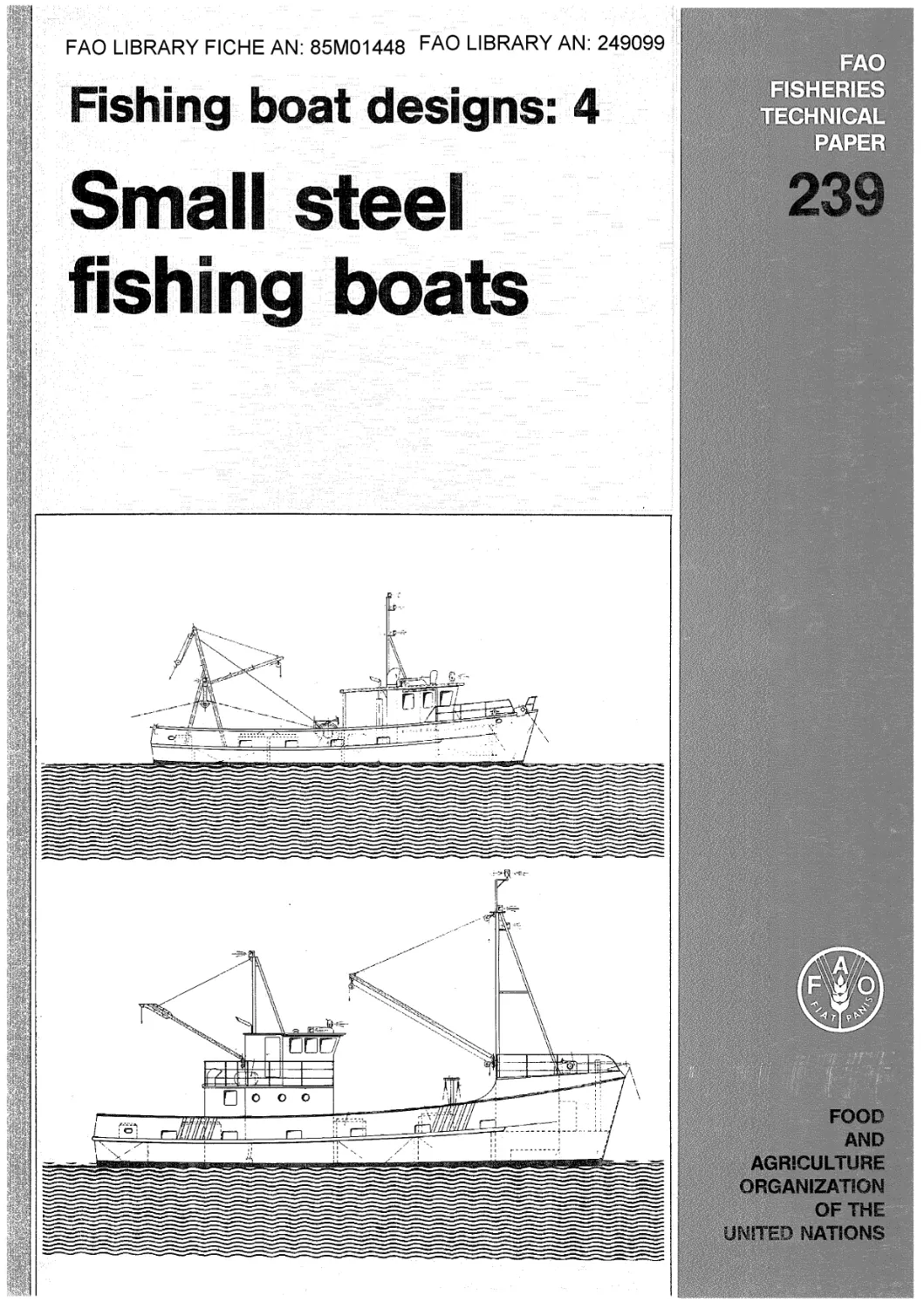
Fishing boat designs: 4
Small steel
fishing boats
’Ил1ЖсЖ
239
FOOD
AND
AGRICULTURE
ORGANIZATION
OF THE
UNITED NATIONS

Rshmg boat desngns: 4
Small: ste@B
fish ling boate
Prepared by
David J„ Eyres*
Fisheries Technology Service
Fishery Industries Division
The designations employed and the presentation
of material in this publication do not imply the
expression of any opinion whatsoever on the
part of the Food and Agriculture Organization
of the United Nations concerning the legal
status of any country, territory, city or area or
o4 its authorities, or concerning the delimitation
of its frontiers or boundaries.
M-41
ISBN 92-5-102108-2
All rights reserved. No part of this publication may be reproduced,
stored in a retrieval system, or transmitted in any form or by any means,
electronic, mechanical, photocopying or otherwise, without the prior
permission of the copyright owner. Applications for such permission,
with a statement of the purpose and extent of the reproduction, should
be addressed to the Director, Publications Division, Food and Agriculture
Organization of the United Nations, Via delle Terme di Caracalla, 00100
Rome, Italy.
ill
PREPARATION OF THIS PAPER
The paper contains designs of two general purpose steel fishing boats and general
guidance on boatbuilding in steel plus cost estimating for fisheries officers, vessel
owners and boatbuilders having experience in working with other materials.
Acknowledgement is made to G. Breekveldt, Marine Architects Ltd., P.O. Box 2642,
Auckland, New Zealand, for the designs shown and Adriana Barcali and Maurizio Carlesi
for draughting and layouts.
* Present address: c/o Marine Division
Ministry of Transport
Private Bag
Wellington, No. 2
ABSTRACT
This, the fourth of the FAO fishing boat design handbooks,
deals with the subject of small steel fishing boats.
The publication is intended to serve individuals and com-
panies with experience of structural steel fabrication, boat-
builders working with other materials who may wish to build
larger craft in steel, and finally fisheries officers and vessel
owners who require guidance on boatbuilding in this material.
Section 2 describes the material, the building site and
tools required, fabrication and outfitting of steel boats.
Section 3 contains information on protection against cor-
rosion and Section 4 presents a simple method of cost estimating
to construct a small steel craft.
The handbook also contains designs of 15 m and 21 m general
purpose steel fishing boats. These consist of general arrange-
ments, lines and hull construction drawings, steel quantities
and outline specifications,
Distribution:
FAO Fisheries Department
FAO Regional Fishery Officers
FAO Fisheries Field Projects
Selected Boatbuilders and Naval Architects
For bibliographic purposes this document
should be cited as follows:
Eyres, D.J., Fishing boat designs: 4. Small
1984 steel fishing boats. FAO Fish.
Tech.Pap., (239):33 p.

FISHING BOAT DESIGNS: 4
SMALL STEEL FISHING BOATS
Conteats
Page
1.	INTRODUCTION	1
2.	BUILDING IN STEEL	1
2.1	The Material	1
2.2	Premises and Site	2
2.3	Tools and Equipment	2
2.4	Marking Out or Lofting	4
2.5	Fabrication and Erection	5
2.6	Outfitting	7
3.	PROTECTION AGAINST CORROSION	8
3.1	General	8
3*2	Cleaning and Priming Steelwork	9
3.3	Paints and Application of	Paint Systems	9
3.4	Bi-metallic Corrosion	10
4.	COST ESTIMATING
ANNEX
Outline Specification for 15m and 21m Steel Fishing Boats	16
LIST OF FIGURES
1	Bending Press	19
2	Lofting Details	19
3	Sacrificial Anodes	20
4	Net Steel Weight	21
5	Manhours (Steelwork)	21
LIST OF TABLES
Page
1	Weld Details	22
2	Typical Paint Systems	25
3	Steel Quantities for 15m Vessel - Mild Steel Plates	26
4	Steel Quantities for 15m Vessel - Mild Steel Sections	27
5	Steel Quantities for 21m Vessel - Mild Steel Plates	29
6	Steel Quantities for 21m Vessel ** Mild Steel Sections	31
LIST OF
DRAWINGS
For 15m	Steel Fishing Boat
SB1- 1	General Arrangement
SB1- 2	Lines
SB1- 3	Offsets, Framing and Plating Diagram
SB1- 4	Hull Construction I
SB1- 5	Hull Construction II
SB1- 6	Sections
SB1- 7	Deckhouse
SB1- 8	Details of Keel, Skeg and Sternpost
SB1- 9	Sterntube and Shaft Details
SB1-10	Rudder, Stock and Tube Details
SB1-11	Details of Sliding Door
For 21m	Steel Fishing Boat
SB 2- 1	General Arrangement I
SB2- 2	General Arrangement II
SB2- 3	Lines
SB2- 4	Offsets, Framing and Plating Diagram
SB2- 5	Hull Construction I
SB2- 6	Hull Construction II
SB 2- 7	Deckhouse
SB 2~ 8	Sterntube and Shaft Details
SB 2- 9	Rudder, Stock and Tube Details
SB2-10	Details of Watertight Door
For 15m	and 21m Steel Fishing Boats
SB1/2-1	Typical Details of Deckhouse
SB 1/2-2	Typical Details of Bulwark and Berthing
SB2/2-3	Mechanical Steering Gear
SB1/2-4	Fish Hatch
SB1/2-5	Small Hatch Details
SB2/2-6	Typical Details of Longitudinal Framing
System
1
1.	INTRODUCTION
This publication in the FAO Fishing Boat Design series deals with the construction
of small steel fishing boats. By small steel boats is meant fishing vessels of less than
say 30 metres overall length where the required building facilities and equipment are
modest and the construction techniques somewhat different from those of larger shipbuilding
practice. Generally the construction of boats in steel is not considered below say 12
metres in length where steel is at a weight disadvantage and below 15 metres in the case
of tropical marine conditions because of corrosion rates on the thinner steel plate used.
The design of two different general purpose steel fishing boats of 15 m and 21 m overall
length are presented.
Simple hull forms are utilized to avoid the use of sophisticated equipment and
skills and the text provides information on the material and its maintenance, the neces-
sary building equipment and the important principles which differentiate steel boatbuilding
from general steel fabrication practices. It is not the intention to teach the basic
skills of welding and gas cutting, a knowledge of which is assumed and is not uncommon in
developing countries. The purpose of the publication is rather to show how these skills
can be adapted to steel boatbuilding. Detailed information on construction techniques is
not within the scope of the booklet and the notes are necessarily brief, but an attempt
has been made to cover the more important points and the drawings contain a great deal of
extra detail to help the inexperienced builder.
For steel hulls of less than 30 m in length, the equipment and building facilities
required are modest and can be compared with the traditional wood boatyard rather than
the highly automated steel shipyards producing larger vessels.
Notes on estimating steel weights and costs of steel fishing boats are also included.
Finally the layouts of the two designs presented are discussed in detail.
The two steel fishing vessel designs may be suitable for various fishing operations
within the Exclusive Economic Zones (EEZs) of selected developing countries but should
be adapted to local fishing conditions. For practical reasons full working drawings and
details of construction could not be included in this paper. The designs comply with
the FA0/IL0/IM0 Guidelines for the Design, Construction and Equipment of Small Fishing
Vessels, published by IMO. Scantlings are in accordance with good practice for this
size of craft and should meet the requirements of most regulating authorities. The
Organization, however, takes no responsibility that this will be the case and the onus
is on the builder to meet his legal responsibilities for plan approval and survey where
this is necessary.
It is also recommended that safety precautions specific to steel fabrication,
erection and outfitting be followed during the construction of the boats. Guidelines
from the ILO publication "Safety and Health in Shipbuilding and Ship Repairing" should
be followed.
2.	BUILDING IN STEEL
2.1	The material
Steel as a building material for boats is strong and easy to work. Welded joints
are equal in strength to the basic material if welders have sufficient skills and some
practice in making watertight structures. It is also easy to repair by cutting out and
welding in new material using facilities available almost anywhere. Steel does not burn
and will last for a long time providing proper protection against rusting is maintained.
Small craft, mainly these 15 m length overall, with thin steel plates, are very
sensitive to corrosion especially in tropical conditions. They need constant and time
consuming maintenance by regular rotational cleaning and repainting of the parts of the
hull subject to rust attack. Precaution against corrosion on the immersed parts of the
hull require the boat to be put ashore frequently for cleaning and maintenance. The
less accessible areas of the steel structure are troublesome to protect and require care
2
both during the design and construction phases to avoid the formation of inaccessible
rust breeding pockets. High maintenance costs of the hull in tropical environments should
be taken into consideration before a decision on construction of a steel fishing boat is
made.
A wide range of steels are marketed in the form of plates and a variety of sections.
For boatbuilding, plain low carbon steels which are reasonably priced and readily available
in most countries are more than adequate. It is recommended that the boatbuilder orders
from the steel supplier hot rolled mild steel plate and sections complying with British
Standard BS 4360, Japanese Standard JIS G3101 or US Standard ASTM A131-74 or equivalent
standards.
If a boat is designed to the rules of a particular regulating authority or classifi-
cation society, this should be clearly stated when ordering material to meet the chemical
and physical properties required by the rules. Such rules should then be observed during
the design, construction and trials of the boat.
Sections required for the two designs in this publication are limited to flat bars
and equal or unequal angles with some hollow rolled sections. There is no reason for the
boatbuilder to use a wide variety of sections.
A list of steel materials for the 15 m and 21 m designs in the handbook is given in
Tables 3, 4, 5 and 6. The quantities listed are net quantities and the percentages to be
added to give the quantity to be ordered are indicated below the tables. When ordering
plates for the hull and deck it is good small steel boatbuilding practice to order the
largest size of plate that can be handled to reduce wasste and cut down the amount of
working and welding required. The wastage figures given with the tables are based on
this assumption and if for some reason you are not able to utilize the largest plates,
add another 5 percent for wastage. Study the plate line body plan and deck plans and
decide how the largest available plates may be utilized before ordering. Also plan the
cutting of floors, brackets, etc., from standard plates to avoid excessive waste.
It is advisable to inspect the steel on arrival for defects particularly the plates
for flatness and delaminations. Reject any material that is not satisfactory and could
give trouble during fabrication and erection. Steel plates and profiles should be stored
properly to avoid bending under their own weight and material should be kept in sorted
packages for easy access.
2.2	Premises and site
Ideally the hull should be built within covered premises protected from the weather.
However, this is not always possible and temporary protection may need to be provided
for the critical welding operations during unfavourable climatic conditions.
The vessel should be erected on ground which can support its weight and which may
need reinforcing for this purpose. It is preferable that the erection site be adjacent
to water unless very heavy lift and transport facilities are available.
If a number of vessels are to be built as a new enterprise the installation of a
permanent launching way may be justified. This can be done for end launching by level-
ling a gradient of about 1 in 10 reinforcing the surface and arranging launching rails
to below the low water mark. The expense of fabricating a permanent steel cradle to
support the vessel during construction and for subsequent launching may also be justi-
fied. For a ’one-off* construction, unless a heavy lift is available, temporary but
adequate means of support and launching should be- considered before commencing building.
2.3	Tools and equipment
The tools and equipment required for a small steel boatyard are not extensive and
need not cost any more than those required for a comparable wooden boatyard. If general
steel fabrication is already undertaken, then the additional equipment is minimal.
3
2.3.1 Steel cutting equipment
For this purpose one or two oxygen/acetylene hand torch sets are sufficient for the
size of boats covered by this publication. Some items of this equipment should be specially
selected for boatbuilding use. The torch should be a combination unit so that tips for
other purposes than cutting can be used. A light torch with tip at right angles to the
handle is the most suitable. A two stage regulator is preferable to a single stage regu-
lator. There should be sufficient length of hose to reach any part of the boat during
construction with the gas bottles remaining on the ground. A light hose is preferred for
this purpose and should be that manufactured for this purpose and supplied with the cutting
equipment. A hand cart for transporting the gas cylinders will be found useful.
2.3.2 We Id in g e q u ipmen t
The first consideration relates to the availability of an electrical supply at the
site and if available the nature of that supply. When no electricity is available, where
the current is inadequate or where appreciable voltage fluctuations occur, a petrol or
diesel motor driven welding generator unit must be used and this could be utilized for
other power tools and lighting.
If a satisfactory mains electrical supply is available a wide range of commercial
welding machines of the preferred type can be obtained to operate on 230/460 volt three
phase 50/60 cycle supplies. The machines may be of the A/C motor D/C generator or
quieter rectifier type both of which incorporate cooling fans. For use in tropical
climates it is important to ensure that this cooling is adequate to protect the machine.
It is recommended that the boatbuilder should only consider using a conventional direct
current (DC) machine- with manual flux coated stick electrodes for building boats in the
size range covered by this handbook. For this purpose a machine capable of delivering
up to 200 amps should be adequate but versatility in the selection of current is desirable
to permit welding of a range of plate thicknesses. Multiple weld runs will be used for
the heavy plate thicknesses.
If a motor driven generator unit is to be used it should be noted that ordinary
electric generators are not suitable for arc welding. A properly designed arc welding
generator must be used if it is intended to make up a welding set using an existing
petrol or diesel motor, and the motor has to be matched to the generator for correct
power and speed. If at all possible a complete made up unit by a reputable manufacturer
should be purchased.
The number of units or output terminals required will depend on the number of welders
employed at one time. On the 21 m boat at least 3 welders could be employed on final
welding up if the boat is to be completed in a reasonable time.
Electrode and earth return (ground) cable sizes are related to current carried and
length and should not be of greater length than necessary which would make them difficult
to handle and inefficient. Use short lengths with cable connectors so that unneeded
lengths may be taken out of the circuit.
The electrodes used should produce a deposited metal which is as close in composi-
tion as possible to the parent metal. For the conventional mild steel construction
envisaged in this handbook a general purpose electrode capable of depositing weld metal
in all positions should be used. A reputable supplier of electrodes can give advice on
the availability and types of such electrodes. Store the electrodes in a dry space in
sealed containers and if the atmosphere is very humid and wet or any dampness is
suspected before use, then bake the electrodes in an ordinary oven at say 150°C.
When buying welding equipment for the first time the boatbuilder should examine
carefully all the available equipment, seek advice from local established steel fabrica-
tors if possible and deal with a reputable manufacturer of commercial welding equipment.
4
2.3.3 Lifting and plate handling equipment
Handling steel plates and the larger sections will necessitate the use of some
mechanical hoisting and hauling devices. Chain falls preferably of worn geared type are
recommended for lifting and a couple of ratchet action level hoists are very convenient
for pulling plates up into position or closing gaps. An old motor truck which can be
used around the building site if not on the road may be fitted with steam pipe or
similar sheer legs and a hand winch on the tray. This has proved to be a good investment
and versatile for lifting jobs around many yards. Clamps of various types are available
to provide lifting points on plates and the safest of these is that having a positive
locking grip. Crow bars are useful for lifting plate edges and solid steel round or pipe
rollers can be helpful in moving plates and heavy sections.
2.3.4 Press
A small hydraulic press which can easily be made up by the boatbuilder is shown in
Fig. 1. This can be used to put light curvature in the forward frames and beams as
necessary.
2.3.5 Miscellaneous tools
A range of small tools will be found necessary in fabricating and erecting the vessel.
These will include iron G cramps (smaller than those required for wood boatbuilding), heavy
duty electric power tools with grinding and sanding discs if possible, chipping hammers
for veeing thicker steel plate edges before welding and removing weld slag, 3 kg or
similar hammers for fabrication work plus steel measuring tape, spirit level and plumb bobs.
2.4	Marking out or lofting
The offsets (i.e. reference dimensions for the hull shape) for the two hull designs
incorporated in this publication have been faired. The body plans (Lines) in Drawings
Nos, SB1-2 and SB2-3 give the offsets and each transverse frame section can be drawn out
full size on a suitable surface. The line so obtained corresponds with the toe of the
angle frame (i.e. the inside of the plating) and the frame can be made accurately to this
line. It is recommended that unlike a conventional lines plan where only half the section
is drawn the full transverse frame section should be drawn, i.e. port and starboard sides
should both be drawn which will give greater accuracy and make it simpler to fashion floors
as well as the frames, beams and brackets.
The full size frame lines can be marked off on any suitable surface which will not
distort and on which the lines can easily be sighted and picked up when necessary. Sheets
of plywood painted white or even steel plates tacked together are commonly used. If
steel plates are used the main reference points should be punched up to give them some
permanence. As the majority of the frame lines are straight they can be drawn in with a
straight edge between the reference points or struck in by a chalk line. Forward of the
deck break where there is curvature in three or four frames, the reference points should
be plotted and a fair line drawn through them with a wood batten pinned or weighted to
the marking surface. It is important that the full size framing plan be drawn accurately
and the vertical centre line should initially be constructed perpendicular to the base
line by striking off arcs with a large beam compass made up with a wooden batten, nail for
centering and marking pencil or similar arrangement (see Fig. 2). Offsets are to be
accurately set off from the vertical centre line and horizontal base line. The deck line
in section is cambered and the standard camber curves are shown in Drawings Nos. SB1-3
and SB2-4. Given the height of deck at sides which may be joined by a straight horizontal
line and the height of deck at centre line for any .frame the standard camber can be set
off for that height above the deck at side line. A fair curve drawn through the camber
curve points using a wood batten as for the curved frame lines will give the molded deck
line which is the line of toe of the deck beam. Apart from the frame and beam sections
the stem curvature has to be lofted out full size and also the profile of the stern
assembly so that the correct setting of the sole piece and stern bar and rake of propeller
post are obtained.
5
Straight frame angle can be marked off directly on the marking surface. To obtain
the forward frame curvature a piece of 12 mm copper tube can be used as a template and
bent to the marked frame line. The angle bar frame can then be bent in the hydraulic
press to match the tube template and subsequently checked against the lofted frame line.
The 12 mm copper tube may also be used to provide a template for the stem bar curvature
and beam curvature if necessary. When checking the curved beams against lofted sections
mark on the beams the vessel’s centre line which will be found useful when erecting the
sections.
Bulkheads, floors and brackets can be drawn in on the full size plan and if available
sheets of a suitable thin opaque material can be laid over these to make patterns which
can be transferred to the plate. A number of these patterns can be nested onto a plate
to give the least wastage when floors, etc., are cut.
2.5	Fabrication and erection
Each frame section with beam should be fabricated and presented to the lofted frame
lines to check correctness of shape. Tack weld the components together first and fully
weld when checked. Re-check after welding and straighten if necessary.
The transverse frame sections and bulkheads when erected will form the framework or
’built in’ jig on which the platework and interior steelwork will subsequently be assembled.
For the two boats in this handbook we recommend that the frames be erected in the vertical
plane the correct way up. There are a number of builders of steel boats who advocate
building the hull in the inverted position which has advantages but has the major dis-
advantage that it has to be turned up the right way eventually. This would be a major
operation with either of these two boats and it is likely to be very difficult for the
small builders for whom the book is intended.
The method of fabrication of smaller hulls in turned up position can be relatively
easy if rotary jigs are used. These are not very expensive and quite simple in construc-
tion and application. Such a set-up facilitates not only the fabrication but avoids much
overhead welding which is of great advantage from the point of view of quality and costs.
Unless a large number of similar boats are to be built there is no advantage in
building a steel jig on which the plating is formed before the framing is inserted
(another practice adopted by some experienced builders).
A number of structural members can be fabricated or assembled prior to erection,
for example bulkheads with stiffeners and horizontal stringers or floors with stiffeners
and face bar also engine seats with web, bed plate and stiffeners.
When commencing erection the flat bar keel should be set up on blocks with its rake
measured above a horizontal line or wire strung along the blocks. The frames and floors
can then be measured off along the horizontal wire. Make sure that the keel is set up
at a height which will permit you to work underneath the hull comfortably when applying
the bottom plating. With the keel in its correct position the stem is set up and
plumbed vertical to ensure it is in the same plane as the keel then adequately supported
with temporary props. The pre-fabricated aft peak bulkhead can be set up in place and
transverse frame and bulkhead sections erected above the keel bar but plumbed perpendicular
to the wire or line on which they have been marked off. A wire stretched between the stern
and aft peak bulkhead centre line at top is used to check the common centre line of trans-
verse frame sections and bulkheads.
Stern frame fabrication and erection requires special attention because of the heavy
sections to be welded. The arrangement should be lofted as mentioned in Section 2.4 and
the components sole piece, propeller post, stern bar, boss and stern tube cut out on the
loft floor. The lower piece of the propeller post should be cut 6 to 10 mm oversize and
then trimmed exactly to length on erection when the boss and sterntube is aligned on the
boat. The sole piece may require some heating to put the knuckle in it. To illustrate
erection of the stern frame let us take the 21 m vessel as an example (see Drawings Nos.
SB2-5 and SB2-6). The erected aft peak bulkhead D and floors C and C/D should have
oversize cut-outs for the stern tube and a wire put through in the usual manner to repre-
sent the shaft centre line which in this case is parallel to the keel line. The boss
6
and sterntube assembly is aligned to the wire shaft centre line through the cut-outs and
has a welded flange on the gland end which can be tack welded to the bulkhead to locate
the starntube at that end. The lower portion of the propeller post is plumbed (with
spirit level) on the sole piece which has been tacked in place to the keel and can be
trimmed to the correct height for centering the boss. The length of the upper portion
of the propeller post is not critical. The lower propeller post is tacked in place with
bracket to sole piece and bracing to ensure it is in the same plane as the keel and the
boss is then tacked to it. The stern tube may also be lightly connected to the two
floors with plate filling pieces. The upper propeller post with stern bar and connecting
bracket which may be assembled and checked on the loft floor should then be erected,
plumbed and checked for height above the base line at the transom before being propped
in place. The transom and other sections between the aft peak bulkhead and transom can
then be erected. Welding up the stern frame requires special care to avoid distortion
of the shaft line. The sterntube should only be tacked up and not fully welded until as
much as possible of the structure and shell plating in this area is fully welded. Both
pieces of the propeller post are *veedf before erection using a chipping hammer to permit
full penetration welds at the boss and sole piece. Note that the propeller post is
chamfered on the aft face if possible to avoid a blunt trailing edge detrimental to
hydrodynamic performance, and, in the case of the 15 m vessel, on the forward face of
the propeller post to reduce it to the same thickness as the skeg plate to obtain a
satisfactory weld connection (see Drawing No. SB1-8). Get the steel stockholder to do
this for you if you cannot handle it. A large number of manual weld runs will be neces-
sary in view of the thickness involved and these should be done with alternate runs on
each side of the assembly and alternately top and bottom to minimise distortion.
The initial.erection of keel stem and stern assembly and transverse framing with
bulkheads should be done very carefully and it is worth taking time to check that every-
thing is accurate at this stage. Do not proceed further until entirely satisfied with
the correctness of the erected structure.
The positions of the longitudinalscan be marked on the midship frame stern or
forward frames as shown on the hull framing diagrams (Drawings Nos. SB1-3 and SB2-4).
Each longitudinal frame line can be faired on the erected transverse frames which are
then marked and the cut outs made before the longitudinals are fitted and welded in
place. With the longitudinals in place you have a very rigid faired framework on which
to assemble the plating.
On the 15 m vessel the single skeg plates are templated and fitted at the boat
after erection of the propeller post and should be carefully welded in similar sequence
to that for other members of the sternframe (see Drawings Nos. SB1-4 and SB1-5). On
the 21 m vessel the double plate skeg is plated first, that is before any shell plating
is fitted. The skeg plates are carried 12 mm or so above the inner surface line of
bottom plating (see Drawing No. SB2-5) so that a good weld connection is made and for
this the floor should be suitably notched at the intersection of the plates. When
plating this skeg you will need to put in a wedge or filling piece in way of the rabbet
at the keel (which is 25 mm thick) where it meets the propeller post which is 60 mm
thick. The side plates should then be knuckled so they fit to both the keel and pro-
peller post at this point (see Drawing No. SB2-5).
Plating of the hull should be carried out systematically and carefully for accuracy.
Hardboard or similar templates lifted off the hull will give best results. If you plate
the sides first it is easier to get at the inside to clamp and tack plates in place.
The bottom plates can be lifted and shored or chocked in place. Plates should be fitted
alternatively to port and starboard to avoid pulling the centreline structure out of
shape which may occur if first one side and then the other is plated. In large vessels
it is usual to carry out as much of the installation of steelwork and heavy outfit work
in the hull as is practicable before starting the deck plating.
For smaller vessels there can, however, be advantages in putting on the deck first
provided large access holes are left- Work above the deck can be carried out at the same
time as that below and a plated deck provides some shelter from the elements when building
outside.
7
Welding the hull plating should be carried out carefully and in a balanced fashion
to avoid distortion as mentioned above. Concentrate on the longitudinal seam welds
first starting off at amidships and working towards both ends. Start with the seams at
chine and sheer. Maintain the same amount of weld each side of vessel and do not try to
do too much at any one time. Keep the weld runs short.
When the shell plating has been welded9 particularly the longitudinal welds, the
frame to plate welds (which are intermittent welds) are made. Framing should not be con-
tinuously welded to the plating which will cause appreciable distortion. The intermittent
welds are extremely strong if compared with other methods employed for fastening frames
in boatbuilding. Bulkheads should be left until last because continuous welds to the
shell are required to maintain watertightness and unsightly distortion can occur if this
is not done carefully. Use short lengths of weld about 35 mm at a time with cooling in
between welds.
Although more straightforward than the hull plating, the deck plating should also be
carefully and systematically fitted and welded before the deck beams are welded to it by
intermittent welds.
Welding details for steel boats are given in the welding schedules in Table 1.
2,6	Outfitting
Fitting out the machinery space of a steel boat is probably easier than in boats of
other materials;, it being relatively simple to cut and weld attachments and seats for
items which are compatible with the hull material. The outfitting of the accommodation
is more difficult because the linings and furniture are inevitably of a different
material. Connections for linings, etc., are normally made to wood grounds which are
strategically connected by bolts through the framing or bylings welded to the framing.
The number of holes drilled in frames, stiffeners and beams should be kept to the
minimum possible and lugs are preferred where the framing member is a critical strength
carrier. Details of lining connections should be illustrated in the working drawings.
The degree and standard of lining out will depend on the quality of finish required by
the owner and any regulations concerning fire resisting materials and accommodation
standards. Insulation behind the linings is optional depending on climatic and habita-
bility conditions.
The insulation of fish holds in a steel boat deserves special mention. The 15 m
vessel has a dry fish hold with insulation material placed between the frames after
coating the steel with a bitumastic paint (see Drawing No. SB1-1). Wood battens are
bolted to the frames (or to steel lugs welded to frames) and further insulation material
placed between the battens. Linings may be of sheet metal (aluminium or galvanised
steel) or plywood with a fibreglass skin. The linings may be screwed to the battens or
where a metal lining is used a compatible metal flat bar is sometimes screwed to the
wood battens and the lining welded to the bar to give a seam free surface.
The use of chilled sea water tanks in the 21 m vessel complicates the construction
somewhat (see Drawings Nos. SB2-1 and SB2-2). For these tanks the drawings indicate
steel liners welded to steel lugs which have been intermittently welded to the frames,
thus the lining of the tanks is well within the line of the side frames. Other vessels
have and are being built with fibreglass liners over insulation material sprayed onto
the hull or fibreglassed plywood liners over insulation at the hull sides. Considerable
loads are imposed by the tank contents and the author has experience of fibreglass ply-
wood liners giving way after a short period of service hence the preference for the more
structurally sound steel liners. Most European builders appear to weld the liners
directly to the heel of the frames but for areas where higher sea temperatures are
experienced the heat loss with this arrangement is too high. It is preferred that the
steel liner be within the heel frame to reduce the heat transfer through the frame in
vessels which are to fish in warmer waters. The insulation should be put up in pre-
formed slabs. Foamed in place insulation is prevalent for void spaces. Non-combustible
insulation material should be used so that the liners may be welded to the steel lugs
after installation of the insulation. Be cautious of fumes from the heated insulation
during the welding operation.
8
Installation of machinery particularly the main engine is best left to engineers
experienced in this work and the builder may wish to sub-contract this work, Note only
that the vertical main engine bed plates (longitudinal bearers) with heavy flat bars on
the top should be integrated with the hull structure and possibly welded to the bulkheads
at each end (See Drawing No, SB1-4).
Foundations of all machinery should be strong and stiff enough and be welded to the
hull structural members.
The mechanical steering system for the two boats shown in Drawing No. SB1/2-3 in-
corporates a wormgear speed reducer of standard type which can be readily purchased from
most machinery agents. A reduction ratio of between 10 to 1 and 15 to 1 is generally
used. The speed reducer should have an extra bearing on the output shaft. The standard
speed reducer wormgear has a right hand thread and if installed the wrong way round the
ship will turn in the opposite direction to the wheel.
Propeller shafts for steel craft are normally made of bronze or stainless steel with
bronze liners working in ferrobestos lubricated bushes (see Drawings Nos. SB1-9 and SB2-8).
They are usually tapered at both ends and keyed to match the propeller and the half
coupling.
If the main engine is situated well forward an intermediate shaft of forging quality
mild steel should be mounted with half couplings or forged flanges to match the propeller
shaft and engine crankshaft flanges.
If a nozzle is being manufactured care should be taken to obtain a smooth shape and
the design clearance between the nozzle and propeller tips should be accurately maintained.
The pipe systems on a steel boat do not differ from those used on boats constructed
in other materials but it is easier to fix them as holders can be welded to stiffeners.
Welding holders directly to the shell, bulkheads, and decks should be avoided as far as
possible as this could injure locally the strength of the main hull structure if not pro-
perly done. Deck equipment must be mounted in strengthened areas and for heavily loaded
machinery and rigging reinforcements under the deck should be allowed for in the hull
construction drawings.
Small items of deck equipment can be welded over beams or local reinforcing brackets,
angle or flat bars can be added under the deck.
The rules for electric wiring on small steel vessels are the same as for other boats.
Cables are fixed to cable trays welded to the structure. The cabling should avoid water
contact, not being sited low in the bilge and where possible kept below deck or otherwise
given full protection. Cables exposed to the weather should be led in pipes or inside
masts and where a penetration through the deck or any other watertight partition is
necessary an efficient gland is important.
3.	PROTECTION AGAINST CORROSION
3.1	General
One of the greatest drawbacks to the use of steel in building smaller fishing vessels
particularly for tropical areas is the materials’ tendency to rapidly corrode in sea water
if not adequately protected and maintained. Unfortunately maintenance of commercial
vessels in developing countries is often minimal and the steel boatbuilder from the start
should make the assumption that the boat will not receive as much maintenance as it should
once it has left his yard. This infers that a greater margin for corrosion on scantlings
may be in order and application of the initial protective systems in the boatyard needs
to be of a high standard. Every effort should be made in the construction to avoid areas
which are difficult to get at for maintenance and painting purposes. The addition of
steel structures for cosmetic purposes which add to the maintenance requirement should be
discouraged and the structure limited to the purely functional.
9
It has been found that the composition of mild steel within the practical range for
structural plating has little influence on its corrosion rate in sea water, Thus the
boatbuilder should be wary of claims for special and expensive mild steels.
3.2	Cleaning andpriming steelwork
Steel plates and sections are generally formed by the hot-rolling process during
which the surface becomes oxidised and they leave the steel mill with a thin coating of
iron oxides or mill scale. It is very important that this mill scale and any rust, grease,
dirt or other surface pollution is removed before applying any surface coating. The ideal
means of ensuring complete cleaning of the steelwork surface is to sandblast the hull
after erection and immediately apply a zinc or aluminium based priming paint. This
priming coat should have the necessary film thickness to give adequate cover of the
roughened blast-cleaned surface.
Sandblasting is an unpleasant job and can be hazardous particularly within the hull
but is well worthwhile despite the greater expense and should be undertaken if at all
possible even if only for the external hull. It is not usually necessary to invest in
such equipment as it can be hired in many countries. Particular care should be taken
to ensure the equipment is in good condition and that only the correct silica sand is used.
The application of the priming paint should be done as quickly as possible after the
surface has been sandblasted. In humid countries evidence of rusting may re-appear after
only one hour, therefore a limited area of the hull should be sandblasted followed by
immediate priming before proceeding with further areas. The interval between sandblasting
and priming should never exceed 2 hours and the paint should be hard dry before further
sandblasting is undertaken. It may be possible to buy in steel itfhich is already blasted
and primed but generally this can only be done when placing large orders with the steel
mill.
If sandblasting equipment is not available then the millscale and surface pollution
has to be removed as completely as possible by other means. Plates which have stood in
storage exposed to the weather for a lengthy period will be heavily rusted and this rust
may be removed by grinding, careful scraping and wire-brushing by hand, which will take
much of the millscale with it. It cannot, however, be guaranteed to remove all the mill-
scale. If available, flame cleaning is a better alternative to hand cleaning but care
should be taken not to overheat the plates, which may change the physical properties of
the steel.
Note that if the surface is not sandblasted then advice should be sought about the
priming paint subsequently applied since many modern high duty paints are formulated only
for application to well prepared surfaces. Paint manufacturers may be reluctant to give
advice on this subject for obvious reasons and if faced with this problem a traditional
paint system should be applied and not a sophisticated high duty system.
3.3	Paints and application of paint systems
The very important requirement for good preparation and priming has been dealt with
in the previous section. Any paint system being only as good as the prepared surface to
which it is applied. Paint manufacturers will provide the builder with details of com-
plete paint systems for steel boat hulls which may be divided into three basic categories.
Firstly, there are the traditional systems with conventional bitumastic and aluminium or
lead paints, secondly the more sophisticated one component (or pack) systems using say
chlorinated rubber or vinyl paints and thirdly the sophisticated two component systems
using epoxy paints. If a traditional system is used it will almost certainly need renewal
after one year’s service. The one component system will give two years service and
possibly three and the two component system will give three years’ service. A traditional
system is best suited to poorly prepared steel and a construction yard with limited faci-
lities. The one component system may give limited protection under such circumstances
but in this case the two component system should not be considered at all. For an
established yard regularly building fishing vessels with sandblasted steel the second
system is commonly used mostly based on a chlorinated rubber paint system.
10
Table 2 indicates typical steel boat coating systems including deck and house as
well as the hull» It is debatable as to whether it is necessary to apply anything more
than the cheap traditional paint system to areas other than the hull in fishing vessels.
Anti-fouling paints which prevent marine growth on the underwater hull come in
different strengths and formulations and if the vessel is to operate in tropical or semi-
tropical conditions where fouling could be heavy, ensure that a super tropical or similar
anti-fouling paint is used. Longlife anti-fouling paints should be used with the high
duty paint systems if the benefit of longer periods between drydockings is to be achieved.
Follow the manufacturers recommendations as to the minimum and maximum times allowed
before the newly applied anti-fouling coasting is immersed.
Internal spaces below deck should also be painted carefully in accordance with paint
manufacturers recommendations. Particularly prone to corrosion are the bilges and steel
areas behind fish hold linings and inside the skeg which should be treated with bitumastic
coatings. The insides of fresh water tanks should be coated with a substance which will
not taint the water. A cement wash is often applied. Fuel tanks should be left unpainted
internally and covered by a thin layer of oil after cleaning.
Other internal surfaces can be primed with traditional lead or aluminium based paints
and finished with gloss enamel paints.
3.4	Bi-metallic corrosion
A simple electro-chemical corrosion cell is formed by two different metals immersed
in an electrolyte solution (sea water) and connected externally- The bronze propeller
and steel hull of a fishing boat in sea water are a classic example of such a cell.
There will be a small conventional electric current flow from the cathode (the propeller)
to the anode (the steel hull) at which corrosion will take place. To prevent corrosion
in such circumstances it is normal practice to fit sacrificial anodes to the hull in way
of the propeller and in way of other immersed bi-metallic structures. Generally such
sacrificial anodes are of high purity zinc which is more anodic than steel, i.e. current
flow is between the propeller and the zinc anode and preferential corrosion of the zinc
anode occurs.
Information on the fitting of zinc anodes should be sought from the manufacturer if
possible but the main point is to ensure that the zinc is of as high a purity as possible.
A guide to the amount of zinc anodes to fit and location is given in Fig. 3. Welding
lugs are normally cast into the zinc block so that they may be attached to the hull.
Make sure they are not painted over after fitting.
4.	COST ESTIMATING
Before building a steel vessel the parties involved will wish to know with reasonable
accuracy the likely cost. From the builder1s point of view it is imperative that the
cost estimate be accurate if he is to stay in business in a competitive economy. There
is no magic formula by which the cost can be immediately found and the more accurate the
desired estimate the more detailed will the cost data have to be and a greater breakdown
of material and labour costs will be needed. This section looks at the question of cost
estimating for steel boats of the type presented in this handbook and indicates desirable
data to be collected and applied. Cost data will vary considerably from one country to
another and within countries, therefore only local knowledge can provide the builder with
the final figures to meet his own situation. For anyone building a steel boat for the
first time our advice would be to make the costing as detailed as possible. With more
experience and data short cuts in the costing may be adopted.
Firstly, if we consider the basic steel costs it is normal practice to estimate
weights and subsequently steel costs based on net weights of steel used in previous
vessels. The net weight is converted to an invoiced weight for this purpose by adding
a margin for wastage. The net weights of steel for boats having similar scantlings and
proportions to the two designs in this handbook are given in Fig. 4. An invoiced weight
for steel may be obtained by adding 10 percent wastage to the net weight of steel plate
and 5 percent wastage to the net weight of sections. Where the builder is inexperienced
it would be prudent to increase these margins to 15 percent and 10 percent respectively.
The average local cost per ton of steel plate and sections may be obtained from the
supplier.
11
For greater accuracy in estimating the steel costs the average cost per ton of plate
and sections may be considered separately since there is often a significant difference
(see Tables 3, 4, 5 and 6). Also a number of very heavy rolled sections may be considerably
more expensive than the rest and these can be added separately. These sections may, in
fact, be quoted on a cost per length basis rather than per ton.
Having obtained the total material cost for steel, the cost of welding consumables,
cutting gases, etc., may be estimated as a percentage of this total. An average figure
would be 15 percent.
Labour costs for the steelwork and other work are determined from the recorded hours
worked on previous boats. Any efficient boatyard will keep detailed records of the hours
worked by different traders on various components of the boat. For comparative purposes
when dealing with steelwork the total hours may be converted to a manhours per ton of
steelwork ratio. The total hours worked by a small experienced steel boatyard in a
developed country constructing boats similar to those in this handbook are shown in
Fig. 5. The manhours recorded by inexperienced boat builders in countries where materials
and tools, etc., are not readily to hand and climatic conditions are difficult may prove
to be 50 to 100 percent higher. For preliminary costings an average figure for manhours/
ton for the total hull and house steelwork may be sufficient. For greater accuracy the
boatbuilder may sub-divide the steelwork into components where there can be a marked
variation in manhours depending on the complexity of the work. Typical subgroupings are:
(1)	Framing and Bulkheads
(2)	Hull Plating
(3)	Deck and Hatches
(4)	Deckhouses
(5)	Bulwark and Belting
(6)	Tanks
(7)	Mast, Boom and Gantry.
Manhours/ton on the last two items are much higher than on the other items.
Knowing the manhours required for the steelwork this may be converted to a labour
cost by multiplying the total manhours by an hourly wage rate. This average hourly wage
rate is not usually that paid to a single tradesman employed on the boat but is in effect
what is sometimes referred to as a 1 charge out7 rate for labour. That is the total wage
bill for the boatyard plus cost of ancillary benefits paid to employees and charges to
the yard resulting from employment of personnel plus all overheads determined for a
certain time period. This figure is reduced to an hourly rate and divided by the number
of persons actually employed in boat construction to give the manhour cost rate. This is
obviously somewhat higher than the take home hourly pay rate of the tradesman.
The steelwork which in weight and physical terms may constitute the greater part of
the finished boat may in cost terms be as little as 25 percent of the total. This item
is in effect the easiest to cost and the machinery and outfit which constitutes the bulk
of the cost can prove more difficult and give rise to greater errors. A large proportion
of this will need to be costed individually.
The major ’bought in’ items should be costed by obtaining quotations from the manu-
facturers or his agent. The following would fall into this category:
(1)	Main engine, shafting and propeller.
(2)	Auxiliary machinery such as generators, pumps, power steering and
refrigerating plant.
(3)	Winches.
(4)	Fishing gear such as power blocks, net drums, special davits, etc.
(5)	Electronic devices such as radios, fishfinders, etc.
Installation of these items is costed on the basis of a knowledge of the material
and labour costs involved in the installation of each item. Some of this installation
work may be sub-contracted and a quotation from the sub-contractor is necessary.
12
The remaining general outfit of the boat may be divided into two groups: hull outfit
and machinery outfit» For a first estimate of the hull and machinery outfit weights it
is not uncommon for designers to employ the so-called Cubic Number (CUNO) principle where-
by weights are compared on a volumetric basis for like hulls. The CUNO of a vessel is
the product of multiplication of the vessels overall length, beam and moulded depth.
For example the 15 m vessel has a CUNO of 15 x 5 x 2.4 - 180 and the 2,1 m vessel a CUNO
of 21 x 6.5 x 3.6 « 491. To illustrate the method let us consider the hull outfit weight
of the 15 m vessel which is 4.1 tons and use the CUNO ratio to estimate the hull outfit
weight of the 21 m vessel. Thus,
Actually the hull outfit weight of the 21 m vessel is 12.3 tons but there is a non-
proportionately greater amount of fish hold insulation in the larger vessel which would
have to be taken into consideration.
It is proposed in a number of publications that the subsequent costings of hull and
machinery outfit be based on a cost per ton of outfit weight for labour and material.
While this is sufficient for a preliminary estimate, in practice, where greater accuracy
is required, this is difficult because many of the items normally associated with hull
and machinery outfit have considerable variations in material costs and manhour rates.
For the hull outfit of a steel vessel, it is suggested that this be sub-divided
into the four following categories for greater accuracy:
(1)
(2)
(3)
(4)
Fish Hold Lining
Accommodation outfit and miscellaneous woodwork
Hardware - windows, vents, handrails, ladders, etc.
Sandblasting, painting and anodes.
Given the costs for a similar vessel of like proportions the fish hold lining costs,
both material and labour, may be compared in the ratio of the respective hold capacities,
i.e. per cubic metre of fish hold. The accommodation outfit and hardward may be compared
using the CUNO method and since paint costs are generally established on a cost per
square metre basis, it is suggested that they be compared on a length squared (L^) basis.
In costing the labour any change in the hourly rate since building the previous vessel
should be taken into account. Adjustment on a percentage basis should also be made for
increases in material costs.
The machinery outfit can be sub-divided into the three following categories for
greater accuracy.
(1)
(2)
(3)
Engine related systems
Pipe systems
Electrical.
The first item which includes exhaust, controls, sea connections, lub oil tank and piping,
is probably best calculated directly by individual component. It is difficult to relate
it to engine size or cost and is independent of vessel size. As a preliminary estimate
it may be 15 to 25 percent of the engine cost, the higher figure being for the cheaper
model of engine. Pipe systems which include bilge, ballast and fire main, and general
service systems, can be compared on a CUNO basis since they are a function of the size
of the boat. The electrical system should be costed for the boat either by quotation if
sub-contracted or by itemised material costs and manhour estimates if the boatyard is
undertaking the work. Expensive items like switchboards should be costed by obtaining
quotations.
To illustrate	«hod of cost estimating an example for the 1.5 m vessel follows.
This example is for______Lal and labour costs at the time of writing and for an ex-
perienced boatyard __ ,__ industrially developed country. Thus whilst the calculation
represents a true situation it should only be treated as an example of the method and
the figures given should not be used for an estimate at a later date or in another
situation.
13
Cost Estimate for 15 m Steel Trawler
Item 1, Steelwork (Hull and Deckhouse)
Average steel costs
Mild steel plate	$	560/ton
Mild steel sections	$	645/ton
Tube and RHS material	$	850/ton
Weight of steel (tons) as per Tables 3 and 4:
Net	Invoiced
Plates Sections	14.8 5.2	+ +	10% 5%	16.28 5.46
Of the sections it is	estimated that 1.5 tons	net is	tube or RHS,	i.e. 1.58 tons of
invoiced steels leaving 3.	88 tons of other section	steel.
Steel cost
Plate	16.28	tons	x	560	~ Sections	3.88	tons	x	645	= Tube and RHS	1.58	tons	x	850 Total Electrodes and consumables (4-15%)	- Total Labour (from Fig. 5) = 4200 manhours at a charge rate of $11 per hour 4200 x 11	= Total for steelwork Item 2. Bought in items (1)	Main engine-quotation Installation materials and labour (2)	Shafting and propeller - quotation Installation materials and labour (3)	Motor Generator - quotation Installation materials and labour (4)	Steering Gear - quotation Installation material and labour (5)	Hydraulics for winch - quotation Installation material and labour	$ 9,117 $ 2,503 $ 1,343 $ 12,963 $ 1,943 $ 14,908 $ 46,200 $ 61,108 $ 24,500 $ 7,000 $ 31,500 $ 10,000 $ 1,600 $ 11,600 $ 3,000 $	800 $ 3,800 $ 2,500 $ 2,500 $ 5,000 $ 1,800 $ 2,800 $ 4,600
14
I	- quotation material and labour	$ £	4,500 850
		$	5,350
(7)	- quotation
		$	2,000
		$	1,500
		£	400
	(includes	$	3,900
(8)	Windlass ™ quotation	$	850
	Installation material and lau.	£	450
		$	1,300
(9)	Anchors and cables - quotation	$	1,200
	Installation material and labour	£	280
		$_	1,480
	Total for bought in items	$	68,530
Item 3.	Hull Outfit
Previous boat built of similar type, 22 m length
with CUNO of 396 and 80 m3 fishhold capacity
had following costs in US dollars:
Material	Labour
Fish Hold Lining	35,000	5,440
Accommodation outfit	12,700	25,080
Hardware	2,350	10,600
Painting and Anodes	5,800	5,950
If since building this boat material costs have	risen
8% and the labour charge rate from $10 to $11	per hour
then for the 15 m boat, CUNO 180, fishhold 33	m3 e
Fishhold Lining
3 3 Material = 35,000 x	x 1,08 oO	$ 15,590
33	11 Labour	= 5,440 x — x q—- oU	LU	$ 2,470
	$ 18,060
Accommodation Outfit
Material = 12,700 x	x 1.08 396	$ 6,230
T -1	о r non	180	11 Labour	= 25,080 x ТТН x TH 396	10	$ 12,540
	$ 18,770
Hardware
Material = 2,350 x	x 1.08	= 396	$ 1,150
T ,	qn z180	11 Labour	= 10,600 x rr? x —	= 396	10	$ 5,300
	$ 6,450
15
Painting and anodes
Material	=	5,800	X	(—)2 k22'	X	1.08		$	2,910
Labour	=	5,950	X	(—)2 ^22?	X	11 10		$	3,040
$ 5,950
Total for Hull Outfit	$ 49,230
Item 4. Machinery Outfit
Previous 22 m boat costs were in US$:
Material		Labour 11,960
Pipe Systems	9,600
Our pipe systems Material = 9,600 x 396	x 1.08	=	$ 4,710
Labour	= 11,960 x 396	11 X 10	=	$ 5,980
Engine related systems Say 20% of main engine quotation (24,500 x 0.2)		$ 10,690 =	$ 4,900
Electrical
Quotation received	~		$_ £	6,000 21,590
	Total Machinery Outfit
Item 5.	Miscellaneous Costs (includes launching, insurance, trials, surveys, etc.)	£	6,000
Item 6.	Ballast	£	2,000
Item 7.	Nozzle	£	5,000
GRAND TOTAL
Margin (5%)
TOTAL
$213,458
$ 10,672
$224,130
16
ANNEX
OUTLINE. SggCIFW№ON_ FOR
15 ;;ux AND..21j.. STEEL FISHING. BOATS
The two designs illustirated in this handbook represent two quite different arrange-
ments but having hulls which could be utilised with alternative layouts to suit a parti-
cular fishery, Basically both boats could be considered multi-purpose although the
arrangements shown illustrate deck equipment for one particular type of fishing.
15 m Steel Fishing Boat
The design as presented in Drawing No. SB1-1 is purely for stern trawling and such a
design may be utilised for one boat bottom trawling in coastal waters and both bottom and
mid-water pair trawling. Where the fishing may be seasonal limiting the bottom trawling
to a part of the year then it is useful if the vessel can be utilised without major modi-
fication to practice other forms of fishing. In this case using the basic hull design
the deck equipment could be re-arranged to allow the vessel to be operated as a combina-
tion trawler/purse seiner or as a long liner/gill netter. Utilised solely as a trawler
the stern gantry arrangement is preferred to carry the trawl blocks with a direct warp
lead from winch and tackle for lifting the cod end over the transom. If the vessel were
to be used as a combination trawler/purse seiner3 the deck layout should be rearranged to
provide a mast and boom for handling both the trawl cod end and the purse seine. Portable
trawl davits should also be included so that the davit can be removed from the side on
which the purse seine net is to be hauled. The offset wheelhouse is so placed to provide
additional working space on the starboard side for either handling the purse seine or
for siting a net/line hauler for line and gill net fishing. The hauler should be posi-
tioned fonvard where the helmsman can see the line or net coming aboard and there needs
to be adequate room to work around the hauler. For purse seining the purse davit could
be arranged on the starboard side with pursing wire leads from the athwartships winch
drums to lead blocks at the rear of the house hence to the purse davit, (See FAO Fisheries
Technical Paper No. 1885 Fishing Boat Designs:3 - Small Trawlers). The house can be
arranged on the centreline if the vessel is intended only for stern trawling or offset
to starboard if the owner favours fishing from the port side.
The vessel has a large working deck area aft with raised forward deck for protection.
An insulated fish hold for stowage of fish on ice is provided. With the insulated hold
aft in this type of boat and to utilise fully the space5 it will tend to have restricted
depth aft and therefore two hatches are fitted to make loading and discharging easier
and reduce wastage in warmer climates. Typical fish hatch construction is shown in
Drawing No. SB1/2-4. The hold can usefully be subdivided for carrying ice to the grounds
and smaller quantities of fish species if so desired. The hold in any case should be
fitted with removable and semi-permanent fish hold divisions about 1.5 m apart. Access
for inspection and re-packing of the stern gland is provided by a small section of port-
able insulation at the bottom of the fish hold in way of the shaft. It is preferred
that lubrication of the bearing is done remotely from the engine room aft bulkhead area.
Accommodation consists of a wheelhouse with cooking and food storage/preparation
facilities adequate for some three to four days at sea. A separate toilet/shower with
entrance from the open deck is provided and there is below deck sleeping accommodation
xvith four berths, A sliding door? shown on Drawing No. SB1-11, on the helmsman’s side
of the wheelhouse9 does not interfere with the deck area and permits him to view any
fishing operation on the deck in the vicinity of the wheelhouse. A good view of the
winch and after working deck area which is a prerequisite of stern trawling operations
is also afforded the helmsman by the wheelhouse location and windows at the back of the
wheelhouse. The deckhouse construction is shown in Drawing No. SB1-7.
Deck gear consists of a two drum trawl winch with linked spooling equipment neces-
sary for the direct warp lead to the stern gantry. The winch may be hydraulically
driven with pump driven from the power take off on the main engine (or auxiliary engine)
or can be mechanically driven with chain or belt drive from a pulley on the main engine
power take off to a layshaft arrangement. A winch with a pull of 1 1/2 tons at mid drum
17
and drum capacity of 1000 m of 12 mm diameter warp would be suitable for this particu-
lar boat. The anchor wire can be handled by the winch as shown on the general arrange-
ment drawing, the wire being stowed on a separate reel. To aid the handling of the cod
end and other fishing nets over the transom it is often good practice to fit a steel
roller at the transom bulwark top. With a steel boat there is no reason why the upper
rail of the transom should not consist of a heavy duty tube as presented in this design
which serves the same purpose as a roller without its disadvantages. Maintenance of
rollers and the snagging of nets at its support bearings are particularly troublesome.
If purse seining operations are undertaken from the one side it is very important to
ensure that the bulwarks on this side and transom are free of protuberances and sharp
corners which can snag and tear nets. The stern gantry is arranged with the uppermost
cross member supporting the cod end hoisting tackle inboard of the transom so that the
cod end swings into the deck area for discharging when lifted above the transom.
Retractable arms carrying the eyes for the trawl blocks are fitted to allow these to
be stowed inboard of the belting line and the stern gantry carries a 1/2 ton SWL derrick
for handling catches alongside or lifting gear. Provision can be made for adjusting the
height of the trawl block for clearance of different trawl door sizes.
An economical heavy duty marine diesel engine has been shown in the design drawings
but alternative main engines may be fitted in accordance with the owners and builders
preference and availability. The Yanmar 6RD CGCE engine shown has a continuous rating
of 165 hp at 1450 rpm and with a 3.55 to 1 reduction gearbox and 42" (1070 mm) diameter
propeller in the nozzle gives an estimated thrust at 4 knots towing speed of almost 2.5
tons. With the nozzle installation in this boat a trawl of similar size to that for an
installed power of 210-230 hp without nozzle can be handled with savings in investment
and running costs.
Three tons of concrete ballast equally distributed fore and aft as shown in the
General Arrangement plan is poured in the void spaces between floors after coating the
steelwork with a biturnons paint. This seals these inaccessible areas and improves the
vessels stability characteristics.
The rudder, stock and tube details are shown in Drawing SB1-10.
21 m Steel Fishing Boat
The arrangement for this vessel features accommodation and engine aft with a dry
fish hold and three fish tanks forward as shown in Drawings Nos. SB2-1 and SB2-2. This
type of arrangement is preferred in various areas for purse-seining and other types of
fishing particularly in more exposed waters. The purse winch is located in the shelter
of the forecastle and has adequate lead lengths to the purse davit located opposite on
the starboard side well forward of amidships to aid maneuvering when pursing and handl-
ing the net. Operations are easily observed from the bridge. A maximum clear working
deck area is achieved in the forward part of the ship and the forecastle could be
extended further aft on the port side to protect the winch and fish handling area from
the sun or inclement weather if so desired. The open spaces at the sides of the deck-
house particularly on the starboard side and aft deck permit handling and stowage aft
of the purse net. An after derrick boom stepped on the deckhouse top carries a purse
block which is usually hydraulically driven to assist with net handling.
If so desired the boat may work as a stern trawler with suitable leads from the
\7arp drums to blocks outboard then led aft to trawl blocks carried on arms built into
the aft corners of the bridge deck. Positioning of the winch would have to be carefully
considered to give the correct leads for trawling and purse seining if such a combination
vessel is required. Also the vessel could be arranged for long lining with the line
hauler mounted forward in the shelter of the forecastle.
The vessel as designed has three chilled sea water tanks and an ice hold. Alterna-
tive arrangements for the fish stowage space could be utilised to suit the owners pre-
ference. For the purse seining operation fish stowed in the chilled sea water tanks
(5060 percent of fish to 20-25 percent of sea water and 20-25 percent of ice) will
maintain good quality. This is particularly important if food fish is to be the end
product and it reduces the handling problem where large quantities of fish are required
18
to be iced and stowed without crushing. Chilled sea water (CSW) as opposed to
refrigerated sea water is proposed on the assumption that the time taken between
taking on sea water after leaving port and beginning to stow the catch is insuffi-
cient to permit lowering the sea water temperature to the level required. This can
be a problem particularly in areas where the initial sea water temperature is high
and the fishing grounds not too distant from the point of loading. A refrigerated
system could be installed for these tanks if the cost is justified and the system
desired by the owner, the pump, valves and refrigeration plant being located in the
engine room. A pump with sea suction and overboard discharge only is required for the
chilled water system to fill and empty the tanks. Suctions from the tanks are fitted
with strainers to prevent the size of fish caught being taken into the pump. Ice and
bulk or boxed fish can be carried in the dry hold which is arranged with fish ponds.
Usually compressed air is supplied to the CSW tanks to improve the cooling facilities.
Aft of the engine room there is a net and gear stowage space with hatch access
from the main deck. This is to be lined out with timber sparring to suit the stowage
requirements.
The forward mast carries a 1 ton SWL derrick which can be used for brailing and
discharging iced fish. It could also be used to support a temporary canvas or similar
awning over the foredeck if this was considered necessary. Forward of the dry fish hold
bulkhead a void space aft of the fuel tank is provided for fitting an echosounder sonar
transducer if required.
Accommodation consists of two deck cabins in the forecastle with up to four bunks
in each. Deck cabins are preferred to below deck spaces for tropical conditions. The
elevated wheelhouse has a clear view of the forward working deck and incorporates
accommodation which could be occupied by the master if this is local practice. Windows
in the after bulkheads and doors of this structure should be arranged to afford the
helmsman a reasonable view aft particularly if trawling operations are planned. The
main deckhouse contains a two berth cabin, mess and galley space for extended voyages
and W/C and shower for the crew. The construction of the deckhouse is shown in Drawing
No. SB2-7.
The engine shown is a Yanmar 6M-TE with continuous rating of 300 bhp at 750 rpm and
a 2 to 1	reduction gearbox giving the vessel an estimated free running speed of 9.5
knots. If the vessel was to be used for trawling it is recommended that a nozzle and
appropriate propeller is fitted.
The rudder, stock and tube details are shown in Drawing No. SB2-9.
79
Fig. i
sending
PRESS FOR ГГМ „
BENO'WFR«ES,Ta, mrs
ETC.
F,“'2 L№TING OEW,ls
20
	Length of vessel	Weight of zinc anodes	Total No. of anodes
A	6 m - 12 m	8.6 kg	4
В	12m ~ 15 m	8.6 kg	6
C	15 m - IB m	13.1 kg	8
D	18 m - 21 m	15 kg	IO
E	21 m - 24 m	15 kg	IO
F	24 m- 27m	15 kg	IO
Blocks to be streamlined and have
steel welding lugs cast into them
Note : Sacrificial anodes also fitted in way of sea water inlets
if of non ferrous metal
Fig. 3 SACRIFICIAL ANODES GUIDE TO QUANTITY AND POSITION
21
Assumptions : I) Similar proportions end scantlings to handbook designs
2) Vessels longitudinahy framed.- If transversely framed reduce weight by
3 per cent.
3) Included are stern tube, rudder and Ше, mast and derrick etc. Excluded are
winch bases, gantries, nozzles, scrap bahast.
Total labour hours (steelwork) x ЮОО	Steel weight (tons)
Fig. 4 NET STEEL WEIGHT
Notes : I ) Same assumptions are made as for net steel weight fig. 4
2) Assumed longitudinal framing. For transverse framing add 5 per cent total manhours
Fig. 5 MANHOURS ( STEELWORK )
22
	CONTINUOUS FILLET WELDS
	APPLICATION		PLATE THICKNESS (mm)			3	5	6	7	8	10	12
Watertight bulkheads to hull n			TYPE OF RUN			LEG LENGTH (mm)
tanksides and tankends to hull or bulkhead plating watertight oroiltight floor to hull plating.		< Below top 2 of floor line	Double heavy			5	5	5	5	5	6	7
Deckhouse front plating to deck. Mast and stays to doubling plates fittings to hull, deck or deckhouse,mast, boom, winch base subject to substancial stresses.			Single heavy			5	5	6	6	7	8	10
Watertight bulkhead to hull and deckplating tanktops and tankends or sides to hull or bulkhead plating.		< Above top 2 of floor line	Double medium			5	5	5	5	5	5	6
Deckhouse sides, aft ends to deck, hatch coamings and bulwarks to deck.			Single medium			5	5	5	5	5	6	7
Nonstructural connections requiring weather protection. Ventilators to deck, brackets for lights, buoys.			Light			5	5	5	5	5	5	5
	INTERMITTENT FILLET WELDS
Frames,floors, beams, stiffeners to hull, deck, deckhouse and bulkhead plating, (except as mentioned in notes below).			175mm distance staggered			5	5	6	6	7	8	10
Frames and floors to bottom plating in forward 1/3 part of vessel and inside tanks.			125 mm distance staggered			5	5	6	6	7	8	10
Centre keelson to keel, keelsons to hull plating. Floors to keelsons. Floors in engine room to hull plating.			125 mm distance chain			5	5	6	6	7	8	10
Notes :	— if brackets, knees etc are fitted to the stiffeners, the weld is to be continued on both sides for	, the length of the bracket or knee.	1 If no knees orbrackets are fitted,the weld I Leg length /'					t*	Throat thickness not less than 0.70xleg length / / unless otherwise / ^mentioned
IO IU L lengt <	JCUUUUICU IUI Ul ICLlOl Ivvllllll	R hat the ends.	y Btaggered intermittent 	niiim					Plate thickness, for leg length calculation, to be assessed
	fc	>	LU 	taw 	— 150 mm t	Distance C/C XUIUILU )		1 ТУПТД	EHUUL				75mm	1	at not less than				Atd 2
1	дитяти	uuiiui		 Chain intermittent
23
BUTT WELDS
APPLICATION
PLATE THICKNESS (mm)
Butts and seams of plating for hull, deck,
deckhouse, bulkheads,tanks, bulwarks,
platforms, insert plates.
Use deep penetration electrodes only
for the first run on these joints.
Butt joints in webs and flanges or
frames, beams.
2mm approxJ
I-3 mm rootgap
3-5 mm I
2 mm approx, j |
2mm approx. |
60°m/'n
2 mm approx. 1 \	/
IO mm jand
E= over
Butt joints in stem- sternbar, keels.
Note:
in general backgouge root of weld to
sound metal before welding other side.
2 mm approx.j
3 mm rootgap
WELDING DETAILS OF MACHINE PARTS
Flanges on rudder stocks, tubes,
compression flanges.
Annealing :
welded machine components subject
to heavy stresses are to be normalised
(after welding) as follows
A)	components in the immediate
vicinity of the welds are to be
uniformily heated to a temperature
of at least I2OO°F (dull cherry red)
B)	components shall then be allowed
to cool,covering them with fine dry
sand or some other non-conductive
material.
Tiller arm connections to tiller head,
stern post to stern boss.
24
SPECIAL WELDS
APPLICATION
PLATE THICKNESS (mm)
BEVELLED FILLET WELD
Connection of parts subject to
heavy stresses or vibrations and
where a double fillet weld is
impossible or impracticable.
Mast and stays to doubling
plates.
BUTT WELD DIFFERENT
PLATE THICKNESSES
Where plate thickness difference
greater than 3mm chamfer
thicker plate.
PLUG WELD
Inaccessible connections.
Rudders, nozzles,tank tops,
tank liners.
SLOTTED FILLET WELD
Inaccessible connections.
2xt min
Only for 12 mm and over
25
Other internal surfaces can be primed with traditional lead or aluminium
based paints and finished with glass enamel paints.
TABLE 2
Typical Paint Systems
	Traditional System	One Component System	Two Component System
Hull	2-4 coats of under- water primer pigment- ed with aluminium and having lead content (1 coat being a shop primer) 2 coats of super antifouling	1	coat primer based on aluminium pigment and chlorinated rubber 2	coats chlorinated rubber paint 1 coat sealer 1 coat longlife antifouling	1	coat shop primer based on aluminium pigment 2	coats epoxy coal tar composition 1 coat sealer antifouling 1 coat longlife antifouling
Deck	2 coats primer with zinc chromate pig- mentation 2 coats of deck paint	1	coat primer based on aluminium pigment and chlorinated rubber 1	coat chlorinated rubber paint 2	coats chlorinated rubber reinforced deck paint	1	coat shop primer based on aluminium pigment 2	coats epoxy coal tar composition 2	coats of deck paint
House	2 coats primer with zinc chromate pig- mentation 1 coat Alkyd based undercoat 1 coat gloss synthe- tic enamel	1	coat primer as above 2	coats chlorinated rubber paint 1 coat chlorinated rubber finish paint	1	coat shop primer as above 2	coats epoxy coal tar composition 2	coats vinyl or chlorinated rubber finish paint
26
TABLE 3
STEEL QUANTITIES FOR 15m VESSEL
Mild Steel Plates (To B.S. 4360 ASTM-A131-74 or Equivalent)
No.	Thick- ness Item mm		Area M2	Net Weight Kg.

					Remarks

1	Rudder Top Flange	19	0.04	6.0
2	Skeg Plate And Gussets	16	3.0	384.0
3	Rudder Plate	13	0.93	93.0
4	Rudder Stiffeners	13	0.25	25.0
5	Gussets	12	1.0	100.0
6	Anchor Roller Cheek Plates	12	0.6	60.0
7	Engine Bed Vertical Plate	10	3.3	264.0
8	Hatch Fitting	10	0.5	40.0
9	Floorss Lower Bulkhead Strakes, Knees	8	26.5	1696.0	Deckbeam and Chine Knees
10	Engine Bed End Gussets	8	0.75	48.0
11	Tanksides	8	4.5	288.0	200 mm Outboard of centre
12	"	(D/E-I)	8	4.0	256.0	1350 mm Outboard of centre
13	Deck Inserts	8	1 .0	64.0
14	Nozzle Cylindrical Plate	8	1 .2	76.8
15	Tanksides (G-I)	6	3.5	168.0	) 1350 m Outboard of
16	”	(T-B)	6	3.1	148.8	) Centre. Net Figure ) includes Cutouts for ) Manholes
17	Tanktop (D/E-G)	6	8.0	384.0
18	Tanktop (G-I)	6	4.7	225.6
19 20	Manhole Plates Tank Ends (I) and Baffles (G-H) and (H-I)	6 6	2.0 3.9	96.0 187.2
21	Bulkhead Plating above Floors	6	25.7	1233.6
22	Inspection Plate over Tunnel	6	0.5	24.0
23	Bottom Plating	6	63.0	3024.0
24	Nozzle Conical Plate 4- Stiffs.	6	3.0	144.0
25	Deck Plating	5	62.0	2480.0
26	Side Plating and Fwd Bulkheads	5	52.0	2080.0
27	Transom Plating	5	3.9	156.0
28	Hatch Coamings	5	4.7’	188.0
29	Hatch Covers	5	3.2	128.0
30	Nozzle Throat Plate	5	0.9	36.0
31	Bulwark Plating Total	4	19.0	608.0 14712.0	Freeing Ports Included
Note
Plate Material Listed is Nett Quantity
Add 10% Waste Allowance
27
TABLE 4
STEEL QUANTITIES FOR 15m Vessel
Mild Steel Sections
No.	Item	Section		Length (m)	Weight (kg)	Remarks
		Size i	(nun)
1	Keel and Lower Stem Bar	150 x	16	7.7	145.0	Flat Bar
2	Upper Stem Bar	120 x	16	2.7	40.7	1!	11
3	Skeg Bottom Reinforcing	40 x	25	4.5	35.3	tt	ir
4	Sole Piece	120 x	50	2.2	103.6	n	П
5	Stern Post	120 x	60	1 .4	79.2	It	It
6	Stern Bar	120 x	16	1 .8	27.2	IT	I!
7	Transom C.L. Stiffener	100 x.	. 16	1.0	12.6	It	fl
8	Flanges on Floors	75 x	8	36.0	169.6	It	fl
9	Flanges on Eng. Bed Gussets	80 x	8	2.9	14.6	fl	It
10	Engine Bed Top Plates	150 x	19	5.8	136.6	It	tt
11	Girder (G-J) Web	140 x	10	7.1	78.0	ft	If
12	"	" Face Bar	100 x	12	7.1	66.9	11	ft
13	"	(J-L) Web	100 x	6	2.2	10.4	11	II
14	11	11 Face Bar	100 x	10	2.2	- 17.3	ft	11
15	Bulwark Stiffeners	100 x	8	18.6	116.8	11	It
16	Hatch Edge Stiffening	60 x	6	14.0	39.6	11	IT
17	П	II	П	20 x	6	14.0	13.3	11	II
18	Rail Stanchions	50 x	8	3.5	1 1 .0	If	11
19	Chine Bars	50 x	12	30.0	141.3	It	It
20	Transverse Frames	100 x	75 x	8 28.3	298.3	Angle Bar
21	Transverse Beams	100 x	75 x	8 34.7	365.7	it	n
22	Engine Bed Vertical Stiffs.	100 x	75 x	8 2.9	30,6	It	IT
23	Manhole Frames	50 x	50 x	6 11.0	49.2	n	If
24	Bulkhead Stiffeners	40 x	40 x	6 64.0	225.3	11	tt
25	Girder (E-G)	100 x	75 x	8 4.8	50.6	tt	It
26	Deck Reinforcing	100 x	75 x	8 3.3	34.8	It	It
27	Tank Top Stiffeners	40 x	40 x	6 14.0	49.3	II	V
28	Deck Longitudinals	40 x	40 x	6 132.0	464.6	ft	П
29	Hull Longitudinals	40 x	40 x	6 184.0	647.7	tt	11
30	Transom Stiffeners	40 x	40 x	6 6.0	21.1	П	II
31	Hatch Stiffeners	75 x	50 x	6 3.0	16.9	11	H
32	Stern and Gland Boss	236 0/D x		0.6	106.8	Mild Steel Tube
		140 I/D
33	Stern Tube	150 0/D x		2.5	143.5	11	П	II
		118 I/D
Mild Steel Sections (Continued)
No.	Item	Section Size (mm)	Length (m)	Weight (kg)	Remarks
34	Rudder Tube	100 0/D x	0.4	1 1 .6	Mild Steel Tube
		74 I/D
35	Bulwark Rail	60 0/D x	31 .4	486.7	П	It	ft
		40 I/D
36	Transom Bulwark Rail	150 0/D x	4.3	202.5	ft	П	ft
		125 I/D
37	Bollards	125 0/D x	1 .6	60.5	If	It	ft
		105 I/D
38	Rudder Tube Ends	100 Dia	0.25	18.7	Solid Round Bar
39	Fairleads	25 Dia	1 .3	5.0	it	ti	it
40	Lower Rails fo’c’s’le Deck	19 Dia	9.5	21.2	it	it	ti
41	Rudder Main Piece	50 Dia	1 .3	20.0	и	и	ti
42	Nozzle Trailing Round	20 Dia	3.5	7.8	it	it	it
43	Nozzle Leading Round	35 Dia	4.2	31.7	ti	и	и
44	Pillars	50 x 50 x	6 11.8	57.5	Rectangular
Hollow Section
45	Belting (to be split in		10 14.0	429.8	!f If	it
	halves)	150 x 75 x
46	Top Rail fo’c’s’le Deck	40 N	9.5	47.5	Steel Pipe
Total Weight
5163.9
Note Section Material Listed is Nett
Quantity Add 5% Waste Allowance
29
TABLE 5
STEEL QUANTITIES FOR 21ui VESSEL
Mild Steel Plates (To BS4360, ASTM-A131-74 or Equivalent)
No.	Item	Thick-		Net Weight Kg.	Remarks
		ness mm	Area M2
1	Sternframe Gussets	25	0.5	100.0
2	Rudder Top and Bottom Flange	19	0.4	60.8
3	Anchor Roller Cheek Plates	16	0.5	64.0
4	Rudder Plate	16	2.0	256.0
5	Rudder Stiffeners	16	0.5	64.0
6	Gussets	16	0.2	25.6
7	Engine Bed Vertical Plates	10	6.5	520.0
8	Deck Insert Plates	10	2.0	160.0
9	Hatch Fittings	10	0.7	56.0
10	Centre Keelson and Gusset	8	9.1	582.4
11	Floors^ Lower Bhd Strakes	8	49.0	3136.0	Including Deckbeam
	and Knees				 and Chine Knees
12	Brackets on Eng. Bed Plates	8	1 .0	64.0
13	Tank Sides (T-B)	8	5.8	371.2	)’ Includes Cut Outs
14	"	"	(E-H)	8	9.8	627.2	) for Manholes
15	Tank Margin Plates (J/K-M)	8	2.0	128.0
16	Tank Tops (E-H)	8	10.0	640.0
17	Manhole Cover Plates	8	3.6	230.4
18	Skeg Closing Plate	8	0.8	51.2
19	Tank Ends (E) and Baffles (A) and (F) (G)	8	10.0	640.0
20	Main Deck Stringer Plate	8	11 .6	742.4
21	Bottom Plating	8	125.9	7050.9
22	Tank Top (J/K-M)	7	9.0	504.0
23	Tank Top (M/N-0)	7	6.7	375.2
24	Tank Ends (J/K) and (M/N) and Baffle (N)	7	.28.3	1584.8	Above Floor Plates
25	Bulkhead Plating	7	67.0	3752.0	и	и	it
26	Main Deck Plating	7	101.1	5661.6	Hatch Openings Excluded
27	Fo'c's’le Deck Plating	7	18.7	1047.2
28	Hull Side Plating	7	106.3	5952.8
30
Mild Steel Plates (Continued)
No.	Item	Thick-		Net Weight Kg.	Remarks
		ness mm	Area M2
29	Transom Plating	7	6.8	380.8
30	Hatch Coamings	7	9.6	537.6
31	Hatch Covers	7	7.5	420.0
32	Centre Tank Division (M/'N-O)	6	3.5	168.0
33	Tank Liners	6	93.5	4612.0	Including Inside
					Hatch Coamings
34	Bulwark and Whaleback Plating	6	44.7	2145.6	Freeing Ports
					Included
35	House Front Plating Lower	6	7.5	360.0	ж
36	Longitudinal Bulkhead (M-0)	5	5.5	220.0
37	House Front Plating -	5	6.0	240.0	) * Includes Cut-
	Wheelhouse				) Outs for Windows
38	House Side Plating Lower	5	17.5	700.0	) but Excludes
39	House Rear Plating Lower	5	6.0	240.0	) Door Openings
40	Plating D-D	5	2.2	88.0	)
41	. Top of Lower House	5	21.3	852.0
42	Wheelhouse Side Plating	4	4.2	134.4	)*
43	Wheelhouse Rear Plating	4	5.0	160.0	)
44	Deck Locker	4	6.7	214.4
45	Top of Wheelhouse	4	9.3	297.6
46	Steel Doors	4	1 .8	57.6
47	Internal Partitions	3	13.8	331.2	*
48	Vent Trunks and Cowls	3	3.4	81.6
	Total			46688.5
Note Plate Material Listed is Nett
Quantity Add 10Z Waste Allowance
31
TABLE 6
STEEL QUANTITIES FOR 21m VESSEL
Mild Steel Sections
Section
Size	Length Weight
No.	Item	(mm)	(M)	(Kg)	Remarks
1	Keel and Lower Stem Bar	220 x 25	18.8	846.0	Flat Bar
2	Stem Bar	150 x 25	3.9	115.0	ft	и
3	Stern Bar	150 x 25	2.6	76.5	к	и
4	Engine Bed Horizontal Plates	150 x 25	10.3	303.2
5	Sole Piece	150 x 60	3.0	222.0	If	T!
6	Stern Post	150 x 60	2.2	155.0	ft	It
7	Transom and Reinforcing	100 x 16	1.3	16.3
8	Stiffeners on Keelson	80 x 8	7.7	38.7	ft	II
9	Flanges on Floors and Knees	80 x 8	66.8	335.0	ft	fl
10	Flanges on Engine Bed Brackets	80 x 8	3.2	16.06	fl	ft
11	Flush Manhole Frames	65 x 16	2.0	16.3	fl	II
12	Flat Bars on Fishhold Pillars	38 x 5	80.0	119.2	ft	II
13	Bulwark Stanchions	120 x 10	27.5	259.0	If	fl
14	Hatch Edge Stiffening	60 x 6	21 .0	59.4	ft	If
15	Margin Bar for Deckhouse Lin ing	60 x 6	50.0	141.5	ft	ft
16	Hatch Edge Stiffening	20 x 6	21 .0	20.0	ft	ft
17	Rail Stanchions	50 x 8	43.8	137.5
18	Web Girder Deckhouse Top	50 x 8	1 .6	5.0	1 	ft
19	Stiles Between Windows	50 x 8	6.5	20.4	fl	fl
20	Chine Bars	65 x 12	42.0	257.0	ft	ft
21	Edge Bar of Wheelhouse Top	80 x 6	14.3	53.9	ft	ft
22	Edge Bar of Deckhouse Top	80 x 6	15.2	57.3	ft	fl
23	Face Bar of Wheelhouse Girder	ьи x 10	2.2	13.8	II	It
24	Face Bar of Deckhouse Girder	20 x 10	1 .6	10.0	II	ft
25	Girder in Deckhouse	60 x 10	0.75	3.5	II	ft
26	Door Frame	50 x 6	8.5	20.0	If	1!
27	Door Edge Bars	50 x 6	8.5	20.0	II	fl
28	II	rt	ft	20 x 5	8.2	6.5	fl	II
29	Transverse Frames	120 x 80 x 8	54.4	663.7	Angle Bar
32
Mild Steel Sections (Continued)
Section
Size	Length Weight
No.	Item	(mm)			(M)	(Kg)	Remarks
30	Transverse Beams	120	x 80	x 8	60.9	743.0	Angle	Bar
31	Engine Bed Vertical	120	x 80	x 8	4.7	57.3	fi	и
	Stiffeners
32	Stiffeners for Tanks	120	x 80	x 8	23.2	283.0	n	и
33	Girders (K-M)	120	x 80	x 8	5.1	62.2		tt
34	Tank Side and Top Stiffeners	50	x 50	x 8	83.6	486.6	и	ti
35	Stiffeners Tank Ends and	50	x 50	x 8	65.0	378.3	n	tt
	Baffles
36	Bulkhead Stiffeners	50	x 50	x 8	169.5	986.5	it	ti
37	Main Deck Longitudinals	50	x 50	x 8	200.0	1164.0	11	ii
38	Fo’c’s’le Deck Longitu-	50	x 50	x 8	43.4	252.6	It	и
	dinals
39	Hull Longitudinals	50	x 50	x 8	425.0	2473.5	It	л
40	Transom Stiffeners	50	x 50	x 8	12.5	72.8	tl	и
41	Manhole Frames	50	x 50	x 6	21 .6	96.6	It	II
42	Lugs for Tank Liners	100	x 75	x 7	27.5	256.3	H	II
43	11	11	11	1!	150	x 80	x 8	3.0	45.9	11	It
44	Girders (D-H)	150	x 75	x 11	10.2	189.7	11	II
45	Hatch Stiffeners	75	x 50	X 6	3.5	19.7	П	II
46	Deckbeams - Deckhouse and	40	x 40	X 6	54.0	190.0	H	II
	Wheelhouse
47	Deckhouse Stiffeners	40	x 40	X 6	34.0	119.7	tt	II
48	Wheelhouse Stiffeners	40	x 40	X 6	64.0	225.3	II	II
49	Stern and Gland Boss	273	OD x		0.7	191.0	Steel	Tube
			173	ID
50	Stern Tube	180	OD x		1 .3	110.9	и	it
			140	ID
51	Rudder Tube	140	0D x		0.7	44.0	и	и
			100	ID	-
52	Rudder Tube Ends	140	OD x		C.4	33.8	ri	1!
			80	ID
53	Pillars	65	0D x		6.9	69.0	n	11
			53	ID
54	Rail Bulwark Cap/Fender	65	OD x		54.0	696.0	к	It
			45	ID
55	Bollards	125	OD x		1 .6	59.2	о	It
			105	ID
33
Mild Steel Sections (Continued)
No.	Item	Section Size (mm)	Length Weight
			(M)	(Kg)	Remarks
56	Towing Post	125 OD x 105 ID	2.6	96.2	Steel Tube
57	Pillars in FishhoLd	50 x 50 x 6	10.4	69.1	Rectangular Hollow Section
58	Belting (to be split in halves)	200 x 100 x 10	40.0	1880.C	П	If	It
59	Girder in Wheelhouse	100 x 50 x 4	2.2	20.8	It	1»	П
60	Fairleads	25 i	1.3	5.0	Solid Round Bar
61	Guard Rails	19 «5	63.4	141 .4	tt	и	n
62	Rudder Main Piece	70 ф	2.0	60.4	It	H	It
63	Top of Fo’c’s’le Rail	BSP 40 NOM	16.5	165.0	Steel Pipe
64	Top of House Rail	BSP 40 NOM	15.2	76.0	II	l!
65	Lugs for Tank Liners	30 x 30 x 5 Total	13.0	26.0 15854.56	Tee Bar
Note
Section Material Listed is Nett
Quantity Add 5% Waste Allowance

MAIN	PARTICULARS
Length over all	15.00 m
Length water line	14.30 m
Beam (max) moulded	!	5.00 m
Depth moulded	2.60 m
Draft at DWL	2.60 m
Hold capacity	30.00 m3
Main engine	165 hp
Length	(LWL)	14.30 m	Prismatic coefficient	(C.p.)	609
Moulded breadth	(0.)	4.94 m	Midship coefficient	(Cm)	769
Moulded draft	(d)	1.74 m	Half angle of entry	(1/2 Ot’e)	31°
Votome	i A)	56.50 m3	Buttock slope at 1/4 S.	(Of B.S.)	IIе
Centre of buoyancy	(L.C.B.)	-0.16 m
Centre of flotation	(L.CF.I	- 0.90 m	d
flock coefficient	(C.b.)	.469	tn
STANDARD DECK-CAMBER
£
€
..625.
625
,45 Tumble home
4 mm
5 mm
- Deck
Deck
LVU *
-Transom
BASELINE
t 300
5mm i 300
i	I 300
! 4mm । |
I ЧПГ
470
Jank fop
lVI
2600
...2800___
OFFSET DIAGRAM
FR.	HEIGHTS ABOVE			B.L.		HALF	BREADTHS FROM		£	DIAGONALS		FROM £
No.	Profile ol 0 mm from £	Chine	Main deck 8 knuckle	Foe's ie deck	Top of bulwark	Chine	Main deck 8 knuckle	Foc'sle deck	Top of bulwark	DI	DII	DIH	D IV	No.
TR,	1858	1983	2760	-	3460	2000	2152		2107			-	-	TR
T-A	1791	1934		-	-	2030	-	-	-		-	-	w	T-A
A	1692	(662	2П8	-	3418	2071	2252	-	2207	-	-	-	-	A
A-B	159!	1785	«	-	«-	2108	-	«•	-		-		-	A-B
В	1482	1709	2683	*>	3384	2140	2332	-	2207	-	-	-		В
B-C	1300	1590	-	-	-	2IB3	-	-						B-C
Q	II 12	14 67	2653	-	3353	2219	2419	M.	2374	-		4*	-	C
C-D	921	1349	-	«		2242	-		-	-	-	-		C-D
D	740	1240	2639	-	3339	2267	2468		2423			-		D
D-E	576	1143	-	-		2281	-		-	-	-	-		D-E
E	440	1068	2632		3332	2294	2486	—	2443		-	-	-	E
E-F	347	1012	-	-		2301	*	<-	-		-	-		E-F
F	282	980	2648	-	3348	2303	2498	-	2453				-	F
F-G	260	968	*•	-	-	2294		=	-		-		-	F-G
G	265	986	2678	-	3378	2272	2495	-	2455	1077	1874	-		G
G-H	282	1031	-	-	-	2240	-	-		1060	1843		-	G-H
H	298	1088	2738	-	3438	2186	2481	-	2450	1034	1792	-	-	H
H-I	31 1	1160	M*	-	V	2102	-	-		1003	1726	H-	-	H-f
I	325	1246	2820	-	3520	1982	2416	-	2430	962	1630	-		I
I-J	339	1346	-	-	-	1826	-	-	-	911	1516		-	I-J
J	353	1449	2922	3242	3622	1635	2235	2290	2355	835	1373		-	J
J-K	367	1560	-	-	-	1420	-	 w.	-	748	1207	«-	-	J-K
к	380	1675	3040	3360	3740	118!	187!	2010	2163	631	1013	-	-	К
K-L	420	1798	-		-	922	-	-	-	488	785	-	-	K-L
L	543	1925	3170	3490	3870	651	1300	1490	1702	317	540	1028	1243	L
L-M	786	2032	-		-	425	-	w.	-	159	329	-*	-	L-M
M	1345	2139	3286	3606	3986	192	648	836	1062		HO	425	59B	M
200 1c1
ш HULL FRAMING AND PLATING
.4001	DIAGRAM
All hull longitudinal frames
--- 40x40x6ang!e
Notes : All offsets tn mm to inside of hull plating and underside of
deck plating
Top side frames “ТГ?" to llK£'are straight between chine and
deck/knuckle
Bottom frames "TR" to llF-G'lare straight between profile
and chine
Bulwarks straight from "TR*1 to “К 1
Half breadth and diagonal offsets are to be measured from
£ ond not from the side of the keel /stern
050
i 50 200	250 300 350 Metres
[5.00m Steel fishing boat
OFFSETS.FRAMING В PLATING DIAGRAM
Scale os shown	Boot No	Drwg No
Drawn GB	SB 1	3
Rome, 1983

150 OD/125 ID
\	£
\	Stanchionsex	100x8	i
\	flat bar п	I
Stiffeners-1
40x40x6 angle
BASELINE
TRANSOM
{Port side looking forward)’
1900 (A-B)
2100 (T-A)
I
_______L
।
FRAME "E"	FRAME “F"
{Port side looking forward)	(Port side looking forward)
FLOORS "T-A" В "A-B"
(Port side looking forward)
FLOOR "C-D"
("B-C" similar)
{Port side looking forward)
TANK END’*D-E"
(Port side looking forward)
15.00 m Steel fishing boat
HULL CONSTRUCTION H
1 Scale; os show	Boat No.	Drag, No.
j Drawn: GS ! Лате, 1903	SB!	6

50x .0 (tot bar
Masi
---- £
WHEELHOUSE TOP
|ь- ₽ipe50r»T
;-rx 5!io;ng <Jwr &
plan ho SB I ™ II
I Ma st stay 1 [/
IM
I I I 1 I
! Beurns 40 X 40 xj angle
S. ©0x50x4 and ‘
I 80 xIO flat bar
i, 400 j 400 j 40Q.pt QQ
1 i 1
/flat bar
&
VIEW "a"
WHEELHOUSE FRONT
VIEW ' C"
Note: Bu*t welds of decKhouse plating not to be placed
on beams end stiffeners.
For typical decKhouse details see plan No SBi/2-l
"В"
i4inm
J55ffi
Siiffeners
40*40x6
\b
V EW H 1
SOxe flqt twr
doo
' 425
40x40x6anqfe
VIEW "'8"
veptilutor ducting
Z3Q.
§
f

8?

i Deck
VIEW "E”
——T
i j4mm ! I
'stiffeners
40x40x6ciX)H |
' LLmI
450,
{350| ,350
VIEW ” 0
p J9Q„J
VIEW ”G"
VIEW "F1
050
100
1.50
2.00 2 50 3.00 3 50 Metres
15.00 m Steel fishing boat
DECKHOUSE
Scale. os shown	Boa! No	Orwg No
Drawn; GB	SBI	7
Rome. 1Э83
STERNPOST
Note; to minimise distortion, the welding should be carried out with
alternate runs port and starboard
BAR KEEL
CONSTRUCTION
Steg stiffener
SECTION THROUGH
SKEG
I5.oom Steel fishing boat
DETAILS OF KEEL, SKEG 8 STERNPOST
8
STERNTUBE AND SHAFT DETAILS
Scale as shown	Boat No	Drwg No
Drawn: GB Rome, 1983	SBI	9
I5.oom Steel fishing boat
RUDDER, STOCK AND TUBE DETAILS
Scale : as shown	Boat No.	Drwg. No.
Drawn: GB Rome, 1983	SBI	10
15.00m Steel fishing boat
DETAILS OF SLIDING DOOR
Scale : as shown	Boat No.	Drwg. No.
Drawn. GB	SBI	II
Roms, 1983

MAIN	PARTICULARS
Length over all	2 LOO m
Length water line	19.90 m
Beam (max) moulded	6.50 m
Depth moulded	3.60 m
Draft at DWL	3.00 m
Hold capacity	30.00 m3
CSW tank capacity	39.00 m3
Fuel oil	22 500 t
Fresh water	5 500 1
Main engine	300 hp
21.00m Steel fishing boat
GENERAL ARRANGEMENT П
Scale : as shown	Boat Na.	Drwg. No.
Drawn : GB	SB2	2
Rome, 1983
АЕЕ
Length waterline	(L.W.L.)	19.90 i
Moulded breadth	(a)	6.25
Moulded draft	(d.)	2.53
Volume	(A)	150.8 i
Centre of buoyancy	(L.C.B.)	- 0. 23 i
Centre of flotation	(L.C.F.)	- 1. 17 i
Block coefficient	(C.b.)	. 479
Prismatic coefficient	(C.p.)	. 618
Midship coefficient	(C.m.)	. 775
Half angle of entry	(1/2 Cfe)	30е
Buttock slope at 1/4 B.	(O'° B.S.)	12°
	Top of bulwark
b			 q/		i
! ;		—
i i i “i	0;
	/
/ / ! 1
____


	L™	1600.. . J	_C.L.
OFFSET DIAGRAM
-R. No		HEIGHTS		ABOVE B.L			HALF BREADTHS FROM £							DIAGONALS FROM		£			FR. No	Notes: 1)	Ali offsets in mm to inside hull and under side deci; plating
	Profile of keel at 12.5 mrn from £	Profile projected at 12.5 mm from ?	Chine	Mam deck & knuckle	Tap rail а knuckle	Top of fcc'sledeck	IrriersecJiaa skeg/	Chine bottom		Main deck ft knuckle	Top roil а knuckle	Fbc'sle deck	0 0	DI	D Li	Dill	0 IV	D V	0 VI		2) 3)	Half breadths and diagonals are to be measured from the £ end not from the side of the keel or stem The Following frame parts are straight: Bottom frames transom to "G-H"
ТЯ.		2785	3020	4085	4985	—		2545	2795	2745	—		-	-	-	s-			Г Fl.
Т-Д	—	2695	2942		-	-		2590		-	-	—	-	-	V-	—	-	—	T-A		(inclusive ], skeg frames "C" tic "D" (inclusive) and "G"side frames transom to JJN"( inclusive }b bulwark frames transom Jo "M"antd tap side frame "N”
A		2558	2835	4045	4945	-	-	2663	2945	2895	-	-	-	• -	-	-	-		A
д-e	—	2406	2721	-			-	2725	-	—	—	-	-	-	-	-	-	—	A-8		(inclusive ), foc’sle side frames ".	M" to HP" (inclusive }
в	—	2241	260?	4012	4912	-		2777	3056	3005	-	-	-			-	-	-	В
B-C		2055	2480	-		-	-	2813	-		—		-		-				B-C
c	195	1880	2353	3987	4887	—	203	2854	3130	3080			-	-	-	-	-	-	C
С-Э	216	1666	2229	-	-		385	2886	-	-		-		-	-				C-0
0	227	1485	2Г0!	3980	4380	•»	530	2918	3184	3134	-	-	-	-	-	-	—	—	D
D-E	261	1252	1962	-			639	2945	—	-	-	665	—	-	-	-		-	D-E
E	2B5	1032	1838	3976	4876		705	2961	3220	3170	—	745	-	-	-	-	-	-	E
F-F	309	840	1734	-	-	-	734	2978		-		795		-	•	-	—	—	E-F
F	333	678	1648	3989	4889	-	7ta	2986	3247	3197	-	325	-	-	-	-	-		F
F**	357	555	1583	-	•w	-	655	2993			-	850	-		—	—		-	F-G
G	381	479	1537	4014	4927	-	520	2995	3250	3200	*	-	-					-	G
G-H	406	449	1518		-		310	2990	-	-	-	-	-		-	-	—		G-H
H	430	440	J5I8	4048	49 80	-	38	2982	3250	3200	•«	-	1481	2136	2960		-	-	H
H-l	453	-	1539	-			-	296S					1471	2148	2945	-	-	-	H-I
:r	477	•*	S582	4103	5C55		-	2940	320	3200	-	-	1459	2150	2920	-	-	w	J
Г-J	502 526		1638 1708	4172	5151			29 If 2861	3218	3200		-	1443 1418	2135 2112	2883 2835	-			I J		C	3 _ 0 50 100	t50 200 2.50 300 350 Metres
J-K	550		1785	420Э		-	-	2800	*192		-	-	1390	2073	2771	-			J - K
к	574	-	1874	4246	5272		-	2717	3E56	3188	-	•«	1360	2019	2684	-	-		к
K-L	599	-	1978	-	—			2615	—	-	-	-	1320	1951	2580		—	-	K-l.
L	623	> :	2096	4335	5414		—	2476	305?	3S59	—	-	1222	1867	2451	-			L
L-M	647		2220	-	—		—	2295	-				I2C6	1762	2290		—		t-M
M M-N	67! 695	1	2358 250!	4488	5574	6340	-	2081 1 &34	2848 2680	3078	2775		1131 1031	1632 i469	2101 1871	-	-	-	M M-N			ДИК	?J.00m Steel fishing boat
N	746		2658	4546	5755	6408		i554	2450	2865	2612	k—	90B	1276	1616			—	N
N-0	838		2817				-	1253				-	743	1053	1326	-	-	*	N-0			(F'Wj	OFFSETS,FRAMING & PLATING DIAGRAM
О	F036	-	2985	-	5960	6485	—	918	-	2493	2230		535	780	997	1312	Г72?	2152	0				Scale ; os shown	| Beat No.	Drwg, Na.
0-?	1330		3124					626					293	507	68 i
																							Drown. GB	 C RO
	1897		3234		6150			335		1850	1552		52	210	352	576	957	1405	F					д
																							Rome, 1983	OD£
Insert for windlass
FOC'SLE DECK
© © © @ ©	(m) (MN
MARGIN PLATE OF DOUBLE BOTTOM TK
Stiffeners
50x50x8
angle
^500x5003
ine bed plate
150x25 flat bar
BASELINE
M-H
500x500
Stiffeners----
50x50x8 angle
TANK SIDE 1800 OUT OF £
8 mm
80x8 flat bar
Skeg plating
DETA1L“Y-Y" S;
Underside kee!
® © (AB)© ©
TANK SIDE 1800 OUT OF £
Proposed joints in
tank lining
30
DETAIL"X-X"
BASELINE
401
Transversal
frame \
Tank lining
Lug (100 long,400/450 centres)
100x75x7 angle
Slotweld 75x10
-Tank liner of £ tank
Hull plate-©
i,«nnni™,n (450centres above Vztank height)
Lug (100 long (400cen(res
(T bar 30x30x5)
Slot weld 75x10
Hull-
DETAIL “C" tank liner to transverse frames
(tank liner to transverse beams simitar)
Slot weld 75x10
Lug {100 long,400centres)
150x80x8 angle
Tank lining
. J90
I5J I
Slot weld 75x10
DETAIL "В"
tank liner to longitudinals
(tank liner to bulkhead
stiffeners simitar)
Tank liner
Bottom
Strap 100x6 flat bar
400 centres
Longitudinal frame
detail "E"
DETAIL "E"
Stiffener ©„Tank liner of
120x80x8angle wing tank
DETAIL “D"
( wing tanks to be completed first
before insulating and lining of
£ tank)
For deck house see plan No S82 -7
8
©650x6
Fbr rudder
details see
plan NoSB2-9
100x16
flat bar
See plan
No SB2-9
Intercostal cbeing
plates ।	‘
For details of shaft tube 1
and hearings see pbn NoSB2-8
Concrete fill
150x60-----
flat bar
DETAIL'A" (bottom of tank liner to floors)
65 0ODxlO
425 ‘ 425 ! 425 ! 425 * 425
See detail t"
I See detail's’'1
425
> 80x8
flat bar
Stiffeners
50x50x8ang!e
i Se’edetaii"8" j
insulation material ;
Polyurethane 30kg/m3
{ non combustible,self extinghuishing)
Tank liner 6mm	।
To be plug welded an lug:
see details	I
Partition' 5mm
Stiffeners
50x50x6 angle
1162
1405
BOrren polyurethane
8mm
~2^6x?d~f1aTt5ar_
‘й!
Centre
teelscn I
80x8
flat bai
150x25
"flat bar
_ 16mm marine plywood
(to be fibreglassed)
I 50mm fine aggregate
I concrete
(an
8 mm
Girder . vl-.
80x8 U i
flat bar s\
g~	©и—L	। r '	'	-	, fL <p.	,
@©@©@©©(d) @ © © 0 © (g) © 0 © 0 © 0 0 © © 0 © © @ © © ©0 ©
501 550 1 550 1 5501550 I 5501 550 ! 550 I 637 T 638 I 6371638 T 637 T 638 t 637 T 638 T 637 1 638 I 637 T 638 T 6371 633 I 6371 63S I 637 T 638 T 637 T 638 T 637 1 638 j 55pT 550|
550
1475
£
_______on
longitudinals
200x10 flat bar
4-19mm Lacking
bolts
150x10 flat bar
4 Recessed bardie:
Bmm Aluminium
50x8 flat bar
5mm Steel liner
8
For details:
BASELINE
LONGITUDINAL SECTION AT £
Details of insulated hatch coaming and
caver for brine tanks
0 050 100
2.00
3.00
400
500 Metres
0
100
150
200 Millimetres
21.00m Steel fishing boat
HULL CONSTRUCTION I
Scale: as shown
Boa! No
Drawn: G В
Rome, 1983
Drwg No,
SB2
5
WT BULKHEAD"D”
(PS. looking FWD)
FRAME ''E'1
(RS. looking FWD)
WHEELHOUSE SIDE
S.B. looking inboard , PS. mirror image }
Note: For wheelhouse construction and outfitting details
see plan No. SB I/2-I
REAR OF WHEELHOUSE
( Looking FWD.)
DECKHOUSE SIDE
( P.S. looking inboard )
( Looking oft)
VIEW "C-C”
DECKHOUSE SIDE
{S.B. looking inboard )
VIEW"E-E"	VIEW”F-F‘’
ооог
Engine room vent
300x150
Girder vertical
50x8 flat bar
Face bar
80x10 flat bar
80x6 flat bar
PLAN VIEW OF DECKHOUSE
400 4001400’400 ^375
!	! Ait H&rk к
so
Girder vertical
60x!0flat bar
5 mm
I 8eams40x40x6ang!e I
Galley vent
400x150
375i375<375
400'400:400! 400
400
lAH deck beams 40x40x6angle ;	’
'	1	; I 5rnm
Companion
way; ’
”/uptakes
81
750Д
81
PLAN OF DECKHOUSE TOP AND WHEELHOUSE
Note: Butt welds of deckhouse plating not to be placed on beams
and stiffeners
rw°)	2Loom Steel fishing boat
	DECKHOUSE	:
	Scale : as shown	Boa t No.	Dnvg. No. i
	Cm: G3	SB2	7
	Rcme, 1383
Note . sicft inaterfaf to be stainless steel type 316 centreless ground
UTS. 56kg/mm2(min) yield 28kg/mm2(min)
21.00 m Steel fishing boat
STERNTUBE AND SHAFT DETAILS
Settle -as shown j Boa' No prwg No.
^Drawn GB________I CDO Q
Rc^e. 1953 .....j	О
For total length see ccnslrucficn diggings
PLAN OF COUPLING
200	"	300 Miltimetres
21.00m Steel fishing boat
RUDDER, STOCK AND TUBE DETAILS
Scale ' as shown	Beat No	Jrwg No
Drawn: GB	SB2	9
Rome, 1983
SECTION THROUGH HANDLE
VIEW OF HANDLE FROM INSIDE
Heigh! of opening+60 mm
0	50	!00 MHfimetres
Зеот 40x40x6 апч'е
Deckiwuis top
80x6 flol Иг
Face plale
Owner fnoLldin.]
Lining matenai
60x6 flat bar
Ground 55x20
ЗШ fteiween windows
50x8 tlui ter —
Toughened glass 6rm
for side gij reurJOmrn
for front windows

S.'onje or alumir.ium
/marine type window
z frame
SPECIFICATION
Grounds
Insulation
Linings
pine weed pressure impregnated with "lamalith"
or ^milar (4'5.6kg/rn^retention).
Tobe bolted Io stiffeners with 6mm galvanized
gutter bolts.
	60 mm fibreglass wool, rock-wool or non
combustib.e polyurethane.
: TC be of a material type which does net readily
igni‘e.
interior paint
end surface
f.nishes
To be of a low flame spread type and shoo’d not
be capable of Producing excessive quantities of
smoke, toxic gases or vapours.
For other dimensions see deckhouse drawings
100
IM
200 Millimetres
Дак lFW°l	I5.00/2Loom Steel fishing boa*
	TYPICAL DETAILS OF DECKHOUSE
	Stole os sT-own	bool bo	i>W5 NO
	Drawn : GB	SBI/2	1
	Rome, 1983
Notes: I) fish hatch cover to be equipped with one or two hinged covers of dimensions as per construction drawing 2) for other small hatch details see small hatch detail drawing SB 1/2 -5
73
о
ItX)
Millimetres
Deck beam/
„„ „ 16mm0
40x20 rubber seal
JOj4
I
Coaming
COVER CORNER DETAILS
tOO Millimetres
Noie:
cover plate thickness to be similar to aeck plate ( 5mm min.)
Through________
deck bxir>g R
W
JSSJj’Tbt,—i
.^5^5,
Ho'ch coaming
Deck plate
Deck tlJie
CH PLANS
Deck beam
DETAILS OF WEB
FRAME CONSTRUCTION
Wetded face bar
A-A
ASiernntive hatch coaming fixing detail
кй? construction d row mg
LOW COAMING
Wid’h and tengih tram construclion drawing

Deck рйш
..Alternative hatch coaming fijc'pvg detail.
HIGH COAMING
Nolch h profile is also
typico! for notches in
floor plates
END FASTENING OF INTERMEDIATE FLOORS
FOR ALTERNATIVE FLANGING METHODS
40x20 watertight
tubber seel
io.OO/El.oOm J	Steel fishin.	g boat
SMALL HATCH DETAILS
Swe . as shown	Boot No	Btxfj No
Drown 5 В Пэт.», 1993	SB 1/2	5
DETAIL OF PENETRATION
OF LONGITUDINAL THROUGH
O.T.,W.T. BULKHEAD OR TANK
END
DETAILS OF FREE ENDING
LONGITUDINALS AND
BULKHEAD STIFFENERS
Pressed flange
DETAIL OF LONGITUDINALS
BRACKETED TO STEM BAR
115.00/21.00m Steel fishing beet
DETAILSOF FRAMING SYSTEM
Stale «1 applicable	Eoat No	Drwg No
Drawn GB	SBI/2	6
Rurre, 1983


ISBN 92-5-102108-2