/




Text
                    UOcW-
Ph»ll'p МсЕ^тнхау

Close
TEACHER'S BOOK
To access the resources on the online teacher zone,
which includes progress tests, quizzes, answer keys and
more, please visit NGLCengage.com/closeup and use
the password Close-upTchr#!
Close-
□ NATIONAL
GEOGRAPHIC
LEARNING
CENGAGE
** Learning-
Australia • Brazil • japan  Korea • Mexico • Singapore • Spain • United Kingdom • United Stales
□ NATIONAL
GEOGRAPHIC
LEARNING
CENGAGE
•* Learning’
Close-up A2 Teacher’s Book
Phillip McElmuray
Publisher: Gavin McLean
Editorial Manager: Claire Merchant
Commissioning Editor: Kayleigh Buller
Senior Development Editor: Alan Duty
Editor: Adele Moss
Head of Production: Celia Jones
Content Project Manager: Melissa Beavis
Manufacturing Manager: Eyvett Davis
Cover Designer MPS Limited
Text Designer: Wild Apple Design
Compositor: Wild Apple Design
Audio Producer: James Richardson
Recorded at: Soundhouse Studios
© 2017 National Geographic Learning, a part of Cengage Learning
ALL RIGHTS RESERVED. No part of this work covered by the copyright
herein may be reproduced or distributed in any form or by any means,
except as permitted by U.S. copyright law, without the prior written
permission of the copyright owner.
"National Geographic", “National Geographic Society" and the Yellow
Border Design are registered trademarks of the National Geographic
Society ® Marcas Registradas
For product information and technology assistance, contact Cengage
Learning Customer & Sales Support at cengage.com/contact
For permission to use material from this text or product, submit all requests
online at cengage.com/permissions
Further permissions questions can be emailed to
permissionrequest@cengage.com
ISBN; 978-1-4080-9692-5
National Geographic Learning
Cheriton House, North Way, Andover, Hampshire, SP10 5BE
United Kingdom
Cengage Learning is a leading provider of customized learning solutions
with office locations around the globe, including Singapore, the United
Kingdom, Australia. Mexico, Brazil and Japan. Locate your local office at
international.cengage.com/region
Cengage Learning products are represented in Canada by
Nelson Education, Ltd.
Visit National Geographic Learning online at NGL.Cengage.com/closeup
Visit our corporate website at www.cengage.com
a.----------------------------------------------------------------------
Photo credits
Cover image: (front cover) ScubaZoo/Getty Images, (back cover) Karen Gowlen-Holmes/Getty Images
Video credits
Unit i:National Geographic Creative
Unit 2: National Geographic Learning
Unit 3: National Geographic learning
Unit 4:
Unit 5. National Geographic Learning
Unit & National Geographic Learning
Unit 7: National Geographic Learning
Unit 8: National Geographic Learning
Unit 9: National Geographic Learning
Unit 10: National Geographic Learning
Unit it: National Geographic Learning
Unit 12: National Geographic Learning
National Geographic Channel. To see more videos, please visit www.natgeotv ci
Printed in Greece by Bakis SA
Print Number 01 Print Year 2016
Contents
Contents of Student's Book
4
3
Contents
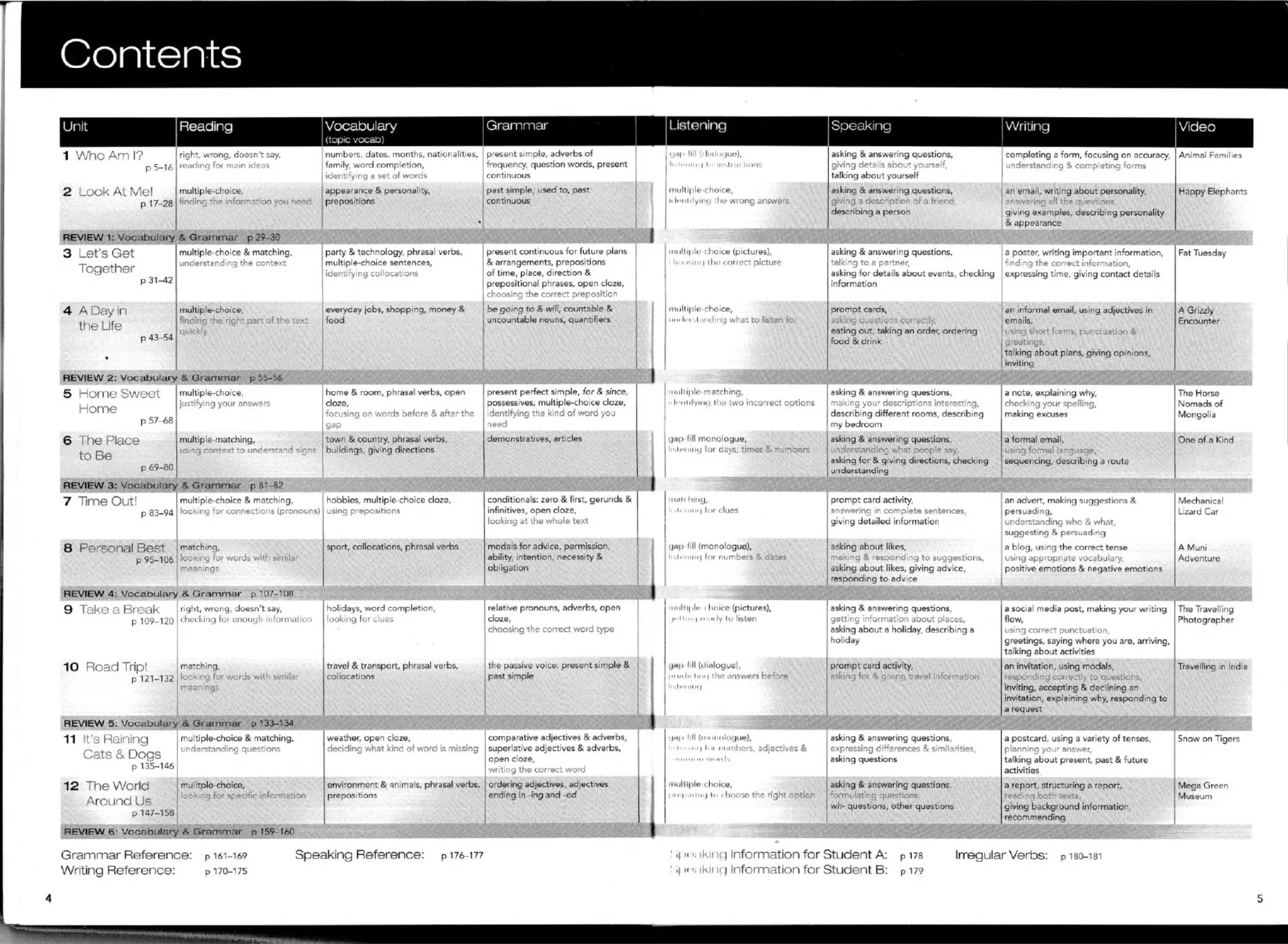
Unit	Reading	Vocabulary (topic vocab)	Grammar
1 Who Am I? p 5-16	right, wrong, doesn't say, reading for main ideas	numbers, dates, months, nationalities, family, word completion, identifying a set of words	present simple, adverbs of frequency, question words, present continuous
2 Look At Me! p 17-28	multiple-choice, finding the information you need	appearance & personality, prepositions	past simple, used to, past continuous
REVIEW 1: Voc;ibu!ary	& Grammar p 29-30
3 _ot's Get Together p 31-42	multiple-choice & matching, understanding the context	party & technology, phrasal verbs, multiple-choice sentences, identifying collocations	present continuous for future plans & arrangements, prepositions of time, place, direction & prepositional phrases, open cloze, choosing the correct preposition
4 A Day in the Life p 43-54 »	multiple-choice, finding the right part of the text quickly	everyday jobs, shopping, money & food	be going to & will, countable & uncountable nouns, quantifiers
REVIEW 2: Vocabulary &. Grammar p 55-56
5 Home Sweet Home p57-68	multiple-choice, justifying your answers	home & room, phrasal verbs, open cloze, focusing on words before & after the gap	present perfect simple, for & since, possessives, multiple-choice doze, identifying the kind of word you need
6 i he Place to Be p 69-80	multiple-matching, using context to understand sign?	town 8< country, phrasal verbs, buildings, giving directions	demonstratives, articles
REVIEW 3: Vocabulary & Grammar p 81-82
7 Time Out! p 83-94	multiple-choice & matching, looking for connections (pronouns)	hobbies, multiple-choice cloze, using prepositions	conditionals: zero & first, gerunds & infinitives, open cloze, looking at the whole text
8 Personal Best p 95-106	matching, looking for words with similar meanings	sport, collocations, phrasal verbs	medals for advice, permission, ability, intention, necessity & obligation
REVIEW 4: Vocabulary & Grammar p 107-108
9 Take a Break p109-120 10 Road Trip! p 121-132	right, wrong, doesn't say, checking lor enough information matching, looking for words with similar meanings	holidays, word completion, looking for clues travel & transport, phrasal verbs, collocations	relative pronouns, adverbs, open cloze, choosing the correct word type the passive voice: present simple & past simple
REVIEW 5; Vocabulary & Grammar p 133-134
11 It’s Raining Cats & Dogs p135-146	multiple-choice & matching, understanding questions	weather, open cloze, deciding what kind of word is missing	comparative adjectives & adverbs, superlative adjectives & adverbs, open cloze, writing the correct word
12 The World Around Us p147-158	mulitple-choice, looking for specific information	environment & animals, phrasal verbs, prepositions	ordering adjectives, adjectives ending in -ing and -ed
REVIEW 6: Vocabulary & Grammar p 159 160
Grammar Reference: p 161-169
Writing Reference: P170-175
Speaking Reference: p 176-177
4
Listening	Speaking	1 Writing	Video I
«jap Illi (ilinluque), Il Ifinil 1 <  III',li III lions	asking & answering questions, giving details about yourself, talking about yourself	completing a form, focusing on accuracy, understanding & completing forms	Animal Families
multiple choice, и li'iiiil^iiip the wiong answers	asking & answering questions, giving a description of a friend, describing a person	an email, writing about personality, answering all the questions, giving examples, describing personality & appearance	Happy Elephants

multiple choice (pictures), • hoo'.uui I he correct picture	asking & answering questions, talking to a partner, asking for details about events, checking information	a poster, writing important information, finding the correct information, expressing time, giving contact details	Fat Tuesday
multiple choice,  пи li 1 1 Hiding what to listen for	prompt cards, asking questions correctly, eating out, taking an order, ordering food 8< drink	an informal email, using adjectives in emails, using short forms, punctuation & greetings, talking about plans, giving opinions, inviting	A Grizzly Encounter

niiiliiplc matching, 1. l>-iiiilyui9 the two incorrect options	asking & answering questions, making your descriptions interesting, describing different rooms, describing my bedroom	a note, explaining why, checking your spelling, making excuses	The Horse Nomads of Mongolia
ijnp til monologue, Ir.ieiiing lor days, times & numbers	asking & answering questions, understanding what peop'e say, asking for & giving directions, checking understanding	a formal email, using formal language, sequencing, describing a route	One of a Kind

mull lung, li .1. 1 hi и । lor clues	prompt card activity, answering in complete sentences, giving detailed information	an advert, making suggestions & persuading, understanding who & what, suggesting & persuading	Mechanical Lizard Car
lap till (monologue), .! din) for numbers & dates	asking about likes, maxmg & responding to suggestions, asking about likes, giving advice, responding to advice	a blog, using the correct tense using appropriate vocabulary, positive emotions & negative emotions	A Muni Adventure

iiullipli hoice (pictures), p Hu ) i<Mily lu listen	asking & answering questions, getting information about places, asking about a holiday, describing a holiday	a social media post, making your writing flow, using correct punctuation, greetings, saying where you are, arriving, talking about activities	The Travelling Photographer
gap fill (dialogue), I	In in>4 the answers before	prompt card activity, asking for & giving travel information	an invitation, using modals, responding correctly to questions, inviting, accepting & declining an invitation, explaining why, responding to a request	Travelling in India

‘in|i lilt (пнinologue), < i"iu| 1. о numbers, adjectives & ' HIIIIII II 1 W< III Is	asking & answering questions, expressing differences & similarities, asking questions	a postcard, using a variety of tenses, planning your answer, talking about present, past & future activities	Snow on Tigers
uiiilllple < hoice, ih< 1 			 in । boose the right option	asking & answering questions, •formulating questions, wh- questions, other questions	a report, structuring a report, readmg both texts, giving background information, recommending	Mega Green Museum

' >| н 1. ikii iq Information for Student A: p 178
' >| иг ikn iq Information for Student B: P179
Irregular Verbs: P 180-181
5
Introduction to Close-up
Introduction to Close-up
Welcome to Close-up, an exciting pre-intermediate course which brings English to life through spectacular
National Geographic photography and facts carefully selected to appeal to the inquisitive minds of students.
Course Components
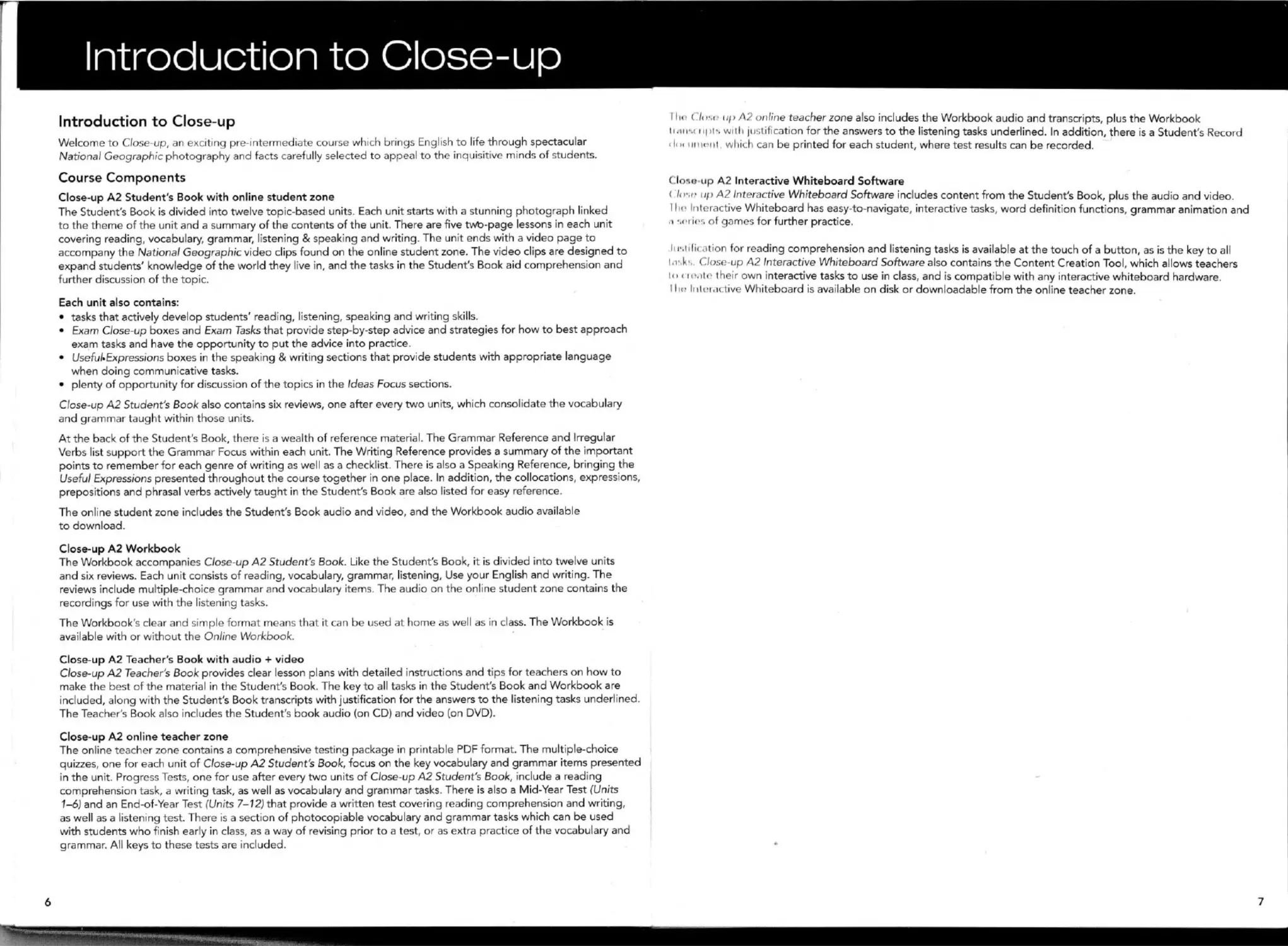
Close-up A2 Student's Book with online student zone
The Student's Book is divided into twelve topic-based units. Each unit starts with a stunning photograph linked
to the theme of the unit and a summary of the contents of the unit. There are five tWb-page lessons in each unit
covering reading, vocabulary, grammar, listening & speaking and writing. The unit ends with a video page to
accompany the National Geographic video clips found on the online student zone. The video clips are designed to
expand students' knowledge of the world they live in, and the tasks in the Student's Book aid comprehension and
further discussion of the topic.
Each unit also contains:
•	tasks that actively develop students' reading, listening, speaking and writing skills.
•	Exam Close-up boxes and Exam Tasks that provide step-by-step advice and strategies for how to best approach
exam tasks and have the opportunity to put the advice into practice.
•	UsefukExpressions boxes in the speaking & writing sections that provide students with appropriate language
when doing communicative tasks.
•	plenty of opportunity for discussion of the topics in the Ideas Focus sections.
Close-up A2 Student's Book also contains six reviews, one after every two units, which consolidate the vocabulary
and grammar taught within those units.
At the back of the Student's Book, there is a wealth of reference material. The Grammar Reference and Irregular
Verbs list support the Grammar Focus within each unit. The Writing Reference provides a summary of the important
points to remember for each genre of writing as well as a checklist. There is also a Speaking Reference, bringing the
Useful Expressions presented throughout the course together in one place. In addition, the collocations, expressions,
prepositions and phrasal verbs actively taught in the Student's Book are also listed for easy reference.
The online student zone includes the Student's Book audio and video, and the Workbook audio available
to download.
Close-up A2 Workbook
The Workbook accompanies Close-up A2 Student's Book. Like the Student's Book, it is divided into twelve units
and six reviews. Each unit consists of reading, vocabulary, grammar, listening. Use your English and writing. The
reviews include multiple-choice grammar and vocabulary items. The audio on the online student zone contains the
recordings for use with the listening tasks.
The Workbook's clear and simple format means that it can be used at home as well as in class. The Workbook is
available with or without the Online Workbook.
Close-up A2 Teacher's Book with audio + video
Close-up A2 Teacher's Book provides clear lesson plans with detailed instructions and tips for teachers on how to
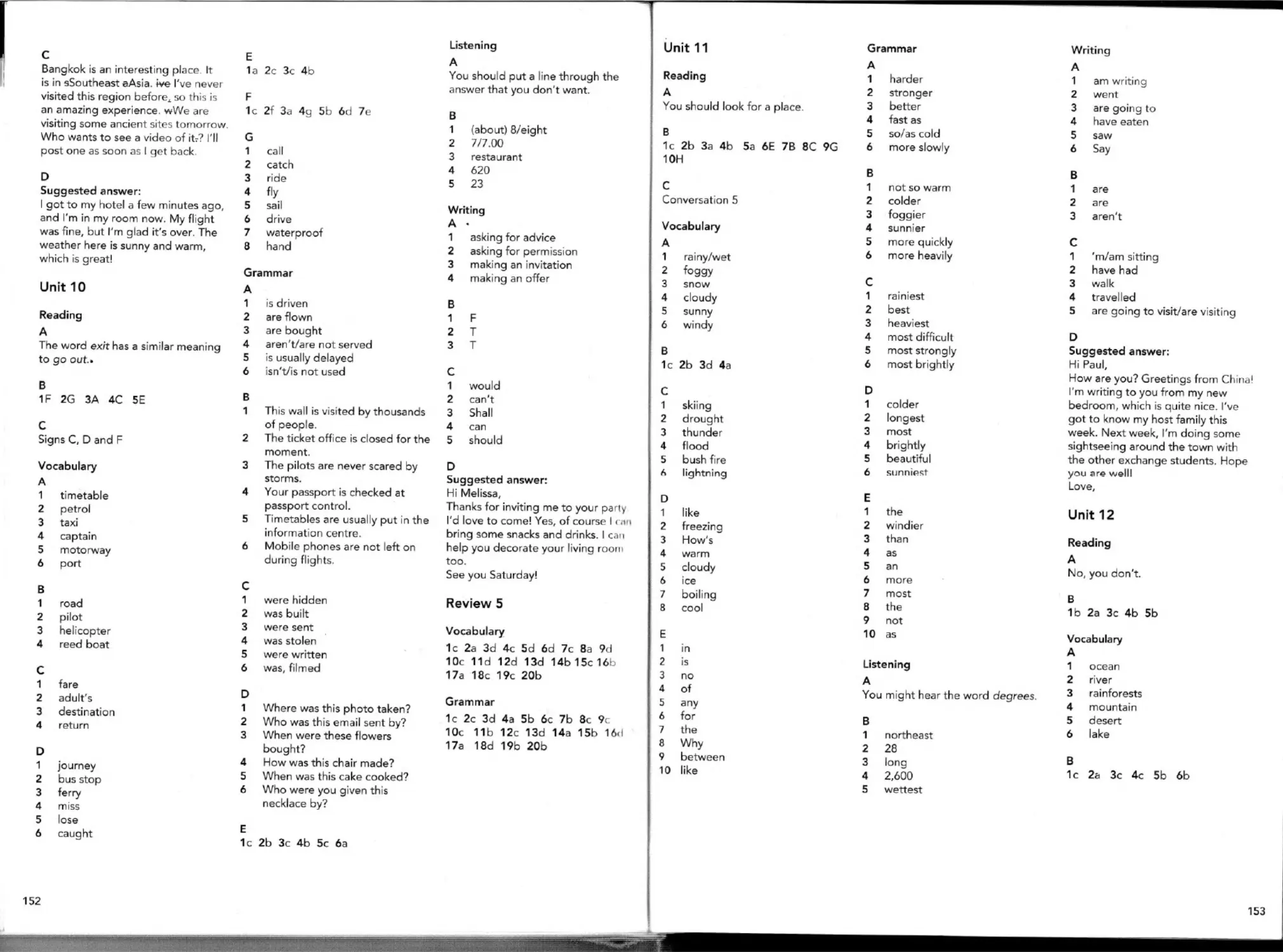
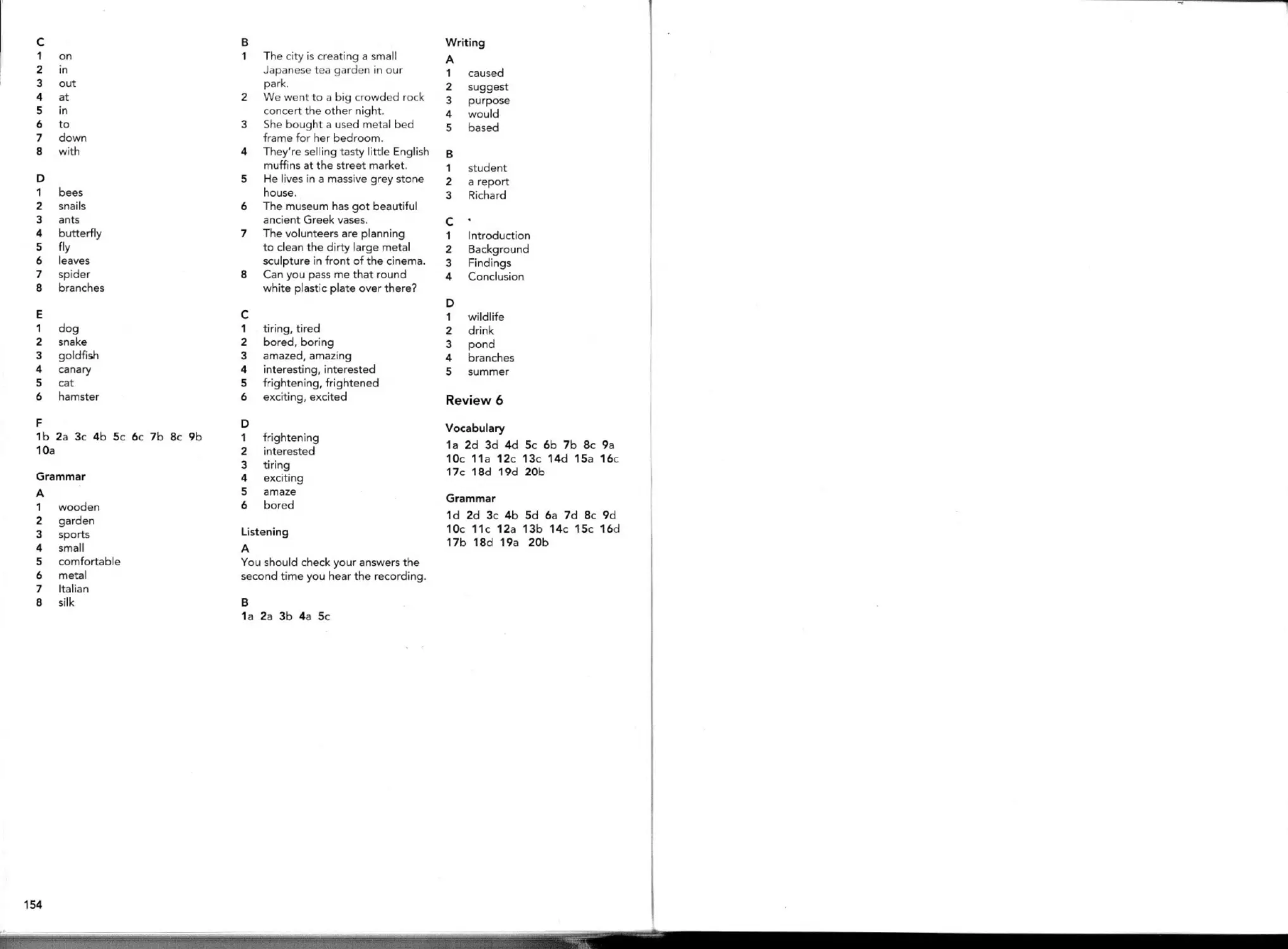
make the best of the material in the Student's Book. The key to all tasks in the Student's Book and Workbook are
included, along with the Student's Book transcripts with justification for the answers to the listening tasks underlined.
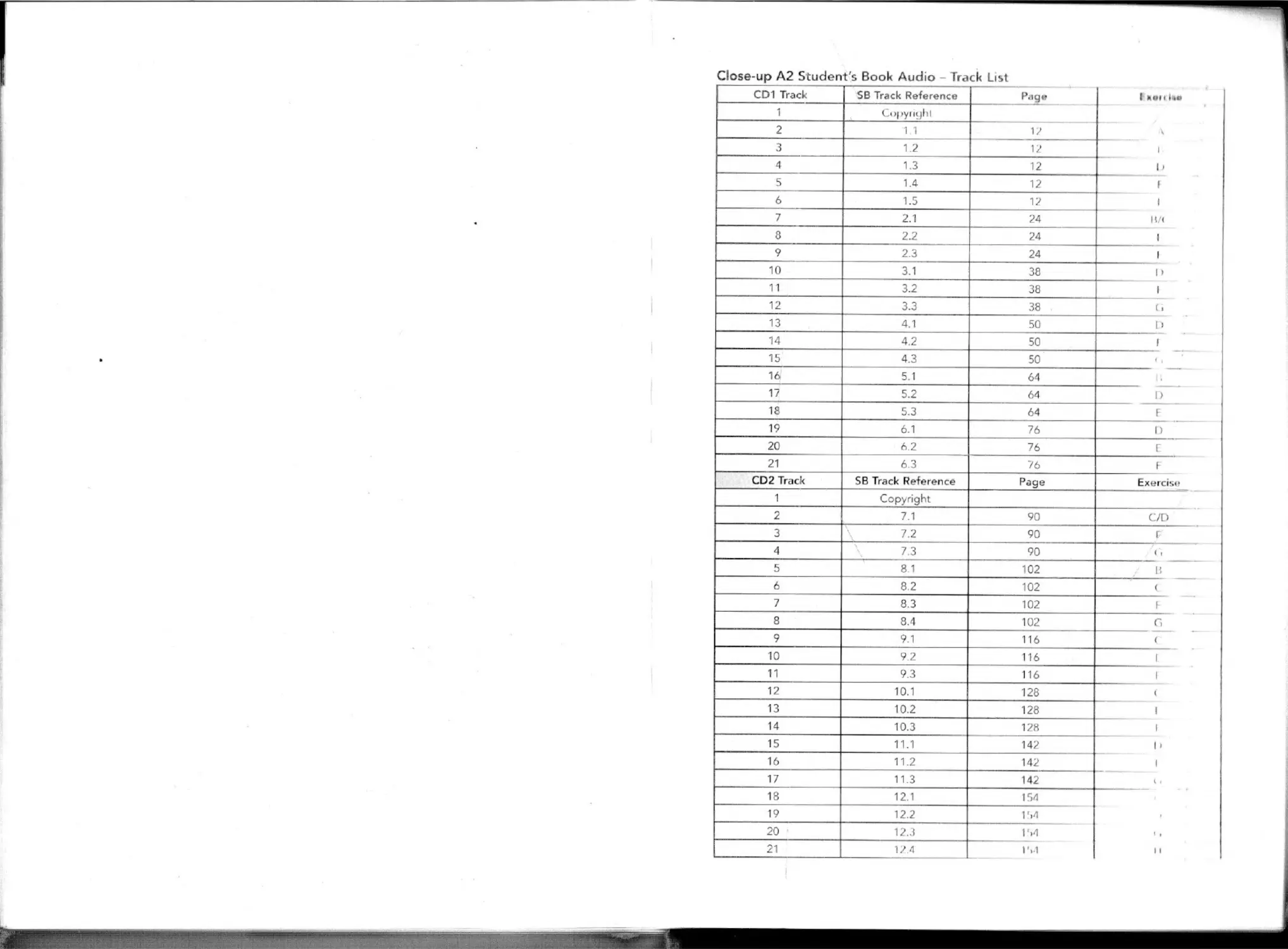
The Teacher's Book also includes the Student's book audio (on CD) and video (on DVD).
Close-up A2 online teacher zone
The online teacher zone contains a comprehensive testing package in printable PDF format. The multiple-choice
quizzes, one for each unit of Close-up A2 Student's Book, focus on the key vocabulary and grammar items presented
in the unit. Progress Tests, one for use after every two units of Close-up A2 Student's Book, include a reading
comprehension task, a writing task, as well as vocabulary and grammar tasks. There is also a Mid-Year Test (Units
1-6) and an End-of-Year Test (Units 7-12) that provide a written test covering reading comprehension and writing,
as well as a listening test. There is a section of photocopiable vocabulary and grammar tasks which can be used
with students who finish early in class, as a way of revising prior to a test, or as extra practice of the vocabulary and
grammar. All keys to these tests are included.
6
The C.hi'.c up Л2 online teacher zone also includes the Workbook audio and transcripts, plus the Workbook
lirtiiM	wiih justification for the answers to the listening tasks underlined. In addition, there is a Student's Record
t|t »< niiit'iii. which can be printed for each student, where test results can be recorded.
Close up A2 Interactive Whiteboard Software
( /ом- up A2 Interactive Whiteboard Software includes content from the Student's Book, plus the audio and video.
Hie Interactive Whiteboard has easy-to-navigate, interactive tasks, word definition functions, grammar animation and
.1 -.<4 ins of games for further practice.
lu'.iilic ation for reading comprehension and listening tasks is available at the touch of a button, as is the key to all
i.r.k'. Closeup A2 Interactive Whiteboard Software also contains the Content Creation Tool, which allows teachers
to «ionto their own interactive tasks to use in class, and is compatible with any interactive whiteboard hardware.
I he Intin active Whiteboard is available on disk or downloadable from the online teacher zone.
7
'’J Who Am I?
Reading:
Vocabulary:
Grammar:
Listening:
Speaking:
Writing:
right, wrong, doesn't say, reading for main ideas
numbers, dates, months, nationalities, family, word completion,
identifying a set of words
present simple, adverbs of frequency, question words, present
continuous, multiple-choice cloze, choosing the missing words
gap-fill (dialogue), listening to instructions
asking & answering questions, giving details about yourself
completing a form, focusing on accuracy, understanding &
completing forms

Uni+ opener
•	Ask students to tell you what the title of the unit is.
(Who am I?) Ask them what kind of sentence this is - a
statement, a question or a command (a question).
•	Ask students to answer the question, prompting as
necessary. (You are students. You are a student. I am
a teacher.)
•	Ask them to say something else about themselves.
Write the following words on the board:
First name:
Last name:
Age:
Town:
Country:
Interests:
•	Invite a student to come to the board to write their
information to the side of the categories.
•	For the category of interests, encourage other students
to complete this information with their own ideas.
Get them to talk about either their own interests, or
the interests of someone they know well. Write their
answers on the board.
•	Ask students to look at the photo and to describe what
they see (an African woman with a purple thumb). Ask
students to read the caption, and explain any unfamiliar
words to them. (Someone who is Maasai is part of a
group of people who live in Kenya. Ink is what we use
to write with. To register is to sign up to do something.
An election is when you choose a leader.)
•	Ask the following questions and encourage students to
guess the answers. Give them a few seconds to answer,
prompting as necessary
Why is the woman's thumb purple? (She wants to
vote in a future election.)
- What can you say about her interests because of this?
(She is interested in her country and who leads it.)
- What does this say about this person? (She cares
about her country and her future.)
- Do you think people should vote? Why? / Why not?
- What does the person you vote for say about you?
•	Give students some background information on the
photo if you like, using the information provided in the
next column.
Background Information________________________________
The Maasai of Kenya are a nomadic tribe of people;
for hundreds of years they have resided within Kenya
and moved round Kenyan lands as part of their cultural
traditions. Recently, activists in Kenya have made efforts to
get the Maasai to participate in government and be more
of an integral part of the country by encouraging them to
register to vote. It is especially challenging for women of
the Maasai, as family customs mean it is the husband who
often does the voting. For the Maasai women to register
to vote, it is a powerful symbol of change in Kenya, and of
hope that they too can shape their country's future.
A ___________________________________________________________
•	Ask students to read the instructions, and check that
they understand what they have to do.
•	Read through the activities in the yellow wordbank and
ask students if they are familiar with any of them.
•	Explain to students any unfamiliar activities without
giving away any answers. For example, with swimming,
you can say it is a sport that happens in the water.
•	Ask students to do the task with a partner. Then check
answers as a class.
•	Check that students have the correct answers in
their books.
Answers g
1 painting	4 swimming
2 photography	5 playing football
3 playing in a band 6 playing cricket
В___________________________________________________
•	Ask students to work with their partner again to talk
about the activities in the photos that they like.
•	Encourage them to say why they like a particular activity
and who, if anyone, they like doing that activity with.
Elicit reasons for why a student does or does not like
an activity.
•	If time allows, you can have a student come to the front
of the class and write the activities on the board. Then,
have the student ask the class to show their hands if
they like a particular activity. Count the show of hands
and write the number on the board for each activity. At
the end, students can learn which activity is the most
popular in their class.
8

____________________________________Answers »
» Sliid<’hl,i* * own .inswors
fciMi ।     "tnww<—щи-г, .. /^ае/ЛЛЛЛашшШЯЯШШШЯШШЯШЯШШШЯШЯЯШШШШШ
c	___________________________
•	I xpLniti i<> 'Undents that they are going to read an online
। >f< >|ile A'.k •.Indents if they know what an online profile
14, лч>1 explain the concept if necessary. (It is a list of
4. пне < >1 youi personal details such as name, age, city,
< ouitiiy and interests.)
•	Ask •.tudcMits to read the instructions, and check that
il»«-y understand what they have to do.
•	Road through the words in the yellow wordbank and
make sure students understand them.
•	lull '.indents they have one minute to do the task on
their own. Then they will work with a partner to check
ihrii answers.
•	M.rko sure all students have the correct answers once
ihuy have completed the task.
Answers e
1	Name	4	Pets
2	Aye	5	Hobbies /	Activities
3	(’.ountry	6	Dream
D	•______________________________
•	lull '.indents that they are going to look for information
in .i -.hort text about a teenager named Lucky Mbele.
I hey are not going to read the whole text just yet.
•	A-.k '.indents to look at the photo and to guess what the
I oxi will be about without reading it (a young girl who
I i/.-iy. football).
•	I h«»r» ar.k students to read the instructions, and check
th.il they understand what they have to do.
•	Л-.к ‘.tudents to look back at task C and ask them
wh.it words from that task they need to answer the
। |iiP'.tion in the instructions of task D (the words from
ihrr wordbank).
•	A'.k '.tudents to work with a partner to answer the
। |ut-.iion in task D. Check answers as a class.
Answers e
Nennu Lucky Mbele
Age: 10
< ountry: South Africa
I lobbies / Activities: art/drawing/painting/spending
time* with her friends (at the beach, playing sport,
•jiiiiki to I he cinema and to cafes)
Ihenm: io become a well-known/famous artist
Word Focus_____________________________________________
• Л<л %iiidi'nl'. to look at the words in red in the Word
I .и ня 11<ix and then go back to the text to find the
hull (oik o’i that contain those words.
• i bvu Hudnnts work with a partner to guess what the
win।h moan by reading only the sentences that contain
iIioim I xpl.tin lo students that if they do not know the
muuiuiKi ol a word, they can look within the rest of the
nniitoiH n io try to work out its meaning. Let them know
Ihal ii r. Im<‘ if they if they cannot figure out the meaning
..I 11 jo w< nJ (torn the sentence, but to try to guess
rttiywny
•	After they have finished trying to figure out the mn.nnin< ।
of the red words, ask students to look at the Word I <>< us
box again to see if they guessed correctly.
Teaching Tip_______________________
Have students create a separate section in their
notebooks for new words. Tell them to write down the
new word, and to the side write a definition for the word
in their own words in English. Their definitions can be a
single word if the word has exactly the same meaning
as the new word. Encourage them to write at least eight
new words for every lesson and to review all of them
every week.
•	Draw students' attention to the Exam Close-up box and
tell them that these boxes are used throughout the book
to give them tips about how to do specific tasks.
•	Have students look at the Exam Close-up and read the
points aloud.
•	Check that they understand every point in the box.
•	Have students work with a partner to identify the main
ideas of each paragraph in task D. Remind students that
they are not going to read the text, but will only look for
main ideas and key words.
•	Ask students to write key words for each paragraph in
their notebooks.
•	Check answers as a class and make sure students have
completed the task correctly.
______________________________Answers..^
Paragraph 1: name, age, town and country, hobbies,
dream.
Paragraph 2: friends, free-time activities, spurt.
Paragraph 3: selling paintings as souvenirs, tourists.
•	Now explain to students that they are going to read the
whole text and answer the questions in the Exam Task.
•	Have students do the task on their own, as it is an exam
style task and students must get used to doing these
task types individually as they would in an exam. Check
the answers as a class.
•	Ask students about the photo again, and if what they
thought at the beginning was true. (It was about a girl
who plays football, but it was more about how she
paints as a hobby.)
1A 2C 3B 4A 5B 6C 7B 8C
G
•	Ask students to read the instructions, and check to make
sure they understand what they have to do.
•	Have students work with a partner to answer the
questions. Then check answers as a class.
9
Who Am I?
G
Ideas Focus
•	Read the Ideas Focus box aloud for students, and ask
them to give their opinions about the questions
•	Make sure that students explain why they agree or
disagree with an idea. If they disagree, encourage them
to express what they do agree with.

A
•	Ask students to read the instructions, and check that
they understand what they have to do.
•	Explain to students that they have to write numbers in
the gaps, but they do not need to do any maths.
•	Ask students to do the task individually, but check
answers as a class.
___________________________......Answers^
1	five, seven, twelve
2	eight, sixteen, twenty-four
3	ninb, twenty-nine, thirty-eight
4	nineteen, twenty-six, forty-five
5	twenty-one, thirty-eight, fifty-nine
6	thirty-three, forty-four, seventy-seven
7	eleven, eighty-five, ninety-six
8	forty-three, fifty-seven, а/one hundred
•	Ask students to read the instructions, and check that
they understand what they have to do.
•	Explain to students what a national holiday is. (It could
be a day of independence, or to celebrate an important
person or event.) Ask students what day is a national
holiday in their country, or if they see their country in
the table.
•	Ask students to do the task in pairs, with one student
reading the date aloud and the other student writing the
answer in the gap, in alternating roles.
Answers g
1	the second of June
2	the twenty-fifth of March
3	the twelfth of October
4	the fourteenth of July
5	the fifteenth of February
6	the twenty-first of September
7	the first of December
8	the third of May
9	the first of August
10	the twenty-eighth of November
C
•	Ask students to read the instructions, and check that
they understand what they have to do.
•	Do the task as a class, with students saying each month
aloud and writing them in their notebooks.
•	Ask students which months of the year are not in task B.
__________________ Answers g
January, February, March, April, May, June, July,
August, September, October, November, December
January and April are not in B.
D
•	Ask students to read the instructions, and check that
they understand what they have to do.
•	Look at the first item and ask students to identify which
word in red is a noun and which is an adjective.
•	Ask students to do the task individually, but check
answers as a class.
•	Have students look at the photo and talk about what
they see. Ask them to try to guess which country the
photo is from and what nationality the people from that
country are.
•	Ask students to say as a class what country they live
in, and then individually, what nationality they are, if
time permits.
f1 Greece, Greek
2	China, Chinese
3	Italy, Italian
4	Spain, Spanish
5	France, French
6	England, English
7	Switzerland, Swiss
8	The Netherlands, Dutch
Answers
•	Ask students to read the instructions, and then ask one
student to give you the name of another country.
•	Then ask the class, or another student, what the
nationality is of a person from that country.
•	Write the countries and nationalities adjacent to one
another on the board as students say them. Write as
many as time permits. As a bonus, you could work
with students to guess the names of every country
in the continent in which they reside, and to guess
the nationalities.
Answers e
{ Students' own answers
F
•	Ask students to read the instructions, and check that
they understand what they have to do.
•	Read the words in the yellow wordbank aloud as a class
before beginning the task.
•	Do the task as a class, with the students saying aloud
what the answers are for each gap and which answers
are correct for the last two questions.
•	Write the answers on the board as you go along.
1 grandma, granny
2 grandpa, grandad
3 mum, mummy
Answers
4 dad, daddy
5 grandparents
6 parents
•	Ask students to look at the photo and talk about what
Ihr-y A-.k them Io liy to use the words from the
yn||<iw box in l.r.k I to say who some of the people in
ill»? | illoll ।
•	Л-.k wIik Ii two people are inthe photo that the words
In nt। tank I do not describe.
•	Л-Л .hnlr-iit-. to read the instructions, and check that
ihuy utidnp.l.tnd what they have to do.
•	Ituad t|i<* wotds in the yellow wordbank aloud as a class
licfuto you begin the task.
•	A-.k .tudents to do the task individually, but check
.iir.wris as a class.
1	1.unify	5	twins
2	*.ir.|er	6	surname
3	1 Mother	7	married
4	grandchildren	8 granddaughter
11	______________________________________
•	I the information in the Exam Close-up box to
3lin li-i its and explain anything they don't understand.
I hon ask them to read the Exam Task instructions and
। иi< Iodine the vocabulary topic for the task. Check the
air.wui as a class.
Answer
lamily members
I	__________________________________________
•	Aik -.Indents to look at the Exam Close-up box again.
<io 11 m nigh the information in the box as a task. As you
wink through the bullet points, ask students to look at
u-.k I and identify what each bullet point is referring to.
•	A-.k -.indents to read the Exam Task instructions, and
 h<’< к that they understand what they need to do.
•	A-.l -.Indents to do the Exam Task individually, but check
Ilin answers as a class.
•	When they have finished, ask students to say what the
link r. between all the words (family members).
uncle
aunt
cousin
l
4
Will'
husband
Idea* Focus ___________________________________________________
•	A-.k tain Innt', to look at the Ideas Focus box and explain
that tlmy ,n«• going to talk about a time in their past,
pt.iiuip% ,i niiinth ago, a year ago, or many years ago,
Hint limy would like to go back to.
•	A ,k iitudniiii wh.it date they would like to visit and to
h«| ilain why
•	think । -I a d.iti' yourself and ask if students would like
..i nil lik«’i<> go back to it. Ask them to explain why or
why in it
•	I tl>n quote frown the second bullet point of the
Mo n I in и-, box aloud to the class. Ask what students
iIhi.I. jI.m.ii tl.r; idea and to say what is good or not
 l«.i<d .iIkhiI big and small families.
• Write the following exchange on the board and ask
students which is a sentence and which is a question.
Then ask students to identify the question word, the
verbs and the adverb of frequency.
- How does your mum get to work? (question. How,
does ... get)
- She often takes the bus. (sentence, often, takes)
•	Revise the negative form of the sentence with the class
A________________________________________________________
•	Ask students to look at sentences 1-4 and quickly
identify the verbs in each sentence.
•	Tell them that all the verbs are in the Present Simple.
•	Do the task as a class and make sure students underline
the verbs.
; .... , - .... . .
1	live
2	drives
3	freezes
4	go
- ........................-
В ______________________________________________________
•	Ask students to look at task A again and go through
each sentence, asking if it is a fact or a routine.
•	Ask students if they can think of other facts or routines.
Write them on the board and encourage students to
form full sentences.
c
•	Ask students to read the instructions, and check that
they understand what they have to do.
•	Have students do the task individually. Then check the
answers as a class.
•	Make sure all students have got the correct answers
before moving on to the next task.
____________________
Do ... walk, don't walk, drives, don't have, walk, cycle
auxiliary verb: do
D__________________________________________________________
•	Ask students for an example of an adverb of frequency
that they have used in class already (often).
•	Write a line on the board, with 0% of the time on the left
and 100% of the time on the right, and place often in
the middle.
•	Ask students if they can name another adverb of
frequency. Prompt them with answers (rarely, never,
always) if necessary.
•	Ask them where the adverbs of frequency should go
under the line, or point to the line and ask if a particular
adverb of frequency goes there.
•	Have students do the task individually, and check the
answers as a class, making sure all students have correct
answers before moving forward.
10
11
Who Am I?
___________________________Дпа&£Г£>„<а
1 often	4	sometimes
2 never	5	always
3 usually	6	hardly ever
•	Ask students to read the instructions and the rule in
task E.
•	Do the task as a class, and prompt students with the
answers (after, before) if necessary.
•	Then ask students to write the adverbs of frequency on
the line in their Student's Books, as was done on the
board, but without looking at the board.
Answers •
before, after
never (0%), hardly ever, sometimes, often, usually,
always (100%)
•	Ask students to read the instructions, and check to make
sure they understand what they have to do.
•	Have students do the task individually. Then check the
answers as a class.
•	If time permits, ask students where the verbs are in
the sentences.
______________________Answers....
a What time
b When
c Where
d Who
e What
f Why
G
•	Ask students to look back at task F and look at the
question words in the sentences.
•	Go through 1-6 as a class and ask which question word
from the previous task answers each question.
Answers
1	who	4	why
2	what	5	when
3	what time	6	where
Now read the Grammar Reference on page 161 (1.1 & 1.2)
with your students.
•	Ask students to read the instructions, and check that
they understand what they need to do.
•	Read the first question aloud with the class to check that
they understand the task.
•	Have students form pairs, taking turns to think of the
questions for the answers provided.
•	Check the answers as a class.
Г7
2
3
4
Suggested answers
Where do you usually go on holiday?
What food do you like best?
What time do you go to bed?
How do you get to school?
Who do you hang out with at break times?
•	Before moving on to task J, write the following
sentences on the board. Ask students which sentence
is in the Present Simple and which is the Present
Continuous. Ask which sentence describes a routine, and
which describes something that is happening right now.
- Marco often studies in the library. (Present Simple;
a routine)
- Marco is studying in the library. (Present Continuous;
happening right row)
•	Revise the negative and question forms of the Present
Continuous with students, using the second sentence on
the board. (Marco is not/isn't studying in the library. Is
Marco studying in the library?)
•	Ask students to read the instructions and do the
task individually.
•	Check the answers as a class and make sure all students
have got the correct answers.
Answers
now, be, ;ng
•	Ask students to read the instructions, and check that
they understand what they have to do.
•	Have students do the task individually. Then check the
answers as a class.
f
1 we're living
2 We're lying; We're
reading; listening
Answers й
3 is working
4 We're studying
5 are making
H
•	Ask students to read the instructions, and check that
they understand what they need to do.
•	Have students do the task individually. Then check the
answers as a class.
Answers
1b 2a 3b 4a 5b 6b
L________________________________________________________
•	Go through the task as a class and ask students to give
you the answers aloud.
•	Read the first sentence in task К aloud, and then read
each of the uses a-c in task L. Ask students to say yes or
no after each use.
•	Continue with all the sentences as time permits, or
ask students if a, b or c is the correct answer. Ask
students to explain why they chose a particular use for
the sentences.
12
N><w if »/ the Grammar Reference on page 161 (1.3) with
yum '.hi<
Ho careful!_______________________________________________
•	Itortd the information in the Be Careful! box aloud
wiili students
•	Wi Ho the following verbs on the board: hit, shop, let,
hl <ltnp, sleep, listen. Ask students to form the Present
< unlinuous with the verbs, and write their answers on
llio bo.iid Be mindful with the words sleep and listen
lli.il -.indents do not double the consonant. Ask them to
oxpl.iin why we do not double the consonant for these
vo| | >•. [We do not double the consonant if there are two
v< >wo/s before the consonant, like with wear or read, or if
the vt’ib has two syllables, like with answer.)
•	Wnui the following verbs on the board: lose, write,
m.ikc, lake, have. Ask students to form the Present
< oniinuous with the verbs, and write their answers on
IIuj boaid.
N
•	Ask students to look at the Exam Close-up box before
task O. Read the information aloud to the class.
•	Then ask students to look at task О and ask them how
many gaps are in the text (8).
•	Ask students to look at the first gap in the text. Write
the first part of the first gapped sentence on the board
(I (1)______enjoying ...) and ask students to try to guess
the answer without looking at the answer choices. Then
ask them to look down at the choices to see if their
guess is there fC - am). If time permits, work through the
second and third gapped sentences before moving on
to the Exam Task.
-_____________________-
Students' own answers
О _______________________________________________________
• Now ask students to complete the task individually.
• Check the answers as a class and make sure students
have chosen the correct answers.
M	_______________________________________
•	Л%к -.tudents to read the instructions, and check that
11 iay understand what they have to do.
•	I l.iv<- students do the task individually. Then check
ntr.weis as a class.
1C 2A 3B 4A 5A 6C 7B 8C
Answers
Answers
1 ue, studying
7 .пн», speaking
.4 .mi having
4 .ini sitting
5
6
7
8
am taking
is flying
are chatting
are not / aren’t
feeling
lunching Tip
vmi < ould ask students to form Present Simple and
pfubani ( Continuous sentences using classroom actions
.iiul vrdr, such as sit, read, listen, talk, learn, use, do, etc.
W- и.. ..ue of the verbs on the board and ask students to
h.iiu .t I’f. .ent Simple sentence and a Present Continuous
’uiithiti. i. wiih each verb. Practise with question forms and
Lis+enin4)
A
•	Before you start the task, briefly talk about spelling
names. Ask a student to come to the board to spell
cuiullier sluder it's I cis I name. Ask a student in the class to
give their last name and to spell it for the student at the
board. The student at the board should write the letters
they hear. Check that the rest of the class agrees with
what they have written. Continue with another student
as needed or as time permits.
•	Tell students that in this task, they are going to hear
people give the names of people and places.
•	Begin the listening task and have students work
individually. Check answers as a class.
h...|hIivc foirns as well.
t ‘.ontences could be:
•It	We sit at desks in
< lass every day.
land	We often read
books in the library.
I to we listen to our
Itwichers?
talk We do not talk
<luiing exams.
We are sitting at our
desks right now.
We are reading
sentences on the board.
Are we listening to our
teacher at the moment?
We are not talking
right now.
1 Leicester
2 Jack Gough
3 Vanessa Baxter
—Answers 8
4 Faversham
5 Zayn Wood
6 Quentin Pimm
•	Explain to students that they are going to hear two
words that sound alike or sound similar, but are
spelt differently.
•	Make sure students know that they need to listen very
carefully to how a name or place is spelt in order to
choose the correct answer.
•	Have students complete the task individually. Then
check answers as a class.
Answers
1a 2a 3b 4a 5a 6b
13
Who Am I?
Teaching Tip
Work with the class to think of words that sound alike but
are spelt differently. Prompt students as necessary with
the following words by saying them aloud and asking
students to spell the words aloud Write their answers on
the board and check to see that all students agree.
eight red	ate read
to	two	too
your	you're
there	their	theyТе
who's	whose
•	Ask students to look at the sentences and underline
the question words or phrases (When, What time. How
much, Who).
•	Then read the phrases in the yellow wordbox aloud and
ask students which question word will have that type of
word as an answer.
•	Complete the task as a class and check answers as
a class.
1 a date
2 a time
,., Answers
3 a price
4 a name
•	Ask students to look at the Exam Close-up box to the
right of task D. Read the information to the students and
check that they understand what it says.
•	Explain to students that they will listen to the
instructions to the Exam Task first and decide if the
sentences about the instructions are true or false
before they do the Exam Task. Make sure students do
not look at the Exam Task instructions and that they
listen instead.
•	Have students do the task individually. Then check
answers as a class.
1F 2T 3F 4T
E____________________________________________________________
•	Ask students to look at the photo in the Exam Task and
to say what the person is doing and where she might be.
•	Then ask students to look at the Exam Task and the five
gaps in the task. Elicit from students what kinds of words
they will need to listen for a name, number, date, etc.
(name, number, date, time, price).
•	Remind students that they will hear the recording twice.
Play the recording, pausing after the first question
to allow students to write down the answer before
continuing. Check the answer with the class; ask
students to spell the name aloud and write the name
on the board. Continue playing the recording, pausing
as necessary.
•	Have students complete the gaps individually, but wait
until after task F to check answers.
F	__________________________________________
•	Play the recording again and ask students to check their
answers with a partner.
•	When they have finished, check answers as a class.
________________________Answers.«
1 Franchetti	4 5.30 pm
2 10/ten	5 £90.50
3 21st
Speaking
A
•	Ask students to look at the two photos to the right of
the task and to briefly describe the differences between
the photos. Prompt students if necessary. (Photo A is a
small family of three; Photo В is a large family of eight,
with grandparents also.)
•	Ask students to read the instructions for the task, and
check that they understand what they have to do.
•	Do the task together as a class.
______________________________Answers^©
Photo A: 2, 4
I Photo B; 1, 3, 5
Sentence 6 could match both photos.
В
♦	Explain to students that they are going to read some
other students' answers to a speaking exam.
•	Ask students to work with a partner to decide which
sentence in each pair is correct.
•	When students have finished, check answers as a class.
________________.Answers^
1b 2a 3b 4b 5a
c
•	Explain to students that for this task, they will think of
the questions that go with the students' responses in
task B.
•	Have students do the task individually, and check
answers as a class.
_________________________________Answers,
1 How many people are (there) in your family?
2 How often do you go to English school?
3 Which year are you in at school?
4 Do you watch TV every evening?
5 How often / When do you meet your friends?
v ...................................-......-------
Useful Expressions
•	llcloio you I >ri |iu task D, ask students to look at the
I lii-hi| I	box below the Exam Task.
* Rca<| ihc Iic.hIhui ,ind the first expression aloud to the
। l.i-.n < oifiplolr the lirst expression; then gothrough
Hi» teinatnitKi nxpiessions and try to get students to
। oni|ilol» ilinm hi to give you a different answer to the
on»t< wullati iii the box.
IJ	__________________________________
•	Лч1> -.t ।и Inni•, to look at the Exam Close-up box, and
tjo ihiiiiiqh the information as a class. Make sure the
utin Inni', understand each point.
•	A%|. vl-ulents to explain what each point means in their
<>wn wonls, or to give examples. For example, ask
itiid«mls what they should say about themselves that is
nnl jir.t yes or no (where they're from, how old they are,
h- iw liwf I heir family is, etc ).
•	A-.i. -.i-k louts to form pairs and look at the Exam Task.
I -I -lain ih.il one student will be Student A and the
othot will be Student B. They will take turns asking and
ai -.wot и иj questions aloud with each other. Ask students
Ач я • । iv, to come up with a question for the first couple
. >1 pioniptr.. (Where do you live? Have you got any
hinlhr-f; or sisters?)
•	Л-.1» ^indents to begin the task, and walk round the class
t<> i lim к that students are participating in the task and
- oinploting it appropriately. If necessary, and if time
lieiinit1., do the Exam Task with a student, either before
, >i । Ln mg the task, to show the others how it should
I ic c li >ne.
-—_____________Answers ф
*.lu*loiil'/ own answers
lilon» Focus________________________________________________
•	Л-л ..indents to look at the Ideas Focus box at the
I xtttnin of the page.
•	I the questions aloud and ask students to give
Iheti opinions.
•	I nt, iiiage students to give supporting information for
ihon answers and opinions. Make sure they explain why
il>«»y do t>i do not agree with the first question. If they
du in it agree, ask them for alternative ideas that they
Ihink dir ijood and to explain why.
Wn I ini’): бс-vhple+iv)^ -form
I eaininy Focus
•	Л-Л uh , Innts to look at the Learning Focus box. Read
fl-iniKjh the inlormation together and ask students
to qivo you examples of information, such as a title,
hi«i iMinn and surname, a date of birth and interests.
< ..fitr in-with the other types of information as
• '•>>»» puiniil',.
A________________________________________________________
•	Anl- »iin letib. what a form is and what it's used for.
! M>>< uua th» t lilferent types of forms in the task.
» tnlt Ii.ijciIxji .ibout the different types of forms and
'.i и bill-, io say if they have completed any of these
I.-xor. A'J them what might happen if they put the
wKitHj inliHtn,iiion into a form.
•	I lavu btiidrni-, < omplete the task with a partner, and ask
ilintu io । ho< к each other's answers.
1 all of them
2 an application for a passport; a membership for a
club; an online profile
3 an application for a passport; an online profile
4 an application for a passport; a membership for
a club; to enter a competition; to buy something
online
5 could be on all of them, but maybe not on an
online profile for security reasons
6 could be on all of them, but maybe not on an
online profile for security reasons
В	_____________________________________________
•	Ask students read the instructions, and check that they
understand what they need to do.
•	Have students complete the task individually. Then
check answers as a class.
_____________________Answers..^
1b 2b 3a 4a 5b
C
•	Ask students to read the instructions, and check that
they understand what they have to do.
•	Give students one minute to answer the questions. Then
check answers as a class.
______________________Aosws®.^
1 Mrs; Miss
2 Ms
3 Reynolds
4 house number
D
•	Ask students to read the instructions and then look at
the details in the box.
•	Work together with the class to answer the questions
underneath the box.
______________—_______Answers e
1 my personal information
2 to order a monthly magazine
3 information about the price
E
•	Ask students to read the instructions and then look at
the online form.
•	Ask students to look at each gap and say what goes in
each of them.
•	Then have students answer the question in the
instructions as a class.
..... Answer
wants to know if there is a discount for students.
F
• Ask students to look back at the form in task E and
answer the question in the task.
Who Am I?
. ...........Suggested answer
Based on her interests, she might choose Sporty, Your
I Pet and Video Garries Now.
Useful Expressions
•	Ask students to quickly read the Useful Expressions.
•	Ask students to complete the expressions orally with
their own ideas. Pay attention that they use the -ing
form of verbs where appropriate.
Teaching Tip _______________________________________
Encourage students to look over all the information in a
writing task before they begin. This includes reading the
instructions and then looking through the information
that they see in the task. Remind students to get in the
habit of doing this so that they do not immediately start a
writing task and then realise halfway through that they are
completing it incorrectly.
G
•	Ask students to read the information in the Exam Close-
up box quickly, and then go through the points together.
•	Remind students that when they complete forms, they
should look at the whole form before they begin to
complete it.
•	Elicit from students some examples of interests that you
can write on the board.
Answers
Students' own answers
•	Ask students to read the instructions in the Exam Task
and the details in the form before they begin the task.
•	Have students do the task individually and then work
with a partner to check each other's work. Walk round
the class and check that students have filled in their
forms correctly. Write any mistakes on the board,
without saying who made them, and ask students to tell
you the correct way of writing the information.
Suggpstedjm^ers.^
Title
Ms
Name
\ Julie (First)', Smith (Surname)
Age
16
Address
21 Henley Road (Street Address)
I Oxford (City / Town)
0X10 1 HD (Postcode)
I UK (Country)
Choose your prize
Epic headphones [/]
Tell us about your interests.
I enjoy reading. I like books about history because it's
my favourite subject at school. I also love swimming
because it's fun and it helps me to stay fit and healthy.
Question: Why do you like Sporty magazine?
I like Sporty magazine because it gives me information
about how to be better at swimming. It also has lots
of good ideas on healthy food to eat.
Extra class activity______________________________
•	You can write the following completed form on the
board while students are completing the Exam Task.
•	After students have completed the Exam Task and
you have checked the answers, ask them to look
at the board. As you point to each detail, ask what
information is given (title, first name, last name, age,
address, city, postal code, country, interests, prize)
and what question was asked at the end (Who are you
giving the second ticket to and why?);
Win 2 free tickets to an event of your choice!
- Mr Ross Daly, 18
- 10 Hillside Road, Manchester
- V16 2EE
- UK
- I like listening to rock music and going to outdoor
concerts. I also enjoy playing the guitar at weekends
- Concert at Manchester Park
- I'm giving the second ticket to my best friend Kyle
because he enjoys music as much as I do.
16
Video
1 Animal "Families
си era I No+e
Ilin N.ihitnal < if. xp.iphic videos are an excellent tool
ho 4t<nli4it% iii tjnl acquainted with other cultures
while li-... I nglish. They contain genuine National
। ;n>i.p.i| i/n< < <intent, and students do not need to
। in> l*>i e*t ли I everything in the videos in order to take
<vlvaii'<4<|ci n| ihcm as a learning device. Some tasks
Im nt. mint, nn ihc visual content rather than the audio.
A . ,n< h, -.hull nis do not have to listen to answer every
giiutiboH, i>ni can simply watch what is happening. The
Io. Aif ,i|.,o meant to inspire students to watch other
IV । hi 4ji.-iiiuni'*, and films in English so that they can
 g.uimn. n spoken English more often. Naturally, the more
uapiiMim thf '.indents have to the language, the more
gun My limy will acquire it.
Йж к уround Information
l Ли people, many animals live in family groups, and one
«...»n| >|o < .1 this is lions. A pride of lions usually contains
l. ,i i.. %t>vfn female lions and one single male - the only
• milt, io oxi'.i within any one particular family of lions. The
m.»lu lion h.v. thick, handsome fur round his neck, and he
••> tin i.ii'if । ol all the cubs in the family. Another example
• Л йн hi hi 11.il family can be seen in meerkats, in which
Инн» hi,- 70 30 in one family. There is a mother and a
I vl-ut in ihf family - the alpha parents, who are in charge
 •I .ill il .о i ill-.pring. Gorillas also form animal families. Like
1...ПН ihuif г, one male gorilla and several females, who
. a, > I. >i m.iny baby gorillas at once.
Йм1ою you watch
A__________________________________________________________
•	Auk uiuilnnis to look at the photos and see if they can
twiu» ill.- animals. Write the names of the animals on the
I.xai11 (ami person for the young child). You may need to
pnimpl ihftn lor several animal photos (cheetah, polar
Leal /bin, cjo/ilfa, meerkat).
» Ant ..ini Innt', if they've ever seen any of these animals.
•	hna.i thf in'.Unctions for the task and elicit answers from
•tudimK I in outage them to guess which animals live
in liitnilion
•	Tell mihIaiiI*. that they will watch a video about some of
il.« rtiiniu»b in ihc photos.
___________________________Answers ф
I xiii.InnH iiwu answers
While you watch
В	__________________________________
। L.piAH, i.( %iin l. nts that they are going to watch a short
и>1*>. ..li.Hii animal families.
•	While limy wait h, ask students to focus on the animals
that livn in families.
» I Ia, ilm vidt'i, all ihc way through without stopping, and
*i<i«IdhI% in rnakp a note of their answers as they are
<rvai. iiiiitj
•	Il on i-Л MudtHil*. to tell you which animals live in
lamihn and pul a tick by the animals' names on the
h-.A" I Make мне everyone in the class agrees.
•	Ask students if they guessed correctly in task A.
c, d, e and f
C _________________________________________________
•	Ask students to quickly read through the sentences, and
explain that they will watch the video again in order to
answer the questions.
•	Explain to students that if they think they know the
answer to a sentence, or they feel like guessing, to do
so. Then they can check their answers while they watch.
Г'	......
1c, eandf 2c 3c 4c 5f 6f 7e 8e
D
•	Explain to students that they will now watch the
video again.
•	Pause the video after the first sentence in the task is
mentioned. Ask students which word they believe is the
correct answer.
•	Continue playing the video, pausing where necessary.
•	When the video has finished, check answers as a class.
1
2
3
4
groups
females
male
neck
5
6
7
8
Answers
family
pair
back
father
After you watch
•	Read the words in the yellow wordbank aloud with
students, and check that they understand their meaning.
•	Ask students to look at the paragraph and try to figure
out which words go in the gaps. Encourage them to
place words in the gaps to see if they make sense. If
they do not, then they can try another word.
•	Ask students to complete the paragraph with a partner.
Check answers as a class.
1 alone
2 handsome
3 daughters
4 mother
5	leader
6	hair
7	young
8	important
Ideas Focus
•	Read the Ideas Focus box aloud with students and
encourage them to express their opinions about family.
•	Make sure students explain why they agree or disagree
with the questions. If they disagree, encourage them to
say what is important to them concerning families and
family leaders.
17
2 Look At Me!
Reading:
Vocabulary:
Grammar:
Listening:
Speaking:
multiple-choice, finding the information you need
appearance and personality-related words, prepositions
past simple, used to, past continuous
multiple-choice questions, identifying the wrong answers
asking & answering questions, describing a person, giving a description
of a friend
an email, writing about personality, answering all the questions,
greetings & sign-offs, giving examples, describing personality,
describing appearance
Writing:
Unit' opener
•	Ask students to read the unit title (Look At Mel) and
ask them if it is a question, a statement or a command
(command).
•	Ask students to give you reasons as to why someone
would say something like that. Prompt them
with Answers as necessary (because they have an
interesting look, because they are wearing something
interesting or amazing; because they want to make a
person laugh).
•	Write the following words on the board. Then point to
your own hair, eyes, skin and clothes, asking students to
say which word you are pointing at. Encourage them to
guess if necessary.
- hair
- eyes
- skin
- clothes
•	Write the words 'good' and ‘not good' in two columns
on the board. Encourage students to tell you some
words that describe how we feel if we feel good, or not
good. Write words on the board if you like (happy, sad,
angry, upset, cheerful, excited, friendly, mean), and ask
students to guess which column they go into.
•	Ask students to look at the photo. Ask them the
following questions about the person's appearance:
- Does this person look happy or sad? Is it hard to say?
(students' own answers)
- What do you think about this person's clothes?
Where do you think this person is going? (students'
own answers)
- Do you like this person's hair? Do you see hair like this
very often? (students' own answers)
- What colour are this person's eyes? (brown)
- Would you like to meet this person? Why? / Why not?
(students' own answers)
•	Give students some background information on the
photo if you like, using the information provided in the
Background Information box.
Background Information-____________________
The woman in the photo is getting married by way of
a Japanese Shinto wedding ceremony. In this type of
ceremony, the woman is painted all white, to declare her
maiden status to the highest spiritual being of the Shinto
religion. A Shinto priest performs the wedding ritual,
which involves the priest saying a few words to the bride
and groom, and the marital couple sharing sips of sake,
or rice wine, from ceremonial cups. Gifts are left at the
wedding altar, where the rings are held. The ceremony
lasts 20 to 30 minutes. It is a small affair with family and
close friends only, and is followed by a larger reception.
A__________________________________________
•	Ask students to look at the photos to the right of task A
and to say if these people look happy or sad (А-D, sad;
E and F, happy).
•	Ask students to read the instructions, and check that
they understand what they have to do.
•	Ask students to read the sentences. Explain any
unfamiliar words if necessary.
•	Give students one minute to complete the task
individually. Check answers as a class.
____________________________Answers t
1F 2B 3C 4A 5D 6E
В_______________________________________________
•	Ask students to read the instructions and the adjectives
in the task. Explain that they will use the situations in
task A to complete the task.
•	Give students one minute to complete the task
individually. Check answers as a class.
..  .............     ...	..... .Answers ,
1d 2a 3f 4b 5c 6e
Word Focus
•	I «plain to students that before they do task C, you
w<ink! like them to look at the words in red in the text
•	A'.k '.Indents to work with a partner and try to figure
out what the words mean from the sentences they are
hi I xplain that it is fine if they cannot work out the
' । «•.inmg, but they should at least try to guess.
•	Alien they have looked at all the words, ask them to look
•it tin* definitions in the Word Focus box to see if they
went < orrect.
•	loll •.indents that they are going to read about three
I i₽i iplc and their jobs. Ask students to look at the
pin >!<>•;, and ask if they think the people in the photos
(ink h.ippy or sad.
•	A-.k -.indents to read the instructions, and check that
ihny understand what they have to do. Explain that as
limy ir.id the texts, they should underline the adjectives
lif >11» l.isk В
•	i iiv- -.tudents one minute to complete the task, and
tomind them that they are only answering the question
it । ili< instructions and underlining adjectives from
1мик B.
•	< h₽i к answers as a class.
	Answers e
< jihy works for her parent's business, designing and
uuikuKI didgendoos.
Ahl.c. .i professional surfer.
I l.niy r. .i police dog trainer.
Ai l|Pi lives from В in the first text - surprised, happy
A.i|o< lives from В in the second text = scared
A. I|of lives from В in the third text — angry, sad, bored
♦	Л4 students to look at the Exam Close-up box. Read
Um if* и motion together as a class, and explain anything
Ин» hiiiflrnts don't understand.
•	r.p’l.ini ih.ii for task D, they are not going to answer
Hit! . |m",iions, but instead, they are going to read the
qiiwhtitui*. and underline the key words.
•	you begin, ask the following questions.
I	h >w many questions are in the task? (7)
11	iw m.my answer choices are there for each
<|Ht»lii>n? (3)
Whn Ii questions go with which texts, and how do you
к in iw lli.it? (1 and 2 go with the first text, 3 and 4 with
lltu •*€.•, <>iid text, 5-7 with the third text. The names of
tiiu w/Ui r-. are in the questions.)
•	-,1ц. kmis one minute to complete the task
ни Iivii |u.illy I lien check answers as a class.
•	Млкп шип '.indents have underlined the correct key
WMidit I mil nt* moving onto task E.
Suggested answers
| ll>< II.IW
i why 11 и nisi*,, buy, didgeridoos
1 whu'itj, wm, competitions
4 tun». 'jiundl.itlier
whiil, |ol i
Л why dnij'., like people
i whn, I laity, .ingry
•	Now explain to students that they are going to find llm
answers to the questions in the text.
•	Have students work individually, and give them two
minutes to find the answers. Make sure that they know
it is fine to make a guess, and that they should not leave
any questions unanswered.
•	Check the answers as a class and make sure students
have circled the correct answers in their books.
Answers t
I 1c 2b 3c 4a 5a 6b 7a
I-.....- ..............Г----T—тгг-п-г-птгпп-тгтт-птпптгпттг-1
F_________________________________________________________
•	Ask students to read the instructions, and check that
they understand what they have to do.
•	Read the words in the yellow wordbank aloud. Ask if
any students do not understand the meaning of the
words, but wait until after they finish the task to explain
the meanings.
•	Give students one minute to complete the task
individually. Then check answers as a class.
•	Ask students if they still do not understand the meaning
of any of the words, or if they have worked out the
meaning through the task. Explain any words that
students still have a problem with.
1	unkind
2	weird
3	beautiful
4	great
b traditional
6	smart
Ul—........................................... II.....
Extra class activity_____________________________________
•	If time allows, tell students that you are going to write
some jobs on the board and you would like them to use
the adjectives in task В to describe how the person may
feel while doing their job.
•	Write some or all of the following professions on the
board:
bus driver
game show host
firefighter
travel writer
night watchman/watchwoman
fitness trainer
video game programmer
pilot
delivery driver
animal trainer
•	Explain any jobs that students do not understand. (For
example, a night watchman/watchwoman is someone
who works at night in a building to make sure the
building is safe.)
Ideas Focus
•	Ask students to look at the Ideas Focus box at the
bottom of the page.
•	Have students ask and answer the questions with a
partner. Encourage them to give supporting information
for their opinions.
18
19
Look At Me!
•	Allow students to speak freely, and make a note of any
common errors that students make in their language.
•	Discuss the ideas with the class briefly, and ask students
to explain why they would like or not like to do a
particular job. Go over any mistakes you heard while
they were discussing their ideas.
A	________________________________________
•	Ask students to look at the pictures, and ask them some
questions about the people's appearance, for example,
what colour hair they have, or if their hair is long
or short.
•	Then ask them to read the descriptions and try to match
the person with the picture. Do the first one with the
class, and then ask students to complete the others on
their own.
•	Continue on to task B, after which you can check
answers as a class and make sure all students have the
correct answers.
Answers e
1 Jessica
2 Matheus
3 Oliver
4 Katie
В	_______________________________________
•	Ask students to look back at task A and label the parts
of the pictures with the words in bold. Read the first
bold phrase aloud (short, straight brown hair) and ask
students where they see that feature (picture 3; the
boy's hair). Continue with the rest of the phrases, or let
students work on their own.
•	If time allows, and if appropriate, you can ask which
students in the class have any of the features.
•	Check answers as a class and make sure all students
have the correct answers.
Answers
Students label the photos
•	Ask students to read the instructions, and make sure
that they understand what they have to do.
•	Ask students to do the task individually. Then check
answers as a class.
•	You can also ask students to come up with more
descriptions for the categories (blue, green, hazel eyes;
dark, black, grey hair).
Answejs..-S
Hair:
Skin:
brown
brown, curly, blonde, wavy, straight, long,
short, red
pale, tan, freckles
•	Ask students to work with a partner and take turns to
describe one of the people in the pictures. Their partner
must guess who it is.
•	Give students a couple of minutes to complete the task
before moving on.
Answers f
Students' own answers
•	Ask students to read the instructions, and check that
they understand what they need to do.
•	Give students one minute to do the task individually.
Then check answers as a class.
________________________________Answers 11
1b 2a 3b 4b 5b 6a
Ask students to read the instructions, and then read
the words in the yellow wordbank aloud. Explain any
unknown words to students before you begin the task.
Read the first sentence aloud and elicit the correct
answer from students.
Ask students to work with a partner to complete the rest
of the sentences. Then check answers as a class.
1 funny
2 shy
3 cheerful
4 kind
5 sociable
6 silly
G	____________________________________
•	Ask students to work with a partner and to take turns
describing people they know, such as family members
or friends.
•	Encourage students to describe what the people look
like and their personality, using the vocabulary from
the lesson.
•	Give students two to three minutes before moving on to
the next task.
Answers p
Students' own answers
H	____________________________________
•	Explain to students that they are going to do the next
task as a class.
•	Ask students to look at the first noun and then at how it
changes in the adjective form.
•	Write the next noun on the board and elicit the adjective
from students, prompting as needed. Work through
the rest of the nouns, making sure students understand
how to use different word endings to form adjectives
from nouns.
• Point out that some nouns that can form more than one
tive (annoying, annoyed; caring, careful, careless;
invi-iy, loving; shocked, shocking; worried, worrying),
an<l explain the differences carefully to students (careful
лк I c .unless are opposites; careful, careless and caring
all describe how people behave; lovely describes how
imnone looks or behaves, and loving describes how
•.аккчню behaves; annoyed, shocked and worried
• les» tibe how people feel; and annoying, shocking and
w^uying describe actions and events).
I annoying, annoyed
2 beautiful
3 < .ireful, caring,
i .unless
4 liiendly
5 lazy
6 lovely, loving
7 shocked, shocking
8 worried, worrying
•	Auk -Undents to read the instructions, and check that
I hey understand what they have to do.
•	A-.k •.indents to work with a partner and give them two
пинии-, to complete the task.
•	< Lu. к answers as a class and make sure everyone
I.аз lh«* correct answer. Ask students why they used a
I mi lu ul.и adjective in a sentence and why a different
fniui t>l that adjective would be wrong (shocked instead
uf slim king, for example).
I annoying
J Irirndly
3 lovely
'1 la/y
5 worried
6 shocked
7 beautiful
8 caring
•	A-ik uhidi uts to look at the picture to the right of the
txik A-.k them the following questions, and prompt as
Hth
Wl •.it does this picture show? (a spider)
11< .w would you describe the spider? (It's large with
uh. ч l biown hair and black skin.)
I low does it make you feel? (scared)
*	Ank 4i..d«>ni . to read the instructions and to complete
r .»%! individually.
•	। tv,, к «lowers as a class and make sure students have
н.п i  in«3. i answers.
with
rtln ill!
5
6
7
8
Answers
about
by
with
about
И	_____________________________________
•	A*k bi.iiinnf-i to quickly read the text. Then ask them a
l»w i|ii«i4lii nr. about the text before they start the task.
lAii.io iliu following questions on the board and ask
H.idfttiiIni Пн- answers one at a time.
Win। ib the text about? (Uncle Ed)
Wiirtt >i,ir-. Ili и Io Ed look like? (He's got curly brown
tl4ll .111. I .1 I H'.IH I.)
W>mI «.then family member does the writer talk about
in ihr> tout f (his/her mum)
- What did Uncle Ed do in the writer's bedroom7 (Ho
danced.)
- What kind of person is Uncle Ed? (kind, funny,
sociable, silly)
•	Ask students to read the instructions, and check that
they understand what they have to do.
•	Give students one to two minutes to complete the task
individually. Then check answers as a class.
................ Answers
1c 2b 3a 4b 5c 6b 7a 8c
Ideas Focus__________________________________________
•	Ask students to look at the Ideas Focus box. Read the
first question aloud.
•	Encourage students to give their opinions about the
question. Make sure they explain their answers.
•	Ask a student to read the second question, and invite
other students to give their opinions. Then ask the
student who read the question to give their opinion,
again making sure that all students explain their answers.
•	Keep an ear open for any structural mistakes that
students make in their pronunciation or grammar at this
stage. Without pointing out who made mistakes, write
any mistakes on the board and ask students what the
correct way of saying it is.
•	Before beginning the section, do a review of the Past
Simple and the Past Continuous with the class.
•	Write the following sentences on the board and, with
the help of students, change them to the Past Simple
and the Past Continuous.
- I talk on the phone with my aunt.
- They eat breakfast in the kitchen.
- Sarah runs two kilometres at the park.
- Adam tries hard in maths class.
- We leave for work at 8.00 a.m.
A
•	Ask students to read the sentences and to say aloud the
verbs that are in the Past Simple.
•	Move round the classroom to make sure they underline
the correct answers in their books.
(a bought
b worked
В
•	Tell students that they need to look at the sentences in
task A to answer the questions in this task.
•	Explain the difference between a past state and a past
event. (A past state is something that was true in the
past, and a past event is something that happened at
one time.) Write the following sentences on the board
(and leave them on the board for task C). Ask if they talk
about a past state or a past event.
- My mum taught Spanish in her twenties, (past state)
- My dad flew to Miami for work yesterday, (past event)
- My sister ate all the cereal, (past event)
- My brother took piano lessons as a child, (past state)
•	Go through the questions as a class and make sure
students have the correct answers in their books
21
20
Look At Me!
• Ask students to read the instructions, and make sure
that they understand what they need to do.
• Give students one minute to complete the task
individually. Check answers as a class.
•	Ask students to look at the sentences on the board and
to form negative and questions forms. (Did your mum
teach Spanish in her twenties? My dad didn't fly to
Miami for work yesterday.)
___________________ Answers e
didn't see, Were; wasn't, left; Did ... see; didn't,
went out
D
•	Explain to students that you will do task D as a class.
•	Read items 1-3 aloud and ask students which sentences
in task C match the statements. Make sure they
understand the grammar in all of the statements.
1 infinitive verb
2 did
3 to be
•	Before you begin the task, write the following sentences
on the board.
-	I used to study for four hours a day.
-	He used to be a police officer.
-	They used to have seven dogs.
•	Ask if the sentences describe past states or past events
(past states). Explain that used to is used to describe
past states, habits and routines, but not past events that
happened one time.
•	Ask students to read the instructions and to complete
the task individually. Check the answers as a class.
a no
b no
c read
d yes
F
•	Ask students to use the information in task E to
complete task F
•	Ask students to work with a partner and give them one
minute to complete the task. Check answers as a class.
____________________
1 now
2 verb (infinitive without to)
3 use to
4 verb (infinitive without to)
..................................................—
22
Now read the Grammar Reference on pages 161-162 (2.1
& 2.2) with your students.
G	__________________________________
•	Write the following headings on the board
Infinitives Past Simple
•	Write the verbs from the task in the Infinitives column,
and ask students to tell you the Past Simple form of
the verb.
•	Continue until you have completed the task, and check
to make sure that students have spelt the irregular verbs
correctly in their bobks. Remind students to use the
Irregular Verbs list at the back of the book to learn all of
the irregular verbs. Encourage them to keep a page in
their notebooks where they can write irregular verbs.
Answers^
Infinitive	Past Simple
bring	brought
buy	bought
catch	caught
eat	ate
drink	drank
go	went
teach	taught
think	thought
•	Explain to students that in this task they are going to
correct mistakes in the sentences.
•	Ask them to work with a partner and give them one
minute to complete the task. Check answers as a class.
____________________________Answecs-a
1	used to play ...
2	Did you use to like ...
3	Whore did you go ...
4	I ate ...
5	I didn't use to ...
6	Were you at school ...
I ________________________________________________________
•	Remind students how to form the Past Continuous (by
using the past tense of the verb be followed by the main
verb with -ing).
•	Write the following sentences on the board.
- Alex ran for the bus, but he fell down.
- We worked on our projects; then the bell rang.
•	Ask students to form the Past Continuous with each
sentence. (Alex was running for the bus, but he fell
down. We were working on our projects when the
bell rang.)
•	Ask students to complete task I individually. Check
answers as a class.
•	। •plain lu students that you will do this task as a class.
•	| <<,k h rule aloud and ask students to provide
iha answers.
•	M.ii-o Mim that the students understand the rules
lb и  Highly and that they have the correct answers
wiitl«4i in their books.
______________________Answers,<
rt | i.V.I
li ih<’ -..ime time
« inhumation
il л< lion
о lo hr
К___________________________________________________
•	Auk %Ui<l< nts to look back at the sentences in task I to
iduulily which ones are examples of rules а-d in task J.
Answers
I I < , <1
7 I», i
1 я <
 ....................................
г<м.1 the Grammar Reference on page 162 (2.3) with
>oi>i atii</cnts.
•	Ar,к •-.tudimts to read the instructions, and make sure
d.rii iI ny understand what they have to do.
•	• •<¥<• * *.1111 Irnls one to two minutes to do the task
и»hvii lu.illy Walk round the class to assist any students,
wliiHM nut essary.
•	• hr» к Aiwwers as a class.
wuun'l loeling
was swimming
wi h кing
• hiving
1
4
Answers e
5 was shining, was
blowing
6 was playing, was
burning
*	A«l «shidonir. io look at the photo and to say what they
•co «и» I wh.il iho people in the photo are looking at (a
Hid daughter; a photo album).
» A<k *i<><Iniii% b> do the task individually and give them
мне itiinuiu io finish.
I i l.fc. к lint air.wris as a class. Ask students to tell
, in with Ь voilr. are in the Past Simple (took, didn't
Ue i.i«»o*ri 1м</, (always) listened, looked), which are
*c«n«plnh ol ii-.rd to (used to have, used to think, used
Im ui< । wl I h are in the Past Continuous (wasn't
tmihtig л.it %hr wearing). If time permits, you can
pi«. ihu <if.imm.ii further by asking students to
e«plaiu why ihc in< Orrect answers in the task are wrong.
..................Answers e
1 w.v. making
2 w.v, snowing, was showing, weren't moving
3 was going
	Answers
1 took	6 always listened
2 used to have	7 wasn't smiling
3 didn't like	8 used to hate
4 used to think	9 was she wearing
5 never had 	 -		10 looked
Lis-f-evnvir)
A
•	Explain to students that they are going to practise their
listening skills in this section, but that with listening
tasks, it's always important to read the written text first.
•	Ask students to look at the sentences in task A. They will
not complete the answers just yet, as they will hear the
answers in the short dialogues that they are about to
listen to.
•	Go through the sentences and, importantly, the answer
options. Ask students what they are going to listen for
in the short dialogues based on these sentences and
answers (1 - eye colour or size; 2 - height or hair colour;
3 - clothing; 4 - time of day; 5 - a place; 6-a reason for
liking someone).
В_______________________________________________________
•	Now tell students that they are going to listen to the
dialogues, but they should not answer the questions
just yet.
•	Make sure you inform students that they are going to
hear both a and b answers in the dialogues. They will
have to listen carefully to decide which one is correct
when they answer the questions.
•	Play the recording and remind students after hearing the
first dialogue not to answer the questions.
C
•	Play the recording again and tell students that this time
they are going to circle the correct answers. They should
complete the task individually. Pause the recording after
the first dialogue to make sure students have answered
the question.
•	Continue with the recording, pausing where needed.
•	Check answers as a class and make sure students have
chosen the correct answers.
___________________Answers t
1a 2a 3a 4b 5a 6a
• Ask students to look at the Exam Close-up box. Read
the information aloud to the class.
• As you read each bullet point, refer to task A, and
practise the steps in the Exam Close-up using the first
sentence. Get the class to participate; for example, with
the second point in the Exam Close-up, ask students
what words in Question 1 of task A they will definitely
hear in the dialogue. Elicit the correct responses (blue,
big).
• Remind students that they will always hear the recording
twice, so they need not answer the questions the first
time they hear it It is better to make a note of the
answer to the side and then check if it is correct when
they hear the dialogue the second time.
23
Look At Me!
•	Go through the sentences in task D with the ciass and
ask students to say their answers aloud and write the
correct answers in their books.
Answers
1F 21 3F 4Г
E	_____________________________
•	Ask students to look at the photo below the Exam
Task. Ask them who they see in the photo (two girls),
what they look like (young, one with brown curly hair,
the other with brown wavy hair), where they are (at
someone's home) and what they are doing. (They are
looking at a tablet computer.)
•	Ask students to read the instructions for the Exam Task.
Write the following questions on the board and elicit
answers from students.
- Who is speaking in the listening task? (Lisa and Sue)
- How do they know each other? (They are friends.)
- What are they going to talk about? (a video)
- How many questions are there to answer? (5)
- How many answer choices are there for each
question? (3)
•	Give students one minute to read through the questions
as well as the answers in the task.
•	Ask students what they are listening for with each
question (1 - hair colour; 2 - clothing; 3 - appearance
or age; 4-a type of music; 5 - a person who went to
a concert).
•	Play the recording for students and remind them that
they will do the task individually. They will hear the
recording twice and they need not hurry to answer the
questions the first time they listen.
•	Move on to task F before checking answers.
•	Tell students that they are going to listen to the
recording again. Ask if they would like you to pause after
the speakers mention answers to the questions, or if it
is OK to listen without pausing. This is to introduce the
idea of listening to the recording without breaks, since
they will not have them in the actual exam. Naturally, if
they need you to pause the recording at this early stage
of the course, do so.
•	Play the recording and ask students to circle the correct
answers in their books.
•	Check answers as a class and make sure students have
the correct answers.
Answers e
1C 2B ЗА 4B 5C
A
•	Ask students to read the instructions, and check that
they understand what they have to do. Explain that one
student will choose a person in the photo and they will
not tell their partner who it is. Then, their partner has to
ask questions to find out who it is. Their partner can use
the example questions in their books to help them.
•	Ask students to work with a partner to complete the
task. Walk round the class monitoring students to check
that they are using the language properly.
•	Write any mistakes you hear on the board without saying
who made them, and ask students to give you the
correct way of saying the information.
Answers t
I Students' own answers
•	Ask students to read the instructions. Then go through
a couple of the questions as a class to work out
the answer.
•	Ask students to work with the same partner to answer
the rest of the questions.
•	Check the answers as a class when students finish.
Answers t
IP 2L 3LorP 4A 5L 6L 7P 8L
C
•	Ask students to look at the Exam Close-up box. Read
each point aloud and make sure students understand
the information.
•	Remind students know that they should avoid giving
very short and simple answers to an examiner's
questions. If an examiner says Tell me about your best
friend, students should not answer with just three or
four words; they should use complete sentences and say
their best friend's name, what they look like, and give
a couple of other details such as how long they have
known each other, what they do together, or what their
friend likes and does not like, if time permits.
•	Stress that it is a good idea to use linking words such
as and, but, so and because because it shows that they
know how to use English properly. They must learn what
these words mean and how to use them.
•	Ask students to work with a partner to choose the
correct linking words in the text. Walk round the class to
make sure students are choosing the correct answers.
Discuss any common mistakes that students make.
Teaching Tip
It is a good idea to ask students to switch partners
periodically. This gets them used to speaking to new
people, which will be helpful for when they have to face
an examiner that they do not know. Also, by having
students work with different partners, they have the
opportunity to share different ideas. Furthermore, it
creates a classroom environment where everyone knows
one another a little bit better.
24
Uwlul Expressions
•	lleltirn you begin the Exam Task, ask students to look
*»i ihr Useful Expressions and read the expressions with
a prtllner.
•	A-.L -.1 udents to look back to these expressions in the
/ Mrtiir task and try to use them in their dialogue.
D________________________________________________________
•	Ad. ’.indents to take a minute to read the instructions
nnd ihe sentences in Tasks 1 and 2.
♦	Г -I il.iin that one student will ask their partner questions
In >n i l.isk 1, and then their partner will ask them
। |ii₽*.lions from Task 2.
•	• i<> i. Hind the class and listen for any mistakes that
tittiil.’iits make in their speaking. Use the board to write
any । ommon mistakes you hear and ask students to give
iho < orrect way of saying the information.
__________________________Answers p
I '«bitlouis'own answers
hlaas Focus
•	Aqk ►.indents to look at the Ideas Focus box and to work
with their partner asking and answering the questions.
•	tin (Hii.igc students to ask each other why they feel or
du not feel a certain way about the subject.
♦	l •Лги to students and make a note of any mistakes.
When |hoy have finished speaking, write any errors on
it io I и >.ii d and correct them as a class, if necessary.
learning Focus_____________________________
•	Win о the words friendly, kind, sociable, loving, careful,
l>r>,iiifih/f, worried, annoying, shy and cheerful on the
I••«и11 Remind students that they saw these words in the
v<i< ftliiil.uy section of the unit
*	ph. ii in .in students the meaning of these words. Ask if
thuy h.ive good or bad meanings.
•	Anh Mudi-rits to look at the Learning Focus box, and
iwt! th» information together with them. Then write the
follow n< (sentences with gaps on the board:
’«liulley is friendly,she's good
In t>< luxil.
Mhiliii r, very nice,he's also
»(tillо diy.
I hiflp !•>•»<• with his homework,he
• l<№>ll in class.
Iahu is wniried she didn't pass
ll**l «>»ЛП1
i Wud with ^Indents to complete the sentences with
linkin' । w in 1% Ask students to explain why they chose
4 рш lb ului word, or help them with explanations,
if n»i !><i^H'у
A__________________________________________
i A*k iini |un|.. io lead the instructions and to work with a
P*«l net In । In и r>e the correct words in the sentences.
c • iivw «inilnut*. one minute to complete the task. Then
Ji<m !• rtimwor. .is a class.
------------------------------tern*
1	so
2	because
3	and
4	that's why
5	for example
6	but
Vi—................HUI.................
В
•	Ask students to look at the writing task and to work with
a partner to answer the questions.
•	Check the answers as a class and make sure students
have the correct answers circled in their books.
•	As a follow-up, you can ask the following questions:
- What is the subject of the email? (meeting Julie's
cousin, Chloe)
- When is the party? (Saturday)
- Where is Chloe from? (London)
_______________________Answers <
1 an email
2 Alice
3 3
c ____________________________________________________
•	Ask students to look at the email in the task to answer
the questions. Encourage them to look for the answers
without reading the whole text.
•	Give students a few seconds to complete the task, and
then check answers as a class.
Answers e
1	yesterday
2	She has long red hair, blue eyes and freckles.
3	She's very nice and has lots of friends. She's
chatty too and sometimes doesn't stop talking!
D
•	Ask students to read the instructions and to work with a
partner again to find the answers.
•	Check answers as a class, and make sure students have
the correct answers in their books.
and, that's why, but
E_____________________________________________________
•	Tell students that they will now look at both emails
again. Before you begin, ask students if they will find
the answers to the task in Alice's email or Julie's reply
(the reply).
•	Tell students that you will do this task as a class. Work
through the task by reading the questions aloud and
asking students for the answers. Ask students to justify
their answers.
•	Check that all students have the correct answers in
their books.
Students should tick the following; 1, 2, 4, 5, 7
25
Look At Me!
F
•	Tell students that in this task they are going to use the
reply to create sentences about Chloe
•	Ask students to work with a partner, and give them one
to two minutes to write sentences. Encourage them to
use the linking words that they have learnt in the unit.
•	Walk round the class to check that students are using
the language correctly. Wr ite any mistakes on the board
without saying who made them, and discuss them at
the end.
1	Chloe is a good student because she studies
a lot.
2	Chloe loves animals; that's why she wants to be
a vet.
3	She's very friendly and is always relaxed and
happy.
4	Everyone likes her, so she's very popular.
G
•	Now explain to students that they are going to look
at Alice’s email to see how she wrote it. Tell students
that you want them to pay attention to the order of the
information, so that they can use this plan for their own
email writing.
•	Have students work out the plan in pairs, and check
answers as a class.
4 Say what Chloe is like
5 Sign off
2 Say when Chloe arrived
1 Greet
3 Say what Chloe looks like
Useful Expressions
•	Ask students to look at the Useful Expressions box.
Explain to students that the box contains a list of the
linking words that they have been learning in this lesson.
•	Encourage them to use these expressions while they are
writing their emails for the Exam Task.
H
•	Now ask students to read the information in the Exam
Close-up box. Give them 20 seconds to do this.
•	After they have finished, ask them to look at the Exam
Task in task I. Ask the following questions.
- Where are the three questions that you have to
answer? (in the email)
- What are the question words that you should
underline to help you? (When, What, What)
• Then ask students to make a plan for their email, using
the plan in task G to help them.
Suggested answer
1 Greet
2 Say when I met Pedro
3 Say what Pedro looks like
4 Say what Pedro is like
5 Sign off
I_________________________________________________________________
•	Ask students to read the instructions, and check that
they understand what they have to do.
•	Have students do the task individually. When they
have finished, ask them to give their work to a partner
to check.
•	Walk round the class to make sure students are able
to make a start with their writing and that they are
organising their emails appropriately. Give help where
needed. Write any mistakes on the board without saying
who made them, and review them as a class.
swer.
Hi Max
I met Pedro on holiday last summer. He's really tall,
with wavy brown hair and brown eyes. He's really
funny and he's always making me laugh. You will really
j like him.
Teaching Tip_________________________________________
Get students into the habit of checking their writing for
errors before they hand it in. Give them the following
checklist of items so that they review their writing
thoroughly. Encourage them to check each point one at
a time, rather than trying to check the whole list in one
review. In other words, they should check the spelling
throughout the whole text, then the punctuation, and so
on. Write the checklist on the board.
- Organisation
-	Word limit
-	Proper grammar
-	Proper use of vocabulary
-	Spelling and capital letters
-	Punctuation
Video
2 4/дрру
::иегя1 No+e
11♦<• National Geographic videos are an excellent tool
’•I Mu kills to get acquainted with other cultures
whil* earning English. They contain genuine National
u«s...ji,»|>hi< content, and students do not need to
iHiiluiMmid everything in the videos in order to take
adv.ini.11 ]< • of them as a learning device. Some tasks
<••• in> linn»' on the visual content, rather than the audio.
An >hi< 11, •.Indents do not have to listen to answer every
<|чг-.ц. hi, but can simply watch what is happening. The
I»'"- .-»!<’ also meant to inspire students to watch other
IV |in»ijiarnmes and films in English so that they can
c.|u4irtn <• .poken English more often. Naturally, the more
««ринит 11 io students have to the language, the more
qni, Hy thny will acquire it.
kyround Information _____________________________________
kin । ili.ilit vid people have worked together for over
,* immi уи.н Sadly, the way most elephants know people
I* ". । p| ibyiiy. How can we keep elephants happy when
»l.ey live in /nos? Animal trainer Mike Hackenberger works
. ill. i.Ib[ >h.mis in the Baltimore zoo in the USA. He talks
u. iliutu .hh| believes he knows when they are happy.
Xmi.h. । •«•. >| Jr wonder how we can know whether animals
I., .». |r.ni and what those feelings are. ft seems true
*l»wt ,, nphrtiit'; are happier if their zoo environment most
inrtiihos the wild. Elephants are social animals;
limy live n tiinilies and they need to be around other
el«pl iK 11.к kenberger thinks that keeping elephants
ь jnihui i .i natural setting makes them happy.
ttohun you watch
A____________________________________________________________
•	A*k ’.ini Iwnu. to look at the photos and ask them the
l.tlk .Will.J I |IIOStionS.
Win. h photo shows elephants in the wild?
Who I» photo shows an elephant doing a job?
Wlin h photo shows an elephant in a cage? (Explain
< n.p. it ih4 <'ssary as a place where someone or
M*iiu>lliin<| r innot leave.)
•	Atl. hinduiif'. lo read the instructions. Then ask them
.l.c,, u.,-. ihn । -hotos with a partner and to match the
«•i.tbix i»«. wihi I he correct photos. Before students
begin thu , Kiviewthe words captivity and circus,
win» li :ipi ie.il и items 2 and 3. Ask students what these
им .vi .n»d explain the meanings if necessary.
t* «pt.vily inrsirr, to be in a place that is not your real
hntxt ли.I you i .Hinol leave. A circus is a place where
I .j.. i.i •.«•<• .i/iimals perform in a show.)
I • и .£ sin.li ii% ..и.' io two minutes to do the task. Check
«I '»wш » и-, j < lav.. I hen ask students to say some
•Imilaitlirv. .пн |. Ifllorences that they found in the photos.
SmM.inhv. .«id Differences on the board and
..me «|ц<|..|||ч' if.ponses in the appropriate columns.
FiHiiipt Mu. lune. с. necessary. (Do the photos all have
Ilui r. .i similarity.)
Answers g
Similarities: all show elephants
Differences: elephant in the wild; elephant as a
method of transport; elephant in captivity in a circus;
elephant in captivity in a zoo
1B 2D ЗС 4A
While you watch
В	_______________________________________
•	Explain to students that they are going to watch a video
that is three and a half minutes long.
•	While they watch the video, they will decide if the
statements are true or false. Tell them that you are only
going to play the video once, but that you will pause it
after the speaker says an answer to the task.
•	Play the video, pausing after the narrator mentions
the first statement. Check that students understood
the narrator, and replay the statement if students have
trouble understanding it.
•	Continue with the video, pausing as necessary until
students have answered all the questions. Check
answers as a class.
1T 2T 3T 4F 5F 6T
After you watch
•	Ask students to read the instructions, and check that
they understand the words in the yellow wordbank. Go
over any words that are unfamiliar before students begin
the task.
•	Ask students to look at the text and answer the
following questions.
- How many gaps are there in the text? (8)
- What part of speech goes in the first gap?
(an adjective)
- Where does Mike Hackenberger work? (the
Baltimore zoo)
•	Have students work with a partner to complete the
gaps, and check answers as a class.
_____________________________Answers <
1 intelligent	5	happiness
2 wild	6	happier
3 closely	7	similar
4 feelings	8	normal
Ideas Focus____________________
•	Ask students to look at the Ideas Focus box and to
work with a partner to discuss the questions. Encourage
students to say their opinions and to ask each other why
they feel a certain way about the subject.
•	Walk round the class to make sure students are using the
language correctly. Write any common mistakes on the
board without saying who made them, and discuss them
with students at the end.
27
u 'Review I
Units 1 & 2
Objectives	__________________
•	To revise vocabulary and grammar from Units 1 and 2.
Revision	___________________________
•	Revise for the review the day before using the
vocabulary and grammar revisions below. This will also
give students a framework for revising at home.
•	Explain to students that they will do a review and explain
how the reviews will work. There will be one review after
every two units in Close-up A2. Tell them that Review
1 will cover the vocabulary and grammar from Units 1
and 2.
•	Emphasise to students that the review is not an exam.
Explain that they will complete the review mostly on
their own and not with a partner, but they will be able to
ask you for help and to use their books to find answers.
•	You can administer the review however you like. You can
go through each question one by one, asking students
to fill in the answers, and then check the answers as
a class. You can allow students to do entire exercises,
ancTthen check answers as a class. You can split the
vocabulary and grammar sections into two parts, giving
students 10 15 minutes to do one part and the same
amount of time for the second part. You can let them do
the entire review on their own, and then check answers
at the end. If you decide to do that, remind students in
the middle of the review how much more time they have
got lek.
•	Encourage students to guess any answers they do not
know, and not to leave any gaps blank.
•	When students have completed the review, check the
answers as a class. Do some extra task work on the
board for any areas that students seem to be having
trouble with.
Vocabulary Revision____________________________________
•	Write the following dates on the board, and ask
students to write the day and month in their notebooks:
22/4, 3/11,15/8, 1/9 (twenty-second of April, third of
November, fifteenth of August, first of September)
Ask students to tell you the remaining months in
the year. (January, February, March, May, June, July,
October, December)
•	Write the following countries on the board, and ask
students to tell you the corresponding nationalities:
Spain, Greece, the Netherlands, England, China
(Spanish, Greek, Dutch, English, Chinese)
•	Draw a family tree on the board and ask students
to fill it in. Remind them to review the other family
vocabulary words in Unit 1 Vocabulary.
•	Draw a face on the board and ask students to tell you
where the following would be found:
hair, freckles, beard, braces, glasses, moustache
Remind students to review the other words associated
with appearance in Unit 2 Vocabulary.
•	Write the following words on the board:
annoy, beauty, care, worry
Ask students to give you all the adjective forms and to
explain the differences between annoyed, annoying;
careful, caring; worried and worrying.
Grammar Revision____________________________________
•	Write the following sentences on the board and ask
students what tenses are used:
- Tim's best friend travels to Australia. (Present Simple)
- They are studying French at a language school.
(Present Continuous)
- Sarah did her homework at 7 p.m. (Past Simple)
- Tom used to be a teacher. (Past tense - used to)
- Michelle was making pancakes when you called.
(Past Continuous, Past Simple)
•	Ask students to look back at the sentences and to say
them aloud as questions. (Does Tim's best friend travel
to Australia? Are they studying French at a language
school? etc.)
•	Write the words who, what, when and where on the
board, and ask students what these words ask for (a
person, a thing, a time, date or day, and a place). Then
ask students to form questions from the sentences on
the board using these question words. (Where does
Tim's best friend travel to? Who travels to Australia?
What are they studying at a language school? etc.)
•	Ask students to form negatives with some of the
sentences, and to place different adverbs of frequency
into the first sentence. Revise what the different
adverbs of frequency mean by copying the diagram
from Unit 1 Grammar, task E on the board. Revise
where the adverb of frequency goes in relation to the
verb be. (It goes after the verb be.)
Уо£ЛЬм1лГЦ
A
•	Read the instructions for the task aloud and check that
students understand what they have to do.
•	Do the first couple of questions as a class, and then as<
students to complete the remaining questions on their
own Remind students that they can look back at their
books to find answers.
1	the twenty-first of
January
2	the fifteenth of
March
3	the second of July
*-
4 the twenty-third of
August
5 the fourth of
October
6 the thirtieth of
December
В
• Explain to students that they are going to complete the
gaps with nationalities. You can read the countries aloud
and go through the questions one by one, or allow
students to do the task quietly on their own.
4 Chinese
5 Spanish
6 Dutch
1 Italian
2 Greek
3 English
28
с	___________________________
•	h«»h>r<- '.Indents begin, ask the following questions:
Win> г. the text about? (Nick)
1l> >w old is the writer? (13)
I low rn.iny questions are in the text? (10)
 nil I .	fMUMi
1 urilers	6
7 I Mother	7
I I mi efits	8
4 qi .indparents	9
% son	10
. Answer^
aunt
daughter
husband
uncle
cousins
t)
•	fr.«I th" words in the yellow wordbank aloud and make
mho slndunts understand them.
•	A J. siudonts which words are nouns (beard, braces,
ha, LI,-,, moustache, tan) and which are adjectives (blue,
/.,i/f, .httii, straight).
Anwes...
1 sii.ught, blue, freckles
7 |м1г, Ian, braces
l Jimi l, moustache, beard
•	Ask students to read the sentences carefully before
writing their answers. Tell them that in one sentence,
there is more than one possible answer.
•	Tell students to look back at tasks D and E on page 10
and Grammar Reference 1.2 on page 161 for a reminder
if they need to.
1	usually get up
2	is hardly ever late
3	always goes to
4	are often busy
5	never visits us
Answers
6 sometimes go /
Sometimes my
friends go / the
cinema sometimes
•	Ask students before they begin the task what the
question words ask for (Who - a person; Why - a reason;
When - a day, time, date; Where - a place; What time -
an exact time).
•	Remind them that for some sentences, more than one
answer may be possible.
•	Tell students to look back at tasks F and G on page 10
for a reminder if they need to.
t___________________________________________________________
’ A ,1. >.iii. louts to look at the words in red and say what
prttU of speech they are (1 - verb/adjective; 2- noun,
a. I|u. i ivt>; 3 verb or noun/adjective; 4 - noun/adjective;
'< vor 11 or noun/adjective; 6 - verb or noun/adjective).
Answers t
1 Who, Where	4 When, What time
2 What	5 Who, Where
3 Why, When, Where	6 Why
I <1111 ioy
7 htacillllful
1 < MtilKJ
4 friendly
5 love
6 worry
r .______________________________________________________
* Ubii.hu I '.indents that more than one preposition can
follow iho adjectives in the sentences, so they will also
пени 1.1 look at what follows the gap to find the correct
snivel и the wordbank.
D
•	Do the first sentence as a class, and ask students which
action interrupted another action. (The second action
interrupted the first.)
•	Tell students to look back at pages 22-23 and Grammar
References 2.1 and 2.3 on pages 161-162 for a reminder
if they need to.
1
2
I In 2 with 3 by 4 about 5 of
——  111 wi  । —a <.	...^кммшшшшшмашввнмммннммавин
3
4
bMMMI
were walking, saw
was washing, was
making
was, wasn't sleeping
called, were going
5
6
7
8
went, didn't buy
was shining, were
singing
came, was watching
Did you forget, left
МЯМММШ
A	______________________________________________
I l-.plr । to -undents that they should read through the
wl»«l<- r-iihmi e before making their choice. They should
ImmIi fut ilm -.object of the sentence, what person it's in
•nd .I и д «iriqnliir or plural. They should also look for
••••thmy voi l>-. in the sentences, such as am, is and are.
• lail shtdi’iii-. t<> look back at pages 10-11 and Grammar
Helainiu n-. I 1 .ind 1.3 on page 161 for a reminder if
lliey nr»" I li ।
E
•	Remind students how we form used to in sentences. (I
used to live here. Did you use to live here? I didn't use
to live here.)
•	Tell students to look back at tasks E and F of page 22
and Grammar Reference 2.2 on page 162 for a reminder
if they need to.
I liU
i d»ui I w.inl
1 Atb
4 dnFr H l
Answers
5
1 Did you use
2 didn't use
3 used
4 didn't use
5 use
6 be
ММММЙ
lives
6 studying
7 buy
8 aren't
29
2 Let’s Get Together
Reading:
Vocabulary:
Grammar:
Listening:
Speaking:
Writing:
multiple-choice & matching, understanding the context
party and technology-related words, phrasal verbs, multiple-choice
sentences, identifying collocations
present continuous for future plans & arrangements, prepositions of
time, place, direction & prepositional phrases, open cloze, choosing the
correct preposition
multiple-choice (pictures), choosing the correct picture
asking & answering questions, talking to a partner, asking for details
about events, checking information
a poster, writing important information, finding the correct
information, expressing time, giving contact details
opener
•	Ask students what the title of the unit is (Let’s Get
Together). Write the title on the board and ask if it is a
statement, a question or a command (command).
•	Write the following activities on the board.
-	Having coffee in a cafe
-	Studying for an exam
-	Taking an exam
-	Listening to music
-	Throwing a party
-	Watching TV
-	Having breakfast
Going on holiday
•	Ask students if there are any phrases that they do not
understand. Then ask them to comment on whether
or not the activity is something you always, usually,
sometimes, rarely or never do with other people. Ask
them what we call it when we ask someone to do
something with us (an invitation).
•	Ask students to look at the photo and describe what
they see without looking at the caption. Ask students if
they think animals need each other's company, or if they
like to be alone. Ask them to look at the caption and
guess what a puffin is (a bird /the birds in the picture).
•	Give students some background information on the
photo if you like, using the information provided below.
Background Information
Horned puffins make their home in the far northern
reaches of the Northern Hemisphere - in Siberia, Alaska,
and British Columbia, Canada. Specifically, they live
on islands, such as the one in the photo, Round Island,
Alaska. They live in colonies with hundreds of other
horned puffins and they spent their days hunting for fish
in the Pacific Ocean. On Round Island, they have plenty
of company; the island is a habitat for walruses, sea lions
and hundreds of other types of birds. In the summer, foxes
come out to the shores and play, and the nearby ocean
waters contain massive grey whales.
A
•	Ask students to read the instructions, and check that
they understand what they have to do.
•	Give students 20 seconds to do the task individually.
Then discuss answers as a class.
•	Make sure students have the correct answers in
their books.
Answer .
b invitations
В
•	Ask students to look back at the invitations in task A.
•	Ask them to work with a partner to decide what different
ways of inviting someone to an event are used in task A.
Look at the first one together as a class, to help them
get started.
•	Give students one minute to complete the task. Then
discuss answers as a class. Use the board to write down
the different ways of inviting someone to an event.

1	an email
2	a text message
3	an invitation
4 a Facebook post
5 a phone call
•	Now explain to students that they are going to invite
their partner to an event, and then their partner is going
to do the same.
•	Encourage students to use the text in task A to help
them with their invitation.
•	Walk round the class to check that students are doing
the task correctly. After they have completed the task,
go over any common mistakes without saying who
made them.
.... .	Answers t
Students' own answers
30
Word Focus
•	At»l. ^Indents to look at the Word Focus box. Ask
Ilium lo look at the words but not the definitions. Ask
Miidcmb. lo find the words in the text.
•	А«Л ihcm to read the sentences with the red words and
t-> by io guess the meaning of the words. Let them know
UmI it c, fine if they are not sure of the meaning, but to
li у b > < juess anyway. Ask them if it is a person or place,
oi и noun or adjective.
•	At.1. -.indents to work through all the words in red on
Ilnur * iwn. Once they have finished, ask them to look
nt ih«’ Word Focus box to see if they worked out the
• ••uni I definitions.
__________________________Answers..^
Part 1:1- asking for a reason; 2 - saying no to .in
invitation; 3 - inviting someone to an event; 4 -
asking for information; 5 - asking someone to do
something now.
Part 2: inviting someone to an event
ЬИИИИИШММИИМИММИМШИВШИИМИМИ. i  -, «гага
•	Tell students that they are now going to complete the
Exam Task.
•	Give students two minutes to complete the task. Then
check answers as a class.
•	Йп1< не beginning the task, ask students the
hill< >wiug questions.
WI1.1l is the title of the article? (Australia Day)
When is it? (26th January / January 26)
Wh.it happened in 1788? (British ships arrived with
file iirsf white settlers.)
What do people do on Australia Day? (They take a
1иэ.)к from work.)
Wh.il is a lamington? (a type of cake)
•	A-Л -.indents to read the instructions, and check that
thuy understand what they have to do.
s i ;ivn ^indents one minute to complete the task
u»i Iivh Iti.illy. Then check answers as a class.
______	Answers p
I Wii«m is this special day?
J I).i people work on that day?
1 I low do they celebrate?
4 Wh.it do they usually eat?
6 Wh.il do they celebrate?
• *4 (iidi nts to look at the Exam Close-up box, and
«-l.ru i. th.it they understand what the context of a
is I xplain that context is what kind of situation is
firtppoiniig in the text. Say the following questions to
givii «I tn louts examples of context.
In bnnicione asking for information?
h. шишюпе asking for a reason?
Ir( aiinuKine thanking someone else?
•*» vimoone inviting someone to an event?
h vimcone saying no to an invitation?
1ь i».iiHH<)ric making an apology?
Ih 4<iiiu»(inc asking someone to do something now?
e и«л.| thiuuijh the rest of the Exam Close-up box
wilh Hip ’.indents. Check that they understand all
U>n infinm.ition.
e A»k tn. louts to read the instructions to the task.
II iuii i lo work with a partner to decide what is
heppuiiii g in the six dialogues in the Exam Task.
I hi .»hi.»i|h -.indents to underline any key words or
guBitii иm in the dialogues that help them decide what
the । onion I is (1 - Why didn't you; 2 - I can't come;
• W. и ih I you like; 4 - Who; 5 - Shall we; 6 — Would you
like I »<%• и-.-, .mswers as a class.
1A 2B 3C 4B 5A 6C 7H 8A 9D 10F
G
•	Ask students to read the instructions, and check that
they understand what they have to do.
•	Give students one minute to complete the task
individually. Then check answers as a class.
Answers
1	spend
2	make
3	go
4	take
5	have
Ideas Focus
•	Ask students to look at the Ideas Focus box. Have them
work with a partner to ask and answer the questions.
•	Encourage them to ask for and give supporting answers
to the questions.
•	Go round the class monitoring students to check
that they use the language correctly. Use the board
to go over any common errors without saying who
made them.
A
•	Ask students to look at the words in the list and see
if they understand any of them without reading the
information to the right of the words.
•	Ask students to read the information to the right of the
words and, as a class, ask them to match the words with
the pictures. Ask students to tell you what helped them
match the words to the pictures.
•	Make sure students have written the correct answers in
their books.
Answers
1 streamers
2 balloons
3 candles
4 sparklers
5 presents
6 confetti
31
Let’s Get Together
•	Ask students to read the instructions, and check that
they understand what they have to do.
•	Give students one minute to complete the task
individually. Then check answers as a class.
•	Go over the other phrasal verbs in the task that students
did not choose as answers, and explain the meanings
using definitions and example sentences on the
board. Encourage students to write down the verbs in
their notebooks.
_____________________________Answers e
1	hang out, get on
2	go out, stayed in
3	ask for, take her out
4	call off, looking forward
c______________________________________________
•	Tell students that they are going to complete the task
using the answers that they did not use in task В
•	Give students one minute to complete the task, either
individually or with a partner.
•	Check answers as a class and make sure students have
the correct answers in their books.
1 take ...away
2 go around
3 look up to
4 stay up
5 hang up
6	call back
7	ask about
8	get together
•	Read the words in the yellow wordbank to students and
check that they understand the meanings of the words.
•	Ask students to read the instructions, and give them one
minute to complete the task individually.
•	Check answers as a class and make sure students have
the correct answers in their books.
____________________________Answers .
1 fun, great time
2 friend, company
3 free, sharp
4 have, make
5 getting, having
• Ask students to look at the email very briefly and then to
read the questions to the right.
• Ask students to identify the question words and key
words in the questions before they start the task (1 -
Which, Fred’s folders; 2 - Who, received; 3 - Which,
folders, email in; 4 - What, if they don't want to keep;
5 - attachment; 6 - What, think; 7 - Read out, email
addresses, boys).
• Ask students to try to answer the questions using the
key words and without reading the entire email. Give
them one minute to do the task individually, and then
check answers as a class.
1	Sent
2	Barney Rabble and Jeremy Bell
3	Inbox
4	delete it
5	yes
6	a photo of the tickets
7	'Fred Flint at got mail dot com; Barney r at
boohoo dot com; Bell boy at mail for you dot
com'
Teaching Tip_______________________________________
Encourage students to find answers to questions quickly
and accurately by scanning for information using key
words. They can do this by looking at question words and
key words and then quickly looking over the text to see
what words might answer the question. Then they should
read a bit more closely to see if they're correct. This can
help them save time in an exam in order to focus on more
difficult exam tasks.
F
• Before students begin the task, write the following
questions on the board.
- Who is the text about? (the writer's grandmother)
- What is the subject? (technology)
- What device does the writer’s grandmother have
now? (a smartphone)
— Where did the grandmother's cousins live? (Canada)
- Who does the grandmother chat with? (her sisters)
•	Ask students to look at the questions and tell you what
the question words and the key words are (Who, text
about; What, subject; What device, grandmother have
now; Where, cousins; Who, chat with).
•	Ask students to find the answers to the questions in
the text. Give them one minute to complete the task
individually. Then check answers as a class.
Answers ,
devices	6	snail
digital	7	laptop
landline	8	contact
make	9	click
post	10	web
Extra class activity
If time allows, ask students to work in pairs or small
groups to think about the advantages and disadvantages
of digital technology. Give them five minutes to discuss
and to write down their thoughts. Review their ideas as
a class and write up the complete list of advantages ano
disadvantages on the board. These may be useful for the
Ideas Focus section later in the lesson.
G	_________________________________
• Ask students to look at the Exam Close-up box. Read
through the information together. Make sure students
understand what collocations are, and give them some
examples from task F if necessary (e.g. mobile phone,
send texts, go online).
•	Л4 students to read the instructions, and check that
limy understand what they have to do.
*	Г и outage students to look at the words before and
nlioi the gaps in the Exam Task to see if they can think
ol wh.il word goes in the gap without looking at the
rtir.w<«i choices.
В
•	Ask students to look back at the sentences in task A to
find the answers for this task.
•	Give students one minute to work out the answers with
a partner. Then check answers as a class.
•	Make sure students fully understand the grammar at this
point, and check that they have the correct answers in
their books.
M<id«nts' own answers
H______________________________________________________________
•	lull -students that they will now complete the Exam
I hey should look at the answer choices to see
if any < >1 them match their suggestions in task G. If
lluiit suggestions are not there, they should follow the
tpii l.nice in the Exam Close-up to choose the best word
fi ч o.n li answer.
» ' nvf -.indents one to two minutes to complete the task
indiviilually. Check answers as a class.
------------------Answers t
1< 2Л ЗВ 4C 5A
Itliai Focus
•	Ail- students to look at the Ideas Focus box. Discuss the
giwbiiiitr. is a class, and encourage students to explain
ilmi- opinions with supporting information. For example,
*4 tlioni lo give you an example of what happens when
pnopio -.pend too much time online. (They don't spend
₽n. Hiijli lime on more important things like homework
ut huu/ly lime.)
i Wuiu I lie following statements on the board.
Flight to New York: leaves at 3.15 p.m.
hm\ I nind: plays at 9 p.m.
Ijiiuinr /.30 p.m.
t»rtin ’.l.irl time: 10 a.m. sharp
e Л4 m«i< louis if these things are happening in the
p»e»nnt oi the future (future).
•	Ил Un । iiidet I he examples: The flight for New York
lea veil uf I 15 p m. and The flight for New York is leaving
ar i Г> i m Ask students which is the Present Simple
(the fio>t -.ri nonce) and which is the Present Continuous
(♦he ioi <>nd '.(vitence). Explain to them that they are
♦••bun plan*» .uid we often use the Present Continuous
»h tali, aliiiul future plans. Gothrough the remaining
e»4<<»pii.'. .uid elicit Present Continuous sentences for
м*Ь н..».>рк., (Tim's band is playing at 9 p.m., We're
ha. dioiKv .it 7.30 p.m., The exam is starting at
|(» win ahaip.)
A	______________________________________
•	A«u «hidfi r-.it» read the instructions, and check that
tti»dt>it»i.-ind what they have to do.
•	tpwe tfirm «те minute to complete the task. Then check
BH9W»rt <i-> л < lass.
1	the future
2	plans
3	can
4	be, be
Now read the Grammar Reference on page 162 (3.1) with
your students.
C
•	Ask students if they know what a diary is. Ask if anyone
keeps a diary and to suggest what sorts of things we
write in them.
•	Ask students to read the instructions, and check that
they understand what they have to do.
•	Give students two minutes to do the task with a partner.
Check answers as a class.
1	is she studying
2	she's doing
3	Is she going
4	she's going
5	is she getting
6	She's getting
7	She isn’t buying
______-Answers
8	She's downloading
9	She's buying
10	is starting
11	is she helping
12	She's helping, are
tidying up
D
•	Ask students to work with a partner to ask and answer
questions about their weekend plans. Direct them to the
prompts below to get them started.
•	Walk round the class to check that students are using
the language properly.
•	Go over any common mistakes with students without
saying who made them.
__________________ALlSW££S-®
Students' own answers
E_______________________________________________________
•	Ask students to look at the images in task E and ask
them what they show (a concert ticket, a ticket for a
sporting event, an airline ticket).
•	Ask students to read the instructions, and check that
they understand what they have to do.
•	Give students one minute to complete the task with a
partner. Check answers as a class.
Whet «<o yuu doing
ta uuli’U
At* tunilll'j t'
IН» уШУпи ...
33
Let’s Get Together
1 The band is playing at the US Bank Arena.
2 The band is playing on 1 October at 7.30 p.m.
3 The match is starting at half past two / two thirty
12.30 p m
4	They're playing at Wembley Stadium.
5	The passenger is flying business class.
6	The passenger is sitting in seat 19A.
F	______________________________________
•	Before you begin the task, write the following
information on the board and leave a space below
each item.
- Prepositions of time
- Prepositions of place
- Prepositions of direction
- Prepositional phrases
•	Ask students to tell you a time phrase. Prompt them if
necessary (e.g. in the morning, at noon, on Monday).
Continue with prepositions of place fat school, at home,
in 5 building, on the pavement); direction (onto the
bed/table, into a Ьок/cafe, through a door/window,
towards the exit/entrance); and prepositional phrases
fat the end of, in front of, in the middle of), prompting if
necessary. This is to help them understand the difference
between prepositions of time, place and direction, and
prepositional phrases.
•	Give students one minute to complete the task
individually, and then check answers as a class. Leave the
information on the board for task C.
1 at
2 at
3 on
4 on
5 onto
6 in
7 in
8 into
9 inside
10 to
•	Ask students to go back through task F and decide if the
prepositions are of time, place or direction.
•	Prompt them to use the information on the board to
help them find the correct answers.
•	Check answers as a class and make sure students have
the correct answers in their books.
Answers e
1T 2P 3T 4P 5D 6P 7T 8D 9P 10D
Be careful!	________________________________
•	Ask students to look at the Be careful! box. Read the
information aloud to the class, and check that they
understand it.
•	Give students some spoken examples that illustrate the
differences between into, onto, towards, etc. and at, in
and on (e.g. jump into a box, run towards a person, run
from a criminal versus be at a place, work in an office,
live on a boat).
H	________________________________________
•	Ask students to read the instructions, and give them one
minute to complete the task individually.
•	Check answers as a class and make sure students have
the correct answers in their books.
Answers
•	Ask students to read the instructions, and give them one
minute to complete the task individually.
•	Check answers as a class and make sure students have
the correct answers in their books.
Answers t
1	at the end of
2	at the front of
3	in the middle of
4	at the back of
5	at the bottom of
6	at the top of
7	on the right / left of
Now read the Grammar Reference on pages 162-163
(3.2-3.5) with your students.
•	Before they begin the task, ask students to look at
the wuids tlial follow the gaps and say wlial kind
of prepositions they think they will write in the task
(prepositions of time).
•	Ask students to read the instructions, and give them one
minute to complete the task individually.
•	Check answers as a class and make sure students have
the correct answers in their books.
.... Answers
1 at, in		6	on
2 on		7	in
3 in		8	in
4 in		9	at
5 at			 			10	on	ММММММММКЛ»
К
•	Ask students to look at the Exam Close-up box. Reac
the information together as a class, and check that they
understand it.
•	Write these questions on the board (or ask aloud).
- What is the text? (an email)
- Who is it to? (colleagues)
- Who wrote it? (James)
- What is the text about? (a museum exhibition)
- How many gaps are in the text? (10)
- What nationality do you see in the text? (Egyptian,
•	Ask students to read the Exam Task instructions, and
check that they understand what they have to do
•	Give students two minutes to complete the task
individually. Check answers as a class.
1	in	6	in
2	of	7	to
3	at	8	of
4	in/inside	9	On
5	from	10	in
Answers
A
•	I qil.iin to students that in this part of the lesson they
will listen to short conversations and look at pictures to
ninwor the questions.
•	Ask students to read the instructions and to work with
л । mitiier to discuss the similarities and differences
lit»iw<* *on the sets of photos.
•	< iivn -.indents one minute to discuss the photos. Then
havo them say their findings aloud.
| n < wn answers
Answers
h____________________________________________________
•	Ai»k -.indents to read the instructions, and check that
they understand what they have to do.
» t iivo Undents one minute to complete the task with a
l<ni tnei. Check answers as a class.
*	Wnte <in (he board the brainstorming ideas that
»liiduni‘. ( ome up with for the task and encourage or
(hern to add as many ideas as possible. Elicit
*••• nbnl.ny fiuin Unit 1 un appeaiance (hair, eyes) to
Jpm nl i«> (he first set of photos.
I Ь . .i । a sister
9 a, J» ni < a month
л |ilnilfigraph
I Aik Kiulonl-, to read the instructions, and check that
they uiidri-.i.ind what they have to do.
|	ihr. i.isk to students, or do the task as a class if
lh»y hrtvn (KMible working out the answers.
I I h«* к .in^wors as a class and get students to explain
h«w ih»>y at lived at their answers (a - What present is
lalkii.u .«I и nil ,i gift; b - When is a time and goes with
Ihs »ahnii Ini, < Who is talking about a person).
I l<bl»in Undents that they are going to listen to
three bIimii i iinvei sations and they need to decide
"hirh ph.itii atr.wcrs the question at the start of
1 fcttllVt’l UAll< >IL
I » bi ti«.d«ni<* know that they can look back at the
ф1в»Цм<<ч in ta*.k C If they need help understanding
t>*'*"dlli<j
I M.e к bihwuib a-. ,i class and make sure students have
Й-® *ын=. i atiHWHi*. in their books.
Answers e
J 1a 2c 3b
E
•	Ask students to look at the Exam Close-up box. Read
the information aloud to the class, and check that they
understand it.
•	Ask students in which task they practised these things
(looking carefully at each set of photos - task A;
brainstorming - task B; thinking about similarities and
differences - task A).
•	Ask students to look at the pictures in the Exam Task
and write down any vocabulary that connects each set
of pictures, and any similarities and differences that
they see. Prompt them with the first set of pictures, if
necessary (three women, one with brown hair, two with
blonde hair, one looks very young). Give them one to
two minutes to do this with all sets of pictures.
F
•	Ask students to read the instructions in the Exam Task,
and check that they understand what they have to do.
•	Remind students that they will hear the recording twice,
so they do not need to hurry to write down the answers.
•	Play the recording. After the first question, ask students
if they want you to pause the recording after each
question. Continue without stopping if students seem to
handle the task adequately, but pause the recording if
they seem to be struggling.
•	Move on to task G before checking answers.
G J ,,________________________________________________
•	Play the recording again and check answers as a class.
Answers
1c 2b 3a 4:: 5c
A____________________________________________________________
•	Ask students to read the instructions individually, and
check that they understand what they have to do.
•	Tell them that they will first do the task on their own, and
then explain their choices to a partner.
•	Give them one to two minutes to discuss before moving
on to the next task.
Students' own answers
• Explain to students that they are going to plan an
invitation. Ask them about invitations and what they are
for. (They tell people about an event and that they are
welcome to come.)
• Ask students for what reasons we use invitations (for
parties, dances or a get-together). Ask students to write
down any other details that they think an invitation
should have.
• Give students one minute to do the task individually
Then have students give you their ideas as a class.
35
Let’s Get Together
Suggested answers
Possible answers: time, what to bring, what to wear,
telephone number/email address to reply to
•	Explain to students that they are now going to write an
imaginary invitation for an event that they can choose
from task A.
•	Encourage them to include the details on their invitation
from task B, if appropriate.
•	Let students know that after they finish their invitations,
they will work with a partner to ask about and give
details about their invitations. Give them one minute to
complete them.
Students' own answers
Useful Expressions
•	Before you begin Task D, review the Useful Expressions.
•	Read the expressions aloud and ask students if they
understand what the questions are asking.
D_________________________________________________________
•	Now tell students that they are going to work with a
partner to discuss their invitations. Explain to students
that they will ask questions to find out the details about
their partner's invitation.
•	Before storting the task, remind students to use the
Useful Expressions in the right-hand column to ask
questions about each other's invitations.
•	Give students one minute to do the task. Walk round
the class to check that students are using the language
appropriately. After they have completed the task, write
any common mistakes on the board and ask students to
give the correct way of saying the information.
Answers
Students' own answers
•	Ask students to look at the Exam Close-up box. Read
the information aloud to them.
•	Ask them questions related to the information to ensure
that they understand. (How can we prepare questions
for the exam? Should we just give yes and no answers?
What do you do if you don't understand your partner?)
•	Ask students to look at the sentences in task E and to do
the task individually.
•	Check answers as a class and make sure that students
have the correct answers in their books.
Answers
•	Now explain to students that they are going to do a
speaking Exam Task.
•	Read the task instructions to students and check that
they understand what they have to do.
•	Ask students to do the Exam Task with a partner,
and remind them to read through the information in
the invitations before they start the task. Give them
two to three minutes to complete Task 1. Ask if they
have finished Task 1, and tell them to switch roles and
continue with Ta^k 2. Give them two to three minutes
to complete the second task. Go round the class
monitoring students to check that they use the language
correctly.
•	Use the board to go over any common errors without
saying who made them.
_______________Suggested ^nswrs.;J
Task 1, Student B:
Where is Tom's birthday party?
What date is Tom's birthday party? / What is the date
for Tom's birthday party?
What time is the party?
What is the phone number?
What should I bring? / What do I need to bring? /
What shall I bring?
Task 2, Student A:
What date is Mel and Luke's wedding? / What is the
date for Mel and Luke's wedding?
What time is the wedding?
Can I take my partner?
Where is the wedding?
Where will we eat? / Where are we eating?
What is the email address?
V.....	.................. I
Teaching Tip
Students are often most nervous about the speaking part
of the exam, especially if they have trouble with speaking |
Remind them that there are some things they can do
during the exam to manage it better. For example, they
are allowed to ask the examiner to repeat a question by
simply saying, Can you please repeat the question? They
are free to speak slowly during the exam, if that helps
them, and they can correct their speaking mistakes if they I
realise that they have made one. Naturally, if they have
trouble speaking, that is a skill that they need to focus
on more. Encourage them to watch videos in English or
listen to English on the radio, and remind them to practise!
speaking English as often as possible.
Ideas Focus_____________________________________
•	Ask students to look at the Ideas Focus box. Read the
questions aloud to the class.
•	Tell students to work with a partner to ask and answer
the questions.
•	Encourage students to ask each other to explain
their answers.
•	Go round the class to check that students are using the
language correctly. Write any common mistakes on thw
board without saying who made them, and elicit correct
speech from students.
36
Writing & pos+er
I onrning Focus
•	Ait -.indents to look at the Learning Focus box. Read
the information aloud to your students.
•	Aik ihem a few questions about posters and notes.
Wli.il kinds of posters do they often see? (film adverts,
not» es about events, museum exhibitions, performances,
nli I What do posters and notes contain? (dates, times,
pU< ns, events, phone numbers, addresses, etc.) Do we
пип complete sentences when write posters and notes?
|ni>J Do we have to pay close attention to the details?
Ivc”.) Why? (The wrong information leads to people
l/чнн/ to the wrong place, arriving at the wrong time,
tj. unii on the wrong day, etc.)
A__________________________________________________
•	Ail- -.tudents to read the instructions, and check that
thwy understand what they need to do.
» < nvr -.tudents one minute to complete the task
individually. Check answers as a class.
I. 3c 4f 5b 6d
P______________________________________________________
•	Aik Qtiidcnts to work with a partner to do task B.
Aik llicun to read the two texts and discuss with their
pmiuoi what kind of information is in each text.
•	fin utit.HjL' them to use the headings in task A to
help ihcm) identify the information in the poster and
ths wm.nl
i ( hw< к answers as a class.
evsnf >i hool fair
pie» *» W.iverley High School
d*Y Siitid.iy
4a»s L’lh June
liitia 111 in. - 10 p.m.
item* Ii .<»< I. jewellery, CDs, DVDs, video games
ei-tivihc-i < oncert
Small
u. Ik к>1 fair
ft*.tiyi|y I >Aiid/concert
HteeHnu pl.ii i- in the town
HibbIiimj tun*- 4.30 p.m.
|)0П8|><>1| llll'i
рсыпв uuinl ><•!-. - mobile and home phone
I Iwllt4iidpntiih.il they are now going to look at two
itude-iii и .’i”, about the email and poster.
» Аи •tudnnli io work with a partner to discuss the notes
'delitily .iily mistakes.
hark atr.woc. .is a class and ask students what mistakes
и» tho in>iif,. (Student 1 wrote the date, concert
hte «nJ li. мне phone number instead of the day,
meelinu «ню .uulTnobile phone number.)
в».-----------------	Answ e
butte..'millpled the notes correctly.
................... - ’огяиии ".^.«^чттвмч|пнмавзмвнвамвньамммаммив1
•	Tell students that they are going to make llinii own
poster. Remind students to make sure they inrhide» .ill
the details in the task.
•	Give students one to two minutes to create then
posters. Then ask them to exchange posters with a
partner and check to see that all the details from th<•
task are included. Alternatively, students can hold onio
their posters and ask and answer questions about each
other's posters by forming questions from the details in
the task. (Where is the event? What day and time is f/ie
event? What will be at the event?)
Answers..
Students' own answers
E__________________________________________________
•	Ask students to look at the Exam Close-up box and to
quickly read the information.
•	Ask students the following questions.
- How many items do you have to complete in the
note-taking task? (five)
-	What's the first thing you do with the two texts?
(read them)
-	What kind of information do you usually have to find?
(a time, a place, a person)
-	Will the text contain one option for a piece of
information, or more than one? (more than one)
•	Check that students understand all the information in
the box.
•	Ask students to look at the Exam Task, but let them
know that they will not complete the task just yet.
•	Ask students to read the instructions of the Exam Task.
As a class, say which details in the yellow wordbank they
will have to find to complete the task.
___
date, place, name of something/someone, price,
email address
Useful Expressions ____________________________________
•	Ask students to read through the Useful Expressions.
•	Check that they understand all the expressions before
moving on to the Exam Task.
F
•	Now tell students that they are going to complete the
Exam Task on their own.
•	Before they begin the task, encourage students to circle
the pieces of information that they need to complete
the task. Remind them that there are often two pieces
of information in the texts that are alike, but only one of
them is the correct answer.
•	Give students one to two minutes to complete the task
individually, and then check answers as a class.
Answers
1	Saturday 19th December
2	the school playground
3	The Oakford Gang
4	£3 each for adults, £1 50 for children
5	toby.lane@oakford.com
37
Video
3
general Nofe
The National Geographic videos are an excellent tool
for students to get acquainted with other cultures
while learning English. They contain genuine National
Geographic content, and students do not need to
understand everything in the videos in order to take
advantage of them as a learning device. Some tasks
focus more on the visual content rather than the audio.
As such, students do not have to listen to answer every
question, but can simply watch what is happening. The
videos are also meant to inspire students to watch other
TV programmes and films in English so that they can
experience spoken English more often. Naturally, the more
exposure the students have to the language, the more
quickly they will acquire it.
Background Information.
Mardi Gras is a world-famous party that takes place in
New Orleans, Louisiana. The tradition began hundreds
of years before today, in ancient Rome. It was a time
when the religion of Christianity was growing in Europe,
and some ancient celebrations were turned into religious
holidays. The ancient Roman festival of spring gave us
Mardi Gras, a festival celebrated by the French. When
French people arrived in New Orleans in the 1700s, they
brought Mardi Gras with them. Mardi Gras means 'Fat
Tuesday', and the celebration takes place before Lent,
a time when people avoid fatty foods. So, before Lent,
people would use up all their butter in their cooking, and
this is where the name 'Fat Tuesday' comes from. Today's
Mardi Gras celebrations are different from the original
Mardi Gras in the 1700s. It's the largest celebration in the
USA, and the traditional colours of Mardi Gras - purple,
green and gold - appear everywhere.
Before you watch__________________________________
A
•	Ask students to look over the words and the definitions
in the task.
•	Explain any unfamiliar words to students, especially in
the definitions. Ask students to guess the meaning of
unfamiliar words before defining them.
•	Give students one minute to complete the task on their
own. Then check answers as a class.
•	Before moving on to task B, ask students if they have
any celebrations throughout the year in which people
gather on the streets. Ask them to say if they go to
these celebrations and what they usually do
While you watch
В_____________________________________________________
•	Explain to students that they are now going to watch a
short video about Mardi Gras.
•	Ask students to read the instructions and also the
sentences in the task. Check that they understand
what they have to do, and help them to work out the
meanings of any unfamiliar words.
•	Play the video, padsing after each answer is spoken so
that students can write down their answers.
•	Check answers as a class and make sure that students
have the correct answers in their books.
1T 2F 3F 4T 5T 6T
After you watch
C _________________________________________________
•	Ask students to read the instructions, and check that
they understand what they have to do.
•	Read through the words in the yellow wordbank and
check that students understand their meanings.
•	Ask students to look at the first three gaps and elicit
from them the types of words that may go in each gap
(noun, adjective, noun).
•	Give students one minute to complete the task
individually, and check answers as a class.
Answers t
1	celebration	5	biggest
2	rich	6	green
3	French	7	cake
4	modern	8	next
............
Ideas Focus
•	Ask students to look at the Ideas Focus box. Read the
questions aloud to the class.
•	Ask if students understand the questions and tell them
to work with a partner to discuss the questions.
•	Encourage students to give supporting answers to their
opinions and to use linking words to link their ideas.
•	Go round the class monitoring students to check
that they use the language correctly. Use the board
to go over any common errors without saying who
made them.
1b 2d 3e 4a 5c
38
4 A Day in the Life
Reading:	multiple-choice, finding the right part of the text quickly
Vocabulary:	everyday jobs-, money , shopping & food-related words
Grammar:	be going to& will, countable & uncountable nouns & quantifiers
Listening:	multiple choice, understanding what to listen for
Speaking:	prompt cards, eating out, taking an order, ordering food & drink, asking
questions correctly
Writing:	an informal email, using adjectives in emails, using short forms,
punctuation & greetings, talking about plans, giving opinions, inviting
opener
•	Wnin A Day in the Life on the board, and explain to
fonts that the unit will be about activities that people
du ovt-iy day.
» W»<1я / 00 am. on the board and ask students to
tinw nix' something they do first thing in the morning.
I>> lli«» side of the time, write their suggestions on the
Iwirtid, prompting them as necessary (get up, have a
♦li.iwr’f, get dressed, have breakfast). Continue writing
•aliPf limes of the day on the board, as appropriate, and
aiHiihi i.isksto the side, either as students guess them,
л . you prompt them.
n (iu .i.m. - leave for school, catch the bus
II) 00 <i.m. - go to history/English/science lessons
L* IX) p.m. - have lunch, chat with friends
<1 tn) p.m. - leave school, go home, practise a sport
f no p.m. - have dinner, watch TV, read a book
Hi 00 p m. - get ready for bed, go to bed
I niiH huts which activities they like the most, and
wIik h limy like the least. Ask them if there is anything
they would like to change about their day, and what
►lijinjn-. they would make.
htudi’uts to look at the photo and to describe
wi'xi ihoy see. (e.g. I see a man who is in a cold place,
h Intils Itkr he's getting ice from the ground.) Ask
•ludeniti nbout the everyday lives of other people and
if »H««y Hunk some people have harder or easier lives
than lithcr.. (e.g. Some people have to live in very cold
я» uni I work very hard. Others do not have to do
min li work <» get up early.)
i tliv» «tin lonls some background information on the
pliM».. il у.ш like, using the information provided below.
ftdukui mind Information_________________________________
Hiati in ili« photo is a young Inuit living in
Hiv.iu. .ikujik, Greenland, an area on the east coast
и? the it<uilion। half of the island, hundreds of kilometres
..........Ih "I I celand. One of his daily routines involves
li ii uni ul an area of frozen freshwater, which he
I,l<i *y aud use as drinking water. Greenland's
yc«i Haaliw.гм, it packs provide the perfect source of
ehie wniei lor the Inuits, as rainfall in the region
r niy '.p,n •.»• and unpredictable. The year-round
lempoi.iiiiies also pose problems for modern
pit king ice for drinking water is a more
^•Ui . uplii hi I. >i Inuits living in this extreme region.
TZead'mq
A ___________________________;_____________
•	Ask students to work with a partner to ask each other
about their daily routines. Encourage students to use the
words on the board as well as the photos on the page
•	Go round the class monitoring students to check that
they use the language correctly. Write any common
mistakes on the board without saying who made them,
and elicit correct speech from students.
Answers
Students' own answers
Word Focus
•	Before starting task B, have students look at the Word
Focus box. Ask them to look only at the words and not
the definitions.
•	Ask students to find the sentences in the text that
contain the words. Then ask students to guess the
meaning of the words. Prompt them if necessary, (e.g. Is
a capital a house or a city?)
•	After students have tried to guess the meanings of
the words, ask them to look at the definitions to see
if they guessed correctly. Explain any words that give
students problems.
В
•	Ask students to look at the photo and to describe
what they see. (It's a photo of a teenage boy, and he's
wearing headphones and holding books. He's probably
a student and he's going to school.)
•	Explain to students that they are going to read the text
and find the activities from task A that Fu talks about.
Encourage students to find the activities without reading
the text closely and to underline them when they
find them.
•	Give students one minute to complete the task. Check
answers as a class, and ask students to point out the
activities in the text.
Answers
get up, go to school, do homework, play basketball
39
A Day in the Life
• Now explain to students that they are going to read the
text again, this time more closely.
• Before they read the text, go over the questions as a
class and make sure they understand them.
• Ask students to complete the task individually. Give
them one to two minutes to answer the questions.
Check answers as a class.
Answers
1 congee - a rice porridge
2 about 15 minutes
3 in the school cafeteria
4 yes
5 8:30 p.m.
D
•	Ask students to look at the Exam Close-up box. Read
the information aloud to the class, and check that they
understand it.
•	Explain to students that they are going to do an Exam
Task, but first they will look at the questions and
underline the key words.
•	Go through each question with the class and find the
key words (1 - Fu, makes breakfast, before school; 2 -
students, not Chinese; 3 - learns, language, morning;
3 - students, don't have a lot of time, eat lunch; 4 - Fu,
become, basketball player; 6 - Fu, goes home, as soon
as school finishes; 7 - dinner, after, five o'clock; 8 - Fu,
tired, goes to bed.). Make sure students underline the
correct words in their books before proceeding to the
Exam Task.
__________________Аожесц
Students should underline the key words.
•	Explain to students that they are going to read the text
about Fu's daily life again for the Exam Task.
•	Encourage them to use the words they underlined in the
questions to find the answers in the text. Remind them
that they do not have to completely reread the text, but
they should focus on using the key words to decide if
the statements are right, wrong, or the text doesn't say.
•	Give students one to two minutes to complete the task
individually. Check answers as a class.
_________________Answers <
1B 2A ЗА 4B 5C 6B 7A 8C
F
•	Explain to students that the word get is used very often
in English, and its meaning changes when it is used with
other words.
•	Write get on the board and ask students to look back at
the text and find every time they see the word get. Ask
students to tell you what words in the text go with get
to form a phrase. Write their answers on the board.
•	Ask students to circle all the instances of get in the text
as you go along.
40
_______________________________Answers^ I
get up, get dressed, get to school, I don’t get,
get some snacks, get home, get a lot of homework,
get tired
G	________________________________
•	Ask students to read the instructions, and check that
they understand what they have to do.
•	Give students one minute to do the task individually.
Check answers as a class.
•	If time permits, ask students if they can think of other
uses of get. Prompt them if necessary (get ready, get in
a car, get off the bus, get married, get good marks, get
in trouble, etc.), and encourage them to write down rew
phrases in their notebooks.
[Id 2a 3f 4c 5b 6e
-... - - -
Ideas Focus. .__________________________________________
•	Ask students to read the Ideas Focus box, and check
that they understand the questions.
•	Ask students to work with a partner to ask and answer
the questions. Encourage them to ask each other why
they feel a certain way.
•	Go round the class and check that students are using the
language appropriately. Go over any common language
errors on the board without saying who made the error.
If time allows, get students to talk about a person they
admire and what a day in their life must be like. This car
be a person who works in their neighbourhood, a relative
or a famous person. This is a good way to stimulate
students' minds and encourage them to think about
other people and put themselves in someone else's shoes,
so to speak.
VofAbHlArvf
A
•	Ask students to look at the pictures, and ask them if thny
do any of these everyday jobs at home. Ask them who
does the job, if it is not a job that they do.
•	Ask students to read the instructions, and check that
they understand what they have to do.
•	Give students one minute to do the task, and then chc< к
answers as a class.
1 sweeping the floor
2 ironing
3 dusting
4 vacuuming the
carpet
5 making the bed
6 doing the washing
7 cleaning the
bathroom
8 doing the washing up
И________________________________________________________
• Л-.к students to read the instructions, and give them one
minute to complete the task individually
• ( heck answers as a class and make sure students have
fho correct answers in their books.
• 'I time allows, explore some of the answer choices that
«Indents did not choose. For example, ask students
how we use do, make and put, and write phrases on the
ho.tid. (e.g. We do homework. We do dishes. We do the
washing up. We make the bed. We make coffee. Girls
I mt make-up on. We put clothes on.) Encourage them to
wtile new phrases in their notebooks.
1 got	5	make
2 lake	6	make
3 brush	7	have
4 < jet	8	do
» A’ib '.indents to work with a partner to complete the
dlnh igucs, with students taking turns at being Speaker A
and Speaker B.
• । live .indents one minute to complete the task. Check
enuw<>rs as a class.
1 li<ly
i hang out
1 w.Her
„..Answers
4 wash
5 do
D	________________________________________
I Aok «Indents to remain in pairs and work together to
^«>mpleie the dialogues. Ask one student to be Speaker
A and one student to be Speaker В throughout the
whirl*» task.
I «indents one minute to complete the task. Check
jutivvoi . ,is a class.
1 »)!₽>nd, pay
i rjo, do
1 rani, buy
4 lend, borrow
5 make, save
i	________________________________________
I Alb «tudnnls to look at the photo above the text and to
йе«» ride what it shows. (A teenage girl is working in a
e»*peuitu/k(‘f and she’s helping a customer.)
I Ajh siudoni'. the following questions:
Wh.ii r. the title of the text? (Lizzy's Saturday Job)
H»«w । «Id is Lizzy? (16)
WhtJiu does she work? (a supermarket)
When does she work there? (every Saturday)
I tiivc «1н«i«>nis one minute to complete the task
individually I hen check answers as a class.
• Ask students to look at the pictures. Ask them il ||м»м»
are things that they buy often, and what things they buy
the most.
• Give students one minute to complete the task
individually. Then check answers as a class.
1 loaf
2 bottle
3 packet
4 can
5 jar
6 carton
7 tin
8 bar
G
• Ask students to look at the text and tell you what
products they see in the text (lemonade, orange juice,
bread, cheese, jam, cornflakes, chocolate).
• Ask students to read the text and complete the gaps
with the words in the yellow wordbank.
• Give students one minute to do the task individually.
Check answers as a class.
go
buy
trolley
cans
carton
loaf
jar
Answers
8 packet
9 bars
10 till
11 customers
12 cashier
13 receipt
14 spend
Ideas Focus
• Ask students to look at the questions in the ideas
Focus box and work with a partner to ask and answer
the questions.
• Encourage students to support their opinions
with examples.
• Go round the class monitoring students to check
that they use the language correctly. Use the board
to go over any common errors without saying who
made them.
fyravnfaAr
• Explain to students that they will learn about future verb
tenses in this section.
• Write be going to and will on the board. Ask how we
say do the dishes when we want to talk about a future
event. Write do the dishes on the board; then prompt
students by writing We are going to------------
tomorrow under be going to. Continue with will, writing
We will tomorrow. Continue with
another example, using previous vocabulary.
• Explain that we can use both be going to and will to
talk about future actions, but there are differences in
meaning that they will learn in the lesson.
41
A Day in the Life
A
• Ask students to read the instructions, and check that
they understand what they have to do.
• Give students one minute to do the task individually.
Then check answers as a class.
Answers
We're going to visit ...
Are you going to stay ...?
We're going to take ...
you're going to need ...
В
•	Tell students that they are going to look back at task A
to answer the questions in task B.
•	Do the questions as a class and discuss any issues that
students have with the grammar.
•	Check that students have the correct answers in
their books.
Answers
1a 2b
c
•	Tell students that for this task, they will think about how
we use be going to.
•	Have students complete the task individually. Remind
them that they can look back at the dialogue in task A.
•	Check answers as a class and discuss any issues that
students have with the grammar.
1 the future
2 before
3 at the moment
4 verb (infinitive without to)
D
•	Explain to students that they are going to read the
dialogue and underline instances of going to and will.
•	Give them one minute to do the task individually. Check
answers as a class.
• Have students do the task individually, and then discuss
the answers as a class. Check that students have marked
the correct answers in their books.
1b 2d 3a 4c
Now read the Grammar Reference on pages 163-164
(4.1-4.2) with your students.
F_____________________________________________________________
•	Ask students to read the instructions, and check that
they understand what they have to do.
•	Give students one minute to complete the task
individually. Then check answers as a class.
Г		/	1^ V -V	<7 4 'II buy
1	will win
2	's going to	5 'II have
3 l^	'm going to	6 'm going to play
G
•	Ask students to read the instructions, and check that
they understand what they have to do.
•	Give students one minute to complete the task
individually. Then check answers as a class.
Answers
1d 2a 3c 4f 5e 6b
Teaching Tip
The differences between be going to and will can be
difficult for some students. Providing examples can be
extremely helpful in understanding the difference. If
time allows, use the board to explore the differences
further using examples. You can begin by writing plans,
quick decisions, predictions and think/know/be sure on
the board, and then ask students what we use with each
(be going to, will, will and will). Continue by asking or
prompting students to provide two or three examples of
each, using words and phrases that they have learnt in
the unit
Answers
I'jULgaing to. take -
I'll help ...
Will you drive ...?
Your dad will need ...
I think I will need ...
You'll have ...
E
• Now explain to students that they are going to learn
about the rules of how we use will. Explain that the rules
for using will are sometimes different from how we use
be going to. Explain that it is a bit difficult to understand
the differences sometimes, and it may take a bit of time
before it makes sense.
•	Before beginning task H, ask students to name some
nouns in the classroom, and write them on the board
(chair, desk, book, pencil, board, projector).
•	Then ask students what we call chairs and desks
(furniture), what we find inside books (information), and
what the board and the projector are (equipment).
•	Ask which ones we count and how we do it (e.g. one
chair, two chairs; one desk, two desks). Ask if we can
count things like furniture, information and equipment.
(Do we say furnitures or informations? No.) Explain
that students are going to learn about nouns we count
(countable), nouns we do not count (uncountable), and
how we use words such as how much, how many, a few
and a little (quantifiers).
42
•	А4 fii<l<>nls to read the instructions, and check that
they tinder stand what they have to do.
» Givu eludnntS one minute to complete the task
individually. Then check answers as a class.
____________________________Answers ф
I liiiniiure
У inloiination
J litul
4 itiuch
» A->l> '.indents to read the instructions, and check that
ihuy understand what they have to do.
•	< live -.indents one minute to complete the task
individually. Then check the answer as a class.
_______________________Answer e
uni mintable
•	Aok students to read the words in the yellow wordbank,
and check that they understand the meaning of all
th» words.
•	Ask -.indents to read the instructions, and check that
th«>y understand what they have to do.
•	< live students one minute to complete the task
iuIividually. Then check answers as a class.
Be careful!
•	A-.k students to look at the Be careful! box. Read the
nformation aloud to the class, and check that they
understand it.
•	Ask students to tell you the singular forms of the nouns
in the third point (man, woman, child, person, sheep).
Ask them which word does not change (sheep).
К . ________________________________________________________
♦	Ask students to read the instructions, and check that
they understand what they have to do.
•	( jive students one minute to complete the task
individually. Check answers as a class.
•	As an extra task, ask students to name countable nouns
associated with money and homework. Prompt them
J necessary (coins,-notes, pounds, dollars, and papers,
tasks, exercises, answers).
__________________________Answers e
money (uncountable), game (countable), euros
(countable), homework (uncountable), food
(uncountable), fruit (uncountable), biscuits (countable),
strawberries (countable)
L
•	Ask students to read the instructions, and check that
they understand what they have to do.
•	Give students one minute to complete the task
individually. Then check answers as a class.
__________
1 can, can
2 cannot, cannot, do not have
•	Ask students to read the instructions, and check that
they understand what they have to do.
•	Give students one minute to complete the task
individually. Then check answers as a class.
•	Ask an extra task, ask students to look at the nouns that
follow the quantifiers in the dialogue. Ask them if the
nouns are countable or uncountable.
__________________________________Aosftsca* *
a few strawberries, How much money ...?, How
much fruit...?, some money, I’ve got some ...,
some homework, some fruit, some biscuits, a little
homework, How many biscuits ...?, He hasn't got
any money!. Have you got any food?, Have you got
any chocolate ones?, a lot of homework ..., ... lots of
biscuits
• Ask students to read the instructions, and check that
they understand what they have to do.
• Give students one minute to complete the task
individually. Then check answers as a class.
Answers
*' ...
1 uncountable
2 countable
3 both countable and uncountable
4 both countable and uncountable
5 both countable and uncountable
I 6 countable
7 uncountable
Now read the Grammar Reference on page 164 (4.3-4.5)
with your students.
• Ask students to read the instructions, and check that
they understand what they have to do.
• Give students one minute to complete the task
individually. Then check answers as a class.
43
A Day in the Life
_______________________Ашта
1 many, lots of
2 much, a few
3 any, some
4 a little, lots of
Lis+eninr)
A
• Ask students to look at the picture next to the task. Ask
the following questions and prompt as necessary:
- Where was this photo taken? (Venice, Italy)
- What is a gondola? fa boat)
- Who is in the gondola? (tourists)
- When (or at what time of day) was this photo taken?
(afternoon)
•	Ask students to say what question words you have asked
them (where, what, who, when/what).
•	Ask students to read the instructions for the task. Give
them one minute to complete the task individually,
and then ask students to compare their answers with
a partner.
------------------------Answers »
a Who
b When
c How much
d Which
e How
f What
-.. .. ---------- ।.....
•	Explain to students that they are going to look back at
task A to find the answers for task B.
•	Ask students to read the instructions, and give them one
minute to complete the task individually.
•	Check answers as a class and encourage students to
explain how they arrived at their answers.
__________________Answers e
1f 2a 3d 4c 5b 6e
c
•	Now explain to students that they are going to look at
the multiple-choice answers that go with the questions
in task A. They will work with a partner and write a
question from task A for each set of answers.
•	Give them one minute to complete the task.
•	Check answers as a class and encourage students to say
how they arrived at their answers.
_______ Answers e
1 Which city is she going to visit?
2 Who is she going to travel with?
3 What does she order in the cafe?
4 How much money has she got now?
5 How are they going to get to the museum?
6 When will they leave the hotel?
D______________________________________________________
•	Now explain to students that they are going to listen to
six people talking about their travels. Tell students that
each person is going to say one line for each question in
task C. They will listen and choose the correct answers.
•	Play the first question, then pause and ask students to
choose the correct answer. Discuss the correct answer as
a class before moving on to the next question.
•	Play the rest of the recording and continue pausing
after each question, or allow the recording to play in its
entirety, as appropriate.
•	Check answers as a class.
_________AQSAifiEa.,)
1C 2B 3B 4C 5C 6C
E_____________________________________________________
•	Ask students to look at the Exam Close-up box. Read
the information aloud to the class, and ask students
where they have seen question words in the lesson so
far (task A).
•	Check that students understand the information in the
Exam Close-up box before moving on to the next part
of the task.
•	Ask students to read the instructions, and check that
they understand what they have to do.
•	Give students one minute to complete the task
individually. Then check answers as a class.
___________________________________Answers e
Who (a person's name); What (clothes); Why (a
reason); How (a form of transport); What (time) (a time)
F
•	Now explain to students that they are going to listen to
a dialogue between two people and choose answers
as they listen Remind them that they will hear the
recording twice.
•	Play the recording. If necessary, pause after the first
question and check that students have answered the
first question.
•	Do not check answers as a class yet, but move on to
task G.
•	Now play the recording again, and ask students to check
their own answers.
•	Check answers as a class and replay any parts of the
recording for questions that students answer incorrectly,
so that they can hear the correct answers.
44
1А /h 1Л 4H 5C

• Now ask students to look at the Exam Task and to
think about the five questions they will ask a purloin
Encourage them to use a variety of question worth., мн h
as when, what, who and how much. Allow them to tiuik«>
notes about the questions, but not to write out the
full question.
I A*k Miidents io look at the pictures, and ask them which
itgnu llwy would have in the morning (2, 3, 6, 9, 10), the
(I, 2, 3, 4, 5, 6, 7, 8, 9, 10) or the evening (1,
t 4 I 5 /, 8, 9, 10). Let them know that we may eat or
Utinl* м nut» items at more than one time of the day.
• ui»n Miidrnts one minute to complete the task
iiulivii h i.illy. Check answers as a class.
I । h0i**.e and tomato
l»i//.i (main course)
i । Inn <>late brownie
(llrv.<jrt)
1 -.р.п к ling water
(i li ink)
4 и r-< i earn (dessert)
h olives (starter)
______Answers 9
6	espresso (drink)
7	spaghetti with
prawns (starter/main
course)
8	garlic bread (starter)
9	still water (drink)
10	orange juice (drink)
Ih«ful Expressions_______________________________________
•	At>l* «undents to look at the Useful Expressions. Explain
Hi.ii we often say and hear these questions and
•biicinents when we go out to eat.
» rtnoil the headings, questions and statements aloud, and
. ho< к that students understand them.
•	lr innr allows, ask students to guess answers or replies
o.K.h question or statement. Do this as a class, and
pninipt students with answers as necessary.
И________________________________________________________
•	Г-pl.iin to students that they are going to look
ar dialogues between speakers who are out in
msi.iurants. Explain that the questions and statements
in ihc dialogues use the expressions from the Useful
I ч press ions box.
•	< nv«> students one minute to complete the task
individually. Remind them that they can look back at the
I Im-ful Expressions to help them, if necessary.
•	< heck answers as a class.
________________________Answers e
1 would, starter, I’ll 3 any
have, can	4 kind
2 much, We'll have	5 tip, bill
c________________________________________________________
•	Л .к students to look at the Exam Close-up box. Read
(In? information aloud to the class, and check they
understand it.
•	II time allows, ask students to look back at task
H and ask them which questions have question
words (questions 1, 2 & 4), which use auxiliary verbs
(question 3) and which one has an incomplete question
(question 2).
Students’ own answers
D ...______________________________________________
•	Now explain to students that they are going to work
with a partner to complete the Exam Task.
•	Explain that Student В will first ask five questions about
Student A’s menu, and then Student A will ask five
questions about Student B’s menu.
•	Tell students to begin. Go round the class, listening to
check that students are using the language correctly.
Encourage them to use the notes they wrote in task
C, and remind them that they can look at the Useful
Expressions box, if necessary.
•	Give students two minutes to complete the task, and go
over any common language errors on the board without
saying who made the error.
Suggested answers
Task 1, Student B;
When does the bistro open? / What time does the
bistro open?
Are there any starters?
How much is the apple cake? / How much does the
apple cake cost?
Who should I call to book a table?
What’s the telephone number?
Task 2, Student A:
What time does the cafe open?
How much is the garlic bread? / How much does the
garlic bread cost?
Are there any desserts?
What kind of coffee is there? / What kind of coffee do
they have?
Who can I call for a takeaway lunch? / Who should I
call for a takeaway lunch?
Ideas Focus___________________________________________
•	Now ask students to look at the Ideas Focus box. Read
the questions aloud to the class.
•	Ask students to work with a partner to answer the
questions. Encourage them to give reasons to support
their opinions.
•	Go round the class monitoring students to check
that they are doing the task properly. Use the board
to review any language errors without saying who
made them.
WrVHn£): 6\y\ informal evnzail
Learning Focus_______________________
•	Explain to students that in this lesson they will l< un
about writing emails. Explain that we often »<«.»•»
adjectives in emails to make them mon* inti'K-.iinq ь >
read and to express how we feci.
45
A Day in the Life
•	Ask students to think of some adjectives that they
have learnt so far (e.g. from Unit 2: traditional, great,
weird, beautiful, smart, kind/unkind, funny, cheerful,
shy, sociable, silly, annoying/annoyed, caring/careful,
friendly). Ask what we used those adjectives for {to
describe people, objects or experiences).
•	Ask students to look at the Learning Focus box. Read
the information aloud to the class, and check that they
understand it. As a follow-up question, ask in what
order we write adverbs and adjectives that go together
(adverb, then adjective).
A
•	Ask students to look at the activities in the task and
order them from best to worst in their own opinion.
Remind them that 1 is the best and 10 is the worst.
•	Give students one minute to complete the task, and
then continue to task B.
Answers
St idnnts' own answers
В
•	Ask students to work with a partner to discuss their
opinions for task A.
•	Encourage them to ask and answer questions about the
activities, rather than just look at what numbers they put.
•	Give students one minute to complete the task.
Continue with the Extra class activity below it
time allows.
_________________
Students’ own answers
Extra class activity
Get to know the class better by surveying their opinions
from task A. Write the first activity on the board and ask
how many students chose this as their best activity, and
how many chose it as their worst. Place ticks and crosses
to keep a tally. Continue through all the activities to learn
the favourite and least favourite activity in the class. You
can also invite a student to the board to perform the
survey, if appropriate.
D	__________________________________
•	Ask students to work with a partner to answer the
questions in the task.
•	Give students one minute to complete the task. Check
answers as a class.
1 last month
2 yes
3 her cousins
4
5
6
at 10 o'clock at the
beach cafe
sunbathe and swim
yes
•	Ask students to read the instructions, and check that
they understand what they have to do.
•	Give students one minute to complete the task
individually. Check answers as a class.
..............
©: great fun, exciting, relaxing, I'm really looking
forward to ...
awful, really boring, I'm not looking forward to,
terrible
•	Ask students to look at the Exam Close-up box. Ask
them the following questions before reading the
information, and prompt students as necessary:
- What are short form expressions? (two words that
make one, e.g I'll, you'll, he'll, don't, can't. I'm, he's,
she's, etc.)
- What are some examples of punctuation? (full stop,
question mark, exclamation point, comma)
- What common greetings do we use in emails? (Hi,
How are you?)
•	Then read the information aloud, and check that
students understand it.
•	Give students one minute to complete task F
individually. Check answers as a class.
—----------------- Answers!
I I'm, I'm, it'll, we're, it's, awful!, washing up!, weekend!,
| won't, I'm, I'm, too!, We're, I’m, it'll
•	Ask students to look at the texts in tasks C and D, and
ask the following questions:
- What are these texts? (emails)
- Who wrote the first text? (Katie)
- Who received the first text? (Julie)
- Who wrote and who received the second text? (Julie
wrote it, and Katie received it.)
•	Now ask students to do task C. Give them a few seconds
to read the email, and ask the class to give you the
answer to the question.

Useful Expressions_______________________________
•	Ask students to look at the Useful Expressions. Give
them one minute to read the expressions to themselvm
•	Ask students what verb tenses they see in the
expressions that they have learnt in the unit (be going
to, will).
G
•	Now explain to students that they are going to write an
email in the Exam Task.
•	Before they begin the task, ask them to find the
questions they have to answer in the Exam Task. Then
ask them to circle either happy or unhappy in the fir.i
two questions, based on what they read in the email
from Mum.
46
j * loll students to begin the Exam Task. Explain that they
will do the task individually, and remind them to stay
within the word limit. Ask them to tell you what the word
llnul is (25-35 words).
• ' nve students two minutes to complete the task. Then
uak them to exchange their work with a partner, so
Ih.it they can check each other's work. Remind them to
। h₽< к that all three questions were answered. Go round
iho ( lass and look at students' reply emails. Go over
ntiy < ommon errors on the board without saying who
iiiaik them.
Hi Iuni
t in going to do my homework on Saturday. I'm not
I<hiIuiicj forward to it! On Sunday I'm going to go to
thr Iieac.h with my parents. It'll be great fun! Can you
I Ornc?
Ъвм< hing Tip
Г muni ,-iqe students to check each other's answers when
9f«P<oj>r iare This gives them a chance to correct or
disiujp 1 heir own answers before a whole class check.
H ah> । pucourages students to reflect upon their own
5<>.l ihi’ii partner's answers, thereby helping to foster a
pHiitivr i issroom environment where students can learn
lioio imn .mother as well as from the teacher.
4/
4 Л ^irifefcly ^counter
general No+e
The National Geographic videos are an excellent tool
for students to get acquainted with other cultures
while learning English. They contain genuine National
Geographic content, and students do not need to
understand everything in the videos in order to take
advantage of them as a learning device. Some tasks
focus more on the visual content rather than the audio.
As such, students do not have to listen to answer every
question, but can simply watch what is happening. The
videos are also meant to inspire students to watch other
TV programmes and films in English so that they can
experience spoken English more often. Naturally, the more
exposure the students have to the language, the more
quickly they will acquire it.
Background Information
Welcome to the Grizzly hotel! This video takes you on a
journey through the daily routines of grizzly bears who
reside in a unique bear reserve - the Montana Grizzly
Encounter - that's part reserve, part hotel of sorts. The
bears enjoy a comfortable interior environment, with
plush beds and 'room service' feeding troughs, but
they also have access to a natural exterior habitat. Their
handlers utilise both habitats, feeding them high quality
food indoors, and using the same food to stimulate them
outdoors. I hey hide the food In the outdoor environment,
under logs, in the snow and in ice sculptures, and they let
the bears forage for it, almost as they would in the wild.
This keeps both the physical and mental abilities of the
bears in top form.
Before you watch________________________________________
A ______________________________________________________
•	Ask students to look at the photo. Ask them what animal
they see in the photo (a bear).
•	Ask them to read the instructions, and check that they
understand what they have to do.
•	Remind them that they may not know the answers to the
questions, but they should try to guess.
•	Check answers as a class.
While you watch______________________________________
В	_______________________________
•	Explain to students that they are now going to watch a
three-minute video on grizzly bears.
•	Play the video and pause after the first question. Give
students a few seconds to write down their answers.
Check the answer as a class.
•	Continue with the video, pausing as necessary
•	When the video has finished, check answers as a class.
Answers t
1	seven	4	16
2	meal	5	comfortable
3	oranges	6	noses
After you watch
C	........... ...
•	Ask students to read the instructions, and check that
they understand what they have to do.
•	Check that students understand the meanings of the
words in the yellow wordbank. Review any unfamiliar
words before students begin.
•	Give students one minute to complete the task
individually. Check answers as a class.
Ideas FqcjuSl____„____________________________________
•	Ask students to look at the Ideas Focus box. Read the
questions aloud to the class.
•	Tell students to work with a partner and to ask and
answer the questions. Encourage students to support
their opinions with reasons and examples.
•	Go round the class monitoring students to check
that they use the language correctly. Use the board
to go over any common errors without saying who
made them.
48
Review 2-
Units 3 & 4
Ob|s< fives _______________________________________
I U mvi'.n vt>< abulary and grammar from Units 3 and 4.
Isvlalon	___________________________________
I N»vn»« Im the review the day before using the
v»« nhnl.ilу <>nd grammar revisions below. This will also
?ivr ituilonts a framework for revising at home.
•plain to students that they will do a review of Units 3
•ini «1 dining their next lesson, just as they did for Units
I Hl id ;>
•	Memind students that the review is not an exam. Explain
ll<яt thny will complete the review as they did the last
limn, they will be able to ask you for help and use their
Ьи»Лъ iо find answers.
I Ytni < .in administer the review however you like. You can
gu Ihiough each question one by one, asking students
lu fill m the answers, and then check the answers as
• । lav. You can allow them to do entire exercises,
and then check answers as a class. You can split the
vin «biliary and grammar sections into two parts, giving
Itudents 10-15 minutes to do one part and the same
nun Hint of time for the second part. You can let them do
Ihu ontire review on their own, and then check answers
#t ih«- end. If you decide to do that, remind students in
Ihu middle of the review how much more time they have
uul lull.
•	onrage students to guess any answers they do not
Lu >w, and not to leave any gaps blank.
» Wlmti students have completed the review, check the
•mwers as a class. Do some extra task work on the
hoard for any areas that students seem to be having
In ruble with.
Vornbulary Revision
» Wiitc these letters on the board and ask students to
hum nouns.
nnollabs (balloons)	- bew (web)
tetifnoc (confetti)	- riecahs (cashier)
tseprens (presents)
lesdnac (candles)
potsked (desktop)
gidilat (digital)
- tceiper (receipt)
- tracon (carton)
- faol (loaf)
•	Wide the following words on the board and ask
•Indents to tell you what prepositions from the unit go
alter them. Then ask students what the phrases mean:
hang (up - end a call; out - meet with friends)
. isk (for - get information, about - learn about
a person)
look (forward to - be excited about something that
will happen; up to - admire and respect someone)
get (on - enjoy being with someone; together -
meet)
go (around - visit someone's home; out - meet
someone socially)
call (back - call someone that called you first, off -
cancel)
stay (in - not go out; up - not go to bed)
•	Ask students what we do to tidy up the following:
-	a bed (We make it)
-	a carpet (We vacuum it.)
-	the dishes (We do them.)
-	the floor (We sweep it.)
-	the bathroom (We clean it.)
•	Ask students to look at the photos in task F on page 47
and to cover up the words below. Ask them to say what
each picture, using complete phrases (e.g. a loaf of
bread, a bottle of water).
•	Remind students to review the differences between the
word pairs in task D on page 47.
Grammar Revision._____________________________________
•	Recreate the diary from task C on page 36 on the
board. Ask students to form sentences using the details
of the diary.
•	Write the following words on the board, and elicit
which prepositions can go with them and what the
prepositions are used for:
-	noon (at - to say a time)
-	Monday (on - to say what day)
-	school (in, at - to say a place)
-	July (in - to say a month)
-	her desk (at, on - to say a place or position)
-	Germany (in, to - to say where a person lives or
is going)
• Write the following on the board and ask students if we
use be going to or will with each:
-	plans (be going to)
-	quick decisions (will)
-	think/know/be sure (will)
-	future facts (will)
• Write countable and uncountable on the board. Say
these nouns in the following order and ask students to
tell you what column they go in:
- apple (countable)
-	information (uncountable)
-	chair (countable)
-	people (countable)
-	women (countable)
-	book (countable)
-	news (uncountable)
-	luggage (uncountable)
-	advice (uncountable)
-	sheep (countable)
•	Ask students if a few or a little goes before each
noun. Prompt them if necessary (a few apples, a little
information, a few chairs, a few people, a few women, a
few books, a little news, a little luggage, a little advice,
a few sheep).
W
\Л>6АЬи1йГЦ
A
•	Ask students to read the sentences without circling any
answers and to underline the words just before or after
the words in red.
•	Then ask students to choose the word in red that
completes the collocation. Encourage students to
read the whole sentence to see if they have got the
correct answer.
		Answers

1 sparklers	7 tidy
2 good	8 got
3 sent	9 customers
4 contact	10 can
5 make	11 borrowed
6 getting	12 do
•	Go through the words in the yellow wordbank and ask
students what other words go with the following words;
bru^h (your hair); click (a mouse button, on a website);
pay (a lot of money); surf (the net); waste (time).
•	Ask students to try to find those words in the sentences
to quickly match the words in the wordbank with the
correct sentence.
•	Alternatively, you can ask students to underline the
words surrounding the gaps in the sentences and ask
what words collocate with them.
•	Quickly review the meanings of the phrasal verbs in the
yellow wordbank.
•	Encourage students to read the sentences for gist so
that they can understand the situation in each sentence
and fill in the gaps more easily.
			Answers •
1	hung up	6	hang out
2	call off	7	stay up
3	go around	8	looking forward to
4	stay in	9	call ... back
5	gets on	10	asked for
fyrnvwnAr
A___________________________________
•	Ask students to quickly tell you how we form the Present
Continuous (the correct form of the verb be plus the -ing
form of the main verb).
•	Encourage students to pay special attention to the
subjects that go with each gap, so that they write the
correct form of the Present Continuous. Also remind
them that sometimes they are being asked to form
questions and negatives.
•	Tell students to look back at page 36 and Grammar
Reference 3.1 on page 162 for a reminder if they
need to.
1	am not meeting, am
studying
2	Are you going, am
getting
3	are flying, are sailing
4 aren't coming, are
staying
5 isn't having, are
taking
В___________________________________________
•	Ask students to first look at the sentences and see if
there are any gaps they can answer without looking at
the yellow wordbank.
•	Tell students to look back at page 37 and Grammar
References 3.2-3.5 on pages 162-63 for a reminder if
they need to.
	1	from	5	towards
	2	at	6	into
	3	inside	7	on
	4	onto	8	in
c		\
•	Ask students to read the sentences and decide what the
situation is in the sentence; a plan, a quick decision, a
prediction, a future fact, or if the words think, know and
be sure appear somewhere in the sentence.
•	Remind them to be careful of how they write the
negative form in the gaps.
•	Tell students to look back at page 48 and Grammar
References 4.1-4.2 on pages 163-164 for a reminder if
they need to.
1	am going to go
2	will make
3	aren't going to send
4	will do
5 is going to wash
6	will drive
7	is going to take
8	will be
D
•	Ask students to underline the nouns in the sentences
before doing the task. Ask if the nouns are countable
(sentences 1, 3, 8) or uncountable (sentences 2, 4, 5,
6,7).
•	Tell students to look back at page 49 and Grammar
References 4.3-4.5 on page 164 for a reminder if they
need to.
5 much
6 information
7 a little
8 any
1 many
2 this
3 a few
4 is
50
5 Home Sweet Home
Reading:	multiple-choice, justifying your answers
Vocabulary:	home- and room-related words, phrasal verbs Ooen cloze, focusing on
words before & after the gap	' H
Grammar:	present perfect simple, for & since, possesses multiple-choice cloze,
identifying the kind of word you need
Listening:	multiple matching, identifying the two incorrect options
Speaking:	describing different rooms, asking & answerino Questions, making your
descriptions interesting, describing my bedroom
Writing:	a note, explaining why, checking your spelling making excuses
ЦЙ+ opener
•	Л-.k students to look at the picture and ask the
billowing questions, prompting when necessary:
•	Where is this house? (Suffolk, England)
•	I low many people do you think live there? (students'
own answers)
•	। low many floors are there? (7; 2 behind the small
itiucture in front, and 5 that can be seen)
•	Where do people sleep? (students' own answers)
•	Where do people have breakfast? (students'
own answers)
•	h it in the city or the countryside? (countryside)
•	Would you like to live there? Why? I Why not? (students'
own answers)
•	tell students that this unit is going to be about homes
.„id rooms in a home. Ask them to explain the title
l lome Sweet Home, or to make guesses as to what
и means (a place that feels good because something
iwcet is something that tastes good).
•	A-.k students to name a few rooms in a home, if they
< .m’ Prompt them if necessary, (e.g. What do we call the
тот where we have breakfast? The kitchen. Where do
wn sleep? The bedroom. Where do we watch TV? The
living room.)
•	II you like, you can give students more information about
tho photo from the background information below.
flockground Information
Ui«- House in the Clouds was once a water tower, used
l< -.tore water for nearby Thorpeness village in Suffolk
• minty, England. The watertower was built in 1923 and
wa-. not a very attractive building, so at some point the
h>wn folk met to decide what to do about such an ugly
•tincture. They creatively decided to turn it into a house,
will: the help of architects and engineers who made
•пт the tower would be safe as a place of residence.
I of a house and more of a hotel, it is now used as
«• । ommodation for holidaymakers. The number of rooms
in ihc house has changed over time, but it has currently
(jut five bedrooms and three bathrooms that are all
• onnected by a total of 68 stairs.

ell students that you will discuss as a class th ’---
, 7erence between 'needing' and 'wanting' e
,Ve students an opportunity to try to exp|J
5°rcePt on their own at first. Then provide e
™'ngs that we need (food, clothing, a hom* XarpPles of
3rr>'ly, friends) and things that we want (gs' sc^00^,
films, concerts, trendy clothing, meals i^5' 9Oln9
lots of friends).	restaurants,
В
Iе** students that they will work with a partn
' tho items in the pictures are things that w tO dec'de
. «hat w. want.	need or
"Courage students to explain to each otht.r
e Lf.lrikitem is something we need or warit Why the*
,IVe students one minute to discuss the ph "
t sir partner Walk round the class while the °S
lsten to see if they explain their answers, у0Уta*k and
review any language errors on the board whU СЭП
ha*e finished.	n theV
Word Focus
Asf: Students to look at the words in the 1% 7	------
^ithout looking at the definitions. n Focus box
. en ask students to find the sentences in tk
at COntain those words and to read the e artic*e
p° see they can guess the meanings of thentences
Grr>ind them that it is fine if they cannot fjQ Words-
Waning of the word from the sentence, b.„? Out the
9*Jess anyway.	1 to trYto
Give students one minute to figure out the
Swords, and then ask them to look at th/l° an,n9s nf
to see if they guessed correctly.	' definitions
51
£ Home Sweet Home
c
•	Tell students that they are going to quickly read the
article to learn if the items in task В are in the homes in
the text. Remind them not to read the article closely, but
to quickly look for the information.
•	Give students one minute to do the task individually.
Check answers as a class.
1 satellite dish
2 carpet
3 wardrobe
4 floor
5 blanket
None of the items would be in the igloo; there would
be beds in the ger and a TV, but not necessarily a
3D TV; all of the items would probably be in the
houseboat.
•	Ask students to look at the Exam Close-up box Read
the information aloud to the class, and check that they
understand it.
•	Ask students to read the Exam Task, and ask the
following questions:
- What are you going to read? (an article)
- What is the text about? (the homes of
three teenagers)
- How many questions are there? (8)
- How many answer choices are there for each
question? (3)
E___________________________________________________________
•	Now explain to students that they are going to do the
Exam Task. Remind them that for this task, they will read
the text carefully.
•	In order to explore the Exam Close-up, do the first
question as a class. Read the question aloud and give
students 20 seconds to find the answer. When they
think they have found the answer, ask a student to try
to justify it. (The only home that can be moved is a
houseboat because it's on the water, and the others are
on land.)
•	Now tell students to complete the remaining questions.
Remind them to try to justify their answers as they
go along.
•	Give students one to two minutes to complete the task,
and then check answers as a class.
•	While you check answers, ask students to give
justifications for their answers.
............. Answers
1C 2A 3C 4B 5A 6C 7A 8C
F
•	Read the words in the yellow wordbank aloud and ask
students to tell you where the words are in the text.
•	Then ask students to complete the sentences with
the words.
•	Give students one minute to complete the task
individually. Check answers as a class.
•	Ask a follow-up question, ask students which of these
items we need, and which we want. Encourage them to
explain their answers.
Ideas Focus______________________________________________
•	Ask students to look at the Ideas Focus box. Read the
questions aloud to them.
•	Ask students to work with a partner to ask and answer
the questions. Remind them to say why or why not
and to give supporting examples and reasons for
their opinions.
•	Go round the class and check that students are using
the language correctly. Use the board to review
any common language errors without saying who
made them.
A_________________________________________________________
•	Ask students to look at the pictures and choose the
correct answer from the options below.
•	Give students 20 seconds to complete the task
individually, and then check answers as a class.
•	As a follow-up question, ask students if these homes
would be in the city, the countryside, or both (1 - both;
2 - city; 3 - countryside, 4 - both).
1 house
2 flat
3 cottage
4 villa
Teaching Tip
It is a good idea to recycle themes from one section of the
unit to the next. For example, with the unit Home Sweet
Home, you can, where appropriate, ask students if a
particular item is something they need or something they
want, and encourage them to explain why. When you plan
your lessons, try to see what ideas from other units you
can repeat.
В	_______________________________
•	Ask students to work with a partner and look back at th
pictures in task A to talk about the homes they would
most like to live in. Encourage them to explain their
answers with examples and reasons.
•	Give students one minute to complete the task with
their partner.
•	Go round the class to make sure students explain their
answers. Review any language errors on the board
without saying who made them.
Answers
Students' own answers
52
с ________________________________________________________
•	< »ive students one minute to complete the task
individually, and then check answers as a class.
•	Л* *. л follow-up question, ask students if they have all
nt these rooms in their homes, if they have their own
brtdroom or bathroom, or if they would like to have
thrir own.
•	Ask students to work with their partner again to find ilm
items in the photos in task F.
•	Give students one minute to complete the task with
their partner, and then check answers as a class.
Answers
Answers
1	dining room
2	bedroom
3	living room
4	kitchen
5	bathroom
6	hallway
D____________________________________________________________
•	Ask students to look at the pictures, and elicit from them
if they have these features in their home.
*	(live students one minute to complete the task
individually. Then check answers as a class.
•	I ncourage students to say what key words in the texts
they used to answer the question (1 - garden, tools, old
hike; 2 - weather is warm, flowers, trees, garden, table;
I size of a small bedroom, wet clothes).
Answers
1 shed
2 patio
3 utility room
t_________________________________________________________
•	Ask students to read the items in the yellow wordbank.
I xplain any unfamiliar words.
•	< live students one minute to complete the task
udividually. Then check answers as a class.
•	Use the Teaching Tip in this section to explore these
items further if you like
Answers
1	utility room	7	living room
2	kitchen	8	utility room
3	bathroom	9	patio
4	living room	10	dining room
5	bedroom	11	kitchen
6	shed	12	hallway
......-nil	- - - ......
r_______________________________________________________________
•	Inll students to discuss the rooms in the photos with
я partner and to say which one they like the best.
I ncourage them to give reasons fortheir opinions.
•	(io round the room and check that students are using
the language appropriately. Go over any common errors
on the board without saying who made them.
•thidents' own answers
Answers ;S,
a rug 1, 3
b mirror 2
c mat 2
d poster 1
e painting 3, 4
f curtains 4
g blinds 3, 4
h lamp 2, 4
i pillow 1, 4
j duvet 4
к shelves 4
I coffee table 3
Extra class activity_______________________________—
You could consolidate the room-related vocabulary by
playing a short game in class. Put students into pairs or
small groups, and ask them to close their books. Say one
of the rooms from task C on page 60, and ask students
to write down as many items of furniture or equipment
that they can think of that might be found in that room.
Set them a time limit of 30 seconds. Continue with as
many rooms as time allows, and award one point for each
correct answer. The pair/team with the most points at the
end wins.
•	Ask students to read the instructions, and check that
they understand what they have to do.
•	Give students one minute to complete the task
individually. Check answers as a class.
___________________________Answers >
1	switch on
2	put away
3	hang up
4	pull up
5	put up
• Ask students to look at the Exam Close-up box. Read
the information aloud to the class, and check that they
understand it.
• Ask students to look back at task H and say which words
from the yellow wordbank would probably be missing in
an exam task that is described in the Exam Close-up box
(away, up, on, up, up).
• Now ask students to look at the words before and
after the gaps in the Exam Task and elicit from them
what kinds of words they are (personal pronouns, past
participles, -ing verbs, possessive adjectives, nouns, time
words and expressions, the verb be).
53
Home Sweet Home
C	_________________________________________
•	Ask students to read the instructions, and check that
they understand what they have to do.
•	Give students one minute to complete the task
individually. Check answers as a class.
1 have
2 like
3 there
4 at
• Ask students to complete the Exam Task on their own.
Check answers as a class.
.Answers .
6	own
7	yours
8	in
9	lots
10	take
Ideas Focus
•	Ask students to look at the Ideas Focus box. Read the
questions aloud to the class.
•	Ask students to work with a partner to ask and answer
the questions. Encourage students to give reasons to
support their opinions.
•	Go round the class monitoring students to check
that they use the language correctly. Use the board
to go over any common errors without saying who
made them.
•	Ask students to read the instructions, and check that
they understand what they have to do.
•	Give students one minute to complete the task
individually. Check answers as a class.
Mow read the Grammar Reference on page 165 (5.1-5.3)
with your students.
^гаткилг
A
•	Explain to students that they are going to learn about
the Present Perfect Simple verb tense and how to form
and use it.
•	Ask students to look at the sentences and, as a class, say
what the verbs are in each sentence.
•	Point out the've form in sentences 2 and 3 and ask
students what word that is (have).
•	Ask students to underline the Present Perfect Simple
verb forms and remind them that it is fine to guess if
they are not sure.
1	has slept
2	I've been, I've never been
3	I've just seen
Teaching Tip_____________
Past participles, especially irregular ones, require
memorisation on the part of students. Encourage students
to copy the bare infinitives of verbs from a reference table
of past participles, and then to complete the table without
looking at the reference material. Then they can check
their own answers and study the verbs they got wrong
more closely. Encourage them to challenge themselves
to write all the past participles correctly without making a
single mistake.
E__________________________________________________________
•	Ask students to read the instructions, and check that
they understand what they have to do.
•	Tell students to work with a partner to ask and answer
the questions, with one student as A and one as B. Give
students one minute to complete the task, and then
check answers as a class.
•	Ask students to work with a partner to match the rules
to the sentences in task A.
•	Encourage students to explain to their partner why they
chose their answers.
•	Go round the class and check that students are justifying
their answers sufficiently. Check answers as a class.
a2 b3 c1
Be careful!
•	Ask students to read the Be Careful! box, and check that
they understand the information.
•	Use the Teaching Tip in the next column to encourage
students to learn past participles on their own.
1
2
3
4
ever, never
already
yet, still
just, yet
F	__________________________
•	Ask students to look at the pictures, and elicit what
homes these are that they saw in the reading section
(houseboat, ger).
•	Tell students that they are going to practise using the
Present Perfect Simple in this task. Encourage them to
guess their answers, and then to check the Grammar
Reference in the back of their books to see if their
guesses are correct.
•	Give students one minute to do the task individually, and
then check answers as a class.
54
1	have visited
2	(have) returned
3	Have ...been
4	have never tried
5	have never had
_______Answers.,
6	have just found
7	has changed
8	have stayed
9	have learnt
10	have chosen
The word your comes before a noun It is a possessive
adjective.
The word mine is a possessive pronoun.
0___________________________________________________
•	I xplain to students that the words and phrases in the
yellow wordbank often go with the words for and since.
•	I >o the task as a class, and encourage students to guess
tlic answers if they are not sure.
•	It'll students to write the answers in their books as you
no along, and check that they have the correct answers.
_____________________ Answers 9
lor:	a few days, a long time, years, 24 hours,
three minutes
•Ince: 1991, November 5“', 8 o'clock, yesterday,
last week
H ______________________________________________________________
•	I xplain to students that they are going to leam about
I к issessives - what they mean and how we form them.
•	A-.k students to read the instructions, and check that
limy understand what they have to do.
•	A-.k students in which sentence they see an irregular
plural noun and what it is (sentence 3 - children).
•	< live students 20 seconds to complete the task
individually, and then check answers as a class.
Answers
1	John's
2	The man's
3	The children's
4	The boys'
!> Jess'
•	A-Л students to work with a partner to complete the
iil<’. using the sentences from task H. Encourage them
t< > justify their answers.
•	< live students one minute to complete the task Check
answers as a class.
•	Ask students to do the task individually, and then check
answers as a class.
•	As a follow-up, ask students to name the other
possessive pronouns and possessive adjectives. Use the
board to write the personal pronouns in one column,
possessive adjectives in the second column, and
possessive pronouns in the third column, as follows:
I	my	mine
you	your	yours
he, she, it	his, her, its	his, hers, -
we	our	ours
you	your	yours
they	their	theirs
• If time allows, ask students which possessive adjective
and possessive pronoun are the same (his), and which
possessive adjective does not have a possessive
pronoun form (its).
Answers
a sentence В
b sentence A
Be carefull__________________
•	Ask students to read the Be Careful! box, and check that
they understand the information.
•	Ask students to tell you the difference between it's and
its. (It's means it is and its is a possessive adjective.)
Now read the Grammar Reference on page 165 (5.4-5.5)
with your students
L_______________________________________________________
•	Ask students to read the instructions, and check that
they understand what they have to do.
•	Give students one minute to complete the task
individually. Check answers as a class.
Answers
1 's 2 s' 3's 4 ' 5 s' 6 s'
д singular
I) s
< plural, irregular
M_________________________________________________________
•	Ask students to read the instructions, and check that
they understand what they have to do.
•	Give students one minute to complete the task
individually. Check answers as a class.
I I >< । the task as a class. Ask two students to be A and В
•»i< I lo read the dialogue aloud.
» Auk students which word comes before a noun (your)
•nd which word is a pronoun (mine).
» < lire к that students have the correct answers written in
tho.i books.
____________________________.Answers-e
1	their, theirs
2	her, hers
3	his, his
4	our, ours
5	my, mine
6	your, yours
55
Home Sweet Home
N _________________________________________________________
•	Ask students to look at the Exam Close-up box. Read
the information aloud to the class, and check that they
understand it.
•	Ask students to look at the words in the answer options
of the Exam Task. As a class, discuss what kinds of
words are in the answer options (1 - time words;
2 - possessives; 3 - possessive adjectives/pronouns;
4 - time words; 5 - time words; 6 - pronouns; 7 - time
words; 8 - past participles).
О
•	Ask students to look at the text. Ask the following
questions:
- What kind of text is this? (an article)
- What is the title? (Little Helpers)
- What are 'little helpers'? (children who help adults)
— In the text, who is a fisherman's helper? (his son)
•	Ask students to read the instructions, and then give
them one minute to complete the task individually.
•	Check answers as a class. As a follow-up, go back
through the text and ask students to tell you the verbs
in the Present Perfect Simple (have helped, have never
seen, have walked, have already learnt, have gone) and
which past participles are irregular (seen, learnt, gone).
1A 2C ЗА 4A 5B 6A 7B 8C
Lis+eninr)
A _________________________________________________
•	Explain to students that they are going to practise their
listening skills in this lesson.
•	Ask students to look at sentences 1-6, and ask them
if they see activities that people want to do, or need
to do.
•	Give students one minute to do the task individually.
Check answers as a class.
Answers t
1 Mary
•	2 father
3	Mike
4	Tim
5	dog
6	Mrs Green's car
C	__________________________________j
•	Ask students to look at the Exam Close-up box. Read
the information aloud to the class, and check that they
understand it.
•	Then ask students to read the Exam Task and to answer
the question about the Exam Task instructions.
_______________________Answer g
i It asks about where items should be.
D_________________________________________________________
•	Now explain to students that they are going to do
the listening Exam Task. Explain that they will hear
a dialogue between two people who will talk about
several items and where they belong in the house.
•	Explain to students that in this type of task, the speakers
will mention the seven items in A-G, but will only choose
five of diem as their answers. Remind students to listen
for negative words like no, doesn't and don't, and items
in A-G said before or after these negative words, as they
are probably the answers that they will not need.
•	Before beginning the task, remind students that they will
hear the recording twice and that they need not hurry to
answer the questions.
•	Play the recording and pause after the first question
to check that students choose the correct answer.
Continue with the recording, pausing when necessary
and especially when a negative sentence is said so that
students can get used to hearing them.
E
•	Replay the recording and check answers as a class.
1F 2C ЗВ 4D 5A
•	Explain to students that they are going to listen to six
very short dialogues. They should circle the name of the
person or thing who owns the item in the dialogue, or is
responsible for doing a job.
•	Play the recording and pause after the first dialogue to
check that students understand what they have to do.
•	Continue with the recording and check answers as
a class. Replay any segments in which students had
difficulty choosing the right answer.
Spezakivitf)
A ___________________________________________
•	Explain to students that they will work with a partner to
practise their speaking skills for this section.
•	Ask students to ask and answer the questions with their
partner and encourage them to explain their answers.
Students' ow ar swers
56
•	Now tell students to remain with their partners and
discuss the photos. One student will describe picture A
and the other student will describe picture B.
•	I ncourage students to note what is similar and what is
different about the two photos, as this is a key aspect in
st leaking exams.
•	(live students one minute to discuss the photos.
< io round the class to check that they are doing the
task appropriately.
Answers
I Students' own answers
C _________________________________________
♦	Now ask students to do task C on their own. Give them
one minute to complete the task. Then check answers as
л class.
•	II time allows, ask students to tell you what key words in
the sentences helped them find their answers (1 - small,
not much space; 2 - white, very light; 3 - paintings, have
boats in them [stress in]; 4 - tidy, get annoyed ... untidy;
'» armchair, chair, 6 - favourite room, TV is there,
Xirox).
Answers t
I 1b 2e 3a 4f 5c 6d
U»eful Expressions
•	Ask students to look at the Useful Expressions box. Read
the phrases aloud to them or read them together as
я class.
•	I ncourage students to use these expressions when they
describe their bedroom or any other room in their home.
D ’________________________________________________
•	Ask students to look at the Exam Close-up box. Read
the information aloud to the class.
•	Ask students to look back at the photos at the top of the
page and list adjectives for picture A (tidy, clean, light,
hiight, beautiful) and picture В (messy, untidy, dirty) on
the board. Prompt as necessary.
•	Ask them to read the instructions in the Exam Task. Then
। jive them one minute to think to themselves about
what they like and dislike about their bedroom and any
adjectives they would use to describe it.
Answers^
| iiudents'ownanswers
t__________________________________________________
•	I xplain to students that they are now going to do a
practice speaking Exam Task.
*	Read through the instructions together, and check that
-.indents understand what they have to do. Remind
them that one student will have a set of questions, and
the other student will have a different set of questions.
•	(io round the class monitoring students as they
t omplete the Exam Task Check that they use the
language appropriately, and provide assistance when
necessary. Review any common errors on the board
wthout saying who made them.
.. Suggested answer  ;
Student A:
What colour are the walls?
How long have you had this bedroom?
How often do you tidy your bedroom?
Would you like to change anything in your bedroom?
Student B:
What's your favourite thing in your bedroom?
Have you ever put posters or pictures on your walls?
How much time do you spend in your bedroom?
What's the best thing about your bedroom?
-......
F__________________________________________
•	Ask students to work with their same partner to describe
their dream bedroom or living room.
•	Encourage them to use adjectives from the lesson, and
any other adjectives they can think of to describe colour
and size.
•	Go round the class and check that they use the language
correctly. Review any common errors on the board
without saying who made them.
Ideas Focus
•	Ask students to look at the Ideas Focus box. Read the
questions aloud to the class.
•	Ask students to work with a partner to ask and answer
the questions. Encourage them to give reasons that
support their opinions.
•	Go luutid lhe class monitoriny students lo make
sure they are using the language correctly Review
any common errors on the board without saying who
made them.
Wri+ivu): л no+e
Learning focus__________	_________
•	Ask students to look at the Learning Focus box.
Explain that for this writing lesson, they will practise
writing notes.
•	Read the information aloud and check that students
understand it.
•	Ask students to look at the photo, and ask why these
people are out in the rain. Elicit language used in the
Learning Focus box. (Because they want to celebrate
something important.)
A
•	Ask students to read the instructions, and check that
they understand what they have to do.
•	Give students one minute to complete the task
individually. Then ask students to check one
another's work.
•	Remind them to look back at the Learning Focus box to
check that they have answered the questions correctly.
_________________________Answers.^
1	that's because
2	That's why
3	Because
4	Because of
57

. Home Sweet Home
В___________________________________________________
•	Explain to students that they are going to work with
the language rules to explain why we have or have not
done something.
•	Do the task as a class, reading the sentences aloud and
then completing the rules together. When you read rule
1, ask where that's why appears in the sentence above
before asking students to complete the rule.
•	Explain any rules that students do not understand as
necessary (eg. It was raining is a cause, and we used my
umbrella was the result)
1 resu It
2 cause
3 cause
4 cause
Answers^
c
•	Ask students to quickly read the schedule and the to-do
list. Ask students if this seems like a lot of things to do in
one day (yes).
• Ask students why it's not good to have too many tasks in
one day. Elicit a structure from the Learning Focus box.
(Because you can't finish them all.)
------ w
J Liam/He is very busy on Saturday. / He has a full
I schedule, and he will have no time to do the jobs.
D______________________________________________________
•	Ask students to read the instructions, and check that
they understand what they have to do. Before they
begin the task, ask students to underline the phrases
Liam used to explain why he couldn't do some of the
jobs (Because, That's why, That’s because, because of).
•	Give students one minute to complete the task
individually. Then check answers as a class.
1 yes
2 yes
3 Because, That's why, That’s because, because of
E_______________________________________________________
•	Explain to students that they are going to write a short
note as a practice before the Exam Task. Explain that
you will do the task as a class.
•	Ask students to read the instructions, and check that
they understand what they have to do. Then ask them to
read the note, and ask them which tasks in the note they
will not do. (Buy some milk and bread ...; Do your maths
homework; Make your lunch for school...) Ask students
why they will write explanations for these tasks and not
the others. (Because we didn't do them.)
•	Write the note on the board with students. Ask them
how to begin the note (Hi Mum,); how to write the
explanations using a variety of forms (I couldn't buy milk
and bread because I didn't have any money. I didn't do
my maths homework. That's because I need your help. I
had to go to my tennis lesson. That's why I didn't make
my lunch for school on Monday); and how to end the
note (Love, [student's name]).
Students' own answers
Answers
Useful Expressions_________________________________________
•	Ask students to look at the Useful Expressions box. Reac
the information aloud to the class.
•	Explain to students that these are polite ways of making
excuses and that they are useful when writing notes.
As an example, ask a student to complete one of the
phrases with an excuse, (e.g. I would like to, but I've got
football practice.)
•	Ask students to read the Exam Close-up box, and check
that they understand the information.
•	Ask students to look at the Exam Task and to
skim through the texts to look for similar pieces
of information.
» Give students one minute to complete the task
individually. Then check answers as a class.
Students underline times (3 o'clock, 6, 3:45 p.m., 3
o'clock); names (Jane, Cathy, Uncle Tom, Dave, Tony);
the name of the football match (Liverpool vs Arsenal)
as well as football match in the note.
G_____________________________________________________
•	Now explain to students that they are going to
complete the Exam Task. Explain to them that they will
not write the whole note, but will just complete pieces
of information in the note.
• Give students one minute to complete the task. Then
check answers as a class.
2
3
4
5
1 the rubbish
milk
because of
3:45 (p.m.)
Uncle Tom
Video
5	Morse NoVhaJs of Wten/jolia
general No+e
The National Geographic videos are an excellent tool
Ini students to get acquainted with other cultures
while learning English. They contain genuine National
Geographic content, and students do not need to
inn lerstand everything in the videos in order to take
fltlv.intage of them as a learning device. Some tasks
Ini ns more on the visual content rather than the audio.
As such, students do not have to listen to answer every
question, but can simply watch what is happening. The
vs loos are also meant to inspire students to watch other
IV programmes and films in English so that they can
experience spoken English more often. Naturally, the more
«mposure the students have to the language, the more
quickly they will acquire it.
Background Information
Mongolia is home to a group of people known as the
In iise nomads, whose way of life differs from many others.
N- unads move every few weeks in the spring and summer
tn search for fresh pastures. This means they pack up all
tlw’ i belongings into carts made entirely of wood, hitch
Ihu carts to animals, and go on their way. Their portable
home is called a ger, and to the horse nomads, the ger
'op'esents the natural world. The roof is the sun; the
beams that hold it up are sunrays; the walls are mountains
«'id the floor is the Earth. The ropes that hold the ger
fuijether twist and turn, and to the horse nomads, they
topiesent luck and fate, which can change for better or
worse, as seen in the events of one horse nomad's life.
Before you watch
A
• Ask students to look at the map of the world and ask
them what continent Mongolia is in fAs/a).
♦ Ask students to look at the pictures and to describe
what they see. Encourage them to guess. (A place with
lound homes and a device that carries large things; a
tound opening in the top of something; a young boy on
a horse with a man beside it; etc.)
•	Ask students to read the instructions, and check that
ihey understand what they have to do.
•	Give students one minute to complete the task
individually. Then check answers as a class.
Answers.,
1Л 28 ЗС 4A
MM
While you watch _____________________________
В
•	Explain to students that they are going to watch a
three-and-a-half minute video about the horse nomad--
of Mongolia.
•	Ask them to spend a few seconds reading over the true/
false statements and to make a note of any key words
in the statements that they think will help them answer
the questions.
•	Begin playing the video, pausing after the first question
to check that students have the correct answer.
•	Continue with the video, pausing where necessary and
check answers as a class. Replay the video if students
have difficulty answering the questions.
1T 2T 3F 4F 5T 6F
After you watch
C	______________________-___________
•	Explain to students that they are going to comp|ele a
text based on the video. Review any unfamiliar words in
the yellow wordbank with students.
•	Give students one minute to complete the task
individually. Check answers as a class.
1
2
3
4
summer
trucks
nature
5
6
7
8
life
luck
race
Ideas Focus
•	Ask students to look at the Ideas Focus box. Reacj t^e
questions aloud to the class.
•	Ask students to work with a partner to ask and answer
the questions. Encourage them to give reasons that
support their opinions.
•	Go round the class monitoring students to make sure
they are using the language correctly. Go over any
common errors on the board without saying who
made them.
58
59
ф The Place to Be
Reading:	multiple-matching, using context to understand signs
Vocabulary:	town- & country-related words, phrasal verbs, buildings &
giving directions
Grammar:	demonstratives, articles
Listening:	gap fill (monologue), listening for days, times & numbers
Speaking:	asking & answering questions, understanding what people say, giving
directions, checking understanding
Writing:	a formal email, thinking about sequence, using formal language,
describing a route
UniT ореиег
•	Ask students to keep their books closed. Explain to them
that this unit will be on cities. Ask students to tell you
what they know about things in a city. Prompt with the
following questions:
-	Do cities have a lot of buildings? (yes)
-	What are these buildings? What are we in right now?
What kind of building do people work in? Where do
you go when you are sick? (a school; an office building;
a hospital)
-	What fun places can you visit in a city? Where can you
go to watch a film? / to see a play? / to go shopping?
/ to see a football match? (a cinema; a theatre; a
shopping centre; a stadium)
-	What's it like in a city? Is it quiet? (not usually) Is it
always noisy? (no) Is it clean? (Some places are; some
places aren't.)
•	Now ask students to open their books to page 69 and to
cover the caption at the bottom of the photo with their
hands so that they cannot read it. Ask students what
they think this building is. Ask if they think it's a place to
work, to have fun, to study, and to explain their answers.
(It's a place to have fun because there is a ride on the
front of the building. It may be a place to work because
it also looks like an office building.)
•	Now ask students to uncover the caption. Ask them
to read the caption and tell you what the building is (a
university). Ask if they think universities should have rides
like that (students' own answers).
•	If you like, you can give students more information about
the photo from the background information below.
Background Information
The Batumi Technological University Tower is located in
the Georgian city of Batumi, in the region of Adjara on
the country's Black Sea coast. The building is a one-of-a-
kind, featuring a Ferris wheel built into the structure of
the building at a height of 100 metres. The Ferris wheel
features eight riding cabins, each one holding up to 40
people, and the cabins are air-conditioned. The architects
of the building had to do wind tests before constructing
it, and earthquakes are common in the region, so builders
put great effort into creating a very strong and stable
foundation, all to ensure the utmost in safety.

•	Explain to students that they are going to look at signs
that they may see in buildings in a city.
•	Ask students to work with a partner to find out what
buildings these signs are in. Explain that they may not
know every word in the sign, but to look for key words
that can help them make a choice.
•	Give students one minute to complete the task with
their partner, and check answers as a class.
•	As a follow-up question, ask students what key words
in the signs helped them to choose their answers. Then
explain any unknown words in the signs to students,
asking them to guess the meaning first, if they can.
Answers a
1D 2E 3C 4B 5F 6A
•	Ask students to read the instructions, and check that
they understand what they need to do.
•	Ask students to look at the questions quickly and to
underline the key words (1 - not make a noise; 2 -
wash; 3 - have to pay; 4 - where; 5 - what to do with
something, used) Ask students to tell you what key
words they underlined. Explain to students that it is a
good idea to use key words to answer questions in tasks
such as this.
•	Now ask students to do the task individually. They
should use the key words in the questions and the key
words in the signs in task A to answer the questions.
Give them one minute to complete the task. Check
answers as a class.
..................................Answers |g
ME 2A, В 3C 4F 5D
c
•	Ask students to look at the words and phrases in the
yellow wordbank and to underline them in the signs.
D___________________________________________________
•	Now explain to students that they are going to use
the words from task C to complete the sentences. The
words in bold are another way of saying the words in the
yellow wordbank.
60
» ( । vo students one minute to complete the task, and
thrn check answers as a class.
Answers
1	return
2	Clean
3	entering
4	display
5	in progress
leaching Tip
A* * teachers, we quite often have to explain the meanings
♦ Л words. As a result, we often have a better command of
the language than other native speakers. Encourage your
♦Indents to do the same Explain to them that they should
never just think that they know what a word means;
rnther, they should be able to explain it in their own
winds. Remind them that when they write new words or
(ilnases in their notebooks, they should also write a short
ilohnrtion of the word or phrase in English, and check with
tonieone else - an English teacher or a native English
•peaker - that it's correct.
Word Focus____________________________________________
•	Ask students to look at the words in the Word Focus box
without looking at the definitions.
•	I hen ask students to find the sentences in the article
lhat contain those words and to read the sentences to
•.ее if they can guess the meanings of the words. Remind
them that it is fine if they cannot figure out the meaning
of the word from the sentence, but to try to guess.
•	Give students one minute to figure out the meanings of
the words, and then ask llieni lo look al llie definitions
fo see if they guessed correctly.
E_____________________________________________________
•	hell students that they are going to read a story about
u ghost who lives in a castle. They will answer some
questions about the story in the next task.
•	First, ask them to say what they see in the photo (a
castle). Then ask them to look for the answer to the
question without reading the text.
•	Give students one minute to complete the task, and
check the answer as a class.
•	As a follow-up, ask students what word helped them to
find the answer to the question (hear).
____________________________________Answer e
I She hears someone laughing.
F____________________________________________________________
• Explain to students that they are going to read the text
again more closely to answer the questions.
• Give students one minute to do the task individually, and
then check answers as a class.
• Ask students if there are any words in the text that
they do not understand. Ask them to try to guess the
meaning of the words, and prompt them if necessary.
(e.g. A ghost is a person who died but still lives in
our world.)
_________________________Anawera »
1	over 650 years old
2	mad
3	weren't allowed
4	scared
5	could not
•	Ask students to read the Exam Close-up box to
themselves. Check that they understand the information.
Remind them that the tasks that they have done in the
unit so far help them to use context to understand signs.
•	Then ask students to read the Exam Task and to think
about where they would see these signs.
•	You can either do the task as a class, or give students
one minute to make their decisions. Discuss the answers
as a class.
_______________ Answers 9
Students' own answers
H__________________________________________________
•	Now ask students to complete the Exam Task.
•	Give students one minute to complete the task
individually. Then check answers as a class.
Answers
1H 2D 3E 4C 5B
•	Explain to students that they are going Lo look back al
the ghost story to answer the questions in the task.
•	Ask students to read the instructions, and check that
they understand what they have to do.
•	Give students one minute to complete the task
individually, and then check answers as a class.
___
1	spooky
2	interesting
3	evil
4	violent
5	crazy
Ideas Focus ______________________________________________
•	Ask students to look at the Ideas Focus box. Read the
questions aloud to the class.
•	Tell students to work with a partner to ask and answer
the questions. Encourage them to give supporting
reasons fortheir opinions.
•	Go round the class and check that students are using the
language correctly. Review any common errors on the
board without saying who made them
Vof4thl4lAr4
A
•	Read the words in the yellow wordbank aloud and
explain any unfamiliar words to students.
61
р
III • G
1 The Place to Be
•	Give students one minute to complete the task
individually. Then check answers as a class.
•	As a follow-up, ask students what key words in the
sentences helped them answer the question ft - tank,
empty, let's stop here, 2 - volleyball, join a team; 3 -
milk, buy some here; 4 - tickets, thousands of fans;
1 relaxing
2 boring
3 noisy
___Answers ।
4 peaceful
5 crowded
6 polluted
5 - play, 6 - buy trainers; 7 - workers, machines; 8 -
dancing; 9-flu; 10- film).
1	petrol station
2	sports centre
3	corner shop
4	stadium
5	theatre
_ „Answers s
6 shopping centre
7 factory
8 disco
9 pharmacy
10 cinema
F
•	Now explain to students that they are going to read
eight short texts. They will decide what place each text
describes. Explain to them that as they read, they should
try to imagine the place that the text is describing.
•	Give students one minute to complete the task
individually, and then check answers as a class.
В	_________________________________
•	Ask students to work with a partner to try to guess the
meaning of the underlined phrasal verbs in task A.
•	Gi?e students one minute to complete the task with
1 police station
2 library
3 fire station
4 university
Answers ,
5 bank
6	museum
7	post office
8	hospital
their partner. Then check answers as a class.
G
Students' own answers
Answers
•	Ask students to look back at the texts in task F and
to underline the key words that helped them choose
their answers.
•	Give students one minute to complete the task
individually. Then check answers as a class.
•	Now ask students to match the phrasal verbs from task
A with the definitions on the right.
•	Give students one minute to complete the task with
their partner, and then check answers as a class.
Answers
1i 2d 3f 4j 5a 6g 7e 8h 9c 10b
•	Ask students to look at the pictures and to discuss the
similarities and differences with a partner for one minute.
•	Now ask students to read the instructions, and check
that they understand what they have to do.
•	Give students one minute to complete the task
individually. Then check answers as a class.
Answers g
1	need help, do something bad or wrong
2	information, different subjects
3	dangerous job, save lives, save homes
4	Monday to Friday, 18-22, gain knowledge
5	machine outside, wall, go shopping
6	beautiful and interesting items, art, history
7	send and receive letters, buy stamps, pay bills
8	problem, health, staying there, not well
H__________________________________________________
•	Explain to students that in this task, they will practise
using prepositions to describe how people and
things move.
•	Give students one minute to complete the task
individually, and then check answers as a class.
3 Ben lives in the city. Daniel lives in the countryside.
I Neither of them likes where they live.
• Ask students to look back at the text in task D
and to find the words in the yellow wordbank and
underline them.
• Then ask students to match the words to the
correct definitions.
• Give students one minute to complete the task
individually, and then check answers as a class.
Answers 0
1	into
2	through
3	along
4	past
5	under
6	over
7	across
V
I
•	Ask students to look at the photo and to tell you what it
shows (a castle).
•	Explain to students that the text is a set of directions for
getting somewhere. Ask them what the directions are
for (how to get from Paddington Station to the Tower
of London).
62
• < live students one minute to complete the task
individually. Check answers as a class.
* Л-. a follow-up, ask a student to explain how they get
lioin their home to school, if appropriate.
teaching Tip
by lo make the material in each lesson relevant and
1«ч>.опа1 for students. Talking about their own experiences
lu»l| rhem to remember the language they are being
uuqht, while at the same time makes the lesson more
interesting and enjoyable.
1 take
2 get on
3 cross
4 got off
. Answers
5 follow
6 turn
7 go
8 get to
Idnas FOCUS____________________________________________________
•	A-,k students to look at the Ideas Focus box. Read the
t|tiestions aloud to the class.
•	к-ll students to work with a partner to ask and answer
the questions. Encourage them to give supporting
if.isons for their opinions.
•	< io round the class and check that students are using the
Innguage correctly. Go over any common errors on the
lio.ird without saying who made them.
•	(>n the board, draw a figure of a person with a box near
tlu- feet and another box far from the feet. Write This/
I li.it box is near the man. below the box near the man
and This/That box is far from the man. below the other
I mix Ask students to guess which demonstrative is
< orrect (This, That, respectively/ Do not correct them at
thi’i point.
•	I haw another box near the man and another near the
box that's far away. Change the word box to boxes
m your sentences. Then cross out This/Thatin both
se ntences and write These/Those instead. Ask students
to guess which demonstrative is correct (These, Those,
i objectively). Do not correct them at this point. As
Ihry will cover the rules in task C, it is not necessary to
explain them at this point.
A_______________________________________________________
•	I xplam to students that this unit's grammar lesson will
< over demonstratives and articles, and that you will start
wiih demonstratives.
•	Aik students to read the instructions, and give them 20
•>r< onds to complete the task individually.
•	( beck answers as a class, and check that students have
th»' correct answers in their books.
a This, that
b These, those
c This, these
<1 That
•	Give students one minute to complete the i.r.k
individually. Then check answers as a class
1b 2a 3d 4c
C
•	Explain that task C covers the rules for demonstratives.
•	Give students one minute to complete the task
individually, and then check answers as a class.
•	Ask students if they believe they chose the correct
answers in the lesson introduction.
Answers t
I this, these, that, those
V. ..........................       in,....
Now read the Grammar Reference on pages 165-166 (6.1)
with your students.
D
•	Ask students to read the instructions, and check that
they understand what they have to do.
•	Give students one minute to complete the task
individually. Then check answers as a class.
Г7
1B
2A
2B
ЗА
ЗВ
4A
4B
Answers
this
These, Those
This
that
this, these
This, that
this
that
•	Explain to students that they will do error correction in
this task, and they will use their notebooks to rewrite
these sentences correctly.
•	Give students one to two minutes to complete the task
individually. Then check answers as a class.
______________________________Answers.^
1 Can you see those that street number on the
building opposite?
No, it’s too far away! That This house here is
number 24, and we know the office is in that this
street.
2 Does that this bus go to the centre, driver?
No, you want this that bus on the other side of
the road.
3 Can you bring me these those keys from the hall
downstairs?
Are this these keys yours? You left them in the
bathroom!
4 These This information about bus times is really
useful!
Yes, that this phone app has all the timetables,
look!
h______________________________________________________
• r xplain to students that they will use the sentences in
In-A A to answer the questions.
63
The Place to Be
F
• Ask students to look at the text and to answer the
following questions:
- What is the title of the text? (Athens City Tour)
- What will the text be about? (a bus tour of Athens)
-	How many questions are in the text? (12)
-	What is in the photo? (a very old part of a building)
•	Ask students to read the instructions, and check that
they understand what they have to do.
•	Give students one minute to complete the task
individually. Check answers as a class.
11 an (the and no article are also possible)
2	a/an
3	a/an
4	the
5	the
6	no article
7	a/an/the
I___________________________________________________________
Answers
1	this	7	That
2	This	8	those
3	That	9	This
4	This	10	This
5	This	11	This
6	those	12	these
• Write the following sentences on the board:
- I would like a banana, please.
- I would like the banana over there, please.
- Dad drives a car to work.
- Dad drives the car he bought when he was 20
years old.
•	Ask students to guess what is different between banana
and car in the two sentences in which they appear.
Prompt them if necessary. (Du we know what banana
the person wants in the first sentence? No. And in the
second sentence? Yes, a certain banana; the one in a
certain place. What do we know about Dad's car in the
first sentence? Nothing, except that he drives one to
work. And in the second sentence? it's a certain car that
he bought when he was 20 years old.)
G ____________________________________________________________
•	Explain to students that they will now learn
about articles.
•	Ask students to read the instructions, and check that
they understand what they have to do.
•	Give students 20 seconds to complete the task
individually. Check answers as a class.
—Answers e
1	@)town needs(a)park, but there isn't@park in the
town.
2	Is there(a)river in London?
3	The river in London is called the Thames.
4	There's@)old bridge across the river.
5	Traffic is terrible in the mornings.
6	The traffic in London moves slowly.
H
•	Explain to students that they will use the sentences in
task G to complete the rules about articles.
•	Ask students to read the instructions, and check that
they understand what they have to do.
•	Give students one minute to complete the task
individually, and then check answers as a class.
•	Ask students to read the instructions, and check that
they understand what they have to do.
•	Give students 20 seconds to complete the task
individually. Then check answers as a class.
Answers <
a2 Ы
Be careful!
•	Ask students to look at the Be Careful! box. Read the
information aloud to the class and check that they
understand it.
•	As a follow-up task, ask students where they have seen
a city and a river in the lesson so far (in task G: London
and the Thames).
Now read the Grammar Reference on page 166 (6.2-6.3)
with your students.
Extra class activity
Add a bit of geography to your lesson by reviewing as
many geographical features as you can with students
while they practise using articles. Use the Grammar
Reference as a categorical guide, and if appropriate, you
can split the class into teams, where Team A and Team В
compete to name the most of something, such as most
islands, rivers, countries, etc.
J________________________________________________________
•	Ask students to read the instructions, and check that
they understand what they have to do.
•	Give students 20 seconds to complete the task
individually, and then check answers as a class.
Answers .j
1	a	11 -
2	a	12 the
3	a	13 The
4	the	14 the
5	A	15 the
6	—	16 -
7	—	17 a
8	The	18 the
9	a	19 a
10	—	20 an
К
•	Ask students to look at the picture without reading the
accompanying caption. Ask students to guess what the
picture shows (a canyon).
•	Ask students to read the instructions, and check that
they understand what they have to do.
•	If you like, before students begin the task, you can
go through the words after the gaps in sentences 1-6
and ask students if the word is a country, city, state,
mountain range, etc. (1 - country; 2 - country; 3 - city; 4
US state; 5 - sea/region; 6 - mountain range, -)
•	< live students 20 seconds to complete the task
individually. Check answers as a class.
1 -	a the, a
2 -	b an, the
3 -	c -
4	d the, the
5 the	e -, the
6 the, the	f the, a
Answers ia
•	Explain to students that they will hear four people
talking about some of the things in the pictures. I xpLun
that they will not hear the word for the picture, but Ihil
they must listen to understand which item the person is
talking about.
•	Play the recording, pausing after the first question Ask
students what word they heard in the recording that
gave them the answer (ride).
•	Continue the recording, pausing as necessary, or playing
it entirely. If you decide to pause after each monologue,
ask what key words helped students answer the
questions (2 - hundreds of them, stripy ones; 3 - china
head, Polly; 4 - key at the back, make it move).
•	Repeat the recording, if necessary, and check answers as
a class.
L ____________________________________________________________
•	Now ask students to match sentences 1-6 in task К with
sentences a-f. Remind students to use key words to help
them choose their answers.
•	< >ive students 20 seconds to complete the task
individually. Check answers as a class.
_	Answers
1	tricycle
2	marbles
3	doll
4	robot
1r 2a 3d 4f 5c 6b
Answers
•	I xplain to students that they will now do the listening
p.irt of the lesson.
•	It’ll students that the lesson will have a focus on days,
limes and numbers, as they often have to listen for these
words in a listening exam task.
•	< live students one minute to complete the task
individually. Then check answers as a class.
E
•	Ask students to look at the Exam Close-up box. Read
the information aloud to the class, and check that they
understand it.
•	Ask students to read through the entire Exam Task
carefully and to look at the gaps to see what kind of
information is required (1 - time; 2 - day(s) / time of
day / datefs); 3 - number; 4 - date; 5 - phone tiumbei).
Remind students that they will hear the recording twice
and not to hurry to complete their answers.
•	Begin playing the recording, pausing if necessary, or
playing it entirely if students are comfortable with that.
•	Move on to task F before checking answers.
F_____________________________________________________
•	Now play the recording again, and check answers as
a class.
Answers 5,
11 2f 3c 4b 5e 6a 7h 8g 9d
Й__________________________________________________________
• Ask students to look at the pictures and guess what kind
ol museum these objects would be in. Do the task as
a ( lass.
♦ As a follow-up, ask students if they would like to visit
д museum like this, and to explain why or why not.
I ncourage them to explain their opinions.
______________________Answers g
Museum of Childhood (a toy museum)
• N> iw ask students to look at the pictures again and to
ni.itch the pictures with the words.
* (»ive students one minute to complete the task
Individually, and then check answers as a class.
Answers.
Answers a
1	5.45
2	weekends / the weekend
3	300 / three hundred
4	September 6th / 6th September
5	060 8983 5204
A______________________________________________
•	Tell students that in this part of the lesson, they are
going to practise their speaking skills, particularly in
regard to asking for and giving directions.
•	Ask students to read the instructions, and check that
they understand what they have to do.
•	Give students a few seconds to do the task individually.
Then ask them to compare their answers with a partnei.
_____________________ Answers
Students' own answers
1H 2C 3F 4E 5B 6A
65
! The Place to Be
F
В
•	Tell students to continue working with their partner to
complete the dialogue.
•	Explain that Sam is asking for directions, and Jo is
helping Sam.
•	Give students one minute to complete the task with
their partner, and then check answers as a class.
/ 1 1
1e 2b 3d 4c 5a
Answers
c _______________________________________________________
•	Ask students to look at the Useful Expressions and the
Exam Close-up boxes. Read the information aloud to
the class.
•	Ask students to look at the photo at the top of the
page, and ask them the following questions. Encourage
students to refer to the Useful Expressions and the Exam
Close-up boxes, if necessary:
- What are the two people looking at? (a map)
- Where was the photo taken? (on the street in front of
a building)
- Imagine the man is looking for an art museum.
What would he say to the woman? (Where is the art
museum? / I'm looking for the art museum.) What
would she say in reply? (Students' own answers)
- Imagine the woman doesn't understand the man.
What does she say? (Could you repeat that, please?
I'm sorry; I didn't understand.)
Answers
Students' own answers
D
•	Explain to students that for this Exam Task, they will turn
to pages 178 and 179 of their books and use the maps
in the task.
•	Ask students to work in pairs and to choose who will
be Student A and who will be Student B. Student A will
look at the map on page 178, and Student В will look at
the map on page 179.
•	Ask students to read the instructions and then to look
quickly at the places on their map as well as the places
in the Exam Task on page 77 before beginning the task.
Remind students that they must tell each other where
they are before they start giving each other directions.
•	Now ask students to complete the Exam Task. Give
students two to three minutes to complete the task. Go
round the class to check that students are completing
the task correctly, as well as using the language properly.
•	If time allows after students have finished the task, do
the task as a class. You can assume the role of Student
A and ask another student to be Student B, or ask the
class as a whole to be Student В Then switch roles and
repeat with the other map. Check that students are
giving correct directions as you go along.
.......	wi « i- । >  ।
Task 1
A: I am on Farm Way. There is a blue building on my
left and a yellow building on my right.
A: Where is the bank?
B: Turn left at the crossroads. The bank is (the first
building) on your left.
A: I'm looking for the post office.
B: Go straight on at the crossroads. The post office is
(the second building) on your left.
A: Is there a cafe near here?
B: Yes, it's on Farm Way. Go straight on at the
crossroads and it's (the first building) on your right.
A: Where is the museum? Do you know?
B: Yes, that's easy. Turn right at the crossroads. At the
end of the road/Broad Street, turn left. The museum is
the second building on your left.
A: How can I get from the museum to the post office?
B: Come out of the museum and turn right. Turn right
at/onto Broad Street. Go straight on and turn right at
the crossroads. Walk along Farm Way and the post
office is the second building on your left.
Task 2
В: I am on Bell Lane, at the end of Dread Slieel.
B: Where is the hospital?
A: Go up/down/along Broad Street and turn right at
the crossroads (onto Farm Way). The hospital is (the
first building) on your left.
B: Where is the school?
A: Go up/down/along Broad Street and turn right at
the crossroads (onto Farm Way). The school is the
third building on your left.
B: Is there a restaurant near here?
A: Yes. Go up/down/along Broad Street and turn right
at the crossroads (onto Farm Way). The restaurant is
the second building on your right.
B: I'm looking for the swimming pool. Do you know
where it is?
A: The swimming pool is on the corner of Broad
Street and Bell Lane. Walk along Bell Lane and the
swimming pool is on the left, next to the museum.
B: How do I get from the hospital to the
swimming pool?
A: Come out of the hospital and turn right (onto Farm
Way). Turn left at the crossroads (onto Broad Street).
Go straight on and turn left (at/onto Bell Lane). The
swimming pool is on your left, next to the museum.
66
f-
Ideas Focus___________________________________________
•	Л-.k students to look at the Ideas Focus box. Read the
questions aloud to the class.
•	loll students to work with a partner to ask and answer
fh<' questions. Encourage them to give supporting
tc.isons for their opinions.
•	Go round the class monitoring students to make sure
they are using the language correctly. Go over any
tornmon errors on the board without saying who
made them.
л -forkhal ewnzail
Learning focus_____________________________________
» I xplain to students that in this section, they are going to
practise writing a formal email.
•	A'.k students to look at the Learning Focus box and read
the information with them. Explain that when we write
•komething, we often have to organise it first so that we
h.rve information in the correct order.
•	I ncourage them to write examples of the structures at
Hu? bottom of the Learning Focus box so that they can
I income more familiar with how we form those phrases.
A__________________________________________________
•	Ask students to work with a partner to correct the
sentences. Tell them that they should tick the sentences
that are correct and rewrite the sentences that are
Ini orrect. Remind students to look back at the Learning
I ecus box for help if they need it.
» ( live students one to two minutes to complete the task
with their partner. Then ask students to swap notebooks
with their partner and to check each other’s work.
•	< heck answers as a class after students have finished
< becking each other's work.
p—_____________________________Answers.. $
1 First, taking take ...
2’ /
3 After you to leave leave / After leaving ...
4 Next, walking walk ...
5 /
6 /
0__________________________________________________________
•	Л*.к students to match the questions to the answers,
paying close attention to the specific wording of the
questions and the answers.
•	(live students one minute to complete the task
inrfividually. Then ask students to swap books with a
partner to check each other's work.
•	( heck answers as a class after students have finished
t becking each other's work.
__________________Answers a
Ii 2a 3b
C
•	Ask students to look at the email, and ask I hum tin»
following questions:
- Who wrote the email? (Danny McKay)
- Who is the email for? (W/nstone Hotel)
- How does the writer begin the email? (Dear Sir /
Madam)
- How does the writer end the email? (Kind regards,
Danny McKay)
•	Ask students to read the instructions, and check that
they understand what they have to do.
•	Give students one minute to complete the task. Then
check answers as a class.
________________________Answers
1 how to get from the train station to the hotel /
how to get to the hotel from the train station
2 no
3 Dear Sir / Madam, I look forward to hearing from
you., Kind regards
D
•	Ask students to read the instructions, and check that
they understand what they have to do.
•	Give students one minute to complete the task, and
then check answers as a class.
Answers
After, Then, Eventually
•	Ask students to read the instructions, and check that
they understand what they have to do.
•	Give students one minute to complete the task. Check
answers as a class.
_________________________Anamas.
1 turn left, walk along, take the first right, go
straight ahead, you'll see the hotel on your right
2 Dear Mr McKay
3 We look forward to seeing you at the weekend.
4 Best regards
Useful Expressions
•	Ask students to look at the Useful Expressions box. Read
the information aloud to the class.
•	Explain that the 'sequencing' words and phrases help us
put information into the correct sequence. Explain any
words or phrases that students are not familiar with.
F____________________________________________________
•	Now explain to students that they are going to work
with a partner and they will pick a place in their town or
city that they both know. This is their start point. Then
they will choose another place and tell their partner how
to get there from their start point.
•	Encourage them to use the Useful Expressions box lot
help if they need to.
•	Give students one to two minutes before telling them
to swap roles. Go round the class monitoring student*,
to make sure they are using the language conm lly < n>
over any common errors on the board without -.aying
who made them.
6/
F
t The Place to Be
Students' own answers
G
•	Now explain to students that they are going to write a
formal email.
•	Ask students to look at the email and ask the
following questions:
- How does the writer begin and end the email?
(Dear Sir / Madam, Kind regards, Joseph Cook,
Headteacher)
Are there any short forms in the writer's text? (no)
How will you begin your reply email? (Dear Mr Cook)
- How many words can you write? (40-60)
•	Explain to students that they can write whatever
directions they like in their reply. Remind them to
stay within the word limit and to look back at the
Useful Expressions box for help with sequencing
their information.
•	Give students two to three minutes to write their replies.
Go round the class to check that students are doing the
task properly, providing assistance where necessary.
When they have finished, have them swap papers with a
partner to check each other's work.
-	—--------- Suggested answer ,
Dear Mr Cook
Thanks for your email. The hostel isn't far from the
station so you can walk. After you leave the station,
turn right and walk past the bank. Eventually, you'll
see the hostel on your left. You can have breakfast at
the hostel. It's £3.00 per person.
We look forward to seeing you next week.
Best regards
68
^46 One of a KW
general No+e
the National Geographic videos are an excellent tool
hn students to get acquainted with other cultures
while Earning English. They contain genuine National
tipographic content, and students do not need to
understand everything in the videos in order to take
advantage of them as a learning device. Some tasks
fin us more on the visual content rather than the audio.
Au such, students do not have to listen to answer every
question, but can simply watch what is happening. The
videos are also meant to inspire students to watch other
IV programmes and films in English so that they can
experience spoken English more often. Naturally, the more
exposure the students have to the language, the more
quit kly they will acquire it.
Background Information________________________
South African architect Shaun Killa is famous for designing
й skyscraper that uses the windy conditions of Bahrain to
power itself. Inspired by his love of sailing, his building
ilpsujn looks like two tall elegant sails of a sailboat,
through which the wind passes and powers wind turbines.
I ha building is set to be Bahrain's new world trade centre,
лги I with the help of engineers from Denmark, Killa's
dip.iin is becoming a reality.
Before you watch
A_____________________________________________________________
4 Ask students to guess what the title of this section
means. (It means that there is only one of it, so it's
vpry special.)
•	Ask students to look at the picture and to describe what
they see. (There are two men on a boat in the sea. It
looks like they are travelling somewhere.)
•	Ask students to read the instructions, and check that
they understand what they have to do.
•	(iive students one minute to complete the task
individually. Then check answers as a class.
—Answers
1	sails
2	yacht
3	sailor
While you watch
•	Explain to students that they are going to watch a short
video about building a special type of building.
•	Ask students to read through the sentences and to think
about what they need to listen for in the video to choose
the correct answers.
•	Begin playing the video, pausing after the first question
to check that students have the correct answer.
•	Continue with the video, pausing where necessary, and
check answers as a class. Replay the video if students
have difficulty answering the questions.
...	' 111 ......	 i w
1	Africa
2	sailor
3	wind
4	design
5	tall
6	team
l.........
After you watch _________________________________
•	Explain to students that they are going to complete a
text based on the video. Review any unfamiliar words in
the yellow wordbank with students.
•	Give students one minute to complete the task
individually. Then check answers as a class
________________________________Answers
1	first
2	windy
3	use
4	find
5	special
6	enough
7	make
8.....true
к......	......................-............. —
Ideas Focus
•	Ask students to look at the Ideas Focus box. Read the
questions aloud to the class.
•	Tell students to work with a partner to ask and answer
the questions. Encourage them to give supporting
reasons for their opinions.
•	Go round the class monitoring students to make sure
they are using the language correctly. Go over any
common errors on the board without saying who
made them.
69
'Review 2?
Units 5 & 6
Objectives
•	To revise vocabulary and grammar from Units 5 and 6.
Revision
•	Revise for the review the day before using the
vocabulary and grammar revisions below. This will also
give students a framework for revising at home.
•	Explain to students that they will do a review of Units 5
and 6 during their next lesson, just as they did for the
previous reviews.
•	Remind students that the review is not an exam. Explain
that they will complete the review as they did the last
time; they will be able to ask you for help and use their
books to find answers.
•	You can administer the review however you like. You can
go through each question one by one, asking students
to fill in the answers, and then check the answers as
a class. You can allow them to do entire exercises,
and then check answers as a class. You can split the
vocabulary and grammar sections into two parts, giving
students 10-15 minutes to do one part and the same
amount of time for the second part. You can let them do
the entire review on their own, and then check answers
at the end. If you decide to do that, remind students in
the middle of the review how much more time they have
got left.
•	Encourage students to guess at answers they do not
know, and not to leave any gaps blank.
•	When students have completed the review, check the
answers as a class. Do some extra task work on the
board for any areas that students seem to be having
trouble with.
Vocabulary Revision
•	Ask students to tell you all the types of homes they can
think of (house, cottage, flat, villa). Then ask them to
tell you the rooms and areas of these places (bathroom,
bedroom, dining room, hallway, kitchen, living room,
utility room, patio, shed), and write them on the board.
Ask which room the items on page 60, task E and page
61, task G belong in.
•	Review the phrasal verbs from page 61, task H and
page 72, task C by saying a definition and the verb, and
then asking students for the preposition, as follows. Say
as many as time allows:
-	To place something in a closet - put... (away)
-	To open blinds - pull ... (up)
-	To make a light work - switch ... (on)
-	To stop working - break ... (down)
- To start a new hobby-take ... (up)
- To exercise - work ... (out)
-	To get sick - come ... (down with)
•	Ask students to name as many shops and businesses as
they can in their neighbourhood or town (e.g. cinema,
corner shop, disco, factory, petrol station).
•	Ask students to describe a city using as many adjectives
as they can, and then to describe the countryside (city
- noisy, polluted, crowded; countryside - peaceful,
relaxing, boring).
•	Ask a student, or the class as a whole, to tell you how
to get from one place to another, for example, from the
school to a hospital, or their home to a bank, etc.
Grammar Revision__________________________________________
•	Write the following sentences on the board. Ask
students to identify the verb in the Present Perfect
Simple, to complete the gap with for or since, and then
to identify the irregular past participle:
- Rita moved house a year ago, but she has lived in
Manhattan 2005. (has lived, since)
- Michelle took a trip to South America, and she's
been away from home six months,
('s been, for, been is an irregular past participle)
• Write the following sentences on the board. Ask a
student to come to the board and rephrase a sentence
using a possessive noun or adjective Remind students
that there may be more than one way to rewrite
the sentence:
-	This watch belongs to Abby. (This is Abby's watch.
This watch is Abby's.)
-	That pen belong to me. (That pen is mine. That's
my pen.)
-	That's my family's car. (That car is ours. That's our
car.)
• Write the following nouns and their positions in
brackets on the board and ask students to tell you the
correct demonstrative adjectives:
-	chair (near) (this)
-	books (near) (these)
-------------------------------------shoes (far away) (those)
-	umbrella (over there) (that)
•	Ask students what indefinite article goes with each of
the nouns you just wrote on the board, (a, an).
Continue with the following examples:
- pencil (a)
- university (a)
- apple (an)
- home (a)
- hour (an)
- ghost (a)
•	Ask what article, if any, could go before these words:
-	piano (a, the)
-	history (-)
-	United Kingdom (the)
-	Spain (-)
-	Joseph (-)
-	football (-)
-	Alps (the)
-	London (-)
-	Pacific Ocean (the)
-	Mediterranean (the)
-	earth (the)
—	Thames (the)
70
А ________________________________________________
* Ask students to pay close attention to what the
sentences say in order to circle the correct word. Once
they choose a word, they should look at the other two
words to check that they do not work for the sentence.
_	Answers g
1 flat	6	blanket
2 bathroom	7	sofa
3 washing machine	8	shed
4 cooker	9	lamp
5 dining table	10	painting
• Read through the phrasal verbs in the yellow wordbank
and ask students to give a brief definition of them.
			Answers
1 put away	5 work out
2 put up	6 take up
3 fill up	7 looking forward to
4 looking for	8 run out of
c
• Ask students to read the sentences for gist before
writing the missing letters.
• Remind students that there is one gap for each missing
letter of the words they need to fill in. This can help
them to check that they have not forgotten a letter and
lhat their choice actually fits.
1 museum
2 corner
3 university
4 post
Answers
5 library
6 centre
7 hospital
8 police
........ 1
1 just
2 for
3 still
4 already
Answers #
5 never
6 since
7 ever
8 yet
В
•	Tell students that thev will correct °ne miStake each
of the sentences. There ^У Ье аП еГðà 'П Spe"'Пд °Г
punctuation, such as a rn'ss'ng apostrophe^
•	Tell students to look back at Pa9® 63 and 9rami??a[
References 5.4-55 on pag<? 165 for a rem,nder rf the>
need to.
„. . -Answers
1	hers - her	8	Les - Les'
2	my - mine	9	childrens - children's
3	yeu'ro - your	10	grandparents -
4	etfts - our		grandparents'
5	him - his	11	sofa's - sofas
6	theirs - their	12	hospitals-' - hospital's
7 Уши	eats - cat's
c
•	Ask students to underline tbe ,h=’ ,oll°" W4
in each of the sentences and to think about what that
noun is - a place, a country. ®	» mourrtarn range, etc.
•	Tell students to look back 75 and “TT
References 6.2-6.3 On page 166 ,or a reminder if the»
need to.
166 for a reminder if they
_______________ Answers
1 a, the	— the
2 - the	6	a<-
3 an,-	7	The<a
4 the, -	8	- -	_______
D_______________________________________________________
•	Ask students to refer to the direction words they learnt
on page 73, tasks H and I, if necessary.
1 cross
2 on
3 follow
4 through
Answers й.
5 straight on
6 over
7 under
8 off
A____________________________________________________
*	loll students to read the sentences for gist and to try to
i omplete the gaps without looking at the words in the
yellow wordbank, if possible.
•	кН students to look back at page 62 and Grammar
References 5.1-5.3 on page 165 for a reminder if they
need to.
/1
Time Out!
Reading:
Vocabulary:
Grammar:
Listening:
Speaking:
Writing:
multiple-choice & matching, looking for connections (pronouns)
hobby-related words, multiple-choice cloze, using prepositions
conditionals: zero & first, gerunds & infinitives, open cloze, looking at the
whole text
matching, listening for clues
prompt card activity, answering in complete sentences, giving detailed
information
an advert, making suggestions & persuading, understanding who &
what, suggesting & persuading
Unif opener
•	Write the unit title (Time Out!) on the board. Then
ask students to look at the photo and guess what the
title means.
•	Ask if they think the girl in the photo is having fun. Ask
them if they would like to do this activity (students' own
answers). Ask what the people in the background are
doing; if the girl is the only one in the race; and if she
will win something at the end Prompt if necessary. (The
girl is in a race and the people in the background are
watching her. She's probably not alone and she may win
something if she takes first place.) Ask students to guess
what the car is made of (soapboxes) and if they would
like to make one (students' own answers).
•	Ask students to say a few things as a class that they
do to have fun. Write their answers on the board and
prompt as necessary.
•	If you like, you can give students more information about
the photo from the background information below.
Background Information _______
The Red Bull Soapbox Race is an event held in cities
all over the world. Participants make their vehicles out
of old soapboxes and the driver acts as the 'engine' of
the vehicle. It begin in 2000 and, since then, over WO
competitions have been held in Europe, Africa, America
and Australia. Participants can be very creative with their
soapbox vehicle entries; some have taken the form of a
piano, a corn on the cob, the Golden Gate bridge, and
a baby carriage. The winner of the race, naturally, is the
first one to cross the finish line - if they can even get that
far before their vehicle falls apart! It's a challenge not
only in racing, but also craftsmanship and a heavy dose
of personality.
A
•	Ask students to look at the four singing teenagers in
picture C at the bottom of the page. Ask them what they
are doing (singing) and if something like this seems fun
(students' own answers). Ask students if they have more
fun doing things with others or by themselves (students'
own answers).
•	Now ask students to look at the six small photos at the
top of the page. Ask them to write the activities from the
yellow wordbank under the correct photos.
72
•	Give students one minute to complete the task
individually, and then check answers as a class.
Answers
1 gardening club
2 circus skills
3 origami
4 baking
5 singing
6 robotics club
В
•	Ask students to discuss the photos with a partner to
answer the questions in the instructions.
•	Give students one minute to complete the task with
their partner. Encourage them to give supporting
reasons for their opinions.
________________________________Answers e
• Students' own answers
Word Focus_______________________________________
•	Ask students to look at the words in the Word Focus box
without looking at the definitions.
•	Then ask students to find the sentences in the adverts
that contain those words and to read the sentences
to see if they can guess the meanings of the words.
Remind them that it is fine if they cannot figure out the
meaning of the word from the sentence, but to try to
guess anyway.
•	Give students one minute to figure out the meanings of
the words, and then ask them to look at the definitions
to see if they guessed correctly.
c _______________________________________________
•	Now ask students to read the adverts quickly to find out
which is most expensive club.
•	Give students one minute to complete the task
individually. As a follow-up, ask students which advert
they are most interested in, and which advert they are
least interested in. Encourage students to discuss their
ideas with one another as a class.
________________________________Answer ф
I В - the circus skills workshop is the most expensive.
о______________________________________________________________
•	Now tell students that they will look at the adverts more
closely to answer the questions.
» (live students one minute to complete the task
individually. Then check answers as a class.
Answers a.
1B 2A 3B 4C 5A 6C
t _________________________________________________________
•	Ask students to look at the Exam Close-up box. Read
the information aloud to them and check that they
understand it.
» Write the following nouns and pronouns on the board.
Ask students if the noun matches the pronoun that
follows it.
my parents	-*	them (yes)
your shoes	~+	it (no)
Jessica	-*	she (yes)
Henry	—*	her (no)
my pet	-»	mine (yes)
Lisa's bag	-♦	hers (yes)
•	I or the incorrect answers, ask students for the correct
pronouns. Elicit all possible pronouns, (your shoes - they,
them, these, those; Henry - he, him).
•	Ask students to look through the Exam Task to find
names and pronouns.
•	Give students one to two minutes to complete the task
individually, and then check answers as a class.
Г__________________________________________________________
•	Now ask students to mad the instructions for Part 1 and
Part 2 of the Exam Task. Check that they understand
what they have to do. If students have trouble
understanding what they have to do for either Part 1
or Part 2, do the first one from either or both parts as a
class and help them find the right answer.
•	Remind them to use the names and pronouns that
they found in the previous task to help them find
their answers.
•	Encourage students to read the question with each
answer choice and think about whether or not it makes
sense as a reply. Explain that if something does not
seem quite right, it is probably the wrong choice.
•	Give students one minute to complete the task
individually. Then check answers as a class.
__________________Answers
IB 2A 3C 4C 5B 6D 7G 8E 9F 10C
•	fell students that they are going to use the adverts from
the previous page to help them answer the questions.
•	Give students one minute to complete the task
individually. Check answers as a class.
_____________________________Answers^.
1	build
2	practise
3	make
4	solve
5	join
6	program
-	.... mi....... - - -	.........
Ideas Focus ___________________
•	Ask students to look at the Ideas Focus box. Ro.kI I lit»
questions aloud to the class.
•	Tell students to work with a partner to ask and answri
the questions. Encourage them to give supporting
reasons for their opinions.
•	Go round the class monitoring students to check
that they use the language correctly. Use the board
to go over any common errors without saying who
made them.

A__________________________________________________________
•	Ask students to look at the photo at the top of the page.
Ask the following questions, prompting as necessary:
- What activity are these people doing? (camping)
- Where do you do this activity? (the countryside)
- Is this easy to do? Or does it take a lot of planning?
Do you need a lot of things to do this activity? (it
takes some planning, and there are a lot of things that
you need to do it.)
- Have you ever done this activity? (students'
own answers)
•	Ask students to look at the hobbies in the left-hand
column. Go through them as a class to check that they
understand what they are. Describe them if necessary.
•	Explain that each of these hobbies needs two items
from the yellow wordbank. Go through the items in the
wordbank and explain what they are, if necessary.
•	Give students one minute to complete the task
individually. Then check answers as a class.
_____________________________Answers a
1 tent, sleeping bag
2 paint, brushes
3 controller, video game
4 camera, selfie stick
5 guitar, instrument
В	.. .... _____________
•	Now explain to students that they will use the words
from task A to complete the dialogues. Encourage
students to look for key words in the dialogues to help
them answer the questions.
•	Give students one minute to complete the task
individually, and then check answers as a class.
•	As a follow-up, ask students what key words helped
them answer the questions (1 - play; 2 - cold; 3 - photo;
4 - blue, sky; 5 - played, I want to play tool).
_____________________________Answers v-
1 guitar, instrument
2 sleeping bag, tent
3 camera, selfie stick
4 paint, brushes
5 video game, controller
C
• Ask students to read the instructions, and check that
they understand the words in the yellow wordbank
Explain any unfamiliar words to students using
definitions or examples.
73
|F Time Out!
•	Give students one minute to complete the task
individually. Check answers as a class.
creative
active
exciting
boring
relaxing
unusual
•	Ask students to look at the pictures. Ask if these
are things they have ever done or would like to do
(students' own answers). If time allows, go through
each photo and ask the following questions (students'
own answers):
- Does this seem boring, creative or unusual? Why?
- Do you have to do this activity with others, or can you
do it by yourself? If the answer is either, is it better to
do it with others or by yourself?
- Does this activity seem easy or difficult to do? Do you
need a lot of things to do it?
•	Now ask students to read the instructions and to
complete the task individually.
•	Give students one minute to complete the task, and
then check answers as a class
1B 2D 3E 4C 5A 6F
Answers
E
•	Explain to students that the words go, do and play often
collocate with activities. Encourage them to write these
collocations in their notebooks whenever they see them
and to memorise them.
•	Ask students to read the instructions and to complete
the task individually.
•	Give students one minute to complete the task, and
then check answers as a class
——______________________Answers <
go: hiking, sailing
do: yoga, athletics
play: chess, table tennis
•	Explain to students that the following sentences contain
collocations and they will have to figure out which word
collocates with the phrase in each sentence.
•	Ask students to read the instructions and to complete
the task individually.
•	Give students one minute to complete the task. Check
answers as a class.
•	Ask students to look at the Exam Close-up box. Read
the information aloud to the class.
•	Now ask them to look at the text in the Exam Task
and to underline any words before or after the gaps
that seem like they will need a preposition. Encourage
students to think about what preposition might go in the
gaps without looking at the answer choices, if possible.
•	Give students one minute to complete the task
individually. Ask them to check their ideas with a partner
before moving on to task H.
H_____________________________________________________________
•	Explain to students that they are now going to complete
the Exam Task. Encourage them to use the information
they found in task G to help them find the answers.
•	Before they begin the task, ask the following questions:
- What activity can we do in the photo? (hiking)
- Does this seem dangerous, boring or exciting to you?
(students' own answers)
- Should you do this activity alone or with a friend?
(students' own answers)
- Do you need a lot of things to do this activity? What
are two of the things you will need? (You don't need
too many things. You will need water and good
hiking shoes.)
•	Now ask students to complete the Exam Task. Give
students one minute to complete the task individually.
Then check answers as a class.
Answers I
1B 2A 3C 4A 5C 6A 7C 8A
Ideas Focus__________________________________________
•	Ask students to look at the Ideas Focus box. Read the
questions aloud to the class.
•	Tell students to work with a partner to ask and answer
the questions. Encourage them to give supporting
reason for their opinions.
•	Go round the class monitoring students to check
that they use the language correctly. Use the board
to go over any common errors without saying who
made them.
Teaching Tip
Try to revise language from previous units as much as
possible throughout the course. For example, when
students are talking about their hobbies, encourage them
to include information about their daily routines so that
they also revise the language from Unit 4.
74
fymWWnAr
•	Begin by asking students the following questions. Write
the answers in zero conditional sentences on the board:
What happens if you win a race? (If you win a race,
you win a prize.)
What happens if you heat ice? (If you heat ice,
it melts.)
What happens if you mix yellow and blue? (If you mix
yellow and blue, you get green.)
•	I xplain that in each of these sentences, the result is a
f.ict, and we call this a zero conditional sentence.
•	Ask students the following questions and ask them to
tell you what is possible. Write their answers on the
hoard as first conditional sentences.
What happens if you study hard for an exam? (If you
study hard for an exam, you will pass it/do well /get
a good mark.)
What happens if you are late to meet your friend?
(If you are late to meet a friend, your friend will get
angry / leave before you arrive.)
What happens if you arrive early at the theatre? (If
you arrive early at the theatre, you will get a good
seat / have to wait outside.)
•	I xplain that in each of these sentences, the result is
not a fact, but is likely to happen, and we call this a first
conditional sentence.
A '_________________________________________________
•	Ask students to read the instructions, and give them a
lew seconds to do the task individually.
» Check answers as a class and ask students what type
of conditional sentence these sentences are - zero or
first (zero).
Answers.)
a have, don't need
b buy, get
В_____________________________________________________
•	I xplain to students that they will look back at the
sentences in task A to complete the rules.
•	Give students one minute to complete the task
individually, and then check answers as a class.
•	Explain to students that they need to look at the
sentences in task C again and then decide if the
statements in task D are true or false.
•	Give students one minute to complete the task
individually. Then check answers as a class.
Answers
f 1F 2T 3F 4T
Now read the Grammar Reference on page 166 (7.1-7.2)
with your students.
E__________________________________________________
•	Ask students to read the instructions, and check that
they understand what they have to do.
•	Give students one minute to complete the task
individually. Then check answers as a class.
•	Ask students what word can replace if in these sentences
(when). Ask them to refer to the Grammar Reference
if necessary.
Answers
1 paint, need
2 plays, wins
3 don't understand, use
4 sings, leaves
5 doesn't sleep, plays
6 do, feel
F___________________________________________________________
•	Ask students to read The Instructions, and check that
they understand what they have to do.
•	Give students one minute to complete the task
individually. Then check answers as a class.
•	Ask students to look at the sentences again and ask the
following questions:
- Does will go with the if clause, or not. (no)
- Does the if clause always come first? (no)
- Where does the comma go in the sentence if the if
clause is first? (after the if clause)
- Where does the comma go in the sentence if the if
clause is last? (There is no comma.)
Answers
1 present simple
2 comma
3 facts
4 when
______________________________________Answers ®
1 finish, 'll/will win
2 join, 'll/will learn
3 answer, 'll/will win
4 read, 'll/will laugh
5 'll/will have, is
c_
•	Ask students to read the instructions, and give them a
lew seconds to do the task individually.
•	Check answers as a class and ask students what type
of conditional sentence these sentences are - zero or
first (first).
a go, 'II need
b practise, 'II be
с 'II find, don't have
Answers...;
75
Time Out!
К
•	Ask students to read the instructions, and check that
they understand what they have to do
•	Give students one minute to complete the task
individually. Check answers as a class.
1b 2a 3e 4f 5c 6d
•	Ask students to read the instructions, and give them a
few seconds to complete the task individually.
•	Check answers as a class.
__________________Answers э
f1d 2b 3c 4a
H
•	Now explain to students that they are going to leam
about gerunds and infinitives.
•	Write the following sentences on the board:
-	I like to exercise at the weekend.
-	I like exercising at the weekend.
•	Ask students to say in which sentence there is a gerund,
and in which is there an infinitive. The first sentence has
a gerund, and the second has an infinitive.) Prompt them
by saying to choose the infinitive first, since they will
probably know it better. Explain that infinitives are the to
form of a verb, such as to have, to know, to say, etc., and
that gerunds are the -ing forms of the verbs, and the
verb is used as a noun.
•	Ask students to read the instructions, and give them a
few seconds to complete the task
•	Check answers as a class.
•	As a follow-up, ask students how else we use -ing verb
forms (in the Present and Past Continuous). Explain that
gerunds are different from -mg verbs used in the Present
and Past Continuous.
Answers
•	studying, swimming, hiking, Singing
I______________________________________________
•	Explain to students that they will use the sentences in
task H to complete the rules about gerunds.
•	Give students a few seconds to complete the task, and
check answers as a class.
__Answers %
a nouns
b preposition
c can
J	_______________________
•	Now explain to students that they will practise
using infinitives.
•	Ask students to read the instructions, and give them a
few seconds to complete the task individually.
•	Check answers as a class.
.Answers %
a to go
b to stay
c to drive
d to buy
L ________________________j____________________________________
•	Explain to students that we use the infinitive without to
with certain phrases.
•	Ask students to read the instructions, and give them a
few seconds to complete the task individually.
•	Check answers as a class.
._______________________Answers^
a spend
b try, get, help
c practise
•	Now ask students to match the rules with the sentences
in task L.
•	Give students a few seconds to complete the task
individually, and then check answers as a class.
.______________________Answers
3/	_ _______
Now read the Grammar Reference on pages 166-167
(7.3-7.4) with your students.
N__________________________________
•	Ask students to read the instructions and to complete
the task individually.
•	Give students one minute to complete the task. Then
check answers as a class.

Answers .3
1	to win	a	to pass
2	watching	b	see
3	9°	c	shopping
4	book	d	not lose
5	taking	e	Getting
6	visiting	f	to stay
О
•	Explain to students that they will match sentences 1-6 in
task N with sentences a-f. Encourage them to look for
key words to help them match the sentences.
•	Ask students to read the instructions and to complete
the task individually.
•	Give students one minute to complete the task, and
then check answers as a class.
76
•	As a follow-up, ask students to tell you what key words
helped them find the answers (1 - team, win, lose; 2-
horror films, comedy; 3 - museum, exhibition; 4 - hotel,
too expensive to stay; 5 - exam, clever enough; 6 -
hopping centre; shopping).
Anawsis.,-;
2b 3e 4f 5a 6c
•	Ask students to look at the Exam Close-up box. Read
the information aloud to the class.
•	Ask them to go through the text in the Exam Task and
underline the words that go with the gap (1 - bored
of; 2 - worth; 3 - sporty; 4- a gymnastics club; 5 - you
... become; 6 - are ... interested; 7 - sports; 8 - would
rather; 9- trying; 10- afraid ... try).
•	Ask students to complete the Exam Task. Remind
them to check for any negative words that the gaps
might require.
♦	Give them one to two minutes to complete the task
individually. Check answers as a class.
1	watching
2	trying/starting/doing
3	are
4	join
5	will/can/may/could
6 not
7	in
8	do/try/start
9	worth
10 to
A_________________________________________________________
•	Explain to students that they are going to practise their
listening skills in this section.
•	Ask students to work with a partner to match the
hobbies with the photos.
•	Give students one minute to complete the task, and
then check answers as a class.
Answers
1F 2B 3E 4G 5D 6A
0__________________________________________________________
•	Ask students to work with their partner again to discuss
the question in the instructions.
•	I ncourage them to give supporting reasons for
their opinions.
•	Ask students to volunteer their ideas about the hobbies
nnd the personality traits after you have given them a
chance to discuss amongst themselves.
_____________________Answers Q
1 1,2
2	5
3	1
4	3,4,6
C
•	Explain to students that they will listen Lo six shot t
conversations. In the conversations, the two people
either agree or disagree about something.
•	Ask students to listen and decide rf the speakers have
the same opinion or different opinions.
•	Play the recording, pausing after the first question. Ask
students to say the answer as a class, and ask them
what one key word gave them a clue about the answer
(actually). Play the first question again and prompt
students if necessary.
•	Continue with the recording, pausing after the questions
and repeating if necessary. Check answers as a class.
Answers
1D 2D 3D 4D 5D 6S
V ................
D__________________________________________________________
•	Ask students to read the phrases first and to choose
their answers according to the instruction. Then play the
recording and ask them to listen for the words.
•	Remind students that they will not hear all of the words.
•	Give students a few seconds to read through the
phrases and write their answers. Then play the recording
again, pausing after each question and asking students
whether they heard the phrase or not. They should tick
the ones they hear. Check answers at the end as a class.
______________________Answers э
1	W(/)	4	W	(✓)
2	R	5	R	(✓)
3	W (✓)	6	R
E ________________________________________________________
•	Ask students to look at the Exam Close-up box. Read
the information aloud to the class, and check that they
understand it.
•	Now ask students to read the Exam Task and to answer
the question in the instructions.
•	Check the answer as a class.
________________________Answer
the present
......... ..................
•	Explain to students that they will now do the Exam Task.
Before you begin, remind students that there are five
people but seven hobbies, so there are two hobbies that
will not be used as answers.
•	Tell students that they will hear all seven hobbies in the
dialogue, but to use what they have learnt in the Exam
Close-up to decide which two they will ignore.
•	Remind students that they will hear the recording twice.
Play the recording, pausing after the first question to
check that students understand what they need to do.
Continue with the recording, pausing as necessary or
playing it all the way through if students are comfortable
with that.
•	Move on to task G before checking answers
77
Time Out!
G
•	Play the recording again and check answers as a class.
•	If time allows, ask students what words in the dialogue
helped them decide which two answers they should
ignore (but, actually). Replay the dialogue if necessary.
_______________________Answers..,-.
1C 2B 3E 4G 5F
•	Explain to students that they are going to work with
a partner. Ask them to look at the Exam Task and to
decide who will be Student A and who will be Student
В in the task. Ask them to look at the information on
pages 178 and 179 as well.
•	Give students one minute to think about what questions
they will ask each other.
_____________________________Answers ф
= Students' own answers

A
•	Explain to students that they are going to work with a
partner to practise their speaking skills, but first they will
do a task on their own.
•	Ask students to read the instructions, and give them one
minute to do the task individually.
•	Check answers as a class.
Answers
1c 2d 3a 4b
В
•	Now ask students to work with their partner to discuss
the photos and answer the questions.
•	Give students one to two minutes to discuss the photos.
Go round the class and check that students are doing
the task correctly and using the language appropriately.
•	Use the board to go over any common language errors
without saying who made them.
Suggested answers
» They enjoying dancing, magic and and playing
| musical instruments. They are all performing for an
| audience.
Useful Expressions_________________________________________
•	Ask students to look at the Useful Expressions box.
Ask them what these phrases are used for (giving
detailed information).
•	Explain to students that they can use these phrases
in a variety of situations and that they are useful in a
speaking exam when you have to give your partner
detailed information, as per the exam instructions.
C
•	Ask students to look at the Exam Close up box. Read
the information aloud to the class and check that they
understand it.
•	Write the following phrases and sentences on the board
and ask students if they are complete answers:
- yes (no)
- Yes, in the centre, (no)
- I live in the centre, (yes)
- painting and music (no)
- I enjoy painting and music, (yes)
- at the sporting centre on Main Street (no)
- No, not really, (no)
- No, I don't enjoy going to the theatre, (yes)
Teaching Tip_______________________________________
You can encourage students to use more than just the
simplest way of saying something in order to make their
speech sound more natural. For example, if they see
Where? in their information card, they shouldn't just say
Where is it?, but instead say the activity in the question,
e.g. Where is the competition? Even better is if they can
say Where does the competition take place?, which shows
that they know the phrase take place and that it collocates
with competition. Encourage students to take advantage
of the language skills they've learnt in class whenever
possible.
D__________________________________________________
•	Explain to students that they will now do the Exam
Task. Tell them that each pair of students has about one
minute to ask and answer the questions before they
switch roles.
•	Go round the class to check that students are using the
language appropriately and that they are answering in
complete sentences.
•	Go over any common errors on the board without saying
who made them.
-________ Suggested answers e
Task 1, Student B:
! Where does the talent competition take place? /
| Where is the talent competition?
What date is the talent competition? / When does the
talent competition take place?
; Is the talent competition for teenagers?
Is there a website? / What is the website address?
| What can you win (in the competition)?
Task 2, Student A:
| Where does the photography exhibition take place? /
Where is the photography exhibition?
What date is the photography exhibition? / When
I does the photography exhibition take place?
Who can enter a photo in the exhibition?
i What prize can you win? / What can you win?
Is there a website? I What is the website address?
Ideas Focus________________________________________J
•	Ask students to look at the Ideas Focus box. Read the
questions aloud to the class.
•	Tell students to work with a partner to ask and answer
the questions. Encourage them to give supporting
reasons for their opinions.
78
•	Go round the class monitoring students to check
that they use the language correctly. Use the board
to go over any common errors without saying who
made them.
Wh+iчу: m\ adver-b
Learning focus____________________________________
•	Ask students to look at the Learning Focus box. Explain
that for this writing lesson, they will practise writing an
• idvert and use language for suggesting and persuading.
•	Read the information aloud to the class and check that
they understand it.
•	Ask students to look at the photo and to describe what
ii shows (a person learning how to be a DJ).
A_________________________________________________
•	Ask students to read the instructions, and check that
they understand what they have to do.
•	Ask students to look at the two texts in the task. Ask
them the following questions:
What kind of text do you see on the left? (an advert)
What do you see on the right? (an email)
What words do they see in both texts? (lessons, DJ,
Sam)
•	Give students one minute to complete the task
11dividually, and then check answers as a class.
___________________Answers
1	Andy
2	Max
3	Sam and Dave
4	Andy
5	Sam
•	Ask students to read the instructions, and check that
they understand what they have to do.
•	Ciive students one minute to complete the task
individually. Then check answers as a class.
—-________________________________Answers &
1	Join
2	doing
3	taking
4	start
5	to learn
6	Don't be
» I xplain to students that they are going to use one text
lo complete another.
•	Ik-fore starting the task, ask students to look at the gaps
end to guess what type of word will go in each gap (1 -
v₽rb; 2 - verb; 3 - time, 4 - cost/price; 5 - verb).
» A-.k students to read the instructions, and check that
thny understand what they have to do. Explain that they
will get some information for the bulleted list, but other
(japs will require them to guess the answer.
•	( nvr students one minute to complete the task
individually. Then check answers as a class.
_________________________Answers ф
1	be
2	coming
3	5.30 p.m.
4	£8
5	try
Useful Expressions ........................
•	Ask students to read the Useful Expressions.
•	Explain that we often use these phrases when we suggest
activities to people or when we want to persuade people
to do something.
Extra class activity________________________________
Ask students to look at the photo at the bottom of page
93 and to describe what it shows. Then ask students to
create an advert (either at home or in class) based on the
photo, adding any details they would like. Tell them to
include times, cost, location, and any other information
they can use to make their advert interesting. They can
use coloured paper and illustrate their advert to make it
more attractive. They can also create it using a computer,
if they have access to one. Have students present their
adverts in the next lesson.
D
•	Now ask students to use the phrases in the Useful
Expressions box to create an advert for the activity in
the task.
•	Ask students to read the instructions, and check that
they undeiblarid wlial they have lo do.
•	Give students one to two minutes to complete the task
individually. Then ask students to have a partner check
their work. Go round the class to check that students are
doing their adverts properly. Go over any written errors
on the board without saying who made them.
_____________________ Answers e
I Students' own answers
E	...............................................
•	Ask students to read the Exam Close-up box, and check
that they understand the information.
•	Explain to students that in this Exam Task they will have
two texts and they must complete an advert using the
information from the other two texts.
•	Ask students to read the Exam Task instructions and to
look at the texts. Check that they understand what they
have to do.
•	Give students one minute to complete the task
individually, and then ask students to have a partner
check their work. Check answers as a class after students
have finished checking one another's work.
. ...... Answers
1	don't
2	Come
3	9 p.m.
4	snacks
5	contact Julie
79
7 Mechanical Libartf Car
Q Personal Best
fyevieral No+e
The National Geographic videos are an excellent tool
for students to get acquainted with other cultures
while learning English. They contain genuine National
Geographic content, and students do not need to
understand everything in the videos in order to take
advantage of them as a learning device. Some tasks
focus more on the visual content rather than the audio.
As such, students do not have to listen to answer every
question, but can simply watch what is happening. The
videos are also meant to inspire students to watch other
TV programmes and films in English so that they can
experience spoken English more often. Naturally, the more
exposure the students have to the language, the more
quickly they will acquire it.
Background Information
Cam is on a mission - to create the best vehicle for having
fun whilfe driving round the desert. He thought to himself,
'Why not design something that is similar to the animals
that live there?’ One animal that makes its home in the
desert, the lizard, seems to have the perfect body for
getting round rocks and other types of desert terrain. So,
Cam designed a vehicle that sort of behaves' like a lizard.
He and his buddy, John, take the ‘mechanical lizard' on a
run, with John at the controls and Cam telling him how to
operate it. They get into some fairly tight spots - places
only a lizard would know how to get out of.
Before you watch____________________________________
A
•	Ask students to make a guess about the title of this
section. (It's about a car, which may be like an animal.)
•	Ask students to look at the pictures and describe what
they see. Encourage them to guess (two animals sitting
on rocks and the bottom part of a car).
•	Ask students to read the instructions, and check that
they understand what they have to do.
•	Give students one minute to complete the task
individually. Then check answers as a class.
□ -...	Answers B
Il В 20 ЗА
While you watch
В
•	Explain to students that they are going to watch a short
video about having fun while driving round the desert.
•	Ask them to spend a few seconds reading over the true/
false statements and to make a note of any key words
in the statements that they think will help them answer
the questions.
•	Begin playing the video, pausing after the first question
to check that students have the correct answer.
•	Continue playing the video, pausing where necessary,
and check answers as a class. Replay the video if
students have difficulty answering the questions.
--------------------------------Answers з
1T 2T 3T 4F 5T 6F
I	. - -	........
After you watch
C ______________________________________________
•	Explain to students that they are going to complete a
text based on the video. Review any unfamiliar words in
the yellow wordbank with students.
•	Give students one minute to complete the task
individually. Then check answers as a class.
r—	Answers t
1	machine
2	idea
3	lizard
4	hand
5	hills
6	top
7	see
8	careful
Ideas Focus
•	Ask students to look at the Ideas Focus box. Read the
questions aloud to the class.
•	Ask students to work with a partner to ask and answer
the questions. Encourage them to give reasons that
support their opinions.
•	Go round the class monitoring students to check
that they use the language correctly. Use the board
to go over any common errors without saying who
made them.
Reading:
Vocabulary:
Grammar:
Listening:
Speaking:
Writing:
matching, looking for words with similar meanings
sport-related words, collocations, phrasal verbs
modals for advice, permission, ability, intention, necessity & obligation
gap-fill (monologue), listening for numbers & dates
asking about likes, asking for advice, giving advice & responding
to advice
a blog, using the correct tense, using appropriate vocabulary, positive
emotions & negative emotions
opener
♦	Ask students to open their books. Write the title of the
unit, Personal Best, on the board. First, ask students
what the people in the photo are doing. Prompt
students to read the caption if necessary (whitewater
tufting). Ask where the photo was taken (Six Mile Creek,
Alaska, USA). Then ask students how they think the title
goes with the people in the photo. Prompt if necessary.
(The people have to be really good at whitewater
tufting because it's very dangerous to do rafting in
that particular place. Perhaps they're training to be in
t competition, and you have to be your best to win
first place)
•	Ask students to tell you the different sports they know.
Prompt if necessary and write the sports on the board
(e.g. football, basketball, tennis, volleyball, swimming,
( ticket). Ask students to brainstorm ideas for howto get
better at doing these sports. (You can train every day.
You can work with someone who knows the sport really
well, like a professional player, or a good coach. You can
leafn new skills for doing the sport better. You can join a
•.porting club to be with people who know many things
about the sport.)
•	I xplain to students that in this unit, they will learn about
 port and the different words and phrases we use to talk
.»bout it.
•	II you like, you can give students more information about
the photo from the background information below.
Background Information______________________________
$Ik Mile Creek is a stretch of river in the extremely
mountainous region of southern Alaska. It is located at a
t i nfluence of other waterways that can result in dramatic
'npids at certain times of the year, making it particularly
«iff active for whitewater rafting opportunities. According
tn the International Scale of River Difficulty, some sections
ill Six Mile Creek are rated at Class V, the second most
difficult out of six ratings. In the 1980s, the US forest
letvice began allowing whitewater rafting enterprises to
*pt up shop near the creek, and enthusiasts have been
flocking to the area ever since. Although thrilling and
wrmingly safe, whitewater rafting is classified as an
BKireme sport and carries risk of injury. To keep the raft
from capsizing into the water, you must learn techniques
tin controlling the raft, such as 'punching', 'high siding'
«nd 'low siding', to make it through treacherous stretches
nl overs successfully.
Ve^^io^
A
•	Explain to students that they will be looking at signs
in order to find out information Explain that they may
not know every word in the sign, but that they should
be able to find the information they need by making
guesses and looking for key words.
•	Ask students to work with a partner to match the signs
to the correct sport.
•	Give students one minute to complete the task with
their partner, and then check answers as a class.
•	Ask students to discuss the sports in task A with their
partner. They should say which sport is their favourite
and why. Encourage them to give supporting reasons for
their opinions.
•	Give students one minute to discuss the sports in pairs.
Go round the class monitoring students to check that
they are doing the task appropriately.
Word Focus________________________________________________
•	Ask students to look at the words in the Word Focus box
without looking at the definitions.
•	Then ask students to find the sentences in the article
that contain those words and to read the sentences to
see if they can guess the meanings of the words. Remind
them that it is fine if they cannot figure out the meaning
of the word from the sentence, but to try to guess.
•	Give students one minute to figure out the meanings of
the words, and then ask them to look at the definitions
to see if they guessed correctly.
• Ask students to look at the photos surrounding the text
without reading the text, and ask them what sport they
see being played (cricket).
80
Personal Best
•	Tell students to continue working with their partner to
discuss the questions in the task without reading the
text. Then they should read the text quickly to find their
answers. Encourage students to guess the answers to
the questions before they read the text.
•	Give students one minute to do the task with their
partner, and then check answers as a class.
____________________ Answers >
1	The British brought cricket to Jamaica.
2	Baseball came from the USA.
Teaching Tip
Students often pair up with the same partner over and over
again, but it's a good idea for them to pair up with different
students. Not only does this foster a better classroom
environment and gets students to break out of their habits,
but it also allows them to get used to speaking English with
new people. The more they do this, the more comfortable
they will feel speaking English to strangers they meet if they
visit arj English-speaking country.
•	Now explain to students that they will read the
text more closely to find the answers to the true/
false statements.
•	Give students one minute to complete the task
individually. Then ask students to have their partner
check their answers.
•	Check answers as a class after students have checked
one another's work.
...............
1T 2F 3F 4T 5T 6F
кмммммммшммммя
Answers
•	Explain to students that they are going to learn set
phrases that collocate with prepositions. Encourage
students to write these in their notebooks to help them
memorise the set phrases.
•	Give students one minute to complete the task
individually, and then ask them to have a partner check
their answers.
•	Check answers as a class after students have checked
one another's work.
•	Ask students to look at the Exam Close-up box. Read
the information aloud to the class, and check that they
understand it.
•	Then give students one minute to look at the statements
and the signs in the Exam Task and to underline any
words with similar meanings.
• Remind them that they may not know all the words in
the signs, but to try to guess anyway.
G
•	Now ask students to read the Exam Task, and check that
they understand what they have to do.
•	Give students one to two minutes to complete the task
individually. Then ask them to have a partner check
their work.
•	Check answers as a class after students have checked
one another's work-
•Asa follow-up, ask students to tell you what words in
the task are similar (help - assistance; safe - secure;
cannot use - closed; time - timetable; new members -
join now).
1H 2B ЗА 4C 5F
Answers j
Ideas Focus
•	Ask students to look at the Ideas Focus box. Read the
questions aloud to the class.
•	Tell students to work with a partner to ask and answer
the questions. Encourage them to give supporting
reasons for their opinions.
•	Go round the class monitoring students to check
that they use the language correctly. Use the board
to go over any common errors without saying who
made them.

A
•	Ask students to look at the photos. Then ask the
following questions, prompting if necessary:
- Which pictures show a sport where you play against
one other person? (4, 6)
- Which pictures show team sports? (1, 2, 3, 5)
- Which pictures show indoor sports? (2, 3, 6)
- Which pictures show outdoor sports? ft, 4, 5)
•	Ask students to match the sports in the yellow wordbank
to the photos.
•	Give students one minute to complete the task
individually. Check answers as a class.
Answers ц
1 football	4	tennis
2 volleyball	5	cricket
3 basketball	6	table tennis
•	Explain to students that the words in this task are items
that go with the sports in task A. Explain that some
items go with more than one sport, but the three items
together only go with one sport.
•	Give students one minute to complete the task
individually. Then check answers as a class.
82
F
1 tennis
2 football
3 basketball
1Н1ШШМПнммшшан^
4 volleyball
5 cricket
6 table tennis
•	Ask students to read the instructions, and cho< !• lh.il
they understand what they have to do
•	Give students one minute to complete the task
individually. Then check answers as a class.
c____________________________________________________________
• Ask students to read the instructions, and check that
they understand what they have to do. Explain any
unfamiliar words before students do the task.
» (iive students one minute to complete the task
individually, and then check answers as a class.
4 athlete
5 swimming
6 sailor
1 diving
2 cyclist
3 gymnastics
l*tra class activity_____________________________________
You can consolidate the sports-related vocabulary by
playing a short game in class. Put students into pairs or
»m<ill groups, and ask them to close their books. Say one
<il the sports from the lesson and ask students to write
ilnwn as many items as they can think of that belong with
tl r sport. Set them a time limit of 30 seconds. Continue
with as many sports as time allows, and award one point
Iih each correct answer. The pair/team with the most
points at the end wins.
•	Ask students to read the instructions, and check that
they understand what they have to do.
•	Give students one minute to complete the task
individually. Then check answers as a class.
____________________________Answers e
1 sailor	4	athlete
2 dive	5	cyclists
3 gymnastics	6	Swimmers
Ё_____________________________________________________________
•	Explain to students the verbs do and go often go with
sports, but that they have to learn which verb goes with
which sport. Encourage them to write the collocating
phrases in their notebooks.
•	Ask students to read the instructions, and check that
they understand what they have to do.
♦	Encourage students to read the sentences without
filling in any answers first and to underline the subjects
of the missing verbs and any time expressions. Explain
that these will help them to get the correct tense in the
correct form.
• Give students one minute to complete the task
individually. Then check answers as a class.
• Ask students to look at the text and to answer the
following questions.
- What is the title of the text? (The Special Ks)
- What is the text about? (famous tennis players)
- Where are Nick Kyrgios and Thanasi Kokkinakis from?
(Australia)
- What are they called? (The Special Ks)
•	Now ask students to read the text and circle the
correct words.
•	Give students one minute to complete the task
individually. Then check answers as a class.
•	Encourage your students to make a note of the
collocations in the text and to write them in
their notebooks.
1 won
2 playing
3 train
4 hit
I
5 keep going
6 go
7 stay
8 give up
H
•	Ask students to look at the photos and to name the
sports shown. Prompt if necessary (1 - American
football; 2 - tennis; 3 - basketball; 5 - football;
6 - volleyball).
•	Explain to students that they will read the sentences and
complete them using a word from the yellow wordbank
to form a commonly used sporting phrase.
•	Give students one minute to complete the task
individually. Then check answers as a class.
•	Encourage your students to make a note of the
collocations in the text and to write them in
their notebooks.
1 throw
2 bouncing
3 scored
___Answers
4 lost
5 missed
6 serve
MMMI
1 went
2 going
3 doing
4 go
5 doing
6 go
I__________________________________________________________
•	Ask students to read the instructions, and check that
they understand what they have to do.
•	Give students one minute to complete the task with a
partner. Then check answers as a class.
83

Personal Best

1 race
2 beat
3 score
4 win
5 coach
Give students one minute to complete the task with
their partner, and then check answers as a class.
J
The infinitive without to follows a modal. May can
replace can.
•	Ask students to read the instructions, and check that
they understand what they have to do.
•	Give students one minute to complete the task
individually or with a partner. Check answers as a class.
1c 2e 3b 4d 5a
Ideas Focus
•	Ask students to look at the Ideas Focus box. Read the
questions aloud to the class.
•	Tell students to work with a partner to ask and answer
the questions. Encourage them to give supporting
reasons for their opinions.
•	Go round the class monitoring students to make sure
they are using the language correctly. Go over any
common errors on the board without saying who
made them.

•	Write Modals (1) on the board. Explain to students that
they are going to learn what modal verbs are and how
to use them.
•	Write the following sentences on the board. Ask
students to identify the modal verbs and say the
function of the sentence:
-	Can I help you? (Can, to offer help)
-	You can call after 8 p.m. (can, to give permission)
-	You can't have that, (can't, to refuse permission)
-	Should I join a gym? (Should, to ask for advice)
-	You should eat more vegetables, (should, to
give advice)
•	Explain to students that some modals have more than
one use, so it's important to look at the rest of the
sentence and understand the situation in order to
understand the meaning of the modal.
A
•	Ask students to read the instructions, and check that
they understand what they have to do.
•	Give students one minute to complete the task
individually. Then check answers as a class.
a	could, could	e	Shall
b	can	f	Should
c	Can	g	should
d 		can't	h	shall
В
•	Ask students to read the instructions and to work with a
partner to complete the task.
•	Explain to students that they will look back at the
sentences in task A and decide what function the modal
verbs serve in each sentence.
•	Do the task as a class and check that students have the
correct answers written in their books.
Answers ,
; 1d 2g 3c 4a 5f 6e 7b 8h
D ____________________________
•	Ask students to read the instructions and to work with a
partner to complete the task.
•	Give students one minute to complete the task with
their partner. Then check answers as a class.
_______________________Aoaasrs-»
c, d and e
They are asking for permission.
E ____________________________________________
•	Ask students to read the instructions and to work with
a partner to complete the task. Go round the class
and check that students are getting on with the task
correctly. Provide assistance if necessary.
•	Give students one minute to complete the task with
their partner. Check answers as a class.
f_____________________________АОЭ\У£Г£.ф
aandb - a friend
c, d and e = a member of staff
•	Ask students to read the instructions and to work with a
partner to complete the task.
•	Give students one minute to complete the task with
their partner, and then check answers as a class.
Answers e
1	a, b
2	a, b
3	c, d, e
Now read the Grammar Reference on page 167 (8.1-8.6)
with your students.
G__________________________________________________
•	Ask students to read the instructions, and check that
they understand what they have to do.
•	Give students one minute to complete the task
individually. Then check answers as a class.
84
—-----------------------------Answers
1	Motorcyclists should not/shouldn't wear trainers.
2	He cannot/can't play basketball.
3	They may not jump into the pool.
4	I shall not/shan't lose again!
5	She couldn't/could not run fast when she was
young.
H____________________________________________________
♦ Ask students to read the instructions, and check that
they understand what they have to do.
• (iive students one minute to complete the task
individually. Then check answers as a class.
----------------------------------Answers e
1	He should go to hospital.
2	She should have/take lessons.
3	He should buy new boots.
4	He should run every day.
5	He should find/get a new coach.
•	Ask students to read the instructions, and check that
I hey understand what they have to do. Encourage
•.tudents to look back at task C to help them decide
the function of the sentence, and then to refer to the
Grammar Reference to find appropriate modal verbs.
•	Give students one minute to complete the task
individually, and then check answers as a class.
---------------------------ADswera^
1	Can/Could/May I go fishing?
2	Can/Could you run faster?
3	You should bring your swimsuit.
4	They can’t snowboard without snow!
5’ Shall we go to the sports centre?
6	Can/Could you bring me a drink of water, please?
7	I can't play rugby.
8	You shouldn't swim in this water, children.
*	Now tell students that they are going to learn about a
different set of modal verbs.
•	Write Modals (2) on the board. Write the following
sentences under the title and ask students to identify
the modal verbs and say the function of the sentence.
Inform students that more than one word in the
sentence may be part of the modal:
You have to do your homework, (have to, obligation)
You must practise for the tournament, (must,
obligation)
You mustn't drive in bad weather, (mustn't, something
is not allowed)
You needn't bring your coat; it's warm out. (needn't,
something is not necessary)
You don't have to train today; it's Sunday, (don't have
to, something is not necessary)
•	Ask students what they can see about the functions of
this set of modal verbs. (Two of them have the same
lunction, and two others have the same function.)
•	Ask students to read the instructions and to work with
n partner to complete the task. Remind them to use the
hoard to help them identify the modal verbs if necessary.
•	Give students one minute to complete the hnk with
their partner. Then check answers as a d r.-.
____________________________„Answers
1	have to
2	must
3	mustn’t
4	needn't
5	don't have to, can
I.....	- ..... .......
К
•	Explain to students that in this task, they will decide the
function of the sentences in task J.
•	Ask students to read the instructions and to work with a
partner to complete the task.
•	Give students one minute to complete the task with
their partner. Then check answers as a class.
Answers t
a 1,2
b 4, 5
c 3
L
•	Ask students to read the instructions and to work with a
partner to complete the task.
•	Give students one minute to complete the task with
their partner. Then check answers as a class.
•	Remind students of what they saw in the introduction
- that two of the modal verbs in this section have the
same meaning, as well as two others.
Answers g
must, have to, mustn't, needn't, don't have to
Now read the Grammar Reference on pages 167-168
(8.7-8.11) with your students.
M
•	Ask students to look at the photo and ask them what
activity they can see (running). Ask them to describe
briefly what's going on in the photo. (There is a large
group of people in a park. They're running for a
competition or just for fun .)
•	Ask students to read the instructions and to work with a
partner to complete the task.
•	Give students one minute to complete the task with
their partner. Then check answers as a class.
f________________ Answers
1	must
2	mustn't
3	don't have to
4	mustn't
5	must
6	don't have to
N
•	Ask students to read the instructions and to work with ,i
partner to complete the task.
•	Give students one minute to complete the task with
their partner. Then check answers as a class.
85
Э Personal Best
1B
2A
2B
ЗА
don't have to
Do ... have to
have to / must
don't have to
„ Answers
3B must / has to
4В must / have to
5A mustn't
6A must/have to
Lis-teviintf)
A
•	Explain to students that they will practise listening for
numbers, especially tricky ones like thirteen and thirty.
•	Write thirteen, thirty, thirteenth and thirtieth on the
board, and ask students to pronounce them.
•	Ask students to read the instructions and to complete
the task with a partner.
•	Give students one minute to complete the task with
their partner. Go round the class to listen for any
pronunciation errors, and then go over the errors with
the class without saying who made them.
_______________________Answers^
LCheck students' pronunciation and pay attention to
the stressed syllables.
В
•	Now explain to students that they are going to hear ten
numbers, one for each row in task A. Tell them to circle
the number they hear.
•	Begin the recording, pausing after the first question to
check that students have the correct answer. Continue
with the recording, pausing as needed.
•	Ask students to have a partner check their work, and
then check answers as a class.
•	Explain to students that the stress in certain numbers
falls in different places Tell them that in this task, they
will note where the stress falls.
•	Begin the recording, pausing after the first question to
check that students have the correct answer Continue
with the recording, pausing as needed.
•	Ask students to have a partner check their work. Then
check answers as a class.
D	______________________________
•	Explain that students will work with their partner again
to pronounce words from task C.
•	Ask students to read the instructions, and check that
they understand what they have to do.
•	Go round the class as students complete the task,
providing assistance where necessary. Go over any
pronunciation errors on the board without saying who
made them.
__________________ Answers t
*	Students' own answers
E__________________________________________________________
•	Ask students to look at the Exam Close-up box. Read
the information aloud to the class, and check that they
understand it.
•	Then ask them to look at the Exam Task and the gaps.
Ask them to think about what kind of information is
missing in each gap (1 - number/age, 2-a sport,
3 - date, 4 - price/cost, 5 - number).
•	Give students a few seconds to complete the task, and
go over their findings from the Exam Task as a class.
•	Explain to students that they will now complete the
Exam Task.
•	Before playing the recording, ask students to read
die instructions, and check that they understand what
they have to do. Remind them that they will hear the
recording twice. Inform them that they will hear a
monologue, which is when one person speaks.
•	Begin the recording, pausing after the first question.
Check that students have the correct answer. Continue
with the recording, pausing where necessary.
•	Move on to task G before checking answers.
G
•	Play the recording again for students to check that their
answers are correct.
•	When they have finished, check answers as a class.
Replay any parts of the monologue that gave
students difficulties.
1 18
2 windsurf
3 August 30th
4 £330
5 50 per cent
Answers ,
1 forty
2 a hundred
3 second
4 eighty
5 seven
6 sixteen
fourteen
a thousand
twenty-second
eighteen
seventeen
sixty
A
•	Explain to students that they will be practising their
speaking skills in this section, and they will focus on
asking about likes and giving advice.
•	Ask a student to ask another student if they like a sport.
Prompt if necessary, (e.g. Do you like playing tennis?)
Ask the other student to respond. (Yes, I do. or No, I
don 't.J
86
I Now ask the same student to ask the other student
which sport they prefer and to give two options.
(I Jo you prefer playing tennis or swimming?) Ask
the other student to respond. (I prefer swimming to
pl'tying tennis.)
•	I xplain to students that they are going to look at some
sports and number them in order from the one they like
Imst to the one they like least.
♦	I live students one minute to complete the task
individually.
_________________________Answers e
'Indents' own answers
•	Now explain to students that they are going to work
with a partner to compare their answers from task A.
I hey should ask and answer questions about the sports
lhey like and don't like.
•	Lncourage them to use both question structures that
you modelled in task A, and to ask each other if they like
л certain sport, and if they prefer one sport to another. If
lime permits, encourage them to explain why.
•	Give students one to two minutes to complete the
task. Go round the class monitoring students to make
•.ore they are carrying out the task correctly. Go over
.iny language errors on the board without saying who
made them.
Students' own answers
c___________________________________________________________
♦ Ask students to read the instructions, and check that
they understand what they need to do.
•	Remind them that after they have chosen their answers,
lhey should read the question and the answer together
io check that they make sense. Encourage them also
io look for clues in the pronouns to see if the response
matches the question.
•	Give students one minute to complete the task
individually. Then check answers as a class.
1A 2B 3C 4B 5B
Answers.*
Useful Expressions
•	Ask students to look at the Useful Expressions box.
Explain any phrases that students do not understand.
•	Check that students understand how to use the phrases.
Ask them to pay attention to the modals in the phrases
and the meaning they give to the phrase.
0	.... ________________________________________________
•	Ask students to look at the Exam Close-up box. Read
the information aloud to the class and check that they
understand it. Ask them what word we don't use when
giving advice (must).
•	Ask students to look at the instructions and the details
in the Exam Task. Tell them to think about the kind of
language they will use in the task.
•	Give them one minute to complete the task before
beginning the Exam Task.
Students' own answers
I
• Now explain to students that they are going to work
with a partner to complete the Exam Task. Explain that
they are going to ask about preferences and give advice
about sports. Remind them that they will suggest a
sport from the photos based on the responses that their
partner gives them, so they should think about how their
partner responds in order to suggest an appropriate
sport. Encourage them to explain why they have
suggested a sport to their partner, and encourage the
partners to say how they feel about the choice. Then ask
them to switch roles.
•	Go round the class monitoring students to make
sure they are carrying out the task correctly. Provide
assistance where necessary. When they have finished,
write any structural mistakes that students made on
the board without saying who made them, and ask
students to correct them. Deal with any problems in
pronunciation that came up.
Ideas Focus_____________________________________________
•	Ask students to look at the Ideas Focus box. Read the
questions aloud to the class.
•	Tell students to work with a partner to ask and answer
the questions. Encourage them to give supporting
reasons for their opinions.
•	Go round the class monitoring students to check
that they use the language correctly. Use the board
to go over any common error? without saying who
made them.
Students' own answers
HMHHM
Wn+iv)£): й hloz)
Learning focus
•	Explain to students that in this lesson they will practise
writing a blog.
•	Ask students the following questions, prompting
when necessary:
- What is a blog? fan online diary or journal)
- Who can write a blog? (anyone who wants to)
- What do we need to write a blog? (a computer
(and ideas))
— Who can read our blog? (anyone who has access to
a computer)
•	Ask students to look at the information in the Learning
Focus box, and check that they understand what it says.
A_______________________________________________
•	Ask students to read the instructions, and check that
they understand what they have to do. Remind them to
look back at the Learning Focus box and to pay close
attention to the rules about verb tenses.
•	Give students one minute to complete the task
individually. Then check answers as a class.
Й7
। Personal Best
Ji
2
3
was waiting	4	caught
was looking forward	5	finished
to	6	won
didn't start
Answers 5
Positive: thrilled, a dream come true, couldn't stop
cheering, confident
Negative: a disaster, worried, upset
Useful Expressions
•	Ask students to read the instructions, and check that
they understand what they have to do.
•	Give students a few seconds to complete the task
individually, and then check answers as a class.
Alternatively, do the activity together as a class.
Adjective: incredible
Adverb:	brilliantly
c
•	Ask students to read the instructions, and check that
they understand what they have to do.
•	Give students a few seconds to complete the task
individually, and then check answers as a class.
Alternatively, do the activity together as a class.
•	Ask students to look at the blog in task A again and to
find the adjectives and adverbs that the writer used.
•	Give students a few seconds to complete the task
individually. Check answers as a class.
• Ask students to read the Useful Expressions. Explain any
unfamiliar words or phrases to them.
G __________________________________________________________
•	Now explain to students that they will write a short blog
using the instructions in the task.
•	Encourage them to use the Useful Expressions to make
their writing more interesting.
•	Give them two minutes to complete the task, and then
ask them to swap with a partner to check each other's
work. Go round the class monitoring students to make
sure they are doing the task correctly. Go over any
mistakes on the board without saying who made them.
Answers t
Students' own answers
Teaching Tip
Blogs are a very good way for students to learn English,
so if you have computer access at your school, encourage
students to read blogs in their spare time. They should
look for something that interests them, and you can even
assign a task for students to find the most interesting
blog and talk about it in class. Students can also start their
own blogs in English if they feel confident enough about
their writing skills. Remind them, though, that it is public
information that anyone can read, so they should not put
any information in their blog that they do not want others
to know about.
1 electric, exciting, great, impressive, amazed
2 well, quickly, truly, first, easily
E
•	Ask students to read the instructions, and check that
they understand what they have to do.
•	Give students a few seconds to complete the task
individually, and then check answers as a class.
Answers
1 amazing	4	slowly
2 fast	5	suddenly
3 close	6	unbelievable
F	____________________
•	Ask students to work with a partner to discuss the
underlined words in the text. Ask them which words
and phrases show positive emotions and which show
negative emotions. Encourage them to explain why they
think a particular word or phrase means what it does.
•	Give students one to two minutes to discuss the words
and phrases. Go round the class to check that students
are doing the task appropriately.
H
•	Explain to students that for the Exam Task they are
going to write a short text message to a friend. Remind
them of what a text message is, if necessary (a message
that we send through our mobile phones). Read the
Exam Close-up box with students. Emphasise that they
should use words in their reply to make their text more
interesting and to show how they feel.
•	Give students one to two minutes to complete the task.
Remind them to pay attention to the word limit and to
plan their reply before they begin writing it.
•	After students have completed the task, ask them to
swap papers with a partner to check each other's work
Go round the class monitoring students to make sure
they are doing the task correctly. Deal with any writing
mistakes on the board without saying who made them.
,	dl	,
Hi Emily! I watched the swimming at the Olympic
Games. At first, the American John Water was winning
- he was swimming so quickly. But then, Pedro Santos
from Spain started to swim really fast. I couldn't stop
cheering when he won. It was amazing! xxx
88
^3 8 fy vvuah’i
general No+e
The National Geographic videos are an excellent tool
for students to get acquainted with other cultures
while learning English. They contain genuine National
Geographic content, and students do not need to
understand everything in the videos in order to take
Advantage of them as a learning device. Some tasks
focus more on the visual content rather than the audio.
As such, students do not have to listen to answer every
question, but can simply watch what is happening. The
videos are also meant to inspire students to watch other
IV programmes and films in English so that they can
experience spoken English more often. Naturally, the more
exposure the students have to the language, the more
quickly they will acquire it.
Background Information_______
Mountain unicycling, or muni for short, is basically what
it sounds like - riding a unicycle down a mountain. In the
mountainous areas of Utah, a father and his two sons have
made muni a family affair. In the summer, they take their
unicycles to the snow-free slopes of Utah's ski region,
which is perfect for doing muni. The unicycles are specially
equipped with pedals that you can fasten your shoes into,
and helmets ensure head protection. It might seem like
quite a dangerous sport, but muni might actually be safer
than traditional mountain biking, because the unicycle can
only go as fast as you can pedal. The unicycles are also
quite agile, and you can use your whole body to move
the unicycle from side to side and across cracks in rocks
and the dirt. Muni has been around since the 90s, and has
become a popular sport in recent years due to the full-
body workout it provides.
Before you watch
A_________________________________________________________________
•	Ask students to look at the picture and to make guesses
about what they can see. (I can see a man on a type
of bicycle.)
*	Ask students to read the instructions, and check that
Ihoy understand what they have to do.
•	Give students one minute to complete the task
individually, and then check answers as a class.
•	Begin playing the video, pausing after the first question
to check that students have the correct answer.
•	Continue with the video, pausing where necessary, and
check answers as a class. Replay the video if students
have difficulty answering the questions.
Answers
1	mountain
2	wheel
3	thick
4	summer
5	safer
6	strength
After you watch_________________________________________
C ______________________________________________________
•	Explain to students that they are going to complete a
text based on the video. Review any unfamiliar words in
the yellow wordbank with students.
•	Give students one minute to complete the task
individually. Then check answers as a class.
1
2
3
4
popular
pedals
perfect
crazy
5
6
7
8
-Answers
bikes
strength
whole
skill
Ideas Focus_______
•	Ask students to look at the Ideas Focus box. Read the
questions aloud to the class.
•	Ask students to work with a partner to ask and answer
the questions. Encourage them to give reasons that
support their opinions.
•	Go round the class monitoring students to check
that they use the language correctly. Use the board
to go over any common errors without saying who
made them.
Answers
1	helmet
2	unicycle
3	wheel
4	tyre
5	pedal
While you watch
к_____________________________________________________
•	Explain to students that they are going to watch a short
video about a type of sport called muni.
•	Ask students to read through the sentences and to think
rtbout what they need to listen for in the video in order
to choose the correct answers.
HV
'Review 4
Units 7 & 8
Objectives
•	To revise vocabulary and grammar from Units 7 and 8
Revision
•	Revise for the review the day before using the
vocabulary and grammar revisions below. This will also
give students a framework for revising at home.
•	Explain to students that they will do a review of Units 7
and 8 during their next lesson, just as they did for the
previous reviews.
•	Remind students that the review is not an exam. Explain
that they will complete the review as they did the last
time; they will be able to ask you for help and use their
books to find answers.
•	You can administer the review however you like. You can
go through each question one by one, asking students
to fill in the answers, and then check the answers as
a class. You can allow them to do entire exercises,
and then check answers as a class. You can split the
vocabulary and grammar sections into two parts, giving
students 10-15 minutes to do one part and the same
amount of time for the second part. You can let them do
the entire review on their own, and then check answers
at the end. If you decide to do that, remind students in
the middle of the review how much more time they have
got left.
•	Encourage students to guess at answers they do not
know, and not to leave any gaps blank.
•	When students have completed the review, check the
answers as a class. Do some extra task work on the
board for any areas that students seem to be having
trouble with.
Vocabulary Revision_____________________________________
•	Write the following hobbies on the board and ask
students to name some items that go with them.
Prompt them by writing the first letter of the item
on the board and the number of gaps for the
missing letters:
-	camping (tent, sleeping bag)
-	art (paint, brushes)
-	photography (camera, selfie stick)
-	music (guitar, instrument)
• Write go, do and play on the board and ask students
which one goes with the following activities:
- yoga (do)
-	table tennis (play)
-	hiking (go)
- sailing (go)
•	Ask students to review the collocations on page 87,
task F and to circle the collocations they see in the task.
•	Ask students to say three items that go with these
sports, prompting them as necessary:
- basketball (basket, ball, court)
- tennis (racket, net, court)
- cricket (bat, ball, pitch)
- football (goal, ball, pitch)
•	Write the following words on the board and ask
students to give you the person and the sport that
goes with it:
-	dive (diver, diving)
-	swim (swimmer, swimming)
-	cycle (cyclist, cycling)
-	sail (sailor, sailing)
•	Ask students to review the collocations on page 99,
tasks H and I.
•	Say a definition and the verb of the following phrasal
verbs, and ask students to give you the preposition.
- to lose consciousness - pass ... (out)
- to hurry - catch ... (up)
- to decide not to participate - drop ... (out)
- to do stretching before exercise - warm ... (up)
Grammar Revision__________________________________________
• Write the following sentences on the board and ask
students if they are zero or first conditional sentences:
- If you put water in the freezer, it turns to ice. (zero)
- You will get in trouble if you steal that candy bar!
(first)
-	When you leave a gap empty, the answer is marked
wrong, (zero)
-	If you want to go to the concert, I'll save you a seat,
(first)
• Write the following sentences on the board and ask
students to tell you what's wrong with them:
- I enjoy go to the beach in the summer, (go - going)
- Play volleyball is his favourite sport. (Яау- Playing)
- You should to give his baseball back to him. (togive
- give)
- He's not big enough playing rugby - he'll get hurt!
(playing - to play)
- I’m going to the supermarket getting some milk.
(getting - to get)
- Michelle's not interested in read, (read - reading)
•	Ask students to review the reasons for using gerunds,
infinitives and bare infinitives on page 89
•	Write the following sentences on the board, but do
not write the purpose(s) in brackets. After writing the
sentences, say the purpose(s) in brackets, and ask
students to complete the sentence with an appropriate
modal based on that purpose. Remind them to look at
pages 100-101 if they need help:
- You have the last piece of cake if
you want it. (give permission) (can/may)
- He wear warmer clothing in the
winter, (give advice; obligation) (should, must)
- We take first place at the weekend
tournament, (express a strong intention; say that it is
not necessary to do something) (shall, don't have to/
needn't)
- I choose what we have for supper
tonight? (ask for permission; offer to do something)
(can/could, shall)
- He-------------------run a kilometre in five minutes
when he was in high school, (say what someone was
able to do in the past) (could)
- You eat right before you go
swimming, (say that something is not allowed)
(mustn't)
90
А
•	Ask students to read the sentences for gist before
writing the missing letters.
•	Remind students that there is one gap for each missing
letter of the words they need to fill in. This can help
them to check that they have not forgotten a letter and
that their choice actually fits.

	Answers
1 tent	6 cycling
2 guitar	7 referee
3 controller	8 athlete
4 volleyball	9 camera
5 racket	10 bat
•	Ask students to pay close attention to what the
sentences say in order to circle the correct word. Once
they choose a word, they should look at the other two
words to check that they do not make sense with the
rest of the sentence.
1	sleeping bag
2	creative
3	active
4	do
5	in
6 net
7 dropped out
8 go
9 at
10 into
C_________________________________________________________
•	Read through the verbs in the yellow wordbank and ask
students to come up with words that could collate with
that particular verb (beat... a team, an opponent; coach
...a team, an athlete; dive ... into a pool; lose ...a
match, a game; score ...a point, a goal; spend... time,
money; stay ... at home, in, healthy; throw ... a ball; train
... for hours; win ...a match, a game).
•	Fell students to read the sentences for gist and to try to
complete the gaps without looking at the words in the
yellow wordbank, if possible.
1	spends	6	scored
2	trains	7	win
3	beat	8	dive
4	threw	9	stay
5	coaches	10	lost
•	Remind students to study the rules of zero and first
conditionals on page 88, tasks В and D.
•	Ask students to go through the sentences first
and underline the if clauses before they answer
the questions.
•	Tell students to look back at Grammar References
7.1-7.2 on page 166 for a reminder if they need to.
•	Tell students to underline the words that come before
the gaps that determine whether they will complete the
sentence with a gerund, an infinitive or a bare infinitive.
•	Tell students to look back at page 89 and Grammar
References 7.3-7.5 on pages 166-167 for a reminder if
they need to.
1 to do, becoming
2 eat, not to have
3 being, towin
4 not to come, going
5 buy, getting
6 watching, to enjoy
c
•	Ask students to read the sentences for gist and to
decide what the function of each sentence is. They can
look at page 100, task C and page 101, task К to see a
full list of functions.
•	Tell students to look back at Grammar References 8.1-
8.11 on pages 167-168 for a reminder if they need to.
1c 2a 3b 4c 5a 6b 7a 8c
D
•	Explain to students that they are going to complete
each sentence with a preposition. Ask students to
underline the words that go with the gap and to try to
guess the answers without looking at the wordbank, if
they can.
91
Q Take a Break
Reading:
Vocabulary:
Grammar:
Listening:
Speaking:
Writing:
right, wrong, doesn't say, checking for enough information
holiday-related words, word completion, looking for clues
open cloze, choosing the correct word type, relative pronouns, adverbs
multiple choice (pictures), getting ready to listen
asking & answering questions, getting information about places, asking
about & describing a holiday
a social media post, making your writing flow, using correct punctuation,
greetings, saying where you are, arriving, talking about activities
(ЛиИ opener
•	Tell students to keep their books closed, and ask them
about where they would like to go on holiday and
what they would like to do. Elicit as many holiday- and
travel-related words as you can and write them on the
board. Prompt as necessary (e.g. hotel, villa, camping,
holiday resort, guided tour, see sights, go on a short trip,
take photos).
•	Now ask students to open their books and to look at the
photo. Ask them to describe the photo to you. (e.g. I
can see a large ball in the trees. It's in forest and it looks
like there are stairs to the ball. You may be able to stay
in the ball for a holiday, so perhaps it's some kind of
accommodation. The ball has a window also, so there
must be light inside.)
•	Ask students to tell you where this is (the west coast
rainforest of Vancouver Island, Canada). Ask students
if they would like to stay in such an accommodation
for a holiday (students'own answers). Ask them
what kinds of things they could do while they stay in
this accommodation (e.g. go for walks in the forest,
go hiking, read, take photos, enjoy nature, see
unique plants).
•	If you like, you can give students more information about
the photo from the background information below.
Background Information
Free Spirit Spheres provide unique accommodation
located in the rainforests of Vancouver Island's west coast.
Most of the spheres are suspended above the ground
at various heights, ranging from three to four metres off
the ground. One sphere sits on the ground in a cradle,
for holidaymakers who have a slight fear of heights. The
spheres are tied to three separate trees and can sway
gently if there is a breeze, although they move more
abruptly when someone in the sphere changes position
suddenly. There is a flat floor area inside the spheres to
make it easier to get round. The spheres are about ten
metres in diameter and contain one single room; there is
a separate sphere that is used as a bathroom. The idea
behind the spheres, as the owner puts it, is to stay in a
free space, above the earth, free to dream and explore
our existence within the universe.
A__________________________________________________
•	Before students begin the quiz, ask them to look at the
four pictures featured in the quiz and to tell you what
they see. (In the first picture, I can see a beach. In the
second picture, it looks like the countryside. In the third
picture, I can see a large building in a city. In the fourth
picture, I can see a house/cottage/cabin on a mountain
that is covered with snow.)
•	Now ask students to look at the questions in the quiz
and to tell you the question words and any other key
words they can see (1 - Where, stay, on holiday; 2 -
What, activities; 3 - What, weather; 4 - Where (what),
to eat).
•	Now ask students to do the quiz with a partner. After
they have finished answering the questions, they should
look at the right-hand column to see where they should
go on holiday.
•	Give students one to two minutes to complete the quiz
and to discuss the results with their partner. Then discuss
the quiz as a class. Ask students if they agree with the
quiz, and if they do not, ask them to explain why.
Answers * *
Students' own answers
Word Focus __________________
• Ask students to look at the words in the Word Focus box
without looking at the definitions.
• Then ask students to find the sentences in the article
that contain those words and to read the sentences to
see if they can guess the meanings of the words. Remind
them that it is fine if they cannot figure out the meaning
of the word from the sentence, but to try to guess.
• Give students one minute to figure out the meanings of
the words, and then ask them to look at the definitions
to see if they guessed correctly.
В_________________________________________________________
• Ask students to look at the two blogs and to tell you
the destinations described in each blog (Iceland and
Santorini). Ask students which destination they would
prefer to visit, and why (students' own answers).
• Ask students to read the two titles and explain that they
will quickly read the blogs, and then decide which title
goes with which blog.
•	Give students one minute to do the task individually.
Then check answers as a class.
Answers 0
1	The Land of the Midnight Sun
2	Where History Meets Geography
C_____________________________________________________________
•	Ask students to look at the Exam Close-up box. Read
the information aloud to the class, and check that they
understand it.
•	Explain to students that in some exam tasks, there is
an option of Doesn't say. That means they need to
read very carefully to check that the information is not
actually in the text before they choose this option.
•	Ask students to read the instructions, and check that
they understand what they have to do.
•	Give students one minute to do the task individually, and
then check answers as a class. Ask students to explain
why they have chosen Doesn't say. (Question 3 asks
how Ellie feels about camping and hiking. The text talks
about how British people feel about it, but it doesn't say
how Ellie feels about it.)
________________________Answers %
1	Right
2	Wrong
3	Doesn't say
D
•	Ask students to look at the questions in the Exam Task
and to underline any key words they see (1 - wanted
to visit Iceland; 2 - Star Trek, Iceland; 3 - Iceland,
swimming; 4 - write another entry, blog; 5 - enjoys
sunsets, Santorini; 6 - all beaches, red or black sand; 7 -
see far, cliffs; 8 - Akrotiri, many tourists).
•	Ask students to complete the Exam Task. Remind them
that if a question seems like the answer is Doesn't say to
check very carefully that the information is not actually in
the text.
•	Give students one minute to do the exercise individually,
and then check answers as a class.
............... Answers	e
1B 2C 38 4A 5A 6C 7A 8C
E
•	Ask students to read the instructions, and check that
they understand what they have to do.
•	Give students one minute to do the task individually.
Then check answers as a class.
AnSW££S..~
1 awesome
2	unique
3	typical
4	weird
•	Tell students to work with a partner to ask and air.wnt
the questions. Encourage them to give supposing
reasons for their opinions.
•	Go round the class monitoring students to chcc к
that they use the language correctly. Use the board
to go over any common errors without saying who
made them.
\7о6й^и1агц
A__________________________________._____________
•	Before doing the task, ask students to look at the
photos and to describe what they see. (In Question 1,
I can see a beach with people. In Question 2,1 can see
some animals (giraffes) in the countryside. In Question
3, I see a place high in the mountains with some animals
(llamas) in the photo. In Question 4,1 can see a lake with
a mountain in the background/behind it. In Question 5,1
can see a weird underwater animal. In Question 6, I can
see a large city with many buildings and many lights.)
•	Ask students to read the instructions, and check that
they understand what they have to do.
•	Give students one minute to do the task individually.
Then check answers as a class.
.	Answers
P	II	——
1 Europe	4	North America
2 Africa	5	Oceania
3 South America	6	Asia
•	Ask students to look back at the pictures in task A and
to discuss with a partner where they would like to go.
•	Give students one minute to do the task with their
partner. Go round the class to check that students are
doing the task correctly. Encourage them to give reasons
as to why they want to visit a particular place.
	Answers
Students’ own answers
•	Read the words in the yellow wordbank to students and
explain any unfamiliar words to them.
•	Ask students to read the instructions, and check that
they understand what they have to do.
•	Give students one minute to do the task individually, and
then check answers as a class.
Ideas Focus ........................................
•	Ask students to look at the Ideas Focus box. Read the
questions aloud to the class.
•	Explain to students that this task involves
holiday-related collocations.
•	Ask students to read the instruction-., ,п»<1« Ь<чк ih.it
they understand what they have to do.
93
T( iko a Break
• < >iv<> •slmlntil'. uiio initiate to do the task individually.
I lien check answers as a class.
Answers
1d 2b 3e 4a 5c
•	Ask students to read the instructions, and check that
they understand what they have to do.
•	Give students one minute to do the task individually.
Then check answers as a class.
Answers
--------- J
1	daytrip
2	guided tour
3	amusement park
4	city break
5	excursion
l
F______________________________________________________________
•	Before students do the task, ask them to go through
each question and to underline any key words that
they think will help them choose the correct option (1 -
suitcase; 2 - at; 3 - around; 4 - a holiday; 5 - the sights;
6- a short trip; 7 - sightseeing; 8 - a lot of photos).
•	Ask students to read the instructions, and check that
they understand what they have to do.
•	Give students one minute to do the task individually.
Then check answers as a class.
1 pack
2 stayed
3 wander
4 taking
-Answers
5	see
6	go on
7	go
8	take
G
•	Ask students to look at the Exam Close-up box. Read
the information aloud to them and check that they
understand it.
•	Ask students to read the descriptions and to guess the
words. Encourage them to use clues in the descriptions
to guess what words are being described.
•	Give students one minute to do the task individually,
and then check answers as a class. If time permits, ask
students what clues they found in the sentences (1 - hot
time of the year, 2 - activity, sleep outside; 3 - pay to
stay here; 4 - water all around it; 5 - fresh air and grass).
p———
1 summer
2 camping
3 hotel
Answers
4 island
5 countryside
H	______________________
•	Now ask students to complete the Exam Task.
Encourage them to look for clues in the sentences and
to underline them before trying to guess the answer.
Remind them that there is one gap for each missing
letter of the word, and they should double check that
they have written all the letters of the word in the
gaps correctly.
•	Give students one minute to do the task individually.
Then check answers as a class.
Answers a
1	postcard
2	tourist
3	passport
4	surfing
5	sunglasses
Ideas Focus
•	Ask students to look at the Ideas Focus box. Read the
questions aloud to the class.
•	Tell students to work with a partner to ask and answer
the questions. Encourage them to give supporting
reasons for their opinions.
•	Go round the class monitoring students to make sure
they are using the language correctly. Go over any
common errors on the board without saying who
made them.
•	Explain to students that this grammar lesson will cover
relative pronouns.
•	Begin with a simple example and write the following
sentences on the board:
-	This is a man. He lives across the street.
-	This is the man who lives across the street.
•	Explain to students that who can be a question word,
but it can also be a relative pronoun, such as in this
example The who replaces the personal pronoun he
and makes it clear which person we are talking about.
•	Students may have trouble understanding this concept,
so be sure to review the function and use of these types
of pronouns throughout the lesson, if necessary.
A ____________________________________________________
•	Ask students to read the instructions, and check that
they understand what they have to do.
•	Give students one minute to do the task individually.
Then check answers as a class.
Answers g
a	He	d	It
b	who	e	which
c	that	f	that
• Explain to students that they are going to look back at
the sentences in task A and answer the questions about
the pronouns that they underlined.
94
•	Do the task as a class, reading aloud each question and
asking students to volunteer and discuss answers.
•	Explain any concepts that students have trouble
understanding.
. _____________________________Answers e
1	He, It
2	who, that, which
3	who, that
4	which, that
C ______________________________________________
•	Now ask students to look at the rules for relative
pronouns and to complete the sentences using what
they have learnt from tasks A and B.
•	Give students one minute to do the task individually, and
then check answers as a class.
________________ Answers t
I personal, who, which
D
•	Ask students to read the instructions and check that they
understand what they have to do.
•	Give students one minute to do the task individually, and
then check answers as a class.
Answers ж
Г1 a him b who c that d -
2 a it b which c that d -
•	Now ask students to look back at the sentences in task
D and answer the questions.
•	Do the task as a class, reading aloud each question and
asking students to volunteer and discuss answers.
•	Explain any concepts that students have trouble
understanding.
______________________________Answers e
1	object
2	1b and 1c
3	1d and 2d
V	....  L. .			-
F________________________________________________
•	Now ask students to look at the additional rules for
relative pronouns and to complete the sentences using
what they have learnt from tasks D and E.
•	Give students one minute to do the task individually.
Then check answers as a class.
Answers ф
I object, which, object
Be careful!__________________________________________
•	Ask students to look at the Be Careful! box.
•	Read the information aloud to the class and check that
they understand it.
Now read the Grammar Reference on page 168 (9.1) with
your students.
•	Ask students to read the instructions, and choc к th.il
they understand what they have to do.
•	Give students one minute to do the task individually
Then check answers as a class.
__________________________________Answers.
1	that
2	it
3	who
4	he
5	it
6	they
•	Ask students to read the instructions, and check that
they understand what they have to do.
•	Give students one minute to do the task individually
Then check answers as a class.
_________________________Answers
1	which/that
2	-
3	who/that
4	-
5	-
6	who/that
«машнвммамамавшммшшшмммтаямммкмк.'.
•	Ask students to work with a partner to make their own
relative sentences using the beginnings of the sentences
provided and the pictures at the bottom of the page.
•	Give students one minute to do the task with a partner
Go round the class monitoring students to make sure
they are using the language correctly. Go over any
common errors on the board without saying who
made them.
..	Answers
Students' own answers
•	Now explain to students that they are going to learn
about adverbs.
•	Do a quick review with students on what adverbs do
Ask them to tell you. (Adverbs describe verbs and tell us
how we do something.)
•	Write the following sentence on the board. Ask students
to identify the adjective and the adverb, what the
adverb goes with, and what the ending of the adverb is.
Prompt if necessary:
- Can we always answer an easy question easily? (The
adjective is easy; the adverb is easily and it goes will»
the verb answer; the ending of the adverb is-ly.)
•	Ask students to read the instructions, and check that
they understand what they have to do.
•	Give students one minute to do the task individually
Then check answers as a class.
________________________.._ Answers^
Adjectives: careful, easy, slow, fast, good
Adverbs:	carefully, easily, slowly, fast, well
I Take a Break
Ask students to look at the answer choices in the
•	Now explain to students that they are going to complete
rules about adverbs. Ask students to look back at the
sentences in task J to help them complete the rules.
•	Give students one minute to complete the task
individually, and then check answers as a class.
Now read the Grammar Reference on page 168 (9.2) with
your students.
L__________________________________
•	Ask students to read the instructions, and check that
they understand what they have to do.
•	Give students one minute to complete the task
individually. Then check answers as a class.
.Answers ф
t beautifully, fast, happily, loudly, well, healthily
M
•	Ask students to read the instructions, and check that
they understand what they have to do.
•	Give students one minute to complete the task
individually. Then check answers as a class.
---------------------
1 fast
2 beautifully
3 loudly
4 happily
5 healthily
6 well
N
•	Ask students to read the instructions, and check that
they understand what they have to do.
•	Give students one minute to do the task individually.
Then check answers as a class.
1b 2f 3c 4e 5a 6d
О
•	Ask students to look at the Exam Close-up box. Read
the information aloud to the class and check that they
understand it.
Exam Task and to decide what type of words they see
(1 - adverbs and adjectives; 2- relative pronouns;
3 - relative pronouns; 4 - adverbs and adjectives; 5 -
adverbs and adjectives; 6 - adverbs and adjectives; 7 -
adverbs and adjectives; 8 - adverbs and adjectives).
•	Remind them to look back at the Exam Close-up for a
list of the types of words to look for.
•	Give students one minute to do the task individually.
Then check answers as a class.
P ________________________________________________________
•	Now ask students to complete the Exam Task. Before
they begin, ask the following questions:
- What text will you read? (a postcard)
- Who wrote it? (the grandparents / Granny
and Grandpa)
- Who received it? (a family)
- What picture is on the postcard? (a mountain)
— What's the name of their guide? (Raj)
•	Give students one minute to complete the task
individually, and then check answers as a class.
•	If time allows, go back through the task and ask
students what the adjectives and adverbs modify, and
who or what the relative pronouns relate to (1 - time;
2 - mountain; 3 - guide; 4 - speaks; 5 - welcomed; 6 -
meal; 7 - ate; 8 - sleep).
Extra class activity_____________________________________
Writing postcards can be fun, so ask your students to
use the model in the Exam Task of this unit to write a
postcard. Tell them that they can write about anywhere
they want, and they should use relative pronouns in two or
three sentences to talk about the places they visited and
the people they met. They can illustrate their postcards if
they like. Have a few students read their postcards in the
next lesson.
Answers
1A 2C 3C 4B 5B 6B 7C 8B
Lis+eninr)
A
•	Explain to students that they are going to practise their
listening skills in this section.
•	Ask students to look at the pictures and think about
what they see.
•	Give students one minute to complete the task
individually. Discuss answers as a class.
_______
Students' own answers
В
•	Ask students to work with a partner to talk about the
pictures. They should say what is similar and different
about the three pictures in each set.
•	Give students one minute to complete the task with
their partner. Discuss answers as a class.
96
_______________________Answers 9
Students' own answers
1A 2B 3C 4B 5A
Answers
*	Now explain to students that they are going to listen
to three sets of dialogues, one for each set of pictures.
They will hear the question that they can see on the
page, and they will have to choose which picture
answers the question.
•	Explain that the speakers will talk about all three
pictures, so they will have to listen carefully to decide
which picture answers the question.
•	Play the recording and pause after the first dialogue. Ask
students to choose their answer, and discuss the answer
as a class. Ask students to justify their answer. (They both
decide on the villa.) Replay the dialogue, if necessary.
•	Continue with the next two dialogues, pausing as
necessary. Ask students to explain their answers. (In the
second dialogue, the man asks what the weather will be
like that morning, and the woman says sunny and bright.
In the third dialogue, the man says that the hat would be
great for his dad.)
________________________________Answers a
I 1C 2B ЗА
•	Ask students to look at the Exam Close-up box. Read
the information aloud to the class and check that they
understand it.
•	Ask students to look at the pictures in the Exam
Task. Ask them to identify what they are (1 - types of
baggage; 2 - times; 3 - flags; 4 - scenes (in a city); 5
- people). Then ask them to read the questions to try
to guess where the conversations take place (1 - at a
baggage area / students' own answers; 2 - an airport; 3
- a specific country; 4- a place in a city; 5 - a tour).
______________________________Answers ф
I Students' own answers
E____________________________________________________________
•	Now explain to students that they are going to do
the Exam Task. They will hear five short conversations
and they will have to choose which picture answers
the question.
•	Remind students that the speakers will talk about all
the pictures, so they have to listen carefully to hear the
correct answer. Remind students that they will hear the
recording twice.
•	Play the recording, pausing after the first question to
check that students answer it correctly. Continue playing
the recording, pausing as necessary.
•	Move on to task F before checking answers.
F ___________________________________________________________
•	Play the recording again and ask students to check their
answers. Go over the answers as a class, and replay any
parts of the recording that gave students difficulties.
Speaking
A___________________________________
•	Ask students to match a word from the left-hand column
with its opposite in the right-hand column.
•	Give students one minute to complete the task
individually, and then check the answers as a class.
1e 2f 3a 4d 5c 6b
Useful Expressions ______________________________
•	Before students begin task B, ask them to look at the
Useful Expressions box and to read the questions and
statements quickly. Explain that we often use these
phrases when asking someone about their holiday, or
describing our holiday to someone else.
•	Encourage students to use these phrases with adjectives
from task A to make their holiday descriptions more
interesting and personal when they do the Exam Task at
the end of the lesson.
В
•	Ask students to read and complete the conversations
on their own, paying close attention to their
answer choices.
•	Give students one minute to complete the task
individually, and then check answers as a dess.
•	If time allows, ask students to explain what was wrong
with some of the answer choices.
К1Ж
1A 2B 3B 4C 5A 6B
•	Now ask students to work with a partner to practise the
conversations in task B.
•	Give students one minute to practise the conversations.
Go round the class monitoring to make sure they are
doing the task properly.
Answers
Students' own answers
D	_______________________
•	Ask students to look at the Exam Close-up box. Read
the information aloud to the class and check that they
understand it.
•	Ask students to read the Exam Task and to take a mintiir
to think about the best and worst holiday they have
had. Encourage them to write notes about the holiday,
in their notebooks and to look back at the adjec lives m
task A to help them describe these holiday.
Answers
^StudenP/ownanswers
97
F
Take a Break
•	Now ask students to work with a partner to complete
the Exam Task.
•	Ask students to decide who will be Student A and who
will be Student B. Give students about one minute to
do the first part of the task before you ask them to
switch roles.
•	Go round the class monitoring students as they
complete the Exam Task. Check that they use the
language appropriately, and provide assistance when
necessary. Review any common errors on the board
without saying who made them.
. Student A:
Where was your favourite holiday?
 Did you stay in a hotel, a cottage or a caravan?
*	What activities did you do there?
What was the food like there?
Why did you like it there?
Student*B:
Where was your worst holiday?
Who did you go with?
What was the weather like?
What activities did you do there?
Why didn't you like it?
Ask students to look at the information in the Learning
Focus box, and check that they understand what it says
A
•	Ask students to look at the two texts. Read the texts
aloud to the class.
•	Ask students to comment on which text seemed more
enjoyable to read and to explain why.
•	Explain to students that they should avoid repeating
words in their texts; instead, they should think of a new
way of writing something to make it more enjoyable for
the reader.
________________ Answers,
Text 2 is better because it isn't repetitive.
В
•	Ask students to read the instructions, and check that
they understand what they have to do.
•	Give students one minute to do the task individually.
Then check answers as a class.
.Answers t
Here / the first is / that
V	-.
C___________________
•	Ask students to read the short text and to think about
Ideas Focus
• Ask students to look at the Ideas Focus box. Read the
questions aloud to the class.
•	Tell students to work with a partner to ask and answer
the questions. Encourage them to give supporting
reasons for their opinions.
•	Go round the class monitoring students to check
that they use the language correctly. Use the board
to go over any common errors without saying who
made them.
Teaching Tip
Get your students to use their own town as a basis for
a holiday discussion. Ask them to pretend that a couple
have arrived in town and are there for a few days. Ask
students what exciting things they would tell the couple to
see or do, how to get to these places, where they should
stay, eat and shop, what they should avoid and why.
Wn+inr): л social vncd\a post
Learning focus
•	Explain to students that in this section they will practise
writing a social media post. Explain to them the concept
of a social media post if they are unfamiliar with it.
(A short piece of text posted as a status update or
Twitter comment which all of your social media contacts
can read.)
•	Ask students to tell you two or three sentences about
what they're doing right now. Prompt as necessary. (Гт
sitting in my English class. We're learning about social
media posts. It will be fun to learn how to write them.)
how they could rewrite it to make it more interesting.
•	Give students one minute to do the task individually
before moving on to task D.
•	Ask students to read the instructions, and check that
they understand what they have to do.
•	Give students one minute to complete the task
individually. Then check answers as a class.
•	Ask students if the text contains any of the ideas they
had in task C.
__________________________Answers e
1 It's
2 got here
3 so
E______________________________________________________
•	Explain to students that they will make some notes
about a place they have visited or would like to visit.
They will use these ideas to complete the Exam Task
later in the lesson.
•	Explain to students that they do not have to write
complete sentences, but to just make some notes.
•	Give students one minute to do the task individually
before moving on to task F.
98
^Students* own answers
Answers
F__________________________________________________________
•	Ask students to look at the Exam Close-up box. Read
the information aloud to the class and check that they
understand it.
•	Then ask students to read through the punctuation rules
and to apply the rules to the sentences below in order
to correct them.
•	Give students one minute to do the task individually, and
then check answers as a class.
*	As a follow-up, encourage your students to copy the
punctuation rules into their notebooks so that they can
learn them and use them as a future reference.
Useful Expressions
•	Before beginning the Exam Task, ask students to mvirw
the Useful Expressions. Check that they understand .ill
the phrases.
•	Explain that they can use these phrases in the Exam la-.k
to help their writing.
•	Now explain to students that they are going to complete
the writing Exam Task.
•	Remind them to use their notes from task E. They can
also refer to the Useful Expressions, and they should use
the punctuation rules to review their social media post
after they have finished writing it.
•	Give students one minute to complete the task
individually. Then check answers as a class.
_______________________________Answers g
1	Rome's (Rome is), Angela's (possessive), she's
(she has)
2	If (start of sentence), comma after Paris
(conditional), you'll (you will)
3	didn't (did not), grandparents' (possessive plural),
Spain (capital letter for place name)
4	Helen (name of a person), Great Wall of China
(name of a place)
5	They're (They are), plane's (plane is), full stop at
end of sentence
6	Greek (nationality adjective), tourists' (possessive
plural)
J Hi all
I'm in Berlin. I arrived three days ago. It's really cold
' here, but we still went sightseeing this morning.
I Tomorrow we're going to go shopping. It's a really
’ interesting city!
Teaching Tip_________________________________________
Give students a checklist for checking their writing and
encourage them to check each point one by one. They
should avoid checking everything all at once; instead,
they should re-read it several times and check separately
for organisation, content, grammar, use of vocabulary,
spelling and punctuation. This will ensure they do not miss
a single error.
79
9 Ute ^ayell'w)
general No-be
The National Geographic videos are an excellent tool
for students to get acquainted with other cultures
while learning English. They contain genuine National
Geographic content, and students do not need to
understand everything in the videos in order to take
advantage of them as a learning device. Some tasks
focus more on the visual content rather than the audio.
As such, students do not have to listen to answer every
question, but can simply watch what is happening. The
videos are also meant to inspire students to watch other
TV programmes and films in English so that they can
experience spoken English more often. Naturally, the more
exposure the students have to the language, the more
quickly they will acquire it.
Background Information_________________________
Steve McCurry is a photographer who works for National
Geographic magazine. He began working in photography
with a newspaper publisher, but his real ambition was
to explore his field while travelling the world. One of
his favourite places to practise his craft is India, and one
particular place he's grown fond of is Rajasthan, a large
state north of Mumbai. The people of the village are
warm and welcoming, colourful and inviting; their ways
of life are tremendously fascinating and they make terrific
subjects for Steve's work.
Before you watch
A
•	Ask students what continent India is in (Asia). Ask them
what they know about India and if they would like to
travel there (students' own answers).
•	Ask students to work with a partner to discuss the
photos and to answer the questions in the task.
•	Give students one minute to complete the task with
their partner. Discuss their answers as a class.
Students' own answers
Ча
While you watch
В
•	Explain to students that they are going to watch a
three-minute video on a photographer. Ask them what a
photographer is (someone who takes photos either as a
job or a hobby).
•	Before playing the video, ask students to read through
the true/false statement^ and underline any key words
that they think might help them answer the questions.
•	Play the video, pausing after each question if necessary
so that students can write down their answers.
•	Check answers as a class.
.Answers,»
1T 2T 3F 4F 5T 6T
After you watch
C__________________________________________
•	Explain to students that they are going to complete a
text based on the video. Review any unfamiliar words in
the yellow wordbank with students.
•	Give students one minute to complete the task
individually. Then check answers as a class.
___________________________Answers g,
1	photographer
2	places
3	colour
4	village
5	music
6	people
7	interested
8	face
V .............. ।	.........
Ideas Focus
•	Ask students to look at the ideas Focus box. Read the
questions aloud to the class.
•	Ask students to work with a partner to ask and answer
the questions. Encourage them to give reasons that
support their opinions.
•	Go round the class monitoring students to check
that they use the language correctly. Use the board
to go over any common errors without saying who
made them.
100
llO R°acl Trip!
Reading:
Vocabulary:
Grammar:
Listening:
Speaking:
Writing:
matching, looking for words with similar meanings
travel- & transport-related words, phrasal verbs, collocations
the passive voice: present simple & past simple
gap-fill (dialogue), predicting the answers before listening
prompt card activity, asking for & giving travel information
an invitation, using modals, responding correctly to questions
Uni-f- opener
•	Write the title of the unit, Road Trip!, on the board.
Ask students to guess what it means and what kinds of
things you would do on a road trip. Prompt as necessary.
(e.g. A road trip is a trip you take in a car. You start from
home or a friend's house and you travel to a certain
place. It could be for a day or perhaps longer, to place
near your town or a place far away. While on the road
trip, you do sightseeing in the countryside, and you stop
at places to have a look around. You go with friends and
listen to music while you're driving. You stop somewhere
to eat.)
•	Tell students that the unit will be on travel. Ask students
to look at the photo and to describe briefly what they
see. (e.g. I see a railway that goes to the sea. There is a
station at the bottom of the railway.) Ask the following
questions, reminding students to read the caption if they
need to. Prompt for answers as necessary:
- What type of transport is this? (a funicular railway)
- Where is it located? (Saltburn-by-the-Sea, North
Yorkshire, England)
- Where does it end? fat a beach by the sea / at the
bottom of the mountain)
- Where do you think it goes up to? (the top of a
mountain / students' own answers)
- What other types of transport could pass through this
area? fa boat, a car, a bicycle)
•	If you like, you can give students more information about
the photo from the background information below.
Background Information
The Saltburn Cliff Lift opened in the summer of 1884 and
is the oldest operating water-balance cliff lift in the UK. It
was built to help tourists who were staying in the cliff-
top village of Saltburn reach the newly built pier at the
bottom. The two 12-person cars are linked with a cable
that goes through a pulley system situated at the top of
the cliff. The cars are equipped with water tanks; when
one car is at the top, water is pumped from the sea into its
tank. As it descends the cliff, its weight pulls up the other
car, whose tank is empty. Once the 'full' car reaches the
bottom, the brakes are set, the water is emptied, and the
other car at the top is filled with water to complete the
process in reverse. The design works so well that, aside
from improvements to the cars, little has changed about
the cliff lift in its 10O-plus years of operation.
A ......................................................
•	Tell students that they are going to learn about different
forms of transport.
•	Ask students to look at the photos and read the
questions about them.
•	Give students a few seconds to answer the questions
individually, and then discuss the answers as a class.
Answers e
1	electric car
2	rickshaw
3	reed boat
•	Ask students to work with a partner to discuss
the questions.
•	Give students one minute to discuss the questions in
pairs. Then go over the questions as a class, asking
students for their opinions about the forms of transport.
Encourage them to give support for their opinions.
___________________________Answers,.
 Students' own answers
Word Focus_____________________________________________
•	Ask students to look at the words in the Word Focus box
without looking at the definitions.
•	Then ask students to find the sentences in the article
that contain those words and to read the sentences to
see if they can guess the meanings of the words. Remind
them that it is fine if they cannot figure out the meaning
of the word from the sentence, but to try to guess.
•	Give students one minute to figure out the meanings of
the words, and then ask them to look at the definitions
to see if they guessed correctly.
C______________________________________________________
•	Tell students they are going to read an article about
basket boats. Before they read the article, they will look
for the answer to the question in the instructions without
reading the article in detail.
•	Give students one minute to complete the task
individually. Then discuss the answer as a class.
101
Road Trip!
They're made from bamboo.
AnflwArfig
1G 2E 3C 4F 5H
D
•	Tell students they are going to read sentences related to
the text, and they will have to circle the correct answer.
•	Encourage students to find their answers without
reading the text closely. Tell them to look for key
words in the sentences and to use those words to find
their answers.
•	Give students one minute to complete the task
individually, and then check answers as a class. If time
allows, ask students what key words they used in the
sentences to find their answers in the text (1 - father,
fishing alone; 2 - Minh, floating market; 3 - mother,
fruit and vegetables; 4 - basket boats, shape; 5 - boats,
painted; 6 - bamboo, Vietnam).
Answers
1	sojnetimes
2	doesn't take
3	grows
4	different shapes
5	stop water entering them
6	easy
E____________________________________________________________
•	Explain to students that they are going to read some
sentences from the text, and they will choose from
the three options the one which is closest in meaning.
Encourage them to read all three options and to think
carefully about what each option means.
•	Give students one minute to do the task individually, and
then check answers as a class.
_________________Answers^,
1b 2a 3b
F
•	Ask students to look at the Exam Close-up box. Read
the information aloud to them and check that they
understand it
•	Ask students to look at the Exam Task and to underline
the similar words that they see in the sentences and
the notices.
•	Give students one minute to do the task individually.
Then check the words that students underlined (1 -
leave/depart; 2 - stand/wait; 3 - line/queue; 4 - take
two different trains / change trains; 5 - wait longer /
delayed).
G	_________________________________
•	Now ask students to complete the Exam Task. Remind
them to use the words that they underlined in task F to
help them find the answers.
•	Give students one minute to do the task individually.
Then ask students to have a partner check their answers.
•	Once students have checked each other's answers,
check answers as a class.
•	Ask students to read the sentences and to look back
at the text to help them match definitions to the words
in bold.
•	Give students one minute to do the task individually.
Then ask students to have a partner check their answers.
•	Once students have checked each other's answers,
check answers as a class.
Answers
1c 2a 3b 4e 5d 6f
Ideas Focus______________________________________
•	Ask students to look at the Ideas Focus box. Read the
questions aloud to them.
•	Tell students to work with a partner to ask and answer
the questions. Encourage them to give supporting
reasons for their opinions.
•	Go round the class monitoring students to check
that they use the language correctly. Use the board
to go over any common errors without saying who
made them.
V обАЬи1^гч
A________________________________________________
•	Read the words in the yellow wordbank aloud to
students and ask them to guess if it's a type of transport
that goes through the air (plane, helicopter), in the water
(ferry), or over land (coach, motorbike, taxi). Ask them to
say which is the largest (plane or ferry) and which is the
smallest (motorbike).
•	Ask students to complete the sentences with the words
from the wordbank.
•	Give students one minute to do the task individually, and
then check answers as a class.
__________________________ Answers e
1	taxi
2	helicopter
3	coach
4	motorbike
5	plane
6	ferry
•	Ask students to read the instructions, and check that
they understand what they have to do.
•	Give students one minute to do the task individually.
Then check answers as a class.
102
Answers
1 timetable
2 petrol
3 lorry
4 captain
5 van
6 platform
C_____________________________________________________________
•	Read the words in the yellow wordbank aloud to
students and explain any unfamiliar words.
•	Explain that they will look at the three words in each
question and decide which place from the wordbank
connects to each group of words.
•	Give students one minute to do the task individually, and
then check answers as a class.
Answers
1	motorway
2	train station
3	airport
4	bus stop
5	port
6	petrol station
Teaching Tip
I ncourage students to use the words in the vocabulary
lesson to think about where they can go using a plane,
й bus, a train, a car, etc. Give them a starting point, such
an their home, and get them to think about how they can
yet from their home to an international destination; for
example, what bus they can take to get to the airport,
where the bus stop is, how else they can get there, etc.
I ncourage them to be precise, so that they can use a
variety of types of transport in their thought process.
D ......................................................
•	Ask students to look at the photo on the right, and ask
them what it shows (a train). Ask them if it is a fast or
slow form of transport and how they know that (fast,
because it says 'high-speed' in the caption).
•	Ask students to work with a partner to choose the
correct words in the dialogue. Then ask students
to play Student A and Student В and to read the
dialogues aloud.
•	Give students one minute to do the task with their
partner, and then check answers as a class.
•	As a follow-up, ask which dialogue relates to the photo
(dialogue 5).
Answers
1	licence
2	mechanic
3	miss
4	roundabout
5	journey
• Ask students to look at the photo of the tickci and ask
them the following questions:
- What is the date on the ticket? (11 January 2014/11
JNR 14)
- What is the price of the ticket? (Nine pounds and 20
pence / £9.20)
- What stations are on the ticket? (Cardiff Central and
Severn Tunnel Junction/JN)
- What class is the ticket? (Standard/STD)
- At what time was the ticket purchased? (9:17 a.m.)
•	Now ask students to read the instructions, and check
that they understand what they have to do.
•	Give students one minute to do the task individually.
Then check answers as a class.
_______________________________Answers
1	destination
2	return
3	standard
4	first
5	adult
6	child
7	fare
8	cash
F
•	Ask students to read the instructions, and check that
they understand what they have to do.
•	Give students one minute to complete the task
individually Then check answers as a class.
•	Encourage students to write these phrasal verbs in their
notebooks and to memorise the prepositions that follow
these verbs to give them their meanings.
•	Ask students to work with a partner to choose
the correct words in the dialogues. Ask students
to play Student A and Student В and to read the
dialogues aloud.
•	Give students one minute to do the task with their
partner. Check answers as a class.
_____________________________Answers 9
1	drive
2	flying
3	rode
4	sail
5	call
6	catch
103
Road Trip!
Ideas Focus
•	Ask students to look at the Ideas Focus box. Read the
questions aloud to the class.
•	Tell students to work with a partner to ask and answer
the questions. Encourage them to give supporting
reasons for their opinions.
•	Go round the class monitoring students to check
that they use the language correctly. Use the board
to go over any common errors without saying who
made them.
(JjravnVnzir
•	Ask students what they are going to learn about in this
grammar section (The Passive Voice: Present Simple and
Past Simple).
•	Write the following sentences on the board and ask
students what the subjects are in these two sentences
(first sentence - Many people, second sentence -
London), and in which sentence the subject is doing the
action (the first sentence):
-	Many people visit London every year.
-	London is visited by many people every year.
•	Explain that the second sentence uses the passive voice
because it is more important to have London as the
subject of the sentence than Many people. This is often
the reason we write in the passive voice.
A
•	Ask students to read the instructions, and check that
they understand what they have to do.
•	Give students a few seconds do the task individually.
Then check answers as a class.
.Answers ф
a active voice
b passive voice
Answers 1
1	b, c, d
2	be
3	bad weather
4	the action
5	d
D
•	Tell students that they are going to look at the sentences
in task C to complete the additional rules about the
passive voice in the Present Simple.
•	Give students one minute to do the task individually, and
then check answers as a class.
_____________________________Answers д I
' focus on, be, past, active, by
Now read the Grammar Reference on page 163 (10.1-10.2)
with your students.
E	_____________________________________
•	Ask students to work with a partner to complete
the sentences.
•	Give students one minute to do the task with a partner,
and then check answers as a class.
•	Asa follow-up, ask students why they did not use the
word by in some of the sentences (because it was not
important to mention the agent).
_____________________________Answers^,
1	are left
2	are made by
3	are (often) stopped by
4	is checked by
5	Are snacks sold
6	are checked
В_______________________________________________
•	Tell students that they are going to look at the sentences
in task A to complete the rules about the passive voice
in the Present Simple.
•	Give students one minute to do the task individually, and
then check answers as a class.
Answers
1	my suitcase
2	my mum
3	my suitcase
4	my mum
5	by
c	_________________
•	Ask students to read the instructions, and check that
they understand what they have to do.
•	Give students one minute to do the task individually.
Then check answers as a class.
= ___________________________________
I
•	Ask students to read the instructions, and check that
they understand what they have to do.
•	Give students one minute to complete the task
individually. Then check answers as a class.
.Answers.^
1	are made
2	is not always checked
3	are stolen
4	is driven
5	is served
6	is not given
кшммммияшвгавшммввиипяжммшмшшшявштмг
G ___________________________________
•	Now explain to students that they are going to practise
the passive voice in the Past Simple.
•	Ask students to tell you the Past Simple of the sentences
you wrote on the board at the beginning of the lesson,
changing any other words as necessary. (Many people
visited London last year. London was visited by many
people last year.)
104
•	Ask students what part of the passive sentence changed
from the Present Simple to the Past Simple (the verb be,
from is to wasj.
•	Ask students to read the instructions, and check that
they understand what they have to do.
•	Give students a few seconds do the task individually, and
then check answers as a class.
________________________Answers {g
1 was, taken
2 was taken
V
L
•	Before beginning the task, ask students to say i p.-ivuvr
sentence about the photo. Prompt as necessary (< ,<j
The bus is driven by a bus driver The bags were put
top of the bus by the driver.)
•	Ask students to read the instructions, and check that
they understand what they have to do.
•	Give students one minute complete the task individually.
Then check answers as a class.
H
•	Tell students that they are going to look at the sentences
in task G to answer the questions about the passive
voice in the Past Simple.
•	Give students one minute to do the task individually, and
then check answers as a class.
Answers.
1 the place
2 Who was this photo taken by? / Who took this
photo?
Answers •
1	are needed
2	are connected
3	is sometimes called
4	are killed
5	was built
6	was changed
7	are caused
8	are protected
9	are lost
10	is used

♦ Tell students that they are going to look again at the
sentences in task G in order to complete rules about the
passive voice in the Past Simple.
• Give students one minute to do the task individually, and
then check answers as a class.
Answers
Encourage students to get into the habit of using the
passive voice by asking them to think about things that
are done around the house, who they are done by, and
other common activities. For example, they can say: The
dishes are done by my sister on Wednesdays. Or This
photo was taken by my mum while on holiday. Or This
furniture was built by my dad Get them to write down
as many passive sentences as they can think of regarding
common activities, and ask them to bring the sentences to
uldss so you can check them.
Mow read the Grammar Reference on page 168 (10.3) with
your students.
J___________________________________________________________________
•	Ask students to read the instructions, and check that
they understand what they have to do.
•	Give students one minute complete the task individually,,
and then check answers as a class.
.Answers
1	was stolen
2	were checked
3	was lost
4	were found
5	were not / weren't told
6	was booked
7	was ... closed
8	was built
К
•	Ask students to read the instructions, and check that
they understand what they have to do.
•	Give students one minute do the task individually. Then
check answers as a class.
£lb 2d 3e 4a 5f 6c
Answers.,
Lis+enin^)
A ...............................................
•	Explain to students that they will practise listening for
numbers and times of the day in this section.
•	Explain that there are certain ways to express time in
English and that many listening exam sections include
spoken times.
•	Ask students to work with a partner to choose the
correct time expressions in the task. Encourage them to
read the expressions aloud.
•	Give students one minute to do the task with their
partner, and then check answers as a class.
Answers
1	half past ten
2	five past eight
3	ten minutes to ten
4	quarter to six
5	a quarter past three
6	twelve noon
•	Ask students to read the instructions, and check that
they understand what they have to do.
•	Give students one minute to do the task individually, and
then check answers as a class. When you check air,w«»r>,
read the times aloud to your students and gel them Io
say the times along with you.
Road Trip!
1
2
3
4
5
6
a quarter past three
ten minutes to ten
half past ten
twelve noon
quarter to six
five past eight
Teaching Tip
You can periodically ask students to tell you what time it
is throughout the course of the lesson, both within this
lesson and on other days as a review. Ask students to use
a variety of ways of saying the time when they do it; for
example, It's a quarter past eleven or It's eleven fifteen.
C	____________________________________
•	Explain to students that they will hear five short
dialogues that involve times. They will hear more than
one time phrase in each dialogue, so they have to listen
carefully to choose the time that answers the question.
•	Play the recording, pausing after the first dialogue to
check that students have got the correct answer.
•	Continue with the recording, pausing where necessary.
Replay the recording and ask students to check their
answers. Then check answers as a class.
•	Play the recording again and ask students to check that
their answers are correct.
•	When they have finished, check answers as a class.
Replay any parts of the recording that gave students
difficulties.
A______________________________________________________
•	Explain to students that in this section, they will practise
asking for and giving travel information.
•	Ask students to look at the photos and to guess where
each photo was taken (A - a motorway; В - an airport;
C -a train station).
•	Now ask students to work with a partner to decide
which dialogues match each photo.
•	Give students one minute to do the task with a partner,
and then check answers as a class.
1 8.30 a.m.
2 5.05 a.m.
3 5 p.m.
4 2.15 p.m.
5 5.55 p.m.
•	Ask students to look at the Exam Close-up box. Read
the information aloud to the class and check that they
understand it.
•	Now ask students to look at the gaps in the Exam Task
and to work with a partner to predict what kind of
answer will go in the gaps.
•	Give students one minute to do the task with their
partners. Then check their answers as a class.
В ___________________________________________________________
•	Ask students to read the instructions, and check that
they understand what they have to do.
•	Give students one minute to complete the task
individually. Then check answers as a class.
•	Now explain to students that they are going to do
the Exam Task on their own. Ask them to read the
instructions for the task, and remind them to use
their predictions from task D to help them answer
the questions.
•	Remind them that they will hear the recording twice.
Begin the recording, pausing as necessary.
•	Move on to task F before checking answers.
Useful Expressions_________________________________
•	Ask students to read through the Useful Expressions.
Check that they understand all the phrases.
•	Ask them how they would complete the gaps in the
phrases (a city or place; a city or place; a type of ticket).
•	Ask students to look at the Exam Close up box. Read
the information aloud to them and check that they
understand it.
106
Ask students to read through the Exam Task and the
information on page 179. Explain that they will work
with partner, with one student being Student A and the
other Student B.
Check that they understand what they have to do for
the Exam Task, and give students one to two minutes
to complete the task. Go round the class monitoring
students to check that they are doing the task correctly.
Check that they use the language appropriately and
provide assistance when necessary. Review any common
errors on the board without saying who made them.
. . . Suggested answers
Task 1
A:	When / What time is the last train?
B:	At 11.35 p.m. / At twenty-five to twelve/midnight.
A:	How much is the single fare?
B:	€8.
A:	How long does the trip take?
B:	About 45 minutes.
A:	Where do I get off?
B:	Pireaus. P-l-R-E-A-U-S.
A:	What time does the ferry to Santorini leave?
B:	At 8 p.m.
A:	What is the fare? / How much is the fare? / What
does the fare cost?
B; €31.
Task 2
B:	How often do trains depart?
A; Every half hour.
B:	How much is the return fare?
A:	€14.
B:	Which line do I take from Monastiraki / to Pireaus?
A:	The green line.
B:	How long does this part of the trip take?
A:	About 30 minutes.
B:	When / Which days does the ferry to Santorini
leave?
A: On Wednesdays.
Ideas Focus ______
•	Ask students to look at the Ideas Focus box. Read the
questions aloud to the class.
•	Tell students to work with a partner to ask and answer
the questions. Encourage them to give supporting
reasons for their opinions.
•	Go round the class monitoring students to check
that they use the language correctly. Use the board
to go over any common errors without saying who
made them.
Wri-Ни*): ли '»и\Л+л-Нои
Learning Focus
•	Explain to students that they are going to learn how to
write an invitation.
•	Ask students to explain what an invitation is. (It's used to
ask someone to do something with you, or to go to .in
event that you're having.)
•	Ask them to look at the Learning Focus box, and road
the information aloud to them. Explain to students that
we often use modal verbs to write polite invitations,
so that you sound friendly when you invite people to
do things.
A
•	Ask students to look at the invitation and to describe the
images that they see. (I see a beach, an umbrella, a chair,
a ball and a ring. It's sunny.)
•	Explain to students that they will look at the invitation in
task A and the email in task В to answer the question in
the instructions.
•	Give students a few seconds to answer the question,
and then check answers as a class.
Mandy (and Brad) are having the party; Kate has been
invited.
В
•	Ask students to read the instructions, and check that
they understand what they have to do.
•	Give students a few seconds to do the task individually,
and then check answers as a class.
__	Answers
Cl'd (would), Could, Should
•	Ask students to read the instructions, and check that
they understand what they have to do.
•	Give students a few seconds to complete the task
individually. Then check answers as a class.
Answers
a, d, f
D_________________________________________________
•	Before beginning the task, ask students if the person
who wrote this email has accepted the invitation (no).
•	Ask students to complete the reply using the modal
verbs in the yellow wordbank.
•	Give students a few seconds to complete the task
individually. Then check answers as a class.
1 can't
2 have to
3 might
107
Road Trip!
Useful Expressions.............................
•	Ask students to read through the Useful Expressions.
Check that they understand all the phrases.
•	Ask them for examples of what they would say to
complete the gaps in the phrases (... my party; ...my
party;... come to your party, ...be somewhere else;...
help my parents;... visit my grandparents;... I'd love to
come;... I can't make it).
E .......................................................
•	Now explain to students that they will write their own
invitations and replies. Remind them to look back at the
invitation in task A and the replies in tasks В and D to
help them.
•	Give students one to two minutes to write their
invitations individually. When they have finished, ask
them to swap with a partner and to reply to their
partner's invitation, using either Plan A or Plan В in the
task. Remind students to use the appropriate Useful
Expressions in their invitations and replies.
•	Go round the class monitoring students to make sure
they are doing the task correctly. Use the board to go
over any written language errors without saying who
made them.
_____________________Answers^
Students' own answers
•	Ask students to look at the Exam Close-up box. Read
the information aloud to them and check that they
understand it.
•	Ask students to match the questions in the left-hand
column with the correct responses in the right-hand
column.
•	Give students one minute to do the task individually, and
then check answers as a class.
G	____________________________
•	Now ask students to read through the Exam Task and
explain that they will write a text message to Bob.
•	Remind students to look at the Useful Expressions to
help them with their writing, and to check the word limit
for the task
•	Give students one to two minutes to do the task
individually. Go round the class monitoring students to
check that they are doing the task correctly. Use the
board to go over any written language errors without
saying who made them
Suggested answer
- Hi Bob! Thanks, I'd love to come to the music festival.
Unfortunately, my sister can’t come. She has to study
| for her exams. Of course you can borrow my wellies!
, See you on Saturday!
Extra class activity.________________________________
Like postcards, invitations are a creative way for students
to practise their language skills. Ask students to come
up with their own invitations (either at home or in class).
The invitations can be for an event that they might want
to put together themselves, or an over-the-top event
that's just make-believe and fun. Encourage them to be as
creative as they can, as long as they remember to provide
all the necessary details. Encourage them to illustrate
the invitation, either with computer graphics, stickers or
hand-drawn illustrations. Read some of the best invitations
aloud in your next class.
1c 2g 3e 4b 5f 6a 7d
108
Video
10 'Ifwellw) in nWid
general No+e
The National Geographic videos are an excellent tool
for students to get acquainted with other cultures
while learning English. They contain genuine National
Geographic content, and students do not need to
understand everything in the videos in order to take
advantage of them as a learning device. Some tasks
focus more on the visual content rather than the audio.
As such, students do not have to listen to answer every
question, but can simply watch what is happening. The
videos are also meant to inspire students to watch other
TV programmes and films in English so that they can
experience spoken English more often. Naturally, the more
exposure the students have to the language, the more
quickly they will acquire it.
Background Information
The video begins with a focus on the Victoria train station
in Mumbai, India, where some two million people pass
through each and every day. Mass transit in India is often
very crowded and stressful, but despite that, trains are
the best way to travel in the country. India's railways
were built by the British government in the 1800s, and
with additional track built over the years, the Indian
railways now cover a distance of over 38,000 miles. In
fact, the tracks could go round the Earth almost one
and a half times. The railway company is so massive and
its employees so numerous that it's the largest single
employer of individuals in the entire world. But more than
just a railway, it's a slice of the real India, which can be
seen in the varied lives of the travellers, who talk, laugh,
play, eat, sleep and even perform on India's railways and
in its train stations.
Before you watch________________________________________
A_______________________________________________________
• Ask students to look at the pictures and to describe
briefly what they see (7 - a large building; 2 - a place
for trains to travel / a railway track; 3 - a person / man;
4 - a train; 5 - another / an old train; 6-a station full
of people).
•	Read the words in the yellow wordbank aloud to
students. Then ask them to write the correct word under
the photos.
•	Give students one minute to complete the task, and
then check answers as a class.
Answers
1	station
2	track
3	passenger
4	carriage
5	steam train
6	rush hour
While you watch
•	Explain to students that they are going to watch a two-
minute video on travelling in India.
•	Ask students to read the sentences and to look for key
words that will help them answer the questions.
•	Play the video, pausing after the first question to check
that students have the correct answer. Continue playing
the video, pausing where necessary.
•	When the video has finished, check answers as a class.
--------------------------------------
1	best
2	nineteenth
3	track
4	trains
5	world's
6	travellers
V -.....................-..-..-...-.............. -
After you watch
C
•	Explain to students that they are going to complete a
text based on the video. Review any unfamiliar words in
the yellow wordbank with students.
•	Give students one minute to complete the task
individually, and then check answers as a class.
1	hour
2	passengers
3	staff
4	cities
5	station
6	food
7	carriage
8	adventure
Ideas Focus___________________________________
•	Ask students to look at the Ideas Focus box. Read the
questions aloud to the class.
•	Tell students to work with a partner to ask and answer
the questions. Encourage them to give supporting
reasons for their opinions.
•	Go round the class monitoring students to check
that they use the language correctly. Use the board
to go over any common errors without saying who
made them.
109
'Review Ь
Units 9 & 10
Objectives
•	To revise vocabulary and grammar from Units 9 and 10.
Revision
•	Revise for the review the day before using the
vocabulary and grammar revisions below. This will also
give students a framework for revising at home.
•	Explain to students that they will do a review of Units 9
and 10 during their next lesson, just as they did for the
previous reviews.
•	Remind students that the review is not an exam. Explain
that they will complete the review as they did the last
time; they will be able to ask you for help and use their
books to find answers.
•	You can administer the review however you like. You can
go through each question one by one, asking students
to fill in the answers, and then check the answers as
a class. You can allow them to do entire exercises,
and then check answers as a class. You can split the
vocabuJary and grammar sections into two parts, giving
students 10-15 minutes to do one part and the same
amount of time for the second part. You can let them do
the entire review on their own, and then check answers
at the end. If you decide to do that, remind students in
the middle of the review how much more time they have
got left.
•	Encourage students to guess at answers they do not
know, and not to leave any gaps blank.
•	When students have completed the review, check the
answers as a class. Do some extra task work on the
board for any areas that students seem to be having
trouble with.
Vocabulary Revision_________________________
•	Ask students to name all the continents. Ask them to
name six different places where you can stay on holiday,
as in the wordbank on page 112, task C.
•	Write the following words on the board and ask
students to come up with another word to form holiday
collocations. Prompt with the first letter, if necessary;
- tourg--------------(guide)
- long w(weekend)
- tou rist i c
(information centre)
- holiday r(resort)
- city b(break)
- day t-----------(trip)
- amusement p(park)
• Ask students for three things that you can find in the
following places:
- airport (plane, pilot, flight schedules)
- train station (train, platform, track)
- bus stop (bus, driver, passengers)
- petrol station (petrol, cars, lorries)
- port (ferry, captain, sea)
• Ask students the following questions, prompting
as necessary;
- What do we call the amount of money we pay for a
ticket? (fare)
- What do we call a ticket that includes the journey to
a place and the journey back home? (return)
- What kind of ticket is for passengers aged 1-12?
(child)
- What's another word for the place we're travelling
to? (destination)
- What kind of seat on a plane is fancy and expensive?
(first class)
•	Remind students to review the collocations on page
113, task F and the phrasal verbs and collocations on
page 125, tasks F and G.
Grammar Revision__________________________________________
•	Ask students to combine the following sentences with
a relative pronoun, if necessary. Ask in which sentences
more than one relative pronoun is possible (all of
them), and in which sentence the relative pronoun can
be left out and why (third, because it is the object of
the sentence).
- This is my friend Jane. She lives across the street.
(This is my friend Jane who/that lives across
the street.)
- This restaurant has pizza. It is the best in the world.
(This restaurant has pizza that/which is the best in
the world.)
- This shop has the book. I want it for my birthday.
(This shop has the book that/which/- I want for
my birthday.)
•	Remind students to read the rules about relative
pronouns on page 114, tasks C and F.
•	Ask students to rewrite the following sentences, using
the adjectives as adverbs. Ask in which sentence there
will be an irregular adverb (the second sentence).
- Jill is a careful driver. (Jill drives carefully.)
- Bob is a good singer. (Bob sings well.)
- Planes are good for quick travel. (Planes are good
for travelling quickly.)
- The driver gave her a loud answer. (The driver
answered her loudly.)
• Write the following sentences on the board and ask
students to write them in the passive voice. Then
ask which sentence has an agent and why the other
one does not. (The first sentence has an agent, and
the second sentence does not because the agent is
not important.)
- Bad weather delayed their flight. (Their flight was
delayed by bad weather.)
- They check tickets on the train. (Tickets are checked
on the train.)
• Remind students to study the rules for the passive voice
on pages 126-127, tasks D and I.
110
Х/облкм1лгц
А	.....................................
•	Ask students to look at the sentences and to underline
the words that go with the gaps to form phrases.
•	After they have underlined the words, ask them to think
of a word to go in each gap without looking at the
words in the yellow wordbank. Then they should look at
the wordbank to see if the words they chose are there.
Answers^
1	packs	7	catch
2	stay	8	drive
3	wandered	9	sailed
4	take	10	ride
5	see	11	missed
6	going on	12	go
В	__________________________________________
•	Ask students to read the sentences for gist and to see
if they can think of the missing word without looking at
the gaps.
•	Remind students that there is one gap for each missing
letter of the words they need to fill in. This can help
them to check that they have not forgotten a letter and
that their choice actually fits.
Answers
1	plane	7 ticket
2	ferry	8 flight
3	platform	9 journey
4	timetable	10 destination
5	airport	11 fare
6	passport	12 port
•	Ask students to read through the sentences first and
underline any key words that they think will help them
choose the correct option.
•	Remind them that after they choose what they think is
the correct option, they should read the sentence with
the other option to make sure that it is wrong.
	Answers^
1 long	7 tour
2 got into	8 return
3 trip	9 stop
4 picked me up	10 bed
5 licence	11 guided
6 got off <		12 youth
1 who/that
2 -
3 which/that
4 who/that
Answers e
5 -
6 -
7 who/that
8 which/that
В
•	Ask students to look at the sentences and to tell you
what type of word is incorrect in the sentences (the
adverbs). Remind them that some of the words may
have irregular forms, so they should make sure they
write the correct form in their answers, and that some
sentences are correct and do not need to be rewritten.
•	Tell students to look back at page 115 and Grammar
Reference 9.2 on page 168 for a reminder if they
need to.
1 slew - slowly
2 good - well
3 angry - angrily
4 beautiful -
beautifully
_ .Answers.
5 /
6 pelite - politely
7 /
8 Stupid - Stupidly
c____________________________________________________
•	Read through the first two sentences with the class
and ask students to tell you the answers. Check that
they have said the correct answers. Remind them to
pay attention to whether or not the agent needs to be
written in the sentences when they rewrite them.
•	Tell students to look back at page 126 and Grammar
References 10.1—10.2 on page 168 for a reminder if they
need to.
1
2
3
4
5
6
7
8
_ Answers ।
Train tickets are sold over there.
Breakfast isn't served after 9 o'clock.
Every day, drivers are delayed by the traffic.
I am asked many questions.
Where are these cars made?
The tickets are checked by the driver.
What language is spoken in Austria?
The coaches aren't driven every day.
•	Remind students that they should read through the
sentences for gist before circling any answers. Tell them
that after they have chosen what they think is the correct
option, they should read the sentence with the other
option to make sure that it is wrong.
•	Tell students to look back at page 127 and Grammar
Reference 10.3 on page 168 for a reminder if they
need to.
A	________________________________________
•	Ask students to read through the sentences and
underline words that will give them a clue as to which
relative pronoun will go in the sentence.
•	Tell students to look back at page 114 and Grammar
Reference 9.1 on page 168 for a reminder if they
need to.
1a 2b 3b 4a 5b 6a
Answers
11 It’s Raining Cats & Dogs
Reading:	multiple-choice & matching, understanding questions
Vocabulary:	weather-related words, open cloze, deciding what kind of word is missing
Grammar:	comparative adjectives & adverbs, superlative adjectives & adverbs,
open cloze, writing the correct word
Listening:	gap-fill (monologue), listening for numbers, adjectives & common words
Speaking:	asking & answering questions about the weather, expressing differences
& similarities
Writing:
a postcard, using a variety of tenses, planning your answer, talking about
present, past & future activities
Uh'U" opener
•	Ask students to keep their books closed and write the
title of the unit, It's raining cats and dogs, on the board.
Ask students to guess what it means (It's raining a lot/
heavily. /students' own answers). Ask students if they
have a phrase in their own language that is similar.
•	Now ask students to open their books. Explain to them
that this unit will be about the weather. Ask students
to read the caption and to look at the photo. From the
caption, ask them what they think the word stranded
means (not able to go anywhere), which word is a type
of vehicle (tractor), and which word means it has rained a
lot (flooding).
•	Ask students to look at the photo and to describe what
they see. (I see a man on top of a tractor. There is a lot
of water around him, which is (rum the flooding.)
•	Ask students if they have experienced this kind of
weather or any other kind of extreme weather in the
past. Encourage them to describe it in their own words.
•	If you like, you can give students more information about
the photo from the background information below.
Background Information_______________________________
The county of Gloucestershire is located in southwest
England on the Irish Sea. The River Severn, the longest
river in the United Kingdom at a length of 354 kilometres,
runs through the middle of Gloucestershire. The river
carves out a green fertile valley, but it has the potential
to cause severe flooding in the low-lying plains if there
are heavy rains. In 2007, Gloucestershire was struck with
severe flooding due to an unusually high amount of rain in
the summer months - it was one of the wettest summers
ever recorded. The floods destroyed roads, submerged
towns and left hundreds of thousands of people without
drinking water for more than two weeks.
'Rez^in^
A
•	Ask students to look at the photos and to say which of
these weather events has happened in their town or
country (students' own answers).
•	Read the words in the yellow wordbank aloud and check
that students understand the meaning of the words.
•	Ask students to read the instructions, and check that
they understand what they have to do.
•	Give students one minute to complete the task
individually. Then check answers as a class.
•	Ask students to look at the emails in task C and to
underline the problems that the writers mention in
their emails.
•	Then ask students to look at the pictures and decide
which picture matches the problems in the emails.
•	Give students one minute to complete the task
individually, and then check answers as a class.
•	Now ask students to look at the words in the left-hand
column, and ask if they seem like we would use them to
talk about good things or bad things. Encourage them
to guess.
•	Ask students to look at Zach's email and to find and
circle the words in the left-hand column of the task. Ask
students to read the sentences that contain the words
and to guess the meanings of the words.
•	After they have had a few seconds to think about what
the words mean, ask them to look at the definitions in
the right-hand column to find the one that matches each
of the words. Ask students if the definitions matched the
meanings they had first thought, and if they were correct
about the initial question (students' own answers).
•	Check that students have the correct answers in
their books.
I We use these words to talk about bad things.
1b 2d 3c 4a
ммтнжввввмннмднкятнтмямм
112
Word Focus
•	Ask students to look at the words in the Word Focus box
without looking at the definitions.
•	Then ask students to find the sentences in the article
that contain those words and to read the sentences to
see if they can guess the meanings of the words. Remind
them that it is fine if they cannot figure out the meaning
of the word from the sentence, but to try to guess.
•	Give students one minute to figure out the meanings of
the words, and then ask them to look at the definitions
to see if they guessed correctly.
D__________________________________________________________
•	Now ask students to look back at the words in task C
and to use them to complete the sentences.
•	Give students one minute to complete the task
individually, and then check answers as a class.
__________________________AosweLS-e
1 collapsed
2 trapped
3 injured
4 buried
•	Ask students to read the questions and to look back at
both emails in task C in order to answer the questions.
•	Give students one minute to complete the task
individually. Check answers as a class.
•	Ask students to look at the Exam Close-up box. Give
them a few seconds to read the information, and check
that they understand it.
•	Ask them to look at the questions in Part 1 of the Exam
Task. Ask them which ones have yes/no questions (1, 3,
5) and which have Wh- questions (4). Ask them to look at
the dialogue and answer options in Part 2 and to identify
the yes/no questions (Has something happened? Are
you sure about that? How about we watch a film at my
house?) and the Wh- questions. (So what do you want to
do instead?) As a follow-up, ask which question seems
like a Wh- question but is in fact a yes/no question. (How
about we watch a film at my house?)
G______________________________________________________________
•	Now ask students to do the Exam Task. Ask them to
read the instructions, and check that they understand
what they have to do.
•	Give students one minute to complete the task
individually. Then check answers as a class.
Ideas Focus
•	Ask students to look at the ideas Focus box !<«•.»<I the
questions aloud to the class
•	Tell students to work with a partner to ask and .rrr.wri
the questions. Encourage them to give supporting
reasons for their opinions.
•	Go round the class monitoring students to check
that they use the language correctly. Use the board
to go over any common errors without saying who
made them.
VoC^bMl^rq
A
•	Write the words from the table on the board. Ask
students to guess the adjective forms and to spell them
correctly. Prompt as necessary.
•	Check that students have the correct answers in
their books.
1 rainy
2 cloudy
3 foggy
4 icy
5 snowy
6 stormy
7 sunny
8 windy
•	Ask students to look at the sentences. Explain to them
that some sentences require the adjective form, and
some require the noun form. Elicit from them which
sentences require nouns (1, 2, 5) and which require
adjectives (3, A, 6).
•	Ask students to complete the sentences with the correct
word form from task A.
•	Give students one minute to complete the task
individually, and then check answers as a class.
1 sun
2 wind
3 icy
_ Answers
4 foggy
5 storm
6 cloudy
c
•	Before doing the task, ask students to look at the picture
and to describe what they see. (A thermometer. / A
device we use to tell the temperature. There are pictures
on the thermometer/device that show it's cloudy,
sunny, rainy or snowy. The numbers on the right are
the temperatures that go with the weather pictures on
the left.)
•	Ask students to read the instructions, and check that
they understand what they have to do.
•	Give students one minute to complete the Task
individually. Then check answers as a class.
1A 2B 3C 4B 5C 6C 7G 8E 9B 10H
2
3
4 cool
5 cold
6 freezing
1 boiling
hot
warm
Answers
113
It’s Raining Cats & Dogs
D___________________________________________________________
•	Ask students to read the instructions, and check that
they understand what they have to do.
•	Give students one minute to complete the task
individually. Then check answers as a class.
1c 2a 3d 4b
1	spring
2	summer
3	autumn
4	winter
The months are different in the southern
hemisphere (e.g. Australia, South America,
South Africa).
•	Now ask students to work with a partner and to use
the questions from task D to ask each other about the
weather events in the task. Point out that they need
to change the questions to the past tense, as in the
example dialogue in their books.
•	Go round the class to check that students are forming
the questions correctly and giving appropriate answers.
Use the board to go over any language errors without
saying who made them.
Answers t
Students' own answers
1---------
F
•	Ask students to read the instructions, and check that
they understand what they have to do.
•	Give students one minute to complete the task
individually. Then check answers as a class.
Extra class activity_______T_________________________________
If time allows, ask the students to work in pairs to talk
about their favourite season. Encourage them to say why
they like this season, using weather words from the lesson,
and to describe what activities they do in this season.
•	Ask students to read the instructions, and check that
they understand what they have to do.
•	Give students one minute to complete the task
individually, and check answers as a class.
____________	Answers t
1 hot, freezing
2 autumn, spring
3 skiing, surfing
4 January, September
______________Апзше&ф
1e 2a 3c 4d 5b
G
•	Ask students to read the instructions, and check that
they understand what they have to do.
•	Give students one minute to complete the task
individually. Then check answers as a class.
1 thunder
2 bush fire
3 drought
4 flood
5 Lightning
•	Ask students to read the instructions, and check that
they understand what they have to do
•	Give students one minute to complete the task
individually. Then check answers as a class.
•	Ask students to guess the answer to the question in the
instructions. Give them hints to the answer by rephrasing
the question and asking them about a specific place.
(Where in the world are the months for the seasons
different? What time of the year is summer in Australia?)
•	Ask students to look at the Exam Close-up box.
Give them a few seconds to read the information to
themselves, and check that they understand it.
•	Now ask them to look at the gaps in the Exam Task and
to guess if the gap is part of a phrase or collocation (1,
4, 6, 10), or a grammatical structure (2, 3, 5, 7, 8, 9).
К
•	Now ask students to complete the Exam Task.
Encourage them to use the information they found
out from the Exam Close-up to help them answer
the questions.
•	Give students one minute to complete the task
individually, and then check answers as a class.
Answers ।
1	about	6	of
2	was	7	the
3	to	8	where
4	best	9	was
5	would	10	sure
Ideas Focus
•	Ask students to look at the Ideas Focus box. Read the
questions aloud to the class.
•	Tell students to work with a partner to ask and answer
the questions. Encourage them to give supporting
reasons for their opinions.
•	Go round the class monitoring students to check
that they use the language correctly. Use the board
to go over any common errors without saying who
made them.
114
• Write the following sentences on the board and ask
students to complete the second sentence with a form
of the adjective warm. Prompt as necessary. Keep
these two sentences on the board for the preview on
superlative adjectives later in the lesson:
- Yesterday it was 19 degrees, and today it is 20.
- Today is yesterday, (warmer than)
•	Tell students that this grammar section will cover
comparative adjectives. Explain that when we compare
things, we often use these types of adjectives. In some
case, we form comparative adjectives using the ending
-er, and in other cases, we use the word more before the
adjective. We often use the word than to complete the
phrase, and we form comparatives with adverbs also.
Give students an example of this on the board. (Denise
does her homework more quickly than her sister.)
•	You could ask students to try to compare things round
the classroom. Prompt with examples and adjectives,
as necessary, (e.g. This book is bigger/smaller than that
book. This desk is higher/shorter than that desk.)
A
•	Ask students to read the instructions, and check that
they understand what they have to do.
•	Give students one minute to complete the task
individually. Then ask students to compare their answers
with a partner. Check answers as a class.
____________________________Answers «
1	A mountain road is dangerous in bad weather;
it'sffrjore danger©^)than a city street.
2	The climate In Africa is warm all year round, and
summer is(warme?)than winter.
3	The wet weather continues, and this week is
(wetter) th an last week.
4	TTils month the weather is dry, it's (ciTien than last
month.
5	The climate in southern Europe is good. Is it
jfjetterjthan the climate in northern Europe?
В
•	Ask students to read the instructions, and check that
they understand what they have to do.
•	Give students one minute to complete the task
individually, and then ask them to compare their answers
with a partner. Check answers as a class.
Aoswrs,
1c 2d 3a 4b 5e
c
•	Ask students to use what they have learnt in tasks A and
В to complete the rules about comparative adjectives.
•	Give students one minute to complete the task
individually, and then ask them to compare their answers
with a partner. Check answers as a class.
• Ask students to read the instructions, and check that
they understand what they have to do.
• Give students one minute to complete the task
individually. Then ask students to compare their answers
with a partner. Check answers as a class.
•	Ask students to use what they have learnt in task D to
complete additional rules about comparative adjectives.
•	Give students one minute to complete the task
individually, and then ask them to compare their answers
with a partner Check answers as a class.
as, adjective
Answers
F
•	Now explain to students that they are going to learn
about comparative adverbs. Remind students that
adverbs describe how we do something, and explain
that a comparative adverb will compare how one
person/thing does something with how another person/
thing does it.
•	Ask students to read the instructions, and check that
they understand what they have to do.
•	Give students one minute to complete the task
individually, and then ask students to compare their
answers with a partner. Check answers as a class.
Answers,
1	The bus goes slowly. It goesrmore slowl^than
the cars.
2	The cars go fast. They go(fastenthan the bus.
3	The motorbike doesn't go as~s[owly as the bus.
4	The motorbike goes (more quickly than the bus.
5	The cars behind the bus go as slowly as the bus.
G
•	Ask students to look back at the sentences in task F to
answer the questions.
•	Give students one minute to complete the task
individually, and then ask them to compare their answers
with a partner. Check answers as a class.
115
It’s Raining Cats & Dogs
Answers
1b 2c 3e 4b
I.....
•	Ask students to use what they have learnt in tasks E and
F to complete the rules about comparative adverbs.
•	Give students one minute to complete the task
individually, and then ask them to compare their answers
with a partner. Check answers as a class.
Answers a
f more, than, the same, as
Now read the Grammar Reference on pages 168-169
(11.1-11.2) with your students, focusing on comparatives.
Explain that you will cover superlatives later in the lesson.
•	Ask students to read the instructions, and check that
they understand what they have to do.
•	Give students one minute to complete the task
individually. Then check answers as a class.
Answers * *
Adjective	Comparative Adjective	Adverb	Comparative Adverb
slow	slower	slowly	more slowly
fast	faster	fast	faster
careful	more careful	carefully	rnoie carefully
easy	easier	easily	more easily
good	better	well	better
bad	worse	badly	worse
strong	stronger	strongly	more strongly
•	Ask students to look back at task I and to choose words
from the table to complete the sentences. Encourage
students to look at the gaps first and decide if the
gap will require an adjective or an adverb (1 - adverb;
2 - adjective; 3 - adverb; 4 - adjective; 5 - adverb;
6 - adjective).
•	Give students one minute to complete the task
individually, and then check answers as a class.
г
1 more slowly
2 stronger
3 more easily
4 better
5 faster
6 bad
• Before moving on to task K, explain to students that we
use superlative adjective and adverbs to compare one
thing with many other things.
•	Write the following sentences on the board under the
previous sentences, and ask students to complete
the gap with a form of the adjective warm. Prompt
as necessary
Yesterday it was 19 degrees, today it is 20, and
tomorrow it will be 21.
- Tomorrow will be______day out of the three.
(the warmest)
•	Explain to students that we form superlative adjectives
either by adding -estto the ends of some adjectives or
by putting the word most in front of other adjectives.
•	Explain that we also use superlative adverbs to say that
someone did something better than anyone else. Give
students an example. (Out of everyone in her class, Lisa
sings the most beautifully.)
•	Ask students to read the instructions, and check that
they understand what they have to do.
•	Give students one minute to complete the task
individually. Then ask students to compare their answers
with a partner. Check answers as a class.
____________________________________Answers ,
a The hottest
b the most frightening
c The best
d The earliest
e the coldest
•	Ask students to look back at the sentences in task К to
answer the questions.
•	Give students one minute to complete the task
individually, and then ask them to compare their
answers with a partner. Check answers as a class.
Answers ;
1e 2d 3a 4b 5c
M
•	Ask students to use what they have learnt in tasks К and
L to complete the rules about superlative adjectives.
•	Give students one minute to complete the task
individually, and then ask them to compare their answers
with a partner. Check answers as a class.
....-.......-....................... Answers	»
A. 9
the, the most
•	Ask students to read the instructions, and check that
they understand what they have to do.
•	Give students one minute to complete the task
individually, and then ask them to compare their answers
with a partner. Check answers as a class.
Answers ?
2, 4, 6, 8
116
о _____________________________________________________________
•	Ask students to use what they have learnt in task N to
complete the rule about superlative adverbs.
•	Give students one minute to complete the task
individually, and then ask them to compare their answers
with a partner. Check answers as a class.
Answers
the, most
Now read the Grammar Reference on pages 168-169
(11.1-11.2) with your students again, this time focusing
on superlatives.
P	_____________________________________
•	Ask students to read the instructions, and check that
they understand what they have to do.
•	Give students one minute to complete the task
individually. Then check answers as a class.
_____________________________Answers fjf
1	the deepest	5	the	longest
2	the worst	6	the	shortest
3	the heaviest	7	the	most difficult
4	the sunniest	8	the	coldest
____________—___________Answer
They are all connected to wind.
•	Ask students to work with a partner to choose the odd
words out in each row.
•	Give students a few seconds to complete the task with
their partner, and then check answers as a class.
Answers e
1 light	4	strong
2 north	5	west
3 heavy	6	dark
C
•	Ask students to look at the words and the picture of
the compass. Ask them what a compass is used for.
Encourage them to guess if they don't know. (It is used
to tell which way is north, south, east and west.)
•	Do the task as a class, and ask what direction is 0, 90,
180 and 270. Elicit responses from students.
•	Check that students have the words written in the
correct places on the compass.
Q_________________________________________________________
•	Ask students to look at the Exam Close-up box. Give
them a minute to read the information to themselves,
and check that they understand it.
•	Ask students what the title of the text is (Extreme
Weather) and if the general idea of the text is about
a single weather event, a type of weather, or global
climate change (global climate change).
•	Ask students to read the instructions, and check that
they understand what they have to do.
•	Give students one minute to complete the task
individually. Then check answers as a class.
Answers
Answers
1	more	6	as
2	heaviest	7	than
3	hottest/warmest	8	most
4	worse	9	the
5	drier	10	quickly
Teach ing..Tip________________________________________
Get your students to use the superlative by asking them
to look up weather records on the internet. Ask them to
search for the hottest or coldest temperatures in their
town, their country, their continent or the whole world, or
the wettest place in the world, or the windiest, etc. Ask
them to report their findings in the next class.
Lis+enintf)
A______________________________________________
•	Explain to students that they are going to practise their
listening skills in this section.
•	Ask students to look at the pictures and to discuss with
their partner what they have in common.
•	Ask students to volunteer their ideas; then discuss the
ideas as a class.
D
•	Explain to students that they are going to hear parts of a
weather forecast. For each part, they have to choose the
correct answer in the sentences.
•	Play the recording, pausing after the first sentence to
check that students have understood and chosen the
correct answer. Continue with the recording, pausing
where necessary.
•	Check answers as a class and replay the recording,
if necessary.
Answers ।
1	30°C	4 1m
2	west	5 rain
3	cool	6 bright
117
It’s Raining Cats & Dogs
E______________________________________________________
•	Ask students to look at the Exam Close-up box. Give
them a minute to read the information to themselves,
and check that they understand it.
•	Ask students to read the Exam Task. Elicit from them
what they think they will hear in each gap (1 - month;
2 - temperature; 3 - area; 4 - adjective; 5 - number/
distance)
F
•	Now tell students that they will complete the Exam Task.
Explain that they will hear a complete weather report,
and they will need to listen for information to complete
the gaps.
•	Remind students that they will hear the recording twice.
Play the recording, either pausing after the first question
to check that students chose the correct answer, or
allowing the entire recording to play if students are
comfortable with that.
•	Move on to task G to check answers.
G
•	Play the recording again and ask students to check
their answers. Replay the recording if any students have
trouble with the answers.
,	Answers t
1 April	4 orange
2 20°C	5 2,000
3 south
Teaching Tip
Encourage students to use their language skills and
weather-related words to record weather events for the
week, either in their town or anywhere in the world. They
can use the internet to find the information they need, if
necessary. They should write down the temperature, sky
conditions, amount of rainfall/snowfall and wind speeds.
Encourage them to think about what activities would be
perfect for these weather conditions. Ask them to give
their weather reports at the beginning of next week's class.
A
•	Now explain to students that they are going to practise
their speaking skills.
•	Ask students to work with a partner to talk about the
pictures according to the instructions. Encourage them
to use comparative adjectives to compare two pictures,
(e.g. It seems like it is colder in Picture 2 than Picture 1J
•	Go round the class to check that students are doing the
task correctly. Ignore any language errors at this point.
_____________________________Answers ?
I Students’ own answers
В	_______________________
•	Ask students to work with their partner again to ask and
answer the questions in the task. Encourage them to
alternate who asks questions and who answers them.
•	Go round the class to check that students are doing the
task correctly. Ignore any language errors at this point.
_____________________ Answers t
1	Thursday	5	Thursday
2	Thursday	6	Sunday
3	Tuesday	7	Monday
4 (Suggested answer)
Sunday
•	Ask students to look at the Exam Close-up box. Give
them a minute to read the information, and check that
they understand it.
•	Tell students to look at the Exam Task and pages 178
and 179 in their books. Ask them to read through the
information in the task and the questions in the back of
their book. In pairs, they should decide who is going to
be Student A and who is going to be Student B.
•	Give students one minute to review the information
and to choose their roles before moving on to the
Exam Task.
U sefu I Exp ressions.
•	Ask students to look at the Useful Expressions. Explain
that we use these expressions to talk about the weather.
Check that they understand all the phrases.
•	Ask them to identify the comparative phrases (colder
than, more rain ... than, hotter than, as sunny as).
D ______________________________________________________
•	Now ask students to complete the Exam Task.
•	Give students one to two minutes to do the first part of
the task, and then ask them to switch roles. Give them
an additional one to two minutes to complete the task.
•	Go round the class monitoring students as they
complete the task. Check that they use the language
appropriately, and provide assistance when necessary.
Review any common errors on the board without saying
who made them.
118
Suggested aQWSES.
Task 1, Student B:
Where are the weather forecasts for? Which cities are
the weather forecasts for?
Which city will be warmer on Monday? What will the
temperatures be?
Which city will be colder on Tuesday? What will the
temperatures be?
When and where will it rain?
Which city will have the best weather in your opinion?
Why?
Task 2, Student A:
Where are the weather forecasts for? Which cities are
the weather forecasts for?
Which city will be colder on Monday? What will the
temperatures be?
Which city will be hotter on Tuesday? What will the
temperatures be?
When and where will there be a storm?
Which city will have the best weather in your opinion?
Why?
Ideas Focus___________________________________________
•	Ask students to look at the Ideas Focus box. Read the
questions aloud to the class.
•	Tell students to work with a partner to ask and answer
the questions. Encourage them to give supporting
reasons for their opinions.
•	Go round the class monitoring students to check
that they use the language correctly. Use the board
to go over any common errors without saying who
made them.
Learning focus___________________________________________
•	Explain to students that they are going to practise
writing postcards.
•	Ask students to look at the photo and ask them where
this picture was taken (Oxford) and how they know that.
(It is written on the postcards.)
•	Ask students to look at the information in the Learning
Focus box, and check that they understand what it says.
•	As a follow-up question, ask students how we write the
future tense in postcards to talk about our fixed plans
(with be going to or the Present Continuous).
A
•	Ask students to read the instructions, and check that
they understand what they have to do.
•	Give students one minute to complete the task
individually, and check answers as a class.
1	are having
2	went
3	are going to visit
4	hasn't been
5	are meeting / are going to meet
• Ask students to look at the postcard, and ask tin;
following questions:
- Where is Phoebe writing from? (Anchorage, Alaska)
- What was the weather like on Tuesday afternoon?
(rainy)
- What did Phoebe do yesterday? (bike riding)
- What did Phoebe see at the zoo? (brown bears)
- What is Phoebe going to see on her cruise?
(26 glaciers)
•	Ask students to read the instructions, and check that
they understand what they have to do.
•	Give students one minute to complete the task
individually. Then check answers as a class.
________________________________Answers
Thursday, 15th Sept = date
Hi Phoebe = greeting
How are you? = starting sentence
I'll tell you more when we get back. = ending sentence
Love, Lucy = sign off
(top right-hand corner) = stamp
23 St Peter's Road, etc. = address
c
•	Ask students to read the instructions, and check that
they understand what they have to do.
•	Give students one minute to complete the task
individually. Then check answers as a class.
____________________ Answers t
I'm writinq, told, love, arrived, went, was raining,
couldn't go, was, went, It’s, was, We've just visited,
were, we're driving, we're going to get on, start, can't
wait, I'm going to take. I'll tell, get
Tenses = Present Continuous (some for present
activities, some for future arrangements), Present
Simple, Past Simple, Past Continuous, Present Perfect,
be going to, future (will)
Useful Expressions
•	Ask students to look at the Useful Expressions. Explain
that we use these expressions to talk about different
activities that we have done, are doing or are going
to do. Point out the variety of tenses that are used in
these expressions.
•	Check that students understand all the phrases.
D______________________________________________________
•	Now explain to students that they are going to write a
postcard of their own. Encourage them to draw a shape
in their notebooks that will make it look similar to an
actual postcard.
•	Tell students to use the information in the table as well
as the Useful Expressions to write their text.
•	Give students a few minutes to complete the task Go
round the class to check that students are doing the task
correctly. Use the board to go over any written language
errors without saying who made them.
119
Answers
Students' own answers
E____________________________________________________________
•	Ask students to read the instructions, and check that
they understand what they have to do.
•	Give students one minute to complete the task
individually. Then check answers as a class.
1 Tomorrow we visit we're visiting / we're going to
visit the Eiffel Tower.
2	Yesterday we've done we did a city tour.
3	It +s was snowing heavily yesterday, so we
couldn't go out.
4	Wegoing We are going to visit the art museum
tomorrow.
5	We haven't went been to the beach yet.
6	I'm write writing from Mombasa in Kenya.
G
•	Now tell students that they are going to complete the
Exam Task.
•	Remind them to use their notes from task F and the
Useful Expressions to help them write their text. Remind
them also to stay within the word limit.
•	Give students a few minutes to complete the task. Go
round the class monitoring to check that students are
doing the task correctly. Use the board to go over any
language errors without saying who made them.
—Suggested answer f
Hi Anna
•	How are you? I’m in Prague on a school trip! Right
now, I'm drinking coffee in the main square. Yesterday
I we had a guided tour of the city. Tomorrow we're
going to go shopping. I'll buy you a souvenir!
See you when we get back.
Love, Karen
F	___________________________________
•	Ask students to look at the Exam Close-up box. Give
them a nfinute to read the information to themselves,
and check that they understand it.
•	Ask students to look at the Exam Task and to fill in some
information in the notes. Remind them that they should
write pieces of information and not whole sentences.
•	Go round the class monitoring students to check that
they are doing the task correctly.
120
11 Show oh Tujers
general Note
The National Geographic videos are an excellent tool
lor students to get acquainted with other cultures
while learning English. They contain genuine National
Geographic content, and students do not need to
understand everything in the videos in order to take
advantage of them as a learning device. Some tasks
focus more on the visual content rather than the audio.
As such, students do not have to listen to answer every
question, but can simply watch what is happening. The
videos are also meant to inspire students to watch other
TV programmes and films in English so that they can
experience spoken English more often. Naturally, the more
exposure the students have to the language, the more
quickly they will acquire it.
Background Information________________________
Staff at a zoo in Michigan complain about how weather
during the winter months affects the zoo’s revenue.
They're hoping a new addition to their family of animals -
a female white tiger, who happens to be pregnant -
can draw in more visitors before the season ends.
Unfortunately, winter comes early to Michigan; the
visitors have dropped off considerably, and the pregnant
tiger is due to give birth in the middle of a blizzard. Staff
complain about the conditions that the extreme weather
has created, such as the increase in work duties and the
decrease in volunteers, who leave when temperatures
drop below freezing.
Before you watch______________________________
A_____________________________________________
•	Ask students to look at the photo and ask them to
deScribe the photo, fit is a photo of a tiger that is
mostly white.)
•	Ask students to work with a partner to ask and answer
the questions in the task.
•	Go round the class to check that students are doing the
task properly. Discuss the answers to the questions as
a class.
______________________________Answers g.
Students' own answers
While you watch
•	Explain to students that they are going to watch a three
minute video on a special tiger that lives in a zoo
•	Ask students to read the sentences and to look for key
words that will help them answer the questions.
•	Play the video, pausing after the first question to check
that students have the correct answer. Continue playing
the video, pausing where necessary.
•	When the video has finished, check answers as a class
Answers
1T 2T 3T 4F 5F 6F
I
After you watch___________________
•	Explain to students that they are going to complete a
text based on the video. Review any unfamiliar words in
the yellow wordbank with students.
•	Give students one minute to complete the task
individually, and then check answers as a class.
1	summer	5	end
2	money	6	new
3	future	7	help
4	snowstorm	8	meat
Ideas Focus_______.__________________________________
•	Ask students to look at the Ideas Focus box. Read the
questions aloud to the class.
•	Tell students to work with a partner to ask and answer
the questions. Encourage them to give supporting
reasons for their opinions.
•	Go round the class monitoring students to check
that they use the language correctly. Use the board
to go over any common errors without saying who
made them.
121
12 The World Around Us
Reading:
Vocabulary:
Grammar:
Listening:
Speaking:
Writing:
multiple-choice, looking for specific information
environment-and animal-related words, phrasal verbs, prepositions
ordering adjectives, adjectives ending in ing and -ed
multiple choice, preparing to choose the right option
asking & answering questions, formulating questions, wh- questions,
other questions
a report, structuring a report, reading both texts, giving background
information, recommending
Unit opener
• Ask students to look at the picture, but to cover up
the caption so that they cannot read it. Ask them the
following questions about the photo, prompting as
necessary while encouraging them to guess:
- What is this a photo of? (a forest/rain forest)
- Is this place warm or cold? (probably warm / students'
own answers)
- Is it outdoors or indoors? (outdoors / students'
own answers)
- What does the weather seem like? (It's foggy and
probably warm, / students' own answers)
- Where in the world do you think this place is?
(South America, Africa, southeast Asia / students'
own answers)
- Are there dangerous animals in this place? (maybe /
students' own arrsweis)
- Do people live in this place? (maybe / students'
own answers)
•	Now ask students to look at the caption and to say if
their answers to your questions were correct. Ask the
questions again if you like, and ask students to explain
their answers, if necessary (a rainforest; warm because
the plants in the photo need that kind of weather to
grow; indoors because it’s a botanical garden and it's
probably inside a building in which plants can grow
safely; foggy/misty and warm (humid); Atlanta, United
States; no, because it's a place that people visit all the
time; no, because it's a park and it's not a place that
people can live in).
•	Say the title of the unit, The World Around Us, and ask
students what they think that means (the environment /
students' own answers). Explain to students that in this
unit, they are going to learn about the environment and
the things that live in it.
•	If you like, you can give students more information
about the photo from the background information in the
next column.
Background Information________________________________
The Atlanta Botanical Garden sits on 12 hectares of land
in midtown Atlanta, United States. Opened in 1976, the
gardens feature numerous themed areas, such as the
Japanese garden, the rose garden, two woodland areas
and a children's garden with festive sculptures, fountains
and exhibits on plant sciences and plant nutrition. Visitors
can travel through the gardens on a canopy walk which is
12 metres high and 180 metres long. From there they can
view one of Atlanta's last remaining urban forests, which
consists of oaks, hickories and poplars. The 1,500-square-
metre Dorothy Chapman Fuqua Conservatory houses
rainforest and desert plants. It is populated with birds and
turtles, and features exhibits of poisonous frogs.
A
•	Ask students to work with a partner to discuss the
photos. Encourage them to give explanations for their
answers to the question in the task.
•	Give students one minute to discuss the photos in pairs.
Then discuss the photos as a class.
•	As a follow-up, ask students the following questions,
prompting as necessary:
- Which animal seems friendly and not dangerous?
(orangutan, panda, sea turtle)
- Which animal seems dangerous? (polar bear)
— Which animal lives near water? (sea turtle, polar bear)
— Which animal likes the cold? (polar bear)
Which animal might live in or near your country?
(students' own answers)
They are all in danger of disappearing / extinction /
becoming extinct / dying out.
В
•	Ask students to read the instructions, and check that
they understand what they have to do.
•	Give students one minute to complete the task
individually. Then check answers as a class.
22
..._______________Answers «
1a 2g 3h 4c 5b 6d 7e 8f
c_________________________________________________________
•	Ask students to look at the pictures in task A again and
to work with a partner to describe the animals in greater
detail using the words from task B.
•	Give students one minute to complete the task with
their partners. Go round the class to check that students
are doing the task appropriately.
Answers g
Students' own answers
Word Focus_________________________________________________
•	Ask students to look at the words in the Word Focus box
without looking at the definitions.
♦	Then ask students to find the sentences in the article
that contain those words and to read the sentences to
see if they can guess the meanings of the words. Remind
them that it is fine if they cannot figure out the meaning
of the word from the sentence, but to try to guess.
•	Give students one minute to figure out the meanings of
the words, and then ask them to look at the definitions
to see if they guessed correctly.
D _________________________________________________________
•	Read the phrases in the yellow wordbank aloud to
students. Explain to students that they will read the
article to figure out the meaning of the phrases in order
to decide which phrase goes with which picture.
*	Give students one to two minutes to complete the task
individually, and then check answers as a class.
___________________________Answers,^
1	Finding the eggs
2	Protecting the nest
3	"Helping them reach the water
4	Experiencing the sea
E___________________________________________________________
•	Explain to students that they will go back through the
article to find the words in the yellow wordbank and
underline them.
•	After they have underlined the words, ask them to read
the sentences and try to figure out what the words and
phrases in bold mean. They will then use a word or
phrase in the wordbank to replace the words in bold.
•	Give students one to two minutes to complete the task
individually, and then check answers as a class.
Answers^
1	become extinct
2	survive
3	protect
4	return
5	search
6	reach
F
•	Ask students to look at the Exam Close up C nv<* * H <un
a few seconds to read the information, and < li<*< к lh.it
they understand it.
•	Now ask students to look at the questions in the / н.нп
Task. As a class, ask students to tell you the answer. t<>
the questions.
__________________________Answers
1	1 = Jake, help, 2 = Caretta caretta, 3 = Why,
sandy beaches, important, 4 - baby turtles,
5 - What, Jake, beach, 6 = How, Jake, feel,
turtles left
2	Students' own answers
3	no
•	Now ask students to complete the Exam Task.
Encourage them to use their answers from task F to help
them find the answers in the task.
•	Give students one minute to complete the task
individually, and check answers as a class.
1C 2A 3C 4A 5B 6C
Ideas Focus.__________________________________________
•	Ask students to look at the Ideas Focus box. Read the
questions aloud to the class.
•	Tell students to work with a partner to ask and answer
the questions. Encourage them to give supporting
reasons for their opinions.
•	Go round the class monitoring students to check
that they use the language correctly. Use the board
to go over any common errors without saying who
made them.

A
•	Ask students to look at the pictures. Then ask them
which of these types of environments they can see in
their country (students' own answers).
•	Now ask students to read the instructions, and check
that they understand what they have to do.
•	Give students one minute to complete the task
individually. Then check answers as a class.
1 ocean
2 desert
3 mountain
Answers
4	rainforest
5	lake
6	river
• Now ask students to use the words from task A to
complete the sentences.
• Give students one minute to complete the task
individually, and then check answers as a class.
123
The World Around Us
t	Answers t
1	desert
2	river
3	mountain
4	Ocean
5	Lake
6	rainforest
•	Before beginning the task, ask students what kind of
facts they could find on an environment fact sheet (e.g.
how big an area is, the temperature of a place, what
kind of animals live in a place).
•	Ask students to read the instructions, and check that
they understand what they have to do.
•	Give students one minute to complete the task
individually. Then check answers as a class.
___________________________Answers e
1	cut down
•
2	dried up
3	going down
4	running out of
5	using up
6	deal with it
7	turn off
D
•	Explain to students that the sentences contain set
phrases that are related to the environment. Before
beginning the task, ask students to look through the
sentences and to underline the words that go with the
gaps to form a set phrase (1 - risk, damage; 2 - land,
water; 3 - out... water, most; 4 - danger, this list; 5 -
trees, the ground).
•	Ask students to read the instructions, and check that
they understand what they have to do. Remind them to
use the words they have underlined to help them decide
on the answers.
•	Give students one minute to complete the task
individually. Check answers as a class.
•	Ask students to read the instructions, and check that
they understand what they have to do.
•	Give students one minute to complete the task
individually. Then check answers as a class.
Answers »
 ЯР
1	grow	6	Spiders
2	plant	7	Bees
3	water	8	Flies
4	leaves	9	Ants
5	Snails	• 10	Butterflies

•	Ask students to read the instructions, and check that
they understand what they have to do.
•	Give students one minute to complete the task
individually. Then check answers as a class.
1 snake
2 guinea pig
3 cat
4 canary
....Answers #
5	hamster
6	rabbit
7	dog
8	goldfish
G
•	Ask students to read the instructions, and check that
they understand what they have to do.
•	Give students one minute to complete the task
individually. Thon check answers as a class.
•	Ask a follow-up, ask students to use the words from
Reading task В to describe the photos in task F to a
partner. Go round the class monitoring students to
check that they use the language correctly. Use the
board to go over any common errors without saying
who made them.
1 snake
2 dog
3 rabbit
4 guinea pigs
...
5 goldfish
6 canary
7 cat
8 hamster
-------------------------------------------
1	at, to
2	on, in
3	of, at
4	in, on
5	in, on
1	-	 	..	. । j
E	_________________________________________
•	Ask students to look at the photo and to describe
what they see. (I see a butterfly on a pink flower.) Ask
if they have ever seen this type of insect (students'
own answers).
•	Ask them what kind of text is in the task (a blog), the
title of the text (Gabby's Garden blog), and the main
idea of the text (how to start and take care of a garden).
Extra class activity_____________________________________
If time allows, play a guessing game with your students.
Students form Teams A and B; you pretend to be an
animal and the teams ask yes/no questions to find out
what you are. Team A asks three questions; they can then
attempt a guess, or pass to the other team. A pass means
no change in score, but an incorrect guess loses a point
(-1), and the other team gets to ask questions and to
guess. A correct guess gets one point (+1) and that team
gets to volunteer a teammate to be an animal. Make sure
that teammate doesn't tell anyone what they are! The
round begins again and the losing team starts with their
questions. The team with the most points wins. Encourage
students to note the questions and answers that each
team asks, to discuss their questions and guesses before
presenting them, and most of all, to have fun!
124
Ideas Focus___________________________________________
•	Ask students to look at the Ideas Focus box. Read the
questions aloud to the class.
•	Tell students to work with a partner to ask and answer
the questions. Encourage them to give supporting
reasons for their opinions.
•	Go round the class monitoring students to check
that they use the language correctly. Use the board
to go over any common errors without saying who
made them.
Teaching Tip
You could expand the Ideas Focus section by asking students
to keep a diary for a week, listing all the things they already
do to help the environment. Students can present their
diaries to the rest of the class the following week.
•	Tell students that they will read some rules .ihout llm
order of adjectives, and then they will place the qiinhl-e-,
in the wordbank in the correct order. They can telui to
the sentence you wrote on the board at the beginning
of the lesson if they need help.
•	Give students one minute to complete the task
individually. Then check answers as a class.
1	general opinion
2	specific opinion
3	size
4	age
5	shape
Answers
6	colour
7	nationality
8	material
9	noun as adjective
Now read the Grammar Reference on page 169 (12.1) with
your students.
•	Explain to students that in this section, they are going to
learn a bit more about adjectives.
•	Write the following sentence on the board and ask
students to tell you what quality each adjective
describes, prompting as necessary:
- That ugly huge old square black Danish leather
chair needs to go! (opinion, size, age, shape, colour,
nationality, material)
•	Explain to students that we place adjectives in a certain
order according to what they describe.
A ______________________________________________________________
•	Ask students to read the instructions, and check that
they understand what they have to do.
•	Give students a Few seconds to complete the task
individually. Then check answers as a class.
________________________Answers-
a horrible, old, plastic, (fishing)
b broken, wooden, (garden)
c * old, giant, Chinese
d big, orange, rectangular, plastic, (litter)
D___________________________________________________________
•	Ask students to read the instructions, and check that
they understand what they have to do.
•	Give students a few seconds to complete the task
individually, and check answers as a class.
A special little old square blue Chinese metal
lunch box.
E_______________________________________________________________
•	Ask students to read the instructions, and check that
they understand what they have to do.
•	Give students one minute to complete the task
individually. Go round the class to check that they are
writing descriptions correctly in their notebooks. When
they have finished, discuss their answers as a class.
Students' own answers
В_________________________________________________________
•	Now explain to students that they will decide which
quality each adjective in task A describes.
•	Give students one minute to complete the task
individually, and then check answers as a class.
nationality:
general opinion;
shape:
age:
size:
colour:
noun as adjective:
material:
Chinese
horrible
rectangular
old
big, giant
orange
fishing, garden, litter
plastic, wooden
•	Ask students to work with a partner to write two or
three of the adjectives in the yellow wordbank next to
the pictures, paying attention to the order they write the
adjectives. They are free to use other adjectives besides
the ones in the wordbank if they like, so long as they
write them in the correct order.
•	Give students one minute to complete the task with
their partner Go round the class to check that students
are doing the task correctly. As a class, discuss what
adjectives students decided for each picture.
. , Suggested answers
a scary massive brown bear
a busy polluted city
an ugly tall modern building
a dirty crowded beach
a cute little red squirrel
a pretty round wooden box
a beautiful green forest
125
F
The World Around Us
I
•	Ask students to work with a partner to play a guessing
game. One student will describe something in the
classroom, and the other student has to guess what it is.
Remind students to order their adjectives correctly.
•	Give students one minute to complete the task with
their partner. Go round the class to check that students
are doing the task correctly.
Answers д
> Students' own answers
H
•	Now explain to students that they are going to learn
about the -ing and -ed adjective endings.
•	Write the following sentence on the board, and ask
students to identify and explain the differences between
the adjectives:
- I can tell this movie is boring because I'm really bored!
(boring, which describes a thing, and bored, which
describes how someone feels)
•	Explain to students that it is common to get these
differences mixed up, so they will need to pay close
attention to how the -ing and -ed endings affect the
meaning of the adjective.
•	Ask students to look at the sentences and the adjectives
in bold. Ask them if the adjective seems to be describing
how something or someone feels, or the effect
something or someone has (interesting - the effect
something has; interested - how someone feels).
I
•	Now ask students to look back at the sentences in task
H to answer the questions.
• Give students a few seconds to complete the task
individually, and then check answers as a class.
1 interesting
2 interested
Ans.w.grs^
3 b
4 a
				Answers t
Г
	verb	adjective -ing	adjective -ed
	amaze bore excite frighten interest tire	amazing boring exciting frightening interesting tiring .	amazed bored excited frightened interested tired
К _............................................................
•	Before beginning the task, ask students to look
at the sentences and to decide what noun the
adjective will modify. Then ask students to choose the
correct adjective.
•	Give students one minute to complete the task
individually, and then check answers as a class.
•	As a follow-up, go back through the sentences and ask
students why they chose their answers. Prompt them
if necessary. Their responses should be either that the
adjective describes how someone or something feels
(-ed adjectives), or it describes the effect something or
someone has f-ing adjectives).
1 frightened
2 frightening
3 tired
4 tiring
5 interested
-Answers. g
6	interesting
7	amazing
8	amazed
9	bored
10	boring
•	Ask students to work with a partner to describe the
photos in the task.
•	Give students one minute to complete the task with
their partner, and then discuss answers as a class.
Be careful!
•	Ask students to look at the Be Careful! box. Give them
a minute to read the information, and check that they
understand it.
•	Elicit from students examples of comparative as well as
superlative adjectives using the sentences in task H. (e g.
The documentary about dolphins is more interesting
than the one about sea turtles Out of all types of
wildlife, I'm most interested in the panda.)
Now read the Grammar Reference on page 169 (12.2) with
your students.
J
•	Ask students to read the instructions, and check that
they understand what they have to do.
•	Give students one minute to complete the task
individually. Then check answers as a class.
11 a tired man, tiring
work
2 an excited woman,
exciting news
3 interested children,
an interesting book
4 a bored child, a
boring lesson
5 a frightened cat
6 a frightening lion
Us+еи'иг)
•	Tell students they will practise their listening skills in this
section, with a focus on predicting what people will say.
•	Ask students to work with a partner and to discuss the
similarities and differences in the photos.
•	Give students one minute to discuss the photos, and
then discuss the similarities and differences as a class.
126
_______________________Answers
Students' own answers
•	Now ask students to do the task individually (nw
them one minute to complete the task, and lhr»n «ho< I-
answers as a class.
В	______________________________________
•	Ask students to look at the photos individually and to
answer the questions in the task.
•	Give them a few seconds to do the task, and then
ask them to swap books with a partner to check each
other's answers.
•	After students have finished checking each other's
answers, check answers as a class.
_________________Answers.^
1 A, В
2 В
3 С
•	Explain to students that they are going to listen to three
dialogues about the activities shown in the photos in
task A. They will write the number of the photo next
to the conversation in which the speakers discuss
that activity.
•	Play the recording, pausing after the first dialogue to
check that students choose the right answer. Continue
playing the recording, pausing as necessary.
•	When you have finished with the recording, check
answers as a class.
___________________________Answers^
Conversation 1 rope bridge
Conversation 2 zip wire
Conversation 3 segway
D
•	Now explain to students that they are going to hear the
first part of a longer dialogue. They will look back at the
pictures in task A and choose a photo that the speakers
are talking about.
•	Play the recording all the way through, and then ask
students to write their answers. Replay the recording
if necessary.
•	When you have finished with the recording, ask students
to tell you the answer to the question in the instructions.
___
They are going to ride a segway.
•	Before beginning the task, ask students to cover up the
questions in the right-hand column.
•	Ask students to look at answers a-g and to guess what
questions they would answer. Prompt as necessary.
(a - How much does it weigh?; b - How long does it
take?; etc.)
________________ Answers
1d 2b 3a 4g 5e 6f 7c
F________________________________________
•	Ask students to look at the Exam Close-up box. Give
them a minute to read the information, and check th.it
they understand it.
•	Ask students to look at the questions in the Exam Task
and to discuss with their partner what they would hear
in the recording if answer choice A were correct. (Sally
is afraid of heights.) Tell them to continue with the other
questions and answer choices.
•	Give students a minute to go through all the questions
and answer choices before beginning the Exam Task.
___________Answers^
. Students' own answers
G ________________________________________________________
•	Now tell students they will complete the Exam Task.
•	Explain to students that they will hear the complete
dialogue from task D, and they should answer the
questions as they hear the answers. Remind students
that they are likely to hear all of the answer choices in
the dialogue, so they will have to listen carefully to get
the correct answer.
•	Remind students that they will hear the recording
twice. Then begin the recording, pausing after the first
question is answered to check that students choose the
correct answer. Continue playing the recording, pausing
as necessary.
•	Move on to task H to check answers.
H_________________________________________________________
•	Play the recording again and ask students to check
their answers.
•	When they have finished, check answers as a class.
Replay any parts of the recording that gave students
difficulties.
___________Answers..
1A 2C 3B 4A 5C
TeachingUp_________________________________
Encourage students to listen to English as much as possible
outside the classroom in order to improve their listening skills.
You can suggest that they watch films and TV programmes
without subtitles, and listen to radio programmes in English
whenever they can.
12
The World Around Us
A
•	Explain to students that they will practise their
speaking skills in this section and learn how to
formulate questions.
•	Ask students to look at the photos and to match them
with the descriptions.
•	Give students one minute to complete the task
individually, and then check answers as a class.
Answers
1B 2D ЗА 4C
В
•	Ask students to work with a partner to discuss the effect
that these issues have on our food. Read the issues
to your students and check that they understand the
phrases. Explain any phrases that students have difficulty
with, (e g Food miles are how far food has to travel from
farms to supermarkets.)
•	Give students one minute to complete the task with
their partner, and then discuss answers as a class.
Answers #
Students' own answers
	Now ask students to look at the Exam Close-up box.
Give them a minute to read the information, and check
that they understand it.
•	Ask students to read the questions in the task and to
correct the mistakes in each question. Remind them to
look at the Exam Close-up box if they need help.
•	Give students one minute to complete the task
individually. Then ask them to have a partner check
their work.
•	When they have finished checking each other's answers,
check answers as a class.
1	How much money do you spend on food every
week?
2	Where do you buy most of your food?
3	How much food do you throw in the bin every
week?
4	Why do people buy more food than they need9
5	What could you do to stop wasting food9
6	What should the supermarkets do to stop people
wasting food?
D
•	Now ask students to work with a partner to ask and
answer the questions in task C.
•	Go round the class monitoring students to check
that they are doing the task properly. Use the board
to go over any language errors without saying who
made them.
—_______________ Answers д
Students’ own answers
Useful Expressions
•	Ask students to read the Useful Expressions. Check that
they understand all the phrases.
•	If time allows, go through the Wh- question words and
review what they ask for (e.g. What - a thing; Where -
a place),
•	Now ask students to look at the Exam Task. Ask them
which photos in task A the Exam Task refers to.
•	Check that students all agree with the answer before
proceeding to the Exam Task.
_______________________Answer,^
The Exam Task refers to photos C and D.
•	Now tell students that they will do the Exam Task. Ask
students to read the instructions, and check that they
understand what they have to do.
•	Give students one to two minutes to do the first part of
the task before asking them to switch roles. Give them
an additional one to two minutes to complete the task.
•	Go round the class monitoring students to check that
they are doing the task correctly. Check that they use
the language appropriately and provide assistance when
necessary. Review any common errors on the board
without saying who made them.
_—_ , -Suggested
Task 1, Student B:
How much food is wasted in the UK?
What is the cost of wasted food per UK family?
Why do people waste so much food?
What kind of food do they waste the most?
Is there a website for more information? What's the
website address?
Task 2, Student A:
Where is the Farmers' Market?
What time does it start? What time does it finish?
What can I buy there?
Why should I buy food there?
Why is it good for the environment?
Ideas Focus
•	Ask students to look at the Ideas Focus box. Read the
questions aloud to the class.
•	Tell students to work with a partner to ask and answer
the questions. Encourage them to give supporting
reasons for their opinions.
•	Go round the class monitoring students to check
that they use the language correctly. Use the board
to go over any common errors without saying who
made them.
128
Wri+inz): л report
Learning focus _____________________________________
•	Tell students that in this writing section they will practise
writing reports and focus on how to structure them.
•	Ask students what they think a report is. Prompt as
necessary. (A report is a text that gives facts about a
subject or results from a survey or study.)
•	Ask students to look at the Learning Focus box. Give
them a minute to read the information, and check that
they understand what they have read.
•	As a follow-up, ask students the following questions:
- Do we use contractions in reports? (no)
- Do we write reports like we’re writing to a friend? (no)
- Do we write incomplete sentences in reports? (no)
- Do we sign our name at the bottom of a report? (no)
- Do we use first-person pronouns in reports? (maybe /
students' own answers)
A	_______________________________________
•	Explain to students that they are going to complete
a questionnaire. Ask them to read through the
information, and explain any unfamiliar phrases.
•	Ask students to work with a partner to complete the
questionnaire, taking turns to ask and answer the
questions. They should write down the answers in their
notebooks. If time allows, have students ask a second
and third student.
•	To help them stay organised, ask students to write in
their notebooks the name of the student they asked, the
number of the question and the answer they gave, as
follows:
Tomas, 1 - most days, 2- my own reusable bags;
3—7-2 times a week
Maria, 1 - hardly ever, 2 - other (cloth bag),
3 - hardly ever
Answers^.
f	•
Students' own answers
В	____________________________________
•	Ask students to read the instructions, and check that
they understand what they have to do.
•	Give students one to two minutes to read the report.
Then ask them to review their results from task A to see
if the answers their classmates gave are similar to what
they read in the report.
•	When they have finished, discuss their findings as a class.
Ask students if they agree with the recommendations in
the report. Encourage them to give supporting reasons
for their opinions.
Answers R
Students own answers * •
• Ask students to read the instructions, and check that
they understand what they have to do.
• Give students one minute to complete the task
individually, and then check answers as a class.
мамшмшмммм
Answers
1b 2d 3a 4c
•	Ask students to read the instructions, and check th.il
they understand what they have to do.
•	Give students one minute to complete the task
individually. Then check answers as a class.
Answers
1
2
3
4
5
is caused by
is based on
recommend
However
purpose of
Useful Expressions __________________________________
•	Ask students to read the Useful Expressions. Check that
they understand all the phrases.
•	Ask students to look back at the report and to tell
you which sections contain a phrase or similar phrase
from the Useful Expressions. (Section 1 contains the
purpose of this report is and it is based on the results.
Section 2 contains are caused by. Section 4 contains
I recommend.)
•	Explain to students that they will do another
questionnaire like the one they did in task A, but with
different questions. They will use the answers to write
a report.
•	Ask students to ask four other students the questions in
the questionnaire. Tell them to record their classmates'
answers as before, with their name, question number
and answer written in their notebooks.
•	After they have finished asking four other students
the questions, ask the class to answer the following
questions in order to help them get started on their
reports. Encourage them to look at the report in task В
for help:
- How many sections will your report have? (4)
- What do we write in the introduction? (The reason for
writing this report...)
- What is the reason you are writing this particular
report? (to see how much energy people use in their
daily lives)
- What will you put in the background of this report?
(People know they should use less electricity, but they
may not do so all the time.)
- If one in four students always leave the tap running,
what percentage is that? (25%)
- How many recommendations will you make in the
end? (3)
•	It is up to you on whether you want students to write
the report in class or have them do it at home. If in class,
give students five to ten minutes to write the report,
and go round the class to check that students arc doing
the task correctly, assisting where needed. Thon use th**
board to go over any written language errors without
saying who made them. Go over their errors in their
homework assignments on the board also, should you
decide to assign this task as homework.
129
The World Around Us
BEK
Answers »
•	Students' own answers
F___________________________________________________________
•	Ask students to look at the Exam Close-up box. Give
them a minute to read the information, and check that
they understand it.
•	Ask students to read the instructions, and check that
they understand what they have to do.
•	Give students one minute to complete the task
individually. Then check answers as a class.
Answers gj
1	the email
2	the notes
3	the notes
4	the email
G
•	Now tell students they will complete the Exam Task.
Encourage them to use their answers from task F to
help them.
•	Give students one minute to complete the task
individually, and then check answers as a class.
,_____________.________________Answers..,,)
1	questionnaire
2	40%
3	30%
4	best before
5	price/cost
130
12 vAezya &геы\ Мивеит
general No+e
The National Geographic videos are an excellent tool
for students to get acquainted with other cultures
while learning English. They contain genuine National
Geographic content, and students do not need to
understand everything in the videos in order to take
advantage of them as a learning device. Some tasks
focus more on the visual content rather than the audio.
As such, students do not have to listen to answer every
question, but can simply watch what is happening. The
videos are also meant to inspire students to watch other
TV programmes and films in English so that they can
experience spoken English more often. Naturally, the more
exposure the students have to the language, the more
quickly they will acquire it.
Background Information__________
The California Academy of Sciences in San Francisco,
USA, was redesigned to be one of the most sustainable
buildings on the planet. As a result, it is the largest green
museum in the world. Along with solar panels and circular
vents, the roof of the building is covered in green grass
and looks like a rolling plain, with a series of small hills and
valleys. Italian architect Renzo Piano drew a sketch of the
building, which amazed the construction team with regard
to the challenges it would create. Air travels through vents
on the front of the building along the curvature of the roof
and exits though the roof. All of the construction materials
-steel, glass, insulation and su futlh-aie recycled from
other building projects, and the structure is covered with
an amazing 60,000 solar panels.
Before you watch
A
•	Ask students to work with a partner to describe the
three pictures and to write the words and phrases from
the wordbank under the correct pictures.
•	Go round the class to check that students are doing the
task properly. Discuss the photos and check answers as
a class.
While you watch
•	Explain to students that they are going to watch a
four-minute video about a museum in San Francisco,
California.
•	Ask students to read the sentences and to look for key
words that will help them answer the questions.
•	Play the video, pausing after the first question to check
that students have the correct answer. Continue playing
the video, pausing where necessary.
•	When the video has finished, check answers as a class.
f.............
1	carpet
2	low
3	complicated
4	air
5	recycled
6	forest
Answers
After you watch
c_____________________________________________________________
•	Explain to students that they are going to complete a
text based on the video. Review any unfamiliar words in
the yellow wordbank with students.
•	Give students one minute to complete the task
individually, and then check answers as a class.
Answers
1	world
2	centre
3	animals
4	simple
5	flowers
6	roof
7	sun
8	happy
/..................
1	solar panel
2	living roof
3	architect
Answers
Ideas Focus_________________________________________
•	Ask students to look at the Ideas Focus box. Read the
questions aloud to the class.
•	Tell students to work with a partner to ask and answer
the questions. Encourage them to give supporting
reasons for their opinions.
•	Go round the class monitoring students to check
that they use the language correctly. Use the board
to go over any common errors without saying who
made them.
131
'Review (/>
Units 11 & 12
Objectives _____________________________________________
•	To revise vocabulary and grammar from Units 11 and 12.
Revision
•	Revise for the review the day before using the
vocabulary and grammar revisions below. This will also
give students a framework for revising at home.
•	Explain to students that they will do a review of Units 11
and 12 during their next lesson, just as they did for the
previous reviews.
•	Remind students that the review is not an exam. Explain
that they will complete the review as they did the last
time; they will be able to ask you for help and use their
books to find answers.
•	You can administer the review however you like. You can
go through each question one by one, asking students
to fill in the answers, and then check the answers as
a class. You can allow them to do entire exercises,
and then check answers as a class. You can split the
vocabulary and grammar sections into two parts, giving
studehts 10-15 minutes to do one part and the same
amount of time for the second part. You can let them do
the entire review on their own, and then check answers
at the end If you decide to do that, remind students in
the middle of the review how much more time they have
got left.
•	Encourage students to guess at answers they do not
know, and not to leave any gaps blank.
•	When students have completed the review, check the
answers as a class. Do some extra task work on the
board for any areas that students seem to be having
trouble with.
Vocab u I a ry Revision_____
•	Draw types of weather on the board, such as raindrops
for rain and a cloud for cloudy, and ask students what
weather it is and its adjective form, rainy, cloudy, etc.
For words like fog and ice, give students the first letter
and ask them to give you the weather condition and its
adjective form. Use the table on page 138, task A as
a reference.
•	Write the following on the board and ask students to
unscramble the letters to form weather-related words:
- zeefrign (freezing)
- oginlib (boiling)
- gurohdt (drought)
- fodol (flood)
- ecano (ocean)
- freoristan (rainforest)
- kale (lake)
•	Ask students these questions:
- What insect has beautiful wings? (a butterfly)
- What insect has eight legs? (a spider)
- What insect can fly and sting you? (a bee)
- What insect follows its fellow insects in a line?
(an ant)
- What moves very slowly and has a hard shell? (a
snail)
•	Tell students to look at the photos on page 151, task F,
and play the pet guessing game. Have students ask you
yes/no questions such as Can you fly? or Do you live in
water? to try to guess what pet you are. Alternatively,
ask a student to pretend to be a pet that the other
students have to guess.
•	Remind students to review the phrasal verbs,
prepositional phrases and collocations on pages
150-151, tasks C, D and E.
Grammar Revision_________________________________________
•	Write the following sentences on the board. Then ask
students to use comparative and superlative adjectives
and phrases to make new sentences:
- Marco is 160 cm. Vincent is 161 cm. Geraldo is
161 cm. Jose is 162 cm. (e.g. Marco is shorter than
Vincent. Vincent is taller than Marco. Vincent is as tall
as Geraldo. Jose is the tallest. Marco is the shortest.)
•	Write the following adjectives and adverbs on the
board, and ask students to tell you the comparative
and superlative forms:
- friendly (friendlier, friendliest)
- beautiful (more beautiful, most beautiful)
- good (better, best)
- bad (worse, worst)
- slowly (more slowly, most slowly)
- fast (faster, fastest)
•	Write the following phrases on the board. Then ask
students to come to the board and write the adjectives
in the correct order:
a black new metal nice table (a nice new black
metal table)
- a Chinese red interesting old box (an interesting
old red Chinese box)
•	Write the following sentences on the board and ask
students to tell you the correct form of the adjectives:
- Rachel sleeps with the light on because she's
frightening of the dark, (frightened)
- The gym was quite boring today, and on top of that,
I'm also very tiring, (tired)
Everyone says that film is so excited, but I thought it
was quite boring, (exciting)
- The teacher was amazed; everyone in her class was
interesting in the lesson, (interested)
УоблЬм1йГЦ
A .........................................................
•	Ask students to look at the sentences and to tell you
what type of words are missing from them (adjectives)
•	Remind students to be careful when they write the
correct form of the words to make sure that they spell
the word correctly and use the correct ending.
___________________ Answers э
1 rainy/raining	4	freezing
2 boiling	5 windy
3 sunny	6 cloudy
132
в
в
•	Ask students to read the sentences for gist and to see
if they can think of the missing word without looking at
the gaps.
•	Remind students that there is one gap for each missing
letter of the words they need to fill in. This can help
them to check that they have not forgotten a letter and
that their choice actually fits.
•	Remind students to be careful how they write
superlatives and to think about whether the l.r.t Hint
in the word needs to be changed, or if we use the
word most.
•	Tell students to look back at page 141 and Grammar
References 11.1-11.2 on pages 168-169 for a reminder
if they need to.
1 flood
2	thunder
3	bush fire
4	drought
5 lightning
6 desert
7 mountain
8 rainforest
1	the best
2	the wettest
3	the most dangerous
4	the fastest
... Answers
5 the most frequently
6 the loudest
7 the most slowly
8 the most hungrily
C
c
•	Ask students to read through the sentences first and
underline any key words that they think will help them
choose the correct option.
•	Remind them that after they choose what they think is
the correct word, they should read the sentence with the
other word to make sure that it is wrong.

r
1 down	7 off
2 in	8 in
3 up	9 of
4 at	10 down
5 with	11 to
6 on	12 up
Чижаоишммммм—
D
•	Ask students to read through the sentences and
underline any key words that they think will help them
choose the correct option.
•	Remind them that after they choose what they think is
the correct word, they should read the sentence with the
other two words to make sure that they are wrong.
•	Ask students to name the qualities of adjectives in the
correct order, and write them on the board. Tell students
to keep this in mind as they complete the sentences.
•	Tell students to look back at page 152 and Grammar
Reference 12.1 on page 169 for a reminder if they
need to.
1 cute little French
2 scary long brown
3 miserable grey
London
4	pretty round
wooden
5	big square metal
6	old red Italian
•	Ask students to look at the sentences. Explain that they
need to decide whether the adjectives are going to
describe the effect something or someone has, or how
someone or something feels.
•	Tell students to look back at page 153 and Grammar
Reference 12.2 on page 169 for a reminder if they
need to.
__________________Aoawers
1c 2a 3a 4b 5c 6b 7c 8a
1 frightening
2 excited
3 tired
4 disappointing
5 annoying
6 shocked

A
•	Ask students to look at the choices and to decide
which choice of words fits the rules of how we write
comparative adjectives and phrases. Remind them that
in some cases, they will have to look at the other words
in the sentence to choose the correct answer.
•	Tell students to look back at page 140 and Grammar
References 11.1-11.2 on pages 168-169 for a reminder
if they need to.
1
2
3
4
as cute as
than
worse
harder
_____Answers
5	more carefully
6	as furry as
7	quickly
8	hotter than
133
Recording Script Student’s Book A2
Unit 1 Who Am I?
TRACK 1.1
N: Listening, Unit 1, Page 12, A
1.	I live in a town called Leicester.
That's L-E-l-C-E-S-T-E-R.
2.	My name's Jack Gough.
That's J-A-C-KG-O-U-G-H.
3.	My name's Vanessa Baxter.
That's V-A-N-E-double S-A B-A-X-T-E-R.
4.	I live in a town called Faversham.
That's F-A-V-E-R-S-H-A-M.
5.	My name's Zayn Wood.
That's E-A-Y-N W-double O-D.
6.	My dad's name is Quentin Pimm.
That's Q-U-E-N-T-l-N P-l-double M.
TRACK 1.2
N: Listening, Unit 1, Page 12, В
1.
M: Can you spell your name please, Miss Taylor?
F: Yes, it's 'Taylor' with a 'Y', that's T-A-Y-L-O-R.
2.
F: The address is 5, Cygnet Road.
That's C-Y-G-N-E-T
M:	C-Y-G-N-E-T?
F: That's right.
3.
M: What's your first name, please?
F: 'Lorraine'.
M: 'Lauren'?
F: No, Lorraine. That's L-O-R-R-A-l-N-E.
M: Oh yes, Lorraine, with a double R.
4.
F: OK, Mr Carey. Is that C-A-R-E-Y?
M: No, it's not Carey. It's Curry with a double R:
C-U-R-R-Y.
5.
M: Did you say you live in 'Bristle'? Can you spell that
for me?
F: Yes, it's B-R-l-S T-O-L.
M:	Oh, yes, Bristol in the west of England.
6.
M Hallo, is that Anna?
F: No, my name is Anne, with an 'e': A-N-N-E.
M: Oh, sorry, my mistake.
TRACK 1.3
N: Listening, Unit 1, Page 12, D
N: You will hear a man asking a woman about art
lessons. Listen and complete the form. You will
hear the conversation twice.
TRACK 1.4
N: Listening, Unit 1, Page 12, E
N: You will hear a man asking a woman about art
lessons. Listen and complete the form. You will hear
the conversation twice.
F: Spring Arts Centre, can I help you?
M: Yes, I'm phoning about the Art Club. My daughter
paints and she wants some lessons.
F: Well, we teach painting and drawing at the centre.
M: That's perfect! Who is teaching the course?
F: We have a new teacher, her name is Mrs Franchetti.
She's Italian.
M: How do you spell that?
F: F-R-A-N-C-H-E-T-T-l
M: How long is the course?
F: The painting and drawing course, er, let's see; it's
twice a week for five weeks, so that's ten lessons.
M: And when does the next course begin?
F: It starts on 21st January.
M: Next Monday. And what time do the lessons start?
134
F: They start at half past five in the afternoon on
Mondays and Fridays. Each lesson is one and a half
hours.
TRACK 2.2
M: Oh, and how much do the lessons cost?
N:	Listening, Unit 2, Page 24, E
F: Well, the course is £80, but you also have to pay for
paint and paper, that's £10.50, so it costs £90.50.
M: That's great, thank you. I'll tell my daughter.
Unit 2 Look At Me!
TRACK 2.1
N:	Listening, Unit 2, Page 24, В
1.
GIRL 1: Jack is very good looking and he's got big
brown eyes.
GIRL 2: That's not Jack, it's Tom! Jack's eyes are blue.
2.
BOY: Is your brother that blonde guy over there?
GIRL: No, that isn't him. I'm blonde but he's got
brown hair. He's the tall guy standing next to
the door.
3.
F:	Hello, John, you look different without your
uniform!
JOHN: And I didn't use to wear glasses, do you like
then?
4.
M:	What were you doing at eight o'clock last
night? You were very quiet!
BOY: I was still doing my homework. After that I
went to bed,
5.
F:	When I came home last night, the dog was
sleeping in the hall!
M:	I know, it used to sleep in the garden, but it
prefers the hall.
6.
GIRL: That new teacher is really good. Yesterday we
were laughing because she said something
funny.
BOY: Oh, but the best thing is that she never gives
us a lot of homework.
N:	Listen to Lisa talking to her friend Sue about
a video. For each question, choose the
right answer (A, В or C). You will hear the
conversation twice.
SUE: What are you watching, Lisa?
LISA: Look, Sue. It's the new video by our favourite
band, Backchat.
SUE: Is that the singer? She looks really different!
LISA: Yes, she used to be blonde, after that her hair
was red for a while.
SUE: Oh, but she looks cool now. I think her short
black hair is great.
LISA: But what is she wearing?
SUE: I'm not sure, maybe it's a long skirt. No, they're
trousers, but they're very wide.
LISA: They look horrible! Why isn't she wearing a
dress? She usually wears really nice shoes, too.
I don't like those boots she's wearing. They are
ugly.
SUE: She's short and the boys in the band are very
tall. She is quite young; she's a teenager and
the boys are 20 and 21.
LISA: She's very small, but she sings very loudly. Do
you like their new song?
SUE: It's good. I don't usually like slow songs, but
this one is lovely. She's singing about love.
LISA; It's a bit boring. We always used to dance to
their music. We always played their songs at
parties. They played at a concert in the town
hall last year. I didn't go. Did you go, Sue?
SUE: No, but my brother went and said they were
amazing.
Unit 3 Let's Get Together
TRACK 3.1
N:	Listening, Unit 3, Page 38, D
N:	1 Who is the boy bringing to the party?
i:n
BOY: I don't want to come to your party on my own.
GIRL: Why don't you bring your cousins?
BOY: All my cousins are on holiday in France, but my
brother is here.
GIRL: Bring him to the party, then. See you both on
Friday!
N:	2 When is the music festival?
M:	Are you going to the music festival?
F:	In June?
M:	No, it’s usually in June or July, but this year they
are having it in August.
N:	3 What present are they giving?
BOY: Did you buy Mum some chocolates for Mother's
D.ay?
GIRL: No, she doesn't want chocolates and we gave
her a photo for her birthday, so how about
some flowers?
BOY: OK, there's a flower shop next to the bank so
we can buy some tomorrow.
TRACK 3.2
N:	Listening, Unit 3, Page 38, F
N; You will hear five short conversations. You
will hear each conversation twice. There is
one question for each conversation. For each
question, choose the right answer (A, В or C).
N:	1 Who is the girl bringing to the party?
BOY: My brother and I are going to Joe's party
tomorrow. Are you coming?
GIRL: I know your brother, he's got a beard and his
hair's really long!
BOY: Are you bringing your sister, Annie?
GIRL: No, Annie's my little sister, she's only five! I'm
bringing Sally, my big sister. They look the
same. She's also got long blonde hair,
N:	2 What is the girl wearing to the wedding?
MUM: What are you wearing to your cousin's
wedding?
GIRL: I'm wearing my new blue dress, but I'm not
MUM: I'm wearing a hat and gloves. That’s OK, I'm just
glad you're not wearing your old purple dress!
N:	3 What are they giving to granddad?
GIRL: Are we taking granddad a present for his
birthday?
DAD: Yes, I bought him a big box of his favourite
chocolates.
GIRL: So you didn't buy him a book?
DAD: No, he doesn't like reading. Write your name in
his birthday card. It's next to the chocolates.
N:	4 What time will the concert finish?
MUM: Don't be late for your school concert! It's
already 7 o'clock.
BOY: I'm leaving now! It isn't starting till 8.
MUM: What time are you coming home?
BOY: Well, the concert takes an hour, so we'll leave
the school at 9. John's dad is bringing me
home, but we'll stop for a burger on the way. I’ll
be home at ten! Bye!
N:	5 When are they going to the music festival?
M:	When is the summer music festival on?
F:	At the end of June, I think. Yes, here's the
calendar, it starts on the last Saturday in June.
M:	Is that the 26th?
F:	No, it's the 27th June and I've got tickets for
both days, Saturday and Sunday. And because
we're staying the weekend, we're taking a tent.
Unit 4 A Day in the Life
TRACK 4.1
N; Listening, Unit 4, Page 50, D
1.	I love Rome and Milan, but I've been to both
before. This time we're going to Venice.
2.	I'm going on holiday with my granny - we're going
to leave my parents at home!
3.	Er... maybe ГН have an espresso, ...wait - no, I
won't. I'll have a cappuccino with lots of milk and
sugar, please.
4.	I had 10 euros, but that cappuccino was 4 euros, so
I'll have to go to the bank.
136
5.	We're not going to walk to the museum, we're
going to get on a boat because there aren't any
buses.
6.	The boat leaves at nine and it takes ten minutes to
get from the hotel to the boat, so we'll leave at a
quarter to nine.
TRACK 4.2
N:	Listening, Unit 4, Page 50, F
N:	Listen to Dan talking to his friend Cate about
going on a trip. For each question, choose
the right answer (A, В or C). You will hear the
conversation twice.
DAN: Are you ready for the big trip, Cate?
CATE: Yes, Dan, I'm packing my backpack today. I'm
not going to take my old camera, it's rather
heavy.
DAN: I'll take the cameras. I've got two and I'll lend
you one.
CATE: Thanks. I'm taking a very light sleeping bag. It's
going to be hot in Africa!
DAN; Yes, and we won't need many clothes. Take a
few T-shirts and some long trousers.
CATE: I'm going to wear my boots and thick socks
because it will probably be wet.
DAN: No, it won't be wet, but strong, heavy boots are
a good idea. They aren't very comfortable, but
we'll find lots of insects and maybe we'll meet a
few snakes in the jungle.
CATE: And also I think we'll walk into the jungle, so
we'll need our boots, not trainers.
DAN: That's right. It's about 50 kilometres from the
airport to the village. We're going to drive to
the village, sleep there and then we’ll walk into
the jungle the next day.
CATE: How far will we walk?
DAN: It's six kilometers, but it'll take US two hours to
reach the place where the gorillas live, because
we're going to walk slowly. That's why we need
to leave at 5 am.
CATE: It's going to be amazing! I hope we'll see some
gorillas!
Unit 5 Home Sweet Home
TRACK 5.1
N:	Listening, Unit 5, Page 64, В
1.
GIRL: Is this your pen, Jack?
BOY: No, I think it's yours. Mary.
2.
DAD: Are you going to do the washing up?
GIRL: No, that's your job, Dad!
3.
MUM: Jimmy, put on your shoes!
BOY: Those aren't mine, they're Mike's.
4.
BOY: I' m not taking out the rubbish again!
MUM: Sue did it yesterday, so it's your job today, Tim1
5.
DAD: Is this my dinner in the fridge?
MUM: No! That's not yours! It's the dog's dinner!
6.
M:	Is this your car, Mrs Green?
F:	Yes, it's mine, Mr Smith.
M:	Why have you parked outside my house?
TRACK 5.2
N:	Listening, Unit 5, Page 64, D
N:	Listen to a mother and father talking about
tidying up. Where does each item belong?
For questions 1-5, write a letter A - G next
to each item. You will hear the conversation
twice.
DAD: Shall I help you tidy up?
MUM: Yes, the ketchup on the dining room table goes
in the kitchen.
DAD: In this cupboard?
MUM: No, we don't put it in the cupboard, we keep
it in the fridge. And those towels don't belong
in the bathroom, can you put them in the
children's bedroom?
137
DAD: Yes, and what about your passport? I found it in
the dining room.
MUM: Oh thanks. I was looking for that! It goes in my
desk drawer. And another thing, you know that
old printer on my desk? It doesn't work, so I
think we should put it in the garage.
DAD: I'll do that. But where's the key to the garage?
MUM: It's on the shelf in the dining room. That's where
it always is!
DAD: All right, I've got it!
MUM: Great, now everything will be in the right place.
We have about one hundred dolls' houses. Some
of them belonged to princesses and the oldest is
from 1673, and we have dolls' houses from the fast
three centuries1 If you want to find out more aboui
our dolls' houses, don't miss our 'Small Stories'
exhibition. It tells the stories behind some of our
dolls' houses. This exhibition is on from December
13th until September 6th next year. Why not
have a children's party at the museum? For more
information, call Alison Fielding. Her number is 060
8983 5204, To find .out more about what's on at the»
museum, visit our website.
Unit 6 The Place to Be
Unit 7 Time Out!
TRACK 6.1
N: Listening, Unit 6, Page 76, D
1	I used to ride it everywhere. When I couldn't ride it
any more, my little sister rode it!
2.	Ooh, I remember these! I had hundreds of them
and I used to play with them for hours! The stripy
ones were my favourites!
3.	My grandmother had one like that with a china
head. She was called Polly. We didn't play with
Polly because granny didn't want us to break her.
4.	I think my grandfather had one of these. I used to
play with it. There’s a key at the back which you
turn to make it move.
TRACK 7.1
N:	Listening, Unit 7, Page 90, C
1.
GIRL: This dance music is really great.
BOY: Well, actually, I'd prefer to listen to rock music.
2.
DAD: I'm not a very good cook.
GIRL: But I think your meals are the best in the worldi
3.
MUM: Sam, I've brought you your favourite pizza!
BOY: Qh no Mum! I don't like olives!
BOY: Are you watching this boring quiz show?
TRACK 6.2
N: Listening, Unit 6, Page 76, E
N: You will hear some information about a museum.
Listen and complete each question. You will hear
the information twice.
F: The Museum of Childhood has thousands of toys,
including board games, dolls, teddies and dolls'
houses. It's open every day from 10 o'clock in
the morning until quarter to six in the evening.
Admission is free. If you want to get up close to
some of the toys, and play with them, don't miss
the 'Explore' events. This is a chance to touch some
of the toys in the exhibition. 'Explore' is between
11.15 and 11.45 on Saturdays and Sundays. If you
love dolls' houses, we have an amazing collection.
MUM: Actually, I'm enjoying it!
DAD: Sue is very musical, don't you think?
MUM: In actual fact, I think her sister has more talent,
6.
BOY: George will be a great singer if he takes
lessons.
GIRL: Absolutely, He's got a beautiful voice.
TRACK 7.2
N:	Listening, Unit 7, Page 90, F
138
N:	Listen to Mark and his mother talking about
themselves and people they know. Which
hobby does each person have? For questions
1-5, write a letter A-G next to each
person. You will hear the conversation twice.
BOY: Mum, I think I'd like to play a musical
instrument. Did you know that my friend John
has started playing the drums?
MUM: Really, Mark? No, I didn't know John was
musical. I thought he was very sporty.
BOY: Well, that's true. He used to be good at
football, but he hurt his leg, so he doesn't play
now.
MUM: So, Mark, what would you like to learn? The
guitar is quite easy, I think. Your brother Pat
plays quite well.
BOY: That's true, he's played since he was very
young. I used to like the guitar, but now I'd
rather learn to play the piano.
MUM: Actually, Mark, I'm not sure you have time. You
are always so busy taking photographs! How is
the photography going?
BOY: Great! I'm really enjoying it. You're right, I'd
rather do photography than music.
MUM: Yes, you're so creative! You're like me. I love
painting!
BOY: Well, Mum, your paintings are good enough to
sell. I hope I'll sell my photos one day!
MUM: Putting them on the Internet is a good idea.
Your friend Sandra has a website. She could
help.
BOY: Actually, she doesn't use her website now. She
still makes jewellery, but she prefers to sell it in
her shop.
Unit 8 Personal Best
TRACK 8.1
N: Listening, Unit 8, Page 102, В
1.	It's Sarah's thirteenth birthday today.
2	The train leaves from platform fourteen.
3.	The lesson lasts fifty minutes.
4.	The journey takes sixty days.
5.	Sue could drive when she was swunlvvn
6.	We live at number eighty, West Strccl.
7.	Look at page nineteen of your book.
8.	It's Friday, July 31st.
9.	This street is 32nd Street.
10.	It's my thirty-third lesson.
TRACK 8.2
N: Listening, Unit 8, Page 102, C
1.	forty	fourteen
2.	a hundred	a thousand
3.	second	twenty-second
4.	eighty	eighteen
5.	seven	seventeen
6.	sixteen	sixty
TRACK 8.3
N: Listening, Unit 8, Page 102, F
N: You will hear a man on the radio talking about
a new sports club. Listen and complete each
question. You will hear the information twice.
M: It's summer and it's time to go out on the water!
We are pleased to say that the water sports centre
is open all summer for children from 11-18 years
□Id. You can try lots of different water sports. There
is sailing and surfing, or perhaps you'd like to learn
to windsurf? Courses start on June 13th and go on
until August 30th. There are courses for all levels
from beginners to advanced. Lessons are twice a
week, on Mondays and Wednesdays, or Tuesdays
and Thursdays. Lessons start at 10.15 in the
morning and usually last for two hours. Our coaches
are young and friendly and have helped lots of
people to learn. Everything you need is available
at the centre, all you need to bring is a swimsuit1
Prices start from £330 for a three-week course. II
two children from the same family do lessons there
is a discount of 50% for the second child. For mote
information call Rita on 0243 587639.
I I?
Unit 9 Take a Break
TRACK 9.1
N: Listening, Unit 9, Page 116, C
N: 1 Where are they going to stay?
M: Shall we stay in a caravan? This campsite looks nice
and it's right next to the beach.
F: I'd prefer to stay in a hotel - it's more comfortable.
M: I guess. But I like to cook our meals sometimes and
I don't like sharing a swimming pool.
F: Well, how about a villa? That would be good for
both of us.
M: Good idea!
N: 2 What is the weather like today?
M; The weather was terrible yesterday.
F: I know - it was snowing all day.
M: What's it like this morning?
F: Look - it's sunny and bright - a great day for hiking
I think.
M: The forecast said it would rain today - I'm glad it
was wrong.
N: 3 What do they buy in the shop?
M: Look at this hat - it's really cool.
F: I love it! But does it look good when you try it on?
M: Mmm. I'm not sure. Maybe I should get a jumper -
it's pretty cold here.
F: Maybe. But would you wear it at home? I think this
cup is a better souvenir.
M: I've got loads of cups. But I think this hat would be
great for my d?d- Let's get it.
TRACK 9.2
N:	Listening, Unit 9, Page 116, E
N:	You will hear five short conversations. You
will hear each conversation twice. There is
one question for each conversation. For each
question, choose the right answer (A, В or C).
N:	1 Which is the woman's luggage?
M:	I'll get your luggage! Is it this backpack?
F:	No, it's a big black suitcase; it might be this
one.
M:	This one hasn't got wheels, is it yours?
F:	No, it's the next one! The one with wheels! Can
you get it?
N:	2 What time will their flight leave?
M:	Oh dear! Our flight is delayed.
F:	What? It's leaving in twenty minutes, at 8 a.m.
M:	No, it’s delayed by half an hour,
F:	So we're going to be late for the 11 o'clock
meeting.
N:	3 Which country are they visiting?
GIRL: Let's send this postcard to our friends in
England!
BOY: The one with the cat? That's the island of
Santorini and we are still in Athens!
GIRL: Yes, but it looks lovely, and we're going there
tomorrow.
BOY: OK, then! But I'm choosing this one to send
home to the USA.
N:	4 What activity are they doing this morning?
M:	I Iove this ship! We'll be arriving in Venice after
breakfast!
F: Yes, and we're going on a gondola tour this
evening.
M: Shall we go sightseeing or shopping first?
F: Sightseeing. We'll have time for shopping
tomorrow.
N: 5 Which person is the tour guide?
F: You have to ask our tour guide to book the tour,
she's usually at the hotel reception.
M: The blonde woman with glasses?
F: No, that's the receptionist. Her name's Polly. Our
tour guide is Jan. She's got short brown hair and
wears a yellow jacket.
M: Oh, then who is the smart grey-haired woman whn
welcomed us?
F: That's Carol, the hotel manager.
140
Unit 10 Road Trip!
TRACK 10.1
N: Listening, Unit 10, Page 128, C
1.
M: What time does your bus arrive?
F: Well, it leaves at eight o'clock in the morning and
takes half an hour, so it'll arrive at about half past
eight.
2.
F: What time do you need to be at the station
tomorrow morning?
M: Well the train leaves at five past five, so I want to be
there at five o'clock.
3.
M: Good afternoon, can I help you?
F Yes. How long is the boat tour?
M: It lasts an hour. The next tour leaves at 4 p.m. and
gets back at 5 p.m.
4.
F: When does your plane take off?
M: At a quarter past two in the afternoon, so I need to
be at the airport at half past one.
5.
F: I'll meet you in this cafe at the end of the tour this
evening.
GIRL: OK, what time?
F: I'll meet you at five past six. The tour ends at five to
six, and it's a short walk.
TRACK 10.2
N: Listening, Unit 10, Page 128, E
N; You will hear a man asking a woman about a river
cruise. Listen and complete each question. You
will hear the conversation twice.
F: Good morning, Sir, can I help you?
M: Yes, I want two tickets for a river cruise from here,
Westminster Pier.
F: Do you want to go on a circular cruise or do you
want to stop and get off?
M: How long does the circular cruise take?
F: 45 minutes, because you go round and you don't
get off the boat.
M: Oh no, I want the kind of cruise where lean -.t• >| >
and visit the sights.
F: You need a Red Rover ticket. You can stop at four
different places. It costs £18 per person. You can
use the ticket all day until five o'clock, that's when
the last boat leaves Greenwich.
M: Where can I stop?
F: The boat stops at the London Eye, near Tower
Bridge and at Greenwich and it passes lots of other
famous sights.
M: And how often do the boats leave?
F: Every half hour. The next one is in five minutes, at
10 o'clock.
M: Great. Can I have two tickets, one adult and one
child?
F: That's £18 for the adult and £9 for the child.
M: OK, here's £30.
F: Here's your change and your tickets. Enjoy your
trip!
Unit 11 It's Raining Cats & Dogs
TRACK 11.1
N: Listening, Unit 11, Page 142, D
1.	We expect high temperatures tomorrow which will
reach 30°C in the south.
2.	The rain will be light in the north, but it will be
heavy in the west.
3.	The afternoon will be warm with some light, cool
wind on the coast.
4.	Heavy snow fell yesterday; it was almost one metre
deep in some places.
5.	There will be thick cloud in the afternoon and we
expect some rain.
6.	Wear sunglasses because the sun is very bright on
the mountain.
TRACK 11.2
N: Listening, Unit 11, Page 142, F
141
N: You will hear a weather forecast on the radio.
Listen and complete each question. You will hear
the information twice.
M: It's time for the weather forecast! Here is the
weather forecast for today, Saturday, 3rd April. The
weather has been very strange in the last few days.
It is warm for the time of year, with temperatures
today of 2Q°C and there will be some light rain
later, in the afternoon. It is possible the rain may
be quite unusual in the south because of the
dust in the air. This rain, which we sometimes call
'blood rain', is not really red, but when it dries it
leaves orange dust everywhere. When there are
sand storms in the Sahara, the wind can bring this
orange dust as far as Europe, and even to the UK,
which is 2.000 miles away. So get ready to wash
your car later this week!
Unit 12 The World Around Us
TRACK 12.1
N: Listening, Unit 12, Page 154, C
1.
M: Did you go on the rope bridge?
F: Yes, it was scary, not because I'm scared of heights,
but because it moves around when you step on
it.
2.
M: The zip wire was amazing!
F: Isn't it frightening?
M: No, it's not dangerous because you wear safety
equipment, which means a harness around your
body, and a helmet, of course.
3.
M: What is that strange electric vehicle with two
wheels that people stand on?
F: It's called a segway, S-E-G-W-A-Y, it's really good
fun to ride!
TRACK 12.2
N:	Listening, Unit 12, Page 154, D
SALLY: Shall we go on a trip this weekend?
JAKE: Yes, why don't we go to that place, 'Forest
Adventure', I think it's called. There are all sorts
of fun activities you can do there, things like
rope bridges, rope swings and zip wires.
SALLY: Oh, Jake, you know I'm afraid of heights. I hate
the idea of being high up in a forest!
JAKE: I think it would be exciting, but you don’t have
to be high up, you can do something called
a 'Segway Safari'. That's a way to explore
the forest on the ground. You ride a segway
through the forest. We could do that together
if you like.
SALLY: OK, what time shall we go there?
TRACK 12.3
N:	Listening, Unit 12, Page 154, G
N:	Listen to Sally talking to her friend Jake
about a day in the country. For each question,
choose the right answer (A, В or C). You will
hear the conversation twice.
SALLY: Shall we go on a trip this weekend?
JAKE: Yes, why don't we go to that place, 'Forest
Adventure', I think it's called. There are all soiH
of fun activities you can do there, things like
rope bridges, rope swings and zip wires.
SALLY; Oh, Jake, you know I'm afraid of heights. I hato
the idea of being high up in a forest!
JAKE: I think it would be exciting, but you don't have’
to be high up, you can do something called
a 'Segway Safari'. That's a way to explore
the forest on the ground. You ride a segway
through the forest. We could do that together,
if you like.
SALLY: OK, what time shall we go there?
JAKE: Well, let's see what's available, I'm looking at
the website now. If we go next Tuesday, July
3rd, we can start at 10.20 or 11.40 or even 1
o'clock in the afternoon.
SALLY: Let's go at 1 p.m. How long does it take? About
an hour and 20 minutes?
JAKE: Every 'Segway Safari1 takes an hour, it says li«re
including the short talk about safety before you
start. Oh, and you have to wear a helmet. They
lend you a helmet, you can't wear your own
helmet.
142
SALLY: That's OK. Is there any age limit? Maybe we
could bring my cousin, Jo.
JAKE: Hang on. Yes, you have to be over 10 years old
and you have to weigh at least 45 kilos.
SALLY: He's too young, then, but we're OK, we're both
way over 45 kilos! There's one more thing: How
much is it?
JAKE: The tickets cost £40 each. What do you think?
Shall I book them?
SALLY: OK, if you book them, I'll give you the money
later.
WORKBOOK A2 KEY
Unit 1
Reading
A
You should write the key words next
to each paragraph of a text.
В
1B 2A ЗВ 4A 5B 6C 7A 8A
Vocabulary
A
1 four, six
2 twelve, fourteen
3 ten
4 forty-two, fifty-one
5 sixty-eight, seventy-one
6 eighty-three, ninety
В
Jake: third of April
Heidi: seventh of August
Helen: nineteenth of February
Mario: twenty-fourth of January
Jose: eighth of May
Michele: thirty-first of July
Henry: first of March
Beth: twelfth of September
C
1	English
2	Switzerland
3	Greek
4	Italy
5	Spanish
6	France
7	Chinese
8	Netherlands
D
Roberto: grandpa
Helena: grandma
Giorgio: father
Maria: mother
Stephano: brother
Lisa: sister
E
1	grandparents
2	wife
3	husband
4	daughter
5	son
6	grandchildren
7	married
8	family
F
1	aunt
2	uncle
3	cousins
4	surname
5	twins
6	daddy
7	mummy
Grammar
A
My name is Alexis Blezos. I live in
Greece. I am 12 years old and I go
to Thessaloniki High School. I have
two close friends there, Yiannis
and Nikos, and we play football
together during the lunch break.
We sometimes go to the beach at
the weekend or we watch TV at
my house. Yiannis has a really cool
bike. He rides it to school every
day. Nikos doesn't have a bike,
but he is really funny, so our other
schoolmates like him a lot.
В
1	Do you study
2	Does Jason play
3	don't/do not drink
4	doesn't/does not have
5	never talks
6	are always
C
1	What
2	Where
3	Who
4	When
5	Why
6	What time
D
1	Jake is a brilliant musician. He is
playing the guitar right now.
2	Francesca likes the Chinese
language. She is learning the
alphabet at the moment.
3	George is riding his bike to
school. His Spanish lesson starts
at 8.20 am.
4	Yuri i$ running for the bus to the
city centre. The bus is leaving
straight away.
5	I am looking for some new
shoes for school. My other
shoes are quite old.
6	When are we going to the
theatre? The show begins
at 2 pm.
E
1	is shopping
2	am writing
3	are you hitting
4	is making
5	is Claire sitting
6	are chatting
F
1b 2c 3c 4a 5b 6a 7c 8a
Listening
A
You can sometimes find out who will
speak and where the speakers are.
В
1	Johnson
2	24 (twenty-four)
3	V/21 one and a half
4	Tuesday
5	480 (four hundred and eighty)
Writing
A
1d 2a 3f 4e 5b 6c
В
1T 2F 3F 4F
C
Brighton Sports Club
Title (please tick)
Miss /]Mr[^7]Ms______] Mrs
First name
John
Surname
Hendricks
Date of Birth
7th May, 2000	~
Street address
118 Montpelier Road__________
City, Postcode, Country
Brighton, M27 2AB, UK|
Interests
I like playing all sports, but I
especially enjoy playing tennis, so
I want to have tennis lessons. I'm
also interested in basketball.
Questions
Where can I buy good sports
clothes?
144
D	C	D
Suggested answer:	1 shocking	1 was sending, called
First name	2 beautiful	2 were singing, was shining
David	3 worried	3 went, was swimming
Surname	4 friendly	4 was talking, was listening
Smith	5 annoyed	5 was running, fell
		6 were talking, wasn't/was not
Age		workino
13	D
Country	1 caring	E
UK	2 lazy	1 Did you enjoy
Nationality	3 annoying	2 was playing
	4 loving/lovely	3 was dancing
British	 		5 shocking	4 was studying
Email address	6 scared	5 went
dsmith@gmail.uk		6 watched
Why do you want to join SocialLife?	E	7 did you see
I want to join SocialLife to meet	1 to	8 was laughing
new people.	2 about 3 with	9 Was it showing 10 drove
Interests	4 lazy
I enjoy listening to music, playing	5 smart	F
sport, meeting with friends and	6 caring	1b 2a 3b 4c 5b 6a
taking photos. I'm interested	7 about
in travelling to other countries	8 about	Listening
because I like to see new places
and meet new people.	F 1e 2a 3c 4d 5f 6b	A You will hear the recording twice
Unit 2
Reading
A
No, they aren't.
В
1a 2a 3b 4b 5c 6b 7c
Vocabulary
A
1 braces
2 shy
3 blue
4 pale
5 moustache
6 funny
7 long
8 skin
9 sad
10 clever
11 weird
12 mean
В
1 wavy
2 brown
3 cheerful
4 silly
5 curly
6 short
7 skin
8 red
G
1 Aboriginal
2 culture
3 professional
4 traditional
Grammar
A
1 worked
2 bought
3 thought
4 went
5 ate
6 drank
В
1 Did you catch the bus in time?
2 Did they bring enough food?
3 Did they leave work at 5 pm?
4 Was he at the doctor's all day?
C
1 used
2 take
3 see
4 get
5 use
6 Did you
В
1a 2c 3c 4c 5b
Writing
A
1 For example
2 so
3 because
4 but
5 such as
6 and
В
1 3/three
2 Pavlos
3 no
C
1 so
2 that's why
3 and
4 but
5 because
D
Suggested answer:
Hi Sarah,
My new teacher has got blond* l>,»n
and green eyes. She’s a пн <» loai hci
because she's very helpful W* d<>
fun things such as piny with
English and listen to nioiion
145
Review 1
Vocabulary
1c 2a 3b 4c 5b 6a 7c 8d 9d
10a lid 12a 13d 14d 15c 16c
17d 18c 19c 20c
Grammar
1c 2d 3b 4c 5b 6d 7a 8d 9c
10b 11d 12d 13d 14c 15c 16c
17d 18c 19d 20a
Unit 3
Reading
A
No, you don't.
В
1c 2a 3c 4c 5a 6E 7A 8C 9H
10B
C
Part 1, corfversation 4
Vocabulary
A
1 confetti
2 presents
3 streamers
4 candles
5 cake
6 going
7 barbecue
8 spectacular
В
1 up
2 off
3 together
4 up
5 out
6 in
C
1c 2e 3a 4f 5b 6d 7h 8g
D
1 company
2 sharp
3 home
4 free
5 candles
6 forward
E
1 online
2 laptop
3 click
4 contacted
5 web
6 landline
F
1c 2a 3a 4b 5b
Grammar
A
He's practising the piano on
Tuesday. He's doing a/his weekly
blog on Wednesday. He's studying
with Dana on Thursday. He's having
pizza with friends on Friday. He's
visiting his aunt and uncle on
Saturday. He's sleeping late on
Sunday!
В
1 Where is the concert taking
place?
2 When/What time are you
leaving?
3 How many people are going?
4 Who are you meeting?
C
1 at
2 unto
3 towards
4 into
5 on
6 in
D
1	at the front of
2	in the middle of
3	at the bottom of
4	at the end of
E
1	are
2	at
3	of
4	on
5	in
6 inside/in
7 outside/out
8 to
9 on
10 from
Listening
A
There are three pictures for each
question.
В
1c 2b 3c 4b 5b
Writing
A
1 phone number
2 event
3 address
4 time
5 date
6 email address
В
1 .email
2 email
3 notes
C
Blackpool Music Party!
We’re meeting this Saturday, 5th of
April at 2 pm and it finishes at 6 pm
It's in Blackpool Park Leisure Centre.
Just look for the signs.
Call Jo on 5592012 for more
information, or contact her at
jgriffin@qmail.com.
Snacks and drinks for sale
D
1 Newtown
2 Friday
3	12.30 pm
4	10.30 am
5 £12
Unit 4
Reading
A
You should underline the key words
in the questions and the text.
В
1A 2B ЗВ 4B 5B 6С 7А 8С
Vocabulary
А
1 got
2 made
3 had
4 vacuumed
5 dusted
6 did
7 swept
8 did
9 hung
В
1b 2a 3c 4c 5a 6b 7a
146
с
1 up
2	school
3	snacks
4	tired
5	home
6	homework
7	get
D
1	bar
2	jar
3	can
4	tin
5	carton
6	loaf
7	bottle
8	packet
E
1	spend
2	go
3	buying
4	save
5	make
6	lend
7	pay
8 borrow
F
1	cashier
2	receipt
3	trolley
4	till
5	customer
6	shelf
7	shopping
8	renting
Grammar
A
1	am/'m going to do
2	is/'s going to wash
3	are/'re going to get
4	Are you going to clean
5	are not/aren't going to help
6	Is he going to work
В
1c 2b 3b 4c 5b 6c
C
1	I’m going to
2	you'll
3	It's going to
4	I'll '
5	will
6	He'll
D
1	Do you have any ^formations
information about art classes?
2	Traffic is bad here because
everyone drives car cars to
work.
3	Mum, I need some money to
buy new shoe shoes.
4	There is absolutely no foods
food in any of these cupboards.
5	Her house has sixteen rooms
but hardly any furnitures
furniture.
6	Hank plays video game games
after he finishes his homework.
7	There were six child children at
the party, but only five chairs.
8	Maths and science are my two
favourite subject subjects.
E
1	many
2	lot
3	much
4	some
5	little
6	few
7	any
Listening
A
Question words can help
you decide what kind of
information to listen for.
В
1a 2b 3c 4a 5b
Writing
A
Suggested answers:
1	(really/very) boring
2	great/fun
3	boring/great/exciting
4	boring/fun
5	great/(really) fun
6	(really/very) exciting
В
1b 2a 3b
C
1	excited
2	fun
3	looking
4	really
5	great
D
Suggested answer:
Hi Barbara,
I'm going swimming with my .ninl on
Monday. I'm looking forward to th.itI
On Tuesday, we're going to clean
the house. I'm really not looking
forward to it, but can you help?
Love,
Review 2
Vocabulary
1a 2c 3c 4d 5b 6d 7c 8c 9c
10b 11c 12a 13a 14d 15d 16c
17c 18c 19d 20b
Grammar
1c 2c 3d 4c 5d 6d 7b 8d 9b
10c 11b 12b 13c 14a 15a 16c
17d 18b 19d 20d
Unit5
Reading
A
It helps us decide if the answer is
wrong.
В
1c 2a 3c 4b 5a 6b 7c 8a
Vocabulary
A
1 villa
2 flat
3 hallway
4 cottage
5 fridge
6 bathroom
В
1 tumble dryer
2 armchair
3 barbecue
4 cooker
5 wardrobe
6 lawnmower
C
1 mirror
2 poster
3 blinds
4 pillow
5 rug
6 blanket
7 coffee table
8 curtains
14/
D	Listening	Vocabulary
1 running	A	A
2 nomads	Negative words or sentences	1 cinema
3 season	connected with an answer option	2 theatre
4 stove	sometimes mean it is not the correct	3 factory
5 shelves	answer.	4 pharmacy
6 conditioner
7 dish	В	В
8 duvet	1F 2D ЗА 4G 5E	1 out of
		2 down
E	Writing	3 up
1 got	A	4 down
2 on	1 because of	5 on
3 up	2 why	6 up
4 up	3 because	7 along
5 put	4 because	8 across
6 out		9 past
	В	10 out
Grammar	1 F
A	2 T	C
1 've/have gone	3 F	Students should tick the following: 2,
2 's/has cleaned		3, 5
3 've/have walked	C
4 's/has chosen	Hi Mum,	D
5 Have you bought	Just got your email about Sunday.	1 post office
6 've/have never seen	We're meeting at Nile's Neil's house	2 bank
7 hasn't/has not eaten	at 11 am, so I can take the eat dog	3 university
8 Haven't you/Have you not been	out for a walk first. We're arriving at	4 library
	1.30 12.30 and having lunch straight	5 hospital
В	away. Then it's a hike to Mount	6 museum
1 since	Simons Simmons. I'm sorry, but I
2 for	won't be home for dinner. That's	E
3 since	why because I'm not getting back	1 off
4 for	until 9. Could Dad get the potatoes?	2 cross
	Ryan	3 left
C		4 get to
1 ever	D	5 right
2 already	1 Skippy	6 Follow
3 yet	2 Aunt Leila
4 never	3 Debbie's	Grammar
5 still	4 1.30	A
6 just	5 Scottish castles	1a 2c 3a 4c 5b 6c
D	Unit 6	В
1 neighbour's		1 This
2 James'	Reading	2 that
3 children's		3 those
4 ladies'	A	4 these
5 bird's	No, they don't.	5 that
6 Linda's	В	6 those
E	1D 2G ЗА 4E 5C	C
1 Their	C	the	no article
z Mine 3 ours	Signs А, В, С, E, F, G and H	Amazon	Egypt
4 her		earth	London
		Himalayas	lunch
F		moon	Mali
1c 2c 3a 4c 5b 6c 7b 8a		Nile	Paris
		Pacific	spaghetti
148
D
1	the a
2	a the
3	ae a
4	a an
5	the Europe Europe
6	an the
7	a an
8	the Texas Texas
E
1	an
2	the
3	a
4	the
5	an/the
6	a
7	the
8	a
9	The
10	the
11	a
12	-
D
Suggested answer:
Dear Victor,
It is easy to get to the stadium from
the city centre. Drive down Oak
Street, and turn left at Duke Street.
Go straight on, and the car park for
the stadium is on your right. You
cannot bring food into the stadium,
but there are places you can buy
snacks.
Kind regards,
Gerry Taylor
Bolton Stadium
Review 3
Listening
A
No, you should write phone numbers
using numbers.
Vocabulary
1d 2a 3c 4b 5d 6a 7a 8c 9c
10d 11c 12a 13d 14b 15c 16d
17a 18b 19d 20c
Grammar
1b 2c 3c 4d 5b 6d 7d 8d 9d
10c 11a 12c 13d 14a 15c 16b
17c 18d 19c 20c
В
1	11/11.00
2	0446728731
3 126
4 35/thirty-five
5 6th/sixth
Unit 7
Reading
A
Pronouns can sometimes replace
nouns in the answer options.
Writing
A
2, 4, 1, 3
В
1c 2b 3b 4a 5b 6C 7H 8A 9E
10F
В
1	no
2	3/three
3	formal
C
1	Dear
2	Take
3	get
4	Then
5	After
6	regards
C
1, 3 and 4
Vocabulary
A
Outside	Inside
brushes camera camping guitar photography sleeping bag tent	brushes camera controller gaming guitar photography video game
В
1	tent
2	video game
3	photography
4	guitar
5	brush
6	paint
C
1	in
2	on
3	about
4	for
5	into
6	had
D
1	active
2	exciting
3	creative
4	relaxing
5	boring
6	unusual
E
1	chess
2	sailing
3	yoga
4	athletics
5	table tennis
6	hiking
F
1b 2a 3b 4a 5c 6a 7c 8c
Grammar
A
1	When Stan finishes his
homework early, he plays
video games.
2	If I don't have (any) money,
I stay at home.
3	When it snows, we don't go
outside.
4	I always lose when I play
chess with Dan.
5	Kyle wakes up late if his
alarm doesn't go off.
6	You win free tickets if you
guess the right answer.
7	When the bus is late, I walk
to school.
8	Water freezes if the
temperature is 0°C.
149
в		C	D
1	'll/will help	Are you bored just watching TV?	1	won
2	comes	Then why don't you come to	2	scored
3	'll/will buy	Memford's juggling competition?	3	take part
4	don't/do not get	The competition begins at 3 pm on	4	serve
5	ask	Sunday at the usual place - Wilkins	5	coaches
6	won't/will not swim	Park	6	race
7	'll/will cook	Admission: £10	7	beat
8	doesn't/does not do	Pizzas are on sale for £2.50 and	8	lose
		drinks are £1.50.
C		Join us - you won't regret it!	E
1	Painting		1	giving
2	sailing	D	2	drop
3	to join	1 Johnstown Hall	3	keep
4	to meet	2	3 pm / 3 o'clock / three o'clock	4	on
5	reading	3	10 pm / 10 o'clock / ten o'clock	5	pass
6	to hear	4 drink	6	up
7	starting	5 songs	7	work
8	to worry		8	stay/be
D
1 If
2 to
3 better*
4 getting
5 did
6 to
7 not
8 would
9 for
10 at
Listening
A
The speaker probably disagrees with
the other speaker's opinion.
В
1E 2A ЗВ 4D 5G
Writing
A
1 to see
2 calling
3 bring
4 going
В
1 F
2 F
3 F
Unit 8
Reading
A
Synonyms are words with similar
meanings.
В
1B 2H ЗА 4G 5C
C
Notices С, E and F
Vocabulary
A
1 pitch
2 court
3 bat
4 goal
5 ball
6 racket
В
1 referee
2 opponent
3 diver
4 fan
5 manager
6 cyclist
7 goalkeeper
8 sailor
C
do	go
athletics gymnastics	cycling diving sailing swimming
Grammar
A
1 can't
2 Shall
3 shall
4 May
5 could
6 should
7 can
8 can't
В
1 They should practise cricket
daily.
2 I shall win the competition on
Saturday.
3 Mikey could swim when he wa,
four.
4 Should I join the volleyball
team?
5 You can't go in the pool tod.iy
6 Can/May/Shall I carry the rackai
for you?
C
1 must
2 don't have
3 have
4 mustn't
5 needn't
6 must
7 have
D
1 must
2 needn't
3 don't have to
4 have to
5 mustn't
6 mustn't
7 must
8 don't have to

150
Listening
A
You should use seventh.
В
1 sixteenth/16th
2 forty/40
3 thirteen/13
4 thirty-five/35
5 00448732
Writing
A
1	Tom was playing football when
he got hurt.
2	Yesterday I went swimming and
(I) ran in a race.
3	I was looking forward to
meeting the cricket legend.
4	We were winning, but then the
other team scored.
В
1	doesn't write
2	an event
3	have to
C
1	Great
2	well
3	hard
4	upset
5	badly
6	disaster
D
Suggested answer:
My first day at volleyball practice
was great! We played for about an
hour and a half. I was running to hit
the ball when I fell over. I got sand
all over my face. It was quite funny!
Review 4
Vocabulary
1c 2a 3d 4d 5d 6a 7c 8b 9c
10c 11c 12d 13c 14d 15a 16c
17a 18c 19d 20d
Grammar
1c 2d 3d 4d 5b 6c 7a 8b 9a
10d 11c 12a 13c 14d 15c 16c
17d 18a 19b 20c
Unit 9
Reading
A
You should choose 'Doesn't say' if
you can't find the answer in the text.
В
1A 2B ЗВ 4C 5B 6A 7C 8B
Vocabulary
A
1	Asia
2	Europe
3	South America
4	Africa
5	North America
6	Oceania
В
1	campsite
2	youth hostel
3	bed, breakfast
4	villa
C
1	resorts
2	agents
3	tourist
4	parks
5	weekend
6	guide
D
1	take
2	see
3	pack
4	taking
5	wandered
6	stay
E
1	surfing
2	amusement park
3	sunglasses
4	passport
F
1	tourist
2	hotel
3	postcard
4	guided tour
5	city break
Grammar
A
1	that
2	who
3	which
4	that
5	-
6	who
В
1 who/that
2 which/that
3 whom/that/who
4 who/that
5 who/that
6 whom/that/who
7 that/which
8 that/which
C
1c 2a 3a 4b 5c 6a 7c 8b
D
1	loudly
2	angry
3	politely
4	fast
5	bad
6	warmly
Listening
A
There will be two speakers in each
conversation.
В
1a 2b 3c 4c 5a
Writing
A
Suggested answers:
1	I've been in Spain for a week
now, and it's a great place. I'm
happy to be here.
2	Our guided tour yesterday
was quite fun. We went on the
excursion to Machu Picchu,
which is an amazing place!
3	I'm quite disappointed in
Venice. The weather has been
very rainy here, which is a
shame.
В
1	You should write an-email
a social media post.
2	You will write about what you
did yesterday you're going to
do tomorrow
3	Philip is isn't in Bangkok
с
Bangkok is an interesting place It
is in sSoutheast aAsia. ive I've never
visited this region beforex so this is
an amazing experience. wWe are
visiting some ancient sites tomorrow.
Who wants to see a video of itv? I'll
post one as soon as I get back.
D
Suggested answer:
I got to my hotel a few minutes ago,
and I'm in my room now. My flight
was fine, but I'm glad it's over. The
weather here is sunny and warm,
which is great!
Unit 10
Reading
A
The word exit has a similar meaning
to go out.
В
1F 2G ЗА 4C 5E
C
Signs C, D and F
Vocabulary
A
1	timetable
2	petrol
3	taxi
4	captain
5	motorway
6	port
В
1	road
2	pilot
3	helicopter
4	reed boat
C
1	fare
2	adult's
3	destination
4	return
D
1	journey
2	bus stop
3	ferry
4	miss
5	lose
6	caught
E
la 2c 3c 4b
F
1c 2f 3a 4g 5b 6d 7e
G
1	call
2	catch
3	ride
4	fly
5	sail
6	drive
7	waterproof
8	hand
Grammar
A
1	is driven
2	are flown
3	are bought
4	aren't/are not served
5	is usually delayed
6	isn't/is not used
В
1	This wall is visited by thousands
of people.
2	The ticket office is closed for the
moment.
3	The pilots are never scared by
storms.
4	Your passport is checked at
passport control.
5	Timetables are usually put in the
information centre.
6	Mobile phones are not left on
during flights.
C
1	were hidden
2	was built
3	were sent
4	was stolen
5	were written
6	was, filmed
D
1	Where was this photo taken?
2	Who was this email sent by?
3	When were these flowers
bought?
4	How was this chair made?
5	When was this cake cooked?
6	Who were you given this
necklace by?
E
1c 2b 3c 4b 5c 6a
Listening
A
You should put a line through the
answer that you don't want.
В
1 (about) 8/eight
2 7/7.00
3 restaurant
4	620
5 23
Writing
A •
1	asking for advice
2	asking for permission
3	making an invitation
4	making an offer
В
1	F
2	T
3	T
c
1	would
2	can’t
3	Shall
4	can
5 should
D
Suggested answer:
Hi Melissa,
Thanks for inviting me to your party
I'd love to come! Yes, of course I < .ш
bring some snacks and drinks. I can
help you decorate your living room
too.
See you Saturday!
Review 5
Vocabulary
1c 2a 3d 4c 5d 6d 7c 8a 9d 10c 11 d 12d 13d 14b 15c 16b
17a 18c	19c	20b
Grammar 1c 2c 3d	4a	5b 6c 7b 8c 9c
10c 11b 12c 13d 14a 15b 16<l
17a 18d 19b 20b
Unit 11
Reading
A
You should look for a place.
В
1c 2b 3a 4b 5a 6E 7B 8C 9G
10H
C
Conversation 5
Vocabulary
A
1	rainy/wet
2	foggy
3	snow
4	cloudy
5	sunny
6	windy
В
1c 2b 3d 4a
C
1	skiing
2	drought
3	thunder
4	flood
5	bush fire
A lightning
D
1	like
2	freezing
3	How's
4	warm
5	cloudy
6	ice
7	boiling
8	cool
E
1	in
2	is
3	no
4	of
5	any
6	for
7	the
8	Why
9	between
10	like
Grammar
A
1	harder
2	stronger
3	better
4	fast as
5	so/as cold
6	more slowly
В
1	not so warm
2	colder
3	foggier
4	sunnier
5	more quickly
6	more heavily
C
1	rainiest
2	best
3	heaviest
4	most difficult
5	most strongly
6	most brightly
D
1	colder
2	longest
3	most
4	brightly
5	beautiful
6	sunniest
E
1	the
2	windier
3	than
4	as
5	an
6	more
7	most
8	the
9	not
10	as
Listening
A
You might hear the word degrees.
В
1	northeast
2	28
3	long
4 2,600
5 wettest
Writing
A
1	am writing
2	went
3	are going to
4	have eaten
5	saw
6	Say
В
1	are
2	are
3	aren't
C
1	'm/am sitting
2	have had
3	walk
4	travelled
5	are going to visit/are visiting
D
Suggested answer:
Hi Paul,
How are you? Greetings from China!
I'm writing to you from my new
bedroom, which is quite nice. I've
got to know my host family this
week. Next week, I'm doing some
sightseeing around the town with
the other exchange students. Hope
you are welll
Love,
Unit 12
Reading
A
No, you don't.
В
1b 2a 3c 4b 5b
Vocabulary
A
1	ocean
2	river
3	rainforests
4	mountain
5	desert
6	lake
В
1c 2a 3c 4c 5b 6b
153
с
1	on
2	in
3	out
4	at
5	in
6	to
7	down
8	with
D
1	bees
2	snails
3	ants
4	butterfly
5	fly
6	leaves
7	spider
8	branches
E
1	dog
2	snake
3	goldfish
4	canary
5	cat
6	hamster
F
1b 2a 3c 4b 5c 6c 7b 8c 9b
10a
Grammar
A
1	wooden
2	garden
3	sports
4	small
5	comfortable
6	metal
7	Italian
8	silk
В
1	The city is creating a small
Japanese tea garden in our
park.
2	We went to a big crowded rock
concert the other night.
3	She bought a used metal bed
frame for her bedroom.
4	They're selling tasty little English
muffins at the street market.
5	He lives in a massive grey stone
house.
6	The museum has got beautiful
ancient Greek vases.
7	The volunteers are planning
to clean the dirty large metal
sculpture in front of the cinema.
8	Can you pass me that round
white plastic plate over there?
C
1	tiring, tired
2	bored, boring
3	amazed, amazing
4	interesting, interested
5	frightening, frightened
6	exciting, excited
D
1	frightening
2	interested
3	tiring
4	exciting
5	amaze
6	bored
Listening
A
You should check your answers the
second time you hear the recording.
В
1a 2a 3b 4a 5c
Writing
A
1 caused
2 suggest
3 purpose
4 would
5 based
В
1 student
2 a report
3 Richard
C ’
1 Introduction
2 Background
3 Findings
4 Conclusion
D
1 wildlife
2 drink
3 pond
4 branches
5 summer
Review 6
Vocabulary
1a 2d 3d 4d 5c 6b 7b 8c 9a
10c 11a 12c 13c 14d 15a 16c
17c 18d 19d 20b
Grammar
1d 2d 3c 4b 5d 6a 7d 8c 9d
10c 11c 12a 13b 14c 15c 16d
17b 18d 19a 20b
154


Close-up A2 Student's Book Audio - Track List
CD1 Track	SB Track Reference	Page	1	l*«
1	Co| >yrighl
2	1.1	12	A
3	1.2	12	1
4	1.3	12	l>
5	1.4	12	I
6	1.5	12	1
7	2.1	24	H/<
8	2.2	24	1
9	2.3	24	1
10	3.1	38	1>
11	3.2	38	1
12	3.3	38	G
13	4.1	50	D
14	4.2	50	1
15	4.3	50	( !
16	5.1	64	В
17	5.2	64	I)
18	5.3	64	F
19	6.1	76	1
20	6.2	76	E
21	6.3	76	F
CD2 Track	SB Track Reference	Page	Exercise
1	Copyright
2	7.1	90	C/D
3	7.2	90	f
4	7.3	90	it
5	8.1	102	1’.
6	8.2	102	(
7	8.3	102	F
8	8.4	102	G
9	9.1	116	(
10	9.2	116	1
11	9.3	116	1
12	10.1	128	(
13	10.2	128	1
14	10.3	128	1
15	11.1	142	1»
16	11.2	142	1
17	11.3	142	I 1
18	12.1	154
19	12.2	154
20	12.3	154	< <
21		 1Z4	151	11