/



































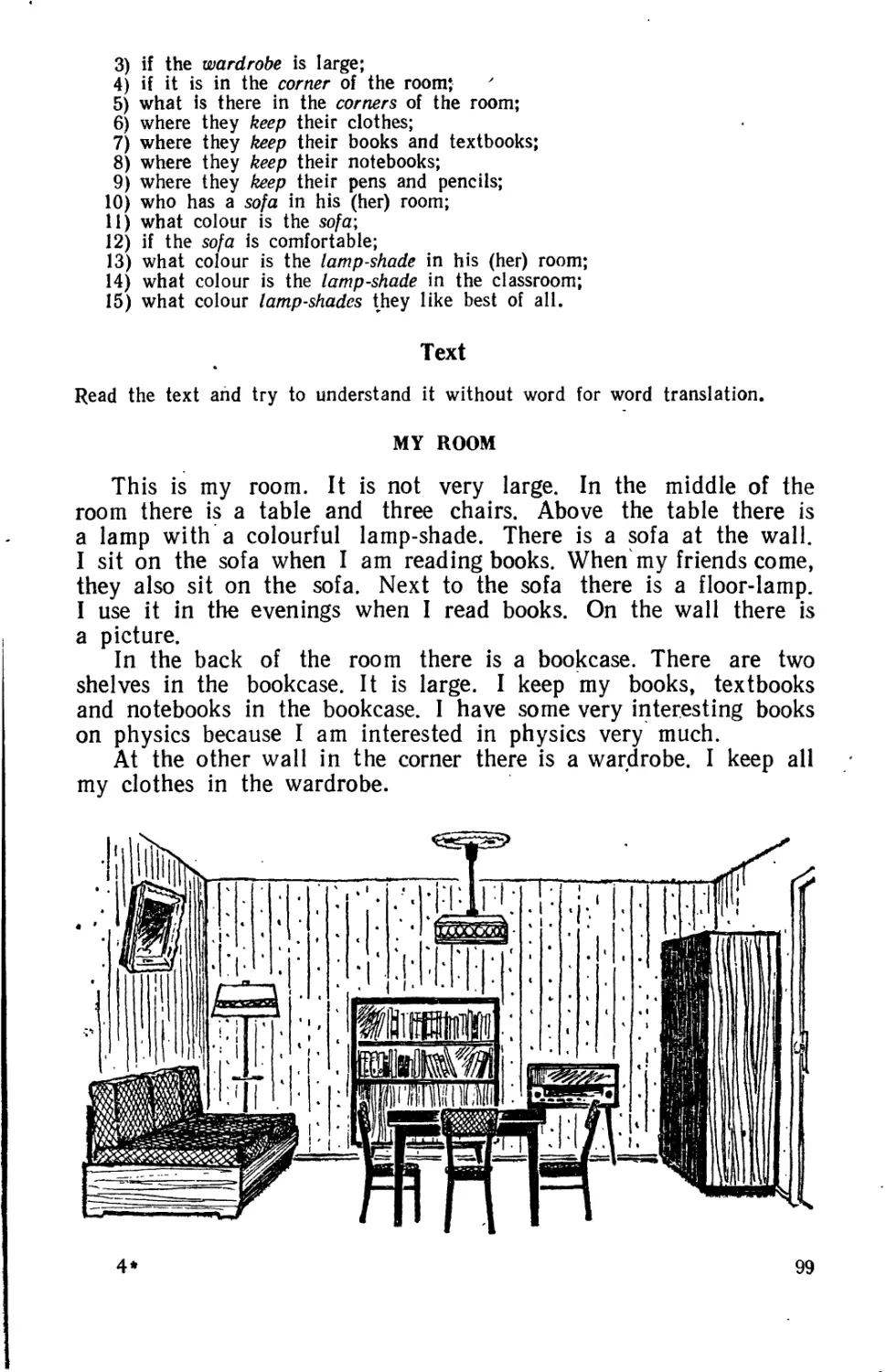



















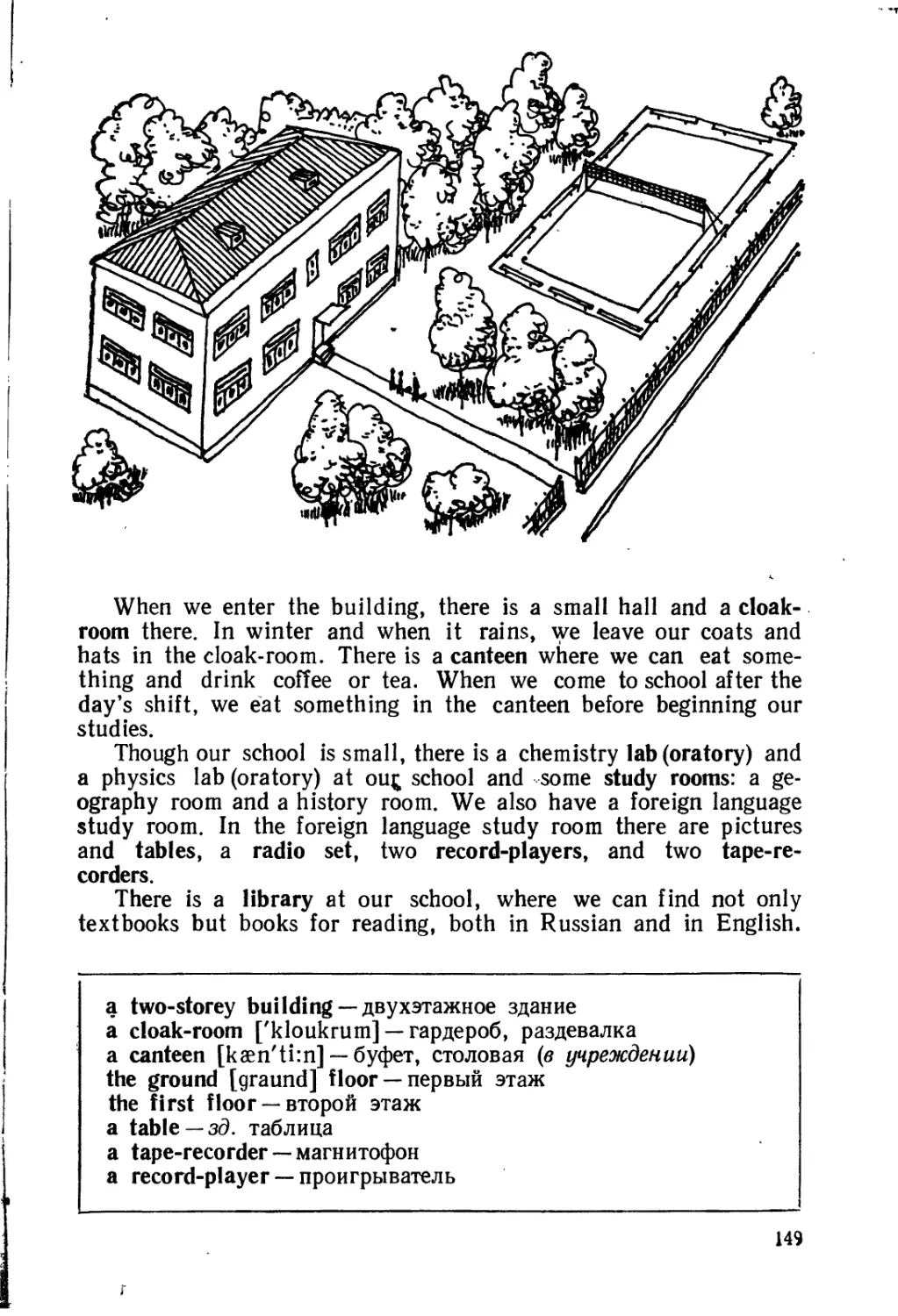


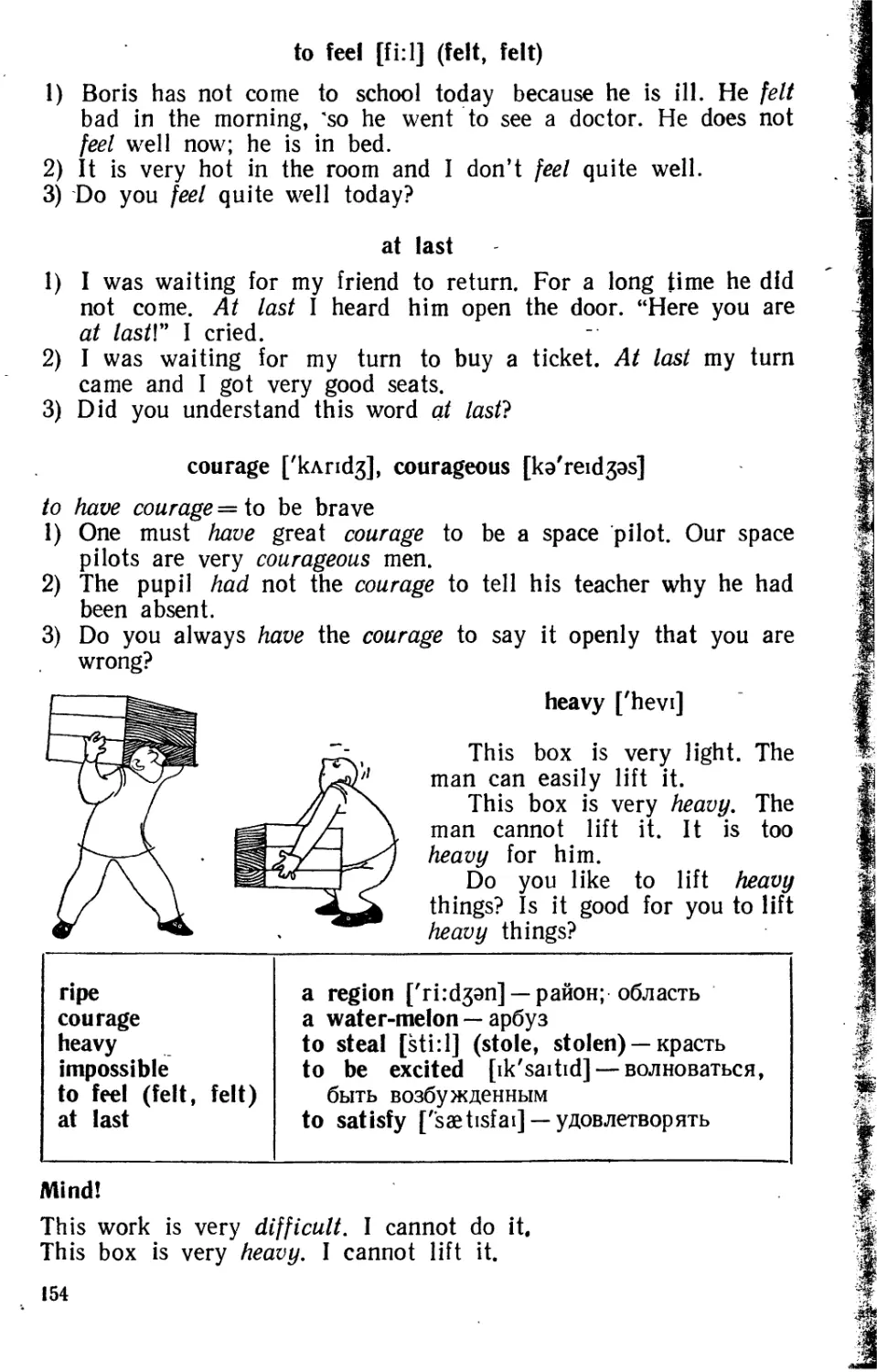
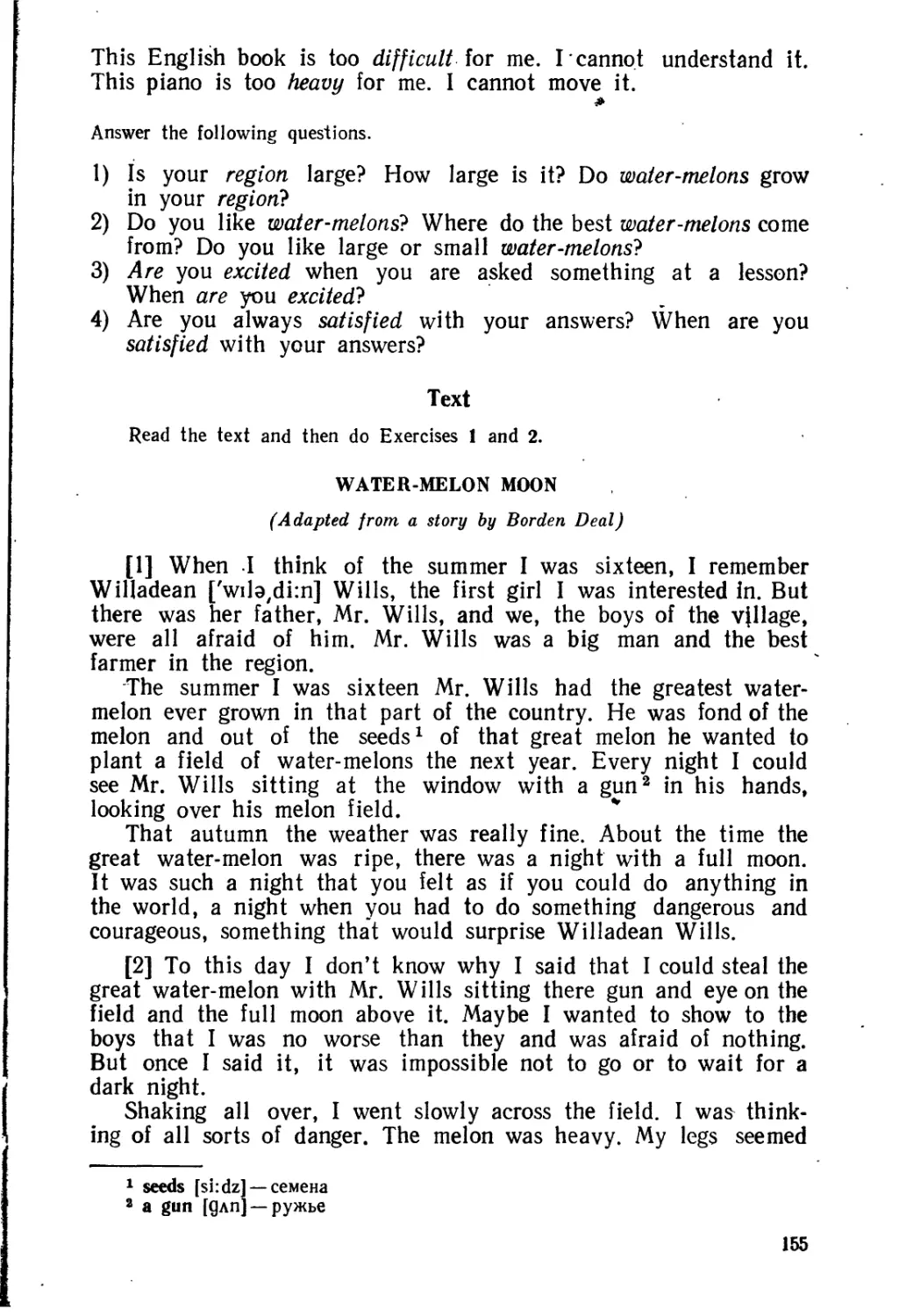
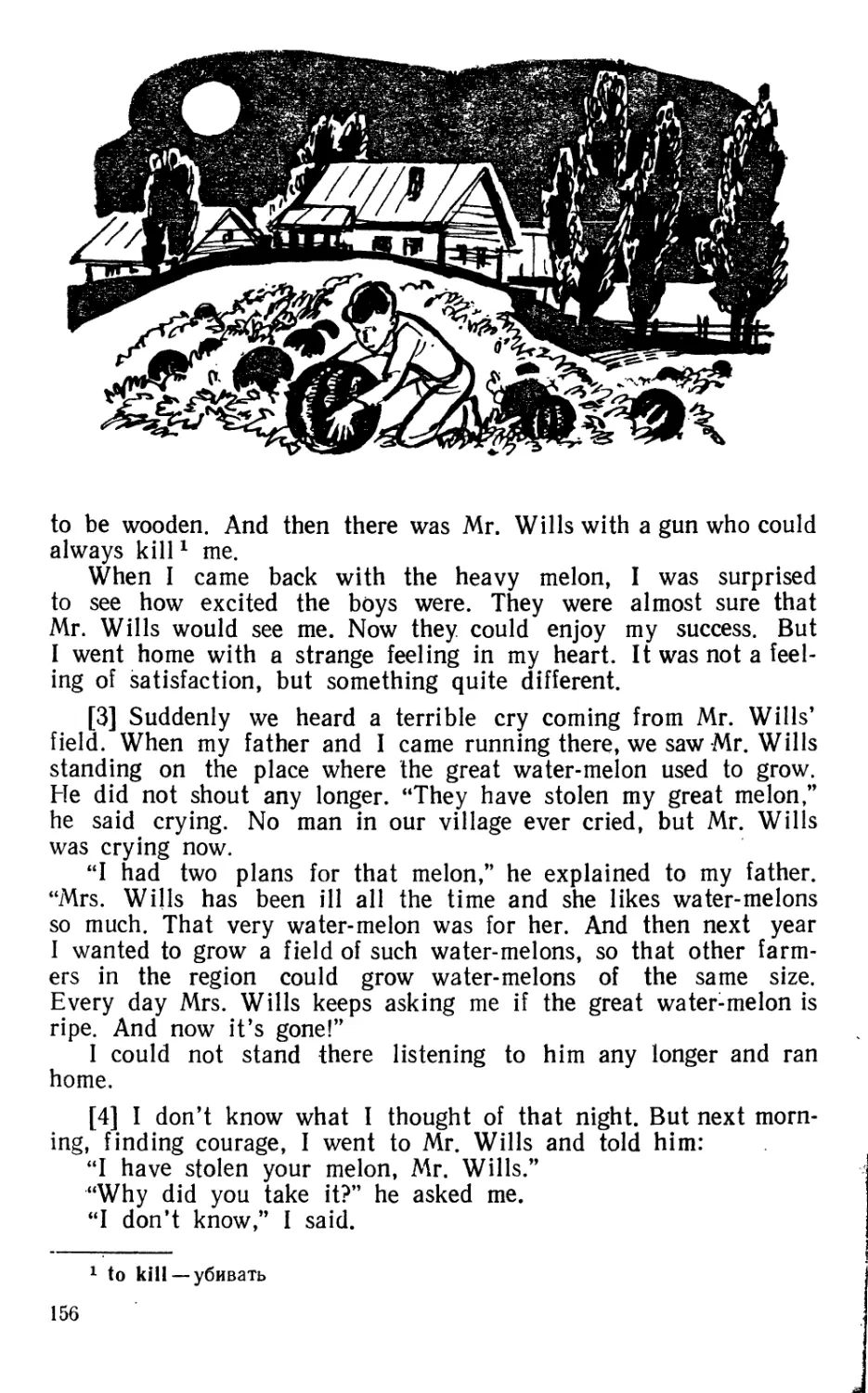




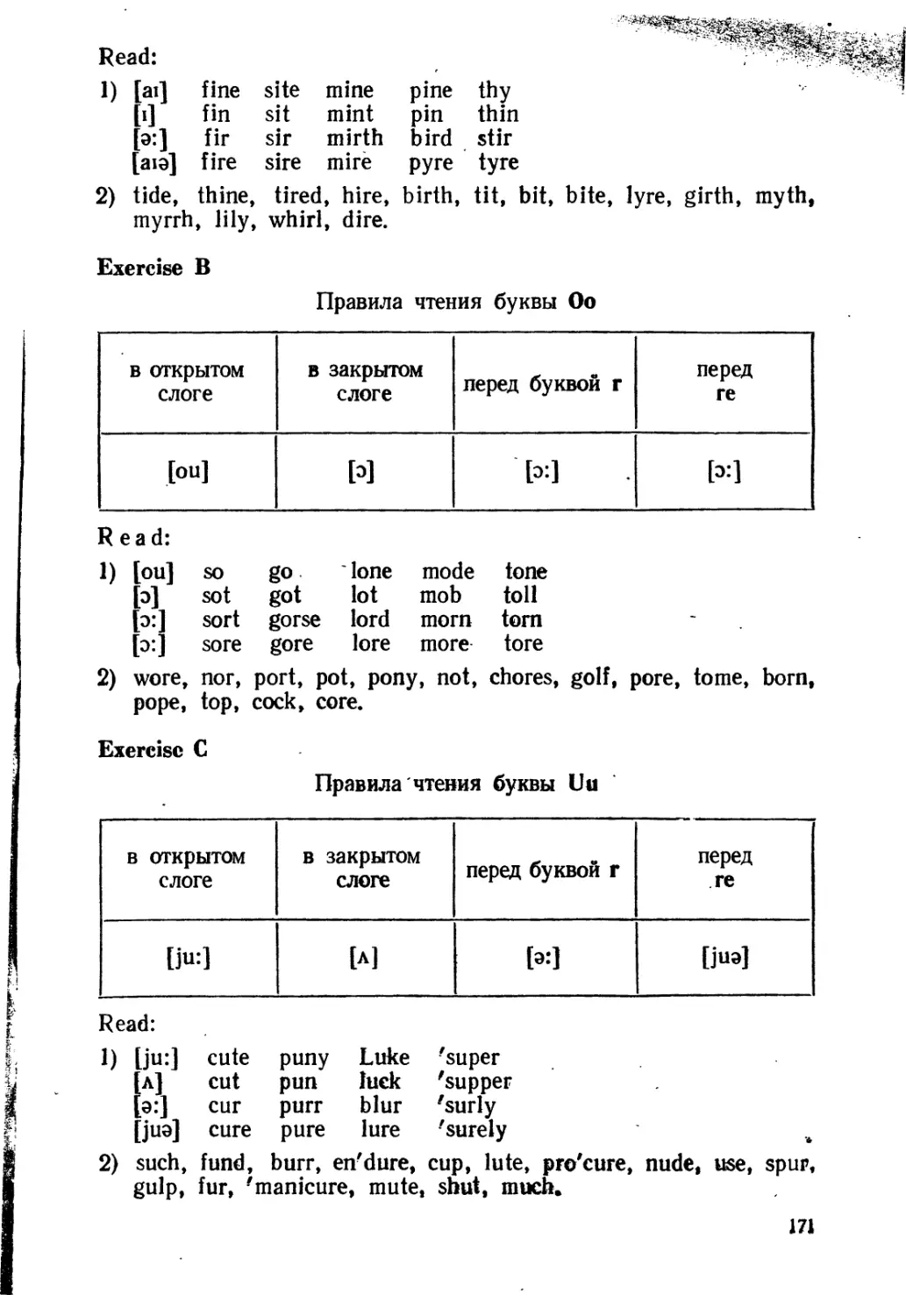
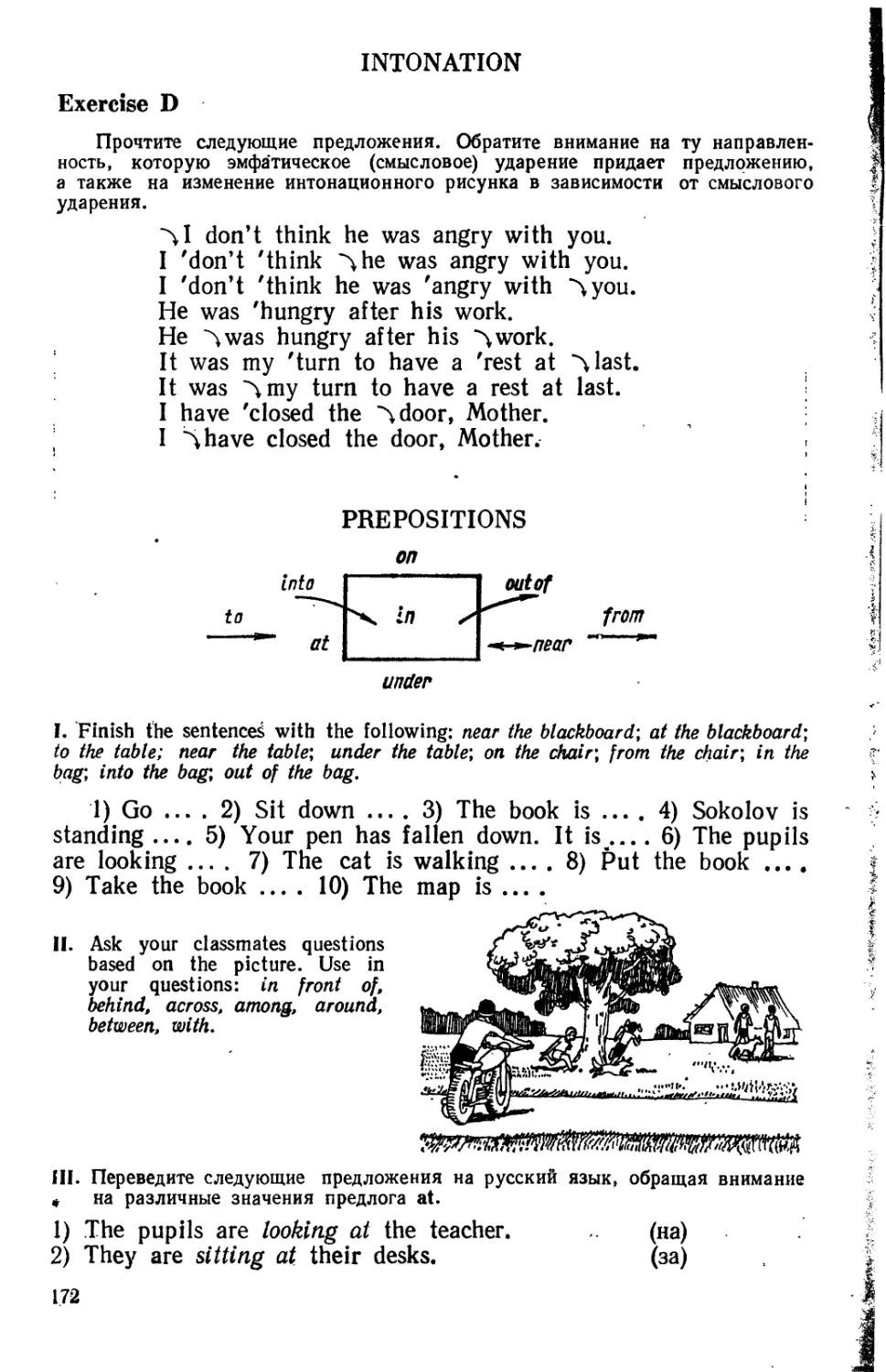


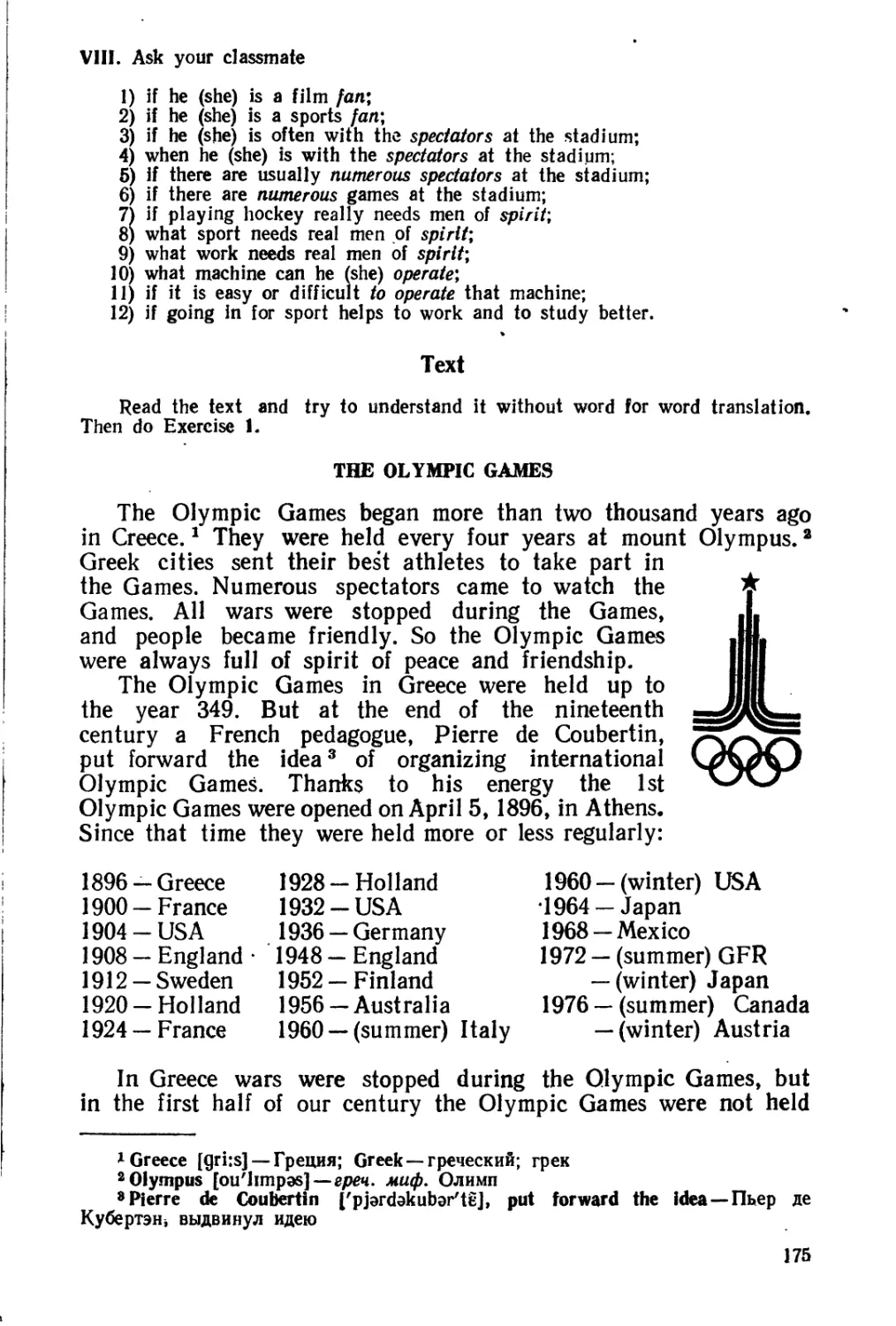
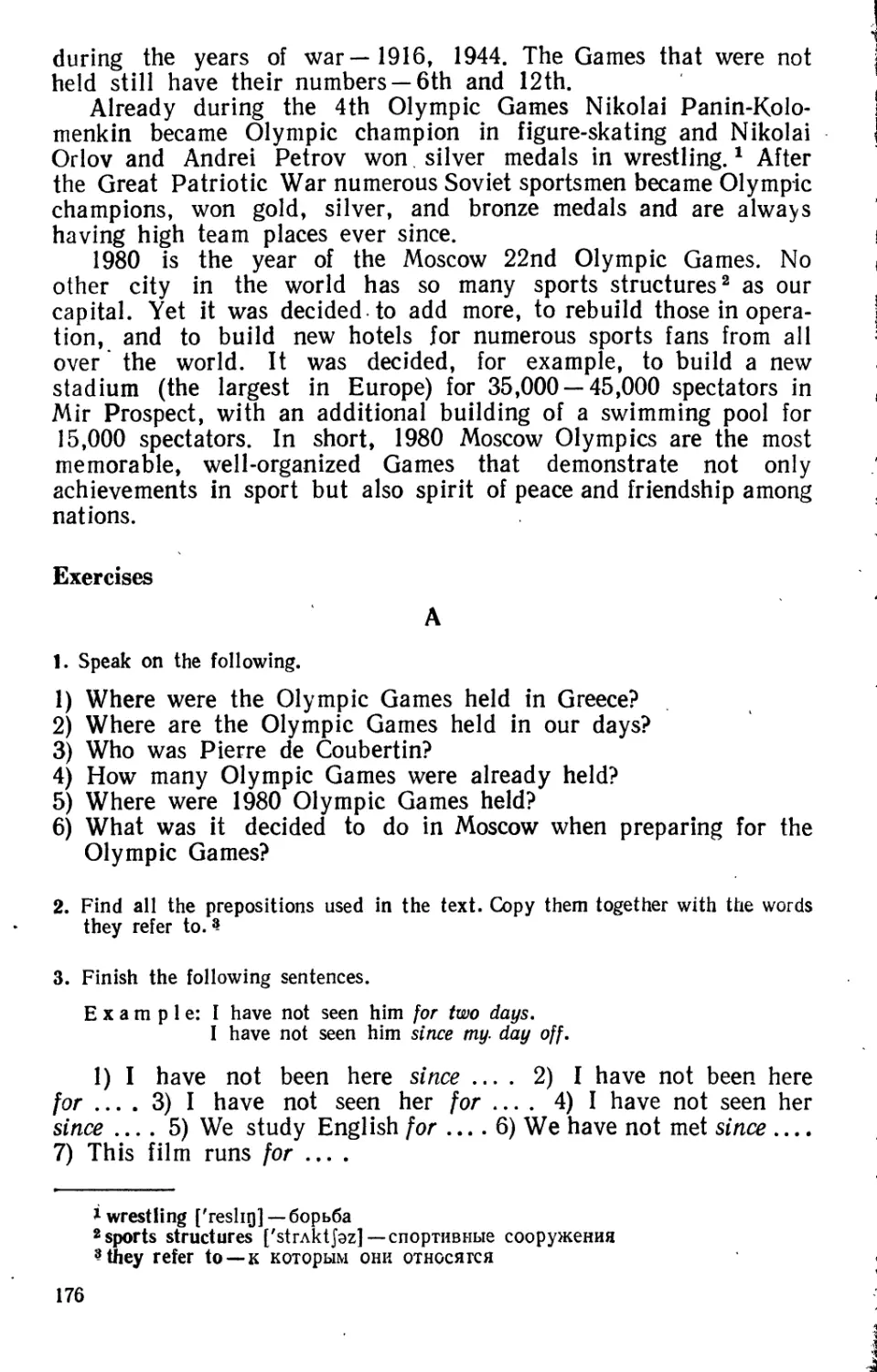








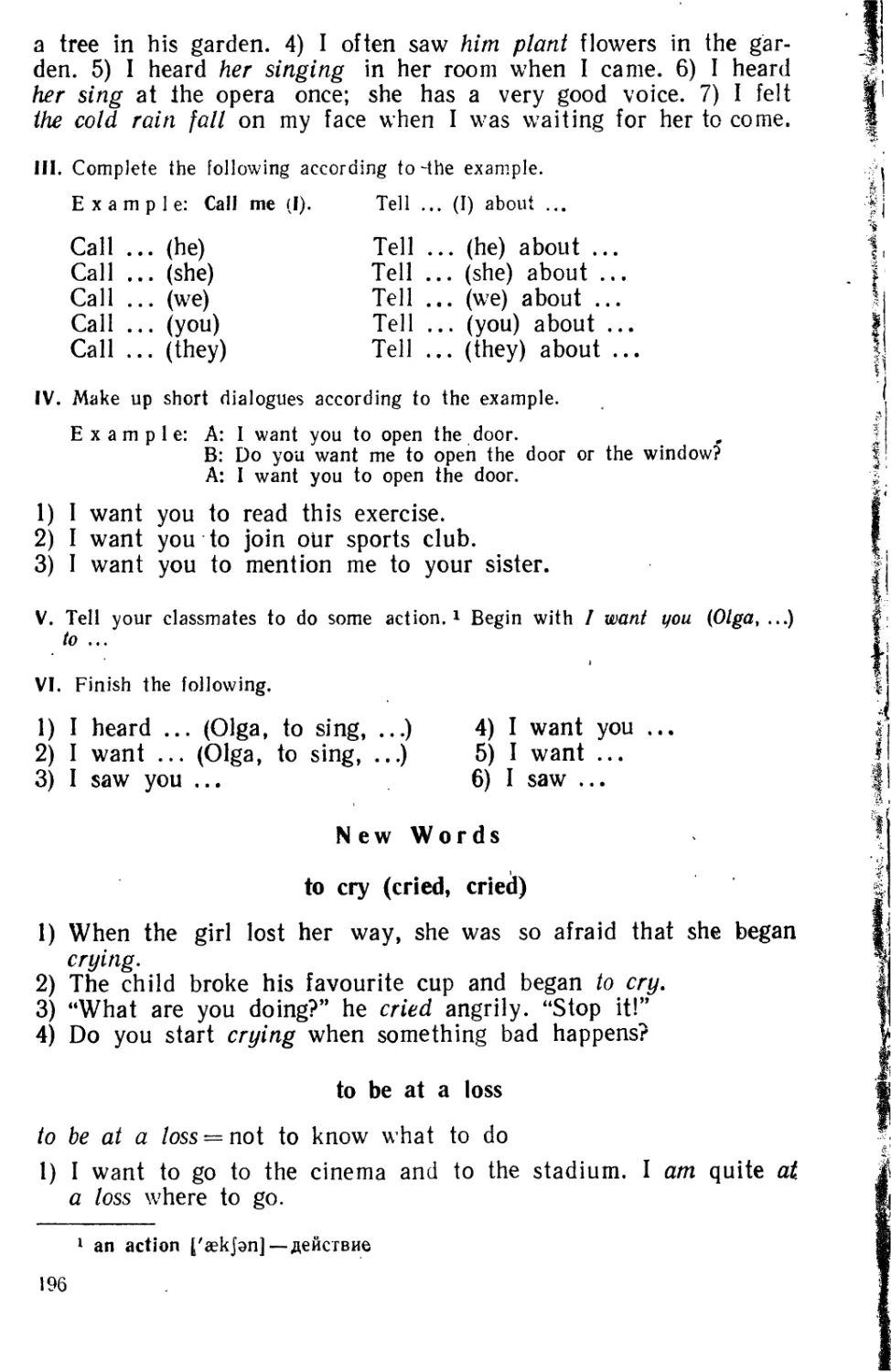
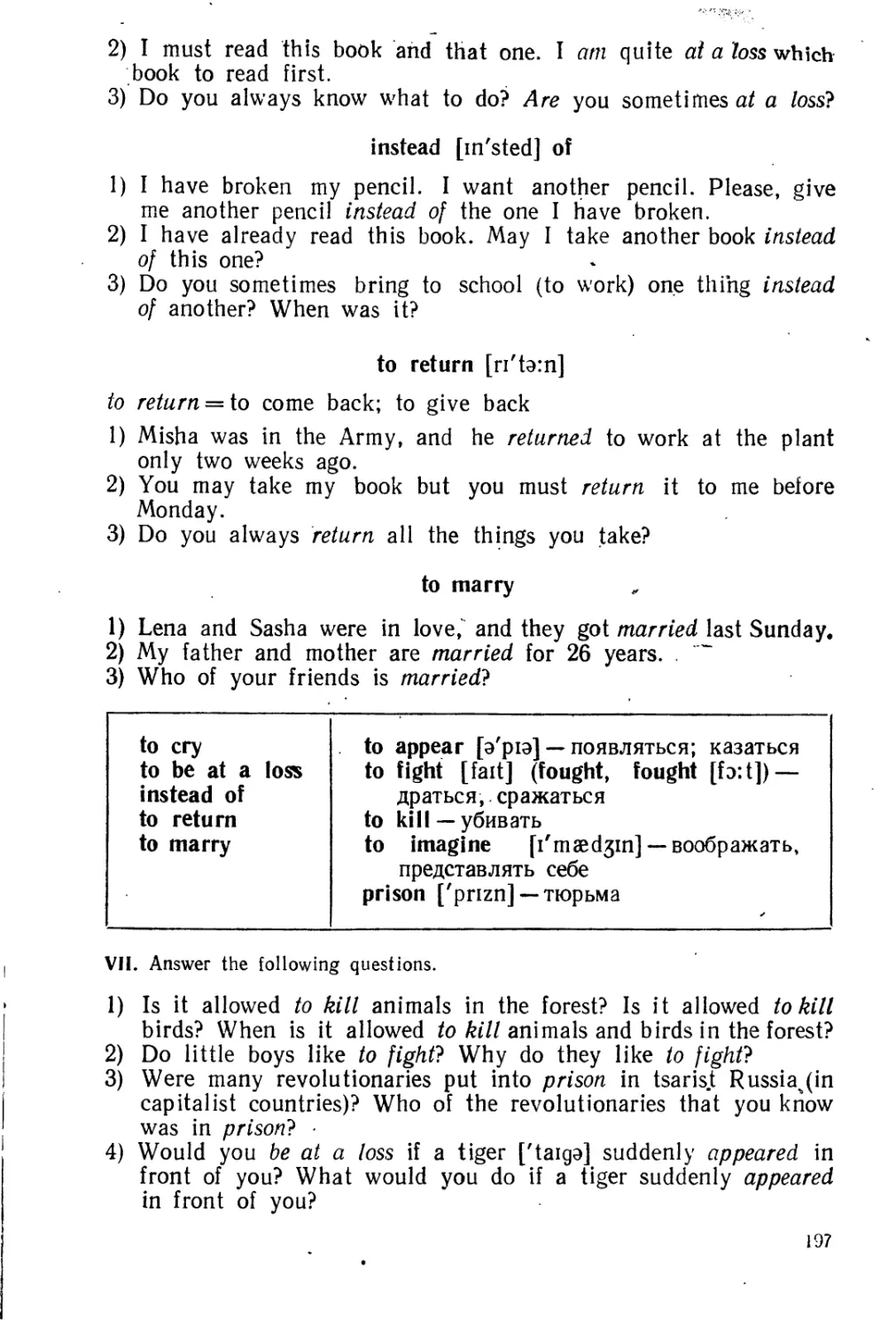


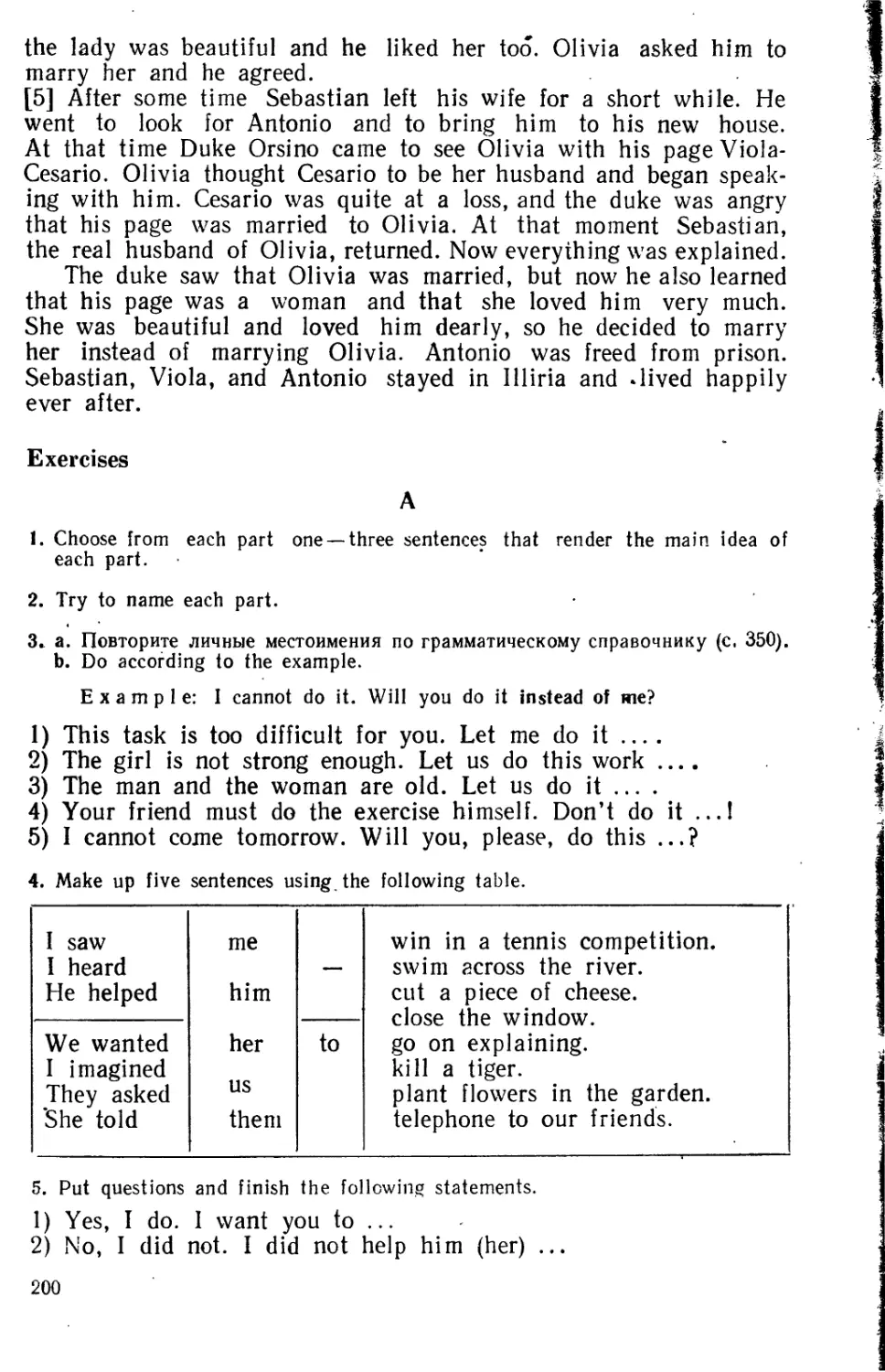


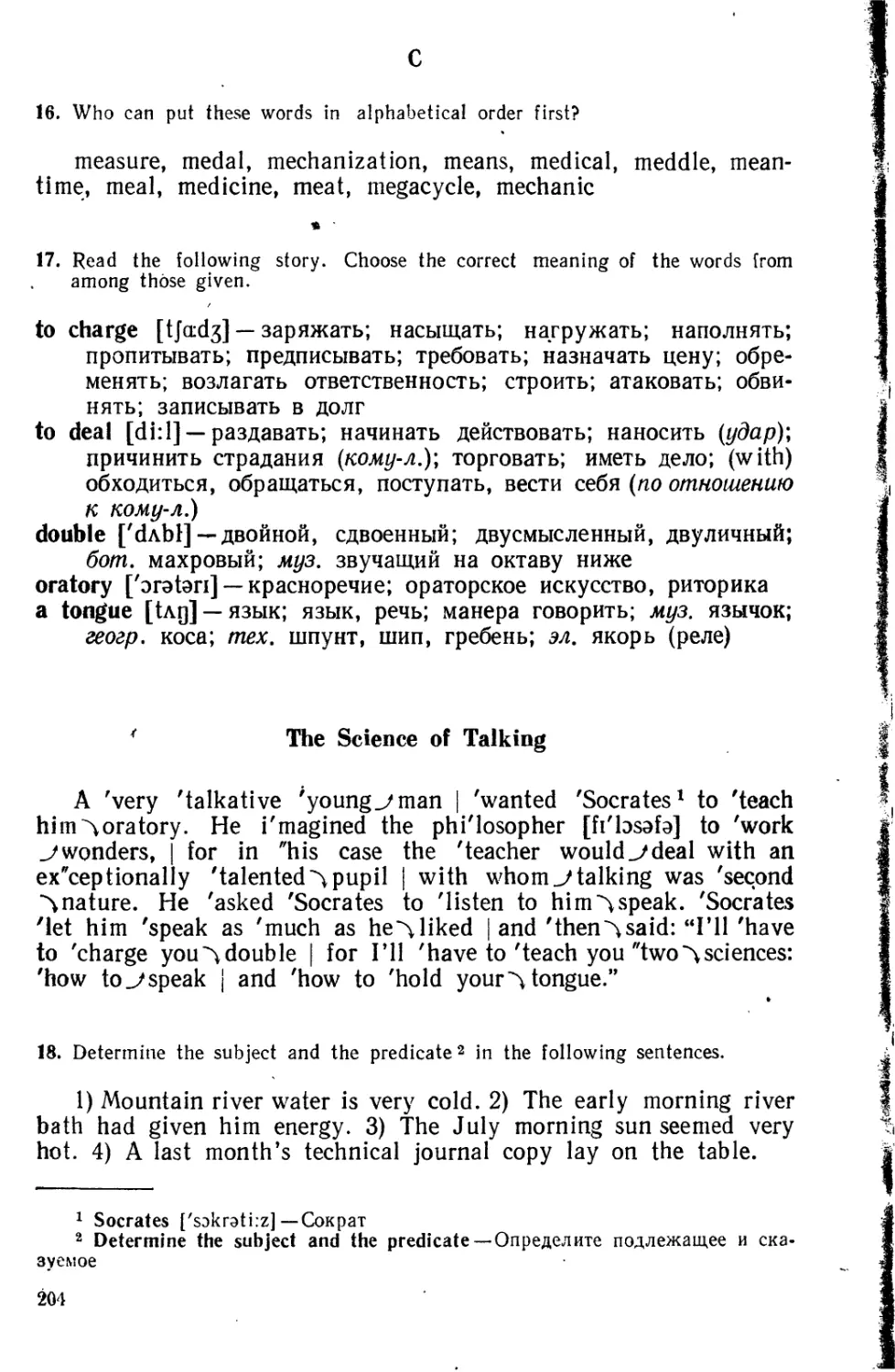














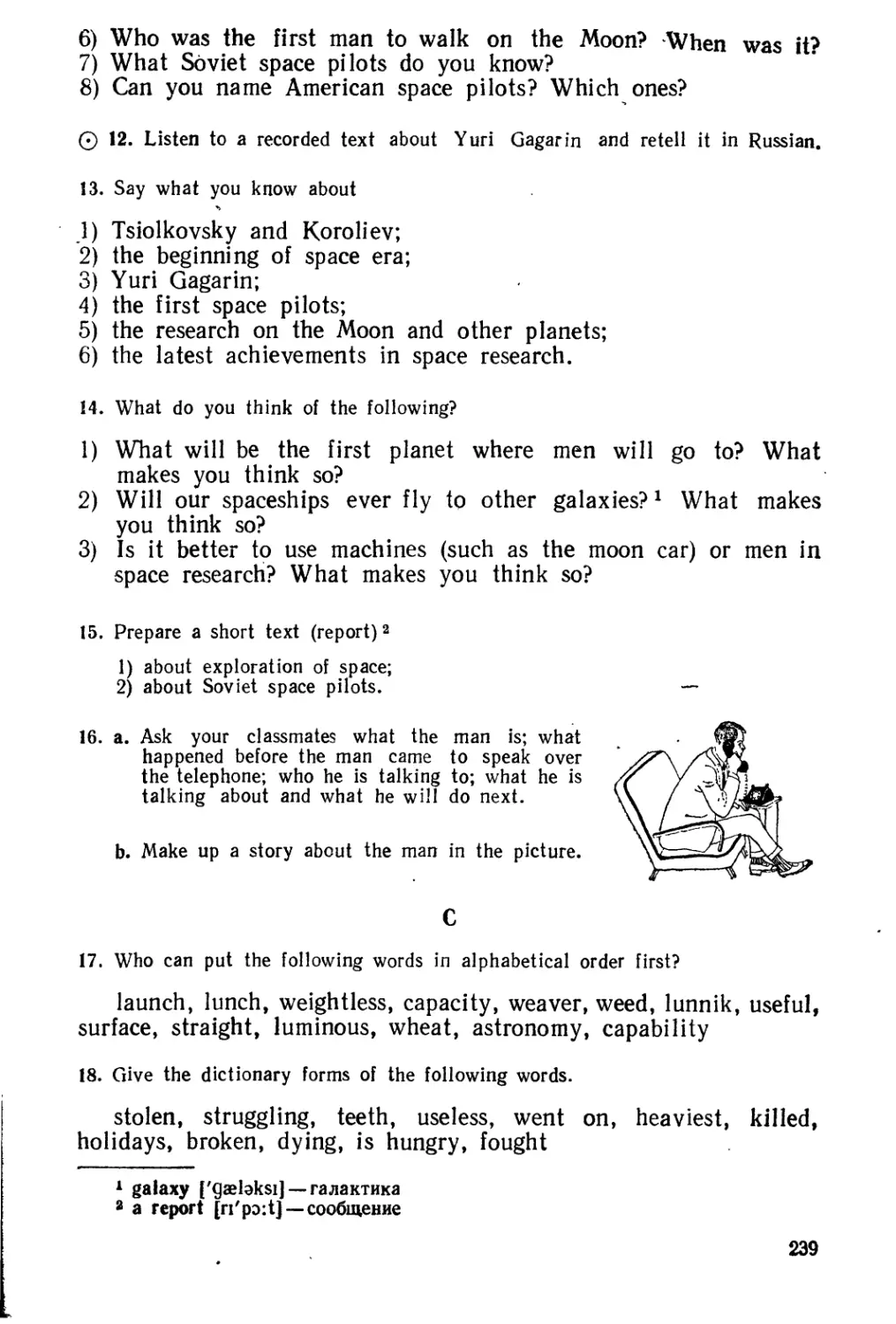


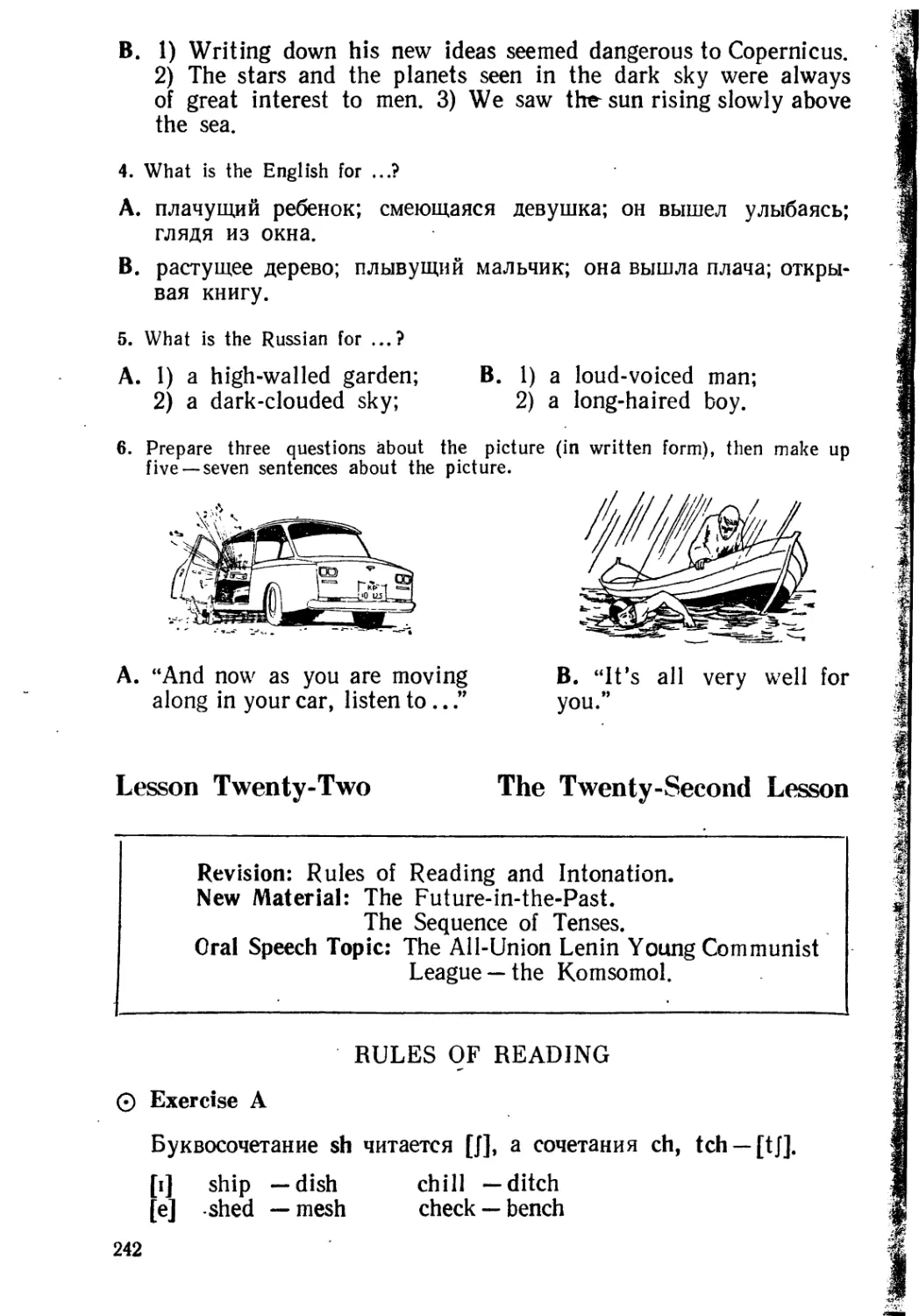


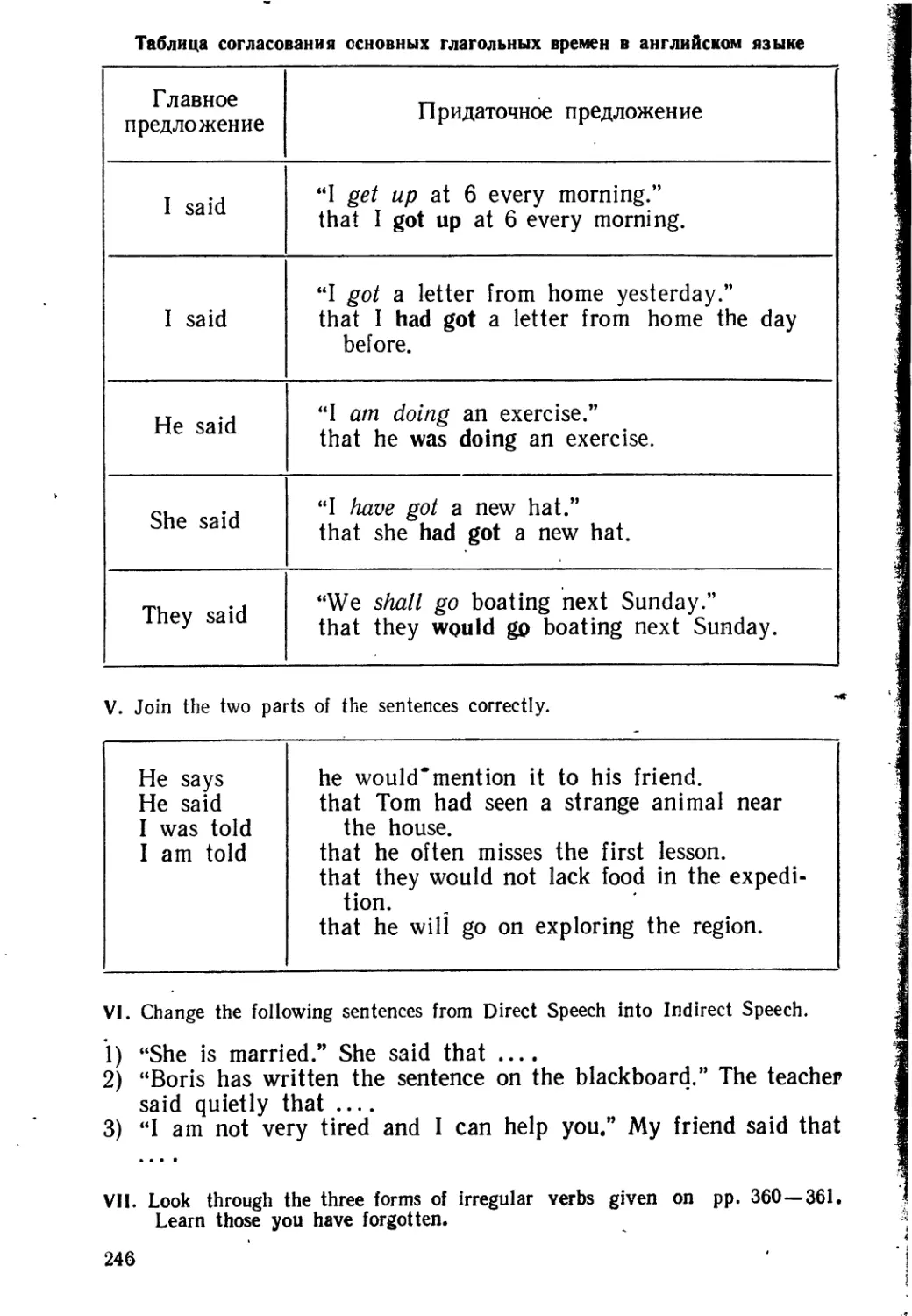

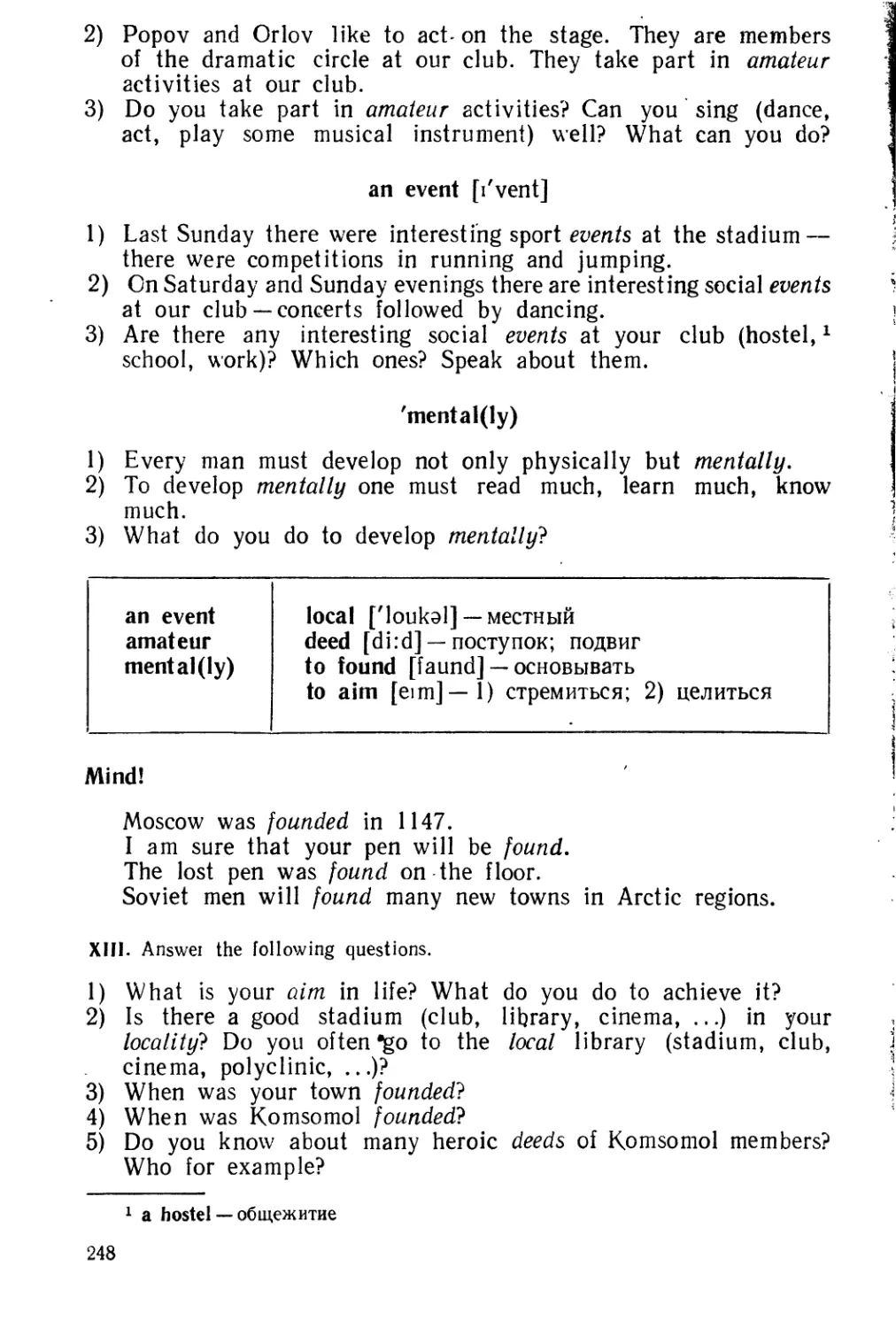










































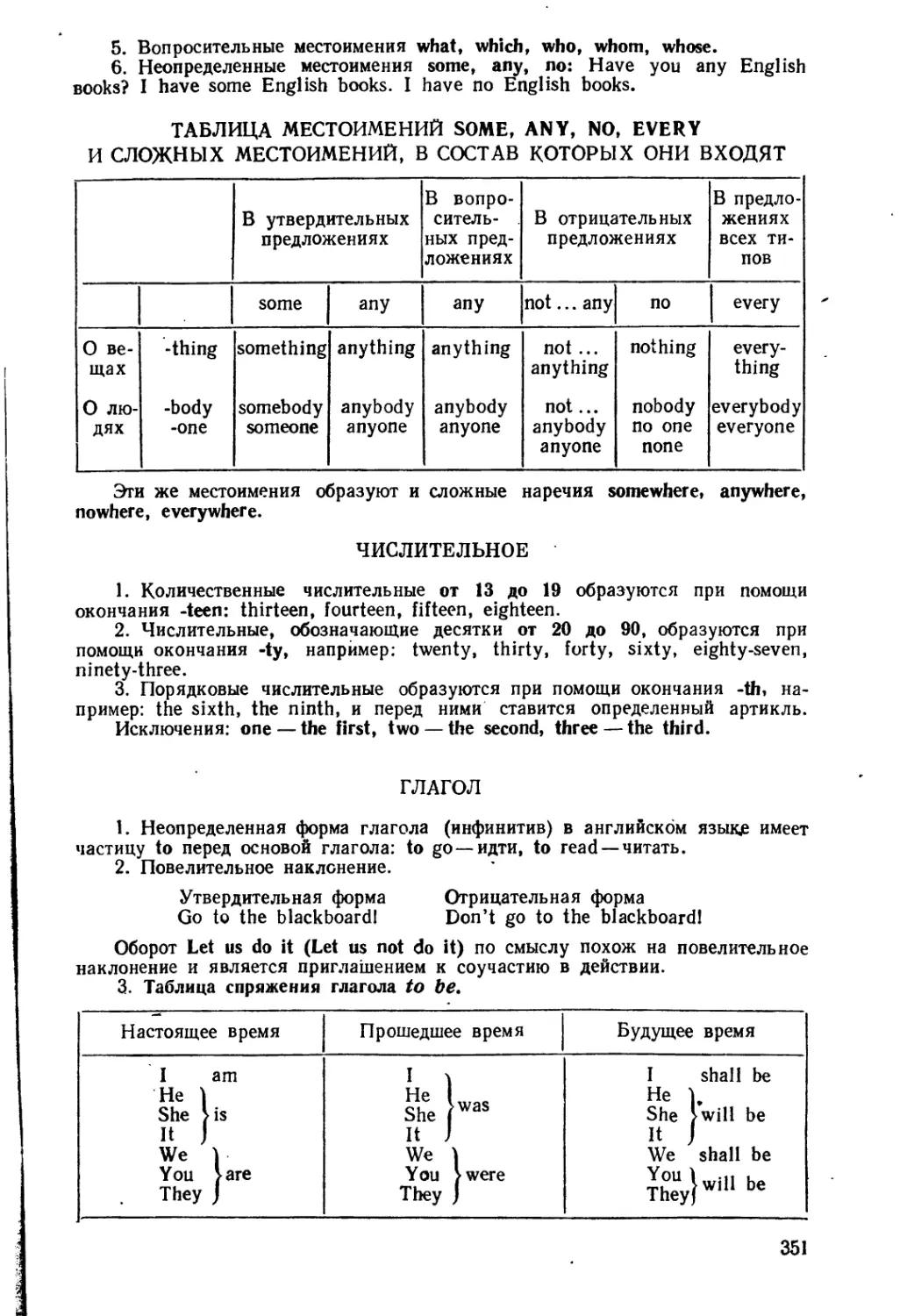


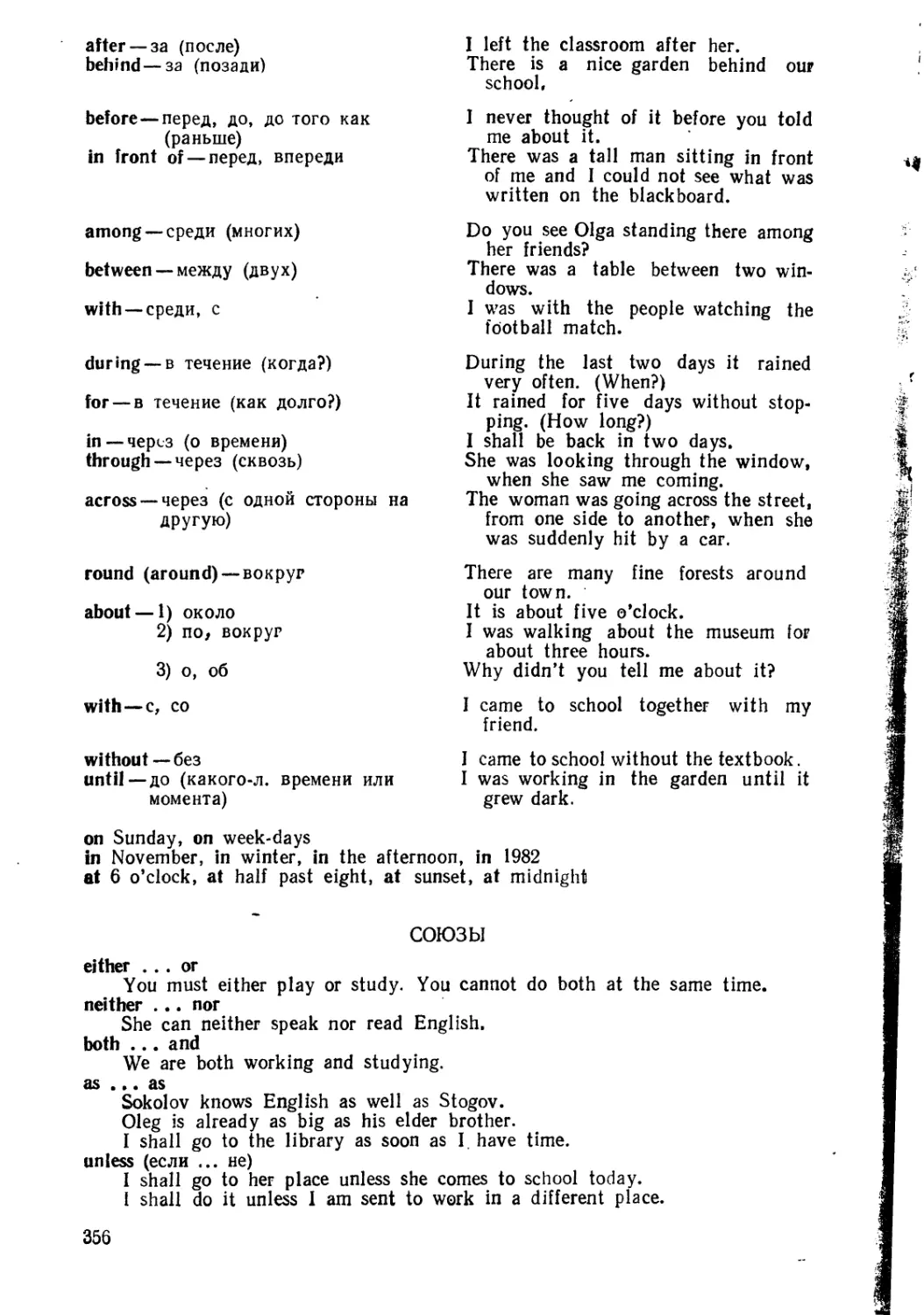


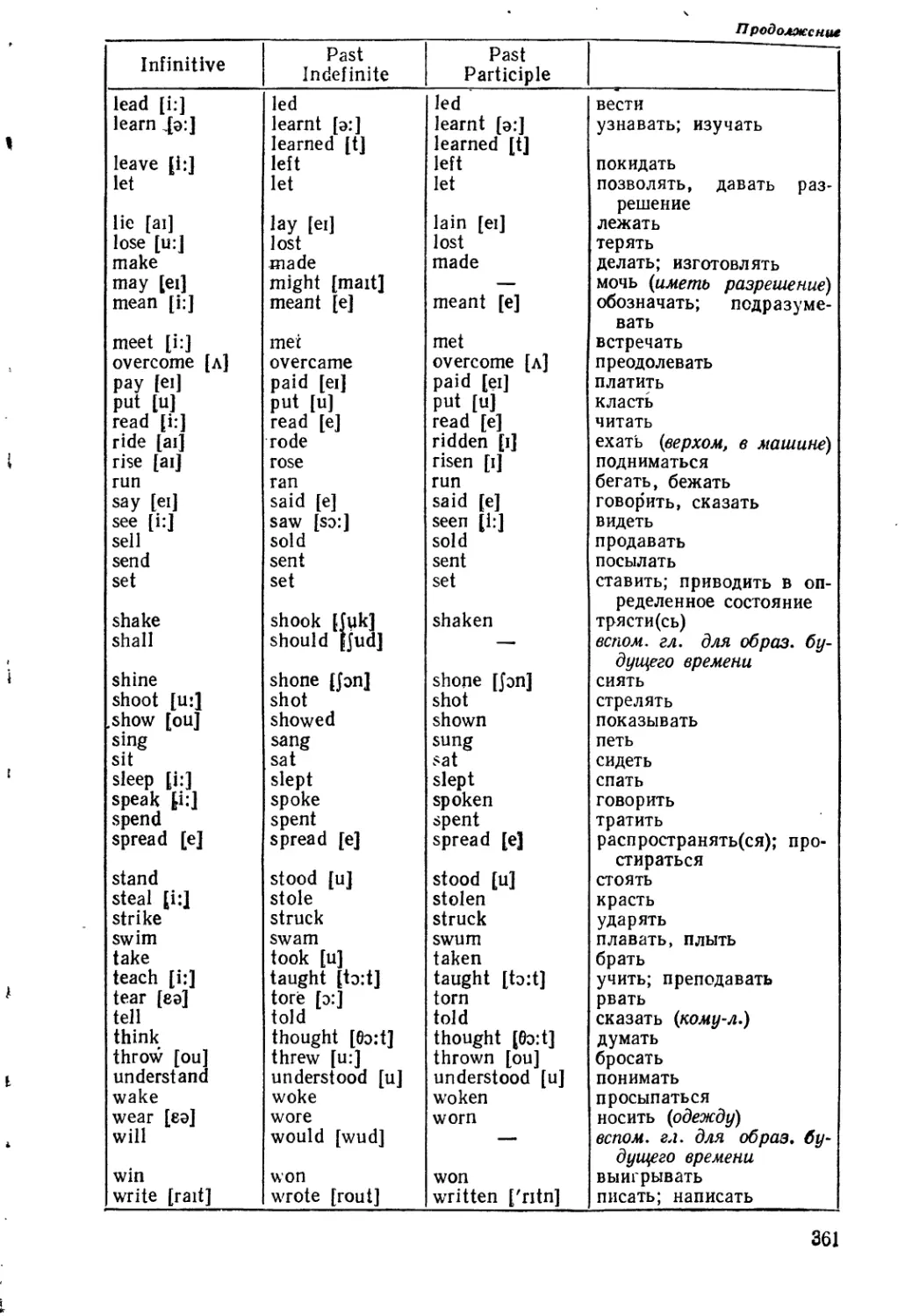

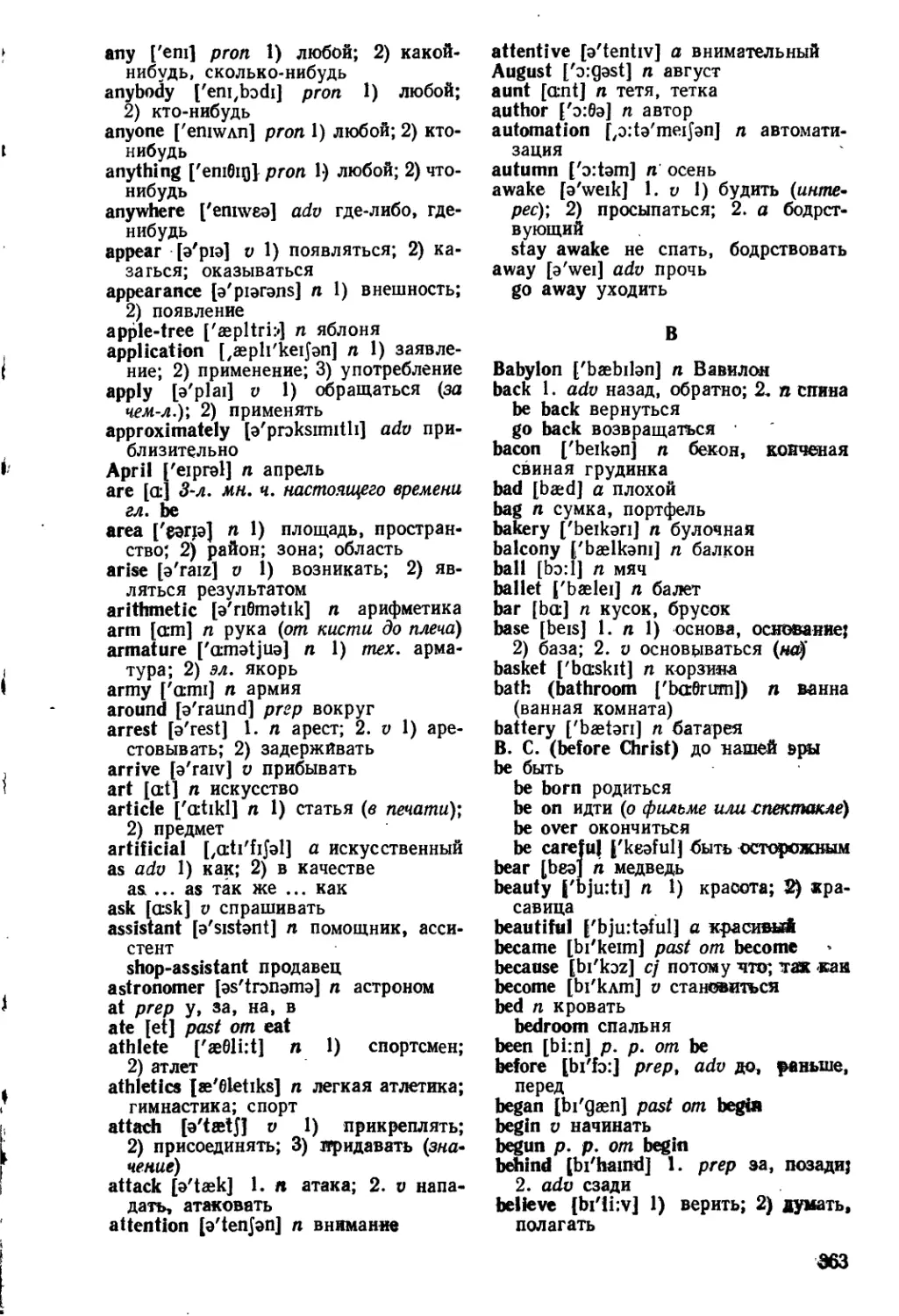






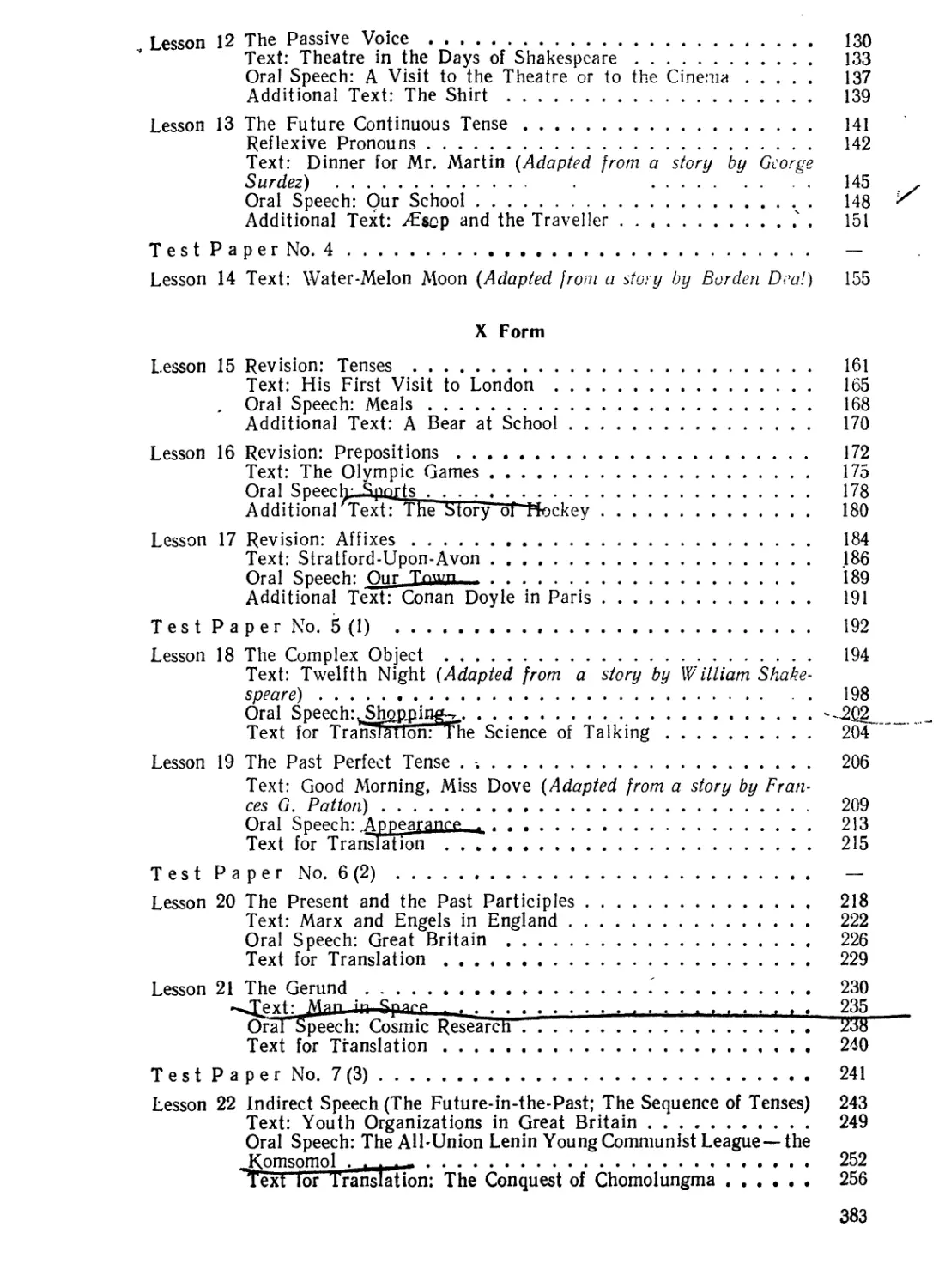




Text
                    A.A.Slobodchikoff
А. А. СЛОБОДЧИКОВ
УЧЕБНИК
АНГЛИЙСКОГО
ЯЗЫКА
ДЛЯ IX—XI КЛАССОВ
ВЕЧЕРНЕЙ (СМЕННОЙ)
ОБЩЕОБРАЗОВАТЕЛЬНОЙ
ШКОЛЫ
Утвержден
Министерством просвещения РСФСР
Издание 3-е, переработанное
МОСКВА «ПРОСВЕЩЕНИЕ» 1978
4И(Англ) (075)
С48
ИБ № 1755
Александр Александрович Слободчиков
Учебник английского языка
для IX—XI классов вечерней (сменной)
общеобразовательной школы
Редактор Ф. И. Юрасова
Художники А. Л. Блох, Л. Д. Гагаркина, Л. Ф. Малышева, В. С. Юдин
Художественный редактор Н. М. Ременникова
Технический редактор В. В. Новоселова
Корректор Л. П. Шелягина
Сдано в набор 22.02.78. Подписано к печати 16.04.78. 60X90Vie. Бум. газетная. Литерат.
гарн. Высокая печать. Усл. п. л. 24,0. Уч.-изд. л. 23,61. Тираж 84 000 экз.
Заказ № 1715. Цена 55 коп.
Ордена Трудового Красного Знамени издательство «Просвещение» Государственного ко-
митета Совета Министров РСФСР по делам издательств, полиграфии и книжной тор-
говли, Москва, 3-й проезд Марьиной рощи, 4L
Отпечатано с матриц ордена Октябрьской Революции, ордена Трудового Красного Зна-
мени Ленинградского производственно-технического объединения «Печатный Двор»
имени А. М. Горького Союзполиграфпрома при Государственном комитете Совета
Министров СССР по делам издательств, полиграфии и книжной торговли. 197136, Ле-
нинград, П-136, Гатчинская ул., 26 в типографии им. Смирнова Смоленского облуправ-
ления издательств, полиграфии и книжной торговли, г. Смоленск, пр. им. Ю. Гагарина, 2.
Заказ Кг 2883.
OUOUI—оио
с 7777777—77 ИНФ- письмо
103(03)—78
© Издательство «Просвещение», 1973 г.
© Издательство «Просвещение», 1978 г.,
с изменениями.
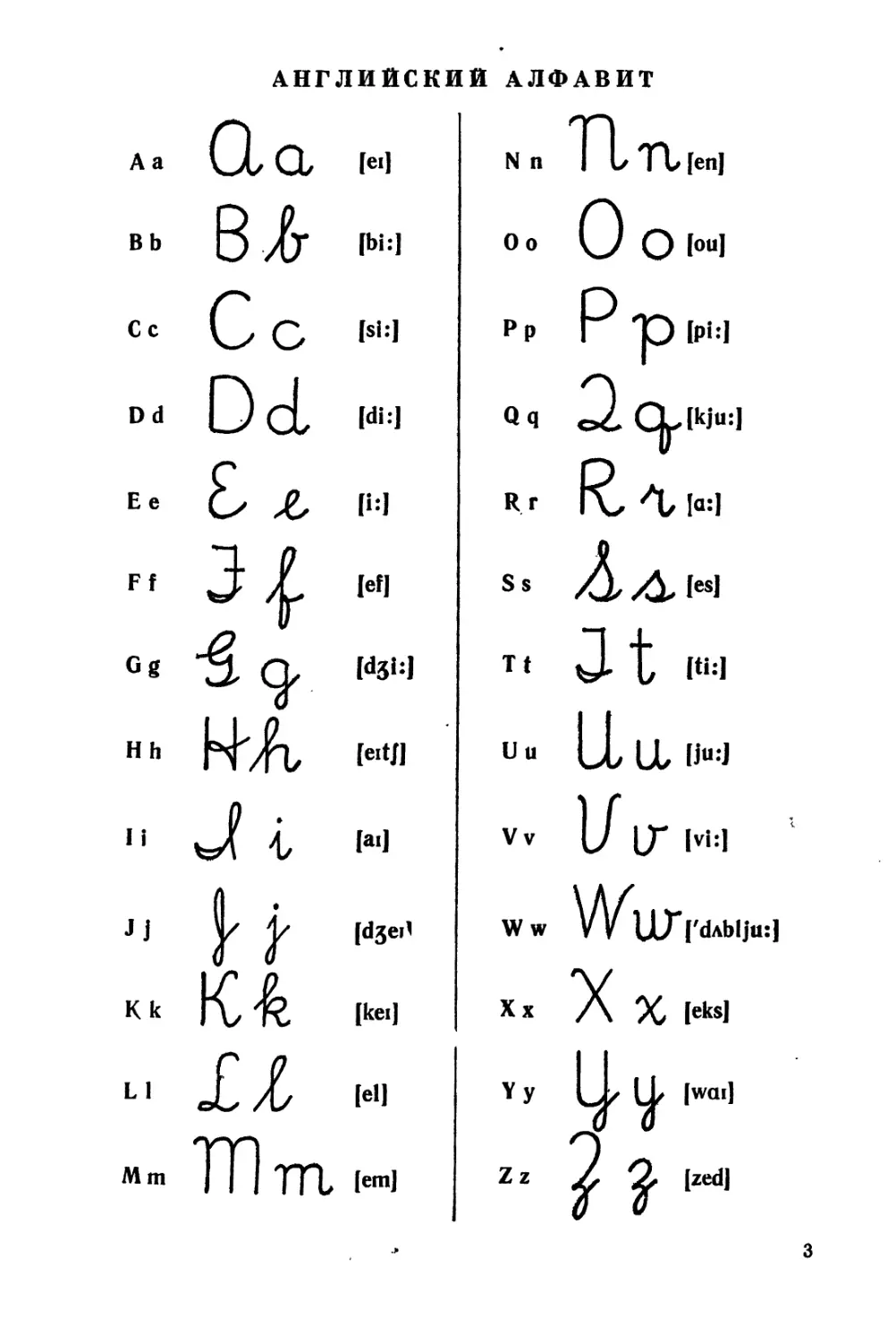
АНГЛИЙСКИЙ АЛФАВИТ
A a
Bb
Cc
Dd
E e
Ff
Gg
Hh
li
JJ
Kk
L 1
M m
Qa,	[ei]
BA	(bi:]
Co	[si:]
Dd	[di:]
	fi:J
	И

	[eit/]
	[ai]
	(djeil
	[kei]
LL	[el]
THm	[em]
W w
WUT I'dAblju:]
Xx /\ X [eks]
з
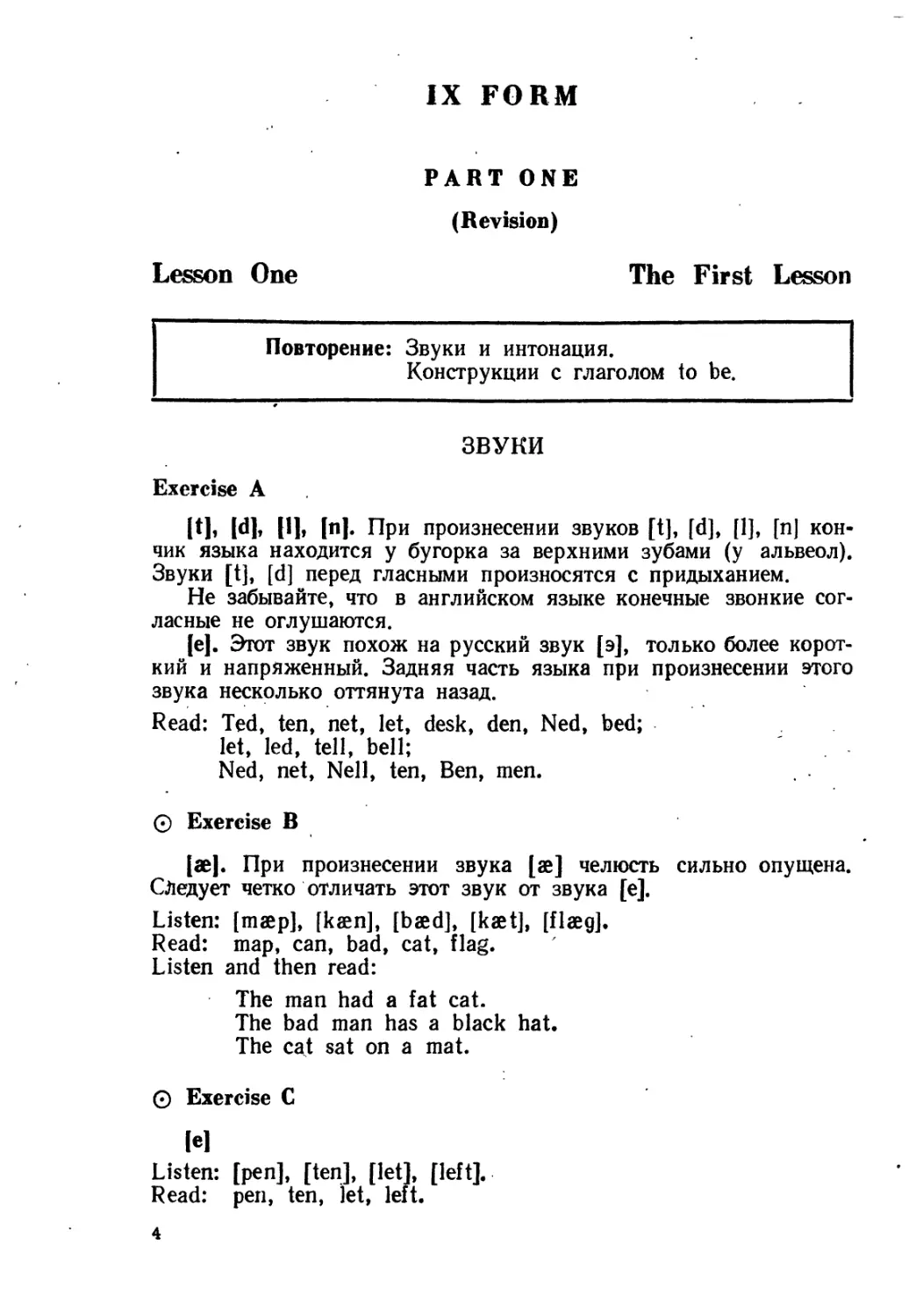
IX FORM
PART ONE
(Revision)
Lesson One
The First Lesson
Повторение: Звуки и интонация.
Конструкции с глаголом to be.
ЗВУКИ
Exercise А
|t), И], [1], [п]. При произнесении звуков [t], [d], [1], [nJ кон-
чик языка находится у бугорка за верхними зубами (у альвеол).
Звуки [t], [d] перед гласными произносятся с придыханием.
Не забывайте, что в английском языке конечные звонкие сог-
ласные не оглушаются.
[е]. Этот звук похож на русский звук [э], только более корот-
кий и напряженный. Задняя часть языка при произнесении этого
звука несколько оттянута назад.
Read: Ted, ten, net, let, desk, den, Ned, bed;
let, led, tell, bell;
Ned, net, Nell, ten, Ben, men.
0 Exercise В
|ае]. При произнесении звука [а] челюсть сильно опущена.
Следует четко отличать этот звук от звука [е].
Listen: [map], [kan], [bad], [kat], [flag].
Read: map, can, bad, cat, flag.
Listen and then read:
The man had a fat cat.
The bad man has a black hat.
The cat sat on a mat.
0 Exercise C
[el
Listen: [pen], [ten], [let], [left].
Read: pen, ten, let, left.
4
Listen: [bad] — [bed]	[bag] - [beg]	[kan] — [ken]
[man] — [men]	[sat] — [set]	[bak] —[bek]
Read: bad —bed	bag — beg	can — ken
man — men	sat — set	back — beck
Listen and then read:
The black dress is better than that dress.
Let the black desks stand In the classroom.
The red hat is better than the yellow hat.
0 Exercise D
[3], [0]. При произнесении звуков [3], [6] кончик языка нахо-
дится между верхними и нижними зубами. Звук [3] звонкий.
Звук [0] глухой.
Listen: [За], [Зеп], [3aet], £3i:z], ['тлдэ], [ТаЗэ], [гаЗа].
Read: the, then, that, these, mother, father, rather.
Listen: £0in], [9ik], [0a:t], ['9auzand],[ten9], [fifO], ['Oiata],
Read: thin, thick, thought, thousand, tenth, fifth, theatre.
Listen and then read:
the theatre	rather thick
that thought	these thousands
0 Exercise E
Jz— 3]. Произнесение этого звукосочетания представляет труд-
ность для русского учащегося. Отработайте его с помощью грам-
записи.
Listen and then read:
Is this... Is this a cat? Is_this cat black?
Is” that... Is” that a lamp? Ts_that lamp large?
Is this... Is this a map? Is This map good?
Isthat... Isthat a hat? Isthat yellow hat better than
mine? ”	”
0 INTONATION PATTERNS
В повествовательных предложениях интонация нисходящая
(голос понижается в конце предложения).
This is a bed.
That is my father.
The pencil is black.
5 ‘
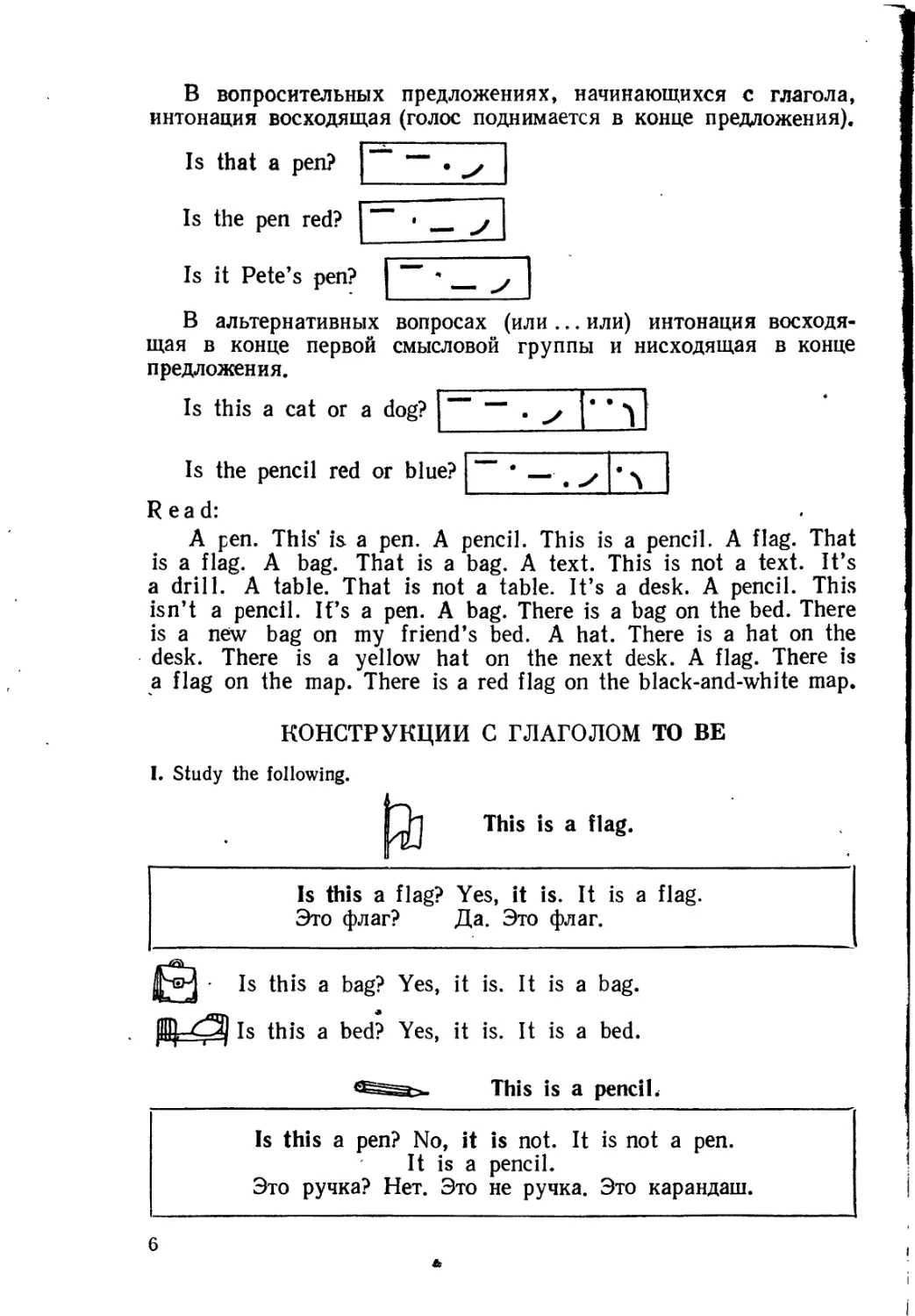
В вопросительных предложениях, начинающихся с глагола,
интонация восходящая (голос поднимается в конце предложения).
Is that а реп?
Is the pen red? < 	|
Is it Pete’s pen? '________
В альтернативных вопросах (или ... или) интонация восходя-
щая в конце первой смысловой группы и нисходящая в конце
предложения.
Is this a cat or a dog? . » ’ * ’
Is the pencil red or blue? * —
Read:
A pen. This is a pen. A pencil. This is a pencil. A flag. That
is a flag. A bag. That is a bag. A text. This is not a text. It’s
a drill. A table. That is not a table. It’s a desk. A pencil. This
isn’t a pencil. It’s a pen. A bag. There is a bag on the bed. There
is a new bag on my friend’s bed. A hat. There is a hat on the
desk. There is a yellow hat on the next desk. A flag. There is
a flag on the map. There is a red flag on the black-and-white map.
КОНСТРУКЦИИ С ГЛАГОЛОМ TO BE
I. Study the following.
This is a flag.
Is this a flag? Yes, it is. It is a flag.
Это флаг? Да. Это флаг.
jr®4 • Is this a bag? Yes, it is. It is a
Is this a bed? Yes, it is. It is a
bag.
bed.
This is a pencil.
Is this a pen? No, it is not. It is not a pen.
It is a pencil.
Это ручка? Нет. Это не ручка. Это карандаш.
6
this a cat? No, it is not. It is not a cat. It is a dog.
Is this a tent? No, it is not. It is not a tent. It is a house,
ддав/
Is
this a man? No, it is not. It is not a man. It is a boy.
II. Answer the following questions.
Is this a table? Is this a bed?
Is this a cat? Is this a dog?
Is this a girl? Is this a boy?
III. Ask your classmates1 questions about the following objects. 2
V. Study the following.
Is Tom a boy? Yes, he is. Tom is a boy.
Is Kate a girl? Yes, she is. Kate is a girl. 1 2
1 a classmate — соученик, соученица
2 about the following objects —о следующих предметах
7
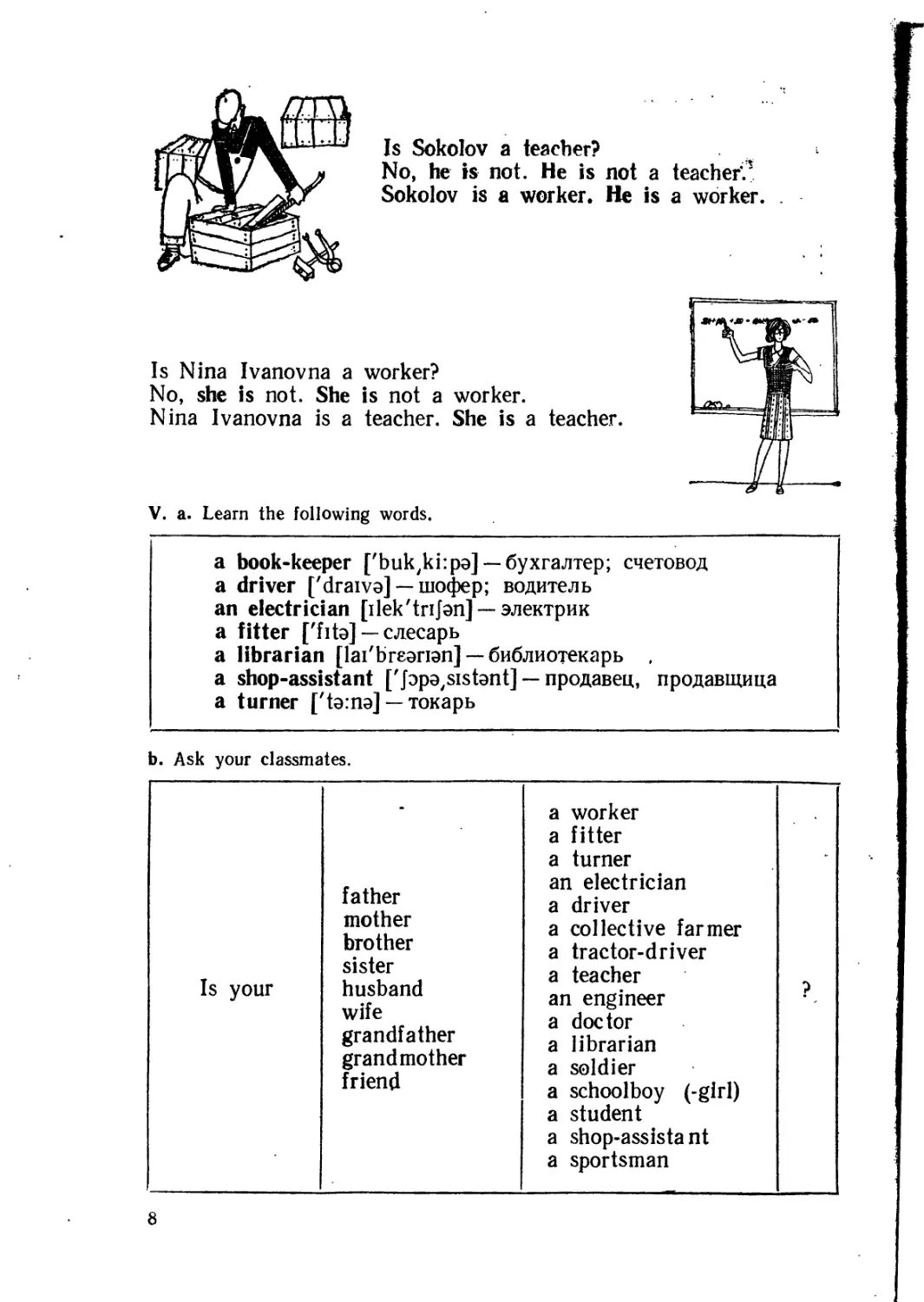
Is Sokolov a teacher?
No, he is not. He is not a teacher?
Sokolov is a worker. He is a worker.
Is Nina Ivanovna a worker?
No, she is not. She is not a worker.
Nina Ivanovna is a teacher. She is a teacher.
V. a. Learn the following words.
a book-keeper ['buk,ki:pa] —бухгалтер; счетовод
a driver ['draiva] — шофер; водитель
an electrician [ilek'tn Jan] —электрик
a fitter ['fits] — слесарь
a librarian [lai'breanan] — библиотекарь .
a shop-assistant J'Jopo^sistont] — продавец, продавщица
a turner ['ta:na]— токарь
b. Ask your classmates.
Is your	father mother brother sister husband wife grandfather grandmother friend	a worker a fitter a turner an electrician a driver a collective farmer a tractor-driver a teacher an engineer a doctor a librarian a soldier a schoolboy (-girl) a student a shop-assistant a sportsman	?
8
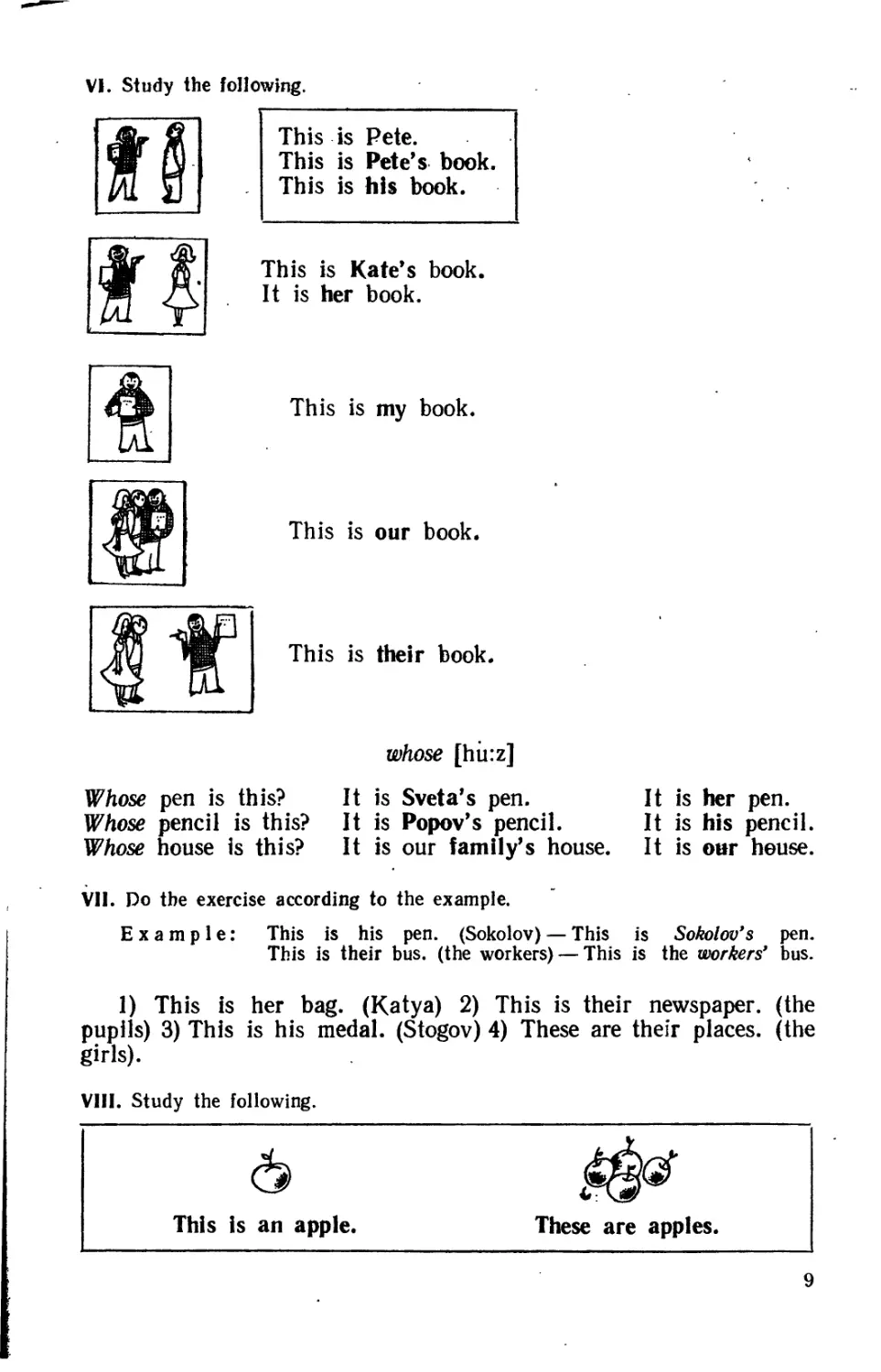
VI. Study the following.
This is Pete.
This is Pete’s book.
This is his book.
This is Kate’s book.
It is her book.
This is my book.
This is our book.
This is their book.
whose [hirz]
Whose pen is this?
Whose pencil is this?
Whose house is this?
It is Sveta’s pen.
It is Popov’s pencil.
It is our family’s house.
It is her pen.
It is his pencil.
It is our house.
VII. Do the exercise according to the example.
Example: This is his pen. (Sokolov) — This is Sokolov’s pen.
This is their bus. (the workers) — This is the workers? bus.
1)	This is her bag. (Katya) 2) This is their newspaper, (the
pupils) 3) This is his medal. (Stogov) 4) These are their places, (the
girls).
VIII. Study the following.
6	If : \y
This is an apple.	These are apples.
9
Is this an apple? Yes, it is.
It is an apple.
Is this a ball? No, it is not.
It is not a ball. It’s an apple.
Are these apples? Yes, they are.
These are apples.
Are these balls? No, they are not.
These are not balls. These are
apples.
IX. Finish the following answers.
Are these ships?
Are these buses?
Is this a box?
Are they workers?
Are they night-school pupils?
Are they doctors?
Is Sokolov a doctor?
No, they are not. These are ...
Yes, they are ...
No, it is not ...
Yes, they are. They are workers.
Yes, they are ...
No, they are not. They ...
No, he is not ...
X. Ask your classmates questions about the following objects.
XI. Study the following.
Our Soviet flag is red.
In summer the trees are green.
In autumn the trees are yellow and brown.
Snow is cold and white.
My pencil is black.
The sky is blite.
XII. Finish the following sentences according to the example.
Ex ample: The blackboard in our classroom is black (brown, green).
1)	In spring the trees are ... .
2)	This textbook is ... .
3)	The walls of our classroom are ... .
4)	My suit (dress) is ... and A.’s suit (dress) is ... .
5)	My..............
6)	His.............
7)	The.............
XIII. Answer the following questions.
1) What colour are the walls in your classroom?
2) What colour is the floor?
3) What colour is your bag?
4) What colour are the desks in the classroom?
5) What colour is your dress (suit)?
10
XIV.	Ask your classmate questions beginning with the words: What odour is
(are) ....
XV.	Say what is red (green, white, black, blue, yellow, brown). Try to find as
many English words as you can.
В английском языке определение ставится между ар-
тиклем и существительным, если существительное упо-
требляется с артиклем.
XVI.	Do the exercise according to the example.
Example: This dress is brown. These dresses are brown.
This is a brown dress. These are brown dresses.
1)	This street is long.
2)	This town is beautiful.
3)	These bridges are new.
4)	These books are good.
XVII.	Finish the following sentences according to the example.
E x a m p le : This book _—This book is interesting (good, green).
This flag.... These pupils.... This chair.... These streets ... .
This text .... These dresses (suits) ....
XV1H. Study the following.
Are you a pupil?	Yes, I am. I am a pupil.
Вы (ты) ученик?	Да, я ученик.
Are you a worker? Are you a teacher?		Yes, I am. I am a worker. No, I am not. I am not a teacher. I am a worker.
Are you	a fitter?	No, / am a turner.	not. I am not a fitter. I am
XIX. Ask	your classmates.
Are	you a worker	(a fitter, a	turner, an electrician, a collec-
five farmer, a night-school pupil,			a sportsman, a technician, ...)?
XX. Fill in the missing word.
Example: This — an apple. — This |is| an apple.
a)	This —a notebook. This —a street. This —a blackboard.
b)	These — chairs. These —buses. These —clothes.
c)	This —a theatre. These — workers. These —girls. This —a clock.
This —a TV set. These — sportsmen.
d)	I — a worker. He — a pupil. She — a doctor. They — students.
You —collective farmers. We —pupils.
11
XXL Translate the following questions into English and answer them.
Example: Эго ручка? — Zs this a pen? Yes. it is. It is a pen. (No,
it is not. It is not a pen.)
а)	Это дом? Это яблоко? Это карандаш?
б)	Это учебники? Это столы? Это мальчики?
в)	Твоя сестра студентка? Ее отец доктор? Его братья ученики
нашей школы? Ваш класс хороший? Твои учебники новые?
XXII. Study the following.
Is this a bed or a sofa?
This is a bed.
Is this a book or a notebook?
This is a book. It is our English textbook.
Is Sokolov or Stogov good
at English?
Sokolov is. Sokolov is good
at English.
Is this pencil red or blue?
Этот карандаш красный
или синий?
This pencil is neither red nor
blue. It is black.
Этот карандаш не красный и
не синий. Он черный.
Is this a theatre or an institute?
. Is this coffee or tea?
Is it hot or cold today?
It is neither a theatre nor an
institute. It is a museum.
It is neither coffee nor tea. It
is milk.
It is neither hot nor cold to-
day. It is warm today.
XXIII. Answer the following questions.
Is this
or a
a table	Is the flag green
chair?	or blue?
Is it a car or
a bus?
Is it five or seven
o’clock?
Is she a pupil or
a student?
12
XXIV.	Ask your classmates questions about various objects with the help of
the following table. •
Is this a ... or ...?
Are these ... or ...?
XXV.	Study the following.
Sokolov is a pupil.
Was Sokolov a pupil last year?
Был ли Соколов учащимся в
прошлом году?
Yes, he was. Не was a pupil
last year.
Да. Он был учащимся в про-
шлом году.
Was Sokolov a good .pupil last
year?
Were you at school yesterday?
Were Tuzov and Popov at school
yesterday?
No, he was not. He was not a
very good .pupil last year.
Yes, I was. I was at school
yesterday.
No, they were not. They were not
at school yesterday.
XXVI.	Answer the following questions.
1)	Was your brother (sister, husband, wife, friend) a pupil last
year?
2)	Was the day fine yesterday?
3)	Were you at work this morning?
4)	Were you at school yesterday?
5)	Where were you this morning (yesterday evening)?
6)	Where were you yesterday?
XXVII.	Ask your classmates questions using the following table.
Was	кто
4-	+ где + когда+?
Were	что
XXV111.	Answer the following questions.
Is there a book on the
table?
Есть ли на столе книга?
Yes, there is. There is a book on
the table. (No, there is not. There
is no book on the table.)
Да. На столе есть книга. (Нет.
На столе нет книги.)
13
a.	1) Is there a book on your desk (table)?
2)	Is there a pen on your desk (table)?
3)	Is there a pencil on your desk (table)?
4)	Is there a notebook on your desk (table)?
5)	What is there on your desk (table)?
b.	1) Are there any desks in our classroom?
2)	Are there any chairs in our classroom?
3)	Are there any maps in our classroom?
4)	Are there any pictures on the walls in our classroom?
5)	Is there a radio in our classroom?
6)	Is there a blackboard in our classroom?
7)	What is there in the classroom?
XXIX. Make up questions using the following table and ask your classmates to
answer them. Be careful to use the right words.
Is Are i		there	КТО-ТО что-то	in your class? on your desk?
New Words
a bridge [bndj]
1)	This is a bridge.
2)	There are many beautiful bridges in Leningrad.
3)	Are there any bridges in your town? Are they long?
wide
1)	This street is very wide. There are many cars,
buses and trams in it.
2)	The Volga near Saratov is very wide. The new
bridge across the Volga near Saratov is three
kilometres long.
3)	Which is the widest street in your town?
a plant [plant]
1)	This is a plant.
2)	Many plants were built in our country after the
October Revolution.
3)	Are there many plants in your town? Are the
plants large?	to-
night school
1) This year you are a night-school pupil. What is the number of
your night school?
2) People who work can study at night school. There are many
night schools in our country. How many night schools are there in
your town?
14
XXX. Read the following words correctly and say what they mean.
motor-cycle ['mouta,saikl] stadium ['steidjam]
neither ... nor
a bridge
wide
a plant
night school
through [6ru:] — сквозь, через
across [o'kros] — поперек; на ту сторону
quite [kwait] — вполне, совершенно
to study ['stAdi] — учить(ся); изучать
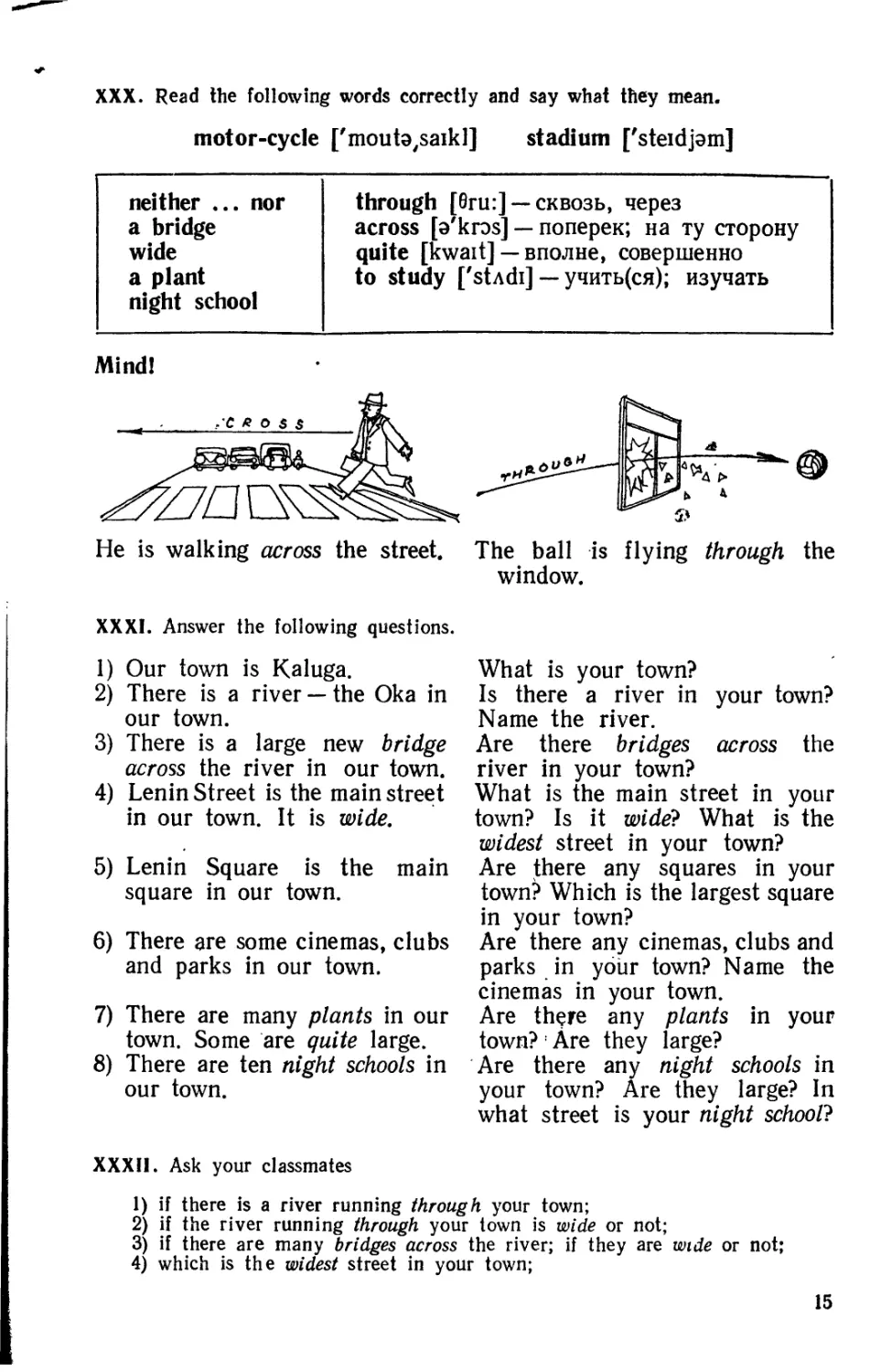
Mind!
He is walking across the street.
The ball is flying through the
window.
XXXI. Answer the following questions.
1)	Our town is Kaluga.
2)	There is a river — the Oka in
our town.
3)	There is a large new bridge
across the river in our town.
4)	Lenin Street is the main street
in our town. It is wide.
5)	Lenin Square is the main
square in our town.
6)	There are some cinemas, clubs
and parks in our town.
7)	There are many plants in our
town. Some are quite large.
8)	There are ten night schools in
our town.
What is your town?
Is there a river in your town?
Name the river.
Are there bridges across the
river in your town?
What is the main street in your
town? Is it wide? What is the
widest street in your town?
Are there any squares in your
town? Which is the largest square
in your town?
Are there any cinemas, clubs and
parks in your town? Name the
cinemas in your town.
Are there any plants in your
town?: Are they large?
Are there any night schools in
your town? Are they large? In
what street is your night school?
XXXII. Ask your classmates
1)	if there is a river running through your town;
2)	if the river running through your town is wide or not;
3)	if there are many bridges across the river; if they are wide or not;
4)	which is the widest street in your town;
15
5)	if they are workers at a plant; what are they;
6)	if there are many night schools in your town;
7)	who is quite good at (in) his (her) English in your class (among his (her)
friends);
8)	what they are quite good at (in); who and in what.
Text
Read the text and try to understand it without word for word trans-
lation. Answer the questions given in Exercise 1, then work at the reading
of the recorded text.	1
0 OUR TOWN
I
Our town is large and beautiful. There are many wide streets
and some large squares in it. There is a river running through
our town with a new bridge across it. There are some machine-
building plants in our town. There are some cinemas, clubs, and
parks there too. And I must tell you that there is a large stadium
where all the young people of our town often go. It is here that.
we see football matches and other games. There is quite a good
basket-ball team at our school.
II
In the main street, which is quite wide, there are always many
people. Some are on bicycles1 and motor-cycles. Young people like
to have bicycles and motor-cycles. Have you a bicycle or a motor-
cycle? Is it a good one? Is it a new one? In the main street there
is also a cinema, the Sputnik. Young people like to go there.
There are many night schools in our town, so young people can
work and study at the same time. There is a very good library,
where they can read books, magazines, and newspapers.
I like our town very much. I think it is very good. But before
I finish, I want to ask you if you also think it is good and
beautiful. Is it?
Exercises
1.	a. Answer the following questions.
1)	Are there many plants in our town?
2)	Is there a good stadium in our town?
3)	Are the streets, of our town wide?
4)	What is there in the main street of our town?
5)	Is there a river in our town? What can you say about it?
1 bicycle ['baisiklj —велосипед
16
6)	Are there any parks in our town? What can you say about
them?
7)	Is our town large? Is it beautiful? What can you say about our
town?
b.	Speak about the town described in the text,
2.	Repeat the alphabet and write it down in your notebooks (see p. 3). Check
up 1 your knowledge of the order of the letters in the alphabet.
3.	Write down the following words in alphabetical order. Pay attention not
only to the first letter, but to the following letters as well.
Example: chair, water, learn, clean.
1)	с+Л + air
2)	c-H+ean
3)	/-f-earn
4)	w + ater
through, gather, sea, which, quite, bridge, bicycle, eight, main,
wide, great
4.	Write down in your notebooks the following
’ in the vocabulary.
words and find their meaning
always, often, foreign, though, air
5.	Translate into English.
Example: Это не стол и не парта. —It |is| neither a table nor a desk.
1)	Это был не Соколов и не Стогов. 2) Иванова не студентка
и не ученица. 3) Его не было ни в комнате, ни в саду. 4) Он не
токарь и не слесарь. 5) Он не говорит ни по-английски, ни по-
французски.
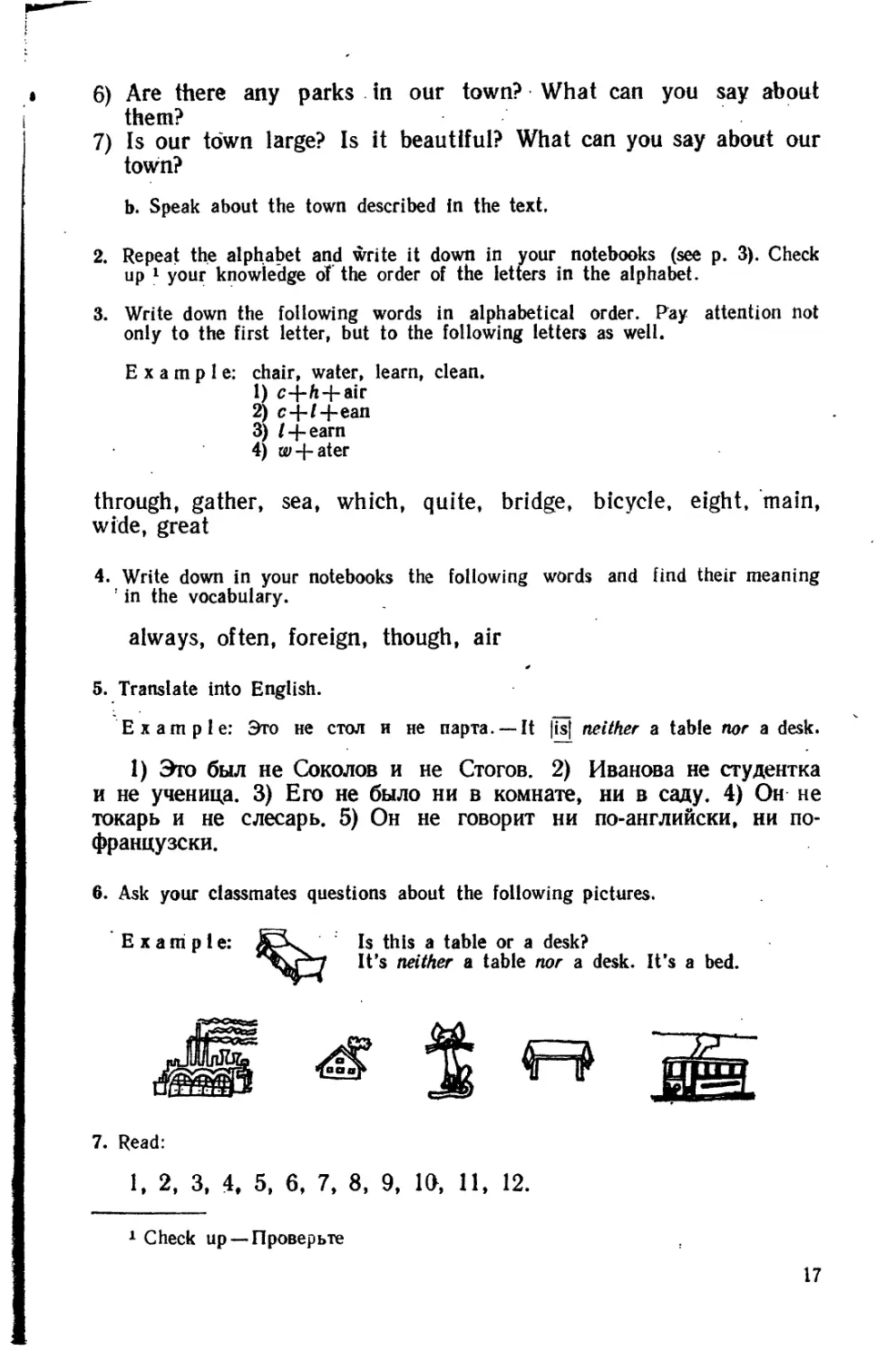
6.	Ask your classmates questions about the following pictures.
Example:
Is this a table or a desk?
It’s neither a table nor a desk. It’s a bed.
7.	Read:
1,	2, 3, 4, 5, 6, 7, 8, 9, 10, 11, 12.
1 Check up —Проверьте
17
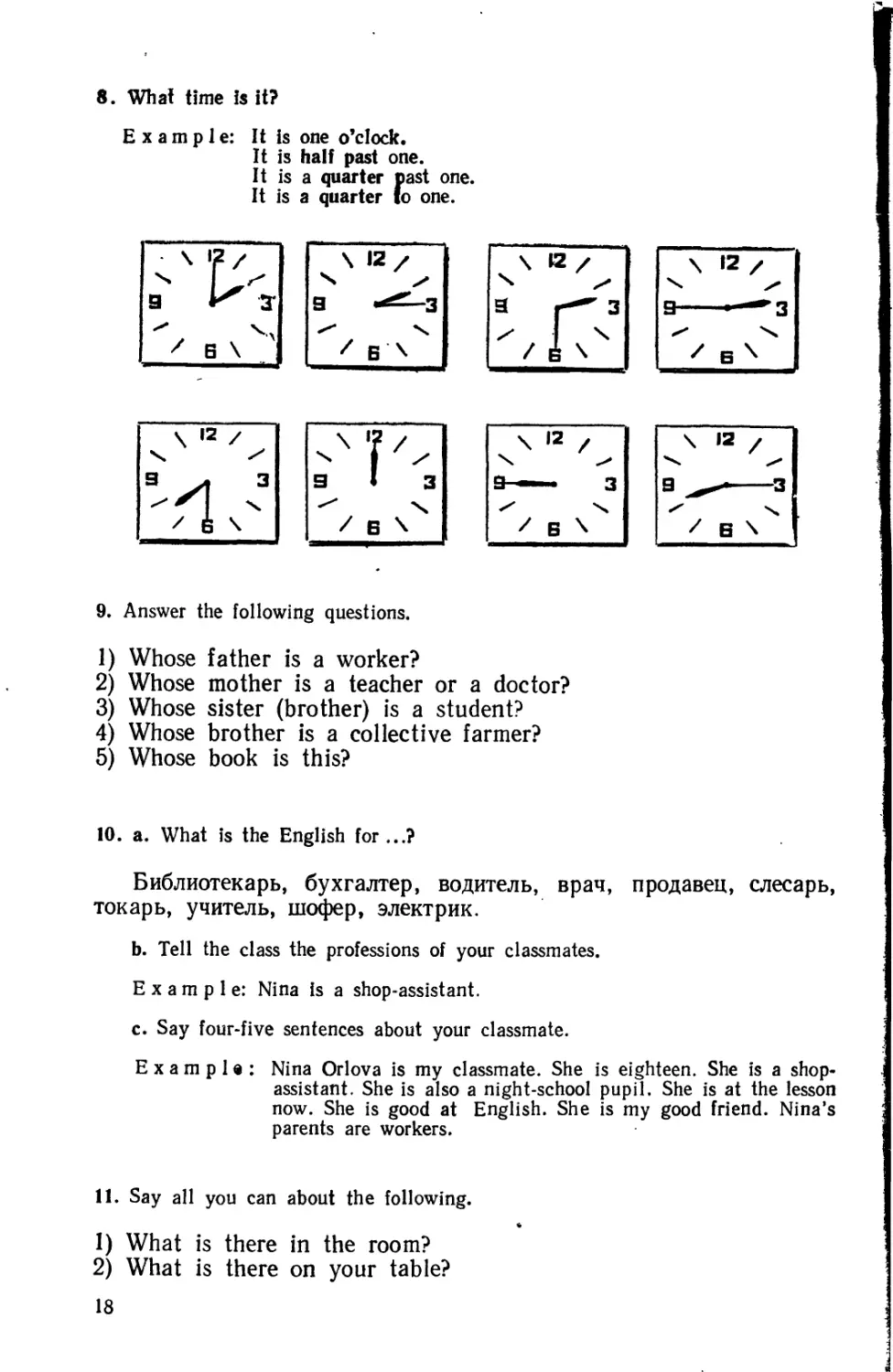
8.	What time is it?
Example: It is one o’clock.
It is half past one.
It is a quarter past one.
It is a quarter to one.
9.	Answer the following questions.
1)	Whose father is a worker?
2)	Whose mother is a teacher or a doctor?
3)	Whose sister (brother) is a student?
4)	Whose brother is a collective farmer?
5)	Whose book is this?
10.	a. What is the English for ...?
Библиотекарь, бухгалтер, водитель, врач, продавец, слесарь,
токарь, учитель, шофер, электрик.
b.	Tell the class the professions of your classmates.
Example: Nina is a shop-assistant.
c.	Say four-five sentences about your classmate.
Example: Nina Orlova is my classmate. She is eighteen. She is a shop-
assistant. She is also a night-school pupil. She is at the lesson
now. She is good at English. She is my good friend. Nina’s
parents are workers.
11.	Say all you can about the following.
1)	What is there in the room?
2)	What is there on your table?
18
3)	What is there in your room?
4)	What is there in your classroom?
12.	Answer the following questions about the town you live in. ,
1)	Are there many new houses in your town?
2)	Are there many night schools in your town?
3)	Is there a river in your town? Is the river wide? What can you
say about it?
4)	Are there any bridges across the river in your town? Are the
bridges long and wide?
5)	Is there a large square in your town? What can you say about it?
6)	Is there a theatre in your town? What can you say about it?
7)	Are there many plants in your town? Are you a worker at one
of them?
8)	Are there many cinemas in your town? Which is the best
cinema in your town?
9)	What is there in your town?
13.	Ask your classmates questions about the town they live in.
14.	Tell us about your town.
Lesson Two
The Second Lesson
Повторение: Звуки и интонация.
Личные местоимения в объектном падеже.
Повелительное наклонение.
The Continuous Tenses.
Наречие.
19
ЗВУКИ
0 Exercise A
Глухие согласные звуки [p], [t], [k] перед гласными произно-
сятся в английском языке с придыханием.
Listen: [pet], [pen], [pep], [peg].
Read: pet, pen, pep, peg.
Listen: [kaet], [kaen], [kaep], [kaeb].
Read: cat, can, cap, cab.
Listen: [taen], [ten], [taep], [tel].
Read: tan, ten, tap, tell.
Listen: 'poll], ['tomi], ['kiti], ['pApi],
Read: Polly, Tommy, Kitty, puppy.
[sit], [giv], [liv].
sit, give, live.
[it], [dis]» [sit]-
it, this, sit.
0 Exercise В
[•:], Pl- Звук [i:] — долгий, напряженный, при произнесении
его губы растянуты. Звук [i] —Краткий, ненапряженный.
Listen: [stri:t], [gri:n], [li:v];
Read: street, green, leave;
Listen: [mid], [di:z], [si:t];
Read: meat, these, seat;
Listen and then read:
Little Pete sits in a
The teacher speaks English.
Pete will leave for Minsk in a week.
green field.
0 Exercise C
[р]. Для правильного произнесения звука [д] сделайте вдох через
нос с широко открытым ртом. Затем, сохраняя это положение,
нужно на выдохе дать голос.
Listen: [sig], [fhg], [baeg].
Read: sing, fling, bang.
Listen: ['sigig], ['fhgig], ['ba gig].
Read: singing, flinging, banging.
Listen and then read:
I think she is singing.
He will bring the thing in a wink.
He’s running about the skating-rink.
0 Exercise D
[w]. При произнесении звука [w] губы сильно округлены, затем
быстро растягиваются.
Listen: [wi:], [wot], [wea], [wen], [wai], [witj], [zwa:ta].
Read: we, what, where, when, why, which, water.
20
Listen and then read:
What will you watch?
We went with Willy.
What was the weather like?
INTONATION PATTERNS
В вопросах, начинающихся с глагола, интонация восходящая
в конце предложения.
Is the man working?
Are the boys running?
Am I speaking?
В вопросах, начинающихся с вопросительного слова, интона-
ция нисходящая.
Why are you late?
Whose house is that?
Where is the girl going?
What were you doing there?
Read:
The boy is running. The man is studying. The cat is playing.
The pupils are reading. The workers are working. Is the boy running?
Is the fitter working? Is the man studying? Are the pupils reading?
Are the workers working? Why is the boy running? When is the
fitter working? What are the workers doing?
[z—(Э|. Отработайте произношение этого звукосочетания.
Is_the... Is _ that a man? Is_that man working?
Is the... Is^this a girl? Is_this girl studying?
Is _ the... Is_ that a bridge? Is _ that bridge wide?
2]
ЛИЧНЫЕ МЕСТОИМЕНИЯ В ОБЪЕКТНОМ ПАДЕЖЕ
I.	а. Повторите формы личных и притяжательных местоимений.
Таблица личных и притяжательных местоимений
Именитель- ный падеж	кто? что?	I	he	she	it	we	you	they
Объектный падеж	кого? что?	те	him	her	it	us	you	them
Притяжа- тельные местоимения	чей, чья, чье?	ту	his	her	its	our	your	their
Ъ. Поставьте личное местоимение в соответствующую форму объектного
падежа и закончите предложения.
Give (I) ...I	' Bring (he)...!
Give (he)... 1	Bring (they)...!
Give (we)...!	Bring (!)...!
Give (she)...!	Bring (we)... 1
Give (they)... 1	Bring (she)... 1
ПОВЕЛИТЕЛЬНОЕ НАКЛОНЕНИЕ
II.	a. Give orders to your comrades according to the example.
Example:
Give —
—me	 —him	 —her		+ что-то -|-! Take -|- что-то 4- to —	— me	 —him	 —her		+ 1
—US	 —them—		—US	 —them—
b. Give orders to your comrades using the verbs to read, to bring, to call.
III.	Ask your comrades to perform some actions, i
Example: Stand up! Go [to the blackboard! Take the chalk! Write the
word “yes” on the blackboard! Clean the blackboard! Go to
your place! Sit down! Give me your pen!
THE CONTINUOUS TENSES
IV.	Ask your classmate
1)	if he (she) is a pupil of the 9th or of the 10th form;
2)	if his (her) father is a turner or a book-keeper;
1 to perform some actions ['aekjsns] — выполнять ряд действий
22
3)	if his (her) mother is a doctor or a student;
4)	what his (her) father is;
5)	what his (her) mother is;
6)	if the weather is good or bad today;
7)	what the weather is today.
V.	Make up questions using the following table and ask your classmates to
answer them.
Is
Are + подлежащее + именная часть сказуемого 4-?
Am
VI. Answer the following questions'.
1)	Is it morning now?
2)	Is it evening now?
3)	Is it raining now?
4)	Is the sun shining?
5)	Are you reading now?
6)	Are you writing now?
7)	Are you studying now?
8)	What are you doing?
VII.	Study the following.
Are you reading an English
book now?
Читаете ли вы сейчас (в насто-
ящий момент) английскую
книгу?
Is Stogov reading an English
book now?
Читает ли Стогов сейчас
(в настоящий момент) анг-
лийскую книгу?
Were you reading the book
when the teacher entered
the classroom?
Читали ли вы книгу в тот
момент, когда учительница
вошла в класс?
Yes, I am. I am reading an
English book now. (No, I
am not. I am not reading an
English book now.)
Да. Д читаю сейчас (в настоя-
щий момент) английскую
книгу. (Нет. Д не читаю
сейчас (в настоящий момент)
английскую книгу.)
Yes, he is. Не is reading an
English book now. All the
pupils are reading their Eng-
lish textbooks now.
Да. Он читает сейчас (в на-
стоящий момент) англий-
скую книгу. Все учащиеся
читают сейчас свои англий-
ские книги.
No, I was not. I was not read-
ing the book when the teacher
entered the classroom.
Нет. Я не читал книгу в тот
момент, когда учительница
вошла в класс.
23
Are. you writing?
Are you reading?
Are you listening?
Are the other pupils listening too?
Is the teacher standing or sitting?
TTas anybody late today?
Was the teacher reading to you
when Sokolov came in?
What was the teacher doing when
he came in?
Were you listening to the teacher
when Sokolov came in?
What were you doing?
Were you asking questions?
No, I am riot. 7 dm not writing.
Yes, I am. / am reading.
Yes, I am. I am listening.
Yes, they are. They are listening
too.
She is standing.
Yes, Sokolov was. Sokolov was
late today.
Yes, she was. She was reading
to us when Sokolov came in.
The teacher was reading when
he came in.
Yes, we were. We were listening
to the teacher when Sokolov
came in.
We were listening to the teacher.
No, I was not (we were not). I
was (we were) not asking ques-
tions. I was (we were) listen-
ing to a story.
VIII.	Look at the pictures and answer the following questions.
Are the girls walking or running?
Where are they going?
What are they doing?
Is the man standing or sitting?
Is he working or studying?
What is he doing?
Are the boys skating or skiing?
Are the boys studying or swimming?
Where are they swimming?
What are they doing?
Is the teacher reading or writing?
Where is he standing?
What is he doing?
24
IX.	Ask your classmates what they are doing now.
Are you ...ing? Yes, I am. / am ...ing. (No, I am not.
1 am not ..ing.)
X. Look at the following pictures. Make up as many questions as you can and
ask your classmates to answer them. (See Exercise IX.)
XI.	Put questions to the words in italics.
Example: We were doing our exercises when you came.
What were we doing when you came?
When were we doing our exercises?
1)	My brother was doing his homework at 3
o'clock.
2)	We were studying English when my father
came home.
3)	I was walking in the main street at 5 o’clock.
4)	The driver was driving over the bridge
when his car stopped.
What
When
What
When
What
When
Who
Where
Who
Where
XII.	Say what you were doing yesterday a) at 12 o’clock; b) at 5 o’clock;
c) at 8 o’clock ’in the evening.
НАРЕЧИЯ
В английском языке обстоятельство времени чаще всего
ставится в начале или в конце предложения, например:
I am reading the text |nowl.
Yesterday I had no time to read it.
J always read in the morning.
In the evening I am at school.
25
Наречия неопределенного времени, такие, как already,
always, ever, never, often, seldom и т. д., обычно ставятся
а) перед смысловым глаголом, б) после глагола to be и
в) между вспомогательным и смысловым глаголами, например:
We always speak English at the lessons.
She is never late.
We have already seen this film.
XIII.	Put in the adverbs and translate the sentences into Russian.
1)	We are late for English lessons, (never)
2)	I am fond of reading books on history, (always)
3)	We have read that book, (already)
4)	My friends meet their classmates at the plant, (often)
XIV.	а. Вставьте по смыслу следующие обстоятельства времени:
in the morning', in the evening; at 5 o’clock; now; yesterday.
1)	The electrician came.
2)	We are studying English.
3)	I go to the plant.
4)	I go to night school.
5)	I was walking along the bridge.
b. Составьте ситуации с указанными обстоятельствами времени.
New Words
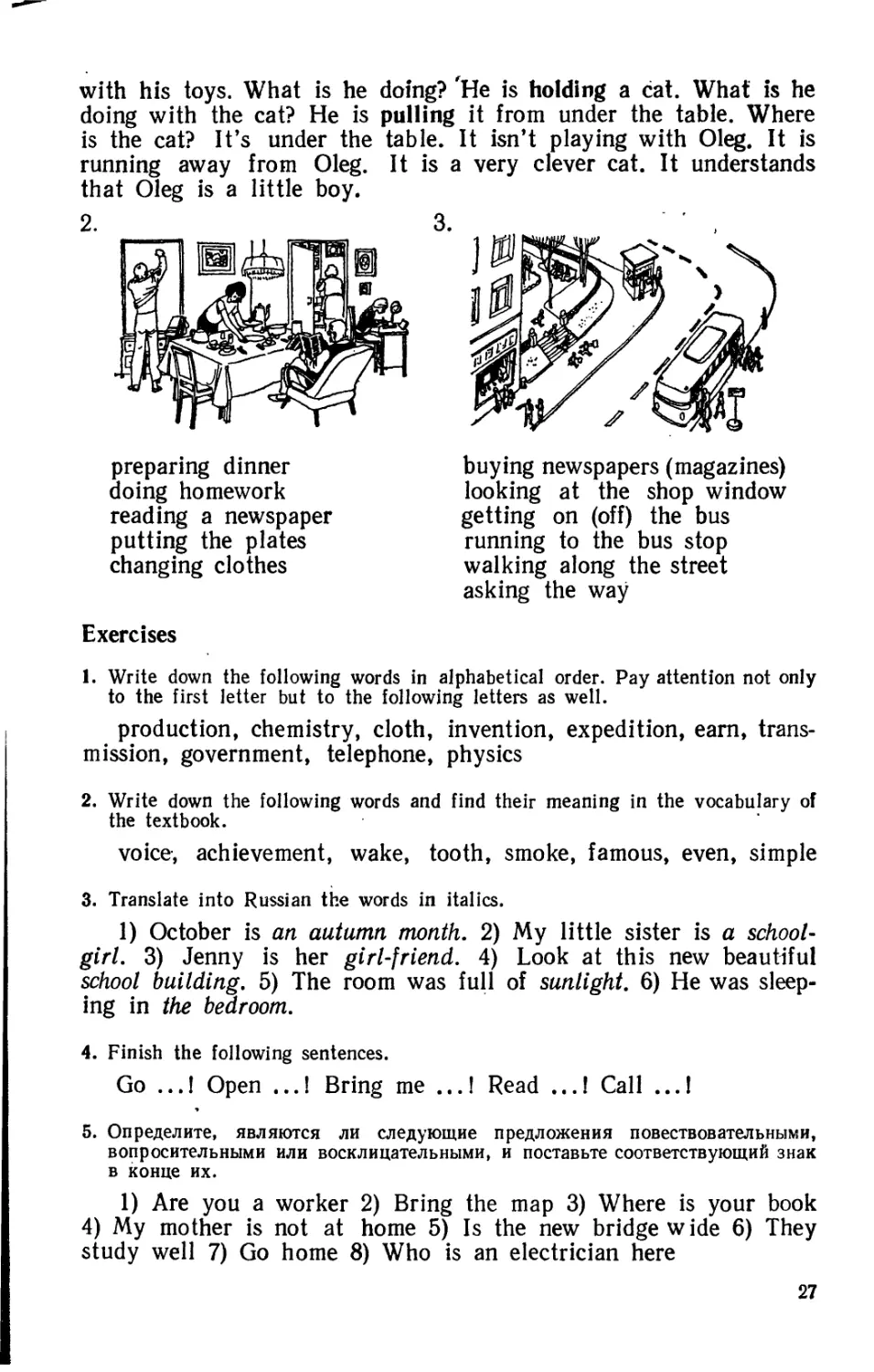
	to pull [pul]—тянуть to hold (held, held) — держать
Text
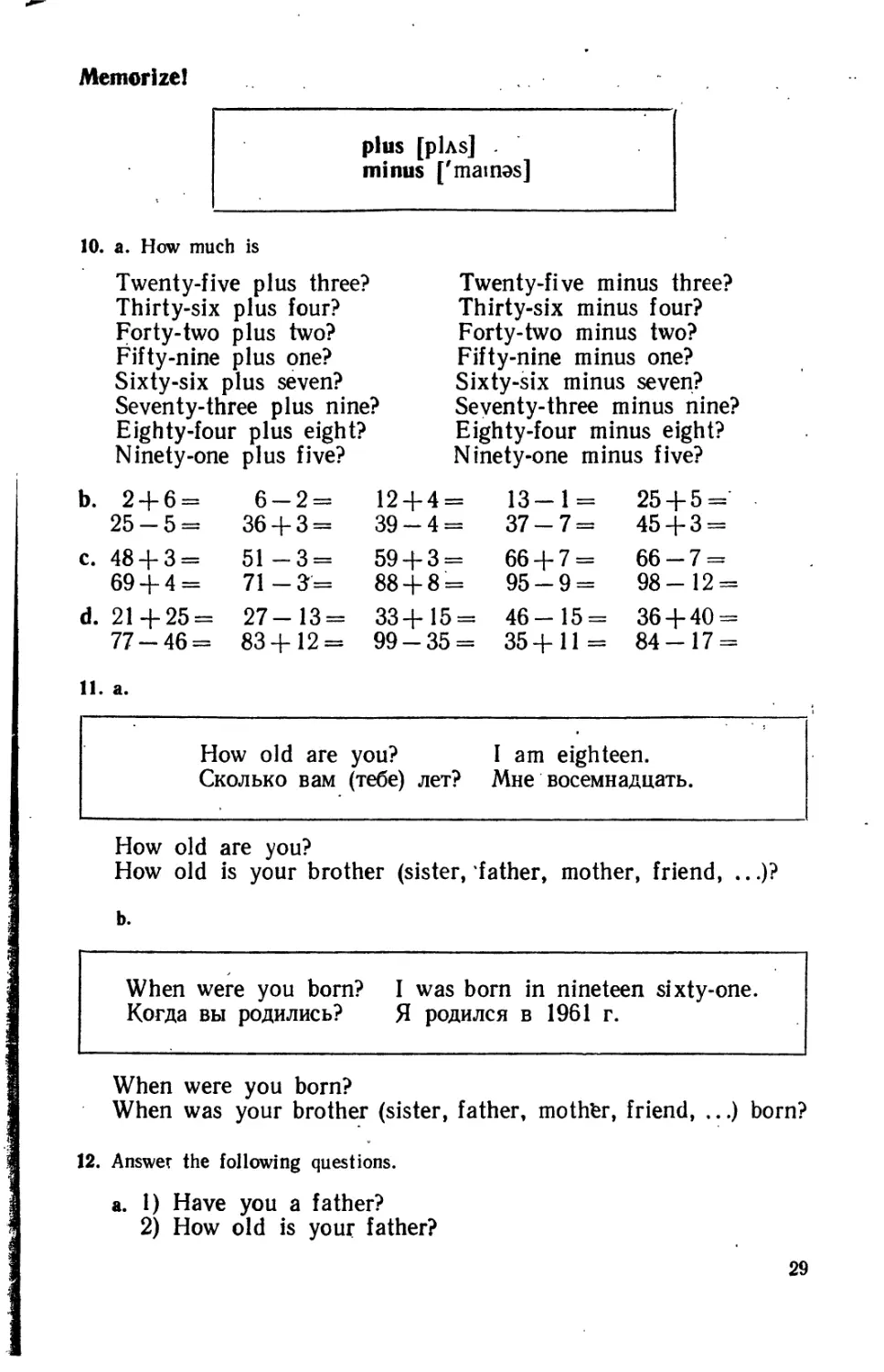
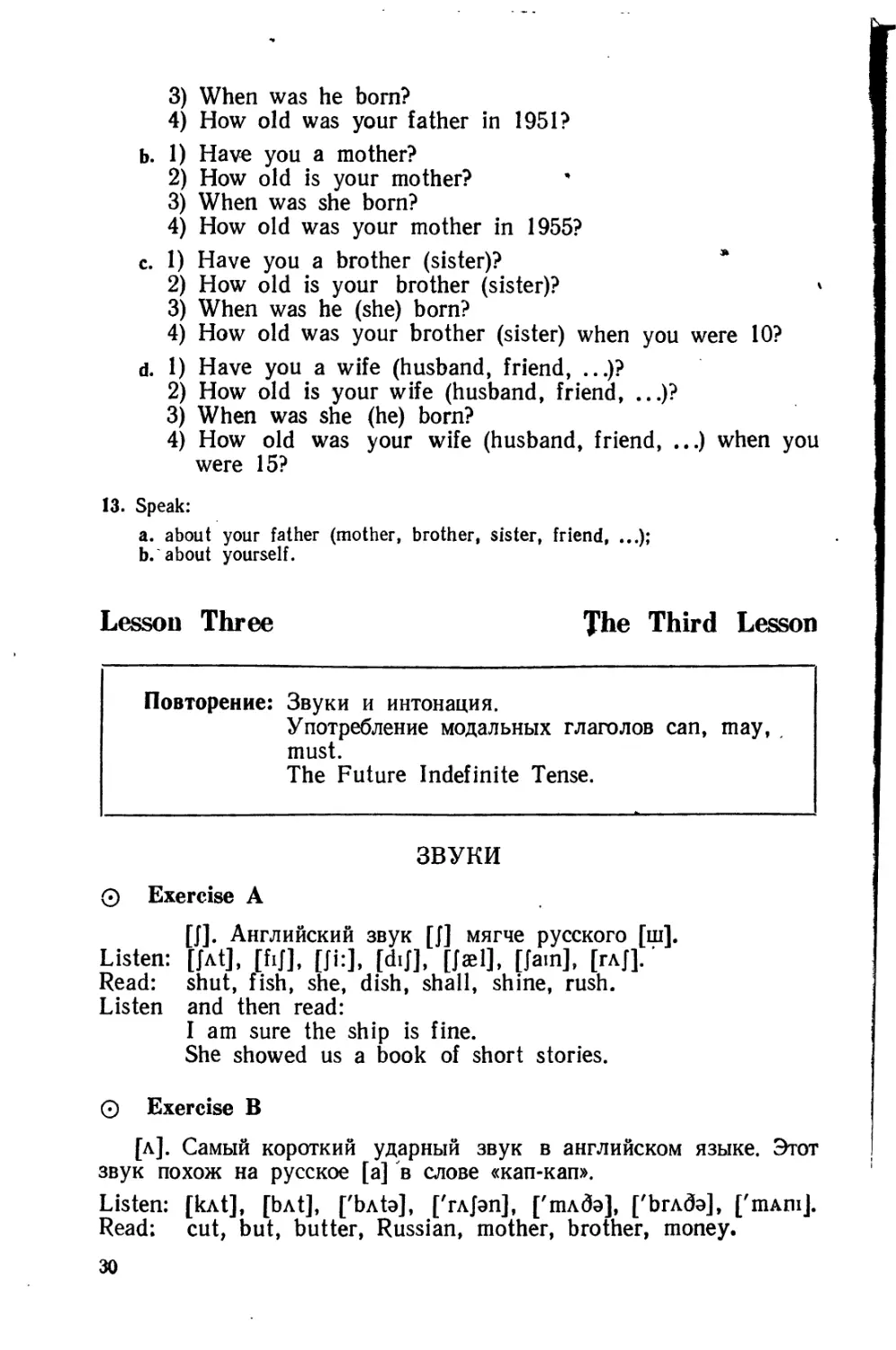
Задайте своим товарищам вопросы и опишите ситуации, опираясь на сле-
дующие картинки. К первой ситуации дано примерное описание.
This is Oleg. Не is my young brother. He is five. He is not
a schoolboy yet. Now he is sitting on the floor. He isn’t playing
26
with his toys. What is he doing? 'He is holding a cat. What is he
doing with the cat? He is pulling it from under the table. Where
is the cat? It’s under the table. It isn’t playing with Oleg. It is
running away from Oleg. It is a very clever cat. It understands
that Oleg is a little boy.
preparing dinner
doing homework
reading a newspaper
putting the plates
changing clothes
buying newspapers (magazines)
looking at the shop window
getting on (off) the bus
running to the bus stop
walking along the street
asking the way
Exercises
1.	Write down the following words in alphabetical order. Pay attention not only
to the first letter but to the following letters as well.
production, chemistry, cloth, invention, expedition, earn, trans-
mission, government, telephone, physics
2.	Write down the following words and find their meaning in the vocabulary of
the textbook.
voice, achievement, wake, tooth, smoke, famous, even, simple
3.	Translate into Russian the words in italics.
1)	October is an autumn month. 2) My little sister is a school-
girl. 3) Jenny is her girl-friend. 4) Look at this new beautiful
school building. 5) The room was full of sunlight. 6) He was sleep-
ing in the bedroom.
4.	Finish the following sentences.
Go ...I Open ...! Bring me ...! Read ...! Call ...I
5.	Определите, являются ли следующие предложения повествовательными,
вопросительными или восклицательными, и поставьте соответствующий знак
в конце их.
1) Are you a worker 2) Bring the map 3) Where is your book
4) My mother is not at home 5) Is the new bridge wide 6) They
study well 7) Go home 8) Who is an electrician here
27
6. Put tn the following 'adjectives: beautiful, wide, old, difficult, maid, brave,
fruit, winter.
1) It is a picture. 2) December is a month. 3) Our school is
near the street. 4) I like this bridge. 5) You can do this work.
6) This is your task. 7) These men are soldiers. 8) There is a gar-
den behind the house.
7. Put in the pronouns my, his, her, our, your, their.
1) I am taking —book. 2) We are doing —work. 3) Are you
speaking about — school? 4) Is he already eating — breakfast? 5) Is
she looking for —bag? 6) They are going to —plant.
8. a. Study the following.
Have you (they) English books?	Yes, I (we, they) have. I (we, they) have English books. (No, I (we, they) haven’t. I(we, they) have no English books.)
Есть ли у тебя (у вас, у них) английские книги?	Да. У меня (у нас, у них) есть английские книги. (Нет. У меня (у нас, у них) нет английских книг.)
Has he (she) English books?	Yes, he (she) has. He (sfte) has English books. (No, he (she) hasn’t. He (she) has no English books.)
b. Answer the following questions. ___ -
1)	Have you a father (mother, sister, brother, friend, ...)?
Has A. (your classmate) a father (mother, sister, brother,
friend, ...)?
2)	Have you a pen (pencil, textbook, notebook, ...)?
Has A. (your classmate) a pen (pencil, textbook, notebook,...)?
3)	Have you newspapers (magazines, books, photographs, ...)?
Has A. (your classmate) newspapers (magazines, books, photo-
graphs, ...)?
c. Ask your classmates what they have and what they have not.
9.	Read:
a.	13, 15, 18, 19, 20, 40, 50, 80, 90.
b.	3, 8, 17, 22, 26, 35, 39, 41, 45, 57, 63, 66, 74 , 78, 87, 99.
28
Memorize!
plus [plAs] -
minus ['mamas]
10.	a. How much is
Twenty-five plus three?
Thirty-six plus four?
Forty-two plus two?
Fifty-nine plus one?
Sixty-six plus seven?
Seventy-three plus nine?
Eighty-four plus eight?
Ninety-one plus five?
b.	2 + 6=	6-2 =
25-5=	36 + 3 =
c.	48 + 3=	51-3 =
69 + 4=	71—3=
d.	21+25= 27- 13 =
77-46= 83 + 12 =
12 + 4 =
39-4 =
59 + 3 =
88 + 8 =
33+15 =
99 - 35 =
Twenty-five minus three?
Thirty-six minus four?
Forty-two minus two?
Fifty-nine minus one?
Sixty-six minus seven?
Seventy-three minus nine?
Eighty-four minus eight?
Ninety-one minus five?
13-1=	25 + 5 =
37-7=	45 + 3 =
66 + 7=	66-7 =
95 - 9 =	98-12 =
46-15=	36 + 40 =
35+11 =	84-17 =
11.	a.
How old are you? I am eighteen.
Сколько вам (тебе) лет? Мне восемнадцать.
How old are you?
How old is your brother (sister, father, mother, friend, ...)?
b.
When were you bom? I was bom in nineteen sixty-one.
Когда вы родились? Я родился в 1961 г.
When were you born?
When was your brother (sister, father, mother, friend, ...) born?
12.	Answer the following questions.
a.	1) Have you a father?
2)	How old is your father?
29
3)	When was he bom?
4)	How old was your father in 1951?
b.	1) Have you a mother?
2)	How old is your mother?
3)	When was she born?
4)	How old was your mother in 1955?
c.	1) Have you a brother (sister)?
2)	How old is your brother (sister)?	»
3)	When was he (she) born?
4)	How old was your brother (sister) when you were 10?
d.	1) Have you a wife (husband, friend, ...)?
2)	How old is your wife (husband, friend, ...)?
3)	When was she (he) born?
4)	How old was your wife (husband, friend, ...) when you
were 15?
13.	Speak:
a. about your father (mother, brother, sister, friend, ...);
b.' about yourself.
Lesson Three	The Third Lesson
Повторение: Звуки и интонация.
Употребление модальных глаголов can, may, .
must.
The Future Indefinite Tense.
ЗВУКИ
0 Exercise A
[J]. Английский звук [J] мягче русского [ш].
Listen: [jAt], [fij], [Ji:], [dij], [Jal], [Jam], [rAj]. ’
Read: shut, fish, she, dish, shall, shine, rush.
Listen and then read:
I am sure the ship is fine.
She showed us a book of short stories.
0 Exercise В
[л]. Самый короткий ударный звук в английском языке. Этот
звук похож на русское [а] в слове «кап-кап».
Listen: [kAt], [bAt], ['bAta], ['гл]эп], ['тлда], ['Ьглдэ], ['тлт].
Read; cut, but, butter, Russian, mother, brother, money.
30
Listen and then read:
My brother often runs to buy butter for Mother.
Don’t trouble trouble till trouble troubles you.
0 Exercise C
[а]. Гласный долгий, напряженный.
Listen: [klas], [sta], [fa], [ka], ['fado], ['rado], [ask].
Read: class, star, far, car, father, rather, ask.
Listen and then read:
Ask Father if he wants a glass of tea.
The classroom was rather large but dark.
0 Exercise D
[A]	|	a:]	(A]	la:]
Listen: [kAt]	kat]	['тлда]	['fade'
[dAk]	dak]	['ЬглЗэ]	['ansa
[bAt]	ba]	['гл[эп]	['rads
Read: cut	cart		mother	father
duck	।	dark	brother	answer
but	bar		Russian	rather
Listen and then read:
My brother and father rushed to the park in a bus.
Barbara’s brother is rather a troublesome child.
0 Exercise E
[э]. В неударном положении английские гласные часто превра-
щаются в нейтральный звук.
Listen: ['o:lwaz], ['neva], ['fits], ['taelant], [ta'geda].
Read: Listen: Read:	always, never, fitter, talent, together, [a'trip], [a'traekta], [a'kset], a trip, a tractor, a cat.
Listen	and then read: a wide river	a big plant a good book	an old man the cat	the day	the boat the hard work	the girl’s dress	the fine weather
Read:
A plant. A large plant. A large chemical plant. The large chem-
ical plant where my sister works. A day. A fine day. A fine
31
sun«y day. A fine sunny day makes me always feel gay. A text. A
short text. A short English text; A short English text that is easy
to read.
This_is_a pen and that is a pencil. This_Js_a table and that
is_a chair. This_Js_a park anid that is_a square.
I. Study the following.
MODAL VERBS CAN, МАУ, MUST1
Can
Sokolov can skate very well.
Can he skate well?
Может ли он (умеет ли он)
хорошо кататься на конь-
ках?
(Хорошо ли он катается на
коньках?)
Yes, he can. Не can skate well.
(No, he cannot. He cannot
skate well.)
Да. Он может (умеет) хорошо
кататься на коньках.
(Нет. Он не может хорошо
кататься на коньках.)1
Can. you skate well?
You can skate well, but can
you play football well?
Can your brother play football?
Yes, I cart. I can skate well.
No, Г Cannot. I can skate well,
but I cannot play football well.
No, he cannot. He can neither
skate nor play football. He is
little. He is only two.
Sokolov Is not in the classroom. He
must go in, but the lesson has already
begun.
1 См. грамматический справочник, с. 353.
32
So Sokolov is opening
the door and saying
The teacher’s answer is
May I come in?
Yes, you may. You may come
in. (No, you mustn’t. You
mustn’t come in.)
Можно (разрешите мне) войти? Да. Вы можете войти. (Нет,
нельзя. Вам нельзя вхо-
дить.)
May I open the window? It is
hot in the room. .
May I do the exercise on the
blackboard? I want to write
the exercise.
Yes, you may. You may open
the window.
(No, you mustn’t. You mustn’t
do it.)
Yes, you may. You may come
to the blackboard and do the
exercise. (No, you mustn’t.
I want Kozlov to do the exer-
cise.)
Memorize!
May I come in? May I go out?	:	May I take your pencil? May I do this exercise? May I ask you?
Must
Sokolov is late.
So he is asking the teacher	The teacher’s answer is
Must I do exercise five too?
Должен ли я (следует ли мне)
также сделать упражнение 5?
Yes, you must. You must do
exercise five. (No,
needn't.
exercise
exercise
Да. Вы должны (вам следует)
сделать упражнение 5. (Нет.
Вам не следует делать
упражнение 5. Вы должны
сделать упражнение 6.)
you
You needn't do
five. You must do
six.)
2 Слободчиков А. А.
33
Must I read this text?
Must I send a letter to her?
Must Popov go to work tomorrow
in the morning or in the eve-
ning?
Yes, you must. You must read
this text. .(No, you needn’t.
You needn’t read this text.)
Yes, you must. You must send
a letter to her. (No, you needn’t.
You needn’t send a letter to her.)
Popov needn’t go to work tomor-
row either in the morning or
in the evening. It is his day off.
Помните, что после модальных глаголов can, may и
must глагол стоит в инфинитиве без частицы to, например:'
I must read.
Q II. Прочитайте следующие краткие диалоги. Отработайте чтение их по
тексту граммофонной пластинки и объясните употребление глаголов
can, may и must.
1)	Boris: May I do exercise five?
Teacher: You must do exercise five.
2)	Victor: Can I go out?
Teacher: Yes, you can, but you may not.
3)	You can always speak but you must not speak at the lessons.
4)	Little Tom: May I go to Mars, Mummy?
Mother: Yes, you may, but you cannot.
HI. Translate the following questions into Russian and answer them in English.
Example: — May I take your pen? Можно мне взять вашу ручку?
(Разрешите мне взять вашу ручку?) -
— Yes, you may. You may take my pen.
— Can you skate? Умеешь ли ты кататься на коньках? (Мо-
жешь ли ты кататься на коньках?)
— No, I cannot. I cannot skate.
1)	May I go to the cinema-with you?
2)	Can you come to see me tomorrow?
3)	Can your brother (sister, friend) skate?
4)	May I take this book?
IV. Translate into English.
1) Умеет ли Соколов ходить на, лыжах? 2) Умеют ли эти
девушки хорошо петь? 3) Можно начинать читать текст? 4) Может ли
он читать такие трудные тексты? 5) Разрешите мне взять вашу
книгу? 6) Можно мне пойти с вами?
34
V. Make up sentences using the following table. Be careful not to use to after
the verbs can, may, must.
I must We want He can  They like	work hard to become a good specialist, to go boating with you. come to school in time. to spend the summer in the country. always be ready for the lessons. to sleep in the open air. be useful to our class.
VI. Answer the following questions.
a.	1)	When	must	you	get up?
2)	When	must	you	begin	your work?	.
3)	When	must	you	go to	night	school?
4)	When	niust	you	go to	sleep?
b.	1) On which days must you come to school?
2)	On which days must you go to work?
3)	What must you bring to school?
4)	What must you do during the lesson?
5)	What must you do every day?
VII. 1) Say what you can do and what you cannot do.
2) Say what your classmate can do and what he (she) cannot do.
3) Say what you may do and what you mustn’t do.
Examples: 1) I can read Russian books but I cannot read French books.
He (she) can touch the desk but he (she) cannot touch the lamp.
2) I may come home late but I mustn’t make much noise.
I may ask the teacher but I mustn’t speak with my classmate.
The Future Indefinite Tense1
VIII.	Study the following.
Will you go to the plant Yes, I (we) shall. I (we) shall
tomorrow?	go to the plant tomorrow.
(No, I (we) shall not. I (we)
shan't go to the plant tomor-
row.)
Пойдешь ли ты (пойдете ли Да. Я пойду (мы пойдем)
вы) завтра на завод?	завтра на завод. (Нет. Я не
пойду (мы не пойдем) завтра
на завод.)
Will this pupil соте to school Yes, he (she) will. He (she)
tomorrow?	will come to school tomor-
;	row. All the pupils will
come to school tomorrow.
1 Повторите образование и употребление the Future Indefinite Tense no
грамматическому справочнику (см. с. 352).
2*	35
Will you read this book?
Will you go to the meeting?
W ill Sokolov speak at the meet-
ing?
Will the workers go to the cinema
or to the park tomorrow?
Yes, I shall. I shall read this
book. (No, I shall not. I shan’t
read this book.)
Yes, we shall. We shall go to
the meeting. (No, we shall not.
We shan’t go to the meeting.)
Of course, he will. He will speak
at the meeting. (No, he will
not. He won’t speak at the
meeting.)
They will go neither to the cinema
nor to the park tomorrow. In
the morning they will go to
their plant and in the evening
they will go to school.
IX.	Finish the following sentences.
Example: The children always play in this garden and tomorrow they
will play there too.
1)	The workers always come to their plant at seven o’clock and
tomorrow they ...
2)	We always have dinner at twelve and tomorrow we ...
3)	On Sunday we drink coffee. Tomorrow is Sunday and we ...
4)	They spend their days off out of town. Tomorrow is their day
off and they ...
5)	I always prepare all my lessons. Tomorrow I ...
X.	Make up questions using the following table and ask your classmates to
answer them.
see
обстоятельство времени,
Shall i подле- .	. , допол- , указывающее на то, что . 3
Will жащее "* нение"*" действие совершится в-*"’
get	будущем
write
XI.	Make up questions using the following table and ask your classmates to
answer them.
Where +	+ подлежащее+®0 +обстоятельство вре- + ?
How~w ~	‘ соше^мени или места '
36
XII.	Make up three-four sentences about the following.
1)	What you will do tomorrow (on your day off).
Tomorrow (on my day off) I shall ...
2)	What your friend (father, mother, brother, sister, ...) will do
tomorrow (on his,(her) day off).
Tomorrow (on his (her) day off) ... will ...
3)	What you and your friends (your family) will do tomorrow (on
your day off).
Tomorrow (on our day off) we shall ...
New Words
a day off
1)	Tomorrow is Sunday. There is no work on Sundays. Sunday
is my day off.
2)	On my days off there is no school. On my days off I like to
go to the library where I can read some interesting books.
3)	When is your day off?
together [ta'geda]
1)	I am going home now. If you are going home too, we can go
home together.
2)	I shall go for my holidays to Leningrad. If you want to go to
Leningrad for your holidays too, we can go together. It will be
interesting. We shall go to the museums and theatres together.
3)	With whom are you sitting at the same desk together?
fine
fine — very good
1) Last Sunday the day was fine— it was sunny and there were
no clouds in the sky. Was the day fine yesterday? Is the day
fine today?
2) Zorin and Sokolov are fine sportsmen, they always have first
places in all ‘ the competitions.
to go boating ['boutirj]
1)	My friend has a motor-boat and we often go boating on our
day off.
2)	My father and I often go fishing or boating in summer.
3)	It is interesting to go boating in summer, isn’t it?
a day off	a shop — зд. цех
together	always ['o:lwaz] —всегда
fine	to miss —пропускать
to go boating	to be sure [fua] —быть уверенным
37
Mind!
a shop
1 have bought‘my dress in a new shop in Kirov Street.
Work at the mechanical shop of our plant is very difficult.
XIII.	Answer the following questions.
1)	Are there many shops at the plant where you (your father,
brother, sister, friend, ...) work? Are the shops large?
2)	Can you always come to work in time? Can you always'come
to school in time?
3)	Can you miss school because of your work?
4)	Is it more difficult to study at night school than at day school?
Are you sure about it?
5)	Are you always sure in what you are saying?
XIV.	Ask your classmate
1)	where he (she) will spend his (her) day off;
2)	if he (she) will spend it together with someone; with whom he (she)
will spend it;-
3)	if his (her) day off is always on Sunday; when is his (her) day off',
4)	if he (she) will go out of town if the day is fine;
5)	if he (she) will stay in town if the day is bad;
6)	if he (she) is sure it is always good to go out of town on his (her) days off;
7)	what he (she) will do if the day is fine;
8)	what he (she) will do if the day is bad;
9)	if he (she) will tell his (her) friends at the shop (at school, at the plant, at
the place where he (she) works) how he (she) spent his (her) day off;
whom he (she) will tell;
10)	will he (she) miss school if his (her) day off is not on Sunday or Saturday.
Text
Read the following text and try to understand it without word for word
translation, then do Exercises 1 and 2.
A DAY OFF
Boris, Victor and Oleg work together in the same shop at a
large plant. Tomorrow is their day off. As they are leaving the
plant, they are speaking about it.
I
Oleg: Tomorrow I shall go on a trip out of town. I always try
to spend my days off out of town. I shall go together with
Lena on my new motor-cycle. We shall take badminton
rackets and balls with us, and something to eat.. We shall
rest, play badminton, and warm in the sun. Of course, we
38
shall go out of town if the day is fine. If the day is bad,
we shall stay home, read, and go to the cinema. See you at
the shop on Monday.
II
Boris: I shall stay in town. There must be an interesting game
at the stadium tomorrow morning. A famous foreign team is
coming. The day must be fine tomorrow morning, I am sure.
I cannot miss that game. I am sure it will be interesting.
I can go to the Chaika after the game. I am sure I can get
a good dinner there. In the evening I must meet Olga. We
are going to the theatre together. I shall tell you all about
it at the shop on Monday.
Ill
Victor: I always do some sports on my days off. Tomorrow
morning I shall go to the river together with my friend
Nick. We can take a boat for an hour or two and go boating.
If the day is fine, we shall swim in the river. Of course,
we can go boating only if the day is fine. I wish I shall
not miss my exercises tomorrow. In the afternoon I must
go to the library and read for my literature lesson. But in
the evening I am free. I cannot say what I shall do in the
evening.
(Can you help Victor? What will he do in
the evening?)
Exercises
1.	Answer the following questions on the text.
1)	What are the three friends (Boris, Victor and Oleg) speaking
about as they are leaving the plant?
2)	What will Oleg do on his day off? What will he do in the
evening?
3)	What will Boris do on his day off? What will he do in the
evening?
4)	What will Victor do on his day off? What will he do in the
evening?
2.	Speak about the following.
-1) Are Boris, Victor and Oleg good friends? What makes you
think so?1
2) Which of the three is the best sportsman? What makes you
think so?
1 What makes you think so?—Почему вы так думаете?
39
3) Which of the three is the best worker? What makes you think so?
4) Which of the three is the best pupil? What makes you think so?
5) 'Which of the three is married?1 What makes you think so?
3.	What must you say
Example: when you are late for the lesson?—May I come in?
1)	when	you	want	to	go out of the classroom?
2)	when	you	want	to	open your book at the lesson?
3)	when	you	want	to	sit together with your friend?
4)	when	you	want	to	open the window to let fresh air in?
5)	when	you	want	to	take part in a competition?
4.	Поставьте прилагательное перед каждым выделенным существительным.
Example: a book from, the library
an interesting book from the city library
A friend of the champion; a letter from my uncle; the way to
the plant; this is an exercise; he is a writer.
5. A. With the help of the following table ask your classmates
a. what they will do tomorrow;
b. what they will do on their day off.
Will Shall	I you we he she they	глагол в инфи- нитиве без час- тицы to	дополне- ние	tomorrow on your day off	?
Can May Must
B. Say what your classmates will do on these days.'
6.	Write down the following words in alphabetical order. Pay attention not
only to the first letter but to the following letters as well.
rainbow, calculate, attack, volume, vast, college, transmission,
create, alter, advice
7.	Write down the following words in alphabetical order and find their meaning
in the vocabulary of the textbook.
achievement, bath, shift, tooth, brush, wake, space
1 married—женат; замужем
40
8.	Translate into Russian the words In italics.
Example: a bedroom—спальня.
1)	We have a very good school library where we can get all
the books we want. 2) He has a summer house where he can go on
his days off. 3) I shall go there tomorrow morning. 4) Skiing and
skating are winter sports. 5) Look -at that apple-tree\ How beauti-
ful it is! 6) That fruit garden is very beautiful in spring.
9.	a. Study the following.
Give me the newspaper!
Give it |to| me!
Give it |to| him!
Give her the newspaper!
Give it |to| her!
Give us the newspaper!
Give it |to| us!
I am giving you the
newspaper.________
I am giving it |to| you.
Give them the
newspaper!
Give it |to| them!
b. Finish the following sentences with the help of the above-given pictures.
1)	Bring ...1 2) Take ...1 3) Show ...1 4) Buy ...! 5) Call ...I
6) Read ... i 7) Draw ...! 8) Leave ...!
41
10.	Fill in the gaps1 with the following: near the blackboard-, at the blackboard;
to the table; near the table; on the bed; under the bed; in the bag, on the bag;
under the desk; in the desk.
1)	Go —. 2) Sit down —. 3) The book is —. 4) Stogov is stand-
ing 5) Your pen is on the floor. It is —. 6) The pupils are
looking —. 7) The cat is —. 8) Put the book —. 9) The bag is —.
10) The map is —.
.11. Put in one of the following words: always, often, a day off, wide, fine,
together, famous, shop, to miss, to be sure, plant.
1)	On Sunday we have —.
2)	It is not raining today, the sun is shining, the day is
3)	We can go to the cinema —.
4)	The Volga is a very — river; the Oka is not a very — river.
5)	Shalyapin was a —singer.
6)	My brothers work at a mechanical — of an industrial —.
7)	There is a very interesting match at the stadium today.
I cannot —it.
8)	I am —in time for school.
9)	You must always —in what you say.
10)	My grandmother is not —well. She is old.
13.	Translate into English.
Example: 2 часа; в 2 часа; в течение 2 часов.
It’s two o’clock; at two o’clock; for two hours.
8	часов; в 8 часов; в течение 8 часов.
12 часов; в 12 часов; в течение 12 часов.
3	часа; в 3 часа; в течение 3 часов.
14.	Answer the following questions.
1)	When will you have your day off?
1 gaps—пропуски
42
2)	When will you get up on that day?
3)	Wat will you do in the morning?
4)	Will you go to the shops? What will you buy there?
5)	Where will you have dinner on that day? Who will make the
dinner? What will you have for dinner?
6)	What will you do after dinner?
7)	Must you go to night school on that day?
8)	Must you do homework on that day?
9)	Will you stay at home or will you go somewhere? Where will
you go?
10)	Will you meet some friend(s)? Where will you meet him
(her, them)?
11)	What will you do? Will you go to the theatre (cinema, club)
in the evening or will you watch the TV?
12)	What will you do in the evening?
13)	When must you go to bed on that day?
15.	Расскажите, как вы собираетесь провести свой выходной день. При ответе
используйте не только вопросы упр. 14, но и другой ранее изученный
вами материал на эту тему.
Lesson Four
The Fourth Lesson
Повторение: Звуки и интонация.
The Present Perfect Tense.
Основные предлоги: at, behind, from, in front of,
on, to.
Оборот let (us).
ЗВУКИ
0 Exercise A
[h]. Чистый выдох.
Listen: [hi:], [haz], [hiz], [hot], [had].
Pead: he, has, his, hot, hard.
Listen and then read:
How happy he happens to be.
He has a hand for handicraft.
His house fc high up on a hill.
43
Q Exercise В
[г]. При произнесении звука [г] кончик языка находится непод-
вижно слегка за альвеолами. Этот звук не встречается в английском
языке перед согласными и в конце слов.
Listen: [ri:d], [rait], ['redi], [stri:t], [draiv], [gri:n].
Read: read, write, ready, street, drive, green.
Listen and then read:
I can read and write Russian.
He drove the green car across the river.
В английском языке есть долгие и краткие гласные
звуки. В отличие от русского языка, в котором изменение
долготы гласной не влияет на смысл слова, в английском
языке замена долгого звука кратким и наоборот часто из-
меняет смысл слова. Например: slip [slip] — поскользнуться
и sleep [si i:p] — спать. Поэтому нужно строго соблюдать
долготу гласных звуков.
0 Exercise С
[•]			w	[1-1
Listen:	И sit]	[i:t] si:t]	'"TV ю J,	di:z] li:v]
	shp]	>li:p]	[hil]	hi:l]
Read:	it	eat		this	:hese
sit	seat			live	eave
slip		sleep	hill	heel
Listen and then read:
Dick Green killed a lean chicken.
This teacher speaks the most finished English.
Will you, please, give me a pin?
0 Exercise D
[31, [3:J. Английские звуки [э] и [о:] — очень открытые гласные
звуки.
Listen:	[not]	[no:]	kbk]	[ko:l]
	[tom]	[fo:m]	dog]	[do:]
	fc>t]	[bo:n]	soft]	[sod]
Read:	not	nor	clock		call
	Tom	form	।	dog	door
	got	born	soft	sort
Listen	and then read:
Call the dog to the door.
Laura thought the box was lost.
Tom locked the door and ordered the boy to stop.
44
0 Exercise E
[u], [u:]. Звук [u] —краткий, ненапряженный. Немного похож
на тот звук, который получится, если произнести русское [у]
с растянутыми губами, как бы с улыбкой. Звук [и:] —долгий и
напряженный.
Listen:	[buk] [tuk] [huk]	[u:] [bu:t] tu:l] hu:t]	[fut] [put] [luk]	[u:J [fu:d] [gru:] [blu:]
Read:	book	boot	foot	food
	took	tool	put	grew
	hook	1	hoot	look	blue
Listen	and then read: He took his blue		book to	school.
Put the boots on the hook.
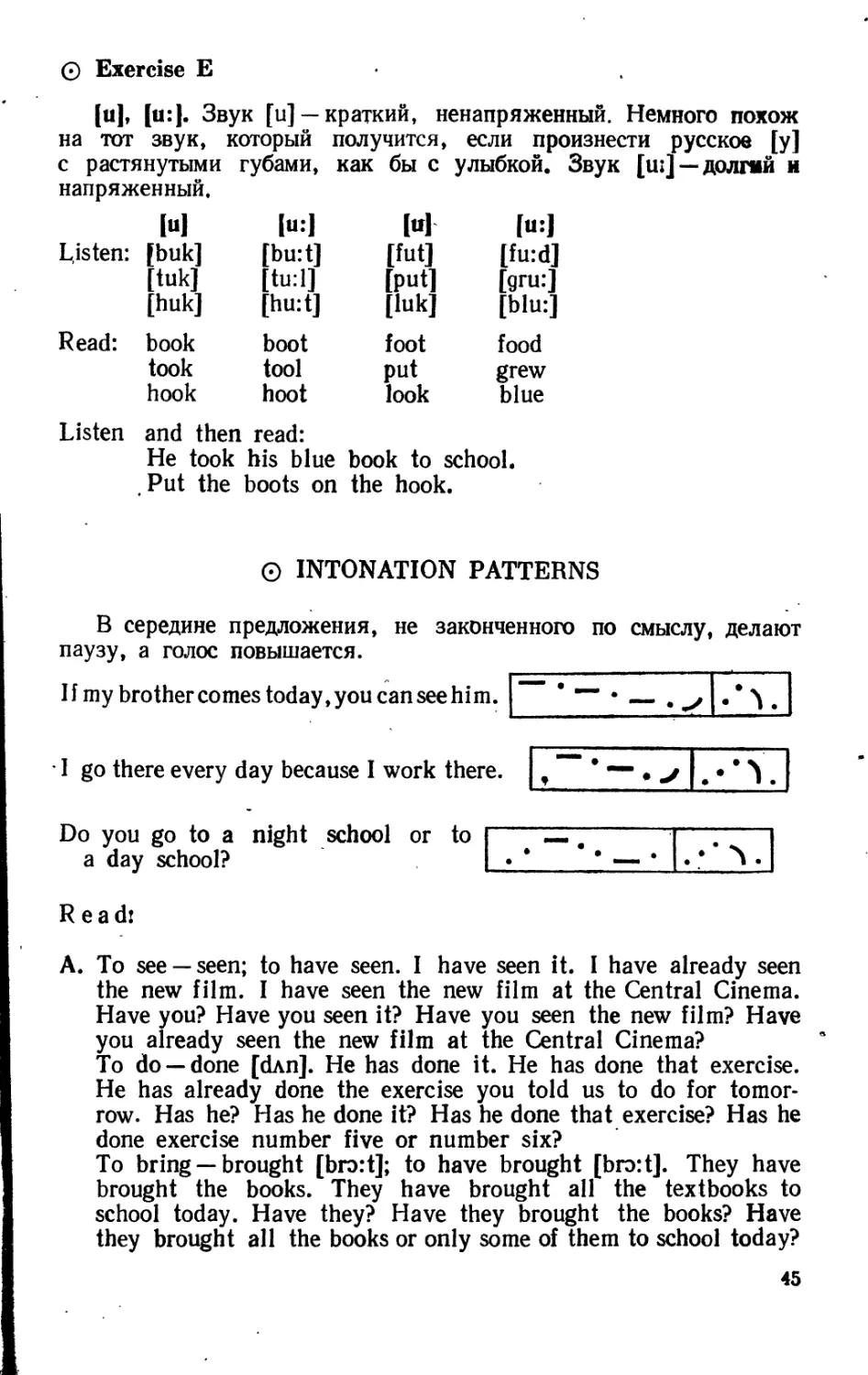
0 INTONATION PATTERNS
В середине предложения, не законченного по смыслу, делают
паузу, а голос повышается.
Ifmy brother comes today, you can see him.
 I go there every day because I work there.
Do you go to a night school or
a day school?
to
Read:
A. To see —seen; to have seen. I have seen it. I have already seen
the new film. I have seen the new film at the Central Cinema.
Have you? Have you seen it? Have you seen the new film? Have
you already seen the new film at the Central Cinema?
To do —done [dAn]. He has done it. He has done that exercise.
He has already done the exercise you told us to do for tomor-
row. Has he? Has he done it? Has he done that exercise? Has he
done exercise number five or number six?
To bring — brought [bro:t]; to have brought [bro:t]. They have
brought the books. They have brought all the textbooks to
school today. Have they? Have they brought the books? Have
they brought all the books or only some of them to school today?
45
В, If I have time, I shall come. If I read the book, I shall tell
you all about it. If I buy the tickets, we shall go to the
cinema tonight.
I read- English books because I want to know English. I have
brought the book because I need a new one. I want to see her
because I like her.
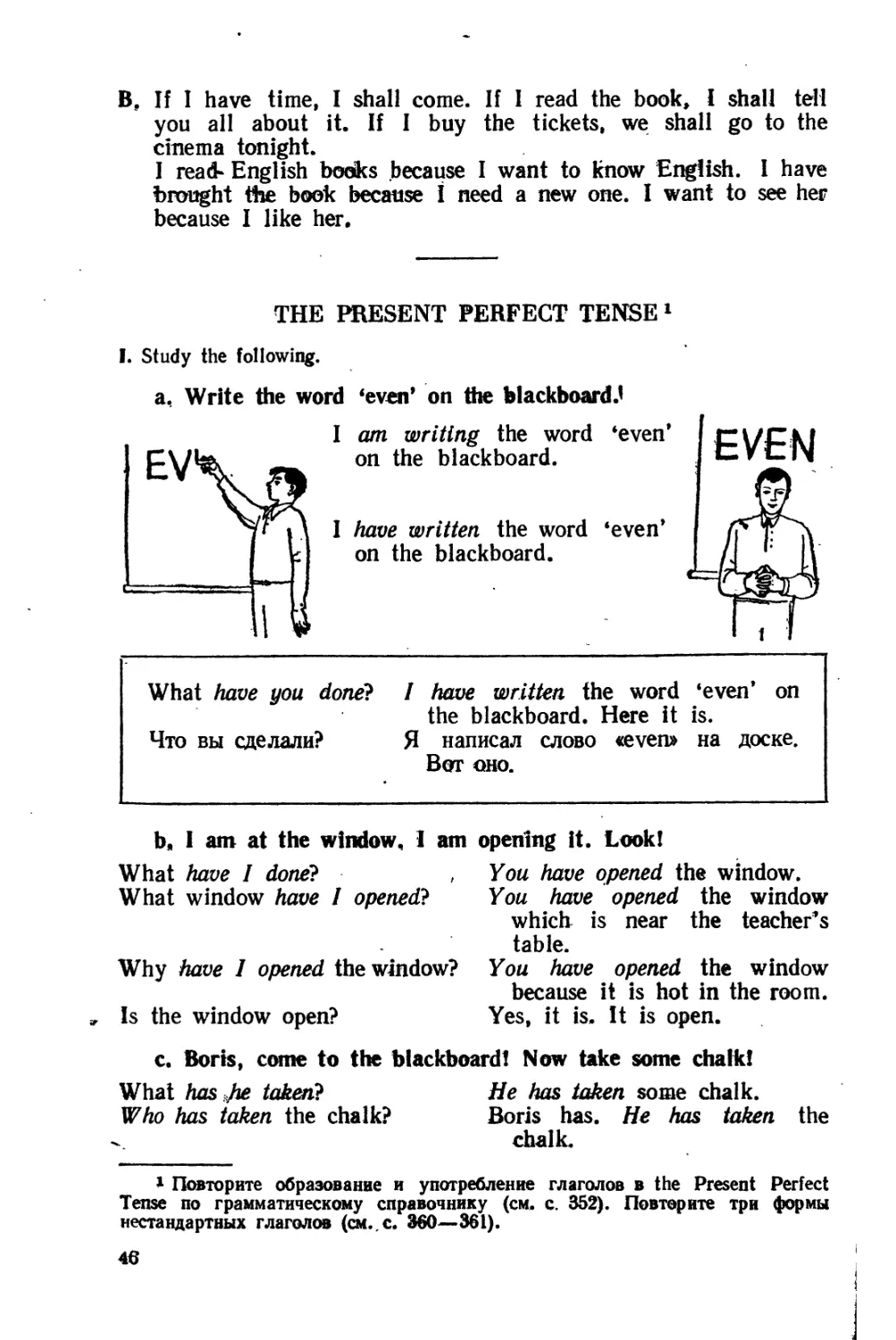
THE PRESENT PERFECT TENSE1
I.	Study the following.
a.	Write the word ‘even’ on die blackboard?
I am writing the word ‘even*
on the blackboard.
I have written the word ‘even*
on the blackboard.
What have you done? I have written the word ‘even’ on
the blackboard. Here it is.
Что вы сделали? Я написал слово «even» на доске.
Вот оно.
b,	I am at the window, 1 am opening it. Look!
What have I done?	, You have opened the window.
What window have I opened? You have opened the window
which is near the teacher’s
table.
Why have I opened the window? You have opened the window
because it is hot in the room.
Is the window open?	Yes, it is. It is open.
c.	Borts, come to the blackboard! Now take some chalk!
What has.he taken?	He has taken some chalk.
Who has taken the chalk? Boris has. He has taken the
chalk
1 Повторите образование и употребление глаголов в the Present Perfect
Tense по грамматическому справочнику (см. с. 352). Повторите три формы
нестандартных глаголов (см. с. 360—361).
46
Why has he taken the chalk?
Where is the chalk now?
He has taken the chalk because
you told hhn to do so.
It is in Boris’s hand.
11.	What are the three forms of the verbs?
To read, to write, to tell, to go, to have, to know.
III.	What is the Infinitive of the following verbs?
Swam, understood, seen, slept, taken, saw, taught, left, went,
written, thought, brought, had, spoke, ate.
IV.	Ask your classmates to answer the questions and do the following.
1)	Have you brought your English textbook with you?
Show it to the class!
2)	Have you read The Captain’s Daughter by A. S. Pushkin?
Can you tell us what it is about?
3)	Has A. come to school?
Where is he (she)?
4)	Have you heard the opera Carmen?
Can- you tell us about it?
V. Ask your classmate
1)	if	he	(she)	has	ever	been to Minsk;
2)	if	he	(she)	has	ever	taken part in a competition;
3)	if	he	(she)	has	ever	gone boating;
4)	if	he	(she)	has	ever	swum across a wide river;
5)	if	he	(she)	has	ever	slept in the open an*.
VI.	Finish the following sentences.
Example: Rogov is doing his homework. When he finishes, he will say,
“I nave done (finished) my homework.”
1)	My sister is writing a letter to her friend. When she finishes,
she will say, “I ...”
2)	The turners are working in their shop. When they finish, they
will say, “We ...”
3)	The cat is eating meat. When it finishes, we shall say, “It ...”
4)	My friends are training for the competition. If they win, we
shall say, “They ...”
5)	Tuzova is trying to get the tickets for the new film. If she gets
them, we shall say, “She ...”
47
VII.	Look at the following pictures. Make up as many questions as you can
and ask your classmates to answer them. Questions to the first picture are
given to help you.
Has the girl opened the window?
What has she done?
What has §he opened?
Why has she opened the window?
VIII. Ask your classmates to perform some actions; then ask them what they
have done.
• Example: Take your pen, B.i What have you done?
What has he (she) done?
ПРЕДЛОГИ
IX.	Study the usage of the following prepositions.
1) Is the man sitting at the table or on the table?
2)	Where is the man sitting?
3)	. Is there a window in front of him or behind him?
4)	Where is the window? *
5)	Is tne book on the table or under the table?
6)	Where is the book?
7) Is the dog on the chair or on the table?
8)	Is the dog ifi front of the
table or behind it?
9)	Is the dog near the table
or under the table?
10)	Where is the dog?
11)	What is under the table?
12)	Is the boy running to the
man or from the man?
13)	Is the boy running to the
dog or from the dog?
14)	Where is the boy running?
48
X.	Speak on the picture given in Exercise IX.
XI.	Speak about your classmates using the prepositions: at. In, on, to, behind,
in front of, from, under. Say three—five sentences about each one.
Example: A. is sitting at the desk. He (she) is sitting in front of B. He
(she) is sitting behind C. He (she) has a textbook bn the desk
in front of him. (her). His (her) bag is under the desk.
ОБОРОТ LET (US)
XII. Study the following.
Let me look at your book., =May I look at your book?
Let me start reading. May I start reading?
Let me take part in the competition. May I take part in the
competition? ’
Let me work at your shop. May I work at your shop?
XIII.	Change the following according to the example.
Example: May I read this book?—Let me read this book.
1)	May I help you? .
2)	May I do this exercise?
3)	May I sit at the window?
XIV.	Study the following.
Mother and I want to buy a new dress. So I say:
Let us go to the shop and buy a new dress.
Давай (me) пойдем в магазин и купим новое платье.
There is a new film on. Let us go to the cinema.
Rogova cannot do this exercise. Let us help her.
We can swim in the river. Let us go to the river.
XV.	Finish the following.
Example: I like to go boating.—Let us go boating.
1)	This book is interesting. (to read)
2)	I want to eat.	(to have dinner)
3)	I don’t want to be late. (to take the bus)
49
XVI.	Составьте краткие диалоги по данному образцу.
Example: A: Let us go to the cinema on Sunday.
B: All right. Let us go to the cinema on Sunday and then
let us go to the library.
или В: I don’t want to go to the cinema. Let us go to the museum.
New Words
to build (built, built) [bild], [bilt]
1)	Many new fine houses were built in our country after the war.
2)	This is a new house. The workers built it for their club.
3)	Are there many new houses built in your town?
to fulfil [ful'fll]
to fulfil — to do what you have said
1)	Our plant always fulfils its plans.
2)	“Have you made a plan of your studies?”
“Yes, I have. And I shall fulfil it.”
3)	Do you always fulfil everything you say or plan?
to produce [pro'dju:s]
1) They will build a large plant in our town. It will produce cars.
It will produce many cars. It will produce buses too. Our cars
and buses will be good.
2) What is produced at the place where you work?
to be good at
1)	Sokolov and Stogov know English very well. They are good at
English.
2)	Vetkov is a fine sportsman. He is good at sports.
3)	Are you good at English? What are you good at?
to build (built, built) to produce to fulfil to be good at	quality ['kwohti] — качество a team [ti:m] — эд. бригада high [hai] — высокий production [pra'dAkJan] — про- дукция, производство
XVII. Answer the following questions.
1) What is the production
that production of good
2) Must all the production
of the place where you work? Is
quality?
be always of high quality?
50
3)	Which is the highest building at the place where you live?
4)	Are you a member of some team? Of which team are you
a member?
XVIII. Ask your classmates
1)	if there are. builders among them;
2)	if there is a new cinema (club, school, theatre, ...) built at the place
where you live; where it is built',
3)	if they are good workers;
4)	if they can always fulfil their plans;
5)	if their production is of high Quality,
6)	if there are Quality Teams at [their shop (plant, factory, collective
farm, ...);
7)	if there are Communist Labour Teams at their shop (plant, factory,
collective farm,
Text
Read the text and try to understand it without word for word translation.
Do Exercise 1, then work at the reading of the recorded text.
Q A MEETING AT THE PLANT
I
There is a meeting at the machine-building plant In our town.
Sokolov has come back from Moscow. He has been to a machine-
building plant in Moscow, and now he must tell his comrades about
what he has seen there.
Sokolov: I shall begin, comrades, with what you all know. You
know that we must fulfil the decisions1 of the 25th Party
Congress, that we must help the country to build Commu-
nism, that our Five-Year Plan is that of quality, of high
quality. The collective farmers will produce more -bread,
milk, butter and meat. They must have many fine machines.
And the machines we produce must be of a really high
quality.
I have been to the Moscow machine-building plant and
have seen how they work there. Now they have six Quality
Teams at their plant already. All the members of the
Quality Teams not only fulfil their plans in good time and
work at the highest standards, but they always help others to
keep the quality of production high.
The members of these teams are not only good workers.
Many of them study at night schools, technical schools or
different institutes. Some of them are good at sports or
amateur activities. * * They read newspapers and books together
1 decisions [di'sijanzJ — решения
* amateur activities ['aemata: aek'tivitiz]—самодеятельность
51
and speak about what they have read. I think that it will
be very good, if we have such teams at our plant too.
I have been to the plant for only three days, so I cannot
say very much.
II
Petrov: Will anyone ask Sokolov about what he has seen, or
about Quality Teams?
Ivanova: Must every member of a Quality Team be a sportsman
or take part in amateur activities?
Sokolov: No, he need not. But he must be more than only
a good worker. He must live like a Communist.
Kovaleva: Are there any women Quality Teams at the plant?
Sokolov: Yes, of course. And they work better than men, some-
times.
Ivanova: I think that we can work better. I know that we can
do without useless waste.1 And if we do, we shall also have
Quality Teams at our plant. Comrades, let us have a com-
petition for a Quality Teaml
Workers: Yes. You are nght. Let us have such a competition.
Petrov: Let the workers of every shop think about it and make
plans on how to improve1 2 the quality of our production.
And now let me close the meeting. Thank you.
Exercises
1.	Say which of the following statements corresponds to the text.
1)	Sokolov has been
a)	at an industrial plant;
b)	on a collective farm;
c)	at his friends’;
2)	At the Moscow plant they have
a)	one Quality Team;
b)	six Quality Teqms;
c)	only Quality Teams.
3)	Members of Quality Teams must be
a)	good workers and good sportsmen;
b)	good workers and take part in amateur activities;
c)	more than only good workers.
4)	The meeting has decided
a)	to have six Quality Teams at the plant;
b)	to make plans of how to improve the quality of the pro-
duction of the plant;
c)	to have a competition for a Quality Team.
1 useless waste [weist] ~ непроизводительные отходы; браи
2 to improve [im'pru:v]—улучшать
52
2.	Put the verbs in brackets into the Present Perfect Tense.
1)	There is a book on my table. Who (to put) it there?
2)	There is a record-player in the classroom. Who (to leave) it
there?
3)	Our baby is sleeping in the open air. Who (to bring) it there?
4)	I am sure that I left my hat in the boat, but it isn’t there
now. Who (to take) it?
3.	a. Q Прослушайте данные в грамзаписи краткие диалоги с оборотом let us и
передайте их содержание по-русски.
Ь.	По данному образцу составьте краткие диалоги с оборотом let us.
Example: There is a new film on at the Central Cinema.
Let's go to see it together (on Sunday).
1)	I’m in a hurry. Let's...
2)	It is very hot. Let's ... •
3)	This book is very interesting. Let’s ...
4)	I need a new dress (suit). Let’s ...
с.	Составьте собственные диалоги no вышеприведенному образцу.
4.	а. Определите, какие из следующих слов являются прилагательными, а какие
наречиями.
Quick, quickly, brightly, bright, fine, finely, wonderfully, won-
derful, differently, different, brave, simply, nice, nicely.
b. Определите, где в следующих предложениях нужно употребить прилага-
тельные, а где наречия.
1)	The production of this plant is always of (high, highly)
quality. 2) Shalyapin’s name is (wide, widely) known all over the
world. 3) She is speaking (main, mainly) about her meeting with
the famous man. 4) It is (nice, nicely) to go boating on such a
(fine, finely) day. 5) The river with a new bridge across it is so
(beautiful, (beautifully). 6) The man was swimming (brave, bravely)
across the (wide, widely) river to help the child.
5.	Put in the adverbs: always, already, never, often.1
1)	We go boating in summer.
2)	I am sure that your friend has been to the South.
3)	I am glad to see you.
4)	She has missed her English lessons.
5)	Do you have your holidays in the country?
6)	He is the best at the competitions.
7)	She has swum across the river.
* Cm. c. 356.
53
6.	Answer the following questions.
1)	Have you seen your teacher of mathematics today?
2)	Have you seen our classroom? Is our classroom large?
3)	Have you heard his (her) answer? Is it correct?
4)	Have you seen my bag? Where is it?
5)	A. and B. have answered. Were their answers good?
7.	Translate into Russian.
Example: This is my pencil. Это мой карандаш.
I take my pencil. Я беру свой карандаш.
1)	Sokolov is looking for his book.
I see his book on the table.
2)	Nadya has put on her new dress.
I like her new dress.
3)	Open your books, please.
Your answer was good.
4)	Their parents will be here tomorrow.
The people of the Soviet Union love their country.
8. Finish the following situations.
1) Volkov is sitting at the desk. He has taken his textbook out
of his bag. He has opened it. What will he read?
2) He has finished reading. He has taken his pen. He has opened
his notebook. What will he do?
3) He has finished writing. He has given his notebook to the
teacher. He has put it on the teacher’s table. What mark will
he get?
9. a. Ask questions about the pictures in Esercise 8 and ask your classmates
to answer them.
b. Speak about Volkov.
10. a. Ask your classmates questions based on the following pictures.
0 b. Answer the questions given on the record.
54
Words:
shoes [Ju:z] —ботинки
suit [sju:t] —костюм
Test Paper No. 4
1.	Read the following text without word for word translation and answer the
questions given in Exercise 2.
Some Words About England
Many people have a rest on Sunday in our country. On this
day people like to go to the cinema or to the theatre. They often
go to the shops on Sunday, but in England almost all the shops
are closed'on Sunday. The theatres and many cinemas are closed
too. People in London like to rest in the parks on. this day, or
they go to the sea in a car if they are rich. The sea is not far
from London, so people go to the seaside in the morning, spend
the day there, and come back in the evening. The south coast is
only fifty or sixty miles from London.
English people like tea very much. They often go to tea-rooms
in the day-time if they want some tea. But they will not have
tea in the open air because there is often rain in England.
We like to ask our friends to come for dinner or for tea.
English people like that too. In our country you say ‘thank you’
after tea or dinner. But in England you must not say ‘thank you’
after tea or dinner. You must say ‘thank you’ when you are leaving.
You must thank the Englishman because he has asked you to come.
to the seaside —к морю
mile —миля (английская миля —1609 м)
in the open air —на свежем воздухе
2.	Answer the following questions.
A.	1) Where will an Englishman go on Sunday?
2)	Is the seaside far from London?
3)	Why must you say ‘thank you’ when you are leaving an
Englishman’s house?
4)	Where can you go on Sunday?
В.	1) Can you go to a theatre on Sunday in England?
2)	How far is the south coast from London?
3)	When must you say ‘thank you’ in England?
4)	Where will you go on Sunday?
3.	Give the first Jwo forms of the following verbs.
A.	Brought, written, understood, given, spoken.
B.	Told, gone, known, built, read.
55-
4.	Write in letters.
Example: 8.15—It is fifteen minutes past eight.
A.	8.15;	2.30;	1.20;
B.	12.05;	2.45;	4.55.
5.	Make up questions to the following answers and finish them.
1)	Yes, he (she) is.
2)	No, I am not.
3)	Yes, they are.
6.	a. Look at the picture and write if the following is correct or wrong. (Write:
Yes, this is correct, or: No, this is wrong.)
A.	1) Sokolov is going to bed.
2)	He has made his bed.
3)	He is putting on his clothes.
4)	He has left the house at 6 in the morn-
ing.
В.	1) Novikova has come home.
2)	She is doing her lessons.
3)	She is taking out her pen.
4)	She has begun to read.
b'. Write three questions about the picture. (A.)
c. Write five sentences about the picture. (B.)
Lesson Five
The Fifth Lesson
Повторение: Звуки и интонация.
The Present Indefinite Tense.
Предлоги: at, from, in, into, near, on, out of, to.
ЗВУКИ
0 Exercise A
[э:]. Это один из самых трудных звуков английского языка.
Звук [э:] —долгий, напряженный, при произнесении его зубы почти
сжаты.
Следующие буквосочетания читаются обычно как [э:]: er, ir,
ur, or (после w).
56
Listen: [la:n], [ga:l], [va:b], [fa:st], [da:t],. [ska:t].
Read: learn, girl, verb, first, dirt, skirt.
Listen: [wa:k], [World], [word], [warm], [ha:], [ha:d].
Read: work, world, word, worm, her, heard.
Listen and then read:
The girl heard the first word of the speech.
It is the early bird that catches the worm.
The first word he learned was ‘to work’.
The worker was a turner.
0 Exercise В
Обратите внимание на звуки [о], [о:], [ои].
	M	[o:]	[ou]	M	[o:]	[ou]
Listen:	not]	no:6]	[nout]	[kot]	[do:]	houp]
	dog]	Ъ:]	[ould]	Пэр]	[Jo:t]	'souda]
	[(Pt]	[po:t]	[gou]	[kbk]	['do: to]	kould]
Read: not		4orth	note	cot	door	юре
1	dog	bur	old	shop	short	soda
	got port		go	clock	daughter <	cold
Listen	and then read:
Tom knows Bob’s daughter.
The shop closes at four o’clock.
The old doctor goes for a long walk at‘					four.
Read:
A girl. This is a girl. This is the girl’s first English book.
A word. This is a word. This is the word that the girl could not
learn. A skirt. This is a skirt. This is my daughter’s newly-made
skirt.
THE PRESENT INDEFINITE TENSE1
I. Study the following.
Do you go to school four days
a week?
Ходишь ли ты (ходите ли вы)
в школу четыре раза в не-
делю?
Yes, I do. I go to school four
days a week. (No, I do not.
I don’t go to school four
days a week.)
Да. Я хожу в школу четы-
ре раза в неделю. (Нет. Я
не хожу в школу четыре
раза в неделю.)
1 Повторите образование и употребление the Present Indefinite Tense по
грамматическому справочнику учебника (c.**352).
67
Do you always go to school in
the evening?
Do you take part in sports com-
petitions?
Do you sleep in the open air?
Yes, I do. I always go to school
in the evenmg. (No, I do not.
I don’t always go to school in
the evening.)
Yes, I do. 1 take part in sports
competitions. (No, I do not. I
don’t take part in sports com-
petitions.)
Yes, I do. I always sleep in the
open air. (No, I do not. I
never sleep in the open air.)
Does Sokolov study together
with you?
Yes, he does. He studies to-
gether with me. (No, he does
not. He doesn’t study to-
gether with me.)
Does he work hard at his Eng-
lish?
Does he like to go boating on
his days off?
Yes, he does. He works hard at
his English. (No, he does not.)
Yes, he does. He likes to go
boating on his days off. (No,
he does not. He doesn’t like
to go boating on his days off.)
Where does Slepov study? He studies at night school.
Where do you study?
Where do you work?
I study at night school too.
I work at a plant (on a col-
lective farm).
What does your brother study He studies English, Russian
at school?	and mathematics at school.
What do you take when you go I take my textbooks when I go
to school?	to school.
Who studies at night school? I do. I study at night school.
58
Who knows English?
Who speaks English?
Who works at the plant?
My sister does. She knows English.
Our English teacher does. She
speaks English very well,
The workers do. They work at
the plant.
11. Read the sentences aloud and translate them into Russian. Pay attention to
the nouns’ and verbs’ ending -s.
1)	The turner works at a plant.
The turners work at a plant.
2)	The shop-assistant sells butter and milk to us.
The shop-assistants sell butter and milk to us.
3)	My friend likes to go boating.
My friends like to go boating.
4)	The fitter works at a plant.
The fitters work at a plant.
111. © a. Listen to the record and try to understand the text, then read it
yourself. Pay attention to the verbs in the Present Indefinite.
MY DAY
Every morning I get up at 6 o’clock. I wash in cold water,
dress, have breakfast, and go to work. I take a bus when I go to
work. I come to the plant at fifteen minutes to eight. I work
from eight to half past four. During the day I have a short half-
hour interval. When work is over, I go home, have dinner, and
have a short rest. In the evening I go to school. I learn English
at school. I like it.
b. Speak about your brother’s' (sister’s, father’s, friend’s) workday. *
Example: Every morning my brother gets up at 6 o’clock. He ...
IV. Answer the following questions.
1)	When does your friend (broth-
er, father, ...) get up?
2)	What does he (she) do in the
morning?
3)	When does he (she) go to
work?
4)	How does he (she) get to the
place where he (she) works?
5)	How many hours does he (she)
work?
6)	When does he (die) finish
work?
When do you get up?
What do you do in the morning?
When do you go to Work?
How do you get to the place
where you work?
How many hours do you work?
When do you finish work?
1 He забудьте, что в 3-м л. ед. ч; добавляется окончание -s.
59
7)	Does he (she) come home
after work?
8)	What does he (she) do at
home?
9)	Does he (she) go to night
school?
10)	How many days a week does
he (she) go to school?
11)	When does he (she) go to
bed?
Do you come home after work?
What do you do at home?
Do you go to night school?
How many days a week do you
go to school?
When do you go to bed?
- V, Make up questions using the following table and ask your classmates to
answer them. Be careful to use the right word.
Do Does	you he she 4	•work know speak walk1 study	at the plant? at school? to the plant? to school? your work? your lesson? English? home?
VI. Put three questions to your classmate asking him (her) what he (she) does
every day.
VII. Make up four—six sentences orally about what you do every day.
VIII. Study the following.
1 am going to school now.
/ go to school four days a
week.
— Я иду сейчас в школу.
— Я хожу в школу четыре раза
в неделю.
Now I am sitting at the window.
Who is cleaning the blackboard?
Ivanova is. She is cleaning the
blackboard.
Are you reading a Russian book?
No, I am not. I am not read-
ing any book now.
I always sit at the window in
this classroom.
We always clean the blackboard
after we have written some-
thing on it.
I never read Russian books at
my English lessons.
1 to walk [w3:k]—идти пешком
60
IX. Answer the following questions.
1)	Is M. answering a question now?
Does he (she) answer questions every day?
2)	Is P. reading an English text now?
Does he (she) read English texts every day?
3)	Is N. working now?
Does he (she) work every day?
4)	Is R. having breakfast now?
Does he (she) have breakfast every day?
X. Ask your classmates what they are doing now and what they do everyday.
See questions in Exercise IX as your example.
XI. Look at the pictures and fill in the gaps with the following:
a. at the table; to the table; near the table; under the table; on the table (2);
from the table.
Sokolov is ‘ sitting —. His books are —. His dog, Rex, is
lying —. Sokolov takes a book —. The door opens and his
little son slowly walks —. The boy stops —. He stands quietly
for some minutes, then he puts his day-book (diary) —.
b. With the help of the above-mentioned* pictures give your own examples
using as many prepositions as you can.
XII. With the help of the following table make up 10 sentences.
am
Подлежащее + is
are
looking at
sitting at Дополнение или
+ standing at + обстоятельство +
working at места’ выраженное
studying at существительным
1 above-mentioned—вышеприведенный
61
Memorize!
on Sunday (Monday, etc.),
in September (October, etc.), in winter (spring, etc.),
in the evening (morning, etc.), in 1979 (1924, etc.),
at 7 (8, etc.) o’clock, at half past eight (seven, etc.), at noon.
XIH. Finish the following sentences.
Example: I don’t go to school on Wednesday, on Saturday and on
Sunday.
1)	Гgo to school ....
2)	School begins ...
3)	I work ...
4)	I was fifteen years old ...
5)	My friend and I like to go boating ...
New Words
	land —земля, суша
XIV. Speak on the following.
1)	There are four oceans on our planet. Their English names are:
the Atlantic Ocean, the Arctic Ocean, the Indian Ocean and the
Pacific [pa'sifik] Ocean. Can you give their Russian names?
2)	Moscow is the capital of our country. What is the capital of
England? of the USA? of Australia? of Canada?
3)	Is there a river at the place where you live? Are there any
islands in the river? Are the islands large? Do you go boating
to some of these islands?
4)	There are four parts of the world: north, south, east, and west.
Is Moscow to the north of the place where you live? What
large towns are there to the north, to the south, to the east, and
to the west of the place where you live?
Text
Read the text and retell it in Russian without looking into the book.
THE BRITISH ISLES *
Look at this map. It is a map of Great Britain fbntn]. In
this map you can see two large islands. The islands are the Brit-
ish Isles. On the east of them you see the North Sea and on the
1 the British Isles f'bntif 'ailzj — Британские острова
62
west the Atlantic Ocean [at'laentik 'otijnj. The capital of Great
Britain is London. You can see London on this map too. Look!
It is in the south of
the large island.
The name Britain
is’ very old. Some peo-
ple think that it comes
from the Britons. These
were the people who
lived on the British
Isles very long ago.
The name England
came much later. The
Angles 1 were the peo-
ple who came and land-
ed1 2 on the coast of
the British Isles in the
fifth century. They
gave their name to a
part of the country in
the south. England
means ‘the land of
the Angles’.
England is in tne
south of the large
island and Scotland
['skotland] is in the north. The island that is to the west of Eng-
land is Ireland ['aialand]. Only the north-eastern part of the island
which is near Great Britain (called Ulster or Northern Ireland) is
part of the United Kingdom. ’ The rest is the Irish Republic called
in Irish Eire ['earej. When you speak about all the parts of the
country, you must say Great Britain and not England, because
England is only a part of Great Britain.
Exercises
В английском языке одно и то же слово может иметь
разные функции в предложении, а следовательно, может
иметь и различный смысл, например: 1) I cannot play foot-
ball. 2) The play was interesting. 3) Our Play House is
large. В первом предложении слово play —глагол; перево-
дится как «играть». Во втором —существительное (перед
ним стоит артикль)-, которое переводится как «игра; пьеса».
1 the Angles ('aegqlz]—англы (воинственное германское племя, которое
совместно с другими германскими племенами—саксами и ютами—в 5—7 вв.
н. э. захватило южную часть Британских островов)
2 to land—высадиться на берег
• the United [ju:'naitidj Kingdom—Соединенное Королевство
63
В третьем —прилагательное, так как стоит перед сущест-
вительным и определяет его; переводится как «драмати-
ческий» (театр).
t. Say what parts of speech the Italicized words in the following sentences ate
and translate them.
1) The lands of our collective farm are very rich. He lands
here every time he goes boating. 2) The butter is quite fresh.
Butter your bread and eat it with your coffee. 3) There is much
rain in October. My raincoat is new. 4) Your answer was cor-
rect. “Always correct my mistakes, please,” Tom asks his sister.
2.	Write down the following words in alphabetical order.
welcome, company, patrol, discover, walnut, dismiss, valid,
patriot, attention, because, fame, unity
3.	Write down in your notebooks the following words in alphabetical order and
find their meaning in the vocabulary of the textbook.
shift, until, ride, join, struggle, roof
4.	Answer the following questions.
a.	Example: Do you like to read?—Yes, 1 do. I like to read. (No, I do
not. I don’t like to read.)
1)	Do you always speak English at your English lessons?
2)	Do you like to skate and to ski in winter?
3)	Do you like to sleep in the open air?	. -	<
4)	Do you know some famous person?
b.	Example: Are you reading an English book now?—Yes, I am. I am
reading an English book now. (No, I am not. I am not -
reading an English book now.)
1)	Are you speaking English now?
2)	Are you skating now?
3)	Are you doing an exercise now?
4)	Are you sitting now?
5.	a. Answer the following questions.
1)	Do you often go to the library?
Are you going to the library now?
Will you go to the library tomorrow?
Can you go to the library tomorrow?
2)	Do you work at a plant?
Are you working now?
Will you work at the plant tomorrow?
Must you work tomorrow?
64
3)	Do you often write letters to your friends?
Are you writing now?
Will you write anything today in the evening?
Can you write letters in English?
b. Ask your classmates four questions according to the order1 given in a.
6.	Use the verbs in brackets in the required tense (Present Indefinite, Present
Continuous and Future Indefinite).
1)	I (to go) to school now. I always (to go) to school in the
evening. I (to go) to school tomorrow evening. 2) Boris is at his
desk. He (to do) his exercises. He always (to do) his exercises on
Saturdays. Tomorrow is Saturday and he (to do) all these exer-
cises. 3) Nina often (to bring) us interesting books to read. Next
time she comes I am sure she (to bring) some new books. 4) — you
(to play) the piano? Who (to play) the piano in the next room?
7. Make up questions using the following table and ask your classmates to
answer them.
Will Does	Ivanov (Petrov, etc.)	go have	to work	- to school to the cinema lessons an English lesson a day off	tomorrow every day’
8. Study the following.
When (if) she comes, I shall telephone to you.
Когда (если) она придет, |то| я вам позвоню.
В английском языке в придаточных предложениях вре-
мени и условия (начинающихся со слов when, if, after, as,
before, as soon as, till, until и некоторых других) вместо
будущего времени употребляется настоящее.1 2 3
9.	Finish the following sentences.
a.	I) If she comes, she will ...
2)	When they finish the work, they will ...
3)	If / like it, I shall ...
4)	When ... , we shall ...
1 according to the order — в том же порядке
2 См. грамматический справочник, с. 359.
3 Слободчиков А. А.	. 65
b.	1) If she .... 7 shall tell you.
2)	When they we shall go to the cinema.
3)	If ... , she will ...
4)	When .... they will ...
10.	a. Read:
1,	2, 3, 4, 5, 6, 7, 8, 9, 10, 11, 12.
b. Образуйте порядковые числительные от вышеуказанных количественных
числительных. *
Example: one—the first; two—the second; ...
11.	Change the following according to the example.
Example: Go to the door!—Don’t go to the door!
1)	Bring me that book! 2) Open the window! 3) Look out of
the window! 4) Put the pen under the book! 5) Put the books
into the bags!
12.	a. Look at the pictures and fill in the gaps with the necessary prepositions.®
I am going — the house.
I am coming —the plant.
The dog is running — the house.
It has come —the house. /
It wants to meet me—the house.
After work I like to sit —the garden,
lam sitting — the bench.
The dog always comes together — me.
It is lying —the bench.
I have a book — my hands.
The bench is — the house.
We are — the classroom.
There is a map —the wall.
The teacher is standing—the black-
board.
A.	is going — the blackboard.
He is going —his place.
B.	is taking his pen —the bag.
b. Look at the pictures and ask your classmates as many questions as you
can.
1	Повторите образование порядковых числительных по грамматическому
справочнику, с. 351.
2	См. таблицу предлогов на с, 356.
66
13. What do you know about Great Britain? «
1)	What are the main islands in the British Isles?
2)	How many parts are there in Great Britain? Can you name
them?
3)	What is the capital of Great Britain?
4)	What is the capital of Scotland?
5)	What other large British towns do you know?
6)	Wh£t are the main British industrial centres?
7)	What are the main British ports?
8)	Is the territory of Great Britain large?
9)	W’hat is the population of Great Britain?
10)	What other English-speaking countries do you know?
Lesson Six
The Sixth Lesson
Повторение: Звуки и интонация.
The Past Indefinite Tense (стандартные глаголы).
Предлоги: among, around, before, behind, be-
tween, by, in front of, through, with.
ЗВУКИ Й ИНТОНАЦИЯ
Exercise A
-ed. Окончание -ed произносится как [t] после глухих соглас-
ных, во всех остальных случаях как [d]. Если глагол оканчивается
на [t] или [d], -ed произносится как [id].
Read the following:
[t]
to like — liked
to dance —danced
to stop —stopped
[d]
to live — lived
to play —played
to study — studied
[id]
to want — wanted
to skate —skated
to decide — decided
Правила написания:
а)	Если глагол оканчивается на непроизносимое е, то
при образовании прошедшего времени к нему прибавляется
только буква d: to decide —decided, to die —died.
б)	Если глагол оканчивается на гласную у, перед ко-
торой стоит согласная, то у переходит в i: to study —
studied, to try —tried. Если же гласной у предшествует
гласная, то -ed просто прибавляется к глаголу; toplay —
played, to stay —stayed.
3*
67
в)	Если глагол оканчивается на согласную, которой
предшествует краткая гласная, согласная удваивается: to
stop —stopped, to ship —shipped.
Exercise В
Перепишите следующие слова в алфавитном порядке и подчеркните окон-
чание -ed одной чертой там, где оно читается как [t], и двумя чертами там,
где оно читается как [id].
Hoped, translated, listened, rained, decided, answered, celebrat-
ed, asked, called, died, interested.
THE PAST INDEFINITE TENSE
(standard verbs)
1.	Study the following.
Look! There goes Sokolov. He is going to the plant.
Did he work at the plant last year?	Yes, he did. He worked at the plant last year. (No, he did not. He did not work at the plant last year.)
Работал т ли он на заводе в прошлом году?	Да. Он работал на заводе в прошлом году. (Нет. Он не работал на заводе в прошлом году.)
Did he study at night school . last year?	Yes, he did. Не studied at night school last year. (No, he did not. He did not study at night school last year.)
Did your friend live in Kaluga last year?	Yes, she did. She lived in Kaluga last year. (No, she did not. She did not live in Kaluga last year.)
Did you enjoy the film?	Yes, we did. We enjoyed the film. (No, we did not. We didn’t enjoy the film.)
II. Answer the following questions.
1)	Did you study English last year?
2)	Did you work at the plant last year?
3)	Did your friend help you to do the exercise?
4)	Did your class like the new film that is on at the cinema?
68
(IL Read the following sentences.
Who lived in Kalinin in 1960? I did. 1 lived in Kalinin in 1960.
Запомните, что в вопросах к подлежащему
сохраняется прямой порядок слов.
Who worked at the plant last They did. The .workers worked
year?	at the plant last year.
Who wanted to see me?	We did. We wanted to see you.
Who turned on the TV?	My brother did. He turned on
the TV.
IV. a. Answer the following questions.
1)	Who worked yesterday?
2)	Who walked in the park last Sunday?
3)	Who helped you to do your lessons?
b. Ask your classmates questions beginning with Who.
V. Make up ten sentences using the following table.
He She My friend	did not	ask invite want	me him her us you them	about it. to help him (her). to come to the plant. to go on a trip. to go to the cinema together.
VI. Make up questions using the following table and ask your classmates to
answer them. Be careful to use the right word.
When Where	Did	КТО-ТО	work study walk play	at the plant at night school to the plant to school football (volley-ball, basket-ball, tennis, ...)	обстоятельство времени	?
69
VII. Translate into English.
Example: Когда они играли в футбол? — When did they play football?
Кто играл с ними? — Who played together with them?
1)	Когда вы спросили об этом учителя? Кто спросил учителя?
2)	Когда она посетила вас? Кто посетил вас вчера?
3)	Когда вы кончили работать? Кто кончил работать вместе с вами?
4)	Кто открыл окно? Когда вы открыли окно?
ПРЕДЛОГИ
Look! The little girl is walking with her
father and mother.
Now she is running in front of them.
Now she is going behind them.
So her father and mother have taken her
by the hands and now she is walking
between them.
Look! Now the little girl is playing with
her friends.
She is standing among them.
Look! Now the children are running around
the tree.
Now they are running across the street.
70
Now they are running through the pipe
(труба).
Look! the teacher is standing between the
table and the blackboard, (между двумя)
Now the teacher is standing among his
pupils, (между, среди многих)
“Come at 5 o’clock.”
“Sorry, 1 cannot come at 5 o’clock. I can
come before 5 — at 3 o’clock —or I can
come after 5 —at 7 o’clock.”
ТНкоисн
VII!. Study the usage of the above-mentioned prepositions and fill in the gaps.
A farmer wanted his new worker to count his pigs1 —taking
them home. There were twenty pigs. —them there were two little
ones. Some time later the man returned and said, “I counted only
nineteen pigs, because one little pig ran —very quickly. Now it
was —the house, now —it. At last it ran —the gate into the field
and I coufd not catch 2 it and count it.”
(among, around, before, behind, in front of, through)
New Words
to train [trem]
1)	The sportsman trains hard for the next competition.
2)	He wanted to become a champion, so he trained for a long time.
3)	If you want to know English well, you must also train your
English. Do you train your English by reading hard? How do
you train your English?
a pilot ['paibt]; a space pilot
1)	I think that you understand what the word pilot means.
2)	Who was our first space pilot? Gagarin was our first space pilot,
and he was the first space pilot in the world.
3)	Do you know the names of all ,the Soviet and American space
pilots? What are they?
1 a pig — свинья
3 to catch—ловить
71
achievement [a'tfi:vmant]
1)	Soviet sputniks and. lunniks were a great achievement of Soviet
science, of the Soviet country.
2)	Our plant will produce more machines of higher quality by the
end of the year. It will be a great achievement for our plant.
3)	What are the latest achievements of our people?
to train	a shift — смена
a pilot	because [bi'koz] — потому что; так как
a space pilot	just [dgAst] — только, только что
achievement	hard —трудный, тяжелый; твердый
Mind!
I went from Moscow to Leningrad by train.
If you want to be a good sportsman, you must train hard.
This work is difficult. ч
I must work hard to fulfil it.
It is difficult to get work in capitalist countries.
The life of workers in capitalist countries is hard.
IX.	Answer the following questions.
1)	Do you always work on the morning shift?
2)	On what shift do (did) you work today (yesterday)?
3)	What does the place you work bl produce?
4)	Is your work difficult? Do you work hard to fulfil it?
5)	Who has just answered the question?
6)	Have you just learned these new words? Which ones?
X.	Finish the following sentences.
1)	I go to school in the evening because ...
2)	My friend can read English books because ...
3)	She (He) studies well because ...
' XI. Ask your classmates
I)	if they go in for sports; where they train\
2)	what are our latest achievements in space research;*
3)	what are the names of the last Soviet space pilots\
4)	on what shift they like to work;
5)	on what shift they like to study;
6)	if they work hard at their English;
7)	if English is difficult for them;
8)	how they "train their English; if they read books in English;
1 space research [ri/sortf] —исследование космического пространства
72
Text
Read the text and try to understand it without word for word translation.
Do Exercise 1, then work at your reading with the help of the record.

BORIS MEETS NINA IVANOVA, A GIRL FROM HIS PLANT
I
Nina: Hello, Boris. I did not see you at the plant yesterday.
Did you work on the second shift?
Boris: No, I did not. I did not work yesterday because it was
my day off. But I was at the cinema yesterday. The film
was very good. They showed how hard space pilots worked,
how they trained to do work in space. They also showed
our latest achievements in space research. The achievements
of Soviet science are really wonderful. You must see that
film. '
Nina: Yes, 1 shall.
II
0 Boris: You are new here, aren’t you? Where did you live
before?
Nina: In Saratov. It is a large town on the Volga. When 1 lived
in Saratov, I worked at a plant- and studied at night school.
Our plant produced machines of high quality for collective
farms. 1 liked our plant very much. I was in our basket-
ball team. We trained really hard to prepare for competi-
tions. fn winter I often skied and skated because I liked
sport very much. At school I did not study very well.
I did not know English, but I wanted to know it. So I
asked my friend to help me. We worked really hard for a
year. Now my English is quite good, and I study it op-
tionally. 1
Boris: I am glad to have met you.1 2 Good-bye. See you tomorrow.
Nina: Good-bye.
Exercises
1.	Ask your classmates
1)	where Nina lived before she came here;
2)	where Nina worked in Saratov;
3)	what the plant produced;
4)	where Nina studied;
5)	what sport Nina liked;
6)	what sports she went in for;
7)	whom she asked to help her;
8)	who helped her.
1 optionally ['opfonali] — факультативно
2 to have met you — что повстречался с тобой
73
2.	Give Grandfather’s and Grandson’s answers according to the example.
Example: Young Man: I study at this school.
Grandfather: I studied at this school too.
Grandson: I shall study at this school too.
1)	Young Man: I work at this plant.	б&ь
Grandfather: ...	Жп\
Grandson: ...
2)	Young	Man:	I	like to dance.	Tl	u
3)	Young	Man:	I	play football.	71	b\j
4)	Young	Man:	I	skate well.	jH	П
5)	Young	Man:	Г walk to the plant.
3.	Write down in your notebooks the" verbs from the text in the Past Indefi-
nite in such an order:
a)	Interrogative;
b)	Negative;
c)	Positive.
В первых двух случаях подчеркните вспомогательный глагол did, а в по-
следнем— окончание -ed.
4.	Repeat the alphabet (see p. 3).
5.	Write down the following words in alphabetical order.
pig, question, tool, university, wallet, ridge, radio, television,
pocket, quiz, unique, parade
6.	Write down in your notebooks the following words in alphabetical order and
find their meaning in the vocabulary of the textbook.
tooth, wake, bath, coin, against, bear, shake
7.	Say what parts of speech are the italicized words in the following sentences
and translate them.
1)	A telephone is a useful thing. I could not telephone to school,
because the telephone line did not work. 2) Our classroom is always
clean because we clean it before we leave it. 3) We love the brave
Soviet space pilots. We always honour the brave. 4) Stogov bought
new skis and now he skis every day.
8.	a. Translate into English.
Example: Перестаньте разговаривать! — Stop talking!
1)	Перестаньте читать! 2) Перестаньте писать! 3) Перестаньте
играть! 4) Перестаньте открывать дверь! 5) Перестаньте кататься
на коньках!
b. Tell your classmates to start or to stop doing something.
74
9.	a. Make up situations.
1)
2)
3)
because I want to know English.
because I want to be a really good worker.
because I want to be a good sportsman.
b. Make up situations with the word because.
... because ...
10.	What must you say
Example: when you are late for the lesson?—May I come in?
1)	when	you	want	to	leave the classroom?
2)	when	you	want	to	take your friend’s pen?
3)	when	you	want	to	help your comrade?
4)	when	you	want	to	answer a question?
11.	Make up short dialogues according to the example.
Example: — May I take your pen?
—Yes, you may. You may take my pen. (No, you mustn’t
take my pen, but you may take my pencil.)
12.	Put questions to the pictures according to the example and ask your class-
mates to answer them.
Example:
— Is this a car or a bus?
— It is neither a car nor a bus. It is a telephone.
13.	Fill in the gaps with the following: at me; to me; me (2); at him; to him;
him (2); at her; to her; her (2).
Tom is at the window. Look —I Tell — to come to the black-
board. Give — some chalk. Now give this book —.
I am at the table. Why are you looking —? Do you want to
tell — anything? Come — on Monday, please, and bring — your
book; I want to read it.
Lena is ill. Look —I Give — some water. Tell — to go home.
Give the book back —.
75
1Ф. Speak on the following picture using the prepositions revised in the lesson.
a. Answer the following questions.
1)	With, whom is Annie playing?
2)	Is she playing before or after school?
3)	Around what are the children running?
4)	Are they running across the street?
5)	Are all of them girls? Is there a boy among them?
6)	Is the girl’s grandfather looking through the window?
7)	Who is looking through the window cd the children?
8)	Is the man standing in front of or behind the woman?
9)	Who is standing behind the woman?
10)	What are they looking at?
b. Speak on the picture.
15. Fill in the gaps with the new words of the text.
1)	You must — much to take part in the competition. 2) Ga-
garin was a —. 3) The first Soviet sputnik was a great — of our
science. 4) It is difficult for me to work on the night —. 5) I
have — come and I don’t know what he has said. 6) She knows
English well, she works — at her English.
0 16. Listen to the English text ^iven on the record, then tell it in Russian.
17. Перечитайте еще раз тексты к Уроку 3 (стр. 39) и к Уроку 6
(стр. 73 ) и сравните, как Борис провел эти два выходных дня.
18. На основании материала текстов к Уроку 3 (стр. 39 ) и к Уроку 6
(стр. 73) расскажите о своем выходном дне.
76
Lesson Seven
The Seventh Lesson
Повторение: Звуки и интонация.
The Past Indefinite Tense (нестандартные гла-
голы).
ЗВУКИ
0 Exercise A
Read the text together with the speaker on the record.
[w]
We wanted to work in the garden.
The worker walked on without stopping.
What were the women wondering about?
Why were you absent on Wednesday?
[v—wl
Every week Vera went to the village.
We won the victory among the women’s teams in Vilnus.
This was the very match Vai wanted to win very much.
INTONATION PATTERNS
Ударение в английском предложении
В английском предложении больше слов произносится
без ударения, чем в русском языке. Вне ударения стоят
служебные слова, т. е. союзы, предлоги, артикль, вспо-
могательные глаголы и глагол-связка, местоимения (кроме
указательных и вопросительных) и частицы. Отрицание
not всегда находится под ударением.
О Exercise В
Listen to the speaker on the record. Then read aloud.
'Tom will 'play 'tennis withLena.
It 'rained 'last^night.
He in'vited me to 'come to his 'house in the Л morning.
It is 'cold in ^winter and it 'often snows.
0 Exercise C
a.	Read aloud.
b.	Check your reading with the recorded text.
c.	Read the text together with the speaker on the record.
77
Mother: ЛTom! There were 'two 'pieces of 'cake on the 'table
'lastnight. 'Now there is 'only 'one 'pieced left. Do you
'know 'why it isso?
Tom: 'Yes,Mother. It was 'so 'dark in the ./room that I did
'not 'see the pother.
THE PAST INDEFINITE TENSE
(non-standard verbs)
1. Give the three forms of the following verbs. 1
To be, to begin, to feel, to get, to give, to go, to have, to
meet, to read, to see, to sit, to spend, to take, to understand.
II. Put questions to the following sentences. (Questions with the verbs in the
Past Indefinite are formed with the help of did.)
Sokolov left yiDid Sokolov leave the town last week?
Ih* v о tn ТЧ i	*
the town Iasi W^.\when did Sokolov leave the town?
1)	He began training for the competition last week.
2)	I met my friend on the bridge yesterday morning.
3)	My brother went to the library yesterday.
When
Whom,
When
Where,
When
III.	Answer the following questions.
1)	When did you get up? 2) When did you go to work? 3) When
did you have dinner? 4) When did you come to school?
IV.	Make up questions using the following table and ask your classmates to
answer them.
How much
When	смысловой второстепен-
How + did^-^ + глагол (без + ные члены +?
Where	щ . частицы to) предложения
Why
V.	Make up questions using the following table and ask your classmates to
answer them.
What-^r‘/iar0JI B	+дополнение +?
1 Посмотрите еще раз список наиболее часто употребляемых нестандарт,
ных глаголов (с. 360—361). Вйучите те формы, которые вы забыли.
78
VI.	Translate into English.
Example: Куда вы пошли после занятий? — Where did you go after
school?
Кто пошел с вами? — Who went with you?
1)	Когда вы работали в вечернюю смену? Кто работал вчера
в вечернюю смену?
2)	Написала ли ваша сестра письмо? Кто написал письмо?
3)	Ушла ли Катя домой? Кто пошел с ней?
VII. Use the following table to make up questions and then answer them. Be
careful to use the right word.
Was	he (she)	at the plant (theatre, cinema)
Were	you имя	yesterday? your classmate last year? at home (at school, at the plant) yesterday evening? good at English in the 8th form?
VIII. Say three—five sentences about what you were doing yesterday (on your
day off), in summer. Use different verbs in every sentence.
New Words
a lot of
a lot of = many
1) There are a lot of people who have lunch at one o’clock.
2) Are there a lot of new houses in your town?
a bath [baG]
The man is taking a bath.
1) Englishmen like to take a cold bath
every morning.
2) Do you take a bath at home or do you
go to a bath-house?
to brush; a tooth [tu:S] (teeth)
The man is brushing his teeth.
1)	Do you brush your teeth in the
morning and in the evening or only
in the morning? *
2)	Do you brush your teeth in the
bathroom?
3)	Do you brush your coat before you
leave your house?
79
a bath to brush a tooth (teeth) a lot of	to wake (woke, woken) (up) — просыпаться usually ['juigualij — обычно a break [breik] — перерыв; перемена lunch — второй завтрак clear [klio]— ясный; ясно
Mind!
One tooth [tu:0] —many teeth [ti:0]
I have a bad tooth, and I could not sleep last night. Every morn-
ing I brush my teeth.
IX.	Answer the following questions.
1)	When do you wake up in the morning? Do you always wake up
at the same time? When do you wake up later than usual?
2)	When do you have a break for lunch? Do you always have the
break for lunch at the same time? How many breaks do vou
have at school?
3)	Do you usually work on the morning shift? When do you usually
work? When do you usually come to school? When do you
usually have your day off (your holidays)?
4)	Is the meaning of all the new words clear to you? Which new
word is not clear to you?
X.	Ask your classmates
1)	when they wake up in the morning;
2)	if	they	always	wake up at the same time;
3)	if	they	brush their teeth in the morning or	in	the evening;
4)	if	they	take a	bath or a shower; i
5)	if	they	take a	bath or a shower every day	or	once a	week;
6)	if	they	visit a	bath-house;
7)	if	they	have a	break for lunch;
8)	how long the break for lunch is;
9)	if they understand all the new words.
Text
Read the text and try to understand it without word for word translation.
Then do Exercise 1.
AN ENGLISH TEACHER WRITES ABOUT HIS WORKDAY
I
The other day I got the following letter from England:
Dear Alex,
You often asked me about my workday. Yesterday was one of
my usual workdays.
1 a shower ['jauo]—душ
80
I woke up at about seven o’clock, and it was time for me to
I get up. I like to take a cold bath every morning, so I went to
the bathroom. The water was very cold that morning, biit after
the bath I felt quite warm. Then I brushed my teeth and washed
my face and went back to the bedroom to dress. I combed1 my hair
\ and went down for breakfast at a quarter to eight.
|	After breakfast 1 sat and read [red] my morning newspaper.
[ Then f had a short walk.
!	_ в
Is
I went into my study2 at nine o’clock where I met my stu-
dents and the day’s work began.
At twelve thirty I had a break for lunch. I usually have lunch
i at the canteen.3
I finished work at about five o’clock. Then I had a cup of tea
and spent another hour or so in the garden to have a rest after
i. a hard day; but more often I go to my club and play a game of
) tennis or golf.
We had dinner at seven thirty, and then we sat, all the family
*	together, and talked, listened in to the radio, and watched television,
s	In winter we sometimes go to the cinema or to the theatre, but
that is not often, because I have a lot of work to do, and usually
;	after dinner I go to my study and read or write there.
।	I went to bed at twelve. That is my usual time, and this
ended my usual workday.
f	What about you? Tell me some words about your workday,.
* please.
Yours,
John Smith.
Exercises
1.	Answer the following questions.
1)	When did the Englishman wake up? And what about you?
2)	Does he take a warm bath every morning? And what about you?
3) Does he brush his teeth in the evening? And what about you?
4)	How does he spend his break for lunch? And what about you?
5) Does he work hard? And what about you?
>	6) What does he do after work? And what about you?
,	7) What time does he usually go to bed? And what about you?
2.	Give the Infinitives of the following verbs.
d Taught, thought, woke, wrote, brought, bought, ate, saw, went.
1 to comb [koum] —причесываться.
*	2 a study —кабинет (в Англии во многих учебных заведениях кабинетная
система преподавания)
3 a canteen [kaen'tkn]— столовая, буфет (обычно в учреждении)
81
I
3.	Find in the textali the verbs in the Past Indefinite and give their Infinitives.
4.	Read paying attention to the difference of the usage of the Past Indefinite and
the Present Perfect.
What have I done?
(сам факт и результат)
This plant has produced a lot
of TV sets.
I have bought a very useful book.
He has opened the window to
let in some fresh air.
I have had quite a hard day.
When did I do it?
(время, когда это было сделано)
This plant produced a lot of TV
sets last year.
I bought a very useful book the
other day.
He opened the window an hour
ago.
I had quite a hard day yesterday.
5.	Translate into English. Use the tenses right.
1)	Он прочел эту книгу и может рассказать нам о ней. Он
читал эту книгу вчера. 2) Сестра нашла свою книгу. Она поте-
ряла ее на прошлой неделе. 3) Мы написали ей письмо, и она
его скоро получит. Мы написали ей письмо на прошлой неделе;
почему она его не получила? 4) В прошлом году мой брат при-
нимал участие в соревновании. Этот спортсмен занял первое место
в соревновании, и теперь он чемпион нашего города.
6.	a. Answer the following questions.
1)	Have you seen the film The Karamazov Brothers?
When did you see it?
2)	Have you read Fathers and Sons by Turgenev?
When did you read it?
3)	Have you ever been ,at a rest-home (sanatorium, the Black
Sea, ...)? When were you there?
4)	Have you seen the last sports competition in skating (skiing,
gymnastics, football, volley-ball, hockey, ...)?
When did you see it?
b. Ask your classmates questions using the Present Perfect and the Past
Indefinite Tenses. Follow the example given in a.
7.	Do the exercise according to the example.
Example: A: Open the door!
B: Don’t open the door!
8.	Translate into Russian the words in italics.
Example: a bathroom —ванная (комната).
1)	I wash my face and hands in the bathroom, 2) My tooth-brush
is in the bathroom. 3) I have a bad tooth\ I must see a doctor.
4)	At lunch-time we stop working for half an hour. 5) Ask the
book-keeper about the money. 6) The shop-assistant sold us some
bread and some butter. 7) Does your classmate speak English well?
9.	Ask your classmate
1)	if	he	(she)	has	a	lot	of	Russian	books;
2)	if	he	(she)	has	a	lot	of	English	books;
3)	if he (she) knows a lot of new songs;
4)	if	he	(she)	spends a	lot	of time	on his	(her)	English;
5)	if	he	(she)	has	a	lot	to	do at his (her)	work.
10.	What time is it?
It is a quarter (fifteen minutes) to twelve.
v\ и /
9	<< з
It is half (thirty minutes) past one.
It is one o’clock.
< в \
11.	Answer the following questions.
When do you
wake (up)?
get up?
have breakfast?
go to work?
have a break for lunch?
finish working?
come to school?
come home?
go to sleep?
12.	a. Finish the following.
When I wake (up), I jump out of the bed and do some physical
exercises. Then I go to the bathroom where I wash my hands and
face and brush my teeth. After that I dress and have breakfast.
This is the way how I usually ...
When I come to the place of my work, I speak with the com-
rades that worked before me, learn what I must do and start
working. I usually work hard.
This is the way how I usually...
83
When the break begins, I stop working and go out to have
lunch. After lunch I talk with my comrades a little and then go
back to work.
This is the way how I usually ...
If I don’t go to school, I go home from work, have dinner,
sometimes watch the TV or prepare my lessons.
This is the way how I usually ...
b. Speak on the way
1)	you get up;
2)	you work;
3)	you spend your break for lunch;
4)	you spend an evening at home.
13.	a) Put questions to the following pictures.
b)	Speak about the following pictures.
c)	Speak about the workday of the man in the pictures.
0 d) Listen to the questions given on the record and answer them.
14.	Ask your classmates questions about their workday.
15.	Сравните текст My Day, данный на с. 59, с текстом An English Teacher
Writes About His Workday и скажите,.
1)	что общего в рабочем дне обоих людей ;
2)	в чем разница в рабочем дне обоих людей.
16.	Speak about
a.	your workday;
b.	the workday of your father (mother, brother, sister, husband, wife,
friend, classmate).
84
Lesson Eight	The Eighth Lesson
Повторение: Звуки [г] и [о:].
Оборот to be going to.
’ ЗВУКИ
0 Exercise A
[г] — кончик языка находится за альвеолами.
Listen: [red], [гавп]. [nd], [гаед], [глп], [гэЬ], [risk].
Read: red, ran, rid, rag, run, rob, risk.
Listen: [traem], [traep], [trAk], |tnk].
Read: tram, trap, truck, trick.
0 Exercise В
[э:] — звук долгий, напряженный; зубы почти сжаты.
Listen: [ho:], [ho:d], [wa:k], [fo:n], [wo:d], [wo:Id].
Read: her, herd, work, fern, word, world.	. ;
0 Exercise C
|r|-M
Listen and then read:
He heard her report over the radio.
Read and write the first and the third exercises.
They drove the truck further and further.
The river curved round and round.
Breakfast is served in the reading room.
Read:
To read; going to read. I am going to read. I am going to read
a book. I am going to read a book by Jack London on Sunday.
To put; to put on a hat; going to put on a hat. She is going
to put on that hat. She is going to put on that hat when she’s
going for a walk on Sunday.
To do; going to do; going to do this work. Are they going
to do this work? Are they really going to do this difficult work?
1.	Answer the following questions.
I)	Is the teacher reading or writing? Is she speaking or listening to
you?
2)	What is she (he) doing?
3)	Are you sitting or standing? Are you reading or writing?
85
4)	What are you doing?
5)	What are your classmates doing?
fl. Put questions to the following picture and ask your classmates fo answer
them.
1)	Where (the girl; to be)?
2)	Where (the girl; to go)?
3)	Whom (the girl; to look at)?
4)	What (the girl; to do)?
5)	Why (the girl; to look out of the window)?
6)	Who (the man; to be)?
7)	Where (the man; to go)?
8)	Why (the man; to look at the girl)?
ОБОРОТ TO BE GOING TO
III.	Study the "following.
I am going to read this book.
Я прочитаю эту книгу.
Не is going to do this work.
Он сделает эту работу.
They are going to speak to the engineer.
Они поговорят с инженером.
Is your friend going to see this
film?
Are you going to ask him (her)
- about it?
Are your friends going to come
skiing with you?
Yes, he (she) is. He (she) is go-
ing to see this film. (No, he
(she) is not. He (she) is not
going to see this film.)
Yes, I am. Г am going fo. ask
him (her) about it. (No, I am
not. I am not going to ask
him (her) about it.)
Yes, they are. They are going to
come skiing with us. (No, they
are not. They are not going to
come skiing with us.)
86
IV.	Study the follpwing.
I was going to read this book when you came.
Я собирался прочитать эту книгу, когда вы пришли.
Were you going to read it yester-
day?
Was your brother going to read
it?
Were your friends going to read
it?
Yes, I was. I was going to read
it yesterday. (No, I was not. I
was not going to read it yester-
day.)
Yes, he was. He was going to
read it.
No, they were not. They were
not going to read it.
Оборот to be going to, как и глаголы shall и will, является
показателем будущего времени.
Оборот to be going to можно также перевести на рус-
ский язык как собираться (сделать что-нибудь). Например:
She is going to make a dress. She is going to be a doctor.
После оборота to be going to не следует употреблять
глаголы to go и to come.
V.	Look at the pictures and answer the following questions.
1)	Is the man going to read?
2)	Is he going to read or to write?
3)	Is he going to read a newspaper?
4)	What is he going to read?
1)	Are the boys going to swim?
2)	Are they going to swim far?
3)	Where are they going to swim?
4)	Are they going to swim across the
river?
5)	What are they going to do?
1)	What was Sokolov going to do when
Stogov came in?
2)	What was he going to take?
3)	Where was he going to put them?
4)	Were Sokolov and Stogov going to
study together?
5)	Were they going to read books
together?
6)	What were they going to do?
87
VI. Answer the following questions.	.	. .,
1)	Are you going to have an English lesson tomorrow?
2)	When are you going to have your next English lesson?
3)	Are you going to read Martin Eden on your day off?
4)	What are you going to do on your day off?
5)	Are you going to work on Saturday?
6)	When are you going to work?
VII. Make up four — six sentences, connected with each other, beginning with
I am going to ...
Example: On Sunday (on my day oif, tomorrow, ...) 1 am going to ...
New Words
to become (became, become)
1)	Popov was a fitter. Now he is an engineer. Popov became an
engineer.
2)	Sokolov could not skate before. Now he is good at skating.
Sokolov became a good skater.
3)	What do you want to become?
to start
1)	Klimov, stand up! Take your book and start reading: Now take
your pen and start doing this exercise.
2)	Klimov started working at the plant last year. When did you
start working?
3)	When did you start learning English?
to enjoy [m'djoi]
I)	I like to go to the stadium. I enjoy watching football and
hockey matches.
2)	My sister reads day and night. She enjoys reading detective
stories.
3)	What sport matches do you enjoy watching: football or hockey?
4)	What books do you enjoy reading best of all?
to become	gold — золото
to start	character ['kaenkto] —персонаж, образ, действующее
to enjoy	лицо useful ['jursful] — полезный; полезно (useless — бесполезный)
88
VIII.	Answer the following questions.
1)	Do you enjoy an opera (a ballet, a drama)? What do you enjoy
seeing at the theatre?
2)	Who has a gold ring1 in your class? Is he (she) married?
3)	Do you like to have golden things? Which ones?
4)	The character of which book do you like best of all?
5)	What character from Pushkin’s works do you like best of all?
6)	Do you enjoy reading Pushkin’s or Lermontov’s poems better?
7)	Is it useful for you to study at night school?
IX.	Ask your classmate
1)	if he (she) wants to become a doctor, a teacher, an engineer;
2)	what he (she) wants to become;
3)	when his (her) father (mother, sister, brother, friend,...) started working;
4)	when he (she) started studying at night school;
5)	if he (she) likes Gogol’s characters;
6)	if he (she) likes L. N. Tolstoy’s characters better;
7)	the characters of which books (plays) he (she) likes better;
8)	if he (she) enjoys going to the theatre;
9)	what he (she) enjoys better: going to the theatre or to the cinema;
10)	what he (she) enjoys more: going to the cinema or watching television;
11)	if he (she) enjoys watching sports competitions;
12)	if watching television is useful.
Text
Read the text and try to understand it without word for word trans-
lation. Then answer the questions given in Exercise 1.
.JACK LONDON’S MARTIN EDEN
I
On my day off I am going to read a book about an American
worker who became a well-known writer. My friend told me all
about it. It was very hard for the American worker [because he
didn’t know much. But he wanted to become a writer so much
that he worked day and night reading, studying and writing. At
last he became a good writer. People in his country started reading
his stories and liked them. He became famous. But he lived in
a capitalist country, so no one helped him, and he could not study
at the university because he had no money.
The book I am going to read is very interesting. I like the
character very much. His life was very hard, but still he became
what he wanted to be. Of course, in our country it would have
A a ring—-кольцо
89
been1 different for him. In our country
every man who wants to study can study,
and he who has talent will become famous.
I think you know the book I am going
to read, don’t you? It is Martin Eden by
Jack London, a famous American writer.
II
Jack London’s life, like the life of his
character, was very hard before he became
famous. He had to work at different plants
and farms. He had to do different work. He
went to Alaska to find gold there. He did
not find any gold, but he found the charac-
ters of his stories: strong, brave people. Lenin liked London’s story
The Love of Life very much. Have you read it? I am not going to
tell you the story. I am sure that, if you have not read this story,
you are going to read it some day. I -am sure you will enjoy it.
And what about Martin Eden? Have you read it or heard about
it? If not, you must read it. It will be useful. You will learn
about a man with a hard but interesting life. You will see how
difficult it is for a worker in a capitalist country to become a fa-
mous writer.
Have you read any stories by Jack London? Which ones? Did
you like them? Are you going to read Martin Eden now that I
have told you about it? Read it! I am sure it is going to be inter-
esting and useful for you.
Exercises
1.	Find in the text answers to the following questions.'
1)	What book am I going to read on my day off?
2)	Who wrote the book I am going to read?
3)	What do you know about Martin Eden?
4)	Why do I like the character of the book?
5)	What do you know about the life of Jack London?
6)	What story by Jack London did Lenin like very much?
7)	Where did Jack London work?
8)	Where did Jack London find the characters of his stories?
9)	What were his characters?
10)	Is it easy for a worker in a capitalist country to become
a famous writer?
11)	Is it easy for a worker in a capitalist country to become an
engineer (a doctor, a teacher)?
1 it would [wud] have been—было бы
90
2.	Ask your classmate
1)	if he (she) is going to read Martin Eden and when he (she) is going to
do it;
2)	if he (she) is going to see the new film and when he (she) is going to
do it;
3)	if he (she) is going to buy a new suit (dress) and when he (she) is going
to do it;
4)	if he (she) is going to come to school on his (her) day off and when he
(she) is going to come to school.
3.	Make up questions with the help of the following tables and ask your
classmates to answer them.
a.
js	неопределенная
Аге подлежащее 4- going 4- форма глагола 4- дополнение 4- ?
(инфинитив)
When	неопределен-
Where + £e + „„Me»amee + going +	+*””“ + ?
die	глагола	ние
(инфинитив)
4.	Translate the following sentences into -Russian. Pay attention to the different
meaning of the verbs with the ending -ing.
1)	You saw us when we were going to the shop.
You saw us when we were going to leave the shop.
2)	We are doing an exercise. We are going to do an exercise.
3)	Katya is trying to find the new words.
Katya is going to try to find the new words.
4)	I was going to work at my English when Popov came.
I was going to school when I met Popov.
5.	Answer the following questions.
1)	What famous English writers do you know?
2)	What books by these writers have you read?
3)	Were the books not only interesting but also useful for you?
Are you sure about it?
4)	What famous American writers do you know?
5)	What books by these writers have you read?
6)	Were the books by these writers not only interesting but also
useful for you? Are you sure?
91
7)	What famous Russian writers do you know?
.8) What books by these writers have you read?
9) What Russian (Soviet) writer do you like best of all? What
book by this writer do you like best of all?
10) Have you ever tried to read books (newspapers) in English?
Was it difficult for you?
1,1) What do you like to do (to read) on your day off?
12) What did you read during the last month (year)?
6ч a. Do the exercises according to the example.
Example: They did not know the word because it was new
1) — because I wanted to know English. 2) —because I worked
in the morning. 3) — because I did not know it. 4) — because I
liked it.
b. Speak on the following situations. Tell the class why it happened.
Example: 1 have not brought my English textbook because I came from
the plant (because I had no time to go home)
1) You came late. 2) You haven’t brought your book. 3) You
did not come yesterday. 4) You have not prepared your homework.
7.	Explain the following.
Example: Is England a river or a sea?
England is neither a river nor*a sea. It is a country.
1)	Is the Volga a town or a country?
2)	Are your classmates doctors or engineers?
4) Is that a school or
a theatre?
3)	Is he a worker or
a teacher?
8.	Write down the following words in alphabetical order. Pay attention not only
to the first letter but to the following letters as well.
full, occupy, continent, contemporary, eject, government, be sit-
uated, consist, electoral, discover, fun
9.	Write down the following words in alphabetical order and find their meaning
in the vocabulary of the textbook
smith, allow, stage, grow, struggle, dangerous, horse
92
10.	Translate into Russian the italicized words.
Example: He answers all the questions very well. — Он хорошо отвечает на
все вопросы.
His answers were good. — Его ответы были хорошими.
1)	This is the end of the story. All is well that ends well.
2) She will answer the most difficult questions. Her answer is
always good. 3) They will start swimming in five minutes. When
the start is given, start swimming at once.
11.	Ask your classmates questions about different things beginning with the word
W hose.
Example: Whose book is this?
It is Popov’s book. It is his book.
12.	Use the new words of the text.
1)	I don’t like the main —of this book. 2) My sister trains
much and she has —quite good at figure-skating. 3) It is very —
to read books in English. 4) My mother gave me her — bracelet.
5) My friends —watching hockey matches. 6) We have to —working
better. This is Quality Five-Year Plan.
© 13. Прослушайте грамзапись-и перескажите ее содержание по-русски.
14. a. Answer the following questions.
Are the boys and girls at the
seaside (on the bank of a riv-
er1 or a lake)?
Did you spend your holidays at
the seaside (on the bank of a
river or a lake)?
1 the bank of a river —берег реки
93
What time of the year is it?
Are they swimming?
Are they boating?
Are they playing games?
What game are they playing?
Are they lying in the sun?
Are they fishing? Are they good
at it?
Are they reading any interesting
books?
Are they taking part in a com-
petition?
Is the day fine?
When did you have your holi-
days?
Did you go swimming during
your holidays?
Did you go boating during your
holidays?
Did you play any games during
your holidays?
What games did you play during
your holidays?
Did you lie in the sun during
your holidays?
Did you go fishing during your
holidays? Are you good at it?
Did you read any interesting
books during your holidays?
Did you take part in a compe-
tition during your holidays?
Were there fine.days during your
holidays?
Did the boys and girls go on a
trip?
Are they in the country?
Are they in the forest or in the
fields?
Are they playing games in the
open air?
Are they working?
Did you go on a trip during
your holidays?
Did you go to the country?
Did you go to the forest or to
the fields?
Did you play games in the open
air during your holidays?
Did you work during your holi-
days?
94
Are they going to the cinema or
to the theatre?
Are they going on an excursion?
What are they doing?
Is the day fine?
Do they enjoy their trip?
Did you go to. the cinema or to
the theatre during your holi-
days?
Did you go on an excursion
during your holidays?
What did you do during your
holidays?
Were the days fine?
Did you enjoy your holidays?
b. Speak about your holidays.
15. a. Tomorrow is your day off. Speak on it. .
I)	At what time are you going to get up?
2)	At what time are you going to have breakfast?
3)	What are you going to have for breakfast?
4)	Are you going to stay at home or go somewhere in the
morning?
5)	What are you going to do in the morning?
6)	At what time do you have dinner on your day off?
7)	What do you have for dinner on your day off?
8)	Are you going to see a new film?
9)	Are you going for a walk? Alone or with your friends?
10)	What are you going to do in the afternoon or in the evening?
11)	Do you go to the library on your day off?
12)	Do you read books on your day off? Russian or English?
13)	Do you prepare for your studies on your day off?
14)	How much time do you [spend on reading or preparing for
your classes on your day off?
15)	Do you spend your, days off in a useful way?
b. Tell your classmates what you are going to do on your day off.
Test Paper No. 2
1.	Read the following text, try to understand it without word for word
translation, then answer the questions given in Exercise 2.
The Usefulness of Knowing Foreign Languages
Once upon a time there was a mouse living in a mouse-hole.
One day it sat up and listened and heard someone bark ...
“Well,” thought the mouse, “that must be a dog. Now I may
go out. I don’t think dogs eat mice.”
That seemed logical, and the mouse went out. But the moment
it went out, a cat jumped on it and ate it; because it was a cat
that was barking.
95
Then the cat said:
“Now I am quite sure that it is useful to learn foreign lan-
guages.”
once upon a time —однажды
mouse [maus] (мн. ч. mice) — мышь
mouse-hole — нора
to bark —лаять
2.	Answer the following questions.
A.	1) Where was the mouse living?
2)	What did the mouse hear one day?
3)	What did the cat do?
4)	Is it useful to know foreign languages?*
В.	1) What was there once upon a time?
. 2) What seemed logical to the mouse?
3)	Why did the cat bark?
4)	Do you know any foreign language?
3.	Give the three forms of the following verbs.
A.	To find, to give, to fight, to know, to fly.
B.	To go, to hear, to think, to mean, to write.
4.	Say it in English.
А.	Я иду домой; я дома; я ухожу из дома (to leave); принеси
книгу в школу; оставь ее в школе; возьми ее домой из школы.
В.	Принеси книгу домой; оставь ее дома; возьми ее в школу из
дома; мы идем в школу; мы в школе; мы идем домой из школы.
5.	Make up questions on the following situations and complete them.
A.	1) Yes, I shall. I shall ...
2)	No' he doesn’t. My brother (friend) doesn’t ...
3)	Yes, she did. She did (made) it herself. ...
4)	No, we are not. We are not going to ...
В.	1) Yes, we did. We...
2)	No, she won’t. She will not ...
3)	Yes, he does. My father always...
4)	No, you mustn’t. You mustn’t...
6.	Give answers to the following questions.
A. 1) May I smoke in the classroom? If not, why?
2)	Can we go boating in winter? If not. why?
3)	Must you go to school on Sundays? If not, why?
96
В, 1) Can you take part in the world skating competition?
If not, why?
2) Must you wash the classroom every day? If not, why?
3) May I go away before the lesson is over? If not, why?
PART TWO
Lesson Nine	The Ninth Lesson
Повторение: Звуки (дифтонги).
Разговорная тема: Му Flat.
ЗВУКИ
0 Exercise А
[eij, [ou], [ai], [au], [oi]. В английском языке первый элемент
дифтонга сильный, а второй — слабый.
Listen: [ei], [ou], [ai], [au], [oi].
Listen: [sei], [dei], [rem].
Read: say, day, rain.
Listen: [nou], [sou], [gou].
Read: no, so, go.
Listen: [ai], [trai], [krai].
Read: I, try, cry.
Listen: [aut], [o'baut], [sau8].
Read: out, about, south.
Listen: [boi], [tai], [dpi].
Read: boy, toy, joy.
Listen and then read:
The boy danced for joy.
The day is rainy, they say.
Don’t go in that boat.
I’ll try to find the way today.
She shouts about going to the south.
Read:	•
There_ is. There _ is a book. There is a book on the table.
There_is a book on the table in the corner of the room.
There_is. There is a sofa. There_is a sofa next to the table.
There_ is a sofa next to the table in the corner of the room.
There^is. There is a lamp. There_is a lamp-shade on the lamp.
There_is a new lamp-shade on the Tamp we bought in Moscow
last year.
4 Слободчиков A. A.
97
New Words
a bookcase ['bukkeis]
1)	I have very many books. All my books are in a bookcase. The
bookcase is large. There are five shelves in it. So I can put
many books in my bookcase.
2)	At the school library books are kept not in bookcases but on
bookshelves. Are books kept in bookcases or on bookshelves at
your school library?
3)	Is there a bookcase or a bookshelf in your room?
a sofa ['soufo]
1)	There is a table, two chairs and a sofa in my room. I sit on
the sofa when I read books.
2)	There is no bed in my room. I sleep on a sofa.
3)	Is there a sofa in your room? Do you sleep in a bed or on
a sofa?
comfortable ['kAmfotabl]
1) I like to be in this room. It is very light and comfortable.
2) Is your room large? Is it light? Is it comfortable?
a sofa	a lamp-shade — абажур
a bookcase	a corner ['кэ:пэ] — угол
comfortable	to keep (kept, kept) — держать a wardrobe [zwo:droub] — гардероб, шифоньер
1. Answer the following question s.
1)	Is there a sofa in your (your parents’, friend’s, ...) room?
Is it large? Is it comfortable? What colour is the sofa?
2)	Is there a bookshelf or a bookcase in your room? Where do
you keep your books and notebooks?
3)	Is there a floor-lamp in your room? What colour is its
lamp-shade? Is there a table lamp in your room? What colour
is its lamp-shade?
4)	What colour lamp-shades do you like best of all?
5)	Is the room you liv6 in large? Is it quite comfortable?
6)	Is your classroom comfortable? Which classroom at your school
is the most comfortable one?
II. Ask your classmate(s)
1)	if there is a wardrobe in his (her) room;
2)	if he (she) keeps all his (her) clothes in a wardrobe;
98
3)	if the wardrobe is large;
4)	if it is in the corner of the room;
5)	what is there in the corners of the room;
6)	where they keep their clothes;
7)	where they keep their books and textbooks;
8)	where they keep their notebooks;
9)	where they keep their pens and pencils;
10)	who has a sofa in his (her) room;
11)	what colour is the sofa;
12)	if the sofa is comfortable;
13)	what colour is the lamp-shade in his (her) room;
14)	what colour is the lamp-shade in the classroom;
15)	what colour lamp-shades they like best of all.
Text
Read the text arid try to understand it without word for word translation.
MY ROOM
This is my room. It is not very large. In the middle of the
room there is a table and three chairs. Above the table there is
a lamp with a colourful lamp-shade. There is a sofa at the wall.
I sit on the sofa when I am reading books. When my friends come,
they also sit on the sofa. Next to the sofa there is a floor-lamp.
I use it in the evenings when I read books. On the wall there is
a picture.
In the back of the room there is a bookcase. There are two
shelves in the bookcase. It is large. I keep my books, textbooks
and notebooks in the bookcase. I have some very interesting books
on physics because I am interested in physics very much.
At the other wall in the corner there is a wardrobe. I keep all
my clothes in the wardrobe.
4*
99
There is a window in my room. I open the window in the
morning when I get up and do the morning exercises. Now it is
not open. I close the window when I go away.
There is a radio set in my room. I like to listen in to the
radio when I am free. I like to listen in to some good music.
My friends and I like music very much.
I think that my room is quite good and comfortable. I like it
very much. Do you like my room?
Exercises
A
1.	Speak in Russian about my room without looking into the textbook.
2.	Answer the following questions.
1)	Is there a writing-table in my room? Is there one in your
room?
2)	Is my table round? Is your table round?
3)	What colour is the lamp-shade in my room? And in your
, room?
4)	How many chairs are there in my room? And in your room?
5)	Is there a sofa in my room? Is there one in your room?
6)	Where do I keep my notebooks? Where do you keep your
notebooks?
7)	Where do I keep all my clothes? Where do you keep all
your clothes?
8)	How many windows are there in my room? And in your room?
9)	Is there a television set in my room? Is there one in your
room?
10)	Is my room large and comfortable? Is your room large and
comfortable?
3.	Do according to the example.
Example: There is a sofa in my room.
There is a comfortable green sofa in my room.
1)	There is a table in the room. 2) There is a chair in the
room. 3) There is a bookcase in the room. 4) There is a lamp-
shade in the room. 5) There is a floor-lamp in the room.
4.	Join two sentences into one using the following conjunctions and making
the necessary changes: but, because, and, if, when, so,
1)	I cannot come. I have school in the evening.
2)	I shall tell you. I shall read it.
3)	Zina will come. We shall go to school together.
4)	There was no bus. I was late.
6)	There was no bus. He was not late.
6)	I do not know. She works tomorrow.
100
5.	Finish the sentences using the new words.
1)	When I read books, I usually sit on a ... .
2)	I keep all my textbooks and notebooks in a ... .
3)	All my clothes are usually in the ... .
4)	The new floor-lamp had a beautiful ....
5)	The bed is in the ... .
6)	My room is not large but it is ... .
6.	Use the pronoun one instead of the repeated noun.
Example: Let us put this picture on this wall and that picture on that wall.
Let us put this picture on this wall and that one on that wait.
1)	I like this table lamp and I don’t like that table lamp.
2)	This wardrobe isn’t large enough for us. Let’s take that
wardrobe.
,3) Let us put the sofa in this corner and not in that corner.
7.	a. Answer the following questions.
1)	Is your room large?
2)	Are there any windows in your room?
3)	Where is the table in your room?
4)	How many chairs (arm-chairs) are there in your room?
5)	Is there a bed (a sofa) in your room? Where is it?
6)	Where do you keep your books, textbooks, and notebooks?
7)	Where do you keep your clothes?
8)	Where do you sit when reading (doing homework)?
9)	Is there a floor-lamp (a table lamp) in your room? What
colour is its lamp-shade?
10)	Is your room comfortable? Do you like your room?
b. Speak about your^room using questions in a. for a plan.
В
My Flat
Слова, необходимые при беседе по теме, даны в следующем тексте жирным
шрифтом. Повторите их. О значении незнакомых слов догадайтесь по плану
квартиры, помещенному на с. 102.
OUK FLAT
This is our flat. It is on the third floor of a new building.
We have two rooms (a sitting(dining)-room1 and a bedroom), a kitchen,
a bathroom, and a passage (a corridor). We also have a good
balcony.
J- a sitting(dining)-room —общая комната
101
The sitting-room is rather large. It has a large window, so the
room is full of sunlight. Near the window there is a writing-desk
and next to it a bookcase. In the middle of the room there is
a round table with chairs around it. At the other wall there is
a sofa on which I sleep. In the corner of the room there is a TV set.
The bedroom is smaller than the sitting-room. There are two
beds in it, and a wardrobe. There are two windows in the bed-
room. Both of them are smaller than the window in the sitting-room.
The kitchen is rather small. There is a gas cooker in it, a table,
four stools, and shelves for cups, plates and so on. There is a sink 1
to wash the cups and plates. It has two taps,3 one for hot water
and the other for cold water.
Our flat is not large, but it is comfortable.
8.	Answer the following questions.
1)	Is your flat (house) large of small?
2)	How many rooms are there in your flat (house)?
3)	Are the rooms large or small?
4)	Is there a kitchen (a passage, a balcony) in your flat (house)?
5)	Which room is yours? (Where do you sleep?)
6)	Speak about every room in your flat.
7)	Do you like your flat (house)? 1 2
1 a sink —раковина
2 a tap—кран
102
© 9. Listen to the text My Flat given, on the record. Speak about the differ-
ence in the flat described in the textbook and the one described by the
speaker on the record.
10.	Speak about
1)	your flat (house);
2)	your room.
Some words that you may need:
a 'hostel — общежитие
the hall [ho: 1] —вестибюль
C
11.	Write down in your notebooks the following words in alphabetical order and
find their meaning in the vocabulary of the textbook.
allow, act, artificial, be afraid of, certain, almost, against,
corner
12.	Give the Russian for the following international words.
cable ['keibl]	tramway ['traemwei]
distance ['distans]	television ['tel^vigan]
locomotive ['louka(moutiv]	transport ['transport]
protest ['proutest]	trolley-bus ['trolibAs]
taxi ['taeksi]	speedometer [spi'domtto]
13.	Pay attention to the different meaning of the following italicized words.
a.	wrong
1)	The man was wrong. It was not his turn to go in. 2) He
brought me the wrong book. It was not the book I asked him
for. 3) It is quite a wrong film for children to see. 4) You
cannot say ‘Hello’ to a teacher. It is a wrong .word. You must
say ‘How do you do?’. 5) You were looking for the house on
the wrong side of the street.
right
1)	He is quite right. 2) She always finds the right words
when she speaks to children. 3) He is the right man to do this
difficult work. 4) She was- sitting right under the lamp.
b.	1) Great Britain is not a large country. .
On Sunday we shall go to the country.
2)	Sit stilll Don’t move!
It is 7 o’clock but it is still dark. It is winter.
3)	The workers leave the plant at 5‘.
My leave is in J-dy, so I can go to the sea.
103
4)	The car turned to the right.
You were quite right that time and I was wrong.
14.	Read the following story. Then retell it in Russian.
The Professor Could Not Answer It
'Old 'Mr. 'Lampswitch was a 'very 'clever ~\man. He was
a pro'fessor of ~\something. -\Yet|the 'other Tday|he could 'not
'answer his 'granddaughter’s question.
“"^Grandpa,” she said. | “I 'saw 'something 'rfunny J running
across the 'kitchen 'floor without any ~\legs. 'What do you 'think
it ~\was?”
The pro'fessor 'thought and "ч thought, | but at 'last he 'had to
^give it up.
“TWhat was it?” he asked.
“'\Water,” replied the little girl triumphantly.
Lesson Ten
The Tenth Lesson
4
Повторение: Звуки и интонация.
Новое: Обороты to grow old; to keep doing smth.
Разговорная тема: Asking the Way.
SOUNDS
0 Exercise A
[w-vj
Listen: [wi:], [wet], [woz].
Read: we, wet, was.
Listen: ['viktan], ['ven], [vaz].
Read: victory, very, vase.
Listen and then read:
The white vase was very large.
We were very warm on the way to the village.
Victor’s wife has a wonderful voice.
We visited Willy when he won the victory.
Exercise В
[о]-
1)	Повторите звук [rj] по упражнению, данному в Уроке 2,
с. 20.
2)	Четко различайте звуки и звукосочетания [n], [rjk], [у].
104
Read: dying	saying singing	clinging	reading ringing
ran rank rang sin sink sing	ban bank thin think	bang thing
bring the ink in your bag ban pin the ring to your hat	sing		drink from a song on	your rank the bank
INTONATION PATTERNS
I Приставки (постпозиции), изменяющие смысл
глагола, всегда стоят под ударением.
0 Exercise С
Прочитайте в паузы за диктором.
to get up	to take off	to turn on	to	turn off
to put on	to go on	to get on	to	pilt up
to be on	to get off	to sit down	to	grow up
© Exercise D
1)	Прослушайте грамзапись первых четырех предложений и обратите вни-
мание на ударные слова и на интонацию всего предложения.
2)	Прочитайте сами эти предложения.
3)	Прочитайте их вместе с диктором.
I get up at nine.
I turn on the radio.
She took off her coat.
He went on reading.
0 Exercise E
Прочитайте следующие предложения. Проверьте правильность своего чте-!
ния по грамзаписи.
She turned on the light.
They got off the tram.
We put the flag up.
Tom went on skating.
Go on doing your work.
Read:
Are you... Are you reading? Are you reading the book I gave-
you yesterday?
When will you... When will you read? When will you read the
book I gave you yesterday?
105
Are we... Are we going? Are we going to buy a new wardrobe?
Are we going to buy a new wardrobe instead of the old one?
Did you... Did you find? Did you find the way? Did you find
the way back to your hotel?
1.	Study the following.
It grows colder.
It gets colder.
Становится холоднее.
It becomes warmer.	It grows warmer. (It gets warm-
er).
The weather became fine.	The day grew fine.
The boys became interested when The boys grew (got) interested
they heard about the compe- when they heard about the
tition..	competition.
В предложениях типа It grows colder, It gets colder
глаголы to grow и to get имеют значение становиться.
Глагол to grow передает постепенность нарастания чувств
или состояния: It grew darker and darker. — Становилось
все темнее и темнее.
II.	Translate into Russian.
Example: It is getting colder and we can go skating on Sunday. — Ста-
новится холоднее, и мы сможем пойти кататься на коньках
в воскресенье.
1)	We had to leave before it grew dark. 2) The man was grow-
ing old because he started forgetting what he was told. 3) It will
start raining soon; look how dark it is getting. 4) Boris is getting
to know his work better.
III.	Study the following.
To keep doing smth.
The boy kept laughing all the evening.
Мальчик продолжал (не переставал) смеяться весь вечер.
IV.	Translate into Russian.
1)	Though it was very difficult for him, the sportsman kept,
training for the competition.
106
2)	He was in a great hurry; so he kept running until he fell.
3)	The girl kept trying to be useful.
V. Make up sentences using the following table. Be careful to use the right word.
The girl The engineer The actors The workers	kept	speaking smoking sleeping playing producing working	over the telephone, good machines, during the break, in the theatre, with the cat.
VI. Say what you kept doing
1) yesterday;
2) during the lesson;
3) at night;
4) this morning.
New Words
to drive (drove, driven ['dnvn]); a driver
1)	I can drive a car very well. I am a very good driver.
2)	I can drive a car and a tractor. Last summer I worked as
a tfactor-driver on a collective farm.
3)	Can you drive a car? Are you a good driver?
4)	Can you drive a tractor? Can you work as a tractor-driver?
to drive (drove, driven) a way [wei] —путь, способ
a driver	(in this way —таким образом, итак)
VII. Answer the following questions
1)	Which is the nearest way a) from your house to the place
where you work? b) from the place where you work to your
school? c) from your school to your house?
2)	Can you tell the way in your town to a man who is new
there?
3)	Can you drive from one town to another without knowing
the way? How can you do it?
VIII. Ask your classmate
1) if he (she) can drive a car (a lorry,» a tractor);
2) if he (she) wants to be a good driveri
i a lorry —грузовик
• 3) if he (she) thinks it is useful to know how to drive a car (a lorry,
a tractor);
4)	if he (she) can drive a car all the way from your town to the nearest
town (to Moscow, to Leningrad, to ...);
5)	which way he (she) reads English texts: translating them or understand-
ing them; if he (she) finds them interesting;
' 6) which is the best way of learning a foreign language (by reading? by
speaking? by learning words and grammar?).
Text
Read the text and try to understand it without word for word translation.
Then do Exercises 1 and 2.
A FRENCHMAN IN NEW YORK
One day a Frenchman came to New York on business.1 He did
not know English at all.
When he came to New York, he took a taxi and told the driver
to take him to an hotel [ou'tel]. The French and the English for
an hotel is almost the same, and, as the Frenchman kept repeating
the word, the driver understood him and took him where he wanted.
The Frenchman decided to go for a walk, before it grew dark
and to look at the town about which he heard people speak so
much. So he left his things in the wardrobe in his room at the
hotel and went out into the street.
The street looked very narrow because the houses were very
high. The Frenchman went down the street. Suddenly he stopped.
i on business ['bizmsj — по делам
108
“How am I going to find the way back?” he thought. “I know
neither the name of the hotel nor the name of the street in which
it is situated.” He did not want to go back to the hotel, so he
decided to write down the name of the street. He looked up at
the houses and saw some words written in large letters at the
corner of the street. He was sure that it was the name of the
street, so he took his notebook out of his pocket1 and wrote the
words down.
He walked about the streets for a long time until it grew quite
dark. At last he wanted to get back to his hotel. He took his
notebook out of the pocket, stopped a man and showed him the
words. The man looked at the words and went on. The Frenchman
kept showing his notebook to the people in the street, but they
could not tell the way to his hotel. In the notebook they read:
“One way street”.1 2
. Exercises
A
1.	Answer the following questions on the text.
1)	Where did Jhe Frenchman come one day?
2)	What for did the Frenchman come to New York?
3)	What did the Frenchman take when he went to the hotel?
4)	What did he tell the driver?
5)	Why could the driver understand what the Frenchman wanted?
6)	Is the French and the English for an hotel the same or dif-
ferent? *
7)	Where did the Frenchman decide to go when he got a room
at an hotel?
8)	Why did the Frenchman want to go to see New York?
9)	Where did the Frenchman leave his things?
10)	Why did the Frenchman suddenly stop when he was in the
street?
11)	Could the Frenchman find the way back if he knew neither
the name of the hotel nor the name of the street?
12)	What did the Frehchpian do so as not to go back to the hotel?
13) Where did the Frenchman write down the letters?
14)	What did he think he wrote down in his notebook?
15)	Could the Frenchman find the way back to the hotel?
16)	What did he write in his notebook?
17)	Why couldn’t the Frenchman find the way back to his hotel?
2.	.Retell the text with the help of the following words.
A Frenchman; on business; a taxi; the driver; to go for a walk;
in the wardrobe; to go out; the street; to find the way back; the
1 a pocket ['pokit]— карман
2 One way street —Одностороннее движение
109
name of the street; to write down; at the corner; some letters;
a notebook; to show; ‘One way street”.
3.	Answer the following questions.
1)	Are you going to have an English lesson tomorrow?
2)	When are you going to have your next English lesson?
3)	Are	you	going	to	buy a ticket for me to the cinema?
4)	Are	the	pupils	of	your form going to read Martin Eden?
5)	Are	you	going	to	spend your holidays in the country?
6)	Are	you	going	to	try to enter an institute when you finish school?
4.	Ask your classmate
1)	if	he	(she)	is	going	to	buy a car	some day;
2)	if	he	(she)	is	going	to	learn	how	to drive a car;
3)	if he (she) is going to the country in summer or in autumn;
4)	if	he	(she)	is	going	to	work	as a	tractor-driver	in	the	country;
5)	which way	he (she)	is	going	to spend his (her)	holidays.
5.	Make up 5 sentences beginning with I am going to ...
6.	Make up questions with the help of the following table and ask your class-
mates to answer them.
▼	неопределенная
Аге подлежащее + go ing + форма глагола + дополнение + ?
(инфинитив)
7.	Finish the following statements.
1)	I take an English text. I read it and try to understand it.
If I don’t know some words, I look them up in the vocabulary.
This is the way ...
2)	I come to the place of my work in good time. I see that
everything is in good order. I ask the man who worked before
me how he worked. I ask for my work.
This is the way ...
3)	I get up a little later than usual. I go out of town with my
friends. We ski. We have dinner together.
This is the way ...
a.	Name quickly all the things that are in your room.
b.	Name quickly all the things that are in the classroom.
8.
110
9.	Answer the following questions.
1)	Did you go to some other town? What town was it? When
did you go there?
2)	Did you stay at an hotel or with your friends (relatives)?
3)	Did you stay at an hotel? What was the name of the hotel?
4)	Is it difficult or. easy to find one’s way in a country whose
language we do not know?
5)	Must you know foreign languages when you go to another
country?
6)	Is it useful to know foreign languages?
7)	What foreign language do you study?
8)	What can you do better: read English or speak English?
9)	What language does your brother (sister, mother, father,
friend, ...) know (study)?
10.	Put questions to the picture
them.
on p. 108 and ask your classmates to answer
В
Asking the Way
11.	Speak on the following.
1)	When you go to work (to school, home), do you go by tram
(bus, trolley-bus, car)?
2)	Do you sometimes ride a bicycfe (a motor-cycle)? Who has one?
3)	Can you go to Moscow (Leningrad) from your place by train
(ship, plane, bus)?
4)	Did you ever go by ship (plane)? When and where did you go?
12. Study the following tables.
a.	Will you tell (show) me the way to	Lenin Street?
	How can I get to	the Kirov Plant?
	Which is the nearest way to	the hotel? the library? the department store?
Go straight for 2, 3, ... blocks (квар- to the right,
тала) and then turn	to the left.
Take
bus number 4
tram number 6
trolley-bus
number 10
and it will
take you to
the hotel.
Lenin Square,
the railway sta-
tion.
Ill
d.	Go.	along down	this	street road	as far as '	Lenin Street,	then	take bus number...
		up		bystreet		Peace		turn to ...
						Square,		cross the street. you will
							*	come to the
								place you need.
13. a. 0 Listen to the examples given on the record.
b. With the help of the tables given in Exercise 12 ask your classmates how
to get from
1)	the plant to your school;
2)	the hotel to the plant (the department store);
3)	the plant to the theatre (library, cinema, museum);
4)	the hotel to the theatre (cinema, library);
5)	any place you like to any other place you like.
CluS_______
8 8 0 0
п ГггП П
Cogot Щ,

c. Speak with your classmates how to get in your town (village) from any one
place to any other place.
C
14.	Write down the following words in alphabetical order and find their meaning
in the vocabulary.
push, strange, probably, lack, silent, such, egg, eve, mention
112
15.	Read the following and say what the words in italics mean.
to keep
1)	Keep the window open for an hour. 2) Will you keep this
dress for me for two hours? I shall go home and get the money.
3) The teacher told us to keep quiet and not to speak. 4) This
clock is very old, but it keeps good time. 5) “I hear you have a
large family. Who keeps the house?” — “My wife’s mother keeps the
house —she prepares our dinner and buys everything we need.”
6) The girl kept talking about her examination all the afternoon.
7) He had kept me waiting for two hours before he spoke to me.
8) We wanted to go to the nearest village on Sunday, but it kept
raining all day.
16.	Read the following sentences, understand them and tell what the words
with a negative prefix un- mean.
1)	My pen fell down from the window, and I was very much
surprised to see it unbroken. 2) She left her cigarette unsmoked.
3) He was uncertain in his answer, and made it only worse. 4) The
writer left the drama unfinished. 5) This composer is quite unknown
to me.
17.	Read the following story.
A Bicycle
Mr. and Mrs. Brown had given their son a bicycle and were
watching proudly as he rode around and around the block. On his
first round* 1 the boy shouted: “Look, Mom, no hands!” The second
time around: “Look, Mom, no feet!” At the third time: “Look, Mom,
no teeth!”
Lesson Eleven
The Eleventh Lesson
Повторение: Звуки (дифтонги) и интонация.
Новое: Местоимения some, any, no, every и производные от
них местоимения и наречия.
Разговорная тема: Going in for Sports.
SOUNDS
© Exercise A
[ia], [еэ], [на]. В этих дифтонгах первый элемент сильный,
а второй — слабый.
Listen: [klia], [hia], [dia], [jia].
Read: clear, here, dear, year.
1 On his first round — Проезжая первый круг
i
13
Listen: [кеэ], [Ьеэ], [Зеэ], [wea]’.
Read: care, hair, there, where.
Listen: [pua], [fua], [mua], [ljuaj.
Read: poor, sure, moor, lure.
Listen and then read:
In a year he will be here.
Is this clear, dear?
Where is the chair?
Take care not to go there.
Are you sure she is so poor?
The poor man lived on the moor.
Exercise В
Повторите звук [г] по уже пройденному материалу (см. Урок 4, с. 44,
Урок 8, с. 85.)
Read: rest, ripe, reach, really;
. street, struggle, strange;
throw, threw, thrown.
The ripe fruit is on the tree over there.
. They reached the tree growing near the bridge.
Try to be through with writing the letter when I return.
Her finger is cut.
Where on earth did he go?
Is there _ a bridge across the riverat that place?
INTONATION PATTERNS
0 Exercise C
1)	Прослушайте грамзапись первых трех предложений, обратите внимание на
то, какие слова находятся под ударением, а. также на интонацию всего
предложения.
2)	Прочитайте сами эти предложения.
3)	Прочитайте эти предложения вместе с диктором.
Someone must have helped him.
I could see nobody on the bridge.
Did you give her anything to read?
0 Exercise D	,
Прочитайте следующие предложения. Проверьте свое чтение по грамзаписи.
Nobody has come here today.
Look at the first text.
He can do it in a week.
114
Exercise E
Отработайте произношение звукосочетания [z—и чтение конечного
в слове звука [г] перед словами, начинающимися с гласной.
Isothere... Is_there_anyone... Is_there_anyone in the room? Yes,
there_is. There_is someone. Thereis someone in the room. Isothere...
Is _ there _ anything... Is_there_anything wrong? Is _ there _ anything
wrong with your tooth? No, there_is not. There_ is nothing wrong.
There_is nothing wrong with my tooth.
1. Read the following sentences.
Is there anyone in the room?
No, there is no one in the room.
Is there anyone in the room?
Yes, there is someone in the room,
but I don’t know who he is.
Is there anything on the table?
No, there is nothing on the
table.
Is there anything on the table?
Yes, there is something on the
table, but I don’t know what
it is called in English.
Have you seen my English Yes, 1 have seen it somewhere,
textbook anywhere? but I don’t remember where.
(No, I have not. I could find
it nowhere.)
Have you left your bag anywhere?
Is there anyone in the bathroom?
Yes, I have. I have left it
somewhere here, but I don’t
know where.
No, there is not. There is no
one in the bathroom.
115
Did you hear anything about
this book?
Is there anything wrong with
your tooth?
Do you know anyone who can
do this work?
No, I didn’t. I heard nothing
about it.
Yes, there is. There is something
wrong with it, but I don’t
know what.
Yes, I do. I know someone by
the name of Login who,
I think, can do it.
II.	Answer the following questions.
1)	Is there anything on your desk? What is there on your desk?
2)	Is there anyone in the classroom now? Who is in the class-
room now?
3)	Did anyone get a good mark today? Who did?
4)	Is everybody reading now? Who is reading now? What is
everybody doing? What is everybody reading?
III.	Translate into Russian.
1)	1 have met someone at the theatre who knows me quite well.
I don’t know who he is, but I am sure that I have seen him
somewhere, but I don’t know where. 2) Does anyone know where
Stogov is? No, nobody does. He told no one where he was going.
3) The question, is so easy; I am sure that everyone can answer it.
4) Today is a holiday. There are red flags everywhere. 5) Everybody
came to the meeting and nobody was sorry because it was very
interesting. 6) Everybody came to see the space pilots. It was a great
day. Happy people could be seen everywhere. 7) All the pupils did
the exercise, but everyone found it very difficult.
IV.	Read the following sentences.
Nobody knows about it.— Никто не знает об этом.
Nobody smokes in our class.
Nobody was awake last night.
Nobody believed her story.
да-
v. Answer the following questions.
1)	Who is a doctor in your class? Nobody is ...
2)	Who is an engineer in your class?
3)	Who is forty years old in your class?
4)	Who is an electrician in your class?
116
ПРОИЗВОДНЫЕ МЕСТОИМЕНИЯ И НАРЕЧИЯ
1. В английском языке часто употребляются местоиме-
ния some, any, по, а также производные от них.
Some употребляется в утвердительных предложениях
в значении какой-то, какой-нибудь, некоторый, В вопро-
сительных и отрицательных • предложениях в этом же
значении употребляется местоимение any.
,2. Таблица местоимений и наречий, производных от
some, any, no:
someone	anyone	no one
somebody	anybody	nobody
something	anything	nothing
somewhere	anywhere	nowhere
3. Местоимение every — каждый, всякий — образует про-
изводные местоимения everyone, everything, everybody и
наречие everywhere, а с помощью наречия ever образуются
производные наречия whenever — когда-либо и wherever —
где-либо.
VI. Ask your classmates questions beginning with:
Does anyone ... ?
Is there anything ...?
Examples: Does anyone know what film is on at the cinema?
Is there anything new at the cinema?
N ew Words
to break [breik] (broke, broken)
1)	The mother gave the child a cup and said: “Be careful! Don’t
break the cup.” But the cup fell out of the child’s hand and broke.
It broke into many pieces.
2)	Do you sometimes break things? Which ones?
a coin [kom]
1) I want to count my money. I have a 20-copeck coin, a
10-copeck coin and a 5-copeck coin. I have three coins, but
I have 35 copecks.
2) How many coins have you? How many copecks does it make?
a finger
1) This is my hand. There are five fingers on my hand. I have
ten fingers on two hands.
2) How many fingers do we have both, you and me?
117
it is (somebody’s) turn
1)	There were many people who wanted to buy tickets to the
cinema; they stood one behind the other. There were five men
before Oleg. When they had bought their tickets, it was his
(Oleg's) turn to buy one.
2)	We keep our room very clean and wash the floor every day.
Today it is my turn to wash it and tomorrow it will be Tanya's
turn to do it.
3)	When is it your turn to clean the classroom (your shop, your
room, ...)?
to break (broke, broken) a coin a finger it is (somebody’s) turn	a horse [hors] — лошадь to ride (rode, ridden)— ехать (обычно верхом) a smith —кузнец to be surprised [so'praizd] — удивляться
Mind!
Don’t break your pencil; you will need it.
We have a five-minutes’ break between lessons.
It is very dark; you can fall and break your leg.
You can smoke during the break.
VII. Answer the following questions.
1)	Do you think that the work of a smith is more difficult than
your work?
2)	Can anyone in your class ride a horse? Who can?
3)	Do you know anyone who can ride a horse well? Who is it?
Do you want to be able to ride a horse well?
4)	Which is larger, a coin or a horseshoe? Are you surprised to
learn that it is more difficult to break a coin than to break a
horseshoe?
5)	Can anyone in your class (among your friends, at the place of
your work) break a coin with his fingers?
6)	What can you break with your fingers?
VIII. Ask your classmate
1)	if he (she) can drive a horse',
2)	if he (she) can ride a horse',
3)	if he (she) will be surprised to see you riding a horse;
4)	if he can do the work of a smith',
5)	if the work of a smith is difficult;
118
6)	if	he	can	break	a	pencil into two;
7)	if	he	can	break	a	pencil with his fingers;
8)	if	he	can	break	a	coin;
9)	if	he	can	break	a	coin with his fingers;
10)	if	he	(she) will	be surprised to see you	break a coin;
11)	what he can break with his fingers;
12)	whose turn it is to start answering.
Text
Read the text and try to understand it without word for word translation.
Then do Exercise 1.
THE STRONGER MAN
Ma»y, many years ago there was a man in England who was
very strong. Everyone knew him. He often said, “If I ever meet
anyone who is stronger than I am, I’m going to give him all the
money in my purse.”1
One day as he was riding
somewhere, his horse lost a shoe.1 2
When the man came to the
nearest town, he asked for some-
one who could shoe his horse.3
The smith in that town was
very strong too. The man told
the smith to bring him some of
the best horseshoes he had. When
the smith brought him some horse-
shoes, the strong man looked at •
them, took one of them and said, “This is a bad shoe. It’s no
good for my horse. Haven’t you got anything better? Look!” And
he took it in his strong hands and broke it easily. The smith
looked at him, but said nothing. Then he brought another horseshoe.
The man took it and broke it as easily as the first one. The smith
brought him a third one. The strong man broke it too and then
said, “I see that you haven’t got any good horseshoes. Don’t you
see that I need something really good for my horse? Bring me one
more and I’ll go.” The smith brought a fourth shoe and the strong
man gave him some coins.
The smith looked at the coins, took one and said, “This is a
bad coin. Haven’t you got anything better? Look!” He took the
coin between his fingers and broke it into two. It was now the
strong man’s turn to be surprised. He didn’t say anything, but
gave the smith another coin. The smith broke it too. The man
gave him a third coin. The smith broke it like the first two and
1 a purse [pars] —кошелек
2 a shoe (horseshoe)—зд. подкова
8 to shoe a horse — подковать лошадь
119
said, “I see that you haven’t got any good coins. Don’t you see
that I need some really good ones? So give me one more and we’ll
be quits.”1
The strong man looked at him and said, “I’ve promised to give
my purse to anyone I meet, who is stronger than I am. Here it is.
Take it! It’s yours now.”
Exercises
A
1.	Say which of the following statements corresponds to the text.
1)	As the strong man was riding somewhere one day,
a)	he lost his shoe;
b)	his horse lost a shoe;
c)	his horse lost its shoes.
2)	When the strong man broke the shoe,
a)	the smith got angry;
b)	the smith said nothing;
c)	the smith started fighting with the man.
3)	The strong man broke
a)	all the shoes the smith brought;
b)	two shoes;
c)	three shoes.
4)	The smith broke
a)	as many coins as the man had broken horseshoes;
b)	more coins than the man had broken horseshoes;
c)	fewer coins than the man had broken horseshoes.
5)	When the man saw that the smith had broken his coin,
a)	he was angry;
b)	he was surprised;
c)	he was glad.
2.	Answer the following questions.
Example: Is there anything written on the blackboard? —Yes, there is.
There is something written on the blackboard, but I can’t read
it. (No, there isn’t. There is nothing written on the blackboard.)
Did everybody come to school today? —Yes, everybody came
to school today.
1)	Is there anybody writing on the blackboard now? Who is?
2)	Is everybody reading now? What is everybody doing now?
1 to be quits [kwits] —быть в расчете, расквитаться
120
3)	Did anybody get a ‘five’ (a ‘two’, ...) today? Who did?
4)	Can you tell us anything about the last sports competition?
5)	Does anybody smoke in your class? Who does?
3.	Заполните пропуски данными прилагательными в требуемой по смыслу
степени сравнения
1)	(quick) Не is always very —in doing everything.
2)	(large) Which town is—, Gorky or Klin?
3)	(long) Whose fingers are—, hers or mine?
4)	(large) Which is the —coin in our country?
5)	(fast, strong) The boy rode—than his sister, because his horse
was — .
6)	(fine) The girl has the — dress 1 have ever seen.
4.	Fill in the gaps with the following: went down; went across; went back; went
into; went away; went with; went after; went through; went in for.
1)	She did not like the film and —before it was over. 2) They
— their teacher to the theatre. 3) The woman —the river in a
boat. 4) The young man shouted something to the dog and it
— to its place. 5) The young workers — sports and became strong
and brave. 6) They —the room, where the meeting was taking
place. 7) They were late, so they —the park and came to school
in time. 8) The pupils—the street to meet their teacher. 9) They
— Popov and brought him to school.
5.	Замените одно из двух выделенных слов местоимением one.
1)	Don’t ride this horse, here is a better horse.
2)	Don’t break the cup. We cannot buy another cup now.
3)	I am surprised at your answer. You can give a much better
answer.
4)	We had lunch at twelve. We cannot have another lunch at one.
6.	Change according to the example.
Example: Here is your bag. — Here \it\ is|.
Here is your sister at last.— Here \she\ is] at last.
1)	Here is the brush. 2) Here are the horses. 3) Here are the
old coins.
1 Повторите образование степеней сравнения прилагательных по грамма-
тическому справочнику учебника на с. 349—350.
121
7.	a. Study the usage of the verbs to say, to tell, to speak.
SAY
TELL
Kolya says, “Let’s go to the cinema
together.”
Valya tells me about the film.
The teacher speaks English at the les-
sons.
b. Fill in the gaps with the verbs to say, to tell, to speak.
1) The teacher — , “Go to the blackboard!” 2) Popov — the
workers about his work. 3) Petrov — at the meeting. 4) I want
to —English very well. 5) The teacher —us to do the exercise.
6) Olga — , “Give me a three-copeck coin, please.” 7) The girl
likes to — over the telephone. 8) He—me about the new comedy.
c. .Make up situations beginning with the following.
1)	Tell me ...
2)	Don’t speak
3)	Say what
8.	Finish the following sentences.
Example: The film I saw this Sunday was good, but the one I saw last
Sunday was (better; the best I’ve ever seen).
1)	This TV set is good, but that one ... .
2)	This horse is fine, but that one ....
3)	This pilot is brave, but that one ....
4)	This coin is old, but that one ....
5)	The evening shift is difficult, but the night shift ... 4
6)	This girl is beautiful, but that one ....
9.	Fill in the gaps with the new words from the text and answer the questions.
1)	Is it your —to answer? 2) Are you a good sportsman? Can
you — a horse? 3) How many — have you on both hands? 4) Are
you — to see me here? 5) Don’t — this pen! I paid 5 roubles
for it.
t22
10.	Answer the following questions based on the text.
1)	What was the nationality of the strong man?
2)	What did the strong man do and say when the smith gave'him
a horseshoe?
3)	How many horseshoes did the man break? Why did he do it?
4)	How many coins did the smith break? Why did he do it?
5)	Did the strong man give the smith much money?" What makes
you think so?
11.	What do you think of the following?
1)	Was the strong man an honest one as well? What makes you
think so?
2)	Is it really easier to break a horseshoe than a coin? What
makes you think so?
В
Going in for Sports
12.	a. Ask your classmates questions based on the following pictures using the
Present Continuous or the Present Perfect Tense. Questions to the first
picture are given.
Is Sokolov skating?
Is the girl skating?
Has the girl fallen down?
Has Sokolov fallen down?
Who is skating?
Who has fallen down?
Is Sokolov skating to the
girl?
Has the girl broken her arm
(leg)?
О b. Answer the questions to these pictures given on the record.
123
13.	Answer the following questions.
1)	Do you go in for sports?
2)	What sport do you go in for?
3)	Are you a good sportsman (sportswoman)?
4)	Who goes in for sports in your class? Who is good at sports
in your class?
5)	Do you like to play volley-ball (basket-ball, football, ice
hockey, ...)?
6)	Is there a volley-ball (football, basket-ball, ice hockey, ...)
team at your school (plant, club, ...)? Is it a good team?
7)	Who is the best player in your team? Where does your team
play?
8)	Do girls play football? What sports do girls go in for?
9)	Can you name some famous sportsmen and sportswomen?
10)	What are they famous for? (tennis, skating, running, ...)
11)	Can you both skate and ski? What do you like better?
12)	Do you like to swim? Are you a good swimmer?
13)	Can anyone in your class play tennis?
14)	Can you play chess? Who is the best chess-player in your class
(school, plant, club, town, ...)?
15)	Does sport help you to work and to study?
14.	Ask your classmate
1)	if he (she) is a good sportsman (sportswoman);
2)	what kind of sport he (she) is fond of (goes in for);
3)	how often he (she) goes to train;
4)	if he (she) goes in for skating or skiing;
5)	if he (she) is good at running or jumping;
6)	if he (she) can ride a horse well;
7)	if he (she) likes to play chess; if he (she) is good at it.
15.	Make up dialogues using the following beginning.
“Hello, ..."
“Hello, ...”
“How are you getting on?”
“I am quite well, thank you. (Not so well.)”
“Glad to hear it. (What’s wrong with you?)”
“What do you do nowadays?”
“I work at ... I study at ...”
“Do you still go in for sports?”
“..........How are you getting on?”1
16.	Speak on the following.
1)	What is the best season for sports? What makes you think so?
1 Далее вопросы и ответы могут идти в той же последовательности, что
и раньше, только роли учащихся меняются. Всякое изменение и добавление,
приближающее диалог к естественной коммуникации, поощряется.
124
2)	What sport helps you to train your body best of all? Why?
How?
3)	How long must you train to become a really good sportsman
(sportswoman)? Why do you think so?
4)	Who. is the best chess-player (football-player, swimmer, skater,
skier, jumper, runner, sportsman (-woman), ...) in the world?
5)	Which is the best football (volley-ball, basket-ball, ...) team
in the world? Why do you think so?
© 17. Listen to the recorded story and answer the following questions.
1)	Where did the man go?
2)	What did he leave at the door?
3)	What did he write on the paper?
4)	What was he afraid of?
5)	What did he find when he came back?
6)	What was written on the paper?
C
18.	Write down the following words in alphabetical order and find their mean-
ing in the vocabulary of the textbook.
struggle, village, case, until, kiss, overcome, smile, explain
19.	Give the Russian for the following international words connected with sports.
athletics fae6'letiks]	goalkeeper	['goulzki:p9]
distance ['distans]	gymnastics	[djim'nsestiks]
figure-skating ['figazskeitirj]	handball
finish ['finij]	result [n'zAlt]
forward ['foiwad]	start
20.	Read the following and say what the words in italics mean.
a.	to get
1)	I got a letter from my friend yesterday.
2)	I tried to get the tickets many times, but I did not manage
to do it.
3)	Sokolov has got many old coins at home.
4)	I get to my work by bus.
5)	When I got to the bus stop, the bus had just left.
6)	Every morning I get up at 6 o’clock.
7)	I cannot come to see you. I am going to a holiday camp and
I must get ready.
8)	It’s getting late. Let’s hurry up.
9)	She got so afraid that she could hardly speak.
10)	The woman was shouting to the horse “Get backl Get backl”
but it kept running.
125
11)	When my friend and I get together, we always play chess.
12)	“How are you getting on?” —“Thank you, quite well.”
b.	to grow
1)	In spring grass becomes green and grows quickly.
2)	My brother is fond of growing flowers.
3)	Mother asked her boy what he wanted to be when he grew up.
4)	The child grew into a beautiful girl.
5)	The boy grew out of his suit and could not put it on.
6)	He grew quite old and could walk only with difficulty.
0 21. Read the following story together with the speaker on the record. Pay
attention to the parts not given in the textbook. Then answer the ques-
tions based on the text.
An Old Indian
Two sportsmen walked through the forests in America. They
went for a long time, but they did not see any people. In three
days’ time they met an old Indian, who could speak English. The
men were glad to see him and asked him whether he could tell
them what the weather for the next day would be.
“Yes, I can,” answered the Indian. ...
“Thank you,” said one of the sportsmen. “How wonderful it is
that these old Indians know everything about the weather. They
know more about it than we do with all our modern science.”
Then he turned to the Indian and asked him:
“Please, tell us, how you know about tomorrow’s weather so
well?”
1) What did the Indian say about the next day’s weather?
2) How did the Indian know about the next day’s weather?
Test Paper No. 3
1. Read the following and answer the questions
given in Exercise 2.
Robert Burns
Robert Bums is a well-known poet
of Scotland. Bums was born on a
little farm in Scotland in 1759. His
father’s name was William. The family
of Bums was not rich. His father was
a farmer. Robert went to school when
he was six years old. When there
were no studies at school, Robert
worked in the fields with his father.
126
When Robert was a young man, he worked with his brother
on the farm and wrote poems. He wrote poems about his
country, about Scotland. The people liked them very much. Soon
all the people in Scotland knew his poems very well. Today Rob-
ert Burns is the national poet of Scotland.
Robert Burns ['robot 'bo:nz] — Роберт Бёрнс
Scotland ['skotlond] — Шотландия
2.	Answer the following questions.
A.	1) What was Robert Bums?
2)	Do you knpw any poems by Robert Bums?
3)	What Russian and Soviet poets do you like best of all?
4)	Where did Robert Burns work when writing poems?
В.	1) When was Robert Burns born?
2)	When did Robert Burns start writing poems?
3)	What English or American poets do you know?
4)	Why did the Scottish people like Robert Bums’ poems?
3.	Say it in English.
A.	1) Становится темно. Давайте пойдем скорее домой.
2)	Становилось холоднее; пошел снег.
3)	Она все время повторяла стихотворение.
В.	1) Становится жарко. Давайте пойдем к реке.
2)	Начало светать, когда пошел дождь.
3)	Она все время говорила о своей семье.
4.	Look at the picture and a) put questions to the following sentences and then
b) write four —six sentences about the picture.
A.	1) The mother is showing her a dress.
2)	Yes, she has. The mother has made it
herself.
3)	No, she can’t. The girl cannot make a
dress herself.
4)	Yes, I can. (No, I can’t.) I can(not)
make a dress myself.
В.	1) The teacher is showing the mistake to
the pupil.
2)	No, the pupil has not corrected the
mistake himself.
3)	The mistake was found by the teacher.
4)	No, I can’t. (Yes, I can.) I can(not)
find all my mistakes myself.
127
5.	Answer the following.
A.	1) Are you a poet (a sportsman)?
2)	Is anyone in your class a poet (a sportsman)?
3)	Have you written any poems (taken part in any competition)?
Which ones?
4)	Do you know any famous poets (sportsmen)? Which ones?
5)	Who is your favourite among them?
В.	1) Have you ever tried to write any poem (to take part in any
competition)? Which one?
2)	Do you know any English poets (sportsmen)?
3)	Have you read any English book translated into Russian?
Which one?
4)	Has anyone in your class published a poem (won a compe-
tition)? Who did?
5)	Which Soviet poet (sportsman) is your favourite?
6.	A. Speak about your room.	|
B. Speak about your flat.	•
Lesson Twelve	The Twelfth Lesson
Повторение: Звуки и интонация.
Новое: The Passive Voice.
Разговорная тема: A Visit to the Theatre or to the Cinema.
SOUNDS
0 Exercise A
Три гласные, произнесенные как один слог, называются триф-
тонгами. Первый элемент трифтонга самый четкий и долгий.
Listen: ['hara], ['faia], ['baia], ['kwaiat].
Read: higher, fire, buyer, quiet.
Listen: faua], ['flaua], ['taua], [aua'selvz].
Read: our (hour), flower, tower, ourselves.
Listen and then read:
The fire rose higher and higher.
Be quiet, we shall not go higher.	S
She will bring our flowers in an hour.	j
We planted these flowers around the tower.	3
128

0 Exercise В
[z—dj. Listen and then read together with the speaker on the record.
1) Is the... Is_the house... Is_the house large? Is_the house in
Victory Square really large?	~
Is_the... Is_the shop... Is the shop open? Is_the newly-built
shop in Madison Square open?
Is that... Is_that girl... Is^that girl your sister? Is^that beau-
tiful girl your boy-friend’s sister?
Is_there... Isothere a stop? Isothere a bus stop in Victory
Square?
2) Here _is_the pen. Here_is_the book. Hereis_the bus.
Here_is_the paper and~there_is_ the pen.
Here_is_the theatre and there_is_the ticket.
This is_the book and that is_the~reader.
Here _ is _ the man whom you wanted to see.
There_is_the book that you wanted to read.
INTONATION PATTERNS
Ударение, поставленное на глагол-связку, модальный
или вспомогательный глагол, придает предложению эмо-
циональную окраску. Например: She 'was glad! — Как она
радовалась! She 'has seen it.—Она ведь видела это.
Exercise С
Read and translate.
Не 'can do it. It 'was a film. I 'am sure. We 'have said so.
He 'will come here. You 'must do it.
0 Exercise D
1) Прослушайте грамзапись первых четырех предложений; обратите вни-
мание на ударные слова и на интонацию всего предложения.
Is the weather fine? Yes, it is.
Can I be useful? Yes, you can.
He didn’t really want it.
It wasn’t the way to do it.
2) Прочитайте следующие предложения, а затем проверьте правильность
своего чтения по грамзаписи.
Has he said anything different? Yes, he has.
Shall we go for a trip? Yes, we shall.
Have they trained together? No, they haven’t.
Must I bring the book tomorrow? No, you needn’t.
б Слободчиков A. X
129
THE PASSIVE VOICE
He is breaking a pencil.

Now the house is built.
They are building a house.
II.	Translate into Russian.
1)	The letter is lost; I cannot find it. 2) The cup is broken;
the pieces are lying on the floor. 3) Little is known about this
country. 4) These sentences are translated into Russian.
The word was written on the blackboard by the teacher
with a piece of chalk.
III.	Finish the following sentences.
a.	1) This book was written by ... 2) This exercise is done by ...
3)	The car was driven by ... 4) The child’s hair was brushed
by ... 5) The museum was visited by ...
b.	1) My teeth were cleaned with ... 2) The mistake was corrected
with ... 3) The picture was drawn with ...
IV.	Study the following.
Was the cup broken by you? Yes, it was. It was broken
by me.
(No, it wasn’t. It was not
broken by me.)
130
Was this work donfi by Stogov?
Were you asked by the teacher
last week?
Were these cars produced at your
plant?
Were the sportsmen well trained
for the competition?
Yes, it was. It was done by him
(No, it wasn’t. It was not done
by Stogov.)
Yes, I was. I was asked by the
teacher last week. (No, I wasn’t.
I was not asked by the teacher
last week.)
Yes, they were. They were pro-
duced by the workers of our
plant.
Yes, they were. They were very
well trained for the competi-
tion by their trainer.
Страдательный залог — the Passive Voice — образуется
из соответствующей формы вспомогательного глагола to
be 4-причастие прошедшего времени (3-я форма) смысло-
вого глагола. (Для нестандартных глаголов см. список
на с. 360—361.)
The letter is addressed to you.
This work was done long ago.
I know that I shall be asked to help the young workers.
The Passive Voice употребляется, когда объект, под-
вергающийся действию, интересует говорящего больше,
чем лицо или предмет, воздействующий на него.
The letter was written with a pencil.
Письмо было написано карандашом (а не ручкой, как
обычно).
Пассивные конструкции распространены в английском
языке больше, чем в русском.
Предлог by употребляется перед дополнением, если
речь идет о лице или предмете, совершившем действие.
Предлог with ставится перед словом, обозначающим ору-
дие или инструмент, посредством которого совершено
действие.
The text was written by the teacher.
Текст был написан учителем.
The text was written with chalk.
Текст был написан мелом.
V.	Make up questions with the help of the following table and .ask your class-
mates to answer them.
written
taken
Were + подлежащее + broken + by + Д°полнение + ?
produced
bought
6*
131
VJ. Попросите своего товарища сделать что-нибудь. Затем прокомментируйте,
кем и при помощи чего было совершено действие.
Example: 1) Open the door, S.l—The door was opened by S.
2) Write the word‘chalk’ (close, allow, ...) on the blackboard,
K.l — The word •...’ was written by K. with chalk.
New Words
to close [klouz]
1)	The teacher said to the class, “Open your books; we shall read.”
When they finished reading, she said, “Now close your books;
we have finished reading.”
2)	When we sleep our eyes are closed.
3)	It is very cold in the room. Close the window, please. Do you
always close your window at night?
to allow
1)	“May I go out?” a boy asked the teacher.- “No,” said the
teacher, “you mustn’t go out now.” The teacher did not allow
the boy to go out.
2)	You mustn’t smoke here. It is not allowed to smoke here.
3)	Are you allowed to speak Russian at your English lesson?
without [wi'daut]
There is no life without water. We cannot live without drinking
and without food. How long can you go without eating? How long
can you go without drinking water?
VII. Read the following words correctly and say what they mean.
an actor ['sekta]	a drama ['drama]
an actress ['aektris]	to inform [in'fo:m]
a ballet ['baelei]	modern ['modan]
a comedy ['komidi]	the public ['pAblik]
a composer [kam'pouzo]	a tragedy ['traedjidi]
VIII. Speak on the following.
1)	Do you like Gogol’s comedies? Which one do you like best of
all?
2)	What modern writer do you like best of all? Which works by
this writer have you read?
3)	Who is your favourite composer? Which work by this composer
do you like best of all?
4)	What tragedies by Shakespeare do you know? Which tragedies
by Shakespeare have you read and which ones have you seen
at the theatre or at the cinema?
132

6) Have you seen S. Prokofyev’s ballet ‘Romeo and Juliet’? Who
danced in the ballet? What other ballets have you seen?
6) Who is your favourite actor or actress? In which plays (films)
have you seen him (her) act?
without to close to allow	a stage —сцена (в театре) artificial [/rti'fiJal] — искусственный to put up —поднять; вывесить above — над to act— исполнять, действовать; играть (в театре)
IX. Answer the following questions.
1)	Are you studying by artificial light? When do you study by
artificial light? What artificial light is used at your school?
2)	Is there a stage at your school? Where is it?
3)	Is a flag put up above the theatre when a play is going on in
the buiMing?
4)	When are flags put up above the buildings?
5)	Do you find acting interesting? Do you like to act?
X. .Ask your classmate
1)	if he (she) likes to act (in life; on the stage);
2)	if he (she) ever acted on the stage (when; where; in what play);
3)	if any of his (her) friends ever acted on the stage (who; when; where; in
what play);
4)	if anyone is allowed to act on the stage;
Б) if anyone can act on the stage;
6)	if it is better to act by natural or artificial light;
7)	if he (she) knows anything about the theatre in the days of Shakespeare
(Volkov in Russia);
8)	if he (she) knows, let him (her) tell it to the class in Russian.
Text
Read the text and try to understand it without word for word translation.
Then do Exercises 1 and 2.
THEATRE IN THE DAYS OF SHAKESPEARE
I
I am sure it will be of some interest for you to know what
the theatre in the days of Shakespeare looked like.
It did not look like our modern theatres. It was a high round
building without any roof1 except over the stage, and people sat
i a roof [ru:f]~крыша
133
and stood around the stage. In winter the theatres were closed
The buildings were small and could not hold so many people as
our modern theatres can. As there was no artificial light in those
days, the plays took place in the day-time, between one and three
o’clock in the afternoon. A flag was put up above the building to
show to everybody that a play was going on at the theatre.
Then there was no scenery1 and the public was informed where
the action was taking place by a paper put up in such a way
that the people could easily read it. There it was written: Field;
Sea coast; Forest, and so on. Sometimes the actors told the public
where they were.
II
In those days women were not allowed to work in theatres.
All the parts1 2 of girls and women were acted by boys. A boy
first played the parts of women and when he grew up, he started
acting men’s parts at the same theatre.
The actors were .often partners3 in the theatre business. Shake-
speare was one of the partners in the theatre where he acted and
for which he wrote his dramas. It was the famous Globe,,
Quite a few of Shakespeare’s tragedies and comedies are pro-
duced in the theatres of the Soviet Union and some have been
filmed: Othello [ou'Selou] with Bondarchuk as Othello; Hamlet
['haemht] with Smoktunovsky as Hamlet; Twelfth Night with
1 scenery ['si znarij— декорации
2 a part—зд. роль
3 a partner —партнер, компаньон
134
Larionova, Skobzeva and Merkuriev; King Lear [ha) with Yuri
Yarvet as King Lear. Music to the ballet on Shakespeare’s Romeo
and Juliet ['roumiou and 'dgurljat] was composed by one of the
greatest Soviet composers Sergei Prokofyev. This ballet was also
filmed with Ulanova dancing the main part —Juliet.
I am sure you have seen some of these films. If not, you must
go and see them when they are on. You will enjoy these films
very much. You will go to see them if you can, won’t you?
Exercises
A
1.	Say if the following statements correspond to the text.
1)	Women were always allowed to act on the stage.
2)	The theatres were open in winter in the days of Shakespeare.
3)	The actors played without any scenery.
4)	The plays	were acted in the evening	in	those	days.
5)	There was	no artificial light in those	days.
2.	Find in the	text places where it is written.
1)	when the	theatres in the days of Shakespeare	were	open;
2)	what kind of scenery was used in the days of Shakespeare;
3)	who the actors were;
4)	what plays by Shakespeare have been filmed in the Soviet Union.
3.	Look through the three forms of irregular verbs given on pp. 360 — 361 and
learn the forms you have forgotten. You’ll need them in the following exercises.
4.	Answer the following questions.
1)	Is there a new house built in your street?
2)	Are Shakespeare’s plays translated into Russian?
3)	Are you allowed to stage plays at school?
135
4)	Are words easily remembered if you read them in texts?
5)	Was your textbook bought last year or this year?
6)	Were you asked to read by your teacher last week?
5.	Finish the following sentences.
I)	The book ... was written by ... 2) The music of ... was
written by ... 3) This exercise was corrected by ... 4) This work
was done by ... 5) This work was done with ...
6.	Объясните разницу в образовании и употреблении the Present Passive Indica-
tive и the Present Perfect в следующих ситуациях.
1)	There is something written on the blackboard.
Who has written it?
2)	Your dress is very well made.
Who has made it?
3)	The child was allowed to go to the cinema.
Who has allowed him to go?
4)	All of Shakespeare’s works are translated into
Russian. Who has translated his sonnets?
7.	Answer the following questions.
Example: Has anyone closed the window in the classroom?
Yes, someone has. Someone has closed the window.
(No, no one has. No one has closed the window.)
1)	I have lost my skates. Have you seen them anywhere?
2)	Have you eaten anything for lunch?
3)	Was anyone allowed to leave the classroom?
4)	Did you see any ballet when you were in ...?
8.	Use the correct preposition.
1)	I put the book the table. 2) He works the plant.
3)	We shall meet nine o’clock. 4) Let us meet — Sunday ~
 the club. 5) We write  pens. 6) They are looking a beau-
tiful picture. 7) Come to see me eight o’clock tomorrow. 8) What
are you doing your day off? 9) This letter was, written
my aunt. 10) Try to be агроп§ the best.
.	J between
9.	Speak about the theatre of the days of Shakespeare. Finish the following
sentences according to the text.
1)	The theatre in the days of Shakespeare did not look ... 2) It
was a high ... 3) As there was no artificial light in those days, ...
4) There was no scenery in those days and the public was informed
136
where the action was taking place by ... 5) There were no actresses
in those days. All the parts of ... 6) Shakespeare was one of the
partners ...
10.	Answer the following questions.
1)	What plays by Shakespeare do you know?
2)	What plays by Shakespeare have you seen?
3)	Which play by Shakespeare do you like best of all?
4)	What films based on Shakespeare’s plays have you s’een?
5)	Who played the parts of Othello and Hamlet in the films?
6)	Who played the part of Ophelia [o'fi:lja] in Hamlet? In what
other films have you seen this actress?
7)	What other English writers do you know?
8)	What books by other English writers have you read? .
9)	Which English writer do you like best of all?
10. Which books by this writer do you like (have you read)?
В
A Visit to the Theatre or to the Cinema
11. Ask your classmate »
where he (she) likes to go more: to the cinema or to the theatre;
what cinema (theatre) he (she) usually goes to;
who his (her) favourite actor (actress, film star) is;
which film he (she) likes best of all;
if it was a colour or a non-colour (black-and-white) film;
was it a feature film or a documentary one;
was it a one-serial * or a two-serial film;
if a newsreel was shown before the film;
to tell you something about the film (the play);
if he (she) liked the film (the play) or not.
12. a. Learn the following words.
a ...-o’clock show —.. .-часовой
сеанс
the booking-office —касса
the stalls [sto:ls] — партер
the balcony ['baelkani] —бал-
кон
a row [rou] — ряд
a colour ['кл1э] film —цвет-
ной фильм
a feature ffi:tjo] film —худо-
жественный (игровой) фильм
a newsreel ['njuizri:!] —кино-
журнал
4 one-serial — односерййный
137
. b. Complete the dialogue.
A: Good evening.
B: ...
A: Where are you going?
B: I’m going to ,..
A: What is on today?
B: ...
A: ...
B: Yes, it is a very interesting film (play). My friend saw it and
liked it very much.
A: ...?
B: Not yet. I shall buy the tickets at the booking-office before
the show (play).
A: ...?
B: All right. Let us go together. I shall be glad. W’hat row do
you usually sit in?
A: ...
B: Isn’t it too far (near)?
A: ...
B: Do you like to sit on the balcony?
A: ...? .
B: Yes, I do. I like the balcony very much. But let us be quick
if we don’t want to be late.
0 13. Listen to a recorded dialogue about a visit to the theatre.
14.	Make up a dialogue of your own about your visit to the cinema or to the
theatre,
C .
15.	Write down the following words in alphabetical order and find their mean-
ing in the vocabulary.
manage, hurry, join, danger, lack, instead of, gather, suffer
16.	Translate the following into Russian.. Choose the correct meaning among
those given.
sight [sait] — зрение; взгляд; вид; достопримечательность
tower ['taua]— башня; тюрьма; каземат; Тауэр
castle ['kasl] — замок; дворец; шахм. ладья
bank —банк; вал, насыпь; отмель; берег реки
to raise [reiz] — поднимать
passage ['paesid^] —коридор; отрывок; проход, проезд
'One of the 'most 'interesting 'sights of J London | is the 'fa-
mous Tower, | an 'old ^castle | 'built 'almost "nine "hundred
'years a_>go | by the ^Normans. It is 'situated on the 'bank of
the J Thames | not 'far from a'nother 'place of J interest | — the
'Tower ^Bridge; The 'Bridge can be_7raised | 'so as to 'make
'passage for theЛ ships.
138
17.	Say how the suffixes in bold type change the meaning of the words you know. -
1)	The public was informed about the place where the action
was going on. 2) Boris is a very active man. 3) It was already
closing-time, so we could not buy anything. 4) The production of
these machines is new for our plant. 5) I can’t see the difference
between these two words. 6) He couldn’t understand the usefulness
of the new way of working. 7) The expedition was sent to put
down the coastal line on the map.
18.	Give the different meanings of the verb to pull in the following sentences.
1)	She suddenly pulled me by the hand and I fell down.
2)	In every town of our country hundreds of old houses are pulled
down, and new ones built in their place.
3)	The boat pulled off from the bank and went across the river.
4)	Help me pull this pull-over over my head.
5)	The doctors did everything to pull him through the illness.
6)	Stop crying! Pull yourself together. You are a man, after all.
7)	The boy could pull himself up and down twenty times without
resting.
(•) 19. Read the following story together with the speaker on the record. Pay
attention to the parts not given in the textbook. Then answer the questions
based on the text.
The Shirt
Many, many years ago there lived a king. He was very rich
and he had everything he wanted. His country was strong and
famous, but the king was not happy. So one day he went to con-
sult a wise old man, who told him:
“Happiness is a very rare thing in this world, but I know the
way to find it.”
“How shall I find it?” asked the king.
The king thanked the old man and began to look for the shirt
of a happy man. He visited most of the capitals of the world, met
kings, writers, professors, actors, doctors, and others ...
At last he came back to his own country.
One day he saw a poor peasant with a happy look on his face
who was working in a field and singing. He went up to the
peasant and said, “My good man, are you happy?”
“Quite happy,” answered the peasant.
“Well, then,” said the king, “sell me your shirt.”
1)	What did the old man tell the king to do?
2)	Were the people whom the king met happy?
3)	Did the peasant sell his shirt? Why?
a shirt — рубашка rare [геэ] — редкий
wise [waiz] — мудрый a peasant ['pezont] —крестьянин
139
Lesson Thirteen
The Thirteenth Lesson
Повторение: Звук [a:]; The Present and the Past Continuous
Tenses.
Новое: The Future Continuous Tense; Reflexive Pronouns.
Разговорная тема: Our School.
SOUNDS
0 Exercise A
Listen: [ha:], [ha:d], [ha:t], [ha:'self].
Read: her, heard, hurt, herself.
Listen: [fa:], [fa:m], [fa:st], ['fa:da].
Read: fir, firm, first, further.
Listen: [wa:d], [wa:ld], [wa:k], [zwa:ka].
Read: word, world, work, worker.
Listen and then read:
Her turn came first.
She has heard those words herself.
The poor worker hurt her hand.
Her first words were heard by the girl.
Read:
To read. Will he read? Will he go on reading? Yes, he will.
He will read. He will go on reading. He will go on reading an
interesting book.
To turn on. Will she turn on? Will she turn on the light? No, she
won’t. She will not. She will not turn on the light. She won’t
turn on the light in the children’s bedroom.
I. Answer the questions (p. 141) and then speak on the following.
О
140
A.	a. Is the girl swimming?
What is she doing?
Is the boy boating?
What is the boy doing?
Are the young people playing volley-ball?
What are they doing?
b. Describe the picture.
B.	a. Are you reading or writing now?
Are you standing or sitting now?
What are you doing?
What is the teacher doing?
What are your classmates doing?
b. Speak about your lesson.
II.	Answer the following questions.
1)	What was your friend (father, mother, brother, sister, ...) doing
yesterday all the morning?
2)	What was your friend (father, mother, brother, sister, ...) doing
yesterday in the afternoon?
3)	What were the workers doing at the plant yesterday in the
morning?
4)	What were your classmates doing yesterday in the evening?
Группа времен Continuous (the Present, the Past и the
Future) передает или действие, протекающее в определен-
ный момент, или действие, более длительное по сравнению
с другим действием, происходящим с ним одновременно.
III.	Study the following.
What 40Ш your friend be do-
ing tomorrow at 11 o’clock?
What will your classmates be
doing on Friday evening
at 7 o’clock?
What will you be doing on
Friday evening at 7 o’clock?
He will be working the
whole morning tomorrow.
They will be having their
studies at night school the
whole evening on Friday<
I (we) shall be studying at
that time.
Do you know what Oleg will be
doing on Saturday in the
evening? I want to ask him
to come to my place.
What will you be doing tomor-
row evening at 8 o’clock? I can
take tickets to the theatre. ,
I think he will be working at
his English. He usually works
at it on Saturday evenings.
Sorry, I cannot come. I shall be
having my studies at night
school at that time.
141
IV.	Speak on the following.
I)	What will your friend (father, mother, brother, sister, ...) be
doing tomorrow all the morning?
2)	What will your friend (father, mother, brother, sister, wife,
husband) be doing tomorrow in the afternoon?
3)	What will the workers be doing at the plant tomorrow in the
morning?
4)	What will your classmates be doing tomorrow in the evening?
ВОЗВРАТНЫЕ МЕСТОИМЕНИЯ
-self (-selves)
V.	Study the following.
I don’t need your help. I shall do it without any help.
I shall do it myself.
He can do it without any help.
Olga knows how to do it very
well.
Well, Tom, why don’t you try
to do it without any help?
You need not tell us how to do it.
Tom and Bob, sit down and try
to do it without any help.
They are quite good at it.
He can do it himself.
She can do it herself.
lam sure' you can manage to do
it yourself.
We can do it ourselves.
I want you to do it yourselves.
I am sure they can do It them-
selves.
VI.	Translate into Russian.
1)	I always make my dresses myself. 2) The girl could not do
it herself, 3) Many colonial peoples freed themselves from the impe-
rialists during the last fifteen years. 4) Do not help him with his
homework, he can do it himself.
1)	Возвратные местоимения myself, yourself, himself, her-
self, ourselves, yourselves, themselves переводятся на русский
язык как сам (сама, сами), иногда себя.
She can do this exercise herself.
Она может сделать это упражнение сама.
2)	Возвратные местоимения указывают, что действие
переходит-на действующее лицо.
Many colonies have freed themselves from the impe-
rialists.
Многие колонии освободились от империалистов.
3)	Обратите внимание на то, что -self во множественном
числе принимает форму -selves.
4)	См. таблицу возвратных местоимений в граммати-
ческом справочнике, с. 350.
142
VII. Fill In the gaps with: myself, yourself, himself, herself, ourselves, yourselves,
themselves.
1)	You need not tell her about it. I shall go and tell her
about it — . 2) You must do it without our help. You must do
it — . 3) Don’t repeat it to them. They know it — . 4) We cannot
do it — . Help us, please. 5) She will have to prepare it —today.
I am very busy. 6) They wanted to go to the square and see the
space pilot — .
VIII. Ask your classmates
Example: “Can you do It yourself (yourselves)?"
“Yes, I (we) can do it myself (ourselves).”
(“No, I cannot do it myself.”)
1)	if he (she) can do his (her) work all by himself (herself);
2)	if he (she) can read English texts all by himself (herself);
3)	who in your class cannot read English texts all by themselves;
4)	what it. is difficult for the class to do by themselves;
5)	to tell the class something about himself (herself).
New Words
to grow (grew, grown) up
1)	Boris was quite a small boy when I saw him last. He was
only five. Now he is already eighteen. He has grown up. He
is a man now.
2)	I am sorry that when we grow up, we often forget that we
were little boys and girls ourselves.
3)	Are you glad that you are big and grown up?
to struggle ['strAgl]
I) Russian people struggled for the freedom not only of their own
country but of the whole world during the Great October
Revolution.
2) The struggle of the brave Soviet men and women during the
last war ended in their victory over fascism.
in case (of)
1)	In case he does not come (If he does not come), I shall write
to him.
2)	In case of war (If there is a war), we shall all stand for our
country.
3)	I shall take a bus in case I am late. What do you do in case
you are late?
143
for
for = because
1)	She could not do it, for she had no time.
2)	I must be running, for I am late.
a bear [beo]
This is a bear. Bears live in forests. Do you like
bears?
to grow (grew, grown) up to struggle in case (of) for a bear	danger ['deindga] — опасность to be afraid [a'freid] of — бояться (кого-л., чего-л.) a village fvihdj] —деревня funny [Тлш] — смешной, странный no longer — больше не to shake (shook, shaken) —трясти(сь)
Mind!
This book is for you.
I could not do this exercise, for I did not understand it.
IX.	Translate into Russian.
Olga was no longer afraid of such questions. 2) I am no longer
a pupil of the 8th form. 3) My sister is no longer working at
this factory. 4) The thing is no longer useful.
X.	Answer the following questions.
1)	Do you have any friends living in a village? In which one?
Who are they?
2)	What makes village life and work no longer hard nowadays?
3)	Is it dangerous to meet with a bear in the forest?
4)	Will you be shaking all over if you meet with a bear?
5)	Are you afraid of bears? What are you afraid of?
6)	Will you make a funny story out of it when you tell your
friends about it?
7)	Do you like funny stories? Do you know many funny stories?
Can you tell us a short funny story?
XI.	Ask your classmate
1)	if he (she) is brave enough to struggle for our country;
2)	if he (she) is brave enough to struggle with hooligans in case of need;
3)	if he (she) is strong enough to struggle in case of danger or need;
144
4)	if he (she) is afraid of something; what he (she) is afraid of;
5)	if he (she), starts shaking all over when he (she) is afraid of something;
6)	if he (she) turns white, starts shaking or becomes stronger in case oj
danger;
7)	if he (she) was afraid of something he (she) is no longer afraid of now;
what it was.
XII.	Speak on the following.
1)	Do you choose your friends? Who does?
2)	Do you like to spend your time with your friends? Who does
not?
3)	Do they like to spend time with you?
4)	Do you often invite your friends to your house?
5)	Are you often invited by your friends to their houses?
6)	Do you invite your friends to go with you to the theatre or to
the cinema?
7)	Do you prepare some food when your friends come over? What
do you usually prepare: tea, coffee, sandwiches, dinner?
8)	Do you dance when your friends come over?
9)	Do you tell funny stories when*your friends come over?
10)	Do you make much noise when your friends come over?
11)	How do you spend time when your friends come over?
Text
Read the text and try to understand it without word for word translation.
Then do Exercise 1.
DINNER FOR MR. MARTIN
(Adapted from a story by George. Surdez)
I
It isn’t only at school that we learn.
When 1 was a child, I was afraid of many things. I was afraid
of the dark, of dogs, of older boys. My mother was always trying
to teach me not to be afraid.
She often told me: “What will you be doing when you grow
up if you are afraid of everything? How will you be living? How
wjll you be working? How will you be struggling for your country
in case of war or danger?”	'
One day she told me a story about herself. A story that I
remembered so well.
When she was about fourteen, she was living in a small village.
Her father often invited people to spend an evening with him, for
he liked to have people in his house. One day a travelling show-
man1 came to the village with a bear that he called Mr. Martin.
It was a fine big bear, and it could dance, count and do other
1 a travelling showman ['Jouman] — зд. бродячий артист
145
funny things. The people were looking at the bear and laughing.
Sometimes the showman started struggling with the bear himself,
and the people were enjoying that best of all. But the showman
told them not to come near the bear because it was dangerous.
My grandfather invited the man to spend the night at his place,
and the bear was put into a shed.1 Some friends joined them and
came to spend the evening with my grandfather. They were having
dinner, and the showman was telling different funny stories and
singing songs to them when we all heard some great noise coming
from the shed. “I’m sorry,” the man said, “it’s my Martin. I forgot
to give him food, so he started making a noise there.”
II
My grandfather called my mother and sent her to take food to
the bear. My mother was afraid. She did not know what to do. She
did not know whether it was better to say ‘no’ to her father or
to go to the bear. She chose the bear.
The people kept laughing and singing in the house. My mother
was shaking all over. The bear was making a great noise, yet she
began walking slowly to the
shed. She was shaking all
over but she opened the door
and put the food behind the
door. Seeing food, the bear
stopped making the noise,
looked up at the girl and
started eating. Then my mother
suddenly understood that she
had been afraid for nothing.1 2
The bear was old and not
dangerous at all. Her father
knew it. He understood that the showman told the people that the
bear was dangerous to make the show more interesting, and she stop-
ped shaking. “After that,” my mother finished, “I was never afraid
of anything before I knew if there was anything to be really afraid of.”
Many years passed. I went through the war. I was no longer
afraid of many things and it was my mother’s story that helped
me in that, for in a moment of danger I always tried to see if
there was anything to be really afraid of. Very often there was not.
Exercises
A
1. Say if the following statements correspond to the text or not and correct the
wrong statements.
1)	When I was a child, I was never afraid of anything.
2)	Mother was living in a large town when she was fourteen.
1 a shed — сарай; навес
2 for nothing —зря
146
3)	The showman came to the village with a bear.
4)	The people were struggling with the bear.
5)	Grandfather invited the bear to spend the night at his place.
6)	The bear kept making a great noise in the shed.
7)	Grandfather sent his wife to take food to the bear.
8)	When she entered the shed, the bear was shaking all over.
9)	Grandfather knew that the bear was not dangerous.
2.	Copy the following sentences, underline the Continuous tenses and explain
their usage.
1)	I see Olga in the garden. With whom is she walking? 2) He
was training for the competition all of the past week. 3) My friend
was playing volley-ball in the garden when I came to see him.
4) You are going to leave school in two years. What will you be
doing in three years’ time? 5) “Will you be reading this book to-
morrow?”—“No. I think I shall be studying at the library tomor-
row.”
3.	Answer the following questions.
1)	Are you listening to me?
There is a good concert on the radio tonight. Will you be listen-
ing in when you come home?
There was a good concert on the radio yesterday. Were you
listening in?
2)	What are you doing now?
Will you be doing this exercise tomorrow morning?
What a long exercise! Were you doing it for a long time?
3)	Are you watching what... is doing at the blackboard?
Will you be watching the TV Saturday evening?
There was an interesting TV programme last night. Were you
watching it?
4.	With the help of the following tables ask your classmates questions.
смысловой глагол
Will + you + be 4- в ing-форме	-f- tomorrow at... o’clock + ?
без частицы to
Were + you4-смысловой глагол4-yesterday at ... o’clock-}-?
в i ng-форме
5.	Do the following according to the example.
Example: I can do it without your help. I can do it myself.
1)	Don’t tell them again about it. They must know it without
your telling it again. 2) I was quite sure that Popov could do it
147
without my help. 3) Please, hurry up and come back quickly, I
cannot do this work without your help.
6.	Answer the following questions.
1)	Is anyone absent today? Who is?
2)	Is everyone ready to answer today? Who isn’t?
3)	Did you go on any trip last summer? Where to?
4)	Had youanything nice for lunch today? What was it?
5)	Has anybody read today’s newspaper? Who has?
7.	Using the following table, tell your classmates to do something.
Begin —~^^5Глагол с окончанием -ing
Start
Stop //
Go on/
Example: Start doing this exercise!
8.	Fill in the blanks with enough,, just, then, already.
1)	The boy was —out of danger. 2) Can you see the blackboard
from the comer well — ? 3) When he heard the funny story, he was
very much surprised at first and —started laughing. 4) Popov came
into the classroom — before the teacher.
9.	Find the following sentences in the text and write them in your notebook.
1)	Она вся дрожала. 2) Она жила в маленькой деревне. 3) Как
ты будешь сражаться за свою страну в случае опасности? 4) Де-
душка пригласил человека провести ночь в его доме. 5) Я больше
не боялся многого. 6) Что ты будешь делать, когда вырастешь?
10.	Answer the following questions.
1)	Was the boy’s mother brave? What makes you think so?
2)	Did she love her boy? What makes you think so?
3)	Did the boy’s grandfather love his daughter? What makes you
think so?
4)	Was the showman right in saying that the bear was dangerous?
What makes you think so?
5)	What made the boy’s mother understand that the bear was old
and not dangerous?
11.	Make up short stories of your own to show cases when one must really be
brave.
В
Our School
0 12. Read together with the speaker on the record the following text about a
night school.
Our night school building is not in the main street of our town.
It is not very large. It has only two storeys — the ground floor and
the first floor. Our school is a two-storey building.
148
When we enter the building, there is a small hall and a cloak-
room there. In winter and when it rains, we leave our coats and
hats in the cloak-room. There is a canteen where we can eat some-
thing and drink coffee or tea. When we come to school after the
day’s shift, we eat something in the canteen before beginning our
studies.
Though our school is small, there is a chemistry lab (oratory) and
a physics lab (oratory) at ouj school and some study rooms: a ge-
ography room and a history room. We also have a foreign language
study room. In the foreign language study room there are pictures
and tables, a radio set, two record-players, and two tape-re-
corders.
There is a library at our school, where we can find not only
textbooks but books for reading, both in Russian and in English.
a two-storey building —двухэтажное здание
a cloak-room ['kloukrum] — гардероб, раздевалка
a canteen [kaen'ti:n] — буфет, столовая (в учреждении)
the ground [graund] floor —первый этаж
the first floor —второй этаж
a table — зд. таблица
a tape-recorder —магнитофон
a record-player —проигрыватель
149
r
13.	Answer the following questions about your school.
1)	Is your school far from the place of your work? How do you
get there?
2)	In what street is your school situated?
3)	Is it a good modern building? How many storeys has your
school building?
4)	Are there any sports grounds near your school building? Which
ones?
5)	What is there on the ground floor?
6)	Do you have a chemistry and a physics lab(oratory)? Where
are they situated? Are they good?
7)	Do you have study rooms at your school? Which ones? Are
they good?
8)	Do you have a foreign language study? Where is it situated?
Is it good?
9)	Are the classrooms in your school building large and full of
light?
10)	Are there any English books at the school library? Do you
take them to read?
14.	Tell your classmates about
1)	your school building;
2)	study rooms and laboratories at your school;
3)	the foreign language study at your school;
4)	your school library;
5)	your classroom.
15.	a. Ask your classmates questions about the day school where they had
studied before they came to your night school.
b. Tell your classmates about the day school where you had studied before
you came to study at <his night school.
16.	Speak about
1)	your school;
2)	the teacher you are fond of.
C
17.	Write down the following words in alphabetical order and find their
meaning in the vocabulary of the textbook.
against, until, gather, industrial, material, examine, grocery,
cloth, market
18'. Translate the following into Russian. Choose the correct meaning of the word
right from among those given.
right — верно, правильно-, -право, правый(-ая)
In England a policeman stops a foreign tourist driving a car,
“You are going on the right side of the road.”
“Do you want me to drive on the wrong side of the road?”
150
“But in England the right side is the wrong side and the left
side is the right side.”
“Oh, I see. If I want to be right, I must go on the. left side.”
“That’s right.”
19.	Read the following and say what the words in italics mean.
1)	Put down your pens and look at the blackboard.
2)	Put down the new words, please.
3)	She put the books on the table in a hurry and ran away.
4)	When she came home from the theatre, she put away her new
dress and put on her old one.
5)	They put aside some money for a trip to the South next sum-
mer.
6)	If you cannot do the exercise, put your book aside, have a short
rest, and I am sure you will manage it quite well after that.
7)	Flags were put up on the buildings for the holiday.
8)	“Don’t put up that story" said my friend. “I know very well
where you were yesterday.”
9)	The man fell ill, and the trip was put off for a week.
0 20. Read the following short story together with the speaker. Pay attention
to the parts not given in the textbook. Then answer the questions.
Aisop 1 and the traveller
'/Esop was a 'clever J man | who 'lived 'many 'hundreds of 'years
a_ygo | in G Greece.* 2 He 'wrote 'fine G stories. He was'well 'known
as a 'man | who was 'fond ofG jokes.3 OneGday, | as he was
en'joying aGwalk, he 'met a. j traveller, who Gasked him ... “G Go!”
/Esop answered. “I 'know that I must G go," protested the traveller,
“but...” “GGo!” /Esop said again. The 'traveller 'wentGon. 'After
he had 'gone someG distance, '/EsopGshouted after him, ... The
'traveller 'turned 'round inGsurprise. “'Why didn’t you 'tell me
'that beGfore?” he asked. ...
1)	What did the traveller ask ^Esop about?
2)	How soon will the traveller get to town?
3)	Why didn’t /Esop tell the traveller at once how soon he would
get to town?
Test Paper No. 4
1.	Read the following story and answer the questions given in Exercise 2.
Some people put up at their friend’s country-house. At night a
fire started there. Of course, the people were afraid. They jumped
out of their beds, quickly put on what they could find in the dark
* >Esop ['i:sop]—Эзоп
2 Greece [gri:s] —Греция
8 to be fond of Jokes— любить пошутить
151
and ran out. They were standing near the house watching the fire-
men, who were putting out the fire, when one of their friends came
up to them.
“There was no need to get so afraid,” he said. “Now, look at
me. When I heard people shouting, I got out of bed and put on
my suit. When I was putting on my tie, I saw that in the dark-
ness I got the wrong one. So I took it off and put a new one on.
When there is danger, I am never afraid and I never lose my head.”
“That’s fine,” said one of the friends, “but why haven’t you
put your shoes on?”
a fire —пожар
to lose [lu:z] — терять
2.	Answer the following questions.
A.	1) Was the man really brave? What makes you think so?
2)	Are you brave? Is your friend (brother, sister, ...) brave?
3)	Who of our space pilots do you think is the bravest of all?
В.	1) Did the man really lose his head? What makes you think so?
2)	Do you lose your head in case of danger?
3)	Who must you help first in case of danger?
3.	Speak on the following.
A.	1) Was the text in Exercise 1 understood by you?
2)	What will you be doing next Sunday at 10 in the morning?
В.	1) Were you told what to do in this exercise by the teacher?
2)	What will you be doing tomorrow at this time?
4.	Give the different meanings of the following words in the text.
A. to put
B. to get
5.	Say the same in other words.
A.	1) I shall have a bath in the evening.
2)	She speaks about her child all the time.
3)	It was becoming darker arid darker.
В.	1) He was becoming old and could no longer help me.
2)	. The girl will join this club next summer.
3)	The children were laughing all the time when I was reading
a funny story to them.
6 *. A. 1) Ask your classmate five questions about his (her) flat (house, room).
2) Give five—eight logically connected sentences about your flat (house,
room).
1 Exercise 6 may be'done in written form.
152
В. I) Ask your classmate five questions about his (her) visit to the theatre
(cinema).
2) Give five—eight logically connected sentences about your visit to the
theatre (cinema).
Lesson Fourteen
The Fourteenth Lesson
Повторение: Звуки и интонация.
SOUNDS
0 Exercise A
Listen: [hed], [ha:d], ['stedi], ['sta:di].
Read: head —heard: steady — sturdy.
Listen: [set], [sa:v], [ten] [sta:n].
Read: set —serve; ten —stern.
Listen: [ben], [bam], [wen], [wa:m].
Read:Ben —bum; when —worm.
Listen and then read:
Ted heard Ned return at ten thirty.
The twenty-third lesson seemed difficult at first.
Ben’s shirt was dirty and his chest was badly hurt.
New Words
a water-melon ['wd:ta,melan]
This is a water-melon. Do you like water-melons?
Where do the best water-melons in our country grow?
ripe
I)	In autumn all the fruit become ripe. Ripe apples are red and
unripe ones green.
2)	Don’t eat apples that are not ripe, you can fall ill.
3)	Do you sometimes eat fruit that is not ripe?
impossible [im'pasabl]
impossible = not possible	,,
1)	Is	it	possible	or	impossible	to	make an old man	young?
2)	Is	it	possible	or	impossible	to	stop Time?
3)	Is	it	possible	or	impossible	to	fly to the Moon?
353
to feel [fi:l] (felt, felt)
1)	Boris has not come to school today because he is ill. He felt
bad in the morning, 'so he went to see a doctor. He does not
feel well now; he is in bed.
2)	It is very hot in the room and I don’t feel quite well.
3)	Do you feel quite well today?
at last
1)	I was waiting for my friend to return. For a long time he did
not come. At last I heard him open the door. “Here you are
at last'." 1 cried.
2)	I was waiting for my turn to buy a ticket. At last my turn
came and I got very good seats.
3)	Did you understand this word at last?
courage ['kAridj], courageous [ka'reid^as]
to have courage = to be brave
1)	One must have great courage to be a space pilot. Our space
pilots are very courageous men.
2)	The pupil had not the courage to tell his teacher why he had
been absent.
3)	Do you always have the courage to say it openly that you are
wrong?
heavy ['hevi]
This box is very light. The
man can easily lift it.
This box is very heavy. The
man cannot lift it. It is too
heavy for him.
Do you like to lift heavy
things? Is it good for you to lift
heavy things?
ripe courage heavy impossible to feel (felt, felt) at last	a region ['rird^an] — район; область a water-melon — арбуз to steal [sti:l] (stole, stolen) — красть to be excited [ik'saitid] — волноваться, быть возбужденным to satisfy ['saetisfai] —удовлетворять
Mind!
This work is very difficult. I cannot do it.
This box is very heavy. I cannot lift it.
154
This English book is too difficult for me. I cannot understand it.
This piano is too heavy for me. I cannot move it.
*
Answer the following questions.
1)	Is your region large? How large is it? Do water-melons grow
in your region?
2)	Do you like water-melons? Where do the best water-melons come
from? Do you like large or small water-melons?
3)	Are you excited when you are asked something at a lesson?
When are you excited?
4)	Are you always satisfied with your answers? When are you
satisfied with your answers?
Text
Read the text and then do Exercises 1 and 2.
WATER-MELON MOON
(Adapted from a story by Borden Deal)
[1]	When I think of the summer I was sixteen, I remember
Willadean ['wib,di:n] Wills, the first girl I was interested in. But
there was her father, Mr. Wills, and we, the boys of the village,
were all afraid of him. Mr. Wills was a big man and the best
farmer in the region.
The summer I was sixteen Mr. Wills had the greatest water-
melon ever grown in that part of the country. He was fond of the
melon and out of the seeds1 of that great melon he wanted to
plant a field of water-melons the next year. Every night I could
see Mr. Wills sitting at the window with a gun2 in his hands,
looking over his melon field.	*
That autumn the weather was really fine. About the time the
great water-melon was ripe, there was a night with a full moon.
It was such a night that you felt as if you could do anything in
the world, a night when you had to do something dangerous and
courageous, something that would surprise Willadean Wills.
[2]	To this day I don’t know why I said that I could steal the
great water-melon with Mr. Wills sitting there gun and eye on the
field and the full moon above it. Maybe I wanted to show to the
boys that I was no worse than they and was afraid of nothing.
But once I said it, it was impossible not to go or to wait for a
dark night.
Shaking all over, I went slowly across the field. I was think-
ing of all sorts of danger. The melon was heavy. My legs seemed
1 seeds [si:dz] —семена
8 a gun [длп] —ружье
155
to be wooden. And then there was Mr. Wills with a gun who could
always kill1 me.
When I came back with the heavy melon, I was surprised
to see how excited the boys were. They were almost sure that
Mr. Wills would see me. Now they could enjoy my success. But
I went home with a strange feeling in my heart. It was not a feel-
ing of satisfaction, but something quite different.
[3]	Suddenly we heard a terrible cry coming from Mr. Wills’
field. When my father and I came running there, we saw Mr. Wills
standing on the place where the great water-melon used to grow.
He did not shout any longer. “They have stolen my great melon,”
he said crying. No man in our village ever cried, but Mr. Wills
was crying now.
“1 had two plans for that melon,” he explained to my father.
“Mrs. Wills has been ill all the time and she likes water-melons
so much. That very water-melon was for her. And then next year
I wanted to grow a field of such water-melons, so that other farm-
ers in the region could grow water-melons of the same size.
Every day Mrs. Wills keeps asking me if the great water-melon is
ripe. And now it’s gone!”
I could not stand there listening to him any longer and ran
home.
[4]	I don’t know what I thought of that night. But next morn-
ing, finding courage, I went to Mr. Wills and told him:
“I have stolen your melon, Mr. Wills.”
“Why did you take it?” he asked me.
“I don’t know,” I said.
1 to kill —убивать
156
“Did you know that it was for my wife who was ill?” That I
did not know. I wanted to run away, but I could not move.
“I’ll help you grow water-melons next year,” at last I said
excitedly.
Suddenly I saw him examine me smiling.
“We’ll grow them together,” he said. “A man with a farm needs
a son.”
I looked at Willadean who now stood next to me holding my
hand and I saw her smile too.
Exercises
1.	Say which of the following statements corresponds to the text.
1)	The boy decided to steal the great water-melon
a)	because he wanted to show his girl-friend how brave he
was;
b)	because he wanted to show the boys that he was afraid
of nothing;
c)	because he was young and foolish.
2)	As the boy went slowly across the field, he was shaking all
over
a)	because the water-melon was very heavy;
b)	because he was thinking of all sorts of danger;
c)	because Mr. Wills could kill him.
3)	Mr. Wills explained that he wanted
a)	to sell the water-melon;
b)	to give it to the boys;
c)	to grow a field of such water-melons next year.
4)	The boy told Mr. Wills:
a)	“I shall pay you for the water-melon.”
b)	“Now, you see, how brave I am.”
с)	“I shall help you grow water-melons next year.”
2.	Make up in English a plan of the story W ater-Melon Moon.
3.	Choose the correct preposition.
1)	He was the people watching the hockey match. 2) He
was the best funny-story teller his friends. 3) I was reading
r—f— live о clock. 4) I finished reading ?— five о clock. 5) She
before	’	before
was going	the park when she was joined by her friend.
6)	Come back	---г- two hours! 7) He was often asked , ^°5 ~
'	through	’	during
157
the last lesson. 8) He was reading , ^°.r - a
’	during
against wjjOie ciass that she had n0(-
in front of
,. . .	.	,	against
that in such a case she was —-c——г the
in front of
long time. 9) She said
done it. 10) She -said
trip.
4.	Answer the following questions.
Is the letter written?
Who is writing the letter?
Who will it be sent to?
Until what time will the girl be writing it?
Is the dress ready?
Who is making the dress?
For whom is the dress made?
Until what time will the girl be working
at it today?
Will the dress have been made before next
Sunday?
Is the man riding a horse or driving a car?
Has he come to town?
How long will he be riding before he comes
to town?
Is he tired? Is the horse tired?
By whom was the man sent to town?
What will he do in town?
5.	Use the correct articles where necessary.
I have — very good book at — home. It is about — different
countries. — book was given to me by — sailor ['seila] (моряк).
— sailor said that everything that was in — book was quite true.
He said that — friend of his was in these — countries many times
and told him — very same.
6.	Choose the correct word.
1)	When we come back, we say that we (steal, train, excite,
return). 2) When the girls returned from the theatre, they kept
talking about the play and the actors. They were greatly (tired,
angry, excited, surprised). 3) When I finished answering, the teacher
158
smiled. I saw that he was (hungry, heavy, satisfied, angry). 4) He
tried to get the book many times, but could not; (just, at last,
no longer, always) he found it in a little shop and bought it.
5) When he saw the bear stand up, he had the (achievement, satis-
faction, difficulty, courage) not to run away. 6) The coldest (water-
melons, wardrobes, regions, holidays) in the world are in the North
and in the South.
7.	What do you think of the following?
1)	Vera’s bag opened and all her things fell on the floor. She
started gathering them, and we started helping her. She kept
gathering her things when the teacher came in.
What had Vera to do? What had we to do? What do you
think the teacher did?
2)	When we were at school, it suddenly grew cold, and our girls
didn’t have any warm coats.
What could we do? What could the girls do? What had we
to do?
3)	I suffered from a bad tooth. I came to school hoping that it
would probably get better. At school it only got worse.
What could I do? What could the classmates do? What could
the teacher do?
8.	Look through the text once again and each of you ask your classmates five
questions based on the text.
9.	Speak on the following.
1)	When did the boy show more courage: when he was stealing
the water-melon or when he went and told Mr. Wills that it
was he who had done it? What makes you think so?
2)	Why did Mr. Wills smile when the boy promised to help him
grow water-melons next summer?
3)	Why did Willadean smile? Did she like the boy? Was she
proud of the boy? Why was she?
0 10. Sing together with Pete Seeger the song We Shall Overcome. The song
is given on the record.
Песня «Мы все преодолеем» родилась в борьбе негров за
равноправие в южных штатах США. Сегодня ее поют не только
в США, но и в Англии и других странах участники походов
за мир, за запрещение атомного оружия, за социальные права.
159
X FORM
Lesson Fifteen
The Fifteenth Lesson
Revision: Rules of Reading. Intonation. Tenses.
Oral Speech Topic:1 Meals.
RULES OF READING
Exercise A
Правила чтения буквы Aa
в открытом слоге	в закрытом слоге	перед буквой г	перед ге
[eq	[ге]	[а]	[еэ]
Read:
ei]	bade	date	fate	Kate	mate
ге]	bad	dad	fat	cat	mat
а]	bar	dart	far	car	mar
еэ]	bare	dare	fare	care	mare
2) lad, ware, char, shade, shame, cart, cap, bad, bade, barb, hare,
lap, fare, lard, lares.
Exercise В
Правила чтения буквы Ее
в открытом слоге	в закрытом слоге	перед буквой г	перед ге
[i:]	[е]	[а:]	[19]
Read:
1) [И	he	see"	be	me	fee
[е]	hem	set	bet	met	fed
[э:]	her	serf	berth	mercy	con'f er
[1Э]	here	sere	Bere	mere	se'vere
1 Oral Speech Topic—Разговорная тема
160
2) let, re'fer, we, err, mete, Pete, hen, ten, ad'here, berg, pep,
,interfere, fem, gene, adverse.
INTONATION
0 Exercise C
1)	Прослушайте грамзапись, обратите внимание на интонацию предложений 1
и определите, какое из них является повествовательным, какое вопроси-
тельным, а какое восклицательным.
2)	Прочитайте следующие предложения вслух.
3)	Сравните свое чтение с грамзаписью.
4)	Прочитайте вместе с диктором.
'Is there a 'bridge across the 'river 'Who has 'broken the 'plate
What can we see in this town Shall we go boating today This is
the way I do it Were they no longer afraid Does it go on this
way Stop all that noise in the classroom Bob hasn’t seen us to-
gether
Образование и употребление глагольных временных
форм в английском языке дано в грамматическом спра-
вочнике на с. 351—353.
|. Ask your classmates questions based on the picture using the Present Con-
tinuous and the Present Indefinite.
Example: Is the boy swimming? Does he swim every day?
1 Основные правила интонации английского предложения даны в Уро-
ках 1 (с. 5—6). 2 (с. 21), 8 (с. 85) и 10 (с. 105).
6 Слободчиков А. А.	161
II.	Finish the following statements.
Example: Every day I have my lunch at 1 o’clock.
Yesterday at 1 o’clock I was having lunch, and tomorrow at
1 o’clock I shall be having lunch too.
1)	I work in the morning.
Yesterday at 10 in the morning I ...
Tomorrow at the same time I ...	'
2)	Our plant produces cars.
Yesterday in the morning the workers of our plant ...
Tomorrow at the same time they ...
3)	I do my lessens on Wednesdays in the evening.
Yesterday was Wednesday and at 8 o’clock I ...
Tomorrow will be Wednesday and at 8 o’clock I ...
111.	Ask your classmates
1)	what they are doing now;
2)	what they were doing yesterday at the same time;
3)	what they will be doing tomorrow at the same time.
IV.	Ask your classmate
1)	what he (she) does every day;
2)	what his (her) friend (brother, sister, ...) does every day.
Example: Do you get up at 6 o’clock every day?
Yes, I do. I get up at 6 o’clock every day.
Does your friend (...) get up at 6 o’clock every day?
Yes, he (she) does. He (she) gets up at 6 o’clock every day.
(No, he (she) doesn’t. He (she) does not get up at 6 o’clock
every day.)
V.	Ask your classmate what he (she) did yesterday.
Example: Did you go to work yesterday?
Did you have school yesterday?
VI.	What are the 3 forms of the verbs?
To say; to tell; to come; to go; to get; to do; to see; to feel;
to eat; to think; to bring; to understand.
VII.	Ask your classmates questions based on the following statements according
to the example.
Example: The window is closed.
Who has closed the window?
Why has he (she) closed the window?
1) The cup is broken. 2) The flag is put up on the building.
3) The door is open. 4) The bag is on the floor.
VIII.	Ask your classmate if he (she) has seen (read, heard, ,..) something that
you know.
Example: Have you seen the film ...?
Have you read the latest novel by ...?
162
IX.	Speak on the following situations.
1)	The teacher has given us a long text to read.
When do you think we shall read it?
2)	The play has just begun. It is 7 o’clock now.
When do you think it will be over?
3)	A. has begun making a dress for herself.
When do you think she will make it?
X.	Say
1)	what you will do a) tomorrow; b) on Sunday (on your day off);
2)	what your father (mother, brother, sister, friend, ...) will do a) tomorrow;
b) on Sunday (on his (her) day off).
Example: Tomorrow / shall get up at 7 o’clock. I shall brush my
teeth, wash my face and hands, do my morning exercises.
1 shall dress myself. Then I shall have breakfast and go to
work ...
XI.	Say four—six sentences about the following.
1)	What you, your classmates and the teacher are doing now.
2)	What you did yesterday (on your day off).
3)	What you have done in preparing for school (for your English
lesson).
4)	What you will do next Sunday.
New Words
This is an egg, and that is a plate.
to be hungry ['Ьлддп]
1)	When I want to eat, I say, “I’m hungry.”
2)	When I come home from work, I am hungry and I must have
my dinner before I go to school.
3)	Do you feel hungry when you wake up in the morning?
to be tired ['taiad]
1)	When I work much or have some difficult work to do, I am
tired and I must have ;a rest before doing my lessons.
2)	When I come home after night school, I feel tired and go to
bed at once.
3)	Are you tired after your day’s work? Are you tired when you
come home?
to explain [iks'plem]
1)	I cannot understand how this machine is made (works). Please,
explain it to me.
6*
1«3
2)	Before reading the new text the teacher explains the new and
difficult words to the pupils. The pupils understand them and
read the text easily.
3)	Can you explain the Past Perfect?
to be angry ['геддп]
1)	When the father learned that his son had got a bad mark (‘two’)
he was very angry and did not let the boy go to the cinema.
2)	My friend was angry with me because I did not help him with
his hometask.
3)	Why don’t you speak with me? Are you angry with me? Are
you often angry with your friends?
XII. a. Read the following words correctly and say what they mean.
bacon fbeikan} marmalade ['mamaleid] sauce [so:s]
b. Answer the following questions.
1)	Do you like bacon and eggs? Englishmen often have bacon and
eggs for breakfast.
2)	Do you know that Englishmen like to have bread with butter
and marmalade for breakfast? Have you tried it? Do you like it?
3)	Do you like to have meat and fish with or without sauce?
What sauce do you like?
to be tired (of)	to smile —улыбаться
to be angry	an egg —яйцо
to be hungry	a plate — тарелка
to explain	a sentence ['sentans] — гром. предложение
XIII. Answer the following questions.
1)	Do you like people who smile? Do you like to smile? Do you
often smile? What do you like better, to smile or to laugh?
2)	Do you like to have eggs for breakfast? Do you often eat eggs
for breakfast? Do you eat eggs from a plate or from a cup?
3)	What is the colour of the plates that you have at home?
4)	How many sentences can you make up about your day off?
5)	Are there many sentences, not words but sentences, that you do
not understand in the texts?
XIV. Ask your classmate
If if he (she) comes to school tired after a day’s work;
2)	if he (she) feels tired on his (her) day off;
164
3)	if he (she) gets quickly tired-,
4)	if he (she) easily gets angry when he (she) is tired or hungry,
5)	when he (she) gets angry,
6)	if he (she) has eggs for beakfast (lunch, dinner, supper);
7)	how many eggs he (she) usually has;
8)	if a plateful of soup (porridge1) is enough for him (her) for breakfast
flunch, dinner);
9)	-if he (she) usually has a plateful of porridge for breakfast;
10)	what he (she) usually has for breakfast (lunch, dinner, supper).
Text
Read the text and try to understand it without word for word translation.
Do Exercise 1 and work at the reading of the recorded part of the text.
HIS FIRST VISIT TO LONDON
I
Not so long ago a night-school pupil was sent to London to
work on a machine at an exhibition.1 2 When he came back, he
told me of his impressions3 of London and the English.
“When I got to my hotel,” he said, “I was met by the mana-
ger4 * who smiled without stopping. I studied English at school,
but what he said I could not understand. I told him my name.
He smiled and said something to one of the boys who showed me
to my room. I was so tired after the trip that I was glad to go
to bed.
“I was never hungrier than when I woke next morning. Before
I came down, I looked up three times.in my book to make sure
that the word ‘breakfast’ really meant ‘breakfast’.
“At the table the waiter6 asked me something I could not
understand. I said my one prepared word —‘breakfast’. He looked
at me in surprise, so I repeated it. The waiter shook his head
and went away, but he came back in a minute together with the
manager. I said ‘breakfast’ in an angry voice. The manager smiled
and looked quite helpless. So I took out a pencil and wrote
‘breakfast’.
“I have never seen such surprised faces in my life —I understood
I did not say it correctly after all.
0 II
“A little later the waiter brought a tray* with tea, bread,
butter and marmalade — enough for a small army —and went away.
1 porridge ('ponds] каша (чаще овсяная)
2 an exhibition [,eksi'bijan] —выставка
3 an impression [im'prejon] —впечатление
4 a manager ['maenid^a]— управляющий; директор (предприятия)
6 a waiter ['weito]— официант, кельнер
3 a tray (treij — поднос
165
I was hungry and left nothing. When the waiter came back, I
thought his face showed a little surprise. In another minute he
brought a plate with bacon and eggs. When I finished the bacon
and eggs and was trying to get up, here was the waiter again.
This time it was a whole fish in white sauce. Before I could tell
him anything, he put it down and was gone. I was really angry;
but there was nothing for it but to eat the fish.
“All the time I was eating it, I was trying to think of what I
could say to the waiter when he came. At last I made up two
sentences. I called the waiter and told him in very correct English
that only a man who was dying of hunger could eat such a break-
fast. He must have understood me at once. I felt very proud of
my English, especially of ‘dying of hunger’ — it was very well said.
“I have never seen anyone run out of the room as quickly as he
did, but in a minute he was back again —with a big plate of
sandwiches.1 This was too much. I got up and slowly went to my
room.”
Exercises
A
1. Find in the text answers to the following.
1)	How was the man met at the hotel?
2)	What did he do when he woke next morning?
3)	What breakfast did the man get?
i a sandwich [’saenwidj] —бутерброд (с чем-л.}
166
3)	Do you like to have white or brown bread with your lunch
(dinner)?
4)	Do you like meat or fish better?
5)	Do you like sandwiches with sausage or with cheese?
6)	Do you like to cook? Do you often (sometimes) cook? Who
does it for you?
7)	Do you eat much in the evening?
8)	Are you fond of eating? Who is?
8.	Speak on the following.
1)	Where do you have breakfast and what do you have for breakfast?
2)	Where do you have lunch (dinner) and what do you have lor
lunch (dinner)?
3)	Do' you eat anything on your way to school? Where? What?
4)	Where and what do you eat in the evening?
9.	Speak about your meals.
C
10.	Write down the following words in alphabetical order and find their mean-
ing in the vocabulary of the textbook.
seem, ever, just, size, kill, stick, shoot, courage, excite, mystery
11.	Give the dictionary forms of the following words.
asked, bigger, brought, decides, children, teeth, feet, ladies,
happiest, taught
12.	Say what the italicized words mean in the following sentences.
1)	This is not my secret', I can’t tell it to you.
How secretive you are; you never tell anyone about yourself.
2)	They kept silence for a minute.
The children were afraid and sat silently in the comer.
3)	"Can you explain these new words to me? I don’t understand
them.” —“I cannot do that, but the teacher will give you a good
explanation. Ask her!”
4)	The mother was angry with her son because he did not want
to drink milk. “Drink it at once!” she said angrily.
5)	There were some sandwiches on the plate, but he chose a plate-
. ful of fried potatoes.
13.	Перепишите следующие предложения. Определите, которое из них является
повествовательным, вопросительным или восклицательным, и поставьте
в конце каждого из них соответствующий знак.
1)	Are you very tired 2) Why do you smile 3) Bring me a
clean plate, waiter 4) If you are very angry, try not to speak'
169
5) Is that an egg or an apple 6) Oh, how hungry I am 7) Please,
write the second sentence under the first one 8) Who can explain
it all to me
14.	Read the following story without using the dictionary and retell it in short.
A Bear at School
One morning a boy saw a little brown bear in the forest. The
boy carried it home and soon the bear became tame. When the
boy went to school, the bear followed him. All the boys were
fond of the bear and often gave it some meat or bread and butter.
They were good friends.
Once the bear went to the forest and did not return.
Many years passed. Once on a very cold winter day the door
of the school opened and a large bear walked into the room. The
boys were frightened. They ran out of the room, but the bear did
not even look at them. He went to the baskets of food and took
some bread. Then he went out of the house. It was the old friend
of the boys, that remembered his friends when it was cold and
hungry in winter.
tame — ручной; укрощенный
to be frightened ['fraitnd] —испугаться
a basket ['baskit] — корзина, корзинка
Lesson Sixteen
The Sixteenth Lesson
Revision: Rules of Reading.
Prepositions.
Oral Speech Topic: Sports.
RULES OF REARING
Exercise A
Правила чтения буквы li {Yy)
в открытом слоге	в закрытом слоге	перед буквой г	перед ге
[at]	к	М	[ага]
m
Read:
1)	Й1 [э:] aia]	fine site mine		pine pin bird pyre
		fin sit fir sir fire sire	mint mirth mire
2) tide, thine, tired myrrh, lily, whirl			, hire, , dire.	birth,
Exercise В
thy
thin
stir
tyre
tit, bit, bite, lyre, girth, myth,
Правила чтения буквы Оо
в открытом слоге	в закрытом слоге	перед буквой г	перед ге
[ou]	ы		[о:]
Read:
1)	ou]	so	go	lone	mode	tone
	?]	sot	got	lot	mob	toll
	?:]	sort	gorse	lord	morn	tom
	[э:]	sore	gore	lore	more	tore
2) wore, nor, port, pot, pony, not, chores, golf, pore, tome, bom,
pope, top, cock, core.
Exercise C
Правила чтения буквы Uu
в открытом слоге	в закрытом слоге	перед буквой г	перед ге
[ju:]	[А]	[э:]	[juo]
Read:
1)	[ju:]	cute	puny	Luke	'super
	[А]	cut	pun	luck	'supper
		cur	purr	blur	'surly
	[jus]	cure	pure	lure	'surely	t
2) such, fund, burr, en'dure, cup, lute, pro'cure, nude, use, spur,
gulp, fur, 'manicure, mute, shut, much.
171
INTONATION
Exercise D
Прочтите следующие предложения. Обратите внимание на ту направлен-
ность, которую эмфа’тическое (смысловое) ударение придает предложению,
а также на изменение интонационного рисунка в зависимости от смыслового
ударения.
don’t think he was angry with you.
I 'don’t 'think Л he was angry with you.
I 'don’t 'think he was 'angry with Луои.
He was 'hungry after his work.
He ^was hungry after his ~\work.
It was my 'turn to have a 'rest at "\last.
It was my turn to have a rest at last.
I have 'closed the "\door, Mother.
’ I 4have closed the door, Mother.
PREPOSITIONS
on
under
I.	Finish the sentences with the following: near the blackboard-, at the blackboard-,
to the table; near the table; under the table; on the chair; from the chair; in the
bag; into the bag; out of the bag.
1)	Go .... 2) Sit down .... 3) The book is .... 4) Sokolov is
standing .... 5) Your pen has fallen down. It is .... 6) The pupils
are looking .... 7) The cat is walking .... 8) Put the book ....
9) Take the book .... 10) The map is ... .
11.	Ask your classmates questions
based on the picture. Use in
your questions: in front of,
behind, across, among, around,
between, with.

III.	Переведите следующие предложения на русский язык, обращая внимание
< на различные значения предлога at.
1)	The pupils are looking at the teacher.	(на)
2)	They are sitting at their desks.	(за)
172
3)	Sokolov is standing at the blackboard.	(y)
4)	The teacher smiled at his words.	(—)
5)	They study at school.	(в)
6)	Many of them work at different plants.	(на)
7)	They go to work at 7 o'clock in the morning	(в)
8)	They meet at the corner of the street.	(на)
9)	She is shouting at the dog.	(на)
IV. Make up five sentences each.
am Подлежащее + is + are	looking at sitting at smiling at standing at shouting at working at	+дополнение+.
V. а. Используя to, from, on, in, under, into, out of, at, behind, in front of,
near, with, попросите ваших товарищей выполнить определенные дейст-
вия, комментируя, что они делают.
Example: Take your Russian textbook out of the bag, is taking
his (her) Russian textbook out of the bag.
b. Скажите 4 — 6 предложений о том, кто из ваших товарищей и какое
действие выполнил.
Example: ... took his Russian textbook out of the bag and put it pn the
desk. ... looked at the blackboard. ... went from nis (her) desk
to the door, opened it and went out of the room. ...
New Words
a fan
a sports (film) fan=*a person who likes sports (films) very much
1) Are you a sports fan? Of what sport are you a fan?
2) Are you a film fan? What films do you like best of all?
numerous ['nju: mares]
numerous == many, large in number
1)	Numerous sports fans come to watch the Olympic Games.
2)	Do numerous tourists come to visit our country?
3)	Do numerous fans come to watch games at the stadium in your
town?
J73
a spectator [spek'teita]
a spectator = a person who watches something
1) There were numerous spectators at the stadium during the last
football match.
2) Are you often with the spectators of sport events? Which ones?
VI.	Read the following words correctly and say what they mean.
athlete ['se61i:t]
bronze [bronz]
champion ['tjaempjan]
to demonstrate ['demanstreit]
energy ['enadji]
idea [ai'dia]
international [/nta'naejanl]
medal ['medl]
nation ['neijan]
Olympic [ou'limpik]
to organize ['o:ganaiz]
pedagogue ['pedagog]
regularly ['regjulah]
stadium ['steidjam]
a fan numerous a spectator	to add — прибавлять, добавлять to operate — работать, действовать; управлять since [sins] —с тех пор; так как spirit —дух
Mind!
This letter is for you. — Это письмо для тебя (вас).
I have had this letter for two days. — Эго письмо находится у меня
в течение двух дней.
This English book is difficult for me.
I haven’t read English books for a year.
I haven’t seen him since last Sunday, (с прошлого воскресенья)
I haven’t seen him for a week, (в течение недели)
I haven’t been at school since I fell ill.
I haven’t been at school for ten days.
VII.	Answer the following questions.
1)	Can you quickly add 22 and 47? How much is it?
2)	Can you quickly add 13,728,968 and 38,296,147? How much
is it?
3)	Can you operate a crane? Who in your class can operate a crane?
4)	Who can operate a tape-recorder?
5)	What machine can you (your friends) operate?
6)	Are you a man of (strong) spirit? What makes you think so?
7)	Who in your class (among your friends) is a man of spirit?
174
VIII. Ask your classmate
1)	if he (she) is a film /an;
2)	if he (she) is a sports /ал;
3)	if he (she) is often with the spectators at the stadium;
4)	when he (she) is with the spectators at the stadium;
6)	if there are usually numerous spectators at the stadium;
6)	if there are numerous games at the stadium;
7)	if playing hockey really needs men of spirit;
8)	what sport needs real men of spirit;
9)	what work needs real men of spirit;
10)	what machine can he (she) operate;
11)	if it is easy or difficult to operate that machine;
12)	if going in for sport helps to work and to study better.
Text
Read the text and try to understand it without word for word translation.
Then do Exercise 1.
THE OLYMPIC GAMES
The Olympic Games began more than two thousand years ago
in Greece.1 They were held every four years at mount Olympus.* 2
Greek cities sent their best athletes to take part in
the Games. Numerous spectators came to watch the	и
Games. All wars were stopped during the Games,	..
and people became friendly. So the Olympic Games	.11,
were always full of spirit of peace and friendship. IIII
The Olympic Games in Greece were held up to И II
the year 349. But at the end of the nineteenth —
century a French pedagogue, Pierre de Coubertin,
put forward the idea3 of organizing international
Olympic Games. Thanks to his energy the 1st
Olympic Games were opened on April 5,1896, in Athens.
Since that time they were held more or less regularly:
1896 —Greece
1900 — France
1904-USA
1908 — England •
1912 —Sweden
1920-Holland
1924 — France
1928-Holland
1932-USA
1936 — Germany
1948 — England
1952 — Finland
1956 —Australia
1960 —(summer) Italy
1960 —(winter) USA
1964 —Japan
1968 —Mexico
1972 — (summer) GFR
— (winter) Japan
1976 — (summer) Canada
— (winter) Austria
In Greece wars were stopped during the Olympic Games, but
in the first half of our century the Olympic Games were not held
* Greece [gri:s] —Греция; Greek —греческий; грек
2 Olympus [ou'hmpas] —греч. миф. Олимп
8 Pierre de Coubertin ['pjardakubar'tej, put forward the idea —Пьер де
Кубертэн, выдвинул идею
175
during the years of war— 1916, 1944. The Games that were not
held still have their numbers —6th and 12th.
Already during the 4th Olympic Games Nikolai Panin-Kolo-
menkin became Olympic champion in figure-skating and Nikolai
Orlov and Andrei Petrov won silver medals in wrestling.1 After
the Great Patriotic War numerous Soviet sportsmen became Olympic
champions, won gold, silver, and bronze medals and are always
having high team places ever since.
1980 is the year of the Moscow 22nd Olympic Games. No
other city in the world has so many sports structuresi 2 as our
capital. Yet it was decided to add more, to rebuild those in opera-
tion, and to build new hotels for numerous sports fans from all
over the world. It was decided, for example, to build a new
stadium (the largest in Europe) for 35,000 — 45,000 spectators in
Mir Prospect, with an additional building of a swimming pool for
15,000 spectators. In short, 1980 Moscow Olympics are the most
memorable, well-organized Games that demonstrate not only
achievements in sport but also spirit of peace and friendship among
nations.
Exercises
A
1.	Speak on the following.
1)	Where were the Olympic Games held in Greece?
2)	Where are the Olympic Games held in our days?
3)	Who was Pierre de Coubertin?
4)	How many Olympic Games were already held?
5)	Where were 1980 Olympic Games held?
6)	What was it decided to do in Moscow when preparing for the
Olympic Games?
2.	Find all the prepositions used in the text. Copy them together with the words
they refer to.«
3.	Finish the following sentences.
Example: I have not seen him for two days.
I have not seen him since my. day off.
1)	I have not been here since .... 2) I have not been here
for ... . 3) I have not seen her for ... . 4) I have not seen her
since .... 5) We study English for .... 6) We have not met since ....
7) This film runs for ... .
i wrestling ['reslig]—борьба
2 sports structures ['strAktfaz]—спортивные сооружения
2 they refer to—к которым они относятся
176
4.	Fill in the blanks with prepositions: across, around, at, from, in, into, out
of, to, under, until, with.
Look —that lovely picture! Do you see that little cottage —
the river with a little garden—it? It looks so beautiful—here.
It must be wonderful to live —a house like that one. Oh! There
is somebody coming —the house —the garden. A woman —a child.
They are going —the bank of the river to sit —the trees and to
have a rest in the fresh air — it grows dark.
5.	Tell your classmates to perform several actions.1
Example: Stand up! Take youi book! Go to the teacher’s tablet Put the
book under the teacher’s book! Go to the doort
6.	Call off1 2 the commands given by your classmates.
Example: A: Sit together with Kozlov!
B: Don’t sit together with Kozlov!
7.	Answer the following questions.
1)	Can you study until three o’clock in the morning?
2)	Must you come to school before or after five o’clock in the
afternoon?
3)	What must you say if you are late for the lesson?
4)	Can you go through a room if there is a lesson going on in
the room?
5)	Must you answer instead of your classmate who doesn’t know
the task?
6)	What must you say if your pen has fallen under the desk and
you want to get it?
8.	Put the adjectives in brackets in a proper degree of comparison. 3
1)	The second photograph is a little (good) than the first one.
2) I thought it was the (good) of all my photographs. 3) My friend
was (enthusiastic) about that trip than 1 was. 4) In the morning
the man felt (bad) than in the evening, so a doctor was called.
5) 14 was the (funny) story I had ever heard. 6) That bear was
the (dangerous) animal in the forest. 7) The (bad) of the pupils
knows that two plus two is four. 8) The child was (quiet) than
his mother.
Mind!
good —better (than)	—the	best
bad —worse (than)	—the	worst
lovely —lovelier (than)	—the	loveliest
interesting—more interesting (than) —the	most interesting
1 Start fulfilling commands only after the last one is given.
2 Call off—отмените
8 degree of comparison —степень сравнения
177
9.	Say it In English.
1)	Советские люди сильны духом патриотизма. 2) Можете ли
вы добавить что-нибудь к тому, что было сказано? 3) Многочис-
ленные зрители следили за матчем. 4) Он заядлый болельщик фут-
бола. 5) Какими машинами можете вы управлять?
10.	Speak on the following.
1)	In what kind of sport are the Olympic Games held?
2)	What Olympic champions do you know? In what kind of
sport?
3)	What champions of the last Olympic Games do you know?
In what kind of sport?
4)	What Olympic records do you know? In what kind of sport?
Who set them?
5)	Which Olympic Games did you see (on the TV; at the cinema)?
What did you like best of all?
6)	Where will the next Olympic Games be held (summer; winter)?
В
Sports
11.	a. Answer the following questions.
1)	Who is the best sportsman (sportswoman) in your class?
What sport is he (she) good at? Where does he (she) play
and train? What are his (her) results?
2)	Who is good at sports at the place where you work? What
sport are they good at? Where do they play and train? What
are their results?
3)	Are there any sport teams at the place where you work?
Where do they play and train? What are their results?
4)	What are the summer sports you know? Which one do you
like best of all? Are you good at it? Why do you like it?
5)	What are the winter sports you know? Which one do you
like best of all? Are you good at it? Why do you like it?
6)	In what kind of sport were championships held this year?
Where were they held? Who won? What were the results?
b. Ask your classmates questions based on the above-mentioned topics.
12.	a. Speak about the team you like best of all. Use the following plan.
1)	Which team and in what kind of sport?
2)	Why do you like it?
3)	Who plays in the team?
4)	Where did the team play and what were the results?
5)	What do you think this team can do?
178
b. Speak about your friend (your classmate, fellow-worker) who is good at
sports.
13.	What do you think of the following?
I)	Who is the best football-player (hockey-player, swimmer, skater,
skier, jumper, runner, ...) in the world? What makes you
think so?
2)	Who is the best football-player (hockey-player, swimmer, skater,
skier, jumper, runner, ...) in our country? What makes you
think so?
3)	What medals will our sportsmen win at the next Olympic Games?
What makes you think so?
4)	What sport helps you build your body best of all? What makes
you think so?
0 h. Listen to the recorded story and answer the following questions. Study
the following words before listening to the story.
The Hare and the Tortoise
a hare [heo] —заяц
a tortoise ['to:tos] —черепаха
a race — соревнование в беге
1)	Why was the hare laughing at the tortoise?
2)	Why did the tortoise want to run a race with the hare?
3)	Who was a better sportsman? Why do you think so?
15.	a. Ask your classmates what the man is; where he is going to; where he is-
coming from; why and what for he is going; what made him
dPjt	start walking; what will happen afterwards, etc. i
/щ	b. Make up a story about the man in the picture.

C
16.	Write down the following words in alphabetical order and find their mean-
ing in the vocabulary of the textbook.
wooden, successful, cut, imagine, heavy, water-melon, region,
circle, computer, research
1 В подобных упражнениях вопросы следует ставить не к самой картинке,
а придумать собственную ситуацию, исходя из изображенного на рисунке,
т. е. кем является изображенное лицо, что предшествовало данному моменту
и что последует за ним.
179
17.	Determine the subject and the predicate1 in the following sentences.
1)	In the silence that followed they heard a little cry coming
from behind them. 2) In a minute the machine was carefully exam-
ined by the engineer. 3) Who was staying in the room below you?
4) Both of them were famous in their time. 5) Together they suf-
fered of hunger and cold.
18.	Translate the following story into Russian. Choose the correct meaning of
the words you don’t know from among those given.-
a counter ['kaunta] — счетчик; прилавок; шашка (в игре)
fresh —свежий; новый
to lean [li:n] —наклоняться; прислоняться, облокачиваться;
полагаться («а что-л.)
paint [peint] — краска
A 'well-dressed youngs man | 'went one 'day into a J shop | and,
'leaning against acounter, tasked, | “Have you 'got 'anything
fresh?” | — “Yes,” answered the man at the counter, | “the "paint
you are 'leaning a_/gainst isfresh.”
19.	Read the following and say what the italicized words mean.
to do
1)	Stop talking! One cannot do one’s work when you are talking.
2)	You	may be sure that	I shall do my best.
3)	The	girl does the room	every	day when her parents go	to work.
4)	This	work won’t do for	him.	It is too difficult for him.
5)	You	must never forget	to do	your morning exercises.
6)	Can you do without my help? I am very busy today.
7)	Instead of saying ‘that is enough’, you can say ‘that will do’.
8)	When you meet a friend, you can say, “How do you do?”
9)	Stogov started working hard at his English and now he is doing
quite well in it.
20. Read the following text using vocabulary if necessary.
The Story of Hockey
How old is hockey?
We can say for sure that it is very old. On one of the walls
of an Egyptian tomb, more than four thousand years old, there
were found images of men playing grass hockey. On a wall of an
ancient Greek house (about 500 В. C.) there were also found im-
ages of men playing grass hockey. It is known that the Aztec of
Central America and the Indians of North America knew grass
hockey. The Japanese played it in the 9th —12th centuries. A game
1 Determine the subject and the predicate—Определите подлежащее и ска-
зуемое
180
similar to grass hockey is still played in Tajikistan, Georgia,
Lithuania.
But grass hockey may be older than all that. It was an ancient
shepherds ball game played with the help of shepherd rods bent
at the end to catch and to direct sheep. The shepherds used to
play it to while away the time when grazing sheep. Even the word
‘hockey’ comes from old Anglo-Saxon ‘hoc’ which meant ‘shepherd’s
rod’ a stick bent at the end.
Grass hockey gave rise to all other kinds of hockey: ice hockey,
rink hockey, etc. and is most ptobably the .oldest ball game on
Earth.
a tomb [tu:m] —гробница	a shepherd ['jepod] — пастух
an image ['imidj] — образ;	a rod —жезл; палка
изображение sheep [Ji:p] —овца (овцы)
Lesson Seventeen
The Seventeenth Lesson
Revision: Sounds and Intonation Patterns.
New Material: Affixes.
Oral Speech Topic: Our Town.
Кроме гласных звуков, стоящих под ударением и произноси-
мых в основном по правилам, приведенным в предыдущих пара-
графах, в английской речи, так же как и в русской, гласные
звуки, не стоящие под ударением, редуцируются, т. е. произно-
сятся нечетко. Это явление представляет некоторую трудность для
обучающихся иностранному языку как при говорении, так и при
чтении. В английском языке гласные звуки, не стоящие под уда-
рением, часто произносятся как звуки [э] или [i], а в отдельных
случаях даже опускаются совсем.
Exercise А
Повторите звук [э:] по материалу, данному в Уроке 5, с. 56.
0 Exercise В
Повторите за диктором следующие слова.
Listen: ['ko:na], [Чэ:пэ], ['йддэ].
Read: comer, turner, finger.
Listen: ffeimas], ['demdgaras], ['mauntinas].
Read: famous, dangerous, mountainous.
Listen: ['difrant], f'difrans], ['sailans].
Read: different, difference, silence.
181
INTONATION PATTERNS
0 Exercise C
n	<
Прочтите за диктором в паузы следующие слова и синтагмы.	х
Не ставьте под ударение безударные слоги и артикль.
a 'shop-as'sistant
a 'different 'shop-as'sistant
a 'quite 'different 'shop-as'sistant
an experiment
a 'dangerous experiment
a 'really 'dangerous experiment
the 'cloudless 'sky
the 'beautiful 'cloudless 'sky
the 'beautiful 'blue, 'cloudless sky
Exercise D
Read:
a 'great 'nation
a 'great ^independent 'nation
a 'truly 'great independent 'nation
an a 'chievement
a 'famous a'chievement
a 'world-wide 'famous 'great a'chievement
V, у. В английском языке буква у чаще всего встре-
чается в конце слов и стоит под ударением. В таких слу-
чаях она произносится [i].
Exercise Е
Read: beauty, beautifully, ready, really, Willy, Billy, Sunday,
easy, easily, city, country, certainly, quietly.
I. Answer the following questions.
1)	Which river is wider, the Volga or the Thames?
2)	Which is the widest (the longest) river in the USSR, in Britain,
in Europe, in Asia, in the whole world?
3)	Which town is larger, Leningrad or Novosibirsk?
4)	Which is the largest city in the USSR, in Britain, in Europe,
in Asia, in the whole world?
182
II.	Ask your classmates questions based on the following pictures.
Who
big
young
old
clever
brave
tall1
Which
large
good (better, the best)
bad (worse, the worst)
beautiful (more, the most)
comfortable, (more, the most)

III.	Добавьте суффикс наречия -ly к прилагательным certain, easy, real, sure,
quiet. Заполните пропуски наречиями или прилагательными в зависимости
от смысла.
1)	Though she was very angry, she was — and managed to
speak —.
2)	He will—write about everything and I am — that he will
write soon.
3)	“Was it a — bear that we saw?” asked the child. “Could
he — do all those funny things?”
4)	Sher was not quite — about the time of the meeting, but
she — knew the day quite well.
5)	It is quite — to swim across that river. I’ve done it quite
— many times.
IV. Read the following figures. 2
	one	two	three	four	five	six	seven	eight	nine
-teen	(eleven)	(twelve)	thirteen	14	fifteen	16	17	18	19
-ty	(ten)	twenty	30	40	50	60	70	80	90
V. a. Ask your classmates how much is
Example: Twelve plus four is sixteen.
Twelve minus four is eight.
124-7 =	204-5=	144- 8 =	274-52 =
20 - 5 =	35 - 6 =	87-17 =	52 - 27 =
1 tall (toil]—высокий [обычно о росте)
2 It is advisable that the pupils read the figures at random.
183
b. Let your classmates-do simple sums according to the example.
Example: How much is ... plus (minus) ... ?
... plus (minus) ... is ....
За предыдущие годы обучения английскому языку вы
узнали ряд слов, образованных при помощи суффиксов.
Ниже даны таблицы, систематизирующие практически из-
вестные вам суффиксы.
Суффиксы, служащие для образования существительных:
-ness	— dark + ness = darkness; weakness, illness
-ment	— achieve 4-ment = achievement; management
-(t)ion	— explain + ation = explanation; revolution
-er (-or)	— teach + er = teacher; act + or = actor
-hood	— child4-hood = childhood; motherhood
-ity	— difficult(i)ty = difficulty; activity
-ance (-ence)	— allow 4- ance = allowance; differ 4-ence = difference
-ist	— capital 4-ist = capitalist; Marxist
-ism	— Lenin 4-ism = Leninism; socialism
Суффиксы, служащие для образования прилагательных:
-fui	— use 4-ful = useful; beauty 4- ful = beautiful .
-less	— cloud 4- less = cloudless; tire4- less = tireless
-al	— nation4- al = national; internation 4- al = interna-
	tional
-able	— read 4- able = readable; break 4- able = breakable
-OUS	— fam(e) 4- ous = famous; danger 4- ous = dangerous
-ant (-ent)	— differ 4- ent = different; triumph 4- ant = trium-
	phant
-y	— hunger 4- У == hung(e)ry; sun 4- У = sun-n-y
-en	— gold 4-en = golden; wood 4- en = wooden
-ish	— brown 4- ish = brownish; fool 4- ish = foolish
VI. Translate the following sentences into Russian.
1) Who has such an important achievement? 2) The plant has
raised its production this year. 3) The central part of the city
ivas built long ago. 4) There was no artificial light in the days of
Shakespeare. 5) Such songs are not allowable at children concerts/
6) She could not do it because of her tiredness. 7) Reality is
sometimes stranger than books.
184
VII. a. Study the usage of the prefixes un-, in- (im«), dis- in the following
sentences.
The question was not answered. It was unanswered.
This work is not important. It is unimportant.
The girl was not certain. She was uncertain.
Such an answer is not possible. It is impossible.
Her answer was not correct. It was incorrect.
The team was badly organized. It was disorganized.
They did not believe her. They disbelieved her.
b. Say it in Russian.
An unopened letter; an unhappy child; an unsuccessful play;
an incorrect answer; an iriactive worker; an improbable story; she
did it with displeasure; he disliked her sister.
New Words
the very
1)	This is the book that I wanted to have very much. = This is
the very book that I wanted to have.
2)	I wanted to see Oleg very much. = Oleg was the very man that
I wanted to see.
3)	Is English the very language that you want to know?
success [sak'ses]
1)	Everybody liked the film and spoke well of it. The film was
a success.
2)	Our hockey team won in the competition. It was successful in
the competition.
3)	Are you successful in your studies? Are you a success in English?
wooden ['wudn]
1) Things made out of trees are wooden things. The blackboard is
a wooden thing; the table, the chairs and the desks are wooden
things too.
2) Do you think it is good to live in a wooden house?
Vlll.	Read the following words correctly and say what they mean.
actor ['sekta]	kilometre ['kila?mi:ta]
central ['sentral]	memorial [mi'mo:nal]
guide [gaid]	visitor ['vizita]
the very wooden success	to mention ['menJan] — упоминат*- to cut [kAt] (cut, cut) — резательный театр to plant [plantl-сажать^ скобках
187
IX.	Answer the following questions.
1)	Did I mention the word ‘plant’ before? What does it mean?
2)	Have you ever planted a tree? Have you ever cut down a tree?
3)	Is it easier to plant and grow a tree or to cut it down?
4)	Have you ever cut your fingers when working? Do you often
cut your hands or fingers when working?
X.	Ask your classmate.
1)	if he (she) has ever planted trees (flowers, vegetables); when it was; what
he (she) planted;
2)	if he (she) has ever cut down trees; when it was; what he (she) cut down;
. 3) if he (she) has ever cut himself (herself); when it was; how it happened;
4)	if	he	(she)	thinks it is	good to live in a wooden	house;
5)	if	he	(she)	thinks it is	better to have wooden	or	metal furniture; * *
6)	if	he	(she)	is successful	in his (her) work;
7)	if	he	(she)	is successful	in his (her) studies;
8)	if	he	(she)	is successful	in English;
9)	in what school subject he (she) is successful;
10)	to tell you about his (her) town.
Text
Read the text and try to understand it without word for word translation.
Do Exercise 1, then work at the reading of the recorded part of the text.
STRATFORD-UPON-AVON
[1J Stratford is a very interesting town in the central part of
England. Around Stratford there are beautiful forests, green fields
and a quiet little river —the Avon feivan].
[2]	0 The first place we went to when we came to Stratford
was Shakespeare’s birthplace, a small house in the centre pf the
town with small rooms in it. We saw the very room where Shake-
speare was born.
[3]	In one of the rooms we saw a little wooden desk, just the
very desk that Shakespeare sat at when he went io study at
school in Stratford. But it was the garden behind the house that
drew our attention. There are planted all the flowers and trees that
are mentioned in Shakespeare’s plays.
[4]	When Shakespeare became successful in London, he bought
the biggest house in Stratford, a house called New Place. Here
he wrote his last plays A Winter's Tale3 and The Tempest* and
here he died. I wanted to see that house, but there is nothing
left of it. Our guide explained that Mr. Gastrell ['gastril], the man
who bought the house after Shakespeare’s death, was so angry
» furntture ['fatmtjaj—мебель
2 A Winter's Tale—«Зимняя сказка»
* The Tempest—«Буря»
186
because a lot of people came to see the house, that he pulled it
down in 1758. 0
[5]	After lunch we went across the fields, about a kilometre
and a half out of Stratford, to Anne Hathaway’s ['haeBaweis] Cot-
tage f'katid^] — a lovely black-and-white wooden house. Anne Hath-
away was Shakespeare’s wife, and the cottage is just as it was
in Shakespeare’s time.
[6]	We had a look at the Shakespeare Memorial Theatre1 which
has one of the best stages in England. The productions of Shake-
speare’s . plays on the stage of the theatre are famous all over
England and the best actors of the country take part in them.
Exercises
A
1.	Give a .heading1 2 for each of
for the heading in the text. 3
the six paragraphs of the text. Choose wor
2.	Замените существительное в родительном падеже притяжательным местоиме-
нием ту (mine), his, her (hers), our (ours), your (yours) и their (theirs).
1)	This book is not Stogov’s; it is Smirnova’s.
2)	This is not my photograph; it is Tom’s.
3)	The plate that was broken was not the girl’s plate; it was my
plate.
4)	It is not your turn to go; it is our turn.
5)	This radio is not your radio; it is their radio.
1 Shakespeare Memorial Theatre—Шекспировский мемориальный театр
2 a heading I'hedig] — заголовок
3 Части текста пронумерованы цифрами в квадратных скобках
187
3.	What do you think of the following?
1)	If I ask you to read Dickens’ Hard Times in English, can you
do it yourself or must you ask someone to help you?
2)	If I ask your sister (friend, ...) to read Walter Scott’s Ivanhoe
in Russian, can she (he) do it herself (himself) or must she (he)
ask someone to help her (him)?
3)	If I ask your classmates to go with me to the cinema, can
they decide it themselves or must they ask someone?
4.	Answer the questions.
a.	If something is of use to us, we say that it is useful.
What	do	we	say	if a play is a success?
What	do	we	say	if something is of great	help	to us?
b.	If something	is of no use to anyone, we	say	that it	is	useless.
What	do	we	say	about a person who has	no home, no	place	to
live?
What do we say about the sky when there are no clouds in it?
c.	If something can give us comfort, we say that it is comfortable.
What do we say about a thing that can be moved from one
place to another?
What do we say about a thing that can be eaten?
d.	If something is a little green in colour, we. say that it is
greenish.
What do we say about something that is a little red in colour?
What do we say about something that is a little brown in
colour?
5.	Say it in English.
На сцене, за сценой, перед сценой, под сценой, над сЦеной,
между сценой и зрительным залом (hall), вокруг сцены, напротив
сцены, пересечь сцену (to go ...).
На мосту, под мостом, ниже моста, над мостом, у моста, через
мост, к мосту, от моста, перед мостом.
6.	Fill in the gaps with proper new words from the text.
1)	Look! This old book has not been read by anybody; the
pages are not — yet. 2) People — a piece of the tree in Shakespeare’s
garden. 3) I knew nothing about the meeting. I don’t remember
you ever —about it. 4) In villages we often see houses. 5) The
people liked the actor’s play on that day; it was a —day for the
actor. 6) We visited —house where Shakespeare was bom.
(88
7.	Speak on the following.
1)	What English writers or poets do you know and what books or
poems by these authors have you read?
2)	What American writers or poets do you know and what books
or poems by these authors have you read?
3)	What English or American writer do you like best of all and
what books by that author have you read (do you like best of all)?
В
Our Town
8.	a. Answer the following questions.
1)	Is your town (collective farm) large and beautiful?
2)	Were you (was your father, mother, brother, sister) born in this
town (on this collective farm)?
3)	Is there a river in it? Is it large? What is it called? Is there
a bridge across the river?
4)	Are there many large new buildings in your town (on your col-
lective farm)? Where are they? How many storeys have they?
5)	Are the streets wide? Which is the main street? Is there a square?
What is it called?
6)	Is there a theatre (library, park, club) in your town (on your
collective farm)? Say a few words about each.
7)	Are there many schools (institutes, plants, cinemas) in your town?
How many? Which ones? Say a few words about each.
8)	Do you like your town (collective farm)? Why?
b. Ask your classmates questions about their town (collective farm).
9.	Speak about the following.
1)	The name of your town and where it is situated.
2)	The mountains, forests and fields around your town.
3)	The river that runs through the town or the lake that is sit-
uated near it, its name, its size, the bridges across it.
4)	The main street or the main square in your town.
5)	The theatres, cinemas, parks, libraries in your town.
6)	The schools, institutes and plants in your town.
10.	Tell the class about your town (collective farm).
189
II. With the help of the tables given in Exercise 12 (Lesson 10, p. 111—112)
ask your classmates how to get from
1)	the plant to the school;
2)	the hotel to the plant;
3)	the plant to the theatre;
4)	the hotel to the theatre;
5)	the plant to the department
store;
6)	the school to the grocery and
the bakery;
7)	the department store to the
market;
8)	any place you like to any
other place you like.
0 12. Listen to the dialogue given on the record.
13.	Prepare dialogues asking the way from one place to another place in your
town.
C
14.	Write down the words in alphabetical order and find their meaning in the
vocabulary of the textbook.
gun, appear, cry, steal, return, discover, surface, throw, marry
15.	Give the dictionary forms of the following words.
women, dying, pushes, broken, went on, struggled, teeth, coins,
surely, been
190
16.	Укажите, какой частью речи являются выделенные курсивом слова и какую
роль они играют в предложении.
1)	We want to stage this play on the stage of our club. 2) “Why
is the room full of smoke?” — “Oh, it is Oleg and Boris. They smoke
all the time.” 3) The struggle will be hard, but they will struggle
bravely and overcome all difficulties. 4) “The boy has a bad cut
on his face. How did he get it?” — “He got it when he cut down
the old apple-tree.” 5) Don’t push the plate! If you give it another
push, it will fall down. 6) This plant grows only in the South,
but they wanted to plant it in Moscow too.
17.	Translate the italicized word combinations.1
1)	Look at that girl’s haircut. She looks quite like a boy.
2) Stratford-upon-Avon is Shakespeare’s birthplace. 3) During the
first night the play was not a success. 4) What’s wrong with that
boy? He always has & hungry look about him. 5) She met us with
such a sweet smile.
18.	Read the following story and retell it in short.
Conan Doyle in Paris
Sir Arthur Conan Doyle ['абэ 'konan 'doil]^ the author of sto-
ries about the famous detective Sherlock Holmes, came one day
to Paris travelling from Germany ['dgaimam].
When the taxicab driver, who had taken Sir Arthur to the hotel,
received his money, he said: “Thank you, Mr. Conan Doyle.”
The famous author was very much surprised that the driver knew
his name and he asked: “Why, how do you know my name?”
“Well,” explained the driver. “I have seen in the newspapers
that you were coming from Germany to Paris. The cut of your
coat shows that you’re an Englishman. Your haircut shows that
your hair has been cut by a German barber. I put all that together
and decided at once that it. was you.”
“That’s really wonderful!” said the author of Sherlock Holmes.
“Are you sure there was nothing else to help you?”
“Well,” came the answer, “there was also your name on your
luggage.”
the cut of your coat —покрой вашего пальто
a barberf'bcrba] — парикмахер
a luggage ['lAgidg] —багаж
1 word; combinations—словосочетания
191
Test Paper No. 5 (1)
1.	Read the following text and do Exercise 2.
You cannot imagine modern life without sport. Almost every
fifth man in our country goes in for some kind of sport. Every
year in the USSR about 350 championships are held to reveal the
best in every kind of sport. Thousands of fans go to the stadiums
to watch their favourite sportsmen and teams competing. Millions
watch the most important games on the TV. Winners of local and
republican competitions meet once every four years in Moscow for
the Finals of the Spartakiade of the Peoples of the USSR. These
games are not only a summing up of the results of the last four
years in sports but are a test for those who will represent our
country in the next Olympic Games —the most important interna-
tional sports competitions.
to imagine [I'maedjin] — представлять себе
to reveal [ri'vi:!] —обнаруживать, показывать
to represent [/epn'zent] — представлять
2.	Answer the following questions.
A.	1) How many championships are held in the USSR every year?
2) Who are the best well-known Soviet champions?
3)	What can you say about the Spartakiade of the Peoples of
the USSR?
4)	Is sport useful? What makes you think so?
В.	1) How many people go in for sport in our country?
2)	What kind of sport do you go in for?
3)	What can you say about the Olympic Games?
4)	What sport is the best? What makes you think so?
3.	Make up seven—ten sentences about
A.	The Olympic Games.
B.	Your Town.
4.	Fill in the blanks with correct prepositions.
A.	above, across, at, tn, on
1)	They went boating — the river. 2) The airplane flew — the
river. 3) The fish lives —the river. 4) There was a little house-’
the very river. 5) There was a bridge —the river.
B.	behind, from, in, in front of, to
1)	I went— the photographer’s. 2) The photographer was —the
camera. 3) I was sitting — the camera. 4) I took my photo-
graph—the photographer. 5) I came out well —that picture.
192
5.	Use the correct word.
A.	use, useful, useless
1)	This machine does not work; it is quite —. 2) I always —
this pen when I write. 3) It is — to write the new words down;
you will remember them better.
B.	claud. cloudy, cloudless
1)	It is not going, to rain. Look, the sky is —. 2) Do you see
that dark —coming from the west? 3) The sky became—, and soon
it began to snow.
6.	Give the dictionary forms of the following words.
A.	gone, feet, greenish, unsuccessful, spoken, redder
B.	horses, unhappy, workmen, overcame, mentions, best
0 7. Listen to a story and retell it in Russian.
Here is an unknown word that you will need:
to nail [neil] on —прибивать (гвоздями)
Lesson Eighteen
The Eighteenth Lesson
Revision: Rules of Reading and Intonation.
New Material: The Complex Object.
Oral Speech Topic: Shopping.
RULES OF READING
Exercise A
Чтение буквосочетаний, начинающихся на букву а:
ai (ay) (ei) (еу) читается [ei].
Read: plain, chain, again, say, day, daily, ail, tail, grain, lain,
grey, way, hey.
a-|-s 4-согласная читается [а].
Read: last, fast, cast, mast, mask, cask, class, vast, basket, glass.
al + согласная читается [э:].
Read: call, tall, talk, chalk, walk, wall, fall, malt, always, also,
already, altogether, altar.
7 Слободчиков A. A.
193
au (aw) читается [о:].
Read: autumn, August, fault, pause,
vault, flaw..
air читается [еэ].
Read: fair, chair, lair, dairy, fairy,
solitaire.
because, awful, saw, law,
airway, hair, pair, stairs,
INTONATION
Exercise В
Read:
I 'want to 'know.
The 'man was 'old
She 'sang it 'well.
I 'heard her 'sing.
Key pattern: xXxX
It’s 'quite all 'right.
We’ve 'got to 'go.
I 'think him 'right.
He''saw me 'run.
THE COMPLEX OBJECT
Read:
I saw him. I saw him smoke. I saw him smoke in the garden.
She heard us. She heard us sing. She heard us sing the song. He
made me. He made me join. He made me join the actors. We saw
them. We saw them rest. We saw them rest on the bank of the
•river.
1. Study the following.
The teacher made us read the text two times.
The doctor made him pull the tooth out.
The engineer made me do the work again.
Yes, I did. I heard her sing.
Did you hear her sing?(^
No, I did not. I did not hear her
sing.
Слышали ли вы, как она поет?
/Да. Я
ХНет. Я
слышал, как она поет.
не слышал, как она поет.
I heard that she laughed.
I saw that he examined the coin.
I felt that the cold wind blew
into my face.
I heard her laugh.
I saw him examine the coin.
I felt the cold wind blow into
my face.
194
____ У» Yes, I do. I want you \to.\ sing.
Do you want me | to! sing?(	___
[ xNo, I do not. I don’t want you ,to\ sing.
хДа. Я хочу, чтобы вы спели.
Хотите ли вы, чтобы я спел?б
4Нет. Я не хочу, чтобы вы пели.
You must write the exercise be-
cause I want it.
She must go on training because
the teacher wants it.
We must explain our mistake
because Mother wants it.
I want you | to | write the exercise.
The teacher wants her \to\ go on
training. ____________
Mother wants us to | explain our
mistake.
1.	Сложное дополнение состоит из прямого дополнения
(существительного или местоимения в объектном падеже)
и неопределенной формы глагола (инфинитива) или при-
частия настоящего времени.
Сложное дополнение переводится на русский язык
придаточным дополнительным предложением. Например:
I want her to dance.	Я хочу, чтобы она станце-
вала.
I saw her dancing.	Я видел, как она танце-
вала.
2.	В сложном дополнении употребляется неопределен-
ная форма глагола (инфинитив) для выражения закончен-
ного действия и причастие настоящего времени для пере-
дачи действия в процессе его совершения. Например:
I saw him swim across the Я видел, как он переплыл
river.	реку.
I saw him swimming across Я видел, как он переплы-
the river.	вал реку.
3.	После глаголов to feel, to hear, to see и некоторых
других употребляется глагол без частицы to. Например:
I heard her sing. Но: I want her j to j sing that new song.
I saw them play hockey. Ho: I taught them | to \ play hockey.
II. Объясните смысловую разницу при употреблении причастия настоящего
времени и инфинитива в сложном дополнении.
1) I saw Sokolov run at the last competition. 2) I saw Sokolov
running to the village early this morning. 3) I saw him planting
7*
195
a tree in his garden. 4) I often saw him plant flowers in the gar-
den. 5) I heard her singing in her room when I came. 6) I heard
her sing at the opera once; she has a very good voice. 7) I felt
the cold rain fall on my face when I was waiting for her to come.
III. Complete the following according to-the example.
Example: Call me (I).		Tell .	.. (I) about ...
Call	... (he)	Tell	... (he) about ...
Call	... (she)	Tell	... (she) about ...
Call	... (we)	Tell	... (we) about ...
Call	... (you)	Tell	... (you) about ...
Call	... (they)	Tell	... (they) about ...
IV. Make up short dialogues according to the example.
Example: A: I want you to open the door.
B: Do you want me to open the door or the window?
A: I want you to open the door.
1)	I want you to read this exercise.
2)	I want you to join our sports club.
3)	I want you to mention me to your sister.
V.	Tell your classmates to do some action.1 Begin with / want you (Olga, ...)
to ...
VI.	Finish the following.
1)	I	heard ... (Olga,	to	sing,	...)	4)	I	want you	...
2)	I	want ... (Olga,	to	sing,	...)	5)	I	want ...
3)	I	saw you ...	6)	I	saw ...
New Words
to cry (cried, cried)
1)	When the girl lost her way, she was so afraid that she began
crying.
2)	The child broke his favourite cup and began to cry.
3)	“What are you doing?” he cried angrily. “Stop it!”
4)	Do you start crying when something bad happens?
to be at a loss
to be at a loss = not to know what to do
1)	I want to go to the cinema and to the stadium. I am quite at
a loss where to go.
1 an action ['aekfon] —действие
196
2)	I must read this book and that one. I am quite al a loss which
book to read first.
3)	Do you always know what to do? Are you sometimes at a loss?
instead [in'sted] of
1)	I have broken my pencil. I want another pencil. Please, give
me another pencil instead of the one I have broken.
2)	I have already read this book. May I take another book instead
of this one?
3)	Do you sometimes bring to school (to work) one thing instead
of another? When was it?
to return [n'ta:n]
to return = to come back; to give back
1)	Misha was in the Army, and he returned to work at the plant
only two weeks ago.
2)	You may take my book but you must return it to me before
Monday.
3)	Do you always return all the things you take?
to marry
1)	Lena and Sasha were in love, and they got married last Sunday.
2)	My father and mother are married for 26 years.
3)	Who of your friends is married?
to cry	. to appear [э'ртэ] — появляться; казаться to fight [fait] (fought, fought [fort]) —
to be at a loss
instead of	драться,. сражаться
to return	to kill —убивать
to marry	to imagine fi'maedjin] —воображать, представлять себе prison ['prizn] —тюрьма
VII. Answer the following questions.
1)	Is it allowed to kill animals in the forest? Is it allowed to kill
birds? When is it allowed to kill animals and birds in the forest?
2)	Do little boys like to fight? Why do they like to fight?
3)	Were many revolutionaries put into prison in tsaris.t Russiajin
capitalist countries)? Who of the revolutionaries that you know
was in prison?
4)	Would you be at a loss if a tiger ['taiga] suddenly appeared in
front of you? What would you do if a tiger suddenly appeared
in front of you?
197
5)	Can you imagine yourself a professor of mathematics? Who of
your friends you can imagine to become a scientist?
VIII. Ask your classmate
1)	if he (she) cries often;
2)	if he (she) is at a loss if the task is difficult;
3)	if he (she) is at a loss when the text appears to be difficult;
4)	if English texts often appear difficult at first;
5)	if	he	(she)	likes difficult work;
6)	if	he	(she)	likes to fight;
7)	if	he	(she)	can do work instead of you;
8)	if	you can	do work instead of him (her);
9)	if	he	(she)	can translate texts instead of you;
10)	if	he	(she)	always returns what he (she) takes;
11)	if	he	(she)	always returns books to the library in time;
12)	if	he	(she)	is married;
13)	who of his (her) friends is married;
14)	if he (she) can imagine himself (herself) an engineer (a doctor, a teacher,
a professor of mathematics, ...);
15)	what he (she) can imagine himself (herself).
Text
Now that you know about Shakespeare and his birthplace, here is one of
his famous comedies. Read it and try to understand it without word for
word translation. Then do Exercises 1 and 2.
TWELFTH NIGHT
[1]	Sebastian [si'baestjan] and Viola ['vaialo], a young gentleman
and a lady, were twins,1 and it was difficult to tell who was the
brother and who the sister, except for their clothes. One day, when
the twins were on board a ship, a terrible storm broke out and
their ship sank.1 2 The captain of the ship and some men saved
themselves in a boat and took Viola with them. The girl was crying
all the time because she thought that her brother died. She was
in low spirit because she was alone in an unknown country,
without money, tired, and hungry.
[2]	The captain gave her a man’s clothes and brought her to the
palace3 of Orsino [o:'si:nou], the duke4 of Illiria [I'hna]. Viola
took the name of Cesario [se'za:riou] because she did not want to
show that she was a woman. The duke liked Cesario very much
and made him his page.5 They spent much time together and the
duke told young Cesario of his love for a beautiful lady whose
name was Olivia [ou'lkvia]. But Olivia did not love the diike and
1 twins “близнецы
2 sank —npouz. вр. от to sink (sank, sunk) —тонуть, погружаться (в)
3 a palace —дворец
4 a duke — герцог
5 a page — паж
198
did not wish to see him. Cesario was sorry for the duke because
now Viola-Cesario herself was in love with Duke Ofsino.
[3]	The duke sent his page to Olivia to speak instead of him of
his great love for her and to ask her to allow him to see her.
Olivia did not want to seeOrsino, but she liked his page very much.
When Viola saw that, she was quite at a loss at such a turn and
left Olivia’s house. But the duke again sent his page to speak to
Olivia.
When Viola-Cesario was leaving Olivia’s house for the second
time, a man, who was also in love with Olivia, attacked him and
wanted to kill the page because, he learned that Olivia was in love
with the page. Being a woman, Viola did not know how to fight.
Suddenly, one of the numerous spectators of the scene ran. up to
her and fought instead of her with the man who wanted to kill her.
Then the newcomer asked her to return his money. But Viola
had no money and knew nothing about the man. At that moment
the man was arrested for fighting and killing. As they were taking
him away to prison, he appeared to be quite at a loss and cried:
“Sebastian, Sebastian, why don’t you remember your good friend
Antonio [aen'touniou], who helped you in danger!”
Viola understood that the man imagined her to be Sebastian
and it made her be sure that her brother was in the town too.
[4] Antonio saved Sebastian after the storm and brought him to
Illiria. They became great friends, and Antonio gave Sebastian
money to buy some things that he needed.
When Sebastian was returning to the ship looking for his friend,
Olivia saw him and, imagining him to be Cesario, spoke to him
about her great love for him. Sebastian was greatly surprised, but
199
the lady was beautiful and he liked her too. Olivia asked him to
marry her and he agreed.
[5] After some time Sebastian left his wife for a short while. He
went to look for Antonio and to bring him to his new house.
At that time Duke Orsino came to see Olivia with his pageViola-
Cesario. Olivia thought Cesario to be her husband and began speak-
ing with him. Cesario was quite at a loss, and the duke was angry
that his page was married to Olivia. At that moment Sebastian,
the real husband of Olivia, returned. Now everything was explained.
The duke saw that Olivia was married, but now he also learned
that his page was a woman and that she loved him very much.
She was beautiful and loved him dearly, so he decided to marry
her instead of marrying Olivia. Antonio was freed from prison.
Sebastian, Viola, and Antonio stayed in Illiria and Hived happily
ever after.
Exercises
A
1.	Choose from each part one —three sentences that render the main idea of
each part.
2.	Try to name each part.
3.	а. Повторите личные местоимения по грамматическому справочнику (с, 350).
b. Do according to the example.
Example: I cannot do it. Will you do it instead of me?
1)	This task is too difficult for you. Let me do it ... .
2)	The girl is not strong enough. Let us do this work ....
3)	The man and the woman are old. Let us do it ... .
4)	Your friend must do the exercise himself. Don’t do it ...!
5)	I cannot come tomorrow. Will you, please, do this ...?
4. Make up five sentences using the following table.
I saw I heard He helped	me him her us them	—	win in a tennis competition, swim across the river, cut a piece of cheese. close the window. go on explaining. kill a tiger. plant flowers in the garden, telephone to our friends.
We wanted I imagined They asked She told		to
5.	Put questions and finish the following statements.
1)	Yes, I do. I want you to ...
2)	No, I did not. I did not help him (her) ...
200
3)	Yes, we did. We heard her (him, them) ...
4)	No, he (she) does not. He (she) does not ask us ...
6.	Open the brackets and put the verbs in the necessary form.
1)	Have you ever seen Ulanova (to dance)? 2) When I came to
Vera, I heard her (to sing) in the next room. 3) I saw boys (to
fight) with each other in the street and I told them to stop.
4) I have never heard you (to sing), but I have heard much
about you. 5) I have never seen her (to be at a loss). 6) We sud-
denly saw a bear (to appear) from behind a tree.
7.	Fill in the blanks with the following: do, did, didn’t do, am doing, are doing,
was doing, have done, had done, will do, is done, was done.
A:	What — you — now?
В:	I — my homework.
A:	— you —it yesterday?
B:	No, I didn’t. I always —my homework, but today I —only
Exercise 4 before I went to the plant. So Exercise 3 —, but
what about the others?
A:	But Exercise 3 —in class at the previous lesson.
B:	Oh, dear! — I — the wrong exercise then?
A: There is time yet. Try now. If you are quick, you —it before
the teacher comes. I — this one after work when Mother was
preparing dinner. And before dinner was ready, I —it.
8.	Finish the following sentences.
Example: A man who teaches pupils is called a teacher.
1)	A	man	who	works at a plant is called ....
2)	A	man	who	works on a collective farm is called ... .
3)	A	man	who	hunts animals is called ....
4)	A	man	who	kills is called ....
5)	A	man	who	drives a tractor is called ....
9.	Put in prepositions wherever necessary.
1)	Give this book —him. 2) Take it —him. 3) Give —me this
book. 4) Look —her! 5) Tell —her not to mention —it. 6) Take this
plate —them! 7) It seems —me difficult. 8) He said good-bye —us.
9) Bring some eggs —us, please. 10) He told the story —her.
10.	Read once again the text Theatre in the Days of Shakespeare (Lesson 12,
p. 133—135). Answer the following questions based on the texts: Theatre inthe
Days of Shakespeare and Stratford-upon-Avon.
1)	What plays by Shakespeare do you know?
2)	Which are his last plays? Where did he write them?
201
3)	Which of his plays were filmed in the Soviet Union?
4)	Where was Shakespeare born?
5)	What is the difference between the theatre buildings of Shake-
speare’s time and those of today?
6)	In what theatre did Shakespeare act? Where was that theatre?
В
Shopping
11. Read the following.
10, 11, 12, 13, 15, 18, 20, 23, 36, 64, 48, 89, 95, 57,72, 100.
Here are some words that you will need:
a department store	— универмаг
a grocery ['grousan]	— бакалейный магазин; га- строном
•a bakery ['beikari] a market ['makitj	— булочная
	— базар, рынок
a bookshop	— книжный магазин .
size	— размер
price	— цена
How much (did you pay for it)?	— Сколько стоит (сколько вы заплатили)?
12. With the help of the following words ask your classmates what they bought
a) at a department store:
a bed, a sofa, a chair, a table, a bookshelf, a picture, a paint-
ing, a box; a radio set, a TV set, a tape-recorder, a record-player,
a camera, a cine-camera; a clock, a watch; clothes, a coat, a hat,
a dress, a suit, a tie, shoes, stockings, a raincoat, a bathing suit;
a cup, a plate, glasses, a table-cloth, a (tooth-)brush; chalk, a
teddy-bear,1 a toy,1 2 a (foot)ball, a flag, games, various goods.
b)	at a grocery:
meat, sausage, bacon; fish; milk, butter, cheese, eggs; sugar, tea,
coffee, sweets, marmalade; cigarettes, tobacco, dry soup; fruit,
vegetables, potatoes; other food-stuffs.
c)	at a bakery:
bread, cakes, sugar, tea, sweets.
1 a teddy-bear — плюшевый медвежонок
2 a toy— игрушка
202
d)	at the market:
apples, fruit, vegetables, potatoes, flowers.
e)	at a bookshop:
books, textbooks, foreign language books, a dictionary, a novel,
poems, music, magazines, newspapers; a notebook, paper, a map,
a pen, a pencil, colours; a picture, a portrait, a record.
Here is an example of a dialogue:
A:	Where were you?
B:	At ...
A: What did you buy there?
В: I (have) bought ...
A: How many (what number, size, colour, ...) did (have) you buy
(bought)?
B: ...
A:	How much did you pay for it (them)?
B:	...
13.	Write down without looking into the textbook as many things as you can
remember that you can buy
a)	at a department store; d) at the market;
b)	at a grocery;	e) at a bookshop.
c)	at a bakery;
14. Make up short dialogues on shopping.
15. Tell the class how jou went shopping
a) at a department store;
c) at a bookshop;
,d) at the market.
203
с
16.	Who can put these words in alphabetical order first?
measure, medal, mechanization, means, medical, meddle, mean-
time, meal, medicine, meat, megacycle, mechanic
* -
17.	Read the following story. Choose the correct meaning of the words from
among those given.
to charge [tfadj] — заряжать; насыщать; нагружать; наполнять;
пропитывать; предписывать; требовать; назначать цену; обре-
менять; возлагать ответственность; строить; атаковать; обви-
нять; записывать в долг
to deal [di: 1] —раздавать; начинать действовать; наносить (удар)',
причинить страдания (кому-л.)\ торговать; иметь дело; (with)
обходиться, обращаться, поступать, вести себя (по отношению
к кому-л.)
double ['dAbl]— двойной, сдвоенный; двусмысленный, двуличный;
бот. махровый; муз. звучащий на октаву ниже
oratory ['oroton] — красноречие; ораторское искусство, риторика
a tongue [tArj] — язык; язык, речь; манера говорить; муз. язычок;
геогр. коса; тех. шпунт, шип, гребень; эл. якорь (реле)
*	The Science of Talking
A 'very 'talkative 'young.? man | 'wanted 'Socrates1 to 'teach
Ытлога1огу. He i'magined the phi'losopher [fi'bsafo] to 'work
./wonders, | for in "his case the 'teacher would J deal with an
exceptionally 'talented pupil | with whom ./talking was 'second
\nature. He 'asked 'Socrates to 'listen to him'yspeak. 'Socrates
'let him 'speak as 'much as he^liked | and 'thenЛsaid: “I’ll 'have
to 'charge you'ydouble | for I’ll 'have to'teach you "twoCsciences:
'how to J speak | and 'how to 'hold your tongue.”
18.	Determine the subject and the predicate1 2 * in the following sentences.
1)	Mountain river water is very7 cold. 2) The early morning river
bath had given him energy. 3) The July morning sun seemed very
hot. 4) A last month’s technical journal copy lay on the table.
1 Socrates ['sokroti:z]—Сократ
2 Determine the subject and the predicate —Определите подлежащее и ска-
зуемое
204
19.	Study the following meanings of the word plant.
This is the chemical plant
where Olga works.
Olga is planting some
flowers in her garden.
These are some strange
tropical plants.
Olga is planting a kiss on
her brother’s head: she
is saying good-bye to her
brother.
20.	Say how affixes change the meaning of the italicized words.
1)	He tried to explain my mistake, but his explanation was not
clear. 2) I could never imagine seeing you here. It was above my
imagination. 3) This car is a production of our plant. Our plant
produces cars. It has raised , its productivity by 15 per cent (%) this
year. 4) My friend likes to talk very much. She is so talkative that
she can forget about her lessons if anyone comes to see her. 5) Vera’s
coming here today is uncertain. You must certainly remember the
girl. 6) All the girls except Maria came in their old dresses. She
looked exceptionally nice in her new dress.
$
21.	Translate the following into Russian with the help of a dictionary.
1)	The mountain ranges of the Urals and Tien Shan came into being
approximately 200 to 300 million years ago.
2)	Automation of production processes raises the standard of living,
makes work lighter and turns the worker into a highly skilled
technician.
3)	Productivity grew 50 per cent at the plant thanks to the intro-
duction of new machinery.
Lesson N ineteen
The Nineteenth Lesson
Revision: Rules of Reading and Intonation.
New Material: The Past Perfect.
Oral Speech Topic: Appearance.
205
RULES OF READING
Exercise A
Чтение буквосочетаний, начинающихся на буквы е и i:
ее, ei, ie читаются [к]
Read: deed, seed, need, meeting, receive, perceive, relief, believe,
conceive, mischief, field.
ea читается чаще всего [к], а иногда [е].
Read: [i:] — read, steal, mead, seat, meat, repeat, leader.
[e] —read, lead, instead, meadow, ready.
ew, eu читаются [ju:].
Read: dew, new, few, askew, chew, hew, yew, Europe, Eugene.
ear, eer читаются [ю].
Read: dear, fear, cheer, steer, hear, near, leer, peer.
igh читается [ai].
Read: right, night, fight, fright, sight, delight, might, high, sigh,
nigh.
i перед Id или nd читается [ai].
Read: child, kind, find, mild, wild, mind, hind.
INTONATION
Exercise В
Read:
'give him a 'book
'sing us a 'song
'writing it 'now
'leave it to 'me
Key pattern: XxxX
'What is the 'time?
'running a'way
'take him a'way
'send it to 'them
Read:
I have. I have seen. I have seen the film. I had seen this film
before it was shown in our town. I have. I have read. I have read
the book. I had read the book long before our teacher told us to
do it. He has. He has written. He has written a book. He told
us about the book he had written. He told us about the book he
had written in his younger days.
THE PAST PERFECT TENSE
I. Study the following.
I had written the letter yesterday, but sent it only today.
Я написал(а) письмо вчера, но послал(а) его только сегодня.
206
He closed the window and left
the house. He came back and
found the window open.
She did not prepare for the com-
petition. She was told about
the competition two months
ago.
I broke my tooth and then went
to see a dentist.
He found the window open,
but he had closed it before
he had left the house.
She did not prepare for the com-
petition after she had been
told about it two months ago.
As I had broken my - tooth, I
went to see a dentist.
Когда мы говорим о двух действиях в прошлом, одно
из которых предшествует другому, то для обозначения пер-
вого мы употребляем the Past Perfect Tense (прошедшее
совершенное время).
The Past Perfect образуется при помощи вспомогательного
глагола to have —had (во всех лицах) и 3-й формы (при-
частия прошедшего времени) спрягаемого глагола. (См. спи-
сок нестандартных глаголов на с. 360 — 361.)
II. Say which action comes first.
1) Gagarin had trained much before he became the first space
pilot in the world. 2) When I grew up, I was no longer afraid of
the things I had been afraid of in my childhood. 3) Last Sunday
I met my friend whom I hadn’t seen since 1976.
III. Make up sentences using the following table. Be careful to use the right
word.
I found the ... My friend gave me the ...	that I had lost. that I had promised to give you. that I had bought last year. that you had asked me about.
IV. Join the two sentences into one.
Example: My mother wrote a letter. Then I went to send it to her
sister, (when)
When my mother had written a letter, I went to send it
to her sister.
1)	Boris had a bath. Then he went to have his breakfast, (after)
2)	They made a trip to the South. Then they decided to go to
the Far North, (after)
3)	She brushed her hair. Then she put her clothes on. (after)
4)	The plant produced one hundred thousand cars. Then it began
to produce tractors, (after)
207
V. Make up orally three-four sentences about
1)	what you had done before you came to school;
2)	what you had done before you went to work.
New Words
lack
1)	The poor man had no food; he had not eaten for three days;
he was dying for lack of food.
2)	The man wanted to speak English, but lacked words. That was
why he spoke slowly and in a funny way.
3)	Do you lack words when you speak English? And when you
speak Russian?
'probably
probably = maybe
1) I think that I shall come, but I am not quite sure of it. So I
say, “I shall probably come.”
2) He says that he knows English very well. Probably it is so.
But he never speaks the language, so I cannot say for certain
whether he knows the language or not.
below [bi'lou]
1)	When the airplane flew up, we looked down and saw the city
below us with its river, its bridges and its houses.
2)	My name begins with S. If your name begins with ’T., then your
name is put below my name and my name above your name.
Is your name put above or below my name?
silence ['saibns]
There was a great noise in the classroom. All the pupils were
talking in loud voices. Suddenly the door opened and the teacher
came in. Everybody stopped talking and there was silence in the
room. All the pupils kept silence during the lesson.
Do you always keep silence during all the lessons?
VI.	Read the following words properly and say what they mean.
bomb [bom]	jungle ['dgAggl]
front [frAnt]	medal ['medl]
geography [dji'ogrofi]	ocean ['oujon]
lack probably below silence	io suffer ['sAfa]— страдать strange [stremd^] —странный to push [puj] — толкать 'almost — почти что to kiss —целовать(ся)
208
VII.	Answer the following questions.
1)	You can’t push an old man in the street, can you? Why can’t
you do it?
2)	It must be strange for you to see people who don’t like sports,
isn’t it? Why is it strange?
3)	When you were a child, your mother usually kissed you when
you went to school, didn’t she? Why did she kiss you?
4)	You are not suffering from cold in this room, are you? Why?
5)	Who is almost as good as you are at school, at work, in your
English?
VIII. Ask your classmate
\ 1) if he (she) pushes someone when speaking with him (her);
2)	what he (she) does if someone pushes him (her) in the street (at school,
at work);
3)	if he (she) kisses his (her) mother (father, sister, ...) good night;
4)	if he (she) always keeps silence when he (she) does not know what to
say;
5)	when he (she) keeps silence\
6)	if he (she) often lacks some instrument (tool) when he (she) begins to
work;
7)	if he (she) often lacks a textbook (notebook, pen, ...) at the lessons;
8)	if he (she) finds it below himself (herself) to play with youngsters;
9)	if he (she) finds it below himself (herself) to teach youngsters;
10)	if he (she) thinks that almost good is good enough;
11)	if he (she) is almost always present at the lessons; when he (she) is
absent;
12)	if he (she) is almost always prepared for the lessons; when he (she), is
not prepared;
13)	if he (she) finds it strange when he (she) gets a good (bad) mark;
14)	what he (she) finds strange.
Text
Read the text and try to understand it without word for word translation.
Then, do Exercise 1.
GOOD MORNING, MISS DOVE
(Adapted from a story by Frances G. Patton)
I
Miss Dove was a very strict1 teacher. If a pupil wanted to
leave the classroom to have a drink of water, Miss Dove only
looked at him and said nothing. She never allowed her*pupils to
leave the classroom before the break, and they called her ‘the
terrible Miss Dove’. Only after she had told them to close their
books and go, did they quietly leave the classroom in silence,
without pushing and pulling each other.
1 strict — строгий
209
The next geography lesson began. The pupils took their places
silently and Miss Dove made them write, for it was Tuesday and
on Tuesdays they always had some written work.
When they were writing, she was looking at them and think-
ing. Life was a strange thing. It took her children to such strange
places. One was in Germany, another in the jungle of New
Guinea.1 War brought the children she had taught to different
places of the world.
A boy in the corner pushed a girl who was sitting next to
him. Miss Dove looked at him and he stopped pushing. Miss Dove
kept looking at the boy, but she did not see him. Instead of him
she saw his brother, Thomas Baker, who had sat in that place
some six or seven years before. The German planes had bombed
his ship and for many days he had stayed on a raft1 2 without
anything to eat and almost nothing to drink. The newspapers had
written a lot about him in those days.
Randy Baker put his hand up.
“Yes, Baker?” Miss Dove said.
“I got a letter from Tom yesterday,” said the boy. “May Г read
it to the boys?”
“Yes, certainly, do.”
II
Randy started reading in a clear voice. Tom told his younger
brother what he had seen from above flying in the plane in which
he was brought back to England. The land below looked like the
1 in the jungle ['djAggl] of New Guinea ['gmi] — в джунглях Новой Гвинеи
2 a raft [raft] —плот
210
map he had used at the lessons of geography at school. Then he
told him how he had suffered from lack of water on the raft.
“Do you know who I was thinking about then?” he wrote. “I was
thinking of Miss Dove. Strange, isn’t it? Out there in the open
sea I was playing. Yes, and it helped me to stay alive.1 I played
that I was back again in the geography room. 1 remembered the
look Miss Dove gave us when we wanted to leave the classroom.
I kept saying to myself: ‘The lesson will soon be over. You can
wait a little longer.’ And it made everything easier. Tell that to
the boys.”
Randy stopped suddenly.
“Is that all?” asked Miss Dove.
“No,” said Randy. His face became very red. “He says here:
‘Please, thank Miss Dove and give her a kiss for me!”’
In the silence that followed little Randy kissed ‘the terrible
Miss Dove’. Everybody kept silence except one little girl who
suddenly spoke.
“It’s like a medal,” she said. “It’s like a medal that he has
given to Miss Dove.”
Exercises
A
1.	Find in the text the answers to the following.
1)	How did the pupils leave Miss Dove’s class?
2)	Why did the newspapers write about Thomas Baker?
3)	What did Thomas Baker see from above flying in the plane in
which he was brought back to England?
4)	What	did	Thomas Baker	play at	when he was on	the raft?
5)	What	did	Thomas Baker	ask his	brother to do?
2.	There are 30	irregular verbs in	the text.	Find them and give	the three forms.
If you	don’t	know some of	the forms, look them up in the list given	on
pp. 360 — 361 and learn them.
3.	Переведите оба варианта следующих предложений на русский язык. Объ-
ясните смысловую разницу в употреблении двух глагольных времен;
1)	Sokolov went to the shop where he L	- a new suit.
'	r	had bought.
2)	I met the engineer who	me about the meeting.
3)	We went to the library where we г J°.°^— some books.
J	had taken
Л to stay alive [a'laiv]— остаться в живых
211
4	Put the verbs in brackets into the Past Indefinite or the Past Perfect.
My friend said he (to be) busy all the day. .He could not come
to us before as he was packing his things. He was leaving the
next day and everything had to be ready. When he (to finish)
packing, he suddenly (to remember) that he (to forget) to put his
tooth-brush in. Then he (to unpack) the bag and (to find) that he
(to pack in) not his tooth-brush, but his mother’s. He (to laugh)
at the mistake and (to correct) it. When everything (to be) ready,
he suddenly (to see) his tie hanging on the back of a chair. He
(to forget) to pack it too. Now he (to become) afraid that he (to
leave) something he needed. So he (to sit down) and (to make) a
list of things that he (to pack) for the trip. He (to understand)
that he (to leave) nothing behind.
5.	Fill in the gaps with prepositions.
1)	When I was flying in the plane, I saw fields, forests and
mountains —. 2) She lived — a small village; the way to it
lay — a forest. 3) My friends went boating — the river — the
evening. 4) It was as hard — the ocean as it had been — school.
5) The boy was fond — geography, so he started reading — a
clear voice.
6.	Fill in the gaps with the new words from the text.
1)	When the teacher began speaking, there was — in the class-
room. 2) It was Grandmother’s birthday, so we brought her flowers
and — the old woman. 3) Look at that dark cloud! It is — going
to rain. 4) In capitalist countries there are always men who have
no work and who — for — of food. 5) Her answer was — as good
as yours. 6) Don’t — me. I can see myself that there is water
there. 7) It is — that A. is late. She always comes in time.
7.	Speak on the following questions.
1)	Was Miss Dove a good teacher? What makes you think so?
2)	Did Miss Dove’s pupils like her? What makes you think so?
3)	Did Miss Dove think about her pupils’ future? What makes
you think so?
4)	Was Thomas Baker a brave boy? What makes you think so?
Are уоц brave?
5)	Was Thomas Baker a good brother? What makes you think so?
Are you a good brother (sister)?
6)	Was Randy Baker proud of his brother? What makes you think
so? Are you proud of your brother (sister)?
7)	Why did Thomas Baker play at being at school when he was
alone on the raft? What makes you think so?
8)	Why did Thomas Baker ask his brother Randy to thank Miss
Dove? Was he right?
212
9)	Why did Randy stop reading the letter? Was he right?
t.	10) Do you agree with the girl who said that the kiss was like
a medal? Why?
В
Appearance1
0 8. Work at the reading of the recorded text.
My sister Zina is rather tall (short, of medium height). She has
fine long (short) brown (dark, light) hair. Her face is oval (round)
with fine colour in it. Her nose is long (short) and her eyes are
brown (blue, grey). She likes to wear her new hat.
Look! She has on a black skirt and a white blouse [blauz]
(dress, suit). She has a wide red belt. There is a brooch [broutj]
on her blouse. Sometimes she puts on a green pull-over.
Today girls find it beautiful to wear boots. So she has a pair
[pea] of high (low) boots on. She always wears nylon ['nation]
stockings.
Vova, my brother, wears blue trousers (jeans) and a grey coat
(jacket, suit). His shirt is white (grey) and the necktie is grey too.
On his feet he has brown shoes and grey elastic [i'laestik] socks.
He is proud to wear his felt hat. His clothes are always clean and
well pressed.
Some words you may need:
rather tall—довольно высокий
of medium height — среднего роста
to wear (wore, worn) —носить
a belt — пояс
boots — сапоги, сапожки
a skirt— юбка
a shirt — рубашка ‘
socks — носки
trousers — брюки
felt — фетр
9.	Speak about the girls and boys in the pictures.
a. 1) Speak about her (his) figure.
2)	Speak about hei (his), face.
• 3) Speak about her (his) clothes.
b. Speak about the girl (boy).
1 appearance — внешний вид, наружность
213
10.	a. Speak about a boy or a girl in your class.1
b. Speak about your brother (sister, friend, ...).
0 11. Look at the following pictures and then
1.	2.	3.	4.	5.
a.	ask your classmates as many questions as you can based on Pictures 1,
3, 5; 1 2
b.	compose dialogues that could take place in Pictures 2 and 4;
c.	listen to a text given on the record and retell it;
d.	finish the story yourself. Say what the friends did afterwards.
C
12.	Who can put these words in alphabetical order first?
satisfaction, quickly, quietly, sadly, weakly, fewer, severe,
fever, quite, quay, fear, war-time, secret, weekly, sour, question
13.	Give the Infinitive of the following verbs.
Spoke, overcome, closed, written, stolen, satisfied, cried, hunt-
ing, dying, carrying, gone, woke, returned.
14.	Say what parts of speech the following words are and give their meaning.
Courageous, excitement, satisfaction, regional, appearance,
heavily, hunter, imaginary, successfully, cutter, imagination.
15.	Study the following meanings of the verb to look,
1)	I was standing and looking at the beautiful picture for a long
time.
2)	When I have no time to read the newspaper, I just look through it.
3)	She looked through the window and saw her boy riding a horse.
4)	I always look up in the dictionary all the unknown words.
1 Порядок описания таком же, как и в упр. 9.
2 Вопросы нужно задавать не только по картинке, но и к тому, что
вытекает из ситуации, изображенной на ней, например: кто, куда, почему,
зачем и т. д'.
214
5)	The son looked very much like his father.
6)	It was very dark and it looked like rain.
7)	They went to the cinema and asked me to look after their
child.
8)	When Mother was ill, I looked after her and often' stayed up
at nights.
9)	The woman looked out of the window when she heard someone
call her.
10)	Look out! —Be careful! Look out\ There’s a car coming.
11)	The girl looked very well in her new green*dress.
12)	She came into the room and looked round to see who was there.
13) Jenny lost her bag and looked for it everywhere, but could
not find it.
16.	Translate the following into Russian with the help of a dictionary.
1)	To understand the operation of a wattmeter is not difficult.
2)	A neutron is a particle having the same mass as a proton, but
carrying no electrical charge.
3)	Uranium has the highest atomic number among all the naturally
occurring elements.
4)	Payment according to work is the best way to combine personal
material interests with those of the state.
Test Paper No. 6 (2)
1.	Read the following story and do Exercise 2.
One evening at about nine o’clock a guard at a small railway
station saw two men come up to him. They asked him, “What
time is the next train for London?” “You have missed one,” said
the guard. “Haven’t you seen the nine-o’clock train move out of
the station? The trains run every hour, and the next one is at ten
o’clock.”
“All .right,” the men said. “We’ll go and have a drink.”
Ten minutes after the ten-o’clock train had left the station, the
guard saw the men run to the platform. They'appeared again on the
platform after the eleven-o’clock train had left it and that time
the guard said, “Now, the next train is the last one. If you miss
it, you won’t get to London tonight.”
At twelve, when the last train was starting out, the guard saw
the three men running as quickly as they could. He saw two of
them jump in, but the third one was left behind. Suddenly the
guard heard the man laugh. He was laughing his head off as if to
miss a train was really very funny. At last the man said, “Did
you see those two get on the train and leave me here? Well, /
was the one who was going to London. They came here to see me off."
a guard [gad] — зд. дежурный
to see off — провожать
215
2.	Answer the following questions.
A.	1) Whom did the guard see coming towards him one evening? ’
2) Why had the men missed the second train?
3)	Do you often see your friends off when they are going some- • 1
where?	|
4)	What	do you like better: to see off or to meet	friends?	Why?	।
В.	1)	How	many of the men got on the last train?	з
2)	Why was the man laughing?	'	j
3)	Do you always come in time for your train?	j
4)	Have	you ever missed a train? When was it and	why?
3.	Use the Infinitive with to or without it.
A.	1) Robert wanted me (to explain) the text.
2)	We saw the bear (to run) into the forest.
3)	The girl heard them (to cry) in the forest.
В.	1) Mother did not want us (to lack) anything during the trip.
2)	The woman heard him (to mention) her name.
<•3) They saw the horse (to fall down).
4.	Say it in English.
A.	1) Она заставила нас перевести текст. 2) Мы услышали, как
ребенок громко заплакал. 3) Мы видели, как они шли вместе
в лес.
В.	1) Отец заставил меня отправиться вовремя. 2) Человек не уви-
дел, как мальчик украл арбуз. 3) Нелли видела, как он рас-
сматривал монету.
5.	Answer these questions. Give full answers.
A.	1) Did you hear the teacher explaining what we must do?
2)	Do you see your classmates writing their papers?
В.	1) Can you see the teacher standing at the blackboard?
2)	How many of your classmates do you see writing?
6.	Explain the difference.
A.	1) She went to the shop where she — a beautiful coat.
r	had seen
2)	Katya told the teacher that she	e-^~--- her classmate.
J	had married
В.	1) The teacher looked at the pupil that he -r—r.
r r	had asked
2)	My sister said that she	, Italian.	]
J	had studied	j
216	1
1
7.	Give the Infinitive of the following verbs.
A. Feels, cried, broken, allowing, managed, forgot.
B.	Kisses, died, known, brushing, mentioned, shook.
0 8. Listen to a story given on the record
unki own word that you will need:
and retell it in Russian. Here is an
a conductor [kan'dAkto]—
кондуктор, билетер
Lesson Twenty
The Twentieth Lesson
Revision: Rules of Reading.
New Material: The Present and the Past Participles.
Oral Speech Topic: Great Britain.
RULES OF READING
Чтение буквосочетаний, начинающихся на букву о:
оа читается [ои].
Read: boat,, coat, load, coast, boast, toast, toad.
oi, оу читаются [эх].
Read: toil,.coil, foil, boy, toy, employ, turmoil.
oo+ k читается [и].
Read: look, took, book, cook, nook, hook.
ооЦ-согласнат обычно читается [u:], но также может читаться [и]
Read: [и:] school, moon, tool, pool, hoop, room, festoon.
[u] stood, foot, hood.
ou, ow читаются [аи].
Read: house, out, how, now, mouse, drowsy, vow, allow.
ow в конце слов иногда читается [ои].
Read: window, know, show, snow, low.
217
our, ower читаются [аиэ].
Read: hour, shower, flour, flower, cower, sour, power.
ought, aught читаются [o:tj.
Read: caught, fought, sought, fraught, brought, thought, naught.
Read:
A girl. A smiling girl. A smiling girl came in. A tree. A grow-
ing tree. A growing tree was cut down. A child. A crying child.
A crying child looked very sad.
He ran in shaking. She went in smiling. She sat down crying.
He stood there smoking. We ate it standing. He fell down dying.
A letter. A lost letter. The lost letter was found yesterday.
A child. An excited child. An excited child ran into the room.
A coin. A stolen coin. The stolen coin was returned to the owner.
'well-'known; a'bove-'mentioned; 'hand-'made; 'so-'called; 'well-
re'membered; 'blue-'eyed; 'dark-'haired; 'well-'cut; 'well-in'formed.
THE PRESENT PARJICIPLE
1. Study the following.
A woman who is working,
A working woman.
A child who is crying.
A sportsman who is training,
A girl who is smiling.
A man who is shooting.
A shooting man.
A crying child.
A training sportsman.
A smiling girl.
II.
When the girl came in, she
was singing.
The girl came in singing.
When she came in, she was smil-
ing.
She came in smiling.
When he left the room, he was
running.
He left the room running.
When the boy left the room, he
was shaking all over.
The boy left the room shaking
all over.
218
Причастие настоящего времени (The Present Participle)
образуется путем прибавления окончания -ing к неопре-
деленной форме глагола (без частицы to).
Причастие настоящего времени может употребляться
как прилагательное или наречие, а также используется для
образования составных глагольных временных форм (Con-
tinuous). ’
Как прилагательное причастие настоящего времени может
быть определением: a smiling woman, a jumping horse. Как
наречие причастие настоящего времени употребляется как
обстоятельство, чаще всего как обстоятельство образа дей-
ствия,- и соответствует русскому деепричастию: Не spoke
laughing. She stood crying.
В английском языке причастие настоящего времени
вступает в сочетания, которых нет в русском языке.
Обратите на это внимание. Например:
They came running into the room. The plane came
flying into the airport.
III. Fill in the missing part of the sentence using the following model.
The Ц-Present Participle + Noun
Example: (The working man) was tired.
1) ... was tired. 2) ... was glad. 3) ...was ill. 4) ...was sorry.
IV. Say in what way were the following actions performed.
Example: “The box is too heavy,” said the boy crying.
1)	We sat there ... the fine weather, (to enjoy)
2)	The child lay ... quietly, (to sleep)
3)	I came back ... very tired, (to feel)
4)	The little boy suddenly came ... into the room.
5)	The man stood ... in the corridor.
6)	The woman................
V.	Translate the following sentences into Russian.
1)	The girl came running from the garden with her hands full
of flowers. 2) I saw him quickly pushing the machine back.
3) The woman lay resting after her hard work. 4) He met the
smiling girl at the very door. 5) I saw them putting up flags all
over the houses. 6) The pilot was flying to the west. 7) The bird
came flying down from the tree.
219
VI.	Complete the following according to the example.
Example: He took the bag and went home.
Taking the bag, he went home.
1)	She sat at the door and waited for her turn. 2) My brother
ran about the garden and trained for the competition. 3) She cried
because she was sorry. 4) He managed to translate it because he
used a dictionary.
VII.	Describe your comrades according to the example.
Example: ... is reading standing. —... are sitting listening.
THE PAST
VIII. Study the following.
The text was read by the teacher.
The play was acted by our friends.
The boat was left a little below
the bridge.
The plate was broken by the
child.
The tree was planted.
Her hair was brushed.
The egg was broken.
The window was closed.
The name was mentioned.
Many machines were produced.
PARTICIPLE
The text, read by the teacher,
was interesting.
The play, acted by our friends,
was a great success.
The boat, left a little below
the bridge, was broken.
The plate, broken by the child,
cost much.
The planted tree.
The brushed hair.
The - egg.
The — window.
The-.
The-.
Причастие прошедшего времени (The Past Participle)
образуется:
а) у стандартных глаголов так же, как и the Past In-
definite, — путем прибавления окончания -ed; б) у нестандарт-
ных глаголов — по-разному L
Причастие в предложении может быть определением:
a closed door, the stolen letter —или именной частью
сказуемого: The girl was excited. The shop is closed.
Причастие прошедшего времени употребляется при обра-
зовании времен группы Perfect и the Passive Voice. Напри-
мер: She has appeared in time. She had planted that apple-
tree before any other one in the garden. This book was
written by a friend of mine.
В английском языке причастие прошедшего времени
может быть как простым: the mentioned story, a known
fact, так и составным: the above-mentioned story, a well-
known fact.
1 См. третью колонку в таблице нестандартных глаголов на с. 360 — 361,
220
IX.	Translate the following into Russian.
1)	A well-known Italian singer gave a concert last night. 2) The
above-mentioned village is situated at the seaside. 3) The poem,
mentioned by the teacher, was known to the whole class. 4) The
newly-built bridge across the Volga near Saratov is wide and long.
5) This radio-set seems to be hand-made. Was it made by you?
X.	Study the following.
The man has a long nose.
He is a long-nosed man.
A girl with blue eyes.
A boy with dark hair.
A child with long legs.
A blue-eyed girl.
A dark-haired boy.
A long-legged child.
Составные прилагательные по форме похожи на причас-
тие прошедшего времени. Они образуются из прилагатель-
ного + существительное + окончание -ed: a grey-eyed woman.
Сравните с русским: сероглазый, краснокожий. Образование
и употребление составных прилагательных в английском
языке чаще и шире, чем в русском.
Ever в сочетании с такими словами, как what, who,
where и т. д., часто соответствует русскому бы (ни), напри-
мер: whatever — что бы ни; whoever — кто бы ни; wherever —
куда бы ни.
XI.	Say it in Russian.
1)	Whatever he did was always good.
2)	. Whoever thought that he would do it!
3)	Whenever I come, she is always away.
4)	Wherever I go, I often meet him.
New W ords
against [a'gemst]
1) Victor did not want to go with us on Sunday. So he spoke
against the trip.
2) Is it easy or difficult for colonial peoples to struggle against
the imperialists?
un'til
1)	Dora finished working at 5. She was working until'b today.
2)	Boris left the holiday home on the 1st of July. He stayed at
the holiday home until the 1st of July.
3)	Until what time do you stay at the place of your work (at school)?
221
against	to gather ['g ж da] —собирать
until	such (a) — такой (-ая)
ever	both [bouS] —оба
XII.	Answer the following questions-.
1)	How much time does it take you to gather your things
a)	before you start working?
b)	when you finish working?
c)	before you go to school?
d)	when you leave school?
2)	Do you like to read stories about such fine women as Miss Dove?
Do you know such people in real life? Who are they?
XIII.	Ask your classmate
1)	if he	(she)	has anything	against going home together;
2)	until	what	time	he	(she)	is staying at school;
3)	if it takes him (her) long to gather his (her) things;
. 4) if he (she) has a (rain) coat on such a cold day;
5)	until	what	time	he	(she)	usually works;
6)	until	what	time	he	(she)	usually sleeps;
7)	if he (she) has anything against going out of town on Sundays;
8)	if he (she) likes to gather berries (mushrooms);1
9)	if he (she) has anything against going to the cinema;
10)	if it usually takes him (her) long to gather his (her) things;
11)	if he (she) likes such weather as today’s;
12)	what he likes to do in such weather.
XIV.	Read the following words correctly and say what they mean.
capitalism ['kaepitalizm]
economically [zi:ka'nomikoli]
exploitation [zekspbi'teifan]
industrial [in'dAstrial]
international [zintaznafonl]
material [ma'tianal]
proletariat [zprouli'tsariat]
Text
Read the text and try to understand it without word for word translation.
Then do Exercise 1.
MARX AND ENGELS IN ENGLAND
I
Do you know that the great teachers of the world proletariat
Marx and Engels spent most of their lives in England and knew
English quite well?
1 berries, mushrooms —ягоды, грибы
222
Engels was the first who came to England in 1842. His father
had some business in 'Manchester, a large industrial town in the
north-west of England, and he sent his son there to help him in
his work. But instead of going about his father’s business, young
Engels was more interested in the position of the workers and in
the struggle of the working class against 'capitalism. He gathered
a lot of material which he published in 1845 in his famous work
The Position of the Working Class in England.
Some years later on his way home Engels met Marx in France,
and since that time they had been true friends until Marx’ death
in 1883. History knows many examples of friendship between great
men, but it is probably difficult to find another case of such a
fine friendship as that of Marx and Engels. Together they studied
the position of the working class, its sufferings, its struggle for
its rights and against exploitation, its role in the society,1 pub-
lished The Communist Manifesto in 1848 and organized the First
International in 1864.
II
When in June, 1849, Marx had to leave France, he went to
London and stayed there up to the end of his life in 1883. At that
time Engels lived in Manchester. Only in the seventies of the last
century did Engels manage to leave Manchester and move to Lon-
don to join Karl Marx.
Both of them knew English well. There was a time when Marx
wrote articles1 2 for an American newspaper The New York Tribune
['tnbju:n], Marx knew English quite well, still he sometimes asked
Engels, who had lived in England for a longer time than he,
to help him with his English. Engels helped Marx economically
and went on helping him until Marx’ death.
After the death of Marx Engels continued the work of Marx
until he himself died in London in 1895.
So we see that Marx and Engels were both born in Germany
['dgaimoni], but they spent the greater part of their lives3 in
England. Many of their books, Marx’ main work Capital, for
example, were written and published in London. Their graves4 in
London are still the places which are visited by thousands of people i
from all over the world.
Exercises
' A
1.	Find in the text answers to the following.
1)	Why and when did Engels come to England?
2)	What was he interested in? What did he gather?
1 society [so'saiati] — общество
2 an article ['ciztikl]—зд. статья
3 the greater part of their lives — большую часть своей жизни
4 a grave —могила
223
3)	In which book did Engels write about the position of the
working class in England?
4)	Where did Marx and Efigels meet?
5)	What did they do together?
6)	When did Karl Marx come to England and in what English
town did he start living?
7)	Did Marx and Engels know English well? How do you know
that they knew English well?
8)	Did, Engels help Marx when he was in need of his help?
(Give some examples.)
9)	When and where did Karl Marx die?
10)	When and where did Friedrich Engels die?
2.	a. Ask your classmate what he (she) would call
a girl who is laughing	—a laughing girl
a man who is smoking	—a ...
a tree which is growing —
a machine which is working —
b. Explain the following.
a loud-voiced person —a person with a loud voice
a round-faced child —
a long-haired girl —
dark-circled eyes —
3.	Answer the following questions.
1)	Are these machines produced at your plant or not?
£00^ Are the machines produced at your plant used in
agriculture?
2)	Are your dresses made by you or by your mother (friend, ...)?
Are the dresses made by you always a success?
3)	Are the new books read by your friends more interesting than
those you read?
Are the new books read by your friends before you get them?
4.	Say it in Russian.
1)	I saw him come home late yesterday. 2) Our lunniks sent
to the Moon carry out different scientific research work. 3) We
wanted you to come with us, but you were out when we came.
4) The man reading the book didn’t understand much of what he
was reading. 5) The man thought to be absent was sitting quietly
in the corner. 6) We saw the above-mentioned man planting
flowers near the house.
224
5.	Say it in Russian.
1)	I felt the cold wind blowing through the window. 2) The
man saw the bear running away. 3) We saw the boy take the
coin and examine it carefully. 4) The husband heard his wife tell
the story in an excited voice. 5) They wanted me to do the impos-
sible. 6) He wanted his son to be a courageous man.
Инфинитив может выполнять в предложении функцию
подлежащего, дополнения, части составного или сложного
сказуемого, части сложного дополнения (Complex Object),
а также обстоятельства цели. Например:
То work well is the duty of every Soviet man.
I like to work in the morning.
To study well is to do everything you are told.
My friend can.do this work better than I.
I saw him do it. I want him to do it.
I did it to help her.
6.	Определите функцию инфинитива в следующих предложениях.
1)	То act on the stage is not as simple as it seems. 2) He saw
the woman run along the bridge. 3) To feel well one must go in
for sports. 4) I no longer like to go to the mountains. 5) To study
without trying hard is not to study well. 6) She could not mention
what had taken place. 7) I often see them return from school
together. 8) We don’t want you to do such a lot of work without
our help. 9) One must have great courage to overcome this diffi-
culty.
7.	Use the correct form of the Infinitive.
Mind! Particle to is not used after modal verbs and in Complex
Object after the verbs to see, to hear, to feel, to help.
The members of the team could not (to go) to that region in
winter on foot. They had (to take) many things with them (to
live) there for some time. Their coach1 did not want them (to lack)
food and sleeping-bags, so he made them (to wait) up to the time
when a car came (to take) them and their things to that far-off
village. When the car came, I saw them (to leave); all were
happy and excited. They thought they would (to enjoy) the trip
and the stay in the country very much. When the car moved off,
I heard them (to sing) songs.
8.	Fill in the gaps with the new words of the text.
She worked there —she died. She never said a bad word —
anyone.— she and her husband were good quiet people. She was
1 a coach [koutf]—тренер
8 Слободчиков A. A.	225
interested in Russian poets and —material about their lives and
work. Everybody was sorry when she died.
9.	Speak on the following.
1)	What are the years of Karl Marx’ life?
2)	What are the years of Friedrich Engels’ life?
3)	When was the Communist Manifesto first published? When was
it translated into Russian?
4)	When was Capital first published? When was it translated into
Russian? .
5)	When was The Position of the Working Class in England
published? Who was it written by?
6)	What other works by Karl Marx do you know? What works by
Karl Marx have you read?
7)	What other works by Friedrich Engels do you know? What
works by Friedrich Engels have you read?
В
Great Britain
10.	a. Read the text The British Isles given in Lesson 5, p. 62.
b. Look quickly through the texts that describe Great Britain given in Les-
sons 5 and 20.
11.	Speak on the following.
1)	The position of Great Britain and where it is situated.
2)	Whether it is an industrial or an agricultural country and what
makes you think so.
3)	The capital of Great Britain. Other large towns in Great Britain
that you know.
4)	Whether the Thames is the longest river in Great Britain,
and if not, what river is the longest. Other British rivers.
5)	The parts that make up the United Kingdom (Great Britain),
and whether the same language is spoken in all the four parts.
6)	Some famous theatres, museums, libraries in Great Britain
that you know.
7)	Some places of interest in Great Britain that you know.
8)	Some famous people that came from or lived in Great Britain.
9)	Everything you know about the life of Marx and Engels
in England.
10)	The present-day Britain.
12.	Ask your classmates questions about Great Britain,, its capital, places of
interest, its history and the famous people that came from or lived in
Great Britain.
226
13.	Tell the class everything you know about Great Britain. Here is some infor-
mation to help you.
1) Great Britain.
(Situated on two islands;
consists of four parts: Eng-
land, Scotland, Wales and
Northern Ireland (Ulster);
capital — London, on the river
Thames; many industrial
towns: Manchester, Sheffield,
Bristol, Leeds, Glasgow, etc;
produces and exports many
machines; a capitalist coun-
try.)
2) London.
(The capital of Great
Britain; lies on the river
Thames; 9 million people;
two main parts: the West
End, where the rich live, and
the East End, where the
workers live; a large indus-
trial centre and port; K.Marx
and V. Lenin lived and
worked in London.)
C
14. Who can put these words
in alphabetical order first?
hair, habit, head, heifer, hind, hill, high, heel, humbug, heir
15.	Read the following story. Choose the correct meaning of the words from
among those given.
court [ko:t] — двор; двор (короля); суд; правление (предприятия);
площадка для игр, корт
fine —тонкий; хороший; очищенный, рафинированный; ясный
(о погоде); остроумный; пеня, штраф
bass —бас; морской окунь; американская липа
judge [djAd^] —судья; арбитр, эксперт
copy ['kopi] — копия; репродукция; рукопись; экземпляр; образец
record ['rekord] —запись; летопись; мемуары; протокол (заседания);
отчет; отзыв, характеристика; грампластинка; рекорд
A 'fisherman was 'brought to^court | and 'fined 'ten^dollars |
for 'catching 'fifteen 'more^bass | than it was allowed.
“Do you have 'anything to J say?” the judge asked.
“Yes,^sir,” smiled the man. | “'Can you 'give me 'ten 'copies
of the 'court ./record | to 'show to my ^friends?”
8*
227
16.	Determine the subject and the predicate in the following sentences.
1)	Though built some 4,000 years ago, it is still a mystery to
modern science. 2) Mentioning some name, the pilot showed us
a photograph. 3) They had probably carried on trade with people
in Eastern Europe. 4) Stones put up centuries ago are still stand-
ing there.
17.	Study the following different meanings of the word light.
This big Lox is very light. The man can easily carry it.
Electric light.
A torchlight.
A cigarette-lighter. Lightning. They are dancing to light music.
It is very nice and light in the room. The room is full of sunlight.
228
18.	Say how affixes change the meaning of the italicized words.
1)	The road was bad and stony. 2) There was something myste-
rious going on, something that I could not understand. 3) The
usage of atomic energy is, probably, the greatest discovery of our
century. 4) It is the exactness with which this machine works that
is surprising. 5) Our spaceships do not follow a circular orbit, but
an oval one. 6) Her appearance in the play was a surprise.
19.	Translate the following sentences into Russian with the help of a dictionary.
1)	The planned capacity of the Krasnoyarsk hydro-electric station
is six million kw.
2)	The food eaten is the fuel for the human body.
3)	Hydrogen is the lightest substance known.
4)	The chemical analysis of the material tested is given in Table 8.
Lesson Twenty-One	The Twenty-Fir st Lesson
Revision: Sounds and Intonation.
New Material: The Gerund.
Oral Speech Topic: Cosmic Research.
SOUNDS
Exercise A
Буква с читается [s] перед e, i, у. Во всех остальных случаях.
она читается [к].
Read: 1) city	cell	cycle
circle	'certain	'cylinder
re'cite	re'ceive	'decency
2) 'carrot, 'cyclone, ci'gar, 'costly; 'carpet, 'cinder, clutch, 'cyclic,
'centric, de'ceive.
Exercise В
Буквосочетание ph читается [f]. Это буквосочетание встреча-
ется обычно в интернациональных словах.
Read: 'gramophone, ge'ography, 'physics, 'Philip, phrase, 'photo-
graph, 'physical, phi'losophy.
229
Exercise С
Буквосочетание qu читается [kw], а сочетание qua — [kwoj.
Read: squash, quarter, quite, quarrel, quest, quality, quick, quiz,
' quit, queen.
Exercise D
Буква w не читается перед г, а буквосочетание wr читается [г].
Read: write, wrote, wrong, wreck, wrap, wrest, wrist, wrung.
Exercise E
Буква k не читается перед n в начале слов.
Read: know, knee, knife, knight, knelt, knew, knit, knob, knock.
INTONATION PATTERNS
Exercise F
Read:
She 'said it a'gain.
We 'wanted to 'know.
The 'teacher has 'said.
Key pattern'. xXxxX
It 'runs to the 'left.
The 'first was the 'best
The 'last of the 'girls.
THE GERUND1
Read:
1) Go on! Go on reading! Go on reading the text!
Stop! Stop smoking! Stop smoking in your room!
Start! Start running! Start running away!
2) Raining. It will start raining. It will start raining in a few
minutes. Playing football. He will go on playing football. He
will go on playing football whatever you say. Speaking. She
has stopped speaking. She has stopped speaking with her best
friend.
Start reading.
Stop speaking.
1 The Gerund —Герундий
230
I. Study the following.
Start swimming.
Stop crying.
Go on singing.
Swimming is a wonderful sport.
Crying will not help you. .
Singing helps to work when you are tired.
Have you finished reading the
book I gave you?
Has the plant started producing
tractors?
Does she go on trying to learn
English?
Yes, I have. I finished reading
it last Sunday.
Not yet. It hasn’t started pro-
ducing tractors. It’s still pro-
ducing cars.
Yes, she does. She goes on trying
to learn English.
Do you remember his singing in that opera?
Вы помните, как он пел в этой опере?
What do you know about our
taking part in the competition?
Do you remember her missing
the lesson?
I am afraid I know nothing
about your taking part in the
competition.
No, I don’t. I do not remember
her having ever missed a les-
son.
Герундий— неличная форма глагола. Такой части речи
в русском языке нет. Герундий образуется путем прибав-
ления к инфинитиву окончания -ing: to read —reading.
Герундий, как и инфинитив, имеет глагольные времен-
ные формы.
	Active Voice	Passive Voice
Present	reading	being read
Past	having read	having been read
The Present (Indefinite) Gerund выражает действие,
происходящее вообще или одновременно с действием, вы-
раженным глаголом в личной форме.
The Past (Perfect) Gerund выражает действие, предше-
ствующее действию, выраженному глаголом в личной
форме. Например:
I like skating.
I like being asked at every lesson.
231
I remember her having spoken about it last time.
I remember her having been asked already.
The Perfect Gerund встречается в основном в письмен-
ной речи.
По роли в предложении герундий совпадает с сущест-
вительным, т. е. может быть подлежащим, дополнением
и т. д. ‘Например:
Reading English books is very useful.
We like swimming in that place.
Перед герундием, как и перед существительным, могут
употребляться предлог, притяжательное местоимение или
существительное в Possessive Case (-’s). Например:
Do you know anything about writing commercial letters
in English?
I didn’t know about his (Sokolov's) coming.
Так как в русском языке нет соответствующей герун-
дию части речи, то он переводится на русский язык ин-
финитивом (неопределенной формой глагола), отглагольным
существительным или придаточным предложением.
11. а. Прочитайте следующий диалог в лицах, найдите в нем 10 глаголов
в форме герундия и определите, как они переводятся на русский язык.
Ь. Выпишите формы герундия из диалога в три колонки согласно тому,
как они переводятся на русский язык: 1) глаголом, 2) существительным
или 3) придаточным предложением.
“'Have you 'finished pre'paring your_>hometask?”
“'Not Л yet. Л Why?”
“'Please, 'go 'on 'doing your~ywork then.”
“But 'what 'was it you 'г wanted? I have al'read у ~y stopped reading.”
“I re'member you 'having 'once 'spoken about your "yfriend.”
“Л My friend?”
“"yYes, the 'one who’s 'good at 'playing'y chess.”
“y Playing chess? 'Oh,'y yes. I 'think I ''do remember having
said something about him. 'What do you"ywant of him?”
“I’m 'fond of 'playing 'chess myAself. In 'fact I 'play 'quitewell.”
“ЛWell. ЛWhat of it?”
“'Couldn’t he 'help me in*'training for the 'coming zcompe^ tition?”
“The"ycoming ,compe_/tition? I 'really 'don’Г~уknow. I ''may try
speaking with him about it, but I 'can’t 'promise"y anything.”
“ЛThank you. 'Sorry forbtroubling you.”
III. Finish the following sentences.
Start (begin)	writing
Stop	working
Go on	talking
	fighting
232
IV. Finish the following questions using the Gerund, and ask your classmates
to answer them.
1) Did A. start ...? 2) Is B. really fond of ...? 3) Is C. good
at ...? 4) Does D. like ...? 5) Did E. stop ...?
Note!
The Present Participle usually answers the questions How?
or What kind of?
The Gerund always answers the question What?
New Words
the Earth [э:0]
1) The Earth is the planet on which we live. The Earth moves
round the Sun in 365 days.
2) Which planet is larger, Mars or the Earth?
a star
1)	When it grows dark, stars begin to shine in the sky. At night
we can see stars and planets in the sky.
2)	Are the largest stars the nearest to the Earth?
3)	A cinema star is an actor or an actress who plays the main
part in a film. Who is your favourite film star?
space
space, outer space = cosmos
Gagarin was the first space pilot. He flew into space on April
12, 1961. Leonov was the first man to walk into space. Which
names of space pilots do you know?
to explore [iks'pb:]
1) Antarctica was discovered at the beginning of the 19th century,
but it is explored only in our days.. The Antarctic continent is
explored by scientists of different countries.
2) Soviet lunniks explore the Moon. Would you like to fly to the
Moon and explore it?
to de'velop
1)	Your English is poor. You must develop your English. You
must read more English books to develop your English.
2)	Only after the Great October Socialist Revolution did industry
start developing in our country.
223
3)	Sport/exercises help to develop your body.1 What do you do
to develop yourself?
space the Earth a star to explore to develop	to reach [ri:tj] — достигать research [ri'seitJ] — исследование to suggest [se'djest] — предлагать; предполагать surface ['serfis] — поверхность to overcome (overcame, overcome) — преодолевать
V.	Answer the following questions.
1)	Did our spaceships reach Mars or Neptune? Venus or Mercury?
Jupiter or Saturn? Which planet was explored by our space-
ships best of all?
2)	Is the surface of the Earth even? Is the surface of Mars even?
And what about the surface of Venus?
3)	Are you interested in books on space research?
4)	Do you like to do research work?
5)	Can you suggest a quick and simple way of learning English?
What is your suggestion?
6)	What do you do to overcome difficulties?
VI.	Ask. your classmate
1)	if he (she) is interested in research work; in what field;
2)	who in your class (among his (her) friends) is interested in research work;
3)	if he (she) can suggest a good way of learning English words; which one;
4)	who in your class (among his (her) friends) can suggest a better way of
working; which one;
5)	if he (she) wants to explore unknown lands; which ones;
6)	what famous explorers he (she) knows;
7)	if he (she) likes to overcome difficulties; what he (she) does to overcome them;
8)	who among his (her) friends is good in overcoming difficulties;
9)	if he (she) is interested in space research; what problem interests him (her);
10)	what Soviet space pilots he (she) can name;
11)	if he (she) likes to look at the stars; at which ones;
12)	what stars or planets he (she) can name in English;
13)	if he (she) sometimes watches stars on the way home;
14)	how long it takes him (her) to reach the place of his (her) work, school,
home;
15)	what the latest developments in space research are.
VII. Read the following words correctly and say what they mean.
date
instrument ['instrument]
orbit ['o:bit]
period ['piened]
planet ['plaenitj
problem ['problem]
rocket ['rokit]
sputnik
theory ['Qieri]
verandah [ve'raende]
i a body—тело
234
Text
Read the text. Then do Exercises 1 and 2.
MAN IN SPACE
I
Man in space. It took hundreds of thousands of years before
Man started leaving his Mother Earth and flying into outer space,
reaching other planets with his clever instruments, making his
machines move and do research work on the Moon and in space.
And at the foot of it all stands a small house in Kaluga looking
over the Oka river. There is a verandah in the house. A usual
verandah with a wooden door to it. Yet it was about that door
that Alexei Leonov, space pilot, said: “I think that without this
wooden door there would have been no rocket hatches,1 no April
12, nor ... Yuri Gagarin.” For it was through that door that
a simple Russian school-teacher and a world’s great scientist,
К. E. Tsiolkovsky, went to look at the stars thinking over prob-
lems of exploring space.
Leaving the Earth was a problem. Tsiolkovsky suggested using
rockets. One rocket was not enough. Tsiolkovsky suggested a ‘rocket
train’. Living in space is another problem. Tsiolkovsky developed
his theory trying to overcome the difficulties. Moving in space,
working in space, building up orbital stations ... there is almost
no problem in space research that Tsiolkovsky, that wonderful
man from the Oka river, did not study. “What is impossible today
will be possible tomorrow,” he said. “The planet is the cradle of
reason,1 2 but one cannot live in the cradle for ever.”
II
On October 4, 1957, came the first sputnik. Sputniks were
followed by lunniks. On April 12, 1961, a courageous Soviet citizen,
Yuri Gagarin, became the first man to leave the ‘cradle’ and to
orbit3 it. He was followed by others. Almost everyone of these
was the first in something: Titov —the first to orbit our planet
17 times,4 Tereshkova — the first woman space pilot, Leonov —the
first man to walk out into space, etc. Soviet spaceships photographed
the Moon and brought the first moon car, Lunokhod, to its surface.
They started exploring Venus, Mars [maz] and other planets.
Difficult was the work of the pupils and followers of Tsiolkovsky.
Yet, during the short period after the scientist’s death, in 1935,
1 there would have been no rocket hatches—не было бы ни крышек люков
ракеты
2 the cradle of reason ['kreidl ov 'ri:zn]—колыбель разума
3 to orbit—облететь вокруг Земли
4 times—ad. (много) раз
236
so much has already been done and achieved. The first space
flight,1 foretold by Tsiolkovsky for 2017, was moved to a much
earlier date. What will Man manage to do by 2017? Science devel-
ops so quickly that it is almost impossible to foretell what other
new worlds will be reached, explored or discovered. Whatever
it is going to be, it will be something to make us be proud of
our Age, of our Science, of our Man. As years go by, men will
again and again come to that little house over the Oka river, and
to the famous Museum of Cosmonautics [,kozma'n3:tiks] where
Tsiolkovsky’s works are kept and developed, to take their hats off
to a simple Russian teacher who had shown Mankind the Way to
the Stars.
Exercises
A
1.	Give a heading for every paragraph of the text. Find the necessary words in
the text.
2.	Ask your classmates five questions based on the text.
3.	Copy the following exercise and underline the Present Participle with one
line and the Gerund with two lines.
1)	Do you like fighting?
2)	Returning home, the man found a strange coin lying at the
door.
3)	She kept shaking all over going through the dark forest.
4)	The water-melon growing in that field does not seem ripe yet.
5)	I saw them training all the morning though it was very cold.
4. Choose the correct Participle from among those given.
1) I saw her	a beautiful picture. 2) Let’s look at the
drawn
picture	by Oleg. 3) Let’s go to work at the plant
producing	..	producing	.	. , ...
~j  cars. 4) The cars -—=---------------— at our plant this year are
produced	1	produced
quite new.
5. Pay attention to the different meaning of the verbs with ing-forms.
1)	You saw us when we were going to the plant.
You saw us when we were going to leave the plant.
2)	The engineer is going to examine the new machine.
The engineer is going to Moscow.
1 a space flight [flait]— космический полет, полет в космос
236
3)	The shop-assistant told us that he was going to the show.
The shop-assistant told us that he was going to show us some
new shoes.
6.	a. With the help of the suffix -iy make adverbs out of the following adjec-
tives.
Simple, certain, heavy, quiet, successful, real.
b. Use these adverbs in the following sentences.
1)	I am sure I can do it. 2) He did it. 3) It rained all the
night through. 4) She enjoyed the summer evening. 5) She was
sitting on the verandah. 6) He will come, I am sure of it.
7.	a. Complete the following according to the example.
Example: One —the first.
12, 25, 54, 48, 83, 39, 96, 67, 71, 11
b. What time is it?
Example: It is half past eight. It is a quarter to eight.
c. Translate into English.
Example: It is four o’clock; at four o’clock; for four hours.
7	часов; в 7 часов; в течение 7 часов.
12 часов; в 12 часов; в течение 12 часов.
8	часов; в 8 часов; в течение 8 часов.
237
8.	Fill in the gaps with:
between, among, with
1)	The night-school building was built —two old houses. 2) At
last I saw my friend walking down the street — strangers. 3) He
was —the people struggling for the freedom of the country.
during, for
1)	We were examining the little wooden things —2 hours.
2) —the examination another teacher came in and listened to the
answers. 3) He was reading an English book —an hour.
except, without
1)	She worked — having a rest. 2) All of us liked the play —my
father. 3) Everybody knew the new words — Stogov. 4) Everybody
came— Sokolov, so we went on the trip —him.
#. Say it in English.
1)	Луноход достиг Луны и стал двигаться по ее поверхности.
2)	Он занимался исследованием космоса.
3)	Земля не звезда, это планета.
4)	Они предложили исследовать Северный полюс.
10.	Speak on the following. Base your answers mainly on the text.
1)	What do you know about Tsiolkovsky?
2)	In what was Tsiolkovsky right?
3)	In what was Tsiolkovsky wrong?
4)	What do you know about the first sputniks and lunniks?
5)	What do you know about the first space pilots?
6)	What can you say about the future of space research?
В
Cosmic Research
11.	Answer the following questions.
1)	What scientists do you know that helped men to fly into space?
2)	When was the first sputnik (satellite) launched? 1
3)	What other Soviet sputniks (satellites) do you know?
4)	Who was the first man to go into space? When was it?
5)	Who was the first man to walk out into space? When was it?
* to launch [b:ntf]—запускать (ракету, космический корабль)-, спускать
корабль на воду
23к8
6)	Who was the first man to walk on the Moon? -When was it?
7)	What Soviet space pilots do you know?
8)	Can you name American space pilots? Which ones?
0 12. Listen to a recorded text about Yuri Gagarin and retell it in Russian.
13.	Say what you know about
1)	Tsiolkovsky and Koroliev;
2)	the beginning of space era;
3)	Yuri Gagarin;
4)	the first space pilots;
5)	the research on the Moon and other planets;
6)	the latest achievements in space research.
14.	What do you think of the following?
1)	What will be the first planet where men will go to? What
makes you think so?
2)	Will our spaceships ever fly to other galaxies?1 What makes
you think so?
3)	Is it better to use machines (such as the moon car) or men in
space research? What makes you think so?
15.	Prepare a short text (report)1 2
1)	about exploration of space;
2)	about Soviet space pilots.
16.	a. Ask your classmates what the man is; what
happened before the man came to speak over
the telephone; who he is talking to; what he is
talking about and what he will do next.
b. Make up a story about the man in the picture.
C
17.	Who can put the following words in alphabetical order first?
launch, lunch, weightless, capacity, weaver, weed, lunnik, useful,
surface, straight, luminous, wheat, astronomy, capability
18.	Give the dictionary forms of the following words.
stolen, struggling, teeth, useless, went on, heaviest, killed,
holidays, broken, dying, is hungry, fought
1 galaxy I'gaebksi] —галактика
2 a report jn'poit]—сообщение
239
19.	Say what parts of speech the italicized words are and what role they play
in the sentence. What is their function in the sentence?
a.	1) К. E. Tsiolkovsky developed his theory of space flights.
The theory developed by К. E. Tsiolkovsky helped men to
fly into space.
2)	His father killed a bear.
His father killed in the war was a good engineer.
3)	A man called Popov had a talk with him yesterday,
A man called Popov and had a talk with him.
b.	1) The erg came suddenly. I cry easily.
2)	Buy these flowers'. When this plant flowers, you will see
how beautiful it is.
3)	The deal was good. He did not want to deal with that man.
20.	Give the Russian for the italicized words.
heavy
This box is very heavy. Three men could not lift it.
It rained heavily all the morning yesterday, and now there is water
everywhere.
He sat there heavy-eyed trying hard to keep awake.
The heavy snowstorm did not allow the explorers to go on with
their work.
Popov has become a heavy drinker, and we don’t know what to
do with him.
age
The 20th century is called the age of atom and cosmic research.
At the age of 10 I was brought by my parents to Moscow.
An aged man with a stick in his hand was walking slowly across
the street.
The pyramids are age-old constructions found in Egypt.
21.	Translate the following into Russian with the help of a dictionary.
1)	The rocket which put Vostok into orbit round the Earth had
six engines with a total capacity of 20 million horse-power; the
weight of the ship together with the pilot was 4,725 kg.
2)	Before the first manned flights there was much uncertainty how
man would react to weightlessness.
3)	The launching of the Proton-1 research station on July 16, 1965,
by means of a super-powerful rocket marked the beginning of
detailed and fundamentally new exploration of cosmic rays.
240
Test Paper No. 7 (3)
1.	Read the following and do Exercise 2.
Copernicus [kou'pa:ntkas]
Men have always been interested in stars. The old Greeks were
great watchers of the sky and also great thinkers. Watching the
stars night after night, it was natural for them to think that the
Earth stood still, and the stars, the planets, the Sun and the Moon
were going round the Earth in space. For centuries men thought
this was how the stars moved, though it was difficult to explain
the movement of the planets. But at the beginning of the 16th
century a young scientist at Cracow University in Poland named
Copernicus began studying the stars and the planets. Copernicus
decided that the Earth was not the centre of the stars and the
planets, but that the Earth itself was a planet, just like Mars and
Venus, and it, together with other planets, moved round the Sun.
Not all of Copernicus’ ideas were right. He thought correctly
that the Moon went round the Earth, and the Earth moved round
the Sun, but he thought that the stars did not move at all. Coper-
nicus was so much afraid of what everyone would think of his new
ideas, that he wrote them down only when he was almost dying.
Yet he was the first man to explain correctly our Solar System.
to stand still—стоять неподвижно
Solar System — Солнечная система
2.	Answei the following questions.
A.	1) What did the old Greeks think about the stars and the
planets?
2)	When did Copernicus live?
3)	Do you sometimes watch the stars?
4)	Do you think there is life on some other planet or in some
other Solar System?
В.	1) Who was Copernicus?
2)	Were all his ideas right? Which were wrong?
3)	What new scientific discovery have you heard about?
4)	Do you (does your friend, ...) want to be a scientist? In
what branch of science?
3.	Say it in Russian
A.	1) Watching the stars at night made them think they moved
round the Earth. 2) Planets discovered by old Greeks in the
sky were given different names. 3) He saw the Moon moving
up and up in the dark sky.
241
В.	1) Writing down his new ideas seemed dangerous to Copernicus.
2)	The stars and the planets seen in the dark sky were always
of great interest to men. 3) We saw the-sun rising slowly above
the sea.
4.	What is the English for ...?
А. плачущий ребенок; смеющаяся девушка; он вышел улыбаясь;
глядя из окна.
В. растущее дерево; плывущий мальчик; она вышла плача; откры-
вая книгу.
5.	What is the Russian for ...?
A.	1) a high-walled garden;
2) a dark-clouded sky;
В.	1) a loud-voiced man;
2) a long-haired boy.
6.	Prepare three questions about the picture (in written form), then make up
five—seven sentences about the picture.
A.	“And now as you are moving
along in your car, listen to...”
B.	“It’s all very well for
you.”
Lesson Twenty-Two
The Twenty-Second Lesson
Revision: Rules of Reading and Intonation.
New Material: The Future-in-the-Past.
The Sequence of Tenses.
Oral Speech Topic: The All-Union Lenin Young Communist
League — the Komsomol.
BULES OF READING
0 Exercise A
Буквосочетание sh читается [J], а сочетания ch, tch —[tj],
[r]	ship —dish	chill —ditch
[e] shed —mesh	check —bench
242
A]	shut — lush	chum —clutch
Э]	shop —slosh	chop —watch
>]	shag —dash	chap —patch
K]	sheep — leash	cheap — reach
э:]	shirt —'Pershing	churn — church
La:]	sharp — marsh	char — arch
Read: din —gin	edge —age
dim —Jim	Jim —James
Exercise В
Буквосочетание ture читается [tfa].
Read: picture, lecture, adventure, furniture.
Exercise C
Буквосочетания. tion, ssion, ssian читаются [fn].
Read: revolution, solution, resolution, motion, rotation, fiction,
session, Russian, mission, transmission.
Exercise D
Буквосочетание sion, предшествуемое гласной, читается [jn].
Read: pre'cision, de'cision, re'vision, collision.
INTONATION PATTERNS
Exercise E
Read:	Key pattern: xXxxxX
I 'liked it very 'much.	The 'best that you can 'get.
We 'think it will be 'fun.	The 'book is on the 'desk.
THE FUTURE-IN-THE-PAST
Read:
He said he would. He said he would do it. He said he would
do it next month. I said I should. I said I should go. I said I
should gothere~~some day. He thought she would. He thought she
would feel. He_though-tlshe—would feel very cold. We said we
should. We said we should speak. We_sai<Ljjffi_.$hQuld speak ta-the^
teachgr. They said they would. They said they would not. They
said they would never forget it.
243
I.	Study the following.
He said, “My sister will come on Sunday.”
He said that his sister would come on Sunday.
Он сказал, что его сестра приедет в воскресенье.
would [wud]
She. said, “The apples will soon be ripe."
She said that the apples would soon be ripe.
He said, “They will not mention her name.”
He said that they ....
I said, “He will overcome all the difficulties.”
I sa i d that ....
He thought, “She will miss the train.”
II.	Study the following.
He (she) said, “1 shall do it tomorrow.”
He (she) said that he (she) would do it next day.
He said, “I shall wake up at 7 o’clock.”
He said that he would wake up at 7 o’clock.
The driver said, “1 shall come here tomorrow.”
The driver said that he ....
The men decided, “We shall do it at once.”
The men decided that ....
The workers thought, “We shall never let it happen again.”
III.	Study the following.
I said, “I shall read it on Sunday.”
I s a i d that I should read it on Sunday.
should [Jud]
I thought, “I shall soon reach the village.”
I thought that I should soon reach the village.
We decided, “We shall grow water-melons next year.”
We decided that we ....
244
The teacher said, “You will read the text?
The teacher said that I ....
The engineer said, “You will come with me.”
The engineer said that we ....
Oleg said, “You will buy the tickets.”
Oleg said....
The Future-in-the-Past
The Future-in-the-Past (будущее в прошедшем) передаетбу-
дущее действие, о котором говорилось в прошлом. Например:
Не said that he would come to school on Monday.
(Today is Tuesday.) Он сказал, • что он придет в школу
в понедельник. (Сегодня вторник.)
The Future-in-the-Past образуется так же, как и the Fu-
ture Indefinite, только глагол shall употребляется в форме
прошедшего времени— should, a will—would. Например:
Не said that we should do it on Monday.
She said that they would speak about it at the meeting.
The Sequence of Tenses
В английском языке в сложных предложениях соблю-
дается строгая последовательность в употреблении времен,
не совпадающая с русской. Например:
Он думал, что я говорю по-английски.
По-английски в таком случае будет:
Не thought that I spoke English.
Если главное предложение в прошедшем времени, то
в придаточном (-ых) можно употребить только одно из
прошедших времен.
The Sequence of Tenses
IV. Study the following.
He is busy. He is doing
research work.
She said that he was busy as he
was doing research work.
245
Таблица согласования основных глагольных времен в английском языке
Главное предложение	Придаточное предложение
I said	“I get up at 6 every morning.” that I got up at 6 every morning.
I said	“I got a letter from home yesterday.” that I had got a letter from home the day before.
He said	“I am doing an exercise.” that he was doing an exercise.
She said	“I have got a new hat.” that she had got a new hat.
They said	“We shall go boating next Sunday.” that they would go boating next Sunday.
V. Join the two parts of the sentences correctly.
He says He said I was told I am told	he would'mention it to his friend. that Tom had seen a strange animal near the house. that he often misses the first lesson. that they would not lack food in the expedi- tion. that he will go on exploring the region.
VI. Change the following sentences from Direct Speech into Indirect Speech.
1)	“She is married.” She said that ....
2)	“Boris has written the sentence on the blackboard.” The teacher
said quietly that ....
3)	“I am not very tired and I can help you.” My friend said that
VII.	Look through the three forms of irregular verbs given on pp. 360— 361.
Learn those you have forgotten.
246
VIII.	Change the following sentences from Direct Speech into Indirect Speech.
Example: “I speak English at the English lessons.”
He said that he spoke English at the English lessons.
“1 spoke English with my friend yesterday.”
He said that he had spoken English with his friend the day
before.
1)	“I grow very large water-melons in my field.”
“I grew the largest water-melon last year.”
The farmer said ....
2)	“Flags are always put up on a holiday.”
“Flags have been put up because of a holiday.” '
She said ....
3)	“I never miss the train.”
“We have missed the train because of you.”
The man said to his wife ....
IX.	Open the brackets and put the verb into the correct form.
1)	Mother said that she (to plant) flowers every year. 2) The
man said angrily that they (to take) his watch. 3) Olga told me
that she (to do) it next day. 4) The old man said that he always
(to foretell) the weather correctly. 5) I was told it (to have hap-
pened^ in the very village where I was born.
X.	Give sentences of your own in Indirect Speech. Begin with
1)	... said that ...
2)	He (she) told me that ...
3)	She exclaimed (cried, thought, decided, ...) that
0 XI. Read the following story together with the speaker on the record,
then retell it in Indirect Speech.
Smith was told at the Post-Office, “Your letter is too heavy.
You must put one more stamp1 on it.” “But that will make the
letter still heavier,” answered Smith.
0 XII. Listen to the recorded short story, then retell it in Indirect Speech.
a tiger ['taiga] —тигр
New Words
amateur ['semata] (activities)
1)	Kozlova can sing very well. Sokolova can dance very well. Both
of them take part in amateur activities at our club.
1 a stamp —почтовая марка
24'
2)	Popov and Orlov like to act- on the stage. They are members
of the dramatic circle at our club. They take part in amateur
activities at our club.
3)	Do you take part in amateur activities? Can you sing (dance,
act, play some musical instrument) well? What can you do?
an event [/vent]
1)	Last Sunday there were interesting sport events at the stadium —
there were competitions in running and jumping.
2)	On Saturday and Sunday evenings there are interesting social events
at our club — concerts followed by dancing.
3)	Are there any interesting social events at your club (hostel,1
school, work)? Which ones? Speak about them.
'mental(ly)
1)	Every man must develop not only physically but mentally.
2)	To develop mentally one must read much, learn much, know
much.
3)	What do you do to develop mentally?
an event amateur	local ['loukal] — местный deed [di:d] — поступок; подвиг
mental(ly)	to found [faund] — основывать to aim [eim]—1) стремиться; 2) целиться
Mind!
Moscow was founded in 1147.
I am sure that your pen will be found.
The lost pen was found on the floor.
Soviet men will found many new towns in Arctic regions.
XIII.	Answer the following questions.
1)	What is your aim in life? What do you do to achieve it?
2)	Is there a good stadium (club, library, cinema, ...) in your
locality? Do you often *go to the local library (stadium, club,
cinema, polyclinic, ...)?
3)	When was your town founded?
4)	When was Komsomol founded?
5)	Do you know about many heroic deeds of Komsomol members?
Who for example?
1 a hostel — общежитие
248
XIV.	Ask your classmate
1)	if he (she) can (sing, dance, act, play some musical instrument) well;
2)	if he (she) takes part in amateur activities; where he (she) takes part
in amateur activities;
3)	who in your class (among his (her) friends) takes part in amateur .ac-
tivities;
4)	if he (she) is an amateur mechanic (biologist, chemist, ...);
5)	if he (she) often goes to the stadium to watch sport events; what sport
events he (she) likes to watch;
6)	if he (she) goes to the local stadium to watch the events', what events
he (she) usually watches at the local stadium;
7)	if there are interesting social events at the local club (school, work, ...);
what social events are there at the local club (school, work, ...);
8)	where are interesting social events that he (she) goes to; what are they;
9)	what his (her) aim in life is; what he (she) does to achieve it;
10)	if he (she) does anything to develop physically; what he (she) does;
11)	what he (she) does to develop mentally',
' 12) if there are all the necessary books at the local (school, club) library;
13)	when the town you live in was founded',
14)	when Komsomol was founded;	«
15)	what heroic deeds of Komsomol members he (she) knows (name them
in Russian);
16)	if he (she) knows when the British (American) Komsomol (the YCL)
was founded.
XV.	Read the following words correctly and say what they mean.
association (a^sousi'eifanj
capitalist ['kaepitalist]
Christian ['knstjan]
class [kla:s]
conservative [kan'sarvativj
debate [di'beit]
economic [Jika'nomik]
league [li:g]
liberal ['libarol]
nation ['neijan]
officially [a'fijoli]
organization [piganai'zeijon]
to organize ['o:gonaiz]
party ['pa:ti]
periodical [^lan'odikal]
physical(ly) ['fizikol(i)]
political [pa'litikal]
problem ['ргэЫэш]
progressive [pra'gresiv]
reality fn'eeliti]
to salute [so'lu:t]
social ['soujaj]
socialist ['soufolist]
system ['sistim]
Text
Read the following text without word for word translation. Then do Exercise 1.
YOUTH ORGANIZATIONS IN GREAT BRITAIN
I asked one of the visiting Englishmen to tell about youth
organizations in Britain.
He explained that since Britain was a capitalist country there
were numerous different youth organizations in the country. Some
249
were large and some small, some nation-wide and some local. Prob-
ably the largest were the Boy Scouts and the Girl Guides Asso-
ciations and the YMCA (Young Men’s Christian Association) and
the YWCA (Young Women’s Christian Association), or simply “Y”
[wat] for short. The Boy Scouts and the Girl Guides were for
school-age teen-agers and the YMCA and the YWCA were for
school leavers, college students, and young people who had already
started working. Boy Scouts and Girl Guides had to do one good
deed every day, to develop themselves mentally and physically.
In summer they went camping in tents with everything done by
young people themselves. At the YMCA and the YWCA more
attention was paid to sport and different social events, such as
outings in the country, dances, debates, amateur activities, etc.
These organizations were founded in the nineteenth century.
Officially they were non-political but in reality they aimed at not
letting young people think about social and political problems in
their country, at bringing them up in the spirit of nationalism.
Boy Scouts and Girl Guides, for example/- promised to be true to
the king (queen) and had to salute the British flag at their meet-
ings.
II
The visiting Englishman added that different political parties
had their own youth organizations: the Labour Party had -the
organization of Young Socialists, the Conservative and Liberal
parties also had their own organizations for young people. All of
them were for the capitalist class policies1 of their parties.
He said that the most progressive youth organization in Great
Britain was the Young Communist League. It was an organization
of working-class youth based on Marxism-Leninism. It struggled
together with the Communist Party of Great Britain for a better
social order, for better living and working conditions, for peace
and friendship in the whole world.
The YCL was founded in 1922 and had ever since a growing
membership and influence1 2 upon young workers, students, teachers.
Its monthly magazine, the Challenge, was the only really progres-
sive British youth periodical aiming its readers at class struggle.
The man explained that the YCL was different from all other
youth organizations in Britain because, besides different social
events and amateur activities, it organized its members for a po-
litical struggle, for making young workers understand the necessity
of a change in the economic and social system if they wanted to
have their rights and peace in the whole world secured.3
1 policy ['polisi] — политическая линия
2 influence ['mfluans] — влияние
* to have ... secured [si'kjuad]— иметь ... обеспеченным
250
Exercises
A
1.	Answer the following questions.
1)	What youth organizations in Great Britain do you know?
2)	What can you say about Boy Scouts and Girl Guides?
3)	When was the Young Communist League founded in Great
Britain?
4)	What can you say about the monthly magazine of the YCL?
5) What does the YCL struggle for?
6)	Why is the YCL different from all other youth organizations
in Britain?
2.	a. Finish the following sentences.
1)	This book was written by ...
2)	The letter was written by ...
3)	This exercise was corrected by ... .
4)	This exercise was corrected with ...
5)	This work was done by ...
b. Put these sentences into Indirect Speech. Begin with
1)	... said that ...
2)	... told me (us) that ...
3.	a. Use the correct tense.
, have seen ......	. o. T have seen , . .
1) I ----------- that film already. 2) I ------------- my friend
saw	3	' saw 3
. . T, , have become .	.	. ,
yesterday. 3) The apples -----became— rlPe уегУ еаг*У *as* Уеаг*
.. ™	. have become .	. ..	, have had
4) The apples —c-------------- ripe; we can eat them. I —;3-----------
rr became r	had
lunch already.
b. Put the sentences into Indirect Speech.
4.	Answer the following questions.
a.	1) Is it cold today?
2)	Is it snowing or raining?
3)	Is it growing dark now?
4)	Has it grown dark already?
5)	Is it getting colder or warmer outside?
6)	Is it going to rain today?
b.	1) How many pupils are there in the classroom?
2)	How many workers are there in your form?
SBi
3)	Are there many good pupils in your group?
4)	Is there any snow lying outside now?
5)	Is there a telephone at the corner of this street?
5.	Say it in Russian.
1)	“Stop pushing your friend,” the teacher said angrily. 2) His
having stolen the coin seemed quite impossible to all of us. 3) Return-
ing from space to the Earth is one of the difficult parts of the
programme. 4) At last they suggested going there as quickly as
possible.
6.	Say it in English.
1)	Наша цель — коммунизм. 2) Наш народ гордится героиче-
скими подвигами Советской Армии. 3) Наш завод был основан
после Великой Отечественной войны. 4) Очень важно систематически
работать над своим умственным развитием. 5) Часто ли вы посе-
щаете местную (районную) библиотеку? 6) В нашем клубе хорошая
самодеятельность и проводятся разные интересные мероприятия.
7) Он рыболов-любитель.
7.	Speak on the following.
1)	What can you say about the activities of the YCL?
2)	Are the relations between the YMCA, the YWCA and the YCL
friendly? What makes you think so?
3)	Are the relations between the Soviet Komsomol and the YCL
friendly? What makes you think so?
4)	What progressive British newspapers and magazines do you
know?
5)	Who is the Chairman of the Communist Party of Great Britain?
6)	What famous British Communists do you know?
7)	What can you say about the activities of the Communist Party
of Great Britain?
В
The All-Union Lenin Young
Communist League—the
Komsomol
8.	0 Work at the reading of the following text.
The Baikal-Amur Railway Line, often called the BAM in Rus-
sian, is one of the main construction sites of our days. According
252
to the 17th Congress of the Komsomol it is a Komsomol construction
site. Thousands and thousands of young men and women come there
to take part in its construction. They cut tunnels in rock, build
bridges across rivers. The weather is often bad but they work,
work hard to fulfil their promise to the Central Committee of the
CPSU to finish the railway line as soon as possible. Thousands of
other young people at plants and factories do their best to help
the builders of the BAM line. The BAM has become a symbol of
heroic deeds of Soviet youth of our days, of its great love for otir
Soviet country, of youth being true to the ideals of Communism.
Some words you may need:
the CPSU (the Communist Party of the Soviet Union) —КПСС
the 17th Congress of the Komsomol — XVII съезд комсомола
the Civil War — гражданская война
heroic deeds — геройские дела
construction site —стройка
to award — награждать
the Order of Red Banner —орден Красного Знамени
9.	Discuss the following.
The six orders of the Komsomol.
1) How many orders was the Komsomol awarded with?
2)z When and what for was the Komsomol awarded with the Order z
of Red Banner?
3)	When and what for was the Komsomol awarded with the Order
of Red Banner of Labour?
4)	When and what for was the Komsomol awarded with the first
Order of Lenin?
5)	When and whal for was the Komsomol awarded with the second
Order of Lenin?
6)	When and what for was the Komsomol awarded with the third
Order of Lenin?
7)	When and what for was the Komsomol awarded with the Order
of the October Revolution?
The Komsomol during the Civil War.
1)	What young heroes of the Civil War do you know?
2)	What books about the Komsomol members — heroes of the Civil
War do you know (have you read)?
3)	What films about the Komsomol heroes of the Civil War have
you seen?
4)	What songs and poems about the Komsomol heroes of the Civil
War do you know?
253
The Komsomol during the first five-year plans.
I)	What famous construction sites of the first Five-Year Plan do
you know?
2)	What famous construction sites of the second Five-Year Plan
do you know?
3)	What Komsomol heroes of those days do you know?
4)	Who was A. Stakhanov? Can you name some of his followers?
5)	What Komsomol heroes in agriculture of those days do you know?
The Komsomol during the Great Patriotic War.
1)	What Komsomol heroes of the Great Patriotic War do you know?
Say some words about their heroic deeds.
2)	What books about the Komsomol heroes of the Great Patriotic
War do you know (have you read)? Say some words about them.
3)	What films about the Komsomol heroes of the Great Patriotic
War have you seen? Say some words about them.
4)	What songs and poems about the Komsomol heroes of the Great
Patriotic War do you know?
The Komsomol during the post-war period.
1)	What famous construction sites of the post-war period do you
know?
2)	What Komsomol heroes of the post-war reconstruction period
do you know?
3)	Say some words about the Komsomol rebuilding territories that
had been occupied*by the fascists.
4)	Say some words about the Komsomol rebuilding industry during
the post-war period.
5)	Say some words about the Komsomol raising the agricultural
output during the post-war period.
6)	Say some words about the Komsomol on the virgin soil lands.1
The Komsomol today.
1)	Name some of the important construction sites of today. Say
where they are and why they are important.
2)	Speak about the most important construction sites of today.
3)	Name some .heroes of the construction sites of today. Say what
they are and what they have done.
10.	Answer the following.
1)	Are you a member of the Komsomol?
2)	Are there many Komsomol members at the place where you
work (in your class)?
1 virgin ['va.dsin] soil lands—целинные земли
254
3)	Are the Komsomol members working (studying) better than the
non-Komsomol members?
4)	What do you do to work (to study) better?
5)	What do you do to have high quality of work and production
at the place where you work?
6)	What do you do to put the decisions of the 25th Congress of
the CPSU into life?
11.	Speak about
1)	the heroic deeds of the Komsomol;
2)	the heroic member of the Komsomol;
3)	the deeds of the Komsomol of today.
C
12.	Repeat the alphabet given on p. 3.
13.	Read the [following story. Choose the correct meaning of the words frcm
among those given.
to issue [isju:, TJu:] —выходить, вытекать, исходить; происхо-
дить, получаться в результате чего-либо; иметь результатом; уст.
родиться, происходить от; выпускать, издавать; выходить (об изда-
нии); пускать в обращение (деньги и т. д.); воен, выдавать, отпу-
скать
to publish ['pAbhjJ —оглашать; публиковать; издавать, опубли-
ковывать; (А. Е.)1 пускать в обращение
to add — прибавлять, присоединять; мат. складывать
to burn — жечь, сжигать выжигать, обжигать (кирпичи); мед.
прижигать; сгорать, гореть, подгорать (о пище); загорать (о коже);
перен. гореть (на работе и т. д.)
Му 'father 'told me an 'interestingЛstory. He^said, “'During
the 'Second 'World^War | a 'German 'plant was^ bombed. The
'German ,Propaganda 'Ministry 'issued a com_>munique | 'saying
that 'only a 'horse had been^hit. 'One 'English 'newspaper 'pub-
lished the com_>munique | and'yadded: ‘The 'horse 'burned for
'four A days.’ ”
14.	Determine the subject and the predicate in the following sentences.
1)	A short radio wave is sent out from a usual antenna (aerial).
2) The yearly Oxford boat-race is an exciting sight. 3) The AU-Uni^n
Teachers’ Conference plenary meeting is going to be held on May 14.
4) The technical texts machine translation research has brought
some useful achievements.
1 A. E. —American English
255
15.	Study the different meanings of the word paper.
This is a paper-mill.
This is a daily paper
(newspaper).
This is a paper-knife.
This is wall-paper.
The man is reading
a paper on physics.
The student is tak-
ing a paper.
16.	Say how affixes change the meaning of the words in bold type.
1)	That was an unwished-for visit. 2) The paper was not read-
able. 3) Kindness»is a good way of making friends. 4) Will you
kindly help me? 5) There was no artificial light in the days of
Shakespeare. 6) The apparatus seemed weightless.
17.	Translate the following text into Russian with the help of a dictionary.
The Conquest of Chomolungma
Mount Chomolungma (Everest), 29,028 feet high, is situated
on the border of Tibet and Nepal [ni'poil]. Since the end of the
19th century climbers had tried to conquer it and to stand on the
highest point of land in the world, until on the morning of May 29,
1953, it was conquered at last by Hillary, a New Zealander, and
Ten Zing, a Nepalese. In the last thousand feet, between 28,000
and 29,000, the amount of oxygen in the air is only about one-third
of the amount at sea-level. The latest expeditions have taken with
them artificial oxygen. This has helped them to reach the top,
though the weight of the apparatus slowed down the climb.
256
Lesson Twenty-Three The Twenty-Third Lesson
Revision: Rules of Reading and Intonation.
New Material: Indirect. Speech (Questions; Imperatives).
Oral Speech Topic: The USA.
RULES OF READING
О Exercise A
Буквосочетание wh обычно читается [w].
Read: where, what, white, whim, while, wheel, wheat, whether,
whip.
Буквосочетание wh-(-o читается [h].
Read: who, whose, whom, whole.
Буквосочетания wa, wha читаются [wo:], [wo].
Read: water, what, want, was, ward, war, wasp, watch.
Exercise В
4
Буквосочетание ck читается [к].
Read: deck, quick, wreck, cock, o’clock, knock, luck, chick.
INTONATION PATTERNS
Exercise C
Read:
He 'started to 'water^it.
My 'brother_is 'older now.
Her 'sister_ap'peared in it.
Key pattern: xXxxXxx
They 'wanted to 'speak to her.
She 'lives there quite 'happily.
He 'told them that 'angrily.
INDIRECT SPEECH
Read:
He asked me. He asked me if I did. He asked me if I did not
know it. I asked him. I asked him if he would. I asked him if
he’d mention it. She asked you. She asked you why. She asked
you why you’d joined her.
9 Слободчиков A« A«
257
QUESTIONS, IMPERATIVES
1)	Когда в косвенной речи надо передать вопрос, то
употребляется прямой порядок .слов, характерный для
английского повествовательного предложения, а не обратный
порядок слов, обычный для английского вопросительного
предложения.
2)	Косвенный вопрос вводится соединительным словом:
а) общий вопрос — союзом if (whether), который соответствует
по значению русской частице ли;
б) специальный вопрос — местоимениями who, what, which
или наречиями when, where, how, why.
He asked me, “Do you speak English?”
He asked me |if| I spoke English.
He asked me, “Where did you learn it?”
He asked me where I had learnt it.
3)	Когда в косвенной речи надо передать просьбу или
приказание, то, так же как и в русском языке, употреб-
ляется в зависимости от смысла глагол просить (to ask,
to beg) или сказать (приказать) (to tell, to order) + инфи-
нитив глагола, употребленного в повелительном наклонении.
Не told me, “Go quickly to the plant!”
He told me to go quickly to the plant.
4)	При передаче в косвенной речи вопроса, просьбы или
приказания надо строго соблюдать правило согласования
времен. (См. таблицу, на с. 358.)
I.	Finish the following sentences. The first one is done for you.
a.	Olga asked me, “Do you always go to school on foot?”
Olga asked me | if [ / always went to school on foot.
1)	She asked me, “Do you work at the plant?”
She asked me | if | I ... .
2)	He asked me, “Do you read English books?”
He asked me | if | ... .
3)	I asked Olga, “Do you wish to enter an institute?”
258
b.	Oleg asked me, “Are you reading the new text?”
Oleg asked me | whether | / was reading the new text.
1)	The sportsman asked his son, “Are you training for the com-
petition?”	____
The sportsman asked his sori |if| he ... .
2)	I asked her, “Is your cousin returning at last?”
I asked her | if j her ... .
3)	Mother asked me, “Are you feeling unwell?”
c.	Olga asked me, “Will you go to the cinema on Sunday?”
Olga asked me | whether | / should go to the cinema on Sunday.
1)	The doctor asked me, “Will you deal with space-flying?”
The doctor asked me |whether| I ... .
2)	I asked my sister, “Shall we allow the children to sleep outside?”
I asked my sister |whether| we ... .
3)	My sister asked me, “Will you return for lunch?”
My sister asked me ... .
4)	The man asked me, “Will the weather be fine?”
The man asked me |whether| the weather ....
5)	The actor’s friend asked him, “Will the play be a success?”
d.	Boris asked me, “Did you do Exercise 8 yesterday?”
Boris asked me | whether | we had done Exercise 8 yesterday.
1)	The teacher asked, “Dtd Tsiolkovsky develop the theory of
space flights?”
The teacher asked | whether) Tsiolkovsky ....
2)	He asked me, “Did men reach the surface of the Moon?”
He asked me | whether | ....
3)	Oleg asked Boris, “Did you wait for me outside the entrance?”
II.	Finish the following sentences.
a.
Boris asked me, “Who misses lessons in your group?”
Boris asked me who missed lessons in our group.
1)	The engineer asked, “Who wants to take part in the competi-
tion?”
The engineer asked who ....
2)	The boy exclaimed, “Who has taken my pen?”
The boy exclaimed ....
3)	The man said, “Who will help me?”
9*
259
b.
We asked him, “Where do you do your research work?”
We asked him where he did his research work.
1)	My aunt asked me, “Why have you done it instead of your
sister?”
My aunt asked me why I ... .
2)	The man asked us, “How many bridges are there across the
river?”
The man asked us ... .
3)	The girl asked, “When did they explore that region?”
c.
I told the boy, “Don’t throw stones at the wall!”
I told the boy | not | to throw stones at the wall.
1)	I told them, “Suggest something.”
I told them to ... .
2)	The girl asked, “Don’t do that!”
The girl asked ....
3)	The girl asked him, “Explain this problem!”
III. Один учащийся отдает приказания, а другой комментирует их.
Example: “Go to the blackboard, ...!”
“... told ... to go to the blackboard.”
IV. Retell the following story in Indirect Speech.
A man going by train asked a woman sitting next to him.
Man: Have you a family?
Woman: Yes. One son.
Man: Does he smoke?1
Woman: No, he does not.
Man: Good! Smoking is very bad. Does he come home late?
Woman: No, he goes to bed very early.
Man: Your son must be a very good young man. How old is he?
Woman: Six months today.
1 to smoke — курить
260
0 V. Listen to a recorded story and retell it in Indirect Speech.
New Words
to earn [o:n]
1)	Black workers in America work as much as white men, but
earn less money.
2)	In capitalist countries children of poor parents start working
and earning money very early.
3)	He has earned a good rest by working hard.
4)	How much do you earn?
to earn to try	to tear [tea] (tore, torn) — рвать(ся) to 'comfort — утешать kind (What kind of ...) — сорт; отличительный признак (Что это за ...); добрый
Mind!
He is a very kind man: he always helps others.
What kind of work do you have today?
Try to read this English book. It is not difficult.
Try this hat on. It must be good for you.
VI. Answer the following questions.
1)	Do you often tear your stockings? How often do you tear your
stockings? How many pairs of stockings a year do you buy?
2)	What kind of shoes do you like to wear?
3)	When you tear your stockings, does it comfort you that the pair
was an old one?
VII. Ask your classmate
' 1) if he (she) earns much; how much he (she) earns;
2)	if he (she) can earn more by working better;
3)	if he (she) will earn more when he (she) finishes school;
4)	what kind of work he (she) has; if it is easy or difficult;
5)	what kind of work he (she) wants to have;
6)	if his (her) clothes tear often; if he (she) often buys new clothes;
7)	if his (her) shoes tear often; if he (she) often buys new shoes;
8)	if buying new clothes is a comfort to him (her);
9)	if getting good marks is a comfort to him (her);
10)	what can be the best comfort to him (her) when he (she) is in low
spirits.
VIII. Read the following words correctly and say what they mean.
pair [peg] restaurant ['restar5:g]
261
Text
Read the text and try to understand it without word for word translation.
Then do Exercise 1.
A PAIR OF RED SHOES
(Adapted from a story by N. Calma)
I
Nancy was a little Black girl who lived in a small town.
Nancy’s mother worked washing up plates and cups at a restaurant.
She had to work hard to earn enough for both of them.
One’ day Nancy discovered that her shoes were worn-out1 and
it was impossible to wear them any longer. She asked her mother
how she would go about in such shoes. Her mother comforted her
saying that she would buy her new shoes as soon as she had the
money. Nancy smiled and started asking Mother to buy her a pair
of red shoes, like those they had seen a girl in the park wear.
She was asking hard until the woman promised her daughter to
do it.
On Sunday they went up town1 2 where the main shoe shops were.
In the shop window there were shoes of all kind and colour. And
there, among all those wonderful shoes, was a pair of red shoes,
like those the girl -in the park had.
When they entered, Nancy’s mother asked one of the shop-
assistants if they could see the red shoes. Slowly the man came
up to them. He said that the shoes were expensive3 and asked
whether they had enough money.
“Yes, sir,” said Nancy’s, mother. “Here it is.” And she showed
the man all the coins she had.
II
Only after that did the shop-assistant give them the shoes.
They tried them on, but the shoes were too small for Nancy. So
her mother asked the shop-assistant whether they had another pair
of a larger size.
“We have,” came the answer. “Only you’ll have to take these
ones too.”
The woman did not understand him and asked him why they
had to take the shoes that were too small for the girl.
“Who, do you imagine, will buy shoes that have been tried on
by a Black girl?” explained the man angrily, and added, “You’ll
have to take them, that’s all.”
1 were worn-out — износились
2 up town —центр города
3 expensive [iks'pensiv] — дорогой (только о цене)
262
Now Nancy’s mother was quite at a loss. If she took these
shoes, she would not have enough money for another pair, and her
daughter would be left without any shoes at all. She started ask-
ing the man to allow them not to take the shose that were no good
for them, but the shop-assistant did not want to listen, for, as he
said, nobody would take shoes after a Black girl.
“You are wrong, my man. I shall take them,” they heard some-
one say.
.Turning round, the woman saw a white man in simple clothes,
who smiled kindly at them and added, “A worker knows but too
well where money comes from and how much it takes to earn it.
These shoes are just the size for my daughter.” And paying the
money, the worker took the shoes and left the shop before the
woman could thank him.
Exercises
A
1. Answer the following questions based on the text.
1)	Why did Nancy want to have red shoes?
2)	Why didn’t the shop-assistant pay any attention to them when
they entered?
3)	Why had they to buy the shoes that they did not need?
4)	Why did the white worker buy the shoes?
2.	a. Make up questions according to the example and ask your classmates to
answer them.
Example: Valya; to do; an exercise.
Is Valya going to do an exercise?
Is Valya doing an exercise?
Has Valya done an exercise?
1)	Nina; to work; at the plant.
2)	Sasha; to enter; an institute.
3)	Marc; to read; this book.
b. Прокомментируйте то, что говорят ваши товарищи, например:
Не (she) asked' whether Valya was going to do an exercise.
3.	Один учащийся спрашивает, что его соученики собираются сделать, делают
или сделали, а другой учащийся комментирует это.
Example: A: Have you written this exercise?
В: He (she) asked if ... had written the exercise.
4.	a. Say what you will do
1)	tomorrow; 2) on Sunday; 3) in summer; 4) in the nearest’
future.
263
Ь. Второй учащийся комментирует высказывание первого, например:
A:	I shall go to work tomorrow.
В:	He (she) said that he (she) would go to work tomorrow.
5.	Read the following story and retell it in short in English.
During the manoeuvres [mo'nuivoz] an officer comes up to a
little boy who is fishing and asks h'im, “Is there a bridge across
the river nearby?” — “There is.” — “Is it large?” — “Yes, it is.” —
“Can tanks cross it?” — “They certainly can.” — “Well, if tanks can,
then the infantry1 can cross it too.” —“Oh, no! It cannot.” —“How
can that be?” asked the officer in surprise. “There’s a large angry
dog near the bridge,” explained the little one.
6.	Answer the following questions.
1)	Is it better for you to do your homework all by yourself?
2)	Does your mother, (sister, wife, friend,...) make her best dresses
herself?
3)	Is it good for him when he does all the exercises himself?
4)	How can you do this exercise quicker: by yourself or with my
help?
7.	Put in the correct preposition, if wanted, then answer the questions.
1)	What kind — books do you like to read?
2)	Did anyone come — the room during the lesson?
3)	Do you always try shoes — before buying them?
4)	Are fruit ripe — summer or — autumn?
5)	Could Nancy go about — such worn-out shoes?
6)	Did Nancy and her mother go — the shop — Sunday or —
Monday?
8.	Choose the correct word from among those given.
1)	The girl was in a hurry (to add, to close, to try, to try on)
her new dress.
2)	The man was angry when he had read the letter and he (men-
tioned, returned, tore, earned) it to pieces.
3)	When Olga had (reached, earned, thrown, suggested) enough
money, she went on a trip to Moscow.
4)	The child was trying (to add, to satisfy, to steal, to bring) 2
and 9, but could not: it was too little yet.
5)	My friend was a very (angry, kind, kind of, hungry) girl for
she always helped everyone.
6)	I don’t know what (spirit, star, kind, kind of) shoes she likes
to wear.
1 infantry t'infantri] — пехота
264
9.	What do you think of the following?
1)	What was Nancy’s father? What makes you think so?
2)	Could Nancy’s mother find a better job? What makes you think
so?
3)	How many pairs of shoes had Nancy? What makes you think so?
4)	Was it simple for Nancy’s mother to buy shoes and clothes for
her daughter? What makes you think so?
5)	Could the shop-assistant change the shoes for them? What makes
you think so?
6)	Do simple American workers understand the position of the
Black people in their country? What makes you think so?
7)	Must the workers help each other? Why must they do it?
В
The USA1
Do you know?
that the territory of the USA is 9,363,400 square kilometres;
that the population1 2 of the USA in 1977 was 216 million people;
that there are 50 states3 in the USA;
What the capital of the country, Washington» is not on the terri-
tory of any one state. It is not a large town;
that there live over 20 million Black people in the USA. This
makes 10% (per cent) of the population. The Black.people get
40—50% less money for their work than the white people do;
that the longest river in the USA is the Mississippi together with
the Missouri. It is one of the longest rivers in the world;
that the mountains in the USA run from north to south;
that in San Francisco the temperature is almost the same in win-
ter and in summer;
that in 1975 82% of the population lived in towns. Yet, there are
not so many very large towns. The largest are: New York, Chi-
cago, Philadelphia [zfilo'delfja], Detroit, Los Angeles [bs'andji-
li:z], Dallas and Houston ['hju:stan]. The largest city in the USA
is New York.
10.	Read Exercise 19 on p. 268 and answer the following questions.
1)	Where are the United States situated?
2)	What is the capital of the USA?
3)	How many states are there in the USA? Can you name any?
1 The USA (United [ju:'naitidj States of America)—США (Соединенные
Штаты Америки)
2 population f'popju'leijan] — население
8 a state — эд. штат
265
4)	How many states were there in the USA at the very beginning?
5)	When did the USA become an independent country? Whose
colony was it before that?
6)	Which are the largest towns in the USA?
7)	Can you name any rivers in the USA?
8)	Can you name any mountains in the USA?
9)	Can you name any American writers? What books did they write?
10)	Can you name any American actors, artists, scientists, space
pilots, ...?
II.	Speak on the following.
1)	Say what you know about the life of the workers in the USA. Do
all of them work? Why is it difficult to get work in the USA?
2)	How many parties are there in the USA? Is there any difference
between the two largest American parties? W’hy do you think so?
3)	Who is the President of the United States?
4)	In whose hands is the industry of the USA?
5)	Have the Black people the same rights as the white people in,
the USA? What do you know about the life of the Black people
in the USA?
6)' Do American workers want peace and friendship with the Soviet
, people? Do they struggle for peace? Give the names of some
people in the USA who struggle for peace and freedom.
2CG
12.	a. Your friend has read a book about the USA. You want to learn some-
thing about that country. Ask him (her) about its capital, towns, industry,
etc.
b. You have read a book about the USA. Tell your friends everything you
know about that country.
13.	Describe1 the situation given in the picture. Use Indirect Speech only.
Teacher: Did you work hard?
Boy:	I’ve added these numbers ten times.
Teacher: Good boy!
Boy:	... and here are the ten answers.
14.	Who can put these words in alphabetical order first?
struggle, strange, street, straight, strong, strength, success, sug-
gest, surface, suffer, sure, supreme
15.	Give the dictionary forms of the following verbs.
seemed, wishes, found, torn, hurried, foretold, cutting, dealt,
developed, married, fought.
16.	Say what parts of speech the italicized words are and what role they play
in the sentence.
1)	The child lost yesterday was found at the market.
The child lost yesterday a coin in the market.
2)	The man just mentioned was here some days ago.
The man just mentioned it to me some days ago.
3)	The explorers found the expedition that got lost.
The explorers found by the expedition were almost dead.
17.	Say what the words in italics mean.
1)	Go and learn from her about it; she’s a kind woman.
'Go and learn from her about the kind of work we are going to
have.
2)	I’ve tried to do it many times, but could not.
I’ve tried these shoes on, but they were too small.
3)	When her son died, everybody tried to comfort the old woman.
The old woman liked comfort very much.
1 Describe — Опишите
267
18.	Say what the italicized word combinations mean in the following sentences.
1)	How many entrance examinations are there at this institute?
2) Sophie Loren is a famous film star. 3) The building is ages old.
4) A word for word translation is never a good one. 5) The ship-
building plant is situated not far from here. 6) The detective
mystery novels are read with great interest.
19.	Translate the following text into Russian with the help of a dictionary.
The USA
The United States of America is another large English-speaking
country. It occupies a large part of the North American continent.
On the East it is washed by the waters of the Atlantic Ocean and
on the West —by the Pacific Ocean [po'sifik 'oujan]. The United
States is a bourgeois ['buagwa] republic. It consists of fifty dif-
ferent states under one federal government. That is why the country
is called the United States.
The territory of the United States of America is 9,363,400
square kilometres. The population of the United States of America
in 1977 was 216 million people.
At first the USA consisted of only 13 states on the Atlantic
coast of America, that had been previously British colonies. The
colonies proclaimed independence in 1776. Then they fought against
England, and in 1783 became a truly independent country. As
time went on new states were organized on the territory to the
West, and the country became larger. Much land was seized by
the white people from the Indians. Some of the territories were
bought from France in 1803, others were taken away from Mexico
later on.
Lesson Twenty-Four
The Twenty-Fourth Lesson
Revision: Sounds and Intonation.
Oral Speech Topic: The Struggle of the Working Class for a
Better World.
SOUNDS
.0 Exercise A
Звуки [в] и [<J] и звукосочетание
1)	Повторите звуки [6 — б] по материалу, данному в Уроке 1, с. 5.
2)	Повторите звукосочетание [z — б] по материалу, данному в Уроке 11,
с. 115.
268
3)	Read together with the speaker on the record.
This is a terribly thick tree.
Father and Mother went to a birthday party.
Brother thought he was busy on Thursday.
Is there another entrance there?
Is that the eighth or the fifth exercise?
Was_the weather rather bad during the trip?
INTONATION
Exercise В
Read paying attention to your intonation.
Customer: Are these French sardines [sa'di:nz] that you have
given me?
Waiter: Well, I don’t know, they were not speaking when we
opened them.
I.	Say what the italicized words mean.
1)	It was very difficult for Tsiolkovsky to publish his works. Every
publication of his works was met with great interest.
2)	The teacher drew our attention to the new words. We listened
to her attentively.
3)	Before the Revolution there were many brave men busy with
revolutionary activities.
4)	We analysed the text. The analysis of the water at the lake
surface showed that it was drinkable.
5)	She studied political economy. The economic difficulties in the
colony made the people fight for its freedom.
6)	I shall help you with your lessons and in return you will help
me to make a new dress.
7)	They were quite active in organizing their club. •
11.	Read the following words correctly and say what they mean.
to analyse ['aenalaiz]	museum [mju:'ziam]
the Communist ['komjunist] Party to organize [kxganaiz]
the Kremlin ['kremlin]	police [pa'li:s]
material [ma'tianal]	political economy	[pa'litikol
meeting [zmi:tig]	I'konami]
publication [^Abh'keijan]
New Words
a congress ['korjgres] — съезд; конгресс
to point (out) —указывать (на); выделять
269
III.	Answer*the following questions.
1)	When did the last (25th) Congress of the Communist Party of
the Soviet Union take place? And when did the first (1st) Con-
gress take place?
2)	What did the last (25th) Congress of the Communist Party of
the Soviet Union point out?
IV.	Ask your classmates
1)	when the 18th Congress of the Komsomol took place;
2)	when the 1st Congress of the Komsomol took place;
3)	when and at which Congress of the Komsomol V. I. Lenin spoke to our
youth;
4)	if he (she) can point out mistakes in English;
5)	if he (she) must always point out other people’s mistakes;
6)	if it is good to point out other people’s mistakes.
Text
Read the text and try to understand it without word for word translation.
Then do Exercises 1, 2, 3.
V.	I. LENIN AND ENGLAND
। V. I. Lenin and N. K. Krupskaya first came to London in 1902
1 to organize the publication of the workers’ revolutionary newspaper
Iskra. They stayed there for a year, but were again in London in
1903 where the 2nd Party Congress had to be transferred1 from
Brussels ['brAslz], when the police learnt about it and made its
work there impossible. In April, 1905, Lenin again came to Lon-
don for the 3rd Party Congress. Lenin’s last stay in London was
 in April and May, 1908, when he came there to work at the
British Museum Library gathering material and doing research work
for his book Materialism and Empiriocriticism.
In her work on Lenin N. K. Krupskaya mentions that during
their first visit to London in 1902 V. I. Lenin and she thought
that they knew English well, because they had translated a book
on political e'conomy from English into Russian when .they were
in Siberia .[sai'biarra]. How surprised they were when they found
that they could not understand a word of English and nobody
could understand them. This made them begin studying English
again. They went to different meetings and to Hyde Park,1 2 where
they listened attentively to the speakers. V. I. Lenin found two
Englishmen who gave him lessons in English in return for his
lessons in Russian. Soon he could understand and speak English
and read all the books he needed.
1 had to be transferred [traens'ford] —должен был быть переведен
2 Hyde [haid] Park — Гайд-парк (Парк в Лондоне, где в Уголке ораторов
выступают представители разных политических направлений.)
270
When, in 1920, the famous English writer H. G. Wells visited
Soviet Russia and was received by V. I. Lenin at the Kremlin,
they spoke in English, and later on H. G. Wells wrote that Lenin
spoke very good English.
In April — May, 1920, V. I. Lenin wrote a book, Left-Wing
Communism,1 in which he analysed different problems and among
them the activity of the young British Communist Party and point-
ed out its mistakes. This l ook was of great help not only to the
British Communist Party but to all the newly organized commu-
nist parties of the world.
So we may say that V. I. Lenin not only visited England, but I
knew the English language as well as the life and the struggle of \
the working class in Great Britain.	, ‘
Exercises
A
1.	Retell the text in Russian.
2.	Find in the text the English for the following.
Известный английский писатель; указал на ошибки; мы можем
сказать; собирал материал для ...; как они удивились; сделала
его работу невозможной; был принят Лениным в Кремле; борьба
рабочего класса.
3.	Ask your classmates questions based on the text.
4.	Say the following in the correct way.
1)	Yesterday, when I -----^-7— my hometask, my friend came
was doing J	J
to see me. 2) During the break the children —Р]£У£^_— different
were playing
kinds of games. 3) It was very cold yesterday, so I ---------------—
J J J was running
home as quickly as I could. 4) When the group of explorers
—— towards the North, food was brought to them by
was moving
airplanes.
5.	Change into Indirect Speech. 1 2
Example: “I shall see Dynamo play tomorrow.”
said that he (she) would see Dynamo play the next day.”
1)	I shall teach the new worker to do the work successfully.
2)	The teacher will make you work hard.
1 Left-Wing Communism — «Детская болезнь «левизны» в коммунизме»
2 Один учащийся читает предложение, а другой комментирует сказанное
им так, как это дано в примере.
271
3)	We shall hear Magomayev sing on Sunday.
4)	My friend will not see me take part in the competition.
6.	Прокомментируйте то, что читает ваш товарищ1.
a.	Example: “Have you seen the new film?”
"... asked me if I had seen the new film."
1)	Do you like to read about space flights?
2)	Will you go outside during the break?
3)	Who in your group is married?
4)	When did you return home yesterday?
5)	What have you had for lunch today?
b.	Example: “Let’s go to the cinema together.”
“... asked me to go to the cinema together.”
1)	Let’s join the foreign languages club.
2)	Explain my mistakes!
3)	Don’t smoke in the classroom during the break!
4)	Put up your hand when you want to say something.
7. a. Retell in short (using Indirect Speech) the following story.
A painter is showing a picture to a visitor.
Painter: That is a horse eating grass in a field.
Visitor: But where is the grass?
Painter: The horse has eaten it.
Visitor: Where is the horse?
Painter: Do you think that the horse would be foolish enough
to stay there after it has eaten all the grass?
O b. Listen to two stories given-on the record and retell them in short.
8. Say it in English:
А. у двери; около двери; к двери; над дверью; перед дверью;
рядом с дверью; от двери.
В.	в 1978 году; в мае; в понедельник; в этом столетии; в 2 часа;
утром; днем; в то самое утро.
9.	Fill in the blanks with the new words from Lessons 22, 23 and 24.
1)	There are always interesting social — at our hostel.
2)	A. Matrosov’s heroic — is known everywhere. 3) The child is
crying; go and — it. 4) The child does not know — fruit a lemon
is. 5) The teacher — all my mistakes. 6) You must see a doctor
at the — polyclinic. 7) How much money do you —? 8) Why did
1 Таблица согласования времен в английском языке дана на с. 358.
272
you — the paper with my address? 9) Popov’s — is tp be able to
read well in English. 10) When did the 25th — of our Party take
place?
10.	Speak on the following.
1)	When and where was V. I. Lenin born? 2) What were his
parents (the other members of the family that you know)? 3) The
beginning of Lenin’s revolutionary activity (in short). 4) When
and why did V. I. Lenin visit England? 5) What books by
V. I. Lenin do you know? 6) What do you know about H. G. Wells?
Say whether you have read some of his books and which ones.
В
The Struggle of the Working Class for
a Better World
Artyom
Artyom —this was the name under which a famous Russian
revolutionary, F. A. Sergeyev (1883—1921), was known among the
workers. Artyom started taking part in revolutionary work when
he was only 18. Since that time he always fought against the
tsarist' government1 for freedom and a better life for the working
people whom he loved dearly.
In 1905 the police tried their best to catch him, but never
could. He always managed to run away. But one day the police
caught him and he was sent to Siberia [sai'biana] for life. Yet he
managed to run away to Korea [кэ'пэ] and then to China.1 2 Here
he worked as a simple coolie,3 saying that any work was good
for him. From China Artyom went to Australia [xs'treiljo] where
he also carried on revolutionary work. He learnt English and
spoke English to the Australian workers.
After the February Revolution of 1917 Artyom returned to
Russia. He gaye all his life to the Revolution. He was always
where it was most difficult. Living in other countries he taught
workers to fight for a better life.
11.	a. Answer the following questions.
1)	How old was Artyom when he started his revolutionary work?
2) What did he fight for?
1 government ['qAvanmant] — правительство
2 China ['tfaino] —Китай
8 a coolie ['ku:li]— кули, грузчик, носильщик
273
3)	Did the police try to catch him? Was it easy to catch him?
4)	Where was he sent when he was caught by the police? Did he
run away from prison?
5)	To what country did he go? What did he do in China?
6)	What did he teach the workers of China and Australia?
7)	When did he return to Russia? What did he do then?
8)	What did he give all his life to?
b. Retell the story of Artyom’s life.
12.	Speak about another famous revolutionary. Use the following sentences as
your plan.
Here are some words you may need. Try to use them in your story.
to organize a strike — организовать забастовку
to spread leaflets ['spred 'lirflits] —распространять листовки
to make a speech [spi:tJ] —произносить речь
to be put to prison ['prizn] —быть брошенным в тюрьму
1)	The name .of the revolutionary. His (her) family. His (her;
young years.
2)	When and where he (she) lived.
3)	What he (she) fought foj. -When and why he (she) became a
revolutionary. How old he (she) was then.
4)	What he (she) did. What happened with him (her).
5)	Why you like him (her).
13.	Make up three — six sentences about the following.
1)	The position and the struggle of the workers in capitalist
countries. .
2)	The position of the people in Africa, Asia and Latin America
and their struggle against the imperialists.
3)	The struggle of the people of the world for peace.
4)	The position of the Negroes in the USA and their struggle for
equal rights. 1
0 14. Sing together with Pete Seeger the song / Can See a New Day.
15. a. Ask your classmates what the girl is; what happened before
she started writing the letter; who she is writing to; what
she is writing about; what she will do next.
b. Make up a story about the girl in the picture.
1 equal ['i:kwol] rights — равные права
274
с
16.	Who can put the following words in alphabetical order first?
meeting, meat, mention, mental, mean, meek, mere, metal,
melt, medal, metro, member
17.	He прибегая к словарю, скажите, какой частью речи являются следую-
щие слова.
drinkable, useful, difference, exploration, killing, examiner,
satisfactorily, productivity, reachable, regional, restful, man-
agement.
18.	Determine the subject and the predicate in the following sentences.
1)	High above the city an airplane went flying through the clouds.
2)	In case of her coming early the applicant will be allowed to
take part in the rehearsal.
3)	What wonderful and exciting news you have brought me!
19. Study the different meanings of the word ’race.
We shall play our foot-
ball match on the
race-course.
Men of all
races are
brothers.
275
20.	Say what the word let means in the following sentences.
1)	Let us go to the theatre together.
2)	When the mother went away, she told her children not to let
anyone into the house.
3)	Will you let me (allow) come to see you tomorrow?
4)	Why did you let the fire go out? Now it is cold in the room.
5) When the picture is ready, I shall let you see it.
6)	Now hold it until I tell you to let it go (отпустить).
7)	Let alone = not to speak of
Sokolov is a good worker and a good student, let alone being
a good sportsman too.
8)	Do you know if this house is to let (сдается внаем)?
1. Translate the following with the help of a dictionary.
R. Palme Dutt on V. I. Lenin
Like Marx before him, Lenin paid special attention to the prob-
lems of Britain and the British, labour movement. Lenin under-
stood very well the reasons why the classic country of capitalism,
Britain, once the leading world industrial power, should have fall-
en behind in the race with newer capitalist powers like the Unit-
ed States and Germany. He understood equally why the British
working class, which had once led the way as the pioneer of the
international working-class movement with the epic struggles of
Chartism and the foundations of the trade-unions, should have
later lagged behind and remained under the yoke of landlordism
and 'capitalism, while younger working-class movements, arriving
later in the field, had already advanced to the victory of socialism.
From: Dutt R. Palme. Lenin on Brit-
ain and on the British Revolution.
Labour Monthly, 1960, April. London,
pp. 155—156.
Test Paper No.8 (4)
1.	Read the following and then do Exercises 2 and 3.
itsop’s Fable 1
Once a man built a house for living. The house was nice but
very small. He asked his friends to visit him for he wanted them
to see his house. His friends came and looked the house all over,
but none of them said anything good about it.
“The front of the house is not nice enough,” said one.
“The house is small and there are not enough windows,” added
another.
1 ^Esop’s Fable ['i:sops 'feibl] —Басня Эзопа
276
“Look at these windows,” cried the third, “and the way in
which they are madel”
“Look at the roof,”1 said the fourth. “It will, probably, let
the rain in.”
“And the doors! They are not wide enough to let a man in.”
“Have you ever seen such rooms?” asked another. “They are
too small to be comfortable.”
The man listened to his friends in silence. At last he said,
“It may be true that my house is small. But it is twice as true
that I have not enough true friends to live with me in such a
small house.”
2.	a. Tell in Indirect Speech the 1st part of the story.
b. Tell in Indirect Speech the 2nd part of the story.
3.	Answer the following questions.
A.	1) What did the man want his friends to see?
2)	Was the house really good?
3)	Why did the friends speak badly of the house?
4)	Have you many good friends?
5)	How must a really good friend act?
В.	1) What did one of the friends say about the rooms?
2)	What did the man himself say?
3)	Were his friends true friends? What makes you think so?
4)	Have you a true friend?
5)	What are you ready to do for your friend?
4.	Say it in English.
А. добрый день; днем; в тот самый день; через день; после того дня.
В, доброе утро; утром; в то холодное утро; завтра утром; на сле-
дующее' утро.
5.	Put the following words in alphabetical order.
Л. else, even, earth, ever, earn, egg, event.
B. lack, lock, lunch, lost, last, loss, little.
6.	Give the dictionary forms of the words.
A.	biggest, found, probably, deals, children, entrances.
B.	feelings, foretells, smallest, women, broke, tried.
1 a roof [ru:f] —крыша
277
7. Speak about the person in the picture.
Q 8. Listen to a recorded story, then retell it in short (using Indirect Speech). .
Here is an unknown word that you will need:
a hold — зд. трюм
Lesson Twenty-Five	The Twenty-Fifth Lesson
New Words	1
to catch [kaetj] (caught, caught [ko:t])
1)	The boy ran so quickly that they could not catch him.
2)	No man can catch a horse if the man runs after it.
3)	Some kinds of fish are caught in rivers, others are caught in
seas. Do you like to catch fish?
4)	Must you catch up with the class in English?
to hide (hid, hidden)
1)	There were so many trees around the little wooden house that
you could not see it. It was quite hidden by the trees.
2)	Children like to hide and make their friends look for them.
3)	Did you like to hide when you were a child?
to rise (rose, risen ['nzn])
1) The sun rises in the morning. When the sun rises, the day begins.
In summer the sun rises early. In winter it rises late.
2) At sunrise it is not quite light yet. Have you ever seen a
sunrise?
to set (set, set)
I) The sun rises in the morning and sets in the evening. When
the sun sets, night comes. In summer the sun sets late and in
winter it sets early.
2) After sunset it becomes dark. When does the sun set now?
Where does the sun set?
278	I
to hide (hid, hidden) to rise (rose, risen) to set (set. set) to catch (caught, caught)	to reason ['rirzn] — рассуждать; обсуж- дать; продумать до конца to guard [gad] — охранять guard [gad] —охрана; охранник to impress — производить впечатление just [djAst] — точно, как раз; только что
I. Answer the following questions.
1)	What book impressed you most of all? What film impressed
you most of all?
2)	Do you like to reason when reading?
3)	Is your school guarded? Is the place where you work guarded?
What are the places that are guarded?
4)	Have you just learned the word ‘just’? Are there many words
that you have just learned?
5)	Have you just answered? Who has just answered? What did he
(she)' do?
II.	Ask your classmate
1)	if he (she) likes to catch fish (birds, animals);
2)	if it is allowed to catch fish (birds, animals);
3)	if he (she) must rise early to go fishing;
4)	when one must rise to go fishing;
5)	if one must hide to catch birds (animals); if the birds (animals) can see
you;
6)	if	one	must	hide to catch fish; if	the	fish	cannot really see you;
7)	if	one	must	reason to catch birds	(animals);
8)	if	one	must	reason to catch fish;
9)	if	there are	any forest guards;
10)	when will a forest guard stop you; if one can reason with forest guards;
11)	if he (she) can impress his (her) friends by catching a very large fish;
12)	if he (she) will be glad if his (her) friend caught a fish just as big as
he (she) had;
13)	what can his (her) friends be impressed by;
14)	what can he (she) be really impressed by.
III.	Read the following words correctly and say what they mean.
arrested [a'restid]
attack [o'taek] •
concentration [ykonsen'treijn] camp
corporal ['кэ.рэгэ!]
distance ['distons]
effect [1'fekt]
group [gru:p]
line [lain]
partisan [,pati'z»n]
pistol ['pistl]
second ['sekand]
IV.	Say what the italicized words mean.
1) At sunrise, as soon as it grew light enough, the enemy attacked
us. For a moment, just for a few seconds, no longer, we were
279
afraid. But then we saw that they shot from a long distance,
and the effect was not so terrible as we had first thought it
would be. We opened fire too, and after sunset, when it became
dark, many of them lay dead, killed by our shots.
2) Do you see that man with a gun? He is a guard. He guards
the entrance to the building. This man is not an Englishman,
though he speaks English quite well. He is a Frenchman by
birth, but he grew up in England.
Text
Read the text and try to understand it without word for word translation,
PRISONER’S DOG
(Adapted from a story by Albert Maltz)
Last year, in London, I was asked to have tea with some
friends —Hugh Stuart ['hju: 'stjuat] and his wife, Libby. It was
there that I met a man named 'Edmund ’Donat, 'Polish by birth.
He looked about 55, and I was surprised to learn later that he
was ten years younger. Libby told us that he had been a prisoner1
in a concentration camp.
Now, Libby liked dogs and thought very highly of them, while
her husband did not.
“Dogs can be taught certain things, my dear,” Hugh said, “but
they don’t reason, and so cannot be intelligent.”2
“I believe,” said Donat, “there is a great difference in the in-
telligence of dogs, just as there is in men. There surely are some
dogs that are able of intelligent reasoning.8 I once saw a dog
that reasoned about what was best to do.” Donat stopped; but
when Libby asked him to tell all about it, he continued.
“There was a house on the farm where we usually spent our
holidays. I was a good friend of the two sons of the farmer. One
of them, Antek ['aentak], was a year older than I, almost 18.
They had a dog, whose name was Pani ['pani]. Pani loved every-
one in the family, but above all she was Antek’s dog. Between
Pani and Antek there was real understanding.
“In December, 1939, when the Germans had Poland4 under
their control, they ordered that every thoroughbred8 dog was to
be turned over to them. All other dogs were to be killed.”
“Why killed?” Libby asked.
“Why not?” Donat answered with a smile. “They needed cer-
tain dogs for guard duty;6 all others were useless to them. In
1	a prisoner ['pnzna] —заключенный
2	intelligent [m'tehdsant] —разумный
3	to be able of intelligent reasoning—быть в состоянии разумно мыслить
4	Poland ['poulandj — Польша
6	thoroughbred ['SArsbred] — чистокровный, породистый
6	for guard duty—для охраны
280
fact, they looked upon people more or less the same way. Well,
when Antek heard of it, he hid Pani in the barn.1 He did more
than just hide her —he built a hiding-place under the floor that
would have been hard to find.
“About a week later, an army truck with SS men came to the
farm. They asked for dogs, 'but were told that there were none.
Then the corporal walked up to Antek and put a pistol to his
face. ‘I’ll count ten. If you don’t say where the dog is in that
time, I’ll kill you, and don’t think that I shall not.’ Before he
began to count, the mother shouted, ‘The dog’s in the barn!’ So
the father was sent to bring Pani.
“Soon Pani came. She was a beautiful big dog, though not thor-
oughbred.' There was so much intelligence in her brown eyes that
the Germans were impressed with her. Antek, of course, never
stopped asking the corporal to show Pani to his officer. He said
that she would learn whatever they wanted quicker than any other
dog. At last, that was how the corporal decided it, and Pani was
taken away.
“Eight months later we met Pani again. Antek and I went to
the partisans, and one night were arrested. We were kept a month
in Warsaw,1 2 and then sent to the concentration camp of Auschwitz.3
The work we had was to build a road from a new airfield. The
work was hard from sunrise to sunset, seven days a week, and
the food was very bad.
“One morning, in August, Antek suddenly saw Pani with an-
other work group. Late that evening he told me, ‘Pani’s here, and
she doesn’t remember me!’
“But first you must understand something about the way we
worked there; every group had about 40 men and was guarded by
two SS men and three dogs. If a man came nearer than three-four
metres of the line, the dog on that side would be on its feet with
a snarl4 * that would make the bravest afraid. At two metres the
dog would jump at the man.
“That morning Antek saw Pani not far from him. He was
afraid to call to her. What surprised him then was to see Pani
suddenly turn her head and look at him. He said she looked at
him attentively for about 30 seconds, without showing in any way
that she knew him. Then her guard moved away with her. Yet,
as Antek said, Pani was a dog, not a man, and if she had not
forgotten him, it was impossible that she wouldn’t react6 to him.
“About a week later, our group had a change of guards. With
one of the new SS came Pani. By the second day I saw that there
was something strange in her: each time Antek’s work brought him
1 a barn [ban]—сарай
* Warsaw ['woiso:] — Варшава
# Auschwitz ['aujwits]—Освенцим
4 a snarl — рычание
8 to re'act — реагировать
281
anywhere near her, I had the feeling that she was quietly watch-
ing him.”
Hugh said, “Are you telling us that she knew Antek, but was
not showing it? That’s hard to believe.”
“Antek noticed the same thing, and neither of us knew what
to believe. Well, after a week of this, Antek said to me one morn-
ing, ‘I’m sure Pani does know me. I’m going to find out.’ That
day, as Antek did his work, he moved nearer to her and kept
saying her name in a low voice. When he reached the line, Pani
jumped up. And then something strange happened, she didn’t snarl
at him or get ready to jump, but looked over at the guard who
was her guard —and then she turned back to Antek and watched
him. When Antek moved away, she lay down again.”
“So you are telling us she knew him, but was hiding it,” Hugh
said, but Donat continued.
“That night Antek told us that not only was he sure that Pani
knew him, but he was sure that Pani knew she was a prisoner of
the Germans, just like him. ‘I’m made to build
a road for them,’ he told me, ‘and she’s a pris-
oner made to do guard duty. And we both
know that we’re prisoners.’ Then he added,
‘Pani and I are going to run away.’
“One of the coming days a man in our group fell ill. He was
\ carried to the truck. When the guard’s eyes were on the truck,
Antek suddenly ran to the field bf sunflowers. When he was about
two metres to Pani, I heard him shout, ‘Pani, cornel’ Pani jumped
up with a terrible snarl. In the next second I thought she would
jump at Antek. And then, as if something had suddenly pulled
her back, she stopped where she was.
“Antek disappeared into the thick1 forest of plants. The guard
behind started shooting. Two large dogs ran into the field —and
then one of the two guards also ran into the field carrying a gun.
“For a few seconds Pani stood where she was without moving.
In the next moment Pani let out a howl2 that made me think
she had been wounded.3 And in the very next second she disap-
peared into the sunflowers. Was she running away with
Antek, or was she running to tear him to pieces? I did
SsgKj not know-
“The field of sunflowers was probably 600 metres deep.
It ran down away from us so that I could see on the
other side some farm buildings. Behind was a mountain.
Antek surely would try to go there, I thought. Then,
suddenly, from the field, there was the most terrible howling of
dogs. They’ve caught him, I thought. The howling went on, and
then there were shots. Suddenly, there was quiet, like the quiet
1	thick—зд. густой
2	a howl [haul] — вой; to howl — выть
?	to wound [wu:nd] — ранить
282
of death. And then I saw Antek running near the farm buildings.
Everyone saw him, but the SS man couldn’t do anything because
his gun had no effect at that distance. Antek ran behind a barn,
and when we next saw him he was moving up the mountain to
the trees.”
After a moment’s silence Libby asked, “And Pani? Was she
with Antek?”
“No. Just then out of the field came the SS man. His left arm
was wounded and his clothes torn. By his side came one of the
dogs, also wounded. I didn’t know German, but there were others
who did. They said that Pani had gone mad,1 killed one of the
dogs, wounded another, and then, when the SS man came, she at-
tacked him too. He had shot her.”
There was silence in the room. Then Hugh said quietly, “Do
you know what happened to Antek?”
“Yes, I do. He made his way to a group of partisans. He is
a farmer again. Sometimes I get letters from him.”
Exercises
1.	Find in the text everything that is written there about
1)	Pani;
2)	the German concentration camp;
3)	Antek.
2.	Say it in Russian.'
1)	The sunset was cloudy and it was quickly growing dark when
1 saw a man run silently towards the garden and hide behind
a tree. 2) The funny reasoning of the child made all the guests
smile. 3) He heard the partisans shoot at the enemy that was
hiding in the village. 4) They saw the dog of the guard catch the
gun and bring it to its master.
3.	Read the story. Write the gerunds in one column and the present participles
in another.
An aged man lying on the sand2 near the sea seemed to be
sleeping. A little boy lying not far away moved nearer and began
putting sand into the man’s ear. Rising quickly the man shouted
angrily, “What’s the idea of putting sand into my ear?” The boy
looked at a loss. “I’m sorry,” he explained. “I thought you were
quite asleep.”
4.	a. Read the story. Then retell it in short (using Indirect Speech).
“What has happened? Why do you look so dissatisfied?”
“Can you imagine what my beloved father answered to my
letter written to him some days ago in which I asked for money
to buy textbooks?”
1	to go mad —сойти с ума; эд. взбеситься
2	sand —песок
283
l‘What has he answered?”
“He has sent me the textbooks.”
b. Перепишите рассказ. Подчеркните причастие прошедшего времени там,
где оно употребляется как часть сказуемого, одной чертой, а там, где
оно употребляется как прилагательное, двумя чертами.
5.	What do you think of the following?
1)	Why was the corpora! sure that there was a dog on Antek’s
farm?
2)	Why did Antek’s mother tell , the corporal where Pani was?
3)	Why did the corporal decide to show Pani to his officer?
4)	Why did Antek and Edmund Donat go to the partisans?
5)	Why didn’t Pani show at once that she knew Antek?
6)	Why did Pani watch Antek when he was working?
7)	Did Pani really love Antek? What makes you think so?
6.	Speak on the following.
a.	1) Why did the Germans take dogs?
2)	Did Pani help Antek to run away from the camp? In what
way did she do it?
3)	Did Pani understand what she was doing? What makes you
think so?
b.	1) Can the story by Albert Maltz be true? What makes you
think so?
2)	Can dogs reason? Give a short example.
3)	Can all animals reason? Which ones do you think can rea-
son? Give a short example.
XI FORM
Lesson Twenty-Six
The Twenty-Sixth Lesson
Revision:
Indefinite
Continuous'
Conversation: My Family. My Work. My Workday.
Special Texts: Measurement. Metric System.
I.	Глаголы в the Present Indefinite выражают обычные дейст-
вия, происходящие вообще, вне зависимости от момента, когда
происходит действие, длительности его и т. д. Например:
I get up at 6 o’clock every morning except Sundays..
The sun rises in the east.
Глаголы в the Past и the Future Indefinite выражают
действия, происшедшие в прошлом, или действия, которые
произойдут в будущем, вне зависимости от момента дейст-
вия, длительности его и т. д. Например:
I got up at 6 o’clock yesterday morning.
I shall get up at 6 o’clock tomorrow morning.
II.	Глаголы в Continuous выражают действия, происходя-
щие в настоящий момент или в определенный момент
в прошлом или будущем. Например:
I am reading now.
I was working at 10 o’clock -yesterday, and I shall be
working at the same time tomorrow.
III.	Формы образования глагола в Continuous даны в грам-
матическом справочнике учебника на с. 352.
IV.	Формы образования глаголов в Indefinite даны в грам-
матическом справочнике учебника на с. 352.
V.	Формы the Past Indefinite нестандартных глаголов,
встречающихся в этом учебнике, даны в соответствующей
таблице на с. 360—361.
285
Exercises	Ц
I. Answer the following questions.	$
1)	Is the	girl	working?	ф
2)	Does	she	work	every day?	t
3)	Was the girl working yesterday at the same
ti me? ’
4)	Did she work on Sunday?
5)	Do you work every day?
6)	Did you work yesterday?
7)	A re you working now?
8)	What are you doing now?
9)	Were you doing the same yesterday at this
time?
1)	Are they watching TV?
2)	Do they watch TV every day?
3)	Were they watching TV yesterday evening?
4)	Did they watch TV last Sunday?
5)	Do you often watch TV programmes?
6)	Did you watch TV yesterday?
7)	Are you watching TV now?
8)	Was anyone watching TV yesterday when
you came home?
II. Ask your classmates questions based on the follow-
ing picture the way it is done in Exercise I.
III.	a. Tell the teacher what you are doing and what each of your classmates
is doing at the moment.
b.	Tell the class what you do every day.
c.	Ask your classmates questions on what they do every day.
IV.	Read the following in the correct way.
to
, shall go ,	. At, on. shall go
1)	Tomorrow I	;— to work. 2) At 7.30 1 , ,, ,—
'	shall be going	shall be going
,,	1 x ov ТЧ-- I	will work х	1 x X
the plant. 3) This turner—г--------. . „ at our plant next
r '	will be working	r
year. 4) He— will work----- for- eight hours a day with two days
7	' will be working .	3	3
286
off a week. 5) At this time tomorrow we , s*ar*. - on our
'	shall be starting
. .	shall start
trip. 6) We . ,, ,-7—p—as soon as you come.
r ’ shall be starting	J
V.	Speak on the following.
1)	What you will do tomorrow.
2)	What you will be doing at 10 o’clock tomorrow morning.
3)	What your brother (sister, friend, ...) will do on his (her) day
off.
4)	What he (she) will be doing in the morning on his (her) day
off.
VI.	Make up five sentences on
1)	what you will do on Sunday; .
2)	what your brother (sister, friend, ...) will do on Sunday.
VII.	Look through the Table of Non-Standard Verbs, given on pp. 360—361 and
see if you know the Past Indefinite of these verbs. Learn those you do not
know.
VIII.	Put the verbs in brackets into the Past Indefinite or the Past Continuous
tenses.
Two young Americans (to tell) one another stories. Joe (to say)
that his grandfather had been 18 feet1 tall. Fred (to understand)
that it was impossible, but (to answer), “It’s quite possible. Eve-
rything grows very quickly in our country. When I (to go) through
the forest last week, I (to see) a snake 4 miles long.”1 2 Joe (not
to believe) the story. The young men (to shout) at one another
when a third man (to come up) to them and (to try) to make them
quiet. “Well,” said Fred, “I agree to make peace. If he takes 12 feet
off his grandfather, I shall make my snake shorter.”
Test Exercises
Л. Say it in English.
a.	1) Солнце поднималось из-за леса, когда мы вышли в поле.
2)	Каждое утро он принимает холодную ванну. 3) Кто сидит
у окна? 4) Что вы будете делать завтра в это время?
b.	1) Солнце опускалось за гору, когда сни вернулись домой.
2)	Каждый год в августе он идет на охоту. 3) Кто говорит
с учителем? 4) Завтра мы все утро будем сажать цветы в нашем
саду.
1 18 feet—18 футов (/ фупг — 30,5 см)
2 a snake 4 miles long —змея длиной 4 мили (/ миля —1609 м)
287
В. Use the correct tense.
a.	“What birthday present you (to give) your husband?”
“Oh, a hundred cigars.”
“What you (to pay) for them?”
“Nothing! For the last three months I (to take) one from his
box every day. He (not to notice) it, and he (to be glad) to get
the kind of cigars that he always (to smoke).”
b.	A man (to write) a letter when his friend (to come in). The man
(to ask) his friend how to spell1 a certain word. “Why you (not
to buy) a dictionary?” the friend (to ask). “What I (to do) with
a dictionary?” the man (to answer). “If I (not to know) how to spell
a word, I (not to find) it in the dictionary, and if I can spell a
word, I (not to need) a dictionary.”
C. Put four questions (two in Continuous and two in Indefinite) based on the
following pictures.
READING
New Words
while
1)	Let us lay the table. I shall put the plates on the table while
you bring the soup.
2)	All the time while we were boating the weather was fine.
3)	What are you doing while the teacher is explaining?
Look up the vocabulary of the textbook and write down in your notebooks the
meaning of the words:
silly, to expect, to paint
What do the words silly, to expect and to paint mean?
paint to paint silly while to expect	job [dpb] — работа, труд, дело; служба to manage ['maenids] —справляться; управлять, заведовать to let go —отпускать to be upset —быть расстроенным
1 to spell —писать или произносить (слово) по буквам
288
IX.	Answer the following questions.
1)	Do yozu like your job?
2)	Does your father (mother, sister, brother, wife, husband, ...)
like his (her) job?
3)	Do you manage to work and to study well?
4)	What do you manage to do better: to work or to study?
5)	Are you upset if you come to school late? Do you often come
late?
6)	Are you upset if you come to school unprepared? Do you
sometimes come unprepared?
7)	Are you upset if you cannot do your work well? Do you always
do everything well? What do you do better?
8)	Are you upset if you cannot answer well? Do you always answer
well? In what subjects do you answer better?
9)	Do you let it go unnoticed if you do not manage to do some-
thing well?
10)	Do you expect that the teacher will let it go unnoticed if you
do not answer well?
11)	Do you let it go unanswered if somebody does you wrong?
What do you do if somebody does you wrong?
X.	Ask your classmate
1)	if he (she) ever speaks while the teacher is explaining;
2)	if it is silly to speak while the teacher is explaining;
3)	if he (she) expects to understand what the teacher is explaining if he (she) is
speaking;
4)	if he (she) manages to understand what the teacher is explaining if somebody
in the class is speaking;	*
5)	if he (she) is upset if he (she) misses what the teacher says;
6)	if he (she) likes his (her) job', why he (she) likes (or dislikes) his (her) job',
7)	if he (she) paints his (her) room (flat) himself (herself); who usually does it;
what colour he (she) likes best of all.
XI.	Read the following words correctly and say what they mean.
army ['ami]
to balance ['baebns]
energetical ^eno'dsetikol]
moment ['moumant]
nerves [na:vz]
rheumatism Jjrurmatizm]
Text
Read the text. Try to understand it without word for word translation. When
reading, find answers to the following before-questions.
1)	Why had Father to do the job?
2)	Why did Tim let go of the ladder?
3)	Why did Mother send Tim to bring a cup of tea for Grandmother?
4)	What were Grandma’s and Grandpa’s remarks to Father saying
th’at all he needed was someone to hold the ladder? Were they
right?
5)	Why was Grandma upset when the paint fell on Grandpa’s head?
10 Слободчиков A. A,
289
OCR FAMILY
(Adapted from a story by Charles E Eckersley)
At a family gathering it was decided that our flat needed a fresh
coat of paint.1
Grandfather said that he was always painting his rooms him-
self and could manage to do it that time also, but for his rheuma-
tism. Everybody expected me to be sitting and reading for my les-
sons, since I worked and had night-school studies, while Brother
and Sister were too small to do the job. So it was left for Father
to do it.
As Father was going up, the ladder1 2 started moving and he
almost fell. Mother was upset and shouted that we must not let
Father fall because paint left terrible spots on the floor; and my
younger brother, Tim, was ordered to hold the ladder.
When Father was finally up, balancing on the ladder with the
paint in his hand, he asked Tim to pass the brush. So Tim let go
of the ladder and took the brush; but just at that moment the
ladder started moving again. Tim explained that he could not be
expected to do two things at a time. Mother shouted to Father
that he should not be silly and should be more careful, while
Grandfather explained that he knew a man who had broken his
back falling from a ladder and who never left his bed ever since.
At last Father managed to find balance and start painting.
Then Grandmother said that the colour was terrible, that green
made her feel quite ill. Mother agreed with her and told Tim to
go to the kitchen and bring Grandma a nice cup of tea to quieten
her nerves.3 So Tim let go of the ladder again and went into the
kitchen. Father shouted that nobody was holding the ladder and
it was- dangerous. Mother got angry with Father for making noise
about Tim going to get tea for poor Grandmother.
Then Aunt Julie said that Father’s brush was dripping,4 and
Sister added that it was very difficult to clean paint marks off
the floor. Mother told Father to be more careful, while Grandma
added that Grandpa had always managed to paint without a spot
to clean.
Father said that all he needed was someone to hold the ladder,
to what Grandma remarked that Father expected a lot of people
to be standing round the ladder helping, while Grandpa added that
it was all a matter of knowing how to do the job properly. But
just at that time the ladder started moving more energetically than
ever before. Father let the paint go, and it fell all over Grandpa.
Mother got angry with Father for being silly about nothing and
1 a coat of paint —слой краски, покраска
8 a ladder f'laeda]—лестница (приставная)
* to quieten ['kwaiatn] her nerves—чтобы успокоить ее нервы
4 the brush was dripping —с кисти капало
290
for falling off the ladder, while Grandma was upset that the paint
on Grandpa’s head was green.
So the question of a new coat of paint for our flat was left
off until the time when Father got well and strong enough to do
the job.
Exercises
1.	Translate the following sentences into Russian.
1)	The child kept crying though we tried to comfort it. 2) It
suddenly grew cold, and it kept snowing all through the night.
3) There was a wonderful garden near the house where we could
sit when it was warm. 4) There is a new film on. Let's go and see
it. 5) When it grew dark, we kept looking at the stars, and it
seemed to us that they were moving round the Earth though we knew
that it was not true.
2.	Fill in the blanks with correct prepositions wherever necessary: above, across,
at, for', in (2), into, of, through, with.
It was raining, so I took my umbrella —me. I opened it and
held it — my head. Suddenly I saw that it was torn in one place
and the rain was coming —. I thought — going home, but then I
looked — the sky. I saw that there were not many clouds — the sky
and the rain would soon stop. So I went —the street and went —
a shop —some five minutes. White I was —the shop, it stopped —
raining.
. 10*
291
к
3.	Find the following phrases in the text and read them aloud.
Потому что краска оставляет ужасные пятна на полу; балансируя
на лестнице с краской в руке; нельзя ожидать, чтобы он делал
два дела одновременно; никогда не вставал больше с постели; за то,
что он поднял шум из-за того, что Тим пошел принести чай бед-
ной бабушке; все дело в том, чтобы знать, как выполнять работу,
и что армия помощников не нужна, если выполняешь работу как
следует; мать рассердилась на отца за то, что он дурачился по
пустякам и упал с лестницы.
4.	What do you think of the following.
1)	Was the family interested in a fresh coat of paint for their
flat? What makes you think so?
2)	What was the family interested in? What makes you think so?
3) Was Mother right when she always got angry with Father?
Prove it.
4)	Who in the family could paint best of all? What makes you
think so?
5)	Who in the family do you like best of all? Why? (Give your
reasons.)
CONVERSATION
My Family
My Work
My Workday
5.	a. Answer the following questions.
1)	Have you a father (mother, brother, sister, grandfather, grand-
mother, aunt, uncle, cousin, wife, husband, children, son,
daughter)?
2)	Is your family large? How many people are there in youriamily?
What are their names? What are their ages?
3)	What is your father (mother, brother, sister, ...)? (a worker,
a turner, a fitter, an electrician, a driver, a miner, a shop-
assistant, an office worker, a book-keeper, a collective farmer,
a tractor-driver, an engineer, a teacher, a student, a pupil,
a doctor, a nurse, ...)
4)	Where does your father (mother, brother, sister, ...) work?
(at a plant, a shop, an office, a hospital, school, on the railway,
a collective farm, a state farm, ...)
5)	Have you grandparents? Do they still work or are they old-age
pensioners? Tell us their names, how old they are, where they
live, where they worked.
b. Ask your classmates questions about their families.
292
6.	a. Ask your classmates questions about the family in the picture.
b. Tell the class about the family in the picture.
7.	Speak about
1)	your family; 2) your friend’s family.
8.	a. Ask your classmate
1)	when he (she) gets up;
2)	what he (she) has for breakfast;
3)	when and how he (she) goes to work (by bus, trolley-bus, tram, car,
motor-cycle, on foot);
4)	where he (she) works;
6)	what he (she) does there;
6)	whether the work is difficult or not and whether he (she) likes it;
7)	when he (she) finishes work;
8)	whether he (she) goes home for dinner or has it somewhere else;
9)	what he (she) has for dinner;
10)	when he (she) comes to school;
11)	when he (she) comes home in the evening;
12)	when’ he (she) goes to bed.
b.	Speak about your classmate’s day.
c.	Speak about your own day.
d.	Speak about your father’s (mother’s, brother’s, sister’s, friend’s, .♦.) day.
9.	Do Exercise 13, Lesson 7, p. 93.
10.	a. Put questions to the following series of pictures.
293
b. Tell the story given in pictures.
READING SPECIAL TEXTS
II.	Repeat the alphabet given on p. 3.	"
12.	Give the dictionary forms of the following words.
Nouns: lives, policemen, children, studies, teeth.
Verbs: kissing, grew up, hidden, satisfied, reached, thrown.
Adjectives: hotter, coldest, wider, unquiet, least.
13.	Read the following words correctly and say what they mean.
international system [,inta-
'naejanl 'sistim]
metric ['metrik] system
metre [zmi:ta]
centimetre [zsenti,mi:ta]
millimetre
kilogram
14.	Determine the subject and
1)	Generating electricity is probably the main use for atomic heat.
2)	A nuclear reactor is a highly efficient source of energy.
3)	Research in the field of machine translation is conducted by
a number of institutions.
4)	The soft blue-white glow of fluorescent lamps can be seen eve-
rywhere nowadays.
distance ['distans]
France [frarns]
iridium [ai'ndiam]
line
per cent [sent]
platinum ['plaetmam]
temperature ['tempritfa]
predicate without translating the sentence.
the
15. Learn the following units:
Measurement ['me^amant]
Units [zju:mts] of Time
60 seconds = 1 minute
60 minutes=l hour
24 hours — 1 day
7 days = 1 week
52 weeks = 1 year
365 days = 1 year
294
Units of Length [legQ]
12 inches=l foot = 30.5 cm
3 feet = 1 yard = 91 cm
1760 yards =1 mile =1609 metres
1 inch = 2.54 cm
—	1 metre =39.37 inches
Units of Area ['еэпэ]
1 square metre =10,000 square centimetres
Units of Volume ['voljum]
1 cubic [zkju:bik] metre = 1,000,000 cubic centimetres
Й	Units of Weight [weit]
16 ounces ['aunsiz] (ozs.) = 1 pound (lb.)
1 kilogram = 2.2 lbs. (pounds)
16.	Translate the following text with the help of a dictionary.
In scientific work we usually measure in the units of the metric .
system. The metric system is the international decimal system of
weights and measures based on the metre and kilogram.
The metre, the unit of length, is the distance at 0°C (zero
Centigrade) between two lines on the bar of platinum and iridium,
which is kept at Sevres [seivr] in France. The composition of the
alloy is 90% (per cent) platinum and 10% iridium. This distance
varies as the bar becomes hotter or colder, so the temperature of
0°C is specified. The metre rule is divided up into a hundred
centimetres and each centimetre into 10 millimetres.
Lesson Twenty-Seven The Twenty-Seventh Lesson
_ . . The Present Perfect
ev sion. -phe pas| indefinite '
Conversation: Travelling. Holidays. A Day Off.
Special Text: The Electronic Computer.
I.	Когда нас интересует имеющийся налицо, в данный
момент, результат действия, совершенного в прошлом,
мы употребляем the Present Perfect. Например:
Has Sokolov come to school? (Is he in the classroom
or in the school building now?)
295
- Поэтому время действия или не указывается совсем,
или указывается не истекший еще период времени: today,
this week (month, year) и т. д. С глаголами в the Present
Perfect часто употребляются наречия just, already, ever,
never, not yet и никогда не употребляется наречие when.
II.	Когда мы просто сообщаем о каком-нибудь действии,
совершенном в прошлом, мы употребляем the Past Indefinite.
Например:
When I was a child, my parents lived on a collective
farm.
III.	Формы образования the Present Perfect даны в
грамматическом справочнике учебника на с. 352.
IV.	Формы образования the Past Indefinite даны в
грамматическом справочнике учебника на с. 352.
V.	Таблица форм нестандартных глаголов дана на с. 360
361.

Exercises
I.	Look through the three forms of non-standard verbs given on pp. 363 — 364.
Learn those forms you do not remember.
II.	What are the three forms of the following verbs?
to tear, to overcome, to set, to throw, to rise, to ride, to steal,
to wake, to grow, to hide, to foretell, to catch, to fight
111.	Put the verbs in brackets into the Present Perfect and explain in Russian
their usage.
1)	This book is interesting. Who (to read) it?
2)	Look at that beautiful plate! It’s broken. Who (to break) it?
3)	I cannot find my pen. Anyone (to hide) it?
4)	Your cousin is a student now. What institute she (to enter)?
IV. Finish the following sentences.
Example: I am reading a book. When I finish reading it, I shall say,
“I have read [red] it.”
1)	My sister is writing a letter to Mother. When she finishes, /
I shall say, “She ....”
2)	I am waiting for my turn. When it comes, I shall say, “My....”
3)	The scientists are going to explore this region. When they
finish doing it, we shall say, “They ....”
4)	I promised my friend to make a shelf. If I manage to do it,
I shall say, “...
296
I
V. Put questions in the Present Perfect to the following pictures.
VI. a. Answer the following questions.
Example: “When did you come to school last time?”
“On Friday.”
1)	When were you bom?
2)	When did you start working?
3)	When did you begin to study English?
4)	When were you last at the cinema (theatre)?
b. Ask your classmates questions beginning with 1ГЛеп.
VII. Answer the following questions.
1)	Have you read War and Peace by Tolstoy?
When did you read it?
2)	Have you had dinner today?
When did you have it?
3)	Have you ever been on a trip?
When did you go on the trip?
Where did you go?
4)	Have you seen the new theatre (cinema, school, monument,...)
in our town?
When was it built?
Where was it built?
Vlll. Use the Present Perfect or the Past Indefinite instead of the Infinitive in
brackets.
An Englishman had a cat which he (to love) very much. When
he was going away, he (to call) his cook1 and (to tell) him to give
the cat a pound of meat every day. But when the man (to return),
he (to see) that the poor cat (to look) very badly. He was very
angry. He (to call) the cook and asked him, “— you (to give) the
cat a pound of meat every day? —you (to give) it to him today?”
“Of course, I (to give) it to him,” the cook answered. The man
(not to believe) it. “It is not true!” he shouted. “You (to eat) the
meat yourself! I shall weigh* 2 the cat.” The cat weighed one pound.
* a cook [kuk] —повар
2 to weigh [wei] — взвешивать; весить
297
yYou see,” (to say) the cook, “that I (to give) the cat his pound
of meat this morning.” “Well,” answered the man, “if this is the
pound of meat, where is the cat?”
IX. Ask your classmates questions using the Present Perfect and the Past
Indefinite tenses.
Test Exercises
A. Put questions to the picture.
r==,	a- 0
What do you see on the blackboard?
Who ...?
How many words ...?
With what ... ?
Where ... ?
Why ...?
When ...?
What do you see in the picture?
Who ... ?
For whom ... ?
How many dresses ... ?
Where ... ?
Why ...?
When ...?
B. Say it in English.
a.	1) Кто принес тебе эту книгу? 2) Ты уже видел новый фильм?
3) Когда этот фильм шел в нашем городе? 4) Она тебе рассказала
о своей поездке? 5) Когда она тебе это рассказала?
b.	1) Кто разбил тарелку? 2) Ты прочитал роман Джека Лондона
«Мартин Иден»? 3) Когда ты взял эту книгу из библиотеки?
4) Я тебе рассказывал о своем отдыхе на юге? 5) Я был там
в прошлом году.
READING
New Words
direction [di'rekjbn]
1)	The man is walking in the direction of the forest.
2)	What direction do you take when you leave work? In what
direction do you walk when you leave your school?
3)	I want to get to the railway station. In which direction is the
railway station from here? Can you direct me there?
4)	The student wrote his paper under the direction of the professor.
298
Look up the vocabulary of the textbook and write down in your notebooks the
meaning of the words:
according, length
What do the words according and length mean?
length	relation [n'leijon] — отношение
according	to navigate ['naevigeit] —плавать; летать (no
direction	определенным ориентирам) mystery ['misten] — тайна
X. Answer the following questions.	/
1)	What are the relations between you and your teacher? What
are the relations between you and your classmates?
2)	Can you navigate a ship? Can you navigate a plane? Can you
drive a car or a tractor? What can you drive or navigate?
3)	Are there any mysteries in science (nature) for you? Are there
still any mysteries in the technique of your work for you?
XL Ask your classmate
1)	according to what textbook he (she) studies English (mathematics, literature,
physics, chemistry, ...);
2)	according to whose advice1 he (she) chose his (her) work;
3)	according to whose advice he (she) continued studying at night school;
4)	what	are	the	relations	between	him	(her)	and	his	(her)	classmates;
5)	what	are	the	relations	between	him	(her)	and	his	(her)	work-mates;
6)	what	are	the	relations	between	him	(her)	and	his	(her)	room-mates;
7)	in what	direction is	school	when	he	(she)	leaves the place of his (her)
work;
8)	in what direction is school when he (she) leaves home;
9)	under whose direction he (she) mastered his (her) work;
10)	under whose direction he (she) masters English;
11)	if English is still a mystery to him (her);
12)	what is still a mystery to him (her); if he (she) knows everything about
his (her) work;
13)	what length of skirts1 2 he (she) likes best; if he (she) likes short or long
skirts;
14)	what is the length of his (her) coat; if he (she) likes to wear long or short
coats;
15)	if he (she) can navigate a ship (a plane); if he (she) can drive a car
(a tractor); what can he (she) navigate or drive.
XIL Read the following words correctly and say what they mean.
active ['aektiv]	to centre fsenta]
biological [^baia'bdjikal]	chemical ['kemikal]
1 advice [ad'vais]—совет
2 a skirt—юбка
. -	299
cycle ['saikl]
experiment [iks'perimont]
mechanism ['mekanizm]
motof-cycle ['mouta,saikl]
physical ['fizikal]
position [pa'zifan]
process ['prouses]
XIII. What is the meaning of the words given in italics?
1) When this tropical plant flowers, you will see how beau-
tiful its flowers are. 2) It was growing dark, and the children
were afraid of the darkness, so they were in a hurry. 3) Whatever
she did, all her thoughts were always centred around her child
that was ill. 4) I am sure he is able to do it. His ability to work
is really surprising.
Text
Read the text. Try to understand it without word for word translation.
Then do Exercises 1, 2 and 3. When reading, find answers to the following
before-questions.
1)	What are the scientists studying today?
2)	What is there surprising about the ability of birds to navigate
by the sun and the stars?
3)	What are the questions that science must still answer?
THE MYSTERY OF THE BIOLOGICAL CLOCKS
Why do plants flower in spring? How do birds know it is time
to fly South? Why do you feel more active at certain periods of
the day? Scientists are beginning
to discover the mystery of nature’s
built-in timepieces.1
All living beings are able to
tell time. How—it has been a
mystery for a long time. Today
scientists are studying the relation
between the Earth’s 24-hour day-
and-night cycle, the length of the
day and night and the mecha-
nisms, often called biological clocks.
Still more surprising is the
ability of birds and animals to
navigate by the sun and the stars. Such navigation needs not only
a feeling of direction, but a feeling of time because the sun and
the stars are in different positions in the sky at different times
of the day. A bird, navigating by the sun, must “know” the dif-
1 nature’s built-in timepieces—заложенная в организме природой способ-
ность узнавать время
300
Terence between a 10-o’clock-in-the-
morning sun and a 2-o’clock-in-the-
afternoon sun if it is to fly correctly.
We know very well that birds can
do this, but how they do it is still
a mystery.
Science has. learnt much. Yet
there are many, impojtant questions
still to be answered. For example: where is the biological clock
mechanism situated in plants and animals, and how does it work?
Do the clocks work by physical or chemical means? Is it in every
living cell1 or is It centred in some part of the body?
Further knowledge of biological clocks and what makes them
go will help to a better understanding of the main processes of life.
Exercises
1.	Retell the text-in Russian. Do not translate. Just say what you have under
stood.
2.	Correct the following sentences if they are not true to the text.
1)	The scientists are studying the relation between the Earth’s
24-hour day-and-night cycle and the atmosphere. 2) The birds can-
not know the difference between a 10-o’clock-in-the-morning sun
and a 2-o’clock-in-the-afternoon sun. 3) Still more surprising is the
ability of birds and animals to navigate by the direction of the
wind. 4) All the important questions have already been answered
by science.
3.	Translate the following sentences into Russian.
1)	Such navigation needs not only a feeling of direction, but
a feeling of time because the sun and the stars are in different
positions in the sky at different times of the day. 2) Do the
clocks work by physical or chemical means? 3) Further knowledge
of biological clocks and what makes them go will help to a bet- '
ter understanding of the main processes of life.
4.	Fill in the blanks with prepositrons the way they are given in the text.
1)	The ability —birds to navigate —the sun and the stars is
surprising. 2) Today scientists study the relation —the Earth’s
24-hour day-and-night cycle and the mechanism of biological clocks.
3) Do the clocks work —physical or —chemical means?
5.	Change the following sentences from the Passive Voice into the Active Voice.
1)	The physical nature of planets will be studied by means of
special spaceships. 2) The results of this experiment will be studied
by the professor before he speaks at the meeting. 3) The length
i a cell [seiJ —клетка (ткани)
301
of roads in this region was measured by workers last year. 4) All
his thoughts were centred on the problem of navigation.
6.	With the help of the text translate the following sentences into English.
1)	Однако остается много важных вопросов, на которые еще
надо ответить. 2) Для того чтобы лететь правильно, птица, ориен-
тирующаяся по солнцу в полете, должна знать разницу между
положением солнца в 10 часов утра и в 2 часа дня.<3) Неясно,
где расположены биологические часы в растениях и животных и
как они функционируют (работают).
7.	Answer the following questions.
1)	Do you feel more active at certain periods of the day?
Which periods? (in the morning, in the evening, in the afternoon,
at night) 2) When do you feel better: in spring, in autumn, in
summer or in winter? 3) Do you think that the birds can navi-
gate by the sun and the stars? Can they understand the difference
in the position of the sun and the stars at different times of the
day? 4) How do animals spend winter? Speak about the animals
that you know. 5) How do birds spend* winter? Speak about the
birds that you- know. 6) Do you find the text interesting? Did
you know about biological clocks?
CONVERSATION
Travelling
Holidays
A Day Off
8,	Speak on your day off.1 Say
1)	when you get up in the morning;
2)	what you do in the morning;
3)	.when and where you have lunch;
4)	what you do in the afternoon;
5)	what you do in the evening;
6)	what time you go to sleep.
9.	a. Answer the following questions.
I)	When did you have your holidays?
2)	Where did you spend your holidays? Do you like to travel?
3)	Did you go there alone or with your family (friends)?
4)	Was the weather fine or bad?
5)	Did you go swimming, fishing, boating or ...?
6)	Did you enjoy your stay there or not?
7)	Did you go to the forest or not?
1 If you find it difficult to speak, Exercise 15 in Lesson 8 and* Exercise 14
in Lesson 3 as well as texts in Lessons 3 and 6 may help you.
302
8)	Did you go on a trip or did you stay at one place all the time?
9)	If you went on a trip, where did you go? Was it interesting?
Say a few words about it.
10)	What did you do during your holidays? Say a few words about it.
11)	When did you come back? How did you come back?
12)	Do you feel strong and fresh now? (Did your holidays do you
a lot of good?)
b.	Ask your classmates questions about their holidays.
c.	Tell the class about your holidays.
(You may use the questions in Exercise 9 as your plan. Prepare your an-
swers and’ then tell the class about your holidays without looking into the book.)
10.	Prepare dialogues in which one asks the way and another explains it to him
(her). Use the dialogues given in Exercise 11, and the tables given in Exercise
12, Lesson 10, p. Ill—112.
303
0 11. Listen to the recorded texts about visits to Moscow, Leningrad and the
Caucasus and retell them a) in Russian; b) in short in English.
12.	What do you think of the following?
1)	Is it better to travel by plane (ship, train, bus), in a car, or
on foot? What makes you think so?
2)	Is it better to spend your holidays at the seaside, in a forest,
in a village, at a holiday camp or at home? What makes you
think so?
3)	Is it better to spend your holidays travelling from one place
to another or staying in one place? What makes you think so?
4)	Is it better to spend your holidays with your family or away
from your family, with your friends or without your friends?
What makes you think so?
13.	Prepare a short story about
1)	the way you spent your day off;
2)	the way you spent your holidays	in	your	town;
3)	a trip that you took during your	holidays;
4)	a trip that you had to take;
5)	a trip that you want to take.
14. a. Ask your classmates two —four questions about each of the following
pictures.
b. Speak about the following pictures.
It’s all ready. Now plug it They say they cannot come,
in and see what happens.
Here are some words that you may need:
to decorate a New Year tree — украшать новогоднюю елку
to plug in —вставлять вилку в штепсель
to in'vite guests [gests] — приглашать гостей
READING SPECIAL TEXTS
15.	Give the dictionary forms of the following words.
Nounst processes, feet, discoveries, railways, Englishmen, grown-
ups, dealer.
304
Adjectives: unimportant, fewest, redder, hungrier, kindly, fun-
niest, little.
Verbs: foretold, risen, navigated, directs, tore, shaken, woke,
sets.
16.	Say what parts of speech the following words are and try to say what
they mean without using a dictionary.
Resistance, undesirable, discouraging, dealer, dependent, unkind-
ness, kind-hearted, accordingly, cyclic, procession, non-magnetic,
immediately, movement.
17.	Determine the subject and the predicate in the following sentences.
1)	The hurry with which he ran showed that he was afraid.
2) He fingered the cup for some time and put it back. 3) The
shake of his strong hand showed the displeased dealer the impor-
tance of the moment. 4) It was she who sorted the parts of
machines before sending them to the next shop (цех).
18. Read the following words and say what they mean.
actively	electronics	period
automatic	equivalent	process
atomic energy	method	programme
control	operator	transistor
19. With the help of a dictionary translate the following text into Russian.
The Electronic Computer
With the development of science and technique man began to
understand that his senses, such as nature had provided him with,
were too poor to serve his purposes. He had invented new ma-
chines—the computers — that could think and calculate instead of
him at a much quicker rate.
The development during the past years of fully automatic high-
speed computing machines —the so-called ‘electronic brains’ — is
having a great effect upon computational methods in scientific
work. The speed at which the calculations can be done has been
greatly increased. - Recently new and much more highly perfected
machines have been built in which transistors are used instead of
ordinary electronic valves. These machines are much faster than
the previous ones.
20. What do you think of the following?1
1) Is a computer a useful invention?1 2 What makes you think so?
2) Will computers ever be able to translate from one language
into another such books as War and Peace by Tolstoy?
1 You may give your answers in Russian.
2 an Invention —изобретение
305
3) Are there any computers at
collective or state farm? Do
collective (state) farm) in its
Lesson Twenty-Eight
your plant (office, shop), on the
they help the plant (office, shop,
work? If so, in what way?
The Twenty-Eighth Lesson
Revision: The Complex Object.
Conversation: Marx, Engels and Lenin in England.
The Struggle of the Workers for a Better Life.
My Favourite Writer (Book).
Special Text: River Pollution.
После глаголов, выражающих чувства восприятия: to see,
to hear, to feel, частица to в the Complex Object не ставится.
I heard him speak about it.
I want you |to| know the English language.
Я хочу, чтобы вы знали английский язык.
Exercises
1. Make up three sentences according to the example given above.
II. Look through the grammar material on the Complex Object given in Lesson
18, p. 194.
111. Answer the following questions.
E x *a m p 1 e:
Do
you
want me to read slower?
Yes, I do. I want you to read slower.
No, I do not. I don’t want you to read
slower.
1)	Do you want any of your riends to help you with your Eng-
lish or will you manage it yourself?
2)	Did you see anyone open the door just now?
3)	Did you hear ... answer the question?
4)	Do you want him (her) to repeat his (her) answer?
5)	What do you expect your brother (sister, friend, ...) to do on
his (her) day off?
О IV. Read the following text together with the speaker on the record. Pay
attention to the parts not given in the textbook. Then answer the questions
based on the text.
A famous English doctor did not like to hear his patients1
speak much about their illnesses. He asked them to speak in short
1 a patient fpeijsnt] — пациент, больной
306
without adding useless words. A woman who had burnt1 her hand
came to consult him. As she knew him to be very strict,2 she
did her best to be laconic. Showing the doctor her hand, she said,
“A burn.” “...” was the learned doctor’s answer. The next day the
woman returned and said, “... .” “... ,” said the doctor. A week
later the woman paid her last visit to the doctor. This time he
heard her say more than one word. “How much?” she asked. “...
1)	What did the doctor tell the woman to do?
2)	How was the woman’s hand the next day?
3)	Did the doctor tell her to change the procedure or not?
4)	How much did the doctor take? Why?
V. Explain the difference in the meaning supplied by the usage of the Participle
and the Infinitive. Translate the sentences into Russian.
1)	I saw him lighting a cigarette.
2)	I dislike my things to be taken.
3)	I found this system to be of great help.
4)	I heard her laughing when you told them about it.
5)	Everybody knew Bogin to be able to do well the work given
to him.
Test Exercises
A.	Say it in English.
a.	1) Я не хочу, чтобы он упоминал об этой тайне. 2) Мы видели,
как она улыбнулась. 3) Сестра часто видела, как старик сто-
рожил сад. 4) Вы хотите, чтобы я последовал(а) за вами?
b.	1) Я хочу, чтобы они предложили новую поездку. 2) Отец услы-
шал, как он толкнул дверь и вошел в дом. 3) Она видела,
как мальчик спрятал спелое яблоко. 4) Вы хотите, чтобы мы
присоединились к вам?
В.	Finish the questions based on the picture and answer them.
a. 1) What do you see the boys
and girls doing?
2)	Where do you see them ...?
3)	Where do you see a boy ...?
4)	What do you see .the boy ...?
5)	Where do you see the dog ...?
6)	What does the boy want the
dog ...?
1 to burn (burnt, burnt) — гореть; обжигать; a burn — ожог
8 strict — строгий
307
1)	What do you see the boys
and girls doing?
2)	Where do you see them ...?
3)	Where do you see the teacher
...?
4)	Where does he want the boy
...?
5)	What does he want the boy
...?
6)	Do you expect the boy ...?
C. Speak about the picture. Try to use the Complex Object as often as you can.
READING
VI. Look up the vocabulary of the textbook and write down in your notebooks
the meaning of the words:
by heart, pleasure, to search, a tool, weapon
1)	Do you keep all your tools in good order? Where do you keep
them?
2)	What are the three forms of the verb to search?
3)	Can you use some weapon? What weapon? Who in your class
’ can use some weapon?
4)	Does it give you pleasure to know a foreign language?
5)	Is it easy or difficult for you W learn something by heart? Who
learns poems by heart easy in your class?
to search [sa.tj] a tool [tu:l] weapon ['wepan] by heart [hat] pleasure ['pleja]	intellectual [,mti'lektjual] — интеллектуаль- ный, умственный will—ad. воля a passage ['paesidj] —отрывок; коридор to make progress — делать успехи in the original [a'ndjanl] — в подлиннике, в оригинале
VII. Answer the following questions.
1)	Do you copy out interesting passages when you read books?
2)	Is it easy or difficult for you to learn something by heart? And
what about the English words?
3)	Have you ever tried to read English books in the original?
4)	Who is your favourite writer (poet, composer, artist, actor)?
5)	Must you search for things when you need them or do you keep
all your things in good order?
308
6)	Do you make good progress in your English? What about the
other subjects? Who in your class makes good progress in English?
VIII.	Ask your classmate
1)	if intellectual work is more difficult than physical;
2)	what must he (she) do to develop intellectually}
3)	if he	(she)	is a person of strong	will} ask him (her) to	prove	it;
4)	who among his (her) friends is a	person of strong will} ask	him	(her) to speak
about that person;
5)	if he	(she)	often searches for his	(her) things;
6)	if he	(she)	searches for his (her)	textbooks (notebooks);
7)	what he (she) usually searches for;
8)	if	his (her)	tools	are always	in order;
9)	if	his (her)	tools	are his (her) weapons in the struggle for Communism;
10)	what are his (her) tools}
11)	if	he (she)	finds	pleasure in	work;
12)	if	he (she)	finds	pleasure in	studying;
13)	if he (she) likes to learn poems (passages from books, songs) by heart}
14)	what he (she) knows by heart}
15)	if	he	(she)	can read some (easy) E glish books in the original}
16)	if	he	(she)	can read English newspapers (magazines) in the original}
17)	if	he	(she)	makes good progress in his (her) English;
18)	if	he	(she)	makes good progress in his (her) work (studies);
19)	what gives him (her) real pleasure.
IX.	Translate the following into Russian.
1)	You must really have a strong will to work and to study at
the same time.
2)	Popov always looks after his tools himself.
3)	Please, tell me which poem I must learn by heart.
4)	Can you read English novels in the original?
5)	A foreign language is a weapon in the struggle of life.
Text
Read the text. Try to understand it without word for word translation. Then
do Exercises 1, 2 and 3. When reading, find answers to the following
before-questions.
1)	What did Marx say about foreign languages?
2)	What foreign languages did Marx know?
3)	What were Marx* favourite writers and poets?
4)	Did Marx study Russian? Did he know it?
ON KARL MARX
(Adapted from the book by Paul Lafargue)
Marx didn’t like his books to be taken by anybody for he
always wanted them to be where he had put them. In fact, every-
thing was in its exact place, and without searching he could put
his hand on any book he wanted. Books were intellectual tools
309
for him. He often said that they were his slaves 1 and he wanted
them to serve his will.
Everybody knew Marx to be able to read in all the main Euro-
pean languages and to be able to write in three — German, French
and English. He liked to say, “A foreign language is a weapon in
the struggle of life.”
He knew poems by Heine ['haini] and Goethe ['go: to] by heart
and there was a great love for Shakespeare in his family. Dante
j'daenti] and Burns were his favourite poets, and it was always a
great pleasure for him to hear his daughters read Burns’ satirical
poems or sing Burns’ love songs.
Marx was already fifty when he began to learn Russian and he
made such good progress in six months as to be able to' read Push-
kin, Gogol and Shchedrin in the original.
Exercises
1.	Retell the text in Russian. Don’t translate. Just say what you have understood.
2.	Ask your classmates questions based on the text.
3.	With the help of the text translate the following into English.
1)	Все его книги всегда находились точно на своем месте. 2) Она
знала наизусть многие стихи Пушкина и Лермонтова, а Толстой
и Паустовский были ее любимейшими писателями. 3) Мой друг
сделал такие успехи, что через год мог читать английские книги
в подлиннике.
4.	Fill in the blanks with correct articles wherever necessary.
1)	He was searching everywhere for — pen to write down —address.
2) Can you read Shakespeare in — original? 4) My cousin is making —
good progress in English. 3) My young brother knows many poems by —
heart. 5) Have you —tool that will open this box? 6) Do you know
from what poem — passage that she has just read is? 7) Do you
like people with —strong will?
5.	Answer the following questions.
Example: Can you tell me which is larger, London or New York?
Yes, I can. New York is larger. (No, I cannot. I cion’t know.)
1)	Can you tell me which is the largest city in the world?
2)	Can you point out some city in the USA more important than
New York?
3)	Which is the most important city in the USA? And in Great
Britain?
4)	Can you tell what part of the world has been explored the
worst up to now?
i a slave—раб
310
5)	May I come to see you? Which is the best time to come?
6)	May I come tomorrow or is it better to come on Sunday?
7)	May I come in the evening or must I come earlier?
8)	Must you work on Saturdays?
9)	Must you work hard at your English? And at mathematics?
6.	Read the exercise and say what the words in italics mean.
I can’t find the book anywhere, but I remember quite‘well
that I had left it somewhere in this room. Somebody must have
taken it and put it somewhere else. But I can’t think of anyone
who could have done it. Nobody ever takes my things and then
everybody has already left the classroom. Ah! Here it is. I must
have put it in that desk myself and was looking for it everywhere.
It was really bad of me to think that someone could have taken it.
7.	Speak about the following.
1)	Is there anything on your desk? What is there on your desk?
2) Is there anyone in the classroom now? Who is in the classroom
now?
3)	Did anybody get a good mark today? Who did? At which lesson?
4) Is everybody reading, now? Who is reading now? What is every-
body doing?
8.	Answer the following questions.
1)	What works by K. Marx have you read?
2)	What is Marx’ most famous work?
3)	In what language did Marx write his main works?
4)	Do you know anything about the life of Marx? Tell us some-
thing about it.
5)	Where was Marx born?
6)	Did Marx ever live in England? In what city or town?
7)	What did Marx organize?
8)	What other great Marxists do you know?
CONVERSATION
Marx, Engels and Lenin in England
The Struggle of the Workers for a Better Life
My Favourite Writer (Book)
9.	Look through the texts about the life of K. Marx and F. Engels (Lesson 20,
p. 222) and V. 1. Lenin (Lesson 24, p. 270) in England.1
10.	Make up some sentences about
1)	Karl Marx in England; 2) Friedrich Engels in England;.
1 If necessary refer to the Oral Speech Topic in Lesson 24, p. 274.
311
3)	Vladimir Ilyich Lenin in England;
4)	the books V. I. Lenin wrote in England and about the British Communist
Party;
5)	the struggle of workers for a better life;
6)	the struggle against imperialism and war;
7)	the struggle for peace;
8)	the struggle of Negroes in the USA for equal rights.
11.	a. Speak about your favourite writer (scientist).
1)	His name.
2)	Where he lived (when, where and in what family he was born; his younger
years if you know).
3)	His life.
4)	His books (work, discovery).
5)	Your favourite book: its name and what it is about. *
6)	Why you like the writer (scientist).
b. Speak about your favourite book.
1)	Its name and author.
2)	When it was written.
3)	What it is about.
4)	Its main characters and some words about them (their life).
5)	Why you like the book.
12. a. Ask your classmates what the woman in the
picture is; what happened; where and why she is
going; what she will do when she gets there.
b. Make up a story about the woman in the
picture.
READING SPECIAL TEXTS
13.	Give the dictionary forms of the following words.
Nouns: centuries, problems, qualities, effects, teeth, heroes, analy-
ses.
Verbs: drank, developed, studying, hidden, navigated, controlled,
might, wishes, risen, married.
Adjectives, Adverbs: especially, undrinkable, developed, heavier,
better, continual, worst, easiest.
14.	Determine the subject and the predicate in any four sentences of the passage
given in Exercise 17.
15.	Find seven international words in the passage given in Exercise 17 and say
what they mean in Russian.
16.	Определите, какое из данных значений незнакомых вам слов соответствует
смыслу в отрывке, данном в упражнении 17.
a'cute —проницательный, сообразительный; острый; пронзительный,
высокий
i Don’t speak about it if you have chosen a scientist.
312
consequence fkonsikwans] — вывод, заключение; значение, важность;
следствие
constituent [kan'stitjuant] — избиратель, избирающий; составная часть
dire —страшный, ужасный, мрачный
to force — навязывать, принуждать, заставлять; брать силой, форси-
ровать; ускорять; выводить, выращивать; подавить; проложить путь
'outbreak — начало военных действий; взрыв, вспышка
pollution [pa'lu:Jan] — осквернение; загрязнение
to pre'vent —мешать, препятствовать; предотвращать, предохранять,
предупреждать
toprove [pru:v] —доказывать; удостоверять; испытывать, пробовать;
оказываться; проверять; подтверждать
'solvent — платежеспособный; растворяющий; растворитель
17.	Read and translate the following text with the help of a dictionary.
River Pollution
Since the middle of the nineteenth century, when the dire con-
sequences of the pollution of rivers were forced upon public by
outbreaks of cholera, there has been a continual development in
our knowledge of the effects of pollution and the means by which
it may be prevented or controlled.
Because of the unique solvent qualities of water the number of
constituents for which analyses are required is large. Specialists
working in pollution problems or water analysis have been constant-
ly studying these problems.
The problem has become especially acute in the second half of
the twentieth century when in the USA water in a number of lakes
and rivers proved to be already undrinkable.
Lesson Twenty-Nine
The Twenty-Ninth Lesson
n . The Past Indefinite	„
Revision:	—=:—7——F—t-; The Future Tenses.
The Past Perfect
Conversation: Falling Ill.
Special Text: How to Remove a Grease Spot.
Когда мы говорим о двух действиях в прошлом, из кото-
рых одно предшествует другому, то для обозначения первого
мы употребляем the Past Perfect, для второго —the Past
Indefinite. Более подробно о формах образования и употреб-
ления этих глагольных времен см. Уроки 6 и 7, с. 68, 78,
и Урок 19, с. 206.
313
Exercises
I.	a. Look through the three forms of non-standard verbs given on pp. 363 — 364.
b. What are the three forms of the verbs?
to foretell, to hide, to catch, to break, to tear, to cut, to grow,
to feel, to rise, to ride, to fight
II.	Translate into Russian two variants! of the following sentences. Explain the
difference in using the Past Indefinite and the Past Perfect.
1)	I spoke with the engineer who	me about the new
machine.
2)	Stogov said that he	many English books.
3)	My sister returned to the institute where she ^aj^tudied * *
4)	The teacher looked at the pupil whom he -=—v—.
r r	had asked
III.	Put the verbs in brackets into the Past Indefinite or the Past Perfect.
My daughter said that she *to be) busy all day. She was writ-
ing an important letter to a friend. When she (to write) the first
page, she suddenly (to see) that she (to forget) to mention a very
important thing. So she (to tear) the letter up and (to begin)
writing again. After she (to finish) the letter, she (to read) it and
(to notice) that she (to make) two spelling2 mistakes. She (to cor-
rect) the mistakes, (to take) the letter and (to go) outside to look
for a letter-box. Before putting the letter into the letter-box, she
(to read) the address which she (to write) on it to see that it was
correct, and then (to notice) that she (to forget) to put a stamp8
on. So she (to buy) one and (to send) the letter off.
The Future Tenses
To Be Going to
I.	The Future Indefinite употребляется для выражения
действия, которое произойдет в будущем вообще.
The Future Continuous —для выражения действия, для-
щегося определенное время в будущем.
1 variant —вариант
* spelling—правописание, орфография
$ a stamp — почтовая марка
314
II.	Оборот to be going to обозначает собираться сде-
лать что-то. Однако в форме настоящего времени этот
оборот широко употребляется для выражения будущего.
Например: I am going io read this book.
III.	Более подробно о формах образования и употреб-
ления этих глагольных времен и оборота to be going to
см. Урок 3, с. 35, Урок 8, с. 86, Урок 13, с. 141.
IV.	Following the example, say what you will do.
Example: 1 shall write the letter. I shall be writing it for two hours on
Sunday.
1)	I shall work at the text tomorrow.
2)	I shall read this book.
3)	I shall learn the new words.
V. a. Say the following in one sentence using the Future-in-the-Past.
Example: “1 shall speak with the engineer about it,” Boris said. Boris
said that he would speak with the engineer about it.
1)	“We shall manage it ourselves.” The man said that ....
2)	“You will make good progress if you learn many new words by
heart.” The teacher said that ... .
3)	“I shall stay here while my. brother goes in search of some-
thing for lunch.” The girl said that ....
b. One pupil says what he (she) will do a) tomorrow; b) on his (her) day
off; c) during the holidays; d) in future, while another pupil comments
upon what has been said.
Example: A: I shall go to work tomorrow.
B: A. said that he (she) would go to work tomorrow (the
next day).
VI. Say what the words in italics mean in the following sentences.
1)	I am going to the plant.
I am going to take a bus to the plant.
2)	He is going to explore that mysterious place.
He is going to that mysterious place to explore it.
3)	She is going across the bridge to the next village.
She is going to walk across the bridge to the next village.
Test Exercises
A.	Use the correct tense.
a.	My friend went to see a doctor as she felt bad. When she (to
come) to the polyclinic, she (to be told) to wait in the passage
till the doctor (to finish) examining another patient. When her
315
turn (to come) she (to go) in. The doctor (to ask) her whether
she (to catch cold) and (to take) her temperature. She said that
it was not very high, so the doctor (to tell) her to stay in bed
and (to give) her some medicine.1
b.	I went to the library to take a new book. The librarian (to go
out) for some time, so I (to have to) wait a little. I (to look
through) the books while she (to be) away. When she (to re-
turn), I (to ask) to give me the book I (to choose) during her
absence. It was a book about nature. A traveller to India (to
write) it a century ago. I (to be) interested in books on travel-
ling, so I (to take) it.
B.	Answer the following questions.
a.	1) Will you read Mother by Maxim Gorky?
2)	When will you be reading it?
3)	How long, do you think, you will be reading it?
Tell the teacher in Indirect Speech what I asked you and what you answered.
b.	1) Will you telephone to your friend?
2)	When will you be telephoning to him (her)?
3)	How long, do you think, you will be talking to him (her)?
Tell the teacher in Indirect Speech what I asked you and what you answered.
READING
VII. Read the following words correctly and say what they mean.
absolutely ['aebsalu:tli]
doctor ['dakta]
to examine [ig'zaemm]
kilometre ['kila,mi:ta]
medicine ['medsm]
mile
normal
pirate ['paiarit]
temperature ['tempritja]
thermometer [Qa'mamita]
New Words
upstairs, downstairs fdaun'steaz]
1)	The boy is going upstairs while the girl is
coming downstairs.
2)	Do you have to go upstairs or downstairs to
get to your classroom?
3)	Do you have to go upstairs or downstairs to
get to the flat or the room where you live?
1 medicine ['medsm]—лекарство
316
All the new words are given in bold type in the text. Look them through
and find in the vocabulary of the textbook the meaning of the words you do
not know. Write them in your notebook and learn them. *
upstairs downstairs medicine fmedsm]	to fall ill — заболеть to run (to have) a temperature — иметь температуру to take somebody’s temperature — из- мерять у кого-л. температуру What’s the matter? —В чем дело?
ViII. Answer the following questions.
1)	Do you often fall ill? What is usually the matter with you?
2)	Who often falls ill in your class (family)? What's usually the
matter with him (her)?
3)	Do you (does he (she) usually run a high temperature?
4)	Do you often take medicine? Do you like to take medicine?
Do you always take medicine when you are ill?
IX. Ask your classmate
1)	if he (she) often falls ill; what is usually the matter with him (her);
2)	if	he	(she)	usually	falls ill unexpectedly*, if	you expect to	be ill;
3)	if	he	(she)	usually	runs a high temperature	when he (she)	falls ill;
4)	if	he	(she)	takes temperature when he (she)	falls ill;
5)	if	he	(she)	calls a	doctor to be examined when he (she) falls ill;
6)	if he (she) goes to a polyclinic to be examined by the doctor when he
(she) falls ill;
7)	if the doctor spends much time examining him (her);
8)	if he (she) reads or sleeps when he (she) is ill; what he (she) does when
he (she) is ill;
9)	if he (she) reads aloud when he (she) is ill;
10)	if	he	(she)	usually reads aloud English texts;
11)	if	he	(she)	takes all the medicines the doctor orders him (her) to take;
12)	it	he	(she)	likes to take medicine; what medicine;
13)	if	he	(she)	often takes medicine; what medicine;
14)	if	he	(she)	likes to be ill.
Read the text. Try to understand it without word for word translation.
Then do Exercises 1,2 and 3. When reading, find answers to the following
before-questions.
1)	How did the boy look when the author came into the room?
2)	What did the doctor say?
1 В настоящем и последующих уроках в таблице новых слов даются
только выражения и обороты, а отдельные слова выделены в тексте
жирным шрифтом, и значение их следует найти по словарю учебника в том
случае, если оно не понятно из контекста.
317
3)	Was the boy’s temperature really high?
4)	What was the boy thinking of all the time?
5)	What different thermometers do you know?
A DAY’S WAIT
(Adapted from a story by E. Hemingway)
When I came downstairs, I noticed that the boy was dressed,
sitting by the fire, looking very ill with dark circles round his
eyes. I saw at once that he had fallen ill and was running a tem-
perature. I sent him to bed and
called in the doctor.
The doctor examined the boy
and took his temperature.
“What is it?” I asked.
“One hundred and two.”1
The doctor left; and wishing
to comfort the boy, I read aloud
from The Book of Pirates, but
noticed that he was not following.
In some minutes the little one
л said, “You don’t have to stay in
here with me, Papa, if it’s hard for you.” I thought he was a
little light-headed,2 and, giving him medicine, I went out for a walk.
Upon returning I went straight upstairs and took his tempera-
ture.
“What is it”? he said rising in bed.
“Something like a hundred.” It was one hundred and two and
four-tenths.
“It was a hundred and two,” he pointed out. Then, suddenly, he
asked, “About what time do you think I shall die?”
“What?” I shouted, for the question came quite unexpectedly.
“About how long will it be before I die?”
“You aren’t going to die. What’s the matter with
you?”
“Oh, yes, I am. I heard the doctor say a hundred
and two.”
“People don’t die with a temperature of a hundred
and two degrees,” I explained. “That is a silly way
to talk.”
“I know they do,” he went on. “I’ve read in a
book that you can’t live with forty-four degrees. I’ve
got a hundred and two.”
1 В Англии и США температура измеряется по Фарен-
гейту, а не по Цельсию, как в СССР. По Фаренгейту точка
замерзания — 32°(0°С), а точка кипения воды +212° (100°С).
8 light-headed —в состоянии бреда
318
So that’s what it was: the boy had been expecting to die all
day, ever since nine o’clock in the morning, and it took all his
will not to break down.
“You poor boy,” I said. “Poor old boy! It’s like miles and
kilometres. That’s a different thermometer. On that thermometer
thirty-seven is normal. On this kind it’s ninety-eight.”
“Are you sure?” he said with doubt in his voice.
“Absolutely! It’s like miles and kilometres. You know, like
how many kilometres we make driving our car when we do seventy
miles an hour.”
“Oh!” he exclaimed. But his look changed, and the next day
he cried very easily at little things that were of no importance.
Exercises
1.	Divide the text into five logically complete parts and give a heading in
English for each one of them.
2.	Find in the text.
1)	How the boy looked when his father came downstairs.
2)	What is said about the doctor’s visit.
3)	What the boy did when his father was away.
4)	Why the boy thought that he was going to die.
5)	How the boy felt when he understood his mistake.
3.	Ask your classmates questions based on the text.	*
4.	a. Ask your classmates if they want you or your comrades to do the follow-
ing. Then do what they want you to do.
Example: “Do you want me (him, her, Popov, them, ...) to ...?”
“Yes, I do. I want you (him, her, ...) to ...”
(“No, I do not. I don’t want you (him, her, ...) to ...”)
1)	Do	you	want	me	to	give	you (...) a pen (pencil, book, ...)?
2)	Do	you	want	me	to	open the window (door)?
3)	Do	you	want	me	(...) to	sit near you (...)?
4)	Do	you	want	me	(...) to	clean the blackboard?
b. Think up three questions and ask your classmates. Do what they want
you to do.
5.	a. Translate the following sentences.
|l’d rather ... than ... |
1)	I’d rather read three poems than learn one by heart.
2)	He’d rather read the book in the original than translated. •
3)	We’d rather go skiing than sKating.
b.	Make up two sentences using rd rather ... than ...
319
c.	Answer the following questions.
|What’s the matter with ...?|
1)	... is absent today (was absent yesterday). What's the matter
with him (her)?
2)	... is ill. What's the matter with him (her)?
3)	Were you (your mother, sister, friend, ...) ill last year? What
was the matter with her (him)?
d.	Ask your classmates two questions using What’s the matter with ...?.
6.	Read the text carefully once more and with its help fill in the blanks with
articles where needed.
1)	What’s —matter with you? 2) — people don’t die with —tem-
perature of —hundred and two. 3) I sent him to —bed and called—•
doctor. 4) In some minutes —little one said ... 5) That’s —different
thermometer. 6) We do seventy miles —hour. 7) —next day he
cried very easily at —little things that were of no — importance.
7.	Use the new words from the text.
1)	Please, read the passage — . 2) The boy looked so bad that
I understood that he had---------. 3) The doctor —the boy’s —and
said that it was a hundred and two. 4) If you---------r , you must
stay in bed. 5) I saw my friend in the garden, so I ran —to meet him.
6) It was difficult for ihe old woman to go —to her room, which
was on the 3rd floor. 7) You look quite ill.------------you? 8) The
doctor recommended to use some new wonderful —.
8.	Speak on the following.
1)	Was the author a good father? What makes you think so?
2)	What’s the best kind of thermometer? What makes you think so?
3)	Must you show yourself to a doctor once a year even if you
are not ill? What makes you think so?
4)	Must you take all the medicine given to you by the doctor?
What makes you think so?
5)	Would you like to be a doctor or a nurse?1 Why?
CONVERSATION
a-
Falling 111
0 9. Read the following dialogue. It is given on the record. Work at it.
Valya: Hello, Boris!
Boris: Hello, Valya!
1 a nurse [na:s] —медсестра
320
Valya: Where have you been? I haven’t seen you for a long time.
Boris: 1 was ill.
Valya: Oh, I am sorry. What was the matter with you? (What
was wrong with you?)
Boris: I had the flu; (It was the flu.)
Valya: Did you have (did you run) a high temperature?
Boris: Yes, I did. It was 38.5 (thirty-eight point five).
Valya: Did you have a headache ['hedeik]?
Boris: Yes, and a bad (splitting) one too.
Valya: Did you stay in bed (keep your bed) for a long time?
Boris: For about a week.
Valya: How do you feel now?
Boris: Quite all right. (Rather well.) Rather weak (слабый) maybe.
Valya: You must be very careful now.
Boris: Thank you. I shall.
10. Compose.dialogues of your own similar to the one given.
Here are some words that you may need.
(the) flu to run a temperature a broken leg (arm) to undergo an operation ['□pa'reifan] appendicitis IXpendi'saitis] to have a running nose to stay in bed (to keep the bed)	to have good (poor) health [helQ] — иметь хорошее (слабое) здоровье an inflammation —воспаление a headache (toothache) — головная (зубная) боль a sore throat ['so 'Orout] — больное горло quinsy ['kwmzi] — ангийа cold in the nose —насморк heart (eye) trouble [ЧглЫ] — болезнь сердца (глаз) stomach ['stAmakJ trouble — неполадки с желудком to have pains [pemz] in the back, in the stomach, in the chest —боли в спине (пояснице), в желудке, в грудной клетке
11. Answer the following questions about your (your mother’s, friend’s, ...)
health [helS].
1)	When were you (was your mother, friend, ...) ill? What was
the matter with you (her, him)?
2)	Had you (she, he) a sore throat?
3)	Were you (was she, he) running a high temperature? How high
was it?
4)	Did you call in a doctor? What did the doctor say?
11 Слободчиков A. A.	321
5)	Did the doctor give any medicine? Did you (she, he) take it?
How often had you (she, he) to take it? Did it help?
6)	Did the temperature come down soon? How long did you
have to keep the bed (stay at home)?
7)	Had you (she, he) any after-effects?1 Which ones?
8)	Have you (has your mother, father, grandmother, grandfather,...)
sometimes heart trouble? What do you do for it?
9)	Do you always call in a doctor when you or someone in your
family falls ill?
0 12. Read the following text together with the speaker on the record. Pay
attention to the parts not given in the textbook. Then answer the
questions on the text.
I just didn’t know what was the matter with my son. When
he awoke this morning, he didn’t want to get up. He seemed to be
ill; but what it was I didn’t know. ... But the boy didn’t want to eat
anything and that made me think that it might be serious. I’d
rather be ill myself than see my little one lying in bed with some
unknown illness.* 2 Maybe his illness was dangerous?... So I called
in a doctor. W'hen the doctor came and examined the boy, he said
that there was nothing wrong with him. ...
1)	What was the boy’s temperature?
2)	Did the man know what medicine to give the boy?
3)	What was the reason for the boy’s illness?
0 13. Listen to the recorded stories and retell them first in Russian and then
in English.
Here are some words that you will need to understand the stories:
scientific name —научное название
lazy ['leizi] — ленивый
14.	Ask.your classmates questions about the pictures.
it always worries ['wahz] me —меня всегда беспокоит
* after-effect — осложнение
2 illness —болезнь
322
READING SPECIAL TEXTS
15.	Who can put the following words in alphabetical order first?
though, through, thorough, thrive, thresh, thermometer, thick,
thermograph, thereupon, thesis, thermoplastic, theoretic, theory
16.	Read the following story. Choose the correct meaning of the words from
among those given.
worry ['wah] — терзать (зубами; обыкн. о собаке); надоедать;
мучить (ся), беспокоить (ся)
cure — заготавливать, консервировать; вылечивать, исцелять
patient ['peijontj —терпеливый; настойчивый; допускающий (раз-
личное истолкование); пациент, больной
Professor of, medicine: You have cured your patient. What
is there to worry about now?
Student of medicine: I don’t know which of the medicines
cured him.
17.	Determine the subject and the predicate in the following sentences.
1)	To clean ink from a dress you must put some soap on it
and let it dry in the sun. 2) The progress so quickly achieved
showed that they could work well. 3) Underlining all their mistakes,
she made them write correctly. 4) Growing such kind of trees there
helped the people to have building material at hand.
18.	a. Say without using a dictionary what parts of speech the following words
are and what they mean in Russian.
Growth, aging, childhood, medical, animal, kindness, heartily,
untouchable, navigation, northern/ impossibility, unreasonable,
suggestion,-satisfactorily, wishful.
b. Point out suffixes and prefixes1 in the above-mentioned words.
19.	Read the following text with the help of a dictionary and retell it* in
Russian.
How to Remove a Grease Spot
from a Dress or a Suit
Lay the dress or the suit flat on a table, placing a clean piece
of blotting-paper under the part to be treated. Put some chalk
round the spot to prevent the grease from spreading. Pour a little
cleaning liquid into a plate, taking care to keep it well away from
1 suffixes ['sAfiksiz] and prefixes ['prkfiksizj —суффиксы (окончания) и
префиксы (приставки)
11*
323
lights and fires. Dip a piece of soft flannel into the liquid, and
rub the grease spot gently until it disappears. Shake off the chalk
and hang the dress or the suit by an open window to take away
the smell.
Lesson Thirty
The Thirtieth Lesson
Revision: The ing-forms. .
Conversation: A Visit to the Theatre.
Special Text: The Electric Bell.
The Present Participle —A laughing girl. (What girl?)
She came laughing. (How?)
Having received the letter, she went
home. (When?)
The Gerund —I like (What?) laughing.
Swimming (What?) is a wonderful sport.
The Verbal Noun — The singing of the birds was beautiful.
The Present Participle usually answers the questions: How?
or What kind of?. The Gerund always answers the question
What?.
The Verbal Noun usually has an article before it and a prep-
osition after it. It also answers the question What?,
For more details see Lesson 20, p. 218, and Lesson 21,
p. 230.
Exercises
1. a. Do according to the example and translate the phrases with the Present
Participle.
Example: (to smile)—A smiling person.
She listened smiling.
(to laugh) A child. The child ran in.
(to cry) A woman. The woman returned.
b. Translate into Russian.
An examining professor.
A riding man.
The professor sat at the desk
examining his students.
The man passed us riding a black
horse.
II. a. Read the following dialogue. Find ten gerunds in it and translate them
into Russian.
324
b. Put the gerunds in three columns according to the way they are trans-
lated into Russian: 1) as an Infinitive; 2) as a Verbal Noun; 3) as a
Subordinate Clause.1
c. Make a list of verbs after which the Gerund is used.
“Hello, Olga. Do you remember my having given you a book
about Jack London?”
“I do. I remember it quite well. Why?”
“Have you started reading it?”
“I have begun reading it, and I must say that I am enjoying
it very much. Reading English books about England or America
is very interesting, I think.”
“I am glad to hear that you enjoy reading it. I like giving books
to people who enjoy reading them.”
“Why did you ask me about the book?”
“You see, I have promised to give it to Sveta as soon as you
finish reading it.”
“Well, if you need it badly, I can stop reading it and return
it at once.”
“Oh, no, there is no need for that. Please, go on reading.”
HI. Copy the following exercise and underline the present participles with one
line, the gerunds with two lines and the verbal nouns with three lines.
1)	People acting in the theatre are called actors. He wasn’t
very fond of acting. The acting of the group was a success that
evening. What do you mean acting like this?
2)	The coming of the teacher stopped their talk. The coming
year will bring many changes. Coming in, I heard somebody laugh
upstairs. I don’t like your coming home so late.
3)	The singing of the actress was a great success. She came
in singing a song. The girl singing on the stage is my best friend.
I didn’t like her singing last evening.
IV. a. Say whether you are also going to do the following or not. Do according
to the example.
Example: “I shall come to school tomorrow.”
“I am going to come to school tomorrow too.”
(“I am not going to come to school tomorrow.”)
1)	I shall do -my lessons tomorrow early in the morning.
2)	I shall go to bed as soon as I come home.
3)	I shall have a nice cup of tea after school.
b. Tell your classmates three — five sentences about what you are going to do
on your day off.
1 Subordinate Clause [sa'bozdmit 'kb:z]—придаточное предложение
325
Test Exercises
A.	What are the ing-forms in the following stories?
a.
Sergeant ['sadjant]: Smith! This afternoon I saw you cleaning
a gun in the wrong way. What is the first thing you must
do when cleaning a gun? 1
Smith: I must look at its number.
Sergeant: What? It is the cleaning of the gun that I am asking
you about and not its number.
Smith: I must be sure that I am cleaning my own gun, sir.
b.
Taking temperature is a very important procedure at hospitals.
A young man, wanting to stay in the hospital longer than
needed started rubbing the thermometer on his shirt when the
nurse1 2 was not looking. When she turned to him, he went on
holding it the way she had put it. Taking the thermometer from
him, the nurse looked at it attentively but said nothing.
When the taking of the temperature was over, the nurse left
the room but soon came back and told the young man that he
was leaving the hospital that morning.
“But, nurse,” he said, “my temperature was up this morning!”
“Yes,” answered the nurse, “up to 42.5°. You are dead. That’s
why they are moving you out, I think.”
B.	Say it in Russian.
a.	1) It was morning and we saw the sun rising from behind the
forest. 2) They kept laughing for a long time. 3) Her point-
ing out our mistakes helped us greatly. 4) Coming in through
the opposite door, she saw him leaving. 5) The crying child
was comforted by its mother. 6) The man’s reasoning was
correct.
b.	1) We saw the sun setting behind the mountain. 2) The boy
kept wishing to become a pilot. 3) His stealing the fruit
surprised us all. 4) Entering the room quietly, the woman
heard him mention her name. 5) His searching look saw
everything at once. 6) The guarding of the house became
impossible.
1 a gun —ружье
2 a nurse — медсестра
326
READING
V.	Read the following words correctly and say what they mean.
chemistry ['kemistn]
continent ['кэпt inant]
experiment [iks'perimant]
to generate f'd^enareit]
lecture ['lektja]
magnet ['maegmt]
position [pa'zifan]
to publish ['pAbhf]
result [ri'zAlt]
university [,ju:ni'va:siti]
VI.	Translate the following into Russian.
1) Our brave cosmonauts achieved great results in space navi-
gation. 2) Antarctica is sometimes called the sixth continent. 3) Many
experiments must be done for research work in chemistry. 4) Some
of us, who were interested in physics, went on Sundays to the
University and listened to the lectures read by learned physicists.
5) Motion generates electricity, and electricity generates motion.
Text
Read the text. Try to understand it without word for word translation.
Then do Exercise 1. When reading, find answers to the following before-
questions. 1
1) What was Michael Faraday?
2) Who helped him to become a scientist and how did he do it?
3) What did M. Faraday discover?
4) Why was his discovery so important?
MICHAEL FARADAY
Michael Faraday ('maikl 'faerodei] (1791 — 1867), the great Eng-
lish experimental physicist, was born in the family of a black-
smith. i 2 3 He spent his early life earning his living by doing differ-
ent kind of work at a bookbinder’s* shop. Taking time from his
work, Faraday managed to read some of the books passing through
his hands and became greatly interested in science. He even made
such of the simpler experiments as his money made it possible for
him.
He happened to hear four lectures on chemistry by Sir Humph-
rey Davy ['hAmfri 'deivi] in 1812. Disliking his work of a book-
binder, he applied to Davy for a position. To show how interested
he was in studying Faraday sent along together with his applica-
tion the notes he had taken of Davy’s four lectures. Seeing that
i All the new words are given in bold type in the text. Look them through
and find in the vocabulary of the textbook the meaning of the words you do
not know. Write them in your notebook and learn them.
2 a blacksmith — кузнец
3 a bookbinder ['buk.bainda]—переплетчик
327
the young man had an independent way of thinking, Davy became
so interested in him that he took Faraday to work for him. In
1814—1815 travelling with Davy on the continent, Faraday saw
and heard many of the famous continental scientists. He was en-
couraged by Davy to begin his own independent research, and in
1816 he published his first paper. In 1817 Michael Faraday pub-
lished six more, in 1818 —eleven, and in 1819 —nineteen papers.
This great result in scientific research was achieved by Faraday
without a university training. He was almost self-taught.
About 1820 Faraday began his researches in electricity which
resulted in the famous discovery of the motion of a wire carrying
a current in the field of a magnet. Faraday thought that if a
current-carrying wire moved in a magnetic field, could not the
opposite be true and wasn’t it possible to make a magnet produce
current in a wire. One day, experimenting with magnets and coils
of wire, Faraday put, by chance, a magnet down into a coil and
noticed that a current was generating in the coil. Why had he not
discovered this before? The motion was the thing that Faraday
didn’t understand at first. For this discovery, which opened to
Mankind the door to the Age of Electricity, the whole scientific
world paid him due tribute.1
Exercises
1.	Answer the following questions.
1)	When was Michael Faraday born?
2)	How did he become interested in science?
3)	Why did he apply to Humphrey Davy for a position?
4)	What did he send along together with his application?
5)	Why was it important that Davy had taken Faraday to the
continent?
6)	When did Faraday begin independent research?
7)	When did Faraday publish his first paper?
8)	What research did Faraday begin in 1820?
9)	How did Faraday discover the generation of electric current
in a wire coil?
10)	What did the whole scientific world pay him due tribute lor?
2.	Найдите в тексте 15 ing-forms. Выпишите их в 3 колонки:
1)	герундий; 2) причастие настоящего времени, употребляемое
как определение; 3) причастие настоящего времени, употребляемое
как обстоятельство.
1 to pay due tribute — отдать дань должного уважения (признания)
328
3.	Use a correct Participle (Present, Past or Perfect)
1)	I saw Volkova wrj^n^, something. 2) The electric current
written	'
was	to the machine. 3) He stood motionless wa^c^r^,
applied	watched
the sunset. 4)	their mistake they managed to overcome
Found	J
the difficulty.
4.	Fill in the blanks with prepositions according to the text.
1)	Faraday put a magnet —a coil. 2) He was born —the family
of a blacksmith. 3) This was a great result— scientific research.
4) He was experimenting —magnets. 5) Faraday had understood it —
first. 6) Faraday applied —Davy— a position. 7) He read some of
the books passing —his hands.
5.	Choose the correct word.
1)	The electric current was (impressed, reasoned, applied, reached)
to the machine.
2)	Electricity generates (coil, age, wish, motion).
3)	The travellers (rose, passed, returned, tore) a field, went across
a bridge and soon reached the (underlined, missing, tired, oppo-
site) side of the river.
4)	Africa is one of the five (countries, weapons, continents, areas)
of the world.
5)	The current was carried to the machine by a (length, passage,
wire, weapon).
6.	a. Find in the text sentences in which the following words are used in their
opposite meaning.
to like; to spend money; more difficult; dependent; to begin
b. Make up sentences of your own using the words the way they are given
in the text.
7.	a. Speak about Michael Faraday using the following plan.
1)	What he was.
2)	When he was bom and in what family.
3)	His early years.
4)	How he became interested in science. Who helped him and how.
5)	What research (exploration) he did.
6)	What discovery he made.
7)	Why that discovery was important.
b. Using the above-given plan, speak on some other scientist, Russian or foreign.
329
8.	What can you say about the following?
1)	What famous Russian scientists do you know?
2)	What famous Soviet scientists do you know?
3)	What famous English or American scientists do you know?
4)	Who was awarded the Lenin prize this (last) year?
5)	Do you know any scientists who are famous for research in
a) physiology; b) botany; c) medicine; d) physics; e) other
branches of science (don’t forget to mention which ones).
CONVERSATION
A Visit to the Cinema or to the Theatre
9.	Ask your classmate
1)	where he (she) likes to go: to the cinema or to the theatre;
2)	what cinema (theatre) he (she) usually goes to;
3)	who his (her) favourite actor (actress, film star) is;
4)	what the film was that he (she) liked best of all;
5)	whether it was a colour or non-colour (black-and-white) film:
6)	whether it was a feature film1 or a documentary film;
7)	of how many parts the film consisted;
8)	whether a newsreel1 2 was shown before the film;
9)	to tell you something about the film;
10)	whether he (she) liked the film or not;
11)	whether he (she) likes films about nature and travellings; .
12)	what kind of films (plays) he (she) likes best of all.
10.	Complete the dialogue.
x Л / A: Good morning (evening).
B: ...
A:	Where are you going?
В: I’m going to ...
" \ A: What is on today?
B:	...
A:	... ?
B:	Yes, it is a very interesting film (play). My friend saw it and
recommended that I should see it.
A:	... ?
B:	Not yet. I shall buy tickets at the booking-office before the
show (play).
A:	... ?
B:	All right. Let us go together. I shall be very glad. What row
([rou] ряд) do you usually sit in?
1 a feature ['fi:tfa] film —художественный фильм
2 a newsreel ['nju:zri:lj— кинохроника, журнал
330
A: ...
В: Isn’t that too far (near)?
A:	...
B:	Do you like to sit on the balcony?
A:	...
B:	Yes, I do. I like the balcony very much. But let us hurry if
we don’t want to be late.
11. Make up a dialogue of your own about a visit to the cinema (to the theatre).
12. a. With the help of the following plan speak about the film (play) you
have seen.
1)	When you went to the cinema (theatre).
2)	The name of the film (play, the author of the play).
3)	What actors took part in the film (play).
4)	When and where the action of the film (play) took place.
5)	What the hero and the heroine were.
6)	What happened to them.
7)	What difficulties they had.
8)	What the end of the film (play) was.
9)	Whether you liked the film or not and explain why.
b. Without looking into the plan, try to say some sentences about the film
(play) that you have seen.
Q 13. Listen to the recorded story At the Theatre. Then retell it in English.
couple [’клр1] — парочка
14. a. Ask your classmates two—four questions about each of the following
pictures.
b. Speak about the following pictures.
‘Are you reading Shakespeare’s
works?”
'Just as soon as they are pub-
lished.”
‘How do you keep your room-
mate from reading your let-
ters?”
Easy. I hide my letters in her
textbooks.”
331
READING SPECIAL TEXTS
15. Find in the vocabulary of the textbook the two quite different meanings
of each of the following words and use them in sentences of your own.
since, more, even, application
16. Translate into Russian the following words of the same root. 1 Say how
affixes change the meaning of the words.
1)	simple, simply, simplicity, to simplify, simplification;
2)	to apply, application, applicable, applicant, applicability;
3)	courage, courageous, encouragement, to discourage, discouraging;
4)	to experiment, an experiment, experimental, experimentor, ex-
perimentation.
17. Read the following words correctly and say what they mean,
battery ['baetan]
contact ['kontaekt]
electromagnet
gong
process [prouses]
18. Say what the Russian
accumulator [a'kju:mjuleite]
armature ['amatjua]
generator ['dgenoreito]
segment
voltage ['voultidg]
is for the following English terms.
The Electric Bell
1.	button
2.	spring
3.	contact point
4.	striker
5.	battery
6.	wire
7.	electromagnets
8.	gong
19. With the help of the picture in Exercise 18 try to translate the following
text. Use the dictionary when you cannot understand a whole sentence.
The Electric Bell
If you press the button of an electric bell, an electric current
is sent along the wire from a battery to the contact point. From
here the current goes through the iron bar attached to the striker,
1 a root—зд. корень слова
332
through the spring and along a wire to two electromagnets. From
the electromagnets it returns to the button and the battery.
When the current passes through the electromagnets, they pull '
the iron bar towards them, the spring bends and the striker strikes
the gong. But at the same time the iron bar comes away from the
contact point and this stops the current. The electromagnets become
non-magnetic and release the iron bar, which is immediately pulled
back by the spring.
When the iron bar touches the contact point, the whole process
is repeated. It takes only a fraction of a second and is repeated
many times, as long as you continue pressing the button.
20. What do you think of the following? You may give your answers in Russian.
1) How can you make an electric bell ring from two different
places?
2) Can glass conduct1 electricity? If you think that it can, say
under which conditions.1 2
Lesson Thirty-One	The Thirty-First Lesson
Revision: Affixes.3
Conversation: The Soviet Union.
Great Britain.
The USA.
Special Text: Internal Combustion Engine.
Exercises
I.	Look up the material on affixes given in Lesson 17, p. 184.
II.	Find noun-forming suffixes in the following sentences and say how they
change the meaning of the word.
1)	The impossibility to produce a good impression on his listen-
ers made him lose courage. 2) The growth of productivity and
quality at our plant was a great achievement of all the workers.
3) The satisfaction that the discovery gave the scientists made
them work on with still greater enthusiasm. 4) The application of
steam4 produced an industrial revolution in England. 5) Everybody
1 to con'duct —проводить
2 con'dition —условие
8 Аффиксы включают как приставки, так и суффиксы.
4 steam £sti:mj — пар
333
liked the suggestion of staying in the village till navigation was
possible. 6) The probability of their reaching that region was
doubtful.
III.	a. Say which of the following words are adjectives.
Reasonable, motionless, management, mysterious, specialist,
progressive, heavy, independence, impression, funny, certain, appli-
cable, wooden, physical, addition, examiner, brownish, cyclic, indif-
ferent, original, telephonist, sufferer, silent, quiet, dangerousness.
b. Change the suitable adjectives from among those given in a into adverbs
by adding the suffix -ly and use them in the following sentences.
1)	I shall —come in time. 2) She was sitting —in the chair
without noticing anyone. 3) The boy could not —do it. 4) The
girl smiled —and left the room. 5) You must think —about it.
IV.	Answer the following questions.
1)	Is London larger or smaller	than Moscow?	Which is the	largest
town in England? Which is	the oldest part	of London?
2)	Does London lie on a river	or not? Is the	Thames the	longest
river in England? Is the Thames wider than the Severn?
3)	What do you like better: to sleep inside or outside in summer?
What do you .think is the best way of having a rest?
4)	When is the weather worse: in November or in March? Which
do you think is the worst time of the year?
5)	What is more important: to know a foreign language or to know
music? Why?
6)	Which is the most beautiful place in your town?
V.	Give the opposite meaning of the following statements.
Example: an unsuccessful play
a successful play
An undiscovered area; a dissatisfied examiner; an inactive work-
er; an uncomfortable flat; an undeveloped theory; an impossible
reasoning; an improbable fact; indirect speech; an unkind word;
a disorganized meeting; an unmarried man.
VI.	Say what parts of speech the words in italics belong to.
1) The occupation of the territory brought about the termination
of the war. 2) Internal combustion engines are widely used now.
3) The calculations done by modern electronic computers are impos-
sible even for the most skilful men. 4) Rutherford was one of the
creators of the universally accepted theory of radioactivity. 5) The
velocity of motion was indicated by a specially constructed meter.
334
Test Exercises
A.	Say what parts of speech the following words belong to.
a.	remarkable, successive, resistance, liberalism, extremely, defiant,
lubricator, powerless;
b.	favourable, relative, assistance, neologism, formerly, radiant,
indicator, flawless.
B.	Give the opposite meaning of the following sentences.
a.	1) This country was always an independent one. 2) They all
disagreed about this matter. 3) His quick return was quite
improbable. 4) The house looked uncomfortable.
b.	1). This kind of research was quite impossible at that time.
2) The professor was dissatisfied with the student’s answer.
3) The reason of his death was unexplained. 4) It remains
unknown to me why he always misbelieved my words.
READING
VII. Read the following words correctly and say what they mean.
an admiral ['aedmoral]	a museum [mju:'ziam]
aluminium [/a'lju'minjam]	to occupy ['okjupai]
a column	['kobm]	to organize ['o:ganaiz]
a continent	['kontmant]	the parliament ['palamant]
a lift	a position [pa'zifan]
a 'metal	a statue ['staetju:]
Text
Read the text. Try to understand it without word for word translation. Then
do Exercise 1. When reading, find answers to the following before-ques-
tions.
1) What were the different peoples that came and occupied Great
Britain?
2) Why did the village of Llyn-din grow into an important town?
3) Why is the south-eastern part of Great Britain called England?
4) What do you know about some squares in London?
LONDON
[1] Here are some words about the capital of England’s past.
In 55 В. C.1 the 'Romans under Julius Caesar ['djuiljas 'sirza]
came to the British Isles [adz] and found there on the bank of
the river Thames a village named Llyn-din.
» В. C. (Before Christ)—до нашей эры
335
The people who lived on
the island were called 'Britons.
The Briton? ,were not strong
enough to fight against the
Romans at that time, yet they
managed to drive them away.
About a century later the Ro-
mans returned and occupied
'Britain for quite a longtime.
The Romans started calling
Llyn-din in their own way —
Lon'dinium. The greater part
of goods that were sent to
Rome from Britain went
through Lon'dinium. Because
of its convenient position for
navigation and defence,1 Lon-
dinium became a rich city
and the main trade centre of
the country. The City, the
business centre of modern
'London, is situated in the
very spot where Londinium
had been.
Nowadays nothing is left
of what Belonged to the Ro-
man times except for a few
parts of the old wall that
had run round Londinium.
The Romans stayed in
Britain for four hundred years.
After they left it in the fifth
century, other people came
from the continent. They were
the 'Angles and the 'Saxons.
The Angles and the Saxons
managed to occupy that part
of the island which was the
nearest to the continent and
drove the Britons away to the
north and to the west of the
island. In time people started
calling the southern part of
the island England that means
the land of the Angles.
1 defence—охрана, защита
336

A
[2] In 1066, the 'Nor-
mans came from the north
of France. They were met
near Hastings ['heistigz] by
the Anglo-Saxons who
fought courageously against
the newcomers, but lost.
The country was occupied
by the Normans; and the
life of the English people
became rather hard, since
now everything belonged to
the Normans, who even
tried to make the English
I
speak French.
To guard themselves, since they were afraid of the Anglo-
Saxons, the Norman kings built a large fortress1 on the banks of the
Thames — the Tower [Чаиэ]. Now it is a museum. If you go to
London, you will see the famous Tower of London, which is by
now almost nine hundred years old.
As time went on London developed into an important industrial
and trading centre and one of the largest cities of the world. Today
one of the most famous buildings in London is the Houses of Par-
liament. It is an impressive building with two tall towers, one of
which is a clock tower with a clock called Big Ben. Big Ben is
the main clock of Great Britain.
>
I
[3] Among the squares the best known ones are Trafalgar
Square and ^icca'dilly Circus. With its tall column to Admiral
Nelson rising high above it, the spacious Trafalgar Square has
become the place where meetings of the British workers, the fighters
for peace are held, while the busiest square in London is the
,Picca'dilly Circus with the statue of 'Eros, the god of love, in
the middle. It is interesting to note that the statue of 'Eros was
made of aluminium when aluminium was thought to be a rare
metal. It is so light that it can easily be lifted by two or three
men.
There are many interesting places in England and in London, -
its capital, but it is impossible to speak about them all. I hope
that some day you will read more about them or maybe even
enjoy seeing them yourselves.
Exercises /
1.	Say whether the following is true to the text. Give a correct statement.
1)	The Norman kings built a large fortress — the Tower, because
they loved the Anglo-Saxons. 2) The Romans started calling Llyn-din
1 a fortress—крепость
337
in their own way — Londinium. 3) The Angles and the Saxons drove
the Britons away to the south of the continent. 4) In 1066 the
Normans came from Russia. 5) The Anglo-Saxons won the victory
near Hastings. 6) The Tower of London is by now about four
hundred years old. 7) The spacious Trafalgar Square has become
the place where meetings of the English workers are held.
2.	Find in the text all words with adjective-forming suffixes and say bow these
suffixes change the meaning of the words.
3.	Say what part of speech the following ing-forms are, state their function in
the sentence and give their translation into Russian.
1)	Occupying Great Britain, the Romans started calling Llyn-din
Londinium. 2) The building of the Tower took many years. 3) Men
guarding the Tower nowadays are called beefeaters.1 4) He followed
us driving his own car. 5) I don’t like dealing with people who
like directing but not working. 6) We are certain of reaching the
place in time.
4.	Fill in the blanks with prepositions according to the text.
1)	The Romans started calling Llyn-din — their own way.
2) The Tower is — now almost 900 years old. 3) The greater
part — goods that were sent — Rome — Britain went — Londi-
nium. 4) Everything belonged — the Normans. 5) The statue is
made — aluminium; it can be lifted — 3 men. 6) The tall column —
Admiral Nelson is — Trafalgar Square. 7) The Romans stayed —
Britain — four hundred years. 8) They left — it — the fifth
century.
5.	Choose the correct word. Then translate the whole sentence.
1)	Great Britain was (discovered, explored, searched, occupied) by
the Romans in the first century A. D.1 2
2)	The little village was changed into a rich city because of its
(spacious, opposite, convenient, mysterious) position.
3)	The Britons were (pushed, pulled, driven, mentioned) away to
the north by the Anglo-Saxons.
4)	The fight was lost by the Anglo-Saxons, and now everything
(passed, belonged, reasoned, rose) to the Normans.
5)	The meetings of workers are usually held in this (useful, heavy,
spacious, rare) square.
6)	Uranium is a (difficult, rare, mentioned, convenient) metal.
1 a beefeater— лейб-гвардеец; дословно тот, кто ест говядину
2 A. D. (anno Domini ['aenou 'dominai]) лат.— нашей эры
338
6.	Speak on the text.
Speak about
1)	the coming of the Romans and the Roman occupation of Britain;
2)	the coming of the Anglo-Saxons;
3)	the coming of the Normans;
4)	some famous buildings in London;
5)	some streets and squares in London.
7.	Look through the texts given in Lesson 5, p. 62, Lesson 20, p. 226, Lesson
24,	p. 270, and add about London whatever you can from these texts.
CONVERSATION
The Soviet Union.
Great Britain.
The USA
8.	Look through the texts about Great Britain (Lesson 5, p. 62) and the USA
(Lesson 23, p. 265) and answer the following questions.
1)	Which is the capital of the Soviet Union, Great Britain, the
USA?
(Berlin, London, Tokyo, Moscow,' Washington, New York)
2)	Which rivers are the capitals of the Soviet Union, Great Brit-
ain and the USA situated on?
(the Potomac, the Thames, the Moskva-River, the Volga, the
Mississippi)
3)	Which is the longest river in the Soviet Union, in Great Brit
ain, in the USA?
(the Nile, the Severn, the Mississippi with the Missouri, the
Volga, the Congo, the Thames, the Ob with the Irtish)
4)	Which are the highest mountains in the Soviet Union, in Great
Britain, in the USA?
(the Appalachians, the Pamir, the Caucasus, the Rockies, the
Alps, the Scottish Highlands)
5)	Which seas and oceans is the Soviet Union, Great Britain, the
USA washed by?
(the Atlantic Ocean, the Pacific Ocean, the Arctic Ocean, the
North Sea, the Baltic Sea, the Black Sea, the White Sea, the
Red Sea)
339
9. Speak about the Soviet Union, Great Britain and the USA.
The Soviet Union
(The largest country in the world; it reaches from the Baltic Sea to the
Pacific Ocean and from the Arctic Ocean to the Black Sea, the Caucasus and
the Pamir; a socialist country where everything is done for the people; workers
can work and study; it has a
highly developed industry; it is
the country of the first space-
ships and space pilots.)
Hull===
heffield
о ©Coventry
LONDON
Portsmouth
Moscow
(The capital of the Soviet^
Union; situated on the Moskva-’
River; the largest city in the So-
viet Union; a centre of industry,
and culture; the Moscow Univer-
sity, the Bolshoi Theatre; the
Moscow metro is the bes^ in the
world.)
Great Britain
(Situated on two islands;
consists of four parts: England,
Scotland, Wales and Northern
Ireland; capital— London; many
industrial towns: Manchester,
Liverpool, Birmingham, Shef-
field, Bristol, Leeds, Glasgow,
etc.; produces and exports many
machines; a capitalist country.)
340
London
(The capital of Great Britain; lies on the river Thames; 8 million people;
two main parts: the West End and the East End; rich people live in the West
End; workers live in the East End; a large industrial centre and port; Marx
and Lenin lived and worked in London.)
The United Slates of America
(Occupies a large part of the North American continent; consists of 50 states;
stretches from the Atlantic to the Pacific Ocean; capital —Washington; other
large cities: New York, Chicago, Detroit, Los Angeles, San Francisco, Dallas,
Houston, etc.; a highly industrial capitalist country; a country of great social
contrasts.)
10.	Look at the maps and ask your classmates questions about
1)	the Soviet Union; 2) Great Britain; 3) the USA.
11.	Look at the maps and speak about
1)	the Soviet Union; 2) Creat Britain; 3) the USA.
12.	Tell the class eveiything you know about the Soviet Union, Great Britain
and the USA.
341
READING SPECIAL TEXTS
13.	Определите по формальным признакам, о чем (о ком) говорится в следу-
ющих предложениях, а также что об этом говорится.
1)	The Wall Street bank oligarchy is the nerve centre of the
financial market of the USA. 2) The disparity between the resident
population and the business population of the City is tremendous.
3) Overcrowding is not the only serious feature of the present
housing situation in England. 4) The 'General Strike showed' the
absolute identity of conservatism and liberalism as protectors of
capitalist property.
14.	Translate the following story into Russian. Choose the correct meaning from
among those given.
shape — очертание, форма; вид; образ; состояние, положение;
образец, модель
square [skwea] — площадь, сквер; квадрат; прямоугольник;
клетка; квартал; квадратный; прямоугольный
argument {'agjumant] — довод, аргумент; аргументация, дискус-
сия, спор; краткое содержание
Teacher: 'What is the 'shape of the~\ Earth, Tom?
Tom: It is ground, sir.
Teacher: 'How do you 'know it is~\round?
Tom: 'All-right, | it’s "^square then. I 'don’t 'want to 'start
an argument about it.
jacket {'djaekit]
operation [ppa'reijan]
phase [feiz]
'problem
product ('prodakt]
following English terms.
15.	Read the following words correctly and say what they mean.
carburettor ['kabjureta]
compressor [kam'presa]
cycle ['saikl]
cylinder ['si mda]
gas
16.	Say what the Russian is for
the
Internal Combustion Engine
1.	'piston
2.	con'netting rod
3.	'crankshaft
4.	'cylinder
5.	head of the cylinder
6.	'sparking-plug
7.	'inlet valve [vaelv]
8.	exhaust [ig'za:st] valve
9.	'inlet pipe
10.	exhaust pipe
11.	stroke of the piston
342
17. With the help of the picture in Exercise 16 try to translate the following
text. Use the dictionary when you cannot understand a whole sentence-
internal Combustion Engine
The internal combustion engine, like a steam-engine, has a
piston, a connecting rod and a crankshaft. Its cylinder contains in
its head a sparking-plug and the inlet and exhaust valves. The
carburettor is attached to the inlet pipe.
Lubricating oil is carried in the base of the engine. There is
a water-jacket round the cylinder and its head which keeps them
at reasonable temperature. The problem is to convert the power of
the gas in the inlet pipe into power which can drive a car.
The gas flow through the engine from the carburettor to the
exhaust pipe is accomplished through the four-stroke cycle of opera-
tions, so called because the piston makes four movements — two
down and two up before all the work of the charge is completed.
The four-stroke cycle consists of the following four phases or
operations, which succeed one another in the order in which they
are given:
1) admission of the charge to the cylinder; 2) compression of the
charge; 3) combustion of the charge, which includes its ignition
and expansion; 4) expulsion of the products of combustion.
18. What do you think of the following? You may give your answers in
Russian.	’
1)	An internal combustion engine and a jet engine1 both have four
operations: 1) admission, 2) compression, 3) combustion, and
4) expulsion. Which is the main working phase of each engine?
2)	What kind of an engine is a gun?
3)	Why is there no sparking-plug in a diesel motor?
Lesson Thirty-Two	The Thirty-Second Lesson
THE COLOURED ARTIST
Read the following story. Try to understand it without a detailed transla-
tion. Look up the words in the vocabulary of the textbook only when you
cannot understand a whole sentence.
Sam Pickens grew up on a plantation in South Carolina [.каегэ-
Чашэ]. At eighteen, after a number of adventures, he found him-
self in Chicago working half a day in a restaurant and putting all
his free time into a public school education.1 2
1 a jet [dset] engine—реактивный двигатель
2 into a public school education — чтобы получить среднее образование
343
Sam liked geography and history. Yet, it was in his drawing
classes, however, that Sam made his greatest successes. He had
never been in a drawing class. Before he reached Chicago, he did
not know what drawing was.
Drawing classes in Chicago were something new to Sam. The
teacher of drawing was a specialist who taught only this subject.
She was a white woman named Frances Ralston ['fransis 'ro:lstan] —
tall, dark, with brown eyes and wavy hair. Sam liked her from the
first lesson, when he watched her set a red rose on a piece of
white paper as a model for class work.
Sam finished his rose. Then, putting an extra piece of paper
over the drawing, he began to make lines. He looked about the
room. Between him and the north window sat a Negro girl, her
head and shoulders silhouetted against the sky. Immediately Sam’s
pencil was working. He did not see Miss Ralston cross the room;
did not feel her standing there till he woke to find the whole class
looking and laughing.
“Where is your rose?” Miss Ralston asked.
Sam uncovered the drawing and silently showed it to her.
“You did this in so short a time?” she questioned.
“Yes, ma’am,” said Sam.
“But this!” Miss Ralston held up the silhouetted figure at arm’s
length, examining it. “Where did you learn to draw?”
“I’ve never learned,” Sam answered. He was not sure that Miss
Ralston was not making fun of him.
“See me after class,” was all she said.
After class Miss Ralston talked to Sam, asking him -where he
had come from, what he was doing, and if he would like to take
up some special work in drawing. She was friendly and very much
in earnest.
“I have a class at home,” she told him. “It meets Wednesdays
and Fridays at eight o’clock. Would you like to come?”
Sam hesitated. Seeing it, she added, “If it’s money, you needn’t
worry. It costs you only a dollar a month.”
Sam agreed gladly. Here was a chance to learn, and here was
a teacher who seemed to understand. On Wednesday evening Sam
hurried away when his work at the restaurant was over; found the
house; asked for Miss Ralston, and was given a place among the
young men and women who were bending over their work. Of this
group three besides Sam were Negroes.
Sam set to work at once. Strong lines quickly appeared on his
paper. Sam felt at home. Miss Ralston was very pleased with his
work.
By. the end of the winter Miss Ralston was giving Sam special
work ahd special attention. After each class she stayed for a few
minutes to go over some of the things that Sam had done at home
and brought in to show her. She examined them — praising, sug-
gesting.
344
“Sam,” she said one Friday evening late in May, “you’re doing
wonderful work. That Negro boy against the big wagon wheel and
the woman behind the machine—they live.”
She hesitated a moment.
“Let me take these two,” she went on. “When this class ends
next week, I am going East for a few days. I want to try some-
thing.”
Miss Ralston returned the drawings to Sam, upon her return.
She had shown them to some of her artist friends in the East,
who sent Sam words of praise.
After the second winter in the art classes Frances Ralston took
some of Sam’s pictures East on one of her trips. Sam’s hopes ran
high. Here was a chance to drop his dirty restaurant work and
make a name for himself.
“If we can place only one of these drawings into a well-known
magazine,” Miss Ralston told Sam, “it will give you a startv
Then you can throw yourself into the work with your whole hearf
and make a career that will be well worth the effort.”
“That’s it,” Sam agreed. “I must get a start.”
Frances Ralston went first to one art editor1 in one of the
well-known Philadelphia [Jila'delfja] publishing houses. The man
looked over Sam’s work.
“Genius!” he exclaimed. “Wonderful! Where did you find him?”
He got up, rubbed his hands excitedly; held up the drawings
one by one —near, at arm’s length.
“A discovery, Miss Ralston. I congratulate you!”
“There were more than two hundred young men and women in
my art classes this last winter,” she told the editor. “Among them
all, this boy is the best. If it were not for his colour.”
The editor turned on her.
“His what?”
“His colour,” Frances Ralston repeated. “He is a Black man.”
The art editor sat down very quietly in his chair. Then, one
by one, he took the drawings, laid them together, and pushed
them towards his visitor.
“But you don’t mean to say that his colour makes any difference!”
“Miss Ralston,” the art editor said slowly. “We serve a very
wide public North and South. We don’t even allow Black people
to ride in the front elevator1 2 here in this building,” he added.
“This boy does not want to ride in your elevators. He lives
a thousand miles away. Besides, if you don’t want to deal with
a Black man, you can do it through me. I am not afraid ...”
The art editor was a picture of civility.
“I quite understand how you feel, Miss Ralston,” he said. “But
1 an art editor —художественный редактор, редактор художественного
отдела
2 an elevator ['eliveito] —лифт
345
if it became known that one of our artists ... well, let’s not speak
about it any further. Are there any more of your pupils from
whom we might expect something?”
Frances Ralston stood up.
“As I told you, Sam Pickens is the one outstanding talent
among my pupils.”
“Come in again, Miss Ralston,” said the editor. “It’s always
a pleasure.”
But she was already in the passage.
“How did he dare,” she asked herself, “selling art to race preju-
dice!1 ... At least in New York ...” and she went over to New
York that afternoon.
She spent a week in New York among her friends —artists,
critics, editors, dealers. On the question of Sam’s work, the verdict
was short and final. Probably, they told her, he might get a
chance in some of the Black people papers. If Sam was willing to
work hard without pay for five or ten years, he might have a
chance to show New York what he could do.
Frances Ralston returned to Chicago heavy-hearted. She had
been so sure that talent would make a way for itself. She did not
tell Sam everything that she had learnt; but she said enough to
leave him no doubt. As a pastime he might use his pen and brush,
but no matter what his talent might be, his black face would close
for him the best art field in the United States of America.
Exercises
1.	Find in the text everything that is written there about
1)	Miss Frances Ralston;
2)	the art editor;
3)	Sam Pickens.
2.	Speak on the following.
1)	Could a story like that happen in our country? Why couldn’t it?
2) Would the colour of a man’s face make any difference in our
country? Give an example.
3)	Would talent make a way for itself in our country? Give an
example.
3.	Sing together with Pete Seeger the song Louisiana and enjoy it.
1 selling art to race prejudice ['predjudis] — предавать искусство из-за ра-
совых предрассудков
Приложение 1
ЧТЕНИЕ НЕКОТОРЫХ БУКВОСОЧЕТАНИЙ
al + согласная читается	[o:] —all, wall, talk
ai ay, еу a + s+согласная au, aw еа еа ее ei, ie ew igh ild ind oa old oo + к oo+согласная	иногда oo + согласная	иногда ou, ow ous (окончание) ow ought, aught oy, oi ck ch, tch gh перед t не читается ng лк qu sh sion th tion, ssion	[ei] —rain, lain, again, afraid [ei]—say, day, they [a] — class, ask [o:] —autumn, because, saw [i:]—read, meat [e] — ready, head, breakfast, heavy [i:J — see, street, meet [i:]—receive, field [u:] Iju:] — drew, new, few [ai] — high, fight [aild] —child, wild [aind] — kind, find [ou] —boat, coat, coast [ould]—old, cold, told [u]	— look, book, took [u:]—school, moon [u]	—stood, foot [au] — house, out, how, now [os] —famous, dangerous, serious [ou]—window, show [o:t] —brought, thought, caught [oi] — boy, toy, join, coin [k]	—black, stick, clock [tj] — teacher, chair, watch — eight, night, light [g] — sing, morning [gkj — thank, think [kw] —quick, question .[J] — she, wish [30П] — occasion [8] [0] —them, this, fifth, tooth [Jon]— translation, action, expression
ture wa, wha	[tjo] — picture, nature [wo]—want, wash, what
wh wh + <> wr wor kn в начале слова	[w]—what, when, which [h] —who, whole [r]—write, wrong [wo:]—world, worst [nJ — know, knife
347
Буква с читается [sj перед буквами е, i, у; в остальных случаях — [к]:
pencil fs], саг, close [к].
Буква g читается [ds] перед буквами е, i, у; в остальных случаях —
igj: George [63], got [д]1.
Буква г не читается перед согласными или в конце слова: start, star, car,
March.
Буква x читается [ks]: box.
Буква у в ударном слоге читается [ai]: try, cry, 'typist, а в неударном—
[ij: 'happy, 'city.
ТАБЛИЦА ЧТЕНИЯ ГЛАСНЫХ БУКВ
Буква	Закрытый слог	Открытый слог	Закрытый Слог, оканчивающийся на г и г + согласная	Открытый Слог, в котором слово оканчивается на ге
а	Гае)	s^ s' bag	Г®'7 X S'make	Га) X s^far; hard	lea}	s' s' care
е	и s'/ s' реп	s'these; he	Сэ1	s'/ ^/ner; herd	H	s'/ s'	here
i	И s'/ s' big	Ca9 s'/ /like; 1	И	s^ s'	third	(aia)	y' s'	fire
о	&} S' у/ not	(ou)	/ s'note; no	&Э	s^ s' for; form	fb)	s'' s'	more
U	to S^ s' bus	s' lute	Ca3	s'' s' fur;furn	frua} s' s'	sure
1 Однако из этого правила бывает немало исключений, например: get, for-
get, girl, gift и др.
348
Приложение 2
СВОДНАЯ ГРАММАТИЧЕСКАЯ ТАБЛИЦАХ
ИМЯ СУЩЕСТВИТЕЛЬНОЕ
1. Образование множественного числа имен существительных.
Общее правило: в английском языке существительные во множественном
числе, как правило, принимают окончание -s (-es). .
Окончание -es прибавляется к существительным, оканчивающимся на s,
z, х, ch, sh, У существительных, оканчивающихся на у, предшествуемое со-
гласной, у меняется на i и прибавляется окончание -es: а сгу — cries; beauty —
beauties; но a toy — toys.
Например: a desk —desks [s]; a pen —pens [z]; a dress—'dresses [iz].
a cry — cries; a play— plays; a wife—wives.
Исключения: a man —men
a woman f'wuman]—women f'wimin]
a child [tjaild] — children ['tjildran]
a foot [fut] — feet [fi:t]
a tooth [tu:6] —teeth [tj:0]
2. Притяжательный падеж имен существительных образуется при помощи
окончания ’s, например: Му sister’s bag. Annie’s cat. Эта форма употребля-
ется в большинстве случаев с существительными, обозначающими живые суще-
ства, а также определенный отрезок времени, например: A week’s time. A day’s
wait. Для неодушевленных предметов конструкция с предлогом of является
синонимичной притяжательному падежу, например: The door of the room. The
pupils of the ... form.
АРТИКЛЬ
1. Неопределенный артикль a (an) употребляется с существительными, о ко-
торых говорится впервые, например: This is a new pen. Не is an engineer.
2. Определенный артикль the употребляется с существительными, о кото-
рых уже говорилось ранее, например: This is a bag. The bag is on the table,
а также с порядковыми числительными, например: the third exercise, с при-
лагательными в превосходной степени, например: the most interesting film I
have ever seen, перед названиями рек, кораблей, театров, газет, журналов
и т. д., например: the Volga; the Vostok. I like to go to the Central Cinema.
Yesterday I tried to read the Morning Star.
ИМЯ ПРИЛАГАТЕЛЬНОЕ
1. Образование степеней сравнения.
Положительная степень	Сравнительная степень	Превосходная степень
long dirty ' hot	longer (than) dirtier (than) hotter (than)	the longest the dirtiest the hottest
i В настоящей таблице даны только те грамматические явления, о кото-
рых говорится в программе обучения английскому языку в вечерней средней
школе.
349
Многосложные прилагательные образуют степени сравнения при помощи
слов тоге и most.
beautiful	more beautiful (than)	the most beautiful
important	more important (than)	the most important
Исключения:
bad	worse [wa:s] (than)	the worst
good	better (than)	the best
many much	\	more (than)	the most
little	less (than)	the least [li:st]
2. Количественные прилагательные rtiany, much, few, little.
Прилагательные many, few употребляются с существительными, имеющими
форму множественного числа, например: many books; few desks.
Прилагательные much, little употребляются с существительными, не имею-
щими формы множественного числа, например: much water, little snow.
МЕСТОИМЕНИЕ
1. Личные местоимения.
Именительный падеж	I	he	she	it	we	you	they
Косвенный падеж	me	him	her	it	us	you	them
2. Притяжательные местоимения.
	my	his	her	its	our	your	their
Абсолютная форма	mine	his	hers	its	ours	yours	theirs
Например: This is my book. This book is mine.
3. Возвратные местоимения.
Единственное число	I myself	you yoursel f	he himself	she herself	it itself
Множественное число	we ourselves	you yourselves	they themselves
4.	Указательные местоимения this (these), that (those): This is a pen and
that is a blackboard. Местоимение this (these) употребляется, когда мы говорим
о чем-то, находящемся в непосредственной близости; местоимение that (those) —
когда мы говорим о чем-то, находящемся в отдалении.
350
5.	Вопросительные местоимения what, which, who, whom, whose.
6.	Неопределенные местоимения some, any, no: Have you any English
Books? I have some English books. I have no English books.
ТАБЛИЦА МЕСТОИМЕНИЙ SOME, ANY, NO, EVERY
И СЛОЖНЫХ МЕСТОИМЕНИЙ, В СОСТАВ КОТОРЫХ ОНИ ВХОДЯТ
		В утвердительных предложениях		В вопро- ситель- . ных пред- ложениях	В отрицательных предложениях		В предло- жениях всех ти- пов
		some	any	any	not... any	no	every
О ве- щах О лю- дях	-thing -body -one	something somebody someone	anything anybody anyone	anything anybody anyone	not... anything not... anybody anyone	nothing nobody no one none	every- thing everybody everyone
Эти же местоимения образуют и сложные наречия somewhere, anywhere,
nowhere, everywhere.
ЧИСЛИТЕЛЬНОЕ
1.	Количественные числительные от 13 до 19 образуются при помощи
окончания -teen: thirteen, fourteen, fifteen, eighteen.
2.	Числительные, обозначающие десятки от 20 до 90, образуются при
помощи окончания -ty, например: twenty, thirty, forty, sixty, eighty-seven,
ninety-three.
3.	Порядковые числительные образуются при помощи окончания -th, на-
пример: the sixth, the ninth, и перед ними ставится определенный артикль.
Исключения: one — the first, two — the second, three — the third.
ГЛАГОЛ
1.	Неопределенная форма глагола (инфинитив) в английском языке имеет
частицу to перед основой глагола: to go—идти, to read —читать.
2.	Повелительное наклонение.
Утвердительная форма Отрицательная форма
Go to the blackboard! Don’t go to the blackboard!
Оборот Let us do it (Let us not do it) по смыслу похож на повелительное
наклонение и является приглашением к соучастию в действии.
3.	Таблица спряжения глагола to be.
Настоящее время	Прошедшее время	Будущее время
I am He 1 She >is И J We ) You >are They J	She >was It We ) You >were They J	I	shall be He h She >will be It J We shall be They}wiU be
351
	Утвердительная форма	Вопросительная форма	Отрицательная форма
Настоящее	Не is a turner.	Is he a turner?	He is not a turner.
Прошедшее	Не was a turner.	Was he a turner?	He was not a turner.
Будущее	Не will be а turner.	Will he be a turner?	He will not be a turner.
4.	Таблица спряжения английского глагола (действительный залог). Утвер-
дительная, вопросительная и отрицательная формы.
	Present	Past	Future
Indefinite	He goes1 to the cinema every Sunday. Does he go to the cin- ema every Sunday? He does not go to the cinema every Sunday.	He went1 2 to the cinema yesterday. Did he go to the cin- ema yesterday? He did not go to the cinema yesterday.	He will go to the cin- ema tomorrow.3 Will he go to the cin- ema tomorrow? He will not go to the cinema tomorrow.
Perfect	He has gone to the cin- ema. Has he gone to the cin- ema? He has not gone to the cinema.	He had gone to the cinema before we came. Had he gone to the cin- ema before we came? He had not gone to the cinema before we came.	He will have gone to the cinema before I return. Will he have gone to the cinema before I return? He will not have gone to the cinema before I return.
Continuous	He is going to the cin- ema now. Is he going to the cin- ema now? He is not going to the cinema now.	He was going to the cinema when I met him. Was he going to the cinema when I met him? He was not going to the cinema when I met him.	He will be going to the cinema when we start our lessons. Will he be going to the cinema when we start our lessons? He will not be going to the cinema when we start our lessons.
1 К глаголам, оканчивающимся на s, z, х, ch, sh, прибавляется оконча-
ние -es. У глаголов, оканчивающихся на у, предшествуемое согласной, у меняет-
ся на I и прибавляется окончание -es: to try —he tries; to cry — she cries; но to
play —he plays.
2 Стандартные (правильные) глаголы образуют вторую (Past Indefinite) и
третью (Past Participle) формы путем прибавления окончания -ed: to play —
— played; to try — tried; to stop — stopped; to hope — hoped.
Нестандартные (неправильные) глаголы образуют вторую и третью формы
по-разному. См. список нестандартных глаголов на с. 360—361.
3 В обстоятельственных предложениях времени и условия употребляется
настоящее время для выражения действия в будущем, например: When the
bell rings, the lesson will be over. If he comes, we shall go to the cinema
together.
352
Примечание. В цридаточных предложениях времени и условия (начи-
нающихся с when, if, after, as, before, as soon as, till, until, while) вместо
будущего времени употребляется настоящее, например: When (if) she comes,
I shall telephone to you. Однако если этими словами вводится дополнение, то
употребляется будущее время, например: I don’t know when (if) they will come.
5.	The Passive Voice (страдательный залог).
	Present	Past	Future
Indefinite	This work is done by a turner. Is this work done by a turner? This work is not done by a turner.	This work was done by a turner. Was t’lis work done by a turner? This work was not done by a turner.	This work will be done by a turner. Will this work be done by a turner? This work will not be done by a turner.
Perfect	This work has been done by a turner. Has this work been done by a turner? This work has not been done by a turner.	This work had been done by a turner be- fore you came. Had this work been done by the turner before you came? This work had never been done by the turn- er before you came.	This work will have been done by a turn- er before you come. Will this work have been done by the turner before I come? This work will not have been done by the turner before you come.
Предлог by указывает, кем было совершено действие, а предлог with —чем
оно было совершено: This exercise was done by my sister with her new pen.
6.	Модальные глаголы may (might), can (could), must не имеют формы
инфинитива, а также сложных составных глагольных форм, и после них
частица to не ставится.
Утвердительная форма	Вопросительная форма	Отрицательная форма
I can do it. I may leave the room. I must do this exercise.	Can I do it? May I leave the room? Must I do this exercise?	I cannot do it. I must not leave the room. I need not do this exer- cise.
Сап обозначает мочь, иметь физическую возможность. Отрицательная форма
cannot пишется слитно.
Мау обозначает мочь, иметь разрешение.
ОБОРОТЫ
1.	Оборот there is (there аге).
There is a large new night school in our town.
There are three windows in our classroom.
12 Слободчиков A. A.
353
2.	Безличные обороты it is cold, it rains, it grows cold (it gets cold, it
becomes cold).
Yesterday it was very cold and today it is hot.
It rains the whole day today, and yesterday it rained too.
It grows cold; take a warm overcoat.
3.	Оборот to be going to — собираться сделать что-нибудь. Часто передает
будущее время.
She is going to read it next week.
We are going to do it tomorrow.
THE COMPLEX OBJECT (СЛОЖНОЕ ДОПОЛНЕНИЕ)
Сложное дополнение состоит из прямого дополнения (существительною
или местоимения в объектном падеже) и неопределенной формы глагола (инфи-
нитива) или причастия настоящего времени.
I want her to dance.	Я хочу, чтобы она станцевала.
I saw her dancing.	Я видел, как она танцевала.
Не made те do it again.	Он заставил меня сделать это еще раз.
В сложном дополнении употребляется неопределенная форма глагола для
выражения законченного действия и причастие настоящего времени для пере-
дачи действия в процессе его совершения.
После глаголов to feel, to hear, to see, to make и некоторых других
потребляется глагол без частицы to.
ПРИЧАСТИЕ
I. Причастие настоящего времени (The Present Participle) образуется путем
прибавления окончания -ing к неопределенной форме глагола (инфинитивх)
без частицы to.
Причастие настоящего времени может употребляться как прилагательное
или как наречие. Как прилагательное оно может быть определением: a smiling
woman. Как наречие причастие настоящего времени употребляется как обстоя-
тельство образа действия и соответствует русскому деепричастию: he spoke
standing; she came crying. В английском языке оно также широко употреб-
ляется как обстоятельство времени: Entering the room, she saw them watching
the TV.
Причастие настоящего времени употребляется также для образования
всех глагольных временных форм группы Continuous.
2. Причастие прошедшего времени (The Past Participle) образуется а) у стан-
дартных (правильных) глаголов так же, как и the Past Indefinite, —путем при-
бавления окончания -ed; б) у нестандартных (неправильных) глаголов — по-раз-
ному (см. третью колонку в таблице нестандартных глаголов на с. 360—361).
В предложении причастие прошедшего времени может быть определением:
an unwritten letter, a closed door, именной частью сказуемого: The door is
closed, а также обстоятельством времени: When asked, she kept silence, усло-
вия: This island, if explored, may be of great interest to science и т. д.
Причастие прошедшего времени, употребленное как определение, можсг
быть простым: a known fact и сложным: a well-known fact.
Причастие прошедшего времени употребляется при образовании всех гла-
гольных временных форм в Perfect и Passive: She has written a letter to her
mother. This book was written by our teacher.
THE GERUND (ГЕРУНДИЙ)
Герундий — часть речи, которой нет в русском языке. Герундий имеет
свойства как существительного, так и глагола. В предложении он играег ту же
роль, что и существительное.
354
Reading is useful. .(Здесь герундий является подлежащим.)
I don’t like reading such books.
J like his reading. (В этом и предыдущем предложениях герундий является
дополнением.)
After reading the letter, he went home. (Здесь герундий входит в состав
обстоятельства времени.)
Как глагол герундий имеет временные и залоговые формы.
	Действительный залог	Страдательный залог
Indefinite	reading	being read
Perfect	having read	having been read
Форма having read отличается от формы reading тем, что показывает на
действие, предшествовавшее действию обозначенному сказуемым, например:
She forgot of having read it.
После следующих глаголов нужно всегда употреблять герундий: to finish,
to go on, to be fond of, to keep, to stop, to be tired of.
После следующих глаголов можно употреблять как герундий, так и неопре-
деленную форму глагола (инфинитив): to begin, to start, to remember.
НАРЕЧИЕ
Наречия обычно образуются путем прибавления окончания -1у к прилага-
тельному, например: warm—warmly; beautiful— beautifully.
Некоторые наречия образованы от других корней, чем прилагательные,
например: good — well и др.
ПРЕДЛОГИ
to	at	from
Движение (куда?)	Местонахождение (где?)	Движение (огкуда?)
к предмету:	у предмета:	от предмета:
Go to the blackboard!	Не is at the blackboard.	Come from the blackboard!
к какому-нибудь лицу:	у лица:	уход от лица:
Go to your uncle!	Не is at his uncle’s.	Не is coming from his uncle’s.
в здание: (связано с протекаю- щим в нем процессом):	в здании (процесс):	уход из здания (процесс):
Go to school!	Не is at school.	Come home from school.
к месту, где осущест- вляется деятельность:	на месте, где осущест- вляется деятельность:	уход от:
Go to the plant!	Не is at the plant.	Go straight to school from the plant!
12*
355
after —за (после)
behind—за (позади)
before—перед, до, до того как
(раньше)
in front of —перед, впереди
among —среди (многих)
between — между (двух)
with — среди, с
during —в течение (когда?)
for — в течение (как долго?)
in —через (о времени)
through —через (сквозь)
across —через (с одной стороны на
другую)
round (around) — вокруг
about — 1) около
2) по, вокруг
3) о, об
with — с, со
without — без
until—до (какого-л. времени или
момента)
on Sunday, on week-days
in November, in winter, in the afternoon, in 1982
at 6 o’clock, at half past eight, at sunset, at midnight
I left the classroom after her.
There is a nice garden behind our
school,
I never thought of it before you told
me about it.
There was a tall man sitting in front
of me and I could not see what was
written on the blackboard.
Do you see Olga standing there among
her friends?
There was a table between two win-
dows.
I was with the people watching the
football match.
During the last two days it rained
very often. (When?)
It rained for five days without stop-
ping. (How long?)
I shall be back in two days.
She was looking through the window,
when she saw me coming.
The woman was going across the street,
from one side to another, when she
was suddenly hit by a car.
There are many fine forests around
our town.
It is about five o’clock.
I was walking about the museum for
about three hours.
Why didn’t you tell me about it?
I came to school together with my
friend.
I came to school without the textbook.
I was working in the garden until it
grew dark.
СОЮЗЫ
either ... or
You must either play or study. You cannot do both at the same time,
neither ... nor
She can neither speak nor read English,
both ... and
We are both working and studying,
as ... as
Sokolov knows English as well as Stogov.
Oleg is already as big as his elder brother.
I shall go to the library as soon as I. have time.
unless (если ... не)
I shall go to her place unless she comes to school today.
1 shall do it unless 1 am sent to work in a different place.
356
суффиксы
ИМЕН СУЩЕСТВИТЕЛЬНЫХ к
-ness: dark-ness, quick-ness, clever-ness
-ment: achieve-ment, develop-ment,
agree-ment
-(at)ion: correct-ion, organiz-ation,
occup-ation
-er (-or); work-er, teach-er, direct-or
-ity: real-ity, rar-ity, abil-ity
-ance (-ence): import-ance, conveni-ence
-hood: child-hood, mother-hood
-ism: Commun-ism, Marx-ism
-ist: social-ist, Lenin-ist
-dom: free-dom
-ship: friend-ship
-ess; actor —actress, tiger —tigress
суффиксы
ИМЕН ПРИЛАГАТЕЛЬНЫХ
-ful: use-ful, саге-ful, beauti-ful
-less: use-less, home-less, cloud-less
-ous: fam(e)-ous, courage-ous
-able: comfort-able, pass-able,
notice-able
-al: nation-al, coloni-al
-ant (-ent): import-ant, independ-ent
-ic: cycl-ic, problemat-ic, period-ic
-en: wood-en, gold-en
-Ish: green-ish, fool-ish
-y: sun-n-y, cloud-y, water-y
-ive: act-ive, progress-ive
-ern: north-ern, south-ern
ПРЕФИКСЫ (ПРИСТАВКИ) ОТРИЦАНИЯ
un-: un-successful, un-prepared, un-decided
in-: in-correct, in-translatable
im-: im-possible, im-movable
• dis-: dis-please, dis-agree
mis-: mis-pronounce, mis-understand
ПОРЯДОК СЛОВ В ПРЕДЛОЖЕНИИ
Вопросительное слово	Вспомогатель- ный глагол	Подлежащее	Вспомогатель- ный глагол	Основной (смысловой) глагол	Косвенное дополнение	Прямое дополнение	Обстоятельство места	Обстоятельство времени
		I	shall	give	you	the book	at school	tomorrow.
	Will	he		return		the book		tomorrow?
When	will	he		return		the book?
		Who	will	bring	me	the book?
1 В таблицах даны только те аффиксы, с которыми учащиеся встречаются
в настоящем учебнике.
357
КОСВЕННАЯ РЕЧЬ
Главное предложение	Придаточное предложение
Lena says,	“Oleg is a good worker.” [that. Oleg is a good worker.
Lena says,	“1 wash, every day.” \that\ she washes every day.
Lena says,	“We are rather good sportsmen.” \that. they are rather good sportsmen.
СОГЛАСОВАНИЕ ВРЕМЕН (THE SEQUENCE OF TENSES)
Главное предложение	Придаточное предложение
I said,	“I get up at 6 every morning.” that I got up at 6 every morning.
. I said,	“I got a good mark in English yesterday.” that I had got a good mark in English the day before.
He said,	“I am doing my English.” that he was doing his English.
She said,	“I have bought a very nice dress.” that she had bought a very nice dress.
They said5	“We shall go to a tourist camp next summer.” that they would go to a tourist camp next summer.
I (we) said,	“I (we) shall come, tomorrow.” that / (we) should come the next day.
ВОПРОСЫ
Главное предложение	Придаточное предложение
He asked me,	“Do you know English?” |if| I knew English.
358
Продолжение
Главное предложение	Придаточное предложение
Не asked me,	“Are you reading?” \whether\ I was reading.
Не asked me,	“Will you come tomorrow?” |ffj / should come the next day.
Не asked me,	“Were you HIT [whether^ I had been ill.
He asked me,	“Who will come with me?” who would come with him.
He asked me,	“When were you ill?” when / had been ill.
I asked him,	“Where do you carry on your research work?” where he carried on his research work.
ПОВЕЛИТЕЛЬНЫЕ ПРЕДЛОЖЕНИЯ
Главное предложение	Придаточное предложение
He told me, He asked me	“Please, help me to carry the things.” to help him to carry the things.
She said to us, She ordered us	“Stop that noise!” to stop that noise.
I said to her, I asked her	“Don’t tell it to anyone, please.” |not| to tell it to anyone.
They said to us, They told us	“Don’t leave the house until we come.” |not| to leave the house until they came.
359
Приложение 3
СПИСОК ВСТРЕЧАЮЩИХСЯ В УЧЕБНИКЕ
НЕСТАНДАРТНЫХ ГЛАГОЛОВ
Infinitive	Past Indefinite	Past Participle
arise be become [л] begin bend blow [ou] break [ei] bring build [bild] buy [bai] can catch choose [tju:z] come [клт] cost cut [л] deal [i:] do [u:] draw [d:] drink drive eat [i:] fall [o:] feed [i:] feel [i:] fight [fait] find [faind] fly .foretell forget get give [i] go grow [ou] hang have hear [ia] hide hold keep [i:] know [nou] lay [ei]	arose was, weie became [ei] began bent blew [u:] broke brought [bro:t] built [bilt] bought [bo:t] could [kud] caught [ko:t] chose [tjouz] came [keim] cost cut dealt [delt] did drew [u:] drank drove ate [et£ fell fed felt fought [fo:t] found [faund] flew [u:] foretold forgot got gave- went grew [u:] hung had heard [a:] hid held kept knew [ju:] laid [ei]	arisen been become [л] begun bent blown [ou] broken brought [bro:t] built [bilt] bought [bo:t] caught [ko:t] chosen ['tjouzn] come [л] cost cut dealt [delt] done [dAn] drawn [o:] drunk driven [i] eaten ['i:tn] fallen [□:] fed felt fought [fo:t] found [faund] flown [ou] foretold forgotten got given [i] gone [o] grown [ou] hung had heard [o:] hidden held kept known [ou] laid [ei]	возникать бы гь становиться начинать гнуть, изгибать(ся) дуть ломать приносить строить покупать мочь (физич. возмож- ность) ловить выбирать приходить стоить резать, рубить заниматься	(чем-л.); иметь дело (с кем-л., чем-л.) делать рисовать; тянуть пить гнать; водить машину) есть падать кормить чувствовать драться; сражаться находить летать, лететь предсказывать, предуга- дывать забывать получать давать идти расти; выращивать вешать; висеть иметь слышать прятать(ся) держать держать; сохранять знать класть
360
П р одолжение
Infinitive	Past Indefinite	Past Participle
lead [i:]	led	led	вести
learn Jo:]	learnt [э:]	learnt [э:]	узнавать; изучать
	learned [t]	learned [t]
leave [i;J	left	left	покидать
let	let	let	позволять, давать раз-
			решение
lie [ai]	lay [ei]	lain [ei]	лежать
lose [u:J	lost	lost	терять
make	made	made	делать; изготовлять
may [ei]	might [mait]	—	мочь (иметь разрешение)
mean [i:]	meant [e]	meant [e]	обозначать; подразуме-
			вать
meet [i:]	met	met	встречать
overcome [л]	overcame	overcome [л]	преодолевать
pay [ei]	paid [ei]	paid [ei]	платить
put Lu]	put [U]	put [u]	класть
read [i:]	read [e]	read [e]	читать
ride [ai]	rode	ridden [i]	ехать (верхом, в машине)
rise [ai]	rose	risen [i]	подниматься
run	ran	run	бегать, бежать
say [ei]	said [e]	said [e]	говорить, сказать
see [i:]	saw [so:]	seen [i:]	видеть
sell	sold	sold	продавать
send	sent	sent	посылать
set	set	set	ставить; приводить в оп-
			ределенное состояние
shake	shook [fuk]	shaken	трясти (сь)
shall	should [jud]	—	веном, гл. для образ, бу-
			дущего времени
shine	shone [Jon]	shone [Jon]	сиять
shoot [u:]	shot	shot	стрелять
.show [ou]	showed	shown	показывать
sing	sang	sung	петь
sit	sat	sat	сидеть
sleep [i:]	slept	slept	спать
speak	spoke	spoken	говорить
spend	spent	spent	тратить
spread [e]	spread [e]	spread [e]	распространять(ся); про-
			стираться
stand	stood [u]	stood [u]	стоять
steal [i:]	stole	stolen	красть
strike	struck	struck	ударять
swim	swam	swum	плавать, плыть
take	took [u]	taken	брать
teach [i:]	taught [to:t]	taught [to:t]	учить; преподавать
tear [ea]	tore [o:]	torn	рвать
tell	told	told	сказать (кому-л.)
think	thought [0o:t]	thought [0o:t]	думать
throw [ou]	threw [u:]	thrown [ou]	бросать
understand	understood [u]	understood [u]	понимать
wake	woke	woken	просыпаться
wear [еэ]	wore	worn	носить (одежду)
will	would [wud]		вспом. гл. для образ, бу-
			дущего времени
win	won	won	выигрывать
write [rait]	wrote [rout]	written ['ntn]	писать; написать
361
Англо-русский словарь1
А
a [ei] неопределенный артикль
ability O'biliti] п способность; лов-
кость, умение
able ['eibl] а умелый; знающий
be able (с inf.) быть в состоянии, мочь
about [a'baut] prep 1) о, об; 2) у
above [a'bAv] ргер_ над, выше
above-mentioned Ja'bAv'menJand} а
вышеупомянутый
absent ['aebsant]: to be absent отсутст-
вовать
absolutely ['aebsalu.tli] adv совершенно,
абсолютно
accelerate [aek'selareit] v ускорять
accomplish [a'koniplij] v совершать,
достигать
according [a'ko:dirj] adv согласно
accumulator [a'kjurmjuleita] n 1) акку-
мулятор; 2) тех. собирающее уст-
ройство
achieve [a'tfi:v] v 1) достигать, доби-
ваться; 2) успешно выполнять
achievement [a'tfkvmant] п достижение
across [a'kros] prep через
act [aekt] 1. n 1) дело, поступок; 2) акт;
2. v 1) действовать, поступать;
2) театр, играть
action ['aekjan] п действие
active ['aektiv] а активный
activity [aek'tiviti] п активность
actor ['aekta] п актер
actress ['aektrisj п актриса
acute [a'kjuzt] а 1) острый; 2) острый,
сильный
acute angle острый угол
acute pain острая боль
A. D. ['ei 'di:J (anno Domini ['зепои
'dammai]) adv лат. нашей эры
adapt [a'daept[ v 1) приспособлять;
2) адаптировать, сокращать
add [aed] v 1) складывать; 2) добавлять
address [a'dres] 1. n адрес; 2. v адре-
совать
admission [ad'mijan] n 1) доступ, вход;
2) тех. впуск (горючего в цилиндр),
поступление
i В настоящем словаре, как и в
слова обязательного минимума, ни с
нениях в переводе.
362
advance [ad'vans] v 1) продвигаться
вперед; 2) делать успехи
adventure [ad'ventfaf п приключение
afraid [a'freid]: to be afraid of бояться
after ['afta] prep после
after-effect ['o:fta(r)i,fekt] n послед-
ствие, осложнение (после болезни)
afternoon ['orfta'nuzn] n послеполуден-
ное время, вторая половина дня
again [a'gein] adv опять, снова, еще раз
against [a'geinst] prep против
age [eids] n 1) возраст; 2) век
ago [a'gou] adv тому назад
agree [a'gri:] v соглашаться
agriculture ['аедпклЩа] n сельское
хозяйство
aim [eim] 1. n цель; 2. v целиться
air [вэ] 1. n воздух
in the open air на сйежем воздухе,
не в помещении
2. v проветривать(ся)
all ргоп весь, вся, всё, все
all right хорошо, все в порядке;
ладно, согласен
allow [a'lau] v разрешать
alloy ['aebi] n сплав
almost [bzlmoust] adv почти, едва
alone [a'loun] 1. а один, одинокий;
2. adv только, исключительно
aloud [d'laud] adv вслух
already [orl'redi] adv уже
also [bzlsou] adv тоже, также
altar [b:lta] n жертвенник, алтарь
always [bzlwaz] adv всегда
amateur ['aemata] n любитель
amateur activities самодеятельность
American [a'menkan] 1. а американский;
2. n американец *
among [а'тлд] prep среди, между
amount [a'maunt] n 1) количество;
2) сумма, итог
ancient ['einjant] а древний
and [and] cj 1) и; 2) a
а1ШгУ	a сердитый
be angry сердиться
animal ['aemmal] n животное
another [а'плба] а другой
answer ['ansa] 1. n ответ; 2. v отвечать
общем англо-русском, не выделены ни
юва, встретившиеся однажды в упраж-
any ['em] pron 1) любой; 2) какой-
нибудь, сколько-нибудь
anybody ['em,bodi] pron 1) любой;
2) кто-нибудь
anyone ['emwAn] pron 1) любой; 2) кто-
нибудь
anything ['eniGig} pron 1) любой; 2) что-
нибудь
anywhere ['emweo] adv где-либо, где-
нибудь
appear [э'рю] v 1) появляться; 2) ка-
заться; оказываться
appearance [a'piorons] n 1) внешность;
2) появление
apple-tree ['aepltri:*] n яблоня
application [,aepli'keijon] n 1) заявле-
ние; 2) применение; 3) употребление
apply [a'plai] v 1) обращаться (за
чем-л.); 2) применять
approximately [a'proksimitli] adv при-
близительно
April ['eiprol] n апрель
are [а] 5-л. мн. ч. настоящего времени
гл. be
area ['еэгр] п 1) площадь, простран-
ство; 2) район; зона; область
arise [a'raiz] v 1) возникать; 2) яв-
ляться результатом
arithmetic [э'пбтэйк] п арифметика
arm [am] п рука (от кисти до плеча)
armature ['amotjuo] п 1) тех. арма-
тура; 2) эл. якорь
army ['ami] п армия
around [a'raund] prep вокруг
arrest [a'rest] 1. n арест; 2. v 1) аре-
стовывать; 2) задерживать
arrive [a'raiv] v прибывать
art [at] n искусство
article ['atikl] n 1) статья (в печати);
2) предмет
artificial [^ti'fijol] а искусственный
as adv 1) как; 2) в качестве
as ... as так же ... как
ask [ask] v спрашивать
assistant [a'sistont] n помощник, асси-
стент
shop-assistant продавец
astronomer [as'tronomo] n астроном
at prep у, за, на, в
ate let] past от eat
athlete ['aeOli.’t] n 1) спортсмен;
2) атлет
athletics {ae'Gletiks] n легкая атлетика;
гимнастика; спорт
attach [a'taetj] и 1) прикреплять;
2) присоединять; 3) придавать (зна-
чение)
attack [o'taek] 1. п атака; 2. о напа-
дать, атаковать
attention [a'tenjon] п внимание
attentive [o'tentiv] а внимательный
August ['o:gast] п август
aunt [ant] п тетя, тетка
author ['э:вэ] п автор
automation [p.ta'meijan] п автомати-
зация
autumn ['o:tom] п осень
awake [o'weik] 1. v 1) будить (инте-
рес); 2) просыпаться; 2. а бодрст-
вующий
stay awake не спать, бодрствовать
away [o'wei] adv прочь
go away уходить
В
Babylon ['baebilan] n Вавилон
back 1. adv назад, обратно; 2. n спина
be back вернуться
go back возвращаться
bacon I'beikon] n бекон, копченая
свиная грудинка
bad [baed] а плохой
bag n сумка, портфель
bakery ['beikan] n булочная
balcony ['baelkam] n балкон
ball [bo:l] n мяч
ballet J'baelei] n балет
bar [ba] n кусок, брусок
base [beis] 1. n 1) основа, основание!
2) база; 2. v основываться (яа)‘
basket ['baskit] n корзина
bath (bathroom ['baOrum]) n ванна
(ванная комната)
battery ['baetan] n батарея
В. C. (before Christ) до нашей эры
be быть
be born родиться
be on идти (о фильме или спектакле)
be over окончиться
be careful ['keaful] быть осторожным
bear [Ьвэ] п медведь
beauty |'bju:ti] п 1) красота; 2) кра-
савица
beautiful ['bju:taful] а красивый
became [bi'keim] past от become
because [bi'koz] cj потому что; так «аи
become [bi'kAm] v становиться
bed n кровать
bedroom спальня
been [bi:n] p. p. от be
before [bi'fo:] prept adv до, раньше,
перед
began [bi'gaen] past от begin
begin v начинать
begun p. p. от begin
behind [bi'bamd] 1. prep aa, позади;
2. adv сзади
believe [bi'iiiv] 1) верить; 2) думать,
полагать
363
bet! n звонок
belong v принадлежать
below [bi'lou] 1. adv ниже, внизу;
2. prep ниже, под
belt n пояс
bend v гнуть(ся), изгибать(ся), наги-
баться) (над или под чем-л.)
bent past и р. р. от bend
bench п скамейка, лавка
besides [bi'saidz] 1. adv кроме того,
сверх того; 2. prep кроме
best а превосх. ст. от good
do one’s best делать все возможное
better а сравнит, ст. от good
between [bi'twizn] prep между
big а большой
biography [bai'agrafi] n биография
biology [bai'oladsi] п биология
bird [bo:d] n птица
birthday ['ba:0dei] n день рождения
birthplace место рождения, родина
by birth по рождению, по происхо-
ждению, родом
black а черней
blackboard ['blaekba:d] п классная
доска
blew [blu:] past от blow
block 1. n 1) квартал; 2) блок; 3) чур-
бан; 2. а прописная (буква)
blotting-paper п промокательная бу-
мага
blouse [blauz] п блузка, кофточка
blow [blou] v дуть
blown [bloun] p. p. от blow
blue [blu:] а синий, голубой
boat [bout] n лодка, судно
go boating кататься на лодке
body n тело
bookbinder ['bukzbainda] n переплетчик
bookcase ['bukkeis] n книжный шкаф
booking-office ['bukigzafis] n касса
book-keeper ['bukzki:pa] n счетовод;
бухгалтер
bookshelf ['bukjelf] n книжная полка
bookshop ['bukjap] n книжный мага-
зин
boots [bu:ts] n pl ботинки, бутсы
border ['ba:da] n граница
born: to be born родиться
botany ['batani] 1. n ботаника; 2. a
ботанический
both [boufl] 1. pron оба; 2. cj как...
так и
bottle ['batl] n бутылка
bottom ['batam] n низ, дно
bought [ba:t] past и p. p. от buy
box [baks] n 1) ящик, коробка;
2) театр, ложа
gear-box ['Qiabaks] тех. коробка пере-
дач
boy п 1) мальчик; 2) юноша; молодой
человек
brain [brein] п 1) мозг; 2) ум
branch [brant J] п 1) ветвь; 2) отрасль
brave [breiv] а храбрый
bread [bred] п хлеб
break [breik] v ломать
break перемена (в школе или инсти-
туте)
school breaks up for ... в школе за-
нятия прекращаются на... (кани-
кулы)
breakfast ['brekfast] п завтрак
have breakfast завтракать
bridge [brids] п мост
bright [brait] а яркий, светлый
bring [brig] v приносить
British Isles ['bntij 'ailz] Британские
острова
broke [brouk] past от break
broken p. p. от break
bronze [branz] 1. n бронза; 2. а брон-
зовый
brother ['ЬглЭа] n брат
brought [bra:t] past и p. p. от bring
brown [braun] а коричневый
brush [Ьгл£] 1. n щетка; 2. v чистить
build [bildj v строить
building ['bildig] n здание, строение
built [bilt] past и p. p. от build
bus [Ьлз] n автобус
business ['biznis] n 1) дело; 2) торговля
busy ['bizi] а занятой
but cj но, a
butter ['bAta] n масло (сливочное)
buy [bai] v покупать
by prep 1) у, при, около; 2) coo me.
русск. творит, падежу
by the hand за руку
by bus (trolley-bus) на автобусе (трол-
лейбусе)
С
cable ['keibl] n 1) кабель; 2) телег-
рамма
cafe ['kaefei] n кафе
cage [keidj] n клетка
cake [keik] n пирожное, торт
calculate ['kaelkjuleit] v 1) рассчитывать;
2) вычислять
calendar ['kaehnda] n календарь
call [ka:l] v 1) звать; 2) называть
came past от come
camera ['kaemara] n 1) телев. камера;
2) фотоаппарат
camp [kaemp] 1. n лагерь; 2. v распо-
лагаться лагерем
can v мочь (иметь физическую воз-
можность)
364
canteen [kaen'ti:n] n столовая, буфет
(в школе, на заводе, в учреждении)
capacity [ka'paesiti] п мощность
capital I'ksepitl] 1. п 1) столица; 2) ка-
питал; 2. а главный
capitalist f'kaepitolist] 1. п капиталист;
2. а капиталистический
captain ['kaeptin] п капитан
car [ка] п легковая автомашина
carburettor ['kerbjureta] п тех. карбюра-
тор
саге [кеа] у 1) заботиться; 2) питать
интерес
take care of заботиться о
career [ка'пэ] п карьера; деятельность;
успех
careful ['keaful] 1. а осторожный;
2. adv осторожно
carry ,['кзеп] v нести
carry on продолжать
carry out выполнять
case [keis] n случай
cat [kat] n кошка
catch [kaetf] v ловить
caught [ko:t] past и p. p. от catch
ceiling ['si:lig] n потолок
celebrate ['selibreit] v отмечать, празд-
новать
centigrade ['sentigreid] а стоградусный;
разделенный на сто градусов
centigrade thermometer [ea'rnamita]
термометр Цельсия
central ['sentral] а центральный
centre ['senta] 1. n центр, середина;
2. v 1) сосредоточиваться (вокруг
чего-л.у, помещаться в центре; 2) тех.
центрировать
century ['sentJun] п столетие; век
certain f'sa:tn] а 1) уверенный; 2) неко-
торый
certainly adv конечно, непременно
chair [tjea] п стул
chalk [tja:k] п мел
challenge ['tJaelindj] п вызов (на состя-
зание, соревнование и т. п.)
champion ['tjaempjan] п 1) спорт, чем-
пион; 2) защитник, поборник (чего-л.)
championship ['tJaempjanjip] n чемпио-
нат
chance [tjans] n 1) шанс; 2) случай
by chance случайно
change [ t Jemdj j 1. v 1) менять; 2) переоде-
ваться; 3) пересаживаться; 2. n сдача
character ['kaenkta] n 1) образ; 2) харак-
тер
charge [tjadj] n заряд
checkers n pl шашки
cheese [tJi:z] n сыр
chemical ['kemikol] а химический
chemistry ['kemistn] n химия
chess n шахматы
child [tjaild] n ребенок
childhood ['tjaildhud] n детство
children ['tjildran] n pl от child
cholera ['kolaro] n холера
choose [tju:z] v выбирать
chose [tjouz] past от choose
chosen ['tjouzn] p. p. от choose
cinema ['sinimo] n кино
circular ['so:kjub] а круглый
circus ['sa:kas] n 1) цирк; 2) круглая
площадь
city ['siti] n город
civility [si'viliti] n вежливость
class [kiers] n класс (группа учащихся)
classmate n соученик, соученица
classroom n классная комната
clean [kli:n] а чистый
clear [klia] 1. а ясный; 2. adv ясно
clever а умный
climb [klaim] 1. v лазить; восходить
(на горы)', 2. п восхождение
cloak-room ['kloukrum] п раздевалка
clock п часы (стенные, настольные,
башенные, но не наручные)
it is five o'clock пять часов
close [klouz] v закрывать
clothes [klouSz] n pl одежда
cloud [klaud] .n туча
clutch [klAtJ] n тех. сцепление
coast [koust] n берег, побережье
coastal а береговой
coat [kout] n 1) пальто; 2) пиджак
coil [koil] n 1) эл. катушка; 2) веревка
или проволока (сложенная кольцом
или спиралью)
coin [кэш] п монета
cold [kould] 1. а холодный; 2. п мороз
collective [ko'lektiv] farm(er) кол-
хозник)
colour ['кл!э] п цвет
colours п pl краски
column ['kolom] п колонна
combine ['kombain] 1. п комбайн;
[кэш'bain] 2. v совмещать, соединять
combustion [kom'bAstJan] п сгорание;
воспламенение
come v приходить
comfort ['kAmfatj 1. п 1) утешение;
2) pl удобства; 2. v утешать
comfortable а удобный
communication [kazmju:ni'keijan] п
связь; коммуникация
Communism ['komjunizm] п коммунизм
Communist ['komjunist] п коммунист
Communist Party Коммунистическая
партия
compete [kam'pirt] v соревноваться
competition [zkompi'tijan] n соревнова-
ние
365
complete [kam'pli:t] 1. а законченный;
полный; 2. v заканчивать
composer [kam'pouza] п композитор
composition п 1) сочинение; 2) состав
compression [kam'prejan] п сжатие
computer [кэгп'рju:ta] п вычислитель-
ное устройство
comrade ['komrid] п товарищ
concert ['kansait] п концерт
condition [kon'dijan] п 1) состояние,
положение; 2) pl условия
conduct [kan'dAkt] v физ. проводить
(ток)
congratulate [kan'graetjuleit] v поздрав-
лять
congress ['kangres] n съезд; конгресс
connecting-rod [ka'nektirjrod] n тех.
шатун
conquer ['kaijka] v 1) завоевывать;
2) побеждать
consist [kan'sist] v (of) состоять (из)
constantly adv постоянно
construction [kan'strAkJan] n 1) соору-
жение; 2) грам. конструкция; 3) зда-
ние
contact п точка соприкосновения (со-
единения); контакт
contain [kan'tem] v содержать, вклю-
чать
continent п континент; материк
continual [kan'tinjual] а постоянный
continue [kan'tmju:] v продолжать
convenient [kan'vi:njant] а удобный
conversation [ykonva'seijan] п разговор,
беседа
convert [kan'vait] v превращать; пере-
делывать
cook |kuk] 1. n повар
gas cooker газовая плита
2. v готовить пищу
copeck п копейка
corner п угол
correct 1. а правильный; 2. v исправ-
лять
cosmonaut ['kozmana:t] п космонавт
cost 1. п стоимость; 2. v стоить
couple ['клр1] п пара, парочка
courage ['kAridj] п мужество, отвага
courageous [ka'ieidjas] а мужественный,
отважный
could [kud] past от can
count [kaunt] 1. n счет; 2. у считать
country ['kAntri] n страна
in the country в деревне, в сель-
ской местности
country-house ['kAntn'haus] п загород-
ный дом
course [ko:s] п 1) курс (корабля); 2) блюдо
(еда)
of course конечно
cover ['kAva] 1. п крышка; 2. v покры-
вать
crankshaft ['kraegkjaft] п коленчатый
вал
Crete [kri:t] рг п Крит
cross (smth.) v пересекать (что-л.)
cry [krai] 1. п 1) крик; 2) плач; 2. v
1) плакать; 2) кричать
cultural а культурный
сир [кдр] п чашка
current ['kArant] п 1) эл. ток; 2) тече-
ние
cut [kAt] 1. n 1) порез; 2) покрой
(одежды)
haircut прическа
2 v резать
cycle ['saikl] п цикл
cylinder ['silinda] п цилиндр
head of the cylinder головка цилиндра
D
dance [dans] 1. n танец; 2. v танце-
вать
danger ['deindja] n опасность
dangerous а опасный
dare v сметь
dark а темный
daughter ['do:ta] n дочь
day [dei] n день
day off выходной день
deal [di:l] (in, with) v иметь дело (с),
заниматься (чем-л.)
dealt [delt] past и p. p. от deal
dear [dia] а дорогой
death JdeO] n смерть
December [di'semba] n декабрь
decide [di'said] v решать
decimal ['desimal] 1. а десятичный;
2. n десятичная дробь
deed [di:d] n 1) поступок; 2) подвиг
degree [di'gri:] n 1) степень; 2) градус
demonstration [ydeman'streijan] n 1) де-
монстрация; 2) проявление
department store [di'patmant 'sto:] уни-
вермаг
depend [di'pend] v зависеть
dependence [di'pendans] n зависимость
desk [desk] п парта
detail ['diiteil] n деталь
develop [di'velap] v развивать(ся)
dialogue ['daiabg] n диалог
dictionary ['dikjann] n словарь
did [did] past от do
die [dai] v умереть, скончаться
difference ['difrans] n разница
different ['difrant] a 1) другой; 2) раз-
ный, различный
difficult ['difikalt] а трудный
difficulty ['difikalti] n трудность
366
dining-room ['damigrum] n столовая
dinner I'dina] n обед
have dinner обедать
direction [di'rekj’on] n направление
dirty |'da:ti] а грязный
disappear [zdisa'pia] v исчезать
discover [dis'kAva] v 1) открывать;
2) обнаруживать
discovery [dis'kAvari] n открытие
disengage ['disin'cjeid^J v зд. освобож-
дать
distance ['distans] n расстояние; дистан-
ция
distant ['distant] а отдаленный
divide [di'vaid] v делить
do ,[du:] v лрлюъ (процесс)
do without обходиться без (чего-л.)
do one’s best делать все возможное
that will do достаточно
doctor ['dakta] n доктор
documentary [zdakju'mentan] а доку-
ментальный
dog [dog] n собака
done [dAn] p. p. от do
door [do:] n дверь
doubt [daut] 1. n сомнение; 2, v сомне-
ваться
down [daun] adv вниз
downstairs ['daun'steaz] adv 1) внизу;
в нижнем этаже; 2) вниз
drama theatre драматический театр
drank past от drink
draw [dro:] v 1) рисовать; 2) тянуть;
тащить
draw one’s attention привлекать вни-
мание
drawing ['dro:ig] n 1) рисование; 2) рису-
нок
drawn [dro:n] p. p. от draw
dress [dres] 1. n платье; 2. v оде-
ваться
drew [dru:] past от draw
drill [dril] 1. n упражнение; 2. тре-
нировать; упражняться
drink [drigk] 1. n напиток; 2. v пить
drive v 1) водить (автомашину);
2) гнать (скот)
drive away изгонять
driven ['drivn]«p. p. от drive .
driver ['draivo] n шофер; водитель
tractor-driver тракторист
drop v оставлять; прекращать (что-л.
делать)
drove past от drive
drunk p. p. от drink
dry [drai] 1. а сухой; 2. v осушать
during ['djuang] prep во время; в тече-
ние
duty ['dju:ti] n долг
be on duty дежурить
E
each [i:tf] pron каждый
each other друг друга (обычно о двух)
ear [ia] п ухо
early [za:li] adv рано
earn [э:п] v зарабатывать
earnest ['a:nist] а серьезный
in earnest серьезно, всерьез
earth [а: б] n земля
east [i:st] n восток
easy ['i:zi] а легкий
eat [i:t] v есть; поглощать
eaten ['i:tn] p. p. от eat
economical [zi:ka'nomikal] а экономи-
ческий
editor ['edita] n редактор
education [zedju:'keijan] n образовав
ние
efficient [i'fijant] а действенный
effort ['efat] n усилие
egg [eg] n яйцо
Egypt ['i-dsipt] pr n Египет
eight [eit] num. card, восемь
eighteen num. card, восемнадцать
eighty num. card, восемьдесят
either ['ai6a] pron 1) один из двух;
или; 2) любой
either ... or cj или ... или
electrician [ilek'tnjan] n электрик
electricity [ilek'tnsiti] n электричество
electromagnet [I'lektrou'maegnit] n элек-
тромагнит
element ['elimant] n элемент; часть
elevator ['eliveita] n 1) подъемник;
2) лифт
eleven num. card, одиннадцать
end 1. n конец; 2. v оканчивать
engine ['endjinj n двигатель
engineer [zend3i'nia] n инженер
England ['iggland] pr n Англия
English ['igglij] 1. а английский; 2. n
англичанин
enjoy [in'djoi] v получать удовольст-
вие; наслаждаться
enough [i'nAf] adv достаточно
enter v 1) входить; 2) поступать
(в институт)
enthusiastic [inz0ju :zi'astik] а востор-
женный; полный энтузиазма
equal ['irkwalj а равный
especially [is'pejah] adv особенно; спе-
циально
Europe ['juarap] pr n Европа
even ['i:van] 1. а ровный; 2. adv даже
evening ['i:vnig] n вечер
event [I'vent] n 1) событие; 2) меро-
приятие
ever ['evaj adv 1) всегда; 2) когда-либо
every ['evn] pron все; каждый
367
everybody (-one) pron все (о людях)
everything pron всё (о вещах)
everywhere adv везде
exact [ig'zaekt] а точный
examine [ig'zaemin] v 1) обследовать;
2) осматривать
example [ig'zampl] n пример
for example например
except [ik'septj prep кроме; за исклю-
чением
excite [ik'sait] v возбуждать, волно-
вать
be excited волноваться
excursion [iks'ka:Jan] n экскурсия
exercise ['eksasaiz] 1. n упражнение;
2. v упражнять(ся)
exhaust [ig'zo:st] а выхлопной
exhaust pipe тех. выхлопная труба
expansion [iks'paenjan] n расширение
expect [iks'pekt] v ожидать
explain [iks'plein] v объяснять
explanation [zekspb'neijon] n объясне-
ние
exploitation [,ekspbi'teifon] n эксплуа-
тация
exploration [zekspb:'reijon] n исследо-
вание
explore [iks'pb:] v исследовать
export [zekspo:t] 1. n экспорт; 2. v
[eks'pxt] вывозить; экспортировать
expulsion [iks'pAlJon] n тех. выхлоп
extra- pref сверх-, вне-
eye [ai] n глаз
F
face [feis] 1. n лицо; 2. v смотреть
в лицо без страха; встречать смело
fact [faekt] п факт
factory ['faekton] п фабрика
fall [b:l] v падать
fall behind отставать
fallen р. р. от fall
family ['faemih] п семья
fame [feim] п слава
famous ['feimos] а известный, знамени-
тый
fan [faen] п любитель; болельщик
far 1. а далекий; 2. adv далеко
farm [fam] п ферма
farther ['fa:5o] а сравнит, ст. от far
farthest а превосх. ст. от far
fast [fast] а быстрый
father ['fade] п отец
favourite ['feivont] п любимец; фаво-
рит
feature ['firtjo] film художественный
фильм
February ['februari] п февраль
fed [fed] past и p. p. от feed
feed [firdj v кормить
feel [fi:l] v чувствовать
feet n pl от foot
fell past от fall
felt past и p. p. от feel
felt n фетр
few [fju:] а мало; немного
a few несколько
field [fi:ld] n поле
fifteen num. card, пятнадцать
fifty num. card, пятьдесят
fight [fait] v сражаться, бороться
film 1. n 1) фильм; 2) пленка; 2. v
снимать кинофильм
final ['fainol] а окончательный; финаль-
ный
find [faind] v находить
fine а прекрасный, очень хороший
finger ['figgo] n палец
finish 1. n конец; финиш; 2. v окан-
чивать
fire ['faia] 1. n огонь; 2. v стрелять
first num. ord. первый
fish [fij] 1. n рыба; 2. v ловить рыбу
fitter ['fito] n слесарь
five num. card, пять
flannel n фланель
flat 1. n квартира; 2. а ровный; рас-
простертый во всю длину
flew [flu:] past от fly
flight [flait] n полет
floor [fb:] n 1) пол; 2) этаж
ground floor первый этаж
first floor второй этаж; (A. E.) пер-
вый этаж
flow [flou] 1. n поток, течение; 2. v
течь
flower ['flauo] 1. n цветок; 2. v цвести
flown [floun] p. p. от fly
flu [flu:] n грипп
fly [flai] v летать, пролетать
follow ['blou] v 1) следовать за; 2) сле-
дить за
following а следующий
fond: to be fond of smb., smth. любить
КОГО-Л., ЧТО-Л.
food [fu:d] n пища
food-stuff n пищевой продукт
fool [fu:l] n глупец
foolish а глупый
foot [fut] n ступня ноги
on foot пешком
football n футбол
football-player футболист
for prep 1) для; 2) потому что; 3) в те-
чение
foreign ['form] а иностранный
forest п лес
foretell [fo:'tel] v предсказывать; пред-
угадывать
368
foretold past и p. p. от foretell
forget v забывать
forgot past от forget
forgotten p. p. от forget
form n 1) класс; 2) форма; образ
forty num. card, сорок
forward ['forwod] adv вперед
fought [fait] past и p. p. от fight
found [faundj past и p. p. от find
found [faundj v основывать
foundation [faun'deijon] n основа-
ние
four [fo:J num. card, четыре
fourteen ['fo:'ti:nj num. card, четыр-
надцать
fraction ['fraekjan] n 1) доля; 2) дробь
France [fra.ns] pr n Франция
free [fri:J а свободный
freedom n свобода
French а французский
fresh а свежий
Friday ['fraidi] n пятница
friend n друг
friendship n дружба
frighten ['fraitn] v пугать
from prep 1) от, из, с; 2) по
front 1. п 1) передняя часть; 2) фронт;
2. а передний
in front of впереди
fruit [fruit] n фрукты
fry [frai] v жарить
fuel ['fjual] n топливо
fulfil [ful'fil] v выполнять
full fful] а полный; целый
fun и шутка; веселье; удовольствие
make fun of высмеивать
function 1. n функция; 2. v функцио-
нировать; исполнять назначение
fundamental [jAndo'mentl] а основной;
фундаментальный
funny а смешной
G
gallery ['gaelon] n галерея
game n игра
garden ('gadn] n сад
gas caoker ['gaes 'ku:ko] газовав пли-
та
gather ['gaeda] v собирать
gave past от give
general ['djenaral] 1. a 1) главный;
2) общий; 2. n генерал
generate ['dsenareit] v 1) порождать;
2) производить; генерировать
genius ['dji.-njas] n гений
geography [dsi'ografi] n география
German ['djarman] 1. а немецкий; 2. n
немец
Germany n Германия
get [get] v получать
get colder (warmer) становиться хо-
лоднее (теплее)
get off сходить
get on садиться на (какой-л. вид
транспорта)
get up вставать, просыпаться
How are you getting on? Как вы
поживаете?
girl [ga:l] n 1) девочка; 2) девушка
girl-friend n подруга
give [giv] v давать
given ['givn] p. p. от give
glad а довольный
glass [glas] n 1) стекло; 2) стакан
glasses it pl очки
glow [glou] v 1) накаляться докрасна;
2) рдеть, пылать
go v идти, пойти, поехать
be going to собираться (сделать что-л.)
go across переходить, пересекать
go after следовать за
go away уходить
go back возвращаться
go by (bus) ехать на (автобусе)
go boating кататься на лодке
go down спускаться; пбтухать
go into начинать заниматься (чем-л.)
go in for smth. заниматься (каким-л.
видом спорта)
go on продолжать
go to bed ложиться спать *
go through просмотреть
go with сопровождать
goalkeeper ['qoukkkpo] n спорт, гол-
кипер, вратарь
gone [дэп] p. p. от go
gong n гонг
gold п золото
good [gud] 1. а хороший; 2. adv хо-
рошо
good-bye! int до свидания!
goods n pl товары
got past и p. p. от get
government ['gAvanmant] n правитель-
ство
grandfather n дедушка
grandmother n бабушка
grandparents n pl дедушка и бабушка
grass [gras] n трава
gravity ['graeviti] n физ. сила притя-
жения; тяготение
graze [greiz] v пасти
grease [griis] 1. n смазочное вещество;
2. v [griiz] смазывать
green [grirn] а зеленый
grew [gru:] past от grow
grey [grei] а серый
grocery ['grousari] n бакалейный мага-
зин; гастроном
3G9
ground [graund] n земля, почва
ground floor первый этаж
group [gru:p] n группа
grow [grou] v расти '
it is growing colder становится про-
хладнее
grow up вырастать, становиться
взрослым
grown [groun] p. p. от grow
guard [gad] 1. n охранник; 2. v охра-
нять, сторожить
guess [ges] v 1) угадывать, отгадывать;
2) определять
guide' [gaid] 1. n 1) гид; 2) руководи-
тель; 2. v руководить
gun [длп] n 1) ружье; 2) пушка
gymnast ['dsimnaest] n гимнаст
gymnastics n pl гимнастика
H
had past и p. p. от have
hair [hea] n волосы
haircut прическа, стрижка
half [haf] n половина
hall [ha:l] n зал
hand n кисть руки
handbrake n ручной тормоз
hang v 1) висеть; 2) вешать
happen v происходить, случаться
happiness ['haepinis] n счастье
happy«n счастливый
hard а тяжелый, трудный
harvest ['havist] 1. n урожай; 2. у уби-
рать урожай
harvest time время уборки урожая
hat п шляпа
have [haev] v иметь
1	have a book у меня есть книга
have breakfast (dinner) завтракать
(обедать)
have to быть обязанным (сделать
что-л.)
have busy (free) time быть занятым
(свободным)
he [hi:] pron он
head [hed] 1. n голова; 2. v возглав-
лять
headache ['hedeik] n головная боль
heading n заголовок
health [he!6] n здоровье
hear [hia] v слышать
heard [ha:d] past и p. p. от hear
heart [hozt] n сердце
by heart наизусть
heat [hi:t] 1. n жара; 2. v нагревать
heavy ['hevi] а тяжелый (no весу)
height [halt] n 1) высота; 2) рост
held past и p. p. от hold
hello! int алло!
help 1. n помощь; 2. v помогать
her(s) pron косе. n. от she
here [hia] adv здесь, тут
hero ['hiarou] n герой
heroine ['herouin] n героиня
herself pron себя, самоё себя
hesitate ['heziteitj v колебаться, сомне-
ваться
hid past от hide
hidden p. p. от hide
hide v прятать(ся)
high [hai] 1. а высокий; 2. adv высоко
hill n холм; невысокая гора
him pron косе. n. от he
himself pron себя себе
his pron его, свой; принадлежащий ему
history ['histari] n история
hookey f'hoki] n хоккей
hold v держать
holiday ['haladi] n праздник
holiday home дом отдыха
holidays n pl отпуск; каникулы
home n 1) жилище; 2) семейный очаг
homework домашняя работа
honour [tena] п честь
hope 1. п надежда; 2. v надеяться
horse п лошадь
hospital ['hospitl] п больница, госпи-
таль
hostel ['hostel] п общежитие
hot а горячий
hour ['aua] п час
house [haus] п дом, жилище; здание
how [hau] adv как
how much (many) сколько
How old are you? Сколько вам лет?
human ['hju:man] a 1) человеческий;
2	) человечный
hundred ['hAndrad] num. card, сто,
сотня
hung [Ьлд] past и p. p. от hang
hungry ['Ьлддп] а голодный
be hungry хотеть есть
hurry ['hAn] 1. n спешка; 2. v торо-
питься
husband ['hAzband] n муж
hydro-electric ['haidroui'lektnk] а гид-
роэлектрический
hydrogen ['haidridjan] n водород
I
1 pron я
ice [ais] n лед
ice-cream ['ais'kri:m] n мороженое
idea [ai'dia] n мысль; идея
if cj если
ill a 1) больной; 2) плохой
fall ill заболеть
imagine [fmaed^m] v воображать
370
immediately [i'mi:dpth] adv немедленно
importance [im'portons] n важность
important [im'portant] а важный, нуж-
ный, необходимый
impossible 1. а невозможный; 2. adv
невозможно
impress v производить впечатление
impression [im'preJan] n впечатление
in prep в, на (отвечает на вопрос
«где?»)
inch п дюйм
include [m'klu:d] v включать
increase [in'kriis] v увеличивать(ся)
independent [zindi'pendant] а независи-
мый
Indian ['indjan] 1. a 1) индийский;
2) индейский; 2. n 1) индиец; 2) ин-
деец
industrial [m'dAstnal] а промышлен-
ный, индустриальный
inflammation [jnfla'meijan] n воспа-
ление
information [jnfa'meijan] n сведения;
информация
inlet pipe тех. впускная труба
instead [m'sted] (of) adv вместо; взамен
institute ['institju:t] n институт
institution [zmsti'tju:Jan] n учреждение
intellectual [zinti'lektjualj а умствен-
ный, интеллектуальный
interested: to be interested (in) заинте-
ресоваться (чем-л.)
interesting а интересный
internal [in'tarnl] а внутренний
internal combustion engine двига-
тель внутреннего сгорания
international [jnta'naejanl] а между-
народный, интернациональный
into prep в (отвечает на вопрос «куда?»)
introduction [zintra'dAkJan] п 1) введе-
ние (в научную дисциплину); 2) вве-
дение (в употребление)
invent v изобретать
invite v пригласить, приглашать
iron ['aian] 1. п 1) железо; 2) утюг;
2. а железный; 3. v гладить
island ['ailand] п остров
it ргоп^ он, она, оно (о предметах и
животных)
it is cold холодно
it rains идет дождь
it is four o’clock четыре часа
J
jacket ['dsaekit] n 1) капот; жакет;
2) тех. рубашка
January ['dsaenjuan] n январь
jeans [d^i.-nz] n pl штаны, рабочий
костюм
jet engine реактивный двигатель
job [djab] n 1) работа; 2) место службы
join v 1) соединять(ся); 2) присоеди-
няться); 3) вступать (в организацию)
July [dju/lai] п июль
jump [djAmp] 1. п прыжок; 2. v пры-
гать
June п июнь
just [djAst] 1. а справедливый; 2. adv
1) точно, именно; 2) только что
К
keep [ki:p] v держать
keep laughing продолжать смеяться
keep the house вести хозяйство
keep time правильно идти (о часах)
keep quiet молчать, сидеть спокойно
kept past и р. р. от keep
kill [kil] v убивать
kilogram (-metre) n килограмм (-метр)
kind [kaind] 1. n сорт, вид; 2. а добрый
king и король
kiss [kis] 1. n поцелуй; 2) v целовать
kitchen ['kitjin] n кухня K
knew [nju:] past от know
know v знать
knowledge f'nolids] n знание
known p. p. от know
Komsomol member комсомолец, комсо-
молка
Kremlin ['kremlin] n Кремль
L
laboratory [la'baratari] n лаборатория
labour ['leiba] n труд
lack 1. n недостаток, нехватка; 2. v
испытывать недостаток
lady n дама; госпожа
lag behind волочиться позади, отста-
вать
laid [leid] past и p. p. от lay
lain [lem] p. p. от lie
lake n озеро
lamp-shade ['laempjeid] n абажур
land n земля, суша
landlord n землевладелец, помещик
language ['laeggwidj] n язык (речь)
large [lads] а большой
last а последний
at last наконец
late: to be late опоздать, опаздывать
laugh [Ictf] 1. n смех; 2. v смеяться
lay v класть
lay past от lie
lazy ['leizi] а ленивый
lead [1 i:d] v 1) вести (за собой); 2) быть
впереди
leader ['li:da] п 1) руководитель; 2) лидер
371
leaf n (pl leaves) лист
leaflet ('IhflitJ n листовка
lean [li;nj v наклоняться
learn [b:n] v учить; учиться
learnt [lo:nt], learned [la:nt] past и
p. p. от learn
least a npeeocx. cm, от little
at least по крайней мере
leave [li:v] v покидать, уезжать
lecture I'lektje] n лекция
left [left] а левый
on the left слева
left past и p. p. от leave
leg [leg] n нога (особ, от бедра до
ступни)
length [lejQ] п длина
less а сравнит, ст. от little
lesson п урок
let v разрешать
let go отпускать
let us go пойдемте
letter п 1) буква; 2) письмо
level n уровень
lever n рычаг
librarian [lai'breanan] n библиотекарь
library f'laibrori] n библиотека
lie (lay, lain) v лежать
lie [lai] v лгать
life n жизнь
lift v поднимать(ся)
light [lait] 1. n 1) свет; 2) лампа;
2. a 1) светлый; 2) легкий
like v нравиться, любить
I like this hat мне нравится эта
шляпа
be (look) like быть похожим
line n 1) линия; 2) эл. сеть
liquid ['likwidj 1. а жидкий; 2. n жид-
кость
list n список
listen fhsn] v слушать
literature ['litaritja] n литература
little 1. а маленький; 2. adv мало
a little немного
live [livj v жить
local ['loukal] а местный
locomotive ['louka,moutiv] n двигатель,
локомотив
long а длинный
no longer больше не
look [luk] (at) v смотреть (на)
look for искать
look through просматривать
lose [lu:z] v терять
loss: to be at a loss растеряться
lost past и p. p. от lose
lot n много, масса
a lot of уйма, много; многие
loud [laud] а громкий
love [Iav] 1. n любовь; 2. v любить
lubricate ['lu:brikeit] v смазывать {ма-
шину маслом)
lubricating oil смазочное масло
lunch n второй завтрак
M
machine [ma'Jirn] n машина
machine-building а машиностроитель-
ный
made past и p. p. от make
be made (of) быть изготовленным (из)
magazine [Zmaega'zi:n] n журнал
magnet ['maegnit] n магнит
main [mein] а главный
make v 1) делать; 2) создавать
make smb. do smth. заставить кого-л.
сделать что-л.
man n(pl men) 1) человек; 2) мужчина
manage ['maenidj] v 1) управлять;
2) справляться, суметь (сделать)
manned ship корабль с человеком на
борту•
many ['mem] а многие; много
тар п карта (географическая)
March и март
march v маршировать
mark 1. п отметка; оценка; 2. v заме-
чать; отмечать
market ['makit] п базар, рынок
marmalade ['mamaleid] п мармелад
marry ['maen] v жениться; выходить
замуж
mass а многочисленный, массовый
match [maetj] п 1) матч; 2) спичка
mate п товарищ
classmate соученик, одноклассник
material [ma'tiarial] 1. п материал;
данные; 2. а материальный
matter п 1) суть; 2) филос. материя
What is the matter? В чем дело?
no matter what ... вне зависимости
от того, что ...
Мау п май
may v мочь (иметь разрешение)
me [mi:] pron косе. п. от 1
meal [mi:l] п еда
mean [mi;n] v 1) иметь в виду, иметь
намерение; 2) значить
meaning п значение
means п pl средства
meant [ment] past и р. р. от mean
measure ['meja] п 1) мера; 2) измерение
meat [mi:t] п мясо
medicine ['medsin] п 1) медицина;
2) лекарство
medium ['mizdjam] а средний
meet [mi:t] v 1) встречать; 2) собираться
meeting п 1) митинг, собрание;
2) встреча
372
member n член
memorial а памятный
memorize ['memaraiz] v запоминать;
заучивать
memory n память
men n pl от man
mental ['mentl] а умственный
mention ['menjon] v упоминать
met past и p. p. от meet
metal n металл
metric а метрический
middle n середина
might [mait] past от may
mile n миля
English mile английская миля
(= 1609 м)
milk 1. n молоко; 2. v доить
minus ['mamas] n минус; за исключе-
нием
minute ['mimt] n минута
miss v 1) промахнуться; 2) пропустить;
3) чувствовать отсутствие" (кого-л.,
чего-л.)
mistake п ошибка
model л образец, модель
modern а современный
Monday ['mXndi] л понедельник
money ['тлш] л деньги
month [тлпб] л месяц
monument л памятник
moon [mu:n] л луна
тоге 1. а 1) сравнит, ст. от much,
many; 2) еще; 2. adv сравнит, ст.
от much
morning п утро
most а превосх. ст. от much, many
mother ['тлдэ] п мать
motherland ['mAdaland] л родина
motion ['moujan] п движение
motor-cycle ['moute,saikl] л мотоцикл
mountain ['mauntm] л гора
move [mu:v] 1. л поступок, действие;
2. v двигаться
movement п движение
much 1. а много; 2. adv много
How much? Сколько?
museum [mjui'ziam] л музей
music ['mju:zik] п музыка
musical а музыкальный
musician [mju:'ziyan] п музыкант
must v быть обязанным {сделать что-л.)
my [mai] pron мой
myself pron себя, меня самого
mystery ['mistan] л тайна
N
name 1. л имя; 2. v давать имя, на-
зывать
nation-wide ['neij(a)n(')waid] а обще
национальный
natural а естественный
nature ['neitfa] л природа
navigate ['naevigeit] v плавать; летать
near [nio] 1. а близкий; 2. adv неда-
леко; 3. prep около
need [ni:d] 1. л нужда; 2. v нуждаться
negative ['negativ] 1. а отрицатель-
ный; 2. л фото негатив
Negro(ess) f'ni:grou(is)] 1. л негр (не-
гритянка); 2. а негритянский
neither ['nai3o] 1. pron 1) ни тот ни
другой; 2) никто; 2. adv также не
neither ... nor ни ... ни
neutron ['njuitron] л нейтрон
never adv никогда
new [nju:] а новый
news л pl новости
newspaper л газета
newsreel ['nju:zri:l] л киножурнал
next 1. а следующий; 2. prep рядом
nice [nais] а славный, хороший
night [nait] л ночь
first night премьера
night school вечерняя школа
nine num. card, девять
nineteen num. card, девятнадцать
ninety num. card, девяносто
no 1. adv нет; 2. pron никакой
nobody (no one) pron никто
noise [noiz] л шум
non-colour (film) а черно-белый
(фильм)
northern а северный
nose [nouz] n hoc
not adv не, нет, ни
note 1. л 1) записка; 2) примечание;
2. v отмечать
notebook л тетрадь
nothing pron ничего
notice v замечать
novel л 1) роман; 2) повесть
November л ноябрь
now [паи] adv сейчас
nowadays adv в настоящее время
nowhere adv нигде
nuclear J'njurklia] а ядерный
numerous ['njurmoros] а многочислен-
ный
nylon ['nailon] л нейлон
О
object ['obdsikt] л предмет
occupy ['okjupai] v 1) оккупировать;
2) занимать (что-л.)
occur [э'кэ:] v происходить
ocean ['ouj’on] л океан
o’clock л час
at five o’clock в пять часов
October л октябрь
373
of prep предлог, образующий притяж,
п. существительных
of course конечно
office ['ofis] п контора
officer ['ofisa] п офицер
often ['ofn] adv часто
oil n масло (жидкое)
old а старый
How old are you? Сколько вам лет?
on prep 1) на; 2) в; 3) по
once [wAns] adv однажды
one num. card, один
one another друг друга (обычно о
двух)
only adv только
open 1. а открытый; 2. v открывать
opera-house п оперный театр
operate ['opareit] v 1) управлять;
2) оперировать
operation [ppa'reifan] п действие, опе-
рация; работа
opposite ’’’['opazit] а противоположный
or cj или
orbit 1. п орбита; 2. v совершать об-
лет по орбите
order ['o:da] 1. п 1) порядок; 2) при-
каз; 2. v приказывать
organization [Zo:qanai'zeijan] п органи-
зация
organize ['o:ganaiz] v организовывать
original [o'ndsanl] a 1) подлинный;
2) оригинальный
other pron другой
our pron наш
ourselves pron 1) себя, себе; 2) сами
out adv наружу
out of prep из
out-of-door(s) на открытом воздухе
outer space космос
outlet n выхлопной клапан
outstanding а выдающийся
over ['ouva] prep над; через
be over кончаться, заканчиваться,
окончиться
overcame past от overcome
overcome v преодолеть; победить
own [oun] 1. а свой, собственный;
2. v владеть
owner n владелец, хозяин
oxygen ['oksidsan] n кислород
P
Pacific [pa'sifik] Ocean Тихий океан
page [peids] n страница
paid [peid] past и p. p. от pay
pain [pein] n боль
have pains чувствовать боли
paint [peint] 1. n краска; 2. v красить
painter ['pemto] n художник
painting n рисунок
paper n 1) бумага; 2) газета; 3) до-
клад; статья; 4) документ
parents ['peorants] п pl родители
park [perk] n парк
parliament ['pcrlomant] n парламент
part 1. n 1) часть; 2) роль; 2. v рас-
ставаться
take part участвовать
participle ['pcrtsipl] n причастие
particle ['patikl] n частица
party n партия
pass 1. у 1) проходить (by —мимо);
2) переходить (от одного к дригоми);
2. п пропуск
passage ['paesidj] п 1) отрывок (текста)-,
2) коридор
passenger п пассажир(ка)
past 1. а прошлый, минувший; 2. adv
мимо; 3. prep после
half past eight половина девятого
pastime п времяпрепровождение; удо-
вольствие
patient ['peijont] п больной, пациент
patiently adv терпеливо
pattern ['paetan] п образец
key [ki:J pattern ключевой образец
pay v платить, уплатить
pay attention обращать внимание
payment п оплата
peace [pi:s] п мир
реп п ручка
pencil ['pensl] п карандаш
people ['pi:pl] п 1) люди; 2) народ
per cent п процент
perfect ['poifikt] а совершенный
perform [pa'faim] v исполнять
performance п 1) исполнение; 2) спек-
такль
perhaps [pa'haeps] adv может быть,
* возможно
periodical [zpian'adikal] п периодиче-
ское издание
personal ['paisnl] а личный
phenomenon [fi'nammon] п (pl phe-
nomena) феномен
photo ['foutou] n фотография
photographer [fa'tagrafa] n фотограф
photo studio ['stjurdiou] фотостудия
phrase [freiz] n фраза, часть предло-
жения
physical а физический
physics ['fiziks] n физика .
piano ['pjaenou] n пианино
picture ['piktja] n 1) картина; 2) ки-
нофильм
piece [pi:s] n кусок
pioneer [zpaia'ma] n пионер
pipe n 1) трубка; 2) труба
piston ['piston] n поршень
374
place [pleis] 1. n 1) место; 2) дом;
I	2. v класть на место
( plan 1. п план; 2. v планировать
I plane 1. n разг, самолет; 2. а ровный
! plank n планка
plant [plant] 1. n 1) завод; 2) расте-
1	ние; 2. v сажать растения
plantation [plaen'teijon] n 1) планта-
ция; 2) насаждение
plate n тарелка
play 1. n 1) игра; 2) пьеса; 2. v играть
pleasant ['pleznt] а приятный
please [pli:z] adv пожалуйста
be pleased быть довольным, удов-
летворенным
pleasure ['ple^o] n удовольствие
plus n плюс; кроме того
1 poem ['pouim] n стихотворение; поэма
poet ['point] n поэт
point 1. n 1) точка; 2) острый конец;
2. v указывать (на что-л.)
point out выделять
contact point точка соприкосновения
political а политический
poor [риэ] 1. п бедняк; 2. а бедный
popular ['popjulo] а 1) народный;
2) популярный
population п население
portrait ['po.’trit] п портрет
i position [po'zijan] п 1) положение; рас-
положение; 2) место работы
possible а возможный
potato [po'teitou] п картофель
pour [рэ:] v лить; поливать
power ['раиэ] п мощь, энергия; эл ток
horse-power лошадиная сила
praise [preiz] 1. п хвала; 2. v хвалить
। prepare [pn'peo] v приготавливать,
подготавливать
present ['preznt] 1. п подарок; 2. а те-
перешний
be present присутствовать
president п L) президент; 2) председа-
тель
press 1. л 1) пресса; 2) пресс; 2. v
1) нажимать; 2) давить; 3) гладить
prevent v 1) предупреждать; 2) ме-
шать (кому-л. сделать что-л.)
previous ['pri:vps] а предыдущий
price [prais] л цена
principal ['prinsopol] 1. л директор
школы; к а главный
prison J'piWn] п тюрьма
prisoner л заключенный
prize л приз
probable ['proboblj а возможный
I problem л проблема
process ['prouses] п процесс
proclaim [pra'kleim] v провозглашать
produce [pre'djuzs] v производить
product ['prodokt] л 1) продукт; 2) ре-
зультат труда
production [pro'dAkJan] л продукция
profession [pro'fejon] л профессия
progress: to make progress ['prougres]
1) прогрессировать; 2) делать успехи
promise ['promis] 1. л обещание; 2. v обе-
щать
protest ['proutest] 1. л протест; 2. v
[pro'test] протестовать
proud [praud] а гордый
provide v 1) заготавливать; 2) обеспе-
чивать
public ['рлЬйк] 1. а общественный;
2. л публика
publication [,pAbli'keiJan] n издание
publish v издавать, публиковать
publishing house издательство
pull [pul] v тащить, тянуть
pupil ['pju:pl] n ученик; учащийся
purpose ['porpos] n цель, намерение
push [puj] 1. v толкать; 2. n толчок
put [put] v класть, положить
put on надевать
put up 1) вывешивать; 2) соглашать-
ся; примириться
pyramid ['piromid] n пирамида
Q
quality ['kwoliti] л качество
quarter ['kwo:ta] n четверть
queen [kwi:n] n королева
question ['kwestj’on] 1. л вопрос; 2. v
задавать вопрос
quick [kwik] а быстрый
quiet ['kwaiotj 1. а тихий; спокойный;
2. л покой
quinsy ['kwinzi] л ангина
quite [kwait] adv совершенно, вполне
R
race [reis] 1. л 1) соревнование в ско-
рости; 2) раса; 2. v соревноваться
в скорости
radio set ['reidiou 'set] радиоприемник
railway ['reilwei] л железная дорога
rain [rein] 1. л дождь; 2. v в безл.
оборотах: it rains идет дождь
raincoat л дождевик, плащ
raise [reiz] 1. v поднимать; 2. л по-
вышение (по службе)
ran past от run
range [reindj] л область распростра-
нения; зона, сфера
гаге [геэ] а редкий
rate л уровень, степень
rather ['гада] adv скорее, предпочти-
тельно, охотнее
375
I’d rather я бы скорее (лучше)
rather ... than скорее чем
ray [rei] п луч
reach [ri:tJ] v достигать
react [ri/aekt] v реагировать
read [ri:d] v читать
read [red] past и p.p. от read
readable a 1) четкий; 2) хорошо напи-
санный
ready: to be ready ['redi] быть готовым
real [rial] а действительный
reason ['ri:zn] 1. n разум; 2. v 1) раз-
мышлять; обдумывать; 2) доказы-
вать
reasonable а разумный
receive [n'si:v] v получать
recent ['ri:snt] а недавний
record ['reko:d[ 1. n грампластинка
record-player проигрыватель граммо-
фонных пластинок
2. v [n'ka:d] записывать, регистри-
ровать
red а красный
reel [ri:l] п катушка (например, с ки-
нопленкой)
region ['rirdsan] п район; область
relation [ri'leijan] п 1) отношение;
2) родственник
relative ['relativ] а относительный
release [ri'li:s] 1. п освобождение;
2. v выпускать, освобождать
remain [ri'mein] v оставаться
remember v помнить
remove [ri'muiv] v удалять (что-л.)
repeat [n'pi:t] v повторять
require [n'kwaia] v 1) требовать (че-
го-л.); 2) нуждаться (в чем-л.), ис-
пытывать потребность (в чем-л.)
research [n'so:tj] п исследование
rest 1. п отдых, покой; 2. v отдыхать;
(the) rest остальное; остальные; оста-
ток
result [n'zAlt] п результат
return v возвращаться
in return взамен
rev v вращать(ся)
rev up увеличивать скорость, число
оборотов (мотора)
reverse п обратный ход
revolution [,revo'lu:Jan] п 1) револю-
ция; 2) оборот (колеса)
rich а богатый
ridden ['ridn] р.р. от ride
ride [raid] v ехать верхом или в ма-
шине
right [rait] 1. п право; 2. а 1) правый;
2) верный; 3) правая (сторона)',
3. adv пр^йльно
all right все в порядке, хорошо
on the right направо
rights [rails] n pl права
ripe а спелый
rise [raiz] v подниматься
risen ['rizn] p. p. от rise
river t'nva] n река
road [roud] n дорога
rock [rok] n скала
rode past от ride
role n роль
roll v катиться
Rome [roum] pr n Рим
roof [ru:f] n крыша
room [rum] n комната
rose n роза
rose past от rise
rouble ['ru:bl] n рубль
round [raund] 1. а круглый; 2. adv
вокруг; 3. prep кругом
row [rou] n ряд
rub [глЬ] v тереть
rule [ru.l] 1. n правило; 2. v править
ruler ['nr.lo] n 1) линейка; 2) прави-
тель
run v бежать; бегать
run a temperature иметь температуру
Russian а русский
S
said [sed] past up. p. от say
same 1. а такой же; 2. pron: the same
тот же, такой же
sandwich ['saenwidj] n сандвич, бутер-
брод
sang past от sing
sat past от sit
satisfy ['saetisfai] v удовлетворять
Saturday ['saetodi] n суббота
sauce [so:s] n coyc
sausage ['sosidj] n колбаса
save [seiv] v спасать
saw [so:] past от see
say v говорить, сказать
school [sku:l] n школа
night school вечерняя школа
schoolboy n ученик
schoolgirl n ученица
science ['saians] n наука
scientific [zsaion'tifik] а научный
scientist n ученый
Scotland pr n Шотландия
sea [si:] n море
search [so:tj] 1. n поиск; 2. v разыски-
вать
seaside n берег моря, побережье
season ['si:zn] n 1) сезон; 2) время
года
second ['sekondj 1. n секунда; 2. num.
ord. второй
secret j/skkrxt] n секрет
376
see v видеть
seem [si:m] v казаться
it seems to me мне кажется
seen p. p. от see
seize [si:z] v 1) хватать; 2) захваты-
вать
self [self] n сам
sell v продавать
selves [selvz] n pl сами
send v посылать
sense [sens] n 1) чувство; 2) смысл
sent past и p. p. от send
sentence ['sentons] n предложение
>September n сентябрь
\ergeant ['sadsont] n сержант
series ['siori:z] n (pl без измен.) се-
рия
serve [sa:v] v служить
service ['so:vis] n 1) служба; 2) об-
служивание, сервис
set [set] 1. n набор, комплект; 2. v
1) ставить, класть; 2) заходить
set to work приступить к работе
sunset ['sAnset] n закат
seven ['sevn] num. card, семь
seventeen num. card, семнадцать
seventy num. card, семьдесят
shake v трясти
shake off стряхнуть
shake down сбросить
shaken p. p. от shake
she pron она
sheep [Ji:p] n овца, овцы
shelf n полка
shift n смена (в работе)
on the morning shift в утреннюю
смену
shine [Jam] 1. n 1) сияние; 2) блеск;
2. v сиять
ship n корабль
shirt n рубашка
shoe [Ju:] 1. n туфля; ботинок; 2. v обу-
вать
(horse)shoe n подкова; v подковывать
shone past и p. p. от shine
shook [Juk] past от shake
shoot [Ju:t] v стрелять
shop 1. n 1) магазин; 2) цех; 2. v де-
лать покупки
k go shopping ходить по магазинам
shop-assistant n продавец
short а короткий
shot n выстрел
shot past и p. p. от shoot
shoulder ['joulda] n плечо
shout [Jaut] v кричать
show [Jou] 1. n 1) показ; 2) сеанс;
2. v показывать
shown p. p. от show
side n сторона
sight n 1) зрение; 2) зрелище
go sightseeing осматривать досто-
примечательности
silence n тишина; молчание
silent а молчаливый
silhouette [,silu'et] n силуэт
silly а глупый
silver n серебро
similar ['sinnlo] а подобный
simple а простой
since [sms] 1. adv с тех nop; 2. cj так
как
sing v петь
sister n сестра
sit v сидеть
situated ['sitjueitid]: to be situated
быть расположенным
six num. card, шесть
sixteen num. card, шестнадцать
sixty num. card, шестьдесят
size n размер, величина
skate 1. n конек; 2. v кататься на
коньках
skating-rink n каток
ski [ski:] 1. n лыжа; 2. v ходить на
лыжах
skilled а опытный, знающий; трениро-
ванный
skirt п юбка
sky [skai] п небо
slave [sleiv] п раб
sleep [sli:p] v спать
slept [slept] past up. p. от sleep
slow [slou] 1. а медленный; 2. adv
медленно
small [smo:l] а маленький
smell [smel] 1. n запах; 2. v пахнуть
smith [smi6] n 1) кузнец; 2) механик;
3) слесарь
blacksmith деревенский кузнец
smoke [smouk] 1. n дым; 2. v 1) ды- '
мигь; 2) курить
snow [snou] 1. n снег; 2. v в безл. обо-
ротах: it snows идет снег
so adv 1) итак; 2) так
socialism ['soujolizm] n социализм
sock n носок
sofa ['soufo] n софа, диван
soft а мягкий
sold past и p. p. от sell
soldier ['souldja] n солдат
some [sahi] 1. pron некоторые, кое-кто;
2. а некоторый, некий, какой-ни-
будь
somebody (-one) pron кто-то
something pron что-то
sometimes adv иногда
somewhere adv где-то
son [sah] n сын
song n песня
377
soon [su:n] adv скоро, вскоре
sore (throat) а больное (горло)
sorry: to be sorry сожалеть (о)
I am sorry. Sorry! Извините. Простите!
sound [saund] 1. n звук; 2. v звучать
soup [su:p] n суп
source [sa:s] n источник (чего-л.)
south [sauQ] n юг
southern ['эддап] а южный
Soviet Union ['souviet 'ju:njan] Совет-
ский Союз
space [speis] n пространство; космос
space flight космический полет
space pilot космонавт
spacious ['speijas] а широкий, большой
(no пространству)
sparking-plug ['spakirjplдд] n свеча
зажигания
speak [spi:k] v говорить
special ['spej’l] а специальный
specify ['spesifai] v определять
spectator [spek'teita] n зритель
speech [spi:tj] n речь
speed [spi:d] 1. n скорость; 2. v пре-
вышать дозволенную скорость
spelling n правописание, орфография
spend v тратить
spent past и p. p. от spend
spirit ['spirit] n дух
splitting headache ужасная головная
боль
spoke past от speak
spoken p. p. от speak
sportsman n спортсмен
sportswoman n спортсменка
spot n 1) пятно; 2) место
spread [spred] v распространять^я)
spring n 1) весна; 2) пружина; 3) ис-
точник воды
square [skwea] n 1) площадь; 2) квад-
рат
stadium ['steidjam] n стадион
stage [steidj] 1. n сцена; 2. v ставить
на сцене
stairs [steaz] n pl лестница; ступеньки
stalls [sto:lz] n партер
stand v стоять
stand up вставать
standard ['staendad] n стандарт; уро
вень
star n звезда
start [stat] 1. n 1) начало; 2) старт;
2. у 1) начинать; 2) стартовать
state п 1) государство; 2) штат
station ['steijan] п станция
statue ['staetju:] п статуя
stay [stei] 1. п пребывание; 2. у оста-
ваться
steal [sti:l] v красгь
steam [sti:m] n nap
steel [sti:l]	n	сталь
stick [stik]	n	палка
still 1. a	1)	смирный;	2) тихий, спо-
койный;	2.	adv все	еще
stand still стоять смирно, спокойно
stocking ['stokig] п чулок
stole [stoul] past от steal
stolen p. p. от steal
stone n камень
stood past и p. p. от stand
stool [stu:l] n табурет
stop [stop] 1. n остановка; 2. v оста-
навливаться)
storey ['sto:n] n этаж
a two-storeyed building двухэтажное
здание
storm n буря, шторм
story n рассказ
straight [streit] 1. а прямой; 2. adv
прямо
strange [stremdj] а странный
street [stri:t] n улица
strength [strerjO] n сила
strike 1. n 1) удар; 2) забастовка;
2. v 1) ударять; 2) (за)бастовать
striker п молоточек
stroke n 1) шаг; 2) удар
a four-stroke engine четырехтактный
двигатель
strong а сильный
struggle ['strAgl] 1. n борьба; 2. v бо-
роться
studies n pl занятия
study ['stAdi] 1. n кабинет; 2. v
учить(ся); изучать
subject ['sAbdjikt] n предмет
substance ['sAbstans] n вещество
succeed [sak'si:d] v 1) преуспевать;
2) следовать (за чем-л.)
success [sak'ses] n успех
such pron такой
sudden ['sAdnj а неожиданный
suffer ['SAfa] v страдать
suggest [safest] v предлагать
suit [sju:t] n костюм
sulphide ['sAlfaid] n сульфид
sum [sAm] 1. n сумма; 2. v считать
sum up подсчитывать
summer n лето
summer-house n беседка; зд. дача
sun n солнце
Sunday n воскресенье
sunflower n подсолнух
sung p. p. от sing
sunlight ['sAnlait] n солнечный свет
sunny а солнечный
sunrise n восход
supper ['sApa] n ужин
sure: to be sure [Jua] быть уверенным
surface ['sa:fis] n поверхность
378
surprised: to be surprised [sa'praizd]
быть удивленным, удивляться
swam past от swim
sweet а сладкий
sweets n pl конфеты
swim v плавать, плыть
switch n выключатель; переключатель
swum p. p. от swim
T
table ['teibl] n 1) стол; 2) таблица
table-cloth n скатерть
take v 1) брать; 2) взять
take a bus (tram) ехать автобусом
(трамваем)
take off снимать
take part (in) принимать участие (в)
take place происходить
take the temperature измерять тем-
пературу
taken /?. #, от take
talent ['taelant] n талант
talk [ta:k] Y n беседа; 2. v разгова-
ривать . \
tall [tail] а высокий (обычно о росте)
tame [teim]' а ручной; прирученный
tape-recorder ['teipri,ka:do] n магнито-
фон
taught [ta:t] past и p. p. от teach
taxi (cab) driver водитель такси
tea [ti:] n чай
teach [ti:tj] v учить, обучать; препо-
давать
teacher n учитель; преподаватель,
team [ti:m] n команда; бригада
Communist Labour Team бригада
коммунистического труда
tear [tea] v рвать
technician [tek'nijan] n техник
technicolour ['teknizkAla] а цветной
(о кинофильме)
teeth [ti:G] n pl от tooth
telephone ['telifoun] 1. п телефон;
2. v звонить по телефону
television ['tel^vijan] n телевидение
tell v говорить, сказать (кому-л.)
ten num. card, десять
tense [tens] n грам. время
tent n палатка; тент
terrible ['terabl] а ужасный
test [test] 1. n 1) испытание; 2) тест;
2. v испытывать
text n текст
textbook n учебник
than cj чем
thank v благодарить
thank you спасибо, благодарю вас
thanks to благодаря
that’ pron тот
thaw [Go:] v таять
the определенный артикль
theatre ['Giata] n театр
their pron их; свой, свои
them pron им косе. n. от they
themselves pron они сами, им самим
then adv 1) тогда; 2) затем, потом
theory ['бюп] п теория
there adv там
therefore adv поэтому
these pron pl от this
they pron они
thing n вещь
think v думать
third num. ord. третий
thirteen num. card, тринадцать
thirty num. card, тридцать
those [3ouz] pron pl от that
though cj хотя, несмотря на
thought n мысль
thought past и p. p. от think
thousand ['Gauzand] num. card, тысяча
three [Ori:] num. card, три
throat [Orout] n горло
through [Gru:] prep через, сквозь
throw [Grou] v бросать
Thursday ['Go:zdi] n четверг
ticket ['tikit] n билет
tie [tai] 1. n галстук; 2. v завязывать;
привязывать
tiger ['taiga] n тигр
time n время
in time вовремя
tired: to be tired устать
tireless а не устающий
to prep 1) к, в, на; 2) до
to частица неопределенного наклонения
глаголов
tobacco [ta'baskou] п табак
today adv сегодня
told past и p. p. от tell
together [ta'geSa] adv вместе
tomorrow [ta'marou] adv завтра
too [tu:] adv 1) слишком, чересчур;
2) также
took [tuk] past от take
tool [tu:lj n инструмент (ручной)
tooth [tu:G] n (pl teeth) зуб
top n 1) вершина; 2) верх; крышка
tore [to:] past от tear
torn p. p. от tear
total, ['toutl] 1. n целое, сумма; 2. a
общий
touch [tAtj] v 1) трогать; 2) дотраги-
ваться
tourist ['tuanst] 1. n турист; 2. а ту-
ристический
tower ['taua] n башня; замоя
town [taun] n город
tractor-driver n тракторист
379
trade 1. n 1) торговля; 2) профессия;
3) cdtr. торговый
trade-union ['treidzju:njon] n профсоюз
train [trein] 1. v тренироваться; 2. n
поезд
by train поездом
tram(way) n трамвай
translate [traens'leit] v переводить
transport 1. n транспорт; 2. v перево-
зить
travel ['traevl] v путешествовать
treat [tri:tj v обрабатывать
tree [tri:] n дерево
trip n прогулка, путешествие (не очень
далекое)
go on trips совершить небольшое
путешествие
triumphant [trai'Amfbnt] а радостный,
победный
trouble [ЧглЫ] 1. п неприятность
heart trouble сердечный приступ;
больное сердце
stomach trouble неполадки сжелудк ом
2. v беспокоить
trousers ['trauzoz] п pl брюки
truck п грузовик
true [tru:J а 1) правильный; 2) прав-
дивый
try v 1) пробовать; 2) стараться, пы-
таться
Tuesday ['tju:zdi] п вторник
turn 1. п поворот; 2. v 1) поворачи-
ваться); 2) превращать(ся)
turn off выключать
turn on включать
it is your turn ваша очередь
turner n токарь
TV set телевизионный приемник
twelve num. card, двенадцать
twenty num. card, двадцать
two num. card, два
U
uncle ['лдк1] n дядя
under ['Ando] prep под
underline [zAndo'lain] v подчеркивать
understand [zAndo'staend] v понимать
understood fzAndo'stud] past и p. p. от
understand
union ['ju:njon] n союз
unique [ju:'ni:k] а единственный; уни-
кальный
unit ['ju:nit] n 1) единица, ячейка;
2) воен, подразделение
university [zju:ni'vo:siti] n университет
until prep до; до тех пор пока
up adv вверх
upset [др'set]: to be upset быть расстро-
енным
upstairs ['Ap'steoz] adv наверху, на
верхнем этаже
uranium [juo'reinjom] n хим. уран
(металл)
us pron нас, нам
usage ['jiKzidj] n употребление
use [ju:s] 1. n польза; 2. v [jurz] поль-
зоваться, употреблять	I
used [ju:stJ to: to be used to привык- .
нуть; иметь обыкновение
useful а полезный
useless а бесполезный
usual ['ju.-juo!] а обычный
V
valve [vaelv] п 1) клапан; 2) лампа -
(в радиоприемнике)
various а различный, разнообразный
vary f'veanj v варьировать; зд. ис-
пользоватъ>
vegetable ['veflsitobl] п овощ
verdict ['vo.’dikt] п приговор
very adv очень
the very тот самый
victory ['vikton] п победа
village ['vilids] п деревня, селение
visit ['vizit] 1. п визит, посещение; !
2. v посещать
vocabulary [vo'kaebjulon] п словарь
(учебный)
voice [vois] п голос
voltage ['voultids] п эл. напряжение
volume ['voljum] п 1) том; 2) объем	i
w	;
wagon ('waegon] п вагон
wait [weit] v ждать, ожидать
a day’s wait день ожидания
wake (up) v 1) будить; 2) просыпаться
walk [wo:k] 1. п прогулка; 2. v гулять I
wall [wo:l] п стена
want [wont] v хотеть
war [wo:] n война
wardrobe ['wo:droub] n гардероб
warm [wo:m] 1. а теплый; 2. v согре-
вать, подогревать
was [woz] past от be
wash [woj] v 1) мыть(ся); умывать(ся); J
2) стирать	~	i
watch [wotJ] L n часы (наручные);	|
2. v наблюдать, следить	j
water ['wo:to] 1. n вода; 2. v поливать
water-melon ['wo:tozmelon] n арбуз
wavy ['weivi] а волнистый
way [wei] n 1) путь; 2) способ	J
in this way таким образом, итак
we [wi:] pron мы
weak [wi:k] а слабый
38C
weapon f'wepan] n оружие
wear [wea] v носить
weather ['wedo] n погода
Wednesday ['wenzdij n среда
week [wi:k] n неделя
weight [weit] n вес
well 1. а хороший
well-known хорошо известный
2. adv хорошо; 3. int ну!, ладно!
went past от go
were past от be
west n запад
western а западный
what pron что, какой
whatever pron что-либо, все
wheel [wi:l] n колесо
when adv когда
whenever adv когда-либо, всегда
where [wea] adv где; куда
wherever adv куда-либо, везде
whether ['weda] cj если (соотв. русск,.
частице ли)
which [witj] pron какой, который
while 1. n время, промежуток времени;
2. cj пока, в то время как
white а белый
who [hu:] pron кто
whoever [hii/eva] pron кто бы ни
whole [houl] а целый, весь
whose [hu:z] pron чей
why [wai] adv почему
wide [waid] а широкий
wife n жена
will 1. n зд. воля; 2. v вспом. гл. для
образ, будущего времени
win v выигрывать; побеждать
wind [wind] п ветер
window ['windou] п окно
winter ['winta] п зима
wire ['waia] п проволока
with [wiS] prep с, со
with her friends среди ее друзей
without [wi'Saut] prep без
woke past от wake,
woken p. p. от wake
woman J'wuman] n женщина
women ['wimin] n pl от woman
won [wah] past и p. p. от win
wonder ['wAnda] 1. n чудо; диво
•2. v удивляться
wonderful ['wAndafulj а замечательный,
удивительный
wooden ['wudn] а деревянный
wore [wo:] past от wear
work 1. n работа (процесс труда); 2. v
работать, трудиться
worker п рабочий
workshop п мастерская
world [world] п мир; вселенная
worn р, р. от wear
worse [wa:s] adv сравнит, cm. от badly
worst [worst] 1. a npeeocx. cm. от bad;
2. adv npeeocx. cm. от badly
worth [wor6] 1. n цена, стоимость;
2. a 1) стоящий (затраченного вре-
мени или труда); 2) заслуживающий
(внимания)
it is worth reading это стоит прочи-
тать
write [rait] v писать
writer ['raita] n писатель
writing-desk n письменный стол
written ['ntn] p. p. от write
wrong [год] 1. а неправильный; 2. adv
неправильно
wrote [rout] past от write
Y
yard [jcrd] n 1) двор; 2) ярд (мера
длины = 91 см)
year [jio] п год
yellow ['jelou] а желтый
yes [jes] adv да
yesterday ['jestodi] adv вчера
yet [jet] 1. adv все еще; 2. cj однако
yoke [jouk] n 1) иго; 2) ярмо
you [jur] pron ты; вы
young [jaq] а молодой
your [jo:] pron твой; ваш
yourself (yourselves) pron ты сам; вы
сами, вам самим
youth [jur 6] п молодость; молодежь
Z
zero ['ziorou] п ноль
CONTENTS
Английский алфавит ..... ..................................... 3
IX Form
Part One (Revision)
Lesson 1 Конструкции с глаголом to be................................. 6
Text: Our Town___.......................................... 16
Lesson 2 Личные местоимения в объектном падеже....................... 22
Повелительное наклонение ................................... —
The Continuous Tenses ...................................... —
3 ситуации..............................................    26
Lesson 3 Modal Verbs: can, may, must ................................ 32
The Future Indefinite Tense ............................... 35
lext~ A paxjQH—............................................ 38
Lesson 4 The Present Perfect Tense........................................ 46
Предлоги at, behind, from, in front of, to.....................  48
Оборот let (us) ................................................ 49
Text: A Meeting at the Plant ................................... 51
Test Paper No.l ........................................................   55
Lesson 5 The Present Indefinite Tense .................................... 57
Предлоги at, from, in, into, near, on, out of, to............... 61
Text: The British Isles......................................... 62
Lesson 6 The Past Indefinite Tense (standard verbs) ...................... 68
Prepositions.................................................... 70
Text: Boris Meets Nina Ivanova, a Girl from His Plant ....	73
Lesson 7	The Past Indefinite Tense	(non-standard	verbs)................ 78
Text: An English Teacher	Writes About	His Workday........	80
Lesson 8	Оборот to be going to........................................... 86
Text: Jack London’s Martin Eden ................................ 89
Test Paper No. 2.............................     95
Part Two
Lesson 9 Text: My Room................................................. 99
Oral Speech:-MyJElaL-................................  .	. .	101
Additional Text: The Professor Could Not Answer It...........	104
Lesson 10 Обороты to grow old; to keep doing something................ 106
Text: A Frenchman in New York .............................. 108
Oral Speech: Asking the Way................................. Ill
Additional Text: A Bicycle.................................. 113
Lesson 11 Производные от some, any, no, every......................... 115
Text: The Stronger Man...................................... 119
Oral Speech: Going in for Sports............................ 123
Additional Text: An Old Indian ............................. 126
Test Paper No. 3......................................................   —
382
Lesson 12 The Passive Voice ............................................... 130
Text: Theatre in the Days of Shakespeare........................ 133
Oral Speech: A Visit to the Theatre or to the Cinema..........	137
Additional Text: The Shirt...................................... 139
Lesson 13	The Future Continuous	Tense.................................. 141
Reflexive Pronouns............................................. 142
Text: Dinner for Mr. Martin (Adapted from a story by George
Surdez) ......................................................   145	,
Oral Speech: Our School.....................................v	.	148 '
Additional Text: Лгвор and the Traveller....................,	151
Test Paper No. 4.................................
Lesson 14 Text: Water-Melon Moon (Adapted from a story by Borden Deal) 155
X Form
Lesson 15 Revision: Tenses ............................................... 161
Text: His First Visit to London ............................... 165
, Oral Speech: Meals............................................   168
Additional Text: A Bear at School.............................. 170
Lesson 16 Revision: Prepositions.......................................... 172
Text: The Olympic Games........................................ 175
Oral Speech--Sports . . . . ................................... 178
Additional Text: The Story of Hockey........................... 180
Lesson 17	Revision: Affixes............................................. 184
Text: Stratford-Upon-Avon...................................... 186
Oral Speech: Our Town ......................................... 189
Additional Text: Conan Doyle	in Paris....................... 191
Test Paper No. 5(1) ............................................   192
Lesson 18 The Complex Object ..................................... 194
Text: Twelfth Night (Adapted from a story by William Shake-
speare) ................................................ 198
Oral Speech:^ Shopping^.................................
Text for Trans'fauon: The Science of Talking............ 204
Lesson 19 The Past Perfect Tense . ................................... 206
Text: Good Morning, Miss Dove (Adapted from a story by Fran-
ces G. Patton).............................................. 209
Oral Speech: Appearance,.................................... 213
Text for TransTat ion . . J................................. 215
Test	Paper No. 6(2).................................................   —
Lesson 20 The Present and the Past Participles.............................. 218
Text: Marx and Engels in England................................. 222
Oral Speech: Great Britain....................................... 226
Text for Translation............................................. 229
Lesson 21	The Gerund...................................................... 230
—Text» Мяп Qpare . . . .	................... ...........  235
Oral Speech: Cosmic Research.................................. 238
Text for Translation.......................................... 240
Test Pa per No. 7(3).................................................... 241
Lesson 22 Indirect Speech (The Future-in-the-Past; The Sequence of Tenses) 243
Text: Youth Organizations in Great Britain................... 249
Oral Speech: The All-Union Lenin Young Communist League—the
Komsomol . . . - ............................................ 252
Text tor Translation: The Conquest of Chomolungma ............ 256
383
Lesson 23 Indirect Speech (Questions; Orders; Requests)................257
Text: A Pair of Red Shoes (Adapted from a story by N. Calma) 262
Oral Speech: The USA.........................................265
Text for Translation: "The USA...............................268
Lesson 24 Text: V. I. Lenin and England................................270
Oral Speech: The Struggle of the Working Class for a Better World 273
Text for Translation:^ R. Palme Dutt on V. I. Lenin.........276
Test Paper No. 8 (4)...............................................	. . —
Lesson 25 Prisoner’s Dog (Adapted from a story by Albert Maltz)..........280
XI Form
Lesson 26 Revision:	..............................................285
Continuous
. / Reading: Our Family (Adapted from a story by Charles E,
v Eckersley) ............................................................290
Cnnvprsatinm My^Eamily_____Sly. Work., My Workday..............292
Reading Special Texts: Measurement.............................294
,	_ . . The Present Perfect
Lesson 27 Revision:-^-—		.  .. - ................................295
The Past Indefinite
Reading: The Mystery of the Biological Clocks......................300
Conversation: Тгя vp! 1 i ng_ _	I Jay”ПГГ -...............302
Reading Special Texts: The Electronic Computer.....................305
Lesson 28 Revision: The Complex Object ....................................306
Reading: On Karl Marx (Adapted from a story by Paul Lafargue) 309
Conversation: Marx, Engels and Lenin in England. The Struggle
of the Workers for a Better Life. My FavouriteWriter (Book) 311
Reading Special Texts: River Pollution..........................313
Lesson 29
_ . . The Past Indefinite	i
Revision: —f?— ; The Future Tenses................................
The Past Perfect
Reading: A Day’s Wait (Adapted from a story by E. Hemingway)
Conversation-H-E^jling Ill .......................................
Reading Specia 1 lexis: TTow to Remove a Grease Spot from a
Dress or a Suit...................................................
318
320
323
Lesson 30 Revision: the ing-forms ..........................................324
Reading: Michael Faraday.........................................327
Conversation: A Visit to the Cinema or to the Theatre ..... 330
Reading Special lexis: 'ihe Electric bell '. .	.......332
Lesson 31 Revision: Affixes...............................................  333
Reading: London................................................. 335
Convprsatinn: The Snvipf I Inion. Great Britain^ The USA .... 339
Reading Special Texts: Internal Combustion Engine-. . . 343
Lesson 32 The Coloured Artist..........................................
Приложение 1: Чтение некоторых буквосочетаний .....................347
Таблица чтения гласных букв ........................348
Приложение 2: Сводная грамматическая таблица ......................349
Приложение 3: Список встречающихся в учебнике нестандартных глаголов 360
Англо-русский словарь . . . . ...............................      362