/


Author: Bolkovac Kathryn Lynn Cari
Tags: prostitution human trafficking sex trafficking
ISBN: 978-0-230-10802-8
Year: 2011




Text
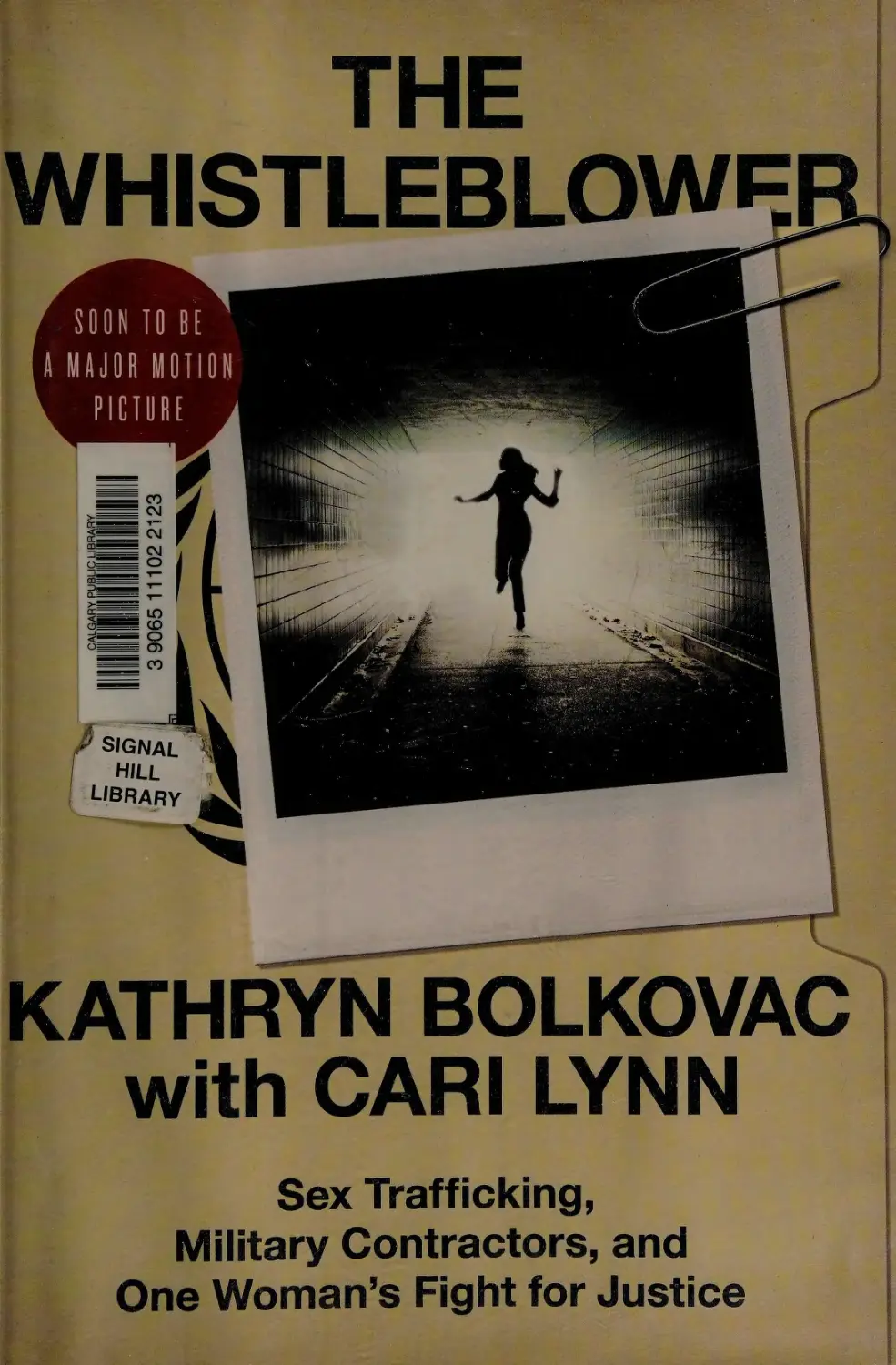
                    THE
WHISTLEBLOWP
P SIGNAL
HILL
library
KATHRYN BOLKOVAC
with CARI LYNN
' SOON 10 SE
A MAJOR MOTION
k PICTORE .
Sex Trafficking,
Military Contractors, and
One Woman’s Fight for Justice
ISBN 978-0-230-10802-8
When Nebraska police officer and divorced
mother of three Kathryn Bolkovac saw a
recruiting announcement for private mili-
tary contractor DynCorp International, she
applied and was hired. Good money, world
travel, and the chance to help rebuild a
war-torn country sounded like the perfect
job. She was soon shipped to Bosnia, where
DynCorp had been contracted to support
the UN peacekeeping mission. She was
assigned as a human rights investigator,
heading the gender affairs unit. The lack of
proper training provided to her sounded an
alarm bell, but once she arrived in Sarajevo,
she found out that things were a lot worse
than she imagined.
At great risk to herself, Kathy began
to unravel the ugly truth about officers in-
volved in human trafficking and forced
prostitution, and their connections to pri-
vate mercenary contractors, the UN, and
the U.S. State Department. Soon, she was
demoted, then fired. Feeling threatened
with bodily harm, she fled the country,
bringing the incriminating documents with
her. Thanks to the evidence she had collect-
ed, Kathy won a lawsuit against DynCorp,
finally exposing what they had done.
Here, Kathy warns of the inherent dan-
ger when we contract out our wars and that
it is our responsibility to protect the weak
and disenfranchised in times of peace. Both
gripping and inspiring, this amazing true
story of courage and honor in the face of
insurmountable odds shows that just one
voice can make a difference.
CALGARY PUBLIC LIBRARY
AUG " 2011

THE
WHISTLEBLOWER

THE
WHISTLEBLOWER
SEX TRAFFICKING,
MILITARY CONTRACTORS, AND
ONE WOMAN’S FIGHT FOR JUSTICE
KATHRYN BOLKOVAC
CARHYNN
palgrave
macmillan

THE WHISTLEBLOWER
Copyright © Kathryn Bolkovac and Cari Lynn, 2011.
All rights reserved.
First published in 2011 by
PALGRAVE MACMILLAN®
in the United States—a division of St. Martin’s Press LLC,
175 Fifth Avenue, New York, NY 10010.
Where this book is distributed in the UK, Europe and the rest of the
world, this is by Palgrave Macmillan, a division of Macmillan Publishers
Limited, registered in England, company number 785998, of Houndmills,
Basingstoke, Hampshire RG21 6XS.
Palgrave Macmillan is the global academic imprint of the above companies
and has companies and representatives throughout the world.
Palgrave® and Macmillan® are registered trademarks in the United States,
the United Kingdom, Europe and other countries.
All photos have been provided by Kathryn Bolkovac and are printed with
permission.
ISBN: 978-0-230-10802-8
Library of Congress Cataloging-in-Publication Data
Bolkovac, Kathryn.
The whistleblower : sex trafficking, military contractors, and one
woman’s fight for justice I Kathryn Bolkovac with Cari Lynn.
p. cm.
ISBN 978-0-230-10802-8
1. Whistle blowing—Bosnia and Hercegovina. 2. Whistle blowing—
United States. 3. Human trafficking—Bosnia and Hercegovina. 4. Private
military companies—Bosnia and Hercegovina. 5. Bolkovac, Kathryn.
I. Lynn, Cari. II. Title.
HD60.5.B54B65 2010
364.15—dc22	2010023196
A catalogue record of the book is available from the British Library.
Design by Newgen Imaging Systems (P) Ltd., Chennai, India.
First edition: January 2011
10 987654321
Printed in the United States of America.
CONTENTS
Author’s Note and Acknowledgments	vi
Map	viii
Prologue (April	2001)	1
1	Running from Something (November 1998-June 1999)	11
2	Stop the Threat (The Early Years-June 1999)	17
3	Cops for Hire (April-June 1999)	25
4	Sarajevo (June 1999)	33
5	“Accidents” Happen (June-September 1999)	43
6	Zenica (October-December 1999)	63
7	At the Florida (January-April 2000)	75
8	The Gender Desk (April-July 2000)	89
9	No Incidents (July-August 2000)	103
10	Education of a Lifetime (August-September 2000)	113
11	Ladies of the Evening (October 2000)	121
12	“Thinking with Our Hearts” (October 2000)	129
13	Backlash (November 2000)	137
14	The Prijedor Raids (November-December 2000)	145
15	Distaste (December 2000-March 2001)	151
16	Time Sheets (April 2001)	159
17	Going to the Press (April 2001)	171
18	The Khaki Duffel Bag (April 2001-April 2002)	179
19	Tribunal (April 22-23, 2002)	197
20	Verdict (June 2002-May 2003)	207
21	Zero Tolerance (May 2003-2010)	219
Notes	231
Index	235
AUTHOR’S NOTE AND
ACKNOWLEDGMENTS
his is a true story, my story. In telling it, I collaborated with a
co-writer, Cari Lynn, whom I would like to thank. The writ-
ing process has included our drawing from an extensive array
of official documents, reports, notes, transcripts, tape recordings,
witness statements, personal interviews, emails, publications, news
articles, BBC documentaries, and the lengthy decision by the tribu-
nal that heard my case in the United Kingdom. Sources of the docu-
ments include the United Nations, the U.S. Department of State, the
U.S. Department of Justice, DynCorp, Human Rights Watch, local
Bosnian police authorities, and various other international orga-
nizations. In writing the book, we also relied on numerous books
and journal articles on military contractors and human traffick-
ing. Where there was no tape recording or published account of a
conversation or situation I was involved in, I have reconstructed the
events and dialogue to the best of my recollection. In certain cases, I
have changed people’s names and identifying characteristics. I have
also utilized some composites, wherein I combined common charac-
teristics and circumstances and attributed these to individual char-
acters, especially with regard to trafficking victims.
It is important for me to thank my solicitor, Karen Bailey, and bar-
rister, Stephanie Harrison, of the UK, who skillfully and doggedly
AUTHOR’S NOTE AND ACKNOWLEDGMENTS	vii
waged the battle in my effort to expose the truth. I could not have
done this without their advice and support. I would like to thank
Ms. Madeleine Rees, for her courage in speaking the truth regard-
ing highly inappropriate actions that were being undertaken by UN
officials, DynCorp employees, and other internationals within the
mission. She provided insight and information that was invaluable
to winning my case. My IPTF colleagues Bo Andreasson and Thor
Arnason for their long lasting friendship and humor when light-
hearted moments were few.
I am grateful to The Whistleblower movie team, especially direc-
tor/writer Larysa Kondracki and writer Eilis Kirwan, who had the
tenacity to show up at my doorstep one day several years ago ask-
ing permission to interview me and, along with Christina Piovesan
and Amy Kaufman, the perseverance to make a movie. My special
thanks to actress Rachel Weisz for her commitment to get this story
told.
I must acknowledge the Lincoln Police Department for the sup-
port and training that guided me through many trials. International
organizations, including the Project on Government Oversight,
and Human Rights Watch investigator and attorney Martina
Vandenburg, whose due diligence and oversight into government
waste, fraud, and abuse is ongoing. My agent Carol Mann and
attorney Josh Sandler. Thank you also to Palgrave Macmillan and
my editor, Alessandra Bastagli, for giving me the opportunity to tell
my story.
Most importantly, thanks to my husband and partner, Jan G. H.
van der Velde, my children, Jake Vollertsen, Sarah Kramer, and Erin
May, and my parents, Alfred and Sylvia Bolkovac. Their many years
of love and patience in understanding this real-life drama was not
something they should have had to undertake, but they supported
me along every step of the journey.
Base 802730AI (R00389) 2-02
Map of Bosnia and Herzegovina, 2002. Courtesy of Central Intelligence
Agency
PROLOGUE
(April 2001)
“I need to speak with the ambassador.”
My palm was sweating as I gripped the receiver. After being trans-
ferred around the switchboard, 1 finally had one of the ambassador’s
assistants on the line. I was using the phone of a Swedish friend and
colleague, Lotta, who for the past few nights had graciously given
me her house keys and made up the couch because I had been too
rattled to stay at my own place.
“May I ask what this is regarding?” the assistant asked.
“I’m an American. My name is Kathryn Bolkovac. He’ll know
who I am.”
“I’m sorry, but Ambassador Miller is scheduled to be boarding a
I
flight now. May I have him phone you on Monday?”
Monday? No, I was reaching out to the American embassy in
Bosnia-Herzegovina because I was in need of assistance—now.
“Please,” I said, “it’s an emergency.”
r
There was a pause on the line, and I was certain she could hear
the quivering in my voice. It was my personal source of pride that
I had spent my entire police career clear-headed and tough under
pressure, but my situation was dire.
“All right,” she said, “let me see if I can patch you through to his
mobile.”
2
THE WHISTLEBLOWER
After numerous clicks, there was the sudden rushing sound of wind
and propellers. A voice shouted above the noise. “This is Tom Miller.”
“Ambassador Miller, this is Kathryn Bolkovac—”
“Sorry, I can’t hear you. Can you speak up?”
I raised my voice. “This is Kathryn Bolkovac. As you know, I’ve
been terminated by DynCorp—”
“I’m on a tarmac, could you please speak louder?”
I yelled into the phone, “I’ve been terminated by DynCorp and
was told the State Department pulled my contract and that you were
a part of this decision.”
Through the noise, he shouted that he was not privy to any such
decision.
Was DynCorp once again passing the buck, this time trying to
use the U.S. ambassador as its fall guy? But I continued, at the top of
my lungs, “I have been threatened by my superiors at DynCorp—”
The roar of the propellers grew even louder. “I’m sorry,” he inter-
rupted, “but I can barely hear you at all, and I need to get on a
plane. Call my secretary and make an appointment for next week,
okay? We’ll meet next week, okay? Thank you.”
The noise silenced as the phone went dead. My own voice echoed
in my ears and in the quiet of the tiny rented house. I must have been
absentmindedly pacing, for I was entangled in the old-fashioned,
wiry phone cord still commonplace in residences in Sarajevo. I spun
myself from the cord, like I used to do as a kid. Yow ’re really on your
own now, Bolkovac, I thought.
АП I could do at this point was put everything I owned in my car
and get out. I had my most vital belonging with me: a khaki Eddie
Bauer duffel bag. The bag had started this journey as an innocent
carry-on, packed with a travel pillow and an extra sweater. Now
it was filled with incriminating evidence I had collected over the
past two years. Evidence that could implicate personnel of one of
the most powerful corporations in the world—funded by billions of
PROLOGUE
3
U.S. taxpayer dollars—with involvement in one of the most profit-
able and licentious forms of organized crime.
I locked up Lotta’s house and slid the key under the front door,
then hurried to my parked car. The previous year, I had used the
very attractive discount offered to United Nations employees to buy
a royal blue Mercedes in Sarajevo. It was cheaper than a Chevy
would be back in the States, and I loved this car. But now it was
on my list of things I was wary of. Back when I was a new recruit,
a station commander had warned me that car accidents happen in
this country all the time—I had rolled my eyes at his air-quoted
“accidents,” knowing he was prone to drama. Recently, however,
my subconscious had dug this conversation back up, and the words
replayed in my mind. I locked the duffel bag in the trunk and turned
the ignition.
The engine started with its typical hum, and I sank into the seat,
momentarily relieved. As much as I did not want to set foot back
in my own house, I could not leave without collecting some things,
specifically a box of letters from my children. For two years my
teenagers hand-wrote letters to me, and I would be damned if I was
run out of the country without those. I had made difficult choices as
a mother, but thinking about the letters from my children gave me
a spark of determination, reminding me how proud the family had
been when I started on this mission, how optimistic we were about
all the good, meaningful work I was going to do and how much of
a difference I could make.
I drove through the city, passing the tall wrought-iron gates of the
American embassy, the Stars and Stripes proudly snapping in the
breeze. Not long ago, I had lingered at those gates, telling jokes with
the Marines standing guard before being welcomed inside to mingle
with diplomats and eat ice cream sundaes from a McDonald’s tent
set up on the terrace. Now, for the first time, I understood what it
must be like to be a person without a country. I had used that phrase
4
THE WHISTLEBLOWER
many times in my human rights work, to ^escribe the young women
who had gone through hell and back only to be denied reentrance
to their home countries because of ridiculous technicalities and gap-
ing holes in the law. “Original passport confiscated. Denied reissu-
ance. Status: without a country” was a verdict I had written time
and time again in my reports before having to hand my paperwork,
along with the frightened young women, over to the International
Organization for Migration (IOM).
I pulled up in the gravel drive of my accommodations (this was
what everyone on the mission called our rentals; no one ever referred
to their place as “home”), a quaint farmhouse that I rented from a
young Serbian landlady named Branca. She had grown up in this
house but, after her father died, Branca had squeezed into the small
guesthouse around back along with her entire extended family.
The rent we internationals paid was her family’s primary income. I
occupied the first floor, and an oak staircase led to my roommate’s
quarters, although he had taken leave back to the United States for
health reasons. I had chosen this house for its location on Vrelo
Bosne, the Central Park of Sarajevo.
At the source of the river Bosna, the Vrelo (which means “spring”
in Serbo-Croatian) had picture-postcard views in every direction,
with waterfalls and still pools framed by snow-capped mountains
rising up in the hazy distance. On weekends, I would stroll for
hours down paths shaded by a canopy of trees, past horse-drawn
carriages clip-clopping along, and over footbridges with pebble-
covered streams gurgling beneath my feet. You could see people
from all walks of life in the park: foreigners who had money would
dine at the outdoor cafes, locals would bring a bag from the mar-
ket to make a picnic in the grass, and the kerchief-wrapped Roma
would beg and linger until they were chased away. It was near
effortless to lose yourself in the landscape, completely forgetting
what part of the world you were in. That is, until you stumbled
PROLOGUE
5
upon the red-and-white tape and beware signs, reminding you that
this peaceful park had been part of the front lines and that the sur-
rounding hills were still riddled with landmines.
As I approached the front door of my accomodations, my stom-
ach churned, and I prepared myself to find the place turned upside
down. I pushed open the door.
The place wasn’t ransacked. It was cozy and clean, just the way I
had left it. I steadied myself. Fear is one thing, but first my car, then
the apartment—was I becoming paranoid? Paranoia for a cop is like
a tremor for a surgeon.
Ridding the notion from my head, I pulled down my suitcase from
the top of the closet and emptied the bureau drawers, including the
bundle of letters from my children. I did not have much in the way of
clothes to pack since I had worn the International Police Task Force
uniform—blue khakis, button-down top—every day. I threw in
socks and underwear, my gym clothes, a couple pairs of jeans, some
sweatshirts, and the long black dress I had worn once, to the Fourth
of July party at the embassy. I already had turned in the rest of my
gear: flak jacket; emergency evacuation bag; blue helmet; and leather
utility belt, which was basically a holster for a Maglite since we were
not authorized to carry a gun on this UN peacekeeping mission.
I took a quick glance around to see if there was anything I had
missed. Branca’s mother’s collections were everywhere—little figu-
rines, carved relics, trinkets—all displayed on hand-crocheted doi-
lies. “Knicky-knacky, ticky-tacky” is how my own mother would
have described the style. But in Bosnia these objects were not
garage-sale fare; they signified that the family had enough money
to acquire possessions. When Branca’s mother had learned I was
Catholic, she scanned her collection and ceremoniously chose a tiny
brass crucifix, pressing it into my palm and saying it was mine to
keep. For her, it was a great source of pride to have belongings that
were not only decorative but were nice enough to gift.
6
THE WHISTLEBLOWER
Although I was not a particularly religious person, I knew my
Hail Marys and Our Fathers and had kept the brass crucifix on
my nightstand. I slid it into my pocket and zipped shut my suitcase,
leaving behind some khaki pants and a pair of black Army boots,
knowing Branca’s teenage nephew would appreciate them; besides,
I much preferred my Rocky Mountain boots from the police force
back home.
As I turned to leave, I spotted a patch of royal blue peeking out
from under the bed: my beret, the universal symbol of a UN peace-
keeping mission. Apparently I had forgotten to turn it in. I plucked
it up and slipped it into my bag.
Just then I heard a car pull up on the gravel driveway. Instinctively,
I shut off the light. A car door slammed and a heavy-footed clomp-
ing of boots approached. A sharp knock hit the front door.
My right hand slid down my hip. For a decade I had carried a gun
there, and it was force of habit to reach for it—only to be reminded
that I was unarmed. I glanced around, looking for something to
use to defend myself. My closest weapon was a half-finished bottle
of gin. I gripped the bottle’s neck and stole some glances through
the lace curtains of the window. I could see a man’s broad back in
a blue shirt—possibly a UN uniform. He turned, and I made out a
familiar profile. The man was my Icelandic colleague and friend,
Thor.
I hurried to the door. “I’m so glad—” I began.
Thor raised an index finger to his lips. Silence. His jaw was
clenched and his eyes were steely. I had never seen him look this
intense, which was saying a lot for a normally serious Viking. He
stepped in and, seeing my suitcase, grabbed it and motioned for me
to follow him. I tucked the bottle of gin under my arm, suspecting
it might still come in handy.
Thor’s white truck, a Land Rover with black UN letters on each
side, was in the driveway, and two of his British colleagues from the
PROLOGUE
7
Organized Crime Unit, who were also his roommates, were waiting
in the backseat. I knew the men, Ian and Bob, from many Saturday
nights sitting around in someone’s living room with several bottles
of wine and a couple of guitars. But now they had their military
faces on too, both dead serious.
“Get in,” Thor said.
“My car—” I protested, thinking of my duffel bag.
“We need to talk,” Thor said firmly. “In my car.”
I looked to Ian and Bob, then back to Thor. I had not been staying
at my place—how had they known to find me here at this moment?
My head said it was okay to trust them, but my feet stayed planted.
Of the three, I knew Thor best; we had become fast friends after
traveling together to Hungary for the International Law Enforcement
Academy conference. In Budapest, we had had the idea to take a city
bus around to sightsee, which was going fine until the bus came to a
halt and the lights went off, and we realized we had missed the last
stop and were back at the bus barn. The driver refused to take us
anywhere else, so after a good laugh we had to hoof it back to the
hotel. Then there was the time Thor and I were in the market and I
realized I had left my wallet at a vendor’s stand. Without a second’s
hesitation, Thor bolted like an Olympic sprinter through the crowd
to rescue my wallet—and he did.
“Kathy,” Thor said, jolting me from my thousand-yard stare.
“Are you okay?”
Barely. I was near mental and physical exhaustion. My finger-
tips brushed against the outline of the crucifix in my pocket, and
I made a quick promise that when I made it out of Bosnia I would
go straight to the confessional. Deciding that I needed to trust these
men, I slid into the passenger seat of Thor’s car.
“We overheard some chatter at Main HQ,” Thor began. “Kathy,
we think your phone has been bugged and likely your apartment
too. We have reason to believe you’re in danger.”
8
THE WHISTLEBLOWER
Oddly, the first emotion that came to me was relief: I was not
alone in sensing possible danger. My mind quickly defaulted to my
kids—all the phone conversations we had had; could they be in
danger too? Good thing I had kept my maiden name; my children
would be much harder to trace with a different last name. Besides,
all three lived in different cities, with two in college and the young-
est at home with her dad. Thor’s voice filtered into my thoughts,
and I forced myself to focus. “I know you’re planning to leave the
country soon,” he said, “but you need to stay with us in the mean-
time, for safety.”
“I was going to leave straight from here,” I said.
Ian spoke up from the backseat. “You of all people know what
goes on after dark on those desolate roads, and that’s your only way
out. We can’t let you leave until sunrise.”
I turned to look at them squarely. “What exactly did you hear?”
The three men glanced at each other as if trying to determine how
much they could, or should, reveal. Finally Thor said, “Significant
chatter, implying bodily harm.”
We decided I would stay at their house for the night and leave first
thing in the morning. Bob and I got in my car and followed Thor’s
UN truck to their villa on the northern edge of the city. When we
arrived, Thor jumped out, hoisted open a wooden garage door, and
motioned me in. We unloaded my bags and then I stepped back to
watch as Ian sprinkled a thick coat of baby powder over the ground
all around my car.
I spent the night staring at the ceiling, thinking back on the events
of my past two years with DynCorp, a billion-dollar Goliath. As a
police officer certified in forensic science, I was contracted to work
on human rights abuses. When I was promoted to UN Headquarters
to oversee all cases of domestic abuse, sexual assault, and human
trafficking throughout Bosnia, my case files started disappearing on
a routine basis from the Internal Affairs office. Files upon files of
PROLOGUE
9
evidence we human rights officers, and even local Bosnian police,
had collected never saw the light of day: victim statements, license
plate numbers, identifying badges, names, tattoos, and even instant
photographs. All of it gone. Except, of course, for the copies I had
in my Eddie Bauer duffel bag.
I thought of Lotta, who was in her early thirties. She was in Bosnia
as a member of the Swedish police force and was simultaneously fin-
ishing her master’s thesis. We had bonded after she lodged a formal
complaint against an American DynCorp contractor who would
show up at Main HQ flaunting a suspiciously young foreign girl on
his arm. No investigation into whether the girl was a minor—let
alone a trafficking victim—was ever initiated, and the only thing
to result from Lotta’s complaint was that she and I became friends.
I hated to think I may have put Lotta in danger, but she was a very
smart, capable woman, with a lot of access and know-how. Besides,
her mission time was nearly up, and she was almost as anxious to
get out as I was.
Sunlight could not come fast enough, and finally the house began
to stir. Ian made me a thermos of coffee and packed up some food,
while Thor checked the garage for footprints in the powder.
When he gave the go-ahead, I started up my car. He trailed me
several miles outside of Sarajevo to make sure I was not being fol-
lowed, then waved me on. On that day in April 2001,1 drove non-
stop out of the country. I may have been forced out, but this was
not over. DynCorp, global leader in the business of military strat-
egy, nation rebuilding, world security, and counterintelligence, had
underestimated one thing: a forty-year-old, divorced mom from
Lincoln, Nebraska.


♦


< '•' 1


i


4


RUNNING FROM SOMETHING
(November 1998-June 1999)
The war in Bosnia was the longest and bloodiest waged on
European soil since World War II. In 1992, in the wake of
the perfect storm of the fall of communism in Yugoslavia
and the increasing power of Serbian president Slobodan Milosevic,
Bosnia and Herzegovina declared independence from Yugoslavia. A
multiethnic region, Bosnia and Herzegovina had long been home
to Catholic Croats, Orthodox Serbs, and Muslim Bosniaks. I have
Croation roots, and I remember as a teenager spending summer vaca-
tions in Ohio with my grandparents, gathering on the front porch
while Grandma cross-stitched pillowcases and Grandpa talked about
the old country, Croatia, describing the different religions and eth-
nicities living and working side by side and even intermarrying.
All that changed in April 1992, when Serb forces shelled Sarajevo,
targeting Muslims and Croats, looting, burning, and massacring
Bosniak-populated regions around the country, including mass
attacks at marketplaces and a football stadium. Concentration
camps detaining Muslims and Croats were set up in four regions.
There, men, women, and children were starved, tortured, and killed.
The Serbs would soon establish a complete blockade of Sarajevo, in
12
THE WHISTLEBLOWER
a siege that would last until 1996 and woul^l go down as the longest
siege of a capital city in modern history. During these years, snipers
perched in the surrounding hills or on the top floors of the tallest
buildings and pecked off approximately 10,000 innocent civilians,
including 1,500 children. In the final year of the siege, electricity,
water, and food delivery was cut off. In August 1995, NATO—the
North Atlantic Treaty Organization—launched air strikes against
the Serbs. Facing combined uprisings by Croat and Bosniak forces,
the Serbs finally retreated.
The signing of the Dayton Peace Agreement in December 1995
ended the three-and-a-half-year war in the Republic of Yugoslavia,
and the region was renamed Bosnia and Herzegovina. In all, approx-
imately 100,000 people, including thousands of children, had been
killed; the majority were Muslim Bosniaks. Nearly 2 million people
were estimated to have been displaced. Milosevic was charged with
genocide and crimes against humanity. His trial stretched on for five
years until, on March 11, 2006, he was found dead in his prison cell
at The Hague, ostensibly from a heart attack, although conspiracy
theories abound.
As part of the Dayton agreement, the UN Security Council
mandated the creation of a mission in Bosnia and Herzegovina
to provide an International Police Task Force (IPTF) and a UN
Civilian Affairs Office. Together, the branches had the not-small
tasks of: humanitarian relief and refugee aid, de-mining, monitor-
ing human rights issues, facilitating elections, rebuilding infra-
structure, rebuilding the economy, and providing civilian police
to train and monitor what was left of the diminished local police
force.
To make up the IPTF, each UN member state was asked to supply
officers from its national police forces. Out shipped officers from the
Italian Carabinieri Corps, the German Bundespolizei, the French
RUNNING FROM SOMETHING
13
Gendarmerie National, the Spanish Guardia Civil, the Canadian
Royal Mounted Police, the Dutch Koninklijke Marechaussee, and
so on. Because the United States does not have this type of national
police force—U.S. police is primarily made up of state, county, and
city forces—the American police contingent was to be comprised
solely of private contractors.
This mission in Bosnia was a lucrative bid for American pri-
vate military contractors. The first ever contract of this sort—
called a global Logistics Civilian Augmentation Program (Logcap)
contract—was won by Houston-based Brown & Root Services. For
three years, Brown & Root provided American police to Bosnia
and seven other countries. But in 1995 the contract was put back
up for competitive bidding, and DynCorp, with headquarters in
Virginia, snagged its first global Logcap contract by underbidding
the incumbent.
The U.S. State Department cut the checks for DynCorp, and
the media was blitzed with press releases. DynCorp would be in
charge of everything from placing specialized aircraft mechanics
on military bases, to staffing the mess hall cafeteria, to managing
warehouses, to engineering new building construction, to recruiting
hundreds of American police officers to serve as peacekeepers.
I got involved in DynCorp’s first rent-a-cop contract simply by
answering an ad. It was stapled to the bulletin board at police head-
quarters in Lincoln, Nebraska, in the autumn of 1998:
International Police Task Force—Bosnia
It caught my eye primarily because the salary figure was twice as
high as any I had ever seen posted on a police station bulletin board:
14
THE WHISTLEBLOWER
$85,000 a year. A DynCorp logo decorated the top of the ad. I had
never heard of DynCorp, so I read further:
The US State Department is seeking active/retired police officers
of any rank who are eager to accept a challenging and rigorous
assignment to serve with the United Nations (UN) International
Police Task Force (IPTF), as international police monitors (IPMs),
for one year.
Aside from the excessive use of acronyms, it sounded intriguing.
Qualifications:
•	US Citizen
•	Minimum eight (8) years full-time sworn civilian police service
to include patrol training/experience. Must have been active
within the last five (5) years. Military service may partially sub-
stitute for civilian police experience. Preference will be given to
officers who are currently on active duty.
•	Ability to communicate in English
•	Valid US Driver’s License and ability to drive 4x4 vehicle
•	Unblemished background record
Apparently, getting accepted was going to be the easy part. The
tough part was the decision to go so far away from my kids.
I cooked up a family favorite, known in the house as Chicken
Parisian—chicken breasts sauteed with mushrooms, garlic, and sour
cream—and my three kids and I sat down at the dining-room table to
talk it through. The oldest two, Jake and Sarah, were in college, and
knew we could really use the extra money for tuition. My decision
wouldn’t directly impact them at this point; it was fifteen-year-old
Erin who would be most affected by not having her mom around.
Erin already lived with her dad, the result of a two-year-long, ugly
RUNNING FROM SOMETHING
15
custody battle. I knew my heartache would be the same whether I
was in Nebraska or Bosnia, but for the first time in a while, here
was something I was excited about, something I could believe in that
would also put me in new surroundings, far away from the wreckage
of my divorce.
“Mom,” Jake began. “We want you to have this opportunity and
you’d be out of the line of fire. Besides, we’ve seen you come home
from work in bandages, on crutches—”
“And concussed,” Sarah added.
“I know, I know,” I said. Then I looked at Erin. She was trying
to be as grown up as she could muster, but I could see tears welling
in her eyes. “Mom,” she said. “I know this is what you need to be
doing.”
And so I decided to give up certain comforts I took for granted—
electricity on demand, toilets, walking down the street without fear
of getting your legs blown off—and handed in my resignation letter
to the chief of the Lincoln Police Department.
Police Chief Thomas Casady sent a letter back to me: “I don’t
want you to leave LPD. You are a fine officer, a valued employee,
a good person, and a friend. We need you.” He went on to explain
that, after deep consideration, he would grant me a leave of absence
for thirty days, during which time he hoped I would change my
mind.
When I entered the chief’s office to finalize my resignation, he
gave me a long stare. Straightlaced and serious, he was one of the
most exacting people I had ever known, which is why his response
caught me off guard. He told me that I really did not want to go
work with that bunch of idiots. At the time, I figured this was just
his awkwardly endearing way of trying to say good-bye. I did not
have any inkling that he might have known more than he was letting
on—military contractors and companies like DynCorp were still a
nascent breed, but perhaps the chief had heard reports from the
16
THE WHISTLEBLOWER
field and had suspicions about what I getting myself into. I should
have asked questions, but instead I just gave him a perplexed look.
He reiterated that I had thirty days to change my mind. But I knew
that wasn’t going to happen. I was thirty-eight years old and needed
change in my life. To me, this was the opportunity of a lifetime.
The truth was, most of my DynCorp colleagues had a personal
story that compelled them to join the mission, whether they admit-
ted to it or not. There had to be a pretty significant reason for some-
one at a later stage in his or her career to uproot without family
and head 5,000 miles away. In one way or another, we were all
running from something. But there is a difference between leaving
and escaping. And some of my DynCorp colleagues were definitely
escaping—taking cover in a place where no one knew of the very
bad things they had done back home and where they thought no
one would notice if they carried on, this time taking advantage of a
broken people and a broken system.
STOP THE THREAT
(The Early Years-June 1999)
was born a Bolkovac, a not-uncommon name in Croatia but one
that always required me to spell it out in Nebraska. All I knew of
my family history was that my grandfather, John Bolkovac, left
Croatia when he was sixteen. He eventually found work in the steel
mill in Youngstown, Ohio, met and married a U.S.-born woman
with Croatian roots, and raised five sons. There was little talk about
our heritage, and the only time I ever heard my grandfather men-
tion the old country was when he visited our farm and compared
the Nebraska countryside to his home, Vukovar Gorica, a farming
community outside of Zagreb. Although my grandfather’s genera-
tion spoke Croatian, his sons were never taught the language. “You
are American, you speak English,” he would say. He created a truly
all-American family: his sons all went to college and were all out-
standing football players, with my dad and uncle going on to play
for Pitt, Army, and the Steelers.
My parents met on a blind date while Dad was at University of
Pittsburgh and Mom was attending Kent Sate; they eloped not long
thereafter. Mom, originally from Ohio, had lived in South Africa
for several years -when her father, a manager for Goodyear Tire
18
THE WHISTLEBLOWER
and Rubber, helped open the first plant, there. Like my father, she
had grown up in an athletic family. Her father had managed to let-
ter in football, basketball, track, and baseball while at Ohio State
University—he had also been homecoming king and crowned an
amateur model for his queen; she would go on to become his wife.
The two generations of women in my life, on both my parents’
sides, ranged in personality from strong-willed to forces to be reck-
oned with. These women were the loudest voices at any sporting
event. They taught me to do a job right the first time, that it was
okay to speak out, and that you should always have a soft spot for
the underdog.
My first nickname was Fireplug, given to me by my uncle Nick.
Yes, my dad agreed, she has got our linebacker shoulders. Given
Uncle Nick’s and Dad’s football careers, I was flattered—as only a
kid could be—to have inherited their stout, broad frame. I was strong
like them, and this too was a trait my family enjoyed pointing out.
One day, when I was about twelve years old, Mom and I hopped
•into the pickup truck, with the lawnmowers still in the back, to
make a milk run. In my hometown of Douglas—thirty miles outside
the Nebraska state capital, with a population of 100—this meant
heading to the local bar. The Pony Express served as watering hole,
gossip central, and mini mart; you could get milk, eggs, and butter
along with your Pabst. A handful of farmers were there playing pitch
and poker, and after Mom bought our groceries, she announced,
“Anyone want to arm wrestle Kathy? She just beat all the boys down
at the house.” I imagine the farmers, at first, thought it was cute and
that they would pretend to put up a good fight before kindly letting
me win. Instead, Mom and I left all of them red-faced and asking,
“What the hell is in that milk?”
As far back as I can remember, I always liked hard, physical work.
As a kid, if I got to spend all day working the farm and could come
in dirty and sweaty and hungry, I felt a sense of accomplishment.
STOP THE THREAT
19
My dad was an industrial engineer and while our 360-acre farm
was his hobby, it was my mom who essentially ran the place, tend-
ing daily to the cattle, horses, chickens, pigs, and cutting and baling
hay. Mom also drove the morning school bus and worked part time
as a bank teller.
My two sisters and I were born in three consecutive years; ten
years later my brother would come along. The classic middle child,
I was the peacekeeper between my older sister, Betsy, who was the
overachiever, and my younger sister, Carrie, the troublemaker. I was
a chubby tomboy who liked playing football with the boys. In my
teens, volleyball became the center of my world, and I made the
Junior Olympic team and earned a full athletic scholarship to the
University of Houston. But after six weeks of college, I came back
home to marry my first and only boyfriend. It rained ice on the
November day of my wedding and, as I was about to walk down the
aisle of St. Martin’s Roman Catholic Church, my dad whispered to
me, “It’s not too late to change your mind.” For what seemed the
first time, I did not listen to his advice. By the time I was twenty-
three years old, I was a mother of three. The years went by, the kids
became our lives, and my husband and I realized we did not have
much else in common.
My first career was in the hotel industry, and I worked my way up
to management at the Holiday Inn Crowne Plaza in Houston. Hotel
management was a very different world from where I would end up,
but the signs of my future path were there, such as the adrenaline
rush I felt when I turned down the bed in the celebrity suite, booked
by a heavy metal band, and found a sawed-off shotgun under the
pillow; or the time the fire alarm went off and I hurdled the front
desk—in heeled pumps—to radio security and assemble the quick
response team.
My divorce—the first divorce in my extended family—came
after ten years of pretending everything was okay. For the first time
20
THE WHISTLEBLOWER
in my life, I felt like a failure. It was thp that I happened on a
newspaper ad for open positions in the Lincoln Police Department.
I was familiar with guns, having gone on hunting trips with my
dad, and I was a diehard fan of cop shows like Matlock, Magnum
P.I., Police Woman, and Perry Mason. This was a world I wanted
to be a part of.
From the moment I sat down for my first interview at the Lincoln
police station in 1989,1 felt as if my life was starting over and that
this was where I belonged. Many of the officers were farmers’ sons
and former football players, and it was in this wholesome mix of
athleticism, smarts, and discipline that I felt most comfortable. My
initial interview was with Sergeant Jim Hawkins, who would go on
to have a profound effect on me as a police officer and as a person.
Hawk had played football at the University of Nebraska, and while
he possessed a no-nonsense attitude, he was genuinely interested in
and concerned for his officers and was always available for advice
and mentoring. I will never forget leaving that interview and think-
ing that Hawk was just about the coolest person I had ever met.
After undergoing the routine physical and psychological tests,
a polygraph, and numerous personal interviews, I was recruited
for the force and started at the police academy. I naturally took to
the qualification courses—running and diving (volleyball all over
again), wrestling on floor mats with the guys as we learned take-
down techniques, climbing barricades and walls, and shooting. At
close range, I was a good shot, landing bullets in the target silhou-
ette’s head and center mass. But somewhere between fifteen and
fifty yards, a particularly bad habit set in: I could not place my shots
anywhere but the ball-bag. I would aim for center mass, but my bul-
lets invariably landed groin high, obliterating any indication that
my cardboard target may have had testicles. While Freud would
STOP THE THREAT
21
have had a distinct view of the situation, I swore to my colleagues
I was no man-hater. Just a heavy trigger pull, I would justify. They
would feign agreement, then cough out “ball buster” under their
breath.
I graduated from the State of Nebraska Law Enforcement Academy
and earned my commission, badge, and gun. Soon enough, I was
bestowed with another nickname. My beat partner and I were about
to make an arrest, but the suspect refused to get out of his car. He
had a vise grip on the steering wheel, requiring me to extract him
forcibly. As I pulled him down to the ground so I could cuff him, he
craned his neck to yell to my partner, “Who is this woman, Xena
the Warrior Princess?” My partner, who had been standing there
watching me wrestle the guy, burst out laughing. In my ten years at
the station, I never lived that moment down.
I spent my first couple of years as a cop on the street, and then
I turned my focus to domestic abuse cases and child sex crimes. I
took courses and national seminars to become certified in forensic
science technology, crime scene management, and advanced inter-
view and interrogation techniques. I was placed on the Youth Aid
unit, now known as the Special Investigations Unit, and, in my three
years there, made over sixty felony arrests and had a 95 percent con-
viction rate of predators of women and children.
The scope of my job began to change dramatically when gang
violence moved into Lincoln. My beat was the wrong side of the
tracks: southwest Lincoln, where the Hatfields and McCoys were
alive and kicking. I would respond to calls that shotguns were
jutting from the windows of households as people were shooting
at each other from across the street, or that entire families were
in the middle of the street dueling with baseball bats. Then there
were the emotionally charged domestic-in-progress calls—usually
between spouses or couples—which were the most unpredictable
and therefore the most dangerous. I was injured several times; the
22	THE WHISTLEBLOWER
V
I
most serious injury was when my partnef and I made an arrest on
*
the third floor of an apartment building and were jumped from
behind as we were escorting the cuffed detainee down the stairs. I
went flying down two flights and knocked my head at the bottom.
Code 61 went out over the radio—officer needs immediate
assistance—requiring an all-out red lights-and-sirens response
from every single available unit. I arrived home to my kids in the
early hours of the morning. My stitched-up head was wrapped in
bandages and I limped in on crutches for my sprained ankle. “Bad
day, huh, Mom?” Jake asked. We were scheduled to spend the day
at Worlds of Fun amusement park, and I was not going to let my
kids down. What concussion? I jokingly asked myself as the first
roller coaster climbed up and up—and then threw up the whole
way down, much to the mortification of my kids.
Then came the day—after nine years on the street—that most
cops train their entire career for but hope they will never have to
encounter. It was early afternoon, and, just coming on duty, I was
dispatched to a domestic assault in progress. Since it was during
our shift change, no backup was available yet. I proceeded alone
*
to the scene, a dilapidated area known as the German and Russian
Bottoms, which, as the name implies, had long ago swelled with
European immigrants. As I drove up the block, there was com-
motion on a front lawn, and a man was bleeding as if an artery
were spurting. Two other people had gathered and when they saw
me, they furiously pointed down the street. There I caught a flash
of man hightailing it around the corner. I radioed dispatch to get
medical and to send more units and then hit the pedal of my Chevy
Tahoe in pursuit.
The station had just bought these new Tahoes, and I affectionately
referred to mine as my Urban Assault Vehicle. Although other offi-
cers preferred their sedans, I liked my truck—at stoplights I could
peer down into people’s cars and see them drinking beer or lighting
STOP THE THREAT
23
up something illegal. I was used to driving pickups and tractors, so
I knew how to really maneuver a truck, and as I tracked the suspect,
I was able to keep a good eye on him. Every time he looked back, he
saw my roaring, oversized engine barreling down after him, driving
on sidewalks when I had to.
When he climbed over a backyard fence, I was forced to abandon
my truck and give foot pursuit. I chased him over more fences and
throughout a maze of back streets. Eventually, gasping for breath,
we ended up within a few feet of each other in the dead end of a
desolate alley.
He turned on me and pulled a switchblade. I backed away a few
steps while drawing my duty weapon.
“Drop the knife, you are under arrest,” I said.
He grunted. “You want some, bitch?” Then he lunged, thrusting
the knife at me.
I pulled the trigger. I heard the pop, but the suspect did not go
down. Instead, he raised his hand above his head and launched
the knife at me. I quickly darted off the line and fired again. This
time he turned, took a couple of wobbly steps, then stumbled to the
ground. I could see blood beginning to seep through his clothes.
Unflinching, I stood with my weapon still aimed on him.
Sirens grew closer and cars screeched behind me, and I heard a
steady voice say, “Go ahead and holster your gun, Kath.”
Backup continued to respond from around the city, and every-
thing seemed to move in slow motion as my sergeant drove me to the
station. I was given a new gun while mine was taken into evidence
for the standard internal investigation.
The suspect lived and gave a full confession: He was on parole
for armed robbery, was a gang member, was HIV-positive, and had
been drinking alcohol throughout the day while watching a violent
movie. He had beaten his girlfriend and small baby (the 911 domes-
tic call I had originally responded to), then had fled the house,
24
THE WHISTLEBLOWER
stabbing an innocent man in passing (miraculously, the victim sur-
vived). That was when I happened to arrive.
I took a couple of days off to recuperate from the trauma, then
resumed my duties the following week. My fellow officers were
none too quick to let me know just how great of a shot I was. Xena,
Warrior Princess had struck again, they said. Training and defensive
tactics to “stop the threat” consist of two rapid-fire shots, a pause,
then a third shot. The sequence is referred to as “two to the body,
one to the head.” In high-stress situations, well-trained officers will
revert back to this training sequence, even if they are not neces-
sarily conscious of it. And that is exactly what happened with me:
Although I thought I had fired only two shots, three bullets had left
my gun. The bullet to the head had missed, one bullet lodged in the
rib cage, and the other, of course, was strategically placed in the
man’s groin.
When you are in a life-threatening situation, images pass before
your eyes. It was my children’s faces I saw, and it began happening
more and more often. Every time I would get detailed to a call in
progress, I would think of my kids, and I knew this meant it was
time to make a change. I still wanted to be in law enforcement, but
I needed to step away from the direct line of fire.
It was at this point when I saw the ad on the bulletin board in the
station.
COPS FOR HIRE
(April-June 1999)
ynCorp sent me a packet of information and the request to
fax back references, along with answers to a written psy-
chological exam. Then a DynCorp staffer called and gave
me the dates of the weeklong training session in Fort Worth, Texas,
after which I would be issued a contract. From there, the training
class would depart to Bosnia.
So that’s it, I wondered, I’m in? No in-person interview? Since this
was a company representing the State Department, I had expected
to be put through extensive background checks. The process felt
skewed—the little information DynCorp had requested seemed
inadequate to properly assess candidates’ qualifications, and if the
actual selection was to occur just before our departure overseas,
were candidates expected to have already quit their current jobs? At
the time, I assumed that all candidates would, like me, be currently
employed by a police department.
No matter; I was well qualified and the references DynCorp solic-
ited were solid. Given that this application process was hardly as
rigorous as the one for the Lincoln Police Department, I was not
worried about getting the job. In early June 1999, my friends from
26
THE WHISTLEBLOWER
the force threw me a little going-away party, I traded in my car for
a compact car that my daughter Sarah could take to college, packed
up my duffel bags with a year’s worth of necessities, and said tight-
throated goodbyes to my kids at the airport.
I was surprised to learn that the DynCorp training headquarters in
Fort Worth were in rented space in an American Airlines building.
The surprises would not stop there. I had assumed that I would be
working with elite officers from all over the United States; instead,
the people lining up for registration could be divided into two dis-
tinct groups: youngsters whose pimply faces and braggadocio made
it hard to believe they had the minimum requirement of eight years’
active police experience, and the retiree set, sporting gray hair and
pot bellies. One nice gentleman confessed to me that he was seven-
ty-one years old.
Most of the recruits seemed to know someone who had been on
a previous DynCorp mission and, with the help of a $250 refer-
ral fee, had been highly encouraged to apply. Many of them hailed
from small southern towns, where they had been the chief of police
of one- or two-man departments. They had never seen paychecks
larger than $20,000 a year and were in blissful disbelief that they
would be making $85,000—tax free. They spoke of the pay as if
they had discovered gold.
The prevailing conversation as we waited was about weaponry,
with the younger set egging on the older ones: “Do you think we’ll get
to train the locals on the big guns?” “How about on explosives?” “I
hope we can teach the locals a thing or two about the use of force!”
I wanted to butt in and say, “If you had a clue you would have
heard there was a recent war, and the locals already know a thing
or two about guns, ammo, and sniper activity.” But it was only the
first day, so I kept my mouth shut.
COPS FOR HIRE
27
Their jabber quickly turned into a round robin of, what else, their
perfect dream gun: a .357 Magnum converted to a semiautomatic.
With a hairpin trigger pull. And loaded with armor-piercing or, how
about, hollowpoint, copper-tipped rounds for maximum impact and
internal destruction of the target. And, of course, with a switch for
instant conversion to a Taser gun with infrared night sight.
At that point, I could not take it anymore. “Hey,” I said, “isn’t
anyone interested in the democratization of a country? Or in rebuild-
ing community-based policing?” Judging from the blank stares, I
was the only one.
This group was to be just a portion of the DynCorp contingent,
so I reassured myself that this was just lousy timing, and, once in
Bosnia, I would surely meet Americans who were highly trained and
professional.
Eventually, during our week of training, I did come across a few
officers who seemed to share my experience and goals. One was a
woman from Florida named Venetta, who was in her forties and
had good police training and experience in vice, drug, and prostitu-
tion undercover work. She also had kids back home. Her boyfriend
was currently a contractor in a DynCorp mission in East Timor,
and she seemed clued in on what to expect, a good person for me to
stick around.
As our week-long training session went on, some of the older
candidates were rejected for elevated blood pressure. A couple other
I
people were sent home after the urine tests, a few more after the
psychological evaluation. My evaluation entailed a five-minute con-
versation with a man whose qualifications were not cited and who
concluded the interview by asking if I was interested in a manage-
ment position within DynCorp. I answered that I would rather get
some training on the ground first.
28
THE WHISTLEBLOWER
Not surprisingly, our group did not lose many candidates after
the physical agility tests, which included a timed, 200-yard run
that—conveniently for those with pacemakers—was downhill.
Another agility test we underwent was to reach above our heads,
then squat for thirty seconds, then touch our fingers to our noses
with our eyes closed—not much different from a drunk driving test,
and as I watched the others it looked as if there could have been some
drunks.
On the last night of our training session, a handful of us gath-
ered by the swimming pool to share some beers. We pretty much
assumed we would all see contracts the next day and figured we
should get to know each other since we would be spending the next
year together. A Southern drawl burst through our small talk, and
we turned to see a man who had introduced himself on the first day
as Jim from Mississippi.
“Hi y’all! ” Jim called. “Don’t start the party without me.” Jim had
greasy gray hair and tobacco-stained teeth and was wearing noth-
ing but swimming trunks, which showcased a beach-ball belly and
stark white legs. He tromped straight to the beer, then splashed his
way into the pool, all the while telling us that he had already been on
one peacekeeping mission in Bosnia and had liked it so much he was
signing on for another year. Then, in the same sentence in which he
described how scenic Bosnia was, he said, “And I know where you
can get really nice twelve- to fifteen-year-olds.” The hum of the pool
heater filled the awkward silence that followed. The others glanced
around, then looked at me, the only woman in the group. All I could
do was cock my head and give Jim from Mississippi an odd stare. I
must have misheard, or perhaps missed a part of the conversation
that would have somehow put his comment into context. I tried to
convince myself that this had to be the case. It must be the case,
because any other alternative would not only be repulsive but wildly
illegal. Besides, DynCorp—now riding high on its coveted position
COPS FOR HIRE
29
as one of the largest government contractors—certainly would not
have renewed the contract of a boasting pedophile. Conversation
quickly resumed; the others, like me, must have brushed off the
comment as too preposterous to be true. But I filed it away, hoping
I would never see the day when I would make sense of it.
Out of a training class of fifty, forty-two of us made the final cut.
We had lined up to receive our vaccinations when I heard Jim from
Mississippi again. Laughing boisterously, he asked the nurse if she
would oblige him with a shot for the clap.
We were fitted with used, dark blue uniforms with a patch of the
American flag on the shoulder, and then light blue UN berets were
passed out. I watched as most of the men pulled the beret on as they
would a ski cap, down over their ears. After a training video about
the war in Bosnia and a public relations plug about the important
work DynCorp does for the government, we were given a strong
plea to take advantage of the $250 referral fee and recommend a
friend to DynCorp. Don’t worry if your friend doesn’t have eight
years of active police duty, we were told—in order to fully staff
this mission, DynCorp was waiving some of the minimum stan-
dards, including reducing the required number of active years of
police service down to five (and, I later discovered, the company had
completely removed the qualification of “unblemished background
record” from the recruiting flier).
At last, we lined up to sign our contracts, and, with a “Make the
State Department proud” farewell, off we were sent.
Apparently, I had stood out as a responsible member of our training
class because, just before we left, I was named the group leader, in
charge of overseeing our travel to Bosnia. In reality, all this meant
was that I was the baby-sitter, herding stragglers and reprimanding
pranksters, and that I had the privilege of using my personal credit
30
THE WHISTLEBLOWER
card every time our travel arrangements got screwed up. Which was
z	 *V ‘
often.
Given the hundreds of millions of dollars DynCorp had been
awarded from the U.S. government for this mission, a strikingly
insufficient amount was allocated for getting us smoothly—and
safely—to our destination. Amazingly, it took three full days of
travel to get to the Balkans, with the delays starting before we even
left Texas: we were told that the old Russian military airliner that
DynCorp had chartered for the flight was rejected by the FAA. I
was now having serious concerns about this company, but I kept
telling myself things would be different when I arrived in Bosnia
and started doing meaningful work w’ith officers from around the
world.
Eventually, we were booked on a commercial flight to New York.
From there we had to be bused to another airport to catch a flight to
London and, from there, another flight to Zagreb, Croatia (cheaper
than flying straight into Sarajevo, apparently), where we were loaded
onto two beat-up, bullet-ridden, dank buses with cracked windows,
no air conditioning, no toilet, and no underneath storage for our
luggage. Sitting on our suitcases and duffel bags, we rolled along for
180 miles—which took an unbelievable sixteen hours, after factor-
ing in the mountain terrain, single-lane roads, no toilet on the bus,
and lapses under the baking sun to repair several bus breakdowns.
We had plenty of time to ruminate on how we had been treated
so far. Although no one expected first-class travel, the word float-
ing around the mission was that DynCorp had received $250,000
to $300,000 per monitor from the U.S. government; certainly this
allowed for sensible travel arrangements.
Backdropped against the lush landscape, we rumbled past wagons
full of vagrant families, known as Roma, or Gypsies; skin-and-bone
goats tied to posts; and little children dressed in rags, begging along
the roadside. The people of Bosnia had seen death and destruction
COPS FOR HIRE
31
that I could not imagine. That is also what had brought me here—I
had watched from my sofa in Lincoln as the news relayed the slaugh-
ter, the orphans, the mass exodus. I could see the likeness of my
grandparents in the faces of the old men and women helplessly bear-
ing witness to the destruction of their families. I knew I had distant
relatives there, enduring the terror, and I had a premonition that I
would make my way to that part of the world someday.
We finally arrived in Sarajevo, only to be informed by DynCorp
supervisors that, unfortunately, the $90 per diem we were con-
tracted to get paid had been reduced to $75. One man quit right
then and there, declaring that DynCorp had been nothing but dis-
honest so far. I watched as he thrust over his blue beret and con-
templated whether I should do the same. But here I was, finally in
the middle of Bosnia. Yes, DynCorp had misrepresented itself and
definitely had some competence issues—and by now it owed me a
sizable amount for my charged-up credit card—but all around me
were the survivors of a horrendous war, the torment still visible in
their eyes.
This was a country that exhaled desperation but inhaled perse-
verance. I was not ready to just turn around and go home.

4
SARAJEVO
(June 1999)
w
e were set up in a hotel in the northern hills of Sarajevo.
First thing the next morning, a bus wound us down the
narrow, cobbled street into the city center for our week-
long orientation session. We rolled down the main road, Boulevard
Mese Selimovica, better known as Sniper Alley during the siege,
when the Serbs held the entire capital city hostage. This street, the
only way in and out of the city, was vulnerable to the row of high-
rise buildings and hillside houses, where snipers would wait and
peck off innocent civilians, especially children. The scars in the
concrete left by exploding shells had now been filled in with red
resin that formed flowerlike shapes referred to as Sarajevo roses, in
remembrance of the person who had been shot at that spot.
We arrived at a nondescript, aged UN building dubbed Tito
Barracks, after the former leader of Yugoslavia, Josip Broz Tito,
whose presidential term had spanned three decades. This was the
training facility where the weeklong orientation for all new monitors
arriving from UN participating countries took place. The building
housed some UN offices as well. A new site was under construc-
tion to the west of the barracks and would be completed in a year.
34
THE WHISTLEBLOWER
Surrounded by stone walls, barbed wire fence, and armed guards
perched in lookouts on the roof, Tito Barracks was not exactly the
most welcoming place. Its yards were wild and overgrown, but on
closer inspection, I saw this was not due to neglect—the wrangled,
rusted metal rims of land mines were visible, poking through the
ground. Because of this, designated walkways were cordoned off for
us to enter and exit the building.
The sight of refugees around Sarajevo, old and young, hobbling
around on one leg, was an immediate and consistent reminder
that mines still infested the area. The mines had been hidden
everywhere—from public squares to private gardens, where, in
between the vegetables, they had been planted by the man of the
house who would have rather had his home blown up than had it
taken from him.
At Tito Barracks we joined our new colleagues: the International
Police Task Force (IPTF), a melting pot of nearly two thousand
civilian police officers from forty-five UN countries. Despite the
fact that we all came from dramatically different cultures and held
startlingly different views on policing, we all cheerily donned our
berets and our IPTF uniforms with the UN badge on one shoulder
and the flag of our home country on the other.
DynCorp rotated out officers approximately every six months, or
as positions opened up on an as-needed basis. I was encouraged by
the caliber of some Americans I met, and I struck up conversations
with several men and women who had backgrounds and educational
levels similar to mine (even though I had left school to get married,
I went to the University of Nebraska and took other college courses
while working as a police officer). Because they had already been in
Bosnia for up to several months, they were eager to answer ques-
tions and give advice, and they all echoed a similar sentiment: The
best jobs in the mission were basically desk jobs, with easy, routine
work that kept your weekends open for travel through Europe.
SARAJEVO
35
I was all for travel and having fun, but I could not see myself
spending the next year pushing paper. I wanted to have an active
presence and work with the locals on building democracy and effec-
tive policing institutions. The truth was, I wanted to make a differ-
ence. But each time I explained this, I was met with the same general
response: The less you become involved in trying to solve major
issues, the happier you will be.
A couple of people suggested that if I was really interested in
hands-on work while I was there, I should apply to the human rights
division. It was never far from my mind that I gave up a good career
in law enforcement to come here, so I submitted my request to the
IPTF evaluation committee to work in human rights.
I was required to make a presentation on an area of my choosing
within the field, and the deciding body would be the new-recruits
panel, consisting of two European monitors, who supposedly had
expertise in human rights issues. Standing before the two-man
panel, I presented on sexual assault investigation and methods of
evidence collection. About thirty seconds in, and coinciding with
my use of the word “vaginal,” the men turned red. As I described
plucking pubic hairs from the suspect and the importance of docu-
menting specific findings from the victim’s medical examination,
such as whether the hymen was intact if the victim was a child, I
watched both men deepen in color and become fidgety. They could
not have been more relieved when I concluded my presentation.
They quickly conferred with whispers and nods and then scribbled
something on my evaluation sheet and handed it to me. They had
written: “A++.”
I looked back to the two flushed men; they nodded hurriedly,
motioning me to the door. I was now a human rights investigator.
Next I had to be recruited to a specific IPTF station somewhere
in Bosnia that was in need of a human rights investigator. This
recruiting practice was about as comprehensive as college sorority
36
THE whistlebCdwer
or fraternity rush, and it was also my first dose, on Bosnian soil, of
the anything-goes attitude. During breaks from our classes, as we
mingled in the halls, I felt like fresh meat being scrutinized by hun-
dreds of monitors—mostly men—who had already completed half
their mission time. It was all too obvious that the few of us women
were the most sought-after recruits.
“I heard you’re from Nebraska. What a small world, I am too!”
a man named Harry said as he pumped my hand. He told me he
was the deputy station commander in Ilidza, a western suburb of
Sarajevo, and that he was about to be moved up to commander.
He stressed that he really wanted me to come work in his station,
which, he informed me, had the best parties in the mission.
Parties were not exactly on my list of criteria in choosing a station.
“We’ll see,” I answered, and stepped back to watch as Harry went
on to make the rounds with all the other new female monitors.
At the end of the week, the notification came that I—along with
four other Americans, one of whom was Venetta—was assigned to
the Ilidza station, where we would have the privilege of partaking
in the best parties in the mission.
With orientation—which mostly consisted of talks about differ-
ent aspects of the mission and speakers from various international
organizations we would be working with on the ground—over, it
was time for us to find our own living accommodations. Unlike
the military, we were not confined to a base, and while NATO
guidelines prohibited soldiers from stepping foot off base except
for assigned patrols or special granted leaves, DynCorp monitors
could come and go as we pleased, free to roam the country in white
UN Land Rovers and Toyota 4-Runners (gassing up as often as we
needed and for no charge at any designated fueling station or the
NATO Stabilization Force—SFOR—military base). We could eat
SARAJEVO
37
at restaurants, stay out until all hours, and cavort with the locals.
We also accrued vacation time and could take road trips in our
provided vehicles or take flights (on our own dime) throughout the
continent on our days off.
Venetta and I, along with several other Americans, set out with
a language assistant to hunt for living quarters. We were all con-
cerned that, with our reduced per diem, we might have trouble find-
ing something affordable, but it quickly became apparent that even
with the cutback, we IPTF still had a great gig. Not only were we
making base salaries with at least a percentage that was tax free
(for us DynCorp contractors, 100 percent was tax free), but the
cost of living in Bosnia did not even come close to the allotted $75
a day. Rent was between $200 to $400 a month per person—less if
you lived outside Sarajevo—and food was cheap. A decent restau-
rant meal could cost as little as $2, and it cost only a few bucks to
buy bread, fruit, and vegetables for the week. What was left over
was more money than people from some participating countries—
Ghana, Pakistan, and Romania, to name a few—had ever had their
hands on and was far more than the average income in Bosnia,
which was around $10 a day. The families that rented their homes
to mission personnel greatly benefited from this additional income.
When we saw the farmhouse on the Vrelo Bosne, Venetta and I,
along with our new roommates—Mike, a soft-spoken and polite guy
from Illinois, who brought his folk guitar with him; and Weldon,
a family man from Alabama, who talked a lot about his middle
school-age sons—rented it immediately.
In preparation for my new job, I studied the materials we were given
during orientation, including the mandate laid out in the Dayton
Peace Agreement for human rights work. It was dizzying reading,
as the branches, tiers, management, hierarchy, and the acronyms
38
THE WHISTLEBLOWER
describing other acronyms were complex and often convoluted. Here
are the basics: The Dayton Agreement established a Commission
on Human Rights for Bosnia, composed of a high commissioner
and a court chamber. The commission was authorized to investi-
gate human rights violations, issue findings, and bring proceedings
before the court; and the court was authorized to issue binding deci-
sions. The commission was also responsible for working closely with
the UN human rights agencies, the Organization for Security and
Cooperation in Europe (OSCE), and other human rights groups, all
of which were supposed to check and balance each other. Over time,
the temporary chamber was taken over by the national courts, and
most gender issues were monitored primarily by the UN Office of
the High Commissioner for Human Rights (UNOHCHR).
My job technically fell under a few separate umbrellas. First,
I was a civilian police monitor, working with the IPTF and con-
tracted via DynCorp. Neither DynCorp nor its managers were part
of the IPTF; rather, DynCorp was a corporate entity that handled
payroll and most administrative and logistical issues for our basic
needs, such as our monthly time sheets, mail service, bottled water,
uniform replacement, and—my favorite part—a small canteen with
VHS movies. (I am a John Wayne fanatic, and the canteen seemed
to have nearly every movie he made.)
Second: For IPTF issues related to our working mandate in Bosnia,
I reported to the IPTF chain of command—the highest rank being
the IPTF police commissioner, a French general named Vincent
Coeurderoy. The commissioner answered to the highest-ranking
mission official: the UN Special Representative to the Secretary
General (SRSG), an American diplomat named Jacques Paul Klein,
who had been appointed by the UN secretary general, Kofi Annan.
It was highly common for DynCorp contractors to move up the
IPTF hierarchy—and since the American contingent was nearly
twice as large as that of any other nation, there were significantly
SARAJEVO
39
more American contractors represented in the upper ranks. For
example, the IPTF deputy commissioner reporting to Coeurderoy
was a DynCorp contractor and former deputy chief of police from
Colorado. Likewise, many of the regional and station commanders
and key people in Internal Affairs and the organized crime unit
were American DynCorp contractors. Adding to this, many of the
contractors knew each other from back home (thanks to the entic-
ing referral fee) so in my short time there it had already become
apparent that, despite an international presence of thousands, the
inner circle had swiftly become an insular American boys’ club.
The real work I was to do in the mission, however, would fall
under the third part of the umbrella: human rights, and I would be
reporting to the UN Office of the High Commissioner on Human
Rights, which was headed by a British attorney named Madeleine
Rees. While there were a handful of American IPTF in human
rights, the long days, overnight on-call hours, and often grueling
work did not appeal to most of my peers, so I would be working
primarily with internationals.
To make the division of branches even more confusing, there was
some overlap in who did what job. For example, DynCorp handled
payroll (our base salary of $45,000, along with a $5,000 mission
completion bonus), but our $75 per diem, called our mission sub-
sistence allowance, came from the UN personnel office and was
a separate monthly payment. The UN staff and supervisors also
managed and approved our leave requests, which we in turn docu-
mented on our DynCorp monthly time sheets.
While these various branches and overseeing bodies seemed, in
theory at least, to balance power and authority, it was an incredible
maze of people and departments and entities to sift through. Even
those who had been there awhile still seemed somewhat confused
about the various roles. A lieutenant general summed up the perpet-
ual confusion and acronym soup like this: “I thought I knew all types
40
THE WHISTLEBLOWER
of command and control that existed (OPCOM, OPCON, TACON,
‘V »
etc.), but my division commanders have managed to teach me three
that I did not know. When I want my French division commander to
do something that he disagrees with, he has the tendency to remind
me that he is under ‘OP NON.’ My American division commander
is a bit more blunt and asserts, ‘OP NOWAY.’ My fellow Brit is the
height of courtesy and simply tells me ‘OP YOURS!’
Several UN countries had both civilian police and military troops
(which were part of SFOR) present in Bosnia, and the two were
viewed as connected branches. This meant, for example, that the
German, Turkish, Italian, and Dutch IPTF—all of whom were part
of their national police forces or military back home—could visit
their respective military bases for assistance and support, such as
medical care. This was not the case with the United States. The
*
American military, stationed on SFOR base camps throughout the
country, were an entirely separate entity from us DynCorp contrac-
tors, and the military wanted it to stay that way.
We were not allowed to receive medical treatment on the U.S.
base camp; rather, DynCorp offered an emergency medical care
team, which was a couple of roving civilian medics, and attempts
to successfully reach them on their mobile phones often took hours
or even days. (At least for real medical emergencies we could rely
on the German field hospital, where they would treat us for a small
fee, or we went to local hospitals.) The only arrangement DynCorp
could strike with the military was that we could enter a U.S. base
camp to use the gym or to shop at the PX for American-brand gro-
ceries; however, these privileges were revoked periodically due to
DynCorp contractors’ disruptive behavior, such as sneaking into
restricted areas or shoplifting. It quickly became clear why the mili-
tary did not seem to want much to do with us and did not take
kindly when locals assumed that DynCorp and the U.S. military
were one and the same.
SARAJEVO
41
To better understand the country and what the people had been
through, I paid a visit to the hauntingly sad Olympic Village in
Sarajevo. Only several years before the siege, the city had been home
to what Sports Illustrated called “the sweetest Winter Olympics of
them all.” Now the cheery “Welcome Sarajevo ’84” sign depicting
the cartoon Olympic mascot Vucko the wolf, touting skis under his
paws, was riddled with bullets. Walking further into the village, I
saw what happened when the Sarajevo cemeteries had overflowed:
The Olympic soccer stadium had been turned into a mass gravesite
with Popsicle stick-shaped planks serving as headstones, lining the
field from goal to goal. Most graves were unmarked.
That night Venetta and I pampered ourselves with manicures
and a late-night talk, centering on our kids, whom we missed des-
perately, and our love lives, which were nondescript. At 0800 we
reported to the Ilidza IPTF station.


в


-


5
“ACCIDENTS” HAPPEN
(June-September 1999)
osnia consists of several regions, called cantons, and the
Ilidza ITPF station was part of the Sarajevo Canton. The sta-
tion sat on the main road that ran east to Sarajevo and west
to the Croat-populated city of Kiseljak. A tourist destination for its
thermal springs and mountain ski trails, Ilidza had been held by the
Serbs during the war. During the siege, the three-mile, few-minute
ride into the city along Sniper Alley was described by New York
Times reporter John F. Burns as the dash you will never forget:
Many spend hours or days preparing, calculating the least hazard-
ous moment, emblazoning their vehicles with flags and stickers
identifying them as foreigners, consulting with others who have
made the journey, or waiting for a United Nations military convoy
to follow...Ultimately, no amount of calculation eliminates the
risks. A British officer completing a three-month tour.. .chuckled
at the sight of reporters preparing their jeep with American and
British flags. “Look,” he said, “whether you make it or not depends
on whether the sniper in that house by the road can be bothered to
lift his rifle and fire or not, or whether he’s napping.”1
44
THE WHISTLEBLOWER
From our accommodations, Venetta and I effortlessly made the
drive to the IPTF station, a building that had previously been a
workshop and garage; the industrial elements of exposed pipes and
non-insulated walls of its former existence remained.
Harry was there to greet Venetta, me, and a man who went by
the nickname Gunny: the three new American recruits. We were
then introduced to nearly twenty IPTF monitors from around the
world and various language assistants. I moved through the group,
shaking hands and trying to grasp the variety of foreign names. One
man in particular took me off guard—a member of the Dutch con-
tingent, with bright blue eyes and shoulders broad enough to eclipse
my own linebacker frame. His handshake lingered as he introduced
himself in impeccable English. “Hello, Jan Van der Velde, it is a
pleasure to meet you.” Our eyes locked until we realized that others
were taking notice. Embarrassed, I stammered, “O-oh yes, pleasure
to meet you as well,” and quickly moved on, as Jan’s confident smile
trailed me.
I was relieved when I met the station’s senior human rights inves-
tigator, Bo Andreasson, with whom I would be working closely.
Bo, who had been in the mission for several months already,
was a veteran officer from Sweden who held the Swedish rank
of crime inspector. In his late forties, he had a wife and family in
Malmo, one of Sweden’s largest cities. I quickly learned that Bo
was a famous storyteller, with a penchant for folktales. He and I
immediately clicked. He was extremely bright, shared my sense of
gallows humor, and was ready and charged to work hard—a rare
quality, judging from the prevailing attitude during my orientation
week.
Bo and I would be sharing an office, and I quickly noted that
Jan’s office was directly across from ours. Jan was already some
steps ahead of me and was immediately at my service, hooking up
“ACCIDENTS" HAPPEN
45
my computer and phone wires, adjusting my chair, even building
shelves next to my desk. Bo just sat back and watched with a big
smile, then whispered to me—at least once a day: “It’s all about
energy, Kathryn.” I appreciated Jan’s help—it meant a lot to have
someone like him looking out for me—but I learned he had only six
weeks remaining before he returned home to the Netherlands and I
wasn’t interested in a meaningless mission fling. While I had dated
since my divorce, I was hesitant to get seriously involved again,
especially with someone from a foreign country.
During my first weeks at Ilidza, I became acquainted with standard
operating procedure. The grand design of the IPTF was the coming
together of police forces from every UN country to assist and train
the Bosnian police after their homeland had been torn apart; how-
ever, this ambitious goal was continuously interrupted. Forget about
training the locals; we first had to figure out how the IPTF could
work together. There was incredible transience, with the constant
beginning and ending of monitors’ contracts; although English was
the mandated language, the level of proficiency was often scarily
low; the Ghanaian officers did not know how to drive, let alone
handle the stick-shift UN vehicles; the Spanish forces would take
siesta for a couple of hours smack in the middle of their shifts; other
officers from less-developed countries had no idea how to collect
evidence, interview victims or suspects, create a case file, or write
a police report. It appeared that those of us from America and
Western Europe would be spending as much time training other
IPTF members as training the locals.
On the flip side, American and western European IPTF members
needed to rethink many of our skills and the “right” way to do
police work—the way we operated, with the aid of computers and
46
THE WHISTLEBLOWER
other technology, was simply not going to happen in Bosnia, where
. ‘V ‘ .
often the most advanced piece of equipment in police stations was
a manual typewriter. There were many tasks I simply did not know
how to perform—or at least perform effectively—without the nec-
essary equipment. For example, American companies were sending
over such things as expired rape kits in exchange for tax write-offs.
The expiration date was hardly the issue: Even if we trained the
local authorities how to collect a specimen, the stations had neither
refrigerators in which to store the samples nor crime labs in which
to analyze them.
One of the more frustrating tasks was dealing with housing
issues. The goal was to reinstate families displaced by the war
back into their homes. The problem was that house of the original
owner was almost always occupied by a family that had bought
it from another family that had bought it from those who had
stolen the house. In order to reinstate one family, the IPTF had to
put another family out on the street, when they had suffered the
same fate: Some other family was occupying their home. Before
the war, the population of Yugoslavia was made up of percent-
ages of Bosniaks, Serbs, and Croats in distinct regions; after the
war, these percentages had flip-flopped. Now, as some years had
passed, everyone was unsure how to get back to the way things
were, especially after new roots had started taking hold. It was
like a game of musical houses, where the IPTF was stuck taking
the needle on and off the record player, then left to deal with the
odd people out.
These exercises in futility now made it clear why I had been fore-
warned that the less I tried to accomplish, the happier I would be.
It was no secret that as long as we monitors checked in at the duty
station, we could set our own work hours. Many of my colleagues,
especially those doing routine jobs, such as monitor on patrol—
otherwise referred to as “taking in the scenery”—equated simply
“ACCIDENTS” HAPPEN
47
being dressed in a UN uniform for eight hours with putting in a full
day’s work.
It was not long before Harry threw one of his famous parties. Any
excuse was good enough—someone’s birthday, someone’s mis-
sion time ending—to fill the station with beer kegs, tubs of liquor,
endless barbecue, and blasting music. Everyone was invited, from
the language assistants to folks from regional headquarters. I was
introduced to two high-ranking DynCorp contractors: the IPTF
Sarajevo regional commander and the IPTF advisor to Sarajevo’s
minister of the interior, Roy. Roy described his close relationship
with the minister, who oversaw public security and the police for
the Sarajevo canton, and flaunted how he was invited to the min-
ister’s home for lavish family dinner parties. Roy also had been
requested to provide training to the Bosnian Special Weapons
Unit, a sort of SWAT team, which was headed by the minister’s
nephew.
I soon made my way toward Jan and Bo, and was entertained for
the rest of the evening with Bo’s folksy jokes:
It’s shortly after World War II. The setting is a retirement home
for women. Old Sven, who was an ace fighter pilot in the war,
was giving a talk to the Ladies’ Club about his experiences. “So
dere I vas, at 13,000 feet...about a half hour from our target,”
Sven says, “vhen all of a sudden, I looked and saw some fok-
kers down below us. Ve started to dive.... I hit tree tousand
feet, an’ dis fokker, he vas right on my tail.” At this point, the
chairwoman of the club interrupted and said, “I should prob-
ably inform all the ladies that a ‘fokker’ was a type of German
airplane.” Old Sven replied, “Ya, dat’s right, but deze fokkers
were flying Messerschmidts.”
48
THE WHISTLEBLOWER
At the end of the night, Jan chivalrously walked me to my car, an
old Land Rover I had been assigned. All the way down the street we
could hear the music pounding and smell the barbecue wafting from
the station. I wondered what the locals thought of all this.
Over the next several weeks, Bo, Jan, and I spent a significant
amount of time together. During the days, Bo and I would do our
fieldwork, visiting refugee camps to monitor that conditions were
satisfactory and that there were no signs of abuse. This work was
all relative, of course. The truth was that the conditions were rough:
extreme overcrowding, fights breaking out with regularity, and
police who were overly forceful while intervening. A major issue
was the recent influx of Albanians fleeing across the border as war
and bombing raged in Kosovo. The refugee camps were bursting
at the seams, and resources were scarce enough that the children
would stand at the roadside, in no shoes and dirty faces, selling
candy or any other wares they could get their hands on.
After our long days trying to mediate many unsolvable issues,
Bo, Jan, and I, along with some of their Dutch and Swedish col-
leagues, would get together for dinner. It was an interesting meld of
cultures—the stories, the food, the jokes. Occasionally, one person
would offer to cook up some regional dishes, but most times we
went to a local restaurant that had picnic tables out back, called,
simply, The Bar. We would order orange Cappys (a fruit soda; none
of us drank on duty) and linger over The Bar’s version of pizza.
One of the waitresses took an immediate liking to Jan’s roommate,
Frenk. When her shift ended she would brazenly make her way to
our table, slide onto the bench next to Frenk, and hang onto his arm
for the rest of the night. Frenk was embarrassed by her overt atten-
tion and respectfully refused to take things any further. It was clear
that many of the young women were desperately looking for a way
out of Bosnia, or, as Jan would say, invoking military-speak for the
convenience store at base camp: “They were out for a free ticket to
the grand PX on the other side of the ocean.”
“ACCIDENTS” HAPPEN
49
A few weeks later, on the Fourth of July, it was my turn to entertain
my international friends. I secured access to the nearby American
base camp, Butmir, and Jan, Bo, Frenk, and I waited at the gates
as guards hovered mirrors that looked like mammoth-size dentist’s
tools under our UN truck to search for bombs. After we were waved
through, soldiers handed us little American flags to wave, and upon
spotting a festive soldier dressed top hat to toe as Uncle Sam, we
posed for a picture, barbed wire fences framing us in the back-
ground and rusted, mangled barricades in the foreground. At dusk,
fireworks went off, and we oohed and ahhed over the show.
Soon, however, Jan’s mission time in Bosnia came to an end, and
we gathered at his house for farewell drinks. I was inside while the
men were out by the grill supervising dinner, when through an open
window I overheard Jan asking Bo to take good care of me and watch
over me. I was stopped cold; it was at that moment when I felt certain
I had fallen in love with Jan. But I quickly stifled the feeling—he
would be gone the next day. Although we had grown close, Jan was
in the process of getting divorced and had two young sons. I knew
from experience how rough the situation could get. Chances that
two divorced parents from two different countries and two different
continents would even manage to see each other again were slim.
The next morning we cheered as Jan and his fellow Dutch offi-
cers, wearing pressed light blue shirts, black pants, and blue berets,
received their medals for service from the Dutch contingent com-
mander. Then they boarded a bus headed to the airport, where a
military plane would return them to the Netherlands. I watched as
the bus drove off, hoping that no one would notice 1 was crying.
That day, back at the station, Bo and I opened a particularly inter-
esting human rights case. Harry had called Bo and me into his office
and said that he and his language assistant had been walking down
the street when they witnessed two men the assistant had recognized
50
THE WHISTLEBLOWER
as alleged local mafia assault a local police officer. According to
Harry, additional local police—the Policija—showed up and took
the two men into custody, but when Harry was asked to provide
a witness statement, he refused, claiming he did not want to put
his language assistant in danger of retaliation from the suspects
since she was present at the scene. Bo and I exchanged glances while
Harry relayed the story; what kind of a police officer refused to
provide a witness statement?
Harry went on to say he had been informed that the alleged crim-
inals had been released from custody without proper authorization.
In the few beats of silence that followed, I wondered what he wanted
us to do about it. Bo and I volunteered to go to the local police sta-
tion and find out what had happened. Harry seemed relieved—but
to me it was not necessarily because justice was being served; it was
more like he would sleep better that night.
It did not take us long to learn that the two men were still in cus-
tody and, looking to do a thorough day’s work, Bo and I received
permission to talk with them. One of the men owned a local restau-
rant in the Sarajevo suburb of Hadzici, and he was eager to tell us
that the Sarajevo Ministry of the Interior was corrupt. I gave them
the phone number to the Ilidza IPTF station and assured him that
we would be interested in hearing any serious complaints of crimi-
nal activities, including activities within the government.
A week later my home phone rang just as I was about to get into
bed. The caller introduced himself in broken English as the man we
had talked to in the prison last week. He said he had been released
and was at his restaurant earlier that night when, in the middle
of a music concert, Policija officers in bulletproof vests, their faces
masked with ski caps, stormed in and beat him and numerous
patrons. He believed the men were officers from the Special Support
Unit. I asked him for his mobile number, said I would be back in
touch, and then immediately called Bo.
“ACCIDENTS” HAPPEN
51
“Your home phone?” Bo said wearily. “Did someone at the IPTF
station lose the security regulations?”2
“They’d have to first find the security regulations,” I said. Despite
the hour, Bo headed to the IPTF station so that he could follow
protocol and return the man’s call from an IPTF line, take an offi-
cial statement, and fax it as a flash report—indicating a potentially
serious situation had occurred—to IPTF Regional HQ in Sarajevo.
According to the statement, the restaurant owner believed the raid
was in retaliation for comments he had made about the minister
of the interior being involved in cigarette smuggling—he knew of
the smuggling because he admittedly had also been involved. “They
were beating me more than an hour,” he said. “I am afraid for my
life and existence of my family. They were striking me in the back,
kidneys, chest. They were saying ‘We f your unborn child, you
shall forget who was smuggling cigarettes.”3
The next morning several other victims from the restaurant
showed up to the IPTF station, and all gave statements detailing
police brutality. That night the story made the local TV news, with
victims showing evidence of their beatings.
The first thing that was clear to Bo and me was that the raid had
breached protocol. According to UN mandate, any raid was to be con-
ducted jointly by the Bosnian Policija and the IPTF. Instead, the Special
Support Unit had launched the raid without involving the IPTF at all.
We also learned that the Policija had tried to cover up the raid,
going so far as to have hospital personnel destroy records of people
who had sought treatment for injuries. Finally, we confirmed that
the Special Support Unit was headed by the nephew of the Sarajevo
minister of the interior.
It was no secret that corruption and smuggling were rampant
within the government—one IPTF head consistently referred to the
country as a “nationalist kleptocracy.”4 The Policija were just as
corrupt, albeit for slightly different reasons. To begin with, it was
52
THE WHISTLEBEOWER
common knowledge that the mentality of the local police was not
a universal desire “to serve and protect’^ but a specific “to serve
and protect one’s own kind.” While the IPTF’s job was to integrate
the police force and mitigate discrimination, the wounds of ethnic
cleansing were not just going to heal and disappear.
Despite these deep-rooted issues, there was a more basic prob-
lem: Not only were the local police meagerly paid, but often their
pay was delayed because of lack of government funds. These delays
could last up to several months. Graft was often too irresistible
and too necessary to pass up. Regardless of political or financial
motives, however, this case showed direct evidence of excessive use
of force resulting in human rights violations.
The case was classified and assigned by the Regional Human
Rights Office to Bo and me. I went to the Hadzici police station
and requested copies of the custody records, so that we could have
some type of corroborating evidence that an incident and arrest had
occurred, but was told to come back later the next day. This was not
acceptable, and I stood firm in requesting the copies—immediately.
A couple of hours later, I finally walked out of the station, records
in hand, although the file was in bad shape, barely documenting the
essentials, such as the reason for arrest.
Back at the IPTF station, the advisor to the Hadzici Policija
informed me that he had just received a call from the chief of the
Hadzici station stating neither Bo nor I were welcome there any-
more. “Inform the chief that I will take that under advisement and
will be happy to send an incident report to Main HQ, recommend-
ing the Hadzici police chief be decommissioned. That this is our
job, and they are going to have to comply with the mandates set out
in the Dayton Agreement,” I instructed the advisor, but he just gave
me a blank stare.
Our next step would be to interview the head of the Special
Support Unit that had launched the unauthorized raid—the
“ACCIDENTS" HAPPEN
53
minister’s nephew. Immediately, DynCorp officer Roy, who had
bragged to me at Harry’s party about his relationship to the min-
ister, came to mind, and Bo agreed that we should first go to Roy
for guidance. We approached Roy in the hall at Sarajevo Regional
Headquarters to request a meeting. Roy said he was already aware
of the Hadzici incident, then he gave me a friendly nudge, trying to
persuade me that the whole thing was not a big deal. “We all get out
there and rub elbows a little bit at times, don’t we?” he said.5
Bo and I were taken aback by Roy’s cavalier attitude. We had col-
lected significant evidence, including numerous victim statements,
photographs of injuries, and a shirt with bloodstains and a large
footprint (which appeared to have been made from a boot). The
more witness statements that were taken, the more it appeared that
those responsible for the unauthorized raid at least had connections
with the Sarajevo Ministry of the Interior.
Around this time, the attitude of our station commander, Harry,
began to change dramatically. Although many of the monitors took
a serious interest in our case and asked us about new developments,
Harry was disconcerted. Without prior communication, Harry
switched Bo’s schedule from a regular workweek to Tuesday through
Saturday. Bo met with Harry to explain that the new schedule made
the human rights work ineffective, as losing Mondays would not
only compromise productivity but also would create unnecessary
problems in compiling the comprehensive human rights report that
was sent to Regional HQ every Wednesday.
Harry rose from his chair and yelled at Bo to get the hell out of
his office. A few days later, at our regular morning meeting, Harry
suggested, in front of the entire staff, that Bo and I were becoming
overly involved in the Hadzici case and that our impartiality was in
question.
“Harry, aren’t we here to investigate internal corruption?” I
asked.
54
THE WHISTLEBLOWER
Harry leaned in close» “I think you should back off a bit,” he said.
He then warned, in a concerned tone, that car accidents happen
around here all the time—air-quoting the word “accidents.” Bo and
I looked at each other in disbelief. We were supposed to be enforcing
the law, not letting the local mafia enforce their law on us.
I wrote Harry off as being miffed because Bo and I had stopped
showing up to his parties, but Bo was stymied by the change in
Harry. In the several months that Bo had been at the Ilidza sta-
tion, he and Harry had gotten along well. Just after Harry’s promo-
tion to station commander, he had even asked Bo to be his deputy
commander. Bo had respectfully declined, on the grounds that he
was more interested in doing investigative work. Soon after, when
the human rights position opened up at the station (just before I
arrived), Harry assigned it to Bo. “Harry had asked me to go with
him to Tito Barracks for lunch when your U.S. contingent arrived,”
Bo told me. “He’d said he heard there were some really good-looking
women recruits.”
I rolled my eyes, remembering how obvious Harry had been. Bo
winked at me. “Well, he was right. Harry had such a proud smile
the day he walked into the station with you and Venetta.”
“Glad he has his priorities straight,” I said.
It was the middle of August and it had been a week since Jan had
left. One day, while discussing the Hadzici case in Bo’s office, Jan
called Bo’s cell phone to check in from the Netherlands. Bo asked if
I wanted to talk. I hesitated but couldn’t help the tears from welling.
Bo handed me the phone and left the room.
Jan told me he had gone for a long run and was calling from a pay
phone. He was moving out of the house he shared with his wife and
into his own apartment. We talked about the possibility of seeing
“ACCIDENTS” HAPPEN
55
each other again. I did not know what to say. I wanted to see him
but did not want to be the woman who broke up his marriage. He
assured me that was not the case. I knew most monitors had a story
for why they came to Bosnia—this was Jan’s.
After a few months, while I was still working the Hadzici case, all
American monitors were requested to attend a contingent meeting
to be held in Neum, Bosnia’s only seaside town. Many monitors had
to travel across the country to get to Neum, which jutted through
Croatia to touch the Adriatic Sea. I envisioned a breathtaking coast
with misty hilltops and desolate beaches; in reality, it was an aban-
doned tourist town, with rundown hotels and beaches covered in
pebbles.
I thought the meeting would focus on issues relevant to the
American contingent, such as how to best deal with other IPTF
who did not have extensive police training or how to work around
the lack of essential technology within local police stations. But
instead it was a forum to complain and moan about our reduced
per diem and lack of vacation days. Although there were a couple of
self-congratulatory mentions of IPTF accomplishments, there was
little to no discussion of current work issues or strategies. Important
information was shared, however, about the opening of a new
American-style casino in Sarajevo, outfitted with poker tables but
not yet with blackjack or roulette.
A newsletter, edited and circulated by a DynCorp monitor,
summarized the contingent meeting as “A great time was had
by all!” and displayed scenic pictures of Neum as well as a lav-
ish buffet with monitors lining up to eat. The newsletter also fea-
tured a message from the American contingent commander, Samuel
K. Brown, whose own written summation of the meeting was:
56
THE WHISTLEBLOWER
“I believe overall, it went OK.” Brown went on to detail a recent
meeting he had with the highest-ranking mission officials, Special
Representative to the Secretary General (SRSG) Jacques Klein, and
the IPTF commissioner.
[Klein] is supportive of IPTF, but said in essence that we are our
own worst enemies....The SRSG stated the he is seeing a lot of
IPTF who are not behaving professional [szc] in their job perfor-
mance, nor looking professional in appearance. By this he was
referring to sloppy and dirty uniforms, long hair, beards and goa-
tees. .. .The SRSG also stated that many IPTF officers are not tak-
ing the mission seriously.
I could not have agreed more with the SRSG on this one: It was
true that the Americans easily distinguished themselves, and not
in a good way. Most UN IPTF members were part of their coun-
try’s military force, and their pressed uniforms, at-attention stance,
and physical fitness relayed this. The Americans, on the other hand,
were private contractors who were considerably older, had their fair
share of potbellies, and preferred street clothes to uniforms, or at
the very least a combination of both.
The contingent commander went on to describe how “Again
we screwed ourself [szc]” by stretching or breaking the rules and
then complaining when privileges were revoked. He offered the
example of the common, but improper, practice of allotting extra
vacation days for travel time, so that monitors would take up to
two extra days a month in paid leave to account for time travel-
ing to the airport and flying to their vacation destination. He also
included a copy of the letter he wrote to SRSG Klein as a follow-up
to the meeting; it incorporated no future goals or vows to focus
on specific issues but merely complained about the reduced per
diem.
“ACCIDENTS" HAPPEN
57
A note from the editor, which I felt was misguided, appeared on
the final page of the newsletter. He wrote:
I was very troubled after reading our Contingent Commander
[Brown’s] report on the meeting... with our new SRSG and
Commissioner. I gave Commander Brown back his first draft and
asked him to trim out about a dozen, “Violators will be repatri-
ated” [s/с]. Another overused phrase I suggested he reduce was,
“IPTF monitors are their own worst enemy in this mission.”
Even after some extensive editing the report still comes off pretty
hard.
Back at the Ilidza station after my seaside “getaway,” Bo
and I promptly decided to work our way up the ranks regard-
ing the Hadzici case. Bo went to talk with the regional head
of human rights, Stephen Bowen, a British attorney and expert
on human rights law, and I went to talk with the IPTF regional
commander.
Bo received a warm welcome from Bowen, who offered all avail-
able support and resources for us to continue the investigation. I,
however, had a different experience. The Sarajevo regional com-
mander was quick to brush me off, telling me he agreed with Roy’s
assessment and cautioning that I should not get involved. I tried
to present some of the evidence we had collected, but he was not
interested in seeing it; conversation closed. I was getting the distinct
impression that the DynCorp contractors who were in UN com-
mand positions were all going to stick together on this one.
Bo returned to the station with renewed energy, but I was livid.
“I have the feeling,” I said, “that the shit is about to hit the fan.”
Bo gave me a confused look. Then a slow smile spread across his
face, and he broke into a laugh as if that were one of the funniest
58
THE WHISTLEBLOWER
things he had ever heard. “Have you ever actually imagined what
that might look like?” he asked.
I raised my eyebrows at him. “No.”
Bo also cracked up when I used the appropriate terminology for
the regional commander: “Major Asshole.” He had never heard that
one either.
But it was true, the shit was indeed about to hit the fan.
A few days later, Harry requested photocopies of all documents,
statements, and notes in the case file of the Hadzici incident to be
turned over to the IPTF regional commander.
Bo and I both knew that handing over these documents to anyone
outside the UN office of Human Rights who was not involved in the
scope of the investigation breached standard operating procedure.
This included IPTF officials, unless they had sought proper authori-
zation from the UN Legal Office, which was not the case here. The
summons by my DynCorp colleagues was out of order, and Bo and
I were quite sure that neither of these gentlemen had taken the time
to read the human rights investigative protocols.
Bo immediately reached out to Bowen and faxed over Harry’s memo.
Minutes later he received a call from the UN chief of human rights
office, explicitly stating that no copies of the Hadzici case file were to
be handed over to anyone without Bowen’s written approval and that
Bo should promptly deliver the file to UN Main HQ. Bo hopped in his
truck for the quick trip to Sarajevo, where the file was reclassified to
fall solely under the auspices of the human rights division. Now there
could be no further interruption from the IPTF or DynCorp.
Bo took things one step further: He immediately applied for—
and received—a position in the regional human rights office so that
he could continue to lead the case investigation.
Back at the Ilidza station, Harry called us into his office, ordering
us to surrender the file. “We no longer have the case file,” Bo informed
him. “It’s been delivered to UN Main HQ, chief of human rights.”
“ACCIDENTS” HAPPEN
59
Harry knew as well as we did that Main HQ outranked both him
and the regional commander. Still, Harry said he did not believe
us and asked that we leave his office so he could make some phone
calls.
Later that week a new schedule was drafted at the Ilidza station; I
was not listed as a human rights investigator. With no explanation,
I had been temporarily demoted to the night shift at the station
and was informed that soon I was to be transferred altogether—to
the front lines in Visegrad. I had heard about Visegrad, a Serb-
populated area east of Sarajevo that still raged with intense anti-
American sentiment. Local television ads and billboards morphed
President Bill Clinton’s face into Adolf Hitler’s, and there had been
violent attacks against Americans, to the extent that all U.S. moni-
tors had been pulled from the region. I apparently was to be the first
American sent back. To add to my disbelief, there was no human
rights office in Visegrad, so I was also being pulled from my area
of expertise.
Bo received his papers for redeployment to regional HQ, and soon
he was gone. Without him or Jan, I felt alone at the station, eking
out my newly assigned night shift, where I pushed paper around a
desk and waited to be shipped out to Visegrad.
Back at my rented house on Vrelo Bosne, my housemate Weldon
casually had let us know that his wife and two preteen sons were
midflight on their way to Bosnia and that they would be moving into
the house with us. He failed to mention that they were also bringing
their big, old, incontinent family dog. Weldon had a single bedroom
with only one bed but decided to designate the living room couches
as his sons’ quarters. The leaky, odorous dog had free roam.
Our landlady, Branca, was furious. Culturally, animals in the
house—even dogs and cats—were seen as filthy. This dog bounding
60
THE WHISTLEBtOWER
about in her home was an extreme indignity, but she needed the
‘•V ‘
rent, so she refrained from kicking Weldon out. My accommoda-
tions were now so cramped, noisy, and tense that I had begun to
think that transferring to Visegrad might not be so bad after all.
Bo, however, had another plan. He had made a plea to the regional
head of human rights on my behalf, and I received a call from
Madeleine Rees, head of the UN Office of the High Commissioner
on Human Rights (UNOHCHR). I had already encountered some
of Madeleine’s efforts in the form of a flyer posted around Tito
Barracks: “Join the Volunteer Network of UN Advocates Against
Sexual Harassment! We are all responsible for confronting sexual
harassment, and I believe that harassment and discrimination are
perpetuated by inaction and silence.” Over the phone, I explained
my situation to her. She was quiet for a moment, then asked if I
could meet for lunch.
We met at the cafeteria in Tito Barracks. Madeleine brought
along another woman, Maureen Kelly, an American DynCorp
contractor from Pennsylvania who worked with her in Gender
Affairs. At first I was a little uneasy detailing my difficulties with
my DynCorp superiors in front of another DynCorp contractor,
but Maureen indicated that she too had experienced some of their
good-old-boy tactics. It was Madeleine, though, who dominated
the conversation. A British attorney with considerable experience
in both discrimination law and women’s rights nongovernmental
organizations (NGOs), she was a fast-thinking, fast-talking, no-
nonsense woman who was passionate about her human rights
work and unconcerned about whom she befriended or whom she
offended. Madeleine was as genuine and straightforward as they
come, and I liked her immediately.
“It seems someone does not want you poking around,” she said
after I had explained the sequence of events. She then gave me a
wry smile. “For that reason alone, I think you are a perfect fit for
“ACCIDENTS” HAPPEN
61
a new joint project we are implementing between the IPTF and
UNOHCHR, if you are interested.”
“Interested?” I said. “This is why I came on this mission.”
Madeleine smiled. “My dear, welcome aboard. You will be trans-
ferred to the Zenica station and will be heading up a new UN proj-
ect called Effectively Addressing Violence Against Women.”
The day I received my transfer papers to Visegrad, I also received
the papers for the UN position in Zenica. There was no question of
where I was to report: In the hierarchy of command, a UN position
at main HQ took precedence over a station transfer.
As was standard procedure, my UN transfer document required
the signatures of my station commander and the IPTF regional
commander. First stop was Harry. He quickly signed, wished me
luck, and seemed glad to have me gone from the Ilidza station. I left
his office thinking he was simply a cog in the corporate wheel—the
DynCorp wheel. Next up was a visit to the regional commander.
Upon stepping into his office, it became immediately clear who
had been behind the attempt to banish me to the front lines of
Visegrad.
“I don’t know who you think you are or what you’re trying
prove,” he began, and then mumbled how I was always running
around with that blond guy. The blond guy was Bo, and yes, we
were running around, busy pursuing this investigation. “Enjoy your
time in Visegrad,” he said snidely.
“I am sorry you don’t like my work,” I said politely. “It seems
the people at Main Headquarters see it differently.” I presented my
transfer documents for the UN position in Zenica. Confused, he
snatched the papers and scanned them, then reluctantly scribbled
his signature before shoving the papers at me and snarling that I
should get out of his office.
I would never learn why the regional commander had it in for
me, and his mission term ended soon after. He returned to the
62
THE WHISTLEBLOWER
States, where he became a town manager. As for the Hadzici case:
'V 1
According to Bo, who headed an eighteen-month investigation,
the case brought down the minister of the interior and twenty-
nine local police officers, including the minister’s nephew, on
charges of assault and abuse of authority.
ZENICA
(October-December 1999)
Nestled in the river valley, among rolling hills, thick wood-
land, and snowcapped mountains, Zenica, about 40 miles
north of Sarajevo, was the most picturesque industrial town
I had ever seen, although it was still reeling from the war. Poverty
was rampant as the steel industry was in the tumultuous process
of being privatized, and the landscape was marred by profound
destruction and looting, which left the town looking as if the war
had just happened. Similar sights spanned the country: shell-pocked
homes and bombed and burned-out buildings lined most major
roads, as if time had frozen them in the midst of falling apart. Shot-
down planes, overgrown with weeds, sat decomposing in the middle
of fields, and abandoned Serbian tanks were so festooned with vines
they seemed a part of the landscape.
I had moved out of the house on Vrelo Bosne in Sarajevo and, with
help from the language assistants, found a one-room apartment a
couple of miles from the Zenica station, on the second floor of a
small block-style house owned and occupied by a Bosniak Muslim
family. I did not know at the time that the language assistants often
touted residences that belonged to their friends and family (the
64
THE WHISTLEBLOWER
common attitude of “protect your own kind”), so I initially had
‘•V *
been grateful for the introduction to what had been pitched as the
best neighborhood, the best landlord, and the best available space
in the area. The place was cozy but was butted up against the train
tracks, and every night tanks and trains rolled by, rattling my bed.
Also, come nightfall, with autumn setting in, the temperature plum-
meted, and heat generators were not always available or reliable.
I was given an electric blanket to use and, while most towns and
cities had fairly good service, sporadically the power would shut
off, so for added warmth I often fired up the wood-burning stove I
used for cooking. I dreaded getting out of bed into the cold and kept
my wool socks and boots within arm’s reach; barefoot was not an
option in Bosnia.
In the mornings, I shivered and hurried my way into the car,
where I would blast the heat. But I far preferred the days when I was
not assigned a UN car to take home—the Dutch monitors who lived
down the street would pick me up (Jan always made sure there were
Dutch officers looking out for me) with the windows scraped and
the engine all warmed up and would drop me off, door to door.
The IPTF station was in an old steel mill from which anything
and everything worthwhile had been pilfered, including the toilet,
which had simply been ripped from the wall. The twenty-five staff
members made do with what was left—a sewer hole in the floor—as
adeptly as possible.
My job was to help implement the pilot project, Effectively
Addressing Violence Against Women, A Multi-Disciplinary
Approach. The “multi-disciplinary” part meant I would be working
with local NGOs, judiciary ministers, judges, the UN, and the local
police. I immediately liked the group at the IPTF station, which
was made up of about twenty officers and language assistants. The
station was very inclusive and made a point of celebrating many
ZENICA
65
national holidays together. At Thanksgiving, I cooked up a turkey
dinner; at Ramadan, we took over half a restaurant to join col-
leagues who were breaking their fast.
Soon after my arrival at the station, I received a call from the local
hospital that a Muslim woman was being treated for stab wounds
and had reported that it was her husband who had beaten and
stabbed her. Joined by a language assistant and a few local police
officers, we paid a visit to the hospital to interview the victim, whom
I will call Azra. When we arrived, Azra cowered in her hospital bed,
scared, shaken, and defeated. She begged us not to send her home
to her husband.
Through my language assistant, I assured Azra we were there to
help her. I took out my steno pad and asked if she would describe
what happened. The local police officers seemed shocked—one
even balked, chortling under his breath. I looked at this officer
across from the hospital bed and pointed to the pad and pen in his
shirt pocket. I waited deliberately. Trying to impress me, the officer
quickly grabbed his notepad, in his haste dropping his pen. I waited
again, making sure he was ready and together, before nodding to
Azra to continue.
“My husband stabbed my leg,” she began. “I tried to escape from
him, and the knife went through my hand. I have told the police again
and again of my husband beating me, but, always, they send me back
home. There is not much hope now. I will likely die at his hand.”
In America, this would have been classified as domestic assault
with a deadly weapon—with the perpetrator going to jail and the
case going to trial before the state. In Bosnia, however, there was
no such concept. Laws regarding assault existed, but they did not
apply to domestic disputes. A wife was more or less her husband’s
66
THE WHISTLEBLOWER
property, and spousal abuse was not something that was taken seri-
ously. Battered women had virtually no ability to legally defend
themselves.
My team and I learned that Azra had several hospital records
documenting past cases of battery. She had also made repeated
reports to the Policija about violence from her husband. Each time
she was sent home.
“This is clearly a case of felony assault,” I instructed my team
of local officers, “and we’re going to work this case as an assault,
regardless of the fact that it is between a man and wife.” This
approach was groundbreaking.
As soon as Azra was well enough to leave the hospital, we moved
her into Medica Zenica, an NGO shelter that offered support and
counseling for abused women. Begun during the war, in 1993, by a
group of progressive and intelligent women led by businesswoman
Duska Andric-Ruzicic, Medica Zenica had an excellent reputation
within the community, although it was unfortunately located in a
bustling area with little to no security. But it was the best we could
do, and it was certainly safer for Azra than returning home. We
then began to assemble a case for prosecuting her husband. If we
could get a prosecution, it would be the first case of domestic vio-
lence tried in Bosnia.
This was no small feat, and we were starting with the very rudi-
ments of police training: how to collect evidence, how to investigate
a crime scene, how to interview doctors, how to interview the vic-
tim. I thought back to the lessons of my own police training and
how the strong and exacting Sergeant Hawkins had influenced and
developed my style and character as a cop. “Even though training
and tactics will always tell you to watch the suspects’ hands,” Hawk
had instructed, “it’s the eyes that are the clincher.” Tall and impos-
ing, Hawk had dark eyes that could cut so cleanly through you, it
felt like he always knew what you were about to say next. He also
had drilled into me a lesson that seemed like nothing more than
ZENICA
67
annoying paperwork at the time but would become my most valu-
able resource: “If you want to be a credible cop and investigator,
document, document, document.” Hawk had said it so many times
that it started sounding like the popping of a semiautomatic on the
firing range. It was his warning shot and his final follow-up. I would
hear his deep and imposing voice in my head—“Document, docu-
ment, document”—every time I pulled out my steno pad to take
notes, whether on an otherwise obvious vandalism case or when
I patiently waited hours at the emergency room for a report on a
sexual assault victim.
Hawk was one of the most ethical people I knew, and in a world
of big egos and unchecked power, I was lucky to have come up under
his old-school doctrines. By Hawk’s rules, being a cop did not let you
off the hook or give you special privileges; rather, you were held to a
higher standard. It was these lessons I tried to pass along to my team
now. In a country where documents tended to disappear, computers
were nonexistent in Policija stations, and reports were pecked out on
manual typewriters, the basic steps of good police work—gathering
the who, what, when, where, and why—became all the more vital.
I watched as my team of local officers grew increasingly inter-
ested in the case and in the procedure. Officers who had started out
with the mind-set that you always believed the man’s word over the
woman’s were now running through drills of how to treat a rape
victim properly and respectfully. Over the course of working with
them, I continued to impart lessons from my own experience, for
example: In police work, the unexpected was to be expected.
I told them a story from my days as a first-year recruit on the
streets in Lincoln: It was after midnight, prime time for crime, when
a call came out from dispatch: “All units. Rape in progress. Eighty-
year-old female reports white male kicked in door and is now leaving
the area in a small, dark, pickup truck. Suspect is wearing a hooded
sweatshirt.” Had I heard the victim’s age correctly? I was a few blocks
from the address so I brought my cruiser to a stop, called in my
68
THE WHISTLEBLOWER
location, and started to set the perimeter. Then I waited, wondering
how this had all gone down. Who the heck rapes an eighty-year-old
woman? I scanned the dark, gridlike blocks in front of me, watch-
ing for any possible foot traffic. Then, through the trees, I spotted
headlights of a vehicle that was driving slowly, as if in no big hurry to
leave the area. It could be another cop driving through the perimeter
or a drunk on his way home from the bar, but I had a gut feeling, so
I turned to be in position to parallel the vehicle and check it out.
A small, red pickup came into view with what appeared to be a
single occupant. I called out the license plate to dispatch and advised
that I was now close enough to see that the driver was wearing a
hooded sweatshirt. He could have at least done himself a favor and
taken the hood off. At this point, two other police units met up with
me, and we initiated a traffic stop with full lights and sirens. The
truck pulled over, and there sat a young man, probably in his twen-
ties. He was calm as could be.
The victim was brought to the scene in order to make a positive
identification. I had expected that the poor lady would be beaten up
and really shaken, but she arrived clear-headed and adamant. She
pointed a finger at the young man and said, “This is the guy, and
that’s the truck that had circled my house several times.’’ She then
gave us a statement that she was forced to perform oral sex on the
young man—adding that if she had not already taken out her false
teeth for the evening, she would have given him a harder time.
Our case file on Azra grew, and after consulting with Madeleine
and Maureen at Main HQ, we decided it was time to get the police
and investigating judge, whose role was to coordinate a report and
submit the case to court for a hearing. Maureen and I scheduled a
meeting with the Zenica police chief and his primary detective. This
was an unorthodox step; in Bosnia, it was not customary for the
ZENICA
69
high levels of authority to be involved in anything other than major
crimes. A woman getting stabbed by her husband was not viewed as
significant enough to warrant their attention.
At the meeting, with my language assistant translating, I said,
“The police officers and investigators have documented enough
facts and collected evidence that will be very credible in front of a
judge, and I think we can successfully prosecute.”
The police chief and the detective looked at me warily, then the
detective spoke in broken English. “That woman is lying. This is
private matter of man and wife. She exaggerate her beatings and
reports to police.”
I pulled the reports—written in Serbo-Croatian, the official lan-
guage of Bosnia—that my team had gathered and set them before
the detective. “That is not true,” I said, looking him straight in the
eye. Maureen gave me a nervous glance; these men were not accus-
tomed to being challenged by a woman, and she wasn’t sure how
they would react.
The detective flipped through the reports, then said a few words
to the chief in Serbo-Croatian. After nods from them both, we were
given the green light to move forward with sending the case to the
prosecutor for trial.
I then reached out to a local Croat judge, whom I had met upon
my initial tour of Zenica, when I had introduced myself to as many
local officials as I could to build rapport and gain support for our
special project. This particular judge had inquired about my last
name and its distinct Yugoslav origin. Others also had mentioned
this, and I enjoyed having a last name that communicated my con-
nection to this region and its people. The judge and I struck up an
acquaintanceship, and he made it clear that he was very support-
ive of our human rights works and this project in particular. He
was honored when I asked if he would come to our training site to
70
THE whistleT&mwer
speak about the type of reporting and evidence gathering needed to
' v. *
successfully prosecute cases of violence against women.
The local officers listened enrapt while the judge spoke, and it
was thrilling to see Croats, Serbs, and Muslims in one room, shar-
ing knowledge and working together, knowing that not long ago
tensions and corruption on all sides of the law were so great that it
was virtually impossible to work toward a singular goal. The local
officers were honored that a judge would consider their work effec-
tive and valid, and the judge was pleased that the officers were dedi-
cated and eager to serve for the common good.
The more I got to know the local officers, the more they began to
remind me of my fellow officers back home. Perhaps it was just a
touch of homesickness, or perhaps it was simply that cops were cops:
No matter what part of the world we were from, we were cut from
the same leather. Among the local Policija officers was Monika, a
woman in her early twenties with a pageboy haircut. It was uncom-
mon for a woman to be in the Policija, but since men were scarce after
the war, equal job opportunities suddenly took on new meaning.
Although Monika was young, she was eager to learn and was
extremely efficient with report writing and evidence collection. Her
generation had a clear advantage over all others since they had been
able to receive a decent education prior to the war. Monika had
aspirations to lead the police department in cases against women,
and I spent many hours working with her, trying to ensure that she
had the tools not only to head up the program in Zenica but also to
work on implementing it across the country.
The first snow arrived toward the end of November 1999 and turned
Zenica into a blanket of white. I had been on the mission for six
ZENICA
71
months now. In honor of every six-month milestone, the UN held
medal ceremonies for each contingent. The ceremonies made far
more sense for the IPTF from some other countries, since that was
their total mission time; but for us Americans, who were contracted
for a year, the ceremony was more pomp—and a complimentary
buffet. The IPTF commissioner spoke at our ceremony, and we
were each awarded a small bar pin with ribbons, which could be
affixed on our uniform above the shirt pocket. Most monitors from
America and western European countries viewed the pin as more
of a souvenir and did not bother wearing it after the ceremony, but
the monitors from countries such as Ghana, Pakistan, India, and
Senegal really valued this type of ornament and wore it proudly as
part of their daily uniform.
I could not wait for Christmas—I was flying my three children to
Europe, where we would tour London, Paris, and Amsterdam. I
only had a week off, so it would be a whirlwind trip. I met them at
Schipol Airport near Amsterdam—it was so good to see their faces
after six months. Jan was there too, and he gave us a grand tour of
his city. I was glad to have the opportunity for everyone to meet,
since I was beginning to think that perhaps Jan and I had a shot at
making a serious relationship work. The kids and I then said good-
bye to Jan and headed to London, where I had secured a hotel with
the help of the DynCorp logistics manager back in Sarajevo, John
Knight.
Despite the fact that our DynCorp contracts were generated by
the subsidiary DynCorp Aerospace Operations LTD out of the
United Kingdom, John, British and a former military man, was
the only person I had met who was employed by the UK division.
(All the other DynCorp employees reported to the Texas headquar-
ters.) John had worked as a DynCorp employee for the past few
72
THE WHISTLEBtDWER
years, ever since the company had won the Bosnia contract. He
oversaw the daily needs of the monitors and kept the DynCorp
office stocked with uniforms and equipment, bottled water, and a
selection of VHS movies. I always enjoyed my trips to the site office
where I would chat with John. When I told him I wanted to take my
kids to London and was trying to find an affordable hotel, he made
arrangements for us at a hotel that accepted his retired-military
status discount.
The hotel was perfectly situated right in the heart of London;
however, we discovered the next morning at breakfast that we were
the only people there under seventy—it was a lodging for retired mil-
itary, as in retirement-home-age military. We celebrated Christmas
with a goose dinner and the lively music of the grade-school carolers
who came to serenade the old veterans.
It was difficult to say good-bye to my kids, knowing I would not
be seeing them for another six months. Our usual routine was short
on words and long on trying to hide our tears. There was no use
being too sentimental. I hugged them all hard and watched until I
could no longer see them as they walked down the corridor toward
their flight back to Nebraska. Upon returning to Zenica, I launched
right back into work to help quell my homesickness.
After months of preparation, Azra’s case finally went to court in the
early spring of 2000.1 sat in the courtroom with a few members of
the Policija from my team. The case had not been publicized, nor
did the locals have much interest, so there were no reporters, no
packed courtroom—just a few of us who had been involved from
the beginning. At the plaintiff’s table, in front of the judge, Azra
sat as tall as she could. The defendant’s table, where her husband
was supposed to be, was empty. We waited for some time, but he
never showed. There was no attorney present, either—they were not
ZENICA
73
utilized the way they are in the United States. The judge wound up
adjourning the case.
A few weeks later the husband was once again summoned to
appear. When we went back to court, he was there: a slight man
with dark hair who could not have been more than five foot six. The
judge reviewed the evidence submitted, and we were all sent home
as he deliberated.
The guilty verdict was delivered in a written finding a few weeks
later. I was notified by the prosecutor, and the findings were kept
with the courts and police. Although the husband’s penalty was
lenient—a fine—the win was of symbolic proportions. I immedi-
ately called Madeleine in Sarajevo to relay the news. The success of
our pilot project rippled throughout the entire human rights com-
munity, and Madeleine proudly informed me that she had received
congratulatory calls from the UN headquarters in New York. I
firmly believed that one reason for our success was that Zenica
was more than 40 miles from Sarajevo, far away from the gaggle
of IPTF chiefs and commanders and DynCorp officials. We human
rights investigators were allowed to work with the locals and make
our own decisions—it was progress, not politics, that made justice
happen.
The challenge now was to ensure that this would be larger than a
single conviction and that Azra’s case would become the touchstone
for other programs addressing violence against women in the coun-
try. This case was a major accomplishment on rudimentary, but
essential, levels: The local police now had the tools and protocol to
investigate crimes and pursue charges. Officers had gone from mak-
ing determinations based on hearsay, favoritism, and bribes to hav-
ing respect and appreciation for enforcing law and serving justice.
Not only did word of Azra’s case spread through UN circles; it
also traveled throughout the local communities. Suddenly, women,
some of whom traveled from the far corners of the country, were
74
THE WHISTLEBLOWER
showing up at IPTF stations, requesting assistance. Local Zenica
police who were part of the project continued to utilize their new-
found resources to open investigations, but the tougher cases found
their way to me.
The first, in late 1999, was the case of the body of a young woman
that was found floating down the river Bosna. She was partially
clothed, in a short, tight skirt and revealing top. She had a blunt
injury to the back of her head, and was determined to have been
dead before ending up in the river. While attending the autopsy I
spoke with the coroner, who analyzed her bone structure and deter-
mined that she was of Ukrainian heritage. But what no one could
answer was how a young Ukrainian woman would wind up dead in
a river in Bosnia. A country as devastated and poverty-ridden as this
did not see many young immigrants.
The next case to come my way would provide some answers to
this first mystery, albeit unsettling ones.
AT THE FLORIDA
(January-April 2000)
I watched from the lead-paned window of the IPTF office as a
Policija officer pulled up in a white Yugo squad car and ushered
out a young woman in a skimpy, shiny skirt and tight, sequined
tank top. Her dingy blond hair was matted with leaves and dirt. A
roughed-up prostitute—I hated these cases. In a place as desperate
as this, prostitutes typically were women who had lost their hus-
bands, brothers, and fathers in the war and had no other means of
survival. She listlessly followed the officer as he hurried her inside.
Up close, she looked much younger than I expected, barely older
than a teenager. Her thick makeup was in streaks, and it was dif-
ficult to tell the bruising from the puddles of mascara. The officer
spoke to my language assistant, Dragona, saying that the girl had
been found before dawn, deliriously wandering the banks of the
river Bosna.
“He suspects,” Dragona translated, “that the woman is of ill
repute.”
“A quick study,” I said, and Dragona chuckled. “What’s her
name?” I asked, but the officer just shrugged and hurried out, clearly
glad to have this responsibility off his hands.
76
THE WHISTLEBLOWER
I pulled over a chair for the girl to sit on. She had been brought
k
to me because of my involvement with the program for women and
also because no one else seemed to care enough about cases like
t
these to put in the time. I poured a cup of tea from my hot pot and
offered it to the girl. She looked up with vacant pale blue eyes, her
empty stare finding its way to the American flag patch on my uni-
form. Her gaze lingered there for a long moment. Warily, she took
the cup of tea, and as she sipped I could see her hands shaking.
Grabbing an extra sweater I kept at my desk—the building’s heat
was sporadic, at best—I wrapped it around her shoulders.
“My name is Kathy Bolkovac,” I began, making sure to speak in
short sentences for the ease of translation. “I am a monitor in the
International Police Task Force.” I pointed to the IPTF patch on my
shoulder. “I’d like to ask you some questions, if that’s okay?”
In the expectant silence, her eyes darted from me to Dragona as
if she were perplexed. I immediately wondered if she had suffered a
head trauma. But her pupils were not dilated and there was no vis-
ible evidence of trauma.
“What is your name?” I asked.
“Kako se zoves?" Dragona echoed.
The young woman looked as if she were contemplating the
question. Then she spoke. “Cigareta?” Her accent was thick and
unfamiliar.
Dragona gave me a wary glance as she took a pack of Marlboros
from her purse and muttered, “She’s definitely not from here,” clari-
fying what I had suspected.
Now, this was strange. With no jobs to be had in Bosnia, there
were very few immigrants—unless they were fleeing the war in
Kosovo, but based on her appearance and the circumstances in
which she was found, that did not seem to be the case here.
I went back to basics. I touched my hand to my chest. “Kathy.”
Then I pointed to her. “You?” She stared at me coldly, then exhaled
AT THE FLORIDA
77
smoke into my face. I made sure not to flinch. Patiently, I gave it
another go, pointing to the flag emblem on my shoulder. “I’m from
America. You?”
She leaned back, crossing her arms tightly. I had seen this behav-
ior pattern before, when I worked on domestic abuse and sexual
assault cases back home—her tough, guarded exterior, her way
of letting me know she was sizing me up. But here, with cultural
differences—and not even knowing where she was from—I was not
yet sure, although I did note red marks and bruising on her neck
and chest.
I poured her more tea, then poured some for myself and Dragona.
We would sit and have tea and wait for as long as it took for her to
open up. As the minutes of silence passed, Dragona began to make
small talk with me. She and I had become friendly over the time I had
been stationed here; she was in her early thirties, a Bosniak of mixed
ethnicity who had taken shelter in a refugee camp during the war.
She was well educated, her husband was in law school, and she was
extremely grateful for this job, which was highly coveted and well
paid by Bosnian standards. She had recently had a baby and pulled a
picture from her purse of her rosy-cheeked, dark-haired son.
I watched from the corner of my eye as the young woman’s face
changed while the baby picture was passed back and forth. Her
pitched brows receded and her chin began to quiver. She pointed to
herself and announced, “Viktorija.”
I gave her a warm smile. Now we were getting somewhere.
“Moldova,” she said. Dragona excused herself to try to locate a
translator, which I knew would mean either bringing someone in
from Sarajevo or transferring Viktorija there. Now that Viktorija
was talking, she did not want to stop—and I could see that she des-
perately wanted me to understand. But all I could make out was an
English word she kept repeating in her thick accent, drawing it out
to three distinct syllables and rolling the “r”: “Flor-i-da.”
78
THE WHISTLEBtOWER
I wracked my brain for some relevance for Florida in Bosnia. An
‘•V ‘
image blipped into my mind: There was a decaying nightclub on
the riverbank called the Florida. It was next door to one of the best
little restaurants in town where many of us internationals would go
for sarma, a dish of stuffed cabbage and various mixtures of meat
and spices. I would always see UN trucks in the Florida lot and had
assumed it was just overflow parking from the restaurant.
“Yes,” I said with an eager nod. “Florida,”
And then she did something unexpected. She grabbed my hand
and stared into my eyes pleadingly.
I could not wait for a translator to show up; I needed to go check
out the Florida. When I phoned the local Policija station to arrange
for an officer to join me, I was informed that the detective on duty
had not shown up for work, claiming he had been beaten the previ-
ous night at the Florida.
As for Viktorija, I was the closest she would come to a crisis coun-
selor or to social services, and I also needed to ensure her physical
safety. Our options were few—our warehouse-turned-IPTF station
had no holding area, and the only women’s shelter, Medica Zenica,
was specifically for victims of domestic violence and had no secu-
rity. Because this case was not clear cut, I could not risk placing
Viktorija there, for her own sake and for that of the other residents
and staff.
“Make arrangements for Viktorija to be placed in a hotel with an
armed Policija guard out front,” I told my colleagues.
“No funds, Kathy,” came the tired response from my station
commander.
I took the beret off my head and tossed in some bills. “Throw in a
five, and pass the hat. Sorry, guys, we’ve got to put her in a hotel for
the night.” I ignored the groan from my office. I would file the hotel
expense, but we all knew we were not likely to see a reimbursement—
even though the Human Rights Office procedure encouraged us to
AT THE FLORIDA
79
arrange accommodations for victims and bill for the expense, it was
a ridiculous expectation that a country unable to pay its cops on time
would come up with funds for a foreign woman in distress.
I set out in my UN truck along with the Policija officer assigned to
my station, a Bosniak named Goran, and with Dragona to trans-
late. In broken English, Goran explained that before the war he had
been an accountant. “Not many to need for accountancy now,” he
explained dolefully.
We drove to the outskirts of town and pulled up to the Florida,
a crumbling white stucco building with a covered porch, its name
partially illuminated by a few working bulbs in a marquee out front.
I told Dragona to wait in the car until we had the place scoped out
and had formed a perimeter. An “Open” sign was illuminated in
the window, but as we walked in, we found the Florida completely
empty—no servers, no bartender, no patrons. A few half-full glasses
of beer lingered at the bar, and a smoky, sweaty odor hung in the
air. Nightclubs with nothing to hide do not clear out this hastily,
and it was apparent that someone had alerted them to our arrival.
Cautiously, we moved farther inside. The place was grim. Several
tables and wooden chairs, some overturned, surrounded a small,
scuffed-up stage. Its centerpiece: a stripper pole bolted to the ceiling.
The corner of the room was sectioned off so that a dingy red drape
could be drawn around a barstool. Walking around to the back of
the bar, I spotted what looked like a metal gun box. I opened it,
but there was no gun. To my disbelief, there was thick stack of U.S.
dollars. Why would American dollars be exchanging hands here, in
this depleted town fortressed by forest and mountains and on the
way to nowhere?
As I picked up the stack of bills to estimate the amount, my
eyes widened at what sat underneath. There, held together with a
80
THE WHISTLEBtOWER
rubber band, was a bundle of a dozen passports. I pulled out the
top passport and as I opened it my stomach dropped. The photo
that stared back was of a round-cheeked, sixteen-year-old girl
from Ukraine. I flipped to the next passport: a twenty-year-old
from Moldova. And the next: a fifteen-year-old from Romania.
And then I opened one to see Viktorija’s face, callow and so much
fuller than the hollow eyes that had pleaded with me back at the
station,
я
At once, a flashback sent a shiver through me—it was when I first
met “Jim from Mississippi” at the DynCorp training week back in
Texas. The image of him in swim trunks with his stark white bal-
loon belly, beer in hand as he waded into the pool, came flooding
back: “I know where you can get really nice twelve- to fifteen-year-
olds,” he had said. It was so preposterous at the time that all I could
do was store it away, hoping I would not see the day when it actually
made sense. Now, as my eyes drifted from the passports back to the
U.S. dollars, I realized that today was that day.
I needed some air, so I stepped outside to walk the perimeter
of the building. A mountain stream, tumbling in little waterfalls,
bordered the property. Under a different lens, this could have been
a quaint bed-and-breakfast on a lovely plot of land. But my eye was
beginning to recalibrate.
Along the side of the Florida I spotted a rickety fire-escape set
of stairs, which led me to a wooden door. I motioned for Goran;
protocol called for a joint IPTF-Policija presence on initiating an
entry. He sauntered over, and by the look of drudgery on his face, it
was clear he would rather I did not follow protocol and just left him
alone. At the top of the stairs, he tried the doorknob.
“Locked,” he announced with a shrug, content to just turn
around. This attitude was rather pervasive among my Bosnian col-
leagues, and I had spent a lot of time being annoyed by what seemed
like plain apathy. Even the country’s idiomatic sayings reflected
AT THE FLORIDA
81
this attitude, such as: “The man who arrives first is not the boss,”
or, more apropos, “For everything good there will be double the
bad.” Eventually I came to understand that it was not indifference
as much as a dread of what might be found. This was a country of
people whose equilibrium had been in constant backflips. Goran
had watched neighbor turn suddenly against neighbor. In his mind,
nothing good could come from opening that door.
With a sharp rap of my fist against the door, I shouted, “Police,
open up!”
Goran shook his head. “Good if you want for us to be shot,” he
said flatly. I realized this ex-accountant was probably right—not
having a search warrant (although we did have probable cause to
search) was not at the top on the list of what I needed to worry
about in this country. Still, the doorknob did not turn. “No one
there,” Goran concluded.
But I was not about to give up. It was a wooden door, weather-
worn and beaten up, like most things in the country. And so I did
my best Magnum P.I. move and kicked it in.
There, on the other side, in a stuffy, attic-like room, huddled seven
wide-eyed young women, their terrified faces all too familiar.
“Ahhy,” Goran moaned. “Now we have to...how you say...sit
on the baby.”
The girls were wearing sweat pants and T-shirts that were either
too large or too small, their faces coated with smeared, slept-in
makeup. The only furnishings in the room were two bare, stained
mattresses on the floor, which the seven of them had been sharing.
Littered about were a few plastic grocery bags full of mini-skirts and
glittery tank tops—their “work” clothes. There was also a trashcan
with a wrinkled condom dangling over the edge.
As I took a step into the room, the girls moved closer together,
clinging to each other. “It’s okay, we are here to help you,” I said
slowly, enunciating every word. “Please don’t be afraid.”
82
THE WHISTLEBLOWER
I spotted a small notebook lying on the floor, and as I picked
I
it up, one of the girls inched forward, chirping nervously. “Is this
yours?” I asked gently.
Immediately, she shrank back, looking timorously to the others.
I glanced at the page it was opened to and saw rows of neatly hand-
written numbers. One column was for tricks; another was for price
charged—ranging from 25 to 100 Deutsche Marks (DM); and a
third column was the balance—what she had made, subtracted from
what she owed. She owed a whopping 7,000 DM—over $3,000. Her
tricks, precisely recorded, one after another after another, hardly
made a dent.
“We are going to take you to someplace safe,” I said.
They eyed me warily, the same look Viktorija had given me ear-
lier. “Are there any other girls here, at the Florida?” I asked.
Silence.
I tried again. “Are there any other girls hidden? Please tell me, so
we can help them too.”
A blond, blue-eyed girl pointed out the window, to the gurgling
stream below, which tumbled its way into the river Bosna. In a
shaky, small voice, in heavily accented English, she said, “We don’t
want to end up floating.”
I radioed for a fellow human rights officer to send more cars so we
could separate the girls and transport them to the IPTF station. We
also needed to coordinate with a local investigating judge, who would
gather all the facts and turn a report over to the prosecutor or court
judge. If we wanted the best chances of bringing a court case at some
point, we needed the investigating judge present for legal testimony
to be given as part of evidence. In Bosnia, it was common not only to
bring the investigating judge to the scene but to also have the judge
present during all victim statements and testimony.
AT THE FLORIDA
83
Back at the IPTF station, in front of the judge and via a transla-
tor, Viktorija described how her captor at the Florida had beaten
her, grabbing her by the neck. He had also threatened to kill a local
Policija detective.
“Ask her to describe this detective,” I instructed the translator.
Viktorija crinkled her nose and dabbed at her cheeks.
“Pockmarked,” the translator said. “A big man. He would come
by and drink. On occasion, the owner would sneak money to this
detective. But last night, the owner was not present when the detec-
tive arrived. The detective took liberties with Viktorija and other
girls. For free. When the captor returned, he was mad at the detective
for this and held a gun to his head, then threw him into the cellar.
Then the captor took his rage out on Viktorija, and she feared for
her life. When the captor went into the cellar, Viktorija escaped.”
I knew this Policija detective—he was the one who had given me
pushback when I had moved to prosecute Azra’s case.
The other girls from the Florida were more hesitant to talk. They
provided only vague descriptions of IPTF officers, local police, and
military men visiting the bar, and it was unclear if they were con-
fusing one uniform with another and what exactly had transpired.
What was clear, however, was that they had been scared into sub-
mission. Despite their inconclusive responses, my mind kept circling
back to the shocking evidence of the U.S. dollars in the metal box
behind the bar. The only place to receive U.S. dollars in Bosnia was
on American military bases, which were also where we DynCorp
staff could cash our checks. All other IPTF monitors were paid in
DM, and the local Bosnian currency was the Konvertible Mark
(KM). There was something very wrong here.
The use of overseas brothels by soldiers, sailors, travelers—for
the sake of argument, let us just say men—is not new or surprising.
But the situation here was different. If men were paying for sex with
trafficking victims who were being kept against their will and who
84
THE WHISTLEMOWER
were underage, then this was not just an illegal visit to a prostitute;
this was not just underage sex; this was rape.
None of these young women, including Viktorija, were willing to
testify against bar owners for fear of reprisals—and it was difficult
to blame them. If I were a young woman whose passport had been
confiscated and who had been held captive in another country, I
would not want to stick around a minute longer than I had to.
That evening, a convoy of four vehicles driven by local police and
IPTF officers careened over the mountainous roads to deliver the
women to Sarajevo, where they would be placed in safe houses and
repatriated to their home countries by the International Organization
of Migration (ЮМ). I stayed behind, frantically faxing copies of
passports and filling out the procedural paperwork for Main HQ
and for the IOM.
I felt a twinge of guilt for not going along, but my role in the case
was soon to be complete, and I had to trust they would arrive safely
in Sarajevo.
A Zenica police officer who worked on the case told me that the
owner of the Florida was arrested soon after, but not for holding
women captive or for human trafficking; rather, for employing ille-
gals without proper work permits. As for the pockmarked detective
who had been beaten up at the Florida, he admitted to taking money
in exchange for warning the bar owner of Policija actions (appar-
ently, having free access to the girls was also a perk) and pleaded
that his wife had a “disease of her organs” and that she needed
expensive medication. He was decertified as a police officer.
After the incident with Viktorija, I began patrolling the areas around
the SFOR military base camps. Ostensibly, I had already been patrol-
ling these areas, as I always kept a keen eye out whenever I visited
the base camps for gas, to use the gym, or to go to the PX. But now
AT THE FLORIDA
85
I was looking at everything in a different light. Scattered about were
a significant number of cafes, hotels, and bars with names immedi-
ately recognizable and memorable to Americans: Marlboro, Harley-
Davidson, Crazy Horse, Atlanta, even Hooters, and more than one
Florida. I pulled over to ask some locals how long a particular cafe,
such as the Las Vegas, had been there.
“Just after the soldiers came,” was the response.
On its face, the implication was obvious. In the following weeks,
it was as if word had spread through the hills that there were peo-
ple in the valley below who would listen. Women and girls began
to show up at the station door. At first, it was one or two young
women a week; soon it multiplied into dozens. Their stories were
eerily similar, and their accounts of just who was paying to use them
were becoming more and more detailed. A clear, but horrific, pic-
ture was forming.
This sudden influx of trafficking cases was no coincidence. Bosnia
fit the bill for a healthy breeding ground. Human trafficking follows
a predictable path of infestation: It seeks out environments that are
warm with tumult, such as the aftermath of war or the fall of com-
munism. Then it preys on desperate victims who are brought in over
porous borders and past bribable guards. Strategically, it breeds
near a region teeming with internationals, because they are the ones
who have the money to feed it. All across the country, brothels mas-
querading as cafes, bars, and hotels had sprouted practically over-
night around the vicinity of the military bases, where there were
not just soldiers but hundreds of DynCorp employees—mechanics,
food services staff, consultants, maintenance staff, engineers, even
weather reporters—who were not confined to bases. A free trade
market—which, ironically, had been started by an American UN
general who had cleared the land, named the arena the Arizona
Market, and watched as Serbs, Croats, and Bosniaks showed up
in droves to trade food and supplies—was soon home to another
86
THE WHISTLtaLOWER
very profitable business: Girls and women were herded in, forced
'•V 1
to strip, and were evaluated by bidders who bought and sold them
like cattle.1
No, it was no coincidence at all.
In April 2000, as I was winding up my yearlong mission, Madeleine
Rees asked if I would be interested in taking over the position of gen-
der officer at UN Main HQ in Sarajevo. (This had been DynCorp
monitor Maureen Kelly’s job, but her contract was also ending.)
The position would be to coordinate training and investigations in
human rights cases that involved gender issues, including sexual
assault, domestic violence, and human trafficking. I would also
speak on the success of our Zenica pilot program at conferences
throughout Europe, and attempt to implement the program mis-
sion-wide. While this sounded like something I should immediately
accept, it would mean I would need to apply for a six-month exten-
sion of my contract with DynCorp.
My plan had been to return to the States in June, when my
mission would officially end, and apply for a lateral police trans-
fer to Colorado Springs. I had reasoned that after my overseas
adventure, I should settle and grow roots in a place where I could
see myself retiring, and Colorado Springs, with mountain sports
and white-water rafting, fit the bill. Also, I was approaching my
fortieth birthday, and there was an unwritten rule in law enforce-
ment that after age forty, the chances of being hired by a new force
plummet. So while this new assignment at UN HQ sounded great
and would present many new and interesting opportunities, by
accepting it I would simultaneously be limiting my opportunities
back home.
There was the other pleasant complication in my life: Jan. We had
been seeing each other every four to six weeks, and our lives were
AT THE FLORIDA
87
I
becoming entwined. We talked about living together but agreed that
I would first return to the States to be with Erin before contemplat-
ing a move to the Netherlands. It was not far from my mind, how-
ever, that many international organizations I might like to work for
were headquartered in The Hague, Netherlands.
Needing a weekend to think about what to do, I traveled to
Amsterdam to visit Jan and talk it over. He was biased, of course,
wanting me to stay in Europe. “After forty,” I explained to my
slightly younger boyfriend, “the eyesight starts to fail, arthritis from
old sports injuries sets in. It’s now or never for the police force.”
“I pick never,” Jan said. “Kathy, you shouldn’t underestimate an
international career, you’ve really enjoyed the type of work you did
in Zenica.” He was right, I did like the human rights work, I loved
to travel, I enjoyed meeting UN people from all over the world.
Colorado Springs suddenly felt quaint and sleepy. More important,
my children had done well in my absence this past year, and staying
on at this salary would enable me to travel home on break and to fly
them to Europe in the summer. And, admittedly, I did not want to
be a continent away from Jan.


*


г


8
THE GENDER DESK
(April-July 2000)
w
ith Jan’s input, as well as my children’s, I decided to apply
for a mission extension as soon as I was back in Bosnia.
I flew back to Sarajevo from the Netherlands, or at
least tried to; however, all of us passengers groaned when the pilot
announced that he was unable to land in the snowy April conditions
and had to reroute the plane to Vienna. Such issues at the Sarajevo
airport were not uncommon, and the airport was notoriously ill-
equipped to handle weather conditions that would be considered
run of the mill in many other countries. There had been incidents
when monitors were unable to land back in Sarajevo for days at a
time during blizzards, and I hoped this would not be more than a
several-hour delay.
I read my magazine, trying to relax—I would call into the station as
soon as we arrived in Vienna to let them know I would catch the next
available flight out. After we landed, and as I waited to file out of the
plane, I spotted the highest-ranking mission official, SRSG Jacques
Paul Klein, sitting in first class. Originally from Chicago, Klein was
a major general of the U.S. Air Force and went on to become a career
member of the Senior Foreign Service of the State Department. He
90
THE WHISTLEbtOWER
had been selected by UN Secretary-General Boutros Boutros-Ghali
to serve as Special Representative of the Secretary-General in East-
ern Slavonia, Baranja, and Western Sirmium, and this year he had
been selected by UN Secretary General Kofi Annan for Bosnia.1
Although I had never officially met Klein, he had spoken at our
medal ceremony and was easily recognizable with his coiffed wave
of salt-and-pepper hair, his animated face, and his impeccable suits.
I probably would have recognized him by his booming voice alone,
for he was occupied on his mobile phone, loudly ordering for some-
one to send a UN plane to pick him up in Vienna.
Once off the plane, I immediately found a pay phone to call into
the Zenica station and inform them of my delay. A rapid busy sig-
nal indicated the phone lines were down—not uncommon during
bad weather. I called Jan in Amsterdam, and he assured me he
would keep trying the station and would also fax a notification of
my delay that would go through as soon as the phone lines were
back up.
I then made my way toward the ticket counter to see about the
next available flight. Along the way, I passed SRSG Klein; he had
a half-smoked, moist cigar in his hand. Flustered, I momentarily
forgot how I should address him and nervously spat out, “Hello,
Mr. SRSG!”
He gave me a surprised look. “You’re in the mission?”
“Yes, stationed at Zenica. I was heading to the ticket counter to
see when the next flight out is.”
He grabbed my hand and said that I should stay right here with
him and that he was having a private UN plane take us back to
Sarajevo. I was flattered and impressed that he would include me
on his private flight. Trailing him was his Australian UN colleague
Jaque Grinberg, head of Civil Affairs for the mission. Grinberg was
the exact opposite of Klein, soft-spoken and easygoing, and we made
small talk while Klein boomed to the Austrian Airlines agents that
THE GENDER DESK
91
he needed airspace and a landing strip so he could have a pilot and
crew come pick him up. The airline staff did not quite know what
to make of Klein, and the more questions they asked of him, the
louder he became. I glanced at Grinberg, who watched patiently as
Klein grew more and more infuriated. Finally, Grinberg approached
Klein, gently suggesting that he would make some phone calls to see
if he could expedite the matter. Klein agreed and stepped back from
the ticket counter and the exasperated airline agents, only to real-
ize that he had just made a spectacle of himself in front of fourteen
brand-new mission recruits from Ukraine who had also been on our
rerouted flight. Without missing a beat, Klein opened his arms in
a welcoming gesture. “All of you who are in the mission headed to
Bosnia, come with me.”
We all fell in step behind him. The airline offered to make hotel
arrangements for us and book us on a flight the next morning. All
of us agreed, except Klein. He was dead set on his UN plane coming
in and promised that he would get us to Bosnia that night. Either
way, we had some time to kill, so Grinberg suggested we wait at the
bar and have a beer and schnitzel.
Klein, Grinberg, and I shared a table, but Klein was still immersed
in phone calls to Bosnia, which had escalated to the point that he
was threatening people’s jobs if they did not get a plane to him
immediately. Grinberg seemed to ignore it all, asking me where I
was working in the mission and what I was doing. I told him about
the special project in Zenica, and he was very interested, having
heard about it before. When I told him I had not been able to get
through to my station commander to report that I would not be
on scheduled duty at 1600 hours, he offered me his cell phone so I
could continue to try the station. But the lines were still down.
Our group had increased to twenty-five total mission personnel
stranded in Vienna. Despite the fact that Klein continued to make
call after call, it eventually became clear after a couple of hours that
92
THE WHISTLEBLOWER
a UN plane was not going to arrive that night. Klein then turned on
Grinberg, shouting that he was not about to stay in some dump of
a hotel that Austrian Airlines came up with. One of the Ukrainian
monitors pulled me aside and whispered, “Who is that man?”
“Head of mission, your big boss.” The recruit’s face went pale.
I went back over to Grinberg and quietly said that if he and Klein
went their own way, I would stay with the new recruits and make
sure they made it to the hotel and back to the airport tomorrow
morning. Grinberg just smiled and said he preferred to stay with the
group. Klein proceeded to cancel our scheduled Austrian Airlines
flight (for which we all had paid tickets) for the next morning,
assuring us we would all be on his UN plane.
Nevertheless, Austrian Airlines bused us over to a local hotel and
put us up for the night. Grinberg rode on the bus, but Klein opted
to hail a cab, and I did not see him again until the next morn-
ing, when we all gathered at the airport, anticipating boarding the
much-talked-about UN plane. We posed for a group picture in the
airport—the Ukrainian SFOR in camouflage, the rest of us in casual
street clothes, and Klein in a pressed suit, cigar in hand.
We followed Klein onto the tarmac where an old Russian Antonov
plane, which looked like it was from World War II, waited. The
entry, typically used to load cargo or troops, was at the rear and
lowered to the ground. Our commercial flight (which would have
incurred no additional expense) was scheduled to leave shortly
thereafter. Instead, after snapping another group shot in front of the
ancient UN plane, we boarded the machine, complete with bench
jump seats and riveted walls that you could see through. I prayed we
would make it to Bosnia in one piece. At 1100 hours, the rattletrap
managed to land us in Sarajevo, in a field next to a gravel pit, a half
mile from the airport.
As we loaded off the plane, two black SUVs, windows darkly
tinted, pulled up. Klein and Grinberg hopped in the trucks and were
THE GENDER DESK
93
whisked away. The rest of us just stood there looking at each other
as the plane taxied off. We picked up our luggage, and I tried to help
some new recruits who had a year’s worth of gear with them. We
started walking in the chilly air.
Trudging into the airport, where it was warm and we could sit,
We passed around the few cell phones among us so that we could
call rides. I called Bo, and as soon as he could leave the office, he
picked me up. I finally got through to the Zenica station, and the
station commander confirmed he had received the fax from Jan and
was aware of the airport delays anyway, as other monitors trying to
fly in or out of Sarajevo had encountered the same situation. He said
not to worry, that he had already officially noted that my day-and-
a-half absence was due to circumstances beyond my control.
Contingents from countries other than the United States did not
tend to authorize extensions after their yearlong missions were
completed, mainly because their monitors had military or national
police jobs waiting for them back home. However, it was not at all
uncommon for DynCorp monitors to be approved to stay on. On
one hand, an extension, which was doled out in six-month intervals,
was beneficial to the mission, since it meant there would be one
less person to train and acclimate, one less position that would sit
empty until a replacement was assigned and brought up to speed,
and one less way to lose momentum—which was a real risk since all
the internationals were so transient. On the other hand, DynCorp
needed to keep its numbers up, so extensions often were approved
whether or not the monitor had produced any positive results dur-
ing the past year of service. DynCorp was hungry for bodies, and a
person on payroll translated to an amount to be billed to the U.S.
government, regardless of how effective or ineffective that person
was in the field.
94
THE whistleScower
I completed the Request for Extension of Tour of Duty form and
received written approval from my direct supervisors, one of whom,
the Zenica station commander, an American DynCorp monitor,
wrote: “I would support an extension of her time in the IPTF mis-
sion because of her dedication to the pilot program involving gender
issues.... She has been a valuable asset to the program and is rep-
resenting IPTF in a positive manner.” It was with a hint of irony
that I thought back to earlier in the year, when other DynCorp col-
leagues had tried to run me out of town and plant me in Visegrad.
No matter, now that I had received notice that my extension had
come through, I knew I was where I belonged, doing work that was
meaningful and seeing actual results. I bade a sad good-bye to the
Zenica IPTF staff and to my group of Policija officers. “I want you
to know, I really learned a lot, Kathy,” Monika said. We all did the
typical, unemotional cop good-bye: a firm handshake, a deep look
in the eyes, and a swift exit.
The house I had shared on Vrelo Bosne when I first arrived in
Bosnia was just a few miles from UN HQ, and it happened to be
available again since all of my previous roommates (and children,
wife, and incontinent dog) had either received extensions and moved
on to other regions or headed back home to the States. This time I
rented out the entire first floor, with a large bedroom, sitting area,
and private bath. A DynCorp monitor from Texas, Stan, rented the
entire top floor. He turned out to be the perfect housemate, as he
was quiet and kept to himself.
Branca and her family were thrilled to see me again, and we
caught up while sitting on the front porch of their small home
behind the main house I rented. I was tinged with guilt that I lived
in half their original house, when three generations—six people in
all—were squeezed into a one-bedroom cottage, making do with
sleeper-sofas for permanent beds. But there were no hard feelings
THE GENDER DESK
95
on their side—I was their income, and they always seemed happy
to have me. Branca and her mother would leave me care packages
of creamy desserts, and if they noticed me dragging in quite late in
the evening, which occurred on a pretty regular basis, they would
deliver leftovers from their own dinner. I even noticed Branca’s
* mother bringing glasses of milk to the Roma woman who would
come begging in the yard with a small baby in her arms. On my
days off, Branca would invite me to go along with her, in her little
diesel Volkswagen Golf, to visit her extended family on the east
side of Sarajevo. I traveled with her a couple of times, and we
meandered along the way as she pointed out beautiful parks, the
best restaurants, and significant spots during the war. Although
she did not dwell on the war, it was very important to her that
I understood what it felt like to live in Sarajevo during that time
and why it was so vital to keep moving forward. She drove me to
a cinder-block foundation, which she said would be the site of her
own small clothing boutique one day. I was glad to know that my
rent was going to help this family progress and fulfill some of their
dreams.
Through my new position with the UN, I was asked to speak
at the International Law Enforcement Academy’s conference on
migrant smuggling, which was to be held in Budapest in July
2000, and I had a week to prepare. Whether it was giving police
testimony in court back in the States, speaking to the press, or
conducting training programs for any of the number of commu-
nity programs I had been involved with in Lincoln, I was used to
public speaking.
I was honored to have been selected as the UN/IPTF representa-
tive, along with another IPTF officer from Iceland, Thor Arnason.
96
THE WHISTLEBLOWER
Thor, also based at the Main HQ, was part of an Intelligence Unit
called the Joint Task Force. At first, he was reserved, but it did not
take long to get him talking about his passion for playing hard rock
on the electric guitar. With quiet intelligence and a dry humor, he
seemed to always be chuckling under his breath. Despite his expert
covert operations training, just the slightest bit of teasing would
cause him to blush.
The conference, sponsored by the U.S. Department of State and
the International Narcotics and Law Enforcement Affairs and
hosted by the U.S. Department of Justice and the Immigration and
Naturalization Service, brought together experts from around the
world to discuss the current laws used to investigate transnational
smuggling, use of intelligence, asset forfeiture, and wire intercepts.
The title of my presentation was “Trafficking in Women and Children
in Bosnia.” When I had completed my presentation, a couple of men
from the U.S. Department of Justice came over and asked if they
could recruit me. Flattered, I took their cards, but knew I would file
them away for later—I was right where I should be, enjoying my
work and accomplishing what I had come to Bosnia to do. It was as
if all my past experience with policing and forensics had prepared
me for this challenge. As Jan had suggested, I was more and more
envisioning myself making a career out of this type of international
work with the UN.
That night Thor and I attended a reception given by the U.S.
ambassador at the ambassador’s residence in Budapest. The follow-
ing night we shared a goulash dinner with American Special Agents,
including Agent James Goldman of Miami, who was known for
kicking down the door to carry little Elian Gonzalez off to the boat
bound for Cuba.
Several more conferences followed soon after, including one to
raise funds for trafficked women in southeast Europe, which was
held in Taranto, Italy. Madeleine Rees had asked me to fill in for
THE GENDER DESK
97
her there. Little by little we were increasing international public and
government awareness about trafficking issues.
Back in Sarajevo, I reported for work at the brand-new UN build-
ing, a twenty-story white tower decorated with blue UN flags snap-
ping in the wind and encircled by a high, chain-link fence. It sat on
the main road, Boulevard Mese Selimovica, aka Sniper Alley.
I pulled up to the security gates, and an armed guard checked my
ID, then waved me into the parking lot, which was filled with rows
and rows of white UN trucks: Toyota 4-Runners, Land Rovers, and
other three-liter diesels. While there seemed to be plenty of vehicles,
there were never quite enough to go around, and people fought con-
stantly about who got to take home a car.
On the first floor was a large cafeteria, staffed by locals and serv-
ing regional cuisine: lots of steamed cabbage, potatoes, pickled veg-
etables, meats, and pastas. There was also a doctor’s office, which,
as a UN employee, I could utilize. The services provided would
be far superior to those of the two DynCorp roving medics, who
could take several days just to answer your call. In the basement
was a small gym, and outside, just beyond the armed guards at the
front security gates, were a couple cafes, where we would gather for
drinks after work.
My office was on the twentieth floor with a view of half the city. To
the south was the Sarajevo airport, and just beyond that, Butmir—
the SFOR military base, where many Americans were stationed. To
the west was the building that once housed the daily newspaper
Oslobodenje (which means “liberation” in Serbo-Croatian), one of
the first targets during the war—improbably, this ten-story tower
was simultaneously crumbling and still standing, as if it had been
paused in the middle of an implosion. Ostensibly the building had
been left as a memorial to the journalists who, after losing their
98
THE WHISTLEBLOWER
offices, printing presses, and nearly their lives, went underground
»
and managed to deliver the daily news, with the motto “Papers from
the ashes.”
The Gender Desk was staffed by four IPTF investigators and
several human rights attorneys—all of us from different countries,
including Germany, India, England, Canada, Greece, Austria, and
Senegal. We each had areas of expertise, such as housing issues,
refugee returns, prison conditions, custody issues, government cor-
ruption, assassinations, and my area of gender/sexual offenses,
including human trafficking.
It was nice to be back in an urban environment, but along with
the international crowd came the DynCorp monitors who had been
quickly promoted up the ranks and formed a tight-knit group—
some of whom had come from the same police stations back in the
United States and had known each other for years. Their behav-
ior, from their attire (untucked shirts, incomplete uniforms) to their
slap-on-the-back personalities, was in stark contrast to the more
formal, respectful demeanor of the other internationals. One morn-
ing, as I stepped into the elevator the chief of IPTF personnel, a
DynCorp employee, introduced himself.
“Hey, young lady,” he said, even though I was quite sure I was
some years older than he, “you’re kinda cute.” I was not sure how
to respond but gave him a halfhearted smile and promptly exited
the elevator.
Work was busy and challenging, as more and more trafficking
cases poured in, eventually making up more than 40 percent of
the entire caseload in the Human Rights Office. Typically I was
in the office or out in the field between 0800 and 2000 hours,
and my days were long and draining, but I was seeing results. I
helped to create “Operating Procedures for Trafficking Victims,”
a packet to be distributed to all Policija and IPTF stations, provid-
ing definitions of a trafficked person and a list of questions to ask
THE GENDER DESK
99
when interviewing trafficking victims, such as:
How did you leave your country? From where and through which
border points? By which means of transportation?
Were you sold for money?
Were you involved in any sexual acts with paying customers or
other persons? If yes, were you forced to do so?
Who used your services (local police/military, politicians, inter-
national community)?
Also included was a document for a victim to sign if she wanted
to be repatriated to her home country.
Once completed, the packet was to be returned to my office for
record keeping and follow-up. These forms provided a standard
procedure for assessing and processing victims that all Policija and
IPTF could follow, and they ensured that the cases would arrive to
me in a consistent and documented way.
I would forward the case to IOM, which would attempt to place
the victims in a safe house while the necessary documents were pre-
pared. This process usually took a couple of weeks. During that
time we in the Human Rights Office would investigate the possibil-
ity of having the victim testify in court against her captors/abusers.
It would be a phenomenal act of strength for a young woman not
only to agree to talk to the IPTF but to testify on record regarding
the identity of her captors and the brothel patrons. So far, no one
had volunteered. No matter how much evidence existed, a broken,
ineffective system did not adequately provide a safe enough envi-
ronment or the follow-up care for a victim to feel secure enough to
testify.
From the safe house, a victim would be “repatriated,” which was
a euphemism for swiftly putting her on a plane or train with a little
spending cash in her pocket. Once over the border, she would no
100
THE WHISTLEBLOWER
longer be Bosnia’s or the UN’s problem. The IOM footed the trans-
'•V 1
portation bill and would send a girl to any country that agreed to
issue her a legitimate passport. The victim’s destination was typi-
cally her hometown, but some girls did not want to return home.
Often they were too ashamed to show their faces and knew they
would be treated as outcasts. Or their own families had sold them
into slavery in the first place.
The sad truth was that after all the paperwork and all the plan-
ning, I began to learn that the destination did not much matter. At
least a third of the time, the girls did not make it out of the airport in
the destination country before they were abducted again. The local
mafia, having been alerted to a girl’s arrival, would have someone
waiting to pick her up—sometimes it would even be the local police,
bribed to escort her right back into the arms of the traffickers. In no
time, she would be smuggled back into Bosnia to work at another
brothel. Very little was efficient in this part of the world, except for
the well-greased machine of human trafficking.
One day, a case file came in with very detailed and specific alle-
gations: A diplomatic vehicle with a recorded license number was
spotted at a nightclub called Moulin Rouge. The person driving
the car was an Asian American male, who entered the club and
requested several females for sexual services. With clear, identifying
factors such as a description of a person and a diplomatic license
plate number (which was distinctive and separate from just a UN
mission vehicle) the identity of the driver would not have been dif-
ficult to determine. Because this case implicated someone within the
UN, I forwarded it up the UN chain of command: to SRSG Klein.
After hearing nothing for an entire month, the case file reappeared
on my desk. It was slapped with a Post-it note on which someone
had scrawled “This was dealt with a month ago!” followed by some
THE GENDER DESK
101
initials. I took the file to the Human Rights Office and spoke with
my immediate boss, Kaoru Okuizumi. Only a handful of years
out of New York University Law School, Kaoru had specialized in
human rights law and had spent the prior year working with local
judges and lawyers within Bosnia’s newly established court system.
’ She lowered her voice and told me she believed those were SRSG
Klein’s initials and that everyone knew who the suspect was, but
the case was being swept under the rug. Kaoru suggested I begin to
keep a separate file in my office with copies of cases such as this—
she was, apparently, prepared for more cases “such as this.” I took
her advice and created my own human rights file with assigned case
numbers. For each report that had questionable aspects, I would
turn over the original copy to the appropriate chain of command,
while filing away a photocopy in my office. •
Not long after this conversation, Kaoru took a new position
to work at the International Criminal Tribunal for the Former
Yugoslavia. Transiency was a major problem for the mission and
the reason why cases frequently were transferred from one desk to
another to another—what often happened around here was, quite
literally, “pushing paper.” With so many people, so many trans-
fers, so many chains of command, it was far more likely that a case
file would be misplaced, rerouted, lost, or even stolen than dealt
with effectively. What progress occurred was accomplished pain-
fully slowly. This was the last I heard of this particular case of the
diplomat license plates. Although it would have been possible to
trace the plate number and have a substantial lead, I was powerless
to conduct the necessary follow-up.


J
NO INCIDENTS
(July-August 2000)
What the hell are you all doing up here at Main HQ in
this ivory tower in the sky?” Standing at my desk, red-
faced and mid-tirade, was an American colleague, David
Lamb. He was the Regional Chief Human Rights Officer in Tuzla,
the third-largest city in Bosnia, and I knew him to be extremely
conscientious. He was normally very soft-spoken, so his marching
into my office and slamming a report on my desk had taken me
completely off guard. “One of the local police put his life on the line
preparing this report,” he shouted, “and nothing has been done for
almost a year!”
I stared at the case number that had been assigned by the
Tuzla Regional Human Rights Office,1 hand-written—as they all
were—on the file.
“David, I’m sorry, but I’ve never seen this report before.”
He breathed a long sigh, knowing full well we were on the same
side. “Take a look,” he said. “You’ll see why.”
The report implicated an American in forging documents and buy-
ing a trafficked woman from a Tuzla nightclub called the Istanbul.
Also included were names, photos, and videotapes of SFOR and IPTF
104
THE WHISTLEBLOWER
officers who were frequenting the Istanbul and other nightclubs and
** V 1
paying for services with trafficked women. According to David, it
had gone uninvestigated for nearly an entire year. “Hypocrisy,” David
said, shaking his head. He had joined the mission six months before
I had and was now on his second extension. Although he had for-
warded the report to the Gender Desk before I had taken the position,
proper procedure for any case implicating IPTF was to forward the
file up the IPTF ranks, starting first with IPTF Internal Affairs; then,
if necessary, to the IPTF commissioner; and then to SRSG Klein.
A clear but disturbing picture was forming, layer by layer. The first
layer was IPTF Internal Affairs, the initial checkpoint for any file
that indicated something was awry with IPTF; at this point, the
office consisted of two staff members, both of whom happened to
be Americans with DynCorp. Although this was not surprising,
given that Americans made up the greatest percentage of IPTF, it
did pose an interesting scenario when it came to implicating fellow
Americans.
But then there was the next layer: The file would be handed from
Internal Affairs to the commissioner’s office, where it would fall
into the hands of the deputy commissioner. In this position was
J. Michael Stiers, an American and the highest-ranking DynCorp
monitor in Bosnia. While Deputy Commissioner Stiers worked for
the UN, he was still a private contractor, compensated by DynCorp
and paid an additional amount for his elevated position. Stiers was
privy to all cases involving IPTF, and though these cases were con-
fidential to the UN, it was within the realm of possibility that they
were also making their way to the powers that be at DynCorp.
Yet another layer, the most dubious: Deputy Commissioner Stiers,
a retired deputy police chief from Aurora, Colorado, hailed from the
same police station as the DynCorp site manager, Pascal Budge, who
NO INCIDENTS
105
assisted with recruitment of monitors into the mission. Budge was not
a contracted monitor on a one- or two-year mission, but a full-time
DynCorp employee with a paycheck and benefits and a career that
could last as long as DynCorp’s government contracts kept coming.
But there was more: If, as has been reported, DynCorp was con-
tracted to receive bonuses from the U.S. government for mission
time that saw “no incidents,”2 this would establish a clear incen-
tive for Budge, the site manager, to encourage Stiers, the deputy
commissioner, to deal with any misbehaving Americans quickly and
quietly, and under the radar.
DynCorp monitors were American cops, but there was a catch:
We IPTF carried a sense of authority that was due to more than our
uniforms and badges—we were immune from the law. We were not
held to U.S. law. We were not held to military regulations. We were
not held to the laws of Bosnia.
This confluence of freedom and immunity could make for a pre-
carious situation. I went to work and then had my standing date
with John Wayne. But for some of my colleagues, after-hours were
a different story. As I watched David Lamb pacing my office, trying
to determine what we could do and whom we could trust, it seemed
that the test of human nature was laid out as if we were in the midst
of a television reality show, where some carefully cast narcissists are
locked in a room and the show’s producers just sit back and wait
for the inevitable fireworks. The IPTF episode was packed with all
the essential elements: lots of money; lots of free time to scheme;
completely new surroundings a continent away from home; an audi-
ence of broken, desperate people ripe to be taken advantage of; cor-
ruption plots dangling like carrots; and, the kicker—anything goes,
there are no laws.
I turned the report over to the Internal Affairs unit and, as an
additional safeguard, I told David we should also give the report to
Thor in the Joint Task Force. He would be able to bypass Deputy
106
THE WHISTLfttOWER
Commissioner Stiers and put pressure directly on the IPTF commis-
'V 5
sioner, Vincent Coeurderoy, a French general.
I don’t know who ever did see the file. But no investigation took
place, and the accused monitors finished their mission time, col-
lected their pay—including their bonus for completion of a full year
of service—and returned home to the United States, where they
probably resumed policing and other activities, such as coaching
their kids’ Little League teams and going to church on Sunday. No
one—not the U.S. police, nor the U.S. government, nor a future
employer, not even another military contractor—would ever have
any way of finding out what they had done.
IPTF Deputy Commissioner Stiers had selected a young man from
North Carolina, Reid Jones, to be his contingent commander, pur-
portedly responsible for overseeing the general welfare of monitors.
Freckle-faced and with braces on his teeth, Jones preferred to intro-
duce himself as Stiers’s special assistant, a title we all suspected he
had made up. Jones even printed his own business cards with this
title and a picture of an American flag rippling in the wind.
The first time I had officially met Jones was in June 2000 at the
American contingent medal ceremony, my second one, where we
received our pin and a medal for the completion of another six-
month term. For many monitors in the mission, this was good-
bye—their yearlong commitment was up and they were going home.
The rest of us had been approved extensions and would see at least
one more medal ceremony while in Bosnia. SRSG Klein made an
appearance at the ceremony; as always, he was impeccably dressed
in a suit, with no detail undone, including a perfectly pressed pocket
square. Each time I had seen him, he had a cigar in hand, and this
time was no different. He shook my hand, and we chatted briefly.
NO INCIDENTS
107
Another monitor snapped a picture of us talking, and I later placed
it in my album.
The next week I had an email from Reid Jones saying that he
had videotaped the medal ceremony, and the tapes were ready to be
picked up in his office. I thought it would be a nice souvenir to send
' home to my children, especially since they enjoyed teasing me about
my new fashion trend as a mushroom head from the starchy blue
beret. I went down to the first floor to Jones’s office. He gave me a
big smile and retrieved a copy of the videotape.
I thanked him and turned to leave.
“Are you going to the Fourth of July party at the embassy?” he
asked.
A couple of days earlier I had been surprised to receive a formal
invitation from the ambassador and his wife requesting my presence
at their party. I had wondered how I had been chosen as one of only
a dozen monitors to attend.
“Yes,” I said, “it sounds great.” Then I smiled and left his office.
That night my housemate Stan and I tried to watch the video-
tape, only it was nothing but static, so I swung by Jones’s office the
next morning to get a replacement. Jones looked at the tape. “Let’s
check this out,” he said, and motioned me into the office of his boss,
Michael Stiers. It’s okay, Jones coaxed, assuring me that Stiers was
out of town.
Stiers’s secretary, a veteran UN employee, was at her desk outside
the office and glared at Jones. But he just ignored her and waved
me in.
Hesitantly, I entered, and Jones partially closed the door behind
me. He put the tape into a VHS player.
“Are you still going to the embassy party tomorrow night?” he
asked.
“Yes.”
108
THE WHISTLEBLOWER
“What are you going to wear? You know you don’t have to wear
your uniform.”	'
“I have a black dress I plan to wear.”
“Yeah, but—” he pushed, and I’ll never forget his next question:
“what kind of underwear are you going to wear?”
Without missing a beat I looked at him and said, “Only my best
French lingerie, which you will never see. I think I have seen enough,
so I will be going now.”
Jones looked surprised and quickly ejected the static VHS tape
as he called after me, asking if I would like to meet him outside the
embassy gate so we could walk into the party together.
This was too much. “I’m not sure what time I’ll be arriving,” I
replied, and left, exchanging a mutual eye-roll with the secretary,
who had overheard the entire conversation.
That night I related the event to Stan, who was surprised I had
not heard all the rumors about Jones being a womanizer. I had
been buried in my work in Zenica, so any rumors floating around
I
Sarajevo were new to me. All I had previously heard was that Jones
had been reprimanded by the SRSG for wearing what looked like
bars on his collar, giving the false impression that he held rank.
The following evening I arrived purposefully late to the embassy,
but Jones found me right away and continued where he had left off,
♦
staring at my chest and trying to convince me to leave with him
so that we could go to the American military base to watch the
fireworks.
I had planned on going to the base but was now having second
thoughts. Jones followed me around the party, insisting that we
should leave together. Finally I looked him in the eyes and said,
“Reid, what exactly is it about me that you find so attractive?”
He gave me a broad smile. “Your nice titties.”
For a second, I was stopped cold. Here I was, at a formal gathering
at the American embassy; there was no way I would endure this.
NO INCIDENTS
109
“Cut the crap, Reid, and fuck off,” I said. He turned bright red,
and I pivoted on my heels and left for home.
During the following week, I discussed the incident with sev-
eral other monitors, asking what I should do. There was no formal
mechanism in place to report sexual harassment, let alone stupid
* cocktail party conversation, and it seemed the only course of action
was just to steer clear of Reid Jones.
Although significant progress continued to be made in Zenica, I
began receiving reports of how other Policija around the country,
as well as IPTF monitors who had not received proper training,
were handling this pesky trafficking problem: they often arrested
the young women who came looking for help or who were found
during brothel raids. They tossed these women and girls in jail and
charged and fined them for prostitution, not having adequate work
licenses, and being in the country without proper identification.
News of these arrests spread like wildfire in the underground
community. Most of the trafficking victims who found their way
to my office were well aware of the fate that befell others like them.
They knew of the fines, the imprisonment, and the risk of retalia-
tion from their captors—they knew, as did I, that young women
in tight, sequined clothes, whose facial structure revealed eastern
European descent, had been found floating down the river Bosna.
In the midst of this, I did find kindred spirits who were work-
ing tirelessly on trafficking issues. One such person was an Irish
IPTF monitor, Deirdre Cunniffe, who was the Regional Human
Rights Investigator at the Sarajevo West station. A spunky redhead,
Deirdre had recently poured herself into the case of a seventeen-
year-old girl named Oana, who had been trafficked from Belgrade.
A beautiful blue-eyed blonde, Oana was a favorite of her captor,
a notorious trafficker who kept several corrupt police officers on
110
THE WHISTLEBLOWER
the payroll to avoid raids of his bar. Despite the fact that Oana
I
was a drug addict—because her captor used heroin to control his
victims—she managed to escape. She made her way to Deirdre,
who placed her in a safe house, where she underwent drug reha-
bilitation. But Oana’s captor was not giving up. He wanted her
back and cunningly released two of his other trafficked girls to
the IPTF as moles to try to find her. He hoped the moles would be
placed in the same safe house as Oana and then escape, reporting
back with her location. The plan started off well enough, and one
of the moles was placed in the same shelter. But Oana recognized
her and reported the girl’s alliance with their captor. After heavy
questioning, the girl broke down, confessed, and was relocated to
another safe house.
Bravely, Oana agreed to take the next step and testify against her
captor. Her testimony was made possible only because of an unfor-
tunate circumstance: Oana was a girl without a country. She was
of Albanian descent and her parents were in Kosovo, but she had
no identification or passport for either state. In the midst of great
political turmoil, Kosovo would not recognize the Albanian girl
as eligible for repatriation, even though her parents were refugees
there. Normally, the IOM was required to repatriate a girl as soon
as possible, but because we had nowhere to send Oana, she became
what, in the United States, would have been a ward of the state. In
Bosnia, she was more like a ward of the UN.
Deirdre brought the case to my office, and in discussing the
circumstances with the chief of human rights, we decided to take
advantage of Oana’s time in limbo and petition to set a court date.
For the first time in the mission, a trafficking victim was going to
receive due process and testify in open court. We finally had the
opportunity to set a major legal precedent, and we took this case
very seriously. Oana underwent trauma counseling as well as thor-
ough preparation for trial. In the meantime, we also contacted the
NO INCIDENTS
111
American embassy in Bosnia to see if we could find a foster family
in the United States for Oana.
One day, while I was working on this case, IPTF Deputy
Commissioner Stiers bumped into me in the cafeteria.
“Why are you wasting so much time on these cases?” he asked.
* “They’re just prostitutes, and there’s no way any American family is
going to open their door to some hooker.”
This attitude was exactly why trafficking victims were being
arrested and also why trafficking was thriving in the country in
the first place. I shot back, “These girls are not prostitutes; they are
trafficking victims. There is a huge difference.” He just grimaced
and took a seat at the far end of the table.
It did not matter what Stiers thought—this was a UN human
rights case, and the trial was going through. However, as the trial
date approached in the late summer of 2000, I needed to schedule
a meeting with Stiers to arrange for special security measures for
Oana as she was being transported to and from the courthouse. I
walked into Stiers’s office, and there sat the notorious minister of
the interior, who was in charge of security. (At that point, he was
still under investigation for corruption with regard to the Hadzici
raid.) Stiers reluctantly introduced me as “one of our monitors”
without bothering to mention my name.
I
I ran through the list of our security needs, and the moment I
was done, Stiers muttered, “You’re excused.” I held my tongue and
respectfully left, hoping they would nail down security plans.
On the day of Oana’s testimony, I received an urgent call from
Main HQ that Deirdre was in need of immediate assistance at the
courthouse. I raced over. As I hurried through the marble corridors,
I spotted Deirdre trying to shield Oana. I quickly took up the other
side, sandwiching Oana between us.
Four thugs associated with her captor had been inside the court-
house waiting for Oana when she and Deirdre first arrived, shouting
112
THE WHISTLEBLOWER
threats like “Fear for your life!” I could barely contain myself. It
‘•V ‘
had been the IPTF’s and the Policija’s responsibility to make sure
security measures were in place, yet Stiers and the interior minister
apparently hadn’t followed through with an effective plan, if any.
Deirdre told me that no security measures inside or around the
courthouse had been implemented by the local police; no one had
been asked for identification; no one had been patted down; no one
was arrested for intimidating a witness. Instead, the Policija had just
shuffled the goons outside. It was as if they were simply sweeping
debris from the room—they might as well have had brooms instead
of guns.
The thugs were waiting for Oana after her emotional and drain-
ing testimony, forming an intimidating wall outside the courthouse.
Again they called her name. One lifted his shirt and pointed to a
handgun in his belt. Deirdre and I pushed Oana into a waiting UN
truck and got her out of there. I kicked myself for trusting that Stiers
would follow through on this important task—I should have con-
tacted the local police myself to arrange the security measures and
felt that I had let both Deirdre and Oana down.
Miraculously, by September—and due primarily to the involve-
ment of the American ambassador’s wife, Bonnie Miller, who was
very interested in human trafficking issues—Oana had been repa-
triated to a foster family in the United States.
For Stiers and me, there was now a line drawn in the sand. We
may have been working for the same company, but we were clearly
on opposing sides.
A refugee camp to the west of Sarajevo near the town of Hadzici. Many of
the refugees were fleeing the turmoil in neighboring Kosovo. Bosnian Policija
guarded the front gate.
View of Sarajevo that I took from the southern hills. The National and
University Library of Bosnia and Herzegovina is the domed building in the
center. Shelling in 1992 virtually destroyed the entire building.
A former TV station, shot up, along the road between Ilidza and Sarajevo.
I snapped this photo prior to entering the UN flight charted by SRSG Klein to get
back to Sarajevo after our commercial flight was canceled. DynCorp used this
incident to terminate my employment.
I’m in my winter IPTF uniform and next to me is a Turkish SFOR officer. We’re
outside the IPTF station in Zenica, which was an old steel mill factory.
At my office in the Ilidza IPTF station in the early weeks of the mission (1999),
working on a stack of human rights reports.
With Vincent Couerderoy, IPTF commissioner, in 2000. This was my final
medal ceremony.

An abandoned Serbian tank in the foothills overlooking the city of Sarajevo.
This was off a winding road and in the backyard of a local resident. The gun is
aimed at the city center.
Although de-mining was taking place throughout the area, mines were still a
common hazard, especially in public places that had a lot of foot traffic.
The Sarajevo War Tunnel Museum, which I visited with my daughter Erin during
her summer break in 2000. Under the house is the entrance to the “Tunnel of
Hope,” which was dug by hand and stretched to the airport, enabling life-saving
food and medical supplies to be smuggled into Sarajevo during the siege.
Getting to know Jan (left) and my Swedish colleague and friend, Bo, early in
my mission, July 1999.
1 took this photo of my DynCorp colleagues during the Fourth of July party,
2000, at the U.S. Embassy in Sarajevo. My housemate, Stan Jaynes, is on
the right wearing a bola tie, and next to him is soon-to-be IPTF Contingent
Commander Jamie Popwell.
10
EDUCATION OF A LIFETIME
(August-September 2000)
The months were flying by—autumn was approaching, and
my six-month mission extension would soon be coming to an
end in December 2000. Due to the stress of the job, the IPTF
commissioner had placed a two-year limit on continuous mission
time. (After serving for two years, a monitor had to return home but
could reapply for another year’s contract after a six-month break.)
I was eligible for one additional, and final, six-month extension. I
needed to decide if I should take it.
*
I had been working closely with Madeleine Rees at the Office
of the High Commissioner for Human Rights on trying to reform
Bosnia’s trafficking and prosecution laws, and I was also assisting
with fundraising for a new safe house dedicated to trafficked women
and equipped with the necessary security and resources. Right now,
the system for housing and rehabilitating trafficked women was
inadequate and dangerous—and a prime reason why women were
not interested in remaining in Bosnia long enough to testify against
their captors. These women were coming to us with serious health
problems and, often, drug addictions (captors knew that women kept
in an addicted stupor would be compliant to service the clientele).
114
THE whistlEbiower
The IOM was in charge of setting up safe houses and, although
they were doing the best they could, it did*' not take long for traffick-
ers to locate these houses in any community. An alternative to safe
houses was hiring elderly local women who would take in these girls
in exchange for payment. But the aging hosts were neither prop-
erly trained nor equipped to handle the common issues of trafficked
women, let alone an unwanted visitor who might show up at the
front door. We had already secured a donation of land for the site of
the new safe house and had raised approximately 40,000 Deutsche
Marks toward its construction. Now we were trying to raise addi-
tional funding for medical and psychiatric care and security.
Once the women agreed to testify, we faced the issue of jurisdic-
tion, since the nature of trafficking was that women were moved
frequently from location to location, transferred through various
underground channels, or bought and sold among traffickers. Many
of the women had been violated in several jurisdictions around
Bosnia, which made arranging for testimony a challenge since there
was no cross-border authority (unlike in the United States, where
the FBI can investigate and prosecute crimes in all fifty states). We
were working closely with the courts to allow all testimony to be
given in Sarajevo rather than having to take the women on danger-
ous trips back to remote areas of Bosnia.
We were also working closely with local police departments to
create an effective system for security and transportation within
the capital city. To the women, just being in an IPTF or police
station was not enough—they did not know whom they could
trust, and rightly so, for they had seen all varieties of uniforms and
badges using brothel services and accepting bribes. We were facing
similar trust issues—it was extremely difficult for human rights
investigators to find reliable and trustworthy local police officers.
With no formal means of making background checks, we had to
work the old-fashioned way: by building rapport and observing an
EDUCATION OF A LIFETIME
115
officer’s behavior over time. Although the process was slow, it was
effective. We looked at how proactive an officer was when it came
to cases with controversial elements—often officers would do the
bare minimum or even stall cases in which they feared retaliation.
The rare find was the type of officer who had spent significant time
•undercover to produce the report David Lamb was fighting so hard
over.
My head supervisor, Alexander Mayer-Rieckh, formerly a New
York college professor who had worked on several previous UN
missions and was now the acting chief of the Human Rights Office,
was increasingly concerned about IPTF monitors’ lack of adherence
to the official code of conduct that we all were given during orienta-
tion when we first arrived. He wanted to add language specifically
addressing trafficking issues and had sent draft documents for me
to review in hopes that we could work with Internal Affairs and
the IPTF commissioner to establish higher standards and get more
stringent guidelines in place.
There were simply too many important and exciting projects
going on for me to just pack up and head back to Nebraska. Again,
Jan and my kids weighed in. Jan was excited by the progress we
were making and believed these experiences would benefit me when
it was time to look for permanent employment. My kids also agreed
that I should stay, and we made travel arrangements for my young-
est, Erin, to come to Bosnia for three weeks during the end of her
summer break.
In the meantime, my second Request for Extension form was filled
out by my direct superiors. Just before she left, Kaoru Okuizumi,
chief of the Human Rights Investigation desk, wrote: “I strongly
support this request for extension, without hesitation. Kathy is an
invaluable member of the Human Rights Office, and her efforts and
enthusiasm are greatly appreciated, particularly due to the serious
problems with gender violence and trafficking.”
116
THE WHISTLEBLOWER
Alexander Mayer-Rieckh wrote: “I fully concur with Kathy’s
direct supervisor. Kathy’s continued preseiice will be critical to ensure
the successful implementation of the... trafficking and domestic vio-
lence project.”
I took the form to the IPTF commissioner, Vincent Coeurderoy,
who reviewed and signed it. The last stop for the request was the
DynCorp side: On September 6, the IPTF chief of personnel and the
DynCorp site manager, Pascal Budge, added their signatures, grant-
I
ing me a final six months on the mission. Mayer-Rieckh sent me an
email saying he was relieved that I would be staying on.
Every other week, I visited the DynCorp logistics office, manned
by a kind-hearted, retired British military officer, John Knight, to
pick up my supply of bottled water and hand in my time sheets. I
headed to the vault where all supplies—from uniforms and helmets,
to Maglites, to liters of water—were stocked on rows of shelves.
1
Stepping inside, I saw three men in dark suits taking DynCorp uni-
forms from a shelf. One man tucked a handgun into the back of his
pants as he reached for a blue shirt with the American flag patch.
I had heard numerous tales that DynCorp was just a cover for
covert U.S. government operations; in fact, this was alluded to by
DynCorp staff in Fort Worth, Texas, at our training session, and
also in a PR video touting DynCorp’s “secret work” in Colombia
and other parts of the world. The video had the tone of a trailer
for the latest James Bond movie, and I had to laugh as I looked
around the room at all us aspiring 007s. It was fodder for plenty
of lunchtime conversation: Some of us were skeptical, while others
thrived on the idea. I was somewhere in between, believing it was
not beyond the realm of possibility.
“So,” I said to the men in suits, “CIA, FBI, DEA?” The men spun
around, taken off guard. “I thought we were an unarmed mission,”
EDUCATION OF A LIFETIME
117
I continued as I grabbed a six-pack of water bottles. They stared
at me, unsure what to say, and confirming my feeling that I had
walked in on something I was not supposed to have seen. I promptly
left the vault and veered to John’s desk. “I think I just interrupted
something,” I whispered to him.
» “Oh, yeah, darling...” John said, “I should have had you
wait.”
One of the men in suits—undoubtedly the best-looking of the
three—quickly came out of the supply room to greet me with a wide
smile and some small talk, bordering on flirtation. He asked my
name, and I could not tell if he was trying to soften me up or gather
information or, most likely, both. I knew better than to ask any
more questions, although I certainly had some in my mind (maybe
they were searching for war criminals?). Besides, the last thing I
wanted was for John to get in trouble.
The two other men promptly emerged from the vault and, with-
out so much as a passing glance, they all strode out of John’s office.
John and I looked at each other, not saying a word. To me, it seemed
that if DynCorp really were the front for some clandestine U.S. gov-
ernment or NATO operation that would help to explain why the
contractor side seemed disjointed, thrown together, and often inept
at managing us civilian officers.
I had more questions than answers, so I picked up a VHS movie,
told John I would see him in a couple of weeks, and headed out.
At last, Erin arrived for her long-awaited visit. She was sixteen
now, the same age as most of the trafficking victims whose reports
landed on my desk. I was so proud and thankful that my children
understood what I was doing here and that they were willing to
give up a big piece of their life with me so I could stay on this
mission.
118
THE WHISTLEBLOWER
I invited Erin to sit in on a training class I had developed and con-
ducted for new IPTF recruits who wanted'to'be human rights inves-
tigators. Held at the UN building, this class eventually became a
mandatory session for all IPTF human rights officers. As I described
how to interview trafficking victims, I thought Erin’s eyes would
pop out of her head at the graphic details of how the young women
are enticed and recruited. Her silence relayed that she was proud of
me yet scared to death,
t
“I can’t imagine myself or my friends being taken and abused like
that,” she later told me.
She could not even fathom living in a place where that kind of
thing could happen. I tried to explain how desperate these young
women were for a better life and how bleak their options were in
their own countries. Often these were intelligent women who lacked
a full understanding of what they were getting themselves into—
and often the traffickers were so slick that the operations seemed
like legitimate work-abroad programs, presented well enough to
fool the best of us. Erin shuddered. “Mom, you did the right thing
by coming here to help these people.”
My daughter was getting the hard-knocks education of a lifetime.
She was saddened by the number of Roma children begging on the
streets and the sight of so many bombed buildings and “beware
land mines” signs. Although my living conditions were good
by Sarajevo standards, it was a rude awakening for an American
teenager not to have hot water on demand, cable TV, or fast food
restaurants.
We went sightseeing and, most poignantly, visited the Sarajevo
Tunnel, a narrow underground passageway that stretched from the
city center to the airport and had allowed food, medical supplies,
and ammunition to be smuggled in while the city was under siege
and blockaded. Dug by Bosnian volunteers who scraped away at
the earth for six months with nothing more than picks and shovels,
EDUCATION OF A LIFETIME
119
hauling away the debris in wheelbarrows, the tunnel is credited with
saving the capital.
The tunnel began underneath a house owned by the Kolar family.
(They now run a museum and memorial to the tunnel.) Barely five
feet high and precariously braced with beams taken from a nearby
. fence, the tunnel was a mere half-mile long and had been essential
in keeping hundreds of thousands of people alive. Eventually, an oil
line was installed in the tunnel to pipe in fuel, as was an electricity
cable. The tunnel was also used to transport Bosnia’s then presi-
dent, Alija Izetbegovic. Too frail to walk, Izetbegovic arrived in a
wheelchair and was pushed by eighteen-year-old Edis Kolar to the
airport on the other side. Kolar later told BBC News that that was
the proudest day of his life.1
Erin and I went to dinner one evening in downtown Sarajevo
with a German IPTF colleague at a charming old-world style res-
taurant with white tablecloths, nice china and candles on the tables.
We noticed what seemed like security guards posted out front and
assumed it was for a diplomat, but as we were seated we realized
we were sharing the dining room with former president Izetbegovic,
whom we had just been hearing about. Only after the fact did it
occur to me that I should have immediately turned us around and
gone to another restaurant, given the number of attempts on the
president’s life.
Erin’s visit would be my best and most lasting memory of the
mission. As much as I wished she could have stayed longer, I would
soon be glad that she was not present for the events that were about
to unfold.

LADIES OF THE EVENING
(October 2000)
Doboj, the oldest city in Bosnia, was built around a stone for-
tress dating back to the thirteenth century. Loosely translated
as “near the battle,” Doboj had been captured over the cen-
turies by nearly every empire in Europe—from the Turkish Empire,
to the Hungarian, to the Austrian, to the Bosnian. Accurately recon-
structed, the stone and wood fortress walls wind up the hilltop,
and it is now a tourist destination. Families can dress in medieval
garb and take pictures with their heads in a guillotine, or look like
Rapunzel with hair hanging out of a cupola window, or pose with a
cannon ready to fire through the turrets.
On the outskirts of town, sixteen young women arrived at the
local IPTF station during the first week of October. They were
originally from Moldova, Ukraine, Romania, Croatia, Bosnia, and
Belarus, and had been found after police raided a local bar called
the Kent. Most of the women were willing and eager to talk, and
they all gave separate, detailed reports of local and international
police who frequented the bar as their clients. They described spe-
cific identifying features: gold teeth, jewelry, uniforms, tattoos, and
first names.
122
THE WHISTLEBLOWER
Those of us in the Human Rights Office were always encour-
aged and hopeful when trafficked women were willing to talk about
what they had experienced. This group was the largest and most
forthcoming we had encountered yet. We never learned just why
these women were so willing to talk—perhaps they had made a pact
to testify if they ever got out of captivity, or perhaps it had to do
with the human rights officers, how involved they were from the
beginning and how effective their interviewing skills were.
The IPTF station commander in Doboj, a monitor from Spain,
was especially interested in a particular seventeen-year-old girl. He
took her into a private office to conduct an “interview” and was
sitting knee to knee with the girl, his hands holding hers, when
another monitor walked in. The station commander then tried to
persuade the regional human rights investigator that he should per-
sonally drive the girl to UN Headquarters in Sarajevo. This drive
did not occur, of course, and eventually the girl confessed that she
and the station commander had been carrying on a “relationship.”1
The station commander was written up, and the report was sub-
mitted to IPTF Internal Affairs—only to be pulled for unexplained
reasons.
This was the single largest case implicating IPTF that we had
documented yet. I wrote a thorough report of the details collected
from the victims and suggested we conduct a photo line-up using
computer printouts of IPTF monitors’ photo ID badges so that the
victims could identify additional suspects.
I made four copies of the report, placing one in my personal files
and sealing the other three in separate envelopes. I hand-delivered
one envelope to Alexander Mayer-Rieckh, chief of the Human
Rights Office; one to the Internal Affairs Office; and the last one
to IPTF Commissioner Coeurderoy’s office. The commissioner
was not in, but his secretary assured me she would give him the
envelope. I passed quietly by Deputy Commissioner Stiers’s office
LADIES OF THE EVENING
123
next door. One of my human rights colleagues had informed me
that Stiers continued to berate our efforts, saying things like, “Oh,
now we have to be politically correct and call prostitutes ‘traffick-
ing victims,’ ” and referring to human rights workers as a bunch
of do-good zealots who thought with their hearts instead of their
’ heads.
I was very interested to see where this case took us. Positive identi-
fication of IPTF monitors who were frequenting brothels and paying
for services there would send a strong message to mission officials
and all IPTF members that these were serious charges. In addition,
most of the women wanted to cooperate with the Human Rights
Office and testify against their captors and the men who solicited
services. The only one to opt out was the seventeen-year-old who
had admitted to the relationship with the Spanish IPTF station com-
mander. She did not want to testify against him; she just wanted to
go home. Legalities aside, the young woman had decided that the
station commander was someone who had been nice to her and who
cared about her well-being. In a world where she had been not only
abused sexually but also physically restrained and tortured, a kind
man (albeit one still illegally paying for her services) seemed like a
godsend.
The next morning I turned on my computer to find an email from
Contingent Commander Reid Jones. The email was sent to me and
approximately 120 others, most of whom were American DynCorp
monitors. In it, Jones described—with questionable terminology—
that there had been a raid on “some houses of ill repute” and that
a “few ladies of the evening” had been taken into custody. He then
revealed: “I have been informed that several descriptions were given
of ‘American IPTF’ monitors.... Apparently, photo line-ups will be
made available to the ‘witnesses.’
124
THE WHISTLftbOWER
My head was spinning. Did an officer just leak confidential infor-
mation on the particulars of a case—to the suspects in the case?
I reread the email. Yes, he did. He might as well have entitled the
email “Get your alibis in order, everyone!”
He went on to state that the credibility of these women was in
question, as were the “particulars of their employment.” Being held
captive and forced to work as a sex slave would not exactly fall under
the category of employment. I took several deep breaths before hit-
ting reply. I cc’d my human rights bosses, Alexander Mayer-Rieckh
and Madeleine Rees, and forced myself to omit the choice language
coursing through my mind.
In my email back to Jones I explained that under American and
international law, many of these girls were technically being raped
when monitors paid brothel owners for time with them. “Since I am
personally working on these issues I will bust my butt to make sure
any US monitor is repatriated or criminally charged if I can prove
their involvement,” I wrote. I also made sure to mention that some
brothels have hidden cameras and that we had solid evidence.
Not more than a few minutes later, I received a response from
Jones in which he continued to berate the victims and question their
motives. “In defense of any accused American monitor, I will most
certainly attack the credibility of any person knowingly allowing
herself to be illegally smuggled into the country,” he wrote.
It was my turn again, and I wrote back asking if we could have
coffee this week so we could talk about actual cases and numbers.
“Obviously you are uninformed on the difference between prostitu-
tion and trafficking victims,” I wrote. “Prostitutes get paid for their
services. Girls do not smuggle themselves into this country, even if
they know they are going to work as a prostitute they don’t expect
their passports to be taken, to be locked up, beaten, starved.”
Jones responded that he could not have coffee, as he would be in
Paris, “probably in a legitimate place of business.” He then went
LADIES OF THE EVENING
125
on to insist that most of these women were happy and sarcastically
wondered how it was that if the IPTF were indeed “so prevalent in
these establishments, then why do the girls not whisper in their ears
that there is a problem???”
I
It was now clear to me that my conversation with one of our
' top-ranking officials was just going in circles. I went to talk with
the chief of the Human Rights Office, Mayer-Rieckh, who was as
appalled and disappointed as I was at this imprudent and foolish
attitude; he was also disconcerted that my human rights report had
somehow swiftly made its way into Jones’s hands, violating the code
of confidentiality. Jones, the American contingent commander, had
no authority to view this report without prior written approval from
Mayer-Rieckh or from someone in the Human Rights Legal Office.
Mayer-Rieckh said he would speak to Jones’s superior, Deputy
Commissioner Stiers, but the damage was already done.
The next morning, there was an apologetic email for me from
Jones: “What I took as good-natured bantering yesterday, you evi-
dently took seriously.” He apologized for offending me and said it
had been his responsibility “to reassure officers not yet named that
they will receive due process.”
Unfortunately, it was never revealed just how Jones got his hands
on my report, nor did this apology do anything to curtail the larger
I
issue at hand: Jones was far from the only one on this mission who
was misguided and unwilling to try to accurately understand the
plight of trafficked women. The irony of Reid Jones referring to his
actions as assuring officers “due process” was enough to make me
choke. Due process was what my office was trying to act on. Due
process were words that got tossed around plenty, but, I would come
to learn, when it boiled down to seeing action, there was none—no
matter which side you were on.
Still, we had over a dozen victims willing to testify, and IPTF
Internal Affairs was now investigating. Internal Affairs had been
126
THE WHISTLftfcOWER
experiencing staffing issues: The chief of the unit had resigned,
‘V к	.	.
reportedly due to a lack of support and transparency from mission
officials. Every monitor I knew who worked in this department often
felt as if they were just spinning their wheels. One of the investiga-
tors on this case, Linda Blake, a Canadian IPTF monitor, was mak-
ing good progress interviewing several of the trafficking victims,
and I was hopeful that because of the overwhelming evidence, this
case might see some momentum.
I ran into Linda in the hall one afternoon and asked how the inves-
tigation was going. She took a deep breath as if she had to prevent
herself from exploding.
“There is no investigation,” she said. “An IPTF regional com-
mander from Ireland walked into my office a couple of days ago
and demanded to see the file on his officers. He then said that
there’d been a big misunderstanding in the field, and he had per-
sonally handled the situation with the officers and was pulling the
investigation.”
“On whose authority had he been given permission to pull the
file?” I asked.
“I have no idea,” she said, “and I can’t wait until my time is up in
this mission. I can’t stand the double-talk. It’s like the whole thing
is a big joke.”
I pressed other human rights investigators in the Doboj region to
learn why the case had been pulled and by whom. They all rubbed
their temples or shifted nervously and sighed that they could not
continue to investigate, they had to consider their careers back
home; sorry, but they could not stick their necks out any more than
they already had. So now intimidation was not only the tactic cap-
tors used with trafficking victims, it was also becoming an effective
LADIES OF THE EVENING
127
method used by the high ranks to silence human rights officers in
the field.
I could not let this go—the facts were overwhelming: We had a
monitor caught, in the IPTF station no less, carrying on an improper
relationship with a trafficking victim; we had several first names
’ correlating with specific tattoos and other identifying features of
IPTF monitors who were regular customers. We had the evidence
to arrest local police officers and IPTF members who were taking
bribes from the mafia and raping trafficked women.
Why was I being paid taxpayer dollars to collect evidence that
I was then forced to suppress? Why should trafficked women risk
their lives coming to the IPTF and giving us information when we
were not going to do anything with it?

12
“THINKING WITH OUR
HEARTS”
(October 2000)
I was livid that yet another investigation—specifically this one,
the largest case yet implicating IPTF—had been stymied. I spent
the rest of the day formulating my thoughts and trying to figure
out the best way to present what was going on here to mission offi-
cials. I was scheduled for a trip home to Nebraska at the end of the
week. When I returned in two weeks the case would be all but gone
and buried, unless I did something.
That night, October 9, I sent an email to about fifty mission per-
sonnel, including SRSG Jacques Paul Klein, with the subject: do not
READ THIS IF YOU HAVE A WEAK STOMACH OR GUILTY CONSCIENCE.
I looked at this email as my best shot at a forum since every other
method I had tried within the scope of my job had fallen on deaf ears.
I still subscribed to the view that if I could educate my coworkers
about the seriousness of their actions, then the behavior might change.
I began by detailing the seemingly innocent steps a woman
takes—answering a newspaper ad for employment as a waitress,
nanny, dancer, and, yes, even a prostitute—while being tricked into
130
THE WHISTL?BtOWER
leaving her hometown and winding up blindfolded and handcuffed
'V *
and smuggled into Bosnia. I described how captors would confis-
cate these women’s passports, claiming they would be returned only
after the women repaid the thousands of dollars spent on travel and
room and board. The only means the women had to earn money
would be to provide sexual services—and those who could pay
the most were the internationals. If the women refused, they were
beaten or starved or both. The women were also warned that if they
escaped and went to the police, they would be arrested for prostitu-
tion and illegal immigration.
I offered up specific details, telling the story of a woman who
was forced to dance naked on a table in a bar. For kicks, the bar
owner smashed the light bulb above her head and forced her to hold
hot electrical wires while she danced. When this began to bore the
owner, he yanked her by the hair and raped her. Another account
was of a woman who was forced to dance, this time while a man
referred to as “the doctor” inserted coins into her vagina.
I wrote:
I wish to express my sincere gratitude to all of you male and
female police and civilian staff who have assisted these women in
the repatriation program since its inception last year. For those of
you who still refer to these women and children as “prostitutes,”
maybe a simple definition would help.
prostitute—someone who “willingly” sells her body for sex-
ual services with actual material or financial gain, who is free to
quit or leave or say no when they want. (Illegal)
trafficker—someone who buys, sells, transports, enslaves,
entices, promises, kidnaps, deceives, assaults or coerces a person,
within or across international, state, county, cantonal, municipal
boundaries, or a combination of such, usually organized by more
than one person for material gain. (Illegal)
“THINKING WITH OUR HEARTS”
131
trafficking victim—most of the women and children “some”
of you are referring to as “prostitutes.”
It is time we realize this is serious organized crime, making
huge amounts of money in this country.
I concluded by talking about my reasons for coming to Bosnia and
admitted that while the financial incentive was a big motive, that
did not mean I forgot about my main mission of serving and pro-
tecting people.
We will leave this mission with money in our pockets, medals
on our chests and bars on our collars that we would never have
earned in our home countries, departments, or military. Some of
us... may have had the opportunity of assisting one or two “pros-
titutes” get out of a very dangerous and desperate situation.... We
may get accused of “thinking with our hearts instead of
our heads,” but at least we were able to “think.”
I slept well that night and arrived early to the office the next morn-
ing, October 10. Several emails were waiting for me. One was from
my Irish IPTF colleague, Deirdre, the chief human rights investiga-
I
tor for the Sarajevo region. “Thank you for having the courage to
write this,” she wrote. “You are a very professional police officer
and I for one am very proud to know you.”
Another email was from Don Thomas, the IPTF chief human
rights investigator for the Brcko district, which had one of the high-
est incidences of trafficked women. “This is an excellent, passionate
message,” he wrote. “I agree with the content and the tone. Thank
you for sending it. As you know, we are dealing with a sizable pros-
titution problem in Brcko District and we have a round table dis-
cussion tomorrow with local movers and shakers. I will share the
132
THE WHISTlIftOWER
results with you.” A police chief from Sycamore, Illinois, Don and
' V 1 .	...
his wife, who would stay for long visits, had decided that the mission
would be an interesting way to spend a year as new empty-nesters.
Don had his work cut out for him, however. Brcko, in the upper
northeastern reaches of Bosnia, was still tense with ethnic division;
it was also home to the notorious Arizona Market, where black-
market trade was thriving—and the most profitable trade was in
women. Don and his wife described how it yvas no secret that some
IPTF monitors were cohabiting with very, very young women who
clearly were not from Bosnia—these girls, young teenagers, would
play outside with the local children and ride bikes in the yard, for
they were closer in age to those kids than to the monitors who were
keeping them. Don’s wife, an English teacher, acutely summed up
the scene: “Lotus-Eaters,” she called certain DynCorp men, after
Homer’s Odyssey, where Ulysses’ men came upon a foreign land
and were encouraged by the locals to eat the lovely lotus flower.
Eating the plant made them forget all thoughts of home.
Don was instrumental in putting together a report on the status
of trafficking and prostitution in his district and the steps needed to
combat it. The introduction to the report stated:
We asked ourselves how we would help the trafficked women and
the local police best. The answer we came up with was to give all
women who seek assistance, and are considered as trafficked, pri-
ority and all the assistance we can provide. However, that would
be like an emergency call and will not focus on the real problem.
What we want to achieve is a reduction in new recruiting of women
to the area, and a reduction in the number of girls and brothels.1
Due to direct, combined efforts, the Brcko district began clos-
ing nightclubs, revoking business permits of any bars or restaurants
showing evidence of prostitution, and arresting those who procured
women or engaged in trafficking.
“THINKING WITH OUR HEARTS”
133
The next response to my email was from IPTF Commissioner
Coeurderoy. A French general, Coeurderoy’s English was broken,
but overall, he seemed to share my sentiments. “I will thank you to
recall us what should be the way to work,” he wrote. “In any case
at our level we try to do something and the work begins with great
principles and people like you. Please if you have some time to lose,
come and visit me to speak about your sadness to live that. You have
not to be desperate or hopeless.”
The next email that day was brief and disconcerting—from my
supervisor, Alexander Mayer-Rieckh: “Kathy, this was not a good
idea. Can we please discuss?”
I reported to Mayer-Reickh immediately. He seemed exhausted.
Wearily he said that I should have discussed the message with him
before I sent it and that Commissioner Coeurderoy and Deputy
Commissioner Stiers were not pleased.
I showed him Coeurderoy’s email response, but he just shook his
head nervously.
“Stiers wants to meet with you and is saying he wants you repatri-
ated and that the U.S. State Department has become involved.”
Stiers had always been negative about human rights work and
probably was angry that I had used his own language in quotes: “just
prostitutes” and “thinking with your heart instead of your head.”
Yes, the email was a slap in his face—a slap that was meant to wake
him up and shake him into seeing the dire reality of trafficking.
“Will you join me in meeting with Stiers?” I asked Mayer-Rieckh.
“Clearly he is not speaking on behalf of the commissioner, let alone
the State Department.”
Mayer-Reickh declined. “This is out of my hands, Kathy.”
Fine, I thought. If he was not going to fight for me I would just
have to handle it myself.
I was summoned to Stiers’s office that afternoon by his secre-
tary. I had asked the legal representative from Madeleine’s office,
a Finnish woman named Sirpa Rautio, to accompany me, and she
134
THE WHISTLEftOWER
agreed. Having borne the brunt of Stiers’s outbursts before, I wanted
‘V ‘
to have a witness with me, just in case.
As we sat waiting outside of Stiers’s office, his secretary turned to
me. “I just want you to know all of the secretaries think your email
is the bravest thing anyone has ever done in this mission.”
The secretaries were typically career UN employees. I forced a
smile. After several minutes, Stiers finally called us into his office.
I introduced Sirpa, but he paid no attentipn. “What is this?” he
demanded, throwing a sheet of paper at me.
I looked at it and replied, “An email I wrote.”
“You have used very bad judgment,” he said. “I understand you
are scheduled to take a vacation home for a couple of weeks. Well,
when you return you won’t have your job—for your own benefit.
I have convinced the commissioner and the State Department to
allow me to deal with this as an American thing. Do you have any-
thing to say for yourself?”
I had plenty to say, but I was not going to engage with him. Just
because he was out of control did not mean I was going to start to
rage as well. “No,” I said flatly.
I stood to leave and Sirpa followed. We walked silently out of his
office.
“We need to document this,” she said as soon as we were out of
earshot, and we promptly wrote down the conversation.
The next day, October 11, I was again contacted by Stiers’s sec-
retary, asking if I would come to his office. Surprised, I went right
over and found that Stiers’s demeanor had changed completely. He
was calm and somewhat friendly.
“The commissioner would like to see you in his office. Don’t
worry, you have nothing to be afraid of. I’ll walk you over there.”
“I’m certainly not afraid to see the commissioner,” I responded,
“and I know where his office is.” I walked down the hall as Stiers
trailed me. At the commissioner’s door, his assistant stepped in
“THINKING WITH OUR HEARTS”
135
between Stiers and me, allowing me into the office and closing the
door in Stiers’s face.
Commissioner Coeurderoy smiled and welcomed me in.
“Why did you not come to see me after my email response to
you?” he asked.
He was right, I should have. I should have gone straight to him
rather than reporting to his deputy.
“I was informed that you and Mr. Stiers were angry with my
email and that Mr. Stiers was going to handle the situation.”
He gave me a slow nod, as if to confirm his suspicions. “Are you
tired?” he asked. “Do you need a rest?”
So that was the angle Stiers was trying to take this? That I was
burned out?
“Well, I am tired, but I certainly am not burned out, and I do not
wish to leave my position.”
He asked how he could help, and we discussed the possibility of
more training on the issue of human trafficking and securing more
office staff to help us with all the new cases. He knew I was sched-
uled for a vacation this week and suggested we meet again when I
returned. I left his office feeling relieved that he would stand behind
me, regardless of the nonsense Stiers was pushing. Besides, Stiers’s
mission was ending in three weeks; we would have one week that
overlapped at the end of the month, and then we would never have
to see each other again.
I returned to my office and told Mayer-Rieckh about the meet-
ing; he too seemed relieved. On October 12, I left for the United
States, with a strategically planned one-day layover in Amsterdam
so I could see Jan. We tried not to discuss the recent events much, as
he felt confident everything would be fine and that there was noth-
ing to worry about.


13
BACKLASH
(November 2000)
I returned to Sarajevo two weeks later, in the first week of
November, feeling renewed and looking forward to meeting
with Commissioner Coeurderoy to continue our discussion of
how the IPTF could better deal with trafficking issues. Instead, I
was met in my office by Alexander Mayer-Rieckh, who informed
me with regret that the problem had not gone away. Apparently,
Deputy Commissioner Stiers wanted to complete his mission time
with an act of revenge against me. In my absence, he had been lob-
bying to have me removed from my position. Then Alexander threw
me the curve ball, letting me know that Commissioner Coeurderoy
was out of the country, and Stiers was acting commissioner in his
place. This was a rather scary thought.
I met with Madeleine Rees, who further confirmed that Stiers
had been trying to get the powers that be to rally behind him and
have me, at the least, removed from my position. He had even been
saying that the State Department was backing his decision and that
repatriation was still being considered.
Madeleine, however, had gone to bat for me. She had met with
SRSG Klein and his deputy, Julian Harston.
138
THE WHISTLEBLOWER
“Klein did not dislike your email,” she told me. “In fact, he espe-
*v %
cially liked the ‘We may get accused offhi'nking with our hearts
instead of our heads, but at least we were able to think’ part. He
certainly did not state he was in favor of having you removed from
your position.”
I figured this was Stiers’s swan song and I would just have to wait
it out another week until his mission was over.
A few days later, I found a Post-it note from Alexander stuck to
my computer screen that Stiers would like to meet with me at 1630
hours. I went to Alexander’s office immediately, asking what this
was about. He said he did not have any details but reiterated that
Stiers wanted me redeployed and that he had heard there was even
support from the U.S. Embassy and the State Department to have
me repatriated.
“I find this absolutely unbelievable,” I said. “Now he claims the
U.S. Embassy is involved too? This is a defamation of my character.
Just a few weeks ago I received a mission extension with extremely
positive comments from all my direct superiors. Shouldn’t that suf-
fice to prove him wrong? Does Stiers have any reason for this other
than my email?”
Alexander did not respond but cast his eyes toward the floor and
seemed near tears. It was obvious to me that he felt he couldn’t help.
I called Sirpa and asked her to accompany me to Stiers’s office
once again. This time Stiers led us to the commissioner’s office.
“She can wait outside,” Stiers said, motioning to Sirpa.
“I would prefer Sirpa be present during our meeting,” I said.
Stiers raised his voice. “She can wait outside and you can talk to
her later.”
Reluctantly we complied. I entered the office with Stiers, who
assumed the absent commissioner’s desk and chair. Another man,
BACKLASH
139
Dennis LaDucer, whom I had seen before at the base camp gym,
was already seated in the office. Stiers introduced us, saying that
Mr. LaDucer had been nominated and selected by DynCorp, the
State Department, and the UN to be his replacement as deputy
commissioner.
. Stiers did the talking; LaDucer silently took notes.
“This is not intended to be purely disciplinary,” Stiers began,
“and the actions I am taking are for your own benefit, as it appears,
or at least as it is taken by the content of your email, that you are
psychologically burned out. I’ve been in the field many years and
talked to many psychologists who stated incidents like this were due
to burn-out, and the best thing to do is to completely remove the
person from the position for a period of time.”
He handed me a redeployment form. “This is the commissioner’s
decision, I’m just the messenger here.”1 I looked at the form, its
time stamp indicating it had been typed less than an hour ear-
lier, despite the fact that the commissioner was out of the country.
Without the benefit of any sort of psychological evaluation, Stiers
was determining that I was unfit to perform my duties and that I
was to be reassigned to the Sarajevo region IPTF station, where
the regional commander could place me in any position other than
human rights.
“I would like clarification on the reason for a redeployment,” I
said.
“Stress on the job, and for your own good,” Stiers said. “The
commissioner has the right to place any monitor anywhere he deems
fit, anywhere in the mission, with no reason at all.”
“Are you going to put something in writing about your diagnosing
me as ‘psychologically unfit’ as to the reason for deploying me?”
“No. This meeting is now over.”
I got up to leave and LaDucer followed me out, asking if I would
like to speak with him privately about the matter. I looked at Sirpa,
140
THE WHISTLEBLOWER
waiting for me in the hall, and she and I agreed to follow LaDucer
to another office. In his fifties, LaDucer had been deputy sheriff in
Orange County, California. “I want you to know I have no history
on the situation. This is my first day on the job,” he said.
I was not sure why he was telling us this. Why didn’t he ask me to
give him the history of the situation? After all, he was assuming the
position of deputy commissioner, and I still had six months left on
my contract. Did he want me to absolve him from any responsibility
I
from here on out?
Sirpa, who had overheard the meeting with Stiers while she was
waiting in the hall, began to interject. “Mr. LaDucer, this situation
is not being handled according to proper procedures. If a monitor is
going to be demoted, the process needs to follow the chain of com-
mand and action outlined in mission guidelines. Everything needs
to be put in writing, and the monitor needs to be afforded a chance
at an appeal. Not to mention there is clearly no reason for disciplin-
ary action against this monitor.”
LaDucer’s face turned red, and he loudly reiterated that he had no
history of the situation. He seemed on the verge of losing his temper,
and I realized we were not going to get anywhere arguing with him.
He was making it quite clear that he was simply going to toe the
line, end of story.
“Sirpa,” I said, “let’s go.”
Madeleine Rees, however, was not one to toe the line. Furious when
word of my redeployment reached her office, she went to speak with
Stiers herself. He said he had years of experience managing police
officers, and sometimes it was necessary to move them for their own
good, especially if they were burned out. He reiterated that the U.S.
Embassy knew about the situation and was waiting to see what he
BACKLASH
141
would do, and that the State Department wanted me repatriated
immediately.
“I have no reason to believe Kathy is the least bit burnt out, far
from it,” Madeleine told Stiers. “Frustrated, yes, but that applies to
most of us who work on the issue of trafficking.”
* Madeleine once again went to see SRSG Klein. This time Klein
had already been briefed by Stiers, and he simply brushed her off.
“I’m going to stand behind the decision of my deputy commis-
sioner,” he said. Madeleine tried to argue, but Klein was not inter-
ested and he asked her to leave his office.
She then decided to check out Stiers’s story that the American
embassy had been involved in this decision. She called the ambas-
sador’s office, but no one there had any idea what she was talk-
ing about. She was certain that if the State Department had been
involved, as Stiers had insisted, the embassy definitely would have
known about the circumstances. She followed up by sending the
ambassador a copy of my email and including with it supporting
documents and statistics.
Madeleine was later shocked when Klein cornered her in the
Main HQ and, in front of numerous people, yelled that this was his
mission, and that nobody interfered with his mission, and that she
was out and staying out.2 After this, word spread that Klein was
dispatching his deputy, Julian Harston, to Geneva to speak with
Madeleine’s superior, the High Commissioner of Human Rights,
in an attempt to have her removed from her position. The human
rights world was insular enough that Madeleine was quickly alerted
of Klein’s move. She put in a call to forewarn and brief her superi-
ors in Geneva; Klein was not successful in removing her from her
position.
I, however, was demoted to the position of duty officer and would
be leaving the UN building. Bo Andreasson, my Swedish colleague,
142
THE WHISTLEBLOWER
commiserated with me. “I already knew the American expression of
an asshole,” he told me, “but you taught'me the expression ‘major
asshole,’ and hearing all this has certainly clarified the difference.”
Over the next few days I wrote my final human rights report, which
contained ten cases I had been working on—all involving trafficked
women who had reported names, dates, times, identification num-
bers, and license plates of UN vehicles, and other internationals
whom they were forced to service. Hoping these investigations would
continue where I had left off, I turned in the report to Alexander,
Madeleine’s office, and SRSG Klein.
I reported to my new post at Sarajevo West IPTF station. In
my new position, I continued at my regular salary of $85,000 to
answer the phone, do radio checks, and prepare a daily report of
area activities. In the eyes of Stiers and DynCorp, I was as good as
banished. A week later, as planned, Stiers left the mission, returning
to Colorado. My UN position in the Gender and Trafficking Office
would remain vacant for four months. The lack of internal support
and investigative analysis began to cripple the work of dedicated
human rights investigators in the field.
What neither Stiers nor LaDucer had anticipated was that many
of the human rights investigators were still sharing information
with me and asking my advice on cases and policy reviews. The UN
also periodically requested “permission” from my immediate super-
visor for me to attend human rights meetings in the capacity of an
“expert advisor.” Another aspect that Stiers had overlooked when
securing my demotion was that, since I was in charge of the mun-
dane task of compiling all the incident reports into a daily briefing
report that I sent to Main HQ, I had access to every incident taking
place throughout the entire mission. In fact, I now had access to far
more information than I had had at the human rights desk. I knew
BACKLASH
143
about every raid. I knew every time a trafficking victim turned up
at an IPTF station. I knew when a victim reported IPTF or other
diplomat involvement. And I knew from the continually rising num-
ber of reports coming in that these problems were escalating out of
control.
* Not long after I was demoted, I received an email from the IPTF
personnel chief—there was an issue with my past leave requests.
Apparently, someone had been searching through my time sheets
and had come up with six to ten days (the figure varied) in my leave
records that were not accounted for, and these days were going to be
deducted from my pay. The only leave day that had ever been ques-
tioned was the day I—along with SRSG Jacques Klein—was delayed
in Vienna due to weather. This had been documented and approved
long ago by my station commander as “beyond my control.” As
for the rest of the days in question, there had to be some mistake.
I went to the Personnel office in the UN building and asked to see
my file, but was told “someone had taken it.” No one in Personnel
was able to tell me which specific dates were in question, nor was
anyone able or willing to tell me who currently had my personnel
file. A DynCorp monitor who was the IPTF personnel chief, said
he didn’t have the days, but recommended I not fight it, because the
higher-ups were already pretty upset and it would only make mat-
ters for me worse.
“Oh, I see what this is about,” I said. Someone was still deliber-
ately looking for a way to get rid of me. I left the office and went
downstairs to the cafeteria. I was sitting alone, eating lunch, when
the deputy SRSG, Julian Harston, approached me, lunch tray in
hand. Born in Kenya, educated in England, and a career diplo-
mat who had served in UN positions around the world, Harston
had a wry British humor, and I always felt a genuine rapport with
him. In the hierarchy of the mission, Harston reported directly to
Klein. Through Madeleine, I had heard that he had felt bad over my
144
THE WHISTLEBLOWER
demotion, and I had wondered if he had done anything to intervene.
He leaned over me and in a sad, low tone, said it was unfortunate
that I had been removed from my human rights position. He wanted
to let me know that, in the end, he felt he had to stand by Stiers’s
decision, due to his respect for the position, although he believed
that Stiers had overreacted.
I was not sure how to respond to this attempt to console me.
Harston’s actions—or lack thereof—had told me everything I
%
needed to know; on top of that, apparently he had been directed by
Klein to try to get Madeleine fired.
“Thanks,” I replied, not knowing what else to say. I thought per-
haps he would join me for lunch, but he just gave me a somber smile
and walked out of the cafeteria with his tray, heading back to his
office.
14
THE PRIJEDOR RAIDS
(November-December 2000)
n November, in the town of Prijedor, which was the notorious site
of internment camps during the Bosnian war, an unauthorized
raid of three nightclubs went down. This time IPTF monitors
acted without the required accompaniment of the Policija, rounding
up thirty-four young women trafficked from Russia, Moldova, and
Ukraine.1
The women were brought to the Prijedor IPTF station to be inter-
viewed, at which point thugs from one of the raided clubs attempted
to enter the station and intimidate the women. The SFOR (stabiliza-
tion force) was called in to provide necessary security.
The victims’ testimonies indicated that eleven IPTF officers
had frequented the very nightclubs they had just raided. Some of
the men accused were American DynCorp monitors, including
the Prijedor IPTF deputy station commander. The husband of the
owner of the nightclubs, Milorad Milakovic, himself a former
Policija officer, called a press conference to allege that the IPTF
deputy station commander had been accepting bribe money—to
the tune of 20,000 Deutsch Marks (more than $13,000). As the
146
THE WHISTLEBLOWER
president of the Association of Nightbar Owners of Prijedor,
Milakovic knew this because he had personally paid the bribes in
return for protection from any police action. Fifty-six bar owners
and their bodyguards were present at the press conference, and
many of them had written on their shirts and jackets: “IPTF Go
Home.” Milakovic described how he eventually felt it burdensome
to continue bribing the station commander, so he cut off payment
as well as free services with the women. In turn, he believed the
I
deputy station commander and his colleagues decided to get even
and raid the clubs.2
The conference was covered by the local press, and without evi-
dence of further investigation, the IPTF commissioner sought the
resignation of six monitors. The monitors were repatriated nearly
as swiftly as the thirty-four victims, who had been loaded on a bus
for the five-hour drive to Sarajevo. From there, the women virtu-
ally disappeared, flown over the border, where their safety was no
longer our mission’s concern. Along with them went any hope of
testimony and a full picture of what happened, causing the Human
Rights Report of 2002 to state: “The events in Prijedor in November
2000 provide one of the clearest examples of [the mission’s] failure
to investigate allegations involving IPTF monitors in trafficking-
related misconduct.” SRSG Klein issued a UN press statement that
was carried on Republika Srpska Radio, denying allegations that
any IPTF monitors were involved in illegal activity and that he had
accepted the six monitors’ resignations “more [with] sorrow than
[with] anger.”
“These were our best officers,” Klein said. “But they did not
follow the rules, and that can not be tolerated. These policemen
exceeded the mandate, because they raided the bars without the
presence of local police.”
But what Klein did not explain was that twenty-five IPTF moni-
tors had taken part in this unauthorized raid. All twenty-five were
THE PRIJEDOR RAIDS
147
complicit in breaching protocol. How could Klein have simply
selected six to send home? When pressed by Human Rights Watch
for more information, Klein brushed off the questioning, saying
an investigation was under way. Five months later Human Rights
Watch followed up with Klein’s deputy, Julian Harston, asking about
updates on the investigation and any resulting report. “I haven’t
seen the report, although I have asked...” Harston said. “It’s still
foggy. I don’t think that there has been much digging.”3
The American Contingent celebrated Thanksgiving, 2000, with a
turkey dinner at the UN cafeteria. During the meal, the DynCorp
site manager, Pascal Budge, along with DynCorp’s VP of European
Operations, Spencer Wickham, stood up and announced that
because of the “embarrassing” repatriations of American monitors,
a zero-tolerance policy would go into effect.
I broke into applause—the only person to do so. The room fell
silent as everyone turned to stare at me. Both Budge and Wickham
seemed put off by my interruption. I wondered just what their zero-
tolerance policy entailed—the code of conduct for IPTF monitors
already stated clearly that rape or sex crimes were categorized as
criminal activity and subject to discipline ranging from dismissal
from the mission to, at the secretary-general’s discretion, the waiv-
ing of immunity, which would ostensibly subject an IPTF officer to
prosecution under local law or at home. Granted, local law did not
yet have much on the books regarding human trafficking (that is
what Madeleine Rees’s office was hard at work on establishing), but
prostitution was illegal in Bosnia. So far no one in the mission had
faced prosecution, and very few monitors had even been officially
cited by the mission as having engaged in illegal activities, despite
the fact that the Human Rights Office was receiving an increasing
number of witness statements directly implicating IPTF.
148
THE WHISTLEBLOWER
A couple of weeks later this new policy was put to the test. On a
snowy December evening, I was offered a lift home from the IPTF
station by a colleague I’ll call “Carl.” From a small Midwestern town,
Carl had been half of a two-man police department. Before that he
had spent time in the military, his biceps commemorating this service
with tattoos of a bulldog in fatigues and a screaming American eagle.
Carl was always friendly and smiling, and spoke with a lot of “by
gollys” and “boy oh boys,” especially when he described the great
time he was having on the mission and how he never in his life thought
he would make so much money. His pastime was buying old cars and
fixing them up, and he was the proud owner of two ancient BMWs he
had bought from locals. Most monitors shared the UN vehicles, but
not Carl; he was never without wheels and was always glad to drive
the rest of us around. That evening, as he drove me home, he was not
his normal, happy self. He told me his girlfriend had left him. I fig-
ured he had been trying to maintain a long-distance relationship with
a woman back home and she just grew tired of being so far apart. But
then he sighed and said, “Yep, she ran away.”
I did not understand. “She’s a local girl,” he explained.
“Did she go back to live with her family?” I asked, still confused,
but thinking she was probably a language assistant or secretary who
worked in our offices.
“Well, she’s not exactly from Bosnia. I think her passport says
Romania or Moldova or something....” His voice trailed off, and
he looked helpless.
I could not believe what I was hearing. I looked straight at him.
“Carl, where did you meet her?”
“At the Como Bar.”
My eyes narrowed. “Is it possible she’d been trafficked into
Bosnia?”
“Oh, I don’t know about that, Kathy,” he said dubiously. “I
bought her from Tanjo, he’s the owner of the Como.”
THE PRIJEDOR RAIDS
149
I clutched my armrest, digging in my nails. I knew of Tanjo—he
was one of the most notorious traffickers in the region. The Human
Rights Office had been after this elusive man for several years—and
all the while DynCorp’s very own Carl had been having up-close-
and-personal dealings with him?
' “Tanjo gave her to me for 6,000 Deutsch Marks,” Carl continued
as if he were talking about a puppy. “I kept her in my apartment,
and I wanted to marry her and bring her back to the States. But she
ran away yesterday, and she took my mobile phone. I’d at least like
my phone back.”
I studied his face, hoping this was some kind of sick joke. But his
bottom lip was quivering, and he had to bite it to hold back his emo-
tion. I felt like I might throw up.
“Carl, why didn’t you go to the police and get this girl out of there
legally if you want to help her?”
He shrugged as if that had not occurred to him.
We pulled up to my accommodations and I hurried inside, imme-
diately repeating the whole story to my housemate, Stan. Normally
quiet and reserved, Stan said he was tired of me taking all the brunt of
these cases and that he would report it himself first thing the next day.
Stan was friendly with the interim contingent commander who was
had replaced Reid Jones and who was significantly more responsive.
The contingent commander promptly interviewed Carl. Seeing
nothing wrong with what he had done, Carl gave a full confession,
even adding that he had provided Tanjo with information about
upcoming raids. Carl insisted that people around here did these
types of things all the time and that all he had wanted was to help
the girl, to rescue her.
He was quietly sent back home. Although his name was listed
on DynCorp’s internal repatriation list—the word “repatriated,”
ironically, sounded so honorable—Carl was never prosecuted, never
fined, never put through psychological counseling. His actions did
150
THE WHISTLEBLOWER
not leave a mark on his shiny personal record. No future employer
would ever know of his illegal activities'. So much for DynCorp’s
new zero-tolerance policy. I spoke to Human Rights Watch about
the case, and when a Washington Post reporter came sniffing
around, the mission’s official lip-service answer regarding Carl was
that the poor man had been duped. “It’s actually a love story,” said
an anonymous senior UN official. “He fell in love with this girl and
bought her freedom.”4
1
15
DISTASTE
(December 2000-March 2001)
Throughout the winter, I was biding my time, carefully collect-
ing information, and planning, when I returned home in several
months, to pay a visit to my state senator to discuss what was
really happening on this mission. Simultaneously, although I did not
know it at the time, at the DynCorp hangar on the U.S. Comanche
Base Camp in Tuzla, Bosnia, an aircraft mechanic from Texas, Ben
Johnston, reported to his superiors at DynCorp that his direct super-
visors and fellow employees were purchasing weapons and traffick-
ing girls ages twelve to fifteen from the Serbian mafia.1 According
to Johnston, the DynCorp men would forge passports for the girls,
rape them, and, as a pastime, buy and sell them to each other. The
DynCorp site supervisor, Johnston’s boss, John Hirtz, even video-
taped himself having sex with two girls who were clearly saying no
and resisting. Hirtz had distributed the tape to the men in the hangar.
Johnston was also vocal about the general lack of expertise of the
DynCorp mechanics; their unethical practices of replacing perfectly
intact aircraft parts just to pad the government bill; and staff being
allowed to work on multimillion-dollar aircraft that carried U.S.
military while drunk.
152
THE WHISTLEBLOWER
When Johnston’s reports fell on deaf ears at DynCorp, he went
♦
to the Army Criminal Investigation Division (CID). The Military
Police conducted a sting on the DynCorp hangar and, after an
in-depth investigation, their findings supported Johnston’s allega-
tions. The problem was that the culprits were immune from the
law. Although the CID could have explored waiving the immu-
nity of these Department of Defense contractors under the recent
Military Extraterritorial Jurisdiction Act of 2000 (an act that had
%
not yet been used to prosecute a single case, despite allegations
of offenses), that did not happen.2 Without citing any solid rea-
sons, the CID turned the case over to DynCorp, which quietly sent
Hirtz and one other employee back to the States with no prosecu-
tion or blemish on any record. Then DynCorp fired Ben Johnston.
The discharge letter, signed by DynCorp, stated that Johnston had
“brought discredit to the company and the U.S. Army while work-
ing in Tuzla.”3
This was all going on around the same time as my guilty conscience
email was circulating throughout the Department of State side of
the mission. The higher-ups were likely already in jitters knowing
that neither Johnston nor I were afraid to speak up. So they got rid
of him and were attempting to do the same with me: Put her on the
front lines at Visegrad, take her off human rights, wear on her until
she resigns—or scour her time sheets, scour everything, and find
any reason to fire her.
On December 18, just weeks after my demotion, the IPTF station
commander at my new position, Randall Balch, promoted me with
an official document stamped with the UN seal of approval. Balch,
who was from Arkansas, liked to reminisce about his Harley and
some previous undercover work he had done with the Feds infiltrat-
ing a motorcycle gang back home. Hanging on his office wall was a
DISTASTE
153
photo of himself on his bike, shaved head wrapped in a bandanna.
I went from duty officer to deputy chief of Sarajevo West station/
regional duty officer—the primary difference being a change in my
title.
Madeleine Rees also was making good use of my experience—
albeit under the radar. She arranged for me to meet with Martina
Vandenberg, a recent graduate from Columbia Law School. The
previous year Martina had authored a Human Rights Watch
Report focusing on crimes against women in Kosovo. She was now
working on another Human Rights Watch Report that would be
titled: “Trafficking of Women and Girls to Post-Conflict Bosnia
& Herzegovina for Forced Prostitution.” We arranged to meet at
my accommodations on Vrelo Bosne, since we did not want to risk
meeting in public. I was surprised by how young Martina was—
she had a long ponytail and looked like a college student doing a
research paper. As we sat at the kitchen table and discussed the
cases I had been working on, she assured me she would keep my
name confidential if that was what I wanted. That was not impor-
tant to me. Telling the story of what was really going on here, on
the ground, was key. If using my name would increase the report’s
credibility, I was willing to do that. I also gave her David Lamb’s
contact information as well as that of several others on the mission
I thought would be eager to talk with her. Martina and I would
remain in touch, and over the years I consistently informed her of
everything I felt would be relevant to her research.
By this point, SRSG Klein was desperate for a public relations make-
over for his mission. “Operation Makro” (Bosnian for “pimp”)
would be his redemption. On March 2, 2001, at 2000 hours, Klein
orchestrated raids on thirty-eight suspected brothels. The next day
his office sent a press release to Reuters: “Bosnian Club Raids Set
154
THE WHISTLEBLOWER
177 Women Free.” Klein was quoted as declaring Operation Makro
* * • к
to be “the most significant action to date against human trafficking
and prostitution.”4
Here was what Klein’s press release did not mention, and what was
documented by the Joint Task Force, the International Organization
of Migration, and the Office of the High Commissioner on Human
Rights: Only 13 of the reported 177 women rescued made it to the
safe house in Sarajevo; 34 of the “rescued” and “freed” women
were arrested, charged, and fined for prostitution and/or not having
proper identification. No bar/brothel owners were charged, even
though many owners admitted to engaging in trafficking.5
The numbers did not add up.
An internal UN report to IPTF Deputy Commissioner LaDucer,
written by Adam Williams, deputy chief of the Joint Task Force, on
March 8, 2001, critiqued Operation Makro as having numerous
operational issues. Williams, a dedicated British monitor, stated:
“[I]n a number of cases...the raid was either expected or the offi-
cer leading the raid was well known to and ‘pally’ with the bar
owners.”6 Additionally, Williams stressed that the Human Rights
Office should have been included in the operation—especially in
situations where the brothel owner had been alerted to the raid and
had prepared the women to have their passports on their person and
to state that they did not want to leave. Williams suggested that his
report be forwarded to the Human Rights Office and the regional
commanders in order to improve future operations.
The only problem was that there was no one in the Human Rights
Office who could directly assist with this type of operation—after
four months my position was still vacant.
In February 2001 I received some great news from home: Erin
called to tell me that her high school basketball team won the
DISTASTE
155
district basketball championship and now qualified to compete in
the Nebraska State Basketball Championship tournament. This
was an honor and an accomplishment for her that I could not miss.
Erin suffered from an incurable kidney disorder, and although daily
medication helped, she still had numerous side effects, including
fatigue, so I knew that for her to achieve this meant she had had
to work twice as hard. The only problem was that I did not have
any additional annual leave days, since I had used them for my trip
to the States over Christmas. My next leave days were not sched-
uled to accrue until my last month in the mission, in June. When I
had arranged for the Christmas visit, I had no idea that Erin’s team
might make it to the state championships. I knew this would have to
be a whirlwind visit, and all I needed was one day of advance leave
to have enough time to travel home for the game. I requested per-
mission to be advanced one of these days and wrote a letter describ-
ing the reason why and that these unplanned circumstances were
simply something I could not, as a mother, miss.
Once my request was approved by the Sarajevo Regional Com-
mander, John Hughes-Jones, a British monitor, I booked my flight.
However, the UN Personnel Office at Main HQ returned my leave
papers with the note that advanced days off were granted only for
“compassion purposes” and that these circumstances were not grave
enough. When I inquired further, I was told I should get a doctor’s
note for my daughter. Thinking that honesty was still the best pol-
icy here, I reiterated that while my daughter did have chronic kidney
disease, I was not going home because of her medical condition.
The verdict came in: Despite the fact that my station was fully
staffed for that day and that I had my regional commander’s
approval, which was typically all that was needed, I was still not
granted the one day of leave. I made the decision that I needed to
go anyway. I wrote a detailed letter explaining my attempts to
secure the day off and explained that I wanted to be forthright
156
THE WHISTLEBLOWER
about the circumstances and was aware that I would be docked
for this day.
At the game, just like my own mother had done for me, I cheered
at the top of my lungs for my daughter. The final buzzer sounded;
Erin’s team had lost. I watched the girls congratulate the opposing
team with tears in my eyes and pride in my heart.
Two weeks after I returned to Bosnia, I received a written warn-
ing from Hughes-Jones: “I must remind уоц that all absences from
duty have to be properly authorised.... Please be advised that any
future breaches of these instructions may constitute serious mis-
conduct and will be dealt with in the appropriate manner.” Fair
enough, I thought. This was my slap on the wrist and, of course, it
was not something I would do again.
Still in the dust storm of the Prijedor incident and of the leaked
reports of DynCorp monitors’ involvement in trafficking, prostitu-
tion, and bribery, DynCorp site manager Pascal Budge thought it
worthwhile to remind the State Department of our achievements—
perhaps the unsavory behavior would be overshadowed that way.
On March 30, 2001, he sent an email to all Americans in the mis-
sion asking for a description of our professional successes and what
impact we thought we were making in order to “help other people
understand exactly what it is that we do here.” The email made me
a laugh at first—who were these “other people”? On many days,
I also wondered what exactly it was we did here. Still, I was more
than happy to respond. “I usually don’t like to blow my own horn,
but since you ask...” I began. “I hope you are prepared to accept
the good along with some of the most miserable and distasteful
things I have experienced in this mission.”
I told him about my experience, starting from the beginning,
in June 1999, and the various mishaps in trying to get to Bosnia.
DISTASTE
157
Then I described my involvement in human rights investigations and
the specific cases that were stymied. I wrote about the September
1999 police raid in Hadzici and how it resulted in the dismissal of
twenty-nine local police officers and the minister of the interior—as
well as an attempted demotion to Visegrad for me. I explained my
' work in Zenica, developing and implementing the first Violence
Against Women project in the country and how its success resulted
in my promotion to oversee all of the gender-related cases in Bosnia,
such as rapes, domestic violence, and trafficking of women. I was also
up front that I had encountered diplomats, SFOR, and IPTF mem-
bers who were using sexual services of trafficked women. “[Mjany
of the monitors in the Mission were completely uneducated in regard
to the issue to trafficked women (including American monitors, who
were also being named time and time again in reports as users at
least of these women),” I wrote. As my conclusion, I described how
my attempts at educating colleagues on this issue had led me to be
pulled from my position and redeployed in November 2000.
The next day Pascal Budge sent a brief email reply. “Although
we might not all have been exposed to the same level of ‘distaste’
here, I think we would all share in the frustration of the overall
experience.”
I suspected that my email was not going to make his top ten to
I
present to the “other people” who wanted to know what we were
doing in Bosnia. However, I had copied some of my human rights
colleagues, and they had forwarded my email, so on March 31 I
received several thoughtful responses from monitors in the field. A
female monitor from Sweden wrote: “I am happy that you dared to
stand up for your beliefs. Here in Doboj region some of us tried but
it only resulted in cover-ups.... I have NEVER been so haunted. We
have a lot of horrible stories up here.”
An American colleague replied: “I agree, since they have no idea
4
what we do, nor have they cared (except that we stay out of their
158
THE WHISTLEBLOWER
hair).... [S]ome of us came to work, to put our hearts and minds
into something we thought worthwhile. J some of us left jobs and
family as volunteers and some of us deserved more respect from
DynCorp and the US Contingent. I really don’t know how to feel
sometimes about it all. A lot of our Contingent deserves no respect
at all (I frequently claim Canadian citizenship).”
In a misery-loves-company way, it helped to know that I was
not the only one who saw what was really going on in Bosnia. But
we were all helpless to do anything about it. The Swedish monitor
admitted that she had initially wanted to apply for the position of
station commander but then thought better of it. It seemed that the
hard-working, dedicated people were becoming so frustrated that
the only thing to do was wait out their time. I now had less than
three months to go in my mission. Or so I thought.
16
TIME SHEETS
(April 2001)
On April 11, 2001,1 arrived at the station to find a DynCorp
memo on my desk addressed to numerous American moni-
tors, instructing us to make sure our time sheets were up to
date. About time, I thought, as most monitors were extremely lax
about time sheets, sometimes months behind in filling them out. I
called John Knight, DynCorp’s logistics manager, to make sure he
had all of my time sheets, and he assured me that all was fine.
At 1500 hours, my station commander, Randall Balch, told me I
needed to report to DynCorp Headquarters at 1530 sharp; he did
not know why. I called John back and asked him what was up.
“Just come to the office, darling,” he said. I could tell his voice
was strained.
“John, why can’t you tell me what this is about? Are you okay?
What’s going on?”
“This is a very serious matter and you need to come immedi-
ately.” I hung up the phone, feeling uneasy. I told my colleagues
something strange was going on and that I had no idea what to
expect at DynCorp. Balch looked away, and I sensed that he knew
160
THE WHISTLEBLOWER
more than he was letting on. I decided to call Madeleine Rees. She
4 V K
was her usual quick-witted self.
“Maybe they finally decided to do something about the traffick-
ing problems and they want to find out what you know,” she said.
“Yeah, that must be it!” We both laughed, but I still felt
nervous.
I arrived at the DynCorp office to find Jamie Popwell, the new
contingent commander (the position previously held by Reid Jones),
leaning back in a chair, his feet propped on a desk. From Alabama,
Popwell was tall and fit, with a flat-top buzz cut. He made no attempt
to move from his reclined position until John Knight walked in, pal-
lid and nervous.
I
Popwell suggested we go into the next office to talk, and John
and I followed.
“Sorry, darling,” John said quietly to me.
We sat down in the next office, both men across from me.
“Because Pascal Budge is out of town,” John began, referring
to the DynCorp site manager, “I’ve been left in charge of things.
Unfortunately...” His voice trailed off as if he wanted to bolt
out the back door. Then he took a deep breath and started again.
“Unfortunately, DynCorp has learned that you have falsified your
time sheets.” He cast his eyes down. “Your employment is now ter-
minated. This is effective tomorrow, so you will get paid for today,
lam sorry.”
Popwell did not miss a beat. “There is no question about the fact
that you took advanced leave. They are considering opening an
investigation into this.”
“I want an investigation,” I said. “I want a UN investigation. I
did not falsify my time sheets.”
• 4
“This has nothing to do with violation of UN policies but is a
direct violation of the terms of your DynCorp contract,” Popwell
stated. “I have received approval for you to immediately begin
TIME SHEETS
161
check-out procedures.”1 He slid over a letter of termination, signed
by both him and John.
“And here’s the evidence,” he said, sliding over a copy of the
duty roster from the year before. The “evidence” showed the day I
was stranded in Vienna and flew back on the UN plane with SRSG
' Klein. That is what they had on me?
“This is ridiculous,” I said. “This day was accounted for as
beyond my control.”
There was no response. In spite of the fact that I had evidence,
including the photo of myself with Klein and the other monitors, to
show that I hadn’t committed any wrongdoing, they were not about
to listen to any reasoning. Their minds were made up. I asked for
copies of the paperwork, and Popwell left the room to make them.
John lowered his voice. “I know, darling, I already told them
that.”
Popwell returned and began making calls to the UN to schedule
my appointments for checkout. John then asked me to sign the letter
of termination. I refused to do so.
“And knock off the phone calls, Jamie,” I said. “I know how to
make my own arrangements, and no one’s going to kick me out of
Bosnia.” I left the building.
My first call was to Jan in Amsterdam. “Yeah, right, you are jok-
ing,” he said.
“Well, no I’m not. You know how we had plans to live together;
it may be sooner than you think. Do you know a good attorney in
Europe?”
Jan suggested I go directly to Madeleine Rees, who was herself a
non-practicing attorney, and see if she could refer me to someone.
I went straight to Main HQ and watched Madeleine’s face drop as
I told her.
162
THE WHISTLEBLOWER
“Kathy, they cannot just fire you, you have a right to a hearing,
'•V *	,
and representation. This is just bollocks.” we scoured a copy of my
contract and noted that even though DynCorp was an American
company based in Virginia and Texas, the fine print indicated it was
governed under the laws of England. “Quite clearly, DynCorp doesn’t
like what you’ve found out about them, and you should fight back.”
She gave me the number for Bailey Wright & Co., in Birmingham,
England. “Call Karen Bailey straightaway. She’ll help you.”
Next, Madeleine walked me over to the UN House Criminal
Justice Advisory Unit, where the chief of the unit, Stephanie
McPhail, and I spent the rest of the day preparing a letter of appeal
and request for proper investigation and due process:
I am writing in respect of the meeting... during which I was sum-
marily dismissed by DynCorp ostensibly under section 17 A iv:
Termination for cause. I note from the contract that I signed with
DynCorp Aerospace Operations (UK) Ltd. that the terms of the
contract are governed and interpreted under the laws of England.
I am sure that DynCorp are aware, therefore, that there is no
provision under English law for summary dismissal without due
process. In the event of allegations being made there needs to be a
full investigation, which would include interviewing and obtain-
ing evidence from the person under suspicion. If necessary this
would be followed by a disciplinary hearing at which time the
individual should be accompanied by a representative of choice.
Should dismissal be the decided outcome, then there would be a
possibility of appeal.
McPhail also advised me to continue to report for work and await
further outcomes.
That evening I bought myself a small tape recorder, the kind
I used to carry with me when I conducted traffic stops back in
TIME SHEETS
163
Lincoln—as a cop on solo duty, you never knew what craziness you
might encounter, and a pocket recorder was a witness that always
held up in court. Now I hoped the same would be true.
The next day, accompanied by a Canadian colleague, Rosario
Ioanna, I delivered a copy of my letter of appeal to the IPTF com-
• missioner’s office. The commissioner was not in but I spoke with his
secretary, requesting to set up a meeting. Next was SRSG Klein’s
office. He was not in either, but his secretary informed me that his
next available appointment that day was at 1615 hours and that I
should come back then. I left my letter of appeal, and as I was leav-
ing the office I bumped into the UN head of Civil Affairs, Jaque
Grinberg. We greeted each other and I lightheartedly asked if he
remembered our Vienna layover.
He laughed and joked that those were some of his fondest
memories.
“Mine too,” I said. “Especially since I was fired over it
yesterday.”
Grinberg looked shocked. “No prior warning?” he asked.
“Absolutely none.”
One of the secretaries called out, “You didn’t sign anything, did
you ? ”
“No.”
“Good,” she said. “We can still help you.”
Grinberg gave me a nod and now seemed in a hurry to be on his
way. The secretary assured me they could get some assistance going
and that we would talk further when I reported back later for my
meeting with Klein. Encouraged, I continued on to deliver the rest
of my letters, Rosario by my side. I spotted Jamie Popwell in the caf-
eteria and walked up to him. He seemed surprised to see me, having
assumed I had been in the process of checking out and heading back
to the States. I silently placed a copy of the letter in front of him and
walked away.
164
THE WHISTLEBLOWER
As Rosario and I waited for the elevator, Popwell came charging
around the corner like a raging bull, yelliAg that he needed to talk
with me in his office immediately.
“No you don’t,” I began, surreptitiously reaching into my pocket
to click on the tape recorder. “Anything you say should be said to
my attorney.”
By this time others had gathered around, waiting for the eleva-
tor, but that did not stop Popwell. He clenched his teeth and shook
his fist at me, then he stepped within inches of my face. I could see
Rosario twitching, but he was too small to take Popwell. I straight-
ened up, trying not to wince as Popwell spat his words at me:
“I’m gonna tell you this in front of him and everybody else, when
you come back... you’re not gonna have a UN ID, you’re not gonna
have a UN job, you do not have a job with the Department of State.
The Department of State holds your contract, they are the ones
who are pulling your contract, you don’t have a right to appeal,
you don’t have a right to a dismissal hearing or anything. Do you
understand?”
No, I did not understand, but I did not need to explain anything fur-
ther to Jamie Popwell or anyone from DynCorp. “Thank you, Jamie,”
was all I could think to say. I prayed my tape recorder was running.
He continued, “So when you come back... if you come back, you
are not gonna be allowed, you’re not gonna be allowed in the UN
building, you’re not gonna be allowed on any UN property. Do you
understand?”
“Thank you, Jamie.”
“You are not being paid.”
“Thank you, Jamie.”
His face was bright red. “You’re welcome.”
After the scene at the elevator, Rosario and I went with to his
office, where we closed the door and looked at each other with dis-
belief over what had just happened.
“What the heck was that?” I asked.
TIME SHEETS
165
Rosario shrugged, speechless. Then we both started laughing and
shaking our heads. Rosario then turned serious, saying he wanted
to confide in me about what was happening or, more important, not
happening with a case he was working. The case contained evidence
of organized crime members within the ranks of the IPTF—and
' human rights investigators were being threatened to halt further
investigations.
The case had been handed over to IPTF Internal Affairs by my
human rights colleague David Lamb, who had collected more than
enough evidence to justify a criminal investigation: Two Romanian
IPTF officers had allegedly recruited Romanian women, pur-
chased false work papers for them, and sold them into Bosnian
brothels. Lamb and his team had received numerous threats,
including from one of the suspects: “Stop immediately anything
against Romanians, and do not mess with me, neither with my col-
league. ... I’ll not tell you more, but I think you can guess what can
happen.” In addition, the UN’s Ukrainian police chief of staff had
ordered investigators to overlook the activity of the Romanians
and instead to focus on the sexual misconduct of officers from Fiji
and Pakistan.
Despite the evidence, the case languished. “[T]here were credible
witnesses, but I found a real reluctance on the part of the United
Nations... leadership to investigate these allegations,” Lamb would
tell reporter Colum Lynch several months later for a December 27,
2001, Washington Post article, headlined: “U.N. Halted Probe of
Officers’ Alleged Role in Sex Trafficking; Lack of Support from
Above, in Field Impeded Investigators.”2 When Lamb’s mission time
had ended, the case was forwarded to Rosario in internal affairs.
Now it was Rosario’s turn to be disgusted, and he relayed to me
how several Romanian IPTF monitors had tried to further impede
his investigations by kidnapping victims from police custody and
intimidating other witnesses. I nodded as Rosario talked—yes,
something needed to be done.
166
THE WHISTLEBLOWER
I returned to Klein’s office that afternoon for my scheduled
appointment, and the atmosphere had Changed. The secretaries
who earlier had been brazen and talkative now were reticent. Klein’s
secretary looked at me and said somberly, “I gave Mr. Klein your
message, and he is going to turn this over to the chief of civilian
personnel—”
We were interrupted by yelling coming from behind Klein’s office
door. Eager to get me out of earshot, she ushered me to the person-
nel chief’s office, where she introduced me to his secretary, saying
an appointment had been scheduled for me. The women exchanged
nervous glances.
The personnel chief’s secretary said, “Okay...you know he is in
there with Klein right now.”
“Well, can you just seat Ms. Bolkovac in the other office?” Klein’s
secretary asked.
It was obvious that they were running out of ways to cover for
their bosses. “It’s okay, ladies,” I interrupted, letting them off the
hook. “Clearly, Klein doesn’t want to meet with me and is passing
the buck. I’ll just be on my way.”
They gave me empathetic glances as I turned to leave.
When I went to visit the DynCorp office to give Logistics Manager
John Knight a copy of my appeal letter, I made sure my tape recorder
was running.
“Listen, darling, I need to talk to you personally, and this is between
you and me,” John said. “I know what you are after, but the best way
to go about this is actually to go...go on back to the States.”
“So basically you are saying that DynCorp is not held account-
able to any kind of labor laws and the State Department is not held
by labor law?” I asked.
“That’s for DynCorp in Fort Worth and you to deal with.”
“Well, you know, John, the UN had had no official notice from
anybody at DynCorp that I have been repatriated.”
TIME SHEETS
167
“Jamie should be involved with the UN...”
I scoffed. “Popwell hasn’t even been able to produce documenta-
tion for all alleged fraudulent dates on the time sheets. You know
how many problems we have had with time sheets—I mean, moni-
tors go for months and don’t bother to fill them out.”
John nodded in agreement. He began to read my appeal letter and
chuckled under his breath. “You know, you are dead right in what
you are saying here about the laws of England. I mean, I have tried
to point that out to DynCorp on a number of occasions, but I mean
DynCorp has taken legal advice on how to word their contracts and
I’m not in a position to deal with contracts. I am just the guy who
bears the contract... I am just the man in the middle.”
“John, in the record it says that on more than one occasion I
falsified time sheets. You did not mention this or give me any docu-
mentation on this.”
“Yes, on the evidence of the contingent commander; he handed
over papers.”
“He didn’t hand anything over to me.”
“He was supposed to give you all of the copies, there was sup-
posed to be seven days of MSA that they were talking about.”
“Well, they deducted ten days of MSA.... So, is the UN request-
ing I be fired? No one from the UN has opened up an internal inves-
tigation on this matter.”
“The decision was made.” John sighed. “This decision was made
by DynCorp, okay. I had to be in the position to be the man that
♦
had to do that, under the evidence that was given me, which is why
I have done what I have done.”
The following day, at 0815 hours, I reported for work at the IPTF
station as usual, dressed in my uniform. When Randall Balch, the
station commander, saw me, his eyes bulged.
168
THE WHISTLEBIJDWER
“What are you doing here, Kathy?”
“Reporting for duty,” I said.	' ‘	’
“Uh...you’ve been taken off the duty roster,” he said. “I had
been informed you’d been terminated.”
“I haven’t accepted the termination without my right for an appeal
and am requesting to be placed back on the duty roster.”
Balch and I had always been on good terms—he had promoted
me, after all—and I knew I was putting him in an awkward posi-
tion. But I needed to stand firm. I needed to do as the UN legal
advisor had instructed and report for work, as would have been my
right had DynCorp followed proper procedure.
“Randall, did you get notification from the UN to take me off
the duty roster?” I asked, knowing that, at most, he had received
a phone call from Jamie Popwell, the American contingent com-
mander. Randall dutifully had me filled back in on the day’s roster.
Not many others at the station were fully aware of what was
going on; if anything, they had only heard rumors. I smiled and
acted like nothing was out of the ordinary. In the meantime, Balch
immediately went in his office, closed the door, and, I would soon
learn, called Popwell, who jumped into action. Popwell faxed
DynCorp’s letter stating that I had been terminated with cause to
the UN Personnel Office; from there, it was faxed to my regional
commander, John Hughes-Jones, whose office was a few doors
from mine at the IPTF station. In a way, my day's goal had now
been accomplished: My legal team would soon possess, in writing,
evidence that both DynCorp and the UN had refused me the right
to due process.
Hughes-Jones called me into his office. We had always had a nice
rapport, and he was attempting to handle the situation as diplomati-
cally as possible. “Kathy, I’ve received a message from DynCorp
and UN Personnel that I am to collect your UN ID and driver’s
license.”
TIME SHEETS
169
I nodded. I had made my point, so I complied, handing over my
UN-issued ID cards.
Over the next couple of days, dressed in civilian clothes, I went
through the check-out procedure, turning in my radio at the UN,
my uniform and emergency bag to Logistics, getting my UN vehicle
, inspected, getting signature after signature from the heads of vari-
ous departments. Here I was, being fired and kicked out of the mis-
sion with no appeal, and yet I still was expected to go like a good
little soldier to all these departments or else I would not see my last
month’s pay.
I was able to schedule a meeting during these last few days in
Bosnia with SRSG Klein’s deputy chief, Julian Harston. My last
contact with him had been when he had made a brief attempt to
console me in the cafeteria after I had been demoted a few months
earlier; now I hoped he would have a compassionate ear for what
was happening. Before the meeting, I put a new tape in my recorder
and tested it. But as I approached the UN building, I felt nervous
about running it. The recorder was in the side pocket of my jacket,
a normal spot for one’s keys. I decided to roll it anyway. What was
the worst that could happen? I thought. I was already being forced
out.
Once I was through the UN gate check and security had verified
my appointment, I was pleasantly greeted by Harston in his office.
He motioned for me to have a seat, then he got straight to the point,
saying that he understood I was having some issues with DynCorp.
I began to detail the situation, and he interrupted to say he was
willing to listen, although he wanted to make it clear that his hands
were tied and that this was between DynCorp and me.
“I’d just like your opinion on a few things then,” I said. Harston
quickly jumped up and walked toward his desk. At first I thought,
Oh my God, he noticed the recorder. When I looked down at my lap,
I could see its square outline on my thigh and quickly adjusted my
170
THE WHISTLEBLOWER
jacket. The phone rang, and I nearly leapt out of my chair. Harston
answered, muttered a few words, then hdhg'up. ,
“I’m sorry,” he said, “We need to end this meeting as it appears
an emergency has come up.” He explained there was a reported riot
in town that needed to be quelled, but he assured me that he would
conduct some further investigations into my case and see what he
could do.
Just as I was leaving his office, a formidable group approached:
IPTF Commissioner Coeurderoy, Deputy Commissioner LaDucer,
Jaque Grinberg, and a couple of military SFOR commanders.
Harston calmly nodded at me. “We will talk soon,” he assured me.
I could not help but notice LaDucer’s gobsmacked look as I swiftly
walked past.
Later, when I tried to play the recorded tape, it was completely
garbled, as if there had been a scrambling device in Harston’s
office.
I never did hear back from Harston. Some months later I would
see an email from LaDucer, dated April 24, 2001, in which he
reported that Harston did not think I was afforded due process and
believed I should have been allowed to continue my mission time
but that Harston stated it was DynCorp and the State Department’s
issue, not his.
Spoken like a career diplomat, I thought; he preferred to sit on
the fence.
17
GOING TO THE PRESS
(April 2001)
spent my last couple of days in Sarajevo talking to as many peo-
ple as I could, gathering as much information as I could. Some
of the most salient insights came from the secretaries, although
they were very hesitant to pass along information to me, as they
knew it could cost them their jobs. The secretary of the civilian chief
of personnel asked Madeleine to tell me that a meeting had taken
place among the personnel chief, SRSG Klein, and the U.S. ambas-
sador on the morning I was to be terminated—my pending termina-
tion was discussed. The personnel chief had tried to intervene, telling
the others that they could not authorize the termination without an
investigation. He was told the decision had already been made. If this
was DynCorp’s problem alone—which was the rationale I had heard
from many in the UN—why would the SRSG be discussing me in a
meeting with the ambassador?
Another person to feed me information was the policy advisor
to the IPTF commissioner, who approached me in the hall of the
UN building. Although I had relinquished my official ID, I had
received a temporary pass while I turned in the procedural check-out
172
THE WHISTLEBLOWER
paperwork. I had also dropped off copies of my letter of appeal,
along with a request to meet with the dorrtmissioner. The policy
advisor quietly informed me that the commissioner never received
my letter or meeting request, believing that Deputy Commissioner
LaDucer had pulled both.
“Did you witness this?” I asked.
“No, but one of the secretaries in the office did.”
I decided to pay a visit to LaDucer and asked a Dutch colleague,
Theo, to accompany me. Again I concealed my tape recorder in my
jacket pocket.
The door to LaDucer’s office was halfway open, and I knocked
quietly. “Hi...you got a minute?”
I was not who LaDucer expected to see. “How are you doing?”
he stumbled. “Yeah, come in.”
I introduced Theo, and then LaDucer nervously started rambling
about having been off from work and out of town.
“Things kind of went all to hell,” I said. “I was hoping to say
good-bye and to see if you knew what was going on because I am
pretty damn confused actually.”
“Well, I have no knowledge of what is going on.”
“So you have no knowledge about the letter I sent to the
commissioner?”
“No,” LaDucer said firmly. “I was out of town.”
“Because I tried to get in touch with the commissioner and was
informed that perhaps you intercepted my letter—”
“No, I was out of town.”
His excuse was getting old. “When did you get back?” I asked.
He paused, then shuffled around some things on his desk to find
his day planner. “If I were younger I could tell you the date,” he said
with a chuckle. He guessed at a few dates before settling on the day,
a week earlier.
“Well, if you don’t mind, I’d like to give you my version of what
happened,” I said.
GOING TO THE PRESS
173
“No,” he said. “This is between you and DynCorp, and you and
the UN....This happened in my absence, when I was not here.”
“You are the deputy commissioner of this mission, and you don’t
know what is going on?”
“Listen, I was not here when this started.”
I wanted to shout at him, But you’re here now! You have one of the
top positions in this mission, you are a fellow American DynCorp
contractor, and this is going on now, under your command!
“You are going around talking to all these people,” LaDucer
said, “and I am a little uncomfortable coming back here and finding
out—”
“What were you told happened?” I asked, interested to get his
version of the story.
“That is really none of your business.”
At this point, Theo interrupted. “It’s time for us to leave,” he said
firmly, recognizing that LaDucer was about to lose his temper and
that I was on the verge of reaching across the desk and throttling him.
Theo was not about to stick around and find out which came first.
Later, I paid another visit to John Knight in Logistics to check on
the status of my return flight home. DynCorp was now refusing to
pay for it, even though, contractually, it was required to do so for
monitors who had fulfilled at least a yearlong contract.
“I shouldn’t tell you this,” John said, “but I had a big upset with
someone yesterday and it was about time sheets and I said, ‘You
know, I had to sack this poor girl just for doing not even a percent-
age of what you have just done.’ ”
“And did he get sacked?” I asked.
“No. I don’t want to accept this shit and...they don’t like me
because I tell them that. I am just an old soldier...brought up with
a certain way of doing business. The trouble is with me, my brain
tells me one thing and my heart tells me another.”
174
THE WHISTLEBLOWER
“I tell you what, you are a good man,” I said.
John then mentioned that the America'ri medal parade was sched-
uled for tomorrow. I laughed. “I should show up,” I said.
“No, stay away!”
“I deserve my medal, I put my time in—”
“Yes, you’re entitled to it.”
We both laughed at the thought of me showing up demanding
that I be presented with a medal. Then I said good-bye to John,
knowing I was not likely to see him again.
Madeleine Rees was determined to make sure that my remaining
time in Bosnia was put to good use. She arranged for me to meet
surreptitiously with Angela King, a Jamaican diplomat whose three-
decade UN career had taken her around the world on her mission
for women’s rights—from South Africa, where she was praised by
Nelson Mandela, to her current appointment by Secretary-General
Kofi Annan as Special Advisor on Gender Issues and Advancement
of Women.
In the evening, in an unoccupied office in the UN .building,
Madeleine and I met with King. I had a lump in my throat during
our entire meeting, knowing that Madeleine was putting her own
job on the line by setting this up. By this point I was getting fed
up with the whole thing—I was trying to keep my temper in check
and hold back tears at the same time. I detailed the cases implicat-
ing IPTF and the lack of follow-up. King listened intently, forehead
creased, not saying a thing. I had prepared copies of a few pertinent
reports and files and gave them to her. She paged through them,
then looked me hard in the eye.
“Why have you not gone to the press with this?” she asked.
I was taken aback by her response.
She continued. “You need to keep talking, and keep talking as
widely as you can. Be safe, but do not give up. Good luck, and we
GOING TO THE PRESS
175
are behind you and support you.” Although I had hoped she would
help me spearhead these efforts, I knew I should heed her advice,
even if it was all on my own.
Afterward, Madeleine and I snuck out of the building—no one
knew she had arranged this meeting, and she wanted to keep it that
. way. That night the thought that kept circling in my mind was to
call the American ambassador. If he had indeed been informed that
my termination was to occur, then I wanted to get his firsthand
account of why no one had intervened and if there was anything
that could still be done—especially since he knew of my work with
human trafficking, a cause that his wife cared about passionately.
I tossed and turned in bed, which was actually the couch of my
Swedish colleague and friend Lotta Gustafsson. I had been camping
out at her place for the past few days, since I no longer felt safe stay-
ing alone at my accommodations.
I barely slept, and the next day, I mustered up the nerve to call the
ambassador. After being patched through to his mobile as he was on
a tarmac, it was too loud to have any meaningful conversation. He
suggested we schedule a meeting for the following week, and that
was that. It was time for me to recognize that I had done all I could
do for now and that, for my own safety, I needed to leave Bosnia.
The rest of the day was a whirlwind: Thor showed up, talking of
wire-taps and possible retaliation. I stayed at his accommodations
that night and drove out of Sarajevo first thing the next morning.
Jan had flown into Zagreb, and I met him at the airport. When I
saw him, I nearly collapsed in his arms, finally allowing myself to
cry. I slept almost the entire way as he drove us back to Holland.
Madeleine had also heeded King’s words and had been active—
although discreet—in talking to the press. The article that broke
the story of my termination came out a few months later via the
Institute for War and Peace Reporting and, locally, in Sarajevo’s
176
THE WHISTLEBLOWER
largest newspaper, Oslobodenje} The headline was: “The UN
Mission in Bosnia Comes under Fire for'Allfegedly Trying to Cover
up a Prostitution Scandal.”
A former spokesperson for the Organization for Security and
Cooperation in Europe and a graduate student in human rights at
Columbia University, Tanya Domi reported the story. Although she
misspelled my last name, everything else was dead-on target. The
article began: “The United Nations mission in Bosnia-Herzegovina
may face an investigation following charges that it sought to cover
up media reports implicating its officials in selling women into pros-
titution. UN headquarters in Sarajevo has denied the claims but
acknowledged that several members of its staff have been sacked for
misconduct. The charges were first aired by Kathy Balkovac [szc],
an American police officer and a former UN human rights investi-
gator. ... Balkovac alleged that extensive trafficking of women into
prostitution had been carried out by UN personnel, NATO troops
and other international officials in Bosnia, along with the local
police.”
The article went on to detail how I was determined to have been
stressed and burned out, and then terminated by DynCorp. Domi
reported how the office of the High Commissioner for Human
Rights in Sarajevo demanded that there be an investigation that
would be carried out “in an open and transparent manner and that
the reports should be made public...” and that punishment for any-
one found guilty should be “commensurate with the gravity of the
offences.”
Noting that prostitution is illegal in Bosnia, the article contin-
ued: “Doug Coffman, spokesperson for the UN in Sarajevo, said a
few weeks ago that he was not aware of any UN investigation into
Balkovac’s charges. He said that only one UN officer was found
guilty of paying for a prostitute. In a press statement in May, Klein
denied all allegations that the UN mission had concealed reports of
GOING TO THE PRESS
177
misconduct. ‘During my tenure, there have been no cover-ups and
I have implemented a zero-tolerance policy regarding sexual and
other serious misconduct,’ he said in the statement. ‘Following due
process, the UN has investigated all allegations of misconduct in a
fair, thorough and timely manner.’ ”
Domi also interviewed Martina Vandenberg of Human Rights
Watch. Vandenberg said: “Trafficking in women is called the ‘dirty
secret of UN interventions around the world—the nasty underbelly
that no one wants to confront... .None of these allegations come as
a surprise.”
Domi reiterated that prostitution is illegal in Bosnia, and that
an estimated “200,000 to 300,000 women are sold into prostitu-
tion from former communist bloc countries in Eastern Europe and
the former Soviet Union to Western Europe and North America
annually.”
This article on my struggle with DynCorp and the situation in
Bosnia would be the first of many.


18
THE KHAKI DUFFEL BAG
(April 2001—April 2002)
Jan and I drove from Zagreb to his apartment in s’Graveland,
which means “land of the dukes,” in the Netherlands. Soon
after I settled in, I took Madeleine Rees’s advice and called
Karen Bailey, the solicitor in the United Kingdom whom she had
recommended. Karen was the first African Caribbean woman solic-
itor to set up her own legal practice in Birmingham, England. A few
weeks later, when I made the trip to her office, it looked as if she had
just moved in, with teetering stacks of cardboard boxes and papers
strewn everywhere. I asked if this was a new space.
“No,” she said offhandedly, “it’s always like this.” Karen was in
her mid-forties and had a quick, broad smile and chatty, informal
demeanor. At her desk, she pushed papers into piles to carve out a
little space. “Shall we have a look?”
I opened the khaki Eddie Bauer duffel bag that had traveled with
me from Nebraska to Bosnia to England and pulled from it a thick
three-ring binder that landed with a thud on Karen’s desk. Her eyes
grew wide and she looked at the binder then back at me, speechless.
Document, document, document! I had spent countless hours—
with the help of Jan, who, in the Dutch Intelligence, was no stranger
180
THE WHISTLfBbOWER
to evidence gathering—organizing the binder with dozens of tabs:
'V k
Names, Dates, Cases, Letters, Contracts, People, and Positions.
Arguably, we had covered every conceivable who, what, when, and
where of this case—only the why was missing. Neither I, nor Jan, nor
my colleagues from the UN, nor the handful of friends I had made at
DynCorp could come up with a plausible motive for this widespread
cover-up of mission personnel involvement in human trafficking.
As Karen began flipping through the pages, I described the previ-
ous two years: the disappearing files, the thwarted investigations,
the threats, my eventual demotion, and then firing. She scribbled
down notes. After a couple of hours, she finally pushed away from
her desk and leaned back in her chair.
“You have a very strong case,” she said. “You made what I believe
can be determined to be a protected disclosure. In other words, you
blew the whistle, and they created some reason to have you fired.
But you need to know, no matter how good your case may be, you
will not win a million dollars. We have caps in place, and those
types of awards are simply inconceivable in the UK.” She paused,
then looked pointedly at me. “But I can assure you this will be han-
dled promptly. You will be heard.”
That was what I wanted most. I wanted DynCorp’s contractors’
involvement in human trafficking exposed, I wanted the U.S. State
Department to know how it was being represented abroad, and I
wanted the American taxpayers to see how our dollars were being
spent.
At the end of June 2001, Karen filed a lawsuit on my behalf
against DynCorp for unfair dismissal due to a protected disclosure
(whistle blowing). My hearing date was set for almost a year later,
in April 2002. The case would go before the Employment Tribunal,
the executive agency in the United Kingdom’s Department of Trade
and Industry, which hears over 100,000 cases annually. Three inde-
pendent professionals formed each deciding body. As is common
THE KHAKI DUFFEL BAG
181
practice, Karen enlisted a barrister specializing in employment and
discrimination to represent me before the Tribunal. Karen and the
barrister would handle my case on a contingency basis: If we won,
they would receive a third of what was awarded. They would get
nothing if we lost.
During the summer of 2001, with Jan at my side, I dragged the
khaki duffel bag to London, to a red brick, white-columned build-
ing nestled on an ivy-covered courtyard, to meet barrister Stephanie
Harrison of Garden Court Chambers.
Stephanie was in her thirties, and two things were immediately
apparent: She was quite smart and quite disheveled. Her sandy hair
was in a half-loose bun haphazardly stabbed with a hair clip that
kept falling down. Her skirt was remarkably wrinkled, and her
shoes were very sensibly flat. She walked as if she were in a hurry,
even though we were just moving down the hall to her office. Yet,
there was something forceful and commanding about her; she was-
very direct and very real. It took hours for me to give my statement
of account; as it grew dark, I could see the streetlamps illuminating
the Thames River from Stephanie’s office window. Our stomachs
growling, we took a break for a quick bite to eat, but when we
returned to the building, the wrought-iron gates surrounding it were
locked. Stephanie seemed oblivious to the fact that the gates were
locked around this time every evening. “Hmm,” she said matter-of-
factly, “my key is inside.”
Jan and I nervously looked at each other—my duffel bag was
inside the building, and I was not about to leave without it.
Without hesitation, Jan—his friends called him MacGyver for good
reason—scaled the gates and quickly determined how to force the
lock and let us in. “Well, that was handy,” Stephanie commented as
we headed inside.
Back upstairs, she finished photocopying my files and then
snapped shut my binder. “Your case illustrates a serious miscarriage
182
THE WHISTLEEftOWER
of justice,” she said. “I’m quite impressed with your investigative
measures. Commendable doggedness.”
I thanked her and packed up my bag. Although we would con-
tinue working together over the phone, I would not see Stephanie
again until the trial. As Jan and I stood to go, she said, “You will
have to encounter them all at the tribunal, you know.”
I nodded; yes, I knew.
“But,” she continued, “Karen and I will carry the load now.
You’re not to worry.”
Despite her bouts of flightiness, I left feeling relieved, as if my
backup had finally arrived.
If trying a case in the United States is akin to an oral exam, a UK
tribunal case is a take-home essay. Our document contained an
explanatory booklet—several pages outlining, step by step, the
sequence of events and my grievances. Less than a week after filing
suit, we received DynCorp’s attorneys’ response, in which they— the
“Respondent”—addressed each point in my—the “Applicant’s”—
explanation. Their answers were littered with the phrase: “The
Respondent does not have any direct operational authority for US
Police Monitors in UN missions.” This was my point exactly: No
one, not DynCorp, not the UN, not the State Department, wanted
to claim responsibility for the actions of the IPTF.
News of my suit promptly made its way to Bosnia. In July 2001
the mission responded with a special press conference, introduc-
ing the UN’s new Special Trafficking Operations Program (STOP).
SRSG Klein named a French journalist, Celhia de Lavarene, to be
the advisor on gender policy and head of the STOP team. She would
lead international and local police on brothel raids throughout the
country—despite the fact that, by her own admission, she had no
THE KHAKI DUFFEL BAG
183
policing background and no prior experience in working directly
with victims of human trafficking.1
STOP estimated that approximately 25 percent of the women
and girls working in nightclubs and bars were trafficked; however,
Martina Vandenberg, in 2002’s Human Rights Watch Report on
Bosnia, later countered STOP’S projection: “NGO [nongovernmen-
tal organization] experts working to stop trafficking in Bosnia and
Herzegovina, cautioning that the statistics remain woefully unreli-
able, estimated that as many as 2,000 women and girls from the
former Soviet Union and Eastern Europe have found themselves
trapped in Bosnian brothels.”2 This was far more than 25 percent.
Over the next two years, STOP raided between 240 to 470 prem-
ises (the numbers vary according to UN-released statistics and sta-
tistics presented in de Lavarene’s biography on the STOP website).
Veteran BBC journalist Sue Lloyd-Roberts and a camera crew fol-
lowed de Lavarene and the STOP team on a day of raids in Bosnia.
Their documentary, Boys Will Be Boys,3 aired in Europe a year
after STOP had been in action. In one brothel, the team found ten
young women, no brothel owner in sight.
“The girls did not look very pleased to see you,” Lloyd-Roberts
said.
“They’re afraid,” De Lavarene replied. “Most of them don’t have
I
a passport. One said she lost it two days ago, which I don’t believe.
What I believe is that she never had one.”
Lloyd-Roberts asked why so few sought help.
“Because they’re afraid, because it takes time, because the bar
owners are telling them that we are going to sell them, buy them,
put them in jail, that we are using them. That’s the problem,” De
Lavarene said.
Lloyd-Roberts then surmised that the problem could also be that
the girls were confused. She narrated: “Some policemen come to the
184
THE WHISTLEfetOWER
bars at night, others come as their rescuers by day.” Roberts went
*
on to describe how she and the BBC camera crew, this time without
the STOP team, went back to the raided bar a few days later, only
to find that it was business as usual.
In an interview with Madeleine Rees, Lloyd-Roberts asked if the
raids achieved anything. Madeleine shook her head and stated that
brothel raids alone did not work, simply because traffickers were
not that stupid. They would continue to fqrce women into prosti-
tution, only they would become sneakier about it, moving farther
underground. So instead of an advertised nightclub, they would
have an innocuous room above a restaurant or a woman would be
delivered to an apartment or a motel.
So why then, Lloyd-Roberts pushed, do the raids take place?
“Show and tell,” Madeleine answered. “So that we look as if
we’ve dealt with the problem, because if it’s underground, then
it’s not an identifiable problem, so we can move on. [The] United
Nations says, yet again, it has done something, when in fact it has
not done something.”
At the conclusion of the UN mission in Bosnia in December 2002,
STOP would claim that it had closed 142 brothels, interviewed
1,600 women and girls, rescued 265 victims, and repatriated 186
victims to their home countries.4 Why, I wondered, did only a frac-
tion of the rescued victims actually make it home? Given STOP’S
initial (and perhaps quite low) projection that 25 percent of women
in brothels had likely been trafficked, why were only 8 percent of
the women found during raids repatriated?
My human rights colleagues who were still on the mission, includ-
ing some IPTF members on the STOP team, remained in touch with
me, expressing their consistent frustration and also keeping me
up to date on news from the ground. I received a flurry of emails
from these colleagues in October 2001, after Klein was interviewed
by Tim Sebastian for BBC Hardtalk, a news show that covered
THE KHAKI DUFFEL BAG
185
breaking or controversial news items. Sebastian cornered Klein on
his conflicting evidence. “You’ve had UN officials engaged in traf-
ficking women,” he said.
“Not true at all,” Klein responded.
“These are clear allegations,” Sebastian pushed.
Klein stated, “Allegations and rumors and hearsay...! can cat-
egorically state that not a single United Nations Police Officer since
the beginning of the Mission, and 10,000 of them have been there,
has been involved in the trafficking of a single woman.”
“There are people who have gone against that,” Sebastian said.
“Richard Monk, for instance, who ran the UN police operation in
Bosnia until 1999, he said there were dreadful things going on by
UN Police Officers from a number of countries... officers were hav-
ing sex with minors and prostitutes. That cuts directly across what
you’ve just told me.”
But Klein held firm. “Maybe during his tenure, not during mine.
No international police officer has been involved in the trafficking
of women,” he insisted.
“What about the allegations of Kathryn Bolkovac, former UN
police officer?” Sebastian asked.
Klein responded, “Every allegation is investigated, every single
one of them had been, and when the investigators came they went
through each case file. Because we had rumors going back to 1991
about people trafficking.”5
I nearly hit the roof when I read the transcript of this interview.
Just whose case files was Klein referring to? I oversaw the Gender
Desk, and my case files, as well as those from my human rights
colleagues, contained far more than rumors; they were full of doc-
umented and corroborated witness statements, photographs, and
even surveillance tapes, such as the report that David Lamb had
fumed about, wherein a Tuzla narcotics officer had risked his life
going undercover. My files had been conveniently lost in the Internal
186
THE WHISTLEeUJWER
Affairs department, not investigated. Likewise, the investigators
*
that Klein was referring to had been sent'at'the request of the UN
High Commissioner for Human Rights. Their mandate was to con-
duct a preliminary inquiry into the involvement of IPTF in human
trafficking in regard to the case that David Lamb and then Rosario
Ioanna had been trying to work. These two investigators, from the
Office of Internal Oversight, never contacted Lamb, who had since
completed his mission, nor were they able to interview any victims
♦
since they had all been transported out of Bosnia months earlier.
After a week the investigators concluded there were “insufficient
grounds to move ahead with a full-blown criminal investigation.”5
Sebastian continued to hammer Klein, questioning how the
SRSG’s assessment could vary so drastically from the highly
respected former IPTF commissioner, Richard Monk. Klein kept to
his line that Monk may have had problems, but there were no longer
any issues.
“But it just doesn’t go away overnight,” Sebastian said.
“No, but 24 of them have been sent home since I’ve been there,”
Klein said. “I will not tolerate it and they have been sent home,
including 6 Americans.”
His mention of six Americans seemed to come out of nowhere,
and I wondered what he was referring to. I received a prompt answer
from my former colleague Marja, a Dutch human rights IPTF inves-
tigator, who emailed me on October 31, 2001, that six high-level
IPTF who worked at Main HQ recently had been implicated by
several trafficked women during another investigation. Before any
real investigation could take place, the women were repatriated to
their hometowns in Romania. A few dedicated Internal Affairs offi-
cers requested permission from Klein to travel there to interview
the victims properly, but Klein refused them clearance. Instead, in
an atypical move for the head of the mission, Klein himself went
THE KHAKI DUFFEL BAG
187
to Romania to conduct an interview with one of the trafficking vic-
tims. This was all Marja knew.
Once again Sue Lloyd-Roberts was on the beat, and she detailed
the circumstances in Boys Will Be Boys. Lloyd-Roberts had all the
access I wished I had had and asked all the questions that had been
• hammering away at me. She located one of the trafficking victims,
Alina, whom Klein had interviewed in Romania. According to
Alina, an Argentinean IPTF officer, who had been an infrequent
client of hers, paid 2,000 Deutsch Marks (more than $1,300) to
get her out of the brothel. “But what’s intriguing about her story,”
Lloyd-Roberts narrated, “is that when the head of the UN Mission,
Jacques Paul Klein, came to Romania on official business, he sent for
Alina to meet him in Bucharest, where he showed her an album with
the photographs of twenty IPTF policemen.” Lloyd-Roberts asked
Alina how many of the IPTF officers she was able to identify.
Alina responded that out of the twenty pictures she was shown,
she could identify all but three IPTF officers. “There were many
who used to come to the bar,” Alina said, “the IPTF had known for
years about the girls and the problems but did nothing at all.”
Back in Sarajevo, Lloyd-Roberts visited UN HQ, following up
directly with Klein. He acknowledged on camera that he was aware
of the problem of internationals using brothels and insisted, “They
were sent home.” But in fact, Lloyd-Roberts countered, Alina had
identified numerous IPTF monitors who paid for services with her,
but only one person—the Argentine who had bought her freedom—
had been sent home. Klein disagreed, first indicating that he thought
Alina had identified only one person. His conviction—as well as his
justification for his actions—would grow significantly stronger as
the conversation went on.
“[T]hese are not judicial interviews in the sense of a Western
court,” Klein said. “We have no executive authority. I can’t swear
188
THE WHISTLEBLOWER
you. She identified one person, I believe that individual was disci-
plined and sent home.”
“We spoke to her two days ago and she said she identified seven-
teen,” Lloyd-Roberts replied.
“That’s a direct and outright lie,” Klein insisted.
“Well, it’s only her word against yours,” said Lloyd-Roberts.
Klein insisted he had “the document,” but when Lloyd-Roberts
asked to see it, UN officials would not give it to her. She asked
Klein: “Are you protecting them?”
“Well, that’s rather rude,” Klein scoffed. “I mean I thought you
were a serious journalist. She did not identify seventeen people to
me. She identified one Argentine and one possible other one but she
wasn’t sure; that was all. So let’s not get carried away. These people,
based on how you ask the question, how you stimulate the conversa-
tion, will say anything you want.”
It was infuriating to hear how Klein belittled trafficking victims,
referring to them as “these people.” His rationale also did not support
his own cause—if “people” like Alina were categorically unreliable
witnesses, why would Klein spend his time personally interviewing
her, especially without the assistance of a specialist in trafficking
victims and without bothering to see if the other nineteen women
associated with this case could provide corroborating evidence?
Lloyd-Roberts was not buying his story either, and she went back
to Madeleine, asking why the head of the mission would personally
interview a girl who’d been trafficked.
“I cannot imagine. I really cannot imagine why,” Madeleine said.
“[I]t’s outside the jurisdiction, it certainly would not fall within the
standard operating procedures. I think if you ask Klein that he would
say it was because he wanted to find out for himself the truth of the
extent of the involvement of IPTF in trafficking. It’s very difficult
to understand the rationale behind it...if you have that seniority
and that position, you don’t go and interview someone who’s been
THE KHAKI DUFFEL BAG
189
trafficked because someone who’s been trafficked does need sup-
port, does need counseling, is not exactly in the sound shape to give
evidence in that sort of manner.”
“So it was an extraordinary thing to do?” Lloyd-Roberts asked.
“It was extraordinary and entirely inappropriate,” Madeleine
• said, “entirely inappropriate.”6
At the end of September 2001 I received an email from the office of
Representative Doug Bereuter, First District of Nebraska. He was
interested in my “recent stay in Bosnia and [my] future plans” and
was requesting an appointment to meet. Since I was planning to be
in Lincoln over Christmas, we scheduled a day that I would come
to his office.
When Bereuter and I met, I began by explaining what I had gone
through and what DynCorp was doing. He did not seem shocked. I
asked if there was a way he could help. He paused a moment, then
said that about the only thing he might be able to do was to get the
General Accounting Office to look into any potential waste and
fraud. While this was not along the direct lines I was hoping for, I
thought this still could be a valuable angle, as I also had heard about
allegations of gouging. I thanked him, but after the exchange of a few
friendly follow-up emails, I never heard back from Representative
Bereuter.
My legal team and I continued working diligently to build my
case. The British tribunal system, as Karen had described it, was far
more prompt than the U.S. judicial system, and my tribunal date
was set for April 22, 2002.
Karen was in touch with Texas attorney Kevin Glasheen, who was
handling the case of Ben Johnston v. DynCorp Inc. Johnston—the
190
THE WHISTLEBLOWER
aircraft mechanic who had blown the whistle on his superiors who
were buying and selling underage, trafficked women, distributing a
“rape video,” and trafficking in weapons—also had been abruptly
terminated.
Since he first filed his suit in August 2000 (which was just after
I’d been appointed to the Gender Desk), Johnston alleged that he
had received repeated and serious death threats and was forced
to move to a different town. According to the Dallas Morning
I
News: “Most newcomers arrive in town as Texas Tech University
students or employees. Ben D. Johnston and his wife, Denisa,
came to west Texas to escape the Serbian mafia.... Returning
to west Texas seemed natural after gangsters in Tuzla, Bosnia-
Herzegovina, threatened his life for blowing the whistle on their
sale of young women and firearms to Americans working on U.S.
Army bases.”7
Because Johnston was contracted through a different division
of DynCorp and via the Department of Defense (I was contracted
via the State Department), his contract was governed by U.S. law.
Glasheen had filed the case in Fort Worth and was alleging that
DynCorp engaged in racketeering in violation of the Racketeer
Influenced and Corrupt Organizations (RICO) Act. The suit also
alleged that DynCorp breached Johnston’s three-year contract when
he was fired after two-and-a-half years. Glasheen asked if I would
be interested in giving a deposition, and we scheduled a date for
that summer, after my scheduled tribunal hearing. That date also
happened to be my birthday, and there was no better gift I could
give myself.
With my tribunal hearing quickly approaching, I secured writ-
ten witness statements, both regarding my character and the events
in Bosnia, from my fellow mission colleagues: Bo, Lotta, Jan,
and Madeleine; the chief of police from Lincoln; and the former
IPTF commissioner, Richard Monk, who—as BBC journalist Tim
THE KHAKI DUFFEL BAG
191
Sebastian had pointed out—had not been afraid to speak out about
the issues of human trafficking on international missions.
My attorneys and I felt that Madeleine would be an excellent
in-person witness—however, her UN immunity would prevent her
from testifying. I brought this up with Madeleine, and she surprised
me by volunteering to file to get her UN immunity waived in order
to testify. This was a courageous act—in going up against DynCorp,
she was essentially going up against the mission, the UN, and SRSG
Klein. The UN world was not big enough for this action to go unno-
ticed. This was very telling of the kind of person Madeleine was: she
would risk her job and her career to appear at my trial and to put on
record the abuses of power she had witnessed.
As part of the exchange of documents that were to be presented
as evidence, DynCorp’s discovery materials were delivered to my
attorneys. Its documents contained a surprisingly sparse amount of
actual evidence. They included personal emails that had been solic-
ited specifically for the trial, after I already had been terminated. It
appeared that my superiors, such as DynCorp site manager Pascal
Budge, had tried to dig up any dirt that they could on me from
my fellow monitors. When none could be found, apparently Budge
tried to solicit information, calling around to see if anyone had
any disparaging information regarding me or my work. DynCorp
produced two emails addressed to Budge. The first, dated July 16,
I
2001, was from a monitor who had received a promotion that I had
also applied for.
The monitor explained to Budge: “I sat down after our brief
phone call yesterday and remembered a conversation I had with
Kathy... here is a synopsis that may be of some, if any, use to your
efforts.” The monitor went on to describe that he did not know me
but had sat with me one day at the UN cafeteria. When he told me
his position, I said that I had also applied for that post. He replied,
“Just be glad there is a God the job can be a real pain in the ass!!”
192
THE WHISTLEBLOWER
He then reported that I said that I did not really want the job, I just
wanted out of Sarajevo. My statement causeci him a “feeling of self
worth diminished a bit.” He concluded his email with: “Other than
that, we did not speak about work again. I don’t know if this is of
any significance but I thought you would like to know.” He then
went on to be far more negative about DynCorp than about me.
“Truthfully, I don’t always agree with UN policy here,” he wrote.
“I get so frustrated sometimes I could go postal....! will always
stand up for anyone who feels they have been done wrong or is just
trying to right a wrong, but there are ways to do it without crip-
pling a damn good effort by their Country men and women. Good
Luck.”
The next email to Budge was from Dennis LaDucer, on May 3,
2001, in which he offered a list of “how [he] would describe the
employee.” This list contained negative attributes with absolutely
no references, specifics, or circumstances for backup. LaDucer
asserted that I was “politically naive,” which he said was evi-
denced by my inability to comprehend the impact of my “Guilty
Conscience” email on the U.S. Embassy, the mission, and the State
Department.
Also within the bundle of files from DynCorp was a curious
email from the Legal Department advising that I be reinstated and
that proper disciplinary procedure be conducted—indicating that
4
Budge and Popwell had not adhered to the recommended steps. If
they wanted to score for our team, we were happy to let them.
A week before the trial, DynCorp’s attorney, Peter Holt, called
Karen Bailey and offered a settlement of approximately $30,000.
My first instinct was to burst out laughing. Karen reminded me that
the offer was far from measly: The average award in a tribunal is a
third of that. Still, I instructed Karen to turn it down.
“Just so we’re clear,” she told me, “I’m not advising that you
should take the settlement, but I do need to reiterate that there is no
THE KHAKI DUFFEL BAG
193
guarantee you will win this case and, regardless of the outcome, it
will not be pleasant to endure.”
“I don’t want the settlement,” I replied. Not that I did not need
the money. Since my dismissal, I had been working as a data-entry
clerk near Schiphol Airport in the Netherlands. It was the only job
I could find since my name and law enforcement record had been
blighted. Thirty thousand dollars would have been a boon to my
finances—my meager savings had long ago been exhausted by child
support, then three college tuitions and two graduate programs.
Still, I simply was not interested in settling with DynCorp. I told
Karen that even if DynCorp counteroffered, to turn it down. “No
matter what they offer,” I emphasized, “even if they add another
zero to the figure, tell them I’m not interested. And I’d like you to
add a ‘go to hell.’ ”
Karen chuckled. “I will get the message to them.”
On April 21, 2002, the day before my tribunal hearing, I leaned
against the rails of the ferry as we chugged across the English
Channel. The diesel vapors stung my nose as I took a deep breath,
trying to calm my nerves—but it was no use; my hands would not
stop shaking. Jan stood next to me, knowing there was nothing he
could say that would help. We gave each other the same pained look
we had been exchanging since we had left our cozy attic apartment
in a small village outside Amsterdam that morning.
I thought back to my time with the Lincoln Police Force, back to
one of my arrests, which had been written up in the Lincoln Journal
Star in 1998. Stephanie and Karen had included the article in docu-
ments submitted to the tribunal as evidence of my police experience
prior to going to Bosnia.
The arrest was of a twenty-year-old man, Douglass, for a traffic
violation.
194
THE WHISTLEBLOWER
When Bolkovac was walking [Douglass] to her cruiser, he
pushed her and ran away. She chased him, and a struggle ensued.
During the struggle, Douglass put Bolkovac in a headlock, and
Bolkovac bit Douglass to get him to release her. Douglass released
Bolkovac and started to run. She tackled him, and he started
kicking her head and shoulders. Bolkovac finally got him into
custody, but not before he broke her collarbone and injured her
neck and throat. Officers later found a fannypack in the front
seat of Douglass’ car that had a bag of methamphetamine and a
9mm pistol.
The image of a strong officer fighting back was in stark contrast
to how I felt about myself now. Yes, I was still fighting back, but,
as Jan had written in his witness statement, which had been sub-
mitted to the tribunal during the review process, I was a different
person:
[T]his has all had an enormous effect on Ms. Bolkovac’s well being
and feeling of safety and security.... [S]he was nothing like that
confident, self-assured woman I knew before. This showed itself
during the next couple of weeks in sleeplessness, loss of appetite,
edgy emotions and distant moods, which I had never experienced
in her before. Eventually she even lost the appetite for athletics
and working out, activities that she had regularly undertaken and
enjoyed before.
Jan was my main support throughout this ordeal. I tried not to
get my children too involved in the details as they would have wor-
ried and not understood the full scope of the situation. They knew
the basics of what was happening to me and knew I was dealing
with a very serious situation. Jan’s coolheaded and soothing manner
had a calming effect on me as the events unfolded.
THE KHAKI DUFFEL BAG
195
When we reached the dock, I waited as Jan drove his car, a
compact Opel, up from the bowels of the ferry. I got in and stared
blankly out the window. Jan reached for my hand as we continued
our silent journey to the tribunal in Southampton, where Bolkovac
v. DynCorp was to be heard.


19
TRIBUNAL
(April 22-23, 2002)
I had never been to Southampton, England, before, and all I knew
about it was the unsettling fact that it was the departure point of
the Titanic. “It didn’t sink here,” Jan quietly emphasized as we
passed an imposing memorial to the perished crew.
The tribunal was held at Dukes Keep, which I expected would
be a stately building, like a traditional courthouse. Instead, it was a
drab, gated structure that reminded me of a low-security prison.
In the lot, Jan turned off the car, and we sat quietly for a moment.
I did not want to see them, the DynCorp men, my former employ-
ers: the VP of European Operations, the deputy commissioner, the
contingent commander, the Bosnia site manager. They had tried
everything they could to ruin me. Jan took my face in his hands and
gave me a long stare. “It’s your turn now,” he said, then nodded and
popped the trunk.
Out came the khaki duffel bag, and I held onto it tightly as we
headed toward the building. As we got closer, we saw a handful of
reporters and photographers milling around by the entrance.
“Are you Kathy Bolkovac?” someone called out. I nodded, and
the flashes went off. One reporter handed me his business card.
198
THE WHISTLEBLOWER
“I’m from The Times of London,” he said. “I’ve been following
your case, and I’d be very interested to talk with you further.”
In the lobby, Karen was waiting for us, trailing a case of her own
that contained copies of my documents. She strode over to us and
whisked us past the press, who followed us into the courthouse. The
reporters were allowed to attend the hearing but were barred from
taking photographs in the building or the courtroom.
“Do you have the tapes?” Karen asked.
“Of course,” I said.
Karen led us to the third floor, to what looked like nothing more
than a conference room with the tables arranged in a horseshoe so
that the plaintiffs’ table faced the defendants’ table head on. The
room was empty but for us, and I set about laying out my materials
while Jan went to sit in the row of chairs behind the tables. From
my bag I took the binder and placed it in front of my chair. Jan had
transferred all the tapes I had secretly recorded onto a single CD,
and I set that alongside the binder. Last, I pulled out some stapled
pages that I had printed from the Internet.
It was amazing what news articles and court cases a simple
Internet search had turned up. Sure, all the monitors bad come
with some kind of history, and every DynCorp employee—myself
included—had his or her own reasons for choosing mission life, but
what I had uncovered about some of the men who were about to
face me was damning. They were the kinds of things that should
have immediately ruled out any candidate for employment, had
DynCorp done even the most basic of background checks. I placed
those stapled pages front and center.
Just under the hour, Barrister Stephanie Harrison hurried in and
slid onto the chair next to me. She brushed some strands of hair
from her face and looked at me with a warm smile. “Be yourself.
Tell your story,” she said, and gave my arm a squeeze. I was sud-
denly very grateful she was there, and then I looked down to see
TRIBUNAL
199
massive runs in both legs of her stockings. Well, I thought, it could
be worse. I could also have runs in my stockings.
Just then I heard deep voices nearby, and the door opened. A wave
of energy washed over me. Jan was right. It was my turn now.
American Contingent Commander Jamie Popwell, DynCorp Site
Manager Pascal Budge, and DynCorp Junior Vice President of
European Operations Spence Wickham, all in business suits and
bright ties, paraded into the room. I had been lethargic and depressed
for nearly a year as I waited for this day—but seeing them, with
their smug expressions, started my adrenaline flowing again. No
cameras were allowed in the room, but a few reporters were seated
in the back, quietly taking notes. I was glad they were there; the
press had been my biggest ally so far.
John Knight, DynCorp Logistics Manager, had been on the origi-
nal witness list for DynCorp, but he was not present, and I saw
his name had been removed from the revised list. I wondered what
had happened to him. Watching the other side, with its three wit-
nesses, I wished I had someone on my side to put on the stand. We
had collected excellent written statements, which were entered in
as evidence, but because of a lack of funds and because my sources
were all over Europe, it was not feasible to have an in-person wit-
ness line-up. However, there was still Madeleine. So far she had not
received any notice of waiver of her immunity from the UN; we
were hoping she still would be able to show up at the tribunal.
While DynCorp’s attorney had previously received transcripts of
my tape-recorded conversations, that morning, in a private room,
would be the first time the attorneys and DynCorp crew would hear
the actual recording of my encounter with Popwell at the Main HQ
elevator. The tape had also been made available to the tribunal, and I
assumed the members had listened to it in their chambers. Although
200
THE WHISTLEBLOWER
Popwell had even used recollected portions of the “conversation” in
his previously submitted witness statemeAt, reading the words was
no substitute for actually hearing the fierceness of his voice, his tone
indicating that he was one step away from physically striking me.
The DynCorp legal team consisted of a barrister and solicitor, both
of whom looked extremely young. Prior to the start of the trial, the
DynCorp barrister, Ben Elkington, asked to meet with Stephanie. Jan
and I were ushered into a separate room to wait while the barristers
talked. After more than a half hour, Stephanie at last appeared. She
informed us that Elkington had conceded that, indeed, the dismissal
was procedurally unfair in that I was not given adequate notice of
the allegations against me, nor adequate opportunity to answer
the allegations, nor an opportunity to appeal. However, DynCorp
still maintained that I was dismissed for gross misconduct and that
the outcome would have been the same even if there had been no
procedural unfairness. Elkington also conceded that my “Guilty
Conscience” email—which would be referred to throughout the tri-
bunal as the “email of October 9”—may or may not be considered
a “protected disclosure” and that it was my burden to prove that my
dismissal was for whistleblowing and not for falsifying time sheets.
I looked at this as my first small victory. We returned to the main
room to begin the tribunal. Stephanie stated our position: unfair
dismissal because of a protected disclosure under the terms of the
Public Interest Disclosure Act of 1998.
The tribunal panel consisted of three members: Chairman С. E.
H. Twiss, Mrs. D. Hackforth, and Mr. M. Heckford. I watched
them closely, trying to get a read on who they were and what they
were thinking. I did not know anything about them or how they had
been chosen to be on the panel, nor would I ever have the chance to
talk with them. Mrs. Hackforth looked very refined and polished,
with a sharp business suit and short, silver hair that was perfectly in
place; she struck me as very smart and to the point. Mr. Heckford
TRIBUNAL
201
seemed more salt of the earth; I imagined that perhaps he was a
union foreman. He had a kind demeanor and seemed to express
empathy at times throughout my testimony, even though it was clear
that he was trying to remain neutral.
Mr. Twiss called the hearing to order and read out the basis of the
claim, noting the new admission by DynCorp regarding the unfair
dismissal, which Stephanie was able to later read and discuss in
the court. This was important news, so one reporter scurried out,
apparently wanting to make an early edition, writing as he walked
out of the room. Twiss went on to explain the details of how the wit-
nesses would be asked to testify under oath by swearing on the Bible
or making a written and verbal pledge to the tribunal.
I chose the Bible. Then I began by reading my prepared statement,
hoping my voice was not quivering. If it was, it was from anger,
not fear, and certainly not tears. I was determined to remain confi-
dent and strong. My statement included a description of events and
ended with these words:
It should be noted that all of the men involved in my demotion
and termination had made a career out of mission life and most
are still working for DynCorp. I have been unable to return to
international law enforcement in any capacity, even though many
I
organizations are using my case and experiences as an example
and model...on how to improve mission policing and human
rights investigations.1
First to be sworn in on the DynCorp side was Spence Wickham. He
stated that the grounds for my dismissal were consistent with the han-
dling of three other monitors who were dismissed by DynCorp for
gross misconduct, specifically time-sheet fraud. We were prepared
with a rebuttal: Not only had we investigated the three other cases
of time-sheet fraud, but I had worked with one of the monitors, who
202
THE WHISTLEBLOWER
had been a station commander and had gone absent without leave
for approximately twenty-three days. When he finally returned,
he attempted to lie about his absence. The UN, following proper
procedure, conducted an investigation through Internal Affairs and
assigned an officer to assist the commander in his defense. The com-
mander was reassigned to the Zenica Station—where I was—while
his disciplinary hearing was pending, and he received full pay in the
interim. When he at last admitted to having been absent, he was ter-
minated, although his name was never slandered with accusations
of fraud. One day he was simply gone, and no one whispered about
it or emailed rumors back and forth.
Stephanie asked Wickham about DynCorp’s standard disciplin-
ary procedure, and his account of the steps was accurate. She noted
that the system was fair and comprehensive yet, in my case, it was
not followed. Wickham admitted that if the procedure had been fol-
lowed, the outcome might have been different.2
Next up was Site Manager Pascal Budge. Like Wickham, he was
a career DynCorp employee, not a contracted monitor. He had a
vested interest in DynCorp’s overall success in Bosnia.
“Was the Applicant’s redeployment a demotion?” Stephanie asked.
“I can’t deny that it was a demotion,” Budge responded.3
Budge then denied having any knowledge of my email of October
9. However, I had a copy (which Stephanie entered into evidence) of
an email from him, sent a week after my email, where he had for-
warded my email on to two colleagues with the subject “Kathryn
Bolkovac,” and the message: “This email was entitled, ‘Do not read
this if you have a weak stomach or guilty conscience.’ ”
Budge then testified that he had been made aware that the UN
Personnel Office was carrying out a “preliminary review” of my time
sheets—eleven months after the leave date in question. Apparently,
this was not something Budge felt DynCorp needed to take a role
in (rightly so, according to standard operating procedure), nor was
TRIBUNAL
203
it seemingly that urgent, for he soon left on a monthlong vacation.
As Stephanie summed it up for the panel, the following week, while
he was out of the country and over rushed international telephone
conversations, Budge instructed a logistics manager to terminate me
without due process. The termination letter had already been typed
up when I arrived for the meeting that Budge and DynCorp referred
to as my “opportunity to present evidence to the contrary.”
Stephanie asked Budge, “Was there some reason that the moni-
tor’s behavior was so blatant that the action could not have waited
for proper procedures to be followed upon your return? Why was
there such a rush to get the Applicant out of the country and out of
her job?”
Budge did not have an answer. He shook his head as he struggled
for words, eventually arriving at his fallback phrase: “I don’t recall.”
The tribunal panel members’ pens were flying as they took notes.
Stephanie questioned Budge’s relationship to J. Michael Stiers, and
Budge noted that prior to going to work for DynCorp, he had been
a police officer in Aurora, Colorado, where Stiers was his fellow
officer. Stephanie reinforced the point that Budge was involved in
recruitment and that Stiers had been named the highest-ranking
American official on the mission. I glanced at the stapled pages in
front of me: The link between the two men would become far more
I
pertinent when Former Deputy Commissioner Stiers testified. I had
been a bit surprised that Stiers was not present in the DynCorp
line-up, although he was still on the witness list. Stephanie informed
me that it was our right to call him to testify at any point. Also con-
spicuously missing from the witnesses was Dennis LaDucer.
Chairman Twiss called a lunch break, and the parties gathered at
opposite ends of the hall. I asked Stephanie and Karen if they knew
what had happened to John Knight, but all they could say was that
he was no longer involved in the tribunal. John clearly had been
DynCorp’s fall guy—there had to be more to the story of why he
204
THE WHISTLEBLOWER
was no longer going to testify. Jan and I quickly looked up John’s
phone number in Britain. Despite the fact that I had recorded my
conversations with him and submitted them as evidence, the old sol-
dier seemed happy to hear from me and said he had been following
the newspaper reports on the lawsuit.
“I no longer work for DynCorp,” he told me. I cringed. He had
been encouraged to resign, it seemed, and as for testifying, he told
DynCorp he refused to do so. He said he, was sorry he had not
assisted me more while everything was happening in Bosnia, and he
wished me all the best.
When the hearing resumed, it was my turn to take the stand.
Unlike in the United States, there was no witness box, so I remained
seated at the table. Elkington insinuated that I had not seriously
looked for employment in the time that had elapsed and claimed
that I would not be hindered by my DynCorp record but rather by
my lack of an advanced degree and because I did not speak the lan-
guage of the country in which I was currently residing.
“Ik ben proberen te spreek het Nederlands, maar het is heel moe-
ilijk” I replied in my best Dutch accent.
Elkington paused. I saw Karen shrug at Stephanie.
“Could you please answer in English,” Elkington said.
“I said, ‘I am trying to speak Dutch, but it is very difficult.' ”
Mrs. Hackforth gave a little chuckle.
Elkington then presented the incorrect dates for when I returned
from Vienna and showed up for work. I quickly presented the signed
letter from my station commander indicating that my absence was
beyond my control and that I had reported for duty, along with
the Bosnian stamp in my passport, showing precisely what day I
returned. So long as I was in Bosnia, I was in the mission territory
and entitled, at the very least, to my daily MSA.
By this point, about half an hour into my testimony, I had a good
feeling about the tribunal members—and, the best part, they were
allowed to question the witnesses directly. It also was not solely
TRIBUNAL
205
up to the barristers to make objections. Chairman Twiss occasion-
ally beat Stephanie to it, stopping Elkington in the midst of badger-
ing me. “We have understood the witness,” or “The witness has
answered that question numerous times,” Twiss would say, looking
down over the top of his glasses. “If further clarification is neces-
" sary we will seek that from the witness.” Elkington would then lean
back in his chair (they only stood for opening and closing argu-
ments), looking embarrassed and fumbling through his notes. I sat
there, anticipating his questions, knowing I had solid responses that
would completely discredit whatever they thought they could make
people believe about me.
Late in the afternoon, we adjourned for the day, and Jan and I went
back to our hotel down the street. We shared a quiet dinner, too
exhausted, both emotionally and physically, to say much, then went
to bed early. The next morning I woke raring to go. ’
Next up was Jamie Popwell, the contingent commander. This mis-
sion had been his second; previously he had trained civilian police
on military and sniper tactics. He was now preparing for his third
mission, this time in Kosovo. As far as my team was concerned,
Popwell’s moment in the spotlight had taken place that day in April
»
2001 in front of the elevator.
“One day’s inaccuracy on a time sheet would be sufficient for
dismissal for gross misconduct,” he told the tribunal.4
“What about a negligent entry?” Stephanie asked. “Would that
be gross misconduct?”
“No.”
Jan had to contain himself from bursting out in laughter when
Popwell answered what he felt his most important daily job func-
tion was. Popwell—the contingent commander, in charge of the
welfare of DynCorp monitors on the mission—stated, in all serious-
ness: “Filling out my time sheet.”
206
THE WHISTLE'btOWER
He admitted that my email had played some part in my redeploy-
'V ‘
ment but said the decision had not been his.
“Was the redeployment regarded as a demotion?” Stephanie
asked.
“Many people would regard the redeployment as a step down,”
he admitted.
Several times throughout the day, as Stephanie hammered a point
home, usually about the shameful way I had been treated, Chairman
Twiss carefully looked down his nose at her. “Let me remind you
that we do pick up on things the first time they come across,” he
would say. Stephanie would beg the pardon of the tribunal, breathe
an innocent sigh, twist her hair a little, and appear surprised that
the chairman felt she was overdramatizing.
Toward the end of the second day of testimony, Stephanie and
Karen told me they had received word from Madeleine: Her immu-
nity had been granted. Now she would be able to testify. Rather
than continue to wait for the UN, Madeleine had gone directly
to the High Commissioner for Human Rights, who approved the
waiver. However, she was now waiting for the official paperwork.
After Stephanie presented this news to the panel, the tribunal—
overriding DynCorp’s objections—was scheduled to reconvene in
two months so that Madeleine could testify.5 Stiers would also be
called to testify at that time.
The tribunal was adjourned on April 23, and we packed up my
khaki bag, Internet printouts, and all documentation, in anticipa-
tion of the hearing in June.
20
VERDICT
(June 2002-May 2003)
We reconvened two months later, on June 25, 2002,
with the same tribunal panel: Twiss, Hackworth, and
Heckford. Now at the DynCorp table was former Deputy
Commissioner J. Michael Stiers, who had done everything in his
power to see that I was discredited. But I had Madeleine, one of the
seniormost people in the UN mission in Bosnia, by my side.
Stephanie began with her cross-examination of Stiers. He
described the meeting on the day after my email as “friendly” and
that he had concluded that my email was a “cry for help.”
Yes, it was. I did need help—professionally, not personally.
“I told the Applicant that her position was on the line and that
she might not come back to her present job,” he said.
“So you admit you told the Applicant, ‘When you return you
won’t have your job’?” Stephanie clarified, quoting my statement.
“Yes,” Stiers admitted, “but I meant she might have a different
job. I was saving the Applicant’s neck. I’d been under great pres-
sure to get rid of the Applicant. DynCorp did not want to have any
problem with U.S. Monitors and wanted me to ensure that effective
action was taken.”
208
THE WHISTLEBLOWER
“So you had the Applicant demoted?” Stephanie asked.
“No,” Stiers insisted, “the redeployment was not a demotion.”
Stephanie pushed the point that I, as well as Stiers’s own people,
Jamie Popwell and Pascal Budge, regarded the redeployment as a
demotion, but Stiers held firm, insisting that the change of post was
not a demotion but had been for my own good.
Stephanie then presented the evidence I had found: Before head-
ing to Bosnia, when he was the deputy chief of police in Aurora,
Colorado, he was sued by a female officer, Barbara Wimmer, who
claimed that Stiers and the chief of police had forced her to work in
the same office as a coworker who had allegedly stalked, burglar-
ized, beaten, and raped her (and had merely received a written repri-
mand from the Aurora Police Department). Although Wimmer had
applied numerous times for a station transfer, she was told by Stiers:
“Get over it and stop running.”1 While Stiers was serving as deputy
commissioner in Bosnia, a Colorado jury found both the chief and
Stiers guilty of outrageous conduct and each liable for $250,000 of
a million-dollar verdict for Wimmer.2
As Stephanie read news articles pertaining to Stiers’s trial into the
record, he went from pale to bright red. He vehemently denied many
aspects that had been reported in the press. Although Elkington, the
barrister for DynCorp, objected that this information was unrelated
to the case at hand, Stephanie countered that it spoke to Stiers’s
character. Elkington then directed a stinging glare at me, as if I were
causing trouble by digging this information up. He demanded to
know where I had found the articles.
“The Internet,” I said. “And knowing how to do a background
investigation, it is all public record and I am, after all, a trained
investigator.”
But it did not end solely with the charges against Stiers. His suc-
cessor on the mission, Dennis LaDucer—missing from the proceed-
ings despite the fact that emails to and from him had been entered
VERDICT
209
into the record—had a background that was uncannily similar to
Stiers’s. I had found that LaDucer had been fired from his assistant
sheriff’s position in Orange County, California, after five female
coworkers filed sexual harassment suits against him. When settle-
ments were finally reached, they topped over $1 million for the
plaintiffs (with the county—taxpayer money—covering hundreds
of thousands of dollars).3 Barely a year later, LaDucer was repre-
senting the UN mission in Bosnia by speaking at graduation cer-
emonies of local police officers and by overseeing monitors, such as
myself, who were policing crimes against women.
These were my bosses, but more than that, these were the men
who held the highest office of authority in the U.S. International
Police. They created a boys-will-be-boys environment and turned a
blind eye to what, by all accounts, is illegal behavior.
Madeleine began her testimony that same day by giving an overview
of how the complex system of the UN and related organizations
within the mission and the different governing bodies with their
various responsibilities under the Dayton Peace Agreement worked
together in Bosnia. She was, as usual, very articulate and extremely
direct, answering questions in no uncertain terms.
In talking about the creation of the position of gender monitor,
which I had held at UN Headquarters, Madeleine said: “This indi-
vidual was supposed to take the initiative on all aspects of policing
which related to gender based violence and this included trafficking.
Clearly, this was a totally impossible task.”
She described how we met through a referral from Medica Zenica
and Main HQ:
Kathy had been recommended very highly, as someone who was
very effective, who could actually get the local police to pay
210
THE WHISTL.Effl.OWER
attention to gender issues in particular and to the rule of law more
generally.... I was very impressed by her commitment, understand-
ing of the issue she had to address, her direct approach and her
absolute integrity. She worked very long hours and had far more
work than was reasonable. Many of us felt this to be a serious man-
agement issue since there were, and indeed are, many in IPTF who
have little or nothing to engage them and yet whenever requests
were made to find support for Kathy, they were never acceded to.
[Kathy] faced a great deal of hostility from some of the other
IPTF officers, particularly the Americans. It was clear that they
did not take the issue seriously, almost always referring to the
trafficked women as “whores seeking a free ride home.” I know
of these opinions firsthand since this was also the attitude of those
in very senior positions. It was quite clear that lip service was
being paid to the need to deal with the issue but that there was no
support for doing so in any real sense. This was particularly so in
relation to the use of brothels by those in IPTF. Whilst Kathy was
being given evidence of the use and abuse that certain IPTF offi-
cers were engaged in, there was a complete refusal to accept this
at senior levels. Hence there were no real investigations and no
one was disciplined. An examination of the records on repatria-
tion will indicate that, although some individuals were returned
because of their involvement in using women who had been traf-
ficked ... those who were sent home had nothing on their records
which indicated the real reasons for their repatriation. It was also
apparent that there were no serious investigations into the issue.
Whilst it was clear to the human rights office and the [Office of
the High Commissioner on Human Rights] that the work Kathy
was doing was of fundamental importance, the opposite opinion
was held by many officers....! cannot help but comment that
there seemed to be real concern that she was being too effective
and that was inhibiting their freedom.4
VERDICT
211
Madeleine noted that after I was removed from the human rights
position, much of the work on trafficking issues came to a halt
for several months, crippling the efforts of the Gender Office. She
then stunned the room—including the DynCorp legal team—when
she disclosed that Deputy Commissioner Dennis LaDucer had
himself been caught visiting one of the most notorious brothels in
Bosnia? Prior to being repatriated, UN officials asked LaDucer
to sign a document, which Madeleine personally saw, indicating
that he would be ineligible to work for the UN in any future mis-
sions. It was unknown, however, if this document could prevent
LaDucer from pursuing another role with DynCorp or any other
contractor—would a future employer even know that this UN doc-
ument existed? They will now, I thought, as I turned to look back at
the reporters, who were furiously scribbling away.
Prior to the hearing, Stephanie and Karen had requested that
DynCorp provide details of all disciplinary actions taken since
1996. In response, DynCorp said the company had identified thirty-
eight cases of misconduct, ranging from criminal to administrative,
such as assault, alcohol related, prostitution and trafficking, and
several violations of UN procedures (abandonment of post, leave
abuse, etc.). DynCorp claimed that “most have been terminated for
cause”; however, the company cited only nineteen cases as having
been terminated for cause—half is not most.
Further, DynCorp was asked to provide details regarding staff
members terminated for cause since 1999. Only nine names were
cited, one of which was mine (accompanied by the lengthiest
description, I might add). One case cited a monitor admitting to
using services at a brothel; however, the reason given for sending
him home was his participation in the unauthorized Prijedor raid,
where the IPTF acted without Policija assistance. But according to
SRSG Jacques Klein’s press statement, there were three American
monitors who sent home in regard to the Prijedor raid. Why were
212
THE WHISTLEBLOWER
the other two not on record? Then there was the case of the station
4 * \ ’ к
commander, and the stated reason for his termination was that he
“admitted to purchasing a female in Sarajevo for 6,000 Deutsch
Marks (around $4,000); the female lived with him for several
months and then left, allegedly because of a disagreement between
the two of them.”
Glaringly omitted from the documentation provided by DynCorp
was the case of Deputy Commissioner Dennis LaDucer. He was
no longer on the mission, and one might think that the outcome
of a mission head caught at a brothel known to be involved in the
trafficking of women would be—at the very least—termination for
cause. It seemed that someone at DynCorp had assumed that we
would not have heard about LaDucer, and that this omission would
not come back to haunt the company.
LaDucer’s picture, like a mug shot, appeared in The Times of
London, with the caption: “Implicated: Dennis Laducer, a UN
Official.”6 The headline revealed all: “Woman sacked for revealing
UN links with sex trade.”
A little over a month later, the tribunal announced its unanimous
decision on August 2, 2002. It stated:
We are driven inexorably to the conclusion that Mr. Stiers, as from
9 October 2000, for whatever reason, had his knife in the Applicant
and was determined that she should be removed from her role as a
Gender Monitor with IPTF....Mr. Stiers was, we find, an unreli-
able witness. Not only does his evidence conflict with that of his
more junior colleagues but even on its own terms, we find it unper-
suasive ... [Stiers] said that he redeployed the Applicant for her own
good because he thought she was burnt out. Had he sincerely held
that belief, we are in no doubt that he would have arranged for a
VERDICT
213
medical examination of the Applicant at the very least and taken
steps to protect her physical and mental health. He took no such
steps at all... the Applicant was a marked woman and that offi-
cials of IPTF (many of whom were employees of the Respondents)
knew that senior officers of IPTF wanted her out.7
Karen telephoned me in the apartment I shared with Jan with the
news that I had won. There was no mention of a financial settlement
yet; in two months we would return to Southampton for the stan-
dard remedies hearing, where both sides would once again appear
before the panel as its members determined what basic and com-
pensatory damages I was entitled to. Jan and I quietly celebrated—I
alternated between crying and laughing. I called my family and was
flooded with requests for comments and interviews from the press.
Karen prepared an official press statement, and I hoped the larger
victory would be that the U.S. State Department would take notice
and make long-overdue changes in regard to DynCorp’s handling of
trafficking issues.
The next morning I called Ben Johnston’s attorney in Texas, Kevin
Glasheen, to tell him I had won and to firm up the time for my
deposition for his case. Glasheen told me DynCorp had contacted
him the previous night—only hours after my verdict—with an offer
to settle out of court. Johnston had taken the offer, and Glasheen
could not give me any more details because the parties had agreed
to a gag order. He alluded to the fact that the offer was several times
Johnston’s salary, and I calculated that it was likely $500,000 or
more. I did not blame Johnston for settling, but I was disappointed
that no one was going to go after DynCorp in the United States.
In September 2002, I was asked to be the opening speaker at the
Human Dimension Implementation Meeting’s “Anti-Trafficking
214
THE WHISTLEffLBWER
Day,” a conference in Warsaw, Poland, held by the Organization for
Security and Cooperation in Europe (OSCfe) Office for Democratic
Institutions. Members from all UN states would be in attendance. I
prepared a speech outlining the issues I had faced in Bosnia as well
as details from my trial. I was not afraid to make some hard-hitting
points, and wanted to do more than just preach to the choir.
One area that I had noticed needing more attention was training:
training in the field of how to investigate trafficking offenses, not just
training on what trafficking is. In my speech, I explained that if the
OSCE and the UN continued to use contractors to hire and recruit
people for these types of positions, there will be no continuity in the
training process. These positions should be filled by competent indi-
viduals who have a long-term desire for project success and comple-
tion. Filling one-year contracts with contractors and recruits with
no experience in these matters is negligent and will only result in
complete institutional failure of any legitimate effort. In July 2001,
U.S. Senator Sam Brownback of Kansas, a strong supporter of anti-
trafficking legislation, had told reporters: “International sex traf-
ficking is the new slavery. It includes the classic and awful elements
associated with historic slavery, such as abduction from family and
home, use of false promises, transport to a strange country, loss of
freedom and personal dignity, extreme abuse and depravation.” In
addition, he stated that “the biggest problem we face is to convince
people that this is actually taking place.”8
I proposed that an intense effort be spent on doing just that: con-
vincing people that the problem is real; providing training at all
levels of authority; and holding people accountable, including push-
ing for the creation of citizens’ advisory boards to evaluate all inter-
nal affairs complaints, to make recommendations, and to promote
transparent and reliable controls.
I was met with huge applause at the end of my speech and received
offers for further speaking and training engagements. I was also
VERDICT
215
approached by the delegate from the Holy See, the sovereign entity
of the Vatican government, and the only priest in the audience. He
thanked me for speaking out on this important issue and praised me
and my work. Being raised a Catholic, I felt honored.
In the second week of October 2002, the remedies hearing brought
Stiers, Budge, and Elkington, whom Jan had nicknamed the “Dalton
Gang,” along with me and my legal team back to the tribunal. On
our first trip to the United States to meet my parents, Jan and I had
driven through the Kansas stomping grounds of a group of out-
laws called the Dalton Brothers, imagining the days when bad guys
were brought to justice with a trusty six-shooter or double-barreled
shotgun. Now Chairman Twiss would have to play the role of the
hanging judge, Roy Bean. I read the following statement, a version
of my opening statement for the first hearing. In it I gave extra
emphasis to the difficultly I was having securing employment since
my termination:
These opportunities were all taken from me when DynCorp ter-
minated me for cause. It made me ineligible to work in other mis-
sions as an American, because DynCorp does all of the recruiting.
It also put a severe shadow over my work in Bosnia which would
have to be scrutinized by any future or potential employer.
It should be noted that all of the men involved in my demotion
and termination have made a career out of being mission contrac-
tors and most are still working for DynCorp in some capacity. I
have been unable to return to international law enforcement in
any capacity, even though many organizations are using my case
and experiences as an example and model, and I get continual
requests to partake in speaking engagements, seminars and dis-
cussions with the press and journalists. All of this is usually in a
216
THE WHISTLEBLOWER
quest for advice on how to improve mission policing and human
4 V 1
rights investigations. It appears I am still considered somewhat of
a liability in regard to my actions when it comes to putting me on
the payroll.9
I then presented lists of the dozens of jobs I had applied for over the
past year without success. I had also secured a witness statement
from former IPTF Commissioner Richard Monk, who had been
a high-ranking U.K. police officer for 35 years, and who declared
that so long as negative accusations were recorded against me, “any
future hope of gaining employment within law enforcement work is
unrealistic. It is also a fact that within the police fraternity, the fact
of her successful appeal against dismissal will not immediately and
completely remove the suspicion in some people’s mind that some
proportion of blame continues to attach to her character.”10
DynCorp barrister Elkington argued that I could have sought
another position with DynCorp. We countered with the evidence
that my letter of dismissal stated: “You will no longer be eligible for
employment consideration in the future with DynCorp.” But even
better was Mrs. Hackforth’s response to Elkington: “Did you hon-
estly believe that Ms. Bolkovac should have applied to a position
within this company?”
After hours of defending damages for injury to feelings, distress,
and humiliation (the tribunal’s terms), I broke down and began to
cry. Chairman Twiss asked if I would like to testify in private cham-
bers, but I refused. I wanted the press and DynCorp to know what
I had gone through. I stared right at Budge and pointed at him. “I
had to explain to my fellow law enforcement officers and to my
own children that I had been fired after being accused of falsifying
time sheets and gross misconduct. I know you have children, Pascal.
How would you feel telling your children that?”
VERDICT
217
Again the findings regarding compensation would not be ren-
dered for some weeks and would be sent via mail. As we awaited the
determination, DynCorp filed an appeal, asserting that the tribu-
nal had not properly interpreted previous cases cited in its decision.
DynCorp had settled with Johnston in the United States but was
- appealing my case? I could not understand why DynCorp would
want to drag this out further.
Regardless of the appeal, the remedies decision was delivered on
November 22, 2002. Again the tribunal ruled unanimously. “It is
hard to imagine a case in which a firm has acted in a more callous,
spiteful and vindictive manner towards a former employee,” Mr.
Twiss said in his remarks. Although the damages for compensa-
tion of lost earnings due to unfair dismissal and for, as the deci-
sion stated, “injury to feelings” were an inordinately high sum for
a UK tribunal, they amounted only to around $175,000. One third
of the sum went to cover my legal fees and at least $35,000 had
been expended the previous year prior to the trial to cover my liv-
ing expenses, travel to attorney meetings, child support and college
expenses for two of my three children. What I was left with was
not a huge sum of money, but my pride was intact and my faith in
the justice system was renewed. Besides, unlike Ben Johnston, I was
free to talk, and to keep talking, about what had happened. And to
write.
I would not see a penny until after the appeal hearing, which
meant I would have to wait another six months for our scheduled
date of May 2, 2003. As the time passed, my team and DynCorp
exchanged the required paperwork and statements.
Two days before the appeal hearing was to take place, Elkington
contacted my legal team and dropped the case. I finally received my
damages, with interest.


_______________ . .


21
ZERO TOLERANCE
(May 2003-2010)
hree days after dropping the appeal, DynCorp issued a press
release that the U.S. State Department had awarded it a $22
million contract to police Iraq. DynCorp used my case to
announce to the world that it had adopted a “new corporate cul-
ture” and that ethical indiscretions would not happen again. As
the Chicago Tribune reported: “A senior State Department official,
Paul Kelly, assured U.S. Rep. Henry Hyde (R-Ill.) this week that his
department has been working with DynCorp to prevent a repetition
I
of the revelations by Kathryn Bolkovac, a former Omaha [szc] police
officer hired by DynCorp for a UN-administered International
Police Task Force that played the same advisory role in Bosnia now
being envisioned for Iraq.”1
So now I was the DynCorp poster girl.
I had served on the U.S. government’s first rent-a-cop experiment.
Despite clear warning signs, the State Department had deemed the
international police mission in Bosnia a success and worthy of
replication. Virtually overnight, DynCorp—along with its com-
petitors and their conveniently opaque subsidiaries, spin-offs, and
220
THE WHISTLEfflBWER
rebrands such as Halliburton, Brown & Root, Blackwater/XE, and
Titan—became billion-dollar companies as well as powerful politi-
cal machines. Over the years DynCorp would go on to win more
government contracts. In Iraq alone, its contract was renewed in
2007 for another two years—despite a tarnished record there,2 in
which DynCorp could not properly account for most of the $1.2 bil-
lion it received from the US State Department to train Iraqi police.3
Not only was DynCorp flush with cash but, unlike the military,
it was full of willing bodies. Why? My answer: DynCorp welcomed
with open arms recruits with insufficient training and questionable
motives who eagerly enrolled in its high-paying, zero-accountabil-
ity, travel-abroad programs. Sure there were legal mishaps, killings
here and there, drug and weapons smuggling, some rapes caught on
videotape, and major accounting blunders, but none of this seemed
to get in the way of DynCorp operations. For DynCorp, govern-
ment contracts were practically on auto-renew. Taxpayer money
kept pouring in as more and more contractors were shipped out
around the world: Haiti, Kosovo, Liberia, Serbia, East Timor, Iraq,
Afghanistan, the list goes on.
Of course, it is entirely possible that over the years my case actually
effected some positive change—that the claims of greater efforts,
zero tolerance, and education had indeed influenced the way these
missions operated. Unfortunately, however, according to what I was
hearing, the story on the ground was not the same as the one in the
glossy brochure. I was repeatedly contacted by DynCorp employees
who had been wrongfully terminated and who had witnessed seri-
ous infractions.
In July 2009 I returned a call from a man who had left a mysteri-
ous message for me saying it was regarding DynCorp. I was reluc-
tant to return his call right away, as I was not comfortable with the
ZERO TOLERANCE
221
way he had tracked me down through a previous employer, who
had alerted me. A few weeks later, however, I did call the number
he had left. After I confirmed that I was, indeed, Kathy of Bolkovac
v. DynCorp, he exhaled in relief and thanked me for calling him
back. He spouted bits and parts of a story that was all too familiar:
A good friend of his, a former cop from Albuquerque, New Mexico,
had signed a contract with DynCorp and was now in protective cus-
tody in Kabul after blowing the whistle on what he termed “immoral
behavior by the top brass.” The caller alleged abuse of a local Afghani
boy, telling me that “DynCorp’s whitewashing the story” by saying
a boy was asked to perform a ritual dance for a DynCorp party.
It was way more than that, he insisted. “And there’s a videotape.”
He also stated that his friend was “scared to death of DynCorp.”
Later that month the Washington Post would break the story, stat-
ing: “DynCorp fired four senior managers in Afghanistan over the
party and other incidents, according to employees who spoke on the
condition of anonymity because they feared retaliation.”4 What, I
wondered, were these “other incidents”?
In the fall of 2009 I received an email from a young woman who
had been on the Iraq contract with DynCorp and was now on a sec-
ond DynCorp contract in Sudan. She had made an email complaint
to a DynCorp “anonymous” hotline about her supervisor, whom
I
she claimed had been on paid vacation leave for seventy-six days
and who was not there to address a discrepancy in her pay sched-
ule that left her underpaid by $10,000. Her supposedly anonymous
complaint ended up in the hands of said supervisor. Soon after she
was fired for “falsifying her time sheets”—a line I was quite famil-
iar with. In a phone conversation, she told me she had to buy her
own airline ticket home and was served a notice that she was also
responsible for reimbursing DynCorp for flying her to Sudan at the
start of the mission. When she appealed this decision, her supervisor
retorted: “You don’t know who you’re messing with.”
222
THE WHISTLEBtOWER
In order to satisfy my own curiosity, I asked her if she recog-
nized any of the names of the gentlemen who testified at my trial.
Popwell’s name was familiar: He was the DynCorp program man-
ager in Sudan. I shook my head in disbelief but was not surprised.
I gave her the name of my attorneys in the United Kingdom, only
to discover that there had indeed been one very big change since
my lawsuit: DynCorp—now the U.S. State Department’s largest
contractor—had moved its legal jurisdiction to Dubai, one of the
United Arab Emirate states. This would make it virtually impossible
for new lawsuits to be tried expeditiously and effectively.
Likewise, news was circulating that DynCorp’s major competi-
tors, such as Halliburton/KBR, proactively tailored their contracts
to include clauses blocking employees from the right to sue the
company—even in cases of serious crimes, such as rape and assault.
This was the impetus for U.S. Senator Al Franken’s 2009 bill, Senate
Amendment 2588, which prohibits federal contracts with compa-
nies that force their employees to sign such above-the-law clauses.5
Madeleine Rees, after over a decade of tireless and driven ser-
vice, was removed from her post by the UN when her contract was
not renewed. Unafraid of conflict, Madeleine had been the thorn
in the UN’s side over my case and many similar incidents involv-
ing immoral and illegal activities. Because of pending litigation,
Madeleine was not able to go into detail, but summarized things to
me as: “more of the same.”
Despite DynCorp’s expanding dossier of firing whistleblowers, the
men who testified against me—and who were ruled to be not cred-
ible and of having acted in discriminatory, malicious ways—were
not fired or even demoted. They kept their high-level positions.
Several, such as Pascal Budge and Jamie Popwell, have since been
promoted to the high-level management positions within DynCorp.
ZERO TOLERANCE
223
Given this chain of command, what is the likelihood of achieving
significant and widespread improvement?
DynCorp is a company that likes to keep a low profile. In its
view, the less the general public is aware of it, the better. In my
view, even a two-year-old knows it is much easier to get away with
bad behavior when no one is looking. In the years I worked for
DynCorp, I became privy to some amazing taxpayer abuse: sketchy
billing, overstaffing, puffed-up budgets, half-finished or barely
touched projects, shoddily trained staff, and a prevailing attitude
of “DynCorp isn’t worrying about it, why should you?” It was well
known that our checks would keep coming regardless of overall job
performance. But this just scrapes the surface.
It would be easy to attribute the misbehavior to isolated incidents
by a couple of bad apples, as DynCorp, the State Department, and
factions of the UN would like people to believe. But the disappear-
ance of files from human trafficking cases that implicated DynCorp
personnel, the abrupt and unexplained cancellation of legitimate
human rights investigations, men from around the globe getting
away with buying and raping teenage girls—these are not isolated
incidents and cannot be dismissed as merely the actions of a few
rogue individuals.
I recognize that, like any random group of individuals, all police
—r	I
forces can have some bad apples; and I can’t deny that some cops
still subscribe to the unwritten code that they should cover for their
fellow officers, or at least turn a blind eye to misconduct. But that is
not how Hawk trained me. Police officers should be held to a higher
standard, both morally and legally.
It was ordinary conscience that compelled me to blow the whistle
on DynCorp. I was the first American police officer to go public
with these allegations, and it did not occur to me to dwell on the
fact that I was going up against one of the largest and most power-
ful corporations in the world or that the outcome would be exactly
224
THE WHISTLEBtOWER
what one might expect from a billion-dollar company fighting an
individual: The company would survive and thrive.
I have spent many sleepless nights over the past several years wonder-
ing why these blatantly illegal behaviors were simply allowed to be
swept under the rug. And yet reports of immoral and illegal behav-
ior among DynCorp’s civilian peacekeepers worldwide—as well as
by members of UN peacekeeping missions in general—continue to
make front-page news with alarming regularity.
Allegations of sexual assault and human rights violations by UN
peacekeepers have been brought forth on missions in the Congo,
Sierra Leone, Burundi, Guinea, Nigeria, Liberia, Bosnia, Kosovo,
Haiti, Cambodia, Colombia, Sudan, Iraq, and Afghanistan. A huge
percentage have involved DynCorp, causing Amnesty International
in 2003 to declare DynCorp “a private company with a dubious
policing record.”6
For example, in 2007 the Permanent People’s Tribunal, an inter-
national gathering of state heads, law experts, and activists to
expose human rights abuses, held a hearing entitled “Accusation
Against the Transnational DynCorp,” in which it compiled a nearly
sixty-page report citing DynCorp for offenses against humanity,
including DynCorp contractors’ alleged involvement in drug traf-
ficking (which resulted in the deaths of two DynCorp employ-
ees) and a videotape of DynCorp contractors sexually violating
underage Colombian girls. The video had been reproduced and
sold in the main streets of Bogota. After learning of the tape, one
of the victims shown in the footage committed suicide. No offi-
cial investigation against the men on tape has ever taken place—
they simply returned to the United States without fear of any legal
action or record against them. During the tribunal, the Colombian
Commission on Human Rights took fundamental issue with
ZERO TOLERANCE
225
organizations’ use of mercenaries for profit during settings of war,
conflict, and political instability, stating:
Former members of police or military forces, working for agencies
like DynCorp, do not only strip themselves of their uniform, but
also of their oaths and honor, which they had assumed to guaran-
tee the security of their respective Nation-States and to safeguard
the interests of their community. Once they entered into the logic
of being mercenaries, these subjects divested themselves of any
responsibility or social loyalty and became the potential victim-
izers of any community in the world.7
In April 2008 a Senate Democratic Policy Committee Hearing
entitled “Contracting Abuses in Iraq: Is the Bush Administration
Safeguarding American Taxpayer Dollars?” took place on Capitol
Hill. Three former military contractors from Halliburton, Kellogg
Brown and Root (KBR), and a subcontractor of DynCorp testi-
fied to abuse of local Iraqis, such as denying Iraqi employees clean
water; graft and gouging, such as billing the government for proj-
ects that never were completed or never even begun and double-
billing for laptop computers, food, and vehicles; the black-market
procurement of weapons; and contractor involvement in a prostitu-
tion ring. According to testimony by Barry Halley, a technology
consultant and former Marine employed by a DynCorp subcon-
tractor in Iraq:
A co-worker was killed when he was traveling in an unsecure car
and shot performing a high-risk mission. I believe that my co-worker
could have survived if he had been riding in an armored car. At the
time, the armored car that he would otherwise have been riding in
was being used by a manager to transport prostitutes from Kuwait
to Baghdad. Although the activities had been going on for some
226
THE whistleBlWer
time, nothing was done to stop it. Eventually, the ringleader was
pulled from his managerial position. But he wasn’t fired. Rather, he
was transferred to another post on a contract in Haiti.8
On and on it goes. On September 1, 2009, a watchdog group,
the Project on Government Oversight, sent a plea to U.S. Secretary
of State Hillary Clinton after six contractors stationed in Kabul,
through the firm Wackenhut, filed individual complaints on what
has been described as a Lord of the Flies environment, with super-
visors routinely victimizing UN workers, contractors, and Afghan
nationals, including urinating on them and forcing them to drink
alcohol, which is against religious and state law. Videos and photos
showed scenes of blindfolded, drunk, and nude guards—hired to
guard the U.S. Embassy—as well as women believed to be prosti-
tutes. The whistleblowers described how these frequent parties were
used as intimidation tactics and hazing rituals, forced on unwilling
participants. An embassy official stated that the nearly 100 percent
annual turnover rate in guards on that mission attests to the lack
of mutual respect, group cohesion, and professionalism and had
severely threatened the safety of thousands of employees at the U.S.
Embassy who rely on them for protection in one of the most danger-
ous regions in the world.9 News of these guards gone wild was even
featured on late-night talk show Jimmy Kimmel Live with a seg-
ment, “Cabo or Kabul?” The audience had to guess if a photo was of
spring break in Cabo San Lucas or of security guards in Kabul. The
audience got each picture wrong—all the photos were from Kabul.
I can only imagine what these missions are hiding that has not yet
or will never make the news. But none of these stories answers the
question of why the outrageous conduct continues rather than lead-
ing to concerted efforts to change bad practices. There is no box that
recruits have to check if they committed a felony on a previous mis-
sion, for there is no such thing as a felony when you have immunity.
ZERO TOLERANCE
227
To quote Human Rights Report author Martina Vandenberg, from
her testimony “Legal Options to Stop Human Trafficking” before
a Senate Judiciary Subcommittee in 2007: “With zero prosecutions,
zero tolerance has zero credibility.”10
Although a system of contractors for hire might seem reasonable to
supplement and support U.S. military presence in wartorn regions,
the outcome has been the creation of a band of mercenaries—a
secretive, unregulated, well-paid, under-the-radar force that is larger
than the U.S. Army. Worse, the framework for recruiting, entic-
ing, and managing this band is severely and dangerously flawed.
After DynCorp had been in Iraq for nearly four years, in 2008 the
State Department Inspector General for Iraq Reconstruction, Stuart
Bowen, wrote in an audit that the State Department “does not know
specifically what it received for most of the $1.2 billion in expendi-
tures” under its DynCorp contract.11
In the United States, police work is a highly regulated profession;
officers at all levels, from city to federal, are held to clear standard
operating procedures, moral and ethical codes of conduct, and the
highest levels of accountability. Our government should not take
worldwide policing so lightly that it is simply passed off to the low-
est bidder.
That is not to say that advances haven’t occurred. The 2007
Defense Bill extended the reach of the Military Extraterritorial
Jurisdiction Act (MEJA) to cover not just the military overseas but
to also place contractors accompanying the military and working
in a war zone under the Uniform Code of Military Justice (UCMJ).
As Peter W. Singer of the Brookings Institute described the new law,
“Basically 100,000 contractors woke up to find themselves poten-
tially under the same set of military laws that govern the armed
forces.... It’s the single biggest legal development for the private
228
THE WHISTLEBLOWER
military industry since its start.” Still, Singer was skeptical. “It holds
the potential, and I emphasize ‘potential’ here, to finally bring some
legal status and accountability to a business that has expanded well
past the laws.”12
And yet there were still loopholes—it was not clear exactly how
UCMJ applied to private contractors who were not accompanying
military, as in my case, contracted through the Department of State,
not the Department of Defense.
In February 2010, Senator Patrick Leahy (D-VT) and Congressman
David Price (D-NC) introduced companion bills that would close this
gap through the Civilian Extraterritorial Jurisdiction Act (CEJA),
which would hold all American government employees and contrac-
tors working overseas accountable to U.S. Law. CEJA proposes that
the Justice Department set up means to investigate alleged abuses,
that federal agents be authorized to arrest alleged offenders outside
the United States if there is probable cause, and that the Attorney
General be required to provide annual reports to Congress on the
number of offenses filed, investigated, and prosecuted, and, impor-
tantly, whether any changes are needed in the law to make it more
effective.
Only time will tell if this new law will make a difference.
I recommend these policies for all police officers recruited for
international missions:
•	Minimum of eight to ten years experience
•	Thorough background checks by federal agencies, not haphaz-
ard telephone interviews and mailed-in recommendations
•	Intensive training programs conducted by veteran international
police, not led by corporate managers or ex-Army officers with
no expertise in international law or police investigations
•	A clear understanding that police work is not about making
money; it is about a calling to serve justice at all levels
ZERO TOLERANCE
229
These are crucial steps, but the only way I see to truly change the
system is by not allowing our government to outsource any civilian
police operations. The government needs to take steps to create a
force of civilian police—as exists in most European countries—that
would also serve abroad as needed. The force would not necessarily
be a national police force, but its members must maintain ties and
accountability to their home police departments through extended
leaves of absence to serve abroad. This method would allow the offi-
cers to maintain seniority, benefits, and retirement as an incentive
for the time in a mission. A civilian government authority must take
responsibility for these police officers, not a private corporation. In
this way, citizens of the United States of America will be directly
representing the morals and values of their nation rather than out-
sourcing them.
Whatever the reasons we are fighting wars overseas, regardless of
whether we agree with them ideologically, we should not lose sight
of the greater mission at hand. And we should not be doing greater
harm.


NOTES
Chapter 4:	Sarajevo
1.	Adam B. Siegel, “Civil-Military Marriage Counseling: Can This
Union Be Saved?” The Journal of Humanitarian Assistance (2002):
30.
Chapter 5:	“Accidents” Happen
1.	John F. Burns, “Racing through Snipers’ Alley on Ride to Sarajevo,”
Neu> York Times, September 26, 1992.
2.	UK Employment Tribunal, Bolkovac v. DynCorp, case number
3102729/01, Reserved Decision, July 1, 2002.
3.	Human Rights Case# 99/ILI/267, Ilidza region, 1999.
4.	International Crisis Group, “Policing the Police in Bosnia: A Further
Reform Agenda,” May 10, 2002, 7.
5.	UK Employment Tribunal, Bolkovac v. DynCorp, case number
3102729/01, Reserved Decision, July 1, 2002.
Chapter 7:	At the Florida
1.	John McGhie, “Women for Sale,” BBC News, broadcast on June 8,
2000.
Chapter 8:	The Gender Desk
1.	www.un.org, Press Release SG/A/848.
• •
Chapter 9:	No Incidents
1.	Human Rights Case #00-TUZ-094, Tuzla region, 2000.
2.	P. W. Singer, Corporate Warriors: The Rise of the Privatized Military
Industry (New York: Cornell University Press, 2007), 140.
232
NOTES
Chapter 10:	Education of a Lifetime
1.	Alix Kroeger, “Sarajevo’s Tunnel of Hop'e,” BBC News, April 16,
2001.
Chapter 11:	Ladies of the Evening
1.	Human Rights Case #00-ORA-150, Doboj region, September 30,
2000.
Chapter 12:	“Thinking with Our Hearts”
1.	Human Rights Office Brcko, “Trafficking and Prostitution,”
January 10, 2000.
Chapter 13:	Backlash
1.	UK Employment Tribunal, Bolkovac v. DynCorp, case number
3102729/01, Reserved Decision, July 1, 2002.
2.	Ibid.
Chapter 14:	The Prijedor Raids
1.	Human Rights Watch, “Bosnia and Herzegovina,” Vol. 14, No. 9
(D), November 2002, 49.
2.	Ibid., 50.
3.	Ibid., 57.
4.	Colum Lynch, “Misconduct, Corruption by U.S. Police Mar Bosnia
Mission,” Washington Post, May 29, 2001.
Chapter 15:	Distaste
1.	Scott Parks, “Whistleblower, Fearing Retaliation from Gangsters,
Flees Bosnia for Life in Texas,” Dallas Morning News, March 14,
2001.
2.	Human Rights Watch, “Bosnia and Herzegovina,” Vol. 14, No. 9
(D), November 2002, 67.
3.	Scott Parks, “Whistleblower, Fearing Retaliation from Gangsters,
Flees Bosnia for Life in Texas,” Dallas Morning News, March 14,
2001.
4.	Reuters, “Bosnian Club Raids Set 177 Women Free,” March 3,
2001.
5.	Human Rights Watch, “Bosnia and Herzegovina,” Vol. 14, No. 9
(D), November 2002, 59.
Chapter 16:	Time Sheets
1.	UK Employment Tribunal, Bolkovac v. DynCorp, case number
3102729/01, Reserved Decision,. July 1, 2002.
NOTES
233
2.	Colum Lynch, “U.N. Halted Probe of Officers’ Alleged Role in
Sex Trafficking; Lack of Support from Above, in Field Impeded
Investigators,” Washington Post, December 27, 2001.
Chapter 17:	Going to the Press
1.	Tanya Domi, “The UN Mission in Bosnia Comes under Fire for
Allegedly Trying to Cover up a Prostitution Scandal,” Oslobodenje,
July 20, 2001.
Chapter 18:	The Khaki Duffel Bag
1.	UNMIBH (United Nations Mission in Bosnia Herzegovina),
“Building a Better Future Together, December 1995 to June 2002,”
www.un.org; STOP International, www.stopinternational.org, bio-
graphy of de Lavarene.
2.	Human Rights Watch, “Bosnia and Herzegovina,” Vol. 14, No. 9
(D), November 2002, 185.
3.	Boys Will Be Boys, BBC documentary, June 16, 2002.
4.	Stop International, www.stopinternational.org.
5.	Hardtalk, BBC, Monday, October 22, 2001.
6.	Boys Will Be Boys, BBC documentary, June 16, 2002.
7.	Scott Parks, “Whistleblower, Fearing Retaliation from Gangsters,
Flees Bosnia for Life in Texas,” Dallas Morning News, March 14,
2001.
Chapter 19:	Tribunal
1.	UK Employment Tribunal, Bolkovac v. DynCorp, case number
3102729/01, Reserved Decision, July 1, 2002.
2.	Ibid.
3.	Ibid.
4.	Ibid.
5.	Ibid.
Chapter 20:	Verdict
1.	Rocky Mountain News, “Federal Jury Awards Former Aurora Police
Officer $1 Million,” January 20, 2000; interview with Barbara
Wimmer, July 13-14, 2010.
2.	Ibid.
3.	Daniel Yi, “O.C. to Pay $325,000 in 1 of 5 Sex Harassment Suits
Against LaDucer,” Los Angeles Times, March 3, 1999.
4.	UK Employment Tribunal, Bolkovac v. DynCorp, case number
3102729/01, Reserved Decision, July 1, 2002.
5.	Daniel McGrory, “The Seamy Side of Peacekeeping; Whistle-Blower
Vindicated After Being Fired for Exposing UN Ties to Prostitution
Racket,” The Sunday Herald-Observer, August 11, 2002.
234
NOTES
6.	Daniel McGrory, “Implicated: Dennis Laducer, a UN Official,”
The Times (London), August 7, 2002, pMB.
7.	UK Employment Tribunal, Bolkovac v. DynCorp, case number
3102729/01, Reserved Decision, July 1, 2002.
8.	Press Release, “Wellstone, Brownback Praise Trafficking Report,”
July 12,2001.
9.	UK Employment Tribunal, Bolkovac v. DynCorp, case number
3102729/01, Reserved Decision, July 1, 2002.
10.	Ibid.
Chapter 21:	Zero Tolerance.
1.	John Crewdson, “Contractor Tries to Avert Repeat of Bosnia
Woes: Sex Scandal Still Haunts DynCorp,” Chicago Tribune, May
13,2002.
2.	James Glanz, “U.S. Agency Finds New Waste and Fraud in Iraqi
Rebuilding Projects,” New York Times, February 1, 2007.
3.	CNN online, www.cnn.com, “Most of $1.2 billion to train Iraqi
police unaccounted for,” October 23, 2007.
4.	Ellen Nakashima, “Amid Reviews, DynCorp Bolsters Ethics
Practices,” 'Washington Post, July 27, 2009.
5.	Chris McGreal, “Rape case to force US defence firms into the
open,” The Guardian (UK), October 15, 2009.
6.	Amnesty International, “A Catalogue of Failures: G8 Arms Exports
and Human Rights Violations,” May 18, 2003, Section 2.3.1.
7.	Permanent People’s Tribunal Session on Colombia, “Accusation
against the Transnational Dyncorp,” February 24-27, 2007.
8.	Senate Democratic Policy Committee Hearing, “Contracting
Abuses in Iraq: Is the Bush Administration Safeguarding American
Taxpayer Dollars?,” April 2008.
9.	Letter from Project on Government Oversight to Hillary Clinton,
September 1, 2009.
10.	Prepared Statement of Martina Vandenberg before the Senate
Judiciary Subcommittee on Human Rights, “Legal Options to
Stop Human Trafficking,” March 26, 2007.
11.	Statement of Stuart Bowen, Jr., Special Inspector General, U.S.
Senate Committee on Appropriations, “The Effectiveness of U.S.
Efforts to Combat Corruption, Waste, Fraud and Abuse in Iraq,”
March 11, 2008.
12.	Peter W. Singer, “Frequently Asked Questions on the UCMJ
Change and its Applicability to Private Military Contractors,”
The Brookings Institution, January 12, 2007.
INDEX
Albanian refugees, 48, 110
Alina case (human trafficking), 187-88
Amnesty International, 224
Andreasson, Bo, 44-5, 47-54, 57-62,
93,141-2,190
Andric-Ruzicic, Duska, 66
Annan, Kofi, 38, 90, 174
“Anti-Trafficking Day” conference
(Warsaw, Poland), 213-14
Arizona Market, 85-6, 132
Arnason, Thor, 6-8, 95-6, 105, 175
Association of Nightbar Owners of
Prijedor, 145-6
Austrian Airlines, 90, 92
Azra case (domestic abuse), 65-70, 72-4
Bailey, Karen, 162, 179-82, 189, 192-93,
198,203-4, 206,211,213
Bailey Wright & Co. (England), 162
Balch, Randall, 152-53, 159-60, 167-68
Bean, Roy, 215
Bereuter, Doug, 189
Blackwater/XE, 220
Blake, Linda, 126
Bolkovac, John (paternal grandfather),
11, 17
Bolkovac, Kathryn
ancestry, 17-19, 31
athleticism, 17-21
children of, see children (Bolkovac’s)
divorce, 14-15, 19-20, 45
and DynCorp, see employment at
DynCorp
education, 20-1, 34
marriage, 19
nicknames, 18, 20-1, 24
other employment, 19-20, 193, 215-16
police officer, see Lincoln Police
Department
relationship, see Jan G. H. Van der
Velde
religion, 5-7, 214-15
surname, 17, 69
Bolkovac v. DynCorp, 197-206, 207-13,
215-17, 219
Bosnian Special Weapons Unit, 47
Bosnian war (1992-1995), 11-12, 30-1,
94-5
Boutros-Ghali, Boutros, 90
Branca, 4-6, 59-60, 94-5
Brcko District, 131-2
Bowen, Stephen, 57-8, 227
Boys Will Be Boys (documentary),
183-84,187-89
Brown, Samuel K., 55-7
Brown Sc Root, 13, 220
See Kellogg Brown and
Root (KBR)
Brownback, Sam, 214
Budapest, Hungary, 7, 95-7
Budge, Pascal, 104-5, 116, 147, 156-57,
160,191-92, 202-3, 208,
215-16, 222
Casady, Thomas, 15-16
children (Bolkovac’s), 3, 8, 14-15, 22,
24, 26, 71-2,115,117-19, 154-56,
194,216
Clinton, Bill, 59
Clinton, Hillary, 226
Coeurderoy, Vincent, 38-9, 106, 116,
122, 133, 135, 137, 170, 176
Commission on Human Rights for
Bosnia, 38
Croatia, 11, 17
Croats (Catholic), 11-12, 17, 43, 46,
70, 85
Cunniffe, Deirdre, 109-12, 131
236
INDEX
Dallas Morning News, 190
Dayton Peace Agreement (1995), 12,
37-8,52,209
De Lavarene, Celhia, 182-83
democracy, 27, 35, 214
Department of Trade and Industry
(U.K.), 180-81
domestic abuse, 8, 21-3, 65-70, 77-8,
116,157
See Azra case
Domi, Tanya, 176-77
Dragona (language assistant), 75-9
Dubai, 222
DynCorp (U.S.) business practices
and “accidents,” 3, 54
and Bolkovac, see employment at
DynCorp
contractors, 9, 28-30, 57-8, 105,
222-23
employee immunity, 105, 147
hierarchy, 38-40, 98
hiring practices of, see DynCorp hiring
practices
and Iraq war, see Iraq war
legal jurisdiction (Dubai), 222
and misconduct, 2, 156-57, 211-12,
220-26
“no incidents” bonuses, 105
reputation of, 15-16
and sexual harassment, 98
DynCorp Aerospace Operations LTD
(U.K.), 71, 162
DynCorp hangar (U.S. Comanche Base
Camp) (Tuzla, Bosnia), 151-52
DynCorp hiring practices, 13-14, 16,
25-31, 36-7, 39-40, 80, 97, 116, 220
acceptance process, 25-31
freedom to roam, 36-7
medical treatment, 40, 97
recruit demographic, 16, 26-9, 80, 220
referral fee, 26, 29, 39
salary, 13-14, 26, 37, 39
time sheets, 39, 116
travel budget, 29-30
DynCorp Legal Department, 192
DynCorp logistics office, 116-17,
159-61, 166-67, 169, 199
DynCorp training facility (Fort Worth,
TX), 26-8
DynCorp headquarters, 13, 71 '
DynCorp-UN fusion, 38-40, 98, 104
DynCorp-U.S. military relationship, 40
See U.S. State Department
Effectively Addressing Violence Against
Wom?n, 61, 64, 157
See Zenica station
Elkington, Ben, 200, 204-5, 208,
215-17
employment at DynCorp (Bolkovac’s)
hiring process, 13-14, 25-31, 36-7,
39-40,97
positions, see Gender and Trafficking
Officer; Ilidza station; Sarajevo West
station; Zenica station
residences, 4-6, 36-7, 63, 153
supervisor approvals, 94, 115-16, 138,
209-10’
termination, see termination from
DynCorp
Employment Tribunal (U.K.), 180,
190-95, 197-206,207-13
effects on Bolkovac, 194
decision of, 212-13
evidence against Bolkovac, 191-92
remedies hearing, 215-16
and settlement attempt, 192-93
See Bolkovac v. DynCorp
ethnic conflict, 11, 52, 131-2
Florida nightclub (human trafficking),
77-82
forensic science, 8, 21
Franken, Al, 222
free trade market, 85-6
Gender Desk (UN), 98, 104,
185-86,211
Gender and Trafficking Officer (UN
Human Rights Office) (Bolkovac),
8-9, 86-7, 89-101, 103-12, 113-27,
129-35, 137-44, 156-57, 185-86,
209-11
conference representative (UN/IPTF),
95-6
delay in starting, see Vienna layover
demotion from, 141-4, 157, 202,
207-8
disappearing files, 8-9, 185-86
job offer, 86-7
human trafficking cases, see Istanbul
nightclub; Kent nightclub; Oana case
and medical services, 97
and “psychological burnout,” 135,
139-41
redeployment from, 139, 202, 206,
207-8
INDEX
237
“repatriation” from, 133-5, 137-41
reporting to duty, 94, 97
standards packet on trafficking, 98-9
See “Guilty Conscience” email
General Accounting Office, 189
Glasheen, Kevin, 189-90, 213
Goldman, James, 96
Gonzalez, Elian, 96
Grinberg, Jaque, 90-2, 163, 170
“Guilty Conscience” email (Bolkovac),
129-35, 137-8, 152, 192, 200,202
Hackforth, D., 200, 204, 216
Hadzici incident, 49-55, 57-8, 111, 157
The Hague, Netherlands, 12, 87
Halley, Barry, 225-26
Halliburton, 220, 222, 225
Harrison, Stephanie, 181-82, 193,
198-99, 200-6, 207-8,211
Harry, 36, 44, 47, 49-50, 53-4, 58-9, 61
Harston, Julian, 137, 141, 143-4, 147,
169-70
Hawkins, Jim (“Hawk”), 20, 66-7
Heckford, M., 200-1, 207
Hirtz, John, 151-52
Holiday Inn Crowne Plaza (Houston), 19
Holt, Peter, 192
Hughes-Jones, John, 155-56, 168-69
Human Rights Watch, 146-7, 150, 153,
177, 183
Human Rights Watch Report (2002),
146,183
human trafficking, 8, 75-86, 95-101,
103-6, 109-12, 113-15, 121-7,
129-35, 142-3, 145-50, 180,
183-91,211-14, 223,227
definition of, 130-1
and drug addiction, 110, 113
incidents of, see human trafficking
incidents
and internationals, see human
trafficking and internationals
and passports, see passports
and policy, 95-9, 113-15, 214, 227
versus prostitution, 109-11, 124-5,
129-31
See “Guilty Conscience” email;
repatriation; safe house
human trafficking incidents
See Alina case; DynCorp hanger;
Florida nightclub; Istanbul
nightclub; Kent nightclub;
Oana case
human trafficking and internationals
financing, 85, 130, 142, 187-88
free trade market, 85-6
immunity of offenders, 105-6
and IPFT, see IPTF and human
trafficking
“Lotus-Eaters,” 132
and UN officers, 100-1, 142
and U.S. currency, 83
Hyde, Henry, 219
Ioanna, Rosario, 163-65, 186
Ilidza station (IPTF) (Sarajevo), 35-6,
41,43-62, 157
demotion, 59, 157
and housing issues, 46
recruiting to, 35-6
reporting to, 41, 43-5
standard operating procedure, 45-6
transfer to Visegrad, 59-62, 157
See Hadzici incident
immigrants (Bosnian), 74, 75-7
Institute for War and Peace Reporting,
175-76
Internal Affairs department (IPTF), 8,
39, 104-5, 115, 122, 125-6, 165,
186-87, 202, 214
International Law Enforcement Academy
conference (Budapest) (2000), 7,
95-7
International Narcotics and Law
Enforcement Affairs, 96
International Organization for Migration
(IOM), 4, 84, 99-100, 110, 114
International Police Task Force (IPTF)
(UN)
DynCorp ad for, 13-14
and funding, 78-9
fusion with DynCorp, 38-40, 98
and human trafficking, see IPTF and
human trafficking
makeup of, 12-13, 38-9, 45-6, 55,
104,145
medal ceremonies, 71, 106, 174
salary, 37
and technology, 45-6
uniform, 5-6, 29
IPTF and human trafficking, 78, 80,
83, 103-6, 121-7, 142-3, 145-50,
156-57, 165, 182-89, 219
IPTF Regional Headquarters (Sarajevo),
51-3,58
Iraq war, 219-21,224-27
238
INDEX
Istanbul nightclub (human trafficking),
103-6
Izetbegovic, Alija, 19
Johnston, Ben, 151-52, 189-90, 213, 217
Johnston, Denisa, 190
Joint Task Force, 105, 150
Jones, Reid, 106-9, 123-5, 149, 160
Kellogg Brown and Root (KBR), 222, 225
Kelly, Maureen, 60, 68-9, 86
Kelly, Paul, 219
Kent nightclub (human trafficking), 121-7
King, Angela, 174-75
Klein, Jacques Paul, 38, 56, 89-92,
100-1, 104, 106, 129, 137-8,
141-4, 146-7, 153-54, 161, 163,
166, 171, 176-77, 182, 184-88,
191,211
conflicting evidence, 184-86
and human trafficking cases, 100-1,
142,146-7
interview with BBC, 184-86
and “Guilty Conscience” email, 138
and public relations, 150, 211
and termination of Bolkovac, 171
See Operation Makro
Knight, John, 71-2, 116-17, 159-61,
166-67, 173-74, 199, 203-4
Kolar, Edis, 119
Kosovo, 48, 110, 153
LaDucer, Dennis, 138-40, 142, 154,
170, 172-73, 192, 203, 208-9,
211-12
Lamb, David, 103-5, 115, 153, 165,
185-86
landmines, 4-5, 34, 118
language assistants, 37, 44, 47, 49-50,
63-5, 69, 75, 148
lawlessness, 105, 114
Lincoln Journal Star, 193-94
Lincoln Police Department (LPD), 5-6,
15-16,20-4, 25,34, 66-8, 70,
162-63,193
injuries during service, 15, 21-4
lessons learned, 66-7
and rape case, 67-8
resignation from, 15-16
and shooting incident, 20-4
specialties, 21
and strength, 21, 193
and tape recorder, 162-63
Lloyd-Roberts, Sue, 183-84, 187-89
Logistics Civilian Augmentation
Progi^a rm (Logcap), 13
Lotta, 1, 3, 9, 175, 190
“Lotus-Eaters,” 132
Lynch, Colum, 165
Mandela, Nelson, 174
Mayer-Rieckh, Alexander, 115-16, 122,
124-5, 133, 135, 137-8, 142
McPhail, Stephanie, 162
media, 97-8, 150, 174-77, 182-83, 187,
190, 193-94, 197-98, 212, 219, 222
Medica Zenica (NGO shelter), 66, 78, 209
Mese Selimovica, boulevard, 33, 43, 97
Milakovic, Milorad, 145-6
Military Extraterritorial Jurisdiction Act
of 2000, 152,227
Miller, Bonnie, 112
Miller, Tom, 1-2
Milosevic, Slobodan, 11-12
Moldova, 77, 80, 121, 145, 148
Monk, Richard, 187-8, 193, 216
Muslim Bosniaks, 11-12, 46, 63, 70, 85
national police forces, 12-13, 40, 45,
56, 229
Nebraska Law Enforcement Academy, 21
Nebraska State Basketball
Championship, 154-6
Netherlands, 45, 49, 54, 86-7, 89,
179, 193
Neum contingent meeting (IPTF) (U.S.),
55-7
North Atlantic Treaty Organization
(NATO), 12, 36
See Stabilization Force
Oana case (human trafficking), 109-12
Okuizumi, Kaoru, 101, 115-16
Olympic Village (Sarajevo), 41
“Operating Procedures for Trafficking
Victims” (packet), 98-9
Operation Makro, 153-54
Organization for Security and
Cooperation in Europe (OSCE), 38,
176, 213-14
Organized Crime Unit, 6-7, 39
Oslobodenje (daily newspaper), 97-8,
175-77
passports, 79-80, 84, 100, 110, 124,
130, 148, 151, 154, 183,204
Policija (Bosnian), 50-2, 66-7, 70, 72,
75, 78-84, 94, 98-9, 109, 112, 145
INDEX
239
Popwell, Jamie, 160-61, 163-64,167-68,
192,199-200,205-6,208,222
Prijedor raid, 145-6, 156, 211-12
Prijedor station (IPTF), 145-6, 156,
211-12
prostitution, 27, 75, 84, 109-11, 123-5,
129-32, 147, 149-50, 153-54, 157,
176-77, 183-84, 211-12, 225
definition of, 130
versus human trafficking, 109-11,
124-5, 129-31
Public Interest Disclosure Act 1998, 200
Racketeer Influenced and Corrupt
Organizations (RICO) Act, 190
rape, 46, 67-8, 83-4, 124, 127, 130,
147, 151, 157, 190, 208, 220, 222
Rautio, Sirpa, 133-4, 138-40
Rees, Madeleine, 39, 60, 68, 73, 86,
96-7, 113, 124, 133, 137, 140-4,
147, 153, 160-62, 174-75, 179, 184,
188-89, 191, 199, 206, 209-11, 222
defending Bolkovac, 140-1
and Bolkovac’s termination, 161-62
and immunity (UN), 191, 199, 206
interview with Lloyd-Roberts, 184,
188-89
testifying for Bolkovac, 191, 209-11
refugees, 12, 31, 34, 48, 77, 98, 110
repatriation (of human trafficking
victims), 84, 99-100, 110, 112, 130,
146,184, 186-87
Roma (Gypsies), 4, 30, 95, 118
Romania, 37, 80, 121, 148, 167, 186-87
safe houses, 84, 99, 110, 113-14, 154
Sarajevo, 1-2, 11-12, 31, 33, 73, 118-19
See Tito Barracks
Sarajevo, siege of, 11-12, 33
Sarajevo Ministry of the Interior, 47,
50-1, 53, 62,111-12, 157
Sarajevo Tunnel, 118-19
Sarajevo West station (IPTF), 139,
142-3, 152-53, 166-67
See termination from DynCorp
Sebastian, Tim, 185-86, 190-91
Serbian mafia, 151, 190
Serbo-Croatian language, 4, 69, 97
Serbs (Orthodox), 11-12, 46, 70, 85
sexual harassment, 36, 60, 98,
106-9, 209
SFOR, see Stabilization Force
Sniper Alley, 33, 43, 97
snipers, 12, 26, 33, 43, 97, 205
Special Support Unit, 50-3
Special Trafficking Operations Program
(STOP), 182-84
Stabilization Force (SFOR), 36, 40, 84,
103-4, 145, 157, 170
Stiers, J. Michael, 104-7, 111-12, 122-3,
125, 133-5, 137-42, 144, 203, 206,
207-9,212-13,215
on “prostitutes,” 111-12, 122-3
repatriation of Bolkovac, 133-5, 137-
42,144, 207-9
“stop the threat” tactic, 23-4
Thomas, Don, 131
The Times (London), 197-98, 212
Titan, 220
termination from DynCorp (Bolkovac’s)
and appeal, 162-70
check-out procedure, 160-61, 169,
171-72
event of, 159-61
and lack of due process, 166-69, 202-3
reasons for, see time sheet “fraud”;
Vienna layover
and reinstatement, 192
and threats, 1-9, 164, 175
Texas Tech University, 190
time sheet fraud, accusations of, 143-44,
159-61, 167, 173, 200-2, 205-6,
216,221
Tito, Josip Broz, 33
Tito Barracks (Sarajevo) (UN), 33-4,
54, 60
trafficker, definition of, 130
trafficking victim, definition of, 131
Tuzla Regional Human Rights Office,
103-4
Twiss, С. E. H., 200-1, 203, 205-6, 207,
215-17
Ukraine, 74, 80, 91, 121, 145
UN Headquarters (New York), 73
UN House Criminal Justice Advisory
Unit, 162
UN Human Rights Office (Sarajevo),
98-101, 115-16, 129, 147, 149,
154,210
UN Main Headquarters (Sarajevo), 7-9,
58-61, 68, 84, 86, 94-5, 103, 111,
141-2, 155, 161, 186, 199, 209
UN Office of the High Commissioner for
Human Rights (UNOHCHR), 38-9,
60,176,186
See Madeleine Rees
240
INDEX
UN Security Council, 12
UN Special Representative to the
Secretary General (SRSG), see
Jacques Paul Klein
U.S. Air Force, 89
U.S. Army Criminal Investigation
Division (CID), 152
U.S. Comanche Base Camp (Tuzla,
Bosnia), 151-52
U.S. Department of Defense, 190, 228
U.S. Department of Justice and the
Immigration and Naturalization
Service, 96
U.S. Embassy, 1, 3, 138, 140-1, 192, 226
U.S. military, and DynCorp, 40, 84-5
U.S. police, 13
See national police forces
U.S. State Department, 2, 13-14, 25, 29,
96, 133-4, 137-41, 156, 166, 170,
180,182, 190,192,213, 219-20,
222,227
Van der Velde, Jan G. H., 44-5, 47-9,
54-5, 59, 64, 71, 86-7, 89-90, 93,
96,115,135,161, 175, 179-82,190,
193-95, 197-200, 204-5,213, 215
Vandenberg, Martina, 153, 177, 183, 227
Venetta, 27, 36-7, 41, 44, 54
Vienna layover, 89-93, 143, 161, 163, 204
Viktoria (human trafficking victim),
75-9, 83-4
Visegrad, Sarajevo, 59-60, 94
Vrelo Bosne, Sarajevo, 4, 37, 59, 63,
94,153
Vukovar Gorica (Zagreb), 17
Wackenhut, 226
war in Afghanistan, 220-21, 224, 226
Washington Post, 150, 165, 221
Wayne, John, 38, 105
Wickham, Spencer, 147, 199, 201-2
Williams, Adam, 154
“without a country” status, 3-4
Yugoslavia, 11-12, 33, 46
Zagreb, Croatia, 17, 30
Zenica station (IPTF), 60-2, 63-74,
89-93, 108-9, 157
delay getting back to, see Vienna layover
description of, 63-4
and supervisor approval, 94
transfer to, 60-2
See Azra case; Florida nightclub
“zero-tolerance” policy (DynCorp), 147,
150, 177, 220-27


Kathryn Bolkovac is a former police
investigator from Nebraska who served as
an International Police Task Force human
rights investigator in Bosnia. She divides
her time between Lincoln, Nebraska, and
Amsterdam, the Netherlands.
Carl Lynn is the author of three books of
narrative nonfiction and has written for nu-
merous magazines and newspapers includ-
ing O, Health, Good Housekeeping, and the
Chicago Tribune. She lives in Los Angeles,
California.
palgrave
macmillan
1^OVq^
Praise for . -	”
THE WHISTLEBLOWER
Women and girls trafficked into Bosnia and Her-
zegovina’s brothels endured debt bondage, rape,
and beatings. International police and peacekeep- :
ing forces should have protected these victims.
Instead, some committed trafficking crimes,
r	*
Kathy Boiko vac bravely blew the whistle on them.
She paid a high price in her career, but had the
integrity to take a stand against grave human
••
rights abuses.”	—Janet Walsh,
 .
Deputy Director, Women’s Rights Division of
Human Rights Watch

^25.OO/$29.oo Con.
TUNNEL
'W О м д N
' к c A N G E
•Hio/ARCi
pdlgrsve
macmittan