/



Text
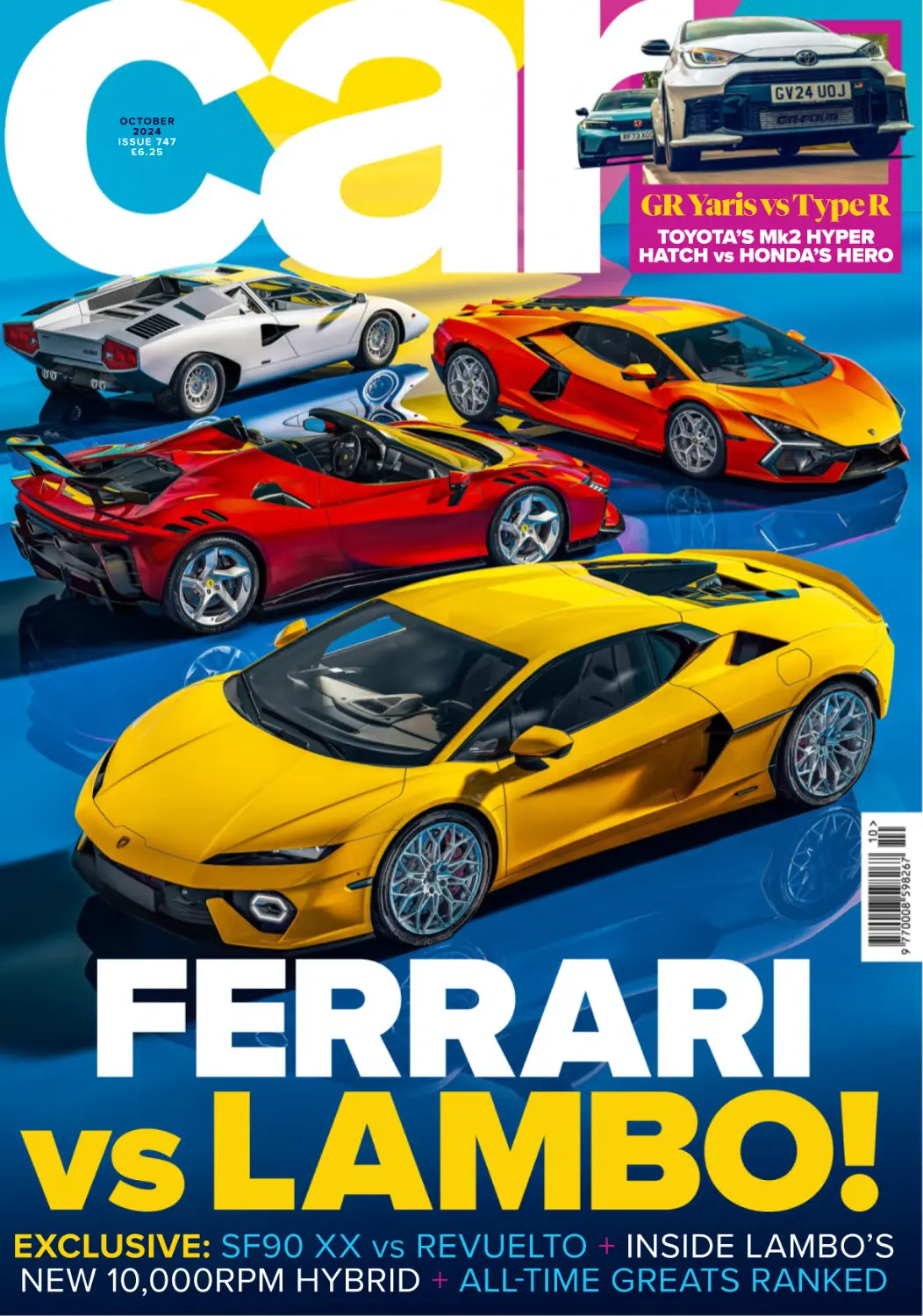
O C TO B E R
2024
ISSUE 747
£6.25
GR Yaris vs Type R
TOYOTA’S Mk2 HYPER
HATCH vs HONDA’S HERO
EXCLUSIVE: SF90 XX vs REVUELTO + INSIDE LAMBO’S
NEW 10,000RPM HYBRID + ALL-TIME GREATS RANKED
E X P E R I E N C E E L ECT R I F Y I N G P E R FO R M A N C E
W I T H A N E W G E N E R ATI O N O F E V R OA D ST E R
STA RT I N G F R O M £ 5 4 , 9 9 5
C O N F I G U R E YO U R S AT W W W. M G CY B E R STE R .C O.U K
ISSUE 747 | O C T O B E R 2 0 2 4
Goodbye Huracan,
hello Temerario:
Lamborghini’s latest
hybrid in detail
Get more
and get it earlier
SPECIAL OFFER: BUY A PRINT
SUBSCRIPTION AND GET
DIGITAL ACCESS FREE
SEE PAGE 96 OR VISIT GREATMAGAZINES.CO.UK/CAR
TIKTOK
@car.magazine.uk
Insider
8
In the Spotlight: Aston Martin Vanquish
aims to be a brilliant GT and a supercar as
Gaydon goes into battle with Ferrari
14 Scoop: Porsche confirms that an electric
Cayenne is coming soon
16 Why car makers are finding it harder than
ever to plan for the future
17 Inked In: Jeff Hammoud, Rivian’s design
chief, picks the highlights of his career
18 Four extreme newcomers for those with
wild tastes and huge wallets
20 Inquisition: Michael Schiebe, AMG boss,
on what’s been learned from the hostile
reception to the C63
20
AMG’s
plans from
top man
Michael
Schiebe
78
Great designs from Lamborghini
and Ferrari: Stephen Bayley’s pick
Tech
22 If you think 3D printing is just a passing
gimmick, Czinger’s new hypercar might
make you think again
24 CAR Explains: the subtle cleverness of
Audi’s new mild hybrid
25 Does It Work? Renault’s gaming-inspired
attempt to get us all to drive better
First Drives
26 The 300-Mile Test: Volvo EX90, electric
replacement for the XC90
36 VW ID. 7 Tourer: roomier and hotter new
versions of VW’s most accomplished EV
38 Ariel Nomad: now with Ford power
44 Audi RS6 Avant GT: supercar estate
46 VW California: now based on the
Multivan’s MQB platform, the iconic
camping-ready Cali now aims to be good
on the road as well as great for families
66
Lamborghini Revuelto.
Ferrari SF90 XX Spider. Bliss
86
Revised GR Yaris up against
the class-leading Type R
66 Ferrari SF90 XX in Spider form meets
Lamborghini’s new Revuelto in a world
exclusive 2017bhp clash
78 The most visually arresting Lamborghinis
and Ferraris of all time rated and ranked
by Stephen Bayley
86 Giant Test: Toyota’s revised GR Yaris hot
hatch goes up against the class-leading
Honda Civic Type R
98 We join M division’s Dirk Hacker as he
puts the finishing touches to the hybrid
M5’s dynamics in Wales
Our Cars
26
EX90: costly new electric
replacement for Volvo’s XC90
98
We go driving in the M5 with
engineering ace Dirk Hacker
Opinion
The big reads
50 Letters: Comfy SUVs, Dacia’s new
direction, fond recollections of fast Fords
58 Kicking off our Ferrari vs Lamborghini
fiesta, we preview the new Temerario,
the hybrid twin-turbo V8 that replaces
the Huracan as Lamborghini’s entry
supercar. It’s innovative everywhere: from
performance and aero to comfy seats
54 Gavin Green: hail the Toyota Land Cruiser
56 Mark Walton: Maserati needs a plan B
123 GBU: the best cars in every class
106 Suzuki Swift joins the Renault Clio on our
shockingly sensible long-term test fleet
106
Has the Swift still got that
lightweight hatch magic?
OCTOBER 2024 | CARMAGAZINE.CO.UK
5
Now, after 21
years, it’s time
to move on
from CAR
Often wrong, never in doubt. I can’t remember which esteemed reader – maybe Johann
van Rensburg, maybe ‘Bishopwasahero’ –
skewered me so exquisitely with that phrase
when I was editor between 2006 and 2017, but
I’m tempted to have it on my gravestone.
Now, after 21 years, it’s time to move on
from CAR. Many great memories swarm
through my mind. Like rocking up to a Vegas
car-hire outfit to bag a Lamborghini Gallardo
for my second cover as editor. Turned out I
had to hire a chaperone too, but we got the
first comparison test of Audi’s brand new R8.
That same summer, for fear of being
wrong, I sat on leaked prototype images of the
forthcoming McLaren 12C – it just looked too
bland to be the F1’s successor. Ultimately Tim
Pollard stacked up the story, we took a punt
and a long-time spat with Ron Dennis began.
Most indulgent shoot? Five days swanning
from Monte Carlo to Modena in the latest V8
supercars from Ferrari, Maserati and Alfa Romeo. With media pressures now far greater
we’d complete that 300-mile journey in two
days max but in our defence it was CAR’s first
video shoot. You can watch performances almost as plasticky as the GranTurismo’s interior at the bottom of our YouTube feed.
Such digital disruption was ever-present
during my time on CAR. In 2012, we launched
an iPad edition coinciding with the magazine’s biggest ever issue for its fiftieth anniversary. The editorial workload was 484 pages,
the equivalent of producing one magazine a
week for five weeks. The staffers – Greg Fountain, Ben Barry, Chris Chilton, Ben Pulman,
Andy Franklin, Peter Allen, Ollie Kew – pulled
off something very special.
I can’t write about the team without mentioning Georg Kacher, for decades Europe’s
finest motoring writer and operator. He got
Porsche’s 918 Spyder into CAR print weeks before a ‘surprise’ Geneva show debut that
caught other hacks with their pants down.
For a driver who thinks nothing of maxing
out every car he touches, his record is largely
spotless aside from being the first person outside Jaguar to drive the F-Type – and crash it.
That phone call was awkward, even more so
when a dopey hanger-on leaked an image.
Times were pretty wild back then, breaking
embargoes accidentally (sorry JLR and
Mercedes) and deliberately (thanks Porsche
for the complaint to our then MD, former editor Rob Munro-Hall, who thought it a badge
of honour). RMH pranged the Lotus Evora at
Rockingham just as we were about to take it
on a victory drive with 2009’s finest performance cars, so the winner’s photo carefully
hid the protruding suspension arm. A few
years later I gambled by putting Ben Barry
and a photographer on a flight to Maranello
before Ferrari had secured a LaFerrari for us.
But they came through and so did the world’s
first comparison test with McLaren’s P1.
I came to CAR for moments like that, lured
by the lyrical, thoughtful writing, stunning
photography and design, peerless magazine
craft and the brilliant writers and editors who
have lit up its pages. The same values and talent hold true today and will continue under
Ben Miller’s leadership. CAR is now the UK’s
biggest autos magazine with a huge digital
audience – and it remains the finest title of its
kind in the world.
Often wrong? Not on this one, of that there
is no doubt. Goodbye – and thanks for joining
me on a ride I will never forget.
CAR Print+
subscription
Watch CAR videos in the app
The easiest way to access CAR’s growing
collection of unique videos – including our
new Vanquish preview – is via the CAR app.
Enjoy the back catalogue
Appetite whetted for some more spectacular
Ferrari and Lamborghini stories? Our back
catalogue is brimming with them.
Phil
McNamara
Extra stories on your phone
Join us as we get to grips with hand controls
on a Subaru BRZ, adapted to give disabled
veterans a taste of racing.
OCTOBER 2024 | CARMAGAZINE.CO.UK
7
CARS I PEOPLE I SCOOPS I MOTORSPORT I ANALYSIS – THE MONTH ACCORDING TO CAR
Rear is fresh
and muscular
yet nodding to
heritage too
8
CARMAGAZINE.CO.UK | OCTOBER 2024
WATCH
THE VIDEO!
GET CAR’S
DIGITAL EDITION –
SEE PAGE 96
I N
T H E
S P OT L I G H T
ANYTHING
FERRARI
CAN DO…
…Aston Martin thinks it can do better. The new Vanquish
is a serious V12 performance car doubling as a GT.
Remind you of anything? By Jake Groves
OCTOBER 2024 | CARMAGAZINE.CO.UK
9
There surely must be a board somewhere within Aston Martin’s Gaydon
HQ that’s jam packed with darts
pinning images of Maranello, Fiorano and the 12Cilindri to it. The allnew Vanquish – a return to a proud
name from Aston Martin’s modern
history – is about as close as you can
get to a direct rival to Ferrari’s allnew V12 grand tourer.
It’s also quite possibly the most serious Aston Martin has been about
creating something that can really
compete dynamically. Previous V12
grand tourers from Gaydon – namely
the 2001 Vanquish and 2018 DBS Superleggera – were all about power,
theatrics and, of course, soaking up
mile after mile at speed and in comfort. But Ferrari has always been able
to do that, and yet combine it with
the ability to set a blistering lap time
without feeling like you’re manhandling a heffalump.
The new Vanquish, then, is a seri-
THE VANQUISH IS
A PURPOSE-BUILT
BIT OF SERIOUS
KIT, NOT A DB
CAR THAT’S BEEN
BREATHED ON
10 CARMAGAZINE.CO.UK | OCTOBER 2024
ous bit of purpose-built kit and not –
unlike the Superleggera before it – a
DB car that’s been breathed on. The
platform here is all new, with a new
extra-long wheelbase (2885mm to
the 12Cilindri’s 2700mm). Housed
beneath the stretching bodywork is
the most powerful V12 ever fitted to
an Aston Martin production car, developing 824bhp (five more than the
Ferrari) and 738lb ft – good for a
3.3sec 0-62mph sprint and a top
speed of 214mph. ‘With every new
car we bring, we want to be at the top
of the category for power,’ says Aston
Martin’s head of brand and product
strategy, Alex Long.
For the V12, there’s a new block derived from the DB12’s, with strengthened conrods and reprofiled camshafts. New turbochargers (bigger in
size, smaller in inertia) come with a
‘boost reserve’ function, which effectively increases boost pressure above
what’s usually needed by balancing
It’s big, but
Aston’s made
every effort to
trim the weight
the wastegate with the intake pressure and throttle inputs; when you
go for full acceleration, the throttle
snaps open and the excess pressure
and fuel rush through the engine.
But the key here isn’t just that utterly huge amount of power. Aston
Martin’s engineers have agonised
about weight – even if the Vanquish
is 1774kg dry, around 200kg heavier
than the Ferrari – to keep it as athletic on both road and track as possible.
The Vanquish is 75 per cent stiffer
than a DBS 770 Ultimate, with a new
front undertray and crossmember
among various measures to improve
rigidity. This ‘gives you benefits
when it comes to steering feel,’ says
Simon Newton, Aston Martin’s director of vehicle performance.
‘When you load up the entire tyre
contact patch as you steer, what
you’re actually feeling is the front of
the car bending in the right way.
That extra stiffness really helps.’
Insider
Bilstein DTX dampers are standard, specially calibrated by Aston
Martin. The 21-inch forged alloy
wheels wear Pirelli P Zero 4 tyres.
As well as all this new hardware,
Aston Martin has put a fresh focus
on software-aided dynamic enhancements – again, like Ferrari
does. For example, there’s an electronic differential for the rear axle,
similar to the DB12 and Vantage.
‘Having that e-diff is what allows us
to have a longer car [than the Vantage
or DB12] that brings the benefits of
high-speed stability, but we’re able to
make something more agile than the
outgoing model,’ adds Newton.
‘You can set the car up to be more
agile and reactive at lower speeds
than the previous car, then really
lock it down higher up.’
Aston’s adaptive slip controller
works like Ferrari’s Side Slip Control,
or McLaren’s Variable Drift Control,
in that it allows fine tuning of how ⊲
T H E D E B AT E : I S I T T O O O L D - S C H O O L ?
‘You had to explain
the DBS; with this,
you don’t’
JG: ‘You say there’s quite
a big nod to the DBX here,
with some DNA links
between the two. Was
going all-wheel drive off
the table? It could give you
more trusty traction with
this amount of power…’
AL: ‘What people expect
from us are super-clean and
crisp dynamics, and there
was definitely a sense in
the team that there was a
massive leap to be made
in dynamic talent in the
chassis without all-wheel
drive. Leaving the purity of
the front end to the steering
and nothing else gives us a
clear position in the market
against cars this price.’
JG: ‘Saves weight, too…’
AL: ‘It does, and weight
is a huge discussion right
now. The new BMW M5
is a pin-up for that weight
topic right now, but it’s the
same with the new Bentley
Continental GT Speed –
both are around 2.5 tonnes.
‘This is a different beast
to Valhalla coming up, for
example, which will have all-
wheel drive with an e-motor
on the front. That will have
some debut technologies
on it.’
JG: ‘But this is a firmly
old-school, big-power, V12,
rear-drive sort of car. Isn’t
that a bit out of place in a
downsizing, electrifying
world?’
AL: ‘It’s a bit of an eyebrowraiser right now, for sure.
There’s still an audience
for it. V12s used to be a lot
more common; you’d find
them in Mercedes S-Class
and BMW 7-series saloons.
But now, they’re special.
With Vanquish, there are
now two interpretations
of the V12 GT car on the
market but I’d say they’re
very different.’
JG: ‘And great to see the
Vanquish name return.’
AL: ‘I just think it’s one
of the best names in the
business, and you know
where you stand with it.
With DBS it was basically
a DB11… S. There’s no
sub-explanation here.’
JAKE
GROVES
CAR’s deputy
news editor
and cautious
Aston Martin
observer
ALEX LONG
Aston Martin’s
head of brand
and product
strategy,
keeping a
finger on the
GT buyer’s
pulse
Downsizing?
Electrifying?
What strange
tongue is this…
OCTOBER 2024 | CARMAGAZINE.CO.UK
11
THE CONTROLS
ARE FAMILIAR
BUT NURNBERGER
DOESN’T WANT
EVERY DASH TO
BE THE SAME
much the tail comes out in hard cornering.
To keep the Vanquish’s weight
competitive, the heavily sculpted
bodywork is all carbonfibre. Carbon
ceramic brakes are standard, a saving
of 27kg per wheel, according to Aston
Martin. An optional titanium exhaust saves another 10.5kg.
The whole car’s design is instantly
familiar, with many of the brand’s
common design cues interwoven
with some fantastically intricate details. As with the current DB12 and
Vantage, particular effort has been
made to avoid aerodynamic elements
that look like add-ons. Aston’s trad
(and massive) grille arrangement is in
place, topped by a sharp lip and
framed by muscular wheelarches.
Led by Miles Nurnberger, the designers have plucked various visual
elements from Aston’s rich heritage
and assembled them in a way that’s
both respectful of that history and
strikingly new.
The stand-out rear end’s lighting
uses technology from the Valkyrie
12 CARMAGAZINE.CO.UK | OCTOBER 2024
T H E
R I VA L
Maranello is in
the crosshairs
Two doors, rear-wheel drive, sophisticated
engineering and a shrieking, overpowered
V12 under the enormous bonnet? Aston
Martin really is setting its sights directly at
Ferrari and the 12Cilindri (pictured). Makes
sense, given one of executive chairman
Lawrence Stroll’s aims is for Aston Martin
to become the Maranello of the Midlands.
and an elegantly-incorporated diffuser. The cut-off Kamm-tail rear
end echoes the recent Valour, Victor
and Valiant. A panel fixed to the tailgate, nicknamed the ‘shield’ by
Nurnberger and his team, looks like
it floats around the rear end of the
car; it can be either painted or left in
bare carbonfibre.
Inside, the controls are all familiar
Aston Martin but Nurnberger is
keen not to make every dashboard
design the same. Vanquish, which is
strictly a two-seater with a bespoke
luggage set behind the seats, has
quite a blocky interior design.
Nurnberger is also a big believer in
physical switchgear. ‘You can do so
much with a touchscreen, but it’s so
important to keep these physical
controls,’ he says. ‘We sell cars that
are about emotion and engagement.
You have nerve endings in your eyes
but you also have them in your fingers so you should use them.’
High-quality stitching is everywhere, and there’s a ‘chrome stitch’ –
a slim metal strip – to tie the interior
Insider
B LO O D L I N E
V12 OVERLOAD
The cars that made the new Vanquish
Vanquish (2001-2018)
One of the coolest ‘V’ names Aston Martin has ever used,
and one that quickly became an icon in the early 2000s
thanks mainly to a charismatic V12 under the bonnet and
grade-A design penmanship from Ian Callum.
design together.
The Aston team – like their counterparts at Ferrari – are well aware of
the V12 engine’s shrinking but hallowed place in the line-up. Purity has
been the focus, ensuring it’s not
complicated by heavy hybridisation.
After Vanquish, itself limited to
1000 units per year with an expected
price pushing well north of £250k,
the V12 is expected to be used sparingly, as Gaydon gets to grips with
the need to clean up… but not yet.
‘Part of the challenge with this one
was to meet the emission standards,
but to preserve the engine’s attributes,’ says Newton. ‘It’s an ongoing
process. We get the challenge, and
then we look at countermeasures.’
Long adds: ‘It took some convincing within the business to put money
in the V12 cup and to say we’re keeping it at the top of the product range,
because the other way to ease a business case is to say that we can add
some volume via a middle car, but we
feel we’ve got the performance envelope right here.’
Who needs
kids when you
can have some
lovely bespoke
luggage?
Valour
Along with the Victor and Fernando Alonso-approved
Valiant, the limited-edition Valour previewed various
visual elements the new Vanquish has embraced. Expect
the blunt rear to appear on more future Astons.
DBS Superleggera
Technically the car the Vanquish replaces. Aston has
come to the conclusion that there’s no power without control, so has made a serious effort to make the Vanquish
much less twitchy and nervous than the Superleggera.
OCTOBER 2024 | CARMAGAZINE.CO.UK
13
S C O O P
PORSCHE
CONFIRMS
ELECTRIC
CAYENNE
2025’s e-Cayenne from
Porsche will be sold alongside
combustion versions, as part
of a split powertrain strategy.
By Jake Groves
FACTFILE
P OW E R TR A I N
95kWh battery (est), up
to 600bhp (est), single
or twin e-motors
CHASSIS
Aluminium and steel
monocoque
DUE
2025
14 CARMAGAZINE.CO.UK | OCTOBER 2024
IT’S OFFICIAL
A NEW STRATEGY
An electric Cayenne closely
follows the Macan Electric
(pictured). ‘Our product
strategy could enable us to
deliver more than 80 per cent
of our new cars fully electrified
in 2030,’ says Porsche boss
Oliver Blume. ‘In the middle
of the decade, the fourth-gen
[Cayenne] will set standards in
the SUV segment.’
The EV won’t be the only
Cayenne, as Porsche slightly
repositions its targets amid
slumping EV demand; petrol
and PHEV versions will remain.
Blume qualifies Porsche’s
view by adding that its goals
will ‘depend on the demand
of our customers and the
development of electromobility
in the regions of the world.’
SPLIT PERSONALITY
MACAN DNA
As well as offering the new,
fourth-gen Cayenne as an EV,
the existing third-generation
model will undergo another
major overhaul to keep it fresh,
providing V8 and e-Hybrid
PHEVs ‘up to and beyond
2030’. Porsche says it’s working
on making its V8 ‘ready to
comply with future legislative
requirements.’
The 800-volt Premium Platform
Electric architecture that
underpins the latest Macan
will be upgraded for use in
the electric Cayenne. Michael
Steiner, Porsche’s R&D chief,
says PPE is flexible enough ‘to
integrate the latest technology
in the fields of high-voltage
systems, powertrain and
chassis.’
Expect a sleek
evolutionary
design
Illustration: Avarvarii
T H E
FLEXIBLE
pawnbroking
service
Posh Pawn
flexible pawnbroking
services
9 Loaned over £3 million against classic
and supercars over the last 12 months.
9 Leverage your classic car to secure a
short-team loan.
9 Our team of experts possesses an
in-depth understanding of high-end
vehicles, enabling them to assess and
appraise with precision.
Looking to loan?
To loan against your classic car with Posh Pawn, simply call our team on 0800 9176894.
<RXUFDUZLOOEHTXLFNO\DSSUDLVHGDQG\RXZLOOUHFHLYHDQRƬHURIIXQGVDJDLQVW\RXU
vehicle. Alternatively, you can contact the team via our online enquiry forms,
or visit one of our 8 locations across London, Surrey and Manchester.
www.prestigepawnbrokers.co.uk Or shop preloved
luxury online at: www.shopprestige.com info@
prestigepawnbrokers.co.uk 0800 917 6894.
Terms and Conditions online. Prestige Pawnbrokers is a trading
name of Prestige Asset Finance Limited. Authorised and regulated
by the Financial Conduct Authority for credit related activities under
registration number 676907.
For all enquiries contact Posh Pawn on 0800 9176894
Insider
B E H I N D
T H E
H E A D L I N E S
HOW TO WIN AT
CAR MAKING: GET
A CRYSTAL BALL
Shifting customer demands, brutal regulations
and tight targets… It’s tricky. By Curtis Moldrich
isn’t anywhere near what was origi‘Being a product planner today is
nally pitched to boardrooms: deprobably the most difficult job in the
mand for electric company cars grew
company,’ Ivan Espinosa, chief planby 42 per cent in January of this year,
ning officer for Nissan tells on the fibut private demand suffered a 25 per
nal day of the Formula E championcent slump in the same period. Car
ship. He’s half joking, but there’s
makers have spent millions on EV
some truth in what he says; drivers
factories and R&D, only to find that
Oliver Rowland and Sacha Fenestraz
there’s a fresh appetite for combuswill navigate around the tight and
tion cars, especially hybrids.
twisty London circuit for the next
Conflicts in Ukraine and Palestine
hour or so, but Espinosa must chart
have added to anxiety in the finanNissan’s course through the most
cial markets, and we’re perpetually
volatile, disruptive period the autocircling an economic meltdown. Put
motive industry has ever seen.
it all together and you have the dis‘It used to be very easy, because we
combobulating 4D chess board that
only had to take care of our customer
Espinosa and his counterparts must
base, trends and the technology
play on. Product planners need to
roadmap,’ he tells us in Nissan’s VIP
think several moves ahead – but
area high above the track. ‘Today you
right now it’s hard to see past the
have all that plus your politics, very
next six months.
stringent regulatory conditions, duRecent
developments
have
ties, taxation and a bunch of other
prompted different rethings that normally
sponses from different
we wouldn’t be taking
PLANNERS
manufacturers.
At
care of.’
MUST THINK
Audi, the replacement
For decades, those in
YEARS
for the A5 uses comthe job enjoyed what
AHEAD,
BUT
bustion powertrains –
now look like relatively
IT’S HARD
a bold move from a
calm seas, with increTO SEE PAST
company that two
mentally
improved
THE NEXT SIX years ago announced
combustion technoloits plans to become an
gy, predictable emisMONTHS
electric-only car mansions laws and a more
ufacturer by 2029.
stable
geopolitical
Audi is also considerbackdrop. Now all
ing closing its entire EV manufacturthree are erratic, fast-moving targets:
ing plant in Brussels, threatening the
there’s a battery technology breakQ8 e-Tron that’s built there – as well
through seemingly every six months,
as the circa-3000 highly-skilled emgovernments U-turn on emissions
ployees.
laws on a whim, and the news is filled
Mercedes and Toyota are back to
with conflict every day.
developing combustion engines after
Take the UK, for example. Here
previously signalling a turn towards
the ban on the sale of combustion
electrification in its various forms.
cars slipped from 2030 to 2035, but
Mercedes has dropped the electric
there’s talk of Keir Starmer’s new
EQC from UK showrooms.
government moving it back. And
This is all food for thought for Jagconsumer demand for electric cars
16 CARMAGAZINE.CO.UK | OCTOBER 2024
Audi’s adding
combustion
cars as well as
new EVs to its
line-up
uar, which recently announced a
fresh, EV-only strategy.
Turning back isn’t an option, Jaguar boss Rawdon Glover told us. ‘It’s
not a short-term decision that you
can flex midstream. Any platform
decision is probably a 12- to 15-year
decision. Because you’ve got five, six
years in the gestation and then you’ve
got probably a maximum of eight,
nine years to leverage the platform
once you launch it.’
Jaguar, like Nissan, has been heav-
I N K E D
I N
My career in
three sketches
JEFF HAMMOUD
RIVIAN CHIEF DESIGN OFFICER
▲
FIRST DESIGN:
2011 JEEP GRAND CHEROKEE
‘That was a really fun project – being able
to see something that you’ve created, on
the road and selling at high volume, is a
really, really great experience.’
ily involved in Formula E. But whereas Jaguar has now gone all in on EV,
Nissan is being more cautious on its
path to, ultimately, an all-electric future. ‘We’re taking a balanced approach because the speed at which
the market is electrifying is varying
depending on the region,’ says Espinosa. ‘But of course, the final goal is
electrification.’
It’s hard to plan several moves
ahead, but Espinosa at least has a
good mix of chess pieces at his disposal; Nissan will launch 30 new cars
globally between now and 2026 with
many of them coming to Europe. ‘A
lot of those products will be showcasing key technologies like our
e-4orce [electric all-wheel drive] systems, and showing next-generation
battery technology,’ he tells us. ‘We
will also use our e-Power [range extender] technology to keep pushing
electrification not only in BEV, but
also to get people closer to an electrified experience.’
Amid all these political, economic
and technological developments, Espinosa’s team are constantly putting
their ears to the ground to focus on
the most important factor of all, the
consumer.
‘We do a lot of research,’ he tells us.
‘We’re monitoring all of this and being very close to our consumer, because in the end the product and the
speed will be decided by the consumer – even if some of our regulations
and government movements are
pushing through certain things. In
the end, the final choice is made by
the customer.’
▲
MOST IMPORTANT DESIGN:
RIVIAN R1
‘It was the opportunity to start from
nothing; to create a brand not only in terms
of its design but also its customer base
and its usability.’
▲
FAVOURITE DESIGN DETAIL:
RIVIAN R1 GRILLE
‘To define a face is so hard, something
unique that we can build upon. For us
to create something that’s immediately
recognisable is my proudest moment.’
OCTOBER 2024 | CARMAGAZINE.CO.UK
17
Insider
T H E
D E B R I E F
DREAM MACHINES
But maybe lay off the cheese before bed. By Jake Groves
THE ONE WITH ALL THE HERITAGE
THE ONE WITH ALL THE ELEMENTS
Pick your jaw up off the floor, please. British specialist Tuthill
– famed for its motorsport prowess – has a long history
with Porsche. After the 911K – a lightweight restomod 911
S/T – Tuthill Porsche’s carbon-bodied GT One takes the
original and road-ifies it with all the latest mod-cons.
For Pagani’s Utopia Roadster, carbonfibre is common as
muck, but the passenger cell is made from carbo-titanium,
and the tubular subframes are hewn from a chromiummolybdenum alloy. While the construction is a chemistry
lesson, the 852bhp V12 at full chat will be a physics lecture.
NEED TO KNOW
NEED TO KNOW
What is it? A roadgoing Porsche GT1 recreation I Tech specs
An 11,000rpm-redlining nat-asp or turbo’d flat-six, inconel
exhaust, manual or dual-clutch transmission I Aimed at? Rich
millennials who had the GT1 on their bedroom wall I Can I get
my hands on one? You can, but only 22 will be made
What is it? Pagani’s droptop Utopia I Tech specs 1280kg
weight (same as the coupe), proudly un-hybrid powertrain,
automated manual option I Aimed at? Those who won’t
compromise I Can I get my hands on one? 130 will be made, at
£3 million a pop
THE ONE WITH ALL THE CIGARS
THE ONE WITH ALL THE CERAMIC
Automobili Pininfarina’s electric hypercar is ripe for
personalisation, so much so that a client who already owns
one has asked for a one-off roadster – the first one that’s
ever been made. It digs deep into the neon-lights-andpalm-trees vibes, almost as if it belongs in Miami Vice.
It’s all Greek to Rolls-Royce. The latest collection from the
craftspeople at Goodwood is this Phantom Scintilla, which
is a nod to the Spirit of Ecstasy's inspiration: a sculpture
named Winged Victory of Samothrace. Embroidery aplenty
inside, as well as a genteel colour scheme.
NEED TO KNOW
NEED TO KNOW
What is it? The first ever droptop Battista I Tech specs Targatop roof mechanics, sunset-inspired colour scheme, a cigar
humidor between the seats I Aimed at? The ’80s-inspired
playboy I Can I get my hands on one? Maybe, if the current
owner ever decides to sell it
What is it? A Phantom limo trimmed with stoneware I Tech
specs 869,500 embroidery stitches in the rear, ceramictrimmed Ecstasy mascot, animated Starlight Headliner I Aimed
at? Wealthy mythologists I Can I get my hands on one? Yes,
but only 10 are being made
18 CARMAGAZINE.CO.UK | OCTOBER 2024
MICHAEL
SCHIEBE
MERCEDES-AMG
CHIEF EXECUTIVE
T H E
C A R
I N Q U I S I T I O N
‘WE HAVE LOST
V8 CUSTOMERS’
How AMG will learn from the
controversial four-cylinder
C63 and make its first EVs
exciting. By Ted Welford
20 CARMAGAZINE.CO.UK | OCTOBER 2024
Downsizing the engines of performance cars is never a crowd pleaser,
but few decisions have proved quite
so unpopular as Mercedes-AMG
ditching the C63’s V8 and replacing it
with a four-cylinder plug-in hybrid.
Affalterbach could have gone
down the six-cylinder route, as BMW
and Audi have done with their respective M3 and RS4 rivals, and AMG
has found other hybrid solutions on
different models. But for the C63 it
opted for a hybrid with the same cylinder count as your typical C300e
company car, albeit a much more
complex and powerful powertrain.
Rumour has it that former AMG
boss Tobias Moers walked out of a
meeting when it was decided to
make the switch.
The man whose mission is to navigate a way through the turbulence is
Michael Schiebe, who’s worked for
Mercedes since the start of his career
in 2004 and been AMG boss since
March 2023. He’s also responsible for
G-Class and Maybach. A busy man,
though he finds time to chat to CAR
at the reveal of the AMG GT 63 Pro.
The first international reviews of
the C63 in late 2022 were nothing
more than luke warm, and it’s not
been received any more warmly now
that it’s been tested on UK roads.
Insider
‘WE JUMPED FAR
AHEAD BUT WE
SHOULD HAVE
EXPLAINED THE
TECHNOLOGY
MORE TO OUR
CUSTOMERS’
Our own James Dennison described
the new C63 as a ‘mere shadow of
what this great brand is capable of’.
Schiebe admits the PHEV has lost
AMG some loyal fans, but believes it
was the right choice for the car.
‘The C63 is a very important car in
our portfolio. It used to be, it is and it
will be. We decided with the current
version to really go for the latest
technology. We wanted something
new and that’s why we put the F1
powertrain into a street-legal car.
‘We see that some of our very loyal
customers struggle a bit with the
concept. Of course, no doubt we have
also lost some customers who are
just into V8s,’ he concedes. ‘You need
to really drive this car. It’s a very convincing product.’
Schiebe is obsessed with technology and pushing boundaries of performance. But isn’t there a worry
that the core sensation and audible
excitement of what has historically
made AMGs so entertaining is being
lost, and that it’s not what its customers actually want?
‘We jumped far ahead with this
technology, but we should have explained the technology more to our
salespeople and customers. We will
continue to do that and further improve. There is a German saying,
“You never have a second chance at a
first impression.” Maybe we missed
out on the first impression, but if you
have the opportunity, I’m sure you
will be convinced of the technology.’
Like other performance-car makers, AMG is holding back from put-
ting all of its eggs in one basket.
Schiebe says the plan is ‘all kinds of
drivetrain technology, from ICE to
hybrid to EV’.
AMG’s first bespoke electric model
is well on its way, evidenced by testing shots seen earlier this year.
Though heavily disguised, it’s clearly
a similar shape to the AMG GT
4-Door, and will go up against the
Porsche Taycan and Lotus Emeya.
It’s based around a platform called
AMG.EA. Schiebe says the car will be
an ‘AMG first and electric car second’.
Expect it to arrive in late 2025 or
2026. Says Schiebe: ‘When we come
to the market, we will definitely get it
right, whether that’s a bit longer or a
bit later.’
Schiebe won’t go into much detail
about the AMG.EA platform, other
than noting that the firm is targeting
continued success in the upper segments of the market – so think SUVs
as well as four-door GTs.
He adds that electric AMGs must
not ‘quickly lose steam’ with sustained high-speed runs, and that
they must be able to charge quickly
to get back on the road or track.
But while other car makers are dialling down the speed of their switch
to electric, including Mercedes-Benz
as a whole, Schiebe is adamant electric is the future.
‘While we will continue to invest
in ICE engines with no end date, we
will not slow down the pace [of electrification]. I’m very positive about
the all-electric future for AMG. This
new technology provides so much
opportunity for us – you can do
many new things that you can’t do
with a combustion engine today.’
AMG doesn’t have Porsche and
Ferrari’s faith in synthetic e-fuels;
they might help keep current cars viable for longer, but they’re not the
plan. ‘We are completely going into
an all-electric future. It’s unbeatable.’
AMG’s first
bespoke EV
undergoing
winter tests,
quietly
THE CAR CURVEBALLS
Six questions
only we
would ask...
What was your first car?
‘It was a diesel Smart
ForTwo. My parents live in
northern Germany and I
was working for Mercedes
in Stuttgart, so it would
often do 800km journeys.’
What’s the best thing you’ve
ever done in the car?
‘When I started my current
position, I was allowed to test
drive the AMG One at our
Sindelfingen plant. It’s a very
short track, with a speed limit. It
was so exciting that I broke the
limit and they kicked me out.’
What achievement
makes you proudest?
‘I can do my dream job,
working with the team
that is so performance driven.’
Tell us about a time when
you’ve screwed up…
‘When I studied, there was one
course I failed the exam on. I
then grew in the company but
never finished my study. I’m still
paying the tuition. I’ve never
quit it because it’s psychological
and I want to finish.’
Would you have a supercar or
a classic car?
‘A supercar. I’m very technology
driven, and I love the idea of
never stopping progressing.’
Company curveball: What’s
the largest displacement
engine Mercedes ever made?
‘I think it must have been the
G65 I guess? [Wrong, it’s the
Pagani Zonda’s with 7291cc]. Oh
my gosh, yes, many years ago.’
OCTOBER 2024 | CARMAGAZINE.CO.UK
21
THE INNOVATIONS TRANSFORMING OUR DRIVING WORLD
I N
D ETA I L
WILL 3D PRINTING
EVER HIT IT BIG?
The supercar geniuses at Czinger may have cracked it. But the manufacturing
technique still has big roadblocks for the rest of the car industry. By Jake Groves
22 CARMAGAZINE.CO.UK | OCTOBER 2024
Take a look at that structure. Sinuous tendrils stretch out
of a carbonfibre tub, weaving and twisting in all directions
with hardly a straight edge in sight. But this isn’t a cross
between superhero movie characters Venom and the Silver Surfer – this is the heart of a real car, created using 3D
printing. In the simplest terms, that means making physical parts from a digital model using a computer-controlled
‘printer’ to add material, layer by layer, in contrast to traditional techniques that chip away at a bigger block.
Czinger, if you’re unfamiliar, is setting out to be a car
maker that ‘makes the most badass vehicles’ in the States
in the words of co-founder Kevin Czinger. And this almost
organic-looking structure is the result of machine learning and 3D printing – areas where Czinger is way ahead of
the curve. And for good reason; Czinger parent company
Divergent Industries makes its own 3D printers and the
algorithms designed to get the best out of them.
‘If you look at your garden as a design space for a set of
ecosystem conditions, you’re flowing materials like potassium, nitrogen, CO2, H20 within that system,’ Kevin tells
CAR. ‘Then evolution – another system that comes along
– optimises the structures of flora and fauna against those
constraints and conditions. Just imagine those engineering constraints in a construction system.
‘This is mirroring an evolutionary process. But what
takes eons based on trial and error with evolution, we can
simulate it in microseconds.’
The result is the Czinger 21C – a hypercar that generates
1250bhp from a hybrid powertrain that merges a flatplane-crank V8 with 800-volt electronics, netting a
Porsche (right)
and Audi
(below) among
those using
3D printing
to make small
components
‘WHAT TAKES EONS WITH EVOLUTION,
WE CAN SIMULATE IN MICROSECONDS’
SUPERCAR MAKER AND 3D PRINTING CHAMPION KEVIN CZINGER
WHAT IS IT GOOD FOR?
Aside from Czinger’s extreme
21C, other car makers have
found uses for 3D printing.
Ford and Porsche both say it’s
a fantastic tool for developing
prototypes and in the design
studio, and Audi uses 3D printing
techniques to reduce waste at
its Neckarsulm site by producing
assembly tools from Audi A6 and
A7 polymer scraps.
Mini introduced 3D-printed
customisable trim parts in 2017,
allowing buyers to create pieces
that featured their own patterns
or words, but don’t offer them on
the current range.
BMW uses 3D-printed cylinder
head components in the engine
that powers the M2, M3 and M4.
0-62mph time of 1.88 seconds. The 21C has also managed
to snatch production car records at Laguna Seca and the
Goodwood Festival of Speed hillclimb.
‘But, unlike most of the supercars you see [at Goodwood], we did this all in three years. A car that can do a
quarter mile in 8.1 seconds, but it’s completely street-legal
with zero crash exemptions or emissions exemptions. It
can be sold off the dealer lot, and yet it can blow the doors
off of anything,’ Kevin adds.
There are big issues for the wider car market, however:
scale, cost and speed. What works for a low-volume builder of multi-million-dollar supercars may not be such a
happy fit for more mainstream car companies.
Porsche has been using 3D printing since 2018, crafting
components spanning seats and pistons for the 991-generation 911 GT2 RS. At the time Frank Ickinger, Porsche senior engineer for advanced engineering, acknowledged that
it ‘could still take up to 13 hours to print one rotor shaft like
this’ – slower than machining it by traditional means.
While Lamborghini 3D-prints trim pieces, CEO
Stephan Winkelmann tells us: ‘It can be really valuable if
you have a very small production scale, but it’s too expensive [to scale up].’ However, Ford is looking to tackle the
scale issue, investing hugely in an additive manufacturing
centre at its factory in Cologne before the launch of the
Explorer. Ford says using 3D printing reduces manufacturing waste and allows parts to be made faster as no casts
or moulds are needed; Oliver Färber, Ford Cologne engine
plant manager, says the idea is a start-up approach ‘with
short distances and little bureaucracy’. But so far Ford is
still only making very small parts.
OCTOBER 2024 | CARMAGAZINE.CO.UK 23
C AR
E X PL A I N S
THE MIGHTY
MILD HYBRID
If engines are staying, they had
better be mega efficient. Here’s
Audi’s plan... By Luke Wilkinson
Audi has made a bold business decision by launching a
range of new-generation combustion cars. To make them
as clean as possible, engineers at Ingolstadt have been
working hard on refining the mild-hybrid formula. Audi
calls it MHEV Plus, and it’s designed to complement the
Premium Platform Combustion architecture that will
underpin non-EV Audis, prolonging the use of engines
until combustion bans come into force.
PPC is designed exclusively for Audi and can’t be used by
Volkswagen or Skoda for the next-gen Golf and Octavia,
for example, as those models have their engines fitted
transversely; PPC is for longitudinal-engine cars.
MHEV Plus will be on all future combustion cars from
Audi, and works in combination with a new generation of
engines designed to be cleaner than ever. The system uses
a beefy 1.76kWh battery pack, three or four times larger
than the batteries used in most other mild hybrids, and
not one but two small electric motors.
As well as one e-motor that acts as a belt-driven starter
generator bolted to the engine, a ‘drivetrain generator’
mounted on the back of the gearbox – about the size of a
loaf of bread – capitalises on the mass of the entire car and
the additional torque from the rotating wheels to generate
more electricity, faster.
Audi says it has a more intelligent power management
system than your average MHEV because the system uses
electricity almost as quickly as it generates it. The result is
better fuel economy and lower CO2 emissions; Audi
claims MHEV Plus trims 10g/km on its newly developed
2.0-litre diesel engine and 17g/km on its fresh 3.0-litre V6
engine for S-badged cars. The e-motor on the gearbox also
allows for engine-off driving at speeds up to 18mph – good
for quiet crawling through traffic.
On the open road, MHEV Plus can keep Audi’s new
generation of combustion cars ticking along at speeds of
up to 87mph, helping to reduce fuel consumption on the
motorway. And if you need to zap past slower traffic, the
tech chucks an extra 24bhp into the mix when you floor
the accelerator.
Fuel economy figures are yet to be confirmed, but Audi
says the tech saves 0.38 litres of fuel per 62 miles on its new
diesel and 0.74 litres of fuel per 62 miles on its new V6.
Exhaust pipes
live to see
another day
thanks to
MHEV Plus
BIGGER, SMARTER, EFFICIENT-ER
STARTER GENERATOR
Now-conventional e-motor still
switches off the engine at standstill or
when coasting
POWERTRAIN GENERATOR
The new addition, which quickly
deploys up to 24bhp of e-boost, and
allows engine-off traffic crawling
BEEFY BATTERY
Not far off the size of the 911 T-Hybrid’s,
and more capacity means more juice
available for boost
24 CARMAGAZINE.CO.UK | OCTOBER 2024
HELICOPTER PA RENTING
HOW IT WORKS
D O E S
IT
WO R K ?
SAFETY COACHING
IN YOUR RENAULT
▲
SCORE OF SHAME
Whether you like it or not, Renault’s
Safety Coach watches your every
move. Drive like a fool? You’ll be
scored poorly, and told you have a
‘risky’ driving style – ouch.
Is Renault’s game-inspired coach an aid to safer
driving? Or an overbearing nag? By Jake Groves
Want to become a better driver? Renault
thinks it has the answer, introducing new
tech in its latest cars designed to guide you to
becoming safer on the road. Safety Coach is
available on the current Scenic, Captur, Rafale and Symbioz plus the upcoming 5 EV.
The system has netted an innovation award
from the French government.
Safety Coach works very much like those
onboard systems – found on almost every
Renault, for example – that rate you on how
efficient your driving is. How much throttle
you apply, how early you anticipate the need
to slow down, your coasting technique and
how efficiently you change gear if you use a
manual – all this and more influence your
eco rating. Instead, Safety Coach measures
you on speed, how close you are to cars in
front and ‘trajectory management’ – keeping
in your lane and not getting distracted.
Worried that this all sounds very annoying? Renault provides a handy button that
activates your individual preferences for the
car’s safety and assistance systems. By default, everything is on whenever you get in,
but the ‘My Safety’ button allows you to
change all the car’s settings with the one
push – easy.
With Safety Coach also on board, even if
you adjust or turn off some of the safety aids
like lane keep, speed warning and autono-
mous emergency braking, Safety Coach will
keep an eye on you anyway. You may be
pleased to know, however, that this information never leaves the car, so those insurance
premiums won’t skyrocket if your insurer
sees any ropey scores.
The first score of the day for us was 39 out
of 100. Ouch. ‘You sometimes have a risky
driving style,’ says the coach, offering guidance that boils down to ‘go slower’. As well as
that total score out of 100, each of the three
areas of focus – speed, following distance
and trajectory – is broken down into ratings
out of five.
Small animations and videos brief you on
how to drive more safely, advising you on
certain behaviours, and gameifying safer
driving. And the results are clear – our score
improved, reaching as high as 79.
But, just like a coach at the gym, it only offers you motivation and advice. Want to become a better driver? You still need to put in
the work.
DOES IT WORK?
Yes. It all works as you’d expect it to,
but it’s there to give you surface-level
guidance and nothing more. Many of us
will take that light touch as a good thing
if we’re, er, keen drivers.
▲
ROAD TO RECOVERY
Your speed, distance from other
vehicles and attentiveness to
keeping in your lane are rated at all
times. Want a better score? Maybe
learn to relax.
▲
ON-ROAD THERAPY
‘It not worth it!’ says the Safety
Coach like an extra in EastEnders
if it thinks you speed regularly. It
guides you to use the on-board
safety tech more.
OCTOBER 2024 | CARMAGAZINE.CO.UK 25
26 CARMAGAZINE.CO.UK | OCTOBER 2024
The
300-mile
test
NEW CAR MEETS REAL WORLD
V O LV O E X 9 0
Safety fast
Stylish, all-electric, seven seats… and faster
than a Civic Type R. Join our voyage of
discovery in Volvo’s complex new flagship
Words Piers Ward Photography Olgun Kordal
OCTOBER 2024 | CARMAGAZINE.CO.UK 27
The sort of
road that suits
the EX90's
effortless ride
Nearly as wide
as a Conti GT,
but US roads
can handle it
28 CARMAGAZINE.CO.UK | OCTOBER 2024
First drives The 300-mile test
f your family car is anything like mine
there will be enough stale food, mould and
general detritus loitering on the floor and
between the seats to keep Louis Pasteur in
work for a decade. I would dearly love for it
to be tidier and cleaner – it looks a little odd
turning up to the school gates in a hazmat
suit – but the car is a workhorse. No point
stressing about it.
The same used to be true of big Volvos, the answer to
every family-car dilemma for decades. With estate cars
like the 850 and then the ridiculously successful XC90,
Volvo made a parent’s life that little bit easier.
In theory, the all-electric EX90 is here to do the same job
while being less of a burden on the conscience, offering
clean transport, seven seats and those ever-present Volvo
safety credentials.
And yet.
That early XC90, launched in 2002, was available for
around £35,000 (getting on for £70k in today’s money).
This new EX90 currently starts at £96,255 (or £1469 a
month for the Twin Motor Performance using Volvo’s
subscription scheme). The top-spec Twin Motor Performance Ultra version we’re driving comes in at £100,555.
There are caveats to all this, of course. A more affordable
version is on its way, likely rear-wheel-drive and starting at
around £75,000, not that many people buy in cash these
days. Plenty of electric cars are very expensive, so why have
a pop at Volvo? Because Volvos aren’t meant to be dream
cars; I find it hard to reconcile paying this sort of money
for a car and then letting the kids loose in it.
And this is very much a family car. With seven seats and
oodles of standard safety kit, there are few more cosseting
ways of ferrying the precious little darlings around.
It’s also reassuring as we peel into LA’s congested streets.
Measuring a shade over five metres long, the Volvo certainly isn’t small but in LA it’s dwarfed by plenty of other
vehicles. We’re starting out on the Newport coastline,
south of LA, then heading east for the Salton Sea, a journey that will contrast the glitz of the Californian beach
with an apocalyptic environmental disaster zone that is, if
you’re feeling pessimistic, a warning for the future.
It will be in stark contrast to the EX90’s cosiness. Interestingly, Volvo still sees plenty of potential in passive safety, despite all the headlines around active kit, such as lanekeep assist. I talk to Thomas Broberg, senior technical
safety adviser: how many more passive items, like airbags,
can be stuffed into a car? ‘It’s true, there are limits to what
we can do. But the intelligence of the [deployment of the]
airbags is getting better all the time.
Pick-up: 0 miles
‘And we have the data from 50,000 crashes, as well as an
on-site investigation team in Gothenburg, to further enhance all this. It means that we’ve changed the lower
frontal crash bar to take more load now. The upper load
path [of the crash structure] is also improved, so it’s now
more efficient in how it absorbs energy. Partly this is possible because it’s an EV, so we have more space to work with,
and partly it’s down to improved design.’ Broberg then
points to the suspension’s air reservoir: even that is used to
absorb some of the forces from a frontal crash.
Remember all that when you query the ugly, taxi-esque
lump stuck on top of the roof. For a brand that prides itself
on clean lines, it’s a weird addition. Housing the lidar sensor, it’s a vital part of the active safety systems that can detect objects and pedestrians up to 250 metres away. And
because it has to be upright to work properly, Volvo doesn’t
want to engineer it to fold away when it’s not needed, as
Lotus does. ‘Safety first,’ justifies Broberg.
Not that Volvo has let that mantra restrict the power ⊲
1 mile
First impressions
all good. The
clean lines that are
possible thanks to
being a grille-less
EV help the front
end’s looks.
California
produces
60,000 tonnes
of dates per
year; EX90
weighs only
slightly less
6 miles
Need to adjust the
steering wheel but
can’t find the switch.
Ah, it’s all buried
in a combination
of touchscreen
and buttons on the
steering wheel.
Unlike the EX30,
the 90 gets a digital
dash. Simply laid
out, the map setting
on it is particularly
useful.
OCTOBER 2024 | CARMAGAZINE.CO.UK 29
First drives The 300-mile test
It has the same power
as the BMW M3 and
much more twist than
the McLaren 750S
So few switches
means lots
of distracting
screen use
on offer in the EX90. Based on the same platform as the
Polestar 3, the EX90 has a 107kWh (net) battery under the
floor, with motors mounted front and rear. We’re in the
more powerful Twin Motor Performance today, with a total system output of 510bhp and 671lb ft. To put that in
context, it’s the same power as the BMW M3 and much
more twist than the McLaren 750S. So despite weighing as
much as a town, the Volvo will out-sprint a Honda Civic
Type R. By half a second. Even the lesser Twin Motor
completes the 0-62mph sprint in 5.9 seconds.
And it all feels so undramatic. Plant your foot and the
EX90 rocks back a little but the refinement is such that
there are zero fireworks. It simply glides down the road.
So even though we’re surrounded by Newport’s finest
muscle cars, we’re in no danger of being left behind. The
touchscreen has a Performance button that ups the ante
and also brings in an element of torque vectoring at the
rear. But you’ll most likely use it just the once, shrug it off
as underwhelming and then forget all about it.
There are further drive mode settings to alter the steering weight and ride comfort but, again, these make minimal difference, and they involve five presses of the touchscreen. In a Volvo, where drive modes are as relevant as the
calorie count on a bottle of water.
You’d be right to splutter at the absurdity of this approach: a safety-first Volvo that has so much controlled via
the touchscreen is going to prove controversial. Even the
glovebox doesn’t have a physical lever. The EX90 is nowhere near as bad in this regard as the EX30, but when I
query the conflicting strategies of safety and touchscreens
to Broberg, he squirms slightly before replying: ‘Our customers want it. So, if we don’t offer it we will lose that
business.’ ⊲
12 miles
50 miles
Our first Tesla
Cybertruck in the
wild – still a moment
to be noted. But
Elon’s totem is vastly
out-numbered
by the number of
Rivians we see.
30 CARMAGAZINE.CO.UK | OCTOBER 2024
83 miles
Volvo rightly
trumpets the noise
isolation and quality
of the 25-speaker
B&W system.
Sound is as good as
anything rival SUVs
can offer.
A pause to stretch
and walk around
the car. God
those wheels are
enormous – vast
22s are standard on
the EX90 Ultra.
Petrol station
near the Salton
Sea shows what
used to be
96 miles
103 miles
Does anything
sum up fractured
America like all
these depressing
signs? The Volvo
serenely and quietly
sails past.
141 miles
Big on the outside
translates to huge
inside. A flat floor
and slightly raised
middle row mean
excellent comfort
back there.
Sign writers in the
arid part of Southern
California are not,
it seems, without a
sense of irony.
OCTOBER 2024 | CARMAGAZINE.CO.UK
31
EX90’s drag
coefficient is
a relatively
slippery 0.29
Englishman,
midday sun…
luckily there’s a
place to rest
Tarmac means
you cook
from above
and below
32 CARMAGAZINE.CO.UK | OCTOBER 2024
First drives The 300-mile test
Climbing out of the cool of
the EX into the silence of
this scorched, abandoned
disaster zone is uncanny
You get the sense there are some awkward conversations going on in Gothenburg, because there’s no getting
away from the fact that it is distracting. When I fiddle with
the excellent B&W stereo on the freeway, I wander into the
next lane – this on the US’s ultra-wide roads.
Dropping out of LA’s city limits, we hit a snag as the
EX90 fails to charge at an acceptable rate. The Google
Maps functionality has done its job well by pointing us towards a set of 350kW Electrify America chargers, but that’s
where the good news ends. Only needing a small top-up,
the EX90’s claimed 250kW max suck should mean a quick
stop. We never get anywhere near that figure, the car
starting at 91kW and soon dropping to an abysmal 35kW.
The key rival, Kia’s EV9, was regularly hitting 150kW-plus
when we drove one across Europe last year.
It means we take over an hour for what should have
been a 20-minute turnaround, and no amount of Scandi-zen can calm that annoyance. To be fair, it could have
been the charger… but a Porsche Taycan next door draws
at 154kW as soon as it plugs in. Volvo says an update is due.
Carving past Palm Springs in the EX90’s serenely quiet
cabin, we take a full 10 minutes to drive through an enormous wind farm. Google later reveals it to contain over
4000 windmills covering 70 square miles. Driving an
eco-minded Volvo, I feel a kinship with the wind farm. But
it’s the last bit of green tech we see.
Further on, we pass rows of date trees, flanked by dusty
fields being irrigated in the middle of the day and with the
mercury reading 42ºC. It’s here that the ecological disaster
that is the Salton Sea starts – a landlocked lake that was
created by accident from the Colorado River and was once
a hive of tourist activity. Scientists warned as far back as
the ’70s that the way local farmers were both stripping
water from the Sea and using it for excess run-off water
was not going to end well but no one paid any heed and the
water continued to be drained and poisoned, leading to
fish die-off and dust storms.
We press on, continuing on single-lane roads that head
towards the forever horizon, heat haze shimmering off
the black tarmac and obscuring any approaching vehicles
until the last moment. An abandoned petrol station hints
at the scale of the long-gone passing traffic, the tourists
long since having been driven away by the Salton’s dust
160 miles
and awful smell. We point the car into a deserted campsite. Climbing out of the cool and hush of the EX into the
silence of this scorched, abandoned disaster zone is uncanny. It’s like being in a film when the director dials back
the noise save for the gentle rustle of the wind in the bonedry palm leaves overhead. No birds. No insects. A car
passes nearby but there is no noise, just an ethereal absence of anything save the heat and the blinding sun.
Returning to the Volvo’s interior offers a welcome respite. The usual eco touches, like recycled plastics in the
non-leather seats, are all present and the pared-back
Scandi wood looks great. The seats aren’t quite as armchair-like as Volvos of old and in this heat I wish our car
had a ventilated option, but they’re still comfortable and
supportive. A wool finish is also available and looks smart
but feels a bit itchy if you’re in shorts.
As in the XC90, the middle and rear seats all fold flat
into the floor – a clever bit of packaging that can’t have
been easy given that this is a skateboard chassis with a
huge battery under the cabin. Even with a full complement
of passengers, the boot is still a decent size. At 365 litres,
there’s enough room for an ancient Labrador, any Volvo’s
standard scale of measurement.
The EX90’s biggest trump card is the ride and refinement. LA’s freeways are largely made of concrete, the ⊲
NOW COOK WITH VOLVO
Finally, more manufacturers
are waking up to the
possibility of your car being a
key part of your home tech
and energy ecosystems.
Odd that it’s taken them so
long, given the way Apple
has found ways of burrowing
ever deeper into our lives for
more than 20 years: iPhone,
music, TV, photos, data
storage…
But now, like Tesla and
others, Volvo is on a mission
to transform your home
energy. It’s partnered with
dcbel to offer a home
wallbox system to charge the
EX90 and, because the car
offers vehicle-to-grid energy
flow, it will allow more flex in
222 miles
Uh-oh. Miles from
anywhere, the car
has locked itself with
the key card inside.
Lance Corporal
Jones moment
ensues.
your charging arrangement.
None of this is radical.
What is different is the way
the dcbel wallbox works,
because not only does it
offer DC bi-directional
charging – both healthier for
the batteries and also
offering the potential to get
rid of the car’s inverter in the
future – it also uses AI to
work out the most efficient
way of charging the car. The
firm claims consumers can
save $1800 a year (in the US)
by using the car to power the
oven in the evenings.
The systems even start
talking to each other over the
ether before you get home,
to work out efficiencies.
321 miles
It’s a bespoke EV
platform so gets all
the benefits that
entails, including a
frunk. Useful, but
a tight fit for the
charging cables.
Third-row seats
fold electrically. Is
that really helpful?
Think of the weight
penalty compared to
a manual set.
OCTOBER 2024 | CARMAGAZINE.CO.UK 33
First drives The 300-mile test
PLUS
Whisper quiet;
comfort; range;
safety
MINUS
Questions around
charging speeds;
frightening price
A LT E R N AT I V E S
Kia EV9
Same number of
seats, currently
£31,230 cheaper,
which pretty much
ends any debate
Mercedes EQS SUV
Technically
impressive but
misses every
dynamic mark
34 CARMAGAZINE.CO.UK | OCTOBER 2024
enemy of any silent journey, but even over these the EX90
remains a remarkably quiet place. With a claimed range of
374 miles (more like 300 in the real world, based on our
experience in California), which is as good as any rival,
this feels like a genuine grand tourer.
Wind suppression is impressive and the ride quality is
largely exemplary. I worry that the 22-inch wheels might
struggle on scarred UK roads, as you can feel the
twin-chamber air suspension battling to control the alloys’ mass over sharp undulations. But here it works well
and that potential problem should be eased when smaller
wheels become available on lesser trim levels. It glides easily and regularly lulls passengers into a deep sleep.
It’s no BMW X5 through corners, struggling to control
its 2.7-tonne kerbweight through a left-right flick. But it’s
no dunderhead either, as you can feel the torque vectoring
tightening the nose if you lean into a corner on the brakes.
It’s not a car that will reveal hidden depths the more you
drive it, but when was the last time you needed that from a
Volvo? It’s effortless and easy, taking the strain capably and
with minimal fuss. You sense it will be as reliable and
friendly as the family pet.
Eventually we reach Bombay Beach, a small outpost on
the east coast of the Sea that has the most bizarre art installations down on the sand. We jump out to take a closer
look, only to discover one lone guy smoking a roll-up in his
ancient Jeep Cherokee. ‘I bought those pedalos as a business,’ he explains, nodding towards some beaten-up contraptions resting a few yards out of the water. ‘I’ve been jet
skiing in the Sea loads and it’s good. Just dries the skin out
real quick.’ Tempting as it sounds, we swerve his vague offer of a chemical peel in the airless blue water and beat a
retreat to the Volvo, the headache-inducing stench of rotting fish chasing us all the way.
The Sea is a neat metaphor for what happens when humans cock-up. And it’s not done yet, as enough lithium
has been discovered underneath it to build 375 million
electric cars, an irony not lost us on as we sit in our EX90.
Extraction will be tricky, but if someone manages it they
could transform the US’s industrial landscape.
We peel into Bombay Beach’s sole pub, the Ski Inn, for a
quick drink before the 160-mile trek back to LA. The
greatest compliment you can pay the car is that our return
journey in blazing sunshine throws up no sense of foreboding – we know we have enough range and that the
Volvo will ferry us effortlessly across this barren landscape.
The EX90 costs too much, weighs a huge amount and
there is no depth to the dynamics, but you can level two of
those criticisms at most EVs. Volvo offers a sanctuary away
from the relentlessness of the world.
We relax with our Coke and Sprite, only for one last
moment of Salton Sea bizarreness to interrupt. It’s mid-afternoon on a Friday and the Ski Inn has a decent number
of punters in. One local stands up, rings the bar’s bell and
buys everyone in the place a drink, including the two Brits
who only walked in a minute ago. If only Volvo’s accountants could be as generous.
Next month:
RENAULT 5
CAN RENAULT BRING BACK THE 5 MAGIC?
It’s effortless and easy.
You sense it will be as
reliable and friendly
as the family pet
Data
PRICE
POWERTRAIN
PERFORMANCE
WEIGHT
EFFICIENCY
ON SALE
£100,555
(as tested;
range from
£96,255)
107kWh battery, twin
e-motors, all-wheel
drive
510bhp, 671lb ft,
4.9sec 0-62mph,
112mph
2787kg
2.9 miles per kWh
(official; 1.8 miles
per kWh tested),
374-mile range,
0g/km CO2
Autumn
2024
R AT I N G
★★★★★
OCTOBER 2024 | SUBSCRIBE TO CAR! WWW.GREATMAGAZINES.CO.UK 35
The GTX version is
the most powerful
Volkswagen wagon
ever made, just ahead
of the Golf R Estate
36 CARMAGAZINE.CO.UK | OCTOBER 2024
First drives
VO LK S WAG E N I D. 7 TOU R E R
More space than pace
Roomy EV now comes as an estate and a questionable hot version
You wait ages for an electric estate car to arrive, then they all turn up at once. BMW’s i5
Touring landed earlier this year, Audi recently revealed its A6 Avant e-Tron and now
VW is reminding us that it still sells things
that aren’t SUVs with the ID. 7 Tourer.
It’s an important time for the ID. 7, as a
new range-anxiety-busting 86kWh battery
has also debuted. The headline figure is a
range of up to 424 miles, among the highest
of any EV you can buy today. A sportier GTX
version is also being introduced. That badge
has already appeared on the ID. 4 and ID. 5
hatch-SUVs and the ID. Buzz, and has proven underwhelming at best.
Whereas a standard ID. 7 is rear-driven,
the GTX adds a front motor to the existing
rear motor, enabling all-wheel drive. Total
output is 335bhp and 413lb ft of torque, making it the most powerful Volkswagen wagon
ever made, just ahead of the Golf R Estate.
The GTX comes with the largest Pro S
battery as standard. A claimed 359-mile
range is respectable in isolation, but that’s
down 65 miles on the regular Tourer.
The challenge is the ID. 7 GTX’s weight:
2339kg. For a Passat-sized estate, it’s pretty
ridiculous, and it doesn’t help further the
argument that estates make more sense
than SUVs because their reduced weight
lessens their environmental footprint.
Fortunately, that weight isn’t so obvious
from the driving seat. Bodyroll is well controlled, and the steering is always direct.
Stick it in Sport and it livens up quite considerably. It’s an easy car to place, but like other
GTX models it never feels as focused as a
GTI or R performance variant from VW.
Despite its fairly small power bump, the
GTX is noticeably quicker than the standard
ID. 7, especially from a standstill. The regular Tourer is not exactly lacking, at 6.6 seconds to 62mph, but the GTX is clearly
quicker at 5.5sec.
What’s most impressive about the ID. 7
Tourer is its exceptional ride and refinement. Volkswagen’s latest generation of Dy-
Electric estate
excels with
its calm and
comfort
Data
THE FIRST HOUR
1 minute
As it’s an estate car,
we go straight to
the boot. Yes, that’s
pretty big
Cabin materials feel better than in other IDs
namic Chassis Control (DCC) is a step up,
floating beautifully in the softest setting.
Though the boot’s neither as long nor as
deep as a Passat’s, 645 litres should be more
than enough unless you’re an antique dealer
used to old Volvos. Quick-release handles in
the boot soon drop the seats, though annoyingly they don’t fold completely flat.
There’s generous headroom and legroom
in the back even behind the tallest front occupants. The optional panoramic roof has
no blind but a clever button that takes it
from transparent to opaque.
The interior, generally, is excellent, with
softer materials used than in other electric
VWs. But no car should make you control
the direction of the air vents via a screen.
Prices kick off from £52,240 for the Tourer, but you’ll need another £10,000 to buy a
GTX. It’s a lot of money to pay for some extra
performance, barely distinguishable styling
and a much-reduced range.
Though not as posh as a BMW i5 Touring
or Audi A6 Avant e-Tron, considering the
ID. 7 undercuts both by almost £20,000, it’s
well worth a look.
TED WELFORD
First verdict
ID. 7 makes a great electric estate car,
against limited opposition. It’s not, on
balance, better as a GTX
★★★★★
5 minutes
A much better
interior than
the last electric
Volkswagen I
was in. Roomy
and pleasingly
upmarket
15 minutes
Might be an estate
car but it sits as tall
as an SUV. We pass
a Toyota RAV4 at
the same height
30 minutes
Ride is impressive,
even on largest
21-inch wheels.
VW’s latest DCC is
a game-changer
45 minutes
Stop to get some
Insta pics. My
goodness that lightup VW badge at the
rear is foul
PLUS
Very spacious;
quality interior;
great range
MINUS
GTX not worth
the money;
touchscreen still
a bit annoying
PRICE
POWERTRAIN
PERFORMANCE
WEIGHT
EFFICIENCY
ON SALE
£62,670 (GTX;
ID. 7 Tourer
range from
£52,240)
86kWh battery,
twin e-motors,
all-wheel-drive
335bhp, 413lb ft,
5.5sec 0-62mph,
112mph
2339kg
3.3-3.7 miles per
kWh, 359-mile
range, 0g/km
CO2
Now
OCTOBER 2024 | CARMAGAZINE.CO.UK 37
It’s shorter than most
superminis and city
cars, making it easy to
place on the road
38 CARMAGAZINE.CO.UK | OCTOBER 2024
First drives
Chassis,
suspension
and engine
new; idea isn’t
ARIEL NOMAD 2
Nomad is an island
Alex Tapley
Dirt-friendly Ariel has been overhauled but remains utterly unique
Ladies and gentlemen, I give you the fuel
filler cap, the pedals and the steering column. Those are the things that have NOT
changed in the transition from Nomad to
Nomad 2. Despite appearances, everything
else is different.
The small team of inspired engineers in
Crewkerne, Somerset, have built around
200 Nomads since 2016, making the go-anywhere buggy way more exclusive than
most Porsches or Ferraris. Demand for Ariel’s think-different sports car is strong; if
you place an order today, you might just get
yours in early 2027.
The original Nomad was like a bolt of
lightning when it landed in 2015: a new
breed of performance car that offered extreme performance on road and off – and it
arrived seven years ahead of the crop of
muddy supercars like the Porsche 911 Dakar
and Lamborghini Huracan Sterrato. That’s
what a nimble organisation that’s totally
tuned into its customers can do.
They’ve listened to feedback and made
the new one similar, but better in most regards. The tubular chassis is entirely different, with a larger-diameter steel tube of up
to 63.5mm in key areas to boost torsional rigidity by more than 60 per cent compared to
the Mk1. They’ve reshaped the aperture
through which passengers enter to make it
considerably bigger.
The old Honda VTEC engine has been
dropped in favour of a turbocharged Ford
2.3 from the Focus ST, which is more tractable. ‘It’s easier to drive off-road,’ managing
director Henry Siebert-Saunders tells us. ‘In
the VTEC, everything happened at the top
end, whereas this four-cylinder Ford engine
has much better torque low down. It’s exactly what you want when you’re off-roading.’
Attached to the new steel frame, made by
Arch Motors in Huntingdon, is a revised
double-wishbone suspension set-up with
new geometry, designed to provide thrills
on road and off – as well as the occasional
foray to a trackday. It’s this spread of ability
that marks the Nomad out.
The red car tested here is Ariel’s first
road-biased demonstrator, distinguished by
a three-stage adjustable ECU map which
can take the car from 260bhp/284lb ft
through a mid-ranking 302bhp/333lb ft to an
all-out performance tune of 305bhp/382lb ft.
Aperture is bigger in largely futile attempt to make getting in easier
It’s a £1800 option controlled by a switch in
front of the steering wheel, although the
middle setting was disabled on our early
prototype.
The Ford EcoBoost engine is mounted
amidships in what is a remarkably short
package: at just 3.4 metres long, the Nomad
is considerably shorter than most superminis and city cars, making it easy to place
on the road. All that thrust is sent to the rear
wheels via a six-speed close-ratio gearbox.
Our car wore road-biased 18-inch wheels
shod in Yokohama’s ‘milder’ Geolandar
all-terrain tyres.
Later this autumn the fully off-road spec
will be unveiled, with smaller 16-inch alloys,
knobblier desert-ready rubber and overlanding paraphernalia such as winches,
light bars and lockable diffs. For now, we've
only driven Nomad 2 on road.
This is a cockpit unlike any other you’ve
tried before. Entry is even harder than
climbing in to a Caterham, and your chosen
style will very much depend on your flexibility and youthfulness. I preferred a side entry,
hauling my legs in first, swinging off the top
bar and sliding in, but Siebert-Saunders recommends the full roof vault. ‘You can stand
on any part of the chassis that’s painted red
– many people prefer to drop in vertically,’
he says.
Once installed, it’s the rawest car interior
imaginable: focused, minimalist and yet
surprisingly comfortable. The moulded seat
adjusts, but you’ll need an allen key, and ⊲
THE FIRST HOUR
1 minute
Keyless ignition a
surprise; obviously
keyless entry
3 minutes
Removable wheel
tries to ease access
11 minutes
Unassisted brakes
need a hefty prod
22 minutes
You wince as stone
chips rattle the
underbody
59 minutes
Reversing camera
saves engine
damage
PLUS
Engineering
purity;
outrageous
performance;
go-anywhere
ability
MINUS
Not for shrinking
violets; still a faff
to get in and out
OCTOBER 2024 | CARMAGAZINE.CO.UK 39
Soft suspension
is designed to
lean in corners
40 CARMAGAZINE.CO.UK | OCTOBER 2024
First drives
No stalks!
Switches do the
job instead
Around town this car will snap more
necks that your average supercar, but the
Nomad’s natural habitat is out in the wilds
once in position everything feel natural and
logical. The Tilton racing pedals are well
placed and it’s a cinch to blip the EcoBoost
engine on the downshift. There is no rearview mirror, but two door mirrors on stalks
are angled to look straight back, and once
you’re on the road you rarely struggle to
place the car with confidence.
The driving position is remarkably comfortable, the hard-shelled seat utterly supportive. The small 305mm-diameter suede
steering wheel is delightful, right-sized and
jiggles in your hands like an early Lotus
Elise’s to key you into the tarmac beneath
your wheels. There’s no assistance to corrupt the steering feel.
Particular credit should go to the instruments, sometimes an area where low-volume cars fall short of mass-market offerings. Ariel has fitted a small but superb
colour TFT screen that shows all the data
you need on the move, and can flick to a detailed reversing camera at low speeds. You
need to get used to the left-right turn-signal
flick-switch, positioned close to your left
hand, where you might expect an indicator
stalk. Just remember to switch it off after
each junction, as it won’t self-cancel.
The Nomad 2 is remarkably docile at
start-up, the engine firing first time, every
Data
time, after a prod of the button on the console. This is a freer-breathing exhaust than
you’ll find on a Focus ST and it sounds
burbly and potent, though hardly musical.
The drivetrain proves tractable, as promised, and there are few heroics required to
manoeuvre around town (where this car
will snap more necks than your average supercar), but the Nomad’s natural habitat is
out in the wilds.
So we head over to some of our favourite
B-roads and up the pace to see what the Nomad is made of. It’s a joy to pilot the Ariel
along Cambridgeshire’s kinking country
lanes, the cockpit open to the scent of each
farmer’s field and dusty combine harvester
we pass, the front wheels bobbing and
twisting to every input. Long trailing mud-
flaps save you from the brunt of the flying
stones, but I’d recommend goggles or a fullface helmet for eye protection.
The suspension is soft and long of travel,
allowing the Nomad to lean in corners, and
you quickly start exploiting the balance inherent in the chassis, while remembering
the mid-engined layout and short wheelbase. Acceleration is visceral, even in the
lowest power setting – it weighs just 715kg,
remember, and 0-62mph takes just 3.4sec –
and the combination of fizzy boost, pleasingly mechanical gearchange and instant
thrust makes this a lot of fun to pedal fast.
The six-speed gearbox is effective and
easy to use, though reverse can be a fiddle to
select first time; the soundtrack at a higher
tempo is full of pops and wheezes and
bangs, a celebration of combustion in all its
aural splendour.
At the risk of stating the obvious, there
are some downsides to this visceral experience. With no doors and hardly any bodywork to speak of, occupants are exposed to
the elements. It is windy in here, even at
modest speeds – you’ll need extra layers of
clothing to keep warm and dry. There is no
roof and nor is there any heating, though
Ariel does offer 30-amp wiring for motorbike-style plug-in clothing for those who
drive their cars all year round. They’re hardy
souls, Ariel folk…
Slap on the necessary off-road accoutrements – grippy tyres, the Bilstein three-way
adjustable dampers (instead of the road-focused Öhlins ours had), the extra underbody bracing, winch and lights – and you’ll
have a car that should be able to go practically anywhere. Its 48º approach and 64º
departure angles demonstrate the
mind-boggling, mountain-goat versatility
of this extraordinary car.
The Ariel Nomad is an acquired taste, but
its ability to thrill is exquisitely judged. At
£68k, you could argue that it’s a bargain,
considering Ariel currently makes only
around 100 cars a year, half of which will be
Nomads. Exclusivity, thrills and a wild sense
of fun come no finer than this.
TIM POLLARD
First verdict
The magicians at Ariel have created
surely the most madcap new car on sale
today, ready to enliven every journey
★★★★★
PRICE
POWERTRAIN
PERFORMANCE
WEIGHT
EFFICIENCY
ON SALE
From £67,992
2267cc 16v
turbocharged fourcylinder, six-speed
manual, rear-wheel drive
260bhp @ 5900rpm,
284lb ft @ 2500rpm,
3.4sec 0-62mph,
134mph
715kg
n/a mpg,
n/a CO2
Autumn
2024
OCTOBER 2024 | CARMAGAZINE.CO.UK
41
First drives
MG HS
Outbreak of sanity
The much-improved HS is now top-value unpretentious transport
Let’s be blunt: I didn’t like the previous MG
HS, rating the PHEV version one of the
worst cars I’ve ever driven. But clearly the
Great British buying public didn’t agree as
MG’s rival to the Kia Sportage has quietly
become one of the UK’s best-selling cars.
And while MG’s impressive 4 hatch and
new Cyberster sports car are the EVs grabbing the limelight, it’s the sensible combustion crossovers doing the numbers, and especially the HS. It’s a Nissan Qashqai rival
for the price of a Juke. While the new HS
costs roughly £1000 more than its predecessor, a £24,995 starting price is still £5000plus below the cheapest Qashqai.
It’s physically bigger than before, and has
an upgraded interior and new choice of
powertrains. Inside and out it ticks a lot of
‘2024 mid-size SUV’ boxes, with its large
grille, light bar, slightly coupe-esque rear,
twin 12.3-inch screens, few physical buttons
and a squared-off steering wheel.
It also has the very 2024 annoyance of
alarms and notifications bonging away in a
highly distracting way, on top of the distraction of having to use the central touchscreen
for so many functions. But the interior is
otherwise smart and feels on par with pricier rivals. There’s plenty of standard equipment, a big boot and loads of rear-seat space.
The choice for now is the basic 1.5-litre
turbocharged petrol four or a plug-in hybrid
version, with a non-plug-in hybrid to follow
in 2025. All are front-driven. You can choose
six-speed manual or – like our test car – the
seven-speed DCT. The gearbox is the weak
link, feeling especially sluggish at low
speeds. You’ll also struggle to manage
40mpg even with careful driving, which for
a non-sporty petrol SUV of this size is poor.
MG’s engines, while constantly improving,
still aren’t a patch on the best rivals.
The basic version puts out 167bhp and
202lb ft of torque. But the one to choose is
the PHEV, which is a revelation compared to
the old car. The engine here makes 140bhp
but the electric motor adds 207bhp, and it
Data
THE FIRST HOUR
1 minute
Interior is far nicer,
and there’s a fancy
tan leather option
for £500
Be thankful you can’t hear all the bonging
feels a lot like an EV to drive. It’s smooth, responsive and pleasantly brisk, getting from
zero to 62mph in 6.8sec.
The battery beneath the boot floor is
huge for a PHEV at 24.7kWh (without stealing boot space). It gives an exceptional 75mile official electric range, slotting it in a
five per cent company car tax bracket. At
£31,495, it’s the cheapest plug-in hybrid you
can buy, yet has one of the longest ranges.
Irrespective of version, the HS is now
much better to drive. The steering wheel
now feels like it’s connected to the wheels,
and the ride is much less bouncy. The PHEV
especially, which gets a retuned set-up to
handle the extra weight, feels compliant
and settled where the old car never did.
Wind and road noise are well suppressed
on all but the roughest tarmac. Just watch
out for the enormous door mirrors, which
seem to stick out more than necessary and
can sometimes block visibility. Nevertheless, it’s a solid family SUV for those shopping on a tighter budget, and no longer feels
like a compromised product you make
yourself put up with because of the price.
TED WELFORD
First verdict
A huge improvement over the old HS.
Further proof of MG’s rapid progress and
understanding of the mass market
★★★★★
PRICE
POWERTRAIN
PERFORMANCE
From £24,995
1496cc 16v turbo
four-cylinder, sevenspeed DCT automatic,
front wheel-drive
167bhp @ 5000rpm, 1550kg
202lb ft @ 3000rpm,
9.6sec 0-62mph,
121mph
42 CARMAGAZINE.CO.UK | OCTOBER 2024
WEIGHT
4 minutes
Doesn’t take long
to spot an old HS in
the traffic. This new
car is much better
to look at
15 minutes
Tempted to tape
over the driver
attention camera
that just won’t stop
bonging
45 minutes
Interior quality
seems good
60 minutes
Not a car you buy
for its engine, but
the much-improved
PHEV is better than
this entry version
PLUS
Terrific value;
huge electric
range on PHEV;
spacious
MINUS
Frustrating
touchscreen;
slow DCT ’box,
thirsty non-hybrid
engine
EFFICIENCY
ON SALE
38.2mpg,
168g/km CO2
Now
New nose and
squintier eyes
announce the
revised HS
The steering wheel now
feels like it’s connected
to the wheels, and the
ride is much less bouncy
OCTOBER 2024 | CARMAGAZINE.CO.UK 43
Midrange torque
is phenomenal,
accompanied by
exhaust crackles
on the downshifts
44 CARMAGAZINE.CO.UK | OCTOBER 2024
First drives
AU D I RS6 AVA NT GT
Audi goes bananas
Nice to think that there’s a universe in which this car makes sense
Like your performance cars to be subtle and
to go under the radar? Audi’s new RS6 GT
probably isn’t for you. Think Group B rally
car styling mixed with a family-friendly estate and phenomenal performance, and
you’re on the right lines. It is outrageous.
The RS6 GT is the swansong for this legendary estate car before it transitions to an
EV future. The look derives from the 2020
Audi RS6 GTO concept, a project created by a
group of apprentices. They took inspiration
from what Audi did next after its rallying
days were over – the American 1990 Audi
Quattro IMSA GTO. Google it. It’s wild.
Audi is making 660 RS6 GTs, with 60
coming to the UK. All are sold.
The livery is far from the only visual difference. The bonnet and front wings are new
and made from carbonfibre, and at the rear is
a huge double wing copied from the concept.
And you can’t look past those wonderful 22inch white Rotiform-inspired alloys.
But Audi hasn’t changed the RS6’s fantastic 4.0-litre twin-turbocharged V8 engine,
putting out 621bhp and 627lb ft. Acceleration
is suitably savage, aided by a tweaked eightspeed auto, with 62mph dispatched in 3.3
seconds (a tenth quicker than the RS6 Performance) and top speed limited to 190mph.
Wind the engine up and its midrange
torque is phenomenal, accompanied by some
aural high drama, complete with childish exhaust crackles on the downshifts.
But the GT isn’t purely a ‘look at me’ version, as there are also meaningful mechanical differences. Audi has replaced the RS6
Performance’s adaptive air suspension with
manually adjustable coilovers. Owners are
supplied with the tools to change them, although we suspect most won’t bother.
They’re stiff but ride comfort remains remarkably intact. Not least considering I’m
driving the RS6 on bumpy Fenland roads and
that it sits on 22s. It’s like witchcraft.
Audi has also revised the rear differential
to have a greater rear bias. If you commit to
getting the rear to step out, dialling back the
Wild graphics
distract from
how much
the body’s
reshaped
Data
THE FIRST HOUR
2 minutes
Carbon bucket
seats. In a family
estate car
Very happy to go slow. But why would you?
stability control and putting it in Dynamic,
the tail certainly moves more than a standard
RS6. It feels livelier and much more engaging.
Ceramic brakes are standard too.
The GT also gets new carbon-backed
bucket seats that not only look incredible but
are exceptionally comfortable and supportive even after many hours behind the wheel.
You still have all the same tech as any RS6
and all the space in the world.
The steering is remarkably quick in the
Dynamic setting, with only small inputs
needed to thread it around a corner. The
speeds you can carry through sharp S bends
without understeer are astonishing, the GT
staying completely flat, enjoying huge grip
from its Continental Sport Contact 7 tyres.
And yet on the A1, with cruise control engaged and the Bang & Olufsen sound system
blasting the tunes, it averages 28mpg and is
hardly any less comfortable than a diesel A6.
The RS6 GT’s only real negative is the
price. It’s £30k more than the R8. It’s £61k
more than the top-spec RS6 Performance.
There’s no way of softening the blow – it’s
£177k for an Audi estate car.
5 minutes
Alcantara as far as
the eye can see. I
love it already
15 minutes
No air suspension
but remarkably
compliant coilovers
30 minutes
Takes a bit of
getting used to the
RS6’s size. It’s a big
old beast
60 minutes
Stopping at the
shop to buy a
EuroMillions ticket.
Wish me luck
First verdict
PLUS
It looks like a rally
car; monstrous
performance; still
usable
Obscenely expensive but so special to
drive and look at. Exceptional. If you’re
one of the lucky few, hats off
★★★★★
MINUS
It costs more than
an R8; interior is
showing its age
TED WELFORD
PRICE
POWERTRAIN
PERFORMANCE
WEIGHT
EFFICIENCY
ON SALE
£176,975
3966cc 32v
twin-turbo V8,
eight-speed auto,
all-wheel-drive
621bhp @ 6000rpm,
627lb ft @ 2300rpm,
3.3sec 0-62mph,
190mph
2075kg
23.0mpg,
283g/km CO2
Sold out
OCTOBER 2024 | CARMAGAZINE.CO.UK 45
It’s still big, and still a
tad top-heavy, but gone
are the scrabbling front
wheels and nautical
cornering feel
46 CARMAGAZINE.CO.UK | OCTOBER 2024
First drives
V W CALIFORNIA
Awning of
a new age
VW’s latest campsite-ready van is
more versatile and far better to drive
Minimal effort
turns family
MPV into classy
holiday home
Well this could be a challenge. Our journey
through Slovenia provides a vast amount of
the spectacular scenery you want when
you’re camping. But this route from the Alps
to the Adriatic coast also involves a great
many switchbacks and gradients that could
stretch the abilities of something much
lower than lighter than the all-new
Volkswagen California.
But we needn’t have worried. This latest
version of the paragon and pioneer of manufacturer-backed mid-size campers is no
longer based on the Transporter van, but
instead uses the MQB underpinnings that
also appear in many VW Group cars, and
the Multivan people carrier on which the
California is based. And it works.
The new California is a mobile home you
can hustle. It handles at least as well as a
half-decent SUV. It’s still big, and it’s still a
tad top-heavy, but gone are the scrabbling
front wheels and slightly nautical feel about
the cornering tactics. There’s less road
noise, less engine noise, and the distinct impression of actual aerodynamic prowess.
Only the occasionally grumpy standard-fit
DSG transmission really lets the side down.
In two-tone paint it’s a sleek beast that
looks every bit the modern convenience,
and although bad surfaces will still rattle
your crockery – and the cabinetry containing it – the ride is far smoother, too.
This one’s a 148bhp TDI, the sensible
choice; you can also have a 201bhp TSI turbo
petrol, which I’m sure will be fun but very
thirsty. The official figures put it at a 10mpg
disadvantage and I expect the gap will only
widen in real life, where I’ve been recording
circa 35mpg from a 2.0-litre diesel that
WLTP says will do as much as 42.
If you’re prepared to wait a little longer,
the first plug-in hybrid California is due at
the end of the year. With 241bhp and a
‘lengthy’ electric-only range, this could be
the best of both worlds. But it’s paired with
all-wheel drive, which will inevitably mean
price up, mpg down.
Back to my derv-meister. ‘Ocean’ on the ⊲
THE FIRST HOUR
5 minutes
At the campsite, the
instruments help
us find where the
ground is flattest
10 minutes
Thule-made awning
now has a neat
integrated handle.
The key feels
cheap, though
20 minutes
Windscreen uses
a big fabric panel
that requires five
folding struts to be
inserted. It’s a much
better blackout
50 minutes
Top bed is best,
due to sprung base,
if you’re limber
enough to clamber
through the hole to
get there
55 minutes
It’s rather warm
with all the
windows shut,
to keep out the
midges and the
light and the noise
PLUS
Interior makeover
is versatile and
clever; it’s much
better to drive;
two rear doors
now
MINUS
Storage space
has suffered a bit;
rival Marco Polo
has self-levelling
suspension
OCTOBER 2024 | CARMAGAZINE.CO.UK
47
Big differences
under the neatly
updated skin
Doors and seats
now give many
more options
48 CARMAGAZINE.CO.UK | OCTOBER 2024
First drives
The rear seats can slide or be removed.
They’re hefty but not hernia-inducing
side tells you this is top spec, meaning recycled fabric seats and a comprehensive roster
of standard equipment, including an extra
storage box suspended from the ceiling. All
UK-bound Californias will sleep four, and
almost all of them will include a fully fitted
kitchenette.
The Multivan, being an MPV, has two
sliding side doors. The arm of the VW
Group that builds the camper vans wasn’t
about to commission a revised structure, so
the new California has two sliding side
doors as well. This is great news if you prefer
not to eject your children into traffic, as previous models had their single sliding door
on the right. But the kitchenette has traditionally been located where the new leftside door is. VW has solved this via a modest
but effective redesign that reduces the footprint of the cooking and cleaning area.
This not only allows you to get out of that
left-hand door, it also involves a drawer-style
fridge that can now easily be accessed from
outside the van. An externally facing plug
socket only available when the door is open,
and the default position of the awning on
that side (it will actually fit on either), support this move, turning the California into
even more of an indoor/outdoor roadside
diner.
As ever, there’s a built-in camping table,
now under the shelf in the boot rather than
Data
inside the sliding door – again, easier to get
to. And there’s still a set of camping chairs
hidden in the tailgate, now with taller backs
for greater comfort (a marginal difference,
but a difference).
Properly new features include individual
seats for the rear passengers; mounted to
the Multivan’s rail system, these can slide
about, be positioned in tandem if you need
the space, or removed entirely. At 22kg each
they’re hefty but not hernia-inducing.
There’s also a new camping control panel
in the back – slow to wake, but neat otherwise – plus an attachment for an external
shower head (best left to the dog or your
wellies, you exhibitionist), and the electronically controlled hydraulic pop-up roof is
noticeably quieter. Together with the camping mode that disables the external lights
when locking and unlocking, this should
make you a better campsite neighbour.
The roof canopy has larger zippered
openings, but you still have to climb the
front seats to get up there. And though the
sprung-based top bed is a better deal than
the lower repose, which relies on a combination of Transformer-like folding seatbacks,
boot shelf and three-segment mattress, it’s
still firm going. Especially if you’re a
side-sleeper.
At least a double-tap on any of the lighting controls instantly kills all the interior illumination – of which there is plenty – so
you don’t have to get down again when it’s
time for full darkness. Relatedly, the enhanced window blinds are excellent; even if
the new windscreen cover now requires assembly, this upgrade is worth it.
It’s not perfect. The fit and finish is tasteful and robust, but the kitchen area does feel
a touch pokier than before, everything
seeming closer together. The cabin table has
gone – you can mount the camping table in
its place, but that still only leaves you with
one when you used to get two – and, it seems
to me, so have some of the more useful storage possibilities. The big old rear bench may
have been less flexible but it came with larger drawers underneath, and the new fridge
location means reduced cupboard space.
My couple of nights’ camping are tossy
and turny rather than deep and restful –
hard to say how much of this is the heat or
the firmness. Certainly I should have
brought a more ergonomic pillow. But the
digital level gauges meant I was able to position the California in a manner that didn’t
see me rolled up in one corner by morning.
Thing is, in the rival Mercedes V-Class
Marco Polo I could have just activated the
self-levelling air suspension and got the
campfire burning that much sooner. The
Merc is fancier inside and slick to drive,
thanks to its 233bhp diesel and nine-speed
auto combination – if decidedly pricey and
bereft of much specification choice in the
UK. So vanlife isn’t quite as California über
alles as it used to be for VW. Buyers have a
proper decision to make, lucky buggers.
CJ HUBBARD
First verdict
In almost every respect – especially
versatility, looks and the driving
experience – a significant step forward
★★★★★
PRICE
POWERTRAIN
PERFORMANCE
WEIGHT
EFFICIENCY
ON SALE
£75,000 (est,
Ocean 150 TDI)
1968cc 16v turbodiesel
four-cylinder, sevenspeed DSG automatic,
front-wheel drive
148bhp @ 3000rpm,
265lb ft @ 1600rpm,
12.0sec 0-62mph
(est), 117mph
2311kg
40-42mpg,
176-183g/km
CO2
Autumn
2024
OCTOBER 2024 | CARMAGAZINE.CO.UK 49
SPONSORED BY
FA ST FO R DS + R AC I N G VS G OS S I P + DAC I A’ S N E W D I R E C TI O N
Letter
of the
month
Family
favourites
I enjoyed reading your recent article on performance Fords (July issue). It brought back emotional memories of one of my uncles who had a
succession of fast Fords. The last car he owned
was a 2.8 injection Capri; he died at a young age
back in 1987.
One of my early memories is hurtling down
a hill at some huge speed in his new Mk2 Cortina 1600E – I had never been so fast. He would
have loved to get the Lotus version but it was
just that bit too expensive.
He used to keep his cars in mint condition
and I sometimes hope he is up there somewhere polishing up a Mk2 Cortina… but it is
the one with the green stripe down the side
and the Lotus badges because in Heaven he got
that upgrade.
Paul Daws
Workers’ playtime
Now make a relevant car
Just to say how much I enjoyed reading your appreciation of the Ford
Transit (July issue). What a machine!
Back in the day, it represented a real
step change in the design of commercial vehicles, being head and
shoulders above the available competition, and was generally acknowledged to be really cool, which is more
than any other standard van has ever
managed. For me, along with the
BMC Mini and the E-Type Jaguar, it
was one of the three iconic fourwheeled vehicles of the ’60s.
Apart from its looks, it was also
great fun to drive, especially by the
standards of the day, being easily able
to keep up with other traffic especially on motorways, coupled with
great visibility for a van. Back then no
up-and-coming rock band would be
without one.
Apparently, when it was originally
designed, part of the brief was that it
had to be capable of carrying a standard 8ft x 4ft builder’s sheet laid flat.
This fixed the distance between the
rear wheelarches and thus the overall
width of the vehicle. With a compact
V4 engine up front plus the cab, that
also fixed the overall length – just
like that!
In my book at least, an absolute
classic.
David Baugh
The Tourbillon, your August issue
cover star, has to be the most pointless car in existence; obscene even.
If only such creative talent could
be put to more productive use.
Jim Taylor
What he said? Not
I have a response to Mark Reynolds’
letter in the July 2024 issue about the
Tesla Cybertruck. Firstly, ‘It looks so
badly put together.’ I don’t remember
anyone saying that about the Cybertruck concept, as that car looked fine
but was actually quite badly put together. In fact, I respect Tesla’s people
for not changing the design, keeping
it as it looked in said concept.
Second, ‘If Audi or Mercedes produced something like this I doubt
you would be so charitable.’ That is
because Audi and Mercedes are, in
Elon Musk’s words, ‘legacy brands’ –
they have a specific way the public
expects them to make cars. Tesla
can, at this point, do what it wants.
The Tesla’s ‘blistering 0-60 time’
was also part of the brief, and – let’s
be honest here – this is Tesla, so the
only thing I would be surprised by is
them making a flagship model with a
6.0-second 0-60 time.
The range: 250 miles, almost the
same as a base Model 3.
The off-road performance? Reyn-
It was always the uncles who owned
Capris, wasn’t it? Cravats and jaunty
waistcoats, too. Certainly true in my case.
(But I also had an uncle with a Morris
Minor, so it’s not a rock-solid theory.) CO
Forget the
racing – bring
on the gossip
50 CARMAGAZINE.CO.UK | OCTOBER 2024
olds continually refers to the priorities of a pick-up truck. How many
people will use it as a pick-up truck,
particularly in its home market,
where most cars you see are pick-ups,
and the amount of off-roading they
actually end up doing is minimal.
And finally, it is claimed that Teslas are ‘woefully lacking in all areas’.
No. They are not. Aggressive pricing,
long range, an amazing self-driving
system, actually good to drive – the
list goes on.
I think the fact the team at CAR
are happy to actually give a positive
review of a Tesla, instead of just putting it in a pile of ‘silly junk cars’ like
so many people do, will let them keep
their hard-earned reputation far into
the electric future.
James Kendall
Very similar
tech to the new
Capri, but not a
fraction of the
controversy
Bring on the bantz
I totally respect the fact that Peter
Foster (letters, August) prefers to
watch F1 with the volume off to avoid
the politics and tittle tattle surrounding the sport. But I have the
opposite view.
Since the advent of having to pay
increasingly exorbitant fees to watch
a procession of cars weave around a
circuit before the person you knew
would win finally wins, I have become consciously decoupled from
watching the event and my main entertainment now derives from keeping up to date with the prattle that
surrounds the sport, the more salacious the better.
David Coombs
the Capri? Or, and maybe it’s my age
talking, but the Capri was always a
bit of a joke around my way. Not aspirational like a hot Escort or shabby
chic like a Granada.
Still, I guess Ford must be delighted that people are talking about their
new electric crossover much more
than they’re talking about anybody
else’s electric crossovers.
Simon Preston
Sorry, I must have dropped
marmalade on that page of
Wikipedia and misread it. BW
There was definitely some magic
about the Capri. I recall trying
very hard to get a test drive in a
used one in Essex in 1986, but
being rebuffed by the unimpressed salesman. A real sliding
doors moment – how different my
life might have been if I’d bought
that two-tone grey coupe. CO
Finish the job
I’m in the same boat. BM
Metal guru
I’m glad your contributor Ben Whitworth is enjoying his time with the
final old-school Jaguar sports car
(Our Cars, August). I’ve had some
fine F-Type drives and it’s an addictive experience, even if what some-
times sounds like a burst of small
arms fire pursuing you can be
alarming for pedestrians.
But its roots aren’t as ancient as
you say. The D6a platform did come
from the XK, but that’s the all-new
and all-aluminium X150 XK of 2005.
The 1996 X100 XK was a steel-bodied
car, in fact a re-bodied XJ-S. Wikipedia sometimes needs a second read.
Tim Gosling
Jag: carved
from marble,
or something
Interesting to read in your 300-Mile
Test of the new Ford Explorer in the
August issue that it’s actually quite
good. Maybe part of your enjoyment
was down to interesting location, but
it seems as though the car played its
part while you explored Slovenia,
and charging wasn’t an issue.
And yet, as you note, the Explorer
is closely based on the VW ID. 4 – a
car that provokes a lot of negativity.
But it seems that improving the
looks, revising the touchscreen and
tweaking the suspension have finished the job VW started.
All of which suggests to me that
VW has rushed the whole electric
project in the wake of Dieselgate, and
customers are being sold less-thanideal products.
It’s also interesting to see how little
fuss there’s been about using the Explorer name on this car – a car that
has very little to do with the current
US model of the same name, or the
previous Explorer sold globally. Contrast that with the heated reaction to
the unveiling of the Capri.
I’m not sure what to make of it.
That people don’t care as much about
the Explorer brand as they do about
Two birds, one stone
I agree with both Gavin Green’s
(manual gearboxes) and Mark Walton’s (noise, vibration, harshness)
July column nostalgia. My solution
to both is running a manual Abarth
500 Esseesse.
Robin Capper
Fifth columnists
Well done to Ben Miller for airing his
disquiet at the weight, bulk and ⊲
Have your say:
VIA EMAIL
CAR@bauermedia.co.uk
VIA TWITTER
@CARmagazine
VIA FACEBOOK
facebook.com/CARmagazine
VIA POST
CAR, Media House, Lynch Wood,
Peterborough, PE2 6EA
OCTOBER 2024 | CARMAGAZINE.CO.UK
51
Opinion
complexity of the new BMW M5
(previewed in the August issue). I’m
sure they’ve done a good job in many
ways, just as AMG did a good job
with the four-cylinder hybrid C63:
and as we’ve seen there, clever execution of a poor idea isn’t necessarily
going to result in a car that people
want to buy.
You’re normally so positive and
enthusiastic about M division cars,
so this is ringing alarm bells.
I guess we should all wait until it’s
been driven in its final production
form. But at a time when even the M3
(as covered with such insight by Ben
Barry recently in Our Cars) is on the
portly side for a sports saloon/estate,
the much bigger, much heavier M5
seems to be just too much.
Is it that the M division is now so
focused on future EVs that it’s
stopped worrying about the weight
of its combustion cars?
If only Jaguar were still making
saloons – the SV division could surely
do better than this.
William Olds
The new BMW
M5. Not shown
actual size
Our affection for Dacia isn’t so
easily derailed, Alan. Think of it
this way: one of the most
interesting car makers in the
world takes part in one of the
most interesting races in the
world, in a really cool-looking car.
So many good things. (I should
note that this view is not held
universally among the CAR team,
but they’ve all gone off to watch
the cricket, so I get to have the
final word here.) CO
Biting the dust
Is it all over? CAR’s long-standing admiration for Dacia has been based
largely on its no-nonsense approach,
resulting in good-value cars that
don’t promise much but do handle
the basics very well. As a reader, I applaud your supportive stance (while
not actually going so far as to buy a
Dacia, although the Jogger is on my
shortlist).
But now that it’s venturing into
the Dakar Rally (August issue) – well,
that signals a different attitude,
doesn’t it? One that involves trying to
bolster and enhance its image
through activity that really isn’t very
closely related to its product line-up.
If it was a stretch for Audi to argue
that its three-year Dakar campaign,
which finally resulted in a win this
year, would feed back learnings on
52 CARMAGAZINE.CO.UK | OCTOBER 2024
energy use, battery cooling etc, then
it’s even less plausible in the case of
Dacia, which has done very nicely by
using hand-me-down Renault parts.
Unless this publicity stunt magically doubles sales, then it’s hard to
see it covering its costs, leading surely
to higher prices for the next Sandero,
Duster etc.
Pity. There are precious few makers of decent cars at low prices.
Alan Tweedie
Square in Monaco will be full of
them, often on Monaco number
plates – which means they have travelled less than a mile to get there.
One can only conclude that such
cars are no longer seen as the ultimate driving machine – they are the
equivalent of jewellery. The same
people may spend £100k on a watch
but not because they need to know
the time. They buy supercars because of what they represent, not
what they can do. This could also
mean that the transition from combustion to electric won’t be such a big
deal for these people.
Each to their own, I guess. In any
case, if you really want to enjoy driving sportily on narrow mountain
roads, an Alpine or a Lotus is a much
better choice. They are fast enough
to be fun and far narrower than a supercar, which makes life less stressful
when you have a rock face on one
side and a sheer drop on the other.
And the Alpine gets a lot of love from
the general public in France, something you wouldn’t get in a Porsche
Boxster or a BMW M2.
Richard McCreery
Sitting comfortably
While you’re happy to populate your
magazine with electric cars, you
continue to rail against SUVs which
accounted for some 60 per cent of
new registrations last year and could
represent 75 per cent by 2027. (Some
of these will of course be electric.)
There will be numerous factors
behind the choices people make.
One that never appears is the fact
Just me and the goats
Dacia could be
heading up a
blind alley
I read Paul Tallett’s letter about
‘right-sizing’ cars in the June issue. I
live in the south of France, next to
Monaco, which is crawling with supercars, but you rarely see them being used as intended on the public
roads, possibly because they are too
large and too powerful to do so safely, as he suggests.
At weekends I like to take my Alpine A110 into the mountains, setting off before 7am on a Sunday
morning to avoid the traffic. The
nearest ski resorts are only an hour
and a half from the coast, the roads
up to them are amazing for drivers,
but more often than not I don’t see
any Ferraris, Lambos or Porsches
during the first few hours.
I like being able to have the roads
to myself, and the odd stray mountain goat.
On the other hand, the Casino
5
MOST READ STORIES ON
CARMAGAZINE.CO.UK
1 We react to the reborn
Capri: Ford or Fraud?
2 VW ID. Buzz GTX review
3 Stealthy smart cameras
spotting drivers on their
phone roll out in UK
4 MG Cyberster review
5 Reinventing the wheel:
how Audi’s MHEV Plus
system works
Subscription hotline
01858 438884 or visit
greatmagazines.co.uk/car
CAR magazine,
Media House, Lynch Wood,
Peterborough PE2 6EA
Tel 01733 468000
Email CAR@carmagazine.co.uk
or visit us at
www.carmagazine.co.uk
Display advertising
01733 366312
Classified advertising
01733 366310
Syndication
syndication@bauermedia.co.uk
EDITORIAL
that 35 to 50 per cent of the UK population suffers from back pain.
I would love to go back to driving a
saloon or estate but the driving position triggers my back pain. The
higher driving position of an SUV
helps keep back pain at bay, and getting behind the wheel for that emergency osteopath visit is a far less
painful experience.
Ken Robertson
If SUVs are
good for your
back, the fast
ones must be
doubly good
At the risk of sounding very backward-looking, how is this better than
me keeping my diesel Astra van on
the road for anther year, complete
with cassette player and ashtray?
Roger Bryant
I N S TA NT R E AC TI O N S V I A C A R M AGA ZI N E .CO.U K
Ford’s new Capri
Do we rail against SUVs? If so, I’m
not sure it’s conscious. BM
Doomed, one way or another
The maths is beyond me, but I’m sure
someone cleverer than me can shed a
bit of light here. It’s that I keep being
told that all the data processing and
storage that are part and parcel of
our new digital age are highly energy-intensive. Forget all that fluffy
talk about data clouds, the reality is
row upon row of servers, sucking up
electricity to manage that data, in
turn being cooled by fans that themselves use more electricity.
So even if switching to an electric
powertrain is better for the environment, what about all the data that is
involved in most modern cars, especially electric ones?
And as AI gets involved in more
and more aspects of how our cars
work, and how they communicate
with the outside world, presumably
that will get worse.
The sad thing is a new Ford Capri coupe in the
spirit of the original would have been really
wonderful at a time when there are so few
genuine enthusiast cars.
GUS82
Why do manufacturers do this, bring back old
names and the new car is rubbish compared to
the old one?
STEVEN CAMPBELL
Once they put the Puma name on a mini SUV it
was obvious nothing is sacred.
BERNIE HARPER
When will this SUV obsession stop?
DARREN SMITH
SUBSCRIPTIONS To ensure you don’t miss an issue visit www.greatmagazines.co.uk. To contact us about subscription orders, renewals, missing issues or any other subscription queries, please email
bauer@subscription.co.uk or call our UK number 01858 438884, or overseas call +44 1858 438884. To manage your account online visit secure.greatmagazines.co.uk/Solo BACK ISSUES To order call our
UK number 01858 438884, or overseas call +44 1858 438884 COMMERCIAL REPRINTS If you require multiple reprints of a feature, tel +44 (0)20 7295 5470 PRINTING & DISTRIBUTION © CAR ISSN
0008-5987. Printed in the UK by Walstead. Distributed by Frontline Ltd, First Floor, Stuart House, St Johns Street, Peterborough PE1 5DD, 01733 555161. International distribution by Seymour International
Ltd, 86 Newman Street, London W1T 3EX, +44 20 7396 8000. Published 12 times a year by H BAUER PUBLISHING Registered in England and Wales with company number LP003328, registered address The
Lantern, 75 Hampstead Road, London, NW1 2PL. VAT NUMBER 918561701 © No part of the magazine may be reproduced in any form in whole or in part, without the prior permission of H Bauer Publishing.
All material published remains the copyright of H Bauer Publishing and we reserve the right to copy or edit any material submitted to the magazine without further consent. The submission of material
(manuscripts or images etc) to H Bauer Publishing, whether unsolicited or requested, is taken as permission to publish that material in the magazine, on the associated website, any apps or social media
pages affiliated to the magazine, and any editions of the magazine published by our licensees elsewhere in the world. By submitting any material to us you are confirming that the material is your own
original work or that you have permission from the copyright owner to use the material and to authorise Bauer to use it as described in this paragraph. You also promise that you have permission from
anyone featured or referred to in the submitted material to it being used by H Bauer Publishing. If H Bauer Publishing receives a claim from a copyright owner or a person featured in any material you have
sent us, we will inform that person that you have granted us permission to use the relevant material and you will be responsible for paying any amounts due to the copyright owner or featured person and/
or for reimbursing H Bauer Publishing for any losses it has suffered as a result. Please note, we accept no responsibility for unsolicited material which is lost or damaged in the post and we do not promise
that we will be able to return any material. Finally, whilst we try to ensure accuracy of your material when we publish it, we cannot promise to do so. We do not accept any responsibility for any loss or
damage, however caused, resulting from use of the material COMPLAINTS H Bauer Publishing is a member of the Independent Press Standards Organisation (www.ipso.co.uk) and endeavours to respond
to and resolve concerns quickly. Our Editorial Complaints Policy (including details of how to contact us about editorial complaints and IPSO’s contact details) can be found at www.bauermediacomplaints.
co.uk. FINANCIAL REGULATION H Bauer Publishing is authorised and regulated by the FCA (ref no 845898). THIS ISSUE ON SALE 11 September 2024 NEXT ISSUE ON SALE 9 October 2024
Editor
Ben Miller
Group editor
Phil McNamara
Deputy editor
Piers Ward
Production editor
Colin Overland
Deputy news editor
Jake Groves
New cars editor
Alan Taylor-Jones
Group digital editorial director
Tim Pollard
Digital editor
Curtis Moldrich
Head of automotive video
James Dennison
Art director
Mal Bailey
Editors-at-large
Chris Chilton, Mark Walton,
Ben Barry
Contributor-in-chief
Gavin Green
European editor
Georg Kacher
Contributing editors
Ben Oliver, Ben Whitworth,
Anthony ffrench-Constant,
Steve Moody, Sam Smith
F1 correspondent
Tom Clarkson
Office manager
Leise Enright
Production controller
Carl Lawrence
ADVERTISING
Digital commercial director
Jim Burton
Key account director (display)
Amy Wheeler
Key account manager (display)
Gemma Rogerson
New business director
Chris Priestley
Account manager (classifieds)
Jordan Paylor
PUBLISHING
Publisher
Rachael Beesley
Head of marketing
Susie Litawski
Direct marketing manager
Nisha Ellis
Senior marketing executive
Alice Burbridge
Chief financial officer
Lisa Hayden
Co-CEOs, Bauer Publishing UK
Helen Morris, Steve Prentice
President, Bauer Global Publishing
Jan Wachtel
OCTOBER 2024 | CARMAGAZINE.CO.UK 53
new Toyota Land Cruiser
is about to arrive in the
UK and that’s always cause
for celebration. I have a special relationship with Toyota’s
toughest SUV, even if the UK’s SUV
buying public does not.
It is an old-school 4x4, in a market that
favours the soft and citified. It is honest and unpretentious, a working vehicle in a sea of SUV shirkers.
The Land Cruiser is probably the toughest SUV in the world.
Owning one is like owning a piece of granite. It may get weather
beaten, but it will never wear out. Plus, it’s fantastic in the rough.
The new one still has a truck-like ladder-frame chassis, lockable
diffs, a low-range gearbox and a live rear axle, and is diesel only [in
the UK]. These all hurt on-road refinement but make for a better
off-roader and superior durability. It’s an SUV for the African bush,
the American wilderness, the Australian Outback and the Arabian
deserts – if not necessarily UK bridleways. UK sales will be tiny.
Here, there is now little else like it. Most of the tough old-school
SUVs – old Defender, Nissan Patrol, Mitsubishi Shogun – have gone,
although a new challenger of unproven durability (the Ineos Grenadier) recently arrived. The latest Land Rover Defender is the most
obvious rival. It’s still a serious off-road tool but, nowadays, you’re
more likely to see one outside a Beverly Hills boutique than in Oodnadatta while traversing the Outback.
The new Defender – unlike the old one – is aimed at Silicon Valley
coders not Welsh valley farmers, at ad-agency creatives not aid-agency carers. Conversely, there is nothing luxurious or upmarket about
the Cruiser. It has no pretence at providing prestige transport to the
Proms, is ill-suited to school runs, Dorchester doorman won’t doff
their caps, and Premier League footballers won’t have one on their
fleet. The Cruiser is not suited to a soft suburban life. If you live in the
city and fancy one for its appealing African/Outback image then I
plead: don’t do it. It’s like moving a working sheepdog from a farm
outside Llanrhaeadr-ym-Mochnant to a four-bed semi in London.
My Cruiser love affair can be traced back to Australia in the ’70s
and to my dad’s trusty FJ40 Land Cruiser. As a 16-year-old, L-plates
newly acquired, I embarked on a 3000-mile journey through the
54 CARMAGAZINE.CO.UK | OCTOBER 2024
Outback with my dad and a few of his mates, notably his old rally
driving friend ‘Gelignite’ Jack Murray.
Jack was famous for using gelignite to remove obstacles on Outback tracks. Deploying this tactic with notable success, he won the
1954 Round Australia Redex Trial in a Ford V8. (The Redex Trial provided the backdrop to Peter Carey’s novel, A Long Way from Home.)
On my Outback odyssey, I drove the Land Cruiser all the way. The
highlight was a visit to Betoota, in south-western Queensland, then
officially Australia’s smallest town. The sign as we entered read:
‘Welcome to Betoota. Population 1.’
Betoota’s sole resident was an elderly man called Simon Remienko.
A hotel was the only building in town and the only structure on the
250-mile road between Windorah and Birdsville. His nearest neighbour was 140 miles away. Apart from the hotel, the town consisted of
a main road, a fuel pump, a camping ground and an airstrip.
Incongruously, we got to use his airstrip. Our Cruiser was part of a
two-car convoy and the other vehicle – a Ford pick-up with camper
piggyback – had clutch trouble. It was being towed by the Cruiser
when, 50 miles or so before Betoota, we saw a convoy of Fords coming
our way. They were the only vehicles we’d seen in hours.
At first, it seemed a mirage, common in the desert. In fact, it was
Ford Australia’s managing director Sir Brian Inglis on holiday with
family and friends. My dad, a journalist and TV presenter, knew him.
Sir Brian promised he’d air freight a new clutch to Betoota. Next day
it arrived in a small Cessna.
Simon died in 2004 and Betoota is now a ghost town, population
zero. I have no idea what happened to my dad’s old Land Cruiser. But
I suspect HKG 123 is still giving loyal service, somewhere.
Former CAR editor Gavin Green, a leading automotive commentator,
is as reliable as a Land Cruiser and as slick as a new Defender
Illustration: Peter Strain
‘If you live in the
city and fancy
a Land Cruiser
for its appealing
image then I
plead: don’t
do it’
was in Modena in 1998 for the press
launch of the Maserati 3200 GT, the one
with the boomerang-shaped tail lights. CAR
wanted to get an exclusive first twin test, comparing the new GT to the Jaguar XKR. In order to
foil the Maserati PR team (who would have gone nuts
if they’d found out) we cunningly hired my brother to
drive the Jaguar down to Italy, leaving me to innocently take part in the full extravaganza that is An Italian Press Event –
Stirling Moss, Luca de Montezemolo, lots of pasta, the full works.
The idea was, I’d get the keys to the GT, wave goodbye to the PR
team, set off (alone), then duck out of the official route to meet my
brother and the CAR photographer on a quiet back road to carry out
our clandestine two-car shoot.
The plan was perfect, until it wasn’t. Back in the era before ubiquitous mobile communications and – to be fair – without all the facts
at his disposal, my poor brother drove the 1000 miles to Italy and
then unwittingly booked himself into exactly the same hotel as the
whole of the British press contingent. I mean, of all the places in
Modena, what are the chances? But it happened – and as our Maserati host took us all out for dinner the evening before our drive, we left
the hotel and I was horrified to see a dark green Jaguar XKR on UK
plates parked literally outside the front door, bonnet still warm and
exhaust still ticking from the drive down.
All the journalists started hooting and ribbing the poor Maserati
PR guy, who’d clearly been mugged. By the time I returned from our
secret shoot the next day, everyone knew the XKR had come to meet
me. Awkward – but CAR got its twin test.
I was reminded of the 3200 GT with its boomerang-shaped tail
lights by the recent speculation that Stellantis might flog Maserati
off, due to its soggy sales chart. Maserati revenues halved in the first
six months of this year, down from €1.3 billion in 2023 to €631 million,
a catastrophic fall when you’re investing in electrification like Stellantis has been. The flop triggered a write-off of over a quarter of a
billion quid to ‘reset’ Maserati’s finances, which clearly hurt. Stellantis CEO Carlos Tavares – not referring specifically to Maserati – said
there was ‘no taboo’ against selling off under-performing brands.
‘If they don’t make money, we’ll shut them down,’ he said. Maserati isn’t used to being treated like this! It normally drags the pain out
56 CARMAGAZINE.CO.UK | OCTOBER 2024
for years and years, sucking the parent company dry until they all go
bust and then Maserati is sold to Citroën or Morgan or some other
completely inappropriate new owner.
But even if it is sold, what next? The 3200 GT really saved Maserati
in a way that I don’t think any single car could save it now. Back then,
a Ferrari-developed sports coupe with boomerang-shaped tail lights
was exactly what Maserati needed, and it injected new life into a
brand that was well into TVR territory back in 1998, selling around
500 cars that year. Now Stellantis says Maserati is barely viable shifting 26,000 cars (which it did in 2023) and it’s dead if sales are halved.
So what next? Over to you, intelligent, well-informed readers of
CAR magazine. What would you do with this great brand? Another
Maserati V8 coupe? I doubt it, in 2025. An electric SUV? Maserati
already produces the Grecale Folgore and clearly no one wants that.
And should Maserati be making SUVs at all?
When Ferrari bought Maserati in the late ’90s, it distinguished the
two brands clearly: Ferrari made wedge-shaped supercars; Maserati
made the elegant Quattroporte and the GT with its boomerang-shaped tail lights. Maserati’s brand essence was so easy to
grasp – sophisticated, grown-up cars for Italian steel magnates who
look like George Clooney and drive the autostrada from Rome to
Milan for business meetings. Fast forward to 2024 and Maserati
makes everything from the mid-engined MC20 to the Ghibli saloon
and the Levante SUV. And it’s not working.
So what next? I was going to suggest selling Maserati to De Tomaso so it can make a GT with boomerang-shaped tail lights, but apparently that ship has sailed. So – dunno. Maybe Maserati should just
become an app?
Editor-at-large Mark Walton is worried he’s not referred often enough
to boomerang-shaped tail lights. So: boomerang-shaped tail lights
Illustration: Peter Strain
‘The 3200 GT
really saved
Maserati in a
way that I
don’t think any
single car could
save it now’
Preview: Lamborghini Temerario
58 CARMAGAZINE.CO.UK | OCTOBER 2024
B U L L T I LT
The Huracan, with its magical V10 engine, is
gone, replaced by the Temerario – a hybrid
V8 with twice the power of a Diablo…
Words James Dennison
OCTOBER 2024 | CARMAGAZINE.CO.UK 59
I T N E E D S T O B E FA S T E R T H A N T H E
O L D C A R A N D C O M P E T I T I V E AG A I N S T
E LECTRIC PE RFORMANCE CARS WITH
ASTONISHING OUTPUTS
Mitja Borkert’s
design is
relatively
subdued at
the front
60 CARMAGAZINE.CO.UK | OCTOBER 2024
Preview: Lamborghini Temerario
urns out they weren’t kidding. It’s hybrids everywhere you look in the
Lamborghini line-up. The Revuelto is a hybrid (p66). The latest Urus,
the SE, is a hybrid. And now this, the Huracan-replacing Temerario,
confirming that naturally-aspirated, pure-combustion Lamborghinis
are behind us. The flawed but brilliant Huracan and the howling V10
that set it apart will be no more. In its place lies a battery and motor setup very similar to that of the Revuelto, but instead of a V12 this has a
twin-turbocharged V8 behind the driver.
The Urus will remain by far the biggest seller, but Lamborghini has
high hopes that the Temerario will match or better the figure of almost
30,000 Huracans sold in just over 10 years.
And while Lambo won’t admit it, this – at least on paper – is the closest its entry-level supercar has been to Ferrari’s equivalent in years. The
Temerario and 296 GTB are both mid-engined, plug-in hybrid,
twin-turbo tech fests teetering on the brink of hypercar territory.
Lamborghini CEO Stephan Winkelmann is very clear on the company’s outlook towards hybrid powertrains. ‘We don’t see hybrid technology as bridging technology any more – we see it as something that
could be here to stay. In our opinion, the supercar should stay hybrid for
as long as possible.’
Winkelmann admits much of this will be down to legislation, but for
now the large-capacity combustion engine teamed with a small-capacity battery is Lamborghini’s favoured option.
Like the Revuelto, the Temerario uses a 3.8kWh battery and three
electric motors – two on the front axle, one located between the engine
and eight-speed dual-clutch transmission. The 789bhp 4.0-litre
twin-turbo flatplane V8 (all-new according to Lambo, not re-purposed
from the Urus) plus e-motors working in harmony can produce
907bhp. For context, that’s 88bhp more than the (V6) 296 GTB and
305bhp more than the Huracan when it launched in 2014.
More power comes at the cost of more weight. At 1690kg dry it’s
heavier than the 296 GTB. With fuel and driver, you’re looking at comfortably over 1.8 tonnes for the junior Lamborghini supercar. Even so,
0-62mph is quoted as 2.7 seconds with 0-125mph in just 7.3 seconds. Top
speed is a heady 213mph. Lamborghini is sticking to its policy of making
every new car quicker than the model it replaces. There’s also the challenge of keeping the figures competitive against electric performance
cars with astonishing outputs, some of them capable of giving you a
facelift within seconds of the lights turning green.
‘The power is not something which will diminish in the years to
come,’ says Winkelmann. ‘It’s about the emotion of the car, which is the
difficult thing, because it’s not only about numbers, it’s about how you ⊲
OCTOBER 2024 | CARMAGAZINE.CO.UK
61
know the car is reacting to you and how you feel it. And this is the biggest challenge we have in front of us besides the engines.’
In its efforts to address this (and, as a happy by-product, draw some
attention away from the loss of the V10), the Temerario has what Lamborghini claims is the highest-revving engine of any current production
supercar – more than the naturally-aspirated motor in its predecessor.
Peak shove from the twin-turbo V8 doesn’t arrive until 9000rpm and
there’s still another grand of headroom before you hit the limiter.
In order to make this possible, Lamborghini has delved into the motorsport parts bin and come out with titanium con-rods and finger-follower valvegear with a diamond-like carbon coating capable of working
at 10,000rpm without disintegrating. The new cooling system works to
manage the extreme temperatures generated by the hybrid powertrain.
None of the Temerario’s rivals get anywhere close to these numbers.
And while we can’t yet tell you what that means for the driving experience, we have had a sneak preview of how the car sounds. The result?
We’re not wholly convinced. It’s a very even, balanced timbre but it’s not
what you’d expect from an engine that revs beyond 9000rpm – it
sounds like it’s running out of puff far sooner.
There also appears to be an absence of the exhaust-generated
off-throttle theatrics of old, while the baleful howl of the intake is far
less prominent. That said, we’re yet to hear the finished car under load
(where it will surely sound better) so we’ll suspend final judgement until
we get to drive it, currently expected to be in the second half of 2025.
What we can be sure of is how the car looks in the flesh. From the
front end, the primary change from the Huracan is the lights and how
they sit within the design. The headlights’ main-beam LEDs are recessed within the bonnet, while a hexagonal DRL sits below. It’s a more
pared-back, less pointy overall shape than the Huracan, yet any notion
that head of design Mitja Borkert has been reined in goes out of the
window once you see the rear end.
The engine cover, which gives a peek at the V8 within, is flanked by
QUICK TO EMPTY,
QUICK TO FILL
PICK YOUR PAINT
AND YOUR RIMS
LAP TIMES OR
LAPLAND TIMES?
Bridgestone Potenza
Sport tyres are
standard – 255/35
ZR20 front, 325/30
ZR21 rear. They’re runflat homologated for
speeds up to 50mph.
Bridgestone Potenza
Race tyres are optional,
with a track-optimised
compound still usable on
the road. And there are
Blizzak LM005 winter
tyres. Drift mode in the
snow, anyone?
From launch, the
Temerario is available
with two new colours –
Blu Marinus and Verde
Mercurius. More than
400 body colours and
special liveries will
be available through
Lamborghini’s Ad
Personam scheme.
There’s also a choice of
cast rims (three colours),
forged (four colours) and
carbonfibre.
62 CARMAGAZINE.CO.UK | OCTOBER 2024
Lamborghini is yet to
confirm how many
electric-only miles the
Temerario can do. The
Revuelto is good for six
to eight miles; the lighter
Temerario is unlikely
to get into double
figures. A full charge
for the 3.8kWh battery,
located in the central
tunnel, should take just
30 minutes on a 7kW
charger and six minutes
from the engine.
THREE E-MOTORS
Three axial flux motors
deliver 110kW each.
The two on the front
axle weigh 15.5kg
each, delivering peak
combined output of
295bhp and 1586lb ft
to make the Temerario
all-wheel drive. The third
is integrated into the
housing of the engine
without an intermediate
clutch. It fills any turbo
lag gaps, and replaces
the starter but not
reverse gear.
Preview: Lamborghini Temerario
two vented buttresses that lead down to a fixed rear spoiler and the obnoxiously wide central exhaust. To the left and right, hexagonal rear
lights sit delicately above a vast diffuser (70 per cent greater surface area
compared to the Huracan Evo) and huge cut-outs that expose the broad
325 cross-section rear wheels.
When viewed in profile, the Temerario’s shape is clean and sleek,
largely free of the addenda that brought downforce to the more extreme
variants of its predecessor. In spite of this, Lamborghini has managed
to extract considerable aero gains with a focus on three key areas – stability at high speeds, cooling performance and braking efficiency.
The upshot is a 158 per cent increase in rear downforce (compared to
the Huracan Evo) if the car is fitted with the optional Alleggerita pack –
this reducing weight by over 25kg and adding reams of carbon throughout, including a CFRP splitter, recycled carbonfibre underbody panels
and a high-load lightweight rear spoiler.
Elements that contribute to the three key pillars of aero improve-
ment include the DRLs with their own dedicated intakes that help direct air towards the side radiators, and wing mirrors that do the same.
The roof’s central channel guides airflow towards the rear spoiler,
while the underbody features three pairs of fins that act as vortex generators and increase the rear aerodynamic load.
Increased cooling demands from the turbo-hybrid powertrain necessitate a new radiator layout that delivers a 30 per cent improvement
in cooling performance, plus there’s a neat solution to getting better
airflow to the front brakes. A deflector fastened to the lower suspension
arms takes airflow from the front diffuser and redirects it towards the
410mm discs. This, along with further inlets, increases cooling of the
rotors by half.
In short, plenty of upgrades to help the Temerario on track. But
Lamborghini reckons that one in three Huracan owners use their cars
daily – and, in any case, Lamborghinis are seldom seen on your average
UK trackday. So what of the everyday usability? ⊲
E-AIDED BRAKING
The Temerario can stop
from 62mph in just 32
metres, only one metre
further than the lighter
Huracan Performante.
Carbon ceramic brakes
are standard (410mm
10-piston front, 390mm
four-piston at the rear),
assisted by the front
e-axle and rear electric
motor when the car is
decelerating, reducing
stress on the brakes and
recharging the battery at
the same time.
LIGHT ’BOX
An eight-speed DCT
transmission is installed
transversely behind the
V8. It’s a new design
that jettisons several
electrical components,
thus saving space and
weight while keeping
shifts smooth and quick.
In fact it’s claimed to
weigh less than the
Huracan’s seven-speed
DCT and yet it shifts
more rapidly. Eighth is
a tall ratio to help fuel
consumption.
REAL VIBRATIONS,
FAKE SOUNDS
The exhaust uses
smoothed pipe routing
to deliver the clearest
sound possible, while
the engine mounts
have been optimised to
deliver subtle vibrations
to complement the
acoustics, more
pronounced at higher
engine speeds. A sound
symposer is fitted to the
cabin to augment the
sound in every driving
mode.
OCTOBER 2024 | CARMAGAZINE.CO.UK 63
Preview: Lamborghini Temerario
Cooling, aero
and styling
working in
harmony
Temerario gets
a new V8; rival
296 GTB uses
a V6
L A M B O R G H I N I H A S N ’ T I G N O R E D T H E TAC T I L E E L E M E N T S
T H AT M A K E A S U P E R C A R C A B I N S P E C I A L
charge, Hybrid and Performance powertrain modes. Launch control is
The factory hasn’t confirmed it yet, but we reckon the battery could
just a single button push away. To the uninitiated, it’s a boggling amount
deliver up to nine miles of all-electric range. Sant’Agata is also currently
of possible customisation. Yet, judging from our experience in the Rekeeping quiet on the question of fuel consumption and carbon dioxide
vuelto, Lamborghini has got it right.
emissions, but don’t expect any significant environmental salvation to
In fact, the whole cabin feels like a tightrope between the positive elecome from the Temerario.
ments of a traditional Lamborghini supercar experience, mixed with
Where, however, it does take a giant leap forward over the Huracan is
the technology and usability that is so craved by the latest wave of Gen Z
the cabin. Key to the improvement is the car’s new aluminium spacebuyers. Sant’Agata is well aware some of the customers it’s fighting for
frame. It improves torsional stiffness by 24 per cent but also, crucially,
are not choosing between a Lamborghini and a Ferrari or McLaren, but
adds considerably more passenger space. Headroom is up by 34mm,
instead eyeing up rolling EV supercomputers.
legroom by 46mm and Lamborghini even claims that 6ft 5in, helThat explains innovations such as the Lamborghini Vision Unit
met-clad occupants will have no trouble getting behind the wheel. A
(LAVU) system that, using three 4K cameras, provides features includbold claim for a supercar, but one that we don’t doubt having sat in it.
ing Lamborghini Telemetry 2.0, Memories Recorder and Dashcam.
As well as the additional space, 18-way electrically adjustable comfort
The first is a continuation of a feature seen in the Huracan STO; with
sports seats with heating and ventilation are fitted as standard (carbonthe aim of helping drivers improve their on-track skills, it records circuit
fibre double-shell sports seats are also available). There are three sepasessions and telemetry, even displaying tyre pressures and ESC interrate screens in a digital layout that mimics the Revuelto. The 12.3-inch
vention, as well as the user’s heart rate thanks to Apple Watch integrainstrument screen is visible through the steering wheel, supported by
tion. Meanwhile, the Memories Recorder can be used to capture the
an 8.4-inch central infotainment screen and – for passengers – a slim
expressions of unsuspecting passengers the first time they feel the
9.1-inch display. This set-up won’t be to everyone’s taste, but they’re
might of 907bhp. And the dashcam function is, well, a dashcam…
thoughtfully integrated and the quality of the graphics is exceptional.
Lamborghini won’t confirm a price for the Temerario but expect to
And yet, for all the digitalisation, Lamborghini hasn’t ignored the
see a considerable increase over the Huracan. We wouldn’t be in the
tactile elements that make a supercar cabin special. For example, the
slightest bit surprised to see a highly spec’d model list at over £300,000,
driving position feels spot-on, retaining the classic experience of peerand the entry model is unlikely to be yours for less than £260,000.
ing out through a steeply raked windscreen while holding a perfectly
Given the Huracan launched in 2014 and is only
angled steering wheel.
coming out of production a decade later, the TemIt’s also clear that Lamborghini still takes physiLAMBORGHINI TEMERARIO
erario might be the last baby Lambo with an
cal buttons very seriously. Whereas Ferrari has jetexhaust. But we doubt it. Winkelmann and the
tisoned much of its tactile switchgear in favour of
P R I C E From £260,000 (est)
rest of his team love Lamborghini’s heritage, and
capacitive touch switches, the Temerario takes a
P O W E R T R A I N 3.8kWh
battery, 3995cc twin-turbo 32v
they’re well aware that for many customers a huge
different approach. An aviation-inspired physical
V8 plus three e-motors, PHEV,
part of the appeal is the sound and feel of the enstart button complements chunky dials on the
eight-speed dual-clutch auto,
gines. Switching eventually to full electric will be a
steering wheel for adjusting the powertrain, the
all-wheel drive
bigger leap for Lamborghini than for some brands.
drive modes and a new variable drift mode that
P E R F O R M A N C E 907bhp @
9000rpm, 539lb ft @ 4000rpm,
‘For them,’ continues Winkelmann, ‘it’s easier to
uses torque vectoring via the front e-diff to control
2.7sec 0-62mph,
go for electric, there is no doubt about it. We are
yaw angles.
213mph
fulfilling dreams. We are not, let’s say, selling moLike the Revuelto, the upper left red-crowned
W E I G H T 1690kg (dry)
bility – we are selling something which is far away
dial allows the driver to choose between five drive
E F F I C I E N C Y n/a mpg, n/a
from mobility. You can use it for mobility. But it’s
modes (Città, Strada, Sport, Corsa and Corsa Plus),
g/km CO2
O N S A L E Summer 2025
not the aim of our company.’
while the upper right dial toggles between Re-
64 CARMAGAZINE.CO.UK | OCTOBER 2024
Multi-adjustable
seats standard
in roomier cabin
WATCH
THE VIDEO!
GET CAR’S
DIGITAL EDITION –
SEE PAGE 96
OCTOBER 2024 | SUBSCRIBE TO CAR! WWW.GREATMAGAZINES.CO.UK 65
ELECTRO
66 CARMAGAZINE.CO.UK | OCTOBER 2024
SF90 XX Spider & Revuelto
MAGNETIC
The greatest rivalry on the planet
goes hybrid. Buckle up for a 2017bhp
exclusive: Lamborghini Revuelto
meets Ferrari SF90 XX Spider
Words Georg Kacher & Ben Miller Photography Olgun Kordal
OCTOBER 2024 | CARMAGAZINE.CO.UK 67
SF90 XX Spider & Revuelto
A view to
savour
wo households, alike in dignity,
In fair Emilia-Romagna where we lay our scene,
From ancient grudge break to new mutiny,
Where civil blood makes civil hands unclean.
Yellow badge
is the key,
suitably
stowed
68 CARMAGAZINE.CO.UK | OCTOBER 2024
Scuderia red leads gunmetal grey down the hillside in new mutiny,
the scarred, bone-coloured tarmac drying fast after this morning’s
dark-sky deluge. Sunlight cuts through steam as the road bakes from
greasy to grippy, the grasses at the verge swaying against shimmering
armco. In the Revuelto’s cockpit, high as a kite and climbing, I find
just enough time between corners to take a mental snapshot. I also
make the time to smile, because if this isn’t fun then I don’t know
what is. But now – speeding Lamborghini beneath me, flying Ferrari
ahead – it’s all gone horribly wrong.
In that phase between thinking you know a road and actually
knowing it, I have gone in too hot. I ease off the brakes, pour the
Lamborghini’s arrowhead prow into the third-gear sweeper… and
watch in horror as the apex skips ahead out of sight around what is
actually a second-gear hairpin. The Revuelto’s V12 sits open to the
sky behind the cockpit like a holy relic, uncovered for visiting pilgrims, and right now I could use a miracle.
It’s too late to do anything but secure any loose luggage, hold my
breath (always helps) and add steering lock. The terminal understeer
does not come. Instead this brutally cab-forward weapon of a car
simply tightens its trajectory, protests in no obvious way and rails
around the corner like that was our plan all along.
This is a relatively recent development, of course. Italian hypercars
with F1 power outputs didn’t used to be able to forgive, just as they
didn’t used to be able to handle anything rougher than an FIA-approved pista. If the SF90 XX and the Revuelto achieve nothing else
they should banish forever the notion that Italian supercars are
smooth-surface junkies without a shred of pliancy or mercy. Nothing could be further from the truth. These roads, utopian just a few
short years ago, are fast becoming a disgrace; distorted by subsidence,
ravaged by wet winters and traffic-battered. But neither car cares, ⊲
XX ups the
aero ante
considerably
Revuelto
looks so right.
Totally Lambo,
yet fresh as a
roadside daisy
OCTOBER 2024 | CARMAGAZINE.CO.UK 69
Spoiler-less
Revuelto looks
all the more
cohesive as
a result
70 CARMAGAZINE.CO.UK | OCTOBER 2024
SF90 XX Spider & Revuelto
‘Dear insurer,
so, the bridge
felt solid
enough when
we walked it…’
Lateral grip
will be too
much for weak
constitutions
W E ’ R E H E R E F O R T H E L AT E S T, V I O L E N T C H A P T E R I N
T H E S T O RY O F T H E W O R L D ’ S G R E AT E S T R I VA L RY
their lovingly calibrated, impossibly expensive suspension working
miracles to keep wheels on road and your breakfast where you put it.
As the next straight opens out I briefly consider not clacking the
throttle pedal to the stop, in deference to our recent brush with
oblivion. But no; 90-year-old me, covered in biscuit crumbs watching
daytime TV, won’t fondly recall the time he short-shifted a 6.5-litre
V12 as a scarlet SF90 XX danced into the distance.
So I give it everything, free-falling again into the impossible reach
of that electrically-boosted masterpiece, the V12 comfortingly familiar even if the kinetic violence it helps unleash is new and alien in its
lag-free ferocity. Once upon a time you had to wind up engines like
this, their revs and your speed unwinding across the landscape like
the shadows of fast-moving clouds. In the Revuelto there is no waiting – and the V8 Ferrari exhibits less latency still. Acceleration is instantaneous, irresistible and endless. Sure, one must obey the speed
limit. But we can play fast and loose with a few laws of physics.
That’s why we’re here – for the latest, violent chapter in the story of
the greatest rivalry on the planet. And what better practical means of
exploring the relationship between the acceleration of an object and
the forces acting upon it – not to mention the effect of those forces
upon your heart and soul – is there than the meeting, finally, of Italy’s
most advanced plug-in-hybrid powerhouses?
Although the SF90 XX and the Revuelto were born on different
drawing boards the engineering concepts are remarkably similar.
One’s a V12, of course, rated at 825bhp, while the SF90 XX employs a
4.0-litre twin-turbo V8 good for 786bhp. But in both cases three
e-motors (one on each front wheel and a third driving the rear
wheels) further inflate the bottom line (the Ferrari’s front motors are,
at 229bhp, more powerful than the Lambo’s 148bhp units, and draw
power from a bigger battery). These bolster the Ferrari’s system total
to 1016bhp and the Lamborghini’s to 1001bhp.
While the raging bull is currently only available as a fixed-head
coupe, the prancing horse was also briefly offered as a Spider with a
powered folding hardtop. The fleet of 1398 XXs was declared sold
within hours of its announcement, in early summer 2023 – no mean
feat considering the Spider’s list price of £747,197. At £447,000 the
Revuelto looks almost affordable. The waiting list stretches way into
2026, when we expect the roadster to join it as a 2027 model.
Though the two contenders are separated by the average UK house
price, money isn’t the point. Daytona and Miura, Testarossa and
Countach, 458 and Huracan, Purosangue and Urus Performante –
this war’s been raging since the ’60s and peace talks feel a long, long
way off. Even if you’re able to put the history to one side, dilemmas
such as this are not matters of the head. The battle of the horse and
the bull is waged in the hairs on the back of your neck, the pit of your
stomach and in the unknowable desires of the fickle human heart.
If your eyes call the shots you’ll likely buy the Lamborghini. Its
rakish proportions – like its V12 engine, rich with echoes of the past
– have centrefold quality, the design totally true to the brand. But today, in red and with more aero than a mid-season F1 upgrade, it’s the
Ferrari that keeps snaring passing eyeballs. Both look like they’re doing 190mph even at rest – and of course both can do 190mph in short
order. The Lamborghini’s good for 0-62mph in 2.5sec and 0-124mph
in an official ‘less than seven seconds’; the Ferrari, in Qualifying ⊲
DINO 246 GT VS URRACO
Everybody loves the Dino. The 2+2 Urraco has fewer
followers, a fact reflected in lower prices on the classic
market, where one horse typically buys three bulls.
Which is a shame because the Lambo is rarer, roomier
and powered by a bespoke, all-aluminium, 3.0-litre V8
rather than by an iron-block Fiat engine. The Urraco is
also more potent (265bhp plays 195bhp) and faster
overall. Why do people prefer the Ferrari? Its cabin feels
more special, it’s lighter, build quality is vastly superior
and the driving experience is that bit sweeter.
GEORG KACHER
OCTOBER 2024 | CARMAGAZINE.CO.UK
71
SF90 XX Spider & Revuelto
mode with Extra Boost, 0-62mph in a savage 2.3 seconds and
0-124mph in just 6.7 seconds.
This is Ferrari’s first street-legal XX model, and the go-faster package is a brutally expensive yet fairly thin icing on the SF90 cake. Net
gains are a token weight saving of 10kg, quantifiably more high-speed
aerodynamic grip, a beautifully crafted and highly, erm, expressive
bodykit, a de-contented cockpit and another 30bhp (17bhp from the
V8; 13bhp from the axial-flow rear e-motor). Talk about the air getting thin at the top… Top speed is down versus the ‘base’ Spider’s
211mph to ‘just’ 199mph, thanks mainly to that vast fixed rear wing,
the first of its type on a roadgoing Ferrari since the F50.
While the SF90’s interior looks vaguely like the deluxe version of
Leclerc’s F1 racer, the Revuelto cabin is more cohesive and stylish,
though gaudy graphics threaten to undo all that good work. You’d
happily spend hours in here, should you and your V12 be required
several hundred miles away, but it lacks the Ferrari’s drama.
Four tiny knobs are attached to the wheel. The lower ones operate
the front axle lift and the rear spoiler. The ones on top select the drive
program (electric, Sport, Corsa and ESC off) and the EV status
(Charge, Hybrid and Performance). In total, you have 13 different
modes to choose from. The XX pairs touch controls for the powertrain (eDrive, Hybrid, Performance and Qualifying) with a physical
manettino for the drive mode selection (Wet, Sport, Race, CT off and
ESC off). And there’s a lot more happening besides on this steering
wheel, including touch controls for the lights, wipers, voice prompt,
infotainment and engine start/stop. You yearn for a physical start
button, but don’t worry – the powertrain disappointment ends there.
Space-wise there’s not much in it; the SF90 XX feels more cramped,
and its metal floor is slippery when wet, but the Revuelto’s prominent
A-pillars get in the way on tighter roads. Climb into the Ferrari, drop
into its bucket seat and you soon get a sense of the car’s priorities.
Unadjustable in any way other than backwards or forwards, the seats
are at least set wonderfully low. They also set the tone, working
beautifully when it comes to the communication of feedback, even if
their vice-like grip has no time nor patience for surplus meat on your
hips. Despite its part-time roof, the XX feels like a racecar.
Perhaps stung by criticism of the non-XX SF90’s paucity of character, Maranello’s dialled the XX’s powertrain way up. Get greedy on
the long-travel throttle pedal and the Ferrari merrily assaults time,
distance and most of your five senses. Up to 5000rpm it sounds like a
pair of highly tuned hot-cam fours. From there to the redline il concerto molto furioso is enriched by a yell reminiscent of a MotoGP bike
at full cry, cross-pollinated with the sci-fi racket of Ferrari’s Le ⊲
T E S TA R O S S A V S C O U N TAC H
It was not the ideal introduction to Countach driving.
Snow was falling on a winter’s evening and the
headlights were ornamental. Heavy peak-hour traffic…
appalling rear visibility… that’s how CAR’s classic ‘Reds’
story began. The Countach won. It was faster, more
exciting, better to drive, although the Ferrari was more
civilised. Both cars had superb engines and rubbish
interiors. The public adored them, especially at our
overnight stop. Next morning someone had written
‘Please Marry Me’ on the Ferrari’s salt-sprayed flanks.
GAVIN GREEN
72 CARMAGAZINE.CO.UK | OCTOBER 2024
T H E X X ’ S U N H O LY
E LECTRO MECHANICAL
UNION DOESN’T
SO MUCH WORK
THROUGH GEARS
A S C R I S P LY D E L E T E
THEM
Less an
engine, more a
power station
OCTOBER 2024 | CARMAGAZINE.CO.UK 73
SF90 XX Spider & Revuelto
Those trees
recall the
Countach and
Testarossa
W I T H I T S F I X E D - R AT I O R AC K A N D R E A R - W H E E L S T E E R I N G ,
T H E R E V U E LT O I S 1 0 0 1 B H P P U T T Y I N YO U R PA L M S
Mans-winning 499P. Really want to feel the noise? Keep the roof up
but drop the small rear window, which passes all of the above
through a stack of Marshall amps the size of the Great Wall of China.
The V12 has its own identity, of course: more multi-faceted, strident and without doubt more musical. And while there’s nothing in
it for point-to-point speed the XX feels faster, simply because it insulates you less. Assuming you’re in the right drive mode and shifting
manually (the car’s essentially comatose if driven in the modes to
which it defaults on start-up), each straight is less a sequence of rising
revs and drawn-out gearchanges and more a barrage of shifts, each
apparently exacerbating the car’s appetites for speed and ratios rather than sating them. The XX’s unholy electro-mechanical union
doesn’t so much work through gears as crisply delete them.
The Ferrari’s brakes, thankfully, are sensational. Together with
the plugged-in driving position and fast, accurate steering, they help
make an addictive plaything of this monstrous machine. Are we getting carried away? Probably. This morning, on greasy tarmac, Race
mode permitted as much rear-end lewdness as we could stomach.
But now that the road is dry and our rubber warm (our XX is on wetweather-ready Bridgestone runflats – on Cup Michelins it must induce nosebleeds), CT-off sets the car free. (In the more cautious
modes you feel it working harder than Dolly Parton to dull the delivery, manage the torque and keep your corner exits clean.)
Mid-corner lateral grip is the stuff of dreams, the Ferrari pushing
into shades of understeer or oversteer as directed by your inputs with
wheel, brakes and throttle. As the road gets really wild you expect the
racier Ferrari to stretch a gap but the Lamborghini’s no slower here
despite its broader remit; the Revuelto, so sweetly balanced and more
rounded near the limit, doesn’t ask that you nanny a rear end that
feels keen to get away. The Ferrari’s a touch snappier and harsher in
its actions, the Lamborghini’s composure often countering any corner-speed advantage the XX might bring to bear.
Going hard now, the two cars back-to-back, and the Ferrari opens
up like a flower, revealing more of itself as the driving edges towards
the kind of work for which it was intended. At the same time the difference between the two cars grows more and more pronounced, the
74 CARMAGAZINE.CO.UK | OCTOBER 2024
XX pilot living millisecond to millisecond, on wits and reflexes, while
the Revuelto – tuned for less drama and more confidence – is unfazed as you ask more and more of it; more decisive inputs at the
wheel, more rotation on turn-in and more throttle earlier and earlier,
both cars’ surreally strong traction letting you wring out these two
remarkable powertrains as you might a holiday-rental Panda.
Equipped with its fixed-ratio rack and rear-wheel steering (the latter
is absent on the Ferrari), the Revuelto is 1001bhp putty in your palms.
Spoiler-less, the Lamborghini feels no less tied down than its rival
at these speeds, and with its accessibility the Revuelto comfortably
eclipses the knobbly, hectic Aventador. The biggest individual improvement over that car and its crude and slow ISG ’box is the Revuelto’s eight-speed twin-clutch transmission, mounted aft of the V12.
Versus the old car the wheelbase has been stretched to generate
80mm more legroom and, since front-wheel drive is now fully electric, with no propshaft required, the engine is carried lower. ⊲
4 5 8 I TA LI A V S G A LL A R D O
Pininfarina vs Donckerwolke, V8 vs V10, rear-drive vs
all-wheel drive… The 458 remains one of the finest
Ferraris ever built. In terms of value for money, it even
eclipses the 488 and the F8 that followed. It is still the
handling benchmark. The Gallardo, in essence a
rebodied and modified Audi R8, comes close in terms of
grip, traction and showmanship, but at the wheel it
simply isn’t as involving and tactile as the last pre-digital
Ferrari. Diehard Lambo enthusiasts should chase the
Superleggera or the rare six-speed manual.
GEORG KACHER
Busy wheel – and
you’ll be busy
at the wheel
Bumpy road
mode ensures
the XX can
handle rough
tarmac
Love the vast shift
paddles; hate the
vast A-pillars
OCTOBER 2024 | CARMAGAZINE.CO.UK 75
SF90 XX Spider & Revuelto
FERRARI SF90 XX SPIDER
P R I C E £747,197
P O W E R T R A I N 7.9kWh
battery, 3990cc twin-turbo V8,
three e-motors, PHEV, eight-speed
dual-clutch auto, all-wheel drive
P E R F O R M A N C E 1016bhp
(786bhp and 593lb ft from the
engine), 2.3sec 0-62mph, 199mph
W E I G H T 1660kg (dry)
E F F I C I E N C Y 38.7mpg (official,
combined), 18-mile electric range,
167g/km CO2
O N S A L E Now (sold out)
★★★★★
76 CARMAGAZINE.CO.UK | OCTOBER 2024
LAMBORGHINI REVUELTO
P R I C E £447,000
P O W E R T R A I N 3.8kWh
battery, 6498cc V12, three
e-motors, PHEV, eight-speed dualclutch auto, all-wheel drive
P E R F O R M A N C E 1001bhp
(825bhp and 535lb ft from
the engine), 2.5sec 0-62mph,
217mph+
W E I G H T 1772kg (dry)
E F F I C I E N C Y 23.8mpg (official,
combined), 8-mile electric range,
276g/km CO2
O N S A L E Now
★★★★★
Objects in
the rear-view
mirror may
appear quickly
THR ASH THESE REMARK ABLE
P O W E R T R A I N S A S YO U
M I G H T A R E N TA L PA N DA
Weight distribution is 44:56 front to rear and, at 1772kg, the dry
weight is heftier than the Ferrari’s by 112kg – to be expected, given
the increased creature comforts and big V12. That said, the Ferrari’s
battery is twice the size – 7.9kWh to the Revuelto’s 3.8 – for a claimed
pure-electric range of 16 miles to the Lamborghini’s eight-ish. And if
electric-only driving feels like anathema to cars like these, well, don’t
be so sure. First thing this morning, crawling out of Maranello and
then running south at speed to the hills as the rain fell, eHybrid – the
V8 silent behind us – was a joy; quiet, refined, calm.
Both cars ride better than their uncompromising DNA would
suggest is plausible, but the Revuelto is undoubtedly the more hospitable option, with more space, less extreme seats, easier access and
some stowage space, both behind the seats and in the nose. It is a 24/7
supercar, whatever that means; less demanding and more usable, its
deftly calibrated torque vectoring giving it a composure and an exploitability entirely at odds with its towering performance figures.
The SF90 XX is a troubled soul, born of a contradictory brief into a
world that doesn’t recall asking for it. Flawed in many ways, it nonetheless hits like few cars ever created. Hard work and fiendishly addictive, it leaves you wrung out yet twitching for the next drive. In
that regard at least, the most advanced Ferrari hypercar ever conceived shares something with the analogue legends on whose shoulders these two stand.
F 1 2 B E R LI N E T TA V S AV E N TA D O R S V
Two Italian V12s with around 740bhp, but on the road
these two were poles apart. The F12 was a frontengined, rear-drive monster that could switch from
grand tourer to drift monster with a flex of your ankle.
The SV was the first good Aventador – sharper and
more agile than the original, it was shot through with
feel and attitude whether tickling through town or
skimming over the moors. It couldn’t touch the Ferrari
for versatility or malleability. But for drama and a
connection to its forebears it was on another planet.
BEN BARRY
OCTOBER 2024 | SUBSCRIBE TO CAR! WWW.GREATMAGAZINES.CO.UK
77
L’ A R T E
D E L L’ A U T O
Great designs, every one. But which is the fairest of them
all? Our expert critic counts down the 10 most beautiful
Words Stephen Bayley Imagery Olgun Kordal
78 CARMAGAZINE.CO.UK | OCTOBER 2024
LM002
Sports? No. Utility? Depends how you define
it. Vehicle? We can, at least, agree on that.
The LM002 emerged in a period when
Lamborghini was in one of its paroxysms of
ownership doubt. At a guess, the mood of
crisis prevented several stages of the design
process taking place and the proposal was
not put under scrutiny by any review panel, at
least not with a view to refining it.
The LM002 is as sensational in its way as
the Countach: it makes no concessions to
anything and puts to the test all our familiar
assumptions about beauty and ugliness. But
it confirms that Lamborghinis are always
shocking. The architect Rem Koolhaas (designer of Beijing’s China Central TV HQ) always asks for ‘ugly’ food in restaurants. Quite
correctly, he insists that beauty can be boring,
while ugliness fascinates. Thus, the LM002.
The other thing about ugliness is that it’s
superior to beauty because it lasts longer. In
fact, the LM002 is immortal: it seeded the
growth of the strangest phenomenon that
occurred during the autumn of the automobile – the high-performance truck.
4 5 8 ITA LI A
Tortona is where the Ferrari design story began. A small city in Piedmont, it sits on a boring plain leading up to the Ligurian Alps. But
it is also halfway between Turin and Maranello. It was at a restaurant in Tortona one
happy day in 1951 that Enzo Ferrari arranged
to meet Battista ‘Pinin’ Farina. Each man was
too proud to visit the other’s premises, but
Farina needed a new client and Ferrari needed a design language: up to this point, his cars
had been bodied in a series of erratic commissions to the established carrozzerie.
Farina and his son arrived in a Lancia B20,
perhaps the very first GT and a car that must
have indicated to Ferrari what was possible in
terms of future elegance. For 50 and more
years after this epochal lunch, Pininfarina –
the company – owned Ferrari design, creating perhaps the greatest ever catalogue of
mechanical beauty, making metal sing.
And it evolved continuously: in 1990 Sergio
Pininfarina said: ‘Continuity… could not be
allowed to mean immobility.’ Soon after the
debut of the 458, a shape of great purity, Ferrari took design in-house. ⊲
OCTOBER 2024 | CARMAGAZINE.CO.UK 79
350 GT
URRACO
250 GT SWB
The 350 GTV prototype appeared at the Turin show of 1963. The following year, the productionised 350 GT was launched at the Geneva Salon. The GTV was drawn by Franco
Scaglione – then at Bertone – and a one-off
was built by Sargiotto of Turin.
This prototype, seen through half-closed
eyes, has something of an American character, as did several Bertone designs of the period. On the production car, tricky concealed
headlights were replaced by fixed reflectors.
Creation myths whirl around this first
Lamborghini: it was perhaps intended as revenge against an arrogant Ferrari. What is
certain is that some of engineering’s great
names were involved: Bizzarrini, Dallara and
Stanzani. But so too was Carrozzeria Touring of Milan, who refined the GTV into a
sensation that immediately established
Lamborghini, a tractor manufacturer, as a
credible competitor to aristocratic Ferrari.
The design language of the 350 GT did not
endure: even in 1964 it looked more a thing of
the past than the future. Soon, Lamborghini
was on other aesthetic vectors, inspired by
fighting bulls… not by Corvettes or Aston
Martins. Urraco means ‘little bull’ and this
was a junior Lamborghini, aimed at the
mid-market. An exact contemporary was Giugiaro’s Porsche Tapiro concept, based on the
unloved 914. This was never productionised,
but between 1970 and 1979 about 800 Urracos were made. Thus, a commercial success.
Ernest Hemingway lyrically described the
aggressive stance of fighting bulls, a stance
which later influenced many of the more
sensational Lamborghinis, but the Urraco
was delicate and refined: a mature coupe.
The designer was Bertone’s Marcello Gandini. But when the polite Urraco was launched,
Gandini was already incubating the outrageous Countach.
The Ferrari 250 SWB – short wheelbase, or
passo corto – is, perhaps, the Ferrari: a perfect
reconciliation of racing-car purposefulness
with gentlemanly style. Aesthetically, it is
flawless. Mechanically, it wasn’t shabby either, with V12 power, fine handling and, in a
first for a Ferrari GT, disc brakes.
The car’s back story begins with the 1949
Barchetta. Its future was to be the basis of the
famous GTO. The design and manufacturing process fascinates: Pininfarina supplied
very few drawings to Enzo Ferrari’s favourite
metalworker, Sergio Scaglietti. Instead, a
wooden buck was provided and here Scaglietti practised his art. Hammering away, he
created ‘reproductions’ of the original Pininfarina design. That very term ‘reproduction’
shifts the 250 SWB conversation towards art.
But Scaglietti was a proud artisan, not an eccentric genius: ‘They never came to tell me
how to use a hammer,’ he said. ⊲
80 CARMAGAZINE.CO.UK | OCTOBER 2024
Top 10 most beautiful
A P E R F E C T R E C O N C I L I AT I O N O F
R AC I N G - C A R P U R P O S E F U L N E S S
W I T H G E N T L E M A N LY S T Y L E
OCTOBER 2024 | CARMAGAZINE.CO.UK
81
Top 10 most beautiful
THE ROMA IS
EVIDENCE OF
FERRARI’S
E VO LU T I O N
FROM ARTISAN
ORIGINS TO
G L O B A L LU X U RY
BRAND
330 P3
There are more differences than similarities
in the comparative histories of Lamborghini
and Ferrari. The latter was always defined by
its relationship with racing, an almost continuous inspiration, while Lamborghini disdained motorsport. Instead, Lamborghini
became dedicated to visual extremism.
The 1966 330 P3 is Ferrari’s most beautiful
racing car: at once explicitly functional, but
at the same time delicate, even feminine. The
low-drag bodies were created by Piero Drogo.
Every detail is subordinated to the meaning
and effect of the larger whole: intakes and
vents are not mere apertures for cooling, but
elements of a vision that is at least as sculptural as it is practical. But beauty and performance are not exclusive. In 1967, three of the
P3’s successor, the 330 P4, passed the chequered flag at Daytona line-abreast.
The 1968 365 GTB4 became known as the
Daytona. It was a very fine road car, but not as
beautiful as the racer that was its inspiration.
82 CARMAGAZINE.CO.UK | OCTOBER 2024
C O U NTAC H
ROMA
Countach is an expression of astonishment in
the Piedmontese dialect. Perhaps like ‘Cor,
blimey!’ And astonishment is what everyone
felt when Marcello Gandini’s Countach prototype was revealed. It had a predecessor in
his Lancia Stratos Zero concept, a crazy
wedge shape that could surely not have been
manufactured. But the Countach – somehow – became a reality.
It was completely singular: a rare example
in the history of design of something with no
real precedents. And it was completely uncompromising, sacrificing every aspect of
practicality to visual drama, something it
possessed in spades.
Ergonomically, it is impossible: access to
the driver’s seat is difficult and claustrophobic when achieved. Visibility is near zero. Until they introduced a rear-facing, roof-mounted periscope, reversing had to be by the driver
sitting on a side pontoon, looking backward
behind forward-opening scissor doors. Yet
the Countach is one of the most influential
designs ever, which is not, of course, to say
the best. Every subsequent production Lamborghini has inherited some of its characteristics: outrage and excess being foremost.
By the early 21st century the old carrozzeria
business model was defunct: manufacturers
had developed their own sophisticated
design expertise. Since 2010 Ferrari’s design
director has been Flavio Manzoni. He is an
urbane Milanese architect who can talk with
articulate insight about the ‘sculpture’ of a
door. Manzoni has overseen the development of Maranello from its old industrial origins (with foundries and lathes) to a campus
with landmark buildings by international architects. Manzoni’s Roma is a product of this
sophisticated environment: an astonishingly
accomplished design.
There is nothing that needs to be taken
away, nor added, to improve its appearance.
Stance, proportions and details are perfect. It
looks fast, but in a well-mannered way. It is
both understated and outstanding. It is the
most beautiful car in production today.
The Roma is evidence of Ferrari’s evolution from artisan origins to global luxury
brand. Presently, its market capitalisation exceeds Ford’s. And, as if to prove the glorious
absurdity of car design, before he joined Ferrari, Manzoni had drawn the neat but humdrum VW Polo. ⊲
OCTOBER 2024 | CARMAGAZINE.CO.UK 83
MIURA
DINO 246 GT
Don Antonio Miura was the Spanish
bull-breeder who inspired, first, Ernest Hemingway, then Ferruccio Lamborghini. A bull
is an element of the Miura’s badge.
This astonishing supercar is not just a high
point in the history of design, but a case study
in questions of authorship. Success has many
parents, but failure is a bastard. So the design
of the Miura has long been disputed: when it
was launched in 1966, Giorgetto Giugiaro
had left Bertone and Marcello Gandini had
taken over. Gandini claims the Miura as his
own; Giugiaro has been respectfully quiet.
But few designs are ever completely original. Besides, there is a certain resemblance to
the Ford GT40. And many see in the Miura’s
fluid lines more of the handwriting of Giugiaro than Gandini, a designer much in thrall
to the angular.
Perhaps the true author was Eugenio Pagliano at Bertone, where he managed both the
studio and the competing egos of those who
worked there.
Whatever, the car is inimitable: Sergio
Pininfarina said the Miura suddenly made
Ferraris look like old women.
The greatest Ferrari of them all is not a true
Ferrari at all. The Dino sub-brand was created to remember Dino Ferrari, who died aged
24 in 1956. Two years later, Mike Hawthorn
became World Champion in an F1 Dino 246.
The first roadgoing version appeared in 1967,
a distillation of every styling cue Pininfarina
had ever donated to Ferrari. It was, according
to Sergio, ‘the most important car designed
by Pininfarina’. The designers were two of
the carrozzeria’s most distinguished alumni:
Aldo Brovarone and Leonardo Fioravanti.
It is exquisite and petite, the mid-engine
arrangement allowing the designers to
achieve a revolutionary height/width ratio.
True, visibility, sound-proofing and
heat-proofing were all compromised, but
that’s a small price to pay for ineffable beauty.
Battista Farina said: ‘This car is my grandchild.’ It is a reminder of a lost age when excellence meant refinement, when subtlety
reached a more profound depth of the psyche
than outrage.
84 CARMAGAZINE.CO.UK | OCTOBER 2024
Top 10 most beautiful
S E R G I O P I N I N FA R I N A S A I D
T H E M I U R A S U D D E N LY
MADE FERR ARIS LOOK
LIKE OLD WOME N
OCTOBER 2024 | SUBSCRIBE TO CAR! WWW.GREATMAGAZINES.CO.UK 85
Giant test: Civic Type R vs GR Yaris
he Hundred, cricket’s snack-peddling and highly snackable quickfire format, is compelling TV. Test matches – like Le Mans – ebb and
flow over days, the narrative coalescing only once you’ve deigned to
invest the required hours of your life. The Hundred final was
smashed out in a couple of hours of devastating bowling, flying
stumps and big hitting. My eyes should have been glued to it.
But they were not.
Just outside the living-room window sat the Civic Type R. On what
was a fine summer’s evening its low-profile rubber, mile-wide track
widths and swollen arches spoke of barely comprehensible corner
speeds. All weekend DPD drivers, postmen and neighbours had told
me how good it looked and I’d agreed, telling them I’d only so far
trundled it home; that a proper drive must wait until next week.
Then a switch flicked, the cricket I wasn’t watching was forgotten
and, with the flimsiest of excuses, I was out of the door.
If you rate the Honda’s exterior design, the interior does nothing
to derail the surprise and delight. The cockpit is transformed versus
the previous-gen FK8 Type R, though it fortunately clings to all that
was right about that car’s driving position. You sit low in sensational
sports seats; seats that rubbish the notion that buckets can be comfortable or they can be supportive but they cannot be both. Figure-hugging, deeply padded and beautifully finished, leaving them is
like being torn from the womb – and just as upsetting. They’re low,
too: low in the car and, because of the Civic’s zero-bullshit chassis
set-up (naughty negative camber and the kind of ground-hugging
ride height that rules out most rural laybys), low full-stop. The steering wheel, slightly bigger than I’d like but adjustable and beautifully
finished, can be put exactly where you want it.
The good news keeps coming. The pedals are perfectly spaced and
weighted. The gearlever and transmission are essentially perfect,
such that the very first time you pull away and shift up through the
’box – the very first time – you do so flawlessly, like you and this Honda
have already done years and a quarter of a million miles together.
The mode selector is intuitive and, brilliantly, soon redundant, in
that once you’ve made Individual right for you (most everything in
Sport but with Comfort damping and steering) you can forget about
modes – the car will be in Individual next time you start it up.
Sure, the trigger-happy collision and lane-departure warnings
re-arm themselves with every re-start but they’re easily disabled via a
scroll wheel on a steering-wheel spoke before you’ve even left the
driveway. The touchscreen, while at least a generation behind
BMW’s dual-screen, iMax-style madness, is perfectly serviceable,
and benefits from physical buttons for the home and back functions.
88 CARMAGAZINE.CO.UK | OCTOBER 2024
Just what is it that I’m trying to say? Well, essentially that the Civic
Type R is very obviously a car about which many very smart people
have sweated, and upon which a level of care and attention to detail
far beyond the norm has evidently been lavished. The last car I drove
that felt this crafted, this polished, was the Porsche 911’s anniversary
special, the S/T (and your first pull-away and upshift in that invariably comprised at least two stalls and a graunch).
All of which is a bit of a worry for the GR Yaris, buffed, tuned and
fettled for 2024. The good news is that you now sit 25mm lower (the
first-gen car’s driving position was more SUV than WRC); the bad
news is that you do so in front of what is less a dashboard and more a
wall of not very premium plastic. The Honda’s lovely dash, with its
top-drawer materials, colourful and feature-laden infotainment
screen and neo-retro band of horizontal dash mesh, almost like a
’70s Ferrari or Alfa, feels from a different world – and price point. The
shift paddles for the GR’s new auto ’box option (we also drove the
auto but fielded a manual Toyota against the very manual Honda)
are similarly cheap feeling, even if their action is crisp enough.
Out on the road, the Civic does a passable impression of being a
normal car. The ride, while a shade less comfy than the FK8 in its
softest Comfort setting, is entirely tolerable on most roads, with only
the lumpiest tarmac forcing you to either grimace or slow down.
There are four doors, plenty of legroom in the back (this Civic’s 35mm
longer between the axles than its predecessor) and tyre roar, while
noticeable, is inconsequential next to the GR Yaris’s rolling racket.
Fuel economy would appear to be 25mpg regardless.
But the Civic is not a normal car. Drop a gear, ease down the throttle and the Honda fires itself off up the road like a ballistic bar of ⊲
THE FINAL RUSH FEELS EVERY
BIT AS MAJESTIC AS HONDA’S
PRE-TURBO TYPE R MOTORS
GR Yaris
ergonomics
are greatly
improved
Two pipes for
the triple, three
for the four
Nothing about
it makes any
sense – until
you drive it
OCTOBER 2024 | CARMAGAZINE.CO.UK 89
Honda has
more power
but also more
weight
Grey the only
no-cost colour,
which feels
cheeky at £50k
90 CARMAGAZINE.CO.UK | OCTOBER 2024
Giant test: Civic Type R vs GR Yaris
soap between squeezed hands. The turbocharged four is an evolution of the unit that powered the previous car, tweaked here with a
redesigned turbo for reduced inertia, increased cooling, reduced
back pressure and changes to the ignition and valve timing to sharpen throttle response. Acceleration is strong from 3000rpm (peak
torque chimes in at just 2200rpm – peaky it is not) and so compelling
from 4500rpm you’re tempted to wonder if it’s worth hanging on for
the last 1000rpm, right up to the 7000rpm redline. It is. Cutely, the
final rush feels every bit as majestic as Honda’s pre-turbo Type R motors, the horizontal digital tacho calling to mind the slightly bananas
S2000, even if that peaky and tricky little two-seater wouldn’t see
which way this Civic went.
To slingshot through a corner in the right gear, nuzzling up to the
front Michelins’ limits with testing flexes of your right ankle, and to
then time your move to wide open just as the tyres are ready to take it
on corner exit, the engine north of 5000rpm and pulling like an express elevator, is one of the purest moments of joy I can ever recall
experiencing. Too much power too soon in the lower gears and the
Honda suffers with some slightly wayward torque steer, particularly
on lumpen roads and despite its dual-axis front suspension (tellingly,
Honda talks of torque steer being minimised rather than eliminated). But it’s easily managed, and this is the only time the Civic is anything other than a precision driving instrument.
The steering and brakes are a joy. The steering is the result of an
inordinate amount of effort to banish lost movement: new lower
suspension arms, for a 16 per cent increase in camber rigidity; a 15 per
cent stiffer body; stiffer tie-rod ends; serrations in the sliding section
of the intermediate shaft; revised EPS logic and a 60 per cent more
rigid steering torsion bar. The brake set-up comprises Brembo equip-
THE SUPRA IS DECENT AND THE
GR86 SUPERB BUT THE YARIS IS
IDIOSYNCRATIC AND UNHINGED
ment, masterfully calibrated and more effectively cooled, and a new
master cylinder. Together, they make guiding the hard-charging
Civic into corners every bit as rewarding as firing it out of them.
If all of the above – essentially 1000 words of frantic, tail-wagging
enthusiasm – might suggest beating Honda at its own game is a
non-starter, Toyota knows this. And we know Toyota knows this.
The first-gen GR Yaris, essentially a WRC-inspired plaything, was a
sensation, and the car that’s perhaps done more than any other to
banish the notion that the world’s biggest maker sees the motor car
as a commodity, nothing more. The Supra is decent and the GR86
superb but the Yaris is eccentric, idiosyncratic and more than a little
unhinged. No one makes anything like it, and before it arrived it was
not a car you could ever imagine Toyota making.
This new, second-gen car would be a thick seam of great news
were it not also a good chunk more expensive, the list price rising
some £10k versus 2020 first-gen values to £44,250. Note, though, that
the previously optional Circuit pack is now standard (most buyers
opted in) and the new car gets the cooling pack previously available
in other markets (an additional sub-radiator and intercooler spray).
You’ll pay £1500 more for the new automatic version, though our
advice would be not to. It’s an eight-speed torque-converter auto, not
a twin-clutcher. It’s good, taking the Toyota’s startling straight-line
speed up a notch. But there are only two types of use in which it ⊲
Stunning
seats; Honda’s
steering could
be quicker
▼
PR E - F LI G HT B R I E F I N G I TOYOTA G R YA R I S
⊲ Why is it here?
Because we’d long since
given up on driving anything
like a Mitsubishi Evo or
Lancia Delta Integrale ever
again. While those cars left
no one in any doubt that rally
cars make exceptional
high-performance road cars,
apparently they just weren’t
what people wanted. Until
Toyota, prodded by archenthusiast Akio Toyoda, built
a modern rally car for the
automatic transmission
option, a re-designed cockpit
(with lower seats, crucially)
and a single, higher spec,
complete with the old Circuit
pack’s diffs and improved
cooling. As before, GR-Four
knob adjusts the front/rear
power split.
road. Cue rave reviews and a
waiting list that stretched into
next year. Like a funnylooking GT3 911, low-mileage
examples changed hands for
more than list price, so
skewed were supply and
demand.
⊲ Any clever stuff?
The rip-snorting turbo triple
has been persuaded to
produce even more power
and torque, despite
displacing just 1.6 litres. Give
the little guy a break! There’s
also stronger, re-tuned
suspension, a stiffer
bodyshell, a new eight-speed
⊲ Which version is this?
The only one, though there
are two £60k special
editions.
OCTOBER 2024 | CARMAGAZINE.CO.UK
91
Simply reverse
these positions
if it rains
92 CARMAGAZINE.CO.UK | OCTOBER 2024
Giant test: Civic Type R vs GR Yaris
THE TRIPLE’S RACKET IS LIKE A
BLUNT CIRCULAR SAW CHEWING
THICK-ISH SHEET ALUMINIUM
would really be preferable to the manual. One is trackdays, where the
rally-developed auto might have an advantage over the manual,
which now has a dual-mass flywheel and weightier clutch, and
doesn’t like to the hurried. The other is commuting. Both of these
feel wide of this car’s raison d’etre. Either way, the gap to the £50,050
Honda is uncomfortably small.
Get moving in the Yaris and you’ll likely still be wondering what all
the fuss is about. Road noise is epic and the rear seats vestigial. The
ride, too, is honest (Toyota’s gone with a stiffer anti-roll bar and 29
per cent stiffer springs at the front; rear springs are 10 per cent stiffer)
and there are no adaptive dampers to run to. So go find some roads
worth driving, ideally with the traction control wound back, the
Custom drive mode configured to Sport powertrain and Comfort
steering, side-stepping the Sport steering mode’s cloying weight, and
the GR-Four knob set to rear-biased Track.
At 325bhp, 1429kg and 227bhp per tonne, the Honda is fast. The
276bhp GR Yaris may be four-wheel drive but it’s tiny, a shade under
four metres long and nearly 3.5 inches narrower than the Honda,
helping keep its weight down to just 1280kg; the Toyota’s power-toweight ratio (216bhp per tonne) barely lags. Being lighter and allwheel drive, it’s actually 0.2 sec faster to 62mph. Factor in the engine’s
incredible racket – like a blunt circular saw chewing thick-ish sheet
aluminium – and the fact that in the GR you’re almost always on the
throttle way earlier than is possible in the Honda, thanks to the four
driven wheels, and the Civic’s on-the-road advantage is all but
non-existent.
If the Civic shines under hard braking and corner entry, its newfound stability (longer wheelbase, remember), mighty middle pedal
and unerringly accurate steering contriving to let you carry silly
speed without breaking a sweat, the GR Yaris’s defining moment
comes a few heartbeats later. Turn-in is just as swift if slightly less serene, the car’s slightly oddball shape (shorter, taller, narrower) creating more secondary movement as you change direction. But there
are advantages to this looseness. Handling is completely intuitive,
the GR’s movements and high-definition feel giving your brain more
to work with than is the case in the ultra tied-down Honda.
The stiffer front end means you can be pretty cavalier, coming off
the brakes and simply hurling the Toyota into corners, smearing into
the first part of the corner just under the (inordinately high) limits of
the Michelin Pilot 4 S rubber. Now take that right foot of yours and,
Bum basic for
£44k. But you
most likely
won’t mind
Variable
all-wheel drive
a masterstroke
counter-intuitively (certainly for a Yaris, and for pretty much every
other hot hatch on sale) get it working the accelerator pedal hard.
Feel the four-wheel-drive system doing its thang, banishing any
front-end push, tensing the whole plot up as power courses through
the driveshafts and, in rear-biased Track, helping turn the car such
that you instinctively begin to unwind a little lock.
Get it right and all of the above coalesces into the most textbook
corner exit imaginable, this jumped-up city car with delusions of MG
Metro 6R4 grandeur rocketing out and onto the next straight with
such grace and ferocity that it makes £44k feels like a bargain. Get it
more than right and the Toyota will cheekily smear sideways on the
power and, laughing like a drain, you’ll check the rear-view mirror to
see fresh dark lines on the road. And whatever you do with it, the
Honda will never manage that. ⊲
▼
PR E - F LI G HT B R I E F I N G I H O N DA C I V I C T Y PE R
⊲ Why is it here?
Because ever since Honda
finally turbocharged the Civic
Type R, elevating it from
sweet-handling but undergunned also-ran to deadly
serious performance car, it’s
always been right at the top
of the hot-hatch leaderboard.
The previous-generation FK8
divided with its looks but
united almost everyone in
their praise for its sensational
speed, handling and
inch-thick polish (its
metaphorical polish, as
opposed to its actual polish).
Totally overhauled last year,
the current car is bigger and
heavier but far stiffer and
better looking inside and out.
The only bad news is the
£50k price, but you’re used
to wincing at every price you
read by now I’m sure.
⊲ Any clever stuff?
Stiffer bodyshell uses a
dampers give the Honda a
great deal more bandwidth
than the Toyota, and can be
combined with sportier
settings for everything else.
whole heap more adhesive,
to reduce flex, and every key
component in the suspension
and steering systems is
monstrously rigid. Adaptive
⊲ Which version is this?
Standard spec includes all
the important stuff, so your
only options are the Cargo
pack (£150) and, if you don't
like grey, any other colour
(£650), though the
accessories range is vast.
OCTOBER 2024 | CARMAGAZINE.CO.UK 93
Giant test: Civic Type R vs GR Yaris
TYPE R vs GR YARIS THE DETAILS
HONDA CIVIC
TYPE R
TOYOTA GR YARIS
AFFORDABILIT Y
WE SAY...
In 2020 a Type R
was £32k and the
first-gen GR Yaris
£33.5k…
Price £50,050 (£50,050 as
tested)
Representative PCP £529
per month (36 months, £11.2k
deposit, 10k miles per year, 9.9%
APR) Typical approved-used
value £44k (2023 car, 2k miles)
Price £44,250
(£44,250 as tested)
Representative PCP n/a
Typical approved-used value
£28k (2021 model with Circuit
Pack, 15k miles, one owner)
1996cc turbocharged 16v
four-cylinder, six-speed
manual, limited-slip differential,
front-wheel drive
1618cc turbocharged 12v
three-cylinder, six-speed
manual, all-wheel drive
POWERTRAIN
WE SAY...
Toyota triple is a
riot; Honda four
hits harder
PERFORMANCE
WE SAY...
Power-to-weight
ratios closer than
you’d think
Power 325bhp @ 6500
Torque 310lb ft @ 2200rpm
Top speed 171mph
0-62mph 5.4sec
Power 276bhp @ 6500rpm
Torque 288lb ft @ 3250rpm
Top speed 143mph
0-62mph 5.2sec
B O D Y/ C H A S S I S
WE SAY...
Both have
much increased
bodyshell
stiffness versus
predecessors
Structure Steel and aluminium
Weight 1429kg
Suspension Dual-axis strut
front, multi-link rear
Length/width/height
4594/1890/1401mm
Boot capacity 410 litres
Structure Steel and aluminium
Weight 1280kg
Suspension MacPherson-strut
front, double-wishbone rear
Length/width/height
3995/1805/1455mm
Boot capacity 174 litres
Fuel capacity 47 litres
Official economy 34.4mpg
Tested economy 25.1mpg
Official range 354 miles
Tested range 259 miles
Emissions 186g/km CO2
Fuel capacity 50 litres
Official economy 32.5mpg
Tested economy 26.1mpg
Official range 354 miles
Tested range 284 miles
Emissions 197g/km CO2
EFFICIENCY
WE SAY...
Basically 26mpg in
the Toyota, 25mpg
in the bigger,
heavier and more
powerful Honda
94 CARMAGAZINE.CO.UK | OCTOBER 2024
1st
HONDA CIVIC
TYPE R
This was close. The
Honda takes the
win for being just
about daily usable
and yet as focused
as a Porsche
Cayman
★★★★★
2nd
TOYOTA GR YARIS
The first-gen car
was an instant
classic. More power
and torque
together with a
lower driving
position haven’t
ruined it. Just be
ready for the lows
as well as the highs
★★★★★
Look, you two
can’t ignore
each other
forever
THE FINAL RECKONING
THE BEST?
OR THE
MOST FUN?
Oh God, okay, here we go.
Right, here’s all the wishy-washy stuff that might have you
demanding a refund. Both cars are superb, it’s a minor miracle they
exist at all and the truth is you’d happily own either. And know that
whichever one you go for, nagging doubts that you should have
bought the other will come.
They’re undoubtedly rivals in that they’re both sensational hot
hatches. There the similarities kind of end. You know when you
watch a really sorted GT or Touring Car take pole, its speed obvious
yet entirely at odds with the complete lack of apparent effort? That’s
the Civic Type R. It’s a solo on a Stradivarius. The GR Yaris? It’s a battered Gibson wired through every weird home-brew effects pedal
you can lay your hands on. It is the scruffiest, loosest, most eye-watering WRC footage your mind’s eye can summon – all shredding
engine and frantic (mostly forward) progress.
If that paragraph doesn’t give you your answer, perhaps this one
will. Get analytical and the Honda has superior ride comfort, less
cabin noise, more space, a better driving position (for everything
other than seeing over low walls and hedges – the Toyota’s better at
that), a nicer gearshift and stronger brakes.
The Type R’s gearbox isn’t miles better but its accuracy wins out
the faster you go, as fellow tester Seth Walton points out. ‘I enjoy the
Toyota’s mechanical notchiness – it makes it more satisfying to use
at medium speeds. But the faster you go the more you find yourself
getting stuck, that notchiness now working against you. In the Civic
you just glide through the ratios, up and down, with total ease.’
The steering’s a tougher call. I adore the Honda’s laser-like precision but wish it had more of the Toyota’s fizz. A slightly faster rack
would really help. Seth can’t get enough of the Toyota’s pin-sharp accuracy, excellent weighting and instinctive feel (its ratio is a fixed
13.6:1; the Honda’s is variable). The Civic Type R’s alcantara rim almost steals the points here but then you remember being mid-corner
in the Toyota, everything working as it should, you and its steering so
connected it could be via Neuralink implant.
Essentially, the Honda is the better car and the GR Yaris the more
involving one, its rawer feel, more extrovert dynamics and infectious
punk spirit engaging in a way the cooler, calmer Civic struggles to
match. Seth again, because he’s good at this stuff: ‘The Yaris is the
more exciting car but it’s also the harder to drive. With the jittery
ride, trickier gearbox and awkward driving position, you sometimes
feel you’re battling it just to drive it smoothly. It’s frenetic and highly
strung, and – despite the unconventional all-wheel-drive powertrain
– it’s the more authentic hot hatch of the two. But I reckon you’d have
a better time long-term in the Civic.’
OCTOBER 2024 | SUBSCRIBE TO CAR! WWW.GREATMAGAZINES.CO.UK 95
ENJOYING CAR?
SUBSCRIBE TO MAKE SURE YOU NEVER MISS AN ISSUE
Terms & Conditions: *Saving refers to annual recurring subscriptions including the print magazine. **The welcome gift is for new UK subscribers only
purchasing on an annual payment method on Print, Digital or Print+. Your Keycare SmartFob, and further details on how to set it up, will be sent to you in the
post within 28 working days, after the first payment has been received and the cooling-off period has passed. The welcome gift offer is limited to 300 units.
Offer ends 8 October 2024. For 01 numbers, calls from landlines are typically charged up to 16p per minute (approximately). Call costs from mobiles vary
according to the calling plan chosen. If you call an 01/02 number outside of any inclusive minutes, they can cost between 3p and 65p per minute
(approximately). Please refer to ofcom.org.uk for updated pricing. Operating hours are 8am-9:30pm Monday-Friday and 8am-4pm Saturday.
Every issue delivered
to your door and
your digital device
FRE E
DIGITA
ACCE L
SS
*WIT
CAR P H A
SUBS RINT+
CRIPT
ION
WHY SUBSCRIBE?
Read every new issue first in the CAR app – even
before the print magazine is on sale
Access 10 years of back issues, videos and
bonus content in the CAR app
Unlock discounts and rewards in the app, and receive the
exclusive monthly CAR Supercharged e-newsletter from the team
Save 20% on shop prices* and get free UK delivery
Rewards including money off motorsport events
+ Receive a FREE Keycare SmartFob Bluetooth key tracking device worth £36**
CHOOSE A SUBSCRIPTION TO SUIT YOU:
greatmagazines.co.uk/car
01858 438 884
SCAN HERE
98 CARMAGAZINE.CO.UK | OCTOBER 2024
M5 Touring with M’s Dirk Hacker
FINE TUNING
2024’S MOST
WA N T E D
The first M5 Touring since the wild V10
E61 is hotly anticipated. We join M’s
hard-charging engineering chief Dirk
Häcker during development
Words Ben Barry
OCTOBER 2024 | CARMAGAZINE.CO.UK 99
Rides
motorcycles,
loves the
’Ring, adores
his job
The Touring
in all its
quad-piped,
big-booted
glory
100 CARMAGAZINE.CO.UK | OCTOBER 2024
M5 Touring with M’s Dirk Häcker
our and a half years ago, BMW M head of
engineering Dirk Häcker and M’s senior
team had to make a tough call. They
were plotting the next M5 and second
guessing where both legislation and customer mindsets might shift to, not just
half a decade hence, but throughout the
next model’s life cycle.
‘We were unsure if a V8 alone would
still be possible but we also felt it was too
early for a full electric M5,’ explains
Häcker. ‘So we decided on a plug-in hybrid for extra performance
with real electric range.’
It was one of the biggest decisions in a career that began with
BMW in 1998 and has taken in chassis development, overall vehicle
sign-off and even driver training before Frank van Meel, newly appointed boss of M division and an old friend, came calling in 2015.
At one point during M5 development, the M3 and M4’s six-cylinder
S58 engine was a contender to replace the V8, given hybrid performance could easily fill any shortfall.
‘The six is very powerful as well as lighter, but ultimately we decided it was important to keep the V8 emotion,’ Häcker explains. ‘Now
we are very happy because the ramp-up to electrification has been
maybe slower than expected.’
Not everyone is happy, mind, mostly because M’s cake-and-eat-it
solution sees weight spiral to circa 2500kg depending on exactly how
much spec-cake that particular M5 has eaten, plus of course the
Touring is heavier again, by a further 40kg. It is hard to imagine that
kind of mass doing the tricks we expect M cars to do.
After a brief drive on track recently in the saloon, we’re in Wales to
test both a dynamically representative if camouflaged G90 saloon
and swap straight into a not-quite-ready G99 M5 Touring, ahead of
production in November – it’s the first since the V10 Touring of the
2000s, and the first ever M estate to head Stateside (a fact which
swung the business case).
With Häcker spending hours in the passenger seat, it’s also a
chance to learn more about the man himself, and where M is heading
four or five years hence.
Things get off to a good start when he reveals his garage includes a
1990s E36 325i with M3 wheels, an uprated chassis and LSD that he’s
modifying for ice driving. ‘If you don’t drive these older cars a few
times a year, I think you lose the reference, the roots,’ he smiles.
Heritage more generally is clearly important. Bringing motorsport
back in-house in 2021 is one of his proudest achievements, assembly
Hybrid M5.
Recycled
coffee cups
‘If you don’t drive these
older cars a few times a
year I think you lose the
reference, the roots’
E 3 6 3 25 i O W N E R D I R K H ÄC K E R
line and all (you’ll know M stands for Motorsport, and traces its origins to the 3.0 CSL racecar of 1973). ‘We can use the competence on
both sides to support each other. For instance, we now have some
team leaders swapping roles,’ he elaborates.
Sometimes it’s hard to know whether he’s tossing ideas around for
fun or – more likely when senior execs talk – chatting through concepts and one-offs that have been discussed more seriously.
‘Imagine an E36 with the [new M3] S58 engine,’ he says with a ‘boff’
and the heavy exhalation of deep longing. When I suggest M division
could build a run of 30 E30 M3s from motorsport bodyshells, he asks
what I think of the HWA Mercedes 190E 2.5-16 Evo II-inspired restomod. ‘You don’t necessarily have to start with the original bodyshell,’
he suggests, nodding to that car’s composite body.
Today, though, it’s all about the future. We’re in the M5 Touring
first, snuggling into generously wide buckets, and dropping the seat
impressively low in the BMW tradition, so much so that I have to remind myself I’m perched over a chunk of 18.6kWh lithium ion.
Häcker reveals the platform made getting stiffness into the under-floor area a huge challenge initially. ‘It’s why we missed holidays
over Christmas 2022,’ he chuckles.
The battery drives an e-motor packaged in the eight-speed auto
transmission, giving over 40 miles of zero-emissions range at up to
87mph, while the rest of the powertrain evolves the previous 4.4-litre
twin-turbocharged V8 and M xDrive all-wheel-drive system.
It’s the same concept as the XM SUV, and naturally there’s some
architectural carryover from the regular plug-in-hybrid 5-series.
Performance shoots up to 717bhp and 738lb ft (a big step over even
the M5 CS’s 626bhp and 553lb ft, even with the new car’s engine itself
de-tuned a little to 577bhp/553lb ft). But all that extra weight means
power-to-weight actually decreases. Hmm.
There is too much to configure. One menu covers everything from
steering weight to brake regen, while another tweaks the hybrid system’s behaviour – from full hair-shirt Electric to Dynamic Plus
that’ll chew through the battery in two flat-out Nürburgring laps. So
it’s strange that while you can still switch M xDrive to rear-wheel ⊲
OCTOBER 2024 | CARMAGAZINE.CO.UK 101
It’s far plusher than an M3
Touring while still letting a
fizz of road surface percolate
up through the rack
drive, the multi-stage traction control has now disappeared. At least
you can still group preferences into two shortcut buttons on the
steering wheel.
Pure electric and economy-focused hybrid modes take the strain
as we slip through Wales’ 20mph zones, and while I can feel the clutch
engaging and disengaging between full electric and petrol, it’s subtle,
plus a (switchable) fake V8 noise butters over the transition. Mostly I
don’t notice, which tells you how deftly everything is integrated here.
Comfort suspension is far plusher than an M3 Touring while still
letting a fizz of road surface information percolate up through the
rack, and even if the steering itself is too disconnected in the same
setting, it’s way more positive in Sport. Nice natural brake feel and
regen deceleration too (though you can tweak all this stuff).
The M5 Touring is only around 40kg heavier than the saloon and
masks its 2.5 tonnes so well (I’d have guessed, oh, 2.1 tonnes), but it
does feel as wide as a supertanker on a canal. Clearly some of these
tight Welsh B-roads amplify the sensation, but even on open moorland it never ceases to feel like anything but a very large hunk of
metal. The front track is 75mm wider and the rear up by 48mm over
an already big predecessor.
Out of Betws-y-Coed, I select Sport mode for pretty much
everything as we start to explore the A-roads that ribbon over this
spectacular landscape.
The powertrain is predictably mighty. A classic V8 burble with a
high-tech, mildly synthetic twist, it does not obviously feel electrically boosted, rather you notice the absence of turbo lag and that it is
just incredibly strong everywhere. No question, it feels 100bhp punchier than before, despite the decreased power-to-weight. (Top tip:
keep the gearbox in setting two; one is too sleepy, three over-compensates for not being a DCT by being too jerky.)
Where this powertrain really makes it count is in the midrange.
Overtakes are like clicking into the far distance on Google Street
View. Faces blur. Cars disappear. You’re gone.
All M5s get coil springs, adaptive dampers and regular anti-roll
bars (no air and active anti-roll here), and – like the M3 Touring – the
booted M5 has additional under-body bracing. Uniquely, though,
there’s a different rear axle (and bespoke damping rates) compared ⊲
102 CARMAGAZINE.CO.UK | OCTOBER 2024
Lateral grip and
traction are
monstrous
M5 Touring with M’s Dirk Häcker
OCTOBER 2024 | CARMAGAZINE.CO.UK 103
Dirk pushed
hard to give
the M5 M’s
trademark
front-end bite
104 CARMAGAZINE.CO.UK | OCTOBER 2024
M5 Touring with M’s Dirk Häcker
The perfect
sub-menu
wingman
with the saloon, to provide maximum load space (70 litres down on
lesser Tourings because of the additional bracing), but the handling
is still hugely impressive once you actually find the real estate in
which to really let it breathe.
Partly it’s the deftly integrated rear-wheel steering (which hasn’t
previously appeared on any M saloon or coupe), absolutely making
itself known in the way it shrinks the car and helps it turn, but never
feeling unnaturally edgy with its maximum of 1.5º.
It’s also in the exceptionally supple ride, which filters out all the
distortion from the road to leave compliance, excellent body control
and the subtle fizz of road feel – Häcker reveals the compliance is
partly due to relatively low tyre pressures for this kind of car at
around 34psi; ‘I am not a friend of high tyre pressures.’
The wide track and low centre of gravity also give it a kind of sumo
stability, while rear-biased all-wheel drive actively encourages you to
dig into the performance like you’re spooning out the last of the ice
cream with your tongue hanging out.
This new M5 drives like a limousine that can really handle, and
this set-up feels so good to me that I might have struggled to identify
areas for improvement… until we switch into the M5 saloon. Damping support in high-speed compressions is better, the rebound feels
less abrupt on trickier sections, there’s even more bite from the front
axle, while the steering – always the last piece of the jigsaw – is more
clearly defined.
It’s like a thin layer of butter has been smoothed over everything,
making it feel more consistent and complete. Easy for me to feel –
much harder for engineers to transfer to the currently slightly less
cohesive Touring.
Häcker assures me that this is where the Touring will finish up in
the next few months, with damper fine tuning, experiments with
rear bump stops (‘What is the correct material? What is the point at
which the bump stop starts to work?’) and a final steering calibration.
Beyond that, though, I’m keen to understand where M is pointing
over the next few years, and what the bosses are now discussing in
their regular Tuesday-morning meetings.
Häcker very strongly hints that M’s brilliant straight-six will live
on in the next M2, M3 and M4. ‘It will not be a plug-in hybrid [the cars
simply aren’t big enough to swallow the additional hardware], but we
‘In-wheel electric motors are a
chance to control each wheel
10 times faster than we do
today, so it’s more precise’
D I R K H ÄC K E R
can maybe talk about mild hybridisation,’ he sums up.
He also confirms that the next M3/M4 will be offered as both a full
electric model and a pure combustion derivative, following the same
logic as today’s 5-series/i5 twins. In fact, M has been experimenting
with mules for up to five years now: ‘It’s important to give the customer the choice.’
The i16 supercar spied recently with in-wheel electric motors isn’t
an M product, but M will use in-wheel motors. ‘It’s a chance to control
each wheel 10 times faster than we do today, so it’s more precise and
the car is much more powerful,’ he says.
Then he takes his phone from his pocket and shows me a picture.
It’s a new M2 with spiked tyres and xDrive all-wheel drive (standard
cars are rear-wheel drive) and one of those drift handbrakes you pull
like a one-armed bandit. ‘This car is a lot of fun on a frozen lake,’ he
laughs, applying imaginary opposite lock so extreme that the standard car would no doubt spin out (Häcker just applies more imaginary
throttle and expertly saves it, naturally).
When I ask if it’s a development mule, all he’ll say is ‘maybe, it’s easy
to do. What do you think of this idea?’ I reply confidently that the M2
should always represent the purity of early M cars like the E30 M3.
Then I dither and say M xDrive works very well… And besides, M’s
performance all-wheel-drive system is switchable and you could just
offer both drivetrains and let the market decide.
Fortunately it’s not me making those bigger calls five years out. But
it’ll be fascinating to see where Dirk Häcker and Frank van Meel
steer the brand about which they care so deeply.
OCTOBER 2024 | SUBSCRIBE TO CAR! WWW.GREATMAGAZINES.CO.UK 105
H E LLO SUZUKI SWI FT + GOODBYE AUDI SQ8 E -TRON ,
B E NTLE Y CONTI N E NTAL GTC & MA ZDA CX- 60
106 CARMAGAZINE.CO.UK | OCTOBER 2024
Heading
for Lidl
Hello
Suzuki’s proudly basic new Swift joins
the CAR test fleet. By Ben Barry
Suzuki Swift 1.2
Hybrid Ultra
Month 1
The story so far
Swift back for a fourth gen with
holistically improved Hybrid
+ Super spacious; well equipped;
very frugal
- Visually atrocious
Logbook
…and click! The
Swift’s only
non-hideous
angle captured
Rich Pearce
Price £19,799 (£19,799 as tested)
Performance 1197cc
turbocharged three-cylinder,
81bhp, 12.5sec 0-62mph,
103mph Efficiency 64.2mpg
(official), 58.4mpg (tested), 99g/
km CO2 Fuel cost 11.1p per mile
Miles this month 598 Total
miles 2336
The latest Swift finds Suzuki
emphasising simplicity. Forget
any ideas of plug-in hybrids,
and bid farewell to the Sport
variant. Here, rather, is a sub£20k car that is not trying to be
premium or hot.
The ‘Heartect’ platform (the
what?) is tweaked for better
crash protection, cabin space
and refinement, the suspension
is updated (thicker front anti-roll bar, longer damper stroke
at the rear, revised bumps stops)
and the design is an evolutionary progression.
While the powertrain sounds
much the same, Suzuki says it’s
new and has given it a new
code: Z12E, replacing K12D.
This 1.2-litre mild-hybrid triple
fitted to all models is good for a
huge 64.2mpg with 99g/km
CO2 in our manual front-wheel
driver. It makes a meagre 81bhp,
but has to lug only 984kg.
Suzuki has revised the gear
ratios and shift quality of the
five-speed ’box, and there are
new fluid-filled engine mountings to damp down the thrummy three.
Jump in and immediately the
basic-car vibe kicks in – hard
plastics, squishy seats with fabric that I hope will turn out to
be both durable and wipedown-able, and a high roof and
vertical door casings for a surprisingly spacious feel inside a
car measuring just 3860mm
from tip to toe. Even the rear
seats are unexpectedly habitable for a car so tiny.
The trade-off for all this inner space is an exterior that
looks like a spare-tyre belly
spilling over a too-tight belt.
Add in the big front overhang,
lofty ride height and tiny-looking 16-inch wheels and it’s visually very awkward.
The range starts with Motion trim, which gives you satnav, a 9.0-inch screen with Apple CarPlay/Android Auto
connectivity, LED headlights
and many three-word assistance systems (blind-spot monitor and traffic-sign recognition
among them) for £18,699.
Our test car is the range-topping (ie the only other trim) Ultra, bringing polished 16-inch
alloys, auto air-con, electric
folding mirrors and a heater
vent for rear-seat passengers. It
bumps pricing to £19,799.
I will always struggle with
the fat Nemo looks, but the first
few miles suggest there’ll be
much low-cost satisfaction and
perversion to be had in chucking the Swift about for months.
OCTOBER 2024 | CARMAGAZINE.CO.UK 107
Top to bottom
Small car doesn’t have to mean poorly equipped car.
Our basic Clio meets the range-topper. By Mark Walton
This self-charging E-Tech
hybrid system is found in several Renault models, and in Clio
guise it features a 1.6-litre petrol
engine, an electric motor and a
1.2kWh battery pack. Altogether it produces 143bhp – over
50bhp up on our 89bhp – and
you can certainly feel the difference in the way it accelerates.
And yet, and yet… I find it
frustrating. The E-Tech gearbox, originally called the LocoDiscoBox, was designed by Renault engineer Nicolas Fremau,
using technical Lego over a
Christmas break. Lovely back
story, but it doesn’t make for an
enthusiast’s car. There are four
gears – three for most use plus
an extra gear for higher-speed
driving which disengages the
electric motor completely, to
reduce drag. This fiendishly
clever system does all the deci-
sion making, switching between electric and petrol power,
but as you drive along there’s
often no relationship between
your speed and what the engine’s doing. Sometimes you’re
driving slowly and the engine is
revving like crazy; next, you’re
driving fast and the car suddenly kicks into a long gear and
feels like it’s gone to sleep.
Driving this ‘hot hatch’ I often found myself disengaged –
while in our base-spec shopper
my brain is always engaged. It
demands you perfect those
gearchanges, maximise your
momentum. If you love driving,
speed and acceleration aren’t
everything. So having two Clios
is lovely but if I had to pick one it
would be our 1.0-litre Tic Tac. It
might feel like a base-spec rental car, but it’s a lot more fun
than the posh one.
Renault Clio TCe 90
Evolution
Month 4
The story so far
Time to find out what we’re
missing with the top-spec Clio
+ Great at motorway speeds,
despite the tiny engine
- Apple CarPlay makes
Renault’s own tech redundant
Logbook
Price £17,995 (£18,695 as
tested) Performance 999cc
turbo three-cylinder, 89bhp,
12.2sec 0-62mph, 112mph
Efficiency 54.3mpg (official),
45.1mpg (tested), 118g/km CO2
Energy cost 14.8p Miles this
month 1177 Total miles 4043
Save £7k,
have more
fun. Sold!
108 CARMAGAZINE.CO.UK | OCTOBER 2024
Jordan Butters
They say you should do more of
what makes you happy, so this
month I have two Clios. The
orange Tic Tac is our base-spec
TCe 90 with a three-cylinder
engine and a six-speed manual;
the car beside it is the top-ofthe-range Clio featuring Renault’s E-Tech hybrid drivetrain
and Esprit Alpine trim. Altogether it’ll set you back £25,495
– roughly £7k more than our
car. Is it worth it?
It looks great, with its Iron
Blue metallic finish (a £700 option) and those 17-inch alloys
(standard on this trim level). Inside it has sportier seats; there’s
nice contrast stitching; and
there’s a bigger touchscreen.
These seats make the Clio
feel more like a hot hatch, with
big side bolsters. However, before you start feeling racy,
there’s the drivetrain…
Our Cars
Check out my
charge curve
Space
invaders
Making life
easy
Defying
expectations
Twentieth century car nerdiness busied itself with power
and torque curves, noting the
fat, flat low-rpm swell of a supercharged Jaguar or the soaring reach of a nat-asp, flatplane-cranked V8. But these
days it’s charge curves that
matter – how quickly your EV
can take on juice.
I’ve yet to plot a full curve for
the E-2008 but early signs are
100-110kW is as good as I’ll get.
The best I’ve seen is 103kW at a
21 per cent state of charge on a
350kW Ionity, but the car was
drawing just 78kW by 40 per
cent and 53kW by 75 per cent.
To get from 38 to 91 per cent
in 35 minutes for £34 is entirely
average, but fine when you’re
only charging on the go once or
twice a month, as I am.
Pause for a moment to consider
the notion of a photographer
being able to sit comfortably in
the boot of a Mini. A Mini!
Okay, so Jordan Butters is a
slender fellow, and the Countryman isn’t any old Mini, but it
still signifies changing times.
More usefully, the roominess
of the car has been a boon as my
son’s leg has been in plaster for a
few weeks. The boot swallows
his wheelchair easily once it’s
collapsed. And the 40:20:40
split rear seats have allowed us
to get his zimmer frame
crammed in as well.
Although the Countryman is
130mm longer and 80mm taller
than the old one, the boot is exactly the same size; the extra
space has all gone into the rear
legroom.
After last month’s slight whinge
about some Enyaq niggles,
praise for how easy it is to live
with. Just take the Skoda roofrack. I fitted it in minutes with
my nine-year-old, but I’m pretty
sure she could have done it
without me. The black clamps
look rudimentary but fit securely enough for me not to fret
about putting six grand’s worth
of (loaned) hand-made titanium Enigma bicycle up there.
And well done Skoda for offering one at all – Kia doesn’t for
the EV6.
Same goes for the instant, reliable wireless connection to
Apple or Android, the intelligently configured storage in the
cabin, and the charge port
where it should be, in the rear
wing: easy, easy, easy.
When the F-Type first arrived,
the budget-orientated part of
my brain was anxious about its
supercharged thirst. The first
refill changed that. If it averages
23mpg, then that’s simply the
price you pay for the performance, the noise, the swagger
and the rakish charm. And on
an easy motorway cruise it will
return 35mpg.
Other surprises: the smart
LED headlights are great at creating daylight without blinding
other traffic, and the slapping
Meridian sound system that
combines clarity, warmth and
depth to always be heard, even
on pacey roof-down trips.
Not so surprising: that jutting front lip is very low, so you
have to reverse park, however
awkward the manoeuvre.
BEN MILLER
PIERS WARD
BEN OLIVER
BEN WHITWORTH
Peugeot E-2008 GT
54kWh
Month 2
Mini Countryman
JCW All4
Month 2
Skoda Enyaq
Coupe iV vRS
Month 3
Jaguar
F-Type 75
Month 5
The story so far
The story so far
The story so far
The story so far
The editor’s a sucker for a great
Peugeot, having owned two. Is
this a great Peugeot?
+ Funky inside and out; fun to
drive
- Untrustworthy range predictor
Bigger on the outside means
more useful on the inside
+ Go-Kart drive mode setting
makes the exhaust sound fruitier
- Gearbox foibles continue to
irritate, as does the bouncy ride
One of our favourite EVs is
proving its worth in daily use
+ Easy to live with, easy on the
eye
- A few ergonomic and dynamic
niggles
Old school – and all the more
enjoyable for it
+ Roguish charm and bruiser
performance not showing any
signs of getting boring
- There’ll never be another
Jaguar like it
Logbook
Logbook
Logbook
Price £40,700 (£42,060 as
tested) Performance 47.7kWh
battery, e-motor, 154bhp, 9.1sec
0-62mph, 93mph Efficiency 4.9
miles per kWh (official), 3.8 miles
per kWh (tested) Range 227-271
miles (official), 183 miles (tested)
Energy cost 7.0p per mile Miles
this month 255 Total miles 752
Price £41,575 (£47,375 as tested)
Performance 1998cc
turbocharged four-cylinder,
296bhp, 5.4sec 0-62mph,
155mph Efficiency 35.3mpg
(official), 33.1mpg (tested),
180g/km CO2 Energy cost 21.0p
per mile Miles this month 2325
Total miles 5832
Price £54,155 (£58,800 as
tested) Performance 77kWh
battery, twin e-motors, 5.5sec
0-62mph, 111mph Efficiency 3.9
miles per kWh (official), 3.5 miles
(tested), 0g/km CO2 Range 336
miles (official), 280 miles (tested)
Energy cost 8.0p per mile Miles
this month 801 Total miles 5468
Logbook
Price £84,125 (£88,145 as tested)
Performance 5000cc V8,
450bhp, 4.4sec 0-62mph,
177mph Efficiency 27.0mpg
(official) 22.7mpg (tested),
238g/km CO2 Energy cost
29.0p per mile Miles this month
1073 Total miles 3863
OCTOBER 2024 | CARMAGAZINE.CO.UK 109
Our Cars
First the worst
Goodbye
Despite a thorough facelift, Audi’s original
EV remains off the pace. By Phil McNamara
Audi SQ8 e-Tron
Black Edition
Month 7
The story so far
After seven months, the verdict
on Audi’s big electric SUV is in
+ Refinement; dynamics; space
- Range; digi mirrors; gremlins
Logbook
Price £106,310 (£115,120 as
tested) Performance 106kWh
battery, three e-motors,
496bhp, 4.5sec 0-62mph,
130mph Efficiency 2.2 miles
per kWh (official), 2.1 miles per
kWh (tested) Range 269 miles
(official), 223 miles (tested)
Energy cost 12.0p per mile
Miles this month 1053 Total
miles 7775
I’ve spent seven months ripping
on the SQ8 for its rubbish efficiency, user-unfriendly digital
mirrors, unreliable charging and
other niggles. But every sinner
deserves a shot at redemption, so
we’re heading out of Crickhowell
for the Black Mountains to give
the SQ8 one last chance to shine.
Over the narrow bridge where
this massive e-SUV is a wide load,
then the grey stone houses thin
and we climb through ferns and
pass boulders deposited millennia ago. Swooping around
sweepers and threading hairpins,
the 2725kg SQ8 has every right to
be a wallowing wreck. But it isn’t.
Each rear wheel is spun by its
own electric motor, and clever
variable torque management delivers more power to the outer
wheel, helping pivot the Audi into
corners. It feels like a sophisticated and incredibly fast-acting diff.
The SQ8 packs 718lb ft of
110 CARMAGAZINE.CO.UK | OCTOBER 2024
torque in total, so no surprise
that it’s a mighty quick machine,
accompanied by an engaging
electronic soundtrack through
the speakers.
This facelifted car benefits
from a revised steering rack with
delightful fluidity, directness and
weighting. The brake pedal is up
there with any EV’s: meaty first
contact segueways into prodigious stopping, or chuck in one or
two paddleshift clicks approaching a corner for the regenerative
braking to trim your speed.
The speed warning’s gentle
triple bongs remind me to stay legal, while a long press of the indicator tip deactivates lane assist so
I can go wide to line-up corners.
The Bridgestone Alenzas grip
hard and the air suspension braces the car, while seldom floating
over sharp crests – the ride is
pretty taut but comfortable
enough. It’s a fun few hours, and
a reminder that dynamics really
are the SQ8’s strongest suit.
What about the rest of the
ownership experience? It’s great
to have a charge port on each
flank but I’d settle for just the one
so long as it worked reliably: as
was too often the case at other
locations, the SQ8 packed up on
the Osprey CCS charger in Abergavenny so I had to return to restart the process.
Despite the massive 106kWh
battery, the fully-charged SQ8
projects a range of about 200
miles in winter and 240 in summer. That short range is down to
poor efficiency – an average of 2.1
miles per kWh over its 7775 miles
with us.
The route planning is good:
constantly surfacing your nearest charging options and calculating charge remaining at your
destination. The lame voice control sounds and acts like a tran-
It’s a fun few hours, and a
reminder that dynamics really are
the SQ8’s strongest suit
Revised
steering is
a delight
quilised Terminator, and a complicated digital air-con panel at
knee height is unwise.
However, the worst of many
electronic limitations are the digital side mirrors. They fog up, are
fiddly to adjust, indistinct in low
light and a hazard when parking.
The tiny screens, narrow field of
vision and over-sensitive warnings contributed to me scraping
the SQ8 within weeks of its arrival. Given they cost £2875 with the
City pack, they’re best avoided.
I’d skip the £2595 Tech pack too
unless you really value an illuminated grille and heated rear seats
– its glass roof is too small to lift
the spacious and quiet but dark
cabin. The deep 569-litre boot
(with heaps of underfloor stowage) transforms the Audi into a
pretty useful van with the seats
folded, but the flimsy parcel shelf
strays off its runners. Then there
are the gremlins: doors that
struggle to unlatch, bogus messages of air suspension, electrical
system or parking brake failure,
patchy iPhone connectivity…
If software updates fix all this,
I’d have the revised e-Tron over a
Mercedes EQC. But Jaguar’s
i-Pace, a tempting used buy, and
the BMW iX are better EVs.
Count the cost
Cost new £115,120 Partexchange £59,600 Cost per
mile 12.0p Cost per mile
including depreciation £7.26
OCTOBER 2024 | CARMAGAZINE.CO.UK 111
Our Cars
Alfa Romeo Stelvio
Quadrifoglio
Month 3
The story so far
Mildly refreshed super-SUV
heads east in search of kindred
spirits
+ Draws a crowd – a reminder
of how much presence it has
compared to other SUVs
- Unless, that is, it’s parked
next to an Alfa Montreal, in
which case nobody gives it a
second look
Logbook
Price £87,195 (£90,745 as
tested) Performance 2891cc
V6, 513bhp, 3.8sec 0-62mph,
177mph Efficiency 23.9mpg
(official), 20.2mpg (tested),
267g/km CO2 Energy cost
34.0p per mile Miles this
month 1539 Total miles 7749
When you’ve done thousands of
miles in a car and not seen another the same, you can start to
yearn for the company of
like-minded souls. Lately I’ve
been feeling the need to spend
some time with people who absolutely understand why you
might pick the Stelvio over its
more rounded Porsche rival. And
I found hundreds of them at this
year’s Italian Car Day at
Brooklands.
First run in 1986 and this year
celebrating three decades at
what’s left of the world’s first
banked race circuit, Auto Italia
magazine’s annual show is the
big one as far as UK-based Italian
car fans are concerned. Big
enough to warrant taking the
Stelvio on a 500-mile, eight-hour
round trip from my gaff.
That’s a decent amount of
wheel time, but gluttonous appetite for fuel aside, the Quadri-
112 CARMAGAZINE.CO.UK | OCTOBER 2024
foglio makes a good long-distance cruiser, and rides far better
at 80mph than it does at 20. Not
so good is the amount of wind
whistle around the door glass,
and the relative position of wheel
and pedals gives new life to the
long-arms, short-legs trope
about Italian cars and their driving positions.
But as soon as we drop down
Alfa Montreal
pedals not an
ergonomic
masterclass
between a bank of trees and enter the part of Brooklands still
home to the original museum
(rather than the part that’s now
Mercedes-Benz World), clocking
a bright white Lamborghini
Countach as we do, those gripes
melt away like Alfasud sills in
winter (hey, we’re among friends
here).
Looking like a giant guinea
Kindred spirits
pig in a Celtic tracksuit and
packing a 513bhp engine that can
brag of Ferrari family connections, the Stelvio is used to attracting plenty of attention in
my small seaside town. But even
the Quadrifoglio has its work cut
out commanding eyeballs at
Brooklands, where battalions of
cars arranged by marque pack
out the Old Finishing Straight.
There are more Ferraris than
you’d see in Maranello. In fact,
the place is awash with so many
supercars and exotic GTs that
you could spend days here if you
gave every one the attention it
deserves. Instead, you have to ration your ogling, trying to take
everything in but maybe lingering a little longer on the Maserati
Bora, Fiat Dino or Lamborghini
All those cars
you never see?
They were here
Espada that you know you might
not see again for years – or ever,
in the case of the super-rare De
Tomaso Longchamp and Fiat
Samantha coupe.
What really makes this show a
winner is the variety of metal on
offer, much of it from the other
end of the spectrum. When was
the last time you saw a Lancia
Gamma, or even a humble Mk1
Fiat Punto, which I can’t help
thinking looks incredibly fresh
for its 31 years.
Naturally, we gravitated towards our own kind, finding a
parking space on a patch of grass
devoted to the Alfa Romeo owners’ club, which turns 60 this
year. Far from fading away in the
internet age, interest is booming,
and membership is now past
4000, club manager Nick Wright
tells us. That must have made it
hard to pick the couple of dozen
cars for this year’s display, but the
line-up does a good job of telling
Alfa’s post-war story.
A stunning 1950s Giulietta
Spider exits when it looks like the
weather might turn but Tony
Reade’s incredible Montreal survivor isn’t about to wimp out.
He’s driven it all over Europe and
lets me slip behind the wheel and
take a peek at one of the greatest
instrument set-ups of all time –
and find a good reason never to
moan about the Stelvio’s driving
position ever again.
The Quadrifoglio will have
gone back to Alfa long before
next year’s Italian Car Day rolls
around, but I have a feeling I’ll be
making the trip anyway. In the
meantime, I’m going to send out
an olive branch to my young
neighbour down the street. I notice he’s recently traded his Mito
for a Giulietta and I know he’d
understand exactly why you’d
pick the QV over a Macan Turbo.
Barry Hayden
You don’t just drive a Stelvio – you enter the
family of Alfa Romeo owners. By Chris Chilton
OCTOBER 2024 | CARMAGAZINE.CO.UK 113
Richard Pardon
Scotland –or
anywhere else
for that matter
– has never
been closer
The toy of summer
Goodbye
No Wayfarers, no slicked-back hair. But a few months with a droptop
Conti GT would have cheered Don Henley right up. By Ben Miller
To avoid this becoming a gushfest, let’s cover off the Continental GTC’s drawbacks first.
(It’s now ‘the old’ Conti GT, of
course. Bentley has unveiled
the new Conti GT, in flagship
Speed guise only for now; less
fast and expensive plug-in hybrid versions will follow.)
Going convertible brings
with it a few compromises,
from increased wobble to decreased boot space. But you
should do it anyway, because
gliding across sun-dappled
open country like a low-flying
Lear, sun on your skin and
summer on the breeze, is an exquisite joy for which leaving behind a spare pair of trousers
feels like a small price to pay.
I’d recommend the V8 over
the W12. The latter wins on
paper but the eight, big on noise
and more than big enough on
shove, wins out on the road,
particularly in combination
with the S’s sports exhaust.
Ferrari, Aston, Porsche all
offer more exciting GTs. If you
crave a hair-trigger throttle, a
chassis so pointy you could use
it to pick weeds out of block
paving and steering that chatters away like a retired couple at
the head of a very long checkout
queue, this is not the car for
you. But when comfort, luxury
and build quality like a fourwheeled Rolex become the priorities the Bentley is right up
there in a class of one.
What has it felt like to use a
car this refined, capable and
comfortable every day? A privilege. Its charisma elevates every
drive, however ordinary, and
the closer your journey is to the
grand touring dream – hours of
scenic, traffic-free driving, at
speed, with nothing to irk you
but the menu choices at your
114 CARMAGAZINE.CO.UK | OCTOBER 2024
chosen overnight accommodation – the better the Bentley becomes, disassembling distance
with its grip, poise and power
while tickling your feelgood
faculties with its style, majestic
audio system and sheer sexiness. Am I getting carried away?
Has anything broken or
failed? Not so much as an OS
wobble. Fuel economy’s hovered in the mid-to-high 20s.
Recently Ford unveiled the
new Capri, an electric reboot of
‘the car you always promised
yourself’. The internet is still on
fire with ire. But if a droptop
Conti GTC is the car you always
promised yourself then you’ll
hear no arguments from me.
Count the cost
Cost new £282.745 Partexchange £177,720 Cost per
mile 35.0p Cost per mile
including depreciation £19.69
Bentley Continental
GTC V8 S
Month 6
The story so far
Droptop version of Bentley’s
timeless Continental GT 2+2
+ Riotous performance; blissful
comfort; top-down fun
- Not the (now defunct) W12
Speed, so lacking that car’s
playful tech; fuel bills
Logbook
Price £227,100 (£282,745 as
tested) Performance 3996cc
twin-turbo V8, 542bhp, 4.1sec
0-62mph, 198mph Efficiency
22.6mpg (official), 24.0mpg
(tested), 284g/km CO2 Energy
cost 35.0p per mile Miles this
month 1706 Total miles 5431
Our Cars
Bad parking?
Blame the charging
infrastructure
Going nowhere fast
Silverstone, slowly. By Curtis Moldrich
Range anxiety hasn’t really
been a thing with the Avenger;
charging facilities at home and
work mean I’ve rarely thought
about it. But a trip to Silverstone
for the British Grand Prix put it
front and centre – and revealed
some technical gremlins.
The plan was simple: shoot
up the 90-ish miles from London to Milton Keynes on Friday
morning, don’t point and squirt
at the roundabouts and keep it
smooth. One full charge should
see me through the weekend,
ideally at my nearby hotel. But
the reality wasn’t so simple.
The first choice at my hotel
was broken but the second was
an InstaVolt near McDonald’s –
perfect for charging both man
and machine. However, this is
where the gremlins began.
The Avenger didn’t charge on
Tiny EV
vs tiny EV
Abarth 500e
Turismo
Month 2
The story so far
An affordable e-GTI – but now
there’s fresh competition…
+ Ease of use; compact; fun
- 500 bodyshell is cramped for
passengers and luggage
Logbook
Price £38,195 (£38,795 as
tested) Performance 42kWh
battery, e-motor, 152bhp,
7.0sec 0-62mph, 96mph
Efficiency 3.3 miles per kWh
(official), 3.4 (tested), 0g/km
CO2 Range 158 miles (claimed),
143 miles (tested) Energy cost
7.8p per mile Miles this month
647 Total miles 3817
Abarth vs Mini. By
Tim Pollard
First mover advantage is still a
thing, right? The first product
to launch in a segment can
hoover up early adopters – but
that window of exclusivity
rarely lasts long. So it should
come as no surprise that our
Abarth 500e is no longer the
sole electric pocket rocket.
I couldn’t resist comparing it
with the new electric Mini SE I
drove briefly. The BMW-era
Mini in many ways set the template for the modern-day Fiat
500, launching seven years before the 2007 Italian tot, but the
tables are turned here: the
the first machine, and the second bricked the car completely.
Next the Jeep threw up an error
message: ‘Electric Traction System failure: see User Manual.’
The car wouldn’t move, the infotainment wasn’t responsive,
and it wouldn’t even turn off.
After a few minutes the car
seemed to reset, and I was able
to move it into a parking space.
Was the car broken? How
would I get home? I decided
these questions were best answered after a large Big Mac
meal, but before I ordered a
Porsche Taycan arrived and
successfully charged, showing
that the problem wasn’t
non-functioning chargers. He
mentioned some Osprey ones
further down the road.
Equipped with an apple pie, I
headed straight for those alternative chargers, and the Avenger charged faultlessly. I used the
same Osprey chargers a day later and there were no further
hiccups, allowing me to see
Lewis Hamilton take a historic
ninth win at Silverstone.
So it wasn’t the car and it
wasn’t the InstaVolt charger –
but an unfortunate combination. I’ve since charged our
Smart #1 there, in case youwere
wondering if the problem was
me doing something wrong.
Not so!
Abarth 500e raced to market a
whole year ahead of the e-Mini.
The Mini wins on range, its
larger 54kWh battery bringing
a 241-mile potential to our 500’s
42kWh and 158 miles, and the
Brit’s clever central screen
knocks spots off the Fiat’s simpler Uconnect touchscreen.
On-paper specs are borne out
on the road: the Mini is brawni-
er (214bhp plays 152bhp) and
faster (0-62mph in 6.7sec vs
7.0sec). But that doesn’t tell the
whole story. The Cooper scrabbles and lurches around under
full throttle where the Abarth’s
on-road manners are better resolved. You can drive the 500e
flat-out more often without
feeling like you’re going to
torque steer off the road.
Jeep Avenger Electric
Longitude
Month 6
The story so far
Characterful take on the small
Stellantis EV, wrapped in a
convincingly Jeep-style body
+ Decent looks; nippy in town
- Deceptive range; fussy tech
Logbook
Price £39,600 (£42,125 as
tested) Performance 50.8kWh
battery, e-motor, 154bhp,
9.6sec 0-62mph, 93mph
Efficiency 3.9-4.0 miles per
kWh (official), 2.7 miles per kWh
(tested), 0g/km CO2 Range
249 miles (official), 221 miles
(tested) Energy cost 7.3p per
mile Miles this month 693
Total miles 3935
Styling
from 1964,
technology
from 2024
OCTOBER 2024 | CARMAGAZINE.CO.UK 115
Meeting the maker
How far has Smart strayed from the innovative original? Very far. By Jake Groves
Smart #1
Premium
Month 3
The story so far
Smooth electric hatch, but
infuriating at times
+ Sweet to drive; well-made
and roomy interior; comfy seats
- Spoiled by infuriating tech
Logbook
Price £38,950 (£38,950 as
tested) Performance 66kWh
battery, e-motor, 268bhp,
6.7sec 0-62mph, 112mph
Efficiency 3.7 miles per kWh
(official), 2.78 miles per kWh
(tested) Range 273 miles
(official), 206 miles (tested)
Energy cost 10.2p per mile
Miles this month 183 Total
miles 5613
‘That’s not a Smart’ might be
the number one thing people
have said to me when I mention
I’m driving one. And yes – I
agree. This isn’t a Smart in the
way we used to think of them.
To help me dig a little deeper
I’ve met up with Jon Coupland,
owner of this fantastically purple 450-series ForTwo. And you
won't be surprised to learn that
one of the first things he says to
me, pointing to his own car, is:
‘When people think of Smart,
they think of that.’
But is there anything at all
that links my Lumen Yellow #1
with Jon’s ForTwo? Some DNA
strand buried deep in the chassis structure? This is exactly
why I reached out to Jon – to
drive my #1 and his ForTwo
back to back.
It’s safe to say that Jon is a
prolific car buyer. At the time of
writing, he owns 23 (yes,
116 CARMAGAZINE.CO.UK | OCTOBER 2024
TWENTY THREE) cars including a couple of K11 Nissan
Micras, several Protons, a Rover
75 and a Mk1 Audi TT as well
another ForTwo beside this one.
He diarises his exploits on his
YouTube channel (search for
Jon Coupland Cars) and isn’t
ashamed to say he wants to be
famous, although that isn’t his
primary motivation. ‘I do it for
my wellbeing – this is my escape
from work,’ Jon says. ‘But Dad is
the accidental superstar in all
this – he’s the genius. If I didn’t
have Dad, I couldn’t do any of
this.’ Jon buys the cars; his father repairs and restores them.
‘Already having a car-buying
addiction and already liking
Smart cars, I came up with the
guise of needing one to commute to work in,’ says Jon. ‘I
found this one and paid £700 –
it had been on sale for 13 minutes! – and since then I’ve
racked up 40,000 miles on the
clock. I had originally bought it
to kill it, but I just couldn’t let it
go – I fell in love with it.’
Since then, Jon says he’s spent
‘a hilarious amount of money
on it,’ including a full engine
and suspension rebuild, new
shocks and springs. And the
fantastic colour? Jon points to
the fact that the first owner was
Bournville Ltd – as in the historic home of the Cadbury
chocolate factory.
Parking my #1 next to Jon’s
ForTwo, the size difference is
stark. A five-door, five-seater
was never going to be anything
like the size of the ForTwo, but
grasping how tiny the old car is
compared to the new one
brings home just how revolutionary the packaging was.
This particular car is is an
absolute sweetheart to drive.
The three-cylinder engine is
Our Cars
They both
look a bit
odd. And,
er, that’s it
buzzy, thrumming hard and
accelerating fast, with heavily-weighted steering making
the whole driving experience
feel pleasingly solid.
The notorious automated
manual gearshift is hilariously
slow to change and jarring at
first, but you quickly get into
sync with it – particularly after
Jon recommends a pronounced
Need a
definition of
mission creep?
easing off of the throttle to allow it to shift faster.
The seating position is peculiar for me as a tall driver – no
significant reach adjustment
for the steering wheel means
your arms would ideally be
longer than your legs – but as a
city runabout it still has tonnes
of character and clever thinking
designed in.
Grasping how tiny the old
car is brings home just how
revolutionary the packaging was
Jon’s thoughts on the #1 after
driving it? ‘Well, it’s just not a
Smart, is it? I like bits of it, and
it’s really interesting in places – I
like the interior with its slightly
weird nursery-spec wipe-clean
dashboard, and it’s really
smooth, but there’s nothing
that really translates between
this and my ForTwo.’
Getting to drive Jon’s ForTwo
is a reminder at just how clever
Smart used to be – the packaging remains deeply impressive,
and the innovation is still obvious to this day. I’d argue there’s
still some of the ForTwo’s
charm in my much fatter, much
more conventional #1.
We hear Smart Europe CEO
Dirk Adelmann has been considering a return to Smart’s
roots. An intriguing prospect.
But – at least for now – Smart is
a shadow of its former self.
OCTOBER 2024 | CARMAGAZINE.CO.UK 117
Our Cars
Not much
else looks
this smart
for £50k
Daring to be different
Goodbye
Dodging the obvious choices in favour of Mazda’s
premium SUV has its pros and cons. By Jordan Butters
Here in the UK, if you’re after a
premium SUV and you’d rather
avoid the default German options and instead go Japanese,
your choices are limited. There
are various options from Lexus,
and there’s this. Not every Mazda has premium aspirations,
but this definitely does, with its
classy looks and serious pricing.
It was an intriguing prospect.
After all, Mazda brought us the
MX-5, so it knows how to make
a car great to drive, and it’s no
stranger to engineering ingenuity, with its history of rotary
engines and range extenders.
Mazda quality and reliability go
without saying.
Some 7000 miles later, my
enthusiasm for the proposition
has waned somewhat. Let’s
start with the good. Our
mid-level Homura-specification diesel mild hybrid weighs
in at £54,357 with extras, which
stands up well against a comparable Lexus. The 3.3-litre inline-six diesel is fantastic; 406lb
ft of torque can get you moving
rather swiftly, while returning
45mpg-ish in day-to-day use.
I like the styling too. However, the spacious interior is the
real star of the show – it’s a
masterclass in finish, materials
and ergonomics, with logically
arranged physical controls.
The bad? The safety systems
are intrusive and often unhelpful. The adaptive cruise control
is abrupt and scared of the car’s
own shadow too, meaning I
leave it off more often than on.
Reliability hasn’t lived up to
expectations. The tailgate latch
jammed one time on a photo
shoot, unable to either open or
close properly. Also, the CX-60
currently tells me it is both too
low on AdBlue and simultaneously overfilled with AdBlue.
118 CARMAGAZINE.CO.UK | OCTOBER 2024
And the suspension… It
squeaks chronically at low
speeds. It’s brittle over bumps,
verging on crashy at the rear,
bouncy and under-damped on
undulating roads – passengers
prone to seasickness beware.
Through corners the car feels
heavier than it is. And while the
steering is nicely weighted and
confidence-inspiring, the suspension betrays this feeling the
instant you turn in.
A drastic rethink of the
damping and dialling back the
tech/safety systems would improve the CX-60 immeasurably.
Then it would offer a left-field
alternative to the usual premium SUV choices.
Count the cost
Cost new £54,357 Partexchange £33,360 Cost per
mile 16.2p Cost per mile
including depreciation £2.07
Mazda CX-60
Homura e-Skyactiv D
MHEV 3.3
Month 7
The story so far
Slightly quirky crossover, here
tested with a diesel mild hybrid
+ Great engine and interior
- Let down hugely by
suspension and tech
Logbook
Price £50,705 (£54,357 as
tested) Performance 3283cc
diesel six-cylinder, 251bhp,
7.4sec 0-62mph, 136mph
Efficiency 53.3mpg (official),
44.0mpg (tested), 138g/km
CO2 Energy cost 16.2p per
mile Miles this month 2647
Total miles 10,989
Aftermarket
R8 AAB £I700
B24 ABA £I200
G23 ABB £875
Y6 ABC £I500
M3 ABM £I500
B24 ABS £I500
A23 ACC £875
WI6 ACE £I500
A24 ACE £I500
C23 ACH £875
8I5 ACH £I400
T2 ADD £I300
K2I ADD £875
T9 ADT £I300
D2I ADY £I300
C23 AJB £II00
C23 AJC £I300
E23 AJH £I200
C24 AJH £II00
M2 AJM £2300
HI8 AJM £I300
B24 AJM £II00
D2I AJP £975
D2I AJR £875
A24 AJS £I400
A24 ALA £875
C2I ALE £875
J60 ALF £975
BI2 ALL £875
H24 ALL £975
F2I ALN £875
R30 ALX £875
G2I ALY £975
B22 ALY £875
A24 AMA £875
G2I AMB £875
N9 AMD £I500
B23 AMS £875
D24 AMS £975
B23 AMY £I700
G9 ANA £I300
G2I ANA £975
J90 ANA £I800
M9 ANB £875
RI6 AND £875
D2I AND £II00
H2I AND £975
J23 AND £875
L2I ANG £I600
A24 ANG £I700
D24 ANG £I500
G24 ANG £I600
B2 ANN £3I00
DI3 ANN £4I00
RI5 ANN £I900
PI8 ANN £I400
D2I ANN £I800
G2I ANN £I600
L2I ANN £I500
D22 ANN £I700
A23 ANN £2300
V23 ANN £I300
C23 ANT £975
D23 ANY £975
FII ARA £I300
B2I ARA £975
G2I ARA £875
B2I ARB £I300
C2I ARB £875
G2I ARB £975
D2I ARM £875
A23 ARM £875
H2I ARP £875
A2I ARR £875
D2I ARR £975
C23 ARR £975
F23 ARR £975
B2I ART £I300
A24 ART £975
B2I ARY £875
C24 ARY £I200
F22 ASH £2500
E24 ASH £2I00
C2I ASY £875
C24 ATH £875
B23 ATY £975
C24 AVA £875
D24 AVY £I800
G24 AVY £II00
J7 BAN £II00
F2I BAR £975
A24 BAR £875
I64 BAU £975
BAZ 773 £975
B24 BBA £875
G2I BBB £875
BD 9I72 £2I00
W5 BDW £II00
A2I BEA £975
D2I BEC £I300
A23 BEE £975
B23 BEE £875
A9 BEK £I800
B2I BEL £II00
D2I BEL £975
SI5 BEN £I900
A24 BEN £I900
BEV 7Y £4300
GI9 BEV £I600
N20 BEV £975
R23 BEV £I500
K24 BEV £I400
X44 BEV £2300
BEV 9IS £I700
59I BEV £3300
N666 BEV £875
A24 BEY £875
X3 BJW £875
599 BMC£2300
LI BMS £I800
LI5 BMW £875
YI7 BMW £875
B2I BMW £I400
A22 BMW£I300
GI9 BOB £I400
B2I BOB £I500
P2I BOB £I200
K24 BOB £I300
V99 BOB £II00
674 BOB £3I00
N9 BON £I400
D2I BON £875
NI2 BOO £875
D2I BOW £875
6453 BP £I500
743 BRC £I500
BRD 8K £I300
BS 8063 £I700
BSW 650 £I500
NI BUD £I600
302 BUK £I200
I6I2 CA £3I00
W8 CAH £I500
D2I CAH £875
D24 CAL £I200
309 CAN £I800
BI8 CAR £I500
F2I CAR £II00
G22 CAR £875
D24 CAR £I400
J25 CAR £875
R3 CAS £I900
A2I CAT £I800
D2I CAT £I600
G24 CAT £I400
C2I CAW £875
CAZ 620 £I500
V7 CBS £I300
CCG I74 £I500
A24 CES £975
B23 CJB £975
D24 CJB £875
N6 CJL £I500
E2I CJL £875
H2I CKY £I400
E23 CKY £II00
A5 CLK £I500
A2I CMC £875
L9 CMD £I300
22 CN £I3900
C2I COL £I500
D38 COL £875
H6 COM £875
G23 CON £875
D24 CON £975
H9 COX £I900
LI6 COX £I500
VI8 COX £II00
C23 COX £I400
D23 COX £I500
A24 COX £I700
E5 CRW £975
A2I CSH £875
D5 CSW £I300
G8 CTH £975
674 DA £4300
6945 DA £2300
XI DAD £2300
P4 DAL £2I00
KI2I DAN £975
G2I DAS £875
S44 DAS £975
A23 DAV £I400
G23 DAV £I200
C24 DAV £I300
JI5 DAY £I200
E2I DAY £875
G2I DAY £975
C23 DAY £875
DAZ 884 £II00
N4 DBS £II00
V3 DCR £975
E3 DDD £I500
EI2 DEB £I500
G2I DEB £I700
B23 DEB £I400
C23 DEB £I400
E23 DEB £I500
A24 DEB £I600
E2I DEE £I200
G2I DEE £I500
H2I DEE £875
B23 DEE £I300
C23 DEE £I500
A24 DEE £II00
D24 DEE £I400
PI DEK £I700
D2I DEL £I200
F2I DEL £I300
B23 DEL £I200
C23 DEL £975
E23 DEL £I200
I6 DEN £6500
DI7 DEN £I900
A24 DEN £2500
P24 DEN £II00
M26 DEN £I700
DES 2M £I700
B6 DES £I500
H9 DES £I400
C2I DEV £975
A24 DEV £875
B8 DEW £975
DEW I8Y £2300
GI DEX £I900
DJ 3886 £3500
D2I DJB £I300
G2I DJB £II00
H23 DJB £975
H2I DJH £975
C2I DJM £975
B23 DJM £875
E22 DJS £875
J8 DLY £I600
H24 DLY £II00
A2I DMG £875
A24 DMS £I300
A2I DNS £875
VI DOC £2500
B7 DOC £I800
A2I DOC £I300
D2I DOC £I200
E23 DOM £875
G23 DOM £975
VII DON £2700
C20 DON £I500
A22 DON £I600
D22 DON £I600
K23 DON £I300
DON 39K £I700
686 DOT £II00
I875 DP £2I00
730 DPH £I900
DS 70I3 £I400
DS 9I89 £I500
A5 DSH £875
A6 DSW £975
LI DTM £I500
To advertise with the Car brand, print, social and digital, please call Jordan Paylor 01733 459326
Elite Registrations
OPEN: MON-FRI 9AM-7PM, SAT 9AM-5PM, SUN I0AM-4PM
Tel: 01380 818181 elitereg.co.uk
All registrations are offered on a first come, first served basis. All are subject to VAT and the £80
Dept. for Transport transfer fee. Prices may fluctuate. See website for full terms. We have been
trading for over 50 years. THOUSANDS MORE AVAILABLE. Write: P.O.Box 100, Devizes, SN10 4TE
D2I DUF £875 FO 6529 £I900 60I HBM £875 JB 3995 £3900 B5 JSP £I300 YI LEN £2I00
RII DUG £875 NI4 FOX £I300 GII HEN £975 XII JBC £975 B2I JSP £II00 L2I LEN £I200
J2I DUN £875 J2I FOX £I500 HIL 630 £I300 N8 JBR £975 A5 JSS £I200 A23 LEN £I300
A23 DUN £875 A23 FOX £I400 8679 HJ £I300 H5 JCA £975 P7 JUD £I500 G23 LEN £I700
5274 DW £2500 D24 FOX £I500 A24 HOL £I300 JDJ 256 £I900 JUD I3W £I400 E24 LEN £I600
E5 EAM £875 888 FPA £I600 HOL 970 £2300 A22 JEF £975 JV 9527 £2300 A2I LEO £975
EBM 953 £975 FR 30I £5900 59 HP £I6500 70 JEF £5I00 8738 JW £2900 C24 LEO £975
P3 EDA £I300 FR 9034 £2900 H5 HUT £I400 C22 JEM £975 I9 KAB £4I00 R2 LES £2300
R99 EDD £875 C24 FRY £875 H2I JAC £I400 T2 JEN £2700 C2I KAT £975 P5 LES £2I00
H5 EDG £875 FT 54 £II500 D23 JAC £I300 B2I JEN £I600 B7 KAW £I300 E2I LES £I700
C2I EDW £875 C22 GAN £II00 A22 JAG £I400 E2I JEN £I700 GI6 KAY £975 H2I LES £I600
87I3 EH £I300 HI4 GAR £875 W27 JAG £I200 VI6 JES £975 C2I KAY £I300 A22 LES £I400
P2 EJR £I300 D2I GAR £875 S88 JAG £I600 A22 JES £I300 H2I KAY £II00 G23 LES £I500
LI ELE
£II00 G2I GAR £975 N99 JAG £I300 C22 JES £I200 A24 KAY £I200 J24 LES £I300
B23 ELS £875 E23 GAR £875 NI2 JAK £I200 D22 JES £II00 KAZ 663 £II00 LIL 223 £II00
C2I EMA £I300 C2I GAV £975 GI9 JAK £I400 A2I JET £I200 KEA 699 £975 6798 LJ £875
D2I EMA £I400 A22 GAV £II00 D2I JAK £I500 JF I58I £4300 C2I KEL £I300 325 LKR £I300
E23 EMA £I200 D22 GAV £975 H2I JAK £I500 E8 JGH £I300 LI0 KEN £975 A2I LLA £I900
A24 EMA £I300 G24 GAV £875 A22 JAK £I400 E5 JHM £975 T2I KEN £I300 C24 LLA £975
226 EMB £I700 GAZ 776 £II00 B22 JAK £I200 P5 JHW £I300 A22 KEN £I500 P9 LMH £I400
D5 EMC £I200 GBO 877 £975 P23 JAK £I500 JM I808 £2900 D22 KEN £I200 D24 LOU £I700
H2I EMM £875 J32I GEM £875 K24 JAK £975 JM 8099 £2700 G2I KEV £I400 P3I LOU £I600
D23 ENA £II00 GI2 GEO £II00 NIII JAK £975 JM 84I4 £2500 E22 KEV £I200 JI2I LOU £975
G2I ENS £875 G2I GER £I500 N4 JAL £975 73 JMB £5500 A24 KEV £I300 A7 LOY £I300
H2I ERB £875 C24 GER £I500 G2I JAM £975 L5 JMG £975 K80 KEV £I400 A2I LYN £2300
V2I ERY £3900 H24 GER £I500 A23 JAM £975 MI JMT £I700 N99 KEV £II00 B2I LYN £I400
60 ES £I5500 R2 GGS £I200 G5 JAN £2300 II43 JN £I600 KGH 707 £975 C2I LYN £I900
WI ESH £875 GIL 260 £I200 C2I JAN £I800 Y2 JNE £I300 PI KGS £I300 D2I LYN £I800
ESK 334 £I300 Y8 GJR £II00 D2I JAN £I900 S22 JOE £I600 KJU 774 £975 F2I LYN £I900
B24 EST £875 W8 GJW £I300 Y22 JAN £II00 A24 JOE £I700 444 KL £7600 H2I LYN £I400
P5 ETA £I600 GK 776 £6500 B44 JAN £2I00 D24 JOE £I500 7I0 KM £4700 G23 LYN £I700
D2I EVA £II00 90I GKF £875 JAN 97W £I500 E24 JOE £I300 5438 KP £I400 H2I MAC £I500
E2I EVA £I200 S2 GRC £I300 P400 JAN £975 G24 JOE £I400 E22 LAN £II00 D23 MAC £I600
P7 EVE £I900 JII GUY £I500 KII JAR £975 E2I JON £I500 C23 LAN £II00 N23 MAC £I400
REGISTRATIONS URGENTLY WANTED
FOR IMMEDIATE PURCHASE
A2I EVE
C2I EVE
E24 EVE
EVE 2I3
F24 FAY
FD 9979
FEB 203
7060 FG
FIL 942
334 FLP
£I800
£I300
£I200
£2700
£875
£I200
£I500
£I200
£I300
£975
A22 GUY £II00
JI HAL £2300
D2I HAN £975
H2I HAR £II00
C2I HAY £II00
D2I HAY £975
J25 HAY £I300
R44 HAY £975
HAZ 920 £I200
HB 7366 £3300
EI9 JAS
C2I JAS
D2I JAS
A24 JAS
C22 JAY
D24 JAY
G24 JAY
L60 JAY
JAZ 939
JB I93I
£II00
£I200
£I400
£I300
£I400
£I300
£I300
£975
£II00
£4500
H2I JON £I400
A23 JON £I400
G23 JON £I200
D24 JON £I300
KI00 JON £II00
S999 JON £I200
J24 JOY £II00
A9 JRG £975
BI6 JRM £975
E2 JSH £I400
E2I LAW £I500
G2I LAW £I500
D24 LAW £I500
J24 LAW £I500
A24 LEC £2500
E2I LEE £I700
G2I LEE £I700
D22 LEE £I600
A23 LEE £I700
JI23 LEE £I400
MI7 MAD £I400
H23 MAD £II00
R23 MAD £I200
D2I MAL £I400
G2I MAL £I300
H2I MAL £I200
J23 MAL £975
G2I MAR £I300
J2I MAR £I400
E22 MAR £975
B23 MAR £II00
C23 MAR £I300
E2I MAT £I600
B23 MAT £I400
E23 MAT £I300
C24 MAT £I500
K24 MAT £975
D2I MAX £I600
G2I MAX £I600
H2I MAX £I400
A24 MAX £I600
C2I MAY £I500
D2I MAY £I500
G2I MAY £I400
A24 MAY £I300
MB 5I7 £II000
A6 MCE £975
MCT I64 £I800
8434 ME £I300
H23 MEG £I400
D24 MEG £I400
C80 MEG £I500
JI23 MEG £II00
C22 MEL £I200
D22 MEL £I300
H22 MEL £II00
G23 MEL £I200
A2I MET £975
MIL 233 £I500
B2I MJB £I200
G2I MJB £II00
R8 MJE £975
AI3 MJH £II00
Y29 MJS £975
I720 MK £2300
A2I MLA £975
SI MLH £I200
T9 MMM £975
E24 MMY £I400
S28 MMY £4I00
A8 MNT £I500
I85 MOE £I900
G2I MOG £975
A24 MOS £I200
MR 479 £6900
MI MRM £2900
WI MSW £I700
798I MT £I800
4679 MW£2700
2772 MY £II00
D2I NAH £I300
392 NAR £I500
H24 NAS £I200
V30 NAS £II00
C2I NAT £975
H24 NAY £975
E23 NDA £I300
E23 NDY £975
NDY 24I £I400
D24 NEL £I400
B24 NER £975
A22 NET £I600
E7 NEV £I200
H24 NKY £I400
46 NL £8200
YI NMH £I300
B23 NNO £975
8905 NW £I600
J5 OAN £2900
D2I ODD £I200
NI2 OEL £I700
W80 ONG £I400
L7 OWL £I300
OWL I44 £2I00
W8 PAH £I300
N2 PAM £I400
E8 PAM £I500
H8 PAM £I600
I5 PAM £3700
S55 PAM £I300
PAM 68R £975
79 PAM £3200
PAM I7I £2600
NI PAT £2900
K8 PAT £2I00
R9 PAT £I900
CI8 PAT £I500
MI9 PAT £I600
K24 PAT £II00
J28 PAT £I400
PAT 95W £I300
KI PCT
£975
PEB 308 £I500
908 PF £3300
2969 PG £I500
5I73 PG £I400
8298 PH £I600
7225 PJ £975
9256 PJ £875
948I PK £I300
9799 PL £I500
PM 527 £9I00
5085 PP £I700
6525 PP £I800
PS I723 £3300
A4 PST £975
7027 PU £875
PV 9I36 £2300
8750 PW£2500
PXM 349 £875
A24 RAB £I200
H8 RAC £975
A2I RAJ £I500
RAJ 86C £I300
C2I RAM £II00
B24 RAM £975
JI RAS £I900
P6 RAS £975
KI4 RAY £I800
DI8 RAY £I800
X20 RAY £I700
A23 RAY £I400
B24 RAY £I900
C24 RAY £I900
G24 RAY £2300
T26 RAY £I300
S29 RAY £I200
J90 RAY £I500
RAY 97W £I400
RAY 350 £3300
RBO 329 £I700
B24 RBY £I300
RCE 9I2 £II00
A6 RCP £975
RD 404I £2300
RDB I36 £I900
S6 RDJ £I300
C24 RDS £975
R4 RDW £I300
F23 RDY £I200
675 RE £3700
RE I896 £I900
5304 RE £I700
T8 REC £I300
AIII REG £II00
LIII REG £975
A2I REN £I500
B24 REN £975
CI REP £2500
A4 RET £I200
B24 RET £I200
B24 REY £975
M4 RGJ £I500
RGR 274 £I700
845 RHA £I500
RIA 65 £5500
LI RKS £2500
RM 9807£3300
S3 RMH £I500
J3I RMY £I500
K2I ROB £I700
A24 ROB £I900
J28 ROB £I700
KI2I ROB £II00
JI23 ROB £I300
ROD 88 £3500
ROD 847 £I500
DI2 RON £975
RON 242 £2500
RON 853 £2I00
A2I ROS £I500
C22 ROS £975
V2 ROY £2300
R5 ROY £2900
MI0 ROY £I700
SI5 ROY £I500
A2I ROY £I800
ROY 66W £I300
ROY 674 £2I00
809 RU £2700
S8 RUN £2500
40I8 RW £2300
532I RW £2500
DI9 SAL £975
A22 SAL £975
G23 SAM £2I00
A24 SAM£3300
E24 SAM £I900
SAM 33S£4300
J500 SAM£I600
BII SAN £I900
C23 SAR £I900
H24 SAR £975
65 SAR £4I00
KI SDC £975
C24 SEB £975
C24 SEL £I300
R23 SHA £3I00
A2I SHE £I500
SHE 52S £I200
A24 SHH £I200
X5 SHR £975
A23 SJB £I200
E24 SJB £975
G2I SJH £975
A24 SKY £I300
AI5 SMA £975
F6 SOO £II00
D4 SRB £I500
B23 SSS £975
ST 8438 £4300
A24 STA £975
S6 STN £975
STT 347 £I500
JI7 STU £I500
K24 STU £I300
D4I STU £I400
STY I5 £3700
H24 STY £II00
A24 SUE £I800
F24 SUE £I500
H24 SUE £I300
J24 SUE £I400
SUE 59G £I700
SUE 79W £I800
SUE 750 £4700
SUG 383 £I300
R4 SUN £2I00
G2I TAM £975
G2I TAN £975
W25 TAN £I300
TEG 252 £I700
4666 TF £I300
AI4 TOM £2300
J400 TOM£I300
P3 TPC £975
I942 TR £I700
9609 TR £I500
TRU 92 £3300
TS 5840 £3I00
L8 TUB £975
J40 UDY £II00
I895 UE £II00
ULL 87I £875
UN I444 £2I00
L5 VAL £I600
W5 VAL £I700
CI4 VAL £975
92 VAL £3900
263 VAL £I900
HI7 VAN £975
E23 VAN £I300
B24 VAN £975
VMO I75 £975
VP 6698 £I900
386 VY £I600
BI0 WAT £975
I6 WE £I5500
B2I WEB £II00
A24 WEB £I200
WG 3646 £I900
378I WJ £II00
56I WMM £875
E2I WRD £975
H24 WRD £II00
L23 WYN £I500
XJI I0 £2500
P6 YAN £975
To advertise with the Car brand, print, social and digital, please call Jordan Paylor 01733 459326
SPECIALISED COVERS
For more than 40 years, we have established ourselves as
the leading provider of cutting-edge solutions in automotive
protection.
Proud of our British design and manufacturing roots, our rich
heritage is evident in the unparalleled quality of our Indoor and
Outdoor covers.
For more details on our product range, please visit our website.
T: 01943 864 646
E: info@specialisedcovers.com
W: specialisedcovers.com
Official Suppliers to:
The car cover people
We supply a range of high quality indoor and
outdoor car covers. Our standard-fit range
includes our bestselling Super Soft Stretch
covers.
If you would prefer something bespoke, we
also offer custom-made covers that are fully
tailored to the shape of the car.
T: 01938 561717
E: sales@classicadditions.co.uk
www.classicadditions.co.uk
CAR
DISCREADE
CA OUNT R
R-20
24
Aftermarket
Car or van,
work or play
Take a five-minute pitstop.
Compare insurance with
T&Cs apply. See website for details. Authorised and regulated by the Financial Conduct Authority. Mustard.co.uk is a
trading name of the H Bauer Publishing Limited Partnership
which for general insurance distribution is an Appointed
Representative of Vast Visibility Limited, 8 Princes Parade,
Liverpool, L3 1DL, which is authorised and regulated by the
Financial Conduct Authority under Firm Reference Number
566973. You can check these details on the FCA Register.
H OW D O E S G B U
WO R K?
CAR’s road testers
highlight what’s so
good about the best
cars in every class…
and what could be
better
The Good, the Bad & the Ugly: The Top 5s
TOP 5 HOT HATCHES
GIANT
TEST
WINNER
Two of the top
five are now
EVs, but not
this
H O N DA C I V I C T Y PE R
THE GOOD: Feel, feedback, focus:
a phenomenal full-sized hot hatch
THE BAD: Now £50,050 for a frontdrive hatchback with barely any
more power than before
THE UGLY: Probably the last of its
kind; good job it’s one of the best
THE ONE TO BUY: There’s just
the one model; £529 a month on a
three-year PCP with an £11k deposit
GIANT
TEST
WINNER
NEW
ENTRY
GIANT
TEST
WINNER
TOYOTA
G R YAR I S
H Y U N DA I
IONIQ 5 N
AU D I
RS3
A LFA RO M E O
JUNIOR
THE GOOD: A
modern-day rally
homologation special
THE GOOD: Electric
gets exciting –
synthetic drive modes
and gearchange are
game changers
THE GOOD: As fun to
drive as it is fast, in any
weather; five-cylinder
engine sounds fab
THE GOOD: Electriconly hatch that drives
as if it gets what the
Alfa badge means
THE BAD: Well over
£50k for a posh Golf
THE BAD: Range
not great for a car
launched in 2024
THE UGLY: Muchimproved new S3 at
£45k makes the RS
look very pricey
THE UGLY: Interior
materials should be
better
THE ONE TO BUY:
Saloon looks slick
but Sportback more
usable and £1k
cheaper at £56,590
THE ONE TO BUY:
Sportiest version, the
Veloce, is £42,295 – a
snip next to the larger
Ioniq 5 N
THE BAD: Road noise
like a death-metal gig;
joke rear seats
THE UGLY: Long
waiting list, even with
some versions priced
at £60,000
THE ONE TO BUY:
Now has optional auto
but go for the manual;
opting for secondhand
will be quicker
THE BAD: Ignore that
it’s software-driven –
the car feels real
THE UGLY: £65k!
THE ONE TO BUY:
Paint and a sunroof
are the only options –
all the drive modes are
included. It’s £855 a
month for four years
Use “CARMOT” for full car servicing with a free MoT test at MotorEasy.com
OCTOBER 2024 | CARMAGAZINE.CO.UK 123
TOP 5 SPORTS CARS
GIANT
TEST
WINNER
P O R S C H E 9 11
THE GOOD: Exquisite blend of
power, accuracy, excitement,
style and usability, and new GTS
integrates hybrid beautifully
THE BAD: You have to look
down to #3 in this category to
see the affordable performance
Porsche; 911 barely scrapes in at
just under £100k
THE UGLY: It keeps getting
bigger and heavier
If you want a manual
gearbox, you’ll have to
wait until next year
GIANT
TEST
WINNER
THE ONE TO BUY: That basic
Carrera is ace, and it’s hard
to imagine you’ll regret it for a
minute. But if you want more
power and more trickery then
Porsche has plenty of ways to
take more of your money
GIANT
TEST
WINNER
ARIEL
ATO M
PORSCHE 718
CAYMAN/BOXSTER
LOTUS
EMIRA
A LPI N E
A11 0
THE GOOD: A
beautiful object as
well as a thrilling
drive; think of it as a
modernised Lotus
Seven crossed with a
high-end sports bike
THE GOOD: Sublime
handling; surprising
practicality
THE GOOD: The first
new combustion Lotus
in years is fantastically
well resolved. Usable,
desirable and thrilling
THE GOOD: The
perfectly formed
antidote to a world
of excess; a modern
classic in every sense
of the term
THE BAD: Harder
work to live with than a
Cayman
THE BAD: Two boots,
neither big, and
not much oddment
storage inside
THE BAD: You’ll need
bike-style wet-weather
gear if it’s raining. And
at least £40k – this is
an expensive toy, if a
captivating one
THE UGLY: The 4R is
even more bonkers
THE ONE TO BUY:
Do you really need
the 350bhp power
upgrade option?
THE BAD: Less
characterful than
an Alpine; such an
obvious choice it’s
almost boring
THE UGLY: Flat-four
versions sound like a
VW Beetle in a duet
with Eeyore
THE ONE TO BUY:
GT4 RS the most
thrilling, Spyder is ace,
but flat-six GTS 4.0 is a
cut-price GT4 at £75k
THE UGLY: The last
petrol Lotus – just as
the company gets the
financial stability to
build on its brilliance
THE UGLY: ‘R’ is 34kg
lighter – some effort –
but also nearly £100k.
Too much
THE ONE TO BUY:
AMG-sourced four
is an interesting but
pricey addition
THE ONE TO BUY:
A110 S adds handling
poise for £67,490 but
£54,490 base A110 is
all you need
Use “CARMOT” for full car servicing with a free MoT test at MotorEasy.com
The Good, the Bad & the Ugly
TOP 5 GRAND TOURERS
FERRARI
RO M A
THE GOOD:
Style, speed and
sensuous lines; a
car for, and from, a
bygone age
THE BAD: An age in
which we no longer
live, tragically
THE UGLY:
Baffling steeringwheel touchpads;
strangled exhaust
note
THE ONE TO BUY:
The cabrio.
Arguably even more
beautiful, until you
sit in it, that is
GIANT
TEST
WINNER
BENTLEY
CONTINENTAL
GT
PO R S CHE 9 11
TU R BO
THE GOOD: Luxury,
power, agility and a
great-looking body
THE GOOD:
Hypercar-bothering
pace, any road, any
weather
THE BAD: Nope, it’s
really sorted
THE BAD: Only fun
when you’re really
going for it
EV
CHOICE
PORSCHE
TAYCAN CROSS
TURISMO
A STO N
M A RTI N D B12
THE BAD: Not
actually that
practical
THE GOOD:
Effortlessly beautiful
DB11 replacement
now has the traction
to make the most
of the rampant
turbo V8’s stomp.
Excellent new
interior
THE GOOD:
Raised ride height
absolutely monsters
lumpy UK roads
THE UGLY: Just
because it’s always
been heavy and
thirsty won’t stop us
complaining that it’s
heavy and thirsty
THE UGLY:
Turbo has never
been good for
depreciation; even
less so recently
THE UGLY: Audi’s
e-Tron GT gets the
nicer cockpit
THE BAD:
Overshadowed by
the success of DBX
THE ONE TO BUY:
New plug-in rangetopper is the most
powerful Bentley
ever, and so much
more besides
THE ONE TO BUY:
Entry car plenty
fast enough but
£180,600 Turbo S
outsells it; add £10k
for a Convertible
THE ONE TO BUY:
Revised versions
are just about to
arrive, along with
revised prices: 4S
Cross Turismo is
now £100,400
THE UGLY: Aston
simply doesn’t do
ugly
THE ONE TO BUY:
Coupe is £185k;
Volante the stunner
TOP 5 COUPES AND CABRIOS
NEW
ENTRY
B MW
M2
M A S E R ATI
M C2 0
M E RCE D E S AMG SL
M A Z DA
M X- 5
MG
CYB E RSTAR
THE GOOD:
The longitudinalengined two-door
BMW coupe lives
THE GOOD: A noexcuses excellent
Maserati. Handling
and ride to match
the looks; a GT as
well as a sports car
THE GOOD: Latest
SL is developed by
AMG but it’s still a
cruiser, and all the
better for it
THE GOOD:
Closest thing to a
modern-day Lotus
Elan; genius foldsflat-in-seconds roof
THE GOOD: A very
pleasant surprise
from China, with
some input from
Longbridge
THE BAD: Throttle
could be sharper in
normal mode
THE BAD: Engines
are still better
than the ride and
handling
THE BAD: Lashings
of bodyroll; the 1.5
can’t climb hills
THE BAD: A cruiser,
not the sports car
you might hope for
based on the looks
THE UGLY:
Convincing your
mates you did mean
to buy the Maser
and not the 296
THE UGLY:
Cabin designed
by touchpad
scattergun
THE ONE TO BUY:
The droptop Cielo.
All the coupe’s go
with added style
THE ONE TO BUY:
The £148k, 469bhp
SL55; also look at
the coupe cousin,
the AMG GT
THE BAD: Bigger
and heavier than
we’d like but
outrageous fun
THE UGLY: You
need £66k to get
involved; steering a
shade rubbery
THE ONE TO
BUY: Manual or
auto transmission
options – get the
knob. We’d go M
carbon seats, too
THE UGLY: If you’re
over 6ft tall you
simply won’t fit
THE ONE TO BUY:
Motorised-metalroof RF doesn’t
quite make sense;
1.5 starts at £28k,
punchier 2.0 from
£32k with an LSD
THE UGLY: Starting
price of £55k puts
in among some
serious alternatives
THE ONE TO BUY:
Range-topping
all-wheel-drive GT
model is only £5k
more, and worth it
PCM (per calendar month) figures are typical prices for PCP (personal contract purchase) deals available at the time of writing. For guidance only
GIANT
TEST
WINNER
OCTOBER 2024 | CARMAGAZINE.CO.UK 125
TOP 5 SUPERCARS
FERRARI
2 9 6 GTB
PORSCHE
911 GT3 RS
LAMBORGHINI
REVUELTO
McLAREN
75 0 S
CHEVROLET
CORVETTE Z06
THE GOOD:
Timeless styling and
a driving experience
as good as any of
Maranello’s finest
THE GOOD: Spinetingling sound;
9000rpm redline;
total immersion
THE GOOD:
The monstrous,
naturally-aspirated
V12 lives on – now
e-boosted and
wrapped in such
a hard-to-crash
package insurance
should be a tenner.
Vastly improved
cabin, too
THE GOOD: Lighter,
more powerful,
better: evolution
of 720S is another
corker from Woking
THE GOOD: A
beautifully balanced
performance
package that can
stand tall among the
supercar aristocracy
THE BAD: You
need reflexes like a
fighter pilot to drive
it as fast as it can go
THE UGLY: Touchsensitive steeringwheel pads make
the interface
borderline unusable
THE ONE TO BUY:
Fiorano pack is
£25k+ overkill. GTS
adds sunshine
THE BAD: Nothing
to see here
THE UGLY: Getting
on the waiting list
is like winning both
The X Factor and
The Apprentice
THE ONE TO BUY:
RS is somehow
more focused than
the GT3 but more
road-compliant at
the same time. How
do they do it?
THE BAD: Price has
skyrocketed
THE UGLY: EV-only
range is six miles
THE ONE TO BUY:
There is only one
for now
THE BAD: 30 per
cent new but you’d
struggle to tell
THE BAD: Interior
quality and kit not
quite there
THE UGLY:
Convincing your
mates you actually
bought the new car
THE UGLY: Brings
out anti-Yank
snobbishness
THE ONE TO BUY:
Stick to the comfortspec seats and
avoid the harnesses
on the top ‘super
carbon’ ones
THE ONE TO BUY:
Add the Z07 pack
for upgraded aero,
suspension, brakes
and wheels; expect
to pay £140k
TOP 5 PLUG-IN HYBRIDS
GIANT
TEST
WINNER
BMW
X5 5 0 e
PEUGEOT
308
PORSCHE
CAYENNE
VOLKSWAGEN
TIGUAN
BMW
33 0e
THE GOOD:
Massive 67-mile
official e-range;
horizon-eating
performance
THE GOOD:
Bravely avant-garde
design; decent fuel
economy; different
THE GOOD:
Handling; driver
focus; choice
of body styles;
0-62mph in 5.0sec
THE GOOD: Mk3 is
bigger than ever but
still a neat all-round
package. Choice
of 201 and 268bhp
PHEVs, both with
62-mile e-range
THE GOOD: Goes
sub-six to 62mph
and up to 41 electric
miles on a charge
THE BAD: Hybrid
hardware cuts into
boot space to the
tune of 150 litres; no
seven-seat option
THE UGLY: Not
much now that
the facelifted 50e
model with more
e-range and power
is here
THE ONE TO BUY:
This one, for £82k
THE BAD: Still
persisting with the
infernally small
steering wheel
THE UGLY: Interior
layout looks fab but
can be a stressfest
to use day-to-day
THE ONE TO BUY:
PHEVs start at
£37,960 for the 180.
Stretch to 225 spec
with extra power
and kit if you can
THE BAD: Bigger
battery for facelift
model but still can’t
match the X5
THE UGLY: The
front passenger
touchscreen: £1000
and not needed
THE ONE TO BUY:
If you value the U
in SUV, avoid the
coupe – even if it is
a great steer
Use “CARMOT” for full car servicing with a free MoT test at MotorEasy.com
THE BAD: Room for
improvement with
the infotainment
THE UGLY: People
are buying Tiguans
instead of Golfs, in
huge numbers
THE ONE TO BUY:
Go for either of the
eHybrids in goodvalue Match trim
THE BAD: Engine is
slightly coarse; plain
330i is less heavy,
more fun
THE UGLY: Hybrid
kit eats into boot
space so regular 3s
are roomier
THE ONE TO BUY:
Choice of saloon or
estate. Handsome,
vaguely affordable
330e Sport Touring
is £48,785
The Good, the Bad & the Ugly
TOP 5 ELECTRIC CARS
GIANT
TEST
WINNER
PORSCHE
TAYCA N
THE GOOD: The EV that’s best
to drive has been thoroughly
overhauled and retains its top
slot: still fast, responsive and
fluid; now more efficient
THE BAD: Info screen in front
of the passenger is faintly
ridiculous
THE UGLY: Prices are all up
TESLA MODEL 3
KIA E V6
MG 4
C ITRO Ë N E - C3
THE GOOD: The
alternatives keep
getting better, but
the Model 3’s mix of
range, driving pleasure
and ease of use
remains formidable
THE GOOD: Design
inside and out, with
cabin materials and
tech to match the
design; efficient
performance; potential
for rapid charging; it’s
practical and good
value
THE GOOD:
Incredible value and
remarkably good
fun to drive – the EV
hatch’s Focus moment
THE GOOD: Cute and
comfortable, like a
2CV; well equipped,
unlike a 2CV
THE BAD: Stop
nicking the switches
THE UGLY: That
queasiness around
Elon Musk
THE ONE TO BUY:
Revised Performance
really is fab; less
powerful single-motor,
rear-drive entry model
is £20k less at £40k,
but we’d pick the £50k
Long Range bi-motor
THE BAD: Kia’s rather
long waiting list
THE BAD: Poundland
Lamborghini Urus
vibes, especially in
orange
THE UGLY: The highpowered GT isn’t as
good as we wanted it
to be
THE UGLY: How do
you feel about driving
an MG-badged
hatchback from a
Chinese-state-owned
parent company?
THE ONE TO BUY:
You’ll need £49,175 for
a RWD GT-Line with
the handy, winterready heat pump
THE ONE TO BUY:
Not the XPower. Four
versions are currently
offered with zero per
cent APR on PCP
THE BAD: Real-world
range of 160-ish miles
limits its usefulness
THE UGLY: Boot
isn’t big and isn’t well
shaped; that’s the
sort of thing Citroën
traditionally excels at
THE ONE TO BUY:
New C3 range starts at
a good-value £21,990,
but the impressive
electric e-C3 is a
modest £1700 on top
of that, which feels like
progress
PCM (per calendar month) figures are typical prices for PCP (personal contract purchase) deals available at the time of writing. For guidance only
New rivals every
month, but
nothing yet to
topple the Taycan
THE ONE TO BUY: As before,
three body styles to choose
from: saloon, estate or raised
estate. Prices start at £86.5k for
the rear-drive basic Taycan; you
can pay a lot more and get a bit
more performance as you work
your way up the range
OCTOBER 2024 | CARMAGAZINE.CO.UK 127
TOP 5 SUVS/CROSSOVERS
GIANT
TEST
WINNER
L A N D ROV E R
DEFENDER
THE GOOD: Reboot brings
untold dynamic improvements
wherever you drive
THE BAD: Second-row access
is a pain in the 90; expensive;
130 in particular is very big, so
parking can be tricky
THE UGLY: Very nice inside, so
you’re wary of getting it muddy
If in doubt, get a
Defender. If in
debt, maybe not
GIANT
TEST
WINNER
EV
CHOICE
THE ONE TO BUY: Range spans
90, 110 and 130 bodies, with
significantly different dimensions
but remarkably similar character
and the genuine off-road ability
that Land Rover always delivers
so convincingly. Heart says
petrol V8 90, head/wallet say
diesel-six D250 110
NEW
ENTRY
P ORS C H E
M ACAN
A STO N M A RTI N
D BX 707
M E RC E D E S
G-CLASS
THE GOOD: The new
one is electric – and
as impressive as the
outgoing combustion
version
THE GOOD: Now
with a much improved
interior, the DBX keeps
the glorious noise,
masterful balance,
rear-axle bias and
surprising practicality
THE GOOD: Rejigged
range spans diesel,
petrol, AMG and EV,
and they’re all good:
agile off-road, smooth
and comfy on-road
THE BAD: As family
transport it has
its shortcomings,
especially boot space
THE UGLY: If you want
an engine you’ll need
to be quick
THE ONE TO BUY:
Starts at £67k and
goes up to £95k for
the Turbo; £70k 4
offers all you could
sensibly want
THE BAD: High fuel
consumption and
emissions from the
twin-turbo V8
THE UGLY: There’s
no longer a non-707
version, so you need
to pay top dollar
THE ONE TO BUY:
The 707 will cost you
around £210k
THE BAD: It’s all a bit
fancy; how do you feel
about muddy wellies?
THE UGLY: Merc’s
premium mission
means it’s a posh
version or nothing
THE ONE TO
BUY: Electric is
astonishingly good,
but painfully expensive
at £180k-plus
Use “CARMOT” for full car servicing with a free MoT test at MotorEasy.com
NEW
ENTRY
INEOS
Q UA RTE R M A STE R
THE GOOD: Pickup version of the
Grenadier has a long
wheelbase that if
anything improves the
handling
THE BAD: Not very
roomy for passengers
THE UGLY: Isuzus are
much cheaper
THE ONE TO BUY:
Prices start at £66k,
but a Trialmaster
edition at £74k brings
together a practical
and good-looking set
of extras
The Good, the Bad & the Ugly
TOP 5 LUXURY CARS
GIANT
TEST
WINNER
EV
CHOICE
R AN G E
ROV E R
RO LL S - ROYCE
PHA NTO M
M E RCE D E S
S - CL A S S
B E NTLE Y
F LY I N G S PU R
RO LL S - ROYCE
S PE C TR E
THE GOOD:
Masterful and
hugely desirable
reinvention of an
icon. An EV version
is due soon
THE GOOD:
Money-no-object
pinnacle of serenity
and craftsmanship
THE GOOD: Techfest with timeless
waftability. Few cars
are more calming
THE GOOD: A
joy to drive, and
exquisitely built
THE BAD: Is
this really you?
And is this really
appropriate in
2024?
THE BAD:
Surprisingly
unrefined petrol six;
doesn’t ride as well
as it should
THE GOOD: The
definitive modern
limo: effortless, but
rewarding when you
want to put some
effort in
THE UGLY: Filthymoney associations
THE UGLY: Trying
not to crash
while using the
Hyperscreen
THE BAD: Reliability
remains a worry. EV
could be v v heavy
THE UGLY: The
D350 mild-hybrid
straight-six diesel
is sublime. Can you
live with the guilt?
THE ONE TO BUY:
The above (from
£107k), though the
V8 is fun
THE ONE TO BUY:
It’s ‘standard’ or
long-wheelbase,
from £380k. All cars
are built to order
and most owners
spend £500k
THE ONE TO BUY:
Hybrid 580e works
best. That’s £114k
in entry AMG Line
Premium trim
THE BAD: W12 is
fast but short on
soul; hybrid V6 a bit
lame; go V8
THE BAD:
Efficiency not great
THE UGLY:
Fabulous detailing
and engineering will
benefit so few
THE ONE TO BUY:
V6 hybrid starts at
£180k, before the
limitless options
THE ONE TO BUY:
It’s £330k in theory,
but in reality, as
every one is spec’d
from a large and
flexible options
list, it’s going to
cost you more than
£400,000
THE UGLY: Air of
feigned aristocracy
TOP 5 FAMILY CARS
BIG
SELLER
GIANT
TEST
WINNER
B MW
3-SERIES
B MW
5-SERIES
DAC IA
JOGG E R
VO LKSWAG E N
I D. 7
S KO DA
KO D IAQ
THE GOOD: Onthe-deck driving
position; dreamy
handling balance;
slick interior
THE GOOD: Much
has changed; still
great. Handling
defines the class
THE GOOD: Seven
seats; massive boot
with the rear row
removed; prices
start just over £18k
THE GOOD: The
most coherent ID to
date now in a choice
of hatch and estate.
Not posh, but highly
agreeable
THE GOOD: New
version builds on
the Mk1’s strengths:
roomy, comfortable,
decent value
THE BAD: Knowing
you’ve made the
obvious choice
THE BAD: It’s
grown to become a
very hefty car
THE BAD: Sandero
base means it’s a bit
narrow; spartan
THE BAD: Frumpy
styling and that still
sub-par interface
THE BAD: Not the
most responsive
steering
THE UGLY: You’ll
need an M340i
or M340d for six
cylinders
THE UGLY: Is
nowhere safe?
Even the traditionembracing 5-series
gets a full EV option
in the form of the i5
THE UGLY: Low
Euro NCAP score,
although it’s pretty
safe in a crash
THE UGLY: So few
electric estates to
choose from
THE UGLY:
Awkwardly, the
diesel is the best
engine
THE ONE TO BUY:
330e if you want a
hybrid; 320i if you’re
on a budget
THE ONE TO BUY:
Prices start at
£51,915 for the 520i
but can go easily
north of £80k
THE ONE TO BUY:
Hybrid usefully
punchier than
petrol, but much
clunkier. PCP a steal
at £207 a month
THE ONE TO BUY:
Pro Match with
77kWh battery does
the job just fine,
priced from £51,500
for the hatch
THE ONE TO BUY:
Range starts at
£26,645, but the
smart choice is the
2.0-litre TDI in SE
trim at £38,805
OCTOBER 2024 | CARMAGAZINE.CO.UK 129
The Good, the Bad & the Ugly
TOP 5 FAMILY HATCHES
GIANT
TEST
WINNER
BMW
1-SERIES
PEUGEOT
208
MINI
COUNTRYMAN
VOLKSWAGEN
GOLF
RENAULT
CLIO
THE GOOD:
Premium and
practical; available
in two spicy
versions
THE GOOD: Style;
big-car character;
knockout interior;
EV version available
THE GOOD:
Wonderful interior
and all-round
feelgood factor from
big new five-door
THE GOOD:
Brain-out default
choice still a solid
all-rounder; ride,
visibility, roominess
THE GOOD: Still fun
to drive, and pretty
practical for young
families
THE BAD: Said
spicy models aren’t
worth the extra
THE BAD: So-so
handling; a squash
for adult rear-seat
passengers
THE BAD: You
need to be in the
mood for the built-in
zaniness
THE BAD: Seat
Leon a very similar
package for a lower
price
THE UGLY:
Dumping the wheel
in your lap like a TV
dinner to see the
dials clearly
THE UGLY:
Options can send
the price into the
stratosphere
THE UGLY: Revised
Mk8.5 version
imminent, so
supplies are patchy
THE ONE TO BUY:
Range from £21k,
but £26k GT is
worth saving up for.
Bright colour is best
THE ONE TO
BUY: Your basic
Countryman C
Classic is just fine at
a sniff under £30k
THE ONE TO
BUY: 1.5 TSI 150 at
£300pcm or £28k;
roomy estate is also
great value
THE UGLY: Facelift
reaches showrooms
soon, dialling down
the ugly
THE ONE TO
BUY: 120 Sport at
£31,065; all-wheeldrive M135i xDrrive
super-hatch tops
the tree at £43k
THE BAD: Not
actually very quick
THE UGLY: An even
simpler, more basic
version would be
welcome
THE ONE TO
BUY: No need to
go higher than the
base Evolution spec
and an 89bhp TCE
90 three-cylinder
engine, yours for
£18k/£191 a month
TOP 5 SPORTS SALOONS
GIANT
TEST
WINNER
B MW M3/M4
CO M PETITI O N
M E RCE D E S A M G S 63
ALFA GIULIA
QUADRIFOGLIO
POR S CH E
PA N A M E R A
AU D I
S8
THE GOOD: Mighty
straight-six; front
axle’s never-give-up
attitude; dreamy
chassis balance
THE GOOD: V8
plus e-motor shows
AMG can do a great
performance hybrid,
and in the most
unlikely of places: a
huge luxury saloon
THE GOOD:
Charisma in spades,
fantastic agility and
almost as good as
an M3 to drive
THE GOOD: New
version builds on
success of the
very fine model it
replaces
THE BAD:
Emphasis on almost
as good as an M3
to drive
THE BAD: Barely a
saloon – four-up is
okay, but forget five
THE GOOD: The
thinking person’s
super saloon.
Broad-based luxe
appeal that’s as
good to be driven in
as it is to drive
THE UGLY: Flaky
interior quality;
infotainment still
lags behind the best
THE UGLY: Estate
version is no longer
available, even
though it was the
best looker
THE ONE TO BUY:
There’s just the
one, wonderful,
model from
£78,495/£699pcm
THE ONE TO BUY:
£79,500 gets the
base model; Turbo
E-Hybrid at £141k
now tops the range
THE BAD: No
manual; nearly 911
money now
THE UGLY: M3
Touring £88k new
but now changing
hands for much less
THE ONE TO BUY:
The CS, if you were
lucky enough to
bag one of the 100
brought here. Used
Touring is a good
secondhand buy
THE BAD: Boot size
suffers, and ride
quality isn’t perfect
THE UGLY: It’s a
pity this approach
wasn’t applied to
the new C63
THE ONE TO BUY:
Two versions, both
at £189k, one with
more black trim
THE BAD: Still lacks
the badge cachet of
AMG and M
THE UGLY: The
nerves at Audi HQ
when Maserati
announces the new
Quattroporte
THE ONE TO BUY:
£119k Vorsprung,
with 21-inch wheels
US postal information: CAR ISSN 0008-5987 (USPS 9287) is published monthly by H Bauer Publishing Ltd, Media House, Peterborough Business Park, Lynch Wood, Peterborough PE2 6EA,
United Kingdom. Airfreight and mailing in the USA by agent named World Container Inc, 150-15, 183rd St, Jamaica, NY 11413, USA. Periodicals Postage paid at Brooklyn, NY 11256.
POSTMASTER: Send address changes to CAR, Air Business Ltd, c/o World Container Inc, 150-15, 183rd St, Jamaica, NY 11413, USA. Subscription records are maintained at Bauer Media
Subscriptions, CDS Global, Tower House, Sovereign Park, Lathkill Street, Market Harborough, Leicester LE16 9EF, United Kingdom. Air Business Ltd is acting as our mailing agent.
Save
15%
GAP INSURANCE
use co
de
CAR1
5
Hi, had a bit of a bump
in the new car...
+o_- ;mĽ|v1@;7
the alloys have you??
uumo|_;-ѴѴov-u;Cm;-1|-ѴѴĴ
Phew that’s a relief...
Yeah, about that....
)b|_
bmvu-m1;oomĽ|0;Ѵ;[o|o=
ro1h;|b=ou1-ubvv|oѴ;mouub;mŊo@
o ;u=uol-vѴbѴ;-vŬƖƖ=ouƑ;-uv
5 star Defaqto rated cover
o ;uvr|oŬƔƏƏbm;1;vv
We’ll bridge the gap between your insurer’s
payout and your vehicle’s purchase price
Named best GAP Insurance Provider
ƑƏƑƒ|o ru;vv-]-bm;
"blrѲ];|-to|;-m7v;1o7;!Ǝƒ=ouƎƒѵo@
See over 13,000 reviews on
CAR WARRANTY | GAP INSURANCE | COSMETIC REPAIR INSURANCE | ALLOY WHEEL INSURANCE | BREAKDOWN | MOT | SERVICING
o|ou -v|7ķolr-moƏѶƓƑƒƐƖѶ-m7o|ou -v";u b1;v|7ķolr-moƐƏƐƏƖƓƑƓ-u;u;]bv|;u;7bm|_;&-|"|- ;u|omou|ķ"|- ;u|omķ_;Ѵ|;m_-lķѴo1;v|;uv_bu;ƔƐƏ&*
o|ou -v|7bv-mm|uo71;urrobm|;7!;ru;v;m|-ঞ ;o=o|ou;-v";u b1;v|7ķ_b1_bv-|_oubv;7-m7u;]Ѵ-|;70|_; bm-m1b-Ѵom71||_oub|ķ!;]bv|;uoƕƓƕѶƖƏ