/










































































































































































































Author: Bliss R. Miller J.T.M.
Tags: philosophy history of philosophy classical philosophy of metametaphysics hadbook
ISBN: 9781138082250
Similar




Text
THE ROUTLEDGE HANDBOOK
OF METAMETAPHYSICS
Philosophical questions regarding the nature and methodology of philosophical inquiry have
garnered much attention in recent years. Perhaps nowhere are these discussions more developed
than in relation to the field of metaphysics.
The Routledge Handbook of Metametaphysics is an outstanding reference source to this growing
subject. It comprises thirty-eight chapters written by leading international contributors, and is
arranged around five themes:
•
•
•
•
•
The history of metametaphysics
Neo-Quineanism (and its objectors)
Alternative conceptions of metaphysics
The epistemology of metaphysics
Science and metaphysics.
Essential reading for students and researchers in metaphysics, philosophical methodology, and
ontology, The Routledge Handbook of Metametaphysics will also be of interest to those in closely
related subjects such as philosophy of language, logic, and philosophy of science.
Ricki Bliss is Assistant Professor of Philosophy at Lehigh University, USA. Her research focuses
primarily on issues in foundational metaphysics with a particular interest in how history, in par
ticular the history of Christian thought, might bear on those issues.
J.T.M. Miller is a philosopher based at the University of Nottingham, UK. From July 2020,
he will be Assistant Professor of Philosophy at Durham University, UK. His research focuses on
issues at the intersection of metaphysics, and philosophy of language and linguistics, including
on the nature of metaphysical disputes, how to assess metaphysical theories, and the metaphysics
of language.
Routledge Handbooks in PHilosoPHy
Routledge Handbooks in Philosophy are state-of-the-art surveys of emerging, newly refreshed, and
important fields in philosophy, providing accessible yet thorough assessments of key problems,
themes, thinkers, and recent developments in research.
All chapters for each volume are specially commissioned, and written by leading scholars in
the field. Carefully edited and organized, Routledge Handbooks in Philosophy provide indispens
able reference tools for students and researchers seeking a comprehensive overview of new and
exciting topics in philosophy. They are also valuable teaching resources as accompaniments to
textbooks, anthologies, and research-orientated publications.
Also available:
The Routledge Handbook of Collective Responsibility
Edited by Saba Bazargan-Forward and Deborah Tollefsen
The Routledge Handbook of Phenomenology of Emotion
Edited by Thomas Szanto and Hilge Landweer
The Routledge Handbook of Hellenistic Philosophy
Edited by Kelly Arenson
The Routledge Handbook of Trust and Philosophy
Edited by Judith Simon
The Routledge Handbook of Philosophy of Humility
Edited by Mark Alfano, Michael P. Lynch and Alessandra Tanesini
The Routledge Handbook of Metametaphysics
Edited by Ricki Bliss and J.T.M. Miller
For more information about this series, please visit: www.routledge.com/Routledge-Handbooks
in-Philosophy/book-series/RHP
tHe Routledge Handbook
of MetaMetaPHysics
Edited by Ricki Bliss and J.T.M. Miller
First published 2021
by Routledge
2 Park Square, Milton Park, Abingdon, Oxon OX14 4RN
and by Routledge
52 Vanderbilt Avenue, New York, NY 10017
Routledge is an imprint of the Taylor & Francis Group, an informa business
© 2021 selection and editorial matter, Ricki Bliss and J.T.M. Miller; individual chapters,
the contributors
The right of Ricki Bliss and J.T.M. Miller to be identified as the authors of the editorial
material, and of the authors for their individual chapters, has been asserted in accordance
with sections 77 and 78 of the Copyright, Designs and Patents Act 1988.
All rights reserved. No part of this book may be reprinted or reproduced or utilised in
any form or by any electronic, mechanical, or other means, now known or hereafter
invented, including photocopying and recording, or in any information storage or
retrieval system, without permission in writing from the publishers.
Trademark notice: Product or corporate names may be trademarks or registered
trademarks, and are used only for identification and explanation without intent to
infringe.
British Library Cataloguing-in-Publication Data
A catalogue record for this book is available from the British Library
Library of Congress Cataloging-in-Publication Data
Names: Bliss, Ricki, editor. | Miller, J. T. M. (James T. M.), editor.
Title: The Routledge handbook of metametaphysics / edited by Ricki Bliss and JTM
Miller.
Description: Abingdon, Oxon ; New York, NY : Routledge, 2020. | Series: Routledge
handbooks in philosophy | Includes bibliographical references and index.
Identifiers: LCCN 2020006616 (print) | LCCN 2020006617 (ebook) | ISBN
9781138082250 (hardback) | ISBN 9781315112596 (ebook)
Subjects: LCSH: Metaphysics.
Classification: LCC BD111 .R684 2020 (print) | LCC BD111 (ebook) | DDC
110–dc23
LC record available at https://lccn.loc.gov/2020006616
LC ebook record available at https://lccn.loc.gov/2020006617
ISBN: 978-1-138-08225-0 (hbk)
ISBN: 978-1-315-11259-6 (ebk)
Typeset in Bembo
by Wearset Ltd, Boldon, Tyne and Wear
contents
Notes on contributors
ix
Introduction: what is metametaphysics?
Ricki Bliss and J.T.M. Miller
Part I
The history of metametaphysics
1
11
1 Metametaphysics in Plato and Aristotle
Vasilis Politis
13
2 Kantian meta-ontology
Ralf M. Bader
23
3 Rudolf Carnap: pragmatist and expressivist about ontology
Robert Kraut
32
4 Quine’s metametaphysics
Karl Egerton
49
5 Metaphysical realism and anti-realism
Jussi Haukioja
61
6 From modal to post-modal metaphysics
Nathan Wildman
71
v
Contents
Part II
Neo-Quineanism (and its objectors)
83
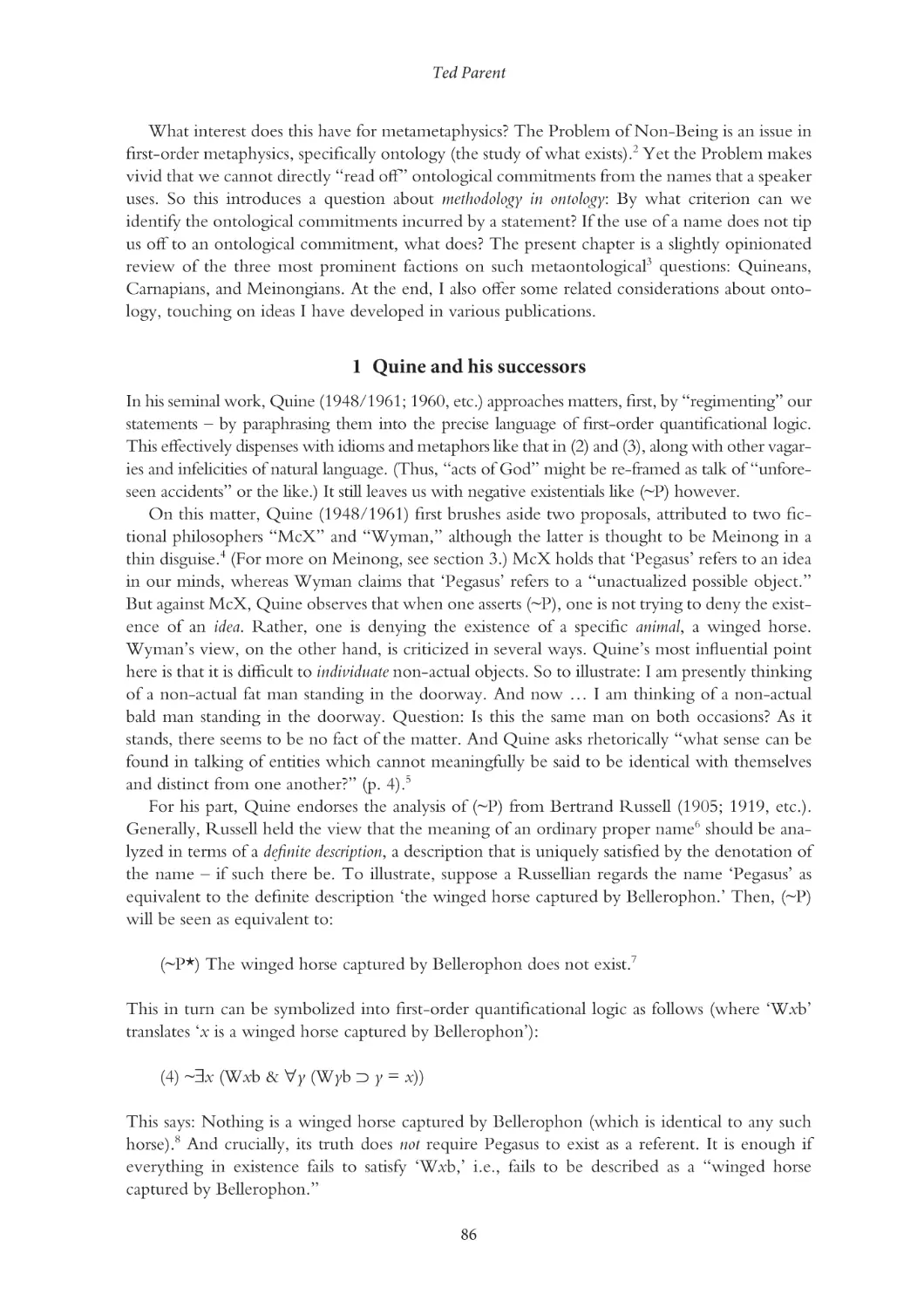
7 Ontological commitment and quantifiers
Ted Parent
85
8 Quantifier variance
Rohan Sud and David Manley
100
9 Verbal disputes and metaphysics
Brendan Balcerak Jackson
118
10 Absolute generality
Agustín Rayo
130
11 The metametaphysics of neo-Fregeanism
Matti Eklund
143
12 Easy ontology
Amie L. Thomasson
159
13 Defending the importance of ordinary existence questions and debates
Jody Azzouni
171
14 Ontological pluralism
Jason Turner
184
Part III
alternative conceptions of metaphysics
197
15 Grounding
Alexander Skiles and Kelly Trogdon
199
16 Fundamentality
Ricki Bliss
211
17 Metaphysical explanation
Naomi Thompson
222
18 Truthmaking and metametaphysics
Ross P. Cameron
233
19 Essence
Jessica Leech
245
vi
Contents
20 Fictionalist strategies in metaphysics
Lukas Skiba and Richard Woodward
259
21 Global expressivism
Stephen Barker
270
22 Hylomorphic unity
Anna Marmodoro
284
23 Feminist metametaphysics
Elizabeth Barnes
300
24 Social ontology
Rebecca Mason and Katherine Ritchie
312
25 Natural language ontology
Friederike Moltmann
325
26 Phenomenology as metaphysics
Dan Zahavi
339
Part IV
The epistemology of metaphysics
351
27 A priori or a posteriori?
Tuomas E. Tahko
353
28 The epistemology of modality
Sonia Roca-Royes
364
29 Ideology and ontology
Sam Cowling
376
30 Primitives
Jiri Benovsky
387
31 Conceptual analysis in metaphysics
Frank Jackson
395
32 Contingentism in metaphysics
Kristie Miller
405
33 Is metaphysics special?
Thomas Hofweber
421
vii
Contents
Part V
Science and metaphysics
433
34 Science-guided metaphysics
Kerry McKenzie
435
35 Methods in science and metaphysics
Milena Ivanova and Matt Farr
447
36 Thing and non-thing ontologies
Michael Esfeld
459
37 Moderately naturalistic metaphysics
Matteo Morganti
468
38 Metaphysics as the ‘science of the possible’
J.T.M. Miller
480
Index
492
viii
contRibutoRs
Jody Azzouni has published Talking About Nothing: Numbers, Hallucinations, and Fictions (Oxford
University Press, 2010), Objects Without Borders (Oxford University Press, 2017), and many
articles in metaphysics, philosophy of logic, mathematics, science, and language. He is Professor
of Philosophy at Tufts University.
Ralf M. Bader is Chair for Ethics and Political Philosophy at the Université de Fribourg in
Switzerland. Previously, he was Associate Professor at the University of Oxford, as well as
Bersoff Assistant Professor and Faculty Fellow at New York University.
Brendan Balcerak Jackson is an assistant professor of philosophy at the University of Miami.
His research focuses on numerous issues at the intersections of the philosophy of language,
metaphysics, and epistemology.
Stephen Barker did a PhD at Melbourne University, and post-doctoral fellowships in UNAM
Mexico and Monash University, Melbourne. He then took up a research position at the Univer
sity of Tasmania, Australia. He has been at the Philosophy Department, Nottingham University,
UK, since 2002.
Elizabeth Barnes is Professor of Philosophy at the University of Virginia, USA. She works
primarily in social philosophy, feminist philosophy, and metaphysics, and is especially interested
in places where these topics overlap.
Jiri Benovsky (University of Fribourg, Switzerland) specializes in metaphysics, metametaphysics, aesthetics, and philosophy of mind. He is the author of several books, including
recently: Meta-metaphysics (Springer, 2016). Eliminativism, Objects, and Persons: The Virtues of
Non-existence (Routledge, 2018), and Mind and Matter: Panpsychism, Dual-Aspect Monism, and the
Combination Problem (2018, Springer).
Ricki Bliss is Assistant Professor of Philosophy at Lehigh University, USA. Her research focuses
primarily on issues in foundational metaphysics with a particular interest in how history, in par
ticular the history of Christian thought, might bear on those issues. She is also interested in
ix
Contributors
aspects of Buddhist metaphysics, as well as issues surrounding what she doesn’t know how to
better describe than as the ethics of reading.
Ross P. Cameron is Professor of Philosophy at the University of Virginia, USA. His recent
book The Moving Spotlight (Oxford University Press, 2015) defends the objective passage of
time. His next book Chains of Being is about ontological dependence, infinite regress, and meta
physical explanation.
Sam Cowling is the John and Christine Warner Associate Professor of Philosophy at Denison
University in Granville, Ohio. He is the author of Abstract Entities (Routledge, 2017). He works
primarily in metaphysics and the philosophy of science.
Karl Egerton works at the intersection of epistemology, metaphysics, and the history of ana
lytic philosophy. Much of his research critically revisits Quine’s methodology for metaphysics
and its relations to contemporary metametaphysics. He is currently a lecturer at the University
of Hertfordshire, UK.
Matti Eklund is Chair Professor of Theoretical Philosophy at Uppsala University, Sweden. He
has published widely, in for example metaphysics, philosophy of language, philosophy of logic,
and metaethics.
Michael Esfeld is Full Professor of Philosophy at the University of Lausanne (Switzerland). His
main area of research is the metaphysics of science and the philosophy of mind. His latest book
publication is A Minimalist Ontology of the Natural World (Routledge, 2017, with Dirk-André
Deckert).
Matt Farr is a lecturer and researcher in the Department of History and Philosophy of Science
at the University of Cambridge. His work addresses philosophical problems about time and
causation across the sciences, particularly what it means for time to have a direction.
Jussi Haukioja is Professor of Philosophy at the Norwegian University of Science and Tech
nology. He specializes in philosophy of language, focusing especially on the theory of reference
and its consequences for issues in metaphysics, epistemology, and philosophy of mind.
Thomas Hofweber is a professor of philosophy at the University of North Carolina at Chapel
Hill. He works in metaphysics and the philosophy of language, and is the author of Ontology and
the Ambitions of Metaphysics (Oxford University Press, 2016) as well as numerous articles.
Milena Ivanova teaches at the Department of History and Philosophy of Science and holds a
Bye-Fellowship at Fitzwilliam College at the University of Cambridge. Her research concerns
how scientific theories uncover truths about the world, the nature of scientific principles, and
the role of values in science.
Frank Jackson is Emeritus Professor at the Australian National University. He is the author of
books and papers in the philosophy of mind and language and in ethics.
Robert Kraut is Professor of Philosophy at The Ohio State University. His primary interests
are metaphysics, aesthetic theory, and the philosophy of language. His Artworld Metaphysics
x
Contributors
(Oxford University Press, 2010) explores neo-pragmatist theories of artworld interpretation,
description, and evaluation. He has held visiting positions at Pittsburgh, Rutgers, and the Stanford Humanities Center.
Jessica Leech is Senior Lecturer in Philosophy at King’s College London, UK. She was jointly
awarded her doctorate from the Universities of Sheffield and Geneva in 2011. Her research
interests are primarily on issues to do with possibility and necessity, both contemporary and
historical.
David Manley is Associate Professor of Philosophy at the University of Michigan, Ann Arbor.
His research has mainly been concerned with semantics, ontology, probability, and evidence; he
is currently thinking about conditions for rationality and well-being for people, groups, animals,
and other cognitive systems.
Anna Marmodoro holds the Chair of Metaphysics at the University of Durham, UK and is
concomitantly a research fellow at Corpus Christi College at the University of Oxford. Her
research interests are in metaphysics; ancient, late antiquity, and medieval philosophy; philosophy of mind; and philosophy of religion. She has published monographs, edited books, and
journal articles in all these areas. Anna is also the co-founder and co-editor of the peer-reviewed
journal Ancient Philosophy Today: DIALOGOI, published by Edinburgh University Press.
Rebecca Mason is Assistant Professor of Philosophy at the University of San Francisco. She
specializes in feminist philosophy and metaphysics, especially social metaphysics. She also has
interests in philosophy of language, epistemology, and social and political philosophy.
Kerry McKenzie is Associate Professor of Philosophy at UC San Diego, USA. She specializes
in the metaphysics of science, especially in the areas of fundamentality, structuralism, and methodology, and in the issue of what it means to be a naturalist in philosophy.
J.T.M. Miller is a philosopher based at the University of Nottingham, UK. From July 2020,
he will be Assistant Professor of Philosophy at Durham University, UK. His research focuses
on issues at the intersection of metaphysics, and philosophy of language and linguistics, including on the nature of metaphysical disputes, how to assess metaphysical theories, and the metaphysics of language.
Kristie Miller is Associate Professor of Philosophy and Joint Director of the Centre for Time
at the University of Sydney. She works primarily in metaphysics, on the nature of composition,
persistence, and time, and on the associated modal status of views in these areas. Her most recent
work focuses on the error theory of time, and timeless theories of quantum gravity, and on the
nature of metaphysical explanation.
Friederike Moltmann is Research Director at the French Centre Nationale de la Recherche
Scientifique (CNRS) and in recent years has been a visiting researcher at New York University.
Her research focuses on the interface between natural language semantics and philosophy, in
particular metaphysics. She has published over seventy articles and is author of Parts and Wholes
in Semantics (Oxford University Press, 1997) and Abstract Objects and the Semantics of Natural Language (Oxford University Press, 2013). Moltmann received a PhD in 1992 from the Massachusetts Institute of Technology and taught both linguistics and philosophy at various universities
in the USA, the UK, France, and Italy.
xi
Contributors
Matteo Morganti is an associate professor at Rome Tre University, Italy, Department of
Philosophy, Communication and Visual Arts. His research focuses primarily on the philosophy
of science and metaphysics. He is the author of Combining Science and Metaphysics (Palgrave
Macmillan, 2013).
Ted Parent Nazarbayev University (in Nur-Sultan, Kazakhstan) writes on epistemology and
metaphysics, broadly construed, with publications in Philosophical Studies and The Journal of Philosophy, among others. His first monograph is Self-Reflection for the Opaque Mind (Routledge,
2017), and his second (in preparation) is A Critique of Metaphysical Thinking.
Vasilis Politis teaches at Trinity College Dublin. He has written extensively on Plato and Aris
totle, including The Structure of Enquiry in Plato’s Early Dialogues (Cambridge University Press,
2015), papers in Phronesis and other journals, and, co-edited with George Karamanolis, The
Aporetic Tradition in Ancient Philosophy (Cambridge University Press, 2018).
Agustín Rayo is a professor of philosophy at MIT and a professorial fellow at the University
of Oslo. His research is at the intersection of the philosophy of logic and the philosophy of lan
guage.
Katherine Ritchie is an assistant professor at the CUNY Graduate Center and the City College
of New York. Her research focuses on questions about how we think and talk about social
groups, the nature of social entities, and the normative and political upshots of both. Ritchie has
published articles in journals including Australasian Journal of Philosophy, Philosophy and Phenomenological Research, and Philosophical Studies.
Sonia Roca-Royes (PhD University of Barcelona) is currently a senior lecturer at the Univer
sity of Stirling. She specializes in metaphysics and epistemology of modality, with broader inter
ests in epistemology, ontology, philosophy of mathematics and logic, and philosophy of
language.
Lukas Skiba is a research associate (wissenschaftlicher Mitarbeiter) at the Institute of Philosophy of
the University of Hamburg, Germany. His research interests cover (meta)metaphysics, the
philosophy of logic and language, and the history of analytic philosophy. He obtained his PhD
from the University of Cambridge.
Alexander Skiles is an assistant teaching professor of philosophy at Rutgers University, New
Brunswick, USA. His research mainly focuses on three topics: non-causal explanation in meta
physics and the sciences; essence, identity, and individuation; and the nature of existence.
Rohan Sud earned his PhD at the University of Michigan and is currently Assistant Professor
of Philosophy at Ryerson University in Toronto. His research interests include metaphysics,
philosophy of language, and metaethics, with a particular focus on issues related to vagueness.
Tuomas E. Tahko is Reader in Metaphysics of Science at the University of Bristol, UK.
He is the author of An Introduction to Metametaphysics (Cambridge University Press, 2015)
and the editor of Contemporary Aristotelian Metaphysics (Cambridge University Press, 2012), and
has published numerous articles on metaphysics, philosophy of science, and philosophical
logic.
xii
Contributors
Amie L. Thomasson is the Daniel P. Stone Professor of Intellectual and Moral Philosophy at
Dartmouth College in Hanover, NH, USA. She is the author of Fiction and Metaphysics (Cam
bridge University Press, 1999), Ordinary Objects (Oxford University Press, 2007), Norms and
Necessity (Oxford University Press, 2013), Ontology Made Easy (Oxford University Press, 2014),
as well as over seventy book chapters and articles.
Naomi Thompson is a lecturer in philosophy at the University of Southampton, UK, and is
currently a member of the Metaphysical Explanation project at the University of Gothenburg,
Sweden. She works mostly on questions about structure, fundamentality, and explanation.
Kelly Trogdon is an associate professor at Virginia Tech in Blacksburg, VA, USA. Recent
publications include “Grounding-Mechanical Explanation” (Philosophical Studies 175/6, 2018:
1289–1309) and “Prioritizing Platonism” with Sam Cowling (Philosophical Studies 176/8, 2019:
2029–2042).
Jason Turner is Professor of Philosophy at the University of Arizona. His work lies at the
intersection of logic and metaphysics, focusing on the metaphysics of logical concepts such as
existence and identity, despite being secretly interested in everything.
Nathan Wildman is an assistant professor at Tilburg University, the Netherlands, and a member
of the Tilburg Centre for Logic, Ethics, and Philosophy of Science (TiLPS). His research con
cerns various topics in metaphysics, philosophy of language, logic, and aesthetics.
Richard Woodward’s research focuses on a cluster of connected issues in metaphysics and
aesthetics, including the nature of possibility, the methodological foundations of ontology, and
the connection between fiction and the imagination. He presently works at the University of
Hamburg.
Dan Zahavi is Professor of Philosophy at University of Copenhagen and University of Oxford,
and Director of the Center for Subjectivity Research in Copenhagen. Zahavi’s primary research
area is phenomenology and philosophy of mind, and their intersection with empirical disciplines
such as psychiatry and developmental psychology.
xiii
intRoduction
What is metametaphysics?
Ricki Bliss and J.T.M. Miller
Metaphysics sometimes seems to have a particularly special or important place within the wider
philosophical enterprise. For some, it is the centre of philosophical work, devoted to trying to
answer the fundamental questions that could be asked about the world around us. For others, it
is nonsense, mere sophistry masquerading as serious intellectual inquiry. Naturally, between
these two extremes are various middle-ground positions – perhaps metaphysics does ask sub
stantive questions, but it has been taken over in importance by empirical science, or perhaps
metaphysical answers reveal more about us and the conceptual schemes we employ than about
the ultimate nature of reality.
All philosophers (or at least all metaphysicians) think about some variant of these questions,
either implicitly or explicitly, at some point or another. Throughout the history of philo
sophy, different answers to the questions, and hence differing views about the importance of
metaphysics, have also been an implicit or explicit part of the work of major philosophical
figures. Few would argue that we must provide answers to all meta-level questions in order
to do first-order metaphysics, but to think that the answers to metametaphysical questions will
have no impact on first-order theories is to misunderstand the scope and focus of
metametaphysics.
The above-mentioned questions are all within the scope of metametaphysics, at least as the
domain will be understood in this volume. Given this wide focus of metametaphysics, whether
you are a knee-jerk metaphysical realist, Kantian, Carnpian, Aristotelian, or subscribe to (almost)
any other general view about the value and purpose of philosophical inquiry, (we hope) that
there will be something in this volume of interest to you. For better or worse, metaphysics is
part of the philosophical landscape, and what we think about metaphysical questions and the
ories will affect how we think about a range of other topics across philosophy.
For those wanting a more formal definition, on a first pass, we can characterise metameta
physics as the domain of inquiry that is concerned with methodological issues that arise within
metaphysics. If correct, then we can say that metaontology is the analogous domain concerned
with methodological issues that arise within ontology. However, whether this is the right char
acterisation of either metametaphysics, or metaontology, is a matter of much debate within the
recent literature. It is, itself, a metametaphysical (or metaontological) question, with many dif
fering views about the proper scope of these ‘meta-’ domains and their relationship with firstorder topics.
1
Ricki Bliss and J.T.M. Miller
Given this, the aim of this introduction, or indeed this handbook, cannot be to settle what
are the proper and correct topics to be classified as part of metametaphysics and/or metaontol
ogy. Rather, here we simply propose that the topics of metametaphysics include, but are strictly
not limited to, the topics covered in the chapters of this volume. In light of this, when choosing
what to include we have tried to cast the net wide; to include core topics that all (or at least
most) would accept as being part of what counts as metametaphysics, and some topics that are
less clearly core metametaphysical topics but have the potential to inspire new avenues of
research.
The structure of this volume
This volume contains thirty-eight chapters, organised into five thematic sections, and the
remainder of this introduction is devoted to providing a brief guided summary of the topics
contained within it and its structure. For those entirely new to metametaphysics, this will be
useful as a way to begin to understand the main issues; for those with more experience in the
domain, this will hopefully serve as a way to see at a glance the focus of the chapters covering
both familiar and novel topics alike. This will also, we hope, serve to help readers who are plan
ning to dip into only certain sections of this volume see where to begin.
Part I: The history of metametaphysics
This section is devoted to the history of metametaphysics. Each chapter considers one (or two)
central figures within the domain. Though all of them wrote before the term ‘metametaphysics’
had gained widespread usage, they each made significant contributions to metametaphysical
topics and continue to have a lasting effect on the contemporary literature.
Going back to the beginning, as it were, Vasilis Politis argues in Chapter 1 that, in at least
one important juncture in their work, both Plato (in Sophist 242c ff.) and Aristotle (in Metaphysica IV.1–2) argue that in order to properly consider the question, ‘What is there?’, we need
to consider the question, ‘What does “to be” mean?’ Unlike typical modern metaphysicians,
however, Politis argues that neither Plato nor Aristotle think that the question ‘What does “to
be” mean?’ is prior to or foundational of the question, ‘What is there?’.
In Chapter 2 of the volume, Bader develops a Kantian approach to meta-ontology. He con
trasts first-level and second-level construals of existence with Kant’s modal interpretation of
existence and then identifies the problems of modal representation as the central issue of Kantian
metaontology. He shows how this problem can be overcome by non-conceptual resources. In
Chapter 3, Robert Kraut makes the case that Rudolf Carnap is a Pragmatist and an Expressivist
about ontology. According to Kraut, Carnap’s conception of ontological practice is not the
‘deflationist’ view – often attributed to him – that ontological disputes are vacuous and/or
inconsequential. Contrary to common belief, Carnap does not seek to dismiss arguments about
the existence of various sorts of entities as ‘merely verbal’, or to endorse the eliminativist view
that ontological arguments should be expunged from our repertoire. Carnap’s goal, rather, is to
show that continued participation in ontological theorising is consistent with empiricist scruples.
Ontological discourse for Carnap is a device that serves to express commitments to adopting
certain linguistic/conceptual resources, hence his expressivism. And the acceptance or rejection
of linguistic frameworks is to be decided by their ‘efficiency as instruments’, hence his
pragmatism.
In Chapter 4, Karl Egerton discusses Quine. He explains why a significant part of the endur
ing value in Quine’s work should be accorded to his contribution to metametaphysics. This
2
Introduction: what is metametaphysics?
involves revisiting the core Quinean ideas that inform the methodology of metaphysics, but also
includes showing how some less regarded, more contentious aspects of Quine’s thought can be
seen as indispensable to that thought, problematising the widespread belief that one can extract
core aspects of Quine’s metametaphysics in isolation without eroding their warrant.
In Chapter 5, Haukioja presents an overview of the debate between metaphysical realism and
anti-realism, as it has been carried out during the last decades. Metaphysical realism is character
ised as a combination of metaphysical, semantic, and epistemic theses: first, the world consists
(mostly) of mind-independent things and properties; second, truth involves a correspondence
between words and the world; third, even an ideal theory could be radically false. Arguments
against metaphysical realism typically aim to show that this combination of views is internally
incoherent or unstable; that the metaphysical realist ‘cannot say what he or she wants to say’ (as
recently put by Tim Button). Haukioja reviews the main challenges to metaphysical realism:
Hilary Putnam’s model-theoretic argument and his ‘brains in a vat’ argument, as well as Philip
Pettit’s theory of global response-dependence of concepts. He also discusses the content of
metaphysical anti-realism. Critics of this view typically want to defend common-sense realism,
and the anti-realist should therefore reject either the semantic or the epistemic component of
metaphysical realism (or both). However, it has turned out to be difficult to give clear positive
content to such a view.
In Chapter 6, Nathan Wildman discusses the more recent history of the now waning
philosophical obsession with the notion of modality. From the early 1960s until the turn of
the twenty-first century, metaphysics was dominated by broadly modal issues. But times have
changed. Metaphysics has outgrown its modal myopia, as a number of hyperintensional
notions have emerged and now play many of the roles that metaphysical modality formerly
did. In his contribution to the volume, Wildman charts the rise and fall of modal metaphysics.
In so doing, he also demonstrates that the main argument modal metaphysicians used to
motivate the general shift of focus from the metaphysics of what is to the metaphysics of what
must be equally motivate a further shift, towards a metaphysics centring on the various postmodal, hyperintensional notions. The upshot of Wildman’s discussion is that even modal
enthusiasts should agree that modality is not (and should not be) the central metaphysical
notion anymore.
Part II: Neo-Quineanism (and its objectors)
The chapters in this section focus on the ‘neo-Quinean’ conception of metaphysics. Quine has
(probably) had one of the largest ongoing influences on (Anglo-American analytic) metaphysics
in the twentieth century, and his conception of the central question of metaphysics as being the
question of ‘what exists?’ continues to be defended and critiqued in contemporary work. In this
context, metaphysics becomes the domain interested in providing a list of all the things that
exist, or in Quinean terms, all the things that are the value of a bound variable within our best
theory. This section covers both defences and criticisms of this conception of metaphysics, and
broader considerations about the nature of the existential quantifier on which such a conception
is founded.
In Chapter 7, Ted Parent offers a slightly opinionated review of the three main factions in
metaontology: Quineans, Carnapians, and Meinongians. Discussion of the first faction includes
consideration of Quine, van Inwagen, and Sider; discussion of the second includes Carnap,
Thomasson, and Hofweber; and of the third Meinong, Priest, Berto, Zalta, and Crane. Par
ticular attention is devoted to how quantification is interpreted by different philosophers. Parent
also offers some pragmatist remarks about the legitimacy of ontology.
3
Ricki Bliss and J.T.M. Miller
Rohan Sud and David Manley take on quantifier variance in Chapter 8. Quantifier variance
is the view that there are several distinct notions that are relevantly similar to our notion of
unrestricted existence, and none of these notions are metaphysically distinguished. They offer
an overview of that thesis. They explore some challenges to the claim that there are several
distinct existence-like notions and to the claim that these notions are metaphysically on a par.
They also consider what implications the view has for first-order ontological debates, particu
larly common-sense ontology.
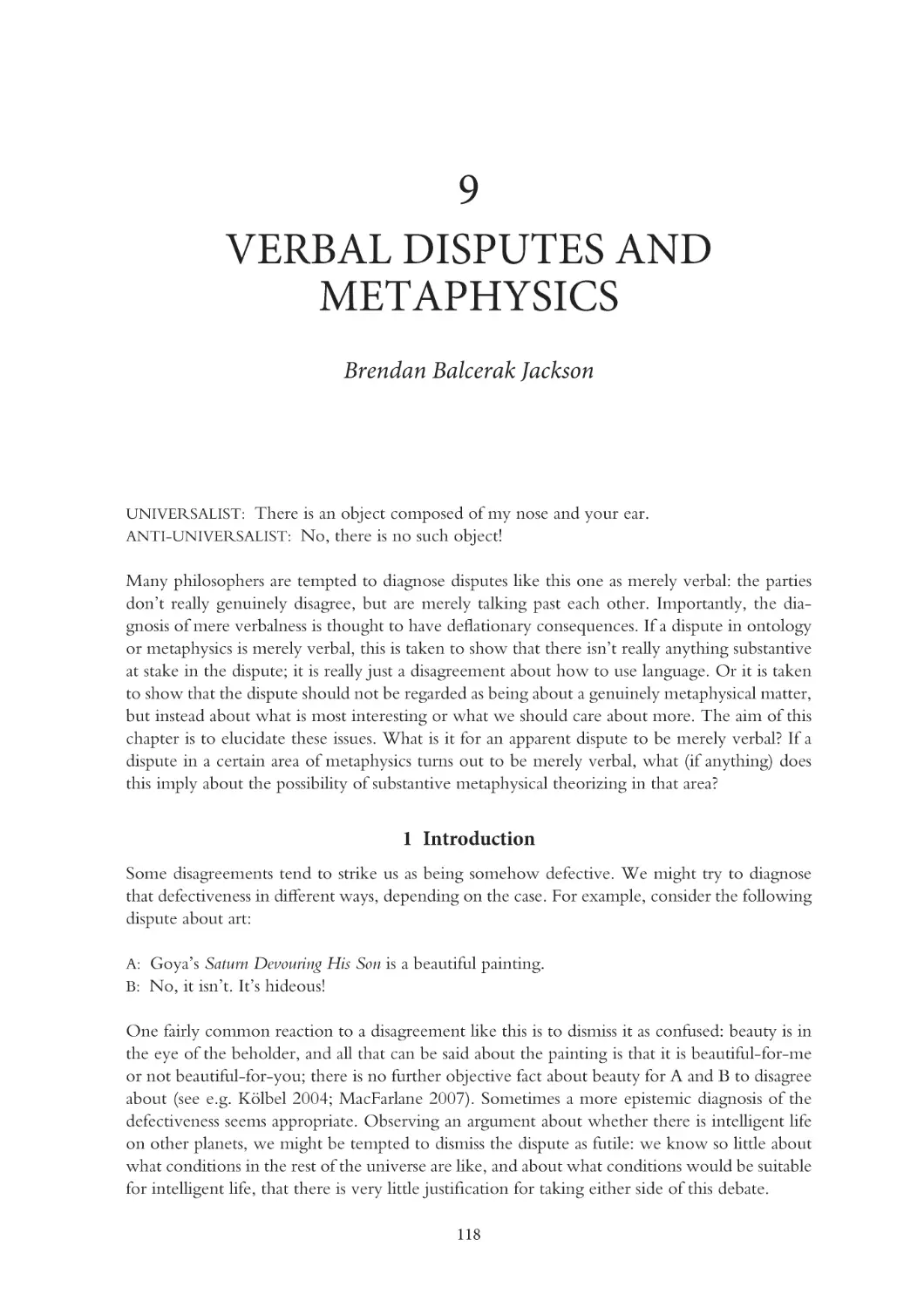
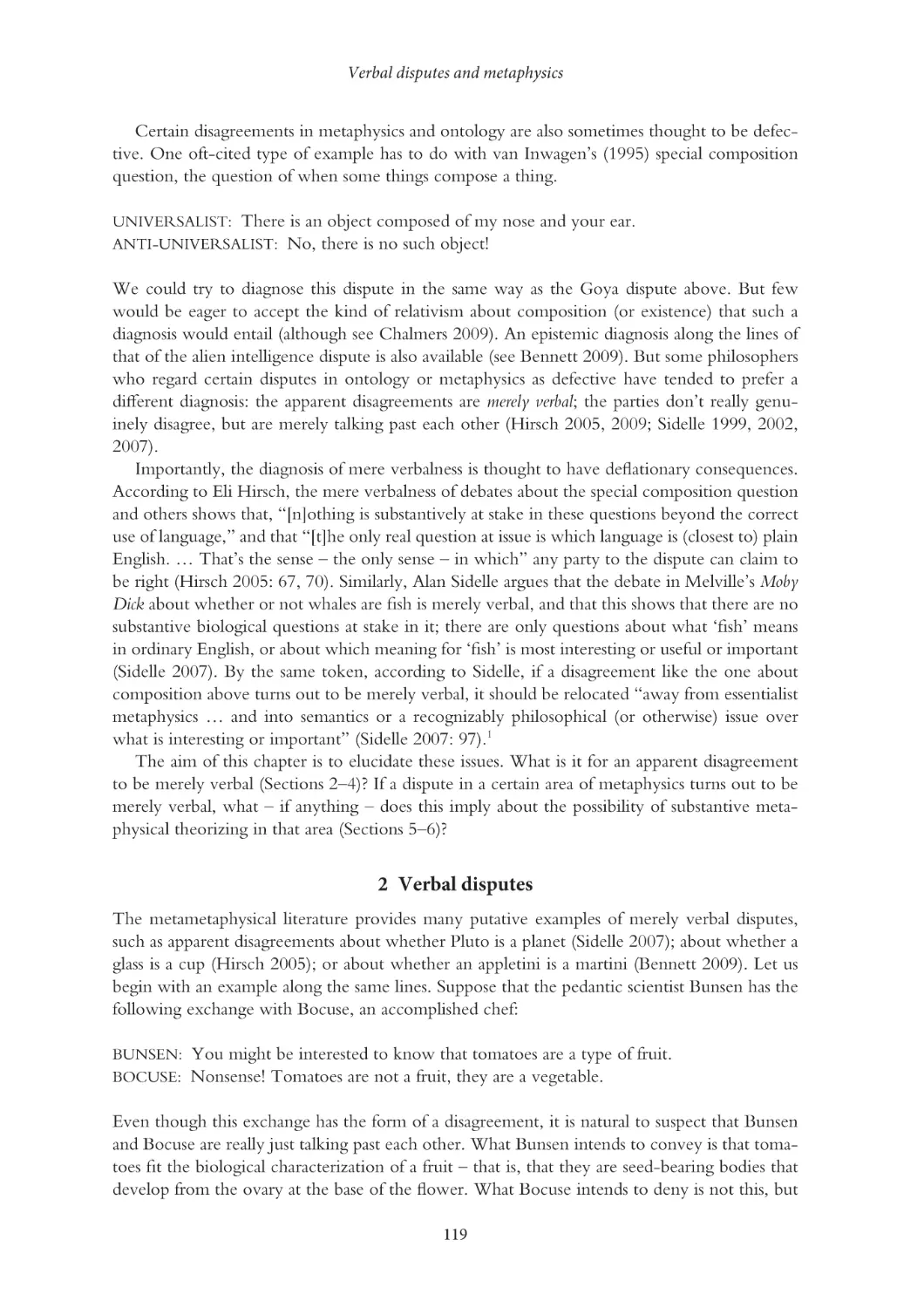
In Chapter 9, Brendan Balcerak-Jackson discusses verbal disputes in metaphysics. Certain
disagreements in metaphysics and ontology are sometimes thought to be defective. One oft-cited
type of example has to do with the special composition question, the question of when some
things compose a thing. According to the Universalist: There is an object composed of my nose
and your ear. According to the Anti-universalist: No, there is no such object! Many philosophers
are tempted to diagnose disputes like this one as merely verbal: the parties don’t really genuinely
disagree, but are merely talking past each other. Importantly, the diagnosis of mere verbalness is
thought to have deflationary consequences. If a dispute in ontology or metaphysics is merely
verbal, this is taken to show that there isn’t really anything substantive at stake in the dispute; it
is really just a disagreement about how to use language. Or it is taken to show that the dispute
should not be regarded as being about a genuinely metaphysical matter, but, instead, about what
is most interesting or what we should care about more. Balcerak-Jackson aims to elucidate these
issues by addressing such questions as: What is it for an apparent dispute to be merely verbal? If a
dispute in a certain area of metaphysics turns out to be merely verbal, what (if anything) does this
imply about the possibility of substantive metaphysical theorising in that area?
Chapters 10 and 11 come from Agustin Rayo and Matti Eklund respectively. Rayo discusses
Absolutism: the thesis that there is sense to be made of absolutely general quantification. Rayo
aims to clarify what exactly the metaphysical debate is between absolutists and some of their
detractors. Matti Eklund provides an overview of the so-called metametaphysics associated with
neo-Fregeanism in the philosophy of mathematics. Neo-Fregeanism – championed most prom
inently by Bob Hale and Crispin Wright – as the name indicates, is inspired by ideas found in
the work of Gottlob Frege. One characteristic of neo-Fregeanism is that it seeks to combine a
version of platonism (there exist mind-independent mathematical objects) with a version of
logicism (the ontologically committing mathematical truths are akin to truths of logic). Eklund
discusses how platonism and logicism can reasonably be combined. Another characteristic of
neo-Fregeanism is its focus on abstraction principles, and the chapter discusses the role of such
principles as well.
The ‘easy approach to ontology’ – best associated with Aimee Thomasson – maintains that
many existence questions that are contested in metaphysics are actually easy to answer via trivial
inferences that take us from an uncontroversial premise, via a conceptual truth, to a conclusion
about what exists. Such arguments have often been dismissed or treated as paradoxical – in part
because they conflict with the neo-Quinean way of addressing existence questions by seeking
the best ‘total theory’ and determining what it must quantify over. Easy arguments are important
not merely because they seem to answer questions about whether properties, numbers, proposi
tions, and things of many other sorts exist, but also because they call into question a way of
approaching existence questions that was so dominant as to be virtually unquestioned for
decades. Chapter 12, authored by Aime Thomasson, reviews the history of easy arguments and
explains their importance both to first-order ontological debates and to meta-ontological ques
tions – where they seem to bring the prospect of demystifying metaphysics, and turning atten
tion away from existence questions. It also reviews major objections to easy arguments, along
with paths that have been used in replying to these objections.
4
Introduction: what is metametaphysics?
Ontology is a subject matter directed at questions such as: Are there numbers? Are there
objects that are empirically undetectable? Are there properties? Do tropes exist? Are events real?
What about fictional beings such as Sherlock Holmes? But questions of this nature appear to
motivate debates amongst scientists as much as they do philosophers: Are there molecules? Does
Bigfoot exist? What about extraterrestrials? In Chapter 13, Jody Azzouni evaluates different
metaphysical positions on whether (and in what ways) they leave intact our ordinary practices
of debating about metaphysical claims and disagreeing over such claims. Some positions – Car
napian and neo-Carnapian positions, such as the one held by Amie Thomasson – explicitly rule
out the kinds of metaphysical claims that occur in philosophy. Others philosophers, such as
W.V. Quine and proponents of quantifier variantism, such as Eli Hirsch, characterise our (col
lective) logic resources in such a way that debates can only occur subject to the successful trans
lation of the claims of opponents into the ‘languages’ of one another. The translations possible,
however, undercut important aspects of these debates, such as the fact that the disagreement is
often over just the existence of an entity or kind of entities, and not over descriptions of them.
Only one position, Azzouni’s own quantifier neutralism, leaves metaphysical debate – as we
ordinarily do it – intact.
The final chapter of Part II of the volume deals with ontological pluralism. According to the
ontological pluralist, there are different ways, modes, or kinds of being. In Chapter 14, Jason
Turner discusses recent treatments of the doctrine of ontological pluralism, which tie it to the
thought that there are different metaphysically special quantifiers. After discussing some attempts
to characterise this thought more precisely and some pitfalls they must avoid, he responds to two
arguments against the viability of ontological pluralism. The first of these is Trenton Merricks’
argument that disagreements between pluralists about how many modes of being there are must
be either trivial or inexpressible. The second is Bruno Whittle’s arguments that ontological plur
alism and ontological monism are notational variants of each other.
Part III: alternative conceptions of metaphysics
Part III includes various alternative ways of conceiving of the purpose and methodology of
metaphysics that have blossomed in recent years, many in direct response to the apparent failure
of the neo-Quinean conception of metaphysics. This includes chapters that defend and those
that criticise the idea that metaphysics is a substantive domain of research.
This section opens with a topic of much contemporary interest, grounding. Metametaphysics
concerns foundational metaphysics. Questions of foundational metaphysics include: What is the
subject matter of metaphysics? What are its aims? What is the methodology of metaphysics? Are
metaphysical questions coherent? If so, are they substantive or trivial in nature? Some have
claimed that the notion of grounding is useful in addressing such questions. In Chapter 15,
Alexander Skiles and Kelly Trogdon introduce some core debates about whether – and, if so,
how – grounding should play a role in metametaphysics. They consider how grounding might
be relevant to whether metaphysical questions are substantive, how to choose between meta
physical theories, and how to understand so-called ‘location problems’. Following on from this
in Chapter 16, Ricki Bliss discusses what, in the contemporary debate, has become a related
notion – that of fundamentality. She considers several different ways in which fundamentality
appears to be contemporarily understood; along with the reasons often cited for believing the
view in the first place.
In Chapter 17, Naomi Thompson takes on a topic also enjoying an enormous amount of
contemporary attention, metaphysical explanation. Thompson distinguishes the different things
we might mean by the term ‘metaphysical explanation’, discusses metaphysical explanation in
5
Ricki Bliss and J.T.M. Miller
contrast to the more familiar notion of scientific explanation, and motivates the view that the
two are to be distinguished. There is little consensus on what is the best way to model meta
physical explanations, but she presents the most prominent alternatives. She ends with a discus
sion of realism and antirealism about metaphysical explanation.
In Chapter 18, Ross Cameron explores how questions in metametaphysics interact with
questions concerning truthmakers. He defends an account of ontological commitment in terms
of truthmaking. Whereas Quine said that the ontological commitments of a theory are those
things that must be in the domain of quantification if the theory, regimented in a first-order
language, is to be true, the truthmaker account says that the ontological commitments of a
theory are those things that must exist to make the theory true. He also argues that the truthmaker account is the best way of defending ontology as a deep and distinctively metaphysical
project in the face of challenges from those who argue for a deflationary metaphysics.
Jessica Leech, in Chapter 19, addresses the question, ‘What is essence?’ In rough terms, the
essence of a thing is what it is to be that thing. So, perhaps what it is to be Socrates is, in part,
to be human. Or what it is to be the number 2 is to be the successor of 1. Or what it is to be
the Mona Lisa is, in part, to have been painted by da Vinci. Such a phrase has its origins in Aris
totle, and the notion of essence can be found throughout the history of philosophy. This chapter
focuses primarily on attempts to give an account of what essence is, and its relationship to other
(meta)metaphysical notions such as necessity, real definition, grounding, and identity more
contemporarily. Leech reviews attempts to define essence in terms of necessity, and how these
might be refined in the light of some well-known purported counterexamples to such attempts.
She considers alternative accounts of essence, for example, given in terms of real definition,
grounding, or identity. She considers the breadth of the notion of essence, introducing the dis
tinction between constitutive and consequential essence, and considering what has an essence
(objects? properties? facts?). She also takes a critical look at essentialist theories of modality;
where rather than giving an account of essence in terms of modality, an account of modality is
given in terms of essence.
Chapter 20 looks to a discussion of fictionalism. Fictionalists try to reconcile our linguistic
practices with our ontological scruples. They want to speak as if there are, say, numbers, possible
worlds, or properties, without thereby accepting the existence of the entities in question. In this
chapter, Lukas Skiba and Richard Woodward offer a minimal and inclusive characterisation of
fictionalism that tries to do justice to the large variety of projects associated with this label. The
authors provide an overview of what they take to be the core choice points facing the fictional
ist, a survey of some of the main issues facing the viability of fictionalist strategies, as well as
pointers to how these issues might be addressed.
Stephen Barker considers the prospects of globalising expressivism – a position in the philo
sophy of language that questions the central role of representation in a theory of meaning or lin
guistic function. An expressivist about a domain D of discourse proposes that utterances of sentences
in D should not be seen, at the level of analysis as representing how things are, but as expression
non-representational states. So, in the domain of value-utterances, the standard idea is that speakers
are expressing affective-states, such as approval or disapproval focused on objects or conditions.
Global expressivism is the thesis that for all domains of discourse, we treat utterances, at the level
of analysis, as expressing non-representational states. In Chapter 21, Barker sets out several concep
tions of how one might formulate this programme, advancing his preferred account. Having set
out key aspects of his favoured approach, Barker then addresses the question of metaphysics. What
metaphysical conception of reality goes with global expressivism so understood?
One of the greatest metaphysical insights that Aristotle contributed to the history of philo
sophy is that objects may be partitioned in two ways: into parts and into abstracta. The latter
6
Introduction: what is metametaphysics?
kind of division has not received due attention among contemporary extensional mereologists
(who advocate division into parts only), and even in neo-Aristotelian quarters. In Chapter 22,
in addition to clarifying which type of part is relevant for understanding Aristotle’s hylomor
phism, Anna Marmodoro urges that we need to critically re-examine certain assumptions we
make in our study of Aristotle’s theory of substance. Among the questions she raises in this
chapter are these: Is there a primary matter-to-form ‘relation’ in a substance? Is the ‘relation’
between matter and form in a substance analogous to that of potentiality to actuality? Does
Aristotle’s theory of substance deliver a sound account of substantial unity? She argues that it
doesn’t, and supplies an account, which derives from principles within Aristotle’s metaphysics,
but differs from the account given to us by Aristotle. She argues that Aristotle came very close
to having a full account of the oneness of a substance, but fell short of it. He unified matter and
form in a substance definitionally, but did not explain and justify the oneness of the definition.
The next chapter in this section is from Elizabeth Barnes. When looking at contemporary
analytic feminism, there are three main themes that can be well-described as metametaphysics:
the metaphysical importance of the social, the political significance of metaphysical claims, and
the link between metaphysics and social progress. The bulk of Chapter 23 focuses on the third
of these themes, as Barnes considers this to be the place where feminist philosophy becomes the
most metaphilosophically distinctive.
As Rebecca Mason and Kate Ritchie point out, in Chapter 24, traditionally, social entities
(i.e. social properties, facts, kinds, groups, institutions, and structures) have not fallen within the
purview of mainstream metaphysics. In their contribution to the volume, they consider whether
the exclusion of social entities from mainstream metaphysics is philosophically warranted or if
it, instead, rests on historical accident or bias. Mason and Ritchie examine three ways one might
attempt to justify excluding social metaphysics from the domain of metaphysical inquiry and
argue that each fails, thus concluding that social entities are not justifiably excluded from meta
physical inquiry. Finally, they ask how focusing on social entities could change the character of
metaphysical inquiry. They suggest that starting from examples of social entities might lead
metaphysicians to rethink the assumption that describing reality in terms of intrinsic, inde
pendent, and individualistic features is preferable to describing it in terms of relational, dependent,
and non-individualistic features.
In Chapter 25, Friederike Moltmann gives an outline of natural language ontology as a sub
discipline of both linguistics and philosophy. She distinguishes natural language ontology from
both folk metaphysics and foundational metaphysics, as well as other sorts of cognitive ontolo
gies. She offers a characterisation of the subject matter of natural language ontology drawing a
distinction between the core and periphery of language, and argues that part of the construc
tional ontology reflected in natural language is, in significant respects, on a par with syntax (on
the generative view).
The relationship between phenomenology and metaphysics is controversial. One reason for
this is that the meaning of both of the central terms is equivocal. In Chapter 26, Dan Zahavi
focuses on phenomenology in the Husserlian sense. He addresses such questions as, ‘How did
Husserl view the relation between phenomenology and metaphysics?’ ‘Is phenomenology meta
physically neutral, does it disregard all questions pertaining to being, or is it on the contrary
committed to a specific kind of metaphysics, say, a form of subjective idealism or robust realism?’
The answer to these questions is controversial, and there is no obvious consensus in the liter
ature. He presents and discusses some of the prevailing interpretations before finally turning to
Husserl’s own texts for some answers.
7
Ricki Bliss and J.T.M. Miller
Part IV: The epistemology of metaphysics
Part IV takes up the question of how metaphysical knowledge is possible, if it is at all. Providing
an epistemology of metaphysics is crucial to any full defence of the domain of inquiry. This
section will consider the pros and cons of recently defended accounts of metaphysical epis
temology, the correct methodology of metaphysical inquiry (for example, whether metaphysical
inquiry is an a priori or a posteriori enterprise), and the role that various notions such as ‘primi
tive’ and methods, such as conceptual analysis, play in metaphysical theorising.
In Chapter 27, Tuomas Tahko asks what the significance is of the distinction between the a
priori and the a posteriori in metametaphysics. The primary relevance of the distinction con
cerns the source of metaphysical knowledge and our epistemic access to that source. For instance,
how can we gain knowledge about things like numbers and sets, which are abstract objects?
What about possibility and necessity and modal truths more generally? In many cases, it seems
that we have to resort to a priori methods. But this raises an immediate concern, because many
contemporary metaphysicians are in favour of naturalistic metaphysics, whereby a priori know
ledge is often regarded as problematic, if not altogether impossible. Tahko discusses all of these
issues, focusing especially on the distinction between a priori and a posteriori methods and the
links to modal epistemology, naturalistic metaphysics, and the relationship between metaphysics
and science more generally.
In Chapter 28, Sonia Roca-Royes discusses, in the form of an inconsistent set of three
claims, the main challenge in the epistemology of modality. Each of the three main responses to
it – Rationalism, Empiricism, and Scepticism – can be seen as consisting in denying one of those
claims. This chapter focuses on two meta-epistemological distinctions that are becoming more
and more central in the literature. The first one classifies the epistemologies of modality on the
basis of the amount and nature of the suggested routes to modal knowledge: uniform accounts
suggest only one route to modal knowledge whereas non-uniform accounts suggest more than
one. The second one classifies epistemologies on the basis of their suggested epistemic priority
relations: accounts that deny epistemic priority relations are known in the literature as symmet
ric accounts. Within the asymmetric ones, necessity-first accounts take (at least some) know
ledge of necessity to be prior to any knowledge of possibility, while it’s the other way around
for possibility-first accounts. While the primary aim of the chapter is to survey recent literature
and identify the directions that current research is taking, it also motivates the need for a non
uniform and symmetric epistemology of modality.
In Chapter 29, Sam Cowling discusses ideology and ontology. Metaphysical theories can
differ without differing in their ontological commitments. This is due, in part, to the fact that
theories accrue ideological, as well as ontological, commitments; where ideological commit
ments concern what kinds of truths obtain or what concepts are expressible in theories. Famil
iar kinds of ideological commitments include the introduction of primitive modal and
temporal operators or various primitive predicates satisfied by the putative ontologies of the
ories. Cowling’s entry surveys various kinds of ideological commitments, strategies for char
acterising the ideology-ontological distinction, and the principles of theory choice that might
guide inquiry into the world’s ideological structure. He focuses on the respective contribu
tions of David Lewis, W.V. Quine, and Theodore Sider to the notion of theoretical
ideology.
All metaphysical (and other) theories have something in common: they all contain primi
tives. In Chapter 30, Jiri Benovsky explores the role primitives play in theories, emphasising the
fact that they do most of the theoretical work. He also discusses the nature of primitives, as well
as taking in a discussion of the notion of ‘explanatory power’.
8
Introduction: what is metametaphysics?
In Chapter 31, Frank Jackson discusses how conceptual analysis – understood as the clari
fication and explication of ‘what it takes to be a so and so’ questions, of how something has
to be to be a so and so – bears on issues in metaphysics, where metaphysics is understood as
concerned with what there is and what it is like. He argues that conceptual analysis tells us
when accounts of how things are in terms of one set of properties (or concepts) are or are not
in potential conflict with accounts in terms of a putatively different set of properties; it can
alert us to properties that might otherwise have escaped our attention, or to properties we
might have thought incoherent; it can alert us to patterns in data that are important for pre
diction and explanation, and, relatedly, suggest when it would be wise to make one or another
modification to the concepts we employ in prediction and explanation; and that conceptual
analysis, in its ‘rewriting sentences guise’, can show us how to avoid unwanted ontological
commitments.
Focusing principally on metaphysical contingentism rather than entity contingentism, in
Chapter 32, Kristie Miller outlines three positions: global metaphysical contingentism, global
metaphysical necessitarianism, and metaphysical moderatism. The first of these is the view that
all metaphysical principles are contingent, the second that all metaphysical principles are neces
sary, and the last that at least some metaphysical principles are contingent. Arguments for each
view are considered, and it is suggested that jointly, these arguments tend to militate in favour
of metaphysical moderatism.
In the final chapter of this section, Chapter 33, Thomas Hofweber asks the question ‘Is meta
physics special, either in a positive or a negative way?’ His contribution to this volume aims to
clarify the question and critically discusses several proposals about why one might think that it
is special. Among such proposals is the view that metaphysics is especially glorious since it is the
queen of the sciences or the true revealer of reality, as well as the view that metaphysics is espe
cially problematic, since it is either attempting to answer meaningless questions or is engaged in
unjustified speculation.
Part V: Science and metaphysics
The last section of the volume, Part V, connects in various ways to the topics in Part 4, but with
a particular focus on the relationship of metaphysics to the empirical sciences, most centrally
physics. Chapters in this section will consider various accounts about how to distinguish meta
physics and science (if we can at all), whether metaphysics should be (merely?) the ‘handmaiden
of science’, whether metaphysics is prior to science or science relies on metaphysical work, and
whether metaphysical claims can disagree or even overrule empirical theories.
In Chapter 34, Kerry McKenzie considers the thorny issues of how science is to guide meta
physics in her piece, ‘Science Guided Metaphysics’. It seems ludicrous to deny that serious
metaphysical enquiry ought to be ‘informed by science’ – the basic tenet of naturalistic meta
physics. But while seemingly so unobjectionable, McKenzie discusses three problems that must
be addressed by any metaphysician defending a naturalistic approach. First, that the very notion
is ill-defined without a clear demarcation of what counts as ‘science’ – a task that was largely
abandoned as hopeless in the 1980s. Second, that there is no consensus on what the methodol
ogy of naturalistic metaphysics is – in particular on the role of supra-empirical virtues in it – and
as such no clear place to start assessing the claim that its methodology is superior to that of its
rival. Third, that the ‘problem of theory change’ that vexed philosophers of science has yet to
be addressed in the context of metaphysics, and there are extra reasons to be pessimistic about
the idea that metaphysical theories can be said to ‘make progress’ through shifts in their under
lying scientific paradigms. In sum, while on the face of it a naturalistic approach to metaphysics
9
Ricki Bliss and J.T.M. Miller
seems an attractive, even compulsory, position, much work remains to be done both in charac
terising it and in securing its superior epistemic credentials.
While science is taken to differ from non-scientific activities in virtue of its methodology,
metaphysics is usually defined in terms of its subject matter. However, many traditional ques
tions of metaphysics are addressed in a variety of ways by science, making it difficult to demar
cate metaphysics from science solely in terms of their subject matter. Are the methodologies of
science and metaphysics sufficiently distinct to act as criteria of demarcation between the two?
In Chapter 35, Milena Ivanova and Matt Farr focus on several important overlaps in the meth
odologies used within science and metaphysics in order to argue that focusing solely on meth
odology is insufficient to offer a sharp demarcation between metaphysics and science, and
consider the consequences of this for the wider relationship between science and metaphysics.
In Chapter 36, Michael Esfeld takes on the topic of thing and non-thing ontologies. He first
considers the main versions of ontologies of discrete objects, most notably atomism and Aristote
lian substance ontology, along with ontologies of discrete events. He then considers non-thing
ontologies, most notably the ontology of one continuous stuff. In assessing these ontologies, the
chapter lays stress on how they fare with respect to physics. In Chapter 37, Matteo Morganti
provides an overview of the meaning, motivation, and available forms of naturalised metaphysics.
He gives arguments in favour of what will be called ‘moderately naturalistic metaphysics’, an
approach that, while acknowledging the priority of science in providing knowledge of the natural
world, also preserves the autonomy of metaphysical inquiry. In particular, he argues that, due to
the fact that any explanatory hypothesis is underdetermined by the empirical data, radical natural
ism – the view that metaphysics should be made entirely dependent on science or even discon
tinued – is untenable; and that science and metaphysics should be developed in parallel, the
former providing substance and support to metaphysical hypotheses, and the latter making the
interpretation of scientific theories possible. In the closing chapter of the volume, Chapter 38,
J.T.M. Miller considers the view that a central concern of metaphysics is what is possible. That
is, that unlike science, metaphysics studies not only what is actual, but also the ways that reality
could be. This view, if right, provides metaphysics with a distinct subject matter from that of
science, and, depending on what modal epistemology we adopt, a distinct methodology too.
Of course, much more can be said about each of the issues discussed in this volume. Indeed,
we could have doubled the number of its contributions and still not exhausted the spread of
valuable and rich topics that fall within the scope of metametaphysics. Alas, thousand-page
volumes are a relic of the past, and editors with the skill to corral eighty-plus authors are in short
supply in the contemporary academy. Suffice it say, however, that we hope that readers inter
ested in topics in metametaphysics might find something of value in these pages.
Editors’ acknowledgements
Editing a book, let alone one as long as this, requires help from too many people to mention
them all individually. We would, though, as editors, particularly like to mention a few people.
First, thanks to our authors for producing excellent chapters for the volume. Second, thanks to
Adam and Tony at Routledge for their help throughout this process, and Penny, Allie, and Pip
for helping in the production and copy-editing. Third, we would like to thank Matthew Dun
combe and Alessandro Torza for help reviewing. Fourth, thanks to colleagues at Trinity College
Dublin and Nottingham University for help and advice about how to approach editing such a
large volume. Lastly, but certainly not least, thanks to Anna Bortolan for continued and constant
support.
10
PART I
The history of metametaphysics
1
MetaMetaphysics in plato
and aristotle
Vasilis Politis
Introduction
To consider whether there is in Plato and Aristotle a philosophical enquiry and mode of argument comparable to what is today called metametaphysics, it will, I think, be useful and important
to distinguish two very different ways in which one may conceive of such a philosophical
enquiry and mode of argument. Both ways are present, it seems to me, in the current metametaphysics literature, but, if I am not mistaken, one of them is dominant.
On a radical conception of metametaphysics, a philosophical enquiry and mode of argument
may be characterized as metametaphysical, if the philosopher, in preparation for engaging in
metaphysical enquiry in general, and any metaphysical enquiry in particular, deems it necessary
to conduct a different enquiry of a semantic-conceptual character.
On a modest conception of metametaphysics, a philosophical enquiry and mode of argument
may be characterized as metametaphysical, if the philosopher, in preparation for engaging in a
particular metaphysical enquiry, deems it necessary to conduct a different enquiry of a semanticconceptual character.
It seems to me the difference between the radical and the modest conception of metametaphysics is very important. On the radical conception, it is possible to separate semantic-conceptual
enquiry from metaphysical enquiry; and semantic-conceptual enquiry is, in the order of philosophical enquiry, prior to metaphysical enquiry. Not so on the modest conception. The modest
metametaphysician may, in preparation for engaging in a particular metaphysical enquiry, deem
it necessary to conduct a different enquiry of a semantic-conceptual character; but he may think
that that metaphysical enquiry is part of or tied up with other metaphysical enquiries, and there
is no implication that he will deem that in preparation for engaging in them, too, it is necessary
to conduct a different enquiry of a semantic-conceptual character.
In this chapter I argue that we can find in Plato and Aristotle significant metametaphysical
enquiries of the modest variety, and the modest variety only. I shall demonstrate this with reference to a particular juncture in Plato’s enquiry into being in the Sophist and a comparable
juncture in Aristotle’s enquiry into being in Metaphysics IV. Demonstrating that these are
metametaphysical enquiries, but of the modest variety only, does not directly establish that there
are not radical metametaphysical enquiries in Plato or Aristotle. But it does establish this, if we
may suppose that these two particular metametaphysical enquiries in Plato and Aristotle are
13
Vasilis Politis
paradigmatic and exemplary examples of such enquiries. For reasons of space, I cannot defend
this supposition in this chapter.
While the commitment to a modest form of metametaphysics seems sensible, I confess that I
am puzzled at why anyone would want to commit to the radical form of metametaphysics. At
the same time, I recognize that, as metametaphysics is characterized today, it is commonly the
radical variety that is being invoked. For, as metametaphysics is commonly characterized, it is
‘the foundation of metaphysics’.1 And it is clear that, on the modest variety, metametaphysics is
not foundational.
Plato takes some time out to reflect on the meaning of the expression “to be”
At a particular juncture in the dialogue Sophist, Plato turns to the question of what there is. He
introduces this juncture as follows: ‘It seems to me that Parmenides has communicated with us
in a slapdash fashion, as has anyone that ever rushed to judgement in the matter of distinguishing
how many the things that are, are, and of what sorts they are’ (242c4–6; trans. Rowe). The
question at issue, evidently, is “What is there?”; or, in the precise terms in which Plato formulates it, “How many things are there, and of what sort?” But it appears that Plato intends a
complaint about the way in which this question has been taken up by his predecessors. What is
the complaint?
Having provided a short and colourful summary of a variety of answers that past thinkers
have defended in response to the question of what there is (242c8–243a1), Plato says the
following:
Now as to whether any of this, as said by any of them, is true or not, it would be harsh
and inappropriate to rebuke men of fame and antiquity for failings on such a scale; but
there is that one aspect that no one could begrudge our pointing out … they have
been too inclined to look down their noses at us ordinary mortals and treat us with
contempt; each pursues his own project without caring at all whether we’re following
what they say or being left behind … Whenever anyone utters something to the effect
that many, or one, or two are, or have come into being, or are coming into being, …
by the gods, Theaetetus, do you ever understand a single thing they’re saying?
(243a2–b7; trans. Rowe)
His complaint, he says here, does not concern the truth or falsity of past theories about what
there is; it concerns the intelligibility of those theories. But what is supposed to be unintelligible
about them? And why is it supposed to be unintelligible?
The Eleatic Visitor directly spells out what he finds unintelligible in all available theories, to
date, about what there is: it is their use of the expression “to be”. He says things like: ‘we need
first to investigate what is (to on), and look for exactly what those who use the expression think
they are indicating (dēloun) by it’ (243d3–5) ‘ “So come on, you people who claim that all things
are hot and cold or some other such pair of things: what exactly are you uttering (phtheggesthai)
about them both, when you say both and each of them are?’ ” (243d8–e2). ‘So since we’re quite
puzzled about it all, it’s for you to clarify for us what exactly you intend to designate (sēmainein)
when you utter (phtheggesthai) the word “is” ’ (244a4–6; translations Rowe, with minor
changes).
It is less clear why the Eleatic Visitor finds their use of the expression “to be” unintelligible
and puzzling.2 It seems to me that two very different answers suggest themselves. According to
one answer, Plato is articulating a puzzle about the use of the expression “to be” in theories
14
Metametaphysics in Plato and Aristotle
about what there is, because he is in general puzzled about the use of this expression. According
to a different answer, Plato is articulating a puzzle about the use of the expression “to be” in
theories about what there is, because of something peculiar about how this expression is used in
such theories.
I do not believe the first answer finds support in Plato’s text; the second answer, rather, is the
right reading. The choice between the two answers is critical for our present purposes. Suppose
we accept the first answer. This lends itself to the suggestion that what Plato intends at this point
is to step out of metaphysical questions altogether, such as the question “What is there?”, and
intends to take up the semantic question, “What do we mean by the expression ‘to be’?”, for its
own sake purely. This would be a general turn from a metaphysical to a semantic question, and
a semantic question that is not intended to be related, either directly or through the justification
for asking it, to metaphysical questions. While this is not by itself a turn to radical metametaphysics, it prepares for such a turn.
Suppose, on the other hand, that we accept the second answer. In this case, we may expect
that Plato intends to take up, and to stay with, the metaphysical question, “What is there?”; but
he thinks that, to advance the enquiry into this particular question, it is necessary to take some
time out and investigate how the expression “to be” is used. In the first instance, this means that
it is necessary to investigate how the expression “to be” is used in available theories about what
there is. As we shall see later, Plato thinks this may lead to a wider investigation, into the use of
the expression “to be” more generally. This investigation will, evidently, be semantic-conceptual;
but it will, no less, be part of a metaphysical enquiry. Apparently, it will not be possible to separate the semantic-conceptual enquiry from the metaphysical enquiry; because, first, that which
is puzzling is the use of the expression “to be” specifically in theories about what there is; and,
second, the desire to resolve this puzzle is, in large part at any rate, rooted in the desire to take
up and to search for an answer to the metaphysical question, “What is there?”
I think it is beyond question that the second answer is the correct one: what Plato intends to
be the source of the puzzlement and impression of unintelligibility is the expression “to be” as
used in theories about what there is. Here are my reasons for thinking this.
First, in order to state and articulate this puzzlement and impression of unintelligibility
regarding the expression “to be”, Plato refers to a variety of theories about what there is; and
he does not refer to a use of this expression outside the context of such theories. He does so, first, by
distinguishing several such views (242c8–243a1). He then divides them into two main varieties: pluralism (243c10–244b2) and monism (244b2–245e5). Finally, he distinguishes two
further ways of answering the question “What is there?”: the view of ‘the giants’, or what we
would call physicalism or materialism; and the view of ‘the gods’, which includes both Platonists and Parmenideans (245e6–250b11). He begins by stating and articulating the puzzlement
and impression of unintelligibility in regard to all such views (up to 243c9). He then repeats
this, with greater care and precision, in regard to a simple variety of pluralism, namely, the
dualist view that all things ultimately consist of the hot and the cold; and in regard to monism.
Finally, he repeats it in regard to physicalism and Platonism-Parmenideanism. He concludes
that we are as puzzled about the use of the expression “to be” in regard to the last views as we
were in regard to the first, and for similar reasons (see 249d9–250b11). In all of this, appeal to
the use of the expression “to be” outside the context of theories about what there is, is entirely
absent.
Second, Plato is emphatic in making the hyperbolically sounding statement that the use of
the expression “to be” in such theories is unintelligible to us. This statement would be outrageous hyperbole, or plain absurdity, if it were intended to concern any and every use of the
expression “to be”, such as, for instance, in the statements “There is something in the larder” or
15
Vasilis Politis
“There is nothing in the larder”. But it is not obviously absurd to maintain that, as things currently stand, this word is unintelligible as used in such theories.
Third, having first made the claim to the unintelligibility of the expression “to be” in regard
to a variety of such theories (242c8–243b7), Plato goes on to defend this claim, with rigorous
argument, when he distinguishes two main varieties of such theories: (a simple variety of) pluralism; and monism. He argues, in what is clearly intended as a rigorous and demonstrative way,
that neither of these theories have the resources to explain what they mean by the expression
“to be”, in contradistinction to what they mean by, e.g., “to be hot” or “to be cold” (for the
pluralists) or “to be one” (for the monists). It is hard to see how anyone could intend to argue,
in such rigorous and demonstrative fashion, that the use of the expression “to be” is unintelligible quite generally.
These arguments are quite complex and difficult to analyse, but let me indicate briefly what
they look like. What resources, Plato asks first (243c10–244b2), does a simple dualist have, who
thinks that all there is ultimately consists of the hot and the cold, to explain what he means by
the expression “to be”? He has, it appears, precisely three options: he can explain “x is” as
meaning “x is hot”; or as meaning “x is cold”; or as meaning “x is both hot and cold”. It is not
so difficult to see that none of these options will work: the first option implies that, contrary to
what the dualist supposes, cold things cannot be or exist, since “x is cold” means something
different from “x is hot”; the second option founders for the same reason; the third option
would, at best, allow for lukewarm things only!
What resources, Plato asks next (244b2–245e5), does a monist have, who thinks that all there
is is a single unitary whole of parts, to explain what he means by the expression “to be”? Again,
the conclusion of his argument is that the monist does not have the resources to explain this.
But the argument is more difficult to follow. The gist of it is that such a monist must distinguish
between what the expression “to be” means and what the expression “to be a single unitary
whole of parts” means; and that he does not have the resources to do this, since he is committed
to these two expressions referring to one and the same thing and he wants to explain what the
expression “to be” means simply in terms of what there is.
What is most important to observe in regard to both these arguments, it seems to me, is that
it would be misplaced to think that, in and through them, Plato is committed to a purely
reference-based account of what the expression “to be” means; in particular, that he thinks what
the expression “to be” means must be explained in terms of what there is. If anything, Plato is
arguing the opposite: that what the expression “to be” means cannot be explained in terms of the
resources provided by an account, any account, of what there is.
I think we may conclude that, while it is proper and potentially illuminating to think of Plato
as having significant metametaphysical moments, but of the modest variety, it is wrong to
suppose that such moments mark a turn to radical metametaphysics.
One might push back in two ways.3 First, one might think the semantic enquiry in the dialogue really just is a metaphysical enquiry: asking what “to be” means really is just a way of
asking what it is to be, and Plato just talks loosely. This is a common way of reading the Sophist.
In this case, the metametaphysics of the Sophist, even the modest kind, just is metaphysics.
Second, one might think that the enquiry breaks down into aporia just before the semantic discussion comes in. That might make the semantics foundational to the new enquiry, and hence
the Sophist is doing radical metametaphysics.
In response to the first pushback strategy, I think it is correct that Plato does not separate
issues about the expression “to be” from issues about what there is (and perhaps also, about what
it is for something to be). But we may not infer that he does not distinguish between these two
issues, or that he is only concerned with the latter. We have seen that, at 243a2ff., a shift is
16
Metametaphysics in Plato and Aristotle
marked from the question “What is there?” on its own, to this question in conjunction with the
question “What does the expression ‘to be’ mean?”
In response to the second pushback strategy, I think it is correct that Plato presents the
enquiry as breaking down into aporia just before the semantic discussion comes in (again, see
243a2ff.). But, as we saw, he does not think it will be possible to separate the semantic-conceptual
enquiry from the metaphysical enquiry.
It might be said that it is still possible to separate the semantic-conceptual enquiry from the
metaphysical enquiry. For Plato may think that the aporia about the use of the expression “to
be”, as motivated by considerations about what there is, implies the complete breakdown of
metaphysics and the need to provide a new foundation for metaphysics on the basis of semantics.
But this, it seems to me, is pure invention and anachronism – as if this particular aporia in the
Sophist did to Plato what Kant’s reading of Hume did to him. Plato thinks this is a very serious
aporia, in metaphysics; but there is not reason to suppose that he thinks it is an aporia about metaphysics and its very possibility.
To see this, it is sufficient to observe that, after having at some length (from 242c to 250b)
articulated how thoroughly puzzled we are about what those who theorize about what there is
mean by the expression “to be”, Plato goes on to develop and defend a positive solution to this
puzzle or these puzzles; or at least what he intends as the beginning of a solution. Most important,
this solution involves an account both of what the expression “to be” means and of what being
is. It is impossible in this extended part of the dialogue (250–264) to distinguish two separate
accounts, one semantic, one metaphysical; just as it would be wrong to deny that Plato distinguishes semantic from metaphysical elements in this account. Plato’s account of what being is
basically consists in distinguishing a minimum of five basic kinds (‘most important kinds’, megista
genē), and working towards determining both what each of them is in its own right (kath’auto)
and how it is related to each of the others (pros alla). The five basic kinds are: change (kinēsis),
changelessness (stasis), being (to on), sameness (to tauton) and difference (to heteron).
It is important to recognize that it is true both that Plato’s account of being in the Sophist
(250ff.) is developed and defended in response to puzzles that relate specifically to how the
expression “to be” is used in theories about what there is and that this account of being is
intended to account for the use of the expression “to be” not only in such theories but generally.
How can Plato have it both ways? How can he exploit problems rooted in a narrowly metaphysical use of the expression “to be” to develop and defend a general account of being and the
use of the expression “to be”, which is not restricted to the narrowly metaphysical use of the
word? And how can he do this, while staying with the question “What is there?” and not
intending to step out of this or related metaphysical questions?
One necessary condition for having it both ways, and doing so while staying with the question “What is there?” and related metaphysical questions, is that Plato should not think that
there is a firm boundary between a philosophical use of a word, such as the expression “to be”,
and its everyday use. A further necessary condition is that Plato should think that the philosopher’s task is not only to describe the actual use of a word, but also, if called for, to reform and
revise it.
A philosopher may be motivated to revise the actual use of a word, if she can show that its
actual use gives rise to serious and genuine problems, or aporiai. To show this, she need not
show that its actual use is immediately, and as the word is used in all or most everyday discourse,
subject to serious and genuine problems. Rather, she may show that its actual use gives rise to
problems, if it is suitably extended in a certain direction. For example, she may argue that the
actual use of the expression “to be” leads to problems as soon as its use is extended from relating
to some things to relating to all things. She may argue that this extension reflects a problem even
17
Vasilis Politis
in the original, non-extended use of the expression “to be”, because this original use allows for
the extension but without anticipating it or having the resources to provide for it.
I believe it is along these lines that Plato proceeds in the Sophist. It is striking how, when he
formulates the various theories about what there is, he formulates them as being not only about
‘that which is’ (to on) and ‘the things that are’ (ta onta), but also about ‘the totality of things’ (to
pan) and ‘all things’ (ta panta).4 The combinations, in Plato’s text, of the terms to on and ta onta
with the terms to pan and ta panta are so frequent that it is hard not to suppose that Plato thinks
that what is distinctive of the use of the expression “to be” in theories about what there is, is
that this word is used of the totality of things (to pan) and of all things (ta panta).
I may add that, irrespective of what metametaphysicians may think, it is not true to say that
only metaphysicians use the expression “to be” for all things and the totality of things. I recall
the Hollywood blockbuster The Theory of Everything, which would hardly have drawn much of
a crowd, had it been titled: A Theory in Physics about all Physical Things. In Plato’s day, as he was
well aware, people generally were keen on thinking about all things; a kind of thinking they
articulated in cosmic myths. Perhaps we today are not so different.
Aristotle takes some time out to consider whether the multivocity of the
expression “to be” is compatible with an enquiry into being
Suppose, as many critics do,5 that the enquiry in Aristotle’s Metaphysics gets properly under way
only with the introduction, in the first two chapters of book IV, of the question “What is
being?” In that case, it will be plausible to suppose that Aristotle’s metaphysical enquiry in the
Metaphysics is premised on a semantic premise, namely, that the expression “to be” is said in
many ways. For, after the very short first chapter of book IV, in which he basically states that
the enquiry is addressed to the question “What is being?”, Aristotle begins the second chapter
with the claim that “to be” is said in many ways and that this presents an apparent problem for
the possibility of an enquiry into being. He then dedicates the first part of this chapter (IV.2, up
to 1003b19) to proposing a solution to this problem. Basically, the solution consists in distinguishing between primary being (to prōton on, ousia) and other kinds of being, and positing a
relation of ontological dependence between the two. And this distinction will emerge as central
in the remainder of the Metaphysics.
Now, if it is true that Aristotle premises the enquiry into being, which is recognizably what
we would call a metaphysical enquiry, on a semantic premise, which says that the expression “to
be” is multivocal (i.e. said in many ways), then Aristotle may be likened to a current metaphysician who is at the same time a radical metametaphysician who thinks that semantics is the
foundation of metaphysics.
What, if anything, is wrong with this account of Aristotle’s project in the Metaphysics?
One response would be to say that, when Aristotle begins the second chapter of book IV
with the claim that ‘being is said in many ways’ (to on legetai pollachōs), he does not intend this as
a semantic claim, a claim about the expression “to be”. One might defend this response by
appealing to the Categories, to which the claim that being is said in many ways appears to go
back; and by arguing that, in the Categories, this claim is not intended as being about the use of
the expression “to be”.
But I do not want to avail of this response. For it seems to me that, as stated and articulated
in the opening of Metaphysics IV.2, the claim is indeed that the expression “to be” is said in many
ways; just as, as Aristotle directly goes on to spell out, the expression “to be healthy” is said in
many ways. I recognize that this reading is controversial. But I think there is reason to by-pass
the controversy, for our present purposes. For I want to argue that, even if we suppose that the
18
Metametaphysics in Plato and Aristotle
statement to on legetai pollachōs is understood to mean ‘the expression “to be” is said in many
ways’, and hence as a semantic claim, still it is wrong to think that Aristotle intends to base the
enquiry into being on a semantic premise.
It is one thing to say that (i) a particular semantic supposition (e.g. that the expression “to be”
is said in many ways) presents a problem for the possibility of an enquiry into being; quite
another to say that (ii) the enquiry into being is premised on and based on a particular semantic
supposition. There is no immediate inference from (i) to (ii). The question is whether Aristotle
uses (i) as support for (ii).
It is plausible to think that Aristotle uses (i) as support for (ii), only if it is plausible to think
that he is committed to the following view:
The semantic-based reading of Aristotle’s enquiry into being
The solution (as spelled out in the first part of Met. IV.2, up to 1003b19) to the
problem whether the multivocity of the expression “to be” is compatible with an
enquiry into being, serves to establish the very possibility of the enquiry into being, its
structure and aim and end.
On the semantic-based reading of Aristotle’s enquiry into being, this metaphysical enquiry will be
heavily informed by the semantic supposition that the expression “to be” is said in many ways.
For, it will be true to say that the very possibility of the metaphysical enquiry, and its very structure and aim and end, is based on a suitable engagement with the semantic supposition. If this
much is the case, it may not be going too far to conclude that there is an important sense in
which Aristotle’s enquiry into being is premised on and based on a semantic premise.
Let me indicate what I think is at issue in considering whether The semantic-based reading is
right or not. On any reading of Metaphysics IV.2, Aristotle’s solution to this apparent problem
(i.e. the problem whether the multivocity of the expression “to be” is compatible with an
enquiry into being) consists in distinguishing between primary being (to prōton on, ousia) and
other kinds of being; with some kind of relation of dependence between the two. And on any
reading of the Metaphysics as a whole, a general distinction between primary being and other
kinds of being serves, in the remainder of the Metaphysics, to structure and provide a distinctive
aim and end to the enquiry into being. As Aristotle memorably states at the end of the first
chapter of book VII:
So it is, indeed, that the question “What is being?” (tí to on), which has forever, both in
the past and in the present, been a question of enquiry and a source of puzzlement, is
precisely the question “What is primary being?” (tís hē ousia) … And this is why we too
must, principally and primarily and practically exclusively, attend to the investigation of
that which is in this way (peri tou houtōs ontos, i.e. that which is in the primary way).
(1028b2–7)
What is at issue is, I believe, the following question:
Q: Does Aristotle think that the general distinction between primary being (to prōton
on, ousia) and other kinds of being, which, on any reading, serves, in the remainder of
the Metaphysics, to structure and to give a distinctive aim and end to the enquiry into
being, is precisely the distinction between primary being and other kinds of beings that
is established (in Met. IV.2.1003a33–b19) through engaging with the semantic premise
that “to be” is said in many ways?
19
Vasilis Politis
If the answer to this question is YES, then The semantic-based reading will be right; if
NOT, NOT.
Let us consider, therefore, what is required for answering YES to this question; hence for
defending The semantic-based reading; hence for thinking that there is a sense in which Aristotle’s
metaphysics is based in semantics.
It seems to me that two suppositions are required for answering YES to question Q. First,
the supposition that, when Aristotle introduces the question “What is being?” in Metaphysics
IV.1, he does so as the starting-point of a metaphysical project. Second, the supposition that the
distinction between primary being and other kinds of being that he makes in the first part of
Metaphysics IV.2, and which he makes in response to the claim that the expression “to be” is said
in many ways, is precisely the general distinction between primary being and other kinds of being
of which he will make crucial use in the remainder of the Metaphysics.
It should be clear that both suppositions are required for answering YES to question Q. For
suppose, contra the first supposition, that the question “What is being?”, as introduced in IV.1,
is a question that he considers it necessary to raise in order to advance a metaphysical project
that, rather than taking its starting point here, is already under way. In that case, there will be
no plausibility to the view that when, in IV.2, he articulates, and proposes a response to, a
semantic-based problem regarding the question “What is being?”, that problem is intended to
be the basic problem of, and hence potentially foundational to, his metaphysical project. It will
be plausible, rather, to suppose that that problem is but one of the many problems that (as book
III, the book of aporiai, is testimony to) will have to be addressed in order to advance a metaphysical enquiry that is already under way.
And suppose, contra the second supposition, that the general distinction between primary
being and other kinds of being, of which Aristotle will make crucial use in the remainder of the
Metaphysics, is intended to be different from, and significantly wider than, the semantic-based
distinction between primary being and other kinds of being that he introduces in the first part
of IV.2. In that case, there will be no plausibility to the view that semantic-based distinction
between primary being and other kinds of being is the basis of, and hence potentially foundational to, Aristotle’s metaphysical project in the remainder of the Metaphysics.
It seems to me that both suppositions are mistaken. I conclude, therefore, that The semanticbased reading of Aristotle’s enquiry into being is mistaken. I have (with Jun Su 2017, and with
Philipp Steinkrüger 2017) argued against both suppositions. The following is a compressed
version of those arguments.
Contra many critics and a prominent tradition of interpretation of the Metaphysics,6 it is mistaken to suppose that, when Aristotle introduces the question “What is being?” in Metaphysics
IV.1, he does so as the starting-point of a metaphysical project. On the contrary, it can be shown
that the question “What is being?”, and the concepts that which being is (to on hēi on) and that
which determines that which being is (to prōton on, ousia), so central in the first two chapters of book
IV, are introduced in book III; and introduced for the purpose of engaging with certain aporiai,
especially the Fifth Aporia (997a34–998a19) and the Twelfth Aporia (1001b26–1002b11). Furthermore, it can be shown that book III serves to develop the project of book I.7 This is clear
especially from the Fifth Aporia, when read together with certain passages at the end of book I
(I.8, 988b22–26; 989b21–29; I.9, 992b18–22). Most important, in I.9, 992b18–22 Aristotle
provides an argument for the claim that there are ousiai; and this claim is presupposed in IV.1–2.
This argument relies on the idea of searching for the elements of things; elements being a kind
of primary causes. This shows that Aristotle’s argument for the claim that there are ousiai relies
on his very project as he has been characterizing it from the beginning of book I (esp. I.1–2);
which is the project of searching for the primary causes of all things.
20
Metametaphysics in Plato and Aristotle
In this way, the concept of ousia, so central in IV.1–2, goes back first to certain aporiai in
book III; from there it goes back to the end of book I (esp. I.9, 992b18–22); and from there it
goes back to the beginning of the Metaphysics (I.1–2) and the distinctively metaphysical characterization there of the whole project. This shows that the famous two chapters at the opening
of book IV are a further step in a metaphysical enquiry which is already well under way. And
this shows that, even if the enquiry in those chapters is significantly premised on a semantic
premise (that the expression “to be” is said in many ways), we cannot conclude that Aristotle
wants to premise metaphysics in general on a semantic premise.
Likewise contra many critics and a prominent tradition of interpretation of the Metaphysics,8
it is mistaken to suppose that, in IV.2, when the distinction between primary being and other
kinds of beings is introduced, it is introduced only in response to the problem whether the
multivocity of the expression “to be” is compatible with an enquiry into being. It is true that
this is one problem in response to which the distinction between primary being and other kinds
of being is introduced (this problem is addressed up to 1003b19). But it is not the only
problem.
A second problem (addressed at length after 1003b19) is this: How can a plurality of different
kinds (they include identity, similarity, their opposites, and such opposites in general) be the
subject-matter of a single science and, in particular, the science of being qua being? Whereas the
first problem is based on the semantic supposition that the expression “to be” is said in many
ways, the second problem is based, not on any semantic supposition, but on what is clearly a
metaphysical supposition. This is the supposition that being is not the only property that is true
of each and every thing; rather, there are other properties that are true of each and every thing, such
as: being one, being either changing or changeless, being identical with itself and different from other things,
and the like. Aristotle’s second problem, therefore, is this: Why suppose that the enquiry into
being and all things should be focused on the question “What is being?”, any more than on the
questions: “What is unity?”, “What is change/changelessness?”, “What is identity/difference?”,
and the like?
While it is true that Aristotle responds to both these problems by introducing a distinction,
in both cases, between primary being and other kinds of being, he does not think that both
problems are solved by one and the same distinction between primary being and other kinds of
being. Aristotle is content to introduce a general and flexible way, or ways, or distinguishing
between primary being and other kinds of being, and he leaves it for later in the Metaphysics to
consider how this distinction will need to be worked out.
It is, I think, very important to recognize that this is how Aristotle proceeds. Had he based
the distinction between primary being and other kinds of being solely on the semantic-based
problem, he would have excluded from his metaphysical project any constructive discussion
with anyone who does not share the view that the expression “to be” is said in many ways. He
would thus have excluded Platonists and natural philosophers, for they have never heard of this
view and may not accept it once they hear of it. But it is clear (both from IV.2 and from, e.g.,
the end of VII.1 (quoted above) and VII.2 especially) that Aristotle intends to enlist such very
different thinkers as Plato and natural philosophers into the enquiry into being and primary
being. Aristotle, in the Metaphysics at any rate, is a dialectical thinker, not a card-carrying
Aristotelian.
I conclude that it is proper and potentially illuminating to characterize Aristotle as a modest
metametaphysician. For, as this juncture of the Metaphysics shows, he is a philosopher who, in
the course of a particular metaphysical enquiry and argument, and for the purpose of advancing
that particular enquiry and argument, deems it necessary to take some time out from the particular enquiry and argument in order to address a semantic-based problem with which that
21
Vasilis Politis
enquiry is faced. But to suppose that Aristotle thinks that a semantic enquiry, or a semanticbased problem facing a metaphysical enquiry, occupies a basic and foundational role in metaphysical enquiry is, I think, no better than a mistake.
Notes
1 Manley, in the Introduction to the 2009 collection of papers on metametaphysics (suitably sub-titled
New Essays on the Foundations of Ontology), begins on p. 1 with the statement: ‘Metametaphysics is concerned with the foundations of metaphysics.’
2 For the role of aporia (‘puzzlement’, ‘a particular problem’) in Plato’s Sophist, see Brown 2017.
3 I am grateful to the anonymous referee for suggesting that I consider these pushback strategies.
4 For the (clearly deliberate) move from to on/ta onta to to pan/ta panta, see: 242e5, 243d9, 243e3, 244b3,
243b6, 245b9, 245c8, 249d1, 249d4, 250a2.
5 For references, see Politis and Su 2017.
6 For references, see Politis and Su 2017.
7 I am supposing book II is a later insertion.
8 For references, see Politis and Steinkrüger 2017.
References
Brown, L. (2017) ‘Aporia in Plato’s Theaetetus and Sophist’, in G. Karamanolis and V. Politis (eds.), The
Aporetic Tradition in Ancient Philosophy. Cambridge. 91–111.
Manley, D. (2009) ‘Introduction: a guided tour of metametaphysics’, in D. J. Chalmers, D. Manley and R.
Wasserman (eds.), Metametaphysics. New Essays on the Foundations of Ontology. Oxford. 1–37.
Politis, V. and Steinkrüger, P. (2017) ‘Aristotle’s second problem about a science of being qua being: a
reconsideration of Metaphysics iv 2’, Ancient Philosophy 37, 1–31.
Politis, V. and Su, J. (2017) ‘The concept of ousia in Metaphysics Alpha, Beta, and Gamma’, in R. Polansky
and W. Wians (eds.), Reading Aristotle. Argument and Exposition. Brill. 257–276.
22
2
Kantian meta-ontology
1
Ralf M. Bader
1 Meta-ontology
Ontology (as conceived of nowadays) is concerned with the question of what there is.2 The task
of ontology is to provide an inventory of the world. It is supposed to address first-order existence questions and identify what (kinds of) things exist. Meta-ontology, by contrast, is concerned with second-order questions regarding existence. On the one hand, it examines the
nature of existence and attempts to explain what it is for something to exist. On the other, it
examines the methodology and epistemology for addressing first-order existence questions. It
attempts to explain how one can settle existence questions and adjudicate ontological disputes.
These two projects are related, in that understanding what the nature of existence consists in is
likely to help one get a better understanding as to how one can find out what (kinds of) things
do in fact exist.
A prominent contemporary approach to existence proceeds via quantificational resources.
Existence is understood in terms of the existential quantifier. What it is to exist is to fall within
the range of an existential quantifier. Existence is understood in terms of either 1. being identical
to, or 2. being instantiated by some member of the domain of quantification:3
1
2
a exists iff ∃x(x = a)
F’s exist iff ∃x(Fx)
When operating with an ontologically loaded existential quantifier, one can define both a firstlevel and a second-level existence property.
FIRST-LEVEL:
existence is the property that some thing has iff it is such that there exists something
that is identical to it, i.e. Ea iff λx[∃y(y = x)]a
SECOND-LEVEL:
existence is the property that some concept or property has iff it is such that there exists
something that instantiates it, i.e. EF iff λX[∃x(Xx)]F
23
Ralf M. Bader
When existence is understood in this way, it is natural to read off the ontological commitments of
a theory by looking at what this theory quantifies over. To settle existence questions, one has to
determine which theory is true and then identify the ontological commitments of that theory.
2 The nature of existence
The Kantian approach rejects this approach to meta-ontology. Most importantly, existence is
neither to be understood in terms of the existential quantifier, nor in terms of a first-level or
second-level property.
2.1 The particular quantifier
Kant does not countenance an existential quantifier. There are three quantifiers in the table of
the logical functions of judgement, namely
1
2
3
universal: ‘all’
particular: ‘some’
singular: ‘the’
None of these quantifiers involve existential commitments. Quantification is existentially noncommittal. Instead of using an existential quantifier, Kant operates with the particular quantifier:
‘some’. This quantifier is not ontologically loaded and does not have existential import.4
We can see this clearly when noting that, for Kant, universal quantification implies particular
quantification, i.e. ‘all’ implies ‘some’. One can infer ‘some’ from ‘all’, e.g. ‘some unicorns have
horns’ follows from ‘all unicorns have horns’, without any commitment to the existence of
unicorns. Neither of these judgements is existentially committing. Universal judgements can be
non-vacuously true when they do not have any instances. Correspondingly, particular judgements can also be non-vacuously true when they do not have any instances. Such judgements
are made true, not by their instances, but by the concepts involved in the judgement.
Analytic judgements, in particular, are non-vacuously true even when they do not have any
instances. This is possible because there are two ways in which judgements can be true.5 On the
one hand, logical truth is purely a conceptual matter. It is a question of concept containment.
Analytic judgements are logically true, independently of whether they are universal or particular
judgements. Material truth, on the other hand, is a matter of the world being the way that it is
represented to be. The connection that is represented by the judgement has to obtain not (only)
at the level of the concepts involved in the judgement, but (also) at the level of the things corresponding to the concepts. Material truth does require existence. For a judgement to be made
true by its instances, it must have instances.6
2.2 Existence as a modality
Existence is not a matter of the quantity of a judgement. When making existence judgements,
one does not achieve existential purport by means of the quantifier. Nor is existence a matter of
the predicate that is employed in a judgement. This is because existence is not a property. It is
neither a first-level nor a second-level property. As Kant notes in his critique of the ontological
argument, ‘existence’ is not a real predicate. Instead, it is a merely logical predicate. It functions
grammatically as a predicate. However, there is no property that corresponds to this predicate.
As a result, it cannot be used in determining objects.
24
Kantian meta-ontology
Rather than being part of the matter of what is being judged (which would be the case if
existence were to be a real predicate) or being part of the form of the judgement (which would
be the case if existence were a quantifier), existence is a modality.7 It is one of the three categories of modality: 1. possibility, 2. existence and 3. necessity (alongside their correlates: impossibility, non-existence and contingency). None of these modal categories are real predicates and
none of them contribute to the content of judgements.8
Whereas the subject and the predicate constitute the matter of a judgement, its quantity,
quality and relation constitute its form. Together they constitute the content of the judgement.
They determine what it is that is being judged. Modality, by contrast, concerns the manner in
which it is judged. The different modalities constitute different modes in which one and the
same content can be judged. Modality is not part of the content but applies to such a content.
As such, it functions as an operator, i.e. existence can be construed as: exists(Fa).
This operator applies to judgeable contents. It is predicational complexes, with both a
subject- and a predicate-component, to which exists applies. This is because it is property
instantiations or facts that exist and that are represented by predicational complexes. This means
that, on Kant’s conception, it is strictly speaking a category mistake to apply existence to objects
or to properties, as is done by the quantificational approach as well as by approaches that construe existence as a first-level or second-level property of objects and properties, respectively.
More generally, it is a category mistake to speak of modal properties. A property is something
that an object instantiates. Modality, however, does not apply to objects. Instead, it applies to
the connection between the object and the property, namely to the property instantiation. In
Kant’s terms, modality concerns the “value of the copula” (A74/B100). Accordingly, one needs
a copula, i.e. a predicational complex, in order for modality to apply.
The category mistake involved in ascribing existence to objects or properties is analogous to
the category mistake that is involved in ascribing truth to concepts. Existence is the metaphysical
analogue of truth, i.e. the logical modality corresponding to the category of existence is truth.
In the same way that truth applies to judgements, so existence applies to property instantiations.
It is not the subject that is true, nor the predicate, but instead the predication. Likewise, it is not
the object that exists, nor the property, but instead the property instantiation.9
The modalities are thus to be understood in terms of operators that do not contribute to the
content of judgements but apply to such contents. An important upshot of this is that there is
no room for iterated modalities. Whilst much of contemporary modal logic is concerned with
iterated modalities and the accessibility relations on the domain of possible worlds that give rise
to them, these questions do not make any sense from a Kantian perspective. To get an iterated
modality, one would have to make the modality part of the content, so that one could then
apply a further modality to that content. The first/inner modality would have to be part of the
content to which the second/outer modality could then be applied. This, however, is ruled out
if modal predicates are not real predicates and cannot enter into the content of judgements.10
Modality is nowadays often construed as being primarily concerned with possibility and
necessity (and their correlates impossibility and contingency). On the Kantian approach, by
contrast, existence is as much a modality as are possibility and necessity. Once existence is recognised as a modality, one can conceive of ontology as not only the study of what there is, but
more broadly as the science of being that encompasses all modes of being. It deals not just with
what exists, but also with what is possible and what is necessary, i.e. what there can be, what
there is and what there must be.
This approach also renders reductive theories of modality incoherent. One cannot reduce
modal notions to non-modal notions by reducing modality to what exists, for instance to concrete possible worlds à la Lewis 1986, given that existence itself is a modality. At most, one can
25
Ralf M. Bader
reduce some modal notions to other modal notions, not however to non-modal notions. Similarly, theories that attempt to banish modality from the fundamental level of reality, as done by
Sider 2011, are a non-starter when operating with the Kantian construal of existence. Given that
existence is a modality and given that the fundamental level of reality exists, the fundamental
level cannot be non-modal. Likewise for fictionalist, conventionalist and eliminativist approaches
to modality. One cannot adopt these approaches to modality, unless one is a fictionalist, conventionalist or an eliminativist about existence. There is, however, no such thing as a nonmodal or pre-modal characterisation of the world, since characterising the world requires one,
at least in part, to give an account of what exists. Nor can one reduce modality to essences.
Though proposals to make sense of possibility and necessity in terms of essences have some
plausibility, one cannot reduce or explain existence in terms of essences. After all, the upshot of
Kant’s critique of the ontological argument is that nothing is such that it exists by its very
essence.11 Given that existence cannot be reduced, modality cannot be reduced.12
3 The problem of modal representation
Kant advocates a distinctive conception of the nature of existence. Existence is to be understood
neither as a real predicate (= property) nor in terms of quantificational resources. Instead, it is a
real (= metaphysical) modality. This account of existence gives rise to a distinctive way of thinking about meta-ontology. The crucial issue for Kantian meta-ontology is to explain how we can
represent existence (as well as the other modalities). How can we employ the modal categories
to make possibility, existence and necessity judgments?
The problem of modal representation constitutes the core of Kantian meta-ontology. It arises
because none of the modal predicates are real predicates. They do not contribute to the content
of what is judged/represented. The content is determined by the component representations
together with the way in which they are determined with respect to quantity, quality and relation. Modality, by contrast, is not part of the content. It applies to such a content but is not itself
part of any content. As a result, one needs to explain how modality enters into representations
and how it is that we can represent different modalities. In particular, one needs to explain how
we can make existence, possibility and necessity judgements and how these various modal
judgements differ from each other.
This focus on the question as to how existence (as well as the other modalities) can be represented forms part of Kant’s representational turn and its associated faculty-based meta-ontology.
This involves focusing on the ways in which one can represent the world and on the faculties
that can be employed in generating judgements, distinguishing the various cognitive faculties
and the different roles that they can play. This faculty-based approach makes use of two distinctions that are at the heart of Kant’s theory of cognition. On the one hand, there is the distinction
between the three cognitive faculties: understanding, judgement and reason, to which corresponds the contrast between possibility, existence and necessity judgements. On the other, there
is the distinction between the two ways in which a given faculty can be employed, namely the
contrast between the logical and real employment of our faculties, which gives rise to the corresponding contrast between the logical and the real modalities.
3.1 Relative positing
As long as we remain at the level of what Kant calls the logical employment of our faculties, we
will not be able to give our judgements existential purport. The logical employment is existentially neutral. This is because it consists in putting together concepts to form simple judgements
26
Kantian meta-ontology
(= categorical judgements), as well as putting together simple judgements to form complex
judgements (= hypothetical and disjunctive judgements). No matter how we put them together,
we will be unable to achieve existential purport. It does not matter whether we are forming a
universal, particular or singular judgement, an affirmative, negative or infinite judgement, a
categorical, hypothetical or disjunctive judgement, or a problematic, assertoric or apodictic
judgement.
Existence is not a function of the logical form of the judgement. How a given judgement is
determined with regard to the logical functions of judgement has no bearing on its ontological
commitments. Logic is free of existential commitments.13 It has nothing to say about existence
(or non-existence).14 It operates entirely at the level of concepts and judgements, not at the level
of the world. Existence does not have a place in logic and is not to be found in the table of the
logical functions of judgements. Instead, it belongs to metaphysics and, correspondingly, features in the table of categories.15
Nor does it matter what concepts we are combining in our judgements. Existential purport
cannot be achieved by appealing to the concept <existence>. Given that existence is not a
property and that ‘existence’ is not a real but a merely logical predicate, existence judgements
do not involve an attribution of the property of existence. No such property exists. One is
neither attributing a first-level property to objects, nor a second-level property to concepts. This
means that the contribution that the category of existence makes to existence judgements is not
at the level of the predicate.
More generally, the problem is that concepts are general representations that can be empty.
Such general representations might not have any objects corresponding to them. There might
be nothing in the world that falls under them. As long as one is working with concepts, one is
representing things only mediately. The representation relation between concepts and objects is
not immediate. Concepts (immediately) represent properties and thereby (mediately) represent
those objects that instantiate the properties in question. One is representing various features that
objects may (or may not) have. One is not representing objects directly, but only representing
the properties that they might instantiate. This means that existential purport cannot be achieved
when merely employing concepts.
All that we are doing when combining concepts is to engage in relative positing. One
concept is posited relative to another. Representing existence and giving our judgements existential purport, however, requires absolute positing. Doing so requires a switch from the merely
logical employment to the real employment of our faculties.
3.2 Absolute positing
The key question is how we can move beyond the conceptual, how we can move from the
level of thought to the level of the world, from logic to metaphysics. When concerned with
what there is, we need to get outside the realm of the conceptual. We need to move from the
logical to the real employment of our faculties and, correspondingly, from the logical functions
of judgement to the categories.
We need to posit something, not in thought, but in the world. Rather than merely connecting concepts, we have to immediately represent the world as being a certain way. In order to do
so, we need to immediately represent objects. This allows us to represent property instantiations
in the world. Rather than representing the connection between the predicate concept and the
subject concept, we are then representing the connection between a property and an object.
This means that we need to make use of objectual representations. Only then can we achieve
existential purport. Only then can we represent existence.
27
Ralf M. Bader
In the case of a logical judgement one combines a subject concept S and a predicate concept
P. The former mediately represents those objects that fall under it. The latter represents a property that is predicated (or denied, depending on whether it is an affirmative or negative judgement) of these objects (either of all of them or only some of them, depending on whether it is
a universal or particular judgement).
This model, however, does not apply when it comes to existence judgements, such as ‘God
exists’ (or more clearly in subject-predicate form ‘God is existent’). On the one hand, the predicate ‘existent’ does not represent a property that can be ascribed to the subject of the judgement.
On the other, one would not be able to achieve existential purport but only make a claim to the
effect that whatever falls under the concept <God> (if there should happen to be any such
objects) also falls under the concept <existent>. That way one would merely be making a claim
about the way in which the (possibly empty) extensions of these concepts relate to each other.
An existence judgement, however, is meant to have existential purport. It is not meant to
represent a relationship between possibly empty extensions, but instead represent the world as
being such that the relevant extensions are not empty.
The question then is: what is the correct logical form of existence judgements, if not in terms
of a subject-predicate judgement whereby <existent> is predicated of the subject concept? The
answer is that existence does not come in at the level of the predicate but instead at the level of
the subject.
The concept <God> contains various predicates, namely the divine predicates. Something
that has the properties corresponding to these predicates is something that falls under the concept
<God>, i.e. what it is for something to be God is for it to instantiate the divine properties. This
means that we can represent God as existing by representing an object as instantiating the properties corresponding to the divine predicates. Whereas <God> appeared to be the subject of the
judgement, this concept in fact provides the predicates that are being predicated in the judgement. The existence judgment ‘God exists’ is then to be understood as predicating the divine
predicates of something in the world.
The representation that functions as the subject of the judgement, accordingly, has to
immediately represent an object in the world. This means that it has to be a non-conceptual/
objectual representation by means of which we can immediately represent particulars. The
existence judgement ‘God exists’ represents an object as instantiating the divine properties. It
attributes these properties to a thing that is immediately represented by means of a nonconceptual representation, i.e. its correct logical form is exists(Da), where D are the divine
predicates and a is the object that is non-conceptually represented.
Accordingly, we are no longer dealing only with concepts but are also operating with nonconceptual representations that function as the subjects of existence judgements. This is precisely what the real employment of our faculties consists in, namely operating on non-conceptual
representations (paradigmatically on intuitions). That way we are not merely combining concepts, namely general representations, but are synthesising non-conceptual representations that
have existential purport by representing particulars. It is thus not by means of the predicate but
instead by means of the subject that we represent existence. Existential purport is achieved, not
by means of concepts, but by means of non-conceptual resources, most notably by means of
intuitions which immediately represent particulars.16
4 Cognising the real modalities
Doing ontology requires one to move beyond the merely logical to the real employment of our
faculties. One has to not only operate with concepts but bring in non-conceptual resources.
28
Kantian meta-ontology
By employing non-conceptual resources one can solve the problem of modal representation.
Understanding how the real modalities can be represented helps us to make progress with the
epistemological and methodological part of meta-ontology, namely the question how we can
cognise existence, as well as the real modalities more generally. It thereby allows us to get clearer
on the methodology that is to be used in settling ontological questions.
When we are concerned with the real modalities rather than the logical modalities, we are
dealing not only with analytic conditions that are based on logical principles but with synthetic
conditions that are based on metaphysical principles. As a result, a crucial gap opens up between
the logical and metaphysical modalities. Most notably, being non-contradictory is no longer
enough for being possible. Whether something is logically possible can be determined by
inspecting the concepts involved. Analysis of concepts suffices for the logical modalities. All that
one has to do is to see whether they satisfy the relevant analytic conditions. However, one
cannot do so when it comes to real possibility. Real possibility, existence and real necessity
cannot be established on the basis of conceptual resources alone.
The key question then is how we can determine whether our concepts have objective
reality, i.e. whether the objects that they represent are really possible. Unless objective reality
can be established, it may turn out that our concepts are empty figments of our imagination that
lack any basis in reality. This is precisely the issue that Kant raises when noting that “thoughts
without content are empty” (A51/B75). Nothing is cognised by means of such thoughts. Even
though one is thinking something, i.e. one is combining concepts in thought, one is not cognising anything. If the concepts that one is employing lack objectively real content, then the resulting judgements do not amount to genuine cognitions but are instead idle speculations that lack
any basis.
This problem arises in particular when dealing with synthetic judgements. To ensure that such
judgements have objectively real content, one needs to bring in non-conceptual resources. This is
relatively straightforward when dealing with a posteriori judgements. In that case, experience can
establish objective reality. One can cognise the real possibility as well as actuality of that which is
encountered in experience. Experience involves the combination of intuitions and concepts and
constitutes the paradigm example of the real employment of our faculties. One is moving beyond
the purely conceptual level and is instead synthesising intuitive representations.
Difficulties arise, however, when dealing with synthetic a priori judgements. Such judgements are not established on the basis of conceptual connections alone, nor are they based on
experience. This makes it difficult to understand how one can establish their objective reality.
This concern is particularly pressing when it comes to metaphysical theorising. Such theorising
is neither based on experience, nor on the concepts themselves. In short, the problem is that of
making sense of synthetic a priori judgements. How can cognition be extended beyond that
which is given in experience?17 This is where Kant’s transcendental account comes in. Cognition is not restricted to what is given in experience (= empirical cognition), but also includes
what makes experience possible (= transcendental cognition). Even though synthetic a priori
judgements are not based in experience, they are justified on the basis that they make experience
possible. This means that we can cognise the objective reality of metaphysical concepts, such as
substance and causation, on the basis that they are required for experience to be possible. Metaphysics thus acquires a transcendental justification.
5 Conclusion
The Kantian approach operates with a distinctive conception of the nature of existence. Existence is neither a first-level nor second-level property but is instead a modality that applies to
29
Ralf M. Bader
predicational complexes, rather than to objects or properties. Ontology on this approach is not
only concerned with what there is, but also with what there can be and what there must be. The
central problem of Kantian meta-ontology is the problem of modal representation. This problem
arises because none of the modal predicates are real predicates. They do not represent properties
and do not contribute to the content of our judgements. This renders it difficult to explain how
the real modalities can be represented. Doing so requires one to go beyond the conceptual. Real
modality cannot be represented as long as one remains at the level of the logical employment of
our faculties. One has to bring in non-conceptual resources, most notably intuitions. Intuition
thus plays a central role in making modal representation possible. It enables us to immediately
represent the world as being a certain way (= absolute positing), rather than merely representing
various connections amongst concepts, i.e. combining them in thought (= relative positing).
Once the real modalities are distinguished from the logical modalities, it becomes imperative to
give an account as to how we can ensure that our representations are not empty, that they are
not mere figments of the imagination but instead represent real constituents of the world. We
can do so either empirically on the basis of what is given in experience, or transcendentally in
terms of what is required for experience to be possible.18
Notes
1 This chapter outlines the central commitments of a Kantian meta-ontology. For a systematic exegetical
treatment of these issues cf. “Kant’s theory of modality” (Bader: forthcoming).
2 Cf. Quine 1948 for the classic statement of this view.
3 An important problem for this approach is that it presupposes a domain of existing things. The domain
of quantification needs to be interpreted as consisting of all and only those things that exist. This,
however, presupposes a prior understanding of existence that cannot be spelled out by means of a
quantificational account.
4 Cf. Priest 2008 for some interesting historical observations about how the particular quantifier came to
acquire existential import.
5 The contrast between logical and material truth corresponds to that between truth understood in terms
of the logical extensions of concepts and truth understood in terms of the non-logical extensions of
concepts. (For a helpful discussion of the role of logical and non-logical extensions in Kant’s logic cf.
Anderson 2015: chapter 2.4.)
6 The relevant distinction is thus not between analytic judgements and synthetic judgements, but between
logical truth and material truth. Synthetic judgements are special because they cannot be true solely
in virtue of facts about the concepts involved. Hence, for them to be true, they have to be
materially true.
7 Kant uses existence interchangeably with actuality. Since there is no distinction between existence and
actuality, non-actual things cannot exist, i.e. there cannot be any mere possibilia.
8 This holds not only for the real but also the logical modalities. The logical modalities also do not add
to the content of judgements. For instance, existence in metaphysics is the analogue of truth in logic
– in the same way that truth does not add anything to the content of what is thought, so existence does
not add anything to the content of what is represented.
9 Loosely speaking, one can say that objects or properties exist, on the basis that they feature as subjects
or predicates in a suitable predicational complex. This is analogous to the way in which one can say
that P is true of something or that something is true of S. Yet, S and P, strictly speaking, are not themselves true. Instead, it is the predicational complex ‘S is P’ that is true. Likewise, it is not F and a that
exist or are actual but the property instantiation Fa that exists. This loose way of speaking leads to
confusions since it suggests that there can be existence claims that do not involve any predicate components, such as ‘something exists’ or ‘everything exists’ (cf. McGinn 2000: 26–28). Such claims,
however, are ill-formed and do not follow from ordinary existence judgements.
10 Importantly, the negative correlates of the modal categories are not to be understood in terms of applying a negation operator to their positive counterparts but instead in terms of the logical division of their
higher genera, i.e. negation comes in, not at the level of the operator, but at the level of the differentiae,
e.g. non-exists does not result from applying negation to exists but from dividing possibly.
30
Kantian meta-ontology
11 Even if one rejects the Kantian critique and considers some things to be such that their existence can
be explained in terms of their essence, it is implausible to hold that this applies to everything that exists,
since it would imply a modal collapse whereby possibility, existence and necessity become coextensive.
12 Whilst one might try to reduce actuality by adopting the indexical account proposed by Lewis, this
option become unavailable once existence and actuality are identified.
13 This applies not only to general logic but also to what Kant calls transcendental logic.
14 Importantly, not even logical necessity implies existence. This implies that metaphysical modality is not
a restriction of logical modality. One cannot represent these modalities in terms of possible worlds,
whereby the set of metaphysically possible worlds forms a subset of the set of logically possible worlds,
such that if something holds in all logically possible worlds it also holds in all metaphysically possible
worlds. Logical necessity does not imply existence, yet metaphysical necessity does imply existence.
This is because logical and metaphysical modalities have different domains and apply to different
things.
15 This means that the existential quantifier approach not only mistakenly attributes existential commitment to non-universal quantification but also confounds logic with metaphysics. Not only does it place
existence under the wrong heading, given that existence belongs to modality rather than quantity, it
also, more troublingly, places it in the wrong table. Whilst quantifiers belong to the table of the logical
functions of judgement, existence belongs to the table of categories. Existence is a real modality, not a
logical modality. Accordingly, it belongs in the table of categories, not the table of the logical functions
of judgement.
16 Intuitions are to be understood in a broad sense that does not imply object-dependence and allows for
non-veridicality. For a helpful discussion of this notion cf. Stephenson 2015.
17 This is not restricted to absolutely a priori judgements, such as those of metaphysics, which are entirely
independent of experience, but also includes comparatively a priori judgements which proceed from
something that is given in experience to something that is not given in this way, which raises the question how we can extend cognition beyond what is given in experience. This is what Kant addresses in
the Postulates of Empirical Thought (A218–235/B265–287).
18 Thanks to audiences at Oxford, Keele and St Andrews. I am grateful to Mario Schärli, Erica Shumener
and especially to Andrew Stephenson for helpful comments on an earlier draft of this chapter.
References
Anderson, R. L. (2015) The Poverty of Conceptual Truth: Kant’s Analytic/Synthetic Distinction and the Limits of
Metaphysics, Oxford: Oxford University Press.
Kant, I. (1900) Kants gesammelte Schriften, Reimer/de Gruyter.
Lewis, D. (1986) On the Plurality of Worlds, Oxford: Blackwell Publishers.
McGinn, C. (2000) Logical Properties – Identity, Existence, Predication, Necessity, Truth, Oxford: Oxford
University Press.
Priest, G. (2008) “The closing of the mind: how the particular quantifier became existentially loaded
behind our backs”, The Review of Symbolic Logic 1: 42–55.
Quine, W. V. (1948) “On what there is”, The Review of Metaphysics 2: 21–38.
Sider, T. (2011) Writing the Book of the World, Oxford: Oxford University Press.
Stephenson, A. (2015) “Kant on the object-dependence of intuition and hallucination”, The Philosophical
Quarterly 65: 486–508.
31
3
Rudolf CaRnap
pragmatist and expressivist about ontology
Robert Kraut
Question: If a horse’s tail were called a leg, how many legs would a horse have?
Answer: Four: because calling a tail a leg does not make it one.
The moral of this familiar conundrum – use/mention conflations and missing quotation marks
aside – is that matters of language are distinct from matters of fact. Calling a tail a leg does not
make it a leg. Likewise – by parity of reasoning – calling the world a place that contains natural
numbers does not make it a place that contains natural numbers. And – to push the point further
– the pragmatic utility of calling the world a place that contains natural numbers does not make
the world a place that contains natural numbers. Analogously: arguments about whether Finns
are Nordic, Slavic, or Scandinavian are not arguments about the suitability of descriptive predi
cates; nor are they instances of negotiating the appropriate use of a bit of language. They are
arguments about culture, ethnicity, and/or geography.
So goes the folk wisdom on such matters. If Pluto is a planet, then trendy shifts in taxonomic
practices cannot render Pluto a non-planet: semantic facts do not determine astrophysical real
ities. At most they determine the way we describe such realities.
Carnap’s views on ontology – as customarily construed – appear to contradict such wisdom.
In claiming that ontological questions are “formal mode” questions (concerning linguistic
frameworks) misleadingly formulated in the “material mode of speech,” Carnap appears to con
flate questions about the way the world is with practical questions about the advisability of
deploying one or another “linguistic form” in describing the world. His rhetoric smacks of such
conflation (“To accept the thing world means nothing more than to accept a certain form of
language …” (Carnap 1950, 208).) But any such conflation appears inconsistent with a lan
guage/world dichotomy and with Carnap’s profound commitment to a mind-independent
reality that “pushes back” on our empirical inquiries. The contrast between how things are and
how it is convenient to talk must be preserved.
Carnap’s views – properly understood – do not threaten the contrast. His theory of onto
logy leaves intact the notion of a mind-independent reality that constrains practical decisions
about linguistic/conceptual resources. Nor is his conception of ontological practice the
“deflationist” view – often attributed to him – that ontological disputes are vacuous and/or
inconsequential. He does not seek to dismiss arguments about the existence of various sorts of
entities as “merely verbal,” or to endorse the eliminativist view that ontological arguments
32
Rudolf Carnap
should be expunged from our repertoire. Ontological questions are neither patronized nor
slated for disappearance.
Carnap’s goal is rather to show that continued participation in ontological theorizing is con
sistent with empiricist scruples. This he does by suggesting that ontological discourse is not a
descriptive, fact-stating mechanism, but rather a device that serves to express commitments to
adopting certain linguistic/conceptual resources (“linguistic frameworks”). Thus his expressiv
ism. Moreover, the acceptance or rejection of linguistic frameworks “will be decided by their
efficiency as instruments … the ratio of the results achieved to the amount and complexity of
the efforts required” (Carnap 1950, 221). Thus his pragmatism.
The goal in what follows is to clarify Carnap’s account of ontological discourse, articulate its
consequences, and correct some common misunderstandings. Several caveats: (1) Choice of
examples and case-studies is critical: fragments of metaphysics tied to semantic theory, e.g.,
strike Carnap as worthy of legitimization, whereas metaphysical speculations that appear idle
and/or unrelated to empirical scientific inquiry are deemed worthy of dismissal. Not all meta
physics is on a par. (2) It is likely that Carnap’s views on these matters shifted and evolved. It is
no goal of this discussion to put forward a unified account of Carnap’s views over time. The
current discussion seeks to develop the position articulated primarily in “Empiricism, Semantics
and Ontology,” though supporting text is often drawn from works of different periods. (3) Occa
sionally it is unclear whether Carnap advocates deflation, elimination, expressivism, revision,
error theory, analytical reduction, explication, and/or some other strategy in accounting for
ontological practice. Interpretive caution is required: certain methodological contrasts (e.g.,
between “eliminativism” and “expressivism”) might not have been evident to Carnap, given
the intellectual environment.
One terminological caveat is especially urgent. It is not uncommon to hear Carnap’s approach
characterized as “deflationary.” Amie Thomasson, e.g., speaks of “Carnap’s original form of
ontological deflationism” (Thomasson 2016, 122). Rasmus Jaksland notes
the recent surge of interest in deflationary approaches to ontology in particular and
metaphysics in general, often claimed to follow a tradition after Rudolf Carnap. Defla
tionists regard metaphysical debates to be misguided.
(Jaksland 2017, 1196)
Such characterizations are prevalent but misleading. ‘Deflationary’ – as a term of philosophical
art – denotes a family of theories (not any specific theory) about the semantics of ‘… is true.’
These theories share the basic assumption that ‘S is true’ serves not to attribute a property to a
sentence but to do something else. There are many varieties of such theories: redundancy, performative, prosentential, semantic ascent, minimalist, robust, disquotational, etc. Details vary
considerably. Some are friendlier toward metaphysics than others; some illuminate Carnap’s
strategies, some not, and some are irrelevant.
Perhaps these terminological caveats (or reprimands) are beside the point. Those who describe
Carnap’s approach to ontology as “deflationary” do not, perhaps, intend to gesture toward
deflationary theories of truth, but rather intend to portray Carnap’s theory as serving to “deflate”
ontology.1 To deflate is to devalue, deprecate, minimize, depict as vacuous or misguided, weaken
confidence in, depict as shallow, portray as eliminable without substantial loss, or otherwise
downplay. If this is what ‘deflationary’ signals when applied to Carnap’s theory of ontology,
then serious interpretive errors have occurred: Carnap’s goal is not to let the air out of ontology
and minimize it, but rather to portray it as legitimate in the face of empiricist misgivings.
He wishes to earn ontology the right to go on.
33
Robert Kraut
In light of such considerations, it is best to leave the word ‘deflationist’ behind when articu
lating Carnap’s views.
The data
Carnap invokes several traditional metaphysical disputes as a motivating backdrop for his theory
of ontological practice. One such dispute concerns the reality of mind-independent objects;
another concerns the existence of abstract entities. Here we focus upon the latter as a casestudy.
A venerable tradition in metaphysics – Platonism or ante rem realism – explains facts about
resemblance, classification, laws of nature, and truth in terms of universals (or properties) and
relations among them. Universals are abstract entities: eternal, immutable, non-localizable in
space-time, multiply instantiable, and not dependent for their existence upon mental or lin
guistic activity.
The question is whether such entities exist. It seems an intelligible question. If the question
is puzzling it is not because existence is puzzling, but because universals are puzzling. Surely the
concept of existence is familiar and straightforward: either universals exist or they do not
(however difficult it might be to determine). Questions about the existence of neutrinos, prime
numbers greater than ten, or golden mountains are meaningful, intelligible, sufficiently precise,
and offer no special conceptual problems; questions about the existence of universals are no
exception.
That’s one view. It is not Carnap’s view. Carnap doubts that all existence questions are
equally clear and intelligible; he wonders, e.g., what it would BE for universals to exist (or to
not exist). He questions the very concept of existence (“the concept of reality”) as deployed in
this metaphysical context. Presumably a world that contains universals differs, in some way or
other, from one that does not: but it is unclear how to characterize the difference without
begging questions. Carnap does not formulate his skeptical misgivings with precision and clarity.
He says, e.g.,
I cannot think of any possible evidence that would be regarded as relevant by both
philosophers [viz. the realist and the nominalist concerning the existence of numbers],
and therefore, if actually found, would decide the controversy or at least make one of
the opposite theses more probable than the other.
(Carnap 1950, 219)
Here Carnap’s skepticism is obviously grounded in matters of verification and confirmation: if
no possible evidence is relevant to resolving a controversy, then the controversy is illusory.
Here, however, Carnap displays a slightly different (though related) perspective:
[concerning disputes about the reality of the external world] Realists give an affirma
tive answer, subjective idealists a negative one, and the controversy goes on for centu
ries without ever being solved. And it cannot be solved because it is framed in a wrong
way. To be real in the scientific sense means to be an element of the system; hence this
concept cannot be meaningfully applied to the system itself.
(ibid., 207)
Here the claim is that concepts are being deployed illegitimately–i.e., applied in ways that out
reach their meaningfulness.
34
Rudolf Carnap
Speaking of philosophical disputes about the existence of numbers, Carnap says
Unfortunately, these philosophers have so far not given a formulation of their question
in terms of the common scientific language. Therefore our judgment must be that they
have not succeeded in giving to the external question and to the possible answers any
cognitive content. Unless and until they supply a clear cognitive interpretation, we are
justified in our suspicion that their question is a pseudo-question, that is, one disguised
in the form of a theoretical question while in fact it is non-theoretical; in the present
case it is the practical problem whether or not to incorporate into the language the
linguistic forms which constitute the framework of numbers.
(ibid., 209)
Admittedly, much of this looks like heavy-handed radical empiricism. Nevertheless, the upshot
is that Carnap does not understand the philosophical disputes in question. He seeks conceptual
clarification. Our interpretive task is complicated by the fact that Carnap’s remarks on this front
already deploy his formidable theoretical apparatus – linguistic frameworks, internal vs. external,
quasi-syntactic, etc. – which presumably were introduced by Carnap to solve a problem; here we
need to get a clear view of the (alleged) problem. For now, let us simply regard Carnap as
dumbfounded and frustrated with ongoing, seemingly insoluble ontological disputes; he wants
to know what is going on.
More specifically: Carnap challenges the metaphysical disputants to specify the content of their
disagreement about the existence of universals. He thinks the disagreement is vacuous (pending
further directives). He does not know what they are disagreeing about, or what would consti
tute a compelling argument for one side or the other.
It is not easy to sympathize with Carnap’s skepticism: the content of existence disputes –
whatever the subject matter – is surely clear and obvious. Carnap’s misgivings appear to flow
from an unduly restrictive empiricist epistemology – perhaps an obsessive verificationism.
Not clear. Puzzlement about certain occurrences of ‘reality’ and ‘existence’ talk is not unique
to Carnap, and need not be grounded in positivist epistemology. Here, e.g., is Murray GellMann reflecting in conversation upon Hugh Everett’s “many worlds” interpretation of quantum
mechanics:
As interpreted by some people, Everett’s work has two peculiar features. One is this
talk about many worlds being “equally real,” which has confused a lot of people …
What does it mean, ‘equally real’? It doesn’t really have any useful meaning. But what
people mean is that there are many alternative histories of the universe – many altern
ative course-grained, decoherent histories of the universe – and the theory treats them
all on an equal footing, except for their probabilities. Now if that’s what you mean by
‘equally real,’ OK – but that’s all it means.2
Yet another instance of concern about basic ontological notions occurs in Einstein-PodolskyRosen’s classic paper:
A comprehensive definition of reality is, however, unnecessary for our purposes.
We shall be satisfied with the following criterion, which we regard as reasonable.
If, without in any way disturbing a system, we can predict with certainty (i.e. with
probability equal to unity) the value of a physical quantity, then there exists an element
of physical reality corresponding to this physical quantity. It seems to us that this
35
Robert Kraut
criterion, while far from exhausting all possible ways of recognizing a physical reality,
at least provides us with one such way, whenever the conditions set down in it occur.
Regarded not as a necessary, but merely as a sufficient, condition of reality, this cri
terion is in agreement with classical as well as quantum-mechanical ideas of reality.
(Einstein et al. 1935, 777–8)
It is hard to tell from EPR’s text whether their concern is epistemic – viz., how to recognize
a physical reality – or metaphysical – viz., what it is for something to be a physical reality.
Certain forms of empiricism and/or operationalism might lurk in the background, blurring
the contrast between epistemology and metaphysics. Nevertheless, the above remarks suggest
that Carnap is not alone in wondering what it is for an entity or magnitude to exist and/or be
real. The content of the existence/nonexistence contrast (or: real/non-real contrast) is not
always clear.
Return to the ontology of universals. Carnap’s puzzlement is perhaps prompted by the fact
that universals carry no fund of sensory experiences on their sleeves (such is the sting of radical
empiricism). But there are, contra Carnap, strategies for addressing such skepticism: i.e., strat
egies for showing that the touted difference between the existence and nonexistence of univer
sals is, in fact, a genuine difference that makes a difference. For the record, we briefly rehearse
several such strategies, lest it be assumed that we endorse Carnap’s misgivings about the content
of ontological claims:
1
Perhaps the content of the disputed ontological contrast can be found on the level of truths.
Universals are among the truthmakers for a variety of sentences. The argument invites us
to consider such sentences as
a
b
c
d
e
Some human properties are inherited, whereas others are acquired.
There are properties of microparticles that have not yet been discovered.
Similar objects share properties.
Redness is a sign of ripeness.
Patience is a virtue.
Such sentences, it might be argued, depend for their truth upon the existence of universals.
Therefore the nonexistence of universals entails the falsity of such sentences. That gives clear
sense to the disputed contrast between the existence and nonexistence of universals.
This is not a compelling argument. Even allowing that the logical form of (a)–(c) involves
higher-order quantification, higher-order variables need not be construed as ranging over uni
versals: such quantification might be understood in substitutional rather than objectual terms. As
for the abstract noun phrases in (d) and (e), nominalistic paraphrases might dispel the sense that
reference to universals is involved.3
So this effort to address Carnap’s bewilderment about the alleged contrast between the exist
ence and nonexistence of universals is not conclusive. It seeks content for the contrast on the
level of sentential truth. It is not likely to be found there. Other possibilities, however, are more
promising:
2
Various objects resemble one another in significant ways; they have similar causal powers.
The explanation of such resemblance might turn on an appeal to universals. It is because
the objects in question instantiate certain universals, rather than others, that they have the
powers and resemblances they do.
36
Rudolf Carnap
If this is right, then the problematized existence/nonexistence contrast is manifest in the contrast
between a world that contains resemblances and one that does not. Surely this would address
Carnap’s skepticism.
3
Laws of nature, unlike mere generalizations, support counterfactuals; and laws of nature,
unlike generalizations, figure in the explanation of their instances. One possible explanation
of the contrast is that laws are singular statements of fact describing relationships between
universals or magnitudes. It is because predicates embedded in lawlike statements denote
universals, and because certain connections hold among those universals, that certain
lawlike statements are true.
If this is right, then the partisan can insist against the skeptic that the contrast between the exist
ence and nonexistence of universals is manifest in the contrast between a world in which laws
of nature hold and one in which they do not. Surely this would address Carnap’s skepticism.
4
Certain predicates correctly apply to certain individuals. Linguistic usage is normatively
constrained. The explanation of such normativity might lie in the fact that the universals
expressed by those predicates are exemplified by those individuals.
If this is right, then the partisan can insist that the contrast between the existence and non
existence of universals is manifest in the contrast between normatively constrained behavior and
behavior that lacks such constraints. Surely this would address Carnap’s skepticism.
Each such strategy purports to locate an area in which Carnap’s skeptic can be reassured that
disputes about the existence of universals are substantive.4 But Carnap’s skeptic – driven by an
overly restrictive epistemology, a commitment to empiricist operationalism, and/or unreason
able standards of intelligibility – remains skeptical.
The point of this exercise is to emphasize that the forces driving Carnap toward his theory
of ontology are not irresistible. If he seeks a definition of ‘exists’ and cognate expressions, it is
not clear that any such definition is forthcoming: some concepts are so basic as not to be suscep
tible to analysis in terms of other concepts. ‘Existence’ and ‘reality’ might be among such con
cepts. On the other hand, if he seeks empirical, sensory-perceptual confirmation for the existence
of universals, it is not clear that such a demand is reasonable.
For the present we put aside the persuasiveness of Carnap’s motives. Analogue: Hume’s
theory of causation and causal concepts is rooted in theories of experience, impressions, epi
stemic justification, and concept acquisition that might or might not be plausible; nevertheless
Hume’s theory is of considerable philosophical significance. Carnap’s theory of ontology is
analogous. However persuasive (or not) his motives might be, Carnap does not wish the entire
practice of metaphysics to grind to a screeching halt: ontology is an essential aspect of semantic
theory, an enterprise he deems significant. His task at hand is not the rejection of ontology; his
task is rather to earn ontologists the right to do what they do. Thus Carnap asks – with admir
able pragmatist resolve – “What are people doing when they engage in ontological disputes?”
His theory is an elaborate response to this question.
The theory
It is undeniable that Carnap regards the bulk of metaphysics as consisting of pseudo-statements
devoid of meaning, and thus worthy of elimination. But not all metaphysics is thus condemned:
ontology – the study of What There Is – is an essential part of semantic theory and thus worthy
37
Robert Kraut
of retention. Because there are several distinguishable strains in Carnap’s thinking about meta
physics, it is unwise to seek a unifying insight. One strain is dismissive and eliminativist; another
is revisionist; another is reductive. Yet another – less publicized and often overlooked – is
expressivist.
In Philosophy of Logical Syntax, Carnap draws an explicit distinction:
We have here to distinguish two functions of language, which we may call the expres
sive function and the representative function.
(Carnap 1935, 27)
Carnap thus countenances a bifurcation between descriptive, fact-stating discourse and dis
course which serves some other purpose. The contrast is especially familiar (though controver
sial) in metaethics, wherein emotivism and other strains of noncognitivism draw heavily upon
it. Thus equipped, Carnap stresses the expressive function of metaphysics: “[ontological] propo
sitions in the metaphysical books obviously have an effect on the reader, and sometimes a very
strong effect, and therefore they certainly express something” (loc. cit.). Note that here Carnap
neither patronizes nor downplays ontological propositions; he rather shifts attention away from
one kind of meaning to another. Granted, such a shift might be deemed a variety of “down
play”: but this assessment would illegitimately assume that expressive discourse fares lower than
representational discourse on the scale of discursive significance. It does not.
As a matter of historical precedent, it is relevant that noncognitivist explanations of moral
discourse were part of Carnap’s intellectual climate: in 1935 he notes that “a value statement is
nothing else than a command in misleading grammatical form” (Carnap 1935, 24). And the
metaphysical discourse that constitutes the bulk of Heidegger’s Was ist Metaphysik? is construed
by Carnap as expressive. Carnap says
The (pseudo)statements of metaphysics do not serve for the description of states of affairs.
… They serve for the expression of the general attitude of a person toward life.
(Carnap 1959, 78)
Here we find Carnap’s expressivism made explicit. But even as an expressive mechanism, most
metaphysics is deemed defective. It is deluded and self-deceived:
… through the form of its works it pretends to be something that it is not.
The metaphysician believes that he travels in territory in which truth and falsehood
are at stake. In reality, however, he has not asserted anything, but only expressed
something, like an artist.
(ibid., 79)
Thus metaphysics is more like art – a mechanism aimed toward expression – and less like science
– a mechanism aimed toward articulation of truths about the world. But metaphysics is bad art:
inferior to poetry, music, and other expressive art forms:
lyrical poets do the same without succumbing to self-delusion …
The harmonious feeling or attitude, which the metaphysician tries to express in a
monistic system, is more clearly expressed in the music of Mozart. … Metaphysicians
are musicians without musical ability.
(ibid., 80)
38
Rudolf Carnap
Here Carnap treats the bulk of metaphysics as a defective tool, an inadequate expressive substi
tute for art: it achieves – in misleading “theoretical” form – what art achieves more honestly and
effectively.
Not all metaphysics is regarded with dismissiveness: statements about the existence of systems
of entities are essential to semantic theory – a vital enterprise. Carnap’s “metalinguistic” prag
matism aims to legitimize ontology – at least, those portions of ontology required by semantic
inquiries. The meaning of ontological claims is to be understood in expressivist terms: not as
expressions of commitment to a way of life, but to the value and/or pragmatic advisability of
deploying specific linguistic/conceptual frameworks.
The human condition tolerates myriad commitments: to forms of life, linguistic resources,
religious perspectives, artistic genres, styles of human companionship, philosophical methods, or
whatever. Pragmatic consequences of any such commitment vary: some are adaptively bene
ficial, some conducive to communal solidarity, some enriching, and some stultifying. But once
the bifurcation between descriptive and expressive discourse is acknowledged, Carnap’s basic
conception of the practice of ontology is easier to fathom.
Expressivism is a prominent theme in Carnap’s thinking, and ought not to be neglected. The
central thesis of this discussion is that Carnap recommends a “non-descriptivist” or “antifactual
ist” account of ontological discourse, analogous to noncognitivist accounts of moral discourse
advocated by emotivists. Insofar as this interpretation captures Carnap’s theory, it is clear that he
seeks neither elimination nor analysis of ontological claims: he rather wishes to explain them –
while preserving their integrity – within the larger context of human commitment, as a mech
anism that functions to achieve certain nondescriptive ends. Note that this strategy does not
constitute a “deflation” of ontology. Any appearance to the contrary derives from the prejudice
that departures from descriptivism constitute deflation (in the sense adumbrated earlier). But
such prejudice is misguided.
Return to the traditional dispute about universals. One strain of realist insists that such enti
ties exist; one strain of nominalist denies their existence. The disputants engage in sufficient
discussion to ensure agreement about the properties universals would have, were they to exist,
thus establishing that the dispute is non-illusory and concerns the same subject matter. How,
according to Carnap’s account, should we understand what is happening here?
The central ingredient in Carnap’s explanation is the notion of a linguistic framework or linguistic form. There is room for disagreement as to how these notions are best understood. Frame
works are basically formal systems: to “introduce a framework” is to “introduce new ways of
speaking, subject to new rules …” But “ways of speaking” are meaningful: they have semantic
content. Often it is unclear whether Carnap intends frameworks to be semantically interpreted
structures or merely syntactic systems (i.e., sets of vocabulary items combined with recursive
formation rules and “customary deductive rules”). As a case in point, his specification of the
system of natural numbers is helpful:
The framework for this system is constructed by introducing into the language new
expressions with suitable rules: (1) numerals like ‘five’ and sentence forms like ‘There
are five books on the table’; (2) the general term ‘number’ for the new entities, and
sentence forms like ‘five is a number’; (3) expressions for properties of numbers (e.g.
‘odd’, ‘prime’), relations (e.g. ‘greater than’) and functions (e.g. ‘plus’), and sentence
forms like ‘two plus three is five’; (4) numerical variables (‘m’, ‘n’, etc.) and quantifiers
for universal sentences (‘for every n …) and existential sentences (‘there is an n such
that …’) with the customary deductive rules.
(Carnap 1950, 208)
39
Robert Kraut
For the present we leave open the question of how robust a notion of framework is required to
capture Carnap’s strategy.
Thus equipped, the dispute about the existence of universals involves – in a sense yet to be
articulated – a specific linguistic framework: viz., the system of thing properties:
The thing language contains words like ‘red,’ ‘hard,’ ‘stone,’ ‘house,’ etc., which we
used for describing what things are like. Now we may introduce new variables, say ‘f,’
‘g,’ etc., for which those words are substitutable and furthermore the general term
‘property.’ New rules are laid down which admit sentences like ‘Red is a property,’
‘Red is a color,’ ‘These two pieces of paper have at least one color in common’ (i.e.,
‘There is an f such that f is a color and …’).
(ibid., 211–12)
Call the system of thing properties ‘Lp’: this is the linguistic framework the adoption of which lies
at the foundation of the controversy about universals. As Carnap sees it, the realism/nominalism
issue manifests a question about the advisability of adopting Lp; that question, in turn,
is not a theoretical question but rather the practical question whether or not to accept
those linguistic forms. This acceptance is not in need of a theoretical justification
(expect with respect to expediency and fruitfulness), because it does not imply a belief
or assertion.
(ibid., 218)
The realist has made “the practical decision to accept certain frameworks” (viz., the framework of
thing properties); the nominalist embraces an opposing decision. The conflict is real – as real as that
between a strategist who decides to go to battle and one who reaches the opposing decision that
appeasement is the optimal strategy. The conflict involves a clash of commitments rather than one
of beliefs: viz., commitment to the pragmatic advisability of adopting a given discursive frame
work. But the conflict is real, drawing upon beliefs, commitments, agendas, goals, and interests.
Not only is the conflict real, but its resolution has ramifications. Every framework comes
with benefits and liabilities; disputes about the pragmatic advisability of their adoption can be
complex and difficult. In the present case, adoption of Lp involves risks as well as rewards. Lp
offers tremendous advantage in expressive power; but specifications of logical form and inferen
tial connections require deployment of a second-order logic, which presents formal and philo
sophical complexities. Here is how Stewart Shapiro describes the situation:
Some philosophers argue that second-order logic is not logic. Properties and relations
are too obscure for rigorous foundational study, while sets and functions are in the
purview of mathematics, not logic; logic should not have an ontology of its own.
Other writers disqualify second-order logic because its consequence relation is not
effective – there is no recursively enumerable, sound and complete deductive system
for second-order logic. The deeper issues underlying the dispute concern the goals and
purposes of logical theory. If a logic is to be a calculus, an effective canon of inference,
then second-order logic is beyond the pale. If, on the other hand, one aims to codify
a standard to which correct reasoning must adhere, and to characterize the descriptive
and communicative abilities of informal mathematical practice, then perhaps there is
room for second-order logic.
(Shapiro 1998)
40
Rudolf Carnap
For present purposes, the point is that any pragmatic cost-benefit analysis of “the system of thing
properties” must acknowledge not only that quantification over second-order variables brings
immense increase in expressive power, but that additional, perhaps unwanted complexities arise.
If the monadic second-order variables range over sets, questions arise as to whether they range
over the full power set of the specified domain: if so – i.e., if the semantics deploys full models
containing all subsets of the first-order domain – then completeness fails, compactness fails, and
Lowenheim-Skolem fails. There is no sound and complete proof system for second-order logic.
Moreover decisions must be made about the form of a comprehension scheme: i.e., whether
every open higher-order sentence specifies a property or whether type restrictions apply.
And the complexities do not end here. If sufficiently ambitious we might wish to explore
Second Order Number Theory – that is, the theory of the integers together with all sets of
integers; questions then arise which are not solvable from ZFC. One solution is to add axioms;
but choice of axioms is notoriously complex and delicate (see Woodin 2001).
Perhaps such complexities are not prohibitive (depending upon one’s goals); but clearly the
decision to adopt a linguistic framework which requires a higher-order logic has strings attached;
adoption of linguistic frameworks is serious business.
Carnap tells us that “the philosophical statement of the reality of properties – a special case
of the thesis of the reality of universals – is devoid of cognitive content.” He does not claim the
statement to be devoid of meaning simpliciter: cognitive content is not the only kind of meaning
there is. He seeks to illuminate the role of the ontological question “Do universals exist?” in a
new light – one which involves
a practical, rather than a theoretical question; it is the question of whether or not to
accept the new linguistic forms. The acceptance cannot be judged as being either true
or false because it is not an assertion. It can only be judged as being more or less expe
dient, fruitful, conducive to the aim for which the language is intended.
(Carnap 1950, 214)
Whether any gain in understanding is achieved by explaining ontological practice in terms of
pragmatic utility rather than representation of facts and accurate description of reality is not to
be adjudicated here; the current task is to articulate Carnap’s view, not to evaluate it. But it is
clear that Carnap’s conception of ontology does not portray it as shallow or easy: to portray
ontological conflict as a clash of commitments rather than a clash of beliefs is not to patronize,
minimize, or deflate it: it is simply to relocate it on the map of human endeavor, one likely to
be friendlier to empiricist constraints.
This highlights the pragmatist aspect of Carnap’s conception of ontological dispute. The
expressivist aspect must now be discussed.
Not all philosophical illumination takes the form of reductive analysis, meaning equivalence,
or translational paraphrase. In some cases it suffices to have an explanation of “what’s going on”
when we think or talk in certain ways. Consider emotivist theories of moral discourse: such
theories do not purport to translate moral claims into claims about sentiments; the claim, rather,
is that moral judgments serve to express sentiments, manifest attitudes, or articulate commit
ments. Emotivism is a paradigm case of an irrealist or nondescriptivist theory, according to
which some region of commitment (in this case, moral-evaluative discourse) is portrayed as a
non-fact-stating mechanism that serves some vital, nondescriptive purpose. Such a theory might
or might not be satisfactory: it might not accommodate various aspects of moral discourse. More
sophisticated variants of such an approach are provided by Allan Gibbard’s norm expressivism,
Simon Blackburn’s projectivism, and other such “irrealist” theories.5
41
Robert Kraut
Carnap applies this explanatory strategy to ontological discourse. Thought and talk about the
existence or nonexistence of various kinds of entities – propositions, numbers, mind-independent
physical objects, etc. – are portrayed as mechanisms for articulating commitments, manifesting
stances, or some other such nondescriptive enterprise. This is a fascinating strategy, whatever its
ultimate prospects: one virtue is that it removes the burden of providing non-circular explica
tions or meaning-preserving translations of “existence” talk into some other kind of talk. Talk
of existence can be treated as irreducible, but explicable as a mechanism for achieving certain
results. Talk about what exists, according to Carnap, is best understood as manifesting commit
ments to adopting certain linguistic forms.
This conception of ontological discourse captures the core of Carnap’s suggestion that onto
logical questions are “external questions” about the advisability of adopting one or another
“linguistic form.” On this interpretation, Carnap’s theory is precisely analogous to emotivism
(with which he was familiar), insofar as it provides a nonreductive explanation – irrealist in form
– of a puzzling region of discourse. The key idea is that ontological claims – e.g., “universals
exist” – are expressions of commitment to the pragmatic advisability of adopting specific lin
guistic frameworks – e.g., one that permits quantification over predicate variables.
These are the rudiments of Carnap’s theory. As with any irrealist explanation, profoundly
difficult challenges arise – some endemic to nondescriptivist strategies generally, and some
unique to the application of such strategies to ontological discourse. Having told us that onto
logical discourse is nondescriptive – that is, plays a non-fact-stating role – careful work must be
done to specify precisely what role is played by such discourse. This Carnap has done, by invok
ing the idea of pragmatically motivated adoption of linguistic forms. But additional work is
required: Carnap must explain the connections between the attitudes manifest in ontological
discourse and the “thinner,” non-ontological reality that prompts them. This might not be pos
sible: circularities appear to loom (to be discussed shortly). And there’s more: Carnap must
explain how ontological discourse interacts with descriptive discourse: how the logic works and
how Boolean combinations of truth conditional and non-truth-conditional indicatives are to be
semantically evaluated. He must deal with Frege-Geach problems involving ontological claims
occurring as antecedents of conditionals; he must show that ‘Properties exist’ and other onto
logical claims conform to standard Tarskian constraints on quotation and disquotation.
These are formidable challenges; had Carnap been aware of the costs incurred by any sort of
expressivism, he might have softened his empiricist requirements and allowed ontology to be
viewed as descriptive, fact-stating discourse. But hindsight is 20/20: after several decades of
intensive systematic inquiry into the details and dynamics of expressivist theories, the costs
incurred by Carnap’s theory of ontology are more apparent to us than they were to him.6
Problems and complexities
Evaluation of Carnap’s theory of ontology lies beyond the scope of this discussion; but full dis
closure requires noting additional challenges it confronts.
Ontological relativity
Carnap’s explanatory strategy requires that for each kind of entity about which ontological
questions might arise, there exists a corresponding linguistic framework the adoption of which
is at issue. Questions about the existence of properties, for example, manifest deliberations about
the pragmatic advisability of adopting a linguistic framework which permits higher-order
quantification; questions about the existence of propositions manifest deliberations about the
42
Rudolf Carnap
advisability of adopting a framework that allows sentential variables and quantification over
sentential positions. And so on.
A formidable challenge to Carnap’s theory emerges in light of Quine’s notorious claim that
there is no fact of the matter about the objects that must be reckoned among values of variables
so as to simultaneously satisfy a given set of sentences (Quine 1969). Given such relativity, there
are no “real” ontological commitments of any theory, insofar as adoption of the theory is con
sistent with a variety of ontologies. Choice of linguistic framework is not, therefore, equivalent
to choice of ontology. If, for example, sentences formulated in the language of material objects
can be satisfied in a domain of natural numbers, then there is no basis for alleging that acceptance
of those sentences – and the decision to use the language in which they are formulated – con
stitutes commitment to the existence of entities over and above natural numbers. Analogously:
if the “linguistic framework” of Folk Psychology – a framework that contains such predicates as
‘_____ believes that P’ and ‘____ desires X’ – permits formulation of sentences satisfiable in a
domain of behavioral uniformities and/or neurochemical states and events, then acceptance of
that framework is not, in itself, acceptance of an ontology of nonphysical states and events.
The upshot is that it is misguided to inquire into the specific ontological commitment under
taken in accepting a given linguistic form, for there is no unique such commitment. The most
that can be said is how to interpret an accepted theory into some background theory. And
Quine’s doctrines of Indeterminacy of Translation and Ontological Relativity counsel that there
is no unique such interpretation: if there is one way to construct it, then there are many ways.
All of this purports to work against Carnap. For he suggests that
(p) There are propositions.
is the expression of a commitment to the pragmatic advisability of adopting a linguistic frame
work which contains sentential variables and propositional quantification. But if adoption of
such a framework is consistent with the non-existence of propositions – if sentences formulable
within that framework admit of interpretations in domains that exclude propositions – then
commitment to the language of propositional quantification is no sufficient condition for the
truth of (p). Carnap has not, after all, captured the realities of ontological practice.
Carnap should not be singled out for bad publicity here. Even if Quine is right about (some
instances of) ontological relativity, no fatal blow is thereby struck against Carnap’s expressivist
theory. For, as Quine insists, indeterminacy of translation begins at home, as does the relativity
of ontology: even our own “background” discourse, in which we cavalierly formulate hypo
theses about what does and does not exist, itself carries no unique ontological commitments. We
might seek to block non-intended interpretations of our background language by stomping our
feet and indignantly asserting “I am not talking about natural numbers or sets; I am talking about
physical objects and mental events.”7 But if Quine’s strategy is viable and our indignant assertion
has a model in arithmetic, even our explicit repudiations of neo-Pythagorianism fail. There is
– assuming certain constraints – no way to run.
Insofar as the concern here is whether Carnap’s theory withstands Quine’s thesis of Onto
logical Relativity, fairness requires noting that his critics are vulnerable to their own challenge:
for if there is slack between ontology and commitment to the advisability of adopting a given
linguistic framework, there is equal slack between ontology and existence claims construed in a
non-Carnapian way.
Here is why: Carnap’s “realist” critic invokes the idea of ontological relativity to establish that
the existence of numbers (for example) is not uniquely determined by linguistic commitments,
conventions, or decisions regarding explanatory ineliminability of linguistic forms; but that critic
43
Robert Kraut
must confront precisely the same (alleged) relativity insofar as it infects her own discourse about what
exists. Quine’s argument applies to (p) above. If ontological relativity is correct, this critic’s own
remarks about the existence of certain kinds of objects fail to fix a unique ontology; thus Carnap’s
expressivist theory of ontological discourse encounters no additional problems here.
The doctrines of translational indeterminacy and ontological relativity might ultimately be
incoherent: their very formulation appears to assume their own falsity. How can it coherently
be claimed that there is no fact of the matter as to whether ‘gavagai’ refers to rabbits or rabbit
stages, unless, as a matter of fact, ‘rabbit’ refers to rabbits rather than rabbit stages?8 No matter.
Intelligibility of ontological relativity notwithstanding, the present point is that no special chal
lenge to Carnap’s strategy is forthcoming on the basis of such concerns.
No exit
Irrealist explanations – like any explanations – require ingredients for their implementation. A
thoroughgoing expressivism about moral discourse, for example, requires a well-defined set of
noncognitive sentiments and/or stances – call it the projective base – elements of which are
(according to the theory) expressed in moral indicatives. When Hume speaks of “gilding and
staining natural objects with the colors borrowed from internal sentiment,” he assumes the
existence of psychological states sufficiently rich to do the job, and “colors” which – whatever
their origin – are real enough to get smeared onto the world. Emotivism exploits a set of “boo/
hooray” attitudes; Kripke’s Wittgenstein, in explaining the role played by rule-following attri
butions, exploits feelings of confidence that an agent will continue a mathematical series in a
certain way. (Kripke 1982). In each of these cases, a certain phenomenological base is presup
posed: the emotivist’s moral sentiments, the Wittgensteinian’s feelings of confidence, etc. The
irrealist, in suggesting that indicatives formulated with a given fragment of discourse serve to
manifest stances, express commitments, or evince noncognitive attitudes, needs a rich story
about such stances, commitments, and attitudes, a story which does not backhandedly advert to
the discourse under analysis.
But the irrealist also needs a story about the objects and events that serve as prompting stimuli
to the agent who manifests stances, projects attitudes, and/or undertakes commitments. Such
objects and events must exist if they are to fulfill their explanatory role: how can nonexistent
objects prompt speakers to undertake commitments? Thus the circularity: an adequate explana
tion of pragmatic decision and commitment requires deployment of ontological discourse. More
starkly: an irrealist explanation of ‘exists’ and cognate expressions requires engagement in dis
course about what does and does not exist. Thus talk of existence is deployed in theorizing
about talk of existence; there is No Exit from the discourse of reality and existence, even when
theorizing about the discourse of reality and existence.
It is unclear whether this predicament vitiates Carnap’s enterprise. On the one hand, if the
goal is to theorize about certain commitments – those, for example, allegedly manifest in onto
logical discourse – it is no surprise that such commitments have already been undertaken, and
thus permeate the theoretical enterprise: talk of existence will likely force itself upon any effort
to theorize about talk of existence. But it is not clear that – or how – a puzzling concept can be
illuminated by a theory that deploys that very concept. Such discomfort might be defused by
glibly invoking Neurath’s ship and reminders about Quine’s laudable (and fruitful) efforts “to
ponder our talk of physical phenomena as a physical phenomenon, and our scientific imaginings
as activities within the world that we imagine” (Quine 1960, 5). But Quine’s scientific inquiry
into science provides no helpful analogy: for unlike Carnap’s inquiry, which stems from
dismissive puzzlement about ontological discourse, Quine’s inquiry stems from no such
44
Rudolf Carnap
puzzlement about physical phenomena and scientific imaginings. Acquiescing in a discourse
while simultaneously questioning its legitimacy is methodologically suspicious: if there is suffi
cient comfort with such discourse to deploy it in one’s theorizing, why the initial fuss?
The basic point is that Carnap’s pragmatist/expressivist theory appears to suffer from circu
larity. But there are many forms of circularity, not equally pernicious; the fact that Carnap is
unable to exit ontological discourse while theorizing about it might or might not constitute a
fatal flaw. (See Humberstone 1997; Keefe 2002).
No return
Carnap faces yet another puzzle – one that arises in connection with any implementation of
expressivism, whatever the target discourse. It turns upon the fact that participants in a practice
might feel undermined by the irrealist explanation of what they are up to and thus, once
informed, be unable to return to their practice in good faith, going on as before. Some explana
tions destabilize that which they purport to explain. Thus: No Return.
Christine Korsgaard, reflecting upon Bernard Mandeville’s ironic assertion “that virtue is just
an invention of politicians, used to keep their human cattle in line,” notes that
The trouble with a view like Mandeville’s is not that it is not a reasonable explanation
of how moral practices came about, but rather that our commitment to these practices
would not survive our belief that it was true. Why give up your heart’s desire, just
because some politician wants to keep you in line?
(Korsgaard 1996, 9)
Korsgaard’s concern is applicable to any irrealist explanation: participants in a practice might
find certain explanations of what they are doing so disruptive that their willingness (or ability)
to go on doing it is undermined. To this extent, irrealist explanation suffers from an essential
instability. If the ontologist, having learned of Carnap’s pragmatist/expressivist explanation of
her practice, says “Well, if that’s what I’m doing when I engage in ontology, I’m not sure I want
to continue doing it,” then it’s not clear whether the irrealist explanation should be retained –
even if it predicts and explains its own rejection.
Cases differ. Perhaps a zealous Freudian therapist, having informed his patient of what’s really
happening, stands prepared for militant resistance to his explanations, and stands equipped with
a robust Freudian explanation of the patient’s resistance to his Freudian explanation. An ade
quate theory of a practice should pack the resources to explain why the theory might be rejected
by practitioners. But this might not be a helpful analogy to all cases.
The sting of this concern depends upon whether Carnap intends his theory of ontology to be
conservative: that is, consistent with continued participation in the practice of ontology. But if so,
it is not obvious that such conservativism can be sustained. We all know of reflective moralizers
who, upon reading Ayer, Stevenson, or Hare, say “Well, if THAT’S what I’m doing when I
moralize, then I had better stop, because I don’t like doing that.” Some noncognitivists regard
this as no refutation of their theory. On the other hand, the informed moralizer might remain on
track, accepting the noncognitivist explanation and saying “Very well; in moralizing I am gilding
and staining with colors borrowed from my internal sentiments. I shall continue the practice as
before; it’s for a good cause.” Responses – including disruptions – might vary. It is an empirical
question whether a reflective participant in a given practice can or will, upon learning that theo
rists explain his activities in expressivist terms (for example), continue to participate as before.
And it is not clear how this bears upon the plausibility of expressivism as a semantic theory.
45
Robert Kraut
Suppose a working ontologist, having learned of Carnap’s account, responds by saying: “If
that is what I am doing when I make claims about the existence of propositions, numbers, and/
or mind-independent physical objects, I shall do so no more.” Indeed, suppose this reaction to
Carnap’s theory to be fairly uniform among metaphysicians. Does the prevalence of such reac
tion disconfirm Carnap’s theory? Not clear. Perhaps it is no requirement that a philosophical
theory of a practice be such that coming to believe the theory is consistent with continued
engagement (relatively unchanged) in the practice. Perhaps correct philosophical description
and explanation of institutional practice need not be conservative.
These questions apply across a wide range of philosophical areas. Any philosophical project
that involves theorizing about a fragment of discourse from an external explanatory perspective
must sooner or later confront questions about the methodological constraints on such
explanations.
Carnap paid insufficient attention to the possibly destabilizing impact of his irrealist explan
atory strategy upon practitioners, and what such impact might show. In assessing Carnap’s
contribution, we might endorse this general constraint:
Methodological Credo: if metaphysicians would have difficulty continuing their onto
logical practice upon learning of certain accounts of “what they are doing” when thus
engaged, then those accounts should be rejected as incorrect.
But it is not clear what principled justification might be provided for such a Credo, and why
destabilizing explanations should be deemed incorrect.
Conclusion
Expressivist explanations of a region of discourse are symptomatic of one kind of pragmatism:
one that eschews representation as the basic notion in terms of which semantic content is to be
explicated, focusing instead upon the functional roles occupied by locutions within a broader,
normatively constrained social practice. Thus the familiar pragmatist question “What are we
DOING when engaged in this discourse?” replaces the customary representationalist question
“What is this discourse ABOUT, and what are its characteristics?”
On the current understanding of Carnap’s strategy, an indicative assertion of the form
“Natural numbers exist” is best understood not as the ascription of a property (“reality” or
“existence”) but rather as the expression of a commitment to the adoption of certain linguistic/
conceptual resources. This commitment, in turn, is grounded in practical considerations con
cerning the advisability of adopting those resources, given one’s interests, goals, and agendas,
and given the way the world pushes back. The commitment might or might not be well
advised; but it shows itself in a variety of ways, one of which is assertions formulated within
ontological discourse. Thus the connection between pragmatism and expressivism.9
Here is Carnap’s description of his agenda concerning ontology:
it will be shown that using [a language referring to abstract entities] does not imply
embracing a Platonic ontology but is perfectly compatible with empiricism and strictly
scientific thinking.
(Carnap 1950, 206)
This is not the best description of his enterprise. Carnap is better regarded not as having shown
that adopting the framework of thing properties does not imply embracing a Platonic ontology,
46
Rudolf Carnap
but rather that embracing such an ontology simply is the expression of a commitment to adopt
ing that linguistic framework, and is thus less offensive to the tenets of “empiricism and scientific
thinking” than one might initially have assumed.10
Notes
1 Similar perspectives are conveyed in Friedman 1991; O’Grady 1999; Eklund 2009; and elsewhere.
2 Transcribed from an interview with Murray Gell-Mann, “Working on quantum mechanics, the work
of Everett,” available at www.youtube.com/watch?v=bx2cUfPrbGU.
3 Assuming such paraphrases to be available; if not, a compelling argument for the existence of universals
is thereby revealed. See Bealer 1993.
4 Explanatory and justificatory strategies deploying universals are further explored in Kraut 2010.
5 See, e.g., Blackburn 1984, 1993; Gibbard 1990; Schroeder 2010. Challenges faced by expressivist
semantic strategies are forcefully articulated in Schroeder 2008. See also Rosen 1998.
6 Problems and prospects for Carnap’s expressivist theory of ontology are explored in greater detail in
Kraut 2016; see also Kraut and Scharp 2015.
7 Such sentiments occasionally emerge in Lewis’ discussion of Putnam’s model-theoretic arguments
against Realism; see Lewis 1984.
8 The objection is familiar. See, for example, Hockney 1975; Searle 1987.
9 The connections are further explored in Kraut 1990. See also Williams 2013.
10 Portions of earlier versions of this chapter were presented at the University of Connecticut and the 3rd
European Pragmatism Conference (University of Helsinki). I am grateful to Stewart Shapiro, Rasmus
Jaksland, Ethan Brauer, Jamie Shaw, Huw Price, Delia Belleri, Simon Blackburn, Juliette Kennedy,
Michael Lynch, Tristram McPherson, Dorit Bar-On, Bill Lycan, and an anonymous reader for helpful
suggestions and/or critical discussion.
References
Bealer, George. 1993. “Universals,” Journal of Philosophy 60: 5–32.
Blackburn, Simon. 1984. Spreading the Word. Oxford: Oxford University Press.
Blackburn, Simon. 1993. Essays in Quasi-Realism. Oxford: Oxford University Press.
Carnap, R. 1935. Philosophy and Logical Syntax. Bristol: Thoemmes Press.
Carnap, R. 1950. “Empiricism, Semantics, and Ontology.” In Meaning and Necessity. Chicago: University
of Chicago Press: 205–21.
Carnap, R. 1959. “The Elimination of Metaphysics Through Logical Analysis of Language,” in A. J. Ayer
(ed.), Logical Positivism. Glencoe, IL: The Free Press.
Einstein, A., Podolsky, B., and Rosen, N. 1935. “Can Quantum-Mechanical Description of Physical
Reality Be Considered Complete?,” Physical Review 47: 777–80.
Eklund, Matti. 2009. “Carnap and Ontological Pluralism,” in Chalmers, Manley, and Wasserman (eds.),
Metametaphysics: New Essays on the Foundations of Ontology. Oxford: Oxford University Press: 130–56.
Friedman, Michael. 1991. “The Re-evaluation of Logical Positivism,” Journal of Philosophy 88: 505–19.
Gell-Mann, Murray. No Date. Transcribed from an interview with Murray Gell-Mann, “Working on
quantum mechanics, the work of Everett,” available at www.youtube.com/watch?v=bx2cUfPrbGU.
Gibbard, Allan. 1990. Wise Choices, Apt Feelings. Cambridge, MA: Harvard University Press.
Hockney, Donald. J. 1975. “The Bifurcation of Scientific Theories and Indeterminacy of Translation,”
Philosophy of Science 42: 411–27.
Humberstone, I. L. 1997. “Two Types of Circularity,” Philosophy and Phenomenological Research 57:
249–80.
Jaksland, Rasmus. 2017. “A Dilemma for Empirical Realism: Metaphysical Realism or Instrumentalism,”
Philosophia 45: 1195–1205.
Keefe, Rosanna. 2002. “When Does Circularity Matter?,” Proceedings of the Aristotelian Society 102:
253–70.
Korsgaard, Christine M. 1996. The Sources of Normativity. Cambridge: Cambridge University Press.
Kraut, Robert. 1990. “Varieties of Pragmatism,” Mind 99: 157–83.
Kraut, Robert. 2010. “Universals, Metaphysical Explanations, and Pragmatism,” Journal of Philosophy CVII:
590–609.
47
Robert Kraut
Kraut, Robert. 2016. “Three Carnaps on Ontology,” in S. Blatti and S. Lapointe (eds.), Ontology After
Carnap. Oxford: Oxford University Press: 31–58.
Kraut, Robert and Scharp, Kevin. 2015. “Pragmatism Without Idealism,” in Christopher Daly (ed.), The
Palgrave Handbook of Philosophical Methods. London and New York: Palgrave Macmillan: 331–60.
Kripke, Saul A. 1982. Wittgenstein on Rules and Private Language. Cambridge, MA: Harvard University
Press.
Lewis, David. 1984. “Putnam’s Paradox,” Australasian Journal of Philosophy 62: 221–36.
O’Grady, Paul. 1999. “Carnap and Two Dogmas of Empiricism,” Philosophy and Phenomenological Research
59: 1015–27.
Quine, W. V. O. 1960. Word and Object. Cambridge, MA: MIT Press.
Quine, W. V. O. 1969. “Ontological Relativity,” in Ontological Relativity and Other Essays. New York:
Columbia University Press: 26–68.
Rosen, Gideon. 1998. Review of Simon Blackburn’s Essays in Quasi-Realism. Noûs 32: 386–405.
Schroeder, Mark. 2008. Being For: Evaluating the Semantic Program of Expressivism. Oxford: Oxford Univer
sity Press.
Schroeder, Mark. 2010. Noncognitivism in Ethics. London and New York: Routledge.
Searle, John. 1987. “Indeterminacy, Empiricism, and the First Person,” Journal of Philosophy LXXXIV:
123–46.
Shapiro, Stewart. 1998. “Philosophical Issues in Second-order Logic,” Routledge Encyclopedia of Philosophy.
Taylor & Francis. Available online at www.rep.routledge.com.
Thomasson, Amie. 2016. “Carnap and the Prospects for Easy Ontology,” in S. Blatti and S. Lapointe
(eds.), Ontology After Carnap. Oxford: Oxford University Press: 122–44.
Williams, Michael. 2013. “How Pragmatists Can Be Local Expressivists,” in Huw Price (ed.), Expressivism,
Pragmatism and Representationalism. Cambridge: Cambridge University Press: 128–44.
Woodin, W. Hugh. 2001. “The Continuum Hypothesis, Part I,” Notices of the AMS: 567–76.
48
4
Quine’s MetaMetaphysics
Karl Egerton
W. V. Quine stands out as one of the foremost figures of twentieth-century analytic philosophy.
This chapter aims to show that a significant part of his work’s enduring value lies in its contribution to metametaphysics, which will include showing how some more contentious aspects of
Quine’s thought can be seen as indispensable to it; we will problematise the widespread belief
that one can isolate basic elements of Quine’s metametaphysics without eroding their warrant.
§1 introduces the broad context. §2 examines Quine’s most clearly metametaphysical work
(and the desired backdrop for many analytic philosophers): ‘On what there is’. Finding the story
incomplete here, we explore other elements of Quine’s corpus in turn. §3 analyses the nascent
naturalism evident in ‘Two dogmas of empiricism’, §4 explores how the principle of charity
becomes significant in Word & Object, and §5 shows how the eponymous principle of ‘Ontological relativity’ aims to defuse the puzzles of indeterminacy. In the process we will see how
Quine’s concerns stemming from naturalism in general, and from the problems of indeterminacy in particular, make it hard to separate the basic picture from his more controversial fullblown approach – hard, that is, to avoid ontological relativity. This is bad news for those
wishing to use Quine as a neutral backdrop to analytic metaphysical debate, but good news for
those who value the distinctive philosophical tradition within which Quine’s work is a key
development.
1 The view from a distance
There is widespread agreement that Quine’s ideas, for better or worse, had a substantial impact
on metaphysics, in particular on that part of the discipline called metametaphysics.1 The term
seems to postdate the period of Quine’s greatest influence, though not Quine’s life as a whole;2
metametaphysics has, however, come into greater focus in the twenty-first century, prompted
especially by the 2009 collection Metametaphysics. That collection in turn was partially inspired
by Peter van Inwagen’s ‘Meta-ontology’ (1998), which purported to articulate Quine’s methodology for ontology and thereby to expose the foundations of a popular – by some lights, the
dominant – tradition in analytic philosophy.
Quine’s contribution, however, is often reduced to one paper – ‘On what there is’ [OWTI]
(1948) – treating it as the locus of critical consideration of method in analytic metaphysics. This
view is not restricted to those merely acquainted with Quine, having been encouraged even by
49
Karl Egerton
those who are intimately familiar with his work. For instance Hilary Putnam, who studied
under and engaged extensively with Quine, writes that
when Quine published a famous paper titled ‘On what there is’ … [he] single-handedly
made Ontology a respectable subject.
(2004: 78–9)3
This focus is understandable – without doubt the paper is significant – but can lead to the
assumption that the wider body of Quine’s work is irrelevant. It can also slip into a yet narrower
focus which further reduces Quine’s contribution to metametaphysics to a few easily misinterpreted sound-bites. Analytic metaphysicians are familiar with the adage ‘[t]o be is to be the value
of a variable’ (Quine 1948: 34), typically called the Quinean criterion of ontological commitment, but this brief claim may conceal much, and may even lead to trouble if we rely on the
radically incomplete picture it provides. So I will claim.
Here, therefore, is our strategy: unpack that sound-bite along with other elements of Quine’s
metametaphysics from OWTI (§2), before discussing (§§3–5) the metametaphysical theses that
feature elsewhere in the 52(!) years of work that Quine published after this seminal paper. This
helps us to evaluate the viability of adopting elements of Quine’s metametaphysics piecemeal. It
is hoped by many analytic metaphysicians that this can be done easily; I contend that it’s far
from easy.
Two brief warnings before proceeding: first, for those familiar with the debate, we will be
exploring Quine’s metametaphysics, not Quinean metametaphysics (whose locus is van Inwagen
(1998, 2009), but see also Eklund 2006, Jenkins 2010 and Berto and Plebani 2015). The task of
comparing these must be left for elsewhere (on this subject see Price 2009; see also my 2016). I
will therefore take a more historical focus than has been the norm. By approaching the question
of the methodology for metaphysics via Quine’s developing body of work, we will be able to
focus more heavily on Quine himself than on self-proclaimed Quineans.
Second, as we explore later, metaphysics and metametaphysics aren’t strictly separate enterprises for Quine as they might be for other thinkers, primarily because of his holism, but insofar
as is possible without going astray, we will here put aside Quine’s specific metaphysical views.
More in-depth exploration would involve considering Quine’s attempts to dispense with properties, possibilia, etc., but we’ll have to leave that for elsewhere.
2 ‘On what there is’
A curious thing about the ontological problem is its simplicity. It can be put in three
Anglo-Saxon monosyllables: ‘What is there?’ It can be answered, moreover, in a word
– ‘Everything’.
(Quine 1948: 21)
Thus begins OWTI – with a deceptively simple statement about how to understand the ontological/metaphysical project. We want to know what there is, or what exists. And we can say
what there is without engaging in any difficult work, as long as we don’t mind trite (facetious?)
answers – everything exists. The problem, as Quine acknowledges, is that we don’t know what
that ‘everything’ comprises, so we must put in more hours.
Of course it’s not that simple anyway – objecting to the one-word answer, someone might
insist that not everything exists – not, say, Pegasus, or round squares. At first Quine seems stuck
should he deny that some kind K of entity exists, because even saying ‘Ks do not exist’ seems to
50
Quine’s metametaphysics
admit that Ks are something. Were this the case, Quine’s only way to resolve ontological disputes
in the negative would be to refuse to say anything whatsoever, but this looks unsatisfying,
indeed implausible. Surely it’s coherent to deny that Ks exist! To see why non-existent objects
don’t disturb Quine’s easy answer, why he can insist on this simple statement, we must delve
further.
The solution is to invoke quantification. Quine follows Russell (1905): there’s nothing
strange in saying ‘The current King of France does not exist’, provided we treat this as disguised
quantification. We don’t intend to say ‘You know the current King of France? It turns out he
doesn’t exist’, but rather ‘There is no such entity as the current King of France’. To speak more
formally, what we mean to say can be represented as ‘¬∃x(KoF(x))’ or equivalently ‘∀x(¬KoF(x))’.
We can conclude our ontological task negatively by using a description and stating either that
there is no such thing, or that each thing there is fails to satisfy the description. This is the significance of the aforementioned phrase ‘to be is to be the value of a variable’ – to say that something
of kind K exists just is for it to be a replacement-instance of a bound variable in a statement that
says, or entails, ‘∃x(Kx)’.
This is a basic, but crucial, component of Quine’s metametaphysics. It forms the beginnings
of a methodology, accepting which cuts off a range of putative ways of investigating ontology
and renders the questions ‘Are there Ks?’, ‘Do Ks exist?’ and ‘Is “∃x(Kx)” true?’ equivalent.
Other notions in the vicinity, like ‘subsistence’, are either subsumed within this equivalence or
disallowed as having no clear sense. This is the core of how Quine ‘made Ontology a respectable subject’ – by formulating a proposal about how to interpret the ontological question and
thereby limiting the threat of disputants talking past one another. In order to disagree with
Quine on ontology, one has to either lay out their differences in terms of entities quantified
over (which requires that they regiment their language enough to enable an answer to the quantificational question) or reject Quine’s conception of ontology outright.4
But this treatment of ontological debate is far from complete. For all the above version of the
criterion says, mere use of the term ‘K’ might be enough to make the statement ‘∃x(Kx)’ true,
and thereby to make the statement ‘Ks do not exist’ a contradiction. Perhaps mere ability to
meaningfully use ‘K’ demonstrates that Ks are something. This is not an option Quine wants
available, so we need a second, stronger statement of the Quinean criterion for ontological
commitment:
a theory is committed to those and only those entities to which the bound variables of
the theory must be capable of referring in order that the affirmations made in the theory
be true.
(1948: 33, my emphasis)
This adds a further condition – if you don’t need to speak of Ks, you are not committed to Ks’
existence. We should accept only the minimum number of entities (or kinds) to allow our
theory to be true. To maintain my overall theory I don’t need to be capable of referring to anything fitting the description ‘current King of France’ because I need the description only in the
context of disputes with those who are confused about history and/or politics, and ‘∃x(KoF(x))’
is by no means a consequence of my claims in such disputes because I simply provide the condition King of France (or entity identical with Pegasus) and charge my opponent to find the entity
meeting the condition in the list of things ‘to which the bound variables of the theory must be
capable of referring’.
We find ourselves, then, in a position to represent ontological debate. Two interlocutors
start with a term ‘K’, and one claims to hold a theory which must accept (explicitly or implicitly)
51
Karl Egerton
statements like ‘∃x(Kx)’ in order to be true, while the other does not. This also permits some
understanding of how to resolve ontological debates: for when we investigate what sentences
require the truth of ‘∃x(Kx)’, we may find that those sentences have different consequences
from those first suspected, or that we don’t wish to accept them after all. In the simplest cases
we can avoid foolish debate about the existence of, e.g., sakes, or heebie-jeebies. Nevertheless
much remains unanswered about how we resolve ontological debates.
OWTI closes with some relevant remarks that are seldom considered with care – Quine asks
how we adjudicate between rival ontologies, and after initially saying that adopting an ontology
is ‘similar in principle to our acceptance of a scientific theory’ (ibid.: 35) he goes on to say that
we may pursue many options in tandem, and in the absence of strong reasons to prefer one ontology, ‘the obvious counsel is tolerance and an experimental spirit’ (ibid.: 38). Unless we encounter trouble with one or the other, we can allow them to sit side-by-side as alternative theories.
This result might look unwelcome: for in the debate over the existence of Pegasus, I’m not satisfied with the result that I can now maintain its non-existence if this just means that my opponent
and I retreat to our respective theories and mind our own business. After all, we are opponents;
each thinks that the other ought to come around to their way of thinking. Furthermore, the mention
of tolerance naturally evokes Carnap’s ‘principle of tolerance’ (see, e.g., Carnap 1937: §17), a
pluralist position which has been generally understood as seriously in tension with Quine.
In OWTI, Quine says little by way of clarification. Alongside his gestures toward scientific
theory, he also makes what looks a merely dogmatic claim: he says that an ‘overpopulated universe … offends the aesthetic sense of us who have a taste for desert landscapes’ (ibid.: 23). Relative to its actual significance, this quote has played a greater role in establishing Quine’s
reputation than any other. While Quine’s vague remarks about tolerance are forgotten, his
vague remarks about sparseness are taken with utmost seriousness – hence the widespread view
that ‘[t]he Quinean method is eliminativist by design’ (Schaffer 2009: 372), inherently biased in
favour of casting out entities. If we work only on the basis of what is given here, though, it’s
equally consistent with Quine’s metametaphysics to exercise tolerance!
The degree of openness found in OWTI may be virtuous (to form the foundation of a broad
school, one might think, it would have to be consistent with various developments). Nevertheless Quine himself certainly had a more developed programme that manifested elsewhere in his
work, so to treat his remarks about a ‘desert landscape’ as crucial is as short-sighted as it would
be to take on wholesale his remarks about tolerance. Instead we should broaden our horizons
and consider Quine’s more mature work.
3 ‘Two dogmas of empiricism’
In order to develop Quine’s metametaphysics beyond OWTI, we will first consider perhaps his
only work that rivals it for fame: ‘Two dogmas of empiricism’ [TD] (1951a). Here Quine
famously critiques empiricism through its ‘dogmas’ of analyticity and reductionism, and introduces the epistemological holism that is now well-known under the label of the ‘web of belief’.
Why, though, insist that this work is relevant to metametaphysics?
First, it develops OWTI’s merely gestured-at ‘scientific’ attitude to our metaphysical (among
other) theories, so if we want to clarify this, TD is a good place to look. This might seem outweighed by the fact that the dogmas introduce new philosophical territory: we’re now engaging
in philosophy of language (analyticity) and epistemology (reductionism), so why bring
in metaphysics? But aside from the fact that the holism here introduced shows that precise
subject divisions are not Quine’s style, it should also be clear that it’s part of investigating the
nature of metaphysical questions to ask how one comes to know their answers, and what it
52
Quine’s metametaphysics
means to ask/answer one. Interestingly, Quine later describes himself as doing ‘the epistemology
of ontology’ (1983: 500). This is natural, for we can’t properly understand a research programme without some notion of what would constitute a significant result within it. Let us,
then, examine what TD introduces to Quine’s metametaphysics.
Here, as elsewhere, Quine demonstrates a complex relationship with the empiricist tradition.
On one hand, Quine is widely held to undermine at least one strand of the empiricist project
– logical positivism – and TD substantially contributes to that. On the other, Quine clearly has
extensive sympathies with their project: in the closing section, titled ‘Empiricism without the
dogmas’, he stresses ‘[a]s an empiricist I continue to think of the conceptual scheme of science
as a tool, ultimately, for predicting future experience’ (41). Later he is even more committal:
I haven’t thought of myself as destroying [logical empiricism, but] as contributing to
what it seemed to me needed further development … What I was taking issue with
was pretty much, I think, in the domain of logical rigour, and also of being more
completely empiricistic. And certainly I felt that I was insisting on the ideals of the
Vienna Circle more than they, and saying what I thought they ought to be saying.
(Quine and Fara 1994)
To see how the tension can be resolved, we must examine TD’s move from empiricism to
naturalism.
In OWTI Quine already demonstrated commitment to empiricist ideas: when speaking of
deciding between ontologies, he sees the ‘phenomenalist’ option as important because it takes
‘epistemological priority’ (1948: 38). Quine’s conflicted comparison of phenomenalism (privileging sense data) and physicalism (privileging physical objects) showcases his empiricist scruples:
the former has better epistemological credentials because its most basic ingredients – sense data5
– are immediate to experience, but the physicalist conceptual scheme inherits the virtue of
association with the successes of physics despite relying heavily on unobservable theoretical
posits whose very positing requires extensive assumptions. This conflict continued to bother
Quine and in TD the reason emerges. In critiquing the ‘dogmas’ of analyticity and reductionism, Quine crystallises a growing loss of faith in the idea that our words, concepts or sentences
can be understood as being traceable back to their ultimate implications for our experience.
We’ll briefly consider why.
Quine starts by examining the notion of analyticity, or truth in virtue of meaning. The idea
that some sentences are known to be true simply in virtue of the meanings of their constituent
words, like ‘Vixens are female foxes’ or ‘Bachelors are unmarried’, has a long history, and played
an important role for the logical positivists. For them it validated a distinction between empirical
knowledge, whose source is clear (the senses), and apparently a priori knowledge. The latter had
been an empiricist stumbling block because it was mysterious how such knowledge was acquired
if not through the senses – but if based purely on meaning, analyticity would involve no special
content, being founded merely on linguistic competence. However Quine finds truth in virtue
of meaning impossible to unpack properly, since (i) we lack reason to believe in special discoverable entities, meanings, appeal to which would be a marker of truth, and (ii) the notion of sameness of meaning, which is needed to isolate meanings, is hard to clarify. We cannot make the
notion more manageable by applying epistemic standards, e.g. universal willingness to assent to
the sentence under the same conditions, since this doesn’t exclude empirical claims that inspire
universal assent (compare ‘Vixens are female foxes’ and ‘There are dogs’). After discussing several
other candidates for making sense of analyticity, e.g. semantic rules, Quine concludes that the
notion cannot do the work the logical positivists require of it.
53
Karl Egerton
The way this feeds into Quine’s metametaphysics becomes clearer with the second dogma:
reductionism. Quine insists that we must abandon the idea that there corresponds to each statement a selection of possible empirical data that count as the evidence for or against it. If this
were true one would be able to definitively give each statement’s implications, but it doesn’t
survive scrutiny. Even for apparently purely observational statements, I might reject parts of my
theory to hold those observational statements constant, or vice versa. If I make an observation
of a neutrino that implies that it travelled beyond light-speed, I must choose between abandoning
an important, deep-seated principle of my theory (that faster-than-light travel is impossible) and
claiming that my observation was faulty somehow. I will choose based on the circumstances and
wider implications, and for Quine, the rational choice is the path of least disturbance. The manoeuvres needed to settle the disturbance of rejecting what one has seen will often be less drastic
than those needed to revise a central principle, though the balance may shift if enough observations accumulate.
This is a statement of epistemological holism: we cannot rationally accept or reject any claim
without reference to our wider theory, so the siloed enquiry reductionists require is a distortion.
Quine regards reductionism and analyticity as really the same dogma viewed from different
angles: just as observing that matters of meaning and of fact both contribute to a statement’s
truth can trick us into thinking we can isolate that sentence’s meaning-giving and fact-stating
aspects, awareness that observations bear on some statements more than others can trick us into
thinking we can pinpoint what’s necessary to finally confirm a statement and conclusively settle
its truth value. Rather everything faces the ongoing test of coherence with our best theory,
which is overall science – with this step empiricism develops into naturalism. This importantly
applies to all statements, including apparently metaphysical ones: we cannot perform any study
into the nature of things that floats free of the enquiries comprising our broad science, but just
as there can be no isolated metaphysical enquiry, there can be no wholesale ruling-out of metaphysics. This aspect of Quine’s work was taken to scuttle the logical positivists’ project, since
their verification principle had ruled out metaphysical statements as meaningless because neither
verifiable nor meaning-giving. Now, on Quine’s picture, one cannot rule out a category as
meaningless in advance since a lack of relevant implications for the remainder of our theory
cannot be guaranteed. Yet importantly, a version of the verification principle survives, applied
to whole theories: later, Quine asks of a hypothetical, completely empirically confirmed, theory,
‘In what sense could the world then be said to deviate from what the theory claims?’ and his
answer is simple: ‘Clearly in none’ (1981: 22).
What, then, should we now add to our stock of ideas from Quine on the nature, or methodology, of metaphysics? I think it is clear: In TD, epistemological holism becomes inevitable
because naturalism becomes a key part of Quine’s metametaphysics. In saying this I go against van
Inwagen especially, who says that Quine’s attitude to science was ‘a consequence of certain of his
epistemological commitments and not of his metaontology’ (2009: 506, n. 53). As I’ve already
mentioned, that this is epistemological is no reason to suppose that it’s not metametaphysical.
And we need it in order to understand two points briefly introduced above. Without naturalism we get neither the result, important for Quine, that metaphysical statements are (within
certain restrictions) candidates for inclusion in our theory, nor the result that metaphysical statements are meaningful only insofar as they bear genuine connections to the rest of our theory.
For the holism required by Quine’s naturalism tells us that all respectable knowledge is continuous with science, which is governed by what is often called the Quine-Duhem thesis.
We’ve already uncovered a significant additional principle in Quine’s metametaphysics by
looking beyond the core of OWTI. Now we’ll move on to an idea that’s developed more
extensively in Quine’s great constructive project, Word & Object.
54
Quine’s metametaphysics
4 Word & Object
In Word & Object [WO] (1960), Quine develops the insights of TD with a more constructive
focus. The book centres on a project of rational reconstruction – through the thought experiment of radical translation, Quine considers what a stranded linguist could learn about a wholly
alien language, with this developing into an account of the theory that could be regarded as
underpinning our own language. The lack of fixity in this theory is the notorious finding of the
indeterminacy of translation.
We’ll postpone exploring this, though, as on the way we find another idea of metametaphysical importance introduced. So far we’ve just seen that the ontological question requires us
to establish what we must quantify over if our statements are to be true, and that our statements
are to be taken as a corporate body rather than divided into independent clusters. But who’s to
say that we shouldn’t take large quantities of the statements we habitually utter to be false? Our
corporate body of truths might be very small, very distant from what’s typically taken to be true,
or both.
However, in a further development of Quine’s naturalism, we see in WO an attempt to preclude that. Our construction of an overall theory needs a guiding principle, otherwise we can
make sense of nothing at all – and that is that by and large people are getting things right. This
guiding principle is the principle of charity.
Some would be surprised to see this treated as central to Quine’s ideas, since it has been more
often associated with the work of Donald Davidson (see his 2001). However it is indeed
important for Quine. When exploring the creative revisions required in the course of radical
translation Quine says that ‘[t]he maxim of translation underlying all this is that assertions startlingly false on the face of them are likely to turn on hidden differences of language’ (1960: 59),
and in an accompanying footnote identifies this as the principle of charity. He goes on to claim
that ‘the more absurd or exotic the beliefs imputed to a people, the more suspicious we are
entitled to be of the translations’ (ibid., 69). The idea is that since interpreting someone requires
me to attribute beliefs to them, I must impute some degree of coherency and rationality to them
in order for the attributions themselves to be coherent or rational. Otherwise I will have no
reason to hypothesise even that two occurrences of a symbol are more likely to signify the same
than are two occurrences of different symbols, and without such hypotheses I can’t even start
interpreting.
As Davidson helpfully puts it, there are two directions of pull to charity. We need to assign
sense to utterances, and that means assuming some sharedness in what is believed true – ‘we
must maximize agreement, or risk not making sense of what the alien is talking about’ (2001:
27), but we also need to understand why certain sentences and not others are assented to, and
this means imputing rationality – ‘we must maximize the self-consistency we attribute to him,
on pain of not understanding him’ (ibid.). So if I take there to be a distinction between hawks
and handsaws, but on my interpretation my interlocutor recognises no such distinction, then
ceteris paribus my interpretation is probably wrong. On the other hand if my interlocutor seems
to routinely display some attitude but my interpretation attributes to them something radically
at odds with that attitude, that suggests that ceteris paribus my interpretation is likely to be wrong
even if I think the first, more internally coherent, attitude is obviously false.
Again, one might ask, why is this relevant to Quine’s metametaphysics? The reason is that it
advises us how widely our responsibilities range during metaphysical enquiry. We can’t draw
the limits of our theory within a restricted area, for instance saying that fundamental physics is
the most respectable picture of reality so metaphysicians can safely ignore the question of how
to reconcile it with talk of the macroscopic world. Within Quine’s approach we may find talk
55
Karl Egerton
of macroscopic objects to be misguided, but only with sufficient reasons to overturn the weight
of our useful discourse about macroscopic objects. This also identifies more clearly what we’re
interested in when doing metaphysics: truth. We’re not especially interested in entities, or
essences, or fundamentality, but in what is the case.
One of the most significant aspects of the work Quine does in WO we have so far neglected
– indeterminacy – but this is because it is more comprehensively explored elsewhere. While
indeterminacy plays a significant role in WO, the response to indeterminacy is clearer in Quine’s
infamous paper ‘Ontological relativity’.
5 ‘Ontological relativity’
The thesis of the indeterminacy of translation is well-known in analytic philosophy, as is the
thesis of the inscrutability of reference, and these ideas, introduced in WO, become the central
concern in ‘Ontological relativity’ [OR] (1968). In order to see their role in Quine’s metametaphysics, however, we must first clear up a terminological issue. It’s easy to get the mistaken
impression that the indeterminacy and inscrutability theses are fundamentally different, but
while they should be distinguished, they are at root similar. Indeed Quine himself later indicates
that his choice of words was unfortunate and that ‘indeterminacy of reference’ would have
better stated what he wished to convey (1992: 50). We’ll now see why.
The thesis of the indeterminacy of translation is that two translation manuals for a language
might agree on how we would expect language-users to behave on the basis of their translations
despite those two manuals being incompatible with one another. We’re invited to imagine two
radical translators, operating independently, who each generate hypotheses about how to translate the utterances of an entirely alien community and amend them based on observation, refining hypotheses until they build up a vocabulary they match with their own to render them
capable of communicating with that community. Given the many ways that one could consistently interpret and systematise a community’s behaviours, Quine sees it as implausible that there
wouldn’t be multiple translations that successfully tracked all behaviour yet differed somewhere
in what they took statements to signify.
The thesis of the inscrutability/indeterminacy of reference is that two translations of a language might
agree even on the above and yet diverge regarding reference. That is, what entities the translations
take the language to be picking out can differ without one assigning any statement the value ‘true’
where the other assigns that statement ‘false’. A simple example of this idea is complement-based
interpretation. Take the sentence ‘My cat is an animal’: one can ask why this should be analysed
as speaking about my cat rather than everything but my cat. The obvious answer, that the statement
would turn out false if understood as speaking of the my-cat-complement (which is not an animal but
a vast aggregate of physical space), goes nowhere because by stipulation the complement-based
interpretation also takes predicates like ‘is an animal’ to range over complements. So when I say
‘My cat is an animal’, I can consistently be interpreted as saying ‘The my-cat-complement complement-is an animal.’ Both sentences are true, but on the latter interpretation what I am talking
about is not my cat, and what I am attributing is not an intrinsic property. Rather I am talking
about everything but my cat, and attributing a clearly extrinsic property.6
One view of the indeterminacy theses is that they have sceptical results: I cannot know what
someone else means, nor even what they refer to! This would suggest that whenever I try to
understand anyone I’m taking a leap, performing a new radical translation. But this negative
interpretation, on which I might be succeeding at every task that seems constitutive of communicative success yet still be getting my translation wrong, sits poorly with Quine. Since
Quine holds that language is inherently public – ‘[i]n psychology one may or may not be a
56
Quine’s metametaphysics
behaviorist, but in linguistics one has no choice’ (1992: 37–8) – the standards for communicative success we set are all that’s required to be right. Rather than saying that either translator may
be failing despite apparent success, Quine wants to say that both can succeed despite their
different interpretations. Hence in both cases, we are not dealing with mere inscrutability
(inability to tell), we are dealing with indeterminacy.
Furthermore, the indeterminacy of translation may be based on a controversial claim that
linguists have felt they can challenge, but the indeterminacy of reference has a much sparser
base. The former is a hypothesis about what remains unfixed by observations yet is implied by
an interpretation. It may therefore be too restrictive, too permissive, or both. It may be too
restrictive since the resources Quine allows his radical translators aren’t all that rich, and good
translators might do more to pin down which statements should come out true; it may be too
permissive since it allows good translations that differ on remote parts of theory to pronounce
on things toward which the community might bear no attitudes whatsoever. However, the
indeterminacy of reference is secured on simpler, technical grounds. We need only appeal to the
basic representative machinery of model theory.7 If we can offer any model on which a theory
comes out true, we can offer multiple models, some of which will assign to the expressions of
that theory different referents. One such model would be mathematical; we can preserve truth
while taking our ordinary-object terms to range over not medium-sized dry goods but the
natural numbers, as long as we reinterpret systematically.
This might ring alarm-bells – does Quine’s metametaphysics now collapse, bringing the
whole notion of his methodology to nothing? Quine is aware that the situation looks dire:
We seem to be maneuvering ourselves into the absurd position that there is no difference on any terms, interlinguistic or intralinguistic, objective or subjective, between
referring to rabbits and referring to rabbit parts or stages; or between referring to formulas and referring to their Gödel numbers.
(1968: 200)
This would be absurd if nothing else on Moorean grounds – we couldn’t be justified believing
this with anything like as strong a conviction as that rabbits are not rabbit-complements. Accordingly Quine does not think this the end of the story, just a twist.
This is where the last of Quine’s key metametaphysical principles comes in: ontological relativ
ity: ‘[s]pecifying the universe of a theory makes sense only relative to some background theory,
and only relative to some choice of a manual of translation of the one theory into the other’
(1968: 205). We make sense of reference relative to a background theory, in effect by accepting
that theory as the metalanguage to the object language under scrutiny.
For Quine an absolute reference relation is untenable because any attempt to give it would
simply set up more truth-preserving reinterpretations, but instead of conceding that reference is
nonsense, Quine treats it as theory-relative. When speaking of interpretations of one theory in
another, we treat the interpreting theory as fixed and understood; when speaking of interpretations of our own theory, we treat the theory through which we clarify the original as understood. There is then a difference between referring to rabbits and referring to rabbit-complements,
because there is a difference from the perspective of our theory: as Quine playfully puts it, ‘ “rabbit”
denotes rabbits, whatever they are’ (1992, 52: emphasis in original). Whether the theory is
indeed understood will then depend on our success in satisfying the demands of (charitable)
naturalism.
The scale of the metametaphysical implications should immediately be clear. We must hold
our metaphysics relative to the theory in which we situate it. In one sense this isn’t worrying
57
Karl Egerton
– after all, it was our theory that we wanted to better understand. In another, though, it’s highly
disruptive. Much traditional metaphysics trades on the notion of investigating the deepest nature
of things, with the assumption that this will lead to a result that is not parochial but allencompassing. Certain notions are effectively incompatible with ontological relativity – funda
mentality as featured in much metaphysics, for instance, since this is supposed to identify what is
most basic in a special metaphysical sense intended to float free of standard theorising. Strictly
speaking we might allow fundamentality a smaller role, as a theoretical term of the theory under
discussion, but that would substantially change the notion in play.
But for Quine we have just recognised something that’s obvious elsewhere:
to ask what reality is really like … apart from human categories, is self-stultifying. It is
like asking how long the Nile really is, apart from parochial matters of miles or
meters.
(1992: 9)
Furthermore, to return to our starting point, while we have moved far afield of the sparse beginnings of OWTI, OR really works from that base – by accepting that our interest is in quantification, and taking on the representative machinery, we furnish the tools for recognising that
countless theories could systematise our language, provided those theories retained the right
structure. The concerns motivating the principle of ontological relativity are not local to a later,
special project of Quine’s, but extend right back to the base that has been seen by some as
uncontroversial.
Quine was aware throughout that his view re-imagined metaphysics – as indicated earlier, he
usually avoided the term. Tellingly, when Carnap criticises Quine for using the term ‘ontology’
to describe his project, protesting that the term is meaningless, Quine responds that ‘meaningless
words … are precisely the words which I feel freest to specify meanings for’ (1951b: 66). As is
gradually being recognised through re-evaluation of the history of logical positivism and the
Quine-Carnap debate by historians of analytic philosophy, Quine develops the logical positivists’ project, abandoning the untenable goal of ruling out metaphysics wholesale and instead
finding a niche for something legitimately describable as metaphysics. That niche is helping to
clarify – picking up a term that held great traction for both Carnap (1947: 8) and Quine (1960:
§56), to explicate – elements of our theory. Quine was aware of this trajectory from early on: he
states in TD his intention to oversee both ‘a blurring of the supposed boundary between speculative metaphysics and natural science’ and ‘a shift toward pragmatism’ (1951a: 20). Quine’s
introduction of his criterion for ontological commitment, supported by charitable naturalism
and underpinned by ontological relativity, transforms the subject-matter of metaphysics: it
moves from the pursuit of deep truths underlying all theories to the project of clarifying our
theories without stepping outside them.
Conclusion
Far more could be said about what we’ve explored above: it has been possible only to trace the
shape of Quine’s metametaphysics across several stages of articulation, without delving into either
the opportunities it presents or the serious challenges it of course faces. However this first step has
at least three dividends. First, by drawing out the implications of Quine’s metametaphysics we
illuminate it, allowing comparative work that is blocked if the theory remains a shadowy background presence. Second, we broaden our understanding of what metaphysics can be by acknowledging a metametaphysics that adopts a serious methodology despite circumscribing the subject’s
58
Quine’s metametaphysics
ambitions, opening up a space between ‘fundamental’ metaphysics and wholeheartedly deflationary projects. Finally, we introduce a challenge for those availing themselves of parts of Quine’s
machinery. If they embrace the more radical underpinnings, this is in itself interesting (and, I
hazard, for the better!), but if they refuse, it raises the question whether they can construct a
coherent alternative that retains the appeal of Quine’s version of naturalism.
Notes
1 For explicit instances of this claim, see Manley 2009 and Berto and Plebani 2015.
2 The term goes back at least to 1988, though this occurs in a discussion of Derrida (see Silverman 1988:
206). Given Quine’s documented dismissal of Derrida (he was a signatory to an open letter protesting
Cambridge University awarding him an honorary doctorate), this instance at least is likely to have
passed him by.
3 Let us resolve one point early regarding ontology and metaphysics. On my assumptions here, ontology
is part of metaphysics, so those who speak of Quine’s contribution specifically to metaontology, I take
it, thereby speak of his contribution to metametaphysics. For reasons that emerge later, Quine rarely
used the term ‘metaphysics’ (he didn’t even use ‘ontology’ all that much), and the terms ‘metaontology’ and ‘metametaphysics’ both postdate the majority of Quine’s work. I use ‘metametaphysics’
throughout, though little hangs on this. My own view, noted here primarily for reference, is that
Quine preferred ‘ontology’ because it held fewer associations with approaches he rejected, resting
content to let his opponents keep the term ‘metaphysics’. Nevertheless ontology for Quine is not selfcontained, as his approach relies on cooperation (and conflict) between ontology and ideology. If the
project these two comprise is appropriately called ‘metaphysics’, then Quine’s conception of how to
pursue that project is appropriately called ‘metametaphysics’.
4 Of course plenty do so – some insist on separating being and existence, others on distinguishing
between different modes of existence, and yet others that these notions should not interest us in ontology whatsoever because the real ontological question is ‘What is fundamental?’. More on how fundamentality fits (or doesn’t) into Quine’s conception of metaphysics later.
5 Naturalism would lead Quine to reject sense data, as he saw them as posits rather than theory-free
building blocks – ultimately, not fruitful posits. Nevertheless he saw the attraction of their apparent
immediacy.
6 This is merely an illustrative way of distinguishing between theory and complement-theory, not
Quine’s gloss on it – ways of making the intrinsic/extrinsic distinction are orthogonal to what we’re
discussing.
7 Putnam focuses heavily on model theory when developing these ideas from Quine, which play an
important role in his earlier work (e.g. Putnam 1977); for analysis of Putnam’s model-theoretic arguments see Button 2013.
References
Berto, F. and M. Plebani. (2015). Ontology and Metaontology: A Contemporary Guide. London:
Bloomsbury.
Button, T. (2013). The Limits of Realism. Oxford: Oxford University Press.
Carnap, R. (1947). Logical Syntax of Language. Trans. A. Smeaton. London: Kegan Paul, Trench &
Trubner.
Chalmers, D., D. Manley and R. Wasserman. (2009). Metametaphysics: New Essays on the Foundations of
Ontology. Oxford: Oxford University Press.
Davidson, D. (2001). Inquiries into Truth and Interpretation, 2nd edn. Oxford: Oxford University Press.
Egerton, K. (2016). Getting off the Inwagen: a critique of Quinean metaontology. Journal for the History of
Analytical Philosophy 4(6): 1–22.
Eklund, M. (2006). Metaontology. Philosophy Compass 1(3): 317–34.
van Inwagen, P. (1998). Meta-ontology. Erkenntnis 48(2–3): 233–50.
van Inwagen, P. (2009). Being, existence, and ontological commitment. In Chalmers et al.
Jenkins, C. (2010). What is ontological realism? Philosophy Compass 5(10): 880–90.
Manley, D. (2009). Introduction: a guided tour of metametaphysics. In Chalmers et al.
59
Karl Egerton
Price, H. (2009). Metaphysics after Carnap: the ghost who walks? In Chalmers et al.
Putnam, H. (1977). Realism and reason. Proceedings and Addresses of the American Philosophical Association
50(6): 483–98.
Putnam, H. (2004). Ethics Without Ontology. Cambridge, MA: Harvard University Press.
Quine, W. V. (1948). On what there is. Review of Metaphysics 2: 21–38.
Quine, W. V. (1951a). Two dogmas of empiricism. The Philosophical Review 60(1): 20–43.
Quine, W. V. (1951b). On Carnap’s views on ontology. Philosophical Studies 2(5): 65–72.
Quine, W. V. (1960). Word & Object. Cambridge, MA: MIT Press.
Quine, W. V. (1968). Ontological relativity. Journal of Philosophy 65(7): 185–212.
Quine, W. V. (1981). Theories and Things. Cambridge, MA: Harvard University Press.
Quine, W. V. (1983). Ontology and ideology revisited. The Journal of Philosophy 80(9): 499–502.
Quine, W. V. (1992). Pursuit of Truth, 2nd edn. Cambridge, MA: Harvard University Press.
Quine, W. V. and R. Fara. (1994). In conversation: W. V. Quine (video interview).
Russell, B. (1905). On denoting. Mind 14: 479–93.
Schaffer, J. (2009). On what grounds what. In Chalmers et al.
Silverman, H. (1988). Philosophy and Non-Philosophy since Merleau-Ponty. Evanston, IL: Northwestern
University Press.
60
5
Metaphysical RealisM and
anti-RealisM
Jussi Haukioja
What is metaphysical realism?
Discussions of metaphysical realism have for the most part been motivated by objections to it: in
particular, by Hilary Putnam’s arguments against metaphysical realism from the 1980s, and
metaphysical realists’ answers to them. This chapter is no exception: my main focus will be on
challenges to metaphysical realism. But first, let us try to get clearer on exactly what meta
physical realism is.
Metaphysical realism, is obviously, a form of realism. Realist views in philosophy come in
many forms, but in general, realism about a subject matter (a range of objects, properties, facts,
and so on) is characterized by two aspects (cf. Miller 2014): existence and independence. A realist
about Xs holds, roughly, that Xs exist, and that Xs exist independently of what way say or think
about Xs. Anti-realist views can then challenge one of the two aspects of the realist view, either
by denying that Xs exist at all (e.g. Error theory, expressivism), or by accepting that Xs exist, but
denying that they are mind-independent (e.g. Idealism, social constructivism).
It is important to recognize that most realism/anti-realism debates in philosophy concern
local realisms: they are concerned with the ontological status of a given class of entities, such
as numbers, values, unobservables in science, and so on. Just as importantly, most of us are, at
least pre-theoretically, realists about some entities (ordinary physical objects, for example),
and anti-realists about others (say, humour or fashion). In the sense of these local debates, it
makes little sense to say that one is a realist or an anti-realist, without specifying a subject
matter.
Metaphysical realism differs from local realisms in making an overarching claim about the
entire reality, or, as it is often put, ‘the world’. However, metaphysical realism and anti-realism
should not be understood simply as views that are either realist or anti-realist in the above sense,
about absolutely everything.1 For one thing, and as just noted, most of us are anti-realists about
some areas, and a commitment to local anti-realism about, say, humour or morals, does not alone
disqualify one as a metaphysical realist. For another, as we will see below, critics of metaphysical
realism typically want to embrace common-sense realism about ordinary material objects, claim
ing that such entities exist, and are in some important sense independent of our thought and talk
of them: a metaphysical anti-realist does not typically hold that we causally bring about tables,
mountains, and apples by thinking about them. Rather, metaphysical realism is committed to
61
Jussi Haukioja
some more substantial claim about reality, and the relationships between our thought and talk
on the one hand, and the world on the other.
This is quite clearly visible in how two philosophers who will figure prominently below,
Hilary Putnam and Tim Button, understand metaphysical realism.2 Putnam’s characterization
directly involves a claim, not merely about the entities which comprise the world, but about our
descriptions of them, and of truth:
The world consists of some fixed totality of mind-independent objects. There is exactly
one true and complete description of ‘the way the world is’. Truth involves some sort
of correspondence relation between words or thought-signs and external things and
sets of things.
(Putnam 1981, 49)
In a similar vein, Button (2013, 7–11) understands metaphysical realism as the combination of
three principles (or ‘Credos’): Independence, Correspondence, and Cartesianism.
Independence: The world is (largely) made up of objects that are mind-, language-, and
theory-independent.
Correspondence: Truth involves some sort of correspondence relation between words or
thought-signs and external things and sets of things.
Cartesianism: Even an ideal theory might be radically false.
Metaphysical realism paints, roughly, the following basic picture of the world and our place in
it. Even though some things and properties in the world are, in one sense or another, of our
making (say, houses and fashionableness), most things and properties in the world do not owe
their existence, or their nature, to us. As cognitive agents, we do our best to make our concep
tion of the world fit the way the world is, in the sense of constructing theories and systems of
belief that consist of singular terms aiming to denote objects, general terms aiming to denote
properties instantiated by those objects, and so on. Our theories are true in so far as there are
objects denoted by the singular terms we use, and in so far as those objects in fact do possess the
properties denoted by our general terms, in accordance with how the theories ascribe such
properties to the objects (and similarly for relations and so on). However, it is conceivable that
the world is not at all like our best theories and descriptions claim it to be; we might be radically
mistaken.
It should be obvious that metaphysical realism, so described, is a familiar position from the
history of philosophy. Arguably, it is also pre-theoretically appealing, at least judging from the
ease with which generation after generation of philosophy students are led into taking Cartesian
doubts seriously, without much intuitive resistance concerning the coherence of sceptical scen
arios which appear to rely on metaphysically realist background assumptions. Metaphysical
realism is, because of its pre-theoretical appeal, often accepted as a default position, and detailed
arguments for it considered unnecessary: the debates concerning metaphysical realism have
practically without exception focused on arguments against the view, and realist counterarguments. When something like metaphysical realism is argued for, the focus is typically on the
Independence Credo (e.g. Devitt 1991, 39–82). However, as we will see below, critics of meta
physical realism may well accept Independence: accordingly, a defence of that principle does not
yet amount to a defence of metaphysical realism, as understood here.
62
Metaphysical realism and anti-realism
Relationship to semantics and epistemology
Since realism, in general, is committed to existence and independence, one may wonder why
the above characterizations of metaphysical realism include semantic and epistemological
assumptions. Indeed, Michael Devitt (1991, 2010, and elsewhere) has consistently warned us of
‘putting the semantic/epistemological cart before the metaphysical horse’: according to Devitt,
metaphysics is primary, and it is only against a background of a metaphysical view that it makes
sense to start formulating semantic and epistemological theories. In other words, we should first
settle the metaphysical issue concerning existence and independence, and move on to semantics
and epistemology only thereafter. Realism (with a capital ‘R’), for Devitt, is the claim that
“Tokens of most current common-sense and scientific physical types objectively exist inde
pendently of the mental” (Devitt 1991, 23 and elsewhere). This claim, Devitt insists, does not
(even implicitly) say anything about truth or knowledge, or about other semantic and epistemo
logical matters.
The initial plausibility of Devitt’s comments notwithstanding, one may wonder whether
such separation between metaphysics on the one hand, and semantics and epistemology on the
other, is in practice feasible. The problem is that critics of metaphysical realism, such as Putnam
and Button, would accept Devitt’s characterization of Realism, at least under some plausible
interpretation of “independence” (cf. Button 2013, 2; Putnam 1990, 30). And the issue is not
merely a terminological disagreement about what deserves to be called “realism”, Putnam and
Button insisting to include semantic and epistemological ingredients in what they choose to call
“realism”, and Devitt refusing to do so. The key to understanding this is to note something that
is especially clear in Button’s presentation, but that was also clearly visible in Putnam: the argu
ments against metaphysical realism are put forward as a reductio: the point is to show that the
whole metaphysical realist package is somehow incoherent, or unstable. Especially the modeltheoretic argument against metaphysical realism, to which we will turn next, aims to establish
that the metaphysical realist “cannot say what he or she wants to say” (Button 2013, 2). As we
will see below, Button claims (and reads Putnam as claiming) that the independence and exist
ence dimensions of metaphysical realism cannot be read in a philosophically substantive (and
interesting) sense, as doing so would make it impossible for the metaphysical realist to explain
how we can represent the world in thought and talk.
Arguments against metaphysical realism
The model-theoretic argument
The most central argument against metaphysical realism is Putnam’s so-called model-theoretic
argument. Putnam presented the argument in various different forms, and in various degrees of
technicality (cf. Putnam 1978, 1981, 1983); we will here present the argument informally (for
recent discussions and restatements of the argument, not overlooking its technical aspects, see
Taylor 2006, 49–85; Button 2013, 14–31 and 225–240; and Khlentzos 2016, 18–26).
The basic idea of the model-theoretic argument is (deceptively) simple. According to meta
physical realism, as we have seen, the world consists of some mind-independent totality of
objects, and truth of a correspondence between a theory and the world. Suppose now that we
have a theory, T, the terms of which can be mapped onto the world in such a way that the
theory comes out true: there is a correspondence relation between the sentences of the theory
and the way the world is. Now, it can be shown that whenever there is one way of mapping the
terms of the theory onto the world, making the theory come out true, there will be many ways
63
Jussi Haukioja
of doing so. This can be illustrated by way of a permutation argument: if there is an interpreta
tion of the theory that makes the theory true, we can always come up with alternative interpre
tations, shuffling the interpretations of both the names and the predicates in the theory in a way
which makes exactly the same sentences true.3 It can moreover be shown that similar permuta
tions can be performed such that even the truth-conditions of all the sentences in the theory
(conceived of as sets of possible worlds) remain the same. It follows that what the theory says
about the world is not sufficient for singling out an interpretation for its terms, that is, for deter
mining what the extensions of the terms in the theory are. Or, in other words, if you are given
a theory and told that all sentences of the theory are true, that is not sufficient for saying what
objects there are in the world, and what properties they possess.
This is already problematic for the metaphysical realist: if truth is to consist in correspond
ence between the theory and the world, this would seem to require that there is a single inter
pretation of the terms of the theory. But things are in fact even worse, according to Putnam: it
follows that an ideal theory cannot be false, directly contradicting the metaphysical realist’s epi
stemic assumption (the Cartesian Credo). Suppose we have an ideal theory, satisfying all our
‘operational and theoretical constraints’ (roughly: corresponding ideally well with all observa
tional data and satisfying all requirements of simplicity, economy, etc.). Such an ideal theory will
be consistent, and any consistent theory has a model that makes it true; moreover, if it has one
model, it will have many. So the ideal theory has a model, and there is an interpretation of the
terms of the theory onto the model which makes the theory true.
The metaphysical realist will, of course, object that it is not enough that there is an interpre
tation of the ideal theory which makes it true. What matters is whether or not the theory is true
on the intended interpretation. But we have already seen that what the theory says about the
world is not enough to single out one, intended, interpretation for its terms. So how is the
intended interpretation determined, if not by operational and theoretical constraints? Here,
many metaphysical realists today would appeal to causation: the intended interpretation is deter
mined by some appropriate causal connections between us and the world (the details would
need to be worked out in a complete causal theory of reference). Here, Putnam responds with
his much-discussed ‘Just More Theory’ manoeuvre (Putnam 1981, 45–48; Putnam 1983, 17–18;
and elsewhere). According to Putnam, an appeal to a causal theory of reference, or any other
naturalistic reduction of the reference relation, is merely an addition to the ideal theory, ‘just
more theory’. Including such a theory of reference in our ideal overall theory will not help with
the permutation argument: given that our theory has one interpretation that makes it true, it
will have many, and these different interpretations will assign different extensions to the terms
used in the theory (including ‘causes’ and ‘refers’).
The ‘just more theory’ manoeuvre has generally been considered as the weak point in
Putnam’s argument. Many commentators have held that it is question begging (cf. Devitt 1983;
Lewis 1984; Wright and Hale 2017). It is one thing to say that, for example, causation singles
out the intended interpretation for our theories, and another to say that causation-talk does that.
The metaphysical realist who appeals to causation intends the former, not the latter: it is causa
tion, not the causal theory, that determines how our terms refer. Therefore, to deny the realist
the possibility of appealing to causal constraints in explaining word-world relations – including
the word-world relations for terms such as “causation” – is to beg the question.
More recently, however, some commentators have expressed doubts about this (near) con
sensus. Douven (1999) and Button (2013) have sought to reconstruct the model-theoretic argu
ment in ways that define the intended target of the argument more clearly, as a certain sort of
metasemantic naturalism. According to metasemantic naturalism, our theory of what singles out
an intended interpretation for our words is an empirical theory, completely on a par with other
64
Metaphysical realism and anti-realism
scientific theories. Putnam is assuming that any metaphysical realist will be committed to meta
semantic naturalism, and it is this assumption that makes metaphysical realist vulnerable to the
‘just more theory’ manoeuvre. According to metaphysical realism, an epistemically ideal theory
may be false. Given metasemantic naturalism, our metasemantic theories are simply a part of our
overall theory of the world: consequently, the metasemantic constraints are ‘just more theory’
by the realist’s own lights (cf. Douven 1999, 488–490). Button (2013, 27–31) presents the just
more theory manoeuvre as a dilemma posed to the metaphysical realist. Either the realist’s
metasemantic theory has empirical content, or it doesn’t. If it does, it is ‘just more theory’. If it
doesn’t, then the realist is not living up to his or her own metaphilosophical ideals, giving up on
the idea that a naturalistic reduction of reference is possible.4
Other arguments: brains in vats and response-dependence
In this section I will briefly review two other arguments that are naturally seen as arguments
against metaphysical realism, as understood above: Putnam’s ‘brains in a vat’ argument and Pettit’s argument for global response-dependence. Both arguments point in the same direction: our
best explanations of how cognitive agents like us can represent the world in thought and talk are
in tension with the metaphysical realists’ Cartesianism.
The ‘brains in a vat’ argument (Putnam 1981, 1–21) attacks the epistemological component
of metaphysical realism directly. As we have seen, according to metaphysical realism we might
be radically mistaken in our beliefs about the world, even when it comes to our best theories
of it. A common way of illustrating this is to appeal to radical sceptical scenarios, such as the
‘brains in a vat’ scenario: for all we know, we might be, and always have been, brains in a vat
floating in a pool of nutrients, with our nerve endings connected to a supercomputer which is
feeding us sense experiences as of an external world with tables, mountains, electrons, and so
on. But in reality, according to the sceptical story, none of those things exist. No matter how
far fetched the scenario may seem, we cannot rationally rule it out, and thereby even our best
theories of the world might be mistaken: the world might not be at all as our best theories
describe it.
Against this, Putnam argued, strikingly, that we cannot be brains in a vat of the kind just
described – that the scenario is, in a way, self-refuting. Even though the thought experiment
describes a logically possible state of affairs, we can know that we are not brains in a vat (of the
kind described). His argument is based on a general assumption about reference: that to refer to
a thing, or a kind of things, there needs to be some kind of a causal connection between the
subject and the thing or (instances of the) kind of thing referred to. Now, imagine a brain in a
vat having sense experiences as of seeing a tree, and thinking “There is a tree over there”. By
hypothesis, the brain in a vat has never causally interacted with tree. It follows, by the above
assumption about reference, that the brain’s tokens of “tree” cannot refer to trees! What do they
refer to, then? Here, Putnam is not committed to a determinate answer, but suggests that they
might refer to “ ‘trees in the image’, or to the electrical impulses that cause tree experiences, or
the features of the [computer] program that are responsible for those electrical impulses” (Putnam
1981, 14). But, crucially, they do not refer to real trees. Similarly, the brains’ tokens of “brain”
and “vat” do not refer to brains and vats, but to something else (if they refer to anything at all).
It follows that a brain in a vat cannot think or say that it is a brain in a vat: when a brain in a vat
thinks “I am a brain in a vat”, she is not thinking of brains and vats, but something else. By
hypothesis, she is thinking something false: she is not having sense experiences as of being a brain
in a vat (whatever they might be). This takes Putnam to his striking conclusion: “if we are brains
in a vat, then the sentence ‘We are brains in a vat’ says something false (if it says anything).
65
Jussi Haukioja
In short, if we are brains in a vat, then ‘We are brains in a vat’ is false. So it is (necessarily) false”
(ibid., 15).
Putnam’s argument provoked a massive discussion, in which various more precise formula
tions of the argument were proposed, and their soundness debated.5 For our purposes here, it is
important to recognize that Putnam’s argument was not put forward as an anti-sceptical argument
in epistemology: taken as such, its scope would be all too narrow. The argument is aimed at a
very specific kind of a sceptical hypothesis: for example, it would be toothless against variants of
the ‘brains in a vat’ scenario where we have previously had causal contact with trees, brains, vats,
and so on, but been recently ‘envatted’ by (say) an evil scientist. Moreover, even if we accept
the argument as establishing that we are not brains in a vat of the Putnamian kind, one may feel
that it does not really answer the sceptical worries: one may worry that one is, in some sense, in
a similar predicament as the brains in vats, and that all Putnam’s argument shows is that we
cannot express our predicament in words.6 But the main point of the argument is not epistemo
logical, but metaphysical: to cast doubt on the metaphysical realist’s standard illustration of
Cartesianism.
Another argument to the effect that an explanation of our ability to represent things, prop
erties, and states of affairs in thought requires us to give up, or at least moderate, some assump
tions traditionally associated with metaphysical realism, is found in Philip Pettit’s thesis of ‘global
response-dependence’ of concepts (Pettit 1991). This argument has not received nearly as much
attention as Putnam’s model-theoretic argument or the ‘brains in a vat’ argument, but I believe
it deserves to be noted, especially since (as I will suggest in the final section) Pettit’s positive
view may represent a way forward with the problem of how to describe or formulate meta
physical anti-realism (or, more generally, views that do not fully accept metaphysical realism,
whether they deserve to be called anti-realist or not.)
Like the model-theoretic argument, Pettit’s argument is based on a problem concerning
referential indeterminacy, and his solution to it. On Pettit’s view, we have to acknowledge
global response-dependence of concepts to make sense of our ability to acquire concepts from
examples: response-dependence is a product of his solution to the Kripkensteinian problem of
rule-following, as presented in Kripke (1982). Pettit is concerned with the question of how an
agent could pick up a determinate rule – in particular, acquire a determinate concept – from a
finite array of examples. According to him, one precondition for this to be so much as possible
is that the examples should appear similar to each other to the subject, in such a way that the
subject can develop a disposition to classify new things as being relevantly similar to the exem
plars or not. That is, having been exposed to a range of objects which are F, the subject begins
to classify new cases as F or non-F, depending on whether they seem F or non-F to her.
However, such a classifying agent will also make mistakes. Suppose that, on a given occasion,
a new case x seems non-F to the agent, and is classified as non-F by her, but x is, in fact, F. How
do we explain this? In particular, what is it about the agent that makes it the case that her
concept of F-ness correctly applies to x, even though she just categorized x as non-F? Pettit, and
many others, will here appeal to ‘normal’ or ‘favourable’ conditions: the subject’s concept of
F-ness applies to x, because in normal conditions, x would seem F to the subject. It follows that
the extensions of our basic concepts – concepts which we can acquire by being exposed to
examples are determined by the relevant entities’ dispositions to seem a certain way to us, in
normal conditions: for a basic concept F, it will be a priori7 that: x is F iff x would seem F to
normal subjects in normal or favourable conditions. But such a priori biconditionals are precisely
what characterize response-dependent concepts: thus, if Pettit is right, a solution to the rulefollowing problem entails that all our basic concepts are response-dependent: global responsedependence of concepts follows.8
66
Metaphysical realism and anti-realism
There is a tension between global response-dependence and metaphysical realism, because
the a priori biconditional entails that subjects are, in normal conditions, immune from making
errors in their application of a basic concept F: in normal conditions, if an entity seems F to a
normal subject, the entity is F. This, in turn, entails that we are immune from radical error in
our application of basic concepts: although any particular application of such a concept can be
mistaken, because of disturbing internal or external factors, by and large we are correct, because
the extension of a given basic concept is determined by our inclinations to classify things as
falling or not falling under the concept in question in normal conditions. This is in direct
tension with the metaphysical realist’s epistemological assumptions. The immunity from error is
limited, in that a subject making a judgement using a basic concept will never be in a position
to know whether she is operating in normal conditions or not. Nonetheless, radical error in our
judgements concerning the extensions of our basic concepts is ruled out.9
Metaphysical anti-realism?
We have above looked at various arguments against metaphysical realism. What does the critic
of metaphysical realism suggest in its place? What would metaphysical anti-realism look like?
This may seem like an easy question to answer: a metaphysical anti-realist is simply someone
who rejects at least one of the three Credos of metaphysical realism: Independence, Corres
pondence, or Cartesianism. In practice, things are much more complicated and murky, as evid
enced by the fact that both of the critics of metaphysical realism that have figured centrally in
the above – Hilary Putnam and Tim Button – characterize themselves as realists, just not metaphysical realists. For them, the denial of metaphysical realism is the denial of the availability of a
‘God’s-Eye’ point of view, from which we could compare our theories and belief about the
world to the world itself, as it is independently of our conceptual systems. But can we give
positive content to the alternative view which denies the availability of such a point of view?
Putnam, in his ‘internal’ realist period, insisted that his view is not relativist10 or idealist.11
However, when he tried to give a positive characterization of internal realism, he quickly had
to resort to metaphors which are not straightforward to interpret, and which can easily be seen
as giving expression to a relativist or idealist view, after all; for example, when Putnam (1981)
writes that “ ‘objects’ are as much made as discovered” (p. 54), or “If one must use metaphorical
language, then let the metaphor be this: the mind and the world jointly make up the mind and
the world” (p. Xi). But such remarks do not really help us in getting a precise picture of what
the alternative view is committed to.12
Button, on the other hand, makes it clear that if we accept the arguments against meta
physical realism, it is the ‘Cartesian Credo’ – the idea that an epistemically ideal theory might
be radically false – that has to go. The Independence and Correspondence Credos are simply
part of common sense, and the model-theoretic argument and the ‘brains in a vat’ argument do
not force us to abandon them13 (Button 2013, 65–73). Still, Button’s alternative positive view
does not allow itself to be stated in simple terms, either. He accepts both the model-theoretic
argument and the ‘brains in a vat’ argument, and concludes that radical sceptical scenarios can
be resisted with the latter kind of argument. Still, more local sceptical scenarios remain
unanswered, and it is not possible to draw a clear line between the sensible and the non-sensible
kinds of scepticism. In a similar vein, Button concludes that sweeping claims of realism and anti
realism do not really have clear content: we should reject both metaphysical realism and internal
realism, and simply be realists (“the realist sort of realists”, ibid., 181). The resulting picture is
really one of metaphysical quietism, rather than anti-realism.
67
Jussi Haukioja
Conclusion
The realism/anti-realism debate was at its most active in the 1980s, following Putnam’s con
troversial work. During the 1990s and 2000s, interest in metaphysical realism, and arguments
against it, has gradually waned. However, Button (2013) breathes new life into the debates,
giving a modern reconstruction of Putnam’s arguments: maybe the time has come to recon
sider them, bringing more recent theories of concepts, semantics, and metasemantics to bear
on the issues. Button’s conclusion may seem disappointing: we are really being told that
common-sense realism – a view which both metaphysical realists and their critics have wanted
to defend – is the only kind of realism that we can sensibly assert. Still, even if one accepts
this, philosophical work remains to be done. If we reject metaphysical realism, and its Carte
sian Credo in particular, more work is needed to explain why radical sceptical scenarios can
be ruled out. The ‘brains in a vat’ argument, if successful, establishes that radical sceptical
scenarios are not actual, but what does this tell us, more generally, about our concepts, and
about meaning and reference? One possible way of trying to make progress in this area could
be further development of Pettit’s global response-dependence view.14 If it is a precondition
on our possessing a concept of a property that instances of the property seem primitively
similar to us; moreover, if this connection between our responses on the one hand, and the
property referred to on the other, entails immunity from radical error, maybe we have here
the beginnings of an explanation of why radical sceptical scenarios can be ruled out. To me,
this seems like a promising direction. But a more detailed exploration of this will have to wait
for another occasion.
Notes
1 One does sometimes find characterizations of metaphysical realism that might seem to point in this
direction. For example Drew Khlentzos (2016, 1) initially describes metaphysical realism as the view
that “the world is as it is independently of how humans or other inquiring agents take it to be”.
However, Khlentzos goes on almost immediately to characterize metaphysical realism partly in semantic
and epistemological terms, bringing his understanding of the view in line with that portrayed here.
2 Button prefers the label external realism; for the sake of uniformity, I will use “metaphysical realism”
also when discussing his arguments.
3 For concrete examples, see e.g. Putnam 1981, 33–35; Button 2013, 14–17; Khlentzos 2016, 18–26.
4 Read this way, there are interesting parallels between Putnam’s model-theoretic argument and Huw
Price’s arguments against representationalism, and for his ‘global expressivism’ (cf. Price 2011): Price
argues against the possibility of substantial explanations of the reference relation, and maintains that a
consistent deflationist attitude towards semantic notions leads to a kind of metaphysical quietism, dis
missing traditional metaphysical issues such as the question of metaphysical realism.
5 For an excellent recent collection of essays relating to many aspects of the debate, see Goldberg 2016.
Also noteworthy is Chalmers 2005, where the ‘brains in a vat’ argument is given a limited defence, and
put to metaphilosophical use.
6 But see Button (2013, 130–140) for a response to the latter worry.
7 The reason that the biconditional will be knowable a priori is that, on the Pettit’s view, our responses
regarding F-ness in favourable conditions fix the reference of F. In other words, F expresses that property,
whichever it happens to be, that fits our inclinations to judge things as F in normal conditions. The
apriority of the biconditional follows for familiar Kripkean reasons (see Pettit 1991 and Haukioja 2001
for details).
8 Because of limitations of space, I am here overlooking major issues concerning the rule-following
problem, especially the issue of how normal or favourable conditions are to be defined, as well as issues
having to do with different conceptions of response-dependence. For details, see Pettit 1990, 1991,
1999; Haukioja 2007, 2013.
9 For more discussion of global response-dependence and realism, see Pettit 1998; Smith and Stoljar
1998; Devitt 2006.
68
Metaphysical realism and anti-realism
10 “Denying that it makes sense to ask whether our concepts ‘match’ something totally uncontaminated
by conceptualization is one thing; but to hold that every conceptual system is therefore just as good as
every other would be something else” (Putnam 1981, 54).
11 “Human minds did not create the stars or the mountains, but this ‘flat’ remark is hardly enough to settle
the philosophical question of realism versus antirealism” (Putnam 1990, 30).
12 I find Simon Blackburn’s expression of the problem, from 35 years ago, as relevant and eloquent today
as it was then:
Idealists always face the problem of finding an acceptable way of putting what they want to
say about the involvement of the mind in the world. Some fudge it: it is quite common to
find people writing that ‘objects’ do not exist outside of our conceptual schemes, or that we
‘create’ objects (values, numbers) rather than discover them. This is not a good way to put
anything. With the inverted commas off, such remarks are false. (We do not create trees and
galaxies, nor the wrongness of cruelty, nor the evenness of the number 2. Nor can we
destroy them either, except perhaps for the trees.) But what can they mean otherwise: what
is meant by saying that ‘trees’ are mind-dependent, if trees are not? Perhaps just the platitude
that if we did not have minds of a certain kind, we could not possess the concept of a tree.
The problem for the idealist, or the anti-realist in general, is to steer a course between the
platitude and the paradox.
(Blackburn 1984, 218–219)
13 We do, however, have to read them simply as commonplace – and not very surprising – assertions
about the world, and about the relationships between language and the world, rather than as making
philosophical claims (ibid., 65).
14 Pettit (1991, 588) suggests, in passing, that Putnam’s internal realism could be interpreted as a commit
ment to global response-dependence.
References
Blackburn, S. (1984). Spreading the Word. Oxford: Clarendon Press.
Button, T. (2013). The Limits of Realism. Oxford: Oxford University Press.
Chalmers, D. (2005). “The Matrix as Metaphysics”. In C. Grau (ed.), Philosophers Explore the Matrix,
132–176. Oxford: Oxford University Press.
Devitt, M. (1983). “Realism and the Renegade Putnam: A Critical Study of Meaning and the Moral Sciences”. Noûs 17, 291–301.
Devitt, M. (1991). Realism and Truth, 2nd ed. Cambridge: Basil Blackwell.
Devitt, M. (2006). “Worldmaking Made Hard: Rejecting Global Response Dependency”. Croatian Journal
of Philosophy 6, 3–25. Reprinted in Devitt (2010).
Devitt, M. (2010). Putting Metaphysics First: Essays on Metaphysics and Epistemology. Oxford: Oxford Univer
sity Press.
Douven, I. (1999). “Putnam’s Model-Theoretic Argument Reconstructed”. The Journal of Philosophy 96,
479–490.
Goldberg, S., ed. (2016). The Brain in a Vat. Cambridge: Cambridge University Press.
Haukioja, J. (2001). “The Modal Status of Basic Equations”. Philosophical Studies 104, 115–122.
Haukioja, J. (2007). “How (Not) to Define Normal Conditions for Response-Dependent Concepts”.
Australasian Journal of Philosophy 85, 325–331.
Haukioja, J. (2013). “Different Notions of Response-Dependence”, in M. Hoeltje, B. Schnieder, and A.
Steinberg (eds.), Varieties of Dependence, 167–190. Munich: Philosophia Verlag.
Khlentzos, D. (2016). “Challenges to Metaphysical Realism”. Stanford Encyclopedia of Philosophy. Available
at https://plato.stanford.edu/entries/realism-sem-challenge/ [Accessed 6 March 2019].
Kripke, S. (1982). Wittgenstein on Rules and Private Language. Oxford: Basil Blackwell.
Lewis, D. (1984). “Putnam’s Paradox”. Australasian Journal of Philosophy 62, 221–236.
Miller, A. (2014). “Realism”. Stanford Encyclopedia of Philosophy. Available at https://plato.stanford.edu/
entries/realism/ [Accessed 5 March 2019].
Pettit, P. (1991). “Realism and Response-Dependence”. Mind 100, 587–626.
Pettit, P. (1998). “Noumenalism and Response-Dependence”. The Monist 81, 112–132.
Pettit, P. (1999). “A Theory of Normal and Ideal Conditions”. Philosophical Studies 96, 21–44.
Price, H. (2011). Naturalism without Mirrors. Oxford: Oxford University Press.
69
Jussi Haukioja
Putnam, H. (1978). Meaning and the Moral Sciences. London: Routledge & Kegan Paul.
Putnam, H. (1981). Reason, Truth and History. Cambridge: Cambridge University Press.
Putnam, H. (1983). “Models and Reality”. In Philosophical Papers, Vol 3: Realism and Reason, 1–25. Cam
bridge: Cambridge University Press.
Putnam, H. (1990). “A Defense of Internal Realism”. In Realism with a Human Face, 30–42. London:
Harvard University Press.
Smith, M. and Stoljar, D. (1998). “Global Response-Dependence and Noumenal Realism”. The Monist
81, 85–111.
Taylor, B. (2006). Models, Truth, and Realism. Oxford: Clarendon Press.
Wright, C. and Hale, B. (2017). “Putnam’s Model-Theoretic Argument against Metaphysical Realism”.
In C. Wright, B. Hale, and A. Miller (eds.), A Companion to the Philosophy of Language, 2nd ed. (Black
well Companions to Philosophy), 703–730. Chichester: John Wiley & Sons.
70
6
From modal to Post-modal
metaPhysics
Nathan Wildman
From the early 1960s until the turn of the twenty-first century, metaphysics was dominated by
broadly modal issues. This manifested itself in two inter-related ways. First, the metaphysics of
modality was a favourite topic of discussion, with numerous metaphysicians attempting to limn
the structure of modal reality. And second, metaphysicians used broadly modal tools to illumi
nate a range of philosophical notions in metaphysics, philosophy of language, mind and science,
logic, epistemology, and metaethics (to name a few). In fact, during this period there was hardly
any area of philosophical inquiry where modality did not play a major role. In light of this, it
was natural to think that the chief role of metaphysics was to explore and map out the nature or
applications of modality.
But times have changed. Metaphysics has outgrown its modal myopia. In its place, a number
of philosophers have argued that various hyperintensional notions, including grounding, meta
physical explanation, structure, and fundamentality, are (or should be) the real focus of meta
physical inquiry.
The aim of this chapter is to detail the rise and fall of modal metaphysics. In particular, I hope
to offer an introduction to some key figures and debates that represent the modal approach,
highlight the subsequent critiques of it, and mark the shift towards post-modal metaphysics.
More specifically, I contend that the argument modal metaphysicians used to motivate the
general shift of focus from the metaphysics of what is to the metaphysics of what must be equally
motivates a new revolution, centring upon a variety of post-modal, hyperintensional notions.
This is not to say that there are no significant metaphysical questions remaining about modality,
nor that modality/modal notions are metaphysically useless. Rather, even modal enthusiasts
should agree that modality is not the central metaphysical notion.
Before doing so, it is useful to settle a bit of terminology. Let us say that a position in a sen
tence is extensional when other expressions with the same extension can be substituted into that
position salva veritate. In contrast, a position is intensional just in case expressions that are neces
sarily co-extensive can be freely substituted without change in the sentence’s truth value. Finally,
a position is hyperintensional provided even substitution of necessary co-extensive expressions is
not guaranteed to preserve truth-value. In the sentence ‘Jobke is a dog’, both ‘Jobke’ and ‘is a
dog’ are extensional: other terms that co-designate Jobke (e.g. ‘the oldest of Nathan’s current
pets’) and predicates that have the same extension as ‘is a dog’ can be freely substituted in
without changing the truth-value of the sentence. However, in the sentence, ‘Necessarily,
71
Nathan Wildman
Jobke is a dog’, the place occupied of ‘Jobke’ is intensional: substituting another co-referring
term can change the truth-value of the sentence. For example, while ‘Necessarily, Jobke is a
dog’ is (plausibly) true, ‘Necessarily, the oldest of Nathan’s current pets is a dog’ is false, since it
is possible that I also have a pet, a cat, who is older than Jobke. Finally, the place of ‘Jobke is a
dog’ in ‘Nathan believes that Jobke is a dog’ is hyperintensional, as substituting necessarily co
extensive phrases need not ensure the same truth value of the overall sentence. For example,
suppose that, unbeknownst to Nathan, Jobke has been given the nickname ‘Sweet-Pea’ by
Amanda. In that case, substituting the necessarily co-referring name ‘Sweet-Pea’ for ‘Jobke’ in
the true sentence, ‘Nathan believes that Jobke is a dog’, results in a false sentence, ‘Nathan
believes that Sweet-Pea is a dog’.
We can, following Nolan (2014: 151–2), extend this treatment to non-linguistic entities by
considering what constructions are (or should be) used to characterize them. The general idea
is that an entity/phenomena is hyperintensional if hyperintensional language is needed to prop
erly capture it, intensional if intensional but not hyperintensional language is required, and
extensional if neither intensional nor hyperintensional language is needed.
The modal revolution
In the 1940s and 50s, metaphysics was dominated by a broadly extensionalist approach, accord
ing to which all viable philosophical notions could be understood in terms of a language of
analysis wherein all co-refereeing names expressions could be substituted salve veritate: predicates
with the same extension, like co-refereeing names, could be swapped for one another without
a change in truth value of the relevant sentences. And while people like Carnap (1946, 1947),
C.I. Lewis (1914, 1918; Lewis and Langford 1932), and Prior (1956, 1957) were developing
theories of modality, it was clear that extensionalism, most famously championed by Quine,
though also advocated for by Tarski, Goodman, and Davidson, was the received view.1
However, the beginning of the 1960s saw key developments in modal logic. In particular,
while Kanger (1957), Montague (1960), Hintikka (1961), and Prior (1957) had all been treating
modality in terms of worlds, the early work of Kripke (1959a, 1959b, 1963) fully fleshed out
possible worlds semantics.2 In so doing, these logicians offered resources to rebut extensionalist
objections that modal resources were unclear, if not incomprehensible, the most famous example
of this perhaps being Quine’s (1953) ‘animadversions’ against quantified modal logic. The tools
developed by these logicians fixed a solid logical foundation for modality, rendering it a topic
worthy of consideration.
The literature that subsequently emerged was largely divided between two loose topics. The
first concerned the metaphysics of modality itself. Two prominent issues here were how we
should understand the nature of possible worlds – as abstract objects as defended by Plantinga
(1974, 1976), Adams (1974), Fine (1977), and Chisholm (1981), as combinatorialist construc
tions, per Skyrms (1981) and Armstrong (1989, 1993, 1997), or as robust concrete objects, as
infamously argued for by Lewis (1973, 1986) – and whether we should be committed actualists
or posit the existence of possibilia. Developments in modal logic were also used to precisify
long-standing notions like the de re/de dicto distinction.
The second, larger topic was that of applied modality. Here, metaphysicians employed
broadly modal notions to make sense of other philosophical topics, including causation (Lewis
1973), mental content (Hintikka 1962), and physicalism (Lewis 1983; Jackson 1998).
The centrality of modal notions to metaphysics during this period is nicely encapsulated by
two metaphysical works produced therein. First, Kripke’s Naming and Necessity, first published
in 1972, laid bare the significant impact modal thinking and tools can have not only in
72
From modal to post-modal metaphysics
metaphysics, but also in philosophy of language, mind, and epistemology. It helped set the stage
for much of the modal metaphysics that was to come. Second, Lewis’ On the Plurality of Worlds
is arguably the most influential work in metaphysics published in the twentieth century. Here,
Lewis set out to show how his modal realism – the thesis that this world is just one among many
like it, and that ‘we who inhabit this world are only a few out of all the inhabitants of all the
worlds’ (1986: vii) – can be used to provide analyses of a variety of other notions. And while
one of Lewis’ central aims was to provide a reductive account of modality in terms of concrete
possible worlds, this book epitomizes one of the themes in metaphysics during this period: that
of using the tools broadly associated with modality (in this case, possible worlds) to make sense
of other philosophical notions. That these two remain some of the most highly cited works in
philosophy is a testament both to their import, and to the influence of the modality-based meta
physics they embody.
Further, Lewis and Kripke make excellent figure-heads for the shift from Quine-led exten
sionalism to broadly modal metaphysics. Quine rejected necessity and analyticity. In contrast,
Kripke and Lewis fully embraced (in radically different ways) modality and intensionality.3
So why did this modal revolution occur? Why did modality suddenly take off, becoming the
centre of metaphysical discussion for this extended period of time?
One reason was that many extensionalist explications of various notions were inadequate and
clumsy, often entailing counter-intuitive results. A simple case of this concerns the identity con
ditions for properties. When is one property P the same as property Q? A purely extensionalist
answer is that P and Q are identical iff they have the same extension – provided that all and only
the same entities that have P also have Q, then P and Q are identical; otherwise, the properties
are distinct.
However, consider the properties being a cordate (i.e. being a creature with a heart) and being
a renate (i.e. being a creature with a kidney). These properties in fact have the same extension,
as everything that in fact is a cordate is a renate, and everything that is in fact a renate is also a
cordate. So, per the extensionalist account, they are identical. But this identification looks wrong.
For one, it seems plausible that, had things been different – if evolutionary paths had varied ever
so slightly – there could have been a cordate that is not a renate (similarly, there could have been
a renate that is not a cordate). In other words, while they actually entirely overlap, there are
possible scenarios where the two properties have different extensions. And the fact that they can
have different extensions suggests that the two properties are two after all.
This leads to the second, closely linked reason for the modal revolution: it promised better
tools, tools that philosophers could use to explicate various distinctions and concepts in new,
superior ways. For example, in light of the problem facing extensionalist accounts of property
identity, the natural move is to incorporate modality into our analysis, and say that properties P
and Q are identical iff they have the same extension in every possible scenario – i.e. P = Q iff
necessarily, the extension of P is the same as the extension of Q. This modalized account nicely
circumvents the problem facing the extensionalist story, since it entails that being a renate and
being a cordate are different properties.
A similar pattern repeated itself across a variety of contexts: a phenomenon would prove
recalcitrant to analysis in extensionalist terms, either because no obvious analysis was possible or
because the account on offer was unpalatable. Faced with this issue, metaphysicians would then
wheel in their modal toolkit and produce something better.
This highlights the third and perhaps strongest reason behind the modal revolution: the
broad utility of modal notions. Approaching metaphysics via the lens of modality was fruitful,
offering benefits in theoretical unity – we can do a lot with just a commitment to possible
worlds! – ideological economy – we can reduce/analyse a variety of notions in modal terms!
73
Nathan Wildman
– and, due to the efforts of modal logicians, logical clarity. Commitment to broadly modal
notions was, to borrow a phrase from Lewis, ‘an offer you can’t refuse’ (1986: 4). If you wanted
to do metaphysics, then doing so via modal notions looked like the way forward.4
Problems with modal metaphysics
In this way, the modal metaphysicians’ case against extensionalism turned upon the fact that
adopting the modal toolkit allows us to clarify new theoretical options, shed new light upon a
range of metaphysical questions, and, most importantly, provide modal analyses of other meta
physical notions/concepts which were superior to any extensionalist alternative.
Of course, the success of this case hinges upon the modal metaphysicians’ ability to deliver
the goods. That is, the offer is only un-refusable provided that broadly modal notions can in fact
be used to provide analyses of relevant metaphysical concepts/notions. The problem is that, for
all the promise it offered, it is unclear just how ultimately illuminating the modal toolkit turns
out to be. For many of the purported modality-based success stories turn out to be clunky,
awkward, and inadequate, too.
We can already see this if we consider the example of property identity. While the modal
account is definitely better than the extensionalist story, it certainly isn’t perfect. For one con
sequence of the modal story is that all necessarily co-extensive properties are identical. But
consider triangularity and trilaterality. These two properties necessarily apply to all and only the
same objects, yet they seem to be distinct properties. Consequently, a proper account of
property identity looks like it requires hyperintensional tools – modality alone is not going to
cut it.
A similar pattern has repeated itself across a variety of contexts: a phenomenon appears to be
successfully accounted for in broadly modal terms, but, after closer scrutiny, problems emerge.
These problems indicate that the proposed modal story fails to adequately capture the relevant
data. Further, no modal variant can be created to avoid the highlighted difficulties. To draw this
out, I would like to consider three particular cases.
The first case concerns essence. One of the central questions in metaphysics is what things are,
in the metaphysically significant sense of the phrase. And the metaphysical notion of essence is
meant to provide (or be) the answer to this question: saying what x is, is to explicate x’s essence.
Yet much about essence remains mysterious. An analysis of the notion would help to clarify its
nature.
Modality appears to offer a way to make sense of essence. Specifically, the modal analysis of
essence – ‘modalism’ for short – is an attempt to characterize the metaphysically significant
concept of essence in terms of metaphysical necessity. The standard modalist account defines
essence via a necessitated existence-conditional:
ME
x is essentially F iff necessarily, if x exists, then x is F.5
Here the sense of necessity was understood to be metaphysical, rather than e.g., logical, concep
tual, or nomic. One consequence of ME, and modalism in general, is that essentialist truths are
in fact just a special case of modal truth, and essence is simply a sub-species of (metaphysical)
necessity.
For most of the twentieth century, modalism was the dominant account of essence, being ‘so
wide-spread that it would be pointless to give references’ (Correia 2005: 26).6 However, the
1990s saw a series of problems, raised by Dunn (1990) and Fine (1994a, 1994b), which demon
strated that, ‘the notion of essence which is of central importance to the metaphysics of identity
74
From modal to post-modal metaphysics
is not to be understood in modal terms or even to be regarded as extensionally equivalent to a
modal notion’ (Fine 1994a: 3).
The first problem concerns properties that are necessary. Specifically, properties derived
from necessary facts (e.g. the property of being such that 2 + 2 = 4, the property of being such
that there are infinitely many prime numbers) and meta-essential properties (e.g. the property of
being such that Socrates is essentially human) will, given ME, be essential to every object. But
this is strongly counter-intuitive: it simply isn’t part of what Socrates is that there are infinitely
many prime numbers. Nor does the Eiffel Tower’s nature say anything about Socrates’
essence.
The more troublesome problem is that modalism is unable to account for what Dunn (1990:
90) calls ‘asymmetric essential predicates’. Take Socrates and his singleton, {Socrates}. Accord
ing to basic principles of modal set theory, necessarily, if Socrates exists, then he is a member
of {Socrates}. Given ME, this means that both Socrates is essentially a member of
{Socrates}. But,
intuitively, this is not so. It is no part of the essence of Socrates to belong to [{Socrates}].
… There is nothing in the nature of a person … which demands that he belongs to
this or that set or which demands, given that the person exists, that there even be
any sets.
(Fine 1994a: 5)
Moreover, it is intuitive that {Socrates} is such that it essentially has Socrates as a member. Yet
there is no way to use modal resources alone to capture this asymmetry (for further discussion,
see Torza 2015). So no purely modal account can in fact provide a suitable analysis of essence.
In light of these problems, metaphysicians have largely abandoned the prospect of defining
essence in purely modal terms. Some have offered accounts that incorporate non-modal tools,
so as to circumvent the problem cases (e.g. Brogaard and Salerno 2013; Cowling 2013; Denby
2014; Livingstone-Banks 2017; and Wildman 2013, 2016). A more popular alternative, prim
arily developed in the work of Fine (1994a, 1994b, 1995a, 1995b, 2000, 2015) and Correia
(2006, 2012, 2013) has been to claim that modalism gets the story backwards: instead of defining
essence as a sub-species of modality, we should define modality as a sub-species of essence.7
Regardless, consensus is that a straightforward modalist account of essence is simply untenable.
The second case concerns ontological dependence. Roughly, ontological dependence is the rela
tion that holds between two entities when one depends upon the other for its existence. Under
stood in this manner, ontological dependence plays a prominent role in a wide range of
philosophical theorizing. For example, a broadly Aristotelian account of the metaphysical notion
of substance takes a substance to be a concrete, ontologically independent entity – i.e. an entity
that does not ontologically depend upon anything (Lowe 1998, ch. 6). Further, the Aristotelian
conception of in re universals holds that universals ontologically depend upon their exemplifiers,
in contrast to the Platonic ante re view, which denies this dependence. Similarly, in philosophy
of mind, some claim that the mind is distinct from, but ontologically dependent upon, the body.
Finally, events have been said to depend upon their participants, non-empty sets on their
members, holes upon their hosts, and boundaries upon the corresponding extended objects.
In fact, there is a range of ontological dependence relations. Perhaps the simplest is rigid existential dependence, which is where the existence of a particular individual x depends upon the
existence of a specific individual y. This contrasts with generic existential dependence, where the
existence of a particular individual x depends upon the existence of another individual of a
certain sort. For example, the dependence between {Socrates} and Socrates is plausibly one of
75
Nathan Wildman
rigid existential dependence – the set depends upon this specific individual – while the depend
ence between a mereologically complex object and its parts is generic existential dependence –
the complex object needs parts to exist, but which particular objects those parts are is not
important.
Like with essence, it is natural to think that modal tools could be leveraged to provide suit
able accounts of rigid and generic existential dependence. The standard way of doing so went
along the following lines:
MRD x rigidly ontologically depends upon y iffdf necessarily, if x exists, then y
exists
MGD x generically ontologically depends upon an F iffdf necessarily, if x exists, then
some F exists
As with the modalist accounts of the essence, the sense of necessity here was understood to be
metaphysical, rather than e.g. logical, conceptual, or nomic.
This modal account of ontological dependence is prima facie appealing. For one, it offers a
radically simplified ideology: instead of taking them as primitive, we can cash out notions of
rigid and generic existential dependence in terms of metaphysical necessity and some basic
logical concepts. For another, one natural way to express x’s existential depending on y is by
saying that, ‘x cannot exist unless y exists’; this makes explicit use of a modal notion, strongly
suggesting that there is an intimate connection – a connection that MRD and MGD make
explicit.
For all of this, both modal accounts are flawed, delivering the wrong results. MRD, for
example, is unable to accommodate asymmetries in dependence between necessarily co-existing
entities. Consider again {Socrates} and Socrates. Necessarily, {Socrates} exists iff Socrates does.
Consequently, according to MRD, the two ontologically depend upon each other. Yet, sug
gests Fine (1995a: 271), Socrates does not depend upon the set, though the set does depend upon
Socrates. Similarly, in every world where Socrates exists, there also exists a temporally extended
event that is his life. Per MRD, Socrates and his life ontologically depend upon each other. But,
according to Lowe, this is wrong: ‘we want to say that Socrates’ life only exists because Socrates
does, whereas it would be putting the cart before the horse to say that Socrates exists because his
life does’ (1998: 145).
Another major problem is that both MRD and MGD entail that every entity ontologically
depends upon every necessarily existing entity.8 And it seems strange to say that Socrates
rigidly depends upon the number 4735, or that the event of your having breakfast this morning
generically depends upon the existence of pure sets. In both cases the depended-upon entities
look irrelevant to the dependent, but modal tools alone do not let us filter out these
irrelevancies.
In response to these issues, metaphysicians have largely given up on modal definitions of rigid
and generic dependence, and instead have developed post-modal alternatives. Two particularly
fruitful avenues here have been to use non-modalist conceptions of essence (see e.g. Fine 1995)
and metaphysical explanation (see e.g. Correia 2005 and Schnieder 2006a), since both notions
support more fine-grained distinctions than purely modal accounts while also seeming to explain
the intuitive link between dependence and modality.9
The third and final case is about counterfactuals. The ‘closest world’ treatment of counterfactual conditions developed by Stalnaker (1968) and Lewis (1973) is often put forward as a
smashing success story for modal metaphysics. The rough-and-ready idea is to use a notion of
76
From modal to post-modal metaphysics
comparative similarity between worlds to provide truth-conditions for counterfactual conditionals,
where one world is taken to be closer to actuality than another if the first resembles (i.e. is more
similar to) the actual world more than the second does. Using this similarity relation, we can
define the truth conditions for counterfactuals in the following manner:
MCF ‘A □ → C’ is true in the actual world iff
(i) there are no possible A-worlds; or
(ii) some A-world where C obtains is closer to the actual world than any A-world
where C does not obtain
This modal account of counterfactuals has received a large amount of push-back in recent years.
The key point of contention has concerned counterpossibles – that is, counterfactuals with
impossible antecedents. Since counterpossibles feature necessarily false antecedents, there are no
worlds where the antecedent is true; hence, by clause (i), they are all trivially true. But this leads
to counter-intuitive results. Consider the following pair of counterpossibles:
a
b
If Hobbes had succeed in squaring the circle, then all geometricians would have been
amazed
If Hobbes had secretly squared the circle, then sick children in the mountains of South
America at the time would have cared10
Intuitively, (a) is true – if, per impossible, Hobbes had squared the circle, then geometricians
really would have been amazed! – but (b) is false. This suggests, contra MCF, that not every
counterpossible is (vacuously) true. Consequently, it seems that we need to go beyond (standard)
modal notions to make sense of counterpossibles and, more generally, counterfactuals; instead,
we need to invoke other, hyperintensional notions (for further discussion, see e.g. Beall and van
Fraassen 2003; Brogaard and Salerno 2013; Jago 2014; Nolan 1997; and Restall 1997).
The failures of the modal analyses of essence, ontological dependence, and counterfactuals
are indicative of the fact that, in many cases, while modal tools certainly are finer grained than
those available to the extensionalist, they often prove to not be fine grained enough. Like their
extensionalist predecessors, purely modal approaches for many phenomena turn out to be inad
equate, providing awkward, counter-intuitive results. The modal revolution had come, but it
had not delivered on all of its promises.
Onwards to the post-modal future
At the dawn of the twenty-first century, metaphysics found itself in a position similar to the one
it was in the early 1960s: an older paradigm is slowly playing itself out. New notions and tools
were needed. To that end, metaphysicians have, in recent years, begun developing and refining
new hyperintensional notions, which promise to shed new light on a diverse range of phe
nomena. The emergence of these, the use of which is rapidly expanding, marks the shift to a
new, post-modal paradigm for metaphysics.
Perhaps the most significant of these new notions – or at least the one most discussed in the
literature – is metaphysical grounding. The past two decades have seen an absolute explosion of
literature on grounding. And while there is significant disagreement about the nature of ground
ing – see e.g. Audi (2012), Bliss and Trogdon (2016), Correia and Schnieder (2012), Fine
(2012), Schaffer (2009), Skiles and Trogdon (this volume), and Wilson (2014) – all groundingadvocates agree that grounding is a hyperintensional notion. And it seems like grounding can
77
Nathan Wildman
make sense of cases that purely modal approaches cannot. For example, take {Socrates}-Socrates
again: the latter’s existence is said to ground the former’s existence and not vice versa, though the
two necessarily exist in all and only the same worlds.
A second, closely related, hyperintensional notion is metaphysical explanation. The nature of
metaphysical explanation, and especially the relationship between grounding and metaphysical
explanation is complex – for more, see e.g. Maurin (2018) and Thompson (this volume). But,
like with grounding – metaphysical explanation is universally agreed to be a hyperintensional
notion. And it also lends itself to certain applications that are not feasible with purely modal
tools. For example, according to Schnieder (2011: 445), a hyperintensional notion of explana
tion allows us to make sense of the Aristotelian insight that p is true because p (but not vice
versa). This is because ‘p’ and ‘that p is true’ are intensionally equivalent: necessarily, p is true iff
p. Further, a hyperintensional notion of explanation allows us to capture the intuitive idea that
some necessities explain other necessities – for example, the disjunctive fact that Socrates is wise
or 2 + 2 = 4 is necessary because 2 + 2 = 4 is necessary. This wouldn’t be possible given a purely
modal conception of explanation, since we could not distinguish explanans from
explanadum.11
A third hyperintensional notion is Sider’s (2011) structure. A bit of background: Lewis (1983)
noted that properties are cheap and abundant, but that this abundance of properties is in fact
unable to perform many of the central tasks that properties are postulated to do. In particular, as
every pair of objects shares infinitely many abundant properties, judgements about (dis)similarity
become effectively impossible. As a solution, Lewis proposed we distinguish the special, natural
properties, which demarcate the fundamental, objective ways that things are (dis)similar. Natu
ralness, then, was a property of properties, with the natural properties serving as the elite, fixing
the qualitative joints of nature.12
Sider’s notion of structure is a generalization and extension of naturalness. Like naturalness,
structure concerns carving nature at its joints. However, unlike naturalness, structure applies to
any grammatical category, rather than merely to predicates. This allows Sider to claim that
objects, logical connectives, and even quantifiers are structural.
Sider places structure at the very heart of metaphysics:
Metaphysics, at bottom, is about the fundamental structure of reality. Not about what’s
necessarily true. Not about what properties are essential. Not about conceptual ana
lysis. Not about what there is. Structure.
(2011: 1)
And while it is not clear that Sider is correct – see e.g. Barnes (2014) for some criticism – struc
ture certainly seems to be a fruitful postulate for future metaphysical theorizing.
Finally, there is the notion of fundamentality. Recently, metaphysicians have begun exploring
questions about the nature of fundamentality, as well as putting this notion to use to try and
make sense of other philosophical concepts (for more discussion, see the papers in Bliss and
Priest (2018); for criticism concerning fundamentality-driven metaphysical approaches, see
Lipman (2018)).
The same general argument that undergirded the modal revolution seems to apply to these
notions as well: the old tools have proven to be ineffective, while these new tools offer the
promise of explicating various distinctions and concepts in new, superior ways. Further, meta
physicians have begun putting these notions to use in a variety of philosophical contexts. As
before, their utility motivates the adoption of the tools. To paraphrase Lewis (1986: 4), the price
is right; the benefits in theoretical unity and economy are worth the commitment.
78
From modal to post-modal metaphysics
Conclusion
The modal revolution is, for better or for worse, over. Modality is no longer queen of meta
physics, no longer the tool within the metaphysician’s toolkit. And the general case for the
modal revolution seems to equally motivate a post-modal, hyperintensional revolution, one
centred upon concepts like grounding, metaphysical explanation, structure, and fundamentality.
This is not to say that modality is no longer of metaphysical interest – we can, for example, still
ask deep and important questions about the relationship between modality and the new hyperintensional notions13 – and debates about the metaphysics of modality are still raging. However,
it is clear that we have moved into the post-modal era of metaphysics. Only time will tell
whether the post-modal revolution will be as successful as the modal one.
Notes
1 In fact, the title of one of Quine’s posthumous publications is Confessions of a Confirmed Extensionalist
and Other Essays. Further, as Nolan (2014: 153) points out, the roots of this movement stretch much
further back, at least through the logical positivists as well as Russell and Whitehead’s work on logical
analysis.
2 In particular, possible world semantics allows the modal operators to be treated as quantifiers over pos
sible worlds. Specifically, ‘Possibly, P’ is true iff P is true at some possible world, and ‘Necessarily, P’ is
true iff P is true at every possible world. In this way, possible world semantics offered an extensional
semantic theory for modal logic.
3 It is worth noting that the extent to which Lewis moved away from Quine is a topic of some debate.
In particular, the cornerstone of Lewis’ philosophical views – his modal realism – was, arguably, broadly
extensional, since it was designed to provide a reductive characterization of modality in purely nonmodal terms. Whether Lewis succeeded in his reductive ambitions is another topic of much debate (see
e.g. Cameron 2012). Regardless, for present purposes, we can treat Lewis as part of the broad modal
revolution. For more on Quine’s (meta)metaphysics, see Egerton (this volume), and for more on
Lewis, see the various chapters in Loewer and Schaffer (2015).
4 It is also likely that there were powerful sociological factors that had a hand in modality’s success,
though I set these aside here.
5 There was also an alternative, simple modalist account:
MSE x is essentially F iffdf necessarily, x is F
6
7
8
9
10
11
12
13
However, this simple account seems to entail that contingent existents have no essential properties.
Take some contingently existing object like Cicero. In worlds where Cicero does not exist, he has no
properties – he simply isn’t there to have them. But then there are no properties such that, necessarily,
Cicero possesses them. So, given MSE, it follows Cicero has no essential properties.
That said, see e.g. Cartwright (1968), Kripke (1971), Marcus (1967, 1971), McKay (1975), Parsons
(1971), and Plantinga (1974).
For more on the nature of essence, see Leech (this volume).
This also means that nothing is an Aristotelian substance, since every entity ontologically depends upon
something (and hence is not ontologically independent).
For more on ontological dependence, see Correia (2005, 2008), Koslicki (2012, 2013), and Tahko and
Lowe (2016).
These examples are based upon ones used by Nolan (1997) and Williamson (2017).
A subset of these cases will be mathematical explanations: plausibly, some mathematical truths explain
others and not vice versa. But, assuming that mathematical truths are necessary, all of them are neces
sarily equivalent.
In fact, depending upon one’s metaphysics of properties, Lewisian naturalness is itself hyperintensional.
One such debate concerns whether full grounding entails metaphysical necessitation. Some (Audi
2012; Dasgupta 2014; Trogdon 2013) argue that it does, while others (Leuenberger 2014; Schnieder
2006b; Skiles 2015) claim it does not. A second is about whether fundamentalia are necessarily or
merely contingently fundamental (Wildman 2018).
79
Nathan Wildman
References
Adams, R. M. (1974). Theories of Actuality. Noûs 8: 211–231.
Armstrong, D. M. (1989). A Combinatorial Theory of Possibility. New York: Cambridge University Press.
Armstrong, D. M. (1993). A World of States of Affairs. Philosophical Perspectives 7: 429–440.
Armstrong, D. M. (1997). A World of States of Affairs. New York: Cambridge University Press.
Audi, P. (2012). Grounding: Toward a Theory of the In-Virtue-of Relation. Journal of Philosophy 109:
685–711.
Barnes, E. (2014). Going Beyond the Fundamental: Feminism: An Introduction to Modal and Many-Valued
Logic. Oxford: Oxford University Press.
Bliss, R. and Priest, G., eds. (2018). Reality and its Structure: Essays in Fundamentality. Oxford: Oxford
University Press.
Bliss, R. and Trogdon, K. (2016). Metaphysical Grounding. In Zalta, E., ed., The Stanford Encyclopaedia of
Philosophy. URL = https://plato.stanford.edu/archives/win2016/entries/grounding/.
Brogaard, B., and Salerno, J. (2013). Remarks on Counterpossibles. Synthese 190(4): 639–660.
Cameron, R. P. (2012). Why Lewis’s Analysis of Modality Succeeds in its Reductive Ambitions. Philosophers’ Imprint 12(8): 1–21.
Carnap, R. (1946). Modalities and Quantification. Journal of Symbolic Logic 11(2): 33–64.
Carnap, R. (1947). Meaning and Necessity. Chicago: University of Chicago Press.
Cartwright, R. (1968). Some Remarks on Essentialism. Journal of Philosophy 65: 615–626.
Chisholm, R. (1981). The First Person. Minneapolis: University of Minnesota Press.
Correia, F. (2005). Existential Dependence and Cognate Notions. Munich: Philosophica.
Correia, F. (2006). Generic Essence, Objectual Essence, and Modality. Noûs 40(4): 753–767.
Correia, F. (2008). Ontological Dependence. Philosophy Compass 3(5): 1013–1032.
Correia, F. (2012). On the Reduction of Necessity to Essence. Philosophy and Phenomenological Research
84(3): 639–653.
Correia, F. (2013). Metaphysical Grounds and Essence. In Hoeltje, M., Schnieder, B., and Steinberg, A.,
eds., Varieties of Dependence. Munich: Philosophia Verlag, pp. 271–291.
Correia, F. and Schnieder, B., eds. (2012). Metaphysical Grounding: Understanding the Structure of Reality.
Cambridge: Cambridge University Press.
Cowling, S. (2013). The Modal View of Essence. Canadian Journal of Philosophy 43(2): 248–266.
Dasgupta, S. (2014). On the Plurality of Grounds. Philosophers’ Imprint 14: 1–28.
Denby, D. A. (2014). Essence and Intrinsicality. In Francescotti, R., ed., Companion to Intrinsic Properties.
Berlin: De Gruyter, pp. 87–109.
Dunn, J. M. (1990). Relevant Predication III: Essential Properties. In Dunn, J. M. and Gupta, A., eds., Truth
or Consequences: Essays in Honor of Nuel Belnap. Dordrecht: Kluwer Academic Publishers, pp. 77–95.
Fine, K. (1977). Prior on the Construction of Possible Worlds and Instants. Postscript to Prior, A. N. and
Fine, K., Worlds, Times and Selves. Amherst, MA: The University of Massachusetts Press,
pp. 116–161.
Fine, K. (1994a). Essence and Modality. Philosophical Perspectives 8: 1–16.
Fine, K. (1994b). Senses of Essence. In Sinnott-Armstrong, W., ed., Modality, Morality, and Belief. New
York: Cambridge University Press, pp. 53–73.
Fine, K. (1995a). Ontological Dependence. Proceedings of the Aristotelian Society 95(3): 269–290.
Fine, K. (1995b). The Logic of Essence. Journal of Philosophical Logic 24(3): 241–273.
Fine, K. (2000). Semantics for the Logic of Essence. Journal of Philosophical Logic 29(6): 543–584.
Fine, K. (2012). Guide to Ground. In Correia, F. and Schnieder, B. eds., Metaphysical Grounding. Cam
bridge: Cambridge University Press, pp. 37–80.
Fine, K. (2015). Unified Foundations for Essence and Ground. Journal of the American Philosophical Association 1: 296–311.
Hintikka, J. (1961). Modalities and Quantification. Theoria 27(3): 119–128.
Hintikka, J. (1962). Knowledge and Belief. Ithaca, NY: Cornell University Press.
Jackson, F. (1998). From Metaphysics to Ethics. Oxford: Oxford University Press.
Jago, M. (2014). The Impossible: An Essay on Hyperintensionality. Oxford: Oxford University Press.
Kanger, S. (1957). Provability in Logic. Acta Universitatis Stockholmiensis, Stockholm Studies in Philo
sophy, Vol. 1, Stockholm: Almqvist and Wiksell.
Koslicki, K. (2012). Varieties of Ontological Dependence. In Correia, F. and Schnieder, B., eds., Metaphysical Grounding. Cambridge: Cambridge University Press, pp. 186–213.
80
From modal to post-modal metaphysics
Koslicki, K. (2013). Ontological Dependence: An Opinionated Survey. In Schnieder, B., Hoeltje, M., and
Steinberg, A., eds. Varieties of Dependence: Ontological Dependence, Grounding, Supervenience, ResponseDependence. Munich: Philosophia Verlag, pp. 31–64.
Kripke, S. A. (1959a). A Completeness Theorem in Modal Logic. Journal of Symbolic Logic 24(1): 1–14.
Kripke, S. A. (1959b). Semantical Analysis of Modal Logic. Journal of Symbolic Logic 24(4): 323–324.
Kripke, S. A. (1963). Semantical Considerations on Modal Logic. Acta Philosophica Fennica 16: 83–94.
Kripke, S. A. (1971). Identity and Necessity. In Munitz, M., ed., Identity and Individuation. New York:
New York University Press.
Kripke, S. A. (1972). Naming and Necessity. Cambridge, MA: Harvard University Press.
Leuenberger, S. (2014). Grounding and Necessity. Inquiry: An Interdisciplinary Journal of Philosophy 57(2):
151–174.
Lewis, C. I. (1914). The Calculus of Strict Implication. Mind 23(1): 240–247.
Lewis, C. I. (1918). A Survey of Symbolic Logic. Berkeley: University of California Press.
Lewis, C. I. and Langford, C. H. (1932). Symbolic Logic. London: Century. 2nd edition 1959, New York:
Dover.
Lewis, D. (1973). Counterfactuals. Cambridge, MA: Harvard University Press.
Lewis, D. (1983). New Work for a Theory of Universals. Australasian Journal of Philosophy 61: 343–377.
Lewis, D. (1986). On the Plurality of Worlds. Oxford: Blackwell.
Lipman, M. A. (2018). Against Fundamentality-Based Metaphysics. Noûs 52(3): 587–610.
Livingstone-Banks, J. (2017). In Defence of Modal Essentialism. Inquiry: An Interdisciplinary Journal of Philosophy 60(8): 1–27.
Loewer, B. and Schaffer, J., eds. (2015). A Companion to David Lewis. London: Wiley-Blackwell.
Lowe, E. J. (1998). The Possibility of Metaphysics. Oxford: Clarendon Press.
Marcus, R. B. (1967). Essentialism in Modal Logic. Noûs 1: 91–96.
Marcus, R. B. (1971). Essential Attribution. Journal of Philosophy 68: 187–202.
Maurin, A. (2018). Grounding and Metaphysical Explanation: It’s Complicated. Philosophical Studies 176:
1573–1594.
McKay, T. (1975). Essentialism in Quantified Modal Logic. Journal of Philosophical Logic 4: 423–438.
Montague, R. (1960). Logical Necessity, Physical Necessity, Ethics, and Quantifiers. Inquiry: An Interdisciplinary Journal of Philosophy 3(1–4): 259–269.
Nolan, D. (1997). Impossible Worlds: A Modest Approach. Notre Dame Journal of Formal Logic 38: 535–572.
Nolan, D. (2014). Hyperintensional Metaphysics. Philosophical Studies 171(1): 149–160.
Parsons, T. (1971). Essentialism and Quantified Modal Logic. Reprinted in Linsky, L., ed., Reference and
Modality. Oxford: Oxford University Press, pp. 73–87.
Plantinga, A. (1974). The Nature of Necessity. Oxford: Oxford University Press.
Plantinga, A. (1976). Actualism and Possible Worlds. Theoria 42: 139–160.
Prior, A. N. (1956). Modality and Quantification in S5. Journal of Symbolic Logic 21(1): 60–62.
Prior, A. N. (1957). Time and Modality. Oxford: Clarendon Press.
Quine, W. V. O. (1953). Three Grades of Modal Involvement. Proceedings of the XIth International
Congress of Philosophy, 14: 65–81, reprinted in The Ways of Paradox and Other Essays. New York:
Random House, pp. 156–174.
Restall, G. (1997). Ways Things Can’t Be. Notre Dame Journal of Formal Logic 38: 583–596.
Schaffer, J. (2009). On What Grounds What. In Chalmers, D., Manley, D., and Wasserman, R., eds.,
Metametaphysics: New Essays on the Foundations of Ontology. Oxford: Oxford University Press,
pp. 347–383.
Schnieder, B. (2006a). A Certain Kind of Trinity: Dependence, Substance, Explanation. Philosophical
Studies 129: 393–419.
Schnieder, B. (2006b). Truth-Making without Truth-Makers. Synthese 152: 21–46.
Schnieder, B. (2011). A Logic for ‘Because’. The Review of Symbolic Logic 4(3): 445–465.
Sider, T. (2011). Writing the Book of the World. Oxford: Oxford University Press.
Skiles, A. (2015). Against Grounding Necessitarianism. Erkenntnis 80(4): 717–751.
Skyrms, B. (1981). Tractarian Nominalism. Philosophical Studies 40(2): 199–206.
Stalnaker, R. (1968). A Theory of Conditionals. In Studies in Logical Theory, American Philosophical Quar
terly Monograph Series, 2. Oxford: Blackwell, pp. 98–112.
Tahko, T. E. and Lowe, E. J. (2016). Ontological Dependence. In Zalta, E., ed., The Stanford Encyclopedia
of Philosophy (Winter 2016 Edition), URL = https://plato.stanford.edu/archives/win2016/entries/
dependence-ontological/.
81
Nathan Wildman
Torza, A. (2015). Speaking of Essence. Philosophical Quarterly 65(261): 754–771.
Trogdon, K. (2013). Grounding: Necessary or Contingent? Pacific Philosophical Quarterly 94: 465–485.
Wildman, N. (2013). Modality, Sparsity, and Essence. Philosophical Quarterly 63(253): 760–782.
Wildman, N. (2016). How to Be a Modalist about Essence. In Jago, M., ed., Reality Making. Oxford:
Oxford University Press, pp. 177–195.
Wildman, N. (2018). On Shaky Ground? In Bliss, R. and Priest, G., eds., Reality and its Structure: Essays in
Fundamentality. Oxford: Oxford University Press, pp. 275–290.
Wilson, J. M. (2014). No Work for a Theory of Grounding. Inquiry: An Interdisciplinary Journal of Philosophy
57(5–6): 535–579.
Williamson, T. (2017). Counterpossibles in Semantics and Metaphysics. Argumenta 2(2): 195–226.
82
PART II
Neo-Quineanism (and its objectors)
7
ONtOlOgical cOmmitmeNt
aNd QuaNtifiers
Ted Parent
When is a speaker committed to the existence of a thing? Or in the philosophical jargon, when
is your statement ontologically committing?1
At first, this may seem straightforward. For example, if a person sincerely asserts the follow
ing, a commitment to God’s existence is indicated:
(1) God loves us and wants us to be happy.
Notoriously, however, natural language can be misleading. The term ‘God’ can be used in state
ments that do not commit one to God’s existence, as with the following idiomatic expression:
(2) Some acts of God are covered under this policy.
When an insurance salesperson sincerely asserts (2), she does not mean to introduce theology
into the discussion. And of course, a person can insincerely assert a God-statement. Sometimes,
in the face of adversity, a non-religious person can be heard saying:
(3) God hates me.
But the most important case of an “ontologically idle” term occurs in a literal reading of a neg
ative existential, such as the following:
(~P) Pegasus does not exist.
This use of the name ‘Pegasus’ clearly should not make (~P) ontologically committing. After all,
the name is used precisely to deny the existence of Pegasus.
And here arises one of the oldest philosophical conundrums, going back to Parmenides – the
problem of Non-Being. If one assumes the truth of ‘Pegasus lacks being,’ then it follows (does it
not?) that there is nothing to which the subject-term refers. So it does not refer to Pegasus in par
ticular. In which case, the statement fails to say anything in reference to Pegasus. But of course, it
is saying something in reference to Pegasus – that Pegasus is not. But if you can refer to Pegasus,
it seems that Pegasus must in some sense “be.” Legions of responses to this problem have ensued.
85
Ted Parent
What interest does this have for metametaphysics? The Problem of Non-Being is an issue in
first-order metaphysics, specifically ontology (the study of what exists).2 Yet the Problem makes
vivid that we cannot directly “read off” ontological commitments from the names that a speaker
uses. So this introduces a question about methodology in ontology: By what criterion can we
identify the ontological commitments incurred by a statement? If the use of a name does not tip
us off to an ontological commitment, what does? The present chapter is a slightly opinionated
review of the three most prominent factions on such metaontological3 questions: Quineans,
Carnapians, and Meinongians. At the end, I also offer some related considerations about onto
logy, touching on ideas I have developed in various publications.
1 Quine and his successors
In his seminal work, Quine (1948/1961; 1960, etc.) approaches matters, first, by “regimenting” our
statements – by paraphrasing them into the precise language of first-order quantificational logic.
This effectively dispenses with idioms and metaphors like that in (2) and (3), along with other vagar
ies and infelicities of natural language. (Thus, “acts of God” might be re-framed as talk of “unfore
seen accidents” or the like.) It still leaves us with negative existentials like (~P) however.
On this matter, Quine (1948/1961) first brushes aside two proposals, attributed to two fic
tional philosophers “McX” and “Wyman,” although the latter is thought to be Meinong in a
thin disguise.4 (For more on Meinong, see section 3.) McX holds that ‘Pegasus’ refers to an idea
in our minds, whereas Wyman claims that ‘Pegasus’ refers to a “unactualized possible object.”
But against McX, Quine observes that when one asserts (~P), one is not trying to deny the exist
ence of an idea. Rather, one is denying the existence of a specific animal, a winged horse.
Wyman’s view, on the other hand, is criticized in several ways. Quine’s most influential point
here is that it is difficult to individuate non-actual objects. So to illustrate: I am presently thinking
of a non-actual fat man standing in the doorway. And now … I am thinking of a non-actual
bald man standing in the doorway. Question: Is this the same man on both occasions? As it
stands, there seems to be no fact of the matter. And Quine asks rhetorically “what sense can be
found in talking of entities which cannot meaningfully be said to be identical with themselves
and distinct from one another?” (p. 4).5
For his part, Quine endorses the analysis of (~P) from Bertrand Russell (1905; 1919, etc.).
Generally, Russell held the view that the meaning of an ordinary proper name6 should be ana
lyzed in terms of a definite description, a description that is uniquely satisfied by the denotation of
the name – if such there be. To illustrate, suppose a Russellian regards the name ‘Pegasus’ as
equivalent to the definite description ‘the winged horse captured by Bellerophon.’ Then, (~P)
will be seen as equivalent to:
(~P*) The winged horse captured by Bellerophon does not exist.7
This in turn can be symbolized into first-order quantificational logic as follows (where ‘Wxb’
translates ‘x is a winged horse captured by Bellerophon’):
(4) ~∃x (Wxb & ∀y (Wyb ⊃ y = x))
This says: Nothing is a winged horse captured by Bellerophon (which is identical to any such
horse).8 And crucially, its truth does not require Pegasus to exist as a referent. It is enough if
everything in existence fails to satisfy ‘Wxb,’ i.e., fails to be described as a “winged horse
captured by Bellerophon.”
86
Ontological commitment and quantifiers
This Russellian analysis would explain, moreover, why the use of the name ‘Pegasus’ is not
ontologically committing. The name is seen as equivalent a definite description, and the com
pound descriptor is meaningful (thanks to its constituent predicates like ‘horse’), even if nothing
actually satisfies it. What’s more, Quine recognizes that Russell’s analysis suggests a different cri
terion of ontological commitment.9 As (4) makes clear, the truth of the statement depends on
each object failing to satisfy the quantified-formula, when the object is assigned as the value of
the variable ‘x.’ Thus, a commitment to the statement amounts to an ontological commitment
against such a satisfier. Mutatis mutandis for ‘Pegasus exists,’ where it is analyzed as:
(5) ∃x (Wxb & ∀y (Wyb ⊃ y = x))
In this case, truth requires that some object indeed satisfies the quantified-formula, when the
object is assigned as the value of ‘x.’ And thus a commitment to (5) is an ontological commit
ment to such an object. Generalizing, we thus arrive at Quine’s criterion of ontological
commitment:
(QC) An object o is an ontological commitment of a regimented (set of/) statement(s)
iff o is required to make the statement(s) true (where o is assumed to be in the range of
the bound variable(s)).
Quine (1948/1961) puts it this way: “To be assumed as an entity is … to be reckoned as the
value of a variable” (p. 13).10 Concordantly, Quine adds that “the only way we can involve
ourselves in ontological commitments [is] by our use of bound variables. The use of alleged
names is no criterion” (p. 12, his italics).11
It is fair to say that (QC) has been the most influential part of Quine’s philosophy on con
temporary writers. Indeed, some credit Quine with “reviving metaphysics” from the slumber
induced by his positivist predecessors. However, Quine himself is clear that his interest is not
metaphysics as much as metaontology – or more specifically, a criterion of ontological commit
ment: “We look to bound variables in connection with ontology not in order to know what
there is, but in order to know what a given remark or doctrine … says there is” (ibid.).12
Van Inwagen (1998; 2014, ch. 3) is one metaontologist who carries the Quinean tradition.
Yet there are enough surface differences that it is useful to say something particular to van Inwa
gen’s view. He sums up his position in a series of five theses:
1
2
3
4
5
Being is not an activity.
Being is the same as existence.
Existence is univocal.
Existence is expressed by the existential quantifier.
(QC) is a procedural norm for ontological disputes.
One apparent departure from Quine is that van Inwagen’s theses 1–4 seem concerned with the
metaphysics of existence rather than a linguistic criterion of ontological commitment. But
(assuming standard disquotational principles) 1–4 can be seen as having implications for the
meaning of the words ‘being,’ ‘exist,’ and the like. And as we saw at the outset, the key issue is
to decide when the use of natural language is ontologically committing.
Thesis 5 is not given a one-sentence formulation in van Inwagen; he says that it is really
a “family of theses” (2014, p. 85). But the above formulation seems to capture the core of it.
The thought is that (QC) lays down one of the “rules for engagement” for ontological disputes.
87
Ted Parent
Van Inwagen illustrates this using the Platonism vs. nominalism debate about numbers. Con
sider that, assuming (QC), our best scientific theories are committed to the existence of numbers,
as when physics tells us:
(6) The mass in grams of a homogeneous object is the product of its density in g/cm3
and its volume in cm3.
This would naturally be regimented as quantifying over numbers, i.e., as having numbers in the
range of bound variables. Going by (QC), then, the nominalist is obligated to regiment (6) in a
different manner. Quine himself did not believe that suitable nominalist paraphrases for
mathematical physics were available, although see Field (1980) for an impressive attempt. But
the present point is that (QC) defines an essential task for nominalism, if nominalism is to remain
a viable option in the philosophy of mathematics. And it is this task-setting role which (QC) has
for ontological disputes, per thesis 5.
Another contemporary Quinean is Sider (2009; 2011). Sider is an interesting case since, while
he endorses something like (QC) (see 2011, p. 12), he also rejects descriptivism, given his affinity
for Lewis’ (1984) semantic doctrine of “reference magnetism.” In fact, this combination of (QC)
with anti-descriptivism seems common after Kripke’s (1972/1980). Yet the continued popularity
of (QC) is odd in one respect, since Quine’s argument for (QC) assumed descriptivism. Granted,
(QC) itself may still be defensible by some non-descriptivist means. Even so, (QC) itself may
remain incompatible with externalist views such as “reference magnetism.” (See Parent 2017a.)
2 Carnap and his successors
The most prominent opponent of Quine’s metaontology is Carnap. Carnap’s disagreement is
best known via Carnap (1950/1956), although the Quine-Carnap debate extends well beyond
that. Indeed, Quine’s famous “Two Dogmas of Empiricism” (1951a) is in large measure a reply
to Carnap. See also Quine (1951b), Carnap’s (1955) replies, and the follow-up in Quine (1960,
ch. 2), and Quine (1969, ch. 2).
Carnap’s (1950/1956) basic idea is that existence-statements, even on their literal reading,
often do not incur any absolute ontological commitments. Take for example a statement about
number:
(N) There is an even prime.
Quine would regiment this as an existentially quantified formula, whose truth would require the
number 2 in the range of the variable – whence it is ontologically committing. Carnap, in con
trast, begins by reflecting on the linguistic rules by which number-terms were introduced in the
first place. He says: “If someone wishes to speak in his language about a new kind of entities,
[s/]he has to introduce a system of new ways of speaking, subject to new rules; we shall call this
procedure the construction of a linguistic framework for the new entities in question” (p. 206).
With the natural numbers specifically:
The framework for this system is constructed by introducing into the language new
expressions with suitable rules: (1) numerals like ‘five’ and sentence forms like ‘there
are five books on the table’; (2) the general term ‘number’ for the new entities, and
sentence forms like ‘five is a number’; (3) expressions for properties of numbers (e.g.
‘odd,’ ‘prime’), [and so on].
(p. 208)
88
Ontological commitment and quantifiers
Once this framework is in place, (N) is straightforwardly a deductive consequence. Or, since the
rules can be seen as defining the number-theoretic vocabulary, it turns out that (N) is analytically
true with respect to those definitions (plus a few other axioms).
The metaphysical urge, however, is to insist on asking “But is (N) really true? Does an even
prime really exist?” The question can seem odd: We just noted that within the framework for
number-talk, it is uncontroversial that an even prime exists. Thus, Carnap says, the metaphysi
cian’s question must not be a question raised internal to the linguistic framework. Instead it must
be an external question; it is a question about what exists “outside” the framework or independ
ently of what the framework states. Yet here, the metaphysician’s question remains odd, for the
linguistic framework lays down the rules for the use of number-terms. Thus, if those rules are
set aside, you get linguistic anarchy – number-theoretic talk is undefined. For this reason,
Carnap concludes that the external question, the distinctly metaphysical question raised outside
the framework, is meaningless.
Nonetheless, Carnap adds that those who ask metaphysical questions may be indirectly asking
“a practical question, a matter of … whether or not to accept and use the forms of expression
in the framework” (p. 207). Yet the practical question is not adjudicated so much by evidence,
but more by the utility of the framework, the “efficiency, fruitfulness, and simplicity” of the
framework (p. 208). Carnap is clear, moreover, that utility is not evidence for the (external)
truth of the framework.
So against Quine, points of ontology (when meaningful, and not indirectly practical) are
uniformly uncontentious. Again, the question “Is (N) really true?” is patently affirmative within
the number-theoretic framework, and unintelligible beyond it – except to debate theoretical
utility in a roundabout way. N.B., internal ontological questions are not always affirmative: In
the framework of evolutionary biology, the answer is negative if we ask “Does Pegasus exist?”
The mistake for Carnap, however, is in thinking that there is a framework-independent answer to
such questions, when really, such questions are incomprehensible outside of any framework.
For Carnap, existence is a pluralistic affair, and whether x “exists” is always relativized to a
framework.13
Several contemporary writers follow Carnap by adopting an internal/external distinction for
existence-questions, and judging the legitimacy of such questions by this distinction. However,
the details sometimes diverge from Carnap significantly. Consider first Thomasson (2009; 2015).
In many respects, she is entirely with Carnap; for instance, she understands existence-terminology
as governed by conventional “rules of use,” and that under these rules, existence-questions are
to be answered either empirically or analytically. And she rejects metaphysicians’ attempts to
answer existence-questions by other means, for this requires ignoring the established rules for
use. Granted, rules can be stipulated ad hoc in a conversational context; however, this means
that any metaphysical disagreement is merely verbal; this has disputants simply using existenceterms with different definitions.
Thomasson diverges from Carnap, however, in rejecting his pluralism about existence, where
a question about the truth of (N) receives different answers relative to different frameworks.
Thomasson’s attitude is rather that there is only one set of linguistic conventions, and existencequestions should be addressed uniformly with respect to that set. In this respect, Thomasson
seems more Quinean. One is reminded of Price (2009), where Quine is portrayed as asking
Carnap rhetorically:
[W]hat is to stop us treating all ontological issues as internal questions within a single
grand framework? Why shouldn’t we introduce a single existential quantifier, allowed
89
Ted Parent
to range over anything at all, and treat the question of the existence of numbers as on
a par with that of the existence of dragons?
(2009, p. 328)
(The interested reader is strongly encouraged to consult Thomasson’s own chapter in this
volume.)
Another contemporary Carnapian is Hofweber (2009; 2016). Hofweber begins by observing
that ‘There is’ in (N) is polysemous, admitting of both an “internal” and “external” reading. But
as a disanalogy to Carnap, Hofweber’s “external” reading has ‘there is’ expressing an objectual
or Quinean existential quantifier. (Though like Carnap, Hofweber’s internal reading has it
expressing an inferential-role or substitutional “some”-quantifier.14) The leads to a further dis
analogy, namely, that statements about existence are meaningful on Hofweber’s “external”
reading. Nonetheless, this should not be an encouragement to metaphysicians, since Hofweber
thinks that their truth should be settled by empirical science, not armchair speculation. In this,
he subscribes to what he calls metaphysical “modesty.” (For more on modesty, see Hofweber’s
chapter “Is Metaphysics Special?” in this volume.)
Nonetheless, he simultaneously decries “unambitious” metaphysics, which merely “works
out the consequences” of scientific theory (2009, p. 264). Metaphysics should be “ambitious”;
it should have its own set of questions and its own discoveries about the world to offer. I inter
pret Hofweber as criticizing Quinean “regimentation,” where we translate scientific theory into
quantificational logic, and then read off its ontological commitments as per (QC). My own
view, however, is that regimentation is not simply a translation of scientific theory, but a refinement of it, subject to various desiderata. In which case, regimentation is not just the stale task of
logical symbolization (see Parent 2015a for details).
There are several other prominent Carnapians on the contemporary scene, such as Yablo
(1998; 2009), Chalmers (2009; 2012), Hirsch (2011), etc. See also Putnam (1987) for an earlier
but influential Carnapian view. In addition, while Carnapians seem to be in ascendency, new
criticisms are also emerging; see, e.g., Eklund (2016). However, it is not possible to cover all
these ideas here. But see Sud and Manley’s chapter on “Quantifier Variance,” as well as Balcerak
Jackson’s chapter on “Verbal Disputes and Metaphysics” in this volume.
3 Meinong and his successors
Quine, recall, spoke of “Wyman” as one of his foils. Wyman holds that (~P) is true in virtue of
a non-existent object which nonetheless has “being,” thus clearly aligning him with Meinong
(1904/1960). But thanks to Quine’s critique (and Russell’s 1905 scorn for those lacking a
“robust sense of reality”) Meinongianism remains a fringe view on the Problem of Non-Being.
Yet Meinongianism has been strikingly persistent, and it creates some intriguing metaontologi
cal issues. First, however, let us take a look at what Meinong himself said.
Generally, Meinong (1904/1960) was focused less on linguistic representations like (~P), and
more on knowledge of non-existents. But like Quine and Carnap, Meinong paid particular atten
tion to mathematical objects, which for him, were undoubtedly objects of knowledge. He
writes:
the totality of what exists … is infinitely small in comparison with the totality of the
Objects of knowledge … [This] is supported by the testimony of a very highly
developed science – indeed the most highly developed one: mathematics. [Yet]
90
Ontological commitment and quantifiers
We would surely not want to speak of mathematics as alien to reality, as though it had
nothing to do with what exists.
(pp. 79–80)
Meinong thus suggests that mathematical objects indeed have a kind of being called “subsist
ence,” despite their non-existence. Some contemporary Meinongians, the “Noneists,” reject
subsistence; they prefer to say that mathematical objects do not exist in any sense at all (e.g.,
Routley 1980; Priest 2005/2016).15 Now even Meinong rejected subsistence for fictional
objects like the golden mountain and for impossibilia like the round square.16 Yet Meinong
himself did not wish to demote numbers and the like in quite the same way; thus, they are
bestowed with subsistence.
But even apart from subsistence, some critics (e.g., van Inwagen 1977; Lycan 1979) protest
that the very idea of a “nonexistent object” is unintelligible, even to the point of being “literally
gibberish” (Lycan 1979, p. 290). However, some Meinongian ways of speaking are familiar to
ordinary speakers. It is not esoteric philosophy-talk to say “Some things are the stuff of myth.”
Granted, Meinong did not help his cause with the notorious pronouncement: “Those who like
paradoxical modes of expression could very well say: ‘There are objects of which it is true that there
are no such objects’ ” (1904/1960, p. 83, italics mine). Later, I shall refer to the italicized claim as
“Meinong’s shocker.” But as made clear by the clause prefixed to it, Meinong himself took the
claim with a grain of salt.
Besides such defensive maneuvers, Meinongians have positive reasons in their favor. A strik
ing case has been made by Brock (2004), showing that the widely respected Kripkean anti
descriptivist arguments work best on referentially “empty” names like ‘Pegasus’ – even better
than on Kripke’s own examples of non-empty names like ‘Aristotle.’ Such considerations might
lead one to think of ‘Pegasus’ as directly referential, i.e., as a rigid designator for an unreal object.
So again, for Meinong, some things do not exist, like the golden mountain and round
squares. But n.b., although a round square neither exists nor subsists, Meinong still admits that
it is an object of knowledge: “Any particular thing that isn’t real must at least be capable of serving
as the Object for those judgments which grasp its Nichtsein” (1904/1960, p. 82). For Meinong,
then, objects fall into three ontological categories: Those that exist, those that subsist but do not
exist, and those that do not exist in any sense at all (cf. Chisholm 1973).17 But thus far, all this
concerns the Problem of Non-Being, a problem in first-order ontology. It does not yet directly
address metaontology, and writers sometimes do not clearly separate Meinongian ontology
from Meinongian metaontology.18 Yet, as with van Inwagen in section 1, we may first observe
that Meinong’s metaphysics of existence naturally suggests a view about existence-terminology.
This, in turn, is important to regimentation and to a criterion of ontological commitment.
Thus, regarding (N) (“There is an even prime”) Meinong would interpret the range of ‘There
is’ as including objects that do not exist, contra the Quinean. But Meinong can still allow that
‘There is’ sometimes concerns only existing objects. Thus unlike Quine, we have a variability
in what such terminology means. (And unlike Carnap, none of these uses are deemed
meaningless.)
The variability in existence-terms is made explicit in the Meinongianism of Priest (2005/2016).
Priest’s regimentation includes not only the Quinean existential quantifier ‘∃,’ but also the dis
tinctively Meinongian quantifier ‘S ,’ standing for “some” in the sense of “at least one.” The
range of the latter includes the range of ‘∃,’ but includes more as well. (In Lewis’ 1986 terms,
‘S ’ is Priest’s unrestricted quantifier, and ‘∃’ is restricted to existing members of that domain.)
Berto’s (2013) regimentation is similar, except ‘S ’ is used as the Meinongian quantifier. Thus,
the Priest-Berto regimentation of (~P) would be something like ‘~∃x x = p,’ where ‘p’ names
91
Ted Parent
Pegasus, a non-existent in the range of the Meinongian quantifier. Whereas Meinong’s shocker,
in Berto’s notation, could be regimented as:
(7) S y ~∃x x = y
Yet (7) is quite consistent, for it just expresses that some (non-existent) object in the unrestricted
domain of ‘S ’ is not in the restricted domain of ‘∃.’
Other Meinongians also portray existence-terminology as variable in meaning, although
Parsons (1980) and Zalta (1983; 1988, etc.) deploy only one “particular” or “some”-quantifier,
namely ‘∃.’ And they interpret ‘∃’ as the Meinongian quantifier. To express existence, Parsons
and Zalta instead use an existence-predicate ‘Ex.. Thus on the Parsons-Zalta approach, (~P)
would be regimented as ‘~Ep,’ and from this, Meinong’s shocker follows by ∃-generalization:
(8) ∃x ~Ex
But like (7), this is logically consistent as well, and for an analogous reason.
Berto and Priest each note that a Meinongian could use an existence-predicate in lieu of
having two “some”-quantifiers. But when illustrating this, Berto-Priest continue to use ‘∃’ as
the Quinean quantifier, and use the existence-predicate to define it. Whereas again, ParsonsZalta use ‘∃’ as the Meinongian quantifier. This may seem to be just a disagreement about nota
tion, but it brings to the fore a key metaontological question: Is quantifying over an object using
‘∃’ criterial for a commitment to the object? Since different Meinongians interpret ‘∃’ differ
ently, it seems they should not give the same answer.
Things are further complicated by the fact that, for a Meinongian, an ontological commitment
is apparently not the same as an existential commitment. (This is made clear especially by Berto
2013.) Consider again Meinong’s shocker. It does not express an existential commitment, since
the commitment is directed at a non-existent object. Nevertheless, since it states that there is a
non-existent object, one might naturally think it is ontologically committing.
This distinction between existential vs. ontological commitment might help adjudicate what
a Meinongian criterion should be. The Meinongian could say that her “ontological commit
ments” are incurred by quantifying over objects using the Meinongian quantifier, and that
“existential commitments” are incurred by quantifying over objects using the Quinean quanti
fier (or if preferred, by having the objects in the extension of an ‘exist’-predicate). As for the
interpretation of ‘∃,’ the dispute indeed starts to look merely terminological. Since ‘∃’ is part of
an artificial language, we are free just to legislate that ‘∃’ express whichever quantifier we want
(cf. Crane 2013, ch. 2).
Yet in the same way, it starts to look merely terminological whether the regimented lan
guage should express existence using a predicate vs. a quantifier. Again, since we are talking
about an artificial language, we appear at liberty to designate existing objects using either type
of symbol. But in this instance, it is more contentious to dismiss the issue this way. There is a
long tradition (which some trace back to Kant) on whether existence is a predicate. Or more
perspicuously, it is a debate on whether existence-terms ascribe a genuine property to an object.
It is not obvious, however, why this “existence-as-property” debate should bear on which sym
bolization we should use in our regimentation. But the matter is involved, and there are con
siderations on both sides which we are not able to cover here. (See Moltmann 2013, Berto op.
cit., and Crane, op. cit., for recent discussions.)
In any event, can Meinongians at least agree that a criterion of ontological commitment is
membership in the range of a Meinongian quantifier? It seems not, for two reasons.
92
Ontological commitment and quantifiers
One is that Meinongians seem equally well-placed to revive a name-based criterion of onto
logical commitment, of the sort that Russell and Quine opposed. After all, a Meinongian would
see any named object as in the range of the Meinongian quantifier. In which case, having a
name would be sufficient for a Meinongian ontological commitment. However, it is dubious
whether having a name is necessary for such a commitment. (The real numbers are uncountable,
and in a regimented language, one can introduce only countably many names.19) Nevertheless,
if having a name is enough for a Meinongian ontological commitment, then such a commit
ment would be apparent from a sentence like ‘Pegasus has wings.’ There would be no need to
fuss with the meaning of quantifiers and about how quantifier-rules should interface with the
sentence.
The second reason to hesitate over a Meinongian criterion is that a Noneist like Routley
(1980) explicitly refuses that his Meinongian quantifier indicates his ontological commitments
(see, e.g., p. 424). On his view, round squares have no being in any sense at all – so it would be
awkward for him to accept an “ontological commitment” to them. After all, even if one toler
ates “there are shapes which don’t exist,” it is a further step to tolerate “there are shapes which
are not.” Be that as it may, Routley still claims the capacity to say “some shapes are not.” In this,
his Meinongian quantifier is really just a quantifier, used to designate a quantity, and there is no
built-in assumption that the quantity of stuff has any sort of being. Yet if an ontologically neutral
quantifier strikes you as a contradiction in terms, you are not alone. It is Routley’s “neutral”
quantifier which prompted Lewis (1990) to ask whether Routley was really a Noneist. Perhaps
he is better characterized as an “Allist,” given that he countenances everything as an object.
On the other hand, if Routley’s neutral quantification is jarring, it may be that you have been
“tainted by philosophy.” As Azzouni (2007) argues, there is good reason to think that quanti
fiers in natural language are ontologically neutral. (See also Priest 2008.) Further, Azzouni thinks
the semantics for a neutral quantifier is unproblematic. Just take the neutral quantifier in your
native tongue as part of the metalanguage, and use it to define a neutral quantifier into your
regimented object language! (See Azzouni 2004; 2007, etc.) (Azzouni also thinks such a defini
tion obviates the need for “Meinongian objects,” but whether he is right about that is another
matter.)
4 Closing remarks
I have devoted more space to Meinong, given that the metaontological aspects of his view
remain underappreciated. (In the present volume, his name likely occurs at a fraction of the rate
of ‘Quine’ or ‘Carnap.’) I also confess more sympathy for Meinong, although the importance of
Quine’s method of regimentation cannot be overstated. I also applaud the pragmatism of Quine
and Carnap. “Pragmatism” here does not imply a controversial instrumentalist thesis about the
nature of truth. Rather, it is a recognition that we are always working “internal” to a theory –
and our choice of theory is rationally guided only by (theory-laden) observation and so called
“pragmatic” constraints like conservativeness, simplicity, scope, etc. (Cf. Parent 2017b, ch. 1,
section 3.) This need not be at odds with Meinong, though he tended to speak as if we had
direct access to reality, or unreality as the case may be.
Importantly, pragmatism in Quine and Carnap leads to a deflationist view of ontology, making
them surprisingly similar metaontologically.20 Price (2009) expresses this well:
Carnap’s internal issues were of no use to traditional metaphysics … And Quine’s
move certainly does not restore the non-pragmatic external perspective required by
metaphysics … Quine himself has sunk the metaphysician’s traditional boat, and left all
93
Ted Parent
of us, scientists and ontologists, clinging to Neurath’s Raft … [T]he force of Quine’s
remarks is not that metaphysics is like science as traditionally (i.e. non-pragmatically)
conceived, but that science … is like metaphysics as pragmatically conceived.
(pp. 326–327)
Neither this brand of pragmatism nor deflationary metaontology is wildly popular today. But in
what remains, let me say something in support of the view. I am able to provide here only a
sketch of what has been elaborated elsewhere. Yet I hope I might draw some attention to these
issues.
Much of ontology looks like semantic theory. Talk about the “furniture of the world” soon
turns into talk about our talk, and in particular, about what our terms denote. Thus, the refer
ence of ‘Pegasus’ immediately became the focus in the Problem of Non-Being; similarly, the
range of ‘There is’ in (N) is what draws scrutiny. The method regimentation only encourages
this. But there is something odd in interpreting our (linguistic or mental) representations, using
those very representations. The limit case of this is a homophonic interpretation. Consider here
Carnap’s own example (1950/1956, p. 217):
(f) ‘five’ designates five.
Since the term ‘five’ is interpreted by the self-same term, (f) is uninformative.21 At least, it is hard
to see how it could advance our understanding of ontology. But matters do not improve much
if, during regimentation, we use the ordinary term to define a formal name:
(f*) ‘f’ designates five.
Our concern is usually with the ontology underlying English, yet (f*) primarily informs us about
a formal symbol. However, things may look better if we instead use a heterophonic
interpretation like:
(9) ‘five’ designates the successor of four.
Yet in a key sense, this only “pushes back” the question onto the definite description on the
right-hand side. What sort of object, if any, does ‘the successor of four’ denote (assuming
the question is meaningful22)? Indeed, since the ontology of numbers is at issue – and since the
right-hand side of (9) helps itself to a number-term – it effectively ignores the real question.
The example of (9) suggests a broader lesson. If the aim is to specify the ontology of a language
L, an interpretation cannot answer what object an expression of L denotes, if the interpretations
are themselves L-expressions. Briefly, that’s because the ontology of such interpretations would
naturally be in question as much as the expressions they interpret. So in order to settle the question
of ontology, the interpretations themselves would need to be interpreted, and thus a regress.23 For
the purposes of specifying the ontology of L, there is no escape from the “circle of language.”
Again, I cannot defend this line in detail here, but see Parent (2015b). Hopefully, it is at least
suggestive of why one might be attracted to a “pragmatism” like that in Carnap and Quine.
Before closing, however, let me quickly consider one important objection.
It is clear that the following addendum would not distinguish a Carnapian view from a
Platonic one:
(10) There is a successor of four.
94
Ontological commitment and quantifiers
After all, Carnap might embrace this as an analytic consequence of the number framework, just
like his acceptance of (N). But – why can’t we introduce a regimented quantifier to express bona
fide ontological commitments, a quantifier that unequivocally concerns what exists external to
our theory? For instance, we could regiment (10) as ‘∃x S(4) = x,’ and make explicit the inter
pretation of the quantifier as follows:
(*) “∃x Φx” is true iff there really is an object that is Φ.
This seems to be how the Neo-Carnapian Hofweber (op. cits.) escapes the “circle of language.”
But the problem is this. An unequivocally committal quantifier would need to be defined by an
unequivocal English expression. Unfortunately, however, that all existence-terminology is
equivocal between the “internal” and “external” readings – or between the ontologically neutral
and committal readings. (It is not as if we are forbidden from using some of these terms in
writing a novel.) Context can always “defang” existence-terminology so that it is ontologically
non-committal. That is so, even if the existence-terms are italicized, iterated, put in caps, etc.
To illustrate, suppose we are discussing the play-within-a-play in Act V.i of A Midsummer
Night’s Dream. (This example comes from Parent 2014). Suppose you insist that there is no lion
in the nested play. Then, I might reply emphatically by saying:
(11) I’m not making this up! THERE REALLY AND TRULY IS a lion named ‘Snug’!
My utterance would be true, even though we all know that that Snug is fictional. Indeed, he is
fictional even within the fiction of the play.24 The point, again, is that if all existence-talk has
both the neutral and committal readings, then any definition like (*) will be similarly equivocal.
Whence the regimented language cannot contain a strictly unequivocal quantifier to function in
a criterion of ontological commitment.
Notes
1 Typically in the literature, one speaks of the ontological commitments of a statement or a theory (a col
lection of statements), rather than the ontological commitments of a person. However, I vacillate
between these two modes of expression, harmlessly I assume, since the ontological commitments of a
person can be parlayed into ontological commitments of the theory the person believes. An anonymous
reviewer points out that the notion of a “commitment” remains somewhat unclear, although this often
is not noticed in the literature. For instance, if I see an orange and sincerely assert “there is an orange,”
I seem ontologically committed to at least one orange. But am I ontologically committed to that particular orange which I am seeing? It may seem so, although writers often speak as if I have just a com
mitment to oranges, and not any specific oranges. I detail similar complexities with “ontological
commitment” in Parent (2017a), section 1. See also Berto (2013) for further discussion along these
lines.
2 Recently, some have argued that “ontology” should instead be understood as the study of “what
grounds what.” We shall ignore this here, but the interested reader should consult Skiles and Trogdon’s
chapter on “Grounding” in this volume. Also relevant is Mormodoro’s chapter on “Hylomorphic
Unity” and Bliss’ chapter on “Fundamentality.”
3 Following Tahko (2015), we can distinguish metaontology and metametaphysics with help from the
more customary distinction between ontology and metaphysics. Ontology is roughly the study of what
exists, and is seen as a sub-discipline of metaphysics, which is concerned more broadly with the nature
of reality, and with especially puzzling bits of reality (time, universals, freewill, etc.). Thus understood,
metaontology can then be seen as the study of ontology and metametaphysics as the study of
metaphysics.
4 When asked, Quine stated that ‘McX’ and ‘Wyman’ were not pseudonyms for any specific philo
sophers – they simply represent two views that were in the air at the time. (See Boynton Quine 2017,
95
Ted Parent
5
6
7
8
9
10
11
12
13
14
15
16
17
#22 under Email Updates.) Regardless, the resemblance between Wyman and Meinong is undeniable.
And to my mind, McX seems inspired by Frege’s view that a name in intensional discourse refers not
to its ordinary referent, but to its “sense” (which is basically a mental content for Frege). Though in
deference to Quine, we should not insist on identifying McX or Wyman with any actual
philosopher.
This exemplifies the famous Quinean dictum “no entity without identity.” See Quine (1969, p. 23).
By the way, this dictum also explains why Quine’s regimentation was limited to first-order quantifica
tional logic. In higher-order logics, one quantifies over properties, yet properties are individuated
intensionally, thus frustrating attempts to give straightforward identity-conditions. E.g., the property of
being triangular and the property of being trilateral are different, yet they are extensionally individuated
by the same set of polygons.
“Ordinary” proper names is meant to contrast with Russell’s notion of a “genuine” proper name. The
latter sort of name was not analyzed into a definite description; its referent was instead “known by
acquaintance” rather than “known by description.” In this vein, Russell held that the only objects that
had genuine proper names were sense-data, since only these could be “known by acquaintance.”
However, for our purposes, I shall ignore the case of genuine proper names in the main text. Indeed,
Quine himself did not distinguish between names in this way, as all names were paraphrased into
descriptive material. (This was in keeping with his strong stance that the only way to incur ontological
commitment was by bound variables.)
In the end, the descriptivist should also analyze away the name ‘Bellerophon’ into a definite descrip
tion, but we may ignore this for simplicity’s sake.
The clause in parentheses can be put more colloquially as “there is at most one such horse,” which is
necessary to secure the “uniqueness” implied by the definite article ‘The’ in (~P). Also, Russell’s view
suggests adding a third conjunct ‘∃z z = x’ to (4). But this is logically redundant in classical logic, and
so I have omitted it to reduce clutter.
In Word and Object, Quine comes to prefer ‘ontic commitment’ over the term ‘ontological commit
ment’; see p. 120n. But ‘ontological commitment’ is the more common term by far.
In an earlier version of Quine’s paper, the sentence here reads “To be is to be the value of a bound
variable.” This formulation is a bit more catchy, and is better known among philosophers. But I have
quoted the revised version of the statement since it captures better Quine’s intent. His point is not that
existence is somehow constituted by the fact that an object lies in the range of a bound variable. Instead,
this determines whether the theory says that the object exists.
One difficulty for (QC) concerns a non-existent without an associated definite description, e.g., if we
use ‘Tom’ as a name for “some unicorn or other” without specifying which one. Quine’s fix is to
introduce a predicate ‘x Tom-izes’ so that the relevant negative existential is rendered as “there is no
unique x that Tom-izes.” However, there are many other rough spots in (QC) which would need
further sharpening. For helpful discussion, see Rayo (2007).
Unfortunately, this section presents only a portion of Quine’s systematic and fascinating views on onto
logy. But for further details, see Egerton’s chapter on Quine, this volume.
As with the section on Quine, this section on Carnap is quite minimal. See Kraut’s chapter on Carnap,
this volume, for more details.
Briefly, a substitutional “some”-quantifier “Ex” can be defined as: “Ex Φx” is true iff “Φα” is true for
at least one name α (where α can be an empty name or not).
Routley’s Nonism is especially clear that mathematical objects, while qualifying as “objects,” do not
even have being. Commentators have of course wondered about the intelligibility of this view.
Technically, a “round square” is a geometrical object, hence, a mathematical object. But in the main
text, talk of “mathematical objects” shall be restricted to consistent mathematical objects only.
The round square is a key moment in Meinong (1904/1960) for other reasons. For instance, he holds
that we know the “essence” (Sosein) of the round square, and that this essence subsists – even though,
again, the round square does not subsist (pp. 82, 84–85). Indeed, the Sosein of the round square is one
key reason he is led to his well-known “independence principle” viz., that the subsistence of a Sosein
does not require the (definitive) being of the object. N.B., some of the most interesting debates among
Meinongians concern the Sosein of non-existents. Do Meinongians really want to say Pegasus is a
winged horse, a flesh-and-blood mammal? That seems to make him too real. Accordingly, the way in
which Pegasus is a “horse” has been reinterpreted in various ways. (See Parsons 1980 on “watered
down” properties, Zalta 1988 on “encoding,” Parent ms. on actual + yet nonactual property-instances,
etc.). Also, Priest (2005/2016) has shown that restrictions must be placed on the “characterization
96
Ontological commitment and quantifiers
18
19
20
21
22
23
24
principle” for Soseins, the principle that any characteristic defines a Sosein. Otherwise, the principle
allows us to prove anything whatsoever.
Two recent introductory works that are occasionally unclear on Meinongian metaontology vs. onto
logy are Tahko (2015) and Berto and Plebani (2015). Though in general, I highly recommend these
books, especially given their generous coverage of Meinong.
This was a sore spot for Barcan Marcus (1961/1993), who needed all objects to have names in order to
adequately define her substitutional quantifiers. She humbly calls attention to the “awful simplicity” of
this assumption, given the uncountability of the reals (p. 12). Although remarkably, when the issue
comes up later (in the discussion with Quine and Kripke, added as an appendix), she instead expresses
misgivings about the uncountability of the reals (p. 27)! What is also remarkable is that Quine responds
by sympathizing with such misgivings (ibid.). At any rate, if any posit of a theory has a name, then the
appearance of a name would be both necessary and sufficient for an ontological commitment. See
Janssen-Lauret (2015) who interprets Barcan Marcus as holding such a criterion for ontological com
mitment, at least in relation to those names which Barcan Marcus calls “tags.”
Soames (2009) also stresses the metaontological similarity of Quine and Carnap. But he traces it back
not to a shared pragmatism (although that may be implicated), but rather to a shared verificationism
about meaning. One surprising consequence is that for both Quine and Carnap, theories which are
observationally equivalent are ipso facto equivalent in ontology. (Any apparent ontological disparities
would be merely verbal.) Soames memorably calls this equivalence-thesis shared between Quine and
Carnap their “stunning counterintuitive bedrock of ontological agreement” (p. 441).
Carnap himself calls the sentence “analytic,” but I would rather just say it is uninformative. Both judg
ments assume, of course, that ‘x designates y’ is not ontologically committing on the value for y, except
perhaps relative to a framework.
For my part, such an “external” metaphysical question is intelligible in that it is not gibberish; its
interest and its force can be felt by first-year undergraduates. This aspect of my view marks a contrast
with Carnap’s own “pragmatism.”
The regress argument here bears some kinship with the one in Quine (1969, ch. 2). However, Quine’s
regress arises in the context of his semantic indeterminacy, and no such assumption is made here.
The example also makes clear how the argument bears on Yablo (1998). Yablo hopes to do Carnapian
ontology by defining internal vs. external in terms of the figurative/literal distinction, rather than the
analytic/synthetic distinction. My example, however, reveals that existence-terminology can always be
given a “non-literal” spin, even when all the signs are that they should be taken “literally.” (The scare
quotes here indicate that I also do not really believe that the fiction-internal uses of existence-terms are
non-literal uses. I sympathize with Azzouni’s view, noted at the end of section 3, that English language
quantification in its “natural” state is ontologically non-committal.)
References
Azzouni, J. (2004) Deflating Existential Consequence: A Case for Nominalism, Oxford: Oxford University
Press.
Azzouni, J. (2007) “Ontological Commitment in the Vernacular,” Noûs 41(2): 204–226.
Berto, F. (2013) Existence as a Real Property: The Ontology of Meinongianism, Dordrecht: Springer.
Berto, F. and Plebani, M. (2015) Ontology and Metaontology: A Contemporary Guide, London: Bloomsbury.
Boynton Quine, D. (2017) Willard Van Orman Quine Guest Book Volume 1, available at: www.wvquine.
org/guestwq1.html. Accessed July 28, 2018.
Brock, S. (2004) “The Ubiquitous Problem of Empty Names,” Journal of Philosophy 101(6): 277–298.
Carnap, R. (1950/1956) “Empiricism, Semantics, and Ontology,” Revue Internationale de Philosophie 4:
20–40. Pagination is from the reprint in his (1956).
Carnap, R. (1955) “Meaning and Synonymy in Natural Languages,” Philosophical Studies 7: 33–47.
Reprinted in his (1956).
Carnap, R. (1956) Meaning and Necessity, 2nd edition, Chicago: University of Chicago Press.
Chalmers, D. (2009) “Ontological Anti-Realism,” in Chalmers et al. (eds.), pp. 77–129.
Chalmers, D. (2012) Constructing the World, Oxford: Oxford University Press.
Chalmers, D., Manley, D., and Wasserman, R. (eds.) (2009) Metametaphysics: New Essays on the Foundations
of Ontology, Oxford: Oxford University Press.
Chisholm, R. (1973) “Beyond Being and Nonbeing,” Philosophical Studies 24: 245–257.
Crane, T. (2013) The Objects of Thought, Oxford: Oxford University Press.
97
Ted Parent
Eklund, M. (2016) “Carnap’s Legacy for Contemporary Metaontological Debate,” in S. Blatti and S.
Lapointe (eds.) Ontology after Carnap, Oxford: Oxford University Press, pp. 165–189.
Field, H. (1980) Science Without Numbers, Princeton, NJ: Princeton University Press.
Hirsch, E. (2011) Quantifier Variance and Realism: Essays in Metaontology, Oxford: Oxford University Press.
Hofweber, T. (2009) “Ambitious yet Modest Metaphysics,” in Chalmers et al. (eds.), pp. 260–289.
Hofweber, T. (2016) Ontology and the Ambitions of Metaphysics, Oxford: Oxford University Press.
Janssen-Lauret, F. (2015) “Meta-ontology, Naturalism, and the Quine-Barcan Marcus Debate,” in F.
Janssen-Lauret and G. Kemp (eds.) Quine and His Place in History, Basingstoke: Palgrave Macmillan,
pp. 46–167.
Kripke, S. (1972/1980) Naming and Necessity, Cambridge, MA: Harvard University Press.
Lewis, D. (1984) “Putnam’s Paradox,” Australasian Journal of Philosophy 62: 221–236.
Lewis, D. (1986) On the Plurality of Worlds, Oxford: Blackwell.
Lewis, D. (1990) “Allism or Noneism?,” Mind 99: 23–31.
Lycan, W. (1979) “The Trouble with Possible Worlds,” in M. Loux (ed.) The Possible and the Actual. Ithaca,
NY: Cornell University Press, pp. 274–316.
Marcus, R. (1961/1993) “Modalities and Intensional Languages,” Synthese 1(4): 303–322. Pagination is
from the reprint in her Modalities: Philosophical Essays, Oxford: Oxford University Press, pp. 3–23.
Meinong, A. (1904/1960) “The Theory of Objects,” in I. Levi, D. B. Terrell, and R. Chisholm (trans.),
Realism and the Background of Phenomenology, Glencoe, IL: Free Press, pp. 76–115.
Moltmann, F. (2013) “The Semantics of Existence,” Linguistics and Philosophy 36: 31–63.
Parent, T. (2014) “Ontic Terms and Metaontology – or, On What There Actually Is,” Philosophical Studies
170(2): 199–214.
Parent, T. (2015a) “Theory Dualism and the Metalogic of Mind-Body Problems,” in C. Daly (ed.) The
Palgrave Handbook to Philosophical Methods, New York: Palgrave, pp. 497–526.
Parent, T. (2015b) “Rule Following and Metaontology,” Journal of Philosophy 112(5): 247–265.
Parent, T. (2017a) “Content Externalism and Quine’s Criterion Are Incompatible,” Erkenntnis 82(3):
625–639.
Parent, T. (2017b) Self-Reflection for the Opaque Mind: An Essay in Neo-Sellarsian Philosophy, New York:
Routledge.
Parent, T. (ms.) “Conservative Meinongianism: An Actualist + Meta/Ontology,” available at http://
tparent.net/ConservativeMeinong.pdf.
Parsons, T. (1980) Nonexistent Objects, New Haven, CT: Yale University Press.
Price, H. (2009) “Metaphysics after Carnap: The Ghost Who Walks?,” in Chalmers et al. (eds.),
pp. 320–346.
Priest, G. (2005/2016) Towards Non-Being: The Logic and Metaphysics of Intentionality, 2nd edition, Oxford:
Oxford University Press.
Priest, G. (2008) “The Closing of the Mind: How the Particular Quantifier Became Existentially Loaded
Behind Our Backs,” Review of Symbolic Logic 1: 42–55.
Putnam, H. (1987) “Truth and Convention: On Davidson’s Refutation of Conceptual Relativism,” Dialectica 41: 69–77.
Quine, W. (1948/1961) “On What There Is,” Review of Metaphysics 2: 21–38. Pagination is from the
reprint in his (1961).
Quine, W. (1951a) “Two Dogmas of Empiricism,” Philosophical Review 60: 20–43. Reprinted in his
(1961).
Quine, W. (1951b) “On Carnap’s Views of Ontology,” Philosophical Studies 2: 65–72.
Quine, W. (1960) Word and Object, Cambridge, MA: Harvard University Press.
Quine, W. (1961) From a Logical Point of View, 2nd edition, Cambridge, MA: Harvard University Press.
Quine, W. (1969) Ontological Relativity and Other Essays, Cambridge, MA: Harvard University Press.
Rayo, A. (2007) “Ontological Commitment,” Philosophy Compass 2(3): 428–444.
Routley [Sylvan], R. (1980) Exploring Meinong’s Jungle and Beyond: An Investigation of Noneism and the
Theory of Items, Canberra, Australia: Central Printery at ANU.
Russell, B. (1905) “On Denoting,” Mind 14: 479–493.
Russell, B. (1919) Introduction to Mathematical Philosophy, London: George Allen & Unwin.
Sider, T. (2009) “Ontological Realism,” in D. Chalmers et al. (eds.), pp. 384–424.
Sider, T. (2011) Writing the Book of the World, Oxford: Oxford University Press.
Soames, S. (2009) “Ontology, Analyticity, and Meaning: The Quine-Carnap Dispute,” in Chalmers et al.
(eds.), pp. 424–443.
98
Ontological commitment and quantifiers
Tahko, T. (2015) Introduction to Metametaphysics, Cambridge: Cambridge University Press.
Thomasson, A. (2009) “Answerable and Unanswerable Questions,” in Chalmers et al. (eds.),
pp. 444–471.
Thomasson, A. (2015) Ontology Made Easy, Oxford: Oxford University Press.
van Inwagen, P. (1977) “Creatures of Fiction,” American Philosophical Quarterly 14(4): 299–308.
van Inwagen, P. (1998) “Meta-ontology,” Erkenntnis 48: 233–250.
van Inwagen, P. (2014) Existence: Essays in Ontology, Cambridge: Cambridge University Press.
Yablo, S. (1998) “Does Ontology Rest on a Mistake?,” Proceedings of the Aristotelian Society 72: 229–261.
Yablo, S. (2009) “Must Existence-Questions Have Answers?,” in Chalmers et al. (eds.), pp. 507–526.
Zalta, E. (1983) Abstract Objects, Dordrecht: Kluwer Academic Publishers.
Zalta, E. (1988) Intensional Logic and the Metaphysics of Intentionality, Cambridge, MA: MIT Press.
99
8
Quantifier Variance
Rohan Sud and David Manley
Imagine three tribes.1 The first tribe speaks Nihilese – their linguistic dispositions are the same as
those of English speakers, except that in their ordinary interactions they speak as though the
theory of mereological nihilism is unproblematically true.2 If we were to ask them, “What kinds
of things are there? Tables? People? Things entirely composed of tables and people?” they’d say
things like:
1
Although there are simples arranged table-wise and people-wise, there are no tables or
people, or things composed of tables and people.
In the second tribe, people speak Universalese. Their linguistic dispositions are also the same as
those of English speakers, except that in their ordinary interactions they speak as though the
theory of mereological universalism is unproblematically true.3 If we were to ask the homopho
nous question in their language, they’d say things like:
2
There are tables and people, as well as things entirely composed of tables and people.
The third tribe’s members are speakers of Shmenglish, and they differ linguistically from English
speakers only (if this is a difference) insofar as they speak as though a common-sensical theory
of mereological composition is unproblematically true. In response to the homophonous ques
tion in their language, they’d say things like:
3
There are tables and people, but nothing composed of just a table and a person.
According to proponents of quantifier variance, the three tribes assert truths in their respective
languages when they make these utterances.4 The reason they don’t contradict each other is (at
least in part) that their uses of the phonetic strings ‘something’ and ‘there are’ have different
truth-conditional contributions, even though the resulting expressions function in their respec
tive languages similarly to our unrestricted quantifier. To put the claim more concisely: the
unrestricted-quantifier-like expressions in these languages express different unrestrictedexistence-like notions. Moreover, none of the tribes has a way of describing reality that is more
metaphysically distinguished or perspicuous compared with the rest.
100
Quantifier variance
Of course, none of this entails that what exists depends on what language we speak – for
example, that there wouldn’t be any tables if we chose to speak Nihilese instead of English
(Hirsch 2002b). That inference would be a simple use-mention error. If we were to speak
Nihilese, the sentence homophonous with ‘There are no tables’ would be true. And if
we were to speak Universalese, the sentence homophonous with ‘There are no tables’ would
be false. But adopting another language would have no effect at all on whether there are
tables.
However, quantifier variance about a debate may have some other dramatic consequences.
For one thing, it seems to deflate the significance of the relevant debate.5 Take a quintessential
dispute about mereology between three contemporary metaphysicians: a nihilist, a universalist,
and a common-senser. They treat each other as having a substantial disagreement and attempt
to resolve it by subjecting their theses to a range of quasi-scientific criteria, such as parsimony
considerations. Now, if quantifier variance is true, then there is a sense in which each parti
cipant in the debate has an equally good way of talking about the world. This is not to say
that they are all speaking truly – since arguably they must all be treated as speaking the same
language. But regardless of who is speaking truly – or even whether it’s determinate who is
speaking truly – there is no deep victory to be had by any of the disputants. Maybe the uni
versalist is technically wrong when she says in English that there are things composed of
people and tables; but if we were all to adopt her way of talking, her utterances would all be
true in our new shared language. And we’d be no worse off, metaphysically speaking, for
deciding to talk that way.
If this is right, not only does it deflate the significance of the original debate, but it also seems
to have implications for how we should go about pursuing whatever’s left of that debate. The
idea is that, insofar as we still care which of the three ontologists is speaking truly in English,
standard methods in ontology are ill-conceived. Instead, we should be asking, in effect, which
of the various possible languages we’re actually speaking. And the answer to that question is
properly in the domain of semantics (and meta-semantics).6
So much for broad brush-strokes. In this chapter, we’ll start by stating the thesis itself with
more care, and then sketch the main arguments that support it (§2). We’ll then explore some
challenges to the two main components of quantifier variance (§3 and §4). And finally, we’ll ask
whether, if we accept quantifier variance and its allegedly deflationary consequences about an
ontological debate, we should just cede the remaining shallow victory to common-sense
ontology (§5).
1 The claim
The thesis of quantifier variance has two separable components:7
Quantifier variance about a debate (rough)
(i) Corresponding to each answer in the debate, there is an unrestricted-existence-like
notion interpreted in terms of which that answer is true, and (ii) none of these is more
metaphysically distinguished than any other.
Call the first claim pluralism and the second claim egalitarianism. Both could use sharpening,
especially around the phrases ‘corresponding to’, ‘unrestricted-existence-like notion’, and ‘meta
physically distinguished’.
Let’s start with pluralism. Letting the tribe thought experiment be our guide, and closely
following Dorr (2014), we can flesh out pluralism about a debate as follows:
101
Rohan Sud and David Manley
For each answer in the debate, there are possible isolated communities such that: (i)
they speak languages superficially like ours (and are like us in other respects) except
that they treat the relevant uninterpreted sentences as unproblematically true; (ii) the
sentences are in fact true in their languages; and (iii) the counterparts to our unre
stricted quantifier in those languages have different meanings.
Two main questions of clarification arise.
a
b
What exactly does it mean to say that a tribe treats the relevant sentences as “unproblemati
cally true” (Dorr 2014)? This could mean that the tribe merely treats the sentences as true
but doesn’t worry about their truth. On stronger interpretations, the tribe considers the
sentences to be obvious, or even as quasi-analytic, and treats those who reject the sentences
as if they are not competently speaking the same language. As we’ll see, as we vary the
strength of ‘unproblematic truth’, we vary the plausibility of the corresponding interpreta
tion of quantifier variance and its consequences.
What exactly does it take for an expression in some possible language to be considered its
counterpart to our unrestricted quantifier? Can we specify a syntactic or semantic feature
in virtue of which a term counts as an unrestricted-quantifier-like expression (or ‘UQE’) in
the counterfactual languages? We consider this question in detail in §3.1. In brief: such a
feature is at least very tricky to specify directly, but that may not matter much for the pur
poses of quantifier variantists.
The second component of quantifier variance is egalitarianism: the claim that none of the rel
evant UQEs is more metaphysically distinguished than any other.
But what does it mean for a UQE to be metaphysically distinguished? We might say that a
UQE is distinguished to the degree that its semantic value is fundamental or natural.8 Or we
might focus on the expressive power of its language, where this is a measure of the range of propo
sitions, facts, or truth-conditions it can express.9 Alternatively, we might say that a UQE is
distinguished to the degree that there are special “metaphysical reasons” to use it.10 In what
follows, we’ll try to avoid treating any particular variation of egalitarianism as canonical.
2 Arguments for quantifier variance
A direct style of argument for quantifier variance appeals directly to our ability to competently
make judgments about meanings and patterns of entailment in the kinds of scenarios sketched
in the introduction. On this line of reasoning, if we judge that the relevant sentences as uttered
in those scenarios are true, and that the UQEs in the respective languages have different mean
ings, we have reason to accept quantifier pluralism. And if we then intuit that none of the lan
guages in our tribe scenario are better off, metaphysically speaking, we have reason to accept
egalitarianism as well.11
An alternative form of argument for pluralism appeals to a principle of interpretive charity that
creates pressure to interpret our tribes as speaking truly and inferring correctly in their lan
guages.12 The idea is that it is more charitable to interpret the tribes as meaning different things
with counterpart sentences than to interpret them as making mistakes about what exists. In par
ticular, Hirsch argues that we can’t get away with ascribing only subtle and reasonable mistakes
to the speakers: instead, we’d have to ascribe error to their perceptual, a priori, and necessary
judgments. And these are precisely the sorts of judgments for which considerations of charity are
particularly weighty. (This claim is most plausible for counterfactual scenarios where speakers
102
Quantifier variance
treat the relevant claims as quasi-analytic, partially constituting linguistic competence, even if
such scenarios depart somewhat from actual patterns of use.)
A charity-based argument along these lines requires three additional things:
1
2
3
First, it requires that there actually are multiple candidate semantic values available to relieve
the prima facie pressure to assign different meanings to UQEs. We discuss this assumption
in §3.2.
Second, it requires the relevant differences in meanings between tribes to stem from differ
ences in the meanings of their UQEs, rather than from differences in the meanings of their
other expressions (such as their predicates). Arguably, positing variation in the UQEmeaning provides the most economical explanation (Dorr 2005). Moreover, as Sider
(2009b, sec. 4) points out, the tribes will also diverge in which counting sentences they accept,
where these state how many things there are using only UQEs, truth-functional connec
tives, the identity predicate, and perhaps the predicate ‘concrete’.
Finally, it requires that charity considerations are not swamped by other factors that deter
mine meaning. For example, on some meta-semantic views, metaphysical naturalness acts
as a “reference magnet,” creating pressure to interpret expressions as having more natural
candidate meanings (see Lewis 1983; 1984). So, if one candidate meaning for UQEs is par
ticularly metaphysically natural, this could potentially outweigh contrary pressure from
charity.13 On the other hand, tribes that treat the relevant claims as quasi-analytic are plaus
ibly exhibiting dispositions that can resist even the pull of a reference magnet.14
As we’ll see, considerations of naturalness are relevant to both components of quantifier vari
ance. One could use considerations of naturalness either to block quantifier pluralism by appeal
ing to reference magnets, or one could grant pluralism while still holding that one of the tribes
has a more natural UQE than the rest. Accepting pluralism while rejecting egalitarianism still
arguably avoids the deflationary consequences of quantifier variance, especially if we hold that
ontologists are using a specialized quantifier intended to have the most metaphysically distin
guished meaning (see §4.2).
3 Challenges for quantifier pluralism
Let’s now turn to three of the most influential challenges facing the first component of the thesis
of quantifier variance: quantifier pluralism.
3.1 The demand for a direct specification of UQEs
We noted earlier that it is difficult to specify what it takes for an expression in some possible
language to be a counterpart to our unrestricted quantifier – for the expression to be functioning
in its language like an unrestricted quantifier. But if we can’t do this, it might be argued that the
thesis of quantifier variance can’t properly be stated, let alone adequately motivated.
We have our doubts about this complaint. Suppose that in fact the tribes in our counterfactual scenarios utter the relevant sentences truly in their own languages, and that those lan
guages are metaphysically on a par. For the purposes of raising deflationary concerns about
ontological disputes, it doesn’t seem to matter whether we can independently specify the seman
tic or syntactic feature in virtue of which the tribes can be said to be using “unrestricted
quantifier-like expressions.” If there were such a feature, it should perhaps not be very surprising
if it’s beyond our ability to directly specify that feature in English – just as it appears to be
103
Rohan Sud and David Manley
beyond our ability to specify what knowledge amounts to without using the term ‘knowledge’.
(We should be mindful of the expressive limitations of our home language, and shun the fantasy
that we can use it to directly specify every thinkable intension.) If there is no such feature, then
perhaps the term “quantifier variance” is a misnomer, but the deflationist concerns about onto
logical debates seem just as pressing. As long the tribes in our thought experiments all speak
truly, and their languages are on a par, the deflationist concerns about ontological debates seem
just as pressing – even if the term “quantifier variance” is a misnomer it seems we could have
chosen to speak in any of these ways without missing out on anything, metaphysically
speaking.
With these dialectical qualifications in mind, let’s see how far we can get with a more direct
method of specifying what it takes to count as a UQE. At a first pass, the semantic role shared
by the natural language word ‘something’ and the existential quantifier of first-order logic is this:
there is a domain of objects such that, when these terms are conjoined with a predicate, the
resulting sentence is true just in case something in that domain satisfies the predicate. (We’ll be
ignoring, along with the bulk of the literature, the fact that most English quantifiers are binary
and syntactically require restriction.)15 So it’s tempting to delineate the UQEs as those that, in
this sense, range over that domain.
Unfortunately, this doesn’t capture the idea of a UQE as intended by the quantifier varian
tist. Since our own unrestricted quantifier by definition ranges over everything, we can say that
every domain is a subset of the domain of our unrestricted quantifier. But this seems16 to imply
that we can only give a quantifier variantist account of our tribes’ languages if universal mere
ological composition is true. Otherwise, what domain does the UQE of Universalese range
over? Quantifier variantists should allow that there are UQEs in more plenitudinous languages
than ours – languages whose speakers would describe our quantifier as one that ‘doesn’t have
everything in its domain’.
Another strategy is to treat the UQEs in a language as the expressions that share, in that lan
guage, the core inference rules associated with unrestricted quantification.17 We could start, for
example, with some natural-language analog of the classic introduction and elimination rules of
the formal quantifier (∃):
__xτ entails ∃xφ(x), where φ__xτ is the result of replacing a
Classical ∃-Introduction: φ
name-like expression τ for all free occurrences of x in φ(x).
Classical ∃-Elimination: If Γ together with φ
__xτ entails ψ, and τ doesn’t occur in Γ,
φ(x) or ψ, then Γ together with ∃xφ(x) entail ψ.
One immediate concern for this approach is that it appeals to the category of ‘name-like’
expressions – but what does this amount to? For the same reason that we cannot (in English)
delimit UQEs as those that range over some domain, we cannot delimit name-like expressions
as those that refer to an item in a domain (Sider 2007, pp. 217–218). A potential solution is to
characterize UQEs and name-like expressions simultaneously – they are the categories of expres
sions in the language which together play the characteristic inferential and grammatical roles of
quantifiers and names. (Similarly for predicate-like and variable-like expressions.)18
However, the relevant inference rules may not be rich enough to delimit the intended class
of expressions. For example, there are expressions that play the roles specified by these rules but
are too foreign from the ordinary idea of existence to count as ‘quantifier-like’. For example,
imagine a language that maps each sentence φ to the proposition that according to Bob, φ, where
104
Quantifier variance
Bob is “logically perfect, maximally opinionated, and totally nuts” in the sense that his beliefs
are completely unhinged from reality (Sider 2009b, pp. 391–392). In this language, the expres
sion ‘there is’ will obey the inference rules above, but its meaning seems too distant from our
notion of existence for it to count as “functioning like an unrestricted quantifier” in the
language.19
In fact, it is not clear that we are all on the same page about what ought to count as
“unrestricted-quantifier-like” even when it comes to actual expressions of natural language. For
example, suppose we take plural quantification in English as primitive rather than as singular
quantification over pluralities. In that case, should we treat the unrestricted plural existential
quantifier as a UQE, despite its syntactic and semantic differences with the singular quantifier?
Looking beyond English, there’s an even richer array of words that resemble our toy formal
paradigm for unrestricted quantifier expressions in some ways but not others. For example, lan
guages have obligatory classifier systems for quantification, making it unclear whether quanti
fiers are ever truly unrestricted. Or consider the particles ka and mo in Japanese, which combine
with interrogative phrases (e.g. “who is happy,” “why did you do that,” and “where did you
go”) to yield quantification within the corresponding categories (e.g. people, reasons, and loca
tions, respectively). In many languages, “the same particles [that] build quantifier words [also]
function as connectives, additive and scalar particles, question markers, existential verbs, and so
on” (Szabolcsi 2013).20 This makes the quantifier words semantically compositional, and com
plicates the task of delineating the inferential roles of the relevant particles.
In short, those who wish to nail down exactly what it takes to count as a UQE face a bewil
dering array of choice points and complications when it comes to actual languages, let alone
merely possible ones. Of course, as we stressed earlier, it’s far from clear that we can saddle the
quantifier variantist with the burden of providing a sharp definition of a UQE.
3.2 The demand for inter-linguistic semantics
Much of the debate around quantifier variance has focused on the ability to provide semantic
theories of the requisite languages. Schematically, consider a quantifier variantist who posits two
languages – Biglish and Smallish – with different UQEs, where a plenitudinous ontological
theory comes out true in Biglish and a sparse theory comes out true in Smallish. Under this sup
position, we can ask whether speakers of each language can give a semantic theory for the other.
Assuming speakers of Biglish can give a semantic theory for their own language, it’s plausible
that they can also give a semantic theory for Smallish, by interpreting speakers of Smallish as
using a quantifier with a smaller domain. But it’s less clear whether speakers of Smallish can give
a semantic theory for Biglish. And one might take the absence of such a theory as a basis for
undercutting some dialectical motivations for quantifier variance.
First, let’s ask: how important is it to the quantifier variantist that speakers of Smallish be able
to formulate a semantic theory for Biglish?
It will be helpful to distinguish a couple of things we might mean by “a semantic theory” for
Biglish.21 Here are two candidates: (1) a minimal semantic theory for Biglish is a theory that speci
fies a translation function from every sentence in Biglish to a sentence in Smallish with the same
truth-conditions and (2) a compositional semantic theory for Biglish is a theory that specifies a compositional function from each word in Biglish to a semantic value, together with combination rules
for determining the truth-conditions of sentences in Biglish.
The availability of a Smallish minimal semantic theory of Biglish might help convince a
sparse ontologist that there is in fact an interpretation of speakers of Biglish on which they are
speaking truly (supporting pluralism) and that every intension expressible in Biglish can be
105
Rohan Sud and David Manley
expressed in Smallish (supporting egalitarianism).22 And, if that semantic theory is composi
tional, it might help convince the sparse ontologist that the truth-preserving interpretation is
psychologically realistic.
However, arguably a sparse ontologist shouldn’t need a Smallish compositional semantic
theory of Biglish to be convinced that there is a psychologically realistic truth-preserving inter
pretation of speakers of Biglish (Hirsch 2005, p. 158). After all, the sparse ontologist herself is
often in the business of providing paraphrases of plenitudinous language that are supposed to be
intentionally equivalent to the originals. For example, for ‘there is a table’, nihilists offer ‘there
are parts arranged tablewise’, and so on. If she can do this, she herself instantiates a translation
function from Biglish to Smallish that provides an interpretation of speakers of Biglish on which
they are speaking truly. She needn’t be able to articulate exactly how that translation function
works! And given that she can actually produce this pairing, the interpretation not only exists
but is apparently psychologically realistic.
Alternatively, one might justify the demand for a Smallish semantic theory of Biglish on the
grounds of expressiveness equivalence. One might claim that without a Smallish compositional
semantic theory of Biglish, Biglish would be more expressive than Smallish – viz. in that it can
provide a semantic theory for Biglish.23 Perhaps this expressive superiority might then be used
to undermine egalitarianism and thus quantifier variance.
We will discuss significance of expressive superiority further in §4.1. However, note that the
issue turns on subtle questions about how to understand expressive power. For instance: seman
tic theories are arguably necessary, so if expressiveness is understood in terms of which inten
sions are expressible, Smallish can trivially express a sentence that is intensionally equivalent to
the Biglish semantic theory of Smallish.
A related basis for demanding an inter-linguistic semantics focuses on reference and its rela
tionship with truth. Eklund (2009) and Hawthorne (2006) have pointed to a tension between
quantifier variance and the following Tarskian principle:
T-Strong For any sentence of any language of the form “F(a)” to be true, the singular
term must refer.
T-Strong (and similar principles for predicates) encodes a demand for a compositional semantic
theory given in terms of reference (a ‘referential semantic theory’). But it’s hard to see how speakers
of Smallish could give a referential semantic theory for Biglish. If no such theory is possible, then
perhaps a sparse ontologist who accepts T-Strong should hesitate to accept that speakers of
Biglish are speaking truly.
However, it’s not clear why we should accept T-Strong as opposed to:
T-Weak For any sentence in this language of the form “F(a)” to be true, the singular
term must refer.
which does not underwrite a demand for a Smallish referential semantic theory of Biglish (Hirsch
2009, pp. 240–243). One might try to justify T-Strong over T-Weak on the basis of highly
controversial principles about the nature of truth, such as the principle that truth must be
explained by reference.
Such principles can be denied (Hirsch 2009, pp. 238–239). Moreover, applying such prin
ciples requires some subtlety in the context of quantifier variance. After all, as Sider (2007)
points out, speakers of Smallish plausibly shouldn’t interpret Biglish sentences as even coming
in predicate-name form. As he puts it: “names and quantifiers are connected. [Speakers of
106
Quantifier variance
Smallish] should deny that [the Biglish] expression ‘a’ is a name (i.e. deny that it is a namesmall”
(p. 218). In other words, speakers of Smallish can claim: what appear to be names in Biglish are
in fact merely name-like expressions. That is, they play, in Biglish, the characteristic grammatical
and inferential role of a name, but are not genuine names. Genuine names refer; but name-like
expressions need not. (Compare the case with quantifier-like expressions and domains.) Of
course, speakers of Biglish will still truly utter the sentence homophonous to ‘Names refer’. So
it seems chauvinistic to demand that truth be explained only by the relation picked out by ‘ref
erence’ in Smallish rather than the relation picked out in Biglish. Indeed, arguably the Biglish
sentence ‘truth is explained by reference’ is true, just as the homophonous sentence in Smallish
is true. In this case, perhaps the quantifier variantist can supplicate intuitions about referential
semantics by adopting the principle that truth in each language is explained by whatever plays
the reference-role in that language.
So even if the variantist cannot articulate a Smallish semantic theory of Biglish, this doesn’t
obviously undercut the variantist position. But in fact the variantist arguably can provide such a
theory. Dorr (2005), for example, suggests a highly general strategy for translating sentences of
Biglish into Smallish that exploits the semantics of fictionalist or counter-possible conditionals:
each sentence ‘S’ in Biglish will be mapped to the (apparently sensical) Smallish sentence ‘In the
fiction of such-and-such metaphysical theory, S’ or ‘If such-and-such metaphysical theory were
the case, then it would be the case that S’. Modulo concerns about impossible antecedents and
fictionalist operators, such a translation scheme seems relatively straightforward, at least for
simple fragments of Biglish. Alternatively, we might pursue more specific translation schemes
for particular ontological disputes.24 For example, speakers of Nihilese can help themselves to
plural quantification (‘there are some Xs’), plural terms (‘the As’), and a stock of plural predicates
(‘are arranged cupwise’) to translate a significant fragment of Universalese. Universalese sen
tences like ‘there is a cup’ and ‘a is a cup’ are translated as ‘there are simples arranged cup-wise’
and ‘the As (taken plurally) are arranged cup-wise’.
These translational schemes can even be extended to a compositional semantics. Dorr, for
example, sketches such a compositional semantics by letting the semantic value of predicate-like
expressions be properties and the semantic value of quantifier-like expressions be second-order
properties, so that a sentence like ‘∃xFx’ is true iff the semantic value of the predicate-like term
instantiates the semantic value of the quantifier-like expression. According to speakers of Small
ish, the semantic value of ‘cup’ in both Biglish and Smallish is the property being a cup. The
semantic value of the Smallish quantifier is the property of properties being instantiated while the
semantic value of the Biglish quantifier-like expression is the property of properties would be
instantiated if such-and-such metaphysical theory were the case. Similarly with more specific translation
schemes: for instance the Nihilist minimal semantics of Universalese that deploys plural quanti
fication can in principle be extended to a compositional semantics.25
To be sure, there are various complications and difficulties with these suggested semantic
theories – especially when we consider attitude and modal operators. But giving a semantics for
any language is a complicated and difficult business – at the very least, it’s not obvious that the
demand for a Smallish semantics of Biglish cannot be met by the quantifier variantist, even
assuming she has this dialectical burden.26
3.3 Collapse arguments
According to pluralism, there is a plurality of UQEs with different meanings contained in
various possible languages. So-called collapse arguments object to this claim.27 These arguments
are inspired by the following observation: any two expressions in the same first-order language
107
Rohan Sud and David Manley
which grammatically combine with all variables and formulas in the way typical of quantifiers
and which obey Classical ∃-Introduction and Classical ∃-Elimination are logically equi
valent – their inferential roles ‘collapse’ (Harris 1982). To see this, suppose we have a language
with two such quantifier-like expressions, ∃1 and ∃2. Consider an arbitrary formula φ(x) free in
__τ
x, letting φ
be the result of replacing all free occurrences of x with a name τ that doesn’t
x
__τ
appear elsewhere in φ(x). By Classical ∃-Introduction applied to ∃2, we have: φ
˫∃2xφ(x).
x
And by Classical ∃-Elimination applied to ∃1, we have: ∃1xφ(x)˫∃2xφ(x). Mutatis mutandis in
the other direction. Call this result ‘the collapse result’.
If we thought that the inference rules that delineate UQEs include Classical ∃-Introduc
tion and Classical ∃-Elimination (and we suppose logically equivalent expressions have the
same meaning), then pluralism posits two inequivalent expressions both of which obey these
rules. Does this contradict the collapse result? Not obviously. The collapse result shows that any
two expressions that obey these rules are equivalent if they are in the same language. But pluralism
posits unrestricted-quantifier-like expressions with different meanings in different languages
(Warren 2015).
Bridging this gap seems to require a ‘combined’ language that (i) includes two UQE terms
with the same meanings of the UQE terms in the separate languages and (ii) includes a
common stock of variable-like, name-like, predicate-like, etc. terms that play the character
istic grammatical and classical-inferential role with respect to both quantifier-like terms. (That
is, both quantifier-like terms can combine with the same formulas and obey the classical infer
ential rules with respect to those formulas.) Given the existence of such a language, the col
lapse result should lead us to conclude that the two UQEs are logically equivalent, and thus
arguably have the same meaning. And since each has the same meaning as one of the UQEs
in the separate languages, the latter expressions also share a meaning, contradicting quantifier
pluralism.
But is there such a combined language? It’s not clear that we can stipulate both that the
quantifier-like expressions in the combined language have the same meanings as the quantifierlike expressions in the separate languages and that they obey the requisite classical inferential
roles relative to a common stock of expressions (see Sider 2007, p. 218; Warren 2015).
Suppose we attempt to construct such a language by taking one of the separate languages, say
Schmenglish, and adding terms that have the same meanings as the terms in the other language,
say Universalese. From the perspective of Schmenglish, the terms in Universalese are not (unre
stricted) quantifiers, names, or predicates – they are merely (unrestricted) quantifier-like, namelike, and predicate-like, playing the corresponding grammatical and inferential roles in
Universalese. (Some name-like terms in Universalese don’t refer to anything, so aren’t names.)
The inferential rules of the Schmenglish quantifier governs how it interacts with sentences with
names – not sentences with name-like terms. Insofar as a quantifier-like term interacts with
these merely name-like terms in the way given by the classical inference rules, that quantifierlike term appears to no longer have the same meaning as our quantifier. (Indeed, it appears to
have the meaning of the Universalese UQE!) And, insofar as we can insist that there is a term
in the combined language with the same meaning as the Schmenglish quantifier (which can
sensically combine with formulas in requisite way), we wouldn’t expect it to obey classical, as
opposed to, say, free, inference rules.28
Summing up: the collapse arguments for the equivalence of UQEs within a language don’t
straightforwardly apply to the equivalence of UQEs across languages. That’s not to say that this
gap cannot be bridged, but doing so is not straightforward.29
108
Quantifier variance
4 Challenges for quantifier egalitarianism
As we saw at the end of §2, those who think some potential quantifier meanings are more meta
physically distinguished than others can reject quantifier pluralism by holding that all of the
tribal UQEs in our thought experiment should be interpreted as having the most metaphysically
distinguished meaning. (On one version, this is because ordinary speakers harbor some deep
linguistic intention to use the quantifier in a distinguished way, and this intention weighs more
heavily even than charity to the truth of claims they find unproblematic; on another version,
there is “semantic magnetism” that operates despite a lack of such intentions.) On this view, the
thesis of egalitarianism, as we’ve stated it, becomes moot because all the tribes have the same
quantifier meaning.
In this section, we’ll discuss an alternative view, which acknowledges that the tribes all have
different quantifier meanings – thus granting quantifier pluralism – but denies that all of these
meanings are on a par, metaphysically speaking. On this kind of view, one might also claim that,
while English speakers may be using a sub-par quantifier, contemporary ontologists are best
interpreted as making their assertions in a language that has the most metaphysically distin
guished meaning for its UQE.
Some reject egalitarianism on the grounds that one of the languages is more expressive than
the others; others on the grounds that one is more natural than the others. We’ll consider each
strategy in turn.
4.1 Expressiveness
Assume a coarse-grained conception of content.30 Can languages with existence-like notions
that are more restrictive than ours express all of the coarse-grained contents that we can express
with our more generous existence-like notions (see Hawthorne 2009, §2)?
Suppose we are speaking Shmenglish, and that some simples are first arranged tablewise to
fuse a table a and later arranged tablewise to fuse a distinct table b. And suppose further that we
think there is a possible world in which the simples composes a without b existing at all, and also
a world in which the simples compose b without a existing at all – and that these worlds are
indistinguishable with respect to the simples, differing only in the haecceitistic identities of a and
b. The (Schm)english sentence ‘a exists’ is true at the first world and false at the second. But it’s
hard to see how speakers of Nihilese can express this intension.
Spotting the modal assumptions required for this argument, does it undermine quantifier
variance? Of course, the expressive differences conflict with certain regimentations of egalit
arianism and not others.31 The important question is how the expressiveness of the languages
interacts with the purported deflationary consequences of quantifier variance (see Manley
2009a, §7).
It might be argued that ontological disputes are taking place in – or should be resurrected in
– the expressively superior language.32 It’s unclear, however, how far this line of thought
extends. For one thing, even if some languages are expressively impoverished, there may be
multiple languages corresponding to participants in an ontological dispute for which pluralism
and egalitarianism are true. Furthermore, even if there were a unique most expressive language,
it’s not entirely clear how moving to this language would make the ensuing ontological debate
more significant or how it would vindicate the quasi-scientific methodology traditionally used
to adjudicate such debates.
However, a much deeper problem lies in the vicinity. What the above discussion shows
is that which propositions and possibilities one countenances will depend on one’s other
109
Rohan Sud and David Manley
ontological views. So, in the sorts of ontological disputes that the variantist seeks to deflate,
ontologists will not only be asserting contrary claims about, say, composition. They will also be
asserting contrary claims about which propositions (and distinctions in modal space) there are.
In the above example, the common-senser will assert, in addition to (2), sentences like:
4
For some simples, it’s possible that they are arranged in exactly the same way, there are no
other simples, and yet there is something that doesn’t actually exist.
Meanwhile, the Nihilist will deny this sentence.
The problem for quantifier variance is that, when we include these claims among those
under dispute, it’s less clear that we should consider the corresponding communities for both
sides of the debate to be speaking truly. Deflating debates over the existence of material objects
is one thing; deflating debates over distinctions in modal space is another.
In replying to this challenge, the quantifier variantists face the question of how substantive
or deflationary they take disputes about de re modality to be. If one treats them as substantive,
one can deny that (4) is true even expressed in Shmenglish – though it seems surprising that
quantifier variance would require a particular set of de re modal claims. Alternatively, given that
quantifier variantists are deflationist about whether a particular object exists, it should hardly be
surprising if they treat disputes about the trans-world identity of that object in the same way. In
particular, one could claim that in asserting and denying (4) respectively, both communities are
speaking truly after all, because the difference in quantifier meaning induces a difference in the
meaning of modal expressions.33
4.2 Naturalness of the quantifier
Another strategy for rebutting quantifier variance is to extend Lewis’s (1983) influential notion
of natural properties to quantifier-like expressions. This directly undercuts strong forms of egal
itarianism if the UQEs in some languages pick out more natural semantic values, assuming natu
ralness guarantees metaphysical distinction. If one candidate semantic value of UQEs is especially
distinguished, perhaps ontologists can mimic traditional ontological debates by treating onto
logical theories as expressed in “Ontologese,” a language whose UQE is stipulated to have that
semantic value.
This kind of approach can be found fleshed out in different ways in Sider (2001, 2009b,
2011). The rough idea, setting aside some complexities of Sider’s considered view, comes in
three steps.34
Step 1. First, extend the theoretical role of naturalness to UQEs. Typically, natural properties
are taken to be those that play the following theoretical role: they make for similarity, are easier
to refer to, appear in more explanatory laws, etc.35 At least some of these roles can be extended
straightforwardly to UQEs: for instance, the more natural candidate semantic values of UQEs
are those that appear in more explanatory laws, are easier to refer to, and perhaps make for
greater similarity of facts (see Sider 2009b, pp. 404–405).
Step 2. Assert that something in the world answers to this theoretical role. This could be
backed up by a variant of Lewis’s argument that positing naturalness helps explain the various
phenomena connected by its theoretical role (lawhood, similarity, reference, etc.) – it offers us
a unifying theory of the otherwise disparate phenomena.
Step 3. Next, argue that a single UQE expresses a particularly natural semantic value relative
to all the rest. Again, we can extend Lewis’s methodology by holding that the terms that appear
in our best scientific and/or metaphysical theories will express natural semantic values. If we
110
Quantifier variance
have independent access to the goodness of theories formulated in the various languages, we can
exploit the connection between goodness of theories and naturalness. So, if we judge theories
stated using a particular UQE as best, this gives us reason to treat that term’s semantic value as
particularly natural.36
So, how might a quantifier variantist respond to this idea? They could reject the extension
of naturalness to the semantic value of UQEs, by denying an independent grip on the notion’s
supposed theoretical role, at least beyond its application to predicates. Alternatively, if we can
explain phenomena like similarity and the explanatoriness of laws by appealing solely to the
naturalness of properties, we might worry that the extended notion of naturalness is theoretically
unnecessary.37
Quantifier variantists can also resist Step 3 in various ways. One option is to deny that we
have independent epistemic access to the goodness of theories formulated in the various lan
guages; this will at least leave us unsure about egalitarianism (see Dorr 2013 and Warren 2016).
Another option is to hold that the theories expressed in the relevant languages are equally good.
Even if some UQEs are more natural than others, there may be an equivalence class of equally
natural UQEs, and as long as that contains all the UQEs in the tribes corresponding to positions
in the relevant debate, egalitarianism with respect to that debate is preserved. Finally, one might
ask why we should think that the best theory will include a quantifier-like term at all.38
5 Quantifier variance and common-sense ontology
Let’s now suppose that we grant quantifier variance about some debate, and perhaps even accept
that there is some sense in which this deflates the significance of that debate. We are still left
with a question about which, if any, of the ontologists was right – if only superficially. In other
words, which ontologist, if any, was speaking truly in the shared language of the debate?
A natural line of reasoning suggests that (in this sense) it’s the common-senser who was right
all along:39
i Without overwhelming meta-semantic pressure to the contrary, English speakers are speak
ing whichever possible language makes their linguistic dispositions most reasonable. (Sup
ported by the principle of charity)
ii There isn’t overwhelming pressure to the contrary. (Supported by egalitarianism)
iii English speakers are disposed to treat the common-senser’s claims as unproblematically true
and the common-senser’s inferences as unproblematic.
iv The language that makes these dispositions most reasonable is one on which those claims
are true and the inferences are entailments, if such a language is possible. (Supported in part
by egalitarianism)
v Such a language is possible. (Supported by quantifier pluralism)
vi So: English speakers are speaking a language on which the common-senser’s claims
are true.
vii The metaphysicians are making their assertions in English.
viii So: the common-senser’s claims are true, and conflicting claims are false. Furthermore,
{speaking English} there are tables and people, but nothing composed of a table and a
person.
Of course, a number of these steps can be challenged. We’ll focus on two key points.
1. First, there’s a tension between premise (iii) and premise (iv), where depending on how
strongly we interpret ‘unproblematically true’, one or the other premise becomes vulnerable.
111
Rohan Sud and David Manley
Suppose that it’s easy to count as treating the common-senser’s claims as “unproblematically
true” – it just requires finding them pretty obvious on their face, but not as quasi-analytic or
constitutive of linguistic competence. Then it’s hard to deny that English speakers do find the
common-senser’s claims unproblematically true.40 But at the same time, it may not be so unchar
itable to treat them as making some reasonable mistakes about what exists.
After all, perhaps they are disposed to retract their claims when presented with other considera
tions they find unproblematically true, such as the principle that no two objects can occupy exactly
the same space at the same time.41 How to weigh this conflict will depend on the specifics of the
conflicting claims and how they are treated by English speakers (as analytic? obvious? potentially
subject to revision?)42 We may just face a meta-semantic challenge of weighing conflicting disposi
tions to use the expressions, all of which are relevant to interpretation. One potential upshot is that
the meaning of the completely unrestricted English quantifier is indeterminate.
On the other hand, as we strengthen our reading of ‘unproblematically true’, it would be
harder to charitably interpret people as making mistakes with claims they find unproblematically
true. But it also becomes easier to reject the premise that English speakers really find the
common-senser’s claims unproblematically true in the relevant sense. Do ordinary English
speakers really treat rival ontological claims as evincing a kind of linguistic incompetence? As
Sider has stressed, adequately testing this kind of question on subjects arguably requires that they
are properly prompted: for example, made to understand that the quantifiers are ‘wide-open’
and that certain paraphrases are not under dispute (2004, p. 680).
2. A second option is to reject (vii). As we’ve seen, some inegalitarians about quantifier
meanings hold that metaphysicians are making their claims not in English but in the language of
“Ontologese,” in which the UQE has the unique perfectly natural candidate semantic value.
But even granting egalitarianism, it might be that, the meaning of the quantifier in the ontology
room is not simply settled by use facts in ordinary talk. After all, ontologists are trying to do
something different with their words – unlike ordinary speakers, for example, they don’t treat
the questions they’re asking as having straightforward answers. And in some cases they are expli
citly intending to be using the quantifier to express a metaphysically distinguished notion.43
So what happens if there is no good candidate semantic value for the quantifier that answers
to these intentions? In that case, perhaps the meaning of their quantifier reverts to that of the
ordinary English one. But if our meta-semantics give their distinctive intentions enough weight,
perhaps their quantifier just fails to express anything at all. Or if there is a tie among several most
distinguished notions, it might be indeterminate which one gets expressed by the quantifier in
the ontology room. And finally, we might decide that what is meant by ontologists’ quantifier
varies from one dispute to another, and hinges on the particular intentions involved in each one.
(For example, some ontologists explicitly proclaim that they are using the ordinary English
quantifier, while others view themselves as employing a specialized meaning.) In short, there are
a variety of meta-semantic pictures that place enough weight on ontologists’ dispositions to
block the conclusion that the common-senser is technically right – even if we grant both com
ponents of quantifier variance.
6 Conclusion
The debate around quantifier variance is flourishing, and we have only been able to offer a brief
overview. As we have seen, accepting the combined theses of quantifier pluralism and egalit
arianism about an ontological debate arguably has major implications for that debate, both by
deflating its significance and by motivating a new methodology. The stakes are high for those
who pursue first-order ontological questions.
112
Quantifier variance
Notes
1
2
3
4
5
6
7
8
9
10
11
12
13
14
15
16
17
18
19
This story follows the opening thought experiments from Dorr (2005; 2014).
Mereological nihilism is the view that there are no proper parts.
Mereological universalism is the view that any two concrete objects compose a third.
See especially Hirsch (2011). Predecessors include the views of Carnap and Putnam.
For a prominent deflationary view about ontology that’s not committed to quantifier variance, see
Thomasson (2015).
Quantifier variance matters for other reasons too: for its connection to neo-Fregeanism, see Hale
(2007), Hawley (2007), and Sider (2007); for its connection to indefinite extensibility, see Warren
(2017); for its connection to vague existence see Liebesman and Eklund (2007), Sider (2009a), and Sud
(2017; 2018).
Sometimes ‘quantifier variance’ is used to refer only to what we here call ‘quantifier pluralism’ (e.g.
Manley 2009a, which uses ‘egalitarian quantifier variance’ for the stronger claim).
Sider is notably concerned with how natural or (in his terms) ‘structural’ the meanings of UQEs in
various languages are (2007; 2009b; 2011).
See e.g. Eklund (2009). See also Manley (2009a; 2009b), who doubts that expressiveness confers meta
physical distinction.
As Hirsch put it, the language is preferable “on purely metaphysical (rather than pragmatic) grounds”
(Hirsch 2011, p. xv); but he doubts that having natural meanings confers such grounds (Hirsch 1993).
A more oblique case for egalitarianism appeals to the judgment that the meanings of UQEs are highly
sensitive to use, which on some meta-semantic theories will clash with the claim that any of them has
a candidate meaning that is especially metaphysically natural. (For more on linguistic judgments and
metaphysical distinction, see Manley 2017.)
We’re leaving it open whether charity is an epistemic principle that guides meaning-judgments, or a
metaphysical principle that is somehow constitutive of meanings. See Warren (2017, sec. 2) for a more
specific meta-semantic argument for quantifier pluralism.
Elements of this reply can be found in Sider (2001, Introduction), Sider (2009b, p. 410), Sider
(2011).
For related discussion, see Hirsch (2004; 2005, p. 176; 2008a; 2008b, p. 193 and fn 21). Hirsch suggests
that naturalness at best tips the scales among equally charitable candidates.
Moreover, in treating something and there are as semantic atoms akin to the existential quantifier of firstorder logic, we’re ignoring some subtleties of natural language. Arguably, something combines the
meanings of some and thing, where some is a binary quantifier whose first argument serves to restrict the
domain at issue; but even on such a view, something can be unrestricted in the sense at issue in the paper
as long as thing functions only as a “dummy” predicate that applies to the whole domain. Meanwhile,
there are looks to be composed of two atoms, and also, when conjoined with a plural noun phrase Fs,
results in a true sentence only if there is more than one F.
This implication is not obvious. For example, a nihilist might interpret the Universalese quantifier as
ranging over sets of mereological simples (cf. Hirsch and Warren 2017).
See e.g. Hirsch (2011, Introduction) and Sider (2007; 2009b; 2011). Hirsch delineates the expressions
by their ‘formal-syntactic inferential role’ in the language. Note that we’re using a single notion of
entailment to characterize the UQEs. However, if the meaning of ‘entails’ differs across the languages,
we should arguably use each language’s own notion of entailment to characterize its UQE (see Dorr
2014).
This strategy also needs some account of what it means for an expression to ‘obey an inference
rule’. For example, inference rules are often taken to give patterns of entailment; but is entailment
in the relevant sense a matter of necessary truth preservation, conceptual or a priori deducibility,
or what?
Another worry is that, even if these inferential rules characterize what it is for an expression to function
like a quantifier, they don’t seem limited to quantifiers that are unrestricted. After all, a restricted quanti
fier in a language with few or no names can obey these rules. A minimum requirement for quantifierlike expression ‘∃’ to be unrestricted is that there is no other quantifier-like expression ‘∃o’ in the
language such that ‘∃o xϕ(x)’ entails ‘∃xϕ(x)’ but not vice versa (see Turner 2010). This requirement,
however, is too easy to satisfy for languages that have only one quantifier-like expression. We might
require the truth of explicit pronouncements in the language that the expression is supposed to be
interpreted unrestrictedly; but it’s not clear how one might make such a pronouncement non-trivially.
113
Rohan Sud and David Manley
20
21
22
23
24
25
26
27
28
29
30
We could also try to exploit the open-endedness of natural languages by requiring that the expressions
continue to obey the inference rules across natural ways the language may change, including the addi
tion of new name-like and quantifier-like expressions to the language (Warren 2017, p. 90).
See also Shimoyama (2006) on Japanese ka and mo and Seibt (2015) on various classifier systems and
their relationship to ontological categories.
We’ll assume that a semantic theory is a theory of the truth-conditions of sentences, rather than a
dimension of meaning other than truth-conditions (e.g. cognitive significance, assertibility-conditions,
conversational effect, etc.).
Some arguments (which we don’t appeal to here) for the deflationary consequences of quantifier vari
ance (e.g. Hirsch 2005; 2009) include the premise that both sides of an ontological dispute can charitably
interpret the other side as speaking truly.
Eklund (2009) presses for a Smallish referential semantic theory (discussed below) on these grounds.
See, e.g., Hirsch (2009, sec. 4) for a discussion of translation schemes in the context of disputes over
persistence. Hirsch thinks that these translation schemes are conceptually more basic than Dorr’s fic
tionalist and counter-possible schemas.
Indeed, depending on how exactly one understands “referential semantics,” a Smallish “referential
semantics” of Biglish is perhaps in the offing, at least for certain disputes. Hirsch and Warren (2017),
for example, offer speakers of Nihilese a “Tarksian” semantics for Universalese, on which Universalese
names for material objects are mapped to sets of simples (similarly for predicates of material objects).
Although, they acknowledge this does not constitute a “referential semantics” on more stringent
understandings of the expression.
See also Sider (2007) for an ‘algebraic’ characterization of the meanings of quantifier-like expressions
in terms of the structure these meanings are meant to play in the theory of quantifier variance.
See, for example, Hale and Wright (2009). For a related argument, see McSweeney (2016).
As a final reply, the quantifier variantist might choose to use non-classical inference rules to define the
class of quantifier-like expressions. This form of quantifier variance isn’t susceptible to an analogous
collapse result. (See Turner 2010 for a related discussion.) And given the use of empty names in
English, perhaps the English notion of existence is best characterized by the free rules. (It’s not clear,
however, whether this move can support quantifier variantists’ deflationary ambitions. Perhaps con
temporary ontologists can simply introduce a new notion of existence, using the classical rules, and
conduct their debates using this classical notion.)
For an advanced discussion on bridging this gap see Dorr (2014) who explores various collapse argu
ments that apply directly to the semantic values of the UQEs instead of going via a combined
language.
On a structured conception of propositions, things get tricky. Consider the following sentences:
(i) There are simples arranged tablewise.
(ii) There is something composed of simples arranged tablewise.
Call the structured propositions that (i) and (ii) express in Schmenglish ‘a’ and ‘b’ respectively. One
might hold that, even if the sentence (i) in Nihilese expresses a, no sentence in Nihilese expresses b,
giving Schmenglish an expressive advantage. (See McGrath 2008.)
Here are two replies due to (Hirsch 2008a). First, a similar argument gives Nihilese a corresponding
expressive advantage. Consider:
(iii) There is nothing composed of simples arranged tablewise.
Is there a sentence in Schmenglish that expresses what (iii) expresses in Nihilese? If not, then arguably
neither language is strictly more expressive than the other. Second, one might insist that (ii) can be
expressed by a speaker of Nihilese after all: perhaps she can express it by saying:
(iv) If it were the case that composition were common-sensical, then it would be the case that there
is something composed of the simples arranged table-wise.
Of course, speakers of Nihilese and speakers of Shmenglish will differ on their acceptance of sentences
like ‘the proposition expressed in Nihilese by (iv) has n constituents’; but this could be because the two
languages differ on what is meant by ‘proposition’, ‘expressed’, or ‘constituents’ (see Hirsch 2008a,
fn.18 for a related discussion). For example, if structured contents are sets, even the axioms of impure
set theory will be expressed in quantificational terms and thus, arguably, what’s meant by ‘set’ will differ
between the two languages.
114
Quantifier variance
31 As we’ve seen, one could use expressive superiority to target pluralism by treating superior expressive
ness as an interpretive pressure that competes with the presumption that the tribes are speaking truth
fully in their respective languages. But the pressure from expressive superiority would have to be quite
strong. See McGrath (2008).
32 See McGrath (2008) for more discussion of how considerations of expressive power can be used to
undercut some arguments deflating ontology.
33 This response fits more naturally with some theories of de re modality than others: for example, some
counterpart-theoretic or conventionalist views may have the flexibility to identify suitable semantic
values for modal expressions in both languages.
34 In fact, Sider’s variant of natural (viz. S for structural) isn’t predicated of semantic values: it’s an operator
that attaches to terms of any grammatical category. So, for instance, where we say The semantic value of
‘N’ is structural, Sider would prefer S(N).
35 See Dorr and Hawthorne (2013) for more on construing Lewis’s (1983) theory of naturalness as a termintroducing theory that defines the term ‘natural’ in the spirit of Lewis (1970).
36 There are various ways one could cash out the notion of goodness for a metaphysical theory: some
candidate virtues include being more explanatory; having more natural expressions; describing a simpler
world; having a simpler language; having a language whose simplicity matches the simplicity of the
world. See Manley (2016).
37 For example, Hirsch (2008b, p. 195) argues that the reference magnetic influence of naturalness for
properties derives from its similarity-conferring power; but the naturalness of quantifier-like expres
sions doesn’t make for similarity, so it’s not a factor in fixing meaning.
38 For more on this strategy see Dasgupta (2009; 2017); Sider (2011, especially sec. 9.6.4); Turner (2011;
2017); Donaldson (2015).
39 The argument given below is most similar to “the argument from charity” in Hirsch (2002a), although
there are various differences. An alternative argument in Hirsch’s later (2005) work goes via claims
about the verbalness of ontological disputes (see Jackson 2012 for a reply).
40 However one might also reject (iii) by holding that, although they appear to be treating the claims of
the common-senser as true, ordinary English speakers are using a contextually restricted quantifier or
are speaking loosely. See Hirsch (2002a, pp. 104–107) for a convincing reply.
41 Hirsch (2002a) calls these “conflicts of charity.”
42 Hirsch thinks (roughly) that such general principles should not command much meta-semantic weight,
relative to specific claims that conflict with them (Hirsch 2002a, sec. 3).
43 See Dorr (2005), Sider (2009b, pp. 411–413), and Sider (2011, sec. 9) for more on speaking Ontolo
gese. See also our §4.2.
References
Dasgupta, S. (2009) ‘Individuals: An essay in revisionary metaphysics’, Philosophical Studies, 145,
pp. 35–67.
Dasgupta, S. (2017) ‘Can we do without fundamental individuals? Yes’, in Barnes, E. (ed.) Current controversies in metaphysics. Routledge, pp. 7–23.
Donaldson, T. (2015) ‘Reading the book of the world’, Philosophical Studies, 172(4), pp. 1051–1077.
Dorr, C. (2005) ‘What we disagree about when we disagree about ontology’, in Kalderon, M. E. (ed.)
Fictionalism in metaphysics. Oxford University Press, pp. 234–286.
Dorr, C. (2013) ‘Reading Writing the Book of the World’, Philosophy and Phenomenological Research, 87(3),
pp. 717–724.
Dorr, C. (2014) ‘Quantifier variance and the collapse theorems’, The Monist, 97(4), pp. 503–570.
Dorr, C. and Hawthorne, J. (2013) ‘Naturalness’, Oxford Studies in Metaphysics, 8, pp. 3–77.
Eklund, M. (2009) ‘Carnap and ontological pluralism’, in Chalmers, D. J., Manley, D., and Wasserman, R.
(eds) Metametaphysics. Oxford University Press, pp. 130–156.
Hale, B. (2007) ‘Neo-Fregeanism and quantifier variance’, Proceedings of the Aristotelian Society, 107,
pp. 375–385.
Hale, B. and Wright, C. (2009) ‘The metaontology of abstraction’, in Chalmers, D. J., Manley, D., and
Wasserman, R. (eds) Metametaphysics. Oxford University Press, pp. 178–212.
Harris, J. H. (1982) ‘What’s so logical about the “logical” axioms’, Studia Logica, 41(2–3), pp. 159–171.
Hawley, K. (2007) ‘Neo-Fregeanism and quantifier variance’, Proceedings of the Aristotelian Society Supplementary Volumes, 81, pp. 233–249.
115
Rohan Sud and David Manley
Hawthorne, J. (2006) ‘Plentitude, convention, and ontology’, in Metaphysical essays. Oxford University
Press.
Hawthorne, J. (2009) ‘Superficialism in ontology’, in Chalmers, D. J., Manley, D., and Wasserman, R.
(eds) Metametaphysics. Oxford University Press, pp. 213–230.
Hirsch, E. (1993) Dividing reality. Oxford University Press.
Hirsch, E. (2002a) ‘Against revisionary ontology’, Philosophical Topics, 30, pp. 103–127. Reprinted in
Hirsch (2011).
Hirsch, E. (2002b) ‘Quantifier variance and realism’, Philosophical Issues, 12, pp. 51–73. Reprinted in Hirsch
(2011).
Hirsch, E. (2004) ‘Comments on Theodore Sider’s Four Dimensionalism’, Philosophy and Phenomenological
Research, 68(3). Reprinted in Hirsch (2011).
Hirsch, E. (2005) ‘Physical-object ontology, verbal disputes, and common sense’, Philosophy and Phenomenological Research, 70, pp. 67–97. Reprinted in Hirsch (2011).
Hirsch, E. (2008a) ‘Language, ontology, and structure’, Noûs, 42(3), pp. 529–538. Reprinted in Hirsch
(2011).
Hirsch, E. (2008b) ‘Ontological arguments: Interpretive charity and quantifier variance’, in Sider, T.,
Hawthorne, J., and Zimmerman, D. (eds) Contemporary debates in metaphysics. Oxford University Press.
Reprinted in Hirsch (2011).
Hirsch, E. (2009) ‘Ontology and alternative languages’, in Chalmers, D. J., Manley, D., and Wasserman,
R. (eds) Metametaphysics. Oxford University Press. Reprinted in Hirsch (2011).
Hirsch, E. (2011) Quantifier variance and realism: Essays in metaontology. Oxford University Press.
Hirsch, E. and Warren, J. (2017) ‘Quantifier variance and the demand for a semantics’, Philosophy and
Phenomenological Research. doi: 10.1111/phpr.12442.
Jackson, B. B. (2012) ‘Metaphysics, verbal disputes, and the limits of charity’, Philosophy and Phenomenological Research, 86(2), pp. 412–434.
Lewis, D. (1970) ‘How to define theoretical terms’, The Journal of Philosophy, 67, pp. 427–446.
Lewis, D. (1983) ‘New work for a theory of universals’, Australasian Journal of Philosophy, 61(4),
pp. 343–377.
Lewis, D. (1984) ‘Putnam’s paradox’, Australasian Journal of Philosophy, 62(3), pp. 221–236.
Liebesman, D. and Eklund, M. (2007) ‘Sider on existence’, Noûs, 41(3), pp. 519–528.
Manley, D. (2009a) ‘Introduction: A guided tour of metametaphysics’, in Chalmers, D. J., Manley, D., and
Wasserman, R. (eds) Metametaphysics. Oxford University Press, pp. 1–37.
Manley, D. (2009b) ‘When best theories go bad’, Philosophy and Phenomenological Research, 78(2),
pp. 392–405.
Manley, D. (2016) ‘Keeping up appearances: a reducer’s guide’. MS.
Manley, D. (2017) ‘Moral realism and semantic plasticity’. MS.
McGrath, M. (2008) ‘Conciliatory metaontology and the vindication of common sense’, Noûs, 42(3),
pp. 482–508.
McSweeney, M. (2016) ‘An epistemic account of metaphysical equivalence’, Philosophical Perspectives, 30,
pp. 270–293.
Seibt, J., (2015) ‘Ontological scope and linguistic diversity: Are there universal categories?’, The Monist,
98(3), pp. 318–343.
Shimoyama, J., 2006. ‘Indeterminate phrase quantification in Japanese’, Natural Language Semantics, 14(2),
pp. 139–173.
Sider, T. (2001) Four-dimensionalism. Oxford University Press.
Sider, T. (2004) ‘Replies to Gallois, Hirsch and Markosian’, Philosophy and Phenomenological Research, 68(3),
pp. 674–687.
Sider, T. (2007) ‘NeoFregeanism and quantifier variance’, Aristotelian Society, Supplementary Volume 81,
pp. 201–232.
Sider, T. (2009a) ‘Against vague and unnatural existence: Reply to Liebesman and Eklund’, Noûs, 43(3),
pp. 557–567.
Sider, T. (2009b) ‘Ontological realism’, in Chalmers, D. J., Manley, D., and Wasserman, R. (eds) Metametaphysics. Oxford University Press, pp. 384–423.
Sider, T. (2011) Writing the book of the world. Oxford University Press.
Sud, R. (2017) ‘Ontological deflationism, vague existence, and metaphysical vagueness’. MS.
Sud, R. (2018) ‘Vague naturalness as ersatz metaphysical vagueness’, in Bennett, K. and Zimmerman,
D. W. (eds) Oxford studies in metaphysics. Oxford University Press, pp. 243–277.
116
Quantifier variance
Szabolcsi, A. (2013) ‘Quantifier particles and compositionality’, Proceedings of the 19th Amsterdam
Colloquium.
Thomasson, A. (2015) Ontology made easy. Oxford University Press.
Turner, J. (2010) ‘Ontological pluralism’, The Journal of Philosophy, 107(1), pp. 5–34.
Turner, J. (2011) ‘Ontological nihilism’, in Bennett, K. and Zimmerman, D. W. (eds) Oxford studies in
metaphysics. Oxford University Press, pp. 1–50.
Turner, J. (2017) ‘Can we do without fundamental individuals? No’, in Barnes, E. (ed.) Current controversies
in metaphysics. Routledge, pp. 24–34.
Warren, J. (2015) ‘Quantifier variance and the collapse argument’, The Philosophical Quarterly, 65(259),
pp. 241–253.
Warren, J. (2016) ‘Sider on the epistemology of structure’, Philosophical Studies, 173(9), pp. 2417–2435.
Warren, J. (2017) ‘Quantifier variance and indefinite extensibility’, Philosophical Review, 126(1),
pp. 81–122.
117
9
Verbal Disputes anD
Metaphysics
Brendan Balcerak Jackson
Universalist: there is an object composed of my nose and your ear.
anti-Universalist: no, there is no such object!
Many philosophers are tempted to diagnose disputes like this one as merely verbal: the parties
don’t really genuinely disagree, but are merely talking past each other. importantly, the diagnosis of mere verbalness is thought to have deflationary consequences. if a dispute in ontology
or metaphysics is merely verbal, this is taken to show that there isn’t really anything substantive
at stake in the dispute; it is really just a disagreement about how to use language. Or it is taken
to show that the dispute should not be regarded as being about a genuinely metaphysical matter,
but instead about what is most interesting or what we should care about more. the aim of this
chapter is to elucidate these issues. What is it for an apparent dispute to be merely verbal? if a
dispute in a certain area of metaphysics turns out to be merely verbal, what (if anything) does
this imply about the possibility of substantive metaphysical theorizing in that area?
1 Introduction
some disagreements tend to strike us as being somehow defective. We might try to diagnose
that defectiveness in different ways, depending on the case. For example, consider the following
dispute about art:
a: Goya’s Saturn Devouring His Son is a beautiful painting.
B: no, it isn’t. it’s hideous!
One fairly common reaction to a disagreement like this is to dismiss it as confused: beauty is in
the eye of the beholder, and all that can be said about the painting is that it is beautiful-for-me
or not beautiful-for-you; there is no further objective fact about beauty for a and B to disagree
about (see e.g. Kölbel 2004; MacFarlane 2007). sometimes a more epistemic diagnosis of the
defectiveness seems appropriate. Observing an argument about whether there is intelligent life
on other planets, we might be tempted to dismiss the dispute as futile: we know so little about
what conditions in the rest of the universe are like, and about what conditions would be suitable
for intelligent life, that there is very little justification for taking either side of this debate.
118
Verbal disputes and metaphysics
Certain disagreements in metaphysics and ontology are also sometimes thought to be defective. One oft-cited type of example has to do with van inwagen’s (1995) special composition
question, the question of when some things compose a thing.
Universalist: there is an object composed of my nose and your ear.
anti-Universalist: no, there is no such object!
We could try to diagnose this dispute in the same way as the Goya dispute above. But few
would be eager to accept the kind of relativism about composition (or existence) that such a
diagnosis would entail (although see Chalmers 2009). an epistemic diagnosis along the lines of
that of the alien intelligence dispute is also available (see Bennett 2009). But some philosophers
who regard certain disputes in ontology or metaphysics as defective have tended to prefer a
different diagnosis: the apparent disagreements are merely verbal; the parties don’t really genuinely disagree, but are merely talking past each other (Hirsch 2005, 2009; sidelle 1999, 2002,
2007).
importantly, the diagnosis of mere verbalness is thought to have deflationary consequences.
according to eli Hirsch, the mere verbalness of debates about the special composition question
and others shows that, “[n]othing is substantively at stake in these questions beyond the correct
use of language,” and that “[t]he only real question at issue is which language is (closest to) plain
english. … that’s the sense – the only sense – in which” any party to the dispute can claim to
be right (Hirsch 2005: 67, 70). similarly, alan sidelle argues that the debate in Melville’s Moby
Dick about whether or not whales are fish is merely verbal, and that this shows that there are no
substantive biological questions at stake in it; there are only questions about what ‘fish’ means
in ordinary english, or about which meaning for ‘fish’ is most interesting or useful or important
(sidelle 2007). By the same token, according to sidelle, if a disagreement like the one about
composition above turns out to be merely verbal, it should be relocated “away from essentialist
metaphysics … and into semantics or a recognizably philosophical (or otherwise) issue over
what is interesting or important” (sidelle 2007: 97).1
the aim of this chapter is to elucidate these issues. What is it for an apparent disagreement
to be merely verbal (sections 2–4)? if a dispute in a certain area of metaphysics turns out to be
merely verbal, what – if anything – does this imply about the possibility of substantive metaphysical theorizing in that area (sections 5–6)?
2 Verbal disputes
the metametaphysical literature provides many putative examples of merely verbal disputes,
such as apparent disagreements about whether Pluto is a planet (sidelle 2007); about whether a
glass is a cup (Hirsch 2005); or about whether an appletini is a martini (Bennett 2009). let us
begin with an example along the same lines. suppose that the pedantic scientist Bunsen has the
following exchange with Bocuse, an accomplished chef:
BUnsen: You might be interested to know that tomatoes are a type of fruit.
BOCUse: nonsense! tomatoes are not a fruit, they are a vegetable.
even though this exchange has the form of a disagreement, it is natural to suspect that Bunsen
and Bocuse are really just talking past each other. What Bunsen intends to convey is that tomatoes fit the biological characterization of a fruit – that is, that they are seed-bearing bodies that
develop from the ovary at the base of the flower. What Bocuse intends to deny is not this, but
119
Brendan Balcerak Jackson
rather the claim that tomatoes play the sorts of culinary roles typical of apples, cherries, and
mangoes. their apparent disagreement is merely verbal: merely verbal because they do not (we
may suppose) disagree about whether tomatoes are fruits in either the biological or the culinary
sense, and merely verbal because the appearance of disagreement somehow arises out of their
divergent uses of the word ‘fruit.’
notice that here we are talking about disagreement or dispute as an activity rather than as a
state (Cappelen and Hawthorne 2009: 60). two thinkers are in a state of disagreement when
they have conflicting attitudes. this can be the case even if they are not engaged in any conversational exchange, and indeed even if they are entirely unaware of each other. (For this reason,
the question of whether an apparent disagreement, in the state sense, is merely verbal makes
little sense.) But for a and B to disagree, in the activity sense, they must somehow interact –
paradigmatically, via some sort of conversational exchange. a merely verbal dispute is also an
activity, a conversational exchange that in some way resembles an activity of genuinely disagreeing while failing to be one.2
What makes the Bunsen/Bocuse dispute merely verbal? One possibility is that the apparent
dispute arises because the word ‘fruit’ means something different when Bocuse utters it than
when Bunsen does. Perhaps ‘fruit’ is homophonous in english, or perhaps Bocuse and Bunsen
speak slightly different english dialects (or idiolects). according to this suggestion, what Bocuse
says or asserts when he utters ‘tomatoes are not a fruit’ is in fact compatible with what Bunsen
says or asserts when he utters ‘tomatoes are a fruit’; and perhaps each party in fact accepts the
proposition asserted by the other.
However, even if this is a correct description of the Bunsen/Bocuse case (which it may not
be, as we will see shortly), verbal disputes can also arise in cases where we would surely not want
to posit any differences in meaning. suppose that a and B are discussing actors. a is thinking of
ryan Gosling’s performance in the film La La Land, but gets confused about whether Gosling
has the name ‘ryan Gosling’ or ‘ryan reynolds’:
a: ryan reynolds is a mediocre singer, but a pretty good dancer.
B: What? ryan reynolds is not a good dancer.
this is a merely verbal dispute much like the Bunsen/Bocuse case. is this because a’s utterance of
‘ryan reynolds’ refers to Gosling while’s B’s refers to reynolds? Probably not: orthodox views
about the semantics of proper names imply that a’s use of ‘ryan reynolds’ refers to reynolds,
just as B’s does, even if the mental images, descriptive characteristics and so on that a associates
with the name pick out Gosling rather than reynolds (evans 1973; Kripke 1980). so, what B says
genuinely contradicts what a says; still, there is intuitively no genuine disagreement between a
and B (Balcerak Jackson 2014; sidelle 2007). in fact, an analogous objection might be raised to the
initial description of the Bunsen/Bocuse case. Perhaps ‘fruit’ is a natural kind term that picks out
the same biological category whether it is used by Bunsen or Bocuse (Putnam 1975). even so, this
does nothing to remedy our sense that their dispute is defective (Chalmers 2011).
Here is a different sort of example. suppose that a is speaking hyperbolically, but that B fails
to recognize this:
a: i have a million exams to grade today.
B: that’s impossible! You don’t have a million exams to grade today.
this too is a merely verbal dispute: a and B presumably agree that the actual number of exams
that a has to grade is well below one million, and we may suppose that they also agree that a
120
Verbal disputes and metaphysics
has a lot of exams to grade. the appearance of disagreement in this case arises because of a mismatch between the way a and B are using the phrase ‘a million exams.’ But the mismatch is not
semantic. Both attach the same meaning to the phrase, and what B says genuinely contradicts
what a says (which, in this case, is not what a means).
What these cases illustrate is that we cannot understand merely verbal dispute entirely in
purely semantic terms. an apparent dispute’s being merely verbal is not just a matter of the
parties unwittingly attaching different meanings to some expression, or of their sentences
expressing compatible propositions (in context) without realizing it. the confusion or mismatch
concerns the purposes which certain expressions are being used to serve in the exchange; this is
fundamentally a matter of pragmatics, not semantics (Balcerak Jackson 2014; vermeulen 2018).3
this is important to keep in mind when we turn to attempts to provide general characterizations
of mere verbalness.
3 Accounts of mere verbalness
there are at least three broad types of general accounts that can be found in the literature.4 the
following characterization from Balaguer (2017: 3) is representative of the first:
let smith and Jones be people and s be a sentence, and suppose that smith says that s
is true and Jones says that it’s false. then the dispute between smith and Jones is
merely verbal iff (a) smith and Jones mean different things by s – or s expresses
different propositions in the languages of smith and Jones, or some such thing; and (b)
smith and Jones would agree that s is true in smith’s language and false in Jones language, or that the proposition that smith takes s to express is true and the proposition
that Jones takes s to express is false, or something along these lines.
in a similar vein, Bennett (2009: 40) says that an apparent dispute involving a sentence of the
form ‘there are Fs’ is merely verbal when, “[t]he disputants assign different meanings to either
the existential quantifier, the predicate ‘F,’ or the negation operator, and are consequently
talking past each other.” Call these semantic accounts, since they trace mere verbalness to differences in the meanings the parties attach to expressions, to the propositions expressed by their
sentences and the like.
as we have just seen in section 2, semantic accounts are inadequate to capture the full range
of merely verbal disputes. two parties can be having a merely verbal dispute even when there
are no relevant differences in the meanings they attach to expressions, and even when the sentences they utter express genuinely contradictory propositions.5
a second type of account is what we might call interpretational. Hirsch (2009: 239) suggests
the following (see also sidelle 2007):
i would … define a verbal dispute as follows: it is a dispute in which, given the correct
view of linguistic interpretation, each party will agree that the other party speaks the
truth in its own language. this can be put more briefly by saying that in a verbal
dispute each party ought to agree that the other party speaks the truth in its own
language.
as Hirsch makes clear, “the correct view of linguistic interpretation” is one that gives great
weight to considerations of charity; when we interpret a speaker’s language we should do so in
a way that avoids attributing to her obvious, irrational, or inexplicable mistakes insofar as
121
Brendan Balcerak Jackson
possible. this might just seem like another version of a semantic account – and it is, if we
assume that the facts about charitable interpretation determine the actual meanings of the expressions in each party’s language. But Hirsch does not make this assumption. He allows, for
example, that social externalist considerations might imply that a word like ‘arthritis’ in a speaker’s language does not have the meaning that would be assigned to it by the most charitable
interpretation of the speaker, but rather has the meaning that best corresponds to the way
‘arthritis’ is used by experts and others in the community (Burge 1979; Hirsch 2005). to put it
another way, a speaker’s “own language” – the one she is most charitably interpreted as speaking
– may not be the language she actually speaks; and it is the parties’ “own languages” that determine whether an apparent dispute between them is merely verbal.
For this reason, interpretational accounts might seem immune to the problem that was just
seen to face semantic accounts. However, interpretational accounts have difficulty accommodating cases like the ‘million exams’ dispute above. as vermeulen (2018) observes, considerations of interpretive charity apply to a speaker’s language as a whole, and to her use of it across a
wide range of actual and counterfactual circumstances. it is highly unlikely that an interpretation
that treats ‘a million’ as meaning many in a’s own language would satisfy the demands of charity.6
indeed, any plausible view of interpretation ought to have the result that a and B are to be interpreted as having the same language.7 the difference between a and B is not in their languages
(either their “own languages” or the languages they actually speak) but a difference in how they
are using their common language in the current conversation. interpretational accounts cannot
accommodate this, and so they mis-classify the ‘million exams’ dispute as genuine.8
Observations like this motivate a third family of pragmatic accounts. On vermeulen’s own
view, for example, the ‘million exams’ dispute comes out as merely verbal because what a
herself means – regardless of what her words mean – is that she has many exams to grade, and
what B himself means is that a does not have 1,000,000 exams to grade; these are compatible
claims that (we may suppose) a and B both accept. in general, on vermeulen’s view, the status
of an apparent disagreement as genuine or merely verbal depends on the speaker-meanings of
the parties, which often diverge from the meanings of their sentences in context.
i have argued elsewhere (Balcerak Jackson 2014) for a different sort of pragmatic account,
one that makes use of the discourse-theoretic notion of a question under discussion (roberts 2012).
On this view, what underlies a merely verbal dispute is a mismatch between the parties about
which question they take to be under discussion, a mismatch that somehow arises because of the
way the parties are using language. in the ‘million exams’ case, a intends to address the question
of whether she has many exams to grade, while B intends to address the question of whether a
has 1,000,000 exams to grade; they don’t disagree in their answers to either of these questions.
according to either of these pragmatic accounts, mere verbalness is not just a matter of what
the parties’ words mean, but of the way the parties are using their words in the current exchange.
thus, they offer a more promising avenue than semantic and interpretational accounts for capturing the full range of merely verbal disputes.9
4 The Hirsch/Sider debate
One prominent recent strand in the metametaphysical literature is the debate between sider and
Hirsch about whether certain debates in metaphysics and ontology, such as the dispute between
the mereological universalist and the anti-universalist from section 1, are merely verbal. the
foregoing discussion of mere verbalness helps shed light on that debate.
according to Hirsch, the dispute between the universalist and the anti-universalist is merely
verbal, because the parties ought to be interpreted as speaking different languages, such that each
122
Verbal disputes and metaphysics
should agree that what the other says is true in her own language (Hirsch 2005, 2009). in particular, on Hirsch’s view, the difference in languages has to do with the meaning assigned to the
existential quantifier phrase ‘there is.’ the universalist ought to interpret the anti-universalist as
speaking the truth in his language when he says ‘it is not the case that there is an object composed of my nose and your ear’; and the anti-universalist ought to interpret the universalist as
speaking the truth in her language when she says ‘there is an object composed of my nose and
your ear.’ according to Hirsch, these interpretations are the most faithful to the demands of
charity.
in response, sider argues that interpretation is constrained by more than just considerations
of charity (sider 2009, 2011). all else being equal, an interpretation that assigns more natural
meanings, or meanings that do a better job of “carving reality at the joints” is to be preferred to
one that assigns less natural or joint-carving meanings. Moreover, according to sider, there is a
most natural candidate meaning for ‘there is.’ since this meaning at least approximately fits both
the universalist’s and the anti-universalist’s uses of ‘there is,’ it is this meaning that both of them
ought to be interpreted as having. Contra Hirsch, the universalist and the anti-universalist are
not best interpreted as having different languages, and at most one of them can be speaking the
truth in their language. the dispute is not merely verbal after all.
However, sider’s claim that the parties ought to be interpreted as speaking the same language
– even if it is correct – does not suffice to establish that the dispute is genuine rather than merely
verbal. as we saw in section 3, an apparent dispute can be merely verbal even if the parties are
best interpreted as speaking the same language; this is exactly the situation we observed in the
‘million exams’ case. Or consider the Bunsen/Bocuse dispute from section 2. the biological
category of fruit is quite plausibly more natural than the culinary category, so if sider is correct
then ‘fruit’ might pick out the biological category in both of their languages. But this is not
enough to make their dispute genuine. What Bocuse means when he utters ‘tomatoes are not a
fruit’ is that they are not to be handled in such-and-such ways by chefs; this is compatible with
what Bunsen means, which is that tomatoes are seed-bearing bodies of a certain sort. someone
who is convinced that the universalism dispute is merely verbal can insist that the same sort of
thing is happening here: the parties are talking past each other, regardless of what their words
mean or what the best interpretation of their language is.10
But the news is not all bad for sider. the disagreement between Hirsch and sider as presented so far concerns the question of how best to interpret the universalist and the antiuniversalist. But even if Hirsch is correct that the parties ought to be interpreted as speaking
different languages, sider also has a fallback reply (sider 2009, 2014). sider argues that nothing
prevents both sides from simply deciding to start speaking a language in which ‘there is’ picks out
the most natural existential quantifier meaning. this would allow them to have a genuine, nonverbal disagreement about whether there are arbitrary mereological sums: do they exist in the
sense picked out by the distinguished meaning of ‘there is’? Hirsch (2008b) is skeptical that the
parties to the dispute can simply decide to speak such a language; he doubts that merely stipulating that we are speaking a certain language can be counted on to secure the result that we
really do so. But it should be clear from the discussion in section 3 that this is not really essential
for securing genuine disagreement. What matters is that the parties are somehow able to converge on a common question of whether arbitrary sums exist in the most natural or jointcarving sense of existence, and/or that they are able to make it clear that what they mean – regardless
of what their words mean – are claims about the existence of arbitrary sums in the most natural
or joint-carving sense. assuming that such a concept of existence is at least coherent, it is hard
to see why they should be unable to do so.11
123
Brendan Balcerak Jackson
5 Merely verbal deflationism
if an apparent dispute in some area of metaphysics turns out to be merely verbal, what does this
imply about the possibility of substantive metaphysical theorizing in that area? in particular,
should we conclude that the only sense in which either party can claim to be correct is in the
sense that their way of using language corresponds more closely to ordinary english, as Hirsch
would have it? Or should we conclude, with sidelle, that the only worthwhile questions are not
metaphysical ones, but rather questions about what is important or interesting? in previous work
(Balcerak Jackson 2013, 2014) i argue that we should not.
to see why, imagine that a and B are discussing a new corporate regulation bill introduced
by senator Warren.
a: Have you read the Warren bill? i can’t believe what a socialist policy that is!
B: no, the Warren bill is not a socialist policy.
suppose that a and B are using the term ‘socialist’ differently, so that this is a merely verbal
dispute (by whatever standard – pragmatic, semantic, or interpretationalist). if so, what a
conveys is that the bill is socialist in a certain sense, call it socialistA. What B conveys is that the
bill is not socialist in a different sense, socialistB. Ex hypothesi, a and B agree that the bill is socialista and not socialistB, so there is no real disagreement between a and B.
Does it follow that the only sense in which a can claim to be correct is in the sense that
socialisma more closely matches the meaning of ‘socialism’ in ordinary english? surely not. a
can also claim to be correct (rightly or wrongly) in the sense that the bill really is a socialista
policy. even though it turns out that B does not disagree with this, others might. and this might
be an entirely genuine, non-verbal disagreement, whether about the features and effects of the
bill, or about the nature of socialisma, or both. analogous remarks apply to B and socialismB.
likewise, from the mere fact that the exchange between a and B is a merely verbal dispute, we
cannot automatically conclude that the only worthwhile question that remains is whether socialisma or socialismB is more important or useful or interesting. the point is not that such questions are not worthwhile, but that we have no basis for saying that these are the only worthwhile
questions.
the same goes for apparent disputes in metaphysics. Consider the following example from
Balaguer (2017):
eternalist: Dinosaurs exist.
Presentist: no, dinosaurs do not exist.
suppose that this is a merely verbal dispute arising from a difference in the way the parties use
‘exist,’ and that the presentist and the eternalist agree that dinosaurs existe, and that dinosaurs do
not existP. Does it follow that the only remaining question is whether existe or existP is closer to
the meaning of ordinary english ‘exist’? not at all. the eternalist’s claim that dinosaurs existe
might be a fully substantive claim about which there can be genuine, non-verbal metaphysical
disagreement; likewise for the presentist’s claim that dinosaurs do not existP.12 nor does it follow
that the only worthwhile questions that remain are about the relative importance or interest of
existencee versus existenceP. the mere fact that a and B turn out to agree on the answer to a
certain question tells us very little, on its own, about the nature of the question itself.
this point is gradually becoming more widely appreciated. For example, sidelle (2016)
acknowledges that merely showing that the parties to a metaphysical dispute are talking past
124
Verbal disputes and metaphysics
each other is not enough to establish a genuine form of deflationism: “it needs to be the case
that they cannot be reformulated so as to constitute a substantive dispute” (sidelle 2016: 66; emphasis
in original). and Balaguer (2017) distinguishes between “actual-literature verbalism,” according
to which some actual exchange between real metaphysicians happens to be a merely verbal
dispute, and true “metametaphysical verbalism,” according to which “there is no non-verbal
(metaphysical) dispute to be had” about some metaphysical question.13
6 Triviality and semantic under-specification
nevertheless, for many there remains a powerful temptation to move automatically from the
premise that a given dispute in metaphysics is merely verbal to the conclusion that nothing is
substantively at stake in it. Why is this?
i suspect that there are at least two main reasons. the first is a tendency to conflate mere
verbalness with the idea that both parties’ claims follow trivially (e.g. analytically, or as a matter
of conceptual entailment) from neutral claims that both parties already accept. For example, i
noted above that the mere verbalness of the eternalist/presentist dispute is compatible with the
eternalist’s claim that dinosaurs existe being fully substantive. But one might wonder how this
could be a substantive claim. existencee is the eternalist’s concept of existence – isn’t it “built in”
to that concept that if it was true in the past that there were dinosaurs then it follows that dinosaurs existe? if so, then anyone who accepts that it was true in the past that there were dinosaurs,
and yet disagrees with the eternalist about whether dinosaurs existe, is making some kind of
conceptual error. trying to have substantive debate about whether dinosaurs existe is like trying
to have a debate about whether Kant was a bachelor; once we agree that he was an unmarried
male, there’s nothing left to discuss.
there is some evidence that this is how Hirsch thinks of the claims made by the parties to
metaphysical disputes such as the eternalist/presentist one. Part of his argument for the mere
verbalness of such disputes is that interpretations on which the parties genuinely disagree run
afoul of a principle he calls charity to understanding:
there must be the strong presumption that typical speakers of a language have a sufficiently adequate grasp of their linguistic and conceptual resources that they don’t
generally make a priori (conceptually) false assertions, especially when these assertions
seem to be relatively simple, not involving any complicated calculations or
computations.
(Hirsch 2005: 71–72)
the suggestion, evidently, is that the eternalist would have to regard the presentist as making a
simple conceptual error if she were to interpret the latter’s utterance as meaning that dinosaurs
do not existe, just as we would regard someone as making a conceptual error if he claims that
Kant was not a bachelor after having agreed that he was an unmarried male.14
Perhaps it really is the case that the claim that dinosaurs existe follows trivially from the fact
that there have been dinosaurs. nothing has been said here to challenge this.15 such a view is
plausibly a form of deflationism – in fact, at least as applied to ontological disputes, it closely
resembles amie thomasson’s (2015) deflationary “easy ontology” view.16 Of course, antideflationists about temporal ontology reject this picture. For them, the eternalist’s ontology of
dinosaurs is a consequence of a substantive metaphysical theory, not something that is built in
to her concept of existence (whether or not this is the same as the presentist’s concept). the
important point, for present purposes, is that this disagreement is not resolved merely by arguing
125
Brendan Balcerak Jackson
that the dispute about dinosaurs is merely verbal. the mere fact that a and B are talking past
each other tells us nothing in one way or the other about whether the parties’ claims follow
trivially from agreed-upon facts. Just recall the Bunsen/Bocuse dispute, or the dispute about
ryan Gosling’s talent as a dancer.
a second reason it is tempting to slide from the claim of mere verbalness to the claim that
nothing substantive is at stake has to do with what we might call semantic under-specification.
returning to the debate about the Warren bill, one might worry that ‘socialist’ is such an
imprecise or ill-defined term that there is simply no fact of the matter about whether the bill
counts as ‘socialist,’ even after we pin down the precise features of the bill, its likely effects, and
so on. this would give us an explanation of what is defective about the dispute: even after the
parties reach agreement on all the relevant facts about the bill, the meaning of ‘socialist’ still
leaves it open whether or not the term applies, and so there is simply no way for either party to
show that she is speaking the truth. applied to the eternalist/presentist dispute, the suggestion
would be that ‘there is’ is semantically under-specified in such a way that even after we fix all
the neutrally characterized temporal facts, there is no fact of the matter about whether ‘there
are dinosaurs’ is true.17
notice, however, that this is a different diagnosis of the dispute, one that is actually in tension
with the diagnosis of mere verbalness. rather than seeing the eternalist and the presentist as
talking past each other, it sees them as both using ‘there is’ to convey claims that employ the
same under-specified concept of existence.
One might instead reason as follows. if the meaning of ‘there is’ is under-specified, then
there are multiple distinct ways that we could specify its meaning more fully. One such specification might have the result that ‘there are dinosaurs’ comes out true, while another might
have the result that the sentence comes out false. Both meanings are compatible with the core
(under-specified) meaning of the expression, and there is no substantive question about which
of them is the “right” one.18 this is plausibly a form of deflationism.19 and one might even
argue that the situation it describes is one that is ripe for merely verbal dispute: perhaps the
eternalist employs a more fully specified meaning that makes ‘there are dinosaurs’ come out
true, while the presentist employs a distinct one that makes ‘there are no dinosaurs’ come out
true. this line of thought, or something like it, can be discerned in sidelle (2007). as with the
claims about triviality above, nothing has been said here to directly challenge this kind of deflationism. But it is important to see that mere verbalness, as such, is an afterthought; it is not doing
any of the deflationary work.20
7 Conclusion
as a discourse phenomenon, merely verbal dispute is certainly worth investigating; we learn
something about how communication ordinarily functions by examining ways it can malfunction. But as concerns its metametaphysical significance, the general thrust of the remarks here
has been negative. if our apparent dispute over putatively metaphysical sentence M turns out to
be merely verbal, then it is true that there isn’t any point in you and i continuing to debate the
truth value of M. But there may still be entirely substantive debates to be had. it doesn’t follow
that the truth value of M, as either you or i understand it, is an analytic or conceptual consequence of truths we both accept. nor does it follow that M’s meaning is under-specified in a
way that makes it impossible to determine a truth value. Metametaphysicians who are drawn to
– or worried about – these flavors of linguistic deflationism would be advised to approach them
directly, and avoid the detour through mere verbalism.
126
Verbal disputes and metaphysics
Notes
1 the remaining philosophical issues might include normative debates over how we ought to use the
terms in question, as advocates of “metalinguistic negotiation” have emphasized (see Belleri 2017;
Plunkett and sundell 2013; thomasson 2017).
2 vermeulen (2018: 333) helpfully describes merely verbal disputes as cases in which the parties seem to
be engaged in an activity of disagreeing, although they are not in fact in a state of disagreement with
each other.
3 the cases here are all ones in which an apparent dispute is merely verbal even though the participants
assert contradictory propositions. there are also cases that illustrate that parties can genuinely disagree
even when the propositions they assert are compatible (Balcerak Jackson 2019).
4 Due to limitations of space, i omit the account developed by Chalmers (2011) that does not easily fit
into the tri-partite division given here. see vermeulen (2018) for critical discussion.
5 this is not a substantial complaint against Balaguer or Bennett. as is clear from the quoted passage from
Balaguer, his aim is not to advance an account that captures the precise contours of the category of
merely verbal disputes. and Bennett is primarily interested in articulating an epistemicist view of ontological debates that contrasts with the view that they are verbal in the sense quoted.
6 vermeulen (2018) bolsters this point with further ingenious cases in which merely verbal dispute arises
because of scope ambiguity and other forms of structural ambiguity (such as ‘i saw him with my
telescope’).
7 see also Hawthorne (2006).
8 For further criticism of Hirsch’s interpretational account, and its application to metaphysical disputes,
see Horden (2014).
9 a third pragmatic account is developed by C.s.i. Jenkins, who maintains that a verbal dispute is a case
in which the parties have no (state) disagreement about the subject matter being discussed, but “present
the appearance of doing so owing to their divergent uses of language” (Jenkins 2014: 11). all three
accounts yield the same verdict on a wide range of cases, because there are very close connections
between what speakers mean by their utterances in an exchange, the subject matter of their exchange,
and the question(s) under discussion that they intend to address. However, i think there are cases where
attending only to speaker meaning yields the wrong result, and that in these cases we need to look to
the question under discussion – which, in my view, is what fixes the subject matter of the exchange
(Balcerak Jackson 2019; szabó 2017; Yablo 2014).
10 this point cuts both ways: it is also possible for a dispute to be genuine even though the parties’ utterances
express compatible propositions (see note 3). so, even if Hirsch is correct about how best to interpret the
languages of the universalist and the anti-universalist, their dispute may not be merely verbal.
11 in fact, Parent (2006) argues, in effect, that Hirsch must allow that they can do so, even if we insist on
conducting ontological debates in ordinary english. this is because Parent sees ‘there is’ and related
vocabulary in ordinary english as having ontologically non-committing uses as well as ontologically
committing ones; and it is up to speakers themselves to make sure that it is the commissive use that is
in play when we ask ‘What exists?’ in ordinary english.
12 in reply to this point (first made in Balcerak Jackson 2013), Hirsch states that he only claims that certain
questions debated by metaphysicians are non-substantive, not that any statements they advance are nonsubstantive (Hirsch 2013). But if a’s statement that p is substantive (whatever exactly that amounts to)
then surely there is a substantive question of whether or not it is the case that p.
13 Balaguer’s metametaphysical verbalism corresponds closely to the notion of unrevisability that i define
in Balcerak Jackson (2013: 424).
14 i should note, however, that Hirsch (2013) seems intent to deny that the parties’ claims have this sort
of status.
15 Of course, many philosophers are skeptical about the notions of analyticity and conceptual truth on
which this form of deflationism seems to rely (see, for example, Williamson 2007). However, it may
actually be possible to spell out a notion of analyticity in terms of mere verbalness: perhaps an analytic
truth is, roughly, one about which any apparent disagreement must be merely verbal (see Balcerak
Jackson 2014; Chalmers 2011).
16 see also the trivialism of Balaguer (2016), and the easy ontology entry in this volume.
17 analogous suggestions have been made about various other disputes in metaphysics, such as disputes
about personal identity (sidelle 1999; sider 2001), the metaphysics of material objects (sidelle 2002),
temporal ontology (Balaguer 2016), and the metaphysics of modality (rosen 2006).
127
Brendan Balcerak Jackson
18 this is one way of making sense of Hirsch’s doctrine of quantifier variance (Hirsch 2002, 2008a; see
also the entry quantifier variance in this volume).
19 although perhaps it is better seen as a form of pluralism, analogous to the logical pluralism of Beall and
restall (2005).
20 For more on the relationship between mere verbalness, triviality, and semantic under-specification, see
Balcerak Jackson (2014).
References
Balaguer, M. (2016). anti-metaphysicalism, necessity, and temporal ontology. Philosophy and Phenomenological Research, v. 92, pp. 145–167.
Balaguer, M. (2017). Why metaphysical debates are not merely verbal (or how to have a non-verbal metaphysical debate. Synthese.
Balcerak Jackson, B. (2013). Metaphysics, verbal disputes, and the limits of charity. Philosophy and Phenomenological Research, v. 86 (2), pp. 412–434.
Balcerak Jackson, B. (2014). verbal disputes and substantiveness. Erkenntnis, v. 79 (s1), pp. 31–54.
Balcerak Jackson, B. (2019). essentially practical questions. Analytic Philosophy, v. 60(1), pp. 1–26.
Beal, J. C. and restall, G. (2005). Logical Pluralism. Oxford: Oxford University Press.
Belleri, D. (2017). verbalism and metalinguistic negotiation in ontological disputes. Philosophical Studies, v.
174, pp. 2211–2226.
Bennett, K. (2009). Composition, colocation, and metaontology. in: D. Chalmers, D. Manley, and r.
Wasserman, eds., Metametaphysics: New Essays on the Foundations of Ontology. Oxford: Oxford University
Press.
Burge, t. (1979). individualism and the mental. Midwest Studies in Philosophy, v. 4 (1), pp. 73–122.
Cappelen, H. and Hawthorne, J. (2009). Relativism and Monadic Truth. Oxford: Oxford University Press.
Chalmers, D. (2009). Ontological anti-realism. in: D. Chalmers, D. Manley, and r. Wasserman, eds.,
Metametaphysics: New Essays on the Foundations of Ontology. Oxford: Oxford University Press.
Chalmers, D. (2011). verbal disputes. Philosophical Review, v. 120 (4), pp. 515–566.
evans, G. (1973). the causal theory of names. Proceedings of the Aristotelian Society, v. 47 (1), pp. 187–208.
Hawthorne, J. (2006). Plenitude, convention, and ontology. in Metaphysical Essays. Oxford: Oxford
University Press.
Hirsch, e. (2002). Quantifier variance and realism. Philosophical Issues, v. 12, pp. 51–73.
Hirsch, e. (2005). Physical-object ontology, verbal disputes, and common sense. Philosophy and Phenomenological Research, v. 70 (1), pp. 67–97.
Hirsch, e. (2008a). Ontological arguments: interpretive charity and quantifier variance. in: t. sider, J.
Hawthorne, and D. Zimmerman (eds.), Contemporary Debates in Metaphysics. Malden: Blackwell
Publishing.
Hirsch, e. (2008b). language, ontology, and structure. Noûs, v. 42, pp. 509–528.
Hirsch, e. (2009). Ontology and alternative languages. in: D. Chalmers, D. Manley, and r. Wasserman,
eds., Metametaphysics: New Essays on the Foundations of Ontology. Oxford: Oxford University Press,
pp. 231–259.
Hirsch. e. (2013). Charity to charity. Philosophy and Phenomenological Research, v. 86 (2), pp. 435–442.
Horden, J. (2014). Ontology in plain english. Philosophical Quarterly, v. 64 (255), pp. 225–242.
Jenkins, C. s. i. (2014). Merely verbal disputes. Erkenntnis, v. 79 (s1), pp. 11–30.
Kölbel, M. (2004). Faultless disagreement. Proceedings of the Aristotelian Society, v. 104 (1), pp. 53–73.
Kripke, s. (1980). Naming and Necessity. Cambridge: Harvard University Press.
MacFarlane, J. (2007). relativism and disagreement. Philosophical Studies, v. 132 (1), pp. 17–31.
Parent, t. (2006). Ontic terms and metaontology: or, what there actually is. Philosophical Studies, v. 170 (2),
pp. 199–214.
Plunkett, D. and sundell, t. (2013). Disagreement and the semantics of normative and evaluative terms.
Philosopher’s Imprint, v. 13 (23), pp. 1–37.
Putnam, H. (1975). the meaning of ‘meaning.’ Minnesota Studies in the Philosophy of Science, v. 7,
pp. 131–193.
roberts, Craige. (2012). information structure in discourse: towards an integrated formal theory of pragmatics. Semantics and Pragmatics, v. 5, pp. 1–69.
rosen, G. (2006). the limits of contingency. in: F. MacBride, ed., Identity and Modality. Oxford: Oxford
University Press, pp. 13–39.
128
Verbal disputes and metaphysics
sidelle, a. (1999). On the prospects for a theory of personal identity. Philosophical Topics, v. 25 (1/2),
pp. 351–372.
sidelle, a. (2002). is there a true metaphysics of material objects? Philosophical Issues: Realism and Relativism,
v. 12, pp. 118–145.
sidelle, a. (2007). the method of verbal dispute. Philosophical Topics, v. 35 (1/2), pp. 83–113.
sidelle, a. (2016). Frameworks and deflation in “empiricism, semantics, and Ontology” and recent metametaphysics. in: s. Blatti and s. lapointe, eds., Ontology after Carnap. Oxford: Oxford University Press,
pp. 59–80.
sider, t. (2001). Criteria of personal identity and the limits of conceptual analysis. Philosophical Perspectives
Volume 15: Metaphysics, pp. 189–209.
sider, t. (2009). Ontological realism. in: D. Chalmers, D. Manley, and r. Wasserman, eds., Metametaphysics: New Essays on the Foundations of Ontology. Oxford: Oxford University Press.
sider, t. (2011). Writing the Book of the World. Oxford: Oxford University Press.
sider, t. (2014). Hirsch’s attack on ontologese. Noûs, v. 48 (3), pp. 565–572.
szabó, Z. G. (2017). Finding the question. Philosophical Studies, v. 174 (3), pp. 779–786.
thomasson, a. l. (2015). Ontology Made Easy. Oxford: Oxford University Press.
thomasson, a. l. (2017). Metaphysical disputes and metalinguistic negotiation. Analytic Philosophy, v. 58
(1), pp. 1–28.
van inwagen, P. (1995). Material Beings. ithaca: Cornell University Press.
vermeulen, i. (2018). verbal disputes and the varieties of verbalness. Erkenntnis, v. 83, pp. 331–348.
Williamson, t. (2007). The Philosophy of Philosophy. Malden: Blackwell Wiley Publishing.
Yablo, s. (2014). Aboutness. Princeton: Princeton University Press.
129
10
Absolute GenerAlity
Agustín Rayo
Absolutism, as I will understand it here, is the thesis that there is sense to be made of abso
lutely general quantification: quantification over absolutely everything there is. The aim of
this chapter is to clarify the metaphysical debate between absolutists and some of their
detractors.1
1 The role of absolutism
Absolutism plays an important role in contemporary philosophy. Here are some examples:
1.1 Ontology
Certain ontological claims are naturally seen as presupposing Absolutism (Williamson, 2003).
Take Mathematical Nominalism: the claim that there are no mathematical objects. If Mathemat
ical Nominalism is to have its intended meaning, it can’t be understood as the claim that there
are no mathematical objects within the range of a restricted quantifier. A natural way of ruling
out this unintended interpretation is to take Mathematical Nominalism to presuppose Absolut
ism and read it as the claim that absolutely everything is non-mathematical.
1.2 Meta-metaphysics
Absolutism can be used to guard against the complaint that a metaphysical dispute is purely
verbal.
Consider, for example, the dispute between a mereological nihilist, who thinks that every
thing is a mereological atom, and a mereological universalist, who thinks that any individuals
have a fusion (van Inwagen, 1990). Now imagine a critic who takes the debate to be purely
verbal. She thinks that the nihilist and universalist accept the same propositions but that they use
different sentences to express those propositions because they use their quantifiers in
different ways.
For instance, when the nihilist asserts “~∃x Table(x)” she expresses the same proposition
that the universalist expresses when she asserts “~∃x(Atom(x)∧Table(x))”. And when the uni
versalist asserts “∃xTable(x)” she expresses the same proposition that the nihilist expresses
130
Absolute generality
when she asserts “∃xxTableishly(xx)” (read: “some things are arranged table-ishly”). Notice,
however, that the critic’s proposal cannot get off the ground when the nihilist and the uni
versalist are interpreted as absolutist positions, whose quantifiers range over absolutely
everything.
1.3 Philosophy of logic
Absolutism is an important tool in the debate between singularists and pluralists in the philo
sophy of logic.2
The pluralist believes that plural terms like “them” or “they” might refer to several objects
at once. Consider, for example, “There are four workers and they carried the piano together.”
The pluralist thinks that “they” in this sentence should be taken to refer, collectively, to the four
workers. The singularist disagrees. She thinks that “they” must be taken to refer to a single
object, though perhaps a single object of a special sort (e.g. the set that has each of the four
workers as members). Pluralists and singularists have a corresponding disagreement about plural
quantification. The pluralist thinks that a plural quantifier like “some things are such that …”
ranges over ordinary individuals in a special way (i.e. plurally). The singularist thinks that the
only way to make sense of plural quantifiers is to see them as ranging over special objects (e.g.
sets) in the ordinary way (i.e. singularly).
Absolutism can be used to generate a powerful family of arguments against singularism. Con
sider, for example, the sentence:
1
There are some things that include all and only the individuals that are not members of
themselves.
It is natural to think that (1) is true. But when the plural quantifier is read as ranging singularly
over, e.g. sets, it is equivalent to:
2
There is a set that includes all and only the individuals that are not members of
themselves.
which can be used to prove a contradiction by asking whether the relevant set is a member of
itself. The singularist might point out that the contradiction would be avoided if the relevant set
is outside the range of “all” in (2). But the pluralist can deploy Absolutism to block this move
by stipulating that “all” is to be read as ranging over absolutely everything.
1.4 Philosophy of mathematics
Vann McGee (1997) has shown that the absolutist is in a position to give a categorical axioma
tization of set theory (i.e. an axiomatization that can only be satisfied by different mathematical
structures when the structures are isomorphic to one another). McGee’s starting point is an
axiom system that Ernst Zermelo showed to be quasi-categorical (i.e. it can only be satisfied by
different mathematical structures of the same size when the structures are isomorphic to one
another). McGee then enriches Zermelo’s system with a further axiom, whose quantifiers are to
be understood as absolutely general:
Urelement Set Axiom For any non-sets, there is a set that has exactly those indi
viduals as members.
131
Agustín Rayo
With the new axiom in place, McGee is able to prove that there must be just as many sets in the
absolutely general domain as there are individuals, and therefore that any two structures satisfy
ing the extended axiom system must be of the same size. So Zermelo’s quasi-categoricity result
becomes a categoricity result.
We have just considered one respect in which Absolutism is a boon to the philosophy of
mathematics. But it is worth noting that Absolutism can also lead to trouble. For instance, Abso
lutism entails that there is good sense to be made of the question of how many individuals there
are. But if there is an answer to this question, there must be consistent mathematical theories
that are, in fact, false. For however many individuals are in the absolutely general domain, there
will be consistent mathematical theories that can only be true if there are more.3 This generates
a tension between Absolutism and standard mathematical practice, since mathematicians are, by
and large, happy to work with any consistent theory they find interesting.4
2 Anti-absolutism
Why reject Absolutism? According to Timothy Williamson, “The most serious concern about
[unrestricted uses of quantifiers] is their close association with the paradoxes of set theory …
However, one cannot generate [the relevant] contradiction just by using unrestricted quanti
fiers. The contradiction always depends on auxiliary assumptions … [and we] can reject those
assumptions without rejecting unrestricted quantification” (Williamson, 2013, p. 15).
I would like to suggest that this underplays the case against Absolutism. Although it is certainly
true that the set-theoretic paradoxes have led some philosophers to question Absolutism,5 I think
the most important challenge to Absolutism is a particular conception of the relationship between
our language and the world it represents. I shall refer to it here as Recarving Anti-Absolutism.
Recarving Anti-Absolutism is something of a household view. It has been a visible presence
in analytic philosophy since Frege, and has been defended, in different forms, by many influen
tial philosophers since.6 And yet it has often been ignored by absolutists.
I think it is hard to appreciate why Absolutism is such a substantial claim, and why it might
be regarded as controversial, without having an alternative along the lines of Recarving AntiAbsolutism firmly in view. For this reason, and because other aspects of the Absolutism debate
have been adequately surveyed elsewhere,7 I will devote much of the remainder of this chapter
to articulating Recarving Anti-Absolutism and clarifying its relationship to Absolutism.
3 Recarving Anti-Absolutism
In this section, I will describe an especially straightforward version of the view:
Recarving Anti-Absolutism
A To interpret a language is to assign a (coarse-grained) proposition to each sentence.8 Any
such assignment counts as an admissible interpretation of the language, as long as it respects
logical entailments (and thereby respects the semantic structure that gives rise to those
entailments).9
B There is a definite fact of the matter about how the world is. (Recarving Anti-Absolutism
is therefore a form of Realism, in at least a limited sense.)
C The way the world is determines whether each sentence of an interpreted language is true
by determining whether the (coarse-grained) proposition assigned to that sentence is true.
D For a singular term of the language I am now speaking to refer is for it to occur in an atomic
⊺
sentence that expresses a (coarse-grained) proposition other than the absurd proposition .10
132
Absolute generality
The best way to get clear about Recarving Anti-Absolutism is to contrast it with an alternative
picture:
The metaphysical conception of language
A There is a metaphysically privileged articulation of the world into constituents. Some of
these constituents are objects and make up the world’s metaphysically privileged ontology;
others are properties (or, more generally, relations) and make up the world’s metaphysically
privileged ideology.
B A metaphysical assignment of reference for a given language is a pairing of each singular term
in the language with an object in the world’s metaphysically privileged ontology, and
each n-place atomic predicate in the language with an n-place relation in the world’s
ideology.
C Let I be a function that assigns a proposition to each sentence of the language. In order for
I to count as an admissible interpretation of the language, there must be some metaphysical
assignment of reference ϱ such that, for each atomic sentence ⌜P(t1,…,tn)⌝ of L,
I(⌜P(t1,…,tn)⌝) is the set of worlds w such that the individuals ϱ(t1),…, ϱ(tn) are each part of
w’s metaphysically privileged ontology and are related by ϱ(P) at w.
As an example, consider the language of first-order arithmetic, interpreted by the function A:
•
•
A assigns the trivial proposition, ⊺ (i.e. the set of all worlds), to each arithmetical sentence
that is standardly taken to be true;
⊺
A assigns the absurd proposition, (i.e. the empty set of worlds), to each arithmetical sen
tence that is standardly taken to be false.
An immediate consequence of the Metaphysical Conception is that A only counts as an admis
sible interpretation of the language if the world has the right metaphysically privileged constitu
ents. Suppose, for example, that the world’s metaphysically privileged ontology consists entirely
of contingently existing individuals. Then “0 = 0” cannot be assigned to the necessary proposi
tion, ⊺, since any individual that might be selected as the referent of “0” will fail to be part of
some world’s metaphysically privileged ontology.
According to Recarving Anti-Absolutism, in contrast, all it takes for an assignment of propo
sitions to sentences to count as an admissible interpretation of the language is for the assignment
to preserve logical entailments. And A certainly satisfies this condition. Notice, moreover, that
A can be specified without having to worry about whether the world’s metaphysically privi
leged ontology contains numbers. It can be specified syntactically, for instance:11
⊺, if ⌜t = s⌝ can be syntactically reduced to “0 = 0”
A(⌜t = s⌝) = ⊺
, otherwise
A (⌜~ϕ⌝) = ⊺ – A (ϕ)
A (⌜ϕ∧ψ⌝) = A (ϕ)∩A(ψ)
⊺, if A (ϕ [t/x]) = ⊺ for some closed term t
A (⌜∃x ϕ⌝) = ⊺
, otherwise
Notice, finally, that Recarving Anti-Absolutism entails that one can establish the existence
of numbers on the basis of purely linguistic considerations. For suppose that first-order arith
metic is a sub-language of the language we speak. We can then use the following argument to
show that the number 0 exists:
133
Agustín Rayo
Since A(“0 = 0”) = ⊺, “0 = 0” is an atomic sentence of our language that expresses a
non-absurd proposition. So, by Recarving Anti-Absolutism, “0” refers. But if “0”
refers, it refers to 0. So 0 exists.
Analogous arguments can be used to establish the existence of any other natural number, on the
basis of linguistic considerations. How can we make sense of this?
It is useful to start with a slightly different example. Let p be the (coarse-grained) proposition
that Socrates died and consider an interpretation on which “Socrates died” and “Socrates’s death
occurred” are both assigned p. The Recarver has no reason to doubt the admissibility of this
interpretation.12 So following Frege (1980a, §64), she might claim that p can be “carved up” in
different ways. When we assert “Socrates died” we carve p up into the object Socrates and the
property of dying; when we assert “Socrates’s death occurred” we carve it up into the event of
Socrates’s death and the property of occurring.
The case of first-order arithmetic is similar. Since, on interpretation A, every true sentence
of first-order arithmetic expresses the necessary proposition ⊺, the Recarver will think that each
such sentence corresponds to a carving of ⊺. When we assert “0 = 0”, for example, we carve ⊺
into 0 and the identity relation; when we assert “~(0 = 1)” we carve it into 0, 1, the identity
relation and the negation operation.
It is worth emphasizing that although Recarving Anti-Absolutism entails that one shouldn’t
be too concerned about ontological issues, it doesn’t entail that anything goes. The Recarver
believes that one could introduce an object called “Vulcan”, and do so cost-free. (For instance,
one could expand one’s language to talk about modulo-one arithmetic and use “Vulcan” to
refer to the relevant mathematical object.) But Recarving Anti-Absolutism does not entail that
one could use “Vulcan” to refer to the planet Vulcan. For that would require an assignment of
truth-conditions according to which “∃x(x = Vulcan)” is only true at the actual world if a par
ticular astronomical condition obtains. Which condition? I can use my own language to identify
the relevant coarse-grained proposition by uttering “there is a planet orbiting the Sun within
Mercury’s orbit”. A speaker of a different language might identify the same coarse-grained pro
position differently (perhaps by uttering a version of “there are planitizing simples in orbit
around the sunish simples and within the orbit of the mercurish simples). Regardless of the lin
guistic resources one uses to identify it, the condition itself will fail to be satisfied at the actual
world. So “∃x(x = Vulcan)” won’t be true. And, for reasons discussed in Section 3.3, this ensures
that “Vulcan” won’t refer.
3.1 Why accept Recarving Anti-Absolutism?
In ordinary speech, we take a decidedly carefree attitude towards expansions of our domain of
discourse. We do not hesitate to go from an event-free statement like “they started arguing” to
an event-loaded counterpart, like “an argument broke out”. We routinely expand our domain
to keep track of our social practices: we talk about commitments, memes, internet accounts,
votes and cabinet positions. We routinely expand our domain to streamline our descriptions of
the natural world – as when we talk about orbits or tides – or to abstract away from irrelevant
differences between objects – as when we talk about particle-types or letter-types. We do not
hesitate to introduce talk of mathematical objects when it is expedient to do so. And so forth.
Recarving Anti-Absolutism captures this important phenomenon, since it entails that the
project of expanding one’s domain of discourse is not hostage to a certain kind of metaphysical
fortune. The Recarver agrees that “an argument broke out” won’t be true unless a certain
worldly condition obtains – unless someone started arguing – but she insists there is no need to
134
Absolute generality
worry about whether a further ontological condition is satisfied: the condition that the world’s
metaphysically privileged ontology include arguments alongside people who argue.
The Metaphysical Conception of Language, in contrast, entails that “an argument broke
out” cannot be true unless this additional condition obtains. Whatever the merits of such a posi
tion form a metaphysical point of view, it strikes me as bizarre as an account of our linguistic
practice. An ordinary speaker might choose to assert “an argument broke out” rather than “a
few people started to argue” on the basis stylistic considerations, or in order to achieve the right
emphasis, or in order to create the right context for a future assertion. But it would be prepos
terous to suggest that her usage of such sentences, in marketplace contexts, turns on her views
about whether arguments figure amongst the world’s ultimate furniture.
I certainly do not mean to suggest that this is enough to settle the debate in favour of the
Recarver. But I hope it suffices to highlight some of the reasons philosophers have found
Recarving Anti-Absolutism attractive.13
3.2 A language-relative conception of objecthood
The Recarver thinks that we can carve a fact into objects by using singular-term-containing
sentences to describe it. But she thinks there is no sense to be made of a language-transcendent
domain, such as the one presupposed by the Metaphysical Conception of Language. In other
words, she thinks there is no sense to be made of an articulation of the world into constituents
that is significant from a purely metaphysical point of view and therefore significant independ
ently of how the world happens to be represented.
As a result, the Recarver espouses a language-relative conception of object. In slogan form: an
object (relative to the language I am now speaking) is the referent of one of my singular terms,
or the value of one of my singular variables.14 And what are the values of my variables? I can
accurately answer this question by using my variables. I can assert “Any x is such that x is the
value of a variable.” I can go on to summarize the language-relative conception of object, as it
applies to my language, by saying “Any x is such that x is an object” – or, indeed, “absolutely
everything is an object”. I can then give an account of the quantifiers of my language by saying
“unrestricted quantifiers range over a domain consisting of absolutely everything; restricted
quantifiers range over a subdomain of the absolutely general domain”. In saying this, however,
I do not mean that every individual in a language-transcendent domain is an object, or that my
quantifiers range over the individuals in such a domain. There is, after all, no sense to be made
of a language-transcendent domain. All I mean is that every individual into which the world
gets carved up by my language is an object.
Consider an example. In “Empiricism, Semantics and Ontology”, Carnap considers the
“thing language”, which is concerned with “the spatio-temporally ordered system of observable
things and events”. The thing language carves the world into objects with spatiotemporal loca
tions. So a speaker of the thing language can use “everything has a spatiotemporal location” –
or, indeed, “absolutely everything has a spatiotemporal location” – to express a true proposition.
But now suppose she extends her language with arithmetical vocabulary. The enriched language
delivers a carving of the world that yields both numbers and spatiotemporal objects. And since
the new language subsumes the old, our speaker can now use “not everything has a spatiotem
poral location” to express a true proposition.
One could, if one wanted, describe the situation by saying that the subject has “extended”
the range of her quantifiers by moving to a richer language. But it is important to be clear that
such a claim would have to be made from the point of view of a language that subsumes both
the thing language and the language of arithmetic. The claim can be made from the point of
135
Agustín Rayo
view of the language that the subject has moved to, or from the point of view of our own lan
guage. But there is no sense to be made of the “thing ontology” from the perspective of a lan
guage that does not subsume the thing language. And, crucially, there is no such thing as a
“neutral” point of view, from which one can compare the ontologies delivered by these different
languages. Since the only intelligible conception of object is language-relative, ontological ques
tions can only be assessed from within some language or other.
A critic might use this point as an objection against Recarving Anti-Absolutism, by claiming
that it underscores the Recarver’s expressive limitations. She might complain that the Recarver
is unable to state a suitably general version of her own view. This is an important point, which
I will address in Section 3.5.
3.3 Empty names
Recarving Anti-Absolutism allows for empty names. But it imposes the constraint that any atomic
⊺
sentence containing an empty name must express the absurd (coarse-grained) proposition, .
The Recarver’s view of singular terms is based on two theses, both of them sensible. The first
is that an atomic sentence ⌜P(a1,…,an)⌝ can only be true when its singular terms refer,15 and,
more generally, that the following is a logical truth:
P(a1,…,an) → ∃x1…∃xn(x1 = a1 ∧ … ∧ xn = an)
The second is the Kripkean thesis that “granted that there is no Sherlock Holmes, one cannot say
of any possible person that he would have been Sherlock Holmes, had he existed”, (Kripke, 1980,
158) and, more generally, that ⌜◇ ∃x(x = n)⌝ fails to be true whenever n is an empty name.
When the two theses are combined, they deliver the following:16
Name Principle: ◇P(a1,…,an) → ∃x1…∃xn(x1 = a1 ∧ … ∧ xn = an)
The Name Principle ensures that a singular term of my language will refer whenever it is part
⊺
of an atomic sentence that expresses a coarse-grained proposition other than . To get from here
to the Recarver’s view of reference, all we need is the claim that satisfying such a condition is
constitutive of reference: what it is for a singular term of my language to refer is for it to be part of
⊺
an atomic sentence that expresses a coarse-grained proposition other than .
3.4 Question-begging
A critic might complain that by adopting a language-relative conception of object, the Recarver
is simply changing the subject. The critic might claim, in particular, that the Recarver isn’t really
talking about objects in the sense that is relevant to metaphysicians. Here is an argument to that
effect:
The Recarver’s conception of reference is a poor substitute for genuine reference: just
because a singular term has been shown to refer by the Recarver’s lights, there is no
reason to think that it really refers. As a result, her conception of object, which is tied
up with her conception of reference, is a poor tool for genuine ontological inquiry:
just because one speaks a language that contains the syntactic string “0 = 0” and is
interpreted in such a way that the string is paired with a consistent proposition, there
is no reason to think that the world’s ontology really contains numbers.
136
Absolute generality
Our critic would be begging the question. According to Recarving Anti-Absolutism, what it is
for a singular term of one’s language to really refer is for it to figure in an atomic sentence that
expresses a non-absurd proposition. And all it takes for me to really speak truly when I say that
0 is an object is for my language to be interpreted in such a way that “0 = 0” expresses a consist
ent proposition.
It is useful to consider an analogy. Suppose that there is no sense to be made of the claim that
ascots are “objectively” fashionable, as opposed to fashionable by the lights of some community
or other. Then the notion of objective fashionability is irreparably misguided. The only notion
of fashionability that deserves a place in our cognitive lives is the community-relative notion: to
be fashionable just is to be fashionable relative to the relevant community. The Recarver sees a
language-transcendent conception of object as similarly misguided. So she thinks that the only
notion of object that deserves a place in our cognitive lives is the language-relative notion: to
be an object just is to be an object relative to the relevant language. From the point of view of
the Recarver, the only way of really talking about objects is to talk about objects in the languagerelative sense.
The critic might try a different line of attack. She might claim that the Recarver doesn’t
really avoid commitment to a language-transcendent conception of object. For she is committed
to the conception of object that results from considering the referents of singular terms of every
possible language.
Once more, our critic would be begging the question. For just like the anti-absolutist thinks
that there is no sense to be made of a language-transcendent notion of object, she thinks there
is no sense to be made of a language-transcendent notion of reference. So even if she were to
grant that there is sense to be made of “all possible languages”,17 she would think there is no
neutral perspective from which one can make sense of the combined ontology that all possible
languages would deliver. Let me explain.
Suppose that Recarving Anti-Absolutism is true and suppose that I want to make sense of the
claim that the singular term t refers. If t is a term in my language, there is no problem. For if t
does indeed refer, some atomic sentence ⌜P(t,a1,…,an)⌝ expresses a non-absurd (coarse-grained)
proposition. So, by the Name Principle of the preceding section, ⌜∃x(x = t)⌝ is true. So I can
conclude that t refers to something, and go on to assert ⌜‘t’ refers to t⌝.
Now suppose that t is not a term in my language. If t refers, it must refer to something – and
therefore to some object. But the only conception of object I am able to understand is the one that
is linked to the terms and variables of my own language. In other words: I can only make sense of
an object insofar as it is one of the constituents into which my own language carves up the world.18
So there is no guarantee that I will be able to find a suitable referent for t, even if the user of some
other language would be justified in treating it as referential. (Notice, in contrast, that from the
point of view of the Metaphysical Conception of Language, I can make good sense of the claim
that t refers. For as long as I am able to make sense of a metaphysically privileged articulation of
the world into constituents, I can understand the claim that t refers as the claim that it is suitably
paired with a member of the world’s metaphysically privileged ontology.)
3.5 Anti-Absolutism beyond one’s language
The Recarver’s views about reference are restricted to “the language I am now speaking”.
Recall Part D of the definition of Recarving Anti-Absolutism in Section 2:
Reference Thesis For a singular term of the language I am now speaking to refer is for it to
occur in an atomic sentence that expresses a non-absurd (coarse-grained) proposition.
137
Agustín Rayo
The importance of this restriction is brought out by a point I made earlier. Let t be an alien
singular term. In order to make sense of the claim that t refers, I must be able to make sense of
the claim that it refers to something – and therefore to some object. But there is no guarantee
that I will be able to find a suitable object amongst the constituents into which my own lan
guage carves up the world. So there is no guarantee that I will be able to make sense of the claim
that t refers.
This raises the question of whether the Recarver is in a position to state her view in a way
that is general enough to deserve being described as an account of the relationship between lan
guage and the world it represents, as opposed to simply an account of one particular language.
The answer, I think, is that she can get part-way there. The Recarver is committed to think
ing that one cannot make sense of reference for arbitrary languages. But she takes herself to have
a recipe for explaining what reference consists in, and she thinks that this recipe can be used by
speakers of alien languages to make sense of a language-relative conception of language centred
on their own language. (In the case of our language, the recipe yields the Reference Thesis; in
the case of an alien language, it yields an analogue of the Reference Thesis for that language.)
Consider an analogy. I am not able to make sense of a way for the world to be with true
contradictions. I nonetheless have a good enough understanding of paraconsistent logic to
describe a formalism that could be used by a dialetheist to make sense of a scenario in which,
e.g. the Liar Sentence is both true and false. So although I cannot make it all the way to under
standing a true contradiction, I can get part-way there. For I am in a position to articulate a
recipe that could be used by dialetheists to make sense of a situation in which the Liar is both
true and false. The Recarver takes herself to be in an analogous position with respect to refer
ence. Even if she can’t make sense of a notion of reference for a sufficiently alien language, she
is able to articulate a recipe that could be used by speakers of that language to make sense of the
relevant notion.19
4 Strong Absolutism
At the beginning of the chapter, I characterized Absolutism as the thesis that there is sense to be
made of absolutely general quantification: quantification over absolutely everything there is.
Thus stated, Absolutism is not as restrictive a thesis as it first appears. Notice, in particular,
that the Recarver has no objection to quantification that is absolute, in the sense of being unre
stricted. Recall, for example, our speaker of Carnap’s thing language. When she uses “absolutely
everything has a spatiotemporal location” to express a true proposition, she is quantifying over
absolutely every object without restriction, in the only sense of object that is well-defined from
her point of view. So quantifier restriction is not really what’s at issue.20
At the same time, it is clear that Recarving Anti-Absolutism is in tension with Absolutism,
as Absolutism tends to be used in the literature. One way to see this is to think back to the
examples I gave in Section 1 to illustrate the role of absolute generality in contemporary philo
sophy. Consider, for instance, an absolutist statement of Mathematical Nominalism, according
to which absolutely everything is non-mathematical. It would be perverse to suggest that the
speaker of Carnap’s “thing language” is a nominalist in the intended sense, even though she
accepts “absolutely everything has a spatiotemporal location”. For if she later enriched her lan
guage with arithmetical vocabulary and accepted “there are numbers” she would not take herself
to have abandoned a metaphysical position she previously held. She will merely take herself to
have adopted a different representational system with which to describe the world.
I would like to suggest that what is really at issue between Recarving Anti-Absolutism, on
the one hand, and the forms of Absolutism that tend to be defended in the literature, on the
138
Absolute generality
other, is not the question of whether quantification can be absolutely unrestricted, but the ques
tion of whether there is sense to be made of a language-transcendent domain: an articulation of
the world into constituents that is significant from a purely metaphysical point of view, and
therefore significant independently of how the world happens to be represented. Accordingly,
I suspect that contemporary metaphysicians who think of themselves as absolutists are often
presupposing the following:
Strong Absolutism There is sense to be made of a language-transcendent domain,
which consists of all objects. For a quantifier to be absolutely general is for it to range
over every entity in this domain.
Strong Absolutism creates a clear dividing line. Views like Recarving Anti-Absolutism, which
deny the intelligibility of a language-transcendent domain, are on one side of the line; views that
support applications of absolutely general quantification of the sort we discussed in Section 1 are
on the other side of the line.
5 Quantifying over everything
Neither Absolutism nor Strong Absolutism entails that absolute generality is, in fact, attainable.
Absolutism is the claim that there is sense to be made of absolutely general quantification and
Strong Absolutism is the claim that there is sense to be made of absolutely general quantification
over a language-transcendent domain. Each of these views allows for the concept of absolutely
general quantification to be intelligible but unrealized in practice.
On the other hand, it is unlikely that anyone would want to accept Absolutism, on either of
its forms, while denying that absolutely generality is, in fact, attainable. Notice, in particular,
that it is not clear that the view in question could be endorsed without creating an instability.
For it is hard to see how one might explain what one means by absolute generality without
purporting to quantify absolutely generally. (For instance, the statement of Absolutism we have
been using here glosses absolutely general quantification as “quantification over absolutely
everything there is”.) Notice, in contrast, that there is nothing unstable about denying Absolut
ism, on either of its forms: the claim is simply that there is no sense to be made of expressions
like “absolutely everything”, as they are intended by one’s opponent. So, pace Williamson (2003,
§V), I do not think that anti-absolutists face a special difficulty in stating their view.
When anti-absolutist views of the kind we have considered in this chapter are ignored, dis
cussions of Absolutism are open to a certain kind of pitfall. They run the risk of taking it for
granted that there is sense to be made of absolute generality and proceed on the assumption that
the only open question is whether absolute generality is, in fact, attainable in practice. David
Lewis (1991), for example, wonders whether a foe of absolutism would need to resort to the
idea that “some mystical censor stops us from quantifying over absolutely everything without
restriction” (p. 68). This suggests that Lewis is thinking of the anti-absolutist as someone who
agrees that there is sense to be made of an absolutely general domain and is worried only about
whether our quantifiers can be stretched wide enough to encompass all of the domain at once.
I think a more interesting target is an anti-absolutist who denies that there is sense to be made
of an absolutely general domain.21
139
Agustín Rayo
Notes
1 There is a large literature on Absolutism, which has been surveyed elsewhere. (See Florio, 2014 and
the introduction to Rayo and Uzquiano, 2006.) I will not duplicate such efforts here. I will also not
engage with the debate within linguistics on how quantifier domain restriction is best understood. (See,
for instance, Stanley and Szabó, 2000.)
2 The seminal text is Boolos, 1984. For more recent discussion, see Oliver and Smiley, 2013; Florio and
Linnebo, typescript.
3 Here is a simple example. Let the individuals aa consist of every individual that in fact exists. Then the
following higher-order theory is consistent, but it is also unsatisfiable (for Cantorian reasons):
~∃R(∀α∃a aa(Rαa) ∧ ∀α∀β∀a(Rαa∧Rβa → α = β)).
4 Here is David Hilbert: “if the arbitrarily given axioms do not contradict each other with all their con
sequences, then they are true and the things defined by them exist. This is for me the criterion of truth
and existence” (Letter to Frege, December 29, 1899; in Frege, 1980b). And here is Georg Cantor:
5
6
7
8
9
10
11
Mathematics is in its development entirely free and only bound in the self-evident respect
that its concepts must both be consistent with each other and also stand in exact relation
ships, ordered by definitions, to those concepts which have previously been introduced and
are already at hand and established.
(Cantor, 1883)
Both quotations are drawn from Linnebo, 2018, §1.3.
Michael Dummett, in particular. See, for instance, Dummett, 1963 and Dummett, 1991, 316–319. See
also Parsons, 1974, 1977; Glanzberg, 2004.
Here is a partial list: Carnap, 1950; Dummett, 1981; Wright, 1983; Rosen, 1993; Stalnaker, 1996;
Sidelle, 2002; Glanzberg, 2004; Burgess, 2005; Hellman, 2006; Parsons, 2006; Chalmers, 2009; Eklund,
2009; Hirsch, 2010; Thomasson, 2015; Linnebo, 2018.
See, for instance, Williamson, 2003 and Florio, 2014.
A coarse-grained proposition is a way for the world to be. Here it will be modelled as a set of meta
physically possible worlds.
In particular: if ψ is a logical consequence of φ, then the proposition expressed by φ must entail the
proposition expressed by ψ. For a more detailed specification of the needed condition, see Rayo,
2013, §1.3.
The absurd proposition is just the empty set of worlds. Why insist on a non-absurd proposition? See
Section 3.3. Why restrict attention to the singular terms of one’s own language? See Section 3.5.
I assume that t and s are closed terms, built from “0”, the successor function “ ′ ”, the addition function
“+” and the multiplication function “×”. A syntactic reduction from ⌜t = s⌝ to “0 = 0” is a two-step
transformation. The first step is to eliminate every occurrence of “+” and “×” from t and s by repeated
application of the following transformations:
n + m′ → (n + m)′
n × m′ → (n × m) + n
12
13
14
15
n+0→n
n×0→0
The resulting terms, t* and s*, are each of the form “0′…′”. The second step of the transformation is
to simultaneously eliminate an occurrence of “ ′ ” from each of t* and s* in ⌜t* = s*⌝ until one of the
terms is “0”. If the result is ⌜0 = 0⌝, we say that ⌜t = s⌝ is syntactically reducible to “0 = 0”.
Note that I am not claiming that “Socrates died” and “Socrates’s death occurred” express the same
proposition as they are actually used in English. The claim is only that the Recarver has no reason to
question the admissibility of a regimentation of English on which the two sentences express the same
proposition.
For a sustained defence of Recarving Anti-Absolutism, see Rayo, 2013.
Does this mean that there couldn’t be objects without language? No. The objects there could have
been (relative to the language I am now speaking) are the values of my actual singular variables at
different worlds, regardless of the linguistic resources available at those worlds. (Compare Linnebo,
2018, §2.2.)
Wait! Aren’t there contexts in which one can correctly assert e.g. “Sherlock Holmes is a detective”?
The issue is controversial. But here I will follow Williamson, 2013, §4.1 in presupposing that there are
no contexts in which it is both the case that “Sherlock Holmes is a detective” is true and “Sherlock
Homes” is an empty name. For example, when “Sherlock Homes is a detective” is used in Conan
140
Absolute generality
16
17
18
19
20
21
Doyle’s writings (assuming he actually used that sentence), it used as part of a story. So there is no
presumption that the sentence is true (as opposed to true according to the story). Maybe you think that
“Sherlock Holmes is a detective” can be true as used outside the story, perhaps in the context of a
lecture on British crime fiction. In such a context, however, “Sherlock Homes” is not an empty name:
it refers to a fictional character (as opposed to a human, which is what Holmes is according to the
stories). The same idea applies to more complex cases. Consider, for example, “James Bond isn’t the
only example of a famous nonexistent murdering spy”, which was helpfully suggested by a referee for
this volume. The most natural way of getting a true reading from this sentence is to interpret it as
roughly equivalent to the following: “James Bond (the fictional character) isn’t the only example of
something that is: (a) famous, (b) a fictional character and (c) according to the relevant fiction, a murdering spy.” I have no idea how one might generate such a reading semantically, with no need for
pragmatic repair. If the reading cannot be generated semantically, it is not a threat. If it can, we’ll have
a true sentence without an empty name, since “James Bond” will refer to a fictional character.
Proof: Suppose ⌜◇(P(a1,…,an))⌝ is true. By the first thesis, ⌜◇(∃x1 … ∃xn(x1 = a1 ∧ … ∧ xn = an))⌝ is true.
So, by the second thesis, a1,…,an are non-empty names. So ⌜∃x1 … xn(x1 = a1 ∧ … ∧ xn = an)⌝ is true.
For relevant discussion, see Eklund, 2006 and the debate between Eklund, 2014 and Rayo, 2014.
Could we assess reference claims from the point of view of the “maximal” language that results from
combining the linguistic resources of “all possible” languages? According to Recarving Anti-Absolutism,
there can be no such thing as a maximal language. For if you give me a supposedly maximal language,
I can use its resources to dream up a non-trivial extension. For example, I can introduce the notion of
a “hyper-set”, with the stipulation that for any objects countenanced by the given language, there is a
hyper-set with exactly those objects as hyper-members.
Some anti-absolutists might hope to go beyond the part-way strategy I am offering here by developing
theoretical tools that can do some of the work that absolutists think can be played by absolutely general
quantifiers. One strategy is to use schemas (Parsons, 1974, 2006; Glanzberg, 2004; Lavine, 2006).
Another strategy is to use a modal construction. Fine, 2006, for instance, argues that necessarily, for any
range of objects, there could be a set-like entity not among them whose members are exactly those
objects. (See also Hellman, 2006).
For related discussion, see Fine, 2006; Hellman, 2006; Parsons, 2006.
I was lucky enough to have Ari Koslow as my research assistant on this project and am grateful for her
excellent work. I am also grateful to Salvatore Florio, Nick Jones and an anonymous referee, for their
many helpful comments.
References
Benacerraf, P., Putnam, H., eds 1983, Philosophy of Mathematics, second edn, Cambridge University Press,
Cambridge.
Boolos, G. 1984, “To be is to be a value of a variable (or to be some values of some variables)”, The Journal
of Philosophy 81, 430–449. Reprinted in Boolos (1998), 54–72.
Boolos, G. 1998, Logic, Logic and Logic, Harvard University Press, Cambridge, MA.
Burgess, J. 2005, “Being explained away”, Harvard Review of Philosophy 13, 41–56.
Butts, R. E., Hintikka, J., eds 1977, Logic, Foundations of Mathematics, and Computability Theory, Reidel,
Dordrecht.
Cantor, G. 1883, Grundlagen einer allgemeinen Mannigfaltigkeitslehere. Ein matematisch-philosophischer Versuch in
der Lehre des Unendlichen, Teubner, Leipzig. English translation in Ewald (2005).
Carnap, R. 1950, “Empiricism, semantics and ontology”, Analysis 4, 20–40. Reprinted in Benacerraf and
Putnam (1983), 241–257.
Chalmers, D. J. 2009, “Ontological anti-realism”, in Chalmers et al., pp. 77–129.
Chalmers, D. J., Manley, D., Wasserman, R. eds. 2009, Metametaphysics: New Essays on the Foundations of
Ontology, Oxford University Press, Oxford.
Dummett, M. 1963, “The philosophical significance of Godel’s theorem”, Ratio 5, 140–155. Reprinted in
Dummett (1978).
Dummett, M. 1978, Truth and Other Enigmas, Duckworth, London.
Dummett, M. 1981, Frege: Philosophy of Language, second edn, Harvard University Press,
Cambridge, MA.
Dummett, M. 1991, Frege: Philosophy of Mathematics, Duckworth, London.
Eklund, M. 2006, “Neo-Fregean ontology”, Philosophical Perspectives 20(1), 95–121.
141
Agustín Rayo
Eklund, M. 2009, “Carnap and ontological pluralism”, in Chalmers et al., pp. 130–156.
Eklund, M. 2014, “Rayo’s metametaphysics”, Inquiry 57(4), 483–497.
Ewald, W. B. 2005, From Kant to Hilbert, Volume 2: A Source Book in the Foundations of Mathematics, Oxford
University Press, Oxford.
Fine, K. 2006, “Relatively unrestricted quantification”, in Rayo and Uzquiano, pp. 20–44.
Florio, S. 2014, “Unrestricted quantification”, Philosophy Compass 9(7), 441–454.
Florio, S., Linnebo, Ø. typescript, The Many and The One: A Philosophical Study.
Frege, G. 1884, Die Grundlagen der Arithmetik. English Translation by J. L. Austin, The Foundations of Arith
metic, Northwestern University Press, Evanston, IL, 1980.
Frege, G. 1980a, The Foundations of Arithmetic, Northwestern University Press, Evanston, IL. English
Translation by J. L. Austin.
Frege, G. 1980b, Philosophical and Mathematical Correspondence, University of Chicago Press, Chicago, IL.
Edited by G. Gabriel, H. Hermes, F. Kambartel, C. Thiel and A. Veraart.
Glanzberg, M. 2004, “Quantification and realism”, Philosophy and Phenomenological Research 69, 541–572.
Hellman, G. 2006, “Against ‘absolutely everything’!”, in Rayo and Uzquiano, pp. 75–97.
Hirsch, E. 2010, Quantifier Variance and Realism: Essays in Metaontology, Oxford University Press, Oxford.
Kripke, S. A. 1980, Naming and Necessity, Harvard University Press, Cambridge, MA.
Lavine, S. 2006, “Something about everything: Universal quantification in the universal sense of universal
quantification” in Rayo and Uzquiano, pp. 98–148.
Lewis, D. 1991, Parts of Classes, Blackwell, Oxford.
Linnebo, Ø. 2018, Thin Objects, Oxford University Press, Oxford.
McGee, V. 1997, “How we learn mathematical language”, Philosophical Review 106, 35–68.
Oliver, A., Smiley, T. 2013, Plural Logic, Oxford University Press, Oxford.
Parsons, C. 1974, “Sets and classes”, Noûs 8, 1–12. Reprinted in Parsons (1983).
Parsons, C. 1977, “What is the iterative conception of set”. In Butts and Hintikka (1977). Reprinted in
Parsons (1983).
Parsons, C. 1983, Mathematics in Philosophy, Cornell University Press, Ithaca, NY.
Parsons, C. 2006, “The problem of absolute universality”, in Rayo and Uzquiano, pp. 203–219.
Rayo, A. 2013, The Construction of Logical Space, Oxford University Press, Oxford.
Rayo, A. 2014, “Reply to critics”, Inquiry 57(4), 498–534.
Rayo, A., Uzquiano, G., eds 2006, Absolute Generality, Oxford University Press, Oxford.
Rosen, G. 1993, “The refutation of nominalism (?)”, Philosophical Topics 21, 149–186.
Sidelle, A. 2002, “Is there a true metaphysics of material objects?”, Philosophical Issues 12(1), 118–145.
Stalnaker, R. C. 1996, “On what possible worlds could not be”, in S. Stich, A. Morton, eds, Benacerraf and
His Critics, Blackwell, Oxford, pp. 103–119.
Stanley, J., Szabó, Z. G. 2000, “On quantifier domain restriction”, Mind and Language 15(2,3), 219–261.
Thomasson, A. L. 2015, Ontology Made Easy, Oxford University Press, New York.
van Inwagen, P. 1990, Material Beings, Cornell University Press, Ithaca, NY.
Williamson, T. 2003, “Everything”, in J. Hawthorne, D. Zimmerman, eds, Philosophical Perspectives 17:
Language and Philosophical Linguistics, Blackwell, Oxford, pp. 415–465.
Williamson, T. 2013, Modal Logic as Metaphysics, Oxford University Press, Oxford.
Wright, C. 1983, Frege’s Conception of Numbers as Objects, Aberdeen University Press, Aberdeen.
142
11
The MeTaMeTaphysics of
Neo-fregeaNisM
Matti Eklund
1 Introduction
Fregean approaches to branches of mathematics characteristically combine platonism (these
branches of mathematics are about mind-independent abstract objects) and logicism (these
branches reduce to logic). Today’s neo-Fregeanism has mostly focused on arithmetic, and has
centrally done so via appeal to
Hume’s principle (HP): the number of Fs is identical to the number of Gs if and only if
the Fs and the Gs are equinumerous,
where the Fs and the Gs are equinumerous if and only if there are exactly as many Fs as Gs. As
the name suggests, neo-Fregeanism derives inspiration from Frege’s ideas. The main proponents
are the theorists who put this view on the contemporary map, Crispin Wright and Bob Hale,
but the view also owes a lot to earlier writings by Michael Dummett.
2 Background
Frege’s logicism is the view that arithmetic reduces to logic. Frege’s own attempt at reducing
arithmetic to logic famously failed. What Frege did was to devise his own logical system, and
show how arithmetic could be deduced from axioms of logic within that system. Crucial here
was the axiom Basic Law V, saying, roughly, that the “value-range” of one “concept” is ident
ical to that of another just in case the concepts are coextensive. Frege’s “concepts” are, roughly,
properties and relations; and “value-ranges” can be thought of as extensions. Russell’s paradox
showed that Basic Law V rendered Frege’s logic inconsistent. Frege found no suitable way of
restricting or modifying Basic Law V in light of what Russell pointed out.1
Here is a way of explaining the issue. The value-range of a property can be thought of as the
set of things that have the property and Frege’s theory then says that for every property there is
a set of exactly the things that has the property. Among all the properties there are is the prop
erty of not being a member of oneself. Frege is committed to there being a set, or value-range,
of exactly the things that have this property. Call this set R. Is R a member of itself or not?
Whatever we say, we land in contradiction. If it is, it isn’t. If it isn’t, it is.
143
Matti Eklund
There is another way to defend something like Frege’s view on arithmetic. In Die Grundlagen
der Arithmetik (1884/1950), Frege had considered another way to reduce arithmetic to logic plus
definitions, relying not on Basic Law V but instead on HP. Frege himself rejected this idea
because of what has come to be known as the Julius Caesar problem: HP is insufficient to show
that Julius Caesar is not a number.2 But HP has other nice features. Charles Parsons (1965)
showed that (in second-order logic) the Peano axioms can be derived from Hume’s principle
plus what uncontroversially are definitions. George Boolos (1986) showed that Frege arithmetic
– the theory obtained by adding HP to second-order logic – is consistent if classical analysis is.
So HP is strong enough to found arithmetic on, while the specter of inconsistency is avoided.
Neo-Fregeanism can be characterized in different ways, but one core idea is to revive something
much like Frege’s view, but through relying on HP instead of Basic Law V.
While Parsons had done the necessary formal groundwork, and ideas about ontology con
genial to neo-Fregeanism had been defended by Dummett, e.g., in (1973), the first systematic
defense of neo-Fregeanism was Crispin Wright’s Frege’s Conception of Numbers as Objects (1983).
Neo-Fregeanism has since been defended in Bob Hale’s Abstract Objects (1987), and by many
papers authored by Wright and Hale, separately and jointly. Many of these papers are collected
in Hale and Wright’s The Reason’s Proper Study (2001). While neo-Fregeanism is chiefly associ
ated with Wright and Hale, some other authors have defended views in much the same spirit.3
In Oystein Linnebo (2018), basic ideas of neo-Fregeanism, including reliance on principles
similar to HP, are employed not only in philosophy of mathematics, but also in the case of some
issues in the ontology of material objects. Jeffrey Sanford Russell (2017) gives an account of
mereological sums using the same strategy as the neo-Fregean uses in the case of numbers.
Stewart Shapiro and Geoffrey Hellman (2017) give a neo-Fregean account of geometrical
points. Neo-Fregeanism has generated a vast literature, both literature criticizing neo-Fregean
ideas, and literature exploring these ideas further.4
Neo-Fregeans seek to found arithmetic on (second-order) logic plus HP. Like Frege himself,
they take number-talk to be referring talk, and the take expressions like “the number of Fs” to
be singular terms purporting to refer to numbers. Notice a prima facie tension – one I will be
coming back to – between reducing arithmetic to logic and taking number terms to be referring
terms: given the latter tenet, some arithmetical truths require for their truth that there be certain
objects, numbers. How can it be a matter of logic plus definitions that such-and-such objects
exist? One could defend the view that arithmetic is reducible to logic plus definitions by saying
that arithmetical truths don’t really concern objects – the surface structure of the language we
use to do arithmetic is misleading – or perhaps by saying that truths of arithmetic really should
be thought to have conditional form “if the natural numbers exist, then ….”5 But that is not the
way of Frege and the neo-Fregeans.
My focus here will be on the platonism the neo-Fregeans defend, and on what general views
on metaphysics underlie this platonism and the defense of it. Of special concern is the neoFregean’s characteristic marriage of logicism (mathematics, or branches thereof, can be reduced to
logic plus definitions) and platonism (these branches of mathematics are about mind-independent
abstract objects). How can it be true both that mathematics is about mind-independent abstract
objects and that it amounts to nothing more than logic plus definitions? There are other important
questions about neo-Fregeanism and ontology. Some concern the reliance on higher-order logic,
and how higher-order quantification is best understood. Some concern the above-mentioned
Julius Caesar problem. But those other questions will not be the focus here.
Apparently crucial to the neo-Fregean program is the question of the status of HP. It is sup
posed to have the status of a definition, while being ontologically committing. Even before
getting into what, in the context, it is to have the “status of a definition,” the question seems
144
The metametaphysics of neo-Fregeanism
pressing: how could HP pull off the feat of having both these features? The simplest suggestion
is to simply advert to its being an abstraction principle: a principle of the form
§α = §β if and only if α~β
where α and β are variables of some type, § is a function from what these variables range over
to objects, and ~ is an equivalence relation on what the variables range over.6 Another wellknown and seemingly plausible abstraction principle is the direction principle,
The direction of a = the direction of b iff a and b are parallel.
Maybe there is something about abstraction principles generally that allows for the combination
of being ontologically committing and being true by definition. Maybe, to prefigure a later
theme, the sentences flanking an instance of an abstraction principle correspond to recarvings of
one and the same content, and that is what is special about abstraction principles. However,
simply saying that HP has these features because of being an abstraction principle won’t really
do, regardless of the details. For Basic Law V is also an abstraction principle, but Basic Law V is
inconsistent. One project for the neo-Fregeans is that of delineating the class of acceptable
abstraction principles. The simplest suggestion would be just to appeal to consistency: an abstrac
tion principle is acceptable if it is consistent. But Boolos (1990) showed that some consistent
abstraction principles are inconsistent with each other. The general version of this problem is
known as the bad company problem. HP keeps bad company – abstraction principles which
should not be accepted as having the virtues that HP has according to the neo-Fregeans. How
can one separate the good abstraction principles from the bad? The bad company objection to
neo-Fregeanism is the objection that there is no principled way to do so.7 However, even given
an extensionally satisfactory response to the bad company objection – a proposal that classifies
the abstraction principles we want to accept as good and classifies the ones we don’t want to
accept as bad – there still remains the issue of how the good abstraction principles could pull off
the trick of being analytic while still having the status of definitions.
Thus far I have spoken of Frege’s, and the neo-Fregeans’, project as being to the effect of
reducing arithmetic to logic plus definitions. But this talk of reduction stands in need of some
discussion and unpacking. It would be possible for a theorist to hold that arithmetic is “reducible
to logic and definitions” but not see this as being of great importance, for example on the
ground that logical truth is as philosophically problematic as arithmetical truth to begin with. A
reduction of arithmetic to logic plus definitions is philosophically important if, for example,
logical truths and truths by definition are assumed to have certain epistemic and/or metaphysical
features – they can be known on the basis of semantic or conceptual competence alone, and
they are true purely by virtue of meaning. If so then the reduction of arithmetic to logic plus
definition can show that arithmetical truths have these features too. Arithmetical truths maybe
seemed worrisome before; the reduction shows that they have the same features. For example,
maybe logical truths and truths by definition are analytic, and the reduction shows that also arith
metical truths are analytic. The talk of analyticity only helps given certain conceptions of analy
ticity: ones where analytic truths are guaranteed to have certain features. For example, given an
understanding of analyticity where a sentence is analytic if understanding the expressions
involved and the mode of composition is sufficient for knowledge of the truth of the sentence,
analyticity has epistemic significance. Showing mathematical truths to be analytic in this sense is
showing them to be knowable by virtue of semantic competence alone. I will understand the
neo-Fregean to intend the reduction to have philosophically significant implications.
145
Matti Eklund
3 Platonism and logicism
Given the above discussion we can characterize neo-Fregeanism in the philosophy of mathematics
somewhat more carefully. We can see it as the conjunction of the following tenets. Platonism: there
are mind-independent abstract objects. Neo-logicism: mathematics is analytic (for example in the
epistemic sense characterized above). Abstraction principles: key to the justification of the first two
tenets is the reliance on abstraction principles, such as HP. The idea is that abstraction principles,
or some of them, are analytic, while at the same time the truth of the left-hand side of an abstrac
tion principle is ontologically committing, to mind-independent abstract objects.
The above paragraph characterizes neo-Fregeanism as a general philosophy of mathematics.
But the focus is often specifically on arithmetic; and HP is specifically in the service of a philo
sophy of arithmetic. One can defend neo-Fregeanism solely about arithmetic, and give a
different account of other parts of mathematics. In many of Hale and Wright’s writings the focus
is on arithmetic. But applications of neo-Fregeanism to set theory and analysis have also been
discussed.8 Note that there is at least a potential problem here. It may be thought that the philo
sophical problems regarding mathematics arise in similar ways for many or all branches of math
ematics, in such a way that all of these branches of mathematics should receive similar
philosophical treatment. Then if, for example, there are no suitable abstraction principles on
which to base analysis or set theory, neo-Fregeanism fails: for it cannot then be extended to all
branches of mathematics.
Sometimes Hale and Wright present neo-Fregeanism as primarily an epistemological project.9
Thus conceived, its main aim is to account for our knowledge of mathematics. However, even
if the project is epistemological, it can still have distinctive ontological implications. And some
aspects of it are overtly ontological, like the commitment to platonism.
Before turning to discussions in the literature of the neo-Fregean approach to ontology, it
may be useful to first consider in the abstract how one can seek to make platonism and logicism
compatible, and while making abstraction principles central in this project.
One could have particular views on analyticity and on knowledge such that the analyticity
of mathematical claims is compatible with all sorts of metaphysical views on mathematics. Paul
Boghossian (1996) introduced the celebrated distinction between epistemic and metaphysical
analyticity. As Boghossian presents the distinction, a sentence is metaphysically analytic if it is true
purely by virtue of meaning; it is epistemically analytic if one is justified in believing it purely by
virtue of semantic competence. Having introduced the distinction, Boghossian argued that
while no sentence can be metaphysically analytic, some sentences can still be epistemically ana
lytic. The argument to the effect that no sentence is metaphysically analytic runs as follows. In
general for a sentence S to be true, the following two conditions must be satisfied: (i) S means
that p, and (ii) p. Since the second condition must always be satisfied, the sentence is not true in
virtue of meaning alone.10
The reason Boghossian’s stance is relevant in the context is that it is metaphysical analyticity
that is most obviously in tension with platonism: how can ontologically committing claims be
true purely by virtue of meaning? To be sure, one can also wonder how the epistemic analytic
ity of a sentence is compatible with its being ontologically committing. But here is a model of
how this can be so: the concept’s semantic value is what makes true the constitutive principles,
when there is a possible semantic value that does so. The determination of semantic value can
work in this way even when it is a substantive claim that there in fact is something that makes
true the constitutive principles.
Against this general background, it can be suggested that HP can be epistemically but not
metaphysically analytic. The idea is that even if HP it is not metaphysically analytic, it can still
146
The metametaphysics of neo-Fregeanism
be epistemically analytic – and the world can be such that it is in fact true, even if laying it down
as a stipulation does not itself guarantee that it is in fact true. I do not know of anyone who has
actually taken this route, but it seems a reasonable route to explore.
Some other ways of rendering platonism and neo-logicism compatible are more metaphysical
in nature, and involve defending the metaphysical analyticity of mathematics, or specific branches
thereof. Before I turn to the specific suggestions, some remarks on Boghossian’s argument
against metaphysical analyticity. The argument is quick. It overlooks that one idea related to that
of truth in virtue of meaning is that some propositions are vacuously true; they don’t demand
anything of the world.11 If sentence S means that p and the proposition that p is such a proposi
tion is such a proposition, then condition (ii) is vacuously satisfied, and S can be said to be true
by virtue of meaning alone. Needless to say, the notion of vacuous truth can itself be ques
tioned, but that is another matter.
Given this as background, suppose that one takes number facts to be grounded in facts about
equinumerosity, in such a way that HP is true. And suppose further that grounding is to be so
understood that if the fact that A is fully grounded in the fact that B, then the fact that A is
nothing over and above the fact that B. Then fact A does not require anything more of the world
than that B obtains – even if the fact that A is a fact to the effect that such-and-such entities exist
and fact B does not concern such entities. HP or its instances can then be metaphysically analytic
even if the left hand side requires numbers and the right hand side does not concern such enti
ties. They are so, if fact A’s requiring nothing of the world over and above what fact B requires
means that the fact expressed by “A iff B” requires nothing of the world.12 While this latter
claim of course can be denied, it is easy to see how it can be found attractive.
This kind of metaphysical route has been explored by some authors. Gideon Rosen (2010),
Robert Schwartzkopff (2011), Tom Donaldson (2017), Linnebo (2018), and Ciro de Florio and
Luca Zanetti (2020) have explored what is sometimes called the Rosen-Schwartzkopff principle. In
Donaldson’s rough formulation:
For any properties F and G, if the number of things that have the property F is ident
ical to the number of things that have the property G, then this fact is grounded by the
fact that the things that have the property F and the things that have the property G
can be paired one-to-one.13
While this principle is more complex, it is intended to be a grounding-theoretic counterpart
of HP.
A different way to marry neo-Fregeanism and metaphysical analyticity is suggested by recent
work due to Agustín Rayo (2013). Rayo’s discussion is centered on an extended critical argu
ment against what Rayo calls metaphysicalism. Rayo’s metaphysicalist holds that for an atomic
sentence of a given form to be true, there needs to be the right “kind of correspondence”
between “the logical form of a sentence and the metaphysical structure of reality.” More specifi
cally, for an atomic sentence to be true, the singular terms and the predicate must refer to objects
and a property such that these objects and this property are carved up by the world’s meta
physical structure. Rayo rejects metaphysicalism. Given this rejection of metaphysicalism, Rayo
thinks that there is nothing that blocks maintaining, e.g., that for the number of dinosaurs to be
zero just is for there to be no dinosaurs. The thought is this. Were metaphysicalism to be true
the differently structured constructions flanking the “just is” would demand different things of
the world; but now we can instead say that they demand the very same thing. Given Rayo’s
view it can be held that for the left hand side of an instance of HP to hold just is for the right
hand side to hold. This is a different route to metaphysical analyticity of the instances of HP.
147
Matti Eklund
Again this demands that if for A to hold just is for B to hold, then the biconditional that A iff B
is metaphysically analytic.
Ross Cameron (2008) holds that the neo-Fregean would be wise to relate (HP) to truthmaking: more specifically, to say that “the number of Fs = the number of Gs” and “the Fs and
the Gs are equinumerous” have the same truth-maker, that the Fs and the Gs are equinumerous.
Given this, then again all that is demanded of the world for it to be true that the number of
Fs = the number of Gs, and hence for there to be numbers, is that the Fs and the Gs are equinu
merous. Again this is naturally put in terms of metaphysical analyticity. If the sentences flanking
an instance of HP have the same truthmaker, then if one is true, nothing more is demanded of
the world for the other to be true as well.
4 The neo-Fregean as quietist
Let me now start inching towards what Hale and Wright themselves have actually said about the
metaontology of neo-Fregeanism. But before attending directly to what they write, let me
discuss how they have been understood by commentators. The reason for waiting before intro
ducing the stars of the show is that it is somewhat simpler to discuss Hale and Wright once we
have more of the theoretical map clearly in view.
Several authors commenting on neo-Fregeans’ writings have, in different ways, presented
suggestions regarding the metaontology of neo-Fregeanism – regarding the stance with respect
to ontological questions which underlies neo-Fregeanism. This project is to some extent one of
interpretation (what do the neo-Fregeans have in mind?) and to some extent one of rational
reconstruction (what is the best kind of view on ontology for someone who wishes to embrace
the neo-Fregeans’ theses?)
Much of the earliest commentary on neo-Fregeanism concerned other aspects of the neoFregean project. Some commentators focused heavily on the bad company objections and on
technical aspects of the neo-Fregean program. Hale, Wright, and Dummett had an important
debate over whether number terms introduced by HP refer in the same sense as that in which
ordinary referring terms do.14 The more general critical discussion of the metaontology of neoFregeanism took off fairly late – somewhat paradoxically so, since general pronouncements on
the nature of ontology were more prominent in 1980s work by Wright and Hale, such as
Wright (1983) and Hale (1987), than they have tended to be in later work.
A relatively early discussion of the metaontology of neo-Fregeanism is found in a part of
Fraser MacBride’s overview article (2003). In his more recent (2016), MacBride revisits the rel
evant theme from that article, presenting his point in terms of a supposed dilemma for the neoFregean:
If reality is crystalline then their view that reality contains a sufficient plenitude of
objects, properties and relations arranged thus-and-so to make their periphrases for
established truths true is left hostage to cosmological fortune. Whereas if reality is
plastic then it becomes dubiously coherent to conceive of our ordinary, scientific and
mathematical claims about a diversity of objects as being genuinely true or false of an
independent reality.15
(If reality is “crystalline” then it “consists of states of affairs – objects, properties and relations
arranged thus-and-so – whose structure is fixed quite independently of language”.16)
The thought is this. Either the existence of mathematical objects is mind-dependent or it is
not. If it is not, then our reliance on HP seems to be on shaky ground. From where does the
148
The metametaphysics of neo-Fregeanism
assurance come that there mind-independently are the objects there need to be in order for HP
to be true? If, by contrast, it is mind-dependent what mathematical objects there are, this epis
temological mystery may be averted, but now we have abandoned the realist view that
mathematical claims are made true or false by an independent reality. And this – and perhaps this
ought even to be added to the above characterization of neo-Fregeanism – is a realist view that
the neo-Fregean seeks to accept.
MacBride has a suggested way out for the neo-Fregean. It is that we can deny “that there is
an intelligible question to be raised” regarding “how language hooks onto reality.”17 If we can
deny this, then we can agree that a sentence S is true “without thereby becoming embroiled in
the uncomfortable consequences of having to say what makes S true.”18 On the view suggested,
there is no perspective we “can adopt whereby language-as-a-whole can be significantly com
pared to something else, viz. reality.” Summing up the suggestion, MacBride says,
We are no more capable of adopting such a perspective outside of language from
which we can measure language against reality and pronounce upon its representa
tional efficacy than we can step outside our own skins. Consequently there is no
“ontological gap” to be bridged between what is truly said and what the world
is like.19
I see two substantive problems with MacBride’s discussion. One is that many key formulations
are epistemic rather than metaphysical. For example, in the above, the material before the “con
sequently” is only epistemic: it only comments on our limitations as knowers, and on what we
can measure against what. That is compatible with all sorts of metaphysical views. But what
follows the “consequently” is about metaphysics and not epistemology. What is the connection
between the epistemic assumptions and the metaphysical conclusions supposed to be? Second,
more importantly, note that MacBride describes the ontological gap as between what is “truly
said” and what the world is like. MacBride describes quietism as a distinctive and radical doc
trine but there is a sense in which, on most views, there is no ontological gap of the kind
described: if it is truly said that p, then here’s one way the world is like: the world is such that
p. I am not merely harping on a bad formulation. Just below, MacBride speaks of falling prey to
the temptation “[t]o demand supernumerary assurance of word-world co-operation before
being willing to acknowledge the existence of objects that correspond to the occurrence of
syntactically singular expressions in true sentences.”20 Again the truth of the sentences is presup
posed, and the question concerns what the truth of the sentence entails. This may be thought
innocuous: if the truth of p entails that q, then a requirement for it to be the case that p is that
q. But it is a problem that the truth of the sentences is just assumed, since many would find it
exceedingly plausible that given that the sentences are indeed true, then the corresponding
objects exist. It seems more reasonable to seriously question whether the relevant sentences
are true.
MacBride does talk about submitting “to the norms of our discourse,” but the connection
between this and what his quietism officially concerns remains unexplored.21 One reason why I
bring up this issue regarding MacBride is that we will see similar issues arise regarding Wright
and Hale.
5 Easy existence
Two other proposed interpretations of the metaontology of neo-Fregeanism instead take the
neo-Fregeans to rely on an assumption to the effect that existence is easy. Speaking intuitively:
149
Matti Eklund
the worry that numbers may simply fail to exist is due to thinking of existence as a significant
achievement, but existence is in fact easily had. But this way of thinking is mistaken. The point
is usefully explained in terms of MacBride’s dilemma. What if facts about what objects there
exist are mind-independent – in accordance with the second horn – but existence is easily had?
If so, then the worry that, say, numbers may fail to exist can anyway be set aside as misguided.
One of these two easiness interpretations is the maximalist interpretation defended by myself
(2006, 2016) and by Katherine Hawley (2007).22 Maximalism is here the view that anything
which satisfies already very weak conditions also does exist. Maximalism is itself just a view on
what exists. It is not itself a metaontological view. But the idea behind the maximalist under
standing of neo-Fregeanism is that there is some metaontological view – some view on the
nature of existence – that neo-Fregeanism relies on, and this metaontological view has maximalism as a consequence.23 For example, I argue in my (2006) that Wright holds reference to be
secondary to truth in a particular way and that is what drives the whole thing. In arguing what
I do I compare arguments given in a different context in Wright (1992). Given a metaontologi
cal view of the kind described, there is a guarantee that so long as some newly introduced terms
satisfy some very weak conditions – in the case of pure abstracta, something like that the stipula
tions introducing them are coherent – those terms refer.
The other easiness interpretation, due to Sider (2007), is the quantifier variance interpretation.
The doctrine of quantifier variance – introduced, under that name, by Eli Hirsch is, at a first
stab, the doctrine that there are different possible existential quantifier meanings, and no one
quantifier meaning is privileged over all the others.24 If the neo-Fregean relies on quantifier
variance, then she can say that what guarantees the success of the stipulation of an abstraction
principle (satisfying weak conditions) is that there will be some meaning or other for the exis
tential quantifier such that when the quantifier expression has that meaning, the abstraction
principle is true. The guarantee isn’t that the newly introduced terms refer to entities that exist
in the ordinary sense of “exists” but that the terms refer to entities in some sense of “exists,” and
what the stipulation of HP effects is that we come to use “exists” in such a way that the sentence
employed to state HP comes out true.
Neither easiness interpretation immediately addresses epistemological concerns. Under both
interpretations, the metaontological claim emphasized must be supplemented by other assump
tions in order to properly explain knowledge of the existence of mathematical objects.
6 Early Wright and Hale
Having discussed the metaontology of neo-Fregeanism in general terms and having discussed
commentators, let me now finally turn to what Wright and Hale themselves have said about the
matter. They have said somewhat different things over the years. I will discuss some different
themes that have come up.
Much of Wright (1983) was devoted to discussion of the notion of an object which his neoFregeanism is said to rely upon. The focus is on Frege’s context principle, and on the syntactic
priority thesis – “the thesis of the priority of syntactic over ontological categories”25 – which
Wright says follows from it. What has come to be known as the context principle receives some
different formulations in Frege’s Grundlagen (1884), but in one famous formulation, it is the
principle that “it is only in the context of a sentence that words have any meaning.”26 Wright
spells out the syntactic priority thesis as follows:
According to this thesis, the question of whether a particular expression is a candidate
to refer to an object is entirely a matter of the sort of syntactic role which it plays on
150
The metametaphysics of neo-Fregeanism
whole sentences. If it plays that sort of role, then the truth of appropriate sentences in
which it so features will be sufficient to confer on it an objectual reference; and ques
tions concerning the character of its reference should then be addressed by philo
sophical reflection on the truth-conditions of sentences of the appropriate kind.27
Needless to say, it is not immediate or uncontroversial that the syntactic priority thesis follows
from, or even is very closely related to, the context principle as intended by Frege.
Note that it is apparently fully consistent with the syntactic priority thesis so understood to
deny that number terms refer – even if they syntactically are singular terms. What follows from
the syntactic priority thesis is only that given that they syntactically are singular terms then they
are candidates to refer to objects, and so if appropriate sentences containing them are true there
are objects to which they refer. But nothing is said which addresses whether any appropriate
sentences are true, or how to determine that.
What I am complaining about is the same sort of thing I earlier complained about regarding
MacBride. The truth of the relevant sentences is just taken for granted; what is problematized is
only what follows from the truth of these sentences.
Here is one more illustration. Hale (1987) lays out what he calls the “Fregean argument” as
follows:
1
2
If a range of expressions function as singular terms in true statements, then there are objects
denoted by expressions belonging to that range
Numerals and many other numerical expressions besides, do so function in many true state
ments (of both pure and applied mathematics)
Hence
3
There exist objects denoted by these numerical expressions (i.e. there are numbers)28
Hale then launches straight into a thorough discussion of the criteria for being a singular term,
and the case that can be made for thinking that many numerical expressions. He discusses a
number of objections to the platonism he defends, including Benacerraf’s arguments concerning
mathematical knowledge, and concerning indeterminacy.29 But he never pauses on what positive
case can be made for thinking that the relevant kinds of statements are true.
In a somewhat later piece, the introduction to their joint (2001), Hale and Wright describe
neo-Fregean platonism as relying on two ideas. One is that objects just are whatever singular
terms refer to. The other is that
no more is to be required, in order for there to be a strong prima-facie case that a class
of apparent singular terms have reference, than that they occur in true statements free
of all epistemic, modal, quotational, and other forms of vocabulary standardly recog
nized to compromise straightforward referential function.30
Striking, again, is that they do not pause on the question of the truth of the statements.
All this said, I think it is clear, intuitively, what picture Wright and Hale are operating with.
If the category of object is explained via that of the category of (referring) singular term, then
there is nothing that stands in the way of the truth-conditions of appropriate sentences contain
ing singular terms purporting to refer to Ks being the same as the truth-conditions of sentences
without such K-terms. For given some sentences of the latter kind one can introduce sentences
151
Matti Eklund
with what syntactically are singular terms with the stipulation that the newly introduced sen
tences are to have the same truth-conditions as the old ones; and if the category of object is
simply understood in terms of that of singular term, then there is no real possibility that such a
stipulation will fail simply on the ground that the world happens to fail to contain the objects in
question. But it still remains that the syntactic priority thesis itself does not say anything about
this. No general principle has been produced which would justify this broad claim.
It is natural to think that in the background of Hale and Wright’s neo-Fregeanism lies some
thing like Rayo’s anti-metaphysicalism and not what Wright calls the syntactic priority thesis. If
metaphysicalism is rejected, then the path lies open to reasonably holding that for it to be the
case that the number of Fs = the number of Gs just is for it to be the case that the concepts F and
G are equinumerous. Rejecting metaphysicalism relates to what truth demands, by saying some
thing about what truth does not demand: the truth of a sentence does not require there to be a
structural correspondence between the sentence and reality.
Later in (1983), Wright turns directly to HP and lays out the impressive formal case that can
be made for reliance on HP: in second-order logic, all of second-order arithmetic follows from
HP plus what uncontroversially are definitions, and the system is equiconsistent with ordinary
second-order Peano arithmetic. Moreover, regardless of what to say about theoretical matters,
HP does have an air of being a definition. There is what may be called a possible “particularist”
line – particularist in the sense that it does not seek to motivate HP by appeal to general con
siderations – which focuses on HP because it has these good-making features but which eschews
any attempt at a general theoretical scaffolding. Another possible reason why Wright and Hale
do not pause on the truth of the relevant mathematical sentences might be thought to be that
they can justifiably simply rely on this as an assumption. Given both the success of mathematics
and what common sense suggests, there is prima facie reason to take these sentences to be true.
Then so long as arguments to the contrary can be rebutted we can indeed reasonably take these
sentences to be true. No more direct argument for their truth is required. But for what it is
worth, Wright and Hale do seem to wish to provide more by way of theoretical scaffolding than
a thoroughgoing particularism would allow; and they do seem to seek to provide direct argu
ments for the claim that some ontologically committing mathematical claims are true.
7 Content recarving and implicit definition
In some of their writings, the neo-Fregeans relied on a notion of content recarving.31 The same
content can be recarved in different ways, and this is what is going on with acceptable abstrac
tion principles: the sentences flanking an instance of such a principle in some sense have the
same content, only carved up in different ways. The question is what criterion of individuation
of content should be employed here. If the criterion is very coarse-grained (e.g., metaphysically
necessary equivalence), then the claim of sameness of content is plausible, but it is correspond
ingly implausible that sameness of content of two sentences implies that the sentences thereby
have the same epistemic and metaphysical status. If the criterion is more fine-grained (e.g., the
content of a sentence is the structured proposition it expresses, where propositional structure is
isomorphic to linguistic structure), it is plausible that sentences with the same content thereby
have the same epistemic and metaphysical status, but it is implausible that sentences flanking an
instance of HP indeed have the same content. Linnebo (2018) calls this the Goldilocks problem:
“Is there a notion of content with granularity that is just right, neither too coarse nor too
fine?”32
The neo-Fregeans’ attempts to solve the Goldilocks problem have met with serious criti
cism.33 Maybe as a result, the neo-Fregeans have more recently tended to emphasize content
152
The metametaphysics of neo-Fregeanism
recarving less – although the notion is again appealed to in Hale and Wright (2009b), which I
will get to in the next section. What Hale and Wright have turned to instead is implicit defini
tion, and criteria for something to be an implicit definition.
In his (2009), John MacFarlane asks the question: what good reason might the neo-Fregean
have for focusing on abstraction principles rather than directly on the axioms of Peano arith
metic? He focuses specifically on the theory of implicit definition in Hale and Wright (2000).
His answer is negative: the neo-Fregean has no good reason for focusing on abstraction prin
ciples. If HP satisfies their criteria for being an acceptable implicit definition, then so do the
Peano axioms. In their (2009a), Hale and Wright attempt to reply to MacFarlane.
Whether or not MacFarlane’s question is an embarrassing one for Hale and Wright it can
certainly seem embarrassing for the offered interpretations. Quietism: couldn’t the neo-Fregean
equally well lay down the Peano axioms by stipulation, and answer doubts about their truth by
appeal to quietism? Maximalism: if existence is easy in the way the maximalist interpretation
holds, then it is also easy for the Peano axioms to come out true. Quantifier variance: if stipu
lating that the sentence used to state HP comes out true manages to affect the meaning of the
existential quantifier in such a way that this sentence comes out true, why can’t we achieve the
same by stipulating that the sentences used to express the Peano axioms come out true? MacFarlane’s question arises also for the suggestion that the neo-Fregean simply appeal to Boghos
sian’s distinction between different kinds of analyticity: if HP can be epistemically analytic
despite making a substantive claim about the world, can’t this go also for the Peano axioms? The
ideas that might fare better are the ones I introduced in connection with metaphysical analytic
ity. Focus first on the Rosen-Schwartzkopff idea: HP can be used as an account of wherein the
number facts may be grounded (equinumerosity relations between concepts), but the Peano
axioms do not in the same way suggest a similarly attractive story about grounding. Similarly,
Rayo’s strategy relies on “just is”-statements, and while HP can obviously be recast as a “just
is”-statement, there appears to be no natural way of so using the axioms of PA. Turning to
Cameron, the point he makes is that the sentences flanking an instance of HP can have the same
truthmaker, and there is no straightforward way of developing that idea in the case of the axioms
of PA. All this said, MacFarlane brings up suggestions regarding how the PA axioms could be
relevantly analogous here too. If one can stipulate HP, can one not equally well stipulate
“x(x = x) ≡ PA?34
Elaborating on what MacFarlane says, couldn’t one say that the PA axioms are ungrounded,
zero-grounded (grounded but not in anything), or grounded in The True? Couldn’t one say
that for there to be numbers just is for The True to obtain? Couldn’t one say that the PA axioms
don’t need truthmakers, or have the same truthmaker as The True?
8 The metaontology of abstraction
A more recent article by Hale and Wright, their (2009b), focuses on metaontology, and contains
criticisms of the maximalist and quantifier variance interpretations, as well as Hale and Wright’s
own statement of their positive view. The following passage sums up their main message:
The kind of justification which we acknowledge is called for is precisely justification for
the thought that no such [metaphysical] collateral assistance is necessary. There is no
hostage to redeem. A (good) abstraction itself has the resources to close off the alleged
(epistemic metaphysical) possibility. The justification needed is to enable – clear the
153
Matti Eklund
obstacles away from – the recognition that the truth of the right-hand side of an instance
of a good abstraction is conceptually sufficient for the truth of the left. There is no gap for
metaphysics to plug, and in that sense no ‘metaontology’ to supply. This view of the
matter is of course implicit in the very metaphor of content recarving.35
Hale and Wright understand the friends of the maximalist and quantifier variance interpretations
to take the neo-Fregean claims to stand in need of metaphysical “collateral assistance”: to take
the neo-Fregean to need to rely on some underlying metaphysical assumptions.36 They reject
this supposed demand, as seems reasonable. Whatever the underlying metaphysical assumptions
may be, one can ask what justifies them in turn. However, seen as a criticism of the two other
interpretations offered, this seems unfair. What the interpretations fasten on is just that the neoFregean defense of HP does not take place in a theoretical vacuum, but the neo-Fregeans
adduce reasons for thinking HP has the features ascribed to it – and these reasons adduced seem
like they generalize beyond the case at hand.
More interestingly, Wright and Hale describe their own positive account. Central to their
discussion is the distinction between so-called sparse and abundant conceptions of properties.
They take the abundant conception as a model for what they want to say about objects:
On one way of taking it, the relevant notion of genuine property is akin to that in
play when we conceive it as a nontrivial question whether any pair of things which
both exemplify a certain set of surface qualities – think, for example, of a list of the
reference-fixers for “gold” given in a way independent of any understanding of that
term or an equivalent – have a property in common. When the question is so conceived,
the answer may be unobvious and negative … However this conception stands in
contrast with that of the more “abundant” theorist, for whom the good standing, in
that sense, of a predicate is already trivially sufficient to ensure the existence of an
associated property, a (perhaps complex) way of being which the predicate serves to
express. For a theorist of the latter spirit, predicate sense will suffice, more or less, for
predicate reference.37
In general terms, the abstractionist metaphysics of abstract objects, and of reference to them –
sometimes called minimalism – stands to the conception of the matter that underwrites the
reference-fixing model as an abundant conception of properties stands to a sparse one.38
They discuss the obvious disanalogy that on the abundant conception of properties, any
predicate with a sense also ascribes a property whereas the analogous claim about objects seems
absurd.
On the abundant view of properties, predicate sense suffices for reference. But it is not
the abstractionist view of singular terms that sense suffices for reference – the view is
that the truth of atomic contexts suffices for reference. However everyone agrees with
that. The controversial point is what it takes to be in position reasonably to take such
contexts to be true. The point of analogy with the abundant view is that this is not, by
minimalism, conceived as a matter of hitting off, Locke-style, some “further” range of
objects. We can perfect the analogy if we consider not simple abundance but the view
that results from a marriage of abundance with Aristotelianism. Now the possession of
sense by a predicate no longer suffices, more or less, for reference. There is the addi
tional requirement that the predicate be true of something, and hence that some atomic
statement in which it occurs predicatively is true.39
154
The metametaphysics of neo-Fregeanism
But what they say here is problematic, and the problems are of a kind we have seen before.
They say first that the view is not simply that the truth of atomic contexts suffices for reference
– “everyone agrees with that.”40 The more central issue is: what does it take for atomic contexts
to be true? Their only answer to this is negative: it is not a matter of “hitting off … some
‘further’ range of objects.” This may not be fully clear – but more importantly, it does not
address what exactly is needed. This is the same thing I raised complaints about earlier, when
discussing early Wright and Hale. My complaint there was that the issue of truth is not explicitly
addressed. Here the issue of truth is explicitly addressed, and it is at least clear that Hale and
Wright take themselves to have a general point about what truth demands. However, their only
remark is negative.
9 Concluding remarks
I have here provided an overview of issues regarding the metaontology of neo-Fregeanism. I
have discussed various things Hale and Wright have said, various interpretations of their views
found in the literature, as well as some other possible views the neo-Fregean might in principle
appeal to.
As mentioned, I have myself elsewhere (2006, 2016) defended a particular view on what the
neo-Fregeans commit to, the maximalist interpretation. I have not tried to again make the case
here for this view.
I have also not tried to issue a general verdict on the neo-Fregean ideas, or even on those
ideas that have to do with metaontology specifically. Instead I have merely tried to provide a
helpful map of the territory. For what it is worth, I find the neo-Fregean project extremely
attractive. But my aim here has not been to provide a brief for neo-Fregeanism, but to discuss
different questions pertaining to the metaontological issues that come up in connection with
the view.
Notes
1 Discovered by Russell in 1901, communicated to Frege in the letter Russell (1902).
2 It is a nice question why Frege did not think that the problem does arise equally for Basic Law V: Basic
Law V seems insufficient to show that Julius Caesar is not a value-range.
3 See, e.g., Cook (2009b), Linnebo (2018), and Rayo (2016).
4 See perhaps especially Fine (2002), Heck (2011), Linnebo (2018), the essays on neo-Fregeanism in
Boolos (1998), the essays in Linnebo (2009), and the essays in Ebert and Rossberg (2016), in addition
to other material referred to in this overview.
5 See here Field (1984).
6 Characterization adapted from Linnebo (2018), p. xii.
7 See, among other things, Boolos (1990), Cook (2009a), Cook and Linnebo (2018), Linnebo (2018),
Studd (2016), Weir (2003), and Wright (1999).
8 See, e.g., Boolos (1986) and (1993), Hale (2000a, 2000b), Linnebo (2018), Shapiro (2000), Studd
(2016), and Wright (2000). Logan (2015, 2017) has applied neo-Fregean ideas to category theory.
9 Wright (2016), p. 161.
10 Boghossian (1996), p. 364.
11 Boghossian only considers another response: that S’s meaning that p somehow makes it the case that p
(1996, p. 364f).
12 Needless to say, some steps here can be questioned; and there are conceptions of grounding given
which the connection between grounding and “nothing over and above” does not hold.
13 Donaldson (2017), p. 775. Much of Donaldson’s article is then devoted to finding the best formulation
of the principle.
14 See Dummett (1991, 1998), Hale (1994), and Wright (1998a, 1998b).
15 MacBride (2016), p. 96.
155
Matti Eklund
16
17
18
19
20
21
22
23
24
25
26
27
28
29
30
31
32
33
34
35
36
37
38
39
40
MacBride (2016), p. 94.
MacBride (2016), p. 97.
MacBride (2016), p. 97.
MacBride (2016), p. 97.
MacBride (2016), p. 97.
MacBride (2016), p. 106. Note that the talk of submitting to the norms of our discourse is again epi
stemic, as it seems to address the issue when we should accept the sentences as true. That issue is
different from the issue of the conditions under which the sentences are true. The relevant meta
physical view would be that the sentences are true exactly when they are true according to the norms
of our discourse. Another view still would profess agnosticism about the metaphysics, and simply say
that the best we can do is to submit to the norms of our discourse.
Some qualifications are needed. Hawley only compares the maximalist interpretation with the quanti
fier variance interpretation (see just below) and argues that the former is preferable. And in my (2006)
I only took myself to be discussing a strand of thought in earlier neo-Fregean writings.
Compare the liberal ontological views defended in Schiffer (2003) (regarding abstracta) and Thomasson
(2015) (more generally).
See the essays collected in Hirsch (2011). In Eklund (forthcoming), I discuss and compare some different
views that have been discussed under the heading quantifier variance.
Wright (1983), p. 51.
Frege (1884), §53.
Wright (1983), p. 51f. There are very similar passages found in earlier writings by Dummett, see e.g.
his (1956), p. 40f.
Hale (1987), p. 11.
See Benacerraf (1965) and (1970).
Hale and Wright (2001), p. 8.
See e.g. Hale (1997) and Wright (1997).
Linnebo (2018), p. 78.
For Hale’s proposal, see Hale (1997) (and the postscript to it in Hale and Wright (2001)). For critical
discussion, see e.g. Fine (2002), pp. 39–41, Potter and Smiley (2001) and (2002), and chapter 4 of
Linnebo (2018).
MacFarlane (2009), p. 455.
Hale and Wright (2009b), p. 193. I mentioned earlier that in later writings, Wright and Hale have
tended to focus less on content recarving – but note that content recarving is prominently
mentioned here.
There is no discussion of MacBride’s quietist interpretation in Hale and Wright (2009b).
Hale and Wright (2009b), p. 197f.
Hale and Wright (2009b), p. 207.
Hale and Wright (2009b), p. 208.
There is more controversy here than Hale and Wright let on. What Hale and Wright think is that if
“F(a)” is true, then “a” refers and hence a exists. So from the truth of atomic contexts they think it can
be concluded that there exists something which the singular term or terms in the sentence refer to. This
is something some theorists would deny.
References
Benacerraf, Paul: 1965, “What Numbers Could Not Be,” Philosophical Review 74: 47–73.
Benacerraf, Paul: 1970, “Mathematical Truth,” Journal of Philosophy 70: 661–79.
Boghossian, Paul: 1996, “Analyticity Reconsidered,” Noûs 30: 331–68.
Boolos, George: 1986, “Saving Frege from Contradiction,” Proceedings of the Aristotelian Society 87: 137–51;
reprinted in Boolos (1998).
Boolos, George: 1990, “The Standard of Equality of Numbers,” in Boolos (ed.) Meaning and Method: Essays
in Honor of Hilary Putnam, Cambridge University Press, Cambridge, pp. 261–77. Reprinted in Boolos
(1998).
Boolos, George: 1993, “Whence the Contradiction?,” Proceedings of the Aristotelian Society Suppl. Vol. 67:
213–34. Reprinted in Boolos (1998).
Boolos, George: 1998, Logic, Logic and Logic, Harvard University Press, Cambridge, Massachusetts.
156
The metametaphysics of neo-Fregeanism
Cameron, Ross: 2008, “Truthmakers and Ontological Commitment: or How to Deal With Complex
Objects and Mathematical Ontology Without Getting Into Trouble,” Philosophical Studies 140: 1–18.
Cook, Roy: 2009a, “Hume’s Big Brother: Counting Concepts and the Bad Company Objection,” Synthese 170: 349–69.
Cook, Roy: 2009b, “New Waves on an Old Beach: Fregean Philosophy of Mathematics Today,” in
Oystein Linnebo and Otavio Bueno (eds.), New Waves in Philosophy of Mathematics, Palgrave Macmillan,
London, pp. 13–34.
Cook, Roy T. and Oystein Linnebo: 2018, “Cardinality and Acceptable Abstraction,” Notre Dame Journal
of Formal Logic 59: 61–74.
De Florio, Ciro and Luca Zanetti: 2020, “On the Schwartzkopff-Rosen Principle,” Philosophia 48:405-19.
Donaldson, Tom: 2017, “The (Metaphysical) Foundations of Arithmetic,” Noûs 51: 775–801.
Dummett, Michael: 1956, “Nominalism,” Philosophical Review 65: 491–505.
Dummett, Michael: 1973, Frege: Philosophy of Language, Duckworth, London.
Dummett. Michael: 1991, Frege: Philosophy of Mathematics, Duckworth, London.
Dummett, Michael: 1998, “Neo-Fregeans: In Bad Company?,” in Schirn (1998), pp. 369–88.
Ebert, Philip and Marcus Rossberg (eds.): 2016, Abstractionism, Oxford University Press, Oxford.
Eklund, Matti: 2006, “Neo-Fregean Ontology,” Philosophical Perspectives 20: 95–121.
Eklund, Matti: 2016, “Hale and Wright on the Metaontology of Neo-Fregeanism,” in Ebert and Rossberg
(2016), pp. 79–93.
Eklund, Matti: forthcoming, “Collapse and the Varieties of Quantifier Variance,” in James Miller (ed.),
The Language of Ontology, Oxford University Press, Oxford.
Field, Hartry: 1984, “Critical Notice of Crispin Wright’s Frege’s Conception of Numbers as Objects,” Canadian
Journal of Philosophy 14: 637–62.
Fine, Kit: 2002, The Limits of Abstraction, Oxford University Press, Oxford.
Frege, Gottlob: 1884, Die Grundlagen der Arithmetik, Wilhelm Koebner, Breslau. English translation by J.L.
Austin, The Foundations of Arithmetic, Blackwell, Oxford, 1950.
Hale, Bob: 1987, Abstract Objects, Blackwell, Oxford.
Hale, Bob: 1994, “Dummett’s Critique of Wright’s Attempt to Resuscitate Frege,” Philosophia Mathematica
2: 122–47. Reprinted in Hale and Wright (2001).
Hale, Bob: 1997, “Grundlagen §64,” Proceedings of the Aristotelian Society 97: 243–61. Reprinted with a
postscript in Hale and Wright (2001).
Hale, Bob: 2000a, “Reals by Abstraction,” Philosophia Mathematica 8: 100–23. Reprinted in Hale and
Wright (2001).
Hale, Bob: 2000b, “Abstraction and Set Theory,” Notre Dame Journal of Formal Logic 41: 379–98.
Hale, Bob and Crispin Wright: 2000, “Implicit Definition and the A Priori,” in Paul Boghossian and
Christopher Peacocke (eds.), New Essays on the A Priori, Oxford University Press, Oxford, pp. 286–319.
Reprinted in Hale and Wright (2001).
Hale, Bob and Crispin Wright: 2001, The Reason’s Proper Study, Oxford University Press, Oxford.
Hale, Bob and Crispin Wright: 2009a, “Focus Restored: Comments on John MacFarlane,” Synthese 170:
457–82.
Hale, Bob and Crispin Wright: 2009b, “The Metaontology of Abstraction,” in David Chalmers, David
Manley, and Ryan Wasserman (eds.), Metametaphysics, Oxford University Press, Oxford, pp. 178–212.
Hawley, Katherine: 2007, “Neo-Fregeanism and Quantifier Variance,” Proceedings of the Aristotelian Society
Suppl. Vol. 81: 233–49.
Heck, Richard G.: 2011, Frege’s Theorem, Oxford University Press, Oxford.
Hirsch, Eli: 2011, Quantifier Variance and Realism, Oxford University Press, New York.
Linnebo, Oystein (ed.): 2009, Special issue on the bad company objection, Synthese 170: 321–482.
Linnebo, Oystein: 2018, Thin Objects, Oxford University Press, Oxford.
Logan, Shay Allen: 2015, “Abstractionist Categories of Categories,” Review of Symbolic Logic 8: 705–21.
Logan, Shay Allen: 2017, “Categories for the Neologicist,” Philosophica Mathematica 25: 26–44.
MacBride, Fraser: 2003, “Speaking With Shadows: A Study of Neo-Logicism,” British Journal for the Philosophy of Science 54:103–63.
MacBride, Fraser: 2016, “NeoFregean Metaontology,” in Ebert and Rossberg (2016), pp. 94–112.
MacFarlane, John: 2009, “Double Vision: Two Questions About the Neo-Fregean Program,” Synthese
170: 443–56.
Parsons, Charles: 1965, “Frege’s Theory of Number,” in Max Black (ed.), Philosophy in America, Cornell
University Press, Ithaca, New York, pp. 180–203.
157
Matti Eklund
Potter, Michael and Timothy Smiley: 2001, “Abstraction by Recarving,” Proceedings of the Aristotelian
Society 101: 327–38.
Potter, Michael and Timothy Smiley: 2002, “Recarving Content: Hale’s Final Proposal,” Proceedings of the
Aristotelian Society 102: 301–4.
Rayo, Agustín: 2013, The Construction of Logical Space, Oxford University Press, Oxford.
Rayo, Agustín: 2016, “Neo-Fregeanism Reconsidered,” in Ebert and Rossberg (2016), pp. 203–21.
Rosen, Gideon: 2010, “Metaphysical Dependence: Grounding and Reduction,” in Bob Hale and Aviv
Hoffmann (eds.), Modality: Metaphysics, Logic, and Epistemology, Oxford University Press, Oxford,
pp. 109–36.
Russell, Bertrand: 1902, “Letter to Frege,” in Jean van Heijenoort (ed.), From Frege to Gödel, Harvard
University Press, Cambridge, Massachusetts, 1967, pp. 124–5.
Russell, Jeffrey Sanford: 2017, “Composition as Abstraction,” Journal of Philosophy 114: 453–70.
Schiffer, Stephen: 2003, The Things We Mean, Oxford University Press, Oxford.
Schirn, Matthias (ed.): 1998, Philosophy of Mathematics Today, Clarendon Press, Oxford.
Schwartzkopff, Robert: 2011, “Numbers as Ontologically Dependent Objects – Hume’s Principle Revis
ited,” Grazer Philosophische Studien 82: 353–73.
Shapiro, Stewart: 2000, “Frege Meets Dedekind: A Neologicist Treatment of Real Analysis,” Notre Dame
Journal of Formal Logic 41: 335–64.
Shapiro, Stewart and Geoffrey Hellman: 2017, “Frege Meets Aristotle: Points as Abstracts,” Philosophia
Mathematica 25: 73–90.
Sider, Theodore: 2007, “Neo-Fregeanism and Quantifier Variance,” Proceedings of the Aristotelian Society
Suppl. Vol. 81: 201–32.
Studd, James: 2016, “Abstraction Reconceived,” British Journal for the Philosophy of Science 67: 579–615.
Thomasson, Amie: 2015, Ontology Made Easy, Oxford University Press, Oxford.
Weir, Alan: 2003, “Neo-Fregeanism: An Embarrassment of Riches,” Notre Dame Journal of Formal Logic 44:
13–48.
Wright, Crispin: 1983, Frege’s Conception of Numbers as Objects, Aberdeen University Press, Aberdeen.
Wright, Crispin: 1992, Truth and Objectivity, Harvard University Press, Cambridge, Massachusetts.
Wright, Crispin: 1997, “On the Philosophical Significance of Frege’s Theorem,” in Richard Heck (ed.),
Language, Thought, and Logic: Essays in Honour of Michael Dummett, Oxford University Press, Oxford,
pp. 201–44. Reprinted in Hale and Wright (2001).
Wright, Crispin: 1998a, “On the Harmless Impredicativity of N = (Hume’s Principle),” in Schirn (1998),
pp. 339–68. Reprinted in Hale and Wright (2001).
Wright, Crispin: 1998b, “Response to Dummett,” in Schirn (1998), pp. 389–405. Reprinted in Hale and
Wright (2001).
Wright, Crispin: 1999, “Is Hume’s Principle Analytic?,” Notre Dame Journal of Formal Logic 40: 6–30.
Reprinted in Hale and Wright (2001).
Wright, Crispin: 2000, “Neo-Fregean Foundations for Analysis: Some Reflections,” Notre Dame Journal of
Formal Logic 41: 317–34.
Wright, Crispin: 2016, “Abstraction and Epistemic Entitlement,” in Ebert and Rossberg (2016),
pp. 161–85.
158
12
Easy OntOlOgy
Amie L. Thomasson
If you look at metaphysics books and articles from the 1950s onwards, you will find a great
many heated debates about what really exists: Do numbers exist? Do properties exist? Do mere
ological sums exist? Do social groups exist? Does consciousness exist? Do ordinary objects such
as tables and chairs exist? Do persons exist?, and so on.
Yet it seems easy to answer such questions using simple arguments that apparently take us
from an uncontroversial premise, via a conceptual truth, to a conclusion about what exists. So,
for example:
1
2
3
4
(Uncontroversial truth): There are two cups on the table.
(Conceptual truth): If there are n Ks, then the number of Ks is n.
(Derived claim): The number of cups on the table is two.
(Ontological claim): There is a number.
1
2
3
4
(Uncontroversial truth): That barn is red.
(Conceptual truth): If x is red, then x has the property of redness.
(Derived claim): That barn has the property of redness.
(Ontological claim): There is a property.
In each case, the third premise sounds intuitively redundant with respect to the first (lending
credence to the idea that they are linked by a conceptual truth), and the conclusion is just an
existential generalization from the third premise. Those who favor ‘easy ontology’ accept such
arguments, and so think that existence questions are easy to settle – generally in the positive.
Yet such arguments have often been dismissed or held to be controversial or even paradox
ical. Stephen Yablo (2000) calls these ‘overeasy existence proofs,’ and writes, “such arguments
carry with them a palpable sense of daring and a distinct feeling of pulling a rabbit out of a hat.
Nobody supposes that there are easy proofs, from a priori or empirically obvious premises, of the
existence of abstracta” (2000, 275).
But why should such straightforward arguments be thought to be paradoxical? Suspicions
against a priori arguments for the existence of things trace back at least to Kant’s criticisms of
ontological arguments for the existence of God.1 But the easy arguments at issue here are impor
tantly different from the ontological arguments Kant criticized. For they do not treat ‘exists’ as
159
Amie L. Thomasson
a predicate, and adding reference to entities like numbers and properties (unlike adding refer
ence to God) ‘conservatively extends’ the prior theory – roughly, not altering the theory’s take
on the causal order (see Schiffer 2003, 52–61).
In the contemporary context, as Yablo (2000) brings out, easy arguments are thought to be
paradoxical largely because they appear to conflict with the widely accepted ‘Neo-Quinean’
methodology for addressing existence questions. The Neo-Quinean approach dominated meta
physics from the mid-twentieth century through the early twenty-first – so much so that the
approach has also simply been labeled “mainstream metaphysics” (Manley 2009, 4).2 Tracing
their approach back to Quine’s influential article, “On What there Is” (1948/1953), NeoQuinean ‘mainstream metaphysicians’ hold that we are ontologically committed to, and only to,
what we must quantify over in order to render the statements of our best theory true. On this
approach, answering an existence question is difficult. It requires, first, establishing one’s theory
as the ‘best total theory.’ Since competing ontological theories are generally (according to all
disputants) not distinguished empirically, and so don’t differ in their empirical adequacy, this
generally means establishing that the favored theory has other ‘theoretical virtues,’ such as
explanatory power and parsimony of ontology or ideology. Second, it is thought to require
establishing that the entities in dispute must be quantified over to render the statements of the
theory true – and so that there is no viable paraphrase that would do the job as well. As a result,
on this model, arguing that numbers or properties exist, say, is no easy matter to be settled via
trivial inferences. Instead, it requires extensive debates about which is the best ‘total theory,’ and
about the adequacy of various strategies to paraphrase away apparent reference to them.
Easy arguments, however, are in tension with the standard Neo-Quinean way of arguing
about existence questions. As Thomas Hofweber puts it, “How can it be that substantial meta
physical questions have apparently trivial answers, answers that are immediately implied by
ordinary everyday statements that we all accept and that apparently are not disputed among
those who disagree about ontology?” (2005a, 260). Given the dominance of the neo-Quinean
approach, it was once fairly common to assume that one must reject the easy arguments, ‘show
where they go wrong.’ Yablo, for example, simply assumes that the easy arguments must go: “I
am going to assume without argument that [accepting easy arguments] is out of the question.
Our feeling of hocus-pocus about the ‘easy’ proof of numbers (etc.) is really very strong and has
got to be respected” (2000, 278).
Easy arguments have been important, then, not merely because they seem to answer exist
ence questions, but also because this appearance raises important methodological and metaon
tological questions that call into question a way of approaching existence questions that was so
dominant as to be virtually unquestioned for decades. Those questions include: How are we to
go about answering existence questions? Does answering them require extensive, hard to settle,
debates about which ‘total theory’ has the greatest virtues, and whether the relevant talk can be
successfully paraphrased? Or are such extended ‘deep’ debates in ontology somehow deeply
misguided, since existence questions are answerable easily?
1 A brief history of easy arguments
Easy arguments, particularly in the philosophy of mathematics, are often traced back to Frege.
Frege held that the ontological category of object is simply the correlate of the logical category
of proper name (Dummett 1973/1981, 55–6), where proper names are taken to include all
singular terms. Proper names, on Frege’s view, must be associated with a criterion of identity,
and for this he appeals to Hume’s idea: “When two numbers are so combined as that the one
has always an unity answering to every unity of the other, we pronounce them equal” (Frege
160
Easy ontology
1884/1968, sec 62). Bob Hale suggests that the Fregean idea that in general our ontological cat
egories are correlates of the “categorization of the types of expressions by means of which we
refer to them” (2010, 403) leads to a deflationary approach to existence questions. For we can
argue for the existence of entities of a certain kind just by arguing that there are true atomic
statements (say, ‘The number of cups equals the number of saucers’) in which the relevant
expressions function as singular terms (2010, 406). Hale puts it as follows, “Under the Fregean
approach, questions about the existence of entities of this or that kind are transformed into ques
tions about truth and logical form – are there true statements [of the right form] incorporating
expressions of the appropriate logical type?” (2010, 406).
Another historical source of easy arguments is Carnap’s work on existence claims taken in what
he called the ‘internal’ sense – questions about the existence of certain entities asked within a given
linguistic or conceptual framework. Carnap famously held that such internal existence questions
could be answered straightforwardly, either by ‘logical’ (broadly: analytic) methods (for questions
like “Is there a prime number greater than a hundred?” (1950/1956, 208–9)) or by empirical
methods (for questions like, “Are unicorns and centaurs real or merely imaginary?” (1950/1956,
207)). Even a general claim such as “There are numbers,” Carnap suggests, “follows from the
analytic statement ‘five is a number’ and is therefore itself analytic” (1950/1956, 209). Similarly,
“there are propositions” follows from “That Chicago is large is a proposition” and is “analytic … and
even trivial” (1950/1956, 210). Any further questions about the reality of entities of various kinds,
Carnap held, are either – taken literally – ill-formed pseudo-questions, or can be reinterpreted as
practical questions about whether or not to adopt a certain linguistic framework.
In the contemporary debate, easy arguments were first raised explicitly in the philosophy of
mathematics, and were directly inspired by Frege. Bob Hale and Crispin Wright (Hale and
Wright 2001, 2009; Wright 1983) develop and defend a ‘neo-Fregean’ or ‘abstractionist’ posi
tion in the philosophy of mathematics. Building on Frege’s idea that objects are just the correl
ates of singular terms, Hale argues that one can argue for the existence of numbers as follows “If
… there are true statements incorporating expressions functioning as singular terms, then there
are objects of some corresponding kind. If the singular terms are such that, if they have reference
at all, they refer to numbers, there are numbers” (2010, 406). Hale and Wright (again following
Frege 1884/1968, Section 63–5) make use of Hume’s Principle, expressed more formally as:
The number of ns = the number of ms iff the ns and ms are equinumerous. They take this to be
a conceptual truth which enables one to argue as follows:
•
•
•
The cups and saucers are equinumerous.
The number of ns = the number of ms iff the ns and the ms are equinumerous.
The number of cups = the number of saucers.
Since the conclusion is a true identity claim, they argue that the singular terms in it (‘the number
of cups,’ ‘the number of saucers’) must refer, and so we can conclude that there are numbers.
Oystein Linnebo (2018) develops a more recent ‘abstractionist’ approach in this tradition. He
begins from “the Fregean idea that an object, in the most general sense of the word, is a possible
referent of a singular term,” so that the question ‘what objects are there?’ may be answered by
addressing what forms of singular reference are possible (2018, xii). He goes on to argue that
singular reference is easy to achieve, giving us an easy ontology of numbers, considered as ‘thin’
objects.
Stephen Schiffer (1994, 1996, 2003) broadens the applications of easy arguments substan
tially. Schiffer’s driving concern is in the theory of meaning, and his central aim is to give a
deflationary ontology of propositions considered as ‘pleonastic entities.’ But (in part to warm us
161
Amie L. Thomasson
up to the idea of pleonastic entities and provide a clear exposition of them) he also provides easy
arguments for the existence of properties, events, states, and fictional characters. Unlike the
neo-Fregeans, Schiffer does not require that we make use of an identity statement to infer that
the relevant singular terms refer; we may simply make arguments like the following:
1
2
Lassie is a dog.
That Lassie is a dog is true (Schiffer 2003, 71)
Schiffer treats these as pleonastic ‘something from nothing’ inferences. They are pleonastic since
(2) is intuitively redundant with respect to (1): Someone who said “Lassie is a dog and that Lassie
is a dog is true” would seem to be just pretentiously repeating themselves. They are ‘something
from nothing’ inferences since we begin in (1) with no terms that even aim to refer to proposi
tions (only to a dog), and yet can derive a true sentence in (2) with a new singular term (‘That
Lassie is a dog’) which, as Schiffer puts it, is apparently guaranteed to refer to a proposition –
entitling us to infer that there are propositions. Yet these propositions, he insists, are merely
ontologically ‘lightweight’ ‘pleonastic’ entities, entities “whose existence is secured by
something-from-nothing transformations” (2003, 51), and which “have ‘no hidden and sub
stantial nature for a theory to uncover’ ” (2003, 63). Schiffer takes these inferences to be con
nected by a conceptual truth (“a truth knowable a priori via command of the concept” (2003,
52)); in this case the relevant conceptual truth would be: If P, then that P is true. It is worth
noting that, while neo-Fregeans require that the conceptual truth be an equivalence principle
(Hume’s principle) and require that the derived claim take the form of an identity statement,
Schiffer’s pleonastic inferences have no such requirements, enabling us to broaden the sorts of
entity for which we can apparently get pleonastic arguments (see Thomasson 2015, 138–9).
Amie Thomasson (2015) broadens the approach still further and aims to explicitly draw
metaontological conclusions from it. Beyond accepting Schiffer’s easy arguments for properties,
propositions, events, states, and the like, Thomasson maintains that parallel arguments can lead
us to conclusions about the existence of ordinary concrete objects. Consider disputes about the
existence of composite inanimate material objects such as tables and chairs. While realists and
eliminativists about tables disagree about whether there are tables, they will agree to the follow
ing statement (given in the eliminativist’s ‘language of refuge’)3:
•
There are particles arranged tablewise.
Eliminativists introduce these ways of speaking to account for the truth-value of our ordinary
claims apparently about tables – so we can still allow that it is true (or ‘nearly as good as true’)
that there is a table in my dining room, and false (or ‘nearly as good as false’) that there is a table
on my head. These paraphrases also enable eliminativists to distinguish their view from the
‘madman’s’ view that we are all massively deceived in our table experiences. To mimic the
truth-conditions of ordinary table-talk, ‘there are particles arranged tablewise’ is supposed to
build in all of the ordinary conditions for being a table except for the existence of composite inanimate
material objects – so it is supposed to require not only certain spatial arrangements of ‘particles,’
but also their joint ability to fulfill the characteristic functions of tables, the presence of whatever
intentions and/or cultural contexts are thought necessary for there to be tables, and so on. Given
that all of those conditions are in place, Thomasson argues, a competent speaker who has mas
tered use of both ‘table’ and ‘particles arranged tablewise’ is entitled to infer from ‘there are
particles arranged tablewise’ to ‘there is a table,’ thereby answering the ontological question
about the existence of ordinary objects. The fact that we can get easy arguments for ordinary
162
Easy ontology
concrete objects (as well as events and states), Thomasson argues, shows that we should not
think that the entities we can become committed to via easy arguments have some lightweight
or reduced ontological status – and she accordingly drops Schiffer’s term “pleonastic entity.”
Instead, she insists, these arguments lead us to conclusions that the disputed entities exist in the
only sense that has sense (2015, Section 3.3). Thomasson also argues that in many cases we do
not need to make such inferences to answer existence questions: often we can just make use of
our conceptual competence (say, with ‘table’) and go have a look in the restaurant to know that
there are tables. But whether the existence questions are answered via trivial inferences or
ordinary observation, Thomasson follows Carnap (on internal questions) in insisting that wellformed, answerable existence questions can be answered by nothing more mysterious than
straightforward empirical and conceptual work – this is another sense in which answering exist
ence questions is ‘easy.’ Thomasson explicitly draws a metaontological conclusion from this:
that the neo-Quinean debates about what (really) exists are misguided.
2 The importance of easy ontology
Easy ontological arguments are important both to first-order philosophical problems and, more
broadly, to methodological and metaphilosophical concerns. At the first-order level, they are
relevant to resolving old debates about such things as numbers, propositions, or properties.
Their relevance here is not merely that they give us a straightforward answer (‘yes’) to the ques
tion of whether such things exist. Taking an easy ontological approach also is thought to bring
clear benefits in solving problems about how we could come to know about such entities. Indeed
in the philosophy of mathematics, the original motivations for a neo-Fregean position were
largely epistemological (see Hale and Wright 2009). There have been longstanding problems in
the philosophy of mathematics about how we could possibly come to know about numbers and
other mathematical objects given that, as Hale and Wright put it, such entities “do not, seem
ingly, participate in the causal swim” (2009, 178). Neo-Fregeans aim to approach the problem
of how we could come to know mathematical entities “by reference to an account of how
meaning is conferred upon the ordinary statements that concern such objects” (2009, 178–9).
For on the easy ontological model, we do not need to ‘peer into’ a Platonic heaven to discover
whether certain numbers are identical – we need only be inducted into a way of speaking by
adopting certain implicit definitions that entitle us to make inferences, say, from the fact that the
cups and saucers are equinumerous, to conclude that the number of plates equals the number of
saucers. As long as we can have a non-mysterious account of how we know, e.g., that the cups
and saucers are equinumerous, we can have a non-mysterious account of how we can come to
know ‘the identities and distinctions’ among numbers (Hale and Wright 2009, 179). The full
neo-Fregean story indeed aims to go further in showing how to recover other mathematical
knowledge as well (see Hale and Wright 2009, 180).4
In Schiffer’s work, the most direct concerns are with defending a ‘face value’ theory of
propositions as an important contender in theories of content. But epistemological concerns also
play a role here. For once we have a pleonastic account of certain entities (propositions, prop
erties, etc.),
the account in these terms is used to show how our knowledge of something-from
nothing entailments (e.g. if Lassie is a dog, then Lassie has the property of being a dog)
is a priori conceptual knowledge, thus explaining how we’re able to have knowledge
and reliable beliefs about these sorts of entity.
(2003, 3)
163
Amie L. Thomasson
Similarly, an important point Schiffer raises in favor of the pleonastic account of fictional char
acters is that it enables us to answer the question of how it is possible for us to have knowledge
of fictional entities (2003, 52). Epistemological concerns are again at the forefront in Thomasson’s development of easy ontology. For on her view, easy inferences enable us to acquire
knowledge of such things as modal facts and properties – thereby resolving the long-standing
problems of modal epistemology (Thomasson 2018 and 2020).
The most significant impact of easy arguments, however, has to do with their relevance to
methodological and meta-philosophical issues. Most particularly, the availability of easy argu
ments raises questions about whether the existence questions are suitable topics for ‘deep’ philo
sophical debate. Here again, the underlying motivations are epistemological. For accepting easy
arguments for the existence of various disputed entities – and accepting that we never need
more than empirical and/or conceptual methods to answer those existence questions that are
well-formed and answerable – demystifies the epistemology of metaphysics. Thomasson argues
(2015, 2017) that the Neo-Quinean approach makes the epistemology of metaphysics com
pletely mysterious. Its defenders typically insist that the answers to the relevant existence ques
tions cannot be known through conceptual nor straightforward empirical means – they are (in
Theodore Sider’s phrase) “epistemically metaphysical” (2011, 187). Some aim to defend their
views by appeal to general metaphysical principles, but it remains unclear how these are to be
known. Others appeal to the ‘theoretic virtues’ exhibited by the favored theory. But Bennett
(2009) and Kriegel (2013) present detailed analyses in which prominent competing theories
simply trade off one theoretic virtue for another, leaving doubt that comparisons of theoretic
virtues can settle many metaphysical disputes. Neo-Quinean metaphysicians tend to respond to
concerns about epistemological mystery by insisting that there is only a difference of degree
between ontological theories and scientific ones. As Sider puts it “as a general epistemology of
metaphysics I prefer the vague, vaguely Quinean, thought that metaphysics is continuous with
science,” with metaphysics and science employing many of the same criteria for theory choice,
though he admits that “metaphysical inquiry is by its nature comparatively speculative and
uncertain” (2011, 12). Yet there are crucial differences between rival metaphysical versus scient
ific theories that should not be ignored. For it is rare for competing scientific theories to be
equally empirically adequate; on the other hand, it is rare for rival ontological theories to differ
in their empirical adequacy or predictions (Paul 2012, 12). Where the theoretic virtues other
than empirical adequacy are concerned, it is very much open to doubt that these are truthconducive (Bricker, forthcoming).5
In short, one important consequence of accepting easy ontological arguments is that it helps
make it non-mysterious how we can come to have knowledge of certain disputed entities
(including numbers, properties and other abstracta, modal facts and properties, etc.), and – more
broadly – how we can come to have knowledge in ontology – knowledge of what exists. While
easy arguments threaten the neo-Quinean approach, they also give us hope for a less mysterious
epistemology for metaphysics.
3 Objections to easy arguments
Easy arguments are intuitively acceptable – even obvious. The moves that take us from the
premise to the conclusion, as Schiffer nicely points out, seem intuitively redundant. Given their
apparent obviousness and acceptability, why would anyone reject them?
As mentioned at the outset, one reason such arguments are often rejected, or simply assumed
to be “out of the question” (Yablo 2000, 278) is that the idea that existence questions could be
answered easily conflicts with the dominant neo-Quinean approach to addressing existence
164
Easy ontology
questions, which takes these to be “substantial metaphysical questions” (Hofweber 2005a). But
despite its popularity, one should not be so quick to assume that the neo-Quinean approach is
correct – or one we should embrace. For, as mentioned above, it leads to epistemological
mysteries and an apparent rivalry with science (didn’t we think it was the job of the natural
sciences to tell us what exists?). Moreover, in practice the approach has led to nothing but an
overwhelming and ever-diverging set of opinions about ‘what really exists,’ without the dispu
tants even agreeing on a methodology that would tell us how such debates can be resolved.
The move from: ‘Neo-Quinean ontology is right’ to ‘Easy arguments must have gone wrong
somewhere’ could only even look acceptable in a context in which the neo-Quinean approach
was dominant and unquestioned. But in the new era of metametaphysical debates, that is no
longer the case, and the neo-Quinean approach has been subjected to sustained and important
lines of criticism in recent years that cannot be merely ignored.6 Assessing easy ontological
arguments requires more of substance than just noting the conflict with neo-Quinean
methodology.
Both Yablo and Hofweber take up this challenge, offering targeted assessments of where easy
arguments go wrong – and why (despite appearances) they don’t really give us ontological con
clusions that could render neo-Quinean arguments out of place. Yablo’s idea (developed in
various ways in his 1998, 2000, 2001), is that the conclusions of easy arguments should not be
taken seriously as assertions of existence – for they are implicitly in the scope of a fiction or game
of make-believe (or are simulating, metaphorical, or otherwise non-literal). As Yablo puts it
“the a priori approach to existence questions is undermined by doubts about literality” (2000,
276). Childhood games of make-believe (on Kendall Walton’s 1990 influential analysis) often
involve props (like pats of mud) and principles to generate make-believe truths (such as: where
there is a pat of mud, pretend there is a pie). Fictionalists aim to give a similar analysis of easy
arguments. What an easy ontologist treats as a conceptual truth (“if there are n Ks, then the
number of Ks is n”), a fictionalist treats as a generative principle in a game of make-believe
(Yablo 2001, 77). As a result, the fictionalist holds that the conclusions of easy arguments don’t
give us genuine ontological claims, but only a pretense – and so easy arguments don’t answer
ontological questions. Thomasson (2013 and 2015, Chapter 5) replies extensively to the fiction
alist threat. She argues that the fictionalist only begs the question against the deflationist who
accepts easy arguments. Moreover, she argues that fictionalists face the daunting challenge of
contrasting the allegedly fictional uses of the terms in question (‘number,’ ‘property,’ etc.) with
literal uses, and that deflationists can offer a better account of the discourse.
Another attempt to diagnose where easy arguments ‘go wrong’ is developed by Thomas
Hofweber (2005a, 2005b, 2007). Hofweber appeals to work in linguistics to argue the new
noun terms introduced in easy arguments (e.g., ‘number’) are merely introduced to bring in a
‘focus effect.’ That is, when we shift from saying ‘There are two bagels on the table’ to ‘The
number of bagels is two,’ this focuses our attention on quantity (how many bagels) rather than
on other aspects of content (such as: what’s on the table). As a result, Hofweber argues, such
terms do not ‘have the function of referring,’ and the quantifier used in the conclusion cannot
be an ontologically committing one. Hofweber thus distinguishes two uses of the quantifier: an
‘internal’ or ‘inferential role’ use (which he claims is at work in the conclusions of easy argu
ments), and an ‘external’ or ‘domain conditions’ use, which is existentially committing. This
enables him to diagnose the ‘puzzle’ of ontology by holding that easy arguments only give us
conclusions that use the internal quantifier, whereas genuine existence questions must be
answered using the external quantifier. For further discussion of and response to these arguments,
see Brogaard (2007), Moltmann (2013), Balcerak Jackson (2013), Felka (2014), and Thomasson
(2015, Chapter 9).
165
Amie L. Thomasson
Beyond these targeted attempts to show where easy arguments ‘go wrong,’ there are more
global sources of resistance. One of the most venerable sources of resistance to easy ontological
arguments is the idea that the (supposed) implicit definitions or conceptual truths used in easy
arguments may keep ‘bad company’ with principles that are clearly problematic. This form of
argument was first raised against neo-Fregean arguments in the philosophy of mathematics, and
has generated a large literature.7 The original idea was that, while neo-Fregean arguments for
numbers rely on Hume’s Principle, other principles with a similar form notoriously lead to
trouble.8 More generally, the problem for easy ontological arguments is that existence-entailing
conditionals that superficially look like the conceptual truths in easy arguments can lead to out
right contradictions or conflicts with known facts. Completely general principles for introduc
ing properties, for example, may lead to contradiction. If we accept a principle that says: “If
there is a description, then there is a property corresponding to that description,” then we run
into trouble with the description ‘being a property that doesn’t apply to itself.’ Or (as Schiffer
argues (2003, 53)) suppose we introduce an implicit definition for a new term ‘wishdate’ as
follows: “If x wishes for a date, then x gets a wishdate,” where a ‘wishdate’ is understood as “a
person whose existence supervenes on someone’s wishing for a date, every such wish bringing
into existence a person to date” (Schiffer 2003, 53). This implicit definition then seems to entail,
falsely, that whenever someone wishes for a date, a person pops into existence.
To reply to bad company arguments, defenders of easy arguments must find a way to draw
the line between (purported) conceptual truths that are acceptable and can be used in nonproblematic something-from-nothing inferences, and those that are unacceptable – and to do so
without being ad hoc. One prominent strategy (carefully developed in Schiffer 2003, Chapter
2) is to require that the concepts introduced be ‘conservative extensions’ of the prior theory,
roughly in the sense that they do “nothing to disturb the pre-existing causal order,” as described
by the prior theory (Schiffer 2003, 55). Introducing proposition talk by allowing that, if Lassie
is a dog, then the proposition that Lassie is a dog is true, does nothing to alter our take on the
causal order. By contrast, it does alter our take on the causal order if we introduce ‘wishdate’
talk by allowing that, if Joanne wishes for a date, then some person pops into existence. Tho
masson (2015, Chapter 8) develops a strategy for replying to bad company arguments that
involves thinking about what it would take to (just) extend a language. She motivates require
ments along these lines, requiring that legitimate existence-entailing conditionals can be seen as
“object-language reflections of rules of use that could successfully and minimally introduce new
terms or concepts to a (previously) more restricted language” (2015, 260) – that is, introduce
them in ways that are learnable, and that ensure they don’t add any new empirical commit
ments, only an enriched language (including sufficient coapplication conditions to enable us to
make judgments of identity and distinctness for things of the kind).
More recently, some have objected to easy arguments by suggesting that even if such infer
ences look obvious, they may be subject to ‘defeaters’ (Eklund 2017; Korman 2019), so that
serious metaphysical debate may be as relevant as ever in defeating the entitlements or assessing
putative defeaters. Such claims raise interesting questions about whether (if the easy arguments
are based on conceptual truths) they are really subject to ‘defeat’ in ways that empirical claims
are (for discussion see Thomasson 2019). Other questions include whether (some or all of) the
principles that the easy ontologist takes to be conceptual truths express correctness rules or mere
‘rules of evidence’ (Yablo 2014, 495–6) that can be over-ridden (for discussion and response see
Thomasson 2014).
Perhaps the most general source of resistance to easy arguments comes from resistance to the
idea that there are the needed conceptual or analytic truths to take us from the uncontroversial
truth to the ontological conclusion. For, given Quine’s influential arguments in “Two Dogmas
166
Easy ontology
of Empiricism” (1951/1953), it has become commonplace to reject the idea that there are any
analytic truths. Timothy Williamson (2007) has more recently raised other arguments against
the idea that there are any analytic truths. Those who accept easy inferences then have two
options. They may (with Jonathan Schaffer 2009, 360) take the easy claims of existence to be
just ‘obvious’ or ‘compelling,’ or even to have a kind of Moorean certainty that trumps any
philosophical claims to the contrary – without taking them to be inferences based on an analytic
or conceptual truth. Or they may defend the idea that there are (something like) analytic or
conceptual truths in the sense in which they are needed to make the easy arguments. Thomasson takes the latter route, responding to Quinean arguments against analyticity (in her 2007) and
to Williamson’s arguments (in her 2015). On Thomasson’s view, all one needs to legitimate the
easy arguments is a view on which “mastery of relevant linguistic/conceptual rules governing the
terms/concepts employed in the inference, plus knowledge of an undisputed truth, licenses or
entitles one to make the relevant inference using those terms, without the need for any further
investigation” (2015, 233). And that, she argues, is not undermined by Williamson’s
arguments.9
One increasingly common line of response to easy arguments is to suggest that, even if easy
arguments, as stated in English, are sound, there are deeper questions about existence suitable
for debate by ontologists. We have already seen one version of this, in Hofweber’s claim that
there are two senses of the quantifier at work: a merely internal use in the conclusions of easy
arguments, and an external use which could be used in properly answering questions about what
‘exists in reality.’ Cian Dorr (2007) suggests a similar idea that, in the conclusions of easy argu
ments for numbers and properties which say ‘there are numbers/properties,’ ‘there are’ is being
used in a ‘superficial’ sense. On Dorr’s view, this contrasts with a ‘fundamental’ sense of ‘there
are’ we can use in asking ‘substantive ontological questions’ about whether there really are
numbers or properties. Ross Cameron (2008) suggests that we distinguish questions about what
exists (which may well be answered as the neo-Fregean suggests) from questions about what
really exists, which “can only be settled (if it can be) by doing metaphysics” (2008, 13). The
fullest development of an idea along these lines has come in the work of Theodore Sider, who
allows that even those who are committed to the idea that ontological debates are ‘deep’ and
‘substantive’ and to be pursued (roughly) by neo-Quinean methods may allow that, “when
applied to English quantification, the easy ontology picture might well be correct” (2011,
196–7). Yet deep ontological debates, he argues, might nonetheless remain sensible, since we
could conduct them in a new language of Ontologese – a language “in which the quantifiers are
stipulated to carve at the joints” (2011, 197). Thus, debates about the relevance of easy onto
logical arguments to the prospects for serious ontological debates (done in neo-Quinean fashion)
also involve us in debates about whether or not one can make sense of a ‘fundamental,’ or
‘Ontologese’ quantifier and reconstruct debates about existence in those terms.
4 Conclusion
Twenty years ago, it was common to assume that easy arguments raised only the puzzle of how
to pinpoint where they had gone wrong, given their apparent conflict with the dominant neoQuinean approach to ontology. This assumption has changed. Now, an increasing number of
metaphysicians accept that easy arguments, at least as expressed in English, should be accepted.
In fact, growing acceptance of the idea that existence questions can be answered easily has led
several non-deflationary metaphysicians to suggest that metaphysics should turn away from
questions about existence to focus on some other project (Fine 2009, 158; Schaffer 2009, 357;
Cameron 2010). The question of whether we should accept easy arguments for the existence of
167
Amie L. Thomasson
disputed entities raises deep questions not only about the acceptability of a neo-Quinean
approach to existence questions, but also about what we should be doing in metaphysics. For if
existence questions are so easily resolved, it is hard to see them as the appropriate subject for
serious and deep inquiries. Discussions of easy ontology thus bring to center stage questions
about what we legitimately can and should be doing in metaphysics, and what role answering
existence questions should play in our work.
Notes
1 And so, immediately after introducing easy arguments like those above, Stephen Schiffer memorably
quips, “Maybe you feel like reading Kant to me” (2003, 52). He goes on to say what distinguishes
these arguments from traditional ontological arguments for the existence of God – namely that adding
reference to such things as numbers and properties may conservatively extend a theory whereas adding
reference to God does not (2003, 52–61).
2 While the approach is standardly labeled as ‘neo-Quinean,’ it is not at all clear that it is true to the
historical Quine, who (in his own words), was “no champion of traditional metaphysics” (1951, 66).
For discussion see Price (2009).
3 This language is developed by Peter van Inwagen (1990, Chapters 10 and 11) to paraphrase talk about
tables and other composite inanimate material objects. For arguments for elimination of ordinary
objects such as tables and chairs, see his (1990) and Trenton Merricks’ (2001).
4 For further discussion of the neo-Fregean approach, see Eklund (2006) and Hawley (2007).
5 For doubts about whether theoretic virtues are truth-conducive for metaphysical debates, see
Shalkowski (2010), Saatsi (2016), and Thomasson (2017).
6 For criticisms of the approach (from various different directions), see Eli Hirsch (2002a, 2002b, 2011),
Karen Bennett (2009), Uriah Kriegel (2013), David Chalmers (2009), Yablo (2009), and Thomasson
(2015, 2017).
7 The bad company problem was originally developed in Boolos (1990) and Heck (1992). For further
discussions of it see Linnebo (2009a) and the other contributions to Linnebo (2009b).
8 That is to say: certain other abstraction principles that involve a bi-conditional connecting an identity
statement to an equivalence relation lead to trouble. The classic case in point is Frege’s own Basic Law
V, introducing talk of extensions of sets as follows: that the extension of (set) F equals the extension of
set G iff, for all x, Fx iff Gx. As Russell showed, this abstraction principle leads to contradiction if we
combine it with Frege’s comprehension principle (that there is a concept corresponding to every
expressible condition on objects) and the principle that every concept has an extension.
9 Scharp (2013, 48–9) similarly argues that those who possess a concept are ‘quasi-entitled’ to the consti
tutive principles governing that concept, where that is to say that they would be entitled if there were
no countervailing evidence. He does not do so, however, in defense of easy arguments, and it is not
clear that quasi-entitlement would be strong enough for the needed defense of easy arguments.
References
Balcerak Jackson, Brendan (2013). “Defusing Easy Arguments for Numbers.” Linguistics and Philosophy 36
(6): 447–61.
Bennett, Karen (2009). “Composition, Colocation and Metaontology.” In Chalmers et al., 38–76.
Boolos, George (1990). “The Standard Equality of Numbers.” In Boolos, ed., Meaning and Method: Essays
in Honor of Hilary Putnam. Cambridge: Cambridge University Press, 261–77.
Bricker, Phillip (forthcoming). “Realism without Parochialism.” In Bricker, Modal Matters: Essays in Metaphysics. Oxford: Oxford University Press.
Brogaard, Berit (2007). “Number Words and Ontological Commitment.” Philosophical Quarterly 57
(226): 1–20.
Cameron, Ross (2008). “Truthmakers and Ontological Commitment: Or How to Deal with Complex
Objects and Mathematical Ontology without Getting into Trouble.” Philosophical Studies 140
(1): 1–18.
Cameron, Ross (2010). “How to Have a Radically Minimal Ontology.” Philosophical Studies 151:
249–64.
168
Easy ontology
Carnap, Rudolf (1950/1956). “Empiricism, Semantics and Ontology.” In Carnap, Meaning and Necessity,
Second Edition. Chicago: University of Chicago Press.
Chalmers, David (2009). “Ontological Anti-Realism.” In Chalmers et al.
Chalmers, David, Ryan Wasserman, and David Manley, eds. (2009). Metametaphysics. Oxford: Oxford
University Press.
Dorr, Cian (2007). “There Are No Abstract Objects.” In Theodore Sider, John Hawthorne, and Dean
Zimmerman, eds., Contemporary Debates in Metaphysics. Oxford: Blackwell.
Dummett, Michael (1973/1981). Frege: Philosophy of Language. Second Edition. Cambridge, Massachusetts:
Harvard University Press.
Eklund, Matti (2006). “Neo-Fregean Ontology.” Philosophical Perspectives 20: 95–121.
Eklund, Matti (2017). Review of Ontology Made Easy. Notre Dame Philosophical Reviews, February 16, 2017.
https://ndpr.nd.edu/news/ontology-made-easy/.
Felka, Katharina (2014). “Number Words and Reference to Numbers.” Philosophical Studies 168 (1):
261–82.
Fine, Kit (2009). “The Question of Ontology.” In Chalmers et al.
Frege, Gottlob (1884/1968). The Foundations of Arithmetic. Translated by J. L. Austin. Evanston, Illinois:
Northwestern University Press.
Hale, Bob (2010). “The Bearable Lightness of Being.” Axiomathes 20: 399–422.
Hale, Bob and Crispin Wright (2001). The Reason’s Proper Study: Essays Towards a Neo-Fregean Philosophy
of Mathematics. Oxford: Clarendon.
Hale, Bob and Crispin Wright (2009). “The Metaontology of Abstraction.” In Chalmers et al.
Hawley, Katherine (2007). “Neo-Fregeanism and Quantifier Variance.” Aristotelian Society Supplementary
Volume 81: 233–49.
Heck, Richard (1992). “On the Consistency of Second-Order Contextual Definitions.” Noûs 26: 491–5.
Hirsch, Eli (2002a). “Quantifier Variance and Realism.” In Ernest Sosa and Enrique Villanueva, eds.,
Realism and Relativism. Philosophical Issues 12. Oxford: Blackwell, 51–73.
Hirsch, Eli (2002b). “Against Revisionary Ontology.” Philosophical Topics 30: 103–27.
Hirsch, Eli (2011). Quantifier Variance and Realism. New York: Oxford University Press.
Hofweber, Thomas (2005a). “A Puzzle about Ontology.” Noûs 39 (2), 256–83.
Hofweber, Thomas (2005b). “Number Determiners, Numbers, and Arithmetic.” Philosophical Review 114
(2): 179–225.
Hofweber, Thomas (2007). “Innocent Statements and their Metaphysically Loaded Counterparts.” Philosopher’s Imprint 7 (1): 1–33.
Korman, Daniel (2019). “Easy Ontology without Deflationary Metaontology.” In Symposium on Ontology
Made Easy. Philosophy and Phenomenological Research 99 (1): 236–43.
Kriegel, Uriah (2013). “The Epistemological Challenge of Revisionary Metaphysics.” Philosopher’s Imprint
13 (12): 1–30.
Linnebo, Oystein (2009a). “Introduction.” Synthese 170 (3): 321–9.
Linnebo, Oystein, ed. (2009b). Synthese Special Issue: The Bad Company Problem. 170 (3).
Linnebo, Oystein (2018). Thin Objects: An Abstractionist Account. Oxford: Oxford University Press.
Manley, David (2009). “Introduction: A Guided Tour of Metametaphysics.” In Chalmers et al.
Merricks, Trenton (2001). Objects and Persons. Oxford: Clarendon.
Moltmann, Friederike (2013). “Reference to Numbers in Natural Language.” Philosophical Studies 162 (3):
499–536.
Paul, Laurie (2012) “Metaphysics as Modeling: The Handmaiden’s Tale.” Philosophical Studies 160: 1–29.
Price, Huw (2009). “Metaphysics after Carnap: the Ghost who Walks?” In Chalmers et al.
Quine, W. V. O. (1948/1953). “On What there Is.” In Quine, From a Logical Point of View. Cambridge,
Massachusetts: Harvard University Press.
Quine, W. V. O. (1951). “On Carnap’s Views on Ontology.” Philosophical Studies II (5): 65–71.
Quine, W. V. O. (1951/1953). “Two Dogmas of Empiricism.” In Quine, From a Logical Point of View.
Cambridge, Massachusetts: Harvard University Press.
Saatsi, Juha (2016). “Explanation and Explanationism in Science and Metaphysics.” In Matthew Slater and
Zanja Yudell, eds., Metaphysics and the Philosophy of Science: New Essays. Oxford: Oxford University
Press, 163–91.
Schaffer, Jonathan (2009). “On What Grounds What.” In Chalmers et al.
Scharp, Kevin (2013). Replacing Truth. Oxford: Oxford University Press.
Schiffer, Stephen (1994). “A Paradox of Meaning.” Noûs 28: 279–324.
169
Amie L. Thomasson
Schiffer, Stephen (1996). “Language-Created Language-Independent Entities.” Philosophical Topics 24 (1):
149–67.
Schiffer, Stephen (2003). The Things We Mean. Oxford: Oxford University Press.
Shalkowski, Scott (2010). “IBE, GMR and Metaphysical Projects.” In Bob Hale and Aviv Hoffmann, eds.,
Modality: Metaphysics, Logic and Epistemology. Oxford: Oxford University Press.
Sider, Theodore (2011). Writing the Book of the World. Oxford: Oxford University Press.
Thomasson, Amie L. (2013). “Fictionalism versus Deflationism.” Mind, doi.10.1093/mind/fzt055.
Thomasson, Amie L. (2014). “Quizzical Ontology and Easy Ontology.” Journal of Philosophy 111 (9–10):
502–28.
Thomasson, Amie L. (2015). Ontology Made Easy. New York: Oxford University Press.
Thomasson, Amie L. (2017). “Metaphysics and Conceptual Negotiation.” Philosophical Issues 27 (2017)
doi:10.1111/phis.12106.
Thomasson, Amie L. (2018). “How Can We Come to Know Metaphysical Modal Truths?” Synthese
https://doi.org/10.1007/s11229-018-1841-5.
Thomasson, Amie L. (2019). Book Symposium on Ontology Made Easy: Replies to Comments on Ontology
Made Easy. Philosophy and Phenomenological Research 99 (1): 251–64.
Thomasson, Amie L. (2020). Norms and Necessity. New York: Oxford University Press.
Van Inwagen, Peter (1990). Material Beings. Ithaca, New York: Cornell University Press.
Walton, Kendall (1990). Mimesis as Make-Believe. Cambridge, Massachusetts: Harvard University Press.
Williamson, Timothy (2007). The Philosophy of Philosophy. Oxford: Blackwell.
Wright, Crispin (1983). Frege’s Conception of Numbers as Objects. Aberdeen: Aberdeen University Press.
Yablo, Stephen (1998). “Does Ontology Rest on a Mistake?” Proceedings of the Aristotelian Society Supple
mentary Volume 72: 229–61.
Yablo, Stephen (2000). “A Paradox of Existence.” In Anthony Everett and Thomas Hofweber, eds., Empty
Names, Fiction, and the Puzzles of Non-Existence. Palo Alto: CSLI Publications, 275–312.
Yablo, Stephen (2001). “Go Figure: A Path through Fictionalism.” Midwest Studies in Philosophy 25:
72–102.
Yablo, Stephen (2009). “Must Existence-Questions Have Answers?” In Chalmers et al.
Yablo, Stephen (2014). “Carnap’s Paradox and Easy Ontology.” Journal of Philosophy 111 (9–10):
470–501.
170
13
DefenDing the importance
of orDinary existence
questions anD Debates
Jody Azzouni
I Ordinary questions about existence
Well-trained philosophers easily lose touch with what continues to fascinate nonphilosophers.
This isn’t entirely condescension, although that plays an undeniable role. Another cause is
unavoidable professionalization. The philosophical concerns that grip nonphilosophers become
specialized subject areas (involving many things nonphilosophers can’t see any motivation for).
One effect of this, surely, is the apparent irrelevance of professional philosophy from the rest of
intellectual/cultural life (Carus 2007, 5–6) – especially in the United States. Another, more
important for this chapter, is the inability of philosophers to appreciate or engage with the stillliving philosophical concerns of the general public.
Existence questions – Ontology (according to one description of it) – illustrates this
well. Existence questions and debates are linked: if an existence question can be asked, then
sides can be taken and arguments offered. There are specific existence questions that (most)
nonphilosophers care (and debate) about more than anything else. God remains the best
example (Aikin and Talisse 2011; Craig 2017); in the contemporary setting, people still
willingly kill or maim one another because of their belief (or disbelief) in that particular
supernatural entity. The cultish character of contemporary life, however, is suffused more
generally with – this is the best way to put it – numerous ontological disagreements. There are
the many disagreements over facts, to be sure. But intertwined with these, and as important,
are beliefs and disbeliefs about kinds of entities – extra-terrestrials, fossils (items taken to have
origins millions of years ago), as well as things like chakras, astrological energies (ones denied
by the sciences), and run-of-the-mill supernatural items: angels, devils, heavens and hells,
ghosts.
Most philosophers can’t take seriously the existence questions the general public takes ser
iously; it’s equally hard for nonphilosophers to take seriously (or even understand) the existence
questions that are raised in contemporary metaphysics courses (Loux and Zimmerman 2003;
Sider et al. 2008; Kim et al. 2011). Do numbers exist? Properties? The Civil War? Is anything
an instantiated nounphrase covers (“sakes,” “ways to fly,” “days and weeks,” etc.) a thing?
When Yablo (1998, 230) writes that a “line of research aimed at determining whether Chicago,
April, Spanish, etc. really exist strikes this cast of mind as naïve to the point of comicality,”
he isn’t channeling a global attitude of risibility towards existence questions of all sorts by
171
Jody Azzouni
salt-of-the-earth sensible folk; he’s channeling the nonphilosophical impression of certain exist
ence questions – ones induced by professional concerns.
The failure by some philosophers to recognize that nonphilosophers are concerned with
ontological questions has been going on for some time. It already appears in Carnap and Quine,
when Carnap (1950, 207) writes that the “question [of the reality of the thing world itself] is
raised neither by the man in the street nor by scientists, but only by philosophers,” and when
Quine (1981, 9) writes that ontological “concern is not a correction of a lay thought and prac
tice; it is foreign to the lay culture, though an outgrowth of it.” A similar view is expressed by
those metaphysicians who claim (as many do) that one first learns about ontology in classrooms
(or in the “philosophy room”), or that nonphilosophers don’t mean by “exist” what philo
sophers mean by it (a lightweight “ordinary” use of “exist,” versus a heavy “ontological” use:
Chalmers 2009, 81). Meanwhile, chakras and extra-terrestrials continue to excite (much of) the
general public; chemists and physicists (around 1900) debated the existence of atoms (Azzouni
and Bueno 2016; Seth and Smith forthcoming for the history; van Fraassen 2009 for denials of
this); until recently cosmologists wondered if extrasolar planets exist; and many still wonder
about life on other planets.
There are more powerful factors behind the widespread failure of analytic philosophers to
recognize the public’s continuing concern with metaphysics – apart from the sociology just
mentioned. Certain interpretations, as we’ll see in III, IV, and V, of the logical formalisms used to
model natural languages lead to characterizations of formal languages and natural languages as
unsuitable for expressing existence questions and debate. The apparent corollary: existence
questions and debates themselves make no sense or are a matter of language-relative application
conditions for words. This is because there are taken to be no language frameworks (artificial or
natural) within which serious versions of existence questioning and debates can occur. The
result is weird because philosophers, in particular, continue to engage in serious ontological
debate and raise existence questions. (Somehow, in some language medium, they’re managing
this. So are the rest of us.)
It largely remains unrecognized that the view that natural and artificial languages aren’t pos
sible frameworks for serious ontological discussion arises in large measure from assumptions
about formal tools – specifically logical ones, and from how the properties of those formal tools
are taken to show properties of natural languages; it doesn’t arise from the intrinsic properties of
those tools. Relatedly, most of the striking metaontological disagreements between philosophers
arise from differing empirical presuppositions about specific locutions in natural languages as
well as disagreements about what formalizations of those locutions are possible. This is the case
I try to make in this chapter.
It’s hard to overstate the importance of ordinary ontological questions and debates. That we
can raise such questions, argue about them, and reasonably (perhaps) decide them one way or
the other is central to our collective self-image as creatures aspiring to be rational. We can find
out what’s in the world and what isn’t; we can discover what’s made up by us, or
projected by us onto the world, and what, instead, is real. It’s this that fuels the general
public’s continuing fascination with ontological questions – and not (as a superficial glance
might indicate) faddish, intellectually outdated, or primitive concerns with magic and the
supernatural.
II Conditions for cogent/serious ontological questioning and debates
Consider the current debate about extra-terrestrial life, or early twentieth-century arguments
among professional scientists about atoms. Or consider contemporary philosophical existence
172
Ordinary existence questions and debates
disagreements about numbers. These seem to have several properties in common (Azzouni
2017, 23).
1
2
3
4
They occur in the same language.
The disputants understand what (kind of) object the disagreement is over. Each opponent
can express the disagreement, and the other’s position, in her own terms.
Although ontological disagreements can be presented descriptively, they can be character
ized purely existentially – purely in terms of what exists (and doesn’t exist).
Disputants needn’t agree on the descriptions of the entities in question. They can disagree
over the existence of atoms, for example, or God, and also disagree on the properties atoms
and God have (or would have) if they existed.
These, nearly enough, are truisms. This doesn’t mean they don’t need further elucidation; and it
doesn’t mean they’re true. The question at hand is what existence questions and debates look like
if we (have to) give any of these conditions up. Notice, though, this platitude: Two individuals
can’t have an ontological debate – any debate, really – unless they speak the same language. They
need words in common to debate with. Thus, for different parties to raise questions about the pos
sible existence of extra-terrestrials, or chakras, it seems they need in common the concepts of exist
ence, chakras, and extra-terrestrials. Similarly, to entertain the existence or nonexistence of
something (talking bears), one needs – so it seems – certain words, or concepts, to do this, “exist”
and “talking bears” among them. The words “exist” and “talking bears,” or the concepts corre
sponding to these words, anyway, also need certain properties if posing questions about the exist
ence of talking bears is cogent or nontrivial. I’ll illustrate this in later sections.
III How Carnap and application-conditions-neoCarnapians eliminate
ontological debate
Carnap denies there are languages in which ontological questions can be raised, and real onto
logical debates occur. Natural languages are useless for serious discourse: they’re useless for
science (including semantics) and philosophy. He replaces them with a family of artificial lan
guages, individuated by their logical and lexical vocabulary as well as by rules governing that
vocabulary. In particular, the quantifiers of these languages (“(∃x),” “(x)”) differ from the
quantifiers in other languages in their discourse-domains (Carnap 1950; Yablo 1998; Eklund
2009; Azzouni 2017; Kraut, this volume; see Carus 2007 for a historically nuanced discussion of
Carnap’s evolving positions).
The upshot is that ontological debate is ruled out for lack of a medium for it to take place in.
Carnap takes the truth of “(∃x)Px” within a language L as the satisfaction of a certain set of
operations encapsulated by the rules (in an artificial language) governing “P.” That there are
numbers, according to a number language, follows directly from the rules of that language; that
2 is prime follows from a proof in the number language using logical and arithmetical rules; that
there are rocks follows from the application rules of “rock” in a thing language – when, for
example, something is examined and determined (by the rules for “rock”) to be a rock; a far
more difficult set of operations does the same for “electron.” These are all “internal questions.”
These questions may be hard to answer, and they may engender debates; nevertheless, they’re
not genuine ontological questions like: “Are there really rocks or electrons?” There are Carna
pian “cartoon languages.” Here too questions can arise, e.g., “How many daughters did Mickey
Mouse have?” This isn’t an ontological question – but it is a Carnapian internal question. We
know Mickey Mouse doesn’t exist.
173
Jody Azzouni
There are two kinds of questions that Carnap replaces purported ordinary existence ques
tions with. Internal questions are one kind. On this reconstrual of real metaphysical questions,
when chemists and physicists debated the existence of atoms, they were asking an internal ques
tion. Similarly, some are asking: Are there Tasmanian tigers (still) left? – this is answered by the
language-internal rules of “Tasmanian tiger.” Ontology thus is “easy ontology” (Thomasson
2015; also Fine 2009 and Schaffer 2009 for a different route to trivial existence inferences; Daly
and Liggins 2014 for objections): These “ontological questions” are resolved by using the
application conditions governing words. Thus, “how many daughters did Mickey Mouse
have?,” on this Carnapian reconstrual of ontological questions as internal ones is as much an
ontological question as questions about electrons.
The other sort of admissible Carnapian question is an “external” one. On this reconstrual,
our apparently ordinary metaphysical questions – “Are there atoms, really?” “Are there Tasma
nian tigers, really?” are practical questions like whether we should be using a language in which
“Tasmanian tiger” occurs, or whether we should adopt a new language which has different
application conditions for the word “atoms.” These “external questions” are about the prag
matic usefulness of languages having certain vocabulary with particular application conditions.
External questions, thus, aren’t about the references of words, although ontological questions
seem to be. Anything that appears to be a genuine ontological question, on Carnap’s view, is
recalibrated as either an internal or an external question.
These interpretations, however, seem to misrepresent these debates. The problem is that
there were no fixed application rules, conventions or linguistic rules governing the word “atom,”
or if there were, the rules seem to have been (and still are) defeasible ones mutating easily under
pressure from both empirical results and conceptual considerations without changing the identity of
the words in question or what they refer to. Perrin’s atoms were governed by classical physics; those
of most physicists shortly into the twentieth century were not. Everyone nevertheless took
everyone else to be talking about the same atoms. That seems to be a crucial aspect of ordinary
ontological debate – as condition 4 of section II indicates. Everyone did not think they were only
arguing over the same word.
Claims that “Tasmanian tiger,” and other “natural-kind” words haven’t rules of application
was an early objections to Carnap’s picture – and to others like it. The point is perhaps first
made by Wittgenstein (1958), and this rejoinder has only been deepened and sustained by con
temporary lexical semantics and studies in concepts (Jackendoff 1983; Jackendoff 1990; Fodor
1998). Austin (1962, 120–121), noted that ordinary words (“pig,” “tit”) haven’t such rules; the
point was argued for by Quine (1953b) and Putnam (1962), and used by them to undermine the
analytic/synthetic distinction; Kripke (1980) used it to support his early causal theory of meaning
applied to natural-kind terms like “gold,” “zebra,” and the like.
The nonexistence of correct application conditions for “natural-kind” words in natural lan
guages shouldn’t be confused with stronger claims the above philosophers also rejected. At issue
isn’t that many ordinary words don’t have definitions or necessary and sufficient conditions
(although that’s also claimed by these philosophers), and it isn’t that there are no pure “obser
vational” or “verificationist” application rules (although that was stressed by them). The point is
only that there are no discernable rules we acquire in learning natural languages that can provide
anything but temporary de facto (nonsemantic) application conditions for a very large class of
words. These de facto rules (“stereotypes” – Putnam 1975) can’t be described as application
conditions that provide the “correct” applications of words – they can’t be treated as giving the
“conceptual content” for these words. If these philosophers are right about ordinary usage (if
their thought experiments about the possibility of blue gold, robot-cats, etc., are correct),
ordinary and scientific ontological questions can’t be reconstrued internally in Carnap’s sense
174
Ordinary existence questions and debates
(Putnam 1962, 42–46; Putnam 1965); but see Thomasson 2015, and Thomasson, this volume,
for the view that there are such rules of application in ordinary language, and Price 2009 for
similar claims).1
Many natural-language words do have application conditions that their speakers recognize:
legal words like “debt,” “contract,” “notorized document,” “jury,” “marriage”; calendar words
like “Thursday,” “public holiday,” “day”; defined game-words, “touchdown,” “strike”; and
others too, e.g., “fictional character.” Nonphilosophers recognize (consciously or subliminally)
these special words to have stipulated application conditions: they never raise ontological ques
tions about such things. As Yablo’s remarks indicate, nonphilosophers find ontological debates
about these weird and off-putting (“Does chess exist?” “Huh?”). This is no accident. It’s words
that lack such conditions, “atom,” “zebra,” “bird,” “vegetable,” “electricity,” “God,” gold,” –
and others, like “exist” and “object” – that ordinary ontological questioning and debate focuses
on. (See Azzouni 2017, 38–46, for a distinction between criterion-transcendent and criterionimmanent expressions.)
IV Quine’s attempted resurrection of ontological debate
Quine (1953a) denies Carnap’s internal/external distinction. The result, he thinks, allows
genuine ontological debate: McX and Wyman think Pegasus exists, Quine doesn’t. Further,
Quine gives an ecumenical criterion for when any first-order discourse is committed to some
thing: That something falls within the “range of its variables.” His criterion is still controversial:
Is it semantic, as Quine seems to describe it, or syntactic? How does it apply to non-first-order
languages? (Cartwright 1954; Church 1958; Schleffler and Chomsky 1958; Boolos 1984; Bricker
2016; Azzouni 2015; Egerton, this volume; Parent, this volume.)
Quine also rejects Carnap’s characterization of artificial languages as various (alternative)
mediums for cogent discourse, ones differing in their descriptions of “what there is” by differing
in rules that govern their differing quantifier domains. Instead, Quine (1960, 1–3) argues that
we’re trapped in the language/conceptual scheme we inherit. Carnap’s artificial languages are
still valuable, but only as “regimentations”: transcriptions of portions of natural language into
formal structures that – given our expressive needs – exhibit required syntactic and semantic
properties.
This means “what there is” is what falls under the variables of the one language we’re (col
lectively) speaking. Despite this, Quine’s ecumenical criterion apparently allows us to debate
others who disagree with our ontology. We debate with, say, other speakers of our own dis
course about whether there are talking bears; that is, do our variables range over talking bears?
This isn’t a debate over what our variables should range over because we don’t get to choose that
– although we do get to choose whether we think our variables range over talking bears or not.2
This characterization of ontological debate is extended to speakers of alternative (first-order)
discourses, or of non-first-order discourses that we’ve transcribed into first-order terms. They
assert (∃x)Talking-bearsx; we deny (∃x)Talking-bearsx; we’re debating with those speakers
about what’s in our (common) domain of discourse. Quine’s characterization of existence
debates changes the ordinary picture in both subtle and obvious ways.
The Santa Claus paradigm. Oliver thinks Santa Claus exists; Anna Ella thinks he doesn’t. Both
agree he’s a jolly white-bearded man who flies around in sleds. They don’t disagree about the
description of Santa Claus (they agree on what he’s like) – it’s a disagreement over his existence.
Similarly, Sherlock Holmes and Saint Patrick, we both agree, are depicted in stories. But
although both sets of stories are false (so we think) Saint Patrick actually existed although Sher
lock Holmes didn’t. Moses is a similar case: we seem able to separate arguments about whether
175
Jody Azzouni
the stories about him are true from those about whether he existed. Different answers to these
questions are possible (Kripke 1980).
For Quine, debates about truths don’t separate from debates about ontology; (3) is wrong.
Ontological disagreements, strictly speaking, are only over the truth of a set of sentences under
stood in common – and only some of which are existential. The believer in Pegasus thinks true
some set of sentences that implies that some complex predicate is instantiated (“a winged horse
born from the blood of the slain Medusa … who was believed in by ancient Greeks …”); her
opponent thinks false some or all of these sentences.
To support Quine’s view, it can be claimed that the impression that an existence disagree
ment is over an entity is an aboutness illusion: existence debaters are talking about a specific
something they affirm and deny the existence of. This (Quine 1953a) is unfair to existencedeniers. If something doesn’t exist, no one can talk about it (Parmenides 1984; Quine 1953a;
Cartwright 1954; Reimer 2001; Azzouni 2014). Meinongians can retort that this is no illusion:
some discourses about known fictions are true, the sentences in them distinguish between
different fictions (“Hercules is strong,” “Mickey Mouse isn’t”) and so the truth of those dis
courses require distinctive nonexistent (Meinongian) entities whose properties support truth
conditions (Chisholm 1972; Parsons 1980; Routley 1980; Zalta 1988; Priest 2005).
Condition (4) is rejected by Quine as well – this rejection follows from his rejection of con
dition (3). There’s no sense to a distinction between disputants who disagree on the properties
of the same particle or who disagree about the existence of different particles. Quine (1960, 16)
applauds this result in his “parable of the neutrino.”
A widely accepted presupposition of the Quinean approach to replacing ontological debate
about entities with ontological debate about sets of sentences is charity: Our “understanding”
of words comes to the holding true sentences that those words appear in. To possess interpreted
words in common, therefore, is to possess truths in common these words appear in. This is a
corollary to a particular approach to the interpretation of other languages: formulate a Tarski
style theory of truth (Tarski 1983) of those languages in our own. This enables an understanding
of foreign discourse by mapping the sentences they take true to ones we take true (Quine 1960;
Davidson 1984; Hawthorne 2006; Eklund 2008; Hirsch 2011).
The charity model of understanding and interpretation, however, interferes with the view
that ontological opponents understand each other. (Quine’s approach puts pressure on condition
(2).) Deniers of Pegasus’ existence can’t understand proponents of his existence by means of the
sentences they and their opponents agree on (what’s important are the sentences they don’t agree
on). But, on the charity model, words are understood in common by means of truths containing
those words held in common. As far as the truths Anna Ella accepts are concerned, Santa Claus
and the tooth fairy are the same. (It’s the falsehoods believed by Oliver – falsehoods according
to Anna Ella – that distinguish “Santa Claus” and “the tooth fairy.”) Thus Anna Ella doesn’t
have the words “Santa Claus” and “the tooth fairy” in common with Oliver because they don’t
share the needed truths. According to the charity model, Anna Ella doesn’t understand Oliver’s
words “Santa Claus” and “the tooth fairy.”
If ontological debates are characterized – as Quine does – as disagreements over truths, onto
logical debaters must characterize both the truths and falsehoods of their opponents to make
sense of their disagreements.3 But charity, as Quine understands it, doesn’t allow this. I’ve argued,
therefore, that although Quine’s approach to ontological debate leaves intact some aspects of
ontological debates, it undercuts something significant that’s part of our ordinary practice:
Opponents understand one another.
176
Ordinary existence questions and debates
V Equivocality ontology
A and B, let’s say, have different ontological commitments. Perhaps A is committed to werewolves
and B isn’t. Perhaps A is committed to incars and outcars but not cars, and B is committed to cars,
but not incars and outcars. Perhaps A is committed to ordinary objects, but B is committed in
addition to the mereological sums of such objects.4 And, perhaps, A is a nominalist (a believer in
concrete objects but not mathematical abstracta) but B is a Platonist (a believer in both mathemat
ical abstracta and concrete objects). Let us understand the words they use, “exist,” “there is,”
“real,” etc., along the lines of the formal “(∃x)”: a discourse-domain interprets these words.
According to the univocality approach, if A and B debate the existence of something, they
share the ontological notions – of “exist,” “there is,” and “real” – and share their accompanying
discourse-domain. They disagree over what’s in that domain. (Compare: two people with the
same notion of “gold” disagree about whether that ring is gold.) Call this a univocality disagreement
about existence. Using the same words with the same interpretation, there is a disagreement
over whether those words apply to a particular something (or a particular kind of somethings).
A popular alternative (Putnam 1987; Hawthorne 2006; Bennett 2009; Eklund 2008; Eklund
2009; Cameron 2010; Hirsch 2011; Sider 2011) is to take different quantifier domains as indi
cating different meanings for “exist,” “there is,” “real,” etc., in just the same way that the word
“bank” means different things depending on whether its extension contains all and only finan
cial institutions or instead all and only sides of rivers. (Sometimes this alone is called “quantifier
variance,” e.g., Manley 2009, 18, and sometimes additional conditions are added to it, e.g.,
Hirsch 2011, xiv.5) We can thus think of an A and B who differ in their existence commitments
as having a domain disagreement when their words correspond to different domains. Call
this an equivocality disagreement about ontology, and describe A and B as speaking different onto
logical languages (Hirsch 2011, xii).
Some domain disagreements, it has been argued, are substantial and some are only verbal.
Given two different ontological languages, LA and LB, suppose there is a mapping between them
taking the truths B holds (about werewolves, incars and outcars, ordinary objects and mereolog
ical sums of ordinary objects) to the truths A holds (about certain humans and/or dogs, cars,
ordinary objects and groups of objects). Then one can say the apparent disagreement between
A and B is only verbal. A understands B’s claims via A’s own sentences that B’s claims are
mapped to (and vice versa). On the other hand, suppose no mapping exists between the two
ontological languages LA and LB that takes B’s truths about concrete objects to A’s truths about
concrete objects and abstracta. Then, that domain disagreement can be presumed substantial –
not verbal (Bennett 2009; Hirsch 2011).
There is controversy over whether and what kinds of mappings are possible. For example
(“the semantic objection”) it’s claimed that appropriate interpretations must be Tarskian, which
means the mappings must take account of what the terms refer to (Hawthorne 2006; Eklund
2008; Eklund 2009). It may be countered that all that’s needed for mutual interpretation is the
preservation of the truths believed (along the lines of charity, described in the last section):
“coarse-grained” sentence-to-sentence mappings are sufficient and exist, and these don’t (or
needn’t) map the words used by apparent ontological opponents to one another (Hirsch 2011;
Azzouni 2017 worries whether such coarse-grained mappings exist).
For purposes of evaluating whether equivocality characterizations of ontological debates and
questions leave them intact, this issue can be set aside. Let’s agree that there sometimes are such
suitable mappings and that a distinction between substantial and verbal domain disagreements
can be drawn in terms of whether they exist or not. What’s the status of existence debates and
questions?
177
Jody Azzouni
Distinguish between existence debates, as they occur between A and B, speakers of alternative
ontological languages, and existence debates between equivocalist philosophers using speakers like
A and B as examples to study ontology. If A and B are debating, they must (so it seems) be doing
so via translations between the (relevant) sentences of their respective languages. Consider first,
substantial debates. Suppose no truth-to-truth mappings between the languages of Platonists and
nominalists exist. Then Platonist A and nominalist B can’t talk to one another because they
don’t speak one another’s languages. No debate. If, on the other hand, A and B speak both lan
guages, they can talk to one another, but they’ll still not recognize an existence disagreement
that’s the grounds of a debate. True, there is a domain-disagreement, but all that means is that the
different existence-words “plat-existence” and “nom-existence,” respectively of each language,
don’t mean the same things. It’s no contradiction – it’s not even controversial – that platexisting things needn’t nom-exist. A and B can agree on that!
On the other hand, suppose there are truth-to-truth mappings that can be used by A and B to
interpret one another regarding some domain-disagreement. The result is a translation of their
respective remarks that involves no disagreements – ontological or otherwise. Again: No debate.
What about equivocalist philosophers – can they engage in debates? We have the same problem
with their supposed debates that we’ve just seen ordinary debates to have. What, for example,
follows about ontology from some domain disagreements being only apparent (because the appro
priate truth-to-truth mappings exist)? One apparent position is realist about “what there is”
because one such language matches the world’s own natural quantificational structure (it “carves
reality at the joints”); the others don’t (Cameron 2010; Sider 2011). Call this language “Ontolo
gese.” One can deny Ontologese, however: by denying the world has any such natural quanti
ficational structure that can match any such language; one can thus apparently be an anti-realist
about “quantificational structure.” One can also, more neutrally, claim that a large class of
“truth-conditionally-equivalent ontological languages” – ones between which such truth-to
truth mappings exist – are equally metaphysically meritorious (Hirsch 2011, xiv).
One oddity about this debate is that – contrary to the equivocality assumption – philosophers
aren’t honoring the initial assumption that different meanings for quantifier expressions are expressed
in these various languages. What’s needed to make the philosophical debate a debate is reading the
quantifiers of all these languages as if they indicate the same notion of existence. Similarly, a secondorder debate about banks may occur by asking of financial institutions and sides of rivers: But
which are the real banks? Talk of “carving reality at its joints,” or “matching the world’s ‘quanti
ficational structure’ ” that philosophers use in these debates are euphemisms for the straightforward,
“what really exists” and the like. Recognizing this brings us back to earth, to the original domain
disagreement between the nonphilosophical A and B. Equivocal approaches eliminate the possib
ility of ontological debate between them. Equivocalist philosophers restore sense to their own
ontological debates only by holding in common “carve reality at the joints” or “ontological struc
ture.” But why is this consistent with the letter or spirit of equivocalism? Why aren’t second-order
words “carve reality at the joints” or “ontological structure” different in meanings (as used by these
philosophers) just as the first-order words “exist” and the like are?
There is a closely related debate (among philosophers) about natural-language words that, if
any do, indicate ontology: “exist,” “there is,” “real,” etc. Are such words are polysemous or
not? (Yes: Hofweber 2016; in some sense yes: Fine 2009; no: Quine 1953a, Schaffer 2009, van
Inwagen 2009, Thomasson 2015, Azzouni 2017.) The only point to make about this debate is
that, like all debates about “exist,” “real,” “there is,” and other natural-language words, its reso
lution requires the tools of linguistics and usage evidence. (We’ve seen this already in section II
with respect to supposed application-condition rules for natural-kind words.) That is, questions
of ambiguity and polysemy must be resolved by means of the subtle empirical methods, among
178
Ordinary existence questions and debates
them, substitution tests and the Chomsky conjunction test (Hofweber 2007, 27; Azzouni 2017,
64–67, for philosophical applications – and disagreements – about what the conjunction test
shows; Wierzbicka 1996, 95, and elsewhere, for illustrations of a substitution test). The meta
physical conclusions come afterwards.
A similar point holds about natural-language quantifier domain restriction (“There is no
beer,” contextually signaling, “there is no beer in this refrigerator”) and whether that shows a
maximalist, trivialist, or lightweight ontology at work in natural language (Yes: Lewis 1986,
Schaffer 2009, Thomasson 2015; no: Daly and Liggins 2014, Azzouni 2017, 112 – in particular
because domain restriction phenomena doesn’t apply to “exist”).
I return to the relationship between linguistics and metaphysics in section VII.
VI Coupling univocality with neutrality
Is there a way to satisfy the four conditions on ordinary ontological debates and questions
directly? Yes. I’ll illustrate this in a formal setting first. A technical move (not the only one pos
sible) introduces two formal devices, a quantifier “(∃x)” and a predicate expression, “E.” Inter
pret the quantifier neutrally: it “quantifies” over what exists and what doesn’t (Raley and Burnor
2011; Bueno 2014; Azzouni 2017, appendix to the general introduction).6 “E” is an existence
predicate. Its extension is all and only what exists.
Characterize ontological debates between disputants this way: speakers have in common a
quantifier domain (associated with their shared quantifiers) as well as a shared extension for “E.”
The disagreement isn’t about what’s in the quantifier domain; it’s about what’s in the extension
of the existence predicate. They don’t disagree that werewolves, incars, outcars, cars, ordinary
objects, mereological sums of such objects, abstracta, and much else, are in the shared domain
– all that means is that they share a vocabulary they can argue with; they disagree about which
of these exist. A thinks that werewolves exist; B doesn’t; A thinks incars and outcars exist, but
not cars; B thinks vice versa; A thinks ordinary objects exist, but not mereological sums of them;
B thinks both exist. Finally, A thinks concreta are in the extension of E but not mathematical
abstracta; B thinks both abstracta and concreta are in that extension.
In formal terms (regarding werewolves), A thinks (∃x)(Wx & Ex) – because, after all,
A doesn’t think all werewolves exist; B thinks (x)(Wx → ¬Ex). And both think: (∃x)Wx.
(1) They’re speaking the same language; (2) they share the word “werewolf,” which they both
understand; (3) their disagreement is solely over whether the extension of E includes were
wolves; (4) they can disagree about what werewolves are like – A may think, regardless of
whether werewolves exist, they can’t be killed by silver bullets; B thinks they can.
Exactly how the natural-language words, “there is,” “exist,” “real” exhibit the above formal
structure – and indeed, if they do at all – are subtle empirical matters. There many options here.
One possibility is that the natural-language “there is” and “exist” correspond rather directly,
respectively, to the formal “(∃x)” and “E.” Another is that natural language is supple – naturallanguage words play different roles with respect to one another so that speakers can flexibly
indicate ontological disagreements and debates when they have them. If so, this is to be estab
lished on the basis of usage. (For disagreements on usage with respect to this issue, see Hofweber
2009; Schaffer 2009; Asay 2010; Azzouni 2017.)
VII Concluding homily about linguistic science and metametaphysics
There is a rumor that many contemporary philosophers think metaphysics, and metametaphys
ics too, must free themselves from the notorious “linguistic turn”; related, there has (recently)
179
Jody Azzouni
been an announcement of an “ontological turn” (Cameron 2010, 8). Pace such views, one lesson
of this chapter is that almost every debate in contemporary ontology – even though it’s about
metaphysical matters – turns on (i) prior empirical assumptions about natural-language locu
tions, on (ii) prior assumptions about what kinds of (formal) properties artificial languages can
have, or (iii) both. Some “easy ontologists” think that all natural-kind words come with applica
tion conditions; opponents disagree; others think there are easy analytic ontological inferences
in natural language; opponents disagree. Some ontologists think the words “exist,” “there is,”
and “real” are univocal and always ontologically committing; others think such words, although
univocal, are ontological committing only in certain contexts – either because they function
according to quantifier domain-restrictions or for other broader reasons involving pragmatic
vectors; still others think the words are polysemous in ways relevant to ontology – on some
readings they’re committing but not on others. Among philosophers who think such words are
sometimes or always committing, some think there is a criterion for what exists associated with
the meaning of those words; others think there is such a criterion but it’s not associated with the
words by virtue of their meanings; and, finally, some think these words involve no such cri
terion. Some philosophers think these words are never ontologically committing. Many think
that the properties of the natural-language words, “there is,” “exist,” “real,” and others, make
them useless for ontological research – for one of the above sorts of reasons just given, or for
others. Either, in this case, a special language must be regimented in which the appropriate
ontological commitments can be expressed, or this isn’t possible (and perhaps, isn’t even coher
ent). Ontologese proponents (or those who think the semantic properties of natural languages
are easily changed) may couple metaphysical assumptions about natural kinds with “reference
magnetism” claims about how words can be semantically sensitive to metaphysical structure.
The presuppositions dividing metaontologists aren’t always transparent. I’ve not fully described
all the disagreements among metaontologists, nor have I even illustrated in this chapter all the
disagreements that I sketched in the last paragraph; but I’ve illustrated enough of them to support
the claim of the last paragraph. In principle, therefore, adjudication of these issues ought to be a
matter of the linguistic science of natural (and formal) languages. We should write on the gate
above the entrance to metaphysics an alternative to what’s rumored to have been Plato’s dictum:
Let no one ignorant of linguistics enter here.
Notes
1 Thomasson (2015, 38–9) writes about such supposed application rules that “the point is the simple,
almost trivial observation that for a question to be asked meaningfully the terms in it must be governed
by rules of use: we must be using a linguistic framework to ask an (internal) existence question.” See
Thomasson (2015, 91) for conditions on such rules, especially that they induce “correct applications”
of the words in question. See Azzouni (2017, 49–53) for how words like “coral,” “berry,” “bread,”
and many others have mutated, and how that shows there are no such rules for these words. Devitt and
Sterelny (1999, 73) argue, however, that all such words must have some conceptual content – and so
they must have some application conditions – because of the “qua problem” for how the references for
“natural kind” words are grounded in samples. A sample item, that is, often belongs to more than one
kind, “not only an echidna, but also a monotreme, a mammal, a vertebrate, and so on.” For the refer
ence of a word to be successfully grounded in samples, the kind has to be indicated.
2 Quine is a fallibilist. If “There are talking bears,” is true, then talking bears fall within the range of our
variables – whether we realize it or not.
3 Competently applied charity may need to make sense of the intentions of speakers too (see Horden
2014). If so, charity may require that we recognize the speaker (sometimes) intends something she
knows we regard as false.
180
Ordinary existence questions and debates
4 Incars (respectively, outcars) have persistence conditions so that they exist only within (outside)
garages. An incar transforms into an outcar whenever it’s driven out of a garage, and vice versa. The
mereological sum of a napkin and a fork is the spatially scattered object composed of both napkin
and fork.
5 “Quantifier variance” is awful terminology. First, it means more than one thing in the literature. More
importantly, it’s originally due to a characterization of the relevant locutional linchpins for ontology
being the quantifiers (“(∃x),” “(“x)”) with associated quantifier domains – as they’re characterized in
formal languages (and when employing Tarskian semantics). But, none of the locutions typically used
for ontological commitment (“there is,” “exist,” “real”) are natural-language quantifiers. Genuine
natural language quantifiers (“many,” “some,” “all,” “a good number of”) ironically, are rarely directly
used by speakers to ontologically commit themselves (Azzouni 2017). I’ve thus instead adopted the
words “univocal,” and “equivocal,” and their cognates, to distinguish positions here.
6 “Quantifies over,” as well as “domain” are misleading metaphors for neutralists; there aren’t collections
of things (somewhere or other) that the quantifiers of a language operate in relation to. See Azzouni
(2017, appendix to the general introduction).
References
Aikin, S. F. and Talisse, R. B. (2011). Reasonable atheism: A moral case for respectful disbelief. Amherst, NY:
Prometheus Books.
Asay, J. (2010). How to express ontological commitment in the vernacular. Philosophia Mathematica 18(3),
pp. 293–310.
Austin, J. L. (1962). Sense and sensibilia. Oxford: Oxford University Press.
Azzouni, J. (2014). Freeing talk of nothing from the cognitive illusion of aboutness. Monist 97(4),
pp. 443–459.
Azzouni, J. (2015). The challenge of many logics: A new approach to evaluating the role of ideology in
Quinean commitment. Synthese [online] Available at: doi:10.1007/s1129-015-0657-9.
Azzouni, J. (2017). Ontology without borders. Oxford: Oxford University Press.
Azzouni, J. and Bueno, O. (2016). True nominalism: Referring versus coding. British Journal for the Philo
sophy of Science 67(3), pp. 781–816.
Bennett, Karen. (2009). Composition, collocation, and metaontology. In D. J. Chalmers, D. Manley, and
R. Wasserman, eds., Metametaphysics: New essays on the foundations of ontology, 1st ed. Oxford: Oxford
University Press, pp. 38–76.
Boolos, G. (1984). To be is to be the value of a variable (or to be some values of some variable). Journal of
Philosophy 81, pp. 430–449.
Bricker, P. (2016). Ontological commitment. [online] Available at: Edward N. Zalta, ed., The Stanford
Encyclopedia of Philosophy (Winter 2016 Edition), URL = https://plato.stanford.edu/archives/win2016/
entries/ontological-commitment/.
Bueno, O. (2014). Nominalism in the philosophy of mathematics. [online] Available at: Edward N. Zalta,
ed., Stanford Encyclopedia of Philosophy, CSLI; URL = http://plato.stanford.edu/archives/spr2014/
entries/nominalism-mathematics/.
Cameron, R. P. (2010). Quantification, naturalness, and ontology. In A. Hazlett, ed., New waves in meta
physics, 1st ed. Houndmills, Basingstoke, Hampshire, Great Britain: Palgrave Macmillan, pp. 8–26.
Carnap, R. (1950). Empiricism, semantics, and ontology. In Meaning and necessity (1956), 1st ed. Chicago:
University of Chicago Press, pp. 205–221.
Cartwright, R. (1954). Ontology and the theory of meaning. Philosophy of Science 21(4), pp. 316–325.
Carus, A. W. (2007). Carnap and twentieth-century thought: Explication as enlightenment. Cambridge: Cam
bridge University Press.
Chalmers, D. (2009). Ontological anti-realism. In D. J. Chalmers, D. Manley, and R. Wasserman, eds.,
Metametaphysics: New essays on the foundations of ontology, 1st ed. Oxford: Oxford University Press,
pp. 77–129.
Chisholm, R. (1972). Beyond being and nonbeing. In P. van Inwagen and D. W. Zimmerman, eds., Meta
physics: The big questions (2008), 1st ed. Oxford: Oxford University Press, pp. 40–50.
Church, A. (1958). Symposium: Ontological commitment. Journal of Philosophy 55, pp. 1008–1014.
Craig, W. L. (2017). God and abstract objects: The coherence of theism: Aseity. Cham, Switzerland: Spring.
Daly, C. and Liggins, D. (2014). In defense of existence questions. The Monist 97(4), pp. 460–478.
Davidson, D. (1984). Inquiries into truth and interpretation. Oxford: Oxford University Press.
181
Jody Azzouni
Devitt, M. and Sterelny, K. (1999). Language & reality: An introduction to the philosophy of language. Cam
bridge, MA: MIT Press.
Eklund, M. (2008). The picture of reality as an amorphous lump. In T. Sider, J. Hawthorne, and D. W.
Zimmerman, eds., Contemporary debates in metaphysics, 1st ed. Malden, MA: Blackwell, pp. 382–396.
Eklund, M. (2009). Carnap and ontological pluralism. In D. J. Chalmers, D. Manley, and R. Wasserman,
eds., Metametaphysics: New essays on the foundations of ontology, 1st ed. Oxford: Oxford University Press,
pp. 130–156.
Fine, K. (2009). The question of ontology. In D. J. Chalmers, D. Manley, and R. Wasserman, eds., Metameta
physics: New essays on the foundations of ontology, 1st ed. Oxford: Oxford University Press, pp. 157–177.
Fodor, J. A. (1998). Concepts: Where cognitive science went wrong. Oxford: Oxford University Press.
Hawthorne, J. (2006). Plenitude, convention, and ontology. In D. J. Chalmers, D. Manley, and R. Wasser
man, eds., Metametaphysics: New essays on the foundations of ontology, 1st ed. Oxford: Oxford University
Press, pp. 53–70.
Hirsch, E. (2011). Quantifier variance and realism: Essays in metaontology. Oxford: Oxford University Press.
Hofweber, T. (2007). Innocent statements and their metaphysically loaded counterparts. Philosophers’
Imprint 7(1), pp. 1–33.
Hofweber, T. (2009). Ambitious, yet modest, metaphysics. In D. J. Chalmers, D. Manley, and R. Wasser
man, eds., Metametaphysics: New essays on the foundations of ontology, 1st ed. Oxford: Oxford University
Press, pp. 260–289.
Hofweber, T. (2016). Ontology and the ambitions of metaphysics. Oxford: Oxford University Press.
Horden, J. (2014). Ontology in plain English. The Philosophical Quarterly 64(255), pp. 225–242.
Jackendoff, R. (1983). Semantics and cognition. Cambridge, MA: MIT Press.
Jackendoff, R. (1990). Semantic structures. Cambridge, MA: MIT Press.
Kim, J., Korman, D. Z., and Sosa, E. (2011). Metaphysics, an anthology, 2nd ed. Malden, MA: WileyBlackwell.
Kripke, S. (1980). Naming and necessity. Cambridge, MA: Harvard University Press.
Lewis, D. (1986). On the plurality of worlds. London: Blackwell.
Loux, M. J. and Zimmerman, D. W. (2003). The Oxford handbook of metaphysics, 1st ed. Oxford: Oxford
University Press.
Manley, D. (2009). Introduction: A guided tour of metametaphysics. In D. J. Chalmers, D. Manley, and
R. Wasserman, eds., Metametaphysics: New essays on the foundations of ontology, 1st ed. Oxford: Oxford
University Press, pp. 1–37.
Parmenides. (1984). Parmenides of Elea. Toronto, Canada: University of Toronto Press.
Parsons, T. (1980). Nonexistent objects. New Haven, CT: Yale University Press.
Price. H. (2009). Metaphysics after Carnap: The ghost who walks? In D. J. Chalmers, D. Manley, and R.
Wasserman, eds., Metametaphysics: New essays on the foundations of ontology, 1st ed. Oxford: Oxford
University Press, pp. 320–346.
Priest, G. (2005). Towards non-being: The logic and metaphysics of intentionality. Oxford: Oxford University
Press.
Putnam, H. (1962). The analytic and the synthetic. Reprinted in Mind, language and reality: Philosophical
papers, vol. 2, 1st ed. Cambridge: Cambridge University Press (1975), pp. 33–69.
Putnam, H. (1965). How not to talk about meaning. Reprinted in Mind, language and reality: Philosophical
papers, vol. 2, 1st ed. Cambridge: Cambridge University Press (1975), pp. 117–131.
Putnam, H. (1975). The meaning of “meaning.” In Mind, language and reality: Philosophical papers, vol. 2,
1st ed. Cambridge: Cambridge University Press, pp. 215–271.
Putnam, H. (1987). The many faces of realism. La Salle, IL: Open Court.
Quine, W. V. (1953a). On what there is. In From a logical point of view (1980), 3rd ed. Cambridge, MA:
Harvard University Press, pp. 1–19.
Quine, W. V. (1953b). Two dogmas of empiricism. In From a logical point of view (1980), 3rd ed. Cam
bridge, MA: Harvard University Press, pp. 20–46.
Quine, W. V. (1960). Word and object. Cambridge, MA: MIT Press.
Quine, W. V. (1981). Things and their place in theories. In Theories and things. Cambridge, MA: Harvard
University Press, pp. 96–99.
Raley, Y. and Burnor, R. (2011). The predicate approach to ontological commitment. Logique et Analyse
54, pp. 359–377.
Reimer, M. (2001). A “Meinongian” solution to a Millian problem. American Philosophical Quarterly 38,
pp. 312–318.
182
Ordinary existence questions and debates
Routley, R. (1980). Exploring Meinong’s jungle and beyond: An investigation of noneism and the theory of items,
interim ed. Philosophy department monograph 3. Canberra: Research School of Social Sciences, Aus
tralian National University.
Schaffer, J. (2009). On what grounds what. In D. J. Chalmers, D. Manley, and R. Wasserman, eds., Metametaphysics: New essays on the foundations of ontology, 1st ed. Oxford: Oxford University Press,
pp. 347–383.
Scheffler, I. and Chomsky, N. (1958). What is said to be. Proceedings of the Aristotelian Society 59,
pp. 71–82.
Seth, R. and Smith, G. (forthcoming). Brownian motion and molecular reality. Oxford: Oxford University
Press.
Sider, T. (2011). Writing the book of the world. Oxford: Oxford University Press.
Sider, T., Hawthorne, J., and Zimmerman, D. W. (eds.) (2008). Contemporary debates in metaphysics, 1st ed.
Malden, MA: Blackwell.
Tarski, A. (1983). The concept of truth in formalized languages. In J. Corcoran, ed., Logic, semantics, meta
mathematics (trans. J. H. Woodger), 2nd ed. Indianapolis. IN: Hackett Publishing Company,
pp. 152–278.
Thomasson, A. (2015). Ontology made easy. Oxford: Oxford University Press.
Van Fraassen, B. C. (2009). The perils of Perrin, in the hands of philosophers. Philosophical Studies 143,
pp. 5–24.
Van Inwagen, P. (2009). Being, existence, and ontological commitment. In Existence: Essays in ontology
(2014). Cambridge: Cambridge University Press, pp. 50–86.
Wierzbicka, A. (1996). Semantics: Primes and universals. Oxford: Oxford University Press.
Wittgenstein, L. (1958). Philosophical investigations, 3rd ed. New York: Macmillan.
Yablo, S. (1998). Does ontology rest on a mistake? Proceeding of the Aristotelian Society, 72 (sup.),
pp. 229–262.
Zalta, E. N. (1988) Intensional logic and the metaphysics of intentionality. Cambridge, MA: MIT Press.
183
14
OntOlOgical Pluralism
Jason Turner
Ontological Pluralism is said in many ways, at least if two counts as ‘many.’ On one disambigua
tion, to be an ‘ontological pluralist’ is to be accommodating about theories with different
ontologies. This is the pluralism of Carnap (1950) and Putnam (1987) who grant that there
are competing ontological visions of reality but deny that any has an objectively better claim
to correctness. We are free to accept an ontology of numbers or not, and there’s no good
philosophical debate to be had about whether there really are any numbers. This is the plur
alism of the pluralistic society, where opposing ontological visions need to learn to just get
along.
We will discuss the other disambiguation of ‘Ontological Pluralism’ here. According to it,
there are different ways of being. In The Problems of Philosophy, for instance, Bertrand Russell
(1912: 90, 98) tells us that, while there are relations as well as people, relations exist in a deeply
different way than people do.1 The way in which the world grants being to relations is radically
different, on this picture, than the way in which it grants it to people.
Despite its pedigree, during the twentieth century analytic philosophers grew suspicious of
the notion. Presumably, when the logical positivists tried to kill metaphysics, the idea things
could exist in different ways was supposed to die with it. Quine’s resurrection of metaphysics
linked ontology with quantifiers, making it hard to see what ‘things exist in different ways’
could mean. Zoltán Szabó puts it this way:
The standard view nowadays is that we can adequately capture the meaning of sen
tences like ‘There are Fs,’ ‘Some things are F,’ or ‘Fs exist’ through existential quanti
fication. As a result, not much credence is given to the idea that we must distinguish
between different kinds or degrees of existence.
(2003: 13)
And this, I think it is fair to say, was the dominant view for quite some time.
But why think there is just one existential quantifier? If, as Russell tells us, the abstract exists
in a different way than the concrete, perhaps this is because there are two different existential
quantifiers – ‘∃a’ and ‘∃c’ – one of which ranges over abstracta and the other which ranges over
concreta. Then we could make sense of multiple ways of existing while respecting the Quinean
identification of existence with existential quantification. This idea – that there are multiple
184
Ontological pluralism
existential quantifiers we should use for metaphysics – fuels the contemporary revival of onto
logical pluralism.
This contemporary revival been carried out largely by Kris McDaniel (2009, 2010, 2017), who
both puts the view in historical context and explores several of its potential applications. And there
have, of course, been objections. A number of those objections have been addressed in McDaniel’s
work and my (2010), and I’m not going to rehash them all here.2 Rather, I’ll be looking at – and,
to some extent, responding to – some more recent arguments against the view. Before doing that,
though, we’ll want to get a bit clearer about just what ontological pluralism is.
Elite quantifiers
Contemporary thinking about ontological pluralism links it with quantificational pluralism, which
says that are multiple existential quantifiers. Left unadorned, though, quantificational pluralism
is cheap. Start with any existential quantifier ‘∃.’ We can define a ‘smaller’ quantifier – that is,
an expression that acts like a quantifier over a smaller domain – by restriction. We pick an
expression ψ and define ⌜∃smallxφ(x)⌝ by ⌜∃x(ψ(x) ∧ φ(x))⌝. And we can also define a ‘bigger’
quantifier – that is, an expression that acts like a quantifier over a larger domain. Suppose that P
is a proposition that completely describes a possible world just like the actual one except for the
addition of a single unicorn. Then ⌜∃bigxφ(x)⌝ means ⌜if P had been true, ∃xφ(x)⌝.3 So there
are surely multiple quantifiers. Quantificational pluralism comes easy.
Intuitively, ‘∃small’ seems to have little to do with whether there are non-ψs, and ‘∃big’ has
little to do with whether there are unicorns. Quantifiers like these are mere linguistic artifacts.
We should ignore them when doing ontology. Only certain quantifiers – following Ben Caplan
(2011) we’ll call them elite quantifiers – matter for metaphysics. ‘∃small’ and ‘∃big’ aren’t elite
quantifiers, and so don’t tell us a straight metaphysical story about what there is.
Metaphysics should only care about what elite quantifiers range over. We can use this to
answer the initial complaint against ontological pluralism. Pluralism isn’t just the (unremarkable)
claim that there are multiple existential quantifiers. It is the (surprising) claim that there are mul
tiple elite existential quantifiers.
What makes a quantifier elite? That’s a hard question. It’s complicated by the fact that eliteness may come in degrees: Some non-elite quantifiers may be more elite than others. But it is a
question that everyone faces, whether pluralists or not. We all need to explain why ‘∃small’ and
‘∃big’ just aren’t important for metaphysics.
Some accounts of eliteness may render pluralism incoherent. But at least one popular account
does not. Ted Sider (2001, 2009, 2011) has argued that we should extend the Lewisian (1983)
notion of naturalness – of ‘carving nature at the joints’ – to expressions of any syntactic category.
Some quantifier expressions ‘carve nature at the joints’ better than others, and the more jointcarving they are, the more elite they are. Nothing this account of eliteness rules out multiple
existential quantifiers having it, and in fact contemporary proponents of pluralism have gravi
tated towards such an account.4,5
Can pluralism be defined?
Contemporary ontological pluralists want to defend the idea that, for instance, the abstract and
the concrete could exist in different ways. And they do it by saying that the abstract and the
concrete could be ranged over by different elite existential quantifiers, say ‘∃a’ and ‘∃c.’ This
suggests that we could define pluralism in terms of elite quantification. As a first pass, we
might try:
185
Jason Turner
Ontological Pluralism (first pass): There are multiple ways of being iff there are
multiple elite existential quantifiers.
But this definition generates false positives. Consider George, an ontological monist. He is con
vinced that there are irreducibly plural quantifiers. Unlike the singular existential quantifier of
first-order logic, which ranges over its domain one thing at a time, the plural quantifier ranges
over its domain in groups. We use these plural quantifiers in claims such as ‘Some tanks sur
rounded the fort.’ These quantifiers can’t be reduced to first-order existential quantifiers.6 So
George thinks there are two elite existential quantifiers: a singular one and a plural one.7
But George, it seems, is no pluralist. He doesn’t come to believe that there is a different,
plural way of being when he comes to accept an irreducibly plural quantifier. He comes to believe
rather that there is a different, plural way to quantify over some things the being of which he had
already accepted.
To sort this out, let’s back up and ask: Why did our first-pass definition put things in terms
of elite existential quantifiers rather than elite quantifiers generally?
Here’s one reason: Someone might think that an existential quantifier ‘∃’ is just as elite as its
universal dual ‘∀.’8 Such a theorist doesn’t think that there are two ways of being, though. They
simply think that there are two ways of quantifying over some things with the same mode of
being. So as to not classify them as pluralists, we restricted ourselves to existential quantifiers.
A quantifier ‘∃’ and its dual ‘∀’ are part of a family of quantifiers. It’s baked into their seman
tics that they quantify over the same things. They just do it in different ways: one at a time or
all at a time. The family may have more members as well. It may have plural quantifiers, or
generalized quantifiers such as ‘most’ or ‘uncountably many.’ These quantifiers are all part of the
family because it’s baked into their semantics that they range over the same domain.
We focused on existential quantifiers because they belonged to the same family as universal
ones, and we wanted a way to pick one representative from the family. But there may be more
than one existential quantifier in a given family. This suggests we should have started with a
more general proposal. Call a family of quantifiers elite when at least one of its members is elite.
Then we can try:
Ontological Pluralism (second pass): There are multiple ways of being iff there
are multiple elite quantificational families.
This revised definition no longer misclassifies George.
In principle, different ways of being can overlap (depending on just what those ways of being
are). So it could happen that there are two ways of being, and so two elite existential quantifiers,
‘∃1’ and ‘∃2,’ that range over precisely the same domain. We might worry that ‘∃1’ and ‘∃2’
would be equivalent and our second-pass definition misclassifies this as a monistic view. But
notice that, even if this happens, it is not part of the semantics of these two quantifiers that they
range over the same domain – just as it’s not part of semantics, but rather part of geometry, that
‘three-sided planar figure’ and ‘three-angled planar figure’ are necessarily equivalent. ‘∃1’ and
‘∃2’ can count as part of different families even if they range over the same domains so long as
it’s not baked into their meanings that they share a domain.
Ross Cameron (2018) and Arturo Javier-Castellanos (2019) both raise a worry which applies
to the second-pass definition just as much as it does to the first. Eli Hirsch (2002a, 2002b) thinks
that many ontological disputes aren’t ‘deep,’ because we could speak so as to make one party
right or speak so as to make the other party right, and neither way of speaking is more
metaphysically privileged than the other. For instance, when some particles are arranged in a
186
Ontological pluralism
tablewise fashion, we could use a ‘compositionalist’ quantifier ‘∃comp’ to truly say ‘∃compx(x is a
table),’ or we could use a ‘mereological nihilist’ quantifier ‘∃nihl’ to truly say ‘it’s not the case that
∃nihlx(x is a table).’ According to Hirsch, neither way of speaking has metaphysical primacy; the
dispute is instead verbal.
If Hirsch is right and neither way of speaking is metaphysically privileged, ‘∃comp’ and ‘∃nihl’
ought to be equally elite (and no less elite than any other contender). Since they don’t range
over the same domains, they must be in different, equally elite families. In that case, Hirsch
would count, on the second-pass definition, as believing in different ways of being.
McDaniel (2017: 37–38) expresses some sympathy with the thought that Hirsch should be
categorized as an ontological pluralist. But this seems wrong. Pluralism seems ontologically
inflationary, whereas Hirsch wants to deflate.9 Hirsch wants his multiple quantifiers to represent
alternative ways of describing reality; saying ‘∃nihilxs(xs are particles arranged tablewise)’ is sup
posed to be an alternative, equally metaphysically good way of saying ‘∃compx(x is a table).’ If we
describe reality just using ‘∃nihil,’ we haven’t left anything out. But ontological pluralism shouldn’t
be like this. If we describe the world just using a quantifier for concreta, we leave out the abstracta.
If there are multiple ways of being, then we must talk about all of them to say all that deserves
saying.
This suggests a third attempt:
Ontological Pluralism (third pass): There are multiple ways of being iff there are
some (multiple) elite quantificational families, and if any language that uses only
quantifiers from some of these families is expressively impoverished compared to some
language that uses all of them.
Javier-Castellanos (2019: §IV) considers a suggestion like this and raises a concern about it,
related to the first worry about the second-pass objection. Here is a modified form of his
concern. Suppose Zed believes that there are two modes of being, but that those modes overlap
completely, so that everything has both modes. Zed will only count as a pluralist if he thinks
that each of the quantifiers corresponding to those modes of being are expressively ineliminable.
Javier-Castellanos expresses a concern that this might be asking too much of Zed.
But I don’t see why. When Zed says ‘∃2y(y = a),’ he either says something more than when
he says ‘∃1y(y = a)’ or he doesn’t. If he doesn’t, then it is very hard to see in what sense he thinks
there are two modes of being. But if he does, then ‘∃2’ is expressively ineliminable: There is
something Zed can say with it that he can’t say without it. This strikes me as the right result.
Even with these refinements, the definition faces some hard cases. One comes from higherorder quantification – quantification into positions other than name positions. Some have
argued (e.g. Prior 1971: 35, Rayo and Yablo 2001, Williamson 2003: 458–460) that higherorder quantification isn’t in the business of ranging over things. The variables don’t have values,
so there’s no question about what kind of being their values have. But higher-order quantifiers
may be elite and expressively indispensable. It doesn’t seem that someone like Williamson, who
eschews multiple first-order quantifiers, should be thought of as an ontological pluralist. (Cf.
Turner 2010: 12–13, McDaniel 2017: 40–41).
Here’s a second kind of case. (Cf. Cameron 2018: 792–793 and McDaniel 2017: 71–72.)
Some philosophers think that the world is filled with some undifferentiated stuff, which is then
further divided into the countable things that it makes up. Defenders of such a view may, as Ned
Markosian (2015) suggests, think that we need one kind of quantifier to range over the stuff and
another to range over the things. And since stuff and things are equally metaphysically important,
both quantifiers (and hence, their families) will need to be elite.
187
Jason Turner
Both cases raise several tricky issues. For what it’s worth, it isn’t obvious to me that friends
of higher-order quantification or stuffy quantifiers aren’t thereby dabbling in ontological plur
alism. It seems strange to say that they are; but it also seems a bit strange to say that they aren’t.
In tough cases like this, we might do either of two things. First, we might defer to the theory:
If our account makes good sense of the easy cases, we ought to trust it on the hard ones as well.
Second, we might defer to our judgments: If stuff or the values of second-order variables seem
relevantly disanalogous to paradigm ways-of-being cases, we might reject the definitions
instead.
So far I’ve raised concerns about the right-to-left direction of the proposed definitions. We
can raise concerns about the left-to-right direction, too. A metaphysician who thought that
Wittgenstein basically had it right in the Tractatus and that ontology should be done in terms of
names rather than quantifiers might still think that there are multiple modes of being. Perhaps
she will mark this by using a different color or font for names, or something, to mark the ‘way
of being’ under which their referents are being referred to. (Cf. Turner 2010: 10.) I don’t know
that this would be a particularly good theory; but I do not see why it would not just as well count
as a form of ontological pluralism.
But why, we may wonder, were we trying to define ontological pluralism in the first place?
We struggle to give unobjectionable definitions of many philosophical views. There is little
consensus about precisely how to define ‘deontology,’ ‘physicalism,’ or ‘epistemic internalism,’
for instance. Yet most of us still think that there are coherent deontological, physicalist, or inter
nalist views worth engaging with. Some of us might even think that some of these views are
right.
We appealed to elite quantifiers to answer a charge of incoherence. That charge stemmed
from the idea that existence is tied to existential quantification and that only one existential
quantifier matters to metaphysics. We defuse the objection by noting that metaphysics might
care about more than one existential quantifier. That only requires that some views (a) be
recognizably pluralistic and (b) involve multiple elite existential quantifiers. This doesn’t mean
that every view which is (a) must also be (b), or vice versa. It is a difficult and interesting
question as to whether we can give necessary and sufficient conditions for a view to be plu
ralistic, but the coherence of pluralism itself doesn’t hinge on our ability to do this. (Cf.
McDaniel 2017: 46.)
Pluralism and generic quantification
A ‘generic’ quantifier is a quantifier that ranges over things with any kind of being whatso
ever. The pluralist ought to admit that we use such quantifiers, both at home and at work, for
the pluralist herself says that some things have different kinds of being. If that is to be both
true and non-trivial the ‘some’ in ‘some things’ must range over things with different kinds of
being.
Trenton Merricks has recently (2017) argued that this causes problems for pluralism. Con
sider Annie, an ontological pluralist who thinks that there are two ways of being, represented by
‘∃1’ and ‘∃2’ and their duals ‘∀1’ and ‘∀2.’ Annie admits that there is a generic quantifier ‘∃’ and
its dual, ‘∀.’ She can also define a pair of quantifiers which, by her lights, are satisfactory proxies
for the generic quantifiers. She does it by:
(Df. ∃*) ⌜∃*xφ(x)⌝: = ⌜∃1xφ(x) ∨ ∃2xφ(x)⌝.
(Df. ∀*) ⌜∀*xφ(x)⌝: = ⌜∀1xφ(x) ∧ ∀2xφ(x)⌝.
188
Ontological pluralism
Now, asks Merricks, what does Annie think about the relationship between the generic quanti
fiers and the defined *-quantifiers? Is, as he puts it, ‘∀’ just a shorthand for ‘∀*’? In other
words, when Annie says ‘everything is F,’ is that supposed to be mere shorthand for ‘every
thing1 is F and everything2 is F’? Or not? Merricks argues, in essence, that problems loom
either way:
The ‘shorthand’ argument
1 If ‘∀’ is just shorthand for ‘∀*,’ then Annie has no way to express her disagree
ment with a pluralist who thinks that there are three ways of being. (This is a
problem.)
2 If ‘∀’ is not shorthand for ‘∀*,’ then Annie believes that there is a third way of
being enjoyed both by the things that exist1 and the things that exist2.
3 If Annie believes that there is a third way of being enjoyed both by the things that
exist1 and the things that exist2, then ontological pluralism is unmotivated. (This
is a problem.)
4 So either way, Annie has a problem.
Since Annie is a stand-in for any pluralist, if the argument is sound, pluralists have a
problem.
But is it sound? First, why think (1)? Merricks argues as follows. Suppose that Boris is an
ontological pluralist who thinks that there are three ways of being. Annie needs some way to
express her disagreement with Boris. Presumably she will express this disagreement with
(Two) Everything either exists1 or exists2,
which she expects Boris to deny. In symbols, (Two) reads:
(Two′) ∀x(∃1y(y = x) ∨ ∃2y(y = x)).
In (Two) and (Two′), ‘everything’ and ‘∀’ express the generic quantifier, which ranges over
things no matter what kind of being they have.
But if ‘∀’ is just shorthand for ‘∀*,’ then (Two’) becomes
(Two*) ∀1x(∃1y(y = x) ∨ ∃2y(y = x)) ∧ ∀2x(∃1y(y = x) ∨ ∃2y(y = x)).
Unfortunately, (Two*) is trivially true. So Boris won’t deny it. Thus, it can’t capture his dis
agreement with Annie.
So much for (1). Now, why think (2)? Here, Merricks is less explicit, but as far as I under
stand it, the thought goes like this. If generic existence is more than just existence*, then it is a
genuine something over-and-above the specific ways of being, and not to be understood in
terms of them. And if it is not to be understood in terms of them, then (since no other options
for understanding present themselves), we ought to take it to be an elite quantifier. Then
generic existence is thus a third mode of being.
Third, why think (3)? Here Merricks takes us through a host of historical motivations for
pluralism which all rely on a core thought: some things are so radically unlike each other that
they must have different modes of being. The particulars of the motivations are different in each
case, but they each echo Russell’s insistence that one kind of thing is so different from another
that “we cannot say that it exists in the same way in which” (1912: 90) the other does. If the two
189
Jason Turner
things share a third, generic mode of being, then we can indeed say this, and the motivation is
scuppered.
I suspect it’s possible to quibble with (3), but I won’t do that here. Instead I’ll focus on pre
mises (1) and (2). These premises use the phrase ‘is shorthand for,’ and I am not entirely sure
how I am supposed to understand it. As a result, I cannot tell which of (1) or (2) Annie should
reject.
Suppose Annie says the following:
By my lights, ‘∀’ (and ‘∃’) are analyzed as ‘∀*’ (and ‘∃*’). My analysis isn’t ‘concep
tual,’ by which I mean that our cognitive architecture probably doesn’t explicitly
represent generic quantification as conjunctions or disjunctions of other kinds of
quantification. Instead, my analysis is metaphysical. It says that what it is for something
to generically exist is for it to either exist1 or exist2, regardless of how we represent it
to ourselves. But while I think I am right, I also think my claim is substantive, and
reasonable people can disagree with it.
Now that she has said all this, we can wonder: Does Annie think that ‘∀’ is shorthand for ‘∀*’?
It depends on whether we use ‘shorthand’ to include analysis or not. Suppose we do. In this
case, Annie should think that premise (1) is false and that the argument for it is just Moore’s
paradox of analysis, badly disguised. Boris will of course accept the trivial (Two*). But he would
only thereby accept (Two′) if he also accepted Annie’s analysis, which he doesn’t.
We should know by now that disagreement about an analysis needn’t entail disagreement
about any particular analysandum. The utilitarian thinks that it’s a substantive thesis – worth
arguing for – that the right action is that which maximizes utility, while thinking it’s a logical
truth that the action which maximizes utility is that which maximizes utility. And the deontolo
gist will happily admit that a given action maximizes utility without thereby agreeing that the
action is right. But none of this should force the utilitarian to think that ‘is right’ doesn’t mean
the same as ‘maximizes utility.’ It’s the equivalence of meaning which is substantive, and the parties
can disagree about rightness without disagreeing about utility-maximization by disagreeing
about whether ‘right’ and ‘maximizes utility’ mean the same thing.
Like the utilitarian, Annie thinks that (Two′) is substantive – worth arguing for – while
(Two*) is trivial. And like the deontologist, Boris can happily agree to (Two*) without thereby
having to agree to (Two′), so there’s no reason (Two′) can’t capture Annie’s and Boris’s dis
agreement. But none of this should force Annie to think that (Two′) doesn’t mean the same as
(Two*). It’s the equivalence of meaning which is substantive, and Annie can disagree with Boris
about (Two’) without disagreeing about (Two*) by disagreeing about whether these mean the
same thing. So if one way of being shorthand for something is being an analysis of it, then,
premise (1) is false.
But perhaps ‘shorthand’ is meant to exclude cases of analysis, applying only to cases of some
thing like stipulative definition. In this case Annie ought to deny that ‘∀’ is shorthand for ‘∀*’
while continuing to insist that the former analyzes the latter. And then she should deny (2). For
if ‘∀’ is analyzed in terms of other quantifiers, it is not elite, and so no way of being.
Of course, ‘∀’ will be a quantifier we can use to range over whatever exists1 plus whatever
exists2. But Annie denies that this makes them share any sort of way of being – in the same way
that ‘∃big’ ‘ranging over’ a unicorn fails to give unicorns any being at all. Annie grants that some
linguistic expression covers both the existents1 and the existents2, but she denies that this implies
the sort of similarity that Russell said those things couldn’t have. According to Annie, saying
that an existent1 and an existent2 both generically exist is a lot like saying that a green thing
190
Ontological pluralism
(observed before the set time) and a blue thing (observed after that time) are both grue. That’s
strictly speaking true, but we shouldn’t get overly metaphysically excited about it. And this
holds even if ‘grue’ is not stipulatively defined, but part of a community’s native linguistic endow
ment, the way ‘∀’ is part of our native endowment. As long as generic existence has an analysis,
things that generically exist need not in any sense share a way of existing – just as things that are
both grue need not in any sense share a color.
Notational variance
Sometimes, a single theory can be presented in different guises. And sometimes we can mistak
enly think that what is one theory is in fact two. So far, I have acted as though ontological plur
alism is a different theory than ontological monism. But we might worry that it isn’t.
Suppose that Cynthia considers herself an ontological pluralist, and thinks there are just two
modes of being: the abstract one (‘∃a’) and the concrete one (‘∃c’). Furthermore, like Annie
above, Cynthia thinks generic quantification is analyzed by these two. Dan considers himself an
ontological monist, replacing these two ways of being with the predicates ‘is abstract’ and ‘is
concrete.’ Aside from this disagreement, Dan and Cynthia agree about everything else.
We can translate everything Cynthia says into something Dan will accept, and vice versa. We
translate Cynthia’s claims for Dan by turning her pluralist quantifiers into a generic quantifier
restricted by ‘is abstract’ or ‘is concrete,’ as appropriate. And we translate Dan’s claims for
Cynthia by trading generic quantification using the recipe in (Df. ∀*) and (Df. ∃*) above, and
translating ‘x is abstract’ and ‘x is concrete’ as ‘∃ay(y = x)’ and ‘∃cy(y = x),’ respectively.
The existence of these translations might make us suspect that Cynthia’s and Dan’s theories
are really the same one in disguise after all. There are two versions of this worry. On the ‘soft’
version, we might simply observe Cynthia and Dan and wonder whether they take themselves
to be disagreeing or to be simply expressing themselves using different symbols. On the ‘hard’
version, we assume that Cynthia and Dan do take themselves to be disagreeing, and then insist
that they can’t be, because their theories are really notational variants of each other.
I’ve argued elsewhere (2012) against this worry. Although I didn’t make the distinction
there, I had the hard version of the worry in mind, though what I said tells against the weak
version as well. The idea is that, if two theories are notational variants of each other, the trans
lations between them ought to preserve logical truth. And this doesn’t happen with the pro
posed translations. When Dan says
(1) Everything is either abstract or concrete,
that is not a logical truth; but it gets translated as
(2) ∀ax(∃ay(y = x) ∨ ∃cy(y = x)) ∧ ∀cx(∃ay(y = x) ∨ ∃cy(y = x)),
which is. The only wrinkle is that Dan might define ‘is abstract’ as ‘is not concrete,’ in which
case (1) would be logically true after all. But in this case Dan must also think that
(3) Nothing is both abstract and concrete,
is logically true. Cynthia’s translation of this won’t be, though; it’s no part of pluralism that the
different ways of being won’t overlap.
191
Jason Turner
Bruno Whittle (forthcoming) has recently argued against this response. He suggests that we
ought to treat ‘is abstract’ and ‘is concrete’ as logical expressions too. This, by itself, doesn’t quite
secure the desired result; we also have to say something about the ‘logic’ that they obey. In par
ticular, we have to assume that the logic of ‘is abstract’ and ‘is concrete’ make (1) logically true.
Once we do that, the objection from logical equivalence is blocked.
Whittle is right. My argument relies on some assumptions about what counts as ‘logical,’ and
if those assumptions are rejected the argument won’t go through. Furthermore, I don’t really
know quite how to justify those assumptions. Nonetheless, I’m still inclined to think that the
observations about (1) and (2) are suggestive, and can help us resist the thought that pluralism
must be a variant of monism.
First, the appeal to logic can be seen as an attempt to get at something deep about how we
structure reality with different kinds of expressions. The argument can then be seen as suggest
ing that theories are different when they structure reality differently.
On Cynthia’s account, ‘something has no way of being’ seems ruled out by the very nature of
quantification. It doesn’t matter whether the quantifiers are for abstracta and concreta or anything
else instead. The quantifier ‘flavors’ aren’t really relevant. By contrast, ‘something is neither
abstract nor concrete’ isn’t ruled out just by the nature of predication. It matters what the predi
cates mean, and that we think the two are exhaustive. Treating ‘is abstract’ and ‘is concrete’ as
logical terms doesn’t defuse the argument by itself; we also have to suppose that (1) is logically
true. Nothing about predication generally makes (1) logically true. It’s rather something specific
to abstractness and concreteness. On the other hand, the logical truth of (2) stems merely from
general facts about quantification and identity. The fact that the quantifiers stand in for abstract
and concrete ways of being is immaterial. This suggest that the theories aren’t notational vari
ants, because they represent reality’s structure very differently – and that calling (1) a logical
truth is merely hiding this fact.
Second, I worry that Whittle’s response overgeneralizes. Consider a toy case. Ethel and
Finnegan both think that space is infinite. They agree about almost everything, with one excep
tion: Finnegan thinks, and Ethel denies, that one point of space is the objective ‘center’ of the
universe.10 Intuitively, Ethel and Finnegan have different theories. Finnegan believes that there
is more structure in the world than Ethel does, because Finnegan believes it makes sense to ask
which point is the objective center of the universe, and Ethel does not.
Now comes Gerald, who tries to argue that Ethel’s and Finnegan’s theories are notational
variants of each other. Suppose that p is the point of space that Finnegan thinks is at the center.
Finnegan thinks ‘x is the objective center of the universe’ is satisfied by p; Ethel claims this
predicate makes no sense. Gerald points out that Finnegan’s predicate could be translated into
‘x = p,’ which of course Ethel can make sense of. Ethel will think that everything Gerald says is
true under this translation.
Does this make Ethel’s and Finnegan’s theories notational variants after all? To argue other
wise, we might point out that
(4) p is the objective center of the universe,
is not a logical truth according to Finnegan, but turns into one (namely, ‘p = p’) under Gerald’s
proposed translation. This is one way to emphasize that Finnegan recognizes more theoretical
possibilities than Ethel does, which is a good reason to think their views distinct. But Gerald
may insist that ‘is the objective center of the universe’ must also be treated as logical, and in a
way that renders (4) logically true, rendering the objection toothless.
192
Ontological pluralism
This seems misguided to me. Ethel and Finnegan’s theories really are different, and the
difference in status between (4) and ‘p = p’ seems diagnostic of this fact. I’m leery of any argu
mentative move that would suggest that it isn’t.
Note that these first two responses to Whittle’s objection speak to both the strong and weak
versions of our original worry. If neither of them are persuasive, though, a third consideration,
which speaks only to the strong worry, might be. On the strong version of the worry, Cynthia
and Dan take themselves to have different theories. Given this, why should any hostile third party
get to insist that (1) be treated as a logical truth? It’s Dan’s theory, after all; he should be the one
to decide what logic he accepts for his terms. If he doesn’t want his theory to be a notational
variant of Cynthia’s, then he shouldn’t treat (1) as logically true; and I don’t see where we get
the authority to tell him he’s wrong about that. If (1), as it shows up in Dan’s theory, is not logi
cally true – and Dan is the one who should tell us whether it is or not – then the original
response goes through.
If Whittle means only to be defending a weak form of our original worry, this fallback
response won’t speak to his objection: If Dan wanted his theory to be a notational variant of
Cynthia’s, he could perhaps make it so by treating (1) as logically true. Maybe so. For the
record, while I think a logical-truth-preserving translation between two theories is a necessary
condition for notational variance, I doubt it is sufficient.11 Still, if Dan wants his theory to be
Cynthia’s in disguise, he can treat (1) as logically true to ensure that this necessary condition is
met. But that will be a special case driven by Dan’s particular decisions. There is still no argu
ment that, in general, pluralist theories are always disguised versions of monist ones. Pluralists
who want to be genuinely different from their monist counterparts can deny that certain truths
are logically true.
Conclusion
Ontological pluralism is certainly in a much better position today than it was a decade ago. Its
rehabilitation by appeal to elite quantifiers has helped resurrect it from the positivist’s graveyard.
But that’s not to say it has come to dominate the metaphysical scene. The view remains niche,
with detractors eager to argue against it. I have tried to evaluate a few of those arguments here.
Surely, though, more arguments will be brought to bear before all is said and done.12
Notes
1
2
3
4
See also Moore 1903/1953: 110–113.
Spencer 2012 contains a nice introduction and overview of some of these arguments.
Compare Dorr 2005: 256–257, Sider 2009: 391–392, and Turner 2010: 15–16 for similar tricks.
See e.g. Turner 2010: 8–9 and McDaniel 2017: 35–37. This is not to say that friends of such accounts
cannot argue against ontological pluralism on other grounds, perhaps by arguing that pluralistic theories
should be rejected for broadly theoretical reasons. (Although he doesn’t explicitly make such an argu
ment, this seems to be the subtext of Sider 2011: 206–208.) But the naturalness account at least renders
pluralism intelligible.
5 Theorists who prefer the grounding-theoretic framework (e.g. Schaffer 2009; Rosen 2010) could
instead perhaps define eliteness along these lines: a quantifier ‘∃*’ is elite iff, for every formula φ, if a
truth of the form ⌜∃*xφ(x)⌝ is grounded in any truth of the form ψ, then ψ is itself of the form
⌜∃*xθ(x)⌝ for some θ. More prosaically: ‘∃*’ is elite iff it’s never grounded in anything else. If (as is
often insisted) existential quantifications must be grounded in their instances, fancier footwork is
needed. Perhaps this will do: ‘∃*’ is elite iff, for every formula φ, if a truth of the form ⌜∃*xφ(x)⌝
is grounded in any truth of the form ψ other than something of the form ⌜φ(α)⌝, then ψ is itself of the
form ⌜∃*xθ(x)⌝ for some θ. I leave it to those more attracted to the grounding-theoretic framework to
work out further kinks in this suggestion.
193
Jason Turner
6 Boolos 1984. McDaniel (2017: 39–40) seems surprisingly sympathetic to the view that, if both singular
and plural existential quantifiers are elite, they correspond to different ways of being. I think this is too
quick, as I hope this section will show.
7 Assuming, as is often done, that irreducible ideology is elite.
8 This follows from Sider’s (2011: 217–222) views on the eliteness of logical expressions, for example.
9 McDaniel recognizes this and suggests it’s what fools us into thinking Hirsch isn’t a pluralist. I think
he’s right, except about the ‘fools’ bit.
10 Finnegan’s view is pretty silly, and I know of nobody who endorses it. But the disagreement between
Ethel and Finnegan is structurally similar to real debates, such as the debate between those who accept
Newtonian ‘absolute velocities’ and the Galileans who don’t, or the Lorentzians who accept ‘absolute
simultaneity’ and the special relativists who don’t. I could make the same point with respect to either
of these debates; it would just require more setup.
11 See McSweeney 2017 for an argument for its necessity. On sufficiency, note that the advanced modal
logic of Cresswell 1990 can be shown to be intertranslateable with a language involving quantification
over possible worlds, and in a way that preserves logical truth. But I doubt that the world-involving
theory and the world-free one are notational variants of each other.
12 Thanks to Ross Cameron, Kris McDaniel, Trenton Merricks, Bruno Whittle, and an anonymous
referee for helpful comments.
References
Boolos, G. (1984), ‘To be is to be a value of a variable (or to be some values of some variables),’ The Journal
of Philosophy 81, 430–449.
Cameron, R. P. (2018), ‘Critical study of Kris McDaniel’s The Fragmentation of Being,’ Res Philosophica
95(4), 785–795.
Caplan, B. (2011), ‘Ontological superpluralism,’ Philosophical Perspectives 25, 79–114.
Carnap, R. (1950), ‘Empiricism, semantics, and ontology,’ Revue Internationale de Philosophie 4, 20–40.
Reprinted in Carnap 1956, pp. 205–221.
Carnap, R. (1956), Meaning and Necessity, 2nd edn, University of Chicago Press, Chicago.
Chalmers, D., Manley, D., and Wasserman, R., eds (2009), Metametaphysics, Oxford University Press,
Oxford.
Cresswell, M. J. (1990), Entities and Indices, Kluwer, Dordrecht.
Dorr, C. (2005), ‘What we disagree about when we disagree about ontology,’ in M. E. Kalderon, ed.,
Fictionalism in Metaphysics, Oxford University Press, Oxford, pp. 234–286.
Hirsch, E. (2002a), ‘Against revisionary ontology,’ Philosophical Topics 30, 103–127.
Hirsch, E. (2002b), ‘Quantifier variance and realism,’ Philosophical Issues 12, Realism and Relativism, 51–73.
Javier-Castellanos, A. (2019), ‘Quantifier variance, ontological pluralism and ideal languages,’ Philosophical
Quarterly 69(275), 277–293.
Lewis, D. (1983), ‘New work for a theory of universals,’ The Australasian Journal of Philosophy 61, 343–377.
Reprinted in Lewis 1999: 8–55.
Lewis, D. (1999), Papers in Metaphysics and Epistemology, Cambridge University Press, Cambridge.
Markosian, N. (2015), ‘The right stuff,’ The Australasian Journal of Philosophy 93(4), 665–687.
McDaniel, K. (2009), ‘Ways of being,’ in Chalmers et al. (2009).
McDaniel, K. (2010), ‘A return to the analogy of being,’ Philosophy and Phenomenological Research 81(3),
688–717.
McDaniel, K. (2017), The Fragmentation of Being, Oxford University Press, Oxford.
McSweeney, M. M. (2017), ‘An epistemic account of metaphysical equivalence,’ Philosophical Perspectives
30(1), 270–293.
Merricks, T. (2017), ‘The only way to be,’ Noûs 53(3).
Moore, G. E. (1903/1953), Principia Ethica, Cambridge University Press, Cambridge.
Prior, A. N. (1971), Objects of Thought, Clarendon Press, Oxford.
Putnam, H. (1987), The Many Faces of Realism, Open Court Press, La Salle, Ill.
Rayo, A. and Yablo, S. (2001), ‘Nominalism through de-nominalization,’ Noûs 35(1), 74–92.
Rosen, G. (2010), ‘Metaphysical dependence: Grounding and reduction,’ in B. Hale and A. Hoffman, eds,
Modality: Metaphysics, Logic, and Epistemology, Oxford University Press, Oxford, pp. 109–135.
Russell, B. (1912), The Problems of Philosophy, Home University Library. Reprinted by Oxford University
Press, Oxford, 1959.
194
Ontological pluralism
Schaffer, J. (2009), ‘On what grounds what,’ in Chalmers et al. (2009).
Sider, T. (2001), ‘Criteria of personal identity and the limits of conceptual analysis,’ Philosophical Perspectives
15, 189–209.
Sider, T. (2009), ‘Ontological realism,’ in Chalmers et al. (2009).
Sider, T. (2011), Writing the Book of the World, Oxford University Press, Oxford.
Spencer, J. (2012), ‘Ways of being’, Philosophy Compass 7(12), 910–918.
Szabó, Z. (2003), ‘Nominalism,’ in M. J. Loux and D. W. Zimmerman, eds, The Oxford Handbook of Meta
physics, Oxford University Press, Oxford, pp. 11–45.
Turner, J. (2010), ‘Ontological pluralism,’ The Journal of Philosophy 107(1), 5–34.
Turner, J. (2012), ‘Logic and ontological pluralism,’ The Journal of Philosophical Logic 41(2), 419–448.
Whittle, B. (forthcoming), ‘Ontological pluralism and notational variance,’ in D. W. Zimmerman and K.
Bennett, eds, Oxford Studies in Metaphysics, Vol. 12, Oxford University Press, Oxford.
Williamson, T. (2003), ‘Everything,’ Philosophical Perspectives 17, 415–465.
195
PART III
Alternative conceptions
of metaphysics
15
GroundinG
Alexander Skiles and Kelly Trogdon
Introduction
Metametaphysics concerns foundational metaphysics. Questions of foundational metaphysics
include: What is the subject matter of metaphysics? What are its aims? What is the methodology
of metaphysics? Are metaphysical questions coherent? If so, are they substantive or trivial in
nature? Some have claimed that the notion of grounding is useful in addressing such questions. In
this chapter, we introduce some core debates about whether – and, if so, how – grounding
should play a role in metametaphysics.1
It is undeniable that in fact grounding plays at least some role in how metaphysics is conducted,
and has perhaps done so since the beginning.2 Two roles stand out in particular. First, the notion
of grounding is routinely used to state, at least in an intuitive way, what is at issue in various
metaphysical disputes. Examples include debates over what (if anything) is the ground of men
tality and what (if anything) is the ground of modality. Second, the notion is also routinely used
to state, at least in an intuitive way, what various other notions of metaphysical interest amount
to. Examples include what it is for a property to be intrinsic rather than extrinsic and what it is
for an entity to be a substance rather than a mode.
But what conclusion is to be drawn about what if any role grounding should play in metametaphysics, in answering foundational questions about the nature of metaphysics? Some claim that
the notion should play an absolutely central role. For example, Jonathan Schaffer writes that
“metaphysics as I understand it is about what grounds what” in part due to the alleged inadequa
cies of the ‘Quinean’ approach that dominated metaphysics throughout most of the twentieth
century, which focuses on what there is rather than “what is fundamental, and what derives
from it” (2009: 379). For another example, Kit Fine writes that although questions about what
grounds what “are not without interest to naïve metaphysics” (which concerns “the nature of
things without regard to whether they are real”), nonetheless “they are central to realist meta
physics” (which concerns whether reality does in fact contain things with that nature). “Indeed,”
Fine writes, “if considerations of ground were abolished, then very little of the subject would
remain” (2012: 41, emphasis in original; cf. 2001: 28–29).
Nonetheless, the issue of what role, if any, grounding should play in metametaphysics remains
controversial. Some are skeptical about the very coherence of the notion of grounding or
suspect that talk about what grounds what isn’t non-trivially truth-evaluable.3 Some who find
199
Alexander Skiles and Kelly Trogdon
the notion coherent argue that its allegedly essential, central theoretical utility has been over
blown.4 And among even those who find the notion both coherent and useful, there is substan
tial disagreement regarding the nature of grounding itself, which will interact in certain ways
about what use we ultimately put the notion to.5 For the purposes of this chapter, we shall
assume that there is at least something coherent to the notion, and that at least some grounding
statements are true. As for the nature of grounding, we shall proceed as much as possible without
taking on substantive commitments, although we shall also indicate when questions about the
relationship between grounding and metametaphysics may turn on which commitments are
ultimately taken up.
There is, however, one issue about the nature of grounding that we should address before
proceeding. Consider the following representative grounding claim: the fact that the bowl is
brittle is grounded by the fact that the chemical bonds of its atoms are covalent. Some stipulate
that by ‘grounding’ they mean a distinctive form of determination, where to determine is,
roughly speaking, to produce or bring about. In this case to say that the brittleness of the bowl is
grounded by the covalent bonds of the bowl’s constituent atoms is to say that the bonding of
the atoms produces or brings about the brittleness of the bowl.6
Others stipulate that by ‘grounding’ they mean a distinctive form of explanation. In this case,
to say that the brittleness of the bowl is grounded by the covalent bonds of the atoms is to say
that the bowl is brittle because the bonding of the atoms is covalent.7 Compare: many interpret
causal claims (e.g. “The stone striking the glass caused the window to shatter”) as targeting in
the first instance causation understood as a distinctive form of determination rather than causal
explanation; some, however, see ordinary causal claims as targeting in the first instance causal
explanation.8 Rather than plump for one view or the other – or cast the dispute aside as “largely
verbal” (cf. Dasgupta 2017: fn. 8) – let us simply speak of the distinction between determinationG
and explanationG and use ‘grounding’ when potential differences between the two can be safely
elided.
In what follows, we focus on three of the most interesting and widely discussed roles that
have been assigned to grounding in metametaphysics. Specifically, we consider how grounding
might be relevant to whether metaphysical questions are substantive (§1), how to choose
between metaphysical theories (§2), and how to understand so-called ‘location problems’ (§3).
1 Substantive questions
A widely held view – both nowadays, and during much of the twentieth century – is that the
subject matter of metaphysics chiefly concerns existence, and that its central task is to address
questions like “Do numbers exist?,” “Do properties exist?,” “Do ordinary objects like tables and
chairs exist?,” and so on. However, some have argued that so-called ‘existence questions’ such
as these are trivial, in the sense that they have obvious answers. For example, Thomasson
(Chapter 12, this volume) argues that ontological disputes involving existence are typically
resolvable in a straightforward manner by appealing to conceptual and empirical truths. Do
tables exist? Of course! For it is a conceptual truth that if there are entities such as wood and
screws arranged table-wise, then there is a table; and it is an empirical truth that there are, in
fact, entities arranged table-wise. Similarly, Fine (2009), Hofweber (2005), and Schaffer (2009)
consider arguments involving seemingly innocuous inferences that, if valid, would quickly
trivialize classic existence questions. Do numbers exist? Well, yes: (i) Jupiter has four moons; so
(ii) the number of moons of Jupiter is four; so (iii) there is a number which is the number of
moons of Jupiter, namely four; so (iv) there are numbers, among them the number four. Seems
pretty straightforward!
200
Grounding
If the task of metaphysics is to answer existence questions, and if existence questions are
trivial, then it would appear as though there is little of interest or value for metaphysics to do.
So if you think that metaphysics is worth doing, how might you respond? One option, of
course, is to argue that at least some existence questions of interest to metaphysics are substantive
after all, despite what the arguments above suggest (Daly and Liggins 2014). But, supposing for
the moment that these existence questions are indeed trivial, how else might you respond?
A response under active consideration in recent metametaphysics – sometimes associated
with the broader, so-called ‘neo-Aristotelian’ approach to metaphysics re-emerging as of late – is
that the subject matter of metaphysics chiefly concerns grounding rather than existence, and that
its central task is instead to address questions like “What (if anything) grounds the existence of
numbers?,” “What (if anything) grounds the existence of properties?,” “What (if anything)
grounds the existence of ordinary objects?,” and so on (Schaffer 2009). On the face of it, these
questions have substantive answers even if the corresponding existence questions do not.9
As a case study, take the classic metaphysical debate between monists and atomists. Do tables
exist? Historically, at least, on this question the monist and the atomist typically agree: yes, they
do. Rather, they disagree about what grounds the existence of tables. Now, how to state their
disagreement in grounding-theoretic terms will depend to some extent on what views about the
nature of grounding hold in the background. But here is one grounding-theoretic disagreement
(perhaps among many) that they might have.10 Let a concrete fact be one that solely concerns the
existence and/or features of concrete objects. And say that one fact is ultimately grounded in
other facts only if none of the latter facts are themselves grounded in further facts.11 Then which
concrete facts ultimately ground the existence of tables? According to atomists, these are facts
solely concerning the existence and/or features of their constituent mereological atoms (i.e.
objects without proper parts). According to monists, instead these are facts solely concerning the
existence and/or features of the entire cosmos (i.e. the fusion of all concrete objects).
Questions about what ultimately grounds what certainly seem substantive. At any rate, the
literature on the grounding question above certainly treats it as substantive, as it has been thought
to turn on highly non-trivial matters concerning the nature of composition, necessity and
possibility, causation and lawhood, intrinsicality, the interpretation of quantum theory, and – of
course – grounding.12 This piece of evidence, however, is far from decisive, since even a cursory
look at the literature on existence questions shows that these have been thought to turn on
highly non-trivial matters too.13
Moving on, what about the substantivity of questions of non-ultimate grounding: i.e. ques
tions about what grounds what such that the grounds themselves presumably have further
grounds? Perhaps at least some of these grounding questions have trivial answers. Does the fact
that there are entities arranged table-wise ground the fact that there is a table? You might think
the answer is obviously ‘yes,’ as it’s a conceptual truth that facts to the effect that there are enti
ties arranged table-wise ground facts to the effect that there are tables, and it’s an empirical truth
that there are entities arranged table-wise. The claim that the former is a conceptual truth may
be especially attractive if you’re already on board with the idea that it’s a conceptual truth that
there are entities arranged tables-wise only if there are tables.
Putting aside the issue of whether there are such conceptual truths about grounding, the
general idea that some grounding claims are trivial may be the most plausible if by ‘grounding’
we have in mind explanationG rather than determinationG. On the one hand, since questions of
what determinesG what ostensibly concern reality’s metaphysical structure, it seems that such
questions are substantive. On the other hand, some questions concerning what explainsG what
may be fairly trivial given certain broader accounts of what explanation amounts to. Where ∆ is
a collection of facts and [p] the fact that p, suppose that it’s enough for ∆ to explainG [p] that
201
Alexander Skiles and Kelly Trogdon
citing ∆ is a relevant, truthful answer to the question “What makes [p] obtain?” in a context in
which causal answers have been set to one side (cf. Thompson 2019). Whether or not there are
conceptual connections between entities being arranged table-wise and the existence of tables,
if empirical investigation reveals that there are some pieces of wood screwed together table-wise
here, we seem to have a relevant and truthful answer to the question “What makes it the case
that there is table here?” in contexts in which we aren’t looking for causes. This line of reason
ing – grounding being a form of explanation combined with a lightweight conception of expla
nation renders certain grounding claims non-substantive – displays not only how conceiving of
grounding as explanationG versus determinationG is relevant to the relationship between ground
ing and metametaphysics, but also how we conceive of explanationG in particular.14
An alternative take on the table example is this: it’s an essential truth about tables rather than a
conceptual truth that facts to the effect that there are entities arranged table-wise ground facts to
the effect that there are tables. In this case, while it’s conceptually possible for there to be pieces of
wood screwed together table-wise but no tables – and thus conceptually possible for there to be
pieces of wood screwed together table-wise that do not ground the existence of any tables –
nonetheless this is metaphysically impossible. The thought is that part of what it is to be a table – part
of the real (as opposed to ‘nominal’) definition of being a table – is that if there are some things
arranged table-wise, then this grounds the fact that there is a table. Such essence claims are, it
seems, substantive. This in turn suggests that our original grounding claim – the fact that there
are entities arranged table-wise grounds the fact that there is a table – itself is substantive.15
What these considerations suggest is that if we’re going to wheel in grounding to resolve the
problem that the supposed triviality of existence claims poses for metaphysics, we need to get
clear on the extent to which questions of non-ultimate grounding are substantive in nature. If
it turns out that such questions normally are trivial, then appealing to grounding in this context
isn’t going to be as effective in showing that metaphysics is worth doing than it might have ini
tially seemed.
2 Theoretical economy
Even if grounding claims like those discussed above are substantive, metaphysics does not consist
solely in answering a hodgepodge of questions about the structure of reality. Another goal of
metaphysics is to construct and rationally evaluate theories capable of answering such questions.
Metaphysical theories, like scientific theories, can be judged in various ways: for instance, in
terms of how comprehensive they are and the degree to which they unify what might seem to
be disparate phenomena. Another potential application of grounding is to a third characteristic
by which a theory can be judged: how economical it is.
Focus now on ontological economy. (Another type, ideological economy, will be discussed
later.) According to Occam’s Razor – henceforth the Razor – the ontological economy of a
theory is measured in terms of the entities it posits, or as it is sometimes put, by its ontological
commitments. Roughly speaking, the more existence-involving a theory is – the more entities it
posits – the less ontologically economical it is. (Here and in what follows we put aside the dis
tinction between quantitative and qualitative economy, which respectively concern whether we
count how many individual entities a theory posits as opposed to how many kinds of entities it
posits (cf. Lewis 1973: 87).
Although initially plausible, a number of philosophers reject the Razor because they claim
that it leaves out a crucial notion, that of fundamentality (Bennett 2017: Ch. 8; Cameron 2010;
Schaffer 2015, Sider 2013). Space prevents a full account of the many ways in which this idea
has been implemented, not all of which make explicit (or any) appeal to grounding per se. But
202
Grounding
since this is an entry on grounding, here is a simple approach that makes use of the notion. Let
us identify the fundamentality of a fact with the notion of ungroundedness: a fact is fundamental
just when it both obtains and is not grounded in further facts. And let us say that an entity (e.g.
an object or a property) is fundamental just when some fundamental fact concerns that entity,
and derivative otherwise. Finally, let us suppose that properties and relations exist, and under
stand what it is for a fact to ‘concern an entity’ broadly enough so that, e.g., if it is a fundamental
fact that Gothenburg is a city, then both the object Gothenburg and the property being a city
count as fundamental entities.16
With entity fundamentality so understood, we can capture the idea that the Razor wrongly
leaves out fundamentality thus: the ontological economy of a theory is measured not by the
entities it posits per se, but instead by the fundamental entities it posits. Roughly speaking, the
more fundamentality-involving a theory is – the more fundamental entities it posits – the less
ontologically economical it is. On this view, one may draw a distinction between the onto
logical commitments of a theory and the costs of those commitments. While you have to pay for
fundamental entities, derivative entities are on the house. To contrast this principle with the
Razor, call it the Laser (Schaffer 2015).
Why prefer the Laser to the Razor? Adapting an example from Schaffer (2015), compare two
toy scientific theories. The first theory posits 100 types of fundamental particle, while the second
posits 10 types of fundamental strings, which in varying combinations make up the 100 types of
particle described by the first theory. Suppose that these theories are tied with respect to all
theoretical virtues, save for perhaps ontological economy. (Although for sake of simplicity, let
us suppose that the fundamental facts posited by both theories contain exactly the same prop
erties.) Now, if there is a good reason to choose between the two theories, the choice must turn
on how they compare to one another with respect to ontological economy. In this case, the
Razor says that the first theory is preferable to the second because the former posits fewer entities
(100) than the latter (110). Yet the Laser seems to predict what seems clearly correct, namely
that the second theory is preferable to the first. It predicts this because the former posits fewer
fundamental entities (10) than the latter (100).
Of course, those who wield the Razor might claim that the situation above is not described
correctly. Once the content of these theories is spelled out in more detail (they might claim),
surely the two theories will differ with respect to theoretical virtues that do not directly involve
ontological economy, such as their relative depth, unification, or elegance. (Indeed, in his dis
cussion of this example, Schaffer himself describes the theories as differing along these lines.)
And this (they might claim) is why the second theory is preferable to the first. Supposing that
the second theory is, say, more elegant than the first, this is why the former is preferable to the
latter, not because the former posits fewer fundamental entities than the latter (cf. Baron and
Tallant 2018).
In response, proponents of the Laser might concede that the second theory is, say, more
elegant the first, but insist that this is because the former posits fewer fundamental entities than
the latter. While the theories do indeed differ with respect to various theoretical virtues, it’s
nevertheless the Laser that ultimately explains why the second theory is preferable to the first.
Another option is to argue that there are methodological principles that underpin the Laser
specifying how ontological economy interacts with other desirable features of theories, and
these principles also suggest that the second theory is preferable to the first.17
Moving on, let us suppose for the remainder of the discussion that one ought to wield the
Laser rather than the Razor when evaluating theories. What are some potential consequences
for metaphysics? Here is one. Mereological nihilists reject the existence of complex concrete
objects: they claim that all concrete objects are simple and fundamental. Given our account of
203
Alexander Skiles and Kelly Trogdon
fundamentality above, the atomists discussed in the previous section will agree with mereologi
cal nihilists that all fundamental objects are simple.18 Yet atomists claim that there are complex
objects as well, each of which decomposes into simple objects. Suppose that mereological nihil
ists and atomists agree on which entities are simple, and so agree on which objects are funda
mental. Then the mereological nihilist claims that these are all the objects, while the atomist
claims that there are many more: all the derivative, complex ones. In this case, some would
suggest that economy considerations point in favor of mereological nihilism: as Williams puts
this point, “[t]hose who love desert landscapes should applaud the elimination of mereological
composition from the fundamental furniture of the world (along with much else)” (2006: 494).
But if the Laser rather than Razor is true, this is not right – the two theories are on a par with
respect to ontological economy. If so, then one would need to appeal to other considerations in
choosing between them.
So far we have focused on one species of parsimony, ontological economy. But we should
note that there is another species, ideological economy. The ideological economy of a theory is
measured not by the notions it invokes per se, but instead by the primitive – ‘undefined,’ ‘unana
lyzed’ – notions it invokes. Roughly speaking, the more primitive notions a theory invokes, the
less ideologically economical it is. In some cases, ontological and ideological economy go handin-hand: two theories that differ only in whether they include ghosts in their fundamental onto
logy will likely differ in whether they include notions like being made of ectoplasm in their
fundamental ideology as well. But ontological economy is no guarantee for ideological economy.
(Consider two eternalist theories that agree about what fundamental entities there are across all
time, yet disagree on whether ‘A-theoretic’ notions like that of being past can be analyzed in
terms of ‘B-theoretic’ notions like that of being earlier than, where both theories take the latter
notions as primitive.) Nor is ideological economy a guarantee for ontological economy. (Con
sider two theories that take the notion of parthood as primitive, yet disagree on whether some
fundamental entities are parts of others.)
As with the Laser, while you have to pay for primitive notions, defined ones are on the
house.19 And as with ontological economy, ideological economy seems relevant to rational
theory choice both in metaphysics and elsewhere. And here again as well, there are potential
applications of grounding – two in particular.
First, if important notions in metaphysics can be defined in terms of grounding, then ground
ing will be relevant to the ideological economy of metaphysical theories. In addition to the
notion of fundamentality discussed above, grounding-based definitions have been given of the
notions of social construction (e.g. Epstein 2015; Griffith 2018), intrinsicality (e.g. Rosen 2010;
Witmer et al. 2005), truthmaking (Correia 2014; Rodriguez-Pereyra 2005), identity criteria of
various sorts (Fine 2016; McDaniel 2015), and many others.
Second, many have thought that what it is for a notion to be, or fail to be, analyzable in terms
of other notions – and thus, how to understand what ideological economy amounts to – must
be given in ground-theoretic terms. On the one hand, it does not seem sufficient for a notion
to be definable that every fact about it be grounded. As a case in point, some have suggested
that, even though grounding is a primitive notion, facts about it must be systematically grounded
for there to be any derivative entities at all; otherwise, given the account of fundamentality
above, if it were a fundamental fact that the table’s being beige grounds its being brown, then
the table, being beige, and being brown would all be fundamental entities (cf. Bennett 2011 and
deRosset 2013). On the other hand, a number of accounts entail that it is necessary for one
notion to be definable in terms of other notions that the facts about one be grounded in facts
about the others, along with certain other conditions being met (cf. Correia 2017; Horvath
2018; Rosen 2015; Skiles 2014).
204
Grounding
3 Location problems
Let’s return to the disagreement between atomists and monists concerning tables. Putting aside
grounding for the moment, we can think of them as offering different proposals about how
tables ‘fit into’ the world. The problem that atomists and monists are addressing here is similar
to what Jackson (1998: 2–4) calls a location problem. These problems concern how familiar, mani
fest facts (e.g. the existence of tables) ‘fit into’ a world that is assumed to be ultimately physical
in nature. On the face of it, location problems do not concern what exists, but rather how facts
that seem to have importantly different ‘subject matters’ relate to one another.
Location problems have played a prominent role in metaphysics for at least the past fifty
years. Consider, for example, contemporary metaphysics of mind. One location problem in this
context that has received an enormous amount of attention is this: provided that the actual
world is ultimately physical (and no fundamental physical fact is a mental fact), how do manifest
mental facts (e.g. Gomer is having a greenish experience) fit into the world? As Kim describes
the problem:
Through the 1970s and 1980s and down to this day, the mind-body problem – our
mind-body problem – has been that of finding a place for the mind in a world that is
fundamentally physical. The shared project of the majority of those who have worked
on the mind-body problem over the past few decades has been to find a way of
accommodating the mental within a principled physicalist scheme, while at the same
time preserving it as something distinctive – that is, without losing what we value, or
find special, in our nature as creatures with minds.
(1998: 2)
Note how the problem is not framed in terms of existence questions about minds – mental
realism is taken for granted. The issue instead is how the subject matter of psychology relates to
the subject matter of fundamental physics.
In thinking about location problems, a question immediately arises. What is the sense of
‘fitting into’ or ‘having a place for’ at issue here? When philosophers first started to address loca
tion problems as such, they tended to formulate matters in purely modal terms. One way in
which things were cast goes like this: to establish how a manifest fact ‘fits into’ a world that it is
ultimately physical in nature is to find some physical fact (preferably a fundamental physical fact)
that modally entails it, where the modality in question is metaphysical in nature.
It was recognized by Kim and others, however, fairly early on that purely modal accounts of
‘fitting into’ are too weak. To see why, return to the mind-body problem. Roughly speaking,
the physicalist (about the mental) claims that (i) there are possible worlds that are ultimately
physical yet have a place for the mental, and (ii) the actual world is such world. The dualist, by
contrast, denies (i), and thus denies (ii) as well. Thus the dualist claims, while the physicalist
denies, that the truth of mental realism requires that the world not be ultimately physical. None
theless, the dualist might still claim that at least some mental facts are modally entailed by funda
mental physical facts. (A coherent view, for example, is that the fundamental physical facts
modally entail that there are Cartesian souls.) So the modal entailment take on ‘fitting into’ has
the consequence that dualism is compatible with (ii) from above, which is clearly the wrong
result.
An attractive alternative proposal is this: for the mental to fit into the physical world is for
fundamental physical facts to ground, and not just modally entail, the mental facts. Physicalists
can either be reductive or non-reductive. For reductive physicalists, mental facts may be said to
205
Alexander Skiles and Kelly Trogdon
‘fit into’ the actual world by dint of being identical to certain non-fundamental physical facts,
which in turn are grounded in – and not merely modally entailed by – certain fundamental
physical facts. Non-reductive physicalists deny that mental facts are identical to these nonfundamental physical facts; nonetheless, they may claim that mental facts are grounded in them
all the same, and thus grounded in whatever fundamental physical facts these non-fundamental
physical facts are grounded in. More generally speaking, we can understand physicalism as the
thesis that (i) there are possible worlds in which the mental facts are ultimately grounded by
fundamental physical facts, and (ii) the actual world is such a world. And we can understand
dualists as denying (i) and thus (ii) as well.
Let modal dualism be dualism plus the claim that there are systematic modal connections
between the mental and the fundamental physical. Some suggest that a key difference between
modal dualists and physicalists is this: while the latter are committed to the idea that all such
modal connections have physicalist-friendly explanations, the former deny that all such con
nections have these sorts of explanations (Horgan 1993). The grounding-theoretic characteri
zation of physicalism set out above is useful in this context, as it suggests how the relevant
explanations might proceed for physicalists. The thought is that physicalists might reasonably
claim that the grounding connections between the mental and the fundamental physical
themselves explain the relevant modal connections. If grounding is explanationG, the idea is
that (i) fundamental physical facts explainG the mental facts; and (ii) these facts about what
explainsG what themselves explainG why the mental and fundamental physical are modally
yoked in the way that they are. If grounding is instead determinationG, the idea is that (i)
fundamental physical facts determineG the mental facts; (ii) these facts about what determinesG
what themselves determineG why the mental and fundamental physical are modally yoked in
the way that they are; and (iii) the determinationG facts at issue in (ii) back or underwrite an
explanation of why the mental and fundamental physical are modally yoked in the way that
they are.
Are the proposed explanations, however, physicalist-friendly? Roughly speaking, an expla
nation is physicalist-friendly when the material that goes into its explanans doesn’t undermine
physicalism. For example, while causal/nomic explanations of mental content are typically con
sidered to be physicalist-friendly, competing explanations cast in terms of fundamental phenom
enal properties aren’t. The explanans that interests us here consists of the grounding connections
between the mental and the fundamental physical – does this explanans include material that
undermines physicalism? You might think that the answer is ‘yes,’ claiming that these grounding
connections themselves fall within the physicalist’s explanatory ambit, yet they apparently lack
physicalist-friendly explanations.
There are at least two things to say in response. First, Bennett (2011) and deRosset (2013)
develop and defend a theory of iterated grounding relative to which grounding facts between
the mental and fundamentally physical clearly have physicalist-friendly explanations. The basic
idea is this: provided that thus-and-so fundamental physical facts, the Ps, ground mental fact M,
the Ps also ground [the Ps ground M], [the Ps ground [the Ps grounds M]], and so on. In this
case, the fundamental physical facts themselves explain the relevant grounding connections. And
an explanans that consists entirely of fundamental physical facts obviously doesn’t contain
material that undermines physicalism.
Second, it may be improper to view physicalists as being committed to telling a story
about what grounds facts to the effect that fundamental physical facts ground mental facts in
the first place. This is so if the facts about what grounds what fall outside the explanatory order
altogether (cf. Dasgupta 2014). But let’s suppose for the sake of argument that these facts
do have explanations. Still, there might not be a problem for the physicalist here. Of course,
206
Grounding
‘physicalism’ and ‘dualism’ are terms of art, and there is at least some degree of freedom in how
we choose to use them. One reasonable constraint, however, is that we use them in a way that
is at least in the ballpark of what self-described physicalists and dualists have in mind. Returning
to the mind-body problem understood as a location problem, physicalists as we have seen are
interested in finding a place for the manifestly mental facts in the physical world, such as that
Gomer is having a greenish experience. Perhaps the physicalist, then, ought not to be concerned
with finding a place for other sorts of facts in the world, such as facts about what grounds what.
This is so even though the relevant grounding facts involve manifestly mental facts, and even if
there is an attenuated sense of ‘mental’ whereby such grounding facts count as being mental
themselves.20
Here is a final thought on the matter. There are at least two senses of ‘explanation’ in terms
of which we might describe the explanatory burden of physicalism with respect to grounding.
First, there is the idea that physicalists need to metaphysically explain the fact that these funda
mental physical facts ground those mental facts by citing what grounds this very fact about
grounding. (Perhaps there are other ways for the physicalist to metaphysically explain a fact
about grounding; but let us set this complication aside.) Second, there is the idea that physicalists
must provide well-justified reason to believe that these fundamental physical facts ground those
mental facts. These projects are quite different. Physicalists, of course, must do the latter – they
need to provide at least some evidence for buying into their network of grounding claims. No
surprise here – this is just to say that physicalists should have good arguments for their position!
So the point is that if you don’t properly distinguish between providing an epistemic reason and
providing a metaphysical ground, it may seem that part of the physicalist’s job is to provide
grounds for certain facts about what grounds what.21
4 Conclusion
In this chapter we considered three points of contact between grounding and foundational
metaphysics – how grounding might be relevant to whether metaphysical questions are substan
tive, how to choose between metaphysical theories, and how to understand so-called ‘location
problems.’
We draw things to a close by returning to a matter raised in the last section, the issue of
providing reasons for thinking that this grounds that. Just how we should think about the epis
temology of grounding is an interesting matter – this itself is a further question of foundational
metaphysics. What are plausible diagnostics for grounding, principles that specify the conditions
under which claims about what grounds what are plausible? Much of the literature on ground
ing so far has focused on clarifying the notion. These discussions, however, provide little guid
ance for formulating grounding diagnostics – it seems clear, for example, that nothing in these
discussions could be operationalized into a discovery procedure that doesn’t crucially depend on
our already having knowledge about what grounds what.
The epistemology of grounding is perhaps an underexplored area of research. While we
don’t have the space to explore these issues in any detail here, here is one thought. Some
implausible grounding claims seem implausible because we have no sense of how the grounding
is supposed to work. This is the case, for example, with respect to the claim Gomer having a
greenish experience grounds the fact that Socrates is a philosopher. This claim is implausible
because there is no reasonable story to tell about how the connection is supposed to run between
the Gomer fact and the Socrates fact. A comparison to causal mechanisms may be helpful here.
Suppose you make a claim about what causes a neurochemical event such as the release of
neurotransmitters. Since biochemistry is a subject matter in which causal relations have
207
Alexander Skiles and Kelly Trogdon
underlying causal mechanisms, if it’s unclear what sort of underlying causal mechanism might
be operative in this case, this counts against your causal claim.
So it seems that one way to justify a grounding claim (or at least show that it’s not obviously
implausible) is to tell a plausible story about how the connection runs between the relevant facts.
How do you do that? Well, one option is to lean heavily on the comparison with causal claims
and underlying causal mechanisms. To specify how the connection runs between the ground
and grounded is to specify what we might call a “metaphysical mechanism” linking these facts
together, either directly or via their constituents (Trogdon 2018). And another option is to
develop substantive principles specifying relations of counterfactual dependence between the
relevant facts (Schaffer 2016).22
Notes
1 For introductions to and surveys of recent literature on grounding, see Bliss and Trogdon (2014), Clark
and Liggins (2012), Correia and Schnieder (2012), Raven (2015, 2019), and Trogdon (2013a).
2 Three figures who ostensibly theorized about and in terms of grounding are Aristotle, Spinoza, and
Bolzono – for discussion, see Corkum (2016), Newlands (2018), and Schnieder (2014), respectively.
For more on the role that grounding has played in the history of philosophy, see entries in Raven
(2020).
3 See Daly (2012) and Hofweber (2016, Ch. 13).
4 See Koslicki (2015), Turner (2017), and Wilson (2014).
5 One disagreement concerns the formal features of grounding. For example, while many assume that it’s
transitive, some argue that grounding (understood as a binary relation) isn’t – see Schaffer (2012).
6 See Audi (2012), Schaffer (2016), and Trogdon (2013a).
7 See Dasgupta (2017), Litland (2015), and Rosen (2010).
8 For more on the later view, see Strevens (2008).
9 See Marmadoro (Chapter 22, this volume) for further discussion of neo-Aristotelian metaphysics.
10 As an alternative to the disagreement described below, there might (also, or instead) be disagreements
pertaining to the grounding relationships directly holding between certain types of objects themselves,
rather than between certain facts about them (Schaffer 2010).
11 See Bliss (Chapter 16, this volume) for more on the relationship between ungroundedness and the
closely related notion of fundamentality, as well as section 2 of the present entry.
12 See Trogdon (2017) for an overview of some of these considerations.
13 For a small sample, see the debate between Dorr (2008) and Swoyer (2008) on the existence of
properties.
14 For more on the related notion of metaphysical explanation, see Thompson (Chapter 17, this
volume).
15 See Fine (1994) for a canonical discussion of essence in the operative sense and Leech (Chapter 19, this
volume) for further discussion. For further discussion of the grounding-essence interface, see Audi
(2012), Correia and Skiles (2019), Dasgupta (2014), Rosen (2010), Trogdon (2013b), and Zylstra
(2019).
16 What if there are no fundamental facts – does this imply that there are no fundamental entities? For a
more sophisticated grounding-based account of fundamentality meant to deal with such concerns, see
Raven (2016).
17 See Schaffer (2015) for discussion related to this last point. For further objections to the Laser, see
Baron and Tallant (2018) and Fiddaman and Rodriguez-Pereyra (2018).
18 Or at least, all concrete ones. For sake of simplicity, let us ignore putative fundamental non-concrete
entities, but see Trogdon and Cowling (2019) for discussion.
19 See Cowling (Chapter 29, this volume) for related discussion.
20 Crucial here is that by “physicalism” we mean physicalism about the (manifest) mental. Contrast this
view with physicalism tout court, according to which any grounded fact is ultimately grounded by
fundamental physical facts. Advocates of this thesis are in the business are showing what grounds facts
about what grounds what (Dasgupta 2014).
21 See Trogdon (2015) for more on understanding location problems in terms of grounding.
208
Grounding
22 We wish to thank Ricki Bliss, two anonymous referees, and the members of the Metaphysical Explana
tion research group (lead by Anna-Sofia Maurin and funded by Riksbankens Jubileumsfond) for their
helpful comments. Thanks to the Department of Philosophy, Linguistics, and Theory of Science at the
University of Gothenburg and the Swiss National Science Foundation (grant 10012_150289) for
research funding. Finally, thanks to Café Publik in Gothenburg for putting up with us as we worked
out the ideas in this chapter.
References
Audi, P. 2012. “Grounding: toward a theory of the in-virtue-of relation,” Journal of Philosophy 109:
685–711.
Baron, S. and J. Tallant. 2018. “Do not revise Ockham’s Razor without necessity,” Philosophy and Phenomenological Research 96: 596–619.
Bennett, K. 2011. “By our bootstraps,” Philosophical Perspectives 25: 27–41.
Bennett, K. 2017. Making Things Up. Oxford: Oxford University Press.
Bliss, R. and K. Trogdon. 2014. “Metaphysical grounding.” In E. Zalta (ed.) The Stanford Encyclopedia of
Philosophy.
Cameron, R. 2010. “How to have a radically minimal ontology,” Philosophical Studies 151: 249–264.
Clark, M., and D. Liggins. 2012. “Recent work on grounding,” Analysis 72: 812–823.
Corkum, P. 2016. “Ontological dependence and grounding in Aristotle,” Oxford Handbooks Online.
Oxford: Oxford University Press.
Correia, F. 2014. “From grounding to truth-making: some thoughts.” In A. Reboul (ed.), Mind, Values,
and Metaphysics: Philosophical Papers Dedicated to Kevin Mulligan, Vol. 1. Berlin: Springer.
Correia, F. 2017. “Real definitions,” Philosophical Issues 27: 52–73.
Correia, F. and B. Schnieder. 2012. “Grounding: an opinionated introduction.” In F. Correia and B.
Schnieder (eds.), Metaphysical Grounding: Understanding the Structure of Reality. Cambridge: Cambridge
University Press.
Correia, F. and A. Skiles. 2019. “Grounding, essence, and identity,” Philosophy and Phenomenological Research
98: 642–670.
Daly, C. 2012. “Scepticism about grounding.” In F. Correia and B. Schnieder (eds.), Metaphysical Grounding: Understanding the Structure of Reality. Cambridge: Cambridge University Press.
Daly, C. and D. Liggins. 2014. “In defense of existence questions,” Monist 97: 460–478.
Dasgupta, S. 2014. “The possibility of physicalism,” The Journal of Philosophy 111: 557–592.
Dasgupta, S. 2017. “Constitutive explanation,” Philosophical Issues 27: 74–97.
deRosset, L. 2013. “Grounding explanations,” Philosophers’ Imprint 13: 1–26.
Dorr, C. 2008. “There are no abstract objects.” In T. Sider, J. Hawthorne, and D. Zimmerman (eds.),
Contemporary Debates in Metaphysics. Oxford: Blackwell.
Epstein, B. 2015. The Ant Trap: Rebuilding the Foundations of the Social Sciences. Oxford: Oxford University
Press.
Fiddaman, M. and G. Rodriguez-Pereyra. 2018. “The razor and the laser,” Analytic Philosophy 59:
341–358.
Fine, K. 1994. “Essence and modality,” Philosophical Perspectives 8: 1–16.
Fine, K. 2001. “The question of realism,” Philosophers’ Imprint 1: 1–30.
Fine, K. 2009. “The question of ontology.” In D. Chalmers, D. Manley, and R. Wasserman (eds.), Metametaphysics: New Essays on the Foundations of Ontology. Oxford: Oxford University Press.
Fine, K. 2012. “Guide to ground.” In F. Correia and B. Schnieder (eds.), Metaphysical Grounding: Understanding the Structure of Reality. Cambridge: Cambridge University Press.
Fine, K. 2016. “Identity criteria and ground,” Philosophical Studies 173: 1–19.
Griffith, A. 2018. “Social construction and grounding,” Philosophy and Phenomenological Research 97:
393–409.
Hofweber, T. 2005. “A puzzle about ontology,” Noûs 39: 256–283.
Hofweber, T. 2016. Ontology and the Ambitions of Metaphysics. Oxford: Oxford University Press.
Horgan, T. 1993. “From supervenience to superdupervenience: Meeting the demands of a material world,”
Mind 102: 555–586.
Horvath, J. 2018. “Philosophical analysis: the concept grounding view,” Philosophy and Phenomenological
Research 97: 724–750.
Jackson, F. 1998. From Metaphysics to Ethics. Oxford: Oxford University Press.
209
Alexander Skiles and Kelly Trogdon
Kim, J. 1998. Mind in a Physical World. Cambridge, MA: MIT Press.
Koslicki, K. 2015. “The coarse-grainedness of grounding.” In K. Bennett and D. Zimmerman (eds.),
Oxford Studies in Metaphysics (Vol. 9). Oxford: Oxford University Press.
Lewis, D. 1973. Counterfactuals. Oxford: Blackwell.
Litland, J. 2015. “Grounding, explanation, and the limit of internality,” Philosophical Review 124:
481–532.
McDaniel, K. 2015. “Propositions: individuation and invirtuation,” Australasian Journal of Philosophy 93:
757–768.
Newlands, S. 2018. Reconceiving Spinoza. Oxford: Oxford University Press.
Raven, M. 2015. “Ground,” Philosophy Compass 10: 322–333.
Raven, M. 2016. “Fundamentality without foundations,” Philosophy and Phenomenological Research 93:
607–626.
Raven, M. 2019. “Metaphysical grounding.” In D. Pritchard (ed.), Oxford Bibliographies in Philosophy.
Oxford: Oxford University Press.
Raven, M. 2020. (ed.), The Routledge Handbook of Metaphysical Grounding. New York: Routledge.
Rodriguez-Pereyra, G. 2005. “Why truthmakers?” In H. Beebee and J. Dodd (eds.), Truthmakers: The
Contemporary Debate. Oxford: Oxford University Press.
Rosen, G. 2010. “Metaphysical dependence: grounding and reduction.” In R. Hale and A. Hoffman
(eds.), Modality: Metaphysics, Logic, and Epistemology. Oxford: Oxford University Press.
Rosen, G. 2015. “Real definition,” Analytic Philosophy 56: 189–209.
Schaffer, J. 2009. “On what grounds what.” In D. Chalmers, D. Manley, and R. Wasserman (eds.), Metametaphysics: New Essays on the Foundations of Ontology. Oxford: Oxford University Press.
Schaffer, J. 2010. “Monism: the priority of the whole,” Philosophical Review 119: 31–76.
Schaffer, J. 2012. “Grounding, transitivity, and contrastivity.” In F. Correia and B. Schnieder (eds.), Metaphysical Grounding: Understanding the Structure of Reality. Cambridge: Cambridge University Press.
Schaffer, J. 2015. “What not to multiply without necessity,” Australasian Journal of Philosophy 93:
644–664.
Schaffer, J. 2016. “Grounding in the image of causation,” Philosophical Studies 173: 49–100.
Schnieder, B. 2014. “Bolzano on causation and grounding,” Journal of the History of Philosophy 52:
309–337.
Sider, T. 2013. “Against parthood,” Oxford Studies in Metaphysics 8: 237–293.
Skiles, A. 2014. “Primitivism about intrinsicality.” In R. Francescotti (ed.), Companion to Intrinsic Properties.
Berlin: De Gruyter, pp. 221–252.
Strevens, M. 2008. Depth: An Account of Scientific Explanation. Cambridge, MA: Harvard University Press.
Swoyer, C. 2008. “Abstract entities.” In T. Sider, J. Hawthorne, and D. Zimmerman (eds.), Contemporary
Debates in Metaphysics. Oxford: Blackwell.
Thompson, N. 2019. “Questions and answers: metaphysical explanation and the structure of reality,”
Journal of the American Philosophical Association 5: 98–116.
Trogdon, K. 2013a. “An introduction to grounding.” In B. Schnieder, M. Hoeltje, and A. Steinberg (eds.),
Varieties of Dependence. Munich: Philosophia Verlag.
Trogdon, K. 2013b. “Grounding: necessary or contingent?” Pacific Philosophical Quarterly 94: 465–485.
Trogdon, K. 2015. “Placement, grounding, and mental content.” In C. Daly (ed.), The Palgrave Handbook
on Philosophical Methods. London: Palgrave.
Trogdon, K. 2017. “Priority monism,” Philosophy Compass 12: 1–10.
Trogdon, K. 2018. “Grounding-mechanical explanation,” Philosophical Studies 175: 1289–1309.
Trogdon, K. and S. Cowling. 2019. “Prioritizing platonism,” Philosophical Studies 176: 2029–2042.
Turner, J. 2017. “Curbing enthusiasm about grounding,” Philosophical Perspectives 30: 366–396.
Williams, J.R.G. 2006. “Illusions of gunk,” Philosophical Perspectives 20: 493–513.
Wilson, J. 2014. “No work for a theory of grounding,” Inquiry 57: 535–579.
Witmer, D.G., B. Butchard, and K. Trogdon. 2005. “Intrinsicality without naturalness,” Philosophy and
Phenomenological Research 70: 326–350.
Zylstra, J. 2019. “The essence of grounding,” Synthese 196: 5137–5152.
210
16
Fundamentality
Ricki Bliss
It’s not uncommon to hear philosophers speak about how things fundamentally are: that the
world is fundamentally physical, or fundamentally just, or even that it exists fundamentally.
Sometimes, the expression ‘fundamental’ is just synonymous with terms like ‘basically’, ‘really’
or ‘objectively’. What we mean to say in claiming that the world is fundamentally just, for
example, is that the world is just, in and of itself, and not, somehow, as the result of human
imagination. Sometimes, though, the term ‘fundamental’ is actually used as a technical term,
where although it is importantly conceptually connected to ideas about how things basically,
objectively or in and of themselves actually are, it takes on a nuanced and sophisticated life of its
own. This entry is about what metaphysicians of a certain stripe mean when they use ‘funda
mental’ in this technical sense.
The view
Let us begin by considering how the notion of fundamentality has been understood in very
recent terms. Although the idea is a very old and illustrious one, there is value in beginning with
contemporary discussions, for it is there that fundamentality has been presented in terms more
familiar.
Consider the relationship between a shadow and the willow tree that casts it. Or between the
fact that a country is at war and the facts that its troops are massed at the border, its citizens are
living under conditions of austerity and its leader has reinstated the draft. In both cases, some
kind of dependence relation would seem to be in operation – indeed several of them. In the first
case, the shadow would seem to depend in some deeply important way for both its existence
and its identity on the tree that casts it. In the second case, the fact that a country is at war seems
to be grounded in facts about its troops, austerity and reinstatement of the draft (amongst still
other facts, surely). We say that it is because a nation has troops massed at the border and a rein
statement of the draft that that nation is in a state of war.
In both cases, it also looks like the dependence relation runs in one direction and not the
other. The tree does not appear to depend on its shadow; just as being in a state of war does
not look to be constitutive of what it is to have troops massed at the border, for example. Of
course, being in a state of war might cause the massing of troops at a border, and the tree is
causally involved with the existence of its shadow, but this is a different dependence relation.
211
Ricki Bliss
The question of whether causation is a dependence relation, and how it ought to be classified
if it is, is a thorny one.1 Here it is enough to note that whatever particular relations are
involved here, they are not only causal, and they look to run in one direction and not the
other.
In addition to this, it seems reasonable to suppose that willow trees don’t existentially depend
upon themselves, and the fact that a nation is at war cannot be said to be the case as a result of
the fact that a nation is at war. It also seems reasonable to suppose that just as willow trees
depend upon the existence of their willow tree parts, and those parts depend upon the existence
of those further parts, the willow tree also depends on the parts of the parts as well.
Let us call the general class of relations that we are concerned with here metaphysical dependence relations. There is much debate in the contemporary literature surrounding issues as to
how we are supposed to understand these relations. Some folks are happy to understand (the
full fleet of) metaphysical dependence relations as synonymous with grounding.2 Advocates of
this approach also tend to be of the view that metaphysical dependence or grounding relations
are the primary structuring relations, where relations of, for example, parthood, membership
and so on just are grounding relations. We can think of this approach as the big-D Depend
ence approach.3
The big-D Dependence view can be contrasted with the small-d dependence view. Accord
ing to the small-d dependence account, there are a fleet of metaphysical dependence relations:
grounding, identity, parthood, membership, realisation, composition, and still others (possibly
causation). The term ‘metaphysical dependence relation’ stands to ‘grounding’, ‘identity’ and so
on, as do genus terms to species. In other words, just as cats are always, in fact, tabby cats, lions,
pumas and so on, instances of metaphysical dependence relations are always instances of identity,
parthood, etc. Just as there are no cats running around in the world that aren’t particular species
of cats, there are no metaphysical dependence relations that aren’t particular small-d dependence
relations.
The issues here are many and largely peripheral to the interests of the current discussion.4
They will, at various points, have a bearing on how we think about fundamentality, however,
and I shall flag these along the way. Let us just say more broadly, for now, that reality is arranged
by metaphysical dependence relations.
So far, I have encouraged the idea that these metaphysical dependence relations induce a
hierarchy. Metaphysical dependence is asymmetric, transitive and irreflexive.5 Let us suppose
that the cosmos metaphysically depends on the galaxies that compose it. Let us suppose that
those galaxies depend on their stars and gravitational fields. And that the stars depend on their
star parts, and so on. At some point, one might think, this all needs to stop somewhere. One
might think there needs to be a bottom or basic level below which there is nothing further; that
the dependence chains that order reality need to terminate in some thing or some things that
don’t depend upon anything else.
Absolute fundamentality
The first and arguably central notion of fundamentality is that of absolute fundamentality.6 What
it is to be absolutely fundamental, by the lights of most contemporary accounts, is to be inde
pendent. A first criterion on fundamentality, then, is independence, where independence is
understood as not metaphysically dependent upon anything else:
Absolute Fundamentality: if something is fundamental, then it is does not meta
physically depend upon anything else.
212
Fundamentality
As stated, independence serves as a necessary but not sufficient condition on fundamentality.
According to many influential accounts of fundamentality, however, independence is both a
necessary and sufficient condition on being fundamental. According to these accounts, then:
Absolute FundamentalityI: something is fundamental if and only if it does not meta
physically depend upon anything else.
A few interesting points of note regarding fundamentality so understood. First, fundamentality
defined in terms of independence gives us a fairly thin concept – there’s nothing more to funda
mentality than being independent. Where such a thin conception of fundamentality might yield
unintuitive or even undesirable consequences is when we consider the kinds of things that this
might allow to count as fundamental. Let us suppose that sense data are the kinds of things that just
don’t appear to metaphysically depend upon anything else. Or let us suppose that there are meta
physical atoms. On our very thin conception of fundamentality both sense data and metaphysical
atoms are fundamental. Why think this is odd? Well, you might think that whatever is fundamental
also plays something like a metaphysically important role in the overarching structure of reality, and
that sense data just don’t seem like the kinds of things that are fit to play such a role. It does not
follow from something’s being independent that it is connected to reality in the right (or any!) kind
of way. Where what it is to be fundamental is just to be independent, metaphysical atoms utterly
disconnected from everything else are apt to be fundamental. In such a case, we could have ‘island
universes’ of fundamentalia drifting freely from the rest of reality. Aside from the intuitive oddness
of such views, reasons to believe this to be the case will be presented later in this discussion.
Of course, if we define fundamentality in terms of independence, then what it is to be funda
mental just is to be independent. And if island universes turn out to be fundamental, then so be
it. There is not necessarily anything particularly bad about employing such a thin concept. But
historically at least, noteworthy accounts of fundamentality have seemed to be much richer or
thicker. Consider God and His role in generating/causing/explaining absolutely everything
else. Or consider the prime matter of the Aristotle of the Metaphysics, without which there
would be nothing else.
I will circle back to a discussion of thicker conceptions of fundamentality in a moment, but
for now I wish to address an additional issue for fundamentalI. As already mentioned, there is
disagreement over whether there is a generic metaphysical dependence relation that orders
reality – big-D dependence – or whether metaphysical dependence is more like a genus that
collects together different species of small-d dependence relations: grounding, parthood and so
on. On the first approach, to be fundamental is to be categorically independent. To understand
what this might mean, consider God. God is absolutely and categorically independent of abso
lutely everything (except for, perhaps, Himself). Nothing else grounds God, causes God, is that
of which God is a part or member, and so on.
On the second approach, fundamentality is relative to a small-d dependence ordering. This means
that although some fundamentalium might be ungrounded, it might well be caused by or com
posed of something else, for example. Consider a fact about the existence of an electron, and
suppose it is a fundamental fact. According to some very influential theories of facts, facts are
(non-mereologically) composed of their parts. On the generic understanding of metaphysical
dependence, this presents a problem as, on the one hand, fundamental facts are rock bottom,
and, on the other hand they are not. Where big-D Dependence is the relation in operation,
either we are forced to modify our metaphysics of facts, or to abandon the idea that facts are the
kinds of things that can be fundamental after all (as it would be more accurate to say that some
amongst their constituents are, provided that those constituents are simples).
213
Ricki Bliss
On the second approach to metaphysical dependence, fundamentality is always relative to a
small-d dependence ordering. In the case of the fact that an electron exists, we would then be
able to say that relative to the grounding ordering, the fact is fundamental, but relative to the ontological
dependence ordering it is not – because it further decomposes into parts. Facts that are fundamental
relative to the grounding ordering might well be existentially, causally, mereologically, etc.
dependent upon other things.
I am not quite sure which account of fundamentality is better – categorical absolute fun
damentality or relativised absolute fundamentality. First, how these two accounts of meta
physical dependence interact with fundamentality surely bears consideration, but there are
many additional and sophisticated problems that these approaches to metaphysical depend
ence relations face that need to be considered; problems that have nothing to do with inter
actions with fundamentality. Second, there seem to be competing factors pulling against both
accounts. The demand for categorical absolute independence is arguably an impossibly high
standard – are there any candidate entities that meet the criterion? On the other hand, relative
absolute fundamentality looks to drain much of the significance from the notion of funda
mentality. Perhaps a slightly less nebulous way of expressing the concern is that relativised
absolute fundamentality renders problematic the idea of an overarching hierarchy. Where
absolute fundamentality is relativised, there is no absolutely fundamental level, but, rather,
fundamental entities interspersed throughout a structure whose hierarchical ordering – if such
a structure it has – cannot be fixed by the dependence relations. That said, relativised absolute
fundamentality tolerates domain-specific orderings. This allows us to talk about fundamental
beliefs or sets as they are relevant to foundational epistemology and set theory, for example,
without having the entire greater edifice of derivative reality bearing down upon them. I
suspect the issues here are many, for now, though, let us move onto a second conception of
fundamentality.
An additional, and to my mind much thicker, conception of fundamentality available in the
literature is expressed in the language of completeness. In broad strokes, the idea is that the funda
mental is complete insofar as it accounts for/generates, and/or explains everything else. In par
ticular, what is fundamental forms the minimally complete basis for the rest of reality:
Absolute FundamentalityC: something is fundamental if and only if it is a member of a
plurality of entities F, where F forms a minimally complete basis that determines every
thing else. The basis is minimally complete if no proper subset of the plurality of F is
itself complete.7
In keeping with previous commitments, I leave it open what kinds of things can be members of
the plurality – things, facts, etc. We are to assume that the relevant determination relation(s) are
just those discussed above – our metaphysical dependence relations. The minimally complete
basis, then, is the set of entities upon which everything else metaphysically depends.
How thick we understand this conception of fundamentality to be depends largely upon
how we understand the metaphysical dependence relations at issue. One suggestion made in the
literature says that absolute fundamentalityC should be understood as providing a complete minimal
description of reality. A stronger interpretation of absolute fundamentalityC has the fundamentalia
playing a much more active role. Such a role might express itself in the form of explaining or
generating everything else.8
I believe it is reasonable to understand the dual conditions of independence and completeness
as expressing the two faces of the notion of an unexplained explainer. For this reason, I believe
it is interesting to wonder whether we can, or if we should, pull these two demands apart as the
214
Fundamentality
current thinking appears to. In general, philosophers seem to think that fundamentality is to be
defined in terms of independence, with completeness merely serving as an auxiliary desideratum.
I happen to think this is a mistake.
Well-foundedness
There is one further issue here that deserves our attention. I have used expressions such as
‘dependence chains must terminate in something fundamental’. Expressions such as these are, at
best, unclear, and at worst, misleading. Although a commitment to fundamentality involves a
commitment to independent entities, it is, in fact, an open question how from any nonfundamental entity we are to arrive at what’s fundamental.
In what is perhaps the most obvious or intuitive characterisation of fundamentality, funda
mental entities sit at the bottoms of dependence chains. And, importantly, from any entity
within a dependence chain, a fundamental entity can be arrived at in a finite number of steps. In
other words, between any node on a dependence chain and the fundamental entity(s) that ulti
mately grounds that chain, there is a finite number of steps that must be taken in order to arrive
there. There are also a variety of different ways in which those steps might be able to be made:
this will depend partly on commitments regarding full and partial dependence, amongst other
things. To claim that dependence chains terminate in something fundamental, where those
chains are downwardly finite is to claim that dependence chains are well-founded.
We can contrast this approach to fundamentality with a view according to which it is not
necessarily the case that dependence chains are downwardly finite. On this second approach, a
dependence chain can be downwardly infinite where the members of the chain (and possibly
the chain itself) are nonetheless grounded in something fundamental. To illustrate this way of
understanding fundamentality, consider Euclidian space which is comprised of points and
regions. Each region of space on such a view is divided into sub-regions. Facts about the exist
ence of regions, then, are grounded in facts about the existence of their sub-regions, and so on
ad infinitum. It is also the case, however, that facts about the existence of regions are also grounded
in facts about the existence of the points between which the regions occur. Facts about regions
(and sub-regions) are members of downwardly infinite grounding chains where those members
are nonetheless grounded in something fundamental.9
Relative fundamentality
Not everyone would agree that the correct starting place in a discussion of fundamentality is
with absolute fundamentality. One might believe that the central notion of fundamentality, at
least contemporarily, is relative as opposed to absolute fundamentality. Recall from the previous
section that reality is said to be structured by metaphysical dependence relations that induce a
hierarchical ordering: galaxies depend on their stars, shadows upon their hosts and so on. What
is at issue with establishing this ordering is having the means to elucidate the picture according
to which things are more or less fundamental than other things. In other words, what it is to say
that the shadow depends upon its host is just to say that the shadow is less fundamental than its
host, and the host is more fundamental than the shadow that it casts. We might also think that
shadows reside at the same level of the ordering as each other and are, thus, equifundamental.
Relative fundamentality is, then, expressed in terms of relations of less fundamental than, more
fundamental than and equifundamental with.
On the face of it, the notion of relative fundamentality looks easy to capture: the relation(s)
doing the ordering just need to induce the right kind of structure. But as is often the case in
215
Ricki Bliss
philosophy, things are not so simple here as they might at first appear to be. The formal hierarchyinducing properties are asymmetry, irreflexivity and transitivity. According to what we can think
of as the orthodox view of grounding, relations of ground have these very properties.10 Accord
ing to heterodox accounts of grounding, however, they do not.11 According to heterodox
accounts of grounding, grounding might well be non-symmetric, non-reflexive and nontransitive. It has been suggested that one reason to prefer the orthodox account of grounding is
that it provides the means to vindicate a picture of reality according to which it has a hierarchical
structure – the account gives us the means to capture relative fundamentality. This, of course, is
circular, as we cannot appeal to reality’s being hierarchically structured in order to justify the view
that reality is hierarchically structured. If reality is hierarchically arranged – if things are more or
less fundamental than other things – then the orthodox account of grounding might be useful in
capturing that, but separate argumentation is required to establish this in the first place.
Notice that the point about formal properties centred on the notion of grounding. A further
issue for capturing relative fundamentality is that not all of the purported metaphysical depend
ence relations share the right formal features. Identity, for example, is reflexive and set member
ship is non-reflexive. Not all the relations that look like candidate metaphysical dependence
relations share the right formal properties to guarantee the kind of hierarchy that talk of relative
fundamentality is supposed to capture.
Debates over what ought to count as a metaphysical dependence relation and what the
formal properties of said relations are aside, there are some additional problems with how best
to capture relations of relative fundamentality. Let us suppose that I am less fundamental than
my parts. The relative fundamentality ordering between me and my parts is, in this case, secured
by us entering into parthood (or metaphysical dependence) relations with one another. But how
are we supposed to capture what seems like an obvious relative fundamentality ordering between
things that do not enter into metaphysical dependence relations with one another at all?12 There
is at least one electron in Brisbane, Australia that I do not appear to depend upon, but that we
would surely want to say is more fundamental than me. There are a host of reasons for thinking
that extant accounts of metaphysical dependence are not adequate for straightforwardly captur
ing relative fundamentality.
It is interesting to note that in spite of the centrality of the thought that reality has a hierarchi
cal structure to theorising about reality and its over-arching structure, little attention has been
paid in the literature to the finer details of relative fundamentality.13 For this reason, in combina
tion with the very natural thought that fundamentality talk is first and foremost concerned with
absolute fundamentality, in what remains of this discussion we shall place our focus there.
What work the fundamental?
It is one thing to understand what it is to be fundamental, and quite another to understand why
there needs to be any such kind of thing in the first place. So why suppose there is, or must be,
something fundamental? It is important to recognise that our two disjuncts might lead us in the
direction of different answers: reasons to believe there is something fundamental might not be
reasons to believe that there has to be. As there needing to be something fundamental entails
that there is something fundamental, I shall begin the discussion there. At the end of this section,
I will circle back and address reasons to believe it is at least true of the actual world that it con
tains something fundamental.
Although discussions in the literature on why there should be anything fundamental are not
as commonplace as discussions which assume that there is, there are enough remarks and argu
ments available to be able to construct the case in its favour.14
216
Fundamentality
Perhaps the most powerful reasons available in the literature for supposing that there must be
something fundamental are variations on arguments from vicious infinite regress. Consider the
fact that you exist. What explains that fact? Let’s suppose that facts about your parents, function
ing vital organs, DNA, amongst still others metaphysically explain the fact that you exist. But
what explains those facts? Presumably facts about your grandparents, your parents’ functioning
vital organs, DNA and so on. And what explains those facts? It appears as though we are off to
the races. Why suppose the chains need to bottom out in something fundamental?
One reason for thinking as much is that if the chains do not terminate, then we have not
actually explained each of the facts that we encounter along the way. If I can go on ad infinitum,
I haven’t really explained the fact that I exist after all. Schaffer, I take it, is expressing something
like this concern when he says, ‘being is infinitely deferred and never achieved’.15
On a variation of the problem, Dasgupta claims that fundamentality is, at least plausibly,
motivated by the thought that we would like to answer the question ‘Good grief, how come it
all turned out like this?’ where ‘being told that the mountain is here because some particles are
arranged thus and so does not (even if true) answer the question’.16 What Dasgupta is suggesting
is that the regress is vicious not because ordinary things are left without explanation – contra
Schaffer – but because no appeal to ordinary entities/explanations can help us answer the ques
tion ‘how come it all turned out like this?’.
Kit Fine, on the other hand, claims that
there is still a plausible demand on ground or explanation that we are unable to evade.
For given a truth that stands in need of explanation, one naturally supposes that it
should have a ‘completely satisfactory’ explanation, one that does not involve cycles
and terminates in truths that do not stand in need of explanation.17
Unlike both Schaffer and Dasgupta, Fine’s remarks seem to suggest that the reason to believe
there is something fundamental is involved in a different game altogether; that of explanatory
satisfaction.
I do not happen to agree with the arguments presented or suggested by Schaffer, Dasgupta
and Fine. For reasons of economy, I shall not elaborate upon what I believe to be the problems
with Dasgupta and Fine’s formulations of the problem.18 Instead, I shall focus upon an additional
interpretation of the regress problem as a means of motivating fundamentality that invariably
involves rejecting Schaffer’s understanding of the problem as well.
Let us return, then, to the Schaffer-style formulation of the problem as presented above. I have
suggested that we are to understand the situation as one in which the regress is vicious because
where the chain does not terminate, we have not explained the fact that you exist. I believe,
however, that we can seriously wonder if this is the case. Although the story of the fact of your
existence is a fairly complex one, we know how to tell it. Exactly what the fact that you exist
depends upon are facts about the existence of your parents, your DNA and so on. In the normal
course of things, a perfectly adequate explanation of the fact that you exist involves appeal to your
ancestry and genetic material. In the normal course of things, no one would find an explanation
of the fact that you exist wanting because it does not make appeal to the origins of the universe.
The regress, as presented, would appear to be dripping with perfectly adequate explanations.
The regress as formulated is not vicious, then, as it is not the case that we have not explained
the fact that you exist. Indeed, we appear to have done a whole lot of explaining about a
number of things. Is there a way of understanding the regress such that it is vicious? One would
hope so, as an argument from vicious infinite regress is about the most powerful argument we
have for thinking there has to be something fundamental.
217
Ricki Bliss
Again to the fact that you exist. What explains this fact? Facts about your genetic inheritance,
functioning vital organs and so on. What explains those facts? At each stage of the regress, we
explain the facts at the level above. What we appear not to have explained, however, is how the
whole lot of it got to be in the first place. In other words, the regress is vicious when we switch
from the local perspective – this fact here and that fact there – to the global perspective – a totality
of facts, a kind of fact, or something sufficiently general.19
Let us take stock. What the proposed account of the regress problem as it is employed to
justify fundamentality suggests is that fundamentality is closely tied to explanation. And I believe
this to be true at least twice over. First, as I mentioned above, terminating the regress in some
thing fundamental – something independent – is justified on the grounds that it is only by doing
so that a certain kind of explanation can be achieved. Second to this, the account of viciousness
I have presented indicates that whether or not a regress is vicious is tied to what we take the
explanatory project to be. If we are looking for explanations for local matters of fact – such as
the fact that you exist – then the generated regress is not a problem. If we are after global expla
nations, then the generated regress is unacceptable and, therewith, vicious.
So where, then, does this leave us? One reason to suppose that there must be something
fundamental is that we need an explanation for a certain kind of fact or thing. What kind of fact
or thing might this be? A natural suggestion would seem to be that we need an explanation for
the collection of non-fundamental things. How exactly we ought to understand what this means
is something of a thorny issue, though. If we suppose that wholes metaphysically depend on
their parts, the totality of dependent things would depend on its parts, the dependent things.
How the metaphysics of totalities interacts with the metaphysics of metaphysical dependence
would seem to suggest that whatever we are seeking an explanation for, it cannot be the collec
tion of dependent things.20
A more compelling formulation of the regress problem in defence of fundamentality takes as
its target the thought that we need an explanation or ultimate ground for why there are any
dependent things whatsoever.21 Taking this as our explanatory target avoids any conflict with
the metaphysics of totalities and looks to deliver a non-question-begging reason to suppose
there must be something fundamental. Although there is much more to be said about this
formulation of the regress problem, let us move along.
A second cluster of arguments seem to target the thought that we ought to commit to the
idea that there is something fundamental; that it is at least true of the actual world that it contains
something fundamental. These arguments are arguments from theoretical virtue. Perhaps the
most developed of such arguments is put forward by Ross Cameron in the literature. According
to Cameron, we ought to think that it is at least true of the actual world that it contains some
thing fundamental as a theory of reality that posits fundamentalia is more unified than one that
does not.22 The broad idea seems to be that explaining chairs, stars, peonies and people in terms
of fundamentalia gives us a more unified theory of reality than one that explains chairs, stars,
peonies and people in terms of legs, seats, hydrogen, electrons, petals, stamen, DNA, greatgrandparents and so on ad infinitum. The intricacies, and indeed correctness, of Cameron’s view
are well beyond the ken of the current discussion. For now, it is enough to recognise the outline
of at least one argument from theoretical virtue.
A further argument based on theoretical considerations is put forward in the literature by
Bliss (2019). According to this argument, the commitment to fundamentalia – independent,
unexplained entities – is a theoretical cost. If this cost is to be worth paying, then the fundamen
talia need to be of theoretical utility or value. A valuable role to be played by the fundamentalia
is if they can explain something that non-fundamental things cannot. A good candidate for
something that non-fundamental entities cannot explain is why there are any non-fundamental
218
Fundamentality
entities in the first place. We have, thus, an additional reason for thinking the formulation of the
regress problem as presented above is a good one.
It is also reasonable to suppose that there will be other arguments in defence of fundamental
ity motivated by theoretical considerations. One immediate thought is that a picture of reality
committed to the existence of something fundamental might be more parsimonious or perhaps
more elegant than one that posits an infinite cascade of ever more fundamental entities. The
details of such arguments are yet to be worked out.
Open issues
We have ridden roughshod over many deep, sophisticated and important issues. Unfortunately,
constraints have meant we have not been able to do justice to most of the above-mentioned
topics. In this final section, I would like to highlight what are surely interesting and valuable
future directions of research.
Although intrinsically interesting, debates over whether we should accept big-D or small-d
accounts of metaphysical dependence are significant to many of the issues that metaphysical
dependence intersects with. How we are to understand both absolute and relative fundamental
ity is impacted by what account of metaphysical dependence we hold. As I mentioned above,
both what I called categorical absolute independence and relativised absolute independence
have issues that speak against them. They also have features that speak in their favour. In either
case, these accounts look to give as remarkably different pictures of the way the world is, and
remarkably different pictures of fundamentality in particular. Further investigation of how these
pictures might look, and what the reasons are for holding them, are central to pushing debates
over reality and its structure forward.
I have suggested that the reason to believe there is something fundamental is that we need an
explanation for why there are any dependent entities whatsoever, or something of the like. The
first thing to note is that, as it stands, our explanatory target looks incomplete. The question is,
in fact, a contrastive question. It is interesting to note that not only must we supply a contrast,
but different contrasts generate importantly different questions. ‘Why are there any dependent
entities whatsoever, rather than no dependent entities?’ is a different question to ‘why are there
any dependent entities whatsoever, rather than only fundamental entities?’. Exploring the con
trastive nature of the questions that might be motivating fundamentality is an important part of
placing the view on firm epistemic footing.
The second point of note as regards arguments in defence of fundamentality that centre
around the regress problem is that they very often look to appeal to some version or other of
the Principle of Sufficient Reason (PSR). One might worry that a principle which says that, say,
every fact has an explanation is incompatible with a view that posits the existence of something
fundamental. But we need only look to the history of cosmological arguments to the existence
of God to see that the PSR has a long history of being used to motivate foundationalist views.
Contemporary debates would benefit much from returning to older, very well-developed dis
cussions of the PSR and cosmological arguments.
Finally, although by no means exhaustively, there are interesting and important questions
surrounding what we might think of as the two substantial alternatives to the view described
here: metaphysical infinitism and metaphysical coherentism. Metaphysical infinitism is a view accord
ing to which reality is hierarchically arranged, with chains of entities ordered by metaphysical
dependence relations that are asymmetric, transitive and irreflexive, but where there happens
to be nothing independent.23 Metaphysical coherentism, on the other hand, is a view that
minimally tolerates dependence loops. I am somewhat circumspect in my presentation of
219
Ricki Bliss
coherentism as there are a variety of ways in which coherentism could be.24 Indeed, although
one can define coherentism as a species of anti-foundationalism, it need not be. A view on
which the dependence relations were anti-symmetric and anti-reflexive could tolerate loops
whilst at the same time allowing there to be something fundamental. That species of meta
physical coherentism might be viable seems to be garnering some attention in the contemporary
literature.25 In broad strokes, metaphysical coherentism is an interesting view. Particularly inter
esting for our purposes is how absolute fundamentality would look on a coherentist picture.
Much remains to be explored and understood about both absolute and relative fundamental
ity. The purpose of this entry has been to offer the reader an overview of what philosophers are
talking about when they talk about fundamentality and why such a view, or perhaps better,
research programme, is enjoying so much contemporary attention.
Notes
1 See Bennett 2017 esp. ch. 4 for a discussion of causation and what she calls ‘building’ – of which
grounding and existential/ontological dependence are types. See Schaffer forthcoming for a rejection
of the thought that causation is a grounding relation.
2 Schaffer 2009 can be read as endorsing such a view.
3 I adopt this terminology from Wilson 2014 in which she distinguishes between big-G Grounding and
small-g grounding. Here, I prefer to speak in the language of ‘dependence’ for the reason that one
needs not buy into the grounding framework whatsoever to make use of notions of fundamentality.
4 For excellent discussions of some of the relevant issue, see Koslicki 2015 and Wilson 2014.
5 For a discussion of the formal properties that metaphysical dependence relations could have, see Bliss
and Priest 2018.
6 See Bennett 2017, ch. 5.
7 Bennett 2017, ch. 5, esp. sections 5.3 and 5.4.
8 See, again, Bennett 2017, ch. 5 and Tahko 2018, esp. section 1.3.
9 Please see Bliss and Trogdon 2014, esp. section 6.2. Please see also Dixon 2016 and Rabin and Rabern
2016 for excellent and thorough discussions of the many nuanced ways of understanding what it is for
a dependence chain to be well-founded.
10 For a defence of the orthodox conception of grounding see Raven 2013.
11 For a discussion of how one might go about defending a heterodox account of grounding please see
the Introduction in Bliss and Priest 2018.
12 See Bennett 2017, ch. 6 for a discussion of this and other related problems.
13 The most extensive and illuminating discussion of relative fundamentality available in the current liter
ature is to be found in Bennett 2017.
14 See for example, Bliss 2013 and 2019, Dasgupta 2016, Raven 2016 and Schaffer 2009 and 2010.
15 Schaffer 2010, p. 62. Elsewhere, he states ‘there must be a ground of being. If one thing exists only in
virtue of another, then there must be something from which the reality of the derivative entities ulti
mately derives’, Schaffer 2010, p. 37.
16 Dasgupta 2016, p. 5.
17 Fine 2010, p. 105. I am aware that Fine may well not have intended this remark to serve as a reason to
suppose that there is something fundamental. Whether Fine intended it as such, one could still use this
remark as a means of arguing in defence of fundamentality.
18 See Bliss 2019 for a more substantive discussion.
19 For a detailed discussion of these issues, see Bliss 2019.
20 See Bliss 2019 for discussion.
21 See Bliss 2013 and 2019.
22 See Cameron 2008. See also Paseau 2010 for a critique of Cameron’s account.
23 For discussions of features of views that could be classified as species of infinitism see Bliss 2013, Bliss
and Priest 2017 and Bohn 2018.
24 See Bliss and Priest 2018 for a more detailed discussion of the possibilities regarding coherentism.
25 For discussions of features of views that could be classified as species of coherentism see Barnes 2018,
Jenkins 2011, Morganti 2018, Priest 2013 and Thompson 2016.
220
Fundamentality
References
Barnes E., ‘Symmetric Dependence’, in Reality and its Structure: Essays in Fundamentality, Ricki Bliss and
Graham Priest (eds). Oxford University Press (2018).
Bennett K., Making Things Up, Oxford University Press (2017).
Bliss R.L., ‘Viciousness and the Structure of Reality’, Philosophical Studies, vol. 166, no. 2 (2013),
pp. 399–418.
Bliss R., ‘What Work the Fundamental’, Erkenntnis, vol. 84, no. 2 (2019), pp. 359–379.
Bliss R. and Priest G., ‘Metaphysical Dependence and Reality: East and West’, in Buddhist Philosophy: A
Comparative Survey, Steven Emmanuel (ed.). Basil Blackwell (2017).
Bliss R. and Priest G., ‘Fundamentality: A Geography’, in Reality and its Structure: Essays in Fundamentality,
Ricki Bliss and Graham Priest (eds). Oxford University Press (2018).
Bliss R. and Trogdon K., ‘Metaphysical Grounding’, Stanford Encyclopaedia of Philosophy (2014).
Bohn E.D., ‘Indefinitely Descending Ground’, in Reality and its Structure: Essays in Fundamentality, Ricki
Bliss and Graham Priest (eds). Oxford University Press (2018).
Cameron R., ‘Turtles All the Way Down’, Philosophical Quarterly, vol. 58, no. 230 (2008), pp. 1–14.
Dasgupta S., ‘Metaphysical Rationalism’, Noûs, vol. 48 (2016), pp. 1–40.
Dixon S., ‘What Is the Well-Foundedness of Grounding?’, Mind, vol. 125 (2016), pp. 439–468.
Fine K., ‘Some Puzzles of Ground’, Notre Dame Journal of Formal Logic, vol. 51, no. 1 (2010), pp. 97–118.
Fine K., ‘Guide to Ground’, in Metaphysical Grounding: Understanding the Structure of Reality, Fabrice Correia
and Benjamin Schnieder (eds). Cambridge University Press (2013).
Jenkins C., ‘Is Metaphysical Dependence Irreflexive’, The Monist, vol. 94 (2011), pp. 267–276.
Koslicki K., ‘The Coarse-Grainedness of Grounding’, in Oxford Studies in Metaphysics, Karen Bennett and
Dean Zimmerman (eds). Vol 9. Oxford University Press (2015).
Morganti M., ‘The Structure of Reality: Beyond Foundationalism’, in Reality and its Structure: Essays in
Fundamentality, Ricki Bliss and Graham Priest (eds). Oxford University Press (2018).
Paseau A., ‘Defining Ultimate Ontological Basis and the Fundamental Layer’, Philosophical Quarterly vol.
60, no. 238 (2010) pp. 169–175.
Priest G., One: Being an Investigation into the Unity of Reality and its Parts, Including the Singular Object Which
Is Nothingness, Oxford University Press (2013).
Rabin G.O. and Rabern B., ‘Well Founding Grounding Grounding’, Journal of Philosophical Logic, vol. 45,
no. 4 (2016), pp. 349–379.
Raven M., ‘Is Ground a Strict Partial Order’, American Philosophical Quarterly, vol. 50 (2013),
pp. 191–199.
Raven M., ‘Fundamentality Without Foundations’, Philosophy and Phenomenological Research, vol. 93, no. 3
(2016), pp. 607–626.
Schaffer J., ‘On What Grounds What’, in D Chalmers, D Manley and R Wasserman (eds). Metametaphysics:
New essays in the foundations of ontology, Oxford University Press (2009).
Schaffer J., ‘Monism: The Priority of the Whole’, Philosophical Review, vol. 119, no. 1 (2010), pp. 31–76.
Tahko T., ‘Fundamentality’, The Stanford Encyclopedia of Philosophy (Fall 2018 Edition), Edward N.
Zalta (ed.), https://plato.stanford.edu/archives/fall2018/entries/fundamentality/.
Thompson N., ‘Metaphysical Interdependence’, in Reality Making, Mark Jago (ed.). Oxford University
Press (2016).
Wilson J., ‘No Work for a Theory of Grounding’, Inquiry, vol. 75, no. 5 (2014), pp. 535–579.
221
17
Metaphysical explanation
Naomi Thompson
Explanation has been studied in philosophy mostly under the guise of scientific explanation. We
usually think of scientific explanation (and hence of explanation in general) as telling us why some
thing happened. So, we might explain why the toaster exploded in terms of how hot it got and what
it’s made of, why a child is crying in terms of what his brother just said to him, and why two
nations are at war in terms of their recent history. All of these explanations seem to be of the same
type. But recently philosophical interest has begun to turn towards other sorts of explanations, not
of why something happened, but of what makes something the case. What makes it the case that the
child is crying is that there are tears streaming down his cheeks and a wailing sound coming out of
his mouth. What makes it the case that two nations are at war is that they are bombing one another
and that their soldiers are shooting at each other. These kinds of metaphysical explanations are
usually thought to be synchronic rather than diachronic, and constitutive rather than causal.1
Where we might think of the notion of causal explanation as relating things on a horizontal
plane, metaphysical explanation relates things vertically; across levels of fundamentality. When
one fact or thing metaphysically explains another, the former is usually considered more funda
mental than the latter. Metaphysical explanations thus describe reality’s structure, and as such are
a key metametaphysical notion. In this chapter we’ll explore this notion of metaphysical expla
nation, but first some general remarks about the expression ‘explanation’.
1 ‘Explanation’
The term ‘explanation’ is unfortunately somewhat vague, and can be used to express a few
different (though related) things. First, we might take ‘explanation’ to refer to a communicative
act, as when Rab provides an explanation to his mother as to the state of his clothes. Here an
explanation might be something like ‘my shirt is muddy because a bus drove through a puddle
and splashed me’. But we also use the term ‘explanation’ to refer not to the communicative act,
but to what is expressed in that communicative act (this is a second way in which we might use
the term). We might think of what is expressed as a representational entity such as a proposition,
in which case we might also use the term ‘explanation’ in a third way – for whatever worldly
thing (such as worldly facts or states of affairs and the relation between them) is represented. In
this case, that the shirt’s being muddy is accounted for by the bus driving through a puddle and
splashing its wearer.
222
Metaphysical explanation
That we use the term ‘explanation’ in different ways muddies the waters when we consider
the extent to which explanation is sensitive to the context in which explanations are presented,
the questions asked in order to elicit the relevant explanatory information, and how explanation
is related to notions such as understanding. We might think of these sorts of things as epistemic
constraints on explanation, and consider the extent to which we can make sense of a notion of
explanation free of epistemic constraints.
Explanation in the first sense of a communicative act is plausibly heavily epistemically
constrained. An explanation in this sense will likely only be successful if the explanationseeker is able to understand the answer to her question and to assimilate it with what she
already knows, and if she takes it to be a relevant answer to her question. (Suppose Rab is
playing a video game where the object is to avoid being splashed by passing vehicles, and his
own shirt is bloody from an earlier nosebleed. In that case, the explanation offered would not
satisfy his mother.)
It is plausible too that there are some epistemic constraints on explanation in the second
sense, though this is more controversial. The proposition <the Morning Star is bright> plausibly
does not explain why Venus is easy to spot in the night sky.2 One might argue that only <Venus
is bright> is explanatory in the relevant way, even though ‘the Morning Star’ and ‘Venus’ refer
to the same object. Again, it is tempting to think that a reason <the Morning Star is bright> fails
to explain why Venus is easy to spot in the night sky is that understanding an explanation
expressing the relevant proposition would require some extra knowledge.
Very few would be willing to accept that there are epistemic constraints on explanation in
the third sense. At that level, explanation seems to have nothing to do with agents or with
representation, it is just a matter of how the world fits together.3 We can thus make sense of
three different conceptions of explanation: an epistemic conception according to which explana
tions are merely informative representations; an ontic conception according to which explana
tions are simply portions of the world’s structure; and a hybrid conception according to which
explanations have both epistemic and ontic components.4
Most often in discussions of metaphysical explanation, participants seem to have a concep
tion of explanation with at least some ontic component in mind. But note that the sense of
‘explanation’ most familiar from our folk discourse is plausibly epistemic. We usually think of
explanation as what is offered in response to a request for information in a certain context, often
with the aim of enhancing understanding. We must therefore be willing to set aside some of our
usual assumptions about explanation in order to give due consideration to an ontic conception
of explanation, but in doing so, may find we lose some of our grip on the notion.
2 Why believe in metaphysical explanation?
So far we have seen a couple of purported examples of metaphysical explanation, and noted that
discussions in the literature most often have in mind explanation in an ontic sense. To further
support the claim that there is some distinctive notion of explanation in play here, it is worth
looking at a few more examples:
a
b
c
d
e
Black has won the game of chess because the white king is in checkmate
To be kind is pious because it is loved by the gods
The painting is beautiful in virtue of the arrangement of colours and lines
It is that Jack and Jill underwent a ceremony, signed a book and were issued with a certifi
cate that explains why they are married
Since the ball is crimson, it is red
223
Naomi Thompson
Whilst each of these examples are examples of what we earlier called what-makes-it-the-case-that
explanations, note that none of them employ that terminology. The expression ‘because’ can be
used in the presentation of any kind of explanation. Confusingly, we sometimes even come
across terminology usually associated with causal explanation in the presentation of metaphysical
explanations, as in (d). (Contrast (d) with the kind of explanation we would usually expect to
receive in answer to the question ‘why are Jack and Jill married?’ Such a question would seem
to require an answer detailing the genesis of their relationship, their shared interests and their
love for each other.) We should not therefore expect to be able to recognise a metaphysical
explanation by the terminology employed (though a helpful test is to see if the statement could
be rephrased as a what-makes-it-the-case-that statement). Instead, we might recognise such
claims by their ‘metaphysical flavour’: they are non-causal, and concern the constitutive genera
tion of an outcome (Schaffer 2017: 303).5
Dasgupta (2017) argues that this notion of ‘constitutive explanation’ (as he calls it) is ‘utterly
familiar’, not only in philosophy but also in other academic fields and in everyday life. Dasgupta
takes metaphysical explanation to play an important role in philosophy, namely that of ‘limning
many issues of intellectual interest’ (2017: 76). Deep philosophical debates very often centre
around what it is that metaphysically explains some phenomenon or phenomena we care about
(our mental states, for example). This notion of metaphysical explanation is important and
importantly different from the notion of causal explanation which also divides logical space
along important joints. Many debates in science and some in philosophy concern causal rather
than metaphysical explanation, but it would be a mistake not to recognise both as essential to
our theorising.
3 Grounding and metaphysical explanation
The recent literature in metaphysics has seen something of an explosion of work on grounding
(see Skiles and Trogdon, this volume). It is generally claimed that grounding is an explanatory
relation, where the sort of explanation at issue is the metaphysical explanation that is the topic
of this chapter. One way to think of metaphysical explanation then is by analogy with the rela
tionship between causation and casual explanation: worldly causal relations and worldly ground
ing relations back causal explanations and metaphysical explanations respectively.6
Raven (2015: 326) distinguishes between positions he calls separatism and unionism. The sepa
ratist position is roughly that described above; grounding relations are distinct from the meta
physical explanations that track them.7 The unionist position holds that grounding just is a kind of
metaphysical explanation.8 Adopting a unionist position usually requires that we think of meta
physical explanation in the ontic sense outlined above. Failure to do so would constitute a chal
lenge to the objectivity and mind-independence of grounding, because if metaphysical explanation
is to some extent an epistemic phenomenon and grounding just is metaphysical explanation, then
grounding too must be to some extent an epistemic phenomenon (see Thompson 2016). The
separatist by contrast has the resources to be more flexible, as metaphysical explanations might
communicate epistemically constrained information about worldly grounding relations.
There are, however, additional complications that the separatist must deal with. The view
must be fleshed out in such a way that the relationship between grounding and explanation is
itself explained. One option is to say that that relationship is one of grounding; grounding rela
tions ground metaphysical explanations. This is fine so long as we have an independent handle
on the notion of grounding, but there is a threat of epistemic circularity if we are to appeal to
the notion of metaphysical explanation in order to elucidate that of grounding (as in e.g. Audi
2012; Correia and Schnieder 2012).
224
Metaphysical explanation
There are other ways in which the relationship between grounding and explanation might
be accounted for. For example, we might take metaphysical explanations to provide informa
tion about the grounding relations that give rise to them, or to represent those relations, or we
might think that those relations are themselves parts of the relevant metaphysical explanation. In
what follows, we will consider the notion of metaphysical explanation without presupposing
any particular connection between metaphysical explanation and grounding. We’ll talk instead
of production relations – relations that produce metaphysical explanations, of which grounding will
often be considered one.9
4 Models of metaphysical explanation
Because metaphysical explanation is a species of explanation, and explanation has most often been
studied in the context of scientific explanation, extant models of metaphysical explanation gener
ally proceed by adapting models of causal explanation in various ways. This has produced a number
of different ways of thinking about metaphysical explanation, with little consensus in the literature
as to which (if any) is correct. There is perhaps also scope for a more ambitious approach to think
ing about metaphysical explanation unconstrained by previous work on scientific explanation, but
this project has not yet been widely undertaken and might perhaps seem unattractive, as there is
intuitive appeal to thinking of the different notions of explanation as reasonably unified.
Backing model
The separatist view described above is an instance of what is sometimes called the ‘backing
model’ of metaphysical explanation, since it takes metaphysical explanations to be backed by
metaphysical production relations. In the above discussion, the relevant backing relations are all
relations of grounding, but an alternate approach to metaphysical explanation might instead take
some other single metaphysical production relation to back all metaphysical explanations. Any
such relation would have to exhibit a high degree of generality, given the diversity of the situ
ations in which we seem to encounter metaphysical explanations. (This is one reason why
grounding as conceived as a relation between facts is a good candidate for the relevant produc
tion relation; grounding relations can relate facts about any number of different kinds of things.)
Alternatively, one might think that a plurality of metaphysical production relations could serve
as metaphysical explanation-backers. Set-membership relations, determinate-determinable rela
tions, property realisation, and composition all seem like good candidates to back metaphysical
explanations involving their relata.
The backing model is a quite general account of metaphysical explanation, and fleshing out
the proposal requires further work. Some more detailed accounts of metaphysical explanation
can be thought of as instances of the backing model (e.g. the mechanical model discussed
below). That the backing model builds in the existence of a worldly production relation might
be seen as a benefit or a cost, depending on how seriously we take the claim that metaphysical
explanation is an ontic phenomenon. The backing model has unsurprisingly been popular, since
an ontic approach to metaphysical explanation is by far the most common (though this model
is not the only way to defend an ontic conception of metaphysical explanation).
Mechanical model
The mechanical model of metaphysical explanation derives from the causal-mechanical model of
scientific explanation associated with Salmon (1984). The basic idea is that a causal explanation
225
Naomi Thompson
explains how one thing causes another; it gives an account of the relevant processes that produce
the effect, representing the causal relation as being an instance of a causal mechanism. Mechan
ical models of metaphysical explanation give an account of the process of metaphysical produc
tion which produces the explanation. For example, Trogdon (2018) takes (some) metaphysical
explanations to represent grounding relations as being instances of grounding mechanisms.
Trogdon takes grounding to be a relation between facts, and a grounding mechanism is the
metaphysical determination relations that obtain between the constituents of those facts. A
metaphysical explanation thus tells us how the grounding connection between two facts oper
ates, by giving us a specification of the determination relations involved. Here’s a simple
example. The fact that Socrates exists grounds the fact that {Socrates} (the set with Socrates as
its sole member) exists. A mechanical explanation of this fact will say that a set-membership
relation obtains between Socrates and {Socrates}, which are the constituents of the relevant
facts.10
Trogdon is clear that his view only applies to some metaphysical explanations, but we can
imagine a stronger view whereby all metaphysical explanation proceeds in this way. The stronger
view is appealing in that it offers a unified account of metaphysical explanation (and of explana
tion in general, if we think of causal explanation along the same lines). However, it seems that
we can sometimes give a metaphysical explanation in the absence of a relevant mechanism. For
example, that an object has four sides of equal length seems to metaphysically explain that the
object is a square, but there does not seem to be any metaphysical mechanism underlying that
explanation.
Subsumption model
One of the most well-known models of scientific explanation is the Deductive-Nomological
(DN) model, according to which explanations take the form of a sound deductive argument.
That is, in a successful explanation the explanandum (what is to be explained) must be a logical
consequence of the explanans (that which purports to explain the explanandum), and the explan
ans must be true. In addition, the explanans must contain at least one law of nature, without
which the argument would be invalid (see Hempel 1965).
The subsumption model is so-called because the explanation is subsumed under a law. In the
case of scientific explanation the relevant law is a law of nature. A natural extension then takes
successful metaphysical explanation to be a sound deductive argument where at least one essen
tial premise in the explanans is a metaphysical law. Kment (2014) defends such an account of
metaphysical explanation. Wilsch (2016) also defends a version of a DN account, though he
denies that we need think of the law as included in the explanans (as opposed to simply under
lying the explanation). A metaphysical law (according to Wilsch) is a quantified material condi
tional which has its direction built in; it takes us from more fundamental to less fundamental
truths. So, if we take it to be a metaphysical law that whenever an object exists, the singleton set
of that object exists, we can move from the premise that Socrates exists and that law to the
conclusion that {Socrates} exists.
A common objection to the DN model is that a deductive-nomological inference is neither
necessary nor sufficient for scientific explanation. Against necessity, some scientific explanations
seems to involve statistical or probabilistic laws, according to which future events cannot be
deduced from past events. But no analogue of this worry arises for metaphysical explanation
because there are no metaphysical analogues of statistical or probabilistic explanations (Wilsch
2016: 15). Against sufficiency, it has been argued that some law-like regularities do not make
for successful explanations. It is a law-like regularity that objects fall to the ground when dropped
226
Metaphysical explanation
by a woman, but that an object was dropped by a woman is not a good explanation of its falling
to the ground.11 This kind of worry is not avoided when the subsumption model is extended to
cover metaphysical explanation. It is a general lesson that in adopting subsumption models of
explanation we must be careful about how a law is defined in order to prevent bogus laws or
arbitrary generalisations from counting, and this also holds in the metaphysical case.
A further objection to the DN model in general is that inferences are symmetric: we can’t
only infer and thus explain the length of the shadow from the height of the flagpole and the laws
of the propagation of light, but we can also deduce and thus explain the height of the flagpole
from the laws and the length of the shadow it casts (Bromberger 1966). This problem does not
arise if, as per Wilsch’s view, the laws take the form of material conditionals and thus have their
directionality built in. This, however, is a substantial commitment of Wilsch’s view. Other
extensions of the model with different accounts of the laws might have to give a different
answer to this objection.
Unificationism
Unificationist accounts of explanation take the goal of explanation to be that of providing a
unified account of a range of different phenomena. In the literature on scientific explanation,
unificationism is defended by Kitcher (1981; 1989), who identifies scientific progress as involv
ing increasing unification. We judge that explanatory progress has been made when our theoris
ing becomes more unified. This is why, for example, it is more explanatory to posit a general
law in place of the special laws it subsumes, rather than positing a number of basic special laws.
As applied to metaphysical explanation, it is far less obvious that philosophical progress involves
increasing unification (though unification is considered a virtue in philosophical theorising, and
it is arguably the case that general laws are more explanatory than the special laws they subsume).
One way for the unificationist to motivate her position is to establish that progress in metaphys
ics involves increasing unification, but this might be a difficult task.
Rather than linking unification to metaphysical progress, the friend of unification for meta
physical explanation might instead appeal to the connection between explanation and under
standing to motivate her position.12 Roughly speaking, unificationists think of explanations as
corresponding to deductively valid arguments, and take the more explanatory theories to be
those that use a small number of stringent argument patterns with a small number of premises to
derive a broad range of conclusions. (Argument patterns are sequences of schematic sentences
with variables in place of some non-logical vocabulary, filling instructions telling us what the
variables are to be substituted for, and a classification into premises, conclusion and inference
rules).13 Baron and Norton (2019) adapt Kitcher’s account in order to present a theory of meta
physical explanation. The aim of metaphysical explanation is to unify beliefs implicated in meta
physical explanations. Roughly speaking, a derivation is a metaphysical explanation iff it is an
instance of an argument pattern that unifies metaphysical beliefs. Baron and Norton claim that
their account is able to ensure that metaphysical explanations are irreflexive, asymmetric and
non-monotonic, though (as they note) it remains to be seen whether our intuitions about what
metaphysically explains what generally line up with what is predicted by the account.
An advantage of the unificationist account is that it corresponds to an intuitive way of think
ing about understanding: we understand better when we can derive large amounts of informa
tion from a fairly small number of premises and a small number of argument patterns. The ability
to do so suggests an ability to identify connections between things; to fit things together. This
is perhaps a more promising avenue for the unificationist to pursue in motivating her account
than an appeal to the notion of metaphysical progress. However, for those who maintain that
227
Naomi Thompson
metaphysical explanation is an entirely ontic affair, this will not be very attractive. On the other
hand, one might claim that an advantage of the unificationist account motivated in this way is
that it allows us to respect and to utilise the intuitive connection between explanation and
understanding, and thus renders metaphysical explanation less mysterious than it may seem on
some other accounts of the notion.14
Pragmatic account
The pragmatic account of explanation takes us still further towards thinking of explanation as an
epistemic rather than an ontic notion. According to this view, all explanations are answers to
questions, and as such are sensitive to the context in which the relevant questions are asked and
answered. The first systematic pragmatic account of scientific explanation is developed in Van
Fraassen (1980), who diagnoses the failure (as he sees it) of other accounts of explanation in their
failure to recognise or to pay proper attention to pragmatic or contextual factors in explanation
(Woodward 2017). Van Fraassen’s work on explanation comes in the context of his constructive
empiricism: the anti-realist view according to which empirical adequacy rather than truth is the
aim of science. This background is not, however, essential to adopting a version of the prag
matic account of explanation, and for its application to metaphysical explanation.
According to van Fraassen, requests for explanation ask why the topic of the question
occurred as opposed to some other member of the contrast class. As applied to metaphysical
explanation, the relevant questions are plausibly what-makes-it-the-case-that questions, so we
might ask ‘what makes it the case that the ball is red?’ The context in which our question is
asked determines whether we are interested in what makes it the case that the ball is red rather
than some other colour, or red rather than covered in writing, or red now when it was previ
ously green, and so on. The context also determines what kind of answer will be relevant,
depending on (for example) what the questioner is interested in. One kind of answer to our
question is that the ball is red because it is scarlet. A different kind of answer is that the ball is
red because it reflects light with a wavelength in the red spectrum. Both of these answers are
answers to the question ‘what makes it the case that the ball is red rather than some other
colour?’, and each would be appropriate in a particular context (see Thompson 2019).
A concern about pragmatic accounts of explanation, at least as developed in the way described
above, is that relevance is not subject to any constraints, and so given an appropriate context,
anything might be said to explain anything else. (Kitcher and Salmon 1987). In the scientific
case the pragmatist can respond by taking current scientific knowledge (or consensus) as part of
the relevant context, thus ruling out as irrelevant answers in conflict with that body of know
ledge. The absence of consensus in the metaphysical case makes this response less attractive. One
option then is to bite the bullet, and to maintain that there really are far fewer constraints on
what might count as explanatory than has generally been supposed. Another is to insist (for
example) that both explanans and explanandum must be true.
Note that pragmatic accounts are not the only accounts of explanation where questions play
an important role. As suggested above, it is very often the case that a request for explanation is
elicited by a question, and it is fairly standard to think that which answers are appropriate will
be constrained by the context of the request, and the background of the questioner and respond
ent (as in the first sense of ‘explanation’ discussed in section two above). What is distinctive
about the pragmatic account is that there is no underlying explanation in an ontic sense which
also helps to constrain the appropriateness of an answer to the question.
228
Metaphysical explanation
5 Realism and anti-realism
We started out with the idea that most prefer to think of metaphysical explanation as (at least
partially) an ontic phenomenon. In other words, they are realists about metaphysical explana
tion. The first two models discussed above are realist accounts of metaphysical explanation
because they involve worldly determination relations underwriting the relevant explanations.
Wilsch (2016: 2) is explicit that his is also to be considered a realist account of metaphysical
explanation, but we can imagine a version of the subsumption model according to which what
is key is that the explanandum is to be expected given or understood in terms of the explanans.15 On
this kind of reading, it is possible to dispense with worldly determination altogether in giving an
account of explanation, and instead adopt an anti-realist account of explanation whereby for A
to be explanatory with respect to B is simply for B to be expected or understood, given A. This
is not the only way to be an anti-realist about metaphysical explanation. The unificationist and
pragmatic models above represent a second and third possible form of anti-realism, because they
too don’t (or at least need not) involve worldly determination relations.
The assumption of realism about metaphysical explanation has been used in various ways.
For example, Kim (1990: 24) argues that supervenience is not an explanatory relation because it
is not in itself a determination relation. The view that supervenience is not explanatory is
common, but adopting an anti-realist account of metaphysical explanation would allow super
venience to count as explanatory in the right circumstances.
Realism about metaphysical explanation is also used in arguments for the existence of a ground
ing relation. Audi (2012: 105) is a particularly clear example. His argument is as follows:
1
2
3
If one fact explains another, then the one plays some role in determining the other.
There are explanations in which the explaining fact plays no causal role with respect to the
explained fact.
Therefore, there is a non-causal relation of determination.16
Note that the first premise is only true on a realist conception of explanation. Audi’s defence of
the premise is somewhat cursory:
Some will object to (1) on the ground that it makes explanation too ontologically
robust, when in fact explanation is a merely pragmatic and heavily interest-relative
affair. Here, I will assume that this is false. The correctness or incorrectness of an expla
nation, I assume, is at least in part a matter of its matching up with the structure of the
world, structure that is conferred by the determination relations that hold among the
world’s inhabitants.
(Audi 2012: 105)
Given the availability and attractiveness of some anti-realist accounts of metaphysical explana
tion, the dismissal of such accounts by Audi and some others might be seen as an oversight.
Taylor (2018) argues against explanatory realism. Her argument focuses on a few classes of
seemingly problematic cases for the realist. One such example involves what she calls ‘rule-based
explanation’.17 Suppose we want to explain what makes it the case that Izzy has cheated at
Scrabble. One cheats in virtue of breaking one or more of the rules of the game, so the fact that
Izzy cheated is metaphysically explained by her breaking one or more rules of Scrabble. But
there is arguably no metaphysical determination relation involved here, and so the realist about
metaphysical explanation might struggle to offer a suitable explanation.
229
Naomi Thompson
Another class of seemingly problematic explanations for the realist are reductio-ad-absurdum
explanations. The fact that the Kelvin scale has an absolute zero is explained by the ideal gas
laws. The laws say that the volume of a gas is directly proportional to its temperature. Since the
volume of a gas cannot be less than zero, neither can its temperature, and so the temperature
scale must stop at that point (Taylor 2018: 211). It is hard to come up with any determination
relation that could be playing a role in this explanation, since it doesn’t seem to be the case that
the ideal gas laws ground the fact that the Kelvin scale has an absolute zero (they merely
imply it).
A unionist about metaphysical explanation who claims that metaphysical production or
determination relations are by their nature explanatory will either deny that there is a genuine
explanation in these cases, or insist that there is some determination going on. We don’t have
the space here to consider the relevant cases in more detail, but it should at least be clear that
there are reasons to be suspicious of a wholesale endorsement of realism about metaphysical
explanation.
6 Concluding remarks
Increased interest in a distinctive notion of metaphysical explanation is likely to continue to be
philosophically beneficial; there are good reasons to believe in such a notion, and it can be put
to interesting use. There is more work to be done to establish the best way to think about meta
physical explanation, and to explore connections between metaphysical explanation and related
notions such as grounding and determination.
Notes
1 There might be many examples of constitutive explanations given in science (and causal explanations
in metaphysics), and so the distinction is not supposed to be between explanations in two different
domains of discourse. It is also possible to elicit a metaphysical explanation with a why-question, and
sometimes even a causal explanation with a what-makes-it-the-case-that-question. Nevertheless,
thinking in terms of this distinction between types of question provides a useful heuristic.
2 We are assuming here a fairly fine-grained, non-Russellian conception of propositions.
3 It is open to us to deny that there is any such sense of explanation. Van Fraassen (1980) famously
defends such a view.
4 The distinction between epistemic and ontic conceptions of explanation is made by Salmon (1984;
1989). The hybrid conception is defended in Kim (1994), Ruben (2012) and Trogdon (2018).
5 It is worth noting too that the distinction between causal and metaphysical explanation is not univer
sally recognised; some deny that there is any such distinction to be made.
6 One might also take the class of relations playing a role in metaphysical explanations to include more
than just grounding. Other plausible candidates are other synchronic non-causal determination rela
tions such as constitution, set-membership, the determinate-determinable relation and mereological
relations. Some take grounding to be just one relation amongst many in this category (e.g. Bennett
2017) whilst others take grounding-talk to eclipse talk of these more fine-grained relations (e.g. Raven
2012; Rosen 2010).
7 Defenders of this sort of view include Audi (2012); Maurin (2019); Schaffer (2012); and Trogdon
(2013).
8 Dasgupta (2014), Fine (2012) and Raven (2012) all prefer this way of thinking about the relationship
between grounding and metaphysical explanation.
9 Kovacs (2017) introduces the language of production into the debate.
10 In more complex cases, the explanation will have more components. See Trogdon (2018) for
examples.
11 The reason for this is that explanations are non-monotonic. If some fact A explains a further fact C, it is
not necessarily the case that A plus some arbitrary extra information B jointly explain C.
230
Metaphysical explanation
12 Kovacs (2019) develops a theory of unificationism for metaphysical explanation in which he appeals to
this motivation.
13 Stringency is a matter of the strictness of the filling instructions and the classification, and the condition
prevents argument patterns being so loosely constrained as to spuriously cover maximal numbers of
derivations.
14 Other accounts of metaphysical explanation, particularly those which exemplify a hybrid conception of
explanation, might also make use of this connection as part of their motivation.
15 Some of Hempel’s own writing on the topic suggests such a reading. See, for example Hempel
(1965: 337).
16 Whilst Audi takes (3) to indicate the presence of a grounding relation, we don’t have to follow him
in this.
17 Taylor doesn’t take all rule-based explanation to pose a threat to explanatory realism, but considers a
large set of such explanations which do appear problematic.
References
Audi, P., 2012. A Clarification and Defense of the Notion of Ground. In: F. Correia and B. Schnieder
(eds), Metaphysical Grounding: Understanding the Structure of Reality. Cambridge: Cambridge University
Press, pp. 101–121.
Baron, S. and Norton, J., 2019. Metaphysical Explanation: The Kitcher Picture. Erkenntnis, online first.
Bennett, K., 2017. Constructing the World. Oxford: Oxford University Press.
Bromberger, S., 1966. Why Questions. In: R. Colodny (ed.), Mind and Cosmos: Essays in Contemporary
Science and Philosophy. Pittsburgh: University of Pittsburgh Press, pp. 86–111.
Correa, F. and Schnieder, B., 2012. Grounding: An Opinionated Introduction. In: F. Correia and B.
Schnieder (eds), Metaphysical Grounding: Understanding the Structure of Reality. Cambridge: Cambridge
University Press, pp. 1–36.
Dasgupta, S., 2014. The Possibility of Physicalism. The Journal of Philosophy, 111, pp. 557–592.
Dasgupta, S., 2017. Constitutive Explanation. Philosophical Issues, 27(1), pp. 74–97.
Fine, K., 2012. A Guide to Ground. In: F. Correia and B. Schnieder (eds), Metaphysical Grounding: Under
standing the Structure of Reality. Cambridge: Cambridge University Press, pp. 37–80.
Hempel, C., 1965. Aspects of Scientific Explanation and Other Essays in Philosophy of Science. New York: Free
Press.
Kim, J., 1990. Supervenience as a Metaphysical Concept. Metaphilosophy, 21(1–2), pp. 1–27.
Kim, J., 1994. Explanatory Realism, Causal Realism, and Explanatory Exclusion. In: J. Kim, Essays in the
Metaphysics of Mind. Oxford: Oxford University Press.
Kitcher, P., 1981. Explanatory Unification. Philosophy of Science, 48, pp. 507–531.
Kitcher, P., 1989. Explanatory Unification and the Causal Structure of the World. In: P. Kitcher and W.
Salmon (eds), Scientific Explanation. Minneapolis: University of Minnesota Press.
Kitcher, P and Salmon, W., 1987. Van Fraassen on Explanation. Journal of Philosophy, 84, pp. 315–330.
Kment, B., 2014. Modality and Explanatory Reasoning. Oxford: Oxford University Press.
Kovacs, D., 2017. Grounding and the Argument from Explanatoriness. Philosophical Studies, 174(12),
pp. 2927–2952.
Kovacs, D., 2019. Metaphysically Explanatory Unification. Philosophical Studies, online first.
Maurin, A.-S., 2019. Grounding and Metaphysical Explanation: It’s Complicated. Philosophical Studies,
176, 1576–1594.
Raven, M., 2012. In Defence of Ground. Australasian Journal of Philosophy, 90, pp. 687–701.
Raven, M., 2015. Ground. Philosophy Compass, 10(5), pp. 322–333.
Rosen, G., 2010. Metaphysical Dependence: Grounding and Reduction. In: R. Hale and A. Hoffman
(eds), Modality: Metaphysics, Logic, and Epistemology. Oxford: Oxford University Press, pp. 109–136.
Ruben, D., 2012. Explaining Explanation. 2nd Edition. London: Routledge.
Salmon, W., 1984. Scientific Explanation and the Causal Structure of the World. Princeton: Princeton Univer
sity Press.
Salmon, W., 1989. Four Decades of Scientific Explanation. Pittsburgh: Pittsburgh University Press.
Schaffer, J., 2012. Grounding, Transitivity, and Contrastivity. In: F. Correia and B. Schnieder (eds), Meta
physical Grounding: Understanding the Structure of Reality. Cambridge: Cambridge University Press,
pp. 122–138.
Schaffer, J., 2017. Laws for Metaphysical Explanation. Philosophical Issues, 27, pp. 302–321.
231
Naomi Thompson
Taylor, E., 2018. Against Explanatory Realism. Philosophical Studies, 175, pp. 197–219.
Thompson, N., 2016. Grounding and Metaphysical Explanation. Proceedings of the Aristotelian Society,
116(3), pp. 395–402.
Thompson, N., 2019. Questions and Answers: Metaphysical Explanations and the Structure of Reality.
Journal of the American Philosophical Association, 5(1), pp. 98–116.
Trogdon, K., 2013. An Introduction to Grounding. In: M. Hoeltje, B. Schnieder and A. Steinberg (eds),
Varieties of Dependence. Munich: Philosophia Verlag, pp. 97–122.
Trogdon, K., 2018. Grounding-Mechanical Explanation. Philosophical Studies, 175, pp. 1289–1309.
van Fraassen, B., 1980. The Scientific Image. Oxford: Oxford University Press.
Wilsch, T., 2016. The Deductiuve-Nomological Account of Metaphysical Explanation. Australasian Journal
of Philosophy, 94(1), pp. 1–23.
Woodward, J., 2017. Scientific Explanation, s.l.: The Stanford Encyclopedia of Philosophy.
232
18
TruThmaking and
meTameTaphysics
Ross P. Cameron
Truthmaking is a relationship between things in the world, and truths about how the world is.
A truthmaker, A, for a truth, p, is an object whose existence makes it true that p. It is true that
p in virtue of A existing. According to truthmaker theory, what is true is ultimately determined
by what exists.
There are many questions we can ask about the nature and behavior of both truthmakers and
the truthmaking relation, but this is not the purpose of this chapter. (For an introduction to such
issues, see Cameron 2018.) In this chapter, we look at how truthmaker theory interacts with
certain metametaphysical concerns. In section 1, we will look at how truthmaker theory offers
an account of ontological commitment very different from the orthodox view defended by
W.V. Quine. In section 2, we will look at how truthmaker theory can be used to defend the
idea that there is a hard, and distinctively metaphysical, ontological project to be undertaken, in
light of challenges from philosophers such as Amie Thomasson who think that ontological ques
tions are easily answered.
1 Ontological commitment: Quine versus truthmaking
Everyone is interested in the extent of ontology: whether reality’s contents are exhausted by the
beings studied by the natural sciences, such as protons, protozoa, or planets, or whether it
includes supernatural entities such as gods, ghosts, or goblins; whether reality’s contents are
exhausted by purely physical entities or whether it includes irreducibly mental beings; whether
reality’s contents are exhausted by atoms in the void or whether it includes complex phenomena
like tables, people, universities, or galaxies.
How are we to settle the extent of ontology? Of course, we have many ways of investigating
reality, which deliver to us theories of what the world is like. However, it is not always straight
forward to take a theory of what the world is like and draw from this a conclusion about the
extent of ontology. We might observe living beings and arrive at a biological theory that tells
us, e.g., that wolves and dogs are both of the genus Canis. So now we know that that is true …
what is the extent of ontology? Does it include wolves and dogs and the genus Canis, or just
wolves and dogs, or some other answer? Doing more biology won’t tell you that. We might do
some physics and discover that the speed of light is finite. Okay … so what is the extent of
ontology? Does it include light, or both light and speeds, or light and speeds and numbers?
233
Ross P. Cameron
Doing more physics won’t tell you that. We need an account of ontological commitment to tell
us what, given a particular claim or theory about the world, the extent of ontology is according
to that claim or theory.
It is common to treat the question of the extent of ontology as equivalent to the question of
what there is. Quine (1948, p21) said that the ontological problem can be asked in three words:
“What is there?,” and answered with one: “Everything,” and many have been happy to agree
with him. However, in saying this Quine is taking a substantive metaontological stance. Others
think that the ontological problem is not what there is but rather what exists, or what really exists,
or what has being, or etc. Quine, of course, would see all of these as equivalent – what exists is
what there is, which is what has being, which is what is real. But other theorists disagree and
hold that these claims come apart. Meinong (1904), for example, saw a distinction both between
what there is and what has being, and between the things that have being and exist and the
things that have being but do not exist (but merely subsist). Cameron (2008) and Fine (2009)
see a distinction between what exists and what really exists, or is real, and argue that the onto
logical problem should be cast in terms of the latter notion, not the former. Sider (2011) sees a
distinction between what we can truly say exists while speaking English, and what we could say
exists if we were speaking a language where all our terms carved nature at its joints; the onto
logical question, then, is what exists when we use ‘exists’ with this special meaning that limns
reality’s ontological structure. These theorists are going to reject Quine’s characterization of the
ontological problem as asking (in English) what there is.
To avoid taking a stance at the outset on this particular metaontological issue, let’s simply talk
about solving the ontological problem. When a metaphysician proposes an answer to the onto
logical problem, they propose a list of things that there are/that exist/that really exist/that have
being (delete as appropriate). For want of a better term, let’s call such a list an ontology, and say
that when a metaphysician proposes putting something on such a list, they are adding it to their
ontology. An account of ontological commitment is an account of how to determine an onto
logy, given your theory of the world, or a claim you have made.
Quine’s account of ontological commitment, which is orthodoxy in contemporary analytic
philosophy, is as follows.1 First, take your best theory of the world as delivered by the empirical
sciences. Second, regiment that theory in a first-order language. Finally, ask what must belong
to the domain of the quantifier in order for that theory, thus regimented, to be true. The
domain of quantification yields the ontological commitments of the theory.
Quine’s account has substantial implications for the extent of ontology. Suppose our theory tells
us that there are distinct things that are alike in some particular way: they share a feature, F-ness.
We want to know whether we should admit just the things to our ontology, or whether we should
admit both them and the property of F-ness. Quine’s account of ontological commitment settles
the issue: admit the things, but not the property. That is because when we regiment the claim in
first-order logic we get ∃x∃y(x≠y & Fx&Fy), and in order for that to be true, the domain of quanti
fication has to include two things, each of which are F, but it does not have to include the property
of F-ness. Thus, Quine uses his account of ontological commitment to argue for nominalism, a
particular theory of the extent of ontology: the ontology of the world includes individuals that are
various ways, but it does not include ways that those individuals are (i.e., properties).
While Quine’s approach is very popular, it is not without its dissenters. One cause for dis
satisfaction is Quine’s focus on the language of first-order logic as the privileged language of
regimentation. Many philosophers think other languages are just as legitimate. So for example
we might use a second-order language to say that a and b are alike in some way:
2O) ∃F(Fa & Fb)
234
Truthmaking and metametaphysics
(Read as: There is some way that a is, and b is also that way.)
Or we might use a modal language to say that, despite being an only child, I could have had
a brother who could have been an astronaut:
M) ♢∃x(Bxr & ♢Ax)
(Read as: It is possible that there is some thing that is the brother of Ross and [in that possibility]
it is possible that that thing be an astronaut.)
Or we might use a plural language to say that some critics only admire other critics:
GK) ∃xx[∀u(u ≺ xx → Cu) & ∀y∀z(((y ≺ xx & A(y,z)) → (z ≺ xx & z≠y)))]
(Read as: There are some things, and everything that is one of those things is a critic, and for
any two things you like, if the first is one of those critics and admires the second, then the
second is also one of those critics, and is distinct from the first.)
It seems like there are good questions to be asked concerning the ontological commitments
of (2O), (M), or (GK). Does (2O) commit us to properties, or just to the individuals a and b?
Does (M) commit us to merely possible brothers? Does (GK) commit us to a new kind of thing,
a plurality? But Quine thinks these are not good questions, for ontological commitment is only
defined over sentences of a first-order language. In order to even ask what our ontological com
mitments are when we try to make claims like the above, we have to first translate them into a
first-order language, thinks Quine. So while Quine himself wouldn’t want to say anything like
(2O), a Quinean could say a first-order paraphrase:
2O*) ∃x(Px & Iax & Ibx)
(Read as: There is something that is a property, and a instantiates it, and so does b.)
And while Quine himself eschewed modal talk like (M), his student Lewis gave us a way of
regimenting modal claims in a first-order language, the language of counterpart theory (Lewis
1968), and would say instead of (M):
M*): ∃w1∃w2∃x∃y∃z(Ww1 & Ww2 & Ixw1 & Iyw1 & Cxr & Bxy & Izw2 & Czy & Az)
(Read as: There is a world at which there is a counterpart of Ross that has a brother, and that
brother of Ross’s counterpart has a counterpart at a world that is an astronaut. ‘Wx’ is to be read
as ‘x is a world,’ ‘Ixw’ as ‘x belongs to world w,’ and ‘Cxy’ as ‘y is a counterpart of x.’)
And we can eliminate plural quantification over critics in favor of regular first-order quanti
fication over the set of critics:
GK*): ∃x(Sx & ∃yMyx & ∀y(Myx → Cy) & ∀r∀z((Mrx & Arz) → (Mzx & r≠z)))
(Read as: There is a set, and there is something that is a member of that set, and every member
of that set is a critic, and for any two things, if the first is a member of that set and admires the
second, the second is a distinct member of that set.)
Once regimented, we can use Quine’s criterion to discover the ontological commitments of
these claims, and we can see that (by that measure) (2O*) commits us to properties as well as
individuals, that (M*) commits us to possible worlds and to possible individuals at those worlds,
and that (GK*) commits us to sets.
235
Ross P. Cameron
To those of us who do not feel the need to limit our descriptive resources to those of firstorder logic, this may seem like the wrong result. Some people (see inter alia Prior 1971, Rayo
and Yablo 2001, Wright 2007, Cameron 2019) have argued that second-order quantification is
ontologically innocent – in particular that it does not bring a commitment to properties or sets
– and would object to being forced to render ‘a and b are alike in some way’ as (2O*), which
quantifies over properties, rather than (2O) which (according to those who think second-order
quantification is ontologically innocent) does not. Similarly, some have argued that what we say
within the scope of a possibility operator doesn’t itself bring any ontological commitment, so
would object to being forced to render ‘Ross could have had a brother who could have been
an astronaut’ as (M*), which quantifies over possible worlds and possible individuals, rather than
(M) which does not. (See Sider 1999 for relevant discussion.) And some have argued that plural
quantification is not quantification over some new kind of entity – a plurality – but is instead a
new way of quantifying over the same ordinary individuals that the first-order quantifier ranges
over, and hence that ‘Some critics admire only other critics’ should be rendered as (GK) –
which quantifies only over what this sentence appears to be about: critics! – rather than as
(GK*), which quantifies over sets. (For an entry into the debate over the ‘Geach-Kaplan’ sen
tence, as it’s known, see Boolos 1984; Quine 1986, Ch.5; and Rayo 2002.)
Quine’s demand that we regiment our claims and theories in a first-order language before we
assess them for ontological commitment is a substantive demand, then, and can result in onto
logical commitments different from what we might have expected. Now, one could of course
argue about whether or not, for each of the above claims, the first-order regimentation gets the
ontological commitments right. But I want instead to push another thought: there is something
uncomfortable about this paradigmatically metaphysical question – what the extent of ontology
is – being dependent on our choice of what language we select as the language of regimentation.
Quine tells us to regiment our theories in a first-order language, and the ontological commit
ments of our theory of the world will be those things that must be in the domain of the quanti
fier in order for the first-order regimentation of that theory to be true. Someone who allowed
a language with modal operators, or second-order quantifiers, of plural quantification, or deontic
operators, or tense operators, etc., might see different ontological commitments from the same
theory. But then how are we to determine the real ontological commitments? Of course, some
people might think there is no such thing as the real ontological commitments: Quine (1968)
himself was happy with the idea that what exists is relative to the way we conceptualize the
world. But most contemporary metaphysicians are not ontological relativists: they believe that
there are objective, mind-independent ontological facts. How then are they to determine the
ontological commitments of a theory, when regimenting that theory in different languages
yields different apparent ontological commitments?2
The truthmaker account of ontological commitment3 is a thoroughly metaphysical account of
ontological commitment, that eschews anything like a privileged language of regimentation.
According to the truthmaker account, the ontological commitments of a claim or theory are
those things that must exist to make true that claim/theory. Truthmaking is a relation between
things in the world and propositions that describe a way for the world to be, and whether or not
some thing(s) make true some proposition is not sensitive to how we happen to linguistically
convey that proposition, so the truthmaker theorist will not end up in the embarrassing position
above, where we get different ontological commitments depending on what language we choose
to convey the claims we make. What a theory is ontologically committed to is determined by
metaphysical facts – what makes what true – not by our choice of a language of regimentation.
For illustration, suppose I have a very simple theory that says three things: that a is red, that
b is blue, and that a and b are alike somehow. Quineans think that the first claim commits one
236
Truthmaking and metametaphysics
to a but not to redness, and the second to b but not to blueness, because when I predicate some
thing of an individual I only need to quantify over the individual, not a property. But they have
trouble resisting commitment to properties if they say the third claim, for that appears to demand
that we say that there is some property that a and b share. (Van Inwagen 2004 concludes, on
Quinean grounds, that nominalism about properties is untenable.) Someone who, unlike Quine,
allowed second-order quantification, and who thought it was ontologically innocent, might
instead think that none of these claims commit you to properties. The truthmaker theorist says
that the issue of whether this theory commits you to properties shouldn’t depend on whether
or not we allow second-order quantification. Rather, it depends on a metaphysical issue:
are properties needed as truthmakers for true predications concerning how ordinary
individuals are?
Likewise, if I say that I could have had a brother who could have been an astronaut: the
truthmaker theorist says the issue isn’t whether we allow a language with modal operators, but
rather what must exist to make true this modal claim – must reality contain possibilia to make
true claims like this, or can they be made true by actual things? And for the Geach-Kaplan sen
tence, while logicians might argue over its logical form, the truthmaker theorist says that as far
as its ontological commitments are concerned, the issue is solely what must exist to make it true:
just critics (and their properties and relations), or sets of critics? Those are hard questions to
answer, of course, and metaphysicians fight about what is needed to make true predicational
claims, modal claims, etc. But it places the issue where it should be: as a hard metaphysical ques
tion, rather than a question about what language to use to state our theories.
The truthmaker account can both overgenerate and undergenerate ontological commit
ments relative to the Quinean criterion. While Quine thinks that an ordinary predication such
as ‘Electron e is charged’ commits you to the electron, but not to the property of being charged,
the truthmaker theorist might think that you need the property in addition, or even a complex
state of affairs built out of the electron and the property, to account for this truth. (See Arm
strong 2004, Ch.4.) And thus the truthmaker theorist sees ontological commitments that the
Quinean does not. On the other hand, Quine (1948) believes in mathematical objects because
he thinks quantification over them is indispensable to our best science. The truthmaker theorist
can agree that such quantification is indispensable, but might nonetheless resist the claim that we
are ontologically committed to mathematical entities, on the grounds that the fact that those
mathematical entities exist is made true by the non-mathematical world in some way (Cameron
2008). And thus the truthmaker theorist eschews ontological commitments that the
Quinean sees.
2 Truthmaking, easy ontology, and (very) hard ontology
There are many advantages one might claim for the truthmaking account of ontological com
mitment. Here I will focus on one particularly pleasing metametaphysical feature of the truthmaking account: it allows us to recognize that existential questions can oftentimes be easy – sometimes
to the point of triviality – to answer, while still allowing that there is a deep, difficult, and inter
esting ontological project to be undertaken.
Let’s start by considering a challenge to the idea that there is a deep and distinctively philo
sophical ontological question. We can all agree that something is happening table-wise in the
room. While some rooms are lacking with respect to all table-ish phenomena, this room is not.
One can sit down to dinner. But many metaphysicians think there is still an interesting meta
physical question to be asked: is there a table in this room? They accept that there are particles
in the room that are arranged in a table-wise manner, but think that there is a further question
237
Ross P. Cameron
that this leaves open: whether, in addition, there is a table. Philosophers who embrace a common
sense ontology (Korman 2016) and universalists about composition (e.g. Lewis 1986, pp. 212–213
and Sider 2001) say that there is a table in addition to the things arranged table-wise; those who
believe that complex objects must meet some stringent condition like being alive (van Inwagen
1990) or being conscious (Merricks 2001), or those who hold that there are no complex objects
(Dorr 2002; Sider 2007; Cameron 2010),4 say that there is not – there are just the particles
arranged table-wise. They all agree that it is a substantive metaphysical question whether, in
addition to particles arranged in a certain way, there is also a table.
To others, there seems to be something wrong with this debate. Some (e.g. Hirsch 1993) see
it as a merely verbal dispute. Some (Bennett 2009) see it as a genuine, but epistemically intract
able, debate. But the most plausible grounds for dismissal of the debate, in my view, is the idea
that while it is indeed a genuine question whether there is a table, it is one that can be answered
easily. Of course there is a table, given that there are particles arranged table-wise – that’s just what
it takes for there to be a table.5
Amie Thomasson, e.g., argues that there is no distinctively metaphysical question to be asked
concerning the existence of tables. (See Thomasson 2007 and, especially, 2015, forthcoming a,
and Ch.12 this volume.) There is the question of what conditions must be met in order to
appropriately deploy the concept table – and this is to be answered by engaging in conceptual
analysis – and then there is a straightforward empirical question as to whether those conditions
are met, which anyone can answer by looking in the room. Once we verify that the conditions
are or are not met, we know whether the concept is appropriately deployed, and there is no
further ontological question remaining, because for Ks to exist just is for appropriate conditions
for the deployment of the concept of Ks to obtain. There is no work for the metaphysician here.
And of course, there’s nothing special about tables. According to Thomasson, for every kind of
thing, the Ks, there is the question of when to deploy the concept K – a question to be resolved
by conceptual analysis – and there is the question of whether those conditions are met – a ques
tion that can be answered by straightforward empirical means. Applying Thomasson’s view
beyond the realm of ordinary objects, we might ask whether, e.g., there is some thing that
numbers both the branches of the US government and the books composing The Lord of the
Rings. Well, says Thomasson, first we should do some conceptual analysis and discover the
application conditions for number terms. Perhaps we will arrive at the following: the conditions
required for there being a thing that numbers both the branches of the US government and the
books composing The Lord of the Rings are just that there is a one-one correspondence between
the branches of government and the books. (Cf. the neo-Fregean project in Wright and Hale
2001.) That there is such a one-one correspondence is a straightforward empirical fact about the
world that is agreed to on all sides. So again, we might conclude, there is no deep metaphysical
question here: anyone competent with the concept number is in a position to see that it is appro
priate to deploy the concept in such a manner under such conditions, and that is all it takes for
there to be numbers.
Thomasson (forthcoming a) calls this easy ontology approach the biggest threat to the project
of ‘deep’ ontology. I agree. The threat is that the question of whether things of a certain kind
exist simply reduces to the questions of when the concept of that kind is appropriately deployed
and whether the world meets those conditions. The latter question is often easily answered (Is
table appropriately deployed? Well, can you put your dinner down?); and even when it is not
easily answered (Is the concept silicon-based life-form appropriately deployed?) it is not a philosophical question.
To my mind, however, all this just shows us that the project of ontology should not be
understood in terms of cataloging what exists. I agree with Thomasson that existential questions
238
Truthmaking and metametaphysics
are often easy to answer (Of course there are tables – look, my dinner’s on one.), and that for
many traditional ontological debates the existence of the entities in question follows trivially
from obvious truths (Of course there are numbers: there are eight planets. Of course there are
properties: the fire truck and the postbox are both red.). But there is still a deep, hard to answer,
ontological question: what makes what true? Do tables, numbers, properties, etc., figure amongst
the truthmakers for the way the world is? This, I contend, cannot be answered by the combina
tion of conceptual analysis and empirical observation: it is a substantive metaphysical question.
(Cf. Schaffer 2009b.)
So, there is an inconsistent triad:
A
B
C
Ontology is about what exists
Claims about what exists can be settled easily/trivially
Ontological claims cannot be settled easily/trivially
Thomasson accepts (A) and (B) and thus rejects (C), thereby rejecting ontology as a deep meta
physical issue. The traditional Quinean ontologist accepts (A) and (C), thereby rejecting (B),
and so she has to argue that there is a gap between, e.g., there being things arranged table-wise
and there being a table, or between there being a one-one correspondence between the Fs and
the Gs and there being a number that numbers both the Fs and the Gs, etc. I accept (B) and (C)
and reject (A): existential questions can (often) be easily or trivially settled, but ontology is not
about what exists but rather about what makes the true claims about reality true, and that is not
easily or trivially settled.
Thomasson is unconvinced that the Truthmaker view offers a rehabilitation of deep onto
logy. The Truthmaker approach tells us that many apparent ontological commitments of the
claims we make about the world are not genuine commitments. So for example, while Tho
masson takes the apparent ontological commitments of ‘There is a table in this room’ and
‘There is a number that numbers the Beatles’ at face value – i.e., that they are committal to
tables and numbers respectively – and concludes that the ontological questions as to whether
there are tables and numbers is easily settled in the affirmative, the truthmaker theorist will
accept that tables and numbers exist but will say that there is an additional hard metaphysical
question as to whether those claims bring genuine ontological commitment to tables and
numbers.
For this approach to work, says Thomasson, we need a criterion that tells us when an
apparent ontological commitment is not a genuine commitment. She says (Thomasson
forthcoming b):
[I]t seems that even if truthmaker theorists don’t give us a recipe for determining what
we are committed to, they must at least provide a criterion that will tell us when we
aren’t committed to entities of a kind apparently referred to in a given sentence or theory.
Under what conditions can we say that an entity isn’t needed as a truthmaker and so
deny the apparent commitment?
She offers the following suggestion for such a principle (ibid.):
[W]e can avoid ontological commitments … in cases where a sentence ‘A’ is nonvacuously entailed by an ontologically alternative sentence ‘B,’ enabling us to look to
the truthmakers for ‘B’ to serve also as the truthmakers for ‘A’ and thereby reduce our
commitments.
239
Ross P. Cameron
The idea here is that because ‘There are tables’ is (non-vacuously6) entailed by ‘There are par
ticles arranged table-wise’ and ‘There is a number that numbers both the books in The Lord of
the Rings and the branches of the US government’ entailed by ‘There is a one-one correspond
ence between books in LotR and government branches’ we can conclude that tables and
numbers are not needed as truthmakers for those claims – rather, they are made true simply by
whatever makes true the sentences from which they are entailed. So what makes it true that
there are tables is just whatever makes it true that there are particles arranged table-wise. And,
one might naturally conclude, that is merely the particles, or perhaps the state of affairs of the
particles being so arranged, but no need for a table.
But Thomasson argues, against the truthmaker proposal, that this won’t work. First, note that
if we follow her principle, we should not end up committed to even the particles arranged
tablewise, for ‘There are particles arranged tablewise’ is itself non-vacuously entailed by a sen
tence that does not refer to particles, namely ‘It’s particling around here (in a tablish manner).’
The idea here is that whenever we have a sentence that talks about some things, we can always
instead use a feature-placing language to describe the same feature of reality without talking
about those things. (See O’Leary-Hawthorne and Cortens 1995 and Turner 2011.) Just as we
can say ‘It is raining’ and the ‘it’ there does not aim to refer to some object that is undergoing
rain, so can we say ‘It is tabling over there’ instead of ‘There is a table over there,’ or ‘It is peop
ling’ instead of ‘There are people,’ or ‘It is particling in a tablish manner’ instead of ‘There are
particles arranged tablewise.’ In this manner, we could if we wish speak a language in which all
reference to objects is eliminated. So by the principle Thomasson offers the truthmaker theorist,
we would never end up ontologically committed to anything.
Now of course, the truthmaker theorist could conclude that this is an excellent argument for
ontological nihilism: the view that ontology contains no things. However, there is something
very suspicious about this apparently radical ontological view following from the apparently
innocuous linguistic fact that we can speak a feature-placing language that avoids reference to
objects. But also, why should we conclude that there are no tables just because ‘There are tables’
is non-vacuously entailed by ‘It is tabling’? ‘It is tabling’ is equally non-vacuously entailed by
‘There are tables’ after all. If each entails the other, why focus on one as revealing what there
really is? Thomasson’s objection is that given how flexible language is, for any sentence we start
with that contains terms that purportedly refer to Xs, we will always be able to find, or invent,
a sentence that non-vacuously entails it that does not contain any term that purportedly refers
to Xs. As she says, “language seems to be ontologically flexible: it seems that there are quite
typically entailments to a target sentence from an ontologically alternative one (whether one we
already have in the language or can invent).” And she concludes from this that the idea of
chasing back these chains of entailments to find the real ontological commitments is a doomed
project.
I think the truthmaker theorist has to concede that it cannot simply be because ‘There are
tables’ is non-vacuously entailed by ‘There are particles arranged table-wise’ that tables are not
needed as truthmakers for ‘There are tables.’ By that reasoning, as Thomasson says, no truthmak
ers would be needed for anything, since for any claim at all we can find a ‘nihilist friendly’ claim
in a feature-placing language that will entail the target claim without talking about anything
objectual.
Thankfully, I do not think this concession hurts the truthmaker theorist. The truthmaker
theorist should not claim that ‘There are tables’ does not require the existence of tables to make
it true because it is a trivial consequence of ‘There are particles arranged table-wise.’ Rather,
they should claim that either these sentences both require the existence of tables to make them
true, or neither do. It is then a further theoretical question whether or not tables are necessary
240
Truthmaking and metametaphysics
to make either claim true. Maybe we have pro tanto reason for believing the more minimal onto
logical theory simply on parsimony grounds (see Cameron 2008, p12), but we don’t have a
reason for the minimal ontology simply in virtue of the fact that the more expansive ontological
claims are entailed by the more minimal ones.
This echoes an old point of Alston’s (1963) concerning paraphrase. Consider the Quinean
strategy of avoiding ontological commitment by paraphrasing away the offending sentences.
Suppose, for example, that for every sentence that apparently posits the existence of a property
or relation, we have a paraphrase into a nominalist-friendly sentence. Why, asks Alston, should
we think of this as showing that we are not committed to properties and relations rather than as
revealing a hidden commitment to such things in the allegedly nominalist-friendly claims? Sim
ilarly, if ‘There is a number that numbers both the Fs and Gs’ is equivalent, in some sense, to
‘There is a one-one correspondence between the Fs and the Gs,’ why take that to show that we
can do without numbers, rather than revealing that numbers were required all along for the
truth of claims about equinumerosity. No reason! The equivalence tells you only that the same
things are needed in each case, and it does not tell you what is needed. To work that out, we
have to do some metaphysics.
Simply looking at the pattern of entailment between ‘There are tables,’ ‘There are particles
arranged tablewise,’ ‘It is tabling,’ etc., won’t tell you which of these sentences, if any, perspicu
ously describes the ontology of the world: whether our ontology is one containing complex
material objects, or one containing merely particles scattered in the void, or whether it contains
no objects at all. There is no syntactic or semantic reason to privilege one of these theories over
the other. But that doesn’t mean there is no reason to privilege one theory over the other. It
simply means that any such reason will be resolutely metaphysical. It is a deep metaphysical
question whether the world is, at bottom, a world of things or whether ontological nihilism
really does have the right account of the fundamental nature of reality, e.g., There may indeed
be mutual entailment between a feature-placing description of reality and an objectual one, but
that is not in conflict with the claim that one of these descriptions gets the fundamental nature
of the world right. That the descriptions mutually entail one another suggests, at most, that they
describe the same portion of reality. Thus they will be made true, ultimately, by the same fea
tures of the way things are. But there is still the metaphysical question of what those features are.
Looking at what entails what won’t tell us what those features are, but that doesn’t mean there’s
not an answer.
So, I claim that the ontological commitments of a theory are those things that must exist to
make it true. Thomasson (forthcoming b) objects:
there is typically no unique statement of what entities must be in the ontology of the
world to account for its truth: we can generally get an entailment up to the truth of
the target sentence from an ontologically alternative one, which would apparently
require a different ontology to make it true.
But I say that there is a unique statement of what entities must be in the ontology of the world
to account for its truth. It is just that we cannot work out what that statement is simply by
looking at what entails what. It is a mistake to think that the true description of reality at its most
fundamental level must be one that entails any true derivative description, but is not itself
entailed by any such derivative description. Derivative truths can entail fundamental ones. Pat
terns of entailment do not track patterns of truthmaking.
Thus I reject Thomasson’s offered answer for when we aren’t committed to certain entities
that are apparent commitments of a claim. What, then, do I put in its place? Well, I’ve already
241
Ross P. Cameron
given the answer: you are not committed to certain entities when those entities are not needed
to make true what you are claiming. Thomasson wants something more illuminating. But I
don’t see why there need be anything more illuminating to say, at least in general terms. Why
should the truthmaker theorist expect some general principle about what is or is not needed to
make some claim true? We can only expect to answer on a case by case basis, by engaging in the
highly speculative and highly fallible project of metaphysics. Is ‘Ball is red’ made true merely by
Ball, or is it made true by the particular redness of Ball, or by the state of affairs of Ball being
red, or is reality ultimately not even a reality of objects? It would be nice if there was some
general principle concerning what makes what true that we could apply to this claim and churn
out the answer. But there is not. We have to get our hands dirty and engage with all the argu
ments metaphysicians give concerning the benefits of an ontology of tropes versus an ontology
of states of affairs, or of the costs and benefits of ontological nihilism. Ontology is not just not
easy, it is very, very hard on this view. And no doubt the multitude of rival answers to this ques
tion about what makes this simple intrinsic predication true should give us cause to not be too
confident in our own answer. But all this means is that we should have a healthy epistemic
humility regarding what we take the ontological commitments of our theories to be. We are
ontologically committed to what must exist to make true the claims we make about the world,
and there is a unique answer to the question of what those truthmakers are,7 even if all we can
do in answering it is make our best educated guess.8
Notes
1 For useful discussion see Rayo (2007) and Bricker (2014).
2 See Cameron (2019) for a much more detailed elaboration of this issue.
3 For defenses of which see Heil (2003), Armstrong (2004), Cameron (2008), and Rettler (2016). Cf.
Schaffer (2008), who rejects the claim that the ontological commitments of a theory are what must
exist to make it true, but accepts instead the claim that the things which a theory commits to being
fundamental are what must exist to make it true. However, he also holds (Schaffer 2015) that when
judging theories with respect to ontological parsimony we should look not to their respective onto
logical commitments, but rather at what they claim to be fundamental: the more parsimonious theory
is the one that posits fewer fundamentalia. Given this, it seems to me that there is merely a termino
logical difference between the truthmaker account and Schaffer’s view: we both agree that what’s
important when weighing up the ontology a theory commits us to is what must exist to make true that
theory, not what can be truly said to exist if that theory is true.
4 Although note that both Sider and Cameron (and Dorr 2005) want to allow for the strict truth of the
claim that there is a table, thus making the view more like the kind of view about to be discussed.
5 Thomasson (2015, forthcoming a). Cf. Rayo (2013), although note that it is no part of Rayo’s view
that ontological claims are easy to answer: while Rayo holds that what it is for there to be a table is for
there to be things arranged table-wise, what it is statements are themselves substantive theoretical claims
which require substantive defense. Also cf. Schaffer (2008, 2009a) who agrees with Thomasson that
many existence questions are easy to the point of triviality to answer, but concludes from this that the
deep ontological question is not about what exists, but about what grounds what. If we see truthmaking as a species of grounding (as in Cameron 2018), Schaffer’s approach and the truthmaking
approach are very much alike.
6 Classically, everything follows logically from a set of premises that are contradictory. The requirement
on non-vacuous entailment is to restrict attention to entailments where the premises are genuinely rel
evant to the conclusion.
7 I’ve been making a simplifying assumption throughout: that there’s always a unique collection of things
that must exist to make any particular truth true. But really, that’s not plausible: That there are humans
could be made true by any humans, and no particular collection of humans is needed to make it true;
that there is jade could be made true by some jadeite but also by some nephrite, and no particular sub
stance is needed to make it true. What should we say about the ontological commitments when there
is no particular (collection of) thing(s) that must exist to make our claim true? In those cases, I think
242
Truthmaking and metametaphysics
our commitment is simply disjunctive: we are ontologically committed to one or other of the potential
collections of truthmakers. See Cameron (2019) for more detail, and cf. Rettler (2016) for discussion
of alternate proposals.
8 Thanks to Elizabeth Barnes, Joshua Spencer, Amie Thomasson, Jason Turner, Robbie Williams, and
an anonymous referee, for helpful discussion.
References
Alston, William, (1963), ‘Ontological Commitments,’ Philosophical Studies 14, pp. 1–8.
Armstrong, D. M., (2004), Truth and Truthmakers, Cambridge: Cambridge University Press.
Bennett, Karen, (2009), ‘Composition, Colocation, and Metaontology,’ in David Chalmers, David Manley,
and Ryan Wasserman (eds) Metametaphysics, Oxford: Oxford University Press, pp. 38–76.
Boolos, George, (1984), ‘To Be Is to Be the Value of a Variable (or to Be Some Values of Some Variables),’
Journal of Philosophy 81 pp. 430–449.
Bricker, Phillip, (2014), ‘Ontological Commitment,’ The Stanford Encyclopedia of Philosophy (Winter
2014 Edition), Edward N. Zalta (ed.), URL = http://plato.stanford.edu/archives/win2014/entries/
ontological-commitment/.
Cameron, Ross P., (2008), ‘Truthmakers and Ontological Commitment: or, How to Deal with Complex
Objects and Mathematical Ontology Without Getting into Trouble,’ Philosophical Studies 140(1),
pp. 1–18.
Cameron, Ross P., (2010), ‘How to Have a Radically Minimal Ontology,’ Philosophical Studies 151(2),
pp. 249–264.
Cameron, Ross P., (2018), ‘Truthmakers,’ in Michael Glanzberg (ed.) The Oxford Handbook of Truth,
Oxford: Oxford University Press, pp. 333–354.
Cameron, Ross P., (2019), ‘Truthmaking, Second-Order Quantification, and Ontological Commitment,’
Analytic Philosophy 60(4), pp. 336–360.
Dorr, Cian, (2002), The Simplicity of Everything, PhD dissertation, Princeton University.
Dorr, Cian, (2005), ‘What We Disagree About When We Disagree About Ontology,’ in Mark Kalderon
(ed.) Fictionalist Approaches to Metaphysics, Oxford: Oxford University Press, pp. 234–286.
Fine, Kit, (2009), ‘The Question of Ontology,’ in David Chalmers, David Manley, and Ryan Wasserman
(eds.) Metametaphysics: New Essays on the Foundations of Ontology, Oxford: Oxford University Press,
pp. 157–177.
Heil, John, (2003), From an Ontological Point of View, Oxford: Oxford University Press.
Hirsch, Eli, (1993), Dividing Reality, Oxford: Oxford University Press.
Korman, Dan, (2016), Objects: Nothing Out of the Ordinary, Oxford: Oxford University Press.
Lewis, David, (1968), ‘Counterpart Theory and Quantified Modal Logic,’ The Journal of Philosophy 65(5),
pp. 113–126.
Lewis, David, (1986), On the Plurality of Worlds, Oxford: Blackwell.
Meinong, Alexius, (1904), ‘On the Theory of Objects,’ reprinted in Roderick Chisholm (ed.) Realism and
the Background of Phenomenology, Free Press, (1960), pp. 76–117.
Merricks, Trenton, (2001), Objects and Person, Oxford: Clarendon Press.
O’Leary-Hawthorne, John and Cortens, Andrew, (1995), ‘Towards Ontological Nihilism,’ Philosophical
Studies 79(2), pp. 143–165.
Prior, A. N., (1971), ‘Platonism and Quantification,’ in his Objects of Thought, Oxford: Oxford University
Press, pp. 31–47.
Quine, W. V., (1948), ‘On What There Is,’ The Review of Metaphysics 2(1), pp. 21–38.
Quine, W. V., (1968), ‘Ontological Relativity,’ The Journal of Philosophy 65(7), pp. 185–212.
Quine, W. V., (1986), Philosophy of Logic, Second Edition, Cambridge, MA: Harvard University Press.
Rayo, Agustin, (2002), ‘Word and Objects,’ Noûs 36, pp. 436–464.
Rayo, Agustin, (2007), ‘Ontological Commitment,’ Philosophy Compass 2(3), pp. 428–444.
Rayo, Agustin, (2013), The Construction of Logical Space, Oxford: Oxford University Press.
Rayo, Agustin and Yablo, Stephen, (2001), ‘Nominalism through De-Nominalization,’ Noûs 35(1),
pp. 74–92.
Rettler, Bradley, (2016), ‘The General Truthmaker View of Ontological Commitment,’ Philosophical
Studies 173(5), pp. 1405–1425.
Schaffer, Jonathan, (2008), ‘Truthmaker Commitments,’ Philosophical Studies 141(1), pp. 7–19.
243
Ross P. Cameron
Schaffer, Jonathan, (2009a), ‘On What Grounds What,’ in David Chalmers, David Manley, and Ryan
Wasserman (eds) Metametaphysics, Oxford: Oxford University Press, pp. 347–383.
Schaffer, Jonathan, (2009b), ‘The Deflationary Metaontology of Thomasson’s Ordinary Objects,’ Philosophical Books 50(3), pp. 142–157.
Schaffer, Jonathan, (2015), ‘What Not to Multiply Without Necessity,’ Australasian Journal of Philosophy 93,
pp. 644–664.
Sider, Theodore (1999), ‘Presentism and Ontological Commitment,’ The Journal of Philosophy 96,
pp. 325–347.
Sider, Theodore (2001), Four-Dimensionalism, Oxford: Oxford University Press.
Sider, Theodore (2007), ‘Against Parthood,’ Philosophical Review 116, pp. 51–91.
Sider, Theodore, (2011), Writing the Book of the World, Oxford: Oxford University Press.
Thomasson, Amie L., (2007), Ordinary Objects, Oxford: Oxford University Press.
Thomasson, Amie L., (2015), Ontology Made Easy, Oxford: Oxford University Press.
Thomasson, Amie L., (forthcoming a), ‘Easy Ontology and its Consequences,’ in Gary Ostertag (ed.)
Meanings and Other Things (Essays on the Work of Stephen Schiffer), Oxford: Oxford University Press.
Thomasson, Amie L., (forthcoming b), ‘Truthmakers and the Project of Ontology,’ Oxford Studies in
Metaphysics.
Turner, Jason, (2011), ‘Ontological Nihilism,’ in Dean W. Zimmerman and Karen Bennett (eds.) Oxford
Studies in Metaphysics Volume 6, Oxford: Oxford University Press, pp. 1–50.
van Inwagen, Peter, (1990), Material Beings, Ithaca, NY: Cornell University Press.
van Inwagen, Peter, (2004), ‘A Theory of Properties,’ in Dean W. Zimmerman (ed.) Oxford Studies in
Metaphysics Volume 1, pp. 107–138.
Wright, Crispin, (2007), ‘On Quantifying into Predicate Position: Steps Towards a New(trialist) Per
spective,’ in Mary Leng, Alexander Paseau, and Michael Potter (eds.) Mathematical Knowledge, Oxford:
Oxford University Press, pp. 151–174.
Wright, Crispin and Hale, Bob, (2001), The Reason’s Proper Study, Oxford: Oxford University Press.
244
19
EssEncE
Jessica Leech
1 Introducing essence
What is essence? In rough terms, the essence of a thing is what it is to be that thing. So, perhaps
what it is to be Socrates is, in part, to be human. Or what it is to be the number 2 is to be the successor of 1. Or what it is to be the Mona Lisa is, in part, to have been painted by da Vinci. Such
a phrase has its origins in Aristotle (e.g. Metaphysics 1029b; Topics: 101b38–102a1).1 Indeed, the
notion of essence is one that can be found throughout the history of philosophy, although in
this chapter we will focus on the contemporary context of this notion.2 Sometimes the essence
of a thing is also called its nature.3 As we will see, essence is sometimes connected to the notion
of truth in virtue of the nature of something.
The notion of essence is at work in the distinction between essential properties and accidental
properties. Roughly, the essential properties of something belong to or flow from or are required by
its essence; its accidental properties do not. One might take the essence of a thing to be identical
to its essential properties (e.g. Hale 2013: 152–153, note 17), although notably Lowe has argued
that essences are in fact no kind of entity at all.4 In this chapter, we will not be concerned with
the ontological question about essence: what kind of entity an essence is (property, nothing,
something else?). Rather, we will be primarily concerned with how to define the essence of a
thing, regardless of its ontological type, and some important applications and refinements of the
notion of essence.
There are at least two importantly different ways one might begin to think about essence
via the essential properties of a thing (regardless of whether one takes the essence to be those
properties or to otherwise determine them). One might take essential properties to be necessary or both necessary and sufficient for the existence of a thing. Thus: first, one might claim that
Socrates is essentially human, meaning that necessarily, if Socrates exists, he is human. Of
course, being human is not sufficient for being Socrates, for there are many other humans (such
as you and I) that are not Socrates. Second, then, one might claim that Socrates essentially
originated from the particular gametes from which he actually originated, meaning that such
an origin is necessary and sufficient for being Socrates: necessarily, if Socrates exists, he originates
from his actual original gametes, and necessarily, anything that originates from those gametes
is Socrates. If one holds these necessity and sufficiency claims together, one posits an individual
essence of Socrates.5
245
Jessica Leech
Of these options, the necessity claim is almost always intended. The sufficiency claim is made
variously, depending upon the specific thesis under discussion. There are, indeed, a range of
first-order metaphysical claims6 under debate, concerning what properties are essential in various
of the three senses just outlined. In particular:
1
2
3
Essentiality of kind: if a is of kind K, then a is essentially of kind K.
Essentiality of origin: if a has origin O, then a essentially has origin O.
Essentiality of constitution: if a is composed of material M, then a is essentially composed
of M.7
(1) is primarily a necessity claim; (2) and (3) can be considered as mere necessity claims, but
often also incorporate a sufficiency claim. Such essentialist theses have received considerable
philosophical attention,8 but our focus in this chapter will be elsewhere – with a theoretical
understanding of essence and its relations to other (meta)metaphysical notions, rather than specific claims involving essence.
The necessity implicated in discussions of essence is typically de re metaphysical necessity. De re
necessity is distinguished from de dicto necessity. Informally, de re necessities pertain to a thing,
no matter how we refer to it; de dicto necessities concern statements about things, where it
matters how one refers to those things in that statement.9 For example,
8 is necessarily greater than 5
is a statement of de re necessity. It says of the numbers 8 and 5 that the former is greater than the
latter, no matter what, no matter how we refer to them. This is plausibly true. By contrast,
Necessarily, the number of planets in our solar system is greater than 5
is a statement of de dicto necessity, and it is plausibly false. It matters that the number 8 is referred
to in this statement by the description ‘the number of planets in our solar system’ rather than the
numeral ‘8’. For whilst it is plausible that the statement ‘8 is greater than 5’ is necessarily true, it
is not plausible that the statement ‘the number of planets in our solar system is greater than 5’ is
necessarily true. For it seems perfectly possible that when the solar system formed, the cosmic
detritus orbiting the sun could have combined to form only 3 planets, rather than 8. The
essences of things are intended to concern those things independently of how we talk about or
describe them, hence they concern de re necessity. Quine famously mounted an attack against
the kinds of de re necessary, essentialist claims that are the topic of this chapter; he was concerned
with how to adequately formalize such statements, and with the metaphysical commitments that
a well-formed statement of de re necessity might engender. This is not the place to defend de re
modalities against Quine, but it is important to note that this kind of challenge looms in the
background.10
Rosen (2006) sketches metaphysical necessity as ‘the strictest real necessity’.
Let’s call any modality that is alethic,11 non-epistemic, and sometimes substantive or
synthetic a real modality. … Metaphysical necessity is the strictest real necessity and
metaphysical possibility is the least restrictive sort of real possibility in the following
sense: If P is metaphysically necessary, it is necessary in every real sense: If P is really
possible in any sense, then it’s possible in the metaphysical sense.
(Rosen 2006: 16)
246
Essence
Metaphysical necessity is also typically distinguished from logical necessity on the one hand, and
natural necessity on the other. Whilst all logical necessities are metaphysically necessary, there
are some metaphysical necessities that are not logically necessary. The examples given are often
connected to essentialism, for example, that it is metaphysically necessary that Socrates is human
(since he is essentially human), but it is no logical contradiction to suppose that he might have
been a boiled egg. Likewise, whilst all metaphysical necessities are naturally necessary, not every
natural necessity is metaphysically necessary. For example, one might think that the laws of
nature are naturally necessary, but ‘one has the palpable sense – though philosophy might correct
it – that some of the laws of nature might have been otherwise’ (Rosen 2006: 16). It is a genuine
challenge to make better sense of metaphysical necessity by adding to this sketch. We will see
below that some essentialists have offered an account of the nature of metaphysical necessity as
having its source in the essences of things.
2 Modalism about essence
2.1 First wave modalism
Claims of essence almost always come along with necessity claims. One might, then, simply
define the essence of a thing in terms of its necessary properties. Hence, we have what I will call
Modalism about essence. In its most simple form:
Categorical Modalism: a is essentially F if, and only if, necessarily, a is F.
However, this threatens to rule out contingent entities, such as Socrates, from having an essence.
For, if necessarily, a is F, then ‘a is F’ is true in all possible worlds. But one might think that if
‘a is F’ is true, then a exists.12 Hence, a exists in all possible worlds, that is, a exists necessarily.
Due to such considerations, modalism about essence usually takes a conditional form.
Conditional Modalism: a is essentially F if, and only if, necessarily, if a exists, a is F.
Arguably, much of the discussion of essence throughout the latter half of the twentieth century
assumed some version of modalism. Much of that work was inspired by Kripke on essential
properties in Naming and Necessity, and one can plausibly interpret Kripke there as taking essential properties just to be de re necessary properties (see Kripke 1981: 110). However, philosophical discussion about essence changed significantly towards the end of the twentieth century
and into the twenty-first, largely ignited by Fine’s 1994 paper ‘Essence and Modality’. In that
paper, Fine presents a series of counterexamples to both Categorical and Conditional Modalism
and urges us to reconsider modalism about essence in general. We will consider Fine’s positive
view in due course. But first, let us review his purported counterexamples to modalism, and
potential responses from the committed modalist.
All of the following examples are intended to challenge Conditional Modalism; the first four
also act against Categorical Modalism. They challenge the right-to-left directions of modalism,
not left-to-right. That is, Fine, and others, are happy to accept that essence implies necessity,
that is,
[Essence to Necessity]CON: if a is essentially F, then, necessarily, if a exists, a is F.
[Essence to Necessity]CAT: if a is essentially F, then, necessarily, a is F.
247
Jessica Leech
But they want to challenge the claim that necessity is sufficient for essence, that is,
[Necessity to Essence]CON: if necessarily, if a exists, a is F, then a is essentially F.
[Necessity to Essence]CAT: if necessarily, a is F, then a is essentially F.
As Conditional Modalism is already the more plausible account, I will explicitly outline the
counterexamples as against this view.
[Singleton Socrates] Consider the set that contains only Socrates; the singleton set of Socrates. Given standard views in modal set theory, necessarily, if Socrates exists, then he is a
member of singleton Socrates. According to the usual account of the identity of sets, it is part of
what it is to be singleton Socrates that Socrates is a member of it, but it is no part of our usual
understanding of what it is to be Socrates that Socrates be a member of his singleton set. ‘Strange
as the literature on personal identity may be, it has never been suggested that in order to understand the nature of a person one must know to which sets he belongs’ (Fine 1994: 5).
[Distinctness] Socrates and the Eiffel Tower are distinct. Hence, necessarily they are distinct. But even though necessarily, if Socrates exists, he is distinct from the Eiffel Tower, it is no
part of what it is to be Socrates that he is distinct, or otherwise related to, the Eiffel Tower, ‘for
there is nothing in his nature which connects him in any special way to it’ (Fine 1994: 5).
[Necessary Truth] Take any necessary truth, e.g. 2 + 2 = 4. Then, necessarily, if Socrates
exists, he is such that 2 + 2 = 4. But again, it is no part of what it is to be Socrates that 2 + 2 = 4,
or indeed, any other necessary truth that has no obvious connection to Socrates.
[Essential Truth] Take any essential truth unconnected to Socrates, for example, that the
Eiffel Tower is essentially iron. This, Fine argues, must itself be necessarily true, for it implies a
necessary truth, and necessary truths are themselves necessarily true. Hence, as in the previous
example, it follows that necessarily, if Socrates exists, then he is such that the Eiffel Tower is
essentially iron. But again, why should we think that essential truths about things unconnected
to Socrates are part of his essence? ‘O happy metaphysician! For in discovering the nature of one
thing, he thereby discovers the nature of all things’ (Fine 1994: 6).
[Existence] It is trivially true that necessarily, if Socrates exists, then Socrates exists. Hence,
a straightforward consequence of Conditional Modalism is that Socrates essentially exists. But
surely we don’t want to attribute essential existence to all things, including contingent beings
that might not have existed?
In all cases, we have a plausibly true claim about a necessary property of Socrates, but the
claim that this property is essential to Socrates is plausibly false. Fine concludes that modalism
about essence is wrong: we should not define essence in terms of necessity.
2.2 Modalism bites back
Many philosophers have attempted to respond to Fine’s attack on modalism, whilst acknowledging the intuitive force of the proposed counterexamples.
One variety of response is to accept Fine’s rejection of Categorical and Conditional Modalism, but argue that a refined version of modalism can be defended. Yes, not all of Socrates’s
necessary properties are essential to him, but perhaps we can simply add to the definition to
delineate a subset of them to define his essence. The modalist account of essence has thus been
amended in various different ways – restricting essential properties to those that are non-trivial
(not had by all things just in virtue of being a thing, or following from such properties) (Della
Rocca 1996), or intrinsic (Denby 2014), or sparse (Wildman 2013). I won’t review in detail how
248
Essence
these proposals are intended to respond to Fine, but to give a couple of examples: existence is a
property (if it is a property at all) shared by all things whatsoever, and hence is a trivial property,
so is ruled out from being an essential property; being such that 2 + 2 = 4 is not a sparse property,
and so is ruled out from being an essential property.
In response, the non-modalist can usually invent some further counterexamples, or otherwise object. For example, Skiles (2015) presents a series of putative essentialist claims that involve
necessary but abundant properties (challenging the claim that necessity + sparseness provides a
necessary condition for essence).
Take, for instance, human artifacts such as the Eiffel Tower, which essentially exemplifies various abundant properties (e.g., being a tower) and essentially stand in abundant
relations (e.g., the relation was designed and constructed to perform such-and-such function by,
which it bears to some engineer or other, or perhaps to Gustave Eiffel in particular).
Similarly goes for entities such as smiles (the essential nature of which include facts
about faces), holes (the essential nature of which include facts about perforated surfaces), tropes (the essential nature of which include facts about the particular things
they ‘inhere’ in), and events (the essential nature of which include facts about the
objects, properties and times that ‘participate’ in them), among others.
(Skiles 2015: 106)13
An alternative modalist response is to refine the modal notion involved. Correia (2007) proposes
a modalist account of essence in terms of ‘a non-standard, independently motivated conception
of the metaphysical modalities’ (Correia 2007: 67). Morvarid (2018) provides a helpful summary
of the (rather complex) view.
Correia’s modal account exploits a distinction between two notions of necessity …
which he dubs local and global, respectively (Correia 2007, p. 68). Roughly speaking, a
state of affairs is locally necessary iff it is necessary for intrinsic reasons, and a state of
affairs is globally necessary iff it is necessary either for intrinsic reasons or for extrinsic
reasons (Ibid, p. 67).
The main idea of Correia’s account is to analyze essence in terms of local necessity …
roughly … an object o is essentially F iff it is a local necessity that o is F. In this way,
(global) necessities which follow from irrelevant external sources are banned from
falling in o’s essence. Since Fine’s counter-examples are (global) necessities which
follow from irrelevant external sources, the account is immune to them.
(Morvarid 2018: 4998)
For example, it won’t count as essential to Socrates that he be distinct from the Eiffel Tower,
because it is not locally necessary – there could be worlds with facts about Socrates that lack facts
about the Eiffel Tower, although it will still be globally necessary that Socrates is distinct from
the Eiffel Tower.
Setting aside some potential objections to Correia’s proposal,14 one can question the extent
to which it provides a genuine defence of modalism, insofar as the modal notion implicated has
been altered. Indeed, Fine responds that
In claiming that the notion of essence was not to be understood in modal terms I had
in mind the familiar metaphysical modalities, i.e. the familiar notions of metaphysical
necessity, metaphysical possibility and the like. But in proposing an account of essence
249
Jessica Leech
in terms of metaphysical modality, Correia has in mind a certain refinement of the
familiar metaphysical modalities – which he calls ‘local’ as opposed to ‘global’ (p. 68)
– and yet it was not my intention to argue against an account of essence in terms of
any modal notions whatever. Indeed, the conceptual leap that is required to recognize
the intelligibility of the local modalities is exactly the kind of conceptual leap for which
I was arguing in the paper.
(Fine 2007: 85)
Modalism proper, then, concerns the ‘familiar notion’ of metaphysical necessity. Appeal to a
new modal notion to explain essence shows, for Fine, that a conceptual leap is required to move
from metaphysical necessity to essence. That said, even if Fine is right that Correia makes this
conceptual leap, there is still an open question which set of concepts, and which developed
theory, shed best light on essence and necessity.
3 Beyond modalism
Those who are persuaded by the arguments against any form of modalism about essence need
to provide an alternative account. Even if one takes essence to be a primitive notion, one can still
recognize the value of providing further elucidation. In this section, we will consider first
various ways in which essence has been taken to be related to the real definition of a thing. We
will further examine a distinction made by Fine, between constitutive essence and consequential
essence. Finally, we will consider the attempt to give an account of necessity in terms of essence
(the opposite of the modalist’s attempt to give an account of essence in terms of necessity).
3.1 Essence and definition
In his 1994 paper, Fine proposes that we understand essence, not modally, but on the model of
real definition.
It has been supposed that the notion of definition has application to both words and
objects – that just as we may define a word, or say what it means, so we may define an
object, or say what it is. The concept of essence has then taken to reside in the ‘real’
or objectual cases of definition, as opposed to the ‘nominal’ or verbal cases.
(Fine 1994: 2)
Aristotle wrote,
A definition is a phrase signifying a thing’s essence.
(Topics: 101b36–37)
Definition is the formula of the essence.
(Metaphysics: 1031a12)15
Such a view has also been taken up and developed by Hale (2013).
The nature (or essence or identity) of a thing is simply what it is to be that thing. It
is what distinguishes that thing from every other thing. … A thing’s nature or essence
is what is given by its definition … one might think of a full dress, or canonical,
250
Essence
definition as specifying what type of thing it is and what distinguishes it from everything else within its type.
(Hale 2013: 151)
Thinking of the essence of a thing as what is given by its real definition naturally suggests not
only necessary, but also sufficient, properties for being a thing. Indeed, Hale explicitly notes that
the definition of a thing not only tells us what type it is (e.g. Socrates is human), but also what
distinguishes it from other things (e.g. Socrates alone originates from gametes g1 and g2).
Proponents of the notion of real definition point out that philosophy often concerns giving
real definitions; whenever we want to say what something is, as opposed to giving the meaning
of some word or concept, we are giving a real definition of it.
The case can be made that contemporary analytic philosophy is up to its ears in idioms
of definition, analysis, reduction and constitution that are best understood in a …
metaphysical key – as demands for real definition rather than linguistic or conceptual
analysis. On this view, when we ask what it is for a thing to be a person or for a creature to be conscious or for a fact to be a law of nature or for two expressions to be
synonymous or for an object to be colored or for an action to be free or for an artifact
to be an artwork, we are best understood as seeking real definitions of the properties,
kinds, and relations that figure in our questions, rather than semantic or conceptual
equivalents …
(Rosen 2015: 189)
Even assuming that this is correct, one might hope for a more precise account of real definition
itself. And indeed, in recent years the debate has moved on from taking essences to be straightforwardly expressed by real definitions (as in Fine 1994), to giving a more precise account of real
definition, and a more nuanced account of its relation to essence and other (meta)metaphysical
notions. So, for example, Rosen (2015) gives an account of real definition in terms of grounding;16 Fine (2015) gives accounts of essence and ground in terms of constitutively necessary and
sufficient conditions respectively, and although he appears still to endorse the view that statements of essence correspond to real definitions, he introduces an important variety of real definition corresponding to constitutively necessary-and-sufficient conditions;17 Correia (2017)
gives an account of real definition in terms of generalized identity (of which more below); Gorman
(2005, 2014) proposes a non-modalist account of essence in terms of explanation, and an account
of real definition as a statement of essence.18 At least, many parties seem to endorse a close relationship between essence, grounding and definition, but there is room for disagreement on how
they fit together.
3.2 Constitutive and consequential essence
However one gives a fuller non-modalist account of the nature of essence, further questions
arise. Fine has also introduced a distinction between constitutive essence and consequential essence.
His preliminary definition is,
An essential property of an object is a constitutive part of the essence of that object if
it is not had in virtue of being a consequence of some more basic essential properties
of the object; and otherwise it is a consequential part of the essence.
(Fine 1995: 57)
251
Jessica Leech
However, such a definition allows logical truths to be part of the consequential essence of all
things. But some such properties are intuitively not essential, in the same spirit as Fine’s original
set of counterexamples to modalism. Just as it seemed wrong to say that Socrates is essentially
such that 2 + 2 = 4, it seems similarly out of step to say that Socrates is essentially such that 2 = 2.
There are thus a series of proposals for refining the definition of consequentialist essence.
Fine’s own proposal further specifies that any objects involved in the essence of a thing must
be ‘pertinent’ to that thing’s essence, which he explains in terms of them not being able to be
‘generalized away’.
It is characteristic of the extraneous objects that they can be generalized away. Thus
not only is it true in virtue of the identity of Socrates that 2 = 2 but also that, for any
object x, x = x. The objects pertinent to a thing’s essence can therefore be taken to be
ones which cannot in this manner be generalized away.
(Fine 1995: 59)
For example, supposing that Socrates is essentially human, being human is part of his constitutive essence, because this can’t be generalized away (it’s not the case that, for any object x, x is
human). It will also be part of Socrates’s essence to be human or clay, because Socrates being
human or clay is a consequence of his being human, and again, being human or clay can’t be
generalized away (not everything is human or clay). But it is no part of Socrates’s essence to be
such that 2 = 2, for the reasons just given.
Correia (2012) broadens essence to concern not only a single thing, e.g. Socrates, but also
pluralities of things, e.g. Socrates and the Eiffel Tower. He then restricts the logical consequence
relation to draw only on rules of inference for those logical concepts that are included in the
plurality whose essence is under consideration.
α is derivatively essential to X just in case α does not belong to the basic nature of X,
but is a logical consequence, relative to the set of all logical concepts in X, of the basic
nature of X.
(Correia 2012: 648)
Where derivative essence corresponds to consequential essence, and basic nature to constitutive essence. So,
for example, if X is just Socrates, and no logical concepts, in particular not the concept of identity,
then it will not be part of Socrates’s derivative or consequential essence that he be such that 2 = 2
(or such that for all x, x = x). But if X is, say, disjunction and Socrates, then if it is of Socrates’s basic
nature to be human, it will be derivatively essential to Socrates that he is human or not human.
Finally, the ‘Fine-Rosen Proposal’,19 instead of defining consequential essence in terms of
(what follows from) constitutive or basic essence, turns things around, and defines constitutive
essence in terms of consequential essence and grounding.
The constitutive claims of essence can [then] be taken to be those consequentialist statements of essence that are not partly grounded in other such claims.
(Fine 2012: 79)
p belongs to the constitutive essence of x iff p belongs to the consequential essence of
x, and there are no propositions Γ such that p belongs to the consequential essence of
x in virtue of the fact that Γ belongs to the consequential essence of x.
(Rosen 2015: 196)
252
Essence
Rather than consequential following from constitutive essence, instead, we start with a wider
understanding of the consequential essence of something and pick out from it those features or
claims that are not grounded in other essential features or claims. Such a proposal draws yet
another candidate link between essence and ground.20 Note that the Fine-Rosen proposal for
defining constitutive essence is similar to Gorman’s proposal for defining essence tout court. There
appears to be some measure of agreement that there is a distinction here to be made, but less agreement on which side of the distinction essence falls.
3.3 Essentialist theories of modality
The non-modalist about essence is often not content to take essence as a notion independent of
necessity, but rather, their ambition is, contra the modalist, to give an account of necessity in terms
of essence.
There are, most would agree, some necessary truths. But what is their source? Why are these
truths necessary? Many answers to these questions have been offered.21 Some proponents of a
non-modalist account of essence also propose that we go further and give an account of necessity in terms of essence.
An essentialist theory of modality should be distinguished from essentialism, as it is
commonly understood – that is, as the doctrine, which goes back in one form to Aristotle, that things have some of their properties essentially, but others merely accidentally. … An essentialist theory of modality involves a commitment to essentialism, but
goes beyond it, by seeking to explain necessity and possibility – or at least metaphysical
necessity and possibility – in terms of essence: what is metaphysically necessary is what
is true in virtue of the nature (or essence) of things, and what is metaphysically possible
is what is not ruled out by the natures of things.
(Hale 2017: 835)22
(See also Fine 1994: 9.) The standard proposal is thus:
It is metaphysically necessary that p = df it is true in virtue of the nature (essence) of all
things that p. 23
That is, take together all things and all of their essences; they together will generate the metaphysical necessities. Moreover, other kinds of necessity can be defined in terms of restricted
kinds of things. For example, conceptual necessity becomes truth in virtue of the nature of all
concepts.
The proposed Essentialist Theory of Modality faces a number of questions, which we will
not have space to explore here.24 Instead, let us briefly consider one quite general issue that any
version of the theory will likely face. Given that the notion of essence is intended not to be
defined in terms of metaphysical necessity, one might reasonably ask why one should expect
essential properties, and whatever follows from them, to be metaphysically necessary. After all,
necessity is no longer built into the very notion of what essence is, so what is it about essence
that ushers in necessity? If the essence of a thing is what it is to be that thing, why think that it
also tells us what that thing must be, or couldn’t have been? What is it about essence that makes it
suitable to provide a source for necessity?25
Hale presents an essentialist response to such questions.26
253
Jessica Leech
Once it is granted (vide infra) that we can intelligibly speak of a thing’s nature, or identity, it must be agreed that truths about it are necessary. For the supposition that a thing
might have had a different nature immediately raises an obvious problem. Let α be the
thing in question, and let Φ be its nature – that is, Φα says what it is for α to be the
thing it is. Then the supposition that α might have had a different nature is the supposition that it might not have been the case that Φα, and might have been that Φˊα
instead. Now there is, we may assume, no difficulty in the supposition that something
else, and perhaps even something of the same type as α, lacks the property Φ and has
the property Φˊ. But our supposition has to be that α itself might have lacked Φ and
been Φˊ instead. This is equivalent to the suggestion that for some β, it might have
been the case that β = α ˄ ¬Φβ ˄ Φˊβ. But how could this possibly be true? Given that
Φα tells us what it is for α to be the thing it is, and that ¬Φβ, β lacks what it takes to be
that thing, it must be that β ≠ α. In short, the supposition that a thing’s nature might
have been different breaks down because it is indistinguishable from the supposition
that something else lacks that nature.
(Hale 2013: 133)
Hale’s point is that if the essence of a thing is what it is to be that thing, then if we try to suppose
that the thing could exist without that essence, there’s nothing in that supposition to tell whether
we’ve succeeded in thinking of that thing without its essential properties, or just some different
thing altogether. Nevertheless, one could press the concern that the argument still assumes that
what it actually takes to be a thing must carry over to also be how the thing must be. In Leech
(2018) I attempt to develop this response. I argue that, for a number of plausible theoretical roles
that essence might be introduced to play – such as providing a principle of individuation – such
roles could just as well be filled by contingent as necessary properties.27 Hence, at least according
to these motivations for a notion of essence, essence need not imply necessity.
4 Extending essence
Few, if any, proponents of theories of essence intend only objects to have essences. Thus,
Here I am using the word ‘thing’ in the widest possible sense, to include entities of
every ontological type – not only objects, but properties, relations and functions (of
each level), and whatever other kinds of entities there may be. Everything has a nature,
no matter what kind of thing it is.
(Hale 2013: 151)
To give another example, dispositional essentialists (e.g. Bird 2007) argue that properties have
(dispositional) essences. So far in this chapter, we have been thinking largely in terms of objectual
essentialist statements that predicate an essential property of an object, but there are other kinds
of essentialist statements. For example,
[Objectual essence]: It’s essential to Socrates to be a human.
[Generic essence]: It’s essential to being a human to be a rational animal.
[Factual essence]: It’s essential to Socrates’s being a human that he be a rational animal.
(See Correia and Skiles 2019: 649)
254
Essence
Indeed, there is an important class of statements that are often classed as essentialist that I haven’t
even mentioned yet: theoretical identities involving kinds, such as ‘Water = H2O’, or ‘Gold is
the element with atomic number 79’. By calling these ‘essentialist’, philosophers may sometimes
only mean that they are necessarily true. But sometimes a claim stronger than mere necessity is
intended. For example, one might claim that what it is to be water is to be H2O, whereas what it
is to be H2O goes deeper into the chemistry and physics of the substance.28 Such claims, if genuinely essentialist, and not merely about necessity, are plausibly to be classed as generic essence
claims.
A further challenge in the theory of essence is to give an account of how to cash out such
statements. For example, one might be tempted to reduce statements of generic essence and
factual essence to statements of objectual essence involving a special kind of entity: properties,
kinds, facts, and so on. For example, ‘It’s essential to being a human to be a rational animal’
could become ‘It’s essential to the property of being human to be such that all humans have it.’ But
such a view would commit the essentialist to an ontology including whatever entities were
introduced.29 We might expect to be able to give an account of the source of necessity in terms
of essence without thereby having to take a stance on other substantive metaphysical and ontological debates. Correia and Skiles (2019) propose an alternative account of essentialist statements in general in terms of a generalized notion of identity, which brings us nicely to our final
section.
5 Essence and identity
Essence is often explained in terms of the identity of a thing. The sources we have been considering here, such as Fine (1994), Fine (1995) and Hale (2013), have been littered with mentions of identity in tandem with or in place of essence. Sometimes the essence of something is
supposed to be what distinguishes that thing from everything else (Hale 2013), or provides it
with a principle of individuation (Wiggins 2001). Kripke’s renaissance of de re necessity and
essentialist claims in Naming and Necessity centrally involves an examination of identity statements, particularly the theoretical identities mentioned in section 4. More work remains to be
done on how precisely to understand the relation between essence and identity. But to close, it
is worth noting the development of a new account of essence based on a notion of generalized
identity (Correia and Skiles 2019).
A generalized or generic notion of identity is one that has been recently explored in the
philosophical literature, e.g. Correia (2017), Dorr (2016). We normally think of identity statements as involving two names (or variables) standing for an object or objects flanking the identity sign, as in ‘a = b’ – a is b. But there are other kinds of identification that we make, statements
of the form ‘To be F is to be G’ or ‘For it to be the case that p is for it to be the case that q.’ For
example,
1
2
3
George Orwell is Eric Blair.
To be a vixen is to be a female fox.
For it to be the case that you have 2 + 3 apples is for it to be the case that you have 3 + 2
apples.
Correia and Skiles introduce a more general kind of identity statement, using the operator ‘≡’
rather than ‘=’, provide a theory of how it works and use it to give accounts of essence and
ground. Correia (2017) also gives an account of real definition in terms of generalized identity.
Details aside, such a movement towards providing a unifying account of essence, real definition
255
Jessica Leech
and grounding in terms of identity has the potential for significant advantages. If successful, this
approach could (a) provide a non-modalist account of essence, but in terms of something more
familiar than essence – identity; (b) make good on the existing links that are assumed to hold
between essence and identity; and (c) provide a response to the worry raised in Section 3.3,
about whether essence as understood by the non-modalist can be assumed to generate necessity.
For if essence is to be understood in terms of a notion of identity, then its capacity to provide a
source of necessity could perhaps be derived from the necessity of identity.
Notes
1 The phrase ‘τὸ τί ἦν εἶναι’ is usually translated into English directly as ‘essence’, but it has a literal
meaning more like ‘what it is to be’.
2 Perhaps most notably, Locke distinguished between real and nominal essence. Real essence is ‘the very
being of anything, whereby it is what it is’. Nominal essence concerns the general concept that we
associate with kind terms: ‘that abstract idea which the general, or sortal … name stands for’ (Locke’s
Essay: III.iii.15).
3 Although one can challenge the connection between essence and nature. See, e.g., Cowling (2013).
4 ‘Although all entities have essences, essences themselves should never be thought of as further entities,
somehow specially related to the entities whose essences they are’ (Lowe 2008: 23).
5 See Roca-Royes (2011) for more on essential properties and individual essences.
6 Metaphysical claims, rather than meta-metaphysical claims.
7 The origin of these debates, at least in recent decades, is Kripke’s Naming and Necessity (1981), in particular pp. 110–115.
8 See Roca-Royes (2011) for an instructive overview of these debates, including detailed recommendations for further reading.
9 One can give a formal account of the distinction in terms of scope: De dicto statements have quantifiers
within the scope of the modal operator, e.g. ‘∃xFx’ – ‘Necessarily, something is F’, and de re statements
do not, e.g. ‘∃xFx’ – ‘Something is such that it is necessarily F’, or ‘Fa’ – ‘a is necessarily F’.
10 See, for example, Quine (1976), where he warns us against returning to ‘the metaphysical jungle of
Aristotelian essentialism’. See also Chapter 4 of this volume on Quine’s Metametaphysics.
11 I.e. factive: if it is necessary that p, then p.
12 But see Fine (2005).
13 Skiles also argues against the sufficiency of Sparse Modalism.
14 See, for example, Morvarid (2018).
15 See Charles (2000) and Witt (1989) for more detail on Aristotle’s own view.
16 For more on grounding, see Chapter 15 of this volume.
17 One might reasonably wonder how exactly to understand ‘constitutively necessary’ and ‘constitutively
sufficient’. Indeed, the difficulty in understanding these notions is part of Correia (2017)’s reason for
not adopting Fine’s account of real definition.
18 See Chapter 17 of this volume for more on metaphysical explanation.
19 As named by Nutting et al. (2018), based on Fine (2012) and Rosen (2015).
20 See Nutting et al. (2018) for a challenge to the Fine-Rosen view.
21 See Lewis (1986) for a classic presentation of a possible worlds approach, Sidelle (1989, 2009) for a
defence of conventionalism and Vetter (2015) for an approach that finds the source of modality in the
potentialities of things.
22 Although, note that Hale does not intend to reduce necessity to essence (Hale 2013: 150).
23 Fine introduced the notation ‘ xp’ to express ‘it is true in virtue of the nature of x that p’, although we
shall not need to use it here.
24 For example, Wildman (2018) presents some purported counterexamples. Koslicki (2012) considers,
among other things, how necessities follow from essences: Do statements of necessity follow logically
from essentialist statements, or is a non-logical notion of consequence required? She argues that logical
consequence alone is insufficient, and proposes something closer to Aristotle’s own view: derivations
of necessities from essences must go via definitions, where these definitions are explanatory of the conclusion. This draws yet further links between essence, definition and explanation. See Chapter 17 of this
volume for more on metaphysical explanation.
256
Essence
25 See also Mackie (2020) for a discussion of this worry. Gorman (2014) acknowledges that his account of
essence in terms of explanation has no consequence for the modal status of essential properties.
26 See also Wiggins (2001), particularly his discussion of ‘the anchor constraint’.
27 See Mackie (2006) for comprehensive arguments against the move from a property F actually providing a thing a with a principle of individuation, to a being necessarily F. See also Mackie (2020).
28 See Bird (2009) and Ellis (2001) for more on essences and natural kinds.
29 See Correia (2006) for further objections to this kind of proposal, and further discussion of generic
essence statements.
References
Aristotle, Metaphysics, in J. Barnes (ed.), The Complete Works of Aristotle, Volume Two (Princeton, NJ:
Princeton University Press, 1984).
Aristotle, Topics, in J. Barnes (ed.), The Complete Works of Aristotle, Volume One (Princeton, NJ: Princeton
University Press, 1984).
Bird, A. (2007) Nature’s Metaphysics: Laws and Properties (Oxford: Oxford University Press).
Bird, A. (2009) ‘Essences and Natural Kinds’, in R. Le Poidevin et al. (eds), The Routledge Companion to
Metaphysics (London: Routledge).
Charles, D. (2000) Aristotle on Meaning and Essence (Oxford: Oxford University Press).
Correia, F. (2006) ‘Generic Essence, Objectual Essence, and Modality’, Noûs, 40:4, 753–767.
Correia, F. (2007) ‘(Finean) Essence and (Priorean) Modality’, Dialectica, 61:1, 63–84.
Correia, F. (2012) ‘On the Reduction of Necessity to Essence’, Philosophy and Phenomenological Research,
84:3, 639–653.
Correia, F. (2017) ‘Real Definitions’, Philosophical Issues, 27, Metaphysics.
Correia, F. and Skiles, A. (2019) ‘Grounding, Essence, and Identity’, Philosophy and Phenomenological
Research, 98:3, 642–670, first published online 2017.
Cowling, S. (2013) ‘The Modal View of Essence’, Canadian Journal of Philosophy, 43:2, 248–266.
Della Rocca, M. (1996) ‘Recent Work on Essentialism: Part 1’, Philosophical Books 37, 1–13.
Denby, D. A. (2014) ‘Essence and Intrinsicality’, in R. Francescotti (ed.), Companion to Intrinsic Properties
(Berlin: De Gruyter).
Dorr, C. (2016) ‘To Be F Is to Be G’, Philosophical Perspectives, 30, Metaphysics.
Ellis, B. (2001) Scientific Essentialism (Cambridge: Cambridge University Press).
Fine, K. (1994) ‘Essence and Modality’, Philosophical Perspectives 8, 1–16.
Fine, K. (1995) ‘Senses of Essence’, in W. Sinnott-Armstrong, D. Raffman and N. Asher (eds.) Modality,
Morality, and Belief: Essays in Honor of Ruth Barcan Marcus (Cambridge: Cambridge University Press).
Fine, K. (2005) ‘Necessity and Non-Existence’, in his Modality and Tense: Philosophical Papers (Oxford:
Oxford University Press).
Fine, K. (2007) ‘Response to Fabrice Correia’, Dialectica, 61:1, 85–88.
Fine, K. (2012) ‘Guide to Ground’, in F. Correia and B. Schnieder (eds.), Metaphysical Grounding: Understanding the Structure of Reality (Cambridge: Cambridge University Press).
Fine, K. (2015) ‘Unified Foundations for Essence and Ground’, Journal of the American Philosophical Association, 1:2, 296–311.
Gorman, M. (2005) ‘The Essential and the Accidental’, Ratio, 18, 276–289.
Gorman, M. (2014) ‘Essence as Foundationality’, in D. D. Novotný and L. Novák (eds.), Neo-Aristotelian
Perspectives in Metaphysics (London: Routledge).
Hale, B. (2013) Necessary Beings: An Essay on Ontology, Modality, and the Relations Between Them (Oxford:
Oxford University Press).
Hale, B. (2017) ‘Modality: Postscript’, in B. Hale, C. Wright and A. Miller (eds), A Companion to the Philosophy of Language, Volume II, Second Edition (Oxford: Wiley Blackwell).
Koslicki, K. (2012) ‘Essence, Necessity, and Explanation’, in T. E. Tahko (ed.), Contemporary Aristotelian
Metaphysics (Cambridge: Cambridge University Press).
Kripke, S. (1981) Naming and Necessity (Oxford: Blackwell).
Leech, J. (2018) ‘Essence and Mere Necessity’, Royal Institute of Philosophy Supplement, 82, 309–332.
Lewis, D. (1986) On the Plurality of Worlds (Oxford: Blackwell).
Locke, J. (1689) An Essay Concerning Human Understanding, P. H. Nidditch (ed.) (Oxford: Clarendon Press,
1975).
Lowe, E. J. (2008) ‘Two Notions of Being: Entity and Essence’, Royal Institute of Philosophy, 83.4, 23–48.
257
Jessica Leech
Mackie, P. (2006) How Things Might Have Been: Individuals, Kinds, and Essential Properties (Oxford: Clarendon Press).
Mackie, P. (2020) ‘Can Metaphysical Modality Be Based on Essence?’, in Mircea Dumitru (ed.), Metaphysics, Modality, and Meaning: Themes from Kit Fine (Oxford: Oxford University Press).
Morvarid, H. (2018) ‘Finean Essence, Local Necessity, and Pure Logical Properties’, Synthese, 195,
4997–5005, first published online 2017.
Nutting, E. S., Caplan, B. and Tillman, C. (2018) ‘Constitutive Essence and Partial Grounding’, Inquiry,
61:2, 137–161.
Quine, W. V. O. (1976) ‘Three Grades of Modal Involvement’ in his The Ways of Paradox and Other
Essays, rev. edn. (Cambridge, MA: Harvard University Press).
Roca-Royes, S. (2011) ‘Essential Properties and Individual Essences’, Philosophy Compass, 6:1, 65–77.
Rosen, G. (2006) ‘The Limits of Contingency’, in F. MacBride (ed.), Identity and Modality, Mind Association Occasional Series (Oxford: Oxford University Press).
Rosen, G. (2015) ‘Real Definition’, Analytic Philosophy, 56:3, 189–209.
Sidelle, A. (1989) Necessity, Essence, and Individuation: A Defense of Conventionalism (Ithaca, NY: Cornell
University Press).
Sidelle, A. (2009) ‘Conventionalism and the Contingency of Conventions’, Noûs, 43:2, 224–241.
Skiles, A. (2015) ‘Essence in Abundance’, Canadian Journal of Philosophy, 45:1, 100–112.
Vetter, B. (2015) Potentiality: From Dispositions to Modality (Oxford: Oxford University Press).
Wiggins, D. (2001) Sameness and Substance Renewed (Cambridge: Cambridge University Press).
Wildman, N. (2013) ‘Modality, Sparsity, and Essence’, The Philosophical Quarterly, 63, 760–782.
Wildman, N. (2018) ‘Against the Reduction of Modality to Essence’, Synthese, online early.
Witt, C. (1989) ‘Aristotelian Essentialism Revisited’, Journal of the History of Philosophy, 27:2, 285–298.
258
20
Fictionalist strategies in
Metaphysics
Lukas Skiba and Richard Woodward
1 Introduction
We often find ourselves in a predicament. On the one hand, we find it congenial to talk about things
of various sorts: the hole in the cheese, the number of planets, the property shared by all spiders, the
possible worlds at which things are different, and so on and so forth. But on the other hand, we find
it difficult to accept that there really are such things. For these things are troublesome: they offend
our taste for desert landscapes and raise difficult questions about how we could know about them.
So we are presented with a dilemma: either we give up our ontological scruples and embrace the
existence of troublesome entities, or we reject their existence and revise our linguistic practices.
Fictionalists hope that we can have our cake and eat it, that our linguistic practices can be
reconciled with our ontological scruples. After all, the things we say in the context of our
engagement with fiction provide a paradigm case where we do not find it so problematic to talk
about entities in whose existence we do not believe: we often say things like “some elves are
nimble” or “Holmes is a detective” even though we do not believe that there really are elves or
a brilliant detective living at 221b Baker Street. So perhaps our talk of fictional things can be
used as a model for understanding our talk of troubling entities, and thereby a way of talking
with the vulgar but thinking with the wise. Such fictionalist proposals are common, having been
offered in the case of mathematical objects (Field 1980, 1989), unobservable entities (van Fraas
sen 1980), possible worlds (Rosen 1990), composite objects (Rosen and Dorr 2002), fictional
characters (Brock 2002), scientific models (Frigg 2010), propositions (Armour-Garb and Woodbridge 2010), colours (Gatzia 2010) and beyond.
This conception of the fictionalist’s project is broad and irenic, picking out a genus of which
there are various species, and the more specific content of a fictionalist proposal will vary
depending on exactly how the basic idea is fleshed out. Here, we provide an overview of what
we take to be the core choice points facing the fictionalist, as well as a survey of some of the
main issues facing the viability of fictionalist strategies.
2 The analogy with fiction
The term “fictionalism” and its cognates are used widely and wildly in the literature, and one
would be forgiven for thinking that “fictionalism” is nothing more than a term of philosophical
259
Lukas Skiba and Richard Woodward
fashion, with nothing unifying the various proposals that have been given the label. For our
part, we think that the most minimal and inclusive conception of fictionalism takes fictionalists
about a given discourse – talk of numbers, or talk of properties, etc. – to accept something like
the following (for alternative attempts to characterize fictionalism see, e.g., Kroon (2011: §2),
Armour-Garb and Woodbridge (2015: Ch.1)):
The Analogy
The target discourse can usefully be interpreted by analogy with a natural way of inter
preting paradigmatically fictional discourse, and the ensuing account of the target dis
course supports an anti-realist account of its apparent subject matter.
To see the import of The Analogy, consider its application to a particular case. So, e.g.,
mathematical fictionalists emerge as holding that the sentences of mathematical talk should be
interpreted by analogy with a natural way of interpreting sentences like ‘most elves are nimble’
and that the ensuing account of mathematics supports an account of the apparent subject matter
of mathematical talk – numbers, sets, functions, etc. – that is anti-realistic in character. A number
of points merit attention.
First, the fictionalist tells us only how mathematical talk can usefully be understood. Her claim
is thus distinct both from the more straightforwardly descriptive claim that we do in fact under
stand mathematics along fictionalist lines as well as from the more straightforwardly normative
claim that we should do so. Accordingly, the fictionalist’s project is neither ‘hermeneutic’ nor
‘revolutionary’ to use some jargon that has become popular in the literature (see Stanley 2001;
for the origins of the distinction see Burgess 1983 and Burgess and Rosen 1997). Both the
hermeneut and the revolutionary agree that we can and should be fictionalists; they disagree on
whether we are. The Analogy is endorsed by both hermeneuts and revolutionaries, and the
core elements of a fictionalist proposal can be enriched in either direction. Indeed, fictionalism
could be developed in neither direction, for the distinction between hermeneutic and revolu
tionary ficitonalisms is not an exhaustive one: for instance, van Fraassen’s claim in the case of
defending his fictionalist account of unobservables is not that scientists are fictionalists, nor that
scientists should be fictionalists, but rather that scientists can be fictionalists (see Van Fraassen
1980, 1994; Rosen 1994). It is for this reason that we chose not to build a stronger descriptive
or normative element into our formulation of The Analogy.
Second, what’s important is paradigmatically fictional discourse. It’s familiar that our engage
ment with fiction is multi-faceted. We have authors who create, audiences who consume, critics
who analyse, and so on. The distinctions here are not clean cut, but different things still seem to
be going on in each case. What’s relevant to fictionalism, at least as we understand it, is the type
of fictional discourse that is exemplified when someone is talking to you about The Hobbit and
tells you that some elves are nimble. In this setting, it is consumers of fiction rather than authors
or critics who serve as the paradigm. Our use of ‘talk of fiction’ and ‘fictional discourse’ should
be understood in this light.
Third, the proposed analogy isn’t between the target discourse and fictional discourse, but
the target discourse and a natural interpretation of fictional discourse. Not only does this leave it
open whether the natural interpretation is the right one, it’s also consistent with there being
various equally natural interpretations of fictional discourse and two fictionalists might disagree
about which of these is relevant to the proposed analogy. In any case, we stress that it isn’t built
into fictionalism that what’s going on when we say things about numbers (e.g.) is continuous
with what’s going on when we say things about elves. It might be odd to be a fictionalist (and
hence an anti-realist) about, say, numbers while being a realist about fictional characters
260
Fictionalist strategies in metaphysics
(by regarding them as, say, abstract artefacts) but such combinations of views shouldn’t be ruled
out by fiat, and the analogy is formulated to avoid doing just that: you can still regard an anti
realistic interpretation of talk about elves as natural, even if you don’t think it is the view to be
adopted all-things-considered. Moreover, even once the fictionalist has settled upon a particular
basis for the analogy, we’ve yet to be told how tight it is meant to be. For instance, is the analogy
with fiction just meant to remind us that we can use sentences without committing ourselves to
the entities we seem to be talking about? Or is some richer analogy with fiction intended? If so,
what is it and what purposes does it serve?
Finally, even once we’ve settled both the nature and tightness of the analogy, the account of
mathematical talk that the fictionalist hopes to build on these foundations is only meant to
support an anti-realist account of the apparent subject matter of mathematics, and that’s consistent
with the claim that the real subject matter of mathematics is number free. Indeed, some fictional
ists have argued that the real subject matter of the target discourse is not the subject matter that
one might initially identify (see Yablo 2001, who suggests that the real subject matter of a claim
like “the number of planets is eight” only concerns planets rather than numbers too).
At least in these ways, then, endorsing The Analogy is the start of the story rather than the
end of it. That’s to say that the fictionalist has choices, and that more specific proposals can be
delineated in terms of how these choices are made. One upshot is that the commitments of
fictionalism, as well as its benefits and problems, will vary depending upon the exact nature of
the proposal at hand. For the purposes of this survey, however, we choose to focus on issues that
we think arise for a great many (if not all) fictionalist strategies.
3 Fictionalist paraphrases
Given that the core element of a fictionalist proposal is captured by a claim as weak as The
Analogy it’s unsurprising to learn that fictionalists disagree about how the approach should be
cashed out and thereby about how fictionalism is best developed. Be that as it may, we can
identify one core idea that is often found in textbook presentations of fictionalism: the import
ance of what we will call fictionalist paraphrases. A fictionalist paraphrase in the intended sense is
simply a mapping from sentences that concern troubling entities to sentences that concern the
content of a fiction. Some examples: Field (1980) paraphrases the claim that there are prime
numbers as: it is true according to standard arithmetic that prime numbers exist; Rosen (1990) para
phrases the claim that there are possible worlds as: it is true according to modal realism that possible
worlds exist; Brock (2002) paraphrases the claim that fictional characters exist as: it is true according
to fictional realism that fictional characters exist; and Dorr (2005) paraphrases the claim that tables
exist as: it is true according to universalism that tables exist.
What we have in each case, then, is a mapping from sentences which seemingly can only be
true if reality contains certain things to sentences which seemingly can be true even if reality
lacks those very things. For even if reality lets us down and fails to contain things like numbers
or tables or fictional characters, it can still be true that such things exist according to certain the
ories. For it is well known that story-operators are non-factive in the sense that p’s being true
according to some fiction or theory doesn’t entail that p is true tout court. It would be madness
to think we can infer that there really are elves from the fact that it is true according to The
Hobbit that elves exist. Moreover, insofar as these kinds of ‘theory-shadowing’ paraphrases are
distinctive of fictionalist proposals, they help to see the appropriateness of the label ‘fictionalism’
– after all, it is natural to think everyday utterances of sentences like “there are elves” are accept
able (perhaps even true) because in the relevant contexts those sentences are best interpreted as
concerning what is true according to some salient work of fiction.
261
Lukas Skiba and Richard Woodward
But even though the appeal to theory-shadowing paraphrases is distinctive of fictionalist
proposals, the more interesting issue concerns not their presence but their purpose and signifi
cance. Indeed, the species of fictionalism can be demarcated, at least in part, precisely in terms
of the respective theoretical roles that each associates with fictionalist paraphrases.
The main choice point facing the fictionalist can be illustrated nicely by analogy with the
things we say about fictional characters, events and places. Suppose that Alice and Billy are dis
cussing The Lord of the Rings and Alice claims that some elves are nimble. Despite the fact that
there are no such creatures as elves, there is a natural sense in which Alice’s claim is correct
because it is true according to Tolkien’s story that there are such creatures and that some of
them are nimble. Indeed, given the topic of their conversation, it would seemingly be incorrect
for Alice to claim that no elves are nimble. For despite the fact that there are no such creatures
as elves (and hence, that none of them are nimble), such a claim seems incorrect because it is
false according to Tolkien’s story that no elves are nimble. The facts about what is and isn’t true
according to some relevant story thus often seem to determine whether or not the things we say
about fictional characters are appropriate (correct) or inappropriate (incorrect). But whilst this
observation is common ground in the debate, the crucial question concerns whether the rel
evant standard of correctness is distinct from truth. And here we are drawn in two competing
directions. On the one hand, the fact that there are no such creatures as elves strongly suggests
that Alice spoke falsely when she claimed that some elves are nimble. But on the other hand,
the fact that she and Billy were discussing the goings-on in The Lord of the Rings tempts us to
hold that Alice spoke truly because what she meant was that it is fictional that some elves are
nimble. Hence, on the first proposal, Alice spoke falsely but correctly, whereas on the second
proposal, she spoke correctly because she spoke truly.
We can accordingly distinguish two fictionalist strategies, based on two alternative concep
tions of the role of fictionalist paraphrases. On the first proposal, the fictionalist about unobserv
able entities thinks that sentences like “there are electrons” are false but nonetheless appropriate
or correct because it is true according to standard physics that there are such things, and the
mathematical fictionalist thinks that sentences like “there are functions” are false but nonetheless
appropriate because it is true according to standard maths that there are such things. We call this
view committal fictionalism because the fictionalist who pursues this option thinks of sentences
like “there are electrons” or “there are functions” as being ontologically committed to electrons or
functions insofar as their truth requires the existence of such things. Indeed, it’s precisely the fact
that this requirement is not met – or so the fictionalist thinks – that explains why the committal
fictionalist does not accept that these sentences are true.
On the second proposal, by contrast, the fictionalist thinks that the things we ordinarily think
and say are not only correct but true because what is really meant by sentences like “there are
electrons” or “there are functions” is that it is true according to standard physics that there are
electrons or true according to standard maths that there are functions. We call this view noncommittal fictionalism because the fictionalist who pursues this option thinks of sentences like
“there are electrons” or “there are functions” as being ontologically innocent insofar as their truth
does not require the existence of such things and instead merely requires that it is fictional that
there are such things. Indeed, it’s precisely the fact that this requirement is met – it is fictional
that there are such things – that explains why the non-committal fictionalist accepts that these
sentences are true.
Moreover, though we have distinguished these two proposals in broadly semantic terms, i.e.
in terms of whether or not the things we ordinarily think and say are true, the committal and
non-committal fictionalist will have correspondingly different accounts of other aspects of our
linguistic practices. For instance, the non-committal fictionalist can straightforwardly accept that
262
Fictionalist strategies in metaphysics
the speech acts that we perform when we say things about electrons and functions are assertions
that are judged to be correct or incorrect depending on whether or not what is asserted is true:
it’s just that such a fictionalist appeals to fictionalist paraphrases to specify the content of what is
asserted. And similarly, the non-committal fictionalist can also allow that we express beliefs
when we say that there are electrons or functions: it’s just that she appeals to her paraphrases to
specify the content of what is believed. By contrast, the committal fictionalist cannot straightfor
wardly accept that we are making assertions or expressing beliefs, since on her view we speak
falsely when we say things like “there are electrons” or “there are functions”. Accordingly, the
committal fictionalist will instead see us as performing a speech act that is distinct from assertion
(typically called quasi-assertion or pretend assertion) and as expressing a mental attitude that is dis
tinct from belief (typically called acceptance).
4 Objections to fictionalism
There is no shortage of objections to fictionalist approaches in metaphysics. But many of these
objections only arise for more precise species of fictionalism and do not thereby threaten to
establish that the genus is somehow problematic in a more global way. For instance, some have
thought that mathematical fictionalism is empirically wrong given that young children who
suffer from autism generally find it difficult to engage in pretence but do not generally find it
difficult to learn mathematics (see Stanley 2001; for discussion see Liggins 2010 and Kim 2014).
But obviously this worry only arises for fictionalists who both make pretence a central
aspect of their account and also claim their account to be descriptively adequate. Similarly,
some have thought that the fictionalists face a problem accounting for the ontology of fictions
(see Nolan 1997): but even if we grant that fictions are abstract objects of some kind (sets of
propositions, say), this worry will only arise with respect to fictionalist strategies focused on
avoiding commitment to abstracta: no immediate worry arises with respect to fictionalist strat
egies focused on avoiding commitment to, for instance, composite objects or concrete possible
worlds.
Given our focus on the features of fictionalism in general, then, we focus instead on objec
tions that we think are more global, affecting many (if not all) fictionalist strategies. In particular,
and continuing our emphasis on the role of fictionalist paraphrases, we will focus on two objec
tions that arise due to specific fictionalist paraphrases that the fictionalist seems forced to accept.
Both of these objections first arose with respect to the fictionalist account of possible worlds
bruited by Rosen (1990), and we will present them in that context.
4.1 The incompleteness objection
To begin, it is worth noting that though Rosen calls his account “modal fictionalism”, this is a
misnomer: his goal is to develop a fictionalist account of possible worlds rather than a fictionalist
account of modality itself. Rosen’s fictionalist does not deny that some things are really possible
– just that there really are other worlds at which these possibilities are realized. Hence, whereas
other philosophers endorse biconditionals such as it is possible for there to be blue swans just in case
there is a possible world where swans are blue, Rosen’s fictionalist instead endorses biconditionals like
it is possible for there to be blue swans just in case according to the fiction of possible worlds, there is a possible
world where swans are blue. The distinctively fictionalist element is then that sentences such as
“there is a possible world where swans are blue” can nonetheless be regarded as correct (and
perhaps even true) because they can be understood as being elliptical for their fictionalist
paraphrases.
263
Lukas Skiba and Richard Woodward
However, ordinary fictions are incomplete. While we learn that Patrick Bateman has a
worrying obsession with the aesthetic qualities of business cards, we do not learn what his
favourite colour is. Thus, it would be wrong to say that, according to American Psycho, Bateman’s favourite colour is blue. But it’d be equally wrong to say that, according to American
Psycho, it’s not the case that Bateman’s favourite colour is blue. The story is simply silent on the
issue. Now, if the fictionalist’s chosen story is incomplete in the way that ordinary fictions are,
trouble arises. For suppose that there is some claim Q* about possible worlds such that neither
Q* nor its negation is true according to the fictionalist’s story. (Rosen’s specific example of such
a claim is there is a world containing k-many objects, where k is some suitably large infinite cardinal.)
Calling that story Modal Realism, we thus have
1
2
It is not the case that according to Modal Realism, Q*
It is not the case that according to Modal Realism, not-Q*
But remember that the modal fictionalist thinks that claims about the content of Modal Realism
are systematically linked to underlying facts about possibility and necessity, as illustrated by her
endorsement of biconditionals like: it is possible for there to be blue swans just in case according
to the fiction of possible worlds, there is a possible world where swans are blue. But now let Q
be the modal claim corresponding to the claim about Modal Realism negated in (1) and not-Q
be the modal claim corresponding to the claim about Modal Realism negated in (2). (Rosen’s
specific examples of such claims are it is possible for there to be k-many objects and it is not possible for
there to be k-many objects.) And recall that the fictionalist seems committed to endorsing the fol
lowing two claims:
3
4
Q just in case according to Modal Realism, Q*
not-Q just in case according to Modal Realism, not-Q*
But now disaster follows since the fictionalist is committed to a flat-out contradiction: (1) and
(3) commit the fictionalist to endorsing that it is not the case that Q whereas (2) and (4)
commit the fictionalist to endorsing the negation of that very claim. Moreover, though the
objection first arose with respect to modal fictionalism, it is not confined to that case. For
example, mathematical fictionalists will face it too, when basing their fictionalism on a
mathematical theory that is silent on certain relevant mathematical claims like the axiom
of choice (Woodward 2012). Likewise, compositional fictionalists will face it when basing
their fictionalism on a composition principle that allows for a certain kind of incompleteness
(Skiba 2017).
We distinguish two kinds of response to the incompleteness objection. On the one hand, the
fictionalist might grant that her story is incomplete – that is, grant the conjunction of (1) and (2)
– but deny that contradiction follows. One strategy for doing so, initially suggested by Rosen
but developed in more detail by Nolan (2011), does so by rejecting the application of the fic
tionalist’s schemata (3) and (4) in cases where the fiction is incomplete, the idea being that when
the fiction is incomplete with respect to some claim about worlds, the corresponding modal
claims are neither true nor false. The most obvious problem with this suggestion is that it is ad
hoc: the only reason that the fictionalist has for thinking that the relevant modal claims are
truth-valueless is to fix a structural problem in her own theory. Absent independent motivation,
the response smacks of desperation (see Rosen 1990; Woodward 2012). An alternative version
of this strategy, suggested by Skiba (2017), accepts the incompleteness of the fiction but denies
contradiction follows by holding that the apparently contradictory commitment is not actually
264
Fictionalist strategies in metaphysics
a contradiction because, in context, Q and not-Q expresses the consistent claim more perspicu
ously captured by the conjunction of (1) and (2).
On the other hand, the fictionalist might apply her schemata across the board but deny that
contradiction follows by denying that her fiction is incomplete (see Fine 2003; Brogaard 2006;
Nolan 2011). For remember that the fictionalist is not a fictionalist about modality itself – her
fictionalism concerns the existence of possible worlds, not the facts of possibility and necessity. So,
for any modal claim, either that claim is true or it is not; in particular, either the modal claim Q is
the case or its negation is. The subsequent idea is to use the modal facts themselves to generate the
content of the fiction: if Q holds, then let Q* be fictionally true, and if not-Q holds, let not-Q*
be fictionally true. One cost of this strategy is that any ambition to provide a reductive analysis of
modality has to be given up, but this was unlikely to work anyway (see Nolan 1997 and section 5
below). Moreover, it is not clear how this solution can be extended to fictionalisms other than
modal fictionalism (see Skiba 2017). An alternative version of this strategy, suggested by Wood
ward 2012, holds that the conjunction of (1) and (2) should be rejected because of how truth
according to fiction works within the context of fictionalist strategies: given that according to the
fiction, P is analysed in terms of the counterfactual conditional, P would have been true had the fiction
been true, the fictionalist can motivate rejecting the conjunction of (1) and (2) on the grounds that
it is a general structural feature of counterfactuals that, for any antecedent A and any consequent
C, either the counterfactual A would C is true or the counterfactual A would not-C is true.
4.2 The Brock-Rosen objection
Just like the Incompleteness Problem, the Brock-Rosen objection first arose in the context of
modal fictionalism (Brock 1993; Rosen 1993). It begins by noting that, since the modal realist
conceives of the existence of many worlds as necessary rather than contingent, the fictionalist
seems committed to endorsing the following claim:
(BR1) According to Modal Realism, at every world, there are many worlds.
But again, the fictionalist’s proposal is that the facts about the content of Modal Realism are sys
tematically linked to underlying modal facts. That is, we have:
(BR2) Necessarily, there are many worlds just in case according to Modal Realism, at
every world, there are many worlds.
But now disaster follows. For (BR1) and (BR2) together entail that it is necessary that there are
many worlds. Moreover, since the fictionalist is not a fictionalist about modality, she seems
forced to accept that it is strictly and literally true that it is necessary that there are many worlds.
But given that necessity implies truth, the fictionalist seems committed to endorsing that it is
strictly and literally true that there are many worlds – which is rather unfortunate given that the
entire point of modal fictionalism was to avoid this commitment. Again, the Brock-Rosen
objection is not confined to modal fictionalism. Nolan and O’Leary-Hawthorne (1996) observe
that, just like modal operators can be applied to statements about worlds, so numerical operators
can be applied to statements about mathematical entities. By reasoning similar to the above, they
show how mathematical fictionalists are forced to accept that it is strictly and literally true that
there is at least one number (see also Yablo 2001).
As before, we distinguish two strategies of response available to the fictionalist. On the one
hand, she might reject the initial premise of the Brock-Rosen objection, (BR1). The idea here
265
Lukas Skiba and Richard Woodward
is to be careful about exactly what it means to say, within the context of modal realism, that
there are many worlds ‘at’ every world: for instance, swans exist ‘at’ our world because they are
part of our world, but one might think that other worlds don’t exist ‘at’ our world because they
are not part of our world (see Noonan 1994 and Rosen 1995, building on Lewis 1968, for an
alternative see Kim 2002 building on Bricker 2001). The most obvious problem here is that
there is surely some sense in which the modal realist thinks that the existence of many worlds is
necessary rather than contingent, which is what (BR1) was meant to express: the architect of
modal realism, David Lewis, was after all explicit on the point (see Lewis 1986, p. 80; compare
Divers 1999a). Whatever that sense is, then, there seems to be some sense in which the fictional
ist is committed to endorsing (BR1) and thereby some sense in which she is committed to
embracing the existence of many worlds.
On the other hand, the fictionalist might grant the initial premise of the Brock-Rosen objec
tion, but deny the apparently ensuing commitment to the existence of other worlds. One
version of this strategy has it that the relevant application of the fictionalist’s general account, i.e.
(BR2), fails in this case since it only applies to modal claims about ordinary objects rather than
modal claims about possible worlds (see Nolan and O’Leary-Hawthorne 1996). An alternative
strategy, suggested by Liggins (2008) and Woodward (2008), grants the premises of the BrockRosen objection but denies that the conclusion that follows is fatal to the fictionalist’s project.
The idea here is that the apparently fatal commitment is not actually a problem because, in
context, there are many worlds expresses the innocent claim more perspicuously captured by
(BR1).
5 The benefits of fictionalism
Suppose that all of the structural and technical problems that the fictionalist faces can be
addressed. This would seem to put the fictionalist in a strong position to argue that her approach
is preferable to alternative proposals since she could now argue that she has earnt the right to
speak about troublesome things like possible worlds without thereby being forced to accept that
there really are any such things. Appearances, however, can be misleading. For even if the fic
tionalist’s theory is more parsimonious than its rivals, it remains to be seen whether or not fic
tionalism is the best overall approach. Put otherwise: even if fictionalism is significantly cheaper
than its rivals, those other theories may have benefits that outweigh the extra commitments that
they enforce upon us. Indeed, the kind of fictionalist account of talk of possible worlds that we
have been considering is directly conceived as an answer to Lewis’s (1986) challenge to deliver
“paradise on the cheap” – an account of possible worlds that delivers the benefits of his own
theory in a theoretically less costly manner.
Whilst the fact that the subsequent literature has focused largely on the “costs” side of the
equation is understandable, it has encouraged a somewhat laissez faire attitude to the benefits
associated with fictionalism. Rosen, for instance, tells us that fictionalists “can have all the bene
fits of talking about possible worlds without the ontological costs” – but tells us neither which
benefits he has in mind nor why exactly the fictionalist is in a position to enjoy them (see also
Sider 2002). Even putting aside the controversies surrounding the question of whether Lewis’s
theory really does deliver the benefits he claims, this is particularly problematical since some
benefits that Lewis claims his theory delivers can quite obviously not be enjoyed by the fiction
alist. For instance, one of the explanatory benefits Lewis claims of his theory is its ability to
provide identifications of various kinds of entities with constructions out of possible worlds: thus
propositions are identified with sets of possible worlds and properties are identified with sets of
possible individuals (1986, §§ 1.4, 1.5). But all hands agree that it is a requirement on the success
266
Fictionalist strategies in metaphysics
of these identifications that there is a plurality of possible worlds beyond the actual world and a
plurality of possible individuals beyond the actual ones. And since the fictionalist cannot accept
these commitments, at least some of the benefits of Lewis’s theory are quite clearly off-limits to
the fictionalist (compare Divers 2002).
Matters are more vexed with respect to the other benefits which Lewis associates with his
theory, however, and here we will focus on two such benefits: the conceptual benefit of provid
ing a reduction of modal concepts to non-modal concepts, and the inferential benefit of provid
ing a first-order method of assessing the validity of modal arguments. We focus on these benefits
not only because of their prominence in the relevant debate but also because they illustrate the
ways in which different issues facing the fictionalist interact with each other. In particular, there
is reason to think that she cannot simultaneously enjoy the conceptual and inferential benefits
associated with Lewis’s theory.
Lewis claims that his theory provides a distinctive explanatory benefit: a reduction of modal
concepts to non-modal ones. For instance, the concept of possibility is reduced to the concept
of truth at some world, which Lewis argues can be understood non-modally within the context
of his theory. Lewis claims that other modal concepts can be understood non-modally: necessity
reduces to truth at all worlds, contingency to truth at some but not all worlds, impossibility to
truth at no world, and that even more complex modal concepts like counterfactual dependence
and supervenience can also be analysed non-modally (see Lewis 1986 and Divers 2002 for
discussion).
Now, recall that whereas Lewis’s account is built around schemata like Possibly P iff P is true
at some world, the fictionalist’s account is built around schemata like Possibly P iff it is fictional that
P is true at some world. Accordingly, even if we grant that the concepts that figure in Lewis’s ana
lysis are non-modal in character, an extra concept appears in the fictionalist’s analysis, viz. the
concept of fictionality or truth according to a theory. The question of whether the fictionalist’s ana
lysis is genuinely non-modal, then, turns on the question of whether the concept of fictionality
is non-modal. And as Rosen himself notes, the prospects of providing a non-modal analysis of
fictionality do not seem to be very good since there is an intuitive connection between a pro
position p being true according to a fiction and the truth of the various modal claims like “the
fiction necessitates p” and “p would have been true had the fiction been true” (cf. Divers 1999b;
Dorr 2005; Woodward 2010). But the fictionalist cannot understand fictionality in either of
these ways without compromising any ambition she has to deliver a non-modal analysis of
modal concepts. Rosen’s official reply is to reject any analysis of fictionality in modal terms and
indeed take the notion of truth according a theory as a primitive. The most immediate problem
here is that the concept of fictionality doesn’t look like a particularly good one to take as primi
tive: it is a concept that stands in need of explication rather than one in terms of which other
concepts are explicated. A less immediate, but in our view equally pressing problem, is that
there are reasons to think that the fictionalist should understand the concept of fictionality in
modal terms. Illustrating this point, however, requires us to look at a different kind of benefit
associated with talking about possible worlds.
Talking about possible worlds is often thought to be beneficial insofar as doing so provides a
first-order method of assessing the validity of modal arguments: on a possible worlds analysis, the
validity of the argument from necessarily p to possibly p is explained since it is understood as the
argument from p is true at all worlds to p is true at some world holds in virtue of the standard rules
for quantifiers. There are obvious reasons why making these transitions is often called the prac
tice of ‘doing modal logic by proxy’. For rather than assessing the validity of modal arguments
by relying on the inference rules of a particular modal logic, we rely instead on the inference
rules of (non-modal) first-order logic. The language of first-order logic thus provides a proxy
267
Lukas Skiba and Richard Woodward
language for the language of modal logic. And the main motivation for doing modal logic by
proxy – indeed, the main reason why the practice is considered to be beneficial – is that the
practice is inferentially economical in the sense that the set of inference rules in the proxy language
is smaller than the set of inference rules in the modal language. (Compare the discussion of the
inferential benefits of mathematics in Field (1980), whereby the main benefit associated with
talk of numbers is its ability to make our inferential lives easier.)
But, as Divers (1999b) observes, it appears that the fictionalist can justify the practice of doing
modal logic by proxy if and only if she can justify her acceptance of the following Safety
Result (SR):
(SR) Necessarily, if B* is a consequence of A*, then B is a consequence of A
(where A and B are modal claims and their starred counterparts are their respective possibleworld paraphrases). Divers goes on to argue that the fictionalist can establish the safety result –
and hence can deliver the inferential benefits associated with talking about possible worlds – but
in doing so analyses the concept of fictionality in modal terms. And though the specific analysis
Divers uses, whereby according to the fiction, p becomes the fiction necessitates p, is not needed –
Woodward (2010) shows how the safety result can be established given a counterfactual analysis
of fictionality – the point emerges that whilst the fictionalist can enjoy the inferential benefits
associated with talk of possible worlds, doing so seemingly requires her to understand the
concept of fictionality in modal terms, and thereby admit that she cannot provide a thoroughly
non-modal analysis of modal concepts. (A further potential cost of establishing (SR) with the
help of the modal analysis of the fiction-operator is that she has to regard her fiction as merely
contingently false, see Skiba 2019 for an attempt to avoid this.)
The case of the modal fictionalist, then, provides a nice case study not only of the structural
and technical difficulties that fictionalist strategies in metaphysics must overcome, but also of the
problems that proponents of such strategies face when it comes to delivering the same range of
explanatory benefits as are offered by alternative approaches. Moreover, it illustrates the inter
play between the choices that the fictionalist makes in constructing her account and the overall
assessment of a specific fictionalist proposal in terms of not only the theoretical costs it incurs but
also in terms of the explanatory benefits it offers.
References
Armour-Garb, B. and J. Woodbridge. 2010. “The Story about Propositions”, Noûs 46: 635–674.
Armour-Garb, B. and J. Woodbridge. 2015. Pretense and Pathology. Cambridge: Cambridge University
Press.
Bricker, P. 2001. “Island Universes and the Analysis of Modality”, in G. Preyer and F. Siebelt (eds.), Reality
and Humean Supervenience: Essays on the Philosophy of David Lewis, 27–55. Lanham, MD: Rowman &
Littlefield.
Brock, S. 1993. “Modal Fictionalism: A Response to Rosen”, Mind 102: 147–150.
Brock, S. 2002. “Fictionalism about Fictional Characters”, Noûs 36: 1–21.
Brogaard, B. 2006. “Two Modal-isms: Fictionalism and Ersatzism”, Philosophical Perspectives 20: 77–94.
Burgess, J. 1983. “Why I Am Not a Nominalist”, Notre Dame Journal of Formal Logic 24: 93–105.
Burgess, J. and G. Rosen. 1997. A Subject with No Object. Oxford: Clarendon Press.
Divers, J. 1999a. “A Genuine Realist Theory of Advanced Modalising”, Mind 108: 217–239.
Divers, J. 1999b. “A Modal Fictionalist Result”, Noûs 33: 317–346.
Divers, J. 2002. Possible Worlds. London: Routledge.
Dorr, C. 2005. “What We Disagree about When We Disagree about Ontology”, in Mark Kalderon (ed.),
Fictionalism in Metaphysics, 234–286. Oxford: Oxford University Press.
Field, H. 1980. Science without Numbers. Princeton, NJ: Princeton University Press.
268
Fictionalist strategies in metaphysics
Field, H. 1989. Realism, Mathematics and Modality. Oxford: Blackwell.
Fine, K. 2003. “The Problem of Possibila”, in M. J. Loux and D. W. Zimmerman (eds.), Oxford Handbook
of Metaphysics, 161–179. Oxford: Oxford University Press.
Frigg, R. 2010. “Models and Fiction”, Synthese 172: 251–268.
Gatzia, D. 2010. “Colour Fictionalism”, Rivista di Estetica 43: 109–123.
Kim, S. 2002. “Modal Fictionalism Generalized and Defended”, Philosophical Studies 111: 121–146.
Kim, S. 2014. “A Defence of Semantic Pretence Hermeneutic Fictionalism against the Autism Objection”,
Australasian Journal of Philosophy 92: 321–333.
Kroon, F. 2011. “Fictionalism in Metaphysics”, Philosophy Compass 6/11: 786–803.
Lewis, D. 1968. “Counterpart Theory and Quantified Modal Logic”, The Journal of Philosophy 65:
113–126.
Lewis, D. 1986. On the Plurality of Worlds. Oxford: Blackwell.
Liggins, D. 2008. “Modal Fictionalism and Possible-Worlds Discourse”, Philosophical Studies 138:
151–160.
Liggins, D. 2010. “The Autism Objection to Pretence Theories”, Philosophical Quarterly 60: 764–782.
Nolan, D. 1997. “Three Problems for Strong Modal Fictionalism”, Philosophical Studies 87: 259–275.
Nolan, D. 2011. “Modal Fictionalism”, in E. Zalta (ed.), The Stanford Encyclopaedia of Philosophy (Winter
2011 Edition), from http://plato.stanford.edu/archives/win2011/entries/fictionalism-modal/.
Nolan, D., and O’Leary-Hawthorne, J., 1996. “Reflexive Fictionalisms”, Analysis 56: 26–32.
Noonan, H. 1994. “In Defence of the Letter of Fictionalism”, Analysis 54: 133–139.
Rosen, G. 1990. “Modal Fictionalism”, Mind 99: 327–354.
Rosen, G. 1993. “A Problem for Fictionalism about Possible Worlds”, Analysis 53: 71–81.
Rosen, G. 1994. “What Is Constructive Empiricism?”, Philosophical Studies 74: 143–178.
Rosen, G. 1995. “Modal Fictionalism Fixed”, Analysis 55: 67–73.
Rosen, G. and C. Dorr. 2002. “Composition as a Fiction”, in R. Gale (ed.), The Blackwell Guide to Metaphysics, 151–174. Oxford: Blackwell.
Sider, T. 2002. “The Ersatz Pluriverse”, Journal of Philosophy 99: 279–315.
Skiba, L. 2017. “Fictionalism and the Incompleteness Problem”, Synthese 194: 1349–1362.
Skiba, L. 2019. “Fictionalism, the Safety Result, and Counterpossibles”, Analysis 79: 647–658.
Stanley, J. 2001. “Hermeneutic Fictionalism”, Midwest Studies in Philosophy 25: 36–71.
Van Fraassen, B. 1980. The Scientific Image. Oxford: Oxford University Press.
Van Fraassen, B. 1994. “Gideon Rosen on Constructive Empiricism”, Philosophical Studies 74: 179–192.
Woodward, R. 2008. “Why Modal Fictionalism Is Not Self-Defeating”, Philosophical Studies 139:
273–288.
Woodward, R. 2010. “Fictionalism and Inferential Safety”, Analysis 70: 409–417.
Woodward, R. 2012. “Fictionalism and Incompleteness”, Noûs 46: 781–790.
Yablo, S. 2001. “Go Figure: A Path Through Fictionalism”, Midwest Studies in Philosophy 25: 72–102.
269
21
Global ExprEssivism
Stephen Barker
Expressivism is a doctrine that challenges the idea that representation is central to any explana
tion of linguistic meaning. Expressivism is usually applied to discourse about value. A standard
non-expressivist approach to discourse about value holds that in assertions of sentences like
‘truth-telling is good’, ‘murder is wrong’, etc., speakers are representing states of affairs about
things being good or wrong, etc. Expressivists deny that in such assertions speakers are, at the
level of analysis, representing how things are. Rather speakers are expressing affective-states, such
as approval or disapproval focused on objects or conditions – Blackburn (1984) and Schroeder
(2007). Expressivists claim that when value-sentences appear, unasserted, in logical compounds
speakers are not directly expressing attitudes, but are committing themselves to attitudeexpression under certain conditions (see Geach 1965; Blackburn 1984, 1993; Barker 2004; and
Schroeder 2007).
There are a number of reasons to be attracted to value-expressivism, but the chief one is that
expressivism renders talk of value metaphysically unproblematic. The usual understanding of
this is that value-expressivism implies there are no values. So, although nihilistic about facts and
properties of value, expressivism, on this conception, nevertheless explains how there can be
meaningful talk about value.
My concern in what follows is whether expressivism can be extended to all domains of dis
course and, if it can, to understand what metaphysical conception of reality it implies. Below I
set out several conceptions of global expressivism and evaluate their prospects. I then arrive at
my favoured conception, according to which (i) all statements express non-cognitive states
(which are affective-states in the case of value-sentences, otherwise not) but that (ii) the cogni
tive features of assertions – their truth-conditions and inferential features – are recovered not
from expressed states but from other features of sentences. I then address the question of meta
physics. You might be worried that if value-expressivism is nihilistic about value, global expres
sivism should imply a (self-defeating) metaphysical nihilism about everything. I show, however,
that global expressivism does not imply metaphysical nihilism, but rather a metametaphysical nihil
ism. Global expressivism implies that there is no ultimate structure or metaphysical nature to
reality. That means global expressivism implies that metaphysics, the enterprise that ‘limns the
true and ultimate structure of reality’ (Quine 1960: 221) is deeply misguided.
270
Global expressivism
1 Globalizing expressivism
The term global expressivism seems to suggest that the kind of treatment that value-expressivists give
of value-sentences is extended to all domains of discourse, viz., about value, modality, justification,
causation, ordinary physical objects and their properties – colour, shape, etc. – and so on. The
question here is what is the essence of the explanatory approach instanced by value-expressivism
that we can extend to all domains? One answer is that we treat all assertions in all domains as
expressing motivational states. For example, Schroeder (2007) contends that value-expressivists
ought to propose that all atomic sentences involve expression of an affective-state, being-for. Beingfor is approval of people acting as if p is the case. So in asserting ‘the cat is fluffy’, U expresses
approval of people acting as if the cat is fluffy is the case. Schroeder’s theory is not very promising
as a route to global expressivism. For one, it presupposes a separate non-expressivist treatment of
the contents p that are the focus of being-for states. So it’s not really global after all. If we are going
to globalize expressivism we need some other way of extending value-expressivism.
A better approach proceeds with the following ideas. Value-sentences express affectivestates. These are non-cognitive states in the sense that (a) they are not beliefs; (b) they are not
truth-assessable (or truth-apt) mental states; and (c) they are not states comprising a commitment
to how things are. So we might propose that global expressivism is the idea that all utterances,
at the level of analysis, express non-cognitive mental states (non-doxastic, non-truth-apt, and
non-representational) of which affective-states are one kind. However, this proposal immedi
ately faces an objection. Suppose we accept the orthodox thesis below – see Schroeder (2007):
Inheritance: Sentences get their content (truth-conditions, inferential properties, etc.)
from the mental-states they express.
Given Inheritance and the thesis that sentences always express non-cognitive states, then all
sentences will lack cognitive-content, which is absurd. Global expressivism must then deny
Inheritance, and hold instead that sentences gain their cognitive-content from another source,
which though connected to the non-cognitive states expressed, is not reducible to those states.
(See Barker 2007). This denial of Inheritance is crucial to the prospects of global expressivism.
We shall see what form this alternative concept of cognitive-content takes below.
The programme for globalizing expressivism has then two components, summed up in
Global-E:
Global-E: (i) All domains of discourse are explained in terms of speakers expressing
mental-states, Π, that are non-cognitive. (ii) The cognitive-contents of sentences are
not derived from the underling states P expressed by those sentences – Inheritance is
false – but through some other set of facts about such sentences.
I now develop these two features, (i) and (ii), in turn.
The value-expressivist’s thesis that value-utterances express affective-states is an empirical
hypothesis about the mental machinery underlying value-assertion. (It’s not conceptual ana
lysis.) Global-E (i) is such a hypothesis extended to all utterances. To articulate this hypothesis, I
take the uncontroversial view that the mind-brain is a network of interconnected systems and
sub-systems, characterized by input and output patterns, etc. The states expressed by utterances,
Π-states, are sub-systems of the great network that each speaker U’s mind embodies. Functionalstates and systems, including Π-states, are compositional, but not semantically since they are not
representational. The Π-state of an atomic sentence ‘O is G’ is composed of functional-antecedents,
271
Stephen Barker
that is, sub-systems that causally condition production of words. The functional-antecedent of
a term ‘O’ is a file, φ. The functional-antecedent of the predicate ‘G’ is a relatively-abstract
functional-component ξ, which determines the kind of utterance ‘O is G’ is, viz., valuesentence, sentence about causation, and so on. The Π-state φ + ξ is a state-type that through
sub-doxastic processes can be tokened in various sub-systems of the speaker’s language-functional
system and interact with the functional-antecedents of logical-constants. (See Barker 2004,
2007.) Π-states have canonical inputs and non-canonical inputs and their outputs include utter
ances. Let’s give a basic idea of how this works.
We suppose a sentence ‘O is good’ expresses a state, φ + γ, where φ is ‘O’’s file and γ is the
functional-antecedent of ‘good’. The canonical inputs for Π-states of ‘O is good’ are affectstates. We suppose the mind has a sub-system, AFFECT, that is a disposition to react to features
of the world, either with positive-affective response – as in liking something, say a taste – or
negative affective-response, as in finding something distasteful – as in finding a taste disgusting.
AFFECT can be activated by perceived objects x – for which we have files φ – manifesting
positive affective-response to x. In which case, the speaker’s functional system enters a state φ +
γ, whose main output is production of sentences like ‘O is good’. (A negative output from
AFFECT induces a Π-state N[φ+γ], where N is the functional-antecedent of negation. The
verbal output of N[φ+γ] is utterance of ‘O is not good’.) That’s the basic picture of valuesentence production. But there is another important aspect we should mention. Not all utter
ances of ‘O is good’ (or ‘O is not good’) are based on affective-response. Sometimes we say
something is good because someone tells us it’s good. I may be told that Frida is a good (or bad)
person. That means information pathways underlying testimony are another way through which
φ+γ, or N[φ+γ], can be tokened in U’s system. So the Π-state, φ+γ is not an affective-state as
such, but a state whose canonical cause is affect, but which can get tokened in the system
through other informational pathways.
The goal of Global-E (i) is to generalize this picture to all predicates. Take ‘table’. Applying
my toy-model, we suppose that use of ‘table’ by a given speaker is determined in part by a
functional-antecedent: TAB. TAB is just a functional sub-system that, through visual, mainly,
information, reacts in various ways – on, off, or undecided – in the presence of material things.
So if an object, O, for which we have file φ, induces TAB’s on-state in a perceptual situation,
then this is the canonical cause of a state φ+τ, which can induce production of ‘O is a table’,
where τ is the functional-antecedent of ‘table’. (Activation of TAB’s off-state is the canonical
input for tokening of N[φ+τ].) Activation of TAB is not the only way φ+τ, or N[φ+τ], can be
tokened. Information pathways underpinning reasoning or testimony can lead to the mental
tokening of φ+τ, or N[φ+τ], which can then generate ‘O is (not) a table’. And so on
Take general-terms like ‘causes’ and ‘depends on’. The Π-states of ‘O1 depends on O2’ have
as their canonical input output of a functional-system, call it MANIP, which is linked to the
agent’s manipulation of the environment. You get to know about dependency through tweak
ing things. You manipulate pixels to get face-images to appear on screens. In such cases,
MANIP’s output is a state involving two files φ1 and φ2. This state corresponds to the informa
tion that one event is a recipe for getting the other. This output from MANIP is the input for
tokening of a Π-state φ1+χ+φ2, that has as verbal output utterances like ‘the face-image depends
on the pixel-pattern’. (See Barker 2012.) Again, non-canonical input to tokening φ1+χ+φ2, can
be pathways underlying reasoning and testimony.
That’s my very simplified conception of Global-E (i) (see Barker 2007, 2011, 2015, 2018).
We now have to put this brief sketch within a broader context of understanding. Expressivism
is not a response-dependent treatment of value-sentences or any other class of sentences. Responsedependent approaches propose that the mental-antecedents of predicates have the core role of
272
Global expressivism
fixing the extension of the predicate. (See Jackson and Pettit 2002). So, in the case of ‘good’, U’s
disposition to affective response, AFFECT, would fix a class of objects – the good things from
U’s point of view – and so U’s assertions of ‘O is good’ would manifest a representational-state
with the content that ‘good’’s extension contains O. Thus φ+γ would be a cognitive-state, contra
Global-E (i). If we accepted that all predicates work as the response-dependence theorist sug
gests, then all Π-states would be cognitive-states, and so global expressivism would become a
form of global-response dependence theory.
If we are to retain Global-E (i) – Π-states are non-cognitive – then we must reject the
response-dependent conception of predicates. Response-dependence theories of representa
tional states are questionable anyway – see Gauker (2002). We ought to see expressivism as a
way of avoiding the downsides of response-dependence. But to do that, and thus maintain that
Π-states are non-cognitive, we have to deny that the functional-antecedents of predicates, such
as AFFECT, TAB, MANIP, etc., fix extensions of predicates. But if such functional-antecedents
lack this meaning-fixing role, we have to reject Inheritance. Rather, as per Global-E (ii), sen
tences gain their cognitive content – their truth-conditions and inferential features – through
some other path. I now examine three versions of global-expressivism that give three different
ideas of how cognitive content is acquired.
2 Global-expressivism I
One approach to global expressivism we might adopt is to deploy semantic minimalism. Horwich
(1990) introduces the concept of truth-minimalism. This is the idea that truth is a metaphysically
unproblematic property since it’s implicitly defined through platitudes, viz., the conjunction of
all instances of the T-schema – S is true iff P. Wright (1992) argues for minimalism about truthaptness – the property that a sentence has when it is a fit object of truth-assessment. On this
conception, sentences are truth-apt just in case they have disciplined use, are embeddable in
most contexts, and enter into the scope of negation. Thus we propose that sentences expressing
Π-states are truth-apt, and being true is just a matter of disquotation. Furthermore, we might
claim that utterances of truth-apt sentences expressing Π-states are assertions. In which case, it is
a short step to contending that belief-states are minimally dispositions to utter truth-apt sentences
S sincerely – see Divers and Miller (1995). To these minimalist proposals about truth-aptness,
assertion, and belief, we can also add minimalist treatments of fact and reference. For example,
the infinite list of instances of the fact-schema, There is a fact that P iff P provide a real-definition
of fact, or for reference: ‘N’ refers to O iff N is O.
Assuming semantic minimalism, we can derive our first formulation of global expressivism,
call it GE-I:
GE-I:
(i) All sentences express Π-states – as per Global-E (i).
(ii) Declarative sentences systematically used by speakers are minimally beliefexpressing, truth-apt, assertive, and representational.
Sentences then don’t get their truth-aptness from underling states expressed – we deny Inherit
ance – but rather by superficial features of syntax and use.
Does this conception of GE-I work? Here are some problems. Part of our idea of the
objective world is that there are objective facts of similarity (Lewis 1983). If we accept GE-I (ii)
then the objective representational properties of sentences are not inherited from Π-states and
273
Stephen Barker
predicate functional-antecedents. They must be inherited from minimal features of syntax. But
it is completely mysterious how this is meant to happen.
Another concern is that using GE-I we have no basis for any claim that speakers mean the
same by their predicates. We cannot say that to mean the same is to have exactly the same dis
positions to response to reality, since, speakers meaning the same don’t always have the same
dispositions to response. Defining meaning-the-same in terms of an ideal version of the speaker
brings us back to the response-dependent picture.
We might modify GE-I by proposing that some Π-states are representational, viz., we accept
some form of response-dependence conception of content – see Blackburn (1993) and Sinclair
(2012). If we adopt this idea, we have renounced global expressivism. We have global minimalism but local expressivism and local response-dependence.
3 Global-expressivism II (inferentialism)
Price (2007, 2011, 2013) puts forward an alternative picture of global expressivism which shares
some features with GE-I. Instead of using minimalism he deploys Brandomian (1994) inferen
tialism. Brandom proposes that the speech-act of assertion is defined as a move in the languagegame of giving and taking reasons, that is, of making inferences:
Assertion: U asserts that S iff (i) U undertakes to justify S, if asked to, and (ii) permits
speakers to use S as a premise in arguments.
Brandom sees inference as somehow prior to propositional content (something that’s open to
question), and defines propositional content in terms of inferential role. Price thinks that all
assertions in all domains conform to Assertion. Price grafts this general inferentialist model of
assertion onto a version of the Global-E conception of expressivism, in which, some Π-states are
non-representational and some are representational. By representational here we mean tracking
or response-dependent fixing of extensions. Price calls this e-representation. At the same time,
Price thinks that all declarative sentences and predicates are representational in a deflationary,
insubstantial sense – he calls this i-representation. This is based on Brandom’s inferentialist (ana
phoric) treatment of truth- and reference-attributions. Price’s global expressivism is then:
GE-II:
(i) Sentences divide into those that express non-e-representational Π-states and those
that express e-representational Π-states.
(ii) Declarative sentences are systematically defined by (Brandomian) inferential prac
tice, and all exhibit i-representationality.
Is this global expressivism? GE-II does not respect Global-E (i). But if we count Brandomian
inferentialism as expressivism, then in virtue of being inferentialist it is globally expressivist. We
have global-inferentialism mixed with partial expressivism in the sense of Global-E.
GE-II is problematic, at least for the following reasons:
a
Introducing e-representational P-states as judgements about how things are conflicts with
inferentalism. Suppose that utterance of ‘the cat is on the mat’ involves e-representation of
a condition in the world. Assertion of this sentence comprises manifesting a mental state of
274
Global expressivism
b
c
commitment-to-how-things-are, partly constituted by tracking. Assertion so understood
does not look like the display of a disposition to inferential activity. So Price’s claim that all
assertion conforms to Assertion is open to question.
Price assumes that e-representation is a naturalistically definable relation – as in the responsedependent conception. So Price’s programme inherits the issues afflicting responsedependence (see Gauker 2002).
What is the metaphysical status of merely i-represented as opposed to e-represented reality?
Price proposes quietism: with the folk we say values exist, and with the philosophers we are
silent. But is silence a stable position? We know that if we treat values, epistemic facts, etc.,
as real, then we get placement problems (Jackson 1998). We cannot fit values, epistemic
facts, etc., along with atoms, into one coherent whole, the real world. If so, why are we not
committed, by reductio, to denying that values, etc., exist and thus moving from silence to
denial?
4 Expressivism about meaning
GE-I and GE-II fail as conceptions of global expressivism, because they cannot explain how we
can successfully deny Inheritance. I now sketch a third account that, unlike GE-I and GE-II,
allows us to successfully deny Inheritance. It does so because it is thoroughgoing in its expres
sivism. Global-E tells us that all domains of sentences are treated expressively. We ought then to
be expressivist about meaning-attribution. Meaning-expressivism is, I suggest, the key to global
expressivism. Let’s see how.
Suppose you understand a language perfectly. Then your understanding is almost auto
matic. Its automatic nature suggests strongly that a relatively autonomous, sub-doxastic, func
tional sub-system is in operation, which processes speech. Let’s call it MEAN. MEAN underlies
speakers’ spontaneous comprehension of speech (and writing) of known languages. Your asser
tion of U’s term means table involves an expression of a Π-state that is ultimately the output
of MEAN.
MEAN takes as input perceived patterns of speech (or writing, or symbol production in
general), often in the context of a physical environment and non-verbal behaviour. MEAN
produces as output activation of the mental antecedents for the interpreter H’s own meaningful
symbol productions. Say H hears ‘table’. H’s MEAN activates the functional antecedent, in H’s
system, for ‘table’. By activation we mean that in processing U’s speech there is a selection of the
functional-antecedents that underlie H’s potential speech production. These parts of H’s func
tional system light up! There is evidence that perception by primates of actions is cognitively
underpinned by activation of mirror neurons. When one agent perceives another doing F, neuro
logical activity that would go on were the agent to perform F herself, goes on – see Stamenov
and Gallese (2002). The basic conjecture here is that MEAN works analogously to sub-systems
in primates governing action perception.
If we are meaning-expressivists then we have to be expressivists about illocutionary acts – like
assertion – since assertions are contentful. We might suppose there is a functional-antecedent, call
it PRAG, whose activation is expressed by claims of the form: U is asserting that P. Again, there is
an analogy with mirror neurons. We may suppose that PRAG takes as input overt behaviours of
speaker U and, as output, activates functional-pathways in H that underpin H’s assertions. That
means the relevant sectors of H’s function-system that would be initiated were H to produce S
manifesting a Π-state – which is the functional basis for H’s asserting that P – light up. It’s this
activation that is expressed by H’s assertion, U is asserting that P, when the assertion is based on
perceiving U’s behaviour. In this expressivist treatment we are not analysing assertion. Rather, we
275
Stephen Barker
are providing a functional basis of attribution of assertive-status – describing what’s manifested
(expressed) in such attributions. We are also supposing that assertions are occurrences that depend
on producing of strings S expressing P-states.
Let’s note three features about the meaning-expressivism programme.
a
b
c
Meaning is normative (Kripke 1982). If I say U means table by her term ‘table’, then I judge
she ought to apply ‘table’ to this thing before me now, which in my judgement is a table.
This disposition to infer that U ought to call something a table is explained through expres
sivism about meaning. If my functional-system MEAN-processes U’s predicate ‘table’ in
terms of the functional-antecedent τ, underpinning my ‘table’ then I am disposed to say,
correct or incorrect, to U’s use of ‘table’, based on outputs of my functional-antecedent for
‘table’, which is governed by my functional-system TAB. My judgement that U is correct to
call this table simply expresses my disposition to call this table, that is, to express output from
TAB. Given I am so disposed, and I naturally approve of my own dispositions, I also
express my approval of U’s calling something table. Hence, I assert: U is doing something
correct.
Meaning-attribution is holistic. In the meaning-attributor H’s functional-system, MEAN
and PRAG need to interact with other functional-systems that underpin H’s general intel
ligence and theory of the world and persons. Suppose speaker U suffers various kinds of
deficits and is prone to mistakes with her use of ‘table’. U’s disposition to use ‘table’ and
even the kinds of inferences she accepts, don’t match those of H, the attributor. Neverthe
less, H’s system, MEAN, given its internal interaction with more general functionalantecedents, can generate activation of the functional antecedents of H’s ‘table’ as output in
processing U’s tokenings of ‘table’. U’s meaning table is not fixed by any single, isolatable
disposition (such as Price’s e-representational causal-co-variation model or Horwich’s
(2005) laws of use).
Just as meaning something is irreducible, so is meaning-the-same. Suppose U utters a sen
tence S and H interprets and judges that U means that P by S, which H expresses with her
sentence R. This activity of interpretation on the present conjecture depends on the mir
roring process:
U utters S expressing Πu and H’s system MEAN-processes U’s act in terms of her
state Πh, that can be manifested by utterance of R.
Our judgement that U and H mean the same is an utterance whose content depend on the fact
that our systems MEAN-process both, U’s S and H’s R in terms of the same Π-state, Πus. This
is not a theory of what meaning-the-same consists in, but what goes on when we assert U means
the same as H. Instead of offering a theory of what constitutes meaning the same, we offer a
theory of what constrains meaning-attribution, that is, of how our postulated functional-systems
MEAN and PRAG operate. These functional-sub-systems – and related systems that underpin
interpretation – function in the same way across speakers and are non-arbitrary in their opera
tion. It’s up to cognitive-science to discover how they function.
Adopting expressivism about meaning means there is no reductive account of meaning,
meaning-the-same, or analysis of the normativity of meaning. So, what is global expressivism up
to? It cannot be thought of as a semantic theory (pace Schroeder 2007). It’s no more a theory of
meaning than value-expressivism is a theory of value. My suggestion is that it is, as Price would
say, a genealogical theory, but one but with a more systematic cognitive-science twist (see
Barker 2007, 2018). This is our third version of global expressivism, GE-III:
276
Global expressivism
GE-III: From within our interpretative stance – ultimately underpinned by MEAN,
PRAG, etc. – we pre-theoretically identify assertions, referrings, dispositions to infer
ence, and so forth. We provide a theoretic characterization of the functional systems
upon which this (intentional) activity depends – modelled on Global-E. Such a pro
gramme must provide a compositional theory of underlying functional states and
systems. It’s not a compositional semantics but rather a composition metasemantics – a
compositional account of the functional-states and mental features that enable talk
about everything.
Expressivism, taken to its global limit, becomes an anti-representationalist form of cognitivescience. But it is not eliminativist or reductionist about meaning. Rather, it merely describes –
in a compositionally rich way using posited inner functional-systems – the functional machinery
upon which such intentional states, capacities to refer or think about, and activities, such as
assertion, depend.
This anti-reductionism about meaning, representation, and intentional states in general can
be summed up:
Intentional-Dependency: Intentional states – O’s capacity to think about/refer to x, to
assert that P, etc. – are irreducible, but obtain in virtue of a complex functional architec
ture of sub-systems with functional descriptions, embedded in a larger environment.
The obvious objection to Intentional-Dependency is that this requires a duality of irreducible
intentional-states dependent on non-intentional conditions. Is this not a pernicious metaphysical
dualism? How is it that intentional states, which, on the GE-III view, are irreducible non
natural states, get to depend on natural (causal-dispositionally defined) functional states? What is
meaning and representation in the end?
These are deeply metaphysical questions, whereas GE-III is a speculative proposal about how
a programme in cognitive science could go and not per se metaphysics. The metaphysical con
cerns I have just voiced all reflect intuitions about the placement of things (in the sense of
Jackson 1998), with questions like what is intentionality and how does it arise in the physical
world? These are questions and concerns of metaphysics. It’s with respect to this enterprise of
metaphysics that the radical potentiality of GE-III reveals itself. By being expressivists in the way
that GE-III proposes, we have in our hands a metasemantic critique of the very kind of meta
physical thinking that lies behind placement problems and metaphysical objections to IntentionalDependency.
5 Metasemantics meets metametaphysics
Expressivism is typically presented as having a metaphysical payoff. As we noted above, standard
value-expressivism embraces metaphysical nihilism about subject matter. Values don’t really exist.
They have, at best, a (fictional) quasi-real, as-if status (Blackburn 1993). Price thinks the payoff of
his global expressivism, GE-II, is quietism about values, modal-facts, etc. That means that with
the folk we say values exist, and with the philosophers we are silent. We deflect metaphysical
inquiry. What is the metaphysical payoff for GE-III? The payoff is a metametaphysical nihilism. We
don’t, as in standard expressivism, deny that values exist, nor do we remain quiet. Rather, we
claim there are values but deny that values have an ultimate metaphysical nature. Moreover, this
denial of ultimate nature applies to everything. There is no ultimate nature to reality in which all
things have a place. That’s why Jacksonian placement problems can never get started.
277
Stephen Barker
What is this no-ultimate-nature conception and why does it follow if we accept GE-III’s
programme? First, I describe the metaphysical view of reality that generates placement prob
lems, and then argue that accepting this metaphysical view requires a metasemantic concept of
language/thought, which is rejected in GE-III.
Positive metaphysics
A reluctance to allow values into one’s ontology is not due to the mere recognition that we seem
be committed to their being, but from trying to form a conception of what values really are.
Values concern us because we think, in order to accept their reality, we have to identify what
constitutes them – what it is to be a value, or in other words, what value consists in or what its
ultimate nature is. To say what values ultimately are is to point to their real definition. Real defi
nition is ontological analysis. It’s what something is in terms of ultimate building blocks assigned
to reality. So just as science affirms water is H20, in metaphysics, we make claims like properties
are ultimately sets, and so on. Real-definitions are identities but with an explanatory order:
O is ultimately X = df (i) O = X and (ii) X’s features along with those of other things
explain all of O’s manifest characteristics.
So if we think water is H20, then features of water – boiling point, transparency, indeed, the
reference of the term ‘water’ etc., are explained by features of H20, given laws and other atomic
features. Similarly, in metaphysics, we assert identities like:
I1: The property, F-ness, is the set of F-things.
I2: The proposition that P is the set of worlds in which P.
I3: The state of affairs that A is F is the non-mereological fusion of A with F-ness.
If we think properties are ultimately sets, then we think features of sets can explain manifest
features of properties. If we think propositions are ultimately sets of worlds, then sets of worlds
between explain all manifest features of propositions. And so on.
Positive metaphysics is an explanatory project. That’s why, in analytic metaphysics, we are
deeply concerned with applying Occam’s Razor to questions of reality. Occam’s Razor is an
explanatory principle. The explanatory project afoot is summed up in Ultimate-Success:
Ultimate-Success: A completed ontological system is a selection of metaphysically simple
things, which allow us to define, using metaphysically simple relations, everything.
You only have to look at the ambitions of Lewis’s (1996) framework, a paradigm of positive
metaphysics, to see total explanation is the goal. Quine (1960) clearly falls into this pattern as
well. If you think reality must conform to Ultimate-success, then you are accepting Real:
Real: If we quantify over xs, then we need to provide a real definition of what
xs are.
The real definition better be in terms of ultimate building blocks, the primitives of whatever
system is chosen.
278
Global expressivism
Different metaphysical systems choose different primitives through which to define everything. Primitives are metaphysically simple things – they depend on nothing else but themselves
for their natures.
Realizing Ultimate-Success is fraught with difficulty. Hence Jackson’s (1998) placement prob
lems, which concern how entities are meant to fit into the physical world. Entities that don’t fit
are characterized as queer (Mackie 1977) or ontological danglers (Smart 1959). If entities cannot be
defined, then we must exclude them from the domain of quantification, and save the language
that apparently talks of them. Hence traditional forms of expressivism have been applied to talk
of values for just this reason. Indeed, minimalism is just the idea that real definitions should use
platitudes. Minimalists don’t give up Real. Rather, they seek instead to limit the impact of
things by making real definitions as low-key as possible.
Mind-body dualism is a serious worry if we accept Ultimate-Success. Given Real, dualism is
bad because the real-definition of the mental and that of the physical are entirely separate from
each other. If so, why are the mental and the physical connected? Why does the mental arise at
all? Following Real, we can only find Intentional-Dependency highly objectionable.
Metasemantic assumptions
Fortunately, once we accept GE-III we can dispute the metaphysical argumentation, based on
Real, that threatens Intentional-Dependency. Here’s how. At the heart of the enterprise of
positive metaphysics is affirming real-definitions. So, to think any positive metaphysical view as
a truth a theorist has to be able to think, as truths, the real-definitions that characterize the position – such as I1-13 above. I claim, however, there is a metasemantic condition on our ability to
think a true real-definition.
Say U accepts ‘O is ultimately X’ expressing the truth that O is ultimately X. If this sentence is
true, it must be a necessary truth. But the only way that it can be a necessary truth is that ‘O’’s reference to O is essentially connected to U’s reference to X. That requires, given reference depends
on information flow from the world, that X is part of the explanation of how ‘O’ in U’s mouth gets
to mean what it means. There two basic ways in which X can have this explanatory role:
(i) ‘O’ is introduced by a description D and X uniquely satisfies D.
(ii) U’s referring to O holds in virtue of U’s mind being causally or informationally
impacted on by X.
Let’s say that if either (i) and (ii) hold, then U’s mind latches onto X, in which case:
Identity: For U to think/assert/judge truly a real-definition, ‘O is ultimately X’, then
U’s capacity to use ‘O’ to refer to X is grounded in U’s mind’s latching onto X, which
means some descriptive, causal, etc., mechanism securing the referent.
So, what’s required for us to think (as truths) any theoretical identities, like I1-I3 above, is that
the left-hand terms involved conform to Identity. That means, the terms, ‘F-ness’, ‘the proposition that P’, and ‘the state of affairs that P’ must all work by latching onto referents.
If this is correct then positive metaphysics, which seeks analysis of all things in accordance
with Ultimate-Success, conforming to Real, is committed to:
Mirror: The fact that U can think about/refer to x depends on U’s mind latching
onto x.
279
Stephen Barker
In effect, positive metaphysics is committed to the idea that our capacity to use language quantifying over entities depends on our minds latching onto – either descriptively/causally, etc. –
these entities. Only then can we accept Real, as a binding constraint on our conceptions of
reality.
It’s precisely Mirror, however, that is rejected in GE-III. This rejection is not universal.
Many terms conform to Mirror, that is, by some form of causal-descriptivism. So, for example,
the following are non-analytic true identities – though only the second is real-definition:
Iv: Hersperus is Phosphorus.
Iw: Water is the stuff constituted by H2O.
Your capacity to use ‘Hesperus’ and ‘Phosphorus’ to refer to x = Venus depends on functionalantecedents being impacted on by Venus itself. Similarly, your capacity to use ‘water’ and ‘stuff
constituted by H2O’ to refer to x depends on functional-antecedents being impacted on by the
referents of these terms.
GE-III implies a partial but significant denial of Mirror, which is dictated by acceptance of
Global-E. Your capacity to use a sentence with propositional content that P or use a predicate
to mean F-ness, does not depend on your mind latching onto the content that P (or state of affairs)
or property of F-ness:
No-Mirror: O’s capacity to mean/refer to/think about F-ness and her capacity to
think/say/judge that P depends on functional-antecedents and formation of Π-states
and their interaction with an environment, but none of this involves U’s mind latching
onto (in the sense specified above) properties – F-ness – or the state of affairs/proposition that P.
If we accept No-Mirror we cannot maintain a commitment to the project of positive metaphysics. That’s because we know that we cannot affirm truly any thesis about what properties,
propositions, or states of affairs, etc., are, as in I1-13 above. So, all metaphysical hypotheses (plural
theoretical identities) like those below are false:
H1: Properties are ultimately sets.
H2: Propositions are ultimately sets of worlds.
H3: States of affairs are ultimately non-mereological fusions.
What’s the right view about properties, propositions, states of affairs, etc.? No view is right,
since to have the right view we would have to be able to think a true theoretical-identity claim,
but the metasemantic conditions that have to be in place in order for us to be able to think truly
any such claim are absent. So no view is the correct view. So, to say ‘there is no true theoreticalidentity for x’ is the formal mode of saying ‘there is no metaphysical nature to x’. The pursuit
of seeking the ultimate nature of the general categories of reality must be a misguided
enterprise.
So the reason why philosophers have failed to uncover what properties ultimately are is
because properties have no ultimate nature. The reason why theorists have failed to explain
what property-instantiation is – think of the third-man argument – is because there is no ultimate
280
Global expressivism
nature to property-instantiation. What philosophers are seeking – ultimate nature – is not
there.
If this is correct, then we have to accept the idea of reality without ultimate real definition,
which I sum up thus:
Emptiness: There is no ultimate set of natures/entities that explain all things. For each
x that we quantify over, it’s false that x is ultimately X, for whatever X qua (proposed)
ultimate nature.
The emptiness view is the complete negation of positive metaphysics summed up in UltimateSuccess. It’s a negative metaphysical conception of reality.
Emptiness is not nominalism – we are not denying that properties, propositions, states of
affairs, etc., exist. Nor is it deflationism. Deflationism is the thesis that the real definition of
properties, propositions, states of affairs, facts, etc., are platitudinous. But the current view
rejects even the idea that these things have platitudinous real-definitions. Emptiness is not
quietism. To the question Do values or properties, etc., really exist? the answer is yes. We just deny
they have any ultimate nature. On the emptiness view, reality is structured – science, common
sense, folk psychology, etc. all describe features of the world that are really there. It’s just this
world of structured beings lacks any ultimate nature. Although Emptiness rules out the theoretical identities of metaphysics, it does not rule out those of science. As suggested above, identities
like Iw, water = H2O, are not ruled out. Water itself enters into the explanation of how you think
about water (Mirror applies). (I submit that this holds generally for scientific theoreticalidentities, though this claim cannot be established here.) But, of course, pursuing the question,
What is H2O ultimately?, bottoms out in reality for which there is no true-theoretical identity.
All reality lacks an ultimate building-block nature.
We can now return to our question about intentionality grounded by functional states, viz.,
Intentionality-Dependency (§4). Mental states, given that they involve representation/reference,
etc., are immediately metaphysically empty. There is no theory about what referring to tables,
thinking of Vienna, or feeling sad about Brexit is. Similarly, there is no theory about what
depending is. We are accepting in Intentionality-Dependency that the mental depends or supervenes on the mental, but the resulting duality is not a (positive) metaphysical one, which would
require distinct ultimate natures mysteriously connected. The dependency of IntentionalityDependency is a (hopefully) verifiable, empirical hypothesis about reality, but there is no metaphysical constitution to it – as with all things.
We have finally assembled an understanding of how GE-III enables us to deny Inheritance
and thus avoid response-dependence (see §1). Doing so, I suggested, is the key to global expressivism. Expressivism about meaning given the metametaphysical thesis of emptiness enables us
to hold that cognitive-content of utterances is not inherited from Π-states. Still we have explained
how cognitive-content, though irreducible, is dependent on the underlying system with its patterns of Π-states.
Some think that global expressivism might operate as a metasemantics that can co-exist with
the formal, science of semantics – the enterprise of assigning means, conceptualized in terms of
the syntactic and semantic forms of logic, to provide compositional theories of truth-conditions
for languages. See MacFarlane (2014). But GE-III is not consistent with semantics as a science
– Barker (2007). Semantics is (positively) metaphysical insofar as it requires theoreticalidentification of meanings with formal entities, for example, predicate meanings with extensions
or propositions with sets of worlds, etc. GE-III with its emptiness conception of meaning won’t
allow that. Instead of compositional semantics it allows only a compositional metasemantics.
281
Stephen Barker
The emptiness view, the idea of reality as lacking ultimate nature, is not an established posi
tion in Western philosophy, and particularly not in contemporary analytic metaphysics. It’s not
eliminativism, fictionalism, minimalism, or internal realism. To find any precedent for this kind
of view we need to leave Western philosophy and enter Eastern traditions. There we shall find,
in the Buddhist canon, some echo of GE-III’s emptiness. This is Nāgārjuna’s conception of
śūnyatā, the idea that all things are empty of svabhava or own nature, which is a central doctrine
of madhyamaka Buddhism. This seems to be a form of nihilism about ultimate reality. Com
mentators are divided, however, on how exactly to understand Nāgārjuna’s śūnyatā. (See, for
example, Garfield 1995; Westerhoff 2009; Priest 2013; Siderits 2013; and Bliss 2015.) My sug
gestion is that GE-III’s emptiness might be another understanding of what śūnyatā could be. We
cannot assess that conjecture here.
References
Barker, S. J. 2004. Renewing Meaning. Oxford: Oxford University Press.
Barker, S. J. 2007. Global Expressivism. Book (Online Preprint Publication).
Barker, S. J. 2011. ‘Faultless Disagreement, Cognitive Expressivism, and Absolute, but Non-Objective
Truth’, Proceedings of the Aristotelian Society 110: 183–199.
Barker, S. J. 2012. ‘Expressivism about Making and Truth-Making’, in B. Schnieder and F. Correia (eds.),
Grounding and Explanation (Cambridge: Cambridge University Press): 272–293.
Barker, S. J. 2015. ‘Expressivism about Reference and Quantification over Non-existent Entities without
Meinongian Metaphysics’, Erkenntnis 80: 215–234.
Barker, S. J. 2018. Metaphysical Emptiness and the Mind. Ms.
Blackburn, S. 1984. Spreading the Word. New York: Oxford University Press.
Blackburn, S. 1993. Essays in Quasi-realism. New York: Oxford University Press.
Bliss, R. 2015. ‘On Being Humean about the Emptiness of Causation’, in Y. Deguchi, J. Garfield, and G.
Priest (eds.), The Moon Points Back (Oxford: Oxford University Press): 67–95.
Brandom, R. 1994. Making it Explicit. Cambridge, MA: Harvard University Press.
Divers, J. and Miller, A. 1995, ‘Platitudes and Attitudes: A Minimalist Conception of Belief’, Analyst 55:
37–44.
Garfield, J. 1995. Fundamental Wisdom and the Middle Way: Nāgārjuna’s Mūlamadhyamakakārikā. New York:
Oxford University Press.
Gauker, C. 2002. Words without Meaning. Cambridge, MA: MIT Press.
Geach, P. 1965. ‘Assertion’, Philosophical Review 74: 449–465.
Horwich, P. 1990. Truth. London: Blackwell.
Horwich, P. 2005. Reflections on Meaning. Oxford: Oxford University Press.
Jackson, F. 1998. From Metaphysics to Ethics. Oxford: Oxford University Press.
Jackson, F. and Pettit, P. 2002. ‘Response-Dependence without Tears’. Noûs 36. Philosophical Issues 12
Realism and Relativism: 97–117.
Kripke, S. 1982. Wittgenstein on Rules and Private Language. Cambridge, MA: Harvard University Press.
Lewis, D. 1983. ‘New Work for a Theory of Universals’, Australasian Journal of Philosophy 61: 343–377.
Lewis, D. 1996. On the Plurality of Worlds. Oxford: Blackwell.
MacFarlane, J. 2014. ‘Review of Huw Price’s Expressivism, Pragmatism, and Representationalism (Cambridge
University Press)’, Notre Dame Reviews, University of Notre Dame.
Mackie, J. L. 1977. Inventing Right and Wrong. New York: Penguin.
Price, H. 2007. Realism without Mirrors. Oxford: Oxford University Press.
Price, H. 2011. ‘Expressivism for Two Voices’, in J. Knowles and H. Rydenfelt (eds.), Pragmatism, Science
and Naturalism (Zürich: Peter Lang): 87–113.
Price, H. 2013. Expressivism, Pragmatism, and Representationalism. Cambridge: Cambridge University Press.
Priest, G. 2013. ‘Between the Horns of Idealism and Realism: The Middle Way of Madhyamaka’, in S.
Emmanuel (ed.), A Companion to Buddhist Philosophy (Malden, MA: Wiley-Blackwell): 214–222.
Quine, W. V. 1960. Word and Object. Cambridge, MA: MIT Press.
Schroeder, M. 2007. Being For. Oxford: Oxford University Press.
Siderits, M. 2013. Nāgārjuna’s Middle Way: The Mulamadhyamakakarika. Boston: Wisdom Publications.
Sinclair, N. 2012. ‘Expressivism and the Value of Truth’, Philosophia 40: 877–883.
282
Global expressivism
Smart, J. J. C. 1959. ‘Sensations and Brain Processes’, Philosophical Review 68: 141–156.
Stamenov, M. and Gallese, V. (eds.). 2002. Mirror Neurons and the Evolution of Brain and Language (Advances
in Consciousness Research 42). Amsterdam: John Benjamins Publishing Co.
Westerhoff, J. 2009. Nāgārjuna’s Madhyamaka: A Philosophical Introduction. Oxford: Oxford University
Press.
Wright, C. 1992. Truth and Objectivity. Cambridge, MA; London: Harvard University Press.
283
22
HylomorpHic unity
1
Anna Marmodoro
How many unities?
Aristotle’s hylomorphism has been discussed – more intensely than ever in recent decades – as a
viable option in metaphysics, and ‘hailed’ as generating solutions in a variety of domains of
philosophical inquiry, in particular in the field of the philosophy of mind. Yet, I submit that the
division and unity of hylomorphic compounds, as Aristotle conceived of them, require further
critical investigation.
One of the greatest metaphysical insights that Aristotle contributed to the history of philosophy is that objects may be partitioned in two ways: into parts and into abstracta.2 The latter kind
of division has not received due attention among contemporary extensional mereologists (who
advocate division into parts only), and even in neo-Aristotelian quarters. Which of the types of
division one applies to objects determines which type of explanation one offers for the unity of
such objects – it is one thing to explain the unity of parts and quite another to explain the unity
of abstracta. Further, there are many ways one can divide an object into abstracta; for instance,
by abstracting from the object any of the forms Aristotle classifies in his categories, e.g. by
abstracting away a quality from an object, or by abstracting away the substantial form, leaving
the material substratum. In all cases, abstracting away an abstractum leaves behind an abstractum.
Thus, e.g. abstracting ‘being musical’ from a musical subject leaves behind the abstractum
‘a-musical-subject’ (and not a non-musical-subject, which is not an abstractum but a concrete
individual, such as Socrates).
Contemporary hylomorphists who recognise only division of objects into parts consider
hylomorphism as such type of division; namely, they consider matter and form as parts of the
hylomorphic compound. However, Aristotle explicitly denies that matter and form are parts; he
writes in the Categories: “By ‘in a subject’ I mean what is in something, not as a part, and cannot
exist separately from what it is in” (1a-24–25). To understand Aristotle’s position, we need to
realise that for him parthood presupposes discreteness and separateness. Discreteness separates,
and separateness divides. Thus continuous entities, such as substances, do not have parts. Every
substance is one and unified. As an illustration of this point, let us consider a colour spectrum
and assume that is continuous; does it have parts? For Aristotle it doesn’t, because it has no divisions and hence nothing separates any discrete parts. But it has differences (in colour); can we
turn its differences into divisions? My answer is that yes, we can; we can divide a spectrum into
284
Hylomorphic unity
its colours. If this is a physical division of the spectrum into coloured parts, then we will not
have a spectrum any more, but only parts that are derived from it, and hence we could not show
these parts to be parts of the spectrum. On the other hand, if the division of the spectrum is by
abstraction, on the basis of its colours, then we are, in a sense, assuming the spectrum’s continuity and also denying it; we assume that there is continuity but also discrete parts which are
not physically there in the spectrum as parts.
As we will see below, there is some confusion in the use of the term ‘part’ in the literature.
I will call the parts divided by abstraction metaphysical parts, which are abstracta but not discrete
parts since they presuppose the continuity of the substance. By contrast, what I will call physical
parts are discrete, and can be derived by physical division of a substance, but they are not present,
discretely, in the substance. Abstracta, including metaphysical parts, are dependent on the whole
they are abstracted from, but discrete physical parts that can be derived from a ‘continuous’ substance are not.3
In addition to clarifying which type of part is relevant for understanding Aristotle’s hylomorphism, I urge that we need to critically re-examine certain assumptions we make in our study
of Aristotle’s theory. I will briefly outline here below which of such assumptions I will probe in
this chapter.
A primary matter-to-form relation? I will argue that, contrary to how Aristotle presents his view
to us and how it has been received in the scholarly tradition, an Aristotelian substance is not a
hylomorphic composite of matter and form. Rather, I will show that each substance is a cluster
of overlapping hylomorphic composites of matters and forms. I will argue that i) there are
different types of form that Aristotle individuates by abstraction in a substance, which serve
different metaphysical purposes, in relation to the organisation of the substance; ii) there are also
different types of matter that remain, after abstraction, in a substance, and they, too, serve
different purposes; and finally iii) there are various composites of forms and matters that we find
by abstraction in a substance, each of which is hylomorphically composed and articulates significant structural features of the substance. I will conclude from this analysis that the fact that
there are different types of form to be abstracted from a substance, leaving behind different types
of matter, undermines in various ways Aristotle’s attempts to account for the unity of a substance
along a hylomorphic model, whereby a matter M and a form F are somehow ‘bound up’ into
one by a primary matter-to-form relation. Aristotle suggested there is such a relation, which is
responsible for the unity and oneness of a composite substance. However, his explanation introduces what I call double hylomorphism, which I show to be a circular account of the oneness of a
substance. The hylomorphic composite is unified into one, by the form of the matter; this presupposes the oneness of the form; but Aristotle assumes that the form is unified into one hylomorphically (genus to species as matter to form) in its definition. This account is circular; for, if
the hylomorphic unity of a substance derives from the unity of its form, the unity of the form
cannot be hylomorphic, lest a regress ensues. What is Aristotle’s hylomorphism then, if not a
metaphysical account of the unity of substances? I submit that we should understand hylomorphism as a schema of substantial division. I will show that we can think of such a schema as
applicable to a substance multiple times, in the explanation of different structural metaphysical
features of the substance, such as essence versus substratum; function versus process; subject versus
property; soul versus body; intelligible versus indefinite; etc., which are all individuated by
abstraction.
As potentiality to actuality? Aristotle claims that the ‘relation’ between matter and form in a
hylomorphic compound is analogous to that of potentiality to actuality. I will show that a close
investigation of the notion of potentiality in Aristotle’s metaphysics reveals that there are different
types of potentiality at work in his system (where each is more fundamentally different from the
285
Anna Marmodoro
other than Aristotle suggests); and that there are in consequence different types of ‘relations’
between potentiality and actuality. I call the two general types of potentiality causal potentiality
(C-Pot) and metaphysical potentiality (M-Pot) respectively. C-Pot is the potentiality of the physical
powers (such as e.g. heat, magnetism, etc.), which account for causal interactions within a substance and among substances; whilst M-Pot is the potentiality of the material substratum to be
en-formed. I will show that, in accounting for the unity of the hylomorphic compound, Aristotle
assumes that M-Pot is both directed (towards the form) and is incomplete (without the form). Contra
Aristotle, I will argue that, when directed, potentiality is not incomplete (for instance magnetic
powers attracting nothing are not incomplete; they are simply unactivated); and when incomplete, the potentiality of matter without form is not directed (for instance the marble of the statue
is not directed towards being a statue). Therefore, M-Pot cannot do the unification work it is
called upon to do by Aristotle, as if it were potential, as incomplete and directed.
The challenge: Aristotle is firmly committed to the stance that substances are par excellence
unities;4 I claim that his theory of substance, as it stands, does not deliver a sound account of
substantial unity. I will supply such an account, which derives from principles within Aristotle’s
metaphysics, but differs from the account given to us by Aristotle. To understand the unity of a
substance, I submit that we need distinguish between its being united, being whole and being one. I
will argue that causation unites its relata into a cluster of many inter-connected physical parts;
holism unifies the many, under a principle of re-identification, into a whole of many metaphysical
parts;5 and finally individuating concepts fuse the metaphysical parts by converting them to properties of a single substance. I will argue that Aristotle came very close to having a full account of
the oneness of a substance, but fell short of it. He unified matter and form in a substance definitionally, but did not explain and justify the oneness of the definition.
Hylomorphic divisions
I will start by briefly outlining my understanding of the ontological status of matter and form in
an Aristotelian substance, following Scaltsas (1994) (but with significant differences regarding
how to interpret substantial unity, which I will explain in the penultimate section of the chapter).
I interpret Aristotle as holding that given a substance, we discover its hylomorphic compositeness by abstracting form from it, thereby dividing the substance into two, leaving matter behind (as
per the procedure that Aristotle describes in Metaphysics VII.3).6 Different types of abstract entities (a form, a part, a type of matter, etc.) may be individuated from the same substance by means
of abstraction. Aristotle generates multiple hylomorphic divisions, all by abstraction, which
introduce many different types of form and of matter7 in the make-up of a substance.8 These different
types of form and matter do different kinds of metaphysical explanatory work in a substance. I
will give here some examples of form and matter of such different types in a substance, starting
with forms:
i Instantiated particular forms (or property tropes, in our terminology) qualifying particular substances; e.g. the cold of this ice cube, which ceases to be when the ice cube melts.
ii Universal forms recurring in many particular substances at once, which explain qualitative
resemblance among substances; e.g. being cold.
iii Powers or dispositions, whose metaphysical job is to account for the capacity of their possessor
to bring about or suffer change;9 e.g. the power of cold of an ice cube, to make other
material things around it cold.
iv The substantial form, which defines what type of substance a given particular is;10 e.g. being
a human being.
286
Hylomorphic unity
v Functional forms, which are constituted by underlying states; e.g. the nutritive capacity of a
living animal body, or the capacity to remember scents or beliefs.
vi Perceptible forms of substances, which affect the ‘mean’ of our perceptual organs ‘without
matter’;11 e.g. the coldness we perceive of an ice cube.
vii Intelligible forms, which enable us to cognise external objects; i.e. the forms of an external
object present in the passive mind of the cognisor, such as of the cold ice cube.12
viii Mental forms, which cause, qua mental content, physical changes in the agent’s body, by
affecting her pneuma; e.g. the thought of a lion causes a person’s shivering.13
The list could be expanded; but what matters for present purposes is that different acts of abstraction may be performed on a given substance, and in particular, more than one type of form may
be abstracted away from the substance. Abstracting more than one type of form from a substance
does not however ‘leave behind’14 each time the same type entity, only more depleted of qualities.
Abstracting more than one form, where the forms are of different types, ‘leaves behind’ different
types of underlying substratum (as different between them as e.g. a person is from their body).
Hence, I submit, there are different kinds of entity playing the role of ‘matter’ in an Aristotelian
substance. They roughly correspond to any type of entity that can play the role of an underlying
substratum in a substance, underlying in any metaphysical kind of way (as subject possessing properties, or as substratum constituting the substance, or as body grounding functional states, etc.).
Some of these ‘matters’ are correlative to types of form, as per above; but some are introduced to
solve specific metaphysical problems (e.g. explaining the non-recurrence of abstract entities, e.g.
of a perfect geometrical figure I am thinking of this very moment). I will here give an indicative,
but not exhaustive list of different types of matter, to illustrate the point. In a substance there is:
a
b
c
d
e
f
Body, namely the concrete physical substratum of a substance that underlies organisational
or functional form in the substance; e.g. the marble that underlies the form of a statue.15
Proximate matter, which is matter at the penultimate stage of a transformation in the generation of a substance; e.g. the flesh and bones that underlie the form of a tiger.16
Quantity of matter, namely the particular matter that survives in a transformation, e.g. the
quantity of gold in the ring that is reshaped into a seal; or even when the type of the matter
does not survive, e.g. as in the case of the quantity of bread one eats that survives and
becomes flesh. The quantity is quantitatively specific, e.g. 100 grams, and is non-recurrent
and particular.17
Physical potentiality, namely what underlies the cyclical transformation of the elements
(water, fire, earth and air) into one another; e.g. what is common between water and air,
when water transforms into air and then into fire, i.e. when from the wet and cold comes
the dry and cold, and then the dry and hot.18 This is a type of ultimate material substratum,
where what remains is not body, but rather, physical potentiality underlying the elemental
powers such as cold or dry; and yet, it is not quite propertiless, pure potentiality.
Pure potentiality, namely the material substratum that underlies any type of matter, to which
all the properties of matter belong. This is the potentiality that the so-called ‘stripping-off’
thought experiment of Metaphysics Z.3 reaches.
Intelligible matter, which underpins the particularity of abstract entities, e.g. when a mathematician is proving a theorem, thinking of a particular perfect triangle,19 or a philosopher is
contemplating, e.g. Plato’s Form of the Good.
There are also further types of matter that one can individuate in Aristotle’s system, by abstracting further types of form from a substance; for instance, by abstracting all of a substance’s
287
Anna Marmodoro
perceptible forms, or all its intelligible forms. The list I have given above is intended to be illustrative rather than exhaustive. The point I want to make is that, on account of the multiplicity
of forms and of matters there are in a given substance, a substance is not a compound of a matter
and a form, contrary to the received view; rather, I submit, a substance is a cluster of hylomorphic
compounds. (I will return to this issue in the final section of the chapter.)
The potentiality of matter
Aristotle attempts to account for the ‘relation’ between matter and form by analogy to the ‘relation’ between potentiality and actuality. There are two kinds of potentiality in his ontology, as
he notes in Metaphysics IX.6 but does not explain, save for saying that the one is analogous to
the other: “as someone seeing is to a sighted person with his eyes closed, as that which has been
shaped out of some matter is to the matter20 from which it has been shaped [e.g. as statue is to
the marble it has been made from]” (1048b1–3). The two kinds of potentiality Aristotle distinguishes are the potentiality of causal powers, such as the potentiality of a fire to heat; and the
potentiality of the material substratum to receive form and be formed by it, such as the potentiality of marble to be a statue. I call the first causal potentiality and the second metaphysical potentiality; or C-Pot and M-Pot respectively for brevity. Aristotle’s thought in Metaphysics IX.6, as I
reconstruct it, is that we come to understand the metaphysical potentiality of matter in a substance by studying the physical potentiality of causal powers. Aristotle, however, does not
articulate what is, and what is not, analogous between e.g. the heat of a fire and the marble of a
statue. I will show that the analogy is somewhat misleading.
What is the conceptual relation between C-Pot and M-Pot? They differ in the following
respects (of relevance to the present argument): in their ontological status; in their incompleteness; and in their directedness. With respect to their ontological status, M-Pots (such as the
marble of this statue) are abstract entities, because they are conceived of (by abstraction) as
‘missing’ the forms of the respectively generated substances. By contrast, C-Pots (e.g. the causal
powers of the fire to heat) exist concretely as such – as entities in the world (even if they are inactivated potentialities).
Further, it might seem prima facie that C-Pots and M-Pots share a certain type of ‘incompleteness’, each missing a form: a C-Pot is missing the form of its activation, namely the form its
potentiality is aiming at (e.g. when the power of heat in a hot metal is not heating any other
object); whilst an M-Pot is missing the form that qualifies it in the substance (e.g. the wood is
missing the form of table). The analogy would be that activation, in the first case, and qualification, in the second, ‘complete’ each of the respective potentialities. However, a metaphysical
analysis of the two cases reveals that C-Pot and M-Pot do not share any incompleteness. M-Pots
are indeed incomplete in the sense that they are what is left behind when forms are taken away
by abstraction from substances. This is the sense of incompleteness that division by abstraction
generates.21 However it would be incorrect to think that C-Pots, too, are thus incomplete.
Causal powers are defined, essentially, by the form of their manifestation or exercise (e.g.
heating).22 However, their definition does not express any incompleteness of their potential
states; what the definition does is only to describe the nature of the potential. This is worth
emphasising, because it is easily misunderstood: causal powers in potentiality are not incomplete; defining them in terms of their unactualised forms does not express what is missing from
them, but only helps us epistemologically to describe that the nature of the potentiality is of the
kind that manifests by attaining such and such actualised form. There is nothing incomplete
about e.g. a magnet that is not interacting with any magnetic charge, any more than there is
anything incomplete about a car that is not running.
288
Hylomorphic unity
Third, C-Pots are thought (by most ancient and contemporary metaphysicians alike) to have
some kind of directedness towards their manifestation or exercise (e.g. the hot is directed towards
heating).23 By contrast, M-Pots do not have any tendency or propensity to fulfil themselves as
potentialities; they are not directed towards a form in the way that C-Pots are directed towards
their exercise or manifestation. For instance, the bare substratum of Metaphysics VII.3, as an
example of an M-Pot, does not tend to acquire form; this is in contrast to the power of e.g. a
magnet, which is directed towards its activation, namely, towards attracting metal objects (when
in appropriate conditions).
Finally, M-Pots do not interact in any way, and do not get activated. This is in contrast to
C-Pots which interact with their partner potentialities (e.g. two electromagnetic powers),24 and
activate each other. Aristotle says “matter, which is potentially all the particulars” (DA III.5,
430a11), but this cannot be understood as matter somehow tending towards becoming these
particulars. With the benefit of this analysis, pointing to the disanalogies between the two types
of potentiality, can we understand the use of ‘potentiality’ as the ‘metaphysical glue’ of hylomorphic composite substances, as Aristotle suggests?
Matter:form = potentiality:actuality
We saw in the previous section that Aristotle talks about the hylomorphic ‘relation’ between
matter and form in a substance as analogous to the ‘relation’ between the potential and the
actual. How can we understand his claim that matter in a substance is the potentiality whose
actuality is the form? In what sense is the matter (e.g. marble) potentially the form (a statue)? In
Metaphysics VIII.6 Aristotle makes some important remarks, which I report here in full:
… people look for a unifying formula, and a difference, between potentiality and
actuality. But, as has been said, the proximate matter and the form are one and the
same thing, one potentially, the other actually. Therefore to ask the cause of their
being one is like asking the cause of unity in general [including the unity of an underlying material substratum and form]; for each [hylomorphic] thing is a unity [where
each thing consists of material substratum and form], and the potential and the actual
[including material substratum and form] are somehow one. Therefore there is no
other cause here unless there is something which caused the movement from potentiality into actuality.
(1045b7–22)
Clearly, when Aristotle writes in the above passage that we are here discussing unity in general,
he means that we are discussing the unity of all the types of example he mentions above, including that of proximate matter and form, and also extending this to the underlying material substrata of individual things and their forms (e.g. marble and the form of a statue, or bodily
elements and the form of animal). He explains the cause of their unity, in general, by explaining
that the potential and the actual are in some sense one. What then is the potential here? It is the
underlying material substratum of a substance; which, in the case of artefacts like the bronze
triangle, is identical to the proximate matter, i.e. to the quantity of matter from which the artisans made the artefacts. The potentialities of the underlying matter and of the proximate matter
are M-Pots, as per our discussion in the previous section of this chapter. We saw that these
potentialities differ from C-Pots in that they do not tend towards their fulfilment. The definition of the potentiality of a material substratum, e.g. marble, does not mention the form of the
substance, e.g. statue, by contrast to the definition of a causal potentiality, e.g. of magnetic
289
Anna Marmodoro
power, which mentions ‘attraction (of metal objects)’ in the definition of the potentiality. At
most, the potentiality of marble will mention that the marble can receive form – be carved; yet,
even then, the marble does not have a tendency to be carved.
Aristotle’s account of hylomorphic unity in terms of the potentiality of matter for the form
is therefore developed in two stages. First, he assumes that the actualisation-form is already in
the C-Pot in potentiality, and so there is no need to unify the form to the potential; and second,
he assumes that matter and form in a composite substance are like the potential and actual in
C-Pot, and so the same account of unity applies. In other words, Aristotle’s account of the
hylomorphic unity of the potential and the actual is that there is only one form, the form of the
actual, which is embodied in different ways in the potential and in the actual. It is embodied in
the nature of the potentiality, at first, and then, upon manifestation, it is embodied in the form
of the actuality. So there is nothing to unite, since there is a form in embodiments. I have
already argued against the latter, namely, against the parallel between C-Pot and M-Pot. (M-Pot
is not directed towards the form; it is incomplete without the form; and does not interact with
other potentialities.) I am here showing that the former point Aristotle appeals to does not apply
either in this case; the actuality-form is not present in C-Pot in any way that could illuminate
the unity of matter and form in a composite substance. The form of e.g. magnetic-attraction is
not present in a magnetic-power-in-potentiality in a way that can help us understand how the
form of a statue is present in the marble. I conclude that M-Pot does not explain hylomorphic
unity. I find the differences between M-Pot and C-Pot to be too fundamental to justify seeing
anything comparable to C-Pot in a material substratum. And yet, it is only the nature of C-Pot
that makes a strong claim to the ‘presence’ of the form of its actuality (its manifestation) in the
very nature of the potentiality, on account of its definition in terms of the actuality it is aiming
at. Thus the question of what makes matter and form an ontological unity is, from my standpoint, still open. In the next section I will examine whether it is the unity of the definition that
accounts for Aristotle for the unity of substance.
The unity of a definition: double hylomorphism
When Aristotle talks of the definition of a substance being one, this could be read as meaning
that a definition is a single string of words; but read this way it would not be relevant to his (and
ours) metaphysical concerns. Rather, I take him as meaning, consistently throughout his work,
that the definition refers to a single individual entity, rather than to the many entities that the
terms in the definition refer to.25 How then does Aristotle show that the definition refers to a
single individual entity? In Metaphysics VII.12, he argues that a definition can be reduced to two
terms, the genus and the ultimate difference (e.g. a human is a rational animal). He further
argues that the unity of a definition is hylomorphic; the genus (e.g. animal) is as matter of the
species-difference (e.g. the rational) as form:
If then the genus absolutely does not exist apart from the species which it, as genus,
includes, or, if it exists but exists as matter (for the voice is genus and matter, but its differentiae make the species, i.e. the letters, out of it), clearly the definition is the formula
which comprises the differentiae [i.e. the differentiae are the species-determinates of
the genus-determinable that is like matter].
(1038a5–9, my emphasis)
The relation between genus-to-species (e.g. animal to tiger) is that of determinable-todeterminate. Yet, genus-to-species is not like matter-to-form (quantity of flesh and bones to
290
Hylomorphic unity
the form of tiger), contrary to what Aristotle claims. Abstracting e.g. crimson (species form)
from red (genus form) is a different type of division from abstracting crimson (species form)
from the matter it belongs to (e.g. a red apple, or from material pure potentiality). A determinate (e.g. crimson) does not relate to the determinable (e.g. red) in the same way as form qualifies matter (e.g. crimson qualifies this surface); this surface is not to crimson as determinable is
to determinate. What Aristotle is trying to convey here, even if his simile does not tell us this,
is that e.g. red does not add any qualification to crimson, just as matter does not add any qualification to the form that it embodies. The latter is more obvious than the former; one would
have thought that the genus adds qualification – being – to the species; but Aristotle is trying
to tell us that there is no relation that could possibly relate, ontologically, red to crimson, just
as there is no relation that could relate the potential to its actuality, or matter to the form it
embodies.26
This is important, because it blocks the following Aristotelian line of explanation of the
oneness of a substance: a hylomorphic composite substance is one because its form is one; the
form is one because its definition is one; the definition is one because it is hylomorphically
unified under a single differentia (as per Metaphysics VII.12). This is what I call double hylomorphism. This line of explanation is circular.27 (I had previously thought (in Marmodoro 2013) that
there was a mechanism through which the definition of a substance accounted for its oneness.
The mechanism would have been that of substantial holism (as per Scaltsas 1994 and 2001),
according to which the unity of a substance is holistic, and grounded on the holistic definition
of the substance.28 In the next two sections I will however argue that holism unifies, but does
not deliver oneness of substance.)
Aristotle’s two accounts of hylomorphic unity
Looking at Aristotle’s effort to account of the unity of an individual substance, which is the
overarching question driving his search in Metaphysics books VII, VIII and IX, we can identify
two accounts that can be extracted from these chapters. One account is his substantial holism
(Scaltsas 2001) where, as Aristotle says, each part of a substance is well defined when defined in
terms of the form of the substance, as per Metaphysics VII.12. The substance is unified by the
re-identification of each physical component of a substance in terms of its contribution to the
constitution of the substance, as determined by the substantial form of the substance. Thus,
matter and form are unified under the conceptual/functional ‘umbrella’ of the essence, and
hence, of the definition of the substance.
Scaltsas (1994 and 2001) assumed that this is what Aristotle was referring to when in Metaphysics VIII.6 he claims that the potential is one and the same with the actual; namely, that Aristotle is there referring to the re-identification of the potential in terms of the actuality given in
the form. However, Aristotle writes that,
What is it, then, that makes man one; why is he one and nt many, e.g. animal – biped,
… if, as we say, one element is matter and another is form, and one is potentially and
the other actually, the question will no longer be thought a difficulty. … the proximate
matter and the form are one and the same thing [ἡ ἐσχάτη ὕλη καὶ ἡ μορφὴ ταὐτὸ καὶ ἕν],
the one potentially, and the other actually. Therefore to ask the cause of their being one is
like asking the cause of unity in general; for each thing is a unity, and the potential and
the actual are somehow one. Therefore there is no cause other here unless there is something which caused the movement from potentiality to actuality.
(1045a14–b22, my emphasis)
291
Anna Marmodoro
I understand Aristotle’s text differently from Scaltsas (1994 and 2001). What Aristotle is presenting here is a different solution for the unity of matter and form in an individual substance than
the re-identification of the components of a substance in terms of the form of the substance.
What he tells us, explicitly, here, is that the cause of their unity is that ‘the potential and the
actual are in a sense one’. What does he mean by this? What is it for the potential to be one with
the actual? I submit that what Aristotle is claiming here is that the matter and the form in a substance are unified into one, not because of any type of connection between them but because
they are somehow one. I submit that the potential is one with the actual because potentiality is
defined in terms of actuality; that is, the potential and the actual are in a sense the same form. The
definition of a potentiality is given by the form of its manifestation (its actuality); e.g. the potentiality of a magnet is defined as a capacity to attract or repel other electromagnetic charges when
manifesting. The potentiality of a magnet that is not interacting with any other charge is neither
attracting nor repelling, and yet, we understand the type of potentiality it is as what can produce
a manifestation of attraction and repelling.
I argued elsewhere (Marmodoro 2017a, 2017b) in connection with my neo-Aristotelian
account of causal powers that the role of the presence of the form of the manifestation (the
actuality) of a potentiality in the definition of that potentiality is epistemological, not ontological.
When we say that e.g. a magnet can potentially attract and repel other charges we mean that
attraction and repelling informs us as to what type of potentiality this is. I want to further explicate my stance here. Although the mention of the form of the actuality of a potentiality in the
definition of the potentiality (e.g. potentiality to attract/repel) does not introduce the ontological presence of the actuality (attracting/repelling), as it serves only epistemologically to direct
us to the type of potentiality this is, nevertheless, the type of potentiality it is embodies the form
of the actuality or manifestation (e.g. the form of repelling/attracting). This embodiment is ontological. It is as if the form of the manifestation, the actuality, of the potentiality, is present in the
potentiality itself, because it ‘shapes’ the potentiality’s kind into the type of potentiality it is.
This is what Aristotle is explaining in the quotation above: the potentiality is one with the
actuality because the potentiality is already ‘shaped’ (en-formed) by the actuality’s form, even
though the potentiality has not manifested. I want to emphasise that Aristotle is not claiming
that a relation holds between two entities, the potential and the actual; e.g. that the potential is
(mysteriously) inextricably connected with the actual.29 Rather, Aristotle claims that the potential and the actual are somehow one and the same, which we can understand in terms of the
potentiality’s ontology. What Aristotle is saying, concerning the unity of the potential and the
actual, is that the potentiality is already ‘shaped’ by the form of the actuality, by the kind of
potentiality it is. In this sense, if the potentiality happens to manifest, the form of the actuality
comes to be present, not only as embodied in the type of the potentiality, but also present in
actuality, by instantiation.
This is a different kind of solution for the hylomorphic unity of the potential and the actual
in an individual substance than the solution of substantial holism. Substantial holism accounts for
the unity of an individual substance by the re-identification of the components of the substance
in terms of the form of the individual substance – it delivers what we can call the horizonal unity
of the substance. The present account of the unity of a substance, deriving from Metaphysics
VIII.6, which we may call the inter-determination account, delivers vertical unity. I call it interdetermination because this is how Aristotle thinks that the potential and the actual are somehow
one – they determine each other: “There is no other reason why the potential sphere becomes
actually a sphere, but this was the essence of either” (1045a33–34). The form of the actual
(sphere) determines the type of the potentiality the actual sphere is; and the potential (sphere)
determines the type of actuality that results from the potentiality’s manifestation. I call it vertical
292
Hylomorphic unity
unity because, as Aristotle says, it unifies layers of organisation: “the proximate matter and the
form are one and the same thing; the one potentially, and the other actually” (1045b19). Thus,
if we analyse a substance, by abstraction, in levels of proximate-matter for the actuality they each
ground, then we are ‘descending’ the scale of unities in an individual substance. The most elemental level of matter will be the level of the four elemental powers, of the hot, cold, wet and
dry (that is, physical potentiality).30
I find that there is a problem with this alternative account of the unity of individual substance
Aristotle offers us, because, in brief: the form (or essence) of a potentiality is a spectrum of
possibilities of which the form (or essence) of the actuality that is manifesting at a given moment
is only one. Hence, if the form (or essence) of the actuality cannot serve as the form of the kind
of potentiality that generated it, but only be a constituent of the potentiality’s form (or essence).
For example, the marble of a statue can be en-formed by many more forms than the form of this
statue; similarly for organisms. I will not give here an argument for my stance (which would be
a version of the Swapping Argument used e.g. by Alexander Bird (2007: 74–75) in relation to
quiddities and potencies.)31 Showing what is problematic in Aristotle’s position on the dependence of the definition of the potentiality’s kind on the form of the potentiality’s manifestation
(actuality) would be long and complex, and cannot be done here.
The account of substantial holism, for the unity of substance, differs from the interdetermination account of such unity, and does explain the unity of substance. However, the
unity substantial holism establishes is only the unity of the definition of a substance, and therefore, the number of this unity is the number of the definiendum. I have shown above (in the
section “The unity of a definition: double hylomorphism”) that Aristotle’s account of the number
of the definiendum is circular; Aristotle ultimately justifies the number of the definiendum with
an explanation that uses the number of a hylomorphic model, which is explained in terms of the
number of the definiendum. For this reason I will conclude that substantial holism accounts for
the hylomorphic unity of a substance, but does not determine the number of the substance. I will
argue that the determination of the number of a substance depends on a further conceptual
operation that reconceptualises the parts of a substance into properties of the substantial subject.
To this I turn in the next section.
My account of the unity of substance
I have argued earlier in this chapter that there are many different kinds of forms at a time (synchronously) in a substance, and many kinds of matter; they make up multiple hylomorphic
composites in the substance. Each hylomorphic composite explains a different type of problem
in the constitution of a substance (see the lists of types of form and of matter above). The question that I address is here is: How do all these hylomorphic composites (with different kinds of
form and different kinds of matter) make up one single substance? Does Aristotle succeed in
explaining their unity into a single entity?
Plato was the first to set out the main dichotomy of composition that challenged ancient
mereologists (and still challenges us). In what I call the Dilemma of Composition, he claims that
what is complex falls under either one or the other of the following two accounts: either the
whole is identical to its constituent parts, and therefore it is many; or the whole is not identical
to its constituent parts, but is unified into one single entity by a form, in which case the unified
constituents are no longer parts of the whole.32 In the former case, the complex whole is a
cluster of many parts; in the latter, it is a single entity. Plato however has not been recognised
and given due acknowledgement of the fact that he is the first metaphysician in history to
describe the phenomenon of the emergence of form. However, Plato is explicit that the emergent
293
Anna Marmodoro
form comes into being from the parts that make it up; his is a clear statement of the relation of
constitution, which we traditionally associate with Aristotle’s substantial forms. Plato gives an
example of a substance-like entity, a syllable (which is an example Aristotle, too, uses), which
emerges from its constituents, the letters. Of the syllable, Plato says that “Maybe we should have
supposed the syllable not to be the letters, but rather some one kind of thing which has come
into being out of them: something which has a form of its own, and is different from the letters”
(Theaetetus 203e3–5). The thought is that, when the letters come together into a structure,
something new emerges, the syllable, which is different in number from the letters, and a different
kind of thing from the letters that make it up. Plato has thus identified two key features that
distinguish substances from aggregates: a qualitatively new form unites the constituents; and the
whole is numerically different from the totality of its constituents. The question that remains
open is this: how does the new form unite the constituents? What kind of metaphysics can
account for the change of number as well as for the being of a new kind/quality, in relation to
the components to the composite? We do not find such a metaphysical account in Plato, but we
do find it in Aristotle. He holds that a substance is unified holistically by its form, and if holistically unified, its constituent physical parts lose their discreteness in the whole. So far, so good.
However, Aristotle assumes that, thereby, the substance becomes one, a single individual.
I distinguish here between two ways to account for substantial unity. On one account the
unity of substances is grounded on functions/capacities – I call this functional holism; on the other
account it is grounded on individuating concepts.33 The type of unity that functional holism
yields may be illustrated with the example of a set of devices making up a security system. The
overall function – that of being a security system – places requirements on the interrelations,
and thus in some way the types of unity of the devices in the system as a whole: if arranged
and connected thus-and-so, they can serve a certain function (which the same devices would
not serve if scattered in space). The overall function emerges from the system as something
novel that the devices taken individually or discretely could not perform. The unity of the
system thus derives from the oneness of its overall function. Functions are instantiated when
objects, or systems of them, are in contexts where they implement these functions. Objects
can be found and used in functional contexts; or they can be designed for such contexts (e.g.
a stone used as a weapon; a piece of metal as a coin; a bicycle for riding, etc.). There may be
variation as to how deeply into the nature of an object a function ‘descends’.34 However,
importantly for the present argument, functional holism does not determine the properties of
any object ‘all the way down’; for different objects, it determines their properties at different
levels. Contrast, for instance, the case of a stone, which acquires the function of being a
weapon, to the case of the neurons that store a memory. In the first case, only the shape of
the stone (e.g. being made sharp-edged) was determined by the new function; in the second,
the constitution as well as organisation of the neurons was determined by the function
(through evolution).
A different way to account for unity is that according to which individuating concepts can make
things one, e.g. the concept of being human. Given a criterion for the application of the concept
(e.g. if rational, then a human being), the concept applies to the object if and only if the object
satisfies the criterion (e.g. is rational). However, how does the use of an individuating concept
account for the metaphysical unity of what it is applied to? While the question remains at this
stage open, it is important for my account to recognise that the mechanism by which a whole is
unified by a function is different from the mechanism by which oneness is achieved through an
individuating concept.
How then can a holistically unified whole be many, and can it become one? Does holism not
unify the whole into one? I submit that the mechanism that Aristotle proposed, as per substantial
294
Hylomorphic unity
holism (namely, the mechanism of the re-identification of the parts in terms of their functional
role in the whole as determined by its definition) unifies the physical parts ‘seamlessly’ between
them, by fitting them, definitionally, into an integrated functional whole. For instance a computer system comprising a printer, a scanner, a copier, etc. has an overall function that serves to
re-identify its physical components according to the role they play towards the overall function
of being a computer system. Thus, the distinct physical parts are unified seamlessly, by becoming
functional parts of the kind ‘computer system’. A confusion might arise here because of an ambiguity in language: if a printer is connected to a computer system, and can thereby print, it is
seamlessly unified with the computer through its function. However, if we sever its connection
with the computer, and it can no longer print, we still call it a ‘printer’. Aristotle would explain
to us that it is a ‘printer’ in name only,35 and potentially one, but the definition of ‘printer’ is not
true of it since it is severed from a computer. Thus, if we are to ‘speak Aristotelian’, the severed
printer is a physical part that derives from a printer but is not a part of the printer, but only
potentially so. To pay justice to the intuition we have that a computer system is complex and
has parts, we need to recognise that what we mean is that somehow, we can divide a computer
system by abstraction into parts which on the one hand are severed from the computer by abstraction, while on the other they are still unified functionally with the computer.
The metaphysical parts of an object are the parts of the definition that determines what this
object is. If a function defines an object, e.g. being a computer system, the functional parts
thereby become the metaphysical parts comprising the essence of the object. However, the
metaphysical parts are not, as such, one; they are many. Thus, in our example, the computer
system is many physical parts, which are many functional parts, and so, in this case, many metaphysical parts, too, all serving the single function of being a computer system. Serving a single
function unites the parts holistically, in the way that the players of an orchestra are holistically
unified under the function of the orchestra. However, holistic functional unity is compatible
with plurality – the orchestra, just like a class in school, are many, tired, rowdy, etc. What, then,
could unify the metaphysically many parts into a single entity?
As we saw, Aristotle addressed this problem in Metaphysics VII.12:
Now let us treat first of definition …: wherein can consist the unity of that, the
formula of which we call a definition, as for instance, in the case of man, ‘two-footed
animal’; … Why … is this one, and not many, viz. ‘animal’ and ‘two-footed’?
(1037b9–14)
He tried to solve this problem, too, hylomorphically (see 1038a5–8). I propose a different
solution to the question of how a holistically unified whole becomes a single entity: a whole
that is holistically unified by its function, which is metaphysically many, becomes one when
the metaphysical (functional) parts composing the whole become properties of the whole. For
instance, a human being can be thought of as being many, consisting of many functional parts;
alternatively, she can be thought of as one, who is e.g. sighted, handed, biped, rational, etc.
Crucially, the transition to oneness does not depend on any additional, ‘tighter’ unification of
the metaphysical parts into a whole. Aristotle thought it did, and introduced this idea into his
explanation of a substance’s oneness, allotting the task of delivering a ‘tighter’ unification to
the form.36 However, I submit a substance is rendered one only by the reconception of the metaphysical parts of the whole as properties of the whole. This is achieved conceptually, by reconceiving a holistically unified (by its definition) whole under an individuating concept. To return
to our example once again, the computer system is indeed one, under the individuating
concept ‘computer system’, because we think of calculating, printing, copying, scanning as
295
Anna Marmodoro
properties qualifying the whole – the computer system. So, to generalise, the unity of a substance is a ‘double-act’ of holistic unification of the many physical parts into seamlessly unified
functional parts; and the conceptual individuation of the functional parts as an entity that is characterised by these functions.
Functional unity is compatible with the plurality of the functional whole, whether the whole
is e.g. a class, an orchestra, a set or a rabbit, each of which can be many. Thinking of each of
these as a single individual is a further step, a conceptual one, where the functional parts become
qualifications of the whole. This tells us nothing about what evolution has favoured in human
history. It may be that we cannot help but think of a physical unity as one individual, especially
if its parts move together. It may be that agency of change, which functionally unifies the
agent(s), is irresistibly (as it were) perceived as one by us. However, the issue that I am addressing here is whether we can think of an individual as many, when we discover its internal complexity of any kind (physical, functional, metaphysical), and if not, why can we not think of it
as many? And if we can think of it as many, does anything change in the way we think of it? I
have argued that although physical unity and functional unity may suggest the oneness of the
unified, we may still think of the unified as many. We move from the conception of the many
to the conception of the individual by thinking of the many distinct parts of an individual as
qualifying the individual, rather than as articulating it into parts. Rendering a part of an individual into a property of the individual is a conceptual operation, which alters the metaphysical
constitution of the unified whole.
Conclusion
I should like to conclude with a claim, which summarises the essence of this chapter’s argument:
there is no primary relation of matter to form in a hylomorphic composite substance. Aristotle
suggested there is such a relation, which is responsible for the unity and oneness of a composite
substance. His explanation of this relation is that the matter of a substance is unified by the form
acting as a principle, e.g. through the metaphysical mechanism of substantial holism. However,
holding that the form acts as a principle, and granting that substantial holism does the metaphysical work of re-identifying the parts in accordance with their functional role in the substance, does no more, I argue, than ground the unity and oneness of a composite substance in the
unity and oneness of the form of the substance. This commits Aristotle to what I call double hylomorphism. He explains the unity and oneness of the complex essential form of a substance (namely,
the unity and oneness of the determinable/determinate composition, of e.g. animal and tiger,
expressed by the definition of tiger), in terms of the hylomorphic model of unity and oneness,
as matter to form. So, Aristotle’s account of the unity of matter and form in a composite substance is circular, explaining hylomorphic unity by hylomorphic unity; this is double hylomorphism, combining material hylomorphism and definitional hylomorphism.
This leaves the question of the unity and oneness of a hylomorphic composite substance
open. I argue that there are many and varied types of hylomorphic relations in a composite substance, each solving a different metaphysical problem; and further, that none of them is more
primary than the rest. On the account I propose, which complements that of Aristotle’s, substances comprise clusters of different types of hylomorphic composites, which are united
between them by different types of ontological interdependence. Hylomorphic composites are
unified by holism; however, their oneness is not achieved by holism, but only bestowed upon
them conceptually, by us.
296
Hylomorphic unity
Notes
1 The first version of this chapter was presented at the American Philosophical Association meeting held
in Chicago in February 2018. I am very grateful to Rob Koons who offered insightful criticisms as my
commentator on that occasion, and to the audience for the helpful discussion. Subsequent versions
benefitted from the feedback received when presenting the paper at departmental seminars at Kings’
College London, the University of Padua, the University of Rostock and the summerschool Aristotle’s
Metaphysics Yesterday and Today held at Falconara (Italy).
2 Abstracta are items in the ontology, like numbers, or the colour ‘blue’ in a magpie. They are not the
concrete primary individuals in the ontology, but they can even exist as instantiated and concrete, e.g.
salt in seawater, where seawater is a primary concrete individual in the ontology.
3 A full understanding of this last statement would take us deep into Aristotle’s metaphysics, and his
Homonymy Principle; see footnote 28.
4 See Metaphysics 1030a5–6.
5 The only wholes that wear their number ‘on their sleeves’ are the partless wholes – they are one, qua
simple.
6 On the topic of Aristotle’s theory of abstraction see e.g. Allan Bäck (2014: 8).
7 Each type of form or of matter generates its own hylomorphic division of the object.
8 Abstraction is a conceptual division; I will argue in the penultimate section, that the unification of a
substance into one entity is a conceptual operation, too.
9 I consider (ii) and (iii) to be co-extensive, because I interpret Aristotle as holding that all properties are
powers, as per Marmodoro (2014: chapter 1).
10 On some interpretations, iv) is a functional form; I will discuss this issue further in the penultimate
section of the chapter. I don’t engage in this chapter with the question of whether the substantial form
is a universal or a particular.
11 See De Anima 424a19–22.
12 See e.g. De Anima III.8, 431b29–432a1; cf. III.4, 429a27; and III.5.
13 See e.g. De Motu Animalium 7, 701a12–16.
14 I am using the metaphor of ‘leaving behind’ to include under it all variations of division. For example,
even if we only individuate a form in an object, e.g. the colour blue, we have thereby divided the
object (without needing to literally pry them apart). It is like cutting a piece of a cake and leaving it in
the cake; the division has left behind two parts. According to Aristotle’s Homonymy Principle, abstraction
divides by transformation. The reason it transforms is that it severs, by abstraction, the functional
dependence of the component on the whole; for example, cutting a finger (or individuating as severed)
from its hand transforms the finger into mere matter, because it deprives the finger of its functional
form, since the finger is not serving any role in the hand any more. See also footnote 28.
15 See Physics I 7, and elsewhere.
16 The wood, rather than the earth, water, fire, etc. out of which wood is made up. See e.g. Metaphysics
VIII.7, 1049a18–27.
17 ‘Quantity of matter’ is a concept introduced by Helen Cartwright in Cartwright (1979).
18 See e.g. De Generatione et Corruptione II.5, 332a14–18. In this context, Aristotle treats instances of
dryness, wetness, heat, etc. as hylomorphic composites of matter (physical potentiality) and form (where
the form of e.g. wetness can be replaced by that e.g. of dryness).
19 See Metaphysics VII.10, 1036a9–12.
20 This is ambiguous between the block of marble from which the statue is shaped, and the quantity of
marble from which it is shaped and which constitutes the statue once it is formed – I don’t disambiguate it here, as the ambiguity does not interfere with the argumentation which follows: both types
of matter, proximate and underlying, have the potentiality to receive the form of the generated
substance.
21 Of course, abstract entities do not exist on their own, e.g. the wood of a chair does not exist on its own,
being a-shaped, without the shape of the chair or any other shape. But not existing on their own does
not make them incomplete, any more than half a cup of water is incomplete just because it is not a
full cup.
22 See Metaphysics IX.1, 1046a9–10: “All potentialities that conform to the same type are starting points
of some kind, and are called potentialities in reference to one primary kind, which is a starting point of
change in another thing or in the thing itself qua other.”
23 George Molnar calls it ‘physical intentionality’ and articulates the idea in his Powers (2006), chapter 3.
297
Anna Marmodoro
24 Aristotle’s examples of partner potentialities include the potentiality of a teacher to teach and that of the
pupil to learn, as in Physics III.3, or that of something to sound and that of the perceiver to hear it, as
in DA III.2.
25 Aristotle writes in Metaphysics VII.12:
Now let us treat first of definition …; for the problem stated … is useful for our inquiries
concerning substance. I mean this problem:-wherein can consist the unity of that, the
formula of which we call a definition, as for instance, in the case of man, ‘two-footed animal’
… Why, then, is this one, and not many, viz. ‘animal’ and ‘two-footed’?
(1037b9–14)
26 Aristotle says
the proximate matter and the form are one and the same; the one existing potentially, and
the other actually. Therefore to ask the cause of their unity is like asking the cause of unity
in general; for each individual thing is one, and the potential and the actual are in a
sense one.
(Metaphysics 1045b19–22)
27 One might want to argue in defence of Aristotle that both hylomorphic unities – material and definitional – are grounded on the unity of the potential to the actual. But we saw above, in the preceding
section, that M-Pot lacks the relevant characteristics of C-Pot.
28 Key to this interpretation is Aristotle’s Homonymy Principle: “it is not a finger in any state that is the
finger of a living thing, but the dead finger is a finger only homonymously [i.e. same in name, but
different in definition]” (Metaphysics VII.10, 1035b23–25). Substantial holism, developed to account
for the unity of Aristotelian substances, proposes a mechanism to explain how a hylomorphic substance
is holistically unified into a whole. The physical parts of a substance are holistically unified by being reidentified in terms of their functional (or organisational) role in the whole. Re-identification in the case
of organisms is radically different from the case of the artefacts. When a cat is generated by its catembryo, every bit of matter that goes into its creation is transformed into flesh, bones, blood, etc. So,
is this generation ex nihilo? It is not, because what survives is the quantity of matter that was the initial
pool of katamenial blood that becomes flesh and bone. How does a quantity of matter become reidentified? In the case of a silver spoon that is recast as a silver fork, the quantity of silver that survives
the generation of the fork is re-identified as the handle and the tines of the fork. However, in the case
of the quantity of blood that becomes a quantity of bone, the blood does not survive. My claim is that,
although the matter does not survive, because it is radically identified (i.e. totally transformed), the
quantity of matter it is does survive, securing continuity, and it constitutes the new substance. My understanding of Aristotle is that he thought that e.g. the steam from boiling water is the same matter as was
water before losing that form and embodying the new form, of steam.
29 See David Charles’ causal-explanatory account (but the issue cannot be discussed further here for
reasons of space), in Charles (2009).
30 Or of their proximate matter, namely the potentiality that underlies the elemental transformations,
which I discussed elsewhere, e.g. in Marmodoro (2014: chapter 1).
31 Bird’s Swapping Argument is an adaptation of Chisolm’s (1967) argument.
32 In Plato’s words: “if something has parts, the whole, and the sum, will be all the parts … If it’s not the
case that a complex is its elements, then isn’t it necessarily the case that it doesn’t have the elements as
parts?”, to which question Plato’s answer is in the affirmative (Theaetetus 205a8–b2).
33 I do not use the term ‘functionalism’ in my discussion of substantial unity, as the view it references
usually runs together functional unity and individuating concepts, which I want to tease apart.
34 I investigated the issue of how forms ‘descend’ in the matter of a substance in relation to Aquinas’
(Aristotelian) account of the difference between natural substances and artefacts in Marmodoro and
Page (2016).
35 See Aristotle’s Homonymy Principle, explained in footnotes 14 and 28.
36 Aristotle’s proposal is complex and I will offer it here only in outline. Aristotle thinks it is the ‘tightness’
of essential properties that makes the substance one. He in fact contrasts this with the ‘looseness’ of
accidental properties, which he does not think unify the entity into one:
… since the differentiae present in man are many, e.g. endowed with feet, two-footed,
featherless. Why are these one and not many? Not because they are present in one thing [i.e.
subject of properties]; for on this principle a unity can be made out of all the attributes of a
298
Hylomorphic unity
thing [i.e. accidents, too – by reductio ad absurdum]. But surely all the attributes in the definition
[i.e. the essential attributes] must be one; for the definition is a single formula [hylomorphically] and a formula of substance, so that it must be a formula of some one thing; for substance means a ‘one’ and a ‘this’ [individuating principle], as we maintain.
(Metaphysics VII.12, 1037b 22–28, my emphasis)
I suggest that Aristotle believes that the individuating concept is generated by essential predication. I
believe he thinks this because, in the Categories, he combines two metaphysical functions into one, right
from the start: the differentiae, at any level, constitute the form at that level, but are also predicated of the
form; e.g. the species form ‘human’ consists of the differentiae ‘rational’ and ‘biped’, which are also
predicated of it, being ‘said of’ it, e.g. a human is a rational biped. This automatically treats metaphysical
parts of the definitionally unified whole as properties of the whole. However, as we saw, this is not
neutral. Parts are not predicated of the whole; they only make it up, and therefore, the whole of many
parts is many. To convert the many into one, the whole has to be converted into a subject; what constitutes it
(aka the whole) will now qualify it (aka the subject). Aristotle assumed this from the start in the Categories; but he didn’t have to. He wanted to improve on Plato’s ‘compresence’ of immanent Forms in
a thing, e.g. where a human participates in the Rational and in Bipedness. Thus, Aristotle generated
definitions which did two things: definitions bound forms essentially together; and they treated these
forms as qualifications of the definiendum. However, these two need not go together; and only the
second introduces, conceptually, oneness, not because of the essential interconnection, but by treating
parts as properties of a subject.
References
Aristotle’s texts are quoted from:
Barnes, J. (ed.) (1995) The Complete Works of Aristotle, Princeton University Press.
Plato’s texts are quoted from:
Cooper J. and D. S. Hutchinson (eds.) (1997) Plato: Complete Works, Hackett Publishing.
Other works cited:
Bäck, A. (2014) Aristotle’s Theory of Abstraction, Springer Verlag.
Bird, A. (2007) Nature’s Metaphysics, Oxford University Press.
Cartwright, H. M. (1979) ‘Amounts and Measures of Amount’, in F. J. Pelletier, Mass Terms: Some Philosophical Problems, Springer, pp. 179–198.
Charles, David (2009) ‘Aristotle’s Psychological Theory’, Proceedings of the Boston Area Colloquium in Ancient
Philosophy, Volume 24, Issue 1, pp. 1–49.
Chisholm, R. (1967) ‘Identity through Possible Worlds: Some Questions’, Noûs, Volume 1, No 1,
pp. 1–8.
Marmodoro, A. (2013) ‘Aristotle’s Hylomorphism without Reconditioning’, Philosophical Inquiry, Volume
37, Issue 1/2, pp. 5–22.
Marmodoro, A. (2014) Aristotle on Perceiving Objects, Oxford University Press.
Marmodoro, A. (2017a) ‘Power Mereology: Structural versus Substantial Powers’, in M. P. Paoletti and
F. Orilia (eds.), Philosophical and Scientific Perspectives on Downward Causation, Routledge, pp. 110–127.
Marmodoro, A. (2017b) ‘Aristotelian Powers at Work: Reciprocity without Symmetry in Causation’, in J.
Jacobs (ed.), Causal Powers, Oxford University Press, pp. 57–76.
Marmodoro, A. and Page, B. (2016) ‘Aquinas on Forms, Substances and Artifacts’, Vivarium, Volume 54,
Issue 1, pp. 1–21.
Molnar, G. (2003) Powers: A Study in Metaphysics, Oxford University Press.
Scaltsas, T. (1994) Substances and Universals in Aristotle’s Metaphysics, Cornell University Press.
Scaltsas, T. (2001) ‘Substantial Holism’, in T. Scaltsas, D. Charles and M. L. Gill (eds.), Unity, Identity, and
Explanation in Aristotle’s Metaphysics, Oxford University Press, pp. 107–128.
299
23
Feminist metametaphysics
Elizabeth Barnes
A discussion of the metametaphysical commitments of feminist metaphysics must inevitably
begin with a series of caveats. The first is that there are many different things we might mean by
‘feminist metaphysics.’ For the purposes here, I will simply mean metaphysics that is of par
ticular interest to philosophers working on feminist philosophy. This is, of course, an imprecise
definition – since it hangs on what is meant by ‘feminist philosophy,’ ‘particular interest,’ etc.
And there are further questions of whether work must be done from a specifically feminist
framework (whatever that means) in order to be ‘feminist metaphysics,’ rather than simply being
metaphysics that is especially interesting and helpful to people working on feminist philosophy.
I’m not interested, for the purposes here, in giving an account of what it takes for metaphysics
to count as ‘feminist metaphysics’ – especially since I suspect that classificatory questions like this
are rarely helpful in philosophy. Instead, I’ll proceed with the assumption that the gist of ‘fem
inist metaphysics,’ at least as I’m using the term, can be understood by paradigm cases. What I
take to be characteristic examples of feminist metaphysics include discussions of the nature of
social kinds and properties (including gender and sexuality),1 accounts of social structure and
structural explanation,2 and particular metaphysical questions about gender (such as whether
gender is a natural kind, whether it depends on or is grounded by other social or natural prop
erties, whether social generalizations about gender easily could have been otherwise, and
so on).3
But, of course, a very wide range of philosophers – and very different methodologies and
background assumptions – are involved in the discussion of such question. This brings me to my
second major caveat: there are probably no specific metametaphysical commitments that unify
everyone doing feminist metaphysics, or which are characteristic of feminist metaphysics as
such. Feminist metaphysics is a colorful party happening in a big tent. In what follows, I’ll
discuss what I take to be some of the major themes that emerge from analytic feminist meta
physics. But I don’t take these themes to be universal. For the purposes here, I’ll focus on ana
lytic feminism both because analytic feminism has been the area of feminism most interested in
metaphysics, and because readers of a volume on metametaphysics are – I hazard a guess – most
likely those trained in an analytic tradition.
When looking at contemporary analytic feminism, there are three main themes that can be
well-described as metametaphysics: the metaphysical importance of the social, the political
significance of metaphysical claims, and the link between metaphysics and social progress.
300
Feminist metaphysics
The bulk of this chapter will focus on the third of these themes, since I think it is the place
where feminist philosophy becomes the most metaphilosophically distinctive. But I’ll briefly
discuss the first two before moving on.
The importance of the social
One main theme of feminist metaphysics is that there are interesting, substantive metaphysical
questions about social-level matters. To think that questions like ‘what is gender?’ are worth
approaching with the tools of metaphysics, you need to think that macro-level phenomena like
gender might fall usefully within the purview of metaphysics. Many debates in feminist meta
physics thus require a certain kind of non-dismissiveness about these kinds of macro-level
entities.4
It’s common, within contemporary metaphysics, to see metametaphysical claims that go
something like this: metaphysics is not about what exists, it’s about what is fundamental; the
interesting or substantive questions of metaphysics are about the fundamental, and questions
about the non-fundamental are primarily linguistic or conventional, rather than matters of sub
stantial metaphysical debate; the interesting explanations for why things are the way they are
should be given in terms of what’s fundamental; and so on. ‘Fundamental’ here is glossed in
various different ways – what’s most natural, most joint-carving, what you find at the end of a
grounding or in-virtue-of relation, what’s most materially or explanatorially basic, what’s inde
pendent, etc. I won’t wade into those debates here. What these different approaches have in
common, and what matters for this discussion, is a type of dismissiveness about the nonfundamental, at least qua interesting questions of metaphysics. The non-fundamental might be
interesting, it might be politically, socially, and morally important, and there might be lots of
substantial linguistic or conventional questions to settle about it. But for the specific context of
doing metaphysics, fundamentality-centric approaches tend – sometimes explicitly, sometimes
implicitly – to assume that questions about ‘higher level’ things like gender are unimportant.
The big, central questions are about the fundamental.5
A hallmark of feminist metaphysics is interest in metaphysical questions about the social. And
so a hallmark of feminist metaphysics is, quite understandably, a rejection of this sort of dismiss
iveness about the metaphysics of the non-fundamental. If you think that the metaphysics of
things like gender is something that’s interesting, difficult, and important, and things like gender
are not fundamental, then you will tend to think that the metaphysics of the non-fundamental
can be interesting, difficult, and important.
To be clear, this is not at all the same thing as saying that you think the best account of social
kinds like gender is a metaphysical one (rather than a conventional or linguistic one), or that you
think that some things fail to be grounded in or made true in virtue of the fundamental, or etc.
Plenty of accounts in feminist metaphysics end up with relatively deflationary views about the
metaphysics of things like gender, and plenty of positions in feminist metaphysics are perfectly
compatible with the idea that everything – including gender – is ultimately grounded in/
explained by/made true by/true in virtue of/[your favorite gizmo here] the fundamental. The
unifying feature of feminist metaphysics is not a particular stance about how to answer or
approach questions concerning the metaphysics of things like gender. Rather, the unifying
feature is that these questions are interesting and complicated and worth approaching with the
tools of metaphysics. We might end up with a view that’s deflationist about gender, or a view
that says that linguistic convention tells us what we need to know about gender, or a view that’s
error-theoretic about gender. But the unifying assumption is that getting there is complicated,
and requires careful argument.
301
Elizabeth Barnes
Metaphysical concepts and political power
A second main area of metaphilosophical interest within feminist metaphysics has been the way
in which metaphysical claims are, perhaps despite initial appearances, not politically neutral or
politically idle. Often, in doing metaphysics, we describe things as ‘real,’ ‘fundamental,’ ‘natural,’
‘essential,’ ‘objective,’ and so on. And quite a lot of feminist work has been done discussing the
ways in which such claims – although taken to be purely descriptive – often have significant
normative upshots.6 This is not to deny that there is such a thing as objectivity, or that some
properties can be had essentially, or etc. Rather, the goal has been to pay careful attention to the
way in which claims about the natural world often have subtle normative ramifications and can
be used for political ends. For example, when feminists argue that certain gender norms are
socially constructed, they often engage in what Sally Haslanger describes as a ‘debunking project’
– they don’t merely argue for the social nature of such gender norms, they argue against the
assumption that such norms are natural, essential, biological, etc. And pushing back against the
assumption that gender norms as we experience them are natural or essential is especially diffi
cult, partly because ideas of naturalness are powerful. Similarly, the argument for gay rights was
not merely an argument for the rights of a certain set of people, it was also, inevitably, an argu
ment against the idea that being gay was somehow ‘unnatural.’
Again, in calling attention to the political role of these terms and concepts, feminists don’t
thereby need to deny that anything is natural or essential or etc. Rather, the goal is to illustrate
how these concepts – even when they are intended as part of a purely descriptive project – can
often have political and normative consequences.
Perhaps the most distinctive – and most complex – aspect of feminist metaphysics is the way
in which metaphysical and political dimensions intersect. Typically, when feminists are inter
ested in analyzing gender, they are not merely interested in giving a descriptive account of
gender – they are also interested in the normative and political questions of how gender as it
presently exists is unjust or harmful. But how, exactly, these descriptive and normative projects
connect is tricky. From the outside, feminist metaphysics is often viewed as overly political
insofar as it uses normative claims about what should or ought to be the case to argue for how
things are in a way that’s illegitimate. In what follows, I argue that this general skepticism is
unwarranted, but that complicated issues arise in interpreting how exactly we should view the
connection between the metaphysical and the political.
Typically, people doing traditional analytic metaphysics see themselves as engaged in a
descriptive project. They are trying to describe the structure of reality – whatever it may be.
Figuring out the correct theory of metaphysics may, of course, have normative consequences.
But assessing those normative consequences is often thought to be a separate matter. So suppose,
for example, that you think that reality is ultimately nothing but atoms in the void. Perhaps this
means that God is dead and everything is permissible. Or perhaps it means that all normative
facts are grounded in the non-normative. Or perhaps it means that morality is ultimately a
matter of social contract, and is unconnected to metaphysics. Typically, we think that the
project of metaphysics is just to tell us whether (basic? ultimate? fundamental?) reality is nothing
but atoms in the void. After that, the meta-ethicists can tell us what that means for
normativity.
There are, of course, no clear boundaries here. In many ways, some parts of meta-ethics are
just the metaphysics of normativity. And it’s not uncommon to see normative claims invoked
in order to support a descriptive metaphysical conclusion. Philosophers have objected to
Lewisian concrete modal realism based on the normative consequences.7 They have argued for
a constitution theory of material composition based on the moral properties of persons.8 And in
302
Feminist metaphysics
a particularly vivid example, Kris McDaniel argues against a particularly deflationary version of
ways of being by stating:
When I look at my children and I look at the heaps my children make, it seems
impossible for me to view the ontological status of my children as being more like that
of the heaps rather than, for example, a fundamental particle. Perhaps I am nothing in
the eyes of God, but my kids damn well better not be!
(2017, p. 190)
So the idea that the role of normativity in feminist metaphysics somehow sets it at stark disparity
from other areas of metaphysics is a caricature. And yet it’s hard to deny that discussions of
feminist metaphysics are more deeply imbued with normative content than many other areas of
metaphysics. Part of this is purely presentational. A philosopher might defend stage theory in
part because it gives her an account of how her aging father is, in some sense, ‘the same person’
he used to be, even though his mental capacities have changed dramatically. Giving an account
of this type of persistence through change might be incredibly important to her – it might well
be the reason she became interested in persistence conditions to begin with – but she’s unlikely
to discuss this in print. In contrast, a philosopher might defend a view according to which there
are many genders in part because she wants to be able to give an account of the lived experiences
of non-binary people that she knows and loves. This latter philosopher is far more likely to
mention this in print, since the norms of feminist philosophy allow that personal and political
considerations can be philosophically motivating.
Yet the difference here is not entirely presentational. Perhaps the most striking place to see
this illustrated is in the discussion of the ameliorative project. Sally Haslanger introduced the term
‘ameliorative project’ to describe a specific, politically oriented approach to answering the ques
tion ‘what is x?,’ where ‘x’ is some socially salient category, property, feature, or concept.
Haslanger describes an ameliorative approach to answering the question ‘what is x?’ as an
approach which seeks to answer the question by asking (at least in part) what way of under
standing x would best serve ‘our legitimate political and social goals.’
Haslanger’s discussion of the ameliorative project has been both deeply influential to, and
accurately descriptive of, much discussion in feminist metaphysics. For example, it’s common in
discussions of the metaphysics of gender to reference specific political goals – greater recognition
of non-binary genders,9 greater inclusion of trans people,10 greater awareness of the social
dimensions of gender inequality,11 etc. – as a way of motivating a particular approach to gender,
or of evaluating the success of different theories of gender. Claims like this, though, admit of
multiple interpretations, as does Haslanger’s basic definition of the ameliorative project. And, as
we’ll see, different interpretations of the ameliorative project give radically different pictures of
the basic project of feminist metaphysics. In what follows, I outline options for how we might
interpret the broader claims of the ameliorative project. This isn’t intended as a piece of Haslanger
exegesis – that is, I am making no claim about what Haslanger herself intends by the usage of
her term ‘the ameliorative project.’ Rather, insofar as the ameliorative project characterizes a
common feature within feminist metaphysics – and I think it does – these options represent
various ways we might interpret the metaphilosophical upshot of that common feature.
i The ameliorative project as theoretical holism
On perhaps its simplest interpretation, the ameliorative project is just a claim about theoretical
holism. We have some normative claims we’re antecedently committed to (gender injustice is
303
Elizabeth Barnes
real and ought to be eliminated, trans rights are important, e.g.). When developing and evalu
ating theories of gender, we hold these normative claims as relatively fixed points, since we’re
more committed to them and more confident in their truth than we are in any particular meta
physical esoterica about the social world. The use of claims like this as a rubric for evaluating
theories of gender is thus no different in kind than an antecedent commitment to the existence
of ordinary objects motivating a rejection of compositional nihilism, or an antecedent commit
ment to the idea that time really does pass [bangs table] motivating A-theory. Theorizing has to
start somewhere, and if you’re much more confident that patriarchy exists and is bad than you
are that social metaphysics is some particular way or other, that commitment about patriarchy
can be a good place to start, and a good way to evaluate theories.
On this reading of the ameliorative project, there is nothing particularly distinctive about the
role of normative or political commitments in the practice of feminist metaphysics.12 At most,
what’s distinctive is that we’re more likely to have antecedent normative commitments about
gender than we are about, say, composition.
But this reading, although straightforward, struggles to make sense of Haslanger’s claim that,
in doing feminist metaphysics, we’re asking not merely what kinds like gender are, we’re asking
what we want them to be – in the sense that we are asking what theory of social kinds will help
us achieve our political and social goals. ‘Patriarchy exists and is bad,’ as an antecedent commit
ment, might constrain our viable options for theorizing about gender. But there’s no obvious
connection between that type of holistic constraint and thinking that a plausible theory of
gender – one which explains the existence of patriarchy, for example – will somehow help us
to make social progress. After all, it’s perfectly consistent with thinking that patriarchy exists and
is bad that it’s also inevitable, or that the best way to combat it is just to ignore metaphysics
entirely, or etc.
ii The ameliorative project as a claim about the connection between social
metaphysics and social justice
We can, however, supplement the basic theoretical holism reading of the ameliorative project
with a further claim about the relationship between social metaphysics and social progress: that
understanding what social kinds like gender really are is one part of how we make social pro
gress. On the face of it, this may sound overly flattering to metaphysics. But the connection here
is not as tenuous as it might first appear. Haslanger, for example, has repeatedly emphasized the
‘debunking’ nature of many projects in feminist metaphysics.13 Often what we are doing when
we are giving an account of what gender is, for example, is explaining why folk ideas about
gender are incomplete or mistaken. Plausibly, one of the major political goals of feminism is to
change the hierarchical nature of gender (i.e., change the way in which people gendered as men
have systematic advantages and people gendered as women have systematic disadvantages). If we
can develop an explanation for why such hierarchy is not inevitable, or not ultimately reducible
to biological differences between the sexes, or not due to essential differences in how men and
women think, or etc., such an explanation might be a powerful tool in convincing others that
our current gendered hierarchy both can and should change.14
Consider, for example, the somewhat functionalist spin that Haslanger (2005) puts on the
ameliorative project. When engaged in an ameliorative analysis of gender, she argues, we are
asking – in part – what the point of having a concept of gender is. That is, we are asking what
explanatory work it does, and what advantage a theory that says that genders are real will have
over an error theory or eliminativism about gender. Pair this claim with Haslanger’s own analysis
304
Feminist metaphysics
of gender, according to which gender is a social structure that systematically advantages those
who are perceived to be male and systematically disadvantages those who are perceived to be
female.15 If Haslanger is right about gender, then the reason that genders exist – their function
in our social world – is to give power to one set of people and constrain another set of people,
based on assumptions about roles in biological reproduction. And if that is right, then gender
injustice is built into the very nature of genders themselves (at least as they currently exist).
Understanding that would be a huge piece of working toward gender justice, since it sets a very
specific target (the elimination of gender kinds as they currently exist). And it would, arguably,
be difficult to work effectively toward gender justice without understanding what genders
really are.
Note, though, that on this reading of the ameliorative project the political dimension of
metaphysical analysis is both limited and contingent. It is limited because, while an under
standing of what genders really are (or aren’t) might plausibly be helpful in working toward
gender justice, large swathes of such work carry on just fine without the need for metaphysics.
It is contingent, because while giving a metaphysics of gender might help in working toward
our legitimate social goals, it also might not. Maybe the best metaphysics of gender is so com
plicated that it can only be understood and evaluated by a select group already deeply enmeshed
in debates about metaphysics. (Hello, dear readers!) Or maybe the best metaphysics of gender is
that, ultimately, there are just atoms in the void and everything else is a matter of concepts and
language – an interesting claim, but not one where metaphysics per se is doing much to help us
combat sexism. Or maybe the truth about gender turns out to be depressing – there really are
innate, biologically ingrained differences between men and women that make men better suited
to being in charge of stuff. To be clear, I do not think this is a plausible hypothesis! But I also
don’t think it’s something we can rule out a priori. In keeping with the holism discussed previ
ously, we might want to start from a claim like ‘sexism exists and is bad.’ But we still have to
negotiate which things count as sexism, and we still have to figure out what the relationship is
between the normative and the natural. Perhaps it really is true that men are superior to women,
but also true that utility is maximized if we treat everyone as though they are equals, for example.
Again, I don’t think this is the actual scenario we find ourselves in! But it’s at least epistemically
possible.
More strongly, it is – on this reading of the ameliorative project – important not to rule such
views out as an epistemic possibility. And that’s because part of the social utility of a theory in
metaphysics, on this view, is that it helps us explain the (perhaps surprising) structure of the
social world. A theory of gender which explains gender in terms of social hierarchies might, in
virtue of the social explanations it gives us, help us to combat assumptions about the biological
inevitability of gender inequality. But it can only do that if the contingency of our current
gender system is not, in a sense, ‘baked in’ to the analysis. If it’s an a priori condition on the truth
of any analyses of gender that gender is not a biological kind and that the social inequality of
men and women is due to injustice, then analysis of gender lose their explanatory force. If we
want them to be tools for social understanding, our theories of gender need to make the
‘debunking’ of naturalistic assumptions something like a discovery rather than an axiom.16
And so, on this reading of the ameliorative project, the claim that giving a theory of gender
will help us to achieve gender justice – rather than, say, depress us or make us de-convert from
our feminist convictions – is perhaps best understood as an optimistic bet, rather than a metaph
ilosophical guarantee. It is our hope for what we’re doing in feminist metaphysics, but it cannot
be, on such a reading, constitutive of what we’re doing.
305
Elizabeth Barnes
iii The ameliorative project as a type of metaphysical anti-realism
We can make the connection between the political and the metaphysical tighter, but only by
making a much stronger – and more restrictive – metaphilosophical claim. Often, the ameliora
tive project is invoked in a way that – to varying degrees of explicitness – endorses a form of
metaphysical antirealism and interprets the project of metaphysics (at least for social kinds like
gender) as a species of conceptual analysis. There are lots of ways we can ‘carve up’ the world
using our schemas and concepts. None is intrinsically better than the others, at least insofar as
none does a better job of describing what the world is really like. (Describing what the world is
‘really like’ doesn’t make sense, on such view – there are various conceptual carvings of what
there is, and that’s it.) Typically, when deciding how to describe the world – whether to use
‘blue’ or ‘grue,’ whether to use ‘table’ of ‘simples-arranged-tablewise,’ etc. – we make choices
based on a range of factors. What fits best with folk practice? What lets us communicate most
effectively? What’s the simplest? And so on. But when it comes to social kinds like gender, a
major factor – perhaps even the only factor – we ought to consider is: what best helps us make
the political progress we want to make?17
On this reading of the ameliorative project, there are many different ways that we could
think and speak about gender. That is, there are quite literally many different ways we could
‘construct’ gender. None does a better job than the others of somehow describing the structure
of the social world. The ameliorative project then asks, for kinds like gender, ‘what do we want
them to be?’ in a way that’s quite straightforward. There are lots of different concepts that could
serve as ‘our’ gender concept. Pick the one that does the political work you want it to do. That
is what gender is.
For example, suppose you think it’s a major political goal that we affirm the gender selfidentification of people who are non-binary. Some gender concepts are binary; others are non
binary; the ameliorative project tells you to pick one that is non-binary. Then when you are
asked whether gender is non-binary, the answer is an unequivocal ‘yes.’
This type of approach to the ameliorative project engages in what is sometimes called ‘con
ceptual engineering.’18 The project of feminist metaphysics, on such a reading, is not to describe
the basic structure of the social world. It is, rather, to make politically informed choices about
how we should think and speak about the world.
iv The ameliorative project as a claim about social salience
A separate, intriguing way making a strong link between the political and metaphysical has
recently been advocated by Robin Dembroff (forthcoming). Rather than endorsing a type of
ontological antirealism in order to justify an ameliorative approach, Dembroff instead endorses
a type of ontological permissivism. There are – really are, out there in the world, not dependent
on what conceptual schema we’re invoking in a particular context – many, many different,
and closely related, social kinds. So, for example, there is no single social kind that is,
independent of context, the uniquely best candidate for being the reference of our
gender term ‘woman.’ Rather, there are many social kinds which differ in their inclusion and
exclusion criteria – some based on visual appearance, some based on biological characteristics,
some based on self-identification, and so on. And our usage of gender terms doesn’t map
neatly onto this (incredibly complex) social reality. In some contexts, it might be the case that
none of these kinds is uniquely socially salient, leaving the reference of ‘woman’ multiply
ambiguous in that context. In others, it might be the case that one such kind is made particu
larly salient, and thus is the unique referent of ‘woman,’ but this is due entirely to contingent
306
Feminist metaphysics
(and often unjust) facts about what we’ve decided to pay attention to in that particular
context.
The ameliorative project then becomes a question of social salience: for all of these over
lapping social kinds, which should we choose to give social salience and social significance?19
For example, trans-inclusive and non-binary gender kinds are often not salient in many social
contexts – we ignore them, we’re unaware of how they function in queer communities, we
don’t use them as the basis for our terminology or our laws, etc. But the very same gender kinds
are far more salient in the context of, e.g., queer communities. The question ‘what do we want
gender to be?’ can thus be interpreted as a question about which social kinds we want to make
salient. The metaphysical question, on Dembroff’s view, is about which social kinds exist (lots)
and in virtue of what they exist (the collective norms, beliefs, and social practices of com
munities, including queer and alternative communities). The political question is about which
such kinds we should pay most attention to, use as the basis for terminology and legislation, and
so on. There’s a close link here between the political and the metaphysical in both directions.
The underlying metaphysics (commitment to a plurality of overlapping social kinds) is part of
what explains the legitimacy of arguing for a change in our norms about gender. At the same
time, our collective norms about gender are part of what create and sustain individual social
kinds, such that politically motivated changes in those norms can alter what gender is (over and
above altering how we think or speak about it).
v Some concerns for the ameliorative project
Let’s turn now to more general questions about how to interpret the sort of connection between
political goals and metaphysical inquiry that the ameliorative project endorses. The first and
most obvious question is how we should think about politically effective falsehoods. It seems quite
clear, when we examine the history of social movements, that truth and political effectiveness
can easily come apart. Consider, for example, the history of the gay rights movement. The
medicalization of homosexuality and the claim that being gay was a type of sexual deviance was
originally a claim championed by many gay rights activists – and it’s quite plausibly a claim that,
in its original social context, did a lot to help people.20 In a context in which gay people were
being imprisoned, chemically castrated, beaten, and killed, the idea that they were simply suf
fering from a medical condition – and thus deserved pity rather than blame and scorn – was
considered a step in the right direction by many gay rights activists. But, of course, this was a
limited strategy, and while it might’ve made things a little better, it didn’t make them good. It’s,
of course, false that being gay is a mental disorder, and even if it might have had some limited
good effects, it’s ultimately wrong and unhelpful to medicalize it. And so the mantra of ‘born
this way’ became central to the cause of de-medicalizing sexuality. The idea that being gay is
‘natural,’ and that people are simply born gay or straight, was a powerful way of combatting the
pathologization that gay people faced, and was uncontroversially politically effective. But it’s
also – at least as it was widely understood in popular culture – probably false. That is, people
probably don’t come into the world stamped ‘gay’ or ‘straight’ and human sexuality is probably
a complex mixture of genetic predisposition and socialization, which for some people (especially
women) can be very fluid over their lifetimes.
I doubt very much that examples like this, in which we say something that has politically
good effects, but which is false, are rare. I’ve argued elsewhere, for example, against strong ver
sions of the Social Model of disability – views which says that disability is entirely constituted by
social prejudice against people with impairments, and that in the absence of such prejudice
impairments would be little more than a minor nuisance. But in arguing that such views of
307
Elizabeth Barnes
disability are false, I’m of course not denying that they’ve been remarkably politically effective.
The widespread adoption of the Social Model within disability rights communities was a huge part
of the political push toward the Americans with Disabilities Act, for example. That doesn’t – at
least in my view – make it true though. And it’s important to note that, while it’s had tremendous
political benefit, it’s also had some political downsides. People with medically complex, degenerative, or painful disabilities have often found the ‘mere nuisance’ claim both implausible and alienating, for example, and some have argued that, in (rightly) attempting to emphasize the social
dimensions of disability, it’s actually swung the pendulum too far in the other direction, making
disability seem overly disembodied and the physical aspects of disability harder to talk about.
There are two key points to emphasize here. One is that things which are false can nevertheless be politically effective. The other is that ‘political effectiveness’ is rarely an all-or-nothing
matter. Often, social progress is incremental and limited political strategies – strategies which
have some political downsides, don’t manage to fully include everyone who ought to be
included, etc. – can still be important and worthwhile strategies.
With these points in mind, it becomes tricky to assess what, exactly, ought to be involved
in considering ‘our legitimate political and social goals’ as part of a process of theorizing what
there is and how it is. This is less of concern for the weaker readings of the ameliorative project.
But for stronger readings, things quickly become complicated. If political effectiveness is part
of what makes a view in metaphysics true or part of what determines what social kinds exist,
then the possibility of a politically effective falsehood becomes obscured, and the vagueness in
what counts as ‘political effective’ becomes a serious – and metaphysically very complicated
– problem.
A second, related, concern for ameliorative approaches to metaphysics involves the difference between pragmatic and theoretical virtues. Vagueness, for example, is often very useful
when making laws, policies, or mandates about social kinds, and such policies are often written
in ways that leave them intentionally vague. This is unsurprising, given that social kinds are
complicated, language is imprecise, and it’s unlikely that any particular set of policy makers will
be able to anticipate all scenarios. Highly specific policies often inadvertently and unexpectedly
place constraints on their implementation in ways that make them less effective, and it’s often
better to have vaguely worded policies that allow for discretion, interpretation, and contextual
variation in their implementation. This, by itself, however, is not a good argument that social
kinds really are vague. (Though they might be!) It’s politically effective for us to think and speak
about them in a way that’s vague – especially when making laws and policies. But that might be
a simple function of our own cognitive and moral limitations, rather than a deep insight into
what the social world is like.
In other cases, laws and policies are forced – for simple pragmatic reasons – to create precision. Suppose for the sake of argument that human sexuality is in fact a continuous spectrum and
that discrete ‘orientations’ or ‘orientations categories’ don’t actually correspond to anything in
the world. Were this the case, it might nevertheless be highly politically effective to write laws
and policies in a way that refers to orientations like ‘gay’ and ‘bi.’ In this scenario, there’s no
metaphysical distinction between straight and queer – there’s just a continuous spectrum of
human sexual attraction – but there might nevertheless be political use for a distinction between
straight and queer. The simple fact is that, given the way the world is, some aspects of human
sexual attraction face more social stigma than others, and as a result need social and legal protections. The simplest and most effective way to do this might be to reify distinct categories – to
draw a sharp line between the straight and the queer where, in reality, there’s only a spectrum
– because it might be the most straightforward way of writing policies that serve to protect
vulnerable people.
308
Feminist metaphysics
Similarly, I find it plausible that the distinction between the disabled and the non-disabled is
riddled with vagueness. And yet, given the way the world is, there are plenty of cases in which
it is politically effective – perhaps even politically necessary – to talk about disability as though
this were not the case. Often, when it comes to disability, we need to draw a sharp line where
in reality things are probably very fuzzy, simply because we need to make practical decisions
about who receives the limited resources we have for accommodations, who gets to participate
in the Paralympics, and so on. Creating a line between the disabled and the non-disabled and
sorting people onto either side of it is, in many contexts, very politically important. But it
doesn’t follow, of course, that in doing this we’re limning the structure of social reality. Preci
sion might, in such contexts, be a pragmatic virtue in thinking and speaking about disability, but
it doesn’t follow that precision in a theory of disability as a social kind would likewise be a
virtue.
What cases like these highlight is that often, in talking about social kinds, things which help
our understanding or further our social goals do so because of both our own limitations and the
limitations of the social context we find ourselves in. It can be pragmatically – perhaps even
epistemically – useful to speak out about social kinds in ways that, in principle, come apart from
what those kinds are really like. And one worry for the ameliorative project is that, depending
on how strongly we construe the relationship between our political goals and our metaphysical
commitments, we might lose track of this contrast.
Notice, however, that the extent to which these worries are pressing depends which inter
pretation of the ameliorative project we endorse. On weaker readings, in which the ameliora
tive project is more or less a species of theoretical holism, we have straightforward responses.
Because it’s no part of what makes our metaphysical theories true that they have a specific polit
ical role, there’s no problem allowing for politically effective falsehoods. Likewise, such views
can easily distinguish between pragmatic and theoretical virtues, since the claim is simply that a
better theoretical understanding of social kinds might – by enhancing our understanding of
those kinds – be one small part of improving our work to justice. So there’s no claim that, for
example, we can ‘read off’ what social kinds exist or what they are like from what is in fact the
most pragmatically effective way of speaking about such kinds.
But for stronger versions like (iii), where the connection between the metaphysical and the
social is much tighter, these questions loom large. If we make political effectiveness (which will
inevitably include pragmatic constraints) part of the truth conditions for our theories, then it
becomes harder to explain politically effective falsehoods, more pressing to say exactly what
counts as ‘politically effectiveness,’ and harder to distinguish between pragmatic and theoretical
virtues.
Finally, though, there is a worry for all versions of the ameliorative project that is worth
thinking about explicitly: elitism. Because most of us who do feminist philosophy care very
much about gender and gender justice, we all would like to think that our work matters to these
efforts for justice. But there is something uncomfortable about saying that a group of elite and
privileged scholars who are attempting to wade through the esoterica of what gender is and how
it works are thereby making the world a better place. It is not obvious, for example, that grassroots efforts for gender justice need the work that we’re doing, and in many cases our efforts
seem (quite appropriately) reactive to the views and norms of those efforts, rather than the other
way around.
Feminist philosophy is valuable and important – as, I firmly believe, is all philosophy. But
there is a concern that, at least in some ways of framing the ameliorative project, we risk over
stating its political importance, and thereby straying into somewhat aggrandized claims about our
own role in social progress. The value of feminist metaphysics might primarily be for helping
309
Elizabeth Barnes
the esoterically inclined to understand and reason about the rich, complex, and fascinating
world of gender. And we can, of course, hope that this will be politically influential for people
like us. (That is, people inclined to read philosophy papers, which to be fair is not most people.)
And we can also hope for the gradual osmotic effect that philosophical ideas can often have in
communities. But the political upshot of all of this might be relatively mild. And even if it is,
the value of philosophical exploration, for topics like gender, is value in its own right.
Notes
1 See, inter alia, Haslanger (2005), Alcoff (2006), Dembroff (2016), Ásta (2018).
2 As in, for example, Lugones (1990), Narayan (1998), Haslanger (2016), Thomasson (2018), Ritchie
(2018).
3 Some representative examples (from among very, very many) might include Haslanger (2000a),
Calhoun (2001), Narayan (2004), Alcoff (2006), Witt (2011), Bach (2012), Bettcher (2013), Jenkins
(2016).
4 For extended discussion of this topic as it relates to broader debates in metaphysics, see Barnes (2014,
2017), Mikkola (2016), Sider (2017).
5 On the interpretations of ‘fundamental’ typically employed in fundamentality-centric metaphysics, it
seems fairly clear that genders and the like are not fundamental. There are, of course, other interpreta
tions of ‘fundamental,’ some with rich philosophical pedigrees, according to which gender could plaus
ibly be said to be fundamental. I’m not attempting to adjudicate which reading of fundamental is better
– rather, I’m just using ‘fundamental’ as it’s often used in contemporary analytic metaphysics, and
assuming that on that reading genders (and other social kinds and properties) are not fundamental. See
Barnes (2014, 2017).
6 See, inter alia, Anderson (1995), Haslanger (2000b, 2003, 2005), Alcoff (2006) and see Epstein (2010)
for a helpful overview.
7 For discussion of this objection to concrete modal realism see especially Adams (1974), Lewis (1983,
ch. 3), Heller (2003).
8 Baker (1999).
9 Dembroff (2016), Ásta (2018).
10 Bettcher (2014), Jenkins (2016).
11 Haslanger (2000a), Alcoff (2006), Witt (2011).
12 See Mikkola (2015) for a defense of something like this view. It’s also relatively similar to the version
of the ameliorative project I endorse in Barnes (2016).
13 Haslanger (2003).
14 See Barnes (2017).
15 Haslanger (2000a).
16 Thanks to Liam Kofi Bright for this framing.
17 See Diaz Leon (2018) and Haslanger (2018) for discussion of this particularly as it relates to Haslanger’s
own use of the ameliorative project. See also, especially, Dutilh Novaes (2018) and Thomasson
(forthcoming).
18 See Burgess and Plunkett (2013) for a helpful overview.
19 Although she is less concerned with framing it as a debate about metaphysics, Bettcher (2013) defends
a somewhat similar view.
20 See Minton (1996).
References
Adams, R. M. (1974). Theories of Actuality. Noûs, 8(3), 211–231.
Alcoff, L. M. (2006). Visible Identities: Race, Gender, and the Self. New York: Oxford University Press.
Anderson, E. (1995). Knowledge, Human Interests, and Objectivity in Feminist Epistemology. Philo
sophical Topics, 23(2), 27–58.
Ásta (2018). Categories We Live By. Oxford: Oxford University Press.
Bach, Theodore (2012). Gender Is a Natural Kind with a Historical Essence. Ethics, 122(2), 231–272.
Baker, L. R. (1999). What Am I? Philosophical and Phenomenological Research, 59(1), 151–159.
310
Feminist metaphysics
Barnes, E. (2014). Going Beyond the Fundamental: Feminism in Contemporary Metaphysics. Proceedings
of the Aristotelian Society, 114(3pt3), 335–351.
Barnes, E. (2016). The Minority Body: A Theory of Disability. Oxford: Oxford University Press.
Barnes, E. (2017). Realism and Social Structure. Philosophical Studies, 174(10), 2417–2433.
Bettcher, T. M. (2013). Trans Women and the Meaning of ‘Woman.’ In Philosophy of Sex: Contemporary
Readings, A. Soble, N. Power, and R. Halwani (eds.), 6th ed., Lanham, MD: Rowan & Littlefield,
pp. 233–250.
Bettcher, T. M. (2014). Trapped in the Wrong Theory: Rethinking Trans Oppression and Resistance.
Signs, 39(2), 383–406.
Burgess, A., and Plunkett, D. (2013). Conceptual Ethics I&II. Philosophy Compass, 8(12), 1091–1101.
Calhoun, C. (2001). Thinking About the Plurality of Genders. Hypatia, 16(2), 67–74.
Dembroff, R. A. (2016). What Is Sexual Orientation? Philosophers’ Imprint, 16(3), 1–27.
Dembroff, R. (forthcoming). Real Talk on the Metaphysics of Gender. Philosophical Topics.
Diaz Leon, Esa (2018). Kinds of Social Construction. In Bloomsbury Companion to Analytic Feminism, Pier
anna Garavaso (ed.), London: Bloomsbury Academic, pp. 103–122.
Dutilh Novaes, C. (2018). Carnapian Explication and Ameliorative Analysis: A Systematic Comparison.
Synthese, 1–24.
Epstein, B. (2010). History and the Critique of Social Concepts. Philosophy of the Social Sciences,
40(1), 3–29.
Haslanger, S. (2000a). Gender and Race: (What) Are They? (What) Do We Want Them to Be? Noûs,
34(1), 31–55.
Haslanger, S. (2000b). Feminism and Metaphysics: Negotiating the Natural. In The Cambridge Companion
to Feminism in Philosophy, M. Fricker and J. Hornsby (eds.), Cambridge: Cambridge University Press,
pp. 107–126.
Haslanger, S. (2003). Social Construction: The “Debunking” Project. In Socializing Metaphysics, Frederick
Schmitt (ed.), Lanham, MD: Rowman & Littlefield.
Haslanger, S. (2005). What Are We Talking About? The Semantics and Politics of Social Kinds. Hypatia,
20(4), 10–26.
Haslanger, S. (2016). What Is a (Social) Structural Explanation? Philosophical Studies, 173(1), 113–130.
Haslanger, S. (2018). Social Explanation: Structures, Stories, and Ontology. A Reply to Díaz León, Saul,
and Sterken. Disputatio 10(50), 245–273.
Heller, M. (2003). The Immorality of Modal Realism, Or: How I Learned to Stop Worrying and Let the
Children Drown. Philosophical Studies, 114(1–2), 1–22.
Jenkins, K. (2016). Amelioration and Inclusion: Gender Identity and the Concept of Woman. Ethics,
126(2), 394–421.
Lewis, D. K. (1983). On the Plurality of Worlds. Oxford: Wiley-Blackwell.
Lugones, Maria C. (1990). Structure/Antistructure and Agency under Oppression. Journal of Philosophy,
87(10), 500–507.
McDaniel, Kris. (2017). The Fragmentation of Being. Oxford: Oxford University Press.
Mikkola, M. (2015). Doing Ontology and Doing Justice: What Feminist Philosophy Can Teach Us About
Meta Metaphysics. Inquiry: An Interdisciplinary Journal of Philosophy, 58(7–8), 780–805.
Mikkola, M. (2016). On the Apparent Antagonism Between Feminist and Mainstream Metaphysics. Philo
sophical Studies, 174(10), 1–14.
Minton, H. (1996). Community Empowerment and the Medicalization of Homosexuality: Constructing
Sexual Identities in the 1930s. Journal of the History of Sexuality, 6(3), 435–458.
Narayan, Uma (1998). Essence of Culture and a Sense of History: A Feminist Critique of Cultural Essen
tialism. Hypatia, 13(2), 86–106.
Narayan, Uma (2004). Undoing the ‘Package Picture’ of Cultures. Signs: Journal of Women in Culture and
Society, 25(4), 1083–1086.
Ritchie, K. (2018). Social Structures and the Ontology of Social Groups. Philosophy and Phenomenological
Research, 100(2).
Sider, T. (2017). Substantivity in Feminist Metaphysics. Philosophical Studies, 174(10), 2467–2478.
Thomasson, Amie L. (2018). Changing Metaphysics: What Difference Does it Make? Royal Institute of
Philosophy Supplement 82, 139–163.
Thomasson, Amie L. (forthcoming). The Ontology of Social Groups. Synthese, 1–17.
Witt, C. (2011). The Metaphysics of Gender. Oxford: Oxford University Press.
311
24
Social ontology
Rebecca Mason and Katherine Ritchie
Traditionally, social entities have not fallen within the purview of mainstream metaphysics. For
example, very few original research articles on social metaphysics have been published in top
philosophy journals.1 Moreover, only one metaphysics textbook includes social metaphysics as
a topic.2 This is particularly striking in view of the fact that there has been work on social onto
logy for decades.3 Here, in addition to surveying the field of social ontology, we consider
whether the exclusion of social entities from mainstream metaphysics is philosophically war
ranted or if it instead rests on historical accident or bias.
We examine three ways one might attempt to justify excluding social metaphysics from the
domain of metaphysical inquiry. Metaphysical inquiry, as we construe it, includes both firstorder metaphysics and metametaphysical questions about the nature of metaphysics. Given this
construal, we argue that each of the arguments fails and conclude that the exclusion of social
entities, properties, kinds, and facts from mainstream metaphysics is unjustified. Further, we
show that broadening the scope of metaphysics to include a focus on the social requires us to
rethink some commonplace metaphysical assumptions.
The chapter is structured as follows. In Sections I–III, we outline arguments from the liter
ature that might be used to provide justification for the view that metaphysics need not focus
on social entities. With respect to each argument, we show that it fails to justify the exclusion
of social entities from metaphysical inquiry. In Section I we consider whether eliminativism or
reductionism about social entities is true. If either is true, one might think that metaphysics
ought not focus on the social, for there are no (irreducible) social entities on which to focus. In
Section II we consider whether metaphysics ought to focus exclusively on fundamental entities.
Since social entities are plausibly not fundamental, this could be used to justify the exclusion of
social entities. In Section III we consider the view that metaphysics should focus on natural
kinds or properties. Finally, in Section IV, we consider what metaphysical inquiry that includes
social entities as central examples would look like. We gesture towards the view that starting
from examples of social entities leads us to rethink the assumption that describing reality in terms
of intrinsic, independent, and individualistic features is preferable to describing it in terms of
relational, dependent, and non-individualistic features.
Before turning to our main arguments, we outline two general ways social entities might
depend on social factors and set out a range of examples of social entities. Social entities
might depend on social factors causally or constitutively. The following theses (adapted from
312
Social ontology
definitions of forms of social construction from Haslanger 2003 and Mallon 2014) give a feel for
the difference:
Causal Dependence: X (being F) is causally dependent on social factors if and only if
social factors (partially) cause X to exist (as F).
Constitutive Dependence: X (being F) constitutively depends on social factors just in case
(i) in defining what it is to be X (or for X to be F) reference must be made to some
social factors or (ii) social factors are metaphysically necessary for X to exist (as an F)
or (iii) social factors ground the existence of X (or the fact that X is F).4
An entity might causally depend on social factors like human behavior, practices, beliefs, and so
on without constitutively depending on social factors. For instance, compounds that are synthe
sized in a chemistry lab are causally dependent on social practices. Yet, such compounds are
plausibly not constitutively dependent on social factors. That is, they are definable without refer
ence to social factors, social factors are not metaphysically necessary for the compound to exist,
and the existence of the compound is not grounded in social factors. In contrast, universities,
gender, and inflation might be both causally and constitutively dependent on social factors.
When we use “social entity” we intend for it to be broadly construed so as to include entities
of the following sorts:
Social properties and relations (e.g., being married, being a U.S. citizen, being a manager,
having more buying power than);
Social facts (e.g., that the Supreme Court exists, that Kai has four hundred dollars in her
bank account, that the United States has a larger military than Gambia);
Social kinds (e.g., money and marriage, war and women, capitalists and cartels, races,
recessions, and refugees);
Social groups (e.g., racial and gender groups, the Minnesota Twins, the Supreme Court,
Migos);
Social institutions (e.g., universities, corporations);
Social structures (e.g., capitalist power structures, oppressive gender structures, the struc
ture of the U.S. government).
In what follows, we note when arguments apply to some and not other social entities.
I Eliminativism and reduction
Our world appears to include primates, pears, and paper, trees, telephones, and tapirs. It also
seems to include ethnic groups, parliaments, nations, bands, and sports teams. Common sense
and our everyday experiences seem to confirm that there are social entities. Are appearances
misleading? That is, are there any social entities?
Eliminativists about Fs hold that there are no Fs. Eliminativism about social entities can be
argued for in three main ways. First, one might be motivated to reject social entities given social
313
Rebecca Mason and Katherine Ritchie
analogs to puzzles about composition (e.g., Sorites paradoxes, Ship of Theseus puzzles, the
puzzle of the statue and the clay). If one is inclined to hold that ships, cups, and dogs do not exist
due to these puzzles, one might be similarly inclined to argue that social groups and at least some
other social entities do not exist (van Inwagen 1990; Unger 1980).
However, many philosophers reject drawing nihilist or eliminativist conclusions from these
puzzles. For instance, some argue that puzzles about composition motivate accepting mereolog
ical universalism (Lewis 1991; Sider 2001). Others argue that the puzzles can be solved while
maintaining a restricted, “common sense” ontological view (Korman 2015; Markosian 1998,
2008). Whichever view one is inclined to adopt in the realm of non-social material objects one
will plausibly be inclined to adopt for material social entities as well.
Second, one might hold eliminativist views about specific social entities. Some argue that
there are no racial groups because there are no biological racial essences (Appiah 1996; Zack
1993, 2002). For instance, Appiah argues that there are not racial groups whose members share
“fundamental, heritable, physical, moral, intellectual, and cultural characteristics with one
another” (1996, 54). He argues that the existence of races relies on there being biological racial
essences. Thus, the lack of shared, biological racial essences entails that there are no races.
Similar arguments might be posed for gender, ethnic, sexuality, and other sorts of social
groups.
The second eliminativist argument is also widely disputed. Many argue that racial, gender,
and other groups exist, but maintain that the existence of such groups does not rely on there
being shared, biological essences. On some views concepts for social kinds are taken to be
cluster concepts, so that there need not be an essence to a kind (Corvino 2000; Hale 1996;
Heyes 2000; Outlaw 1996; Stoljar 1995, 2011). Much of the work on social construction in
philosophy involves arguing that there are social kinds, but they are dependent on social prac
tices not on shared biological essences (Alcoff 2006; Blum 2010; Diaz-Leon 2015a, 2015b;
Haslanger 2000, 2003, 2012; Jeffers 2013; Mallon 2006, 2016; Mills 1997, 1998; Sundstrom
2002; Taylor 2004). For instance, Blum argues that “racialized groups are characterized by forms
of experience they have undergone and a sociohistorical identity that they possess because of the
false attributions to them … of innate biobehavioral tendencies” (2010, 300). Similarly, Haslanger
argues that a view of gender groups should acknowledge “the causal impact of classification”
(2003, 315). Hacking’s (1996, 1999) notion of looping effects on human kinds is one way to
understand the effect of classification. He takes classifying to potentially elicit changes in behav
ior and self-conception thereby modifying the properties instantiated by kind members, which
leads to another “loop” that can elicit further changes.
Moreover, it is possible that although racial, gender, and other social groups do not have
shared, biological essences, they have shared, non-biological essences (Witt 1995, 2011a, 2011b).
Charlotte Witt argues that we should not conflate essentialism with biologism because biologi
cal descriptions are only one way of specifying the essence of these groups. Further, she argues
that social constructionism is compatible with essentialism (1995). It follows that by demonstrat
ing that social groups are not unified by shared, biological essences one does not thereby demon
strate that those groups do not exist.
Third, individualists in the social sciences (Hayek 1955; Popper 1966; Weber 1922/2013)
have argued that social entities are not required for explanation and that there are no irreducible
social entities. Explanatory or methodological individualists hold that explanations can be given
solely in terms of individuals and their actions rather than “spooky” social forces. Ontological
individualists argue that there are no irreducible social entities.
Arguments relying on ontological and methodological individualism are distinct from the
other eliminativist arguments we considered because they potentially eliminate all social entities.
314
Social ontology
In contrast, arguments based on puzzles of composition apply only to material social objects
(e.g., groups). They do not apply, for instance, to social facts or properties.5 Arguments based
on essentialism apply only to racial, gender, and other social kinds that are loci of oppression and
possible sites for social justice projects. However, an explanatory individualist aims to show that
all social entities – including social facts, properties, and so on – are explanatorily superfluous.
An ontological individualist might argue that there are no social entities whatsoever.6
In their strongest forms, both individualist theses rely on reduction.7 On a reductive view
about Fs, there are Fs, but they are nothing “over and above” some other things G. For instance,
according to identity theory in philosophy of mind there are mental states, but they just are
brain states (i.e., they are identical to brain states). According to individualists, social facts or
other social entities are nothing over and above non-social facts or entities.
The success of explanatory individualism relies on the reduction of social facts to non-social
facts. The success of ontological individualism (which need not be paired with explanatory
individualism) requires that all purported social entities can be successfully reduced to indi
viduals. Ruben (1985) considers various non-social reduction bases for nations and finds each
wanting. Epstein (2009, 2015b) argues that even a weaker version of individualism relying on
supervenience rather than reduction fails. He cites cases of supervenience failing for certain
social groups.
Note further that a non-circular definition of “social” appears to be required if individualist
theses are to get off the ground. We will not canvass an array of definitions of “social” that could
be offered, but a successful definition will need to be broad enough to capture the range of social
entities like those listed above, as well as social beliefs, actions, habits, desires, and so on.
Several philosophers have expressed skepticism about drawing a sharp distinction between
social and non-social individualistic facts. For instance, Haslanger holds that the possibility of
giving a non-circular definition of “social” is unlikely (2016, fn 8). Similarly, Epstein (2015b,
102) states that he is “not confident” that a clear distinction can be drawn. He notes that indi
vidualism is viable only if there is a clear distinction “[o]therwise, it is pointless for [an individu
alist] to assert that the social facts are exhaustively ‘built out of’ the individualistic ones” (ibid.).
If no sharp distinction can be drawn, the potential for the success of individualism is
undermined.
While we have offered criticisms against eliminativist and reductionist strategies, notice that
even if a reductionist argument is successful, the exclusion of social metaphysics from meta
physical inquiry is not warranted. For instance, suppose social entities are identical to some
non-social entities (i.e., a social version of identity theory is true). On this view, social entities
are still part of metaphysics. The claim is that they are identical to non-social entities, not that
they fail to exist. Further, even if one posits that certain social kinds do not exist, that does not
mean that questions about whether they exist fall outside of metaphysical inquiry. For instance,
the view that there are no racial groups is a metaphysical view. When engaged in inquiry about
what exists, one is engaged in ontological and metaphysical inquiry. So, if one wants to argue
for eliminativism about social entities one is doing both metaphysics and social ontology. There
fore, eliminativism does not provide a reason to exclude questions of social ontology from
broader metaphysical inquiry, even if ultimately one wants to argue that there are no social
entities.
While ontological questions about the existence of certain sorts of entities have been common
in metaphysics, they have fallen somewhat out of favor in contemporary metaphysics, which
favors asking questions about fundamentality, grounding, and dependence, rather than exist
ence. Thus, we next consider views according to which social entities exist but are not funda
mental or independent.
315
Rebecca Mason and Katherine Ritchie
II Fundamentality and mind-dependence
Another reason for excluding social entities from metaphysics is the view that metaphysics is, or
should be, solely concerned with entities that are metaphysically fundamental. For example, one
might characterize metaphysics as the study of the fundamental structure of reality (Sider 2011).8 If
metaphysics is the study of the fundamental structure of reality, and social entities are not funda
mental, then they have been excluded from metaphysical inquiry for good reason. There are,
however, several problems with this line of argument.
First, many traditional metaphysical disputes are about whether some phenomenon is funda
mental (Bennett 2017, 232). If metaphysics is only concerned with fundamentalia, then the
question of whether these debates have a metaphysical subject matter depends on who is correct
about the fundamentality of the entities in question. This is extremely counterintuitive. For
example, consider the question of whether grounding is a fundamental relation. It is not the case
that grounding falls within the domain of metaphysical inquiry only if the answer to this ques
tion is yes! The dispute itself is metaphysical either way. In other words, when engaged in meta
metaphysics about the features of the entities in one’s ontology or the nature of a particular
entity one is engaged in metaphysics.
However, let’s set that consideration aside for the moment. Instead, suppose that the afore
mentioned characterization of metaphysics is correct. That is, suppose that metaphysics is the
study of the fundamental structure of reality. It does not immediately follow that social entities
can be excluded from the domain of metaphysics on these grounds because it is possible that
social entities are metaphysically fundamental. That is, if metaphysics is the study of the funda
mental structure of reality, but social entities turn out to be fundamental, then social entities are
a proper topic of metaphysical investigation.
To illustrate this possibility we consider two views according to which social entities can be
fundamental. First, Barnes (2012) develops a view of ontological emergence according to which
emergent entities are those that are dependent, but fundamental. While this view of emergence
is controversial, it demonstrates the possibility that social entities are fundamental even though
they are dependent. Barnes applies her characterization of ontological emergence to debates
about minds, living beings and persons, composite objects in gunky ontologies, tropes, and
certain quantum phenomena (e.g., quantum entanglement). However, she indicates that entities
and phenomena other than these could be characterized as ontologically emergent in ways that
are both unmysterious and theoretically useful. Indeed, elsewhere Barnes suggests that one way
of understanding Haslanger’s constructionist account of social structures is that some of their
properties are emergent (Barnes 2017, 2424). On an emergentist interpretation of Haslanger’s
view, certain properties of social structures emerge from, and depend on, our thoughts and
practices. That is, they are constructed from complex patterns of social interaction – but the
structures themselves are ontologically fundamental.
Second, Sara Bernstein (forthcoming) argues that “middleism” (the thesis that some middle
level is fundamental), is at least as plausible as “topism” (the thesis that the top-most level is
fundamental, e.g., the cosmos) and “bottomism” (the thesis that the bottom-most level is
fundamental, e.g., mereological atoms). She develops middleism with respect to middle-sized
dry goods, but notes that her arguments apply mutatis mutandis to any entities which do not
inhabit the top-most or bottom-most level. Since social entities occupy neither the top-most
or the bottom-most level, then, according to middleism, they are candidates for being funda
mental. If either Barnes’s or Bernstein’s views are viable, then social entities fall within the
purview of metaphysics even when it is defined as the study of the fundamental structure of
reality.
316
Social ontology
Nevertheless, there are other reasons why we should reject the idea that metaphysics is the
study of the fundamental structure of reality. First, suppose that priority monism is true. In that
case, the only fundamental entity is the entire cosmos (Schaffer 2010). It would not follow that
the cosmos in its entirety is the only proper subject of metaphysical investigation. Presumably,
there would still be a wide variety of phenomena for metaphysicians to investigate other than
this maximally inclusive whole – namely, its proper parts, and their relationships to each other
and the whole.
Second, it is at least epistemically possible that there are no entities that are metaphysically
fundamental. That is, it’s possible that there are no fundamentalia (Lewis 1991; Schaffer 2003;
Sider 1993). If metaphysics is the study of the fundamental structure of reality, and there are no
fundamentalia, then metaphysics lacks a subject matter. But presumably the discovery that reality
lacks a fundamental structure would not thereby eliminate the subject matter of metaphysics.
Karen Bennett puts the point vividly: if it turns out that there are no fundamentalia “metaphysi
cians will certainly take notice – but they will not give notice, and resign their jobs” (2017, 231).
Thus, metaphysics should not be characterized as the study of the fundamental structure of
reality.
Furthermore, it is plain that metaphysics is not solely concerned with entities that are meta
physically fundamental. Many traditional metaphysical questions obviously concern non
fundamentalia. For example: Do persons have free will? What is the relationship between a
statue and the lump of clay that constitutes it? Are biological species individuals or kinds? Are
mental states identical to physical states of the brain? These questions concern entities that are
on many accounts non-fundamental, i.e., persons, statues, biological species, and mental states.
If metaphysics actually answers questions about non-fundamental entities then metaphysics does
not exclusively concern the fundamental structure of reality.
Moreover, there are various alternative conceptions of metaphysics on offer that include
social entities. For example, building on a tradition going back to Aristotle, Jonathan Schaffer
argues “metaphysics is about what grounds what” (2009, 347). On his view, grounded – that is,
non-fundamental – entities are not outside of the metaphysical domain. Similarly, Bennett
argues that “the proper topic of metaphysics is the fundamental structure of reality, whether
there are any less fundamental entities, how they are built from the fundamental, and at least
some of those nonfundamental entities themselves” (2017, 214). On both of these views of
metaphysics, social entities do not fall outside of the metaphysical domain.
A related reason for excluding social entities from the domain of metaphysics rests on the
view that metaphysics should be concerned with describing the mind-independent nature of
reality. According to this proposal, the subject matter of metaphysics does not exclude all
dependent entities; rather, it excludes only those that depend on our mental states in particular.
Plausibly, all social entities are mind-dependent in some sense or other. Therefore, on this pro
posal, metaphysics does not include them.
However, we argue that there are problems with this characterization of metaphysics as well.
Mental states are mind-dependent. According to intuitionists (e.g., Brouwer 1981), mathemat
ical entities are too. Yet, inquiry into these entities clearly falls within the domain of metaphys
ics. Furthermore, secondary qualities and response-dependent properties are mind-dependent,
but are likewise proper subjects of metaphysical inquiry.
We conclude that social entities cannot be justifiably excluded from metaphysics because
they fail to be fundamental. First, it is possible that social entities are fundamental. Second, and
more importantly, it is not the case that metaphysics is merely the study of the fundamental
structure of reality. Traditionally, metaphysicians have investigated both fundamental and nonfundamental entities, and their relations. Moreover, the question of whether some entities are
317
Rebecca Mason and Katherine Ritchie
fundamental is a properly metaphysical one. Finally, we argued that social entities cannot be
justifiably excluded on the basis of being mind-dependent. Metaphysicians have long been con
cerned to investigate mind-dependent entities. In the next section, we consider whether social
entities can be justifiably excluded because they fail to be natural.
III Naturalness
So far we have argued that social entities cannot be excluded from the domain of metaphysics
on the grounds that they are not fundamental or mind-independent. Eliminativism and reduc
tionism about social entities also fail to justify the exclusion of social ontology from metaphysical
inquiry. In this section, we consider whether social entities can be justifiably excluded because
they fail to be natural in some sense (Khalidi 2015; Thomasson 2003). We argue that this strategy
also fails to justify the exclusion of social entities from the domain of metaphysics.
A naturalistically inclined philosopher might argue that social entities are not legitimate sub
jects of metaphysical inquiry because metaphysicians should be concerned to investigate all and
only those entities to which our best-confirmed scientific theories are ontologically committed
(Colyvan 2001; Putnam 1972; Quine 1969 ). On this view, the question of whether social enti
ties fall within the purview of metaphysics turns on the question of which scientific theories are
best confirmed. Now, if physics is the only scientific theory which passes muster, then this
would give us a reason to exclude social entities from metaphysical inquiry. However, if social
scientific theories are sufficiently well-confirmed, then metaphysicians should be concerned
with social entities after all. This is because social scientists clearly theorize about them. For
example, economists, sociologists, and anthropologists theorize about social entities such as
money, marriage, and refugees.
However, even if social scientific theories are sufficiently well-confirmed, and even if they
are about social entities, there is reason to believe that we should not delimit metaphysics in this
way. There is no well-confirmed scientific theory that is ontologically committed to the exist
ence of God, and yet whether God exists is a metaphysical question if there ever was one. More
generally, metaphysicians ought to be engaged in the project of determining which entities
exist, whether or not the best-confirmed scientific theories are committed to them.
Yet another way to exclude social entities from metaphysics is by arguing that metaphysicians
should restrict their attention to natural properties or kinds.9 If social kinds fail to be natural,
then perhaps metaphysicians should not be concerned with them. We think that this proposal
likewise fails to justifiably exclude social entities for two reasons.
First, this strategy only purports to exclude social kinds from metaphysical theorizing, and not
other social entities (e.g., social groups, social facts, or social events). Moreover, a clear contrast
between social and natural kinds is difficult to draw. It is obvious that social kinds are not found
“in nature” so to speak. However, many paradigmatically natural kinds are not found “in nature”
either, e.g., synthetically produced chemical compounds like polyethylene and PTFE (Teflon).
Furthermore, social kinds do not contrast with natural kinds in the sense that the former are
supernatural. Social kinds, like the human beings who create them, are occupants of the natural
world, and are subject to the same physical laws that govern the behavior of everything from
planets to protons.10 Moreover, social kinds are susceptible to empirical investigation. Indeed,
they form the subject matter of a wide variety of scientific disciplines including sociology,
anthropology, history, economics, and psychology.
Finally, if natural kinds are just those kinds which enable us to successfully predict and
explain empirical phenomena (that is, if natural kinds are those kinds that license inductive
inferences, warrant empirical generalizations, and feature in fruitful explanations), there is reason
318
Social ontology
to believe that social kinds are natural in the relevant sense (Bach 2012; Boyd 1999; Griffiths
1999; Khalidi 2013, 2015, 2018; Mallon 2003, 2016; Mason 2016). For example, Ron Mallon
argues that social constructionist explanations are a species of causal explanation. On his view,
social roles like being a stay-at-home father or being a CEO are loci of predictive and explan
atory potential. For instance, the fact that individuals occupy these roles enables us to predict
and explain many of the properties they instantiate.
We conclude that social entities should not be excluded from metaphysics on the grounds
that they fail to be natural in any of the aforementioned ways.
IV Conclusion
We have argued that there is no good reason to think that social entities do not fall within the
purview of metaphysics. In particular, they cannot be excluded on the basis of being nonfundamental, mind-dependent, non-natural, or reducible. And even if there are not social enti
ties, it is still an metaphysical question whether certain social entities exist.
Certainly, some topics in social metaphysics lie at the intersection of metaphysics and other
areas of philosophy, for example political philosophy, feminist philosophy, or ethics (e.g., the
metaphysics of race and gender). But, as Bennett puts it, “lying at the intersection of A and B
does not mean lying in neither A nor B, but in both” (2017, 233). Moreover, philosophers have
more permissive attitudes with respect to other metaphysical intersections. For example, many
questions concerning the nature of mental phenomena fall at the intersection of metaphysics and
philosophy of mind. Indeed, many questions lie at the intersection of metaphysics and empirical
disciplines like chemistry and physics. But no one seriously thinks that these questions really
belong solely to these other disciplines, and not to metaphysics. For instance, many metaphysi
cians hold naturalistic views informed by and intersecting with various scientific disciplines
(Ladyman and Ross 2007; Ney and Albert 2013).
Our view is that the exclusion of social entities from metaphysics has more to do with the
interests and preoccupations of metaphysicians than the unsuitability of social entities them
selves. We hold that there is no compelling philosophical reason, for example, why metaphysics
should include an investigation of the existence and nature of holes and time but not corpora
tions and races. It is just that most metaphysicians, for whatever reason, have been more inter
ested in investigating the former than latter.
By way of concluding, we would like to consider what attending to social metaphysics means
for the nature of metaphysics. In particular, we consider to what extent our metaphysical intui
tions have been conditioned by a historically contingent focus on certain types of entities (e.g.,
fundamentalia), to the exclusion of others (e.g., social groups). What would our metaphysical
commitments be like if metaphysicians focused on social entities rather than the more traditional
targets of metaphysical inquiry?
First, focusing on social entities indicates that the metaphysician’s preference for describing
reality in terms of features that are independent, individualistic, intrinsic, universal, ahistorical,
and non-normative is not well founded. The preference for describing reality in terms of these
features is bound up with the sorts of metaphysical commitments addressed in the previous sec
tions of this chapter. If one has a radically eliminativist ontology, or if one endorses a funda
mentalist conception of metaphysics according to which metaphysics is really about describing
the fundamental structure of reality, which consists exclusively of simples or spacetime points,
then perhaps there is good reason to prefer a characterization of reality exclusively in terms of
these features. But we have argued that metaphysics should not be characterized in these ways
and that plenty of plainly metaphysical subjects cannot be so characterized. Today metaphysics
319
Rebecca Mason and Katherine Ritchie
has a greater focus on dependence or “building” relations or on “what grounds what.” Social
metaphysics highlights the importance of dependent and relational features of reality, position
ing it squarely within contemporary metaphysics.
Social metaphysics leads us to describe reality in ways that are dependent, anti-individualistic,
relational, particular, historical, and normatively laden. For instance, many social entities are
spatiotemporally restricted, and so are neither ahistorical nor universal. It is plausible that races
and genders came into existence at a particular period in time, and may be found only in the
small corner of the universe inhabited by human beings. On some views they are historical or
sociohistorical kinds (Bach 2012; Du Bois 1897/1996; Diaz-Leon 2015b; Jeffers 2013; Mallon
2003, 2016; Taylor 2000, see Appiah 1985 for criticism of race as a historical kind). Focusing on
social entities also reveals that some entities could have normative natures. For instance, being
part of a social group might depend on being bound by particular social conventions or norms,
perhaps as part of an overarching social structure (e.g., Ásta 2018; Ritchie 2020; Thomasson
2019).
Social metaphysics also helps to show how normative considerations are relevant to theory
choice. For example, feminist metaphysicians argue that metaphysical theories should not simply
explain how big things are built from little ones, or how one event causes another. They also
ought to incorporate moral and political values (Barnes 2014, 2016, 2017; Haslanger 2012;
Haslanger and Ásta 2017; Mikkola 2015, 2017). That is, we should prefer theories that not only
describe the world correctly, but can perform the relevant normative work. For example, an
adequate theory of race and gender ought to enable us to accomplish our goal of eliminating racial
and gender injustice and oppression. One motivation for an intersectional theoretical framework
is that a single-axis analysis of oppression (e.g., an analysis focused just on sexism) can mask and
reinforce oppression (Collins 2000; Crenshaw 1989, 1991; Spelman 1988). A focus on social enti
ties allows one to see ways that descriptive and normative projects function in tandem.
The inclusion of social metaphysics also has important diversifying effects. By excluding the
investigation of social entities from metaphysics we thereby exclude the work of many philo
sophers who are women, transgender, non-binary, and people of color in an area of philosophy
that is particularly white and male-dominated.
Social entities not only have a place in metaphysical inquiry, they deserve a place of promi
nence. Just as feminist and critical race theory have encouraged philosophers of science and
epistemologists to reconsider their starting assumptions, social metaphysics forces metaphysicians
to reconsider the vantage points and inherent biases in certain metaphysical and theoretical
predilections.
Notes
1 This claim is easily verified by searching keywords such as “social,” “social kind,” “social group,” etc.,
in top philosophy journals (e.g., Philosophical Review, the Journal of Philosophy, Mind, Philosophy and
Phenomenological Research, Noûs, Australasian Journal of Philosophy, Philosophical Studies, etc.).
2 For example, see Carroll and Markosian 2010; Conee and Sider 2015; Crane and Farkas 2004; Effingham 2013; van Inwagen 2014; van Inwagen and Zimmerman 2008; Kim et al. 2011; Koons and Picka
vance 2015, 2017; Loux 2008; Loux and Crisp 2017; Lowe 2002; Mumford 2012; Sider et al. 2007;
Tahko 2016. Most of these titles were published well after the inception of social metaphysics in ana
lytic philosophy. NB: Ney’s (2014) introductory metaphysics textbook includes a chapter on the meta
physics of race.
3 For instance, Burman (Andersson) 2007; Gilbert 1989; Hacking 1996, 1999; Haslanger 1995; Ruben
1985; Searle 1990, 1995, 2010; Tuomela 1989; in addition to more than 30 years of work on the meta
physics of race and gender (e.g., Appiah 1985). Other work on collective intentionality also focuses in
part on social ontology. See Schweikard and Schmid (2013) for an overview.
320
Social ontology
4 There are various ways one can spell out constitutive dependence. We do not wish to take a stand on
the issue here, hence the disjunctive definition. For discussion of various ways social entities might be
“held together” see Epstein (2015a).
5 This is because arrangements of simples could instantiate social properties and thereby ground social
facts. For instance, atoms arranged shell-wise could have the property of being money and this could
ground the truth of the social fact that atoms arranged shell-wise are money.
6 See Greenwood (2003) and Epstein (2015b) for discussion of forms of individualism and social
explanation.
7 A weaker version of either thesis might rely on supervenience.
8 Trenton Merricks (2013) expresses skepticism about Sider’s claim that this is what metaphysics is about:
“metaphysics is not – not even ‘at bottom’ – about only one thing, and so not – not even ‘at bottom’
– about only the fundamental structure of reality” (722). Elizabeth Barnes (2014, 2017) argues against
the fundamentalist conception of metaphysics on the grounds that it illegitimately rules out feminist
metaphysics. Sider (2017) responds to the worry.
9 Another way of developing this objection is by appeal to perfectly natural properties (Dorr and
Hawthorne 2013; Lewis 1983; Schaffer 2004).
10 It is a separate question whether social kinds figure in laws of nature qua social kinds, or whether all
social scientific laws are reducible to physical laws.
References
Alcoff, L., 2006. Visible Identities: Race, Gender, and the Self. Oxford: Oxford.
Appiah, A., 1985. The Uncompleted Argument: Du Bois and the Illusion of Race. Critical Inquiry, 12 (1),
21–37.
Appiah, K.A., 1996. Race, Culture, Identity: Misunderstood Connections. In: K.A. Appiah and A.
Gutmann, eds. Color Conscious: The Political Morality of Race. Princeton: Princeton University Press,
30–105.
Ásta (Sveinsdóttir), 2018. Categories We Live By: The Construction of Sex, Gender, Race, and Other Social Cat
egories. Oxford: Oxford University Press.
Bach, T., 2012. Gender Is a Natural Kind with a Historical Essence. Ethics, 122 (2), 231–272.
Barnes, E., 2012. Emergence and Fundamentality. Mind, 121 (484), 873–900.
Barnes, E., 2014. Going Beyond the Fundamental: Feminism in Contemporary Metaphysics. Proceedings of
the Aristotelian Society, 114 (3), 335–351.
Barnes, E., 2016. The Minority Body: A Theory of Disability. Oxford: Oxford University Press.
Barnes, E., 2017. Realism and Social Structure. Philosophical Studies, 174 (10), 2417–2433.
Bennett, K., 2017. Making Things Up. Oxford: Oxford University Press.
Bernstein, S., forthcoming. Could a Middle Level Be the Most Fundamental? Philosophical Studies.
Blum, L. 2010. Racialized Groups: The Sociohistorical Consensus. The Monist, 93 (2), 298–320.
Boyd, R., 1999. Homeostasis, Species, and Higher Taxa. In: R.A. Wilson, ed. Species: New Interdisciplinary
Essay. Cambridge: MIT Press, 141–186.
Brouwer, L.E.J., 1981. Brouwer’s Cambridge Lectures on Intuitionism, D. van Dalen, ed. Cambridge: Cam
bridge University Press.
Burman (Andersson), Å., 2007. Power and Social Ontology. Lund: Bokbox Publications.
Carroll, J. and Markosian, N., 2010. An Introduction to Metaphysics. Cambridge: Cambridge University
Press.
Collins, P.H., 2000. Black Feminist Thought: Knowledge, Consciousness and the Politics of Empowerment. 2nd ed.
New York: Routledge.
Colyvan, M., 2001. The Indispensability of Mathematics. Oxford: Oxford University Press.
Conee, E. and Sider, T., 2015. Riddles of Existence: A Guided Tour of Metaphysics. 2nd ed. Oxford: Oxford
University Press.
Corvino, J., 2000. Analyzing Gender. Southwest Philosophy Review, 17 (1), 173–180.
Crane, T. and Farkas, K., 2004. Metaphysics: A Guide and Anthology. Oxford: Oxford University Press.
Crenshaw, K., 1989. Demarginalizing the Intersection of Race and Sex: A Black Feminist Critique of
Antidiscrimination Doctrine, Feminist Theory and Antiracist Politics. The University of Chicago Legal
Forum, 1989 (1), 139–167.
Crenshaw, K., 1991. Mapping the Margins: Intersectionality, Identity Politics, and Violence against
Women of Color. Stanford Law Review, 43 (6), 1241–1299.
321
Rebecca Mason and Katherine Ritchie
Diaz-Leon, E., 2015a. In Defence of Historical Constructivism About Races. Ergo: An Open Access Journal
of Philosophy, 2 (21), 547–562.
Diaz-Leon, E., 2015b. What Is Social Construction? European Journal of Philosophy, 23 (4), 1137–1152.
Dorr, C. and Hawthorne, J., 2013. Naturalness. In: K. Bennett and D. Zimmerman, eds. Oxford Studies in
Metaphysics. Oxford: Oxford University Press, 3–77.
Du Bois, W.E.B., 1897/1996. The Conservation of Races. In: E.J. Sundquist, ed. The Oxford W.E.B. Du
Bois Reader. Oxford: Oxford University Press.
Effingham, N., 2013. An Introduction to Ontology. Cambridge: Polity Press.
Epstein, B., 2009. Ontological Individualism Reconsidered. Synthese, 166 (1), 187–213.
Epstein, B., 2015a. How Many Kinds of Glue Hold the Social World Together? In: M. Gallotti and J.
Michael, eds. Perspectives on Social Ontology and Social Cognition. Dordrecht: Springer, 41–55.
Epstein, B., 2015b. The Ant Trap: Rebuilding the Foundations of the Social Sciences. Oxford: Oxford University
Press.
Gilbert, M., 1989. On Social Facts. Princeton: Princeton University Press.
Greenwood, J.D., 2003. Social Facts, Social Groups and Social Explanation. Noûs, 37 (1), 93–112.
Griffiths, P.E., 1999. Squaring the Circle: Natural Kinds with Historical Essences. In: R.A. Wilson, ed.
Species: New Interdisciplinary Essay. Cambridge: MIT Press, 209–228.
Hacking, I., 1996. The Looping Effects of Human Kinds. In: D. Sperber, D. Premack, and A.J. Premack,
eds. Causal Cognition: A Multidisciplinary Debate. New York: Clarendon Press, 351–394.
Hacking, I., 1999. The Social Construction of What? Cambridge: Harvard University Press.
Hale, J., 1996. Are Lesbians Women? Hypatia, 11 (2), 94–121.
Haslanger, S., 1995. Ontology and Social Construction. Philosophical Topics, 23 (2), 95–125.
Haslanger, S., 2000. Gender and Race: (What) Are They? (What) Do We Want Them to Be? Noûs, 34
(1), 31–55.
Haslanger, S., 2003. Social Construction: The “Debunking” Project. In: F. Schmitt, ed. Socializing Meta
physics. Oxford: Rowman & Littlefield, 301–325.
Haslanger, S., 2012. Resisting Reality: Social Construction and Social Critique. Oxford: Oxford University
Press.
Haslanger, S., 2016. What Is a (Social) Structural Explanation? Philosophical Studies, 173 (1), 113–130.
Haslanger, S. and Ásta (Sveinsdóttir), 2017. Feminist Metaphysics. Stanford Encyclopedia of Philosophy.
Hayek, F.A., 1955. The Counter-Revolution of Science. New York: The Free Press.
Heyes, C.J., 2000. Line Drawings: Defining Women Through Feminist Practice. Ithaca: Cornell University
Press.
van Inwagen, P., 1990. Material Beings. Ithaca: Cornell University Press.
van Inwagen, P., 2014. Metaphysics. 4th ed. New York: Routledge.
van Inwagen, P. and Zimmerman, D., eds., 2008. Metaphysics: The Big Questions. Hoboken: WileyBlackwell.
Jeffers, C., 2013. The Cultural Theory of Race: Yet Another Look at Du Bois’s “The Conservation of
Races.” Ethics, 123 (3), 403–426.
Khalidi, M.A., 2013. Natural Categories and Human Kinds: Classification in the Natural and Social Sciences.
Cambridge: Cambridge University Press.
Khalidi, M.A., 2015. Three Kinds of Social Kinds. Philosophy and Phenomenological Research, 90 (1),
96–112.
Khalidi, M.A., 2018. Natural Kinds as Nodes in Causal Networks. Synthese, 195 (4), 1379–1396.
Kim, J., Korman, D.Z., and Sosa, E., eds., 2011. Metaphysics: An Anthology. 2nd ed. Oxford: Blackwell
Publishing.
Koons, R. and Pickavance, T., 2015. Metaphysics: The Fundamentals. 1st ed. Oxford: Blackwell
Publishing.
Koons, R. and Pickavance, T., 2017. The Atlas of Reality: A Comprehensive Guide to Metaphysics. 1st ed.
Oxford: Blackwell Publishing.
Korman, D.Z., 2015. Objects: Nothing Out of the Ordinary. Oxford: Oxford University Press.
Ladyman, J. and Ross, D. 2007. Every Thing Must Go: Metaphysics Naturalized. Oxford: Oxford University
Press.
Lewis, D., 1983. New Work for a Theory of Universals. Australasian Journal of Philosophy, 61, 343–377.
Lewis, D., 1991. Parts of Classes. Oxford: Wiley-Blackwell.
Loux, M., 2008. Metaphysics: Contemporary Readings. New York: Routledge.
Loux, M. and Crisp, T., 2017. Metaphysics: A Contemporary Introduction. New York: Routledge.
322
Social ontology
Lowe, E.J., 2002. A Survey of Metaphysics. Oxford: Oxford University Press.
Mallon, R., 2003. Social Construction, Social Roles, and Stability. In: F. Schmitt, ed. Socializing Metaphys
ics: The Nature of Social Reality. Lanham: Rowman & Littlefield, 65–91.
Mallon, R., 2006. “Race”: Normative, Not Metaphysical or Semantic. Ethics, 116 (3), 525–551.
Mallon, R., 2014. Naturalistic Approaches to Social Construction. Stanford Encyclopedia of Philosophy.
Mallon, R., 2016. The Construction of Human Kinds. Oxford: Oxford University Press.
Markosian, N., 1998. Brutal Composition. Philosophical Studies, 92 (3), 211–249.
Markosian, N., 2008. Restricted Composition. In: T. Sider, J. Hawthorne, and D. Zimmerman, eds. Con
temporary Debates in Metaphysics. Malden: Blackwell Publishing, 341–364.
Mason, R., 2016. The Metaphysics of Social Kinds. Philosophy Compass, 11 (12), 841–850.
Merricks, T., 2013. Three Comments on Theodore Sider’s Writing the Book of the World. Analysis, 73 (4),
722–736.
Mikkola, M., 2015. Doing Ontology and Doing Justice: What Feminist Philosophy Can Teach Us About
Meta-Metaphysics. Inquiry: An Interdisciplinary Journal of Philosophy, 58 (7–8), 780–805.
Mikkola, M., 2017. On the Apparent Antagonism Between Feminist and Mainstream Metaphysics. Philo
sophical Studies, 174 (10), 2435–2448.
Mills, C., 1997. The Racial Contract. Ithaca: Cornell University Press.
Mills, C., 1998. Blackness Visible: Essays on Philosophy and Race. Ithaca: Cornell University Press.
Mumford, S., 2012. Metaphysics: A Very Short Introduction. Oxford: Oxford University Press.
Ney, A., 2014. Metaphysics: An Introduction. London and New York: Routledge.
Ney, A. and Albert, D.Z., eds., 2013. The Wave Function: Essays in the Metaphysics of Quantum Mechanics.
Oxford: Oxford University Press.
Outlaw, L., 1996. Conserve’ Races? In Defense of W.E.B. Du Bois. In: B.W. Bell, E.R. Grosholz, and
J.B. Stewart, eds. W.E.B. Du Bois on Race and Culture. New York: Routledge, 15–38.
Popper, K., 1966. The Open Society and Its Enemies. London: Routledge & Kegan Paul.
Putnam, H., 1972. Philosophy of Logic. London: George Allen & Unwin.
Quine, W.V.O., 1969. Ontological Relativity and Other Essays. New York: Columbia University Press.
Ritchie, K., 2020. Social Structures and the Ontology of Social Groups. Philosophy and Phenomenological
Research, 100, 402–424. doi:10.1111/phpr.12555.
Ruben, D.H., 1985. The Metaphysics of the Social World. London: Routledge & Kegan Paul.
Schaffer, J., 2003. Is There a Fundamental Level? Noûs, 37 (3), 498–517.
Schaffer, J., 2004. Two Conceptions of Sparse Properties. Pacific Philosophical Quarterly, 85 (1), 92–102.
Schaffer, J. 2009. On What Grounds What. In: D. Manley, D.J. Chalmers, & R. Wasserman, eds. Metametaphysics: New Essays on the Foundations of Ontology. Oxford University Press, 347–383.
Schaffer, J. 2010. Monism: The Priority of the Whole. Philosophical Review, 119 (1), 31–76.
Schweikard, D.P. and Schmid, H.B., 2013. Collective Intentionality. Stanford Encyclopedia of Philosophy.
Searle, J., 1990. Collective Intentions and Actions. In: P.R. Cohen, J. Morgan, and M.E. Pollack, eds.
Intentions in Communication. Cambridge: MIT Press, 401–416.
Searle, J., 1995. The Construction of Social Reality. New York: The Free Press.
Searle, J., 2010. Making the Social World: The Structure of Human Civilization. Oxford: Oxford University Press.
Sider, T., 1993. Van Inwagen and the Possibility of Gunk. Analysis, 53 (4), 285–289.
Sider, T., 2001. Four-Dimensionalism. Oxford: Oxford University Press.
Sider, T., 2011. Writing the Book of the World. Oxford: Oxford University Press.
Sider, T., 2017. Substantivity in Feminist Metaphysics. Philosophical Studies, 174 (10), 2467–2478.
Sider, T., Hawthorne, J., and Zimmerman, D., eds., 2007. Contemporary Debates in Metaphysics. Oxford:
Blackwell Publishing.
Spelman, E., 1988. Inessential Woman: Problems of Exclusion in Feminist Thought. Boston: Beacon Press.
Stoljar, N., 1995. Essence, Identity, and the Concept of Woman. Philosophical Topics, 23 (2), 261–293.
Stoljar, N., 2011. Different Women. Gender and the Realism-Nominalism Debate. In: C. Witt, ed. Fem
inist Metaphysics: Explorations in the Ontology of Sex, Gender and the Self. Dordrecht: Springer, 27–46.
Sundstrom, R., 2002. Race as a Human Kind. Philosophy and Social Criticism, 28 (1), 91–115.
Tahko, T., 2016. An Introduction to Metametaphysics. Cambridge: Cambridge University Press.
Taylor, P.C., 2000. Appiah’s Uncompleted Argument: W.E.B. Du Bois and the Reality of Race. Social
Theory and Practice, 26 (1), 103–128.
Taylor, P.C., 2004. Race: A Philosophical Introduction. Cambridge: Polity Press.
Thomasson, A.L., 2003. Realism and Human Kinds. Philosophy and Phenomenological Research, 67 (3),
580–609.
323
Rebecca Mason and Katherine Ritchie
Thomasson, A.L., 2019. The Ontology of Social Groups. Synthese, 196 (12), 4829–4845.
Tuomela, R., 1989. Collective Action, Supervenience, and Constitution. Synthese, 80 (2), 243–266.
Unger, P., 1980. The Problem of the Many. Midwest Studies in Philosophy, 5 (1), 411–468.
Weber, M., 1922/2013. Economy and Society. Berkeley: University of California Press.
Witt, C., 1995. Anti-Essentialism in Feminist Theory. Philosophical Topics, 23 (2), 321–344.
Witt, C., ed., 2011a. Feminist Metaphysics: Explorations in the Ontology of Sex, Gender and the Self. Dordrecht:
Springer.
Witt, C., 2011b. The Metaphysics of Gender. Oxford: Oxford University Press.
Zack, N., 1993. Race and Mixed Race. Philadelphia: Temple University Press.
Zack, N., 2002. Philosophy of Science and Race. New York: Routledge.
Further reading
Ásta (Sveinsdóttir), 2015. Social Construction. Philosophy Compass, 10 (12), 884–892.
Epstein, B., 2019. Social Ontology. Stanford Encyclopedia of Philosophy.
Mallon, R., 2007. A Field Guide to Social Construction. Philosophy Compass, 2 (1), 93–108.
Mason, R., 2016. The Metaphysics of Social Kinds. Philosophy Compass, 11 (12), 841–850.
Mikkola, M., 2017. Feminist Perspectives on Sex and Gender. Stanford Encyclopedia of Philosophy.
Ritchie, K., 2015. The Metaphysics of Social Groups. Philosophy Compass, 10 (5), 310–321.
324
25
Natural laNguage
ONtOlOgy
Friederike Moltmann
Natural language ontology is the study of the ontology (ontological categories, structures, and
notions) reflected in natural language. It is a subdiscipline of both philosophy and linguistics.
More specifically, natural language ontology is part of both natural language semantics and
metaphysics.
Natural language ontology is a new discipline that has emerged with the development of
natural language semantics over the last decades. It has been suggested as a discipline first by
semanticists (Bach 1986).1 Research in natural language semantics falls under natural language
ontology when it deals with semantic issues that involve metaphysical notions, such as reference
to entities of particular ontological categories (e.g., events, tropes, facts, kinds), plurals, the masscount distinction, tense, aspect, and some modals. Research in philosophy (or the philosophylinguistics interface) falls under natural language ontology when it deals with metaphysics as
reflected in linguistically manifest intuitions.
Natural language ontology, however, is not just an emerging discipline. It has also been a practice throughout the history of philosophy. Philosophers throughout history, at times more often
than others, have appealed to natural language to motivate an ontological view or notion, and when
they did so, it is fair to say, they practiced natural language ontology. Such an appeal to natural language can be found already in Aristotle and very explicitly in medieval metaphysics (Ockham,
Aquinus, Buridan), in the phenomenological tradition (Brentano, Husserl, Meinong, Bolzano,
Twardowski), as well as in early analytic philosophy (Frege, Strawson, Austin, Vendler, Ryle).
The appeal to natural language in the history of philosophy had often been based on the
assumption that natural language just reflects reality. More recently, though, the view has established itself among philosophers that natural language does not in fact reflect the ontology of
what there really is, but rather comes with its own ontology, an ontology that may be quite
different from the ontology of the real.
Natural language ontology as a subdiscipline of both linguistics and philosophy raises the following general questions that this chapter will address:
1
2
How does the semantics of natural language involve ontology and thus in what sense is
natural language ontology part of linguistics?
How does natural language ontology situate itself within metaphysics and thus is a branch
of metaphysics?
325
Friederike Moltmann
3
4
What sorts of linguistic data reflect the ontology implicit in language, and how is that ontology itself to be understood?
What is distinctive about the ontology of natural language and what sorts of conditions does
this impose on an ontological theory?
1 The role of ontology in the semantics of natural language
1.1 Ways of the reflection of ontology in natural language
How does natural language reflect ontology? The semantics of natural languages involves entities of various ontological categories, ontological structures, and ontological notions on the basis
of syntactic roles of expressions, syntactic categories and features, and lexical words.
First of all, entities may play various roles in the semantic structure of natural language sentences, though, of course, in what way exactly may depend somewhat on particular semantic
theories about relevant constructions or expressions. Most importantly, entities play a role as the
semantic values of referential noun phrases (NPs) as well as the things that quantificational NPs
range over. Moreover, entities play a role as arguments of predicates. Natural language contains
a wealth of expressions referring to or quantifying over entities, and it comes with a wealth of
expressions that express properties of entities (or relations among them). Thus, in John owns the
building, the referential NPs John and the building stand for entities, and own is a predicate expressing a relation among entities that is attributed to them in that sentence.
The notion of a referential NP is equally important in linguistics and in philosophy. Referential NPs generally are considered occurrences of NPs in sentences that have the function of
standing for objects. Proper names and definite NPs can serve as referential NPs, as can specific
indefinites and certain determinerless (bare) plurals and mass nouns. There are various syntactic
and semantic criteria for referential NPs. For philosophers, since Frege, they include (very
roughly) the ability of an NP to support anaphora, to be replaceable by quantificational NPs,
and to serve as arguments of ordinary (i.e., extensional) predicates (Frege 1892; Hale 1987). For
syntacticians, referential NPs also must satisfy certain syntactic conditions (having the more
complex structure of a DP, that is, a determiner phrase, rather than just an NP, the category of
predicative NPs) (Abney 1987; Borer 2005).
The notion of a referential NP (or ‘name’ as it was called at the time) already played a central
role in Frege’s (1892) philosophy of language and provided a syntactic criterion for objecthood: for
Frege, an object is what can be the semantic value of a referential NP (using the contemporary
term). Standing for an object is the contribution of a referential NP in the context of a sentence
(Frege’s Context Principle) (Wright 1983; Hale 1987).
Entities may play also the role of implicit arguments (that is, as arguments of predicates
without at the same time being the semantic values of referrential NPs). Thus, on Davidson’s
(1967) influential analysis, the sentence John walked slowly states that there is an event which is
an argument of walk (together with John) and of which slowly is true (slowly now being treated
as a predicate of events). The very same arguments that lead Davidson to posit events as implicit
arguments apply to adjectives and motivate tropes (particularized properties) as arguments of
adjectives.2 John is profoundly happy will then state that there is manifestation of happiness (a
trope) that (together with John) is an argument of happy and of which profoundly is true (Moltmann 2009, 2013a).
Another important semantic role of entities in the semantic structure of natural language
sentences is that of a parameter of evaluation. The standard semantic view takes a sentence to be
true or false not absolutely, but relative to a time and a (possible) world. Possible worlds are
326
Natural language ontology
generally treated as parameters of evaluation for the semantics of modals and conditionals, and
times often for the semantics of tenses and temporal adverbials. In the more recent development
of truthmaker semantics (Fine 2017b), situations play somewhat similar roles for the semantics
of conditionals and modals, but now as exact truthmakers of sentences.3
Natural language also reflects ontological categories, in particular some of its syntactic cat
egories or features. Thus, verbs are generally taken to reflect the category of events (Szabo 2015).
Adjectives generally reflect the category of qualities or tropes (that is, particularized properties or
concrete property manifestations) (Williams 1953; Woltersdorff 1970; Moltmann 2009). The
category singular count noun conveys unity or singularity, the category plural noun plurality.
Natural language moreover reflects metaphysical notions of various sorts, such as part-whole rela
tions (Moltmann 1997), constitution (Fine 2003), causation (Swanson 2012; Ramchand 2018),
(time- and space-relative) existence (Fine 2006; Moltmann 2013b), and existence of the past (the
presentism debate) (Szabo 2007). Besides syntactic categories or features, natural language displays
particular types of expressions conveying metaphysical notions, such as metaphysical (may, must),
existence or ways of being (exist, occur, obtain), ontological dependence (have), part-whole rela
tions (part of, whole, partially, completely), causation (make), and truth (true, correct).
1.2 The connection between ontology and compositionality
The ontology that natural language reflects is intimately linked to compositionality, the chief
tenet of natural language semantics. Whether and how entities play a role in the semantic struc
ture of natural language depends very much on the way the contribution of occurrences of
expressions to the composition of the meaning of the sentence is conceived. Generally, the
contribution of referential NPs is taken to be that of standing for an object and the role of
expressions acting as predicates that of taking objects as arguments and yielding truth values.
Without positing entities as semantic values of referential NPs and without positing properties
of entities or relations among them as semantic values of predicates, compositionality is hardly
possible, or so it seems.4 The same predicates should (generally) express the same property with
different referential NPs, and the same referential NP should (generally) stand for the same
entity with different predicates.
1.3 Derivative and language-driven entities as semantic values of referential NPs
The ontology reflected in referential NPs has been subject to the most controversy, raising ques
tions whether natural language could possibly be viewed as a guide to ontology and whether
referential NPs even refer to entities. The general observation is that referential NPs display a
great range of highly derivative entities, many of which philosophers may not be willing to
accept. Yet, NPs that appear to stand for such entities satisfy the very same criteria of referential
ity as NPs standing for less controversial entities or ‘ordinary referential NPs,’ as one may call
them. In particular, they go along with the same sorts of predicates as ordinary referential NPs,
support anaphoric pronouns, and can be replaced by quantificational and pronominal NPs.
First of all, referential NPs display various sorts of derivative entities that are ontologically
dependent on others such as artifacts of various sorts, collections that come with a structure or
function (classes, groups, teams, orchestras), kinds (with definite NPs of the sort the Siberian
tiger), as well as ‘disturbances’ such as shadows, holes, folds, and tropes (particularized prop
erties). Natural language displays a particularly rich ontology of tropes or trope-related entities,
which include complex manifestations of non-natural properties (John’s happiness, Socrates’
wisdom), tropes such as strength and weakness as distinct (order-constituted) tropes, and
327
Friederike Moltmann
quasi-relational tropes such as John’s tallness as a trope distinct from the ordinary quantitative
trope John’s height (Moltmann 2009, 2013a).
Derivative entities of this sort also appear to be part of the naïve ontology of ordinary speak
ers (non-philosophers) (see Section 3.1). This may not be so, however, for another part of the
ontology that natural language displays, namely what one may call a language-driven ontology,
which consists of entities that go along with the constructional semantics of particular naturallanguage constructions. Referential NPs for entities in that ontology may include, for
example:
(1) definite plurals, which stand for (unrestricted) pluralities of entities:
the students, Quine, and the Eiffel Tower
(2) definite mass NPs, which stand for (unrestricted) quantities:
the water and the wine, the water in this area
(3) bare (determinerless) plurals and mass nouns that stand for unrestricted kinds:
empty seats, clean water
(4) definite NPs that stand for variable objects:
the increasing amount of water in the container, the book John needs to write
(5) definite intentional NP, which may stand for merely conceived (nonexistent) entities:
the building mentioned in the guide, the trip John is planning
The dominant view about the definite plural the students is that it stands for the sum of the con
textually restricted extension of the noun students (Link 1983; Moltmann 1997; Champollion/
Krifka 2016). Similarly, Quine and the Eiffel Tower stands for the sum of the two individuals.
Definite plurals exhibit criteria of referentiality in that they share predicates with singular NPs
and come with plural-specific collective predicates, support anaphora, and can be replaced with
ordinary quantificational NPs.5 The definite mass NP the water in this area likewise satisfies cri
teria of referentiality and thus, on the standard view, stands for the sum of the extension of water
in this area. Sum formation as involved in the semantics of plural and mass NPs is unrestricted
since, given the standard view, any definite plural or mass NP and any conjunction of definite
NPs will stand for a sum of entities.
It is a widely accepted view in semantics that bare plural and mass NPs stand for kinds (for
example in empty seats are rare or clean water is important) (Carlson 1977). Again formation of kinds
in this sense is rather unrestricted since any bare nominal, whatever its conceptual content, can
act as kind-referring term in that sense.
Definite NP of the sort the increasing amount of water in the container, it has been argued, stand
for variable quantities that have different manifestations as particular quantities at different times
(Fine 1999). Similarly, the book John needs to write will stand for a variable object that has different
manifestations as particular books John has written in possibly only counterfactual situations
Moltmann (2013a, forthcoming a). Finally, the construction the building mentioned in the guide
may have a semantic value that is a merely intentional (nonexistent) entity (the building in the
guide does not exist) (Moltmann 2015).
The NPs in (1)–(5) all act as referential NPs. But they stand for entities in a language-driven
sort of constructional ontology, an ontology ordinary speakers are not likely to accept when
thinking about what there is. Such cases make particularly clear that natural language involves
its own ontology, an ontology that is in part language-driven and clearly distinct from the onto
logy of what there ultimately is.
328
Natural language ontology
2 How can natural language ontology be situated within metaphysics?
The observation that natural language ontology involves a rich ontology of highly derivative
entities has led many philosophers to reject natural language as a guide to ontology. The subject
matter of metaphysics, on their view, is fundamental reality, not the ontology reflected in lan
guage. Given such a view, natural language ontology no longer has a place within
metaphysics.
This is not the only way, however, of understanding metaphysics. There are alternative con
ceptions of metaphysics which are not just focused on fundamental reality and within which
natural language ontology can find its place.
First of all, there are older traditions of metaphysics that are not focused on the ontology of
the real. One of them is the Kantian tradition, which dealt with ontological categories, for
example, but as preconditions for accessing the world, rather than as categories of how things
really are. Another is the phenomenological tradition (Brentano, Husserl), where ontology was
pursued based on how things appear, rather than assumptions about a subject-independent
reality (the way things appear being taken to be constitutive of the things themselves).
In the mid-twentieth century Strawson (1959) introduced the distinction between descrip
tive and revisionary metaphysics, a distinction best understood as one based on whether onto
logy is reflected in particular ‘data’ or not. Descriptive metaphysics thus concerns itself with the
ontology that is reflected in our shared intuitions or ordinary judgments, or in fact natural lan
guage. By contrast, revisionary metaphysics pursues a ‘better’ ontology, not reflected in such
data (but more suited, say, for the development of the natural sciences). Given that distinction,
natural language ontology clearly is a branch of descriptive metaphysics.
A somewhat related, yet different distinction has recently been made by Fine (2017a), who
distinguishes between naïve metaphysics and foundational metaphysics. Fine’s notion of naïve
metaphysics is basically the same as that of descriptive metaphysics: it is metaphysics whose
subject matter is the ontology reflected in our ordinary judgments as well as, more specifically,
natural language. Naïve metaphysics is contrasted, however, with foundational metaphysics.
The subject matter of naïve metaphysics, the metaphysics of appearances, is reflected in our
ordinary judgments; the subject matter of foundational metaphysics is the ontology of what
there really is. What is important according to Fine is that naïve metaphysics cannot be skipped
in favor of foundational metaphysics. Rather foundational metaphysics must take naïve meta
physics as its starting point: foundational metaphysics must start out with the notions that naïve
metaphysics deals with, in order to possibly explain them in more fundamental terms. Naïve
metaphysics itself, Fine argues, should be pursued without foundational considerations.
Natural language ontology then has a place within metaphysics, as part of naïve metaphysics,
or as I will call it, staying with the better established and less misleading Strawsonian term,
‘descriptive metaphysics.’6
Fine’s notion of ‘metaphysics of appearances’ might suggest that entities in the ontology of
natural language are to be viewed as mere appearances. But this is not what the notion is meant
to convey. Rather a distinction between actual and merely conceived entities is to be made.
Generally only the former contribute to the truth of sentences. Ordinary predicates of natural
language (for example, sortals) are existence-entailing and presuppose that the objects they take
as arguments be existent. Only certain non-ordinary predicates can be true or false also of enti
ties that fail to exist. (They include intentional verbs such as think about, refer to, mention, as well
the verb exist.)
329
Friederike Moltmann
3 Recognizing natural language ontology as a discipline of its own
Natural language ontology has faced serious challenges being recognized as a discipline of its
own. There are three reasons for that.
The first is the foundationalist orientation of contemporary metaphysics. While metaphysics
has enjoyed a significant revival in the twentieth century, it has to a great extent been focused
on foundational metaphysics, pursuing questions of ultimate reality in line with physics and
some of the other natural sciences. The pursuit of descriptive metaphysics, as metaphysics
focused on the ontology reflected in our ordinary judgments or linguistic intuitions, has not
been given the same importance.
The second reason is the formal orientation of Montague Grammar (‘English as a formal lan
guage’), which had dominated linguistic semantics for the last decades (Thomason 1974). In the
Montagovian tradition, the purpose of formal semanticists has been considered that of develop
ing logical analyses of parts of natural language that can explain intuitively valid inferences. With
that as its main aim, there was little concern in the semantics of language semantics as to the
ontological-cognitive status of the formal notions used in model-theoretic semantics (say, the
entities and notions posited in the models).
The third reason for the difficulty for natural language ontology being recognized as a discip
line is Chomsky’s rejection of referentialist semantics. Chomsky (1986, 1998, 2013) took an
entirely skeptical stance as to whether language involves reference to entities, and thus did not
encourage setting out a research agenda for natural language ontology within generative lin
guistics. Chomsky’s skepticism was based on the view that ontology concerns only mindindependent reality (with the relation being able to relate only to objects in such a reality).
Chomsky’s rejection of the involvement of ontology in natural language also had to do with
his exclusive focus on referential NPs. For Chomsky, natural language terms, including artifact
terms, terms for cities, terms like the typical student, cannot stand for objects in a mind-independent
reality (or even objects on any standard understanding of the term, including conceived objects,
Chomsky p.c.). Chomsky’s examples generally involve property attributions associated with a
referential NP that violate standard conditions on objecthood (e.g., one can paint a door, but
also walk through it).
Chomsky’s conclusion that natural language does not involve ontology is not warranted, given
the distinction between foundational and descriptive metaphysics (‘the metaphysics of appear
ances’) and given the fact that ontology is reflected in many other parts of language than just ref
erential NPs. Moreover, there are promising recent ontological and lexical approaches that permit
a reanalysis of Chomsky-style examples, which Chomsky did not take into consideration (variable
objects, multi-faceted objects, the generative lexicon, approaches in applied ontology).
Natural language ontology has a well-defined subject matter, a cognitive ontology reflected
in natural language, and as such is part of linguistics. This alone makes it an important project to
pursue. However, there are also specific reasons for a philosopher to pursue it.
First, as Fine (2017a) argues, descriptive metaphysics is presupposed by foundational meta
physics, which has as one of its aims the clarification of the notions that descriptive metaphysics
deals with. At least for some of those notions linguistic data may be particularly relevant, which
thus requires the pursuit of natural language ontology.
Second, natural language ontology may shed a new light on longstanding philosophical
puzzles. A great range of philosophical views, for example about ontological categories, about
propositions, about truth and truthbearers, about numbers, and about the constitution of material
objects, have been motivated, at least in part, by appeal to natural language. Often, however,
such an appeal turns out to be based on a naïve, incomplete, or mistaken analysis of linguistic
330
Natural language ontology
data. It is hence important to analyze the full range of relevant linguistic data properly in order
to uncover the ontology they in fact involve. A deeper linguistic analysis may then provide new
philosophical solutions or perspectives regarding the philosophical issues. An example is dif
ficulties for the notion of an abstract proposition and for abstract objects generally. Philosophers
generally take natural language to involve a rich ontology of abstract objects, including proposi
tions. However, a closer examination of the linguistic facts indicates that natural language does
not in fact involve abstract propositions in its ontology and that reference to abstract objects
generally is highly restricted (Moltmann 2013a) (Section 5).
4 What sorts of linguistic data reflect the ontology of natural language and
how is the ontology of natural language to be characterized?
Natural language ontology has as its subject matter the ontology implicit in natural language, or
the ontology of natural language. This raises two central questions:
1
2
How is that ontology to be understood, as it cannot be the ontology of fundamental reality?
What sorts of linguistic data do reflect that ontology?
Let us address these two questions in turn.
4.1 Natural language ontology and folkmetaphysics
As a first suggestion one might say that the ontology of natural language is just the ontology that
ordinary people, i.e., non-philosophers, accept. This cannot be right, however: the ontology
implicit in natural language cannot be the ontology ordinary people (non-philosophers) naïvely
accept when thinking about what there is. That is, natural language ontology is to be distin
guished from folkmetaphysics. Folkmetaphysics takes different sorts of data into account than
natural language ontology. One difference consists in that, just like folkphysics and folk biology,
folkmetaphysics takes into account assertions such as:
(6) a
b
There are artifacts.
Objects are not events.
Metaphysics assertions play no role for natural language ontology. No philosopher or linguist
would appeal to assertions such as (6a) when arguing that natural language reflects an ontology
of artifacts or assertions such as (6b) when arguing that natural language reflects an ontology of
objects being distinct from events. What matters for natural language ontology are not meta
physical assertions, but presuppositions, for example presuppositions of ontological categories
carried by referential NPs, quantifiers or predicates.
There are also linguistic data that natural language ontology takes into account, but not folkmetaphysics, for example sentences that involve ontological commitments not accessible to
ordinary speakers, such as sentences containing silent syntactic elements with ontological
content, as would be the case according to the sorts of syntactic structures posited in generative
syntax.7
The ontology of natural language thus should be understood as an ontology that speakers
implicitly accept, not as an ontology speakers naïvely accept when thinking about what there is:
(7) Characterization of the ontology implicit in natural language (1st version)
The ontology of natural language is the ontology speakers implicitly accept.
331
Friederike Moltmann
This notion of implicit acceptance is special in that it is a particularly robust one. It is a form of
acceptance that resists rejection upon reflection. Ordinary speakers may reject entities in the
language-driven ontology that natural language displays, unrestricted pluralities, unrestricted kinds,
variable objects, or conceived objects, say. Yet anyone that uses the relevant NPs will use them
with such entities as semantic values and thus accept those entities. Implicit acceptance of the
ontology implicit in natural language is mandatory for users of the language. In that sense, the
notion of implicit acceptance is rather different from the notion of implicit acceptance in ethics.
In the context of ethics, what is implicitly accepted (bias) permits rejection upon reflection.
The resistance to revision for the ontology of natural language indicates that the ontology
reflected in language has the very same status as universal grammar, being implicit knowledge that
cannot be subject to revision. What distinguishes ontology from syntax, of course, is that ontology
is also the subject matter of a particular branch of philosophy and as such should in principle be
subject to reflection and revision. However, as the ontology of natural language, it is not.
4.2 Natural language ontology and cognitive ontology
The ontology implicit in natural language cannot just be understood as our implicitly accepted
cognitive ontology. This would be too broad and in part not correct. The mass-count distinc
tion may illustrate that. Natural language appears to distinguish the semantic values of the rice,
the rice grains, and the heap of rice in terms of their properties, and thus ontologically: the rice
grains can be (internally) distinguished, compared, listed, or counted, but not so for the rice or
the heap of rice (Moltmann 1997). Carrying different properties, ‘the rice,’ ‘the rice grains,’ and
‘the heap of rice’ thus appear to be distinct entities. In perception, by contrast, the distinction
between ‘the rice,’ ‘the rice grains,’ and ‘the heap of rice’ hardly matters. Mass nouns such as
water, rice, police force, footwear appear to stand for distinct entities from those denoted by its plural
counterparts such as water quantities, rice grains, policemen, and shoes (the latter can be counted,
distinguished, and enumerated, for example, but not the former). Moreover, unrestricted sum
formation does not seem plausible as part of our perception-related cognitive ontology, where
formation of sums appears restricted by ‘gestalt conditions,’ perceivable conditions of integrity.
The ontology of natural language is at least in part an ontology closely related to language (its
language-driven part) and should thus be characterized in this way:
(8) Characterization of the ontology implicit in natural language ontology (2nd version)
The ontology of natural language is the ontology a speaker implicitly accepts by way of using
natural language.
Of course not all of the ontology of natural language is language-driven. There are certainly
parts of it that belong to our cognitive ontology in general, as is plausible for artifacts and various
ontologically dependent entities mentioned earlier.
4.3 Natural language ontology and the core-periphery distinction
The characterization of the ontology of natural language in (8) is still not correct. The ontology
of natural language is not reflected in all of natural language. Throughout history, when appeal
ing to natural language for motivating a particular ontological view, philosophers made use of
certain types of expressions or uses of expressions and not others. Thus, philosophers’ technical
terms or other terms whose use requires a degree of philosophical reflection are not considered
indicative of the ontology of natural language, for example the property of being happy or the truth
332
Natural language ontology
value true. Philosophical terms and non-ordinary, philosophical uses of natural language expres
sions, even though they are part of the legitimate use of natural language, do not reflect the
ontology implicit in natural language. Otherwise natural language could reflect any ontology
whatsoever that someone may come up with. For example, a particular philosopher may just
introduce a technical term for some ontological category, say, that of a platonic universal or that
of ‘the nothing,’ but this does not make that category (platonic universals or the nothing) part
of the ontology implicit in language.
The distinction that needs to be made is that between the core of language and its periphery
(Moltmann 2013a, 2017, 2019, forthcoming b). Only expressions in the core reflect the onto
logy of natural language, not expressions in the periphery. The core-periphery distinction is
essential for natural language ontology. It has been relied on by philosophers throughout history
when making appeal to linguistic examples, and it likewise guides the practice of contemporary
semanticists and philosophers pursuing natural language ontology.
The periphery includes reifying NPs, that is, NPs of the sort the number eight, the property of being
happy, the proposition that it is raining, or the truth value true. Reifying NPs introduce objects on the
basis of a sortal and possibly non-referential material (eight, being happy, true, that S (on a view on
which that-clauses are non-referential)) (Moltmann 2013a, Chap. 6). Clearly, reifying NPs may
introduce entities that need not be considered part of the ontology of natural language (truth
values, abstract properties, propositions, and numbers). Philosophers in fact have generally stayed
away from reifying NP when appealing to natural language for motivating an ontological cat
egory. For example, Frege (1884) did not motivate numbers as objects appealing to the presence
of the construction the number eight in natural language, and he did not motivate truth values as
objects by appealing to the truth value true. Rather he used expressions like the number of planets and
eight from the core of language when arguing for numbers being objects, and his motivations for
truth values to have the status of objects did not come from particular natural language sentences
at all. Hale (1987) did not argue for properties being objects on the basis of terms like the property
of mercy, but simple terms like mercy (from the core of language). Link (1983) did not motivate
sums being part of the ontology of natural language on the basis of terms like the sum of the students, but simple definite plurals like the students (which clearly belong to the core of language).
Clearly then reference to the core-periphery distinction is indispensable for the right charac
terization of the ontology implicit in natural language (Moltmann 2017, 2019):
(9) Characterization of the ontology of natural language (final version)
The ontology of natural language is the ontology a speaker implicitly accepts by way of
making use of the core of language.
5 Universals of natural language ontology
The core-periphery distinction is also essential for the quest for universals of natural language
ontology. Clearly, only the core in the present sense, not the periphery (in that sense) can
represent a form of universal cognitive language-related ontology. The existing work in natural
language ontology certainly incorporates an implicit restriction to the core of language for gen
eralizations meant to be universal. The core-periphery distinction is used explicitly in the general
hypothesis about reference to abstract objects in natural language in Moltmann (2013a):
(10) The Abstract-Objects Hypothesis
Natural language does not involve reference to abstract objects in its core, but only in its
periphery.
333
Friederike Moltmann
Given that hypothesis, what appeared to be expressions in the core of language referring to
abstract objects (numbers, properties, properties, propositions, degrees, expression types) are in
fact expressions referring to particulars, pluralities of (actual or possible) particulars, or variable
objects, or expressions that fail to have a referential function in the first place (numerals, clausal
complements, predicative complements, complements of intensional transitive verbs). The par
ticulars include tropes, to which natural language displays pervasive reference. (Tropes include
quantitative tropes such as John’s height or the number of planets (a number trope).) Only in
the periphery is reference to abstract objects possible, for example through the use of reifying
terms such as the number eight, the property of being happy, or the proposition that it is raining.
The periphery raises questions of its own. The periphery is a legitimate part of natural lan
guage, or a legitimate extension of it. As such, it has a semantics and hence comes with an onto
logy. But that ontology may diverge from the ontology of the core. The question then is, how
should the ontology of the periphery be understood, in particular, when it is not part of the
ontology of the core of natural language? For answering this question, it is important to keep in
mind that ontology in the context of descriptive metaphysics includes ontologies of appearances.
Ontology for the purpose of compositional semantics may include merely conceived entities,
philosophical entities on some philosopher’s conception, not necessarily the ontology of actual
entities, let alone real entities.
6 The syntactic core-periphery distinction
The core-periphery distinction raises an important question, namely whether there is a linguistic
basis for the distinction. That is, are there syntactic or lexical conditions that determine which
expressions (or uses of expressions) will be part of the periphery rather than the core?
The core-periphery distinction recalls the core-periphery distinction that Chomsky’s (1981,
1986) introduced for syntax (and which Chomsky (p.c.) still thinks is essential for syntax). For
Chomsky, very roughly, the core of the syntactic system of a language represents regularities and
in fact universal grammar, whereas the periphery involves exceptions and parts of language
added on from outside influences. The question then is whether two separate core-periphery
distinctions should be made for syntax and for the ontology of natural language.
At first, the core in the syntactic sense and the core in the ontological sense do not seem to
coincide. For example, the number eight belongs to the periphery in the present sense, but at the
same time seems to belong to the core in Chomsky’s sense. However, a different view becomes
plausible when the focus is not on entire constructions, but on more elementary parts of lan
guage. For Yang (2016), who more recently revived and defended the core-periphery distinc
tion in syntax, functional categories (syntactic categories and features) belong to the syntactic
core, but the lexicon to the periphery. Given that, the peripheral status of the reifying NP the
number eight can be attributed to the occurrence of the sortal number in that construction, rather
than the construction as such.
Further support for a single core-periphery distinction comes from the ability or inability for
an expression or syntactic element to allow for a non-ordinary use or ‘conceptual engineering’
(Eklund 2015). Lexical categories such as sortal nouns allow for non-ordinary uses, but not so,
it seems, functional categories (e.g., (overt or empty) determiners, morpho-syntactic categories
(plural, tense), or syntactic constructions).
While it is plausible that functional and structural meaning side with the core (in the present
sense), it is not obvious that all of the lexicon belongs to the periphery (in the present sense). For
example, the verb exist appears to belong to the core (not permitting a non-ordinary use), whereas
the non-relational bare noun existence belongs to the periphery (Moltmann 2019, forthcoming b).
334
Natural language ontology
Thus, while philosophers and non-philosophers are likely to consider ‘existence’ a univocal notion
applying to every actual thing, the predicate exist in fact applies only to material and abstract
objects, not to events (the rain still exists or the accident existed yesterday are unacceptable, cf. Hacker
1982; Cresswell 1986; Moltmann 2013b). That holds regardless of a language user’s (naïve or not
so naïve) philosophical views about existence. By contrast, the bare nominalization existence (on its
non-relational use) can easily be used to convey any notion of existence a language use may sub
scribe to (as in the sentence existence is a univocal notion).8
7 The ontology of natural language and other ontologies
Given the perspective of descriptive metaphysics, there is not a single ontology of the real, but
rather different ontologies reflected in different ranges of data can coexist, including different
ontologies reflected in different peripheries of natural language and different ontologies for
different cognitive domains.9 Such a pluralist view of ontology recalls Goodman’s (1978) ‘ways
of worldmaking,’ and it requires new formats for ontologies theories. Ontology can now no
longer be based on a fixed set of categories and their characteristic properties and relations.
Rather, it goes along better with a constructional ontology (Fine 1991), where various onto
logical operations may lead to different ranges of entities for different ontologies.
A constructional ontology is also particularly suited for complex expressions in natural lan
guage that serve the introduction of entities by some form of abstraction, namely reifying NPs
of the sort the number eight or the truth value true (Hale 1987; Wright 1983) or the introduction
of pleonastic entities (Schiffer 1996). Reifying terms require a distinction between the accept
ance of an ontological operation interpreting complex expressions and the acceptance of the
outcome of applying the operation. Syntactic knowledge of the construction of reifying terms
will go along with acceptance of the ontological operation of reification interpreting that con
struction, but not with the acceptance of the outcome of that operation, that is, the application
of the operation in particular cases.
By contrast, syntactic knowledge of the constructions in (1)–(5) will go along with the
acceptance of the ontological operations interpreting them as well as the acceptance of the
outcome. Thus, knowledge of English, displaying constructions as in (1)–(5), goes along with a
mandatory implicit acceptance of the entities the constructions in (1)–(5) stand for. Their accept
ance cannot be subject to revision upon reflection, just as syntactic knowledge cannot be revised.
For the language-driven part of the ontology, then, ontology, based on ontological operations
introducing derivative entities, can be considered on a par with syntax.10
8 Conclusion
Natural language ontology is a branch of descriptive metaphysics whose subject matter is the
ontology implicit in natural language. As such it is a new discipline that is both part of philo
sophy and linguistics, as well as a practice that had been pursued throughout the history of
philosophy. Natural language ontology as a discipline on its own not only has a well-defined
subject matter. It may also set its own ambitions on a par with that of generative syntax, aiming
for a universal ontology associated with the core of language, not subject to revision.
Acknowledgments
I would like to thank Ricki Bliss, Bob Matthews, Ian Dunbar, Gaetano Licata, Benjamin
Nelson, Tristan Tondino, and an anonymous referee for comments on an earlier version of this
335
Friederike Moltmann
chapter, Kit Fine for numerous conversations on the topic, and Noam Chomsky and Matti
Eklund for relevant exchanges. The chapter has benefitted from audiences at talks at the confer
ence The Language of Ontology, Trinity College Dublin, 2017, the conference, Quo Vadis Metaphysics, Center for Formal Ontology (ICFO), Warsaw, 2017, the conference Metaphysics and
Semantics, University, New Haven, 2017, the Biolinguistic Conference on Interface Asymmetries,
NYU, New York, 2017, and the Oasis 1 Conference, Paris 8, Paris, 2018 as well as the compact
seminars at the University of Duesseldorf, the University of Munich, and ESSLLI in Sofia
in 2018.
Notes
1 Bach (1986) uses the term ‘natural language metaphysics’ for natural language ontology. (See also
Kratzer 1989; Asher 1993; Pelletier 2011; Chao/Bach 2012). This is in a sense more adequate in that
ontology is generally taken to be narrower than metaphysics, dealing just with what there is and not
with the nature of things (and both are dealt with by metaphysics). However, ‘ontology’ is increasingly
used in the broader sense of metaphysics as well, in particular when it has an empirical connection
(‘applied ontology’). Also ‘ontology’ is more usable when talking about the subject matter of a discip
line, in particular since it comes with a plural: the ontology of natural language is the subject matter of
natural language ontology, and there are different ontologies that are the subject matter of different
branches of metaphysics.
2 For the notion of a trope, see Williams (1953) and Woltersdorff (1970).
3 See Moltmann (2018) and Ramchand (2018) for further linguistic applications of truthmaker
semantics.
4 There is a recent alternative approach to compositional semantics, though, which aims to do without
objects and truth, namely the one of Pietroski (2018). Here semantic composition is based solely on
conceptual ‘instructions.’
5 There is no universal agreement, however, that definite plurals stand for pluralities conceived as single
entities that are sums. Thus, it has been pointed out that that account fails to distinguish the one
(singular count) and the many (plural) (Yi 2005, 2006; Moltmann 2016). For example, the semantic
value of the children below could not be counted as a single entity:
(i)
John counted the children and the adults.
Sentence (i) fails to have a reading on which John counted two: the sum of the children and the sum
of the adults. Another argument against the mereological account is the reading of the predicate exist.
Exist below cannot apply to ‘the children,’ stating the existence of the plurality independently of the
existence of the individual children:
(ii) The children exist.
6
7
8
9
10
Such considerations have led to the exploration of alternative views, on which definite mass NPs plu
rally refer to each child at once (Yi 2005, 2006; Oliver/Smiley 2013; Moltmann 2016).
Naïve metaphysics may be taken to be the metaphysics ordinary people (non-philosophers) pursue
when naïvely reflecting upon what there is, namely folk metaphysics. However, folkmetaphysics need
to be sharply distinguished from natural language ontology and thus part of descriptive metaphysics
(Section 4.1).
An example is the silent noun theory of Kayne (2005, 2015), which posits various silent nouns such as
age, number, height, etc. as part of apparently simpler syntactic structure suggesting that those struc
tures involve reference to ages, numbers, and heights.
Another question that arises is whether a separate core-periphery distinction should be made in the
conceptual domain, with an invariant conceptual core not permitting conceptual engineering (the
‘conceptual fixed points’ of Eklund 2015).
There is of course also the issue of the universality of the ontology of natural language, touching upon
the Sapir-Whorf hypothesis and the controversy surrounding it (Pinker 1994; Hespos/Spelke 2004).
Note that on that view the ontology is not representational, since semantic values of referential NPs are
not considered representations. Rather it is a constructional ontology of actual, though derivative and
possibly mind-dependent entities.
336
Natural language ontology
References
Abney, S. P. (1987): The English Noun Phrase in its Sentential Aspect. Ph.D. thesis, MIT, Cambridge, MA.
Asher, N. (1993): Reference to Abstract Objects. Kluwer Academic Publishers, Dordrecht.
Bach, E. (1986): ‘Natural Language Metaphysics.’ In R. Barcan Marcus et al. (eds.): Logic, Methodology, and
Philosophy of Science VI, North Holland, Amsterdam et al., 573–595.
Borer, H. (2005): Structuring Sense. Volume I. In Name Only. Oxford University Press, Oxford.
Carlson, G. (1977): ‘A Unified Analysis of the English Bare Plural.’ Linguistics and Philosophy 1, 413–457.
Champollion, L./M. Krifka (2016): ‘Mereology.’ In P. Dekker/M. Aloni (eds.): Cambridge Handbook of
Formal Semantics. Cambridge University Press, Cambridge.
Chao, W./Bach, E. (2012): ‘The Metaphysics of Natural Language(s).’ In R. Kempson et al. (eds.): Philosophy of Linguistics, 14. North Holland, Elsevier, Amsterdam, 175–196.
Chomsky, N. (1981): Lectures on Government and Binding. The Pisa Lectures. Studies in Generative Grammar,
no. 9. Foris Publications, Dordrecht.
Chomsky, N. (1986): Knowledge of Language: Its Nature, Origin, and Use. Praeger, Westport, CT and
London.
Chomsky, N. (1998): New Horizons in the Study of Language and Mind. Cambridge University Press,
Cambridge.
Chomsky, N. (2013): ‘Notes on Denotation and Denoting.’ In I. Caponigro/C. Cecchetto (eds.): From
Grammar to Meaning: The Spontaneous Logicality of Language. Cambridge University Press, Cambridge.
Cresswell, M. (1986): ‘Why Object Exists, but Events Occur.’ Studia Logica 45, 371–375.
Davidson, D. (1967): ‘The Logical Form of Action Sentences.’ In N. Rescher (ed.): The Logic of Decision
and Action. Pittsburgh University Press, Pittsburgh, 81–95.
Eklund, M. (2015): ‘Intuitions, Conceptual Engineering, and Conceptual Fixed Points.’ In Christopher
Daly (ed.): Palgrave Handbook of Philosophical Methods. Palgrave Macmillan, London.
Fine, K. (1991): ‘The Study of Ontology.’ Noûs 25.3, 262–294.
Fine, K. (1999): ‘Things and Their Parts’. Midwest Studies of Philosophy 23, 61–74.
Fine, K. (2003): ‘The Non-Identity of a Material Thing and Its Matter.’ Mind 112, 195–234.
Fine, K. (2006): ‘In Defense of Three-Dimensionalism.’ Journal of Philosophy 103.12, 699–714.
Fine, K. (2017a): ‘Naïve Metaphysics.’ Philosophical Issues 27.1, 98–113, edited by J. Schaffer.
Fine, K. (2017b): ‘Truthmaker Semantics.’ In B. Hale/C. Wright (eds.): Blackwell Philosophy of Language
Handbook. Blackwell, New York.
Frege, G. (1884): Die Grundlagen der Arithmetik (‘Foundations of Arithmetic’).
Frege, G. (1892): ‘Funktion und Begriff.’ Reprinted in G. Patzig (ed.): Funktion, Begriff, Bedeutung,
Vandenhoeck and Ruprecht, Goettingen.
Goodman, N. (1978): Ways of Worldmaking. Hackett, Indiana.
Hacker, P. M. S. (1982): ‘Events, Ontology, and Grammar.’ Philosophy 57, 477–486.
Hale, B. (1987): Abstract Objects. Blackwell, Oxford.
Hespos, S./E. Spelke (2004): ‘Conceptual Precursors to Language.’ Nature 430, 453–456.
Kayne, R. (2005): Movement and Silence. Oxford University Press, New York.
Kayne, R. (2015): ‘The Silence of Heads.’ Ms NYU, available on Academia.
Kratzer, A. (1989): ‘An Investigation into the Lumps of Thought.’ Linguistics and Philosophy 12, 608–653.
Link, G. (1983): ‘The Logical Analysis of Plurals and Mass Nouns.’ In R. Baeuerle et al. (eds.): Semantics
from Different Points of View. Springer, Berlin, 302–323.
Moltmann, F. (1997): Parts and Wholes in Semantics. Oxford University Press, New York.
Moltmann, F. (2009): ‘Degree Structure as Trope Structure.’ Linguistics and Philosophy 32.1, 51–94.
Moltmann, F. (2013a): Abstract Objects and the Semantics of Natural Language. Oxford University Press,
Oxford.
Moltmann, F. (2013b): ‘The Semantics of Existence.’ Linguistics and Philosophy 36.1, 31–63.
Moltmann, F. (2015): ‘Quantification with Intentional and with Intensional Verbs.’ In A. Torza (ed.):
Quantifiers, Quantifiers, Quantifiers. Springer: Synthese Library, Dordrecht, 141–168.
Moltmann, F. (2016): ‘Plural Reference and Reference to a Plurality: Linguistic Facts and Semantic Analyses.’ In M. Carrara et al. (eds.): Unity and Plurality: Philosophy, Logic, and Semantics. Oxford University
Press, Oxford, 93–120.
Moltmann, F. (2017): ‘Natural Language Ontology.’ Oxford Encyclopedia of Linguistics.
Moltmann, F. (2018): ‘An Object-Based Truthmaker Theory for Modals.’ Philosophical Issues 28.1,
255–288.
337
Friederike Moltmann
Moltmann, F. (2019): ‘Natural Language and its Ontology.’ In A. Goldman/B. McLaughlin (eds.): Metaphysics and Cognitive Science, Oxford University Press, Oxford.
Moltmann, F. (forthcoming a): ‘Variable Objects and Truthmaking.’ To appear in M. Dumitru (ed.): The
Philosophy of Kit Fine, Oxford University Press, New York.
Moltmann, F. (forthcoming b): ‘Abstract Objects and the Core-Periphery Distinction in the Ontological
and Conceptual Domain of Natural Language.’ In J. L. Falguera and C. Martínez (eds.): Abstract Objects:
For and Against. Springer: Synthese Library, Dordrecht.
Oliver, A./T. Smiley (2013): Plural Logic. Oxford University Press, Oxford.
Pelletier, F. J. (2011): ‘Descriptive Metaphysics, Natural Language Metaphysics, Sapir–Whorf and All That
Stuff: Evidence from the Mass-Count Distinction.’ The Baltic International Yearbook of Cognition, Logic
and Communication 6, 1–46.
Pietroski, P. (2018): Conjoining Meanings: Semantics without Truth Values. Oxford University Press,
Oxford.
Pinker, S. (1994): The Language Instinct. Harper Perennial Modern Classics, New York.
Ramchand, G. (2018): Situations and Syntactic Structures: Rethinking Auxiliaries and Order in English. MIT
Press, Cambridge, MA.
Schiffer, S. (1996): ‘Language-Created and Language-Independent Entities.’ Philosophical Topics 24.1,
149–167.
Strawson, P. (1959): Individuals: An Essay in Descriptive Metaphysics. Methuen, London.
Swanson, E. (2012): ‘The Language of Causation.’ In D. Graff Fara/G. Russell (eds.): The Routledge Companion to the Philosophy of Language. Routledge, London, 716–728.
Szabo, Z. (2007): ‘Counting Across Times.’ Philosophical Perspectives 20: Metaphysics, 399–426.
Szabo, Z. (2015): ‘Major Parts of Speech.’ Erkenntnis 80, 3–29.
Thomason, R. H. (ed.) (1974): Formal Philosophy: Selected Papers of Richard Montague, Yale University Press,
New Haven, CT.
Williams, D. C. (1953): ‘On the Elements of Being.’ Review of Metaphysics 7, 3–18.
Woltersdorff, N. (1970): On Universals. Chicago University Press, Chicago.
Wright, C. (1983): Frege’s Conception of Numbers as Objects. Aberdeen University Press, Aberdeen.
Yang, C. (2016): The Price of Linguistic Productivity. How Children Learn to Break the Rules of Language. MIT
Press, Cambridge, MA.
Yi, B.-Y. (2005): ‘The Logic and Meaning of Plurals. Part I.’ Journal of Philosophical Logic 34, 459–506.
Yi, B.-Y. (2006): ‘The Logic and Meaning of Plurals. Part II.’ Journal of Philosophical Logic 35, 239–288.
338
26
Phenomenology as
metaPhysics
Dan Zahavi
The relationship between phenomenology and metaphysics is controversial.1 One initial source
of contention concerns the meaning of both terms, which is far from univocal. Consider, for
instance, how the term ‘phenomenology’ is currently used in parts of cognitive science and analytic philosophy of mind to denote the qualitative character of experience. On this reading,
phenomenology is a dimension of experience and one way to raise the question concerning the
link between phenomenology and metaphysics is by asking whether the fact that it seems to us
that we have subjective experiences warrants the conclusion that there really are subjective experiences. This is an interesting (if perhaps also slightly absurd) question, but it is not one I will pursue
in what follows. Rather, my concern will be with a different kind of phenomenology, namely
phenomenology understood as a distinct philosophical tradition. It was founded by Edmund
Husserl and continued by thinkers such as Max Scheler, Martin Heidegger, Jean-Paul Sartre,
Maurice Merleau-Ponty and Emmanuel Levinas. This list of names already suggests the next
complication, however. Even though they all qualify as phenomenologists, they were independent thinkers with divergent and conflicting views on various issues, including the relation
between phenomenology and metaphysis. The later Heidegger, for instance, was critical towards
metaphysics. He described it as a thinking of identity, i.e. as a thinking that attempted to annul
the ontological difference between being and beings, and in various of his writings, Heidegger
sought to substitute the conceptual apparatus of metaphysics for what he took to be a more
authentic type of thinking (Heidegger 1998: 185, 188, 224). Levinas, by contrast, defined metaphysics as an openness to otherness, as an acknowledgement of the infinite. In fact, for him, metaphysics was nothing but a movement of transcendence, namely the very relation to the absolute
other (Levinas 1969: 43). In Totalité et infini, Levinas consequently criticized Heidegger for his
disregard of metaphysics and for promoting a totalizing ontology that absorbed and reduced the
foreign and different into the familiar and identical (Levinas 1969: 42–43). In the conclusion of
Sartre’s L’être et le néant, we find yet another set of reflections on the relation between phenomenology, ontology and metaphysics. Sartre writes that whereas ontology describes the structure of
a being, metaphysics seeks to explain an event, namely the upsurge of the for-itself, and he consequently argues that metaphysics is to ontology as history is to sociology (Sartre 2003: 639, 641).
One reason for these divergent answers is obviously that the term ‘metaphysics’ is being used so
differently. And indeed, one of the main reasons why the relation between phenomenology and
metaphysics remains controversial to this day is precisely due to the ambiguity of the latter term.
339
Dan Zahavi
Given that it will be impossible to discuss the positions of all the phenomenologists in a short
text like the present and given that some of the most divisive views on the relation between
phenomenology and metaphysics can be found in discussions of Husserl’s phenomenology, that
is what I will focus on in the following.2
The metaphysical neutrality of phenomenology
In Logische Untersuchungen (1900–1901), a work Husserl considered his ‘breakthrough’ to phenomenology, Husserl described his overall project as an attempt to establish a new foundation
for pure logic and epistemology (Husserl 2001: I/2). He argued that the cardinal task of a theory
of knowledge is to determine the conditions of possibility for objective knowledge and not to
determine whether (and how) consciousness can attain knowledge of a mind-independent
reality. In fact, Husserl explicitly rejected this very type of question, as well as the question of
whether there is an external reality, as metaphysical questions that have no place in epistemology
(Husserl 2001: I/178). What did Husserl have in mind, when talking of metaphysics? In this
early work, Husserl considered metaphysics a discipline whose main task was to answer questions concerning the nature and existence of external reality.
Logische Untersuchungen contains numerous passages affirming the difference between phenomenology and metaphysics. In the introduction to the second part of the work, for instance,
Husserl described phenomenology as a neutral investigation (Husserl 2001: I/166) and claimed
that epistemological concerns precede every metaphysics (Husserl 2001: I/178). He then
emphasized that all of the six ensuing investigations were characterized by their metaphysical
presuppositionlessness (Husserl 2001: I/178–179). Later, in the 5th Investigation, he again explicitly stressed the difference between the metaphysical and the phenomenological endeavour,
and went on to say that the descriptive difference between the act of experience and the object
of experience is valid regardless of one’s take on the question concerning the nature of the
being-in-itself. In fact, it is a difference that precedes every metaphysics (Husserl 2001: II/106).
Husserl also insisted that phenomenology should disregard the question of whether or not the
intentional object has any mind-independent reality. As Husserl phrased it, the existence of the
intentional object is phenomenologically irrelevant, since the intrinsic nature of the intentional
act is the same regardless of whether or not its object exists (Husserl 2001: II/99).
Logische Untersuchungen is typically taken to exemplify a pre-transcendental, descriptive type of
phenomenology, and as this brief overview suggests, Husserl’s pre-transcendental phenomenology
was not only avowedly metaphysically neutral, but also seemingly committed to a form of methodological solipsism. How the external world is, makes no difference to one’s mental states. What
about his later work? One significant difference between Logische Untersuchungen and Husserl’s
next major work Ideen I (1913) is that Husserl in the intervening years came to realize that certain
methodological steps – the notorious epoché and transcendental reduction – were required if
phenomenology were to accomplish its designated task. Whereas both notions were absent in
Logische Untersuchungen, they came to play a decisive role after Husserl’s transcendental turn, i.e.
after he explicitly conceived of and presented phenomenology as a form of transcendental philosophy. Did the introduction of these notions (which will be explained shortly) change anything
vis-à-vis the relation between phenomenology and metaphysics? According to one deflationary
interpretation of Husserl’s transcendental idealism, when it comes to the issue of metaphysics,
Husserl’s view remained basically unchanged. Husserl remained committed to the idea that phenomenology is metaphysically neutral, since his interest and focus was on meaning rather than being.
This is a view shared by people whose Husserl interpretations otherwise diverge wildly. It is a view
defended not only by Dreyfus and Carman, but also by Carr, Crowell and Thomasson.
340
Phenomenology as metaphysics
Dreyfus and Carman both consider Husserl an arch-internalist, i.e. as somebody who
defended the view that the mind contains a multitude of internal representations that all have
the function they have regardless of how the world is, and they take Husserl’s phenomenology
to be a futile attempt to investigate consciousness from a strictly internal perspective, i.e. a perspective that removes all external components from consideration. As Dreyfus puts it, Husserlian phenomenology is an enterprise that is exclusively interested in the mental representations
that remain in consciousness after the performance of the reduction has bracketed the world and
any concern with existence (Dreyfus 1982: 108; 1991: 50). It is the same interpretation we find
in Carman, who writes:
The transcendental reduction … consists in methodically turning away from everything external to consciousness and focusing instead on what is internal to it. The
reduction thus amounts to a special kind of reflection in which the ordinary objects of
our intentional attitudes drop out of sight, while the immanent contents of those attitudes become the new objects of our attention.
(Carman 2003: 80)
Although his general assessment and appraisal of Husserl is very different from Dreyfus’ and
Carman’s, Carr has also defended the view that a crucial part of Husserl’s transcendental methodology is to exclude the actual existence of the world from consideration (Carr 1999: 74). As
Carr puts it, all reference to the being of transcendent reality is excluded in order to focus
instead on its sense or meaning (Carr 1999: 80). This is also why, according to Carr, Husserl is
not engaged in a metaphysical project at all. Transcendental phenomenology is not a metaphysical doctrine but must on the contrary simply be understood as a critical reflection on the
conditions of possibility for experience (Carr 1999: 134). Related interpretations have been
defended by both Thomasson and Crowell. Whereas Thomasson writes that Husserl’s method
is not concerned with reality but only with an analysis of meaning that has no immediate bearing
on metaphysical questions about “what really exists” (Thomasson 2007: 91), Crowell has
emphasized the non-metaphysical direction of transcendental thought. According to Crowell,
phenomenology is first and foremost a philosophy of meaning (Crowell 2001: 5) and must ultimately be viewed as a metaphilosophical or methodological endeavour rather than as a straightforwardly metaphysical doctrine about the nature and ontological status of worldly objects.
Husserl’s transcendental idealism can precisely be distinguished from metaphysical idealism in
that the latter, but not the former, makes first-order claims about the nature of objects (Crowell
2001: 237). From this point of view, a metaphysical interpretation of Husserl’s transcendental
phenomenology entails a dramatic misunderstanding of what phenomenology is all about.3 It
misunderstands the notion of reduction, and it overlooks the decisive difference between the
natural attitude and the phenomenological attitude.
The metaphysical implications of phenomenology
Many interpreters have taken Husserl’s methodology, his employment of the epoché and the
reduction, to involve a bracketing of questions related to existence and being and have for that
very reason also denied that phenomenology has any metaphysical implications. If one construes
Husserlian phenomenology in such a way, it is quite natural to conclude that important topics are
simply missing from its repertoire; being and reality are topics left for other disciplines. But this
interpretation neither respects nor reflects Husserl’s own assertions on the matter. As Husserl
declares in § 23 of Cartesianische Meditationen, the topics of existence and non-existence, of being
341
Dan Zahavi
and non-being, are all-embracing themes for phenomenology, themes addressed under the broadly
understood titles of reason and unreason (Husserl 1960: 56). Indeed, Husserl is quite unequivocal
in his rejection of any non-metaphysical interpretation of transcendental phenomenology:
[T]ranscendental phenomenology in the sense I conceive it does in fact encompass the
universal horizon of the problems of philosophy … including as well all so-called
metaphysical questions, insofar as they have possible sense in the first place.
(Husserl 1989a: 408)
Phenomenology is anti-metaphysical insofar as it rejects every metaphysics concerned
with the construction of purely formal hypotheses. But like all genuine philosophical
problems, all metaphysical problems return to a phenomenological base, where they
find their genuine transcendental form and method, fashioned from intuition.
(Husserl 1997: 101)
Our monadological results are metaphysical, if it be true that ultimate cognitions of
being should be called metaphysical. On the other hand, what we have here is anything
but metaphysics in the customary sense: a historically degenerate metaphysics, which by no
means conforms to the sense with which metaphysics, as ‘first philosophy’, was instituted originally. Phenomenology’s purely intuitive, concrete and also apodictic mode
of demonstration excludes all ‘metaphysical adventure’, all speculative excesses.
(Husserl 1960: 139)
Statements like these strongly suggest that it might be wrong to opt for a deflationary nonmetaphysical interpretation of Husserl’s transcendental project. This, however, is not to say that
it is by any stretch straightforward to interpret Husserl’s pro-metaphysical statements, since the
term ‘metaphysics’, as already pointed out, is notoriously ambiguous, and can be understood and
defined in a variety of diverse ways. Here are three quite different definitions:
•
•
•
Metaphysics is a philosophical engagement with question of facticity, birth, death, fate,
immortality, the existence of God, etc.
Metaphysics is a fundamental reflection on and concern with the status and being of reality.
Is reality mind-dependent or not, and if yes, in what manner?
Metaphysics is a theoretical investigation of the fundamental building blocks of reality.
Although Husserl in his later works came to the conclusion that phenomenology had to
engage with the problem of facticity, and although one can also find Husserl working on a kind
of ‘philosophical theology’ (cf. Hart 1986), I think Husserl’s primary interest concerned the
second type of metaphysis, i.e. metaphysics understood as pertaining to the realism-idealism
issue, that is, to the question of whether reality is mind-independent or not. Indeed, I would
claim that Husserl’s interest in this particular form of metaphysics was essential to his conception
of transcendental philosophy. As I have argued repeatedly over the years, this commitment is
not in conflict with Husserl’s phenomenological methodology, his employment of the epoché
and the reduction, but on the contrary follows directly from it.
On one interpretation, the real purpose of the phenomenological bracketing is to limit the
scope of the investigation. There are certain issues that are excluded from consideration, certain
questions that phenomenologists are not supposed to engage with. Phenomenologists might
believe that they are directed at something extra-mental, something transcendent, something
342
Phenomenology as metaphysics
that is not contained in consciousness, and as phenomenologists, they should investigate this
belief and our experiences of natural objects, artefacts, other people, works of arts, social institutions, etc., but they are not entitled to say anything about the being of these entities themselves.
As a phenomenologist, I can claim that I experience a lemon, that a lemon is appearing, that it
seems as if there is a lemon in front of me, but I cannot as a phenomenologist affirm that there
really is a lemon. To do the latter would be to make an illegitimate transition from phenomenology, from a concern with how things appear and what meaning they have for me, to metaphysics, to a concern with reality and real existence. This line of reasoning, however, is based on a
misinterpretation (cf. Zahavi 2003b, 2017). The purpose of the epoché was never to bracket
either the world or true being from consideration. The epoché does not involve an exclusion
of reality, but rather a suspension of a particular dogmatic attitude towards reality, an attitude that
is operative not only in the positive sciences, but which also permeates our daily pre-theoretical
life. Indeed, the attitude is so fundamental and pervasive that Husserl calls it the natural attitude.
What is the attitude about? It is about simply taking the world we encounter in experience for
granted, and to assume that it also exists independently of us. Regardless of how natural and
obvious it might be to think of reality as a self-subsisting entity, if philosophy is supposed to
amount to a radical form of critical elucidation, it cannot simply take this kind of realism for
granted. If we are to adopt the phenomenological attitude and engage in phenomenological
philosophizing, we must take a step back from our naive and unexamined immersion in the
world and suspend our automatic belief in the mind-independent existence of that world. By
suspending this attitude, and by thematizing the fact that reality is always revealed and examined
from some perspective or another, reality is not lost from sight, but is for the first time made
accessible for philosophical inquiry. Rather than making reality disappear from view, the epoché
and reduction is precisely what allows reality to be investigated philosophically. This is why
Husserl in the lecture Phänomenologie und Anthropologie from 1931 repeatedly writes that the only
thing that is excluded as a result of the epoché is a certain naivety, the naivety of simply taking
the world for granted, thereby ignoring the contribution of consciousness (Husserl 1989b: 173).
And as Husserl repeatedly insists in this 1931 lecture, the turn from a naive exploration of the
world to a reflective exploration of the field of consciousness does not entail a turning away
from the world, rather, it is a turn that for the first time allows for a truly radical investigation
and comprehension of the world (Husserl 1989b: 178).
The position eventually reached by Husserl is clearly stated in Cartesianische Meditationen:
The attempt to conceive the universe of true being as something lying outside the universe of possible consciousness, possible knowledge, possible evidence, the two being
related to one another merely externally by a rigid law, is nonsensical. They belong
together essentially; and, as belonging together essentially, they are also concretely one,
one in the only absolute concretion: transcendental subjectivity. If transcendental subjectivity is the universe of possible sense, then an outside is precisely nonsense.
(Husserl 1960: 84)
Carried out with this systematic concreteness, phenomenology is eo ipso ‘transcendental
idealism’, though in a fundamentally and essentially new sense. It is not a psychological
idealism, and most certainly not such an idealism as sensualistic psychologism proposes,
an idealism that would derive a senseful world from senseless sensuous data. Nor is it a
Kantian idealism, which believes it can keep open, at least as a limiting concept, the
possibility of a world of things in themselves.
(Husserl 1960: 86)
343
Dan Zahavi
Phenomenology is the science of the phenomena. In much of the philosophical tradition, the
phenomenon has been defined as the way the object appears to us, as seen with our eyes
(and thought with our categories) and has been contrasted with the object as it is in itself.
The assumption has then been, that if one wishes to discover and determine what the object
really is like, then one has to go beyond the merely phenomenal. Had it been this concept of
phenomenon that phenomenology was employing, phenomenology would have been the study
of the merely subjective, apparent or superficial. But this is not the case. As Heidegger points
out in § 7 of Sein und Zeit, phenomenology is drawing on and employing a very different and
more classical conception of phenomenon, according to which the phenomenon is that which
shows itself, that which reveals itself (Heidegger 1996: 25). Phenomenology is consequently not
a theory about the merely apparent. As Heidegger also pointed out in a lecture course given a
few years before Sein und Zeit:
It is phenomenologically absurd to speak of the phenomenon as if it were something
behind which there would be something else of which it would be a phenomenon in
the sense of the appearance which represents and expresses [this something else]. A
phenomenon is nothing behind which there would be something else. More accurately stated, one cannot ask for something behind the phenomenon at all, since what
the phenomenon gives is precisely that something in itself.
(Heidegger 1985: 86)
In its radical exploration of the structure and status of the phenomenon transcendental phenomenology cannot permit itself to remain neutral or indifferent to the question concerning the
relationship between the phenomenon and reality. But by having to take a stand on this relationship, phenomenology also by necessity has metaphysical implications.
Whereas some might claim that the phenomenon is something merely subjective, a veil or
smoke screen, that conceals the objectively existing reality, phenomenologists reject what can
be called a two-world doctrine, i.e. the proposal that we have to make a principled distinction
between the world that presents itself to and can be understood by us and the world as it is in
itself. This is certainly not to deny the distinction between mere appearance and reality – after
all some appearances are misleading – but for phenomenologists, this distinction is not a distinction between two separate realms (falling in the province of phenomenology and science,
respectively), but a distinction between two modes of manifestation. It is a distinction between
how the objects might appear at a superficial glance, and how they might appear in the best of
circumstances, for instance as a result of a thorough scientific investigation.
What then about the third type of metaphysics? Well, in one sense this was certainly also
something Husserl was engaged in, though he usually spoke of it as a matter of ontology rather
than metaphysics. In works such as Cartesianische Meditationen, Ideen III, Erste Philosophie II and
Formale und transzendentale Logik, Husserl distinguishes formal ontology from material (or regional)
ontology. Formal ontology is the name for the discipline that investigates what it means to be an
object. It is considered a formal enterprise, for it abstracts from all considerations concerning
content. It is not concerned with the differences between stones, trees and violins, it is not concerned with the differences between various types of objects, but with that which holds true for
any object whatsoever. Formal ontology is consequently engaged in an analysis of such categories
as quality, property, relation, identity, whole, part and so on. In contrast, material (or regional)
ontology examines the essential structures belonging to a given region of objects and seeks to
determine that which holds true with necessity for any member of the region in question. For
instance, what is it that characterizes mathematical entities as such in contrast to social acts or
344
Phenomenology as metaphysics
mental episodes? Given this definition of ontology, ontological analyses (of both material and
formal nature) are ubiquitous in Husserl’s phenomenological writings, and there is no question
that Husserl would have agreed with Heidegger’s statement that “There is no ontology alongside
a phenomenology. Rather, scientific ontology is nothing but phenomenology” (Heidegger 1985: 72).
Phenomenology and idealism
But where does all of this leave us vis-à-vis the metaphysical implications of Husserl’s transcendental phenomenology? Is it simply a form of metaphysical idealism? This was the conclusion
reached by quite a few of Husserl’s early followers. After the publication of Logische Untersuchungen, they had enthusiastically joined Husserl in Göttingen in order to study with him. But many
became quite unhappy with Husserl’s subsequent development. They took his explicit endorsement of transcendental philosophy in Ideen I to constitute a betrayal of the core ideas of phenomenology and to ultimately amount to an unpalatable form of idealism. Ingarden, for instance,
claims that for Husserl “every being (real or ideal or purely intentional) is to be deduced from
the essence of the operations (acts) of pure consciousness” (Ingarden 1975: 12). On this reading,
Husserl is basically committed to the view that the object is created by the subject (Ingarden
1975: 58). Similar interpretations have more recently been defended by Philipse and Smith.
Whereas Philipse has claimed that Husserl was a reductive idealist, who considered the world to
be nothing but a mentalistic projection (Philipse 1995: 266), A. D. Smith has defended the view
that Husserl is an absolute idealist. One who would claim that nothing would exist in the
absence of consciousness (Smith 2003: 179). More specifically, Smith suggests that Husserl’s
idealism amounts to the claim that physical facts and entities supervene on consciousness, they
are nothing over and above experiential facts (Smith 2003: 183–185). Even if this doesn’t entail
that physical objects are simply mental states, or constructions out of these, the way they depend
upon mental states is still such that Smith might be said to ascribe a form of sophisticated phenomenalism to Husserl.
Interpretations like these are, however, difficult to reconcile with Husserl’s persistent rejection of phenomenalism. Already in Logische Untersuchungen, Husserl was very explicit in his
criticism:
However we may decide the question of the existence or non-existence of phenomenal external things, we cannot doubt that the reality of each such perceived thing
cannot be understood as the reality of a perceived complex of sensations in a perceiving consciousness.
(Husserl 2001: 2/342)
As Husserl points out, if we carefully analyse a physical object, it will not eventually dissolve in
consciousness, but in atoms and molecules (Husserl 2003: 28). As he also writes in texts from
1908 and 1923:
The objects of nature are obviously true objects; their being is true being, and nature
is real in the true and full sense of the word. … And to say that natural science has
nothing to do with nature, that the true objects it engages with are mere sensations,
and that what we call things, atoms, etc., are merely symbols, abbreviations in our
economy of thought, for sensations and complexes of sensations, is the pinnacle of
wrongness.
(Husserl 2003: 70–71)
345
Dan Zahavi
An idealism that so to speak beats matter to death, which explains away experienced
nature as a mere illusion and which only admits truth to the being of the psyche, is
nonsensical.
(Husserl 2002: 276)
Husserl would never propose that statements about botanical or geological states of affairs are
ultimately to be reinterpreted as statements about mental processes. Indeed, whatever Husserl
meant by idealism, is certainly didn’t entail a denial of the difference between mind and world,
subject and object. As he pointed out in Ideen I, a material thing “is by essential necessity not a
mental process but a being of a wholly different mode of being” (Husserl 1982: 70). Or as he
would put it later in the same work, the distinction between the being of consciousness and
transcendent being is the “most radical of all ontological distinctions” (Husserl 1982: 171).
Despite his commitment to transcendental idealism, Husserl was not opposed to empirical
realism. Indeed, not unlike Kant, Husserl did not merely think that transcendental idealism and
empirical realism were compatible; he thought that the latter required the former. This is, of
course, not to deny that there are significant differences between Husserl and Kant. By rejecting
the Kantian notion of das Ding an sich, Husserl also removed any reason to demote the status of
the reality we experience to being ‘merely’ for us. For Husserl, the world that can appear to us
– be it in perception, in our daily concerns or in our scientific analyses – is the only real world.
To claim that in addition to this world there exists a world behind-the-scenes, which transcends
every appearance and every experiential and theoretical evidence, and to identify this world
with true reality, is for Husserl an empty and countersensical proposition. Husserl consequently
embraces a this-worldly conception of objectivity and reality, and thereby dismisses the kind of
scepticism that would argue that the way the world appears to us (even under optimal conditions) is compatible with the world really being completely different.
I think the interpretation of Husserl as a metaphysical idealist is mistaken, but as should also
be clear by now, I think the wrong way to counter that misinterpretation is by endorsing a
deflationary non-metaphysical interpretation. Husserl’s transcendental phenomenology is not
neutral in the sense of being in principle compatible with a variety of different metaphysical
views, such as objectivism, eliminativism or subjective idealism. Husserl’s idealism is not transcendental rather than metaphysical, because it lacks metaphysical impact. It is not transcendental rather than metaphysical, because Husserl retained the notion of das Ding an sich. No,
Husserl’s idealism is transcendental rather than metaphysical, because of the way in which he
interprets the dependency relation. The mind-dependency of reality is not due to the fact that
worldly objects can be reduced to or supervene on the ‘stuff’ that mental states are made of. This
is also why I earlier argued that Husserl in only one sense was engaged in the third type of metaphysics. There is another way of conceiving of that kind of metaphysics, such that it by no
means was something Husserl was concerned with. Husserl’s transcendental idealism is not participating in or contributing to the debate between monists and dualists. Husserl’s opponent is
not the dualist, but the objectivist, who claims that reality is absolute in the sense of being radically mind-independent.
On Husserl’s view, the fit and link between mind and world isn’t merely external or coincidental: “consciousness (mental process) and real being are anything but coordinate kinds of
being, which dwell peaceably side by side and occasionally become ‘related to’ or ‘connected
with’ one another” (Husserl 1982: 111). By insisting on the interdependence and inseparability
of mind and world, Husserl is not reducing the world to intramental modifications or constructions. Reality does not literally exist in the mind but is always a reality for us. He is combining
the claim that the world is different from the mind with the claim that world is also related to
346
Phenomenology as metaphysics
the mind, and vice versa. Indeed, on one account, the very focus of phenomenology is precisely
on this intersection between mind and world, neither of which can be understood in separation
from each other. I consequently think Sartre was quite right, when he in a text from 1939
offered the following interpretation of Husserl’s theory of intentionality:
Against the digestive philosophy of empirico-criticism, of neo-Kantianism, against all
’psychologism’, Husserl persistently affirmed that one cannot dissolve things in consciousness. You see this tree, to be sure. But you see it just where it is: at the side of
the road, in the midst of the dust, alone and writhing in the heat, eight miles from the
Mediterranean coast. It could not enter into your consciousness, for it is not of the
same nature as consciousness. … But Husserl is not a realist: this tree on its bit of
parched earth is not an absolute that would subsequently enter into communication
with me. Consciousness and the world are given at one stroke: essentially external to
consciousness, the world is nevertheless essentially relative to consciousness.
(Sartre 1970: 4)4
Husserl’s transcendental idealism entails the view that worldly objects are constitutively
dependent upon transcendental subjectivity. Transcendental subjectivity, however, does not
create the objects it constitutes. Nor is it their source, in the sense that they can somehow be
deduced from or explained by its operations. It is not as if the fact that water is composed of
hydrogen and oxygen, rather than helium and xenon, is somehow to be explained with reference to consciousness. To speak of constituting transcendental subjectivity is not to speak of a
mind that shapes the world in its own image; rather, the constitutive process must be understood
as a process that permits that which is constituted to appear, unfold, manifest and present itself
as what it is (Husserl 1973a: 47, 1973b: 434). It is therefore no coincidence, that Husserl frequently spoke of how the world ‘constitutes itself’ (‘konstituiert sich’) in consciousness (Husserl
1973b: 19), and as Levinas once observed in a commemorative piece on Husserl fittingly entitled ‘The ruin of representation’:
Intentionality means that all consciousness is consciousness of something, but above all
that every object calls forth and as it were gives rise to the consciousness through
which its being shines and, in doing so, appears.
(Levinas 1998: 119)
Rather than amounting to an unprecedentedly strong version of internalism – a version that
emphasizes the self-sufficiency of the mind to such an extent that it basically eliminates the
world from the picture – Husserl’s transcendental idealism was (1) motivated by an attempt to
save the objectivity and transcendence of the world of experience, (2) characterized by its rejection of phenomenalism and global scepticism and (3) committed to the essential interdependence of mind and world. In addition, and this is a central aspect of his theory that I cannot
develop further in this context, Husserl also (4) holds the view that the world is correlated with
an intersubjective community of embodied subjects. Jointly these features happen to make his
transcendental idealism far less marginal than one might initially have expected. By endorsing
the view that the only justification obtainable and the only justification required is one that is
internal to the world of experience and to its intersubjective practices, Husserl offers a view on
the transcendental that points forward in time rather than backwards to Kant. In that sense, and
to that extent, Husserl’s conception of the transcendental is distinctly modern, and might even
be said to have quite a presence in twentieth-century continental and analytic philosophy.
347
Dan Zahavi
Notes
1 I have been writing on the relation between phenomenology and metaphysics for more than 20 years.
The following chapter draws on and summarizes claims made in more detail in previous publications
including Zahavi 2002, 2003a, 2003b, 2008, 2010 and 2017.
2 For discussions of the metaphysical positions of Heidegger, Sartre, Merleau-Ponty and Derrida, see, for
instance, Wilson 2000, Braver 2007 and James 2018.
3 It should come as no surprise that Carr and Crowell have sympathies for Allison’s Kant-interpretation
(Carr 1999: 108–111; Crowell 2001: 238). For Allison, transcendental idealism must be appreciated as
a metaphilosophical outlook rather than as a straightforward metaphysical doctrine (Allison 1983: 25).
It investigates the epistemic conditions under which we have an experience of the world and does not
make any first-order claims about what there is in the world. By contrast, I see a number of intriguing
parallels between my own Husserl-interpretation and the Kant-interpretation recently proposed by
Allais, who suggests that transcendental idealism should be interpreted as a position situated between
strong metaphysical idealism (read phenomenalism) and a deflationary non-metaphysical reading (Allais
2015: 3).
4 This is not only Husserl’s view. Heidegger and Merleau-Ponty also deny the self-contained nature of
the mind and argue that it is intrinsically world-involved. In addition, however, they also defend the
reverse claim, and argue that the world is tied to the mind. As Heidegger writes in the lecture course
The Basic Problems of Phenomenology from 1927:
World exists – that is, it is – only if Dasein exists, only if there is Dasein. Only if world is
there, if Dasein exists as being-in-the-world, is there understanding of being, and only if this
understanding exists are intraworldly beings unveiled as extant and handy. Worldunderstanding as Dasein-understanding is self-understanding. Self and world belong together
in the single entity, the Dasein. Self and world are not two beings, like subject and object,
or like I and thou, but self and world are the basic determination of the Dasein itself in the
unity of the structure of being-in-the-world.
(Heidegger 1982: 297)
A similar commitment to the interdependence of mind and world is found in Merleau-Ponty, who
towards the end of Phenomenology of Perception declares that
The world is inseparable from the subject, but from a subject who is nothing but a project
of the world; and the subject is inseparable from the world, but from a world that it itself
projects. The subject is being-in-the-world and the world remains ‘subjective’. since its
texture and its articulations are sketched out by the subject’s movement of transcendence.
(Merleau-Ponty 2012: 454)
References
Allais, L. 2015. Manifest Reality: Kant’s Idealism and His Realism (Oxford: Oxford University Press).
Allison, H. E. 1983. Kant’s Transcendental Idealism: An Interpretation and Defense (New Haven, Conn.: Yale
University Press).
Braver, L. 2007. A Thing of This World: A History of Continental Anti-Realism (Evanston, Ill.: Northwestern
University Press).
Carman, T. 2003. Heidegger’s Analytic: Interpretation, Discourse and Authenticity in Being and Time (Cambridge: Cambridge University Press).
Carr, D. 1999. The Paradox of Subjectivity: The Self in the Transcendental Tradition (Oxford: Oxford University Press).
Crowell, S. 2001. Husserl, Heidegger and the Space of Meaning (Evanston, Ill.: Northwestern University
Press).
Dreyfus, H. L. 1982. Husserl’s Perceptual Noema. In H. L. Dreyfus and H. Hall (eds.): Husserl, Intentionality and Cognitive Science (Cambridge, Mass.: MIT Press), 97–123.
Dreyfus, H. L. 1991. Being-in-the-World (Cambridge, Mass.: MIT Press).
Hart, J. G. 1986. A Precis of a Husserlian Phenomenological Theology. In S. C. Laycock and J. G. Hart
(eds.): Essays in Phenomenological Theology (Albany, NY: SUNY), 89–168.
Heidegger, M. 1982. The Basic Problems of Phenomenology, trans. A. Hofstadter (Bloomington: Indiana
University Press).
348
Phenomenology as metaphysics
Heidegger, M. 1985. History of the Concept of Time, trans. T. Kisiel (Bloomington: Indiana University
Press).
Heidegger, M. 1996. Being and Time, trans. J. Stambaugh (Albany, NY: SUNY).
Heidegger, M. 1998. Pathmarks, ed. W. McNeill (Cambridge: Cambridge University Press).
Husserl, E. 1960. Cartesian Meditations: An Introduction to Phenomenology, trans. D. Cairns, Husserliana 1
(The Hague: Martinus Nijhoff).
Husserl, E. 1973a. Zur Phänomenologie der Intersubjektivität: Texte aus dem Nachlass. Zweiter Teil: 1921–1928,
ed. I. Kern, Husserliana 14 (The Hague: Martinus Nijhoff).
Husserl, E. 1973b. Zur Phänomenologie der Intersubjektivität: Texte aus dem Nachlass. Dritter Teil: 1929–1935,
ed. I. Kern, Husserliana 15 (The Hague: Martinus Nijhoff).
Husserl, E. 1982. Ideas Pertaining to a Pure Phenomenology and to a Phenomenological Philosophy. First Book:
General Introduction to a Pure Phenomenology, trans. F. Kersten (The Hague: Martinus Nijhoff).
Husserl, E. 1989a. Ideas Pertaining to a Pure Phenomenology and to a Phenomenological Philosophy. Second Book:
Studies in the Phenomenology of Constitution, trans. R. Rojcewicz and A. Schuwer, Husserliana 4 (Dordrecht: Kluwer Academic).
Husserl, E. 1989b. Aufsätze und Vorträge (1922–1937), ed. T. Nenon and H. R. Sepp. Husserliana 27
(Dordrecht: Kluwer Academic Publishers).
Husserl, E. 1997. Psychological and Transcendental Phenomenology and the Confrontation with Heidegger
(1927–1931), ed. and trans. T. Sheehan and R. E. Palmer (Dordrecht: Kluwer Academic).
Husserl, E. 2001. Logical Investigations I–II, trans. J. N. Findlay (London: Routledge).
Husserl, E. 2002. Einleitung in die Philosophie: Vorlesungen 1922/23, ed. B. Goossens, Husserliana 35
(Dordrecht: Kluwer Academic).
Husserl, E. 2003. Transzendentaler Idealismus: Texte aus dem Nachlass (1908–1921), ed. R. Rollinger,
Husserliana 36 (Dordrecht: Kluwer Academic, 2003).
Ingarden, R. 1975. On the Motives Which Led Husserl to Transcendental Idealism, trans. A. Hannibalson (Den
Haag: Martinus Nijhoff).
James, S. P. 2018. Merleau-Ponty and Metaphysical Realism. European Journal of Philosophy 26/4:
1312–1323.
Levinas, E. 1969. Totality and Infinity: An Essay on Exteriority, trans. A. Lingis (Pittsburgh, Penn.: Duquesne
University Press).
Levinas, E. 1998. Discovering Existence with Husserl, trans. R. A. Cohen and M. B. Smith (Evanston, Ill.:
Northwestern University Press).
Merleau-Ponty, M. 2012. Phenomenology of Perception, trans. D. A. Landes (London: Routledge).
Philipse, H. 1995. Transcendental Idealism. In B. Smith and D. W. Smith (eds.): The Cambridge Companion
to Husserl (Cambridge: Cambridge University Press), 239–322.
Sartre, J.-P. 1970. Intentionality: A Fundamental Idea of Husserl’s Phenomenology. Journal of the British
Society for Phenomenology 1(2): 4–5.
Sartre, J.-P. 2003. Being and Nothingness, trans. H. E. Barnes (London: Routledge).
Smith, A. D. 2003. Routledge Philosophy Guidebook to Husserl and the Cartesian Meditations (London:
Routledge).
Thomasson, A. L. 2007. In What Sense Is Phenomenology Transcendental? Southern Journal of Philosophy
45(S1): 85–92.
Wilson, J. 2000. Metaphysical Questions in Sartre’s Phenomenological Ontology. Sartre Studies International
6(2): 46–61.
Zahavi, D. 2002. Metaphysical Neutrality in Logical Investigations. In D. Zahavi and F. Stjernfelt (eds.):
One Hundred Years of Phenomenology: Husserl’s Logical Investigations Revisited (Dordrecht: Kluwer Academic Publishers), 93–108.
Zahavi, D. 2003a. Phenomenology and Metaphysics. In D. Zahavi, S. Heinämaa, H. Ruin (eds.): Metaphysics,
Facticity, Interpretation: Contributions to Phenomenology (Dordrecht: Kluwer Academic Publishers), 3–22.
Zahavi, D. 2003b. Husserl’s Phenomenology (Stanford, Calif.: Stanford University Press).
Zahavi, D. 2008. Internalism, Externalism, and Transcendental Idealism. Synthese 160/3: 355–374.
Zahavi, D. 2010. Husserl and the ‘Absolute’. In C. Ierna, H. Jacobs, F. Mattens (eds.): Philosophy, Phenomenology, Sciences: Essays in Commemoration of Husserl (Dordrecht: Springer), 71–92.
Zahavi, D. 2017. Husserl’s Legacy: Phenomenology, Metaphysics, and Transcendental Philosophy (Oxford:
Oxford University Press).
349
PART IV
The epistemology of metaphysics
27
A Priori or A Posteriori?
Tuomas E. Tahko
1 The role of the distinction in metametaphysics1
The distinction between the a priori and the a posteriori is important both in epistemology and
in metaphysics. What makes the distinction important in metametaphysics is the fact that many
questions in metametaphysics are closely related to the source of metaphysical knowledge and
our epistemic access to that source. For instance, since many topics in metaphysics concern the
realm of abstract objects such as sets and numbers, the question about our epistemic access to
entities of this type is relevant. This issue is closely tied to Benacerraf’s Problem (Benacerraf 1973),
which concerns the causal isolation of the realm of abstract entities, especially mathematical
entities (for discussion, see Horsten 2018). Another area of knowledge that seems causally iso
lated from us is metaphysical modality – obviously a very important area of inquiry in metaphys
ics.2 If we do have knowledge about metaphysical possibility and necessity, then what is the
source of that knowledge? One important reason why this question is pressing in metameta
physics is that many contemporary metaphysicians strive for a naturalistic understanding of
metaphysics, but the realm of metaphysical modality may be considered especially problematic
in this regard, because there does not seem to be a simple way to acquire knowledge about it by
a posteriori means.3
However, it should be noted right at the outset that there is no particular reason to think that
a priori reasoning or the question about the relationship of the a priori and the a posteriori is a
special problem for metaphysics. As Karen Bennett (2016) has convincingly argued, all areas of
philosophy will face similar issues, since a priori reasoning is employed all over philosophy.
Nevertheless, a priori knowledge is often thought to be a challenge for, if not incompatible
with, naturalism, so the fact that metaphysics sometimes seems to deal with knowledge access
ible only by a priori means poses a problem for naturalistic metaphysicians (see Jenkins 2013).
We will discuss all these issues in more detail in what follows but let us first consider some
preliminaries.
There are at least four different areas to which the a priori-a posteriori distinction can be
applied. These are knowledge, justification, reasoning, and methodology. There is obviously a
very large literature on each of these areas, so we will not be discussing them all in detail.4 One
way to understand the difference between knowledge and justification is in terms of truth – one
may be justified in believing a certain proposition p without it being true, but knowledge that
353
Tuomas E. Tahko
p arguably also requires that p is true. We need not dwell on the details of the analysis of know
ledge, but it is arguably a priori knowledge in particular that is of interest in metaphysics,
whereas a priori justification could be considered to fall under the remit of epistemology. This
is, very roughly, what Albert Casullo’s analysis of the distinction might suggest: we may distin
guish between a non-reductive and a reductive approach to a priori knowledge, where the first
is concerned with the analysis of the concept of a priori knowledge, while the latter is concerned
with a priori justification (cf. Casullo 2003: 10). Reasoning and methodology are of course
closely tied to justification, but methodology is a somewhat broader notion. For instance, if we
say that metaphysics generally involves a priori methods, this could mean that metaphysicians
justify their claims about the subject matter of metaphysics in terms of conceivability arguments,
intuitions, logic, or other similar tools that are typically (but not without exception) considered
non-empirical.
2 How can we distinguish between a priori and a posteriori knowledge?
It may seem relatively easy to give a simple definition of a priori and a posteriori knowledge and
distinguish them on that basis. A priori knowledge is simply knowledge acquired by nonexperiential or non-empirical means, whereas a posteriori knowledge is acquired via experience
or the senses, empirically. This does not yet specify whether it’s necessary that either type of
knowledge was acquired by a priori or a posteriori means though. If a computer provides us
with information about a complicated mathematical issue, then we acquired that information by
a posteriori means, assuming that the computer is a reliable source of this type of mathematical
information. But a skilled mathematician might be able to acquire the same information by a
priori means. Yet, it seems that there may be some forms of metaphysical knowledge that we
could not have arrived at by empirical means at all. If we have knowledge about any meta
physical necessities or metaphysical possibilities that are nomologically impossible, then this type
of knowledge might be a case in point.5 For our purposes, it is this type of knowledge – know
ledge that seems necessarily a priori – that makes for the most interesting case study.
So, we have started with the assumption that a priori and a posteriori knowledge can be
distinguished via the notion of experience. But there are many well-known problems concerning
this. For instance, Laurence BonJour (1998: 7–11) mentions two of the most apparent problems
concerning the a priori and experience: the problem of how we define ‘experience’ itself and
how the a priori is supposed to be ‘independent’ of it. In the first case, the problem is to deter
mine the correct scope of experience. Do mental processes count as experience? How about
mathematical or philosophical reasoning that relies on certain learned patterns? Should only
perceptual information count as experiential? How does memory fit in with all of this? The
second traditional problem involves issues concerning concept acquisition as a precondition for
a priori knowledge. We need concepts to formulate our beliefs, and it seems that those concepts
must be learned experientially before we can even formulate any beliefs.
Problems with the distinction remain, even assuming that we can overcome these issues and
define ‘experience’ in such a way that a clear-cut distinction can be made and agree that concept
acquisition does not contaminate a priori knowledge with a posteriori elements. One central
issue is that it is exceedingly difficult to find pure examples of a priori or a posteriori knowledge.
Consider an example that one might take to be particularly easy:
[T]he scattering of birds causes you, via the belief that birds have scattered, to infer,
with the help of a number of other beliefs, that there is a cat in the vicinity.
(McGinn 1975–76: 199)
354
A priori or a posteriori?
This example of perceptual information concerning birds, which is used to infer a further pro
position, does seem to be relatively easy to classify as a posteriori knowledge. However, there is
inference involved, presumably based on inductive information concerning previous cases of
bird scattering. But inference is a form of reasoning, regardless of what the initial premises are
(i.e. whether the premises are themselves a priori or a posteriori). Based on an appropriate set of
premises, we can deduce that the vicinity of a cat is one likely explanation for the scattering of
the birds. What is the nature of this form of reasoning? Can it be accurately described as ‘a pos
teriori reasoning’, or is that even a sensible notion? Would we not be inclined to say that all
forms of reasoning are a priori? One could of course suggest that only pure perceptual informa
tion, whatever that may be, is truly a posteriori and anything that we might deduce from that
perceptual information is in fact a priori. This way we would end up with the curious result that
most of our knowledge must be a priori, since we have arrived at it via a priori means, using our
capacity to reason deductively. However, this is not a common understanding of a priori know
ledge. It is more common to think that whenever the acquisition of a piece of knowledge
involves a posteriori elements, that piece of knowledge should be classified as a posteriori. After
all, if there was an a posteriori element that was required at some point, then the piece of know
ledge in question is not fully independent of experience. So, it would only be pure a priori
knowledge in the sense of complete independence of experience that counts as a priori
knowledge.
Setting aside the issue of concept acquisition, we may then end up, instead, with the result
that only logic counts as a priori, in virtue of it being a purely deductive science (McGinn
1975–76: 199–200). Now, if deduction is a mark of the a priori, and we need deduction to be
able to form a proposition concerning a certain state of affairs, such as there being a cat in the
vicinity at a location where bird scattering has been observed, then it would appear that any
kind of inferred propositional knowledge like this will include a priori elements, even if the
present proposal would classify it as a posteriori. Much, if not all, of the underlying information
may have originated in our senses, but at some point, reasoning will enter the picture.
So, we have a bit of a dilemma. We use a priori methods all the time and we regard them as
reliable. But since there is almost always some preliminary information involved, except perhaps
in formal logic, it appears that there isn’t much pure a priori knowledge. The issue is further
complicated by the fact that interesting types of a priori knowledge, such as that concerning
metaphysical modality, are not usually thought to be available to us via logic. Instead, many
think that acquiring this type of knowledge requires resorting to methods of inquiry such as
conceivability or intuitions. If these methods of inquiry are considered a posteriori, then we end
up with the somewhat surprising result that even knowledge of metaphysical modality is a
posteriori.
There is a further issue. Since it seems that often we can come to know the same thing both
by a priori and a posteriori means, we would need to refine the distinction if we don’t want the
same piece of knowledge to be both a priori and a posteriori. After observing this issue, Timothy
Williamson concludes that:
Perhaps the best fit to current practice with the term is to stipulate that a truth is a
posteriori if and only if it can be known a posteriori but cannot be known a priori.
(Williamson 2013: 293)
Now, we have been applying the distinction to ways of knowing and justification rather than
truths, and Williamson’s suggestion here would result in a similar picture, because he effectively
suggests that it is the way that we can come to know a truth that determines its status, so that’s
355
Tuomas E. Tahko
what we should focus on. However, as he goes on to note, even this approach faces a problem
if we accept Kripke’s (1980) famous case in favour of contingent a priori truths and necessary a
posteriori truths. If there are contingent a priori truths, such as Kripke’s example concerning the
standard metre, then it seems that they must also be knowable a posteriori – this is in fact how
most of us come to learn about the length of the standard metre, even if it was a priori for those
who initially proposed the definition. If Kripke is right, the link between apriority and necessity
is severed and we lose a seemingly easy way to identify a priori truths with necessary truths and
contingent truths with a posteriori truths.
What is the upshot regarding the a priori-a posteriori distinction? Given that it is very diffi
cult to properly distinguish a priori and a posteriori knowledge, one might think that the dis
tinction is not very significant at all. As we have seen, even if we do find a way to draw the
distinction without too much vagueness, we may end up with the result that there is very little
knowledge of one or the other type. Williamson (2013) has suggested something similar, arguing
that even though the distinction can be drawn, the differences between a priori and a posteriori
knowledge are superficial. The reason for this is that in both cases, experience does play a role
and according to Williamson this role is more than ‘purely enabling’ – like it would perhaps be
in the case of concept acquisition – but also less than ‘strictly evidential’, like it might be in the
case of pure perceptual information.
The problem with distinguishing the enabling and evidential roles of experience is related to
our understanding of ‘experience’ itself. We have noted some of the problems surrounding this
already, many of which arise from having to account for ‘inner’ as well as ‘outer’ experience:
not all experience is perceptual, we often appeal to experience that is purely internal to us as
well, such as when we perform a calculation. But it’s not clear whether the process of calcu
lation is playing an evidential role here, since we might think that the inner experience of calcu
lating just enables us to access certain mathematical truths. Yet, a similar story can be told about
outer experiences as well: there is a certain experience that we associate with perception, but the
knowledge that we gain via this process concerns external matters, so once again it could be
argued that experience is only mediating our access to certain external facts, hence playing an
enabling rather than an evidential role. So, it won’t do to draw the a priori-a posteriori distinc
tion in terms of inner and outer experiences, because either type of experience can be inter
preted as evidential or enabling.
This rather negative result does not mean that we couldn’t find a reasonable way to draw the
a priori-a posteriori distinction. The problem, rather, is that all reasonable ways to draw the
distinction will be somewhat stipulative and even supposedly clear cases of one or the other type
of knowledge may end up being classified differently. The consensus in contemporary epis
temology, insofar as there is one, seems to be that the coherence and significance of the distinc
tion are under serious threat.6 But perhaps this does not mean that the distinction is useless. In
the next section we will outline an approach that embraces the vagueness of the distinction and
also explains why it may not be fruitful to attempt to classify a certain truth outright as either a
priori or a posteriori.
3 Bootstrapping and cyclical processing
Motivated by the difficulty of demarcating a priori and a posteriori knowledge, some philo
sophers have abandoned the project of trying to find a clear definition of either type of know
ledge. Instead, it is suggested that there is a very subtle interplay between different types of
inquiry and both are needed in order to acquire any knowledge at all (Chakravartty 2013; Lowe
2011, 2014; Morganti and Tahko 2017; Tahko 2008, 2011).
356
A priori or a posteriori?
Another source of motivation for a revised view is more closely related to the role that a
priori knowledge is sometimes thought to play in metaphysics. For instance, a priori methods in
metaphysics are often associated with intuitions or conceivability, but many metaphysicians are
quite sceptical of these methods. E.J. Lowe is one such philosopher. He argues that a view
taking intuitions as evidential in metaphysics is ‘fundamentally misguided and leads inexorably
to an anti-realist conception of metaphysical claims’ (Lowe 2014: 256). However, Lowe himself
is not against a priori knowledge or a priori methods in metaphysics; he just thinks that they
have little to do with intuitions or conceivability. Instead, Lowe argues that it is knowledge of
essence that has a central role in metaphysics and that the process of acquiring this knowledge
should not be considered completely independent of experience, but rather as proceeding in a
‘cyclical manner, by alternating stages of a priori and a posteriori inquiry’ (2014: 257).
Those sympathetic to the idea that a priori and a posteriori inquiry go hand in hand in meta
physics often also consider the same to be true of scientific inquiry. We will return to science
and naturalistic metaphysics in section 5, but it may be helpful to consider an example from sci
entific inquiry here to demonstrate the degree to which a priori and a posteriori methodologies
can be intertwined. I borrow this example from Tahko (2011: 157), where the ‘cyclical’ rela
tionship between the a priori and the a posteriori is referred to as ‘bootstrapping relationship’.
Consider the phenomenon of gravitational redshift, which refers to the change in the wave
length of light and other electromagnetic radiation when it travels from a stronger gravitational
field to a weaker one. This effect of gravity on light was predicted already by Newton, but
Newton’s results relating to the phenomenon were partly inaccurate, as he relied on the corpus
cular theory of light. When light is conceived as an electromagnetic wave instead, the phenom
enon of gravitational redshift needs to be reconsidered, as it appears that the wavelength of light
could only change from one place to another if the flow of time also changes. This mystery was
of course solved by Einstein’s special theory of relativity, which models how the flow of time
can indeed change, relative to a given frame of reference – the famous example of twins ageing
at different rates because one of them is travelling close to the speed of light is a case in point.
So, it was Einstein’s theory of general relativity that correctly predicted the gravitational redshift
phenomenon. Einstein’s work, however, was not empirical. It was only the Pound-Rebka
experiment in 1959 which correctly measured gravitational redshift, and this experiment is often
also considered to have verified Einstein’s theory.
There is of course a lot more detail in this example and it should be noted that we are here
dealing at the level of complete theories about light and electromagnetic radiation rather than a
single proposition. However, we could focus just on the simple proposition <Gravity bends
light>, which is effectively what is responsible for the phenomenon of gravitational redshift.
Now, this phenomenon is not something that we would have been likely to look for if we
didn’t have some theoretical reasons to do so. These reasons were already apparent in Newton’s
theory, which predicted that gravity would influence light. But Newton’s theory was based on
false assumptions about the nature of light. Later, experiments with light showed that it behaves
much like an electromagnetic wave, and the original theory concerning gravitational redshift
could not accommodate this. Accordingly, since Einstein’s theory predicted different values for
the phenomenon, it became an important test case for his theory.
We can now simplify a little and reconstruct the long history of gravitational redshift in terms
of the proposition <Gravity bends light>. Newton’s theory represents the first a priori step in
the bootstrapping relationship. Newton of course had empirical information about gravity that
he used to build his theory on, but there are good reasons to think that extending that theory to
light was quite independent from experience, since we don’t observe the influence of gravity on
light without very sensitive equipment. Moreover, Newton’s corpuscular theory of light was
357
Tuomas E. Tahko
mistaken, as experiments later confirmed. Thus, we have an a posteriori falsification of New
ton’s original theory concerning the interplay between gravity and light even though the pro
position <Gravity bends light> is true. So, Newton was actually partly correct when he asserted
(let us imagine), the proposition. Einstein’s work represents a new a priori step from the estab
lished a posteriori framework, which had falsified Newton’s theory about gravitational redshift.
After his theory was empirically verified by the Pound-Rebka experiment (and others), it also
became a part of the a posteriori framework. On this basis, it seems wrong to say that the pro
position <Gravity bends light> would be either purely a posteriori or purely a priori. Depend
ing on which aspects of this story we emphasize and how strictly we define the a priori and the
a posteriori, either result could be derived. The upshot is that it is often more accurate to say
that a priori and a posteriori methods are intertwined in a quite intimate relationship, which is
better described as cyclical or as bootstrapping.
Let us now move on to some applications of the a priori-a posteriori distinction in
(meta)metaphysics.
4 Connection to modal epistemology
We have already noted that one area where one might think that a priori reasoning is needed is
knowledge of metaphysical modality and indeed modal epistemology more generally. This is a
topic where conceivability, for instance, has been traditionally employed as a source of evid
ence. But there have been recent developments in the area of modal epistemology as well that
point toward a need to re-evaluate the role of a priori and a posteriori methods. Specifically,
while it may once have been common to regard all knowledge of metaphysical modality as a
priori, there are now many philosophers sympathetic to versions of modal empiricism (e.g. Fischer
and Leon 2017), where attempts have been made to account for at least some of this knowledge
in terms of a posteriori methods. So, we can divide the accounts of the source of modal know
ledge into two rough categories: modal rationalism and modal empiricism.
Modal rationalism encompasses intuition- and conceivability-based approaches of the type
defended, for instance, by George Bealer (e.g. 2004) and David Chalmers (e.g. 2002), and also
the essence-based account of E.J. Lowe (e.g. 2012). Bealer defends an intuition-based account,
whereas Chalmers defends a conceivability-based account as a part of a broader rationalist
picture. Lowe’s approach is slightly different, since he thinks, following Kit Fine, that meta
physical modality is grounded in essence, so modal epistemology becomes a special case of the
epistemology of essence.
We do not need to dwell on the details of the various approaches to modal epistemology.7
But it will be interesting to briefly discuss one key question regarding the relationship of a priori
and a posteriori methods in modal epistemology (we continue to work with the – admittedly
problematic – assumption that if a proposition is knowable only with the help of a priori
methods, then we should classify that proposition as a priori). This is the question of unification,
that is, are any of the various approaches to modal epistemology able to account for all modal
knowledge or do we need to resort to various different kinds of methods to account for all
modal knowledge? The starting point here should presumably be that, all other things being
equal, a unified account, a single explanation for all modal knowledge, should be preferred.
Two ways to unify the account would be to argue that all modal knowledge is acquired by a
priori means or that it is all acquired by a posteriori means (and perhaps also in terms of the very
same method, such as conceivability).
However, the unified approach has been forcefully challenged in recent work, especially by
modal empiricists. A partial motivation here may be naturalistic, i.e. to avoid a commitment to
358
A priori or a posteriori?
a priori methods insofar as possible. Indeed, it seems right that there is some modal knowledge
that can be reached by a posteriori means, such as via perception. Moreover, as Carrie Jenkins
(2010) has suggested, modal empiricism can be understood as a view according to which experi
ence ensures the reliability of our modal knowledge. On Jenkins’s version of the idea, experi
ence provides an epistemic grounding for our concepts. Interestingly, since concepts are also the
basis of our conceptual abilities, conceivability itself would appear to need this experiential basis.
This issue is obviously related to the distinction between experience as enabling and as eviden
tial, so we end up with the same problems as above.
Yet, there are also reasons to think that not all modal knowledge can be acquired by a pos
teriori means, such as modal knowledge concerning abstract objects or nomologically imposs
ible yet metaphysically possible matters. So, either way, proponents of a uniform account of all
modal knowledge will face great difficulties, at least insofar as this uniformity is expected in
terms of the a priori-a posteriori distinction (there are more fine-grained ways to understand
uniformity, as specified in Wirling 2019, but our focus here is on the a priori-a posteriori dis
tinction, for obvious reasons). Perhaps this constitutes another reason to avoid using this distinc
tion as the basis for distinguishing different positions such as modal rationalism and modal
empiricism (cf. Tahko 2017).
5 Connection to science and naturalistic metaphysics
One reason to be interested in the a priori-a posteriori distinction in the context of metameta
physics is the desire to strive for the most naturalistic and scientifically respectable epistemology
for metaphysics as possible. Assuming that the a priori-a posteriori distinction can be made in
the first place, one might think that it provides us with at least a rough tool to distinguish
between naturalistic and non-naturalistic approaches to the epistemology of metaphysics. Unfor
tunately, this is a naïve attitude. Not only is the distinction itself unlikely to be sharp enough to
provide any useful input on this question, but a closer look quickly reveals that even the most
‘naturalistic’ area of science will need input from methods of inquiry that can be reasonably
classified as a priori. We have already seen a rudimentary example of this in section 3, with ref
erence to Newton and Einstein. Here’s Anjan Chakravartty’s take on the matter:
The degree to which and the ways in which the many domains of investigation that
come under the heading of ‘the sciences’ are empirical is highly variable. As a con
sequence, the distinction here between a priori and a posteriori methodology cannot
simply be superimposed unproblematically on metaphysics and the sciences,
respectively.
(Chakravartty 2013: 33–34)
Chakravartty brings this issue up precisely in connection to the prospects of naturalized meta
physics, arguing that the distinction between non-naturalistic and naturalistic metaphysics cannot
be simply made on the basis of the a priori-a posteriori distinction. This is of course the expected
result given what we have already learned about the distinction. But maybe there are more
subtle ways to draw the difference between non-naturalistic and naturalistic metaphysics?
Chakravartty (2013: 32) speculates that it may be the idea of a priori theorizing ‘with no signi
ficant empirical tethering’ that is responsible for the hostility towards some, apparently nonnaturalistic, approaches to metaphysics. Of course, if what we have observed in earlier sections
is correct, there simply is no such area of metaphysics, indeed, there seems to be no area of
human inquiry whatsoever which would not take advantage of both a priori and a posteriori
359
Tuomas E. Tahko
resources. It is important to recognize that this by no means entails that all areas of metaphysics
would be unproblematic, epistemically speaking. It only means that no area of metaphysics
should be considered problematic just because it employs a priori methods.8 Or if it is, then the
same problems propagate to other areas of philosophy as well (cf. Bennett 2016), and to the
sciences.
This is not the place to pursue arguments to the effect that the sciences, to variable extents,
employ a priori methodology. Instead, it may be worthwhile to take an entirely different angle
on the issue, namely, why do we think that the methods used in metaphysics and philosophy are
a priori at all? This has been recently discussed by Daniel Nolan (2015), who argues that the
‘armchair’ methods used in philosophy could just as well be classified as a posteriori. Nolan sug
gests that these methods generally involve the senses playing a role that is not merely enabling.
So, once again we encounter the distinction between enabling and evidential roles. Here, the
role of the senses is taken to be something more than a necessary part of the acquisition of con
cepts. Nolan identifies four possible tasks of this type for the senses. We will discuss each of them
briefly.
The first is Assembling and Evaluating Commonplaces. This task amounts to the analysis of such
stories as the one about (the statue of) Goliath and Lumpl, the piece of clay of which Goliath is
made.9 Nolan suggests that we know only a posteriori that there are statues made of clay and
that such statues can be smashed without destroying the clay. But the real interest of the sugges
tion is that philosophers can make surprising ‘discoveries’ on the basis of such commonplaces,
which are seemingly available to everyone on the basis of a posteriori knowledge. For instance,
the realization that Goliath and Lumpl have different persistence conditions has important
upshots for metaphysical debates about composition. However, there may still be room to argue
that the relevant philosophical work is nevertheless a priori. For one might insist that we need
to have some grasp of the kind of thing that statues and lumps are before we are in any position
to draw the philosophically important conclusions (cf. Lowe 2012).
Nolan’s second a posteriori armchair task concerns New Theoretical Alternatives. The fairly
uncontroversial idea behind this task is that once a set of theoretical alternatives is already
known, philosophers can come up with new versions of these theories or combine different
theoretical frameworks to the effect that a unified theory can be constructed – all from the arm
chair but apparently without resorting to a priori inquiry. Nolan mentions David Lewis’s neoHumean framework as an example; indeed, Lewis made a tremendous effort to combine laws,
causation, counterfactuals, chance, and dispositions into a unified theoretical framework, the
value of which is undeniable regardless of whether Lewis is correct about all the details. This
certainly seems like a reasonable and valuable task to be conducted from the armchair and since
all the data is, in a sense, already available in previous theories, the task itself would seem to
require no further inquiry, a priori or otherwise.
Perhaps it might still be objected that even once all the data is available it is a complicated
task to determine all the implications of bringing together different theoretical alternatives. So,
one might think that such a task will not be possible without further interpretation of the altern
atives; thus, if the interpretative work requires metaphysical a priori inquiry, then the task
cannot be completed simply in terms of a posteriori armchair inquiry. Be that as it may, since
this task is in some sense secondary (given that metaphysical inquiry surely doesn’t start from it)
it is perhaps of less importance whether it is truly a priori or a posteriori.
A related, third task discussed by Nolan is Integrating Past A Posteriori Investigation. This
important task focuses on determining which discoveries of various disciplines should inform
our overall world view as well as the relations between these disciplines. But Nolan readily
admits that this task apparently involves much more than just armchair work: we may need to
360
A priori or a posteriori?
conduct actual scientific experiments to determine what the exact link is, say, between psych
ology and linguistics, or physics and chemistry. Nolan does point out that at least in certain
cases, the information needed to engage in the integration task may be considered ‘common
place’ in the sense discussed regarding the first task. One particularly striking example might be
quantum mechanics and its apparent violation of determinism: while the specifics of the situ
ation are probably far from commonplace, it is now so widely known that quantum mechanics
causes problems for determinism and classical physics more generally that the integration task
can effectively proceed from the armchair. Indeed, much of the seminal work in this area was
done already in the early 1900s and the philosophical debate about the interpretation of the
experimental data has been ongoing ever since. Still, one might again argue that the interpreta
tion of the relevant theories, which is surely required before the integration task can begin,
could just as well be considered a priori. The core idea, in any case, is that work on theories or
ideas that are widely spread and established could count as armchair work even if the original
work that resulted in those theories was not armchair work.
The fourth and final task that Nolan proposes is Applying Theoretical Virtues. By ‘theoretical
virtue’, Nolan means things like internal consistency, external coherence, simplicity, explanato
riness, fertility, unificatory power, and other such comparative as well as internal virtues. It
should be noted that it is not untypical in the literature discussing theoretical virtues to assume
that they are part of a priori methodology (see Paul 2012). But Nolan may very well be correct
in questioning this assumption, because the process of ‘applying theoretical virtues’ is rarely
elaborated on. He suggests that it’s epistemically better to accept a theory that better satisfies
these theoretical virtues. An obvious explanation for this is that such theories are more likely to
be true. Yet, other attempts to justify theoretical virtues can be made; Nolan mentions that they
can sometimes be justified with reference to other theoretical virtues. For instance, unificatory
power may often promote further simplicity and unifying two theories may also increase explan
atory value. Hence, the appeal to unificatory power could be justified in terms of these other
virtues, if they are considered valuable. Perhaps a more direct justification could be drawn from
predictive success, as simpler theories may provide accurate predictions. Nolan’s suggestion is
that this assessment can be conducted in the armchair since it relies on established evidence
rather than direct empirical work.
Interestingly, if Nolan is correct about the first three tasks, then even many of the ‘inputs’ of
this fourth task can be considered to derive from a posteriori armchair work. If the common
places, new theoretical alternatives, and integration are all armchair activities, then the results
they produce, the more sophisticated theories, are already largely a product of armchair work.
We can then further compare these sophisticated theories in the armchair, by applying theoret
ical virtues.
The picture that emerges from Nolan’s proposal may seem attractive, since it corroborates
much of philosophical methodology without resorting to the controversial notion of apriority. Of
course, some philosophers would likely consider this to be a disadvantage, since if the a priori is to
have any place in philosophy, then its best defence is exactly that a priori inquiry is needed in cases
such as those described by Nolan. A more deflationary reaction to this discussion would be to say
that we have a mere terminological debate in our hands. Indeed, does it even matter whether the
armchair methods discussed are a posteriori or a priori, as long as they are reliable?
6 Concluding remarks
The conclusion of our discussion regarding the a priori-a posteriori distinction and its role in
metaphysics is somewhat negative. The distinction can be drawn and there are various ways to
361
Tuomas E. Tahko
avoid its arbitrariness, but none of the reasonable accounts seem to help to settle issues such as
the status of modal knowledge, the demarcation of science and (different areas of) philosophy,
or the prospects for naturalized metaphysics. This does not mean that the distinction could not
have its uses, but we should be modest in our attempts to use it when it comes to addressing the
above issues. It may be more promising to examine the interplay of a priori and a posteriori ele
ments in certain areas of reasoning, perhaps with the goal of improving our overall
methodology.
Notes
1 The discussion in this entry follows and develops on material in Tahko 2011, 2015.
2 For discussion about modal epistemology and the role of modal knowledge in metaphysics, see Sonia
Roca-Royes’s and James Miller’s entries in this volume.
3 For discussion on versions of naturalistic metaphysics, see Matteo Morganti’s entry in this volume.
4 See for instance Williamson 2000 for an extensive discussion.
5 However, the issue is not quite as simple as that. There is a relatively new trend in modal epistemology
to develop modal empiricist accounts, some of which attempt to provide an empirical basis also for
knowledge about metaphysical necessity and possibility. See the articles in Fischer and Leon 2017.
6 For a good overview of some of these challenges, see Casullo 2015. See also the essays in Boghossian
and Peacocke 2000.
7 Modal epistemology is covered in more detail in Sonia Roca-Royes’s entry in this volume.
8 Again, for further discussion on various accounts of naturalistic metaphysics, see Matteo Morganti’s
entry in this volume.
9 See Gibbard 1975 for the original example.
References
Bealer, G. (2004) ‘The Origins of Modal Error’, Dialectica 58 (1): 11–42.
Benacerraf, P. (1973) ‘Mathematical Truth’, Journal of Philosophy 70 (19): 661–679.
Bennett, K. (2016) ‘There Is No Special Problem with Metaphysics’, Philosophical Studies 173: 21–37.
Boghossian, P. and Peacocke, C. (eds.) (2000) New Essays on the A Priori, Oxford: Oxford University
Press.
BonJour, L. (1998) In Defense of Pure Reason: A Rationalist Account of A Priori Justification, Cambridge: Cam
bridge University Press.
Casullo, A. (2003) A Priori Justification, Oxford: Oxford University Press.
Casullo, A. (2015) ‘Four Challenges to the A Priori–A Posteriori Distinction’, Synthese 192 (9):
2701–2724.
Chakravartty, A. (2013) ‘On the Prospects of Naturalized Metaphysics’, in D. Ross, J. Ladyman, and H.
Kincaid (eds.) Scientific Metaphysics, Oxford: Oxford University Press, pp. 27–50.
Chalmers, D. (2002) ‘Does Conceivability Entail Possibility?’ in T.S. Gendler and J. Hawthorne (eds.)
Conceivability and Possibility, Oxford: Oxford University Press, pp. 145–200.
Fischer, B. and Leon, F. (eds.) (2017) Modal Epistemology After Rationalism, Cham: Springer.
Gibbard, A. (1975) ‘Contingent Identity’, Journal of Philosophical Logic 4: 187–221.
Horsten, L. (2018) ‘Philosophy of Mathematics’, The Stanford Encyclopedia of Philosophy (Spring 2018
Edition), E.N. Zalta (ed.) URL = https://plato.stanford.edu/archives/spr2018/entries/philosophy
mathematics/.
Jenkins, C.S.I. (2010) ‘Concepts, Experience and Modal Knowledge’, Philosophical Perspectives 24:
255–279.
Jenkins, C.S.I. (2013) ‘Naturalistic Challenges to the A Priori’, in A. Casullo and J.C. Thurow (eds.) The
A Priori in Philosophy, Oxford: Oxford University Press, pp. 274–290.
Kripke, S. (1980) Naming and Necessity, Cambridge, MA: Harvard University Press.
Lowe, E.J. (2011) ‘The Rationality of Metaphysics’, Synthese 178: 99–109.
Lowe, E.J. (2012) ‘What Is the Source of our Knowledge of Modal Truths?’ Mind 121: 919–950.
Lowe, E.J. (2014) ‘Grasp of Essences vs. Intuitions: An Unequal Contest’, in A.R. Booth and D.P. Rowbottom (eds.) Intuitions, Oxford: Oxford University Press, pp. 256–268.
362
A priori or a posteriori?
McGinn, C. (1975–76) ‘ “A Priori” and “A Posteriori” Knowledge’, Proceedings of the Aristotelian Society,
New Series, 76: 195–208.
Morganti, M. and Tahko, T.E. (2017) ‘Moderately Naturalistic Metaphysics’, Synthese 194: 2557–2580.
Nolan, D. (2015) ‘The A Posteriori Armchair’, Australasian Journal of Philosophy 93 (2): 211–231.
Paul, L.A. (2012) ‘Metaphysics as Modeling: The Handmaiden’s Tale’, Philosophical Studies 160 (1): 1–29.
Tahko, T.E. (2008) ‘A New Definition of A Priori Knowledge: In Search of a Modal Basis’, Metaphysica 9
(2): 57–68.
Tahko, T.E. (2011) ‘A Priori and A Posteriori: A Bootstrapping Relationship’, Metaphysica 12 (2):
151–164.
Tahko, T.E. (2015) An Introduction to Metametaphysics, Cambridge: Cambridge University Press.
Tahko, T.E. (2017) ‘Empirically-Informed Modal Rationalism’, in R.W. Fischer and F. Leon (eds.) Modal
Epistemology After Rationalism, Synthese Library, Dordrecht: Springer, pp. 29–45.
Williamson, T. (2000) Knowledge and Its Limits, Oxford: Oxford University Press.
Williamson, T. (2013) ‘How Deep Is the Distinction Between A Priori and A Posteriori Knowledge?’ in
A. Casullo and J.C. Thurow (eds.) The A Priori in Philosophy, Oxford: Oxford University Press,
pp. 291–312.
Wirling, Y. (2019) Modal Empiricism Made Difficult: An Essay in the Meta-Epistemology of Modality, Doctoral
thesis, University of Gothenburg, Acta Philosophica Gothoburgensis 33.
363
28
The episTemology of
modaliTy
Sonia Roca-Royes
1 Background
This chapter is on the epistemology of modality. To provide the right context and focus,
however, some preliminaries are in order. To start, the term ‘modality’ refers to the phenom
enon of necessities and possibilities (as well as related ones such as impossibilities and contingen
cies) and it can be understood in different senses. In its most general sense, it refers to the variety
of different modalities.1 In this chapter, however, our focus will be metaphysical modality and,
although I will not make it explicit each time, this is how my use of modal vocabulary should
be understood.
Metaphysical modality is a type of alethic modality and, as such, it tracks modes in which
propositions (or sentences) can be true or false.2 Consider for instance the following
propositions:
1
2
3
4
There is gold on Earth
There are seven pebbles in my pocket
Two plus two equals five
Socrates is human
Of these, only (1) and (4) are true – I do not have pebbles in my pocket. Do they enjoy the same
mode of truth? Many would say no; that while (4) is necessarily true and thus Socrates could only
exist as a human being, the presence of gold on Earth is contingent and thus there could be none.
Something similar happens with the falsity of (2) and (3). As most would agree, the falsity of (2)
is contingent while that of (3) is necessary: I could easily have seven pebbles in my pocket but
there’s no way two plus two could be five; (3) is an impossible proposition.
One way – a particularly relevant one for current purposes – in which metaphysical modality
can be distinguished from other alethic modalities is by means of its strong link to essential truths.
Essentialism studies the nature of things and is concerned with questions such as ‘what makes a
thing the thing it is?’ and ‘what properties or relations are essential to which entities?’. In the
words of Bob Hale, the close tie between essentialism and metaphysical modality gets expressed
thus: “Metaphysical necessities have their source in the natures of things, and metaphysical
possibilities are those left open by the natures of things” (Hale 2013: 253). This quotation is not
364
The epistemology of modality
neutral among the different views available on what exactly the link between metaphysical
modality and essential truths is. Rather, it is a salient representative of a (widely accepted) family
of Finean views, unified by the thesis that essential truths imply necessities but not the other way
around. Thus, for instance, Socrates being essentially human entails that, necessarily, he is human
if he exists. But also, there would be propositions that, while being necessary, their necessity
doesn’t imply the corresponding essential truth. Kit Fine suggests the following as one among a
battery of examples:
(5) Socrates belongs to {Socrates}
According to the most salient opponents to the Fineans in this context – the modalists – the tie
between metaphysical modality and essentialism is even more intimate than Hale suggests, in
that necessary truths also imply essential ones: something being essential to a given entity just is
it being necessary of it.3
It will also be relevant for the purposes of this chapter that we distinguish between minddependent accounts of modality and mind-independent ones. The realm of the imaginable is
mind-dependent in that it depends on what the mind can imagine. Some accounts of modality
have claimed the truth-conditions of modal claims such as ‘donkeys could talk’ to be dependent
on what we can imagine, thereby making the modal realm a mind-dependent one too. Crudely,
on these accounts, to say that donkeys could talk comes very close to just saying that we can
imagine that they talk. It is thus not an intrinsic statement about donkeys (generalizing: about
the extra mental world) but rather one about our mental lives (what we can imagine). At most,
it is then a relational statement about donkeys: about what our mental capacities can do with
them; namely, imagining them talking. In opposition to mind-dependent accounts, we find the
mind-independent ones. According to them, the truth-makers for modal claims are to be found
in the extra-mental world.4 The claim ‘donkeys could talk’ gets its truth-value irrespective of
what goes (or could go) on in the minds of those who think modally; namely us. As we will see
later, some modal mind-independentist theorists take it that imaginability/conceivability pro
vides an epistemic route to modal knowledge. This position, however, is not to be confused with
the mind-dependent one. The difference is sharp: between taking imaginability/conceivability
facts as constitutive of modal truth, and taking them as an epistemic route to (mind-independent)
modal truth.
The dominant stand in the literature is modal mind-independence. This has also been a
default position: modal mind-dependence is usually seen as something we would need to be
forced into. As we shall see later on, the challenge that modal knowledge poses is motivated
under the assumption of mind-independence, to the point that going mind-dependent can be
seen as a way of meeting that challenge.
Now, the label ‘the epistemology of modality’ is usually received as making reference to the
epistemology of metaphysical modality, and there is a literature-based explanation for this: for the
most part, the literature on the epistemology of modality has been focused on the metaphysical
type of modality. When doing epistemology, the rationale for focusing on one specific type of
modality – rather than, for instance, on the more general phenomenon – lies, at least partly, in
the fact that not all types of modalities will pose the same pressing epistemological questions and,
even when there might be overlap on this level, it is not to be taken for granted that analogous
questions will call for analogous answers. A case-by-case approach appears thus to be methodo
logically adequate. The present chapter, in being focused on metaphysical modality, contributes
to the existing tendency in the literature. Also, by way of witnessing the methodological recom
mendation: it will emerge in later sections that the close link between metaphysical modality
365
Sonia Roca-Royes
and essential truths has been taken by many modal epistemologists as suggesting a specific kind
of solution to the epistemic challenge that metaphysical modal knowledge raises; a solution that,
by the nature of the case, is not transferable to other types of modalities.
In §2, I present the bare bones of the challenge that modal knowledge raises. After that, I will
focus on two meta-epistemological distinctions that are becoming more and more central in the
literature. The first one (the focus of §3) classifies the epistemologies of modality on the basis of
the amount and nature of the suggested routes to modal knowledge. The second one (the focus
of §4) classifies epistemologies on the basis of their suggested epistemic priority relations. The
final section (§5) contains final remarks.
2 The epistemic challenge in modality
The existence of modal knowledge is puzzling and its explication challenging. In addition, for
reasons that van Inwagen (1998) makes clear, and that are accepted well beyond the cohort of
modal epistemologists, having available an epistemology of modality with the required explanatory
power is of interest to the whole philosophical community. It is on the grounds of what van
Inwagen (1998) calls ‘a possibility argument’, for instance, that Chalmers (1996) rests his case for
his type of dualism in the Philosophy of Mind; an argument that contains, as one of its premises,
the possibility of zombies. It is also on the grounds of a possibility argument that the existence of
God has been argued for, appealing to the possibility of a perfect being. To the extent that a great
deal of philosophical arguments involve modal premises, the epistemology of modality has an
important role to play in providing epistemic foundations for philosophy (and likely beyond).
Over the past recent decades, the developments in the epistemology of modality have centred
on a puzzlement the dissolution of which has generated – and continues to generate – contro
versy. The puzzle is formulated under the assumption of modal mind-independence and it owes
a lot to Edward Craig and Simon Blackburn. Under that assumption – plus a further epistemo
logical assumption to be spelled out shortly – the problem is that there seems to be no room for
the satisfaction of the possibility conditions for modal knowledge.
Here is E. Craig’s transcendental question for the case of necessity where he already suggests
a causal affection constraint on any potentially satisfactory answer:
How are we to know of necessity in reality unless it affects us, and in some way differ
ently from mere truth?
(Craig 1985: 104)
This constraint requires commitment to a necessity-sensitive faculty and, in the terms
of S. Blackburn, the problem is that ‘we do not understand our own must-detecting
faculty’.
(Blackburn 1986/1993: 52)
To elaborate on why not:
Think of the analogy: what affects my senses is the fact of the tree’s being there; it
wouldn’t affect them any differently if its being there were necessary.
(Craig 1985: 104)
Taking stock, the problem can be formulated as the unwelcome inconsistency among the fol
lowing three claims:
366
The epistemology of modality
a
b
c
We have knowledge of extra-mental modal facts.
Any knowledge of the extra-mental world is grounded on causal affection.
Any knowledge grounded on causal affection is bound to be knowledge of mere (as opposed
to modal) truths.
Claim (a) denies modal scepticism while incorporating the assumption of mind-independence.
And yet, claims (b) and (c) imply modal scepticism; they capture the Blackburn/Craig stand that
modal knowledge requires causal affection and that causal affection (by actuality) won’t inform
us about the modal realm.
Formulating the challenge as the unwelcome (a)(b)(c) tension helps explain the different paths
that recent literature on the epistemology of modality has taken. Especially when noting that,
while jointly inconsistent, the (a)(b)(c) claims are two-to-two consistent: that is, any two of them
are jointly consistent. On these bases we could identify three straightforward paths to solving the
challenge: deny (a) and become a modal sceptic; deny (b) and become a modal rationalist; or deny
(c) and become a modal empiricist. Less simple paths involve combinations of those strategies.
As a reaction to the increasingly recognized importance of modal epistemology, a lot of effort
has been put in the last three decades towards finding a satisfactory theory of modal knowledge
that meets the Blackburn/Craig challenge. These years, after the impact of the Kripkean a posteriori
necessities (1972/1980), have witnessed what Bealer diagnosed, already in 2002, as a rationalist
renaissance, and the literature is now witnessing a turn partially away from rationalism. Among the
witnesses of the rationalist renaissance, one finds prominent accounts such as Bealer’s (2002, 2004),
Chalmers’ (2002), Lowe’s (2008, 2012), Menzies’ (1998), Peacocke’s (1999), Yablo’s (1993), and
Sidelle’s conventionalism (1989). Salient instances of the latter include Biggs’s (2011), Elder’s
(2004), Fischer’s (2017), Jenkins’ (2010), Leon’s (2017), Miščević’s (2003), Nolan’s (2017), RocaRoyes’s (2017), Strohminger’s (2015), Tahko’s (2017), Vetter’s (2016) and Williamson’s (2007).5
Against this dialectics, a salient view that fights the current turn away from rationalism is McLeod’s
(2009), who defends that modal mind-independence requires modal rationalism.
The three paths to solving the challenge identified above – scepticism, rationalism or empiri
cism – are neat theoretical options. Still, the literature isn’t always as neat as this, and there are
good theoretical reasons why not. A bold denial of (a), for instance, is exceedingly implausible:
we do have at least some modal knowledge – e.g. that you could break a bone, that Croatia could
have won World Cup 2018 – and this knowledge calls for an explanation that requires the denial
of either (b) or (c). But at the same time, one might want to put limits on the amount of modal
knowledge we have, thereby embracing partial modal scepticism and partial modal rationalism or
empiricism, depending on whether it is (b) or (c) that one denies in their explanations of the
modal knowledge we have.6 And to add complexity, one might choose to explain some modal
knowledge in a rationalistic manner and some other modal knowledge in an empiricist way, the
overall picture resulting in a highly heterogeneous epistemology of modality.
In the following two sections I will focus on two meta-epistemological distinctions – one
centred on the variety of sources of modal knowledge and the other one on an epistemic pri
ority question – that are becoming more and more central to the epistemology of modality and
that, at the same time, contribute to explaining the partial turn away from rationalism we are
witnessing these days.
3 Uniformity vs non-uniformity
Uniform epistemologies will be characterized here as answering the ‘how do we know?’ question
in a one-fold manner. Until recently, uniformism has been an implicit default among rationalist
367
Sonia Roca-Royes
epistemologies. For instance, ‘we know by determinately understanding’ is Bealer’s reliabilist
answer (2002, 2004); ‘we know by conceiving’ is Chalmers’s (2002) conceivabilist one, as well
as Yablo’s (1993) and Sidelle’s (1989), the latter from within conventionalism; ‘we know by
reasoning and comprehensive thought’ is Lowe’s (2008, 2012); and ‘we know by reasoning
from the Principles of Possibility’ is Peacocke’s (1999).
Such answers have pro tanto the virtue of uniformity – and the elegance that comes with it
– in their favour. Unfortunately, these accounts have been found wanting on several grounds,
some of which have to do, precisely, with their uniformity. A salient complaint is that their
proposed (epistemological) explanations are not generalizable far enough beyond their running
examples. And, arguably, an explanation of this deficit is that they seem to neglect – by not
making any explicit mention of it, and by not incorporating it into their strategies – the potential
relevance, for its epistemology, of the heterogeneity of the subject matter of modality. Nomi
nalist worries aside, the subject matter of modality includes both concreta and abstracta. It is widely
agreed that an epistemology of categorical truths about concrete entities should be notably different
from an epistemology of such truths about abstract entities: the role of causal affection being less,
if existent at all, in the latter. The hypothesis that emerges from these considerations is that this
necessitates a non-uniform epistemology of modality, according to which there are different
sources of (first-hand) modal knowledge depending on their aboutness. For an articulation of
the reasons supporting the hypothesis, see Roca-Royes (2007) and Mallozzi’s work (2018a,
2018b), who calls for non-uniformism with the slogan of ‘putting modal metaphysics first’.
To frame the discussion on the epistemology of modality in terms of the distinction between
uniform and non-uniform is a fairly recent phenomenon, but it is increasing fast. Still, and
despite the intuitiveness behind it, the literature hasn’t quite settled on any one precise way of
understanding the distinction between uniform and non-uniform modal epistemologies. One
can conveniently distinguish between a coarse-grained and a fine-grained understanding of the
distinction. Both understandings can be glossed in the same way: the uniformism/non
uniformism distinction has to do with how many sources of modal knowledge one thinks there
are, “the uniformity view hold[ing] that there is only one single route to modal knowledge at the
most fundamental level of explanation” (Vaidya 2015). Still, different ways of individuating
routes will yield to (extensionally) non-equivalent understandings of the distinction.7
The coarse-grained understanding is tied to the a priori/a posteriori distinction. On this under
standing, an epistemology of modality for which all of our modal knowledge was acquired by a
priori means would be uniform irrespective of whether different epistemic tools were involved,
at a basic level, in explaining different pieces of modal knowledge. Wirling (2019: footnote 68)
is right in attributing to Tahko (2015) the coarse-grained understanding of the distinction.
The fine-grained understanding (the one implicit in Roca-Royes 2007), by contrast, takes
‘routes’ more narrowly. More needs to be said about what exactly is taken to constitute a route
but, roughly, and on the basis of what the literature has offered so far: conceiving, rational
insight, determinate understanding, reflection from Peacocke’s Principles of Possibility, induc
tion (whether a posteriori or a priori), abduction (again, a posteriori or a priori), entitlements and
counterfactual reasoning would be among the epistemic tools that, either by themselves or in
combination, can constitute routes to modal belief. On this understanding, an epistemology of
modality will be uniform provided that one single route (thus individuated) is appealed to in
order to explain all instances of modal knowledge.8,9
I turn now to identify representatives of these categories that one finds in the literature. As
indicated above, the accounts by Bealer, Chalmers, Lowe, Peacocke, Sidelle and Yablo are all
arguably uniform in the fine-grained sense. They are also all rationalist accounts – with a quali
fication that allows them to accommodate, rather than neglecting, knowledge of a posteriori
368
The epistemology of modality
necessities within their theories – and, thus, each comes out as uniform in the coarse-grained
sense too.10 Jenkins’ conceivability account (2010) also comes out as uniform in both the fineand the coarse-grained understandings, with the difference that hers is an empiricist one.
Hale’s account, in being also – with the same qualification as above – a rationalist one, also
counts as uniform in the coarse-grained sense. Yet, it cannot be classified as uniform in the finegrained one. Hale defends that reflection on the meanings of words is a route to some modal
knowledge. It is this route that is at play in, for instance, our acquisition of essentialist know
ledge about (the property of) being a square.
Clear and straightforward cases in which knowledge of meaning suffices for know
ledge of essence are those in which we are able to give an explicit definition of a word.
… For example, a plane figure is correctly described as ‘square’ iff it is made up of four
straight sides of equal length, meeting at right-angles. Precisely because such a defini
tion gives [analytically] necessary and sufficient conditions for the word ‘square’ to
apply, there is no mystery how we can know that there is no more (and no less) to
being square than satisfying those conditions.
(Hale 2013: 255)
Yet, this route doesn’t generalize. It wouldn’t generate knowledge of what Hale labels ‘general
principles of essence’ – “principles asserting, schematically, that such-and-such a property is
essential to its instances” (Hale 2013: 269) – paradigm examples of which are the essentiality of
origins and the essentiality of kind membership. For such principles, Hale thinks and I agree, an
abductive case, with somewhat less probative force than meaning-based arguments, is the
strongest non-question-begging type of argument we’re in a position to offer (Hale 2013: 271).
The resulting epistemology of modality, one that is as wide in scope as the explanandum
requires, will thus be non-uniform in the fine-grained sense. As mentioned above though, and
because of the rationalist nature of Hale’s variety of explanations, it still counts as uniform in the
coarse-grained sense.
Things are otherwise with the epistemology of modality I favour (as presented in RocaRoyes 2017 and 2018), which comes out as non-uniform in both the coarse- and the finegrained senses. In a nutshell, three partial theses set the grounds of the account. First, that while
(rationalist) meaning-based explanations are best to explain certain instances of modal know
ledge, they are limited in scope: again, and in agreement with Hale, they don’t generalize.
Second, that our knowledge of ordinary possibilities about concrete entities requires inductionbased explanations of an empirical sort that, yet again, don’t generalize. Third, that that induc
tive knowledge will not figure among the epistemic grounds for necessity/essentialist knowledge
and, as such, an altogether independent route to such knowledge will be needed. The upshot
epistemology is, consequently, non-uniform in the two senses.
One might have expected to see Williamson’s counterfactual-based account (2007) classified
as a uniform one, at least in the fine-grained sense. For Williamson’s answer to the ‘how do we
know?’ question can be neatly glossed with ‘by reasoning counterfactually’. Yet, such classifying
would be inadequate. To begin with, already in 2007 Williamson adverts that “[t]here is no
uniform epistemology of counterfactual conditionals. In particular, imaginative simulation is
neither always necessary not always sufficient for their evaluation, even when they can be evalu
ated” (Williamson 2007: 152). There is therefore no reason to expect that our epistemic access
to those counterfactuals that are relevantly involved in the acquisition of modal knowledge is
uniformly explainable. If anything, there is reason to expect the opposite. In addition, in his
Modal Logic as Metaphysics (2013) Williamson engages with different routes to knowing objective
369
Sonia Roca-Royes
modal facts, abduction being a prominent one. Saliently, such facts include, as Strohminger and
Yli-Vakkuri stress (2017), the most general modal facts.
The issue of generalizability from running examples (illustrated all along this section) has
made it into the collective awareness of modal epistemologists. Thus, for instance, Biggs suggests
an abduction-based explanation to cover modal knowledge involving scientific entities but, at
the same time, he’s very cautious (2011: §4.4) not to rush general conclusions about the explan
atory power of his abduction-based explanations. Similarly, Strohminger offers a perceptionbased epistemology of our knowledge of some non-actual possibilities and, like Biggs, she’s also
cautious not to generalize hastily:
I have argued that some claims about nonactual possibilities can be, and often are,
known by perception. I am not suggesting that perception has the ability to explain all
of our knowledge of nonactual possibilities, even when supplemented with inference
and testimony.
(Strohminger 2015: 369)
The same is true of Hanrahan’s imagination-based epistemology, aimed at explaining the justi
fication we have for “a certain set of our modal beliefs” (Hanrahan 2007: 142) while being
declared limited beyond this; and of Rasmussen’s continuity-based guide to possibility (2014),
which he claims to be “restricted to modal claims of a very specific sort” (526). To provide one
last example, Nimtz (2012) offers an epistemology of modality explicitly confined to explaining
knowledge of those metaphysical necessities that are (epistemically) grounded in knowledge of
conceptual necessities.
It is not surprising that this collective awareness about the generalizability issue goes hand in
hand with, and in fact explains, our increasing interest towards non-uniform epistemologies of
modality. Indeed, to put forward an epistemology of modality that one already assesses as not
being able to explain all cases of modal knowledge calls for additional explanations to cover those
instances of knowledge thus far left unexplained. Non-uniformism will be the upshot.
4 The structure of modal knowledge
The second distinction I want to focus on turns on the structure of modal knowledge, and it
owes a lot to Bob Hale. Already in 2003 he distinguished between symmetric and asymmetric
accounts of modal knowledge and, within the asymmetric ones, he distinguished between the
necessity-first and possibility-first ones. Crudely, the key trait of an asymmetric necessity-first
epistemology of modality is the existence of a base class of known necessities such that all other
modal knowledge (of remaining necessities and of possibilities) ultimately depends on our
knowledge of the elements in that base class. There is thus an asymmetry in the epistemic pri
ority order. Similarly, an asymmetric possibility-first account will claim the existence of a base
class containing only known possibilities. By contrast, on a symmetric account one will find
both possibility- and necessity-knowledge at the most fundamental level.
Bob Hale (2003) offered powerful reasons against an asymmetric possibility-first account. At
that time, he already leaned towards an asymmetric necessity-first one but left the door open to
a symmetric epistemology; indeed, his main aim there was to compare the explanatory strengths
of the two asymmetric accounts. Things are different in his most recent development of the
view (2013) where, building up from his earlier arguments, he endorses a necessity-first approach.
His main motivation for doing so stems from his own metaphysics of modality: the essentialist
theory of necessity; a member of the Finean family of views, as referred to in §1. As mentioned
370
The epistemology of modality
there, Hale thinks that the intimate link between essential truths and the metaphysical realm is
to be understood as an ontological priority of the essential over the modal: modality is grounded
in essence. At an ontological level, therefore, the essential facts about a given entity imply the
de re necessities involving it and those, in turn, determine the space of possibilities for it (no
reverse implications). Hale finds it that a mirroring epistemology of modality is strongly suggested
by this ontological picture. As he says, given the ontological priority order, “one might expect
an explanation of how we can have knowledge of the nature or essence of things to play a
fundamental and central part in explaining knowledge of necessity” (Hale 2013: 254). The full
mirroring epistemology thus includes, as a proper part, an asymmetric necessity-first approach.
On the resulting picture, knowledge of essence would come first, as most fundamental, fol
lowed by knowledge of directly derived de re necessities – the elements of the base class – fol
lowed in turn by knowledge of de re possibilities (as those determined to be compatible with the
de re necessities) and possibly of further necessities too.11
Although the literature has widely endorsed Hale’s distinction(s) when it comes to classifying
the different epistemologies of modality in the market, there hasn’t been much published discus
sion about Hale’s specific arguments for the convenience of an asymmetric necessity-first
approach. An excellent exception is Fischer (2016). There, apart from casting doubts on the
felicity of Hale’s arguments, Fischer stresses the importance of scrutinizing them:
Hale’s goal is to motivate a necessity-based approach. If his arguments work, then we
shouldn’t accept views like Stephen Yablo’s (1993). … This is a possibility-based
approach: I acquire a well-founded belief that there are no conflicting necessities by
objectually imagining the relevant world; I don’t need to begin with a well-founded
belief that there aren’t any conflicting necessities. The same point probably applies to
most conceivability- or imaginability-based views – including, e.g., Hart (1988), van
Woudenberg (2006), Hanrahan (2007), and Kung (2010).
(Fischer 2016: 77)
I have my own doubts that conceivability accounts are possibility-first accounts (despite appear
ances) and have expressed them in Roca-Royes (2011). Regardless of those, Fischer’s point is a
structural one. If there are general, probative enough reasons to prefer one type of account to
the other two, those reasons should be informing our search for an adequate epistemology of
modality. For, as Fischer adds later on the same page, “it’s hard to know where to begin in the
epistemology of modality, so it’s worth exploring any way to whittle down our options”.
Both Hale’s arguments for the inadequacy of a possibility-first account and Fischer’s reasons
to think that they fall short of establishing their target claim thus deserve proper scrutiny. Rather
than engaging in this task, however, the way I want to contribute (with this chapter) to this
debate is by doing two other things. First, by arguing, independently, against the adequacy of a
necessity-first account. But second, by agreeing with Hale that some knowledge of necessities is
basic. In other words, I will contribute to this debate by suggesting the need of a symmetric
account.
As for the first task: I have already expressed the key rubric of the argument in Roca-Royes
(2017, 2018). It is also quite a simple argument, which I will present here by means of a running
example:
i
To establish that my office desk can break in a necessity-first manner, we first need access to a
suitably strong body of relevant known necessities/essential truths about my office desk and
determine that they don’t rule out its breaking.
371
Sonia Roca-Royes
(i) is just a statement of the view applied to our running example. ‘Suitably strong’ means here
whatever it needs to rule out the epistemic adequacy (in this context at least) of arguments from
ignorance. Suitable strength is compatible with the body of necessities being empty, so long as we
know it to be empty. The literature takes it that plausible candidates to belong to the suitably
strong body will include, at some level of generality, the principles of essentiality of origin and of
essentiality of kind. But regardless of which and how many elements are in there, the requirement
about suitable strength dictates that we should know them all and know them to be all. As
Fischer puts it, absence of evidence (about the existence of a necessity) is not enough; we need
evidence of absence. (See Fischer 2016: 78.)
ii
Given (i), on necessity-first accounts, our rational degree of confidence that my office desk
can break cannot be higher than our degree of confidence about the basic (de re) necessities
relevantly involved, and about the non-existence of further necessities.
Thus, in the running example, our (alleged) basic knowledge that unbreakability is not essential
to (and thus not necessary of) the desk, that the desk is essentially made of wood and that the
desk is essentially a desk, epistemically grounds our piece of knowledge that the table can break
(on the basis of this possibility being determined not to be ruled out by any of the table’s essential
properties). But not only this: given that that is the priority order, our rational degree of confi
dence in the latter is upper bound by our degree of confidence in the former pieces of know
ledge. And yet, I contend:
iii
Our confidence that my office desk can break is higher than our confidence about my
desk’s essential properties. And this difference in degrees of confidence is (at least as per our
current epistemic situation) the rational one.
Hale (2013) distinguishes different levels of probative force of arguments for modal claims. As
we saw in §3, he believes that the meaning-based arguments that can be given to establish essen
tial truths about, for instance, (the property of) being square are more conclusive than the abduc
tive cases that can be offered in favour of, precisely, “general principles of essence”. (See in
particular Hale 2013: §11.3).
I cannot agree more with Hale on this. And I want to add to it: the inductive arguments that
can be given in favour of the desk’s breakability are stronger – in terms of probative force – than
the abductive arguments supporting essentialist claims. This, I contend, supports the rationality
of the different degrees of confidence exhibited. Looking at things with the lens of a social epis
temologist, this difference in probative force is, likely, what explains the asymmetric distribution
of peer-agreements and peer-disagreements: claims of ordinary possibility are significantly more
widely peer-agreed than essentialist claims. It is incompatible with what is pictured by this radi
ography that our ordinary possibility knowledge is grounded in (basic) necessity/essentially
knowledge of the sort required by a necessity-first account.
5 Final remarks and further reading
It is important to note that the two distinctions in sections 3 and 4 cut across each other. As
such, results centred on one of them will not per se inform research centred on the other.
There’s nothing inherent to, for instance, a necessity-first approach that requires uniformity
in any of the two senses distinguished in §3. Hale’s very own account partially witnesses this
claim. For, despite being a necessity-first approach, it is also, for the reasons provided in §3,
372
The epistemology of modality
a non-uniform account in the fine-grained sense. And there’s nothing that would impede an
account from being also non-uniform in the coarse-grained sense. For instance, an account in the
spirit of Hale’s but with the difference that, for the case of some essentialist principles, it endorsed
Elder’s empiricist confirmationism (rather than Hale’s rationalist abduction-based explanations)
would arguably result in a necessity-first account that would be non-uniform in both senses.
Despite, therefore, there being general reasons for thinking that a comprehensive modal epis
temology must be symmetric (thus prioritizing neither knowledge of necessity nor knowledge
of possibility), these reasons do not in turn favour, per se, a non-uniform account. Reasons for
non-uniformism and reasons for symmetry will likely be found independently of one another.
There are other pieces in the literature that provide an overview of the epistemology of
modality, each with its distinct focus, and that, jointly, render a very rich insight into the topic.
These include Evnine (2008), Fischer (2017), McLeod (2005), Strohminger and Yli-Vakkuri
(2017) and Vaidya (2015).
Notes
1 These include epistemic (relating to knowledge and belief), deontic (relating to norms) and alethic
(relating to truth). See Kment (2017) for an excellent survey on the varieties of modality.
2 Other paradigmatic types of alethic modalities include nomological (constrained by natural laws), logical
(constrained by logical laws) and conceptual (constrained by conceptual relations). But also modalities
such as historical modalities (what is possible/necessary at a given point in time given the worlds’ past)
count as alethic. See Kment (2017: §3) for a thorough discussion on the structure of the metaphysical
modal realm.
3 We do not, for current purposes, need to take a stand on the matter. For, even according to the
Fineans, who hold the weaker relation between essence and modality, the link is strong enough. For
representative literature on the debate between modal and non-modal accounts of the notion of essence
see Correia (2007), Fine (1994) and Romero (2019).
4 Exceptions to this bold claim include modal claims like [‘It is possible that X’] where X involves a
mental activity, like ‘It is possible that I imagine a talking donkey.’ A refined claim would need to take
this class of statements into account but, for current purposes, it won’t harm to stick to the bold
claim.
5 Williamson would probably not be happy having his account classified as either rationalist or empiricist.
He thinks that such categories are of not much epistemological significance. Still, without doing that, I
think it is not unfair to the view’s spirit to receive it as witnessing the turn away from rationalist epis
temologies of modality.
6 Van Inwagen (1998) is a foundational representative of a partial sceptic. While he is not clear what expla
nation is to be provided for the cases of modal knowledge that we have, he is absolutely clear both that
we have some modal knowledge and that there are some modal facts that are beyond epistemic access.
7 These two ways of understanding the distinction (and the different ways of individuating routes) were
first suggested to me by Ylwa Wirling, to whom I also thank for letting me use her convenient
labelling.
8 This doesn’t mean that the advocates of uniform accounts would only allow one and always the same
route to modal knowledge. (There isn’t always enough explicit discussion on the issue.) It does mean,
however, that they would believe in the existence of one route capable of providing access to all know
able modal truths; and it does mean that they make this route – whichever that is on each occasion –
the centre of their epistemological explanations. Quite likely, for instance, the advocates of the uniform
(one-fold) answers mentioned above will also allow for testimony to be a route to modal knowledge
and, perhaps more pressingly, they would also agree to actuality being a proof of possibility. This
doesn’t undermine the claim that their accounts are uniform. What makes them so is the fact that their
privileged route also, according to them, provides epistemic access to those alternatively accessible
modal truths.
9 The remark in the previous endnote makes it convenient to distinguish, for the purpose of leaving it
aside, a further way in which the uniform/non-uniform distinction could be understood. On this
further understanding, an epistemology of modality would be non-uniform if it endorses more than
373
Sonia Roca-Royes
one possible route to knowing the same modal truth(s) (for at least some modal truths). This is the
understanding Vaidya is making room for when he writes that “[t]he non-uniformity view maintains
either that different people can come to know the same modal truth through different routes or that at
the fundamental level of investigation there must be more than one route to modal knowledge”
(Vaidya 2015).
10 The qualification is that they claim modal knowledge to be fundamentally a priori. The term ‘fundament
ally’ is here intended to allow for the inclusion of knowledge of a posteriori necessities like, perhaps, that
Socrates is necessarily human. And the way these can be subsumed under a rationalist programme is by
factoring them out into an essentialist principle – supposedly (purely) a priori – like all humans are necessarily human, and an a posteriori non-modal truth, like Socrates is human. For more on how a posteriori
necessities can be subsumed under a rationalist programme by claiming them to be fundamentally a priori,
see Peacocke (1999: 168–169).
11 There is room for more and less extreme variants of asymmetric epistemologies depending, respec
tively, on whether they claim all necessity (or else possibility) knowledge to be epistemically prior to
any possibility (or else necessity) knowledge or not. Hale himself endorses a moderate version. (For
more on this, see Hale 2013: 253.)
References
Bealer, G. (2002) ‘Modal epistemology and the rationalist renaissance’ in Gendler, Tamara, and Hawthorne,
John (eds.), Conceivability and Possibility, Oxford: Oxford University Press, 71–125.
Bealer, G. (2004) ‘The origins of modal error’, Dialectica, 58(1): 11–42.
Biggs, S. (2011) ‘Abduction and modality’, Philosophy and Phenomenological Research, 83(2): 283–326.
Blackburn, S. (1986/1993) ‘Morals and modals’, in Essays in Quasi-Realism, Oxford: Oxford University
Press, 52–74.
Chalmers, D. (1996) The Conscious Mind, Oxford: Oxford University Press.
Chalmers, D. (2002) ‘Does conceivability entail possibility’, in Gendler, Tamara, and Hawthorne, John
(eds.), Conceivability and Possibility, Oxford: Oxford University Press, 145–200.
Correia, F. (2007) ‘(Finean) essence and (priorean) modality’, Dialectica, 61/1: 63–84.
Craig, E. (1985) ‘Arithmetic and fact’ in I. Hacking (ed.), Essays in Analysis, Cambridge: Cambridge
University Press, 89–112.
Elder, C. (2004) Real Natures and Familiar Objects, Cambridge, MA: MIT Press.
Evnine, S. (2008) ‘Modal epistemology: our knowledge of necessity and possibility’, Philosophy Compass, 3:
664–684.
Fine, K. (1994) ‘Essence and modality’, Philosophical Perspectives, 8: 1–16.
Fischer, B. (2016) ‘Hale on the architecture of modal knowledge’, Analytic Philosophy, 57/1: 76–89.
Fischer, Bob (2017) ‘Modal empiricism: objection, reply, proposal’, in Fischer, B. and Leon, F. (eds.),
Modal Epistemology After Rationalism, Berlin: Springer (Synthese Library), 263–279.
Jenkins, C. (2010) ‘Concepts, experience, and modal knowledge’, Philosophical Perspectives, 24: 255–279.
Hale, B. (2003) ‘Knowledge of possibility and necessity’, Proceedings of the Aristotelian Society, 103: 1–20.
Hale, B. (2013) Necessary Beings: An Essay on Ontology, Modality, & the Relations Between. Oxford: Oxford
University Press.
Hanrahan, R. (2007) ‘Imagination and possibility’, The Philosophical Forum, 38/2: 125–146.
Kment, B. (2017) ‘Varieties of modality’, The Stanford Encyclopedia of Philosophy (Spring 2017 Edition),
Edward N. Zalta (ed.), URL = https://plato.stanford.edu/archives/spr2017/entries/modality-varieties/.
Kripke, S. (1972/1980) Naming and Necessity, Cambridge, MA: Harvard University Press.
Leon, F. (2017) ‘From modal skepticism to modal empiricism’ in Fischer, B. and Leon, F. (eds.), Modal
Epistemology After Rationalism, Berlin: Springer (Synthese Library), 247–261.
Lowe, J. (2008) ‘Two notions of being: entity and essence’, Royal Institute of Philosophy Supplements, 83(62):
23–48.
Lowe, J. (2012) ‘What is the source of our knowledge of modal truths’, Mind, 121/484: 919–950.
Mallozzi, A. (2018a) ‘Putting modal metaphysics first’, Synthese, forthcoming.
Mallozzi, A. (2018b) ‘Two notions of metaphysical modality’, Synthese, forthcoming.
McLeod, S. (2005) ‘Modal epistemology’, Analytic Philosophy, 46/3: 235–245.
McLeod, S. (2009) ‘Rationalism and modal knowledge’, Crítica, 41/122: 29–42.
Menzies, P. (1998) ‘Possibility and conceivability: a response-dependent account of their connections’ in
R. Casati (ed.), European Review of Philosophy, 3: 255–277.
374
The epistemology of modality
Miščević, N. (2003) ‘Explaining modal intuition’, Acta Analytica, 18(30–31): 5–41.
Nimtz, C. (2012) ‘Conceptual truths, strong possibilities, and our knowledge of metaphysical necessities’
in Drapeau-Contim, Filipe, and Motta, Sébastien (eds.), Modal Matters, special issue of Philosophia Scientiae, 16(2): 39–59.
Nolan, D. (2017) ‘Naturalised modal epistemology’ in Fischer, B., and Leon, F. (eds.), Modal Epistemology
After Rationalism, Berlin: Springer (Synthese Library), 7–27.
Peacocke, C. (1999) Being Known, Oxford: Oxford University Press.
Rasmussen, J. (2014) ‘Continuity as a guide to possibility’, Australasian Journal of Philosophy, 92/3:
525–538.
Roca-Royes, S. (2007) ‘Mind-independence and modal empiricism’ in Penco, C., Vignolo, M., Ottonelli,
V. and Amoretti, C. (eds.), Proceedings of the 4th Latin Meeting in Analytic Philosophy (LMAP-2007),
Genoa, Italy, 117–135.
Roca-Royes, S. (2011) ‘Conceivability and de re modal knowledge’, Noûs, 45/1: 25–49.
Roca-Royes, S. (2017) ‘Similarity and possibility: an epistemology of de re possibility for concrete entities’
in Fischer, B., and Leon, F. (eds.), Modal Epistemology After Rationalism, Berlin: Springer (Synthese
Library), 221–245.
Roca-Royes, S. (2018) ‘Rethinking the epistemology of modality for abstracta’ in Fred-Rivera, Ivette, and
Leech, Jessica (eds.), Being Necessary: Themes of Ontology and Modality from the Work of Bob Hale, Oxford:
Oxford University Press, 245–265.
Romero, C. (2019) ‘Modality is not explainable by essence’, Philosophical Quarterly, 69/274: 121–141.
Sidelle, A. (1989) Necessity, Essence, and Individuation, Ithaca, NY: Cornell University Press.
Strohminger, M. (2015) ‘Perceptual knowledge of nonactual possibilities’, Philosophical Perspectives, 29,
Epistemology.
Strohminger, Margot, and Yli-Vakkuri, Juhani (2017) ‘The epistemology of modality’, 77/4: 825–838.
Tahko, T. (2015) An Introduction to Metametaphysics, Cambridge: Cambridge University Press.
Tahko, T. (2017) ‘Empirically informed modal rationalism’ in Fischer, B., and Leon, F. (eds.), Modal Epistemology After Rationalism, Berlin: Springer (Synthese Library), 29–45.
Vaidya, A. (2015) ‘The Epistemology of Modality’, The Stanford Encyclopedia of Philosophy (Winter 2017
Edition), Edward N. Zalta (ed.), URL = https://plato.stanford.edu/archives/win2017/entries/modality
epistemology/.
Van Inwagen, P. (1998) ‘Modal epistemology’, Philosophical Studies, 92: 67–84.
Vetter, B. (2016) ‘Williamsonian modal epistemology, possibility-based’, Canadian Journal of Philosophy,
46/4–5: 766–795.
Williamson, T. (2007) The Philosophy of Philosophy, Oxford: Oxford University Press.
Williamson, T. (2013) Modal Logic as Metaphysics, Oxford: Oxford University Press.
Wirling, Y. (2019) Modal Empiricism Made Difficult: An Essay in the Meta-Epistemology of Modality, Acta
Universitatis Gothoburgensis, Gothenburg. (http://hdl.handle.net/2077/57967).
Yablo, S. (1993) ‘Is conceivability a guide to possibility?’, Philosophy and Phenomenological Research,
53: 1–42.
375
29
Ideology and ontology
Sam Cowling
Introduction
Theories place demands upon what the world is like. If a theory is true, these demands are met.
Consider a theory like arithmetic. If true, it seems to require at least the existence of numbers.
In philosophical parlance, arithmetic therefore involves an ontological commitment to numbers.
Roughly put, the ontology of arithmetic includes numbers in virtue of the fact that numbers
must exist in order for arithmetic to be true. So, upon pain of inconsistency, it seems that we
cannot accept the truth of arithmetic while, at the same time, denying that there are numbers.
Some philosophers have sought to show that the truth of arithmetic is, rather surprisingly,
compatible with the view that there are, in fact, no numbers.1 The prospects for such views are
highly controversial, but, regardless of their merits, these efforts are often part of a more general
inquiry that aims to determine how, if at all, we can extract specific ontological commitments
from various theories. (See Quine 1948; Bricker 2016.) The pursuit of a comprehensive account
of the ontological commitments of theories is, in turn, a central ambition of contemporary
metaphysics. Among other things, it seeks to provide a way to move from questions about
which theories we endorse to an inventory of what we ought to believe exists. This focus on
ontological commitments and how theories acquire them is understandable enough, but it has
arguably led some philosophers to ignore a related and perhaps equally important question about
the demands theories place on the world: are the commitments of theories exclusively
ontological?
An increasingly prevalent view in metaphysics is that the commitments of theories are not
limited to ontology but also include what has come to be called “theoretical ideology.” The
most ready examples of the ideological commitments of theories include primitive predicates
and operators. For example, on certain views, the predicate ‘instantiates’ is an ineliminable com
mitment of our best metaphysical theories, given the apparent truth of sentences like ‘Plato
instantiates humanity.’ But, while we might abide an ontological commitment to both Plato and
the property humanity, some views deny that there is any ontological correlate of ‘instantiates.’2
According to these views, while the predicate ‘instantiates’ does not express a relation, we are
nevertheless required to accept into our theory the predicate, notion, or concept of “instanti
ation” as a theoretical primitive – a basic, undefined piece of ideology and perhaps an irredu
cible aspect of metaphysical structure.
376
Ideology and ontology
According to what we can call ideological realism, theories place ideological demands on the
world and seek to capture the metaphysical structure of reality in a different but no less objective
or “worldly” way than ontological commitments. For this reason, ideological realists hold that
there is an objective sense in which the ideological commitments of theories might “match” (or
fail to “match”) the non-ontological structure of the world to a greater or lesser extent. As
Kment (2014: 150) puts it,
It shouldn’t be assumed that all ingredients of reality must be individuals, properties, or
relations – or entities of any kind, for that matter. For example, it’s possible that in
order to describe reality completely, we need to use some primitive piece of ideology
that relates to some aspect of reality that doesn’t belong to one of these three onto
logical categories, and which may not be an entity at all.
If ideological realism of this kind is correct, then maximizing fit between the primitive ideology
of a theory and the metaphysical structure of reality ought to be a central aim in devising our
metaphysical theories. (See Sider 2009, 2011.)
While the division between ontology and ideology as well as the nature of ideological com
mitment is controversial, it is difficult to deny that theories are often compared or evaluated
with respect to the variety or intelligibility of their primitive predicates or operators. In at least
this limited respect, theories seem evaluable for their ideological economy in a manner roughly
comparable to their ontological economy. But, if we are to evaluate ideological commitments
in parallel to ontological ones, we require an adequate account of precisely how theoretical
ideology places demands upon the world. A clearer conception of the metaphysical nature of
theoretical ideology is therefore needed. In this regard, the work of W.V. Quine, David Lewis,
and, more recently, Ted Sider has done much to bring the ideology-ontology distinction to the
forefront of metaphysical inquiry and helped to map out the ways in which theory evaluation
hinges on assessing ideological commitments alongside ontological ones. This entry sketches the
recent history of the metaphysics of ideology while noting some of the central questions that
arise in understanding ideological commitment. Throughout, remarks and running examples
draw from what we can call metaphysical ideology – roughly, the distinctive ideological commit
ments of metaphysical theories – though much of what has been said regarding ideology has
been intended to generalize to theoretical ideology regardless of subject matter.
Ideological commitments
Let us return to the case of arithmetic. If we grant, as most do, that arithmetic requires an onto
logical commitment to infinitely many numbers, what other demands does it impose on reality?
Consider, for example, the arithmetical claim that zero has a unique successor. Does this claim
require that we accept, along with zero and its unique successor, an additional entity: the successor
relation? Put differently, does the truth of the claim that zero has a unique successor mandate
ontological commitments that go beyond numbers alone to a domain of other kinds of entities
like relations or operators?
If we answer in the negative, it is natural to hold that, while this claim does not require the
existence of a successor relation, it nevertheless commits us to reality being a certain way – after
all, we are deploying the notion, successor, which other theories might reject as unnecessary,
incoherent, ambiguous, or whatever. To this end, we must distinguish our ontological commit
ment to numbers from our ideological commitment to the predicate ‘is a successor of,’ which is
employed in expressing the theory of arithmetic.
377
Sam Cowling
When broadly construed, ideological commitment concerns whatever predicates or concepts
occur within a theory, regardless of whether they are defined or primitive notions. More nar
rowly construed, ideological commitment concerns only the undefined or primitive predicates
or concepts that figure into our theories. Given that the predicate ‘is a successor of’ occurs in
arithmetical sentences like ‘Zero has a unique successor,’ it is among the ideological commit
ments of arithmetic. And, if we can provide no reductive analysis or definition of this predicate,
we must treat it as a primitive notion and therefore count it as an ideological commitment in
the narrow sense. In the construction of our theories, the judicious choice of primitives enhances
expressive and explanatory power and permits the analysis and reduction of other theoretical
terms – e.g., we might analyze the notion of is greater than in terms of successor. Conversely, if we
introduce primitive predicates willy-nilly, we obscure systematic analytic connections within
our theories and induce gratuitous complexity. Since theories are typically thought to improve
when the stock of basic notions is minimized (without reducing their perspicuity or explanatory
credentials), the natural stance is that, when it comes to ideology in the narrow sense, less
is more.
Although there is no clear sense in which one might reject ideological commitments as just
defined, one could, in principle, oppose the ideological realist thesis that ideological commit
ments can do a better or worse job of matching the structure of reality. One way of opposing
ideological realism is to hold that putative ideological commitments are little more than onto
logical commitments in disguise. Such a view would hold that there is no way in which we
might admit ‘is a successor of’ into our theory without positing a relation correlated to the
predicate. Similarly, the introduction of primitive modal and temporal operators would be held
to require distinctive sorts of presumably abstract ontological commitments expressed by these
operators. Below, we’ll consider why assimilating all metaphysical disagreement to ontological
disagreement implausibly distorts debates in the metaphysical of modality. Before doing so, it is
worth explaining why ideological commitments seem both fruitful and arguably unavoidable in
metaphysics.
Consider the familiar case of properties and instantiation. For almost all who accept an onto
logy of properties, talk of “instantiation” plays a key role in understanding the nature of prop
erties. But, when pressed to elaborate upon such a view, problems quickly arise and are
exacerbated if “instantiation” is held to express an abstract relation.3 Very roughly: if we attempt
to explain the fact that a instantiates F as holding in virtue of the fact that a and F stand in the
instantiation relation, then we must explain the fact that a, F, and instantiation are so related. To
this end, we might posit some additional relation to do this work, but this merely generates
another structurally similar explanatory burden. Upon pain of an infinite regress of posited rela
tions, we seem required to treat our talk of instantiation as quite different from our talk of “is
five feet from” or “loves.” An attractive option is therefore to introduce ‘instantiates’ as a primi
tive predicate in our theory of properties – one required for describing reality but that has no
ontological correlate.
The case of instantiation illustrates the appeal (perhaps even the necessity) of introducing
primitive ideological commitments. It is worth noting, however, that the relation between
primitives, ideology, and ontology is a complex affair. Notice that primitive notions are distin
guished by their theoretical status. Where other theoretical terms admit of reductive definition,
primitives do not. And, upon pain of circularity or a kind of infinite conceptual “descent” (i.e.,
a non-terminating chain of notions defined in terms of yet other notions), all theories must
abide at least some primitives. There is, however, nothing about being a primitive notion that,
in principle, precludes it from having an ontological correlate. One might, for example, take
“goodness” to be a primitive and insist that it expresses a fundamental property, while others
378
Ideology and ontology
might take the predicate as a primitive and deny it has any ontological correlate. So, although
philosophers often talk of taking something as a primitive as a shorthand way of communicating
that it incurs no ontological commitment, it would distort the connection between definability
and the ideology-ontology distinction to conflate these equally important but notably different
questions.
Lewis’ contribution
While inquiry into ideology and its interface with ontology is implicit in a range of metaphysical
debates, the prevalence of inquiry into metaphysical ideology owes greatly to its role in discus
sions regarding modality and its analysis. Moreover, the nature and significance of ideology is
perhaps made clearest by attending to the case of modal operators.
Possible worlds theorists hold that our modal thought and talk is properly analyzed in terms
of quantification over a specific kind of entities: possible worlds. Necessary truths obtain in all
possible worlds. Impossibilities obtain at none. Contingent truths obtain at some but not all pos
sible worlds. The backbone of possible worlds theory is a pair of biconditionals, which analytic
ally connect the operators of modal logic with quantification over possible worlds: (i) £P iff, at
all possible worlds, P is true; and (ii) ¯P if and only if, at some possible worlds, P is true.
Setting aside certain exceptions, possible worlds theorists purport to analyze modality by
taking on an ontological commitment to worlds. Possible worlds theory is, however, far from
mandatory as a metaphysics of modality. (See Divers 2002.) One competing view, modalism,
holds that our modal thought and talk is in perfectly good standing, but denies that it is rightly
analyzed in terms of possible worlds or any other additional ontological commitments. (See
Forbes 1989 and Melia 1992.) One kind of modalism rejects the above biconditionals and con
tends that facts like £P and ¯P admit of no further analysis. On such a view, reality has an
irreducibly modal aspect that cannot be assimilated into a special kind of ontological commit
ment to possible worlds. A second competing and considerably more radical view, modal elimi
nativism, denies that our modal thought and talk is in working order. (See Sider 2003: 185.)
Instead, modal claims are either meaningless or systematically mistaken. It is neither true or false
that £P, since reality has no modal aspect whatsoever.
Possible worlds theory, modalism, and modal eliminativism are markedly different views and
aptly characterizing their differences is a matter of much importance for modal metaphysics.
Notice, though, that it seems quite possible for the modalist and the modal eliminativist to agree
on all ontological matters since each denies there are possible worlds. Upon close inspection, we
would badly distort the character of their disagreement if we assimilate it to a disagreement about
what things exist. The modalist’s view is not distinctive for believing that there are special entities
– the box and diamond of modal logic – that the modal eliminativist does not believe in. Rather,
the modalist believes reality exhibits modal structure that is aptly expressed using the ‘£’ and ‘¯’
of modal logic. In stark contrast, the modal eliminativist denies reality has any modal structure.
The difference between these views is therefore not an ontological one. Instead, it concerns
metaphysical ideology – in this case, modal ideology pertaining to necessity and possibility.
According to Lewis, the pitfalls of primitive modal ideology are best avoided by endorsing
modal realism, a view on which quantification over concrete possible worlds furnishes us with
a reduction of our modal notions. It is in the context of this project that Lewis offers arguably
the most influential remarks on ideology. In setting the stage for his defense of modal realism,
Lewis speaks of the ideological commitments of set theory, their importance, and their relation
to ontology with a casualness that belies the paucity of preceding philosophical inquiry into
ideology. Summarizing the case in favor of set theory, Lewis (1986: 4) says:
379
Sam Cowling
Set theory offers the mathematician great economy of primitives and premises, in
return for accepting rather a lot of entities unknown to Homo javanensis. It offers an
improvement in what Quine calls ideology, paid for in the coin of ontology. It’s an
offer you can’t refuse. The price is right; the benefits in theoretical unity and economy
are well worth the entities.
A parallel is then swiftly drawn with the hypothesis of modal realism and its vast ontology of
concrete possibilia. And, in that regard, Lewis notes that the ontological commitment to a plu
rality of concrete worlds provides “the wherewithal to reduce the diversity of notions we must
accept as primitive.” (Ibid.) The philosophical result is an improved, more unified, and more
parsimonious theory, not just regarding modality, but in “the theory that is our professional
concern – total theory, the whole of what we take to be true.” (Ibid.)
The picture of theory choice Lewis points to in these early pages goes largely unelaborated
in On the Plurality of Worlds. There is no sustained investigation into the metaphysics of ideo
logy. There is no careful defense of the assumptions regarding ontology and ideology. There is
no examination of other methodological orientations that might discount the value of mini
mizing ideology. But, despite the sparse character of Lewis’ remarks on ideology, it is hard to
understate the influence these passages have exerted on subsequent metaphysics. They have
prompted others to follow methodological suit and make explicit the practice of weighing
ontological commitments against ideological ones. (See, e.g., Rodriguez-Pereyra 2002:
199–210; Melia 2008: 112–113; and Van Cleve 2016.) And, although the pursuit of fewer
basic notions in our theories is by no means novel, the rise of this Lewisian picture of theory
choice has changed how metaphysicians describe and evaluate competing theoretical altern
atives. Talk of “bloated ontology” is now regularly set against the appeal of a “lean” or “minimal
ideology.”
For all its influence, the ideological “turn” inaugurated by Lewis’ remarks has unfolded with
conspicuously little in the way of explicit comment. For better or worse, this is because Lewis’
remarks presuppose several intuitively plausible theses about ideology that have met with wide,
albeit largely implicit, approval.
Ideological Virtues: Metaphysicians frequently appeal to theoretical virtues like conservatism,
simplicity, and fertility that extend beyond the constraint of empirical adequacy. The most
familiar of these appeals are Ockhamist ones that caution us to dispense with unnecessary onto
logical commitments. Lewis’ remarks, in On the Plurality of Worlds and elsewhere, presuppose
that attending to these virtues (and correlative vices) while assessing ideological commitments is
a route to delivering better theories. Indeed, the reduction of primitives is a recurring aim in
Lewis’ work on metaphysics. By applying these theoretical standards to both ontology and ideo
logy, Lewis’ methodology marks them, not only as comparable concerns, but as among our
better grounds for preferring certain theories over rivals that differ only in ideological terms.
(See Sider 2013 for an application of ideological parsimony to the metaphysics of mereology.)
As a consequence, differences in ideology cannot be discounted or ignored as merely notational
variants. These differences bear upon what theories we ought to accept since they have direct
implications for what reality is ultimately like.
Comparative Ontology and Ideology: Throughout Lewis’ work on metaphysics, we are
often invited to consider competing theories that differ in how they allocate their theoretical
spending. Where some theories take on vast ontological costs and spend little on ideology,
others minimize ontological commitments in favor of a wealth of primitive notions. For instance,
in the metaphysics of time, we can contrast eternalist views that posit non-present entities with
presentist views that reject such entities while introducing primitive tense operators. (See
380
Ideology and ontology
Cowling 2013.) In these and other cases, explanatory work needs to be done and we ought to
seek out those theories that maximize their theoretical efficiency. Quite often, the space of
competing theories includes pairs of theories that can be seen to differ in whether to invoke
ontological or ideological resources to achieve a given explanatory end. In certain cases, this
induces epistemic indecision. Memorably, Bennett (2009: 65) describes theory choice under
these circumstances as follows:
At this point, it starts to feel as though we are just riding a see-saw – fewer objects,
more properties; more objects, fewer properties. Or perhaps – small ontology, larger
ideology; larger ontology, smaller ideology. Either way, it starts to feel as though we
are just pushing a bump around under the carpet.
A standard Lewisian strategy for addressing theoretical impasse (apart, of course, from simply
abiding it) is to note that the construction of our metaphysical theories is a global affair with
different ontological and ideological commitments generating interlocking theoretical virtues
and vices. For example, we can usefully ask how our modal metaphysics ought to align with our
temporal metaphysics. It might, for instance, seem unprincipled to eschew primitive modal
operators and accept merely possible entities while, at the same time, rejecting non-present enti
ties and introducing primitive temporal operators. In hopes of selecting from among theoretical
rivals, Lewis’ work on ideology often points towards an expansive and daunting task: discerning
what cumulative ideological commitments yield a principled and internally consistent view of
reality and its structure.
Quine’s contribution
Although Lewis’ remarks on ideology have exerted greater influence on recent metaphysics, the
relation between ontology and ideology as well as the term ‘ideology’ owe to Lewis’ prede
cessor, Quine. At the same time, the distinctively Quinean conception of ideology is tethered
to Quine’s controversial account of theories and meaning (an account too broad to summarize
here). Quine offers an early statement on this front while clarifying his treatment of ontological
commitment:
Given a theory, one philosophically interesting aspect of it into which we can inquire
is its ontology: what entities are the variables of quantification to range over if the
theory is to hold true? Another no less important aspect into which we can inquire is
its ideology (this seems the inevitable word, despite unwanted connotations): what ideas
can be expressed in it?
(Quine 1951: 14)
On this Quinean conception of ideology, theories are to be viewed as comprising (at least)onto
logy and ideology.4 The divide between these notions owes the irreducibility of ideological
commitments and ideological distinctions to exclusively ontological matters. For, as Quine
(Ibid.) notes, “the ideology [of the theory of real numbers] embraces many such ideas as sum,
root, rationality, algebraicity, and the like, which need not have ontological correlates in the
range of the variables of quantification of the theory.” Given that these are separable domains of
commitment and inquiry, Quine (Ibid,) concedes the possibility of ideological variation even in
the face of ontological agreement:
381
Sam Cowling
Two theories can have the same ontology and different ideologies. Two theories of the
real numbers, for example, may agree ontologically in that each calls for all and only the
real numbers as values of its variables, but they may still differ ideologically …
The prospects for ideological variation in the face of ontological agreement owe to the amor
phous connection between these two aspects of theories. Quine (Ibid.) notes that the “ontology
of a theory stands in no simple correspondence to its ideology,” but adds that ideological matters
arguably constrain ontological commitments in virtue of the kinds of admissible ideas or predi
cates it permits.5 Quine (Ibid.) says:
The ideology of a theory is a question of what the symbols mean; the ontology of a
theory is a question of what the assertions say or imply that there is. The ontology of
a theory may indeed be considered to be implicit in its ideology; for the question of
the range of the variables of quantification may be viewed as a question of the full
meaning of the quantifiers.
Quine’s distinction between ontology and ideology is of particular significance for under
standing his account of ontological commitment, but his subsequent remarks make clear either
an inability or unwillingness to hammer the notion of ideology into clearer or more tractable
terms. Quine (1951: 15) says:
I have described the ideology of a theory vaguely as asking what ideas are expressible
in the language of the theory. Urgent questions of detail then arise over how to con
strue ‘idea.’ Perhaps, for what is important in ideological investigations, the notion of
ideas as some sort of mental entities can be circumvented … Now the question of the
ontology of a theory is a question purely of a theory of reference. The question of the
ideology of a theory, on the other hand, obviously tends to fall within the theory of
meaning; and, insofar, it is heir to the miserable conditions, the virtual lack of scientific
conceptualization, which characterize the theory of meaning.
Some years later, Quine abandoned the invocation of “ideas” in characterizing ideology and
suggests that, alongside ontology, “what may be called ideology [is] the question of admissible
predicates” (Quine 1957: 17.) In doing so, Quine moves the subject matter of ideological com
parison away from what seem to be shadowy mental entities to the more familiar realm of
theoretical vocabulary. The resulting strategy for evaluating ideology continues even during
Quine’s later flirtations with Pythagoreanism in Quine (1976). In mapping out the prospects for
a pythagorean ontology comprising only sets but replete with a rich ideology, Quine simply
identifies ideological commitment with a theory’s proprietary predicates and functors:
We must note further this triumph of hyper-Pythagoreanism has to do with the values
of the variables of quantification, and not with what we say about them. It has to do
with ontology and not with ideology. The things that a theory deems there to be are
the values of the theory’s variables, and it is these that have been resolving themselves
into numbers and kindred objects – ultimately into pure sets. The ontology of our
systems of the world reduces thus to the ontology of set theory, but our system of the
world does not reduce to set theory; for our lexicon of predicates and functors still
stands stubbornly apart.
(Quine 1976: 503)
382
Ideology and ontology
Quine’s insights into theories extend to recognizing the need for something beyond his conception
of ontology and to tethering this additional category to what is expressible within a theory. Under
standably, for Quine, what is expressible proves to be a matter of roughly which predicates are
admitted within a theory. And, while this notion is useful to facilitate the rough evaluation of the
ories, it falls short of a viable metaphysics of ideology in a number of ways. Not only is it unclear
whether ideology is inherently tied to the syntactic types Quine points to (i.e., predicates and func
tors), there is a clear temptation in Quine to tie ideological commitments to linguistic items. There
is, however, nothing metaphysically special about uninterpreted word types or linguistic items, so,
when we find Lewis picking up Quine’s ontology-ideology distinction, he often speaks loosely (or
perhaps equivocally) of linguistic items like operators and predicates, “notions,” “concepts,” or
simply of “primitives.” And, while there seems to be a variety of ways to regiment ideology within
a broader metaphysical picture, Lewis, like Quine, offers us rather little to go on.
Sider’s contribution
Sider (2011) stands out as the leading effort in articulating a full-fledged metaphysics of ideo
logy. Where Lewis’ methodological commitments require an implicit commitment to ideo
logical realism, Sider (2011: 13) is explicit on this point:
The term ‘ideology,’ in its present sense, comes from Quine. It is a bad word for a
great concept. It misleadingly suggests that ideology is about ideas – about us. This in
turn obscures the fact that the confirmation of a theory confirms its ideological choices
and hence supports beliefs about structure. A theory’s ideology is as much a part of its
worldly content as its ontology.
For Sider, ideological commitments “are as much commitments to metaphysics as are onto
logical commitments” (Sider 2011: 230.) Moreover, Sider’s variety of ideological realism is one
that extends the realm of ideological commitment beyond predicates to operators, quantifiers,
and an unspecified variety of other syntactic categories. Sider defends this expanded conception
of ideology by drawing upon Lewis’ influential view that certain properties are metaphysically
privileged or perfectly natural in virtue of inducing objective resemblance, figuring into natural
laws, and occurring in analyses of intrinsicality and other notions.6 On Lewis’ view, there is an
objectively privileged structure to reality and the predicates deployed in our theories can do a
better or worse job of capturing it. For example, a theory that invokes a predicate ‘is a shmelec
tron’ that applies to electrons and shuttlecocks is worse than one that invokes a predicate ‘is an
electron’ that applies to all and only electrons. For, while either theory might (with some
encumbrances) be put to work, the former is inferior for its lack of perspicuity or, as it is often
put, for failing to carve reality at its (objectively distinguished) joints. A chief aim in introducing
our theoretical vocabulary – in this case, predicates – is to accord with reality’s underlying struc
ture. As Sider (2011: 12) puts it:
A good theory isn’t merely likely to be true. Its ideology is also likely to carve at the
joints. For the conceptual decisions made in adopting that theory – and not just the
theory’s ontology – were vindicated; those conceptual decisions also took part in a
theoretical success, and also inherit a borrowed luster. So we can add to the Quinean
advice: regard the ideology of your best theory as carving at the joints. We have
defeasible reason to believe that the conceptual decisions of successful theories corres
pond to something real: reality’s structure.
383
Sam Cowling
Sider argues that objective metaphysical structure is not exhausted by the kind of structure
which predicates do a better or worse job of carving at reality’s joints. Rather, Sider (2009: 404)
says “[w]e should extend the idea of structure beyond predicates, to expressions of other gram
matical categories, including logical expressions like quantifiers. (Interpreted) logical expressions
can be evaluated for how well they mirror the logical structure of the world.”
If Sider is correct, our pursuit of concordance between theory and reality requires, not
merely an apt choice of predicates, but also the judicious choice of quantifiers, operators, and
perhaps other sorts of theoretical vocabulary. And, in each of these domains, we are faced with
a choice that runs parallel to our above decision between introducing predicates ‘electron’ or
predicates like ‘shmelectron.’ We can, according to Sider, obscure or illuminate metaphysical
structure by making errant or apt conceptual choices. This raises the exceptionally difficult ques
tion of what, if any, quantifiers might “carve at reality’s joints.” But it also provides a backdrop
to frame the earlier debate between the modalist and eliminativist about modality: at bottom,
this disagreement concerns whether the world has any objective modal structure and, in turn,
whether the box and diamond aptly render this structure.
Sider’s conception of metaphysical inquiry increases the breadth of ideological inquiry and
compounds its theoretical importance. It also forecloses any hope of extracting ideological com
mitments simply by scrutinizing a theory’s stock of primitive predicates. For, if Sider is correct,
our ideological choices are reflected across the diversity of grammatical categories we deploy in
our theorizing. Notice, also, that if the kinds of operators and quantifiers we introduce consti
tute substantial ideological decisions, we seem required to provide reasons in favor of their
adoption and, in turn, against rival theoretical structures. Mapping out these rival views has
required increased attention to heterodox metaphysical options, often with noteworthy onto
logical consequences. To take an extreme example, we might opt for metaphysical theory that
dispenses with quantification altogether in favor of predicate functors. Such a view requires an
expanded ideology, but, on a roughly Quinean conception of ontological commitment, dis
penses with any ontological commitments whatsoever. (See Quine 1960; Dasgupta 2009; and
Turner 2011.) While there is little to recommend such a radical view, utilizing ideological
resources like predicate functors in more modest ways generates some promising alternatives.7
At the same time, considerable methodological issues arise when trying to determine how to
evaluate competing options that differ in increasingly radical respects. But, if Sider is right, the
differences among these options are not merely notational or representational; they concern
“worldly” structure and so ontology and ideology require equal attention. As Sider (2011: 14)
puts it,
We often face a choice between reducing our ontology at the cost of ideological com
plexity, or minimizing ideology at the cost of positing new entities. If ideology is
psychologized, the trade-off is one of apples for oranges; whether to posit a more
complex world or a more complex mode of expression. But on the present approach,
both sides of the trade-off concern worldly complexity. A theory with a more complex
ideology posits a fuller, more complex, world, a world with more structure. Thus
ideological posits are no free lunch.
Open questions about ideology
Inquiry into the nature of the non-ontological commitments of theories is a metametaphysical
project in its nascent stages. In fact, it remains an open question whether we are best served by
using “ideology” as a catch-all label for whatever commitments are non-ontological or for some
384
Ideology and ontology
more narrow domain of theoretical aspects. There is also little consensus how, if at all, we might
most usefully taxonomize ideological commitments or even explicate the notion of ideology
except by appeal to a carefully tailored range of examples.8 If, for example, a puzzled metaphysi
cian asks for a general characterization of an “ideological disagreement,” it is unclear whether
an informative answer – one that illuminates the notion of ideology without simply invoking it
– can be offered. Perhaps, then, the notion of ideological structure must itself be taken as primi
tive. (Whether this leaves it in better or worse shape than the notion of ontological structure is
yet another open question.) Fortunately, our grasp on the notion of ideology seems to be
improved through our examination of competing metaphysical options that differ in their
deployment of ideological and ontological resources.
If a comprehensive account of ideology and its connection to metaphysical structure can be
provided, the central challenge for ideological inquiry is likely to be a species of a more general
challenge for metaphysics: accounting for the epistemic significance of theoretical virtues. The
absence of a consensus rationale for this pervasive methodology is a bit of a scandal in its own
right, but, for ideological realists like Lewis who rely upon theoretical virtues, the story is bound
to be worryingly complex. This is because the diversity of ontology and ideology seems to rule
out any straightforward account of how we ought to compare theoretical costs across the
ontology-ideology divide. For example, should we quantify ideological commitments by gram
matical category, conceptual kind, or via some other means? And, once we can count up ideo
logical commitments, how do they compare with ontological ones? Is every primitive worth
exactly one fundamental entity or twelve derivative entities or what? Absent a recipe for com
paring ontology and ideology or calculating overall theoretical cost, it remains mysterious how
we might make principled choices from among competing “package deals” of ontology and
ideology. Articulating some principles for theory choice that attend to the ideology-ontology
interface is therefore a central task for the broader challenge of understanding the role of theor
etical virtues in metaphysics.
Notes
1 Nominalists deny the existence of abstract entities and therefore typically reject the existence of
numbers. On nominalist options, see Hellman (1989), Burgess and Rosen (1997), and Cowling (2017).
2 On instantiation and various metaphysics options, see Strawson (1959: 167–173) and Loux (1998:
30–36).
3 On Bradley-style regresses, see MacBride (2011) and Maurin (2012). On ideological resolutions of the
regress, see Armstrong (1978: 109–111), Nolan (2008), and Cowling (2017: 120–129).
4 On Quine’s on ontology and ideology, see Burgess (2008) and van Inwagen (2008).
5 The connection between ideology and ontology proves yet more complicated in light of the inter
action of ideology with identity and indiscernibility. For discussion, see Geach (1967) and Kraut
(1980).
6 On Lewis’ conception of naturalness and related theoretical options, see Lewis (1983). Sider (2013)
demarcates objective structure via a “structure” operator that attaches to expressions of various gram
matical types to single them out as structural.
7 A largely unexplored option is to more selectively apply the tools required by ontological nihilism –
namely, a suitable powerful language of predicate functors – in order to replace certain bodies of
quantified discourse – e.g., theories concerning merely possible, non-present, or abstract entities. For
discussion of nominalist options of this kind, see Burgess and Rosen (1997: 185–188) and Cowling
(2017: 238–242).
8 For discussion of ideological kinds and the individuation of ideological commitment, see Finocchiaro
(forthcoming).
385
Sam Cowling
References
Armstrong, D.M. 1978. Nominalism and Realism: Universals and Scientific Realism. Cambridge: Cambridge
University Press.
Bennett, Karen. 2009. “Composition, Colocation, and Metaontology” in David Chalmers et al. (eds.)
Metametaphysics, Oxford: Oxford University Press: 38–76.
Bricker, Phillip. 2016. “Ontological Commitment” in Edward N. Zalta (ed.) Stanford Encyclopedia of
Philosophy.
Burgess, John. 2008. “Cats, Dogs, and so on.” Oxford Studies in Metaphysics 4: 56–78.
Burgess, John, and Rosen, Gideon. 1997. A Subject with No Objects. Oxford: Oxford University Press.
Cowling, Sam. 2013. “Ideological Parsimony.” Synthese 190: 889–908.
Cowling, Sam. 2017. Abstract Entities. London: Routledge.
Dasgupta, Shamik. 2009. “Individuals: An Essay in Revisionary Metaphysics.” Philosophical Studies 145:
35–67.
Divers, John. 2002. Possible Worlds. London: Routledge.
Finocchiaro, Peter. (forthcoming) “The Explosion of Being: Ideological Kinds in Theory Choice.” Philo
sophical Quarterly.
Forbes, Graeme. 1989. Languages of Possibility. Oxford: Blackwell.
Geach, Peter. 1967. “Identity.” Review of Metaphysics 21: 3–12.
Hellman, Geoffrey. 1989. Mathematics without Numbers. Oxford: Oxford University Press.
Kment, Boris. 2014. Modality and Explanatory Reasoning. Oxford: Oxford University Press.
Kraut, Richard. 1980. “Indiscernibility and Ontology.” Synthese 44: 113–135.
Lewis, David. 1983. “New Work for a Theory of Universals.” Australasian Journal of Philosophy 61:
343–377.
Lewis, David. 1986. On the Plurality of Worlds. Oxford: Blackwell.
Loux, M. 1998. Metaphysics: A Contemporary Introduction. London: Routledge.
MacBride, Fraser. 2011. “Relations and Truthmaking.” Proceedings of the Aristotelian Society 111: 161–179.
Maurin, Anna-Sofia. 2012. “Bradley’s Regress.” Philosophy Compass 7.11: 794–807.
Melia, Joseph. 1992. “Against Modalism.” Philosophical Studies 68: 35–56.
Melia, Joseph. 2008. “A World of Concrete Particulars.” Oxford Studies in Metaphysics 4: 99–124.
Nolan, Daniel. 2008. “Truthmakers and Predication.” Oxford Studies in Metaphysics 4: 171–192.
Quine, W.V. 1948. “On What There Is.” Review of Metaphysics 2: 21–38.
Quine, W.V. 1951. “Ontology and Ideology.” Philosophical Studies 2: 11–15.
Quine, W.V. 1957. “The Scope and Language of Science.” British Journal for the Philosophy of Science
8.29: 1–17.
Quine, W.V. 1960. “Variables Explained Away.” Proceedings of the American Philosophical Society 104.3:
343–347.
Quine, W.V. 1976. “Whither Physical Object?” in R.S. Cohen et al. (eds.) Essays in Memory of Imre
Lakatos, Dordrecht: Reidel: 497–504.
Rodriguez-Pereyra, Gonzalo. 2002. Resemblance Nominalism. Oxford: Oxford University Press.
Sider, Theodore. 2003. “Reductive Theories of Modality” in M.J. Loux and D.W. Zimmerman (eds.) The
Oxford Handbook of Metaphysics, Oxford: Oxford University Press: 180–208.
Sider, Theodore. 2009. “Ontological Realism” in David Chalmers et al. (eds.) Metametaphysics, Oxford:
Oxford University Press: 384–423.
Sider, Theodore. 2011. Writing the Book of the World. Oxford: Oxford University Press.
Sider, Theodore. 2013. “Against Parthood.” Oxford Studies in Metaphysics 8: 237–293.
Strawson, P.F. 1959. Individuals: An Essay in Descriptive Metaphysics. London: Methuen.
Turner, Jason. 2011. “Ontological Nihilism.” Oxford Studies in Metaphysics 8: 3–54.
Van Cleve, James. 2016. “Objectivity without Objects: a Priorian Program.” Synthese 193: 3535–3549.
van Inwagen, Peter. 2008. “Quine’s 1946 Lecture on Nominalism.” Oxford Studies in Metaphysics 8:
125–143.
386
30
Primitives
Jiri Benovsky
Theories and their primitives – some examples
Generally speaking, primitives are often understood as axioms of a given theory, and we encoun
ter them in any field in any science. In short, axioms are postulates that a theory takes to be true
without argument – they are starting points for arguments instead of being results of argumenta
tive work. We encounter axioms as explicitly stated in mathematics and logic, but any theory
about anything always involves – explicitly or implicitly – basic postulates which serve as the
foundation for the work that the theory is doing. In this chapter, the main point of interest will
concern metaphysics and the role primitives play in metaphysical theories. Indeed, metaphysical
theories are no exception and they all contain primitives. Furthermore, their primitives play a
central role in the way the theories work – as we shall see, primitives actually do the most
important part of the job. In this chapter, I am going to try to better understand the nature of
primitives and the role they play in metaphysical theories. The best way to start is to have some
clear examples in mind, so let us begin by comparing some traditional well-known metaphysical
theories about the nature of material objects and about the way objects have their properties,
and see what kind of primitives they contain and how these primitives behave.
A first such theory is the Armstrongian view (see Armstrong 1978) according to which
material objects are bare particulars (substrata) that instantiate spatio-temporal multiply locatable
(repeatable) universals. In this view, two objects a and b are both F (‘they share the same prop
erty’) iff a and b both instantiate the numerically same universal F-ness. An alternative solution
to this traditional ‘problem of attribute agreement’ is the bundle theory with tropes (see Wil
liams 1953), according to which objects are bundles of compresent non-repeatable, non-multiply
locatable properties: two objects a and b are both F (‘they share the same property’) iff a and b
both have among their constituents numerically different but exactly similar F-tropes. Yet
another alternative view, namely resemblance nominalism (see Rodriguez-Pereyra 2002), claims
that objects are basic – here, the objects themselves are not further analysed, rather they are
taken as being primitive. In this view, a and b are both F (‘they share the same property’) iff they
are both members of the same resemblance class.
These three views have this in common: when it comes to the question about how two
objects can ‘share the same property’, they all answer the question in a primitive way. The
instantiation of the same universal, the relation of exact resemblance between tropes, or the fact
387
Jiri Benovsky
that a and b resemble each other are primitives postulated by the theories that use them, and
these primitives are the tools that provide an answer to the problem of attribute agreement. If
one asks in virtue of what a and b are both F (in virtue of what ‘they share the same property’),
one theory answers by saying that it is in virtue of instantiating the same universal – and if one
asks further in virtue of what two instances of F-ness are instances of the same universal, then
the answer is that this is a primitive. Similarly for trope theory: a and b are both F in virtue of
containing exactly similar tropes, and tropes are exactly similar in a primitive way. Resemblance
nominalism also answers the question in a primitive way since ‘being in the same resemblance
class’, or for a and b to ‘resemble each other’ is primitive.
We thus realize that the main job – the very reason why these theories are there in the first
place – is done by the theories’ primitives. This is really not very surprising, and even less is it a
problem. Indeed it’s entirely adequate to introduce primitives that do heavy-duty jobs, for
otherwise there would be little justification to introduce them in the first place! Why would we
need to postulate the existence of an entity such as a non-relational instantiation tie (to take only
one example) if it weren’t for some important theoretical job to be done? Primitives are accept
able – and welcome – in metaphysical theories precisely because they do an important job.
This situation is not specific to the theories I just quickly mentioned, indeed, it is common
place in metaphysics. The bundle theory, for instance, can come in a version with tropes, as
we have just seen, but it can also be combined with the view that properties are immanent
universals. This version of the bundle theory is often rejected because of worries concerning
the principle of Identity of Indiscernibles. In short, here is the objection: in Max Black’s (1952)
possible world containing nothing but two homogeneous spheres that are perfect qualitative
duplicates, how can this version of the bundle theory explain the numerical diversity of the
two spheres? Since the spheres are perfect qualitative duplicates, they are bundles of the very
same universals, and so they turn out to be one and the same bundle, instead of two. Thus, this
version of the bundle theory is committed to endorse the principle of Identity of Indiscernibles
which says that if two objects have all exactly the same properties they are identical – ‘they’ are
one object – since if the ‘two’ objects are bundles of properties and if the properties are
numerically identical (i.e. they are universals), the two bundles are numerically identical as
well. But, the objection goes, given Black’s world, this principle is false, and so the bundle
theory (with universals) is false. Of course, there are several ways to defend this version of the
bundle theory here, for instance one can reject Black’s world as being a genuine possibility, or
one can try to account for the numerical diversity between the two spheres by appealing to
haecceistic properties or to location properties. But this is not the point of interest for us now.
We are interested in the way the primitives do their job here. To see this, consider how the
competition works: the main rival view in this debate is the ‘bare particulars’ substratum theory
– let us ask: how does this view account for numerical diversity of the two spheres in Black’s
world? Easily: the substratum theory uses a primitive to do that, namely, the numerical diver
sity of the substrata. In this view, a substratum, or a ‘bare particular’, is the entity that instanti
ates the properties of an object. In the case of the two indiscernible spheres, if the substratum
theory is combined with the view that properties are universals, the spheres can neither be
qualitatively distinguished nor numerically distinguished by their properties as it would be the
case if these were tropes. But the substratum theory can solve the problem with its primitive
substratum: substrata are primitively responsible for the particularity of particulars, and they are
also responsible for primitive numerical difference between them – indeed, it just is a primitive
postulate of the substratum theory that two substrata are numerically different even if they are
not qualitatively different (and the two spheres are then numerically different in virtue of the
numerical difference between their substrata).
388
Primitives
“Problem-solvers”
Such primitives are what I call problem-solvers. A problem-solver is a primitive that is there to
solve a problem. The theories we have seen above all answer the question of attribute agreement
(i.e. the question about how two objects can ‘share the same property’) by appealing to their
primitives: the relation of exact resemblance between tropes, the instantiation of the same uni
versal, or the fact that a and b resemble each other. In the same crucial places, all three views
introduce a primitive with the same function: primitively answer the question (“In virtue of what
are a and b both F?”). Problem solved. With a problem-solver. Problem-solvers are common
place in metaphysics, and in philosophy in general; without them we would not get very far.
Primitive problem-solvers are the pillars that sustain the structures of our theories.
If, then, this is how the substratum theory explains numerical diversity and the particularity
of particulars, the bundle theory (with universals) can do the same. According to the bundle
theory, there are no substrata, rather there are only properties tied together by a special variably
polyadic relation often called ‘compresence’. Here, compresence, instead of a substratum, plays
then the functional role of particularizing particulars: it is a ‘unifying device’ (like the substra
tum, functionally speaking) whose role in the theory is to take properties to make up objects.
Concerning the problem with the two indiscernible spheres, the relation of compresence does
not contribute to the qualitative nature of objects and so it can very well be a numerically
different relation in different objects without spoiling the two objects’ qualitative identity. It can
thus account for numerical diversity of the two qualitatively identical spheres – in this way, the
two spheres are numerically different in virtue of the numerical difference between the (instances
of) relations of compresence that tie together their properties. Similarly to the substratum, the
relation of compresence is then not only a primitive problem-solver when it comes to the
problem of particularity of particulars, but it can also very well primitively solve the problem
with qualitatively indiscernible but numerically distinct objects, simply by postulating, exactly as
the substratum theorist does it with her problem-solver, that this primitive unifying device is
such that different objects are bundled together by qualitatively indistinguishable but primitively
numerically distinct (instances of) relations of compresence. This does not make the bundle
theorist’s answer to the objection unpalatably ad hoc. Indeed, the bundle theorist is allowed to
make such a move, since this is exactly what her opponents do: she has at her disposal a primi
tive problem-solver, that she introduced herself in her theory because she needed to perform a
theoretical job, and she can postulate it to be as she needs it to be, and to be able to do whatever
she needs to be done. Both the bundle theory and the substratum theory contain a primitive
unifying device to make up objects, and if one side claims her device to have the additional primi
tive capacity to be numerically distinct albeit qualitatively identical in different objects, there is
no reason why the other side could not claim the same thing as well.
Let us now turn our attention to the primitives themselves. They seem to be tools, problemsolvers, that do a theoretical job, and that’s what defines them – indeed, they are individuated
by their functional role. In the situation described above (the Black’s world scenario and the
particularization of particulars), their job is the same and they do it in the same way. It appears
then that they just turn out to be one and the same thing under different names. One can ask:
what difference does it make to call a primitive problem-solver a “substratum” rather than
“compresence” if the job it does is the same? The difference only seems to be terminological. If
we were to stick to a neutral vocabulary, like “unifying device”, and if we reformulate the two
views and how they behave with respect to the problem of Identity of Indiscernibles, we get a
situation where both theories will be able to claim that the two spheres can be distinguished in
virtue of there being a primitively distinguished unifying device for each sphere. What we
389
Jiri Benovsky
realize here is that not only are primitives like pillars that support the weight of our theories, by
doing most of the work, but that they also are ‘points of contact’ between the theories. Keep in
mind the three answers above to the problem of attribute agreement (‘sharing the same prop
erty’): the three theories all contain a primitive problem-solver at a crucial place in the theory
that allows them to solve the problem. Their primitives are, of course, clearly different, but they
have the same overall function within a given theory, and the role to explain how a and b can
share the same property. In a very general sense, all three views do answer the question in the
same way – a primitive way. One can then raise the meta-metaphysical and methodological
question: when it comes to the problem of attribute agreement, what difference does it really
make to pick one theory rather than another? The current debate in metametaphysics provides
a lot of discussion in the neighbourhood of this question, even if the discussion typically does
not focus on primitives. For instance, Hirsch (2005, 2007, 2008) defends a claim of equivalence
between endurantism and perdurantism; in his view, these debates are merely verbal disputes.
They seem to say different things but they are in fact making the same claims, merely formulated
in different ways. Another example is Bennett (2008) who focuses on theories of composition
and argues that there is little reason to embrace one side of the debate rather than the other, even
if they are not just terminological variants, for, in her view, it is epistemically under-determined
which one we should choose. To come back to our examples above, in Benovsky (2008), I
argue for an equivalence claim between (various versions of) the bundle theory and the substra
tum theory. In my view, the question that arises is: at the end of the day, if competing theories
answer their theoretical challenges by appealing to their primitives, what difference does it make
to embrace one theory rather than another? To push the point even further, one can ask: is there
any non-verbal difference between the theories at all? If not, are these theories then somehow
equivalent? If one suspects that this might be so, in what sense can one speak here of equiva
lence? Metaphysical equivalence? Theoretical equivalence? Epistemic equivalence? To begin to
answer these questions, let me try to say more about the nature of primitives.
The functional view
In my way of talking about primitives above, I have taken on board what I will refer to as the
‘functional view’ of primitives. This is the idea of a problem-solver, as a tool that is introduced
in a theory to do a job – its main reason to be there is its function. Indeed, primitives are typic
ally introduced in a theory by a philosopher who needs them to perform a theoretical job.
When introducing them, the author of the theory describes what they are by saying what they
do – for instance, when introducing in his view the notion of primitive instantiation, Armstrong
described it as a tie that has the capacity to relate universals with substrata in a non-relational
way. This says almost nothing about the nature of instantiation, but it clearly stipulates what its
function is. With a good reason: it’s what it does that counts – it’s the very reason for it being in
the theory in the first place. One can then think that the primitive is what it does – this is the
view that primitives are individuated by their functional role, the ‘functional view’. And this is
where claims of metaphysical equivalence can be made – indeed, if two primitives do the same
theoretical job, and if they are individuated by their functional role, they are then equivalent not
just for all theoretical purposes but metaphysically equivalent as well. At the end of the day, they
thus turn out to be just one and the same thing, only called different names.
The alternative view to the functional view of primitives can be called ‘the content view’.
This view embraces the idea that primitives not only have a function in a theory but that they
(also) have a nature – they not only have a function, but they also have a content. The idea is
that primitives may very well do the same thing, but that they are not the same thing. In this
390
Primitives
view, then, even if two sides of a debate use problem-solvers that are functionally equivalent,
they still have a different nature/content and so they are not metaphysically equivalent even if
they are functionally/theoretically equivalent. In our example above, the idea here is that com
presence is a relation and a substratum is not a relation, so they are not the same thing, even if
their functions are so similar (or even entirely the same).
The functional view seems to behave better than the content view. Consider the idea that
the problem-solver used by one theory is a substratum, while the problem-solver of another
theory is a relation, and so they have a different nature. What is it that this idea captures? Does
it say something about the substratum or the relation of compresence, like for instance the
often-cited difference that properties cannot ‘float free’ while a substratum can ‘stand alone’
and support properties? But whatever this alleged difference between the two primitives means,
it would be a functional difference – a difference in what a substratum can do, while compres
ence doesn’t. So, here again, the functional view seems to be the adequate story. Here, we
would have a difference between the two primitives, and so they would not be equivalent, but
they would not be equivalent for functional reasons. To repeat: this is no surprise at all – primi
tives being there to do a job, it’s only natural that they are individuated in terms of their func
tions. For this reason, any difference between primitives will always be a functional one – their
functions are the very reason for introducing them in the first place. In the content view, we
would be forced to say that in addition to their functions primitives have a non-functional
content, but this would objectionably mean that there is a difference that makes no difference – a
somewhat prejudiced attitude towards one of the primitives and against the other, where one
would stick too heavily to the terminology one uses, namely to words like ‘substratum’ or
‘relation’.
To sum up the suggestions I have been making above: primitives are problem-solvers, that
are central to any theory, and that do most, if not all, of the theoretical job. They are also ‘points
of contact’ between theories, and they are individuated by their functional role. In this sense,
they can lie at the heart of a possible equivalence claim between theories. (My equivalence claim
between the bundle theory and the substratum theory, that I quickly hinted at above and that I
defend in detail in Benovsky 2008, is construed in this way).
On explanatory power
We have seen above that most of the work of metaphysical theories is often done by their primi
tives. Does this mean, then, that the explanatory power of our theories is just primitively postu
lated? If so, one can raise a sceptical question about how a primitive can really explain anything,
and consequently about how our theories can explain anything, since they answer the questions
we ask by primitively postulated problem-solvers. In this last section, I am going to try to say
more about what an explanation is and about where explanatory power comes from.
Many explanations involve causality. If, for instance, we ask “Why did an avalanche occur
this morning on the north face of Mont Blanc?”, we get an answer that exhibits a complex
causal chain of events including snowfall, wind, and perhaps unwise skiers. Of course, this is not
the type of explanation we are looking for when we ask how and what a theory and/or a primi
tive explains anything – the explanation here is not causal. Perhaps this other kind of explana
tion is closer to what we need here:
Why does lightning occur just when there is an electric discharge between clouds or
between clouds and the ground? Because lightning simply is an electric discharge
involving clouds and the ground. There is here only one phenomenon, not two that
391
Jiri Benovsky
are correlated with each other; and what we thought were distinct correlated
phenomena run out to be one and the same. Here the apparent correlation is under
stood as identity.
(Kim 2006, p. 85)
In this example, the relation between the explanadum and the explanans is simply identity. We
have a similar situation in the case of our example concerning attribute-agreement: for instance,
we can say that the explanandum is the sharing of the same property, while the explanans is the
instantiating of the same immanent universal. In this case, we can say that sharing the same
property just is instantiating the same universal, exactly as lightning just is atmospheric electric
discharge. To have another example, according to the substratum theory, numerical diversity of
the two spheres in Black’s world just is or consists in their having a numerically different substra
tum. So, can we say that the relation between a primitive problem-solver and the phenomenon
it explains is identity? There are two problems with this view.
First, as Ruben (1990, p. 219) claims, not all identities are explanatory. The identity claim
“lightning is lightning” is not explanatory, while the identity claim “lightning is atmospheric
electric discharge” is, because in the second case, even if there is only one phenomenon involved,
it is conceptualized in two different ways. We see here that explanation is (and identity isn’t) an
irreflexive relation.
Second, perhaps even the claim “lightning is atmospheric electric discharge” is not explan
atory. This is the sceptical challenge: if the relation between ‘sharing the same property’ and
‘instantiating the same universal’ is identity, how does this explain anything? We encounter this
worry in many places; for instance when discussing the psychoneural identity theory, Kim
(2006, pp. 97–98) says:
Our conclusion, therefore, has to be that both forms of the explanatory argument are
open to serious difficulties. Their fundamental weakness lies in a problematic under
standing of the role of identities in explanation, an important topic that has not received
much attention in the literature. … We do not have to say that identities have no role
to play in explanations. For they can help justify explanatory claims – the claim that we
have explained something. … It is only that identities do not generate explanations on
their own.
Kim’s worry seems to be close to the one I raised above: since a primitive problem-solver (the
explanans) is actually the very same thing as the phenomenon we wanted to understand (the
explanandum), it is not clear that we have really gained anything by such an explanation – i.e.
by providing an explanation of what we wanted to understand in terms of a primitive that’s
actually the same thing as what we wanted to have a better understanding of.
What we learn here is that in the cases we are interested in the relation of explanation is close
to identity but it is not identity. Not only is it irreflexive, it is also asymmetrical. Granted, light
ning is atmospheric electric discharge, and the phenomenon of sharing the same property is (say)
the phenomenon of instantiating the same universal, but the explanation does not consist just in
pointing to this fact, it also points to the fact that the explanans is more fundamental than the
explanandum, and this is what we get, this is what we learn from a good explanation. In an
explanation of the kind we are interested in here, one of the two sides of the explanation rela
tion is more fundamental than the other. One could perhaps understand the situation here as
involving the growingly familiar notion of grounding: as Bricker (2006), DeRosset (2010), and
Schaffer (2009) claim, if a is grounded in b, a is nothing over and above b. a, in other words, is
392
Primitives
an “ontological free lunch” in Armstrong’s (1997) sense; the “ontological price” you pay for a
and b is just whatever you would pay for b alone. Only in this particular sense can one talk about
identity between a and b. This kind of relation is found in many cases of metaphysical theories.
For instance, according to a version of perdurantism, a’s persisting through time just is a’s having
temporal parts at different times, where the latter is taken to be a more fundamental phenomenon
than the former. Quite often, the terminology that is used in such cases appeals to the locution
“in virtue of”: a persists through time in virtue of having temporal parts at different times.
If we took this idea involving the notion of grounding on board, we would then be in a
situation where we step on a primitive in our effort of understanding the nature of explanation
– indeed, the notion of grounding is typically taken as being primitive itself (as well as other
related notions such as the notion of ‘being nothing over and above’, the notion of an ‘onto
logical free lunch’ and similar). In the case of lightning and the explanation in terms of atmos
pheric electric discharge, the chain of explanation goes on until the most fundamental level is
reached – the most fundamental level being largely dependent here on empirical matters. The
situation is different in the case of explanations found in metaphysical theories involving
problem-solvers – we are not limited here by empirical matters. Rather we reach the bottom of
our metaphysical inquiry when we arrive at a notion that is unanalysable any further without
circularity. The examples we have seen include a substratum, a non-relational instantiation,
resemblance, and others. These notions are taken by our theories to be too fundamental to be
further explained.
In this sense, what is at stake in metaphysical inquiry is to find out which is the best primitive,
and what is more fundamental than what; what explains what. The metaphysician’s work can
thus be best understood as work on primitives – the pillars that sustain the structure of our meta
physical theories and that do the central part of the job. Explanatory power is often the main
criterion that we use to evaluate our theories. This is only natural since the very reason to build
a metaphysical theory in the first place is to provide an explanation of phenomena that we want
to better understand, such as the particularity of particulars, the sharing the same property, per
sistence through time, and so on. The picture we get here of what metaphysics does is, close to
what Schaffer (2009) argues for, not to tell us what there is but to tell us “what grounds what”
– as I suggest to formulate it, to discover what are the most fundamental notions, which are
primitive and which are not. In this view, the task of metaphysics is not to provide us with a list,
a kind of inventory of what there is; rather, the point is to provide a top-bottom structure of
relations of ‘grounding’ or ‘explanation’ and to say which concepts and entities are primitive,
which are fundamental and which are not.1
Note
1 I would like to thank Baptiste Le Bihan for his useful comments that helped me to improve this
chapter.
References
Armstrong, D. M. 1978. Nominalism and Realism. Cambridge University Press.
Armstrong, D. M. 1997. A World of States of Affairs. Cambridge University Press.
Bennett, K. 2008. Composition, Colocation, and Metaontology. In D. J. Chalmers, D. Manley, and R.
Wasserman, eds., Metametaphysics: New Essays on the Foundations of Ontology, Oxford University Press,
pp. 38–76.
Benovsky, J. 2008. The Bundle Theory and the Substratum Theory: Deadly Enemies or Twin Brothers?
Philosophical Studies 141:175–190.
393
Jiri Benovsky
Black, M. 1952. The Identity of Indiscernibles. Mind 61:153–164.
Bricker, P. 2006. The Relation Between the General and the Particular: Entailment vs. Supervenience. In
Dean Zimmerman, ed., Oxford Studies in Metaphysics, Vol. 2, Oxford University Press, pp. 251–287.
De Rosset, L. 2010. Getting Priority Straight. Philosophical Studies 149 (1):73–97.
Hirsch, E. 2005. Physical-Object Ontology, Verbal Disputes, and Common Sense. Philosophy and Pheno
menological Research 70:67–97.
Hirsch, E. 2007. Ontological Arguments: Interpretive Charity and Quantifier Variance. In John Hawthorne,
Theodore Sider, and Dean Zimmerman, eds., Contemporary Debates in Metaphysics, Blackwell,
pp. 367–381.
Hirsch, E. 2008. Ontology and Alternative Languages. In D. J. Chalmers, D. Manley, and R. Wasserman,
eds., Metametaphysics: New Essays on the Foundations of Ontology. Oxford University Press,
pp. 231–258.
Kim, J. 2006. Philosophy of Mind. Second Edition. Westview Press.
Rodriguez-Pereyra, G. 2002. Resemblance Nominalism, A Solution to the Problem of Universals. Oxford
University Press.
Ruben, D. 1990. Explaining Explanation. Routledge.
Schaffer, J. 2009. On What Grounds What. In D. J. Chalmers, D. Manley, and R. Wasserman, eds., Metametaphysics: New Essays on the Foundations of Ontology. Oxford University Press, pp. 347–383.
Williams, D. C. 1953. On the Elements of Being. Rev. Metaphysics 7:171–192.
394
31
ConCeptual analysis in
MetaphysiCs
Frank Jackson
1 Introduction
What role does conceptual analysis play in metaphysics? No easy question to answer in the
absence of accounts of metaphysics and conceptual analysis. And there’s the rub. Accounts of
metaphysics and, especially, of conceptual analysis are inevitably controversial. Skirting contro
versy is not an option. I start by explaining how I will understand metaphysics and conceptual
analysis in this chapter.
2 What is metaphysics?
By metaphysics, I will mean the study of what there is and what it is like. What this comes to is
best grasped via examples. For one example, objects change over time: a tree gets taller; a snooker
ball moves, i.e. changes its position over time. But what, exactly, is change over time? We see it
and measure it, but what are we seeing and measuring? One answer many like is: change over
time is a matter of a single thing enduring through time and having different properties at different
times. When a tree gets taller, the very same thing has one height early on and a greater height later
on. When the ball moves, the very same thing, the ball, is at different places at different times.
But there is a different answer that also has many supporters. It holds that objects have temporal
parts, that they are extended in time as well as in space. On this view, change over time is a matter
of an object’s temporal parts having different properties. When a tree gets taller, later temporal
parts of the tree are taller than earlier temporal parts of the tree. When a snooker ball moves, it is
because different temporal parts of the ball are at different locations.1
Here’s a second example. We have beliefs. I here and now believe that I am in front of a
laptop; many people believe that Federer is the GOAT. What kind of state is belief, and how is
it related to the brain states which science has told us are necessary conditions for believing?
Some insist that the state of belief is literally identical with some brain state or other, playing a
certain kind of functional role.2 This is a (debated) view about the metaphysics of belief.
My final example is existence. Some things exist, our earth for example; and some things do
not exist, Vulcan, for example. Does this mean that existence is a property that some things have
and some things do not have?3 This is a dispute in the branch of metaphysics known as
ontology.
395
Frank Jackson
3 What is conceptual analysis?
How does conceptual analysis impact on the kinds of questions we have just been talking about?
On the face of it, the question about the nature of change discussed above would seem to be
one settled by empirical investigation. Indeed, many who favour the view that we should
understand change in terms of different temporal parts of an object having different properties
do so because they think that relativity theory in physics tells us that this is the correct account.4
The answer is that, on one understanding of conceptual analysis – the understanding that informs
this chapter – conceptual analysis is in the business of clarifying and explicating what it takes, or
if you like, how something has to be, to fall under some concept or other. If we have a word
for the concept in question, a conceptual analysis will tell us what it takes to be correctly
described by that word.
What do I mean by ‘what it takes’ and ‘how something has to be’ to fall under some concept or
other? The example of change tells us. The dispute over change is in part a dispute over the concept
of change. One party holds that what it takes for object, O, to change – how O has to be to change
– is for O to be the very same thing with different properties at different times. The other party
holds that what it takes is for O to have different temporal parts with different properties.
What should those who hold that what it takes to change is to be the very same thing with
different properties at different times say about the claim that physics favours the account of
change in terms of temporal parts? They have four ways to go. The first is to urge that the
physics has been misunderstood. Although one understanding of relativity theory thinks of our
universe as a huge thing extended through Space-Time and the objects in it as having temporal
parts (Smart 1963, ch. 7 and Nerlich 1979), other understandings are possible. The second is to
grant that physics has indeed shown that it is never the case that the very same thing has different
properties at different times, that what happens is always that different temporal parts of things
have different properties. It follows that, strictly speaking, nothing ever changes. Surprising no
doubt, but why shouldn’t physics surprise us? According to this second way to go, I went wrong
when I introduced the example of change to illustrate what metaphysics is concerned with. I
presupposed that things change and proceeded to contrast two views about its nature. My pre
supposition was mistaken. The third way to go is to insist that it is incontrovertible that things
do sometimes change and that the concept of change is incompatible with relativity theory in
physics. The upshot is that we should reject relativity theory. In the early days of relativity
theory responses of this kind were not unknown – some did seek to refute relativity theory by
reflecting on our concepts of time and change – but I think it is fair to say that almost no-one
nowadays goes down this path. The fourth way to go is to urge that we should modify our
concept of change. Yes, physics has shown that nothing changes according to our extant concept
of change, but the sensible response is to fashion a new concept. Those who go down this path
may well describe their opponents as being wrong about the nature of change, but right about
the nature of what we should put in its place and about the nature of what happens in our world
which we have been calling ‘change’ – wrongly according to the old concept but rightly accord
ing to the replacement concept.
A version of the fourth kind of response arguably happened when the atomic theory of
matter came along. Many responded to the atomic theory by saying that we have discovered
that nothing is solid. For we have, they said, discovered that what we thought were solid objects
are in reality very ‘gappy’ arrays of atoms. However, they went on to note, the objects we
thought were solid resist intrusion on the space they occupy – that’s why we can safely sit on
some of them – so we should change our concept of solidity to one that counts something as
solid when it resists intrusion.
396
Conceptual analysis in metaphysics
4 How much does conceptual analysis matter to metaphysics?
What counts as change is an interesting question. So is, Does what counts as change mean that
physics teaches us that nothing changes? All the same, one might well think that they are inter
esting but not central to metaphysics. Surely one could simply distinguish two concepts of
change, tag them change1 and change2, and leave it to science to rule on which concept is exem
plified given the way things actually are?
That would be too quick. Suppose it turns out that the only sense in which change occurs
(be it right to call it ‘change’ or not, be it change according to our concept or not) is the sense
on which it is to have different temporal parts with different properties. This has implications
for punishing people for past wrongs. It means that the thing you punish is, strictly speaking, a
different thing from the thing that acted wrongly: the temporal part that gets punished is a
different, later temporal part from the earlier temporal part that acted wrongly. The implications
of this point for the justification of punishment are far from trivial.
However, this much is true. There is a sense in which the debate over how to analyse change
(in the sense of what it takes to count as change) does not affect the metaphysical question of
most interest. The debate bears on which kinds of happenings are rightly called ‘change’, which
kinds do and which do not fall under the concept of change, or maybe on which do and which
do not fall under an old concept of change and whether it would be sensible to adopt a new
concept. But, surely, the issue of most interest for metaphysics is the nature of what kinds of
events, objects, processes, etc. are to be found in our world, not whether they do or do not fall
under this or that concept, or under some sensible revision of this or that concept.
This may well be the right attitude to take to the debate over the concept of change – and
the debate over the concept of solidity we mentioned briefly in passing – but there are cases
where conceptual analysis bears directly on important issues in metaphysics as such. One kind
of case is where a conceptual analysis opens our eyes to a property that we would not otherwise
have known about and whose coherence we might well have doubted. I give examples in the
next section, section 5. A second kind of case is where a conceptual analysis, or sometimes
simply a plausible claim about the nature of a concept, tells us about interconnections between
theses in metaphysics in a way that helps us make important choices about which of those theses
we should accept, and sometimes bears on what is required to resist scepticism about one or
another property. I give examples in section 6.
5 Conceptual analysis and the discovery of properties
Perhaps the simplest example of the first kind of case is the discovery that there are higher orders
of infinity.
We distinguish finite sets from infinite sets. There are finitely many people over 1.8 metres
in height and finitely many trees. There are infinitely many positive integers (the natural
numbers: 1, 2, 3 …), and there are infinitely many prime numbers. Some finite sets are different
in size than others. For example, the set of trees is different in size (bigger in fact) than the set
of people over 1.8 metres in height. An obvious question is, Are some infinite sets different in
size from other infinite sets? Although this is an obvious question, it is far from obvious how we
might answer it, and indeed what it could mean for one infinite set to be different in size than
another. Isn’t to be infinite to be as big as big can be, and does that come in more than
one size?
The key to answering these questions lies in the famous analysis of what it takes for two
infinite sets to be the same size. It goes as follows: infinite set S is the same size as infinite set T
397
Frank Jackson
if and only if it is possible to put the members of the two sets into one-one correspondence –
every member of T is paired with a distinct member of S, and every member of S is paired with
a distinct member of T. That tells us what it takes for one infinite set to be the same size as
another infinite set (and means that, e.g., the set of natural numbers is the same size as the set of
prime numbers). But now we know how to make sense of one infinite set not being the same
size as another – their members cannot be put in one-one correspondence – and can approach
the question of proving, for instance, that the set of real numbers is not the same size as the set
of natural numbers. The best-known proof goes back to Georg Cantor, as does our under
standing of the concept of one infinity being or not being the same size as another.5
Cantor’s analysis of the concept of one infinity being the same size as another informed us
about that property and, thereby, the property of one infinity not being the same size as another
– a property we might well have thought incoherent otherwise, and allowed us (Cantor, in the
first instance) to prove that it is sometimes instantiated.
Here’s a second example. Consider the harmonic series: 1 + 1/2 + 1/3 + 1/4 + … When a
mathematician tells us that it diverges, what are they telling us? We understand what they are
telling us when they explain that for any positive number, N, there is a positive integer, n, such
that 1 + 1/2 + … + 1/n is greater than N. And we then have at least the glimmer of an idea of
how a proof that the harmonic series diverges might go. This example is probably best described
as one where a conceptual analysis clarifies and makes precise a property, rather than as one
where it tells us about a property we might not otherwise have believed in. Presumably, we all
have a rough grasp of the idea of a series diverging, independently of the analysis.
6 The bearing of conceptual claims and analyses on issues in metaphysics:
three case studies
Our first case study is presentism and its relationship to the special theory of relativity (STR).
Presentism is a thesis in metaphysics that holds that what exists and what exists now are one
and the same. According to it, what will exist does not exist – what is true is that it will exist.
Similarly, what did exist does not exist – what is true is that it did once exist. The contrast is
with the picture of reality we discussed earlier that thinks of our universe as a huge thing
extended through Space-Time. On that picture, things in the past, present and future exist
equally, while being differently located in time. Harold Wilson existed. On the extended uni
verse view that’s to exist – in the past; whereas according to presentism, Harold Wilson does not
exist in any sense at all, although he did once exist.6
STR is a thesis in metaphysics. This is because it is a thesis about the nature of the world we
occupy. Among other things, STR holds that there is no absolute simultaneity at a distance. A
victory salute in a soccer stadium in Brazil cannot be simultaneous with one in Italy in any abso
lute sense. The salutes can be simultaneous relative to some given inertial frame, but when they
are, they will fail to be simultaneous relative to some other inertial frame. The reason this is
incompatible with the possibility of the events being simultaneous in any absolute sense is that
there is and can be no sense in which the first frame is privileged.7
A plausible thesis about the concept of existence implies that presentism and STR cannot be
true together. The plausible thesis about the concept of existence is that it is an absolute one:
something either does or does not exist. There is no sense to something existing relative to such
and such, but not existing relative to so and so. But then presentism implies that there is absolute
simultaneity at a distance: distant events E1 and E2 will be simultaneous if and only if they both
exist. For according to presentism, everything that exists, exists at exactly the same time, namely,
the present. We have, therefore, a plausible example of a conceptual claim (about existence)
398
Conceptual analysis in metaphysics
telling us that one thesis in metaphysics (STR) implies the falsity of another thesis in metaphysics
(presentism).
Our first case study concerned the connection between, on the one hand, the nature of a
concept and, on the other, two theses in metaphysics. Our second case study concerns the con
nection between conceptual analyses of concepts and how to resist scepticism when better the
ories of some subject matter are developed.
We explain the behaviour of gases in terms of temperature, pressure and volume. For
example, we explain why the pressure in tyres goes up on hot days in terms of the increase in
temperature. (Thus, the advice in car handbooks to check tyre pressures when the tyres are
cold.) We explain why balloons expand when we blow into them in terms of the inter
connection between pressure and volume. And so on. This is a bit of folk theory in the sense of
being pretty much common knowledge. The thermodynamic theory of gases makes things
precise and specifies the relationships between temperature, pressure, volume and the behaviour
of gases in terms of equations.
The kinetic theory of gases is an established thesis in metaphysics about the nature of gases.
It holds that gases are aggregations of very loosely bound atoms or molecules, and, in virtue of
this fact, have various atomic and molecular kinetic energy properties. The kinetic theory
explains the behaviour of gases in terms of these atomic and molecular kinetic properties; the
behaviour which is explained in the folk theory and its precisification, the thermodynamic
theory, in terms of temperature, pressure and volume is explained in terms of these atomic and
molecular properties.
This suggests that we should conclude that gases lack the properties of temperature, pressure
and volume. The explanations of the thermodynamic theory that appeal to these properties have
been superseded by explanations in terms of the properties of the kinetic theory, explanations
which famously do a much better job of explaining a number of important details – what is
special about absolute zero and why gas behaviour changes markedly when gases are highly
compressed, for example. The suggestion would be that we should think of the thermodynamic
theory of gases as like the phlogiston theory of combustion, the theory which was superseded
by the oxidation theory. Much as we concluded that there is no property of being phlogisti
cated, so we should conclude that there is, for example, no such property as having such and
such a temperature. The explanatory job that once warranted our believing in temperature has
been taken over by mean atomic or molecular kinetic energy.
I think that there is only one way to resist this suggestion – and we should resist, who wants
to have to say that winds are never hot? It is to defend an analysis of the properties of the ther
modynamic theory of gases in terms of functional roles.8 The terms ‘temperature’, ‘pressure’ and
‘volume’ pick out functional roles. We know how to articulate those roles – that is in fact what
the laws of the thermodynamic theory do – and when we do this, we can resist the sceptical
suggestion. Far from refuting the thermodynamic theory, the kinetic theory tells us which prop
erties play the roles definitive of temperature, pressure and volume, and thereby what those
properties are. Here is how it looks, spelt out for the case of temperature:
Being at so and so a temperature is having the property playing such and such a func
tional role – the role filled by ‘temperature’ in the thermodynamic theory of gases.
(Analysis of the concept of temperature in a gas)
Having thus and so a level of mean atomic or molecular kinetic is the property
playing such and such a functional role. (Discovery of the kinetic theory)
Therefore, being at so and so a temperature is having thus and so a level of mean
atomic or molecular kinetic energy.
399
Frank Jackson
When I say above that, for example, ‘temperature’ picks out a certain functional role, and treat
that as equivalent to holding that the concept is the concept of something that plays a certain
functional role, I mean that what it takes to be temperature is to be that which plays that func
tional role. And my reason for holding this is that this is what is needed in order to make the
equations of the thermodynamic theory of gases true. The equations are in fact implicit defini
tions of temperature, volume and pressure.
Could we say something similar about being phlogisticated? Should we hold that it is a prop
erty defined by its role in phlogiston theory and that what happened when the oxidation theory
came along was that being phlogisticated was shown to be a kind of receptivity to being oxi
dized? If that’s right, the conventional wisdom that the oxidation theory refuted the phlogiston
theory is a mistake; instead, it told us what being phlogisticated is. However, a crucial role for
being phlogisticated in phlogiston theory is that of containing stuff (phlogiston in fact) that gets
given off in combustion. And there is no such stuff; the functional role assigned to being phlo
gisticated in the phlogiston theory isn’t occupied.
The important methodological message that comes from the above example is independent
of whether or not the functional analyses of temperature, pressure and volume sketched above
are correct. The message is that we need analyses – answers to what it takes to be temperature,
pressure and volume – to resist scepticism in the face of the explanatory success of the kinetic
theory. Some may argue that the functional story I sketched above should be replaced by an
account that treats ‘temperature’, ‘pressure’ and ‘volume’ as natural kind terms, and that what
the kinetic theory did was to reveal the natural kinds in question. That would be another way
to resist scepticism, but it would not alter the fact that we need analyses. Having said that, I
should record that it has sometimes been argued that ontological austerity alone is enough to
resist scepticism, for example by Block and Stalnaker (1999). The thought is that identifying, for
example, temperature with mean atomic or molecular kinetic energy reduces the number of
properties we need to countenance and that’s reason enough to affirm the identity. And if
temperature is identical to mean atomic or molecular kinetic energy, temperature exists.
However, austerity is not to the point. The choice is not between believing in two properties
and believing in one. It is between believing in one, which is mean atomic or molecular kinetic
energy and not temperature, and believing in one, which is mean atomic or molecular kinetic
energy and also temperature, as ‘they’ are one and the same property.
Our third case study concerns the inter-connections between the famous problem of finding
an analysis of knowledge, on the one hand, and the metaphysics of belief and knowledge, on the
other. Traditionally, knowledge has been thought of as a species of true belief. The metaphysics
of knowledge has accordingly been thought of as the metaphysics of a special kind of true belief.
The major driver of this view has been the conviction that knowledge entails true belief. You
cannot know something that is false, and you cannot know something without believing it. Our
discussion will take this for granted (though it has been contested).
If knowledge is a special kind of true belief, what it takes to be knowledge is to be that special
kind of true belief. So if we think of a conceptual analysis as answering a ‘what it takes’ question,
we should be able to give an analysis of knowledge in terms of true belief combined with what
ever it is that makes true belief special in the way needed to count as knowledge. It is a matter
of record that this has proved to be extremely difficult. For what is to come, we need to give a
bit of the unhappy history.
Many thought, plausibly enough, that what is special about true beliefs that count as know
ledge is that they are justified. Accordingly, they suggested the following analysis of knowledge:
S knows that p if and only if (i) p, (ii) S believes that p, and (iii) S’s belief that p is justified.9
Nowadays, thanks to Gettier (1963), the great majority of analytical philosophers accept that
400
Conceptual analysis in metaphysics
cases like the following refute this analysis. A sample of my blood is sent to a famously reliable
pathology laboratory. Two days later I receive an email from the laboratory saying that the
blood sugar level in the sample is 100mg/dl. As a result, I believe that the blood sugar level in
the sample of my blood sent to the laboratory is 100mg/dl. This belief is justified. I have every
reason to trust the laboratory. However, by a one in a million chance, my blood sample was
confused with a sample from someone with the same name as me, and the result that was
emailed to me was an accurate report of the blood sugar level in his sample. However, as it
happens, the blood sugar level in his sample is the same as in mine. This means that my belief
that the blood sugar level in my sample is 100mg/dl is true as well as being justified. It seems
clear that my true justified belief that the blood sugar level in my sample is 100mg/dl is not a
case of knowledge; I do not know that the blood sugar level in my sample is 100mg/dl.10
When philosophers first became aware of this kind of counter-example to the true justified
belief analysis of knowledge, many thought it would be easy to make the needed repair – adding
a clause to rule out ‘flukiness’ or some such would do the trick. Others thought that instead of
adding a clause, we should replace the requirement that the belief be justified with X, with
different authors giving different accounts of X. It all turned out to be much more difficult than
expected and there is still no generally accepted analysis of knowledge as a special kind of true
belief. Our question concerns the significance of this fact for metaphysics.
The significance is that it makes it obscure how to meet a certain sceptical challenge concern
ing knowledge. I do not mean the traditional sceptical challenge, What if anything is known? I
mean the challenge that asks who knows things, not what they know. We all agree that tables do
not know things. We all agree – traditional sceptics aside – that often people know things, their
mobile phone number, for example. What justifies the belief that often people know things,
including in particular their mobile phone numbers? Part of the answer lies in what they do;
indeed what they do is often crucial. Perhaps they cite a certain number when we ask them what
their number is. We then note what happens when we dial the number they cite – their phone
rings. Information of this kind tells us what the subject believes and gives us a reason to hold that
their belief is true. We may also have information bearing on the evidence they have for their
belief. Perhaps they themselves dialled the number from another phone and noted that their own
phone rang. Perhaps they opened Settings on their phone and noted the number recorded there.
We may also have information that tells us about the causal origins of their belief, how reliable
beliefs of this kind are, that chance played no role in their belief being true, and so on and so
forth. But how might we be justified in moving from this body of evidence to the conclusion
that they know their mobile phone number? Our evidence supports, strongly supports we may
suppose, that they have a true belief of so and so a kind about what the number is. But how does
this bear on whether or not they know what the number is? What could warrant taking the extra
step, the step from all the information about what they believe to their knowing the number?
One response to this challenge is that there is no extra step. Somewhere in all the informa
tion about the nature of their belief about the phone number – the information about causal
origin, reliability, justification, truth, etc. – lie the clause or clauses we need to add to true belief
to obtain the sought for analysis of knowledge. It is, after all, possible to analyse knowledge as a
special kind of true belief. The unhappy history does not tell us that no analysis is possible. It
tells us that articulating one is hard, and maybe that those seeking an analysis have made their
task unnecessarily hard. They have sought to analyse a single concept of knowledge, whereas in
fact there are a number of concepts – knowledge is not a single species of true belief. Or maybe
the problem is that they have sought precision about a matter that is inherently vague to one
extent or another. Or maybe the problem is that they have overlooked the fact that what counts
as knowledge is context dependent. Etc.
401
Frank Jackson
What should we say if this response is a big mistake? We might argue that knowledge is a
fundamental category that resists reductive analysis, perhaps expressing the thought by saying
that it is sui generis.11 The interest of a view of this kind is clear, but there is a problem with it,
one that is really a corollary of the sceptical worry we have been discussing. Why should we
believe that knowledge so understood is ever possessed? What explanatory work does it do that
is not done by one or another species of belief? By explanatory work, I mean here explanatory
work in explaining and predicting our interactions with the world around us, and our inferential
processes in arriving at opinions about how things are. If knowledge is sui generis, it is hard to
resist eliminativism about knowledge.
The two final sections are concerned, in turn, with a sense in which conceptual analysis is
unavoidable, and the relevance to metaphysics of analyses of sentences as opposed to concepts.
7 The inevitability of conceptual analysis
Any view about the role of conceptual analysis in metaphysics is inevitably controversial. There
is, however, one role for it which is not controversial, or, I urge, should not be.
The world is a complex place. That makes predicting and explaining what happens hard.
Explaining and predicting share movements and house prices are no easy tasks. And even when
we make things easier by restricting ourselves to cases where relativistic effects can be ignored,
explaining and predicting the movements of collections of physical bodies often requires help
from powerful computers.
We make things more tractable by finding patterns in complex bodies of information, the
aim being to find the right patterns for predicting and explaining. This is why economists look
at changes in average house prices, rent to house price ratios, graphs of general inflation versus
housing price inflation, etc. when seeking to explain and predict the next housing bubble. A
much discussed issue of current concern is finding the right patterns in past weather data to
allow well-founded judgements of global temperatures in the future. Conservation principles in
physics often concern the conservation of a pattern in facts about the masses, positions and
motions of collections of physical bodies. For example, in Newtonian physics the conservation
of kinetic energy says that ∑i1/2mi.vi2 is conserved.
These patterns are a priori determined by the data they supervene on and can be given ana
lyses in terms of that data. In that sense, we should all be hospitable to conceptual analysis.12 It
is good to ask after the right concepts to use in explanation and prediction. Economists are right
to explore the merits of one or another measure of economic activity, and when they do this,
they are considering which a priori determined properties are best for one or another job, or, as
we can say it, they are wondering which concepts are best for the task at hand.
8 Conceptual analysis and rewriting sentences
We have mainly focused on the bearing of conceptual analysis thought of as making explicit
what it takes to be a so and so – or, if you like, what is needed to fall under the concept of so
and so – to questions in metaphysics. Before we finish, we should note that sometimes the focus
is on sentences, the aim being to show how to avoid a metaphysical commitment held to be, for
one reason or another, undesirable. For example, a metaphysician may want to avoid a commit
ment to the existence of limps, despite the fact that people have limps. Our metaphysician insists
that ‘S has a limp’ should be rewritten as (analysed as, they may say) ‘S limps’. Or a philosopher
of mind may insist that although I may say that I have a pain in my hand, there is no pain in my
hand, literally speaking. After all, if my hand is in my pocket, I will not say that I have a pain in
402
Conceptual analysis in metaphysics
my pocket. This philosopher may insist that ‘I have a pain in my hand’ should be rewritten as
‘My hand hurts.’ Or, finally, consider our earlier example of Vulcan. Some metaphysicians are
happy to allow that Vulcan is, quite literally, something that does not exist, and so that there are
things that do not exist. But the majority side with, e.g. Quine (1961), insisting that what there
is and what exists are one and the same question. They urge that ‘Vulcan does not exist’ should
be rewritten as ‘There is no such thing as Vulcan.’
9 A quick summary
Conceptual analysis, understood as the clarification and explication of what it takes for a concept
to apply to something, bears on issues in metaphysics in the following ways: it tells us when
explanations and predictions in terms of one set of concepts are or are not in potential conflict
with explanations and predictions in terms of a different set of concepts; it can alert us to prop
erties that might otherwise have escaped our attention, or ones we might have thought incoher
ent; it can alert us to patterns in data that are important for prediction and explanation, and,
relatedly, suggest when it would be wise to make one or another modification to the concepts
we employ in prediction and explanation; and, in its ‘rewriting sentences guise’, can show us
how to avoid unwanted ontological commitments.
Notes
1 Quine (1960) is a prominent supporter of the second view, Geach (1967) of the first.
2 Usually this view is held along with the view that mental states in general are states of the brain playing
certain roles, see, e.g., Armstrong (1968).
3 Quine (1961) is perhaps the best-known advocate of a negative answer to this question; he holds (as do
most but not all metaphysicians) that what exists and what there is are one and the same question.
4 Smart (1963, ch. 7) for example, but this is not his only reason for favouring the view.
5 See pretty much any history of mathematics, e.g. Courant and Robbins (1941). The set of real numbers
is bigger than the set of natural numbers.
6 Thus defenders of the extended through Space-Time picture, e.g. Smart (1963) and Nerlich (1979)
cited earlier, are opposed to presentism. A supporter of presentism is Bigelow (1996).
7 This comes from the standard reading of STR and I do not dispute it, but it has been disputed, e.g. by
Tooley (1997, ch. 11).
8 This would be a special case of the approach to theoretical terms in, e.g., Lewis (1970).
9 For a view of this kind, see Ayer (1956). Those who defend analyses of this kind are not thinking of
them as merely descriptions of how we use ‘knowledge’. The analyses are in part accounts of how we
use ‘knowledge’ and in part accounts of how it would be good to use the word.
10 It ‘seems clear’ to me and very many that this kind of case is not a case of knowledge. What should we
say to those who disagree? And what should we say to those who agree that this kind of case is not a
case of knowledge but insist (against what I say in the text) that it isn’t a case of justified belief either?
These are interesting questions I set aside here, but see Jackson (2011) and references therein.
11 This is one way of reading one theme in Williamson (2000).
12 For more on the many issues raised by the way we use patterns in seeking to make sense of our world,
see Jackson (2017).
References
Armstrong, D. M. (1968) A Materialist Theory of the Mind, London: Routledge & Kegan Paul.
Ayer, A. J. (1956) The Problem of Knowledge, London: Macmillan.
Bigelow, John (1996) ‘Presentism and Properties’, Philosophical Perspectives, 10: 35–52.
Block, Ned and Robert Stalnaker (1999) ‘Conceptual Analysis, Dualism and the Explanatory Gap’, The
Philosophical Review, 108: 1–46.
Courant, Richard and Herbert Robbins (1941) What Is Mathematics? London: Oxford University Press.
403
Frank Jackson
Geach, P. T. (1967) ‘Identity’, Review of Metaphysics, 21: 3–12.
Gettier, Edmund (1963) ‘Is Justified True Belief Knowledge?’ Analysis 23: 121–123.
Jackson, Frank (2011) ‘On Gettier Holdouts’, Mind and Language, 26, 4: 468–481.
Jackson, Frank (2017) ‘Armchair Metaphysics Revisited: The Three Grades of Involvement in Conceptual
Analysis’, in Giuseppine D’Oro and Søren Overgaard (eds.) The Cambridge Companion to Philosophical
Methodology, Cambridge: Cambridge University Press, pp. 122–140.
Lewis, David (1970) ‘How to Define Theoretical Terms’, Journal of Philosophy, 67: 427–446.
Nerlich, Graham (1979) ‘What Can Geometry Explain?’ British Journal for the Philosophy of Science, 30:
69–83.
Quine, W. V. (1960) Word and Object, Cambridge, Mass.: MIT Press.
Quine, W. V. (1961) ‘On What There Is’, reprinted in From a Logical Point of View, Cambridge, Mass.:
Harvard University Press, pp. 1–19.
Smart, J. J. C. (1963) Philosophy and Scientific Realism, London: Routledge & Kegan Paul.
Tooley, Michael (1997) Time, Tense, and Causation, Oxford: Clarendon Press.
Williamson, Timothy (2000) Knowledge and Its Limits, Oxford: Oxford University Press.
404
32
Contingentism in
metaphysiCs
1
Kristie Miller
1 Introduction
Let us distinguish two kinds of contingentism: entity contingentism and metaphysical contingentism.
Here, I use ‘entity’ very broadly to include anything over which we can quantify – objects
(abstract and concrete), properties, and relations. Then entity contingentism about some entity, E,
is the view that E exists contingently: that is, that E exists in some possible worlds and not in
others.2 By contrast, entity necessitarianism about E is the view that E exists of necessity: that is,
that E exists in all possible worlds. We can distinguish two views: global entity contingentism and
global entity necessitarianism. Global entity contingentism is the view that for any possible E, E
exists contingently. Global entity necessitarianism is the view that for any possible E, E exists
necessarily.
While entity contingentism and entity necessitarianism are views about the modal status of
entities, metaphysical contingentism and necessitarianism are views about the modal status of
metaphysical principles. Metaphysical contingentism about some metaphysical principle, P, is the
view that P is contingent: it is true in some worlds, and false in others. Metaphysical necessitarian
ism about P is the view that P is necessary: either P is true in every world, or false in every world.
We can then distinguish two views: global metaphysical contingentism and global metaphysical neces
sitarianism. Global metaphysical contingentism is the view that for any internally coherent3
metaphysical principle P, P is contingent: P is true in some worlds and false in others. Global
metaphysical necessitarianism is the view that for any internally coherent metaphysical principle,
P, P is necessary: it is either true in every world, or false in every world.
This chapter principally focuses on metaphysical rather than entity contingentism, though §2
briefly discusses the latter. As we will see (§2), both global entity contingentism and global entity
necessitarianism are controversial views, and most philosophers fall somewhere between these
two extremes, holding that some, but not all, entities exist necessarily – a view we can call entity
moderatism. By contrast, global metaphysical necessitarianism has, until recently, largely been the
default view. It is only recently that some philosophers have argued that we should be meta
physical contingentists about at least some metaphysical principles – a view we can call meta
physical moderatism. §3 considers why global metaphysical necessitarianism has hitherto been so
persuasive, then evaluates (§3.1) some arguments for the view before considering more recent
arguments in favour of the contingency of (at least some) metaphysical principles (§3.2).
405
Kristie Miller
2 Entity contingentism
Neither global entity contingentism nor global entity necessitarianism have proved particularly
attractive, with most philosophers accepting entity moderatism. In part this is because there are
two apparently compelling counterexamples – one to global entity contingentism and one to
global entity necessitarianism – that jointly suggest that some view between the two extremes
must be right. The first counterexample, to global entity contingentism, arises in the philosophy
of maths. Mathematical Platonists hold that there exist (abstract) mathematical objects, while
mathematical nominalists deny that said objects exist. Whether Platonist or nominalist, though,
it is almost universally agreed that mathematical objects either exist of necessity (Hale and
Wright 1992; Schiffer 1996; Resnik 1997; Shapiro 1997) or necessarily fail to exist (Balaguer
1998 and 2018; Rosen 2001; Yablo 2005). Hence almost all parties to the dispute are entity
necessitarians about mathematical objects.
Entity necessitarianism about mathematical objects is partly motivated by the widely shared
belief that mathematical claims are either true, or false, of necessity. If mathematical objects exist
in any world, then, surely they are what make (true) mathematical claims true in that world. But
on the plausible assumption that mathematical claims are made true by the same kind of thing in
every world, it follows they must be made true by mathematical objects in every world. More
over, since mathematical claims are true of necessity, it must be that the very same mathematical
objects exist in every world (and make those claims true). Likewise, if there is a world in which
mathematical objects do not exist, then it must be that something else makes (true) mathematical
claims then true in that world. Hence, by similar reasoning, since whatever makes mathematical
claims true in a world that lacks mathematical objects will make them true in all worlds, we
should conclude that mathematical objects necessarily fail to exist.
The second counterexample, this time to global entity necessitarianism, is the existence of
ordinary medium sized dry goods such as you and I (and goats, toasters, and cars). In all these
cases, it seems, things would not need to have gone very differently for the relevant entities to
have failed to exist. But if that is right then entity contingentism is true of a whole range of enti
ties, and hence global entity necessitarianism is false.
There are, however, those who resist these counterexamples. There are entity contingentists
about mathematical objects (Field 1993; Colyvan 1998, 2001) who think we ought to posit
mathematical objects in our world if and only if they are indispensable to the best scientific the
ories of our world. Moreover, they argue, there are possible worlds in which mathematical
objects are dispensable to the best scientific theory – worlds in which we can do science without
numbers (Field 1980) – and worlds in which we cannot do science without numbers (Colyvan
2001). Hence we ought to conclude that there exist numbers in some, but not all, possible
worlds. If the most compelling counterexample to global entity necessitarianism is the existence
of mathematical objects, then resistance to this counterexample could deliver global entity
contingentism.
On the other side of the modal fence are those who reject the second purported counterex
ample: views that deny the contingency of ordinary objects. There are two routes to this con
clusion. On the first there is only one possible way things could be – the way they are – and so
whatever actually exists, trivially exists of necessity. This view entails both global entity neces
sitarianism and global metaphysical necessitarianism. On the second, the same objects, prop
erties, and relations exist in every world, but what differs between worlds is which objects are
concrete, which properties are instantiated, and which relations obtain (Linsky and Zalta 1994;
Williamson 2010, 2013). Here is a helpful analogy. According to the view that there is only
one way things could be, there exists a single theatre, with a single (small) cast of characters,
406
Contingentism in metaphysics
performing the only possible play. By contrast, on the second view there exist many theatres,
and backstage in each theatre there exists a single, very large, cast of abstract characters. But each
theatre has a different play running, and which characters come out on stage – and hence which
are concretely realised – varies depending on which play is running. (Strictly speaking, for Wil
liamson there are three classes of objects: concrete ones (those on stage), non-concrete ones
(those that are back-stage, but could come out on stage (but don’t), and abstract ones (those that
never come out on stage, and always remain behind the scenes).
If the only real threat to global entity necessitarianism is the apparent contingency of ordinary
objects, then this view represents a way of defending global entity necessitarianism.
Nevertheless, despite resistance to each counterexample, by and large philosophers have
endorsed entity moderatism. As we will see, however, the same reasoning has not prevailed in
the case of metaphysical principles.
3 Metaphysical contingentism
When we ask whether we ought be contingentists or necessitarians about some, or all, meta
physical principles, which principles do we have in mind? In some sense the principles at issue
are a motley crew covering a wide variety of areas of metaphysics. They include, but are not
limited to, the following:
•
•
•
•
•
•
•
composition principles – principles that tell us under what conditions some xs compose a y
(van Inwagen 1990).
property principles – principles that tell us what it is to be a property (whether properties are
immanent universals (Armstrong 1978), tropes (Campbell 1997; Maurin 2002), or whether
nominalism is true (Lewis 1983; Rodriguez-Pereyra 2002)).
persistence principles – principles that tell us what it is for an object to persist through time
(whether objects perdure (Lewis 1986; Sider 2001) or endure (Thomson 1983; Johnston
1987)).
time principles – principles that tell us about the nature of time (whether time is characterised
by the instantiation of irreducibly tensed A-properties (Zimmerman 2005; Bourne 2006),
or merely B (or C)-relations (Mellor 1981; Price 1996)).
law of nature principles – principles that tell us what it is to be a law of nature (whether laws
are generalisations that feature in the most virtuous true axiomatisation of all the particular
matters of fact (Lewis 1986) or are relations of necessity that hold between universals
(Tooley 1977; Armstrong 1983).4
object principles – principles that tell us what it is to be an object (whether objects are bundles
of properties (Ehring 2011), or substrata with properties attached; whether objects are
identical with regions of space-time (Schaffer 2009a) or distinct from them (Gilmore 2014);
whether composite objects are identical with pluralities of simples (Bohn 2009; Cotnoir
2014) or distinct from said pluralities (Sider 2007a; Cameron 2014).
priority principles – principles that tell us what ontologically depends on what (see Schaffer
2009b) (for instance whether wholes depend on their parts (Sider 2007b) or parts depend
on the whole (Schaffer 2007)).
We can think of many (or perhaps all) such principles as answering the question, for particular
metaphysical kinds of thing, what is it to be that kind of thing? Alternatively, we might think of
them as metaphysical laws (so long as (for now) we leave open the modal status of said laws).
In what follows I will take a ‘we known ’em when we see ’em’ approach to these principles:
407
Kristie Miller
for while there is some disagreement, around the edges, as to which principles ought to count
as metaphysical principles, there is enough agreement for us to proceed without a rigorous char
acterisation. Moreover, doing so heads off an argument for a very uninteresting kind of global
metaphysical necessitarianism. That argument proceeds as follows. It is analytic that metaphysical
principles are principles of complete generality – i.e. principles that are true of necessity – and
so any purported metaphysical principle that is not true of necessity is not really a metaphysical
principle at all. Accepting this characterisation of metaphysical principles guarantees the truth of
global metaphysical necessitarianism, but only at the cost of entailing that should it turn out that
all of the principles just introduced are contingent, then none of them is, in fact, a metaphysical
principle. Indeed, it is consistent with this characterisation that it turns out that there are no
metaphysical principles at all! This seems like an objectionably cheap way to purchase global
necessitarianism, and so I set it aside.
Until relatively recently something close to global metaphysical necessitarianism has been the
overwhelming orthodoxy.5 It might seem puzzling that global metaphysical necessitarianism has
fared so much better than global entity necessitarianism. In part, it has fared better because
global metaphysical necessitarianism is not as ontically committing as global entity necessitarian
ism. Metaphysical principles tell us what it is for there to be a certain kind of thing, and so can
be true in worlds in which there are none of those things. It can be true (and necessarily so) that
what it is to be a dog is to be a Canis familiaris (say) and it also be true that dogs exist contin
gently. Likewise the metaphysical principle that says that laws of nature are relations of nomic
necessitation between universals can be true, of necessity, even though there are worlds with no
such relations – for there can be worlds in which there are no laws.
But that can’t be the whole story. There has to be a positive reason to endorse global meta
physical necessitarianism. The following section considers a number of arguments in favour of
the view. To the extent that these arguments fail we have little reason to accept global meta
physical necessitarianism.
3.1 Arguments for global metaphysical necessitarianism
Few explicit arguments in favour of global metaphysical necessitarianism have been made.
Recent arguments about the modal status of metaphysical principles have typically focused on
trying to show that metaphysical contingentism is true of at least some of the principles (and
hence global metaphysical necessitarianism is false). Nevertheless, it is worth trying to articulate
arguments for metaphysical necessitarianism that are implicit in the literature to see whether any
is plausible.
3.1.1 The argument from ground
Let’s begin with the argument from ground: an argument that appeals to the nature of ground
to show that metaphysical principles hold of necessity. Roughly, the idea here is that meta
physical principles are best understood as general claims about what grounds what.6
1
2
3
4
Metaphysical principles are best understood as claims about what it is to be a G.
Claims about what it is to be a G are best understood as claims of the form: being F is what
it is to be G.
If being F is what it is to be G, then necessarily, x is F iff x is G.
Therefore, necessarily, x is F iff x is G.7
408
Contingentism in metaphysics
Then the question arises: how should we interpret (2)? What does it mean to say that being F is
what it is to be G? The most natural interpretation is either that F-ness is identical with G-ness,
or that F-ness is the essence of G-ness. In either case we don’t really need to appeal to ground
per se. So I consider each of these options in the next section.
3.1.2 The arguments from identity and essence
Let’s consider two arguments in which we interpret the claim that what it is to be F is to be G,
in terms of identity (first) and essence (second).
The argument from identity
1
2
3
The metaphysical principles are best understood as identity statements.
Identities hold (or fail to hold) of necessity.
Therefore, the metaphysical principles are necessary.
The argument from essence
1
2
3
The metaphysical principles are best understood as claims about essences.
Claims about essences hold (or fail to hold) of necessity.
Therefore, the metaphysical principles are necessary.
Here, the supposition is that metaphysical principles are best understood as expressing claims of
the form ‘X is Y’, but according to the identity argument we interpret ‘X is Y’ as a claim about
identity (i.e. that X = Y) and in the essence argument as the claim that X is essentially Y, or that
Y is part of the essence of X. Since both identity statements and essential truths hold of necessity,
(if at all),8 in either case we discover that necessary, X is Y. As we will see, it doesn’t much
matter, for present purposes, which picture we go with. To see this, let’s start with the former,
identity, picture. Before we do so, however, it is important to notice something that both
approaches share and which will become important in what follows. Consider the case of water
and H2O.
Notice that whether it is necessary that water is H2O because water = H2O, or because water
is essentially H2O, that tells us nothing about whether there are worlds in which there is some
thing very like water except for its chemical composition. Indeed, it is typically assumed that
there is such a possible substance – twater – which is superficially and functionally just like water
except it is made of, say, XYZ. In discovering that water is H2O we discover that XYZ is not
water. By parity, then, suppose we discover that there are actual tropes, and so ‘properties are
tropes’ is actually true. It does not follow that there are no possible entities that play the property
role – which, is, say, grounding objective similarities and differences, grounding causal powers,
determining natural laws or regularities, and connecting (in some way) to predicates in natural
language – and are not tropes. If it should turn out that ‘properties are tropes’ ought to be inter
preted either as ‘properties = tropes’ or as ‘properties are essentially tropes’, this tells us that if
there are possible immanent universals, then they are not properties, just as if there is XYZ, it is not
water. It doesn’t tell us that there are no immanent universals.
Let’s return to the identity interpretation. According to a broadly Humean tradition, the dis
covery of identities involves two components: empirical discoveries about the actual world,
combined with a priori claims about the semantics of the relevant term.9 In the case of ‘water’
the a priori component is something like the following: ‘water’ refers, in every world, to whatever
409
Kristie Miller
is actually the watery stuff. It is part of the semantics of ‘water’ that ‘water’ rigidly refers to what
ever it actually refers to. Prior to knowing the microstructure of the actual watery stuff, we
could have known, a priori, that whatever that structure is, water is, necessarily, that stuff.
The virtue of this Humean view is that we don’t need to know which metaphysical prin
ciples are true to know their modal status: we only need to know the reference fixing descrip
tions of the terms that feature in the principles, and these can be known a priori. Consider a
principle of the form ‘X is Y’. There are a number of different reference fixing descriptions that
would entail that X = Y. Here are two that are (at least in the abstract) plausible. Option 1: it is
a priori that ‘X’ refers, of necessity, to whatever ‘X’ actually refers to. Option 2: it is a priori that
if ‘Y’ possibly refers, the ‘X’ refers to what ‘Y’ refers to, otherwise ‘X’ refers to Z. In the former
case if ‘X’ actually refers to Y, then necessarily, X is Y, and in the latter if ‘Y’ possibly refers,
then necessarily, X is Y.10
Is it plausible that any of the metaphysical principles have some such a priori semantic claim
as part of their referencing fixing description?
Consider the principle that says that laws of nature are relations of nomic necessitation
between immanent universals. Might it be a priori true that ‘laws of nature’ refer to whatever
metaphysical kind of things are actually the laws of nature, and necessarily so? Suppose that
rather than discover that there actually exist relations of nomic necessitation between immanent
universals, instead we had discovered that the actual laws are the best systematisation of par
ticular matters of fact. On the assumption that there are possible worlds with relations of nomic
necessitation between universals, it seems unlikely that we would have concluded that, neces
sarily, laws are best systematisations. For then even in worlds with relations of nomic necessita
tion between universals, the laws are best systematisations, not those relations of necessitation.
But it’s not overly plausible that if there are worlds with relations of nomic necessitation, that
those relations are not laws of nature. That’s because, in general, the reason philosophers think
that laws are not relations of nomic necessitation is because they think there are no relations of
nomic necessitation (and, perhaps, no universals to be thus related) not because they think there
are, or possibly are, such things, but they aren’t laws of nature! So if there are, possibly, such
things, we’d be tempted to say that even if actually, laws are best systemisations (because actually
there are no relations of nomic necessitation) nevertheless, laws are relations of nomic necessita
tion in worlds where there are such relations.
So consider the second referencing fixing option. Perhaps it is a priori that ‘laws of nature’
necessarily refer to relations of nomic necessitation if relations of nomic necessitation are pos
sible, and otherwise refer to some other metaphysical kind. One might think this if one thinks
that relations of nomic necessitation are the best deserver to be what laws of nature are, and so
if there are possibly such things, then those are the laws; nevertheless, if there are necessarily no
such things then the laws must be something else (perhaps, say, the best systematisation of
matters of fact) assuming we think there is some second-best deserver. If not, we have to con
clude that error theory about laws is true. Since a best systems theory of laws seems like a good
enough deserver, likely we will say that if, of necessity, there are no relations of nomic necessita
tion, then laws are just best systematisations. But if there are, possibly, relations of nomic neces
sitation, then those relations are, of necessity, the laws.
In fact, something like that sounds plausible. If there are worlds with relations of nomic
necessitation we might be inclined to say that worlds that lack such relations don’t really have
laws at all. Perhaps there appear to be laws because there are regularities, but in such a world
these are mere regularities. Nothing is really governing the dynamical unfolding of said worlds.
If that is right, then the principle ‘the laws of nature are relations of nomic necessitation’ is
necessary (if said relations are possible).
410
Contingentism in metaphysics
The problem for the global metaphysical necessitarian is that if she thinks the necessity of
every metaphysical principle issues from its being an identity, then she needs to show that all
metaphysical principles contain expressions with referencing fixing description that function
like these, and it is far from clear that this is plausible.
Consider the principle that says that properties are immanent universals. In order for that
principle to be necessary, something like either of the following must be true a priori: ‘properties’
refer to whatever metaphysical kind of thing actually plays the property role and necessarily so,
or ‘properties’ refer, of necessity, to immanent universals if they are possible, and if not, refer to
things of metaphysical kind K. Neither of these looks very plausible because properties just are
the things that do certain jobs – the things that ground objective similarities and causal powers,
and determine natural laws or regularities, and connect to predicates in natural language. It’s
hard to see how something could do all those things and not be a property. In fact, it seems as
though something like the following might be true a priori: whatever plays the property role is
a property.11 If so, then if different kinds of thing play the property role in different worlds, it
follows that any property principle is contingent.12
The same sort of reasoning holds if we think that the metaphysical principles are best inter
preted as claimed about essences. For if we think, for instance, that whatever plays the property
role in some world is a property, then we must reject the claim that if actually immanent uni
versals play that role then, essentially, properties are such universals. In general the essentialist
interpretation of the metaphysical principles will seem implausible whenever more than one
kind of metaphysical thing can equally well do some metaphysical job, and we cannot rule out
that all those metaphysical kinds are possible. Since there are such cases, it is plausible that
neither the argument from essence nor from identity will secure the conclusion that global
metaphysical necessitarianism is true. So let us consider some further arguments for that
conclusion.
3.1.3 The argument from a priority
Let’s now consider an argument from a priority. Roughly, the idea is that since metaphysics is an
a priori endeavour, and since a priori reason can only furnish us with necessary truths, meta
physical principles must be necessary.
1
2
3
We use a priori reason to determine which metaphysical principles are true.
A priori reason can only determine the truth (or falsity) of necessary claims.13
Therefore, the metaphysical principles are necessary.
Premise (2) says, in effect that if it’s a priori then it’s necessary. There are good reasons to deny
(2) in its full generality (see Kripke 1980) since there are a priori truths involving indexicals (such
as ‘I am here’) that are clearly contingent.14 Still, if indexical claims are the only exception to the
necessity of a priori truths, then an amended version of (2) might hold, to wit (2*): a priori reason
that does not involve indexicals can only determine the truth (or falsity) of necessary claims.
Then if we add (3*): the metaphysical principles do not involve indexicals, we can reach the
conclusion (3), therefore, the metaphysical principles are necessary. Not everyone accepts that
the only instances of a priori contingencies arise from indexicals (see Williamson 1986 and Haw
thorne 2002), but even amongst those who think there is deeply contingent a priori knowledge,
it seems plausible that knowledge of metaphysical principles is not this kind of knowledge. So if
our knowledge of metaphysical principles is entirely a priori, we might still make a case for a
version of the argument from a priority.
411
Kristie Miller
The problem is that while a lot of reasoning about metaphysical principles is a priori, a good
deal of it also appeals to a range of empirical facts, including facts about the physics of our world,
folk intuition and semantics, the content of our phenomenal states, and so on. That is because
often we evaluate competing metaphysical principles by determining which best meets a
complex set of desiderata that include the extent to which a principle preserves or explains our
folk intuitions, perceptions and phenomenologies, and folk semantics, is simple, parsimonious,
explanatory, and consistent with our best science. Such reasoning might afford us a priori know
ledge of some range of conditional claims: if things are thus are so, then P (where P is some
metaphysical principle) for a range of ways that things can be. Perhaps these conditionals are
necessary. But even if they are, it does not follow that the metaphysical principles themselves are
necessary. For it can be necessary that if things are thus and so, then P is true, and yet, if it is
contingent that things are thus and so, it can be contingent that P is true. Quite generally then,
since a priori reasoning alone does not, in general, yield the metaphysical principles, then we have
little reason to suppose that (2) is true. Perhaps sometimes a priori reasoning alone yields know
ledge of metaphysical principles, (and so perhaps in those cases we have reason to think that the
principles hold of necessity) but not all knowledge of these principles is achieved by a priori
reasoning alone, as (2) requires.
Still, if this is indeed how metaphysical theorising goes, then there is another argument to be
considered, which I call the argument from virtue:
3.1.4 The argument from virtue
The next argument seeks to show that the metaphysical principles are necessary by appealing to
a certain methodology used in metaphysis: namely that we appeal to certain virtues when deter
mining which theories are true. Here is that argument:
1
2
3
We determine which metaphysical principles are true by determining which are most
virtuous.
Whichever metaphysical principles are actually most virtuous are, necessarily, most
virtuous.
Therefore, whichever metaphysical principles are actually true are, necessarily, true.
The problem, however, is that there seems little reason to think that (2) is true. It may often be
that since what needs explaining varies between worlds, which principles are the most virtuous
also varies. Consider competing principles about time. Some A-theorists argue for the A-theory
on the grounds that because it better explains our temporal phenomenology (see Baron et al.
2015) it is overall most virtuous. Even if that is so, it is plausible that there are worlds in which
temporal phenomenology is very different, and hence better explained by some other meta
physical principle. Or suppose that the B-theory is actually most virtuous because it best accom
modates empirical facts about our world, namely the truth of general relativity.15 Assuming
there are worlds in which general relativity is false, however, there may be worlds in which the
A-theory best accommodates empirical facts and is overall more virtuous. Given the variability
of what needs explaining in different worlds it seems unlikely that (2) is true.
But suppose it were true that metaphysical principle P is most virtuous in every world.
Should we conclude that P is necessarily true?16 Not obviously. We hope that in our world
virtue is a guide to truth. Perhaps we even have inductive reason to think it is. But unless we
posit a necessary connection between virtue and truth, we should expect that in some worlds
the virtuous will come apart from the true. It’s hard to see, though, what could ground the
412
Contingentism in metaphysics
presence of such a necessary connection. If being true is distinct from being the most virtuous
theory, as surely it is, then the presence of such a necessary connection is mysterious. Given this,
we should conclude that P’s being most virtuous in w is merely evidence of P’s being true in w.
But then even if P is most virtuous in every world, this is not reason to suppose P to be true of
necessity; instead, it is reason to conclude that, likely, in some worlds the evidence is misleading.
Of course, the same reasoning holds true for contingency: the fact that different competing prin
ciples are most virtuous in different worlds does not, if the previous reasoning is right, give us
reason to conclude that those principles are contingent (and so the analogous reasoning wouldn’t
give us reason to be entity contingentists about mathematical objects). So consideration of virtue
doesn’t seem to tell us anything about the modal status of the metaphysical principles.
3.1.5 The no contingent difference-maker argument
The next argument appeals to the idea that metaphysical principles do not have contingent
difference-makers. Difference-makers, are, very roughly, things in the world that make a differ
ence. They are often appealed to in the context of causation, where the idea is that a cause is
something that makes a difference to what happens (the effect) so that what did happen wouldn’t
have happened without it. So what makes something, say P, a difference-maker to Q, is that
without P, Q wouldn’t have happened. We expect contingent things to have contingent
difference-makers. After all, if what makes the difference between P obtaining, and P not
obtaining is something necessary (say Q), then Q obtains in every world, and so we’d expect P
to obtain necessarily. So if P is contingent, we’d expect to find that that it has a contingent
difference-maker. Here is the argument:
1
2
3
A metaphysical principle is contingently true only if it has a contingent difference-maker.
No metaphysical principle has a contingent difference-maker.
Therefore, no metaphysical principle is contingent.17
Since (1) is plausible, the weight of the argument rests on (2). Why accept (2)? Hale and Wright
(1994) offer something like this argument (appropriately amended) for entity necessitarianism
about mathematical objects. Whether (2) is plausible depends on how one is thinking about
difference-makers. Hale and Wright clearly suppose that a contingent difference-maker (for the
existence of mathematical objects) needs to be a contingent non-mathematical thing whose exist
ence in some worlds grounds or explains the existence of mathematical objects in just those
worlds. But one might hold that the existence of mathematical objects is not grounded in some
further (non-mathematical) contingency, and that the contingent existence of mathematical
objects is its own difference-maker.
In the case of metaphysical principles, then, one might look for a contingent difference
between worlds that grounds, or explains, a particular principle’s being (contingently) true. So,
for instance, if objects persist by perduring in some worlds, and enduring in others, then one is
looking for a difference between worlds that explains this difference in the way objects persist.
By contrast, one might simply look for a contingent difference between worlds in which objects
endure and worlds in which objects perdure, and that difference can simply be the fact that
objects endure in one world, and perdure in another.
While it is plausible that whether or not mathematical objects exist might not be grounded
in some further contingent features of a world, it is less plausible that the truth of metaphysical
principles is not grounded in further facts. To think otherwise is to think that it is a brute matter
which principles are true in a world. While one could think this, let’s suppose we don’t. Then
413
Kristie Miller
we can understand the call for contingent difference-makers as a call for an explanation of the
contingent truth of a metaphysical principle – an account of what grounds the contingent truth
of said principle.
Let’s consider an example. Suppose principles of composition – which specify the conditions
under which composition occurs – are contingent. One might initially think that there is some
thing that can vary from world to world and ground the truth of different composition prin
ciples: namely the distribution of simples. Perhaps in some world simples are arranged in such a
way that they ground its being true that every plurality of disjoint objects composes some object
(i.e. unrestricted composition is true),18 while in some other world simples are arranged in such
a way that they ground its being true that no plurality of disjoint objects composes any object
(i.e. mereological nihilism is true).19
Quite generally, one might think, if metaphysical principles are principles about what grounds
what, and if grounding relations are super-internal20 – if facts about what grounds what are
grounded in the grounds themselves – then worlds with different grounds will generate different
grounding relations, and different derivative facts, and hence in at least some such cases different
metaphysical principles will be true at different worlds. But if so, (2) is false.
On further reflection, however, this reasoning is tenuous. We can grant that in one world the
arrangement of simples is such that every plurality of disjoint objects composes some object, and
that in some other world the arrangement of simples is such that no plurality of disjoint objects
composes some object. Call the way the simples are arranged in the first world the R-way. The
reason the simples compose in that world is because they are arranged in the R-way. Suppose,
further, that in the closest world in which the simples aren’t arranged in the R-way, those simples
fail to compose anything. In fact, that’s why they don’t compose anything in the second world.
Then even though in first world unrestricted composition is true and in the second nihilism is true,
the nihilistic metaphysical principle (to wit that disjoint objects never compose) is not true in the
second world, and the unrestricted composition principle (to wit, that every set of disjoint objects
composes) is not true in the first world. Rather, it seems as though the principle that says that
things must be arranged in the R-way to compose, is true in both worlds. It is just that in one
world the simples are arranged in the R-way, and in the other they are not. In each case the prin
ciple is the same, but what is generated via that principle – which composites there are – varies.
This suggests that if composition principles really are contingent, then it must be because
there exists a pair of worlds, w1 and w2, such that (i) in w1 there exists a plurality of simples
arranged X-wise, and those simples compose something and (ii) in w2 there exists a plurality of
simples arranged X-wise, such that that plurality is an intrinsic duplicate of the plurality in w1,21
and such that in w2 those simples fail to compose anything. But if that is what contingentism
about compositional principles requires, then it is difficult to see what could make for the differ
ence between w1 and w2. But it is plausible that whether or not some plurality of simples com
poses something should be a function of the internal relations between, and intrinsic properties
of, those simples. While one might well think that what is composed is in part a function of
extrinsic properties and relations, it seems more difficult to suppose that whether or not any
thing is composed is a function of these properties and relations.22 If so, it is difficult to see what
could ground the difference between composition occurring in w1 and failing to occur in w2.
If all the metaphysical principles are relevantly like composition principles in this respect,
then (2) is plausible. Are they? Not obviously. If there being, say, tropes in one world and not
in another can be a brute matter not explained by some other contingent difference-maker
(which seems plausible) then there being tropes in some worlds, and not others, is enough of a
difference-maker to explain why properties are tropes in some, but not all, worlds. At the very
least, it is far from obvious that (2) is true for all metaphysical principles.
414
Contingentism in metaphysics
3.2 Arguments for global metaphysical contingentism
So far, then, we have not found any compelling arguments for global metaphysical necessitarian
ism. In what follows I consider arguments for global metaphysical contingentism.
3.2.1 The argument against necessity
The following argument aims to show that there is no plausible source of necessity for meta
physical principles, and so they must be contingent. The argument proceeds as follows:
1
2
3
There are only two sources of necessity: analyticity and a posteriori necessities of identity or
essence.
The metaphysical principles are neither analytic, nor are they a posteriori necessities of iden
tity or essence.
Therefore the metaphysical principles are contingent.23
Let’s grant (1) (though one might deny it). Roughly, the idea is that a proposition is necessarily
true, this must either be because it is true as a matter of meaning (analyticity) or because although
it is true a posteriori, it is a matter of identity or essence (and hence is true of necessity). Instead,
I will focus on (2). It certainly looks implausible that all metaphysical principles are analytic: it
surely cannot be a matter of meaning that laws are relations of nomic necessitation, or that the
things that ground similarities and causal powers are, say, tropes. But perhaps certain mereologi
cal and locational principles24 are analytically true and, more controversially, perhaps it is ana
lytic that only some ways of arranging simples compose something.25 If some metaphysical
principles are analytic then (2) is false.
In the previous section we considered whether the metaphysical principles are a posteriori
necessary claims of identity or essence. While we concluded that some principles are not plaus
ible candidates to be claims of identity or essence, we did not rule out that no principles can
plausibly be interpreted as claims of identity or essence. And if some can, then (2) is false.
So while it is plausible that at least some (and perhaps most) principles are neither analytic nor
a posteriori necessary, it is not obvious that none are. If so, the argument fails. At best, an argu
ment like this shows that some, or perhaps most, principles are contingent, and hence supports
moderate metaphysical contingentism.
3.2.2 The argument from conceivability
The following argument appeals to conceivability as a method for determining what is possible,
and aims to show that since we can conceive both of any metaphysical principle being true in
some world and of it being false in some other world, it follows that the principles must be
contingent.
1
2
3
4
Appropriate conceivability is a good guide to possibility.
For each metaphysical principle, we can appropriately conceive of that principle being true
in some world, and appropriately conceive of it being false in some other world.
Hence for each principle, it is possible that the principle is true and possible that it is false.
Therefore, each principle is contingent.26
Though it is controversial exactly what role conceivability ought to play in modal epistemology,
almost everyone agrees that it will feature in some form or other. Chalmers (2002) and Rosen
415
Kristie Miller
(2006) both defend the view that x is possible just in case x is in some way appropriately conceiv
able. So if both x and not x are appropriately conceivable then both x and not x are possible and
x is contingent. Chalmers spells out appropriate conceivability in terms of ideal positive conceiv
ability, and Rosen in terms of correct conceivability. Roughly speaking, both proposals hold that
appropriate conceiving is conceiving that is consistent with a full specification of the way the
actual world is (Chalmers) or with the natures of the kinds concerned (Rosen). So suppose we
are trying to appropriately conceive of water being XYZ. We will find ourselves unable to do
this once we have specified the microstructure of actual water. For having so specified, it will
no longer be consistent with this specification that water is something other than H2O.
This brings us back to the arguments from identity and essence. Insofar as a metaphysical
principle appears to be a good candidate to be an a posteriori necessity of identity or essence, this
will be because one cannot appropriately conceive of both its truth and its falsity. So the argu
ment from conceivability is really the flip side of the arguments from identity and essence: the
former claims that for each principle we can appropriately conceive of it, and its negation; the
arguments from identity and essence claim that for each principle we cannot appropriately con
ceive of both it, and its negation.
As we have seen, though, it not clear that the principles stand or fall together. Plausibly, some
are claims of identity or essence, and it is impossible to appropriately conceive both their truth
and their negation, and others are not, and it is possible to appropriately conceive both their
truth and their negation. So the argument from conceivability is not sound, though a similar,
amended, argument may show that some metaphysical principles are contingent.
4 Conclusion
Consideration of these arguments suggests that if global metaphysical necessitarianism is true,
then it is not because there is a single source of necessity for all the metaphysical principles.
Instead, it must be because some are necessarily true because they are analytic, and some because
they are identity claims or claims about essences, and some for other reasons. If, however, the
source of this necessity varies, it is unlikely that it will turn out that all metaphysical principles
are necessary. So, at least at this stage of the investigation, the arguments considered here,
jointly, suggest that metaphysical moderatism is the most plausible view. Then there is work to
be done in establishing the modal status of each metaphysical principle.
Notes
1 With thanks to Michael Duncan, Dana Goswick, Naoyui Kajimoto, Dan Korman, Shang Lu, Kris
McDaniel, James Norton, Jon Simon, Rory Torrens, and Jennifer Wang for helpful comments on an
earlier draft.
2 By talk of possible worlds I intend to pick out the broadest sphere of ‘real’ worlds: worlds that represent
ways things really could be. Sometimes this sphere is known as the metaphysically possible worlds, and
sometimes as the logically possible worlds.
3 That is, the principle itself is not internally contradictory.
4 This is to be distinguished from the claim that the laws of nature are contingent in the sense that there
are different laws of nature in different worlds (see Schaffer 2005 for a defence of that widely held
view).
5 See Sider (1993) and Schaffer (2007) on composition; Sider (2001) on persistence; McTaggart (1908);
Bigelow (1996); Markosian (2004); Cusbert and Miller (2018) on the modal status of theories of time;
Miller (2013) on the modal status of the nature of properties; and Schaffer (2007) on the modal status
of priority principles.). Recent notable dissenters from this orthodoxy have been Parsons (2013),
Cameron (2007), and Balaguer (2018) who defend the contingency of accounts of composition; Rosen
416
Contingentism in metaphysics
6
7
8
9
10
11
12
13
14
15
16
17
18
19
20
21
22
23
24
25
26
(2006) who defends the contingency of the nature of properties; Lewis (1999 p227) who defends the
contingency of accounts of persistence; and Bourne (2006), Balaguer (2014), and Le Bihan (2014) who
defend the contingency of time’s being tensed and Miller (2009) who offers a general defence of con
tingentism. Finally, Wildman (2018) develops a contingentist account of fundamentality itself.
I’m taking grounding to an asymmetric, transitive, irreflexive relation of ontological dependence that
obtains between world facts (though for these purposes it doesn’t really matter if the relata of grounding
relations are, instead, objects and properties rather than facts). See Trogdon (2013) for an overview of
grounding.
With thanks to Dan Korman for this suggestion.
One might deny this in some cases. See for instance McDaniel (2017, chapter 9). But I will suppose,
for present purposes, that it is so.
Jackson (1998, 2004); Chalmers (2004).
This is an example of what is sometimes known as a conditional analysis. See Hawthorne (2001) and
Braddon-Mitchell (2003) for views of this kind applied to the analysis of phenomenal concepts. There
the idea is, roughly, that it might be that our concept of qualia is such that if actually there are dualistic
mental states to which we have certain direct introspective access, then those states are qualitative states
and necessarily so, but if there are no such states (because physicalism is true) then some kind of func
tional states turn out to be the qualitative states.
See Miller (2013) for an argument of this kind.
This leaves open that the necessitarian might try to show that although, say, tropes exist, they cannot
play the property role because (for instance) there are aspects of that role that they are ill-equipped
to play.
Notice this is consistent with there being necessary claims that are not a priori.
What are sometimes known as superficially contingent a priorities.
See Putnam (1967) and Savitt (2000).
For consideration of this worry see Miller (2009).
Hale and Wright (1994) offer something like this argument in the context of the modal status of
mathematical objects.
See Rea (1998), Sider (2003), and van Cleve (2008) for a defence of unrestricted composition.
See Sider (2013) and Contessa (2014) for a defence of mereological nihilism.
Bennett (2011) and deRosset (2013).
Where plurality, x, is an intrinsic duplicate of plurality, y, if and only if every one of the xs has an
intrinsic duplicate in y, and no one of the ys fails to have an intrinsic duplicate in the xs, and the
arrangement of the ys is the same as the arrangement of the xs (i.e. the internal relations that obtain
between the xs are duplicated in the internal relations that obtain between the ys).
Of course, the contingentist could deny this, and offer an account of why composition is not (or is not
necessarily) a function of intrinsicality in this way.
Arguments like this can be found in Cameron (2007); Miller (2009); Parsons (2013); and Balaguer
(2014).
See Saucedo (2011) and Kleinschmidt (2016) for consideration of this idea.
See Thomasson (2007).
See for instance Balaguer (2018 and 2020).
References
Armstrong, D. (1978). A Theory of Universals: Universals and Scientific Realism, Volume II. Cambridge: Cam
bridge University Press.
Armstrong, D. (1983). What Is a Law of Nature? Cambridge: Cambridge University Press.
Balaguer, M. (1998). Platonism and Anti-Platonism in Mathematics. Oxford: Oxford University Press.
Balaguer, M. (2014). ‘Anti-Metaphysicalism, Necessity and Temporal Ontology’. Philosophy and Pheno
menological Research 89(1): 145–167.
Balaguer, M. (2018). ‘Why the Debate about Composition Is Factually Empty’. Synthese 195(9):
3975–4008.
Balaguer, M. (2020). ‘Why Metaphysical Debates Are Not Merely Verbal’. Synthese 197(3): 1181–1201.
Baron, S., Cusbert, J., Farr, M., Kon, M., and Miller, K. (2015). ‘Temporal Experience, Temporal Passage
and the Cognitive Sciences’. Philosophy Compass 10(8): 560–571.
Bennett, K. (2011). ‘By our Bootstraps’. Philosophical Perspectives 25(1): 27–41.
417
Kristie Miller
Bigelow, J. (1996). ‘Presentism and Properties’. In J. Tomberlin (ed.), Philosophical Perspectives, Volume 10.
Malden, MA: Blackwell, pp. 35–52.
Bohn, Einar (2009). ‘Composition as Identity: A Study in Ontology and Philosophical Logic’. Dissertations
92. URL=http://scholarworks.umass.edu/open_access_dissertations/92.
Bourne, C. (2006). A Future for Presentism. Oxford: Oxford University Press.
Braddon-Mitchell, D. (2003). ‘Qualia and Analytical Conditionals’. Journal of Philosophy 100(3): 111–135.
Cameron, R. (2007). ‘The Contingency of Composition’. Philosophical Studies 136: 99–121.
Cameron, Ross P. (2014). ‘Parts Generate the Whole but They Are Not Identical to it’. In Aaron J.
Cotnoir and Donald L. M. Baxter (eds.), Composition as Identity. Oxford: Oxford University Press,
pp. 90–107.
Campbell, K. (1997). ‘The Metaphysics of Abstract Particulars’. In D. H. Mellor and A. Oliver (eds.), Prop
erties. Oxford: Oxford University Press, pp. 125–139. First published 1981, Midwest Studies in Philosophy
6: 477–488.
Chalmers, D. (2002). ‘Does Conceivability Entail Possibility?’ In T. Gendler and J. Hawthorne (eds.),
Conceivability and Possibility. Oxford: Oxford University Press, pp. 145–200.
Chalmers, D. (2004). ‘Epistemic Two Dimensional Semantics’. Philosophical Studies 118: 153–226.
Colyvan, M. (1998). ‘In Defence of Indispensability’. Philosophia Mathematica 6(1): 39–62.
Colyvan, M. (2001). The Indispensability of Mathematics. New York: Oxford University Press.
Contessa, G. (2014). ‘One’s a Crowd: Mereological Nihilism Without Ordinary-Object Eliminativism’.
Analytic Philosophy 54(4): 199–221.
Cotnoir, Aaron J. (2014). ‘Composition as Identity: Framing the Debate’. In Aaron J. Cotnoir and Donald
L. M. Baxter (eds.), Composition as Identity. Oxford: Oxford University Press, pp. 3–23.
Cusbert, J. and Miller, K. (2018). ‘The Unique Groundability of Temporal Facts’. Philosophy and Pheno
menological Research 97(20): 410–432.
deRosset, L. (2013). ‘Grounding Explanations’. Philosophers’ Imprint 13(7): 1–26.
Ehring, Douglas. (2011). Tropes: Properties, Objects and Mental Causation. Oxford: Oxford University
Press.
Field, H. (1980). Science Without Numbers. Princeton, NJ: Princeton University Press.
Field, H. (1993). ‘The Conceptual Contingency of Mathematical Objects’. Mind 102(406): 285–299.
Gilmore, Cody (2014). ‘Building Enduring Objects Out of Spacetime’. In Claudio Calosi and Pierluigi
Graziani (eds.), Mereology and the Sciences. Springer: New York, pp. 5–34.
Hale, B. and Wright, C. (1992). ‘Nominalism and the Contingency of Abstract Objects’. The Journal of
Philosophy 89(3): 111–135.
Hale, B. and Wright, C. (1994). ‘A Reduction Ad Surdum? Field and the Contingency of Mathematical
Objects’. Mind 103(410): 169–184.
Hawthorne, J. (2001). ‘Intrinsic Properties and Natural Relations’. Philosophy and Phenomenological Research
63(2): 399–403.
Hawthorne, J. (2002). ‘Deeply Contingent A Priori Knowledge’. Philosophy and Phenomenological Research
65(2): 247–269.
Jackson, F. (1998). From Metaphysics to Ethics: A Defence of Conceptual Analysis. Oxford: Oxford University
Press.
Jackson, F. (2004). ‘Why We Need A-Intensions’. Philosophical Studies 118: 257–277.
Johnston, M. (1987). ‘Is There a Problem about Persistence?’ The Aristotelian Society Supp 61: 107–135.
Kleinschmidt, S. (2016). ‘Placement Permissivism and the Logics of Location’. Journal of Philosophy 113(3):
117–136.
Kripke, S. (1980). Naming and Necessity. Cambridge, MA: Harvard University Press.
Le Bihan, Baptiste (2014). ‘No-Futurism and Metaphysical Contingentism’. Axiomanthes 24(4): 483–497.
Lewis, D. (1983). ‘New Work for a Theory of Universals’. Australasian Journal of Philosophy 61: 343–377.
Lewis, D. (1986). On The Plurality of Worlds. Oxford: Basil Blackwell.
Lewis, D. (1999). Papers in Metaphysics and Epistemology. Cambridge: Cambridge University Press.
Linsky, B and Zalta, E. N. (1994). ‘In Defense of the Simplest Quantified Modal Logic’. Philosophical Per
spectives 8: 431–458.
Markosian, N. (2004). ‘A Defense of Presentism’. In D. Zimmerman (ed.), Oxford Studies in Metaphysics:
Volume 1. Oxford: Oxford University Press, pp. 47–82.
Maurin, A. S. (2002). If Tropes. Dordrecht: Kluwer Academic Publishers.
McDaniel, K. (2017). The Fragmentation of Being. Oxford: Oxford University Press.
McTaggart, J. E. (1908). ‘The Unreality of Time’. Mind 17(68): 457–474.
418
Contingentism in metaphysics
Mellor, D. H. (1981). Real Time. Cambridge: Cambridge University Press.
Miller, K. (2009). ‘Defending Contingentism in Metaphysics’. Dialectic 62(1): 23–29.
Miller, K. (2013). ‘Properties in a Contingentist’s Domain’. Pacific Philosophical Quarterly 94(2): 225–245.
Parsons, J. (2013). ‘Conceptual Conservatism and Contingent Composition’. Inquiry 56(4): 327–339.
Price, H. (1996). Time’s Arrow and Archimedes’ Point: New Directions for the Physics of Time. New York:
Oxford University Press.
Putnam, H. (1967). ‘Time and Physical Geometry’. Journal of Philosophy 64: 240–247.
Rea, M. (1998). ‘In Defense of Mereological Universalism’. Philosophy and Phenomenological Research 58(2):
347–360.
Resnik, M. (1997). Mathematics as a Science of Patterns. Oxford: Oxford University Press.
Rodriguez-Pereyra, G. (2002). Resemblance Nominalism: A Solution to the Problem of Universals. Oxford:
Clarendon Press.
Rosen, G. (2001). ‘Nominalism, Naturalism, Epistemic Relativism’. In J. Tomberlin (ed.), Philosophical
Topics XV (Metaphysics), pp. 60–91.
Rosen, G. (2006). ‘The Limits of Contingency’. In F. McBride (ed.), Identity and Modality. Oxford: Oxford
University Press, pp. 13–38.
Saucedo, R. (2011). ‘Parthood and Location’. In Dean Zimmerman and Karen Bennett (eds.), Oxford
Studies in Metaphysics: Volume 6. Oxford: Oxford University Press, pp. 225–287.
Savitt, S. (2000). ‘There’s No Time Like the Present (in Minkowski Space-Time)’. Philosophy of Science 67:
S563–S574.
Schaffer, J. (2005). ‘Quiddistic Knowledge’. Philosophical Studies 123: 1–32.
Schaffer, J. (2007). ‘From Nihilism to Monism’. Australasian Journal of Philosophy 85: 175–191.
Schaffer, Jonathan (2009a). ‘Spacetime the One Substance’. Philosophical Studies 145(1): 131–148.
Schaffer, J. (2009b). ‘On What Grounds What’. In D. Chalmers, D. Manley, and R. Wasserman (eds.), Metametaphysics: New Essays on the Foundations of Ontology. Oxford: Oxford University Press, pp. 347–383.
Schiffer, S. (1996). ‘Language Created, Language Independent Entities’. Philosophical Topics 24: 149–167.
Shapiro, S. (1997). Philosophy of Mathematics: Structure and Ontology. New York: Oxford University Press.
Sider, T. (1993). ‘Van Inwagen and the Possibility of Gunk’. Analysis 53(4): 285–289.
Sider, Theodore (2001). Four-dimensionalism. Oxford: Oxford University Press.
Sider, T. (2003). ‘Against Vague Existence’. Philosophical Studies 114: 135–146.
Sider, Theodore (2007a). ‘Parthood’. Philosophical Review 116(1): 51–91.
Sider, T. (2007b). ‘Against Monism’. Analysis 67(1): 1–7.
Sider, T. (2013). ‘Against Parthood’. Oxford Studies in Metaphysics 8: 236–293.
Thomasson, A. (2007). Ordinary Objects. Oxford: Oxford University Press.
Thomson, J. J. (1983). ‘Parthood and Identity Across Time’. Journal of Philosophy 80: 201–220.
Tooley, M. (1977). ‘The Nature of Law’. Canadian Journal of Philosophy 7: 667–698.
Trogdon, K. (2013). ‘An Introduction to Grounding’. In Miguel Hoeltje, Benjamin Schnieder, and Alex
Steinberg (eds.), Varieties of Dependence: Ontological Dependence, Grounding, Supervenience, ResponseDependence (Basic Philosophical Concepts). Munich: Philosophia Verlag, pp. 97–122.
van Cleve, J. (2008). ‘The Moon and Sixpence: A Defense of Mereological Universalism’. In Theodore
Sider, John Hawthorne, and Dean W. Zimmerman (eds.), Contemporary Debates in Metaphysics. Oxford:
Blackwell, pp. 321–340.
van Inwagen, P. (1990). Material Beings. Ithaca, NY: Cornell University Press.
Wildman, N. (2018). ‘On Shaky Ground?’. In Ricki Bliss and Graham Priest (eds.), Reality and its Structure.
Oxford: Oxford University Press, pp. 275–291.
Williamson, T. (1986). ‘The Contingent A Priori: Has it Anything to do with Indexicals?’ Analysis 46(3):
113–117.
Williamson, T. (2010). ‘Necessitism, Contingentism, and Plural Quantification’. Mind 119(475):
657–748.
Williamson, T. (2013). Modal Logic as Metaphysics. Oxford: Oxford University Press.
Yablo, S. (2005). ‘The Myth of Seven’. In Mark Eli Kalderon (ed.), Fictionalism in Metaphysics. Oxford:
Clarendon Press, pp. 88–115.
Zimmerman, D. (2005). ‘The A-theory of Time, the B-theory of Time and “Taking Tense Seriously” ’.
Dialectica 59(4): 401–457.
419
Kristie Miller
Further reading
Kristie Miller in ‘Defending Contingentism in Metaphysics’, Dialectica (2009) 62(1): 23–29, and in ‘Three
Routes to Contingentism in Metaphysics’, Philosophy Compass (2010) 5(11): 965–977 are accessible
general introductions to the idea of metaphysical contingentism, and include presentation of a range of
arguments for the view. Gideon Rosen, in ‘The Limits of Contingency’, in F. McBride (ed.), Identity
and Modality, Oxford: Oxford University Press (2006), pp. 13–38 is a more detailed examination of
contingentism. Mark Balaguer, in ‘Anti-Metaphysicalism, Necessity and Temporal Ontology’, Philo
sophy and Phenomenological Research (2014) 89(1): 145–167, and Mark Colyvan in The Indispensability of
Mathematics, New York: Oxford University Press (2010) are both discussions of contingentism in the
philosophy of mathematics. Ross Cameron, ‘The Contingency of Composition’, Philosophical Studies
(2008) 136: 99–121 and Josh Parsons, ‘Conceptual Conservatism and Contingent Composition’, Inquiry
(2013) 56(4): 327–339, are both discussions of contingency in the domain of composition.
420
33
Is metaphysIcs specIal?
Thomas Hofweber
What is the question?
The question whether metaphysics is special can be understood in a number of different ways.
Being special involves an implicit contrast class: special compared to what? And being special
involves an implicit dimension: special in what way? Thus there are many questions one might ask
when one asks whether metaphysics is special. And metaphysics might be special in several of these
ways: it might have the highest dropout rate among philosophy graduate students over 30. That
would make it special with respect to dropout rate compared to other sub-disciplines in philo
sophy. But this is clearly not what is intended by the question as it would occur in a handbook on
metametaphysics. I will focus on it being special in a way that gets at what has been a longstanding
debate about the status of metaphysics. In this sense philosophers have long thought that meta
physics was special in one of two ways: either especially grand and glorious, or especially confused
and problematic. Metaphysics could be special in a good way, or in a bad way. It could be special
in some way compared to other parts of philosophy, or compared to other parts of inquiry in
general. Philosophers have defended one or the other option throughout the history of philo
sophy, including to this day. Some have thought that metaphysics has a distinguished place in
inquiry, one that gives it a special standing among all other parts of inquiry. Metaphysics is the
queen of the sciences, the discipline that truly reveals what reality is like, our best guide to ultimate
reality, and so on. Others have held that metaphysics is special in a purely negative way: especially
confused, or misguided, a mere pretender among the sciences. On this line, metaphysics is not
really a legitimate part of inquiry at all, but rather something like an outgrowth of an illegitimate
attempt to try to find out what the world is like with pure speculation, while having the guts to
claim that this is possible. Both of those attitudes have been around for a long time, and it is hope
less and impossible to survey the history of the debate about whether metaphysics is special in a
good or a bad way in this short chapter, and so I won’t even attempt to do so. Instead of discussing
the literature, I will highlight and discuss a few ways in which one might naturally think that meta
physics is special in the relevant senses. I will refer to a few publications that push a particular line
discussed in the main text in more detail, but I can’t hope to give anything like a survey of the
literature. To get started, I will first introduce a little bit of terminology about how we should
think of metaphysics and what it is supposed to do, and then look at whether metaphysics might
be special in a glorious way, and finally whether it might be especially problematic or dubious.
421
Thomas Hofweber
Metaphysics
What metaphysics is supposed to do, if anything, is controversial, and I won’t try to answer this
question here. But even without having settled what metaphysics is supposed to do more pre
cisely, we can nonetheless distinguish various aspects of what it might do. Most philosophers,
even those critical of metaphysics and sympathetic to the idea that metaphysics is special in a bad
way, do not think that there is nothing for metaphysics to do and that it should just go away.
Many think that there is something useful for metaphysics to do, although they disagree on what
that is. Some might think that although metaphysics itself does not rise to the status of a science
or a real partner of the sciences in inquiry, it nonetheless has a useful auxiliary role to play: it
might clarify concepts, or point to confusions, or raise problems that are not yet addressed in the
sciences, and so on. Let us call the task of metaphysics whatever metaphysics is supposed to do.
This leaves open whether metaphysics has a place in inquiry alongside the sciences, or possibly
even above the sciences as their queen. Metaphysics would have a task if it has some job to do.
And even anti-metaphysical philosophers often think that it has something to do, even if it isn’t
settling questions of fact, and thus has a task. The question remains whether that task is anything
like the task of other parts of inquiry. Inquiry in general tries to find out what the world is like,
what is true, and what the facts are. Does metaphysics do this as well?1 If so, and thus if meta
physics properly should aim at determining what the world is like and which facts obtain, then
we can say that metaphysics has a domain. The domain of metaphysics consists of those facts,
which it should figure out whether they obtain. Or equivalently, the domain of metaphysics
consists of those questions of fact that metaphysics should aim to answer. We can also call those
a question for metaphysics. Biology has such a domain: the facts concerning living things, or some
thing near enough. Physics has a domain, and so on. Does metaphysics have one too? If so,
which facts or which kinds of facts are in it? One straightforward answer is that metaphysics has
a domain and that its domain is captured by the question: what is reality like? This is fair enough,
but it also could be seen as the answer that any other part of inquiry could also give. Biology
could take its domain to be articulated by the question what reality is like, with special emphasis
on living things, and so on. Everyone who engages in inquiry ultimately has reality in mind and
ultimately wants to find out what it is like. So, even if metaphysics has a domain, the next ques
tion is whether it has its own domain: some facts that metaphysics in particular is supposed to
investigate, or some questions of fact that are properly addressed by metaphysics and especially
metaphysics. If metaphysics has its own domain the issue will be what distinguishes the facts in
its domain from those in other domains and how do they all relate to each other to form one
totality of facts.
Besides the issue of the task of metaphysics and the domain of metaphysics, there is the ques
tion of the method of metaphysics. Are the questions in the domain of metaphysics to be
addressed with a distinct method, one that applies to metaphysics, but not to other parts of
inquiry? Or are the methods of metaphysics the same as those properly employed in other parts
of inquiry?
Metaphysics could be special with regard to all three of these things: the task, the domain, or
the method. It could be that the task of metaphysics is rather different than the task of other parts
of inquiry, be it other parts of philosophy more narrowly or other parts of inquiry more broadly.
Maybe what metaphysics is supposed to do is very different, or rather similar, to what philo
sophy in general, or science in general, is supposed to do. It could be that the domain of meta
physics, if there is one, is rather similar or rather different than the domains of other parts of
inquiry. Maybe metaphysics aims at a distinct class of facts, or maybe it is just concerned with
the same kinds of facts as the sciences, but possibly in a more general or abstract way? And it
422
Is metaphysics special?
could be that the methods of metaphysics are rather similar or rather different than the methods
employed in the sciences. Maybe metaphysics tries to find out what reality is like a priori, and
the sciences try to do the same a posteriori? Any one of these ways might make metaphysics
special, and we should now look more closely at how one might think that metaphysics is
special, be it in a good way or a bad way.
Is metaphysics especially glorious?
There is a long tradition within philosophy to give metaphysics a special status among all the
sciences. This tradition holds that metaphysics is glorious: it is in the business of fact-finding, and
it has a special role in that business overall. Not only does metaphysics have a domain, and thus
some facts to investigate, just like biology or other sciences, but metaphysics has a special place
among all fact-finding parts of inquiry. I want to consider two ways in which this might be: first,
metaphysics is special, since the facts in its domain are more central than the facts in any other
domain, for example because all other domains depend on metaphysics somehow. Second,
metaphysics is special, since the facts in its domain are the most revealing of reality: they show
what reality is really or ultimately like. Either way, metaphysics would be especially glorious. It
could be the queen of the sciences, or the true revealer of reality. We will look at them
in turn.
Metaphysics as the queen of the sciences
To think of metaphysics as the queen of the sciences can be motivated in at least two main ways:
metaphysics as the great unifier, and metaphysics as the discharger of presuppositions. On the
first, metaphysics, or a related larger part of philosophy, is seen to unify the results of the other
sciences in a way that none of the other sciences do, but that is required to bring all of science
together. Only in metaphysics do we see the larger picture of what reality is like, although
smaller parts of this picture are painted in the individual sciences. Metaphysics is a central hub
where all the pieces are being put together. The sciences each deliver their results to this hub,
and philosophy and metaphysics put them all together into one overall picture of reality, pos
sibly with some additions and augmentations. So understood, metaphysics has a domain and it
has its own domain: it concerns certain large-scale facts about how the different domains inves
tigated in the particular sciences come together and relate to each other. Metaphysics thus has a
special place in inquiry, it is the central place where the puzzle pieces are being put together.
This picture, however, is rather problematic, both regarding science as well as metaphysics.
It isn’t the case the individual sciences merely locally look at their areas with no regard to what
is going on elsewhere. Science itself is not that local, and although no single science has as its
domain the totality of facts, all sciences have the totality of facts in mind, at least implicitly, and
how their domains relate to other domains, in particular nearby ones. In addition, metaphysics
as it is commonly practiced is not at all like gathering facts from various sciences and putting
them together into one picture. Some aspects of metaphysics are certainly related to this issue
and to how the different sciences relate to each other (when considering questions of emer
gence, for example), but metaphysics in general is not like that. Just think of any one of the
standard metaphysical problems: freedom of the will, the ontology of numbers, essence and
modality, and so on. It would be hard to see what to do with these areas of metaphysics if one
held that the domain of metaphysics concerns facts about unifying the sciences.
A second attempt to give metaphysics a special status among all parts of inquiry, and to
support the “queen of the sciences” metaphor, is to think of metaphysics as the discharger of
423
Thomas Hofweber
presuppositions, and the discipline that puts the sciences on a firm footing. To illustrate this
approach, consider questions about change in science and in metaphysics. The sciences try to
find out, amongst other things, how things change over time: the dynamical laws of physics, the
evolution of species, the change of materials under pressure, and so on. But, the argument goes,
the sciences simply presuppose that change is possible at all, and then aim to determine what
changes happen, given this presupposition. This assumption that change is possible at all is an
assumption made at the outset, an assumption that is never cashed in within the sciences.
Without cashing it in the results of the sciences are only conditional: if change is possible at all
then things change this way. And this is where metaphysics comes in: it shows how change is
possible at all, and with showing this, metaphysics puts the sciences on solid ground. It takes the
queen of the sciences to establish unconditional versions of the results of the sciences. The sci
ences depend on metaphysics for having unconditional results, and only metaphysics can help
the sciences to achieve them. The special domain of metaphysics so understood can thus be seen
as facts about what is possible: the possibility of change, the possibility of time, and so on.2
But is it true that the sciences simply assume that change is possible at all, and then do their
work conditional on this assumption? An alternative way of looking at it is that the sciences
establish various results, including things like that the polar ice caps are melting, and that these
results imply that things change and that change is thus possible. Why think that the possibility
of change is assumed or presupposed by the sciences, rather than implied by their results? To
compare the situation to a simpler case: the sciences have found out that pure plutonium is
silvery-gray in color. Did they assume or presuppose that it is colored at all, and then, under that
assumption, establish that it has that particular color? Or did they establish empirically what the
color is, and then conclude from that that it is colored at all? In that case I would think that it is
the latter. That pure plutonium, something never observed before 1940 or so, has a color at all
might be an open question, although, of course, it is reasonable to predict that it is not trans
lucent. But was it assumed or presupposed that it has a color, or established empirically, by
seeing that it is silvery-gray? Again, the latter. And so it seems with change. That things change
in the world was established empirically, although maybe not with certainty, but nonetheless
similarly as most other things are established empirically. If so, then the results of the sciences
hold unconditionally, although not with certainty, and they do not need final vindication from
philosophy and metaphysics. Thus it can seem rather dubious to try to establish that metaphysics
is the queen of the sciences along those lines.
Overall then, to hold that metaphysics is special among other parts of inquiry in a glorious
way, since it is the queen of the sciences, is not an easy line to defend.
Metaphysics as the true revealer of reality
Another way in which metaphysics might be special in a glorious way is that it might go deeper
than the sciences. The sciences uncover what reality is like, what is true, and what is the case.
But metaphysics goes further. There are different ways of trying to articulate how it goes further,
with some prominent options including the following: metaphysics tries to find out what reality
is ultimately like, what fundamental reality is like, what is ultimately true, or what is true in
reality. And this is claimed to be especially revealing of reality. To pick just one example how
this might go, the sciences might give a description of the empirical world: what is in it, how it
changes, etc. Metaphysics, on top of that, might determine that ultimately empirical things are
ideas in the mind of God, or bundles or tropes, or what have you. This would not conflict with
the sciences, but add another level of description to what reality is like. And that level is in a
sense the deepest one, one that shows what really is the case, behind the appearances, or what
424
Is metaphysics special?
reality is fundamentally like, or something similar. Metaphysics is special in this sense, since it
uncovers a description of reality that is most revealing, or at least more revealing than those of
the sciences. It does not merely describe the appearances, but uncovers what reality is
ultimately like.
This way of taking metaphysics to be special relies on a distinction between what is the case
and what is ultimately the case, or a similar version of it. Can this distinction be made sense of?
There are several distinctions in the neighborhood that do make sense, but that won’t help here.
For example, there clearly is a legitimate distinction between what seems to be the case and
what is the case. This is the distinction between appearances and reality, understood in a par
ticular way: how reality appears to us, and how it in the end is. But so understood the distinction
does not help carve out a special place for metaphysics, since the sciences clearly aim to find out
how things are, not just how they appear to be. This alone won’t help.
But maybe there is a different way of understanding something like the appearance-reality
distinction, or the distinction between a more superficial and a deeper description of reality.
And maybe metaphysics can claim for itself the deeper description as its domain. But what is this
distinction? And why should we think that the level that belongs to metaphysics is deeper or
more revealing than the one that belongs to the sciences, however the distinction is drawn?
There are two main ways to try to approach this: one is to hold that there is a primitive notion
of being “ultimate” or “really” or “reality,” a notion that can’t be defined or spelled out, but
that we grasp and can make sense of. Using this notion one can then distinguish what is true
from what is really true or ultimately true or true in reality. On such an approach it might then
be a primitive, unexplained insight that what is ultimately true is deserving of greater attention
and is more revealing than what is merely true. Second, one could hold that such a notion can
be spelled out, propose a way to spell it out, and then explain why so spelled out the ultimately
true is special. Both approaches face serious obstacles, although versions of both approaches are
popular in metaphysics. The first approach was championed in recent work by Kit Fine, in par
ticular (Fine, 2001), who argues that we need to assume a notion of reality in metaphysics, and
that this notion should be accepted even if it cannot be spelled out any further. In particular, this
notion of reality is to be contrasted with an ordinary, naive notion of reality, where reality con
trasts with fiction or things that are not the case. Instead, what is true in reality, in Fine’s sense,
contrasts in particular with what is merely true, not only with what is false. What is true in
reality is of special concern for metaphysics, maybe even the distinct domain of metaphysics,
whereas the sciences primarily aim at what is true. But do we have a grasp of such a metaphysical
notion of reality, and do we understand when we ask about what is true in reality, as opposed
to what is merely true? This way of understanding the domain of metaphysics, as concerning
what is ultimately the case, opens itself up to a common criticism of metaphysics, one that is
connected to the position that metaphysics is special in a problematic way. This criticism will be
discussed in more detail below, and it concerns that metaphysical questions rely on meaningless
expressions, and the project of metaphysics is based on an illusion of meaning. Whether this
criticism applies here is, of course, not clear so far. Nonetheless, it might seem suspicious that
we would have a primitive notion of reality or being ultimately the case, where this notion is
distinct to metaphysics. If metaphysics concerns what is true in metaphysical reality, and that
notion can’t be spelled out or explained to others, then this can give rise to the suspicion that
metaphysics is an esoteric discipline: you need to be a metaphysician to know what the discip
line is even supposed to be about.
The second option, to spell out the relevant notions of metaphysical reality or being ulti
mately the case, has a different set of problems. Although many attempts have been made to get
clearer on what such a distinction might be, they have generally not been very succesful.
425
Thomas Hofweber
One could try to say what being ultimately the case consists in. And there are several
options that one could pursue: maybe it consists in being fundamental in some sense, or being
a supervenience base for the rest, or being a final truth-maker of other truths, or something
along those lines. But in general one faces a dilemma in such attempts at making these notions
explicit: either they are too weak and not distinctly metaphysical enough to do the work they
are intended for, or they rely on other primitive metaphysical notions that are just as problem
atic as the notion of metaphysical reality or being ultimately the case. The former horn of the
dilemma is widely seen to apply to attempts that heavily rely on the notion of supervenience.
Although this notion can be defined precisely in several different ways, relying on modal
notions, like what is necessarily the case, the result is often considered weak and unsuitable to
carve out a domain for metaphysics with proper significance. To spell out a notion like meta
physical reality that is suitable to give metaphysics a special place can easily push one into the
first horn of our main dilemma, since such attempts could rely on a primitive metaphysical
notion that is just as problematic as a primitive notion of metaphysical reality. For example, the
proposal that metaphysical reality is the totality of all facts that give the ultimate explanation of
the other facts is in danger of being in that position, unless it is made clear what ultimate expla
nation is and how it relates to just plain old explanation. If it is taken to be a primitive kind of
metaphysical explanation then little progress would have been made. And similar worries apply
to the other options one has, relying on notions like fundamentality, reality, grounding, and
so on.
Whether the relevant notion of, for example, being ultimately the case is primitive or can be
spelled out or not, it remains unclear why what is ultimately the case is more revealing than
what is the case. Simply because we use the grand sounding word “ultimately” for this notion
does not thereby give it special significance. Anyone who holds that metaphysics is especially
glorious in this way will have some work to do to motivate this claim for specialness. Why
should we especially care and attach special value to what is ultimately the case? There are some
clear strategies that might answer this: what is ultimately the case is tied to what is fundamental,
which is tied to what explains the rest, and there is value in explanation. And similarly for other
attempts that spell out being ultimately the case. But it is not clear how such an account would
work for a primitive notion of being ultimately the case, and it is not clear if it would work even
if it is spelled out in terms of fundamentality and explanation, since the relevant notion of fun
damentality and explanation might be of a distinctly metaphysical kind, one that isn’t obviously
tied to fundamentality and explanation as it is used in the sciences. All these issues deserve
further and much more detailed discussion and they have been widely discussed in the liter
ature.3 But overall we can say that it is not clear whether metaphysics is especially glorious, since
it is the true revealer of reality.
Is metaphysics especially problematic?
There is a long tradition in philosophy to think that there is something profoundly wrong with
metaphysics. There is no single reason why metaphysics seems to be especially problematic, but
there are two that stand out: worries about meaning and worries about epistemology. On the
former the charge is that metaphysics relies on terminology that is not fully meaningful or that
is falsely taken to have a different meaning when used in metaphysics than it normally has. On
the latter, epistemological worry, metaphysics is charged to be pure speculation, with no basis
for settling the questions it wants to answer one way or another. We will look at them
in turn.
426
Is metaphysics special?
Metaphysics as the babbler in the meaningless
Metaphysics can be seen as often making meaningless or semantically confused assertions, and as
an attempt to answer not well-defined questions. The suspicion that there is a deep confusion
about meaning at the heart of many metaphysical projects can be supported by a more careful
look at some of the assertions that metaphysicians are hoping to make. This can range from criti
cizing particular sentences, like the famous “The nothing nothings” example, to criticizing the
central reliance on expressions like “ultimately,” “really,” or “fundamentally,” as used above,
where metaphysics was understood as being concerned with what is ultimately the case. Fur
thermore, one might argue that a particular feature of metaphysical assertions, namely that it is
not clear how they could be tested or verified empirically, shows that these assertions are devoid
of meaning, since all meaning must be tied to experience and verification. Such a criticism of
metaphysics, which is based on some general criterion of being meaningful, might seem rather
dated these days, although it was prominent during the days of logical positivism. But the more
general worry remains without such a criterion. For example, one might point to a pattern in
how metaphysical projects are motivated that can be accused of relying on a confusion about
meaning. Here is one example how this can go.
In the debate about the ontology of numbers there is a standard motivation for the signifi
cance of this project that comes from thinking about mathematics as a whole and from the
outside. Does mathematics aim to describe a part of reality which is there independently of our
mathematical practice, or is it a game with certain rules that we figure out as we go along? Is
mathematics discovery or invention, etc.? One way to support the discovery side is to claim that
there is an ontology of mathematical objects, things which exist and which are talked about in
mathematics. This side accepts a certain picture of mathematics as describing parts of reality, and
in particular that there are these parts which are described this way. So, this side accepts the
existence of mathematical objects, objects like numbers, functions, and so on. And there being
such objects is a central part of this picture. So, one might think that the question whether there
are such mathematical objects is a great candidate for being in the domain of metaphysics. It
seems to be just the kind of question that pushes you metaphysically one way if answered one
way, and another way if answered another.
But this is problematic since it sure seems that the question whether there are numbers and
functions is settled within mathematics itself. Many theorems of mathematics imply that there
are numbers and functions. And thus they imply that there are mathematical objects. Mathemat
ics itself has shown that there are infinitely many prime numbers, so there are infinitely many
numbers, so there are numbers. But this is not how it was supposed to go. The question whether
there are numbers was supposed to be a question that is central to understanding mathematics
from the outside, a question that divides two main sides of how mathematics as a whole is sup
posed to be understood philosophically. It was supposed to be a metaphysical question, one
about the ontology of numbers and one in the domain of metaphysics not in the domain of
mathematics.
This can be taken to show that the metaphysical question is based on a confusion about
meaning. Metaphysics hopes to ask a question with certain grand metaphysical features, and it
articulates the question in a particular way (“Are there numbers?”), but that question with that
meaning doesn’t seem to have any of the grand features. Instead of a grand metaphysical question
the metaphysician asked a trivial mathematical question. They were simply confused about this,
maybe hoping that the question they were aiming to ask is a different question than the trivial
mathematical one, but this hope is futile. The metaphysical project is thus confused, and the
confusion is one about meaning. The question the metaphysician is asking is trivial, not deep.4
427
Thomas Hofweber
Similar criticisms can be brought up against many other metaphysical projects. Are we free?
Are there tables? And so on. In each case there are some ordinary meanings associated with the
relevant words “free” and “table,” and with those meanings it is trivial that we are free and that
there are tables. What the metaphysician is trying to do is to ask other, nontrivial questions with
those same words, but there are no other questions in the neighborhood here. The project of
metaphysics is, or is largely, based on a confusion about meaning, or so goes the worry.
If this is to be accepted then metaphysics would not have a domain in the above sense, but
it might still have a task. Its task might well be understood as unearthing these misuses of lan
guage and making sure that they do not happen any more. Metaphysics thus turns away from
reality, and focuses on language, and the confusions that arise from language. The task so under
stood can be largely critical, making sure no further errors happen, or more constructive, pro
posing a better language that is less likely to lead to confusion. Either way, metaphysics is far
from the queen of the sciences, and in fact not a real part of inquiry at all.
How should one assess this situation? One reaction can simply be that metaphysics does not
have its own domain. It asked a question – are there numbers? – which is answered in mathe
matics: yes. Similarly, metaphysics might ask some general questions about the material world,
and those questions are then answered in the sciences. Metaphysics would thus be more in the
business of asking questions than answering them, and it would ask very general questions,
maybe too general, or too trivial, for the sciences themselves to ask. But if this is all there is to
metaphysics, this would certainly warrant seeing it in a negative light and not an equal partner
in inquiry. But there are also other options.
First there is an issue about whether we are asking the same question when we ask whether
there are numbers in mathematics and in metaphysics. Although it is natural to express the ques
tion in each case with the words “Are there numbers?,” it is not clear that these utterances of
those words express the same question. This general possibility should be clear, since in many
other, ordinary, cases the same words can be used to ask different questions. The issue is whether
this indeed applies here as well. One could get a ring of a difference when one considers that
normally when asking this question one is after examples. So, when I ask “Are there prime
numbers between 10 and 15?” I ideally want to have an example of such a prime number as an
answer. But when I ask whether there are numbers in metaphysics then I am not satisfied with
an example of a number, but I am asking about what kinds of things exist, what the world is
made from, or something along those lines. The question remains why uttering these words in
these different situations leads to different questions. How does this difference arise from those
words? Are some of them ambiguous or polysemous? Is this difference tied to philosophy, or
does it arise in ordinary communication and then lead to a philosophically significant con
sequence? These are not easy questions to answer, but it should be clear that the general possib
ility of two questions expressed with the same words should be considered an option.5
Second, there is an issue about whether the metaphysical question was properly expressed
with the words “Are there numbers?” Maybe, contrary to the proposal just discussed, those
words can only be used properly to ask one and the same question, but the question we wanted
to ask in metaphysics is not the one expressed in those words. Instead, the question properly
articulated should be loaded up with more words, including more metaphysical terminology.
So, the mathematical question might well be “are there prime numbers between 10 and 15?”
and with it “are there numbers?,” both of which have a trivial affirmative answer. But the meta
physical question instead is “are numbers among the fundamental things?” or “are numbers
real?” or “are there really numbers?” or “are numbers part of reality?” So understood asking the
metaphysical question is not making a confusion about language. The only confusion was to
articulate the metaphysical question incorrectly as “are there numbers?” That confusion, the
428
Is metaphysics special?
proposal goes, can be overcome quite easily: just ask the better articulated question instead. All
one would have to explain is why we articulated the question we wanted to ask in this
incorrect way.
Just as the proposal discussed above about metaphysics being the true revealer of reality, this
proposal faces a similar worry. To repeat a question discussed in some more detail above, how
is the distinction between there being numbers and there being numbers in reality to be under
stood? After all, anyone who thinks that there are numbers would think that they are part of
reality. What else would they be part of? This is not to say that such a distinction cannot be
drawn, but certainly more needs to be said.6
Overall then it is not so clear whether metaphysics is especially problematic, since it is based
on a confusion about meaning.
Metaphysics as unjustified speculation
Even if metaphysical theses and questions are fully meaningful, a worry remains that attempting
to answer them is pure speculation, carried out on the basis of vastly insufficient evidence. As
such, metaphysics is highly problematic, as it attempts to answer questions that we are in no
position to answer, not just now, but in principle. Let me illustrate this issue with the debate
about the existence of ordinary objects. Consider the question about composition: do the par
ticles that are arranged like a table compose a table? That is, is there simply an array of particles,
and nothing else, or is there a table in addition to the particles? Suppose, as many, but not all in
this debate think, that there is a real, meaningful, and nontrivial question about whether there
is a table in addition to the particles arranged table-wise. How could we tell the difference? One
attempt to answer it is to insist that one can see the table. But would things not look exactly the
same to us if there was no table, but only particles arranged table-wise? In both cases, one might
insist, would I form the belief that there is a table, but only in one of them would this belief be
true. We seem to see a table, but we can’t tell by just opening our eyes whether this seeming is
correct. But then, how else could we decide? Could science decide it? Do we have evidence
from science that there is a table? It might seem that it would be question begging to describe
the evidence in terms of ordinary objects, as evidence that the table is this heavy, or the like.
Why not describe it as evidence that the particles arranged table-wise are collectively this heavy?
Maybe the issue thus can’t be settled empirically. That doesn’t mean it can’t be settled. There
are numerous other considerations that could come into play. One set of arguments is that one
side or the other is not coherent: tables are incoherent, somehow, or just particles arranged
table-wise with no composition of tables is incoherent. But this seems pretty tough to defend,
and I won’t try to pursue it. Instead it is more popular to focus on considerations about theoret
ical virtues: by considerations concerning simplicity or fruitfulness or parsimony or the like can
we see that one side is better than the other. No tables leads to a simpler or more parsimonious
theory, and so we should favor that composition does not occur. Or tables leads to a more fruit
ful theory, and so we should favor composition occurring. But this puts all the weight and all
the sources of evidence on theoretical virtues. How much weight can we really give theoretical
virtues alone, and how much of their appeal comes from our desire for simplicity and parsimony
for practical reasons, rather than there being any grounds that the world is simple and parsimoni
ous. In light of this one might conclude that the whole debate is pointless, not because the
question is meaningless, but because the answer is too elusive.
This line of reasoning can be challenged in numerous ways. First, it is not at all clear that we
do not have empirical evidence for the existence of tables, and thus for the occurring of com
position. That perception presents the world to me in terms of objects might well be evidence
429
Thomas Hofweber
for them, even if I would have this belief falsely in cases where there are no objects like tables,
but only particles. There is a further issue about whether the evidence we originally have gets
defeated in light of metaphysical considerations, and thus the evidence goes away in light of
further thought. Either way, the issue is there whether we do have such evidence, and the
answer is not completely clear.7 Second, it is unclear whether considerations about theoretical
virtues alone carry much weight without the addition of other evidence. Maybe metaphysical
considerations are closely tied to overall theoretical virtues in purely non-empirical theorizing.
That should not be taken as a bad thing, or something that shows that metaphysics is pointless,
but instead as a somewhat distinctive methodology of metaphysics: relying on theoretical virtues
alone.8
These issues naturally do not only arise for the debate about composition. Many other debates
can be understood along similar lines: the evidence that is being presented for one view or the
other is one largely about which overall picture makes the most sense and is the easiest to digest.
But the considerations brought in up in favor of one side over the other can be seen as not
presenting evidence or giving reasons, but rather as expressing a desire or preference: this would
be simpler, and thus preferable, that would be more appealing to us in some other way, and thus
preferable, etc. But pointing to the truth is another matter, and here, the worry goes, we have
little to show for. If considerations in metaphysics indeed were of this kind, and if the theoretical
virtues are not themselves to be taken as reasons for truth then maybe there is little left of meta
physics. But whether this is indeed so is far from clear. Thinking of metaphysics as purely being
based on theoretical virtues is not exactly plausible as a reconstruction of actual metaphysical
debates, and thinking of theoretical virtues as merely expressions of wishful thinking is not
exactly how theoretical virtues are relied on in other parts of inquiry.
Thus overall we can say that here, as in all of our other cases before, it is not clear which side
in this debate is correct.
Conclusion
Whether metaphysics is special, either when compared to the natural sciences or to other parts
of philosophy, is unclear and subject to a longstanding and ongoing debate and discussion.
Much of this debate concerns the nature of metaphysics and how it compares to other parts of
inquiry with respect to its task, domain, and method. As was the case throughout the history of
philosophy, to the best of my knowledge, so is the case these days that some philosophers take
metaphysics to be special in a negative way, and others take it to be special in a positive way.
Although much progress has been made in this debate, and many of the positions have been
developed and defended in much greater detail and with much force, the debate is ongoing and
it seems fair to say that nothing resembling consensus on the special status of metaphysics has
been reached.
Notes
1 Here we should more properly distinguish facts about what is the case, and other facts, like facts about
what languages we should use, or what confusions we should avoid. Metaphysics, on the antimetaphysical line, would only be concerned with facts of the latter kind, while the sciences are con
cerned with facts of the former. I will gloss over this in the following.
2 A position of this kind is defended by E.J. Lowe in Lowe (1998).
3 The literature on these issues is vast, and hopefully other chapters in this handbook discuss some of it
in more detail. Still, here is a small selection of relevant work: For a defense of a place of a primitive
notion of reality in metaphysics, see Fine (2001, 2005). For another primitivist version, see Sider
430
Is metaphysics special?
4
5
6
7
8
(2011). For criticism of such approaches, see chapter 13 of Hofweber (2016) and Dasgupta (2018). For
a discussion of supervenience, see Kim (1993). For truth-making, see Cameron (2008).
A famous objection to metaphysics along those lines is due to Rudolf Carnap in Carnap (1956). A
contemporary version is defended by Amie Thomasson, in particular in Thomasson (2015).
I have defended this answer in Hofweber (2005) and in particular Hofweber (2016). There I argue that
the two readings of the question arise from two functions that polysemous quantifiers have in ordinary
communication and that the affirmative answer to the mathematical question does not answer the
metaphysical question.
And, of course, more has been said, for example in Fine (2009), Schaffer (2009), and many others.
See Merricks (2001) for an argument that the evidence gets defeated, and Hofweber (2016) for an
argument that it does not.
See Sider (2013) for more on theoretical virtues in the debate about composition, Korman (2015) for
more about objects in general, and Bennett (2009) for a defense that the issue is elusive and Bennett
(2016) for an argument that metaphysics is not distinctly different than other parts of philosophy.
References
Bennett, K. (2009). Composition, coincidence, and metaontology. In Chalmers, D., Manley, D., and
Wasserman, R., editors, Metametaphysics: New Essays on the Foundations of Ontology, pages 38–76. Oxford
University Press.
Bennett, K. (2016). There is no special problem with metaphysics. Philosophical Studies, 173:21–37.
Cameron, R. (2008). Truthmakers and ontological commitment: or how to deal with complex objects and
mathematical ontology without getting into trouble. Philosophical Studies, 140:1–18.
Carnap, R. (1956). Empiricism, semantics, and ontology. In Meaning and Necessity, pages 205–221. Univer
sity of Chicago Press, 2nd edition.
Dasgupta, S. (2018). Realism and the absence of value. Philosophical Review, 127(3):279–322.
Fine, K. (2001). The question of realism. Philosophers’ Imprint, 1(1):1–30.
Fine, K. (2005). Tense and reality. In Modality and Tense, pages 261–320. Oxford University Press.
Fine, K. (2009). The question of ontology. In Chalmers, D., Manley, D., and Wasserman, R., editors,
Metametaphysics: New Essays on the Foundations of Ontology, pages 157–177. Oxford University Press.
Hofweber, T. (2005). A puzzle about ontology. Noûs, 39:256–283.
Hofweber, T. (2016). Ontology and the Ambitions of Metaphysics. Oxford University Press.
Kim, J. (1993). Concepts of supervenience. In Supervenience and Mind, pages 53–78. Cambridge University
Press.
Korman, D. (2015). Objects: Nothing Out of the Ordinary. Oxford University Press.
Lowe, E. J. (1998). The Possibility of Metaphysics. Oxford University Press.
Merricks, T. (2001). Objects and Persons. Oxford University Press.
Schaffer, J. (2009). On what grounds what. In Chalmers, D., Manley, D., and Wasserman, R., editors,
Metametaphysics: New Essays on the Foundations of Ontology, pages 347–383. Oxford University Press.
Sider, T. (2011). Writing the Book of the World. Oxford University Press.
Sider, T. (2013). Against parthood. In Bennett, K. and Zimmerman, D., editors, Oxford Studies in Metaphysics, volume 8, pages 237–293. Oxford University Press.
Thomasson, A. L. (2015). Ontology Made Easy. Oxford University Press.
431
PART V
Science and metaphysics
34
Science-Guided MetaphySicS
Kerry McKenzie
Introduction
Though its very right to exist is regularly called into question by those proudly identifying as
‘scientistic,’ it seems that metaphysics is very much alive and kicking in today’s philosophy of
science. For the contemporary field is teeming with attempts to mine scientific theories for
metaphysical conclusions – thus creating what is sometimes called ‘naturalistic’ metaphysics,
‘scientific metaphysics,’ or (most explicitly) ‘science-guided metaphysics’ (SGM). Philosophers
have dug deep into our best contemporary physics, for example, in search of the world’s fundamental category, whether it be that of objects, structures, or events (Čapek 1984; French 2014);
and as to which, if any, of the traditional conceptions of the nature of properties give the best
interpretation of the fundamental quantities (Maudlin 2007, Chapter 4; Kuhlmann 2010). Those
same theories have been invoked to argue that the world is fundamentally holistic (Maudlin
2007, Chapter 3), that it exhibits fundamental indeterminacy or vagueness (Bokulich 2014), and
even that it is devoid of any fundamental entities at all (McKenzie 2011). The debate over
whether modality is a fundamental or derivative aspect of reality – surely one of the most central
questions in contemporary metaphysics – has in recent years largely morphed into questions of
the interpretation of quantum mechanics, with some arguing on this basis that spacetime should
no longer be regarded as fundamental (see Ney and Albert 2013 for discussion). And those are
just some of the metaphysical conclusions that have been reaped from physics: modern chemistry and biology have likewise been brought to bear on deep questions of identity, composition,
and persistence.
This resurgence of metaphysics in the philosophy of science is in many ways only to be
expected, given the developments the twentieth century witnessed in both science and philosophy. For what made these changes in science truly revolutionary is the fact they entailed grand
changes of world-view – changes in the sort of basic categories and concepts that metaphysics is
typically tasked with articulating. And surely one enduring legacy of Quine’s philosophy is his
thesis of the ‘continuity’ between metaphysics and science – the thesis that has probably done
most to restore metaphysics to intellectual legitimacy from its positivistic nadir.1 No wonder,
then, that metaphysics is back in vogue and often being developed in close contact with the sciences. However, since this fact about what kind of work is being done and with what frequency
is presumably just an empirical fact about philosophers, the distinctively metametaphysical interest
435
Kerry McKenzie
lies in the conceptual and normative aspects of the practice. What is ‘science-guided metaphysics,’ precisely? And what value, epistemic or otherwise, pertains to it – both intrinsically and in
comparison with other approaches? The latter question seems particularly pressing in light of the
rash of papers that have appeared in the last decade or so arguing that contemporary metaphysics
has gone badly awry in its failure to utilize the guidance of science. By choosing instead to ‘go it
alone’ and produce ‘the kind of metaphysics that floats entirely free of science’ (Ladyman and
Ross 2007, 9), the bulk of metaphysics has, in the eyes of the most vocal supporters of SGM,
become ‘irrelevant’ (Ladyman and Ross op. cit., vii), ‘frivolous’ (French and McKenzie 2015,
28), ‘pseudoscientific’ (Ladyman and Ross op. cit., 17), ‘sterile or even empty’ (Callender 2001:
34) – in sum, an activity lacking in seriousness, self-awareness, or accountability to anything
outside itself. Some have even been so impolitic as to state that it ‘fails to qualify as part of the
enlightened pursuit of objective truth, and should be discontinued’ (Ladyman and Ross op. cit.,
vii), and – in the circles I move in at least – has largely been applauded for doing so.
This resurgence of science-guided metaphysics, then, has been accompanied by a deeply
antagonistic meta-metaphysics – namely, the explicit contention that an alternative metaphysics
conducted in a scientific vacuum isn’t worth wasting our time with. Let us, rather crudely, call
this latter metaphysics – that operating without the guidance of science – ‘armchair’ metaphysics.2 But since the most vocal critics of armchair metaphysics themselves engage in scienceguided metaphysics, we can only assume that that activity, by contrast, is taken to have value.
Let us express the conjunction of these views as the ‘normative claim of SGM’ (NCSGM):
NCSGM: Metaphysics has value, and as such ought to be conducted, iff it is
guided by science.
Our focus in what follows will be on this normative claim. The central moral will be that, for
all of this fighting talk, it is much harder to sustain a normative distinction between scienceguided and armchair metaphysics than many advocates of the former would seem to believe.
Three arguments will be advanced to this end. The first, concerning we might call the conceptual
problem, addresses the content of the normative claim. Here the objection will be that the notion
of ‘science-guided metaphysics’ is at present so nebulous that we are not able to state what it is
that the normative claim prescribes, let alone evaluate it. The second, concerning what we will
call the practice problem, is that science-guided metaphysics routinely employs the deliverances of
armchair metaphysics in the course of fleshing out its claims. As such, pending some major
change in how they go about it, proponents of science-guided metaphysics cannot assert the
normative claim without running into performative contradictions. The third concerns we will
call the progress problem, which focuses on the fact that the science upon which contemporary
SGM relies is overwhelmingly likely to be false, meaning that a metaphysics based on it is likely
to be false also. Given that – unlike in science itself – there is also no clear sense in which metaphysical claims can at least be said to be ‘making progress,’ the epistemic value of a present-day
metaphysics that is based in current science becomes very difficult to discern.
That in any case is what I will argue here. It might help to state at the outset however that I
myself think it would be bizarre to choose not to employ relevant, well-supported science in
the course of engaging in metaphysical theorizing – indeed in the course of any sort of theorizing whatsoever. Thus while the thrust of the chapter will be negative, my intention is more to
direct science-guided metaphysicians as to where we might usefully place our efforts rather than
to score points against the rival view (assuming that such dichotomies even make sense –
something surely undermined by the arguments to follow). Furthermore, it strikes me as only
appropriate that science-guided metaphysicians engage in self-criticism of this sort, given that
436
Science-guided metaphysics
the lack of self-reflection has formed the core of so much of their own critiques of armchair
metaphysicians.
Since this debate is normative through and through, we begin by outlining in more detail the
normative presumptions of science-guided metaphysics. From then on we assess the normative
claim.
The norms of ‘science-guided metaphysics’
The normative claim of science-guided metaphysics embeds a pair of propositions: that SGM is
an activity worth engaging in, and that any other metaphysics is not. Clearly each of these claims
needs supporting. Let us call the argument for the former claim the ‘positive’ argument for
SGM, and that for the latter the ‘negative.’ While the negative argument has dominated the
recent literature on naturalistic metaphysics, far less has been said regarding the positive. To my
mind this imbalance is somewhat curious, given that the modern discipline has its roots in a
movement whose whole political point was the elimination of metaphysics. However, the one
positive argument that is offered, if only occasionally and in passing, is the most obvious one –
namely, that which appeals to the sheer success of science. Insofar as we think that science is a
reliable guide to the world, the thought goes, we can expect a metaphysics guided by it to be a
reliable guide in turn. While we can take it as implicit in the very fact that SGM exists, that this
is the motivating thought is occasionally made explicit in the literature.3
As noted, however, much more ink – certainly much more memorable ink – has been spilled
attacking the ‘armchair’ alternatives to SGM, and hence in outlining the negative argument.
Now it must be said that the existing literature here is somewhat ambiguous as to the status of
metaphysical inquiry on matters upon which science is silent (assuming that there are such
things). For present purposes, we will assume that NCSGM addresses, at least in the first instance,
only metaphysical theses whose subject matter ‘overlaps’ with that of a well-established science.
So if metaphysicians are writing about the nature of fundamental properties, typically assumed
to be physical in character, according to NCSGM the scientific theory describing those properties must be consulted in the course of our theorizing if it is to generate work of any value.
Similarly for work theorizing relations of material composition, the persistence conditions of
objects, the nature of colors and moral properties, and so on (and on). So the claim is that, where
there is ‘overlap’ in this sense, metaphysics that fails to incorporate the relevant science deserves
only to be ‘cast to the flames.’
Why is this? The basic complaint is methodological in character – namely, that there is no
reason to think that the methods employed in armchair metaphysics are well-equipped to reveal
the relevant facts about the world, and plenty of reason to think they do not. To understand
these objections, it is helpful to have some examples of a priori approaches to some of the questions outlined in the opening paragraph (thus establishing overlap).4
The existence of fundamental objects.5 Ted Sider and Ross Cameron have argued that the world
contains a fundamental level composed of mereologically fundamental objects. Despite the
widespread assumption that the fundamental is physical, at no point is any physical theory consulted in the course of arguing for this claim. Rather, the views are defended on the grounds
that greater ‘ideological parsimony’ or ‘unity’ would be exhibited by the resulting metaphysical
theories than would be exhibited by their anti-fundamentalist rivals. In each case it is stated
without argument that such ‘virtues’ of theories enhance the likelihood of their truth.6
The nature of fundamental objects.7 Ned Markosian defends the idea that what makes ‘simples’
– the ‘basic building blocks that are meant to be combined in order to form composite objects’
– truly ‘simple’ and hence fundamental is the fact that they are maximally continuous bits of matter
437
Kerry McKenzie
(Markosian 1998). Roughly speaking, this means that they ‘occupy the largest matter-filled,
continuous regions of space around.’ Despite clarifying that it is, in particular, physical objects
that are the target of the thesis, there is no consultation with physics as to whether space is continuous, whether fundamental matter is continuous, or indeed with anything that physics might
have to say about what fundamental physical objects are like. Rather, the principal reason that
this account of the ‘basic building blocks’ is to be preferred is that the main rival theory –
according to which the fundamental objects are fundamental in virtue of being ‘point-sized’ – is
inconsistent with our ability to ‘imagine a possible world in which there is only one physical
object, a perfectly solid sphere made of some homogeneous substance.’ Thus substantive questions about the nature of fundamental physical objects are addressed not by consultation with
physics, but rather with the content of our imaginations, together with the modal intuitions we
experience concerning what our imaginations present to us.8
The denial of holism. In his statement of Humean supervenience – needed to ground the
success of his reductive modal programme – Lewis postulates that the world resolves into a
mosaic of fundamental physical properties all of which are pointwise instantiated and intrinsic.
Little is offered in support of locality beyond that it is ‘inspired by classical physics’ (Lewis 1994,
474); and all that is said regarding their intrinsicality is that it is ‘plausible’ or ‘seems right’ (Lewis
1986, 61; Lewis 1983, 375). But whatever fudges might be buried in this statement of what
‘inspired’ the view – think here of a cable TV drama ‘inspired’ by a true story – classical mechanics is certainly not a true story and subsequent theories strongly suggest that both assumptions
are highly questionable. And while one could certainly object that the arguments concerning
quantum non-locality, etc. only came to prominence in the philosophical literature after Lewis
had laid down his system, it remains that substantive claims about the nature of fundamental
physics properties are simply asserted and this just seems problematic – not least because these
assumptions lie at the fulcrum of the success of his system.
While this list is obviously not exhaustive, these are all clear cases in which metaphysicians
confidently argue, or even simply assert, that fundamental entities assumed to be physical in character
are a certain way without ever bothering to consult any physics. Rather, an alternative methodology is employed, two features of which stand out. The first is the explicit appeal to intuition, or
to what intuitively ‘seems right’ to the person making the claim. The second is a crucial appeal
to ‘theoretical virtues.’ There are furthermore reasons to think these examples are relevantly
representative of methodology in metaphysics, for the literature is replete with further examples
and quotations from metaphysicians stating that these strategies just are the core strategies of the
discipline (Bryant 2017; Kriegel 2013; Ladyman 2017). The claim of advocates of SGM is that
there is little reason to believe either strategy is reliable, and plenty to suggest that it is not.
Let’s take the reliability of intuitions first. It seems, first of all, that there is no reason to think
that our impressions regarding what is possible – intuitions that, it is held, were acquired in our
environment of adaptation – would be reliable in the unobservable domain.9 Nobody today
thinks that the claims of fundamental physics – such as regarding color confinement or mass
oscillation – could be reliably revealed by intuition (thus explaining why we shell out huge sums
for experiments), and there seems no good reason to think things are any different when it
comes to the fundamental metaphysics of this physics. Indeed, if physics has any metaphysical
implications whatsoever (and I’m not sure anyone would go on the record denying that), then
any agreement between our metaphysical intuitions and the implications of a deeply unintuitive
physics would have to be a mere matter of chance; following Gettier, then, they would presumably fall short of knowledge. More strongly still, it seems we have ample historical evidence to
claim definitively that intuition is not a good guide to aspects of the world transcending our
immediate experience. Whether it concerns the necessity of determinism, the logical properties
438
Science-guided metaphysics
of parallel lines or simultaneity relations, or the necessity of immutable objects, it seems that
‘appeal to intuition has a really, really bad track record’ (Howard ms, 10). But while physics can
employ experimental methodologies to circumvent our lack of reliable instincts when it comes
to the deep structure of the world, it is not obvious that a metaphysics that is impervious to the
deliverances of the lab has any analogous alternative.
While the objections to the evidential role of intuition (at least in the relevant domains) seem
straightforwardly compelling, the strength of the argument against the appeal to virtues is less
clean-cut. One certainly gets the impression from the critical literature that the appeal to virtues
such as ‘simplicity’ and ‘unity’ by armchair metaphysicians is at the very least highly undertheorized and not subject to any measure of quality control, and that it has in effect become an
in-house methodology lacking any independent rationale (Ladyman and Ross op. cit., 16–17).
Now, admittedly one does find frequent appeals by armchair metaphysicians to the fact that
such virtues are routinely invoked in the process of scientific theory selection; as such, the claim
goes, they may be legitimately appealed to in metaphysical theorizing too.10 However, many
critics of metaphysics have taken pains to deny that this ‘continuity gambit’ works, largely on
account of relevant disanalogies between scientific and metaphysical theories.11 For example,
Michael Huemer has argued that while we can show that ‘simpler’ theories with fewer free
parameters may be better supported by actual data than those with more – on the grounds that
those extra parameters could be tuned to agree with different configurations of properties than
those given in the data, resulting in that data giving less of a probability ‘boost’ – it is hard to see
how this argument could generalize to theories in which the ‘data’ to be explained is the far
more general fact that ‘things have properties’ (Huemer 2009, Section II.4). Others have claimed
that metaphysical – unlike scientific – theories are unlikely to differ significantly in the degree
of virtue they exhibit, so that the question of their role in conferring differential likelihood does
not even arise. Thus Kriegel (op. cit., 21), for example, claims that metaphysical theories are
unlikely to exhibit significant parsimony differences, owing to the fact that they routinely make
as many denials as they do assertions (Humeanism not being mere ‘quietism’ about modality,
and so on). Others still have argued that the role of virtues in scientific theory selection is grossly
over-stated by metaphysicians, for it is in fact only empirical features that the scientific community regards as rational criteria for theory selection (Ladyman 2012, Section 4). If this is the
case, then there isn’t even a ‘continuity’ case to argue for.
This completes our whistlestop tour of the positive and negative arguments for SGM. In
sum, the positive argument is that SGM may be expected to inherit the epistemic success of
science. The negative argument is that the methods employed by the alternative are not fit for
purpose. If these are sound, it would indeed seem that producing SGM is a valuable way to
spend one’s time while engaging in armchair enquiry is not. However, both what SGM is, and
why exactly it is more valuable than the alternative, turn out to be extremely difficult to articulate, and this for several reasons. What I will call the ‘conceptual’ problem and the ‘practice’
problem both exploit the fact that the methodology of SGM is not cleanly quarantined from
that of armchair metaphysics, meaning that the negative arguments applying to the latter would
seem to infect the former. The ‘progress’ problem, by contrast, questions the positive argument
for SGM, by denying that the success science enjoys in describing the deep portions of the
world can be expected to ‘percolate up’ to a metaphysics guided by it.
The conceptual problem
In order for the normative claim to be well-defined, we clearly need to be able to say something
meaningful about the relata involved – namely ‘science’ and ‘metaphysics’ – and the ‘guiding’
439
Kerry McKenzie
relation that SGM advocates claim ought to obtain between them. But arguably nothing here is
as clear as it needs be to bring about wholesale change in the discipline, and this has not gone
unnoticed by apologists for a priori metaphysics. Thus in one attack on the naturalistic critique
Williamson (2013) focuses on the relata concerned and the difficulties involved in defining
‘science’ in particular. Chakravartty (2017), by contrast, presses that the ‘guiding’ relation is
hopelessly ill-defined, and that any attempt to sharpen it up will likely sanction either both
forms of metaphysics or neither.12
Consider first of all Williamson’s objection – an objection which in effect resurrects the
demarcation problem against the advocate of NCSGM. For in order for their injunction to
be well-defined they must specify what it is that they mean by ‘science.’ But here a narrow
course must be steered. Construe ‘science’ too selectively, and they risk ruling out logic and
mathematics – clearly bodies of theory indispensible to metaphysics. Construe it too widely,
however, and naturalism ‘loses its bite’ (30). All things considered it is better, he says, not to ‘be
implicated in an equivocal dogma.’ As such, rather than committing to adhering to ‘scientific
theories’ in the course of producing theories of metaphysics, we should resolve to conduct
philosophy with ‘a scientific spirit’ – meaning that it is virtues, such as honesty and rigor, that we
elect to adhere to instead.
The advocate of NCSGM will no doubt here protest that there is in fact something deeply
dishonest about the way that many armchair metaphysicians go about their work (in the way that
they pay ‘mere lip-service’ to science and so on).13 But regardless of whether they are right
about that, this challenge must be addressed by those committed to the normative claim if they
are to have a claim at all. However – as philosophers of science will be well aware – the long
and not entirely productive debate over the ‘problem of demarcation’ suggests there is no
obvious way to do so. The naturalist might hope to avoid tackling the problem head-on by
(a) finding some principled way to make an exception for fields, such as logic and mathematics,
which are essential to reasoned enquiry in general and yet not obviously classifiable as ‘science,’
or (b) insisting that we do not in fact need a general definition of ‘science’ to make the point
that they want to make. For since metaphysics is very often concerned with the fundamental in
particular, in most cases it is simply fundamental physics that is to be consulted – and that physics
qualifies as science if anything does, has been a fixed-point in the demarcation debate.14 But this,
alas, will not do: Callender’s argument against the ‘flowing present’ view of time, for example,
draws almost as heavily on psychology as it does on physics, and psychology is a field whose
scientific status has perennially been regarded with suspicion (Callender 2017). At this point the
naturalist might reach for Laudan’s response to the demarcation problem, holding that we should
abandon the attempt to identify ‘science’ in favor of determining that for which we have good evidence (Laudan 1983). But it’s not clear that this helps at all, for what counts as evidence in metaphysics is surely a core part of what is here in dispute.
To see this, consider now the ‘guidance’ relation advocates of NCSGM insist must hold
between science and metaphysics, and that forms the focus of Chakravartty’s concerns. How are
we to understand it? If all ‘guidance’ means is that a bit of science must be thumbed through
prior to arguing for a metaphysical claim, SGM runs the risk of reducing to a sort of ‘corporate
listening exercise’ – an exercise in which some science is ostensibly ‘consulted’ prior to the
drawing of a conclusion that would have been drawn either way. More than this is presumably
required by the normative claim, with the ‘guidance’ of science in some way constraining what
can legitimately be inferred. However, it is widely believed – including by some of the leading
protagonists in this debate – that science will generically underdetermine the relevant metaphysics.15 If this is right, then some kind of ‘Goldilocks principle’ must operate here, such that
science must have some non-trivial role in constraining the relevant metaphysics without any
440
Science-guided metaphysics
expectation that it will be uniquely constraining. But then what must the science be admixed
with before we are entitled to draw metaphysical conclusions from it? What, in other words,
counts as evidence in metaphysics, in addition to that which supports the scientific theories that
have guided it?
A standard lore here is that ‘theoretical virtues’ – ‘nice-making’ features transcending empirical adequacy and logical consistency, such as ‘simplicity,’ ‘elegance,’ and so on – must at this
point be appealed to.16 Now clearly, if this is the case then we immediately face the question of
what makes science-guided metaphysics in better epistemic shape than its armchair counterpart.
For the criticisms of the role of virtues in metaphysical theory selection outlined above are, by
and large, insensitive to whether the metaphysics involved is armchair or naturalistic; indeed,
since at this point the science is presumed to no longer be playing any role, it seems there is no
distinction that could be made here in principle. And if such appeals are viewed as deeply problematic in the case of armchair metaphysics, then the significance of the fact that in the scienceguided case the theorizing started out as based in science is far from obvious. For is not a chain
of reasoning only as strong as its weakest link?
If science routinely underdetermines metaphysics, then, whatever does the work in arguing
for metaphysical claims is by definition outside of science, and the defender of NCSGM faces
the question of what makes SGM kosher and yet not its armchair counterpart. As I have argued
elsewhere, however, it is unclear to me that the methodology of SGM does of necessity involve
the weighing up of theoretical virtues at crucial inferential junctures (McKenzie 2018). To take
just a couple of examples, Maudlin (Maudlin 2007, Chapter 4) has argued that the idea that
properties are universals is inconsistent with the local gauge structure of fundamental physics; I
myself have argued that the thesis of ontic structuralism is implied by the same sort of gaugetheoretic considerations (McKenzie 2016). While these arguments have (predictably) been criticized, it seems that the methodology employed by naturalistic metaphysicians does not, as a
matter of fact, inevitably make appeal to ‘virtues’ over and above the compulsory empiricological constraints. Furthermore, it is often admitted that science can at least delimit the number
of live metaphysical options (see e.g. Bigaj and Wüthrich op. cit). But if it can reduce this
number, what in principle prevents it from decreasing to one?
These, then, are the questions we face. What does it mean to say ‘science guides metaphysics’? Can the relationship be determinative, or not? If not, what else must be added? And what
would make the resulting metaphysics in better shape than that resulting from the armchair?
Without a clear policy on these issues, the normative claim doesn’t have a clear meaning, let
alone a justification.
The practice problem
The conceptual problem is posed to the very notion of ‘science-guided metaphysics.’ But the
meaning attached to metaphysical claims themselves is notoriously difficult to pin down, and
there is prima facie little reason to think that the claims of SGM are in a different boat here. Take
for example the core claim of structuralist metaphysics – the view that ‘relational structure is
ontologically fundamental’ (Ladyman and Ross op cit., 145). The doctrine proposes that if we
take modern physics – principally, quantum theory and relativity – sufficiently seriously, then
we will have to regard the category of physical objects as a derivative category, in contrast to that of
structure; or at the very least, that it can no longer be regarded as a category ontologically prior to
relations and structure. Its adherents typically also hold that identity facts are derivative and that the
world is profoundly holistic in that objects ontologically depend either on each other or on the relations between them. Needless to say, few of the terms just highlighted have an especially
441
Kerry McKenzie
straightforward meaning. Nor is there anything remotely straightforward about how one would
go about arguing for them. So what sort of strategies have structuralist metaphysicians invoked
to sharpen up and support their claims?
The short answer to this question is that structuralists have largely adopted a strategy of mining
the existing metaphysics literature for appropriate resources, followed by a process of applying or
adapting those resources so as to suit their particular needs. Thus in order to articulate the core
claim that structure is ontologically fundamental I have drawn heavily on Kit Fine’s writings on
ontological dependence, and to argue that we can make sense of physicists’ ambitions to explain
the fundamental I have plundered a priori work on ‘grounding.’17 Conceptual work by Jessica
Wilson on determinates and determinables has been employed by Steven French to articulate
the fundamentality of structure over kind properties, and he has also invoked Ross Cameron’s
theory of truthmaking to communicate how radical structuralists interpret physicists’ talk about
objects while denying that they really exist. Similarly, Simon Saunders has appropriated Leibniz’s principle of the identity of indiscernibles, revamping it à la Quine and extending to allow
discernibility with respect to relations, to demonstrate the identity dependence of objects on
relations in the context of quantum mechanics. And David Lewis’ notion of ‘elite’ or ‘perfectly
natural’ properties has been invoked in the service of showing that the core claim of epistemic
structuralism is non-trivial.
There are many other examples that could be cited in this connection. But the key point for
present purposes is that all these metaphysical packages that have proved useful to appropriate in
structuralism were not only created independently of structuralism, but were moreover (by and
large) developed independently of any scientific considerations whatsoever. Cameron’s version of
truthmaker theory, for example, was developed to make sense of talk of tables and chairs, and
Leibniz’ principle of the identity of indiscernibles was (obviously) articulated too early on to be
informed by the quantum mechanics that it subsequently helped to illuminate. Furthermore,
presumably naturalistic metaphysicians proceed in this way only because this division of labor is
in some way advantageous to them. But whatever those advantages are, as a methodology it
clearly poses problems for the advocate of NCSGM. For how can it be that armchair metaphysics has no value if it repeatedly proves highly useful for constructing the science-guided metaphysics that ostensibly does? So long as the metaphysics of science takes its concepts ‘off the peg’
instead of making everything it needs ‘to order,’ it seems the normative claim of science-guided
metaphysics cannot be asserted without performative contradiction.18
The progress problem
What I have called the ‘practice problem’ took aim at the negative argument for SGM – the
argument to the effect that ‘there is no alternative’ to science-guided metaphysics. The progress
problem, on the other hand, sets its sight on the positive support that can be given for it. This,
recall, was the simple but prima facie compelling thought that since science succeeds in guiding
us to facts about the deep structure of the world – or so we will assume – a metaphysics that is
based on it may be expected to successfully describe the world also. In making such an assumption we of course take up the standpoint of scientific realism.19 But as everyone versed in the
realism debate knows, our realist statements must be appropriately hedged and qualified if they
are to be defensible. For nobody thinks our current scientific theories are anything other than
approximately true at best. Indeed, giving the vicissitudes of scientific history it isn’t far-fetched
to think that they may still be very far from the truth. But constitutive of the realist stance is the
idea that as we produce theories that are more and more empirically adequate, we are at least
making better approximations to the truth, and hence making progress toward it. It is belief in this
442
Science-guided metaphysics
sequence of ever better approximations, and hence in progress transcending the empirical, that
defines the thesis of ‘convergent realism.’ And since ‘progress’ is itself a normatively loaded
term, it is hard to deny that the truth of this belief would constitute a good, something of epistemic value.
How does this thesis about progress in science connect with the issue of the value of metaphysics? First and most obviously, if our belief in the truth-content of our current scientific
theories is hedged in some way (as all contemporary realists will hold it must be), then presumably our belief in the truth-content of any metaphysics that is based in these theories must be
hedged in some way also. But on the assumption that science is at least making progress towards
a true description, it seems natural to assume that a metaphysics that is firmly based in that
science may be expected to be making progress too. As Ladyman and Ross (op. cit., 35) put it,
while it must be conceded that ‘it could turn out that the best current metaphysics is substantially wrong’ since we still expect future scientific change, ‘to the extent that metaphysics is
closely motivated by science, we should expect to make progress in metaphysics iff we can
expect to make progress in science.’20
The increasing explicitness in the metaphysics of science about the likely falsity of our theories is surely a laudable development. But it also raises urgent questions about what the value
of that metaphysics is. While there is much to say here, I will press only that the notion of progress in metaphysics remains gravely under-developed, as do the reasons for thinking that progress in science would render it likely.21 For it seems, once again, that there are relevant
disanalogies between each description of nature that would problematize such inferences. Recall
in this connection that the thesis of ‘convergent realism’ is that science is making progress via its
production of successively better approximations to the truth. And presumably progress may be
inferred from science to metaphysics only if there are analogous senses of progress involved in
each case. However, it seems that metaphysical theses are just not the sort of thing to which the
language of approximation happily applies.
To see this, let us return – albeit briefly – to some of the metaphysical debates guided by
current physics mentioned at the outset. As is typical, these are debates over what is fundamental.
Now, given that we do not think that the theories involved are truly fundamental, we expect
our metaphysics based in those theories to undergo change as well. (After all, if our metaphysics
were not sensitive to such changes, it would be hard to even motivate SGM.) Thus the hope is
that our current metaphysics can at least be viewed as an ‘approximation’ to that to which we
will be guided in future. Suppose, then, that we are Humeans on the basis of current scientific
theories. On standard renderings, this requires the belief that all the fundamental properties are
categorical. Thus their opponents, the Anti-Humeans, believe that at least some fundamental
properties are not categorical (see e.g. Bird 2007, 45). But what does any of this mean? Well
standardly, to say that a property is categorical is to say it ‘has no essential or other non-trivial
modal character’ (Bird op. cit., 67), and hence is ‘free from any modal commitment’ (Schrenk
2016, 71). And ‘modal commitment’ will be modeled in terms of the presence of a modal operator (box or diamond) in the analysis of the property. Now this presence clearly cannot be
‘approximated,’ for such operators either appear in a definition or they do not. And should any
properties whatsoever turn out not to be categorical then the anti-Humean – i.e., directly opposing
– position is automatically sanctioned. What, then, could it mean for the position taken by a
Humean to be an ‘approximation’ to some other view?
It seems to me that the root of the problem here is that metaphysical theses tend to have a
totalizing, all-or-nothing character, both in terms of their extension and in terms of how their
core concepts are defined. Given this feature, the notion of approximation simply does not
make any obvious sense as applied to claims of metaphysics – unlike the claims formed in the
443
Kerry McKenzie
characteristically much less general and much more discriminating language of physics. For this
reason, there is simply no obvious way to infer optimistic doctrines of progress in metaphysics
from the presumed fact of progress in the sciences, even if that metaphysics is created in close
consultation with the sciences. As such, what the value is in engaging in metaphysics at any
point prior to the emergence of a final theory – that is, at times like now – emerges as distinctly
unclear. At the very least, to my mind, it is an issue that cries out for further theorizing.
Conclusion
Contemporary metaphysics of science is replete with claims that metaphysics constitutes a legitimate activity if and only if it is guided by science – claims that seem initially compelling. But a
closer look reveals that science-guided metaphysics is implicated in armchair metaphysics and its
problems as well. Furthermore, in spite of their close proximity it is hard to see how scienceguided metaphysics participates in the epistemic value we associate with the sciences themselves.
To be clear, my claim is not that the issues discussed here have gone unnoticed by metaphysicians of science; nor is it the case that I regard it as settled that any of them are in principle
intractable. The point is rather that there is no consensus on these issues and no obvious way out
of the ensuing problems. In a sense this is heartening, for it shows that there is still much valuable work to be done in a field whose value has been put into question. But the lack of obviousness about how to respond in the face of these problems is hardly consonant with the supposed
obviousness of NCSGM. Perhaps we naturalists ought to reflect more on this before writing
manifestos, for the nth time, on the illegitimacy of armchair philosophy.
Notes
1 See Callender 2001 for a nice discussion of this rehabilitation and many other themes discussed
below.
2 See however Guay and Pradeu 2017 for how such loose ways of characterizing the intended counterpoint to ‘science-guided metaphysics’ can mask important distinctions.
3 See e.g. Ladyman and Ross 2007: 7, 35, and Chapter 1 passim; Maudlin 2007, Chapter 3 passim; Baker
2013: 265.
4 Note that in talking about ‘a priori metaphysics’ I am not thereby implying that this is produced by ‘a
priori metaphysician.’ Sider and Lewis, for example, have all engaged deeply with science at many junctures in their theorizing (cf. Nolan 2015).
5 This discussion has primarily assumed a problematic mereological conception of fundamentality,
although the structure of the argument would seem to generalize.
6 I should point out that Sider, in a footnote, admits that appeals to simplicity are questionable, and
especially so in philosophy. He states he ‘suspect[s] that principles of parsimony cannot be derived from
more fundamental epistemic principles’ (Sider 2013, 239). While the admission is in a sense laudable,
it is not clear what is actually gained from it.
7 Again, the question has been primarily discussed in mereological terms, but here I cannot see how the
argument would generalize.
8 Note that Markosian explicitly acknowledges that such intuitions are ‘notoriously difficult to defend.’
While (again) this concession is in a sense laudable, it is this difficulty that is precisely the issue.
9 This has long been a theme in philosophy of science: see e.g. Shapere 1990.
10 See Sider et al. 2008, 7 and Paul 2012 for particularly explicit examples.
11 This terminology is from Saatsi 2017 – a paper which criticizes the idea that inference to the best explanation may be relied on in metaphysics given the assumption it is employed in science.
12 Note that this is rather a simplification of Chakravartty’s richer, voluntarist position.
13 See Bryant op. cit. for a powerful reflection on metaphysicians’ ‘false consciousness.’
14 Of course, the status of string theory may reasonably be thought to undermine this claim.
15 E.g. Bigaj and Wüthrich (2015, 13) state that such underdetermination is exemplified in ‘virtually all
cases where attempts are made to draw metaphysical lessons from physical theories.’
444
Science-guided metaphysics
16
17
18
19
See Chakravartty 2017 for a recent statement of this sort of view.
See French and McKenzie 2012, 2015 for references to many of these examples of appropriation.
This argument is defended in more detail in French and McKenzie 2012, 2015.
For some discussion of how metaphysics of science and the presumption of scientific realism intersect,
see again Guay and Pradeu op. cit.
20 Ladyman and Ross op. cit., 35.
21 The ensuring argument is outlined in more detail in McKenzie 2020, forthcoming.
References
Baker, David. 2013. Identity, Superselection Theory, and the Statistical Properties of Quantum Fields.
Philosophy of Science, 80(2), 262–285.
Bigaj, Tomasz and Wüthrich, Christian. 2015. Introduction. In The Metaphysics of Contemporary Physics
(Poznan Studies in Philosophy of Science and the Humanities, Vol. 104), ed. Tomasz Bigaj and Christian Wüthrich. Leiden: Brill, pp. 7–24.
Bird, A. 2007. Nature’s Metaphysics. Cambridge: Cambridge University Press.
Bokulich, Alisa. 2014. Metaphysical Indeterminacy, Properties, and Quantum Theory. Res Philosophica,
91(3), 449–475.
Bryant, Amanda. 2017. Keep the Chickens Cooped: The Epistemic Inadequacy of Free Range Metaphysics. Synthese, 1–21.
Callender, Craig. 2001. Philosophy of Science and Metaphysics. In The Continuum Companion to the Philosophy of Science, ed. S. French and J. Saatsi. London: Continuum, pp. 33–54.
Callender, Craig. 2017. What Makes Time Special? Oxford: Oxford University Press.
Čapek, Milič. 1984. Particles or Events? Boston Studies 82. D. Reidel Publishing Company (1984), 1–28.
Chakravartty, Anjan. 2017. Scientific Ontology: Integrating Naturalized Metaphysics and Voluntarist Epistemology.
New York: Oxford University Press.
French, Steven. 2014. The Structure of the World: Metaphysics and Representation. Oxford: Oxford University
Press.
French, Steven and McKenzie, Kerry. 2012. Thinking Outside the Toolbox: Towards a More Productive
Engagement between Metaphysics and Philosophy of Physics. European Journal of Analytic Philosophy,
8(1), 42–59.
French, Steven and McKenzie, Kerry. 2015. Rethinking Outside the Toolbox: Reflecting Again on the
Relationship between Metaphysics and Philosophy of Physics. In Bigaj and Wüthrich 2015,
pp. 25–54.
Guay, Alexandre and Pradeu, Thomas. 2017. Right Out of the Box: How to Situate Metaphysics of
Science in Relation to other Metaphysical Approaches. Synthese, 1–20.
Howard, Don. ms. The Trouble with Metaphysics. Unpublished manuscript.
Huemer, Michael. 2009. When Is Parsimony a Virtue? Philosophical Quarterly, 59(235), 216–236.
Kriegel, Uriah. 2013. The Epistemological Challenge of Revisionary Metaphysics. Philosophers’
Imprint, 13.
Kuhlmann, M. 2010. The Ultimate Constituents of the Material World – In Search of an Ontology for Fundamental
Physics. Frankfurt: ontos Verlag.
Ladyman, James. 2012. Science, Metaphysics and Method. Philosophical Studies, 160(1), 31–51.
Ladyman, James. 2017. An Apology for Naturalized Metaphysics. In The Metaphysics of the Philosophy of
Science: New Essays, ed. Matthew H. Slater and Zanja Yudell. Oxford: Oxford University Press,
pp. 141–161.
Ladyman J. and Ross, D. 2007. Every Thing Must Go. Oxford: Oxford University Press.
Laudan, Larry. 1983. The Demise of the Demarcation Problem. In Physics, Philosophy and Psychoanalysis:
Essays in Honor of Adolf Grünbaum, ed. Robert S. Cohen and Larry Laudan. Dordrecht: D. Reidel,
pp. 111–127.
Lewis, D. 1983. New Work for a Theory of Universals. Australasian Journal of Philosophy, 61, 343–377.
Lewis, D. 1986. On the Plurality of Worlds. Oxford: Blackwell.
Lewis, D. 1994. Humean Supervenience Debugged. Mind, 103(412), 473–490.
Markosian, Ned. 1998. Simples. Australasian Journal of Philosophy, 76, pp. 213–226.
Maudlin, Tim. 2007. The Metaphysics within Physics. Oxford: Oxford University Press.
McKenzie, K. 2011. Arguing Against Fundamentality. Studies in the History and Philosophy of Physics, 42(4),
244–255.
445
Kerry McKenzie
McKenzie, Kerry. 2016. Looking Forward, Not Back: Supporting Structuralism in the Present. Studies in
History and Philosophy of Science (Part A), July 2016 doi:10.1016/j.shpsa.2016.06.005.
McKenzie, Kerry. 2018. Review of ‘Scientific Ontology: Integrating Naturalized Metaphysics with
Voluntarist Epistemology.’ BJPS Review of Books: https://bjpsbooks.wordpress.com/2018/05/01/
mckenzie-anjan-chakravartty/.
McKenzie, Kerry. 2020. A Curse on Both Houses: Naturalistic versus A Priori Metaphysics and the
Problem of Progress. Res Philosophica, 97(1), 1–29.
McKenzie, Kerry. forthcoming. The ‘Philosopher’s Stone’: Physics, Metaphysics, and the Value of a
Fundamental Theory. In Beyond Spacetime: The Philosophical Foundations of Quantum Gravity (Volume
II), ed. Nick Huggett, Baptiste Le Bihan, and Christian Wüthrich. Oxford: Oxford University Press.
Ney, Alyssa and Albert, David Z. 2013. The Wave Function: Essays on the Metaphysics of Quantum Mechanics.
Oxford: Oxford University Press.
Nolan, Daniel. 2015. Lewis’s Philosophical Method. In A Companion to Lewis, ed. B. Loewer and J. Schaffer. Oxford: Wiley-Blackwell, pp. 25–39.
Paul, L. A. 2012. Metaphysics as Modeling: The Handmaiden’s Tale. Philosophical Studies, 160(1), 1–29.
Saatsi, Juha. 2017. Explanation and Explanationism in Science and Metaphysics. In Metaphysics and the
Philosophy of Science: New Essays, ed. Matthew Slater and Zanja Yudell. Oxford: Oxford University
Press, pp. 163–192.
Schrenk, Markus. 2016. Metaphysics of Science. London and New York: Routledge.
Shapere, Dudley. 1990. The Origin and Nature of Metaphysics. Philosophical Topics, 18(2), Philosophy of
Science (Fall), pp. 163–174.
Sider, Theodore. 2013. Against Parthood. In Oxford Studies in Metaphysics 8, ed. Karen Bennett and Dean
Zimmerman. Oxford: Oxford University Press, pp. 237–293.
Sider, Theodore, Hawthorne, John, and Zimmerman, Dean W. (eds.) 2008. Contemporary Debates in Metaphysics. Oxford: Blackwell.
Williamson, Timothy. 2013. What is Naturalism?. In Philosophical Methodology: The Armchair or the Laboratory?, ed. Matthew C. Haug. London: Taylor & Francis Group, pp. 29–31.
446
35
Methods in science and
Metaphysics
Milena Ivanova and Matt Farr1
1 What are science and metaphysics?
Can we distinguish science from metaphysics? Traditionally, metaphysics is defined as the most
general study of reality, concerned with the actual and possible, essences and potentialities, identities and priority relations. Science, on the other hand, is qualified as the study of the natural or
physical or actual world. Already we face problems here: what is ‘natural’ and ‘physical’ if not
just that which can be scientifically studied? Take any candidate for something non-physical or
non-natural (e.g. ghosts, souls, spirits, and the like): if there were some way of reliably measuring it, then it would presumably be of relevance to science. Thoughts such of these raise
scepticism as to whether metaphysics and science can be distinguished solely in terms of their
subject matter. Although the subject matters of science and metaphysics may indeed overlap, it
is reasonable to suppose that the disciplines may be distinguished in terms of their methodologies, particularly with respect to the empirical nature of the scientific method that has no obvious
analogue in metaphysics. In the present chapter, we go further and make the case against a clearcut methodological distinction between science and metaphysics. One might think that metaphysics is a purely conceptual, a priori, or ‘armchair’ discipline, whereas scientists are in the lab
or the field, employing a distinctive empirical method that all and only sciences share, but the
reality is much less clearly structured, with a variety of non-empirical methods shared by both
metaphysicians and scientists in attempts to answer similar foundational questions about the
world. In what follows we investigate different methodologies employed within science and
metaphysics, both analytic and naturalistic, and argue that when it comes to methodology, there
is a substantial overlap between science and metaphysics that undermines a sharp set of demarcation criteria between the two disciplines.
1.1 What is science?
Science is standardly understood to differ from non-scientific activities in terms of its method.
Much of early twentieth-century philosophy focused on identifying the scientific method
and offering necessary and sufficient conditions for a discipline to constitute science as opposed
to non-science or pseudo-science. The logical positivists employed a verificationist criterion
of meaning, arguing that scientific statements are meaningful insofar as they are empirically
447
Milena Ivanova and Matt Farr
verifiable, as opposed to metaphysical statements. Karl Popper (1963) argued that the scientific
method is falsificationist as opposed to verificationist; although some scientific statements, such
as universal generalisations, are not clearly verifiable through empirical means, it should be possible to falsify them through some empirical test. Thomas Kuhn (1970) offered a broader perspective on the demarcation problem and scientific methodology, taking genuine science to
offer its own puzzle-solving tools that advance the scientific paradigm. Imre Lakatos (1977)
appealed to the ability of scientific theories to make novel predictions to be what demarcates
science from pseudo-science and to be a genuinely distinctive feature of progressive science. In
attempting to resolve the demarcation problem and overcome objections raised against existing
accounts, Paul Thagard (2013[1978]) offered a historical and social perspective on the question
by focusing on the very practitioners of science. For Thagard, it is not only that pseudoscientific
theories are less progressive than their competitors, but the very community of practitioners
make little attempt at resolving problems endemic to their positions. On this account, demarcation is no longer an absolute matter but becomes contextual: evaluating the methods and
approaches a community follows when addressing certain questions can make a theory scientific
at one time and pseudoscientific at another.
In the contemporary debate in philosophy of science, it is widely acknowledged that all such
attempts to offer a set of necessary and sufficient conditions to demarcate science from nonscience face a series of foundational problems. Many philosophers of science instead take science
to adopt a plurality of methods, and that the relationship between science and non-science is
resolved only when a more contextual approach is taken. What about metaphysics? Can we
provide demarcation criteria for metaphysics, and is its methodology a helpful place to start
looking?
1.2 What is metaphysics?
While once taken to constitute a single activity, science and metaphysics are now taken to be
two very different disciplines. While science aims at making precise predictions about the physical world, metaphysics is taken to study questions of broader significance and generality. For
instance, we turn to physics to predict where our planet will be with respect to the sun in a
month’s time; we turn to biology to understand the evolutionary difference between a sugar
glider and a flying squirrel; we turn to metaphysics to address questions like “What is the essence
of X?”, “Are there universal properties?”, “How do we understand actuality and possibility?”,
“What are the fundamental ontological categories?”, etc. While many questions of metaphysics
are clearly outside the scope of science, some central questions, such as “Does time pass?” and
“How does the mental relate to the physical?” are taken to fall under the study of both science
and metaphysics, paving the way for what is commonly called naturalistic metaphysics. When it
comes to questions of composition, finding a fundamental level to reality, or understanding
time, modern science – whether physics, empirical psychology, or biology – can contribute
towards highly non-trivial answers. Naturalistic metaphysicians take science to provide the basis
for their investigations, prescribing that we should read our metaphysics from our contemporary
science, and answer questions about the fundamental nature of the world by appealing to fundamental physics (Ladyman and Ross 2007; Maudlin 2007; French and McKenzie 2012, 2015;
Ney 2012; Morganti and Tahko 2017). In this way, naturalistic metaphysics takes scientific theories to play a primary role in addressing many paradigm metaphysical questions.
On the other hand, analytic metaphysicians often see the relationship between science and
metaphysics to be the other way around, with metaphysics being an autonomous area of
study that determines the conceptual background that makes science possible. For instance, the
448
Methods in science and metaphysics
metaphysician E.J. Lowe (2005: vi) holds that “metaphysics goes deeper than any merely empirical science, even physics, because it provides the very framework within which such sciences
are conceived and related to one another”. On the positive side, one can see an analogy here
between, on the one hand, metaphysics and science and, on the other hand, pure and applied
mathematics, with the metaphysician’s job being to provide a kind of conceptual apparatus
required for undertaking scientific study. On the negative side, one cannot neglect to take seriously the fact that metaphysics invariably has epistemic aims, such as establishing facts about the
nature of how the universe operates (whether it be the function of laws of nature, or the nature
of time, space, causation, or even existence itself), and it is highly controversial to hold that we
can achieve such epistemic aims from the armchair, divorced from empirical findings.
We examine the metaphor of one discipline being ‘prior’ to the other in greater detail in
section 3. Beforehand, in the next section, we shall see how the methodologies of science and
metaphysics overlap though the shared use of non-empirical evaluative factors such as theory
virtues, appeals to intuition, and the related use of modelling and inference to the best
explanation.
2 What are the methodologies of science and metaphysics?
Traditionally, science was taken to proceed by observation, intervention through experimentation, and logical forms of inference in order to form and test hypotheses. This positivist picture
of science can hardly be considered adequate in describing science today, since these considerations cannot be seen as either necessary or sufficient for science. Scientists often need to choose
between competing explanations of the same observations and the only way they can do so is
by employing non-empirical factors in their decision making, such as aesthetic considerations
like simplicity and elegance. As Pierre Duhem (1954[1906]) pointed out, when it comes to
choosing between competing (empirically equivalent) hypotheses on non-empirical grounds,
one runs into a meta-problem: having to choose which aesthetic virtue is to be prioritised and
how it is to be defined. What ultimately determines the choice is the scientist’s intuition or
‘good sense’ (Ivanova 2010).
Furthermore, hypotheses are often accepted within the scientific community despite the
unavailability of empirical confirmation. This point is best illustrated within contemporary
high energy physics in which theories are entertained by the community despite either making
predictions that cannot be tested due to technological constraints, or moreover failing to make
specific predictions due to an overabundance of free variables within the theories, such as with
multiverse cosmology and string theory (see Ellis and Silk 2014). Such problems have led some
to propose non-empirical accounts of theory assessment and confirmation within physics (most
notably Dawid 2013, though see the collection of papers in Dawid et al. 2019). Less controversially, physicists have historically placed a high degree of trust in scientific theories and
hypotheses prior to empirical confirmation, such as with the Higgs mechanism prior to its
famously complex empirical confirmation, and the atomic hypothesis prior to J.J. Thomson’s
cathode ray experiments. In each case, the restricted availability of empirical tests has prompted
the use of alternative non-empirical grounds for supporting a theory. Beauty, elegance, simplicity, unity, and coherence with other frameworks are among considerations widely employed
by scientists in this regard, with not only pragmatic weight placed upon these factors, but also
epistemic significance, since such considerations are often taken to justify belief in the truth of
theories.2
449
Milena Ivanova and Matt Farr
2.1 Use of theory virtues
Simplicity and parsimony have long been considered important elements in scientific reasoning.
For instance, when discussing scientific methodology, Isaac Newton offered several Rules of
Reasoning (or methods), with the first rule committing to parsimony:
Rule I. No more causes of natural things should be admitted than are both true and
sufficient to explain their phenomena. As the philosophers say: Nature does nothing in
vain, and more causes are in vain when fewer suffice. For nature is simple and does not
include in the luxury of superfluous causes.
(Newton 1999[1687]: 794)
Simplicity was also used by Poincaré (2001[1902]) in his defence of Euclidean geometry in light
of the underdetermination of physical geometry by experience. In the context of the measurement problem of quantum mechanics, simplicity is often appealed to by defenders of the Everett
interpretation insofar as unlike rival interpretations, such as collapse theories and the De Broglie–Bohm theory, it does not add extra mathematical structure or postulates to the orthodox
quantum mechanics formalism. On the contrary, defenders of rival interpretations standardly
dismiss the Everett interpretation on the grounds of failing to be ontologically parsimonious, since
despite its lack of extra postulates, it is standardly taken to entail a branching multiverse with
every possible measurement outcome actually occurring.
Theory virtues play a central methodological role within metaphysics, with competing pictures of the world standardly evaluated with reference to their simplicity, parsimony, and fit
with other metaphysical theories. For example, in ontology, trope theorists (such as Campbell
1990) take their theory to be preferable to rival theories on grounds of simplicity, since it holds
that there exist only tropes. Objects are understood as ontologically derivative bundles of tropes,
being nothing over and above their constituting properties. For a trope theorist, there is nothing
more to a tree than its particular colour, shape, length, weight, and mass. Contrary to the
minimal ontology postulated by trope theorists, Armstrong (1993) defends a two-category ontology, which postulates both particulars and universals, and Lowe (2006) defends a four-category
ontology, which holds there to be two fundamental categories of particulars (objects and tropes)
and two categories of universals (kinds and properties). Both Armstrong and Lowe argue that
the various theoretical virtues of their theories with respect to trope theories, such as their
explanatory power, outweigh the perceived vice of their respective lack of simplicity.
The fact that both science and metaphysics employ theory virtues has been used as a reason
to defend the legitimacy of metaphysics on methodological grounds as a means of establishing
truths about the world. As L.A. Paul claims:
The theoretical desiderata we use to choose a theory include simplicity, explanatory
power, fertility, elegance, etc., and are guides to overall explanatory power and support
inference to the truth of the theory. … [I]f the method can lead us to closer to the
truth in science, it can lead us closer to the truth in metaphysics.
(Paul 2012: 21)
On the other hand, Ladyman and Ross (2007) argue that the similarity of methods here instead
has the consequence of making metaphysics pseudoscientific:
Some metaphysicians have realized that they can imitate science by treating their kind of
inquiry as the search for explanations. … Taking the familiar explanatory virtues of
450
Methods in science and metaphysics
unity, simplicity, non-ad hocness, and so on, they … argue with each other about
whose particular metaphysical package scores highest on some loosely weighted vector
of these virtues and requires the fewest unexplained explainers. On the basis of such
reasoning, metaphysics is now often regarded as if it were a kind of autonomous special
science, with its explananda furnished by the other sciences.
(Ladyman and Ross 2007: 17; emphasis added)
Ladyman (2012) is dismissive of such an approach at least in part because he sees theory virtues,
in the spirit of Van Fraassen (1980), as being merely pragmatic devices for theory choice and not
being concerned with truth per se, whereas metaphysics explicitly does aim at truth. An obvious
rejoinder here is simply to hold that theory virtues are guides to truth, this being an attitude
found not only within metaphysics but also in science. However, such a claim requires serious
justification. Scientific realists have offered a number of arguments in defence of the idea that
theory virtues can be indicators of truth, both a priori (Swinburne 1997) and empirical arguments, often based on inferences from the history of science (McMullin 2009; Schindler 2018),
but these are not without problems. In particular, the a priori arguments often assume that
nature itself is simple, making them circular, while empirical arguments suffer from being inconclusive, since inductive arguments from the history of science can be offered both in support of
and against realism (Ivanova 2020).
2.2 Use of intuitions
A further salient point of overlap between the methodologies of science and metaphysics is the
use of intuition. In addition to weighing competing theories with respect to theory virtues,
metaphysicians also appeal heavily to their intuitions, with ‘intuitiveness’ commonly taken as a
key desideratum in itself. For instance, adherents of the A-theory of time take it to be intuitive
that time passes and that the distinction between past, present, and future are mind-independent,
with the B-theory’s rejection of these claims being highly counter-intuitive. Scientists are not
immune to talking about the role of their intuitions, their aesthetic sensibility, and their intuitive
sense. As mentioned above, Duhem claims that what resolves theory choice in science often is
the ‘good sense’ of the scientists. The mathematician and scientist Henri Poincaré similarly
argues that scientists use their aesthetic sensibility as a “delicate sieve” to select “the most elegant
and beautiful combinations” that the mind produces (2001[1902]: 397). But can we reasonably
claim that intuitions play the same role in science as in metaphysics?
At first glance, intuitions appear to play a more central role in metaphysics than they do in
science; after all, the scientist may appeal to experiment to test theories. Taking this viewpoint,
French and McKenzie (2015) claim there is a key asymmetry between the use of intuition in
science and metaphysics:
[I]n the scientific case, and arguably in [naturalistic metaphysics], the intuitions are functioning only as a starting point, a guide to what to try and justify by other means; by
contrast in the [case of metaphysics] intuition itself has an essential justificatory role.
(ibid: 29)
Though there is certainly a lack of symmetry between the two cases, we take the asymmetry to
be far less clear-cut; in particular, intuition is demonstrably used as a tool of justification within
science. Being distrustful towards intuitions as a philosopher of science is of course well placed,
since the history of science shows intuitions to routinely run counter to scientific discovery.
451
Milena Ivanova and Matt Farr
But can we really appeal to the traditional distinction between context of discovery and context
of justification to claim that intuitions, when used in science, are only relevant in the former
context, while in metaphysics they are also crucial in the latter? We think that such an attitude
does not do justice to much of what happens in science.
Scientists, for better or worse, appeal to intuition not only to come up with hypotheses but
also to justify their projects. They do so primarily in cases where there is insufficient empirical
data to confirm or disconfirm the relevant theory. Poincaré claimed that the aesthetic intuition
of scientists leads them to select the hypotheses that are most likely to be successful (Ivanova
2017). Pierre Duhem argued that theory virtues cannot resolve theory choice, but rather it is the
scientist’s good sense that selects the most fruitful theories. The Nobel laureate Subrahmanyan
Chandrasekhar held that aesthetic intuition can play an epistemic role in science, noting that
“we have evidence … that a theory developed by a scientist, with an exceptionally welldeveloped aesthetic sensibility, can turn out to be true even if, at the time of its formulation, it
appeared not to be so” (1987: 64).3 Aesthetic intuitions are commonly invoked in contemporary
physics where theories are compared on grounds of naturalness, elegance, and beauty (Chandrasekhar 1987; McAllister 1996; Green 1999; Ivanova 2017). While it is doubtful whether our
intuitions are any good at picking the right theory in advance of decisive empirical data, we
cannot overlook the fact that scientists routinely employ intuitions to justify belief in a theory
in the absence of empirical confirmation, and commonly take such intuitions to be a guide to
the likelihood of a theory’s truth. In order to do justice to scientific practice, it is important to
acknowledge that intuitions within science demonstrably go beyond the context of discovery.
It is, of course, important to distinguish the descriptive aspect here from the normative. It is
a matter of fact that many scientists do use intuition as a means of justification, but should they
do so? A traditional approach to addressing this question is to look at the history of science and
establish the track record of intuitive thinking: have intuitions led us down the right track or
mostly taken us astray? It is well known that much of contemporary science is highly counterintuitive, and that many revolutionary theories were initially poorly received due to their lack
of fit with received wisdom, whether this being because of the entrenchment of certain concepts within science (such as quantum mechanics overturning the determinism of classical
physics) or the social restriction of religious dogma (such as with the Copernican revolution and
Darwin’s theory of evolution by means of natural selection), but such examples are also exceptional cases that stand out for their conceptually revolutionary status; it does not follow that
intuitions are of no use in the standard inferential practices central to the construction of theories
and hypotheses.4 We take such track-record arguments to be inconclusive in resolving the
normative question but take it that an independent justification is needed if any epistemic
import is to be placed on one’s intuition.
2.3 Modelling, thought experiments, and modes of inferences
While the use of intuition and theory virtues are two very clear examples of the overlapping
methodologies of science and metaphysics, they are not the only cases. Metaphysicians and scientists also use similar forms of inference and modelling, such as the use of the imagination and
thought experiments, the use of inference to the best explanation, and modelling by abstraction
and idealisation. Both scientists and metaphysicians employ the imagination and the construction of thought experiments. Descartes’ evil demon argument is a thought experiment that asks
us to imagine what our experiences would be like were there no external world. Einstein’s elevator thought experiment asks us to imagine what our experience would be like were we subjected to (a) uniform upward acceleration in an elevator or (b) the gravitational force in a
452
Methods in science and metaphysics
stationary elevator, in order to argue for the equivalence principle. Poincaré’s heat disc thought
experiment (1902) asks us to imagine what our experience would be like were we living in a
non-Euclidean disc exposed to non-uniform heat forces in order to argue for the underdetermination of geometry by experience and to establish the legitimacy of non-Euclidean geometries.
The use of the imagination to generate hypotheses and justify them is common practice in both
science and metaphysics.5
Furthermore, scientists as well as metaphysicians use inference to the best explanation (IBE)
as a reliable form of reasoning. Scientists often explain the success of science by invoking IBE:
an example is the predictive success of the atomic theory being explained by the fact that atoms
are real, rather than fictitious, entities. Similarly, in metaphysics, Platonists invoke IBE to argue
for the existence of abstract objects. The raspberries and strawberries in my breakfast bowl share
something in common – they are all red. This fact cannot be explained, one may argue, unless
we posit the property – redness – shared by these objects. Platonists argue that the best explanation for this resemblance is the existence of abstract objects.6
A further related point of methodological overlap is the use of abstraction and idealisation in
the creation of models. Abstraction and idealisation are common in science; we omit and simplify the systems we study in order to model them and make predictions, and we also introduce
elements to the system that are factually incorrect. For instance, when we try to predict economic behaviour we use models that make certain assumptions about agents, by simplifying the
parameters involved in making choices and assuming certain patterns of behaviour that do not
correctly describe individual human behaviour. Paul (2012) sees the job of the metaphysician to
be continuous with that of the scientist insofar as each uses abstraction and idealisation to model
different ways the world could be. The advantage that science holds over metaphysics is that
experience will eliminate a good number of competitors, while the metaphysician needs to rely
on theoretical desiderata to choose between these competing models.
In summary, insofar as the practice of science routinely goes far beyond a strictly empirical
method, there are many key points of overlap between the methodology of science and that of
metaphysics.
3 The relationship between science and metaphysics
Since there is a substantial overlap of the methodologies of science and metaphysics, appealing
to methodology itself fails to provide a sharp demarcation between science and metaphysics. As
with Venn diagrams, partial overlap does not entail indistinguishability; the empirical aspects of
scientific methodology are sufficient to make key aspects of science distinct from metaphysics.
However there is an asymmetry here insofar as the central methodological tools of metaphysics
are also central to science. In light of this methodological overlap, this section considers the
relationship between science and metaphysics in more detail. Metaphysics and science are often
spoken of using the metaphor of a disciplinary hierarchy. First, it is often held by analytic metaphysicians (such as in the above quoted passage of E.J. Lowe) that metaphysics is conceptually
prior to science through its wider, more general scope, and its concern with the basic conceptual
tools used by science. Second, many naturalistic metaphysicians take the opposing point of
view, such that metaphysics is secondary to science through its need to ‘keep up’ or ‘fit’ with
the latest received wisdom within science, with science-free metaphysics being deemed as either
limited to analytic questions that are not about the world per se, or else being an illegitimate
means of addressing questions that ought to be informed by science.
Can either of these offer a clear means of demarcating science from metaphysics? In this
section, we see that the methodological overlap of science and metaphysics undercuts both
453
Milena Ivanova and Matt Farr
avenues. First, the use of non-empirical methods within science includes the kind of selfreflective conceptual analysis common to metaphysics, undermining the idea that metaphysics is
where concepts are formed and science where they are applied or tested. Second, science’s usage
of non-empirical methods poses a problem for those inclined towards positivist, falsificationist,
or pragmatist criticisms of metaphysics as meaningless, pointless, or simply less legitimate than
science due to its non-empirical nature.
3.1 Is metaphysics conceptually prior to science?
Consider the characterisation offered by Paul (2012) that “metaphysics tries to tell us what laws,
naturalness, properties, objects, persistence, and causal relations fundamentally are … and science
tries to discover which entities there are or how these natures are exemplified” (ibid: 6), and
Morganti and Tahko’s (2017) related claim that metaphysics differs from science “in its greater
generality and perhaps conceptual priority” and that “science represents at least an indirect
‘testing ground’ for metaphysical hypotheses, which thus get fleshed out, as it were, in the same
process that employs them to provide an interpretation of our best scientific theories” (ibid:
2560–2561). This idea of a clear hierarchy of metaphysics as prior to science implies that science
is not properly reflective on its own conceptual tools. To pick on just one example from many,
we see that this is patently not the case with respect to causal relations in the case of physics.
Much of the focus in quantum foundations since the publication of Bell’s theorems (1964, 1976)
has been to reflect on what causal structure is, in order to understand how the non-local quantum
correlations are to be explained, and indeed what is ultimately sufficient to provide a causal
explanation in general, with the ultimate goal of utilising quantum causal relations for new
technologies. Similarly, the task of unifying general relativity and quantum mechanics has forced
theoreticians to query what space and time are, and whether spatiotemporal relations are properly fundamental or derivative of some deeper concepts. We could suppose that the researcher
employed by the physics department becomes a de facto metaphysician when carrying out such
inquiries, but this would appear to spin the facts to fit an inappropriate demarcation criterion.
Rather, the general idea of the scientist requiring a set of well-defined metaphysical concepts
and tools before getting to work overlooks the central task in foundational work within science,
namely how to reflect upon and adjust key central theoretical terms, such as ‘time’, ‘space’, and
‘simultaneity’ (in the case of classical to relativistic physics), ‘motion’ (in the case of Aristotelian
to Galilean physics), ‘cause’, and indeed even ‘reality’ and ‘identity’ (in the case of classical to
quantum mechanics). These are all examples from physics, but that is not to pick out physics as
a special case; one can find analogous examples throughout the sciences, such as ‘living’, and
‘individual’ in the case of biology.7 What we see routinely in the foundations of the sciences is
a reflection of its practitioners upon the basic terms and concepts of inquiry in order to deal with
well-confirmed anomalies in the data that fail to fit existing theory, or else deal with the problem
of unifying accepted but prima facie incompatible theories (as with general relativity and
quantum theory). As such, the conceptual priority of metaphysics is in danger of being overstated: it is central to scientific methodology to perform the kind of key conceptual analysis that
metaphysicians aim to do, and this is invariably done in response to empirical findings.
This is not simply a point about the tendency of scientists to effectively ‘do metaphysics’,
but more importantly concerns the epistemology of the kind of concepts used in science.
Very often, physics (to pick again on a preferred example) requires us to consider possibilities
not seriously entertained or explored by metaphysics, not least due to their unintuitiveness,
such as the inertial-frame-dependence of simultaneity employed to understand the nature of
light in special relativity, the lack of definiteness of properties of subatomic particles between
454
Methods in science and metaphysics
measurements in order to explain their motion in quantum mechanics, and the use of nonEuclidean geometry to understand the gravitational force in general relativity. To pick on the
latter point in a bit more detail: there was a long debate within philosophy concerning the status
of Euclidean geometry given that some of its axioms, particularly the ‘parallel postulate’, fail to
have the status of logical truths. On this point, Schopenhauer (1966[1819]: 130) held that “this
truth is supposed to be too complicated to pass as self-evident, and therefore needs a proof; but
no such proof can be produced, just because there is nothing more immediate”, comparing the
parallel postulate to the principle of contradiction. The fact that not only were consistent nonEuclidean geometries formulated but that they later proved useful in accounting for physical
forces demonstrates that armchair reasoning about metaphysical possibilities can be less general
and more restrictive than it may initially appear. It is often the empirical method of science,
namely the existence of data that fails to fit existing theories, that forces us to take seriously
possibilities that may not have been entertained as metaphysically possible, with this empirical
grounding of conceptual analysis playing a key epistemic and motivational role in our understanding of central concepts within scientific theories. As such, when conceptual apparatus is
most needed within science, namely in the foundations of new theories, the data often plays a
crucial role in the development and application of concepts, and as such this undermines the
idea of metaphysics alone putting in the ‘background’ needed for science to proceed.
3.2 Is metaphysics less legitimate than science?
Finally, metaphysics has historically been demarcated from science through being a less legitimate discipline, whether it being due to having the hopeless epistemic aim of achieving synthetic a priori knowledge (as the empiricists would have it), of being concerned with meaningless
pseudo-questions (as the positivists would have it), of being merely untestable (as the falsificationists would have it), or merely of having no practical relevance (as the pragmatists would have
it). More recently, we see Ladyman and Ross (2007: vii) hold that much of analytic metaphysics
“fails to qualify as part of the enlightened pursuit of objective truth, and should be discontinued”
through its failure to meet the science-first ideal of naturalistic metaphysics. But there are clearly
questions studied by metaphysicians on which science doesn’t reasonably bear, and which we
have no particularly strong reason to regard as somehow constituting illegitimate intellectual
inquiry. So long as the metaphysician does not have immodest epistemic aims and is not under
the illusion that their inquiry is sufficient to uncover some deep, synthetic facts about the world,
then it seems reasonable to consider scientifically uninformed metaphysical inquiry into issues
like the special composition problem (van Inwagen 1990), or the conceivability of backwards
causation (Dummett 1954, 1964; Black 1956), as analogous to pure mathematics.
Such a picture is endorsed by French and McKenzie (2012), naturalistic metaphysicians who
defend the legitimacy of analytic metaphysics, in part because the latter can and often does prove
useful to the former. This way of seeing the role of metaphysics is analogous to other theoretical
endeavours: just as mathematicians come up with different theoretical frameworks, some of
which can find their application in science (non-Euclidean geometries, knot theory), such might
be the fate of many projects of analytic metaphysics, making them legitimate as potential scientific tools. Of course, much of the subject matter of this kind of metaphysics may be of little to
no intrinsic interest to the scientist, the philosopher of science, nor indeed the naturalistic metaphysician, but this lack of intrinsic interest does not amount to a lack of legitimacy of analytic
metaphysics.8
Potential usefulness, however, is a low bar. Though legitimate, many of the questions tackled
in the field of analytic metaphysics may be reasonably deemed ‘pointless’, as Ladyman and Ross
455
Milena Ivanova and Matt Farr
(2007: 29–30) note, in the spirit of the pragmatist C.S. Peirce, on the grounds that they venture
far outside what can in principle be tested. In contrast, scientific hypotheses, in the spirit of
Popper, are standardly characterised as in-principle testable, or at least are sufficiently connected
to the concept of experimental testing, and as such are not pointless. Can we then suppose that
this is a key mark of discernibility between metaphysics and science; that the kinds of questions
asked by the latter are not pointless? Ultimately, the methodological overlaps between science
and metaphysics we have highlighted, specifically the widespread usage of non-empirical methodologies in science, once more undercut this putative means of demarcation. This turns out to
be a key issue in the case of so-called ‘post-empirical’ science, namely those research programmes of theoretical physics that fail to make empirically testable predictions, with string
theory and multiverse cosmology being prime examples (Ellis and Silk 2014). A central question
in this regard is whether post-empirical science deserves its name: has theoretical physics reached
the point at which large parts of it no longer constitute science at all? What exactly is the alternative: to dismiss such research as non-scientific, or as merely pointless, speculative science, or
simply as metaphysics? There is the significant worry here that one is merely left playing with
semantics. What is relevant is that empirically driven scientific discourse invariably has and does
venture outside what can ultimately be tested, that non-empirical methods are for that reason a
key tool within science, and hence that scientific methodology can overlap significantly with
that of metaphysics, making it hard to delegitimise metaphysics on grounds of methodology
without also condemning much of science.9
Notes
1 Authors are listed in reverse alphabetical order; this work is fully coauthored.
2 For a historical exploration of such attitudes, see Chandrasekhar (1987), McAllister (1996), Ivanova
(2017), and Hossenfelder (2018).
3 Chandrasekhar goes on: “[a]s Keats wrote a long time ago, ‘what the imagination seizes as beauty must
be truth – whether it existed before or not’ ” (1987: 64).
4 The idea that intuition plays a largely reliable role in making scientific inferences from the data and
forming new hypotheses, is of course distinct from the evidently false claim that contemporary scientific theories give a picture of the world that is ‘intuitive’, taken to mean ‘aligned with common sense’.
5 For further reading on the role of thought experiments in science, see Stuart (2016) and Salis and Frigg
(2020).
6 For a recent examination on the relationship between IBE in science and metaphysics, see Saatsi (2017).
7 For ‘living’, see Machery (2012); for ‘individual’, see Clarke (2010).
8 Indeed, Ladyman (2012) acknowledges this epistemically modest picture of metaphysics as not intrinsically worthless, but rather as less sure-footed than other a priori disciplines such as pure mathematics
or logic due to the metaphysics’ lack of an analogous notion of proof.
9 The authors thank Steven French for helpful comments. This chapter was written during the quiet
hours, amidst the haze of new parenthood; we dedicate it to our daughter, Cailyn.
References
Armstrong, D.M. (1993) A World of State of Affairs. Philosophical Perspectives, 7, Language and Logic,
429–440.
Bell, J.S. (1964) On the Einstein-Podolsky-Rosen Paradox. Physics, 1(RX-1376), 195–200.
Bell, J.S. (1976) The Theory of Local Beables. Epistemological Letters: March 1976, 11–24, reprinted as
chapter 7 of Bell’s 1987 Speakable and Unspeakable in Quantum Mechanics, Cambridge: Cambridge
University Press.
Black, M. (1956) Why Cannot an Effect Precede Its Cause? Analysis, 16(3), 49–58.
Campbell, K. (1990) Abstract Particulars, Oxford: Blackwell.
Chandrasekhar, S. (1987) Truth and Beauty: Aesthetics and Motivation in Science, Chicago: The University of
Chicago Press.
456
Methods in science and metaphysics
Clarke, E. (2010) The Problem of Biological Individuality. Biological Theory, 5(4), 312–325.
Dawid, R. (2013) String Theory and the Scientific Method, Cambridge: Cambridge University Press.
Dawid, R., Thébault, K., and Dardashti, R. (Eds.). (2019) Why Trust a Theory?: Epistemology of Fundamental
Physics, Cambridge: Cambridge University Press.
Duhem, P. (1954[1906]) The Aim and Structure of Physical Theory, Princeton, NJ: Princeton University
Press.
Dummett, M. (1954) Can an Effect Precede Its Cause? Proceedings of the Aristotelian Society, 28, 27–44.
Dummett, M. (1964) Bringing about the Past. The Philosophical Review, 73(3), 338–359.
Ellis, G., and Silk, J. (2014) Scientific Method: Defend the Integrity of Physics. Nature News,
516(7531), 321.
French, S., and McKenzie, K. (2012) Thinking outside the (Tool)Box: Towards a More Productive
Engagement between Metaphysics and Philosophy of Physics. The European Journal of Analytic Philosophy, 8, 42–59.
French, S., and McKenzie, K. (2015) Rethinking outside the Toolbox: Reflecting again on the Relationship between Philosophy of Science and Metaphysics. In T. Bigaj and C. Wüthrich (eds.), Metaphysics
in Contemporary Physics. Poznan Studies in the Philosophy of the Sciences and the Humanities. Amsterdam: Rodopi, pp. 25–54.
Greene, B. (1999) The Elegant Universe, New York: W.W. Norton and Company.
Hossenfelder, S. (2018) Lost in Math: How Beauty Leads Physics Astray, New York: Basic Books.
Ivanova, M. (2010) Pierre Duhem’s Good Sense as a Guide to Theory Choice. Studies in the History and
Philosophy of Science, 41, 58–64.
Ivanova, M. (2017) Aesthetic Values in Science. Philosophy Compass, 12, DOI: 10.1111/phc3.12433.
Ivanova, M. (2020) Beauty, Truth and Understanding. In M. Ivanova and S. French (eds.), The Aesthetics
of Science: Beauty, Imagination and Understanding, Routledge.
Kuhn, T. (1970) Logic of Discovery or Psychology or Research? In Imre Lakatos and Alan Musgrave
(eds.), Criticism and the Growth of Knowledge, Cambridge: Cambridge University Press, pp. 4–10.
Ladyman, J. (2007) Does Physics Answer Metaphysical Questions. Royal Institute of Philosophy Supplements,
61, 179–201.
Ladyman, J. (2012) Science, Metaphysics and Method. Philosophical Studies, 160(1), 31–51.
Ladyman, J., and D. Ross (with D. Spurrett and J. Collier) (2007) Every Thing Must Go, Oxford: Oxford
University Press.
Lakatos, I. (1977) Philosophical Papers, vol. 1, Cambridge: Cambridge University Press.
Lowe, E.J. (2006) The Four-Category Ontology, Oxford: Oxford University Press.
Machery, E. (2012) Why I Stopped Worrying about the Definition of Life … and Why You Should as
Well. Synthese, 185(1), 145–164.
Maudlin, T. (2007) The Metaphysics within Physics, Oxford: Oxford University Press.
McAllister, J.W. (1996) Beauty and Revolution in Science, Ithaca, NY: Cornell University Press.
McMullin, E. (2009) The Virtue of a Perfect Theory. In Martin Curd and Stathis Psillos (eds.), The
Routledge Companion to Philosophy of Science, New York: Routledge, pp. 561–571.
Morganti, M., and Tahko, T.E. (2017) Moderately Naturalistic Metaphysics. Synthese, 194(7), 2557–2580.
Newton, I. (1999[1687]) The Principia: Mathematical Principles of Natural Philosophy. I.B. Cohen and A.
Whitman (trans.), Berkeley, CA: University of California Press.
Ney, A. (2012) Neo-positivist Metaphysics. Philosophical Studies, 160(1), 53–78.
Paul, L.A. (2012) Metaphysics as Modeling: The Handmaiden’s Tale. Philosophical Studies, 160(1), 1–29.
Poincaré, H. (2001[1902]) Science and Hypothesis: Essential Writings of Henri Poincaré, ed. Stephen Gould,
New York: Modern Library.
Popper, K. (1963) Conjectures and Refutations, London: Routledge and Kegan Paul.
Saatsi, J. (2017) Explanation and Explanationism in Science and Metaphysics. In M. Slater and Z. Yudell (eds.),
Metaphysics and the Philosophy of Science: New Essays, Oxford: Oxford University Press, pp. 162–191.
Salis, F., and Frigg, R. (2020) Capturing the Scientific Imagination. In P. Godfrey-Smith and A. Levy
(eds.), The Scientific Imagination, Oxford: Oxford University Press.
Schindler, S. (2018) Theoretical Virtues in Science: Uncovering Reality Through Theory, Cambridge: Cambridge
University Press.
Schopenhauer, A. (1966[1819]) The World as Will and Representation, Vol. II, E.F.J. Payne (trans.), New
York: Dover Publishing.
Stuart, M.T. (2016) Taming Theory with Thought Experiments: Understanding and Scientific Progress.
Studies in History and Philosophy of Science Part A, 58, 24–33.
457
Milena Ivanova and Matt Farr
Swinburne, R. (1997) Simplicity as Evidence of Truth, Milwaukee, WI: Marquette University Press.
Thagard, P. (2013[1978]) Why Astrology is a Pseudoscience. In Martin Curd, J.A. Cover, and Christopher
Pincock (eds.), Philosophy of Science (2nd ed.), New York: W.W. Norton and Co., pp. 27–36.
Van Fraassen, B. (1980) The Scientific Image, Oxford: Oxford University Press.
Van Inwagen, P. (1990) Material Beings, Ithaca, NY: Cornell.
458
36
Thing and non-Thing
onTologies
Michael Esfeld
Discrete objects: from Aristotelian metaphysics to ontic structural realism
Thing ontologies are ontologies that consider the universe to be made up of a plurality of dis
crete objects. Non-thing ontologies can take the form of ontologies of discrete objects, too, but
not necessarily so: they can also be conceived as ontologies of one continuous object. Let us
consider the central versions of ontologies of discrete objects first, starting with thing ontologies,
moving from there to non-thing ontologies of discrete objects and finally ontologies of one
continuous object.
The paradigm example of a thing ontology is atomism, which can be traced back to the
Presocratics. Thus, Democritos is reported as maintaining
That substances infinite in number and indestructible, and moreover without action or
affection, travel scattered about in the void. When they encounter each other, collide,
or become entangled, collections of them appear as water or fire, plant or man.
(Fragment Diels-Kranz 68 A57, translation taken from Graham 2010, p. 537)
At our time, Feynman says in the introduction to the Feynman lectures on physics:
If, in some cataclysm, all of scientific knowledge were to be destroyed, and only one
sentence passed on to the next generations of creatures, what statement would contain
the most information in the fewest words? I believe it is the atomic hypothesis (or the
atomic fact, or whatever you wish to call it) that all things are made of atoms – little particles
that move around in perpetual motion, attracting each other when they are a little distance apart,
but repelling upon being squeezed into one another. In that one sentence, you will see, there
is an enormous amount of information about the world, if just a little imagination and
thinking are applied.
(Feynman et al. 1963, vol. 1, ch. 1–2)
The atoms are things, notably because they are discrete and thus countable (even if there were
an infinite number of them) and because they are permanent – they do not come into existence
and they do not go out of existence.
459
Michael Esfeld
In virtue of the atoms being permanent, they can furthermore be considered as things in the
sense of substances. Over and above that, for them to be substances, one can follow Aristotle in
demanding that they exist independently of each other (cf. Categories, ch. 5). That is to say, no
atom is ontologically dependent on other atoms – the atoms may be ontologically dependent on
an absolute space, as in Democritean and Newtonian physics, or on God, as in Christian meta
physics; but if they claim an independent existence, that means that no atom is dependent for its
existence on there being other atoms. If they exist independently of each other, each atom has
some intrinsic features that characterize it as the atom that it is – that is, features that belong to
each atom independently of whether or not there are other atoms (cf. the definition of intrinsic
properties in Langton and Lewis 1998; see Hoffmann-Kolss 2010, part 1, for an extensive dis
cussion of intrinsic properties). According to Aristotelian metaphysics, these intrinsic features are
a form (eidos) that makes each thing the thing that it is (see Metaphysics, book 7) – at least as far
as its being a thing of a certain kind is concerned, if not its being a certain individual (see Frede
and Patzig 1988 for the latter view).
However, Aristotle does not have atoms in mind. His first and foremost candidate for sub
stances are living organisms. Aristotelian forms then are intrinsic kind properties in the first
place, namely those intrinsic properties that make it that a thing is a thing of a certain kind –
such as tigers, lions or elephants in the case of living beings, or electrons, protons, neutrons viz.
quarks in the case of candidate objects for atoms in the literal sense of indivisible particles. In the
latter case, properties such as a certain value of mass and charge (and spin in quantum physics)
are the candidates for kind-making properties. In any case, one does not find in physics candid
ates for intrinsic properties that go beyond kind-making properties. For instance, all electrons
have the same value of mass and charge. In other words, there are no intrinsic properties that
distinguish and hence individuate the things that belong to the same natural kind.
If one searches for a property that individuates, the first and foremost candidate is position.
That is to say, its position relative to other things individuates each thing in a configuration of
things at any given time, since no two things can be at the same place at the same time. More
over, the history of position – that is, the trajectory of each thing – provides for its identity in
time, since no two things can have the same trajectory. However, position is not an intrinsic
property. It is a relation, namely either the occupation relation between things and points or
regions of space on absolutism about space, or the distance relation between things on relation
alism about space. If one enquires into an intrinsic feature that individuates things, there is no
qualitative property available. Nonetheless, one can go for a primitive thisness (haecceity) of
each thing, namely the feature of being that thing conceived as primitive. But one has to pay a
high metaphysical price for haecceitism: on this view, possible worlds are distinct simply by
permutation of haecceities, without there being any qualitative difference between them (see
Adams 1979).
Position is not only the first and foremost candidate for the feature that individuates things.
It also is the first and foremost candidate for the world-making relation. If there is a plurality of
things, there has to be something that relates these things so that they make up a world. In other
words, if one considers a plurality of worlds, there has to be something that relates the things in
each world, by contrast to a relation that establishes a comparison between things across different
possible worlds (such as e.g. the counterpart relation). At least as far as the actual world is con
cerned, position in the sense of spatial relation (distance) is what unites the world (cf. Lewis
1986, ch. 1.6). Ontologies that admit a plurality of things, but no relations (see Heil 2012, ch.
7; Lowe 2016) face the problem that there then is no relation that binds the many things
together so that they make up a world. On this basis, one can make a case for putting relations
before intrinsic properties: a relation of a certain type is indispensable as world-making relation
460
Thing and non-thing ontologies
if one admits a plurality of things, and only a relation can individuate these things (if one dis
misses haecceities). It turns out that position in the sense of the distance relation can fulfil both
these tasks.
Moreover, taking physics into account, it is by no means obvious that the kind-making
properties are indeed intrinsic properties. Although parameters like mass and charge (as well as
spin in quantum physics) are attributed to microphysical objects taking individually, this fact
does not warrant the conclusion that they are intrinsic properties of the physical objects. The
reason is that in physics, these parameters are exclusively considered in terms of their dynamical
role in the laws of a given theory, namely in terms of what they do for the motion of the phys
ical objects. Thus, commenting on Newton’s Principia, Mach says that “the true definition of
mass can be deduced only from the dynamical relations of bodies” (1919, p. 241). The same
goes for charge, spin, etc. On this basis, one can make a case for considering these parameters to
be relations rather than intrinsic properties, namely as expressing dynamical relations as encoded
in the laws of a given physical theory (see Esfeld and Deckert 2017, ch. 2).
This case is strengthened when one turns to quantum physics: in brief, in quantum physics,
also the classical parameters such as mass and charge are situated on the level of the wavefunction, which is the central dynamical parameter in quantum physics. The wave-function
cannot be considered as being or encoding intrinsic properties of physical objects due to its
entanglement. That is to say, in brief, there is a wave-function only for a configuration of
objects – in the last resort, the configuration of the objects of the entire universe. Entanglement
cannot be reduced to (or be replaced with) additional local variables of the physical objects that
could be candidates for intrinsic properties, as was proven by Bell’s theorem (1964, reprinted in
Bell 1987, ch. 2). And if one admits additional variables in order to solve the famous measure
ment problem of quantum physics, the first and foremost candidate for such variables is position,
which is, again, a relation. Thus, basing oneself on physics, one can make a case for relations
instead of intrinsic properties.
The metaphysical stance that makes this case is known as ontic structural realism, with structures
being conceived as concrete physical relations among physical objects that do not have any
intrinsic properties. This does not imply that one either has to resort to haecceities as that what
individuates objects or to come to the conclusion that there is nothing that individuates physical
objects (so that there are no objects at all). Dynamical relations such as entanglement in quantum
physics or mass and charge in classical physics cannot individuate objects – in the formalisms of
physical theories, they presuppose (individual) objects as that to which they are applied and
whose evolution they constrain. But position can individuate objects – as mentioned above, the
objects in a configuration can be conceived as being individuated by the distance relations in
which they stand. Thus, on the stance known as moderate ontic structural realism, there still are
objects, but all there is to these objects are the relations in which they stand (see Esfeld 2004;
Esfeld and Lam 2011).
By contrast, on the stance known as radical ontic structural realism, the objects are dissolved
in the structures in the sense that any putative object is supposed to turn out to be constituted
by relations (see French and Ladyman 2003). The main objection to this stance is that structures
are commonly defined over a set of objects. That is to say, there cannot be relations without
relata that these relations relate. Even if this objection is sound, note that it is no argument for
intrinsic properties, for it does not say anything against the relata being individuated by the rela
tions in which they stand. In any case, radical ontic structural realism is not a thing ontology: it
poses structures in the guise of relations instead of things. Moderate ontic structural realism, on
the contrary, is a thing ontology, with its specific feature being the view that the things are
individuated by the relations in which they stand and do not have intrinsic properties. Hence,
461
Michael Esfeld
in any case, ontic structural realism is opposed to Aristotelian metaphysics with its stress on
intrinsic properties; in particular, it is diametrically opposed to the above-mentioned view that
there are no relations. Quite to the contrary, relations are all there is or at least all there is when
it comes to the fundamental features of things and to what individuates things.
If relations individuate things, the things are no longer substances in the sense of independent
things, since they are no longer ontologically independent of each other. If position in the sense
of distance is the relation that individuates, any object is ontologically dependent on there being
at least two further objects for it to be individuated by the distance relations that it bears to the
other objects with which it makes up a world. The failure of ontological independence of the
things in the world is the reason why Schaffer (2010) maintains ontological monism in the sense
of the ontological priority of the whole: only the whole universe is a substance according to this
criterion. But note that this is only a verbal issue (i.e. a matter of definition): by adopting the
criterion of ontological independence for something to be a substance, we automatically get to
the stance of ontological monism in the sense of the view that there is only one substance as
soon as we take relations to be essential to the objects in the world (e.g. because they are indi
viduated by relations). However, by thus getting to monism, we have not moved away from an
ontology of a plurality of things. We only refuse to grant the things the status of substances. This
monism light so to speak is to be contrasted with a substantial monism so to speak according to
which there is only one object. In other words, what is at issue here, in the context of (moderate)
ontic structural realism, is still atomism with a plurality of individual things, albeit considered as
ontological monism of only one substance, in contrast to the non-thing ontology of there being
only one continuous stuff.
Discrete objects: events instead of substances
Another change to the traditional thing ontology inspired by contemporary physics consists in
representing the configuration of matter of the universe as being inserted not in three-dimensional
space, but in four-dimensional space-time. In this case, the configuration does not change in
time; it is wholly present in space-time. In other words, everything that there is in space-time
simply exists. Existence is not tied to a mode of time, such as only the present, or the present
and the past existing and the future not existing, coming into existence (becoming) as time
passes. The shift from space to space-time hence rules out in the first place ontologies that tie
existence to a specific mode of time, such as presentism (see e.g. Saunders 2002); but it thereby
also has implications for thing ontologies.
If things are inserted in space-time instead of in space, each material object, including its
entire evolution, is conceived as occupying a certain region in space-time, namely what is
known as a worldline (instead of a point or a region in space, with the occupied points or
regions changing as time passes). This view implies the following shift in metaphysics: if things
are inserted in three-dimensional space and change in time, they persist by enduring. They are
wholly present at each point of time. Consequently, they do not have temporal parts; they only
have spatial parts (and thus occupy regions of space), unless they are atoms in the sense of things
that are located at points of space. By contrast, if things are inserted in four-dimensional spacetime, they persist by perduring: they occupy a region in space-time, namely a worldline. Con
sequently, they do not only have spatial parts (unless they are atoms), but also temporal parts.
The parts of the worldline of a thing are its temporal parts, and the existence of the thing as a
whole is its entire worldline.
More precisely, the shift in ontology then is the following one: one can consider discrete,
enduring things as substances, now taken in the sense of objects that are wholly present at each
462
Thing and non-thing ontologies
moment of their existence. By contrast, if one identifies things with their worldline in fourdimensional space-time, one considers them to be processes in the sense of continuous sequences
of events, because they have temporal parts. Events and processes are four-dimensional entities,
whereas substances in the sense of endurants are three-dimensional entities. An ontology of such
four-dimensional entities still is a thing ontology; it still is an ontology of discrete objects, but
these are sequences of events (processes) instead of enduring substances (as regards four
dimensionalism, see e.g. Heller 1990; Sider 2001; and Benovsky 2006, first part).
The physics that suggests this shift in ontology is the special as well as the general theory of
relativity. The reason for this shift is that in the special theory of relativity, in contrast to New
tonian physics and consequent upon the velocity of light being independent of a reference frame
and thus absolute, there no longer is a unique temporal order of all the events in the universe.
Spatial and temporal distances between events are relative to a reference frame, and there is no
universally privileged reference frame. Only the four-dimensional, spatio-temporal interval
between any two events is independent of the choice of a reference frame. This is the reason for
considering all the events in the universe as being inserted in a four-dimensional space-time,
resulting in what is known as the block universe metaphysics. According to this metaphysics, the
universe is a single four-dimensional block with everything that there is in space and time simply
existing in that block, that is, being located in that block by occupying a certain region in that
block, namely a worldline. The absence of a privileged reference frame then means that there is
no unique, privileged way of slicing the four-dimensional space-time block into threedimensional, spatial hypersurfaces that are ordered in one-dimensional time (see e.g. Balashov
2010 for the case for the block universe metaphysics based on relativity physics).
The block universe metaphysics is not committed to the existence of a four-dimensional,
absolute space-time into which the material things are inserted. It can also be conceived as a
relationalism about space-time, namely in terms of four-dimensional, spatio-temporal relations
between events and their continuous sequences, that is, the worldlines. The main challenge that
the block universe metaphysics faces is to establish a distinction between variation within a given
configuration of things and change of that configuration. In brief, the differences in the fourdimensional, spatio-temporal relations between events and continuous sequences of events
(worldlines) provide for variation within the block universe, but they do not change, since they
all exist at once; a fortiori, there is no becoming in the block universe (Geach 1965, in particular
p. 323, is the main source for this objection).
The block universe metaphysics is inspired by the physical theories of relativity, but it is not
imposed upon us by the physics. In the first place, one can be a scientific realist about that
physics and still adopt the attitude that is also available for the Leibnizian relationalist when it
comes to Newtonian mechanics, which is formulated in terms of an absolute space and time: the
relationalist can regard the absolute space and time and all the absolute quantities that appear in
Newtonian mechanics as the means to represent the (Leibnizian) distance relations among point
particles throughout the history of the universe, instead of subscribing to an ontological com
mitment to them (see Huggett 2006). By the same token, the relationalist can regard the
Minkowskian geometry of special relativity and the Riemannian geometry of general relativity
as the means to represent the basic ontology of (Leibnizian) distance relations among elementary
discrete objects and the change in these relations throughout the history of the universe (see
Esfeld and Deckert 2017, chs. 5.2–4). Furthermore, both in the classical, Newtonian case as well
as in the relativistic case, there is an alternative formulation of the physics available that in the
end yields the same empirical results based on an ontology of Leibnizian distance relations,
namely Barbour’s shape dynamics (see e.g. Barbour and Bertotti 1982; Barbour 2012; Gomes
and Koslowski 2013; and Gryb and Thébault 2016).
463
Michael Esfeld
Be that as it may, as regards an ontology of discrete objects in terms of a thing ontology,
conceiving the things as being inserted into a three-dimensional space with change in onedimensional time or conceiving them as being inserted into a four-dimensional block of spacetime is no big issue. The things still are substances in the sense of being permanent and the
considerations about their ontological dependence or independence apply in the same manner
as mentioned in the preceding section. In the case of four-dimensionalism, the things are not
substances only in the sense that they are perdurants instead of endurants.
The big issue, if there is a big issue here, is the possibility to maintain an ontology of discrete
objects, but to abandon the assumption that the objects persist. If they do not persist, they no
longer are things – and a fortiori not substances – but there still is a plurality of discrete objects
that are individuated by their spatio-temporal location. These then are single events. On this
ontology, there are no continuous sequences of events and hence no worldlines and no pro
cesses. There just are discrete, single events. If there are enough of such events and if they are
close enough to each other, it may be possible to explain our experience of macroscopic objects
that persist.
These events are ephemeral. If one formulates this ontology in terms of three-dimensionalism,
these events come into being out of nothing and they are annihilated instantaneously – there is
no change in anything, since there is nothing that persists. If one formulates this ontology in
terms of four-dimensionalism (the block universe metaphysics), then some points of space-time
are occupied by material events, and these events are distributed in a discrete manner in con
tinuous space-time – there are unoccupied space-time points between any two material events,
hence no continuous sequences of events.
Such an ontology is not only a possible position in the logical space of philosophical ontolo
gies. It can also be based on physics, in this case a formulation of quantum physics with a
dynamics of wave-function collapse. In brief, on this view, whenever the quantum mechanical
wave-function collapses in the mathematical space on which it is defined, there occurs a single
event at a point in physical space; these events are known as flashes (see Tumulka 2006, p. 826,
and see Bell 1987, ch. 22, for the original proposal, as well as Allori et al. 2008, section 3.2, and
2014, section 2.3). The claim then is that these discrete flashes are all there is in physical space.
As any ontology based on quantum physics, this ontology is in dispute (see Arntzenius 2012, ch.
3.15, for an endorsement and Maudlin 2011, ch. 10, and Esfeld and Deckert 2017, ch. 3.3, for
a critical discussion). The interest for metaphysics is that this ontology illustrates the possibility
of subscribing to a genuine event ontology – that is, an event ontology that cuts philosophical
ice by admitting only single, discrete events that hence are discrete objects, but not substances
because they do not persist (by contrast to a reformulation of a substance ontology in terms of
continuous sequences of events, as in the case of the block universe metaphysics based on rela
tivity physics).
Continuous stuff
The alternative to an ontology of a plurality of discrete objects is an ontology of one continuous
object. There hence is only one substance that is permanent and that, since it is the only object
in the universe, is not ontologically dependent on any other object. This ontology can also be
traced back to the Presocratics, more precisely to the first Presocratic natural philosophers such
as Thales, Anaximander and Anaximenes, who can all be interpreted as searching for the one
stuff out of which the universe is made. On this ontology, there is, in contrast to a plurality of
discrete, finally indivisible objects (atoms), just one continuous stuff that fills all of space. This
stuff is known as gunk. However, like the ontology of discrete objects, this ontology is not
464
Thing and non-thing ontologies
committed to subscribing to an absolute background space: there can just be one extended,
continuous stuff, but there does not have to be a space or space-time that is distinct from that
stuff and into which it is inserted. This stuff can be conceived as being infinitely divisible. By
contrast to the ontology of atoms, which are indivisible and therefore point particles, the stuff
ontology does not have commit itself to points, neither point-objects (atoms), nor points of
space (see Arntzenius and Hawthorne 2005).
If there is just stuff, the only variable is the density of that stuff. That is to say, in order to
account for variation, one has to admit different degrees of density of stuff at different points or
in different regions of space, with these degrees of density changing in time. The primitive stuff
is a bare substratum that, moreover, admits of different degrees of density in different points or
regions of space as a primitive matter of fact: there is nothing that accounts for the difference
between the degrees of density of the stuff in different regions of space (mass, for instance,
would, again, be a dynamical variable, not an intrinsic property of the stuff – see Allori et al.
2014, pp. 331–332). Apart from the commitment to a bare substratum of matter, the main chal
lenge for this ontology is to formulate a dynamics for the evolution of the density of stuff such
that stuff is concentrated in certain regions of space in such a way that the experience of discrete
objects is accounted for. In other words, our experience of discrete objects down to molecules
and atoms in the form of the chemical elements does not impose an ontology of a plurality of
discrete objects on us. There may be just one object in the guise of a continuous stuff on the
fundamental level. But any such ontology then has to accomplish the formulation of a dynamics
for that stuff that allows it to be distributed in a way as if there were not only discrete macro
scopic, but also discrete microscopic objects down to the chemical elements, if not the quantum
particles.
Whereas the ontology of discrete objects is supported by particle physics, the ontology of a
continuous stuff can draw on fields in physics. However, fields enter into modern physics as
mediators of particle interactions, like the electromagnetic field in the Maxwell-Lorentz theory
of the electrodynamic interaction in the nineteenth century. Nonetheless, one can claim that in
the subsequent development of physics, fields have become ever more important and gained an
autonomous status, such as the metrical field in general relativity theory, which is also the gravi
tational field. That notwithstanding, physics has not replaced particles with fields: the fields in
quantum physics (quantum field theory) are not fields that have values at the points of space (or
space-time), and quantum field theory is employed to formulate today’s standard model of par
ticle physics (one can even go as far as maintaining an ontology of permanent particles for
quantum field theory, see Esfeld and Deckert 2017, ch. 4).
Nevertheless, there is a formulation of quantum physics available that works with a dynamics
of the collapse of the wave-function and that regards the quantum mechanical wave-function as
referring to a matter density field in physical space and as describing the evolution of this field
– which is then such that, upon collapse of the wave-function, the matter density concentrates
itself at certain points or regions of space so that precise measurement outcomes and, in general,
the experience of discrete objects is accounted for (see Ghirardi et al. 1995 and Allori et al. 2008,
section 3.1, and 2014, section 2.2). However, it is in dispute whether this proposal really suc
ceeds in accommodating precise measurement outcomes. Moreover, in order to account for
correlated measurement outcomes across space, this proposal has to postulate that the matter
density can be instantaneously delocated across arbitrary distances in physical space (correspond
ing to the instantaneous collapse of the wave-function all over space) (see Egg and Esfeld 2015).
These reservations notwithstanding, this worked-out proposal for an ontology of quantum
physics in terms of a matter density field shows that a non-thing ontology in the guise of an
ontology of one continuous stuff is a live option in contemporary metaphysics.
465
Michael Esfeld
Such an ontology does not necessarily have to be conceived of in terms of only one con
tinuous stuff that is extended all over space with different degrees of density. Rovelli (1997)
proposes in the context of general relativistic physics an ontology of a plurality of fields that
overlap and interact with each other, such as the gravitational field and the electromagnetic field
both conceived as fields of primitive stuff that stretch all over space. In this case, the difference
between these fields consists in differences in their dynamics, that is, in differences in their
characteristic evolutions of concentrating and stretching out.
Conclusion
There is evidence of a plurality of discrete objects, in common sense as well as in science, where
the theory of the atomic constitution of matter is the basis of the success of modern science from
physics to molecular biology. If one takes this evidence to be a good argument for endorsing an
ontology of a plurality of discrete objects, the formulation of that ontology then depends on the
view that one adopts with respect to space and time: a plurality of enduring substances, or a
plurality of worldlines (processes) that are continuous sequences of events, being perduring
objects. In both cases, one defends an ontology of a plurality of things. One gets to a non-thing
ontology if one admits instead of continuous sequences of events only a plurality of single, dis
crete events. These still are discrete objects, but they are ephemeral (flashes). The main version
of a non-thing ontology, however, is the ontology of a continuous stuff that stretches all over
space. Both this non-thing ontology and the ontology of a plurality of discrete objects can be
traced back to the first Presocratic philosophers. They remain live options for an ontology that
takes today’s physics into account.
References
Adams, Robert M. (1979): “Primitive thisness and primitive identity”. Journal of Philosophy 76, pp. 5–26.
Allori, Valia, Goldstein, Sheldon, Tumulka, Roderich and Zanghì, Nino (2008): “On the common struc
ture of Bohmian mechanics and the Ghirardi-Rimini-Weber theory”. British Journal for the Philosophy of
Science 59, pp. 353–389.
Allori, Valia, Goldstein, Sheldon, Tumulka, Roderich and Zanghì, Nino (2014): “Predictions and primi
tive ontology in quantum foundations: a study of examples”. British Journal for the Philosophy of Science
65, pp. 323–352.
Arntzenius, Frank (2012): Space, time and stuff. Oxford: Oxford University Press.
Arntzenius, Frank and Hawthorne, John (2005): “Gunk and continuous variation”. The Monist 88,
pp. 441–465.
Balashov, Yuri (2010): Persistence and spacetime. Oxford: Oxford University Press.
Barbour, Julian B. (2012): “Shape dynamics: an introduction”. In: F. Finster, O. Müller, M. Nardmann, J.
Tolksdorf and E. Zeidler (eds.): Quantum field theory and gravity. Basel: Birkhäuser, pp. 257–297.
Barbour, Julian B. and Bertotti, Bruno (1982): “Mach’s principle and the structure of dynamical theories”.
Proceedings of the Royal Society A 382, pp. 295–306.
Bell, John S. (1987): Speakable and unspeakable in quantum mechanics. Cambridge: Cambridge University
Press.
Benovsky, Jiri (2006): Persistence through time, and across possible worlds. Frankfurt (Main): Ontos.
Egg, Matthias and Esfeld, Michael (2015): “Primitive ontology and quantum state in the GRW matter
density theory”. Synthese 192, pp. 3229–3245.
Esfeld, Michael (2004): “Quantum entanglement and a metaphysics of relations”. Studies in History and
Philosophy of Modern Physics 35, pp. 601–617.
Esfeld, Michael and Deckert, Dirk-André (2017): A minimalist ontology of the natural world. New York:
Routledge.
Esfeld, Michael and Lam, Vincent (2011): “Ontic structural realism as a metaphysics of objects”. In:
A. Bokulich and P. Bokulich (eds.): Scientific structuralism. Dordrecht: Springer, pp. 143–159.
466
Thing and non-thing ontologies
Feynman, Richard P., Leighton, Robert B. and Sands, Matthew (1963): The Feynman lectures on physics.
Volume 1. Reading (Massachusetts): Addison-Wesley.
Frede, Michael and Patzig, Günther (1988): Aristoteles ‘Metaphysik Z’. Band 2: Kommentar.
München: Beck.
French, Steven and Ladyman, James (2003): “Remodelling structural realism: quantum physics and the
metaphysics of structure”. Synthese 136, pp. 31–56.
Geach, Peter (1965): “Some problems about time”. Proceedings of the British Academy 51, pp. 321–336.
Ghirardi, Gian Carlo, Grassi, Renata and Benatti, Fabio (1995): “Describing the macroscopic world:
closing the circle within the dynamical reduction program”. Foundations of Physics 25, pp. 5–38.
Gomes, Henrique and Koslowski, Tim (2013): “Frequently asked questions about shape dynamics”.
Foundations of Physics 43, pp. 1428–1458.
Graham, Daniel W. (2010): The texts of early Greek philosophy. The complete fragments and selected testimonies
of the major Presocratics. Edited and translated by Daniel W. Graham. Cambridge: Cambridge University
Press.
Gryb, Sean and Thébault, Karim P. Y. (2016): “Time remains”. British Journal for the Philosophy of Science
67, pp. 663–705.
Heil, John (2012): The universe as we find it. Oxford: Oxford University Press.
Heller, Mark (1990): The ontology of physical objects: four-dimensional hunks of matter. Cambridge: Cambridge
University Press.
Hoffmann-Kolss, Vera (2010): The metaphysics of extrinsic properties. Frankfurt (Main): Ontos.
Huggett, Nick (2006): “The regularity account of relational spacetime”. Mind 115, pp. 41–73.
Langton, Rae and Lewis, David (1998): “Defining ‘intrinsic’ ”. Philosophy and Phenomenological Research 58,
pp. 333–345.
Lewis, David (1986): On the plurality of worlds. Oxford: Blackwell.
Lowe, E. Jonathan (2016): “The are (probably) no relations”. In: A. Marmodoro and D. Yates (eds.): The
metaphysics of relations. Oxford: Oxford University Press, pp. 100–112.
Mach, Ernst (1919): The science of mechanics: a critical and historical account of its development. Fourth edition.
Translation by Thomas J. McCormack. Chicago: Open Court.
Maudlin, Tim (2011): Quantum non-locality and relativity. Third edition. Chichester: Wiley-Blackwell.
Rovelli, Carlo (1997): “Halfway through the woods: contemporary research on space and time”. In:
J. Earman and J. Norton (eds.): The cosmos of science. Pittsburgh: University of Pittsburgh Press,
pp. 180–223.
Saunders, Simon (2002): “How relativity contradicts presentism”. In: C. Callender (ed.): Time, reality and
experience. Cambridge: Cambridge University Press, pp. 277–292.
Schaffer, Jonathan (2010): “Monism: the priority of the whole”. Philosophical Review 119, pp. 31–76.
Sider, Theodore R. (2001): Four-dimensionalism. An ontology of persistence and time. Oxford: Oxford Univer
sity Press.
Tumulka, Roderich (2006): “A relativistic version of the Ghirardi-Rimini-Weber model”. Journal of Sta
tistical Physics 125, pp. 825–844.
467
37
Moderately Naturalistic
Metaphysics
Matteo Morganti
Introduction
In a rough, generic connotation, philosophical naturalism consists in the request that philosophy
be in some sense continuous with our best current science. At least since the work of Quine,
this is a rather popular doctrine. And naturalism has become even more fashionable as of late,
more and more philosophers attempting to systematically ground their claims in the empirical
input coming from the special sciences. However, naturalism is in fact a tricky concept, and
distinct claims to the effect that philosophy should be naturalistic, or naturalized, may mean
many different things, and even lead to conflicting conclusions. How should the notion of
‘continuity’ be understood? Does philosophy have to become an empirical enterprise? Does
naturalism imply the elimination of (some) philosophical questions? The situation is particularly
complex when one looks at metaphysics, the part of philosophy that allegedly inquires into the
fundamental structure and nature of being – that is, the part of philosophy which studies reality
in its most general and basic aspects. Indeed, given its characterization, metaphysics appears
paradigmatic of the a priori nature of philosophical research, hence to be clearly something that
it is hard, if not altogether impossible, to render continuous with science – whatever this may
exactly mean. Indeed, when it comes to metaphysics naturalism might be, and has been, intended
in a radical, essentially eliminativist sense – the demand for the attribution of priority to science
leading to the abandonment of metaphysics.1 Alternatively, the naturalist may contend that
metaphysics can be accepted, but only to the extent that it can be made dependent on science.
It is, however, possible to endorse a more moderate, yet substantial, form of naturalism about
metaphysics.
This chapter will indeed illustrate the meaning and motivation of various forms of natural
ized metaphysics, and then provide arguments in favour of moderate naturalism about meta
physics. In particular, section 1 will briefly rehearse various ways of understanding metaphysics,
and present reasons for adopting a science-oriented approach to it. Section 2 will first consider
arguments that have been put forward in favour of radical naturalism, leading to either the
elimination of metaphysics or its subordination to science, and then challenge the view on
the basis of a trilemma. A case study concerning the ontological nature of quantum entities will
be used to guide the reader by means of an example. Section 3 will argue that (a form of) mod
erately naturalistic metaphysics sidesteps the trilemma and should in general be preferred by
468
Moderately naturalistic metaphysics
philosophers. Section 4 describes in more detail the sort of moderately naturalistic metaphysics
which promises to strike the best balance between science and philosophy. A brief concluding
section follows.
1 Kinds of metaphysics, and the naturalistic option
As mentioned, metaphysics can roughly be characterized as the study of the most general and
fundamental features of everything that exists, independently of what is the case, or seems to be
the case, in any specific subdomain of reality. Defining science as the search, based on empirical
methods, for the explanation of particular matters of empirical fact based on putative laws of
nature, a contrast immediately emerges – essentially due to the testability of scientific predictions
as opposed to the seeming lack of empirical import of metaphysical claims.
Indeed, metaphysics is often conceived as an independent, purely a priori discipline and
science as an independent, purely a posteriori discipline, with no overlap in their methods and
basically different subject matters. For instance, one might understand metaphysics as conceptual
analysis, focused on clarifying certain basic notions and primarily based on linguistic considera
tions (see Jackson 1998). On a slightly different note, even conceding that metaphysics and
empirical science have a significant amount to share in terms of object of study, one may insist
that they differ drastically in terms of methodology, since metaphysics is an essentially a priori
enterprise (see Lowe 2011).
Given the undisputable successes of science, and the lack of agreement, if not of objective
progress, in metaphysics, a completely different approach may however appear advisable. One,
that is, that demands metaphysics to be continuous with science also in terms of methodology.
This leads to at least three alternative options.
The first is the so-called ‘experimental metaphysics’ championed, for instance by Goldman
(see, e.g., Goldman 2007, 2015). Basically, Goldman suggests that the empirical study of the
human mind should be a fundamental part of metaphysical investigation. He shows that many
presuppositions that we may regard as obvious, for example concerning the individuation of
events, actually depend on the specific way in which our mind works with respect to the
environment. Thus, he concludes from this, rather than doing traditional philosophy on the
basis of these presuppositions, we should instead make the latter our primary object of inquiry.
While it is certainly right that we should study via empirical methods everything that we can,
however, the sort of naturalization proposed by Goldman seems to actually imply a significant
change of perspective, since experimental metaphysics understood in this way is a sui generis
sort of enterprise, not really metaphysical, but rather about metaphysics. For, it leads to the
formulation of claims about humans as the subjects of metaphysical inquiry, not about the world
as the object of such an inquiry. For this reason, we will not discuss it further here.2
The other two options will instead constitute the focus of the rest of this chapter: as we did
in the introduction, we will call them ‘radical’ and ‘moderate’ naturalistic metaphysics, respec
tively. We will discuss the former in the next section, and the latter in the following two.
2 Radically naturalistic metaphysics
Radical naturalism about metaphysics has a more or less clear, and more or less explicit, debt
towards the logical empiricists’ rejection of metaphysical statements as meaningless.
Ritchie (2008), for instance, defends a sort of ‘deflationary naturalism’ based on the general
principle that philosophers should only pursue philosophical projects that can be carried out
through a detailed investigation of science. Similar ideas are expressed by Maddy (2007), who
469
Matteo Morganti
defines and defends what she calls ‘second philosophy’, a way of doing philosophy that she
regards as a radical and austere form of naturalism. Essentially, second philosophy ignores big
philosophical questions and systems, and recommends instead the use of “what we typically
describe with our rough and ready term ‘scientific method’ ” (Ib.: 2).
The most illustrative example of radical naturalism, however, is probably constituted by van
Fraassen. On the way towards defining and refining his own constructive brand of empiricism,
van Fraassen mounts a sustained attack against metaphysics, especially in his (2002). There, van
Fraassen argues that:
•
•
•
science is constantly and harshly tested, and often falsified, but this doesn’t affect, but rather
grounds, its practical relevance; metaphysics, instead, seeks the truth, but is never in a posi
tion to establish whether what it says is actually true or false, and therefore turns out to be
a merely formal exercise;
metaphysical questions are irredeemably context-dependent and such that they lack welldefined answering strategies. He uses the example of the question “Does the world exist?”
(see also Putnam’s 2004 discussion of the mereology-related question “How many objects
are there in a universe with only three particles?”);
metaphysics accounts for “what we initially understand [in terms of …] something hardly
anyone understands” (Van Fraassen 2002: 3), and consequently turns out to be a superflu
ous addition to the indications coming from empirical science.
These may well be sensible criticisms, especially from a strictly empiricist viewpoint aiming to
revive the neopositivist idea of sharply demarcating between what is verifiable and amenable to
scientific inquiry and what is not. However, without entering a detailed discussion of each point
(for which, see Morganti 2013, esp. sec. 2.2) and empiricism more generally, we will just call
attention to two basic problems for this sort of approach.
First of all, as is well-known since the time of the late neopositivist movement and Popper,
the sharp divide between science and metaphysics just mentioned is very problematic. And this
clearly entails that sweeping claims about metaphysics as opposed to science inevitably rest on
shaky ground.3
Second, empiricists often employ a distinction between the observable and the unobservable
– most notably, in the context of the debate concerning the epistemic import of scientific the
ories and the status of theoretical entities. However, besides the fact that this distinction too is
fuzzy, it seems to lend insufficient support to the empiricists’ anti-metaphysical claims. Some
philosophers (see Maclaurin and Dyke 2012), for instance, contended that metaphysics should
be naturalistic in the sense that it shouldn’t be in principle unable to have observable con
sequences. However, as McLeod and Parsons (2013) argued drawing a parallel with the failure
of Ayer’s criterion of ‘factualness’, every theory can be made to have observable consequences
by aptly adding auxiliaries to it. If one responds (Dyke and Maclaurin 2013) that auxiliary hypo
theses themselves should only be admitted if they are supported by current science and able to
lead to novel predictions, the risk of begging the question becomes evident. For, again a clear
distinction between science and non-science is merely presupposed. Moreover, the vague
notions of ‘support’ and ‘prediction’ definitely need to be made more precise.
We will get back to this shortly. Before that, it is important to notice that the foregoing
considerations invite one to divide the empiricism-oriented, radical naturalistic approach to
metaphysics into two typologies. The first, that we can call ‘eliminative naturalism about meta
physics’ (ENM), recommends the elimination of metaphysics based on its methodological short
comings. The second, which we will dub ‘reductive naturalism about metaphysics’ (RNM),
470
Moderately naturalistic metaphysics
urges instead that metaphysics be made dependent on (current) science. Other than in the
abovementioned papers by Maclaurin and Dyke, RNM can be traced in the widely discussed
Ladyman and Ross (2007). Ladyman and Ross urge that metaphysics not be eliminated, but
practised only to the extent that it can be put to the service of science. In particular, these
authors argue against what they call ‘neo-Scholastic metaphysics’, which they connote as an
activity that puts forward abstract claims and hypotheses that only pay lip service to science and
are, in fact, grounded almost exclusively in commonsense intuition. As an alternative, Ladyman
and Ross defend a conception of metaphysics as the search for, and promotion of, unification
among scientific theories on the basis of physics. Naturalized metaphysics should, in their
opinion, follow two basic principles:
•
the ‘Principle of Naturalistic Closure’, according to which
Any new metaphysical claim that is to be taken seriously at time t should be
motivated by, and only by, the service it would perform, if true, in showing how
two or more specific scientific hypotheses, at least one of which is drawn from
fundamental physics, jointly explain more than the sum of what is explained by
the two hypotheses taken separately
(Ib.: 37);
•
the ‘Primacy of Physics Constraint’, stating that
special science hypotheses that conflict with fundamental physics, or such consen
sus as there is in fundamental physics, should be rejected for that reason alone.
Fundamental physical hypotheses are not symmetrically hostage to the conclu
sions of the special sciences. This, we claim, is a regulative principle in current
science, and it should be respected by naturalistic metaphysicians.
(Ib.: 44)
One might object to the assumption of the primacy of physics; to the idea that the use of intuition
is bad and is not present in physics; to the claim that metaphysics is only based on intuition and basic
knowledge of science; or to the statement that non-science is useful only if it leads to unification
in science (and not, say, explanation and understanding in a more general sense). Here, however,
we will not discuss Ladyman and Ross’ views, nor RNM more generally, any further. Rather, we
will tackle the issue from a slightly different perspective. To do so, we will first introduce a case
study, against the background of which we will critically assess both ENM and RNM.
2.1 Identity in quantum mechanics
The case study that we will briefly look at concerns the ontological status of the entities described
by quantum physics. For our present purposes, it is sufficient to stick to standard textbook
quantum mechanics.
The things that we interact with most of the time at the level of common sense are no doubt
individual objects: they have a unique identity both in the sense that they are numerically
unique and distinct from everything else at any instant of time, and in the sense that they persist
as the same thing at different times. Focusing on the first, ‘synchronic’, sense of identity, it seems
to be accompanied by three basic features: first, every object occupies a well-defined region of
space-time; second, every object is qualitatively unique, in that it differs from everything else
471
Matteo Morganti
not only numerically, but also with respect to some qualitative feature – at the very least, its
position in space at a given time – consequently obeying Leibniz’s Principle of the Identity of the
Indiscernibles; third, when we consider their collective behaviour (their statistics), objects combine
in familiar and intuitive ways – four equally probable combinations being available, for instance,
for two non-biased coins.
In the quantum domain, however, these three general facts do not hold anymore – or so it
seems. The occupation of a well-defined region cannot be taken for granted (especially so in the
relativistic case); the properties of things correspond to objective probabilities, and it is possible
for two or more things to have all their probability assignments in common, including those
attributing a spatio-temporal location to them (the Identity of the Indiscernibles is violated);
and, lastly, quantum statistics is very different from classical statistics – roughly, the quantum
counterpart of our system of two classical coins is such that only three combinations, or even
just one in some cases, are available to ‘particles’ of the same type in the same system, and for
which two states are possible.4
Now, the supporter of RNM could interpret this as lending decisive support to their stance. A
bit in the spirit of ‘experimental metaphysics’ understood in the sense of Shimony (1980),5 one
could say that quantum mechanics provides us with a clear (negative) answer to the question ‘Are
fundamental physical objects individuals?’. Indeed, it is remarkable that empirical evidence now
available to us can be used to evaluate philosophical principles such as Leibniz’s Identity of the
Indiscernibles, initially introduced on purely a priori grounds, and to say relevant things about
synchronic identity and non-identity.6 Unfortunately, though, things are not as straightforward as
one may think. For, it is in fact possible to resist the above conclusion that quantum entities are
non-individuals. For instance, one could claim that being an individual object does not require
occupying a definite location (or, alternatively, argue in favour of quantum theories/interpreta
tions, such as Bohmian mechanics, that explicitly attribute precise locations to particles); next, s/
he could argue that the Identity of Indiscernibles is not a general truth, and quantum entities may
qualify as distinct individuals in spite of their being exactly similar in their intrinsic properties (their
numerical identity and diversity being a primitive fact);7 lastly, one could claim that the ‘weird’
statistics obeyed by quantum entities is not due to their non-individuality, but rather to the pecu
liar properties that they exemplify, or the specific ways in which arrangements of many things
emerge out of collections of individual things at the microscopic level.8
We don’t need to get into the details. The mere logical possibility of the alternatives just
mentioned suffices to show that the naturalist’s hope of reading off metaphysical consequences
from our best current theories is ill-posed.9 The case of the ontological status of quantum enti
ties is arguably paradigmatic of a more general fact. Namely, that the empirical input underdeter
mines metaphysics, hence it is simply impossible to reduce metaphysics to science in the sense of
becoming able to reach clear-cut philosophical conclusions simply on the basis of empirical data
and scientific theories.
One may reply that this is bad news for the radical naturalists endorsing RNM, hence reduc
tion as ‘reading off’, but not for those who take naturalism about metaphysics to lead to ENM,
i.e. to full-blown eliminativism about metaphysics. Van Fraassen, for one, would be happy with
the idea that empirical data underdetermine our general claims about alleged fundamental facts:
from it, he would conclude that we should simply stop seeking such putative general truths.
While it may be a consistent stance for the empiricist to reject all claims going beyond the
observable (provided, of course, that the observable-unobservable divide can be drawn on the
basis of well-defined criteria, which is, as mentioned earlier, notoriously debatable), the problem
is that, on a closer look, ENM also turns out to be untenable. For, the problem is that the
empirical input underdetermines our hypotheses, and it is a well-known fact that this is the case
472
Moderately naturalistic metaphysics
for science as well, not only metaphysics! One may respond that metaphysical hypotheses are
‘more’ underdetermined than scientific ones.10 However, this is not clearly decisive: as illus
trated by our case study above, at least some metaphysical hypotheses are in some way con
nected to the empirical data, hence can be evaluated on an at least partly a posteriori basis.11
Thus, even granting that there is a difference between underdetermination in science and meta
physics, it is one of degree, not of kind. Consequently, a differentiated treatment of science and
metaphysics, leading to the elimination of the latter, does not appear warranted on the basis of
underdetermination alone. To the contrary, it seems fair to say that, if taken seriously, the
problem of underdetermination of hypotheses by the empirical data should (or, at least, could)
affect our attitude towards science itself, and consequently to the rejection of ENM.
Summing up in the form of an explicit argument, we get the following:
1
2
3
4
5
6
7
The relevance and empirical success of science advises us to be naturalists about philosophy
(assumption)
Metaphysicians must ground their claims and hypotheses on the best available science
(from 1.)
Scientific input underdetermines metaphysical hypotheses (fact)
There is no way to pick out in a precise and univocal manner metaphysical hypotheses
(from 3.)
Metaphysics doesn’t follow directly from science, hence cannot be reduced to it – RNM
should be rejected too (from 4.)
Metaphysics cannot be pursued (from 2. and 5.)
Naturalist philosophers cannot discard only metaphysics, as scientific hypotheses are also
underdetermined by the empirical data – ENM should be rejected too.
What should we do, then? Is naturalistic metaphysics a hopeless project?
3 Moderately naturalistic metaphysics
There seem to be three possible reactions to the above argument: i) to consider underdetermi
nation fatal to scientific hypotheses too (so simply accepting the consequences of 7. above); ii)
to provide further arguments to demarcate between (underdetermination in the case of) scient
ific and metaphysical hypotheses (so rejecting 7.); iii) to give up naturalism itself (so giving up
on 1.). It is easy to see that each one of these alternatives is not appealing in the context of natu
ralistic metaphysics, and we are consequently led into a problematic trilemma.
Indeed, option i) does not simply entail scientific anti-realism but a stronger form of scepti
cism: for, the key point here seems to be that underdetermination suffices for questioning not
simply the truth of certain hypotheses, but their rational acceptability. It is clear, however, that
the conclusion that scientific hypotheses are in fact not selected rationally is very implausible at
least from a naturalistic perspective. Of course, as Hume has taught us, we should strictly speak
ing always refrain from making general claims based on experience, for the latter never consti
tutes a sufficient basis for obtaining the former by means of deduction. But, as Hume also
argued, this does not mean that non-deductive hypotheses are not rational. To the contrary, on
a sufficiently comprehensive understanding of the way in which our beliefs are formed and
ground our actions, empirical underdetermination seems to just be a fact we need to accept.
And this is what we in fact do all the time, especially in science.
As for option ii), if one were able to (re-)establish a principled differentiation between science
and metaphysics, be it based on the kind of underdetermination occurring in the two domains
473
Matteo Morganti
or some other criterion, underdetermination could stop representing a problem for the scientifi
cally minded philosopher regardless of its consequences for the naturalist about metaphysics.
This, however, was one of our key points in the preceding section: if the credibility of a natu
ralistic stance is essentially connected to the fate of classical empiricism and the demarcation
problem, given the unquestionable fact that the latter has so far proven to be insoluble, perhaps
one should lose faith in the naturalistic project itself before attempting once again to revive a
somewhat outdated philosophical agenda. As a matter of fact, while examples of metaphysical
questions that appear not to have any substantial connection with the empirical input can cer
tainly be provided, this falls short of grounding a general argument of the sort we are currently
seeking, and it is unclear what else could be added so as to effectively substantiate the case
against metaphysics.
Moving on, it goes without saying that option iii) is definitely unattractive as well. First, we
are discussing the prospects of naturalistic metaphysics, and abandoning naturalism is, in this
sense, a complete non-starter. Second, it is important to point out that even if one were ready
to contend that science has nothing to contribute whatsoever to philosophical problems, the
issue of underdetermination would not thereby be avoided. To the contrary, it would persist
almost untouched: for, even in a fully anti-naturalistic context, in which the empirical input is
ignored in the context of a priori philosophical analysis, the metaphysician would in any case
have to choose among many different, logically possible alternative explanations of things. The
only difference would be that s/he, unlike the naturalist, would be forced to choose exclusively
on the basis of non-empirical considerations.
The trilemma just discussed may seem fatal for the naturalistic metaphysician. The notions of
underdetermination, explanation and non-empirical factors, however, at the same time suggest
a possible way out. In the rest of the chapter, we will look more closely at the details of this way
out – which, it will be argued, constitutes the right way of characterizing moderately naturalistic
metaphysics.
The basic argument in favour of moderately naturalistic metaphysics is pretty straightforward:
if, as argued, underdetermination is ubiquitous, then both in science and in metaphysics the
choice among rival hypotheses is of an abductive nature. That is, it presents itself as an inference
to the best explanation among the many available explanations compatible with the empirical
data. Consequently, both in science and in metaphysics the choice is made on the basis of a) an
empirical input and b) non-empirical factors. Therefore, science and metaphysics should be
developed in parallel, without any claim of reduction or elimination, exploiting their differences
as well as their points of contact.12 Let us see this in a bit more detail.
As for a), the above discussion of quantum objects and experimental metaphysics has hope
fully given an idea of what is at stake. As mentioned, it may be granted that scientific hypotheses
are ‘closer’ to the data and more directly testable than their metaphysical counterparts. However,
the latter can be tested nonetheless, at least to the extent that they concern, say, the nature of
material entities rather than that of angels, gods or numbers; and to the extent that one employs
a sufficiently loose notion of empirical testing. More specifically, the notion of ‘indirect testabil
ity’ can be introduced: metaphysical hypotheses and theories can be put to empirical test in the
sense that one can systematically derive consequences from them (or, better, from the conjunc
tion of them and a given scientific theory), compare them with the data and, on the basis of this,
establish how far they ‘square’, as it were, with the world out there. In our earlier example, for
instance, Leibniz’s principle of the Identity of the Indiscernibles is indirectly tested on the basis
of what quantum theory and observation tell us about the properties of microscopic entities.13
As for b), if it is correct that our hypotheses about reality always have an abductive nature and
are underdetermined by the empirical input (there are no ‘experimenta crucis’, either in science
474
Moderately naturalistic metaphysics
or in philosophy), then it seems plausible to think that both scientists and metaphysicians will
evaluate various hypotheses on the basis of well-known pragmatic, or ‘theoretical’, factors: sim
plicity, unification, consistency, minimization of established beliefs, etc.14 In our example, for
instance, one may insist that quantum particles are non-individuals based on the belief that the
view of the world as ultimately constituted by purely qualitative facts is very explanatory.
Overall, this leads one to realize that the above trilemma can in fact be avoided, by denying
that 6. actually follows from 5., that is, that the underdetermination of hypotheses of kind X by
the empirical data is a sufficient reason for not asking X-questions at all. Indeed, if underdeter
mination is inevitable in any kind of abductive (and, more generally, non-deductive) reasoning,
then we should simply accept the fallibility of our hypotheses, and consequently be ready to
change our beliefs, theories and models as we keep inquiring into the nature of things. Thus, in
contrast to both RNM and ENM – but also anti-naturalism – what we should correctly say is
that there may well be a difference between science and metaphysics, but not one that warrants
an eliminativist or at least reductionist stance towards metaphysics.
This point is crucial, as it grounds the claim that the resulting view of metaphysics is moder
ately naturalistic. Indeed, since it is explicitly based on the acceptance of underdetermination as
pervasive, instead of elimination or subordination it leads to the parallel development of science
and metaphysics. On the one hand, once the limits and fallibility of our (means to achieve)
knowledge of the empirical domain are acknowledged, it becomes fair to consider some ele
ments of metaphysics to be prior to science in that metaphysics explores a basic possibility space
in such a way that the grounds for the interpretation of scientific theories are laid. (Consider the
quantum example again: what does metaphysics do there other than providing conceptual cat
egories and schemes for interpreting quantum entities as individuals or non-individuals of par
ticular sorts? The Leibnizian view, for instance, leads us to certain conclusions; insisting on
primitive identities or irreducible relations licenses different inferences; and other options are
available). On the other hand, some elements of science remain prior to metaphysics in that
science not only contributes to the definition of the basic possibility space itself, but also gathers
the indications coming from the actual world that are necessary for fleshing out the various
metaphysical hypotheses and selecting the most appropriate (i.e. informative, explanatory,
simple, etc., perhaps also likely to be true) among them.
The picture that emerges (for more details, see Morganti 2013 and Morganti and Tahko
2017) is that the methodologies of the two disciplines are in fact significantly different, in that
metaphysics is strictly speaking purely a priori while (natural) science is almost entirely a pos
teriori. This, together with the abovementioned difference in terms of ‘distance’ from the
empirical input, surely marks a distinction between the two disciplines. However, crucially, this
is perfectly compatible with the view, defended earlier, that there is no sharp divide here to be
found. As a matter of fact, it seems fair to say that, in spite of their mutual dissimilarities, science
and metaphysics are nonetheless so intertwined that we cannot properly pursue one without the
other if we want to describe and understand the structure of reality at the deepest and most
general level. As for their subject matter, it seems fair to grant the fundamental unity and
uniqueness of the domain that scientists and metaphysicians explore, at least to the extent that
one focuses on the subset of metaphysical questions that are indeed at least potentially amenable
to indirect empirical testing as defined a moment ago.15
4 Further remarks
Having outlined the main features of a seemingly viable form of moderately naturalistic meta
physics, let us now add a few brief remarks before closing.
475
Matteo Morganti
A
B
C
Modality. Ladyman and Ross support their own form of radically reductive naturalism by
claiming, among other things, that philosophers have often been wrong in deeming some
thing possible or impossible, and it is thus best to learn directly from scientists. Relatedly,
Callender (2011) also laments the lack of a clear definition of the sui generis conceptual
space that metaphysics is supposedly concerned with, supporting instead the view that it is
ultimately physics that determines what we regard as metaphysically possible, necessary or
impossible. However, there is first of all a case to be made that metaphysical modality out
strips physical/nomological modality – the debate on this is still wide open. Moreover, and
more importantly, what we said about moderately naturalistic metaphysics in fact requires
no presupposition whatsoever about modality. Metaphysics seeks the most fundamental
and general truths, and therefore has to employ peculiar concepts and categories, and
explore a space of possibilities (probably characterized by dependence and priority relations
connected to the essential natures of things) defined in terms of these concepts of cat
egories. But the use of these general notions by no means presupposes the existence of a sui
generis domain of purely metaphysical possibilities and necessities. To the contrary, it is
perfectly compatible with the idea that there is just one world and one sets of facts governed
by one sets of general laws, and metaphysics and science just look at this world from
different perspectives, as it were, and using different vocabularies.16
Metaphysics and mathematics. As suggested, even in a moderately naturalistic perspective
metaphysics remains, by itself, a purely a priori enterprise. While there are obvious differ
ences (for one, mathematics follows an essentially deductive method, through which it
obtains something like cumulative progress, objective results and widespread agreement),
this makes metaphysics analogous in important respects with mathematics. For instance,
both mathematics and metaphysics proceed a priori and, by and large, independently of
natural science; and both mathematics and metaphysics may or may not be then applied to
science – the former to translate generic empirical claims into precise quantitative state
ments, the latter, as suggested, to provide an interpretation of scientific theories. This leads
to the question whether moderate naturalism entails that metaphysics should be pursued
only to the extent that it is applicable to an actual part of current science with a view to
interpreting it; or, instead, metaphysics can be pursued freely, independently of the pro
spects of application, provided that we keep in mind that application towards interpretation
and understanding of empirical science, whenever possible, is essential. Here, naturalism
and the idea of preserving some degree of autonomy for metaphysics may pull in different
directions, the former leading towards the first approach, the latter pushing towards the
second. Be this as it may, as already mentioned (see note 13), in this case too no final stance
must be taken in order that moderate naturalism be a credible approach to metaphysics.
Metaphysics and models. Based on what we said concerning underdetermination, explanation
and abductive reasoning, one may agree with, for instance, Paul (2012) and Godfrey-Smith
(2006) that – modulo the differences between them – metaphysics is continuous with
science in the crucial respect that they both consist in the construction of possible models
of reality. If so, the important question of realism must be tackled. In light of our earlier
considerations concerning fallibility and underdetermination, one may wish to side with
Godfrey-Smith and think that, whatever model we construct about reality, what counts the
most is its explanatory efficacy, not its (approximate) truth. On the other hand, here too an
alternative stance – according to which the very idea of seeking explanation of a progres
sively more fundamental nature suggests an essentially realist approach with respect to both
science and metaphysics – also seems plausible. Once again, a general characterization of
moderately naturalistic metaphysics does not require a final verdict.
476
Moderately naturalistic metaphysics
D
Moderately naturalistic metaphysics and liberal naturalism. Lastly, it is worth pointing out that
the form of moderately naturalistic metaphysics outlined emerged from considerations that
were primarily methodological, having to do with the definition of the aims and scope of
science and metaphysics and their mutual relationships. These are, at least prima facie,
significantly different from the considerations involved in the recent debate concerning
whether a ‘liberal’ naturalism is conceivable, whereby – at the ontological level – a naturalis
tic stance does not automatically entail that a commitment to entities, processes and laws
not explicitly posited by science qualifies as ‘supernatural’, hence unacceptable. It is a very
interesting question, and one deserving careful study in the future, whether and how mod
erately naturalistic metaphysics as defined here meshes with liberal naturalism, what the
logical/conceptual links between the two (families of) views exactly are, and what would
follow from their joint endorsement (or rejection).17
Conclusions
Naturalism requires that science be given centre stage. Applied to philosophy, it has historically
led to a more or less explicit subordination of the a priori philosophical enterprise to the a pos
teriori work of scientists (plus logic and mathematics). When it comes to metaphysics, this has
been often accompanied, in recent times as in the golden age of logical empiricism, by a bolder
form of eliminativism. Radical naturalism about metaphysics, of either the reductive or the
eliminativist sort, is indeed quite popular nowadays. Nonetheless, a rather simple argument
against it can be mounted based on the fact that literally every hypothesis about the ‘world out
there’ is underdetermined by the empirical data, and no sharp distinction can be drawn between
science and metaphysics. This leads to the identification of a moderately naturalistic alternative,
whereby a parallel development of science and metaphysics is recommended, and metaphysics
keeps his status of autonomous a priori enterprise while at the same time being connected sys
tematically to science via the notions of indirect empirical testing and philosophical interpreta
tion of scientific theories. Only a brief case study could be discussed here, and many questions
(concerning the status of metaphysical models and explanations, the extent to which moderately
naturalistic metaphysics should be deemed autonomous, the issue of realism and other things)
remain open. Nonetheless, it seems fair to say that moderately naturalistic metaphysics should be
regarded as a significant stance in today’s meta-philosophical debate.
Notes
1 Note that this does not entail the abandonment of metaphysical realism, the view that reality has
objective mind-independent features. Nor does it entail the anti-realist view according to which we
have no reason for thinking that we have, or at least can gain, knowledge of the nature of reality.
2 For a different sense of ‘experimental metaphysics’, see section 2.1 below.
3 In connection to this, it is interesting to notice (following Friedman 2001: 12–13) that supposedly para
digmatic scientific figures such as Helmholtz and even some members of the Vienna Circle didn’t
(always) see ‘scientific philosophy’ as necessarily grounded on the sort of deflationist stance outlined a
moment ago. Schlick, for instance, argued at one point that we must begin with special problems of
the special sciences but then move up “to the ultimate attainable principles … which, because of their
generality, no longer belong to any special science, but rather lie beyond them … in philosophy”
(1978: 335).
4 ‘Permutation invariance’ is said to hold: exchanging two exactly similar entities does not give rise to
a new, physically relevant state. In the terminology of the philosophy of modality, this is usually
translated by saying that anti-haecceitism holds, and two possible worlds cannot differ merely in the
identities of the things that inhabit each one of them.
477
Matteo Morganti
5 According to whom certain metaphysical conjectures, when conjoined with our best physics, lead to
empirical consequences and, therefore, it becomes possible to test metaphysics empirically, and even
falsify it via modus tollens.
6 That it is metaphysics that we are talking about nonetheless is, of course, shown by the fact that we are
using concepts (identity, non-identity, property, individuality, possible arrangements/modality) that are
clearly philosophical, and do not belong to the ‘vocabulary’ of natural sciences. More on this later.
7 Alternatively, one could i) again have recourse to Bohmian mechanics, where particle positions and
trajectories are unique: or ii) claim that quantum entities (may) differ purely in the relations holding
among them – being, say, in the relation of having opposite spin in spite of their not having different
spin magnitudes taken separately. This is only possible, of course, if the relations in questions are not
reducible to separate properties. But it can be argued that this is indeed the case in the quantum
domain. The idea of ‘weak discernibility’, recently applied to quantum entities, is based exactly on this
assumption that irreducible, irreflexive, symmetric relations can obtain. For further discussion, and for
an overview, see French (2015).
8 For instance, certain properties may only be exemplified, hence attributed, to things collectively. Or,
some physical states may just be inaccessible as a matter of physical law. On this, again see French (2015,
esp. Sec. 6) for more details.
9 Of course, that a view is dominant and/or has been entertained by authoritative figures (in this case,
some of the founding fathers of quantum mechanics – such as, for instance, Schrödinger – who expli
citly held that quantum theory entails that quantum particles are not objects in the traditional sense)
may instead have little weight, or none at all.
10 See, e.g., Ladyman (2012) and Saatsi (2017).
11 Thus, anti-metaphysical claims merely based on putatively paradigmatic examples – comparing, say, the
question how many angels can dance on the head of a pin and questions concerning the existence of
Higgs bosons – are not effective.
12 The similarity between science and metaphysics with respect to the fact that both empirical and nonempirical elements play a role in theory-choice is well-known. What is much less common is the use
of it with a view to fostering conciliation rather than conflict between the two disciplines.
13 This is analogous to what Shimony’s experimental metaphysics, mentioned earlier, recommends, but
involves much more than just modus tollens. As for issues that are not (or appear not to be) indirectly
testable in the sense just suggested, it can be left open here whether they should be explored anyway,
perhaps with a view to putting the results of one’s a priori analysis in connection to science if and when
this becomes possible; or they should instead be discarded, albeit perhaps temporarily, as uninteresting.
In connection to this, see also the remarks in section 4, point B below.
14 The well-known fact that there is no algorithm leading the evaluation of these factors, nor a shared
criterion for quantifying each one of them and putting them together is again a problem, if it is a
problem at all, both for scientists and metaphysicians.
15 This makes it possible to agree with both those who are sceptical towards free-floating, entirely a priori
metaphysics (see, e.g., Bryant forthcoming) and those who emphasize that a correct, or at any rate,
sensible understanding of certain empiricist tenets and principles does not entail the elimination or
strong reduction of metaphysics (see, e.g., Ney 2012).
16 The difference at the level of vocabulary suffices for explaining the difference in degree of testability
discussed earlier. Indeed, this view may well be preferable from the viewpoint of the naturalist; here,
however, we are only interested in resisting the argument moving from the putative instability of meta
physical modality to the need to make metaphysics subordinated to science.
17 For nice discussions of liberal naturalism, see De Caro and Macarthur (2004) – where, incidentally, the
important role played in this context by Hilary Putnam, whom we quoted as one of the empiricist
detractors of metaphysics earlier in the chapter, is illustrated – and Macarthur (2019).
References
Bryant, A., (forthcoming): Keep the Chickens Cooped: The Epistemic Inadequacy of Free Range Meta
physics, Synthese.
Callender, C., (2011): Philosophy of Science and Metaphysics, in French, S. and Saatsi, J. (eds.): The Continuum
Companion to the Philosophy of Science, London, Continuum, 33–54.
De Caro, M., and Macarthur, D., (eds.), (2004): Naturalism in Question, Harvard, Harvard University
Press.
478
Moderately naturalistic metaphysics
Dyke, H., and Maclaurin, J., (2013): What Shall We Do with Analytic Metaphysics? A Response to
McLeod and Parsons, Australasian Journal of Philosophy, 91, 179–182.
French, S., (2015): Identity and Individuality in Quantum Theory, in Zalta, E.N. (ed.), The Stanford Ency
clopedia of Philosophy, https://plato.stanford.edu/archives/fall2015/entries/qt-idind/.
Friedman, M., (2001): Dynamics of Reason, The 1999 Kant Lectures at Stanford University, Stanford, CSLI
Publications.
Godfrey-Smith, P., (2006): Theories and Models in Metaphysics, The Harvard Review of Philosophy,
14(1), 4–19.
Goldman, A.I., (2007): A Program for ’Naturalizing’ Metaphysics, with Application to the Ontology of
Events, The Monist, 90, 457–479.
Goldman, A.I., (2015): Naturalizing Metaphysics with the Help of Cognitive Science, in Bennett, K. and
Zimmerman, D.W. (eds.), Oxford Studies in Metaphysics, 9, 171–212.
Jackson, F., (1998): From Metaphysics to Ethics: A Defence of Conceptual Analysis, Oxford, Clarendon Press.
Ladyman, J., (2012): Science, Metaphysics and Method, Philosophical Studies, 160, 31–51.
Ladyman, J., Ross, D., with Spurrett, D., and Collier, J., (2007): Every Thing Must Go: Metaphysics Natural
ized, Oxford, Oxford University Press.
Lowe, E.J., (2011): The Rationality of Metaphysics, Synthese, 178, 99–109.
Macarthur, D., (2019): Liberal Naturalism and the Scientific Image of the World, Inquiry, 62, 565–585.
Maclaurin, J., and Dyke, H. (2012): What Is Analytic Metaphysics For?, Australasian Journal of Philosophy,
90, 291–306.
Maddy, P., (2007): Second Philosophy: A Naturalistic Method, Oxford, Oxford University Press.
McLeod, M., and Parsons, J., (2013): Maclaurin and Dyke on Analytic Metaphysics, Australasian Journal of
Philosophy, 91, 173–178.
Morganti, M., (2013): Combining Science and Metaphysics: Contemporary Physics, Conceptual Revision and
Common Sense, Basingstoke, Palgrave MacMillan.
Morganti, M., and Tahko, T., (2017): Moderately Naturalistic Metaphysics, Synthese, 194, 2557–2580.
Ney, A., (2012): Neo-Positivist Metaphysics, Philosophical Studies, 160, 53–78.
Paul, L.A., (2012): Metaphysics as Modeling: The Handmaiden’s Tale, Philosophical Studies, 160, 1–29.
Putnam, H., (2004): Ethics without Ontology, Cambridge, Harvard University Press.
Ritchie, J., (2008): Understanding Naturalism. Durham, Acumen.
Saatsi, J., (2017): Explanation and Explanationism in Science and Metaphysics, in Slater, M. and Yudell, Z.
(eds.), Metaphysics and the Philosophy of Science: New Essays, Oxford, Oxford University Press, 162–191.
Schlick, M., (1978): Philosophical Papers I, 1909–1922, Vienna Circle Collection 11, Heath, P. (trans.),
Mulder, H.L. and Van de Velde-Schlick, B.F.B. (eds.), Dordrecht, Reidel.
Shimony, A., (1980): Critique of the Papers of Fine and Suppes, Philosophy of Science, Proceedings, 2,
572–580.
Van Fraassen, B., (2002): The Empirical Stance, New Haven, Yale University Press.
479
38
Metaphysics as the
‘science of the possible’
J.T.M. Miller
This chapter considers the view that a central concern of metaphysics is what is possible. That
is, the idea is that, unlike science, metaphysics studies not only what is actual, but the ways that
reality could be. This view, if right, provides metaphysics with a distinct subject matter from
that of science, and, depending on what modal epistemology we adopt, a distinct methodology
too. In this chapter, I first provide an overview of the view, before highlighting some of the
most prominent objections, and possible routes of response.
1 Stating the view
Conee and Sider, in their introduction to metaphysics, describe a view wherein:
metaphysics is about what could be and what must be … Metaphysics is about some
actual things, only because whatever is necessary has got to be actual and whatever is
possible might happen to be actual. This allows us to say that physics pursues the question of what the basic constitution of reality actually is, while metaphysics is about
what it must be and what it could have been.
(2005: 203)
Callender puts it as the view that ‘whereas scientists excavate dusty field sites and mix potions in
laboratories to tell us which states of affairs are actual, metaphysicians are concerned with what
is and isn’t metaphysically possible’ (Callender 2011: 36).
However, despite the fact that, as French and McKenzie state, these ‘sentiments pepper the
contemporary [metaphysical] literature’ (2012: 46), there has been relatively little explicit discussion of this conception of metaphysics. One older statement of a version of the view can be found
in the work of Leibniz. Grosholz and Yakira comment that Leibniz takes the ‘science of the possible’ to be the investigation of the rational grounds of reality. This takes Leibniz to have been
interested in the ways that reality could be such that certain types of knowledge, in particular
knowledge of arithmetic, are possible (Grosholz and Yakira 1998: 74). That is, given that we know
certain things about the world, how could the world be such that we could know those things.
Leibniz’s rationalism thus seeks to understand how reality could be such that what we observe
and what knowledge we have can be adequately explained. Wolff held a similar position, arguing
480
Metaphysics as the ‘science of the possible’
that philosophy is ‘the science of the possible, with the task of showing how and why things are
possible’ (Frängsmyr 1990: 33). Note that this gives metaphysics a crucial explanatory element.
The world is a certain way and what metaphysics is trying to do is provide some account as to
why it is that way and which is the theory that best explains it.
Russell also, in the final chapter of his 1912 book Problems of Philosophy, remarks that:
Philosophy is to be studied, not for the sake of any definite answers to its questions
since no definite answers can, as a rule, be known to be true, but rather for the sake of
the questions themselves; because these questions enlarge our conception of what is
possible, enrich our intellectual imagination and diminish the dogmatic assurance
which closes the mind against speculation.
If philosophy aims are enlarging our conception of what is possible, then metaphysics, as a
branch of philosophy, would seem to aim to do likewise.
More recently, one of the few explicit and detailed statements of the view appears in the
work of E.J. Lowe.1 For Lowe, taking metaphysics to be science of the possible takes metaphysics to be ‘charged with charting the domain of “objective or real possibility” ’ (Lowe 2011: 100).
That is, metaphysics seeks to tell us what entities are possible and compossible and hence, of the
range of ways that we might theorise reality to be, which are genuine ways reality as a whole
could be.
This makes metaphysics an inherently holistic or systematic enterprise. Understanding what
are the genuinely possible ways that reality could be requires us to consider how certain commitments cohere, or not, with other commitments within our other metaphysical views. That
is, to know whether it is a genuine possibility that Xs exist requires us to consider whether
Xs are compossible with Ys, and to know whether this is genuinely possible may require us
to consider various other claims about Zs and the relations that hold between Xs, Ys, and
Zs too.
This also makes metaphysics ‘implicitly modal’ (Lowe 2011: 106). It is modal in the sense
that it can by itself only tell us what there could be, not what there is, and that it is only with
experience, added to the metaphysical theorising, that we can arrive at claims about the actual
world. We can theorise a myriad of ways that reality as a whole could be, and the role of metaphysical debate is to reduce that range of possibilities by ruling out some views, or combinations
of views, as not real or genuine possibilities.
This provides metaphysics with a distinct subject matter from science. Metaphysics, unlike
science, takes part of its subject matter to be possible ways reality could be, and not just ways
that it actually is. Metaphysics may be more general than the particular sciences, but even if
there were an all-encompassing science that took all existing entities to be within its remit, it
would still not have the same subject matter as metaphysics, as metaphysics would also include
enquiries into what is possible.
An immediate response could be that there is no kind of necessity (and possibility) that is
broader or distinct from that of scientific necessity (see Swoyer 1982; Shoemaker 1998; Ellis
2001). How far this is problematic depends on how such claims are cashed out in more detail.
On one reading, such views do not deny that there is a notion of metaphysical possibility, but
only that it (entirely) overlaps with that of scientific (or physical) possibility. If that is the case,
this overlap may limit or constrain the scope of metaphysical inquiry, but it would not mean that
it has no subject matter as there is still some sense of ‘what are possible ways reality could be’ to
be studied. However, as I will discuss in section 3, there remains the question of whether this
would allow metaphysics to have a distinctive subject matter from that of science.
481
J.T.M. Miller
If metaphysics is concerned with the possible, then what about the actual? As noted above in
the quote from Conee and Sider, the answer normally given is to point out that what is possible
is deeply connected to what is actual. Metaphysics can thus be ‘devoted to exploring the realm
of metaphysical possibility, seeking to establish what kinds of things could exist and, more
importantly, co-exist to make up a single possible world’ (Lowe 2006: 4), whilst science (primarily) aims to establish which of the possibilities explored is the actual way reality is. This results
in a complementary relationship between science and metaphysics, where both are needed to
provide an account of the structure of reality:
Metaphysics and empirical science are not ‘continuous’ with each other in any sense
which implies that they have the same goals and methods, or that metaphysics is just
the extension of empirical science to questions of greater generality than any that are
addressed by the so-called ‘special’ sciences. Rather, when both are conducted fruitfully, metaphysics and empirical science exist in a symbiotic relationship, in which
each complements the other.
(Lowe 2011: 101–102)
This symbiotic relationship means that advances in one of these fields will influence the work
in the other. Breakthroughs in science will allow us to consider possibilities that were previously
ignored, or reject theories that had been taken to be genuine possibilities.2 Similarly, work on
the possible ways that reality might be will help to direct our investigations into how reality
actually is. Metaphysics therefore progresses by ruling out possible ways reality could be as being
non-genuine possible ways, providing insights into possible ways that reality could be that are
still ‘live’.
This account of the relationship between science and metaphysics that emerges out of this
modal conception of metaphysics is one of the main benefits of the view in that the view seems
to provide a distinctive subject matter for metaphysics. Furthermore, the view potentially allows
for metaphysics to have a distinctive method depending on our modal epistemology. As will be
discussed in more detail below, if metaphysics is concerned with the possible, then its methodology will be adopted from how it is that we can gain knowledge of what is possible. If we do so
through a priori methods, and assuming that the methods of science are (at least primarily) non a
priori, this would make the method of metaphysics distinct from that of science. Any account of
what metaphysics is that could do both, or even one, of these would certainly be significant.
2 Some further details
Before moving onto potential problems for this conception of metaphysics, I will comment and
clarify a couple of further points.
The first concerns how we should read the notion of ‘possible’. The first option is epistemically. It seems plausible that Lewis had something like this in mind in his conception of metaphysics. Lewis endorsed the idea that philosophy sought to arrive at a total reflective equilibrium.
This is arrived at by systematising philosophical and pre-existing opinions into an orderly system
(Lewis 1973: 88) such that the task of metaphysics is to ‘find out what equilibria there are that
can withstand examination’ whilst being compatible with certain general principles (Beebee
2018: 16; see also Lewis 1986: x). States of reflective equilibria thus seem best understood as
epistemic states. They are theories or systems that provide the wanted balance between philosophical views, pre-existing intuitions, and general principles (such as parsimony): different
ways, in line with our general epistemic interests, the world might be like.
482
Metaphysics as the ‘science of the possible’
In contrast, Lowe reads the notion of ‘possible’ more metaphysically. Competing theories are
not just different ways that, for all we know, the world might be like, but rather as competing
ways that reality is or could be. This is not epistemic then, or better, not merely epistemic. If
metaphysics is the science of the possible then it is investigating reality itself, not just how we
happen to think, talk, or perceive it.
I will assume this stronger metaphysical reading in what remains of this chapter, noting here
that as currently stated it leaves open the question of how we can tell what are the genuinely
possible ways that reality could be. I will return to this question and the topic of modal epistemology later in this chapter.
Second, we might ask how this conception relates to other metametaphysical views. As discussed elsewhere in this volume, we might think of metaphysics as being about understanding
what grounds what, or asking what is fundamental. If metaphysics is understood as being the
investigation of what are the possible ways that reality could be, then all of these are different
(perhaps competing) conceptions as to how to delineate those possibilities. Put another way, the
metametaphysical claim is that the aim of metaphysics is to investigate possible ways reality
could be. The results of such an investigation, however, will depend on other metametaphysical
commitments we may have (e.g. that metaphysics should investigate grounding or fundamental
relations). This means that, metaphysicians who conceive of metaphysics as the science of the
possible, but differ with regard to other metametaphysical (and first-order metaphysical) commitments, may also differ with regard to what they think are genuine ways reality could be.
I wish to take no position on this here. Minimally stated, taking metaphysics to be the science
of the possible requires us to take no position on what limits there are on the genuine ways
reality could be. Other metametaphysical positions, when combined with this one, may do so.
One potential exception to this concerns neo-Quinean approaches that argue that metaphysics is about asking ‘what exists?’ (see Quine 1948; Egerton, this volume, Parent, this volume).
This is because if we were to endorse an existence based approach, we might think that to take
metaphysics to be the science of the possible is to commit ourselves to a Meinongian ontology
that accepts the existence of merely possible entities. Science would then study actual entities,
and metaphysics would have a broader domain that includes the merely possible. Whilst some
might accept merely possible entities into their ontology, most do not, and this would certainly
cause some issues with how far we can combine this account of metaphysics with various forms
of naturalism. Ney, for example, writes that:
metaphysicians frequently remark when describing their subject matter that although
the sciences are concerned only with what is actually [the] case, or what can happen
that is compatible with the actual laws of nature, metaphysicians are concerned too
with what is merely possible, including what may be only logically possible and
incompatible with actual scientific laws. But note that this doesn’t correspond to a
broader domain. For there aren’t in addition to the actual entities that exist, also any
merely possible entities for metaphysics (though not the sciences) to be about. One
would have to adopt the modal realism of David Lewis (1986) to think otherwise.
(Ney 2019: 15)
However, to think that this requires us to take merely possible entities as existing is to view metaphysics through a neo-Quinean lens that those who endorse the view that metaphysics is the
science of the possible need not accept.3 Rather, the claim being discussed is not that merely possible entities exist, but that debates in metaphysics are about ‘conditionals of the form, “If such and
such counterfactual situation were to obtain, then so and so would be the case” ’ (Ney 2019: 15).4
483
J.T.M. Miller
Even if we accept that Xs do not actually exist, claims about whether were Xs to exist, could Ys also
exist, can be true or false, and can reveal something about the nature of Xs, Ys, and the ways that
reality actually is. In this way, it would seem that no ontological commitment to the existence of
merely possible entities is needed in order to take metaphysics to be the science of the possible.
3 Floating free from science?
A first criticism of this conception of metaphysics is whether it allows metaphysical theorising to
‘float free’ from science, and in particular physics. The problem is that this way of viewing metaphysics could allow for rampant unrestrained speculation by metaphysicians under the cover of trying to
find out what is metaphysically possible, as opposed to what is ‘merely physically possible’.
Morganti and Tahko, for example, take up this line of thought, arguing that the ‘claim that
science can determine which of the possibilities identified by metaphysics is actual falls short of
constituting a satisfactory methodological basis, exactly because it seems to allow for totally
unconstrained metaphysical theorising that, nevertheless, somehow latches onto reality’ (2017:
2567). The concern is that there is nothing that limits our metaphysical speculation or determines the limits of what is metaphysically possible, allowing metaphysical theories to float free of
science, contra the claim of a close, symbiotic relationship.
Connected concerns are raised by both Callender (2011), and French and McKenzie (2012).
Callender diagnoses the clash between science and metaphysics as arising from the metaphysicians’ move towards inquiring into a notion of metaphysical possibility that leaves science as no
longer relevant to metaphysics:
Being about what metaphysically must and could be, metaphysics on this conception
is forced by the change of target into studying more general abstract principles, such as
whether two objects can ever occupy the same place and same time. If the concern is
whether this principle holds in the real world, science will be relevant to assessing its
truth. But why should science be relevant to assessing its truth in metaphysically
impossible worlds wherein science is very different? Plainly it’s not: science, after all,
is mostly about the metaphysically contingent.
(2011: 40–1)
French and McKenzie argue that the way that metaphysicians have approached investigating the
possible ways reality could be has rendered science ‘peripheral’, meaning that ‘physics has only
an “incidental” or marginalized role within metaphysics even if we buy into this conception of
metaphysics’ (2012: 46). Indeed their aim is to go further and argue that we should reinstate
‘physics as the proper point of departure for modal questions concerning the actual’, and
emphasise ‘just how fruitless modal discussions concerning physical ontology are if taken to be
divorced from actual physics’ (2012: 46–7). The idea therefore is that a conception of metaphysics that is in principle divorceable from physics should be rejected, and metaphysics as the
science of the possible is one such conception.
There are at least two points that are correct in these objections. The first is that science is
concerned with possibility and necessity. Williamson (2016, 2017), for example, has argued that
possibility and necessity are studied in natural sciences. Natural science thus is not a modalityfree zone, though it remains an open question as to whether the modalities explored in science
are the same as the metaphysical modality invoked above.
The second point is that metaphysics, as a discipline, cannot allow its speculation to entirely
float free of science. This is in part because of the above recognition that science does investigate
484
Metaphysics as the ‘science of the possible’
modality, but more centrally because, unconstrained by science, metaphysical speculation would
have no plausible route to justify its claim that it is actually getting at how reality is at all.
Perhaps the most natural response, echoing the outline above, is to reassert that we should
not think of metaphysics as an isolated or bordered off domain. That is, to argue that the
boundary between metaphysics and science is blurred as investigations into how reality could
be, and how it actually is, are intrinsically connected. For example, we could accept metaphysical investigation as being about the genuinely possible ways that reality could be, but when
it comes to assessing a theory’s relative merits, a lack of coherence with empirical data could be
taken as a mark against that view as a plausible account of how reality as a whole is. That is, a
lack of coherence with empirical data will help to indicate that that account does not really refer
to a genuine way that reality could be.
French elsewhere seems to suggest something along these lines, arguing that metaphysical
inquiry into possible ways that reality could be will produce a
kind of ‘conceivability spectrum’, ranging from unconstrained conceivability, which
should perhaps come with a metaphysical ‘health warning’ as it may include Meinongian objects and inconsistencies in general, to logically constrained conceivability, with
the Principle of Non-Contradiction, of course, acting as a significant constraint, to
conceivability constrained by intuitions, with regard to which we can draw on recent
discussions of the role of such intuitions in philosophy …, to metaphysically constrained conceivability, which may come before the previous entry depending on what
the relevant metaphysical and ‘intuitive’ constraints are, to, finally, physically constrained conceivability (or ‘naturalistic’ conceivability, perhaps), within which we
might distinguish constraints based on classical physics, quantum physics and so forth.
(2018: 225)
Where we fall on this conceivability spectrum is a matter for debate. It would be wrong to think
that there are no metaphysical theories that are at that extreme point, and hence, presumably
metaphysicians that might argue for being unconstrained in that way. It would be equally wrong
to think that there are no metaphysical theories that are strongly and deeply linked to empirical
findings. I have suggested that metaphysicians should avoid the furthest end of metaphysical
speculation that is divorced from all empirical consideration. I have not argued directly for that
here; however, my view is similar to the ‘conditionalized’ support for analytic metaphysics
recently provided by French and McKenzie (2016). What we can say, at least, in response to the
worry that metaphysics will float free of science is that it need not float free, and that we should
be vigilant against allowing it to. Admittedly, this is unlikely to assuage some, as it does allow
for there potentially being unconstrained metaphysical theorising.5
Ultimately, what constraints guide the limits of possibility will turn on questions about how
we conceive of the relationship between the various different kinds of possibility, and the scope
of those possibilities. For example, if we take metaphysical possibility to be constrained by facts
about the laws of nature or the causal powers of fundamental properties and relations, then the
empirical inquiry into those aspects of reality will be crucial to understanding what we think is
metaphysically possible. These are questions, though, about what are the genuine possible ways
reality could be, and not about whether metaphysics studies what are the genuinely possible
ways reality could be. If metaphysical possibility is constrained in these ways – if, for example,
we conclude that what is metaphysically possible must still be consistent with the laws of nature
– this does not undermine the conception of metaphysics under discussion. Rather, it indicates
progress made in determining what are the genuinely possible ways reality could be.
485
J.T.M. Miller
4 How distinctive?
Blurring the boundaries between metaphysics and science, though, only reignites questions
about whether the subject matter of metaphysics is suitably distinctive, or at least distinct from
that of science. The issue is how sharp the distinction between science and metaphysics is to be
drawn. Too loosely and we cannot say that metaphysics has a distinct subject matter from
science; too sharp and metaphysical reasoning might (always) be too unconstrained. Metaphysics
as the science of the possible needs to thread the needle between these two unwanted conclusions. I will suggest a way in which we might do so.
Let us call ‘narrow metaphysics’ that part of human enquiry done by metaphysicians into the
possible ways that reality (as a whole) might be. Narrow metaphysics is not divorced from
empirical data as which (types of) entities we are interested in will be influenced by experience
or science. But its subject matter is possible ways that reality might be.
We can distinguish this from ‘broad metaphysics’.6 Broad metaphysics aims to provide an
account of how reality actually is, drawing upon findings and views within narrow metaphysics
and empirical findings in order to try to discover which of the possible ways reality could be is
the way that it actually is.
So understood, it is in virtue of the subject matter of narrow metaphysics that we can say that
the subject matter of metaphysics is distinctive. Narrow metaphysics is distinctively concerned
with how reality could be, whilst broad metaphysics is non-distinctively concerned with
how reality actually is. We therefore can avoid too loose or too sharp a boundary between metaphysics and science by recognising that all work labelled ‘metaphysics’ may not have the same
(primary) aims.7
This does mean that, in so far as science is not a ‘modality-free zone’ (Williamson 2018),
(parts of) science may also be engaged in ‘narrow metaphysics’. Speaking as a philosopher, I
cannot say how accepted this consequence might be by scientists, but restricting metaphysics to
solely those that work within philosophy departments would seem unhelpfully limiting. A claim
that the subject matter of metaphysics is distinctive cannot be based on a desire to restrict where
such work takes place as it is unclear why we should expect our conception of metaphysics to
neatly fit into contingent discipline boundaries within universities.8
Even if we grant this distinction between narrow and broad metaphysics, we might relatedly
worry that this does not make metaphysics distinctive enough from other philosophical domains.
For example, Bennett (2016) has argued that studying the extent of what is possible in an a priori
fashion is not distinctive of metaphysics compared to other philosophical areas of inquiry.9
The response to this will depend on how one conceives of philosophy more broadly. For
some that have defended the view that metaphysics is the science of the possible, a lack of
sharp distinction between metaphysics and the rest of philosophy indicates the central role of
metaphysical thinking in philosophy (Lowe 2006: ch. 1). If this is the case then it will naturally be the case that metaphysical research exists in a variety of philosophical domains. Whether
this is right, though, will depend on a discussion of meta-philosophical issues concerning the
relationship between various domains of philosophical theorising that I cannot cover in
depth here.
5 Conceptual analysis?
The above focused on the relationship between science and metaphysics, and tried to describe
a view wherein metaphysics is distinct from, but closely related to, science. However, by
drawing a distinction between metaphysics and science, a related objection arises: if metaphysics
486
Metaphysics as the ‘science of the possible’
is about how reality could be, then is metaphysics ‘merely’ conceptual analysis? The worry is
that metaphysics, under this view, will ultimately just be involved in reflecting on our concepts,
thereby again allowing metaphysics to float free from any connection to reality itself.10
Certainly under this view, conceptual analysis will likely be a significant part of the method
of metaphysics. For example, it is by considering definitions of central terms within our theorising that we arrive at views about what (types of) entities are possible and compossible.
One method to try to work out whether it is genuinely possible that Xs, Ys, and Zs all exist is
to consider the concept that each of these entities fall under and see whether positing their
existence is compossible with each other (and any general principles that we might also
endorse).11
However, accepting that metaphysicians do engage in conceptual analysis, does not immediately lead to the conclusion that metaphysics is mere conceptual analysis. That is, we can hold
that metaphysicians when engaging in conceptual analysis are trying to improve our concepts.
This is an interest in concepts which is ‘normative’ and metaphysical: ‘it is concerned to improve
our concepts, or ways of thinking of things, by making them more accurate, that is, more truly
reflective of the essences or natures of the things that we are thinking of when we deploy those
concepts’ (Lowe 2011: 108). Concepts are not the primary subject matter of metaphysics, but
part of the work required to delineate the possible ways that reality as a whole might be may
involve honing and improving our concepts.
This can be linked to the notion of ‘metalinguistic negotiation’ (Burgess and Plunkett 2013a,
2013b; Plunkett and Sundell 2013, 2014; Plunkett 2015). Plunkett describes a metalinguistic
negotiation as ‘a dispute in which speakers each use (rather than mention) a term to advocate for
a normative view about how that term should be used’ (2015: 832).
The extent to which metaphysics is engaged in conceptual analysis is the extent to which
metaphysicians are engaging in metalinguistic negotiation. For example, when metaphysicians
argue about the concept ‘property’, they are arguing about how the concept should be used and
what it should mean. We might, amongst other views, think that the concept ‘property’ denotes
a universal, or a trope, or something that has a dispositional essence, etc. One reason, potentially
amongst others, to engage in metalinguistic negotiation is in order to make those concepts more
accurate to the natures of the things that the concepts pick out.
This is in line with Plunkett’s claim that to engage in metalinguistic negotiation does not
mean that we are ‘merely’ talking about concepts:
Suppose one argued (as I think is correct) that an important part of communication
among biologists involves metalinguistic negotiation. (The different meanings of
‘species’ is a good place to start with such a proposal, as is the different meanings of
‘intelligence’). Would that mean that there aren’t facts about animals and their behavior to investigate, and then all biological argument is just about normative issues about
word and concept choices? Clearly not.
(2015: 860)
The biological argument is not only about word or concept choice, as what settles the issue with
respect to concept choice may be ‘non-voluntary’ (Plunkett 2015: 860–1). Similarly, the
different meanings of ‘property’ are not just about word and concept choices, but about which
of the competing concepts best track reality, and the genuinely possible ways that reality could
be. To say which does best track reality, though, may involve a substantial element of conceptual analysis to refine the concepts first.
487
J.T.M. Miller
6 Knowing the possible?
If metaphysics is the science of the possible, then we must also provide some account of how it
is that we can come to know what is possible. That is, a fully developed version of this view
requires a developed modal epistemology. This chapter is not the place for an in depth discussion of modal epistemology, but I will highlight some consequences which may ensue from the
adoption of different forms of modal epistemology.12
There are a wide spectrum of views that seek to explain how we can come to have modal
knowledge, and each of them will provide a way to explain how we acquire such knowledge.
If metaphysics is the science of the possible, these views will influence what we take to be the
methodology of metaphysics.
This is because if metaphysics is the science of the possible, then its method will be derived
from whatever methodology is required to gain knowledge of what is possible. For example, if
we adopt a form of modal rationalism, then the methodology of metaphysics will be a priori. If
this is right, then metaphysics may have both a distinct subject matter (that of what is possible),
and a distinct methodology.13 If, however, we adopt some form of modal empiricism,14 holding
that empirical methods can lead to knowledge of what is possible, then metaphysics may not
have a distinctive method, though the distinctiveness of the subject matter will remain.
There are, though, views in modal epistemology that will cause more serious problems for this
conception of metaphysics, such as an extreme form of modal scepticism that argues that we can
have no modal knowledge (see van Inwagen 1998 for a discussion of such views). If extreme
modal scepticism is right, then this would force us to reject all claims that purport to be about
metaphysical possibilities, thereby undermining the claim that metaphysics has a distinctive subject
matter from that of science. For these reasons, it seems that combining the strongest form of modal
scepticism with the view that metaphysics is the science of the possible cannot be done whilst
maintaining a view of metaphysics that has a subject matter that is suitably distinct from science.
Alternatively, we might accept modal conventionalism (Cameron forthcoming), or hold that
modal statements are not truth-evaluable. Though very different, these kinds of views argue that
claims about necessity (and possibility) are not about the world, holding that modal claims are
not true in virtue of the world, but rather due to how we speak about it (in the case of conventionalism), or only reflect rules of use of our terms (Thomasson 2007).
One line of response to these views holds that they fail to adequately distinguish between
claims about how we use words, and how the entities that our words refer to are. For example,
Yablo (1993), in his response to Sidelle (1989), argues that the fact that we can decide how we
use certain terms does not mean that the properties of the entity referred to by those terms are
conventional. ‘Water’ could have been used in various ways, but this does not rule out water
– the substance – having various modal features. Along similar lines, Russell (2010) has argued
that conventionalist accounts are focused on the meaning of sentences, whilst a metaphysical
interest in modality is about the status of the propositions expressed by those sentences, and has
argued that the conventionalist has no plausible way to bridge this gap.15
If, though, modal claims do turn out to be true only in virtue of our language, then, this
would certainly have serious consequences for the view that metaphysics is the science of the
possible. At the very least we would be forced to reject the assumption I have made throughout
this chapter that modal claims, and hence metaphysical claims, track real features of the world.
Perhaps a deflationary version of metaphysics could come from this, whereby metaphysics is
useful as a systematic inquiry into the nature of our concepts or language. However, this is certainly not the sort of metaphysics that those in the literature who have defended this conception
of metaphysics would wish to accept.
488
Metaphysics as the ‘science of the possible’
7 Conclusion
The view that metaphysics is the science of the possible has a long, but often implicit, history.
Often the view is listed as one of the major positions within the literature, but there are admittedly few that have explicitly defended it. In light of this, this chapter aimed to bring some elements together in a single place, highlighting what I have taken to be the central aspects of
the view.
Taking metaphysics to be the science of the possible is, naturally, not without its objections,
and there are still a number of ideas to explore and refine in order for such an account to be
persuasive. Perhaps, the most central task facing those that would wish to defend the view that
metaphysics is the science of the possible is the clear need for an adequate modal epistemology.
This task is not easy, but nor should it be surprising that an account of what metaphysics is may
require us to combine it with commitments elsewhere. I have also suggested that (minimal)
coherence with science is something that should constrain the most extreme forms of metaphysical theorising. However, it has to be noted that as I have outlined it, the view does not in
principle rule out unconstrained metaphysical theorising (if, that is, we should want any definition of metaphysics to do so in the first place).
If these objections can be responded to, and the finer details outlined, then taking metaphysics to be the science of the possible potentially allows for a complementary conception of metaphysics and science, without a superiority of metaphysics over the empirical sciences or vice
versa, and an inherently holistic conception of metaphysics that recognises the need to understand how putative entities are related to each other in order to assess the plausibility of positing
those entities.
Notes
1 For a more detailed reconstruction of Lowe’s metametaphysical views, see Miller (2018a).
2 See French and McKenzie (2016: 44) who provide examples that they argue shows that the ‘actual can
veto crucial assumptions about what [the available] possibilities are’.
3 See, for example, Lowe (2013: ch. 4) in which he argues that ‘∃’ should be analysed as the ‘particular
quantifier’ rather than as an existential quantifier, with the particular quantifier being able to quantify
over non-existent objects without implying their existence.
4 For clarity, Ney’s focus is on a related but distinct topic to that of this chapter. Ney is discussing the
view that metaphysics is more fundamental than science, and arguing against the claim that metaphysical necessity is more fundamental than physical necessity. I am making no claims about what is
more fundamental here.
5 This leaves aside the question of whether philosophers and scientists are talking to each other enough.
Again, it seems that the answer is that some are; some are not. Some metaphysics should be more in
line and engaged with empirical data; some interpretations of the empirical data maybe could benefit
from an increased engagement with metaphysical considerations.
6 To distinguish between narrow and broad metaphysics is not to say that they are distinct domains of
enquiry. They are linked, given that, as noted above, investigating the ways that reality could be and
the ways it is are done alongside each other.
7 I say ‘primary’ as it is of course possible that some metaphysical work will fall into both categories, as
explorations of the genuine ways reality could be and how reality actually is. Indeed, it may even be
that most work does not fit neatly into one or other of these categories. Even if this is the case, this
distinction can still be useful as a way to illustrate the complex aims of metaphysical inquiries.
8 This is not to deny that those trained as metaphysicians within philosophy departments might have
developed skills to engage in metaphysics that those trained in empirical scientific methods have not,
and vice versa, but this is more a topic for the sociology of metaphysics.
9 I am grateful to an anonymous reviewer for pushing me to consider this point.
10 Though, see Jackson (1998, this volume) and Bealer (1998) for more detailed discussions of metaphysics as conceptual analysis.
489
J.T.M. Miller
11 By ‘general principles’ here, I mean what elsewhere has been labelled ‘ideology’ (see Cowling 2013;
Miller 2018b).
12 For a more in depth discussion of modal epistemology, see Roca-Royes (this volume) and Vaidya
(2015).
13 See Lowe (1998). This also assumed that science does not rely on a priori methods (see Farr and
Ivanova, this volume).
14 A lot here will depend on the precise details of the favoured account of modal empiricism. For more
detailed discussions about non-rationalistic modal epistemologies, see Fischer and Leon (2017).
15 There is far more that could be said about this, and about other ‘neo-conventionalist’ views of modality
(see Cameron 2009, 2010a, 2010b; Sider 2003).
References
Bealer, G. 1998. ‘Intuition and the autonomy of philosophy’. In M. DePaul and W. Ramsey (eds.),
Rethinking Intuition: The Psychology of Intuition and Its Role in Philosophical Inquiry, Lanham, MD: Rowman
& Littlefield, pp. 201–40.
Beebee, H., 2018. ‘Philosophical scepticism and the aims of philosophy’, Proceedings of the Aristotelian
Society, 118(1): 1–24.
Bennett, K. 2016. ‘There is no special problem with metaphysics’, Philosophical Studies, 173: 21–37.
Burgess, A., and Plunkett, D., 2013a. ‘Conceptual ethics I’, Philosophy Compass, 8(12): 1091–1101.
Burgess, A., and Plunkett, D., 2013b. ‘Conceptual ethics II’, Philosophy Compass, 8(12): 1102–10.
Callender, C. 2011. ‘Philosophy of science and metaphysics’. In S. French and J. Saatsi (eds.), Continuum
Companion to the Philosophy of Science, London: Continuum, pp. 33–54.
Cameron, R. 2009. ‘What’s metaphysical about metaphysical necessity?’, Philosophy and Phenomenological
Research, 79(1): 1–16.
Cameron, R. 2010a. ‘On the source of necessity’. In B. Hale and A. Hoffman (eds.), Modality: Metaphysics,
Logic and Epistemology, Oxford: Oxford University Press, pp. 137–52.
Cameron, R. 2010b. ‘The grounds of necessity’, Philosophy Compass, 5(4): 348–58.
Cameron, R. forthcoming. ‘Modal conventionalism’. In O. Bueno and S. Shalkowski (eds.), The Routledge
Handbook of Modality, London: Routledge.
Conee, E., and T. Sider (2005). Riddles of Existence: A Guided Tour of Metaphysics, Oxford: Oxford University Press.
Cowling, S. 2013. ‘Ideological parsimony’, Synthese 190(17): 3889–3908.
Ellis, B. 2001. Scientific Essentialism, Cambridge: Cambridge University Press.
Fischer, B., and Leon, F. (eds.), 2017. Modal Epistemology After Rationalism, Cham: Springer.
Frängsmyr, T., 1990. ‘The mathematical philosophy’. In T. Frängsmyr, J. L. Heilbron, and R. E. Rider (eds.),
The Quantifying Spirit in the Eighteenth Century, Berkeley: University of California Press, pp. 27–44.
French, S. 2018. ‘Toying with the toolbox: How metaphysics can still make a contribution’, Journal for
General Philosophy of Science, 49(2): 211–230.
French, S. and K. McKenzie, 2012. ‘Thinking outside the toolbox: Towards a more productive engagement between metaphysics and philosophy of physics’, European Journal of Analytic Philosophy, 8(1):
42–59.
French, S. and K. McKenzie. 2016. ‘Rethinking outside the toolbox’. In T. Bigaj and C. Wüthrich (eds.),
The Metaphysics of Contemporary Physics, Leiden: Brill, pp. 25–54.
Grosholz, E. and E. Yakira. 1998. Leibniz’s Science of the Rational, Stuttgart: Franz Steiner Verlag.
Jackson, F. 1998. From Metaphysics to Ethics: A Defence of Conceptual Analysis, Oxford: Oxford University
Press.
Lewis, D. K., 1973. Counterfactuals. Oxford: Blackwell.
Lewis, D. K., 1986. On the Plurality of Worlds, Oxford: Blackwell.
Lowe, E. J., 1998. The Possibility of Metaphysics, Oxford: Clarendon Press.
Lowe, E. J., 2006. The Four-Category Ontology, Oxford: Clarendon Press.
Lowe, E. J., 2011. ‘The rationality of metaphysics’, Synthese, 178: 99–109.
Lowe, E. J. 2013. Forms of Thought: A Study in Philosophical Logic, Cambridge: Cambridge University
Press.
Miller, J. T. M. 2018a. ‘E. J. Lowe’, Internet Encyclopedia of Philosophy.
Miller, J. T. M. 2018b. ‘Are all primitives created equal?’, The Southern Journal of Philosophy, 56(2):
273–92.
490
Metaphysics as the ‘science of the possible’
Morganti. M., and Tahko, T., 2017. ‘Moderately naturalistic metaphysics’, Synthese 194: 2557–80.
Ney, A. 2019. ‘Are the questions of metaphysics more fundamental than those of science?’, Philosophy and
Phenomenological Research, Online First. DOI: 10.1111/phpr.12571.
Plunkett, D., 2015. ‘Which concepts should we use?: Metalinguistic negotiations and the methodology of
philosophy’, Inquiry, 58(7–8): 828–74.
Plunkett, D., and Sundell, T., 2013. ‘Disagreement and the semantics of normative and evaluative terms’,
Philosopher’s Imprint, 13(23): 1–37.
Plunkett, D., and Sundell, T., 2014. ‘Antipositivist arguments from legal thought and talk: The metalinguistic response’. In G. Hubb and D. Lind (eds.), Pragmatism, Law and Language, London: Routledge,
pp. 56–75.
Quine, W. V. O. 1948. ‘On what there is’, The Review of Metaphysics, 2(5): 21–38.
Russell, B., 1912. Problems of Philosophy, Home University Library.
Russell, G. 2010. ‘A new problem for the linguistic doctrine of necessary truth’. In C. D. Wright and N.
J. L. L. Pedersen (eds.), New Waves in Truth, New York: Palgrave-Macmillan, pp. 267–81.
Shoemaker, S. 1998. ‘Causal and metaphysical necessity’, Pacific Philosophical Quarterly, 79(1): 59–77.
Sidelle, A. 1989. Necessity, Essence, and Individuation: A Defense of Conventionalism, Ithaca, NY: Cornell
University Press.
Sider, T. 2003. ‘Reductive theories of modality’. In M. J. Loux and D. W. Zimmerman (eds.), The Oxford
Handbook of Metaphysics, Oxford: Oxford University Press, pp. 180–208.
Swoyer, S. 1982. ‘The nature of natural laws’, Australasian Journal of Philosophy, 60(3): 203–23.
Thomasson, A. L. 2007. ‘Modal normativism and the methods of metaphysics’, Philosophical Topics, 35(1/2):
135–60.
Vaidya, A. 2015. ‘The epistemology of modality’, Stanford Encyclopedia of Philosophy, Edward N. Zalta
(ed.).
Van Inwagen, P. 1998. ‘Modal epistemology’, Philosophical Studies, 92(1): 67–84.
Williamson, T. 2016. ‘Modal science’, Canadian Journal of Philosophy, 46(4–5): 453–92.
Williamson, T. 2017. ‘Modality as a subject for science’, Res Philosophica, 94(3): 415–36.
Williamson, T. 2018. ‘Spaces of possibility’, Royal Institute of Philosophy Supplements, 82: 189–204.
Yablo, S. 1993. ‘Is conceivability a guide to possibility?’, Philosophy and Phenomenological Research,
53(1): 1–42.
491
Index
aboutness illusion 176
absolute fundamentality 212–15
absolute generality 130–41
absolute positing 27–8
absolutism: meta-metaphysics 130–1; ontology
130; philosophy of logic 131; philosophy of
mathematics 131–2; quantifying over
everything 139; role of 130–2; strong 138–9
abstraction: metaontology of 153–5; principles
145, 146
Abstract Objects 144
actual-literature verbalism 125
Adams, R.M. 72
aesthetic intuitions 452
alethic modality 364
Alston, William 241
ameliorative project 303; claim about social
salience 306–7; concerns for 307–10;
metaphysical anti-realism 306; social
metaphysics and social justice 304–5; as
theoretical holism 303–4
anachronism 17
analogy, fiction 259–61
analytic judgements 24
analytic metaphysicians 49, 448, 455, 485
Anglo-Saxon monosyllables 50
anti-absolutism 132; beyond one’s language
137–8; for empty names 136; language-relative
conception, objecthood 135–6; metaphysical
conception of language 133–5; questionbegging 136–7; recarving 132–8
anti-metaphysicalism 152
anti-realism 67–8, 229–30; see also Metaphysical
Anti-Realism
anti-sceptical argument 66
Aporia 20
a posteriori knowledge 415; bootstrapping and
cyclical processing 356–8; modal epistemology
358–9; a priori versus 353–6; science and
naturalistic metaphysics 359–61
apparent ontological commitments 236
Appiah, A. 314
a priori knowledge 410–12; bootstrapping and
cyclical processing 356–8; modal epistemology
358–9; versus a posteriori 353–6; science and
naturalistic metaphysics 359–61
Aristotelian metaphysics 459–62
Aristotle 13, 18–22, 213, 245, 250, 284–6, 288–93,
295, 460; enquiry into being 19, 20; semanticbased reading 19, 20; “What is being?” 20
Armstrong, D.M. 72, 387, 390, 393, 450
assertion 274, 275
asymmetric essential predicates 75
atomists 201
Audi, P. 229
Austin, J.L. 174
Azzouni, J. 93
Bach, E. 336n1
backing model 225
Balaguer, M. 121, 124, 125
Barnes, E. 316
Baron, S. 227
Basic Law V 143–5
Bealer, George 358, 367, 368
Bellerophon 86
Bell’s theorems 454, 461
Benacerraf, Paul 151
Benacerraf ’s Problem 353
Bennett, Karen 121, 164, 206, 317, 353, 381, 390
Benovsky, J. 390
Bernstein, Sara 316
big-D Dependence approach 212
Biggs, S. 370
492
Index
Biglish 105–7; Smallish semantic theory of 106, 107
Bird, Alexander 293
Black, Max 388
Blackburn, Simon 41, 69n12, 270, 366
Bliss R.L. 218
Block, Ned 400
Blum, L. 314
Boghossian, Paul 146
BonJour, Laurence 354
Boolos, George 144, 145
Brandomian inferentialism 274
Bricker, P. 392
Brock, S. 91
Brock-Rosen objection 265–6
Bunsen 119
Button, Tim 62, 64, 67, 68, 68n2
Callender, C. 476
Cameron, Ross P. 21, 148, 167, 186, 234, 437
Canis familiaris 408
Cantor, Georg 398
Caplan, Ben 185
Carman, T. 341
Carnap, Rudolf 32–47, 58, 72, 88–90, 94, 95,
135, 138, 161, 172, 184; no exit, reality and
existence 44–5; no return, explained 45–6;
ontological relativity 42–4; ‘principle of
tolerance’ 52; problems and complexities 42–6;
skepticism 35–7; theory 37–42
Carr, D. 341
‘Cartesian Credo’ 67
Cartesianische Meditationen 343
Cartesianism 62, 65
Casullo, Albert 354
categorical modalism 247
Categories 18, 284
causal dependence 313
causal-descriptivism 280
causal potentiality (C-Pot) 286, 288–90
ceteris paribus 55
Chakravartty, Anjan 359, 440
Chalmers, David 358, 366, 368, 415
Chandrasekhar, Subrahmanyan 452
charity 176
charity-based argument 103
charity to understanding 125
Chisholm, R. 72
Chomsky, N. 330, 334
Chomsky conjunction test 179
cognition 26, 29
cognitive ontology 332
collateral assistance 154
common-sense ontology 111–12, 314
compositional function 105
compositionalist quantifier 187
compositional semantic theory 105
composition principles 407
conceptual analysis 396, 403; case studies 398–402;
claims, bearing 398–402; discovery of properties
397–8; inevitability of 402; metaphysics and
397; and rewriting sentences 402–3
conceptual problem 436
conditional modalism 247, 248
Confessions of a Confirmed Extensionalist and Other
Essays 79n1
confirmationism 373
conflicts of charity 115n41
consequential essence 250, 251–3
constitutive dependence 313
constitutive essence 250, 251–3
constructional ontology 335
contingentism 405–17
conversational exchange 120
core-periphery distinction 332–3
Correia, F. 75, 251, 252, 255
correspondence 62
counterfactual conditionals 77
Craig, Edward 366
Crowell, S. 341
Dasgupta, S. 217, 224
Davidson, Donald 55, 72, 326
De Broglie–Bohm theory 450
Deductive-Nomological (DN) model 226
de facto rules 174
deflationary/deflationism 33, 103, 110, 118–19,
125–6, 161, 274, 281, 488
deflationary naturalism 469
De Florio, Ciro 147
Dembroff, Robin 306
Democritos 459
denial of holism 438
de re metaphysical necessity 246
derivative essence 252
derivative truths 241
DeRosset, L. 206, 392
Devitt, Michael 63, 180n1
Die Grundlagen der Arithmetik 144
discourse-domains 173
discrete objects: Aristotelian metaphysics to ontic
structural realism 459–62; events and substances
462–4
dispositional essentialists 254
dispositions 286
distinctive ideological commitments 377
Divers, J. 268
domain disagreement 177, 178
Donaldson, Tom 147
Dorr, Cian 101, 107, 167, 255
double hylomorphism 285, 290–1, 296
Douven, I. 64
Dreyfus, H.L. 341
Duhem, Pierre 449, 451, 452
Dummett, Michael 143, 148
493
Index
Dunn, J.M. 74, 75
Dyke, H. 471
easy arguments: history 160–3; objections to 164–7
easy ontology 159–68; importance of 163–4
egalitarianism 101–3
Einstein, A. 35
Einstein’s theory of general relativity 357
Eklund, M. 106, 114n23
Eleatic Visitor 14
eliminative naturalism about metaphysics (ENM)
470, 472, 475
eliminativism 313–15
elite quantifiers 185
emotivism 38, 41, 44
empiricism 36
emptiness 281
entity contingentism 405, 406–7
entity moderatism 405
entity necessitarianism 405
epistemological concerns 164
epistemological holism 54
epistemological priority 53
epistemologies, modality 8, 364–74; uniformity vs
non-uniformity 367–70
Epstein, B. 315
equivocality disagreement 177
equivocality ontology 177–9
e-representation 274
essence 245–57; consequential 250, 251–3;
constitutive 250, 251–3; definition 250–1;
extending 254–5; first wave modalism 247–8;
and identity 255–6; modalism and 247–50;
modalism bites back 248–50; theories of
modality 253–4
essentialism 314, 364
essential truths 366
Everett, Hugh 35
existence 26, 27, 29, 31n15, 37, 44; Carnap and
ontological debate 173–5; cogent/serious
ontological questioning and debates 172–3;
contemporary approach 23; disagreement 178;
first-level 23; judgements 27, 28; as modality
24–6; nature of 24–6; ordinary questions
171–2; particular quantifier 24; questions 200;
second-level 23–4; of universals 40
experimental metaphysics 469
explanandum 226
explanans 226
explanation 222–3
explanatory power 391–3
expressiveness 109–10
expressivism 6, 39, 45, 270, 277; about meaning
275–7; globalizing 271–3; metasemantics
277–82; see also global expressivism
expressivist explanations 46
extensionalism 72
‘face value’ theory 163
feminist metametaphysics 300–10; importance of
social 301; metaphysical concepts and political
power 302–10
feminist philosophy 309
fictionalism 259; benefits of 266–8; Brock-Rosen
objection 265–6; incompleteness objection
263–5; objections to 263–6
fictionalist paraphrases 261–3
fictionalists 259
fictionalist strategies 259–68; analogy, fiction
259–61; paraphrases 261–3
Fine, Kit 72, 74, 199, 200, 217, 234, 250, 251,
329, 330, 365, 425, 442
first-order existence questions 23
first-order metaphysical claims 246
first-order metaphysics 1
Fischer, B. 371, 372
focus effect 165
folkmetaphysics 331–2
Frege, Gottlob 134, 143, 144, 151, 161, 326, 333
Frege-Geach problems 42
Frege’s Conception of Numbers as Objects 144
French, Steven 442, 451, 455
functional-antecedents 271
functional forms 287
functional holism 294
functional unity 296
fundamentality 58, 78, 211–31, 316–18; absolute
fundamentality 212–15; needs for 216–19; open
issues 219–20; relative fundamentality 215–16;
view 211–16; well-foundedness 215
fundamental objects: conceptual problem 439–41;
existence of 437; nature of 437
Geach-Kaplan sentence 236, 237
gender 305; inequality 303
generalized identity 255
generic existential dependence 75
generic quantification 188–91
Gettier, Edmund 400, 438
Gibbard, Allan 41
Global-E conception 272–4
global entity contingentism 405
global entity necessitarianism 405
global expressivism 270–82
global metaphysical contingentism 405
global metaphysical contingentism arguments 415;
from conceivability 415–16; against necessity
415
global metaphysical necessitarianism 405
global metaphysical necessitarianism arguments
408–14; from essence 409–11; from ground
408–9; from identity 409; no contingent
difference-maker argument 413–14; from a
priority 411–12; from virtue 412–13
global response-dependence 66, 67
494
Index
God, concept 28
Godfrey-Smith, P. 476
‘God’s-Eye’ point of view 67
Goldilocks principle 440
Goldman, A.I. 469
Goodman, N. 335
Gorman, M. 251
Gosling, Ryan 120
grounding 199–209, 212; heterodox accounts of
216; location problems 205–7; substantive
questions 200–2; theoretical economy 202–4
Grundlagen 150
Hacking, I. 314
Hale, Bob 143, 144, 146, 148, 150–3, 155, 161,
163, 250, 251, 333, 369–73, 413
Hanrahan, R. 370
Haslanger, Sally 302–5, 314, 315
Hawley, Katherine 150
Heidegger, M. 38, 339, 344
Hellman, Geoffrey 144
Hilbert, David 140n4
Hintikka, J. 72
Hirsch, Eli 102, 119, 121–3, 150, 186, 187, 390
Hobbes 77
Hofweber, Thomas 90, 95, 165, 167, 200
holistic unification 296
Homo javanensis 380
Homonymy Principle 297n14, 298n28
Horwich, P. 273, 276
Huemer, Michael 439
Hume 473
Hume’s principle (HP) 143, 144, 146, 150, 152,
161, 166
Husserl, E. 339–47
hylomorphic composites 296
hylomorphic divisions 286–8
hylomorphic unity 284–99; Aristotle’s accounts of
291–3; double hylomorphism 290–1;
hylomorphic divisions 286–8; matter and form
289–90; potentiality and actuality 289–90;
potentiality of matter 288–9; unity of definition
290–1; unity of substance account 293–6
hyperintensional notion 71–2, 74, 77–9
idealism 345–7
identity 216, 255–6, 279
Identity of Indiscernibles 388
ideological commitments 377–9
ideological disagreement 385
ideological economy 204
ideological parsimony 437
ideological realism 377
ideological virtues 380
ideology: Lewis’ contribution 379–81; open
questions 384–5; Quine’s contribution 381–3;
Sider’s contribution 383–4
incompleteness objection 263–5
independence 62
Independence Credo 62
indeterminacy 57; of reference 56, 57; of
translation 56, 57
inference to the best explanation (IBE) 453
inheritance 271, 275
instantiated particular forms 286
instantiation 25, 292, 376, 378, 388–90
intellectual inquiry 1
intelligence dispute 119
intelligible forms 287
intelligible matter 287
intended interpretation 64
intentional-dependency 277, 279
intentionality 347
intentionality-dependency 277, 281
inter-linguistic semantics 105–7
internal realism 67
intuitions 30, 31n16, 358, 438–9, 451–2, 471
Inwagen, Peter van 49
i-representation 274
Jaksland, Rasmus 33
Javier-Castellanos, Arturo 186, 187
Jenkins, C.S.I. 127n9, 359, 369
‘just more theory’ manoeuvre 64, 65
Kanger, S. 72
Kantian meta-ontology 23–31
Kim, J. 205, 392
Kitcher, P. 227
Kment, B. 226
knowledge 104
Korsgaard, Christine 45
Kovacs, D. 231n12
Kriegel, Uriah 164, 439
Kripke, Saul A. 44, 66, 72, 73, 174, 247, 255, 356
Kripkean thesis 136
Kuhn, Thomas 448
Ladyman, J. 443, 450, 451, 455–6, 456n8, 471,
476
Lakatos, Imre 448
La La Land 120
language-driven ontology 328
language-relative conception: of objecthood
135–6
language-transcendent domain 135
law of nature principles 407
Leibniz 472, 474, 480
Leibnizian view 475
Leibniz’ principle of the identity 442
Levinas, E. 347
Lewis, C.I. 72
Lewis, David 73, 76, 78, 88, 93, 139, 266, 360,
377, 379–81, 438, 442
495
Index
liberal naturalism 477
Liggins, D. 266
linguistic frameworks 33, 39, 40, 42
linguistic interpretation 121
linguistic science 179–80
Linnebo, Oystein 144, 147, 152, 161
local realisms 61
location problems 5, 205–7
logical positivism 53, 58, 447
logicism 146–8
Logische Untersuchungen 340
The Lord of the Rings 238, 240, 262
Lowe, E.J. 75–6, 245, 357, 358, 368, 449, 450,
481–2, 487
MacBride, Fraser 148, 149, 151
MacFarlane, John 153
Maclaurin, J. 471
Maddy, P. 469
Mandeville, Bernard 45
Marcus, Ruth Barcan 97n19
Markosian, Ned 187, 437
material truth 24
Maudlin, Tim 441
maximalism 150
Maxwell-Lorentz theory 465
McDaniel, Kris 185, 187, 303
McGee, Vann 131
McKenzie, K. 451, 455
McLeod, M. 470
McLeod, S. 367
McX 86, 175
mechanical model 225–6
Meinong, Alexius 90–3, 234
Meinongianism 90
Meinongianism of Priest 91
Meinongian quantifier 92
Meinongians 176
mental forms 287
mereological nihilism 204
mereological nihilist quantifier 187
mereological nihilists 203
mereological universalism 100
Merricks, Trenton 188, 189, 321n8
metaethics 38
meta-level questions 1
metalinguistic pragmatism 39
metametaphysical nihilism 270, 277
metametaphysical verbalism 125
meta-ontology 23–4, 87, 148
‘Meta-ontology’ (1998) 49
metaphysical anti-realism 67; see also realism
metaphysical coherentism 219
metaphysical contingentism 405, 407–16
metaphysical dependence relations 212
metaphysical explanation 78, 222–31; backing
model 225; grounding and 224–5; mechanical
model 225–6; models of 225–8; pragmatic
account 228; realism and anti-realism 229–30;
subsumption model 226–7; supporting 223–4;
unificationism 227–8
metaphysical grounding see grounding
metaphysical ideology see ideology
metaphysical infinitism 219
metaphysicalism 147
metaphysical modality 364, 365
metaphysical moderatism 405
metaphysical necessitarianism 405
metaphysical potentiality (M-Pot) 286, 289, 290
metaphysical quietism 67
metaphysical realism 3, 61–2; brains in vats and
response-dependence 65–7; model-theoretic
argument 63–5; semantics and epistemology 63
Metaphysics (Aristotle) 18, 20, 21, 213
metasemantic naturalism 64, 65
metasemantics 277–82; assumptions 279–82;
positive metaphysics 278–9; real-definitions 278
methodological individualism 314
A Midsummer Night’s Dream 95
minimalism 154
minimal semantic theory 105
Moby Dick 119
modal dualism 206
modal empiricism 358, 488
modalism 247–50
modality 24–6, 72, 73, 79, 476; epistemic
challenge in 366
modal knowledge 366; structure of 370–2
modal logic 72
Modal Logic as Metaphysics 369
modal metaphysics: problems with 74–7
modal myopia 3
modal realism 264, 265
modal representation 29; absolute positing 27–8;
problem of 26–8; relative positing 26–7
modal revolution 72–4, 79
model-theoretic argument 63–5
moderately naturalistic metaphysics 473–5, 477
Moltmann, F. 328, 333
monism 15, 16
monists 201
Montague, R. 72
Montague Grammar 330
Morganti, M. 454
Morning Star 223
name principle 136
Naming and Necessity 72, 247, 255
naturalism 54, 55, 468, 477
naturalistic metaphysics 9, 359, 435, 437, 448,
468–77
natural language ontology 325–36; and cognitive
ontology 332; compositionality and 327;
constructional ontology 335; core-periphery
496
Index
distinction and 332–3; and folkmetaphysics
331–2; metaphysics 329; recognizing, discipline
of own 330–1; referential NPs, semantic values
327–8; semantics 326–8; syntactic coreperiphery distinction 334–5; universals of
333–4; ways of reflection 326–7
natural numbers system 39
neo-Aristotelian approach 201, 284
neo-Fregeanism 143–56; content recarving and
implicit definition 152–3; easy existence
149–50; neo-Fregean, quietist 148–9; Platonism
and logicism 146–8
neo-Quinean approach 160, 164, 165
Newton’s corpuscular theory of light 357
Nihilese 100, 101
Nimtz, C. 370
Nolan, Daniel 72, 79n1, 264, 265, 360, 361
non-fact-stating mechanism 41
non-reductive physicalists 206
non-thing ontologies 459–66
non-ultimate grounding 201
‘normative claim of SGM’ (NCSGM) 436, 437,
440, 441, 444; metaphysics and science
436–7
Norton, J. 227
notational variance 191–3
noun phrases (NPs) 326
object principles 407
objectual essentialist statements 254
obsessive verificationism 35
Occam 202, 278
O’Leary-Hawthorne, J. 265
On the Plurality of Worlds 73, 380
ontic structural realism 459–62
ontological commitments 85–97, 241, 376, 378;
Carnap and successors 88–90; Meinong and
successors 90–3; Quine and successors 86–8;
truthmaking 233–7
ontological conflict 41
ontological debates 51, 52, 101, 104, 167, 171–83,
239
ontological dependence 18, 75, 76, 214, 327, 442,
464
ontological discourse 33, 39, 42, 44
ontological economy 204
ontological languages 177
ontological monism 462
ontological nihilism 242
ontological permissivism 306
ontological pluralist/pluralism 5, 184–94
ontological pluralist 5
ontological relativity 42–4, 49
‘Ontological relativity’ (OR) (1968) 56–8
ontology 4, 23, 28, 30, 119; Carnap, Rudolf
32–47; continuous stuff 464–6; “deflation” of
39; easy 159–68; easy arguments history 160–3;
equivocality 177–9; Lewis’ contribution
379–81; pragmatist and expressivist 32–47;
quantum mechanics, identity 471–3; Quine’s
contribution 381–3; Sider’s contribution 383–4;
of universals 36
‘On what there is’ (OWTI) (1948) 49–52, 58, 160
operationalism 36
ousia 21
Parent, T. 94, 127n11
Parmenides 14
Parsons, Charles 144
Parsons, J. 470
Paul, L.A. 450, 453, 454, 476
Peacocke, C. 368
Peirce, C.S. 456
perceptible forms 287
permutation invariance 477n4
persistence principles 407
Pettit, Philip 66, 69n14
Phänomenologie und Anthropologie 343
phenomenology 7, 339–48; and idealism 345–7;
metaphysical implications of 341–5;
metaphysical neutrality of 340–1
philosophical ontologies 464
Philosophy of Logical Syntax 38
phlogiston theory 400
physicalism 15, 206, 207, 208n20
physical potentiality 287
physical reality 36
Plantinga, A. 72
Plato 13, 14–18, 293, 294, 376
Platonism 146–8
Platonism-Parmenideanism 15
pleonastic entities 161, 162
pleonastic entity 163
pluralism 15, 16, 101–3; and generic quantification
188–91; ‘shorthand’ argument 189–91
pluralism, defined 185–8
plurality 466
Podolsky, B. 35
Poincaré, Henri 450–3
politically effective falsehoods 307
Popper, Karl 448
positive metaphysics 278–9
‘post-empirical’ science 456
post-modal future 77–8
Pound-Rebka experiment 358
practice problem 436
pragmatic account 228
pragmatic cost-benefit analysis 41
presentism 398
Price, H. 89, 93, 274, 275
Primacy of Physics Constraint 471
primitives 387–93; explanatory power 391–3;
functional view 390–1; problem-solvers
389–90; theories and 387–8
497
Index
Principia 461
principle of charity 55
principle of interpretive charity 102
Principle of Naturalistic Closure 471
Principle of Sufficient Reason (PSR) 219
Principle of the Identity of the Indiscernibles 472
Principles of Possibility 368
Prior, A.N. 72
priority principles 407
The Problems of Philosophy 184
problem-solvers 389–90
progress problem 436
property principles 407
proximate matter 287
pure potentiality 287
pushback strategy 16, 17
Putnam, Hilary 50, 59n7, 61–8, 174, 184
puzzlement 15, 35, 36, 366
quantification 24
quantificational pluralism 185
quantifier egalitarianism: challenges for 109–11;
expressiveness 109–10; quantifier naturalness
110–11
quantifier naturalness 110–11
quantifier pluralism 109; challenges for 103–8;
collapse arguments 107–8; inter-linguistic
semantics demand 105–7
quantifiers 85–97
quantifier variance 100–15, 153, 181n5; arguments
for 102–3; claim 101–2; and common-sense
ontology 111–12; components of 101;
proponents of 100
quantifier variantists 110
quantity of matter 287
quasi-scientific methodology 109
quietism 153
Quine, W.V.O. 43, 44, 49–59, 72, 79n1, 86–8,
95n4, 172, 174, 377, 381–3, 468;
Metametaphysics 49–59; ‘Ontological relativity’
[OR] (1968) 56–8; ‘On what there is’ (OWTI)
(1948) 50–2; resurrection of ontological debate
175–6; truthmaking versus 233–7; ‘Two dogmas
of empiricism’ [TD] (1951a) 52–4; view from
distance 49–50; Word & Object [WO] (1960)
55–6
Quinean quantifier 92
racialized groups 314
radical conception 13
radically naturalistic metaphysics 469–73
radical metametaphysics 16
radical naturalism 470
radical translators 57
rationalist renaissance 367
Raven, M. 224
Rayo, Agustín 147
Razor, Occam’s 202, 203, 278
realism 63, 229–30; see also Metaphysical Realism
real modalities: cognising 28–9
The Reason’s Proper Study 144
reductive naturalism about metaphysics (RNM)
470–2, 475
reference thesis 137
relative fundamentality 215–16
relative positing 26–7
relativity 463
resemblance nominalism 388
rigid existential dependence 75
Ritchie, J. 469
Roca-Royes, S. 371
Rosen, Gideon 147, 246, 251, 263, 267, 415–16
Rosen, N. 35
Rosen-Schwartzkopff principle 147
Ross, D. 443, 450, 455–6, 471, 476
Routley (Sylvan), R. 93
Rovelli, Carlo 466
Ruben, D.H. 315, 392
Russell, Bertrand 50, 86, 143, 184, 190
Russell, Jeffrey Sanford 144
Salmon, W. 225
salva veritate 71, 72
Santa Claus paradigm 175
Sapir-Whorf hypothesis 336n9
Sartre, J.-P. 339
Saunders, Simon 442
Scaltsas, T. 286, 291, 292
Schaffer, Jonathan 199, 200, 203, 217, 317, 392,
393, 462
Scharp, Kevin 168n9
Schiffer, Stephen 161, 162, 164
Schnieder, B. 78
Schopenhauer, A. 455
Schroeder, M. 271
Schwartzkopff, Robert 147
science 447–8; intuitions, use 451–2; metaphysics,
relationship 453–6; methodologies of 449–53;
modelling and thought experiments 452–3;
modes of inferences 452–3; theory virtues, use
450–1
science-guided metaphysics (SGM) 435–45; norms
of 437–9; practice problem 441–2; progress
problem 442–4
science of being 21
scientific theory 90
second-order logic 40, 41
Second Order Number Theory 41
semantic-conceptual enquiry 13
semantic minimalism 273
semantic under-specification 125–6
sentential truth 36
separatism 224
Shapiro, Stewart 40, 144
498
Index
Shimony, A. 472
Shmenglish 100
‘shorthand’ argument 189–91
Sidelle, Alan 119, 124, 126, 368
Sider, Theodore 78, 103, 106, 110, 122–3, 150,
164, 167, 185, 234, 377, 383–4, 437
Skiba, L. 264
Skiles, A. 249, 255
Skyrms, B. 72
small-d dependence ordering 213
Soames, S. 97n20
social entities 312, 313, 315, 317
social factors 313
social facts 313
social groups 313
social institutions 313
socialism 124
social justice 304–5
social kinds 313
social metaphysics 304–5, 320
social ontology 312–21; eliminativism and
reduction 313–15; fundamentality and minddependence 316–18; naturalness 318–19
social properties and relations 313
social reality 306
social salience 306–7
social structures 313
Socrates 75, 76, 134, 207, 226, 245, 248, 252, 365
Sophist 14, 16–18
special theory of relativity (STR) 398, 463
Stalnaker, Robert 76, 400
Sterelny, K. 180n1
Strawson, P. 329
Strohminger, Margot 370
strong absolutism 138–9
substantial form 286
substantial holism 291, 296
substantial metaphysical questions 165
subsumption model 226–7
syntactic core-periphery distinction 334–5
syntactic knowledge 335
Szabó, Zoltán 184
Tahko, T.E. 357, 368, 454
Tarski-style theory of truth 176
Taylor, E. 229
Thagard, Paul 448
theoretical ideology 376
A Theory in Physics about all Physical Things 18
The Theory of Everything 18
thing language 40, 138
thing ontologies 136, 459–66
thing properties system 40
Thomasson, Amie 33, 89, 125, 162–4, 180n1,
200, 238–40
time principles 407
totality of things 18
transcendental phenomenology 342, 346
transcendental subjectivity 347
translation function 105
triangularity 74
trilaterality 74
triviality 125–6
Trogdon, K. 226
truthmaker theory 233
truthmaking 233–43; easy and hard ontology
237–42; ontological commitment 233–7;
Quine versus 233–7
“Two Dogmas of Empiricism” (1951/1953) 52–4,
88, 166–7
ultimate-success 278, 279, 281
underdetermines metaphysics 472
unionism 224
Universalese 100, 101
universal forms 286
univocality: approach 177; coupling with
neutrality 179; disagreement 177
unproblematic truth 102
unrestricted-quantifier-like expression (UQE) 102,
103, 105, 108, 110, 111; direct specification,
demand 103–5
Urelement Set Axiom 131
vagueness 308
value-assertion 271
value of copula 25
Van Fraassen, B. 228, 451, 470, 472
Van Inwagen, P. 87, 88, 119, 168n3, 366, 373n6
verbal deflationism 124–5
verbal disputes 118–28; semantic underspecification 125–6; triviality 125–6
verbalness: accounts of 121–2
Vermeulen, I. 122, 127n2, 127n6
Was ist Metaphysik? 38
well-foundedness 215
Whittle, Bruno 192
Williams, J.R.G. 204
Williamson, Timothy 132, 139, 167, 355, 356,
369, 373n5, 440
Wilson, Harold 398
Wittgenstein, L. 174
Woodward, R. 266, 268
Wright, Crispin 143, 144, 146, 148, 150–3, 155,
161, 163, 273, 413
Wyman 86, 90, 175
Yablo, Stephen 159, 160, 165, 171, 175, 368, 371
Yang, C. 334
Yli-Vakkuri, Juhani 370
Zanetti, Luca 147
Zermelo, Ernst 131, 132
499