/










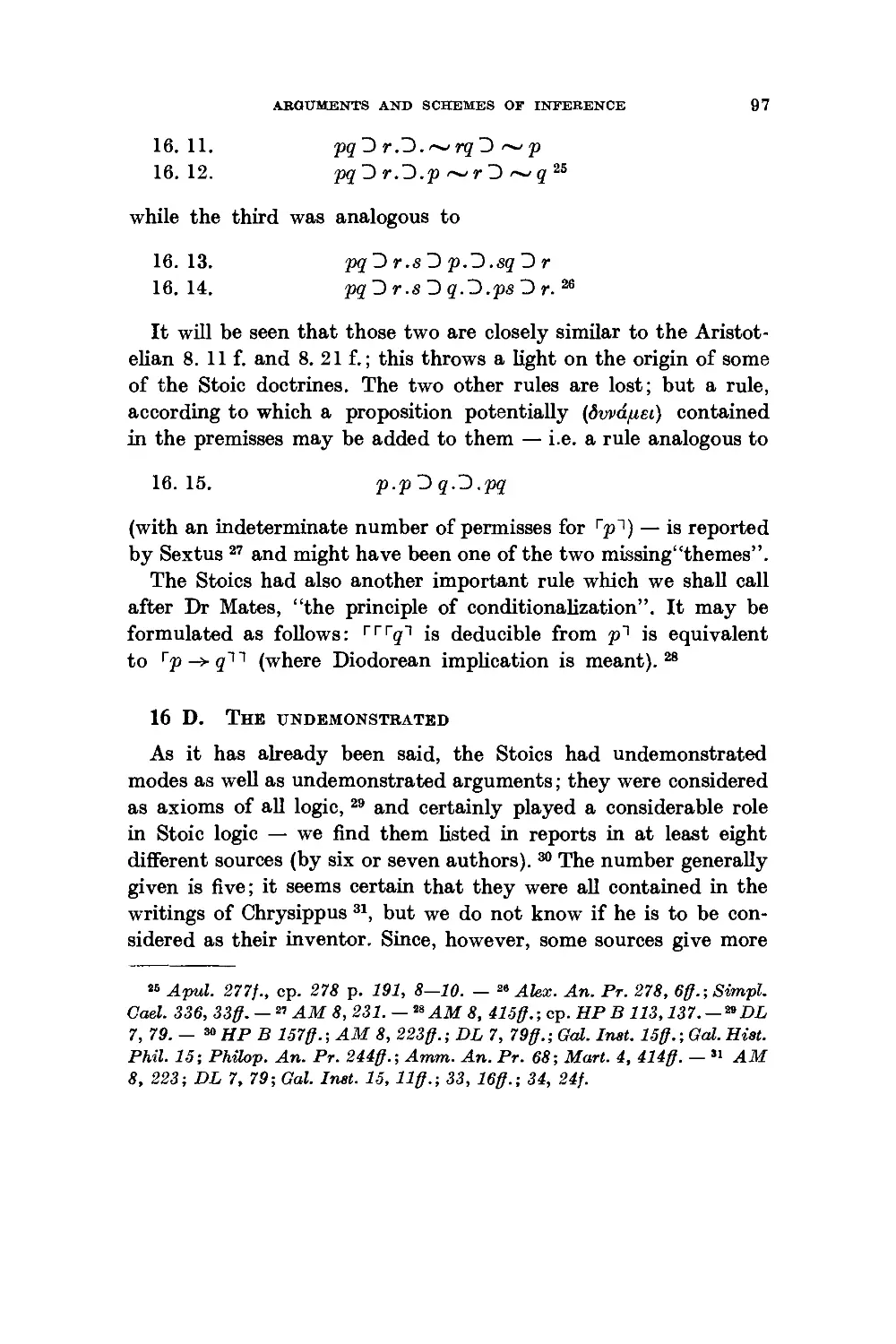
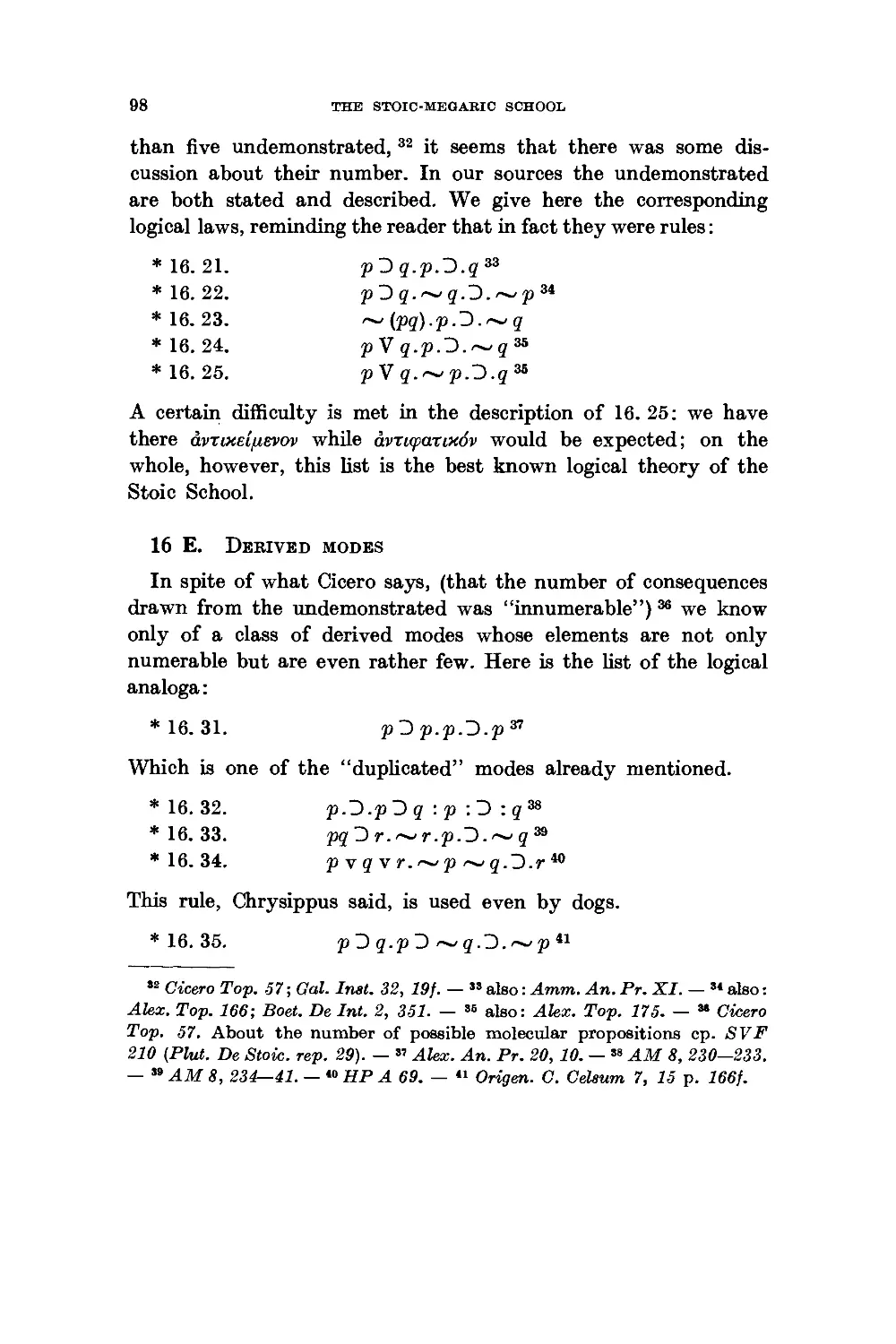

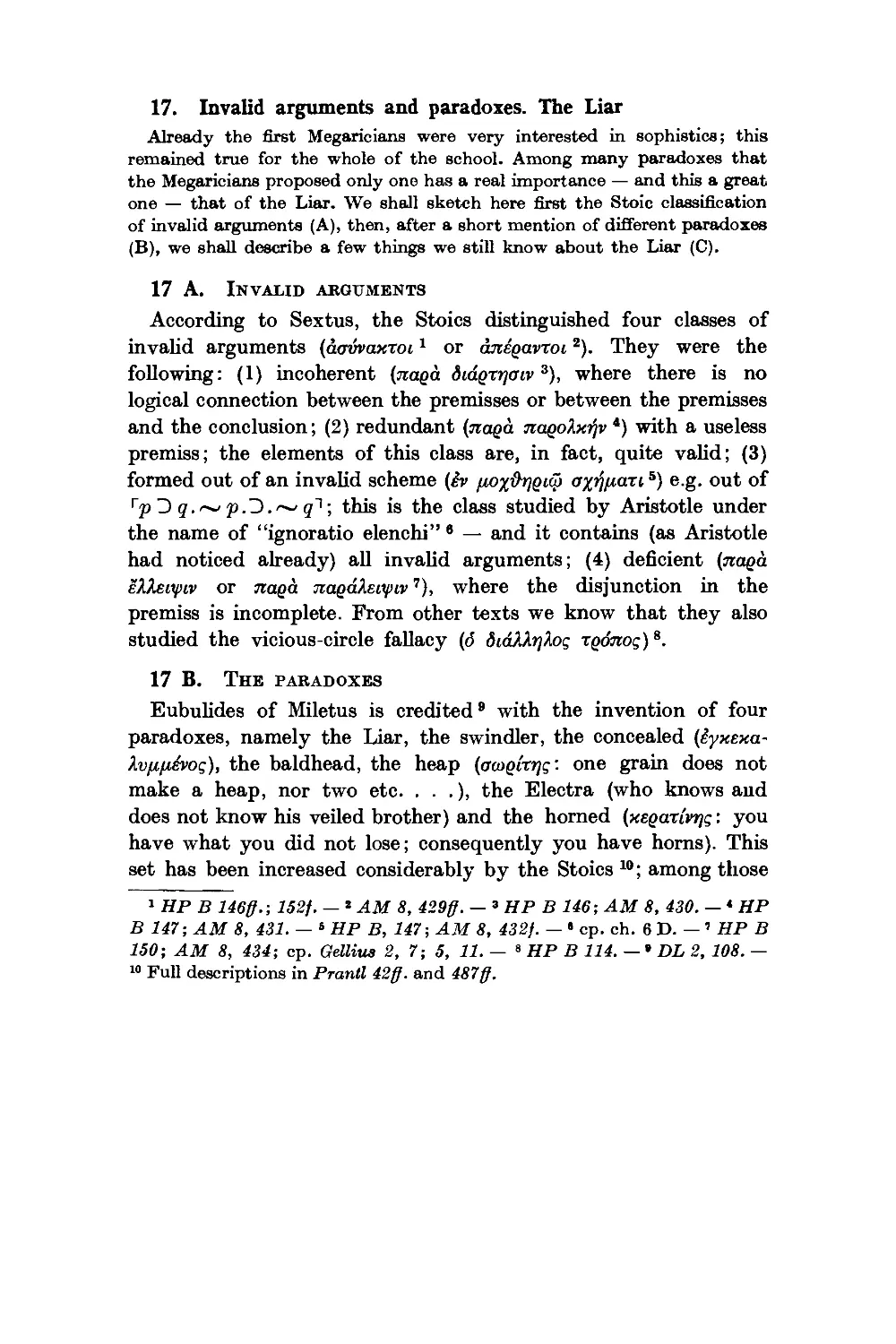

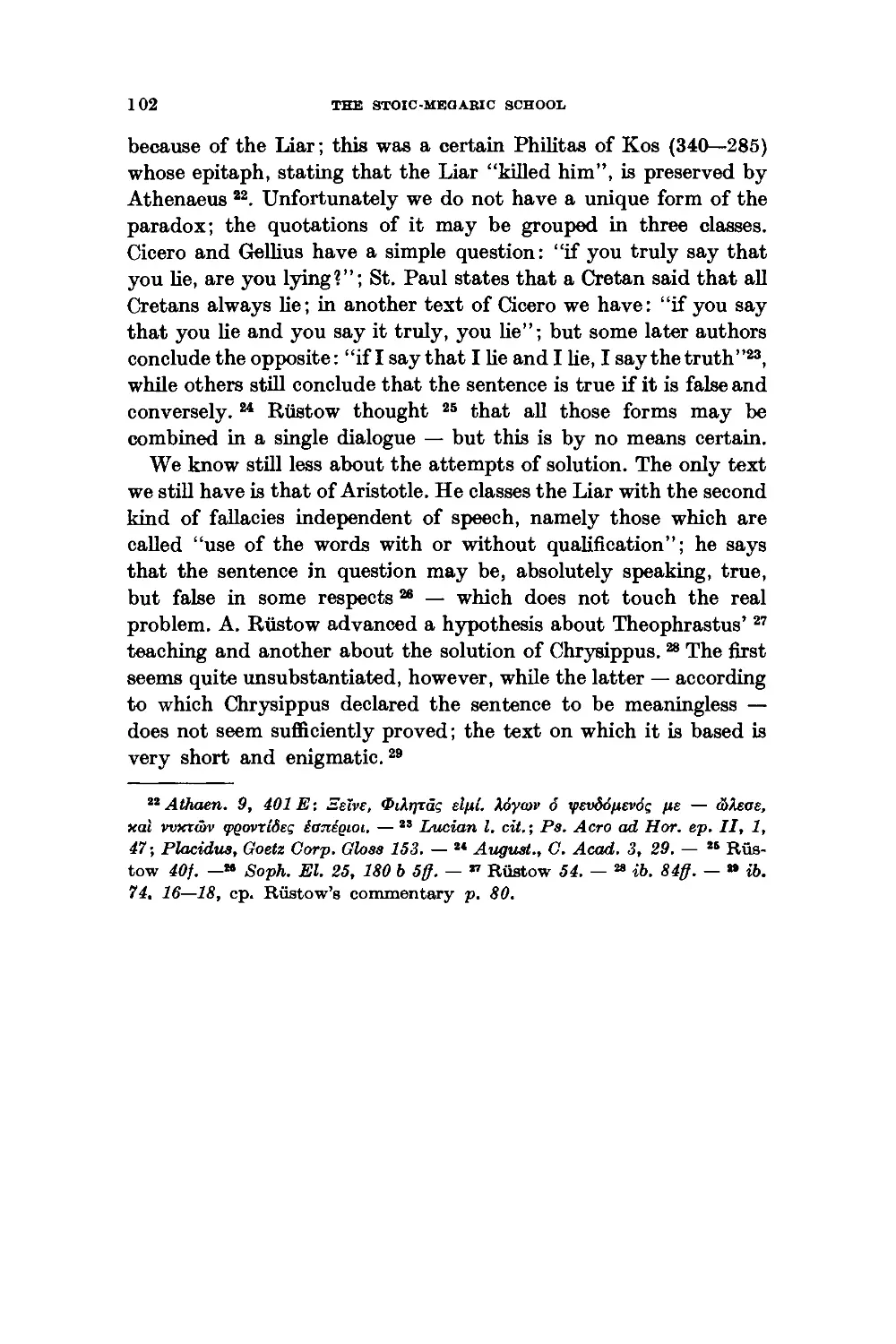


Text
ANCIENT
FO RMAL
LOGIC
I. M. BOCHENSKI
Professor of Philosophy
University of Fribourg
<m
c
19 5 1
NORTH-HOLLAND PUBLISHING COMPANY
AMSTERDAM
PRINTED IN THE NETHERLANDS
DEUKKERIJ HOLLAND N.V., AMSTERDAM
PREFACE
Among the great things which the Atlantic World inherited
from Greece, the capacity of understanding pure forms is perhaps
one of the greatest and Formal Logic is no small part of this
capacity. Unfortunately, Greek Formal Logic is all but unknown
to modern men, and what is worse, "an up-to-date picture of the
history of ancient Logic is at best a hope for the future".1 Yet,
some of the details of this history can be known. The aim of the
present work is to collect some of the data available in the actual
state of science and to arrange them in a kind of outline, which
would show forth at least some of our indebtedness to Greek
Logicians and allow us to see how their results were reached.
This book could not have been written without the direct or
indirect help of many scholars to whom the author wishes to
express his thanks. To Professor J. Lukasiewicz it owes its general
spirit and fundamental ideas. The discussions with the late Fr. J.
Salamucha helped considerably in the understanding of several
Greek doctrines. The works of Professor H. Scholz, Sir W. D.
Ross, Professor F. Solmsen, Dr A. Becker and others were freely
used. Dr B. Mates was so kind as to lend the manuscript of his
excellent dissertation on Stoic Logic. Both Professor E. W. Beth
and Professor K. Diirr supplied valuable information. Fr. I.
Thomas was kind enough to read the manuscript and made many
suggestions.
It will perhaps be allowed the author to state that when he
looks back upon his many years work on the history of logic, he
finds that this work would not have been undertaken without the
general philosophical background assumed by him. This
background is the acknowledgement of the importance of Logic and
the high valuation of the so-called "scholastic subtleties". For
J) Kapp 20.
VI
PREFACE
only one who thinks that reason has some uses might become
interested in such specculations as are found in the Prior Analytics
or in the Stoic Fragments. This belief is, fortunately, also shared
by many philosophers belonging to different schools; for them
the present book may have meaning. For it attempts to show
across many centuries a long line of thinkers who thought and
worked in a manner essentially still ours.
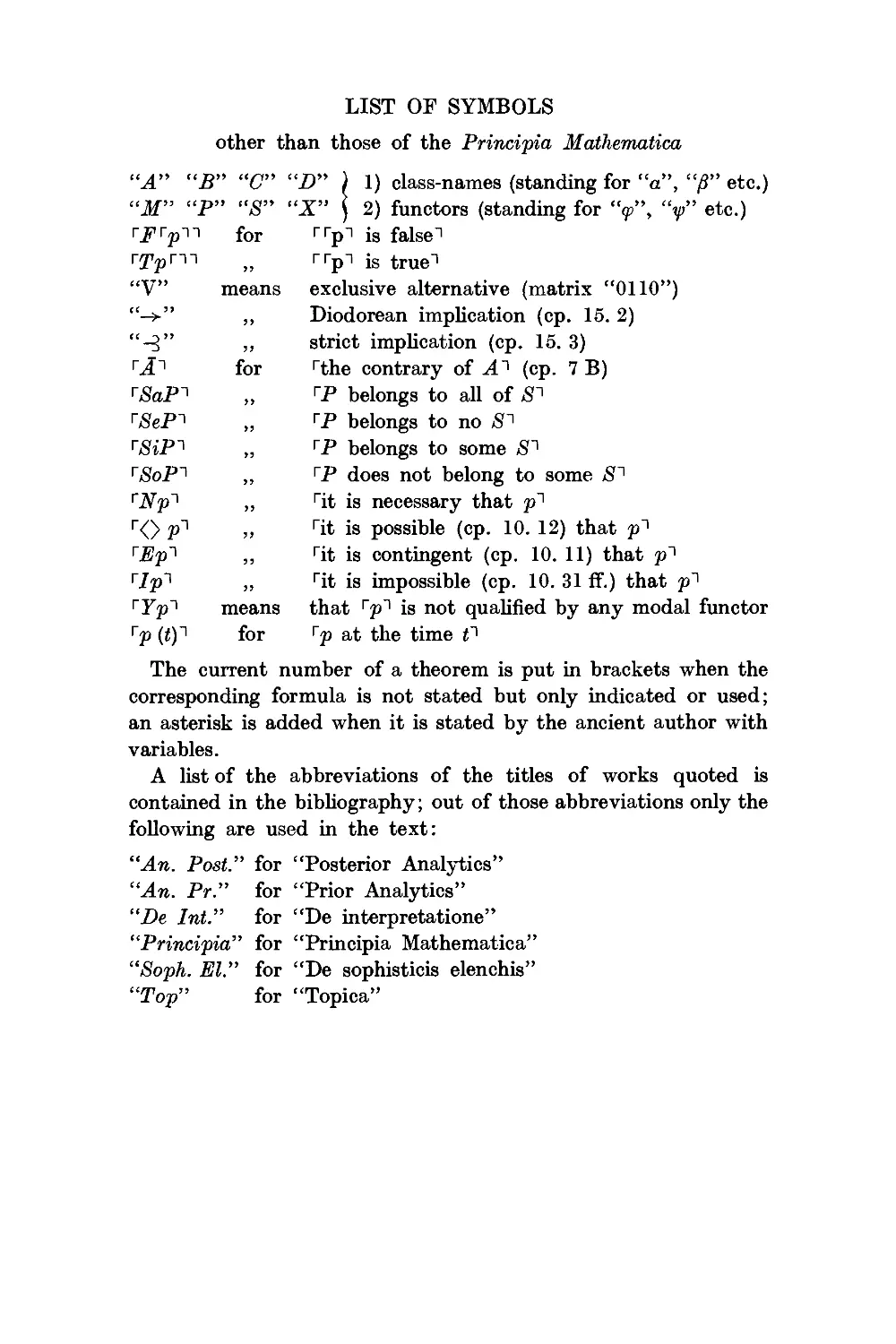
LIST OF SYMBOLS
other than those of the Principia Mathematica
"A" "B" "C" "D" I 1) class-names (standing for "a", "0" etc.)
"M" "P" "S" "X" j 2) functors (standing for "<p'\ "ip" etc.)
rjrpn for rrpi is faisei
rypm >; rrpi is truei
"V" means exclusive alternative (matrix "0110")
"->" ,, Diodorean implication (cp. 15.2)
"_>" „ strict implication (cp. 15. 3)
rA1 for rthe contrary oi A1 (cp. 7 B)
rSaP1 „ rP belongs to all of S"1
rtfeP1 „ rP belongs to no £P
r^iP1 „ rP belongs to some £P
rSoP1 „ rP does not belong to some S1
rNp1 „ rit is necessary that p1
r<> p1 „ rit is possible (cp. 10. 12) that p1
rEp1 „ rit is contingent (cp. 10. 11) that p1
rIp~* „ rit is impossible (cp. 10. 31 ff.) that p1
rYp1 means that rp1 is not qualified by any modal functor
vp (t)1 for vp at the time P
The current number of a theorem is put in brackets when the
corresponding formula is not stated but only indicated or used;
an asterisk is added when it is stated by the ancient author with
variables.
A list of the abbreviations of the titles of works quoted is
contained in the bibliography; out of those abbreviations only the
following are used in the text:
"An. Post." for "Posterior Analytics"
"An. Pr." for "Prior Analytics"
"De Int." for "De interpretatione"
"Principia" for "Principia Mathematica"
"Soph. El." for "De sophisticis elenchis"
"Top" for "Topica"
I. PROLEGOMENA
1. Introduction
This introduction is composed of two sections: in the first we shall explain
the scope of (A) and the symbolism used in (B) the book; in the second an
outline of the history of the History of Formal Logic will be given; we shall
deal with that history in ancient and medieval times (C), during the XlXth
century (D) and in recent years (E). A final paragraph will be devoted to
the statement of the main problems awaiting study in our domain (F).
1 A. Aim and scope of the book
The present book is intended to supply mathematical logicians
with a synthetic outline of the main aspects of ancient formal
logic which are known in the present state of research. In order
to avoid misunderstandings, each of the above terms has to be
explained.
The reader is supposed to be a mathematical logician, i.e., to
know both the symbolisms and the (English) language of
contemporary mathematical logic; those who are not acquainted
with it must be warned that several terms used in that language
have a particular meaning, different from the meaning attributed
to the terms of the same form in other contexts.
The subject of the book is formal Logic; by this we understand
a science such as was developed by Aristotle in his Prior Analytics,
i.e., essentially the theory of syllogisms as defined in An. Pr. A 1,
246 18—20. Along with the syllogisms proper, the structure of the
sentences and semiotics will be studied; contrariwise, not only
all ontological, psychological and epistemological problems, but
even methodological topics will be omitted in so far as possible.
This is perhaps regrettable; but there are several good books on
those subjects while there is none on ancient formal logic as a whole
— and the limitation of space forced us to omit everything which
was not strictly formal.
2
PROLEGOMENA
By ancient formal logic, Greek logic from the beginning of
Greek Philosophy until the end of Antiquity is meant. We have,
it is true, some Latin textbooks of formal logic — but they all
seem based on, or even copied from, Greek sources. It is perhaps
worthwhile mentioning that there is also an ancient Indian Logic;
this lies, however, outside our present scope.1
What is offered here is an outline, moreover a very fragmentary
one. A complete account of ancient formal logic cannot be written
at the present date because of the lack of scientific monographs
on individual logicians and topics. The initial aim of the author
was to limit himself to a reassumption of monographs already
published; in the course of the work he was compelled, however,
to use some of his own unpublished researches on Aristotle and
had the exceptional fortune of reading the manuscript of Dr
Benson Mates' book on Stoic logic. He also collected some new data
on other topics. In spite of this, considerable parts of ancient logic
have hardly been touched upon — e.g. the logic of the
Commentators — while others, Aristotle included, have been treated in a
way which is far from being complete. On the whole, what the
book contains may be considered as a kind of starting point for
future research. Yet, it is hoped that even this will supply logicians
with some information difficult to be found elsewhere and give a
general idea of what the ancient logic was and how it developed.
1 B. Symbolism
All formal theses found in ancient logicians and referred to here
are stated in a conventional symbolism; this is done for two
reasons: because when stated in that way they are (a) much
shorter, (6) more intuitive for mathematical logicians. The
symbolism used is that of the Principia with a few changes and additions
1 For bibliography of Indian Logic cp. C. Begamey, Buddhistische Philo.
sophie (Bibl. Einfuhrungen in das Studium der Philos., hrsg. v. I. M.
Bocheriski, 20/1), Bern 1950, NN. 25. 11—24. Among the works quoted there,
however, only the papers by the late S. Schayer (N. 25. 22) are written by
a mathematical logician.
INTRODUCTION
3
which are listed at the beginning of the book. Here are some
remarks which may be of importance for the correct
understanding of our formulae.
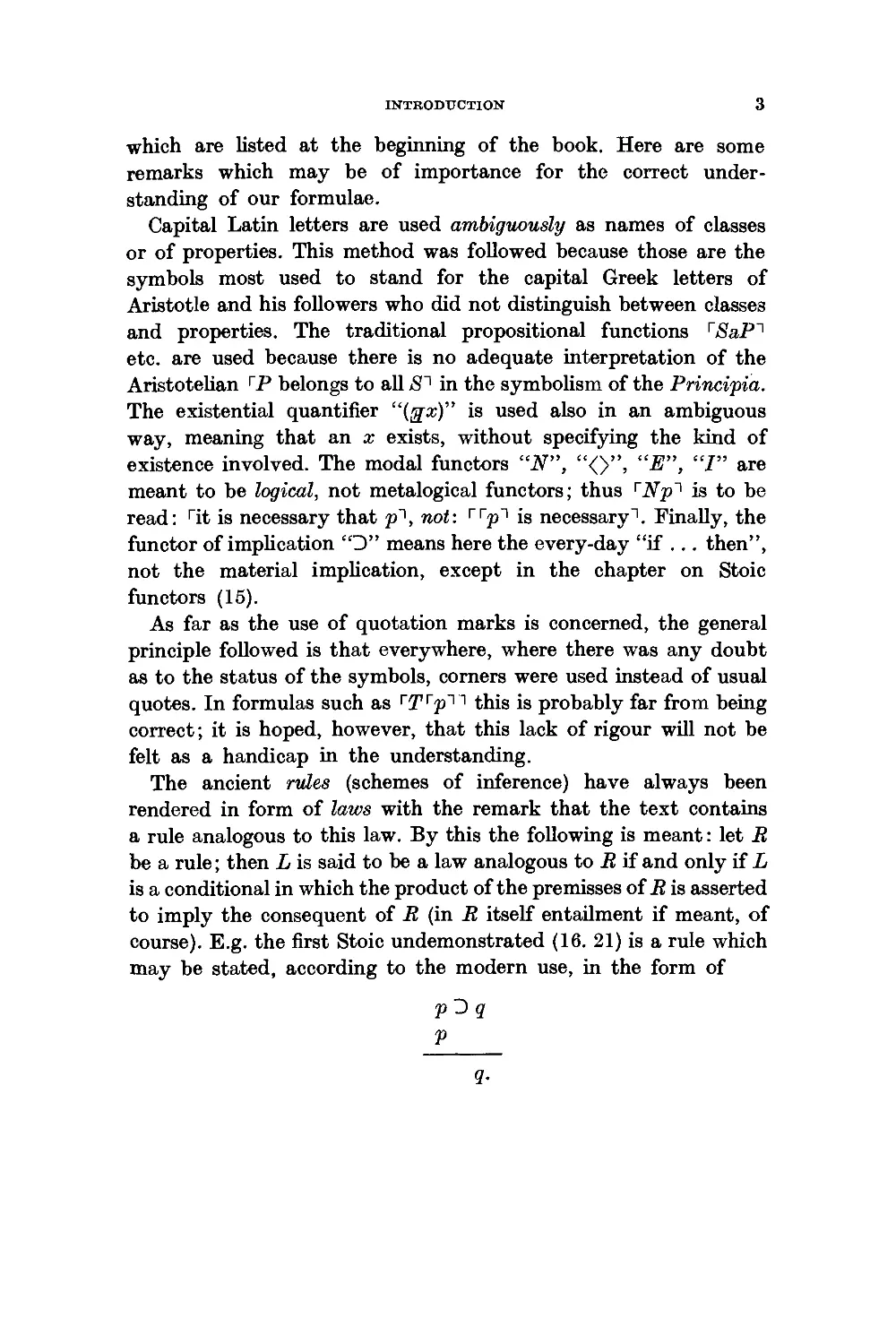
Capital Latin letters are used ambiguously as names of classes
or of properties. This method was followed because those are the
symbols most used to stand for the capital Greek letters of
Aristotle and his followers who did not distinguish between classes
and properties. The traditional propositional functions '"(SaP1
etc. are used because there is no adequate interpretation of the
Aristotelian rP belongs to all S1 in the symbolism of the Principia.
The existential quantifier "(/yx)" is used also in an ambiguous
way, meaning that an x exists, without specifying the kind of
existence involved. The modal functors "N", "<>", "E", "I" are
meant to be logical, not metalogical functors; thus ^Np1 is to be
read: rit is necessary that p1, not: vvp^ is necessary1. Finally, the
functor of implication "D" means here the every-day "if ... then",
not the material implication, except in the chapter on Stoic
functors (15).
As far as the use of quotation marks is concerned, the general
principle followed is that everywhere, where there was any doubt
as to the status of the symbols, corners were used instead of usual
quotes. In formulas such as rjTpii this is probably far from being
correct; it is hoped, however, that this lack of rigour will not be
felt as a handicap in the understanding.
The ancient rules (schemes of inference) have always been
rendered in form of laws with the remark that the text contains
a rule analogous to this law. By this the following is meant: let R
be a rule; then L is said to be a law analogous to R if and only if L
is a conditional in which the product of the premisses of R is asserted
to imply the consequent of R (in R itself entailment if meant, of
course). E.g. the first Stoic undemonstrated (16. 21) is a rule which
may be stated, according to the modern use, in the form of
pDq
V
q-
4
PKOLEGOMENA
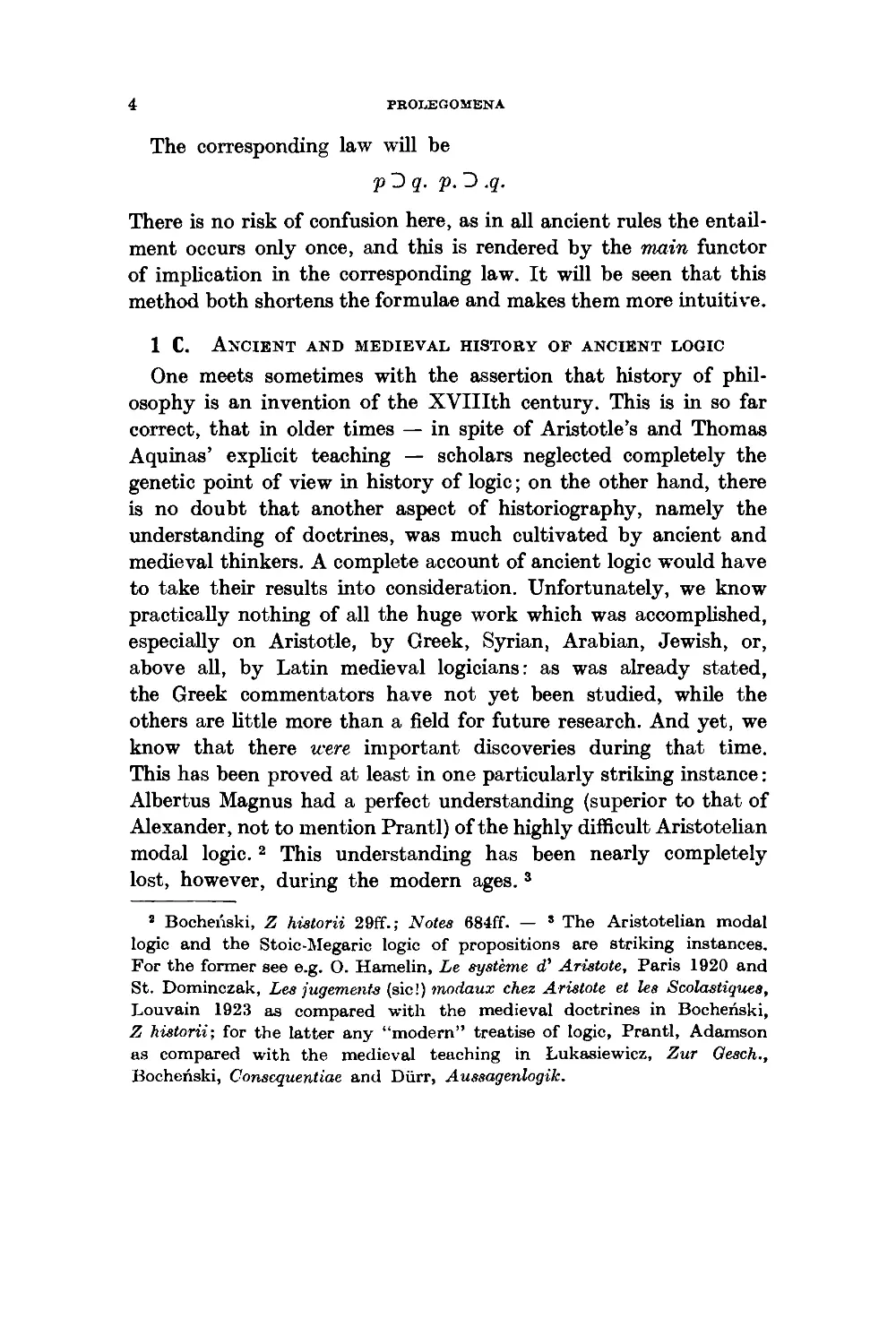
The corresponding law will be
p D q. p.D .q.
There is no risk of confusion here, as in all ancient rules the
entailment occurs only once, and this is rendered by the main functor
of implication in the corresponding law. It will be seen that this
method both shortens the formulae and makes them more intuitive.
1 C. Ancient and medieval history of ancient logic
One meets sometimes with the assertion that history of
philosophy is an invention of the XVIIIth century. This is in so far
correct, that in older times — in spite of Aristotle's and Thomas
Aquinas' explicit teaching — scholars neglected completely the
genetic point of view in history of logic; on the other hand, there
is no doubt that another aspect of historiography, namely the
understanding of doctrines, was much cultivated by ancient and
medieval thinkers. A complete account of ancient logic would have
to take their results into consideration. Unfortunately, we know
practically nothing of all the huge work which was accomplished,
especially on Aristotle, by Greek, Syrian, Arabian, Jewish, or,
above all, by Latin medieval logicians: as was already stated,
the Greek commentators have not yet been studied, while the
others are little more than a field for future research. And yet, we
know that there were important discoveries during that time.
This has been proved at least in one particularly striking instance:
Albertus Magnus had a perfect understanding (superior to that of
Alexander, not to mention Prantl) of the highly difficult Aristotelian
modal logic. 2 This understanding has been nearly completely
lost, however, during the modern ages. 3
2 Bochenski, Z historii 29ff.; Notes 684ff. — * The Aristotelian modal
logic and the Stoic-Megaric logic of propositions are striking instances.
For the former see e.g. O. Hamelin, Le systeme <V Aristote, Paris 1920 and
St. Dominczak, Les jugements (sic!) modaux chez Aristote et les Scolastiques,
Louvain 1923 as compared with the medieval doctrines in Bochenski,
Z historii; for the latter any "modern" treatise of logic, Prantl, Adamson
as compared with the medieval teaching in Lukasiewicz, Zur Qesch.,
Bochenski, Conscquentiae and Diirr, Aussagenlogik.
INTRODUCTION
5
1 D. State of the History of Formal Logic during the
XIXth century
Modern history of Logic had been started during the XIXth
century, but its state was very bad at that time — indeed until
1930 approximately — because of two phenomena. On one hand,
most of the historians of logic took for granted what Kant said on
it; namely that "formal logic was not able to advance a single
step (since Aristotle) and is thus to all appearance a closed and
complete body of doctrine" 4; consequently, there was, according
to them, no history of logic at all, or at the most, a history of the
decay of Aristotelian doctrines. On the other hand, authors writing
during that period were not formal logicians and by "logic" they
mostly understood methodology, epistemology and ontology. That
is why e.g. Robert Adamson could devote 16 pages to such a
"logician" as Kant — but only five to the whole period from the
death of Aristotle to Bacon, i.e. to Theophrastus, the Stoic-
Megaric School and the Scholastics. In order to realize what this
means, it will be enough to remember that from the point of view
we assume here, Kant is not a logician at all, while the leading
Megaricians and Stoics are among the greatest thinkers in Logic.
The worst mischief was done during that period by the work
of Carl Prantl (1855). This is based on an extensive knowledge of
sources and constitutes the only all-embracing History of Ancient
Logic we have until now. Unfortunately, Prantl suffered most
acutely from the two above-mentioned phenomena: he believed
firmly in the verdict of Kant and had little understanding of
formal logic. Moreover, he had the curious moralizing attitude in
history of logic5, and, as he disliked both the Stoics and the
Scholastics, he joined to incredible misinterpretations of their
doctrines, injurious words, treating them as complete fools and
morally bad men precisely because of logical doctrines which we
believe to be very interesting and original. It is now known that
his work — excepting as a collection of texts (and even this far
4 Kritik der reinen Vernunft. 2d ed. p, VIII (English by N. Kemp Smith) —
5 Cp. e.g. p. 488.
6
FKOLEGOMENA
from being complete) — is valueless. But it exercised a great
influence on practically all writers on our subject until J.
Lukasiewicz and H. Scholz drew attention to the enormous number of
errors it contains.
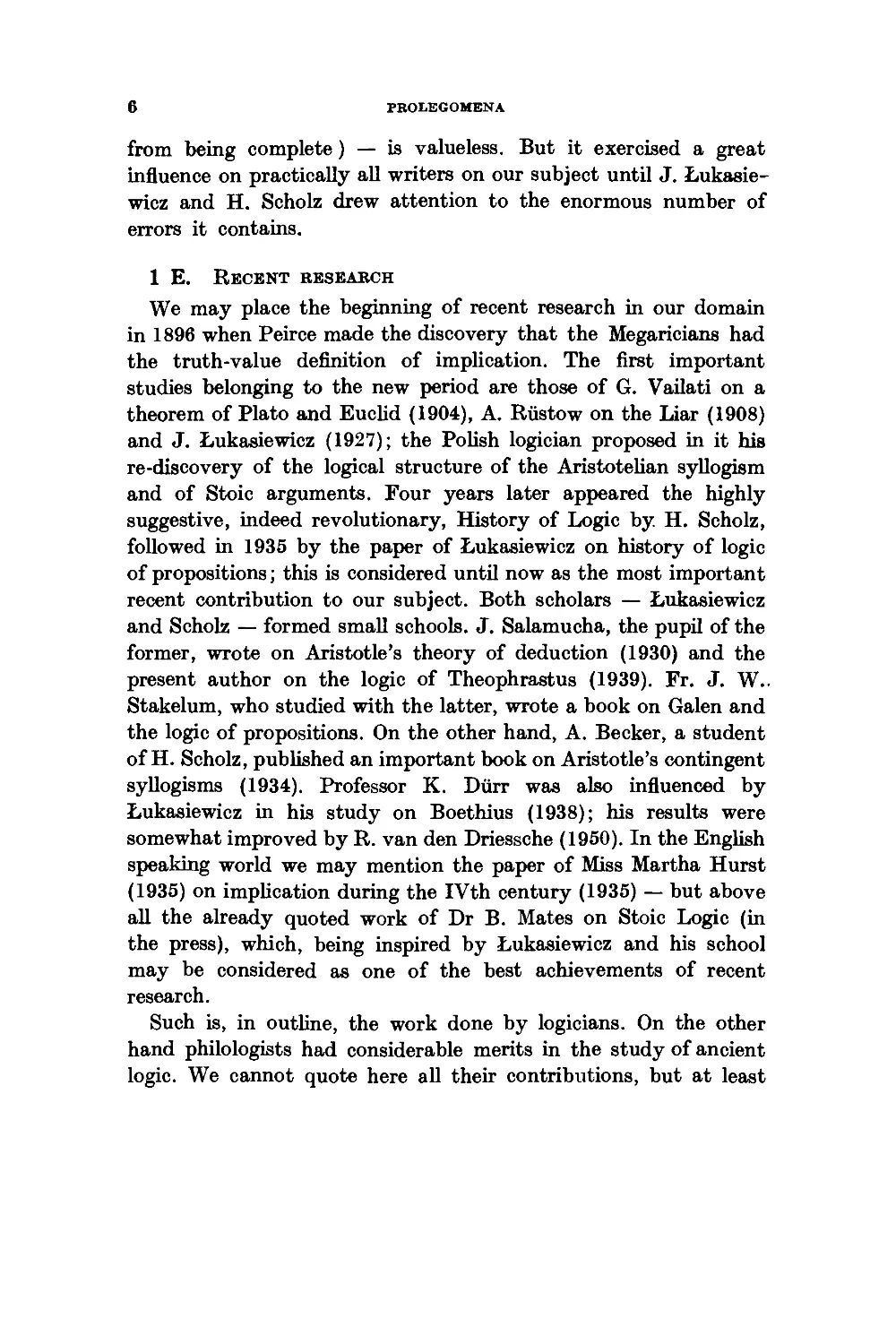
1 E. Recent research
We may place the beginning of recent research in our domain
in 1896 when Peirce made the discovery that the Megaricians had
the truth-value definition of implication. The first important
studies belonging to the new period are those of G. Vailati on a
theorem of Plato and Euclid (1904), A. Riistow on the Liar (1908)
and J. Lukasiewicz (1927); the Polish logician proposed in it his
re-discovery of the logical structure of the Aristotelian syllogism
and of Stoic arguments. Four years later appeared the highly
suggestive, indeed revolutionary, History of Logic by. H. Scholz,
followed in 1935 by the paper of Lukasiewicz on history of logic
of propositions; this is considered until now as the most important
recent contribution to our subject. Both scholars — Lukasiewicz
and Scholz — formed small schools. J. Salamucha, the pupil of the
former, wrote on Aristotle's theory of deduction (1930) and the
present author on the logic of Theophrastus (1939). Fr. J. W..
Stakelum, who studied with the latter, wrote a book on Galen and
the logic of propositions. On the other hand, A. Becker, a student
of H. Scholz, published an important book on Aristotle's contingent
syllogisms (1934). Professor K. Diirr was also influenced by
Lukasiewicz in his study on Boethius (1938); his results were
somewhat improved by R. van den Driessche (1950). In the English
speaking world we may mention the paper of Miss Martha Hurst
(1935) on implication during the IVth century (1935) — but above
all the already quoted work of Dr B. Mates on Stoic Logic (in
the press), which, being inspired by Lukasiewicz and his school
may be considered as one of the best achievements of recent
research.
Such is, in outline, the work done by logicians. On the other
hand philologists had considerable merits in the study of ancient
logic. We cannot quote here all their contributions, but at least
INTRODUCTION
7
the important book of Fr. Solmsen (1929) on the evolution of
Aristotle's logic and rhetoric must be mentioned, and, above all,
the masterly commentary on the Analytics by Sir W. D. Ross
(1949). It does not always give full satisfaction to a logician trained
on modern methods, but it is, nevertheless, a scholarly work of a
philologist who made a considerable eifort to grasp the results of
logicians.
1 F. Tasks for the future
In spite of these studies nearly everything is still to be done in
history of ancient formal logic. Not even the texts are sufficiently
studied. The most urgent needs as far as they are concerned is a
critical edition of the Stoic-Megaric fragments, the Stoicorum
Veterum Fragmenta of von Arnim being now insufficient. Even
Aristotle's text is not satisfactory: we still need a new edition of
De Int. and of the Topics, while, in spite of the excellent work
done by Sir W. D. Ross, more studies seem to be required on the
Analytics.
But above all, monographies on the logical doctrines are needed.
Here is a list of subjects which have hardly been touched by an
expert hand: pre-socratic dialectics; Plato's formal logic; the logic
of Topics; the assertoric syllogistic of Aristotle; his semiotics; the
syllogism based on hypothesis; the peripatetic school after Theo-
phrastus; Sextus Empiricus; Galen (Fr. Stakelum studied only
the Institutio Logica); Alexander of Aphrodisias; Porphyrius;
Ammonius; Boethius (a thorough examination of all his logical
works); Simplicius; Philoponus; Apuleius; Cicero. These are only
the main topics which await a scientific inquiry — along with
them a number of less important ones should be studied.
As far as problems are concerned we are still far from
understanding the true nature of pre-Aristotelian and early Aristotelian
logic, the rise of the syllogism, the origin of the Stoic-Megaric
doctrines, or the development during the centuries which followed
Chrysippus. Also the connection and mutual influences of
mathematical and logical studies are hardly known.
And once this work has been done, everything which has been
8
FKOLEGOMENA
elaborated until now — above all the content of the present
outline — will probably have to be re-examined and restated.
Ancient formal logic is actually little more than a field for scientific
research.
2. General Survey
2 A. The succession of thinkers and schools
The history of ancient philosophy covers about eleven centuries,
from Thales who lived during the sixth century B.C. to Boethius
and Simplicius who flourished at the beginning of the sixth A.D.
From the point of view of the history of formal logic this long
epoch may be divided into three periods.
(1) The pre-Aristotelian period, from the beginnings to the
time at which Aristotle started writing his Topics (about 340 B.C.).
There is no formal logic during this period, i.e. no study of logical
rules or laws; but some of them are used consciously since Zeno
of Elea, and Plato tries, if unsuccessfully, to build up a logic.
(2) The creative period, from the time of Aristotle's Topics
to the death of Chrysippus of Soloi (205/8 B.C.). During this period
Logic was founded and considerably developed.
(3) The period of schoolmasters and commentators, from the
death of Chrysippus until the end of Antiquity. In that period no
more creative work is done, as far as we know; moreover, a
continuous decline of formal logic seems to take place. Boethius and
Simplicius who are considered as the last ancient philosophers
are also the last ancient logicians.
It appears, consequently, that out of the eleven centuries
mentioned above only about 150 years are of real importance; but
those years are of enormous importance — they are, indeed, among
the best years of logic in the whole history of humanity until now.
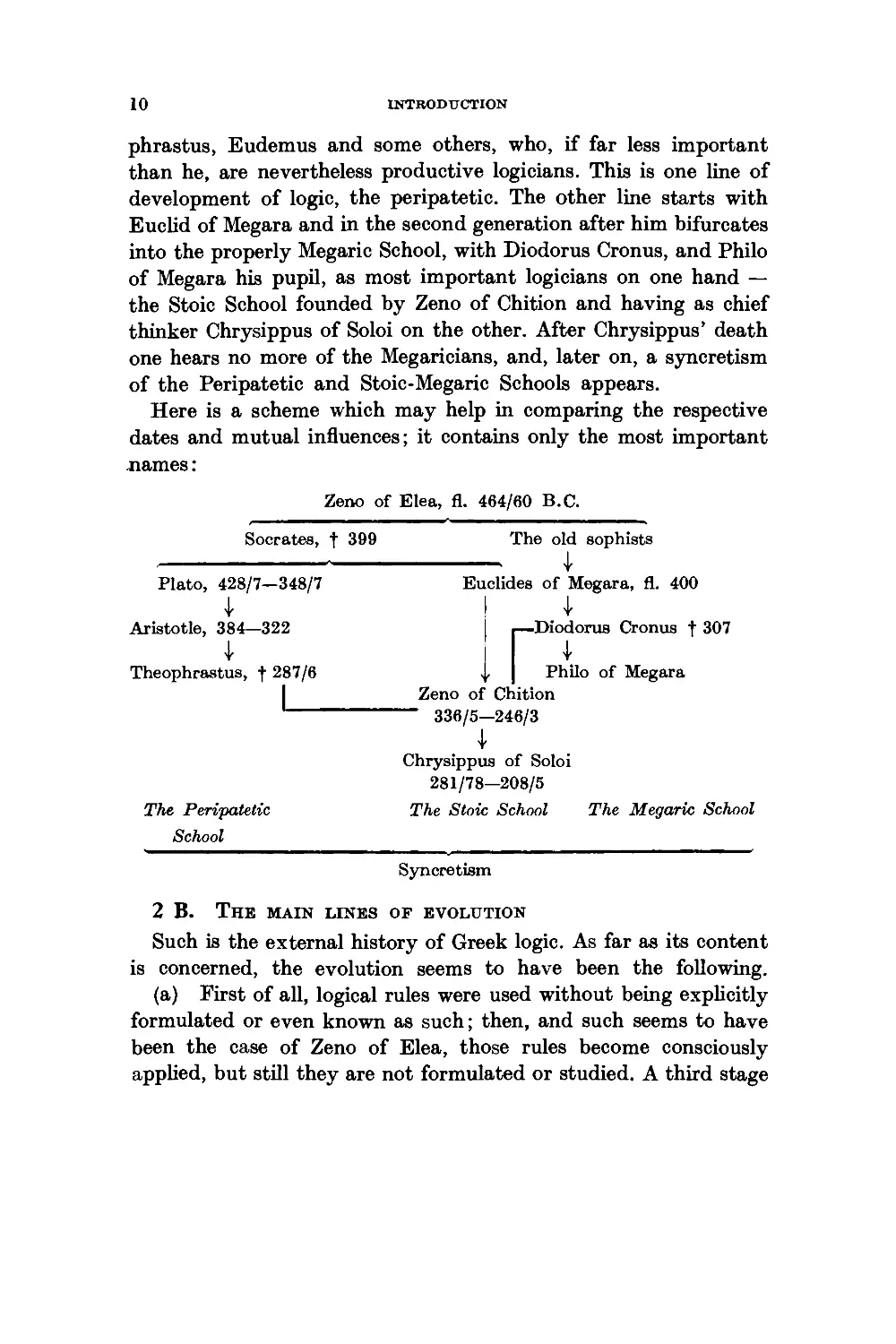
The succession of different trends of logical thought — for there
were several such trends — can be briefly stated in the following
terms. If Zeno is, according to Aristotle, "the inventor of
dialectics", Socrates seems to have been the real father of formal
logic; at least both Plato and Euclides, the head of the Megaric
School, claim to be his disciples. Plato was the teacher of Aristotle,
the founder of formal Logic; Aristotle was succeeded by Theo-
10
INTRODUCTION
phrastus, Eudemus and some others, who, if far less important
than he, are nevertheless productive logicians. This is one line of
development of logic, the peripatetic. The other line starts with
Euclid of Megara and in the second generation after him bifurcates
into the properly Megaric School, with Diodorus Cronus, and Philo
of Megara his pupil, as most important logicians on one hand —
the Stoic School founded by Zeno of Chition and having as chief
thinker Chrysippus of Soloi on the other. After Chrysippus' death
one hears no more of the Megaricians, and, later on, a syncretism
of the Peripatetic and Stoic-Megaric Schools appears.
Here is a scheme which may help in comparing the respective
dates and mutual influences; it contains only the most important
names:
Zeno of Elea, fl. 464/60 B.C.
Socrates, f 399 The old sophists
1
Plato, 428/7—348/7 Euclides of Megara, fl. 400
1
Aristotle, 384—322
1
Theophrastus, f 287/6
L_
1
Diodorus Cronus f 307
rJJIOU
1
Phi
Philo of Megara
Zeno of Chition
336/5—246/3
1
Chrysippus of Soloi
281/78—208/5
The Peripatetic The Stoic School The Megaric School
School
Syncretism
2 B. The main lines of evolution
Such is the external history of Greek logic. As far as its content
is concerned, the evolution seems to have been the following.
(a) First of all, logical rules were used without being explicitly
formulated or even known as such; then, and such seems to have
been the case of Zeno of Elea, those rules become consciously
applied, but still they are not formulated or studied. A third stage
GENBKAX SURVEY
11
is represented by the explicit formulation of rules without any
special apparatus: this we find in the Aristotelian Topics.
Further on, technical means useful for the study of logic are
introduced by Aristotle in his Prior Analytics, namely variables
and a peculiar terminology; at this stage laws are not yet distinct
from rules. The fifth and last stage is represented by a clear
distinction of both, such as we find in fragments of the Stoics.
(b) As far as the formulae themselves are concerned, we may
also distinguish several stages of evolution.
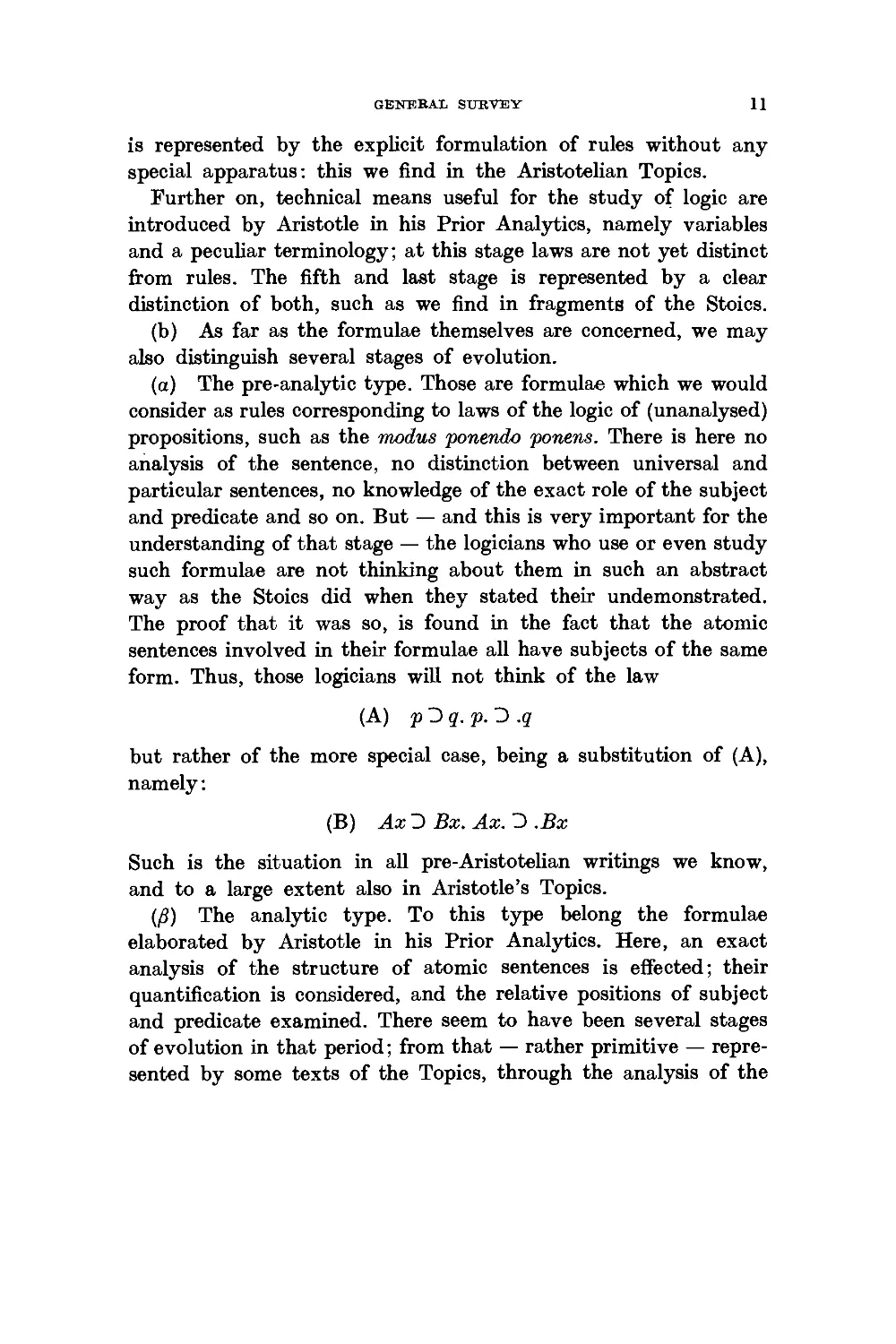
(a) The pre-analytic type. Those are formulae which we would
consider as rules corresponding to laws of the logic of (unanalysed)
propositions, such as the modus ponendo ponms. There is here no
analysis of the sentence, no distinction between universal and
particular sentences, no knowledge of the exact role of the subject
and predicate and so on. But — and this is very important for the
understanding of that stage — the logicians who use or even study
such formulae are not thinking about them in such an abstract
way as the Stoics did when they stated their undemonstrated.
The proof that it was so, is found in the fact that the atomic
sentences involved in their formulae all have subjects of the same
form. Thus, those logicians will not think of the law
(A) pDq.p.D .q
but rather of the more special case, being a substitution of (A),
namely:
(B) AxD Bx.Ax.D .Bx
Such is the situation in all pre-Aristotelian writings we know,
and to a large extent also in Aristotle's Topics.
(/?) The analytic type. To this type belong the formulae
elaborated by Aristotle in his Prior Analytics. Here, an exact
analysis of the structure of atomic sentences is effected; their
quantification is considered, and the relative positions of subject
and predicate examined. There seem to have been several stages
of evolution in that period; from that — rather primitive —
represented by some texts of the Topics, through the analysis of the
12
INTRODUCTION
sentence into a subject, a predicate, the copula and the quantifier,
until the highly refined analysis, somewhat similar to that which
we find in the recent formal implication (in some chapters of the
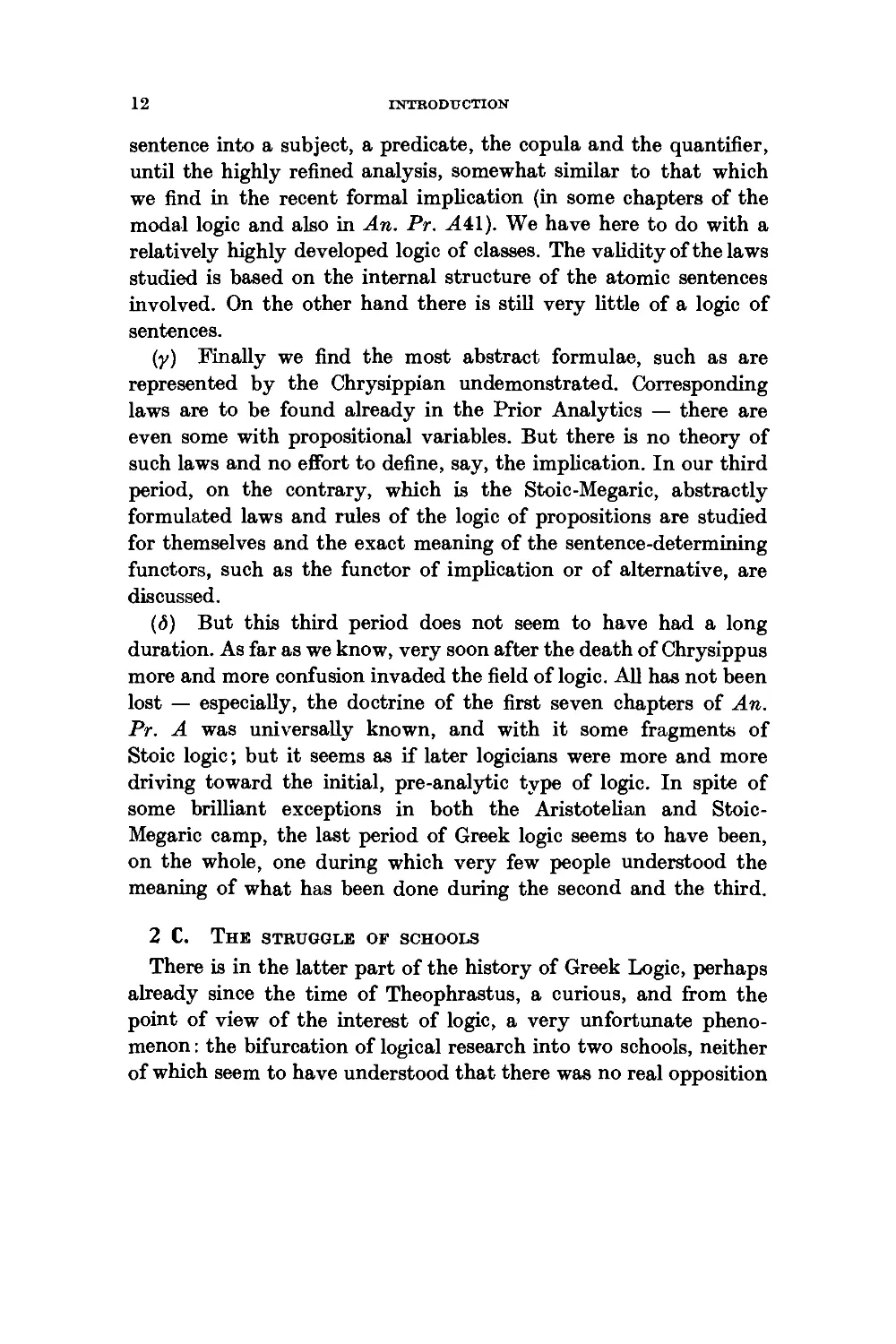
modal logic and also in An. Pr. Ail). We have here to do with a
relatively highly developed logic of classes. The validity of the laws
studied is based on the internal structure of the atomic sentences
involved. On the other hand there is still very little of a logic of
sentences.
(y) Finally we find the most abstract formulae, such as are
represented by the Chrysippian undemonstrated. Corresponding
laws are to be found already in the Prior Analytics — there are
even some with propositional variables. But there is no theory of
such laws and no effort to define, say, the implication. In our third
period, on the contrary, which is the Stoic-Megaric, abstractly
formulated laws and rules of the logic of propositions are studied
for themselves and the exact meaning of the sentence-determining
functors, such as the functor of implication or of alternative, are
discussed.
(6) But this third period does not seem to have had a long
duration. As far as we know, very soon after the death of Chrysippus
more and more confusion invaded the field of logic. All has not been
lost — especially, the doctrine of the first seven chapters of An.
Pr. A was universally known, and with it some fragments of
Stoic logic; but it seems as if later logicians were more and more
driving toward the initial, pre-analytic type of logic. In spite of
some brilliant exceptions in both the Aristotelian and Stoic-
Megaric camp, the last period of Greek logic seems to have been,
on the whole, one during which very few people understood the
meaning of what has been done during the second and the third.
2 C. The struggle of schools
There is in the latter part of the history of Greek Logic, perhaps
already since the time of Theophrastus, a curious, and from the
point of view of the interest of logic, a very unfortunate
phenomenon : the bifurcation of logical research into two schools, neither
of which seem to have understood that there was no real opposition
GEITEKAX SUKVEY
13
between their logical tenets, that they were both working in
different departments of the same science. I mean the struggle between
the peripatetic and the stoic-megaric line of thought. From the
point of view of scholastic logic, such as developed during the
Xlllth century, and again from the point of view reached recently,
there is no opposition between logic of propositions and logic of
predicates: both are legitimate parts of formal logic and no
complete logic can avoid stating laws or rules belonging to both.
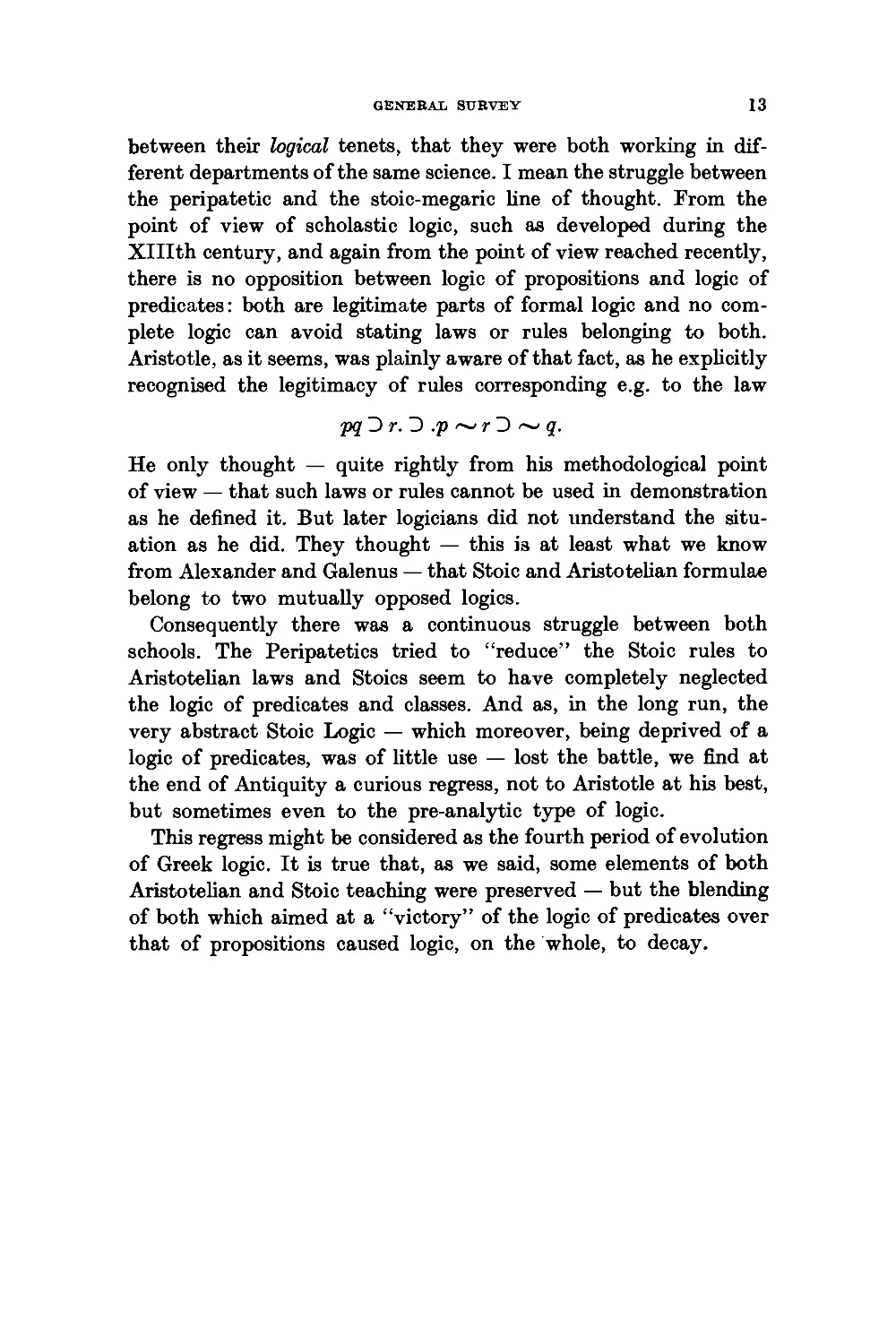
Aristotle, as it seems, was plainly aware of that fact, as he explicitly
recognised the legitimacy of rules corresponding e.g. to the law
pq D r. D .p ~ r D ~ q.
He only thought — quite rightly from his methodological point
of view — that such laws or rules cannot be used in demonstration
as he denned it. But later logicians did not understand the
situation as he did. They thought — this is at least what we know
from Alexander and Galenus — that Stoic and Aristotelian formulae
belong to two mutually opposed logics.
Consequently there was a continuous struggle between both
schools. The Peripatetics tried to "reduce" the Stoic rules to
Aristotelian laws and Stoics seem to have completely neglected
the logic of predicates and classes. And as, in the long run, the
very abstract Stoic Logic — which moreover, being deprived of a
logic of predicates, was of little use — lost the battle, we find at
the end of Antiquity a curious regress, not to Aristotle at his best,
but sometimes even to the pre-analytic type of logic.
This regress might be considered as the fourth period of evolution
of Greek logic. It is true that, as we said, some elements of both
Aristotelian and Stoic teaching were preserved — but the blending
of both which aimed at a "victory" of the logic of predicates over
that of propositions caused logic, on the whole, to decay.
H. THE FORERUNNERS
3. Formal Logic before Aristotle
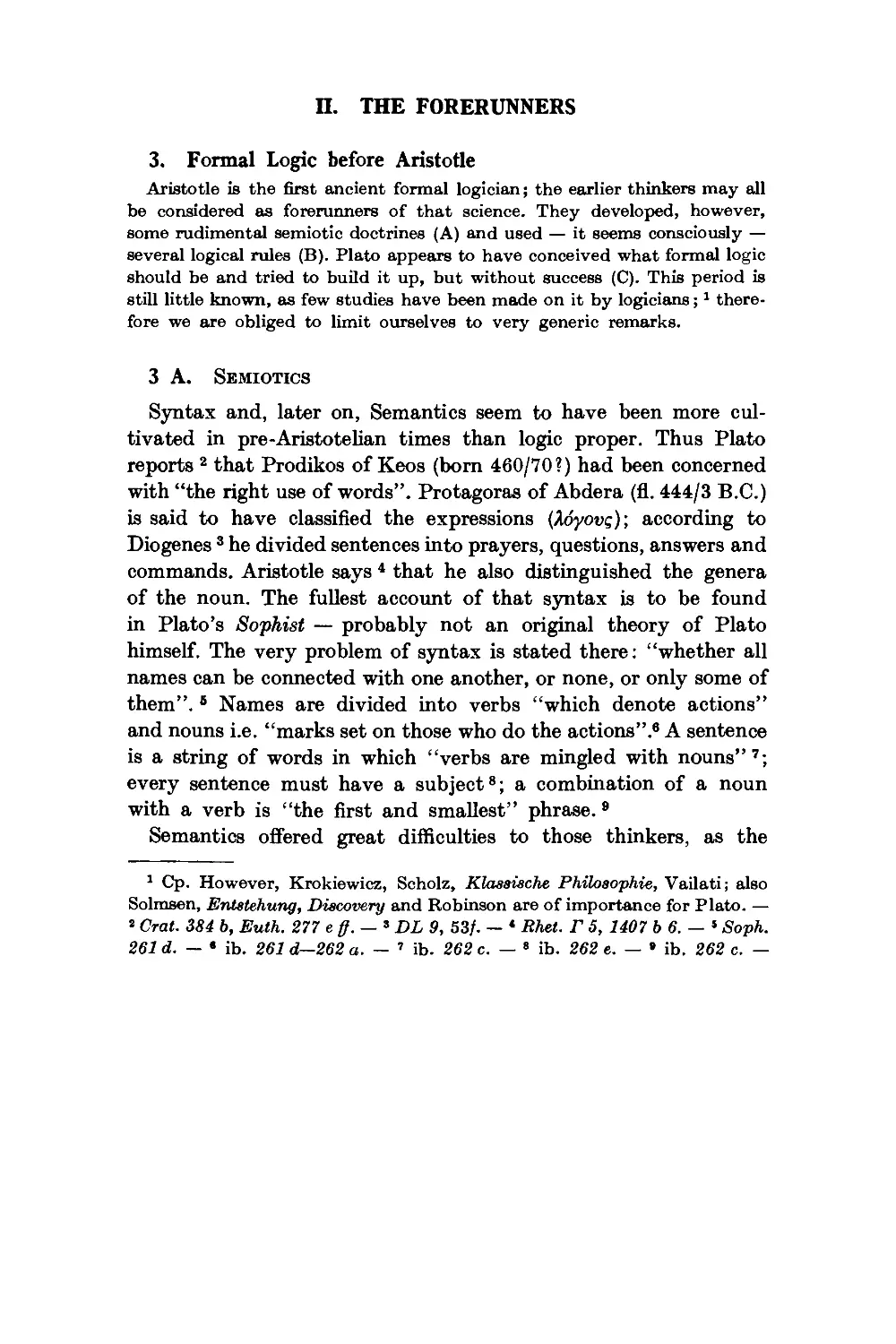
Aristotle is the first ancient formal logician; the earlier thinkers may all
be considered as forerunners of that science. They developed, however,
some rudimental semiotic doctrines (A) and used — it seems consciously —
several logical rules (B). Plato appears to have conceived what formal logic
should be and tried to build it up, but without success (C). This period is
still little known, as few studies have been made on it by logicians;1
therefore we are obliged to limit ourselves to very generic remarks.
3 A. Semiotics
Syntax and, later on, Semantics seem to have been more
cultivated in pre-Aristotelian times than logic proper. Thus Plato
reports 2 that Prodikos of Keos (born 460/70?) had been concerned
with "the right use of words". Protagoras of Abdera (fl. 444/3 B.C.)
is said to have classified the expressions (Xoyovg); according to
Diogenes 3 he divided sentences into prayers, questions, answers and
commands. Aristotle says * that he also distinguished the genera
of the noun. The fullest account of that syntax is to be found
in Plato's Sophist — probably not an original theory of Plato
himself. The very problem of syntax is stated there: "whether all
names can be connected with one another, or none, or only some of
them". 5 Names are divided into verbs "which denote actions"
and nouns i.e. "marks set on those who do the actions".6 A sentence
is a string of words in which "verbs are mingled with nouns"7;
every sentence must have a subject8; a combination of a noun
with a verb is "the first and smallest" phrase. 9
Semantics offered great difficulties to those thinkers, as the
1 Cp. However, Krokiewicz, Scholz, Klasaische Philoaophie, Vailati; also
Solmsen, Entstehung, Discovery and Robinson are of importance for Plato. —
s Crat. 384 b, Euth. 277 eff. — *DL9, 53/. — « Rhet. T 5, 1407 b 6. — * Soph.
261 d. — • ib. 261 d—262 a. — 7 ib. 262 c. — 8 ib. 262 e. — » ib. 262 c. —
FOBMAL LOGIC BEFOKE ARISTOTLE
15
theory of Antisthenes shows.10 Aristotle reports that according
to him "nothing could be described except by the account proper
to it (oixe(q> koyta), one predicate to one subject". u The 'what'
cannot be denned, as the definition is just a "long rigmarole". 12
Thus it seems that every sentence was a tautology for Antisthenes.
Another instance of such perplexity is supplied by the doctrine
of Lycophron, who is said by Aristotle 13 to have avoided the use
of the copula "iaxl", fearing that the One be confounded with
the Many. A better, but still rather elementary, semantics is to be
found in Plato, probably again not his original work. In the
Cratylos he discusses the nature of speech and reached a basically
conventionalistic theory. Thought, he says, is "akin to language",
indeed, "a conversation of the soul with itself" M while the speech
is "the stream of thought which flows through the lips and is
audible".15 Every sentence has a quality, namely falsehood and
truth.16 A false sentence is one "which asserts the non-existence
of things which are and the existence of things which are not".17
The full semantic theory of Plato is so strictly connected with his
metaphysical and epistemological views, that we cannot deal with
it here. It is, however, not improbable that Plato had already
the main ideas of Aristotle's semantics.
3 B. Pre-Aristotelian use of logical rules
Aristotle says that "on the subject of reasoning" he "had nothing
else on an earlier date to speak about" 18; in fact we know of no
correct logical principle stated and examined for its own sake before
Aristotle. Some logical rules were, however, consciously used, at
least since Zeno of Elea (fl. 464/60 B.C.) whom Aristotle is
reported19 to have called "the inventor of dialectics". When
examining such rules in the preserved fragments, we are induced
to advance several conjectures of a certain importance for the
10 There is no evidence that Aristotle alludes to him Met. r 1005 b 2—5; 4,
1006 a 5—8; 5, 1009 a 20—22; 6, 1011 a 12—20; but he is explicitly quoted
Met. A and H. — " Met. A 28, 1024 b 32—34. — « Met. H 3, 1043 b 23ff. —
18 Phys. A 2, 185 b 25—32. — u Soph. 264 a. — » ib. 263 e. — » ib. 262 eff.—
" ib. 240 e. — « Soph. El. 34, 184 a 9ff. — » AM 7,7; DL 8, 57; 9, 25.
16
THE FOKEKUNITERS
understanding of the origin of Greek formal logic. (1) That logic
seems to have risen out of dialectics; now dialectics means at that
time a discussion, a dialogue in which the opponent tries to refute
some assertion. Consequently, (2) the principles we find in use of
those old authors are in majority different forms of the principle
of reductio ad absurdum, apagogic rules. (3) Most of them were
certainly conceived rather as rules than as logical laws — but it
must be stressed that at that time nobody would have thought
of distinguishing both. (4) Finally the principles used seem also
to have been thought rules of logic of terms, not of propositions.
Here are some such rules extracted from different sources:
The words of Zeno reported by Simplicius (a good authority)
show that the Dialectician used a rule corresponding to the law:
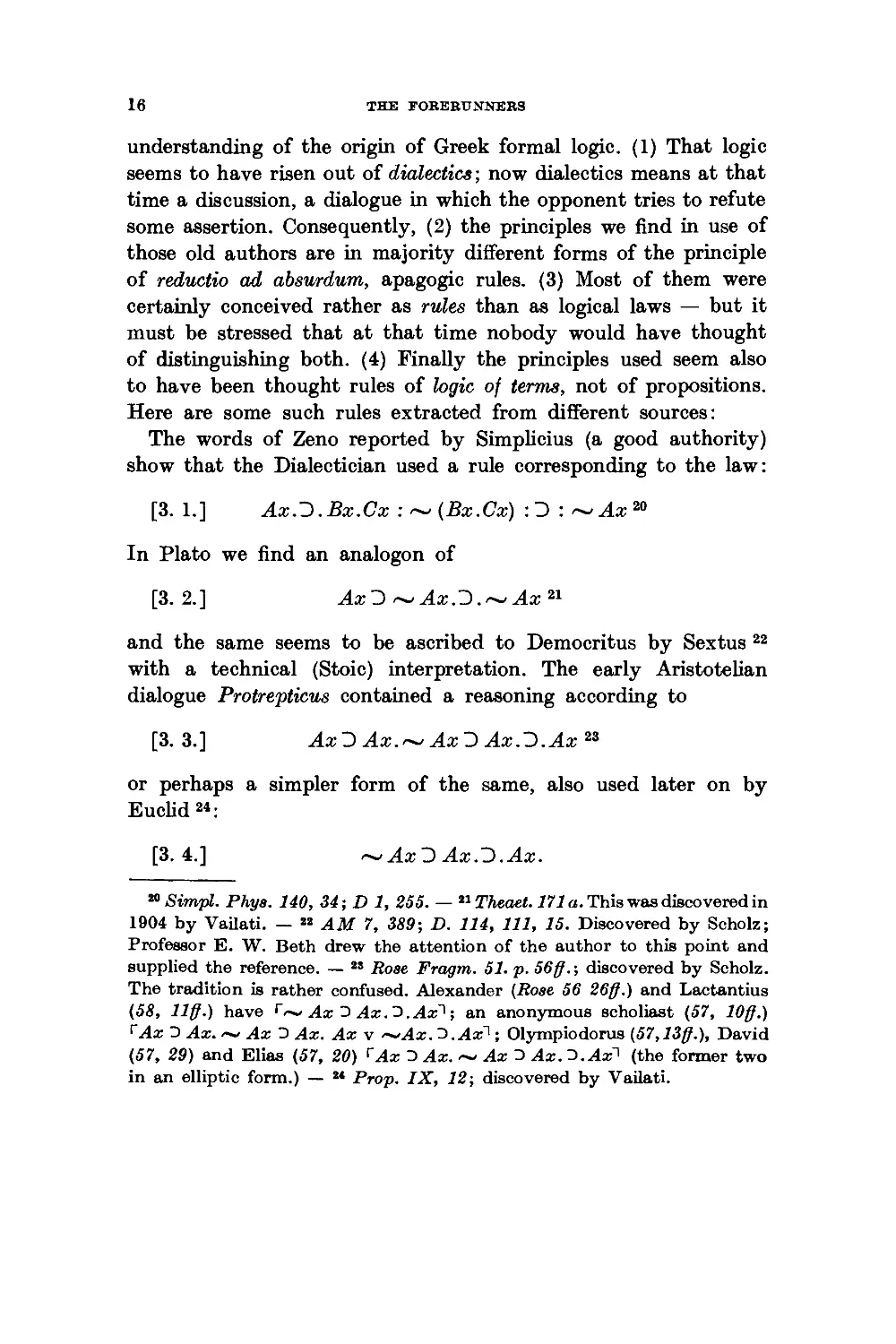
[3. 1.] Ax.D.Bx.Cx :~(Bx.Cx) :D i^Ax20
In Plato we find an analogon of
[3.2.] AxD~Ax.D.~Ax21
and the same seems to be ascribed to Democritus by Sextus 22
with a technical (Stoic) interpretation. The early Aristotelian
dialogue Protrepticus contained a reasoning according to
[3.3.] AxDAx.~AxDAx.D.Ax2S
or perhaps a simpler form of the same, also used later on by
Euclid 24::
[3.4.] ~AxDAx.D.Ax.
20 Simpl. Phya. 140, 34; D 1, 255. — 21 Theaet. 171 a. This was discovered in
1904 by Vailati. — 22 AM 7, 389; D. 114, 111, 15. Discovered by Scholz;
Professor E. W. Beth drew the attention of the author to this point and
supplied the reference. — 2S Rose Fragm. 51. p. 56ff.; discovered by Scholz.
The tradition is rather confused. Alexander (Rose 56 26ff.) and Lactantius
(58, llff.) have r~ Ax O Ax.O.Ax1; an anonymous scholiast (57, lOff.)
rAx 3 Ax. ~ Ax 3 Ax. Ax v ~-4x. O.Ax1; Olympiodorus (57,13ff.), David
(57, 29) and Elias (57, 20) rAx O Ax. ~ Ax 3 Ax. O.Ax1 (the former two
in an elliptic form.) — 2< Prop. IX, 12; discovered by Vailati.
FOKMAL LOGIC BEFOKE AKISTOTLE
17
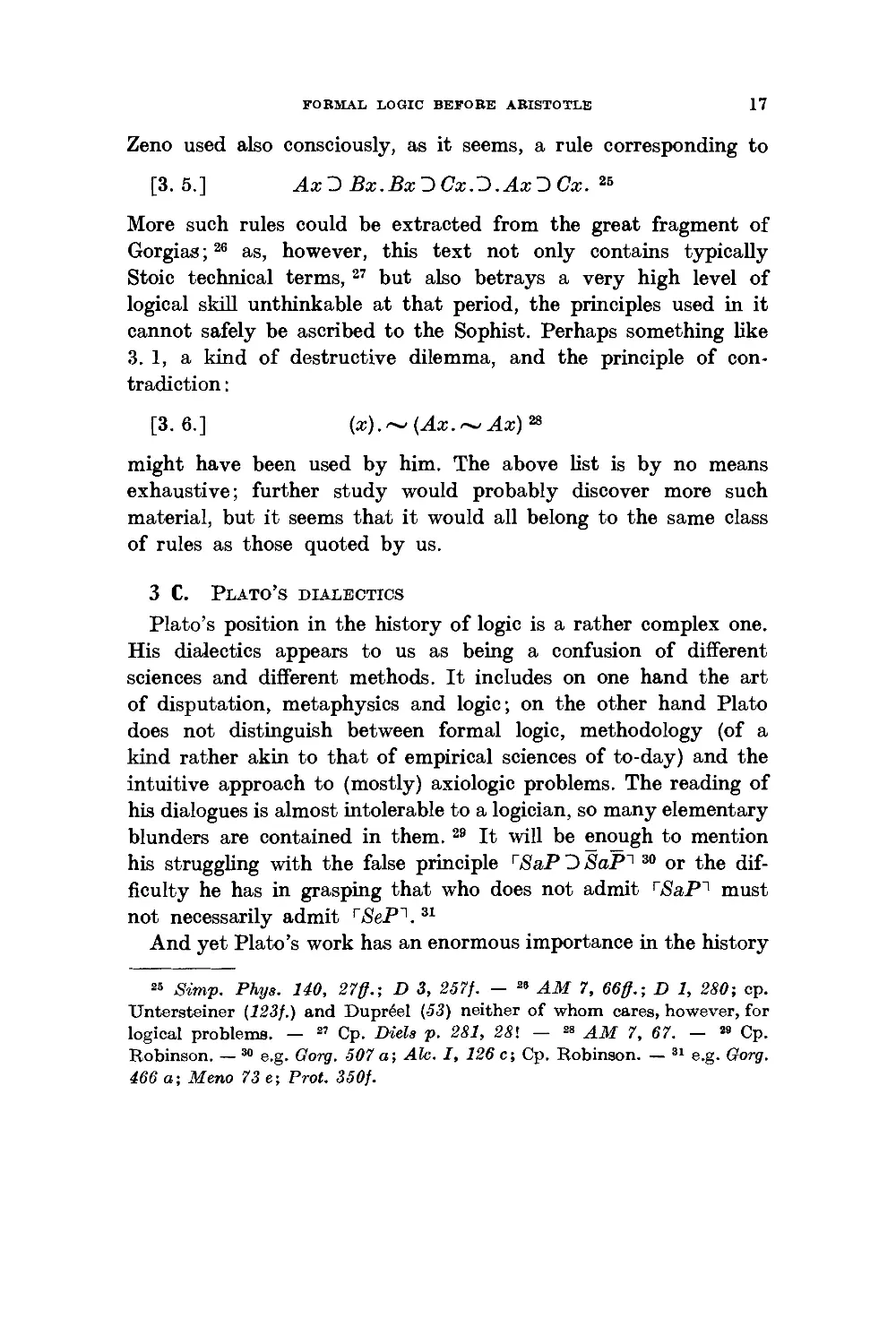
Zeno used also consciously, as it seems, a rule corresponding to
[3.5.] AxDBx.BxDCx.D.AxDCx. 25
More such rules could be extracted from the great fragment of
Gorgias;2S as, however, this text not only contains typically
Stoic technical terms, 27 but also betrays a very high level of
logical skill unthinkable at that period, the principles used in it
cannot safely be ascribed to the Sophist. Perhaps something like
3. 1, a kind of destructive dilemma, and the principle of
contradiction :
[3.6.] (x).~(Ax.~Ax)w
might have been used by him. The above list is by no means
exhaustive; further study would probably discover more such
material, but it seems that it would all belong to the same class
of rules as those quoted by us.
3 C. Plato's dialectics
Plato's position in the history of logic is a rather complex one.
His dialectics appears to us as being a confusion of different
sciences and different methods. It includes on one hand the art
of disputation, metaphysics and logic; on the other hand Plato
does not distinguish between formal logic, methodology (of a
kind rather akin to that of empirical sciences of to-day) and the
intuitive approach to (mostly) axiologic problems. The reading of
his dialogues is almost intolerable to a logician, so many elementary
blunders are contained in them. 29 It will be enough to mention
his struggling with the false principle r8aP D SaP^ 30 or the
difficulty he has in grasping that who does not admit rSaP1 must
not necessarily admit rSeP1. 31
And yet Plato's work has an enormous importance in the history
25 Simp. Phys. 140, 27ff.; D 3, 257f. — 2» AM 7, 66ff.; D 1, 280; cp.
Untersteiner (123f.) and Dupreel {S3) neither of whom cares, however, for
logical problems. — 27 Cp. Diets p. 281, 281 — 28 AM 7, 67. — S9 Cp.
Robinson. — 30 e.g. Oorg. 507 a; Ale. I, 126 c; Cp. Robinson. — 31 e.g. Gorg.
466 a; Meno 73 e; Prot. 350f.
18
THE FOKEKUNNERS
of logic for several reasons. (1) He was the first to conceive and to
state clearly the ideal of valid laws of reasoning. 32 (2) Following
Socrates, to whom Aristotle says "inductive arguments and
universal definition" "may be fairly ascribed" 33, he seems to have
shifted attention from the apagogic proofs to positive
demonstrations of statements attributing a propriety to a subject, thus
opening the line of "peripatetic" logic, i.e. logic of terms. (3) One
of his methods, namely that of division (dialqeav;) became the
origin of the syllogism. It consists in dividing a genus into two
species, finding to which of them the subject belongs, dividing this
again and so on. It is not only explicitly recommended, but even
experimentally tried before it was applied by Plato. M As Aristotle
has shown35 the division is a "weak syllogism" (acr&evris
ovAAoyiofiog): as a matter of fact, it does not prove anything, but
consists in a series of assumptions. (4) Finally nearly everything
in Aristotle's logic, if we except the analytical syllogism and some
doctrines connected with it, is most probably a reflex elaboration
and development of procedures used already, at least in a
rudimentary way, by Plato. * Correct logic we find none in his work ;
he was, however, a thinker who during his whole life was searching
for logic and paved the way for its founder.
82 Tim. 47 b. — »» Met. M 4, 1078 b 27—29. - »« Soph. 218ff. - «* An.
Pr. A 31, 46 a 31 ff. — *• This is most evident for the "hypothetical" syllogism;
cp. Me.no 86 e—87 c, Prot. 355f.
IH. ARISTOTLE
There is no thinker in the whole history of formal logic whose
importance, both historical and systematic, can be compared with
that of Aristotle. For not only is he the Logician who was first to
state formal laws and rules and study them for their own sake,
but also he did it in a way which, given that he is the originator
of the whole subject, appears as a tremendous achievement. It
has been said that not a single psychological general category was
invented after Aristotle; and the same is perhaps true of formal
Logic. Of course he did not invent the whole of it; but we owe him
most of the fundamental ideas on which Logic is still working
today — such as the idea of a formal entailment, of a variable,
of an axiom, and many others. At the same time Aristotle's Logic
dominated western Philosophy during more than twenty centuries
— another fact unique in its importance. Moreover, he is the only
great ancient logician whose works are preserved.
It will be consequently only reasonable to devote to Aristotle's
teaching more space than to any other ancient logician. We shall
deal with that teaching in 8 chapters: (1) Life, work and evolution,
(2) Notion of Logic, (3) Topics, (4) Theory of opposition; principles
of contradiction and of excluded middle, (5—6) Assertoric syllogism,
(7) Modal syllogism, (8) Other doctrines, including the
hypothetical syllogism.
4. Life, work and evolution
Logic accomplished more progress during Aristotle's life than in any
other period of Antiquity. We shall give therefore some details concerning
his life (A), his extant logical works (B), the criteria of their chronology
(C), the chronology itself (D), and finally we shall sketch the main lines of
his evolution (E).
4 A. Life '
Aristotle was born in 384/83 B.C. in Stageira; from 367/66 to
348/47 he was a member of Plato's Academy. After Plato's death
he went on journeys (348/7—343/42; Assos and Mytilene). From
343/4 to 336/35 he was the teacher of Alexander the Great. Then,
after a year's stay in Stageira, he came back to Athens (335/34)
and remained there as head of his "peripatetic" school until the
death of Alexander (323). At that time he returned to Chalcis and
died one year later in 322/21.
According to those external circumstances Aristotle's life may
be divided into three main periods: (1) Academic 361/66—348/47,
(2) of travels 348/47—335/34, (3) second Athenian or Master-
period 335/34—323.
4 B. Logical Works
The surviving logical works of Aristotle 2 were arranged by
Andronicus Rhodos (1st century B.C.) into six books; this body
was later on called "Organon" (i.e. "instrument") by the Byzantine
1 Cp. Jaeger; Ross, Aristotle; bibliography in Philippe, Nos 2. llff. —
2 The only comprehensive modern work on Aristotle's logic, which still
retains considerable value, is that of Maier. Among the commentaries, those
of Alexander of Aphrodisias and of Sir W. D. Ross on Analytics are the
most important among the known; there is, however, no doubt that several
older commentaries should be consulted, e.g. those of Albert the Great and
of Zabarella. For bibliography cp. Philippe. Works bearing on particular
problems are quoted in the respective chapters. The best modern English
translation is that under the direction of Sir W. D. Ross; H. Scholz (Ge-
achichte p. 27) says that this is the only modern translation which may be
recommended; and yet it does not satisfy a logician on all points.
LIFE, WOKK AND EVOLUTION
21
logicians. Besides the Organon there is one more completely
logical work, namely the fourth book (.T) of Metaphysics. All those
works seem to be drafts of lectures, and not destined for publication
in the present form. All with the exception of the Categories (which
are probably spurious, 3 but nevertheless seem to contain
Aristotelian doctrines) are authentic. Here is a list of them with a short
description:
1. Categories* (In Bekker's edition pp. 1—15); deals with (1)
homonyms, etc., (2) (ch. 1), predication and categories (3—9),
different notions (the so-called "postpraedicaments", ch. 10—15).
2. On Interpretation * (pp. 16—24). Contains Aristotle's syntax
(ch. 1—5) and his early theory of negation and opposition (6—14).
3. Prior Analytics 5 (pp. 24—70). Two books: A and B. Contains
the theory of the categorical syllogism (Al, 2, 4—7), of the modal
syllogism {A3, 8—22) and considerations on the system of syllogism
with remarks on other laws and methods (A 24—46, B). This is
probably the most original work ever written on logic; and, as
Prof. Scholz says, it remains still the best possible introduction
to its study.
4. Posterior Analytics5 (pp. 71—100). Two books: A and B.
Discusses demonstration, definition, deductive method and some
psychological problems; it is rather a treatise of methodology than
of formal logic. In spite of some remarkable doctrines it contains,
this work is evidentally a collection of separate notes, some of
which are very confused.
5. Topics6 (pp. 100—164). Eight books: A, B, r, A, E, Z, H
and 0. A treatise of "dialectical" reasoning in which
"commonplaces" (tojioi) useful for discussion are stated and the method of
it studied. A relatively well-written book, perhaps the only one
in the Organon which was nearly finished by the author.
6. On Sophistical refutations6 (pp. 164—184). Is now considered
as the ninth book (/) of Topics, as it contains at the end a survey
of the whole work. Discusses fallacies and their solution.
* Cp. Dupreel, Aristote. — * The best text available is that of Minio Palu-
ello. —s Best text by Ross. — • Best text by Strache-Wallies.
22
AMSTOTLE
7. Fourth book of Metaphysics'' (f) (pp. 1003—1012).
Discusses the principle of contradiction in a violent polemic style.
4 C. Criteria of chronology
There is no doubt that Aristotle's logic did evolve considerably;
it is also certain that none of his works remained unchanged.
Furthermore, it seems that most of them were placed at a later
date by Aristotle himself into a general frame, corresponding
somewhat to that retained by tradition. Thus the disentangling of the
different steps in his evolution is a difficult task. Several criteria
can be used however. Two of them are quite certain: (1) the use
of the analytic (categorical) syllogism, which is a late invention,
(2) the use of letters as abbreviations and as variables. 8 Along
with these, the following less certain criteria may be applied: (3)
the level of logical rigor and style, which is very different in
different writings and might be supposed to improve with time,
(4) the refinement of the analysis of the sentence, from the simple
"S—P" scheme, through the "all (none, some) of the S is P", to the
highly complex "that to all of which applies S, to that all applies
also P"9; (5) the letters probably occur first as simple
abbreviations, then as term-variables, and only at the end as propositional
variables; (6) the modal sentences, which correspond to Aristotle's
own philosophy of becoming, seem to be a later invention. On the
other hand the criterion of diminishing Platonism and increasing
formalism does not seem to be sufficiently substantiated. 10
4 D. Chronology of works
By applying these criteria we find that the logical works of
Aristotle — at least as far as the bulk is concerned — may have been
' Best text by Ross. — 8 Those two criteria were particularly emphasized
by Solmsen, Entuncklung. — » An. Pr. A 41, 49 b 14ff.; 13, 32 b 25ff.; An.
Post. A 21,82 b 5ff. —10 That criterium, emphasized by Jaeger, was applied to
the logical works of Aristotle by Solmsen, Entwicklung; the general theory
of Jaeger is now rejected, however, by most scholars; cp. the bibliography
in Philippe, Nos. 7. 11 ff. — about logical works also Ross, Analytics, Introd.
ch. 2, p. 6ff, and ch. 6 p. 75ff.
LITE, WOKK AND EVOLUTION
23
written in the following order. (1) The Topics (with the Soph. El.)
come first. u They contain no letters at all, the syllogism is not
yet known, the level is low and the analysis of a sentence is
rudimentary. (2) Met. r seems to belong to the same period; Aristotle
is preoccupied here with the problem of contradiction and deals
with it without letters, committing logical errors which he simply
could not have committed later on. (3) De Int. must have been
written later on; it contains semiotic doctrines which seem
essentially Platonic; there are still neither letters nor syllogisms, but
the level is noticeably higher than that of the Top. There is a
chapter on modalities — yet this is still primitive in comparison
with An. Pr. (4) In spite of some doubts, the present author thinks
that An. Post. B may be placed immediately thereafter.12
Aristotle knows here already both the syllogism and the letters;
but these are always used as abbreviations only; the level seems
inferior to that of other parts of the Analytics. (5) Thereafter,
An. Pr. A 1, 2, 4—7, 23—46 and perhaps An. Post A should be
placed. We have here not only letters, mostly used as class-variables,
and the syllogism is fully explained, but also the technical level
of the thought and speech is remarkable. (6) The last logical works
of Aristotle are perhaps An. Pr. A 3, 8—22 and B. We find here
the most refined doctrines, such as that of modality, and letters
are sometimes used as propositional variables.
In any case, two periods can be distinguished with certainty:
(1) Top, Soph. El., Met f, De Int. (2) Analytics.
4 E. Survey of the evolution
In the light of the above chronology the evolution of Aristotle's
formal logic may be stated in the following way: (1) He first
elaborated the Platonic Xdyovg (Top., Met. r, De Int.), considerably
11 So already Maier and especially Solmsen, Entwicklung. — 12 The order
proposed by Solmsen is: Top A—H, An. Post. A, Top 0, Soph. El., An.
Post. B., An. Pr. But Ross, Analytics, seems to have definitively
established the chronological priority of An. Pr. in regard to An. Post. A; the
present author does not think that he equally succeeded in showing that
An. Post. B. were written after An. Pr.
3
24
ARISTOTLE
developing and explicitly stating the rules or laws on which they
are based. By doing so he stated a wealth of interesting logical
principles of which, however, none is an analytic syllogism. This
period may coincide with that of travels (348/7—335/4). — (2)
Later on he made his two great discoveries: that of the analytical
syllogism and that of the variable. He then declared that the other
(non-analytic) laws and rules are of lesser importance and
concentrated on syllogism, first assertoric, then modal. — (3) By
analyzing the axiomatic system of the former (he did not have
time, as it seems, to do so with the latter) he discovered several
metalogical rules and even some laws of the logic of propositions.
These last discoveries were, however, not systematized by him.
5. Notion of Logic; semiotics
This chapter contains a short description of doctrines which would
probably be considered by Aristotle himself as introductory to logic, namely
of his theory of logic (A) and methodological doctrines (B), his syntax
(C), semantics (D), and his teaching on truth (E). Most of those points are
so strictly connected with the whole of Aristotle's philosophy that it is
impossible to enter into details without raising a great number of problems
alien to formal logic; at the same time, most of what is said by Aristotle
on those topics is curiously incomplete, so much so, that if one considers
only his explicit teaching, he might get a wrong idea of what Aristotle
thought.
5 A. Logic
Aristotle's term for "logical" is "etc xmv xeifievrnv" 1, i.e.
"following from the premisses", or "dvakvrixog" 2, while the term "logical"
("hoyixog) in his works generally means the same as "dialectical",
i.e. "probable".3 Logic seems to have no place in Aristotle's
system of sciences *, and was perhaps considered by him rather as
an "instrument" which must be learned before those sciences. 5
This does not mean, however, that Aristotle would not consider
logic as a theoretical discipline — the very fact that he devoted
so much effort and space to apparently useless logical problems
shows that this was not the case.
We find no definition of logic in the preserved Aristotelian
works; but its subject is clearly the syllogism and this is twice
defined as a "kdyog in which some things being laid down, something
different from them necessarily follows because of those laid down
things" 6 (or: "because they are such" 7). This is in fact a definition
of deduction in its whole generality. The remarkable thing about
1 An. Post. A 32, 88 a 18 and 30. — 2 An. Post. A 22, 84 a 7f. and 6 2.
Cp. Scholz, Geschichte 6f. — 3 An. Pr. B 16, 65 a 36; A 30, 46 a 9; B 23,
68 b 10; Top. A 1, 100 a 22, 29; 0 11, 161a 36 cp. Bonitz 183. — i Top.Z 6,
145 a 15].; Met. E 1, 1025 b 25; Met. K 7,1064 b 1. The Xoyixai in Top. A 14,
105 b 19ff. means clearly "epistemological". — 5 Met. r 3, 1005 b 2—5. —
• Top. A 1, 100 a25.—-> An. Pr. A 1,24b 18 f.
26
ARISTOTLE
it is that it does not attribxite to the syllogism any definite status:
for "Aoyog" may mean equally well a verbal discourse, a train of
thought, or an objective structure (of the kind of the Stoic Xexrov),
while exactly the same is true of the jigordaeig and 8qoi of which
the syllogism is said to be composed. There are, however, two
texts which might perhaps throw some light on that point. In the
An. Post.8 Aristotle says that the demonstration is not about
words but about things in the soul; and, while the whole structure
of the De Int. and the Top. supposes that logical formulae are
sequences of spoken words 9, it is asserted in the former that the
laws hold about the "spoken affirmations" because similar laws
hold with regard to the "judgements of the mind".10 Thus we may
say that for Aristotle logic is primarily an affair of right thinking
and, secondarily, a matter of correct speaking.
5 B. Methodological doctrines
It will be necessary to state here some of the methodological
doctrines of Aristotle which have a bearing on his formal logic.
(a) Since all knowledge starts, according to Aristotle's general
philosophy, with particulars, induction has a fundamental
importance in his methodology. As a matter of fact, we find in the
Organon a theory of induction; the Greek word for it is enaymyq.
Aristotle holds that every belief comes through syllogism (ovM.oyiofi6g
= deduction) or through iTiaywyrj11; the latter is denned as "a
passage from particulars {xaffexaaxa) to the universal (to xaftofaw)"
12. It must be stressed, however, that the word has at least three
different meanings, namely (1) didactic induction, (2) abstraction
of universal concepts from particular sensations 13, (3) induction
proper, which is again either complete 14 or generalizing
induction 15. While Plato seems to have considered the last variety as a
logically valid procedure, Aristotle emphatically denied its
validity M — which does not mean, of course, that he rejected the use
8 An. Post. A 10, 76 b 24f. — 9 Cp. e.g. De Int. 4, 16 b 26ff. — w De Int. 14,
23 a 32ff. — « An. Pr. B 23, 68 b 13]. — ls Top. A 12, 105 a 13. — ™ An.
Post. B 19, 100 a 3—100 b 5. — " An. Pr. B 23, 68 b 27ff.; 24, 69 a 17ff. —
15 Top. A 12, 105 a 14ff. — " An. Pr. B 23, 68 b 15—29.
NOTION OF LOGIC; SEMIOTICS
27
of the generalizing induction; the whole of his work is full of its
applications to different problems.
In the Top. the syllogism itself is divided into demonstrative
(&zodetxTix6s) dialectical (diaXexnxdg) and sophistic (igtarixdg)
17; the difference between them consists in the quality of the
premisses which must be necessary, true and prior to the conclusion
in demonstration18, but are probable only in the dialectical
syllogism 19 and false in the sophistical. The latter may also be
formally wrong.w Except for the last point, this division is
irrelevant for formal logic as Aristotle explicitly says; 21 but it is
important to notice that for Aristotle the scope of formal logic
was to supply means for demonstration 22. Now according to him,
a demonstration proves through the definition of the subject that
a property belongs to it. This is important, because it explains
Aristotle's insistence on the "categorical" syllogism — since, from
the point of view of his theory of demonstration only such a
syllogism (and indeed only one in the first figure) was a useful
logical tool.
5 C. Syntax
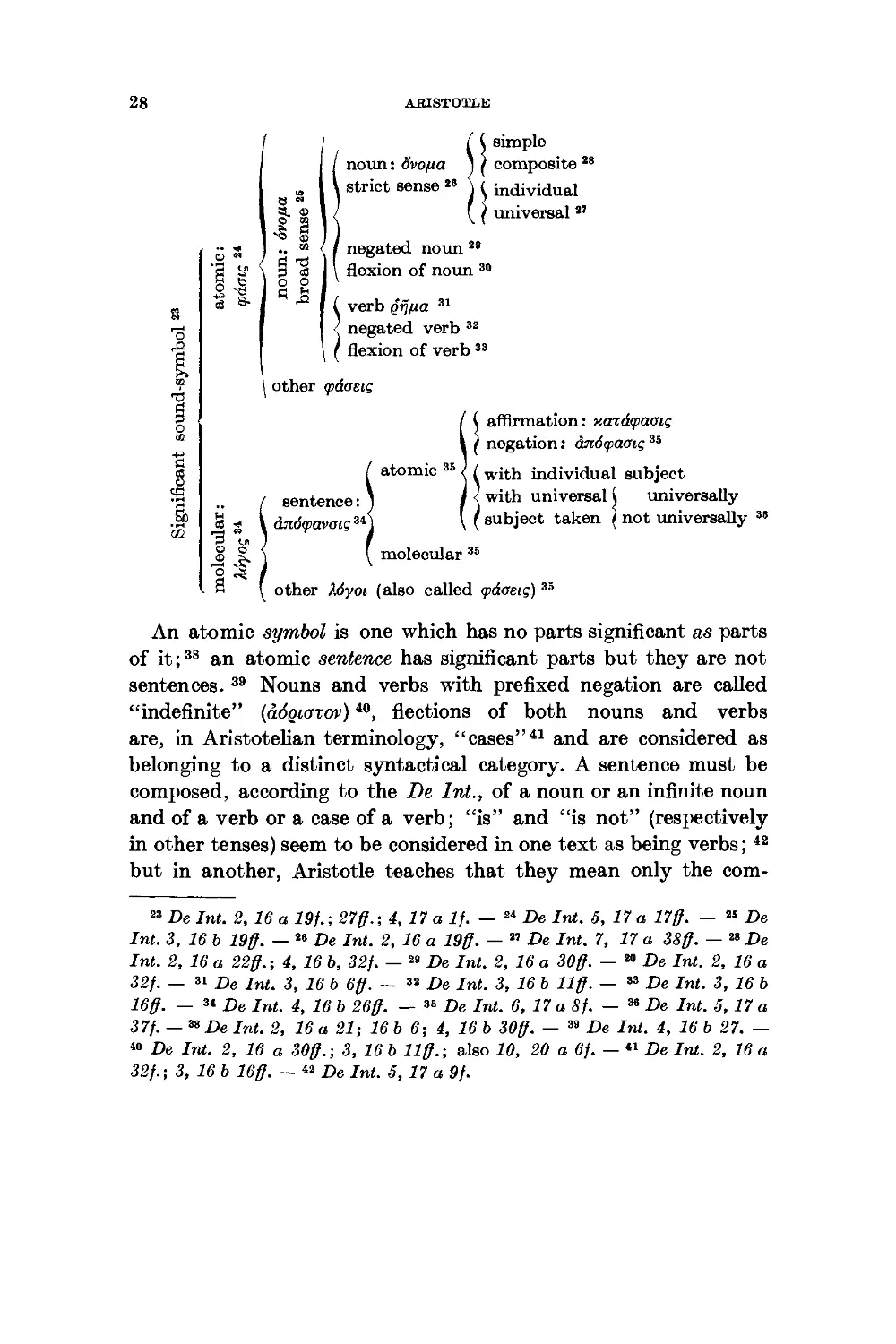
De Int. 1—5 and Poet. 20 contain the following classifications
of symbols:
" Top. A 1, 100 a 27ff. — 18 but cp. An. Post. A 2, 71b 20ff. where more
conditions are added. — w Top. A 1, 100 a 29'/.; cp. 14, 105 b 31. — M Top.
A 1, 100 b 23ff. — !1 An. Pr. A 1, 25-28. — » Cp. An. Pr. A 1,24 a 10f.%
and 4, 25 b 26ff.
28
AEISTOTLE
O
a
<s
o
■fl
02
noun: dvofia
strict sense 29
a.
*© ©
simple
composite 28
individual
universal 2'
i
negated noun 29
flexion of noun 30
verb gfjfia 31
negated verb 32
flexion of verb 3S
other qxiaeig
atomic 35
sentence:
&n6q>avai<;3i\
( affirmation: xardyaoig
( negation: an6<paaiq 35
' with individual subject
with universal I universally
' subject taken \ not universally 39
1*
molecular 35
other Myoi (also called qxiaeig) 35
An atomic symbol is one which has no parts significant as parts
of it;38 an atomic sentence has significant parts but they are not
sentences. 39 Nouns and verbs with prefixed negation are called
"indefinite" (aoQiarov)40, flections of both nouns and verbs
are, in Aristotelian terminology, "cases"41 and are considered as
belonging to a distinct syntactical category. A sentence must be
composed, according to the De Int., of a noun or an infinite noun
and of a verb or a case of a verb; "is" and "is not" (respectively
in other tenses) seem to be considered in one text as being verbs; 42
but in another, Aristotle teaches that they mean only the com-
23 De Int. 2, 16 a 19f.; 27ff.\ 4, 17 a If. — 24 De Int. 5, 17 a 17ff. — 2i De
Int. 3, 16 b 19ff. — 2» De Int. 2, 16 a 19ff. — 2' De Int. 7, 17 a 38ff. — » De
Int. 2, 16 a 22ff.; 4, 16 b, 32f. — 29 De Int. 2, 16 a 30ff. — *> De Int. 2, 16 a
32f. — »i De Int. 3, 16 b 6ff. — 32 De Int. 3, 16 b 11 ff. — 33 De Int. 3, 16 b
16ff. — 3« De Int. 4, 16 b 26ff. — 35 De Int. 6, 17 a 8f. — M De Int. 5, 17 a
37f. — ^De Int. 2, 16 a 21; 16b 6; 4, 16 b 30ff. — 39 De Int. 4, 16 b 27. —
40 De Int. 2, 16 a 30ff.; 3, 16 b 11 ff.; also 10, 20 a 6f. — " De Int. 2, 16 a
32f.; 3, 16 b 16ff. - « De Int. 5, 17 a 9f.
SEMIOTICS
29
position (avy&eaiv) and do not have a designatum.43 In the
De Int., the copula is not necessarily required in a sentence, 4* but
the sentences examined in the An. Pr. are always composed of
two nouns and the copula "belongs to" (vndgxei t<5) which
takes the place of the "is". Finally in An. Pr. A 36 Aristotle says
explicitly that the copula must not always be the "belongs to" and
gives instances of such other copulae (cp. HE).
5 D. Semantics
The explicit semantic scheme of Aristotle is a rather simple
one: written words are symbols of spoken words, these are symbols
of mental experiences, and mental experiences are again symbols
of things; 45 thus spoken words are also symbols of things. *• But
the Aristotelian semantics is by far more complex, and so complex
indeed that its explanation would require a long ontological and
epistemological introduction which, of course, cannot be given
here. We mention only that there is undoubtedly in Aristotle's
doctrine something corresponding to the Stoic "Xextov" or to
the late scholastic "conceptus objectivus": namely the "koyog"
which, while being highly ambiguous, acquires in some texts the
unambiguous meaning "that which is meant by the word in
opposition to the things themselves" i7. This is, of course, no Xsxrov
after the Stoic fashion, but conformably to the Aristotelian realism,
an aspect of reality; it is, however, clearly distinguished from the
concrete things themselves.
The meaning of the words is conventional. They seem to be
divided into two classes: the elements of the first directly mean
things, the other only "carry with them the meaning" (nQoaarj/uatvei)
of something, e.g. of the composition of the subject with the
predicate (the words "is" and "is not") tt or of the universal mode
of the sentence (the words "all" and "none") i9.
« De Int. 3, J6 b 22ff., but cp. 5,17 a 11 f. — ** De Int. 10, 20 a 3ff. — « De
Int. 1, 16 a 3ff. — *• Soph. El. 1, 165 a 7. —« e.g. Phys. 0 8, 263 b 13;
Met. A 10, 993 a 17; B 2, 996 b 8; r 7, 1012 a 23; N 1, 1087 b 12; cp.
Bonitz 433 b 48ff. — « De Int. 3, 16 b 22ff. — « De Int. 10, 20 a 12ff.
30
AKISTOTIiB
On the other hand words are divided into univocal (owwvvfia)
where the meaning (Xoyog) is the same in several designata M —
and ambiguous (6[Mx>vv[ia, 7iolla%&Q, Xey6[ieva) where this is not
the case 51. The latter are subdivided into (1) accidentally
ambiguous (and xvyris)52 which are sometimes called 6/Movvfia in a narrower
sense 53 and (2) another class of words which we may call
"systematically ambiguous". This is again subdivided in one text into
classes of terms which are called aq>' evog, Tzgdg iv and xara dvaAoyiav
ambiguous 54. An instance of the tiqoq ev is "healthy": a thing is
called "healthy" because it possesses health, or produces it, or is
its symptom or possible subject 55. The situation seems,
consequently, to be this: the word a is called "nqdi; ev ambiguous" in
respect of the things x and y and of the attributes 93 and xp, if and
only if <px.yyy and one of the above relations holds between 93 and
ip, and a means both 93 in x and %p in y.
We do not find any so explicit explanation of analogically
ambiguous words; Aristotle writes, however, often on analogy, M
and some of those texts seem to refer to such words. The situation
seems to be this: let be four objects a, 6, c, d and two relations Q
and R such that aQb and cRd and let Q be identical or similar to
R; then a name meaning both D'Q and D'R will be called
"analogically ambiguous".
A symbol must not be used ambiguously in proofs57; here
accidental ambiguity must be meant, not systematical. On the
other hand Aristotle insists on the unity of meaning of atomic
symbols 58; in one text 59 he says e.g. that if a symbol means
something it cannot mean at the same time its negation.
We may still notice that the verb, 31 but not the noun, x carries
with it the meaning of time. A further investigation into Aristotle's
semantics would lead us into an exposition of his theory of
definition60 which requires, in order to be understood, a rather
50 Gat. 1, 1 a 7, but confirmed by several genuine texts, cp. Bonitz 734 b,
e.g. Soph. El. 19, 177a9ff. — 51 Cat. 1, 1 a Iff.; Top. Z 10, 148 a 24, cp.
Bonitz 737 b. — " Eth. Nic. A 4, 1096 b 26. — 53 Met. r 2, 1003 a 33, —
s* Eth. Nic. A 4, 1096 b 27f. — 55 Met. r 2, 1003 a 35ff. — 5« cp. Muskens. —
m Soph. El. 4, 165 b 30ff. — 58 De Int. 11, 20 b 13ff. — 59 Met. r 4, 1006 bll ff.
— M Bibliography of the subject in Philippe nos. 11. 61ff.
SEMIOTICS
31
extensive knowledge of his ontological and epistemological doctrines:
it must be omitted here. We shall, however, briefly deal with the
Aristotelian theory of truth.
5 E. Truth
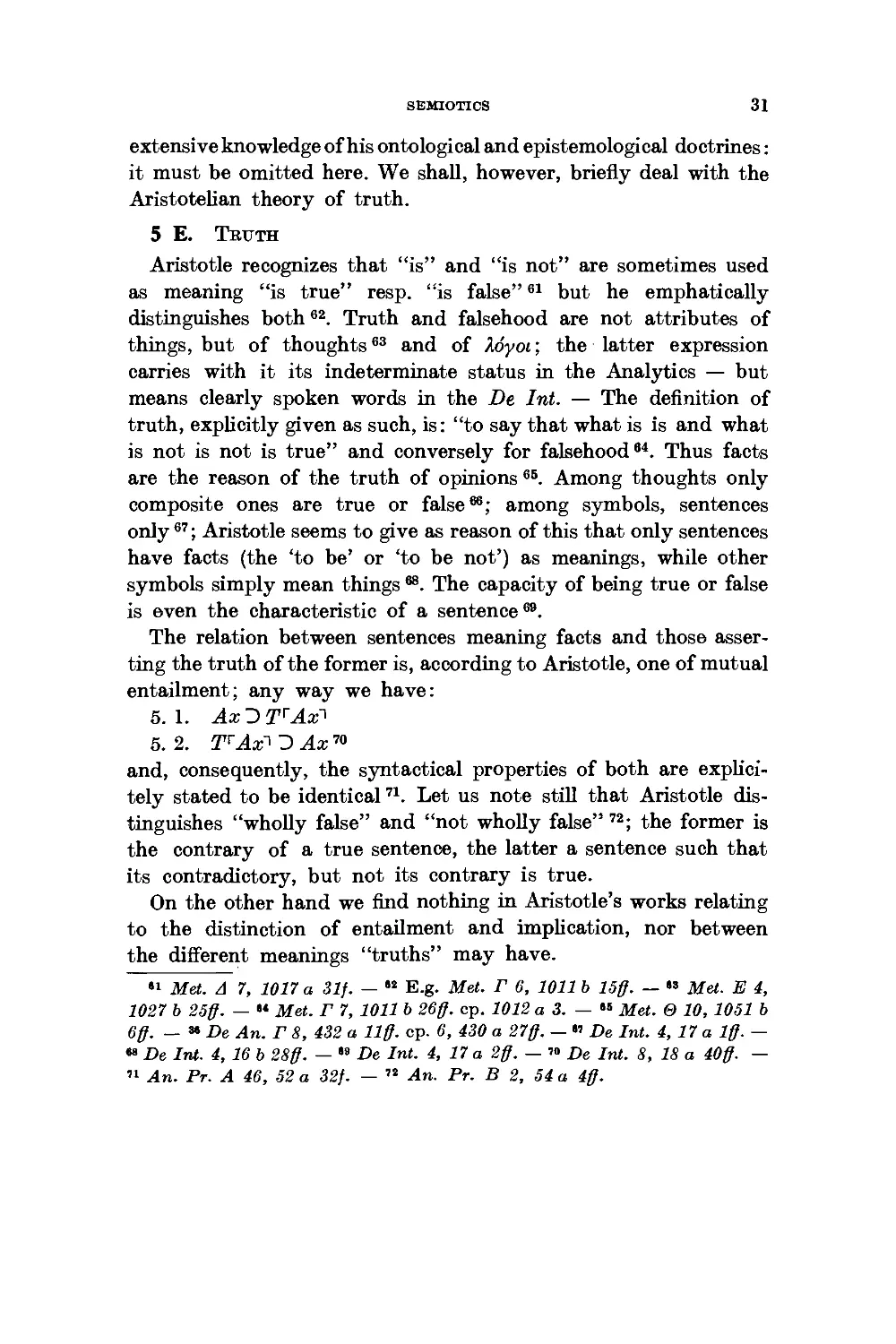
Aristotle recognizes that "is" and "is not" are sometimes used
as meaning "is true" resp. "is false"61 but he emphatically
distinguishes both62. Truth and falsehood are not attributes of
things, but of thoughts63 and of Xoyoi; the latter expression
carries with it its indeterminate status in the Analytics — but
means clearly spoken words in the De Int. — The definition of
truth, explicitly given as such, is: "to say that what is is and what
is not is not is true" and conversely for falsehood64. Thus facts
are the reason of the truth of opinions 65. Among thoughts only
composite ones are true or false66; among symbols, sentences
only 67; Aristotle seems to give as reason of this that only sentences
have facts (the 'to be' or 'to be not') as meanings, while other
symbols simply mean things 6S. The capacity of being true or false
is even the characteristic of a sentence69.
The relation between sentences meaning facts and those
asserting the truth of the former is, according to Aristotle, one of mutual
entailment; any way we have:
5.1. AxDTrAxi
5. 2. T^Ax^ D Ax70
and, consequently, the syntactical properties of both are explici-
tely stated to be identical71. Let us note still that Aristotle
distinguishes "wholly false" and "not wholly false" 72; the former is
the contrary of a true sentence, the latter a sentence such that
its contradictory, but not its contrary is true.
On the other hand we find nothing in Aristotle's works relating
to the distinction of entailment and implication, nor between
the different meanings "truths" may have.
1,1 Met. A 7, 1017 a 31f. — ,2 E.g. Met. r 6, 1011 b ISff. — " Met. E 4,
1027 b 25ff. — •« Met. r 7, 1011 b 26ff. cp. 1012 a 3. — " Met. 0 10, 1051 b
6ff. —*De An. r 8, 432 a llff. cp. 6, 430 a 27ff. — •' De Int. 4, 17 a Iff.—
w De Int. 4, 16 b 28ff. — •» De Int. 4, 17 a 2ff. — '» De Int. 8, 18 a 40ff. —
" An. Pr. A 46, 52 a 32f. — " An. Pr. B 2, 54 a 4ff.
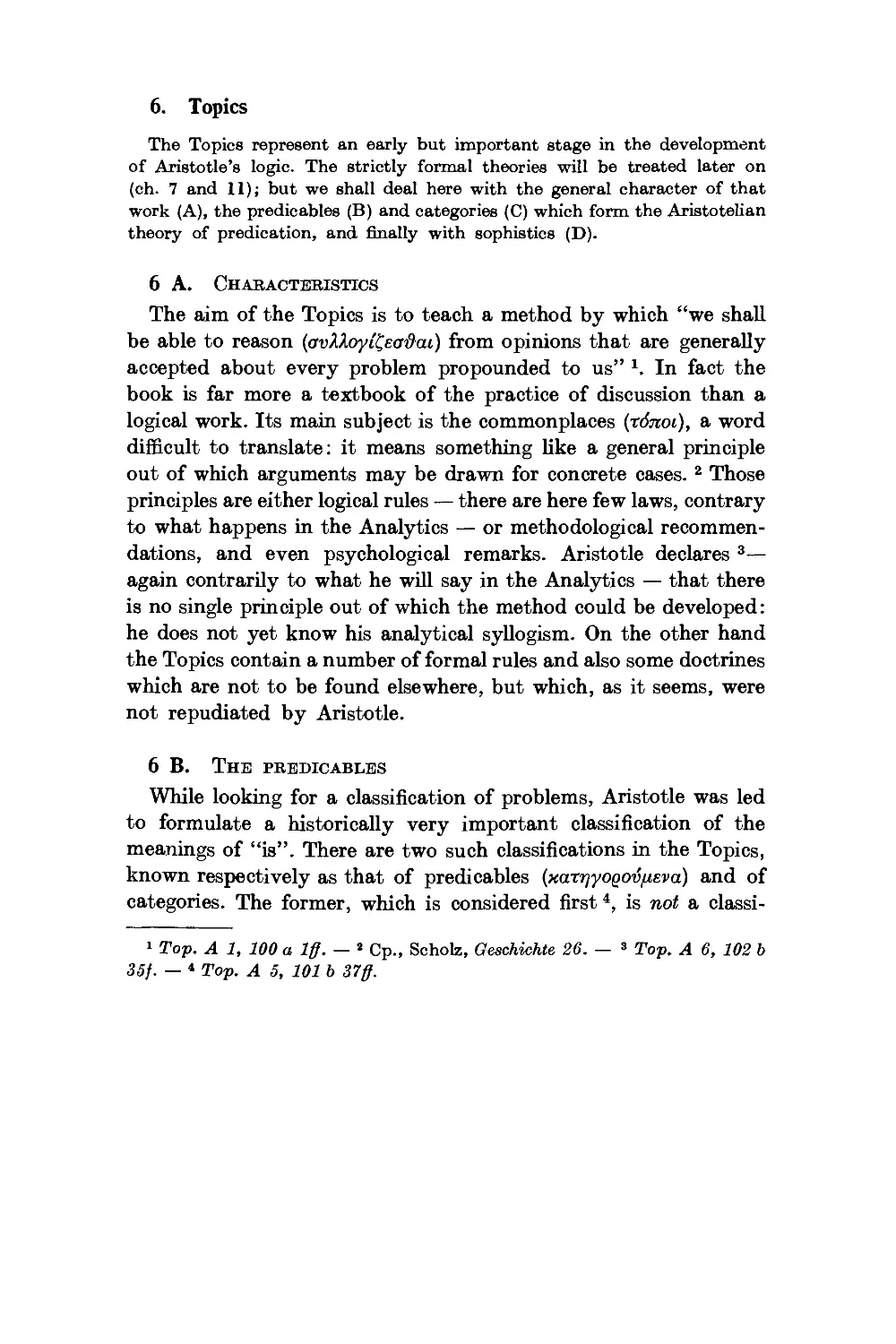
6. Topics
The Topics represent an early but important stage in the development
of Aristotle's logic. The strictly formal theories will be treated later on
(ch. 7 and 11); but we shall deal here with the general character of that
work (A), the predicables (B) and categories (C) which form the Aristotelian
theory of predication, and finally with sophistics (D).
6 A. Characteristics
The aim of the Topics is to teach a method by which "we shall
be able to reason (avXXoyi^ea-&ai) from opinions that are generally
accepted about every problem propounded to us" 1. In fact the
book is far more a textbook of the practice of discussion than a
logical work. Its main subject is the commonplaces (totioi), a word
difficult to translate: it means something like a general principle
out of which arguments may be drawn for concrete cases. 2 Those
principles are either logical rules — there are here few laws, contrary
to what happens in the Analytics — or methodological
recommendations, and even psychological remarks. Aristotle declares 3—
again contrarily to what he will say in the Analytics — that there
is no single principle out of which the method could be developed:
he does not yet know his analytical syllogism. On the other hand
the Topics contain a number of formal rules and also some doctrines
which are not to be found elsewhere, but which, as it seems, were
not repudiated by Aristotle.
6 B. The predicables
While looking for a classification of problems, Aristotle was led
to formulate a historically very important classification of the
meanings of "is". There are two such classifications in the Topics,
known respectively as that of predicables (xarrjyoQotf/neva) and of
categories. The former, which is considered first 4, is not a classi-
1 Top. A 1, 100 alff. — * Cp., Scholz, Geschichte 26. — 3 Top. A 6, 102 b
35f. — * Top. A 5, 101 b 37ff.
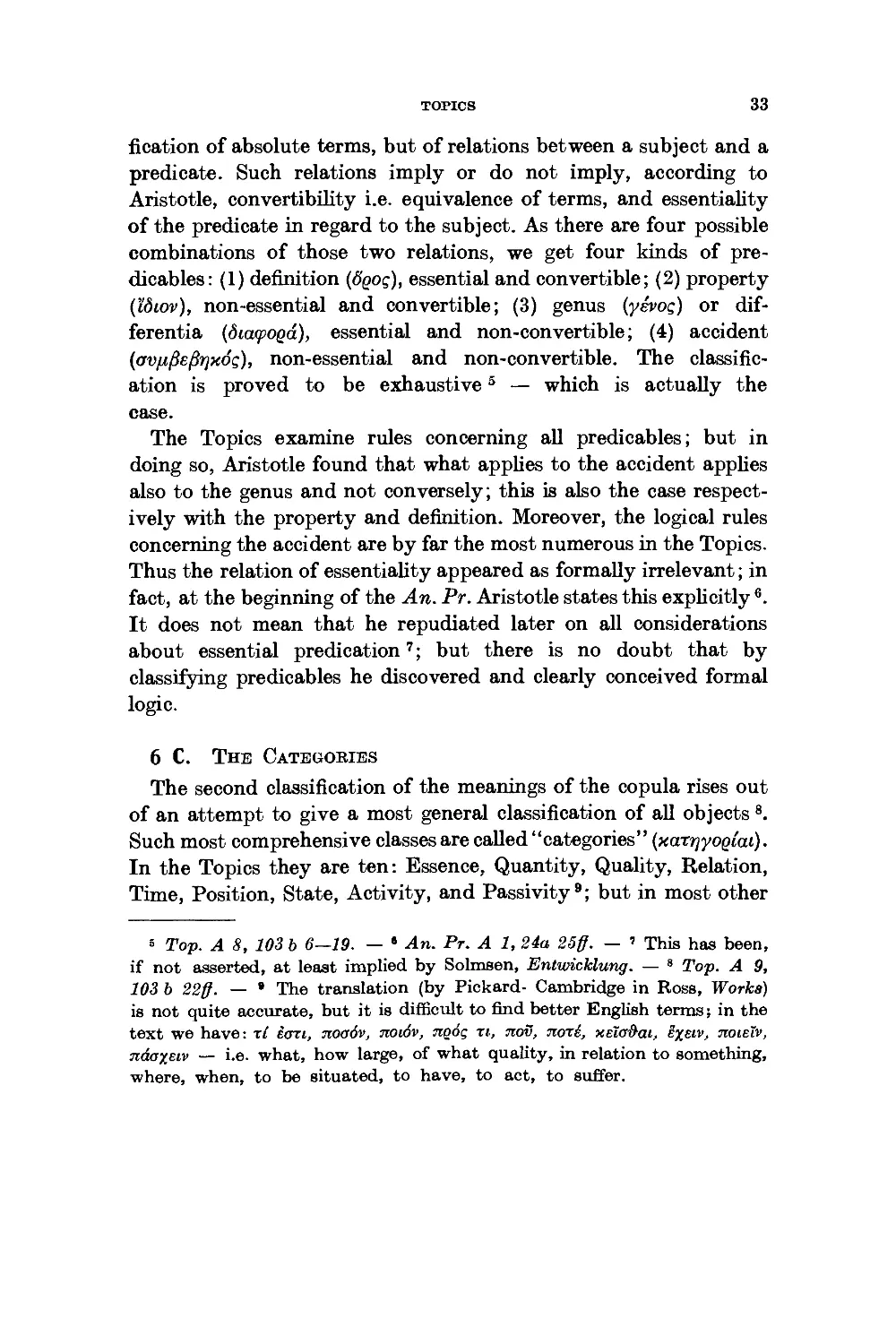
TOPICS
33
fication of absolute terms, but of relations between a subject and a
predicate. Such relations imply or do not imply, according to
Aristotle, convertibility i.e. equivalence of terms, and essentiality
of the predicate in regard to the subject. As there are four possible
combinations of those two relations, we get four kinds of
predicates: (1) definition (dgog), essential and convertible; (2) property
(idiov), non-essential and convertible; (3) genus (ysvog) or
differentia (dicupogd), essential and non-convertible; (4) accident
(ov/ufie/lrjxos), non-essential and non-convertible. The
classification is proved to be exhaustive5 — which is actually the
case.
The Topics examine rules concerning all predicables; but in
doing so, Aristotle found that what applies to the accident applies
also to the genus and not conversely; this is also the case
respectively with the property and definition. Moreover, the logical rules
concerning the accident are by far the most numerous in the Topics.
Thus the relation of essentiality appeared as formally irrelevant; in
fact, at the beginning of the An. Pr. Aristotle states this explicitly 6.
It does not mean that he repudiated later on all considerations
about essential predication7; but there is no doubt that by
classifying predicables he discovered and clearly conceived formal
logic.
6 C. The Categories
The second classification of the meanings of the copula rises out
of an attempt to give a most general classification of all objects 8.
Such most comprehensive classes are called "categories" (tcarrjyogiai).
In the Topics they are ten: Essence, Quantity, Quality, Relation,
Time, Position, State, Activity, and Passivity 9; but in most other
5 Top. A 8, 103 b 6—19. — * An. Pr. A 1, 24a 25ff. — ' This has been,
if not asserted, at least implied by Solmsen, Entwicklung. — 8 Top. A 9,
103 b 22ff. — » The translation (by Pickard- Cambridge in Ross, Works)
is not quite accurate, but it is difficult to find better English terms; in the
text we have: xl iari, noadv, noiav, ngdg n, nov, noti, xelo&ai, §xetv> noieiv,
ndaxeiv — i.e. what, how large, of what quality, in relation to something,
where, when, to be situated, to have, to act, to suffer.
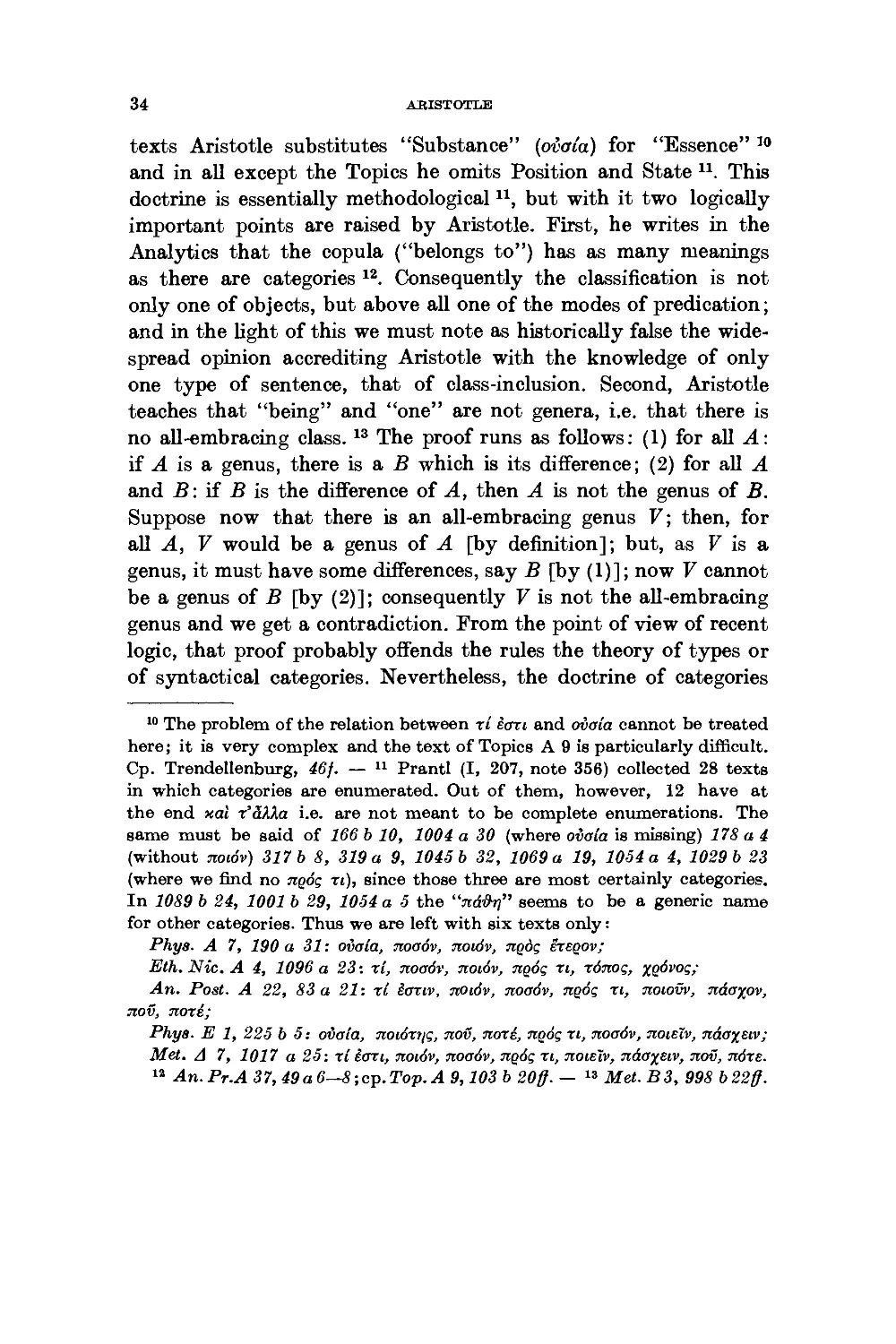
34
AEISTOTIiB
texts Aristotle substitutes "Substance" (ovaia) for "Essence" 10
and in all except the Topics he omits Position and State u. This
doctrine is essentially methodological u, but with it two logically
important points are raised by Aristotle. First, he writes in the
Analytics that the copula ("belongs to") has as many meanings
as there are categories 12. Consequently the classification is not
only one of objects, but above all one of the modes of predication;
and in the light of this we must note as historically false the
widespread opinion accrediting Aristotle with the knowledge of only
one type of sentence, that of class-inclusion. Second, Aristotle
teaches that "being" and "one" are not genera, i.e. that there is
no all-embracing class.13 The proof runs as follows: (1) for all A:
if A is a genus, there is a B which is its difference; (2) for all A
and B: if B is the difference of A, then A is not the genus of B.
Suppose now that there is an all-embracing genus V; then, for
all A, V would be a genus of A [by definition]; but, as V is a
genus, it must have some differences, say B [by (1)]; now V cannot
be a genus of B [by (2)]; consequently V is not the all-embracing
genus and we get a contradiction. From the point of view of recent
logic, that proof probably offends the rules the theory of types or
of syntactical categories. Nevertheless, the doctrine of categories
10 The problem of the relation between rl iari and ovaia cannot be treated
here; it is very complex and the text of Topics A 9 is particularly difficult.
Cp. Trendelenburg, 46f. — " Prantl (I, 207, note 356) collected 28 texts
in which categories are enumerated. Out of them, however, 12 have at
the end xal r'&Xka i.e. are not meant to be complete enumerations. The
same must be said of 166 b 10, 1004 a 30 (where ovaia is missing) 178 a 4
(without noiov) 317 b 8, 319 a 9, 1045 b 32, 1069 a 19, 1054 a 4, 1029 b 23
(where we find no nqdg ri), since those three are most certainly categories.
In 1089 b 24, 1001 b 29, 1054 a 5 the "ndftrj" seems to be a generic name
for other categories. Thus we are left with six texts only:
Phya. A 7, 190 a 31: ovaia, noadv, noidv, ngdg ereQov;
Eth.Nic. A 4, 1096 a 23: ri, noadv, noidv, ngdg ri, rdnog, xQdvog;
An. Post. A 22, 83 a 21: rl iariv, novdv, noadv, nqdg ri, noiovv, n&aypv,
nov, nori;
Phya. E 1, 225 b 5: oiala, noiMi\Q, nov, noxi, 7ig6g n, noadv, noietv, naa%£iv;
Met. A 7, 1017 a 25: rl iari, noi6v, noadv, ngdg ri, noieiv, ndaytiv, nov, ndre.
12 An.Pr.A 37, 49a6—8;cp.Top.A 9,103 b 20ff. — 13 Met. B3, 998 b22ff.
TOPICS
35
is systematically important: it is an attempt to classify not only
objects but also types of objects, and it includes an explicit rejection
of the all-comprehending class.
The same result was reached again in 1908, after Aristotle's
doctrine had been forgotten.
6 D. Sophistics
The last book of the Topics 14 contains a classification and an
analysis of fallacies. Aristotle divides them into two groups:
fallacies dependent on diction (naga xr\v M£iv), six in number,15
and fallacies not dependent on diction (e£co rfjg Mietaq), seven in
number. 1S The logically important content of his theory regarding
the former is the following: words and phrases when repeated in
the same argument must have (1) exactly the same form and (2)
exactly the same meaning.17 Among the fallacies of the second
group the Ignoratio elenchi (jtaga rov etey%ov ayvoiav)18 is
considered as the chief one to which all others may be reduced: for
every fallacy consists in assuming that something is an argument
when it is not.19 Two other fallacies of that group are interesting:
the petitio principii (naga rd rd iv agxtj A-afifidveiv) and the
consequent {naga rd endfievov). Discussing the former, Aristotle states
that we are not allowed to assume what we intend to prove, thus
excluding circular proofs20. The discussion of the latter contains
the explicit rejection of
pDq.q.D.p
and, also of
pDq.~p.D.~q21
as invalid.
14 Top. I — Soph. El. There is another, less comprehensive treatise on the
same subject: An. Pr. B 16—18. — 16 Soph. El. 4, 165 b 24ff. — 19 Soph. El.
4, 166 b 21ff. — » Soph. El. 5, 167 a 21ff. — 18 Soph. El. 5, 167 a 21ff. —
19 Soph. El. 6, 168 a 17ff. — so Soph. El. 5, 167 a 36ff. — 21 Soph. El. 28, 181a
27ff. In spite of the example 167 b 6—8 Aristotle thinks here in terms of
the logic of terms, cp. Soph. El. 28, 181 a 22ff.
7. Opposition. Principles of contradiction and of the excluded
middle
We shall give here, after a historical survey of the problem of negation
(A), a sketch of the later Aristotelian theory of opposition (B), of the
principle of contradiction (C), and of the tertium non datur (D). The formal
theorems concerning the opposition will be stated in the next chapter.
7 A. Historical survey; early doctrine
The situation with regard to negation and opposition which
Aristotle met can be understood from his own early teaching as
it appears in the Topics and Met r. It may be seen there that
while those problems seemed very important (which is natural,
considering that logic was then above all dialectics, i.e. a theory
of discussion), at least three things were confused; (1) terms and
sentences and, consequently, their negations, (2) quantified and
non-quantified sentences, (3) negative sentences and negation of
sentences. The very fact that Aristotle himself reasons in Met r
according to the false principle
~SapDSePl
suffices to show how great the difficulty must have been to get a
clear theory on those points. However, Aristotle was able to
overcome these initial confusions almost completely.
Out of his early doctrines we shall take one only for special
attention, the theory of four opposites (dvtf&eaeig). 2 These are
historically important and by comparison with the later doctrine
of opposition show the progress accomplished by Aristotle. They
are: the relative (tiqos ri, between a and R'a); the contrary
(evavria, as just-unjust); the opposition between privation and
1 Met. n, 1007 b 19ff.; 1008 a 2ff., 28ff., 30ff.; 7, 1011 b 35ff.; 1012 a 7ff.;
cp. Lukasiewicz, Der Satz and Salamucha, lOOff. — 2 Top. B 2, 109 b 18ff.;
8, 113 b 15; Met, I 3 1054 a 23; 4, 1055 a 38 etc.
OPPOSITION
37
possession (xara ardgrjaiv xal §£iv: blindness and sight), and
contradictory opposition (xat" avriyaoiv: just — not-just). Even the
last is formulated in such a way that it is not clear if we have to
do with terms or with sentences, but the latter supposition is
the more probable.
7 B. Later theory of opposition
Already in the De Int. Aristotle developed a far more formal
(metalogical) doctrine of opposition. For each sentence there is
one 3 and only one 4 denial, provided that the words with which it
is composed are not ambiguous. 5 The denial of an affirmative
sentence is a negative sentence concerning (xard) the same subject
and conversely. The negation must qualify the copula in sentences
with individual names as subjects and in sentences whose subject
is a class name, but are not quantified. If we apply the negation
in a quantified sentence to the quantifier, we get its contradictory
(rSaP1 — rr^SaP1; rSeP1 — rSiP1; the name is first dvri(pari>ccog
avrixeifievai6 then avrixeifiivcu in a narrower sense).7 If,
on the contrary, the negation qualifies the copula, we have a
contrary sentence (r(SaPn — rSeP'i: ivavriais). A similar doctrine
is expounded in the An. Pr. where Aristotle distinguishes three
kinds of "real" opposition: WaPi — rSePi, rSaP~> — r~SaP~>,
rSeP1 — rSiP1 (i.e. six with the converses)9 and one merely
verbal, namely rSiP1 — rSaP1.10 Out of two contradictories one
must be true, the other false, u while the contraries cannot be
both true 12, but the falsity of one does not entail the truth of
the other 13. The scheme representing all those theorems would
be the following 14:
3 De Int. 6, 17 a 31f. — 4 De Int. 7, 17 b 38. — « De Int. 11, 20 b Uff. —
• De Int. 7, 17 b 16ff. — ' De Int. 10, 20 a 30; cp. An. Pr. B 15, 63 b 28ff.;
64 a 31 f. — 8 De Int. 7, 17 b 20ff.; cp. An. Pr. B 15, 63 b 28; 64 a 31. —
» An. Pr. B 15, 63b 24ff.; 64 a 33ff.; 8, 59 b 8ff. — 10 An. Pr. B 15, 63 b 27
(cp., however, 8, 59 b 8ff. — " De Int. 7,17 b, 26 f. — 12 De Int. 7,17 b 22f.;
10, 20 a Uff. — 13 An. Pr. B 11, 61 b 6f.; 62 a 17ff. — 14 The "traditional"
logical square is given first (among the texts preserved) by Apuleius (cp.
18 B).
38
ARISTOTLE
*^ contraries jfl
contradictories
*/verbally opposed \
r^iP"1 r~SaP~*
Aristotle struggled hard with the initial confusion of the negation
of a sentence with the negation of its terms; the chapter 10 of the
De Int. in which he expounds the problem is one of the most
instructive on the difficulties with which he had to deal. He does
not seem to have reached a clear understanding of the different
meanings of negation in both cases; but he elaborated a fragment
of a correct theory of obversion 15. Curiously enough, he never
used it in his different axiomatizations of the syllogistic, where,
as it has been shown recently 16, it would have been very useful.
The formal theorems concerning that part of his teaching (as also
the theory of opposition of modal sentences) will be treated later
on.
7 C. The principle of contradiction
While we find no principle of identity in the preserved writings
of Aristotle, 17 a whole book of Metaphysics (.T) is devoted to the
principle of contradiction (which is, however, not called so by
Aristotle himself) and there are numerous formulations of it in his
other works. Those formulations may be divided into logical and
metalogical. The former are: "the same cannot belong and not
belong together to the same under the same respect" 18 and "Let
15 Delnt. 10, 20 a 20—26. The importance of that text has been pointed
out to the author by Fr. I. Thomas; cp. also his review of Sir W. D. Ross'
Analytics in Dominican Studies 3, 1950, 184ff. — w Cp. I. Thomas, GS(n):
an extension of OS. Dominican Studies 2, 1949, 145—160. — " The nearest
approach to it is perhaps An. Pr. A 32, 47 a 8f.: SeT yag nav r6 aXrjⅈ
avrd iavraj dftotoyovfievov elvai ndvrr). — 18 Met. r 3, 1005 b 19f.
PRINCIPLE OF CONTRADICTION
39
A stand for 'to be good', B for 'not to be good' .... Then A and B
will never belong to the same thing" 19. This may be stated in the
following terms:
7.11. (x, 9?).~ (<px.~<px).
Among the metalogical formulations we have: "contradictory
statements are not true together" 20 and "it is not possible to
assert and deny the same" 21. The latter was sometimes considered
as a psychological law 22, but it may be doubted if it was meant
to be one by Aristotle.
We may formulate it as follows:
7.12. ~(Tr>x~l.Tr~<px~l)
but
7. 13. ~(T<SaP~l .TfSoP^.r^iTrSeP1 .T<~SiP->)
would be probably more accurate.
There is also another form of the metalogical principle in which
contrary sentences are said to be incompatible, either in the
technical meaning of "contrary" or generically; this is stated
both in its logical and in its metalogical form:
7. 14. (x, 9?).~ (<px.q)x) 23
7. 15. (S, P).r^(TrSaP~l.TrSeP1) M
It might be noted that the principle of contradiction applies to
actual attributes (evreXdxeia) only, since a thing may potentially
(dvvdftBi) have contradictory attributes. 25
The principle is declared to be evident and "the firmest of all
opinions" 2S. Aristotle demonstrates it elenchically, i.e. by reduction
to absurdity. We shall not reproduce his arguments which seem to
be all fallacious and which simply could not have been stated in
18 An. Pr. A 46, 51 b 36ff. — 20 Met. r 6, 1011 b 15f. — 21 Met. r 3, 1005
b 23ff. — 2a Lukasiewicz, Der Satz, 17; Salamucha, 75. — 23 Top. B 7,113
a 22f. — 24 De Int. 7,17 b 20ff.; 10, 20 a 16ff. — a5 Met. r 5, 1009 a 35]. —
29 Met. r 4, 1005 b 19—23.
40
ABISTOTLE
that form later on, as they contain the petitio principii and other
errors. 27 Another doctrine which was repudiated later is that
this principle is the first axiom into which all demonstrations are
reduced, since it is by nature the principle of all axioms (<pvaei
aQxv) M- In fact the opposite is thought in the An. Post.: it is
explicitly said that no demonstration assumes that principle 29.
Moreover, both in the An. Pr. and in the An. Post. Aristotle gives
instances of syllogisms which violate the principle of contradiction
and yet are considered as perfectly valid, e.g.:
*7. 16. SaM.SeM.D.SeS30
*7. 17. Ma(Pn —P).SaM.D.Sa(Pn —P) 31
Similar instances are explicitly adduced in the An. Post, in order
to show that our principle is not needed in any demonstration.
The evolution of Aristotle in that regard is easy to understand:
the principle of contradiction must have appeared as the foundation
of deduction where the rednctio ad absurdum was the main
instrument of thought — as it was in dialectics. But when Aristotle
discovered his non-dialectical, but positively logical doctrine, the
logical importance of the principle must have been considerably
diminished by it. This does not mean, however, that he ever
doubted its validity.
7 D. The principle of excluded middle
On the other hand Aristotle seems to have seriously doubted
the universal applicability of the tertium non datur. He distinguishes
it clearly from the principle of contradiction and considers it in
the Metaphysics 32 as a kind of corollary to this law. We have
again several logical and metalogical formulations of this principle.
The logical are: "there cannot be an intermediary between
contradiction (/neraiv dvxKpdaecog)" 33. "Let A stand for 'to be good',
B for 'not to be good' .... Then either A or B will belong to
27 cp. Lukasiewicz, Der Satz, 21, 27ff.; Salamucha. lOOff. — as Met. r 3,
1005 b 32ff. — 29 An. Post. A 11, 77 a lOff. — 30 An. Pr. B 15, 64 a Iff. —
« An. Pr. B 15, 64 b 20]. — 32 Met. r 7, 1011 b 23ff. — 33 L. cit., cp. Top.
Z 6, 143 b 15f.
PRINCIPLE OF EXCLUDED MIDDLE
41
everything". 34 The "or" here has clearly the meaning of our "v"
(matrix "1110"), for Aristotle states in the same phrase our 7. 11
as a distinct law. We may write
7.21. (x, <p). <px v ~ <px
Among the metalogical formulations we have: "One of the two
parts (ftdregov fioqiov) of the contradiction must be true.... one
of the two parts of the contradiction is false." 35 "Every affirmation
is true or false". 36 All those formulae are metalogical, but the
first one might perhaps be also interpreted as a logical law. We
formulate them as follows:
7.22. Tr<px~^ vTr ~<px1.Fr<px~l v Fr^(px1
7. 23. Tr<px~^ v Fr(px~i.
The distinction between 7. 21 and 7. 23 is clearly assumed in
De Int 9 where the former is deduced from the latter. But Aristotle
does it in order to show that the assumption of the tertium non datur
to individual, future, and contingent (and rvxv?) events leads to
absurd consequences. His reasoning is briefly this: if 7. 23, then
7. 21, but if so, one of the two, rq>x'[ or rr^q>x1 must be always
true; and this implies that one of them is necessary; while it is
evident, he says, that there are contingent events. Thus the
application of 7. 21 to future contingent events is rejected. In the
body of the Organon we find no trace of any consequence of those
doubts, however. The tertium non datur is always supposed to be
universally valid.
34 An. Pr. A 46, 51 b 36ff. — 35 Met. r 8, 1012 b Wf. — 3> De Int. 9,
18 a 37f.
8. Assertoric syllogistic. Description and methods
Aristotle's main and best known — if not always well understood — work
in logic is his theory of the syllogism aa explained in An. Pr. A 4—6. In
order to avoid confusion of that doctrine with the theory of other principles
also called "syllogisms", we shall term the formulae examined here "analytic
syllogisms". They are divided into two classes: the assertoric (rov vndqxeiv)
and the modal syllogisms; the latter contain always at least one modal
functor which is missing in the first class. 1
We shall deal first with assertoric syllogisms, describing their structure
(ch. 8) and stating the formal laws (ch. 9), then with modal syllogisms
(ch. 10). In the present chapter there will be four paragraphs:' on the
fundamental definitions (A), the structure, meaning and import of syllogistic
sentences (B), the three figures (C), and the methods of axiomatization (D).
8 A. Fundamental definitions
We find in the Organon no definition of the analytic syllogism;
what is offered as such 2 is taken almost literally from the Topics
and does not fit the practice. Aristotle gave, however, a
thoroughgoing metalogical description of the syllogism 3 and out of his
practice more details concerning its structure may be drawn.
Thus we obtain the following description:
(1) The analytic syllogism is a substitution of rpqDr1; this
means that it is a conditional sentence; the formal principle of
which it is a substitution (what will later on be called "mode") is
a logical law, not a metalogical rule.*
(2) In the above rpq D r1 each variable is substituted by an
atomic sentence of the type rB belongs to A1 (to B vTidgxei tw A)
with or without quantification and negation. 5
(3) The sentences substituted for "p" and "q", i.e. those the
1 Cp. chapter 10: An. Pr. A 2, 25 a f. — 2 An. Pr. A 1, 24 b, 18—20. —
* An. Pr. A 1, 23—26. — 4 This has been re-discovered by Lukasiewicz,
Aussagenlogik. — 5 An. Pr. A 24, 42 a 32].; cp. 23, 40 b 36ff.; 28, 44 b 6;
B 2, 53 b 19; 18, 66 a 17f. — 9 An. Pr. A 15, 35 a llf., 31].; A 18, 38 a 4f.;
A 25, 42 b 9—10; An. Post A 19, 82 b 6f.; 22, 84a 35; 23, 84b 14. Aidarrjiia
(relation) is opposed to nqoxaaic, 42 b 20, but in most texts the terms are
Bynonimous, especially in An. Post.
ASSEBTOBIC SYLLOGISTIC
43
product of which forms the antecedent, are called "premisses"
(jtQordaeig or diaar^/j,ara6); the substitution for "r" is called
"conclusion" (av/j,7iegaa/j,a; often simply: av22oyia/idg).
(4) What is substituted for "A" and "B" in the premisses
and in the conclusion — indeed the letters themselves — are called
"terms" (8qol).'7 They must be, according to Aristotle, three:8
the first, in one of the premisses and in the conclusion; the second,
in the other premiss and in the conclusion; the third in both
premisses; this third is called "the middle" (fteoov),9 both other
terms are "the extremities" (axga). 10 The following is an instance:
"if P belongs to all M, and all M belongs to all 8, then P belongs
to all S": "if" is here the middle term, "P" and "8" the
extremities.
The sentences occurring in a syllogism are divided into
affirmative and negative; and, according to the quantification, into
universal, particular, and indeterminate (ddiogiarog); u the last
are sentences without quantifier 12. While examining them Aristotle
found that they are equivalent to the corresponding particular
sentences.13 Consequently, we are left with only four types of
sentences, namely: fSaP1, ^eP1, rSiP1, and fSoP1. Instead of
r^SoP1, however, Aristotle says rr^8aP1. The subject only is
quantified; the quantification of the predicate is emphatically
rejected. 14
Most of this is stated with the use of variables; in fact Aristotle
develops here for the first time in history a system of formal logic
laws. However, he himself does not distinguish the syllogism from
what will later on be called a mode of a syllogism (tqotioq), i.e.
from the formal law of which it is a substitution: he always speaks
' An. Pr. A 1, 24 b 16; what was said above (ch. 5 A) must be remembered
however: we do not know the semiotic status of the oqo$. — 8 An. Pr. A 25,
41 b 36ff.; 28. 44 b 6f.; B 2, 53 b 19. — » An. Pr. A 4, 25 b 32-36; 5, 26 b
36].; 6,28 a 12f.; 23, 41a 2ff.; 44 b 40ff.; 31, 47a 40ff. etc.; B 18, 66a 28. —
10 An. Pr. A 4, 25 b 35ff. etc. — " An. Pr. A 2, 25 a 2—5. — 12 An. Pr. A 1,
24a 19—22. — 13 An. Pr. A 4, 26b 21ff.; 5, 27 b 36—38; 6, 29a 8f.; the
equivalence is explicitly stated A 7, 29 a 27ff. — 14 De Int. 7, 17 b 12ff.; An.
Pr. A 27, 43 b 17—21.
44
AEISTOTLE
of syllogisms only. He discovered the variable: but his very text
shows how the passage from a letter as shorthand for a name
slowly changed into a variable; even so, it looks as if he never at
all realized himself that he was dealing with variables.
8 B. Meaning and import of the sentences
There are two points concerning syllogistic sentences which
have often been misunderstood and must be briefly mentioned
here. First, when Aristotle converts those sentences in the practice
of axiomatization of his syllogisms, he seems to take them in
extension, i.e. as meaning class-inclusion; but if one considers
what he himself says about the meanings of the copula (cp. 6C)
it is not less evident that he does not mean all sentences to be
taken in that way. There is in his writings no clear distinction of
connotation and denotation, and while he takes the terms in the
syllogistic axiomatization as if they meant classes, he most certainly
would deny the reducibility of all sentences to that form.
Moreover, both in his treatment of the modal syllogism 15 and in (later)
considerations on assertoric syllogistics 16 Aristotle himself proposed
the following intensional interpretation of the syllogistic sentences:
"B belongs to all A" should mean, as it seems, either "A belongs
to all of that to which B belongs" or "A belongs to all that to all
of which B belongs". It will be easily seen that we could interpret
those two formulae, respectively, by
(1) BxD(x)Ax
(2) (x)Bx D (x)Ax
Furthermore, from the admission of several laws (9. 11; 12.20,
23, 42, 59, 60, 64 and 67) it follows that all syllogistic sentences
have an existential import. It was thought during the Middle
Ages, and again in recent times, that those laws are false. Recent
research has shown that this is not the case; only the functors
(especially our "a") have a different meaning in the Analytics
from that which is ascribed to them by recent logicians. In fact,
15 cp. 10 B. — w An. Pr. A 41, 49 b 14ff.
ASSEBTOBIC SYIXOGISTIC
45
the Aristotelian system has been correctly axiomatized on the
basis of quite intuitive axioms, plus rAiA1 which, precisely, states
the existential import of all sentences.
8 C. The Three Figures
Another misunderstanding often met with concerns the divisions
of analytical syllogisms into three figures (oxrjfiara).17 If we use
"if" for the middle term, "8" and "P" for the extremities, placing
the predicate always after (to the right) of the subject (i.e. contrary
to the Aristotelian use) those three schemes may be represented
as follows:
(1) M — P (2) P — M (3) M — P
8 —M S — M M — S
S —P S — P S —P.
The question immediately occurs as to why Aristotle does not
have four figures, the three already given, and:
(4) P —M
M — S
S -P
As a matter of fact, he has (4) in the form of:
(1') M — P
S —M
P — fl»
For if we interchange "8" and "P" in (1') and consider the order
of the premisses as irrelevant, we get precisely (4). But Aristotle
did not consider (1') as a distinct figure and examined the syllogism
of the form of (1') as if they belonged to (1).
The reason why he could do so is that he defined the two
extremes, namely the major (fiel^ov) and the minor (eXarrov,
eaxarov) n°t according to their formal position in the conclusion,
" First: An. Pr. A 4, 25 b 32—35; second: 5, 26 b 34—39; third: 6, 28 a
10—15; three only: 23, 41 a 16—18. — 18 An. Pr. A 7, 29 a 19—27; B 1, 53a
9—12.
46
AEISTOTLE
but to their extension; and this again becomes clear if we suppose,
as in fact it is most probable, that his syllogism was developed out
of the Platonic division (diaigeaig) in such a way that the first
figure was developed first of all and the two others formed by
conversion of some of the functions in the modes of the first, at a
later stage. The following scheme, in which the relative extension
of the terms is indicated by lines, illustrates the point:
Division 1st figure
Major
Middle
Minor
8 D. AXIOMATIZATION
The assertoric syllogism is probably the most important
discovery in all the history of formal logic, for it is not only the first
formal theory with variables, but it is also the first axiomatic
system ever constructed. Aristotle's theory of the axiomatic
system belongs to methodology and cannot be treated here; we
shall limit ourselves to the remark that according to him there
must be some undemonstrated axioms (aiidifiara) 19 while other
theorems are deduced; that in each axiomatic system the number
of steps must be finite 20; and that, as far as logical axioms are
concerned, they must be intuitively evident. 21 This theory has
been, in fact, applied to syllogistics. Some modes are taken as
axioms and out of them others are deduced. To do this, Aristotle
uses three different methods; the direct reduction (dei>cri>c(og
avdyeiv), the reductio ad impossibile (elg xo ddvvarov avdyeiv),
and the ecthesis (exrifteoftai).
The direct reduction is based on the two rules analogous to the
laws
[8.11.] pqDr : D : sD p.D.sqDr
[8.12.] pqDr :D isDq.D.psDr
19 An. Post. A 3, 72 b 18ff. — 2» An. Post. A 19-20, 81 b lOff. — 21 An.
Post. B19, 99 b 20ff.
ASSEBTOBIC SYIXOGISTIC
47
(which are never stated, however) and on the laws of the
conversion which Aristotle stated and tried to axiomatize (9. 41—43).
He proceeds as follows: given a mode of the form rpq D r1 and a
law of conversion rs D p1 he gets a mode of the form rsq D r1;
he actually says: as rs"> converts into rp1, out of rsqDr1 we get
vpq D r1.
The reductio ad impossible (contraposition) is based on rules
analogous to the laws
[8.21.] pqD r.D.r^rq D ~p
[8.22.] pqDr.D.p~rD ~q
which are stated explicitly in a generalized form (11. 63), and
on the laws of the opposition (9. 20—31). Actually Aristotle
proceeds as follows: a syllogism of the form rsgO t1 is to be proved;
suppose rsq1 and deny rf; this negation is equivalent to rpn;
thus by multiplying the result by rg,_1 we get rpq1, i.e. the
antecedent of a valid syllogism rpq D r1; we get, consequently, rrn;
now this entails — by a law of the theory of opposition (9. 20ff) —
rr^s1 i.e. the negation of the assumed Hs"1. It is easy to see that
Aristotle must have developed this method out of 3. 2 or a similar
rule; he reached a more complex formula, however.
The third method is that ofecthesis (exdeoig). From the extension
of a term Aristotle "takes out" an individual and operates on its
name in order to reach the desired result in the term of classes.
The laws used here belong to the calculus of individuals and
classes. The most important among them are: 22
*8. 31. ~SeP.D.(Hx).xeS.xeP
*8. 32. MaP.MaS.D.(Hx).xe P.xeS
In the following "g" is an individual name:
* 8. 33. g eP.g eS.D.g eS.geP
*8. 34. geS.geP.D.SiP
*8. 35. geS.gr^eP.D.r^SeP.23
22 It should be remembered that all syllogistic sentences have an
existential import. — 2* The most important instances are: An. Pr. A 2, 25 a
ISff. (our 9. 41) and An. Pr. A 6, 28 a 22ff. (Darapti, i.e. 9. 59).
48
AEISTOTLE
The above interpretation (8. 31—32) is not quite adequate,
however, since Aristotle does not say "some of the A", but "takes out"
a concrete individual. The leading idea is this: if there is an
individual belonging to two classes then those two classes overlap.
Aristotle did not find a logical method which would allow one
to show that a mode is false; he simply operated by substitutions,
showing that in some cases the conclusion of such substitutions
with true premisses is true, in some others false.
We may still note that in the later portions of the Analytics
Aristotle tried to form a metalogical system of assertoric syllogisms.
He described what must be the quantification etc. of premisses
in each figure. This metalogical part of his system is not very
important and is well known; it will be omitted here.
9. Formal laws of assertoric syllogistics
We shall be concerned here with the laws stated by Aristotle in his treatise
of assertoric syllogism (as explained in the foregoing) and with them the
theory of subalternation and of opposition which is constantly presupposed
in that system. In order to simplify our exposition we shall also deal with
some laws which are not used in syllogistics, namely those concerning the
complementary class, which were considered in some books of the Organon
as a part of the theory of opposition. There will be five paragraphs: on
subalternation and syllogistic opposition (A), the complementary class (B),
conversion (C), syllogistic proper (D) and the various axiomatic systems (E).
9 A. Subalternation and opposition
The laws of opposition, which were later incorporated into the
so-called "logical square" are, indeed, stated by Aristotle, but
curiously enough, are not developed as a part of his syllogistics
— perhaps because he had considered the problems connected
with them in previous works, Top. and De Int. But while the laws
of opposition were at least restated in the Analytics and
frequently alluded to, we find nothing of that kind in regard to the
laws of subalternation. Which would have been:
[9.11.] SaPDSiP
[9.12.] SePDSoP
with their converses
[9.13.] ~SiPD~SaP
[9.14.] ~SoPD~SeP.
Those laws are, however, easily deducible from the remaining,
explicitly stated Aristotelian theorems. Moreover, we have in the
Topics analoga of them in a vaguer form: 11. 13 (for 9. 11), 11. 14
(9. 12), 11. 11 (9. 13), 11. 12 (9. 14). Perhaps also the (later) so
called "dictum de omni" ("we say that one term is predicated of
all another whenever no instance of the subject can be found of
50
ARISTOTLE
which the other term cannot be asserted" *) might be considered
as something equivalent to those laws — in spite of the fact it was
stated by Aristotle as a definition.
The laws of opposition proper are frequently stated and used,
but no attempt is made to axiomatize them. We have:
* 9. 20.
*9. 21.
* 9. 22.
* 9. 23.
* 9. 24.
* 9. 25.
* 9. 26.
* 9. 27.
* 9. 28.
* 9. 29.
SaPD~SeP2
SaPD~SoP3
~SaPDSoP*
SePDr^SaP*
SePD~SiP6
r^SePDSiP*
SiP D~SeP*
~SiP DSeP9
SoPD~SaP10
r^SoPDSaP11
The following laws state the opposition between sentences
containing the names of complementary classes:
* 9. 30. (x) ~(xeA.xe — A)12
*9. 31. (x).xeADx~e — Ai:i
while
(x). x ~ £ ADx e — A M
(x). x ~ e — ADx e A 15
are rejected as false.
In the De Int. we find the following laws of obversion:
9. 32. 8a —PD SeP M
9.33. SiPD~Sa — P17
9.34. ~xePDxe—P16
1 An. Pr. A 1,24 b 28—29. — 2 An. Pr. B 14, 63 a 18ff., 23ff. — » An. Pr.
B 12, 62 a 38f. — * An. Pr. B 11, 61 b 33f. — & An. Pr. A 2,25 a 18f.; Top.
B 1, 109 a 4-6. — • An. Pr. A 2,25 a 21].; B 14, 63 a7ff. — ,> An. Pr. B 12,
62 a34.—* An. Pr. B 14, 63 a 16f. — » An. Pr. B 13, 62 b 14f. — 10 An. Pr.
B 11, 61 a 27—31. — " An. Pr. A 5,27 a 39f.; B 11, 62 b 7f. - " An. Pr.
A 46, 51 b 40. — is ib. 4—52 a 4. — " An. Pr. A 46, 52 a 4f. — 1& ib. 9. —
w De Int. 10, 20 a 20f. — » De Int. 10, 20 a 22]. — wDe Int. 10, 20 a 25f.
FORMAL LAWS OF ASSEBTOBIC SYLLOQISTICS
51
9 B. Conversion
Aristotle says that a sentence of the form rSxP1 (where the "x"
stands for one of the functors "a" "e" "i" or "o") converts
(avaoTQe<pei) if, when this sentence be assumed, another sentence
of the form ''PxS1 (with a functor of the same or of a different
form) must also be admitted. There are three laws of conversion
of assertoric sentences:
* 9. 41. SeP D PeS.19
This is proved as follows: suppose that 9. 41 is false. We then
have ''SeP1 and ''PiS1. If so, there is at least one individual,
say g such that geP.geS; by commutation (8.33) we get
geS.g eP and if so, we also have ''SiP1 which (by 9. 26) gives
r~ SeP1, i.e. the negation of ''SeP1 which was supposed. The law
supposed is vp ~qD ~ p.D.pD q1, but Aristotle does not state
it. The rest is also less explicit than in our formulation, however
all steps described above must have been more or less conscious.
* 9. 42. SaP D PiS 20
Proof: if not 9. 42, then we have rSaP1 and r~ PiS1; this gives
(by 9. 27) rPeS1; out of which we obtain by 9. 41 ''SeP1 and
further on, (by 9. 23) r~SaPt i.e. the negation of the ''SaP1
assumed. The law r~ (p D q) D p ~ q1 is used here.
* 9. 43. SiP D PiS 21
The proof is similar to the above, only 9. 24 is used instead of 9. 23.
It has sometimes been said that the proof of 9. 41 supposes
9. 43, but this is not the case. The central step is based on laws
concerning individual names: 8.31, 8.32, 8.35. These are
different laws from 9. 43; only Aristotle uses the same kind of
variables for classes and individuals, which caused the confusion.
That confusion is not his; he distinguishes very clearly between
laws concerning individuals and classes.
SoP D PoS
is rejected as false. 22
19 An. Pr. A 2, 25 a 15; B 2, 53a Uf. -">ib. 17f.; B2, 53al0f. - " ib. 20f.;
B 2, 53 a Wf. - ** ib. 22-26; B 2, 53 a 12ff.
52
ARISTOTLE
9 C. Syllogisms
Aristotle stated first
'modes"):23
First Figure:
fourteen syllogistic laws (the later
* 9. 51.
* 9. 52.
* 9. 53.
* 9. 54.
Second Figure:
* 9. 55.
* 9. 56.
* 9. 57.
* 9. 58.
Third Figure:
* 9. 59.
* 9. 60.
* 9. 61.
* 9. 62.
* 9. 63.
* 9. 64.
MaP.SaM.D.SaP
MeP.SaM.D.SeP
MaP.SiM.D.SiP
MeP .SiM .D .SoP
PeM.SaM.D.SeP
PaM.SeM.D.SeP
PeM .SiM .D .SoP
PaM.SoM.D.SoP
MaP.MaS.D.SiP
MeP.MaS.D.SoP
MiP.MaS.D.SiP
MaP.MiS.D.SiP
MoP.MaS.D.SoP
MeP.MiS.D.SoP
(Barbara)24
(Celarent) "
(Darii) ™
(Ferio)27
(Cesare)M
(Camestres) '■'•
(Festino) 30
(Baroco) 31
(Darapti) 32
(Felapton) 33
(Disamis) 34
(Datisi) 35
(Bocardo) 36
(Ferison). 37
Later on he noted that in the first figure we may also have:
* 9. 65.
* 9. 66.
MaP.SeM.D.PoS
MiP.SeM.D.PoS
(Fapesmo) 38
(Frisesomorum) 38
and more similar laws by use of 9. 41—43. This last rule is not
applied in detail by Aristotle, who states only three laws:
23 We give also the usual scholastic names (due to Peter of Spain). —
24 An. Pr. A 4,25 b 37ff. — 2S ib. 40ff. — 2« An. Pr. A 4, 26 a 23ff. — 2' ib.
25ff. — 28 An. Pr. S, 27 a Sff. — 29 ib. 9—14. — 30 ib. 32f. — 31ib. 37f. — ™An.
Pr. A 6,28 a 18f.; A 7,29 a 37f. — 33 *. 26ff. — 34 An. Pr. A 6, 28 b 7ff.;
actually: TjlfaS. MiP. O.SiP~*. — 35 *. 11; actually: vMiS. MaP.O.SiP^.
— M ib. 17ff.; actually: rMnS. MoP. 3 .SoP1. — 37 ib. 33f. — 38 An. Pr. A 7,
29 a 23ff.
FORMAL LAWS Or ASSEBTORIC SYLLOGISTICS
53
*9. 67. MaP.SaM.D.PiS (Baralipton)
* 9. 68. MaP.SiM .D.PiS (Dabitis)
* 9. 69. MeP .SaM.D.PeS (Celantes) 39
It is worth while to note, however, that assuming the Aristotelian
theory of the major and minor term (ch. 8C) it allows for the
following laws:
[9.70.] PeM .SaM.D.PeS (from Cesare)40
[9.71.] PaM. SeM. D. PeS (from Camestres)
[9.72.] MaP.MaS.D.PiS (from Darapti)
[9.73.] MiP .MaS.D.PiS (from Disamis)
[9.74.] MaP.MiS.D.PiS (from Datisi).
In the deduction of those laws the principle of syllogism
rpDg> : D : q D r. D. p D r1 is used. The same principle with the
laws of subaltemation would allow deduction of the scholastic
"subaltern" modes, five in number — Barbari, Celaront, Gesaro,
Gamestrop, and Gelantop —, but there is no indication concerning
them in the Organon.
9 D. AXIOMATIZATION
Aristotle developed his system axiomatically, at first in the
following way: 9. 51—54 are assumed as axioms. They are said to
be "perfect" (rdXeioi) syllogisms, i.e. such that "they do not
need anything outside themselves in order to show their
validity", 41 i.e. that they are intuitively evident. All others are proved:
9. 57 and 9. 63 by contraposition with use of 9. 51; the remaining
eight by direct reduction: in the proof of 9. 55, 56, 65, 66, 9. 52
89 An. Pr. B 1, 53 a 3—14. — 40 It has been said sometimes — indeed I
said it myself — that there is no difference between 9. 70 and 9. 56 from
the Aristotelian point of view; but this is a mistake. In 9. 70 the major
term is the subject of a negative premiss, while it is the subject of an
affirmative premiss in 9. 56. No change of the position of premisses or
renaming of the terms can influence this, as a term is a major or a minor term
in Aristotle's syllogistic independently from its name and its position.
Similar considerations apply to 9. 71—9. 55, 9. 73—9. 62 and 9. 74—9. 61.
— 41 An. Pr. A 1,24 b 22ff.
54
ARISTOTLE
is used; 9. 59, 61 and 62 use 9. 53; 9. 58, 60 and 64 use 9. 54. To
obtain 9. 56 and 9. 61, the order of the premisses must be changed
and the conclusion converted.
Later, Aristotle discovered that two laws — 9. 51 and 9. 52 —
are sufficient as axioms (with laws of the theory of conversion,
opposition, and of, course, some rules of inference). He proceeds
as follows: out of 9. 52 he gets 9. 55 and 9. 56 by conversion;
then from 9. 56 he obtains 9. 53 and from 9. 55 he gets 9. 54. The
rest is as in the first method. 42
Still later he found that we may take the laws of whatever
figure as axioms. 43 We shall not describe those various axiomatic
systems in detail; the important thing which they show is that
Aristotle seemed to have considered in a later stage all syllogistic
laws as being on the same level and was only interested in their
logical relations and deducibility. In An. Pr. B he proceeds quite
as a contemporary logician would proceed.
42 An. Pr. A 7,29 b Iff. — 43 An. Pr. A 45, 50 b 5ff.
10. Modal Logic
The theory of modal sentences and syllogisms is the most developed and
at the same time the most refined logical doctrine of Aristotle. It seems to
be the last logical invention of the Logician, as it is both uncompleted in
details and corresponds to Aristotle's own philosophy (which, as we know,
deals not only with necessary facts as that of Plato, but with contingent
ones). This theory, well-known and developed during the Middle Ages,
was later almost completely misunderstood until A. Becker rediscovered
its true meaning.
10 A. The modalities
Every sentence states, according to Aristotle, that somethings
belongs, or necessarily belongs or may belong (to something
other) l. Thus the modal functors do not qualify sentences, but
the inherence, facts themselves. Each of the three modes of
inherence is subdivided in the Organon into several kinds.
(1) The necessity (to e'f avdyxqg vndqxeiv) may be divided
first of all into ontological and logical: Aristotle says sometimes
"it is necessary that B necessarily belongs to A" {avayxr\ vnaqyziv
<?f dvdyxr]g 2 and even "it is necessary that B may belong to A"
(dvdyxrj . . . ev<5^£<r#at \maQ%eiv) 3, where the first "necessary"
means clearly purely logical necessity of entailment. On the other
hand necessity is divided into absolute (dnkaig) and hypothetical
(ro&raiv ovrcov) 4; the necessity of a fact, on the supposition that
it is a fact (§rav Jj) 5, may be reduced to the latter.
(2) The assertoricity (to aaiXwq VTidgxeiv, vjzaQ%eiv /udvog) is
not, properly speaking, a modality, but it is nevertheless a mode
of inherence. Aristotle has no technical term for assertoric
sentences: he says simply "belongs only". But this "simple" belonging
1 An. Pr. A 2, 25 a If. — 2 An. Pr. A 9, 30 a 39f. — » An. Pr. A 14, 33 a
26].; 15, 34 b 21f. — « An. Pr. A 10, 30 b 37—40; cp. 13, 32 b 8—10, also
Phys. B 9, 199 b 34ff; De Som. et vig., 455 b26; De Part. an. A 1, 639 b 24ff.;
642 af.-1 De Int. 9, 19 a 23ff.
5
56
ARISTOTLE
is again subdivided into absolute (cbrAcoj) and temporal (xara
XQdvov), with different logical properties. 6
(3) The contingency (to evdexso&ai faiaqxeiv) offers the most
complex problems. The two basic kinds of contingency7 are the
bilateral (E) which is sometimes called by Aristotle "contingency
as denned" (scil. in An. Pr. A 13) 8 and the unilateral «>). We
shall reserve the name of "contingent" for sentences containing
the "ivddxerai" taken in the former meaning and call those which
contain it in the second meaning "possible". The (bilaterally)
contingent is denned as follows: "which is not necessary but,
being assumed, results in nothing impossible",9 i.e. a fact is
contingent if and only if it is not necessary and not impossible.
In symbols:
10. 11. E(Ax). =. ~ N(Ax). ~ N (~ Ax)
This is the meaning which is constantly used in An. Pr. 8—22,
while in the De Int. Aristotle treats exclusively the possibility. 10
This is denned by:
10. 12. <> (Ax)= ~ JV(~ Ax). u
The (bilateral) contingency is again subdivided into "what happens
in most cases" (d>g enl rd noM>) and into the indeterminate (dogiarov);
but the text in which we find this distinction 12 is very confused.
Yet this might have been a beginning of a logic of probability.
The relations between the above modalities may be stated in
the following laws:
10. 13. N(Ax) D Ax 13
10.14. AxDOiAx)1*
10. 15. N(Ax) D <> (Ax)1S
• An. Pr., A 15, 34 b 7—18. — ' De Int. 13, 22 b 36/.; 23 a7ff.—» An. Pr.
A IS, 34b 27].; 17, 37 a 27f. — » An. Pr. A 13, 32 a 18—20; cp. 3, 25 a
38ff.; De Int. 13, 22 b 36ff.; and Met. 0 3. 1047 a 24ff. — 10 De Int. 13. —
11 cp. 10. 31 below. — 12 An. Pr. A 3, 25 b 14ff. — 13 cp. De Int. 13, 23 a 21 f.
— u cp. An. Pr. A 16, 36 a 15—17; 22, 40 a 25—32. — 1& cp. De Int. 13,
22 b 11.
MODAX LOGIC
57
Those laws are stated by Aristotle himself — if in not a very sharp
form. He also explicitly rejects as false:
N(Ax) D E(Ax) »
and has there two special laws in addition:
* 10. 16. SeP D <> (SeP)17
* 10. 17. SoP D <> (SoP)1S
Another law which results from the above definition is
[10.18.] E(Ax)DO(Ax)
while
Ax D E(Ax)
is invalid on the Aristotelian assumptions; but this is not stated
by Aristotle himself.
10 B. The structure of modal sentences
In one — but in only one — text of the An. Pr. A 19 Aristotle
describes a two-fold structure of the contingent sentences. He says
that "B may belong to A" may mean either (1) B may belong to
that to which A belongs or (2) B may belong to that to which A
may belong. As this is, indeed, presupposed by most of the
Aristotelian syllogisms and is, on the other hand, in accordance with his
later analysis of the sentence 20, the Scholastics and recently A.
Becker (but neither Theophrastus nor the ancient Commentators)
understood the structure of modal sentences in two ways, which
may be represented by the two following sets of laws.
(1) 10. 21. N(SaP) = (x).Sx D N(Px)
10. 211. N(SeP) = (x).SxDN(~Px)
10. 212. N(SiP) = (Sx).Sx.N(Px)
10. 213. N(SoP) = (3x).Sx.N(~Px)
19 De Int. 13, 23 a 15]. — 17 An. Pr. A 16, 36 a 7—17. — 18 ib. cp. A 22,
40 a 25—32. — ^ An. Pr. A 13, 32 b 25—32. — 20 An. Pr. A 41, 49 b 14ff.
58
AKISTOTLE
■ (2) 10.22. N(SaP)= (x).N(Sx)DN(Px)
10. 221. N(SeP) = (x).N(Sx) D N(~Px)
10. 222. N(SiP) = (&x).N(Sx).N(Px) x
10. 223. N(SoP) = (&x).N(Sx).N(~P)
Similar laws may be obtained from the above by substituting
"E" for "N" (these will be referred to henceforth by the above
number followed by "E").
Indeed, one of the most striking aspects of the Aristotelian
modal syllogistic is that the principle "peiorem semper sequitur
conclusio partem" which applies to assertoric syllogisms does not
apply here. Thus we have e.g. (10. 512):
(1) N(MaP). ShM .D.N(SaP)
and also (10. 528):
(2) N(MeP).E(SaM).D.SeP.
Most of these laws become valid, indeed, if we assume 10. 21 resp.
10. 21 E, e.g. (1) becomes:
(x). Mx D N(Px) : (x) .Sx D Mx : D : (x) .Sx D N(Px)
which is a substitution of PriTtcipia * 10. 3. In some other laws
10. 22 E must be assumed, e.g. in 10. 514; this is
E(MaP). E(SaM). D. E(SaP)
and becomes with the use of 10. 22 E:
(x). E(Mx) D E(Px): (x).E(Sx) D E(Mx) :D: (x)E(Sx) D E(Px).
The same structures are also presupposed by some of the laws of
opposition and conversion stated below.
It is doubtful, however, that Aristotle had a clear idea of those
structures when he wrote the bulk of his analysis. In fact, he does
not mention them where they were most required (as in the
justification of 10. 511 ff., 10. 512 ff. etc.). He also acknowledges
as correct some laws of conversion which are manifestly invalid
on those assumptions. E.g. in order to prove 10. 552 the major
MODAL LOGIC
59
rN(PeM)~* is converted. Now this major must be interpreted here
according to 10. 211, not to 10. 22; and if so, it is r(x).PxD
DN(~MxP which, evidently, cannot be converted. It seems,
consequently, that Aristotle was guided in the construction of his
system by intuition only and that he first discovered these
structures later on. Yet, in spite of the errors, his doctrine appears as a
tremendous achievement.
10 C. The theory of negation and opposition
In De Int. Aristotle examined laboriously the logical relations
between four modal functors: dwardv, ivdE%6/j,evov, advvaxov,
and dvayxalov; the first two are assumed to be equivalent and
have the logical properties of our "<>"; we shall consider them as
one functor. The laws simplified in that manner are:
10. 31. <}(Ax) = ~ I(Ax) = ~ ^(~ Ax)
10. 32. ~ 0{Ax) = I(Ax) = JV(~ Ax)
10. 33. <>(~ Ax) = ~I(~Ax) = ~ N(Ax)
10. 34. ~ <>(~ Ax) = I(~ Ax) = N(Ax);21
in one formula:
10. 35. <}(Ax) V I(Ax).22
In the Analytics the theory of negation of contingent sentences
is expounded. Aristotle finds that
* 10. 36. ~ E(SaP) D N(SiP) v N(SoP)23
which is correct, and moreover, shows that he reasons according
to the so-called law of De Morgan
Because of 10. 36 the method of the reductio ad impossible cannot
be applied to many modal syllogisms.
sl De Int. 13, 22 a 24ff. — 22 De Int. 13, 22 a 34ff. — » An. Pr. A 16,
37 a 24—26.
60
AEISTOTLE
Another important theory is stated in the following striking laws:
* 10. 37.
* 10. 38.
* 10. 39.
E{Ax) = E(~ Ax)24
E(SaP) = E(SeP)25
E(SiP) = E(SoP). **
That equivalence is meant here is clear from the use of these laws
in the proofs of syllogistic modes. All of these laws are correct on
Aristotelian assumptions, if we also presuppose the structure of
modal sentences as explained above.
As a matter of fact we have:
E(Ax) = ~ N(Ax). ~ JV(~ Ax)
= ~ N(~ Ax). ~ N(Ax)
= E(~ Ax)
E(SaP) = (x) .Sx D E{Px)
= (x).SxD .E(~Px)
= E(SeP)
E(SiP) =(Hx).Sx.E(Px)
zs(Hx).Sx.E(~Px)
= E(SoP)
[10. 11]
commutation]
Lio. n^i Princ
A
[10. 21 E]
[10. 37]
[10. 211 E]
[10. 212 E]
[10. 37]
[10. 213 E]
of -I
double neg.J
10 D. Conversion
The laws of conversion of necessary and possible «» sentences
are analogous to 9. 41—43:
* 10. 41.
* 10. 42.
* 10. 43.
* 10. 44.
* 10. 45.
* 10. 46.
N(SeP) D N(PeS) *>
N(SaP( D N(PiS)28
N(SiP) D N(PiS)29
<>(SeP) D <}(PeS) 30
0(SaP)DO(PiS)31
OiSiP) 3 <>(P»/8). 32
It may be remarked that 10. 41—43 meet a serious difficulty if the
structure 10. 21 ff. is presupposed.
24 An. Pr. A 13, 32 a 37f. — 25 ib. 38f. — 29 ib. 40. — " An. Pr. A 3, 25 a
29ff. — ** An.Pr.A 3, 25 a 32ff. — 29 ib. — 30 An. Pr. A 3,25 b 3ff. —
81 An. Pr. A 3,25 a 40—b 2. — 32 ib.
MODAX LOGIC
61
The laws governing the conversion of contingent (E) sentences
are different:
E(SeP) D E(PeS) 33
is rejected as invalid, and, indeed, it must be, for if it would be
admitted,
E(SaP) D E(PaS)
would also be in the system (because of 10. 38). On the contrary,
we have:
* 10. 47. E(SoP) D E(PoS) 34
* 10. 48. E(SaP) D E(PiS) 35
* 10. 49. E(SiP) D E(PiS). M
The text in which these laws are stated is very confused. The
proofs are bad and instead of our "E" we have there the "em rd
noM" which, evidently, has different logical properties; but the
above laws are constantly used (excepted 10. 47). As to their
validity we may remark that ''E(SoP)1 is equivalent (by 10. 39)
to rE(SiP)1 and this — if the 10. 222 E is assumed — may be
converted without changing its value — but not so if we assume
10. 212 E. The same is true about 10. 48.
Aristotle did not notice that on the same assumptions we could
have
E(SeP)DE(PoS);
likewise, he never used 10. 47, which could have been useful in
the proofs of the modal laws analogous to Baroco and Bocardo.
10 E. Syllogisms
The modal syllogistic of Aristotle is developed in the same
fashion as his assertoric system. The laws it contains may be
divided into three main classes (1) primary laws, analogous to some
of the 9. 51—64, 95 in number; (2) laws obtained by means of
» An. Pr. A 3, 25 b 16f. — »« An. Pr. A 3, 25 b 17f. — ** An. Pr. A 3,
25 a 40—b 2. — u ib. — *> An. Pr. A 15, 34 a 29ff.
62
ARISTOTLE
10. 14 from one of the first class, 7 in number; (3) laws obtained
from them by means of 10. 38 or 10. 39, 35 in number. Together
we have 137 laws. As premisses, only those with "N", "E", and
without a modal functor (denoted here by "Y") are taken into
consideration — thus not those with "<>". All (8) combinations
of those premisses are studied. The laws of the first figure are
accepted as axioms in all combinations, except the sixth and the
eighth (NE). The remaining are deduced from them by methods
identical with those used in assertoric syllogistics, most by
conversion; the reductio ad absurdum is used in order to prove the
modes of the first figure of the eighth group (NE) and of the
analogon of Bocardo in the fifth (EY), and ecthesis in the proofs of
the analoga of Baroco and Bocardo in the first group. There is no
proof for the analoga of the same modes in the second and third
group (NY and YN) — in spite of the fact that it would have been
easy to deduce them from 9. 58 and 9. 63 (using 8. 11 or 8. 12).
The most complex problem is the proof of the modes of the sixth
group (YE). As rEp D p1 is false in Aristotle's system, those modes
cannot be recognized as intuitively valid; nor can they be proved
by reductio ad impossible, for the negation of contingent premisses
yields an alternative (cp. 10. 36) which is not considered by
Aristotle as a possibile premiss of a syllogism. He proceeds as
follows: he substitutes an assertoric sentence to the E-premiss
and then proceeds by reductio ad impossibile. The process has
been shown to be erroneous by Becker and we need not explain
it here; the only thing which is worthy of note is an explicit
formulation of a law belonging to the logic of propositions, namely
11. 64. Pdnri /PKf
The following table shows the laws of the first class with a short
indication of the laws of conversion used and of the modes out of
which they are deduced.
!4 kJ ^ k< ^ !4
O O ^ „ O O pOpp C£> O
'^ ci O o "^ ci ^- bi k- bi "*>■ ci
co ^ o wwwww^wo:
to ^ to to to to
11, 31a
24ff
11, 31a
33ff
11, 31b
31 ff
11, 31b
19ff
11, 31b
37 ff
11, 31b
33ff
*1 Kl H> !zj K< fej
pp^ p © © JO © © © © ©
"tfx bi o o i*^ ci it*- ci *»■ bi '*»■ bi
co ^ o cocococoto^toco
C0> ^ W t\? Ctf t&
Ki ki Ki ki Ki ki
Ki Ki Ki ki Ki Ki
Co'' Co" to " Ki " Co" Co"
^Co^Co^CoJ5co^Co*~;co
^b Kl ^b -*} Kb Kl ^fa Kl ^fa Kl ^i Kl
O- O" C~ O" g $
1 1 H H H H
p p pppppppp
it*- b< 1 It*, bi If*, in '*>. bi '*>■ bi
O (^ CDWOWOOifxQOCO
*>. !fx *>. !fx Xx
20, 39a
Uff
20, 39a
19ff
20, 39a
35 f
20, 39a
31ff
20, 39a
36ff
H O H O H H
o p p p o p p p ® p ffi o
Ifi.bicobiIp>.biIf*-bihP*-biIf*.bi
ci to oi a oi oi
tO to to to to
Ki ki Ki to Ki Ki
to" Co" to" (O ^ k ■ Ki "
o- c^- c^- ^ c^ c^-
O 1 O H O O
Op p © jo p © p p p
CD ^ OWWWCOi^COW
O Oi Oi OS CS
to fo to to to
to" to" to" >-*i" »—i "
<g Co 1 fS^cS^^^t^^
^-fi Co ^-« CO ^-« <-0 ^* CO ^fi CO
o* o* o* o* o*
Hi H O M H
O O p p p O p p p p
"xi.bi 1 I^bilp*-bilf*-bilf»-bi
CO ^ COCOCOCOtO^tOCO
-1 -J 00 ~] -J
to to to to to
to to to to to
Co" , Co" Co" Ki " Ki "
a a o a a
*< V, >< a
^ 3 © © eo © © ©
o o *»■ at *»■ ci It* ci
O h- ^ h- tO K- tO
*>> to co to
Ki Ki Ki Ki
<s> cs cs <s>
Ki " Ki "
<S cotg; cot2° co^ co
ft ft C C-
^N ^N ^ *"n
^ 3 o © © © j© p
O o Ip>- bi Ip>- bt V CJt
O h- rf*. h- tO K- tO
^ so> tc co
Ki Ki Ki
<S> CS CS Ki
Ki " Ki " Ki <^>
«J Co^Sj Co^- Co^S? "
S) O5* KSi US' Co
a a c- «s
1 1 1 1
III!
Ki h*i K*i t-*i
^2 -i *-l •<*
to" tc* tc" to"
c^ ^c5 ^c5 ^S ^
1 1 O 1
10.526
9.41
18, 37b
19ff
18, 37b
25ff
18, 37b
iOff
18, 38a
Sff
1 O 1 O
10.526
9.41
10.546
9.41
Ki Ki Ki Ki
Oo Oo Qo Qo
ttk " Ki " tO "
<§ Co<g Co^g Co^ Co
o- a o- c-
1 I Ki 1
10.528
10.41
19, 38a
26ff
19, 38a
Uff
19, 38b
38-41
2 !4 Szi 3
(ax.)
(ax.)
(ax.)
(ax.)
^ <^ <^ <^
Co* Co" Ki" Kt"
c a a a
*<*<*<*<
"p" "p" "5" "£■
X X X X
<to ^o ^o ^o
Co * tO *
c c . a a
H fei te) H
(ax.)
(ax.)
(ax.)
(ax.)
Ki Ki Ki Ki
H^ H^ ^ *^
to * to " * Co "
tg'Co^Co^COtgco
Nl IjSi IjSi IjSl H
a a a o-
H fei te) H
(ax.)
(ax.)
(ax.)
(ac.)
Ki Ki Ki Ki
C>, Cx C>, Cx
Co* Co* Co" Co*
(§ Co^g Co^g COtg Co
a a o" o"
O O O O
o o a o
p • p • p • p
1—jOSi—j03|—jO|—i Oi
otoo^o^ow
H H H H
Ki Ki Ki Ki
li, C>, C>, Cx
Co* Co" Ki* Co"
^J co^ co<§ co^ co
a a o- a
H fej H H
(ax.)
(ax.)
(ax.)
(ax.)
Ki Kt Ki Ki
Cs Cs Cs Cs
Co " tO * Ki *
i£co£?co^co'£co
a o" a a
Concl.
Proof
by
An.
Pr. A.
Concl.
Proof
by
An.
Pr. A
Concl.
Proof
by
An.
Pr. A
Concl.
Proof
by
An.
Pr. A
Concl.
Proof
by
An.
Pr. A
Concl
Proof
by
An.
Pr. A
Group 2: NY
Group 3: YN
Group 4: EE
Group 5: EY
Group 6: YE
Group 7: EN
P+
o
3
>-h
r-h
^,
o
M
O
■—
2
cr
Q
r>
r+
^r1
OP
o
t-
►d
S3
r+-
r+
V
CD
3
u-
Q
^
,^
^*"
cr
■<
p
»
R
S
«i
<;
(J
H
T3
O
«j
(U
u-
s,
I—1
p
^
1-4
2-
3}
(H
P-1
rr
H^
s-
^
UJ
^
01
CI
to
GO
o
"3
O
r+
'^
r-i
p
o
up
o
3
;r
0
&
0
3
►TJ
^
O
»-h
O
►-i
r/j
^d
O
3
K-1-
3
U'-i
11. Non-analytical laws and rules
We find in the Organon, along with the "analytic" laws, i.e. modes of
syllogisms and the theorems concerning conversion and opposition, also
about 60 formulae which are, at least partly, recognized by Aristotle as
syllogisms, but not as syllogisms of the analytical type; we shall call them
"non-analytic" and deal with them here. After a short introduction, (A),
we shall state the laws belonging to the logic of predicates and classes (B),
syllogisms based on hypothesis (C), the theory of identity (D), laws belonging
to the logic of relations (E), and of propositions (F).
11 A. Historical introduction
Modern commentators of Aristotle were fascinated by the
Aristotelian syllogistics to an extent that they often overlooked
the wealth of non-analytical formulae which the Organon contains.
Those formulae are most certainly recognized by Aristotle himself,
also in his last period, as valid formal rules or laws. He says
explicitly that not all logical entailment is "syllogistic" (which means
here "analytic")1; he enumerates several kinds of syllogisms
"based on hypothesis" 2 and promises to examine them 3; he also
declares that one cannot reduce (avdyeiv) such syllogisms to
unalytical laws *. Most certainly all attempts to do away with those
laws or to reduce them to the Barbara-Celarent are un-Aristotelian.
And yet, there is some basis for such attempts in Aristotle himself,
for in his later period he considered the non-analytical syllogisms
as being of lesser dignity and asserted many times that they do
not "demonstrate" 5. This we may understand if we remember
that demonstration (anddei^ig) always proves the necessary
inherence of a property 6, which, evidently, can be done only by an
analytical syllogism of the first figure7. Nevertheless, there is
1 An. Pr. A 32, 47 a 22ff; this as compared with the definition of the
syllogism Top. A 1, 100 a 25f. and An. Pr. A 1, 24 b 18f. shows the shift in
the meaning of avXXoyia/iog. — 2 An. Pr. A 28, 45 b 16f. — » An. Pr. A 28,
45 b 15—20. — 4 An. Pr. A 44, 50al6f. — 5 An. Pr. A 44, 5 a 24. —'An. Post.
A 6, 75 a 12ff. — ' An. Post. A 14, 79 a 23ff, cp. 24—25.
64
ARISTOTLE
no doubt that Aristotle recognized other laws as perfectly valid.
From the genetic point of view such formulae fall into three
classes. (1) First there are laws and rules elaborated in the Topics
before Aristotle discovered his analytic syllogism; some of them
were re-examined and stated with variables in the later portions
of the Prior Analytics — thus there is no reason to suppose that
Aristotle rejected them later on as invalid; moreover, the fact
that Theophrastus seems to have commented on them shows that
even in his last period Aristotle acknowledged their validity. (2)
Then we have some laws which Aristotle himself considered
(erroneously) as being analytical, namely the (later) so-called
"modes of the oblique syllogisms". (3) Finally there are several
rules and laws manifestly discovered in the process of examination
of the analytic syllogistics. As we have said this was done very
thoroughly and led to important discoveries; among others, to
the* discovery of some laws with prepositional variables.
11 B. Logic of classes and predicates
We have several such laws in the Topics:
11.11. ACB.D.— BC — Aa
11.12. — AC — B.D.BCA9
But
ACB.D.BCA
is rejected as invalid 10.
11.13. (x)Ax D (&x)Ax "
11.14. (x) ~ Ax D ~ (x)Ax 12
11. 15. (x)AxD ~ (fix) ~ Ax13
11.16. (x)Ax D ~ [(Hx)Ax. (gx) ~ Ax] M
11.17. (x) ~ Ax D ~ [(#x)Ax. (Hx) ~ Ax]15
8 Top. B 8, 113 b 17f.; cp. 4, 124 b 7ff. — * Top. B 8, 113 b 23f. — 10 ib. 20.
— " Top. B 2, 109 a 3f.; cp. r 6, 119 a 35f.; 120 a ldff. — 12 Top. B 2, 109 a
4ff.; r 6, 120 a 8—10; 119 a 36. — 13 Top. T 6, 120 a 8—10. — 14 ib. 21. —
15 ib.
NON-ANAXYTICAX LAWS AND RULES
65
There is also in the Topics a number of laws concerning the
contraries:
11.21. ACB.D.BCA™
11.22. (x)AxD(x)Ax17
11.23. (Sx) ~ Ax D (Hx) ~ Ax 1S
11.24. (Sx)Ax D (Hx)Ax 19
11.25. (Hx)Ax D (Sx)Ax 20
At the time he wrote his Analytics it may be doubted if Aristotle
would have recognized 11. 21—25 as valid laws; in any case, at
that time he never considered contrariety in his logical formulae.
11 C. Syllogisms based on hypothesis
We shall gather here rules and laws explicitly called such by
Aristotle (ef vTicy&eaetag) and, with them, those rules and laws
which either seem to belong to the same class or were called
"hypothetical syllogisms" by the commentators of the Organon. Most
of these are, or correspond to, rules of inference which are of very
frequent use both in everyday life and in science. Some were
already known, as we have seen, by the forerunners of Aristotle.
Aristotle's own description of the syllogisms based on
hypothesis is difficult to understand. We do not have his treatise on
that subject which he promised to write, and the text in which
he touches upon it in the most explicit manner 21 is either corrupted,
or (which is more probable) was hastily written and contains
logical errors. Aristotle examines there a substitution of the
formula r~ Ax D ~ Bx. ~ Ax.D. ~ Bx1. He says that "~ Aa D
D ~ Ba" is not proved, but assumed, (ef VTio&eoefog), while
"~Aa" is proved; then he goes on demonstrating this "~ Aa"
by syllogisms, in a confused and erroneous way. He concludes by
saying that one must admit "~ Ba" (6/j.o^oyelv avayxalov). But
this has not been demonstrated; it is assumed "ex hypothesi". He
says, however, that we must agree to the conclusion, and as far as
the r~ Ax D ~ Bx1 is concerned, he admits that in some cases not
19 Top. B 8, 113 b 34f. — 17 Top. r 6, 119 a 39f. — 18 Top. r 6, 119 b If. —
19 ib. 4. — s0 ib. 5. — sl An. Pr. A 44, 50 a 19—26.
66
ARISTOTLE
even this must be explicitly postulated, as it is "evident"
(qxivegdv) 22. Thus, there is no doubt that he recognized the modus
ponens, which is the rule used here, as valid; he only says — quite
correctly from his (methodological) point of view — that such a
syllogism does not "demonstrate" {anodelxwrai). The fact that
he rejected the possibility of reduction of such rules to analytical
laws shows that he was well conscious of their particular logical
nature.
11.31. AxD Bx.Ax.D.Bx. M
More exactly Aristotle has here
~ AxD ~ Bx.~ Ax.D.~ Bx
but 11. 31 is supported by a text of the Soph. El. 24 The substitution
given there is such that one might even think of a formula of logic
of propositions; this seems excluded, however, by a statement of
Aristotle in the same work. 25
AxD Bx.D.BxDAx
is explicitly rejected. M
11.32. AxD Bx.D.~ BxD ~Ax.2,>
This is an analogon of 11. 11; the variables are quite clearly
predicate-variables, not propositional variables, as it appears from
the comparison with another text M where the same expression
rif A is"1 (rov A Svrog) is explained by substitutions. This is
important for the understanding of the formulae stated by the
commentators.
11.33. AxD Bx.BxDCx.D.AxDCx.™
There again, we have a law of the logic of predicates, not of
propositions.
22 An. Pr. A 44, 50 a 35ff. — 2S An. Pr. A 44, 50 a 19ff. — M Soph. El. 5,
167 b 6ff. — « Soph. El. 28, 181 a 22—30. — M Soph. El. 5, 167 b 2f. —
" An. Pr. B4,57b 1—2. — M An. Pr. A 32, 47 a 28ff. — *> ib.
NON-ANALYTICAL LAWS AND RULES
67
11.34. AxV Bx.Ax.D.~Bx
11.341. AxV Bx.Bx.D.~Ax
11.342. AxV Bx. ~Ax.D.Bx
11.343. AxV Bx.r^Bx.D.Ax.30
Exclusive alternative is meant. In all the above laws no mention
of the quantifier is made. On the contrary, we find explicit
quantification and non-exclusive alternative in the two following,
remarkable laws:
11. 351. (x).~(Ax.Bx):(x).Axv Bx:(x).~(Cx.Dx):(x).Cxv
v Dx:(x).CxD Ax: D :(x).BxDDx
11. 352. [Same Hyp.] D :(x)~(Bx.Cx). 31
The hypothesis could be abbreviated as
(x) .AxV Bx :(x) .CxV Dx :{x). Cx D Ax,
but Aristotle states it in the above form. In the proof of these
two laws he uses, as it seems, quite consciously:
[11.37.] (x):~(Ax.Bx).Bx.D.~Ax
[11.38.] (x):AxD Bx.~Bx.D,~Ax
[11.39.] (x):Axv Bx.~Ax.D.Bx.
Because of lack of space we cannot reproduce the proof, which
is remarkable.
11 D. Theory of identity
In Top. H Aristotle develops a theory of identity which contains
the following laws:
11.41. x = z.y ■=£ z.D.x ■=£ y 32
11.42. x = y.D.(A).AxDAy33
11.43. A = B.D.(x).AxD Bx. 3i
The following two laws are only indicated:
[11.44.] ~(A).AxDAy.D.x^y3!i
[11.45.] ~(x).AxD Bx.D.A ^ B™
30 Top. B 5, 112 a 24—30. — 31 An. Pr. A 46, 52 a 39ff. — »2 Top. H 1,152
a 3if, _ 33 ibm 34f_ _ 2< ib_ 35f. _ 36 ib 36f, _ 36 ib
68
ARISTOTLE
These laws form one half of the Leibnizian principle (more
exactly, of two principles, of which — it is interesting to note —
only one appears in the Principia, where we find no analogon
of 11. 43). The other half of 11. 42 is also stated by Aristotle in
another text as:
11.46. x^y.D.~(A).AxDAy37,
but the formula is rather vague.
Curiously enough, we do not find in the Organon the logical
principle
x = y.y = z.D.x = z
A mathematical analogon (with "Zoos", "equal") is well known
to Aristotle.
HE. Logic of relations
Contrary to what is often said, Aristotle knew a number of laws
belonging to the logic of relations.
11.51. ACB.D.R"ACR"B.™
An alternative interpretation would yield
QCR.D.D'QCD'R,
but 11. 51 seems more correct. De Morgan is reported39 to have
said that the whole of Aristotle's logic could not prove that, because
the horse is an animal, the head of the horse is the head of an
animal. The authors of the Principia pointed out that this was a
merit of Aristotle's logic, since the proposed inference is fallacious
without an added existential premiss. It is, however, rather amusing
to see that a similar correct law is to be found in Aristotle: this is
precisely 11. 51. 40
11.52. AC-B.D.R"AC-(R"B).41
37 Soph. EL 24, 179 a 37—39. This has been discovered and pointed out to
the author by Fr. I. Thomas O.P. From this we get, namely, by contraposition
r(A).AxOAy.0.x=y1. — w Top. B 8, 114 a 18f.; cp. r 6, 119b 3f. and
also B 10, 114 b 40ff., 115 a If. This was discovered independently from
the author by K. Diirr. — » Principia I, 291, ad * 37. 62. — «• 11. 51 is
Principia * 37. 2. — ll Top. B 8, 114 a 24t.
NON-ANALYTICAL LAWS AND BULBS
69
In the chapter devoted to the (later) so-called "oblique" syllogism
Aristotle states explicitly that the "belongs to" in a premiss of a
syllogism may be substituted by another relation. He states three
laws of such kind:
11.53. QCR.ACD'Q.D.ACD'R**
11.54. AuBCD'R.CCAnB.D.CCITR.«
It is a remarkable theorem because it presupposes
An BDAu B,
which is, in fact, a correct law.
11.55. D'QCD'R.ACD'Q.D.ACD'R.44
Finally we have in the Topics a set of rules or laws called and
rov fiakkov xal fjrrov xa\ 6/j,oio>g which appear at least six times in
that work.45 Their interpretation offers some difficulty;
alternatively to that followed below one might understand them as
laws of logic of probability. The fundamental scheme is the
following: "if A belongs more (equally, less) to x than to y, and it
belongs (does not belong) to x, then it belongs (does not belong)
toy". All laws stated here are substitutions of one of the following
laws of the logic of propositions:
pDg.~g.D~j) p = q.~p.D.~q
pD q.p.D.q p = q.q.D.p
p = q.p.D.q pssq.~q.3.~p
but they are not stated with such generality: for each variable a
function of the type ARx is substituted, where A is a property,
R the relation of inherence and x an individual. The important
point here is that Aristotle seems to distinguish two kinds of
42 An. Pr. A 36, 48 b 11—14 — i3 ib. 16—18. — " *. 22—24. The
importance of these laws was pointed to by H. Scholz, Geschichte. — 45 Top. B 10,
114 b 38ff.; r 6, 119 b 17ff.; 5, 127 b 18ff.; E 7, 136 b 34ff.; 137 a 8ff.; E 8,
137 b 14ff.; Z 7, 145 b 34ff.; H 1, 152 b 6ff.; 3, 154 a 4ff.; cp. Rhet. B 23,
1397 b 12ff. The attention has been drawn to these formulae by Fr. Solmsen,
Entwicklung.
70
ABISTOTLE
inherence, a "stronger" and a "weaker". This might be interpreted
in terms of probability; it seems, however, that he had in mind
really two different relations. It is because of that distinction that
these two laws, in spite of the fact that they are not, strictly
speaking, laws of the logic of relations, may be quoted here, as
Aristotle had in mind something like the inclusion of one relation
in the other.
There are 18 laws of this kind, 3 formed of each of the above
formulae. We give here only the three of the first group:
11.56. AQxDARy.~ARy.D.~AQx
11.57. AQxD BRx. ~ BRx.D. ~ AQx
11.58. AQxD BRy.~ BRy.D.~AQx.
11 F. Logic of propositions
We put at the end a few laws and rules of the logic of
propositions, since Aristotle discovered and stated those most abstract
theorems at the end of his evolution, when examining the structure
of his axiomatic. They are four in number:
* 11. 61. pDq.D.~qD ~p«
It is explicitly said the variables used ("A" and "B") refer to
sentences i7 and in the same context truth is applied to them. M
11.62. pDq.T^.D.T^.^
In the same context we find another important statement: "a true
conclusion may be drawn from false premisses".60 This is, however,
neither r~j).D.pD q1 nor rFrp1 .D.pD q1.
11. 63. p1p2...pn.D.r :D : F^r1 .D.F^j1 v Frp^ v. ..v
Frp ">. 51
This is an analogon of a generalized form of 8. 21—22; it was
" An. Pr. B 2, 53 b 12ff. — « ib. 23f. — « ib. 20, cp. 22. — «» An. Pr. B
2, 53 b 13f.; cp. 7f. and An. Post. A 6, 75 a 2—4. — 60 An. Pr. B 2,53 b 7—9.
— ilAn.Pr.B4,57a36f.
NON-ANALYTICAL LAWS AND RULES
71
meant as a rule of contraposition to be used in the reductio ad
impossibile. But Aristotle stated it here for an indeterminate
number of premisses.
In the modal logic we also have:
11.64. pDgO.<>pD<> qi2
which is also clearly stated as a law of logic of propositions. 53
Further research would probably discover more non-analytical
laws in the Organon, especially in the Topics.
M An. Pr. A 15, 34 a 5—7. — &» ib. 17—19. Another formula: rFrp'1.
~Ip.pOq.O.Frq1~I<'q~\. (ib. 27—29) seems to be invalid; cp. Becker 50ff.
IV. THE OLD PERIPATETICIANS
12. Theophrastus and Eudemus
Theophrastus, with whom Eudemus is sometimes associated, was the
most original logical thinker among Aristotle's pupils. The main lines of
his system may still be reconstructed. We shall resume here, after some
general introductory remarks (A), his most important theories, namely
those concerning categorical syllogistics (B), his modal system (C), and
the "hypothetical" syllogisms (D).
12 A. Introductory remabks
Theophrastus of Eresos (f 288/7 or 287/6 B.C.), the chief pupil
of Aristotle and first head of the peripatetic school after Aristotle's
death, is reported to have written 20 logical works, * but only
about 70 fragments of them are preserved by later writers, some
of whom are not very reliable. It is possible, however, to get a
general idea of what his logic must have been, and to recover
some interesting doctrines which may safely be attributed to him.
With Theophrastus, Eudemus of Rhodos is associated, but while
there are many references to Theophrastus in our sources, we find
only one and not a very important one refering to Eudemus,
without the mention of Theophrastus.
In the light of the preserved fragments, we see that the work
of Theophrastus consisted mainly in the development of the
doctrines of Aristotle in the manner of Aristotle's own late writings.
By doing so, Theophrastus contributed considerably to the
formation of what was later called "classic logic" and perhaps also opened
the path to the Stoic-Megaric Logic. At the same time, however,
it must be stressed that his teaching contains several un-Aristotelian
elements, especially in modal logic. He seems to have been, after
Aristotle and some to the Stoic-Megaric school, the most important
formal logician of Antiquity.
1 DL S, 42ff.; cp. Bocheriski, Theophraste 26f.
THEOPHRASTUS AND EUDEMUS
73
12 B. DOCTRINES CONCERNING ASSERTORIC SYLLOGISTIC
Only one fragment refers to the Theophrastian semiotics: it
says that he distinguished a two-fold relation binding words with
things and hearers respectively, i.e. he recognised the pragmatic
dimension of the symbols. 2 He explicitly identified the
indeterminate and particular sentences 3 and seems to have thoroughly
examined sentences with negated predicates. * We learn also that
he criticized Aristotle's proofs of the principle of contradiction. 5
More important are the following doctrines. Theophrastus is
reported to have stated the (false) principle:
12.1. AxD Bx. = .(x)AxD (x)Bx6
and seems to have examined similar formulas which he called
xara 7iq6aXr)tpiv. When examining the sentence "Phanias possesses
science" he said that "science" must also be quantified,7 thus
introducing the beginning of a double quantification (the formula
is of the type R(a, x)). In syllogistics proper he justified 9. 41 in
the following way: if SeP, then P is separated (dne^evxxai) from S;
thus S is also separated from P; and therefore PeS;8 he seems,
consequently, to have used something like a spatial diagram. He
also explicitly stated five modes of the "indirect first-figure",
namely 9. 67, 69, 68, 65, 66 (in this order),9 and perhaps also
9. 72.10
12 C. Modal logic
This is the part of his theories which we know relatively best,
probably because it struck the later authors as being the most
original. In fact, we may safely attribute to Theophrastus two
major changes in the Aristotelian logic: (1) the substitution of
"<>" for "E" in the syllogisms (while retaining the word ivdexerai),
2 Amm. De Int. 65, 31—66. — 3 ib. 90, 18ff. — * Alex. An. Pr. 396, 35 —
397, 4; Amm. De Int. 161, 5—11. — * Alex. Met. 273, 18ff. — * Alex. An.
Pr. 378, 12ff. — ' Waitz I, 40. — • Alex. An. Pr. 31, 4ff.; 34, 13ff.; Philop.
An. Pr. 48, llff. — » Alex. An. Pr. 69, 26ff.; cp. 109, 29ff.; Apul. De Int.
12, 193, 7—9; Boeth. De Syll. Cat. 815 b; Philop. An. Pr. 79, 10ff. — 10 Apul.
De Int. 11, 189, 19ff.
74
THE OLD PERIPATETICIANS
(2) the affirmation of the principle peiorem semper sequitur conclusio
partem (ru> eXdrxovi xal %eiqovi rmv xei/nevcov e^ofioiova&ai) u with
the result that all syllogisms of the 2nd and 3rd group have a
F-conclusion, all of the groups 4—8 a ^-conclusion. In fact, the
following laws of conversion and negation are preserved:
* 12. 11. N(SeP) D N(PeS)12
* 12. 12. N(SiP) D N(PiS)13
* 12. 13. <> (SeP) D <> (PeS) u
* 12. 14. ~ N(SaP) D <> (SoP)15
* 12. 15. ~ N(SoP) D <> (SaP)16
* 12. 16. <> (SiP) D ~ N(SeP)17
* 12. 17. ~ <> (SeP) D N(SiP) »
At the same time Theophrastus considered the Aristotehan laws
10. 37—39 as invalid 19; this shows that he did not clearly
distinguish between the two meanings of evde%erai. 12. 11 and 12. 13
were justified in the same manner as 9. 41.
Among the syllogistic modes we still have:
* 12. 21. N(PaM).N(SoM).D.N(SoP)18
* 12. 22. N(MoP).N(MaS).D.N(SoP) »
* 12. 23. N(MaP).SaM.D.SaP 22
* 12. 24. <> (MoP).MaS.D.<> (SoP) 23
* 12. 25. <> (MaP).N(SiM).D.O (SiP)24
* 12. 26. N(MaP). <> (SaM). D. <> (SaP)25
* 12. 27. N(MeP).Q (SaM).D.O (SeP)26
* 12. 28. N(PaM).<y (SoM).D.<} (SoP).27
A. Becker suggested that Theophrastus must have rejected the
Aristotehan structure of modal sentences (10. 21 fF.) and have
11 Alex. An. Pr. 124, 8ff. — la Philop. An. Pr. 205, 13ff. — 13 Alex. An.
Pr. 223, 4ff. — 14 Alex. An. Pr. 41, 21 ff.; 220, 9ff. — 15 Alex. An. Pr. 126,
29ff. — i« Alex. An. Pr. 123, 18ff. — " Philop. An. Pr. 205, 13ff. — 18 Alex.
An. Pr. 223, 4ff. — 19 Alex. An. Pr. 123, 18ff. — 22 Alex. An. Pr. 132, 23ff.;
248,3ff. — ^ Alex. An. Pr. 248,19ff. — ^ Philop. An. Pr. 205, 13ff. — 25 Alex.
An. Pr. 123, 18ff. — 2» Philop. An. Pr. 205, 13ff. — *> Alex. An. Pr. 126,
29ff.
THEOPHRASTIS AND EUDEMUS
75
conceived the modal functor as determining the copula. In fact
this would explain the rule of the peiorem and several other details
of his system. But since this rejection is nowhere reported, and
Aristotle himself did not seem to have been perfectly clear about
it, we must suppose that Theophrastus was led rather by a
different intuition of the structure of modal sentences than by a
explicitly formulated doctrine. The very fact that he so profoundly
changed the Aristotelian system shows that the situation must
not have been very clear for Aristotle himself.
12 D. Hypothetical syllogisms
It seems that the elaboration of a theory of alternative (diaiQenxal)
and conditional {ino&enxal tear a awexsiav)M sentences may
be attributed to Theophrastus and Eudemus. Both, especially
Eudemus, are reported to have studied the "hypothetical
syllogisms" extensively; yet among the various classes of such
syllogisms which were known to Alexander, only one, the class
of syllogisms called "analogical" (xar' dvaXoyiav) or "totally
hypothetical" or, again, "hypothetical through all three" (di 8Xov, did
XQLutv vTzo&erixat)29 may safely be attributed to them. They are
evidently developed out of 11. 33, yet, contrary to Aristotle,
variables are used here. The first of these syllogisms is "if A, then
B; if B, then C; thus, if A, then C". Thus — at least in the form
we have them — they are not laws, but rules of inference. There is
a difficulty in understanding what the variables stand for; but if
we consider the corresponding text of Aristotle (11. 33) and the
constant later tradition, it seems that they must be interpreted
as predicate-variables, not as propositional variables. Thus we
get five rules analogous to the following five laws:
*12. 31. AxD Bx.BxDCx.D.AxDCx30
* 12. 32. AxD Bx.BxDCx.D.~CxD ~Ax31
*12. 33. AxD Bx.~AxDCx.D.~BxDCx32
*12. 34. AxDBx.~AxDCx.D.~CxDBx.33
*12. 25. AxDCx.BxD ~Cx.D.AxD ~ Bx. 3i
M This is the peripatetic terminology; cp. Gal. Inst. 8, 6ff.; 32, 11 ff.\
Bocheriski 108. — 2» Alex. An. Pr. 326, 20ff. — *> ib. 22f. — " ib. 326, 37 —
327, 2. — »2 ib. 327, 17ff. — »3 ib. — 3t ib. 327, 8f.
76
THE OLD PEBIPATETICIAKS
These laws were classed by Theophrastus into figures, namely
12. 31—32 belonged to the first, 12. 33—34 to the second, and
12. 35 to the third.
It is also not improbable that Theophrastus elaborated —
working out ideas embodied in theorems like 11. 1 — three more
such syllogisms which are attributed to him by a rather unreliable
source:35
12. 36. (X). MaX D XaP : MaS : D : SaP
12. 37. (X). MaX D PaX : MaS : D : PaS
12. 38. (X). XaM D XaP : SaM : D : SaP.
It is not impossible, finally, that he elaborated the Aristotelian
11. 56 ff. with variables. 36
35 Amm. An. Pr. XIII; cp. Bocheriski 117ff. — 39 Philippson; cp. Bocheriski
25, 119f.
V. THE STOIC-MEGARIC SCHOOL
The development of formal logic in Antiquity reached its peak
in the works of the thinkers belonging to the Megaric and Stoic
Schools. Unfortunately, none of those works are preserved and
our information concerning them supplied by later sources is
desperately scarce. It is sufficient, however, to show that among
both Megaricians and Stoics there were very great logicians and
that the general level of the formal rigour obtained by those
schools was remarkable — indeed, superior in some respects to
that of our own today. Among the discoveries which may safely
be attributed to them, are the following: invention and statement
in form of an axiomatic system (which seems to have been both
consistent and complete) of a logic of propositions; invention of
truth-tables and thorough discussions of the meaning of implication;
subtle semiotical doctrines, including a sharp distinction between
the logical laws and the metalogical rules of inference, and a clear
distinction between intension and extension.
We shall expound here, after a historical survey (13), their logic
in four chapters, dealing respectively with semiotics (14), the
theory of propositional functors (15) the rules of inference or
syllogisms (16) and the paradoxes, including the famous Liar (17).
13. Historical Survey
We shall collect here some data concerning the external history of the
Stoic-Megaric School, naming and showing the interdependence of these
thinkers (A), giving the sources for their teaching (B); then we shall attempt
a general characterisation of their logical doctrines (C), and, finally, advance
a hypothesis as to the origin of those doctrines (D).
13 A. The thinkers. Megaricians and Stoics
The genealogy of the schools, as far as logic is concerned, may
be represented by the following scheme which is based on Diogenes:
78
THE STOIC-MEGABIC SCHOOL
Euclid of Megara, pupil of Socrates,
founder of the Megaric or "dialectic" school (c. 400 B.C.) *
Alexinos
of Elis,
called
Elenxinos" 2
Eubulides * Ichtyas s
of Miletus
inventor
Thrasymachus
friend of
of the Liar * J, Ichtyas
1
Apollonius'
Cronus
1
Diodorus
Cronus
of Iasos
famous logician7—-______^
t 307 B.C. —"
1
Philo
of Megara
TAmmis lncrioionS y
Stilpon
of Megara
c. 320 B.C.»
Y
> Zeno
of Chition
founder
of the Porch
■, ,, Q00 R P 10
y
Cleanthes
of Assos n
Chrysippus
of Soloi
famous logician
"second founder
of the Porch" 12
281/78-208/5? B.C.
This is practically all we know about the logicians of both
schools, for after Chrysippus the Megaric School seems to have been
extinct, while the Porch, if it was very flourishing, still did not
have a single logician whose fame has reached us. We may note
that the Megaricians seem to have been in some respects superior
to the Stoics, for against three of their celebrated logicians —
Eubulides,13 Diodorus M and Philo 15 — we know of only one
1 DL 2, 106ff. — * DL2, 109. — » DL ib. — « DL 2, 108. — & DL 2, 112.
— • DL2, 111. —7ib.; Epict. 2, 19, 1; Cic. De Fato 7, 13. — 8 cp. DL 7, 16.
-»DL2, 113ff. - i° DL 7, Iff. - " DL 7, 168ff. - 12 DL 7, 179ff. - " cp.
ch. 17. — " Cp. ch. 14 E (1), 15 C (2). — « cp. ch. 14 E (2), 15 C (1).
HISTORICAL SURVEY
79
great Stoic thinker: Chrysippus. Moreover, while important
doctrines can be ascribed to the former, nothing of that kind may
be attributed with any certainty to Chrysippus as inventor.
Finally, there is no doubt that Zeno himself learned logic from
Diodorus 16 and that the whole movement depends on the
"dialectic" school of Megara. However, as the Megaric school
disappeared and as Stoicians cultivated logic during a long time, the
whole doctrine came to be called "Stoic logic". It seems more
correct to call it "Stoic-Megaric". This does not mean that there
were two different schools; it is more probable that in spite of
some differences (which existed also inside of the Megaric School)
the bulk of the doctrines was common to both groups and that the
opposition is rather chronological than systematic.
Chrysippus merits a special mention. All his writings, reported
to have been more than 705 in number 17, are lost, and we know
very little of his teaching. Yet, we know that he was recognized
throughout the Antiquity as a powerful logician, to the point that
it was said "if there were no Chrysippus, there would have been
no Stoa" 18 and "if gods have logic, this must be Chrysyppean". 19
It is, indeed, not impossible that with him ancient formal logic
reached its highest level of insight and rigour.
13 B. Sources
As already said, all works of the Megaricians and Stoics are
lost, and we are compelled to use reports about their doctrines
by later writers. Among those reports two have an outstanding
importance. The first is contained in the 7th book of the "Lives
of Philosophers" by Diogenes Laertius, who lived apparently in
the third century A.D. This report is drawn, however, from Diodes
Magnus (1st century B.C.) and contains much information about
Stoic logic. More important still are the works of Sextus Empiricus,
a sceptical physician who seems to have flourished about 150 A.D.
He had a keen interest for, and a relatively good understanding
of, the Stoic-Megaric logic: the 8th book of his work "Against
1S DL 7, 25. — " DL 7, 180. — 18 DL 7, 180. — 18 DL 7, 183.
80
THE STOIC-MEGARIC SCHOOL
Mathematicians" (i.e. against people who sustain any affirmation)
is the most detailed report we have, and, in spite of several
difficulties it offers, it is by far the best. There are also many secondary
sources: thus we have some mentions in Cicero (1st cent. B.C.),
Seneca (f 65 A.D.) Alexander Aphrodisias and Galenus (2nd
cent. A.D.). The two last named, if their understanding of the
Stoic-Megaric doctrines is sometimes dubious, have still a
considerable importance, especially Galenus, whose booklet is the
only preserved Greek textbook of logic of the post-Aristotelian
ancient period. Later writers and commentators supply several
references, but their understanding of the subject is generally
bad.
As stressed, all these sources together supply only a very
fragmentary view of the Stoic-Megaric logic. Thus the famous "master-
argument" of Diodorus is lost, and out of the "innumerable"
inference rules elaborated by the Stoics, no more than a dozen are
left. Moreover, it must be pointed out that most of the reports
we have are by men by no means sympathetic to these thinkers,
and in some cases (as Sextus') violently opposed to them.
13 C. General characteristics
Yet, along with many details, we are able to see that the logic
evolved by this school had a few important features by which it
sharply differed from the Aristotelian logic. The most
important among them, ignored by Prantl, and by practically
everybody until 1923, were discovered by J. Lukasiewicz. They may
be resumed as follows: (1) While the Aristotelian logic corresponds
in its main part (syllogistics) to what is called today "logic of
classes" (or "of predicates"), all extant theorems of the Stoic-
Megaric School belong to the logic of propositions. (2) While
Aristotle stated most of his theorems in the form of conditional
propositions (or functions) expressed in the object-language, the
Stoics formulated rules of inference and used metalogical language
to do so. (3) While with Aristotle the ontological status of the
formulae is not adequately determined (we do not know if they
are sequences of words, or mental or objective structures) Stoics
HISTORICAL SURVEY
81
elaborated a refined semiotic theory and stated their logical
theorems in such a way that they would always mean something
belonging to the realm of meanings (Xsxxd). (4) Finally, they
introduced, probably for reasons connected with their competition
with the peripateticians, a completely new terminology: where
Aristotle used "ngoraaig" they said "Atf/n/na"; where he had "ov/n-
Tiigao/Lia" they put "Smyogd" and so on.
13 D. The origin
This completely new terminology, combined with the new
subject and technique of exposition of logic, is the cause of the
feeling that we have here something radically different from the
peripatetic doctrine. In Antiquity this difference was even felt as
an opposition. We know today that there is no such opposition
and that the Stoic-Megaric school simply developed aspects and
parts of logic which Aristotle did not study, while those elaborated
by him seem to have been completely omitted by them. Thus —
and this is a rather curious fact — we never hear any thing about
their logic of predicates or classes; it seems that this did not exist.
Moreover, it is not difficult to see that the Stoic-Megaric doctrine
was — at least in part — developed out of the Aristotelian teaching.
We have seen that Aristotle already stated a few theorems
belonging to the logic of propositions; we know that he recommended
the study of them. Now most of the still-preserved Stoic theorems
are such that either their analoga are to be found in Aristotle or
that they were evolved most naturally out of his practice: Thus,
out of the two preserved Mfiara one is a re-statement of an
Aristotelian rule, while the other was constantly used by Aristotle in
his "direct" reduction of syllogisms. It seems also that Theo-
phrastus might have built the bridge between Aristotle and the
Stoics, in so far as he introduced everywhere variables and was
busy with syllogisms based on hypotheses.
But Aristotelian logic was probably only one of the sources of
the Stoic-Megaric doctrines. Much of it must have been directly
developed out of the inference schemes used by the pre-Aristotelian.
We know that the first Megaricians were very keen dialecticians;
82
THE STOIC-MEQATIIC SCHOOL
it is not improbable that they explicitly stated rules of the logic
of propositions which had been for a long time in common and
fairly conscious use. Thus we may advance the hypothesis that
the two main sources of the Stoic-Megaric logic was the late-
Aristotelian teaching and the }joyoi in common use by the
dialecticians of the time following Socrates.
14. Notion of Logic: Semiotics: Modalities: Categories
We shall expound here different doctrines which may be considered as
introductory to the Stoic-Megaric formal logic proper: the Stoic notion of
Logic (A), Semantics (B), the classification of the objective meanings (lexxd)
(C), the uses of "truth" (D), the various definitions of modalities (E), and,
finally, the Stoic theory of categories (F). Among them, the doctrines
concerning meaning and modalities are of a remarkable subtelty, while others
have considerable (although at times only historical) importance.
14 A. Notion of Logic
We do not know how the Megaricians denned Logic, while on
the contrary, there are abundant sources for the corresponding
Stoic doctrine. Logic was to them not only an instrument (dgyavov)
of philosophy, 1 but also one of its main parts (/nigog), which were:
Logic (Xoyixov ftsgog), physics, and ethics. 2 Logic was denned as
"the science of (entities) which are true, false of neither" 3 which
means: of propositions and their parts. * Its subject were the
arguments (Xoyoi) and its aim the knowledge of the demonstrative
methods (dnodeixrixol /ni&odoi). 5 Logic was again divided into
rhetorics and dialectics (dicdexrixij); the latter was denned as
the science of correct discourse (rem oq&ux; diateyeo&ai) in
arguments concerning questions and answers.6 But Stoic dialectics
covered a wider field than our formal logic — it included also
theory of knowledge, with an ample criteriology and much
psychology of knowledge.
14 B. Semantics
The Stoics developed a highly complex and refined semiotics.
They distinguished three factors in the semantic situation: the
symbol (to" ar^fialvov), a material sound; the significate or meaning
(to at]ftaiv6fisvov), and the external thing itself (rd ngay/na,
1 Amm. An. Pr. 8, 20ff. — 2 DL 7, 39; Amm. An. Pr. 9, Iff.; Aetii pi. I,
Proem, 2, cp. SVF 35. — 3 DL 7, 42. — * This correct interpretation is due
to Dr Mates. — & Amm. An. Pr. 9, Iff. — • DL 7, 41.
84
THE STOIC-MEGARIC SCHOOL
xvyx&vov).7 The significate, which was also called "that which is
said" (rd Xexx6v), was considered as incorporeal in opposition to
the thing and the symbol, which were both bodies.8 They
distinguished speech as a physical phenomenon (Xsysiv) from speech
as a vehicle of meaning (anayogeveiv)9. Signs (orj/Lieia) were also
divided into commemorative and indicative (evdeixrixd)10; the
latter were considered as true antecedents of true conditional
propositions (nqoxarrfyovfievov)11; e.g. "she has milk" was
considered as the true antecedent of the true proposition meant by
"if she has milk, she has conceived".12
The Xexrd were said to be incorporeal13; since the Stoics did
not admit other objects than bodies, this gave occasion for
"unending" discussions about the existence of the Xexrd. u The
definition of a lexx&v was: "what consists in conformity with a
rational presentation ((pavraaia loyixr\)15 i.e. "an object as
conceived".16 It may be said that the Xsxrov corresponded to the
intension or connotation of the words.
Chrysippus held that all words are ambiguous 17; he wrote a
number of books on the subject B and distinguished seven kinds of
amphiboly 19; the Stoic name for amphiboly was noXXa afia exovra
dvdfiara 20. But Diodorus is reported to have held that no word is
ambiguous.21 The problem must have been amply discussed.
14 C. Classification of the XexxA
Here is a scheme representing the Stoic classification of the
various kinds of Xexxd:
7 AM 8, 11 = SVF 166. — 8 ib. cp. AM 7, 38 = SVF 132, 22. — » Plut.
De Stoic. 11, 1037 d = SVF 171. — 10 AM, 8 143. — " HP B 104. —
12 HP B 106. — 13 AM 8, 11 = SVF 166; AM 7, 38 = SVF 132 etc. —
14 AM 8, 262, cp. 258. — 15 AM 8, 70 = SVF 187; DL 7, 63 = SVF 181.
— u AM 8, 80. — « Gellius 11, 12 = SVF 152. — 18 cp. SVF 14. — 19 Gal.
De Soph. 4, vol. 14, 595 = SVF 153. — 20 Simpl. Gat. 36,9ff. = SVF ISO.
— 21 Gellius 11, 12 = SVF 152.
SEMIOTICS
85
what is said (meant): Xext6v
deficient
mute? "
what is meant
by a noun
(nQoarjyooia):
7tra>aig ! 23
common; individual:
xowr\ ISia notorr/s 2I
noidrrjs 2&
complete
avrorekig 22
what is meant
by a verb (Qfjfia):
xarTjyoQTj/ia 2*
proposition:
d£lwfia M
other:
nvofia etc. 2<
atomic: anXovv 27
molecular
(subdivided
according to the
functor) M
various divisions Definite: &Qu>phm
according to the
negation M
e.g.:
"this man walks"
intermediate:
fiiaov
e.g.:
'Socrates walks"
indefinite:
Adgiarov
e.g.:
"somebody
walks". *>
It will be seen from the above that the Stoic classification
corresponds closely to that of Aristotle 31. There is one capital
difference between both, however: while in Aristotle's classification
we have to do with (meaningful) words, the Stoics were emphatic
about the point that they were dealing here, as in the whole of
their logic, with meanings (Xsxxa). We did not mention in our
scheme the Stoic division of molecular sentences which will be
explained in the next chapter and is probably one of their most
important merits in logic.
14 D. Truth
The Stoics asserted truth of different entitities, and their
doctrine of truth — at least as it appears in our fragments — is a
rather confused one. (1) First of all they are reported to have held
that truth is "in" or "about" propositions. 32 (2) A propositional
function is said to be true {alr^Mg) for some or all of its values. 33
22 DL 7, 63 = SVF 181; Philo De agr. 139 = SVF 182. — " DL 7, 57f. =
SVF 183. — 2« AM 8, 70 = SVF 187; DL 7, 66 = SVF 186. — 2& DL 7, 58. —
34 ib. — 27 AM 8, 93 = SVF 205; DL 7, 68 = SVF 203. — 28 cp. chap. 15 Off.
— *» cp. chap. 15B.—"> AM 8, 96—100 = SVF 205. — 3l cp. chap. 5C —
The above scheme is essentially due to Dr. Mates. — ,2 AM 8, 11 and 70;
DL 7, 66; Simp. Cat. 406, 22. — » Boeth. 234 = SVF I, 489.
86
THE STOIC-ME GAKIC SCHOOL
(3) Third, presentations ((pavraaiai) were said to be true. 3i (4)
Finally, an argument (koyog) was said to be true if and only if it
was valid and had true premisses. 35 Thus it seems that the basic
notion of truth was to them that of propositions.
We find also in Stoic fragments a curious distinction between
truth (aj.rj&eia) and the true (aArj&eg) ae. While truth was (a), a
body — for it was knowledge, i.e. a part of the soul which was
said to be a body — (b), composed of many truths, and (c), found
only in good men — the true being a Xexxav, was incorporeal,
simple, and to be found also in bad men. It is also worth noting
— contrary to what Riistow thought — they had a distinction
between falsehood and lie.
14 E. Modalities
It seems that the problems of modalities were most discussed
by the Megaricians, but the Stoics also took part in the research
and advanced their own point of view. Three different theories
are preserved; all of them are connected with discussions about
the truth of the conditional proposition, i.e. with the definition
of implication.
(1) Diodorus Cronus defined the modalities with the use of a
time variable. His definitions ^ may be stated in the following
terms, according to Dr Mates: ^
14. 11. vp{ty is possible at tn.=Df.p(tn)v(Ht).tn < t.p(t)
14. 12. rp(£)~i is impossible at tn.=D1:~p(tn).{t);tn < t.D.~p(t)
14.13. rp(ty is necessary at tn.= Vf: p(tj.(t):tn < t.D.p(t)
14.14. ''pit)1 is non-necessary at tn.=Df :~p(£jv(gt) -tn < t.~p(t).
It will be seen that the four modal functions thus defined form a
logical square as in the Aristotelian De Int. 39. Diodorus attempted
to prove the correctness of 14. 11 by his "master-argument"
(6 xvgievaw) which is lost; we know only from Epictetus 40 that it
contained the following assertion: "the propositions, (1) every true
34 AM 7, 244. As taken in one of those three senses aXn&iq was
interchangeable with vydg {AM 8, lllff., 125, 245ff.) — 35 HP B 138; DL
7, 79; AM 8, 411 f. — ™ HP B 81; AM 7, 38ff. — " Boeth. De Int. 234. —
38 Mates, Implication, 236ff.; the symbolism has been changed. — 39 cp.
10 G. — 40 Epict. Diss. 2, 19, 1.
modalities: categobies
87
proposition about the past is necessary, (2) an impossible
proposition does not follow from a possible proposition, (3) there is
something which is possible and yet neither is nor will be true
— cannot all be true (there is a xoivr\ (id%ri . . . Ttgdg akArjka)".
Diodorus himself preferred the first two and rejected the third —
but we do not know why.
(2) According to Philo the Megarician41 a proposition was
possible if and only if it was susceptible of truth by its internal
nature. He defined the necessary as follows: "that, which being
true, is in its very nature not susceptible of falsehood".
(3) We know very little about the view of Chrysijypus; he
perhaps agreed with Philo i2. Dr Mates suggested, however, that
a different view, stated in the "Lives" of Diogenes (7. 75) might
be attributed to him. According to that view a possible proposition
is one which admits of being true when external circumstances
do not prevent its being true; a necessary proposition is one which
being true does not admit of being false, or is prevented from it
by external circumstances. This looks very much like Philo's view,
but was, nevertheless considered as a different one.
14 F. Categories
We shall finally just mention the Stoic doctrines of categories,
which cannot be fully stated before a thorough study of the very
fragmentary tradition is undertaken. The categories (ra ysvixuirara)
do not seem to belong to Stoic logic, but rather to their physics 43.
There is, according to them, a supreme genus, the something (to rt)
divided into four main categories: the subject (rd vnoxelfisvov),
quality (rd noidv), state (r6 tkoq ^xov), and relation (to ngdg Tineas
e%ov) u. These four categories are so related to one another, that
the preceding category is contained and determined by the next
succeeding it. 45 It seems also that the Stoics attempted something
which would be a combination of the two classifications of Aristotle;
but what their doctrine really was, we do not know.
41 Boeth. De Int.2 234; Simpl. Gat. 195f.; Alex. An. Pr. 184, 6f. —
42 Cicero De Fato 12. — 4S V. Arnim seems to be right in collecting the
respective fragments in his chapter on physics (SVF 2, 369—375). — lt Plot.
Enn. 6, 1, 25; Simpl. Gat. 66,32—67,8. — 4& cp. Trendelenburg, Oesch.
220ff.; Zeller, Stoics, 109ff. where the sources are collected.
7
15. Propositional functors
One of the most remarkable achievements of the Stoic-Megaric School
is the theory of molecular propositions developed by means of an exact
analysis of the meaning of propositional functors. We shall expound
here, after a general survey (A), their theory of negation (B), implication
(C), disjunction (D) conjunction and other functors (E), and state a number
of definitions of one functor in terms of others (F).
15 A. General sttbvey.
The Stoic-Megaric logic was consciously built up on an analysis
of logical properties of propositional functors (i.e., more exactly,
of what is meant by propositional functors). These properties were
studied by examining the problem of the truth of molecular
propositions built up with such functors. There was much discussion
about such problems 1: Callimachus, the head of the Alexandrian
library (260—240 B.C.) is reported to have said that "even the
crows on the rooftops are cawing over which conditional is true" 2.
In the course of those discussions several quite correct truth tables
were stated.
The molecular propositions were said to be compounded out of
atomic ones by different connectives (avvdea/iog), which were said
to "announce" (enayyeXXeiv) something about the parts of the
molecular proposition in question. The main classes of molecular
propositions examined were: the conditional (ovvrjfifievov), the
disjunctive (dieCevyfievov), and the copulative (av/jmeTtXey/jievov),
but there were still others of lesser importance. Although these
logicians did not consider negation together with the connectives,
we shall briefly touch upon it here.
15 B. Negation
Negation was examined when opposite propositions (avrixe(fieva)
were treated. The Stoics distinguished: (1) the negation (aTuxparixov
a^ico/m), formed from a proposition by prefixing the "not" {ovxl)",
1 Cic. Acad. Pr. 2, 143. — 2 AM I, 309.
PROPOSITTONAX FTTNCTOKS
80
they greatly insisted that this "not" must be placed at the
beginning of the denied proposition; (2) the denial (agvrjTixdv) was
a proposition composed of a negative particle (as "no-one", ovdeig)
and a predicate, e.g. "no-one walks"; (3) the privative proposition
(oTBQrjTixdv) was a proposition in which the subject was qualified
by a (term-)negation, e.g. aq>ddv&Qa>iz6s ianv ofirog 3. Two
propositions were said to be contradictory when one was richer than
the other by the negation. 4 We know of no attempt to construct
a truth-table for negation; on the other hand, while discussing the
double negation (vnegancxparitcdv), the Stoics seem to have stated
the principle of double negation
15. 1 ~ ~p = p. 5
15 C. Implication
A conditional is, according to the Stoics, a molecular proposition
composed of two propositions, namely of the "first" (also called
"rjyovfievov") and the "second" (also "Arjyov") — connected by
the "if ("el" or "eitzeq"), which "announces" that the second
follows from the first. 6 This was the common doctrine; but there
were widely divergent opinions as to the meaning of "follows"
(axo2.ov&elv) used in that generic definition and, consequently,
there arose different definitions of implication. 7 Thanks to a text
of Sextus8 we still know four such definitions, namely those of
Philo, of Diodorus, and of two others, which may be called (with
Dr Mates) the "connective" and the "suggestion" view.
(1) According to Philo "a conditional is true if and only if it
does not have a true antecedent and a false consequent". 9 We find
in Sextus a complete truth-table stated in order to explain this
definition 10; this is exactly our truth-table of material implication,
as Peirce has already remarked. u
(2) Diodorus defined a true conditional as "one which neither
3 DL 7, 69. — i AM 8, 89; DL 7, 73. — 5 DL 7, 69. — 9 AM 8, 109; DL
7, 71. —■> HP B HOff.; AM 8, 112. — * HP B 110—112; cp. AM 8,112—
117. — *HPB 110; AM 8, 113f. — 10 AM 8, 245—247. — " Peirce II, 199;
III, 279f.
90
THE STOIC-MEGAKIC SCHOOL
is nor ever was capable of having a true antecedent and a false
consequent" 12. This — in view of 14. 13 — may be stated, following
Dr Mates who examined the problem 13, in the following terms
(where "-*■" stands for the Diodorean implication):
15.2. p^q.=Dl.(t).p(t)Dq(t).
It will be seen that the Diodorean implication is somewhat stronger
than Professor Lewis' strict implication.
(3) The "connective" view (that of awdgrrjaiv eladyovreg) is
stated in the following terms: "a conditional holds whenever the
denial of its consequent is incompatible with its antecedent" 14.
Incompatibility (fiaxy) means here clearly impossibility, because
otherwise this definition would mean the same as the Philonian.
Thus we have here:
15.3. p-$q-=Dr~<>(p~q)
which is Lewis' definition of strict implication.15
(4) The suggestion view (that of Sfupdoei xglvovreg) is thus
described: "a conditional is true if its consequent is potentially
included (negidxerai dwdfiei) in its antecedent" 1B. Consequently,
"if p then p" was said to be false by the partisans of that definition,
as no proposition includes itself.17 We have no further information
about this view.
It may be further noted that Fr., Stakelum discovered in Galenus
the use of "conditional" (owrjfifiivcrv) as meaning "bi-condi-
tional"18; the "if" means there, consequently, "if and only if"
(equivalence). Dr van den Driessche found a similar use in
Boethius.19
15 D. Disjunction
The disjunctive proposition was defined as one formed by the
conjunction "or" ("fjroi") *°; this had, however, several meanings.
12 HP B 110; AM 115ff. — ™ Mates, Implication. — " HP B 111. —
" Lewis-Langford 244. — w HP B 112. — " ib. — w Stakelum 48—53, 73f.
(Oal. Inst. 9). — » van den Driessche 294ff. — ™> DL 7, 72.
propositionaij functors
01
The Stoics knew two fundamental kinds of disjunction: the exclusive
(bis^svyfiivov) and a weaker form called "nagadisCevyfiivov". The
first was then currently defined by means of the following: "the
disjunctive proposition is true if one of its parts is false" 21 or "if
it has (just)one true part"22. This is rather vague, but another text
says "if one part is true and other or others false or false and
incompatible" M, and out of the fourth and fifth undemonstrables
(16. 24—25) which were fundamental in Stoic logic, we see that
exclusive disjunction (matrix "0110") was meant. There are,
however, other texts M indicating another opinion according to
which a disjunctive proposition was true if its components could
not be both true, i.e. that those logicians defined the disjunction
by the matrix "0111" (Sheffer's functor). M
The weaker variety, nagadis^evyfiivov, seem to have been our
logical sum (matrix "1110"), but the fragments preserved 25 are
far from being clear.
Let us note further that Chrysippus asserted with great energy M
the tertium non datur in which "or" has the exclusive meaning. 27
The form of his statement is:
15.4. (p)-Trp-> V Frp~i.
From a fragment of ApoUonius we know that commutativity of
disjunction was explicitly stated:
15.5. pV q.D.qV p. »
15 E. Conjunction and other functors
A conjunctive proposition was defined by the Stoics as one
compounded by "and" (xa() w; it was true just if all its parts
were true x i.e. the functor was defined by the truth-table "1110"
as our logical product (only an indeterminate number of arguments
was meant).
21 DL 7, 72. — » AM 8, 282, Oell. 5, 11; 16, 8. — » HP B 191. — " Gal.
Inst. llf.; Amm. An. Pr. Xlf.; Bekker Anecd. II, 485. — K Gal. Inst. 33. lOff.
— * Cic. De Fato 10, 20f. cp. 16, 38 — " DL 7, 65; Simpl. Gat. 406, 22ff;
Cic. Tusc. 1,7,14; De Fato 10, 20. — MBekker Anecd. II, 485. —i»DL7, 72;
Gal. Inst. 10,15ff. — M AM 8, 125; GeU. 16, 8.
92
THE STOIC-MEGABIC SCHOOL
Along with the three principal functors described, many others
were in use. First, Stoics had an inferential proposition (naga-
owrjfifthov) compounded by means of "since" ("inel"), which
meant that the second follows from the first and that the first is
true. 31 This offers some difficulty because if Philonian
implication was meant, the inferential functor would not differ from
the functor of conjunction. Second, there was a number of other
functors which cannot be defined by truth-tables, namely the
causal (airitadeg) compounded by means of the "because" (didri)32,
and two "comparative" propositions: that which "declares the
more" (diaoa<povv rd fiaXXov) and "the less" (<5. rd ijrrov). m The
list is probably incomplete.
15 F. Definibility of the functors in terms of one
ANOTHER
Stoic logicians examined also the relations existing between
their truth-functors, and we still have three equivalences (or
perhaps, definitions) stated by them:
* 15. 6. pDg. = ,~(p^,g)
This is explicitly attributed to Chrysippus by Cicero who finds the
thesis ridiculous. M
* 15. 7. pV q. = .~p = q
is referred to in a rather difficult text by Galenus. 35 Fr. Stakelum,
who made a thorough-going analysis of that text M has shown
that "bi-conditional" is meant here by "conditional" (awrjfifiivov).
Another text ^ seems to support the view that
15.8. pV j.^.pD r^q.r^qD p
was also a Stoic thesis.
There were probably more such definitions or equivalences.
On the other hand we know of no attempt to build an axiomatic
system of these formulae.
31 DL 7, 71, 74;Amm. An. Pr. Xlf. — *2DL 7, 72. —ssib. — **Cic. De Fato
8, 15f. — »* Oal. Inst. 9ff. — u cp. Stakelum 48ff.; 73f. — " Belcher, Aneed.
II, 489, 2ff. Actually we have pVq.^s.pOr^q.qDr^ip-, cp. Mates.
16. Arguments and schemes of inference
The central part of the Stoic logic was constituted by the theory of
arguments and of schemes of inference, of which these arguments are
substitutions; like the other chapters of their logic, this was also highly technical
and formal. We shall deal here with the definition and division of arguments
(A), the schemes of inference and their axiomatization (B), the celebrated
"undemonstrables" (C), and derived modes (D).
16 A. Definition and division
An argument (Xoyoq; however the same word also means a
sentence) is, according to the Stoics, a system (avarrjfia) composed
of premisses {lr\miaxa) and conclusion (inupogd)1. It must be
stressed that the premisses are certainly not sentences, but
propositions ; thus the argument must have been conceived as a system
of Xexxa, not as a system of words. On the other hand, an
argument itself was certainly not a proposition as was Aristotle's
syllogism; in fact, we are told, that an argument is valid {avvaxxixog)
when a conditional proposition (awrjfifihov) which has its premisses
as antecedent and its conclusion as consequent is true. 3 This
shows clearly that the argument was not identical with that
proposition. The truth concerned in the above definition, as Sextus
gives it, is Diodorean; Diodorus says that the corresponding
proposition "never begins with truth and ends with falsehood". *
But Sextus himself says that there was no agreement among
Stoicians about that point 5 — and indeed, in face of the different
definitions of the implication 6, it could not have been otherwise.
A valid argument was called "true" (ah^drio) when its premisses
were true; consequently a false argument was one which was
either invalid or had false premisses. 7 Again, a true argument
1 DL 7, 45; but DL 7, 76 says that according to the followers of Crinis
an argument is composed of (one or more) Arffifiara, of a ngoaXrjyug (minor
premisses) and of an &niq>oQd; cp. e.g. Amm. An. Pr. 68, 4—8. — 3 HP B137;
AM 8, 415, 426. — « AM 8, 416, 419. — 5HPB145; AM 8, 426f. —• cp.
ch. 15 C. — ' HP B 138, 187; AM 8, 421, 414; DL 7, 79.
04
THE STOIC-MEGABIC SCHOOL
was called "demonstrative" ("ajiodeixrixdg") when it revealed a
non-evident conclusion (rd ttjv imyogav &drjfa)v ofioav Ixxakvwcta-
ftai)8. On the other hand, some of the valid arguments were called
"undemonstrated" ("avanddeixroi"). Those were either such which
could not, or which need not be demonstrated9; the second class
— which is the only relevant one — was composed of arguments in
which it is immediately clear (avrd'&ev negupavdg) that they are
valid (rd 6xi awdyovaiv)10. There is one text of Sextus in which
those undemonstrated are further divided into simple (anXol) and
non-simple (ovx anXol); the latter, he says, need reduction (av&kvaiv)
into the first. u Thus the whole division, including that text,
would be the following:
. , ( demonstrative
true — false < iV_
( other
valid { { undemonstrated \ 8im?le
(non-simple
arguments ( \f others
invalid
But Diogenes opposes the undemonstrated to the "reducible to
undemonstrated" 12 and the other texts of Sextus do not support
his division, while if we admit that this division is correct, there
is a great difficulty in understanding what "undemonstrated" may
mean. Thus it seems preferable to consider the text of Sextus in
question as a corrupted one.
Among lesser classes of arguments we may still note those which
"conclude un-methodically" (afieftddax; negatvovreg) i.e. were not
fully stated 13; the one-premissed (fiovokrjfifiara), such as "you are
breathing; thus you are living", which were much discussed14;
the so-called "duplicated" (diqiogovfisvoi) arguments of the form
of e.g. rpD p. p. D p1 15 and the unanalyzed (adiafSgog negalvovreg)
which were perhaps the same as the "unmethodical".
8 AM 8, 422, 311f. — » AM 8, 223. — M ib. — « AM 8, 228. — " DL 7, 78.
— » Alex. An. Pr. 345,13ff.;Top. 6. — " AM 8, 443; HP B 167; Apul. 272;
Alex. An.Pr.17, 12—15; 21, 25ff.— " Alex. Top. 10; Cicero Ac. Pr. 2, 96.
16 B. The logical status of arguments
We have already seen that the stoic arguments were neither
sequences of words (14) nor conditional propositions; the latter
is in direct opposition to the Aristotelian practice (8A1). We have
seen also that the argument is, according to the Stoics, a "system"
of propositions. In fact its verbal symbol has always the following
form: rp; but q; therefore (aga) r1. Lukasiewicz, who was the
first to point this out in modern times, stated that while
Aristotelian syllogisms were substitutions of laws (tezy, Thesen), the
stoic arguments must be considered as substitutions of rules of
inference (reguly wnioskowania, Schlussregeln)1B. Now the
difference between a law and a rule seems to be two-fold; (1) while
laws are stated in object-language, rules are formulated in
metalanguage, (2) while in most of the laws (namely those which are
conditional formulae) the antecedent implies the consequent, in
most rules instead of implication we have entailment. In our
fragments neither of these two characteristics is explicitly applied to
the arguments. Since, however, we know that those arguments
are not conditional propositions, it is not improbable that the
Stoics meant them to assert entailment, as opposed to implication
(any kind of implication: we remember here that the strongest,
viz. the Diodorean, was meant.) On the other hand, it is difficult
to suppose that the Stoics meant their arguments to be metalogical
formulae. Not only we lack a positive ground for thinking so, but
we have a set of arguments which were considered by them as
"unmethodical" because they contained metalogical formulae. We
still know at least four such laws: they were formed by substitution
in rules analogous to the following (in which rSr'p11 stands for:
ryou (or Dion) says that p1):
16 Lukasiewicz, Zur Oeschichte 114f. Another difference is also stressed
sometimes, viz. between the normative nature of a rule and a descriptive
nature of a law. But this does not seem to be essential; we can always say,
instead of rp1 must be admitted", which is normative, "rp~i belongs to
the class a" which is descriptive.
96
THE STOIC-MEQAKIC SCHOOL
16.01. Frpq1.p.D.~q1'>
16.02. p.Srp1.'D. what you say is true18
16.03. Srp1. what you say is true.D.p19
16.04. rq1 follows from rp~* .p.D.q.20
Our interpretation is not quite adequate for, as it must be
remembered, the Stoics were dealing with propositions not with sentences,
while we formulated the above laws as bearing on sentences. They
show nevertheless how sharply those logicians distinguished
between a fact and the truth of the sentence which means it —
especially 16. 01 as compared with 16. 23. One would only wish
that some contemporary logicians were as careful as those old
thinkers were.
16 C. The schemes of inference; axiomatization
The Stoic distinguished an argument (Aoyog) from a mode
(tqotzos) ; the latter was considered as an "outline of an argument" 21.
In modes, ordinal numerals ("the first", "the second" etc.) were
used as variables. Here is an instance: "if the first, the second;
but, the first; consequently (aga) the second". Those numerals are
clearly propositional variables: this is the second important
difference between the Aristotelian and the Stoic logic, as the
variables contained in the Aristotelian formulae are nearly always
class-name-variables (8 B).
We meet sometimes with mixed forms, half-arguments, half-
modes (koydxQonog), e.g. "If Plato is alive, then Plato breathes;
the first; therefore the second"22 Modes were divided into valid
(vydg or owaxrixds) and invalid (<pav2.ov or (iox{h}q6v) 23.
Those modes were axiomatically arranged. Five of them, namely
the "undemonstrated", were assumed as axioms and other modes
were reduced to them by means of four general rules (di/tara) 2i.
Out of those four we still have two, the first and the third. The
first was a (meta-)metalogical rule analogous to
" DL 7, 78. — 1& Alex. An. Pr. 22, 17ff. — » Gal. Inst. 42, 18; Alex. An.
Pr. 345, 28ff. — » Alex. An. Pr. 373, 31—35. — 21 AM 8, 227; DL 7, 76;
Gal. Inst. 15, 8ff. — " DL 7, 77; cp. AM 8, 306. — ** HP B 154; AM 8,
429, 444, cp. 413. — *« Galen apud SVF 248 p. 83, 24—26.
AKQUMENTS AND SCHEMES OF INFERENCE
97
16.11. pgO r.D.~rgO ~p
16.12. pqD r.D.p ~r D ~q 25
while the third was analogous to
16.13. pqDr.sD p.D.sqDr
16.14. pqD r.s D q.D.ps D r. M
It will be seen that those two are closely similar to the
Aristotelian 8. 11 f. and 8. 21 f.; this throws a light on the origin of some
of the Stoic doctrines. The two other rules are lost; but a rule,
according to which a proposition potentially (Swa/uei) contained
in the premisses may be added to them — i.e. a rule analogous to
16. 15. p.p D q.D.pq
(with an indeterminate number of permisses for vp^) — is reported
by Sextus 27 and might have been one of the two missing"themes".
The Stoics had also another important rule which we shall call
after Dr Mates, "the principle of conditionalization". It may be
formulated as follows: rrrq1 is deducible from p1 is equivalent
to vp^>q11 (where Diodorean implication is meant).28
16 D. The undemonstrated
As it has already been said, the Stoics had undemonstrated
modes as well as undemonstrated arguments; they were considered
as axioms of all logic, 29 and certainly played a considerable role
in Stoic logic — we find them listed in reports in at least eight
different sources (by six or seven authors). ^ The number generally
given is five; it seems certain that they were all contained in the
writings of Chrysippus 31, but we do not know if he is to be
considered as their inventor. Since, however, some sources give more
» Apul. 277]., cp. 278 p. 191, 8—10. — 29 Alex. An. Pr. 278, 6ff.; Simpl.
Gael. 336, 33ff. — 2' AM 8, 231. — S8 AM 8, 415ff.; cp. HP B 113,137. — *>DL
7, 79. — MHPB 157ff.; AM 8, 223ff.; DL 7, 79ff.;Gal. Inst. 15ff.;Gal. Hist.
Phil. 15; Philop. An. Pr. 244ff.; Amm. An. Pr. 68; Mart. 4, 414ff. — « AM
8, 223; DL 7, 79; Gal. Inst. 15, 11 ff.; 33, 16ff.; 34, 24].
08
THE STOIC-MEQABIC SCHOOL
than five undemonstrated, 32 it seems that there was some
discussion about their number. In our sources the undemonstrated
are both stated and described. We give here the corresponding
logical laws, reminding the reader that in fact they were rules:
* 16. 21. pDg.p.D.g33
* 16. 22. pDg-.~g--D.~p 34
* 16. 23. ~(pg).p.D.~g
* 16.24. pVg.p-D.~g35
* 16.25. pVg.~p.D.g35
A certain difficulty is met in the description of 16. 25: we have
there dvrixei/nevov while avri(parix6v would be expected; on the
whole, however, this list is the best known logical theory of the
Stoic School.
16 E. Derived modes
In spite of what Cicero says, (that the number of consequences
drawn from the undemonstrated was "innumerable") M we know
only of a class of derived modes whose elements are not only
numerable but are even rather few. Here is the list of the logical
analoga:
* 16. 31. pDp.p.D.p37
Which is one of the "duplicated" modes already mentioned.
* 16. 32. p.D.pDg :p : D iq38
* 16. 33. M-^ r.~r.p.D.~g39
* 16. 34. pvgvr.~p~g.D.r*°
This rule, Chrysippus said, is used even by dogs.
*16.35. pDg.pD~g.D.~p41
82 Cicero Top. 57; Gal. Inst. 32, 19f. — " also: Amm. An. Pr. XI. — »« also:
Alex. Top. 166; Boet. De Int. 2, 351. — »B also: Alex. Top. 175. — u Cicero
Top. 57. About the number of possible molecular propositions cp. SVF
210 (Pint. De Stoic, rep. 29). — »' Alex. An. Pr. 20, 10. — »8 AM 8, 230—233.
— M AM 8, 234—41. — *° HP A 69. — 41 Origen. C. Celsum 7, 15 p. 166f.
AKQUMENTS AND SCHEMES OF INFEKENCE
90
The name of the rule 16. 35 was "from two molecular premisses"
(dia Mo TQomxcov).
* 16. 36. pD p.r*~ pD.p.p v ~ p.D.p.*2
It is not only possible, but even probable, that more such derived
modes will be found once the great material contained in the
writings of the Commentators has been elaborated by competent
logicians.
Here is an instance of the reduction of such arguments to the
undemonstrated, that of 16. 33. w It is stated in the following
form:
(1) If both the first and the second, then the third;
(2) Not the third
(3) The first
(4) Therefore not the second
From (1) and (2) we obtain by 16. 22
(5) Not both the first and the second.
(5) is now considered as a new premiss (16. 15!) and thus,
combining (3) and (5) we obtain by 16. 23 the conclusion (4)
which was to be demonstrated. 16. 33 has been "analyzed" into
16. 22 and 16. 23.
" AM 8, 281, 466 and HP B 131f.; Amm. An. Pr. XI.
17. Invalid arguments and paradoxes. The Liar
Already the first Megaricians were very interested in sophistics; this
remained true for the whole of the school. Among many paradoxes that
the Megaricians proposed only one has a real importance — and this a great
one — that of the Liar. We shall sketch here first the Stoic classification
of invalid arguments (A), then, after a short mention of different paradoxes
(B), we shall describe a few things we still know about the Liar (C).
17 A. Invalid arguments
According to Sextus, the Stoics distinguished four classes of
invalid arguments (aovvaxroi1 or aneqavroi2). They were the
following: (1) incoherent (naga diaQxr^aiv3), where there is no
logical connection between the premisses or between the premisses
and the conclusion; (2) redundant (naga TtagoXx^v 4) with a useless
premiss; the elements of this class are, in fact, quite valid; (3)
formed out of an invalid scheme (iv fiox'thjQicp o%r\naxi5) e.g. out of
rj)Dg.~p.D.~gi1; this is the class studied by Aristotle under
the name of "ignoratio elenchi" 8 — and it contains (as Aristotle
had noticed already) all invalid arguments; (4) deficient (naga
eXkenpiv or naga Tiagdleiipiv7), where the disjunction in the
premiss is incomplete. From other texts we know that they also
studied the vicious-circle fallacy (6 didM.r)A.og rgdnog)8.
17 B. The paradoxes
Eubulides of Miletus is credited9 with the invention of four
paradoxes, namely the Liar, the swindler, the concealed (iyxexa-
Xvfi/ievog), the baldhead, the heap (o(oqitt)s : one grain does not
make a heap, nor two etc. . . .), the Electra (who knows aud
does not know his veiled brother) and the horned (xegarlvrfg: you
have what you did not lose; consequently you have horns). This
set has been increased considerably by the Stoics 10; among those
1 HP B 146ff.; 152f. — * AM 8, 429ff. — 3HPB146; AM 8, 430. — * HP
B 147; AM 8, 431. — 6 HP B, 147; AM 8, 432f. — • cp. ch. 6D.-'HPB
150; AM 8, 434; cp. Gdlius 2, 7; 5, 11. — 8 HP B 114. — » DL 2, 108. —
10 Full descriptions in Prantl 42ff. and 487ff.
INVALID AKQUMENTS AND PARADOXES
101
additions we may mention the "answering" (autoydoxov: man is
not Socrates, Socrates is man; thus Socrates is not Socrates); the
"nobody" (ovrig: who is in Athens is not in Megara; a man is in
Athens; thus there is no man in Megara); the crocodile (dbtogog or
XQoxodeditrjs also called avrutxqecpov: the crocodile took the baby
of a woman and said he will give it back if she answers rightly
his question. The question is: will I give the child back? The woman
says no; then both parties are able to deduce the conclusion they
desire: the crocodile, because if the answer was right, he cannot
restore the child according to the truth and if it was wrong,
according to the convention; the woman for opposite reasons.)
It will easily be seen that those paradoxes are really without any
logical interest. Historically they were important in as much as
both during the ancient times and the Middle Ages many logicians
wrote ample studies on them — and these puzzles gave occasion to
several relevant doctrines. Only one ancient paradox — if we
except the heap, which is connected with the problem of the
continuum, is still of importance — this is the Liar.
17 C. The Liar
This paradox (6 ipevdo/uevog) was not yet known to Plato (at
about 387 B.C. u) and is already quoted by Aristotle in the Soph.
El. 12 i.e. about 330 B.C.; consequently it is not improbable that
it might be the work of Eubulides to whom it is ascribed by
Diogenes.13 Later on we have different forms of it stated by
Cicero 14, St. Paul1S, Gellius 16, Lucian 17, St. Hieronymus M, and
many later writers 19. We know also that Theophrastus wrote three
books on the Liar M, while the list of the works of Chrysippus
contain at least six titles of works (with fourteen books) dealing
with it.21 Moreover, we know that at least one Greek logician died
11 cp. Rustow 43. — 12 Soph. El. 25,180 b 2—7; Eth. Nic. H 3,1146 a 21—27.
The last test is dubious, however, cp. Rustow 53. — 13 DL 2, 108. — " Ac.
Pr. II 95, 96. — 16 Tit. 1, 12—13. — « Gell. 18, 2. — " Ver. Hist. 1, 4. —
18 Epist. LXIX ad Oceanum, 2. — " Enumeration in Rustow 40f. — 20 DL 5,
49; Usener 59, 11. — 21 DL 7, 189ff. (a. V, 1—3; VI, 2; VII, 1; VI, 6) cp.
Rustow 63ff.
102
THE STOIC-MEQAKIC SCHOOL
because of the Liar; this was a certain Philitas of Kos (340—285)
whose epitaph, stating that the Liar "killed him", is preserved by
Athenaeus 22. Unfortunately we do not have a unique form of the
paradox; the quotations of it may be grouped in three classes.
Cicero and Gellius have a simple question: "if you truly say that
you lie, are you lying?"; St. Paul states that a Cretan said that all
Cretans always lie; in another text of Cicero we have: "if you say
that you lie and you say it truly, you lie"; but some later authors
conclude the opposite: "if I say that I lie and I he, I say the truth"23,
while others still conclude that the sentence is true if it is false and
conversely. M Rustow thought 25 that all those forms may be
combined in a single dialogue — but this is by no means certain.
We know still less about the attempts of solution. The only text
we still have is that of Aristotle. He classes the Liar with the second
kind of fallacies independent of speech, namely those which are
called "use of the words with or without qualification"; he says
that the sentence in question may be, absolutely speaking, true,
but false in some respects M — which does not touch the real
problem. A. Rustow advanced a hypothesis about Theophrastus' 27
teaching and another about the solution of Chrysippus. ** The first
seems quite unsubstantiated, however, while the latter — according
to which Chrysippus declared the sentence to be meaningless —
does not seem sufficiently proved; the text on which it is based is
very short and enigmatic.29
22 Aihaen. 9, 401 E: Selve, <Pikt]rag etui, Xoyav 6 tpevSousvog ue — coAeae,
xal wxx&v (pgovrlSeg ianioioi. — 2S Lucian I. cit.; Ps. Aero ad Hor. ep. II, 1,
47; Placidus, Goetz Corp. Gloss 153. — " August., G. Acad. 3, 29. — 2&
Rustow 40f. —» Soph. El. 25, 180 b 5ff. — " Rustow 54. — M ib. 84ff. — » ib.
74, 16—18, cp. Riistow's commentary p. 80.
VI. THE LAST PERIOD
18. Greek Logic after Chrysippus. Boethius
In spite of the fact that we possess a quantity of good texts for this period
we have hardly any studies on the logicians belonging to that time; in those
conditions it will be preferable to limit ourselves to a general sketch of the
situation (A), to the enumeration of the main authors (B), and to some
remarks about Galenus (C) and Boethius who is a good representative of
the last ancient logicians and, at the same time, the main intermediary
between Antiquity and the Middle Ages (D—E).
18 A. General survey
The last period of ancient logic is characterized by the following
traits, some of which have already been touched upon (ch. 2 0).
First of all, as far as we know, it is no longer a creative period:
we cannot quote a single logician comparable — not only with
Aristotle, Diodorus or Chrysippus, but even with Theophrastus.
Logic seems to have still been much studied, however, and its
knowledge must have been widely spread. At the same time there
was the unfortunate phenomenon of the struggle between the
Peripatetic and the Stoic Schools. Slowly a mixture of both trends
formed. Thus, we hear that Boethus of Sidon, pupil of Andronicus
Rhodos, who lived at the time of Augustus and was the head of
the Peripatetic School, asserted the priority of the Stoic unde-
monstrated in regard to the categorical syllogism; syncretism is
often met with later on, e.g. in the Dialectical Introduction of
Galenus. On the other hand there are still some rigid peripateticians
who deny any merit to the Stoic-Megaric School; Alexander of
Aphrodisias is an instance. In the long run, however, a kind of
commonly received doctrine, composed of rather poor remains of
both Aristotelian and Stoic-Megaric doctrines was formed. Yet the
work of the commentators and authors of textbooks has not been,
as it seems, completely irrelevant to logic — here and there they
probably were able to bring some complements and perfections
3
104
THE LAST PEKIOD
of the old doctrines. Unfortunately, we know nearly nothing about
their work.
18 B. The logicians
There follows here a (incomplete) list of important logicians
who lived during that long period. Ariston of Alexandria is reported
to have stated the "subaltern modes" of the syllogism 1; he lived
during the II century A.D. Another important logician of the
same period is the famous physician Galenus (129 — c. 199 A.D.);
his "Dialectical Introduction" is the only ancient Greek
textbook of logic preserved; it has been studied by Fr. Stakelum. His
contemporary Apuleius of Madaura (125 A.D.) wrote among others
a latin book tibqI BQfiqvelag which seems to be of great interest.
Alexander of Aphrodisias, who lived during the third century, is
probably one of the most penetrating logicians of the peripatetic
School and one of the best commentators of the Organon in history.
Porphyrius of Thyrus (232/3 — beginning of the IV century) is
another important commentator of Aristotle, if inferior to
Alexander : his Introduction was destined to have a brilliant career during
the Middle Ages. Sextus Empiricus (3rd century) our main source
for the Stoic-Megaric School can hardly be called a logician, yet
he knew logic well and some of his criticisms might be of interest.
Later authors — such as Iamblichus of Chalkis (f c. 330), The-
mistius (330—390), Ammonius Hermeiou, the disciple of Proclus,
David Ioannes Philoponus (f after 640), are of far lesser importance.
But at the end of our period we have again some men of interest:
Martianus Capella, who wrote between 410 and 439 his celebrated
"De nuptiis Philosophiae et Mercurii" with a book devoted to
logic; Simplicius, pupil of Ammonius, and the last important
Athenian Philosopher (he was driven from Athens by a decree
of Justinian in 529) is also an intelligent logician; finally Boethius,
himself a not very good thinker, is highly important because of
his influence on the Middle Ages, but also because of the mass of
information his logical works contain.
1 Apul. 193, 16ff.; there is much confusion in this text.
GREEK LOGIC AFTEK CHKYSIPPUS
105
18 C. Galenus
The logic of Galenus has not yet been fully studied, but following
a hint made by Lukasiewicz 2 Stakelum examined the Dialectical
Introduction 3 and the results of his inquiry show that we have
to do with a highly interesting logical work. The most original
theory contained in that booklet is perhaps the division of all
syllogisms into three classes: the hypothetical (vnoftexixoi) which
are the Stoic modes 4; categorical (xaryyoQixoi)5 which are the
Aristotelian syllogisms stated in a purely metalogical and Stoic
form, with the laws 9. 67—69 6 and 9. 72 7 (but with explicit rejection
of the fourth "Galenic" figure 8) and, finally, the relative syllogisms
(xard to TiQog n)9. As instance of the last class several
mathematical laws are given, such as:
a = b.c = d.D.a+c = b + d10
or
x — z.y = z.D.x = y11
and the practice of mathematicians is quoted 12 — a rather
exceptional thing in post-Aristotelian logic. Later on, Galenus says that
all such laws can be analyzed into hypothetical syllogisms
"concerning numbers or other things which belong to the category of
relation 13" and supplies (using a substitution) the following
scheme:
18. 01. xRy D yRx.aRb.D.bRa.14
The Aristotelian formulae 11. 56 ff. are said to belong to the same
class. 15
It is easy to see that the results of Galenus' research into the
logic of relations are rather poor; still he divided logic exactly as
the authors of the Principia did and asserted the existence of
special laws concerning relations. 16
2 Lukasiewicz, Geschichte. — " Gal. Inst. — « ISff. — 6 17ff. — • 25, 9—13. —
7 26, 5f.; reading nqtinov 26, 6. — 8 26, 14f. — 9 38ff. — 10 39, 7—10. — n 39,
19. — i2 39, 20ff. — 1S 39, 19. — 14 41, 11—13. — 15 41, 16ff. — " 38, 12ff.
The division is due to the Stakelum.
106
THE LAST PEKIOD
18 D. BOETHITJS: GENERALITIES
The Roman statesman and philosopher Manlius Severinus
Boethius (* c. 480 f 524/5), the last Roman philosopher, was
influenced in logic by a Roman Grammarian Marius Victorinus
(IVth century), but seems to depend above all on Greek sources.
He wrote a number of books on logic, among which the De Inter -
pretatione (in two editions), the De Syllogismo Hypoihetico and the
De Syllogismo Categorico are the most important. We meet in those
works with a complete Latin terminology for logic and also with
an arrangement of many Aristotelian doctrines which will be from
his time on accepted as the "classical" one. Thus the syllogisms
are stated not in form of conditional propositions, but as the Stoic
Xoyoi, in the form of rules: rp; q; igitur r1 he always writes. He
also has the complete "logical square" and many other details
of the "classic" logic. All his work would merit a thorough
examination.
Actually the only part of his logic on which we have some
information, thanks to the recent works of Diirr and R. van den
Driessche, is the theory of "hypothetical" syllogisms. It is probably
copied from a Greek author. The status of the variables is not
clear in their laws; as they are stated they might equally well be
class or propositional variables, as it was already the case with
Theophrastus. But there is in Boethius' logic an important
innovation which obliges us to take them for propositional variables :
he constantly substitutes propositional functions for variables.
At the same time he states (it is true in a rather vague form
(8. 47 C)) the law of double negation
18. 02. ~ ~ p = p
and uses also, without stating it, although consciously, the law
of negation of the implication:
[18.03.] ~(pDq) = p~q.
Finally, he uses sometimes, as van den Driessche has shown, the
"si" for "if and only if", i.e. as standing for our "=".
BOETHIDS
107
18 E. Boethius: formal laws of hypothetical syllogism
There are first of all eight "simple" laws formed by substitution
in 16. 21—22:
* 18. 11. pDq.p.D.q17
* 18. 111. pD^q.p.D.^q™
* 18. 112. ~pDg.~p.D.g w
* 18. 113. ~})D~g. ^p.D.^g20
*18. 12. pDg.~g.D.~p21
* 18. 121. j)D~g.g.D.~p"
*18. 122. ~pDg.~g.D.p23
* 18. 123. ~j)D~g.j.D.j).M
Similar substitutions are found in all following formulae; we shall
omit them however and give only the main laws. We have, first,
four such laws in which the "si" means "if and only if":
*18. 21. p = q.p.D.qK
*18.22. p = q.~p.D.~qK
*18.23. p = q.~q.D.~pV
*18. 24. p = q.q.D.p.w
The next class is that of theorems similar to the Theophrastian
"totally hypothetical" syllogisms (12. 31 ff.):
*18.31. pDq.qDr.p.D.r™
*18.32. pDg.gDr.~rD.~p80
*18.33. pDg.^pDr.D.^jDr31
* 18. 34. pD j.~j)Dr.D.~rDg3!
* 18. 35. gDp.rD~p.D.jD~},M
*18.36. jDp.rD^p.D.rD^g34
Then we have 16. 24—25 with the addition of the two following:
*18.37. pV}.g.D.~p3B
*18.38. pVj.^g.D.p36
" 845 B. — " 845 G. — " 845 D. — *° 846 B. — " 846 D. — 22 847 B. —
28 847 D. — 2« 848 B. — 25 845 D; Here and in the following we give the
interpretation of van den Driessche. — » 848 A. — 2' 847 A. — M 846 A. —
28 856 B. — *> 858 B. — 81 859 D. — 12 860 B. — *» 864 B. — M 874 D. —
*» 874 D. — *» ib.
108
THE LAST PERIOD
and finally two laws with the non-exclusive alternative:
* 18. 39. pvq.r^p.D.q37
* 18. 40. p v q.r^q.D.p38
Those are the basic theorems; out of them Boethius forms, by
substituting propositional functions for variables, several derived
laws, in the deduction of which 18. 03 is also sometimes used.
From 18. 11 he obtains:
* 18. 41. p.D.qD r : p : D : qD r 39
*18. 42. pD q.D.r : pDq :D -.r40
* 18. 43. p D q.D.rD s : p D q : D : r D<
41
44
From 18. 12 he deduces:
* 18. 51. p.D.qD r : q ~ r : D : ~ p 42
* 18. 52. pD q.D.r : ~ r : D : p ~q iz
* 18. 53. p D q.D.rD s : r ~s : D : p ~ q.
From 18. 21:
* 18. 61. p. = .qDr : p :D : qDri5
* 18. 62. p = q.D.r : p = q :D : rm
*18.63. pDq. = .rDs :pDq:D -.rDs.1"
From 18. 22:
* 18. 71. p. = .qD r : r+j p \D : q ^ ri%
* 18. 72. pDq. = .r : p ~q :D : ~ r *»
* 18. 73. pD q. = .rD s : p ~ q : D : r ~s,
From 18. 23:
* 18. 81. p. = .qD r : q ~ r : D : ~ p 51
* 18. 82. p D q. = .r : ~ r : D : p ~ q 52
* 18. 83. p D q. = .rD s : r ~ s : D : p ~q
50
S3
3' 875 A, 876 B. — 38 ib. — *' 851 C. — i0 854 B. — il872A.— «2 851 C.
— 43 854 B. — « 872 A. — 45 852 A—B. — « 854 C—D. — « S72 B—C;
873 A—B. — «s S<52 A—B. — » S<54 C—Z>. — M S72 B— C; 873 A—B. —
" 852 A—B. — 6S S<54 C—D. — » S72 B-C; S73 4—B.
BOETHIUS
109
From 18.24;
* 18. 91. p.^.yDr :jDr :D :j)54
*18. 92. pDq. = .r : r :D : pDq55
*18.93. pDq. = .rDs :rDs : D -.pDq.56
54 852 A—B. — 55 854 C—D. — 58 872 B—G; 873 A—B; 874 A.
BIBLIOGRAPHY
1. Editions
List of abbreviations
Alex. An. Pr. 1. — Alex. Met. 3. — Alex. Top. 2. — AM 54, 55. —
Amm. An. Pr. 4. — Amm. De Int. 5. — An. Post. 11. — An. Pr. 11. —
Apul. (De Int.) 7. — Athaen. 21. — August. 22. — Bekker Anecd. 24. —
Boeth. De Int. 28. — Boeth. De Syll. Gat. 25. — Gat. 10. — Cm;. Acad. 33.
— Cic. .De fato 34. — Cm;. Top. 30. — Cic. Tunc. 31. — Grot. 50. —
Z). 35. — De An. 14. — De Int. 10. — De part. an. 8. — De somn. et vig. 8.
— Diets 35. — Z)i 37. — Stfi. Me. 16. — Epict. (Diss.) 38. — Epist.
LXIX ad Oceanum 42. — Euth. 50. — GoZ. Hist. Phil. 40. — GoZ. Inst. 41.
— ffeWO'ua] 23. — Gal. De Soph. 40. — Oorg. 50. — HP 55. — Mart. Capella
45. — Meno 50. — ilfe«. 15. — Origen. G. Gels. 46. — Philo 47. — Philop.
An. Pr. 48. — Phys. 13. — Placidus 43. — Pto<. 51. — PZw*. De Stoic, rep.
52. — Poet. 18. — Pro«. 50. — Ps. Aero 53. — Rhet. 17. — iJose 19. —
Simpl. Gael. 56. — Simpl. Gat. 57. — Simpl. Phys. 58, 59. — SopA. 50. —
Soph. El. 12. - SVF 60. - Theaeth. 50. - Ttm. 50. - Top. 12. - Fer.
Hist. 44. — Waitz 9.
1. Alexandri, In Aristotelis Analyticorum Priorum Librum I
Commentarium, ed. M. Wallies. BerolinI 1883.
2. , In Aristotelis Topicorum libros octo commentaria, ed. M.
Wallies. Berolini 1891.
3. ■—-— , In Aristotelis Metaphysica Commentaria, ed. M. Hayduck.
Berolini 1891.
4. Ammonu, In Aristotelis Analyticorum Priorum librum I commentarium,
ed. M. Wallies. Berolini 1889.
5. , In Aristotelis De Interpretatione commentarius, ed. A. Busse.
Berolini 1897.
6. Apolonius Dyscolus in: Qrammatici Oraeci, ed. R. Schneider et
G. Uhlig. Lipsiae 1878 (v. I) et 1910 (v. 3).
7. Apulei Madaurensis, Opera quae supersunt. Vol. III. De Philosophia
libri, ed. P. Thomas. Lipsiae 1938.
8. Aristotelis, Opera, ed. Academia Regia Borussica. vol. I-II ex rec. I.
Bekkeri. Berolini 1831.
BIBLIOGRAPHY
111
9. Aristotelis, Organum Oraecae, ed. Th. Waitz. Lipsiae 1944—46.
10. , Gategoriae et Liber de interpretatione, ed. L. Minio—Paluello.
Oxonii 1949.
11. , Prior and Posterior Analytics, ed. W. D. Ross. Oxford 1949.
12. , Topica cum, Libro De sophisticis elenchis, e schedis I. Strache,
ed. M. Wallies. Lipsiae 1923.
13. , Physics, ed. W. D. Ross. Oxford 1936.
14. , De anitna libri tres, ed. P. Siwek. Romae 1933.
15. , Metaphysics, ed. W. D. Ross. Oxford 1948.
16. , Ethiea Nicomachea, ed. Fr. Susemihl. Lipsiae 1887.
17. , Rhitorique, ed. M. Dufour. Paris 1932.
18. , Ileal noirjToefjg, ed. A. Gudeman. Berlin 1934.
19. , Quae feruntur librorum fragmenta, ed. V. Rose. Lipsiae 1886.
20. , The Works of Aristotle tr. under the editorship of W. D.
Ross. I. [Organon]. VIII. [Metaphysics]. Oxford 1928.
21. Athaeneus, Naucratica: Dipnosophistarum libri XV, rec. G. Kaibel,
3 vols. Lipsiae 1887-1890.
22. Augusttni, Contra Academicos libri III, ed. P. Drewniak. Breslau 1913.
23. Aulus Gellius : NoctiumAtticorum libri XX, ed. M. Hertz et C. Hosius.
Lipsiae 1903.
24. Bekker, I.: Anecdota Qraeca, ed. R. Schneider et G. Ubxiq. Lipsiae
1878-1910.
25. Boethii, De syllogismo categorico libri duo, ace. J. P. Migne (Patrologiae
cursus completus. Series Latina, 64). Parisiis 1891.
26. , De syllogismo hypothetico libri duo, ibid.
27. , In librim Aristotelis de Interpretatione Gommentaria. .., ibid.
28. , Gommentarii in librum Aristotelis negl ig/tnveiag, rec. C.
Meister. Lipsiae 1887 — 1880.
29. Brandis, C. A.: Scholia in Aristotelem (Aristotelis Opera ed. Academia
R. Bor. IV). Berolini 1836.
30. Cicero: Divisions de I'art oratoire. Topiques. Ed. H. Bornecque.
Paris 1924.
31. , Tusculanes, t. I. ed. G. Fohlen. Paris 1931.
32. , Scripta quae tnanserunt, rec. C. F. W. Mueller, P. IV.
vol. I: Academica. De finibus bonorum et malorum. Tusculanes
disputationse. Lipsiae 1889.
33. , De natura deorum. Academica. Ed. H. Rackham. London
1933.
34. , Traiti du destin, ed. A. Yon. Paris 1944.
35. Diels, H.: Die Fragmente der Vorsokratiker. Berlin 1934 — 1938.
36. , Doxographi Oraeci. Berlin 1929.
37. Dioqenis Laertii, De clarorum philosophorum vitis, dogmalibus et
apophtegmatibus, ed. C. G. Cobet. Parisiis 1888.
112
BIBLIOGRAPHY
38. Epicteti, Dissertationes ab Ariano digestae rec. H. Schenkl. Lipsiae 1916.
39. Festa, N.: / Frammenti degli Stoici antichi. Bari 1935.
40. Galeni, Opera omnia in: Medicorum Graecorum opera, ed. C. C. KtJHN.
Lipsiae 1921—1830.
41. , Institutio logica ed., C. Kalbfleisch. Lipsiae 1896.
42. Hiebonymi, Sancti Eusebii Epistulae, rec. I. Hilbebg. Pars I. Vindobonae
1910.
43. Glossabia Latina, ed. W. M. Lindsay e.a. vol. IV. London 1930.
44. Lucianus, ed. N. Nilen, I. Lispiae 1906.
45. Matbianus Capella, ed. A. Dick, Lipsiae 1925.
46. Obigenes: Des Origenes acht Biicher gegen Celsus, ed. P. Koetschau.
Miinchen 1927.
47. Philonis Alexandbini, Opera quae supersunt, vol. II, rec. P. Wend-
land. Berolini 1897.
48. Philoponi, Ioannis, In Aristotelis Analytica Priora Gommentaria, ed.
M. Wallies. Berolini 1905.
49. , In Aristotelis Analytica Posteriora Gommentaria cum Anonymo
in librum II, ed. M. Wallies. Berolini 1919.
50. Platonis, Opera, rec. I. Bubnet. Oxonii 1899—1906.
51. Plotin: Enn&ades, ed. E. Bbehieb. Paris 1924 — 1938.
52. Plutabch: Moralia, ed. G. N. Bebnadakis, Leipzig 1908.
53. Pseudoacbonis, Scholia in Horatium vetustiora, rec. O. Kelleb vol. II.
Lipsiae 1904.
54. Sextos Empibicus, ex rec. I. Bekkeri. Berolini 1842.
55. Sexti Empibici, Opera, rec. H. MuTSCHMANir. Lipsiae I. 1912, II. 1914.
56. Simplicii, In Aristotelis De caelo commentaria, ed. J. L. Heibebg.
Berolini 1894.
57. , In Aristotelis Categorias commentarium, ed. C. Kalbfleisch.
Berolini 1907.
58. , In Aristotelis Physicorum libr. I—IV, ed. H. Diels. Berolini
1892.
59. , In Aristotelis Physicorum libr. V-VIII, ed. H. Diels.
Berolini 1895.
60. Stoicobum Vetebum Fbagmenta, ed. I. ab Arnim. Lipsiae 1923.
2. Works J)
Adamson, R.: A short History of Logic, ed. W. R. Sobley, London 1911.
Beckeb, A.: Die Aristotelische Theorie der MoglichkeitsschlUsse (Diss.
Munster). Berlin 1933.
Beth, E. W.: Geschiedenis der Logica. S. 1. 1944.
, Hundred Years of Symbolic Logic, Dialectica 1, 1947.
, Symbolische Logik und Grundlegung der exakten Wissenschaften
(Bibl. Einf. in das Studium der Philosophic 3). Bern 1948.
BIBLIOGRAPHY
113
Bochenski, I. M.: Historia Logicae Formalis. Ad usum privatum. I—II
(mimeogr.) Romae 1936.
, Elementa Logicae Graecae. Romae 1937.
, Z historii logiki zdan modalnych (On the History of modal
sentences). Lw6w 1938.
, Notes historiques sur les proporitions modales. Revue des sciences
philosophiques et th^ologiques 31, 1937.
, La logique de Thiophraste, 2. ed. Fribourg 1947.
, Non-analytical laws and rules in Aristotle. Methodos 3, 1951.
Bonitz, H.: Index Aristotelicus (Aristotelis Opera ed. Ac. R. Borussica V).
Berolini 1870.
Bbandis, A.: Uber die Reihenfolge der BUcher des aristotelischen Organon.
Abhandl. d. Berl. Akademie d. W. 1833.
Chisholm, R.: Sextus Empiricus and modern Empiricism. Philosophy of
Science 8, 1941.
Czezowski, T.: Arystotelesa teoria zdan modalnych (Aristototle's theory
of modal sentences). Przeglad Filozoficzny 39, 1936.
Deman, Th., Le tlmoignage d''Aristote sur Socrate. Paris 1942.
DupbJsel, E.: Aristote et le traiti des Categories. Archiv f. Geschichte der
Philosophic 22, 1909.
, Lea sophistes. Neuchatel 1948.
DtJBB, K.: Aussagenlogik im Mittelalter. Erkenntnis 7, 1938.
, Moderne Darstellung der platonischen Logik. Ein Beitrag zur
ErklUrung des Dialogs „Sophistes". Museum Helveticum 2, 1945.
, Die Entwicklung der Dialektik von Plato bis Hegel. Dialectica
1, 1947.
Einaeson, B.: On certain Mathematical Terms in Aristotle's Logic. American
Journal of Philology 59, 1936.
Feys, R.: De ontwikkeling van het logisch denken. Antwerpen 1949.
Gohlke, P.: Die Entstehung der Aristotelischen Logik. Berlin 1936.
, Die Entstehung der Aristotelischen Lehrschriften. Berlin 1933.
Hoffmann, E.: Die Sprache und die archaische Logik. Tiibungen 1925.
Hubst, M.: Implication in the 4th Century B.C. Mind 44, 1935.
Jaegeb, W.: Aristotle, tr. R. Robinson, London 1934.
Kapp, E.: Greek Foundations of Traditional Logic. New York 1942.
Kl6sak, K.: Teoria indeterminizmu ontogicznego a trojwartoiciowa logiha zdan
(The ontological indeterminist theory and three valent logic
of sentences.) Ateneum Kaplanskie 49, 1948.
Kochalsky, Ar.: De Sexti Empirici Adversus Logicos libris questiones
criticae. Marburg (diss.) 1911.
Kbokiewicz, A.: O logice stoikow. (On Logic of the Stoics). Kwartalnik
Filozoficzny 17, 1948.
Le Blond, J. M.: Logique et mithode chez Aristote. Paris 1939.
114
BIBLIOGRAPHY
Lee, H. D. P.: Geometrical Method in Aristotle's Account of First Principles.
Classical Quarterly 1925.
Lewis, C. I.,—Langfobd, C. H.: Symbolic Logic. New York 1932.
Lukasiewicz, J.: O zasadzie sprzecznoid u Arystotelesa. (On the
Principle of contradiction in Aristotle). Krak6w 1910.
, Uber den Satz des Widerspruchs bei Aristoteles. Bull. Intern, de
l'Academie des Sciences de Cracovie. CI. d'hsitoire et de
philosophic. 1910.
, O logice Stoikdw (On the Logic of the Stoics). (Przeglad Filozofic-
zny 30, 1927.
, O znaczeniu i potrzebach logiki matematycznej (On the importance
and needs of Mathematical Logic). Nauka Polska 10, 1929.
, Z historii logiki zdan (On the History of the Logic of Sentences).
Przeglad Filotoficzny 37, 1934.
, Zur Oeschichte der Aussagenlogik. Erkenntnis 5, 1935.
, Philosophische Bemerkungen zu mehrwertigen Systemen des
AussagenkalkUls. Comptes rendus de la Soc. des Sciences et des
Lettres de Varsovie 23, 1930 CI. III.
, O sylogistyce Arystotelesa (On Aristotle's Syllogistics). Sprawozdania
Polskiej Akademii Umiejetnosci 44, 1939.
, Aristotle's Syllogistic from the Standpoint of Modem Formal Logic
(typescript). 1950.
Maieb, H.: Die SyUogistik des Aristoteles, 3 vols. Tubingen 1896 — 1900.
, Die Echtheit der Aristotelischen Hermeneutik. Archiv. f. Geschichte
der Philosophic 6, 1900.
Mansion, A.: Introduction a la Physique Aristotelicienne. Bouvain 1945.
Mansion, S.: Le jugement d'existence chez Aristote. .Louvain 1946.
Mates, B.: Program of the Final Public Examination for the Degree of
Doctor of Philosophy. University of California 1948.
, Diodorean Implication. The Philosophical Revue 58, 1949.
, Stoic Logic and the Text of Sextus Empiricus. American Journal
of Philology 70, 1949.
, The Logic of the Old Stoa (Typescript) 1950.
Mobaux, P.: Einige Bemerkungen uber den Aufbau von Aristoteles' Schrift
De caelo. Museum Helveticum 6, 1949.
Moseb, S.: Zur Lehre von der Definition bei Aristoteles, I. Insbruck 1935.
Muskens, G. L.: De vocis ANAAOFIA2 signification ac usu apud Aristoteles
(Diss. Nijmwegen). Gronigae 1943.
Peibce, Ch. S.: Collected Papers, ed. Ch. Habtshobne and P. Weiss,
vol. 3. Cambridge Mass. 1933.
Philippe, M. D.: Aristoteles (Bibliographische Einfiihrungen in das Studium
der Philosophic 8). Bern 1948.
Philipson, R.: II frammento logico fiorentino. Rivista di filologia e di
istruzione classica 7, 1929.
BIBLIOGRAPHY
115
Praechtbk, K.: Die Philosophie dea AUertums. Berlin 1925.
Prantl, C: Qeschichte der Logik im Abendlande (Manuldruck) 2 vols.,
Leipzig 1927.
Ranulf, S.: Der eleatische Satz vom Widerspruch. Kopenhagen 1924.
Reidemeistek, K.: Mathematik und Logik bei Plato. Leipzig 1942.
, Das exakte Denken der Griechen. Hamburg 1949.
Reymond, A.: La logique atoicienne. Revue de th^ologie et de philosophie
(Lausanne) 1929.
, Les principea de la logique et la critique contemporaine. Paris 1932.
Robinson, R.: Plato's conaciousnesa of Fallacy. Mind 51, 1942.
Ross, W. D.: Aristotle. London 1923.
, Aristotle's Metaphysics... with Introduction and Commentary.
Oxford 1924.
, Aristotle'a Prior and Posterior Analytics... with Introduction and
Commentary. Oxford 1949.
Rustow, A.: Der Lilgner (Diss. Erlangen). Leipzig 1910.
Salamucha, J.: Pojecie deduckcji u Aryatoteleaa i 6w. Tomasza z Akwinu
(The Concept of Deduction in Aristotle and St. Thomas Aquinas).
Warszawa 1930.
Scholz, H.: Die Axiomatik der Alten. Blatter fur deutsche Philosophie 4,
1930.
, Qeschichte der Logik. Berlin 1931.
, Die klassische deutsche Philosophie und die neue Logik. Actes
du Congres Int. de Philosophie Scientifique 8. Paris 1936.
, Review of: Galenos, Einfuhrung in die Logik, tr. E. Orth,
1938. Deutsche Literaturzeitung 1939.
, Review of: I. M. Bochenski, La logique de Th^ophraste, 1939.
Zeitschr. f. Mathematik und ihre Grenzgebiete 22, 1940.
, Review of: J. W. Stakelum: Galen and the Logic of Prospoitions,
1940. Deutsche Literaturzeitung 1949.
Solmsen, Fr.: Die Entwicklung der Aristoteliachen Logik und Rhetorik.
Berlin 1939.
, The Discovery of the Syllogism. Philosophical Review 50, 1941.
-— —, Boethius and the History of the Organon. American Journal of
Philology 65, 1944.
Stakelum, J. W.: Qalen's Introduction to Dialectic (Typescript). 1937.
, Qalen and the Logic of Propositions (Diss. Rome, Angelicum).
Romae 1940.
, Why "Galenian Figure"! The New Scholasticism 16, 1942.
Stocks, J. L.: The Composition of Aristotle'a Logical Works. Classical
Quarterly 1933.
Takatis, B.: Panetius. Paris 1931.
Thiel, N. M.: Die Bedeutung des Wortes HYPOTHESIS bei Aristoteles.
(Diss. Freiburg i.B.). Fulda 1919.
116
BIBLIOGRAPHY
Thomas, I.: GS(n): An Extension of CS. Dominican Studies 2, 1949.
, Boethius1 locus a repugnantibus. Methodos 3, 1951.
Tbendelenbubg, A.: Oeschichte der Kategorienlehre. Berlin 1846.
Untebsteineb, M.: / sofisti. S. 1. 1949.
Useneb, H.: Kleine Schriften. Leipzig 1912.
TJsowicz, A.: De Aristotelts circa definitionem doctrina commentatorum
sententiis illustrata. Collectanea Theologica (Leopoli) 19, 1938.
Vailati, G.: A proposito d'un passo del Teeteto e di una dimostrazione di
Euclide. Rivista di Filosofia e di scienze afflne 6, 1904.
Van den Dbiessche, R.: Le "De syllogismo hypothetico" de Boice (Typescript)
1948.
, Sur le "De syllogismo hypothetico" de Boece. Methodos 1, 1949.
Vibieux—Reymond, A.: Le "Sunemminon" stoicien et la notion de loi
scientifique. Studia Philosophica (Basel) 9, 1949.
, La logique et Vepistimologie des Sto'iciens (Diss. Lausanne).
Lausanne 1949.
Whitehead, A. N. and Russell, B.: Principia Mathematica, vol. I, 2d
ed. Cambridge, England 1925.
Zelleb, E.: The Stoics, Epicureans and Sceptics, tr. O. J. Reichel. London
1892.
— —, Outlines of the History of Oreek Philosophy, tr. S. F. Alleyne
and E. Abbot. London 1901.
*) Only a selection of works is quoted. The following have been omitted
(with few exceptions): (a) works written from an older point of view (for
Bibliography cp. Philippe, Pbaechteb and Vibieux—Reymond, La
logique), (b) systematic papers on Aristotle's syllogistic (Bibliography in
The Journal of Symbolic Logic 1936ff. cp. Beth., Symbolische Logik). Cp.
also the remarks on ancient and medieval history of logic p. 4.
ADDITIONS
Ch. 1 A, note: During the printing of the present book, a new work
on Indian Logic, written from the viewpoint of Mathematical Logic, came
to the Author's knowledge: D. H. H. Ingalls, Materials for the Study of
Navya-Nyaya Logic, Cambridge, Mass. 1951.
Ch. 9 ff. Throughout the chapters referring to Aristotle's doctrines the
reader should keep in mind what was said about the existential import of
sentences, p. 44; without this assumption many Aristotelian laws are,
of course, invalid.
Ch. 10 ff. The author had the exceptional privilege of reading in
manuscript the work of Professor Lukasiewicz on Aristotle's syllogistics.
Professor Lukasiewicz finds that Aristotle had no clear idea about what
he called "syllogisms based on hypothesis." Cf., however, the remarks in
the Author's paper in Methodos (this contains also all texts concerned in full).
Ch. 13 ff. The Author's indebtedness to Dr Mates is perhaps greater
than would appear from his statement in the Preface. As a matter of fact,
in the chapters concerning the Stoics, Dr Mates' work was followed with
very few additions and changes. This, however, makes Dr Mates in no
way responsible for any misstatements which may be found in the present
account.
Ch. 16 A, Note 11. In the text, Lukasiewicz's point of view has been
followed. Dr Mates, however, thinks (with several arguments to support
him) that some of the avomoSeixra were demonstrable.
Ch. 18 D f. In his recent paper Father Thomas has shown that there
is much confusion in Boethius' logical thought; a point in question is,
among others, N. 18.02.
INDEX
GREEK TERMS
dyvoia 35
&8r)Xot; 94
&Sia(p6goi 94
adidQiOTo; 43
ddvvatov 46, 59
ahiwSeg 92
dxoXov&eiv 89
fixga 43
&Ml&eux 86
&hftk 86, 93
&fia £j;ov 84
d/ie&ddwg 94
dvdyeiv 46, 63
dvayxaiov 59, 65
dvdyxt) 55
dvakoyCa 30, 75
dvdXvatg 94
dvahrtatoQ 25
dwjidSeixrog 94
dvacnQkpm 51
dvri&eaig 36
dvuxei/ihcu 37, 88
dvrixeifievov 98
dvriOTQiqxw 101
dvxiqxiait; 37, 40
dvn<paToc6v 98
dvxKpaxat&Q 37
d&co/ia 46, 85, 88
ddQiarw 28, 56, 85
anayoqevm 84
ani^evxxai 73
dnigavroQ 100
dnXdg 94
dnXovv 85
anXioQ 55
ditodelxvv/ii 66
dno8eixrix6s 27, 83, 94
dn68ei!;i<; 63
fijlOQOQ 101
dnd Tv%r)s 30, 41
d7id<pavois 28
d7t6<paois 28
anotpaaxov 101
dnoqxruxov 88
&Qa 95, 96
aQytjiixdv 89
dq%r\ 35, 39
dafrsvris 18
davvaxrog 100
avrd&ev 94
avrojeXiz 85
dqi'ivdg 30
dq>iMv&Qa)7iog 89
yevixioxaiov 87
yivog 33
SeacrixoQ 46
SiaiQeaig 18, 46
diaigerixog 75
SiaAeyw&ai 83
SiaAexrtxrj 83
SiaXexnxdg 27
8iaMr)loQ 100
SiaQTTjois 100
8taoa<poih> 92
SidoTtj/ia 43
did tquov 75
diaqiogd 33
8te£mry/i£vov 88, 91
Si'SXop 75
Sioti 92
8iq>oQovfuvog 94
Swdfiei 39, 90
6vvafUQ 97
Swarov 59
cyxaXvfUi&voz 100
iyxaAvmeoftai 94
INEDX OF QBEEK TEBMS
119
ei 89
emeg 89
eladyeiv 90
ex&eoig 47
ixri&ea&ai 46
ex toiv xeifihutv 25
ZXazTov 45, 74
eXeyxog 35
iXXuipig 100
iXXuzeg 85
Efjupaait; 90
ivavrla 36, 37
evdeixxixog 84
ivddxeo&ai 55, 56, 73,
iv8e%6fievov 59
evxrXexeia 39
e&g 37
iSopoiovo&ai 74
iS V7io&iae(og 65
eico Tfjg Xi^eiog 35
enayyiXlco 88
ETtnyioyrj 26
im:C 92
Eni rd noXv 56, 61
ETiMpoqa 81, 93, 94
inofisvov 35
igiarixog 27
eQu>Ti)pia 85
ecrri 15
eoxarov 45
exeiv 33
ex°v (nu>z) 87
■fiyovfievov 89
rjjoi 90
Tizzov 69, 92
Mfia 81, 96
Wwv 33
ISiog 85
xa&' exaara 26
xa&6Xov 26
xai 91
xaxd 37
xartitpaaig 28
74
xarrjyogrj/ta 85
xarrjyogiai 33
xazr/yogixog 105
xaTijyogovfiem 32
xeipeva 25, 74
xelo&cu 33
xegarivrji; 100
xoirog 85, 87
XQIVU) 90
xgoxoSeiXixeg 101
xvqievcDV 86
Xd/ifidveiv 35
Xeytiv 84
Xexrdv 26, 29, 81, 84—6, 93
Xi£ig 35
Xfjyov 89
Mjfifia 81, 93
Xoyixog 25, 83, 84
Xoyog 14, 15, 23, 25 ., 28, 29
82, 83, 86, 93, 96
Xoyorgonog 96
/idXXov 92
HdkXov x. ffrtov xxX. 69
fidxr] 87, 90
fiei^ov 45
/ifgo? 83
ficoov 43, 85
fiexa^ dvxi(pdaemg 40
fiovoXrjfifiaTa 94
povog 55
[IOQIOV 41
liox&tftov 96, 100
oixelog Xoyog 15
ofioicog 69
ofioXoyeiv 65
Ofuavvfia 30
ovopa 28, 84
ovxog (rov A) 66
ogyavov 83
6o&a>g 83
oQog 26, 33, 43
ovSeig 85, 89
ovoia 34
31,
120
GREEK TEBMS
otitis 101
ob%i 88
fictfh] 34
TiagadieCevyfidvov 91
TiagdXeiyug 100
TiaQaawtj/i/iivov 92
Ttaqohcq 100
ndaxeiv 33 .
Tidoxov 34
negaivu) 94
TtegUxay 90
negupaveg 94
Ttoieiv 34
noiov 33 ., 87
noiorrjg 85
noiovv 34
TtoAActjjco? Aeyo/ieva 30
noaov 33 .
nati 33 .
nov 33 .
ngdyfia 83
ngdg SXXrjXa 87
ngog ev 30
Ttgog Sreoov 34
ngoarjyogia 85
TtoooxaTtjyov/iEVov 84
ngoaXrjt/ng 73, 93
ngoaarjftaiva) 29
TiQog tj 33 ., 36, 105
Ttgog tj niog i%ov 87
nqoTaav; 26, 43, 81
mutaig 85
mlofia 85
nmg exov 87
gfjfia 28, 85
arjixaivov 83
otj/iaivofievov 83
orj/ieiov 84
orio-qoig 37
areorjTixov 89
avXXoyl^m 32
avXXoyiafiog 18, 26, 43
Ov/ipEprjxog 33
ov/menAeyfievov 88
ovfinigaofia 43, 81
owdyeiv 94
awaxxixog 93, 96
amdgrrjaig 90
ovvdeofiog 88
xard awexeiav 75
awrj/i/idvov 88, 90, 92, 93
avv&eaig 29
owcowfia 30
avoTrjpa 93
axfj/ja 45, 100
acoghrjg 100
reXeiog 53
rt 34, 87
xl eari 33 .
xonog 21, 32, 34
TOVTCOV OVTCOV 55
TQomxov 99
xoonog 43, 96, 100
jvyxdvov 84
ti$xv 30, 41
vyiig 96
vndgxeiv 29, 42, 55, 56
vjiegaTuxpaTtxov 89
vTid&eoig 65
fiTio&ETixog 61 ., 75, 105
vnoxeifiEvov 87
(pavegov 66
tpavraata 84, 86
(pdaig 28
<pavXov 96
qwoig 39
XsCqcov 74
XQovog 34, 56
ipevdo/ievog 101
d>Qia/iivov 85
INDEX OF NAMES
Adamson, R., 4, 5
Albert de Great, 20
Alexander of Aphrodisias, 7,
20, 75, 80, 103
Alexinos, 78
Ammonius, 7, 104
Andronicus Rhodos, 20, 103
Antisthenes, 15
Apollonius Cronos, 78
Apuleius, 7, 38, 104
Ariston, 104
Abnim, I. v. 87,
Bacon, Fr., 5
Becker, A., IV, 55, 57, 62, 71, 74
Bekkeb, I, 21
Beth, E. W., IV, 16
Bochensm, I. M., 2, 4, 53, 72, 75
Boethtos, M. S., 6, 9, 104, 105
BOETHIUS OF SlDON, 103
Bonitz, H., 25, 30
Capella, s. Martianus
Callimachus, 88
Chrysippus, 7, 9, 78, 84, 81, 102,
103
Cicero, 7, 89, 98, 104
Cleanthes of Assos, 78
Crinis, 93
David, 16
Democritus, 16
De Morgan, A., 68
Diocles Magnus, 78
Diodorus Cronus, 10, 78, 86,
89f., 93, 103
Diogenes Laerius, 14, 79
Dominczak St., 4
Dbibssche, R. van den, 6, 90, 106
Dupreel, E., 17, 21
Durr, K., IV, 4, 6, 68, 106
Elias, 16
Eubulides, 78, 100, 101
Euclides the Mathematician 6
Euclides of Megara, 10, 78
Eudemus, 10, 72, 75
Galenus, 7, 80, 90, 92, 103, 104,
105
GORGIAS, 17
Hameltn, O., 4
Hurst, M., 6
Iamblichus, 104
Ichtyas, 78
Jaegeb, W., 20, 22
Kant, I., 5
Kapp, E., IV
Kbokiewicz, A., 14
Leibniz, G. W., 68
Lewis, C. I., 90
Lycophbon, 15
Lukasiewicz, J., IV, 4, 6, 36, 39,
42, 80, 95, 105
Maieb, H., 20, 22
Mabtianus Capella, 104
Mates, B., IV, 2, 6, 83, 85, 86,
89, 90, 92, 97
Muskens, G. L., 30
Olympiodobus, 16
Peibce, C. S., 6, 89
Philitas of Kos, 102
Phipippe, M. D., 20, 31
Philipson, R„ 76
Philo of Megaba, 10, 78, 87, 89, 90
Philoponus, 7, 104
plckabd—cambbidge, w. a., 33
Plato, 6, 7, 9, 10, 14f., 15, 17f.,
23, 26
POBPHYBIUS, 7, 104
Pbantl, C, 4, 5, 34, 80
122
INDEX OF NAMES
Pbodikus, 14
Regamey, C, 2
Ross, W. D., IV, 7, 20, 21, 22, 23
Russell, B., 68, 105
Rustow, A., 6, 86, lOlf.
Salamucha, J., IV, 6, 36, 39
SCHAYEB, S., 2
Scholz, H., IV, 6, 14, 16, 20, 24,
25, 32, 69, 70
Sextos Empibicus, 7, 79, 104
Sheffeb, H. M., 91
Simplicius, 16, 104
Smith, Kemp, N., 5
Socbates, 9, 10, 18, 82
Solmsen, Fr., IV, 7, 22, 33
Stakelum, J. W., 6, 7, 90, 92,
104, 105
Stilpon of Megaba, 78
Theophbastus, 5, 6, 7, 9, 12, 57,
72-76, 101, 102, 103, 106
72-76, 101, 102, 103, 106
Thomas, I,. IV, 38
Tbasymachus, 78
Tbendellenbubg, A., 34
Untersteineb, M., 17
Vailati, G., 6, 16
Victokinus Marius, 106
Whitehead, A. N., 68, 105
Zababella, R., 20
Zeno of Chition, 10, 78, 79
Zeno of Elea, 9, 10, 15, 16, 17