/
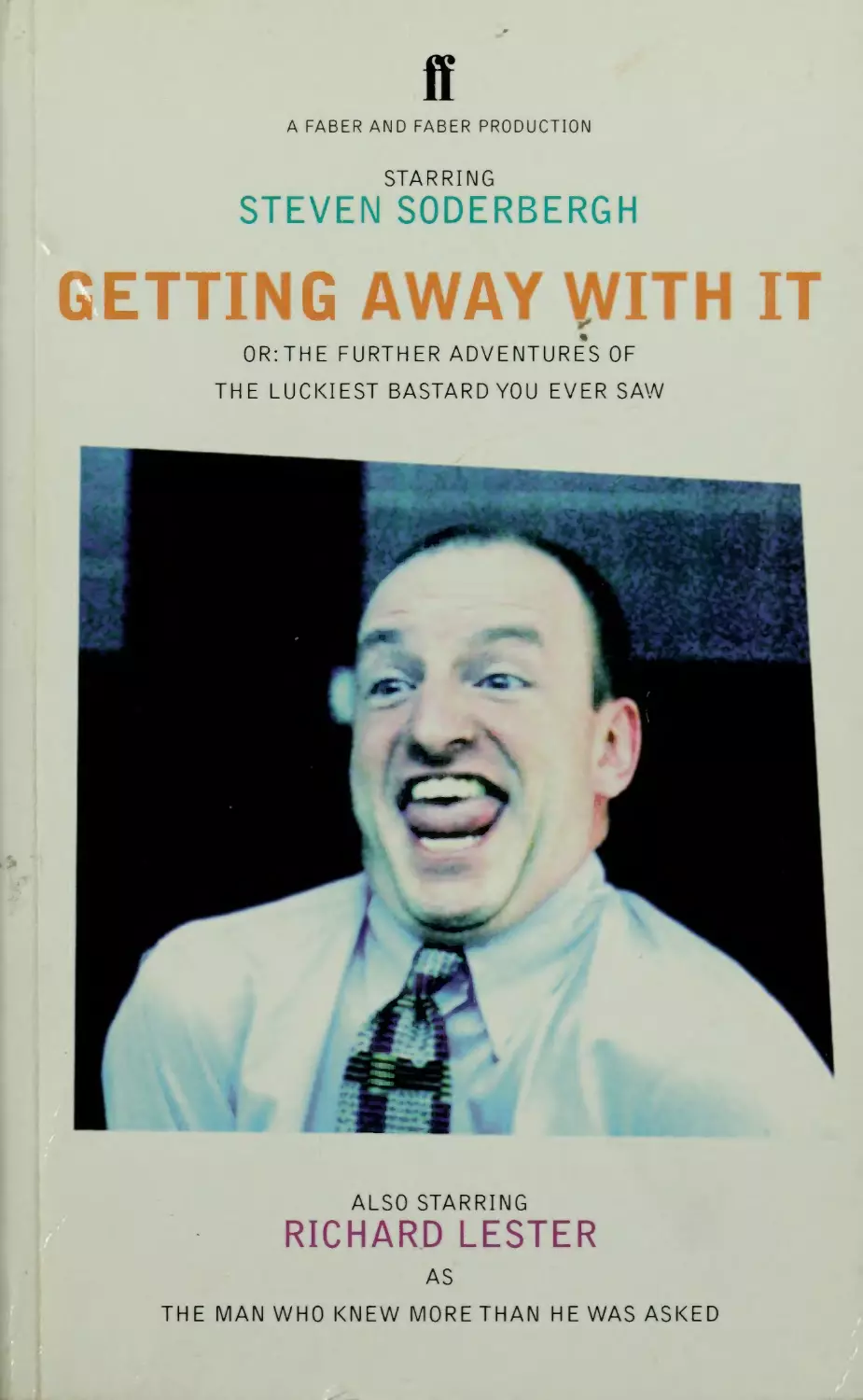





Text
                    ff
A FABER AND FABER PRODUCTION
STARRING
STEVEN SODERBERGH
GETTING AWAY WITH IT
OR:THE FURTHER ADVENTURES OF
THE LUCKIEST BASTARD YOU EVER SAW
ALSO STARRING
RICHARD LESTER
AS
THE MAN WHO KNEW MORE THAN HE WAS ASKED

GETTING AWAY WITH IT
Or: The Further Adventures
of the Luckiest Bastard
You Ever Saw
STEVEN SODERBERGH
also starring
RICHARD LESTER
as The Man Who Knew More
Than He Was Asked
ff
faber andfaber

First published in 1999
by Faber and Faber Limited
3 Queen Square London wc 1 n 3 au
Published in the United States by Faber and Faber Inc.
a division of Fanar, Straus and Giroux Inc., New York
Photoset by Parker Typesetting Service, Leicester
Printed in England by Clays Ltd. St Ives pic
All rights reserved
Diary © Steven Soderbergh, 1999
Interview © Steven Soderbergh and Richard Lester, 1999
Stills of Schizopolis © Diana Gary, 1999
Still no. 17 © Wayne Pere, 1999
All other stills © Steven Soderbergh, 1999
Steven Soderbergh and Richard Lester are hereby identified as authors
of this work in accordance with Section 77 of the Copyright,
Designs and Patents Act 1988
This book is sold subject to the condition that it shall not,
by way of trade or otherwise, be lent, resold, hired out or otherwise
circulated without the publisher's prior consent in any form of binding
or cover other than that in which it is published
and without a similar condition including this condition
being imposed on the subsequent purchaser
A CIP record for this book
is available from the British Library
isbn 0-571-19025-1
2468 10 9753 1

INTRODUCTION
aka A Note from Your Publisher
Faber and Faber books are selected from premium manuscripts gathered
from around the world and carefully blended to achieve robust flavor by
our team of verbally abused editors. Using the latest anti-skip technology,
our books are made with a unique publishing method which masks the gar¬
lic odor with a light vanilla scent. The result? Literature that both soothes
and invigorates, while accidentally stimulating the body’s own defenses.
Our books are smaller, richer, tastier and quartz-accurate - the way books
used to be. The patented Faber Passive Handling System® allows the reader
to anticipate virtually every textual situation imaginable, without the tail of
the book swinging out in a classic ‘oversteer’ fashion. We deliver the kind
of reading experience a Faber shoplifter demands: books with that rare
combination of convertible excitement and year-round capability. Throw in
a multi-weave, tear-resistant paper, an eco-friendly, cherry-flavored binding
and a surprising amount of trunk space, and you’re talking serious hair loss,
baby. Every Faber product is plainly packaged and securely wrapped with
no clue as to its contents - we never sell, give, trade, discuss or care about
the name of any customer or employee. Just imagine if every time you
moved you lost 40 per cent of the horse you rode in on, then call the num¬
ber above with your billing address. VHS format only. Do not chew.
Lance Miggins
Department of Corrections

INTRODUCTION, PART TWO
aka A Note from the Author
Can’t get there until 9.30. Start without me.
[vi]

INTRODUCTION, PART THREE
aka Another Note from the Author
Brief, desultory discussion of forthcoming manuscript’s inception, purpose
and potential audience. Self-deprecating remark. Amusing anecdote with
slightly serious undertone. Awesome display of ego disguised as humility;
joke about same. Transparently hollow thanks to contributors and
collaborators.
Steven Soderbergh
Los Angeles, CA
31 December 1998
[ vii]

RECORDING BEGINS IN MID-SENTENCE
steven Soderbergh: - a distinct memory of when we met briefly
in 1990 in Park City. They were showing some of your films and I
saw Petulia and The Knack for the first time and I met you and
Walter Shensori on the street for just a minute. You said, ‘It gets
harder, you know/ I wasn’t quite sure what you meant, and then for
a while I thought I knew what you meant, and now I think you
meant all sorts of things. I’ve thought of that comment a lot and
what it meant to me seems to change every twelve months. Lately
what it’s come to mean is that it gets harder to maintain the course
that you feel is your own when this course is obviously at odds with
what else is going on, the kinds of work that people want to see.
richard lester: My suspicion is my thought at that time was
more to say when you made your first film, nothing you made had
gone wrong.
SS: Right.
RL: And when you made your eighth film, a great part of eight
films had gone wrong and you will always have that needling feel¬
ing in the back of your head: don’t do that again. And you may do
it again, but there will be something that will be inhibiting you in
having that enthusiasm of opening the door and saying, ‘Let’s go,
lads! Over here with the forty!’ The feeling that last time you did
that it didn’t quite come off and that’s going to build and build.
SS: Yeah. I see what you mean.
RL: It has more to do with yourself than with what the industry will
be doing to you.
1	The ‘author’ is in the habit of assuming the reader shares his exact experiences, interests,
and knowledge. We will try to minimize the irritation this would induce in real life (if you
shared a meal or a plane trip with the author, for instance) by providing background
information whenever possible. Walter Shenson produced three Richard Lester films:
Mouse on the Moon, A Hard Day’s Night, and Help!.
[ I 1

ss: Now from what I know, this is the third time you've been through
this, once with Andrew Yule and once with Neil Sinyard. Did you
talk to Sinyard at length when he was doing his book?
rl: Not really, no. I think, more or less, he got on with it and
picked up bits out of other interviews. I don’t remember this kind
of session. I did it with Yule. It’s . . . there’s no way to make it . . .
there’s no short-cut to this. I mean, I will try my hardest not to fall
into the trap which I know I’m going to fall into - you go back to
the well-worked stories, you know . . .
ss: There are some things that only have one answer.
RL: It’s just one hopes that we can find a way to change the
questions.
ss: Yeah, exactly. So did Yule approach you and say, 1 want to do
this'?
RL: No, what happened was he came to ask about Sean Connery
because he was writing a book called Sean Connery. And, at the end
of it, he obviously enjoyed the chats and the jokes and he said, "You
ought to write a book, because of all the people you know.’ And I
said, ‘Well, I suppose so.’ And he said, ‘Well, why don’t you do it? If
you need any help, I’ll help, and we can talk about it.’ So we did a
couple of hours together and then he said, ‘Maybe you should go off
and do it.’ And it was going to be an autobiography, and then I
found I just couldn’t actually get it down. So I came back to him
and said, ‘It’s no good, I don’t have the stamina for it.’ And he said,
‘Well, look, I think I’ll do it. Why don’t I just do a biography? We’ll
just carry on the way we have, but it’ll be my telling of the story.’
And I hadn’t really read very much of his work. Halfway through it, I
read his book on David Puttnam’s time at Columbia and the warn¬
ing bells started to sound, but by then it was too late.
SS: Why did the warning bells sound?
RL: We have a magazine here called Woman's Own . . .
SS: I know it.
RL: You got the feeling?
ss: Yeah, I got it.
RL: OK. And, in the end, that’s exactly what happened. I found that
I would tell him the story, and I know the story works because I’ve
done it, I’ve had dinners out of it. And I would read it and think,
‘This just isn’t working.’ Then at the last minute he found some of
those stills and put in comic captions. And a lot of it is inaccurate.
[2]

ss: What sort of stuff?
RL: Simple details, biographical details and things like that. I prob¬
ably wasn’t precise enough, but I’m sure I didn’t say things the way
he said them.
ss: For somebody like me it filled in a lot of gaps, because there
wasn’t that much available on you other than the Sinyard book. But
as someone who by all accounts relishes privacy, the idea of a biogra¬
phy must have been a little disconcerting for you.
RL: Well, I think the problem is that I’d fallen into it and I’d taken
that first step, and from then on I couldn’t get out of it gracefully.
And I suppose it’s one of those things that under any normal cir¬
cumstances you would never allow to happen. If it were material
that you were developing, then you would instinctively prepare
yourself for all the warning signs, and you’d say, 'There’s a way out
of this. I’m not going to commit my energy to it or give up that
other job until . . .’ But with this I had no experience in doing it,
and it just fell apart on me, really.
ss: So after A Hard Day’s Night, did you sense a point coming at
which you would have to decide, "How much of a Richard Lester
public persona am I going to allow to occur and participate in?’
RL: Well, I was sitting in a wagon that was going downhill and I
had no control over it whatsoever, because I’m one of the seven¬
teen people who was the fifth Beatle, you know, and that happens
whether you want it to or not. Certainly, I never set out to do any¬
thing that would not benefit a film, but since I was making more or
less two films a year there was always some publicity operation in
full swing.
ss: It’s funny because many of the reviews, especially the critical
ones, seem to take you to task for being in the public eye so much.
You get the impression - reading some of these pieces - that you
were running around talking to anyone who asked and posing for
pictures whenever you went on the set, and that doesn’t seem to be
your style.
RL: Well, one thing is sure, you had no choice, because if you are
near the centre of the universe for three or four years, you can’t
help it. Of all the famous photographic shoots of all the people in
that period I think there is only one that wasn’t absolutely con¬
nected either with the location or at the studio, and that was Cecil
Beaton’s. It was just, 'I want to photograph you’; and it was a Royal
Command performance: you go and that’s it.
131

ss: Do you still have a copy?
RL: I don’t have the original, no, no. It’s in his book. But it was
an interesting experience because we went into this wonderful
Georgian house with beautiful decor and the first thing he said
to me when I met him was, ‘I hope you don’t find the smell of
that jasmine too overpowering.’ He then proceeded to play the
part of Stan Laurel with his assistant: ‘What’s . . .?’ ‘Which lens
is . . .?’ ‘Where . . .?’ ‘Is this black?’ ‘Have we got . . .?’ And I
thought, ‘I don’t believe this.’ And in ten minutes he’d said,
‘That’s lovely, thank you.’ And the best photographs I’ve ever had
in my whole life came out of it. I’ve never paid a publicist a
penny in my whole life. I just find the whole thing a total waste
of time. I’ve never had a cuttings service; I’ve never had anything
of that sort ever, and never, never would dream of it. But it’s like
the same sense of A Hard Day's Night being hysterically overcut.
Some university did an analysis of the well-known films of 1964,
and there are fewer actual cuts - in other words, the number of
pieces of film - in A Hard Day's Night than any of the other fea¬
tures of that year. I mean, there were times in films - certainly
with Help! and Forum - where through expediency one was
forced to cut more than one wanted to. For instance, Phil Silvers
had continuous breakdowns and then just couldn’t remember
any lines of dialogue.
SS: That's interesting, because it doesn't look like that.
RL: And then Ringo developing that tic during Help!.
SS: Yeah, I didn't know that until reading the Yule book, that's really
strange. And wasn't he getting a white eyebrow?
RL: Yeah, that’s right, it went almost immediately . . .
ss: When I was shooting Kafka, I got a patch of white in my facial
hair overnight. It's the only time it's ever happened. I guess it’s just
stress.
RL: Yeah, absolutely. God knows, Ringo was stressed at the time
and he was trying to bear up, but that was really the beginning of
the worst period for him. Thirty years later, I’m still astonished how
well they behaved.
ss: Well, considering how people with much less excuse and talent
behave now, it is amazing. Getting back to A Hard Day’s Night,
why did you work with [film editor] John Jympson only once?
RL: I was never in sync with him.
[41

ss: Really?
RL: We’re enormously good friends, and he never stopped working.
John was a workaholic. Literally, he would go from one film on a
Friday and start the next on the Monday. I just never got in sync
with him, and I would have loved to have worked with him again.
And he, me. I found working with the editor to be the best colla¬
boration ultimately; I’ve really worked with only three editors and
made twenty-three films.
Monday, 25 March 1996. Baton Rouge/Paris
On the plane. Hard to believe it was almost a year ago to the day we
began shooting Schizopolis.2
Across from me is a couple that I'm assuming must be Famous,
because they look like they must be Famous. I'm not sure how to
explain that - it's just an energy or something. The woman is very tall
and striking, and the man is taller still and sporting a short, bleached-
blond haircut. They are dressed in really great clothes and appear to be
very much in love and I've decided that I hate them.
Tuesday, 26 March 1996. Paris
The Cognac Film Festival put me at the Warwick Hotel, and when I was
checking in I spotted the Famous Couple in the lobby. Are they following
me? Am I following them? Later I did press interviews for The Under¬
neath, which is opening in France on 11 April. I tried hard not to betray
the fact that I'm unhappy with the film, since Michele Halberstadt and
Laurent Petin went to considerable lengths to convince UIP to let them
release it independently here. I danced around the fact that I am working
on 'something new'. Later still, after perusing a fax from Henry Selick
about Toots and the Upside Down House,31 had dinner with Michele and
Laurent, and we talked about Schizopolis. They watched a tape of it last
night and liked it a lot, although they said they felt the third section was
too long. Through a tense smile, I said I'd look at it.
2	A film directed by the author which provoked unified confusion on its ‘release’. Despite
the author’s ceaseless nattering about ‘creative rebirth’ and his claims of being ‘influenced’
by such illustrious predecessors as Luis Bunuel, Richard Lester and Monty Python -
invocations that would be downright actionable if they weren’t so patently absurd - the
film’s utter lack of coherence and aggravating restlessness ensured not only its obscurity,
but its wholly appropriate role as a footnote like this one.
3	Again the assumption of familiarity. Toots and the Upside Down House is a novel by
Carol Hughes about a motherless young girl who discovers an upside-down, miniaturized
world inside her home. The author, after a jaw-dropping display of self-promotion, was
engaged to adapt it for the cinema.
[5]

fyi The food at Burger King in Paris tastes just like the Burger King
food in the US.
Wednesday, 27 March 1996. Paris/Cognac
Traveled to Cognac, shoe-horned into a chartered plane with all the
guests of the Festival and a tonne of press. My heart went out to Gre¬
gory Peck and his wife as they slowly navigated their way down the
crowded aisle and into their tiny seats. I also spotted John Dahl, Jury
President, and Keith Carradine, Fellow Jury Member. The Famous Cou¬
ple has turned out to be Famke Janssen (who is on the Jury with me)
and her husband, film-maker Kip Williams. They were really nice and I no
longer hate them. I was taken to my hotel, which turned out to be an
implausibly beautiful chateau owned by the Martell family. The room and
the view were so spectacular that it was minutes before I noticed there
wasn't a TV.
There was an opening-night ceremony for the Festival, and after the
Jury Members were presented to the audience I had to introduce The
Underneath, which was the opening-night film, and then sit through it.
Eons passed and we were taken back to the Martell mansion for a luxur¬
ious dinner, where I was embarrassed once again by my inability to
speak French (or any other foreign language). I inadvertently compen¬
sated, however, by speaking simplified English slowly with a slight mid¬
Atlantic accent. Charming.
Friday-Saturday, 29-30 March 1996. Cognac
Screenings, rich food and late-night chats with John and Beth Dahl.
steven Soderbergh: What is a typical day for you during the
week, or is there one?
richard lester: There isn’t really. I normally come in to my
office in the studio for a couple of hours in the morning, that’s all.
There’s the awfully boring business of keeping an office going,
doing the VAT returns and paying the bills, the occasional request
to autograph a still or something. I could easily not come in, but I
just like to.
SS: You got out of high school early, you went to college young and
you were pursuing a degree in clinical psychology.
RL: Not pursuing, avoiding. It was pursuing me. And I was deter¬
mined to keep my head down until it had gone by. I chose it, I sup¬
pose, by default. My mother was an operating-theater nurse and
my father was a teacher of English and Shakespearean English. I
imagine, as most children do, I was determined not to have any¬
[6]

thing to do with those two professions. And there wasn’t a lot else
that seemed interesting.
SS: You didn’t ever consider going to a music school?
RL: No. When I was offered any sort of lessons I always turned them
down. And it wasn’t until I was about twelve that I decided that I
wanted to learn how to play ‘Body and Soul’ on the piano. And it
took me a year to work it out. The next song I decided on, I think,
was ‘Tenderly’. It took me about six months and then the next one
took four months and then I found that I could just play anything.
ss: "Body and Soul’ was a pretty complicated thing to start with.
RL: It was a pretty stupid thing to start with. Once I started to mas¬
ter the piano, I started with the next instrument and went on to the
clarinet, and then the guitar. Every summer from then on through
university I would go to the local store and rent an instrument.
One summer I would take the trombone and have it for two
months, renting it, and then give it back. Just to learn how to mess
around with it.
ss: Anybody complain about the noise?
RL: We lived on three acres. Long-suffering parents; it was all right.
Anyway, when I went to the university, psychology seemed to be
the sort of wonderfully weak option. It didn’t seem to offend
anyone. And the preparatory school that I went to was so good that
I literally had no need to do any work in four years of university. I
just coasted through and I learned how to make Martinis and
I played on the weekends at a bar and on campus, and did the
things that people do learning how to grow up, but which I had
never learned to do. And I fell in with the theatrical and music
oeople, and that is when we formed Little Vocal Group and that
became how I got into entertainment and stayed - added to the
fact that I felt quite early on that there was a lot of fraudulent think¬
ing in psychology.
ss: I gather you had some experiences that really turned you off?
RL: The biggest was that we were allowed to make recommenda¬
tions - which were normally accepted - as to whether children
should be institutionalized on the basis of the way that we were
testing them. I was eighteen at the time. And I thought if I ever
become a parent and some eighteen-year-old says, ‘I’m recom¬
mending that your child be taken away and put in an institution
because I have just given him a test and he’s failed by three points’,
I would have come at him with a gun.
[71

SS: Yes..
rl: What right have we to do all of this? There seemed to be - and
I’m speaking of 1950, I’m not saying that it’s true now - an over¬
riding interest for psychology to legitimize itself. It was a massive
edifice of self-justification. It was trying to be the kind of grown-up
science that chemistry and physics were. It kept looking for means
by which statistics could prove something that was unprovable. I
thought that it seemed silly, and I came away from it a little bit like
John Lennon when asked whether he would like to be an actor on
How I Won the War. He said, ‘It’s just terribly silly, isn’t it?’
ss: There's a great R. D. Laing quote: Tm much less concerned by
the powerless fear in some of the patients I see than the fearless
power in some of my colleagues.' The desire to apply hard-and-fast
templates to such a complicated realm is understandable, but not
necessarily possible, I think.
RL: We seem to be moving toward the reverse. Psychology has
become more relaxed about that. Yet, as things go on, the questions
that were being asked in the fifties are being answered by absolutes,
because it’s turned out to be genetics and heredity instead of en¬
vironment. In Victorian times you used to have plaster heads with
little numbers on them and it could tell you where everything was,
and then by the fifties we were going, ‘Ha ha ha - look at that!’
Now those maps are being redrawn. They were slightly wrong, but
there are now maps of the head again and they are saying, Yes, it’s
right there. That’s the thing that makes you remember numbers!’
SS: Have you ever been a teacher yourself?
RL: No. I spent two or three weeks at Rice University in the eigh¬
ties. They asked if I would come and do a film course. And it was
appalling.
SS: Really? Why?
RL: Well, first of all, I’m not a good teacher.
SS: Why?
RL: I don’t think I’m patient.
ss: That's not good.
RL: I was surrounded by a hundred students, ninety-seven of whom
were idiots and the other three were so intelligent that they scared
me to death. But my overriding memory is that everybody came in
and immediately took their shoes off. It was as if one was going to
the Blue Mosque in Isfahan.
[8]

SS: Wow.
RL: Put their feet up and kicked their shoes off. Sort of a jock men¬
tality. And I thought, "What I am I doing here?’ None of them were
the least bit interested. I remember it was the early eighties and I
suggested that they do an examination of this new phenomenon
called Aids in downtown Houston. Nobody knew what the word
meant. By that time, if Pm sitting here in suburban England and I
knew about it, certainly downtown Houston would have known
about it. But they didn’t seem to be interested - which was surpris¬
ing and disappointing.
SS: You did this out of curiosity?
RL: Yes, curiosity. Absolute curiosity. Because even if it had been
wonderful, I know that I’m not a good teacher.
Sunday, 31 March 1996. Cognac
Jury deliberations. We gave the prize to Stacy Title's The Last Supper,
basically because it was liked by everyone and hated by no one. That's
usually the way these things work, although when I was on the Jury at
Sundance in 1990 I refused to leave the room unless we gave the Grand
Prize to Chameleon Street. Before you leap to the conclusion that this
was a heroic act on my part, you should be aware that this situation
arose only because the Festival had made the mistake of selecting an
even number of Jurors without designating someone as Jury President
(the President's vote is weighted in case of a deadlock).
Monday, 1 April 1996. Cognac/London
Chaos. There was a mix-up about transportation, and the two bottles of
drop-dead cognac I bought to give to Richard Lester were put in the
trunk of someone else's car. I called Lester from the train and confirmed
that I will meet him tomorrow morning at 9.30.
I arrived in London and went to the offices of Faber and Faber to see
Walter Donohue, who is the editor responsible for this 'project'. I rum¬
maged around his hilariously cramped office and appropriated a bunch of
books that looked interesting. He introduced me to Le Grand Fromage,
Matthew Evans, who provoked in me a strange sensation: the minute I
opened my mouth I felt like I was wasting his time.4 He asked me if I
was going to find something 'hidden' within the Lester canon, explaining
4	Mr Evans, under threat of peijury, denies this conversation ever took place. In fact, under
intensive cross-examination he admitted he had never actually seen an ‘author’ in the flesh,
but only in dioramas (also known as ‘pubs’) around London.
[9]

that he always took the films at face value. In an unintentionally actory,
self-conscious voice I said there was plenty to explore and that it would
all be very illuminating and very entertaining. He smiled and left and I felt
sure that within minutes I'd be escorted from the building by armed
guards and held up by my ankles until Faber's advance money sprinkled
on to the sidewalk. But no. Instead I was left to my own, various
devices, which is actually worse.
I spent the evening reading through my Lester material and flipping
quickly through the adult pay channels so as not to incur a charge, cheap
pervert that I am.
steven Soderbergh: When you were doing live TV in Philadel¬
phia, it seems you reached a point where you saw your life possibly
going down a certain path, and it wasn’t really a path that you
wanted to pursue.
Richard lester: It wasn’t so much that, as the fact that I’d gone
too quickly down the path. And I thought if I don’t want to be on
this path, I’d better get off very rapidly.
SS: You’d reached a point that guys don’t normally reach until
they’re forty.
RL: And I was twenty-one. I had a car, an apartment, a girlfriend
who had a child by somebody else, and I thought, ‘I’m settled
down. You know, just go out and buy the dog and I’m finished.’
SS: Right.
RL: So we’d been given a week’s holiday as a reward for doing 260
live shows in a year, and they said you can go where you like. And
I thought, ‘Go where I like? Where can I go?’ The whole world
was my oyster and I don’t know how or why I picked Bermuda,
which is the most American place. But I was intrigued, and this
was my first time out of the country, so from the time I came back
I started plotting to leave. I saved some money and got myself
hired to write one article a week for a local newspaper, then got it
syndicated in two more, which gave me $10.00 a week and I
thought, ‘That’s it.’
ss: What kind of articles were you writing?
RL: Anything I felt like. My view of Europe. (Laughter.) Yeah. Hav¬
ing arrived two days before, that’s The World According to Garp.
SS: At what point did you feel that you probably wouldn’t settle in
the United States?
RL: It took until I was working in English again. I could storm
( 10 ]

around and not starve and manage and have a good time as a lad
in a variety of countries, but during that year, I was facing the fact
that because of the language barrier, you are a four-year-old in any
of the countries you go to. A smart-ass four-year-old. And I wanted
to trade back and become a twenty-year-old again, with verbs in
sentences. So I knew I had to come to England, although I had no
plan ever to come to England, it never occurred to me. But I
thought I have to get back into English. So I passed my first
thirteen-week work permit here, and I began to think I might be
here for some time.
SS: So, in general, you didn’t have any strong desire to return to the
States?
RL: No. My mother was living alone and I felt compassion for her,
but she was absolutely marvelous to me in having the sense to say,
‘If you feel you want to do it, do it. Don’t worry about me. I’m all
right.’ And it was undoubtedly a great sacrifice, and I’m sure a
great disappointment to her. But there was no looking back at all.
The minute I got to Europe I felt more at ease.
SS: Were you working on your musical Curtains for Harry during
this?
RL: Yes.
SS: And was that pretty much the way it sounds?
RL: It’s pretty awful. Yeah. I don’t think it’s worth even trying to
dredge through my memory of what any of it was.
SS: Shortly thereafter, there is the one-time-only Dick Lester Show,
which sounded intriguing. In theory, this was a live show that was
airing thirty minutes before it was supposed to. But I gather it didn’t
come together the way you wanted.
RL: I think, in reality, it was just dull. I think we had done it once
before as someone’s test-directing exercise, and under those cir¬
cumstances it’s a bit more relaxed because it’s never going to be
seen by anybody, except for people who are judging whether the
putative director knows what he’s doing. And since it was relaxed,
we indulged in a fair amount of in-jokes, I suspect.
SS: Right.
RL: But when it actually happened, I think the thought that here
we were live -
SS: - sunk in -
RL: - and, you know, on a Christmas week a lot of people are
I ii 1

watching, and I think one’s natural, youthful exuberance and arro¬
gance was tempered.
SS: But it resulted in the call from Peter Sellers?
RL: Yes. The call from Peter Sellers.
ss: What did he say?
RL: He said, ‘Either that’s the worst television program that I have
ever, ever seen or I think you’re on to something that we are aspir¬
ing to.’ And I said, ‘Well, if there’s a choice, could it be the latter?’
And he said, ‘Would you like to have lunch and let’s find out.’
SS: And did that lead right into Idiot’s Weekly?
RL: That led absolutely into Peter and me going the next day to
Spike Milligan, who lay on the floor with his head in a coil of
rope. There he was, this wonderful picture. He didn’t look at me or
get up or do anything; he just said, ‘Comedy will never work on tel¬
evision. I can write, “Two Eskimos go outside the igloo and the
number 47 bus comes and they get off in Hyde Park.” You can’t do
that. No point in talking about it. I’m not interested.’ So we went
away and then hired a group of young writers and a script supervi¬
sor and did, if you like, something in the style of The Goon Show
and had very good reviews. At nine the next morning there was a
phone call from Spike saying, ‘I’ve got the running order for the
second show.’ Not: ‘I was wrong; you were right.’ Just nothing. It
was just bang, off we go. He came into the office and said, ‘Does
your secretary take shorthand?’ I turned to her and asked, ‘Do you
take shorthand?’, never having seen her actually take a pencil, and
she said, Yes.’ And Spike said, ‘Come with me.’ And he pulled out
of his pocket a film, which we put on the telecine. He said, ‘I’ve
just heard about this. I think it’s supposed to be quite funny.’ And
it was a silent cartoon that a man called Bob Godfrey - twice an
Academy Award-winner - had made. Spike looked at it and started
to ad lib a commentary on it. He hadn’t seen it before, and did
seven minutes of the most extraordinarily perfect vocal commen¬
tary to this piece, which my secretary managed to put down, and
which we then recorded. And we were off and running. We did
three series together.
SS: During that first and only Dick Lester Show, you came into con¬
tact with Alun Owen, is that right?
RL: Yes. He was an actor friend, one of the two directors that I
was assigned to as governess to make sure they were learning how
to direct. Alan was not yet writing, but had it; he was obviously
I 12 ]

going to write. We were the two performers in the Dick Lester
Show.
Tuesday, 2 April 1996. London
Taxi to Waterloo, then a train to St Margarets and Twickenham Film Stu¬
dios. I was early, so i went to a nearby coffee shop and had a croissant
in front of an autographed picture of Helena Bonham-Carter, who
seemed very nice.5 I walked through the (smallish) studio gates at
9.27 a.m. and the smiling, middle-aged receptionist phoned Lester to
announce my arrival. I went upstairs and down the hall to his office,
where he greeted me at the door. He struck me (repeatedly) as ener¬
getic, gracious and in good health. The office was small but by no
means uncomfortable, and the walls were covered with the posters
from all his films, even the ones he probably wants to forget. He offered
to make tea (I accepted) and asked me what this was all about. I
launched into a lengthy explanation of how tired I was of making 'nor¬
mal' movies, how I had decided to start over, and how my interest in his
work led me to make Schizopolis with a crew of five and some old Arri
gear, etc. He nodded, smiled and asked another question, which made it
clear that what he meant was: how will this book work? I launched into
another lengthy explanation of the book contract and the royalties and
the deal and how excited Faber and Faber were. He nodded, smiled and
asked another question that made it clear that all he wanted to know
was how would the interview itself proceed? I immediately blurted out
that I thought we'd just skip around and let the conversation find its own
way, a complete reversal of what I had planned. He said that sounded
fine, and I took out my notebook of questions and turned on the tape
recorder, experiencing the apologetic awkwardness that I imagine most
journalists feel under similar circumstances. The large window behind
Lester filled the room with David Watkin-like light: sun peaking through
an overcast sky that edged out his figure and bounced off the couch to
provide a soft, pleasing fill. And so we began.
When we broke for lunch I felt as though I hadn't drawn him out much,
and of course much of our lunchtime conversation was filled with things
I wish I had on tape. I did get one strong reaction from him, however.
When I described a cocktail I imbibed in France consisting of cognac and
ginger ale, his face turned red and his features contorted as though he
were trying to swallow a piece of shag carpeting. No amount of explana¬
tion could convince him that I hadn't broken the rules of proper drinking.
5	Ms Bonham-Carter denies this meeting ever took place.
[ 13 1

Back in my hotel I began to think that this needs to be different from
the typical Q. & A. book, but ideas were not forthcoming. I have to ask
Lester about his desire and ability to keep his work separate from his
life, and I have to ask him more about why he doesn't think he'll direct
again. Is it strictly because of Roy Kinnear's accident, or are there other
issues at play? I also wondered if I want him to direct more for my sake
than for his. Why don't I leave the guy alone? I pictured Matthew Evans,
hand on hip, telling me to stop being a pussy.6
steven Soderbergh: When you got this call from Sellers, this is
at the height of The Goon Show’s popularity.
RICHARD LESTER: Yes.
ss: This must have been an exciting call to get.
RL: Absolutely. And again, fortunately, my sound man on the tele¬
vision show had been doing sound effects for Sellers on radio at
the BBC, so the minute that I’d arrived and started working, I’d
been caught up in the Goon Show mania through John Hamilton,
the sound man, who had chapter and verse on it.
SS: Right.
RL: So, I therefore knew a little bit more than I would normally
have, considering I’d just arrived in the country.
SS: There were seven episodes of Idiot’s Weekly? Then what
happened?
RL: Then there was A Show Called Fred.
SS: Why all the title changes?
RL: We couldn’t use the word ‘Goon’ because the BBC owned it.
And titles were chosen just for fun. Yes. No sense of being commer¬
cially sensible. So, A Show Called Fred and then Son of Fred.
SS: I gather that they were getting increasingly weird. Spike sounds
like Samuel Beckett with a sense of humor.
RL: It’s a bit unfair to Beckett, who did have a sense of humor.
SS: Well, that's true. I guess I mean Spike was a little more accessible.
rl: Spike was a restless soul. And he found that Idiot's Weekly,
which was very sketch-oriented, was easy for him to do, even in the
slapdash fashion we employed. Then A Show Called Fred came,
6	Mr Evans, who wishes this whole thing would go away, admits that he did indeed place
his hand on his hip and tell the author to stop being a pussy.
[ 14 ]

and he was starting to push and see what we could get up to, and
we started doing a bit of filming, very much what you would expect
from Monty Pythons work. It would have been indistinguishable
from Python, I think, to somebody looking back over forty years.
With Son of Fred we were now quite successful and it had a very
good audience and amazingly good reviews, because all the intel¬
lectuals grabbed at it. It was the first piece of commercial televi¬
sion, in light entertainment at least, where there was something
that was unexpected and worrying. With Son of Fred, it just
became bizarre. All scenery was removed; one prop would run
through the sketches. It would be one thing in one sketch and,
because of its shape, it could also suddenly become a key factor in
another, and that would be the only common link. Then he started
attempting to remove punchlines by interlocking sketches. We are
talking a long, long time ago.
SS: Right.
RL: And it was very bold.
SS : It sounds great. So this came to an end and you went off again.
RL: It came to an end. In fact, ratings were dropping as it became
more unintelligible. And it was pulled about two or three shows
before the end of the thirteen that were ordered. Also, it was very
hard for Spike, because he was writing the radio shows as well. A
half-hour radio and a half-hour television show on his own every
week. The man was on the most massive tranquilizers. Any of
Spike’s daily medication would have put a troop of horses out.
SS: So you went traveling after this. Was this by necessity or -
RL: No, no. My wife was under contract to one of the commercial
television companies. You know, ballet and popular dance. We
were both in work and my contract was there and before I left I
had agreed to do that television series I shared with Joe Losey.
SS: Mark Saber?
RL: The work was about, it wasn’t that. We were renting an apart¬
ment, and before we started falling into the same trap, we thought
of traveling and I loved traveling. And I think that Suez was a defin¬
ing moment. That episode of dishonesty and collusion among gov¬
ernments that we thought were proper provoked - not only in me,
but in a massive number of people in this country - a sense of
Let’s Get Out Of Here!
[i5l

SS: Yeah.1 What can you tell me about Mark Saber? It sounds inter¬
esting because of the people you ran into.
RL: No. The only thing that was wonderfully funny was this
principle that you had to hand the show over at lunchtime on
Wednesday.
ss: How did that work, exactly?
RL: What would happen is that you would hand the crew over at
lunchtime on Wednesday, after two and a half days’ shooting, to the
next director, whether you were finished or not. And if you were run¬
ning short, they had some stock footage which would be inserted
into your episode. Which meant Mark Saber, the one-armed private
detective, would drive himself up in his stick-shift Porsche, get out
of the car, go into a night-club, meet the manager (who is in evening
dress), rush past him and look left, whereupon you would cut to the
stage and there would be either a paper-tearing act or a man blowing
up balloons into the shape of toy dogs. And you would let that run as
long as you needed to fill up the program, at which point you would
cut back to Mark Saber, who would go back, passing the manager,
and there we had two different versions: (1) ‘He’s not here.’ And (2)
‘She’s not here.’ He would then get back into the car and you would
have made up enough time.
SS: So it’s conceivable that episodes 1 and 4 could have exactly the
same footage in them?
RL: Yes. Losey’s only advice to me when we started to do the TV
series was: ‘Whatever you’re doing on slate 1, take 1 on that first
day, don’t go more than take 4. Even if it’s totally terrible say, “I’ve
got it, thanks, print it”, and go on to the next piece. You can always
come back and do it. But if there is any scent of blood, of indeci¬
sion or lack of confidence, for your crew and your actors to pick up
on, it will show up after take 4 or 5 of the first set-up.’ I think that’s
quite good advice for young directors. It doesn’t matter. From then
on you can do what you like.
7	The author, by replying in the affirmative, implies that he understands the Suez Canal
reference, when, in fact, he does not. Feeling confident he will pore over his own comments
when (or rather if) this manuscript is published, we will endeavor to enlighten him. To
make a very long story very short, the Suez Canal crisis involved French and British troops
attempting to wrest back control of the canal from Egypt after it had been nationalized in
October 1956. The United Nations stepped in, and within a few months the canal was
reopened under Egyptian control.
[ 16]

SS: Sounds fair enough.
RL: I think that’s when I met Nic Roeg.
SS: It's said that everybody's feeling about him was that he was
going to go places.
RL: We were all going to work for Nic soon, that’s right. And he
was a lad in his twenties.
SS: What about him gave you that feeling?
RL: He was a very charismatic clapper-loader. (Laughter.)
Wednesday, 3 April 1996. London
While sitting on a bench outside Twickenham Studios before this mor¬
ning's session, I came up with an idea: a slightly deconstructed Q. & A.
book, incorporating some journal entries (like the one you're reading
now), and the script of Schizopolis, which was obviously influenced by
Lester's oeuvre. Feeling better, I went to Lester's office to find that he
had brought me a bottle of cognac because of my mishap in France. I
was both moved and depressed by this gesture of generosity. The ses¬
sion went well, and again at lunch we talked about things I wish I had on
tape.
I went to see Walter at Faber and Faber and floated the new
approach for the book, which he responded to with enthusiasm and
relief.81 hope Lester isn't offended that I'm shifting the focus of the book
somewhat.
Before going to bed I watched Monsieur Hulot's Holiday, which was
hilarious and very illuminating. When you combine Lester's interest in
Tati with his early exposure to Ernie Kovacs, the issue of his influences
becomes very clear, or at least clearer. I have to get the other Tati films.
The only other one I've seen to date is Jour de Fete, which I liked a lot.
Thursday, 4 April 1996. London
Suddenly the new approach to the book seemed stupid and self¬
centered. Of course, if you're reading this sentence I guess I got over it.9
The interview session went really well, mostly because of my enthu¬
siastic response to Monsieur Hulot's Holiday. We spent the afternoon at
Lester's house in Petersham, where he and his lovely wife Deirdre were
8	Mr Donohue, whose ‘job’ with Faber and Faber consists chiefly of whimpering during
Employee Evaluation Week, often responds with ‘enthusiasm’ and ‘relief’. Therefore, the
reader should not infer that the author’s idea was of any real or particular value.
9	This is exactly the kind of onanistic, self-referential game-playing the author insisted
would be absent from this book. So is this.
[ 17 1

such gracious and accommodating hosts that I wanted to hire them to
take care of me twenty-four hours a day. While eating a terrific piece of
carrot cake I read through a few of his shooting scripts, and it became
obvious to me that another round of interviews will be necessary, maybe
this summer. Seems like he should see Schizopolis as well, to provide a
little give-and-take.
Later I went to a play and dinner with Mike Nichols, who is in town
performing Wallace Shawn's The Designated Mourner at the National
Theater. Shortly after we sat down to eat we were approached by a well-
known American film critic and his girlfriend, and Nichols graciously
invited them to join us. I'm deeply ambivalent about fraternizing with
critics, and tried my best to be courteous.
steven Soderbergh: Around this time, you apparently had a
very brief experience with theater.
richard lester: After we had come back, in 1958. Will Success
Spoil Rock Hunter? Sam Wanamaker was running a theater in
Liverpool and asked if I would be interested in directing, because
he had seen the Goon television shows. We were two weeks into
Liverpool - it might have only been one week - and we were going
then to open in the West End, and I put some ‘business’ in it.
There was a cast of seven and in attempting this business, which
was something to do with, I think, falling over a sofa, the young
man doing it dislocated his arm. Also, the leading actor was having
a fling with the leading actress, and - this is hearsay, but we
believed it to be the case - she said, ‘When we get back to town all
this has got to stop.’ He was a very well-known film actor here and
came from a huge theatrical family, and he was a madman. In any
case, he had an accident and went through the windscreen. I was
called up by the management of the theater saying - you know -
‘The show must go on!’ And I thought, ‘There’s seven people: one
has dislocated his arm, one killed, one collapsed in grief and the
other lying in the hospital.’ So I said, ‘I don’t think that applies
somehow.’ And he said, ‘Well, you must know the lines, you’re the
director. You do it!’ So that was the end of the show.
SS: Sounds like an Orton play.
RL: That was the end of theater for me, more or less. I did a little
revue with Michael Bentine which didn’t work. I haven’t tried since.
SS: Wasn't fun for you, or .. .
RL: This is a bit facile, but I tried very hard to learn the rules of
film-making so that I could either bend them or break them; I
I 18 ]

don't know any of the rules of theater. I’d been to the theater a lot,
and I think I know what theater is, but I’m not steeped in the
mechanics of it. And I'm not really actor-driven, I’m technically
driven. There’s probably also that sense of impatience - I’m not a
good rehearser. I’ve never, in any of the films I’ve made, dedicated
any pre-production time to rehearsal. It isn’t the way I like to work.
The very concept of the way a theatrical performance is shaped
over a process of exploration, I wouldn’t be good at. I would be fid¬
geting while Peter Brook was in the corner exploring the nature of
the universe.
SS: Now we move to the point where Peter Sellers has apparently
bought some film equipment. A Bolex?
RL: It was a 16 mm Paillard Bolex, which was the best small 16 mm
camera that was available at the time, and he wanted to try it out.
So he came over and we had dinner and we started just ad libbing
jokes. I wrote a few of them down, and it ended up that Peter and
Spike shot half a day, and then Spike had to go off right away to
Australia because his family lived there, so I got Bruce Lacey - a
performance artist who was with us on the TV shows - and we
’ound Leo McKern, who had nothing to do that day, and we just
went out and shot. We had a slate, and it was a two-man camera
crew. But once we took the slates off, what there was, there was! I
think we did two takes of the final sequence coming down with the
boxing glove, but other than that it was a one-taker for everything.
We just did it. Then, having done that, we got the rushes back
from a little local laboratory, and we had a self-winding hand editor
for 16 mm, and Peter and I cut it together by laying all the cuts out
on his drum kit. He had a massive drum kit, and we could hang
things all over it, and that became the editing room in his house.
We cut it together and then I wrote the music for it and got a jazz
group to play.
SS: It’s a good soundtrack; the effects and the music are really inter¬
esting. It’s not casual at all; there’s a real design.
RL: Welt it was just what one grabbed, as you can imagine. The
whole thing cost seventy pounds in all.
SS: Jeez.
RL: And then Peter showed it to his friend Herbert Kretzmer, who
was at that time the Daily Express television critic. He’s since
become famous as the man who wrote the English lyrics for Les
Miserables. And he said, "You should show it to somebody. I’ve got
I 19 I

a friend who’s at the Edinburgh Festival.’ I genuinely believe that
neither Peter nor I had any intention of having it seen commer¬
cially. We made it for fun.
ss: Who came up with the title?
RL: Spike, I think from long distance, because he was still in Aus¬
tralia. At one point it was going to be called Chickens. And then it
became Running, Jumping and Standing Still Film.
SS: Thank goodness. Spike's very hit or miss on titles, it sounds like.
RL: And a man from the San Francisco Film Festival saw it and
said he’d like to show it. And from there it received an Academy
Award nomination. Around about that time it opened in a cinema
just across the street in Piccadilly. It was called the News Cinema,
where they change the program every hour. And it was one of
those wonderful things, because Peter was the most successful of us
at that time. And it became Teter Sellers’s Running, Jumping and
Standing Still Film’. And then it played there off and on from 1959
until 1964, when A Hard Day's Night played around the corner
and suddenly Peter’s name was taken off and it became ‘Dick Les¬
ter’s The Running, Jumping and Standing Still Film', and then
Spike had a huge hit on the stage doing Oblimov and Son of Obli-
mov, and it became ‘Spike Milligan’s . . .’
SS: So Running, Jumping was notorious enough for the Beatles, hav¬
ing found out that you had been associated with it, to be impressed.
RL: Yes. Yes. They knew it.
SS: And had they seen Idiot’s Weekly and all that?
RL: As kids they might have. Yes. But possibly not. But they cer¬
tainly knew that I had done that one.
SS: You've been quoted as saying at a certain point you decided that
by the time you were thirty you wanted to direct a movie.
RL: Film. Yes.
SS: At what point did you decide that?
RL: Probably when I turned twenty-nine. I don’t know. I wanted to
become a television director by twenty, that’s how it started. I beat
that by a couple of months. And round about the time of A Show
Called Fred and Mark Saber, the chance of avoiding the kind of
mistakes that were happening doing live ‘avant-garde’ television -
where sets fell down and you’d be under by seven minutes in a
thirty-minute show because there is nothing standing in the studio
to be able to work through - was appealing, and film seemed to be
[ 20 ]

the only answer. All the mechanics of television were untouch¬
ables, whereas you could go out with a small film camera and
you’re allowed to handle it and do things with it.
SS: Right.
RL: So I would have said age twenty-five or twenty-six. But I wasn’t
actively, desperately trying to do it, and I wasn’t making any sacri¬
fices for it. Because after Running, Jumping a few possibilities
came up, mostly through Peter. I remember talking to Michael
Balcon, who was setting up a series of films, one of which was with
Harry Secombe. I was known enough that people were talking to
me. Running, Jumping was partially how I got into directing docu¬
mentaries and then commercials. And the first thing I did was a
documentary called Have Jazz, Will Travel, which was with Bob
Krasker photographing it.
SS: Wow.10
RL: He was not really very interested in doing it, and didn’t do a
terribly good job. It was combining people on the street, grabbed
material, intercut with jazz combos - both modern and traditional
- photographed in smoky places, against black. Just abstracts and
close-ups of instruments. Again, intercut with people doing normal
things, throughout London.
ss: That doesn't sound far away from our abstract film idea that
Marc Behm said should be strangled at birth.11
RL: Well, it got me work.
ss: Was that shot on 16 or 35 mm?
RL: Sixteen. I showed it to someone who, at the time, was becom¬
ing the head of an advertising agency. And the first commercials I
did were banned.
SS: These are the kids?
RL: Right. Which was totally working in a documentary way. Very
much the way Nick Park did with his plasticine things, getting
natural voices. The children made up their own story, ad libbed it,
we cut it together.
10	For once, an appropriate and honest response from the author. Robert Krasker is
regarded as one of the giants of black-and-white cinematography for his work on such films
as Odd Man Out, The Third Man and Billy Budd.
11	See page 200.
[ 21 ]

ss: And what was the trouble, theoretically?
RL: You have to remember this is the fifties and we were still in the
BBC correct-pronunciation era and the kids weren’t clean, they
were rough, they were yobbish little kids climbing trees and steal¬
ing things, and the ITCA - which was the body that controlled the
commercials - said, ‘These children went to bed having eaten a
biscuit and didn’t brush their teeth’, and things like that. So they
were banned, but they won a prize as the best television commer¬
cials here and they won a prize in America as the best television
commercial. And they’ve never been seen. That was my first bit of
work that I could then say, ‘If you want to see what I’ve done, here
it is’, because I was given a free hand to do it. Nobody told me
what to do.
SS: Right.
RL: And then things went on from there. In the middle of 1962,
four of us formed James Garrett and Partners. And in doing it I
said, ‘I will give you a year where I promise I won’t do a feature. I
will do documentaries and film for you and commercials for you to
help you get off the ground for the first year.’ Which is what I did.
I could have gone, because by that time It’s Trad, Dad was out and
successful, but I didn’t.
Friday, 5 April 1996. London
Tried to see Trainspotting, but arrived too late. Wanted to check it out
mostly because Ewan McGregor is the lead in Nightwatch, a film I
rewrote for Miramax which is now shooting in Los Angeles. Last night I
had a dream I was in Nightwatch and watching it with Ewan at the same
time. His performance in my dream was quite good, I thought.
Saturday, 6 April 1996. Plane to Houston/Baton Rouge
A cover story in Time about prostate cancer made no mention of my pri¬
vate theory that incessant masturbation can ward off not only prostate
trouble, but almost any ailment I can think of, including incessant mastur¬
bation. That I have not heard from the numerous medical publications and
journals to whom I have submitted my research is further indication of the
conspiracy against non-government/corporate-sponsored research.12
12	The author's ‘research', which has come into the hands of this publisher (no pun
intended), is entirely anecdotal and was handwritten with what appears to be a woman’s
lipstick (mauve).
[22]

Sunday, 7 April 1996. Baton Rouge
Home. Or at least a version of home. Spent some time today thinking
about drugs. I'm somewhat fascinated by them despite my relative inex¬
perience, and I wonder what their role is or might be in one's life. That
some drugs are legal and viewed as acceptable (cigarettes, alcohol) and
others are not is strange to me. Also I'm not sure I know the difference
between outlawing a pot plant and a beehive; it's odd to me that some¬
thing existing in nature can be outlawed. Now, I've seen a lot of people
abuse drugs, but I've seen a lot more people abuse sex, food and, for
that matter, other people. That people will abuse anything, given the
opportunity, is part of what makes us human. The question of how much
we should legislate against potential abuses is one I haven't been able
to answer for myself. If cocaine were suddenly legal, would a large
majority of Americans suddenly become addicted? Is cocaine 'worse'
than alcohol? If we legalized drugs would I relish the idea of my daughter
having easy (or easier) access to cocaine or heroin or LSD or pot at an
early age? Do I believe in her ability to make informed decisions with the
help of her mother and myself, even though I myself made some in¬
sanely stupid decisions as an adolescent in spite of counsel from enligh¬
tened parents? What would happen to the criminal drug trade if
suddenly drugs were handled by the government? Would using drugs to
pay for substance-abuse treatment, education or social security be any
worse than using gambling for the same purposes? Curious to know
how Amsterdam functions, and curious to know what police and other
law-enforcement officials think about this. In my limited experience, the
only drug of any real value beyond a fleeting period of escape is LSD.
My views do not necessarily reflect the views of Faber and Faber, or any
of its parent companies or subsidiaries.13
steven Soderbergh: How did you hook up with Milton Subotsky
[producer of It’s Trad, DadJ?
RICHARD lester: Again, it came out of the blue. It was sent.
Eighteen pages or something. I said, ‘It’s a very interesting treat¬
ment. As soon as you have a first draft let me know.’ And he said,
‘That’s the shooting script.’ And so I just turned it around and
made it, as you say, send itself up.
SS: The film is very infectious in its lack of pretension. Also, what’s
clear is your complete interest in musical proficiency. I think the
13	No shit.
I 23 1

sequence with the Temperance Seven is my favorite, just hilarious.
I’m assuming that subtitling French lyrics in French was your idea?
RL: Yes. I mean, there were no ideas in the script. There were just
literally none. Anything that is there was mine. It had to be.
Because there wasn’t a script. It was just, ‘Let’s do the show right
here, kids!’ Straight!
SS: Also, with the Temperance Seven you did a lot of jump-cutting
musicians around within the same space, which I cant imagine a
lot of people were doing yet. You obviously decided with that group,
anyway, that they could be anywhere, and it worked.
RL: It never occurred to me not to. That’s the odd thing.
SS: I guess anybody who worked on those shows with Spike Milligan
would assume they could be anywhere. But I think somebody who
had come out of a traditional, musical-theater background or a Stan¬
ley Donen background might say, ‘That doesn’t make any sense.’
RL: I suppose so. But when we’d do musical numbers with The
Goon Show, the girl would be there singing with the band, and at
the end of it a man would come up with a custard pie and go
‘kkissh’ into her face and say, ‘That was lovely, Patty. When did
you first decide . . .’ and then they would do the interview. (Laugh¬
ter.) So I was used to this. That’s hardly a big step.
SS: I know the film was made for next to nothing, and yet there are
some interesting and funny opticals in it. Was that budgeted for or
did you just decide afterward that you had to have those?
RL: I think I was able to persuade them to do it. The opticals didn’t
really cost that much in those days, because, if I remember, most
of them were the stock opticals that used to be in the optical books.
There used to be great optical books that had this kind of wipe and
that kind of thing and there’s the circular sweep. They were
around, and therefore they didn’t cost very much. And with black
and white it wasn’t too bad.
SS: Right.
RL: Only problem with that was I had to, day in and day out, do
three musical sequences. You just had to get through them. I went
to Milton and said, ‘There’s this new dance called the “Twist” and
we could be the first people to do it, is there any way? We could go
to New York and shoot for a day’, and he said, ‘Well, if you pay
your own way.’ Which I did.
[24]

SS: I’m assuming you didn’t have any sort of profit position on the
film?
RL: No. It was just a thousand quid fee.
SS: I thought I detected a preview of the famous lens flair from A
Hard Day’s Night: there’s a scene where a guy walks through, behind
your two actors, with a lit 5K on his shoulder and shines it right into
the lens. I bet you didn’t see that a lot in 1962.
RL: No. (Chuckle.)
Tuesday, 9 April 1996. Dallas
Euphoria! The first answer print of Schizopolis looked great. Or I guess I
should say it didn't look like shit, which is what John Hardy and I were
expecting. When we screened the conformed workprint a month ago to
check the accuracy of the Avid numbers (they were perfect), we were
thrown into despair - suddenly the brilliant idea of buying re-can stock at
ten.cents a foot seemed not so brilliant; in fact, it seemed lethally stupid.
We told the timer to do the best he could and left depressed. Somehow
he's been able to smooth everything out and make the film look the way
we intended, which is to say we've maintained our non-look. I wanted
the whole film to appear as though we went to every location and shot it
as is, and that's what it looks like. This often wasn't that easy to do,
especially with a Lowel Tota-kit, a 2K Fresnel, and a homemade flouro
bank as your lighting package. But it looks OK enough so that I won't
have to qualify it to anyone. I did make two cuts in the third section. This
saved a minute in literal screen time, but a lot more in perceived screen
time, I think. I guess Michele's and Laurent's comments stuck with me.
It was actually weird to make the cuts on a KEM, which I haven't
handled in a long time. It was slightly fun to run the workprint through a
synchronizer on a workbench and make little editorial change notes, but
not so much fun I'd want to switch from cutting on the Avid.
Also watched the conformed workprint of Gray's Anatomy, which we
knew would look great because Elliot Davis shot it instead of me. Dying
to get these movies done so we can show them.
Wednesday, 10 April 1996. Baton Rouge
We shipped the print and the mag of Schizopolis off to Paris so it can be
subtitled and screened for Gilles Jacob on the 17th.
Made tentative plans to go see Henry Selick and Co. in SF next week
after I get to LA. I still have a couple of conceptual questions about Toots
that need to be answered before I can really start the script, or at least
that's what I'm telling myself, because I'm not ready to start.
I 25 ]

Thursday, 11 April 1996. Orange, Virginia
My other home. Again, I was struck by the endless barrage of sounds at
US airports. As I was sitting in one of these little airport 'restaurants' hav¬
ing 'lunch', I was hearing two televisions (one tuned to CNN, the other
to MTV), Muzak from the concourse area, and overly loud but completely
unintelligible PA announcements. It can make one just a little testy.
Talked to Michele Halberstadt. The Underneath did terribly its first day
in France, despite good reviews. She said today's numbers are up a little
and we won't know for sure what will happen until the weekend, so
we'll keep our fingers crossed. Either way, we agreed that it will lay the
groundwork for Schizopolis, which is very important.
steven Soderbergh: Then Mouse on the Moon came along.
Shooting in color was obviously something that restricted you.
Richard lester: No, on the long list of restrictions on Mouse on
the Moon, color was quite far down. First of all, I wasn’t able to
choose the cameraman, and "journeyman’, I think, would be a dan¬
gerous compliment.
SS: And he had the other things going on the side . . .
RL: Yes, he was running a used-car business from the stage, so he
was kind of moonlighting during the film. We had all the sets of a
Cornel Wilde film - Lancelot and Guinevere - and we had to use
those as best we could. And then other bits and pieces were the
conference room of the studio and things like that. There wasn’t a
lot of freedom. And, as I know with model shoots, you get what you
pay for. The smaller the model, the worse it is. We had run out of
money and facilities to have the spaceship land back on earth, so
we had to photograph extras going "Ah!’ in response to a sound.
SS: It looks like you had fun with Ron Moody.
RL: Yes. There were a lot of people that way. Bernie Cribbins was
delightfully amusing, a very easy-going and fairly inventive lad. He
was good fun to be with. Terry-Thomas was good, Margaret
Rutherford was Margaret Rutherford. She is what she is.
ss: The tea break stuff is funny. That one hilarious gag when the
really old guy brings the tea into the conference room and then they
talk about him after he's left: "That fellow's on the way up. Keep an
eye on that one.' Do you think, had you not made Mouse on the
Moon, that A Hard Day’s Night would be significantly different?
What did you get out of making it?
RL: Practice. Just practice.
[26]

SS: It seems the most important thing that came out of it was hook¬
ing up with Walter Shenson.
RL: Yes, and yet in the end, now David Picker has said -
ss: 'We wanted you anyway, we just thought we had to have him to
get to you/ Like a good producer, I guess he kept that information
from you.
It’s Trad, Dad is the last time that you credited yourself as 'Dick
Lester. From then on you were credited as 'Richard Lester. I gather
the transition in your life in terms of what people called you took
place later or was harder to effect.
RL: It still hasn’t taken place. There’s a group of people at a certain
time who decided, certainly without my consent, that that’s what it
was going to be. When I arrived in the UK, people assumed anyone
called Richard should be "Dickie’.
SS: Is this a British phenomenon? The desire to assign a nickname?
RL: Yes. I think it must be.
Thursday, 18 April 1996. San Francisco
Flew up on the 6.55 a.m. flight from Los Angeles to spend a few hours
talking to Henry Selick about Toots. \Ne pretty much decided to abandon
the dead and/or missing parent idea, since it seems to be an element in
every movie made about kids today, including Henry's James and the
Giant Peach. As usually happens in these cases, we finally cracked the
spine of Toots about fifteen minutes before I had to get in the car for the
airport. Henry was a little worried about James and the Giant Peach's
opening weekend performance and its possible effect on his ability to
get films made the way he wants. I told him not to worry. Ultimately the
film will do fine, and I think it's a strong piece of work. What I can't figure
out is why Disney didn't release it on a holiday break so kids could get
access more easily and why they re-released their own mediocre ani¬
mated film, Oliver & Company, right in front of it. What the fuck were
they thinking?
In the midst of all this, I agreed to do a week's worth of work on
Mimic, another Miramax project, which is being executive-produced by a
good friend of mine, Stuart Cornfeld, and directed by Guillermo Del Toro.
It's a horror movie about a mutant strain of cockroaches, and everything
about it is above average and neat-o except for the two main characters,
and that's where I come in, supposedly. Where I'm going to find the
time to do this, I don't know. This morning I was feeling fine about
Mimic and freaked out about Toots. Now, of course, I feel fine about
Toots and freaked out about Mimic. Trying to take this on suddenly
I 27 1

seems like the dumbest thing in the world. Why is it so important to me
to be the hero? 'Yeah, we had a problem, and Soderbergh fixed it up in a
week - that guy really delivers in the clutch.' Why am I so attracted to
this romantic idea of the guy who can do five things at once and do
them all well? Who really gives a shit?H
Schizopolis was accepted for Cannes. We will screen at 11 a.m. on
Friday, 17 May. Michele Halberstadt said that Gilles thought the film
was very 'experimental' but thought it should be in the Festival. He will
make his announcement this coming Monday and say only that he has
a 'surprise film, by a surprise director'. Meanwhile, John Hardy, Sarah
Flack (the editor) and I spent the last few days at Avid in Burbank recon¬
forming our audio tracks from Schizopolis and Gray's Anatomy. The plan
is to spit them out on to a TASCAM DA-88, dump them into a Pro
Tools,14 15 and then mix right off the Pro Tools. When your production
tracks are as clean as ours, you can do this and save a lot of time and
money.
steven Soderbergh: When did you become aware of the Beatles?
richard lester: Before Mouse on the Moon, I think. There was
a very interesting group of designers that I knew from BBC Televi¬
sion: Assheton Gorton, Bob Fuest [director of Dr Phibes], Jim God¬
dard, who is a film director now - five or six people; they’ve all
become eminent in their work. And these young lads were musi¬
cally oriented and used to go around to the Cavern Club. That’s
how it happened. It was only by being at one of Bob’s parties that I
knew who the Beatles were. So when Walter Shenson said, "Who
are the Beatles?’, I said, ‘I think they’re interesting.’ And I bought
the first album, played it to him, took it home and said to Deirdre,
‘What do you think?’, and she said, ‘Well, I don’t know.’ And I said
I thought I could do something.
SS: How long a period was it between the decision to make it and
production? Clearly UA thought they were a flash in the pan.
RL: The deal was we had to have it out in July. And this was
October.
14	Indeed. As far as we’ve been able to determine, this list consists entirely of the author.
When queried, his friends, colleagues, siblings, mother, ex-wife, and daughter expressed no
interest in any of the author’s activities, real or contemplated. In fact, most were curious as
to how we obtained their personal information.
15	The multi-channel digital audio editing system of choice among slightly pasty,
overweight Caucasian males.
[28]

SS: And at what point did you think Alun Owen would be a good
person to get involved?
RL: The first person I thought of was Johnny Speight, who was one
of the young writers from Idiot’s Weekly. But he had since been
writing television, a lot of successful television. I introduced him to
Walter but he was doing something that made him unavailable.
Some of the other writers were Galton and Simpson who were writ¬
ing Steptoe and Son, in which Wilfred Bramble was Steptoe.
SS: Right.
RL: So all of that was tied into Idiot’s Weekly. And by then Alun
Owen had written No Trams to Lime Street, which was a very suc¬
cessful piece set very much in the Liverpool vernacular. And I felt
that I could persuade the Beatles that he could write for them.
Alun was an Irishman, a Welshman, from Liverpool - or wherever
you like: You tell me where you want me to be from and IT1 be
from there.’ (Chuckles.)
SS: Lennon, I think, later took him to task for being a professional
Liverpudlian, to which you reportedly replied, ‘Well, I suppose that’s
better than having an amateur Liverpudlian.’ Who exactly decided
it should be ‘A Day in the Life’? I’ve heard Owen say it was him and
I’ve heard you say it was you following Lennon to Paris once.
RL: Well, Alun, Walter and I -
ss: - all went -
RL: - all went and stayed in the George V when they played Paris.
They were on the same floor, they had room service, we got into
the cars, there was this screaming, we were backstage with them.
The film was writing itself in front of us. It would have taken an
idiot not to say ‘Let’s do this’. It was absolutely on a plate and it
was inconceivable from the moment we started that it would be
anything but that. I don’t think there was ever any discussion at all
about an alternative way of doing that film. If so, I have no memory
of it. It was just straight in - bang! I had just been shooting footage
of young kids in London’s East End responding to Blue Beat,
which was the popular music at the time.
ss: What is that?
RL: It’s a kind of ska. Vaguely, vaguely Jamaican.
ss: What’s weird is that Help! is actually the film that most people
would have anticipated being made first. Obviously, you ended up
making Help! because you made a A Hard Day’s Night and -
[29]

RL: - and we’d run out of too many options.
SS: Exactly. But it’s funny to think that UA, left to their own devices,
probably would have wanted something like Help! for the first film,
instead of a A Hard Day’s Night.
RL: That’s absolutely right. And yet I don’t think it ever entered our
minds.
SS: Good reason.
RL: The biggest good reason is that we knew the standard of acting
experience, and the more we could give them situations that were
familiar to them - like doing a press conference - the better the
odds they would be able to carry it off moderately well. With just a
bit of judicious editing.
SS: Right.
RL: And that carries through with almost everything else. They
were almost entirely asked to do what they did: to go to a club, to
go to a rehearsal room, to send up a director . . . yes, it wrote
itself.
SS: Was the press conference really the result of a location problem?
RL: Yes, being kicked off the street. We arrived and somebody had
tipped off that we were coming, and as the cameras were set down
the kids started to arrive and the police said, You’re a disturbance.
Piss off.’ And we were left with no place to shoot.
ss: So you just made up the press conference?
RL: No, there was going to be a press conference, it was written, it
just wasn’t scheduled for that day. So we said, ‘We’re just going to
have drag in whoever we can.’ We had booked the Scala Theatre
and we were building on its stage, but we thought the upstairs bar
of the Scala looked OK, so we shot it there. And I called two or
three people that I knew, but a lot of them were actual journalists
or journalists’ wives doing the interviews. Proper, proper people.
Because we didn’t have time to cast it.
SS: Right.
RL: And there were cases where some answers were cut to the
wrong questions to make them seem a little bit more bizarre.
SS: Were you shooting 200 ASA for black and white? Because I know
when I shot Kafka, the guy at Kodak said this stock hasn’t changed
in thirty years. We were shooting Double X, which was 200.
RL: There was 100, 200 and 400.
[ 30 1

ss: You could still get Tri X?
RL: There was definitely Tri X. Absolutely.
SS: Because you can’t get it any more for motion pictures.
RL: But what I cannot remember is if It’s Trad, Dad or Hard Day’s
Night that was shot on Ilford.
SS: Oh, really!
RL: Because I liked its flare factor.
SS: So, at ASA 400 you could go into a room like that and throw a
couple of lights into the ceiling and be fairly lit or was it more of a
rig than that?
RL: It wasn’t quite as easy as that. For some hope of a balance you
needed a fair amount of junk, clip-ons everywhere bouncing
around just to get illumination.
SS: Right.
RL: And then, of course, one forgets that the sound equipment in
those days was the biggest difference. We were recording with some¬
thing that was half the size of this room, which, when we shot on the
train, was back in the guard’s van. There was cable that ran right
through the train which we had to set up every day. And trains have
those little mirrors in the compartments and the microphone was
always in the mirror.
SS: It would appear you ended up looping all of it.
RL: Yes, we did. The reason why we’d loop is that we couldn’t get a
blimped camera into it. So the only cameras with a sync pulse were
the Arriflex with a flat base attached, so it meant that the operator
had to hold the base plate. There were no handles. There was noth¬
ing to hold on to. It was agony.
SS: We shot Schizopolis on that camera. You can remove the plate
that the camera sits on in the blimp, and it’s got that big sync motor
cylinder on the side of it and you’d have to hold it like that.
(Demonstrates feebly.)
RL: That’s right.
SS: I’m stunned at how well they looped.
RL: Well, that’s what you do. You sing the song the same way
again. At those times when you went on television, you normally
went on live. Post-syncing yourself really hadn’t taken hold. But I
think there is that natural musician’s ability to remember a
cadence, to remember what something sounded like.
[31 I

SS: It’s amazing how well they did. Get somebody who doesn’t do it
well and the performance is out the window.
RL: Or you do, as we talked about, what Robert Shaw did on Robin
and Marian. He was very, very flat on set because he was always
hung over and depressed, and he would throw a lot away, under¬
play, and then he would post-sync and loop his entire performance
with great vocal energy, and the combination of the two became
very interesting. But the king of the loopers was Oliver Reed.
Friday, 26 April 1996. Los Angeles
Did research meetings for Mimic and tried to return various owed phone
calls going back days and sometimes weeks. I added to my feeling of
being a slacker by going home at night and watching baseball and
SportsCenter. Theoretically, I'm supposed to turn something in for
Mimic on Monday, but I'm only beginning to compose the letter that will
be read over the opening of the film. I'm telling everyone this letter sets
the tone for the entire film and requires a lot of thought but, in fact, I've
been watching a lot of Jacques Tati movies. Also I watched some Night¬
watch dailies that Miramax sent me. It's very weird watching another
director's interpretation of a script you've worked on. Suddenly I under¬
stood what Lem Dobbs felt during Kafka. Some things Ole has done I
like a lot, and some things he's done I don't understand. Occasionally a
line will be changed and I'll think, 'Why did he change that line?' And
then I'll hear a line I wrote that looked great on paper and think, 'Why
didn't he change that line?' Very strange.
I really should begin serious work on Mimic. That would make me feel
better about myself and I would be nicer to people and small animals.
steven Soderbergh: Back to A Hard Day’s Night. You started
shooting on 2 March and opened 6 July. This, even by current Holly¬
wood standards, is a very compressed post-production schedule.
richard lester: Yes. Yes. With all that looping.
SS: I can’t even imagine. And it’s a fairly complex movie editorially.
It must have been intense. Were you cutting as you went?
RL: Yes.
SS: UA saw it before it was absolutely locked down?
RL: No. It was locked down, we dubbed it. I didn’t want them to
see it until it was dubbed, because I thought it needed it.
SS: So there were no changes made after they saw it?
RL: No. You know the story?
I 32 1

SS: Oh yeah. It was somebody's wife?
RL: Yes. It was somebody’s wife, I think it was Arnold Picker’s
wife -
SS: - who just kept on going, ‘Teh, tch'?
RL: So, I whispered to my editor, ‘She’s probably right, we should
cut some of that.’ Then, she turned around at the end of the
screening and said, smiling, ‘Oh, Mr Lester, this film - tchl’ But
the only thing they said was that we should revoice them. I said,
‘no, no way, no, no.’ They must have known that it didn’t matter
what they put out on the screen, they were just people trying to
impress each other. It happened even then.
ss: Is there anything you don't like about the film?
RL: I don’t know. I would have to sit down and watch it. One of
the satellites had a whole day of rock ’n’ roll on Tuesday and it was
on. You see, because we shot the train first, I think the train is the
weakest. And I think a couple of things that Wilfred Bramble did I
rather wish he hadn’t, and I wish that I’d been stronger. But you
know, that’s quibbling. The main thing was to let our energy and
our enthusiasm go.
SS: There seems to be no logic as to why Shenson stuck that clunky
Til Cry Instead' montage on the front of the re-release.
RL: I think there was some clause in his deal with Universal that
there would be new footage added, and the only new footage that
existed was something that he would have to make up of stills and
snippets of a trailer and odd bits and pieces. And he stuck this song
on the front. You know, I just don’t even want to think about it,
because it so ruins the impact of the first song.
SS : Well, it's got one of the great first sounds, that opening chord.
RL: That’s what you’re up against. That’s the people that you
would think would know better.
SS: Now, at what point did the idea of a sequel begin to flow?
Within hours of the release?
RL: Well, I seem to think . . . maybe before. I’m not sure whether
there wasn’t a three-picture deal in place.
SS: Forthem?
RL: Yes, before the first one came out. I wasn’t party to any of that.
I know that quite early on Walter was very worried up until that
screening. He was not at all confident. He came walking down the
(33 1

street with my wife and he was moaning and being worried and
she was cross with him. (Chuckles.)
SS: Was it because he was feeling insecure or was it because he was
not able to look at the movie and see what it was?
RL: You can’t expect me to answer that. I don’t know what reason.
Anyway, there was going to be a sequel pretty early on. Mostly due
to the fact that we were in profit before the film opened because
UA owned the record rights to the album and the advance sales on
the album had paid the complete production costs of the picture,
ss: Did you have any participation?
RL: I had no participation in the film. I got £6000 for doing the
film and Walter, out of his kindness, gave me 1 per cent of the prof¬
its. His company has 99 per cent.
SS: One per cent? Hmm. Were a lot of people coming at you when
the film opened?
RL: Yes.
SS: Were you thinking that you’d make Help! next?
RL: I thought I would make Help! next and that I would be doing
commercials in between. And I went on holiday to the south of
France and somebody turned up out of the blue with a telegram.
SS: The Knack?
RL: Yes.
Thursday, 9 May 1996. Los Angeles
Insanity. Where do I begin? On 25 and 26 April I sat with Mark Mangini
in front of a Pro Tools and watched him cut all the sound effects for the
entire movie. Often we would watch a scene (Fletcher imagining he has
Lester's diabetes symptoms, for instance) and 'improvise' what sound
we thought would be appropriate. Then we would pull the appropriate
DAT sound-effects tape from the Weddington library, load the effect(s)
into the Pro Tools and slap it in. The immediacy of this process and the
speed at which it progressed was truly exhilarating. Plus we were in hys¬
terics adding some of the effects, like the jungle noises over the painting
of the lake in Fletcher's bedroom, which we knew would totally baffle
everyone.
Then on 27 and 28 April came the mix, which was another high point.
The decision to mix the film in Academy mono was a good one, because
it enabled us to move fast. Larry Blake blazed through the mix, falling
into my method of not perfecting things in order that a certain slapdash
[ 34 ]

energy be maintained. During all of this I was struggling on the Mimic
rewrite and trying to keep Henry Selick and his team pacified about
Toots.
The ensuing week was a blur in which I desperately tried without suc¬
cess to finish Mimic and waited impatiently for our first composite print
of Schizopolis to come back. Finally, on Friday, 3 May, I met with Stuart
and Guillermo and gave them the first twenty pages, which was all I
had. They read the pages in front of me and seemed genuinely enthused
and complimentary. I floated the idea of leaving town for a few days to
get some work done because I was finding it tough to write here (Tues¬
day and Wednesday nights I sat in front of the computer from 7.30 p.m.
to 1 a.m. and managed to produce a whopping five pages), and they
agreed that might be a good idea. I checked in at Shutters in Santa Mon¬
ica, where I did thirty pages in two days. In a normal world, great. In
these circumstances, not nearly enough.
Finally the composite print of Schizopolis came back, and Larry, John,
Mark and I screened it at Universal. The mix sounded great, the color
timing, with one or two exceptions, was spot on, and seeing and hearing
the movie on a big screen was a major turn-on. Best of all, for ninety-
nine minutes I forgot about my two writing obligations. I frittered away
the rest of the afternoon, anxious for the evening's screening we had
arranged for one hundred of our Close Personal Friends.
The following day was great and terrible. Great because calls came in
from people who were ready to talk about the movie, and terrible
because I sat in front of the Powerbook and did two pages all day
because I was much more interested in getting phone calls from friends
about the movie.
Wednesday I caught the 7 a.m. shuttle flight to SF to meet with
Henry Selick and his two main guys, John Stephenson and Tony
Stacchi. They're all extremely bright and funny and I want very much to
please them and do a good job. When I am actually able to concentrate
on Toots and imagine what Henry will do with it, I get quite excited,
though I'm terrified I won't be up to the challenge. It became obvious to
everyone that my desire to leave SF with an actual outline was an illu¬
sion and a lie. If they were upset or disappointed, they hid it well. I
went back to my hotel room, turned on ESPN and stayed up until
4 a.m. writing fifteen pages of Mimic. I got up early, did two or three
more pages, made a few calls, and went to meet Henry and Co. again.
We spitballed for three hours, I did three more pages of Mimic on the
plane back to Burbank, and went straight to the Mimic production
office, where I printed out what I had: sixty-eight pages. Guillermo
called me a few hours later and said he loved the characters but hated
[ 35 1

my structure. I was accommodating and said, 'Hey, no problem, let's
get together tomorrow and you tell me what you want', and he said,
'Fine.' I hung up the phone and went into a complete tailspin. I felt like
a total failure. More to the point, my theoretically brief stint on Mimic
will stretch out even further and I'll have to push Toots back and cut
down the amount of time I was going to spend with Cliff Martinez, who
will try hard not to freak out about having ten days to score and record
the music for Gray's Anatomy. He would have had two months if I had
given Gray's a temp score for him to work from but I didn't because I
was too lazy. To top it off, suddenly I was terrified that Schizopolis had
been an exercise in futility and will provoke nothing more than a colos¬
sal shrug from everyone who sees it.’6
Other than that, I felt pretty good.
Steven Soderbergh: In going through your scripts, the one that
seemed to go through the most retooling was The Knack.
RICHARD LESTER: Well, we started by throwing everything out,
and throwing the character of Tom [Donal Donnelly] out totally.
The first draft had no Tom at all.
SS: How did that work?
RL: It didn’t. But we felt the two things that seemed dangerous
from a film point of view were, one, the fascist overtones that the
play had for Tolan [Ray Brooks], that the writer, Ann Jellicoe, took
him seriously as a fascist symbol, and we felt that it was important
that he was reduced, ultimately, to a figure of total failure and
weakness, which never happened in the play.
SS: Right.
RL: And, two, that Tom really served only as an author’s device on
the stage, and as such would have become even more obviously
an author’s device on film - a means to push everyone around in
the right place, saying the things that the lead characters couldn’t
say so that the audience knew where it was. So we thought, ‘Well,
let’s see if we can do without him.’ So we pulled him out. And
the first go that Charles Wood did was without Tom at all. What
you read, I think, was the first version of bringing him back. 16
16	A prescient observation, as it turned out. Schizopolis and Gray’s Anatomy never once
appeared on Variety’s weekly list of the top fifty or so grossing films. When you consider
that films nestled at the bottom of this list are grossing as little as five or ten thousand
dollars per week, you realize what an accomplishment this is.
[36]

SS: Although he's called Bernie in this draft.
RL: For God knows what reason.
SS: What was interesting to look at was how things were restructured.
Who ultimately came up with the opening with all the girls waiting
on the apartment stairs, which then would be played out again at
the end?
RL: It worked rather well, so of course I thought of it. (Chuckles.)
SS: Who came up with the idea of the schoolchildren talking in uni¬
son, which is brilliant?
RL: That was Charles definitely.
SS: There is a lot of material in both the play and in this draft about
the specifics of what Colin teaches. In both pieces that I read, there's
this one rather detailed theory that Tom has about how you teach
someone to play the piano.
RL: Nobody knew what to do with Tom, and I don’t think there
was ever a solution. Fortunately Donal Donnelly, having played it
on the stage, was comfortable enough just to be himself, which is a
rather aimlessly charming Irish actor.
SS: Right.
RL: I think he managed to make the part survive only because of
his charm. Because there really wasn’t any writing. He never had
anything that made the scene work for him as an actor. It was a
pretty thankless six weeks’ work for him. I think it was an unwritten
part and will remain so.
SS : Now in the play and in the draft that I read of Charles’s, Tom is
painting everything black and not white as in the film. Was chan¬
ging that strictly an aesthetic decision that came up at a certain
point, or -
RL: Yes. We definitely wanted Tolan to be the dark, the black,
which was the right suit at the time. And therefore be in a black
room.
SS: Right.
RL: And we knew that Colin was gray because he’s a gray person, the
John Major of his day. And then, why not make Tom white? And I’d
done a commercial, as you know, with David Watkin where we used
an all-white set. And the woman, a well-known Irish actress, ended
up looking like Diana Ross. (Laughter.) But we felt we could lick
that and Assheton Gorton, the production designer, just got on with
it and took the room and splattered it with paint and it worked.
I 37 1

SS: Was taking the bed through the streets in the final draft?
RL: Yes. But where it went was left to me. Putting it through the
car wash, getting it on the low loader, having it on the river, all
that was left to me. I think it was Charles’s idea to get it out, but
the how and why in the end I did. I probably last read the draft
that you read in September of 1964, so I am operating under some
disability. When we discarded a draft, I would always try to keep
one copy for myself somewhere. And literally it was just put into a
cupboard at home, and it’s remained there.
SS: The biggest difference to me between the play and the script and
the film is that Nancy [Rita Tushingham’s character] is much more
interesting in the film than she is in either the play or this early
draft. Part of it was your decision to show more of her arrival and
more of her adventures before she shows up at the house.
RL: Yes, I feel that. And also I feel that the biggest change and the
biggest success was the reversal of Tolan, his being a failure at the
end. That wasn’t in the play at all, because he was just everything
that she hated about men, I suppose. It felt false and it felt on the
nose. I think the most fun I had was Tolan’s character. I really
enjoyed it.
ss: Well, a lot of it is the pitch, the tone. An enormous amount of
his dialogue survives from the play. But the casting of Ray Brooks
and the way that the performance is pitched and his appearance
completely alters its intent. And just reading the play, I could see
how, given another acting choice, it could have an entirely different
intent. We’ve talked about the idea that within the course of a day
his character becomes outmoded. It seems like the film very con¬
sciously tries to compress all of this into what feels like a single day.
Were you thinking about that?
RL: No. Not really, because I think we deliberately tried not to be
specific. You just keep going in such a rush that you hope people
don’t worry about it. Because if you do start thinking about it, then
lots of other questions start to come up.
SS: In the play and in the second draft, the Tolan/Nancy interroga¬
tion and lion taming is spread out. Clearly you decided that all this
should be tied together and should be a set piece of what happens in
this one room. That seemed to be a really good idea.
RL: Yes, I’m sure that is right. I remember we made a conscious
effort to make sure that that scene took place against this all-white
wall so that their body language and their movement became easy
[38]

for an audience to hold on to. The only disappointment was that
we probably had one of the world’s worst operators. The micro¬
phone was in shot all the time.
SS: And nobody knew until -
RL: In those days I was going to rushes. I didn’t stop going to rushes
until Forum. We would be watching rushes, and we would ask the
projectionist, "Are you sure you’re in rack, is that where you’re sup¬
posed to be racking?’ Yes, there it was. He was absolutely hopeless.
I don’t know who chose him.
SS: Did you have to reshoot because of that?
RL: No, we had to readjust optically.
SS: Oh no, you re kidding!
RL: Yeah. So a lot of the quality is not quite what it could have
been.
ss: You had to go down a generation just to get rid of that?
RL: Yes. It wasn’t in every shot, but it was in enough shots that it
really pissed me off, as you can imagine. (Chuckles.)
Wednesday, 15 May 1996. Los Angeles
I met with Guillermo and Stuart on Friday and it turned out Guillermo
wasn't happy with the characters, either. He decided he wanted them to
be a couple after all, which was the one thing I thought was sinking the
movie. I said I didn't think I could write it like that because I'm not good
at writing successful long-term relationships because I've never had
one. I also said it wasn't inconceivable that I could write that version
given a month, but I didn't have a month and neither did they. I then
asked what we should do, and Guillermo said for me to finish my draft
because he was sure there would be things I would do in the third act
they could use. So I spent the weekend writing the last act, completing
the draft at 5.30 a.m., Monday. All in all I was pretty bummed, for several
reasons. First, I didn't deliver what the director wanted, which is what I
was hired to do. Second, I took a lot longer than planned and promised.
Third, it cut into my already limited time on Toots, Schizopolis and Gray's
Anatomy. But, most of all, it bothers me that I didn't hand something in
that the director was happy with. My friend Gary Ross, noting my mood,
advised, 'Steven, don't fall in love with your john. Take the money off the
dresser and walk out of the room.' He's right, of course. But still.
Meanwhile, I spent half a day with Cliff on Sunday, which was a
pleasure. He's doing a great job on the score for Gray's and is trying hard
not to panic about the schedule.
[39 1

Some of the journalists and critics in Cannes are pissed about Schizo¬
polis because we haven't provided any press materials. Guess they'll
have to figure it out for themselves.*7 Harvey Weinstein called the other
day to make sure nobody else had seen the film and to see who was
controlling the rights (nobody has and we do). Then Michele Halberstadt
called me today to say Harvey was trying to talk her into screening the
film for him a day early. We won't, of course, but we knew he would try
and talk us into it.
Finding it hard to concentrate. I think it's because of Schizopolis,
though I wouldn't admit that to anyone, lest I appear uncool and unable
to deal with complicated things. Certainly I am frustrated by my inability
to be more self-disciplined. The Mimic rewrite took longer than I hoped
because I'm not the kind of writer who can work steadily every day; I'm
a streak writer. Last weekend I did thirty-five pages in three days when
I could have done them sooner and under less pressure if I structured
my time better. Tonight is a perfect example: I'll be screening the first
answer print of Gray's, which means I should be spending today work¬
ing on Toots, which I'm not. I'm doing everything but that, including
writing in this journal, which means I'll have to stay up most (if not all)
of tonight in order to be prepared for tomorrow's meeting with Selick
and Co. I have to stop living and working this way. I say that to myself
every few hours. I remember the look on John Hardy's face when I told
him I was doing the Mimic rewrite: are you stupid or insane or both? I
think also that I construct these situations so that I have an excuse to
keep people at arm's length emotionally.17 181 was telling a friend the other
day how ironic it was that I spend almost all my spare time thinking
about how self-absorbed I am. I can't decide if I should change or just
acknowledge that's the way I am. I'll have to think about it.
steven Soderbergh: The Knack was the last black-and-white
film you did, yes?
RICHARD LESTER: Yes.
SS: Was there no urge to return to that ever?
RL: It was getting harder and harder to get money for it. Once
color television was prevalent, it seemed criminal to make films in
black and white. It seems to me that for Woodfall [the film produc¬
17	A scenario slightly more likely than a human being farting himself into orbit.
18	For the first time, an unsullied glimpse into the author's actual emotional life. Notice
how he does not expand on this intriguing but incomplete concept; instead, he follows it
with a supposedly comical, self-deprecating ‘story’.
[ 40 ]

tion company] Sailor from Gibraltar and Mademoiselle - which
were around about 1965 - was about the end. Mademoiselle was
the most beautiful black-and-white film I have ever, ever seen. It
was staggering. You must get a copy.
SS: Oh, I would love to. Ill see if I can find one.
RL: It’s black-and-white ’scope and they were using different stocks
which had different flare factors and different qualities of the way
the blacks and greys played for each scene. You were choosing
stock to make something look great. It was very experimental and it
was quite wonderful and it is not a distinguished film.
SS: I’ve never seen it. So that was 1965?
RL: 1965 or 1966, yes. In fact, that is right because it appeared in
Cannes when I was on the Jury in 1966.
SS: How long were you working on the various drafts of The Knack?
RL: Well, they were very quick. It was Charles’s first screenplay and
he didn’t know you were allowed to take time and I wasn’t going to
tell him. And I knew that we had to start shooting by October.
SS: Of 1964?
RL: Yes. I think I was back from holiday in August maybe, and we
shot in October. So it could have only been a month, month and a
half of writing.
SS: Did you shoot that all in an existing flat?
RL: No, we rented a house that was for sale, and we put our pro¬
duction offices in the back part of the house and the black room
was at the top, the gray room was in the middle, and the white
room was at the bottom. The problem was there was only one set
of stairs, so all the production people and the actors and the cam¬
era were fighting for the use of the stairs. (Chuckles.) But it made it
very economical and fun. That was our base. And whenever we
went out, we’d leave our cars there and go.
SS: Wfio’s that standing with you in The Knack? There's one shot of
you on some steps and there's a woman next to you.
RL: It was outside Woodfall’s offices in Curzon Street, and I can’t
remember who it was. I think it might have been one of the Wood¬
fall secretaries.
SS: And did you know that you were being filmed?
RL: Yes. Oh yes. Charles Wood is in there.
[41 1

SS: Oh really, where?
RL: I can’t remember, but he is somewhere.
ss: One thing that struck me is that Tolan looks so much like a
Beatle.
RL: I think it’s more the suit.
ss: Did that occur to anybody or did you care?
RL: Everybody looked like them at that time.
ss: Because of them?
RL: Yes.
SS: They were that strong in their influence?
RL: Oh, yes. Look at John’s glasses, his National Health glasses.
Those glasses went around the word within three months. And
Help! — the fact that we had them in army camouflage stuff. That’s
when it became fashionable to have all that camouflage gear. It was
frightening. You’d do some sort of effect and it became a fad
instantly.
SS: Also, what’s interesting about The Knack is that people accused
it of being hip and trendy, when in fact the ephemeral aspect of
being hip and trendy is part of the point. Tolan, in the film, goes
from being hip to being passe and in the space of twenty-four hours,
basically. And so it was ironic to me that people would attack its sup¬
posed trendiness when its level of self-awareness is so clear.
RL: Of course. I tried to do all those things, like with the models
and all that.
SS: Rita Tushingham seemed to be the perfect Richard Lester actress.
RL: Ideal, ideal.
SS: She would probably wince to hear me say this, but in comic ability
she’s the female version of Michael Hordem or Roy Kinnear for you.
RL: That’s right. Just an everyday person whose life doesn’t go per¬
fectly, but with a wonderful sense of the absurd. She does have this
as a person. She has remained one of our best friends.
SS: What about casting on this film?
RL: Michael Crawford had been on the stage in Come Blow Your
Hom. I cast him from talking to him.
SS: So you had no sense of his physical abilities until you started
shooting?
RL: No. Not really.
[42 ]

SS: Because he’sreally remarkable.
RL: Extraordinary. Donal had played Tom on the stage and was pre¬
pared to play it again, so he was the only given. I saw the young John
Hurt. The funny thing I remember saying to John Hurt, who was
probably in his early twenties at the time, was, ‘I don’t think that you
are right for this, but I hope some day somebody makes a film about
D. H. Lawrence, because you would make a perfect D. H.
Lawrence.’ Anyway, I’ve never done screen tests. I don’t believe in
them. And I almost never ask people to read if I know that they can
act, because there are some people who read well and some people
who hate reading and almost deliberately read badly. I believe that
Michael Gambon, who is one of the world’s greatest actors, almost
fights to have himself unselected by being uncooperative and not
prepared to give out anything. And so you do run the risk of losing
an awful lot if you force people into either a screen test or reading or
doing a little fake performance for you. You should be willing to go
on your instinct. I may have miscast films and I may have missed
some great people. I did not choose the young Robert Redford for
Petulia and had Richard Chamberlain instead, but I’m sure I made
the right move because of that part.
SS: Whose idea was Colin seeing himself watching the girls in the
schoolyard?
RL: Oh, that was just one of those things that I probably threw in.
ss: IPs hilarious. He has a great expression on his face, too.
(Laughter.)
RL: When we did the water-skiing sequence, we went to the team
coach of the British Olympic squad and told him what we wanted
to do. And he said, Tt’s just not possible. Can’t do it.’
SS: Have somebody start from zero -
RL: - start from zero wearing a three-piece suit, jump as the boat
pulls the rope and get up. They said, ‘No, we can’t do that.’ I said,
‘Well, I don’t want you people to do it. I want the actors to do it.’
They said, ‘Where does he water-ski?’ I said, ‘He’s never water-skied.’
They said, ‘He can’t do it.’ I said, ‘Yes, but he’s an actor and that’s
the shot.’ And they said, ‘Well, we’re telling you it’s just totally
impossible.’ And Michael did it on take 2. And that happened right
through the work that we did together. Like in Forum, he goes
through the top of a farmhouse, down the slide, sticks his head into
a wheel, rolls down the wheel as a chariot is passing, grabs it and
comes off, all in one shot.
143 1

SS: That scene where he tumbles down the stairs, it looked like he
killed himself.
RL: And no padding.
SS: Just amazing.
RL: There was nothing doctored on those stairs. They were plas¬
tered stairs. It was a proper set. No, he is extraordinary like that.
Thursday, 16 May 1996. San Francisco/Los Angeles
Spent the day in SF talking with Henry Selick and Co., which was very
productive. I'm finally ready to start hammering away on this outline.
Henry plays a mean game of ping-pong.
Friday, 17 May 1996. Los Angeles
Where was I? Oh, so Harvey offered a million dollars for Schizopolis,
sight unseen. I told Pat Dollard, my agent, to tell him this isn't about who
can write the biggest or the quickest check. It's about who is going to
have the best ideas for the movie. Also, I know if he'd seen the film he
wouldn't be making an offer like this.
John Hardy is going to call me at four in the morning Los Angeles
time after the film has screened.
steven Soderbergh: Getting back to The Knack, it’s hard to
imagine thirty years later the use of rape as a comic device.
richard lester: It produced a long period of time where the
film was really unacceptable to audiences. Primarily in America.
They just took it as outrageous. And yet, honestly, it never crossed
our minds. And I don’t think that either Charles or I was insensitive
to what was going on.
SS: Within the context of the film, it’s being used as an abstraction,
not as a literal event. What’s great about it is that it’s the one thing
that will rob Tolan of his alleged power over women.
RL: Yes.
SS: It’s the only device that she or any woman can use to pull him
off of his pedestal - it’s the one thing that will ruin him. When she’s
in the park, being cornered in the bushes by Tolan, I love the
repeated pushing-in shots to her. How did that come about?
RL: I know I had tracks there because it’s a mixture of a track and a
zoom, so I must have prepared it. I must have thought that that
was what I was going to do. I think I knew that that speech was her
big moment: ‘Don’t you better come near me, Mr Tight Trousers.’
I knew I wanted to do something that had that kind of effect.
[44 I

SS: Sounds like each draft was pretty radical. Tough on Charles
Wood.
RL: Listen, I’ve been very tough on Charles and the fact that we’re
still friends . . . We’ve had only one real falling out and that was
over a piece quite recently - which I thought I could do, and I still
think there was a wonderful film in it - called The King by Donald
Barthelme. Do you know Donald Barthelme?
SS: I know the name, yeah.
RL: He was one of the deconstructed writers of short stories. He
used to write primarily for the New Yorker and this was published
posthumously, I believe. He had worked briefly for me when I had
nought the rights to a book called Travel Notes by Stanley Craw¬
ford, and I asked him if he could write the screenplay and sent him
some money and he started to work, and then he sent me all the
money back and said, "I’m not good at writing screenplays, and it’s
not your fault.’ And he died as a young man, a relatively young
man. And the Barthelme piece Charles and I worked on was about
Arthur, Lancelot and Guinevere, set in the Second World War. It’s
a very strange book, you’d enjoy it I think, you’ll get it in America.
It’s one of those things that was completely surreal with no apolo¬
gies and you had to go with it. And I gave it to Charles, and
Charles said, "We were meant to do this piece together. We’ve
been all our life preparing for this. This will do. This will write
itself.’ We went down to, well, you know already -
SS: - yeah, you go down to the south of France -
RL: - with our wives and we stayed in a beautiful hotel with terrific
food and we talked about it for four days, and I came back and he
said, Just let me get on with it.’ And he wrote a piece which he
loved and I hated. And we didn’t speak for about a year or so. Noth¬
ing. His agent tried to get us back together.
SS: You hated it that much and he loved it that much?
RL: Uh, yeah. And I said, "We have to start again.’ And he said, "This
is ridiculous. There’s no point in going on at all.’ And so we just
didn’t even talk on the phone. Over the years we always used to call
up and have a moan together and all that, and it’s been a long and, I
think, very rewarding and very happy association where he’s done all
the work and I’ve caused him trouble. He’s not a constructionalist,
by his own admission; any order of sense in the scripts is down to me
and all the brilliance is down to Charles. But about The King, it was
sad and nobody liked it - the people that I’d shown it to, they didn’t
145 1

like it. But it could have worked, because apart from anything else
Lancelot, Guinevere and King Arthur is a very beautiful love story if
you want to get it right; you had that to hold on to, you could always
fall back on the emotions that were there in that.
SS: I noticed watching The Knack again that there's an actual
crane shot at the end of the film, which is a rarity in your films. How
did you justify that?
RL: I wanted it to have the sentimentality of cinema that was The
Umbrellas of Cherbourg. And I had, in the temp track, the music
from The Umbrellas of Cherbourg. It was a kind of a send-up of the
ending shot of the film, you know -
SS: - the fireworks -
RL: - everything. The lovers walk away into the night together.
Saturday, 18 May 1996. Los Angeles
Michele Halberstadt, John and Pat called me after the screening and said
people laughed in the right places and seemed to enjoy it. Out of the
approximately 850 in attendance, about 50 walked out in the first thirty
minutes when they discovered it was weird and there were no stars in it.
All in all, a good phone call. Thirty minutes later they called back to say Mir¬
amax had passed. Harvey said there was no way he could take on the film
unless I was willing to make certain changes, which he assumed I
wouldn't be willing to make (a fair assumption). The other distributors
have either expressed very timid interest or none at all. John, I think, was
pretty depressed by the contrast between the reaction of the audience
and the subsequent non-reaction of the distributors. I think maybe some
of them are waiting to see what the press will say, which is predictable
and frustrating. I was anxious about all of this until the instant the phone
rang, and then I found I absolutely didn't care one way or another. When
they said the screening went fine I didn't really care, and when they said
nobody was calling and Miramax had passed I didn't really care. Maybe it
wasn't that I didn't care, but neither seemed to surprise me. A few hours
later I actually felt really good. I don't know why, but I did.19 The irony of
the situation really amused me - here I'd made about as independent-
minded a film as one could make, and the independents are all afraid of it.
I thought about what would have happened if 2001 had been screened for
potential distributors (not that this movie is 2001, but you understand
19	For more information on Post-Traumatic Stress Disorder, consult the January 1995
issue of American Psychology.
[46]

what I'm getting at) and I imagine the reaction would be similar: 'We don't
know how to handle this.' I'm very interested to see what's going to hap¬
pen. I think we'll end up with one of the small independents like Strand,
Apex, C/FP, Zeitgeist, Kimo, Northern Arts, etc. October, which purchased
a few big films at the Festival, hasn't called. I guess we'll see.
Mixing Gray's Anatomy, which is going fine. I guess I'll have to start
screening this fucker for distributors as well pretty soon. The fun part is
making them. The rest is crap.
steven Soderbergh: How many of the editorial ideas in The
Knack came up in post and how much of that was in the script? I’m
thinking of when Tolan is talking about women and the background
sounds drown him out and we go into subtitles. How did things like
that come up?
richard lester: I seem to remember that a lot of it was more
prepared than it seemed. For example, I think we talked about the
shooting of things at 96 frames and then printing every fourth
frame, so that you got rather odd movement. That was thought out
and that was all part of the scene when Colin tries to nail up the
door to stop people from coming in. The use of the subtitles, the
use of the song, and then the voices about the song, ‘A good work¬
man never blames his tool and I blame mine’ - that was all pre¬
ss: Some of those comments you actually shot. It’s a combination of
people actually saying them and voice-over.
RL: Yes, that’s right. So in that case - for almost all of those lines -
the idea was set and we knew we were going to do them and it was
achieved largely by having a hidden camera and just photograph¬
ing people, and then you would come and look at that person and
say, ‘We can have her say this.’ But there was a sense that this was
going to happen and so there were sample lines that had been writ¬
ten and some, as we say, were shot to camera. Subtitles and some
editing rhythms I can’t remember. For example, in Help!, there’s a
shot in ‘Ticket to Ride’ where there were telegraph wires and we
put the notes on them. That was an afterthought. Nowadays, of
course, you would CG out the telegraph without thinking about it,
saying, ‘Those are a bit ugly, let’s get rid of them and put in a beau¬
tiful landscape instead.’
SS: Right.
RL: But in those days you looked at it and thought, ‘Ah! Use it.’
[47 J

SS: When you shot Help!, you had to shoot the Bahamas first, right?
RL: Shot the Bahamas first. That’s it.
SS: That’s scary. I can’t imagine shooting the end of the movie first.
RL: Well, there were some practical points of view. One, you
couldn’t easily get a long enough shooting day in the snow, for the
snow scenes. Two, you couldn’t get the hotel rooms easily. So that
put it to the very end of the ski season. And then the Bahamas
worked because it was February/March, so it was between the big
Christmastime and the Easter holidays. We had our own plane; we
chartered a plane to take the crew and cast and all. I’m so used to
it. It never bothered me. I’ve never shot anything in order.
SS: It just seems difficult - especially for a movie which feels so free
form - to lock down your ending first.
RL: One of the things that had to be locked was that bloody great
statue of Kahili, which was supposed to rise from the water and it
came out and fell on its nose.
SS: I think it was fine just sitting there. Now talk a little bit about
the transition from Marc Behm’s draft to Charles Wood’s draft.
RL: Marc had no feeling for any English dialogue at all. Never
lived in this country, never worked here. He was an American who
worked in Paris, so it needed Anglicizing.
SS : Were any of Charles’s contributions structural?
RL: No. No. Marc’s structure was more or less there, but I suppose
I should try to find Marc’s original screenplay.
SS: I love all the Patrick Cargill/Scotland Yard stuff. The juxtaposi¬
tion of that type against the Beatles is fun.
RL: Well, it certainly made A Hard Day’s Night work, and I think
it was what appealed to the non-screamers. ‘I fought the war for
your type’, "Bet you’re sorry you won’, etc.
SS: Now I happen to think that George was the best actor of the four
of them by far. I don’t think there’s any question.
RL: I don’t think that there’s any question either, but I’m not sure if
you went around and asked people who saw the films that they
would feel that necessarily. Ringo, because his was the showy part,
he was always the odd one out, so he was given characteristics that
were more sympathetic. John, I don’t think was interested and didn’t
bother. Paul was too interested and tried too hard and George was
always the one that was forgotten. So he just did it and got on with it.
[48]

ss: It's amazing, there's not a line he doesn't nail.
RL: No, that’s right.
SS: On Help! how out of it were they, do you know?
RL: I have no way of knowing the consumption of marijuana dur¬
ing the days of shooting Help!, except to say that A Hard Day's
Night was a film by and large that wasn’t performed under the con¬
tinuous influence of dope.
SS: How long did you shoot on Help!?
RL: Overall, it was about nine weeks and something. But probably
just under eight weeks actual shooting. Five-day weeks in the stu¬
dio. I seem to remember about ten days in the Bahamas, about five
days in Austria and then the rest in studios and out and about.
SS: In talking about Help! you've mentioned Jasper Johns as a speci¬
fic influence. Would that be just in that movie or is he somebody you
like in general?
RL: No, it was just a means to explain it. Wilkie Collins’s The
Moonstone, as photographed by. My real interest, from a visual
point of view, would always have been the twenties to forties Euro¬
pean Surrealists. If I had to choose from that sort of field, I’d rather
put my finger on a Magritte look than a Jasper Johns look.
SS: One color over another idea is what I was assuming you were
talking about. It's well documented that Help! was sort of defined by
what it couldn't be.
RL: What it shouldn't be. That’s right. And then the fact that the
first idea turned out to be The Chinese Gentleman from China.
ss: I don't know what that is.
RL: The first idea I came up with when we started playing around
with it was that Ringo was getting edgy at the constrictions of fame.
And when drunk in a bar, he says to a stranger he has befriended
that he wishes he could end it all - just not wake up - because he
just can’t take any more of this. And the man said, "I have a friend
who does that sort of thing. You’d never know it, he’s highly profes¬
sional. You just leave us the money, he’s a master of disguises, and
you’ll never know.’ And Ringo wakes up the next morning and
remembers this and then panics and calls the boys. That was the
thing. And it turned out that Philippe de Broca had made a film
called The Man from Rio, and their sequel was called The Chinese
Gentleman from China. It’s that exact idea and they were shooting
it at that time.
[49 1

ss: It was a good idea. Too bad.
RL: It was based more on Ringo getting antsy and edgy. So at least
it started as a continuation of A Hard Day’s Night.
Friday, 24 May 1996. Los Angeles
We are arranging for a distributors' screening of Schizopolis either 6
June or the week of 10 June. I've gotten a few calls from the smaller
independent companies, which is good. We also will take the 'Secret
Film' slot at the Seattle Film Festival on 9 June, which will be a good
opportunity for us to see the film with an audience made up of people
other than friends.
I cut three minutes, but resisted the urge to cut any more, because I
felt I was nearing panic mode, which is not good. When I was in the
final week of editing King of the Hill I went into a panic and cut a bunch
of little things that in retrospect hurt the movie, I think. I was just so
tired and convinced nobody would like the film I started hacking. After¬
ward I resolved to hire an editor for subsequent films to avoid this trap.
Need to get cracking on Toots. These poor guys are probably wonder¬
ing what the hell they got themselves into.
Checked out of the Oakwood apartments, where Nathaniel West is
alive and well, and checked into the Chateau Marmont, with Miramax
footing the bill as per my Mimic rewrite barter contract. This is one of
the smarter things I've done, this barter deal. Instead of paying me with
money, I asked that they pay me in travel and living expenses. That's
what makes staying at the hotel feel so good - it's a tangible result of
the work I did. Normally they give you a check and it goes to your
account and you never see it; it's an abstraction. But this way I get to
see the results of my work, even if it was shitty work.
steven Soderbergh: One of the things that stands out in Help!
- which is interesting because you’d be making a war film two years
later - is the convincing chaos of the Salisbury Plain sequence20 once
the explosions begin. The footage has quite a realistic feeling.
Although in How I Won the War, except for when you were dupli¬
cating newsreel footage, you weren’t really -
richard lester: - we weren’t interested in -
20	Where the songs ‘I Need You’ and ‘The Night Before’ are performed. The author once
again reveals his pretension by feigning familiarity with a locale no more known to him
than the surface of Jupiter.
I 50 ]

SS: - "re-creating a war scene. Right.
RL: In How I Won The War, we felt that most of the battle
sequences - the one that we took seriously, which is the last one
with John Lennon getting shot - needed that sense that out of
nowhere it happens: unprepared and suddenly "pop’ and your guts
are blown out. Which to me was much more interesting and much
more horrific. Farm boys on one side taking pot shots at other farm
boys. And in between the Dutch who were giving their fruits and
vegetables both to the Germans to say goodbye and to the English
coming in. Farmers will always survive.
ss: Getting back to Help! - for something like the Salisbury Plain
sequence, you showed up with, what, three cameras?
RL: We always carried three cameras with us. Two complete cam¬
era crews and me as the third operator, or whatever.
SS: And you would just go?
RL: Yes. That's it.
SS: So, for instance, when the explosion happens and everything
starts falling apart, you would just sort of pick an area and say, "All
right, let's all get over here, and were going to do it here, and then
we are going to do it there', and just do it a half-dozen times?
RL: Yes. Do it two times. (Chuckles.)
ss: The airport scene where they're all wearing disguises is funny.
Was that cut down?
RL: No, I think that’s all there was. What’s lovely is they looked
like they ended up looking.
SS: Three years later, right. It's one of the few scenes where everybody
is good, not just George.
RL: Maybe the disguises freed them up. They did seem very loose.
SS: You're using John Victor Smith as your editor for the first time
here.
RL: He had cut some material on Hard Day's Night which was to
be delivered to the Ed Sullivan Show. He had been brought in
alongside John Jympson. They were both equal in age and rank as
editors. But I met him on A Hard Day's Night.
ss: How did the end-credit sequence come about?
RL: I just wanted to do that music. Bob Freeman got a beer mug,
they shot it through a beer mug. I left it to him. He got all of them
together, got the actors together in their costumes, and did it near
I5i 1

the end of shooting. And then, I think it was almost by accident
that we had the Beatles there while I played them the soundtrack
of the Rossini, and we recorded them sending it up.
SS: It’s very funny. And the opening-credit sequence, was that done
the way I imagine it was done? Did you shoot them and then actu¬
ally project them so you could throw those darts on to the screen?
RL: Yes. It was back projection. And that was all a kick, bollock and
scramble, because the film wasn’t going to be called Help! until that
time. There was a legal problem. Our original title was Help, Help
and the lawyer said it had already been registered and you mustn’t
use it so we had Beatles Two and then Eight Arms to Hold You.
Finally, the group said, ‘We can’t write a song for Eight Arms to
Hold You, and I said, ‘What happens if we just ignore the lawyers?’
And everybody went, ‘Oh no.’ Then I asked was there an exclama¬
tion point with Help, Help and there wasn’t. So I said, ‘If I put an
exclamation point, haven’t I changed the title?’ And they said, ‘Yes.’
So we said, ‘OK’ - bang. And then we told the boys, ‘You’ve got to
write a song right away’, and in the car going back from the studio,
having made that decision, by the time they got back to the centre of
town twenty-five minutes later, they’d written ‘Help!’
SS: fesus.
RL: And the next night, after shooting, they recorded it. The day
after we got it, we filmed them singing and it was cut and within a
week we shot the dart-throwing overlay for the back projection of
the song.
SS: Unbelievable. The shooting of that song has a very signature
David Watkin look.
RL: If you look at the way the images start, the out-of-focus images,
this is what he eventually did on The Devils.
SS: Right.
RL: But the first time it happened was on Help!
SS: But that very strong, single source is the Watkin look. There’s
that great shot looking slightly from behind, across Paul and
George, where you can see the bank of lights, it’s really beautiful.
This is around the time you started getting your hands on some long
lenses.
RL: Yes.
SS: Had they just come out with some really good ones?
RL: There was a new io-to-i zoom, and also they had improved the
I 52 1

2X adapters. I did have a 300 mm that I was using a bit, but most of
the long lenses were the 10-to-i for the bulk of the shots.
ss: There is, in almost all of your films, what I would describe as a
typical Lester tableau shot. Very symmetrical, low, I don’t know if
it’s a 21 mm or 25 mm . . .
RL: It’s a 25 mm normally. My memory, in the early films, is there
was a 25 mm and then an 18 mm came out which did keystone
distort] a bit, and then another 18 mm was invented which was a
ittle less keystony and the original 18 mm needed something like
an f5-6 or £4/5.6. Then you eventually got an 18 mm that was f2.8.
Then a magic 16 mm came out with practically no distortion, and
then a 14 mm and then a 9 mm. Funny, the lenses I have, they
look like you probably used them. They’re the Cooke Speed
Panchros.
ss: Exactly! And they’re tiny. About a year ago I got a beautiful
18 mm that some guy had for practically nothing.
RL: The other lens, which we had on Forum and which I bought,
was a 4-to-i zoom, little tiny zoom like this. It was lovely. Some¬
thing was destroyed inside it. Either one of the elements inside was
cracked, but it had nice flare factors.
SS: I should look around for one of those. On Help! you worked with
Roy Kinnear for the first time. Where had you seen him?
RL: On television. He used to do a program called That Was The
Week That Was. And I had also seen him at Stratford East in Joan
Littlewood’s theatrical company. Same with Leo McKern, Victor
Spinetti and John Bluthal. They were people that you could throw
something and they’d just run with it. You find people like that,
Jean-Pierre Cassel. You could throw him an idea as the camera
was running and he would respond to it.
Saturday, 25 May 1996. Orange, Virginia
Had a long chat with Spalding Gray, who is excited to see the finished
version of Gray's Anatomy. He was in LA the other week doing his new
monologue but I didn't have time to see him. We made vague plans to
hook up in July in New York.
Monday, 27 May 1996. Orange
1.19 a.m. Just faxed Richard Lester to let him know I won't be able to
see him in the UK before the end of May. He's due to leave for Spain in
early June, so I'll just have to see him when he returns.
Getting more and more entrenched about Schizopolis. I really think the
153 1

public will be ahead of the critics on this one, should the public ever get
a chance to see it.21
Description in the Arts & Leisure section of the NY Times of Schizopo¬
lis, by Janet Maslin: 'Bizarre, largely impenetrable experiment in linguis¬
tics.' Glad to see she really picked up on the underlying themes.
Tuesday, 28 May 1996. Charlottesville airport
9.46 a.m. Once again, pummeled by Muzak and a blaring television
mounted on brackets at the gate area. The local NBC affiliate pays the
airport, I guess, to have their station on all the time. God forbid some¬
body should sit and wait for their plane without access to a television.
This morning I got to experience the magic that is Regis and Kathie Lee.
When I asked the woman at the gate desk if she could possibly turn the
set down a little she answered, 'Yes', thankfully, and nearly leapt over
the counter to do so.
I have to focus on getting the Selick project up to speed. These guys
must really be getting tired of my procrastination. I know I am.
steven Soderbergh: On Help! - at what point did you decide
which songs would go where?
RICHARD lester: More to do with the tempo of the numbers.
There was no way to try to turn it into a Rodgers and Hammerstein
musical where the content of the songs had some effect on the lin¬
ear structure of the piece. So, it was really more the imagined
energy of the film based on the script - what kind of tempo num¬
ber you would expect at that point in the film.
SS: Right.
RL: And with a vague idea of what images would be going on.
Because the script didn’t give any indications of what any number
would do.
SS: So you would show up knowing: we are out on the Salisbury
Plain -
RL: - and sooner or later some time during the song there is going
to be an attack.
SS: Right.
RL: On ‘Ticket to Ride’ - nothing. ‘They are skiing and the end of
the number the other plot will kick in.’
21	These exact words were spoken by the playwright James Keegel during rehearsals of
his play Hitler: A Love Story.
[ 54 1

SS: So you just winged it.
RL: We did, usually. But, for instance, in the studio, in order to
achieve that hard back-light look, I designed the set to be those
panels of burnished aluminum so that we could play reflections
and also hide ioKs, because each performer had a 10K up his
pocket. And so the way we would do it is, we would have these
screens on wheels and we would position them until the lights
were out of shot, but were kicking as close as possible into the
lenses.
SS: Right.
RL: But more than that, I didn’t know what I was going to do,
except that I wanted that hard, colored-light look. And that was the
famous instance where the first assistant said to David, ‘What’s the
stop?’, and he said, ‘It’s either f2.8 or £22, you work it out.’ And the
man threw his bag down and sulked.
SS: Well, Watkins right. The only one that will be uninteresting will
be f8, the middle.
RL: That’s right. The middle will look like a postcard. But then, of
course, having heard that, muggins (me), who is on the camera,
switched during the shot from f2.8 to f22, I just pulled the stop ring
completely down and it looked great. (Chuckle.) You have to learn,
with directors: not in front of the children. Don’t tell them things.
Don’t give them toys.
SS: It’s good to know technical stuff, though, because there are times
when a knowledge of those things can help you achieve an effect
that is going to put a scene across.
RL: Absolutely. And there is something very comforting about tech¬
nical absolutes in a world of film-making where acting and produ¬
cing what we do is so nebulous. There is something very
comforting in being able to say that if I give this an £2.8 now, it will
look like that.
SS: A security blanket. Did you have that same interest when you
were working in television?
RL: I think so. I don’t think any of us knew anything about it. You
see, one didn’t fiddle about with a television camera because it was
a whole bunch of tubes and if the picture collapsed, normally they
would lift up the side of the camera and tap the tubes with a pencil
and if that didn’t work you figured the tube was dead and needed
replacing. That’s my memory. I don’t think there was much to be
done. Those cameras were a total mystery.
I 55 1

ss: I'll make a bold statement here and say that Help! is, to me, the
birth of what I consider to be modem color cinematography. The
basic principles that are at play in that film - particularly in the
You're Gonna Lose That Girl’ sequence - are still being used by the
people today who are considered to be the top cameramen in the
world. It’s all there. Especially the hard, overexposed hack light and
the reflective fill light, which Watkin is a master of.
RL: I think it was the first serious attempt to make diffused lighting
positive. In other words, I think people like Raoul Coutard were
working with natural light and doing it fairly effectively, but David
was making it into a dominant factor in the way that he photo¬
graphed people’s faces. It was stunning and he was brilliant. Totally
extraordinary.
SS: Knowing that your metabolism is high, did you find Watkin
worked quickly enough for you?
RL: David was one that never kept fiddling. There are a lot of cam¬
eramen who will keep going even if you are about to turn over;
they are still moving and saying, ‘Just let me hold that.’ He’s not
like that. The overall thought he put in - or didn’t, as the case may
be - ensured it would look interesting, no matter what he did. If
you said, ‘Make this look like Freddie Young’, he couldn’t do it.
Nic Roeg could. Nic was brought up through the system, was a
clapper-loader, went right through the business and learned at the
feet of the masters, the Bob Kraskers and the Freddie Youngs.
SS: But it doesn’t look like Nic could do a David Watkin. Nic very
much likes hard light.
RL: Yes. Nic is conventional; it’s story-telling with light. David was
an assistant cameraman in documentaries and went right from that
to being a director of photography. He was never an operator, was
never really an assistant at all. Just went straight into it, and, as a
primitive, doesn’t know any of the conventional things of film¬
making, but has weird ideas. Some of which have now become
essentials - I mean the Wendy light is now part of filming, and
using bed sheets from his hotel bedroom. Having no conceivable
light source shooting night-for-night in a field, which nobody ever
did before. You just didn’t do it. All sorts of things. First one not to
use an 85 filter, to my knowledge. First one to leave the silver in
the negative. Pre-fogging, flashing years before anyone else. First
one to use Ross Express lenses. But I was around for all of that with
him and I watched it all happen. It was lovely.
[56]

SS: He seems to be an interesting character.
RL: Oh yes. As he said to Audrey Hepburn, ‘You’ll have to take
your chances with the rest of them, luv/ (Laughter.)
SS: God, Lm sure she loved hearing that.
Friday, 7 June 1996. Seattle
Jesus, I'm having a hard time even remembering what's happened since
the last time I made an entry. Uh, let's see. Todd McCarthy reviewed
Schizopolis in Variety and, if I may say so myself, Didn't Get It. The bot¬
tom line was he didn't have any fun, which I don't understand. He
thought the film was 'cranky' and 'disgruntled'. This will affect our possi¬
bilities with distributors.
Finished Gray's Anatomy and sent out cassettes to all the distributors.
So far the responses have been very positive, although we had one
reaction/sequence of events that I found disturbing and also emblematic.
Tony Safford at Fox Searchlight saw the film on tape last weekend and
called promptly on Monday saying that he was interested, he wanted to
set up a conference call with us, he just needed to show the tape to
Lindsay Law first. Fine. Then this morning he called Pat Dollard and said
they ran the numbers on the previous two Spalding films, and even
though they felt confident they wouldn't lose money with Gray's Anat¬
omy, THEY WOULDN'T MAKE ENOUGH TO MAKE IT WORTH THEIR TIME. Now,
one of the reasons this irritated me was that I am supposedly one of the
film-makers they'd like to be in business with (this is what they have told
me), and instead of having me set up one of those development deals
that often go nowhere, they could actually have one of my movies and
turn a small profit. And get a quality film on their roster and get some
good PR to boot. I don't get it. Anyway, they're out. Who's left? Mira¬
max, Orion, First Look, Strand, October, Gramercy, probably Northern
Arts and a few others I'm missing.
Luckily, Mark Shivas from the BBC called and said he loved it, as did
Caroline Kaplan from the Independent Film Channel (they co-financed
with the BBC). John, watching the film in Baton Rouge, was very happy,
which made me happy. There were times during Gray's when I almost
regretted getting involved because it was delaying post on Schizopolis
and it was a lot of work for me and John for no salary, but I knew I'd be
glad I did it at the end of the day, and I am.
So. I should talk about the Schizopolis distributor screening on Wednes¬
day, which seemed to go well. Six hundred and fifty of my Close Personal
Friends and distributors at the best theater in town, the Academy on
Wilshire. It really couldn't have gone any better, and I'm glad John was
[ 57 1

there with me, along with David Jensen and Eddie Jemison, who flew in
for the occasion. Nights like those are few and far between, and I try to
enjoy them as best I can. The distributors were enthused also, which is
nice. Somebody will pick this thing up, won't they?
steven Soderbergh: How active is Watkin?
Richard lester: Constantly working. He’s away shooting a pic¬
ture now.
SS: Does he do commercials at all?
RL: Yes, whenever anybody wants him. He’ll work every day. And
he is very even-tempered about it. Funnily enough, on the last
commercial that I did, David was with me and we were in Spain.
This was about three years ago, maybe a bit longer. It was very
much the new wave of every toy has to be used and we’d be in a
room this size and they were saying, ‘Where’s the hot head?’ We
would say we’ve got the shot, but they demanded, ‘The clients will
think you are not trying and if you finish early they’ll say you’re not
giving us a proper day’s work’, and I said, ‘I just saved the produc¬
tion company a fortune.’ They said, ‘Yes, but they’ll think you’re
not trying, you’re not interested.’ And, you know, I would shoot
what I thought was necessary and David and I would start to go on
to something else and they would say, ‘Don’t you want to do that
again, or try going back the other way or couldn’t you do it with
the track?’ And I would say, ‘We don’t need to, we’ve got it, it’s
fine.’ And this went on and on and David suddenly said, ‘If you
buy a watchdog, why do you go around barking yourself?’, and
stomped off. I realized afterwards he was trying to protect me; what
I was doing is saying, ‘Get through it, get it over with.’ I’m not
going to make any more commercials because it was just silly.
SS: It’s just changed too much?
RL: Everything is printed. Everything goes on to the computer and
everyone is going to play with it; they’re going to redo this and redo
that and so why did you hire me to come down? I love the food,
I’ve had a great time, I’ve worked with some lovely people. But
why, why bother?
SS: So that’s why you haven’t pursued that any more?
RL: Yes, that’s right. I don’t think things are going to change at all.
SS: I don’t either. It’s a microcosm of the film business, unfortunately.
RL: You see, once they started taking a feed off your camera so that
people could watch what was going on, once that filtered down
[58]

into commercials, you’d find everybody sitting looking at the video
monitor. In the old days you would get something you liked and
say, "Print 147, take 7, in color.’
SS: Oh, really?
RL: You printed the one that you thought was really going to be
your best take in color because you could never afford to print all
of it.
SS: I didn’t know that.
RL: That was always the case. At the end of that slate, you would
say to the script person and the copy-loader, "Print so and so’, and
you would choose the one you wanted printed in color.
SS: It must have yielded a kind of interesting-looking workprint. You
know, with snatches of black and white.
RL: And always you’d be so frustrated because you’d never know.
SS: Were you ever just tempted to leave it like that?
rl: No. That was called If. . . (Laughter.)
ss: Well, I talked to Miroslav Ondricek when I was in Prague and
he claimed that they would just decide on the day what stock they
would shoot. Lindsay Anderson would say, "Let’s just shoot this in
black and white.’
RL: I won’t disagree with him because if you look at the bulk of it,
they used black and white in the larger scenes where they would
have needed an awful lot of brutes to match what was there in nat¬
ural light or wasn’t there. And very practically so. That’s a solution.
A very Wellesian solution to a problem is to tell the critics you’ve
got a plan. A famous plan.
Friday, 14 June 1996. San Francisco/Los Angeles
Just got through with a day-and-a-half's worth of story meetings with
Henry Selick and Co., and I think we finally cracked the back of this
thing (again). There were two big ideas that solved the problems we
were having, and Henry's going a little crazy because Miramax backed
out of their production deal with him, and he's trying to figure out
where he's going to end up. So far they are talking to Disney, Warners,
Universal and a couple of others. It's a stressful time for his company -
everyone's walking around a little shell-shocked. I think it's ideal actually
- Miramax has to pay me to write the script regardless, so we get to
develop the screenplay without getting notes from anybody. Then we
can just turn in the script we like to the new studio and say, 'That's the
[59 1

script we want to shoot.' Free development money.
The 'secret' screening in Seattle went well, again in large part because
I was able to speak briefly beforehand and prepare people a little. We've
begun to wonder whether we should shoot a C. B. De Mille-like intro to
get people in the right mood. Russell Schwartz saw the movie and said
he liked it a lot, but Gramercy is full up for the rest of the year.
Met with Strand, which is a company I like a great deal. The biggest
stumbling block is the fact that I need to get enough of an advance on
one of these movies - preferably Gray’s - to pay some money to people.
It's looking like I'll probably try and sell the two films together, which
means I've got to get Jeff Korchek at Universal to give up the domestic
video rights (I financed Schizopolis by pre-selling domestic video rights
to Universal). I think I can talk him into this. So the issue for Strand is can
they come up with enough upfront money without killing their company.
Met with Trimajk, which went OK, but I didn't come away feeling they
were too entfiused, really. Orion wants to meet this weekend. Marcie
Bloom at Sony Classics keeps calling Pat but never gets him and never
leaves a message about what she might be thinking.
Scott Kramer and I met with New Line/Fine Line on Wednesday,
because they read my draft of Confederacy and like it enough that Bob
Shaye is going to try and talk Scott Rudin into letting me make my ver¬
sion and getting it away from Paramount. I told Cary Granat this and he
said he would get me on the phone with Harvey pronto. This weekend
Casey Silver and John Calley are supposed to read it as well. Hopefully
everyone will be interested enough to dislodge this thing one way or
another.
I am now officially on-line, with an e-mail address and everything.
Interesting stuff.
I'm very happy that we figured out Toots. I turned in an outline about a
week ago that Henry wasn't happy about and neither was I. I felt awful,
as though I'd let him down (and at a terrible time, since the Miramax
deal was coming apart the very day I turned the outline in) and really
wanted to restore my position as the can-do guy, which I think I have. So
I'll finish the new outline this weekend and fax it to him. I'm excited
about it now that we've solved all the problems. Henry was asking if I
would come to LA and help him pitch it to Disney, and I said if it was
humanly possible I would. I started fantasizing a little about living in SF,
which is a great city.
steven Soderbergh: Did you ever meet Welles?
RICHARD LESTER: Yes.
[60]

SS: When?
RL: Twice, I think. Once was the famous story at Cannes in 1966. I
was on the Jury, and somebody comes up to me in the street and
says, ‘I have a message for you. Stop being rude to the other mem¬
bers of the Jury/ I said, ‘What?’ And he said, You know what I
mean’, and walked away. I didn’t know who he was and I didn’t
know what he meant by it. My best friend on the Jury was Ustinov
and so I went to Peter and said, "What is he talking about?’ It was
an unusual mix of Jurors, because it was a particular Anniversary
Jury. Yes, it must have been the Twentieth Anniversary Jury.
SS: Right. It’s coming up on the Fiftieth.
RL: I have a feeling we are all going to be invited. Have you heard
that?
SS: Yes, I did.
RL: Have you been invited?
ss: No. Not yet.
RL: Neither have I.
SS: That would be fun.
RL: That would be nice. I’ll see you there. We can start this again
when these Faber fellas drop buckets of water on the tapes. Any¬
way, the next thing is a phone call: ‘Can you come to room 463 of
the Carlton Hotel at four this afternoon, Harry Saltzman, it’s very
important.’ So I went there, I knocked on the door, the door
opens, and inside is Orson Welles and a lot of people and cham¬
pagne and tits and ass and wow. Harry, in his bare feet, comes to
the door, looks at me, pushes me out into the corridor and closes
the door behind him and stands there and says, ‘We’re counting
on you, you know’, with a CLA-operative menacing tone. And I
said, ‘What do you mean?’ He said, ‘You’ve got to be more realis¬
tic. Anyway, I’ve got to get back.’ And he shut the door and left
me there.
SS: Was Chimes at Midnight there that year?
RL: Exactly. What had happened, I guess, is that they had guaran¬
teed him the Palme d’Or if he turned up. And when Chimes at
Midnight came up during deliberations and we started talking
about it, neither Peter nor I - being the English representatives
there - felt that it was a film that should win the grand prize. We
had our reasons for what we thought should - I wanted Hunger to
win - but we were missing what was really going on. There was a
[61 ]

French-Italian co-production deal just about to be signed and, in
the end, against everybody’s expectations, the grand prize was given
to two films, one French and one Italian - films none of us had
been particularly interested in or cared about or thought were
right. I can’t even remember them. But in the end what we said
was instead of giving Welles the Palme d’Or, why not give a special
Jury Prize, not for the film, but for his twenty- or thirty-odd years of
contribution to world cinema? It was announced and that was what
happened. Next day, full page in Variety, Palme d’Or winner,
Chimes at Midnight, taken out by Harry Saltzman. But, subse¬
quently, I actually met Welles, and then I think I met him again
very briefly at one of those dinners at the Guildhall that we use to
have here.
ss: Did you speak to him at length?
RL: In an article he had been very complimentary about the new
young guys from A Hard Day’s Night, but I never really got the
chance to sit down and talk to him. I just missed, because of cir¬
cumstances, being able to sit and work with Noel Coward, who I
would have enjoyed. I had a five-minute chat with Jean Renoir
which wasn’t enough. Truffaut, I would have liked to have talked
to more. I got ten minutes or so.22
Sunday, 23 June 1996. Los Angeles
A lot has transpired since my last entry. Of course, I mean in my little
world, not the regular world. First, on Friday, 14 June, after my journal
entry, Paramount sent Scott Kramer a letter of termination for 'tortuous
interference^I). This was provoked, in theory, for showing our version of
the script, which they do not own and would not read, to other people.
The fact that Michelle Manning theorized to Kramer that Paramount
might be interested in a co-venture and was aware that we were send¬
ing out scripts and didn't say 'Don't Do That' seems to be irrelevant.
They also sent me a letter (through Pat Dollard) saying that if I was
aware of the scripts going out I would be fired as well. I spoke with Kra¬
mer over the weekend about what tone the response letter should take.
We decided on a fairly dry recitation of Paramount's behavior over the
past seven months.
I arrived in New York at 6.30 a.m. on Tuesday morning and spent most
of the next day and a half trying to co-ordinate all the names for the New
22	But he gets 34.5 hours with the author. Lucky guy.
[62]

York distributors' screening. I had sent Henry Selick the new outline on
Sunday night and he had sent back notes Monday afternoon, so I was
also working on the Toots outline.
The screening on Wednesday went well, apparently better than my
previous screening. I say 'apparently' because I didn't stay since it was
such a small room. As it happened, I went upstairs for a while to Sound
One to visit Michael Corrente, whose film of American Buffalo I had just
seen that afternoon and liked a lot. I was introduced to Michael by my
ex-brother-in-law a couple years ago at a screening of Michael's first film,
Federal Hill, and he and I hit if off. He won a prize of $10,000 in raw
stock from Kodak early last year and he gave it to me for Schizopolis.
Needless to say, a good guy.
After the screening a dozen of us went to dinner, including my friends
David Foil, Greg Mottola, Susan Littenberg, and luminaries Stephen &
Rebecca Schiff, Mike Nichols and Elaine May. I had a great time, drank
way too much and stayed up way too late.
Thursday I got a fax from Scott Rudin. On Tuesday I had sent a brief
note saying that I was in New York and we should sit down and see if
we can sort this out one way or another. His reply was that Paramount's
lawyers had said it would be unwise for him to do so, until the legal
situation is sorted out. What irks me is that they can't even be honor¬
able. They want to get rid of me and not even pay me, and have a gag
order on me. By this point, my draft has been read by New Line (they
would make it if the cost were right), UA (they'd make it right now) and
Miramax (they'd also make it right now). Universal is supposed to read it
this weekend. All of this is probably irrelevant except that it confirms
Kramer's and my belief that our draft works.
steven Soderbergh: With regard to A Funny Thing Happened
on the Way to the Forum, do you think the contrast between your
interest in a social reality, a world that is somewhat believable, and
the given text was too severe to mesh well? Do you think a war
between those two things was inevitable?
richard lester: I don't think that there was any reason why that
couldn't have worked. It would have required much more careful
dovetailing than I was able to do - either through my sloppy nature
and also the fact that there wasn’t time and that I didn’t have some¬
one who understood both sides and was a really disciplined writer
who could say this will jar there and this will never marry -
SS: Did you try to hire anybody?
RL: Mel Frank wouldn’t let me have anybody and finally let me
[63 ]

have Michael Pertwee, because I said, ‘If you don’t give me some¬
body, I will be doing it myself.’ Nic Roeg and I did a lot of it. And
the constructional parts of it - which I wasn’t good at - Nic wasn’t
bad at. But then look at Nic’s subsequent films. You wouldn’t say
he was the Robert Bolt of his generation. So, again, the wrong peo¬
ple. I would have needed help. I don’t see why it couldn’t have
worked. The hardest thing to make work, I suppose, was Zero Mos-
tel’s personality and the fact that his charm is based on massive,
aggressive energy and elephantine grace, which is apparent only in
long shots. So in having close-ups of Zero, where he just looks like
an old man who combs his hair over to the side, the grace gets lost.
He never really achieved film stardom except as a grotesque. We
could have made it clear the fact that the patricians were English
actors and the down-market peasants were Americans.
SS: Right.	X
RL: This is working on the assumption that farce works on film.
And that’s a big assumption.
SS: What would you call Lubitsch? Is that different than farce?
RL: Yes. It’s a boulevard tea farce. There’s a kind of elegance.
SS: It’s not manic. I get the impression there’s a lot of stolen shots
there of people doing stuff in the village.
RL: Sure. Second camera was given a roll to pick up the extras
when they thought they were supposed to be Romans.
ss: That’s some good stuff. Off the cuff. The color scheme is pretty
wild in the movie, especially in the brothel. How did you and Tony
Walton work together, because he was doing that and the costumes?
RL: He had done the stage show.
SS: Had he done much film at that point? I don’t even know.
RL: I don’t know either. But I think he had done film.
SS: But you got on with him?
RL: Very well. We were very good friends and have remained so.
SS: What is an executive art director and why is Syd Cain listed as
such?
RL: It’s probably what we would now call production designer and
art director. Tony would have been the production designer and cos¬
tume designer. Syd was a very established art director in the way that
on Petulia Tony had Dean Tavoularis and his brother as art directors
under him. Tony was a very, very smart young man; he knew who
[64]

was good and how to hire them and use their skills. He’s lovely and
clever and a good friend.
SS: You didn't work together again after that?
RL: After Petulia?
SS: Right.
RL: No. That was the last time.
SS: Again on Forum, the musical sequences, were you winging
those?
RL: Yes. Pretty well.
SS: Because I was looking at "Everybody Ought To Have A Maid',
and that's a pretty complicated sequence.
RL: That was almost entirely winging.
SS: Is that more efficient?
RL; I cannot imagine that it would be more efficient, but it’s the
way the juices ran. It had to do with, ‘What have we got next?’
SS: For instance, where you have the shot where they are stacked on
top of each other and then one of them walks away on the bottom,
are you dealing with a situation where you would say 7 have this
idea' and then there’s an hour spent trying to figure out how to do
that?
RL: I think it was fifteen minutes shouting for the chippy: ‘Get me
a piece of wood!’
SS: If you had an idea and a certain amount of time went by in
which it was clear it was not going as quickly as you would like,
would you bail?
RL: We would be doing something else while we were doing it.
While they were doing that on the stairs, the crew would be around
an altar because the cameraman was probably shooting the stairs
from there and you’d think, ‘Oh, well, I could do something
around that. Run around that.’
SS: And how would you decide which section of the song to do?
Would you shoot the whole song?
RL: You would probably shoot three or four verses and let the
chorus go. Obviously, things like putting those stunt men on the
top of the aquaduct at Segovia came because we were in Segovia
to do something else, and that was probably after the fact - ‘Well,
let’s run them through.’
[65 1

Tuesday, 25 June 1996. Orange, Virginia
Scott Kramer's lawyer has suggested approaching Pierce O'Donnell
about getting involved on our behalf with Confederacy, and I think it's a
great idea if only because Paramount doesn't like him.
My plan was that yesterday, Monday, I would begin a daily regimen of
four pages a day on Toots. Of course I did absolutely nothing, and today
isn't looking much better. Why can't I settle into a routine like most wri¬
ters, like a three- or four-hour stint in the morning or the evening? Mostly
because I won't stop answering the phone, which rings non-stop. No
self-discipline, just as my vice-principal in high school told me. He had
tonnes of self-discipline. He was also vice-principal of a high school.
More screenings to come. No matter how many times you show it,
there's always one more guy in marketing or some home-video honcho
or something. So then you get two people sitting in a screening room
staring at the movie you beat your brains out to make. Lovely.23
Steven SODERBERGH: As we know from your experience with Mel¬
vin Frank, you went through a very odd editorial roundelay.
RICHARD lester: I think the roundelay happened more at pre-
production and during the shooting. By the time we got to post¬
production, he’d been warned off by UA: ‘Don’t interfere.’
SS: Did he do a version?
RL: At the end he said mine was useless and he did a version him¬
self. But he only had the material that I had to work with. I think
there was talk that he was going to shoot material on his own, but
whether he did or not I don’t know.
SS: But what we see is your version?
RL: Totally mine. But these were the early days when he sent mes¬
sages saying, ‘Why can’t we get rid of what you’re planning and do
“a little ballet with the flags of all nations”?’ (Chuckles.)
SS: Well, you've often said you'd like to be a citizen of the world. So
that would have been your opportunity.
RL: And it was wonderful to know that the Romans had invented
the national flags of countries before countries were invented.
23	pity party ['piti 'paiti] n. a gathering, sometimes formal, usually small, of like¬
minded people, in which personal grievances are issued forth and confirmed vigorously by
those present. These ‘complaints’ can be general or specific in nature, and the sole focus of
the injustice described, no matter how all-encompassing, is the current speaker. See white
plight.
[66]

ss: Now, the slaves being killed by the practicing gladiators?
RL: That’s all me. That whole sequence. I can’t remember if any of
that was in the original. I don’t think so.
ss: Would that have been a result of some of your research or was
that just an idea?
RL: Just jokes.
SS: It seems plausible. And things like "With the master thinking the
virgins a maid and the virgin thinking she’s the masters mistress
. . .’ and you’re doing all those quick cuts to everyone - is that some¬
thing you thought of before shooting?
RL: No. That came in the editing. I think it was a lack of confi¬
dence in what was going on.
ss: Well, it’s a great little thing.
RL: One felt, Yes, we need to juice this up.’
ss: If you didn’t have Michael Crawford at the end of it with his ton¬
gue hanging out, it might be different. But it’s a great little visual.
So you think, literally, you did that in post?
RL: Yes.
SS: Wow.
RL: I remember the hardest part was getting the horse to be calm
in the steam bath. That took a week’s preparation.
SS: Really!
RL: Yes. Because the horse really didn’t like being inside and didn’t
like sitting because horses don’t sit. And didn’t like the towel
around his neck and didn’t like the lights and then definitely didn’t
like the steam. And finally he was able to do it, but when the
whole film crew came in, he got nervous. But what was wonderful
was the point where the horse actually tastes the drink or some
wonderful action that the horse and Michael got together at the
very end. It was a trial to get about thirty seconds of the horse in a
plaster set, sitting down in a steam room.
ss: And how long was the shooting schedule?
RL: It was long. It all took place in one day in ancient Rome, and I
think we started shooting at the end of August and it wasn’t finished
until December.
SS: This was in 1965?
RL: Yes. It was the longest film I ever worked on except -
[67]

SS: - except The Musketeers?
RL: The Musketeers, cut that up, it was eight weeks each. I think
Forum was closer to twelve, maybe even more. I told you the Mel
Frank story about the script?
SS: No, that must have been someone else.Tell me.
RL: The film was costing more than UA wanted to spend and his
script ran to 140 pages. And UA said that we’ll go with this project
provided you reduce the budget by such and such. And Denis
O’Dell - who at that point had not been fired by Mel - had worked
out how much he thought it was going to cost. Mel brought Denis
and me in and asked how many minutes can you shoot a day? And
I said, ‘Well, I suppose as a rough average, two.’ And he said, ‘OK,
that means the only way we can do this is to lose two weeks of
shooting.’ And he went away and he came back with a 120-page
script and said, ‘I’ve just taken two weeks off the schedule, so we’re
back on budget.’ And we looked at the script and all he had done
was, instead of it saying, ‘Pseudalus comes around the corner wear¬
ing his orange toga and suddenly stops in astonishment at the sight
of Miles’s Gloriosus approaching on his chariot’, he had put, ‘Pseu-
dolus rounds corner, sees Miles.’
SS: All the prose.
RL: All the prose and all the stage directions went out of it and he
had reduced the length of his script by twenty pages. And he there¬
fore said, ‘We have saved all this money.’ And the awful thing is
that UA was going to believe him until we met with Arnold Picker
and said, ‘Look, it’s the same thing. When you put a camera on it,
it’s the same thing.’ Also, Arnold Picker smoked very good cigars.
And Denis was known to smoke cigars. And there was a box of
these very good cigars on the desk, and when Arnold was out of the
room, Mel Frank reached in and put some in his pocket. Arnold
came back, saw that there was a layer of cigars missing and imme¬
diately looked at Denis as if to say, ‘How Dare You’. And Denis got
the blame for it. (Chuckles.)
ss: Oh no. Oh God.
RL: One of those little things that you put into a movie.
Thursday, 27 June 1996. Orange, Virginia
I just got a fax from Walter Donohue informing me that three of the
nine tapes I made interviewing Richard Lester have been rendered unu¬
sable because somebody apparently magnetized them by leaving them
[68 ]

on top of or next to a computer or audio speaker.24 I know they were
fine when I left because I spot-checked them every night. Ugh. So I
sent a fax to Lester explaining the situation. This is disappointing and
embarrassing.
Still haven't done a thing on Toots.
steven SODERBERGH: Now around this time, you re beginning to
work on How I Won the War?
richard lester: Charles Wood was already writing before I
even set off to do Forum. We both formed a company to make the
film and he was hard at work.
SS: Doing his first draft.
RL: Doing his first draft and then, I think, we were in contact. He
never came out to Spain. But he certainly was hard at work.
SS: How I Won the War would be the first film in which you are
credited as a producer. Fm assuming that it had some significance.
RL: The man who was going to be basically in charge of Forum,
Denis O’Dell, was fired by Melvin Frank. Denis was very good on
How I Won the War, phenomenally good. He had the Irish gift of
the gab. He could talk himself into anything and out of anything.
He had a real skill at knowing how to rob Peter to pay Paul. He
had a very old-fashioned film accountant that he relied on, and
between the two of them they really knew how to produce a budget
and a schedule that would find you ways to make it work and we
never went over budget. There just were no problems at all.
SS: Wow. Sounded like the accommodation in Germany on How I
Won the War was certainly not up to Richard Donner standards.
RL: I was third into the hotel bath after Michael Crawford and Den¬
nis. And Michael had to get all his false blood and prosthetics off in
the water. It was cold water, there was no hot water. I lived over the
cook, who got up at five in the morning and then went to prepare
the eggs so that they would be cold in time for us. (Laughter.) This
was in a tiny town near the Bendesdorff studios [Hamburg]. We
arrived to start shooting the film and I went to a press conference
with John Lennon and Michael Crawford and came back to go to
the hotel to find my luggage had been stolen. My first three days, I
directed in a blue suit (laughter) while I tried to send people out to
24	Faber and Faber assumes no responsibility for items lost, stolen or damaged. Please
take your keys!
[69]

find clothing to fit me. And then gradually just borrowed bits and
pieces from the crew.
SS: I wish I had a picture of that. In the various drafts - you said
there were seven - how much did you play with structure? Was there
a sort of constant refining?
RL: Charles does have a tendency to overwrite and a lot of it was in
thehoning down. Because some of the material that we were hav¬
ing to cut out was so wonderful to me, there were desperate
attempts - if it was a good idea that didn’t work wrhere it was - to
keep things by putting them in another way. I think there was a lot
of that going on. He was fizzing with ideas, Charles, and we were
trying to get them all in and put them into a shape that was vaguely
comprehensible.
SS: Unless I'm mistaken, the cricket pitch isn't in Patrick Ryan's
novel.
RL: No, I don’t think it is either.
SS: You said once that idea came up, things really started to fall into
place.
RL: Yes. That pulled in the four great battles. Then the visual style
of the film was created. Have you read Dingo, Charles’s war play?
SS: Yes. I just finished it. Tell me what you'd seen of his prior to The
Knack.
RL: Prisoner Under Escort, which was three play's done for televi¬
sion. They were very much military pieces, but with firecracker
language. I felt that I was becoming comfortable enough with the
cinema technique that I had been working on and knew - having
put Hard Day's Night together - that I could experiment and get
away with quite a few' things. I felt that I could handle The Knack
visually. What I was far less confident about was anv ability' to
have a verbal parallel to that. And it was Oscar Lewenstein
who suggested Charles. The minute I saw what he had done, I
thought that if I could get that kind of love of language with my
love of moving a story' by visual images, then w e would really get
somewhere.
SS: Right.
RL: Of course, what we weren’t prepared to admit is that neither of
us was particularly good from a structural point of view. And that’s
why, twenty years later, David Lean said, Why couldn’t we switch
writers?’
[ 70 1

SS: Yeah, although as funny as that is to imagine, I don’t think that
would have worked.
RL: No.
SS: I can’t imagine you with Robert Bolt, and I can’t imagine David
Lean with Charles Wood.
RL: Because every time that David has tried to work with someone,
they’d just go insane. They’d just say, ‘I’ve got to get away.’
ss: Well, I think he would look at Charles and say, Why are these
people talking so much?’
RL: Yes.
SS: Lean certainly had a keen sense of irony, but he wasn’t the fun¬
niest director in the world.
RL: No.
Thursday, 4 July 1996. Baton Rouge
Strange to be back. Seems like I was gone longer than two months.
Since I've been back I've spent most of my time getting the Confeder¬
acy materials together for Pierce O'Donnell to peruse and reading his
book about the Art Buchwald case,25 which was fascinating. Scott
Kramer and I will have to wait until Monday to get his reactions to our
situation and hear what legal remedies there might be, if any.
Of course I'm supposed to be working on Toots but have found any
number of excuses, both good and bad, not to do so. I told them I might
have the first act by early next week, which is very close to being an out¬
right lie. Also I said I'd have a first draft by 1 August, which is less of a
lie but still a bit of a fantasy.
Distributors continue to fall by the wayside for Schizopolis and Gray's.
They tend to say, 'We really liked it, but we don't know who the audience
is for this.' Blah Blah Blah. Nobody has any fucking vision. Actually, that's
not entirely true - Northern Arts has been aggressive from the day Schizo¬
polis screened in Cannes, and they continue to be. Everyone else is being
cagey. Strand is very interested, but has a resource issue. It's frustrating.
25	In 1988 Art Buchwald and Alain Bernheim sued Paramount Pictures, claiming they had
created the idea for Coming to America. When the court ruled in their favor, they then took
on one of the industry’s great sacred cows: the definition of net profits. The court eventually
ruled that - in creating ‘boilerplate’ language regarding net profit participation - the studios
were guilty of collusion and that their accounting practices were unconscionable and illegal
(Paramount, for instance, was claiming that Coming to America, which had grossed over
$350 million worldwide, was not yet in profit). Despite this landmark ruling, business
continues as usual in Hollywood.
[ 71 ]

Wednesday, 10 July 1996. Baton Rouge
Heard from and talked to Pierce O'Donnell yesterday. He thinks we have
a solid case, but unfortunately the upside of a settlement wouldn't be
enough for him or anyone of his caliber to take the case on contingency,
so we're screwed, in a way. We've agreed that Pierce will at least start
talking to Paramount and taking a few meetings. Then, once we've got¬
ten the lay of the land, we'll figure out how to proceed. Both Kramer and
I are torn between getting money to walk away and fighting to make the
movie. I just don't want this thing hanging over my head for too long,
causing psychic distress.26 27 As much as I want to make it, if that is
unlikely or liable to be hugely unpleasant, then I'd rather be bought off.
Wrote twenty pages of Toots in three days. I'll turn them in tomorrow.
Finding it difficult to do anything for very long. I feel restless.2’
More distributors pass, the most recent because the marketing and
video people 'didn't get it'. I don't understand - all these companies,
including the 'independents', are being run by schmucks in marketing
and video. Apparently everybody in the entire company has to absolutely
love a film from top to tail or a deal isn't even conceivable. Although in
the case of October Films, everyone loved the film and it still wasn't pos¬
sible to do a deal. We're hoping at this point to go to Toronto and the
Hamptons Festivals. Also Michele thinks she can get us into Deauville,
which would be weird, but interesting.
steven Soderbergh: I want to ask about the battles that are
used in How I Won the War as counterpoints to the skirmishes the
platoon have in the film. Now Dieppe was, by any standards, a dis¬
aster. Dunkirk should have been a disaster, were it not for Hitlers
hubris in allowing everyone to escape, so it was a narrowly avoided
disaster that would have been every bit as bad as Dieppe.
RICHARD LESTER: Yes.
SS: Was it after the war that people realized what Dunkirk could
have been, potentially? What was the perception of it during the
war, to your knowledge?
RL: Well, it was carefully orchestrated as being a heroic gesture on
the part of all these people who suddenly got up and emptied the
geraniums from the dinghy and rode down the Thames to try to save
26	See footnote 23.
27	For more information on Attention Deficit Disorder, see Chapter 6 of Dr Laura
Gurglingham's What’s a Parent To Do? Teaching Your Child to Focus (Precocious Press,
1989)-
[ 72 ]

people. It was a wonderfully heroic thing. I wouldn’t absolutely go
out on a limb and say what went on just before Dunkirk militarily,
in terms of the position the British had found themselves in. I may
be wrong, but I believe they had Rommel at their mercy and didn’t
manage to pull it off, and that led to Dunkirk happening. But
nobody is saying that Dunkirk itself was anything but heroic.
SS: Right.
RL: But what was leading up to it and the lack of awareness of the
possibilities, and therefore the consequences of that, were another
issue.
SS: Do you think using Dunkirk fulfilled, a couple of different pur¬
poses in that on the one hand there was this heroic side and on the
other hand there was some upper-echelon tactical blundering?
RL: I think the position was these were mistakes that were made by
the decision-makers.
ss: Now El Alamein, Em assuming you mean the first battle of El
Alamein?
RL: Yes. With the second battle of El Alamein, Montgomery took
the position that he wasn’t going to commit to a battle until he had
massive superior odds - I mean, massive beyond any logic.
SS: Right.
RL: The closest parallel - in terms of the film platoon’s physical
operation - was Dieppe, where the timing of the troops being in
particular places and first trying to knock out the batteries that con¬
trolled covering fire and then making the assault was reversed for
one reason or another, so that the troops first hit the beach before
the commanders tried to knock out the batteries that would be
attacking the beach. That paralleled fairly well. There are probably
many other battles that would have been easier to create an accu¬
rate parallel with, but I thought we had to choose battles that, at
least by their name, had a resonance.
SS: Right.
RL: And really, if you think of it, there are not many that were
entirely organized by the British. So we ended up with, on our
weekly call sheets: Wednesday, Dunkirk; Thursday, Dieppe; Fri¬
day, El Alamein; Saturday, Arnhem; Sunday, rest day.
SS: In terms of the time when you made the film and the subject mat¬
ter, you were certainly pinning a big red bull's-eye on your chest.
RL: The marksmen were lining up mostly because of the Churchill
[ 73 1

dummy, the voice impersonation of Churchill. You know, you
could make these silly jokes, but leave Churchill alone.
SS: The amount of work that went into reconceiving the book must
have been enormous.
RL: Well, there were seven drafts. We struggled and struggled to
get something and yet we always felt that there was a way to do it
and that this was the way.
SS: So it was decided early on to give it this sort of structure, the four
real battles being analogous to four platoon skirmishes?
RL: Yes. And the development of the cricket-pitch analogy and the
building of a cricket pitch behind enemy lines was to give the little
platoon a purpose which the audience could understand.
SS: That works really ivell, I think.
RL: Once you had that, then you could get into the little skirmishes
that they had in various countries that could parallel the real bat¬
tles, and also you had a way of putting the platoon into the real
battles by reshooting some of the newsreel footage. That all seam¬
lessly followed.
SS: The integrated newsreel sequences are quite arresting.
RL: But, then again, unless you have seen it with the right tinting,
you don’t know how accurate that was.
SS: Also the absence of sound in those sequences is really striking.
There is a starkness from a sonic standpoint that is really powerful
against those amazing images. For instance, the girl posing for the
photograph with all the bodies around. How much real footage did
you have to sort through for each of those?
RL: Well, the girl posing was staged by me.
SS: Really?
RL: A lot of it was newsreel footage. Again, one tried to use footage
that was well enough known for people to say, ‘Oh yes, that looks
like what we remember of the Dieppe landings.’ We tried to get the
classic pieces of footage. In fact, it is the barrage of fire put together
from the second battle of El Alamein that is the standard whenever
you call up and say, ‘I would like El Alamein footage.’ As I have
mentioned before, in terms of researching, we dusted off the most
popular newspapers and down-market magazines: ‘For this month
we’ll all read For Men Only magazine from 1939 to 1945’, and it was
very interesting and very revealing to use such popular culture as
your reference source.
I 74 1

Sunday, 14 July 1996. Baton Rouge
Feeling sluggish and restless, an odd combination. Henry Selick and Co.
like the pages, with a few exceptions. He'd like some hints of fantasy to
go along with my ultra-naturalistic approach to characters and dialogue. I
agree.
I feel like I'm accomplishing nothing. For instance, after I finished
Pierce O'Donnell's 550-page book on the Buchwald case, then I read Hit
and Run, the book about Guber and Peters, and three Orton plays: Loot,
Entertaining Mr Sloane and What the Butler Saw. Then I watched 2001,
Tom Jones, The Apartment and Klute on laser, wrote letters, returned
calls, and did those pages on Toots. But I still feel like I did nothing.
On the upside, we're very close to finalizing a deal with Northern Arts.
Jeff Korchek said he'll give up the video rights for the same amount that
Universal paid for them, which is great.
At this point you might wonder: 'So, what's going on with women in
his life? Surely he isn't a monk.' That's a good question, and one well
worth asking.28
steven Soderbergh: I love Grapple's [Michael Hordern's]
speech early on: 'They're coming.'
richard lester: Which is a passage in Howards End. And then
in the end you pull back and there’s me as the world’s worst piano-
player.
ss: Oh, that's you? For instance, an idea like that, would that have
been you or Charles?
28	Again, a serious attempt at emotional engagement with the reader is deflected with
sarcasm. As far as Faber and Faber has been able to determine, the author’s ‘relationships’
follow this pattern: 1. Extreme infatuation with a person the author has no current
relationship with or, better yet, used to have a relationship with; 2. Relentless pursuit of
object of infatuation, using an ever-changing combination of cliched and improvised
behavior; 3. Sexual intercourse with object of infatuation (this occurs in approximately 3
per cent of the cases studied); 4. Two to three weeks pass, during which the author may or
may not continue to have intercourse with the object of infatuation (depending upon his
‘schedule’); 5. Heartfelt ‘confession’ by the author to the object of infatuation that he is
attempting to fill an infinite space with a finite element (in this case, a human being), which
is futile, since the space to be filled was created by the author for his sole amusement and
therefore cannot be navigated by anyone but the author; 6. Relationship with object of
infatuation terminates, with the author, in between expressions of extreme remorse, trying
to squeeze in a Goodbye Fuck (this occurs in approximately o per cent of the cases studied);
7. Extreme infatuation with a person the author has no current relationship with or, better
yet, used to have a relationship with. (On at least one occasion the object of the author’s
infatuation was repeated sequentially.)
[ 75 1

RL: I think it would have been Charles’s idea that the curtain
would come down suddenly in the middle of the film.
ss: It’s just a fantastic performance by Michael Hordern. And as far
as I can recollect from the book, other than the names, the only
thing that survived that I could find was the ‘wily Pathan’ riff, which
is very funny.
RL: It’s something that Charles is full of anyway, because one of
his plays, H, was about the ‘Pathan’ and the wars in India, the Brit¬
ish in India. At the end of the first act, they had strapped the
sepoys, the Indian mutineers, across the barrels of their cannons,
and on the command to fire, the lights blacked out in the theater
and underneath the cannons the stage hands had hidden dam¬
pened rose petals that were blown out on the explosion into the
ront rows of the stalls./The lawyers at the National Theatre quickly
got up and said, ‘We /have to put a stop to that.’ (Laughter.) Can
you imagine that effect?
SS: It sounds great. The relationship between Goodbody [Michael
Crawford] and the German officer [Karl Michael Vogler] is fascinat¬
ing. What’s great is that it’s playing not only the reality of German
officers, but the idea of German officers we’ve seen in films. It’s so
complex, the writing of that character, and the performance is great.
RL: He’s very good, Karl Michael Vogler. I remember trying to get
the defeated German army to look defeated. We had to trick them
into thinking they were actually going back to their marks over and
over again, and secretly filming them returning to their marks,
pissed off, because otherwise the German extras never looked
remotely defeated when asked.
SS: Vogler’s like a psychiatrist.
RL: ‘I can talk to you. I haven’t been able to talk to anybody for the
whole film.’ It is such a thrill to be foolish enough to take that kind
of dense material and really have a go at it. It’s a privilege that
comes to us all so infrequently. Just to be in the position to say,
‘No, we’re going for it. We’re not going to simplify, we’re not going
to reduce it to a level where we are sure that everyone understands
it. It’s going to be what it is.’ We absolutely felt this was our
chance.
SS: What did you think the response would be?
RL: I didn’t know. We thought there were a lot of things that really
came off. A lot of people that we knew felt that it was a good thing
to be doing and we were encouraged by that. And there was a lot of
[76]

hype about it, because John Lennon was in the film. And it came
at a good time. I remember sitting on our lawn doing the interview
with David Frost, and Mick Jagger was there and John was talking
about it. It had a lot of impact, and then everyone saw it and the
response was horrible. Then the National Front threw smoke
bombs in the cinema where it was showcasing.
SS: Well, it's amazing how almost to a person the critics missed what
the thrust of the film was. It was mislabeled as an anti-war film -
RL: - and even at the time we were saying this is not an anti-war
film. But it was shown to the UN General Assembly, so I suppose
that’s something. If you are foolish enough to think films will alter
world perception, there are only two ways of doing it. One is to
have the biggest hit that anybody’s had so that you have 300 million
people in the world seeing your film. But if not, you get the people
who run the world, sit them down together and make them look at
it. Even if they all get up and leave halfway through.
SS: Was there a specific feeling unique to making that movie? Did
you ever feel anything like that again? Did you feel like you were in
a groove?
RL: I felt that Petulia was close to being that. I felt that I had plugged
into what I wanted to say and that a chance had been given me by
odd circumstances: taking a book that seemed totally wrong and
being angry about it, then trying to see what one could make of it
and using that as a means of talking about fairly complicated things.
But not so much talking about ideas, but putting emotions on the
screen that I was feeling in response to what was going on.
SS: Right.
RL: With How I Won the War and Petulia - you look at those films
today and you say, "Who can have half that privilege? Who’s
around now of the film-makers that we know and respect in Eng¬
land or America, working in English, who can do it? Who’s doing
it?’
SS: Well, the question is who would do it?
RL: I’m sure there are people who would do it?
SS: I don’t know that I agree. The movies are just getting physically
bigger and bigger and there are very few people now - because fail¬
ure is so held against you and the stakes are so high - that would
willingly go into a project that could have big audience difficulties.
RL: I’m not sure that it wasn’t always that way.
I 77 1

ss: Really?
RL: I remember saying in the sixties that film-making is moun¬
taineering, because you get up to the top and you say, ‘I would like
to go over there’, and they say, ‘Go straight down and start up
again.’ Nothing’s changed. It was always thus.
SS: I cant imagine you went into How I Won the War and Petulia
thinking they were the best possible career moves from a commercial
standpoint. Or The Bed Sitting Room.
RL: No.
SS: You made them because you felt you had to make them.
RL: I made them because they were the ones to make and that was
it.
SS: Well, it was a fertile period.
Tuesday, 16 July 1996. Baton Rouge
After a day of negotiations in which the Northern Arts deal nearly fell
apart, it now looks like we'll be able to work it out. It's all about how the
advance on Gray's is being paid out. They want to break up the pay¬
ments and delay them as long as possible for cash-flow reasons, and we
obviously want all of it yesterday. We have reached a compromise, I
think, that will please both sides.
It really is difficult to describe how much I loathe writing. I've taken to
indulging in very strange rituals in order to trick myself into actually pro¬
ducing work. I go home after hanging out in John's office making calls
and answering letters. Then I lay down for a few minutes, take a shower,
get dressed, get something to eat, then head for a series of coffee
shops, where I spread out my stuff and embarrass myself into writing
with the idea that it would be lame to sit in front of so many people with¬
out actually doing something. And then there are nights like last night
where I got stuck on the phone until late and didn't get any writing done.
Every day that goes by without a certain number of pages being done
pushes me further against the wall. Henry and Co. sent me some notes
on the first act along with suggestions for the remaining acts, all of
which were good and helpful. One of the coffee shops I write in is also a
used-book store, and each time I come in to write I procrastinate by
browsing and buying something I probably don't need. Tonight's exam¬
ple: Black's Law Dictionary, which contains all the legal terms and their
proper pronunciations, and a book of three Ibsen plays (Ghosts, Enemy
of the People and The Wild Ducfi. Some writers get drunk in order to
write; I buy law dictionaries.
[78]

two hours later: I just did ten pages. Now I feel great, of course.
Everything seems right with the world and writing seems like a reward¬
ing and honorable thing to do. I think I have a chemical imbalance. I'm
stopping for now because I'm coming up to a major sequence and I've
done my quota. Hemingway always said stop when you're going good,
but then he blew his brains out, didn't he? I'm tempted to stay here in
the coffee shop because a half-dozen outrageously attractive women
are seated near by, but I can't and I shouldn't. I'll finish reading Eric
Bogosian's play Suburbia and probably watch a Richard Lester movie.
I've got to watch them all again before I return for the second half of
the interviews. Or maybe I'll watch one of the Tati films. Something
constructive.
Steven Soderbergh: Petulia. Had you not been back to the
States since you left?
richard lester: No, I don’t think I’d been back at all. I drove
through it in 1957 with Deirdre to get to Canada. I picked up a car
and we visited my mother.
ss: So to be dropped into San Francisco must have been a very odd
experience.
RL: Yes. It was. But Charles and I went in 1966 and then we went
early in 1967 and did the final draft in San Francisco itself with
Larry Marcus. Tony Walton was there and we were going around
to bars and writing on the backs of paper napkins, lines of dialogue
and things that all got into the film. A lot of what went on there,
things that we saw, we put into the film. Topless waitresses and
that.
SS: That’s hilarious, the topless waitress eating the sandwich and
covering herself with her napkin.
RL: And very near where we had rented a house was Sterling Hay¬
den, who would get up in the morning with his shorts and a flower
behind his ear and a big beard and type tenaciously all day on the
back of a disused railway carriage that he was living in, almost with
a sign saying ‘Famous actor/writer at work.’ And we looked at a hos¬
pital and found out that they put dummy televisions in the rooms.
It was all real and I actually hired two groups of people - The
Committee and I think the American Contemporary Theater -
and just said, ‘If you’re not doing anything for this time, can we
just have you? We will pay you extra if we use you, but you could
be extras and just be part of this, and if we think of an idea, we
may come to you and say would you be a doctor today or, if not,
I 79 1

come and have a fight over a sardine tin’, and so many of them
have become known.
ss: Roger Bowen	just died.
RL: Peter Bonerz, Rene Auberjonois, Austin Pendleton.
SS: At what point did the non-linearity of it come about? I mean, it’s
in the script?
RL: Yes.
SS: But when do you think you might have said, 'Hey, why don’t we
RL: Well, certainly Charles’s little notes of the script were very
much in that style. It wasn’t there in any original version of it,
because I just briefly looked at the Barbara Turner version and
said, ‘No, thank you.’ And then deliberately never looked at it
again.
SS: Did you make it through the book?
RL: Do you mean did I get through to the end of the book? Oh yeah.
SS: You made it through the book and then you threw the book.
RL: Yes. One would have to assume that the bulk of that decon¬
struction was deliberate in two ways. The easy answer is that it was
a way to reflect that frazzled and disjointed response to a society
that was in chaos and they didn’t know how to deal with it. But the
other truth that one has to admit now, in retrospect, is a lack of
confidence that the story would hold up, apart from being a sort of
Woman’s Own potboiler. A romantic novelette.
SS: You really were afraid of that?
RL: Yes. I don’t think it would have come together very well. But
the fact that it did feel right not to do it that way anyway - and that
it was in my nature and in Charles’s nature to deconstruct - cer¬
tainly helped capture that sense of a society in absolute confusion
as to what the world was supposed to be.
SS: You said you saw a big difference even between the research trip
and the shoot?
RL: Yes, there was still a kind of amiable, or post-Beatle hippiedom,
when we were first there. But then, quickly, came the rip-offs and
the artificiality. People who were driving up in three-piece suits in
the Mustang and then changing into their hippie gear to spend the
SS: Which is a great image, actually. Casting Julie Christie was a
[80]

good idea, I think, because otherwise you would have wanted to
push that character out of a high window.
RL: In a way it’s like Jeanne Moreau in Jules et Jim, in that if it wer¬
en’t Jeanne Moreau, who is so beguiling, you’d think this woman is
just certifiable. And the same thing with Julie’s frivolity, in that
Julie herself has that look of pain behind her eyes, which is half
Julie and half "I Hate Acting’.
ss: She really doesn’t enjoy it?
RL: No, I don’t think she did. I think she was very frightened of it.
She had no real confidence as a person at all. A lot actors and
actresses, you put them on a bus and they look at other people and
they’re storing little bits of behavior to use, mannerisms, whether it
be comic or serious. Julie would have her head down because she
didn’t want to look at them. She didn’t want to make eye contact
with people. She was an enormously sweet and kind girl and stag¬
geringly beautiful. Nic Roeg, who loves beautiful women more
than life itself -
SS: - must have been levitating.
RL: - had worked with her. First he’d done Far from the Madding
Crowd.
SS: Were you able to do anything to help her?
RL: Certainly. George C. Scott was perfect on the first reading. His
instincts were the most advanced of any actor I’ve ever worked
with. He knew exactly on the first take. He was always letter perfect
and had all the sense of what the film scene should be, if not what
the film itself should be. But certainly if you’d said, "We’re doing
this scene, when such and such happens’, he knew absolutely what
that character would do, how he would look, where he would put
his body. Everything was perfect the first take. If you had to go
three or four takes he would be less good, less interested and start,
between takes, to swing an imaginary golf club. That was always
my signal. When the fake golf club appeared in his hands I
thought, "We’re in trouble. I get only one more take.’
SS: Right.
RL: So I started filming the rehearsals when he wasn’t even looking;
you know, you just put the switch on and hope the prop man
doesn’t walk through. And picked up these brilliant things that he
would do. I would do the master and the close-up on him, giving
Julie a chance - back of head as it were, or a long shot - to try to
work out what she wanted to do. And by the time you came around
I 81 ]

on to her, she was more or less ready and it came out beautifully.
Shirley Knight, conversely, was able to work early with George and
that was great for him. Very comfortable.
ss: Those scenes are really, really strong. There's that great moment
between the two of them on the bed after he hits her with the cookies.
RL: It’s gonna be sex, and then it’s: ‘I still need the money.’
ss: Yeah. Very tough. You know, the film refuses to offer any easy
solution or let you react simply to any situation. George C. Scott's
interaction with Arthur Hill and his wife is very loaded; you get the
sense of another film going on simultaneously over in their house.
rl: Yes. Yes. Well, some of that we had to reshoot because the
actress playing Arthur Hill’s wife was replaced -
SS: Oh, the one Mike Nichols recommended?
RL: Yes. It became the one that Mike recommended, but it was ori¬
ginally going to be Kim Hunter. At the last minute Kim called up
and said, Tve got a last day shooting on this movie I’m making’, and
we said, ‘Is there any way you can get around it?’, and she said, ‘No.’
And I got panicky and called Mike, who was in San Francisco mak¬
ing The Graduate, and he said, ‘Tell me about it.’ I told him the part
and he said, ‘Oh my God, we’re making the same film.’ So I started
to really panic then, thinking, ‘Am I making the same film as Mike?’
And then he said, ‘This one actress will be absolutely ideal.’ She
came and we shot that scene with the slides and she wasn’t right at
all. I would have never cast her for it. I got rid of her and then
brought in Kathy Widdoes, and she was fine.
SS: Right.
RL: And then it was only afterwards that we found out that the
movie that Kim Hunter couldn’t get off early from was Planet of
the Apes. I mean, her agent could have been in the suit, nobody
would have known.
Thursday, 18 July 1996. Baton Rouge
Did eight pages last night but only three tonight. Was feeling very
anxious and weird. Part of it is because Pierce O'Donnell met with Para¬
mount today and basically all that was resolved was there will have to
be another meeting. Scott Kramer is convinced Paramount will try to
make nice by reinstating him and then try to get away with firing me
without pay for breaching my contract when I refuse to direct the
Stephen Fry draft. The bottom line is that the whole thing is a fucking
mess and will take a long time to sort out.
I 82 1

Made the mistake of reading a couple of messages posted about me
in the indie-film section of AOL.29 There's this one snotty cretin that
keeps making insipid remarks about me and my work and I'm really
fighting the impulse to rip this guy (I'm assuming it's a guy because of
the attitude dripping off the screen) a brand-new, shiny, three-bedroom,
two-full-bath asshole. But then I think, 'Why bother? Be big about it. Just
make your films and let the other stuff go.' That's the healthy attitude, of
course. But I still want to cream this guy. I guarantee you this mother¬
fucker hasn't made a fucking paper football, much less an actual film.
Jesus, why does this bug me? It's really unappealing. I think I'll cut this
out of the journal.
Watched Tati's Parade, which was very strange. It's essentially a tape-
to-film transfer of Tati presiding over a weird circus variety show of
some sort. The best parts are Tati himself performing some absolutely
hilarious pantomime bits. I've now seen all the Tati films except Play¬
time, which I'm not sure is even available on tape (or disc)30
Steven Soderbergh: I love that moment where you cut to these
shots of what looks like a photo shoot of Archie and Petulia posing.
It’s almost like a glamour magazine.
richard lester: Where were they?
SS: They’re below the bridge.
RL: Oh yes. Yes.
ss: It’s really interesting because it visualizes the idea of "I Am Play¬
ing A Part’.
RL: This is the Hello! magazine lifestyle that isn’t working.
ss: Right. I’m in the middle of it and it’s fake and arch and how did
I find myself here?
RL: That’s right. A lot of surface. We got an English interior dec¬
orator for Petulia’s apartment, flew him over, so that Tony didn’t
even do any of her house, because he wanted it to have that
designer look and it isn’t real - nobody really has lived in it, it has
none of her personality in it. And it worked beautifully, because it
didn’t look like what a film designer would have put together; it
29	Although the staff of Faber and Faber have access to various online services (including
AOL), their activities are not monitored.
30	It is, actually, through Home Vision Entertainment in the US. While it is letterboxed,
it’s not completely letterboxed, so expect a fair amount of image cropping.
[83]

looked different from the rest of the film. Lots of things like that,
things that on the surface have a quality.
ss: It's the same with the sequence where he goes to the Mendoza
house. You have a frightening, scary symmetry, very clean, and the
minute the door opens, the mess of what's behind all of that is
revealed. You know what I mean? You feel, looking at the environ¬
ment, that there's order. And then of course as soon as somebody's
door opens and you get to peek inside it's life and chaos.
RL: I’m glad that worked for you. You see, you’ve got the advantage
on me. I haven’t seen it for twenty-something years. But I seem to
remember that wonderful landscape of dragon’s-tooth houses . . .
SS: It's really striking. The fashion shoot shots remind me also of
that great moment where she's hugging Richard Chamberlain and
looking over his shoulder at herself in the mirror. She accuses all of
these men of objectifying her, but, on the other hand, she does it to
herself constantly. And the one time she comes into contact with a
character who is as willful as she is - the boy - it drives her insane.
RL: It’s nice also having Joseph Cotton at the age he was made up
to be in Citizen Kane. It was precisely the right number of years
afterwards.
SS: Those are pretty chilling scenes. The scene where he comes to talk
to her in the hospital is particularly horrifying. I was glad to see Baton
Rouge used as an alibi for somebody. So again you were back to work¬
ing with Antony Gibbs on Petulia. Did you cut that in the UK?
RL: No. He took a house near us in Sausalito and we rigged up
a cutting room in the basement in order not to have any studio
involvement.
SS: Apparently George C. Scott had punched the directors he'd
worked with before you and after you.
RL: Yes.
SS: But you managed to escape that.
RL: Yes. He was sitting on his stool between rounds, having his gun
cleaned.
ss: Why do you think you were able to avoid that kind of trouble?
RL: I think probably he was at a more settled time in his life than
he was before. I don’t take any particular credit from the way I
worked with him. I found him wonderful, absolutely wonderful,
because I just looked at the standard of his performance in awe. I
had gone out on a limb by turning down three commercially
r 84 1

better-respected actors in Paul Newman, Frank Sinatra and Jim
Garner, who were the three people that were being considered.
And every time I looked at him doing anything in that film, I felt
that I was so lucky that I’d got the right to do what I wanted - with
all of them, with Chamberlain and Julie.
Saturday, 20 July 1996. Baton Rouge
Eight a.m. I'm sitting at Midas Muffler, getting my car checked?1 Instead
of writing last night like I was supposed to, I bought a handful of CDs
and a few magazines and fucked off for a few hours. Then I watched
part one of Manufacturing Consent, which was fascinating. Like many
white liberals, I have something of a Noam Chomsky fixation. I get
all fired up after reading him and want to go out and protest shit and
start voter-registration drives. Then, within minutes, reality sets in and I
start thinking about work and women and stuff.
I'll have to do some serious writing this weekend if I'm going to come
close to making my deadline. This week's chart doesn't look very good:
Tuesday, ten pages; Wednesday, eight pages; Thursday, three pages; Fri¬
day, no pages. But I have been riding my bike every day, which is healthy
and good for me, right?
Tuesday, 23 July 1996. Dallas
I'm at Allied Labs, sitting with Robert Colley, the color-timer, trying to
do our last round of color corrections for both Gray's Anatomy and
Schizopolis. The black-and-white sections on Gray's are particularly
tough, because I underexposed them due to the crap-shoot nature of
exposing infrared stock.
We received official word about Schizopolis being accepted in Toronto.
We're supposed to hear about Gray's today.
Still haven't closed the Northern Arts deal, although it seems definite.
I'm not quite sure why it's dragging on so long.
I'm at the airport now. I've just spent two hours on the phone making
calls that suddenly seemed incredibly important when compared to
something like writing a screenplay for people who are paying me
money. If I were smart I'd spend the next two hours of this layover work¬
ing on the third act, but I'm not smart. I'm just sitting here watching
planes take off, hoping my fear of flying (which has been whipped into a
frenzy since TWA Flight 800 did a Challenger a few weeks ago) will
subside as I see plane after plane take off and land without incident.
31	We are unable to ascertain the relevance of this particular bit of information.
[85 ]

I'm even running out of things to put in the journal to keep from writ¬
ing/2 I keep having these fantasies that I'm going to stay up all night and
blow through the last thirty pages of Toots and pass out with relief, but
so far it remains a fantasy. I'm unable to make (my) reality conform to
(my) romantic images of a movie writer. I used to wonder how certain
writers were so prolific, and now I know. They just work regularly
instead of fucking around like I do. When it comes right down to it, I
wrote the first twenty-five pages in a total of about six hours, and
another twenty-one in about five hours. So in theory I could complete
this thing with a couple of days' solid work. But that doesn't count time
spent thinking, and it doesn't allow for the fact that writing, for me, is
like staring at the sun; I can't do it for very long before my head feels like
it's going to disintegrate. Just think, if I had worked Friday, Saturday and
Sunday like I planned, I could be done now, and feeling great - taking it
easy, letting the work sit for a few days so I could come back to it with a
fresh perspective. I just keep freezing. If Henry and Co. knew what I
was doing (and not doing), they'd have a collective heart attack.
steven Soderbergh: After shooting Petulia, did you think you
would shoot in America again?
richard lester: No. I didn’t like working with the American
part of the crew. The system was so foreign to me. I was so used to
grabbing things on the streets and Warners kept trying to make us
have the crew wear Warner Bros T-shirts and baseball caps and
they were terrified we’d be sued because we were shooting ordinary
people. ‘Get release forms from them all and pay them.’ And the
clapper-loader on one of the cameras looked at the first main loca¬
tion, which was an apartment opposite a long set of steps, and he
said, T would very much like to be on your show, sir, but I don’t
think I can make the stairs.’ And he was called the boy - he was
the loader - and he was in his seventies! So he took the next plane
back to Los Angeles. And we had one man who was constantly in
shot talking about the filters on his second swimming pool, or tell¬
ing you how good he was and in the meantime you were saying,
‘Could you just move over a little bit?’ I wasn’t used to it. I didn’t
enjoy it and I didn’t like the memos from Rudi Fehr” at Warners
telling me things I had to reshoot, so I ran. We finished editing
32	We wish.
33	A legendary editor and long-time chief editorial consultant for Warners. With his
reputation as a bit of an old-school type, one can imagine his reaction to Lester’s dailies.
[86]

back here and John Barry did the music here and we dubbed it
here and then came the message: ‘You are the American entry to
the 1968 Cannes Festival/
SS: Bummer.
RL: On the betting slips, we were second favorite.
SS: Tm sure.
RL: It was a good Cannes film. It would have been the kind of film
that Cannes liked.
SS: I agree. In the draft of Petulia I read, the scene is missing when
she and David are essentially making up and she’s looking at herself
in the mirror over his shoulder, and that’s a critical scene not only to
understanding her, but to understanding how they reconcile in gen¬
eral. There is clearly a pattern to how they reconcile and seeing how
it works is important to understanding why she keeps returning, why
this thing keeps surviving at all.
RL: It’s funny, we’ve got a friend who is going through something
pretty near to that. I mean, they are obviously not identical, but
she’s had twenty years with a man very much like David, and
finally he’s gone completely gay and taken off and it’s going to be a
nightmare.
SS: Are there kids involved?
RL: No. But there are something like eight mansions and a massive
amount of money that’s vanished. She’s probably one of the wealth¬
iest people in our industry and is just devastated by it and it’s this
ability of a husband and wife, you know, to deny what is.
SS: Do you think that that exists to some degree in any long-term
relationship?
RL: Well, in my own mind it doesn’t, and therefore I’m not helpful.
SS: Is this a person, your friend, who is otherwise perceptive and sen¬
sitive about other people’s situations?
RL: No. Kind, scatty, work-driven. Surprisingly successful. But, no,
I wouldn’t have said she . . . no. When this whole collapse hap¬
pened, we got a long letter that she wrote to us from New York,
and I said to Deirdre, ‘Even in this moment of torture, the letter
reads like a CV.’
ss: Do you often find yourself in situations where you are caught up
in somebody else’s turmoil, or is that something that in general you
would prefer to avoid?
[87]

RL: Oh, I’ve tried very hard to avoid it and failed a lot. I mean, if
we are talking about work situations, there would be goings-on on
films and I wouldn’t know about them.
SS: Right.
RL: And people always used to laugh that I would be the last to
know about who was doing what to whom. And the rest of it would
be calls at four in the morning from the Madrid Police because
O1 iver Reed had jumped into the lobster tank at the Hilton and
refused to leave, and I’d have to come and bail him out of gaol.
SS: But, in life, is this something you’d prefer not to get wet with?
RL: Yes. I’m not good at that. Deirdre thinks that I’m good value
when these problems come up because I’m reasonably calm, and
that I take no sides. I try not to take elaborate moral positions. She
thinks that I am much fairer than she is because she gets excited
and I’m calm. I don’t see that in myself, but she says that. And now
I am going to try and see what I can do for this situation, which is
going to be horrific.
ss: I find that I’m decent at giving career advice, but that with perso¬
nal advice I have an uncanny ability to suggest options that will
totally complicate and extend the situation, so I’ve stopped. When
I’m asked I just say, ‘You know, I’m just a bad person to ask.’^
Wednesday, 31 July 1996. Baton Rouge
I did, I suppose, finish the script last Friday. Meaning I came to the end
of the story, but somehow I don't feel as though I finished. Certainly I
don't feel that what I did is any good, and I haven't done any work on it
since. Also, the distribution deal fell through. The Deep Pockets guy
Northern Arts had lined up bailed out, for reasons that are still somewhat
murky and ultimately irrelevant. So there's no deal and no money coming
in and no prospects for a distributor at this point for either film and I sit
here and think I'm making films nobody wants to see and finding it
nearly impossible to write, even though it's been my only source of
income for the past eighteen months. And I also can imagine people
who would kill even to be in this situation, as shitty as it seems to me
right now. What's bugging me, I think, is the possibility that this road
that I've been encouraging myself (and everyone around me) to follow
the last year and a half leads nowhere, or perhaps somewhere worse
34	In point of fact, the author is not to be trusted for advice on any subject except the exact
location of Dave’s Laser in Studio City, CA.
[88]

I The entire crew of Schizopolis is pictured here, except for Mike Malone. L to R: me,
John Hardy, David Jensen and Paul Ledford. C. C. Courtney is the Man Being
Interviewed.
2 Crew member No. 5. Mike Malone as T. Azimuth Schwitters. The video projection
unit behind him happened to be at the location, so we incorporated it.

3 Shooting the office scenes in Schizopolis. I'm not sure if my frustration here is real
or part of the scene.
4 Eddie Jemison as Nameless Numberheadman in Schizopolis. Eddie is one of the
funniest humans on the planet.

5 A typically cramped shooting space on Schizopolis. John Hardy, producer
extraordinaire, would operate the camera if I was acting in the scene.
6 First day of shooting Schizopolis. John Hardy watches me line up a shot of Elmo
Oxygen being interrogated.

7 David Jensen as Elmo Oxygen, the homicidal paranoid schizophrenic exterminator.
In addition to being a crew member,David was also the casting director.
8 Scott Allen as the Right Hand Man. Actual script notes from executives inspired his
sophistry-induced directives. I later cast Scott as the prison guard in Out of Sight.

) Closing night with the cast of Geniuses.
io Going solo at St Margarets train station. ‘One’ really is the loneliest number.

Il, 12, 13 The three faces of Richard Lester.

14, 15, 16 Big Fun in Tampa: my daughter plays
miniature golf, beats me at air hockey and jumps on the
hotel bed.

happens to be next to my favorite fast-food restaurant.
18 Greg Mottola has an out-of-body experience after screening The Daytrippers,
Toronto Film Festival, 1996.

than the place I left. But what's the alternative? Go back and make stupid
Hollywood movies? Or fake highbrow movies with people who would
be as cynical about hiring me to make a 'smart' movie as others are
when they hire the latest hot action director to make some blastfest? I
just don't know where to turn. And I've got to get a hold of my fantasies.
For instance: stop with the making weird experimental comedies that I
think will make money (I can still make them, I just have to stop thinking
they will make money). Stop with the fantasy of being the infallible, proli¬
fic script guy who cranks out great stuff in short periods of time without
breaking a sweat. Stop thinking that everything will be fine.
I did, in the midst of all this, read The Information, by Martin Amis,
which was amazing. It's the best piece of fiction I've read since Mike
Nichols35 sent me Randall Jarrell's Pictures from an Institution36 last year.
Actually, he sent me the Amis as well. See? Lucky me.
steven Soderbergh: While you were doing Petulia, what was
the status of The Bed Sitting Room?
RICHARD lester: Well, I think John Antrobus, who wrote the
play with Spike Milligan, did one version, and then Charles did
one. And we started shooting three days after I got back from
Cannes. Spike was not involved in writing the screenplay at all.
ss: Tell me about the play. Does it bear much relation to the film?
RL: It’s funnier.
SS: How's that?
RL: It’s very musical-ish. On the stage there were no things, no
props.
SS: Do you think literalizing stuff hurt it?
RL: The only way that we could try to literalize it was to produce
excesses like a huge pile of boots and teeth and things like that.
None of that was on the stage as far as I can remember. Spike
didn’t like the film, particularly. He felt it was bleak and it worried
him. Strangely enough, although it was Spike being serious, it had
this wonderfully frivolous, loony quality. Whereas there was a des¬
peration that the film had because we were trooping up and down
35	Ironically, Mike Nichols, when partnered with Elaine May, devastatingly skewered the
act of name-dropping in a sketch called ‘Disc Jockey’.
36	Available in the UK through Faber and Faber. If you were smart enough to save your
receipt from the purchase of this ‘book’, you might be able to return it for the Jarrell. Do it
now.
[89]

in these landscapes that had been destroyed by man because of nat¬
ural pollution. It was a depressing film to work on. It was painful.
And that came over.
SS: Was it a physically unhealthy place to be hanging out?
RL: Certainly the place where Harry Secombe was in a swamp.
They would allow him to be in for only thirty seconds and then
would have to take him and hose him down and then get him
straight to a shower. It was really difficult.
SS: Didn’t your mother die in the middle of this, around that time?
RL: Yes.
SS: Not a happy occurrence.
RL: Not when you can't leave.
SS: In Petulia did you feel like you were getting the movie you
wanted?
RL: Yes, definitely; and How I Won the War, yes, definitely. We
didn’t change very much in either of them. They came together.
SS: What about The Bed Sitting Room?
RL: Because it was all so illogically rooted, one was very worried
about what’s forcing the audience to want to know what’s coming
next. Where is the spine? There is no clock in this film. There is
nothing holding on it and whatever compassion we have is coming
only because of the actor’s skills. When a lady who is seventeen
months pregnant loses her baby, you can’t take it too much to
heart. There are not going to be tears after that. One was relying an
awful lot on the skill of some wonderful farceurs like Arthur Lowe
and Michael Hordern.
SS: Now you said that part of the negative was -
RL: The last reel was destroyed, damaged beyond repair without
having any protection on the reel.
SS: Prior to it being destroyed, you’d made some prints?
RL: No. We made the cutting copy and then we had to use the cut¬
ting copy to produce an internegative and it was a sorry mess. The
first time you see grass growing again, it should have looked magni¬
ficent - like the showprint of Robin and Marian when he says,
‘Let’s go home’, and you cut to that long shot of the forest. Techni¬
color warned us that there was a problem with the reds in their
new stock. Well, David Watkin had the idea of deliberately not
doing what Technicolor wanted in order to make the greens so
[90]

green that they were painful. And it looked phenomenal, because
everything before that was Fuji stock and it was rather soft and
muted and the browns were there and then the last thing is the fun¬
eral: the full shot of that slate or granite quarry and then that burst
of green. It was great. That won’t happen again.
SS: The writing credits on The Bed Sitting Room were inordinately
complex. What was the writer situation?
RL: What happened was that Spike had written the play with John
Antrobus. Spike didn’t want to write the screenplay for whatever
reasons, but then Spike liked reasons.
SS: Right.
RL: John was a fairly ill-disciplined screenwriter and wrote a draft
to order and then I handed it to Charles and said, ‘Do what you
can’, and that’s what came out.
ss: Did you add a lot of characters?
RL: Yes. The doctor we added; I think the Marty Feldman character
was there, the Peter Cook and Dudley Moore characters weren’t. I
do remember we went to Berlin where it played and got the Gandhi
Peace Prize. You didn’t know there was a Gandhi Peace Prize, did
you?
SS: No. But Tm desperate to know what it looks like.
RL: It looks like a plate that you would buy at the airport. (Laugh¬
ter.) A sort of copper plate with very Indian thingees on it. And that
was the wonderful time when Deirdre, David Picker and his first
wife, Ralph Richardson and I were all in Berlin with the Mayor.
And Ralph turned to the Mayor of Berlin and said, ‘I do love your
city, Mr Mayor.’ The Mayor said, ‘Oh?’ And Ralph said, ‘Yes. It has
the most wonderful . . . escalators?
ss: He was terrific.
RL: He was at the theater one night and this play was droning on
and he suddenly turned, in a very loud voice, and said, ‘Is there a
doctor in the house?’ And about three rows back a voice said, ‘I’m
a doctor.’ And Ralph said, ‘Isn’t this a terrible play, Doctor?’ and
sat down. (Laughter.)
SS: You’re joking.
RL: His first line to me was, ‘I think we’re all God’s bees. What do
you think?’ I thought, ‘This is a test, isn’t it?’
I 9i 1

SS: Wow.
RL: He was always like that, but wonderful, great fun. We arrived
at a hotel during the filming of The Bed Sitting Room, one of those
old Edwardian piles that are very expensive and supposed to be five
star, and are filthy and terrible. It stank of body odor, the carpets
were wet, and there was the constant smell of cooking cabbage.
SS: Ugh!
RL: And Ralph said, ‘Oh, it’s so wonderful that you get paid to be
on these films and you’re kindly enough to take me to places that
remind me of my schooldays.’ {Chuckles.) Oh, what a dear man,
dear man.
Wednesday, 7 August 1996. Baton Rouge
John and I are faced with having to move out of our offices soon
because we can't afford to stay here much longer - we've used the
majority of the advance money from Universal for Neurotica37 to finish
Schizopolis, and we can't spend any more or we won't be able to make
Neurotica.
Got a reprieve from Henry Selick on Toots. He's leaving for Europe
today for a couple of weeks of PR on James, and said not to rush. Huge
relief. I reacted to this news by spending the last two days doing abso¬
lutely nothing on the script. Plus I put myself in a worse position by
saying I need more time to make it better, a position that is worse
because then it actually does have to be better, which I don't think it will
be and I'll finally be revealed as the fraud that I am. Why get up?
One of the things I did while I wasn't working was read an amazing
novel a friend gave me called The Locusts Have No King by a little-
known author named Dawn Powell. It's set just after the Second World
War in New York and revolves around a sort of second-echelon literary/
arts crowd. Really incredible. Reading that after The Information made
me realize that another of my fantasies (writing a novel) should also
remain a fantasy. I am in no way equipped to write a good novel, or even
a bad one.
Paramount is still taking their sweet time setting up the second meet¬
ing. They're trying to slow this thing down until we just collapse, I
guess.
If you add up all the evidence I've presented today, you would come
to the conclusion that no one wants anything to do with anything I've
37	The author, predictably, had in mind the stupidest idea since New Coke: a sequel to a
film nobody wanted to see.
[ 92 ]

done or would like to do in the future. Lesser men would be shaken by
this, whereas I am completely devastated.
steven Soderbergh: I was just re-reading the interview that you
did with Joseph Gelmis in the book The Film Director as Superstar,
which took place during the shooting of The Bed Sitting Room
(1968). It was interesting because you said a lot of very prescient
things, one of which was your theory that we would buy films on
tape in the supermarket and that you would be judged on how many
tapes you had sold and that it would be like records. That has cer¬
tainly happened with a vengeance.
RICHARD lester: Yes. Sorry about that. (Laughter.)
SS: Amazing. And the other is the creeping sense that the way you’d
been operating and the way that a lot of others had been operating
was about to end. In your interview you qualify everything with, 1
don’t know how much longer this will last.’ For instance, when
Gelmis asked what you saw as the problem in getting Send Him
Victorious made, you said, "Getting the money to make it.’ Other
than the obvious things like the changing of the guard at UA, what
was it that gave you this sense of foreboding?
RL: The fact that, by and large, the companies that had taken over
the running of Hollywood considered Hollywood to be frivolous. I
don’t think the David Pickers at UA - when they were running the
operation - considered the frivolity of the way they were spending
money. It was a business. They knew how to run it and they went
on their instincts and their gut feelings and they made films. But
when you become part of a Transamerica Corporation or a Kinney
Seven Arts and your primary business is -
SS: - insurance and parking lots -
RL: - or parking lots and limousines to the airport, it causes people
to rethink.
SS: Well, certainly it’s a business that doesn’t seem to make sense
from a bottom-line numbers standpoint. Was this something that
you discussed with other film-makers at the time?
RL: Well, about that time - unless my dates are wrong - we were
trying to set up a co-operative, because we all thought we were
going to get picked off one by one, that we would make three or
four failures and people wouldn’t answer the phone and we
wouldn’t get financed and our careers would be over. Therefore, is
there a way that we can pool our resources, like a big studio does,
[93 1

which is a perfectly logical principle: if there are seven of us, one of
the seven might get a hit. Or maybe two of us in a year will have a
hit and that would allow the other five to keep going until it’s their
turn to have the hit, and also we can produce films less expensively
because we will be genuinely able to give points to all of the contri¬
butors in it and that the word co-operative will mean what it says.
SS: Why do you think none of these co-operative-type things have
ever worked? I’m thinking of the Wyler-Capra-Stevens co-operative,
the Coppola-Bogdanovich-Friedkin co-operative, First Artists, etc.
RL: I know precisely why mine did not work, because they looked
at the seven and blackballed two and, taking the high moral
ground, we said that is untenable.
SS: Who was in the co-operative?
RL: Me, Tony Richardson, Joe Losey, John Boorman, John Schle¬
singer, Karel Reisz ... so there is one missing. Oh God, that will
be depressing. I will have to look it up.
SS: And who didn’t they want? Losey?
RL: Losey and Tony.
SS: They didn’t want Tony Richardson? Wow, that’s strange.
RL: Both being dead, I suppose one can say it. I have never men¬
tioned who the two were.
SS: Who were you approaching?
RL: UA was going to put the money up and they had initially
agreed to do so.
SS: And did they just feel that these two guys were incapable of mak¬
ing a hit?
RL: I’m sure it was that.
SS: And this was what year?
RL: 1968,1969,1970? Somewhere in that area.
SS: Hmm. Well, coming on the heels of Boom!, that might have
been problematic . . .
RL: Yes.
SS: He’s interesting, Losey. The Servant was absolutely amazing.
RL: Very, very impressive.
SS: And Accident and The Go-Between are both really good as well.
RL: Yes. I can’t say that I really liked any of the other films that Joe
did.
(94 1

SS: People almost invariably mention Help! every time they mention
Modesty Blaise. What was that like? I gather it’s stylistically some¬
what weird for him.
RL: The last person that would come to mind to produce a movie
that fits the adjective ‘zany’ would be Joe Losey. It’s all wrong.
Monica Vitti playing a cartoon character for starters, that’s a bit
silly. But it looked absolutely beautiful, and there were beautiful
oeople in the film. It just didn’t make any sense at all, it was a
3roken-back idea.
ss: Like a lot of really talented people, when he missed he really
missed, and when he hit he really made some interesting stuff
RL: I think part of it was John Heyman, who was Richard Burton’s
and Elizabeth Taylor’s agent and was co-producing these things,
looking after Joseph by saying, Joe, you’ve thrown away any money
you’ve had, you’re middle-aged with four wives and a lot of respon¬
sibilities and you own nothing. I’m going to take you in hand and
give you some money that you can hold on to sensibly for the first
time, and this is what we are going to do.’ Because Boom! was
unfilmable, dramatically unsound from the beginning.
ss: Well, of course he went on to make The Go-Between with Hey¬
man, which is wonderful. I recently watched Tom Jones again for
the first time in a long time. What was your reaction to it when it
first came out? It would seem to have an energy to it that you would
respond to.
RL: Yes, it did and I liked Albert Finney very much in it. I was
around and was aware that all of those tricks were put in as an after¬
thought to solve problems with things that hadn’t worked.
SS: Oh really? The opening sequence, for instance, the silent-film-
like title cards?
RL: All the stop frames and the speeded-up camera motion were
editing devices, and because they weren’t really germane to it, they
felt superimposed. And, technically, it was probably the worst-
photographed film in the history of movies. Just ludicrously bad. It
was a deadlock for an Oscar.
SS: Certain things must have been done on the set, like Albert Fin¬
ney stopping and looking at the camera and asking for help.
RL: Yes. I think there was a sense around that time - mostly from
the French films - that this kind of fun could be had.
I 95 1

SS: And you were seeing those as they came out.
RL: Absolutely. I think Truffaut had a very big influence on every¬
body here. Or I hope he did, because I think he did.
SS: What about Godard?
RL: Godard more for Tony. Truffaut more for me. Have you seen
Red and Blue, the film that Tony made with Vanessa Redgrave?
SS: No.
RL: It’s almost a frame-by-frame copy. Oh, while I think of it, I
found Playtime for you. I’ve got it on tape. Have you got a machine?
SS: I can probably get one. I just found one in the States letterboxed,
since he shot it in 65 mm.
RL: Yes, and that would be better.
SS: I’ve seen all of them now except for that.
RL: I think it’s interesting to see in terms of watching what hap¬
pened to a career, to see them in order, but it would be nice if
you’d see it in its proper ratio. I’m sure mine is pan and scan.
Monday, 12 August 1996. Baton Rouge
Spent the entire weekend pacing around the house thinking about the
script, which remains unfinished. Called John Stevenson in Henry's
office - his wife wrote the book of Toots - to throw a couple of ques¬
tions his way. How do you kill a Sprite, if at all, and how much of the
upside-down world should we tip off before Toots actually becomes a
part of it? He said he will think about these issues and call me back. The
amount of shame and embarrassment I feel at taking so long to finish lit¬
erally makes me nauseous.
I read Donald Barthelme's Snow White, which was absolutely hilar¬
ious. I was looking for a copy of The King, but it's out of print, so I got
Snow White instead. It's very Schizopolis-Wke in a way and I found it very
inspirational.
Thinking of things I can do instead of writing: 1. Start pulling clothes
for my trip; 2. Look at luggage; 3. Buy new socks and belts for the trip;
4. Think about other things I can do instead of writing.
I need to start calling people in the UK about the Schizopolis screening
in London.
Orion is still showing some interest in Schizopolis, so we're sending
them a print to look at (again). First Look, prompted by Mike Nichols, is
going to take a second look at the two films in Toronto.
Gary Ross is pressuring me nicely to be in LA a lot during the prep and
shoot of Pleasantville. This is hard to brush off entirely because I am
[96]

ostensibly a producer on the film, and the whole reason Gary hired me
was to help him out. My fear is that it will adversely affect Neurotica,
which is already in danger of being pushed back because of my tardi¬
ness on Toots and my inexplicably agreeing to direct a play at Louisiana
State University in October and November of this year.
steven Soderbergh: Obviously, when I watched Monsieur
Hulot’s Holiday it told me a lot about your influences.
RICHARD LESTER: Yes. I mentioned to you, though it’s probably
erased, about seeing an old kinescope recording of his circus act
that he use to do when he -
SS: It exists. I found the tape: Parade.
RL: Where he does the horseman -
SS: Yes.
RL: Ah, it was so beautiful. Did he do the goalkeeper as well?
Because that was part of his act.
ss: Yes, it’s all there. They released it as part of The Tati Collection;
it’s a very strange piece, because so much of it is rough and sloppy
and the sound is very weird, and the only thing in it of lasting inter¬
est is the documentation of these performances of his, which are all
terrific. But it seems to me that Monsieur Hulot’s Holiday is his best
film, his most consistent film.
RL: Yes, that is right.
SS: I liked Mon Oncle quite a bit. But, as the career goes on, the
films do seem more and more labored.
RL: Yes. Playtime will be just about bearable, but Traffic is unbear¬
able. His gags are mistimed and the whole thing is just very sad,
very sad.
SS: I wonder why that is. I don’t know what his process was, how he
wrote, how he created. You told me the story about the first camera¬
man on Playtime hearing Tati say after ten months of shooting -
RL: - at the Christmas party: Tt’s going great. We don’t have any¬
thing we can use yet, but it’s going great.’
SS: J mean, that would indicate that he was writing with the camera.
RL: Yes, he was definitely doing that. And he reached that stage
where he said, ‘I want such control that I am going to build a
street. I don’t want to be on an actual street any more.’ Some of
the joy of a Tati film is going to that town, you knew that town.
You could wander around France now - and we do, my wife and
[ 97 1

I - and you could say that you’re in the middle of a Tati film.
SS: Right.
RL: Because it’s perfect, in a way, the real place. The observations
that take place, you get only by being in that kind of area. So it’s a
monumental problem you give yourself when you have to create
everything. You have to start with a blank piece of paper and say,
‘This is what I want to do and so build me that.’ Whereas, in
reality, a building has had three, four hundred years of architects
getting it wrong and interior decorators fucking it up, and there
are bits of pipe that stick out and you suddenly look at it and say,
‘Oh, I could use that.’ And that’s where The Bed Sitting Room was
a nightmare, because we created a landscape that had nothing in
it. There are no trees, no birds; there are no props. You’ve got
nothing. And you think, ‘How can I invent gags with nothing?’
And so you have to cheat, you do little tricks and you get quite
desperate about it.
SS: One interesting thing was that at the end of the tape that I have
of Jour de Fete, there is a short film about a mail carrier that was
apparently made a few years prior, and the mail carrier is played by
Tati, and it has ten of the gags that are in Jour de Fete, which he
obviously went back and shot again.
RL: And this was listed as a film that he had directed?
SS: Yes. I had never even known that this thing had existed.
RL: A little maquette for the full-size scope.
SS: Right.
Tuesday, 13 August 1996. Baton Rouge
Eureka! I just got off the phone with John Stevenson and I think we've
come up with the idea that's going to crack this thing wide open! This
sounds like 20/20 hindsight bullshit, but the lack of such an idea is what
has been stalling me, I think. I couldn't figure out why I kept avoiding
the work of writing this, and I think the answer is that it was missing an
element that would bring it to life, what I described to John as a 'con¬
ceptual overlay'. That I used this description with a straight face should
indicate how desperate I've become. So I tossed out some ideas and
John batted them back and tossed a few of his own and we arrived at
something that I think is great and exciting and will work. See, this is
the thing: shit takes time. It wasn't until today that I was able to articu¬
late what was wrong clearly enough to get help and to help myself. It's
scary being patient, waiting for the minute to arrive when you're finally
[98]

ready for the answer, which is invariably after you've exhausted every
idea you can think of and given up hope?8
Saturday, 17 August 1996. New Orleans/Tampa
Finished the new first act of Toots. I've got to finish the rest this week
before I go to Europe. The luster of the new idea has worn off a little,
but I still think it's working. I think. If not, I quit. Really.
Steven Soderbergh: In the Gelmis interview you were voicing
your frustration with not being able to go about in the world
anonymously and just be.
richard lester: That didn’t last long. (Laughter.)
SS: Have you gotten back to that and, if so, is that a pleasant thing
that feeds you in any way?
RL: As the old line goes: a man who is now not even a legend in
his own kitchen. No, because you get out of the habit of it and I
think this was the same with Stanley Kubrick; it was the same with
Joseph Losey; it was the same with David Lean. I think in most
cases - and this is a bit sweeping and maybe unfair - they become
accepting of being unable to be the observer on the bus, and once
you’ve accepted that, it becomes a way of life. It’s as simple as that.
You don’t take buses. I’m using that metaphorically, but you don’t
take buses, you don’t put yourself into that. Joe tried. Joe always at
least knew the new jazz man that was around. He always tried to
keep up on music and art in a way, but it was through a sheet of
glass. I stopped trying. I cannot tell you now who are the best jazz
men of the nineties, the new people to listen to. I make no effort to
sit down with a Blur record and an Oasis record to see why I would
like one and not the other. I have given that up. I’ve lost the habit
and I don’t think any of us ever get it back.
SS: Is that bad, do you think?
RL: It’s accepted. It is what it is.
SS: Does it affect the work?
RL: Sure. Very much so in the Tati case, for example.
38	For those of you who remain, this might be a good time to mention some of the other,
finer examples of Faber and Faber product. For instance, the Tarkovsky book Time Within
Time is quite good, as is Kevin MacDonald’s book Emeric Pressberger. Also, any of the
issues of Projections can be quite diverting. Write or call Walter Donohue at home for a
complete list.
[99]

ss: Do you think then that one just chooses differently?
RL: Yes. If you produce my career as two acts, with the gap
between The Bed Sitting Room and Musketeers, for example,
almost everything after that gap became either unrealistic fantasies
like Superman, or films from the twelfth to the seventeenth century
or nineteenth century. No contemporary material. There are
exceptions that came for other reasons, but in terms of material
that made it through all the barriers and got to the screen, by
and large they were pieces of observation where current character
and political thinking was not the engine that was forcing the film
forward.
SS: Why do you think it is that some people insist on looking at a lot
of the films you ye made as superficial and slick? It’s odd to me how
little of what’s going on below the surface is picked up on. At a cer¬
tain point did you just shove that aside and say, 'People are just not
going to be looking for that’, or ... ?
RL: I’ve always taken the position that whatever film you’re making
is being reviewed based on the film before, so you know the reviews
will be at least one year out of sync. In the very early days I remem¬
ber going to the morning press screenings and sitting in the back
and hiding. And I found the quality of the people there and their
attention to and their interest in cinema so superficial that, in
essence, there was no surprise. The bulk of the reviewers - and I’m
sure this is true in America as well - are basically a part of show
business as opposed to criticism. Some of these people with Don
King hairdos and huge bow-ties would talk about show-off direc¬
tors! But I was surprised, for example, how many of the major
paper reviewers had a serious drink problem. There were two at
that time who were genuinely not sober enough to be able to judge
a picture at ten in the morning and they did the job for ten years
after that. So you can only take it so seriously.
SS: Is there a role for the critic? Or do you think we who make the
films should ignore them?
RL: Yes, there is a role for the critic and yes we should ignore
them. You must go your own way because - ultimately - com¬
merce runs the business and you will be found wanting or not.
SS: With regard to critics, though, we can exist without them. They
cannot exist without us. It is a truly parasitic relationship. We have
to create something first. And I don’t know any more what their spe¬
cific purpose is. What’s the assumption, that the public is too stupid
I ioo ]

to see something on their own? Or is the public so gullible that they
might be taken in by an ad campaign that makes the film look good
when it's actually bad, and they need someone to warn them?
RL: No. Apart from everything else, I think there’s enough chapter
and verse on films that have been roundly despised by every critic
- man, woman and boy - and have made $200 million. I suppose
criticism existed in a time when there was no other way to
approach the public. Maybe I’m wrong, but let’s say in the pre¬
television days you never had ads on the radio to say, "Go see Snow
White, it’s going to be a big hit.’ There were probably ads in news¬
papers. But in no way was there the kind of blitzing campaigns that
one now gets to inform the people Independence Day is coming.
So the critic did seem to have a more important place in the way
that you could inform people that a film was going to exist. That
part has changed, but the critic hasn’t. He’s still existing in a sort of
pre-television, pre-advertising, pre the whole concept of the way
films are sold worldwide. So I think he is obsolete in that way.
Wednesday, 21 August 1996. Tampa/Baton Rouge
Waiting for my flight. Again, overwhelming anger at the incessant Muzak
pummeling me in every corner of the airport. They have no-smoking air¬
ports, why not a no-Muzak airport?39
My days visiting with my daughter Sarah coupled with increasingly
futile attempts to keep up with day-to-day bullshit has slowed my work
on Toots, though I've been very active, mentally. I think I've got some
more good ideas to implement as soon as I get some time.
Supposedly, we were going to receive offers from Fox/Lorber video,
BMG video, and Malofilm, all of whom screened the film last week and
said positive things. We are getting used to this routine, unfortunately.
While waiting for the puddle-jumper to Providence, I heard a 'Rex
King' paged, and I looked over to the ticket counter to see the one and
only Rex King, who was the tour manager for Yes in 1984 when I shot
their concert film. We caught up briefly (he's been working non-stop
ever since, with people like Eric Clapton, Elton John, Rod Stewart and
the Who) and swapped a few stories. Rex also tour-managed the Yes
tour a few years back that sported eight members, which he said was
pretty hilarious. Currently he's handling the Neil Young tour and said, in
fact, that some celebrity-type guy was trying to score tickets to the Bos¬
ton show, his claim to fame being he was one of the actors in sex, lies. I
39	Again with the airports. Enough already.
[ IOI ]

told him it either had to be James Spader or Peter Gallagher, and he said
neither of those names sounded familiar. I wonder who it was?*3
steven Soderbergh: What sort of criticism do you seek out when
you are working?
richard lester: Only the editor’s.
ss: Really?
RL: Yeah.
SS: What about when you re developing a script?
RL: None, I suppose.
ss: So, for instance, when you have a first draft -
RL: I wouldn’t show it to friends or peers. It might have happened
in one particular instance. I remember with Robin and Marian I
went through a patch of being worried that about sixty-seven pages
consisted of people sitting under a tree talking about what might
happen. And I remember being sufficiently worried that I gave it to
a couple of production designers because I thought I needed their
sense that, yes, one can carry this off and it will not become too
dead and depressing and dreary, just sitting around under trees.
ss: And have you ever gone through what is now de rigueur, which
is the recruited-audience preview process?
RL: I don’t think it happened at all for the first five films. How I
Won the War, definitely not. Petulia, definitely not. Bed Sitting
Room, definitely not. Musketeers, no. Juggernaut, no. Four Musket¬
eers: we showed the version where she didn’t die and fortunately
they said, ‘Kill the bitch’, and we did it. But we never showed the
other ending.
SS: Right.
RL: Royal Flash, no. Robin and Marian . . . Ray Stark might have.
I certainly wasn’t party to it, but I don’t think it happened. The
Ritz, no. Butch and Sundance, no.
ss: Superman?
RL: Superman, no.
40	The author conveniently neglects to mention that Harrison Ford, playing the part of a
cantankerous mechanic, was cut from the final version of sex, lies, and videotape. As an
avowed Neil Young fan, it seems plausible that Mr Ford might, in fact, have tried to ‘score’
some tickets.
[ >02 ]

SS: Finders Keepers?
RL: No. So there’s the answer.
SS: You were going on your own sense that it was finished?
RL: Yes. I would show it to interested parties afterwards. But that
would probably be at a pre-dub date - because almost always we
would dub and cut negative simultaneously. You would dub and as
soon as the reels were dubbed they were sent off.
ss: During the period of the sixties, who might you invite to see the
film?
RL: Nic Roeg. Some friends that were involved in the business, but
mostly people that weren’t. The crew. I didn’t have a set group of
people that I felt ‘These are the people that will give me an
informed criticism’. What do you do?
SS: Well, on sex, lies I was carrying a wet print to Sundance, so that
was my preview and I ended up cutting three or four minutes after
that, just based on my feelings from sitting in the room. The other
films I previewed and all I got out of them was just a sense of pace,
of things taking too long. Or feeling, ‘Is the audience ahead of me?"
And in a lot of cases they were. The scores I've gotten have always
been very low and, luckily, nobody has really minded. The industry
is littered with films that have scored very, very high and have per¬
formed terribly. Especially comedies. So I feel bad for people who are
in a situation that necessitates a pursuit of a higher number.
RL: Which is everybody now. Isn’t it?
SS: Pretty much. You would self-immolate if you had to experience a
focus group after one of these screenings, where they pull twenty peo¬
ple out of the audience, hold them back after they've filled out their
cards, and this combination PR person and car salesman gets up in
front of them and begins to ask them questions about the film. And
the couple of times Tve sat in on these, Tve been back several rows. I
can hear, but I'm slouching in my seat. And it's hard to describe how
excruciating it is.
RL: I can imagine. I can imagine.
ss: These people suddenly feel empowered and want to distinguish
themselves from the rest of the group and rarely do they want to do
that by saying something nice about the movie. And this person run¬
ning the group is badgering the witnesses. It's horrifying. You want
to quit the film business.
RL: Right.
I 103 1

Monday, 26 August 1996. London
Just boarded the train bound for St Margaret's for a 9 a.m. meeting with
Richard Lester at Twickenham. Watched The Knack again last night as
inspiration for writing on Toots. Dying to steal the classroom reciting
lines of dialogue idea. Apropos of Toots, I am ready to hand a lot of it in,
but find myself thwarted by an evil, unstoppable disease called Bank
Holiday. You see, all the various adapters and such I need for my compu¬
ter are sold in stores that are closed. This will mean a painful phone call
to Henry, who is returning to his office today from a two-week European
press tour and was hoping to have something on his desk. The good
news is I did a lot of good and important work on the plane and feel like
it's going to be great when it's done.
We received a good offer from Fox/Lorber, enough to get us back to
ground zero, financially speaking. They want an answer by 6 p.m. est
today, so they can begin the Toronto push. I told Pat Dollard I need a little
time to think about this. The problem is this screening on Wednesday
here for all these salespeople, which I arranged almost a month ago.
What do I say to them if I make the Fox/Lorber deal? Nothing, I guess.
Plus I'd be stunned if we got a better offer.
1.59 p.m. Heading back to London. A tough day. Lester was prepared,
like the trooper he is, to go through all the old questions. I wasn't, and
so I feel out of sorts a bit. I also talked too goddam much. I'm here to
interview him, not myself. I must remember this.41 Tonight I'll go through
my old notebook and highlight all the questions I want to ask again. I'll
keep my comments to a minimum and we'll get through it. I feel terrible
that I'm taking up his time like this, especially when tomorrow is his
wife's birthday and Wednesday is their fortieth wedding anniversary.
What a great thing to be doing, watching Schizopolis before going home
to your wife of forty years.
I've just realized of course why he wants to slog through it quickly -
it's a variation on the two-minutes-of-film-in-the-can-every-day compul¬
sion. I'm perfectly happy to drag this out and let the conversation digress
endlessly, whereas he wants to get the goddam thing done and move
on. Can't say that I blame him in this instance.
steven Soderbergh: Do you think that you would have made
41	Highly unlikely. The author, in the spring of 1991, spent a lengthy afternoon at the
home of Tom Stoppard, during which he monopolized the conversation to such an extent
that Mr Stoppard eventually stopped speaking altogether save for a single, sad sentence: ‘I
think your car has just arrived.’
[ 104 ]

another film by now if the shooting process itself were more pleasant?
richard lester: Certainly the torment over what happened on
the The Return of the Musketeers would be more intense,42 because
one’s whole reason for being would be in conflict with that sense of
fl can’t go through this again, because . . .’
SS: Right.
RL: In a way, it was easy to give in to those fears because the
pleasures and the satisfactions were always tempered by the process
Dy which they were achieved. I’m sure Robert Altman loves being
in and among the film crew and the film actors and working wonder¬
fully well and very hard: he’s a man in his seventies delighting in
the process. I never did.
ss: So is there a part of you that feels relieved not to have that
looming?
RL: No. It isn’t relief. And whatever feeling there is that comes
from saying I don’t have to go through that and I don’t have to
have lunch with these people and I don’t have to have those phone
calls from Los Angeles and whatever, there is also that sense of
should you be saying, ‘That’s all there is, folks.’ A lot of people, a
lot of very kind people and people that I’ve worked with in every
part of the business, constantly say, ‘You really shouldn’t stop.
You’ve got to put all that behind you and you’ve really got to go
through that again. You shouldn’t not do it.’
SS: And what do you say to them?
RL: I say to them, ‘Well, maybe something will turn up.’ Or I will
read something and I will feel that it’s worth trying again. I’m not
saying ‘Never Again’. But reading Screen International and seeing
what other people are preparing, I don’t suddenly have a blow to
the stomach thinking, ‘God, I would have really wanted to do that,
I could have done that better.’ If I do, that will be interesting and
maybe then the healing process will complete itself, which always
seems to take longer than people think it will. I think, had that not
happened, I would probably still be working and prepared to go
through the nonsense that you go through and that everybody has
to put up with. Knowing that I had it, I had the good times and I
had the good period of film-making. Still, if there were a subject
42	Roy Kinnear died as a result of injuries sustained falling from a horse while filming. It
had appeared, initially, that he had merely injured his hip and would recover without
complications. The film was released, in a form altered by Universal, in 1989.
[ 105 ]

that you felt: ‘Yes, I want to talk about that’ . . . But, even saying
that, your confidence is constantly diminishing.
SS: Do you think that's inevitable?
RL: I do. Unless you’re talking about Bunuel, because he had such
a unique vision and he was dealing with things that nobody
seemed to be talking about. I mean those last films, they are so
Bunuelian you can’t imagine other people making them. What I
feel is that you always like to feel that you are the most qualified
person to deal with that subject. That you have a take on it, that
you have an understanding of it that other people don’t have. And
if that is diminishing each time ... I feel that the gradual eroding
of confidence may be because of a lack of feeling technically
secure with the changes in the way film is made. The more that
confidence is ebbing, the more you find it hard to say to yourself,
‘Yes, I’m the right man for this job.’ You begin to think, ‘I don’t
really have a feel for this.’ And it goes back to what we were talking
about a couple of days ago: that cocooning process, either through
fame or financial security and now age, that you don’t feel in touch
with your audience. This is something that I talked about a lot
when I was in my thirties - that sense that my metabolic rate and
the audience’s were close enough that I didn’t have to question it; 1
also said that when it comes to a time that I go to a cinema and
feel that I’m sitting among hamsters with a heartbeat ten times
mine, then I should stop. And I think that was prophetic.
ss: Why would you feel that you had to stop? I certainly don't feel in
sync with what audiences want But what can I do? This is what 1
like to do and I can't change what I like to do.
RL: No.
SS: And all I can do is alter the way I make the films so that they
don't have to reach as big an audience.
RL: Well, you see, one of the problems with that is you will attract
a like-minded audience. In essence, you will be preaching to the
converted. Kicking at opened doors. If you take a position on a sub¬
ject - let’s say atheism - ultimately you want it to be seen by the
widest possible audience because you don’t want to make an atheist
picture for atheists to watch. And the only way you can attract the
people that you want to engage is to use the devices that they like.
You can’t make films for 5’7” left-handed people.
SS: No. Not by design, no. But if the result of making something
that interests me is that 5'7" left-handed people are the only group
I 106]

that seem to be aturied, then that is what it is. I guess I don’t assume
that anybody who shows up is really converted. I know what you’re
saying, though. I think film-makers in my generation - or whatever
you want to call it - feel ourselves further and further divided from
the audience. For the most part, it’s not an audience that we feel is
very discerning.
RL: Again, in the old days a film found the audience. Now the
films -
SS: - don’t have time.
RL: You don’t get a chance to find an audience. There’s the old
Michael Winner expression that most British films used to get their
cost back from people sheltering from the rain.
SS: Right.
RL: It is very opposite now. If you’re saying that once these people
are in their seat they’re on their own, how the hell are you going to
get them in their seats when people are spending $40 million on
publicizing the opening of another movie?
SS: I don’t know. Part of it is doing things that don’t cost money or
cost very little money. It’s going to festivals and things like that
where the publicity you’re getting is free.
RL: Do you feel that you can achieve a life in the cinema for the
foreseeable future without dealing with a subject on a kind of scale
that requires the collusion and the big money of a major studio?
SS: I suppose I could. But there are things I want to do that would
require those resources, so I’m not entirely sure.
Tuesday, 27 August 1996. London
2.51 a.m. I am faxing seventy-two pages to Henry Selick. I quite like a lot
of it, but I haven't figured out how to keep the narrator present in the lat¬
ter stages of the movie. I'll have to keep thinking about that.
It looks very much like we'll take the Fox/Lorber offer. At least John
and Pat and I are in agreement that we should take it.
3 p.m. On the train back to London. Great session today, four and a
half hours without a break. Managed to get through the painstaking pro¬
cess of asking all the old questions again without too much trouble (for
me anyway). I must remember to buy him an anniversary gift.
steven Soderbergh: What is it that you hate so much about
shooting?
Richard lester: Not finishing the day’s work. Thinking that there
I 107 ]

was still more that you could get out of it. Not in terms of perfor¬
mance on a particular take but, rather, is there another angle? Is
there another way to do this that would really capture it? I’ve set it
up and I’m doing it this way, I’ve made these moves and the over-
the-shoulders will all work, but what if there is another way? What if
I had the camera in and just stayed on her hands and did the whole
thing just on her hands, would it have been better? Wouldn’t it be
nice if I could have another eye sometimes, I wonder. But I wouldn’t
spend the money to go overtime to do it and I wouldn’t then say,
‘We’re not going to start tomorrow’s work, I’ve got an idea: I want to
do it all on her hands.’ I wouldn’t do that.
ss: Even if you had a producer that said, 'Richard, it's OK. We can
afford it if you want to do it. ’
RL: I couldn’t. I couldn’t. I know that to finish the picture for the
money we’ve said we would, I would have to get through that
scene on that day.
SS: But does that obligation supersede the obligation to deliver the
best film you can?
RL: Yes. It always did with me. Everything in my logic told me it
didn’t, but I couldn’t behave any differently. What undoubtedly
happens is that you talk yourself into the fact that you’ve got it.
That it will come together the way it is, and it will be all right. I
was always very confident when I would go to block a scene and
put the cameras in place; very quickly I would say, ‘It’s gonna be
there - bonk. The master would be there and it would be nice if
we did this kind of movement so that we are all sharing it and
there’s a kind of nice choreographic movement to it.’ But I would
very rarely second-guess that and then say, like George Stevens,
‘Let’s do the whole thing all over again, masters and this and that,
from the point of view of the child and then let’s do it all from
here and then let’s do it all on a track and then let’s do it all on
this.’ The grips got to know pretty quickly that if I was walking
around and then stopped, it would be there, and a chalk mark
would be down. And so by nine fifteen, certainly, they would be
putting their little chalk marks out and very rarely would it be
much beyond that before we were shooting. Thus, when waiting
for Faye Dunaway, who didn’t turn up until eleven because of a
four-hour make-up session, one was fretted.
SS: What did you do? Did you shoot other stuff?
RL: Yeah.
[ 108]

ss: Did you wait?
RL: No. Couldn’t. Couldn’t. Shoot other stuff. Because by that
time most of the stuff was outside.
ss: You were talking yesterday about the idea of fake scripts and say¬
ing, ‘Oh yes, we're making this movie, and then actually making
another. Was some of that at play on Musketeers?
RL: From the start. They wanted it to be a sexy film and they
wanted it to be with big, sexy stars. And their idea, I think I’ve men¬
tioned before, was Leonard Whiting and Ursula Andress.
ss: Gifted comedians both. So to what degree did you have to pla¬
cate them, at least in speech?
RL: I just didn’t say no to anything in the early stages. Once they
had accepted George MacDonald Fraser,431 think the die was cast.
ss: Why did you end up with him as opposed to somebody like
Charles Wood? Had you met Fraser when you were getting interested
in Flashman?
RL: No. I’d spoken to him, but I don’t think I’d ever actually physi¬
cally met George. He’d sold the Flashman book and didn’t write
the screenplays. It just came about. One of those lucky accidents,
because he had never written a screenplay before and had shown
no interest in writing a screenplay and just suddenly felt he
wouldn’t mind trying. And then he wrote the two of them together
in five weeks. And they were perfect. They were just wonderful.
And we did very little to them.
SS: That’s terrifying. Depressing to me.
RL: He started writing at about eleven at night and would write
through the night because it was quiet. He was the night editor for
the Glasgow Herald, his original job.
SS: So once you had his script in hand, when they read it, what was
their reaction?
RL: Well, the actual producer - Alex Salkind, the money man -
didn’t speak or really understand English wonderfully well. Which
was fine, because his son Ilya did.
SS: So he would get a translation of the script?
RL: No, not really. He liked having it read to him. I remember
43	Author of the Flashman series, he had shown himself quite adept at handling historical
material with cheeky aplomb.
[ 109 ]

with the Superman film, he insisted that David and Leslie New¬
man, the screenwriters, fly over to Paris and read it to him. And he
fell asleep around about page 3 and slept through a hundred pages
of the Superman draft. He snored through the whole thing.
ss: So at any point did they make some noises like, "This isn’t as
sexy as we hoped’?
RL: No. Never did. Once they got me, they really left me pretty
well to do it. The only thing is that I went to Hungary and went
through this massive preparation and realized that I could never,
never make it work there, that I could never get it together because
of the restrictions that were being put on us by the state. And the
state was the film company and the film company was controlled
financially by the art director, which is a very strange operation.
We just ran. And that forced us into the charade where we were
going to make two films out of it, having told everybody that it was
one film. Which it was, or had been.
SS: Right.
RL: And then they showed a twenty-minute version and they got
the Twentieth Century-Fox deal and, in fact, Alex Salkind had
ordered that only material from Part One was to be put into the
trailer. And then he sold it on the assumption - and I disagreed
with him about not mentioning anything about Part Two - that we
were spending seventeen weeks shooting what was Part One and
never showed them a Part Two at all. So in essence, everybody got
Part Two free.
SS: Right.
RL: But no, there were only two cast changes that were their deci¬
sion and they didn’t really want an argument.
ss: Raquel Welch and . . .?
RL: Simon Ward. Which was OK.
SS: It must have been a tough shoot for David Watkin as well. Did
he have his people with him or was he working with a split crew?
RL: Split, half English, half Spanish. We were happy with them. It
wasn’t quite the crew that we would have chosen, but it wasn’t bad.
But things like catering were appalling because they didn’t spend
the money on it and the physical problems were nightmarish.
SS: It looks like a lot of energy and time went into the feel of the
film, the look of the film.
RL: Well, there were 104 locations. When we got off the plane
[ no ]

from Hungary, we had just under six weeks before we started shoot¬
ing. That’s not easy. But in our last production meeting in Buda¬
pest there was a pile of photographs and the Hungarians would say,
"This is scene 48a, where is the camera going to be?’, and I’d say,
'Well, I suppose here.’ And they’d say, 'Mark it and sign it. Mark it
and please sign it.’ (Chuckles.) And at the end of that meeting I
said to my assistant, 'See if you can get us on a plane anywhere.
Just get us out!’ And so the film, instead of costing $1 million, was
going to cost $7 million for the two, in Spain.
SS: I know that before you’d even talked to them about Superman,
you had a discussion with the Salkinds about money owed for
Musketeers.
RL: Yes. That’s right. On Musketeers they quite clearly said that my
deal was with the French company and that the profits were with
the Panamanian company. I tried lawyers and all sorts of things.
Alan Ladd at Fox was very helpful. He left the room to go to the
toilet for a very long time with all of Fox’s notes on the profits on
his desk. So I knew how much I should have earned. In the end,
when they were in terrible trouble with Richard Donner not talk¬
ing to them and Superman already massively over-budget, they
said, 'Have you ever thought of producing a picture you didn’t
direct?’ And I said I never had, but I’d never had the feeling that I
wouldn’t either. And they said, 'Could you come over?’ And my
manager came over and we sat down and they said, 'What would
you like to drink?’ And he said, 'Don’t talk to them.’ He said,
'When we have agreed about what Richard is owed and you have
signed a piece of paper to that effect, then you can ask him what
he wants to drink. Until then there’s no conversation between you.
But if you want this to carry on, let’s do it now.’ And we got 10 cents
on the dollar.
SS: I’m still in litigation about foreign money on sex, lies. Now, you
shot for something like fourteen or sixteen weeks?
RL: It came out closer to seventeen. The only thing that we didn’t
have was long shots for the battle in Four. We’d done bits of it, but
not the long shots. And we went to where David Lean did part of
Lawrence and there was an old fort there and we did an enormous,
old-fashioned glass shot.
SS: So you shot and then you cut the first one.
RL: We were in the cinemas about four weeks after shooting,
because we had to be out by 15 December in Paris. Michel
[ in I

Legrand had, I think, a week and a half to write the music. It was
very, very quick.
SS: A week and a half?! Oh my God.
RL: I think so. Very fast and he did it very well.
SS: So you sort of rushed that to completion and then went back to
focus on the second one?
RL: As soon as the holidays were over, I went down to Spain to
look in Almeria to see whether this castle would work to finish off
that sequence. And while I was there, I got the phone call from
Denis O’Dell on Juggernaut saying, ‘We just fired our second
director and I’ve got the Russian ship and we’ve got to leave on 18
February. Will you take it on?’ So I had to finish what we were
doing down there and come back and then there was three weeks
before shooting started on Juggernaut.
Wednesday, 28 August 1996. London
8.44 a.m. On the train to Twickenham. Well, we supposedly locked the
deal with Fox/Lorber. I spoke to John and Pat and it seems everything
has been agreed to and Fox/Lorber is sending a document/deal memo¬
type thing for us to sign. After months of rejection I expected to be more
euphoric. I'm just sort of numb.
Showing the film to Richard Lester is a bit nervous-making. I'm trying
to imagine what my reaction would be if someone came up to me and
said, 'I made this film because of my interest in your films.' I'd probably
tell them I'm sorry.
Had dinner with Walter Donohue last night, which was fun. I asked
him if he could bring along the original tapes of the Lester interviews so
that I could scan the good ones for things the transcriber missed and lis¬
ten to the bad ones to hear if they were in fact magnetized, and he said
all the tapes had now been lost. There had been some remodeling and
reorganization at Faber lately, and the white box marked urgent holding
the tapes has disappeared.44
steven Soderbergh: But while you were shooting Juggernaut
the picture for Four Musketeers was essentially cut already?
RICHARD LESTER: Yes.
44	See footnote 24.
[ 112 ]

SS: So you were just waiting to drop stuff in?
RL: Right. And we had shot two versions of the ending for Four:
one killing Milady and one not, trying to decide what an audience
would accept. As I said, wherever they tested it - I wasn’t there -
the audience said, ‘Yes, kill the bitch!’
SS: That would have been a good tag line for the poster. So how long
was the shoot on Juggernaut?
RL: It was scheduled for ten weeks’ shooting and we shot it in six
weeks and a day. It really fell together beautifully. We did a lot of
tank work in Pinewood for the storm, with the bomb-squad team
trying to climb up the side.
SS: That looked like hell.
RL: It was hell. Basically because triple vodkas were sixpence on
the ship and all the stunt men came on the night before. I kept
going around to them and saying, ‘It’s not going to be easy tomor¬
row, lads.’ ‘Don’t worry, guv.’ (Mimes swallowing a big drink.)
They’d get halfway up those ladders and fall off. They just couldn’t
cut it. It was hard. And, of course, ship-to-ship is a killer.
SS: And it looked like bad weather too.
RL: Well, that’s what we were there for. But, of course, you can’t
put people in the water with the turbines going, they’ve got to be
off. It takes twenty minutes to get the turbines up to speed, and it’s
a five-mile turning radius for a ship like that, so if it drifts out of
shot and you say, ‘Could you come around again, please?’ Then it’s
‘See you tomorrow.’ That’s hard.
ss: How many cameras were you running?
RL: Who knows? I had two full crews and me. We would pop up
in the helicopter, which we were using to ferry rushes and bring
actors on and shoot. Great fun, though, as long you don’t get sea¬
sick. We found a force-eight gale, which is what we needed. And
that’s when the Captain said, ‘Maritime regulations dictate nobody
can go on deck without a life-line.’ We said, ‘Well, the scene is
about that. It’s about people falling all over things.’ ‘No, not
allowed.’ Had to con him into that and all sorts. And I had to fool
him for the explosion.
SS: What did you do?
RL: You are not allowed to put explosives on a commercial ship,
and we had to blow the funnel in one of the explosions. We had a
helicopter up and all that. So - this was a Denis O’Dell trick - we
I 113 1

waited until the last morning. We were just about to come into
Southampton and Denis had brought on board one of the world’s
first digital watches inscribed to Captain Dondua. And he presented
it to him with a toast of vodka and eternal friendship precisely at
10 a.m., and at that moment bang went this huge explosion while
all the officers were toasting us!
SS: That’s hilarious. It’s such a lean movie. You set the tone right
from the beginning - the credits are very no nonsense. The message
is clear, we’re not messing around here.
RL: The whole opening with the credits was more or less ad libbed.
Because we were going out to sea with this ship, we advertised in
the paper for extras and said, ‘If you’re in shot you get five pounds
a day, and otherwise you’re just going to be on a cruise for two
weeks.’ And they all came, and we put them on board and we told
them, ‘This is what you do on a cruise.’ And we got everybody to
do that and we got a band because they always have bands, and we
got streamers because they always have streamers and we just shot
it. Not a lot of that was scripted.
SS: The opening is very disquieting, despite the cheery people.
RL: You never know how that happens, do you? That’s the great
thing about film. Part of it is editing.
ss: It has a strong sense of foreboding without you tipping your hand.
RL: Because there’s no background music.
SS: There’s actually very little score in the movie.
RL: Very little.
SS: Which is great.
RL: It’s like those apples in the Robin and Marian opening and
closing titles: an awfully simple idea that just worked. At least it
worked for me. First of all, I tried to show the audience that in
those days you didn’t have those big Wisconsin apples, they were
these little things. This is what an apple was in the twelfth century.
So that was my first thought. Now once they are on the set - and
while somebody is doing something - you think, ‘Well, give me
the camera.’ They would always make sure that I had a hand-held
Arriflex loaded with a small zoom on it. So if I wanted to knock
something off I would shout, ‘What do you think the stop is on that
windowsill?’ And then the focus-puller would say, ‘It looks about f4
to me.’ So you shoot it and then you think, ‘Well, let’s replace
them with those apples that are rotten, and we can use the same
I 114 1

shot as our way of coming out at the end.’ And it ends up having a
weight that you didn’t think about when you were doing it.
SS: Who was cast in Juggernaut when you came on?
RL: Omar Sharif, Richard Harris and, I think, David Hemmings.
Can’t think of anybody else that was there. No, all the rest were
mine.
SS: I love the Ian Holm reaction when Anthony Hopkins reveals that
his wife and kid are on the boat In any regular movie, there’d be some
dolly shot flying up into his face. You just cut to him and he closes his
eyes.
RL: My favorite is the boy who was the go-between, who was going
to deliver the suitcases with the ransom money at the airport, and
then the suitcases are overweight.
ss: Yeah. That was great.
RL: As I said, it was one of the things we came up with at the last
minute. It just all felt right. These little things that bugger you up
and you don’t think about.
SS: Who came up with the idea of Freddie Jones getting the nose¬
bleed after he gets nabbed?
RL: I can’t remember. It could have been Alan Plater. It was either
Alan or me. I don’t think it was Freddie.
ss: Cyril Cusack, great little scene.
RL: Again, these no-nonsense accomplished actors. They come in
and do take 1, thank you very much. There were the three of them
who were interviewed by the police: Michael Hordern and Cyril
and one other person. I think we did all three in one day.
SS: It’s a trick to convince not only a crew, but a group of actors, that
you can move that fast. I’ve found that nowadays people get very
nervous if they think you re going too fast. If you shoot a take and
say, We’ve got it, let’s move on’, a lot of looks get exchanged.
RL: I remember with Petulia, it was an absolutely torrential rain¬
storm the first day and we shot forty-four set-ups, and that crew
didn’t know what had hit them. It would always seem to happen -
particularly on Forum - that I would get to a location early, as one
does, and there would be a mist hanging in a valley. And I would
say to my assistant, "Get the camera out and let’s get some horses
down into that.’ He’d say, ‘Fine.’ Of course, we were on a main
road and we’d have to get the unit past to the other side of where
the camera was going to be. And thirty-seven lorries went past.
I 115 1

SS: As the mist dissipated.
RL: Right. And the same thing on Royal Flash. It was the same
assistant, and I said, ‘Do you remember Forum?’ And we broke the
camera out and did something. I remember Flash as being a phe¬
nomenally pretty picture. Again I haven’t seen it in . . .
SS: It’s very sumptuous-looking. Regarding its reception, maybe peo¬
ple were just ‘romped’ out.
RL: Yes, they were. I felt that absolutely. And also that equivocal
anti-hero wasn’t easy to take. They wanted a real hero, a hero that
was a bounder as well as a hero. And Malcom McDowell was abso¬
lutely 100 per cent bounder - the sleaze was coming through to the
film.
ss: That’s what I like about it.
RL: Well, me too. That’s what the books have. In the books he’s an
absolute monster.
SS: Did it always end that way?
RL: No. I don’t know how the book ends.
SS: Were the books popular?
RL: Very. And the first one, Flashman, was considered real.
Nobody knew it was pastiche. For quite some time they thought it
was a proper diary.
SS: Really?
RL: Yeah. A lot of people were fooled by it.
SS: Interesting. I love all that juxtaposition, reality versus somebody’s
description. In Royal Flash, his heroic victory in a battle is described
and you see the battle and some guy gets hit on the head with a fall¬
ing stone. I love all that.
Thursday, 29 August 1996. London
12.51 p.m. Waiting at St Margarets Station to head back into town. Just
finished a very good last session with Lester. He seemed to like Schizo¬
polis, but wondered why I felt the need to kill off his namesake so early.
We have agreed to do another round later this year or at the beginning
of next year.
The Fox/Lorber deal is definitively done. I spoke to Krysanne Katsoolis,
who seems to be running the show there, and she is enthused and rar¬
ing to go. This is a real change for us.
I also spoke to Henry Selick, who was very pleased with the pages.
It's hard to describe what a relief it was to hear that. The comments that
I n6 ]

he and John and Tony made were well considered and helpful, and their
excitement seemed heartfelt. For the first time, Henry did come right
out and say he needs the rest of the script as soon as possible. I am
going to do everything I can to finish by the weekend. Certainly before
going to Deauville, in any case.
Walter Donohue seemed to enjoy the film and sent me a very nice fax
from his office afterward.45 Mike Watts, who was responsible for Virgin
doing sex, lies (and by extension RCA/Columbia, because they wanted
some foreign deal in place to cover half their cost) came as well and was
very complimentary. The good thing is, with this Fox/Lorber deal in
place, I don't have to worry about who calls us back today.
steven Soderbergh: So you finished shooting Juggernaut, then
you finished post on Four Musketeers?
RICHARD LESTER: Yes.
SS: Which comes out the following -
RL: - the following November/December.
SS: Juggernaut came out that fall, didn't it?
RL: Yes. I think so.
SS: September/October, something like that?
RL: Yes. That’s right. It came out the same week as The Taking of
Pelham 123.
SS: Hmm. That's too bad. That's a good film, though.
RL: I haven’t seen it. But because Towering Inferno was about to
come out and another Airport movie, there were many, many
articles on the disaster movies. And Juggernaut was the first of the
disaster movies. And that wasn’t what it was at all.
SS: No. It does contain what might be the definitive Roy Kinnear
performance.
RL: Yes. Yes, it does.
SS: The relationship between him and Shirley Knight -
45	Had the author looked more closely, he would have noticed that what he received was,
in fact, a form letter, which Mr Donohue has created for these specific occasions. A more
intimate look at the aforementioned fax reveals that the names ‘Joel’ and ‘Ethan’, though
partially scratched out, are clearly visible beneath the author’s first name. The lack of a date
or a specific mention of any scene or scenes from the film offer further proof that this ‘very
nice’ fax was Mr Donohue’s personal attempt at contributing to the worldwide recycling
effort.
[ 117 ]

RL: ‘Don’t patronize me!’ (Chuckles.)
SS: I got the feeling there were quite a few stolen shots in the fancy-
dress-ball sequence.
RL: Without a doubt.
ss: You cant fake that kind of boredom. It’s really funny. Did you
build stuff?
RL: Yes. Quite a lot.
SS: Really?
RL: Engine rooms and things of that sort were all built here on the
stage.
ss: Wow. That couldn’t have been easy. How long were you actually
on the boat?
RL: Eighteen days, I think. Sixteen or eighteen days.
SS: Moving on, how was the experience of shooting Robin and
Marian?
RL: Comparatively, Robin and Marian wasn’t too difficult to keep
up with. Eor instance, we had to build on top of an existing castle
for climbing the walls. The Sheriff of Nottingham’s place. Aparl
from that, there wasn’t too much building to be done. It wasn’t a
difficult film. That’s why I was so angry, because the below-the-
line cost, if you take away your stars - Audrey Hepburn and Sean
Connery, and Richard Harris was on it for two or three days -
there was no expense. Six weeks’ shooting in the forest with that
cast, if you take your principals out and keep them above the line,
you can see that the below-the-line was rather tame.
SS: And were you just attracted to the idea because once again -
RL: - the oblique look at a recognizable figure.
SS: Right.
RL: The oblique look at Rome, the oblique look at anything - all
of it.
SS: But until you read the script you had no conversations with
James Goldman at all?
RL: No. Not at all. We did some minor changes and I did a few
changes on my own which he was polite enough not to really
complain about. In the published version of the screenplay he has
an introduction that was very, very generous.
I n8]

ss: I have that. He was very happy, it sounded like. How about deal¬
ing with his brother, William, on Butch and Sundance?
RL: Well, I had nothing but a good experience until the question
of "Who do I give my loyalty to?’ If it was a choice between the stu¬
dio or me, he took the studio. But maybe, genuinely, he thought I
was wrong about certain things, and so perhaps I’m being a bit
unfair. I liked Bill on that. I found him intelligent and the film
itself ... we were painting ourselves into a corner and maybe he
could have protected us more. But I think he was part of the
beguiling quality of the project. It was a lovely script to read and
we were all fooled.
SS: Well, as you said, it’s a tough one because I think, standing on
its own, it’s got some very interesting stuff in it. I enjoyed watching it
very much. But all you could do was sit there and think of the one
with Paul Newman and Robert Redford.
RL: That’s right. Yeah. And I think that it doesn’t merit standing on
its own. And if it had been Jim and Betty, The Early Days, would
we have made it? No, I don’t think so. At any rate, I was beguiled
into it and I enjoyed the time with Bill. And I liked the two boys,
William Katt and Tom Berenger. It was nice working with them,
they were both keen and interesting. Tom was really extremely
lovable as a young man.
ss: 1 really think it’s beautifully made. The birch-tree sequence after
the shooting at the water hole is really beautiful. And I loved the
opening scene with Arthur Hill, the window light and the sort of
burnished walls . . .
RL: ... with the old photographs of people that they had
executed . . .
SS: Right.
RL: It was a well-designed film. That was Brian Eatwell; he
designed Musketeers, as well.
ss: The robbing of the mint train was really well staged. A great
sequence. The ending is sort of truncated, somehow.
RL: We did talk about trying to put some of George Roy Hill’s bit
in. There was always ... a sort of gray area at the very end as to
precisely what we were going to do.
SS: You moved quickly into The Ritz after Robin and Marian.
RL: Because after The Ritz was Superman. I was working on Super¬
man 1 and flying on Thursdays to do pre-production in Los Angeles
I 119 I

on Butch and Sundance and flying back on Sunday afternoon. The
plane would land at six and I would go straight to Pinewood
Studios. So it was fairly interesting times.
Tuesday, 3 September 1996. London
Stranded in my hotel room for the last few days in an attempt to polish
off the first draft of Toots, emerging only for the occasional meal. I think
the result is actually quite good, but twenty pages too long. I'm going to
fax the whole thing to them tonight (assuming I can get the proper
phone plugs and adapters and shit) and await their notes, which I will, in
theory, incorporate on the train back to London on Friday.
Had another lunch with Walter Donohue yesterday, which was fun.
We talked about books and movies and books about movies and movies
made from books. As we were going out we ran into Matthew Evans,
who told us that someone had called to inform him they were planning a
biography of Richard Lester/6 I'll have to remember to call Walter later
this week and see if he's got any more details. It's a little irritating, but
apparently the guy isn't planning on talking to Lester at all, so I think
we're aspiring to very different things.
It's easy to get pissed off watching television coverage of America's
latest skirmish with Iraq. The whole thing makes me ill. It's interesting to
be in Europe when something like this goes down, because the attitude
isn't so gung-ho USA about everything. Of course the issue of who
armed Hussein in the first place is never mentioned.46 47
I remarked to a friend that I was trying to throw away a piece of trash
in Waterloo Station the other day and couldn't find a garbage can any¬
where. I walked all over the station and finally asked a shopkeeper
where I could find a trash can and he said to look for one of those guys
wheeling a clean-up cart around, which I did. I was sitting on the train
thinking, 'Why would you get rid of all the garbage cans at Waterloo
Station?' Then, of course, I understood. Bombs.
Steven SODERBERGH: AZso during this period you were setting up
Cuba, right?
richard LESTER: Starting the first early drafts. Yeah.
46	This is a common tactic employed by Mr Evans to frighten authors into hunying the
fuck up. It usually works.
47	dilettante Ldili'taznti] n. a frustrated, pretentious young 'artist', usually white, who
parrots half-remembered ideas and comments belonging to others. See middle-aged boy
wonder.
[ 120 ]

SS: I’m in agreement with Sinyard on Cuba. I think it’s a really
interesting movie. Strangely enough, the elements that people seem
to attack in it are the very things that make it interesting to me.
RL: Why Sean Connery has not spoken to me since is because, for
the first time in his career, he’s playing somebody who is weak,
ineffective, incompetent, helpless with women, and with a terrible
toupee. And I can’t imagine that he didn’t know this from the
beginning. In the end he wanted to have a go at recutting it himself
to make it into a love story. He tried and it didn’t work.
ss: But, you see, that’s what I like about it: its refusal to play into
the expectations that you have for this kind of movie. Its refusal to
have anything play out simply and have any character be all one
thing or all another. What some people saw as waffling, I interpreted
as complexity and ambiguity.
RL: But the trouble is that the complexity which I like and which,
I think, we got in Juggernaut, we got because we had the benefit of
a very clear line. You know, there was spinal column and a clock
ticking, so you could lay all your scenes in the right place, and you
knew the way that operated.
There was a dichotomy in Cuba between the story of the revolu¬
tion and the story of this professional soldier, who’d become a mer¬
cenary, who’d become an anachronism while still performing the
same service, who was unable to understand the winds of change
and in turn changed his job from fighting against professionals to
fighting against civilians, and who was unable to have any kind of
sensible association with anybody who wasn’t military - like so
many other people that I’ve known. His dealings with the civilians
that he met were hopeless. In trying to play the balance, one to the
other, one lost a direction, a sheer spine.
ss: A Rosetta Stone of reference.
RL: That’s right. Had we had that, we would probably have pulled
it off. And whether the plane crashed or the train blew up wouldn’t
have mattered all that much.
SS: I think it’s a really interesting film. Without question, it’s got one
of the best openings of all of your films. That’s an amazing series of
images and sensations.
RL: Yeah, I liked that too.
SS: I assumed, until I saw it again, that it was shot in the Domini¬
can Republic, not in Spain, because the look of it and the feel of it
is very dense and believable . . .
I 121 ]

RL: It was cold, we had seven continuous weeks of rain, we had
floods, and everything came down. We were fighting to try and
make it look right.
SS: Well, it felt good.
RL: One of the dangers is that an awful lot of energy was expended
just trying to make it look like what it wasn’t - to make it look
warm, to make it look sultry, to make the people move in a certain
way. We were concentrating on all that and letting the big picture
go out the window because of those petty problems, and I think
that was a mistake.
SS: That’s interesting.
RL: The other interesting thing was that Ann-Margret had agreed
to play the lead, the girl’s part, and I wonder what would have
happened, because she’s not the right casting, but I think there
would have been at least something more for Connery to push
against.
SS: I guess so. But I still think your idea was more intriguing: that
she was very young, and that he’s concocted this memory that just
doesn’t jibe with what she remembers, because that’s him.
RL: Yeah, undoubtedly.
SS: He’s mired in the past.
RL: And Brooke Adams was a fluent Spanish speaker, she’d lived in
Spain for a few years. She had a feel for that kind of thing.
SS: As a protagonist, I thought she was sort of ahead of her time,
because she really wouldn’t stand for being controlled or told what to
do - that scene she has with Connery in the restaurant, where she
basically says, 'Forget it, I don’t want you or need you to control my
life for me.’ And the scene at the house where the two men are talk¬
ing about her as though she’s not there and she basically confronts
them with that. She’s not passive about her destiny at all.
RL: No, and it’s not an ingratiating performance.
SS: I like her as an actress because she’s obviously smart. And sexy in
a really intelligent way. The young boy, I think, is an interesting
character as well. He’s very complicated. There’s that great line:
'What are you going to do about them, when the revolution hap¬
pens?’ And the guy says, 'Well, I think the question is: what are they
going to do about us?’ There’s a lot of great dialogue in it. I think
Charles Wood wrote some really terrific things . . .
[ 122 ]

RL: Yes, I do too. He’s a wonderful writer. As I said earlier, David
Lean said that we should have switched writers.
SS: It’s strange to think of the two of you at the same time.
RL: David?
ss: Yeah. I mean, you come out with The Knack and Help! the year
of Doctor Zhivago.
RL: More than that, Nic Roeg was fired from Zhivago and came
straight on to do Forum with me.
SS: That's interesting. Did you ever get any sense of what he thought
of your work, or was he . . .?
RL: The great letter, the famous letter.
SS: Why, did he write to you?
RL: David Lean wrote me the most wonderful letter after seeing
Petulia.
SS: Oh, I bet he would like that.
RL: He said, T used to think I was a good cutter, but you’ve taught
me that I don’t know anything about it.’ It’s one of those things . . .
it was an unbelievable letter. He then went on - it was lovely -
because we were talking about how he wanted George C. Scott to
be the lead in Ryan's Daughter, and it didn’t work out.
Wednesday, 4 September 1996. Paris
10.51 a.m. Waiting for the car to take me to Deauville. I faxed the entire
Toots screenplay to Henry Selick last night. Total cost for phone charges:
around $210. Thank goodness for the technology. I should be ecstatic to
be done, of course, but all that happens is the other things I'm supposed
to be doing now loom larger than before.
Thursday, 5 September 1996. Deauville
Well, the screening of Schizopolis seemed to go well yesterday, if I can
believe what I am told. I stayed for a few minutes just to make sure
things were OK technically, then left.
This rich French food is tearing my stomach apart. My digestive sys¬
tem is accustomed to Subway sandwiches and the like, so the endless
ornate salads, meat and fish with rich sauces, cheeses, desserts, wines,
etc., are making me a little tentative, belly-wise. The Ugly American.
Sat with Greg Mottola today for his screening of The Daytrippers,
which went terrifically well. It was fun to see him pursued by autograph
hounds.
[ 123 1

The London Film Festival passed on both Schizopolis and Gray's Anat¬
omy. Thanks a fucking lot. Last year I stood on the stage and introduced
The Underneath and said I wanted to make a new kind of film and Sheila
Whitaker, in front of the entire audience said, 'I hope you'll bring it to the
Festival.' What's up with that?48
We've gotten the delivery schedule from Fox/Lorber, which is full of
things we don't have and can't afford. The other day I got on the phone
with Krysanne Katsoolis prepared to tell her there would be no dubbed
version of Schizopolis under any circumstances, and about six seconds
later I was volunteering to budget and co-ordinate the editing and mixing
of a minus-dialogue mix for foreign-language use personally. What a
fucking coward. After they offered us money I didn't have the balls to
say, 'Oh, and those twenty territories that require dubbing? Forget
them.'
Heard from Henry and Co. They are pleased, happy, and very anxious
for me to incorporate their notes. So my window of unalloyed freedom
lasted slightly less than twenty-four hours. We're supposed to decide
whether I'll do the little notes really fast or do all the notes and take a
little time. Guess which one I'm voting for.
Today was mostly publicity. After the first two interviews I can hear
myself talking as if I am sitting near by, and I want to puke.49
steven Soderbergh: Regarding Charles Wood and Cuba again,
I love the scene where Sean Connery and Brooke Adams are walking
through this slum having a sort of romantic interlude. They're com¬
pletely oblivious.
richard lester: She’s oblivious for obvious reasons: because
they’re around the poor. She’s in that long red dress. And I was
playing also with scale, those big cigarette posters and things of that
sort, which we traveled around with to fill up spaces when it
seemed right.
SS: Now, after Cuba, were the Salkinds thinking that they might be
able to convince Richard Donner to finish the second Superman?
RL: No, no, no, no. They really wanted to get rid of him all the time.
I’m sure the plan with me coming on to Superman 1 was to make
him quit and walk out of it and they wouldn’t have to pay him any
48	Apparently there was a little-known clause in Ms Whitaker’s contract with the Festival
allowing her to hate any fucking movie she wished and act accordingly. The author was not
aware of such a clause.
49	We know the feeling.
[ 124 ]

more, but Dick and I managed to make sure that didn’t happen. But
then he said if he was going to work on anything with them, they
would have to leave; he wanted this and that and this and that and
so they just mutually walked away from each other. So around the
time of Cuba, I was working with David and Leslie Newman on the
writing of Superman 2 because at my suggestion we had taken the
ending of 2 and put it on to 1, so we didn’t have an ending. And there
were quite a lot of other things that we couldn’t do. They decided
not to pay Marlon Brando to be in 2, so they had to get rid of all of
his footage. So a lot of scenes that were going to be his became Sus¬
annah York’s. And because there were seven units shooting on
Superman there was a massive, massive amount of stuff around that
had to be assimilated - or not as the case may be. And sequences
had to be shot with a double for Gene Hackman.
SS: You can sense in 2 that there was stuff coming from a lot of differ¬
ent places.
RL: Well, in 3 you begin to feel things like Superman turning rot¬
ten. Again, the hero who is not what he seems, let’s look around
the corner. I do think the mythic quality that Donner managed to
get in the early stages of Superman 1 did it a good turn. But after
that Kansas opening, everything seemed - even though it was
under his control - to be from another movie. It was very, very car¬
toony. I don’t think he was worried about the shifts of style.
SS: There's a logic thing in Superman 2 that confuses me: his mom
says he can never go back to being Superman . . .
RL: It was to do with the crystal. The famous green crystal that was
hidden in his barn and hadn’t been destroyed. Somehow that
made it all right.
SS: Well, I think she should have told him about that.
RL: His mummy wouldn’t say that. She liked him with drip-dry
clothing that you never had to clean.
SS: These movies must be hard. You’ve always got a strange situation
- you have theoretically indestructible people fighting each other to
the death. That’s got to be a chore.
RL: Well, the problem with all the films is that you have to make
him destructible briefly, and then make him indestructible at the
end. Now, three times, you’re getting a bit bored with that.
SS: Right. Well, that’s what’s fun about y The evil Superman.
RL: The fight was good fun to work out.
I 125 I

Friday, 6 September 1996. Paris/London
Got the Toots notes from Henry and Co. They are constructive but
lengthy, meaning this isn't going to be a couple of days' work. I'm too
freaked out to think about it right now. Or, rather, the horror of finishing is
still too fresh. Maybe on the plane back to the States I can do most of it.
Andie MacDowell was in Deauville to do some press for Multiplicity
and we managed to chat for fifteen minutes. She seemed well and
looked, of course, spectacular. It seems like a long time ago we made
sex, lies. Let's see, we'd just finished shooting eight years ago, 3 Sep¬
tember. Wow.
Sunday, 8 September 1996. London/New York
Took yesterday off, since it was my last day in London. Went to Porto¬
bello Market to buy some stuff for Sarah, which was fun. Saw an old
man playing a zither, an activity I've seen only over the front credits of
The Third Man and never in person.
I felt like watching a movie, so I rented Anatomy of a Murder from a
store in Notting Hill Gate that actually had a section entitled 'Pretentious
Garbage'. (I wasn't in it. Yet.)
Greg Mottola won the Grand Jury Prize at Deauville. Or rather, he will
win it today, officially. The Jury met yesterday and decided, and Michele
and Laurent were informed immediately. I'm so happy for Greg; it's been
over two years we've been working on this thing.
We got both Schizopolis and Gray's into the Hamptons Festival. My
only regret is that it will add to my already crowded travel schedule, but
it seems disingenuous to complain.
I'm going to try and do some of the Toots rewrites on the plane, but
I'm really dreading it. I know I'll feel better if I do them, but that's not a
good enough reason, in my opinion.
People in Britain and France are cellphone crazy. There are certainly
plenty of them in the US, but I don't recall seeing quite so many people
waltzing around the streets and actually talking on them. They ring all
around you like crickets when you're out in public.
steven Soderbergh: Do you think if Cuba - which would seem
to be the last adult-themed socially conscious movie you made - had
been a better experience, it would it have influenced your involve¬
ment with the Superman films, or -
richard lester: No. Because I was committed to do Superman
2 while I was doing Cuba.
ss: Really?
RL: I probably would have done 3 because I really was enjoying the
[ 126 ]

experience and I thought it was a good thing to be doing. I was pre¬
paring Zoo Plane after Cuba, certainly an adult film.
ss: What happened with that?
RL: Just couldn’t get the money for it. You know what Zoo Plane
is?
ss: Yeah. Press corps.
RL: Press corps. And it was fictionalized versions of people like
Sam Donaldson,50 all behaving as badly as they all did. Wonder¬
fully funny stuff.
SS: I bet.
RL: Garry Trudeau, the political cartoonist, was invited, for some
reason, to go on the "zoo plane’ on one of these jaunts with Presi¬
dent Carter. And he came back and wrote it, and it was marvelous.
But people were frightened. We very nearly did it with Kevin Kline
playing the lead, playing Garry. And at the last minute he decided
to take another film. I think it’s a shame, because I like Kevin’s
work very much. People say he’s very nice to work with and I think
it would have been a good experience. We also had Michael Dou¬
glas, who I didn’t think was right for the part, but we could cer¬
tainly have set it up. He brought me the material; he was the
executive producer on it. It was his concept. But Garry insisted on
writing on spec and wouldn’t take any money from anybody, so
Garry owned the whole project 100 per cent; he was beholden to
nobody. He’d taken nothing for it and never has to this day. I don’t
think a penny of money has exchanged hands anywhere. We all
worked on it for nothing. I paid for the crew to set it up, because
we had all the locations and everything. We were pretty close at
that point.
SS: Wow.
RL: But the answer is ‘No’ to the question of would I have behaved
differently in terms of what I’ve made. No, because I was still trying
to set up films like that. But Cuba was certainly the last film in
which I said, ‘Here is an idea I have in my head, let’s get Charles
to write it, let’s go forward.’ The Superman films painfully weren’t,
Finders Keepers painfully wasn’t, and The Return of the Musketeers
wasn’t. And that’s the end of it.
50	An easily parodied American television news correspondent.
[ 127 ]

ss: Do you have ideas now in your mind you would like to develop,
general ideas?
RL: No. You know, sometimes one has an idea which turns out to
be too slight; I had an idea in the eighties which I thought was a
charming idea, but then didn’t think it was worth doing. It was
three down-and-outs somewhere Eastern Europe in the middle of
communism, at the height of the Reagan years, with their bottle of
vodka and a fire and this disused dump of a place. They’re talking
about life and philosophy and one of them kicks out of the fire
something that looks a bit shiny. It’s a piece of metal, and he rubs
it a bit and it turns out to be the brass speed-regulating handle of a
tram. And slowly they uncover the parts of an entire tram. Now, at
night, the three of them start giving excuses to their wives, and
eventually put together this tram completely. They sneak it on to
the tramway system at four in the morning, get the uniforms, and
become this little piece of capitalism that’s going round and round
Warsaw or wherever it is, and they’re making a fortune. They’re
charging. (Laughter.) And it went from there into a sort of fantasy
of things. And you think, ‘It’s a fun idea.’
SS: Sounds like.
RL: For some reason I kept thinking about how Cuba was to me a
marvelous, interesting idea - the way a society is behaving on a
Thursday night when Batista is there and Meyer Lansky and gang¬
sters and all that lot - and then suddenly, by Saturday morning,
they were a socialist democracy. Overnight. And what the guy that
makes orange juice on the street and the person that has to collect
the money from the parking meter might think about. Because
very rarely in history has there ever been such an abrupt change to
a society. That was the first thing that started us off on Cuba. We
then developed that and realized that we were making a fictional¬
ized documentary. We felt that we had got to get a stronger set of
lead characters. And then we said we’re getting too interested in
this mercenary who used to be a proper soldier but hasn’t realized
the rules of the game have changed. And then the problem of mar¬
rying those two concepts together was Cuba. The other thing that
I’ve played with briefly, just in my head, is that point of political
transition with the USSR, and the people that were on the Mir
Station. What was happening to them when suddenly nobody had
the money or the ability to send up their food. They were running
out of food. They were getting desperate. They were circling
around and they were getting bits of information and their wives
I 128]

were experiencing other things and they were having phone con¬
versations with them and they were beginning to starve. And they
said, You’ve got to do something!’ And there was nobody left. They
had shut up shop and left the light on. And they decide that the
only way that they can get back is to start calling America: ‘Maybe
they’ll come and get us!’ And then that got everybody angry. That
was just an idea.
SS: Those both sound good.
RL: It’s society in change.
SS: When things assumed to be immutable facts are suddenly
disproven.
RL: Yes. It’s forcing the characters in the piece to be a bit like us in
the audience. There’s another thing that I thought of that’s quite
interesting, it’s a book about John Harrison, the man who enabled
all of the great voyages of discovery to take place, because he figured
out how to determine longitude. There was a competition here from
the Prince of Wales through the Scientific Society, to estimate longi¬
tude accurately. Latitude you can understand because it relates to
the sun. Longitude is time dependent, and without a very accurate
shipboard clock, you can’t establish it accurately. It all came up
because four ships of the realm didn’t realize they were close to the
Scilly Isles and all four went down that year. It was in the eighteenth
century. And they offered £50,000 or something - which in those
days was a sum like the national debt - to the first person that make
a clock accurate to within certain limits. And this man, who was a
blacksmith, a total amateur, who knew nothing about anything of
that sort, set out to do it. He was a perfectionist, and the first one
would have been enough for the prize, but he didn’t bother with
that, he went on to the next one. And he finally got one accurate to
within a second a month. (Chuckles.) There was mark one, mark
two, mark three, and in the end his mark four was the size of a
pocket watch. And the head of the Scientific Society was so
infuriated that he kept finding ways not to give Harrison the money
until he was in his late seventies, bankrupt and out of his house.
Finally, just before he died they gave him the money. It’s a book that
you might enjoy reading. But unfortunately it’s one of those stories
that takes place over forty years, and therefore probably won’t work
on film.
SS: What is it called?
RL: I think it’s actually called Longitude.
I 129 ]

Monday, 9 September 1996. New York
Because of the weather, the plane to New York was routed to Boston,
so I landed in New York four and a half hours later than planned to find
that the travel agent had booked the hotel for the wrong nights and
there were no rooms available. It was pretty late by the time I found a
place with a vacancy. Did I use any of this extra time to my advantage?
No. I didn't do one fucking lick of work on the script while I was on the
plane. I thought about it, of course, but that's all. This makes me curious
to know how many minutes I actually wrote during the creation of the
first draft, and luckily for you and me, my computer can tell me. The
answer is 8,757 minutes; 14,216 words? 81,035 characters; 109 pages.
So 8,757 divided by sixty is 146, approximately: 146 hours of actual writ¬
ing, which is about, what, three work weeks? I started around 1 July or
so and turned in the draft last Tuesday, so that was about nine weeks.
So the ratio is two-thirds of the time bullshitting and 'thinking' and one-
third of that time actually writing. No wonder everyone wants to get in
the film business.
Interesting to be back Stateside. I desired a quintessential American
lunch, so I went to the All-Star Sports Cafe, where I had the unexpected
honor of sharing an elevator with Olympian Kerrie Strugg, who is even
tinier than she appears TV, if that's possible. I then walked up Broadway
because I was thinking of buying a camera (I hadn't made a senseless
purchase in over a week) and ended up buying a Minox 35 mm (the
world's smallest 35, I think) with a flash for $499, which was $250 off
the sticker price, and $100 less than the previous three stores I visited. I
realized, of course, as I was walking to the hotel, that they could have
put any old sticker they wanted to on the thing, and I could have been
paying $250 over sticker price for all I knew. Plus we all know I'm never
going to use the goddam thing anyway.
Still avoiding work. Answered some questions in writing for the Inde¬
pendent Film Channel pressbook on Gray's and made some calls. I'm
supposed to write something for a book on Cannes that's coming out
this Christmas, but I can't think of anything. When was this due? Four
days ago.
steven Soderbergh: On the Superman films you talked about
your desire to follow a big action sequence with something a little
looser, something with some character interaction.
RICHARD lester: Yes. There was always a scene with two of them
in the room together. There’s one in Superman 2 which Margot
Kidder played very well. Again, it was one of those manipulative
things, she came in and was in uncontrollable despair. Problems
[ 130 ]

with her husband and her child. And I said, ‘You shouldn’t work at
all, there’s no reason why you have to, we’ll find something else to
do.’ She said, ‘No, I don’t want to be alone, I want to be here, I want
to work, I’ve got to get my mind off of it.’ So, it was the only time
that I’ve ever been quite so manipulative. We just switched scenes to
the one where she has to accept that the affair with Superman isn’t
going to work: ‘I don’t even know what to call you. I feel like a doc¬
tor’s wife. Don’t know whether you’re going to be out saving the
world and when you’ll come back. What am I supposed to do?’ and
then breaks down. And then he kisses her so that she forgets it all.
SS: Right.
RL: We shot that scene, and she was so out of it and so emotionally
distraught that it was really a lovely performance and very moving
in its own way.
SS: Right.
RL: Seems the curse of Superman seems to have hit her as well.
SS: Very strange. I mean, apparently she's back on her feet and
recovering, but what an odd thing.51 Do you feel there's a Superman
curse?
RL: No. I don’t feel things like that at all. But people have said it to
me.
Tuesday, 10 September 1996. Toronto
Waiting for my panelists to arrive so we can discuss the panel I'm host¬
ing, which is about first-time feature directors. It's a bit odd to feel like a
grizzled veteran among other film-makers.
I haven't written my Cannes piece yet for Henri Behar, but I think I
know what I'm going to do. Sort of a pretentious, stream-of-
consciousness-type thing.
Haven't done a lick on Toots. In theory I'm going to stay up late tonight
and get some work done. I said in theory.
The vibe here is quite different from Deauville - there are tonnes of
films and press and people tenuously connected to the film business.
It's a much more charged atmosphere, desperate even.
51	In April of 1996 Ms Kidder, missing for three days, was found disheveled and
disoriented in a backyard in Glendale, CA. She was taken to a hospital for observation and
later released.
[ 131 ]

Wednesday, 11 September 1996. Toronto
A Total Waste of Flesh, Chapter Three.
Well, the panel seemed to go well. Brian de Palma, of all people,
showed up and sat in the front row. Later he and I and Steven Shainberg
(whose first film, Hit Me, is screening here) had a great dinner. I stayed
out late, drank a lot of wine, and was very hung over this morning. Today
I've been doing press, mostly. I called John Stevenson in Henry's office
to tell him I wouldn't finish the script by the weekend. This is mostly
because I'm a lazy motherfucker and I like to go out and drink. Instead of
working right now, for instance, I'm writing in this journal and contem¬
plating my lengthy list of calls to make/return. I also feel my patented
pre-screening scatterbrain energy coming on, where I can't concentrate
on any one thing long enough to relax. I've got about an hour and fifteen
minutes before I have to shower and change, so I'll probably either nap
or watch TV.
steven Soderbergh: There's a scene in The Return of the Mus¬
keteers that is, in a nutshell, what I think almost all your films are
about. It's the big fight with Justine: she's just met with Cromwell,
and Raoul comes to warn her that the Musketeers are after her, and
her room is filled with boobytraps and things. At a certain point you
cut backstage, so to speak, to the little guys operating the gadgets.
That, to me, is what all of your films seem to be about: not just the
deconstruction of a myth or an icon or an institution or an ideology,
but also what's underneath those things, what's happening behind
them. There seem to be two worlds going on in a lot of your films,
two sets of characters: you have the main characters, and then there
are these other peripheral characters that the main characters never
really acknowledge, and these peripheral characters have no interest
in what the protagonists are up to, they're not impressed by them.
The protagonists are oblivious to them and are often casually brutal
to them, and these peripheral people are just around, picking up
after the protagonists and getting swiped at or whatever. And that
sequence in The Return of the Musketeers was the perfect distilla¬
tion of those ideas.
richard lester: Well, it is exactly what one loves, isn’t it, that
whole spectrum of people. Perhaps it’s that you know in reality that
if you were born into that century you’d be one of them, the
peripherals. You certainly wouldn’t be the one upstairs with the
good clothing.
SS: Like the people who always claim to be reincarnated as someone
[ 132 1

famous. They were never bellmen, you know. All of your films, I
think, peep behind the curtains.
RL: Well, the cleanest way I can put it is that I would much rather
show the maid taking the soiled sheets out than to see the love
scene that led to them being dirtied. Also, it fills up the screen
because if you accept the principle that an audience has a capacity
to receive a mass of information simultaneously, then there is no
reason why you shouldn’t exploit it. I suppose as we lose confi¬
dence, we end up as Robert Bresson, where there is only one thing
happening and it’s taking a long time for it to happen. There is
nothing wrong with that, that is a form of work and it is true to
itself. But I always felt I had a fairly high metabolism and I moved
around fairly quickly in my youth and I felt that audiences could
accept all that. Now they’ve changed it slightly. Instead of saying
the current generation can receive all this, they’re saying they’re
impatient and they want to see only eight minutes of the film,
instead of saying we’ll give them more in each frame and give
them ninety minutes.
ss: Well, there's a huge difference between being inundated by a
series of images and being inundated by a series of ideas, and I
think the difference between your films and films that people might
see today, and say, ‘Oh, they’re doing a Richard Lester’, is that the
things you were doing on the periphery had ideas behind them and
served some sort of central idea, and I don’t see that any more. I
just see a lot of imagery and a lot of cutting. There’s nothing behind
it.
RL: When one looks at the cuts on a normal video nowadays, you
realize that there are six set-ups, and each set-up has been used
twenty-seven times, so of course you’ve got a lot of things, but it’s
still the same scene.
ss: It’s fake excitement.
RL: It’s a lack of confidence in the material.
Thursday, 12 September 1996. Toronto
The screening of Gray's Anatomy seemed to go well. The print looked
great and it was wonderful to see it on a big screen. There was a posi¬
tive review in Variety, which my distributors were very happy about.
Still haven't done any work on Toots, although I have been thinking
about it. That counts for something, right?
[ 133 1

Saturday, 14 September 1996. Toronto
Numb. More press, another Gray's screening, two Schizopolis screen¬
ings, and a Daytrippers screening. It's really hard to tell anything from a
festival screening. The audiences want so much to like the film that
when you get a good reaction you can't tell if they really liked it or were
just thankful they didn't hate it. Watching Schizopolis I saw tonnes of
cuts I wanted to make. I'll talk to John and see what he thinks.
Obviously, I would have to pay for these myself. More reason to try and
settle Confederacy soon, if that's possible.
Christopher Guest's film, Waiting for Guffman, was hilarious. It will
end up being the only film I got to see at the entire festival that wasn't
mine.
I noticed on the schedule that there was a press screening of Tom
Hanks's movie at eight o'clock in the morning. Now I was out pretty
fucking late last night, and I saw quite a few critics about, drinking their
asses off. I wonder if they were in any condition to view a movie this
morning. I certainly wouldn't have been.
Sunday, 15 September 1996. New York
Got in this afternoon and have been avoiding work ever since. I've pro¬
crastinated so long that I've moved into some weird no man's land, well
beyond denial.
steven Soderbergh: The Return of the Musketeers sounded
like a frustrating film to go out on, for lots of reasons.
richard lester: The real problem was we had no money. It ulti¬
mately didn’t matter. The fact that we couldn’t have a boat when
there was supposed to have been a boat and we ended up in the
dark with a couple of pieces of rope didn’t make the scene any bet¬
ter or worse. It was a lousy scene as it stood. If we’d had the real
boat and we were out to sea and we had a ship that was attached to
it at the back and we were doing it for real, it wouldn’t have saved
that part of the film.
SS: Do you think that not having more resources kept you from giv¬
ing that film the sort of density of design that Three and Four had?
RL: Oh, certainly. Certainly. But once we didn’t have access to ori¬
ginal footage from Three and Four Musketeers to slot into Return,
then the whole concept of making Dumas’s Twenty Years After was
destroyed. It was the hole beneath the water line.
SS: That must have been frustrating. At what point was it apparent
that Salkind wasn’t going to let you have the footage?
I 134 I

RL: It was not until quite late on. Pierre Spengler kept trying to get
permission. I think that in the back of our minds Pierre Spengler
and I thought, "He’s just trying to get money out of us. He can’t be
that mean.’ (Chuckles.)
SS: Sounds like you have a little too much faith.
RL: Yes. I suppose so.
SS: Although there was every reason, rationally speaking, to have
faith.
RL: Ultimately, it seemed to me the only reason that he didn’t do it
must have been spite.
SS: Spite about what?!
RL: Well, I don’t know. Perhaps the fact that Pierre was doing this
on his own, had raised the money on his own. It’s possible. I can
see no other reason, because in essence Alex could have only
helped his own property, which was the original film. But maybe
the idea itself was flawed in that putting in those small bits of film
wouldn’t have solved the problem that the bulk of the target audi¬
ence, who were too young to have seen the originals, didn’t know
what the frame of reference was.
ss: But that doesn’t necessarily mean the material is flawed or that
the movie is never going to work. It just gets back to that discussion
we were having about whether or not audiences are interested in any¬
thing that deals with that period in any sort of depth and has any
interest in what’s happening socially or politically. You can make
that argument, but it certainly would have been great to have had
that footage because it is the four of them and it’s unique.
RL: Yeah. We got the four actors back, kicking and screaming, to
be themselves twenty years later.
Tuesday, 17 September 1996. New York/Tampa
I did about two hours' work yesterday, then fucked around until the
screening of Gray's at the Independent Feature Film Market. Bought vin¬
tage clothes at Cheap Jacks and vintage posters at the Vintage Film Pos¬
ter Gallery on 17th Street. Stayed at the IFFM party way too late, slept
for two hours and ended up missing the flight to Tampa because an eigh¬
teen-wheeler jackknifed on the BIE and traffic was at a complete stand¬
still.
I have to finish Toots tonight and tomorrow. I don't know why
I'm avoiding this when I know I'll be thrilled when it's done. Fear of
completion?
I 135 1

Thursday, 19 September 1996. Tampa
5.54 a.m. On the tail end of my second all-nighter in a row.51 Just got
back from the airport, where I sent Henry and Co. a computer disk of the
script via Delta Dash. I'm going to fax them a copy in about ten minutes,
as soon as I order some breakfast (they start serving at six). Of course, it
is impossible to feel satisfaction about this. Old anxieties are immedi¬
ately replaced by new, fresher ones.
Nightwatch has been pushed back to November because of some
minor reshoots. Cary Granat called to see if I want to come to New York
next week and see it at a test screening. I'd love to, but the idea of tra¬
veling right now is not very exciting. Cary is also talking to me about a
Charlie Chan project that Howard Rodman might be writing for them.
I'm interested if Howard's involved. We're going to have a conference
call on Friday to talk about it.
Have to start thinking about a trailer for Gray's and Schizopolis. I also
want to shoot something for the beginning of Schizopolis, a Cecil B. De
Mille/William Castle-type intro thing. Something funny.
steven Soderbergh: Do you feel your confidence is fragile?
RICHARD LESTER: Yes.
ss: Has it always been?
RL: It’s always been in some way. I didn’t give that illusion and I
certainly tried not to give the illusion to film crews. (Chuckles.)
And one of the things I picked up was a famous article where I was
attributed as saying, T need no stars in my films, I’m the star of my
films.’ Which are words I could never have said, ever! It also
quoted Stephen Sondheim about how immature and frightened I
was because I insisted on wearing a seatbelt when I drove my sports
car around London. It was just that in those days everybody here
did, and they didn’t in America. But he thought it was just going
much too far. (Chuckles.) ‘What does this signify psychologically?’
ss: We were talking yesterday at lunch and I was telling you about
Kevin Brownlow's David Lean book and I said it seemed as though
he had been fairly open and candid, and you suggested that he
would never be open and candid beyond a certain point to a
journalist.
RL: As I knew him, I would be surprised if he was. As I would be
surprised if I was. There’s always a screening process going on as
52 Oh, we’re all really impressed.
[ 136]

you speak: be careful; if you get carried away a little bell rings and
you think, Td better look at that before the final version/ And I
think David would have been the same.
SS: Well, he was certainly open about the films. Clearly a guy who
was married, what, six times had a fairly complicated and intense
personal life that he never talked about in this book. I don’t know
how much that part of his life informed his work.
RL: It paralleled it in a way.
SS: Did he get to the point where he had one wife per film or -
RL: No. No. I’m thinking of when he built his latest house and the
way it was decorated and the precision that he demanded of it. I
remember being there and David saying to Deirdre, ‘Look at those
curtains’, and they were yellow Thailand silk curtains. They were
absolutely magnificent and she said, ‘Aren’t they beautiful?’, and
he said, ‘No, they’re terrible!’ He said, ‘I’m getting rid of them all,
I’m throwing them away.’ And she said, ‘Well, could you throw
them at me?’, and we still have them. (Laughter.) He just kept
doing it and doing it. He bought two warehouses and turned one
into this extraordinary house. But it took years and years and years
and in the end his wife Sandy left just before they moved in. And
now is married, I think, to John Calley.
SS: Was.
RL: Was?
ss: Now he’s married to Meg Tilly.
RL: I liked Sandy a lot. She was a very nice girl. Very good for
David.
SS: But she left.
RL: I assumed so.
ss: Well, I would have to imagine that it would be difficult to be
part of someone’s life who constructs things to that degree.
RL: And yet, twenty years ago, I remember seeing him in Rome
when he was living in an ordinary suite at the top of an ordinary
hotel. And he had been there for years. And I’d think, ‘Is this all
there is for this man, with all that skill and all that he has achieved,
living in this really second-rate Italian hotel, hoping that people
from England would bring out some pork sausages for him?’
ss: What period was that?
RL: The early seventies.
I 137 1

ss: Post-Ryan’s Daughter.
RL: Just post-Rydn’s Daughter. He was a tax exile for a long time. I
think the story goes that when he was married to Ann Todd the
Inland Revenue unfairly charged her ten thousand quid for taxes
and he just got furious and said sod the lot of you and left and
never came back really until this house.
ss: Apparently, he was so bothered by the the critical reaction to
Ryan’s Daughter that he just bailed out.
RL: I’m not so sure that it was the critical reaction as much as how
badly the three heads of MGM treated him.
SS: Oh, really?
RL: I think they behaved appallingly to him.
SS: But surely, if that’s the case, there are other people in the film
business he could have dealt with or -
RL: - well, uh -
SS: - because it’s not irrelevant to the question I’m asking. Would
somebody with less ego and less talent have let that run down their
back and said, ‘Well, I’m not going to deal with those people again;
I’ll find some other people’? To allow that to be important enough to
affect whether or not you want to go to work again is -
RL: - well, I think what happens is, you allow it to become the
excuse: "These people are gangsters and they behaved outrageously
to me and if this is the way the business is, I want no part of it.’
He’s masking the fact of: "I’ve had an awful blow to my confidence
and I’m starting to work on a picture and I can’t get it right, or had
Ryan’s Daughter not been a failure, I would have been able to
finesse some solutions to Mutiny on the Bounty that I failed to find
and so I keep saying to Robert Bolt, “It’s not working.” ’ Then there
was also the thing that Robert was talking about directing himself,
and then did direct a picture himself, and maybe there was a fric¬
tion that we don’t know about in that relationship. By then David
was very dependent on Robert. I know that he worked with other
writers and drove them mad. They didn’t understand him the way
that Robert did. So all of those things were happening. There is a
kind of shorthand response that the press seemed to imply: ‘David
is so upset about Ryan’s Daughter that he may never work again.’ It
was probably much more complicated than that. The reason I feel
that is because I can think of myself as this is happening.
SS: You’re probably right. But certainly I see people of very little
I 138]

talent and skill that I wish could find an excuse to stop working and
never seem to. We talked yesterday about the potential of you seeing
a piece of material that grabs you sufficiently to want to make it. Do
you feel as though you are getting access to that?
RL: Getting access to nothing. No. The only access that I would
have is if I would pick up a book review and, as we know, by the
time I would read a review of a book, it’s probably been bought. It’s
probably been made.
ss: Right.
RL: No. I’m not getting that access. CAA more or less stopped send¬
ing me things because they got fed up. And whatever I’ve earned
for them in the past has been whittled away in postage. No. I’m
not. If I can’t sleep, I will put the BBC World Service on and I
remember listening to a Kaleidoscope book review of a new book
called The Ageing Parasite. This book is saying that it is not true
that our brain cells are dying and that every time you have a drink
you lose 100,000 brain cells and that in your sixties and seventies
you should be unable to perform the way a young person can. It’s
saying that it’s just a matter of learning some tricks and practicing
certain things. The first thing you have to learn is that it’s not true
and, in fact, there are certain brain cells that improve with age.
There is a complexity that doesn’t occur until a later stage and
nowadays there are five types of measurement for intelligence of
which the IQ test is only one. If you take all five together, by and
large, your sixty-year-old, if he is physically healthy, should be able
to perform better than he did when he was a young man. And we
allow ourselves the delusion that, "Oh no, I could never learn a lan¬
guage, you know, because I just don’t have the patience for it. The
kids are the ones that can do that.’
SS: Right.
RL: So it was interesting to have that hectoring voice on the radio
this morning.
SS: Were you inspired?
RL: Yes, I was.
ss: Or did you just go back to sleep?
RL: I went back to sleep, but I’ve remembered the name of the
book. So I think I will buy it.
Sunday, 22 September 1996. Baton Rouge
Well, things are happening. Did some minor rewrites on a scene for
I 139 1

Toots on the afternoon of the 19th and then we declared the first draft
officially closed. Henry was very enthused, saying it took ten months
and four writers to get a draft he liked for James, and here he was with
a draft he likes after five months and one writer. I was relieved for about
ten minutes and then started to think about Schizopolis. I decided on the
plane back from Tampa that I have to make some cuts and shoot a prolo¬
gue and an epilogue. It didn't take long to convince John that this was
necessary. I'll have to pay for it myself, since he can't afford to spend
any more Neurotica money and we can't really use the Fox/Lorber
money for this. They're already balking at paying for some of the delivery
items. Most films have their delivery items as part of their budgets but,
as you know, we're not most films. It looks like we'll have to use forty to
sixty thousand of the advance to pay for these things. Fox/Lorber may
agree to pay for the minus-dialogue mix for Schizopolis, which will cost
around fifteen grand. I've got to call them about the changes.
Waiting to get some idea of how Northern Arts intends to market
these things. In turn, they are waiting to hear now much P&A [prints and
ads] we're going to come up with.
Still getting used to being out from under the Toots agony. Now I need
to write the epilogue stuff for Schizopolis. Should call Larry tomorrow to
talk about when we would mix. I should also start thinking about this
fucking play I'm supposed to direct. I'm imagining how happy I would be
if I weren't doing it. I must learn to Just Say No.
steven Soderbergh: Well, I read Donald Barthelme’s The King,
and thought it was terrific.
RICHARD LESTER: From what I know of things that seem to amuse
you, I thought you would like it.
SS: I did. But it also struck me as a very difficult adaptation. What
was your idea going in?
RL: I think it was Charles who fooled us both into saying, ‘This
will write itself.’ And although we only spent four days vaguely talk¬
ing around it, he was confident that he could produce, if not a film
of the book, a film that had that same spirit. This is the way we
have always worked together, to say, ‘Go, do it, we’ll pull it back if
it doesn’t work.’ Off he went, and then he produced something that
was no more, no less than the book.
SS: What period was it set in?
RL: The forties, but a parallel-universe forties - there were trains and
there were steam locomotives. One of the things that beguiled us
was the fact that Barthelme, who as far as we knew didn’t know
[ 140 1

England at all, had produced something so quintessential^ English.
It is a bit like Cuba - we got away with fooling ourselves because we
spent so much energy trying to turn a cold and rainy mid-winter
Spain into hot Havana that we forgot about everything else that you
are supposed to be doing, like saying, ‘What is this scene for?’ On
French Lieutenant's Woman, I think the device that Harold Pinter
came up with was so interesting intellectually that nobody seemed
to notice or care that the modern-day story was terribly Womans
Own tat. And so, by producing this device - as opposed to the
author’s voice which was in the original book - out came something
that ultimately weakened what I thought was a very interesting book.
SS: Charles worked on the script for how long?
RL: Two months or something of that sort. The script, when one
read it in screenplay form, became so depressing because every¬
thing that was dangerous about the piece came leaping out and
none of the other qualities worked. Both Charles and I felt that the
triangular love story is a wonderful, wonderful story and it is indes¬
tructible. Well, it’s destructible.
SS: So, at the end of the day, instead of trying to get somebody else
or coming back at it in a different way, you just decided this may not
be all that it seems.
RL: That’s right.
SS: I've certainly had the experience where I found too late that a
book's charms have been literary and that everything that excited me
turned out to be the author and his voice and his technique.
RL: Yes, I think almost any Conrad book would do that. We talked
about this - before I was magnetized by Faber and Faber - that
Conrad is so deceptive in his shifts, and that you look at almost
every one of his novels and find that, page after page, you are in a
different time zone. You’ve got flashbacks and flashforwards done
so softly and beguilingly that you never know they are happening.
You are just swept along by this wonderful voice talking to you.
When you go to put it together, you think this is extremely difficult
and how can I make it work and nobody really has successfully
defeated that.
SS: Have you read Barthelme's Snow White?
RL: Yes.
ss: Unbelievably funny.
RL: Yes. You didn’t know him before?
[ Mi 1

SS: No.
RL: He was lovely. My impression of him, which is based on only
two or three contacts, was that he was a very considerate and civi¬
lized man.
SS: To your knowledge, did he spend time any time in the UK?
RL: Not to my knowledge. But I can’t prove that.
SS: You would swear it was an English author.
RL: Yes.
SS: So that dragged on for a while and eventually you just let it
drop.
RL: The fact that Charles was convinced that he had written a very
good screenplay and had solved all of the problems, while I was
convinced that he had solved none of them, was so depressing for
both of us that we found it very difficult to continue. And there
were extenuating circumstances: First Knight was announced and
then another King Arthur film was announced, and there was also
talk of a King Arthur film in modern dress. All these within six
months to a year after we started work. Therefore, we assumed that
we were in a race, and one in which I thought I was going to be at
some great disadvantage, if only because I had no studio backing or
anything, just me financing it myself.
SS: Now had there been a screenplay of The King that you found
worked and was satisfactory, would you have made it?
RL: It was a test. At that time I felt I’ve got to find out whether I
can go through with it. I certainly set about it with the intent of
making the film. I was very much on my own, I didn’t tell anybody
about it. I hired Charles, we did it ourselves. I suppose I must have
told my agent Rick Nicita at CAA, but probably only in passing. I
didn’t involve anybody in it, I didn’t attempt to let anybody know
what we were doing. I just kept it to myself. I suppose I was being
cautious.
SS: But you felt, objectively speaking, that it wouldn’t work.
RL: It certainly wouldn’t work with Charles, and I didn’t know who
else could conceivably write it and I asked Charles’s agent to try to
suggest some people and I couldn’t come up with anybody.
ss: Tom Stoppard?
RL: Well, I’d worked with Stoppard on a piece and I like him and I
found working with him exhilarating. We’d do a day’s work and I’d
come back and think, ‘This really is a good day’s work.’ I’d come in
I 142 1

the next morning and he would say, ‘I thought about it all and I
think none of that worked, let’s start again.’ We really weren’t in
sync. Yeah, Tom probably, if he set his mind to it, could do it; he
could do almost anything. He is exceedingly bright and a very good
writer.
Tuesday, 24 September 1996. Baton Rouge
2.04 a.m. I'll be getting up in four hours to go into the office to load mags
in preparation for today's reshoot for Schizopolis. Spent yesterday tweak¬
ing the new material with John and David. It better be funny, damn it. I
really want to degrade the image somehow, so I'm thinking of sending
the negative to a lab in LA that does 'dirty dupes' to see if I can get a really
high-contrast, grimy, industrial-science-film look. We'll see if I can sche¬
dule it. We'll counter-to-counter the footage to Dallas, which means it will
be ready Wednesday morning, and maybe we could counter it to LA for
Wednesday night and counter it back on Thursday and I could go to Dallas
on Friday. Problem is, if anything goes wrong, it'll screw up my plans to go
to LA on Sunday. No room for error, which is scary.
Fox/Lorber can't pay for the delivery materials, so we'll have to use
the advance money, which will leave very little money for the P&A fund.
11.16 p.m. Insane day. Shooting went fine, I think. A little nerve-rack¬
ing to shoot something that I know will be at the very head of the film
and must be at least mildly amusing, if not downright funny. Then went
out and shot the 'idea missing' shot and spent the rest of the day trying
to co-ordinate the shipping of the footage to Dallas, LA and back to Dal¬
las in time for John and me to cut it in at the lab in Dallas on Friday morn¬
ing. The dirty-dupe negatives will be a $356 experiment, not counting
the shipping charges. It'd better work.
John and I need paying jobs, now. We discussed the possibility of me
finding a script I can do right away, so we can work together and still
ride herd on Schizopolis and Gray's. The more he explored the idea of
producing a movie for someone else, the more he (and I) realized how
impossible that would be because of the maintenance required on the
two movies. His deferred salary on Gray's isn't nearly enough to hold
him through the end of the year, so our only option, really, is to go and
make a movie right now. This means pushing Neurotica back, which I
hate to do. Of course, I would love to do Confederacy, but Scott Rudin is
making that impossible. I'm trying to think of scripts I've read in the past
that I like. There are a few, but they aren't comedies.
Steven Soderbergh: Have you ever done massive reshooting?
RICHARD LESTER: No, that’s not in my nature.
[ 143 1

SS: Why?
RL: To do a day’s retake fills me with such horror, I just hate it,
absolutely hate it. It’s a part of my life, it’s over, I don’t want to see
that again. Those pages are already turned over; they’re crossed off
because that’s not the fun part of film-making, the shooting.
ss: Really?
RL: Oh no, I hated it. It’s like sitting in prison and this calendar’s
got a line through it, and the thought of having to go back and do
it . . . (Sighs.) Almost invariably I would do the reshoot and then
fight like a bugger to save the original material. We had to reshoot
one of the most important scenes in Robin and Marian. I think
David misread the speed of the stock he was using . . .
SS: I remember reading about that. The night scene with Nicol Wil¬
liamson and Audrey Hepburn, and the camp's in the background.
RL: And Nicol was wonderful. I loved it, the way he did it. But you
couldn’t see Audrey’s hair at all; I mean, it was a night scene.
SS: Just her face, floating.
RL: She was so Spanish, a kind of Cheshire cat that was moving
around in the dark, it looked absolutely dreadful, so we reshot it
and he got the balance right and it was just warmed-over stew, you
know. Sometimes a casserole is better the next day, but a lot of
food isn’t. We just went back to the original and said to the lab,
‘Do what you can.’
SS: People are going to be very disappointed to find out that the
energy in a lot of your movies grew out of you just wanting to get out
of there.
RL: Get home and play a bit of tennis, yes. But I do find that the
films I would never have chosen to do - like the Superman films,
which was not a subject that interested me - were the easiest to do.
They were just a walk in the park. In fact, they were literally a walk
in the park because with four units shooting, if you’re smart, you
could spend most of your time walking between the units. You
took as much time as you liked because they’d get on without you
if they had to. People don’t seem to realize with these really big
films that you sit down in the morning, you’ve got your storyboard
already drawn out and you’ve done half the work with that, and
you say, ‘Anybody got any ideas how we can throw the bus at him?’
Somebody says, ‘Well, I could do this or I could make that, and if
you could do so and so, I could do . . .’ And somebody else says,
‘Wait a minute, what I could do is I could make a model of the
[ 144 1

bus, then we could put that against the blue screen/ And I sit back
and say, ‘OK, let’s try it.’ If it doesn’t work, they’ll try something
else. In the meantime, I’m walking over to another unit. And you
get paid for it. But the small films - those are the hard ones.
SS: Do you think it's also the fact that you didn't have a real emo¬
tional investment?
RL: Yeah, sure it is, of course. There is a formula. I played around
with breaking the formula, but in the end he has to start off with
his powers, he has to lose his powers, and he has to get them back.
Bang.
SS: The experience of functioning as a producer on the first one must
have been very interesting for you. I can't imagine two more different
approaches than yours and Richard Donner's.
RL: Georgia Brown told a story about when she went to do The Ed
Sullivan Show. I think she must have been doing the stage version of
Oliver! at the time, she was a star, and a very good singer. The first
thing they had was a line-up and costume rehearsal, and there was a
young girl whom Georgia felt terribly, terribly sorry for because she
was ill at ease and she looked terrible in the clothing they had put
her in and she didn’t know what to do and how to handle it and so
on, and Georgia said she felt such compassion for this child that she
tried to look after her. And the next day, which was the day before
transmission, they had a band call and the girl opened her mouth to
sing, and Georgia said, ‘I went into shock and it lasted for three
years, because it was Barbra Streisand’s first performance.’ And, in a
way, that was me watching the first set-up that Dick Donner shot
because it was so different from the way I worked, the way the set
was being operated. It was a shot on a bridge in western Canada.
They rehearsed, they had two or three cameras on it, and it wasn’t
terribly difficult to do. They rehearsed it again, and in the distance a
black cloud was forming. It was a shot that would probably last
about thirty, forty seconds. There was a rocket on the bridge and a
large number of vehicles. The cloud got bigger and bigger, and
Dick was telling jokes. They fiddled around a bit and they’d do a lit¬
tle bit more rehearsal and they’d tell a few jokes, and the cloud kept
coming. And, of course, Geoffrey Unsworth, the cameraman, said,
Tt won’t match’, and they went to lunch and it started to rain and it
rained for three days. And they were all just sitting there.
ss: You didn't say anything?
RL: That wasn’t my deal. My deal was to say to Donner, ‘If you’ve
I 145 1

got a problem, tell me and I’ll tell them’, because they weren’t
talking to each other, it was as simple as that. When they had a pro¬
blem they turned to me.
ss: You were the go-between?
RL: I was the go-between. While they were on the phone, one pro¬
ducer was in Switzerland and the others were in Calgary, and they
spoke six hours of every day on the phone to each other about how
they could get the budget down. They’d have desperately urgent
discussions about what we could do about the budget and, ulti¬
mately, it came down to firing the publicity secretary. She was
fired on all three films and had to be rehired because they had to
have somebody.
Thursday, 26 September 1996. Baton Rouge
Last night I suggested to Scott Kramer that I call Sherry Lansing to see if
we can get a meeting with her and Scott Rudin to settle this thing once
and for all. He said it sounded like a good idea, and so I called her today.
Haven't heard back.
This whole journal seems like a lot of boring shit to me. I imagine Me
as Not Me reading all this shit and thinking, 'This is boring shit.' A bunch
of stupid little thoughts and actions, pathetic musings of one tiny, insig¬
nificant speck of humanity, bumping into other specks but concerned
only with itself. The sound of my own (writing) voice makes me ill. Why
don't I read a book and try to fill in the enormous gaps in my knowledge
instead of mewling about my 'experiences' in the film business, surely
the most trivial of all businesses. My self-absorption has become so all-
encompassing it's beginning to suffocate even me. God knows what it
must be like to be my 'friend'; to observe my transparent attempts at lis¬
tening, to hear my silent impatience as I wait for the conversation to
return to me, what I'm doing, what I think. I read the paper and the
world flashes by without touching me, like I'm in a train going by a plat¬
form of real people. Do I really care about anyone? I don't know. My
daughter, I suppose. And yet as a full-time parent I was a complete fail¬
ure. Everything seems like a lie, even this. In theory, I can't tell you
what's really going on in my life besides the work stuff because it would
invade the privacy of others, but really it’s because I'm a fake. If I was
real I'd be telling it like it really is, Henry Miller style, and maybe you
would get something out of that. Maybe then you'd say, 'Yes, I've felt
that', instead of watching me from the outside and chewing your food
as you read this. But I don't have the balls to do it. Not yet. It's ironic;
people look at Schizopolis and say, 'How can you make something so
[ 146]

personal?' and to me it's not personal at all. It's not at all about what's
really going on with me. Not that everything I make has to be about
what's going on with me. Blah Blah Blah.”
Steven Soderbergh: Well, would you produce anything now if
somebody approached you?
richard lester: It’s come up over the years. I don’t know. What
worries me is that if I’m interested enough to produce it, I think I
would be rather annoyed that I’m not directing it. The specific
case of Superman was so unique and so bizarre that it didn’t really
matter, and I just tried to do my best. I don’t know. If there is a
form of mad-cow disease that leads to terminal laziness, I suspect I
might have been infected. I’m finding that it’s quite easy to con¬
template life. Who wouldn’t? I didn’t expect it to be this way, and I
don’t know whether it will remain that way. I’m sure you under¬
stand all the reasons for it. The loss of confidence with what
happened with Roy Kinnear is ... I don’t know whether there’ll
ever be a way round it. I just don’t know. Nobody can give me
advice and nobody knows. There may come a time where I really
feel desperately like doing something. Whether I will still be able
to physically if another five or ten years go by, I don’t know. We’re
coming up to eight years now.
SS: You don’t have any idea what type of film that might be?
RL: Well, one’s instinct is to say it has to be a film where I would
feel that I am better qualified than most people to do it. I’ve always
had a tendency to look around when a project is offered and say,
Well, why didn’t you offer it to so and so?’ I always use Dog Day
Afternoon to demonstrate this: it was seven pages in an article in
Esquire when it was offered to me. I said, Tt’s going to be wonder¬
ful, but I don’t know New York small-time life, I haven’t lived in
New York, I haven’t been to New York for a long time. I’m just the
wrong person.’
SS: They got the right person.
RL: They got the right person, and he made a wonderful film. I’ve
always been that way.
53 Well, that was something at least. A short-lived cri de coeur, self-pitying perhaps, but
honest. One hopes it may shake the author into some new, vital, waking state, but it seems
more likely he will fall back into his deluded dream of an existence, sleepwalking while he
beckons us to follow.
[ 147 ]

SS: Then there is something like Juggernaut, which I thought you
did a great job with. It’s a great thriller.
RL: I got into Juggernaut without even knowing I had it. 1 think if
I’d sat carefully and thought about it, I would have probably turned
it down. The fact was it came up as it did and they had, whatever it
was, two weeks before shooting to get someone to do it. And there
was the fun of saying, ‘Right, we’re going to start from scratch and
rewrite it.’ Alan Plater and I were sending pages back to each
other. It was very exciting. And I think that energy of getting it
right carried through. It was a wonderful experience, great fun.
SS: What Juggernaut has - and what most thrillers today don’t have
- is a sense of humanity and a realistic, low-key sense of humour. I
think it sets that film apart. I was going out of my mind two years
ago when Speed came out and people were going off their rocker
about it because I thought this is a movie that wants to be what
Juggernaut is. I wasn’t for a moment really interested in what was
happening.
RL: No, it was just a technical exercise.
Sunday, 29 September 1996. Baton Rouge/Los Angeles
Waiting for my flight to Los Angeles, via Houston. This is the only
problem with living in towns like Baton Rouge and Charlottesville; you
can't fly direct anywhere.
So John and I went to Dallas on Friday and did all the stuff we wanted
to do, including a few more cuts. The Hamptons will be a good test of
the new version. We made all these changes on film, and anybody who
prefers that to cutting digitally (citing the romance of film and being able
to see the images through the sprockets, etc.) is a lunatic.
I read two very good scripts that I don't want to do: Bongwater, writ¬
ten by Nora MacCoby and Eric Weiss (based on the novel by Micheal
Hornburg), and Best Laid Plans, by Ted Griffin. It's tough to say no to
good material, but I've found if I hesitate at all, I shouldn't do it. The stuff
I've made I had no hesitation about at all. In the case of a couple, maybe
I should have.
steven Soderbergh: The other day, when talking about artists’
responsibilities, we got into talking about Kubrick pulling A Clock¬
work Orange from distribution in this country, and I couldn’t decide
if that was a good thing to do or a bad thing to do. He apparently
thought it was a good thing to do because when it reaches the point
where there are literal copycat events, you feel an obligation not to
I 148]

be a willing participant. On the other hand, if we removed from pub¬
lic view every piece of material that had an influence on adverse
behavior, I think there would be a lot of empty shelves.
RICHARD lester: Yes. What seems unlikely is Kubrick, who was
by no means a flighty thinker, would have had no indication or
insight as he was making the film that the images and the way he
was doing it wouldn’t have an extremely powerful effect.
SS: On an impressionable youth.
RL: Yes. He must have known that. It seems he was a little late in
coming to terms with it. But, if you censor in that way, then all X-
rated films should never be shown again, and films as innocent, if
you like, as The Knack should never have been shown. Then you’re
looking back over fifty years and saying, ‘We kept all these things
from reaching the public’, and now you’re in very, very dangerous
territory. I just think that the discipline has to come earlier.
ss: From the artist.
RL: You say at the beginning, "I know what I’m doing, and it is
important to demonstrate this kind of glorification of a particular
kind of mindless violence.’ The film, without doubt, was made
with the most serious intent, and brilliantly made. But he must
have known that he could pull it off and that it would work. It’s the
surprise afterwards that I find very hard to take. Very worrying.
SS: Did you see Trainspotting?
RL: No.
SS: I just saw it recently and it was good. I had heard all the debate,
but thought ultimately it didn’t glorify that life at all. I didn’t for a
minute want to be one of those people.
RL: No.
SS: They were, within the context of the film, compelling, but there
was no way that I would want that life. I thought it very even-
handed, spectacularly made and performed and, in a cinematic
sense, very seductive. But I remember people being very vehement in
both directions. I can’t imagine you would come out of that movie
and go, 7 really want to try heroin.’
RL: But can you remember what you were like when you were
fourteen?
SS: Yes, I think I can. And I think that comes down to what kind of
child you are dealing with, what kind of parents you are dealing
with. I didn’t have a life that I wanted to escape from, but I admit I
I 149 1

was lucky - my parents were not dogmatic or unduly restrictive. They
encouraged individuality and responsibility. I never experienced the
pull of wanting to emulate the behavior that I saw on screen. What
was the Trainspotting of your period?
RL: Looking back, I suppose the films that seemed to have that
kind of impact were things like The Men and The Best Years of Our
Lives, but I certainly didn’t see them. I remember seeing Kind
Hearts and Coronets and The Man in the White Suit - things from
that period, which was probably about 1952 or 1953. By then I had
discovered Buster Keaton and that was it for me.
ss: The publication of something like The Naked and the Dead
would not have had a big impact on your life?
RL: No.
ss: I’m sure that kills Norman Mailer. But how does one go about
judging one’s responsibility before the piece has been seen?
RL: I don’t think you can.
SS: Is it strictly a personal decision?
RL: Yes. It is absolutely inside you. You can either do it or you
can’t. I couldn’t sit down and produce a particularly accurate por¬
trayal of what it must be like to suffer torture both by the torturer
and the tortured. I just couldn’t do it. I couldn’t go and say, ‘Right,
it’s scene 38A and we’ve got four pages to get through today, so
make sure we’ve got enough blood and we want to make sure that
the screams are peaking at 100 per cent, so come on lads!’ I just
couldn’t do it. The only lethal shot in Butch and Sundance, the
gun goes off and he vomits after that.
SS: Right.
RL: So it doesn’t require a great intellectual screening process to
say to yourself when you are about to do the film, ‘There is some¬
thing wrong here, I am the wrong fella.’ Or, if you find yourself in
the middle of something, you have to produce a technique that
will enable you to get through it without having that scene.
ss: Has that ever happened to you?
RL: Not really.
ss: That judgement usually happens on your first exposure to the
film.
RL: Very early. Absolutely. Yes. That’s what surprises me about the
Kubrick situation. My filter would have clicked into place much
earlier.
[ 150 1

ss: Whenever Fm on a panel anywhere, the question always comes
up: ‘Why are films so violent, and isn’t that provoking more vio¬
lence?’ All I can say to people is that (a) when people stop going to
see these films they will stop being made - this is a business driven
completely by money. So somebody is not being straight here,
because everyone is complaining about this and yet everyone seems
to still go and see these films. And (b) these same films are shown all
over the world, and in England and in Japan and in France people
are not being shot in the street because they don’t have access to
guns like we do in America. And as far as provocation goes, we all
know the Bible has been cited by more murderers than any piece of
material ever generated.
RL: Quite right.
SS: All that is to say, I think the ultimate responsibility has to be the
film-maker’s. I saw Natural Born Killers on Times Square when it
opened, and to sit in that audience and feel the crowd being
whipped up and excited by the violence in that movie was really
disturbing. I thought, What possible purpose is this serving?’ The
culture in America had moved beyond the point of satirizing that
issue. That satire, we passed on Tuesday.
RL: Yes.
ss: But more than that, at some level, to document violence with
such care indicates a fascination on the part of the film-maker.
RL: And it is easy to have those high points in your film. If you
plan three violent scenes, you know you are pretty safe. The scene
where two people sit down and have a cup of tea is harder.
ss: There’s been a shift, in that people who make dumb movies that
make a lot of money are now treated with the kind of respect that
used to be reserved for people that made good movies. There used to
be a distinction, that if somebody made crap that was successful,
they were tolerated but not taken seriously as artists; there used to be
an acknowledgement of the crassness of what these folks were up to.
Now that sort of crassness has been completely embraced. I don’t
know when that sociological shift began to happen within the
industry.54
54 Around the time sex, lies, and videotape was released, actually.
[ 151 ]

Thursday, 3 October 1996. Los Angeles
Strange week so far. On Monday Henry Selick and I spent all day going
to meetings about Toots. First Warner Bros, which was disastrous, then
Universal, which was good, then Fox, which was also good. The com¬
ments about the script are consistent: a clearer emotional through-line,
or 'moral', and more of the Fun Narrator Energy throughout. I think both
of those things can be accomplished, but the idea of writing anything at
this point makes me suicidal. Henry and I were both a bit depressed at
the end of the day because we had forgotten what it was like to go to
'pitch' meetings. It was frustrating, humiliating and, strangely enough,
incredibly tiring.
Tuesday I spend mostly at Gary Ross's office working on Pleasantville,
which was fun. We scouted a location to build the town of Pleasantville,
and it was interesting to realize that Gary's first film will cost approxi¬
mately three times what my most expensive film cost.
I met with Howard Rodman and Brad Weston, a producer, about the
Charlie Chan project. We spent a couple of hours discussing a possible
story idea and came up with a foundation that seemed solid and interest¬
ing. I've instructed Miramax, however, not to announce my involvement
until Confederacy is sorted out. To that end, I'm still trying to get a meet¬
ing with Sherry Lansing and/or Scott Rudin. Sherry Lansing has been,
well, weird. At one point when I tried to explain what was happening,
she stopped me by saying, 'I don't know what's going on, and I don't
want to know.' That about sums up her role in this scenario.
Rudin, after receiving a fax from me requesting a meeting, has called,
but we keep missing each other. I have no idea what that call, should it
take place, will be like. I literally dreamed about it all night last night,
sequence after sequence, endless variations on what might occur, from
good to bad to inconclusive. The huge success of The First Wives Club
makes things harder for Kramer and me, we think. After Monday's Toots
meetings and Paramount's stonewalling and lack of interest, it's pretty
clear I'm a very small fish in this particular pond nowadays.
Of course, my impulse is to sit by the phone all day, but I can't do
that. I need to carry on doing what I need to do, which includes going to
the Dodgers-Braves baseball game later this afternoon. I mean, one has
to prioritize.
The legal angle of the Confederacy thing is frustrating, too. Two days
ago, Kramer and I were talking to Pierce O'Donnell and his associate,
Rex Reeves, and we asked if the total of both our fees on Confederacy
would be enough to cover the cost of going to court, and they said no.
Now, I personally think $450,000 is a fair-sized chunk of change, and to
hear someone say it's not enough for them to take the thing to court is
[ 152 ]

really disappointing. Maybe there are other lawyers who could do it for
that, but they wouldn't have the history with Paramount that Pierce has.
steven Soderbergh: Do you have many close or intimate friends
outside of your family?
richard LESTER: Not really. No. My life has always been very
family oriented, and it’s pretty closed. I’m always surprised at
people who say that they have fifty close friends. I don’t necessarily
envy them, but I’m surprised.
SS: It must have been strange - especially here during the sixties - to
live a lifestyle that was so diametrically opposed to what most of your
peers were pursuing or living.
RL: Yes. And one would dip into that. We did go to the Ken Tynan
parties where evenbody who was interesting in the world was in
the room. And we do have friends who live that kind of life. Billy
Connolly and Pamela Stephenson - do you know who they are?
SS: Yes.
RL: They always have marvelously interesting dinner parties with
guests that range from royalty to Salman Rushdie to the Head of
Justice for Australia or whatever - wonderfully interesting and pro¬
vocative people. But it’s just not in my nature to do that a lot. I
find it exhausting, and I don’t get pleasure from it, really. So I just
don’t do it.
SS: If I had some dilemma that was disturbing me at one in the
morning, I would say there are a half-dozen people that I could call.
RL: I can’t sav that. I know maybe two.
SS: Are there any film-makers that you are still in touch with?
RL: Really, no. I don’t see Nic Roeg very often now, and John
Boorman - we used to play tennis a lot together. I was very7 friendly
with John. And Alan Parker, we got along very well together.
SS: Where did vou meet him?
/
RL: I don’t know. He use to live not far from me, in the next vil¬
lage. We met back in those early days when he was working in
advertising. He did a series on television as a presenter in which he
did some long interviews with me and we had a really nice time.
SS: Oh.
RL: And he used to come to some parties. He had wonderful
energy, but it was a really nervous energy. Manic. He came to the
house and it was Christmas and we had big, red paper napkins for
[ 153 1

everybody. And when he got up to leave, he had taken his and two
others and ripped them up into tiny pieces - there was this mound
of red snow that went all over the table. After doing The Turnip
Head's Guide to British Cinema, he said, ‘How could you manage
after all this to be so even-tempered about it?” It really annoyed
him that I’d come through it without being as angry as he was at
what was going on. But I’ve always found him a lot of fun. I think
he’s got a wonderful sense of humor.
SS: Just stay off his film set.
RL: I suppose so. The trick is to stay off everybody’s film set.
ss: Yeah. I guess so.
RL: That’s another thing that Dick Donner did enjoy, having
people around. I envy people who have fun on the film set,
because three months out of your year, that’s where you are. So cer¬
tainly 25 per cent of my year I was in torture. And I wouldn’t wish
it on anyone.
SS: And not watching dailies either. I don't know if I could withstand
that.
RL: You have to have someone checking them technically, that
there is a proper negative and that there isn’t a technical fault.
SS: Would you just rely on your editor to say it's OK?
RL: Absolutely. And I would also rely on him if he wanted to make
a comment, to say, ‘I think that scene didn’t work.’ I would listen
to him.
ss: And what would you do?
RL: I would sulk. (Laughter.) No, I would say, ‘What are you wor¬
ried about?’ And he would say, ‘Well, I don’t think that such and
such is happening.’ I would give him an answer as to what I
thought I had and maybe how I thought it would have worked,
how you put it together or where it could cut together, or does it
really matter, if he still felt that. Very rarely on some occasions he
would say, ‘Have a look at it.’ And we would redo it. Ten times in
twenty films.
Wednesday, 9 October 1996. Los Angeles
1.04 a.m. Larry and I are about to begin print-mastering the new and
improved version of Schizopolis. We've spent the last two nights doing
the conforming and mixing, and I really think this new version is an
improvement.
I 154 1

Nothing on the Confederacy front. Scott Rudin doesn't want to meet
until the Kramer situation is straightened out, but neither Kramer nor I
can figure what Kramer's 'termination' and reinstatement have to do
with my directing the film. It may be time to get the Directors Guild
involved. I invited Rudin to see Schizopolis at the Hamptons Festival
(believing, as always, in the power of art to transform), but I'm sure he
won't come.
Fox, Universal and Warner are all expressing vague interest in Toots.
I'm trying to figure out when I can get to SF for a day to talk to Henry
and Co. about the new draft, but the days are filling up. I am, of course,
divided between my obligations to Henry and my all-around hatred of
writing.
I'm so far behind with letters and phone calls I don't know what to do.
Plus the casting of the play in Baton Rouge isn't done, and I really have
to lock that in before the end of this week.
steven Soderbergh: You've never had discussions with your kids
about your work or the films youve made or anything like that?
RICHARD LESTER: No. Nothing at all. And there are probably
quite a few films of mine that my daughter has never seen. It has
never been a problem. They got on with their lives and we tried so
hard not to bring back to the home any of the trappings of film
work.
SS: Right.
RL: There were odd occasions when David Frost was interviewing
John Lennon and Mick Jagger in the garden of my house. But that
would have been probably around 1966, 1967, and my son would
have been five, so he would have been at school or whatever. You
know, they just got on with it, like one would say, ‘Dad’s a dentist.’
SS: But I think you can make the argument that movies are a little
more interesting to people than dentistry. Not to me, but to most
people.
RL: Are they?
SS: Oh, I think so. People love movies.
RL: Maybe there is this thing in children that when the parents are
involved in it, they deliberately downplay it and consciously put it
in among the other professions.
SS: So how did Dominic get into sound mixing?
RL: He was studying computers and the head of the sound depart¬
ment here, Gerry Humphries, who had known him since he was a
I 155 1

boy, came to me and said, ‘Would you mind if I approached
Dominic to become an apprentice?’ And I said I had no objection
at all. And I think Dominic said, ‘All right’, without thinking much
about it. Gerry very wisely put him on to a very good apprentice¬
ship course where he had to work in the cutting rooms for six
months, and he had to work as a projectionist, and as a sound
camera operator, and he had to go on to maintenance for a while,
so he got a pretty decent grounding in the technical side of the
work.
ss: Right.
RL: He succeeded almost entirely because of his amiability; he gets
on so well with people. And so the industry and he have grown
together more and more because he has kept up his interest in
computer hardware.
SS: And you have no relationship with computers whatsoever?
RL: None at all. I once bought one of these pocket organizers and
desperately typed in everything that I really needed to know about
my life. By the time I had finished, the battery died and it was all
lost. (Chuckles.) So I thought, ‘I’m going to move on to a 2B pen¬
cil.’ And that remains. I think I could manage it. I’m quite good at
programming all of the electronic objects in the house. I’m not
incapable of doing that and I’m not bad with my hands. I can
repair electrical goods and plumbing and things of that sort, and I
know how to do all of that because it doesn’t frighten me. It is
interesting because Charles Wood is a complete convert to the
computer and loves it. If he makes a little mistake, he just pushes
the button and the whole thing corrects itself, and so he then starts
playing and says, ‘Well, I’ll take that particular block and move it
over there.’ He’s enjoying it and is absolutely enthralled by it.
SS: E-mail is the only thing that I think is really fun. It’s the perfect
way to stay in touch because there is one address and you can retrieve
mail sent to you and send mail from anywhere and it’s just one
address to remember. But being in a chat room is like being in a
room with five-year-olds. It’s anarchy of the worst kind. I don’t have
any other software or even any games, I just use it for writing. But my
father writes by hand and turns it over to a typist and all that. I am
desperate to try and get him functional with e-mail, because it would
be great to communicate with him, because I move around so much.
RL: I’ve just reached the enjoyment of faxes. (Chuckles.)
ss: Well, that’s an idea. Maybe he can do that. He has amazing
I 156]

handwriting, so he could certainly generate a document that can be
faxed. But I have this fantasy of getting him a very simple computer
and hooking it up so that he could get online with two keystrokes
and stay in touch. I don’t know how he would react to that. I think
he would rather have me call. I see you’ve got the Z-3 Roadster
catalogue there.
RL: I’ve got the Z-3. I bought it about two years ago and it has
taken all this time. They’ve only just come out in this country. It’s
downstairs.
SS: How is it?
RL: It is an old-age pensioner’s sports rod.
ss: Oh really?
RL: Very sluggish. It is slower than that little red Honda that I had,
and not as much fun to drive, but it is very, very pretty.
SS: It’s extraordinary, I mean from an aesthetic standpoint. I need a
car that I can haul my daughter around in, though.
RL: This is perfect for me on my own.
Tuesday, 15 October 1996. Los Angeles
I'm at Cinesound in Hollywood, where, in the continuing spirit of Schizo¬
polis, we are recording all of the Foley for the foreign versions of the
movie in one day.
It looks like Fox will make the deal with Henry Selick for Toots and
other projects. I wish it had been Universal, but apparently Fox has been
aggressive. As long as somebody picks it up, I'm happy.
Rollercoaster of emotions on Nightwatch. Watched a version on video
(depression), then spent half a day with Ole and Sally Menke trying out
some of my proposed changes, a few of which seemed to work (happi¬
ness), then stayed up all night writing new pages for the reshoots
(happiness still, but a tired version), then Ole called and said he liked the
new pages but wanted to make some changes (depression). Definitely
playing the oversensitive disgruntled writer to the hilt these days.
Today we found out that the Schizopolis optical tracks for reels 1AB
and 2AB are not in sync. It will be a mad scramble to figure out why it
happened and fix everything in time for the screening on Saturday.
Also scrambling to cast Geniuses.53 Saw a woman for Skye Bullene, 55
55 A very funny play by Jonathan Reynolds, about a writer called in to salvage a chaotic
blockbuster being filmed in a tropical foreign country. It is supposedly a thinly veiled
account of Reynolds’s experiences on Apocalypse Now.
[ 157 ]

the playmate, and I'm seeing two guys for Jocko, the writer.
No movement on Confederacy. Paramount and Rudin are stalling.
Saw the restored version of Vertigo last night, which was fun. Don't
think it would survive the preview process, though.
steven Soderbergh: Now, with your views on religion and such,
what are your feelings about your own mortality or anybody's mortal¬
ity? Personally, I think that when you die that's it, that you're not
given a ray gun and a ship to zip around in.
richard lester: What religion is that? (Laughter.)
SS: I've heard people say that's what they want. It's the Star Wars
religion, I guess. I believe that consciousness, for all its amazing qual¬
ities and ability to conjure the idea of other worlds and things, is
gone once the physical self has been extinguished. And it seems to
me religion grew out of some innate desire in people either not to
believe that or not to want to deal with it.
RL: That’s all perfectly sensible.
SS: Do you think there is a discernible truth about where conscious¬
ness comes from?
RL: I think there is a genetic progression that is moving civilization
on. But the idea that there is anything other than what is being
passed on genetically is, I think, foolish.
SS: What about the examples that exist in nature of every bug, ani¬
mal and plant fulfilling some need for another bug, animal or
plant?
RL: That need is survival and therefore you produce something as
extraordinary as a spider’s web. Richard Dawkins explains all of this.
SS: Well, whose spider's web are we, do you think? Is it not possible
that our existence is keyed to the survival of something else that we
have no conception of?
RL: That is always possible, that we have been installed as a kind of
virus on this planet by mistake. But certainly I am aware of nothing
more than: we are a product of Darwinian evolution. Like the spi¬
der’s web, which is almost inconceivably brilliant: it has taken so
many millions of years to produce a structure which the spider
instinctively produces day in and day out, a structure strong
enough to achieve certain things, but flexible enough in other
areas to survive wind and rain; elastic enough to keep the fly there,
but not so weak that he can break through. The complexities of it
are amazing and it’s produced by something that has no brain at
[ 158]

all. Now, we have this massive brain, so it’s logical that we can do
a few more things, but to find a higher purpose in that is where I
draw the line. In New Mexico on Butch and Sundance there was
an Indian burial ground and people were saying this area had a
mystic quality. They were saying, ‘There’s something spiritual
about this place, but 150 miles to the left isn’t spiritual’, and I don’t
buy that. I look at it and I think that, funnily enough, it is bright
red earth, bright green natural bushes and a bright blue sky and
they are pulsing against each other and these are the three primary
psychological colors and they’re shimmering. And yes, I could see
sitting there and that shimmering effect eventually getting to me.
But that's what’s doing it. That’s the spiritualism there, not any¬
thing else. No, I don’t buy any of that and once you’re dead, you’re
dead. And the other silly thing is that we have the German govern¬
ment of the moment trying to ban Scientology because they think
it is a deeply foolish concept and I think, ‘Why are you bothering?’,
because all of the concepts are equally silly. There is no sense in
them whatsoever. And one is dangerous because it’s taking every¬
body’s money and the other is dangerous because they are putting
guns to each other’s heads. It’s all nonsense. But it is an Iron Age
concept with Iron Age writing which is immutable and incontro¬
vertible to people.
SS: That I have consciousness and that I am alive and that I am
able to have experiences is enough reason for me to go on living. I
don't know why you need more than that.
RL: You’ve got more than that. You’ve got a daughter.
ss: Exactly. But, I must admit I can’t help wondering when I see a
machine like the human body, which is so amazingly complex and
well beyond our ability to duplicate or understand -
RL: But that’s why I mentioned the spider. If you were a spider
looking at that web thinking, ‘I just did that. God, that’s a damn
fine web’ - it’s the same. The relative inability to understand the
complexities is about the same between the spider and its web and
you and your body.
SS: Gee, thanks. But you cannot get something from nothing.
RL: No, but that’s what we cannot understand. When somebody
says, ‘It all started with a Big Bang’, and you say, ‘What was before
the Big Bang?’, well, that’s beyond us. That’s a point which we can¬
not work out yet. Only Gene Roddenberry can tell you that and
he’s dead. And he’s got a rocket ship and a ray gun.
I 159 I

SS: Right.
RL: But there are things like, ‘What happened before there was
nothing?’ It is something that is very hard for us to come to grips
with.
SS: I guess that's what I'm saying.
RL: But that doesn’t assume that there is a something. You just
have to say that maybe it is beyond our comprehension at this stage
in our development. Because it is conceivable that here we are and
there was a Big Bang. And maybe there was a series of ever¬
decreasing little crops of croquet hoops of tiny Big Bangs that went
to there, and then inflated again into another Big Bang and then
into that one and we’re just the fifth croquet hoop, each one get¬
ting larger. It is just beyond us to determine at this point, but
sooner or later it will be found out. But to imply that there is an
order and a structure that has a mind that is controlling us and to
get to the state where people pray that they will win a football
game or that there will be a parking space when they get to town is
ludicrous.
SS: That's always struck me, at the very least, as supremely arrogant.
RL: We always say at home when something goes wrong in the
world, ‘It’s that fucking God. He’s looking after Michael Chang’s
backhand again.’
SS: Why, in the face of all available evidence, would someone think
that a deity would take an active interest in the outcome of a football
game while letting some two-year-old be beaten to death by his par¬
ents or allow the Holocaust to happen? My parents were both lapsed
Catholics by the time they got married and started having children -
although they had six children, so I have to wonder how lapsed they
were - and, as a result, I received no religious indoctrination
whatsoever, and I think I was able to contemplate or reach my own
conclusions about what I wanted to believe or not believe. Which I'm
thankful for.
RL: Have you used that thinking in any of the films? Is it apparent
anywhere?
ss: A little bit, maybe, in Schizopolis. Its absence is probably indica¬
tive of it not playing a big role in my life in general. Getting back to
answers and such, perhaps it comes from an inability to say, ‘We
don't know.' That some people cannot move forward with that ques¬
tion mark.
RL: But however intelligent those people are, sooner or later they
I 160 ]

find themselves driving into a cul-de-sac where they have to put
the brakes on suddenly when everything is telling them that what
they are about to say is nonsense. Then suddenly they say, ‘Here
you have to suspend logic. It has to be just faith.’
Monday, 21 October 1996. The Hamptons/Baton Rouge
Well, the Hamptons International Film Festival was a blur. I spent all of
my time either introducing or doing Q. & A.s for my films, doing press,
or handling people who I don't know wanting to tell me what they're up
to. All in all, tiring but worthwhile. I think the new version of Schizopolis
plays a little better, although it was hard to tell because the audience
was older and more suburban than the Toronto audiences. Gray's con¬
tinues to be a real crowd-pleaser; people just laugh all the way through
it. At one of the Q. & A.s for Gray's a guy asked Spalding why his mother
killed herself. There was a moment of silence while everyone waited for
Spalding's response, which turned out to be lengthy because Spalding
had actually done a theater piece many years ago with the Wooster
Group about that very subject.
Now I plunge back into the real world, or at least my version of it.
Almost done casting the play. Will have to go to SF this week to see
Henry and Co., then hopefully to Tampa to see Sarah. Dreading the new
draft of Toots, which, in my opinion, needs to be drastically reconceived
yet again.
steven Soderbergh: In every other conceivable field of knowl¬
edge or endeavor, there have been enormous strides and discoveries.
It’s strange that religion is the only aspect of our present culture that
is essentially the same as when it emerged.
RICHARD LESTER: Yes, because you cannot have a liberalized ver¬
sion of the Catholic Church. It just falls to pieces. They all know
that and so, ultimately, that’s why they killed the Pope that was
heading for it and ended up with the present one who understands
very carefully and clearly that -
SS: - once you’ve opened the door -
RL: - once you take the one brick away, you’d better have steel-toed
boots because then all of the bricks are going to be coming straight
down.
SS: Did your kids have a similar upbringing to mine?
RL: Yes. My son is married to a Catholic and is very relaxed about
it because she is a marvelous mother and he goes along with it
without having any feeling one way or another toward it. I think
I 161 ]

my daughter is an atheist. My wife certainly is. My wife’s mother is
and she’s ninety-one. No wavering. She’s just rock steady.
ss: As the world gets more and more complicated, people seem to
become more and more entrenched.
RL: Well, now the fundamental side of all those religions becomes
more powerful. It is more and more that they realize you must pro¬
duce absolutes and God created man in 4004 BC and there’s going
to be no arguments.
SS: I’ve never understood - in the States especially - the assumption
that ethics cannot be discussed separate from morality or religion.
Nobody's talking about the fact that conversations about ethics
existed long before people started popping up with religions. I think
you can make an argument for reducing ethical behavior to an issue
of survival. Let's say you have a village of thirty barely post-Dawn of
Man creatures -
RL: - Rick Baker people.
SS: Exactly. So you've got the Rick Baker clan and they all live
together, and you have this one guy who decides he's going to start
stealing the food of X or raping and killing the mate of Y or any
number of things like that. At that point, if this guy began to do
those things, the village by necessity would eventually have to rid
themselves of that guy to keep the village from self-destructing. So
the incentive to "do the right thing and not steal food or sleep with
someone's mate boiled down to not wanting to be banned from the
village or perhaps killed. So, in order for the village to survive and
carry on peaceably, that behavior has to be curtailed one way or
another. It's not a moral issue. Now, as time goes on and things get
more and more complex and there are more people, it's easier for a
guy to go around and do reprehensible things and not have the vil¬
lage kill him in order to survive. So we have to come up with another
reason for him not to do that. And the reason often becomes if you
are a bad person, when you die something bad will happen to you.
RL: Yes. You will go to a place where it’s very hot.
ss: And I guess the idea that you might live a life like that guy and
not be punished or found out drives some people so insane that they
have to come up with a way to punish that person. In reality, if that
behavior goes on long enough, the end result will be that this guy
will end up living a life in which he (or she) has no meaningful rela¬
tionships with any other human being. He will end up an isolated
person that nobody is interested in or wants to deal with or wants to
[ 162 ]

love or interact with. And that, to me, is a punishment. It may not
be the twenty-nine other villagers stoning you to death, but -
RL: - but also in the simplest terms, if that is the case, you will not
get a mate and therefore you will not be able to carry on.
SS: Right. The race will eventually die out. So it seems to me that
‘right’ behavior and ‘wrong’ behavior, quite apart from being morality
issues, have something to do with survival. If you go around in your
life behaving horribly, somebody will kill you because they hate you so
much or, as you said, nobody will ever want to be with you or people
like you will never be able to procreate. Do you think that your beliefs
make you feel more responsible for Roy’s death than for somebody who
might have then said, ‘Well, it was God’s time.’
RL: I don’t know. I don’t think so. Certainly his stuntman/double
did all the rehearsals and said it would be OK. He doubled him in
all of the films and the two of them were quite close. And he could
have easily done it; he had that kind of Catholic fatalism. A good
Spanish Catholic lad.
SS: That if it’s your time . . .
RL: That it’s nobody’s fault. That the horse stumbled.
SS: Well, in the strict sense that is true.
RL: In the strict sense it is true, but the point is when it came down
to it, I was the god - like the goldfish: there must be a god who
changes the water - who said, "We’re going to do this film, would
you like to come to Spain and do it?’
SS: Well, this isn’t exactly a Twilight Zone situation ... 56
RL: I don’t know. I really wouldn’t want to get into it because I
don’t know anything about those circumstances, so I should keep
out of it. I do know that the whole thing was so utterly painfu .
Whatever pain that we all felt is absolutely nothing compared to
his wife’s.
Sunday, 27 October 1996. Tampa
Spent Monday and Tuesday in Baton Rouge, then went to SF for a few
56	Vic Morrow and two child actors, Renee Shinn Chen, six, and My-Ca Dinh Lee, seven,
were killed on the set of the Twilight Zone movie when a helicopter that was being ordered
by director John Landis to hover closer to the actors was struck by debris from nearby
special-effects explosions and crashed to the ground. Despite the fact that working
conditions (like filming at two thirty in the morning) violated several California child-labor
laws, Landis and company were acquitted of all criminal charges.
[ 163]

days to meet with Henry and Co. We mapped out the new draft and
then spent half of Thursday trying to explain it to one of the Fox execu¬
tives. Their big comments are they don't want it to be a 'kids' film', and
they want more action. We completely agree with the first and have no
problem with the second, so at least we're all trying to make the same
film. Unfortunately, it will be a lot of work.
Must write a letter to Scott Rudin tomorrow. Must find a film to direct.
Sarah is definitely her father's daughter. All she wants to do is order
room service and play one or more of the various games we've brought
from her house. We also take pool breaks so that Barbie and Ken can
swim. Interesting dilemma approaching: Sarah will probably learn how to
swim before I do. I was thrown into a pool by a stranger when I was five
years old and sank straight to the bottom. I was fished out by my father
and ever since then the idea of not having anything beneath my feet ter¬
rifies me. I like the water, it's just the being in water that's over my head
that sends me into a panic. Many people have offered to teach me, but I
haven't taken them up on it, obviously.
Read the amazing bio on David Lean by Kevin Brownlow. Ah, the
struggles between the personal and the professional. I guess everyone
has them. I'm tempted, sometimes, to take on a Lawrence of Arabia¬
sized epic, but then I think better of it.57 John Hardy is dying to do one,
because he was born to produce a movie like that. Who knows, if I read
one I like, I might do it.
steven Soderbergh: I read art interesting article about a book
arguing for pre-existence written in the late nineteenth century by a
guy trying to bridge the gap between Darwin and people who
believed in creation. When this book was published it was greeted
with a combination of yawns and laughter, and the author just
couldn’t handle it and became embittered and spent long evenings
looking into the fire and that sort of thing. He really thought he had
gotten a handle on this. But the essay, which was written by Stephen
Jay Gould, put forth the idea that the book was rejected because on
some strict common-sense level it doesn’t fly; a joke being played out
on that scale just runs counter to everyone’s intuition. But I found
myself conflicted - on the one hand, the puppetmaster God makes
no sense whatsoever to me, but on the other I am still fascinated by
design. I remember reading another piece about how every animal -
every being on this planet - is exactly the size that it should be. That
57	Good.
[ 164]

if a bird grew a certain size, it could not function any more. And
that if we were five times the size that we are, our thighs would break
when we walked. And there is something interesting about that.
richard lester: Yes. But just read Richard Dawkins and he will
explain all of that to you. There’s an island on which some iguanas
have been present for only thirty-five years, and already the iguanas
have changed their shape considerably, so that they have either
longer back legs or shorter back legs because it helps them in their
eating process. There had never been iguanas with this shape before,
and very, very quickly they were breeding in their future survival. Of
course we are the right size, because those of us with the wrong size
die. But you must read Richard Dawkins. Get his books and read
them, he’ll do a much better job of explaining than I will.
SS: What do you think about finding an identical organism, whether
it is a single cell or not, on another planet?
RL: I think it can only help.
SS: Does it imply that there is a manufacturer?
RL: No.
SS: To find two identical objects in different places?
RL: No. Not at all.
SS: No?
RL: One of the theories is that comets seed universes. That they
wander around and they have within them the gases that help the
creation of single-cell life. That electrical spark may or may not
happen. It is a kind of random thing because there are billions
and billions and billions of billions and billions and billions of
possibilities.
SS: Right.
RL: And every once in a while one of them hits. And it’s inconcei¬
vable that it won’t hit billions and billions and billions of times.
SS: Right.
RL: It doesn’t necessarily mean that because we are primarily a
carbon-molecule-based organism that there may not be other sys¬
tems that are helium-based or whatever, that have produced single¬
celled organisms and have developed in one way or another. There
could be things surviving underneath the crust in the moons of
Jupiter and Saturn, where there is a temperate climate; there’s
apparently water underneath a rather narrow ice sheet covering one
of the moons. Why not have something in there? It could be a non¬
I 165]

oxygen-breathing base, but sooner or later it is going to happen.
Thanks to Gene Roddenberry, we know that the universal translator
works and colloquial English -
ss: - is the language of the universe.
RL: Absolutely.
ss: That is a comfort.
RL: Sooner or later somebody will find the answer to what was
before the Big Bang. Some form of abstract mathematical formula
will come out which will explain it.
SS: We will all turn to stone when we find the answer?
RL: I really don’t think so. Although in the past when somebody fig¬
ured something out, they kept their mouths shut at the right time,
otherwise they would have been stoned to death.
ss: Do you think that will happen again?
RL: I don’t know. Well, let’s take, for instance, the Turin Shroud.
There is an absolutely foolproof concept called carbon-dating.
ss: Yes.
RL: So they said, ‘Can we have a little bit of your Shroud?’ The
Church said, ‘All right, we will give you this one bit, but you really
shouldn’t have it because it is a sacred object, but OK, we will give
it to you.’ Absolutely 100 per cent thirteenth century. Immediately,
the Church says that carbon-dating is a highly suspect concept and
it proves nothing; it has never proved anything. And so those fire¬
men who rescued the Shroud say, ‘God gave me the strength to
break through and save this object.’
Monday, 28 October 1996. Tampa
The Construction and Maintenance of Self-Esteem, Part I. Well, instead
of working last night, I stayed up watching soft-core porno on Spectra-
vision. I'm sure Henry Selick and Fox would be glad to know they're in
such good hands (so to speak).
Just spoke with the attorney handling the litigation over the sex, lies
overseas money. There's been a little movement, but since we're com¬
ing up on six years of legal wrangling, none of us is holding our breath.
Hopefully we'll get some dough, some day.
Tuesday, 12 November 1996. Baton Rouge
Seems like years ago since I last made an entry. Several things have
happened. I began rehearsals on Geniuses, which went very quickly
from blind terror to complete joy. I am confident the show will turn out
I 166]

well, largely due to the cast. Also Mike Nichols has been e-mailing
Theater Directing Tips, which is like having Michael Jordan on call to
drive the lane for you. Directing a play, it seems to me, has all the fun
stuff of directing a film (working with actors, coming up with bits of busi¬
ness), with none of the shit (worries about weather, location logistics,
losing the light, etc., etc.). And there's no fucking around with the text,
which is another time-saver. I'm digging it.
Scott Kramer and I filed a lawsuit against Paramount for, among other
things, intent to defraud and breach of oral and written agreements. We
are hoping it will get their attention, but one never knows. They are right
bastards, as the Brits would say, and we've long since given up hope
that they will be reasonable.
I have found a script I would like to make next. It's called Human Nat¬
ure, written by a young writer named Charlie Kaufman. He actually
wrote another script, Being John Malkovich, that I liked but was already
set up at New Line with another director. I'm not sure how to describe
Human Nature except to say that it is very weird and hysterically funny.
I'm in the process of optioning the script myself, and then I will turn it
in to Universal and hope that they like it. I think I can do it for under
$10 million and stay below the radar. I guess we'll see.
Went through a period last week of feeling completely and utterly lost.
I'm not sure I can describe it, despite the fact I'm supposed to be a writer
(of sorts). I felt adrift with no compass. Everything and everybody seemed
alien and vaguely hostile to me, like an unsettling dream. At the same
time I felt a distant, vague anger about something or everything. I couldn't
tell which. The phone would ring and I would freeze, trying to remember if
I knew how to converse. I was constantly prepared for cars to swerve out
of their lanes and attack me. Nothing seemed to have meaning; spoken
and written language sounded like and appeared as gibberish. Frighten¬
ing. And then it dissipated, without warning or reason, just like its arrival.58
I haven't done lick one of work on Toots. When John Stevenson called
today to tell me that the Fox deal was pretty much done, I said I was 'in
the first act'. My plan, such as it is, consists of writing the new draft
between 26 November and 15 December. We'll see, I guess.
I'm supposed to be cutting the Gray's Anatomy trailer this week. I
have no idea how to begin, other than trying to avoid shots of Spalding
talking. By this I mean perhaps finding a piece of music I can use to cut
58	The sensation described might indicate a clinical case of ADPPA (Acute Dissociative
Persecution and Performance Anxiety). Here at Faber and Faber a person suffering from
this malady is characterized (in layman’s terms, of course) as a ‘loser’.
[ 167 ]

the best images against without relying on text. Just one more task I'm
not looking forward to.
steven Soderbergh: I am curious as to why there aren't more
hybrids. Some animal that is closer to being human or a human
that is closer to being an animal. It seems odd to me that when you
look at all the different species of animals and life and how they
have changed and altered and progressed, there has never been an
instance in which another species has made the leap that would be
required for an ape to turn into a human being. Why that has never
occurred on some other level in the animal world is perplexing to me.
That is not to say that we were created from a whole cloth, but I wish
I could find an analogy that we were aware of in which this gap was
closed. Because we are not just talking about: ‘We thought it was too
hot and we moved to a colder climate'. We are talking about con¬
sciousness. We are talking about self-awareness that we alone have,
to our knowledge.
richard lester: Yes. But in most cases, the animals that have
changed least are those which were so nearly perfect in their own
way. A shark hasn’t changed in hundreds and hundreds of millions
of years because -
SS: - it works.
RL: It works so perfectly that it hasn’t altered at all. We obviously
were wildly imperfect because we were very vulnerable and there¬
fore our form of adaptation has been on this conscious level. We
haven’t grown special teeth or special arms to be able to defend
ourselves or to be able to kill more successfully. So we’ve fumbled
with lobes and found that we could invent guns.
SS: Why is it necessary to assume that -
RL: Are you asking why the chimps, who started at the same time
that we did, have stayed still and we’ve become smarter?
ss: Yeah. Why is it necessarily a problem that we, too, like the
chimp, existed? That there was always a form of human and that it
didn't come from a monkey or an ape, but that it existed and grew
up out of the muck at the same time. Why could that not be? That's
what I don't understand. Why did we have to come from something
else?
RL: Because everything came from something else.
ss: Yes, but could we have come from something other than an ape?
RL: I think it is more interesting to say why aren’t chimps Rotarians?
I 168]

Why haven’t they developed in their own parallel but equal way as
quickly as we have?
SS: But isn't there a perceived problem with the idea that the further
back you go - and assuming you can go back really far - you will
just find more and more primitive versions of a human being?
RL: You then have to say, ‘Well, what is the word “human” and
how do you define it? At what point does a primate become what
you call human? When does the concept of “yesterday” begin?’
Because that’s the point when humanity begins. The dog cannot
recognize yesterday or tomorrow. But a human, at the moment
that he can say yesterday was colder than today, suddenly is some¬
thing else.
SS: Right. But if everything is driven by survival, given the choice,
why wouldn't an organism choose - on some genetic unconscious
level - to be human, or at least more human? Do you know what I
am saying? This is where I get hung up.
RL: A shark doesn’t need to, but a chimp could in theory.
SS: This is why I don't understand why they are still chimps. If you
had the choice, wouldn't you rather have a Buick?
RL: It made Arthur P. Jacobs a rich man.59
SS: Well, yeah, it did. This is why I get hung up. If each organism
adapts as best it can to be the best version of itself to survive and con¬
tinue, and if it was within the grasp of a chimp or an ape to own a
town home, wouldn't they make the leap? And yet they don't because
they don't have the cognizance or something. I don't know.
RL: Constantly, on this ladder of improvement, those that get side¬
tracked die out, and the chimps are a dying breed. They are not
going to be around very much longer. I should think with popula¬
tion increases and all that, fifty years from now there will be
chimps in zoos. The gorillas are almost gone now, the orang-utans
are almost gone. They are the side-shoots, the weak side-shoots that
are being cut out in the same way that those lizards are developing
a different leg structure.
SS: So the weaker, less intelligent ones just didn't make the choice
on a genetic primal level?
RL: Yes. They weren’t strong enough to be able to have the luxury
59	Producer of the Planet of the Apes films.
[ 169]

of transformation, I think. And who is to say if you removed man
completely from the Earth - the Earth being mostly water - that
the seafaring animals with these large frontal lobes wouldn’t be
the people that would develop and develop and develop. I would
put my money on them working out the concept of ‘yesterday’.
But we wouldn’t know because we don’t have the Roddenberry
translator.
ss: Right. Rm just trying to figure out why something like this would
be created at all. Anything with the power and the knowledge to cre¬
ate our existence knows the story.
RL: Yes, but it’s just random. You are looking for a fellow with a
white beard again. You are just trying to put a human face on
something that happened. Like lightning happens, like accidents
happen. It is random. The right chemicals happened to be there at
the right time. They didn’t have to be put there. Why does there
need to be a plan, or an intelligence that creates it? That sits down
of a morning and says, ‘Today I will do such and such’? It is. It just
is.
Monday, 18 November 1996. Baton Rouge
Fox gave us some notes on Toots that seemed directly to contradict
what they asked for in the meeting, so Henry had me send a letter to
Chris Meledandri asking for a clarification of this discrepancy. I don't
have a problem with studio people identifying problem areas in a script; I
do have a problem when they try to write the script themselves. Haven't
heard back yet.
Paramount is reportedly pissed at the lawsuit, which is satisfying on
some level. That they are pretending to be shocked and hurt is laugh¬
able. The big issue now is whether Scott Kramer and I can somehow
finance this lawsuit. It seems Paramount might really let this go to trial.
It certainly would be interesting to get Sherry Lansing and Scott Rudin
on the stand.
Haven't done my work on Gray's or Toots. Reading an amazing book
of short stories by Donald Barthelme, called 40 Stories. I got the
transcripts of the last round of Lester interviews, which are quite sub¬
stantial. I owe him a letter to set up our next and last round, which will
hopefully be in February.
John just got back from LA, where he was supervising the video mas¬
tering of Schizopolis. I wish I could have been there, obviously, but it's
not like Vittorio Storaro shot the damn thing. I'll get a check cassette this
week and take a look.
I no ]

steven Soderbergh: So you think it’s hubris for a human being
to think that he or she has some meaning beyond: ‘If I don’t put the
breaks on in my car I will run over that person and that will not be a
good thing.’
richard lester: That would be a cute thing, not hubris.
SS: It seems to be a natural desire to want to feel as though one’s life
is of some use to something somewhere.
RL: It would be comforting, but it produces a kind of false comfort.
Like somebody saying if the child dies it is God’s will or that God
told me to do it. I am not disconcerted by it, anyway. I’m perfectly
at ease with the fact that we are just some form of evolved virus.
SS: What keeps you in line, what keeps you from being a colossal
asshole?
RL: Ethics, in which there is no relation to God.
SS: The ability or the desire to keep the village from falling apart.
RL: To accept that I should know the difference between right and
wrong, but that there is no such thing as universal good or univer¬
sal evil. That we all evolve and what is right and what is wrong for
us, for our communities, for our children, for society, is evolving.
Just as The Knack is X-rated because it was considered wrong for its
society to see that film, and now nobody seems to know why. What
was right and wrong for Puritan England has very little to do with
what I consider to be right. And four hundred years from now, I
will make no sense. But there are no preordained rules. It is just
what makes life less difficult for one’s fellow men at a given time.
You try to inculcate that into the minds of your children, perpetu¬
ating the virus.
There are so many societies where all sorts of extraordinary beha¬
vior is still considered to be acceptable - where women are supposed
to throw themselves on the funeral pyres of their dead husbands. It is
still acceptable in certain places, but in most places it isn’t. And it is
that we are just four hundred years ahead of them, although we are
now in the grips of the fact that we still have people who run govern¬
ments on the whims of an astrologer.
SS: Do you have a problem with that?
RL: (Laughter.) You say you don’t have a problem with that as
well!
SS: Of course not. Now talking about children, my daughter is more
often than not in the care of my ex-wife, who is religious but not to
I 171 I

the point of being dogmatic, and she's now going to church on Sun¬
days and things like that. I am wondering to what extent I can really
influence her - or if I should influence her - before she becomes an
adult, without completely angering and alienating my ex-wife.
RL: I have the same problem with my grandchildren. All I can do
is have The Life of Brian handy, and I will wait my moment, and
then sit them down when their mother is not around and say,
‘Would you like to watch a very funny movie?’
SS: Did you have a discussion with your kids, or did they just realize
one day we're not going to church like all these other kids?
RL: Well, you see, nobody goes to church here much anyway -
what, 8 per cent of the population? Most of our friends either
weren’t religious or were so uninterested in it that it performed no
real function in their lives and we never seemed in any way odd.
My son really doesn’t want to cause trouble in life and he really
doesn’t try to influence people at all.
SS: Do you think you could have married someone like he did?
RL: I’m not saying that I couldn’t, but I would have had a bloody
good go at brainwashing her.
Saturday, 23 November 1996. Baton Rouge
4 p.m., LSU Theatre Building. Tech rehearsals for Geniuses. The
euphoria of the ordinary rehearsals has faded and given way to a strong
feeling that the show will be disastrous and everyone who sees it will be
hoping we fail. I don't know how to combat this feeling except to keep
on plugging. The biggest problem, as I see it, is the fact that the venue
is a large room with very high ceilings and hard surfaces, making intellig¬
ibility an uphill battle. I've asked for curtains to be placed over the side
and rear walls, but I don't know if that will really help. The actors, hearing
their voices ricochet back at them, always think they're speaking louder
than they really are. Seeing as how this is a verbally oriented comedy,
this whole issue is do-or-die, in my opinion.
On other fronts, Fox is getting increasingly weird about Toots. \Ne've
been unable to ascertain from anyone of importance there if they want
to make the version suggested by the low-level creative execs or the
one Henry and I want to make. As if that weren't enough, they are now
insisting it be called Tim Burton's Toots and the Upside Down House
(Burton's potentially involved as a producer), which really bugs Henry,
who lived through this credit on Tim Burton's Nightmare Before
Christmas, the result being nobody knew Henry directed the film. Burton
himself didn't ask for this; it's Fox that's insisting. Needless to say,
1 172 1

Henry and I are frustrated. Oh, and I haven't done any work on it yet,
either. Also, I loaded Gray's Anatomy into the Avid to cut the trailer, but
haven't worked on that yet, either.
No movement on the Confederacy lawsuit except for sending the
DGA a copy of the filing and my contract to see if they want to get
involved.
Gave Marc Platt at Universal Human Nature so he could read it over
the weekend. Hopefully he'll like it.
On the Nightwatch front, they're testing with an audience again this
coming Tuesday (the night Geniuses opens) in New Jersey. I guess we'll
see how it goes.
steven Soderbergh: As the world becomes more complicated
and people cling to anything that will simplify their lives . . .
RICHARD lester: We talked before about the Germans and
Scientology . . .
SS: Did we come to any conclusions?
RL: Well, not really, but I think that more and more people have
taken the only sensible stance, that it is inconceivable that the
strange ideas of a science-fiction writer should be considered blas¬
phemous and odd when people will accept the behavior of other
religions that are just as silly. Sixty per cent or more Americans
believe literally that there was Noah and an Ark. And nobody sits
back and thinks, Well, first of all, with two of each of these crea¬
tures, let’s just deal with the amount of shit. Let’s start with that.
Who does what here?’ And don’t forget the Muslim religion, which
is absolutely enormous, and believes that the world started four
thousand years ago. You have to believe that. That is in the Koran
and it is accepted.
ss: Right.
RL: There is no deviation from the Koran, as Mr Rushdie could
tell you.
SS: Yes, right.
RL: So the large majority of people in this world believe that
everything that they see with their eyes is untrue. They see nothing.
SS: Well, as someone pointed out, creationists had a hard time when
archaeology and anthropology advanced to the point where we were
more accurately able to determine the age of this planet and what had
been on it. There was a very rapid coalition formed to put forth the
idea that the world was created fully as outlined in the Bible, but with
[ 173 1

pre-existence built in. But that idea didn’t last very long because no
one could figure out why a God would do that. Why the fossil of an
animal that had not existed for eons would be placed in front of us to
fool us.
RL: Yes.	7
SS: Even the people clinging to the Bible thought that was kind of
RL: Like God is the equivalent of the astronaut who hides Coca-
Cola bottles on the Moon and then says, ‘Hey, guys, come over
here, I want to show you something/
SS: Right.
Friday, 29 November 1996. Baton Rouge
Well, the play opened. We have yet to do a truly great show, but fortu¬
nately opening night was good enough to generate a decent review in
the local paper, so maybe we'll get a crowd that will really be in sync
with the show in the next few days. I can usually tell within the first ten
minutes whether the show is going to really fly or not. Our second show
was actually no good, and all of us knew it. Joe Chrest, commenting on
the lukewarm response of the crowd, said, 'Well, we were bad tonight,
but they started it.'
Still feeling very unmotivated and sluggish about everything else.
Haven't done my work on Toots or the Gray's Anatomy trailer, although
I've been thinking about them.
Never heard from Marc Platt about Human Nature, which I'm taking to
mean he hasn't read it yet. If they don't want to do it, I'll probably send it
to Miramax and maybe John Calley at Sony. Also Gary Ross said
Elizabeth Seldes at MGM is looking for things to put into production
immediately because they were on hold while sorting out the sale of the
company, so that's a possibility.
Read through all the transcripts of the latest round of Lester interviews.
There's lots of interesting stuff, but a massive editing job is definitely in
order. I'll get right on it.
Saturday, 30 November 1996. Baton Rouge
Humiliation, Volume 2. We had to cancel the two o'clock matinee this
afternoon because at 12.40 p.m. only eight tickets had been sold. This
was due in large part to bad weather and the Florida/Florida State game
(the No. 1 and No. 2 college football teams in the country), which even I
wanted to watch. Still, it's a bit embarrassing and disappointing. I hope
somebody shows up tonight.
[ 174 1

steven Soderbergh: We talked about ‘sustaining, and I’ve
always thought Billy Wilder is an interesting case. Clearly around
the late sixties his view of society or his take on society became . . .
well, not interesting to an audience.
richard lester: He had a very oblique take on a very formal
structure, and then that structure was taken away and there was an
empty field there and he didn’t have to become oblique. You see,
there is a parallel with me. If I don’t really know what we’re doing
now, how can I have that oblique take on it? I think that may come
from, as they say, the cocooning of physical and financial comfort.
That you don’t take buses and you don’t know what’s going on and
I listen to Oasis and say, ‘But I absolutely heard all those chords
before that you used.’
SS: But how much do things change at their core?
RL: Enough for Billy Wilder, a man of immense sophistication and
the skillful use of that sophistication, to become irrelevant. And
later, by the same token, enough for me as well.
SS: No, you’re not. I disagree.
RL: I wouldn’t even presume to put myself in his league. He was a
very, very civilized man.
ss. He was, and he was very good at what he did.
RL: Yes.
SS: But I think he did only one thing and I think you did a lot of dif¬
ferent things.
RL: Well, there are quite a lot of films of his, a variety of some very
hard-hitting and very serious films along with the comedies.
ss: Sure. But Ace in the Hole and Some Like It Hot feel more simi¬
lar to me than The Knack and Juggernaut.
RL: Yeah. OK.
SS: Those, to me, are two completely different movies. My point
being that I think there is a Billy Wilder template and that he
sought out material that he could apply his very specific template to.
And I think your template has more range in it.
RL: If so, it may stem from the fact that he was such a skilled writer
and that he and Izzy Diamond were such a skilled writing partner¬
ship. They naturally had a small template because it was very
much theirs. I think had I continued to work only with Charles,
my template would have been narrowed as well.
I 175 1

ss: But I'm assuming you like that exposure to different points of
view?
RL: Yes, very much so.
SS: And different styles of writing?
RL: Yes. At one time, it was about 1983 or 1984, I was working with
Charles, Tom Stoppard and Harold Pinter simultaneously and in
the end couldn’t get money for any of them. But still, one felt really
very privileged to show up in the morning and Harold would be sit¬
ting where we are now and I’d got four or five bottles of white wine
out for him to get through and off we’d go. It was just a wonderful
mind to be around. It was just a wonderful privilege. I think perhaps
that’s one of the problems for a lot of young writers or young film¬
makers. Early in your career it’s lovely to be able to work with people
who care so much about language, people for whom a word, a dot
and a pause count. That would stand you in very good stead after¬
wards. You wouldn’t take the kind of liberties so easily that some
people do. Also, one is quite cautious about playing the game of:
‘Well, he’s done his draft so I’ll get six other writers to come in and
do their dressing and then we’ll cut them up like Bob Hope.’
SS: Right.
RL: Because stylistically it will become a pudding.
SS: That’s certainly the way it’s becoming.
Tuesday, 3 December 1996. Dallas/Baton Rouge
Waiting for the plane to Baton Rouge. Flew into Dallas early this morning
to screen the first internegative print of Gray's Anatomy, which was
dreadful. It's way too bright.
The Fox deal with Toots fell apart. Absolutely amazing. A bunch of
executives decided that basically their version of Toots would be better
than ours. The plan is now to finish the second draft as soon as possible
(no, I haven't started, stop asking me that) and take it to whoever we
think is best, including, according to Henry, back to Miramax.
No word from Universal about Human Nature. I am preparing to send
scripts out over the weekend to other studios because I can't wait
around any longer.
We did our best performances to date of Geniuses, to audiences of 77
and 55.
I'm reading a case book of mental disorders, which is absolutely fasci¬
nating. Man, you couldn't make shit like this up. It's giving me some
great ideas for Neurotica, and other things as well.
I 176 1

Saturday, 7 December 1996. Baton Rouge
Spoke to Marc Platt, who liked the script and said he was passing it on
to Casey Silver for the (this) weekend. He said it was a 'challenging' film
for the studio to make (which I assume means not easy for them to sell),
and that the only criticism he had of the material was the very end. I
agreed (it is a little too 0. Henry-like to hang an entire film on) and called
Casey to prepare him for his weekend read. He said he would call me on
Monday. I also sent a copy to Miramax as protection in case Universal
says no. I told them Universal had it and would be giving me an answer
soon, so they should respond quickly if they're interested.
Regarding Geniuses, some interesting developments: we continued
to do great shows, culminating in the best show of the run on Thursday,
for an audience of sixty-three. Then, last night, in front of a packed
house, we did a terrible show. The audience was very responsive and
enthusiastic and probably thought we did a great show, but we didn't,
not by a long shot. I nearly rubbed three layers of skin off my face as I
watched and took notes. Then today's matinee was canceled because
only eleven tickets were sold, so the humiliation continues. Hopefully
there will be a crowd tonight and we'll do a great show for them.
Still no response from Paramount about the lawsuit. I'm supposed to
talk to someone from the DGA about it on Monday.
Steven Soderbergh: I will ask only one question about Finders
Keepers. I was just wondering whether or not you like or were inter¬
ested in people like Preston Sturges and Howard Hawks and things
like His Girl Friday?
Richard lester: If I had seen them it would have been really
rather casually. The great era of film-making that I missed was
Frank Capra and Sturges and Hawks, those three. And the Hitch¬
cocks of that period. I don’t know American film-making from the
twenties on at all - except by accident I don’t think I’ve seen The
Man Who Shot Liberty Valance. All those sort of seminal films
that come out on people’s All Time lists - if I have seen them, I
have no clear image of them and I never, never went to the cinema
to see them. So I’m woefully unaware and, quite consciously,
when I started to shoot films I thought, T will be the Douannier
Rousseau of Twickenham Studios; it’s easier because I’ll never
catch up. I will just be this devoted primitive and just get on and
do it.’ And because I had come into the business very quickly, I
had never been on the floor of anyone else’s work, I had never
been an associate director, I had never been an assistant, I had
never been an editor, I had never been a camera assistant, so I
I 177 1

didn’t know how people shot at all and I still don’t. As I said, I
went into shock when I saw Dick Donner. I remember I went occa¬
sionally to see Joe Losey but when he would start to shoot, I felt
embarrassed; I felt: ‘I don’t belong here’, and I would always leave.
So I literally have never seen anybody shoot.
ss: That's interesting.
RL: Funnily enough, it’s one of the things I worried about in get¬
ting involved with Superman. I like a loose feeling so much that
I’ve never told an actor, ‘You’ve got to hit this mark’, ever. My feel¬
ing was: ‘Because of the way we shoot, you can do what you like,
we’ll find you. If there’s a problem we’ll let you know.’ And as far
as the first assistant cameraman goes, if he wants to put any little
bushes around to give him a reference point that’s fine, but don’t
ever let me see him going out with a tape to the actor. Put a bush
by him when he’s not looking or put a cigarette packet down and
measure that and get yourself ready to prepare for anything that the
actor’s going to do. And that’s the way it really should be, of course.
But what with the technical limitations of the Superman films -
where if somebody moves like this their face goes out and becomes
part of the skyscraper or whatever - I was terrified that my way of
working was totally inconsistent with this and I would be very
inhibited. And in the writing of 2 I tried very hard to make sure
that after every action sequence there’d be some scene where we
could be quite loose, where there’d be maybe just Lois and Clark,
or there’d be a fairly relaxed scene where acting could be done in
as easy a way as possible so that it didn’t feel like an ‘effects movie’
where everybody was being held down and acting against a blue
screen.
SS: I heard a story that will send a chill up your spine about Kubrick
on The Shining. This was told to me by a reputable French journalist,
and I can only assume it’s true. It’s the scene where Jack Nicholson is
having a nightmare at his writing table in the big lobby area and
Shelley Duvall shakes him awake and he falls to the ground. Now
Kubrick's pretty meticulous about marks and things, but even Nichol¬
son is a little surprised to find that Kubrick had ten marks for his fin¬
gers. Can you imagine?
RL: I can, unfortunately. I was here when stories were coming back
on Reds, about the scene when Diane Keaton has to type three
lines, read one of them out, take the page out and rip it up - and
they got to 186 takes. I mean, what did the two of them talk about
when they went home and went to bed that night?
I 178]

ss: The most I’ve ever gone on anything was seventeen, on a very
complicated shot that just technically wouldn’t come together until
take seventeen. I get bored.
RL: I was thinking of Cuba, about one of the plane shots coming in
against that blue, blue sky. It was on a 1000 mm lens, no rehearsals
because it was a real plane coming in to land, so we said, ‘Just go
up on the roof and grab if, to the Spanish focus-puller, who was a
man in his sixties, always with a little cigar, and there we are with a
1000 mm with no clouds, no reference, no nothing there, just this
DC3.
ss: It’s a spectacular shot.
RL: One take, no chance to know what is going to happen or
where its going to go, just get it. One of the things that continually
surprises me is how people look at a film and think that’s what you
shot. On Robin and Marian, Columbia, for some reason, decided
that it was a film for family audiences. So, arbitrarily, with no
chance of arguing, they cut out a lot of shots of the actual moment
when something happened, like when they’re in the forest and the
guy lifts his visor to look and an arrow goes in, we actually shot the
arrow going in and that impact, and Columbia took those eight
frames out of it.
SS: I wouldn’t be surprised if that’s what I saw. It was very abrupt.
RL: Yeah, and the shots of the final battle, we had a carcass in the
uniform and we hacked into it, and none of those shots were fin¬
ished, it was all arbitrarily edited against those images. When you
think of whatever else was going on at the same time, all the other
films, what right have they to do that?
ss: And that’s the year that The Omen came out, for God’s sake,
with people’s heads being chopped off by glass.
RL: And nobody’s going to remember what it was when it actually
came out, what I had shot. We’re talking about fifty frames that are
missing over about eight shots, but we’re more competent than
that. You know, I know how to do this. We are terribly at the mercy
of people who don’t care and who are inconsistent. Like, as you
know, How I Won the War was taken off in the week of Armistice
Day here while they let The Dirty Dozen play at the next cinema. I
don’t understand that. Well, I do, of course.
Thursday, 12 December 1996. New York
Spent the afternoon at Miramax, where Brad Weston, Howard Rodman
I 179 1

and I pitched Bob Weinstein on Charlie Chan. Through the course of the
two-hour meeting, we ended up altering the course of the story, and the
result was something much better than what we showed up with. Bob's
sense of what works in the genre and his ability to spot logic and emo¬
tion potholes is quite good, and he was well supported by Cary Granat
and Richard Potter. Howard will now start working on a treatment, which
we would like to have in by the end of next week.
I spoke to Elliot Williams of the DGA, who said he would talk to Rex
Reeves and Pierce O'Donnell to see what action, if any, the Guild can
take. Meanwhile, I’ve received a $20,000 invoice from Pierce's firm,
which I can afford only half of right now. We need to come to an agree¬
ment about finances before they move any further. It’s easy to imagine a
scenario in which we have to drop our lawsuit because of lack of funds.
Casey Silver said he will read Human Nature this coming weekend
and absolutely call on Monday. Bob Weinstein read it and seems
enthused about doing it; I told him about the Universal situation and he
said to call the moment I hear anything. Pat Dollard told John that he
heard Harvey wasn't that keen on it, but nobody at Miramax said any¬
thing to support this.
Geniuses closed well. By that I mean we did a great show to end the
run. Average audience size: 78. I've really got the Midas touch, I'll tell ya.
RECORDING BEGINS IN MID-SENTENCE, FOLLOWING A
QUESTION ABOUT ROY KINNEAR
richard lester: . . . most comedy is physical. I look at the films
Keaton did and right in the middle of The General he broke his
neck, you know. It’s phenomenal what he put himself through, and
- under today’s circumstances - the act by which he became
J	»
known and through which his parents earned their living would
have been child abuse from beginning to the end.
STEVEN SODERBERGH: Right.
RL: But almost all the things that we do that set out to be physical
comedy have to do with some sort of pain or other. It’s just the
norm in physical comedy that the audience is waiting to see
whether you fall over or whether the building will fall on you or
whatever. So what happens if you apply that fear as you sit down to
write a screenplay? What will happen in the future? Do you write
films that have no space for stunts, for anything of that sort?
SS: WeZ/, there are certainly films that don’t involve that level of
activity -
I 180]

RL: The Superman films involved quite a lot of that work and
through it all Christopher Reeve was 70 meters up on a cable
attached to his underwear and then look what happens.
SS: I remember we talked last time about how technology has shifted
and I guess I was trying to convince you that it really hasn’t. That
it’s all very superficial and that it would be very easy to set up a cir¬
cumstance in which you would be able to operate exactly as you had
and might even find people eager to do that. I think a lot of people
like myself have found that technology is now beginning to get in the
way. Certainly on Schizopolis I became very enamored of the simpli¬
city of those little Cooke Speed Panchro lenses.
RL: What I wonder is whether some of the most interesting things
that happen on films are the ones where there’s been a cock-up and
you’ve got to think your way out of it. When you turn up for the
sunbathing scene and it’s pissing with rain and you suddenly think,
‘OK, get me seventeen black umbrellas and we’ll shoot it straight
down so you don’t see anything except this sort of feeling of black
mushrooms’, and suddenly out of it comes an image of something.
And afterwards you think, ‘My God that’s the ideal image for the
way that scene should be!’ And then some critic will talk about the
alienating factor of the black as if you’ve always planned it. But if
we’ve now reached the stage where you don’t worry what the sky is
like because we’ve got some good skies that we can put in that were
shot in the Cayman Islands at magic hour by a crew that had been
there for three months waiting for the perfect sunset, then we’ll miss
all those things. As we were saying about One from the Heart,
however great Dean Tavoularis’s sets are, what you need is the real
building had been built incorrectly four times.
SS: Right.
RL: And where you were shooting used to be the gallery and then
became the formal dining room and then became the library and
there are bits of those previous existences that are still there and
give it an intellectual pattern that make an interesting room. And a
set very rarely has that. It’s only surface.
SS: But one isn’t forced to put that sunset on.
RL: No. I’m just saying I don’t know how one reacts to it. Whether
my inherent laziness would suddenly start salivating at the thought
of saying, ‘Let’s not worry about that lamppost, we’ll CG it out.’
That I will get enamored with the short cuts it will allow. With
Superman, we spent all that time trying to paint and light the
I 181 ]

wires, when in fact nowadays yon put him on a fifty-gauge wire
which you paint like a barber-shop pole so that they can easily see
it to get rid of it. (Chuckles.)
ss: But I think it's like anything - you pick and choose.
RL: Yes. You pick and choose, and if you want to make it your excuse
as to why you are sitting in the garden, that’s as good as any. Really.
Why have I reached the state where I am sitting and excusing myself
through a variety of things? Whether it be the Return of the Musket¬
eers situation or the way technology has moved on or my decreasing
mental and physical fitness or the fact the industry has been running
downhill out of control into a pit in which I would not like to sink.
Whatever. They’re all excuses ultimately. If you produced for me a
script of The King and said, Took, this is how it works’, and I look at
it and say, ‘Yes, that’s how it works’, then suddenly maybe all of
those excuses would be exposed for what they are. And I would have
a go at it. But I just know until then -
SS: - until you read that something ... So you think they are
excuses as opposed to reasons? Is there a difference between an excuse
and a reason?
RL: No. Certainly no difference. That was an e. e. cummings
poem, wasn’t it?
SS: Well, there's a line in Rules of the Game; ‘The trouble with life
is that everybody has their own reasons. ’
RL: My favorite was the one that Henri Rousseau had about other
painters. He was shown a Cezanne and he said, ‘They’re very good.
I could finish them.’ (Laughter.)
Thursday, 19 December 1996. Los Angeles
Sitting in the Pleasantville production office, where the desk I share with
the other producer, Jon Kilik, is completely covered with a scale mock-up
of the town of Pleasantville.
Casey Silver read Human Nature and liked it, although he admitted
several times that it might be 'better for someone like Bob and Harvey'.
Apropos that comment, Cary Granat, on behalf of Bob and Harvey, has
been very aggressive about it, so it seems likely that it will end up at
Miramax. This is OK; I'm just worried I won't be left alone. Here's the
paradox: Universal's hands-off policy during production of King of the Hill
and The Underneath extended through to distribution, and Miramax's
hands-on policy toward distribution also includes production. So in one
case you're being hassled but people see your movie, and in the other
[ 182]

you're left alone to make a movie nobody will ever see. Tough choice.
Monday there was another Nightwatch test screening, and I'm really
at my wit's end. Ole keeps making changes that I think are detrimental
to the picture, and I keep sending out faxes chock-full of cranky opinions
and reactions.
David Hyde-Pierce read Human Nature and liked it sufficiently to have
lunch with me, and I think he will do it. I hadn't seen him since he audi¬
tioned in the spring of 1988 for sex, lies. I had the feeling at that time
that he would break through. Hopefully this will work out, since he's the
first choice of both me and the writer.
I also met with Chris Kattan who I would like for the role of Puff. Chris
is a member of the Saturday Night Live troupe, and I think is destined for
stardom. I met with him and gave him a copy of the script, so we'll see.
Miramax is interested in Liev Schreiber for Puff, which is also a good
idea, but I'm set on Chris, I think.
Pleasantville is fun, and I wish my life were such that I could just hang
out and be a producer. But it's not.
No movement on the lawsuit. We have to figure out what to do about
the lawyers, and soon. I can't afford to pay out any more money.
Spoke to Henry Selick yesterday and told the biggest lie since Nixon
said, 'I am not a crook', namely that the script for Toots was going well
and I would have something around the first of the year. As you've prob¬
ably guessed, I haven't even started.
steven Soderbergh: Not that you ever felt connected to the
industry as it existed in the United States that much, but do you feel
disconnected now from how movies are made, why they are made?
richard lester: Totally, but deliberately so. I’ve made no real
attempt to try to analyse what’s been going on in the last ten years.
I went so cold on it and on the process that anything I would say is
immediately ten years out of date. But I rejoiced in not knowing
what the industry was thinking at any time.
SS: Right.
RL: The break-up of the studios in the late sixties, for example. I
observed it from here because I was being affected by it in that I
was in the middle of three-picture deals that were with the old
regime when the new people came in. One knew we had had a
blessed and charmed time and that it was going to fall apart very
SS: There seems to be a sense lately that there's a resurgence here.
RL: There will always be; it is a particularly good time to work
[ 183]

here, I think. But it will still be controlled absolutely from
America.
SS: l’m not clear on how this Lottery will work.
RL: I think it is an unwise move. I think it is a waste of money,
myself. But if it is being offered, take it.
SS: Why do you think it is a waste of money?
RL: Well, I don’t think you can create an industry with money.
You create an industry with the reasons why you are going to make
certain kinds of films and the ability to get those films shown - and
shown to their best advantage throughout the world. Anybody can
get enough money somewhere to develop a script; you know you
can do that on your own. What you finally have to do is to say,
‘This money is going to help me get this idea that I have into cine¬
mas throughout the world, playing the best possible room for my
film and at the best possible time of the year. And enough money
to advertise that film in competition with all the other people who
feel the same way.’ I don’t see where this Lottery money is going to
do anything for that. I think that writers are going to get more
money to write first drafts. I may be very wrong as to how these syn¬
dicates are operating, but I haven’t seen anything other than that
opinion put forward as an example as this is how it is going to
work.
SS: So you think the money might be better spent in either establish¬
ing a fund that dealt with procuring actual theaters -
RL: Put all the money into ads and forget ‘up front’ and forget having
groups of producers, who are in competition with each other but get¬
ting into bed for a while and saying, ‘We are stronger together than
we are apart.’ Because that’s not true. All throughout the history of
the cinema, the best films have been made by a person, or producers
and a director saying, ‘We are going to keep going until we make
this bloody thing, even if it takes ten years.’ Having a group of par¬
tially successful producers joining forces, getting a bit of up-front
money to pay screenwriters a bit more than they would have nor¬
mally received, will not ensure the success of the industry.
Sunday, 22 December 1996. New York
Beautiful winter weather. I walked around Central Park for a while, crav¬
ing a cigarette. I quit smoking two weeks ago, which I do whenever I feel
I'm getting addicted. To make matters worse, I smoke clove cigarettes,
which are not only unbearably pretentious but from a health standpoint
[ 184 ]

are only slightly better for you than lighting up a steel-belted radial.
No, I haven't done any work on Toots.
Wednesday, 25 December 1996. Orange, Virginia
9.42 p.m. Here I sit like a character in a James Toback movie, having
promised something I can't hope to deliver and, on top of it, feeling com¬
pletely bankrupt in an artistic sense. I've put myself in this situation, so
what am I seeking from this? Do I want to fail and be disgraced? If I
hadn't done that play, would I have come up with another reason to
avoid writing? I've been alive for approximately 296,280 hours and a few
minutes, and I can't seem to find anything in those hours and minutes to
inspire me. And who the fuck cares? Oh, and Merry Christmas.60
RICHARD lester: I made my wife laugh last night telling her
about you leaving your Palme d’Or under the chair on TV, with
these two French directors on either side of you; it’s so familiar to
us both that we really had a nice laugh about it.
steven Soderbergh: It’s strange about sex, lies and that whole
thing. I made the film and I thought it was OK; it had very modest
aspirations.
RL: Yeah, but you did achieve them and it gave a lot of people
pleasure. It gave us pleasure and we sat and watched it and we
didn’t know anything about it, and we liked it.
ss: But to me the fact that it got the response it did was only indica¬
tive of the fact that there was so little else for people to latch on to
out there.
RL: You’re going to be faced with that anyway. The same thing
with The Knack. They said there were probably two other films
that were in a stand-off and they came to you instead. Well, OK, I
don’t mind because I knew what I was trying to achieve, and I
probably hit my ambitions with the film. The fact that it worked,
and the fact that it worked in other countries, translated, terrific.
6o	It was at this point that we at Faber scheduled a meeting to discuss the possibility of
indefinitely postponing the publication of this manuscript. Many argued that the
combination of the author’s rather litigious attitude and the fact that Faber has, at any given
time, less cash on hand than the average Equity member seemed to point toward honoring
the contract, if only to avoid court costs. Mr Evans, communicating via speakerphone from
the Hotel Du Cap, told the collected group to ‘stop being pussies’ and hung up. After a
heated discussion in which various interpretations of Mr Evans’s comment were presented,
the meeting was adjourned without any conclusion being reached. A second meeting was
scheduled for the spring.
[ 185]

But it is what it is, you know, and you can’t compare it to David
Lean’s epic of the same year or whatever. I don’t know what else
we were up against. The Ipcress File, I think, was one of the
films we were up against in competition and The Hill, and The
Hill's a pretty good film. So who am I to say, "Yes, don’t give it
somebody, give it to me.’
SS: Yeah, but The Knack is not one of those movies people look back
on and go: ‘How did that happen?'
RL: Well, I think they do.
SS: Who?
RL: I don’t know. But I think it was a surprise. One thing for sure,
it was a surprise to me.
ss: Me, too, when we got it. Well, the whole thing is weird. Take
something like the Golden Globes, which nobody used to take ser¬
iously, but now everybody does.
RL: And how everybody used to take Venice seriously and now
they don’t, and everybody used to take Berlin seriously and
now they don’t.
SS: Yes, it's very strange. On the one hand, I want to try and make
the best films I can and I'm not really concerned with what the
response is but, on the other hand, I'm very concerned that people 1
respect will say, ‘Oh yeah, he's a good film-maker.'
RL: And also, when they use that expression - which I’ve come to
live with - which is: ‘He keeps reinventing himself once every gen¬
eration’ - or rather - ‘once every decade’. But you’ve kept trying,
instead of having got it right once and then just doing it again -
putting Roman numerals behind your pictures. And you have the
great benefit of being a writer, I really do envy that. I think had I
had that skill I would have had a much more fulfilled career. I
probably would have made fewer films because I think the films
that I would have written would have stood even less chance of
getting made than the ones that eventually we submitted with a
writer and got turned down. I think I could have guaranteed 100
per cent success rate of: ‘Thank you, but no.’
Tuesday, 14 January 1997. Baton Rouge
My thirty-fourth birthday. The script is still not done. I just spent four
days locked in a hotel room in the hope I could finish it in one mad dash.
I failed.
Things of note over the holiday and subsequent weeks:
r 1861

Finally took Richard Lester's suggestion and read Dava Sobel's Longi¬
tude, and fell completely in love with it. I called her on 30 December
(she was listed) and she put me in touch with her agent. The agent was
just closing a deal with Granada for the 'dramatization rights' and sug¬
gested I call them to see if my interest was of interest to them. Sensing
that my interest alone wouldn't mean much, I rang Mark Johnson and
asked him to read it as a possible project for me at DreamWorks, where
he has a producing deal. He read it, loved it and is trying to see if Gran¬
ada will partner with DreamWorks. If I had read the book when Lester
told me about it, I could've had it for myself. Dumbass.
Chris Kattan wants to do Human Nature. I am waiting to hear from
Marisa Tomei.
This is what I do, lately: I work for thirty minutes, then freak out and
make a phone call or iie down for thirty minutes, then work again, etc. I
have reached the point where my tendency to create chaotic situations
in my life and work has begun to have adverse psychological, physical
and emotional effects. On the bright side, shoes are finally beginning to
make sense to me.61
steven Soderbergh: Hmm. You were supposed to meet with Joe
Orton the day that he was discovered dead, right?
RICHARD LESTER: It was our driver who found him. He was due
to start work.
SS: Was he working on Up Against It?
RL: Yes. Which I didn’t think worked at all - but I don’t think he’d
put any energy into it. The Beatles had turned it down without
even thinking about it. They thought, ‘Oh, it’d be a good idea, Joe
Orton, wow’, and then I suspect that three of the four didn’t read it
and it just got abandoned.
SS: What was it about? Do you remember?
RL: It was about language. But I had a thought that maybe there
was something in it, that if Orton sat down and really took writing
a screenplay seriously, he might be able to pull it off. And I thought
it shouldn’t be four men, it should be two men and two women.
And that was Mick Jagger, Ian McCullan and two girls. It was a
vaguely musical piece. Just a madness. A sort of Bed Sitting Room-
style madness of imaginary worlds and landscapes. But it never
happened. And certainly one thing was sure with Orton: you
61	Did you just call? Somebody just called and hung up.
I I»7l

couldn’t put anybody else to work to try to fix his material. I tried
briefly with all sorts of people, including a poet, and then gave up.
And I grabbed Bed Sitting Room with the famous story that I had
forgotten to tell UA that it wasn’t a Mick Jagger musical when they
sat down to watch it. (Chuckles.)
SS: So you were going to try and turn Up Against It into something
else?
RL: Yes. Into something almost completely different. Just take
some of the wild ideas and say, ‘Let’s sit down and create a film
with music for these four people.’
SS: How much interaction did you have with Orton?
RL: None. None at all. It was all arranged through Oscar Lewen-
stein, who had been his theater producer.
Monday, 20 January 1997. Park City, Utah
Finished Toots yesterday, which was also Richard Lester's birthday. The
last few days were feverish, entailing several mind-numbing all-nighters,
but at least the thing is done. I got in a groove near the end and figured a
way over, around and through all the obstacles I had considered insur¬
mountable. The last day or so I even looked forward to getting up and
writing. Can you imagine that? We also finished the trailers for Schiz-
opolis and Gray's Anatomy with the help of Brad Froman, a commercials
producer/director who shares offices with us and partners with John and
his partner on some things. (It's very complicated - I'm not sure I under¬
stand the arrangement.) Had he not been able and willing to help, we
would have been totally fucked. The trailers themselves are, I think,
pretty funny. Larry will mix them in LA in a couple of weeks.
I felt good yesterday, like I'd coughed up a huge hairball. Now, of
course, other things are beginning to gnaw at me, so my euphoria lasted
exactly twenty-four hours.
Marisa Tomei is interested in Human Nature, which is good news.
Now I have to call Universal and Miramax and pitch the package. Greg
Jacobs, my AD, and Elliot Davis, my DP, are both getting offers to do
other movies around the time I want to do our movie, and I'm not sure
what to tell them. Yeah, I think it will go, but who knows for sure? They
both have families and can't afford to sit around.
steven Soderbergh: How important is a creative sounding
board to you and who occupies that position normally?
richard lester: More likely the sounding board would be the
writer with whom I was working.
I 188]

SS: There is not a conflict of interest there?
RL: There is but there is nothing you can do about that. I didn’t
find it very easy to handle the high-powered producers who came
in either with a project of their own or that I had found. I feel like
the intellectual high command was really the writer and the editor
and myself. And since the other two were working for me, it is dan¬
gerous. I never really had anyone.
SS: At the beginning, it seems like you were getting material and if
you liked it you went forward and if you didn’t, you didn’t. It doesn’t
seem as though there was a lot of agonizing on your part.
RL: No. I rather deliberately didn’t. Initially, by never having an
agent and having a manager who was really only on the financial
side of things, it meant that all sorts of material, from all sorts of
sources, was coming in. There was no screen whatsoever. It was
just scattered. And people would pick up the phone, books would
be sent, articles clipped out of the paper - all from people you’ve
never heard of. So it was marvelous, but one had to be fairly
immediate, because at one time there was such a massive amount
of material coming in and I didn’t have any readers.
ss: So would you look at it?
RL: I read everything.
ss: Would you get to a certain point and just decide, I’m thirty
pages in and it’s not going anywhere’?
RL: Very rarely - I’m sure I’ve told you this before - because I
did teach myself the skill of being able to read a script in a half-
hour.
SS: Right.
RL: And it is very rare that you don’t give someone the benefit of
the doubt and think, ‘Well, if they’ve sent this to me, I will give
them a half-hour.’ So I would sort of speed-read the whole thing.
And then if I felt there was anything at all, I would go back and
think about it. But no, I’m not one to throw the script against the
wall and walk away. In the same way that I don’t think that I’ve
ever walked out of the cinema.
ss: I walked out of Cujo.
Thursday, 30 January 1997. Los Angeles/Chicago
Flying in for twenty-four hours to attend a screening of Schizopolis for
the Independent Feature Project/Midwest. One of those things I agreed
I 189]

to months in advance, only to Tina it tans at tne worst possiDie time. At
least I'll get to see Eddie Jemison (aka Nameless Numberheadman)
while I'm visiting.
Did touch-ups on Toots last week, and Henry sent it to Cary Granat at
Miramax and Chris Meledandri at Fox. Both were enthusiastic, although
Henry and I would be surprised if they actually made the movie. We've
drawn up a list of people to go to as soon as we get an official pass from
Miramax. Henry's enthusiasm for the new draft mitigates the torture of
producing it. I still owe a polish, but I think we'll wait to see if anybody's
going to make the damn thing. I don't think there's anything we can do
with a polish that will change anyone's mind.
Miramax passed on Human Nature, saying $9.5 million is too much.
Casey Silver at Universal said he couldn't definitively commit without
seeing the new ending, and then added an interesting wrinkle. He
asked if he could secretly slip me a copy of Out of Sight, which was
adapted from an Elmore Leonard novel by Scott Frank, to be produced
by Jersey Films (Michael Shamberg, Stacey Sher and Danny DeVito)
with George Clooney starring. I said sure, I'd read it right away, and I
did. It's a terrific script and all the people involved are good, so ol
course I called Casey the next day and turned it down. Casey, exasper¬
ated, said I was being silly, that there wouldn't be many times when I
would have the opportunity to make a film for a studio that was good
and that I would be good for, and that he would make Human Nature
afterward, if that would make me feel better. I told him I had to think
about it, and for him to get a read from Clooney and Jersey Films on
whether they would even agree to let me do it. My concerns were lar¬
gely about leaving Scott Kramer in the lurch, since he was involved with
Human Nature, and unlike John Hardy and the other members of my
team, I wouldn't be able to bring him along. Then I would have to call all
the Human Nature people and tell them I'm postponing, which I
wouldn't enjoy. Like most of the women in America, I tossed and
turned all night and had George Clooney dreams. Of course, it's quite
possible they'll turn me down and all this agonizing will go for naught.
We'll see.
Mark Johnson scheduled a meeting with Gub Neal of Granada on
10 February in Los Angeles, with an eye (and a few other things) toward
getting them to partner with DreamWorks on Longitude.
Potential problem: Howard Rodman has just started on the first draft
of the Charlie Chan film, The Locked Room, and if I do Out of Sight,
Miramax is going to be seriously pissed. This is part of the reason I
didn't sign a development deal or accept any money for the Chan
[ 190 ]

project; I didn't want to feel guilty if I had to walk away. The wrath of
Bob Weinstein can be formidable.62
steven Soderbergh: OK, so give me a few words on Schizopolis.
richard lester: It seemed to be a very interesting way of talking
about what has happened in England and America since the late
seventies, since Thatcher and Reagan, with mutual personal selfish¬
ness taking over from any sense of group responsibilities. In this
country, there’s been a kind of manic deconstruction of society.
You know: ‘Society no longer exists’; ‘There is no society.’ These
are deeply selfish and lonely people. I came away with that more
than anything else.
ss: Right.
RL: I mean, there were things that would weary me in the film, I’m
sure you would expect that. I think that was to do with the absence
of a spine. The episodic quality of it forces you to say, ‘Well, I like
that bit better than that bit.’ It’s very much the Bed Sitting Room
problem. And I probably felt that there wasn’t an exhilarating rate
going to the end, that by and large it had a steady rhythm. And I
suspect there might be a way to accelerate and confuse the people
a little bit into thinking there was more of a spine than there was.
People seem to expect spines. But I found it dense and very much
of interest to me, and what I took away from it is that it was a very
interesting way of dealing with something I think is a profound
problem.
SS: That was one of the things that I was thinking about, the dissolu¬
tion of a sense of community. I think it is a path that leads nowhere.
It certainly results in the relationship that he has with his wife,
which is basically two people in a room together who might as well
be alone, because they've lost the tools to engage with anyone but
themselves. This comes, I think, from reducing the importance, in
your mind, of the world outside of yourself. Do you think that is the
long-range fallout of what happened in the sixties? The idea of: ‘We
don't like all of this so let's bring all of it down', and then finding
oneself wondering what to do. Maybe the answer is us.
62	So formidable, in fact, that this line remains in the manuscript only as the result of an
out-of-court settlement with Mr Weinstein. The terms of the settlement preclude our
revealing just how the $50,000 was paid out or why the money had to be delivered in a
paper bag to someone named ‘Earl’, otherwise we’d give you the details.
[ 191 ]

RL: By necessity it has to be the result of the sixties, because the
seventies will be the result of the sixties, the nineties will be the
result of the eighties; that’s the way it is. You always do look back¬
wards. The eighteenth-century Enlightenment was due to the
extraordinary clumsy, fascinating transitional periods over the
seventeenth century. Sure. I always think it is perfectly fair game to
blame it all on the sixties. (Chuckles.) So much happened that was
so strong, so bizarre and so powerful. But I think we get the leaders
we deserve. We got Thatcher and Reagan. They - one with charm
and one by viciousness - produced parallel societies which were
taken apart piece by piece. ‘There is no society any more.’ There¬
fore, you are on your own and selfishness became a high political
goal. There’s been a continual erosion of society’s respect for the
teacher, for the administrator, for the police, for the Church, for
this and for that. Some of it well deserved, as we begin to know
more about most of these institutions. But as they were dismem¬
bered, nothing has taken their place, except that greed is good and
that leads, I think, to a kind of terminal loneliness, to masturbation.
I’m on my own in front of the mirror.
SS: Right.
RL: That’s what I came away with. And if that was the intent, then
I applaud you (a) for being interested in it and (b) for making it
apparent to me that that was what I found. I thought for a moment
you were going to play that Anthony Burgess game where you have
an incomprehensible language, which because of repetition slowly
becomes more and more available to its audience. I found myself
taking a really serious hold of the attempt to try to -
SS: - to sort it out -
RL: - to sort it out, thinking that it was going to be pulled back and
then we would have a new language that we all understood. Did
you ever consider that? The only reason why is I think it would
have made audiences feel good.
ss: Yeah.
RL: Because they would have thought they were smart. (Chuckles.)
ss: 1 should have thought of that.
RL: Did you shoot considerably more than that or was that it?
ss: There's a pretty good bit which was dropped. Some sequences
with my character speaking to a therapist that were very funny in
I 192 1

and of themselves, but I realized that part of his problem is that he
doesn’t have an outlet to talk about what is wrong.
RL: Yeah.
SS: 1 don’t know, it was just my take on the five years that I was mar¬
ried, and my take on the creative act.
RL: Was that your own house?
SS: No. It was my producer’s house. But that’s my ex-wife and my
daughter.
RL: I figured that. I figured the daughter because of the way she
was playing the scenes. There was a couple of looks that she gave
that I thought, ‘Either she is enormously skillful or the whole thing
was very familiar to her/ I didn’t know it was your wife. Did she
enjoy the experience?
SS: I doubt it. I think we were both curious. We’d sort of made it an
agreement when we got married that we wouldn’t work together, but
after we divorced I thought, ‘What the hell?’ I tell you one thing, any
sense of authority that I might have imagined I had was really an
illusion. But it was fascinating. I mean, it was extraordinarily diffi¬
cult and complicated and emotional. I wanted everybody to drop
whatever -
RL: - whatever process -
SS: - yes, whatever process you had, I want you to get rid of it. And
everybody seemed to go with that - mostly because they assumed I
knew what I was doing or I knew what I was after. Betsy was a little
resistant to that idea.
RL: Has she continued a career as an actress?
SS: Oh yes.
RL: Constantly working.
SS: Yes.
RL: In cinema and television, things of that sort?
ss: Yes. When you combined my saying, ‘I don’t want to know about
your process and I’m not interested in indulging in it’, and then add
personal baggage, it was a pretty volatile situation. It resulted in a
performance from her unlike, I think, anything she’s done before.
There’s an undercurrent of anger there that is new for her. Because
she is not like that. When we finished shooting and we had a long
talk just before she was going home, she said if you take credit for
that performance, I’m gonna kill you. And I knew what she meant. I
I 193 1

don't think it would be proper for me to say I got that performance
out of her. It was the circumstances that were set up to make the
movie. And it was interesting. But I'm hoping that there are things I
got out of making that film that I can apply to a normal movie. We
didn't have a video tap or anything like that and I didn't even
remember that we didn't have one until after we were done because I
was either operating when I wasn't on camera or John Hardy was
operating when I was. I'm convinced now that they draw energy
away from where it should be focused.
RL: Very much so.
SS: Even by just making you passive and inert as a director, they cre¬
ate a vacuum. It was hard to make a movie with four or five people
running around, but you never felt tired because those four or five
people were so concentrated. But I think I can adapt, stripping down
the crew and making sure you have just the essential people. I'd
rather pay ten people twice what they'd normally get than pay
twenty people what they always get.
RL: It would be interesting next to take this technique and apply it
to something which has a more conventional thread. A story with a
ticking clock, for example. If you have a film that says, "We’ve got
to find the killer within thirty-six hours, otherwise he is going to
blow up whatever’, and you can still make that work with these
methods, then I think you’ve cracked it. Then you’ve got your
career going as long as people give you whatever you need to do.
ss: Yeah. It's hard to say. Because one of the fun things about this
was the film itself could accommodate a sudden left turn if you felt
on the day that you wanted to do that. A thirty-six-hours-to-find-the-
killer movie might not be able to accommodate that.
RL: But if this was cathartic in terms of your work process, what
you’ve got to do now is make something where you give the audi¬
ence a little more help in terms of: "We must care what happens in
the next scene’, as opposed to saying, ‘That’s a funny joke.’ And as
I’ve said, if you do it, then you’ve cracked it. Because you’ve then
produced a lifetime of independence until what we do changes
again or what we did changes again, or what drives the cinema
industry changes again, which it may do.
ss: I have no idea what's coming next for cinema. Your prediction in
the Gelmis interview of where things would go was so on the money.
People kept predicting that the ease of new technology and the qual¬
ity and flexibility of video was going to result in these amazing
I 194 1

things being made. The only example of that being true that I've
seen was Hoop Dreams, which could not have been made without
that technology. The ability to follow some people around for nearly
half-a-dozen years and be that unobtrusive just wasn't possible
twenty years ago. You just couldn't have done it. You couldn't have
afforded it, first of all.
RL: But, you see, the trouble is that there are so many blind alleys
that we go up. I remember when they said in the mid-eighties,
‘Don’t you want to use the Sony high-definition system? Because
that’s the future!’ And I asked to look at one of the cameras and
they showed me something the size of a Volkswagen Camper Bus
with a handle on the back.
Friday, 31 January 1997. Los Angeles
As far as Out of Sight goes, I am now competing against Cameron
Crowe and Mike Newell. Crowe, coming right off Jerry Maguire and a
DGA nomination, is obviously as cold as a blow torch, and I don't have a
chance if he says yes. Newell, I'm less concerned about, only because
he just did a movie with criminals and I think will turn it down. Casey Sil¬
ver and Marc Platt are trying to get me in to see Jersey Films and then
Clooney, and I'm waiting by the phone.
Mark Johnson has read Human Nature and likes it a lot, and happens
to have a second-look deal at Polygram, so he's going to call Russell
Schwartz and Co. and put in a good word.
The poster for Gray's Anatomy is spectacularly great, which is a relief.
The 19 March opening doesn't seem very far away.
Great discussion with the new lawyers on the Confederacy lawsuit.
They are aggressive and confident, and Scott Kramer and I feel lucky to
have them. The only sad part is that it will cost me a lot of money.
steven Soderbergh: As far as cinema goes, I feel like a codger
saying, It's never been this bad!' but I really think it's never been
this bad. But I guess each generation has said, ‘It's never been this
bad.'
richard lester: Except the sixties.
SS: Perhaps people were sitting around saying, ‘It's never been this
good.' What do you think happened, cinematically speaking? Do
you think that ended because the times changed or the audiences
changed or the artists changed?
RL: There seemed to be a period where everything was insane,
when optimism reigned. Optimism was fueled; the driving force of
[ 195 1

the engine was the fact that people woke up to the concept that
teenagers and twenty-year-olds were an economic power in them¬
selves. Suddenly, for the first time since the Industrial Revolution,
they weren’t wearing what their fathers were wearing. They weren’t
trying to imitate what their fathers were and thought and read and
listened to. They were saying, ‘We want to dress like this, wear our
hair like this, buy things like this and we are a commercial power.’
This began, I think, in America after the war. Everything fell into
place and it was surging forth and there were new inventions and
new ideas poured out and with that came money to spend. Sud¬
denly in the sixties - starting, I suppose with Presley’s lot - they
had money to justify being themselves. And the Beatles, as much
as anybody, showed that how to happen. Once that had happened,
there was no going back. Then there were reactions against it, so
the punk movement said, ‘We don’t want to be hippies’, and the
whole disappointment of -
SS: - well, you saw that coming, you saw the disappointment coming
very early.
RL: It didn’t take much brains to see it happening.
SS: Do you think you saw it earlier than most because of your expo¬
sure to the Beatles and seeing the underside of the optimism?
RL: I saw that happen with them. Paul had the sense to say, ‘Please
God, I should never become a thirty-year-old Beatle’, when he was
twenty-one. They were well aware of that. They constantly kept try¬
ing to reinvent themselves, to walk away from things when it wasn’t
working. They could say, ‘Well, we weren’t having fun.’ They knew
when something was going to be less good and they would walk
away, reinvent themselves and go in another direction. But it was
still supported by this mass of commercial exploitation, this wave
upon wave of excitement. But then Vietnam hit hard, and the end
of Haight Ashbury, where what had been ‘I’ve got my own pocket
money so I’m going to go out and buy myself this’ became ‘I am not
going to go to your schools, I’m not going to go to your draft and I’m
not going to have your car, I’m going to live in a commune, I’m
going to have six babies from eight different parents and tune in and
drop out.’ It turned into Altamont and then the despair of Nixonian
politics. There was definitely no way back. But what this great eco¬
nomic engine allowed was a complete new concept: children were
no longer smallish versions of their parents. Then they began to
throw away all the things that had kept us on an even keel, like: if
you are poor the only way to lift yourself by your own boot straps is
[ 196]

by education. That became irrelevant. They would look to their
peers and see that John Lennon could play three chords on a guitar
and think, ‘I would rather be like him. He says it doesn’t matter, so it
doesn’t matter.’ And that’s never come back. And with a lack of edu¬
cation where everything is ad libbed comes an impatience, because
if everyone else is getting it and getting it young, why can’t I?
Nobody is prepared to do the long haul. It has to be instant gratifica¬
tion, which is very much the curse of our society now in the nineties.
It’s everything has to happen now. We are an impatient world.
ss: Also, when you have a lack of education, events that happen to
you or around you seem to be meaningless because you have no way
of placing them in context - you don’t have a deep knowledge of
what has come before you, and so you become frustrated as to why
certain things are happening the way they are.
RL: What’s curious is two of the most civilized countries in the
world have come to the same result. America teaches no history
except a rather peripheral American history, and very, very rarely
does any school of any size or any normal level teach world history.
England is the only European country where history is not a com¬
pulsory subject any more.
Monday, 3 February 1997. Los Angeles
Lunch with Marisa Tomei. Tried my best to keep her interested and
enthusiastic while I try to find money for Human Nature. Russell
Schwartz called and said Polygram thought $9.5 million was too much,
but if I could find a foreign partner they might be interested. Problem is
the cast I have doesn't really have much foreign sales value, and he and
I both know it, so it's really an unspoken pass. Haven't heard back from
New Line. Have to decide whether to go to MGM, UA, Columbia/Sony/
TriStar and Fox. I'm not hot enough in the business to get anyone to
believe this is a commercial movie.
On Out of Sight, I'm still waiting for Cameron Crowe and Mike Newell
to pass. I spoke to Scott Frank, who said he hoped I would get it, and for
the time being I'm going to believe him. Michael Shamberg and Stacey
Sher called to set up a meeting, so maybe I'll be doing a dog and pony
this week.
Spent the weekend with Larry finishing the sound mix on the trailers.
Betsy did the voice-over for Gray’s Anatomy, and Joey Mangini (Mark's
eleven-year-old son) did the voice for Schizopolis. He was so good that
Larry had to leave the room in order for us to get a decent recording; he
kept laughing at Joey's first line.
I 197 J

steven Soderbergh: Why do you think it is that you didn’t
write, because certainly your father wrote, or aspired to write?
richard lester: I don’t know, it could be laziness, it could
be . . .
ss: Perhaps it just looked like the worst job in the world, which it is.
RL: Well, my father used to two-finger type with his legs bent
round a chair and then get up and fall over and have to lie there
until the cramps stopped. So I know the unpleasantness and the
failures and all that, I grew up with them; but no, I don’t think
that’s the reason. I can separate that part of my life quite happily,
really. I’ve always felt that I could produce the visuals to make a
scene work, or the gags to make the scene work. But as far as actual
writing goes, I have no dexterity; I mean, I can’t type properly, I
don’t write physically easily. With so many writers I know, part of
their writing skill is the physical side of it. That’s why I nearly
walked out of Julia when the Lillian Hellman character threw her
typewriter out of an upper-story window. No writer that I have ever
met in my whole life - or ever would expect to meet - would ever
throw their typewriter out of a window. It would be worse than
throwing their child out of the window, you know, you don’t do it.
It’s wrong; I don’t believe that, goodbye, thank you very much, I’ve
had my ice-cream and I’ll go. All the writers I know, they’ve got
their toys and their tricks and the right pen and they’ve got to sit
there and they’ve got their mittens on and that’s it, that’s all part oi
how they write. I don’t have any of those skills at all; also, I do
think I am extremely impatient as a person. I go at most things like
a bull in a china shop. If I want to prune the roses, they’ve all got
to be done and I’ve got to go flat out until they’re done. I can’t say,
‘Oh, I’ll do a few and then I’ll come back and do them tomorrow.’
Well, it might be raining tomorrow, so do it until your fingers are
bleeding. I know that that isn’t the way to write. The other thing is
that I’ve been allowed to get away with it by not having to write. I
remember working on Victory with Harold Pinter, and I really
can’t tell you how much I admire his skill; I think he is quite
special and quite marvelous. And we were trying to see how we
could get from something to something, and we felt, ‘Well, we
need a scene there.’ And this image came, and I said, ‘What we
need is something like a mosquito netting and Charles is lying on
the bed and the girl has got her skirt up like this and she’s kneeling
on the bed and rubbing his chest, with an oil lamp behind, with a
wet sponge.’ And he said, ‘Well, you see, that’s all we need. That’s
I 198]

wonderful, I can see that image. I could never think of that. I never
see things like that.’ This is our job. We see things like that all the
time and you need something like that to get it from here to there.
And he typed that out in about four minutes and it was done. It
was as if I was clever and, meanwhile, he’d written a hundred
pages which were wonderful. He’s written this body of work which
will last for a hundred years. So I thought, "Well, I can get away
with doing the visuals because I don’t find it that hard.’
Friday, 7 February 1997. Los Angeles
Cameron Crowe passed on Out of Sight. Mike Newell said it was too
much like Donnie Brasco, the film he just finished, and so today I met
with Danny DeVito, Stacey Sher, Michael Shamberg and George
Clooney. By my standards the meeting went well; I had done my home¬
work and tried to explain in clear terms how I saw the film. Word got
back that they felt the meeting went well, but Casey told me that they
are going to meet with Ted Demme tomorrow and that Sydney Pollack
will be giving it a read this weekend.
On the Human Nature front, I'm supposed to hear from New Line and
Fox on Monday, and I have a meeting with Bob Cooper at TriStar that
same afternoon.
Pleasantville is heating up, and I've been doing my best to help Gary
out. Boy, the world of big-time negotiating with agents is very weird and
very intense. A lot of heated discussions about 'quotes' and billing and
stuff. You find yourself in a real Catch-22 sometimes. If you act like you
absolutely have to have their client, then they bone you by going after a
tonne of money, and if you try to play it cool, then they say you're
obviously not interested in their client, so get lost. Ugh.
steven Soderbergh: I understand Pinter can be a bit compulsive
when it comes to anything regarding the text.
richard lester: Well, we actually did have a point where I was
about to send the script of Victory to be Xeroxed, and I got an
urgent call very late at night, saying, 'You mustn’t, whatever you
do, don’t send the script off, there are two absolutely vital changes.’
And, literally, the first one was where it was three dots it should be
two. And it makes sense. I’m very pleased at having said that the
only person who can write this screenplay is Pinter because he
seemed to understand what Conrad had in mind. We were going
to go to a small Fijian island, where you could just live on the
island and just be a crew, and I thought we would end up with
about seven people, me and seven people. Victory is really a very
I 199 I

small film, a couple of locations, very, very easy to control, and it
would have been the ideal project to do on that basis. But it wasn’t
to be. They wanted happy endings, and Conrad didn’t write one.
And I’m not going to go down as the man who said, 'I’ve got a bet¬
ter idea, Joe.’
ss: It’s funny, I have fantasies of making a film that I would have to
do off and on for years, a sort of abstract film that has sections about
different subjects, set to pieces of music . . . very subjective and
abstract, you know: Food, Machines, Landscapes, or just following
certain subjects to a sort of conclusion . .
RL: This is very funny because in the sixties, at one point I sug¬
gested something very, very similar. I was talking to Marc Behm, a
real writer who’s written all his life and ended up living in France
with nine children because he could get social security for each
child and that’s the way he was living when he was writing stuff
that nobody wanted to do. But a real writer. And I said something
very similar to that, except that I did have subjects that would be
interwoven but nothing prepared, a film without a script, as it
were, where you produced images and music, and acting ideas that
developed in a kind of ensemble way, and he turned on me and
said, You’ve had too many good reviews and you’ve made too
much money, and you’re an absolute intellectual upstart. There is
no way this should happen, you should be thoroughly ashamed of
yourself.’ And years later I was thoroughly ashamed of myself, I’m
warning you. He was right in the way that you can’t do it.
SS: Well, the point being that I don’t know if it’s even something
that I would necessarily foist on the public, but as a filmic experi¬
ment, you know, it’s something that intrigues me.
RL: The bypassing of the writer at his place in the world was all
that he could take, and I think in the end he’s right and we’re
wrong.
ss: Really, you think that?
RL: Yeah. But see what you think in five years, come back and tell
me.
ss: I guess I see so many things everywhere I go that evoke feelings in
63	Apparently the author has never heard of - or has seen and utterly forgotten -
Koyaanasqatsi, Powaaqatsi, Chronos or Baraka, all of them spectacularly filmed cinematic
tone-poems.
[ 200 ]

me without any real connection; it's not that they have a story
behind them but they provoke a certain strong reaction.
RL: Isn’t it better to be able to take those and harness them, with
this wonderful steam engine pulling you along that will help the
audience, as opposed to making them do all the work themselves?
And if these abstract emotions that you get from a particular image
are not getting to them, they will really turn on you, they will bite
your legs off. No, I think you’ll come round to it. But it’s very nice
to think that you . . .
SS: That we both had the same idea.
RL: Yeah.
Friday, 14 February 1997. Los Angeles
Well, I got Out of Sight. I met with DeVito again and later that night they
offered it to me. We had a meeting yesterday to discuss crew, which
was interesting. They obviously have people they like to work with and
so do I, and although I got most everyone I wanted, I wasn't able to get
Debra Zane for casting or Stan Salfas for editing, which was disappoint¬
ing. Also, because of Clooney's schedule with ER, we have to push back
to the fall. The good thing about this is that we can shoot the winter
scenes as written, and I'll get Greg Jacobs, my AD, since he'll be done
with the Linklater movie.
Of course, now that I'm committed to Out of Sight, TriStar wants to
do Human Nature. Universal is saying they'll buy the script from me and
pay Charlie to rewrite it, which is tempting since I'll already be over
there. Miramax isn't thrilled about the Clooney thing, and that was when
I was shooting in July. Now they're really going to flip when they find
out it's the fall.
No movement on Toots. Supposedly Henry's agent is going to send it
to a bunch of places, but I haven't heard any details.
Gub Neal, the guy from Granada, cancelled the meeting with me and
Mark Johnson about Longitude, explaining that they already contracted
Terry Jones to fashion a screenplay and it would be inappropriate to
meet with us.
We nailed down William H. Macy for Pleasantville, who joins Joan
Allen, Jeff Daniels, Reese Witherspoon and Tobey McGuire. Great script,
great cast. I hope Gary can fight his way through it.
Steven Soderbergh: Are there any films of your own that have
changed for you, in the sense that you were satisfied with them
when they were done and now you are not so satisfied? Or some you
1 201 ]

were not satisfied with at the time that have grown on you?
RICHARD LESTER: Well . . .
ss: Not that you sit around looking at them all the time.
RL: No. That’s the problem. Certainly Royal Flash was generally
ignored and considered to be a substandard version of Three Mus¬
keteers. It was perhaps a poor choice of mine to pursue it and make
it because it was a period film, a comic romp with some serious
overtones and a lot of swordplay, and it did come after Musketeers,
which was a well-loved piece of subject matter. But I was surprised
when I ran Royal Flash about five or six years ago - for a reason
that I can’t remember now . . .
SS: You ran it on film?
RL: No, on tape. I thought I was just going to try to find whatever I
was looking for, and I was absolutely hooked and enjoyed the film
enormously. It was an odd experience for me, because my memory
of it in the end was: Well, we did what we could.’ I knew Geoffrey
Unsworth did a terrific a job and I thought Ken Thorne taking the
Wagner and changing the tempos and all that was wonderful, so I
knew there were nice technical things, but I just had a wonderful
time watching it. I really enjoyed that and that very rarely happens
for me in watching my own films. I normally suffer through them,
suffer at the fact that we didn’t get that day and by the time we
went to shoot this thing the sun was too high, and it doesn’t look
the way it should have looked. You know, I just relive the agonies.
But I did have a good time with that. The one that I suspect is con¬
stantly shifting is The Bed Sitting Room. It was a picture that was
uniformly disliked when it came out. Then, ten years afterwards, it
was voted one of the best British films of all time, by a large list of
very desperate English critics. So much so that I thought, ‘They are
nuts!’ I’ve never found it easy to watch as a film. The sense of
unease that one felt coming directly out of the May 1968 riots and
then to start shooting a film which is absolutely filled with despair
- comic despair, but despair - makes it a very painful film to
watch. So I can’t judge it at all. I remember seeing The Knack
around the middle of the feminist movement, and they screeched
about her going up and saying, ‘Rape.’ They said, ‘What an awful
thing to do and how could you have been so insensitive as to put
scenes like that in?’ And so one immediately thought that you
shouldn’t see these films again.
SS: Right.
[ 202 ]

RL: Juggernaut remains exactly as it is. It was fun to make and fun
to watch when I first put it together. And it remains the same. It is
a film that doesn’t seem to change at all. I understand that there
are plans to remake it.
SS: Oh my God, are you kidding?
RL: No. Somebody is working on it. I just think it is so odd,
because of all of the films that I’ve made, it’s the one that seems to
be holding its own. It always is what it is. It holds up.
SS: Right.
RL: The others, gosh . . .
SS: Well, I know that you said that if you had to leave one of your
movies out on the table for someone to look at, it would probably be
a A Hard Day’s Night. So I’m assuming that the two Beatles films
have pleasant associations.
RL: Yes. I feel good about them because it seemed to me that the
choices made at the beginning of A Hard Day’s blight about how
we were going to do it seem, thirty-five years on, still to be the right
choices. One cringes a little bit about the lack of skill in certain
things, but the basic balance between them, the music, the Britain
of its time and the little bits of surrealism to help give us a sense of
what they were and what I was came together correctly, and still
seems to for people.
SS: Right.
RL: Of all the films, it’s the one that people still write and say, "I
saw it the other day and it was as fresh as the day I first saw it.’ And
the number of people who’ve said, ‘I owe my career to that.’ Tom
Hanks wrote a big article saying that he owes everything that he
has achieved in film to A Hard Day’s Night. Which is very sweet.
SS: Yes. That’s interesting. Forum - do you think much about it?
RL: I don’t think much about it. As I said, it was a film without a
lot of joy in the making, except for the pleasure of being with Zero
and Buster and the two Michaels. It was a good giggle in that way,
but -
SS: - you don’t consider it yours.
RL: No. It’s not. It’s half mine. How I Won the War -
SS: - you always consistently liked, yes?
RL: I’ve always consistently felt it’s where I attempted the most.
That and Petulia. I think both of them came very close to being
I 203 ]

what I wanted them to be - separate from whether that was right or
wrong, whether the arrogance of assuming that the density of How
I Won the War is justifiable, palatable to an audience. And whether
the arrogance of producing obscure military jokes intertwined with
the actual speeches of General Montgomery would mean anything
to a worldwide audience. I wouldn’t have done it twenty years
after, but I’m glad I did.
SS: Have you seen the Musketeers films recently?
RL: No.
SS: Well, those are roundly considered to be good films, successful
films, and because of their unavailability on video, they're not as
present in people's minds as they would be otherwise.
RL: You said that your -
SS: Supposedly Fox/Lorber, the company that bought Gray’s Anat¬
omy and Schizopolis, has negotiated a deal to release the two
films.6*
RL: It should be easier now that the old man has died.
SS: I keep waiting to hear when it's actually going to happen.
RL: Well, I suspect that somebody in the family, the wife, the
widow or the son or something has to approve the deal.
SS: Or they're having trouble getting the elements. I don't know
where those would be. Or what shape they're in. Maybe they're in
Panama!
RL: God knows!
SS: Robin and Marian is a film that is well regarded because it is
readily available. I would imagine you still have a good feeling about
that.
RL: Yes. Yes, I do. Other than the music, which constantly upsets
me. And that’s such a big part of it that it takes the pleasure away
for me, but I know that people enjoy the film. And it was a film
that really did worry me so much in the planning stages, because it
had to look like an epic even though it’s not. Its whole purpose was
anti-epic.
64	Both The Three Musketeers and The Four Musketeers are now available on video in the
US. Buy them.
[ 204 ]

Thursday, 27 February 1997. Baton Rouge
Just got in from a whirlwind few days at the Portland Film Festival,
which was very fun and worthwhile. The highlight of the trip was having
Gus Van Sant drive me north to see some landscape while we talked
about Kubrick movies. He's about to jump into a movie called Good Will
Hunting, which was apparently written by a couple of young actors.
Meanwhile, things continue on Out of Sight. We have a read-through
scheduled for 16 March, and so we're trying to cast it without casting
the movie, which can be a very tricky proposition, believe me.
In-Denial Dept: I still haven't called Miramax to tell them the Clooney
movie has been pushed to the fall. I guess I'm hoping that they're so
happy about all the Oscar nominations for The English Patient that they'll
forget all about little ol' Steven and his Charlie Chan project. Yeah.
Beginning to worry about the fact that I have absolutely nothing
resembling a book to show to Walter Donohue and Co. at Faber and
Faber. I am supposed to get some of my transcribed journals pretty
soon. Maybe that will get me going.65
steven Soderbergh: Is The Ritz a film you think about very
often?
RICHARD LESTER: Only that I so liked Rita Moreno and Jack Wes¬
ton and, of course, Jack dying recently. But it was such fun. She is
such a wonderful woman. An absolutely divine person.
SS: So it was a good experience.
RL: I was specifically coming off Robin and Marian, with the
65	Notes from the second meeting: Mr Donohue began with some insipid remarks about
nurturing relationships, but was quickly shouted down. Mr Evans, absent because of a long-
scheduled appointment at a hair salon, left behind a note which read, ‘Fuck him.’ Some felt
this note referred to the author and others to Mr Donohue, but the consensus was that such a
note gave us leeway to fuck anyone we wished, and we shouldn’t waste the opportunity. It
was quickly agreed that we would indeed fuck the author of this manuscript. When Mr
Donohue objected, several of the staff began to remove him physically from the meeting.
However, while being carried away, Mr Donohue screeched out a previously unconsidered
point: in all likelihood, the author, being a procrastinating masturbator of the highest wank,
would not even hand in a manuscript, and that even on the off-chance that he did, it would
be so tardy as to be considered a breach of contract. In fact, the panting Mr Donohue
pointed out, Faber might even have cause for legal action of its own at that point. After
several glances were exchanged, Mr Donohue was released, and it was agreed that Faber
would adopt a ‘rope-a-dope’ strategy toward the author. When someone pointed out we still
had license to fuck someone, it was decided the group would collectively, over the
following week, call Danny Boyle, John Hodge and Andrew MacDonald and tell them they
were goddamn geniuses, really.
[ 205 ]

excesses of Ray Stark and company, where they took a film which
we shot in six weeks with a below-the-line budget of under a mil¬
lion and by the time they had finished with it, it cost $6 million.
And there was no reason for that at all. I just thought this is so
wrong and so unfair because everybody worked very hard, the
actors and everybody buckled down and did it. Some for the right
reasons, some for the wrong reasons, whatever, we all did it with
great enthusiasm. We thought we were making the film that we
eventually made. It was certainly one of the films which is as close,
in its finished product - apart from the music - to what I had
hoped it would be from when Peter Guber sat in this office over
there somewhere and read it out on a 3 x 5 card and said, ‘This is
an idea we have, it’s being developed: Robin Hood, twenty years
later/ And I said, ‘I’ll do it. I don’t need to see the script. I’ll do it.’
SS: Right.
RL: From that time onward, I think we came pretty close to achiev¬
ing that idea. And then having had all the rest happen, it just sick¬
ened me and I was determined to find a subject that I could make
on my own and that I could get made, where nobody would argue
about whether it was going to cost under a million dollars. In order
to do that I had to find something I could shoot in three weeks. So
part of the reasoning for making The Ritz was -
SS: - cleansing your palate.
RL: Yes. ‘I’ll show you.’ It certainly isn’t a picture whose subject
matter interested me, but I’ve always loved farce and knew in my
heart that farce is very difficult to translate scene by scene on to
film. So much of Forum made it clear, shot by shot, what the differ¬
ences are and how difficult it is.
SS: Was there a sense of deja vu while you were working on The Ritz?
RL: Certainly the feeling that you’re unobtrusively going to have to
remind the audience where everybody is, which on the stage is
unnecessary; you know somebody is under the covers and some¬
body is under the bed. But on film, when you keep cutting and
going into close-ups, the geography of the farce gets lost, so you
have to produce reminders. I overproduced them in Forum for
numerous reasons, like Phil Silvers’s inability to remember his
lines, which meant that it became very cluttered and clumsy. And
the lesson I learned was to try to simplify The Ritz as much as
possible, with the caveat that you cannot just play everything like
it’s on stage. You can’t lock the camera off and see the person
I 206 ]

under the bed because audiences won’t wear it. And now everyone
is obliged to reduce the length of any shot because of MTV. How
can you make farce work? Has a farce worked in the last five years?
SS: I’m trying to think.
RL: A film like Midnight Run perhaps, where there is a very simple
premise: this is what you’ve got to do and you’ve got to do it by
such and such a time and this is what you want and this is what he
wants and you are together.
SS: Right.
RL: That has wonderful farcical elements, but it isn’t classical
farce. It worked because little was attempted and it was achieved
brilliantly. I think it is a very funny film with two very, very skillful
farceurs.
SS: Part of the problem, I think, is that farce is a difficult thing to
develop, especially these days. Personally, I think all development is
pretty worthless, and I include things that I’ve tried to develop.
RL: I remember working with British Screen when the novel The
Commitments was offered as a possible piece to develop. I think
that, by and large, most of us - and I certainly did - said, ‘This is
dangerous, I don’t think it’s going to work. We shouldn’t really get
involved with it because it is a one-trick pony, one joke, one idea,
everything in the book is the one idea, everything is funny because
these people are what they are.’ In a way, Alan Parker, who came
on it later, made it a very funny, very entertaining film, and it was
one joke. It was one joke and he did it brilliantly and Alan’s visual
brio was able to surmount and use the fact that it was one joke.
And so our perceived wisdom was wrong.
SS: Or it was right and yet there was that special circumstance,
which is a film-maker who sees a way.
RL: Or who didn’t see the warning sign and just drove straight over
the cliff and landed on the other side. And now everybody is a road
specialist, a traffic co-ordinator.
SS: It’s really amazing. The frame of reference is so small now that
when you have conversations with people within the system, you’re
putting your life in your hands if you make a reference to something
outside the movie business, like a piece of literature or a play. And
don’t mention a movie that wasn’t released very recently.
RL: David Picker said, ‘If you do decide to work again, the only
thing that I have to say to you is, “It’s not you they hate. They hate
[ 207 ]

everybody. They’re treating you as well as they’re treating every¬
body else, so don’t take it personally.” ’
Friday, 14 March 1997. Los Angeles
Uh, let's see. I went back to LA, then to Austin for the South by South¬
west Film Festival, then to New York for a few days of publicity, then
back here again. While I was in Austin I hung out with my AD, Greg
Jacobs, who is preparing to work on Richard Linklater's The Newton
Boys. I was on a panel with Linklater, Robert Rodriguez, Kevin Smith,
George Huang, Mike Judge and Quentin Tarantino, which was interest¬
ing. I don't know how Tarantino handles all the people coming up to him;
it must be incredibly draining. He's actually preparing to shoot an Elmore
Leonard book called Rum Punch this summer, which he told me was
nothing like Out of Sight. I hope not, for my sake.
I spoke to Walter Donohue before I left Baton Rouge, and he put my
mind at ease a bit. He said the best thing for the book would be to peg it
to the release of Out of Sight, which will be next year, so I've got some
time.66 I scheduled another round of interviews with Richard Lester for
the week before Cannes. They've invited every living Palme d'Or mem¬
ber to attend the Festival and appear onstage together to commemorate
the fiftieth anniversary, and I eagerly accepted.
As far as other projects go, I'm giving Human Nature to TriStar to
develop with James Brooks, with the understanding that I'm not offi¬
cially attached (meaning I won't sign anything or take any money unless
I direct it). I still have fantasies of taking a year off to read and maybe
learn how to paint or something.
The Daytrippers opened in New York last week to good reviews and
good business. Hard to believe it was three years ago Nancy and I told
Greg Mottola to give up on his other script and write something he could
shoot fast and cheap.
steven Soderbergh: We’ve talked a great deal about Cuba,
which is running again.
richard lester: Yes, it is. It’s in a Sean Connery season next
week. As for the films that didn’t get made, I think it’s a hard thing
for readers. If you’re dealing with a subject like Conrad’s Victory,
it’s published and you can buy it and you can cross-reference that.
66	An uncharacteristically brilliant piece of manipulation by Mr Donohue. Note the use of
the phone, as opposed to a written document - we can almost picture the author’s comically
apoplectic fits of incredulity when Mr Donohue is ’unable to recall’ this conversation.
[ 208 ]

But if I say ‘the Russian project with Robin Williams’, it doesn’t
make sense.
SS: Have you seen your Superman films again since they were
released?
RL: I saw about half of Superman 3. I haven’t seen 2 or 1 for a long
time. I saw 4 once and I saw Supergirl once when it came out.
SS: (Chuckles.) I forgot about Supergirl. And what about Finders
Keepers?
RL: Haven’t seen it since I made it. The young Jim Carrey.
SS: Very young. And what about your very early movies, like It’s
Trad, Dad?
RL: Well, no, I haven’t seen it for a long time.
SS: Really?
RL: Or Mouse on the Moon.
SS: Rd be curious for you to see It’s Trad, Dad because I can see why
people liked it so much when it came out. It has so much of your
energy and your style in it, and the musical stuff is wonderful. Inter¬
esting and beautifully shot.
RL: Well, that’s nice. Because there wasn’t one sequence in it
where we had more than two hours to shoot.
SS: Really?
RL: We started day one, scene one, because we were doing three
numbers a day, always, had to do it, otherwise we wouldn’t get
through. And the style was dictated by that.
SS: But I guess there was a certain freedom in that, in a weird sort of
way?
RL: Oh yes. Sure.
SS: Knowing that it was going to be your first movie, was there any
hesitation on your part to make it? Rm sure the appeal was that it
dealt with music, which you were interested in.
RL: Yes, and that is very liberating, you know.
SS: And Mouse on the Moon, I guess, was a job.
RL: A job that was all because of the Sellers connection - our lives
were so intertwined in those days - and it was in color and it was
fun because it was studios and it was costumes and it was the next
step up. An easy next step up. But, as I said, I didn’t know at the
time that we were so short of cash.
I 209 ]

ss: Now that we know UA was essentially using Walter Shenson to
get to you to make A Hard Day’s Night, it seems he might have been
more magnanimous in giving you a larger piece of those movies after
the rights reverted back to him. I mean - one point? That amazes
me. When was the last time you visited the States?
RL: 1984 maybe? No, sorry, 1987.
SS: Did you come over for anything involving The Return of the
Musketeers?
RL: Yes. I was there for casting because we had cast Rebecca De
Mornay and at the last minute she decided she wanted to do
something else. Very last minute. So we had to run around and
try to get somebody quickly. So that would have been 1987. Ten
years.
ss: I don’t imagine you have much pull to go visit.
RL: No. I’ve never had. Since I left there has been no reason to go
there, and certainly none at all now.
Thursday, 20 March 1997. Warner Ranch, Burbank
I'm sitting on the set of Pleasantville, where Gary is filming a big night¬
time rain scene with William H. Macy. Hanging around someone else's
set really makes me anxious; I understand what Lester meant about pro¬
ducing someone else's film - it makes you want to shoot something
yourself.
Gray's Anatomy opened in New York yesterday. Haven't heard if it's
doing any business yet.
Tuesday, 25 March 1997
Yesterday turned out to be an amazing study in contrasts, and probably a
fitting way to conclude this journal.67
First, I, as producer on Pleasantville, hired myself to be the second
unit director for a high-school montage to be shot in Valencia. The call
was at seven, so I showed up at six to walk around with the unit pro¬
duction manager and plan the day's work. We used two cameras, one
operated by me and the other by the second-unit DP, Rob Sweeney
(Color of a Brisk and Leaping Datf and basically we just ran our asses off
and shot a tonne of stuff for Gary to play with, and I had a blast. There's
nothing like having a camera in your hands and shooting on the run to
give you a little charge. We ended the day by knocking off a drive-by
67	More fitting than holding it over an open flame? We doubt it.
I 210 ]

shot in the lead character's neighborhood at dusk, which involved a big
Chapman crane, so that was fun, too.
Then the trouble began. I watched some of the Oscars on TV and then
went to the Miramax post-Oscar party, where at one point I was told I
could not enter a certain elite section of the party while behind the
guard/doorman's head a trailer for sex, lies played on an enormous video
screen. I figured that was enough irony for one evening, so I went home
to find out that Gray's Anatomy had tanked in New York.
Time to focus on Out of Sight, I guess.
Steven Soderbergh: What’s left to cover?
RICHARD LESTER: You must tell me.
SS: I don’t know.
RL: Do you think you have enough about refining the multiple¬
camera process?
SS: How do you think it got refined?
RL: Clearly, coming from live television, you have cameras in a
180-degree arc. The minute you start dealing with the kind of
images that cinema expects, you realize that those cameras have
got to get closer and closer and closer together so that you are
basically working with a lighting idea that is common to whatever
cameras are shooting it. You will end up with two cameras literally
touching so that the focusers are leaning over one camera to get to
the other. One of them would have a wide-angle lens, normally
operated by me, and the other a longer lens that is picking up bits.
And a technique is developed of whispering to each other as
things are going on: ‘Go close and you get that on this one
because I’ve got the two-shot now, you go for her hands.’ That
kind of continuing whispered conversation as a series of takes were
done, so that you would find that if there is a slate, each take
would have different focal length going on all the time, always
SS: If you did a first take with those two cameras and you were on
the 25 mm and they were on the 7^ mm or 100 mm, would you switch
lenses on the second take?
RL: Could easily do that.
SS: Depending on what you saw?
RL: Yes. Where it made it hard was the script girl. If she wasn’t in
on these whispers, what you would have to do when it was over,
the B camera would have to go to the script girl and say, ‘This is
[ 211 ]

what I got on take 1; this is what I got on take 2; and we think the
good bits are going to be here and here and here.’
ss: Do you think he might be on a zoom?
RL: He would be on a zoom, not zooming, but using it as an
adjustment. And I might be on a 4-to-i. So that, more or less,
became the best way that I knew to work. For example, the scene
in Petulia where George threw the cookies at her. We made sure
that she didn’t know what it was going to feel like until it hap¬
pened. And then the B camera had her on about a 150 mm and no
actress could reproduce that reaction. It never occurred to me that
other people didn’t do things this way. And it was gratifying that by
the mid-seventies people started doing it, and now I think it’s pretty
common. I promise you nobody, nobody did it. Nobody! And
nobody shot sync films other than on 24 frames until I started, I’m
sure. I know, because I was the first one to be able to do this, using
the templaphon on Royal Flash. The whole film was shot at 21
frames and then the soundtrack was reduced so that the voice
sounded the way it should.
SS: Pitched down.
RL: Pitched down 12 per cent. The tool that would enable you to
do that had only just been invented for, I think, putting Mozart’s
Fortieth on a budget disk. Reducing the length, but keeping it to
the correct pitch.
SS: Did you experiment as to whether 21 or 22 was what you wanted?
RL: Sometimes we would switch. I’ve done a lot of it because in all
the action sequences on all the films, one was always playing
around between 20 and 21.
SS: Ofi, really?
RL: Running, Jumping was 16 frames, and yet there were some
bits that were 18 frames. And then you just learn how to make it
work for you. The idea with Royal Flash was that I didn’t want the
dialogue going on at a less-than-normal pace and then suddenly
have the action start.
SS: Right.
RL: And then when we worked out that we had a 12 per cent stock
budget saving without thinking about it. . .
SS: You were sold.
RL: Yes. That was me.
I 212 ]

ss: Must have been strange watching the rough cut before it had
been pitched down.
RL: Yes. It’s a pity that Rudi Fehr wasn’t around so he could have
seen those rushes.
SS: When you were operating, did you operate a fluid head or a
geared head? I’ve operated and I can’t operate a geared head to save
my life.
RL: I have practiced figure eights with the Worral head and it’s
about as good as my handwriting if I were writing a check with an
eight in it. I’m not good. So, normally, I would use the fluid head.
It was harder with anamorphic, but I did so few anamorphic films.
I don’t like them. I’m very happy with 1.85.
SS: Did you ever have a situation early on in a shoot when an actor
realized what was happening and would be freaking out?
RL: Very rarely. Very, very, very rarely. Mostly they just go with it. I
suppose the reputation must have been around. But I think what
normally disturbed them was that I had a pretty good memory. In a
series of three takes, I would remember they got that line right in
one take and the next line right in another take and, overall, that
they hit all the right notes over those three or four takes. And that I
knew that if it were a difference in inflection, that I could probably
lay the soundtrack of one of those takes on to the other one and
make it fit. Things like that I was constantly thinking of. There are
very few actors who care about their work and their performance
who don’t want to get the whole take right, and they come to you
and say, ‘Just let me have another go, I just want to do one more.’
You have to say to them, ‘I really think we do have it. Don’t worry
about it. Trust me.’ That’s a big leap of faith. And very few do it.
ss: One never wants to say, "Trust me.’
RL: No. No. I probably didn’t say that. I wasn’t that disingenuous.
Any more than when the car salesman comes up to you and says,
‘Let me be honest with you.’ Sew up your pockets quickly!
ss: Did you find much resistance from actors to the multiple-
camera/moving-quickly idea or did it just depend on the actor?
RL: Well, Audrey wasn’t used to it. Sean wasn’t used to it, but
loved it. George C. Scott was happy. Julie Christie was less so, for
the reasons that we’ve talked about. Most actors didn’t seem to
mind. I think some of them minded in retrospect, like Tony Hop¬
kins. In his autobiography he said he felt that he had been rushed
through Juggernaut. I thought it was a good thing.
I 213 ]

ss: That was a great performance.
RL: I think it was a wonderful performance, a less calculating per¬
formance than some of his. Although I’m a great admirer of his.
ss: Yes. He’s a great actor.
RL: He’s a lovely, lovely actor and he knows more about acting
than I ever will. But I think he felt that it was wham, bam, thank
you ma’am. He felt he never really got to grips with it, but I think
that he did - because his instincts were right, as they almost always
are.
ss: Well, in retrospect we can always make the argument that the
slightly uneasy feeling he might have had really works.
RL: Well, if you’re an actor used to working with directors who are
wonderfully supportive and indulgent -
SS: - then you’re a cold shower.
RL: Yeah. It’s a bucket of cold water right into the trousers. There’s
no doubt about it. (Laughter.)
I 214 1

EPILOGUE
The most significant event, for me, that transpired after the conclusion
of the events chronicled here was the sudden death of my father from a
cerebral hemorrhage in February 1998. Although superficially our rela¬
tionship was not complicated, to this day I'm not sure what his life and
death mean to me. Mostly I am left with the nagging sensation that I did
not make enough use of his vast knowledge and life experience because
I was too busy trying to amass my own. I try to assuage this feeling by
remembering that we loved and understood each other, and that if my
name as a film-maker is remembered at all, it will be because I inherited
his passion for cinema at an early age.
Schizopolis and Gray's Anatomy received limited, art-house releases in
the US before settling in as staple items on the Independent Film Chan¬
nel. Schizopolis will receive a limited theatrical release in the UK, where
Gray's Anatomy has already premiered on television.
Toots and the Upside Down House was never made. In my opinion, it
was - for all its charm - inherently flawed as a movie idea, and no
amount of effort on our part was going to change that. Henry is now
hard at work on a new project at Fox, godfathered by Chris Columbus. I
doubt he will ever again hire me as a writer.
I never saw the completed versions of Mimic or Nightwatch. I don't
know the current status of the Charlie Chan project or Human Nature.
Pleasantville was released in the US in October 1998 and debuted at
No. 1. It would go on to gross approximately $40 million and appear on
numerous Ten Best lists.
Out of Sight was released in the US in June 1998. Despite receiving
the best reviews of my career, the film never caught fire at the box
office, topping out at $38 million. It would eventually gross about the
same amount overseas but, with a budget of $48 million, this would not
be enough to make the film profitable. Casey Silver, the head of the
studio and a good friend, was fired in late November because none of
Universal's films had performed up to expectations. I am hoping that in
his new role as a producer he can find something we can work on
together.
By the time this book is published I will have completed work on The
Limey (written by Lem Dobbs) for Artisan Entertainment, an aggressive
new independent company fa, Permanent Midnight, the Blair Witch Pro¬
ject, the upcoming Polanski film). The best way I can describe this $9
million action drama (which stars Terence Stamp and Peter Fonda and
was produced by John Hardy and Scott Kramer) is for you to imagine
[ 215 1

Alain Resnais making Get Carter. Well, that's what I'm shooting for, any¬
way.
The lawsuit over A Confederacy of Dunces was settled before going
to trial, but not before costing me a lot of dough. Scott Kramer and I
have the rights for a finite period of time. We have yet to attain
financing.
As of this exact writing I am awaiting an audience with Julia Roberts,
whom I hope to direct in a project tentatively entitled Erin Brockovich. It
will be produced by Jersey Films (making me the first director to work
with them twice - is that a good thing?) and financed, ironically, by Uni¬
versal Pictures. In addition to being a great piece of material, it is like
nothing I have directed before, which is exciting.
With regard to my co-star, Richard Lester, whose best work I enjoy
more than ever, I am left mostly with a variety of assumptions - some
confirmed, some wrong and/or irrelevant, some unproved and/or unpro-
vable, and all of them entirely my own. I believe someone who achieved
so much so young must be in possession of a sort of ruthless
expediency (although I might be projecting), but again, this is only a
hypothesis and, even if true, this is hardly a crime against humanity. I
obviously hope that this book, if read or perused, will ignite an interest in
the reader to experience or re-experience his work. After all, the man
has made, in my opinion, three Masterpieces (A Hard Day's Night, The
Knack, Petulia), four Classics (The Three Musketeers, The Four Musket¬
eers, Juggernaut, Robin and Marian), six worthwhile divertissements
(It's Trad, Dad, Help!, A Funny Thing Happened on the Way to the
Forum, Royal Flash, The Ritz, Superman 2 and 3) and three Really Fasci¬
nating Films That Get Better With Age (How I Won the War, The Bed
Sitting Room, Cuba). I hope to do as well with my career, and I will
always be thankful for the time he gave me. More importantly, he turned
me on to Richard Dawkins (The Blind Watchmaker, in particular), thus
enabling my nascent atheism to take a more concrete form.
[216]

Steven Soderbergh and Richard Lester are a generation apart, but they share the
infectious passion of cinephilia. Soderbergh's freshman effort as a writer-director, sex,
lies, and videotape, inaugurated a movement in low-budget, independent American film.
Lester's freewheeling films of the sixties and seventies (including the Beatles' movies
Help! and A Hard Day’s Night, The Knack; How I Won the War and Petulia) helped
to create a 'new wave' of British film-making. In this book, Soderbergh and Lester
discuss their respective adventures in motion pictures in a frank, funny and free-ranging
series of interviews.
Interwoven with these dialogues is a similarly witty and insightful journal by
Soderbergh, recounting an extraordinary twelve months in which he rejected the
Hollywood system and ventured into 'guerrilla film-making' with the offbeat projects
Schizopolis and Gray’s Anatomy, before returning to the Hollywood fray with a hit
adaptation of Elmore Leonard's Out of Sight, starring George Clooney.
Cover design by F w
Cover photograph *
Canada $25.99
9
78057
190256
s
ISBN 0-57119-025-1