/



Text
                    C:

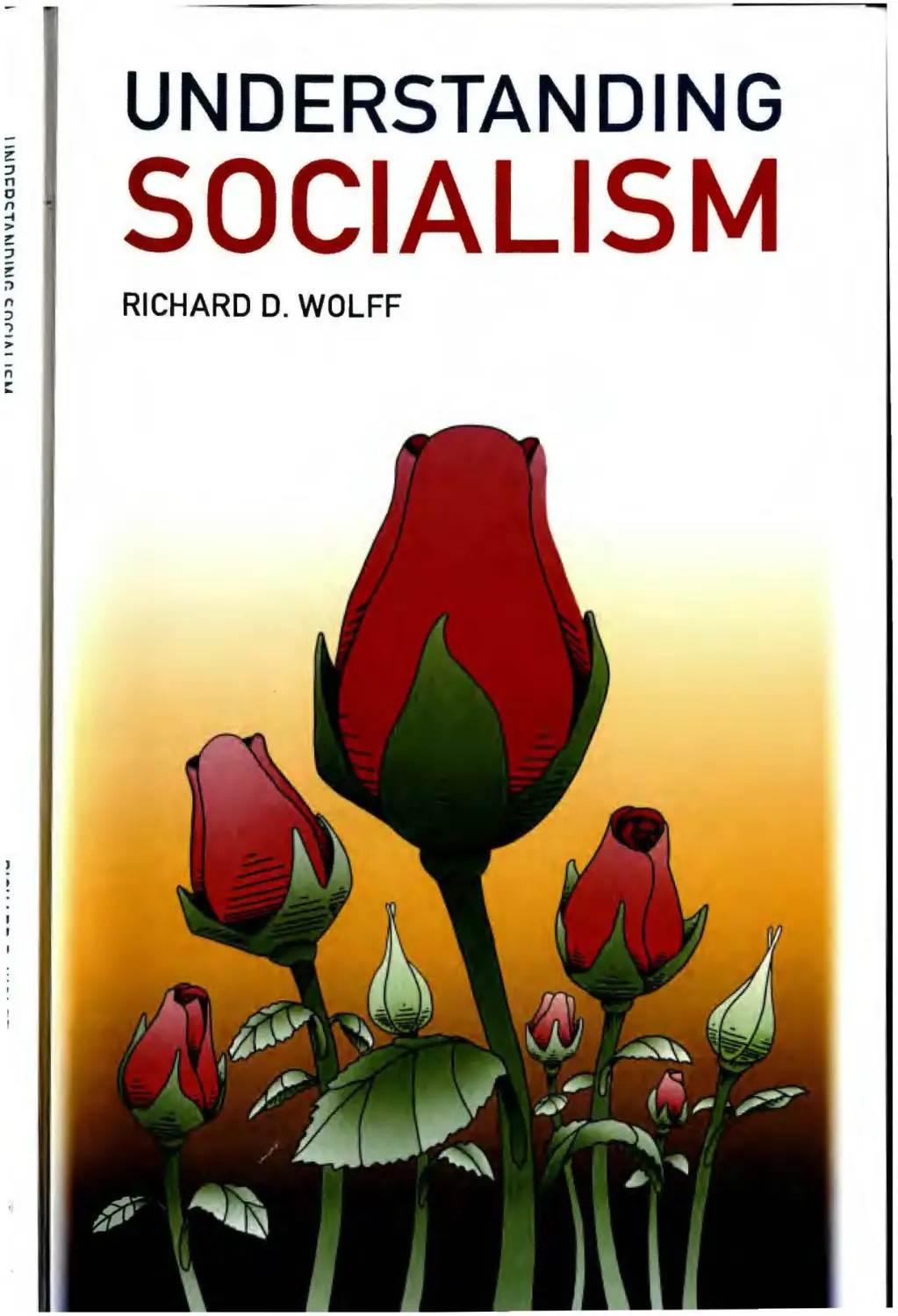
UNDERSTANDING

I SOCIALISM
..,z

g
:-)

I>
/'I

C

RICHARD D. WOLFF

"Richard Wolff's book is the best accessible and reliable treatment we have
of what socialism is. was. and should be . It is clear. concise . and compelling .
In a time in which socialism is more popular than capitalism among the young. we
now have a strong and powerful case for why socialism is what
radical democracy looks like."

- Cornet West
"Rick Wolff puts the social back in socialism by centering the people. the places and
the passions that other economists strip out. In the same accessible style that has
made his programs and lectures such a hit. he explains his subject in a way that's
not only smart. but makes the rest of us feel smart. It's actionable intelligence for
the every person."

- Laura Flanders
"There are few economists who are the equal of Richard Wolff. which he once again
proves with his latest book. Lucid. brilliant and uncompromising in his dissection
of the capitalist system he also provides a sane and just socialist alternative to
capitalist exploitation. one we must all fight to achieve."

- Chris Hedges

"The key difference between the
emerg ing socialism of the 21st century
and the previous socialist trad ition is
the former·s advocacy of the
microeconomic transformation of the
internal structure and organization of
workplaces.·

- Richard D. Wolff

:::t
("'!

:c
)>

:::0
0

~

8

DEMOCRACY AT WORK

ISBI

lT"-lf'-'Tof

9 780578 227344

:l:
0
r

,,,,

Copyright© 2019 Richard D. Wolff
Published by Democracy at Work
POBox30941
New York, NY 10011
info@democracyatwork.info
www.democracyatwork.info

ISBN: 978-0-578-22734-4

Available through Lulu.com

Cover design by Luis de la Cruz

Other Books from Democracy at Work:
Understanding Marxism by Richard D. Wolff

Coming in 2020 ...
Capire II Marxismo di Richard D. Wolff, the Italian translation of
Understanding Marxism

Acknowledgements

The editors would like to thank Richard D. Wolff for his incredibly
generous contribution in writing this book. The proceeds from the
sales will support Democracy at Work, a non-profit that he founded
in 2012. The organization's mission is to create media that analyzes
capitalism critically as a systemic problem and advocates for
democratizing workplaces as part of a systemic solution.
Professor Wolff and the editors would like to acknowledge the hard
work of the following dedicated volunteers who offered their time
and skills to the copy-editing of this book. Their attentiveness,
dedication, and insights polished and deepened its contents.
Marilou Baughman
Gloria Denton
Andrea Iannone
Jake Keye[
Christian Lewis
Steven Payne
Democracy at Work would also like to thank artist Luis de la Cruz,
whose work graces the cover, and who is always a delight to work
with.

Contents
Introduction
Chapter I
A Brief History: How Socialism Got to its
Here and Now

9

Chapter II
What Is Socialism?

27

Chapter Ill
Capitalism and Socialism: Struggles and
Transitions

41

Chapter IV
Russia and China: Major Experiments in
Constructing Socialism

55

ChapterV
Two Anti-socialist Purges: Fascism and
Anti-communism

87

Chapter VI
Socialism's Future and Worker Co- ops

109

Conclusion

127

About the Cover
The Red Rose as a Symbol of Socialism

131

About the Author

133

About Democracy at Work

135

Further Reading

137

Introduction

Socialism is a kind of yearning for a better life than what
capitalism permits for most people. Socialist yearnings are as
old as capitalism itself, because they are its products. Where
and when capitalism's problems and failings have
accumulated criticism and critics, socialist voices have risen.
And so it is again now.
Any serious discussion of socialism must begin by
acknowledging socialism's rich diversity. Whatever particular
aspects of socialism we choose to analyze, they need to be
located within socialism's complexity. That avoids presenting
one's own interpretation as if it were the entirety of socialism.
In this book, I focus on the economic aspects of socialism, how
it differs from capitalism in broad outlines. I am more
interested in socialist critiques of capitalism and their
implications about socialist alternatives than in the particulars
of the few, early experiments in erecting socialist systems
(USSR, People's Republic of China, and so on) that history so
1

far offers. Finally, my own education and work constrain me to
concentrate on Western Europe and North America. Some
important aspects of socialism are thus not covered or
discussed here.
Yearnings for better lives, such as socialism proposes, are not
new. In slave societies, the slaves hoped and dreamed of lives
less hard and less out of their own control. Their yearning
aimed to obtain freedom. They sought social change that
would preclude any one person being the property of another.
In feudal societies, the serfs - "free" in the sense that no one
"owned" them -

yearned for better lives too. Their

subordination to lords included heavy labor and other burdens
that they wanted lifted. They hoped and dreamed of a society
in which they would not be bound to the land, the lord of that
land, and the feudal dues of labor and subservience. The serfs
mobilized in the 1789 French Revolution to demand liberty,
equality, and brotherhood. In effect, the serfs had expanded
on what the slaves had called freedom.
In the American Revolution against British King George 111, the
revolutionaries were neither slaves nor serfs. They were
mostly self-employed farmers, craftspeople, and merchants
subject to a foreign feudal kingdom. Their yearnings thus
differed from those of slaves and serfs. They wanted liberty as
individuals to pursue their dreams without hindrance from
feudalism or monarchism, whether foreign or domestic. They
added democracy to the goals advanced by the slaves and
serfs before them.

2

The different systems of slavery, feudalism, and small-scale
self-employment produced masses of people yearning for
better lives. Eventually, each of those systems provoked
revolutions. Many people then sought to break away from and
go beyond those systems. The French and American
revolutions marked key moments in the social
transformations of major pre-capitalist systems into capitalist
ones.
By "capitalist system" we mean that particular organization of
production in which the basic human relation is
employer/employee instead of master/slave, lord/serf, or
individual self-employment. The revolutionaries who wanted
and built capitalism hoped and believed that transitions to
employer/employee relations of production would bring with
them the liberty, equality, brotherhood, and democracy they
yearned for. The revolutions' leaders promised - to
themselves and to the people they led - that those goals
would be achieved.
But the transitions to capitalist employer/employee relations
that increasingly replaced the previous slave, feudal, and selfemployment relations of production had unintended
consequences. Capitalism soon proved to be different from
what its revolutionaries had hoped. While it enabled some
people to be more free and more independent than slaves,
serfs, or self-employed subjects of monarchies had been, it
also seriously limited freedom, independence, and democracy
for many. Capitalism betrayed many of the promises made by
its advocates. It produced and reproduced great inequalities of
income and wealth. Poverty proved to be endemic, as
capitalism seemed equally adept at producing and
3

reproducing both wealth and poverty. The capitalist rich used
their wealth to shape and control politics and culture.
Democratic forms hid very undemocratic content. The cyclical
instability attending capitalism constantly threatened and hurt
large numbers, and so on.
Growing numbers of employees within capitalism began to
yearn for better lives. They defined those yearnings first in the
familiar terms of the earlier French and American revolutions:
equality, fraternity, liberty, and democracy. They criticized a
capitalism that failed to deliver those to most people and
demanded social changes to achieve them. Many people still
continue to want a better, softer, friendlier capitalism, where
government regulates and intervenes to achieve more of what
the French and American revolutionaries had yearned for and
promised. They often self-define as "socialists."
However, capitalism's development provoked another,
different perspective that also called itself socialism. In that
view, capitalism had not broken from slavery, feudalism, and
monarchy nearly as much as its advocates had imagined.
Slavery had masters/slaves, feudalism had lords/serfs, and
monarchy had kings/subjects as key sources of their
inequalities, lack of freedom, oppressions, and conflicts. The
employer/employee relation of production in capitalism
generated parallel problems.
Capitalism installed monarchies inside individual workplaces,
even as monarchies outside workplaces were rejected. Kings
mostly disappeared, but inside each workplace the owners or
their designated boards of directors assumed king-like powers.
4

,Capitalism proclaimed democracy outside workplaces, where
people resided, but banned it from inside its workplaces.
For some, socialism protests against all the dichotomies:
slave/master, serf/lord, subject/king, and employee/employer.
It seeks their abolition in favor of democratically selfgoverning communities of equals. Such socialists insist that
democracy applies to the economy as well as to politics. They
see no way for politics to be genuinely democratic if it rests on
a non-democratic economic basis. The corruption common to
all political systems resting on capitalist economies endlessly experienced, regularly exposed, and constantly
reproduced - is their proof. The inequalities attending all
capitalist economies are protected, and thus reproduced,
because
even
a
formally
democratic
politics
disproportionately empowers capitalism's employer class.
How to concretely organize socialism, and how to achieve
transition to it from capitalism, have always been issues of
disagreement and debate among socialists. Anyone referring
to the socialist position on what constitutes a socialist
economy and society, or on how to achieve transition, is
making a major mistake. Socialism is more like a tradition of
multiple different streams of thought about these questions.
The extraordinarily rapid spread of socialism across the globe
over the last century and a half brought it to societies with very
different histories, economic development, cultures, and so
on. Many different interpretations of socialism emerged.
Likewise, practical socialist movements over the same period
display successes and failures - in labor struggles, party
politics, and in early efforts to construct socialist economies
and societies - that also shaped diverse kinds of socialism.
5

The debates among socialists have sometimes been extreme.
Some interpretations view others as outside the tradition, not
"real" or "true" socialism. Some interpretations added
adjectives

to

"socialism"

to

distinguish

among

the

interpretations. Examples include "democratic," "market,"
"libertarian,"
"anarcho-,"
"eco-,"
"evolutionary,"
"revolutionary," "Soviet," "Christian," "utopian," "scientific,"
"national," "parliamentary," "state," "Stalinist," and more.
Socialists never universally accepted or recognized any one
authority's definition of socialism. Instead, socialism has
always been a tradition of multiple, different, contested
streams of thought and practice. We try here to explain when
and why we use one or some among socialism's
interpretations and when we discuss the tradition as a whole.
In the name of socialism, individuals, groups, movements,
parties, and governments have sometimes acted in ways that
other socialists and non-socialists have found unjustified or
even horrific. While the same indictment applies to
Christianity, or democracy, or freedom, etc., that is not an
excuse. Stalin and Pol Pot are stains on the history of socialism
that it must account for and reject. The Spanish Inquisition,
missionaries' misdeeds, holy wars against infidels, and
countless wars among different interpretations are parallel
stains on Christianity. Centuries of colonialism, the slave trade,
world war, and mass poverty in the midst of great wealth stain
capitalism.
Transition from capitalism to one or another kind of socialism
does not guarantee that all socialist goals will be achieved or
that none will be abused. The abolition of slavery did not mean
freedom was achieved and never subsequently abused.
6

Likewise, the end of serfdom by a revolutionary transition to
capitalism did not guarantee liberty, equality, and fraternity for
all. Nonetheless, the passing of slavery and of feudalism were
important, necessary, positive steps for humanity. Socialists
argue the same for the transition from capitalism to socialism.
Indeed, socialists today, across nearly all their different
streams and interpretations, recognize that the tradition
benefits as much from acknowledging abusive usages of
socialism (not to be repeated) as from celebrating and building
successful usages.
Socialism is continually reborn, since the problems of
capitalism, especially inequality and cyclical instability, remain
unsolved. A particular burden for today's new generation of
socialists - and for the writing of this book - arises from the
last half century's taboo on socialism, especially in the United
States. That taboo left a legacy of ignorance about socialism in
general and about its many profound changes over the last 50
years. My hope is that this book helps to overcome that taboo
and its legacy, and thereby helps build a new socialism.

7

8

Chapter I
A Brief History: How Socialism Got to its
Here and Now

Socialism grew from a small European social movement two
centuries ago into a huge global movement today. Historically,
that is far faster than comparable movements in history, such
as Rome's empire, Christianity, or Islam. Even the capitalism
that spawned socialism as its critical "other" began earlier and
so grew less quickly. Today's socialism reflects its rapid spread
across a changing world's diverse natural, political, economic,
and cultural conditions. A brief look at socialism's remarkable
history offers us a useful angle for understanding it.
Socialism exploded in 19th-century Europe and took off
across the continent. Echoes and ramifications of the French
and

American

revolutions

provoked

correspondingly

revolutionary thinking and writing. In philosophy, politics,
economics (then called "political economy"), and culture,
9

many ruptures and breakthroughs occurred. The remaining
feudalism and feudal empires disintegrated, and industrial
capitalism and ethnic nationalisms spread. The 1848
Revolutions led to major reorganizations of Europe's map
(especially the unifications of Germany and Italy), and
capitalist colonialism took major steps toward creating an
integrated world economy. All such events spurred the
development and expansion of socialism as well.
Socialism gathered the critics and criticisms of capitalism's
evident tendencies to widen income and wealth differences.
Socialism came to stand for a yearning toward far greater
equality. Socialism likewise accumulated the protests and
protesters against capitalism's instability, its built-in cycles
that

confronted

the

working

class

with

sudden

unemployment and income loss, on average every four to
seven years. The plague of recession and depression feared by
most employers and employees alike struck many as an
utterly irrational feature of capitalism and more than sufficient
to provoke a yearning for a system that would not need or
permit such cycles.
By the second half of the 19th century, European socialists
were numerous and self-confident enough to form social
movements, labor unions, and political parties. Socialist
newspapers, books, and pamphlets spread their ideas. Serious
theoreticians (especially Marx, Engels, and their students)
added depth and reach to socialism, developing the tradition
into a substantive literature of social criticism, analysis, and
proposals for making social change. Marx's Capital, Volume 1
defined a fundamental injustice - exploitation - located in
capitalism's

core

employer/employee
10

relationship.

Exploitation, in Marx's terms, describes the situation in which
employees produce more value for employers than the value
of wages paid to them. Capitalist exploitation, Marx showed,
shaped everything else in capitalist societies. Yearning for a
better society, socialists increasingly included demands for the
end of exploitation, replacing the employer/employee
relationship with an alternative production organization in
which employees functioned democratically as their own
employer.
In 1871, socialists seized power in Paris and established and
governed a commune there. For a few weeks, Europe and the
world glimpsed some outlines of how society would function
differently were socialism to replace capitalism. Socialists also
glimpsed a basic strategy for transition from capitalism to
socialism. Socialists would capture state power and use it to
create, protect, and develop the socialist alternative to
capitalism.
Socialists in 19th-century Europe generally embraced the key
slogans of the French and American revolutions: liberty,
equality, fraternity, and democracy. What distressed and
activated them was that actually existing capitalisms had
failed to achieve those ideals. Socialism was the demand to go
further, to be more "progressive,'' precisely to realize liberty,
equality, fraternity, and democracy. If capitalism could or
would not move forward in that way, then it needed to be
pushed aside for a better system, namely socialism.
Several central issues took form as major alternative streams
of socialist thought coalesced around them. One issue
concerned building socialism around images, sketches, and
11

even functioning models of the desired post-capitalist society.
Cooperative workplaces,

collectivist communities, anti-

individualist kinship groups, and more comprised social
models that inspired "utopian" socialists. Examples include
Robert Owen and his New Lanark community, Charles Fourier
and

his

Phalanstery,

Etienne

Cabet and

his

worker

cooperatives, and many others. The utopians often believed
that to achieve progress beyond the capitalisms of their day,
people living within those systems had to see and experience
today anticipations of future socialism. Constructing and
promoting such anticipations became a major strategy to win
adherents for a transition from capitalism to socialism.
Other socialists tilted their emphases elsewhere. Marx and
Engels offered a "scientific" socialism as a critique of utopian
socialism. They argued that beautiful utopias would not
produce revolutions against capitalism nor transitions to
socialism. Rather, transformation would emerge when the
tensions, conflicts, and crises resulting from capitalism's
internal contradictions produced the desire and capacity for
social change among a part of the population that could
achieve that change. For Marx and Engels, the potential
revolutionary agent was the industrial proletariat - the
working class - allied with those intellectuals who understood
the future dangers inherent in capitalism's internal
contradictions. Socialists to this day debate the roles of
utopian impulses and models on the one hand, and the
mobilization of a revolutionary working class inside capitalism
on the other, in relation to strategies of transitioning to and
sustaining socialism.

12

Another major issue agitating and dividing socialists,
particularly in the latter half of the 19th century in Europe, was
the debate over reform versus revolution. Would the
transition occur and best be furthered by accumulated
reforms of capitalism, or would a sharp break by means of
revolution be required? Eventually labeled as the debate
between "evolutionary" and "revolutionary" socialisms, its
object was to determine the best strategy for the socialist
political parties then emerging. One side, often associated
with the German socialist Eduard Bernstein, prioritized
"parliamentary socialism." They believed that socialists should
contest in elections and engage electoral coalitions around
reforms of capitalism, yet simultaneously argue and push
always for the further social transformation needed to secure
a new, better society. Such a strategy could build the mass
consciousness and the political-party apparatus to take state
power. With such a political base organized by a mass party,
acquiring state power would enable a transition from
capitalism to socialism that capitalists and their supporters
could not block.
Against such a strategy, "revolutionary" socialists, such as
Vladimir Lenin and Rosa Luxemburg, countered that
capitalists would never relinquish their wealth and power
without resorting to extreme measures, including mass
violence. In the revolutionaries' view, it was na"ive and foolish
not to anticipate and prepare for those reactions to socialist
advances. Such socialists argued that it was always appropriate
to analyze the internal contradictions and tensions within
capitalism to identify moments when revolutionary ruptures
were possible. Just as the English, American, and French
revolutions were key events in the European transition

13

- - , i - - - - - - - - - -- - - - - - ~ ~ ~- - -

-

-

beyond feudalism to capitalism, such socialists anticipated
parallel revolutions for the transition from capitalism to
socialism. Debaters of the most effective path toward
socialism sometimes also proclaimed middle grounds:
commitments to struggle for reforms but always with an
explicit caveat that reforms would never be secure until a basic
change to socialism had been accomplished, which required a
revolutionary break.
Just as socialists have long debated the relative importance of
utopian versus scientific socialisms, and reformist versus
revolutionary socialisms, the 20th century brought forward a
new and different kind of debate. The Soviet revolution of 1917
inaugurated the first enduring government committed to
socialism: the Union of Soviet Socialist Republics (USSR). The
1917 revolutionaries (especially Lenin) drew many important
lessons from the very short-lived French socialist experiments
in the Paris Commune of 1871. Marx's analysis of why the Paris
Commune survived so briefly served Lenin with significant
guides that helped the Soviet revolution become the first
durable experiment in constructing a socialist government.
From its beginning, the USSR provoked debate among
socialists. Disputes focused on whether Soviet leaders'
decisions properly applied pre-1917 socialist ideas and
principles. On a deeper level, the European socialist
movement had to confront two significant changes from what
had agitated and driven socialism during the 19th century.
First, socialism now had two different contexts that became
two distinct, albeit also connected, social projects. Socialists
living and working inside still-capitalist countries continued to

14

focus on how to mobilize workers for transformation to
socialism. Socialists living and working in the USSR,
meanwhile, focused on constructing, protecting, and
strengthening a socialist economy, society, and government.
Many of the latter socialists appealed to their comrades inside
capitalist countries to give priority to defending . and
supporting socialism's "first country,'' the USSR.
On that question socialists split everywhere. Socialists
supporting the Soviet interpretation mostly changed their
name to "communists" and broke away to form communist
parties. Socialists who were more or less skeptical or critical of
Soviet actions and statements generally held on to the name
"socialist." Debates swirled openly among multiple socialist
and communist parties, and also (usually less openly) within
them, over whether and how the USSR embodied, distorted,
or betrayed socialism. Those debates continued even after the
USSR imploded in 1989.
The new USSR's charismatic leader, Lenin, took the position
that what the 1917 revolution had accomplished was what he
called "state capitalism." By that he meant that socialists had
achieved and sustained state power and used it to displace
private capitalists from their enterprise positions. The new
USSR nationalized industry and placed state functionaries in
the place formerly occupied by private capitalist boards of
directors. The employer/employee structure of capitalism had
been retained, but who the employers were had been changed.
Debates among socialists had to broaden to consider state
capitalism alongside private capitalism and socialism as forms
relevant to socialist strategy. However, that broadening lasted
only a short time. Lenin's death in 1924, the bitter split within
15

_...,,.------------ - - - - - - -- -

-

-

-

the Soviet leadership between Leon Trotsky and Josef Stalin,
and Stalin's emergence as the dominant leader starkly
changed socialist debates.
Perhaps Stalin's most consequential early decision was to
declare that the USSR had achieved socialism. What Lenin had
called "state capitalism" thus became "socialism." Stalin
offered the USSR as the successfully achieved transition from
capitalism to socialism, the model for those seeking socialism
everywhere. Whatever Stalin's intent - perhaps to give the
long-suffering Soviet people a sense that all their sacrifices
had achieved their goal - his declaration had deeply
problematic effects. It identified socialism - for the world with a social system at once poor, wracked with internal
conflicts, and tightly controlled by a harsh political
dictatorship. Socialism's enemies have used this identification
ever since to equate political dictatorship with socialism. Of
course, this required obscuring or denying that (1) dictatorships
have often existed in capitalist societies and (2) socialisms
have often existed without dictatorships. That obscuring and
denying continues to this day.
The second big change that the first half of the 20th century
brought into socialism came from the rise of local movements
against capitalist imperialism. Their targets were Europe's
formal colonialism, chiefly in Asia and Africa, and the US's less
formal, but no less real, colonialism in Latin America. Those
oppositional movements increasingly found their way to
socialism. Sometimes, students attending universities in
colonizing countries encountered socialists and socialism
there.
More generally, colonized
people seeking
independence took inspiration from, and saw alliance

16

possibilities with, workers fighting exploitation

in

the

colonizing countries. The latter increasingly glimpsed similar
possibilities from the other side.
Socialism spread, via capitalist imperialism, to all colonies and
thereby helped to create a global socialist tradition. The
multiple interpretations of socialism that had evolved in
capitalism's centers thus spawned yet more and furtherdifferentiated interpretations of socialism. In particular,
diverse streams within the anti-colonial and anti-imperialist
tradition - theoretical and practical - interacted with and
enriched socialism.
Over the second half of the 20th century, until 1989, global
socialism exhibited both its greatest successes and worst
setbacks. By the 1970s, the USSR had recovered from World
War II to become the world's second superpower. Communist
parties held power in Eastern Europe, China, Cuba, Vietnam,
and beyond. Anti-colonial movements were often infused
with socialist ideas and led by socialists. The Vietnam War
pitted one product of the anti-colonial-cum-socialist
movement against its opposite. The final defeat of the US in
Vietnam in 1975 marked a kind of peak for modern socialism.
Socialist parties frequently formed governments, alone or in
coalitions (sometimes with communist parties), across Europe
after 1945. The socialism/communism split that developed
after 1917 was hardened in and by the Cold War. Socialism often called "democratic socialism," "social democracy," or
"socialist democracy" - took hold in Northern and Western
Europe especially. Workplaces there were mostly left in the
hands of private capitalists. However, the government
17

sometimes operated some major industries (e.g., utilities,
transport, banks) while controlling the economy with heavy
regulations and taxation. The government's goals included
labor protections, income redistribution, and provision of basic
welfare via subsidized education, housing, transport, and
health care. This kind of socialism stressed its difference from
- and often political opposition to - the communist system
in the Eastern European countries allied to the USSR. Those
countries also referred to their economic systems as
"socialist." In them, the government owned and operated
large sections of industry and agriculture, and provided more
subsidized public services. Social democrats and communists
criticized and debated one another. At the same time, the
celebrants of private capitalism mostly attacked both kinds of
socialism.
Dissenters criticized both of the major streams, or types, of
socialism. For example, some believed that the communist
stream empowered the state apparatus excessively, in
violation of the bottom-up notion of social power they
identified with socialism. Others found social democracy left
too much power and wealth concentrated in the hands of
large private capitalist interests. Social-democratic regulations
and public services were always insecure, always vulnerable to
well-financed attacks when private capitalists opposed them.
The social democracies' capitalist-generated inequalities
rendered their democracies not genuinely socialist in such
dissenters' view.
In the United States a peculiarly skewed notion of socialism
took hold, especially among those who disliked it, but also
among the general public. Large segments of the population
18

came to view the terms "communist," "socialist,'' "anarchist,"
"Marxist," and for many also "liberal," as synonyms. They were
all "anti-American," and there was really little point or need to
distinguish among them. This unusual perspective was partly
the fruit of an admittedly poor education system unbalanced
by Cold War ideological imperatives. Waves of McCarthyite
opposition to communism - as well as left-wing, center-left,
and even liberal politics - have swept through the US since
the mid-1940s, faded in some parts of the country while
remaining strong in others. Such opposition has even
resurfaced again now in the Trump era. Those waves
effectively destroyed the US communist and socialist parties
to an extent rarely equaled elsewhere after World War II. The
repressions also taught large portions of the US public to
suspect, dismiss, demonize, and avoid all the synonyms
equally.
The taboo on socialism imposed by anti-communism in the
US after World War II had kept socialism from being taught in
most schools. And when it was, teachers treated it dismissively
and briefly. They needed to prove their anti-socialist
credentials amid a general demonization across social
institutions of all things socialist. The 1950s firing of teachers
with known socialist sympathies had been an effective
warning. US labor unions, too, were caught up in the antisocialism sentiment and turned against what were often their
most militant members and organizers. Thus, unlike its
counterparts in most other capitalist countries, organized
labor in the US largely severed its previously close
connections with socialist organizations and individuals. The
SO-year decline of the US labor movement was partly a result
of anti-socialist purges inside US unions as they tried to show
19

l

a loyalty to capitalism that they hoped would protect them. It
did not.
For many, communism, socialism, Marxism, anarchism, and
more recently terrorism, are all noxious anti-American
ideologies and practices that differ only in their spelling. From
the mid-1940s until Bernie Sanders' 2016 campaign for
president, any candidate accepting the label "socialist"
thereby risked political suicide. It was not unusual in the US to
see almost all government activity (other than the military)
attacked as socialist (e.g., the post office, Amtrak, TVA,
Medicare, Medicaid, and so on). Thus, countless Soviet
scholars could and did explain that the USSR was socialist or even state capitalist - and merely hoped one day to
develop further into communism. Nonetheless, few in the US
paid attention. For most, either word applied synonymously.
Such was not the case in Europe, where most people knew
from family, neighbors, newspapers, and so on, what rough
boundaries separated socialists from communists, etc.
The implosion of the USSR and its Eastern European allies in
1989-1990 set back socialism generally, but especially the
communist stream. The social-democracy stream was less
affected. However, many of socialism's critics have since
portrayed the end of the USSR as some sort of final victory for
capitalism
in
its
20th-century
struggle
with
socialism/communism. Amid the capitalist triumphalism, all
strains of socialism were thrown together as having somehow
all expired. The reality would soon prove quite different.
Capitalist triumphalism attached itself to the neoliberalism
that surged in the 1980-2008 period. Neoliberalism is an
20

ideology holding that deregulated market-exchange and
private- (not state-) owned and -operated enterprises always
yield superior economic results, including in housing, health
care, education, etc. Sustained economic growth (its
dependence on debt expansion ignored or downplayed)
enabled the idea that a "new economy" had emerged that
would grow forever and would finally bury an abandoned
socialism. Many socialists and communists were depressed
and deactivated by the triumphalism and perceived economic
growth, especially in the old centers of capitalism (Western
Europe, North America, and Japan).
Yet just below the radar of most Western public opinion,
China's brand of socialism - a hybrid state capitalism that
included both communist and social-democratic streams proved it could grow faster over more years than any capitalist
economy had ever done. By early in the 21st century, China
had become the second economic superpower, after the US,
and was gaining fast. Socialism, it turned out, had not died, but
it had moved its center east. That should not have surprised
anyone, since capitalism had done the same.
The 2008 global crash of capitalism, and the neoliberalism
that had preceded it since the 1970s, added new disruptions
to the history of socialism. Neoliberalism generated a surge of
income and consumption growth that challenged the Soviet
and Eastern European socialisms. Those systems had focused
on industrial growth (impressively achieved) that prioritized
capital goods and infrastructure over individual consumption.
The latter was promised but largely postponed to facilitate the
growth of the former. But their populations, badly affected by
World War 11, resisted and resented repetitions of reduced,
21

·1

postponed, or slow consumption growth. Reduced Cold War
tensions, plus the spread of television and other displays of
disparate consumption levels, plus building resentments over
limited civil liberties, combined to collapse the Soviet and
Eastern European socialist governments. A relatively peaceful
transition away from them began.
Ironically, because little internal debate had been allowed by
those governments, the broad citizenry knew little about the
diverse streams of socialism. The existing socialist
governments had presented their shared interpretation of
socialism as the only valid, real version. Thus the only
alternative to the socialism that most Eastern Europeans knew
was its arch-other, namely Western capitalism. The idea that
there were other kinds of socialism than what existed in
Eastern Europe - and that their citizens' aspirations might
best be achieved via transition to one of them - was rarely put
forward. In the rush to exit from Eastern European socialism,
the crowds surged toward Western capitalism with but a few,
unheeded voices urging that the desired goal be Scandinavia
or Germany, not the UK or US. It was another history lesson
showing the deep dangers everywhere of shutting down
debate over alternative systems.
The economic surge of Western capitalism, despite being
debt-driven, created a near euphoric notion of capitalism's
ascendancy. That was reinforced into full euphoria with the
collapse of the world's first socialist state, the USSR, and its
post-World War II European allies. The 20th century's struggle
between capitalism and socialism seemed over, won
definitively by capitalism. The future would be perpetual
capitalist growth benefiting all. Warning signs - including the
22

hard historical fact that capitalism has suffered costly, periodic
boom-and-bust cycles across its history - were widely
ignored. Both government and corporate debts accumulated,
and new populations were introduced to the joys of consumer
debts. Many thought it need never end. But it did in 2007 and
2008 when debt bubbles burst and took down the global
capitalism system.
Once-proud megabanks and other megacorporations
suddenly stopped bashing governments as wasteful,
inefficient burdens on the private sector's back. Instead their
private jets took them to global capitals where they begged to
be bailed out by trillions of dollars or euros of government
money. Given the corporations' political power, the
governments responded. They financed huge bailouts with
massive additional government debts. Once done,
governments decided to rein in the exploding debts by
imposing austerity - at least slowing, if not reducing,
. government spending and borrowing. Public employment,
pensions, and public services became major targets for cuts.
Given the neoliberal mentality cultivated over the prior
decades, most "leaders" foresaw few risks in their austerity
policies. Few imagined that many people would balk at the
sequential spectacle of (1) megacapitalists profiting from a
debt bubble they helped to create, (2) those same capitalists
securing a government bailout when that bubble burst, and (3)
leaders then imposing austerity on average citizens to offset
the bailout. Nor did the leaders see the dangers in demanding
that the working classes they had victimized also absorb the
social costs of massive new waves of desperate immigrants.

23

They were wrong. A revolt commenced, slowly at first,
differing with national and regional contexts. Capitalism's
instability, inequality, and injustice were just too much.
Increasingly, voters turned against the traditional old political
leaders and parties, the center-left and center-right that had
comfortably alternated in power. Both had dutifully
administered the neoliberal regimes in North America,
Western Europe, and Japan since the 1970s. Both had
cooperated in baiUng out the collapsed megacorporations
from 2008 to 2010. And both had then promised the people
to ease austerity but, once in power, mostly did the opposite.
"Populisms" of the left and right surged into political
prominence. Some formed new political parties. Some
entered strained coalitions with the old center-lefts and
center-rights. Some forced alliances in which they subsumed
elements of the older, traditional parties under a new
"populist" leadership. Sometimes they governed. And
sometimes they refused to play parliamentary politics and
remained "populist" movements. On the left, such populisms
often included explicit anti-capitalist aspects. On the right,
flirtations, or more, with fascism often occurred.
Socialism suffered a peculiar combination of decline and
rebirth in the aftermath of the 2008 capitalist collapse. It
continued the decline that had set in after the 1970s and had
accelerated with the demise of the USSR and Eastern
European socialist governments. Social-democratic parties
began a steady loss of voters and social support, partly
because of their accommodations to neoliberalism, especially
when that included acceptance of austerity policies. Some
socialist parties dissolved. Some entered coalitions with their
24

former adversaries, the traditional center-right parties. All
these maneuvers failed to stem the decline of traditional
socialism.
But rebirths also occurred. In some European countries,
explicitly anti-capitalist parties formed that were socialist in
substance but ambivalent about the name. The word
"socialism" had acquired a host of bad associations in a century
of demonization by its enemies, who often equated socialism
with the worst programs undertaken in its name (by Stalin, Pol
Pot, etc.). After its global crash in 2008-2010, capitalism's
veneer was badly broken and a renewed socialism burst forth.
In the US, the Occupy Wall Street movement in 2011 included
explicit and self-confident affirmations of both anticapitalism and pro-socialism convictions in ways not seen in
the prior half century of mass social movements. Then Bernie
Sanders' breakthrough 2016 campaign, in which he ran for
president as an explicit "democratic socialist," returned
socialism to a place within major portions of public discourse
about US politics and society.
In each country on earth, socialism exists, advances, and
retreats. It processes the lessons and bears the scars of its
history there. Yet each country and its socialism are also
shaped by socialism's global history: by now a richly
accumulated tradition of many diverse streams
(interpretations, tendencies, etc.). They reflect its two
centuries of gains and losses, successes and failures, declines
and rebirths, and critical responses to capitalism's shifting
fortunes and contradictions. Socialism's repeated revivals, like
its global spread, attest to its deep relevance to a troubled
capitalist world, past and present. We need to understand

25

socialism because it has shaped, and will continue to shape, us
all. It is the greatest assemblage we possess of the thoughts,
experiences, and experiments accomplished by those
yearning to do better than capitalism.

26

Chapter II
What Is Socialism?

Socialism is a yearning by people living in a capitalist economic
system, whether private or state capitalist, to do better than
what that capitalism permits and enables. By "doing better,"
socialists mean many things. One is having work that is more
socially meaningful, less physically and environmentally
destructive, and more secure in delivering an adequate
income for yourself and your family than what is generally
available in capitalist societies. Another is having the lifelong
education, leisure, and civil freedoms to pursue real
participation in politics, intimate and friendship relationships,
and cultural activities of your choice. Socialists want to be able
to explore and develop their full potentials as individuals and
members of society while contributing to its welfare and
growth.

27

·1

I
iI
I

Of course, these are abstractions and generalizations, but they
suffice at this early stage of our argument. Socialists believe
such desires are generally frustrated for most people in
capitalist societies. Transition from a capitalist to a socialist
society is then the means to achieve a society that successfully
provides all people with better lives in the sense conveyed
above.
In societies with a slave economic system, many slaves
yearned for emancipation from the horrific burdens and
constraints imposed on them. Their thoughts, dreams, and
actions eventually contributed to achieving this goal. Likewise,
serfs wanted to abolish the burdens imposed on them by the
feudal economic system, and over time they helped make the
break from that system. Socialists recognize the uniqueness of
slavery and feudalism and also draw inspiration from the
slaves' and serfs' struggles against these past economic
systems. Socialists want to make a parallel break from
capitalism.
Slaves and serfs learned that freedom, liberty, and the
overcoming of slavery and feudalism did not magically solve
all their problems. Socialists have come to learn the same
about socialism. Ending slavery and feudalism were
enormously important, progressive steps taken in human
history. Socialism, too, will not be a panacea, but it will, in
socialists' views, represent a major progressive improvement
over capitalism.
Beyond their shared yearning, socialists advocate a variety of
criticisms of capitalism, a variety of strategies for transition to
socialism, and a variety of conceptions of what socialism is.

28

Because in most cases socialists focus on the economy, so
shall we here.
Any economy is a set of ways and means to produce and
distribute goods and seivices that the people in that
community need or want. Our food, clothing, shelter,
amusements, transport, and much more comprise our needs
and wants. Our labor combines with tools and equipment and
workplaces, as so many inputs, to produce goods and services,
as so many outputs. Before production, resources (such as
land, water, space, etc.) need to be distributed to workplaces
to be available to the laborers as production inputs. After
production, the outputs (goods and services) need to be
distributed to those who consume them. An economy
comprises the production and distribution of productive
resources and production's outputs.
As a way of organizing the production and distribution of a
society's goods and services, socialism differs from capitalism
and indeed from many other economic systems. In socialism,
the whole community of people served by, and living with, or
in, an economy participate democratically in producing and
distributing goods and seivices. In slavery, this is clearly not
the case. In a slave economy, participants are divided into
masters and slaves. Masters control (and literally own) the
productive inputs, including the laborers themselves, and
decide the fate of slaves in both production and distribution.
In feudalism, economic participants are divided into lords and
serfs. The latter are not property as in slavery, but they occupy
social positions based on the feudal positions of their parents.
Children of serfs are likewise usually serfs, and often of the
same lord or his children. Children of lords become lords or
29

find associated positions within the feudal economy. Like
masters, lords exercise a socially dominant power that derives
in large part from their position in relation to production and
distribution. Masters and lords are usually few, relative to the
numbers of slaves and serfs.
Capitalism is different from slavery, feudalism, and socialism.
Capitalism divides participants in production and distribution
into employers and employees. Employers are few;
employees are many. Employers direct and control
employees' work with regard to the production and
distribution of goods and services. Employees are not
anyone's property, nor are they bound to the land or to the
employer of their parents. They are "free" in the sense that
they can voluntarily enter into a contract to work for any
employer they choose who is hiring employees. Hiring is the
purchase of an employee's "labor power" - a person's ability
to work over a specific period of time. Labor power is paid for
with products or money called a "wage." Wages did not exist
in slavery or feudalism, as the relationship of the two primary
groups involved in those systems generally secured the work
of one for the other without a labor contract.
Another different economic system entails individuals
working alone, say as farmers, craftspersons, service providers,
etc. In producing and distributing resources and products, such
persons work individually. Their economy displays no
dichotomy of the sorts encountered in slavery (master/slave),
feudalism (lord/serf), or capitalism (employer/employee).
Likewise, such an economy is not socialist since it does not
entail the democratic and collective decision-making in
production and distribution that would occur in a socialist
30

system. Typically called "self-employed" in modern economic
terminology, such an economy of individual producers is
found throughout much of human history, often occurring
alongside and interacting with slave, feudal, capitalist, or
socialist systems.
Indeed, it is important here to note that actually existing
economies, past and present, often display co-existing
economic systems. Thu~, the US had capitalism in the North
and slavery in the South before the Civil War. Likewise, today
capitalist corporations (with boards of directors functioning as
employers within them) co-exist and interact with selfemployed lawyers, architects, graphic designers, and so on,
who are operating within a different, non-capitalist (i.e., nonemployer/employee) economic system. In both these
examples, there are market-exchange relations between
participants in the two different, co-existing economic
systems. In other words, while their organizations of
production are different - capitalist in the corporation, selfemployment in the lawyer's office - they share the same
distribution system: namely, market exchange.
Socialism allows such co-existing systems as well. What the
USSR called its socialist (i.e., state-owned and -operated)
enterprises could and did enter into market-exchange
relationships with private capitalist corporations located, say,
in Europe. China's socialist enterprises (i.e., state-owned and operated) today engage in market exchanges with private
capitalist enterprises inside and outside China. There are many
such examples, because many existing national economies
include more than one kind of economic system, and these
different systems interact both nationally and internationally.

31

Socialist economic systems differ in important ways from
capitalist systems, but here we must acknowledge that
socialists disagree about those differences. Indeed, so do nonsocialists, and often in similar ways. Since we will encounter
these disagreements repeatedly in this book, we spell them
out here.
One concept of socialism differentiates it from capitalism by
the economic interventions of the state. For this concept of
socialism, capitalism is a system of employers and employees
such that both kinds of people have no position within the
state. Thus their enterprises are referred to as "private." A
capitalist economy exists if and when all or most enterprises
producing and distributing resources and products are such
private capitalist enterprises. Usually, in this view, the
interactions among private enterprises, their hired laborers,
and their customers are all exchanges in what this view labels
a "free market." like the word "private" applied to the
enterprise, the word "free" applied to the market is meant to
signal that the state as a social institution does not intervene
(or intervenes minimally) in the production and distribution of
goods and services.
Capitalism in this approach is defined as private enterprises
plus free markets. It then follows that if and when a state
intervenes or interferes in such private enterprises and/or free
markets, capitalism is at least compromised or at most
transformed into socialism. Since society intervenes through
the agency of the state, this first kind of socialism names that
"social intervention." Many libertarians, for example, believe
that capitalism is compromised to the extent that it allows or
admits state economic interventions. Where capitalism

32

displays problems, libertarians' solutions tend to favor moving
closer to the goals of fully private enterprises and free markets.
In this model, the extent of the state's intervention - from
taxation and regulation to state-owned and -operated
enterprises - defines the degree of socialism and its distance
from capitalism. True, or "pure," capitalism exists when state
interventions are near zero. For some variants of this
perspective, socialism exists when the state's interventions are
substantial or pervasive. For other variants, socialism exists in
each individual state economic intervention: a governmentrun post office, a minimum wage imposed on employers, a
progressive individual income tax, and so on. This latter
perspective leads to notions that modern capitalism is actually
a "mixed" system in which capitalism and socialism co-exist.
There are disagreements among proponents of these
different variants. An example of great importance over the
last century concerns the following debate: If the state merely
regulates enterprises that otherwise remain private (owned
and operated by private citizens with no position in the state
apparatus), this is not socialism. Only if the state additionally
owns and operates enterprises, at least within major sectors of
the economy (sometimes called "the commanding heights"),
does socialism exist. For decades, many referred to the Soviet
Union as "socialist" because most of its industries were
dominated by state-owned and -operated enterprises. In
contrast, people hesitated to apply "socialist" to countries
where state economic interventions were considerable but
mostly excluded state-owned and -operated enterprises. A
variation on this sort of thinking called the latter "socialist" and
the former "communist." This reflected the post-1917 split in

33

world socialism over the USSR's embrace of state-owned and
-operated industrial enterprises. Socialists critical of or
opposed to the USSR's form of socialism kept the name
"socialist" while those who saw the USSR as the model for
post-capitalist socialism took the name "communist." That
split proved very influential in much thinking about capitalism
versus socialism across the 20th century.
"Communism" became the widely accepted name for that
kind of socialism that went beyond taxation and regulation to
add the all-important direct state ownership and operation of
enterprises. The socialists who joined and built communist
parties advocated going beyond taxation, government
spending on public services, and regulation to include state
ownership and operation of many or all enterprises. Other
socialists instead celebrated private, market capitalism where
the state taxed, spent, regulated, and redistributed income
and wealth more equally but did not own and operate many
enterprises. The parties of such folk kept the "socialist" name
and often stressed their commitments to political freedoms
and civil liberties - in contrast to the practices of the
communist systems, first in the USSR and later elsewhere as
well.
The Great Depression of 1929-1941 added more layers of
controversy and confusion around the name "socialism." The
depth and duration of that capitalist crash provoked a whole
new economics named after John Maynard Keynes. This new
economics was devoted to rescuing capitalism from itself by
both explaining the causes of capitalism's depressions and
also offering policies (monetary and fiscal) to moderate,
contain, and limit them. These were policies designed to be
34

implemented by state authorities like central banks or
government treasurers intervening in the economy.
Champions of capitalism were often horrified by Keynesian
economics. To many, such policies seemed yet another
assault on private enterprise and free markets, another
celebration of state intervention in the economy, another kind
of socialism. These people scoffed at Keynesians' frequent
response that they aimed to save capitalism from itself.
Keynesians insisted that the recurring depressions afflicting
private capitalism, if not moderated by Keynesian state
interventions, would eventually turn the working class against
capitalism and thus end it. Keynes's pro-capitalist critics feared
the power of the state more than the risk of recurring
depressions. Despite Keynes's own repeated rejection of and
distaste for socialism, communism, Marxism, and so on, to this
day many closely associate Keynesian economics with
socialism.
The issue of the state has always loomed large in defining
socialism and its difference from capitalism. Modern
capitalism came into the world oppressed and limited by the
absolute monarchies of late European feudalism. Eventually,
capitalism opposed these monarchies and then overthrew
them. In France, the antagonist of the 1789 revolution was
King Louis XVI; the American Revolution targeted King George
Ill. Late feudalism's strong states were feared enemies. But
anxieties about strong states persisted in capitalism long after
feudalism had been defeated and discarded.
The reason for these anxieties was and remains mass or
universal suffrage. When working-class people become the

35

majority of voters electing parliaments and other state
officials, capitalism's champions sense trouble and risk.
Employees may and likely will blame their suffering
(unemployment, low wages, bad working conditions, poor
housing, etc.) on capitalist employers. Employees will
recognize that their votes can empower a state apparatus to
reduce or end that suffering. Tax structures, regulations of
enterprises and markets, and other state interventions in the
capitalist system can alter the distributions of income, wealth,
and power from what they would be without such state
interventions. Universal suffrage can enable the majority
(employees) to offset the inequalities flowing from a capitalist
economy dominated by a minority (employers). For the
champions of private capitalism, the risks of a state powerful
enough to impose taxes, regulations, and wealth redistribution
through universal suffrage is as frightening now as feudal
absolute monarchies were at capitalism's birth.
Modern capitalism wrestles with a contradiction: It needs a
strong state apparatus - for coordination, external and
internal security, managing externalities and the business
cycle, and so on - and it fears the same. In the wake of the
Great Depression in the US, public opinion favored state
interventions such as the New Deal. Forty years later, the socalled Reagan revolution ushered in a neoliberalism that
sought to minimize state interventions in the economy. After
the 2008 crash of capitalism, economists Paul Krugman and
Joseph Stiglitz are urging a re-evaluation of the benefits of
state intervention.
But not everyone agrees. Capitalism's history did not produce
only one socialist opposition with a shared focus on the state;

36

it also produced socialist dissenters. These dissenters also
disliked capitalism and thought human society could and
should do better, but they rejected the state and state
intervention as the focal point of the contest between
capitalism and socialism. While such dissenters have always
hovered around the edges of the socialist movement, what
brought them into the center of debate were the difficulties
encountered by the early experiments in actual socialist
economies. With an eye to the USSR after 1917, as early
revolutionary enthusiasm and social transformations gave
way first to Stalinism in the 1930s and then the implosion of
1989, the problematic relation of socialism to a powerful state
took center stage. Many socialist critics of capitalism saw the
state in the USSR as having itself become an obstacle to the
kinds of social progress socialists championed. The social costs
of the rapid economic development the USSR achieved were
too large to deny or keep tolerating.
Views arose that the socialism of the USSR and its socialist
allies had given the state too much power and transformed
the rest of socialist society too little. The key questions
became: Why did this failure happen, and what is to be done
about it?
Struggling to answer these questions brought another kind of
socialism to the forefront among socialists. In this
interpretation of socialism, what defined it was less the role of
the state in the economy, and more the organization of
production in the workplace. The key issue of this kind of
socialism is how human beings collaborate inside workplaces
(factories, offices, stores) to produce the goods and perform
the services that society needs or wants.
37

In capitalism, the participants in production are divided into
employers and employees. In this alternative view of
socialism, such should not be the case. The key term here is
"should," because such a socialist organization of production
has not yet been undertaken on a society-wide basis.
Traditional socialisms concentrated on state activities taxation, regulation, and state ownership and operation of
workplaces - not on transforming the human relations within
those workplaces. Indeed, traditional socialisms had taken
over the basic employer-versus-employee organization of
production from capitalism and changed it little if at all.
Instead, socialist states taxed and regulated workplaces that
had
retained
their
capitalist
organization
(employer/employee) and sometimes also replaced private
individuals with state officials as employers.
Socialist workplaces could and should be fundamentally
different from capitalist workplaces in this alternative view of
socialism. In capitalist workplaces, a small group (owners,
boards of directors selected by owners, etc.) makes all the key
decisions. In so doing, they are not accountable to the mass of
employees or others affected by those decisions. In their
internal organization, capitalist workplaces were and are still
fundamentally undemocratic. They exclude majorities from
power as surely and completely as monarchies exclude their
subjects. The socialist alternative to capitalist organization
entails the democratization of a workplace's internal structure.
Every employee now has one constituent voice - equal to all
other employees - in deciding what the workplace produces,
what technology it uses, where production occurs, and what is
done with the net revenues or surplus generated. In effect, in
this model the employees become collectively their own

38

employer. The age-old dichotomies of masters and slaves,
lords and serfs, and employers and employees are finally
displaced and overcome here. This conception of socialism
thus represents a fundamental historical break from the slave,
feudal, and capitalist systems.
In this perspective, socialism has pivoted from a largely
macroeconomic to a primarily microeconomic focus.
Socialism accomplishes the transition from capitalism by
rebuilding the economy from the bottom up. Traditional
socialisms never took this step on a society-wide basis of
laying the foundation for an enduring economic system
meant to replace capitalism. The early efforts at transition
from capitalism to socialism stopped short at macro-changes
- socializing means of production so they became stateowned and -operated, substituting centralized planning for
markets as the major distributional mechanism, etc. - and
never got to the micro-level. Traditional socialisms thus failed
to target or include the micro-level democratic transformation
of the workplace. That failure to complete the socialist
revolution likely contributed to undermining the survival of
those early, incomplete transitions from capitalism.
This is not surprising. Incomplete transitions have been the
norm in the passages from slavery to feudalism or capitalism,
from feudalism to capitalism, and so on. The emancipation of
slaves during the US Civil War, for example, led to various
subsequent relations of production - sharecropping,
dependent tenancies, and so on - that fell far short of the
economic freedom ex-slaves sought. Such was similarly the
case with the early breaks from feudalism that led to
capitalism.
39

Each economic system produces multiple forms that
experience more or less successful transitions to new systems
in different ways and at different paces. Many early
experiments in transitioning from one economic system to
another teach lessons that may help, if conditions permit. in
assembling the means for a complete transition to a different
system at some point in the future. There is little reason to
expect that the transition from capitalism to socialism will be
different in this respect. As has been the case with other
economic transitions in history, the move away from
capitalism has involved, and will continue to involve, more or
less successful efforts, trials and errors, and steps forward and
backward, until lessons learned combine with evolved
conditions to enable the complete transition to socialism.
Socialists have learned crucial lessons from the Russian,
Chinese, Cuban, and other revolutions of the 20th century.
The economic systems constructed and tried by those
revolutionaries have taught yet more lessons. The
accumulated theories and practices of the socialist tradition
have today been filtered through the conditions of a changing
global capitalism to propel the tradition in new directions.
Thus, today's socialism is characterized by both old notions
and strategies, and new ones focused on democratizing
workplaces.

40

Chapter Ill
Capitalism and Socialism: Struggles and
Transitions

Human beings have had many different economic systems in
their history. Transitions among them occurred in all
directions. Changes in nature (climate, resource exhaustion,
earthquakes, and so on) influenced those transitions, as did
changes in technologies and social conflicts (wars, class
struggles, migrations). Along the way in each particular system,
beliefs that it was the final or permanent system eventually
proved wrong.
Change is as continually present in economic systems as in
everything else. Kinship or tribal economic systems, with
collectively owned property alongside collective production
and distribution of goods and services, gave way to private,
individually owned and operated systems, and vice versa.
Both of those sometimes gave way to slave systems, and
again vice versa. Those in turn experienced transition to feudal
41

(lord/serf) or capitalist (employer/employee) systems, and so
on. Capitalist systems appeared and disappeared locally and
repeatedly in human history before becoming regionally,
nationally, and now globally prevalent. To imagine that
today's capitalist system will last forever contradicts the
history of every other system as well as of capitalist systems
that arose and fell in the past. Hopefully, our collective
knowledge of the different systems and transitions among
them can limit and shape future transitions (as we seem to
have done in precluding transitions back to slave and feudal
systems).
No sooner did modern capitalism emerge in transitions out of
feudalism and individual (self-employment) economic
systems in Europe, out of a slave system in a large part of the
US, and out of a variety of systems in the rest of the world,
than it was challenged by another transition: socialism.
Advocates of socialism sought transition beyond capitalism
while capitalism's defenders tried to prevent any such change.
Over the last two centuries a widespread theme of politics,
economics, and culture was a struggle between advocates of
capitalism and socialism over transitions between the
systems. For most of the 19th century, capitalism seemed in
the ascendancy; the possibility of transition to socialism, small.
By the end of that century, that possibility had grown
markedly stronger. Transition to socialism had become an
explicit goal of socialist political parties then active in
capitalism's major centers (Western Europe and North
America). Across the 20th century, socialism shadowed
capitalism around the world. Socialists in both colonizing
(capitalist) and colonized (non-capitalist) territories began to
see possibilities of transitions to socialism.
42

In nations where socialist or communist parties gained
sufficient government power, transitions became official
policy. Debates over the forms, mechanisms, and paces of
transition proliferated. Debaters often took clues from what
was known about earlier transitions between economic
systems. Of particular interest was the transition from
feudalism to capitalism in Europe after the 15th century.
The basic lessons drawn by socialists from past transitions
between economic systems was captured in Marx's succinct
phrase: "The history of all hitherto existing societies is the
history of class struggles." Slavery was beset by struggles
between masters and slaves, feudalism by struggles between
lords and serfs, and capitalism by struggles between
employers and employees. Those class struggles shaped the
quality and history of each type of economic system and thus
of the societies in which those systems existed. Class struggles
are always key contributors to eventual transitions to different
economic systems.
The feudal system had its internal contradictions that
generated conflicts between lords and serfs over labor and
rental obligations, soil exhaustion from feudal cultivation
techniques, wars among lords, and so on. The struggles
provoked by such contradictions produced two noteworthy
results internal to European feudalism. The first was a
transition in which a decentralized structure of lords and serfs
on small and medium-sized manors gave way to increasingly
large, concentrated manors organized as a hierarchy with a
huge feudal manor at the top. The lords of those top manors
became the kings of the so-called absolute monarchies of late
European feudalism.
43

The second result of European feudalism's contradictions
disconnected serfs from manors (via revolts, escapes,
changed farming practices, etc.). Such displaced serfs lost their
access to manorial resources, and thus urgently sought means
of survival by finding and settling with other feudal outsiders.
Among these were bands of outlaws living off plunder: the
Robin Hood model. Other serfs, instead, joined with
merchants: a group, neither lord nor serf, that existed by
engaging in trade. Merchants exchanged goods with lords and
serfs, often moving them from where they were relatively
plentiful and cheap to where they were scarce and expensive.
When merchants needed help to secure or expand their
trading, they began to enter into a new and different
relationship with serfs disconnected from feudal manors. They
struck a deal: merchants advanced to disconnected serfs the
means for their survival in exchange for the serfs providing
their ability to work for the merchant as the merchant directed.
Employer and employee came into existence alongside lord
and serf.
In that deal, capitalism, a non-feudal economic system,
arrived. It featured a new relationship in the production and
distribution of goods and services different from the feudal
one. In the feudal system, the serf was bound to the lord
across generations. The bond - an intense personal
connection of the serf and his/her family to the land and its
feudal lord and lord's family - was all the stronger because
church rituals sanctified it. In contrast, the employer and
employee were both "free" persons bound by neither personal
nor religious connection. Instead, they entered voluntarily into
a contractual relation governing the exchange between them.
They exchanged what was private property to each:

44

commodities or money owned by the employer (accumulated
by the merchant) and the ability to do labor (or labor power)
owned by the employee.
The employer purchased labor power and combined it (in
production) with other inputs (tools, equipment, raw
materials, etc.) likewise purchased by the employer. During
production, the worker's labor added value to the value
already embodied in the other inputs that got used up in
production. The outputs of production contained a total value
equal to the sum of the used-up inputs' value and the value
added by the laborers. The employer sold the outputs and
thereby obtained their value in exchange. Money was usually
the measure and means of exchange.
With that total value in hand, the employer typically replaced
the used-up inputs and paid the employee what had been
contractually agreed upon: the wage. This typically left the
employer with some "extra" or "surplus" value. That was
because the value added by the worker usually exceeded the
value of the wage paid to the worker. That excess was the
employer's gain - often called "profit." Profit was the
employers' incentive, their "bottom line," and thus capitalism's
driving force. The concept of "capital" had long defined the use
of money to make more money (as moneylenders and
merchants did). Because the employer/employee production
system did exactly that too, it came to be called "capitalism."
In this capitalist, employer/employee relationship in
production, what the capitalist offered was privately owned
wealth (perhaps inherited, stolen, accumulated from
merchantry or moneylending, or saved from wages). But the
45

capitalist only offered that wealth on condition that
combining it with labor power in production would yield a
surplus value for the capitalist. In other words, the seller of
labor power needed to accept - knowingly or unknowingly a payment (wage or salary) that had less value than what the
worker's labor added to the other inputs used during the
production process.
It is this core mechanism that generates struggles between
employers and employees. Employers want to pay less value
to workers to acquire their labor power. That is because the
less paid to workers, the greater the surplus or excess of value
added by the worker in production over the value paid for the
worker's labor power. That surplus is the employer's goal and
means of competitive survival. In contrast, workers want more
value paid to them for their labor power, as that enables their
standard of living and that of all others dependent upon them.
Class struggles between employers and employees follow.
They have dogged capitalism everywhere and throughout its
history.
Sooner or later, European struggles between lords and serfs
grew and matured from disputing only their respective
obligations within the feudal system to questioning,
challenging, and eventually overthrowing the feudal system
itself. Along the way, revolutionary serfs found allies among
the employers and employees that established enclaves of
capitalism within the larger feudal society. Serfs seeking to
leave feudal manors found refuge in the villages, towns, and
cities where capitalist economic relationships existed and
were accepted. The latter grew accordingly and so did the
threat they represented to feudal lords, who often crushed the
46

many large and small capitalist experiments in those villages
and towns (e.g., Emperor Frederick l's wars against the citystates of northern Italy in the 12th century). There were
centuries of trials and errors, countless efforts to construct and
sustain capitalist economic systems surrounded by more or
less hostile feudal manors (e.g., the enclosures in Britain).
Slowly a reluctant feudalism accepted co-existence with a
rising capitalism. Eventually, the capitalist employers and
employees allied with increasingly anti-feudal serfs to make
revolutions against absolute feudal monarchs and thereby
complete the transition from feudalism to capitalism.
A parallel pattern characterizes the growth and maturation of
capitalism's struggles between employees and employers.
Socialism is the form that maturity took. Socialism represents
the awareness of employees that their sufferings and
limitations come less from the employers than from the
capitalist system. It is that system that prescribes for both
sides the incentives and options, the rewards and
punishments for their behavioral "choices." It is that system
that generates their endless struggles and the employees'
slow-dawning realization that system change - transition
from capitalism to socialism - is the way out.
Most employers have understood for a long time that
socialists were their enemies. Even as socialists' ideas changed,
what they wanted for employees seemed almost always to be
contrary to what employers wanted orfelt they could tolerate.
In the 19th and 20th centuries, when socialists seemed to
want more state economic intervention, employers mostly
feared where that might lead in terms of constricting their
freedom to profit from employing workers. Only during
47

capitalist depressions (especially the 1930s) or when socialist
political movements were very strong did employers relent
and make some concessions to keep the capitalist system in
place. Faced with the rapid rise of socialism in Germany, Otto
von Bismarck and his successors undertook a state welfare
system and eventually allowed labor unions. In the US,
socialism's rise likewise propelled Franklin Roosevelt to
legalize labor unions; begin Social Security, unemployment
insurance, and massive federal jobs programs; as well as
institute a minimum wage.
In both these cases, however, the basic capitalist employerversus-employee system was maintained. Socialist
movements,
organizations,
political
parties,
and
spokespersons were repeatedly silenced, imprisoned, and
crushed. International opposition and isolation greeted the
Soviet Union after 1917 and the People's Republic of China
after 1949. The US after World War II and Germany after 1968
purged many socialists from government, academic, and
other social institutions. The US under Trump has been trying
to revive an anti-Chinese bloc since 2018. For at least the last
century, socialist efforts to mount political movements, take
power, and develop socialist economic systems have suffered
ideological, political, economic, and military destruction
around the world. This was usually led by the US in an effort
to protect capitalism and the democracy and freedom it
allegedly generates.
Over more or less the same time period, the transition from
capitalism to socialism was seen, from both sides, as a
movement from a system of private enterprises and markets
to a system of state enterprises and state planning. With some
48

important exceptions, that movement seemed ascendant
from 1917 to 1989, while the reverse movement has seemed
dominant since. The implosion of the USSR seemed the nodal
turning point.
Most socialists celebrated the transition from private to state
enterprises and from markets to planning as central
components of building a new socialist society. They were
optimistic that society's ownership of the means of production
by the state and planned distribution of resources and
products by the state would finally end the unequal
distributions of income and wealth typical of capitalism. It
would similarly avoid capitalist instability by preventing
business cycles through government planning. The
irrationality of unemployment would be eliminated, and
technological advances would enable a growing shift from
work to leisure within each day. Freedom would then come to
mean freedom from exploitation because work itself was
reduced as a portion of one's life and because the workers
were producing surpluses not for others (i.e., the
employer/capitalist class), but rather for
representatives in a democratic workers' state.

their

own

In contrast, advocates for capitalism saw transitions to
socialism as retreats from the freedoms and standards of
living achieved by capitalism. Workers in socialism, they
warned, would have only one employer and thus lack the
freedom to leave one employer for another, which existed in
private capitalism. More problematic still, they argued, was the
power concentrated in the proposed socialism's state
apparatus (especially when one, single political party
controlled that apparatus). It would be the owner and operator

49

of workplaces, the planner who distributed resources among
them, and the distributor of outputs among all who wanted
them. Such concentrated economic power within the state
could make it dictatorial within socialist societies, thus
extinguishing civil liberties and individual rights. Critics of
socialism along these lines characterized the state powers
inside the USSR, the People's Republic of China, Vietnam,
Cuba, and so on, as dictatorships.
The 20th century's "great debate" between capitalism and
socialism was distinguished by the former's private enterprises
and markets versus the latter's public enterprises and central
planning. Where governments taxed and regulated private
capitalist enterprises (but did not own and operate them) and
regulated markets (but did not replace them with planning),
the term "socialist" was retained. In contrast, "communist"
designated that kind of socialism in which state-owned and operated enterprises prevailed and markets either
disappeared or were controlled by central planning
authorities. "Socialist" thus came to be used for many
countries in Scandinavia, other parts of Western Europe, and
Asia. "Communist" described countries like the USSR and its
Eastern European allies, the People's Republic of China,
Vietnam, Cuba, and so on. These usages were not universally
agreed upon, but they were more widespread than alternative
usages.
On one level that great debate ended in 1989 with the
implosion of the USSR and its Eastern European allies, along
with major economic changes in many of the other
communist economies. A kind of capitalist triumphalism
advanced the idea that capitalism had won and socialism had

50

lost. For many of capitaUsm's enthusiasts "no alternative"
could outcompete capitalism. A kind of "end of history" had
set in so far as economic systems were concerned. However,
the great crash of 2008 (capitalism's second worst after the
Great Depression of the 1930s) showed that capitalist
triumphalism was mistaken. Criticisms of capitalism resumed
alongside heightened class struggles.
Also after 1989, many socialists felt the need to explain what
had caused the implosion of the 20th century's efforts to
construct socialist economies in Eastern Europe. Explanations
emerged and sometimes extended to asking whether the very
notions of socialism needed to be re-examined. Might there
need to be changes in 21st-century socialism's goals and
strategies based on lessons learned from its 20th-century
experiments and efforts? Adebate arose among socialists that
continues to the present. Broadly speaking, one side holds on
to the 20th-century conventions: that socialism entails either
the socialization of the means of production plus central
planning, or a democratic government that regulates private
capitalism and markets for social goals. The other side
criticizes both those conventions, claiming they may not be
necessary and they are definitely not sufficient. With or
without socialized ownership and planning or government
regulation, 21st-century socialism focuses on and prioritizes
something else - namely, the transformation of workplaces
from capitalism's hierarchical internal structures to fully
democratic worker cooperatives.
The focus of the capitalism-versus-socialism debate is being
basically challenged by the changes within socialism. The role
of the state is no longer the central issue in dispute. Who the
51

employers are (private citizens or state officials) now matters
far less than what kind of relationship exists between
employers and employees in the workplace. Are they different
groups of people such that one hires/fires the other, one
produces a surplus and the other appropriates it, one makes all
the key decisions and the other either accepts them without
participating in them or else leaves to find employment in
another, similarly organized workplace? Or are they
cooperative workplaces where the collective of all workers
democratically makes the key decisions: what, how, and where
to produce; how to use profits; and what wages/salaries to pay
each individual worker/collective member?
Socialism is shifting such that one of its priority goals is the
transition of workplaces from capitalist hierarchies to
democratic cooperatives. This prioritized goal is to be added
to and emphasized alongside the conventional socialist
priority goals. That is, socialism is becoming the movement to
build a new society with equally important new
macroeconomic and microeconomic institutions. In such a
society, new macroeconomic institutions will have likely
transitioned from private to a mix of state and regulated
private ownership, and likely from relatively "free" market
distribution to a mix of planning (centralized or decentralized)
and regulated market exchanges. Its new microeconomic
institutions will have transitioned from capitalist, hierarchical
ones to democratic worker co-ops. Socialism will mean and
require the advocacy of social change toward, and the building
of, a society in which both these macro and micro transitions
are underway and have been significantly achieved.

52

At a certain stage in their development, feudal class struggles
between lords and serfs became about more than the
specifics of their relationship (sizes of feudal dues, rents,
corvee labor obligations, and so on). They began to focus on
the feudal class relationship as a whole and began to
conceptualize alternative relations of production and
correspondingly different societies built on them. As
struggling serfs grew in consciousness and self-confidence,
they also gained a certain space and acceptance for the
alternative capitalist system to co-exist inside feudalism.
Eventually transition occurred, often punctuated by
revolutions such as the ones that occurred in England,
America, and France in the 17th and 18th centuries.
In the 21st-century socialism discussed above, a similar
transitional trajectory is envisioned. Within capitalism,
employer/employee struggles are resuming after their
declines in the second half of the 20th century. Quickly they
are maturing from capitalism's specifics to systemic concerns
with socialist alternatives. Interest in, and formations of,
worker co-ops are growing fast, as is the self-confidence of
socialists.
This is remarkable for two major reasons. First, the two great
experiments in transitions beyond private capitalism in the
20th century - Russia and China - have yielded a rich crop of
lessons, precedents to build on, and tragic detours to avoid.
Resuming the effort of a transition to socialism entails close
attention to those lessons. Second, those two experiments
contributed to two great reactionary purges that targeted
socialism in the 20th century: fascism before World War II and
anti-communism afterwards. The legacies of those purges

53

continue to impact socialism today, creating both obstacles
and opportunities for the transition to socialism in the years
ahead. In any case, that transition is once again front and
center on the historical agenda.

54

Chapter IV
Russia and China: Major Experiments in
Constructing Socialism

Socialism took a huge step when socialists achieved, for the
first time, what so many socialists had long wished for. In 1917
socialists in Russia emerged from the chaos of the czar's loss
in World War I with an effective combination of revolutionary
theory, strategies, and tactics. A small, well-organized political
party enabled them to "seize the state." From that position
they undertook to construct what they understood to be the
world's first socialist government and society, the Union of
Soviet Socialist Republics (USSR).
From a set of utopian dreams of a world better than that
provided by early capitalism, socialism had grown with (and
because of) capitalism to become its systemic critic. Along the
way, socialist criticism developed both theoretical and
practical expressions: the British Chartists, Proudhon's ideas,
55

Marx's life's work, the Revolutions of 1848, the German
Socialist Party. A groundswell of people, their organizations
and activities, built 19th-century socialism into a formidable
international movement of social criticism and opposition to
capitalism.
Then, in the 1917 Russian Revolution and its aftermath,
socialism added something new and different. "Socialism"
began not only to mean the most developed, systematic
critique of capitalism, but also to refer to constructing,
operating, and governing a post-capitalist economic system
and society. Something barely begun and lasting only weeks
in the Paris Commune of 1871 was rethought and refashioned
in Russia in 1917. It lasted for over 70 years.
In undertaking the experiment of building a socialist
alternative to capitalism, socialism changed itself profoundly.
For example, with the beginning of the experiment, socialism
split into communism and socialism over profound
disagreements. Ever since 1917, socialists and communists
offered different but overlapping critiques of capitalism. They
differed also in their evaluations of the new socialist
economies constructed first in, and later also beyond, the
USSR.
From the beginning, the new USSR's survival and growth
provoked opposition and anxiety in socialism's enemies, both
inside Russia and internationally. The pro-monarchist, ultranationalistic "White Russians" allied with foreign governments,
resulting in a civil war and an invasion by foreign troops
(British, French, Japanese, and American) aimed at defeating

56

the experiment. Innovation and hostility shaped much of the
USSR's first decades.
Later in the century, in 1949, socialists in China undertook a
similar experiment. Revolution took them from an
oppositional force targeting Chinese capitalism to a
revolutionary government determined to construct a new,
post-capitalist economic system: the People's Republic of
China (PRC). In some ways, China's socialists replicated inside
the PRC the Soviet experiment inside the USSR. For example,
as in the USSR, Chinese socialism operated mostly within a
communist party and focused on state ownership of the
means of industrial production and state central planning. In
other ways, however, China's development as a socialist
economy and society took different directions. For example,
since the 1980s, China has increasingly enabled large private
capitalist enterprises, foreign and domestic, to operate inside
the PRC, and relied on exports and the world market.
Together, the USSR and the PRC have represented the most
important national experiments in constructing a socialist
economic system and society. As the largest countries by
geography (USSR) and by population (PRC), they exemplified
how far socialism had come in the historically short span of
under two centuries. Together, they showed how capitalism's
global expansion beyond Europe had been matched by
socialism's. The results of these two experiments had, and
continue to have, immense impacts on socialism and
capitalism today.
In this book, our approach to the USSR and China focuses on
their relationships to an evolving socialism. We seek to avoid

57

Cold War denunciations and apologies that so often badly
distorted debates over these topics as each side demonized
the other and celebrated itself. Much of the literature since
1945, and even after the implosions of Eastern European
socialisms in 1989, repeats those lopsided themes. Of course,
every writer's partisanship influences what gets written. Our
perspective should by now be clear. We aim to offer a nondogmatic, nuanced assessment of the two greatest
experiments to date in constructing socialist economies.

The Union of Soviet Socialist Republics (USSR)
In the century before 1917, Russia was a mostly feudal society
in a painful transition to capitalism. In that process, feudalism
was only officially abolished in 1863, and the capitalism that
emerged included a large component of foreign-owned firms.
When Russia entered World War 1 in 1914, it was still a
transitional economy with significant feudal remnants; a fastgrowing capitalist sector; and many tensions among landlords,
capitalists, ex-serf peasants, and an urban working class. The
extreme inequalities among them and widespread desperate
poverty had already exploded earlier in 1904-5, when both a
war with Japan was lost and a revolution convulsed large areas
of Russia. Thus, Russia's defeat in World War I finally
undermined the autocratic czarist government at a moment
when an emerging capitalism was still relatively new, brutal,
small, and vulnerable to competing capitalists in far stronger
European countries.
58

Desperate wartime conditions, extreme inequality, and
poverty, coupled with czarist censorship and repression
battling winds of parliamentary democracy and socialism
from the West, combined to produce a revolutionary
explosion in 1917. The czarist regime collapsed, and the
Russian capitalists were too weak politically to form a durable
replacement government. The socialist-party faction
(Bolsheviks) that led the revolution had learned lessons from
the 1905 revolt (chiefly, the need to build an alliance with a
revolutionary party among the peasant majority). It had also
established a significant presence in the small industrial
Russian working class. Its anti-capitalist message gathered the
political strength necessary to wage the 1917 revolution and
establish the USSR as a new society with a new socialist
government.
For some, the survival and growth of the new Soviet society
was a kind of validation of socialist movements everywhere. It
was seen that socialists could overturn a hostile government.
Socialists could capture state power and make it serve in the
transition from capitalism to socialism. Others went further:
They saw the USSR as the embryo of a global socialist future.
It was an embryo to be nurtured and supported as a priority
for socialists everywhere. Still others worried that the Soviet
version of socialism could or already did clash with the values
and commitments of other socialists. The victorious Bolshevik
faction had long struggled with opposing factions inside
Russian socialism. The milestone represented by the Soviet
revolution sharpened differences that had been maturing
inside 19th-century socialism.

59

Among these differences were deep divisions over how to
utilize state power, once captured, to bring about the
transition to socialism. One side advocated peaceful,
parliamentary politics, while the other advocated
revolutionary breakthroughs. Other differences concerned
civil liberties and tolerance for dissent in societies governed by
socialists, democratic governance of workplaces and
residential
communities,
and
commitments
to
internationalism. Key aspects of the new USSR became
flashpoints for disagreement. Was the concept of a
"dictatorship of the proletariat" a shorthand to define a
government's class priorities or a description of how socialist
governors treated the governed? Was socialism necessarily a
transnational movement and society, or could there be
"socialism in one country"? Were anarchists allies or enemies
of socialism?
These and still other disagreements among socialists around
the world reacting to the USSR produced the profound split
mentioned earlier. Those who stayed with the idea that the
USSR represented socialism's future and deserved basic
support by socialists everywhere broke away from global
socialism and took the name "communist." Those who were
more or less critical of the kind of socialism being constructed
in the USSR kept the name "socialist." In the early 1920s many
existing socialist political parties split along these lines. The
socialist movement thereafter included both socialist and
communist political parties. The split provoked parallel
divisions among self-identified socialists outside political
parties as well.

60

In the first decade after the 1917 revolution, the USSR had to
face the fact that, as the only country with a government
committed to socialism, it was alone in the world. Efforts at
parallel revolutionary breaks elsewhere in Europe (Hungary,
Bavaria, etc.) had not succeeded. Extraordinary efforts and
sacrifices enabled the Bolsheviks to win the civil war and their
newly formed Communist Party of the Soviet Union to retain
leadership.
The early Soviet leadership under Lenin had to grapple with
multiple, threatening crises from the outset: near-total
isolation within a hostile world of capitalism, extreme poverty,
urgent needs to recover from the war, and complicated splits
between communists and socialists within and outside the
USSR.
Lenin himself admitted that socialism was a goal, not yet an
achieved reality. A socialist party had taken political power, but
it still had not used that power to transform capitalism into a
very different socialism. As Lenin put it, they had achieved
"state capitalism." That is, a socialist party had state power, and
the state had become the industrial capitalist displacing the
former private capitalists. But Soviet society was still capitalist
in the employer-employee organization of its economy. He
hoped and worked to guide that state capitalism into a
transition to socialism.
But when Lenin died in 1924, the new leadership that emerged
(and remained into the 1950s) revolved around Stalin. The
Stalinist period was a period of nearly constant crises. Foreign
hostilities were problems from the beginning. The 1929
capitalism crash provoked a rising right-wing political

61

movement (e.g., Nazism and other fascisms) that targeted
Bolshevism. Internally, the initial revolutionary distribution of
land to the peasants had produced a peasantry - the majority
inside the USSR - with quite different goals and objectives
than those of the government. Stalin's state saw rapid
industrialization as the top Soviet priority, in order to: (1)
defend the USSR's socialism against the hostile industrialized
economies threatening it from outside; (2) deliver on the
political promise to rapidly modernize Soviet society as a
whole; and (3) recover from the damages of World War I,
revolution, civil war, and foreign invasions (1914 to 1922).
Stalinism came to be the name for the Soviet government's
harsh, sometimes violent, determination to achieve these
goals against any and all opposition, real and often imagined.
This entailed constricting consumption to free the maximum
possible resources for industrialization. Stalinism also
constricted civil liberties; artistic expression; theoretical
debates over socialism's diverse interpretations; and many
early Soviet experiments in politics, culture, and economics
where revolutionaries sought to institutionalize concepts of
socialism. For example, initial Soviet experiments to free
women from the subordination and drudgeries of patriarchal
households inherited from the feudal and capitalist past were
abandoned as "socially too disruptive," in much the same way
as the Soviets renounced the early efforts at democratizing
workplaces. Amid Stalinism's pressures, questioning basic
Soviet strategy became taboo. The benefits of Stalinism in
preparing for and defeating Hitler's attack, in rapid
industrialization, etc., have been debated against Stalinism's
internal costs in political repression, cultural uniformity,
neglect of agriculture, etc., to this day.

62

The development of the USSR, led by its Communist Party,
has sharpened certain differences among socialists - often
expressed by disagreements between socialists and
communists - since the 192Os. Many socialists outside the
USSR pursued a transition beyond capitalism by means of
parliamentary politics. Their socialist parties embraced
peaceful change, to be achieved by winning elections. Once
the state apparatus had been won for the socialist party, it
would proceed to shift ownership of the means of production
from private to state. However, this would be a long, slow
process during which private capitalist enterprises would coexist with a slowly expanding state sector. At the same time,
the socialist state would regulate or replace market exchange
with its own centrally planned distribution of resources and
products. That, too, would be a long, slow process.
Other socialists formed other socialist parties that promoted a
shorter, faster transitional path. They formulated programs of
rapid nationalization of industry, deeper market regulation,
and more systemic planning. They foresaw the need for a
rapid redistribution of wealth and income to solidify their
political base as well as a speedy transition. They generally
wanted more extensive and rapid implementation of the
following: rising minimum wages; progressive taxation of
property and income; and subsidized national health care,
housing, education, and transport.
In contrast, communists and the communist parties they
organized advocated a socialism that insisted on more or less
immediate state ownership and operation of most, or at least
"the commanding heights," of industry, and often parts of
agriculture too. The USSR, for example, despite keeping the

63

word "socialist" in the country's name, followed the
communist model and nationalized most industries and, after
1930, an important part of agriculture ("state farms"). After
World War II, the communist model based on the Soviet
experience tended to be followed by many new socialist
governments in Asia (China and Vietnam), Europe (the USSR's
Eastern

European

allies),

and

Latin

America

(Cuba).

Communist political parties around the world -

loosely

connected in "Communist Internationals" - celebrated the
Soviet model and criticized the socialist alternative. The
socialists generally did the reverse.
Despite the socialist/communist split, many on both sides
endorsed the old, pre-split idea that socialism was the first
stage of the transition beyond capitalism, whereas
communism was a later stage. Some held socialism to be an
in-between stage: no longer capitalist but not yet communist.
A remark by Marx often served to summarize the difference:
In socialism, the rule governing work and the distribution of
income is "from each according to his/her ability and to each
according to his/her work." In communism it will be "from each
according to his/her ability and to each according to his/her
need." Such shared perspectives help explain why Soviet-type
economies often run by communist parties called their
economies "socialist" (as both the USSR and PRC consistently
did). Likewise, where socialists governed economies that
retained a mostly private capitalist system (for example, many
countries in Western Europe at various times) in a slow and
uneven transition, their socialist parties also referred to their
own economies as "socialist."

64

The actual economic history of the USSR has been far more
complex than one might guess from the Cold War depictions
dominating the literature. For example - and contrary to the
idea that communists always reject private property - one of
the first acts of the new Soviet government formed in 1917 was
to divide and give land to the mass of landless peasants as their
private property. At that point, land was by far the most
important "means of production" in the economy. Even after
the later collectivization of agriculture around 1930 (when
state farms began their steady growth in importance), the
many "collective farms" were private, not state, operations. In
addition, Stalin had to allow effective private property on the
peasants' "individual plots." The notion that the USSR banned
all private property is false.
Likewise, the notion that the USSR eliminated markets in
favor of central planning is false. What did happen was that
widespread market transactions were allowed and
encouraged within the larger framework of a centr~l economic
plan. Some market exchanges occurred at prices set
administratively by planners, while others were freely
negotiated among buyers and sellers. Across Soviet history,
policies came and went that gave more or less freedom to
market exchanges relative to central plans.
Rejecting Cold War caricatures still leaves the problem of
deciding how best to characterize the actual economic system
in the USSR. Was it genuinely post-capitalist, and if so, was it
socialist? If it was not socialist, what was it? Given the central
role played by the USSR in the 20th century's so-called great
debate between capitalism and socialism, deciding what the
65

USSR actually was is to take a position in and on that debate
as well.
In the wake of the 1917 revolution, the new Soviet government
took actions drawn from the thinking and the platforms of
19th-century European socialism. It nationalized industry (but
not agriculture). It closed the stock market. It established a
central government economic-planning institution charged
with organizing the distribution of resources among
workplaces, and products among the workplaces and
consumers who wanted them. It established regulations and
goals that drove the economy to (1) recover from the
devastations of 1914-1922, (2) build up industrial capacity to
overcome economic underdevelopment and military
vulnerabilities, and (3) provide rising standards of living for the
population. In place of profit maximization for capitalists and
elite consumption standards for Russia's top one percent, the
Soviet system prioritized industrialization and growth. It
proved far more successful at achieving goals (1) and (2) than
(3).

But were industries in the USSR socialist or capitalist? If the
criterion to answer this question is whether they were owned
and operated by private citizens or state officials, then they
were socialist, because the Soviet state owned and operated
them. Suppose instead that the criterion is whether the
relations of production were hierarchical and dichotomous in
the private capitalist manner: an employer minority hired an
employee majority. Then the Soviet industrial system would
have to be deemed capitalist since a minority of persons Soviet state officials - functioned as employers of an
employee majority. It would be state capitalism because the
66

employers were state officials and thus different from private
capitalism where employers are NOT state officials.
There is no question that Soviet industry was predominantly
hierarchical and dichotomous. In Soviet industrial workplaces,
a state official was placed in the position of employer, through
the agency of leaders of the state and the Communist Party.
In private capitalism, the position of employer is occupied
either by the individual(s) who own(s) and organize(s) the
workplace or by corporate boards of directors elected by
shareholders with one vote per share owned.
The Soviet revolution had changed who the employer was; it
had not ended the employer/employee relationship. In place
of private capitalism, the Soviet revolution had established a
state capitalism.
The notion that capitalism displays both state and private
forms should come as no surprise. Historically, the slave and
feudal economic systems before modern capitalism likewise
displayed both private and state forms. Alongside or instead
of private masters who owned slaves, states and state officials
could and did own slaves. Local feudal lords across medieval
Europe had serfs, but so did the lords who operated as state
officials, e.g., kings. Historians do not find the presence of state
forms of slavery or feudalism alongside (or instead of) their
private forms as signs that those societies no longer deserve
the labels slave or feudal - quite the contrary. Capitalism, too,
displays both private and state forms in varying proportions.
The USSR constructed a largely state-capitalist economy.
Given its early circumstances - poverty and economic
underdevelopment, war and post-war economic destruction,

67

global isolation and hostility - state capitalism was as far as
Lenin and others felt they could proceed toward socialism.
Socialists had achieved a revolutionary government and taken
control of a major nation's industry. They were in a good
position to make the further transition from state capitalism to
socialism.
During the 1920s, the USSR achieved economic recovery
from the disasters of 1914-1922. It also allowed and supported
private enterprises, especially merchants and farmers, under
what Lenin named the New Economic Policy (NEP). By the
end of the 1920s, those private enterprises had grown. Some
remained self-employed individuals, while others became
small capitalists (an employer/employee structure). Under
Stalin, however, private interests and the Stalinist notion of a
transition from capitalism to socialism clashed. The Soviet
government then suppressed much of what Lenin's NEP had
produced. It collectivized agriculture, pressing the peasants
who had acquired their own land in the 1917 revolution into
newly organized private collective farms and state farms.
Many of those peasants - and especially those who had
become richer and often employers of others who had lost
their land - resisted collectivization as a program depriving
them of their private property. Stalin's government responded
harshly, and violence ensued as collectivization was
completed. On collective farms, farmers sometimes
functioned as small self-employed individuals and sometimes
as small, medium, or even large cooperatives. The structures
of these agricultural cooperatives sometimes came very close
to having workers become the collective owners and
operators of their farms. The collective farms often
reproduced the employer/employee structure of capitalism

68

with the difference that employees had some (varying)
influence on the employers. In contrast, Soviet state farms
adopted the same employer/employee structure that had
been established in industry: state capitalism. For many years,
private collective and state farms co-existed in the USSR.
However, so strong was the attachment of Soviet farmers to
"their own piece of land" that such pieces were set aside for
them on collective and state farms. These were, in effect, the
private property of individual farmers (and their families) who
could work them, sell the produce in local markets, and retain
the resulting revenues. Thus, the Soviet class structure was
indeed complicated. State capitalism

in

industry and

agriculture co-existed with private self-employment and
collective/cooperative systems across large parts of the
agricultural sector. In addition, an underground (legal and
illegal) economy exhibited self-employed individuals, small
capitalists, and small worker co-ops. Regulating this economy
was a powerful state that included a central planning
apparatus and also an intrusive Communist Party apparatus.
As an engine of rapid economic development with emphasis
on industry, Soviet state capitalism was remarkably successful.
The USSR's growth took it from being one of Europe's poorest
regions devastated by war in 1917 to being the world's
number-two superpower by the 1960s. Moreover, that
achievement occurred despite massive destruction in the
USSR from both World Wars, revolution, civil war, foreign
invasions, and a violent agricultural collectivization. The prices
paid for such growth included an underdeveloped agriculture;
limited real-wage gains; many unmet consumer needs; and

69

continued constraints on civil liberties, political freedoms, etc.,
under Stalin's nearly 30 years of dictatorial leadership.
The generation and reinvestment of huge surpluses enabled
Soviet industrialization. Some of those surpluses were realized
within the industrial sector. Some came from keeping wages
low while continuously boosting worker productivity. And
some came from unequal exchanges between industry and
agriculture by means of planners keeping administered prices
of agricultural staples (chiefly grains) low relative to the
industrial products farmers bought (tractors, implements,
fertilizers, etc.). These planning and industrial management
decisions shaped the costs incurred for the industrial growth
achieved.
Lenin's hope that a socialist government plus state capitalism
would enable and suffice for a further transition from state
capitalism to socialism proved premature. A decade after the
revolution, it was clear that much more had to be done to lift
Soviet industry to the point where an adequate economy
could support an adequate military so both could survive
surrounded by a hostile capitalist world. To that end, Soviet
workers would need to continue to work for low real wages,
and agriculture would continue to be squeezed - both to fund
more industrialization. The difficult forced march of Soviet
development, pressured by time, continued.
In that situation, Stalin and his advisers made a fateful decision
that has shaped socialism's global history since. Breaking
decisively with Lenin, Stalin declared socialism to have been
achieved in the USSR. No further references to state
capitalism in the USSR would be tolerated. Socialism was no

70

longer the goal of a transitional period that would, in turn, give
way to a transition to communism. Instead socialism was the
here and now. Socialism was the USSR and vice versa.
Communism was effectively banished to so distant a future as
to be irrelevant here and now.
It thus became easier for socialism's critics and enemies to
attack socialism. One could quote Stalin to equate socialism
with the USSRs ongoing problems: constrained real wages,
squeezed agriculture, absent civil liberties and political
freedoms. Before, those lamentable conditions had
characterized a transitional period before socialism was
achieved. But after Stalin's decision to "declare" socialism
achieved, those conditions became definitions of socialism.
Critics made a habit of repeating the equation endlessly. The
strategy of socialism's enemies became simple and obvious:
First use military threats, economic sanctions, covert
interventions, and political isolation to worsen the conditions
of a nation run by socialists, and then identify those conditions
with socialism.
After 1945, the Cold War, with its arms race and global
confrontations, took a huge toll on the USSR. Before then it
might have hoped to free up some of its surplus for
investment to provide increased private consumption for
workers through higher real wages and to fund better
collective, subsidized consumption. The wartime alliance with
the US, UK, and France against Nazi Germany likely
encouraged such hopes. But after the alliance came the Cold
War, and Soviet leaders instead invested still more in very
expensive armaments (including nuclear), in costly military
campaigns (Afghanistan), and foreign support projects (Cuba).

71

After 1945, Western, primarily US, mass media (especially
television and cinema) spread and expanded their reach into
the USSR. After the 1960s, their reach further increased and
brought abundant evidence of levels of mass consumption
much higher in the West than in the USSR, and higher also
than what Soviet mass media had led Soviet citizens to expect
about Western mass consumption. Food, clothing,
apartments, cars, and furnishings shown widely available to
working people in the West stimulated pent-up demand in the
USSR. That plus later-reduced US-USSR tensions stimulated
the repressed demands of Soviet workers and citizens for
more consumer goods, civil liberties, and freedoms. But the
pressures on the Soviet surplus to fund further
industrialization, plus the direct and indirect costs of the Cold
War at the same time, precluded meeting those demands.
Soviet workers reacted by shifting their focus from state and
collective workplaces to their private plots and under-thetable economic activities. That depressed workers'
productivity in state and collective workplaces, depressing
their incomes there and further shifting attention to private
plots, etc. This vicious cycle provoked the Communist Party to
try to suppress workers and deny their betrayal and
disappointment. Opposition to the limits on consumption,
civil liberties, and freedoms built toward an explosion that
burst into the open in 1989.
In Marxist economic theory, one approach to explaining
economic history compares the supply of surplus (what
remains from output after wages are paid and used-up means
of production are replaced) and a society's demands on that
surplus. In other words, will the surplus suffice to increase
workers' consumption, expand industrial and agricultural
72

capacities (i.e., accumulate capital, fund research and
development, etc.), serve the military's needs, allow for
exports to pay for imports, and so on? If the society's demands
for surplus distributions exceed their supply, difficult social
decisions must be made. Whatever those decisions are,
portions of the population will emerge unsatisfied. Depending
on the conditions and context, unsatisfied people may turn in
anger against the system.
Whether they do so depends in part on how they view the
system in place and how it compares to alternative systems.
Stalin's decision to describe the USSR as "socialism achieved"
was never definitively renounced or rejected subsequently,
even when Stalin's dictatorship was. So as the gap between
supply and demands on surplus in Soviet state capitalism built
toward explosion, popular dissatisfaction grew. Sometimes
Soviet dissidents targeted individual leaders, such as Leonid
Brezhnev, sometimes artistic censorship and insufficient civil
liberties. As repression or uninterest by government
worsened, popular anger shifted toward bureaucratic
corruption, then Communist Party failures, and eventually the
socialist system itself.
Because successive Soviet regimes had blocked the
educational system, mass media, and political debates from
admitting and discussing alternative concepts of socialism
and socialist economic systems, most Soviet people believed
there were but two alternative systems. Socialism was what
they knew in the USSR. In contrast, capitalism had been the
object of endless criticism. However, after the 1960s, with
mass media, freer travel and detente (i.e., reduced tensions
between the US and USSR), people in the USSR came to
73

understand that workers in many capitalist countries enjoyed
far greater standards of living than the USSR, as well as greater
civil liberties and freedoms.
Increasing numbers of Soviet people began to think critically
about their system (which they knew as "socialism") and to
favor a transition to the one "other" system that seemed
possible: capitalism as in the US or Western Europe. As the
system they had became unbearable, so they went toward the
only other system they recognized.
We can see something similar happening in the United States,
but in the opposite direction. Since 2008's economic crash,
increasing numbers of young Americans have ever-morelimited economic options and unsustainable college debts;
plus they find the political system completely out-of-touch,
serving only the elites. Endless celebration of the status quo
has taught them that the broken system is capitalism. So they,
like their Soviet counterparts of the 1980s, reject the system
they have and know for the only "other" they have heard
about, namely socialism.
Not the least irony of Soviet history flows from the fact that
successive leaderships shut down debate among alternative
concepts, definitions, and visions of socialism in favor of one
official version. Thus, when a crisis of their system arose in
1989, most Soviet citizens did not think they had multiple
choices about alternative systems. So Russia "returned" to
private capitalism, undoing the 72 years of the Soviet state
capitalism that had been officially designated as "socialism"
since Stalin.
74

In that return to date, a mostly state capitalism reverted to a
mostly private capitalism. Their common employer/employee
structures remained largely intact. The who of the employer
class went back to private individuals from state officials. A
strong central state apparatus regulated that private
capitalism. The long isolation of the USSR before and after
World War II reinforced an unbalanced economy. Gas and oil
were increasingly important exports, while food

and

manufactured consumer goods often became important
imports. Post-1989 Russia has been much less the world's
second superpower than it had been as the USSR.
For a world that had largely equated socialism with the USSR
for decades, the 1989 implosion of the USSR and its Eastern
European allies seemed to mark the "end" of socialism. A kind
of capitalist triumphalism coupled itself to a debt-driven
neoliberal surge of capitalism in declaring socialism (and
communism as well) dead and buried.
Of course, dissenting socialists of various sorts argued that the
demise of the USSR was, at most, the end of one
interpretation of socialism (and some argued it never was
socialism). But such arguments were all but drowned out by
capitalists' self-congratulatory triumphalism. Then the 2008
global capitalist crash changed all that.
The demise of the USSR also shook all socialists; it still does.
The world's first national, long-lasting experiment in
constructing a socialist economy and society collapsed. Its
achievements and failures have to be examined to improve
socialism's future and especially to enable a more effective
socialist intervention when capitalism's contradictions create
75

new opportunities. China's communists have been drawing
and applying lessons from the rise and fall of the USSR since
the latter's beginning. Indeed, lessons have likewise to be
drawn from the rise and fall of the USSR to enable socialists
to evaluate that other major new experiment in constructing a
socialist society: China.

The People's Republic of China (PRC}
Alliances between the USSR and the eventual Communist
Party leaders of the PRC reach back into the 1920s, continued
until 1960, rose and fell thereafter, and have recently
resumed. There have been strong similarities and solidarities
but also deep differences. China entered the 20th century
extremely poor, with extreme economic, political, and cultural
inequality. While China had resisted Western colonialism
sufficiently to remain united, it had suffered deeply
humiliating demands, including the establishment of certain
Western colonial enclaves (such as Hong Kong) on China's
territory. Colonialism's military superiority enforced those
demands. The humiliation was and remains informed by a
long history that included centuries of a far more advanced
Chinese civilization than had then been achieved in Europe. A
deep sense of having been overtaken and surpassed by others
settled into China's self-consciousness. That continues to fuel
a drive for China in turn to overtake and surpass. In a profound
sense, socialism (China's version of Soviet-style state
capitalism) is seen in China as the proven way to do that.

76

At the very beginning of the 20th century, the Boxer Rebellion
and then the formation of the new republic, with Sun Yat-sen
as president, inaugurated a key break from China's past.
Feudalisms of various sorts and individual (family) peasant
self-employment had been the dominant organizations of
workplaces. But a transition to capitalist organizations
(employers/employees) was underway. It was increasingly
encouraged as a way to catch up with the West and so enable
that mix of anti-colonialism and modernization that Chinese
leaders (ideological as well as political) championed. As
elsewhere, early capitalism produced extreme exploitation on
the job and extremely poor living conditions off the job. For
just that reason, an early influence of the then-new USSR was
to encourage and support anti-capitalist organization among
China's new industrial proletariat.
Small early victories led to large defeats for these
organizations. Their leaders, especially Mao Zedong, took
followers into a kind of distant, internal rural exile to escape
slaughter by a military then closely allied to the emerging
Chinese capitalism. There, they solidified their organization,
undertook an intensive self-education in socialism and
especially its Marxian formulations, and studied the history of
the USSR. On the basis of those activities they reorganized the
local peasant economy in ways that celebrated peasants'
collective self-management of farming. They also organized a
peasant army.
When Japan invaded China and took over Manchuria in 1931,
Chinese society mobilized in self-defense. In the war that
lasted basically until 1945, the civil conflict between the
dominant capitalist forces (around General Chiang Kai-shek)

77

and the Communist Party resistance (around Mao Zedong and
his Eighth Route Army) was suspended. A combined
counteroffensive against the Japanese ended with victory and
Japanese expulsion in 1945. Immediately a civil war erupted. It
ended in 1949 with the complete victory of the Chinese
Communist Party. The capitalist forces and army went into
exile on the small offshore island of Taiwan. It broke away
from the Chinese mainland and is now effectively an
independent country with a capitalist economic system.
With its victory in 1949, China's Communist Party leadership
faced much the same set of questions as those confronting
Lenin in the USSR in 1917. How exactly is the inherited
capitalist system to be transformed? What steps are to be
taken and in what order, given the goal but also given the
obstacles? What parts of the Soviet experience should be
replicated and what parts avoided?
Like the USSR, China nationalized capitalist industry,
establishing the state as employer and hiring employees to
work. Like the USSR, China prioritized industry. China was,
with a notable exception, wary of the Soviet experience in
agriculture and so more careful in how it responded to
peasants' deeply ingrained land hunger. An attempt to rapidly
transform agriculture and industrialize (rural commune
formation in the 1950s and the Great Leap Forward from
1958-1962) included serious reverses in China's development
and major losses and suffering from famine. Consequent
policy shifts slowed China's efforts to collectivize, put greater
reliance on village government and solidarity to group
farmers, led to more balanced investments in industry and
agriculture, and so on. China thereby suffered less trauma
78

r

I
flowing from its agricultural collectivization efforts than
plagued Soviet development after 1929/30.
Like the USSR, China after 1949 confronted political and
military dangers from abroad. The Korean War (1950-1953)
demonstrated the risks in, for example, the massive bombing
of North Korea (mostly by US planes). The Chinese also
confronted the fact of the US dropping nuclear bombs on
Japan earlier. The result was that Chinese economic
development required the use of a major part of its surplus to
support a large military apparatus. The early years after 1949
also saw the US refusing to recognize the communist
government in Beijing and periodically threatening increased
military support for Taiwan's ongoing threat to "retake" the
mainland.
The 1960s were years of separation from the USSR as China
began to diverge from the Soviet strategy, partly because of
its assessment of that strategy. Reduced reliance on the USSR
forced a new direction in China's engagement with the rest of
the world, especially economically. The formal establishment
of US-China diplomatic relations in 1979 marks a further
transition from the initial construction of a modern Chinese
economy and society to a second stage of rapid economic
growth since then. By 1979 China had established its growing
importance in the world, its political and ideological
independence from the USSR, and its willingness to engage
with private capitalism both abroad and inside China.
In broad brush strokes, China's strategy offered an opening for
both foreign and domestic private capitalism to find secure
places for profitable business inside socialist China. Chinese
79

authorities proposed a kind of basic deal. Private capitalists
(foreign, domestic, or partnerships between them) would
provide access to capital, modern technology, and foreign
markets. Chinese authorities would provide access to skilled,
disciplined, and relatively low-cost workers and access to a
very large and fast-growing domestic Chinese consumer
market. Private enterprises could generate profits that would
be shared between them and the Chinese state's taxation
system. The Chinese state would closely monitor and
supervise all activities by such foreign and domestic
enterprises. Their owners and top executives, if Chinese, could
also become members of the Chinese Communist Party.
Finally, the Chinese state would retain a sizable sector of
state-owned and -operated enterprises, and would encourage
multilevel partnerships and other relationships among them
and private capitalist enterprises, foreign and domestic.
The Chinese state made clear that maximum economic
growth focused on industrialization was the overriding
objective of its strategy. In that, it was like the USSR. But in its
eager embrace of a supervised position for private foreign and
domestic capitalism inside Chinese industry, it was very unlike
the USSR. The Chinese strategy would have been politically
untenable for the USSR for most of its history - perhaps a
consequence of being the first socialist experiment to endure.
And the Soviet leadership perhaps believed that a more selfcontained economic drive to industrialize was a safer route to
take.
Given recent claims, a further point is necessary concerning
this deal that the PRC offered private capitalists around the
world and in China. It was very much a deal meant to be

80

mutually attractive to both sides. Neither side could have
coerced the other because neither side had the means to do
so. It had to be voluntary and for mutual benefit. Private
capitalists invested their capital, shared their technology, and
provided access to their customer base to their Chinese
partners (private capitalists and/or Chinese state-owned
enterprises). They did so because it profited them. For that
reason, foreign private capitalism's position in the Chinese
economy grew quickly over recent decades. China provided
access to its labor force and markets in exchange, an exchange
that grew because it benefited both sides.
The Chinese government reported average annual growth
rates for its GDP of 10 percent from 1978 to 2005. For the
years since then, the widely respected, independent
economic consultancy, McKinsey and Company, estimates
the growth of China's GDP at annual rates around 10-15
percent from 2005-2010 and then slowly declining to around
6 percent per year in 2019. The International Labour Office
similarly reports that average real wages in China rose over 8
percent annually for the decade prior to 2018. Going back
further and assembling data from various sources suggests
that average Chinese workers' real wages have doubled or
tripled at least since 1990. Together with a vast range of
statistics, these numbers show that the PRC has been the
fastest-growing economy in the world for some decades now.
That explains its becoming the number-two economic power
in the world after the US and its closing that gap with the US.
In the 20th century, the USSR was the fastest-growing
economy; in the 21st century to date the PRC has played that
role. Their two kinds of socialism, as they called their economic
81

l.

systems, were alike in achieving extraordinary rates of
economic growth and rising real wage/consumption levels.
Both countries' governments controlled their banking systems
and thus provided ready credits to lubricate their
development projects and achieve their growth goals.
China rejected Soviet-type autarchy (adopted by the USSR in
the context of global hostility after 1917) in favor of a
determined openness to foreign trade and investment. In
effect, China planned to industrialize via state and private
capitalisms focused on exports. Its low-wage workers would
offer profit opportunities to capitalist competitors around the
world. China's powerful government would organize and
guarantee a basic deal with global capitalists: China will
provide cheap labor, government support, and a growing
Chinese market in exchange for foreign capitalists partnering
with Chinese state or private capitalists, providing their
partners with access to technology, and helping Chinese
output to enter the wholesale and retail trade systems around
the world.
Like the USSR, the People's Republic of China mixed state and
private capitalism to achieve rapid economic development. To
varying degrees, in both countries, the price paid included
deferred consumption, limited civil liberties and freedoms,
and no democratic transformation of workplaces. The broader
notion of socialism - a system that went beyond economics
to include politics and culture - was given a back seat. While
both countries experienced rapid economic growth, both also
experienced underdeveloped consumption, civil liberties, and
personal freedoms.

82

Anti-socialist argumentation everywhere minimized or simply
ignored socialism's rapid economic growth and maximized its
relatively low consumption levels, civil liberties, and personal
freedoms. Critics' arguments defined socialism as what was
actually a state capitalism (state-owned and -operated
workplaces
replicating
private
workplaces'
employer/employee structure). They depicted socialism as a
state/party dictatorship presiding over a failed economy
(proven by far lower levels of consumption than in private
capitalist economies). Socialism was identified as state and
party regimentation of its peoples' political and cultural lives.
This message was endlessly pumped into the US landscapes
of academia, the mass media, and politics over the last 70
years. Anti-socialists ascribe the 1989 implosion of the USSR
to its failed economy, to complete the lessons they draw from
the major socialist experiment of the 20th century.
However, somehow the fact is ignored that as capitalism
emerged from feudalism in Europe in the 18th and 19th
centuries, its advocates promised liberty, equality, fraternity,
and democracy. When those promises failed to materialize,
the disappointment and anger provoked many to become
anti-capitalist and find their way to socialism in the 19th and
20th centuries. That anti-capitalists and then anti-socialists
found their ways to parallel criticisms of failures in the systems
they opposed raises the possibility that those systems had
more in common than their 19th- and 20th-century conflicts
saw or admitted.
In contrast, those socialists that engaged in reflective selfcriticism before and after 1989 produced a quite different
narrative that grounded itself on that commonality and in the

83

failures of both systems. For them, the US and USSR both
represented private and state capitalisms whose Cold War
enmity was misconstrued on both sides as part of the
century's great struggle between capitalism and socialism. In
these socialists' view, what collapsed in 1989 was Soviet and
Eastern European state capitalism, not socialism. Moreover,
what soared after 1989 was another state capitalism in China.
Inside and outside both the USSR and China, many socialists
felt that both countries had somehow gotten off track. They
had produced societies that were socialist in the old sense of
state-owned and -operated workplaces and state planning,
but lacked key parts of what socialists had always defined as
their goals (equality, solidarity, democracy, and so on). After
the 1989 Soviet implosion, a vast process of rethinking and
socialist self-criticism set in. It generated a new definition of
socialism that pointedly prioritized the micro-level of how
workplaces are organized. SociaUsm is about democratizing
workplaces, making them worker cooperatives rather than
hierarchical places where small minorities of employers
dominate and exclude from major decisions an employee
majority.
That new definition informs much of this book, including this
chapter's discussion of what happened in the USSR and China.
That new definition also generates new goals and a
corresponding new strategy for 21st-century socialism. If this
new definition strikes readers as unexpected, that is because
the anti-socialism campaigns over the last 75 years led many
to disconnect from the topic of socialism altogether. Its selfcriticism, debates, and changes were, and remain, largely
84

unknown. New socialisms have emerged with newly defined
goals and strategies for achieving them.
However, before offering one set of those goals and strategies,
we need to explain two other relevant aspects of socialism's
modern history (the last century). The first is the "great purge"
of socialism led by forces in the United States after World War
II and extending, to varying degrees, across the world. The
second is fascism, especially in its German Nazi form, a
particular kind of state-capitalism merger (that called itself a
kind of socialism). Fascists aimed to exterminate the socialist
movement and democracy itself from Germany but also from
the rest of the world. The mid-20th century's efforts first to
exterminate and then to purge socialists had profound social
effects that
resurgence.

include

socialism's

85

changes and

current

86

ChapterV
Two Anti-socialist Purges: Fascism and
Anti-communism

The 20th century witnessed many repressive attacks on
socialism and socialists. They were powerful testimony that
socialism - as a critique and alternative to capitalism - was
spreading fast and far. Two major anti-socialist purges were
accomplished by its enemies. The first was European fascism
in the century's first half. The second was US-led global "anticommunism" in the second half. Socialism's various
interpretations and changes were profoundly affected by
these purges and their social consequences.
"Fascism" is a term that has been applied to many places and
times in the social life and history of the 20th century. Here
we use it as the name for an economic system, namely
capitalism, but with a mixture of very heavy government
influence. In fascism, the government reinforces, supports,

87

and sustains private capitalist workplaces - usually because
private capitalists fear otherwise losing them, especially during
times of social upheaval.
Under fascism, there is a kind of mutually supportive merging
of government and private workplaces. Fascist governments
tend to "deregulate" worker protections won earlier by unions
or socialist governments. They help private capitalists by
destroying trade unions or replacing them with their own
organizations which support, rather than challenge, private
capitalists.
Frequently, fascism embraces extreme nationalism and
patriotism to rally people to fascist economic objectives, often
by using enhanced military expenditures and hostility toward
immigrants or foreigners generally. Fascist governments
influence foreign trade to help domestic capitalists sell their
goods abroad, and block imports, through tariffs, to help them
sell their goods inside national boundaries.
Usually, fascists abhor socialism and promise to save
capitalism and the nation from domestic and foreign socialists
and communists, treated as threats. In Europe's major fascist
systems - Spain under Franco, Germany under Hitler, and
Italy under Mussolini - socialists and communists were
arrested, imprisoned, and often tortured and killed.
A superficial similarity between fascism and socialism arises
because both seek to strengthen government and its
interventions into the economy and society. However, they do
so in different ways and toward very different ends. Fascism
seeks to use the government to secure capitalism and revert

88

to a national unity, defined often in terms of ethnic or religious
purity and hierarchy. Socialism seeks to use the government
to end capitalism and substitute an alternative socialist
economic system, defined traditionally in terms of stateowned and -operated workplaces, state economic planning,
employment of dispossessed capitalists, workers' political
control, and internationalism.
When fascist leaders took power in Germany in 1933, they had
already fought many battles - both in the political arena and
in the streets- with socialists in both the German Socialist and
Communist parties. Many leading capitalists across the
German economy, and many centrist and conservative
German politicians, were frightened by the steady growth of
the German Socialist Party (SPD) since the 1870s, and by the
growth of the German Communist Party (KPD) after World
War I.
No one in Germany had any doubts about the extreme rightwing nature and agenda of the Nazi Party and its leader, Adolf
Hitler. In the infancy of his Nazi party, Hitler's early decision to
adopt the words "socialist" and "workers" into its name
(National Socialist German Workers' Party) aimed to draw
away

some

German

working-class

voters

who

had

overwhelmingly supported the SPD and KPD. In that aim, the
Nazis had limited success before 1933, but were then able to
draw more support from small-business owners, farmers,
unemployed professionals, and religious conservatives. The
Nazis had outmaneuvered the traditional, old conservative
German parties (discredited by their loss in World War I), to
attract many voters and militants.

89

When the 1929 capitalist crash hit Germany, it was still reeling
from its loss in the war. Since 1918, capitalism, and the
traditional center-right and right-wing parties supporting it, all
suffered rising criticism and popular disdain. German industry
saw the political handwriting on the wall. The widespread
discontent with the system in power portended the victory of
socialists, either those in the SPD, the KPD or both. By 1932,
German capitalists saw the Nazis as the only rising massbased party that could possibly provide broad political support
and stem the rising red tide.
So the leading German industrial capitalist association leaned
on President von Hindenburg to invite Hitler to form the next
German government early in 1933. One of the desired
outcomes that this alliance of prominent German capitalists
and the Nazis shared was to block, thwart, reduce, and defeat
socialism in general, and the SPD and KPD in particular. In the
early years of Nazi power, although capitalists supported
debilitating the socialist and communist popular movements,
in general they did not imagine, let alone understand, that the
Nazis could and would exterminate socialists, communists,
and many others - physically, and by the millions.
German Nazis were not alone in their persecution of socialists
and communists. Europe's other major fascist regimes were
also murderous towards socialists, communists, and many of
those sympathetic with them. In Spain, Francisco Franco
waged a bitter, deadly civil war against the country's elected
socialist government and its supporters. Benito Mussolini
imposed fascism on Italy for many years, imprisoning and
eventually killing the 20th century's greatest Italian socialist
leader and theoretician, Antonio Gramsci, as well as many
90

other socialist activists. In Japan, fascists rose to power via the
1931 "Manchurian Incident" to justify their invasion of
Manchuria and the 1932 assassination of Prime Minister lnukai
Tsuyoshi, which paved the way for Emperor Hirohito's military
dictatorship. The savage destruction of Chinese lives and
property by Japanese fascism is as well known as its parallels
in European fascism's destruction in Europe.
Nazism in Germany was a fascist economic system in which
the government lent its support and its force to secure a
capitalism that had already been deeply compromised by its
pre-World War I alliance with the German kaiser and the
German nobility. In this alliance, German capitalists had
compromised with feudalism, even as they replaced that
system. During the German Empire (1871 - 1918), German
capitalists and nobles promoted aggressive competition with
British and then US capitalists, and they allied to form an
effective bloc against the tide of German socialism that had
been rising since the 1870s.
However, that capitalist-feudal alliance (typified by Bismarck
and von Hindenburg) was blamed for losing the first world
war, for the suffering caused by the war, and then for
mismanaging the economic cost of post-war reparations that
resulted in the catastrophic 1923 German inflation that wiped
out the savings of Germany's middle classes. When the 1929
crash hit, German capitalism tottered. Half the country
supported socialists and communists. The other half was split
and decreasingly friendly to capitalism. Even fascists called
themselves "national socialists" to signal that their right-wing
nationalism included a solid dose of anti-capitalism. German
capitalists grasped their social vulnerability. They knew all too
91

well what had happened to Russian capitalists only a few years
earlier.
In 1932 German Nazism and German capitalism reached an
accommodation. Each acquired crucial assistance, and each
paid a price for it. The Nazis acquired governmental power via
Hitler's ascendancy to his position as the supreme German
leader, order Fuhrer. With that power, Nazism acquired the
means to increase and strengthen itself while destroying or
subordinating all other political parties. Nazis in power thereby
also acquired the means to rearm Germany to avenge the loss
of the World War and the subsequent humiliations. The price
the Nazis paid was losing inside the Nazi movement, through
extermination, its explicitly anti-capitalist elements and
sympathisers, including Gregor and Otto Strasser, among
many others.
The capitalists achieved a mass political base that officially
supported and celebrated capitalism and the leading German
capitalists (excluding Jews). The capitalists also achieved a
government that would oppose and crush all socialist, or even
independent, organizations of the working class (unions, social
movements, etc.) or convert them into loyal supporters of
German fascism. The price capitalists had to pay for Nazi
supports was basically a merger or combination between
capitalism and Nazism. German fascism assigned to major
German capitalists a kind of ongoing, close association with
Nazism's top leadership. Capitalists' economic decisions were
closely coordinated with Nazi leaders' political decisions. In
many cases, where differences arose, the latter prevailed.
While there were always some capitalists who rejected or
refused to accept the merger, the vast majority did neither.
92

They accepted the price of the merger and subordination to
the Nazi party and government because it was the best, or
perhaps even the only, option to preserve German capitalism.
The Nazi government destroyed socialist and independent
labor unions and subordinated them instead to the control of
German state and Nazi Party officials. The Nazi government
destroyed socialist parties and persecuted socialist academics,
artists, intellectuals, and activists. Thousands were deported,
imprisoned, exiled, killed, or compelled to flee, and Nazi
leaders boasted to their capitalist partners that they had
eliminated socialism from German life.
The fascist merger of state officials and leading capitalists
enabled Germany to escape

from

reparations-related

restrictions imposed after World War l's defeat. Fascism built
a German economic recovery after the 1929-1932 crash by
reducing unemployment via rapid rearmament. It redesigned
European trade patterns to advance German interests. Finally,
it undertook systematic planning for the expansion of
Germany to form a new German empire.
Germany's turn to fascism raised yet again the broad question
of state versus private capitalism. During the 19th and 20th
centuries, state versus private capitalism was often debated as
the core issue of the overall debate between capitalism and
socialism. The political, economic, and social goals of state
capitalism were radically different for socialists on the left
versus fascists on the right. But many discussions focused
solely on state capitalism's existence and differences from
private capitalism, and lost sight of different state capitalisms'
profoundly different goals and purposes.
93

This is part of a larger issue of confusing state capitalism with
socialism. When state capitalism happened, capitalism was
instead said to have given way to socialism. When private
capitalism was threatened by government encroachments via
regulations, taxations, or nationalized workplaces, it was said
that socialism was threatening or overtaking capitalism. When
states privatized state-owned and -operated workplaces or
deregulated them or cut their tax obligations, it was often
done by "conservative" politicians. They said they were
reviving or returning to capitalism and getting rid of socialism
or socialist elements in their societies.
Similar confusing transitions occurred during the declining
phases of the slave and feudal economic systems: from
relatively decentered, private forms to concentrated,
centralized state forms. Deepening problems of maintaining
slave economies (i.e., economies where production was
organized around masters and slaves) provoked private
masters eventually to solve those problems by making or
permitting a state apparatus that was itself a master with
slaves. In short, a co-existing and specifically empowered
state slavery proved to be one way to sustain private slavery.
Much the same evolution happened as private feudal manors
produced the absolute feudal states during late European
feudalism.
The co-existence of state and private slavery or of state and
private feudalism was rarely achieved peacefully.
Disagreements among private slave masters over establishing
that co-existence, and anxieties among and between private
and state slave masters over managing that co-existence,
94

could and did lead to conflicts. These included violent clashes.
Again, a similar history attended European feudalism.
However, the co-existence of their private and state forms
does not warrant thinking that those systems were not slave
or feudal, and so it is the same with the confusion of state
capitalism and socialism. The Nazis were not socialists (even
with the word "socialist" in their name), and the heavy hand of
the Nazi party created a fascist state capitalism, not socialism.
In contrast, modern capitalism has debated to exhaustion
whether state forms of its employer/employee structure
mean capitalism is threatened, dying, or passing over into a
different economic system - socialism. The co-existence of
state and private forms of capitalism are rather like parallel coexistences in slavery and feudalism.
Indeed, the relatively faster growth of state-capitalist forms
may parallel slavery and feudalism in yet another way. Those
systems secured their reproduction in part by means of
transitioning from decentralized, minimal state institutions to
powerfully centralized state institutions embodying state
forms of master/slave and lord/serf production structures.
Perhaps the last century entails capitalism entering a similar
transition from decentralized private to centralized state
forms, but with this peculiarity: The transition was
misperceived as a change of system itself rather than a change
between forms of the same system.
Nazis understood themselves as the means to save German
capitalism, as part of the German nation, from its leftist critics
(lumped together under the term "bolshevism"). The close,
ongoing collaborations between the Nazi state and leading

95

German capitalists exceeded anything that had happened in
the history of German capitalism before that. There were
striking similarities between German fascism and the previous
close alliance of the Prussian state with leading feudal lords in
the regions that later became modern Germany.
The Nazis repressed socialists systematically after January
1933, including eventually their wholesale murder,
imprisonment, drafting into the German military, and
deportation. Those who survived and remained went
underground. Elsewhere across Europe, where Nazi Germany
ruled, the repression of socialism was likewise harsh. This was
also the case among Nazi Germany's allies in Italy, Spain, and
beyond. In Spain, for example, Franco's fascism decimated
the ranks of young socialists for decades, not only in Spain but
also in the many countries that sent brilliant young volunteers
to fight in the 1930s Spanish Civil War. Young people growing
up inside fascism learned a lasting lesson in the immense risks
taken by individuals drawn to socialist theory and practice. At
the same time, a socialist underground developed both
ideologically and organizationally. Underground socialist
solidarity proved a strong basis for European socialism's
revival after 1945.
The impact of fascism on socialism took multiple forms. One
that is particularly important concerns fascism's impact on the
relative strengths of different interpretations or different
tendencies or traditions within socialism. After 1917, the
success of the socialist revolutionaries in Russia gave their
interpretation of socialism the prestige of having achieved the
first enduring governmental position for socialists. In the
1920s and 1930s, Soviet socialism had to contend with

96

criticisms from other socialists. Communists debated and
contended with socialists. Other socialists contested the
prestige and relative strength of the international communist
tradition. Fascism renewed the exceptional prestige and
strength of Soviet socialism.
This happened for two main reasons. First, local communists
were connected via the Communist International, or

Comintern. This was an international organization of
communists who collaborated with one another to share
lessons learned, coordinate strategies, etc. The USSR was its
effective leader. Since the USSR was the Nazis' main target
and enemy, Nazi occupations targeted local communists
more harshly than other socialists. Communists went
underground sooner and developed better underground
linkages. For these and other reasons, communists rose to
leadership positions in many underground resistance
movements against fascism across Europe. Experiences there
strengthened their solidarity, prestige, and support relative to
other socialists, and their ability to advance politically after
fascism was defeated.
Second, the USSR prevented the Nazi invasion from
overthrowing Soviet socialism and then drove fascist forces
from their territory and across Eastern Europe all the way to
Berlin. That reinforced the prestige and power of the Soviet
brand of socialism once again. In this remarkable way, fascism
worked ultimately to strengthen Soviet socialism despite the
massive physical damage done to the Soviet people and
economy by fascist military forces.

97

Already toward the end of World War II, the USSR and the US
anticipated, and were planning for, their likely split and
transformation from victorious allies into rivals. As it
happened, they quickly went beyond rivalry to an enmity of
Cold War proportions. The much greater wealth of the US, its
atomic bomb and global military reach, and fear of how the
Soviet government might use its enhanced post-war political
strength gave the US a dominant position in the world after
1945. The US used that position to design and unleash a global
program of systematic anti-communism targeting the USSR
and the influence of communists linked to it. (The Truman
Doctrine was a policy epitomizing the "containment" of
communism.)
The 20th century's second major purge of socialism thus got
underway and has continued at varying levels of intensity ever
since. It represented the replacement of fascism's purging of
socialism led by Germany with what might be called a centrist
purge led by the US. Capitalism's global crash in 1929 led to
greater interest in socialism in both countries, which in turn
also led to reactions against a rising socialism: German-led
fascism in one instance, US-led anti-communism in another.
The reaction to the 1930s Great Depression in the US differed
from that in Germany. While both sets of working classes
developed strong anti-capitalist views and many moved
toward socialism, fascist reactions in the US were much
weaker and much less well organized than in Germany.
Franklin D. Roosevelt (FDR) proved a very different leader
from Hitler. An alliance of parts of the US's Democratic Party,
Communist Party, two socialist parties, and a surging labor
movement (Congress of Industrial Organizations, or CIO)

98

comprised the New Deal coalition. It was the mass base for
FDR's progressive laws, multiple re-elections, and resolute
anti-fascism. US socialists obtained from FDR's government a
degree of social acceptance, stature, and support never before
accorded them. The wartime alliance of the US with the USSR
strengthened that social acceptance and socialist influences.
One result of those influences was the government tax and
spending policies of the 1930s and 1940s. In short, FDR's
government taxed the rich more than ever before and used
the money to provide mass public services more than ever
before. FDR established the Social Security system, the first
federal unemployment compensation system, the first
federal minimum wage, and a mass federal jobs program,
among other government-supported social programs.
FDR raised the revenue necessary for Washington to fund
such public services in the depths of the 1930s Depression. He
likewise raised revenues to finance the US role in World War
II. He did so by taxing corporations and the rich. He also
borrowed from them. Nevertheless, FDR's attack on wealth
and privilege to fund jobs and services for the poor and middle
income citizens did not destroy his political position as critics
and enemies had threatened. Quite the opposite. FDR was reelected three times, and was arguably the most popular
president in US history. He was also the president most
pushed politically from below by a coalition of communists,
socialists, and unionists. He had been no radical Democrat
before his election.
Massive government intervention to redistribute wealth,
income, and government support from corporations and the
99

rich to average citizens reflected the unprecedented political
power of the US left. That reality - and especially the power
of the New Deal coalition - drove a commitment among
private capitalists and the Republican Party to undo the New
Deal. The end of World War II and FDR's death in 1945
provided the right time and circumstances to destroy the New
Deal coalition.
The specific target for this project became a massive purging
of socialist influences. In this way, the coalition that had
produced FDR's New Deal could be broken. Anti-communism
quickly became the battering ram with which to do that.
Overnight, the USSR went from close ally to demon enemy,
whose agents were everywhere in communist parties
operating as arms of an effort "to control the world." This
threat had to be contained, repelled, eliminated.
In the US, Communist Party leaders were arrested,
imprisoned, and deported, in a wave of anti-communism that
quickly spread to socialist parties and to socialism in general.
Sequentially,
"communism,"
"socialism,"
"Marxism,"
"totalitarianism," and "anarchism" became de facto synonyms
-

lumped together by the general concept of "anti-

communism." Any and all of these practices had to be driven
back and out of the US and the rest of the world as far as
possible. Domestic and foreign policy of the United States
became centrally focused on anti-communism. Because the
US after 1945 had the world's largest economy and most
powerful military, it also wielded the dominant political-power
position. Hence it held the central position in crafting the
United Nations, World Bank, the International Monetary Fund,
NATO, and so on. Once the US committed itself to total anti-

100

communism, its allies and most of the rest of the world
followed suit more or less as their domestic situations enabled
or allowed.
The Chinese Revolution's success under Mao's leadership a
few years after the end of World War II provoked even more
heightened anti-communism. It reached hysterical
dimensions culminating in the public campaigns of US
Senator Joseph McCarthy. "McCarthyism" became a general
label attached to such political hysterias. In the US, key
moments and forms marked the excoriation of communists
(and usually likewise of many socialists, especially if they had
been open about their ideological commitments). In 1947, the
Taft-Hartley Act prevented Communist Party members from
holding union leadership positions (whether or not union
members had voted them into those positions). Most US
unions went further and removed socialists from leadership
positions, expelled or took over locals thought to be controlled
by socialists, and generally sent all union members a basic
memo: Keep away from socialism and socialists (regardless of
their specific labels, such as communist. anarchist, leftist,
etc.).
Hollywood actors, directors, screenwriters, mus1c1ans, and
more were blacklisted and barred from working in the industry,
effectively destroying the careers of hundreds of working
professionals, and thus ensuring American popular media
would be unsympathetic to socialism. The war in Korea was
presented as emblematic of the new international
polarization. On one side was the "West, " portrayed as
capitalistic, free, democratic, and good. On the other was the
"East,"

the

opposite

place

101

demonized

as

socialistic,

totalitarian, and bad. Educators - from elementary school
teachers through college and university professors - got fired,
demoted, and/or otherwise disciplined if they taught, spoke,
or wrote otherwise. Suddenly many professors with strong or
weak sympathies for socialist critiques of capitalism found that
their work could no longer get published, that colleagues
stopped assigning their work as required reading for students,
that invitations to present their work at scholarly conferences
dried up. The teaching profession received the same message
that had swept across the unions, Hollywood, and the
American public in general. The number-one enemy of the US
was now socialism, communism, and the Soviet "evil empire."
Around the world, US foreign policy likewise targeted
socialism. Sometimes the label was applied to persons,
groups, organizations, and movements that were self-defined
as socialist. At other times, political struggles abroad
competed for US government support by branding their
enemies as socialists. Then too, profit-driven struggles among
business groups, or between them and government officials,
led them to seek US support by accusing their adversaries of
being "socialist." Examples include US policies and actions
especially in Guatemala and Iran (1954), Cuba (1959-1961),
Vietnam (1954-1975), South Africa (1945-1994), Venezuela
(since 1999), among many, many others.
Anti-communism was likewise the central theme and focus of
US military policies in the post-1945 nuclear age. The US
established a ring of thousands of military bases surrounding
the USSR, then Soviet allies in Eastern Europe, then China,
and so on. The US contested political groupings in Asia, Africa,
and Latin American countries seen to be socialist. Inside allied
102

European countries, it helped repress socialist officials, groups,
and parties in favor of their opponents.
The US government found or established allies to assist its
international anti-communism. Where US officials found
anti-communist organizations in a country, they helped
establish, build, and/or fund them. Where such organizations
already existed but were weak, US officials helped or
supplemented them. These included church and missionary
groups, business associations, individual corporations, and
labor unions. The US foreign-policy establishment included
the leadership of the AFL-CIO. Academic associations and
individual professors were recruited and funded (overtly and
covertly) by the US government or its allies to produce
research that would advance the anti-communist project.
Sometimes, regime change was the form taken by the global
anti-communism project, when and where local conditions
made that possible. Early in the post-World War II period,
Iran's Mossadegh fell victim, as did Guatemala's Arbenz. In
1965-6 the mass killings of Indonesian communists were
estimated to cost the lives of 500,000 to three million.
Shortly after the 1959 victory of Cuba's revolution, the new
C~stro government faced overt opposition from the US, then
an embargo and an armed effort to overthrow that
government directed and supported by the US. The
overthrow effort was defeated, but Cuba was thereafter
isolated. Anti-communism was the major theme and
preoccupation of US policies in and for Latin America for the
subsequent decades. Many more examples exist, culminating
in the undercutting of the USSR and its Eastern European
allied governments. Each instance had its unique
103

characteristics. However, the presence and effectiveness of
the US-led global anti-communism project were always
important contributors of a particular context for each local
struggle.
Nearly everywhere, socialists, communists, and their
organizations were undermined, repressed, or outright
destroyed. The progress of socialism that had so frightened
capitalism's supporters before, during, and in the aftermath of
fascism was slowed by US-led global anti-communism. The
demise of the USSR and Eastern European socialist
governments especially raised the triumphalist idea that
perhaps anti-communism had succeeded beyond its hopes.
Perhaps the 20th century's struggle between capitalism and
socialism/communism had been definitively decided in the
former's favor. Amid a surging global neoliberalism - as the
post-1970s successor to the previously (1930s-1970s)
dominant
assured.

Keynesianism

-

post-communism

seemed

However, the 2008 global crash reminded many millions that
capitalism was its own worst enemy. As hundreds of millions
lost jobs, incomes, homes, and savings, socialist criticisms of
capitalism resurfaced and captured new generations' loyalties.
Once again, capitalism's tendencies toward inequality,
instability, and injustice became common knowledge. The
capitalist triumphalism that had soared since 1989 faded
quickly. For the first time in 70 years, a candidate for the US
presidency could accept the label "socialist" and do far, far
better in getting votes than anyone had foreseen. Thereafter,
hundreds of US socialists are seeking political office, and
increasing numbers are winning.

104

Socialist criticisms of Soviet and Chinese socialisms and of
European social democracy reflected a growing range of
debates within and about socialism. The socialist tradition's
pre-1917 diversity of interpretations and tendencies - and
lively debates around them - began to resurface. The
populisms provoked by rejections of neoliberalism and its old
politics (oscillating center-right and center-left parties)
generated a new socialist left. Old socialist parties shrank,
disappeared, or changed leadership in the face of new anticapitalist parties and mass movements (such as Podemos in
Spain, Syriza in Greece, the "yellow vests" in France, Corbyntype leadership in the UK's Labour Party, and so on).
Socialist anti-capitalism began to reappear explicitly in the
mass media, in school curricula, and in politics. Traditional
politicians increasingly attacked socialism where before they
had ignored its existence or treated it as some long-dead
historic relic. Environmental activists found ready allies in the
rebounding socialism as did a new generation of labor-union
militants. Where before activists on issues of race, gender, and
other progressive movements had carefully avoided
economic issues in general and socialist approaches in
particular, after 2008 their coalitions with socialists became
easier to negotiate and manage. Thus in 2011 the "Occupy Wall
Street" movement made its slogan of the one percent versus
the 99 percent a centerpiece of its global movement. The
welcome openness to a socialist trope was obvious.
The 20th century's two great purges of socialism had failed to
bury it or stop its development. They had, however, slowed it
and left deep traces. Two or more generations had been
traumatized: History had shown them that socialist thoughts
105

and actions were extremely dangerous and costly on a
personal level. Given pro-capitalist ideologies' influences,
many young people turned away from political engagement.
Individual effort, focus, and achievement took precedence
and absorbed energies. Workers' response to the exhaustion
and injustices of the workplace focused chiefly on
consumption, as all advertising urged. Buying was the
appropriate and adequate compensation for alienating labor.
In the worker's day, the "happy hours" began immediately
after work in the bar and then later at the mall. Struggling to
improve work conditions (and therefore learning and
mastering the associated socialist theories and practices) fell
out of fashion. They seemed less attractive and less effective.
Socialism was hurt, but also taught, by the two great purges it
suffered. Defeats and sharp criticisms sent many of its best
thinkers to return to fundamentals, to ask hard, critical
questions, and produce new tendencies within socialist
thought. With active socialism dangerously repressed, many
socialists redirected their energies to other social movements
(anti-racism, feminism, ecology, and so on), giving them a
stronger socialist component. Likewise, that served to bring all
sorts of important insights and arguments developed in and
by those social movements into socialist consciousness,
debates, and development. Socialists rediscovered that it is
never repression itself, but rather how a repressed movement
copes with repression, that determines its ultimate effects.
Socialism's history since 1945 has seen ups and downs,
declines and resurgences. Out of its evaluations of the two
great experiments in the USSR and the PRC, its responses to
criticisms and repression, and the endless provocations of
capitalism and its failures, socialism has made major changes

106

and emerged in the 21st century with renewed power and
influence.
The two great purges of the 20th century did not settle the
struggle between capitalism and socialism. The 21st century's
first two decades have shown the struggle is very much alive
and ongoing. As socialism changed profoundly in the
transition from the 19th to the 20th century, so it did again a
century later. Its shifting nature, composition, and trajectory
give every sign of shaping the 21st century too.

107

108

Chapter VI
Socialism's Future and Worker Co-ops

In this book's Introduction we referred to socialism as a
yearning for something better than capitalism. As capitalism
has changed and as experiments with socialism have
accumulated - both good and bad - socialist yearnings, too,
have changed. However, a bizarre disconnect surfaces as
capitalism's gross dysfunction during and since its 2008 crash
brings socialism again into public discussion. Large numbers of
people debate the pros and cons of socialism as if what it is in
the 21st century were identical to what it was in the 20tn. Is it
reasonable to presume that the last century's two purges, the
Cold War, the implosion of the USSR, and the explosive
emergence of the People's Republic of China inspired no
critical reflections on socialism by socialists themselves? No.
The remarkable lack of awareness of new and different
definitions of socialism since 1945, their elaborations, and their
implications reflects the fact that sustained engagement with
109

socialism was taboo in the US for decades. That people are
now mostly unaware of socialism's evolution in theory,
practice, and self-criticism over the last half century is
therefore no surprise.
The taboo against socialism resulted in a mass retreat from
engaging with developments in socialism and connecting
these developments to the problems of modern capitalism.
Socialism rather became one of two things in the minds of
most.
On the one hand, many politicians, academics, and media
pundits portrayed socialism as coinciding with Soviet efforts
to subvert global capitalism. Socialism for such people meant
moving from private to state-owned and -operated
workplaces and from market to centrally planned distributions
of resources and products. These same people equated
opposing capitalism with opposing democracy and freedom.
This equation was then repeated endlessly in an effort to
make it "common sense."
On the other hand, socialism was the name adopted by
Western European - and especially Scandinavian - "welfarestate" governments, which aimed to regulate markets
comprised still mostly of private capitalist firms. This led many
people to associate socialism with robust public spending and
government intervention in the marketplace.
Consequently, socialism was viewed as more or less extreme,
depending on whether it involved state-owned and -operated
firms with central planning at one end or merely welfare-state
policies with market regulation on the other. The words
110

"communist" and "socialist" sometimes designated the more
and less extreme versions, respectively.
As a result of these wooden definitions of socialism, its
evolution and diversity were obscured. Socialists themselves
were struggling with what they viewed as the mixed results of
the first major, enduring experiments in constructing socialist
societies (USSR, PRC, Cuba, Vietnam, etc.). To be sure, these
socialist experiments achieved remarkable and admirable
economic growth. Such growth enabled mutual assistance
among socialist societies, which was crucial to their defense
and survival. Socialism thereby established itself globally as
capitalism's chief rival and likely successor. In the Global
South, socialism arose virtually everywhere as the alternative
development model to a capitalism weighed down by its
colonialist history and its contemporary problems of
inequality, instability, and injustice.
Yet socialis~s also struggled with some negative aspects of
these first experiments in socialism, particularly the
emergence of strong central governments that often used
their concentrated economic power to achieve political
dominance in very undemocratic ways. Many socialists agreed
with critical denunciations of political dictatorship, even
though some of these criticisms ignored the parallel
dictatorships within capitalist megacorporations. Struggles of
workers in socialist societies against internal exploitation and
oppression likewise affected socialists' thinking. Some socialist
theorists - for instance, Milovan Djilas and his circle in the
non-Soviet socialist republic of Yugoslavia - began to apply
class analysis to Soviet-type socialisms, and argued that party
bureaucrats were a new class. One implication of this line of

111

thought was that the USSR had not broken from class
anywhere near as thoroughly as it had proclaimed. Whatever
the pronouncements of party leaders and apologists, many
socialists after 1945, and even more after 1989, grasped the
unfinished, incomplete, and inadequate state of the socialist
projects of their day.
Such socialist dissenters made various efforts to "open the
windows" of the musty atmosphere within official circles of
socialism after 1945. (These words came from an impassioned
member of the French Communist Party, Etienne Balibar, and
echoed the critical theoretical stance of his teacher, Louis
Althusser.) Young socialists during the globally widespread
protests of 1968 asked new and different questions of an older
generation of socialists. Eurocommunism sought some kind of
compromise between the communist type of socialism in the
Soviet bloc and the social-democratic type in Western
Europe. Strains of anarchist thought and practice returned as
possible ways to advance socialist ideals without the fraught
statism that had been associated with these ideals. Maoist
communes emerged as another possible way to advance
these ideals, as was the case with Yugoslav cooperatives and
Israeli kibbutzim earlier.
Socialists over the last half century were also profoundly
shaken by criticisms from emerging social movements on the
left. Anti-racists, feminists, and environmentalists - many of
whom had started in socialist circles - began to criticize
socialists for disregarding or minimizing the primary foci of
their struggles. Socialist feminism and eco-socialisms, for
example, sought to take these criticisms to heart. Likewise,
socialists everywhere began to rethink what a socialist position
112

ought to emphasize in order to integrate the demands and
goals of social movements with which it sought alliances.
One strain of somewhat superficial socialist self-criticism
stressed
socialism's
inadequate
recognition
and
institutionalization

of

democracy.

This

self-criticism

acknowledged and accommodated socialism's critics, many of
whom asserted the absence of political democracy in socialist
societies. Such thinking also sharpened the struggle within
socialism between communist tendencies and socialdemocratic tendencies. The latter usually functioned within
parliamentary systems, where socialists - even when they
held elected power - had to govern democratically. These
social democrats advertised their democratic credentials
against socialists from countries where communist parties
ruled. Thus, when Eastern European socialist regimes
dissolved after 1989, many socialists in these countries sought
transitions to Western European-type socialisms. In some
cases - for instance, in Hungary and Poland - their hopes
were badly disappointed.
Socialists who called for political democracy to be added to
the socialist economic system confronted several questions
and problems. First, how is that to be done? Merely adding
multiple political parties and elections was surely not the
answer. Socialists knew better than most how wealth, income,
and economic power tended to concentrate in capitalist
corporate hands, thereby rendering parties and elections
formalities with little democratic substance. Why should
socialists think that parallel concentrations in state-owned
and -operated workplaces would yield a different outcome?

113

A larger problem for the project of merging socialism with
democracy concerned the question of where such a merger
was to occur. Was democracy to be located in relations
between the state, individual workplaces, and individual
citizens; between different people inside workplaces; or in
both? Would workplaces be counted like individuals in liberal
democracies: one vote each, regardless of wealth, size, and so
on? Would democracy be institutionalized inside every
workplace so that all employees, with one vote each, could
decide democratically what, how, and where the workplace
produces and what is done with output and revenues? If so,
how would such workplace democracy interact in a
democratic manner with those affected outside a given
workplace - for instance, customers or others in the
surrounding communities? Capitalism never faced, let alone
solved, these problems, so figuring out how socialism might
do so proved difficult for the socialists who undertook the task.
For many socialists, such questions and problems proved too
demanding. Such socialists resorted to abstract invocations of
democracy with little or no attention to the specifics. Antisocialists could continue to berate the shrinking number of
communist-party-led societies for their absence of
democratic forms (pretending, as usual, that the forms
equaled the substance of democracy). Meanwhile, avowed
socialists, like Sanders in the US or Corbyn in the UK, pointed
to Western European-type socialisms as proof of the merits of
"democratic socialism."
Increasingly after the 2008 crash of capitalism, however,
many socialists grasped the deeper issue of inadequate and
incomplete democracy, both in conventional socialisms and

114

in capitalisms, whether private or state. To invoke transition
from communism to capitalism in the name of democracy as was widely done before and even more so after 1989 - was
to demote democracy from substance to formality. What
struck growing numbers of socialists was that the absence of
real, substantial democracy had undermined both traditional
capitalisms and traditional socialisms. In the former,
collaboration of the wealthiest and most powerful private
capitalists with the state apparatus resulted in an
undemocratic social and political oligarchy. In the latter,
collaboration of the wealthiest and most powerful state and
private economic enterprises with the state political apparatus
resulted in much the same.
The effort to incorporate democracy into socialist frameworks
taught those engaged in the project that the same task applied
to capitalism. Systemic differences had blinded the 20th
century to some basic similarities between capitalism and
conventional socialisms. One key similarity is the internal
structure or organization of workplaces and the related nature
of the relationship between workplaces and the state. In both
systems - recognizing all their variations - workplaces are
organized in a starkly undemocratic manner. As socialists
moved toward democratizing workplaces, socialism itself
changed, resulting in the emergence of a major new socialist
tendency at the close of the 20th century.
In both private and state capitalisms ("actually existing
socialisms"), workplaces display a basic dichotomy between
employers and employees. In private capitalisms, the
employers are not typically members of any state apparatus.
Except in the smallest of workplaces, employers are rather a
115

small minority of individuals engaged at the workplace. This
minority makes all the key workplace decisions, including what
to produce, how, and where, and what should be done with
the output. The majority- employees hired by the employers
- are excluded from making such decisions but are
nonetheless required to accept and live with them. In private
capitalisms, employees can quit an employer, but that
normally requires them to enter another workplace organized
in the same way.
In actually existing socialisms, state-regulated or state-owned
and -operated workplaces display this same dichotomy, or
split. A small minority - in this case, employers who are
private citizens or state officials - hires the majority, namely
the employees who do most of the work. The minority
similarly excludes the majority from key workplace decisions.
In relationships between the state and workplaces, the
employers, whether private owners or state officials, are the
intermediaries that "represent" the workplace. The employees
play a secondary role or no role at all in this relationship.
Outside the workplace, the mass of employees, as citizens,
might periodically elect a candidate to office, but it is these
politicians who subsequently enter state-workplace
relationships with employers, whether the latter be private
proprietors or state officials like themselves. The structure of
this relationship serves to keep most employees removed
from all but occasional, marginal influences on economic
events and curtails any real economic democracy.
Through these lessons, a growing number of socialists have
come to focus on worker cooperatives as a means to achieve
116

tangible

economic

democracy.

Such

socialists

reject

master/slave, lord/serf, and employer/employee relationships
because these all preclude real democracy. Socialist
proponents of worker cooperatives seek to construct
alternative workplaces that specifically avoid all such
dichotomies. They do so in the name of ending the inequalities
these dichotomies have always fostered and promoting the
democracy such dichotomies have always refused. The goal is
a transition away from all employer/employee workplace
organizations toward those in which employees are also simultaneously and collectively- employers. This new kind of
socialism thus champions worker cooperatives where workers
function democratically as their own employers.
Such ideas and aspirations are not new. They have existed and
circulated among slaves, serfs, and workers who yearned for
something better across the centuries. Collective workplaces
where workers directed themselves, often democratically,
existed in previous times and places. For example, individual
serfs and village communes sometimes organized workplaces
in democratic ways within European feudal societies. So too
did craftspersons in some feudal guilds.
Toward the end of the 19th century, especially in France and
Spain, labor unions developed programs that went well
beyond the confines of collective bargaining with employers
over wages and working conditions. In a movement called
"syndicalism" (after the French word for "labor union,''
syndicat), workers demanded that labor unions replace
capitalist employers entirely so that the employees would
become their own employers. Other, anarchist, movements

117

included demands for

workers

controlling their own

workplaces as well.
In short, there were many precursors for the idea and
organization of worker cooperatives. For the most part,
however, the dominant theory and practice of 19th- and 20thcentury socialisms downplayed or marginalized democratized
workplaces. Especially following the reverses suffered by late20th-century socialisms, though, a new 21st-century socialism
is busily rediscovering, renewing, and reformulating programs
for democratizing workplaces. These programs now give
priority and emphasis to worker cooperatives in achieving a
transition from capitalism to an alternative, democratic
economic order.
In their modern forms, worker co-ops provide all who labor
inside a workplace- whether factory, office, or store - with
an equal voice on the key business decisions. Majorities
determine what, how, and where the workplace produces;
how it uses or distributes its outputs; and how it relates to the
state. The state's direct partner in its relationship to the
workplace is no longer a minority, the employers, but instead
the entire collective of employee-owners. By democratizing
workplaces, worker co-ops can give shape to a real, daily
democracy on a society-wide basis.
Democratized workplaces provide a foundation - an
institutional structure, habits of thinking and acting, training,
and a model - for a democratic politics in residential
communities.
In
the
past,
the
undemocratic
employer/employee relationship of capitalist and socialist
societies undermined workers' agency in politics. The very idea

118

of a real political democracy seemed remote, purely
imaginary, and vaguely utopian. In contrast, a transition from
employer/employee workplace organization in private and
state workplaces to an alternative worker co-op organization
establishes real democracy in the economic sphere. That in
turn offers better prospects for socialists to revitalize demands
and movements for a parallel democracy in the political one.
An economy based on worker co-ops would revolutionize the
relationship between the state and the people. In their
capacity as a self-employed collectivity, workers would
occupy the spot traditionally held by the workplace in stateworkplace relations and interactions. The former go-between
in the state-workplace relationship - the employers - would
be subsumed by the collective of worker-owners. The workers
would collectively and democratically hold the purse strings to
which the state would have to appeal. The state would thus
depend on citizens and workers rather than the other way
around. The state would depend on citizens in the usual
residence-based public arena of elections and voting (or their
equivalents). The state would also depend on workers in the
other social arena: state-workplace interactions. In both
arenas, real democracy would have taken giant steps forward.
The state would no longer pretend to occupy the role of
neutral arbiter in struggles between master and slave, lord and
serf, employer and employee. The state would have fewer
ways and means to impose its own momentum and goals
upon citizens or workplaces. To that extent, the state's
"withering away" would become more immediately
achievable than in any other variety of socialism known thus
far.
119

The democratization of workplaces immediately raises the
issue - indeed the necessity - of extending that
democratization to the people affected by workplaces who
are not workers there. The communities in which workplaces
function should have a democratic relationship with these
workplaces which, after all, pay taxes to these communities
and make decisions that can shape local traffic patterns, air
quality, and so on. Such should also be the case with
customers and other stakeholders of worker co-ops.
Decisions reached inside democratized workplaces by their
workers must be shared with, and co-determined by,
democratic decisions of customers and affected localities and
regions. Such co-determination would also need to agree
upon rules for developing, enforcing, and adjudicating
disputes and disagreements. A system of checks and balances
among workplaces, residential communities, and consumers
would need to be constructed.
The key difference between the emerging socialism of the 21st
century and the previous socialist tradition is the former's
advocacy of the microeconomic transformation of the
internal structure and organization of workplaces. The
transition

from

hierarchical,

dichotomous

employer/employee organizations of workplaces to worker
co-ops grounds a bottom-up economic democracy on a
wider, structural level. The new socialism's difference from
capitalism becomes less a matter of state versus private
workplaces, and state planning versus private markets, and
more a matter of democratic versus autocratic workplace
organization. A new economy based on worker co-ops will
have to find its own democratic way to structure relationships
120

among co-ops and society as a whole. Such an economy will
need to work out, for instance, the best proportion of planned
versus market distributions, and private versus public
workplace ownership, as well as determine the specific
structure of laws and regulations. Worker co-ops are thus
doing anew what capitalist workplaces did in their emergence
from a dying feudalism. In this manner, the new socialism
emerges from the practical experiences and experiments of
the old, and the theoretical self-criticisms it provoked.
In the new light of such a 21st-century socialism, history looks
different. We can see that the kingdoms banished from the
public, political sphere survived inside the private space of
workplaces. Monarchy and autocracy were not banished
completely in the modern era but rather relocated inside
workplaces, where democracy was proscribed. These
autocratic spaces then provided their owner-monarchs with
the means to agitate against democracy in the political sphere.
Before the end of political monarchy, conservatives worried
that civilization could not survive without the sovereign
leadership of the king and his court. Now, before the end of
capitalism, conservatives worry that the economy, and thus
civilization itself, cannot survive without the leadership of a
boss and executives inside workplaces.
In response to this sentiment, profit incentives indeed
motivate employers to achieve success in our current
economy. But the employer/employee organization of the
workplace produces tensions and conflicts that will always
yield counterproductive employee motivations. In worker coops, employees tend to work harder and better because the
enterprise belongs to them, not their employers. In capitalist
121

workplaces, employers and employees struggle over the
redistribution of the wealth they produce. Those struggles
worsen and embitter social divisions. In worker co-ops,
members democratically determine any distribution of work
and wealth precisely to prevent and preclude social
divisiveness.
A new socialism focused on transforming workplaces into
worker co-ops offers a new generation of socialists a
particularly effective political strategy. The old tradition of
socialism taught its enemies to focus their critical
counterattack on socialism's statist tendencies. Those
enemies are not prepared, at least not yet, to defend against a
socialism defined instead in terms of workplace
democratization
and
employee
ownership.
This
unpreparedness gives socialists a strategic advantage. This
new socialism also provides a solid basis on which socialists
can critically appreciate and go beyond the old socialist
tradition. The new socialism can applaud how the old tradition
built up powerful political parties, won power in major
countries, and spread interest and awareness of socialism
across the globe. Yet it can also confront and overcome the
limits of the old tradition, especially its statism, which shifted
from being a means of socialism's expansion to being a fetter
on it.
Worker co-ops have a long history and a wide presence in
today's world. To take one leading example of the many
thousands of worker co-ops across the world, the Corporaci6n
Mondragon in the Basque region of Spain offers over half a
century's experience as proof of the viability of this economic
model. Mondragon started with six workers and now includes

122

over 80,000. It is now one of Spain's 10 largest corporations.
Throughout its history, it has found ways for small worker coops to mature into large ones and even for worker co-ops to
win against capitalist competitors within the same industry.
Mondragon has shown how worker co-ops can grow while coexisting with capitalist workplaces within one society.
Mondragon also offers solid strategies for successful worker
co-op relationships and interactions with states. Of course,
Mondragon's stunningly successful growth was not without its
reverses and rough patches, some of which resulted from
wider global factors; capitalism's cyclic instabilities; and the
co-op's own missteps, learning issues, and flaws.
Modern societies, both capitalist and socialist, have more than
enough shortcomings i.e., inequalities, instabilities,
injustices, lack of real democracy - to enable and provoke
their citizens to pursue a promising alternative. The evidence,
theoretical and empirical, is here: Worker co-ops are that
alternative. The needed next step is to build worker co-op
sectors across our contemporary societies. That would allow
citizens to encounter, work in, and buy from worker co-ops
alongside conventional private and state capitalist workplaces.
Such a sector would provide the basis for citizens to make
informed choices about what mix of alternative workplace
organizations work best.
In the UK and the US, socialist political leaders like Jeremy
Corbyn and Bernie Sanders advocate governmental support
for worker co-ops. This support would entail laws giving
employees a right of first refusal when an employer considers
certain basic changes in the enterprise. Workers, for instance,
might choose to buy an enterprise that would otherwise be

123

sold to another individual or corporation and convert it into a
worker co-op. This support would also entail lending workers
the initial funds at an affordable rate to buy their enterprises.
Finally, while such laws and funding mechanisms in aid of coops are being developed, government support would include
organizing a massive public discussion and debate over the
issue of a social transition to a democratically organized
economy.
One likely consequence of such transitions would be a
redefinition of politics as we know it now. Parties would likely
reorganize along the lines of which workplace organizations
they favored and which they opposed. Where once socialist
parties represented opposition to capitalism, they have long
since morphed into parties advocating a kinder, gentler private
capitalism with a more or less admixture of state capitalism
(that is, government regulation and state-owned and operated enterprises). In the wake of the emergence of the
new 21st-century socialism, the next phase of socialist
organizing would include advocating for, and helping to build,
an economy based on worker co-ops. Various center-left and
center-right political formations - including some socialist
parties or wings of socialist parties - would become explicitly
what they always were implicitly: supporters of a capitalist
economy. Capitalists would be the base and support for such
parties, while worker co-ops would become the same for
socialist parties. Politics would again engage on a profound,
regular, and hopefully non-violent basis with the question of
whether capitalism or socialism better served the public good.
The meanings of words and labels like "capitalism" and
"socialism" would themselves change as this new political
landscape emerged.
124

Worker co-ops are socialism's new vision and goal. They
criticize the inherited socialism of the past while adding
something crucial to it a concrete vision of what an
alternative, more just. and humane society would look like.
With the new focus on workplace democratization, socialists
are in a good position to contest the 21st century's struggle
among economic systems.

125

126

r

I

1

Conclusion

To understand socialism now entails grasping how and why it
is changing from what it was in its first two centuries, 1800 to
2000. Those years saw socialism grow from small, early,
tentative experiments into mature national political parties,
reorganized societies, and important state administrations.
From several regional and national initiatives, it matured into
an international tradition of diverse interpretations of its postcapitalist visions. Socialism inspired and produced a
remarkable theoretical outpouring that took the criticism of
capitalism to many new levels of sophisticated analyses,
produced new critical literatures across all the disciplines, and
also generated original designs and blueprints for the possible
socialisms of the future. So fast and furious was socialism's
growth and spread that its empirical record of trials and errors,
successes and failures, provoked repeated periods of intense
self-examination and self-criticism. Of these, the greatest
flowed from the demise of Eastern European socialism in the
1980s, the changes in China, capitalism's neoliberal
127

resurgence, and then the great capitalist crash of 2008 and
since.
So profound was the impact on socialism of these key events
of the last 40 years, that self-criticism went back to the roots
of the tradition with basic questions. Socialists came to
understand that the early decades of any social system are
always times of experiments to find how to adjust theories
and practices - to change the system - so that it can
successfully reproduce itself and grow. Capitalism's early
decades show that process. Socialists discovered that their
system's early experiences likewise taught valuable lessons to
those who dared to ask the questions and produce the
answers. One lesson learned was that socialism must shift its
prioritized focus from macro- to micro-level. The centrality of
issues of ownership of the means of production (private or
state), and distribution of resources and products by means of
markets versus state planning, must be lessened. Instead,
socialists' concentrated attention should move toward issues
of hierarchy versus democracy inside workplaces. Socialists
today are divided in how they see, feel, and react to such
changes in their tradition. Worker co-ops already represent a
key institutional embodiment of socialism's shifting foci. Time
and struggle will tell how and how far they will come to
represent the new socialism of the 21st century.
There is no way to understand socialism without
understanding the yearnings for something better than
capitalism. Capitalism ceaselessly reproduced those yearnings
throughout its history. Socialism is capitalism's shadow,
capitalism's persistent critic. Intertwined, capitalism and
socialism change each other until their clashes finally result in
128

•
something new and different - a new system with its new
self-critical shadow. Like a bear emerging from hibernation,
socialism today emerges from capitalism's often vicious,
repressive effort to kill its own shadow. Of course that effort
failed. Failure is built into capitalism's contradictions. But a
revived socialism's new opportunities leave open the question
of how well socialists see them, embrace their implications,
and rebuild social movements strong enough to realize those
opportunities. It is a question of 21st-century socialism
responding adequately to those human yearnings to do
better. We hope this book helps fashion such a response.

129

j

130

1
About the Cover:
The Red Rose as a Symbol of Socialism

The cover has been created by artist Luis de la Cruz. Luis is a
graduate of Occidental College and also works as a firefighter. He
has been illustrating portraits, cartoons, comic books, and t-shirt
designs for organizations and individuals since high school. You can
see more of Luis's work at www.luisdelacruzstudio.com.
The color red used on this cover has been a symbol of socialism
since the French Revolution of 1848. After the fall of the Paris
Commune in 1871, German Chancellor Bismarck, fearing a similar
revolutionary outbreak in Germany, passed anti-Socialist laws that
banned the red socialist flag. Getting around these laws, socialists
began wearing small pieces of red ribbon to subtly show their
political leanings. When these too were banned, they began to
wear red roses. Socialists were arrested and jailed for wearing both
the ribbons and the roses, and the push back on this eventually
brought one's right to wear a flower to court. A judge finally ruled
that citizens had a right to wear any flower of any color they
wished, but that when a group of citizens gathered wearing red
roses together, this constituted a socialist symbol.
The symbol of the red rose spread across Europe and to the US as
socialists were exiled from France and Germany. By 1910, it was
generally recognized as a symbol of socialism. Today, the red rose
in a fist is the symbol of Socialist International (a worldwide
organization of political parties), and the French Socialist Party. The
red rose is also the symbol of the British Labour Party.

131

Thus, the red rose was an obvious choice for the cover of

Understanding Socialism. We chose to show multiple roses as a
demonstration of the growth and spread of socialism. Leaving
romanticism aside, our roses are straight, tall, proud, and strong.
The roses in the back are of a more faded opacity compared to the
front in order to show a passing of older versions of socialism and
the strength and rebirth of the new.

Bread and Roses
As we come marching, marching, in the beauty of the day,
A million darkened kitchens, a thousand mill-lofts gray
Are touched with all the radiance that a sudden sun discloses,
For the people hear us singing. "Bread and Roses, Bread and Roses."
As we come marching, marching, we battle, too, for menFor they are women's children and we mother them again.
Our days shall not be sweated from birth until life closesHearts starve as well as bodies: Give us Bread, but give us Roses.
As we come marching. marching. unnumbered women dead
Go crying through our singing their ancient song of Bread;
Small art and love and beauty their trudging spirits knewYes, it is Bread we fight for-but we fight for Roses, too.
As we come marching, marching. we bring the Greater DaysThe rising of the women means the rising of the race.
No more the drudge and idler-ten that toil where one reposesBut a sharing of life's glories: Bread and Roses, Bread and Roses.
Poem by James Oppenheim, published 1911.
Popularized in music by Mimi Farina, Judy Collins, and Joan Baez.

132

1
About the Author

Richard D. Wolff is Professor of Economics Emeritus, University of
Massachusetts, Amherst where he taught economics from 1973 to
2008. Earlier he taught economics at Yale University and at the
City College of the City University of New York. Wolff was also a
regular lecturer at the Brecht Forum in New York City. Professor
Wolff was also among the founders in 1988 of the new academic
association, Association of Economic and Social Analysis (AESA),
and its quarterly journal Rethinking Marxism. He is currently a
Visiting Professor in the Graduate Program in International Affairs
of the New School University in New York City.
Professor Wolff is also the host of Economic Update with Richard D.

Wolff which is produced and curated by his founding organization,
Democracy at Work. His previous book with Democracy at Work
was Understanding Marxism which was published in January of
2019.
Learn more: www.rdwolff.com

133
j

About the Editors

Liz Phillips is the Communications Director for Democracy at Work and
has been on staff since early 2018. For the 2 years prior, she was a
volunteer co-leader of a d@w Study Group in Los Angeles where she
focused on content production and outreach. She obtained her BFA in
Technical Theatre and Stage Management from the College of Santa Fe
and in her subsequent 10 years of experience in entertainment (theater,
dance, concerts, film, and advertising) she held mostly management/
project leadership or creative / story-telling positions. She is thrilled to
now put these skills to work advocating for the world she would like to
see, increasing economic (and thus political) democracy for all through
the proliferation of worker cooperatives.
Maria Camemolla is the Media Director for Democracy at Work and has
been on staff since 2013. She obtained her MS in Management from The
College of St. Elizabeth in New Jersey. She has over 20 years of
leadership experience working in higher education and nonprofit
organizations. Her passion and enthusiasm for Leftism began at a young
age and continues to this day. She has served as a member of the Board
of Directors of the Left Forum and is also active in her community and
children's schools. Maria is dedicated to working on moving to a more
democratic economic system, one that puts people before profits.

134

About Democracy at Work
Democracy at Work is a non-profit 501(c)3 that produces media
and live events. Based on the book Democracy at Work: A Cure for
Capitalism by Richard D. Wolff, our work analyzes capitalism
critically as a systemic problem and advocates for democratizing
workplaces as part of a systemic solution. We seek a stronger, fuller
democracy- in our politics and culture as well as in our economy based on workers' equal collaboration and shared leadership inside
enterprises and throughout society.
Democracy at Work produces the show Economic Update with
Richard D. Wolff and Global Capitalism Live Economic Update, as well
as the podcasts David Harvey's Anti-Capitalist Chronicles, Capitalism
Hits Home with Dr. Harriet Fraad, and All Things Co-op.
Each of these is a collaborative effort, and are brought to you by
the hard work and dedication of a small team of workers. To keep
costs low, we work via a digital office and rely on donated time
from Prof. Wolff as well as other volunteer contributors, like Prof.
David Harvey and Dr. Harriet Fraad. We are a 501(c)3 but operate
internally as a cooperative to better embody the ideals we believe
are a critical part of effective system change.
Learn more: www.democracyatwork.info

135

136

Further Reading
•

Samir Amin, Eurocentrism, Monthly Review Press; 2nd ed.
Edition, 2010.

•

Samir Amin, Unequal Development, Monthly Review Press;
First Pr. Thus edition, 1976.

•
•
•
•
•

Ian Angus, A Redder Shade of Green: Intersections of Science

and Socialism, Monthly Review Press, 2017.
David Bakhurst, Consciousness and Revolution in Soviet
Philosophy, Cambridge University Press, 1991.
Joseph Buttigieg, Translator and Editor, Antonio Gramsci:
Prison Notebooks, Vol. 1, Columbia University Press, 1992.
Amilcar Cabral, Unity and Struggle: Selected Speeches and
Writings, Unisa Press; 2 edition, 2008.
Christopher Caudwell, Culture as Politics, Monthly Review
Press, 2018.

•

Maurice Dobb, On Economic Theory and Socialism,
Routledge Kegan & Paul, 2012.

•

Albert Einstein, Why Socialism?, Monthly Review, 1949.

•

Friedrich Engels, Socialism: Utopian and Scientific,
International Publishers, 1935.

•

Francis Fukuyama, The End of History and the Last Man, Free
Press, 1992.

•

Frances Goldin, Imagine: Living in a Socialist USA, Harper

•

Stuart Hall, Selected Political Writings, Duke University Press

Perennial, 2014.
Books, 2017.

•
•

C.L.R. James, Black Jacobins, Vintage; 2 edition, 1989.
C.L.R. James, At the Rendezvous of History, Allison & Busby,

•

Michael A. Lebowitz, The Socialist Imperative: From Gotha to

•

Now, Monthly Review Press, 2015.
Michael A. Lebowitz, The Contradictions of Real Socialism,

1984.

Monthly Review Press, 2012.

137

•

Minqi Li, China and the Twenty-first-Century Crisis, Pluto
Press, 2015.

•

Georg Lukacs, Lenin: A Study on the Unity of his Thought,
Verso; 2 edition, 2009.

•

Fritz Pappenheim, The Alienation of Modern Man, Monthly
Review Press, 2010.

•
•
•
•

Vincent Kelly Pollard, State Capitalism, Contentious Politics

and Large-Scale Social Change, Haymarket Books, 2012.
Brian Pollitt, Editor. The Development of Socialist Economic
Thought, Lawrence & Wishart Ltd, 2008.
Peter Ranis, Cooperatives Confront Capitalism: Challenging
the Neoliberal Economy, Zed Books; Reprint edition, 2016.
Stephen A. Resnick and Richard D. Wolff, Class Theory and
History: Capitalism and Communism in the USSR, Routledge,
2002.

•

Stephen A. Resnick and Richard D. Wolff, Knowledge and

•

Class, University of Chicago Press, 1989.
Antonio A. Santucci, Antonio Gramsci, Monthly Review
Press; 1st edition, 2010.

•

Nathan Schneider, Everything for Everyone: The Radical

Tradition That Is Shaping the Next Economy, Bold Type
Books; 1 edition, 2018.
•

Bryan S. Turner, Marx and the End of Orienta/ism, Routledge;
1 edition, 2014.

•

Richard D. Wolff, Contending Economic Theories:

•

Neoclassical, Keynesian, and Marxian, MIT Press, 2012.
Richard D. Wolff, Democracy at Work: A Cure for Capitalism,
Haymarket Books, 2012.

•

Richard D. Wolff, Understanding Marxism, Democracy at
Work, 2019.

138