/





Text
                    SUMMARY

WHAT INVESTORS SHOULD DO WHEN THERE
IS MORE VOLATILITY IN THE MARKET

APPLE BREAKS OUT OF RECENT SALES SLUMP AS IT
GEARS UP TO MAKE ITS LEAP INTO THE AI CRAZE

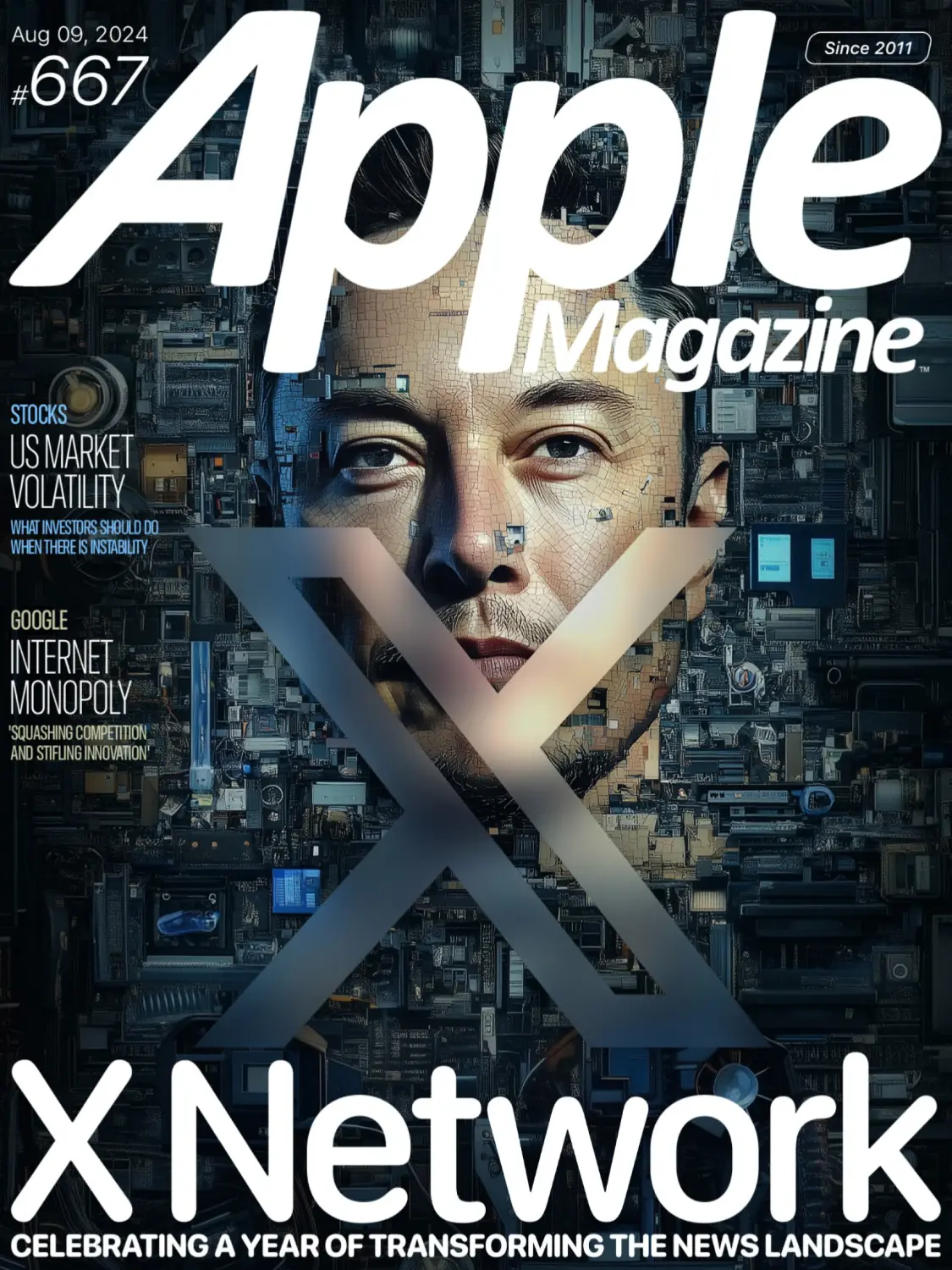
X NETWORK - CELEBRATING A YEAR OF
TRANSFORMING THE NEWS LANDSCAPE

GOOGLE ILLEGALLY MAINTAINS MONOPOLY
OVER INTERNET SEARCH, JUDGE RULES

08
34
54
90

FINANCIAL MARKETS AROUND THE WORLD STABILIZE AFTER RECENT ROUT. HERE’S WHAT TO...

22

ELON MUSK SUES OPENAI, RENEWING CLAIMS CHATGPT-MAKER PUT PROFITS BEFORE ‘THE...

46

TESLA ATTORNEYS ASK JUDGE TO VACATE DECISION INVALIDATING MASSIVE PAY PACKAGE FOR...

80

NVIDIA IS FACING AN ANTITRUST PROBE FROM US REGULATORS AMID COMPETITOR...

106

A JUDGE HAS BRANDED GOOGLE A MONOPOLIST, BUT AI MAY BRING ABOUT QUICKER CHANGE...

114

SONY REPORTS HIGHER PROFITS ON HEALTHY DEMAND FOR ITS VIDEO GAMES, MOVIES...

128

MICROPLASTICS ARE EVERYWHERE, BUT ARE THEY HARMING US?

134

F1 ARCADE LAUNCHING LOCATIONS WHERE RACE SIMULATORS ARE ONLY PART OF THE...

154

CHIPMAKER INTEL TO CUT 15,000 JOBS AS TRIES TO REVIVE ITS BUSINESS AND COMPETE...

162

CALIFORNIA’S TWO BIGGEST SCHOOL DISTRICTS BOTCHED AI DEALS. HERE ARE LESSONS...

170

AIRBNB’S SECOND-QUARTER PROFIT FELL 15% DESPITE ITS REVENUE RISING 11% ON...

184

TOP 10 TV SHOWS

144

TOP 10 BOOKS

146

TOP 10 SONGS

148

TOP 10 ALBUMS

150

TOP 10 MUSIC VIDEOS

152

WHAT INVESTORS
SHOULD DO WHEN
THERE IS MORE
VOLATILITY
IN THE MARKET

08

09

U.S. stocks are bouncing back after the market
experienced its worst day in two years on
Monday, but the average investor may still be
understandably spooked. Over a three day
losing streak, the S&P 500 dipped more than
6% before rallying again Tuesday, up 1.6% in
midday trading.
“This is what an emotion-driven market looks
like,” said Mark Hackett, head of investment
research for Nationwide. “You had a three day
period that was really very challenging. But the
drop was not justified by the data that was
out there, which is why you then have a day
like today.”
For everyday people, what are the best ways to
handle market volatility? The top advice is to do
nothing, but ultimately your response depends in
part on your circumstances and financial goals.

10

Image: Michael M. Santiago

11

12

WHAT TO DO IN GENERAL
“It’s important to remember that investing in
the stock market is a long game. There’s going
to be volatility, so be wary of having a knee-jerk
reaction and pulling your money out at the first
sign of a drop,” said Courtney Alev, consumer
advocate for CreditKarma. “Selling stocks
frequently or incrementally can come with fees
for each transaction and those can add up fast.”
Caleb Silver, editor in chief of Investopedia,
echoed this, cautioning that sellers may also end
up owing taxes on any gains.
“For everyday investors, volatility is the price you
pay to be invested in the stock market,” Silver
said. “But it’s very unsettling when we see big
market drops of two to three percent... It’s a little
unnerving for people who have their money in
401(k)’s or IRA’s or retirement funds to watch this
magnitude of volatility.”
Silver urged investors to remember that “a
market falls into a correction, ten percent or
more, once a year on average,” and that “usually
the market reverts to the mean, and the mean is
an average annual return of eight to ten percent
a year going all the way back to the 1950s.”

13

14

WHAT TO DO IF YOU’RE A YOUNG
OR NEW INVESTOR
For younger people just beginning to invest,
declines in the stock market are an opportunity
to add to your portfolio at cheaper prices, by
buying in when the market is falling or has fallen
a lot, according to Silver.
“You’re reducing the average price you pay for
the securities, stocks, mutual funds, or index
funds that you own (when you buy in a down
market),” he said. “So when the market itself
reverts to the mean and rises again, you take
advantage of having bought at cheaper prices,
and that adds to the value of your portfolio.”
In terms of selling, though, he said the best
advice for most investors is to do nothing and
wait for the volatility to cool down.
15

WHAT TO DO IF YOU’RE
NEAR RETIREMENT
“Whenever you invest in stocks it’s important to
be mindful of your time horizon,” said Alev. “For
instance, do you expect you’ll need to liquidate
in the near future? In that case, you’re likely
better off opting for a less volatile and more riskaverse mode of growing your money, such as a
high-yield savings account.”
Silver agreed.
“I don’t believe it when people say, ‘Don’t look
at your 401(k),’” he said. “You should absolutely
look and see what you own and see that it
matches your risk appetite.”
If it doesn’t, you can move your investments
to products that can shield you from the ups
and downs of the market or unforeseen events.
Silver said that High Yield Savings Accounts,
Certificates of Deposit, and money market
accounts are all currently seeing returns of
about 4% to 5% for the more cautious or
conservative investor.

16

Image: Brendan McDermid

17

Nationwide’s Hackett said it makes sense to
periodically rebalance the exposure one has in
their portfolio in general - whether quarterly
or annually - to make sure there isn’t more risk
than one would want related to, say, technology
stocks or another sector.
“If your exposures get out of line with your
long-term plan, get them back in line,” he said.
Even so, Hackett added that he sees the trend
of tech stocks outperforming as one that may
extend further into the future.

WHAT TO DO IF YOU HAVE DEBT
Experts agree that, for investors with debt,
it’s important to focus on paying off loans,
especially high-interest ones, before making
major investments. That said, “if you are able
to simultaneously pay off your loans and
invest a little bit at the same time, you are
effectively paying your future self for being
responsible about your debt while growing your
investments over time,” Silver said.
18

19

Simply Better Living

SUPERSTEAM+™
BUILT-IN WALL OVEN
SSC2489DS

The Sharp® SuperSteam+ Built-In Wall Oven is the start of
a cooking revolution. With Wi-Fi enabled IoT features, the
innovations within this steam oven are a perfect match
for modern cooking needs.
While regular steam only reaches 212°F, the SuperSteam+
oven can create superheated steam up to 485°F. Steam
this hot can roast meats and caramelize sugars so your
food can be brown and crispy on the outside, tender and
juicy on the inside. With the Sharp SuperSteam+ Oven,
you can grill without smoke, roast without drying, and get
the roasty-toasty, tasty results you desire.

SEE FOR
YOURSELF

Get started right away with built-in recipes and
download the Sharp SuperSteam+ Oven app* to
enable the smart features and access custom
recipes powered by SideChef.

The new Sharp SuperSteam+ Built-In Wall Oven
features Steam Bake for superior breads, and Water
Bath for cheesecakes, custards and puddings.

www.sharpusa.com | simplybetterliving.sharpusa.com
*Mobile Application and Home Assistant Skill available upon commercial release. © 2020 Sharp Electronics Corporation. All rights reserved. Sharp, Supersteam™ Oven
and all related trademarks are trademarks or registered trademarks of Sharp Corporation and/or its affiliated entities. Product specifications and design are subject to
change without notice. Internal capacity calculated by measuring maximum width, depth and height. Actual capacity for holding food is less.

FINANCIAL
MARKETS
AROUND THE
WORLD STABILIZE
AFTER RECENT
ROUT. HERE’S
WHAT TO KNOW

Markets on Wall Street and in Asia are stabilizing
Tuesday following a mini-panic caused by an
assortment of factors that stretched from late
last week through Monday.
The S&P 500 and Nasdaq each rose 1.3% in
morning trading and were on track to break a
brutal three-day losing streak. The S&P 500 had
tumbled more than 6% after several weakerthan-expected reports raised concerns that
the Federal Reserve had pumped the brakes
too much on the U.S. economy through high
interest rates.

22

23

The Dow Jones Industrial Average was up 0.7%.
Elsewhere, Japan’s Nikkei 225 jumped 10.2%
Tuesday, following its 12.4% sell-off the day
before, which was its worst since 1987. Stocks in
Tokyo rebounded as the value of the Japanese
yen stabilized a bit against the U.S. dollar
following several days of sharp gains.
A rate hike last week by the Bank of Japan
contributed to the turmoil by upending trades
where investors had borrowed Japanese yen
at low cost and invested it elsewhere around
the world. The resulting exits from those
investments may have helped accelerate the
declines in global markets.
Investors grew worried about a slowing U.S.
economy. They pointed fingers at the Fed for
waiting too long to cut rates and sold shares
of technology companies that had ridden a
frenzy around artificial intelligence to lofty stock
market valuations.
Calmer voices that claimed the sell-off was
a good thing because stock prices had risen
too high seemed to prevail Tuesday. Some of
Tuesday’s gainers were those same technology
companies investors had fled from. Chipmaker
Nvidia was up 3.8% Tuesday morning, following
a drop of 6.4% on Monday.
For individual investors, experts say it’s not time
for rash decisions, but a moment to make sure
their investments are properly diversified.
Here’s a look at the reasons for the
turbulence in markets:

24

25

26

INFLATION AND CENTRAL BANKS
Starting in 2022, the Fed rapidly raised
interest rates to combat a spike in inflation. It’s
maintained its key rate at 5.4% for about a year.
As part of its inflation fight, the Fed also aimed
to cool down a red-hot labor market.
Investors thought the Fed and other central
banks were on track, even though inflation
remained somewhat above their targets — in
the Fed’s case, 2%. The European Central Bank
and the Bank of England cut rates once and the
Fed signaled it was prepared to start cutting
rates in September.

ANXIETY OVER THE U.S. ECONOMY
Despite some signs of cooling, the U.S. economy
kept chugging along even with higher rates,
outpacing Europe and Asia. Then came last
week’s economic reports.
Weak readings on the job market,
manufacturing and construction sparked
worries about a U.S. economic slowdown and
criticism that the Federal Reserve waited too
long to cut rates.
Traders in the U.S. are now betting the Federal
Reserve will lower rates by half a percentage
point in September instead of the usual quarter
point. Some were calling for an emergency
rate cut.

BIG TECH
A handful of Big Tech stocks drove the
market’s double-digit gains into July. But their
momentum turned last month on worries
investors had taken their prices too high and

27

expectations for their profit gains had grown too
difficult to meet -- a notion that gained credence
when the group’s latest earnings reports were
mostly underwhelming.
Apple fell more than 5% Monday after Warren
Buffett’s Berkshire Hathaway disclosed that it
had slashed its ownership stake in the iPhone
maker. Nvidia lost more than $420 billion in
market value Thursday through Monday. Overall,
the tech sector of the S&P 500 was the biggest
drag on the market Monday.

JAPAN’S ROLLERCOASTER
The Nikkei suffered its worst two-day decline
ever, dropping 18.2% on Friday (02) and Monday
combined. One catalyst for the outsized move
has been an interest rate hike by the Bank of
Japan last week.
The BoJ’s rate increase affected what are known
as carry trades. That’s when investors borrow
money from a country with low interest rates
and a relatively weak currency, like Japan, and
invest those funds in places that will yield a
high return. The higher interest rates caused
the Japanese yen to strengthen, likely forcing
investors to sell stocks to repay those loans.
Stocks in Tokyo rebounded as the value of the
Japanese yen stabilized against the U.S. dollar.

WHAT SHOULD INVESTORS DO?
The prevailing wisdom is: Hold steady.
Experts and analysts encourage taking a long
view, especially for investors concerned about
retirement savings,.

28

29

30

“More often than not, panic selling on a red day
is generally a great way to lose more money
than you save,” said Jacob Channel, senior
economist for LendingTree, who reminds
investors that markets have recovered from
worse sell-offs than the current one.

BITCOIN CLAWS BACK SOME LOSSES
Bitcoin was back up to $56,490 Monday
morning after the price of the world’s largest
cryptocurrency fell to just above $54,000
during Monday’s rout. That’s still down
from nearly $68,000 one week ago, per data
from CoinMarketCap.
While bitcoin did serve as a safe haven of sorts
during the worst of the pandemic, it mostly acts
like any another risky asset that investors steer
clear from during market downturns.

SELL-OFFS ARE NORMAL
Greg McBride, financial analyst for Bankrate,
points out that a 10% pullback in markets
happens on average once every 12 months.
Quincy Krosby, chief global strategist for LPL
Financial, says investors should try to wait out
the current wave of turbulence.
“Pockets of volatility are expected to continue
as August and September give way to a calmer
seasonal period; however, it’s important to
remember pockets of opportunity are always on
the other side of the storm,” she said.

31

APPLE BREAKS
OUT OF RECENT
SALES SLUMP
AS IT GEARS
UP TO MAKE
ITS LEAP INTO
THE AI CRAZE

Apple snapped out of a prolonged sales
slump during its most recent quarter as the
trendsetting company prepares to launch into
the artificial intelligence craze with an arsenal
of new technology that’s expected to juice
demand for its next iPhone.
The fiscal third-quarter results announced
last week covered an April-June period that’s
typically a sluggish stretch for Apple as its loyal
customer bases awaits the next version of the
iPhone that’s traditionally unveiled shortly after
Labor Day.

34

Image: Gene J. Puskar

35

36

Even so, Apple boosted its sales from a year ago
— a welcome reversal of fortune on the heels
of five consecutive quarters of year-over-year
revenue declines.
This time around, Apple’s revenue rose 5% from
a year to $85.78 billion — a figure that exceeded
analysts’ projections. The Cupertino, California,
company earned $21.45 billion, or $1.40 per
share, an 8% increase from the same time last
year. The profit also topped analyst forecasts.
Apple’s shares swung between slight increases
and modest declines after the announcement as
investors assessed the results.
Sales of the iPhone — Apple’s marquee product
— remained on a downward slope though,
dipping 1% from last year to $39.3 billon. That
decrease wasn’t as bad as the January-March
period when iPhone sales plummeted 10% from
last year, and now the product appears headed
toward a major upswing.

37

38

That’s because Apple is planning to roll out a
variety of artificial intelligence features that
are supposed to make its virtual assistant Siri
smarter and also perform a variety of helpful
and fun tasks, including helping to draft texts
and even creating unique emojis on demand.
The AI tools will be included in a free software
update expected in the autumn, but most of the
features will only work on iPhones with a special
chip that so far has only been available on two
premium models Apple released last year.
The next model, the iPhone 16, is expected
to be equipped with the AI chip — a factor
that analysts believe will spur consumers who
have been holding on to their older devices to
splurge on upgrades so they can take advantage
of the new features. That expectation is the main
reason why Apple’s stock price has surged 13%
since the company previewed its AI tools in early
June — a run-up that has created about $400
billion in shareholder wealth so far.
“I believe it will be a very key time for a
compelling upgrade cycle,” Apple CEO Tim Cook
told analysts during the conference call.

39

40

41

Apple’s push into AI may also fuel its steadily
growing services division, which saw its
revenue climb 14% from last year to $24.21
billion in the most recent quarter. Although the
services division has been thriving for years, it’s
confronting regulatory threats that could drag
down its performance.
A lucrative deal that generates about $20 billion
in revenue by making Google the default search
engine on the iPhone and Safari browser is
being targeted in a high-profile antitrust case
that the U.S. Justice Department filed against
Google. A federal judge is expected is to issue a
ruling by the end of this year.
The Justice Department also is targeting Apple
in a separate lawsuit that it filed in March,
alleging the company is illegally locking out
competition by erecting unnecessary barriers
around the iPhone. Apple has adamantly denied
any wrongdoing and launched an attempt to
have the case dismissed in documents filed in
New Jersey federal court.
That started a legal process that will take several
more months to play out before the presiding
judge decides whether to throw out the case or
allow it to proceed in a ruling likely to come late
this year or early next year.
As has been happening during much of the past
year, Apple’s sales continued to erode in China
— a worry for investors because the region
is one of the company’s key markets. Apple’s
revenue in China dropped 7% from last year in
the past quarter.

42

43

46

ELON MUSK
SUES OPENAI,
RENEWING
CLAIMS
CHATGPT-MAKER
PUT PROFITS
BEFORE ‘THE
BENEFIT OF
HUMANITY’

This week Elon Musk filed a lawsuit against
OpenAI and two of its founders, Sam Altman
and Greg Brockman, renewing claims that
the ChatGPT-maker betrayed its founding
aims of benefiting the public good rather
than pursuing profits. The lawsuit, filed in
a Northern California federal court, called
Musk’s case a “textbook tale of altruism versus
greed.” Altman and others named in the suit
“intentionally courted and deceived Musk,
preying on Musk’s humanitarian concern
about the existential dangers posed by artificial
intelligence,” according to the complaint.
47

48

49

50

Musk was an early investor in OpenAI when it
was founded in 2015 and co-chaired its board
alongside Altman.
In the lawsuit, he said he invested “tens
of millions” of dollars and recruited top AI
research scientists for OpenAI. Musk resigned
from the board in early 2018 in a move that
OpenAI said — at the time — would prevent
conflicts of interest as he was recruiting AI
talent to build self-driving technology at the
electric car maker.
The Tesla CEO dropped his previous lawsuit
against OpenAI without explanation in
June. That lawsuit alleged that when Musk
bankrolled OpenAI’s creation, he secured
an agreement with Altman and Brockman
to keep the AI company as a nonprofit that
would develop technology for the benefit of
the public and keep its code open.
“As we said about Elon’s initial legal filing,
which was subsequently withdrawn,
Elon’s prior emails continue to speak for
themselves,” a spokesperson for OpenAI said
in an emailed statement.
In March, OpenAI released emails from Musk
showing his earlier support for making it a forprofit company.
Musk claims in the new suit that he and
OpenAI’s namesake objective were “betrayed
by Altman and his accomplices.”
“The perfidy and deceit are of Shakespearean
proportions,” the complaint said.

51

54

CELEBRATING A YEAR OF TRANSFORMING
THE NEWS LANDSCAPE

55

56

One year ago, Elon Musk controversially decided
to change the name of his $44 billion social
network Twitter to X. Since then; the platform
has been on a journey, with visions of becoming
the “app for everything” and changing how we
consume news forever.

57

58

59

60

DIRECT FROM THE SOURCE
In a world where information flows at the speed
of light, X has emerged as a groundbreaking
platform to redefine how we consume news.
Just as Uber transformed transportation, Airbnb
revolutionized hospitality, and DoorDash
reimagined food delivery, X continues to disrupt
the news industry by becoming the ultimate
hub for breaking news, publishing directly from
sources. Traditional news channels have long been
the gatekeepers of information, often filtering
and contextualizing news before it reaches
the public. X aims to eliminate the middleman,
allowing sources to publish their news directly.
This approach ensures that news is delivered
faster and accurately without biases and delays
introduced by intermediaries. Whether it’s a
government announcement (Biden announced
his resignation on X), a corporate press release,
or eyewitness reports from the scene of an event,
X offers a platform where news can be shared
instantly and unfiltered.
One of the most innovative aspects of X is its
commitment to providing users with the tools to
contextualize any publication. In an age where
misinformation and fake news are rampant, the
ability for users to add context, verify sources,
and discuss the implications of news stories is
invaluable. X fosters a community-driven
approach to news consumption, where users
can engage in discussions, fact-check, and provide
additional insights, ensuring a more informed and
balanced perspective. Of course, there has been
criticism of the ‘Community Notes’ fact-checking
approach, but with innovations in AI, these will
likely be resolved in the coming months.

61

62

63

Balancing free speech with security is a core
tenet of X. The platform is designed to be a
space where diverse opinions can be expressed
freely, while also implementing robust security
measures to prevent abuse and ensure user safety.
Through a combination of advanced algorithms
and community moderation, X strives to maintain
a healthy discourse without compromising on the
integrity of information or the security of its users.

THE APP FOR EVERYTHING
Elon Musk’s vision for X extends far beyond a news
platform. Drawing from his early days building
PayPal, Musk envisions X as an “Everything
App” capable of providing a wide range of
services including financing, communications,
and AI support. This vision includes deep
integration with his other ventures, such as Tesla,
Starlink, and Neuralink, creating a seamless
ecosystem of interconnected technologies.
Building on Musk’s experience with PayPal, X aims
to offer a comprehensive suite of financial
services. Users will be able to manage payments,
investments, and transactions directly through
the platform. This integration simplifies financial
management and opens new possibilities for
monetizing content and supporting creators.
Indeed, Musk is already rewarding creators
by paying them based on the number of
impressions their posts receive. As he aims
to take on YouTube and TikTok with new ad
targeting tools, we’ll likely see new monetization
methods added in the future.
Musk was quoted as saying, “I think this is the
fastest rate of innovation maybe ever for any
internet company.” - of course, not all of those
innovations have run smoothly. Still, as the
64

65

66

67

68

entrepreneur continues experimenting and
adding new tools and functionality, the platform
is becoming increasingly important in people’s
lives. With AI support from Grok, X is set to
revolutionize how users interact with information.
Grok can assist users in finding relevant news,
summarising complex articles, and even engaging
in real-time discussions. This AI-driven approach
ensures that users can access personalized and
contextualized information at their fingertips.
Grok is already powering AI summaries on
trending topics on the platform, helping people
better understand the news and events around
them and how people are reacting.
69

70

71

FUTURE TECHNOLOGIES
One of the most exciting prospects of X is its
potential integration with Tesla cars and future
humanoids. Imagine receiving breaking news
alerts directly on your Tesla’s dashboard or
having your humanoid assistant summarise the
day’s top stories while you prepare breakfast.
Such integration could make X an indispensable
part of everyday life, blending seamlessly with
the technologies we use daily. X’s potential
partnership with Starlink could revolutionize
global connectivity, ensuring that users in even
the most remote areas have access to realtime news and information. Additionally, the
integration with Neuralink could pave the way
for groundbreaking advancements in how we
consume and interact with news, potentially
allowing for direct brain-to-computer interfaces
that make information access instantaneous and
intuitive. Under Elon Musk’s ownership, X has
the potential to become one of the most valued
brands in the world. By leveraging his vision
and expertise across various industries, Musk
is poised to create a platform that transforms
the news industry and integrates deeply into
our daily lives through innovative services and
cutting-edge technology.

72

73

X stands at the forefront of a new era in news
consumption. Providing direct access to sources,
empowering users with contextual tools, and
balancing free speech with security sets a new
standard for how we engage with information.

74

75

76

Elon Musk’s vision of an “Everything
App” further amplifies its potential,
promising a future where news,
financial services, AI support, and
cutting-edge technology converge into
a seamless, integrated experience. As
X.com continues to evolve, it promises
to become a game-changer, not just
for the news industry but for how we
interact with the world around us.

77

TESLA ATTORNEYS
ASK JUDGE TO
VACATE DECISION
INVALIDATING
MASSIVE PAY
PACKAGE FOR
ELON MUSK

80

81

82

Attorneys for Elon Musk and Tesla’s corporate
directors are asking a Delaware judge to vacate
her ruling requiring the company to rescind a
massive and unprecedented pay package for
Musk.
The hearing follows a January ruling in which
Chancellor Kathaleen St. Jude McCormick
concluded that Musk engineered the landmark
2018 pay package in sham negotiations with
directors who were not independent. The
compensation package initially carried a potential
maximum value of about $56 billion, but that
sum has fluctuated over the years based on Tesla’s
stock price.
Following the court ruling, Tesla shareholders met
in June and ratified Musk’s 2018 pay package for a
second time, again by an overwhelming margin.
Defense attorneys say the vote makes clear that
Tesla shareholders, with full knowledge of the
flaws in the 2018 process that McCormick pointed
out in her January ruling, are adamant that Musk is
entitled to the pay package.
“Honoring the shoulder vote would affirm the
strength of our corporate system,” David Ross,
an attorney for Musk and the other individual
defendants, told McCormick. “This was
stockholder democracy working.”
Ross told the judge that the defendants were
not challenging the factual findings or legal
conclusions in her ruling, but simply asking that
she vacate her order directing Tesla to rescind the
pay package.
McCormick, however, seemed skeptical of the
defense arguments, peppering attorneys with
questions and noting that there is no precedent in

83

Delaware law for allowing a post-trial shareholder
vote to ratify adjudicated breaches of fiduciary
duty by corporate directors.
“This has never been done before,” she said.
Defense attorneys argued that, while they
could find no case that is exactly comparable,
Delaware law has long recognized shareholder
ratification as a cure to corporate governance
errors, and has long acknowledged the
“sovereignty” of shareholders as the ultimate
owners of a corporation.
“I candidly don’t see how Delaware law can tell the
owners of the company that they’re not entitled to
make the decision they made,” said Rudolf Koch,
an attorney for Tesla.
Donald Verrilli, a lawyer for an induvial stockholder
who owns more than 19,000 Tesla shares,
suggested that it would be wrong for the lone
shareholder who filed the lawsuit to thwart the
will of the majority of Tesla shareholders. At the
time the lawsuit was filed, the plaintiff owned just
nine shares of Tesla stock.
“The voice of the majority of shareholders should
matter.... This lawsuit is not representing the
interest of the shareholders,” Verrilli said.
Thomas Grady, an attorney for a group of
Florida objectors who own or manage almost
8 million Tesla shares with some $2 billion,
argued that for McCormick to rule for the
plaintiff, she has to “disenfranchise” all other
Tesla shareholders.
Greg Varallo, an attorney for the plaintiff, urged
McCormick not to give any credence to the
June shareholder vote, saying it has no legal
precedent in Delaware or anywhere else. There

84

85

also is no reason for the court to reopen the
trial record and admit new evidence, he said.
Under Delaware law, stockholders have no
authority to overrule courts by trying to
use a post-trial ratification vote as a “giant
eraser,” Varallo argued.
“Ratification is not magic, and it never has been,”
Varallo added. “This should end here and now.”
McCormick gave no indication on when she
would rule. She also has yet to rule on a huge
and unprecedented fee request by plaintiff
attorneys, who contend that they are entitled
to legal fees in the form of Tesla stock valued at
more than $7 billion.

86

87

GOOGLE
ILLEGALLY
MAINTAINS
MONOPOLY
OVER INTERNET
SEARCH, JUDGE
RULES

A judge this week ruled that Google’s ubiquitous
search engine has been illegally exploiting its
dominance to squash competition and stifle
innovation in a seismic decision that could shake
up the internet and hobble one of the world’s
best-known companies.
The highly anticipated decision issued by
U.S. District Judge Amit Mehta comes nearly
a year after the start of a trial pitting the U.S.
Justice Department against Google in the
country’s biggest antitrust showdown in a
quarter century.

90

91

92

After reviewing reams of evidence that included
testimony from top executives at Google,
Microsoft and Apple during last year’s 10-week
trial, Mehta issued his potentially market-shifting
decision three months after the two sides
presented their closing arguments in early May.
“After having carefully considered and weighed
the witness testimony and evidence, the court
reaches the following conclusion: Google is a
monopolist, and it has acted as one to maintain
its monopoly,” Mehta wrote in his 277-page
ruling. He said Google’s dominance in the search
market is evidence of its monopoly.
Google “enjoys an 89.2% share of the market
for general search services, which increases to
94.9% on mobile devices,” the ruling said.
It represents a major setback for Google and
its parent, Alphabet Inc., which had steadfastly
argued that its popularity stemmed from
consumers’ overwhelming desire to use a
search engine so good at what it does that it
has become synonymous with looking things
up online. Google’s search engine currently
processes an estimated 8.5 billion queries per
day worldwide, nearly doubling its daily volume
from 12 years ago, according to a recent study
released by the investment firm BOND.
Kent Walker, Google’s president of global
affairs, said the company intends to appeal
Mehta’s findings: “This decision recognizes
that Google offers the best search engine, but
concludes that we shouldn’t be allowed to
make it easily available.”
For now, the decision vindicates antitrust
regulators at the Justice Department, which
filed its lawsuit nearly four years ago while
93

Image: Kevin Dietsch

94

Donald Trump was still president, and has been
escalating it efforts to rein in Big Tech’s power
during President Joe Biden’s administration.
“This victory against Google is an historic win
for the American people,” said Attorney General
Merrick Garland. “No company — no matter
how large or influential — is above the law. The
Justice Department will continue to vigorously
enforce our antitrust laws.”
The case depicted Google as a technological
bully that methodically has thwarted
competition to protect a search engine that has
become the centerpiece of a digital advertising
machine that generated nearly $240 billion in
revenue last year. Justice Department lawyers
argued that Google’s monopoly enabled it to
charge advertisers artificially high prices while
also enjoying the luxury of not having to invest
more time and money into improving the
quality of its search engine — a lax approach
that hurt consumers.
Mehta’s ruling focused on the billions of dollars
Google spends every year to install its search
engine as the default option on new cellphones
and tech gadgets. In 2021 alone, Google spent
more than $26 billion to lock in those default
agreements, Mehta said in his ruling.
Google ridiculed those allegations, noting that
consumers have historically changed search
engines when they become disillusioned with
the results they were getting. For instance,
Yahoo was the most popular search engine
during the 1990s before Google came along.
Mehta said the evidence at trial showed the
importance of the default settings. He noted
that Microsoft’s Bing search engine has
95

96

80% share of the search market on the Microsoft
Edge browser. The judge said that shows other
search engines can be successful if Google is not
locked in as the predetermined default option.
Still, Mehta credited the quality of Google’s
product as an important part of its dominance,
as well, saying flatly that “Google is widely
recognized as the best (general search engine)
available in the United States.”
The Consumer Choice Center, a lobbying
group that has fought other attempts to rein
in businesses, decried Mehta’s decision as a
step in the wrong direction. “The United States
is drifting toward the anti-tech posture of
the European Union, a part of the world that
makes almost nothing and penalizes successful
American companies for their popularity,” said
Yael Ossowski, the center’s deputy director.
Mehta’s conclusion that Google has been
running an illegal monopoly sets up another
legal phase to determine what sorts of changes
or penalties should be imposed to reverse
the damage done and restore a more
competitive landscape.
The potential outcome could result in a wideranging order requiring Google to dismantle
some of the pillars of its internet empire or
prevent it from paying to ensure its search
engine automatically answers queries on the
iPhone and other devices. Or, the judge could
conclude only modest changes are required to
level the playing field.
“Google’s loss in its search antitrust trial
could be a huge deal — depending on the
remedy,” said eMarketer senior analyst Evelyn
Mitchell-Wolf. “A forced divestiture of the search
97

business would sever Alphabet from its largest
source of revenue. But even losing its capacity
to strike exclusive default agreements could be
detrimental for Google. Its ubiquity is its biggest
strength, especially as competition heats up
among AI-powered search alternatives.”
Regardless she added, a drawn-out appeals
process will delay any immediate effects for both
consumers and advertisers.
Lee Hepner, senior legal counsel for the
American Economic Liberties Project,
believes the tenor of Mehta’s ruling makes it
likely the judge will decide to prohibit Google
from making default search deals and may
even look at separating some of its different
lines of business.
“This decision strikes at the core of how
hundreds of millions of Americans experience
the internet,” Hepner said. “It illustrates how
Google has become one of the most powerful
companies in the world while undermining
innovation and degrading the quality of its core
product. The remedy must match the court’s
striking verdict in this case.”
If there is a significant shakeup, it could turn out
to be a coup for Microsoft, whose own power
was undermined during the late 1990s when the
Justice Department targeted the software maker
in an antitrust lawsuit accusing it of abusing the
dominance of its Windows operating system on
personal computers to lock out competition.
That Microsoft case mirrored the one brought
against Google in several ways and now
the result could also echo similarly. Just as
Microsoft’s bruising antitrust battle created
distractions and obstacles that opened up
98

99

100

more opportunities for Google after its 1998
inception, the decision against Google could
be a boon for Microsoft, which already has a
market value of more than $3 trillion. At one
time, Alphabet was worth more than Microsoft,
but now trails its rival with a market value of
about $2 trillion.
If Mehta decides to limit or ban Google’s
default search deals, it could squeeze Apple’s
profits, too. Although parts of his decision
were redacted to protect confidential business
information, Mehta noted that Google paid
Apple an estimated $20 billion in 2022,
doubling from 2020. The judge also noted Apple
has periodically considered building its own
search technology, but backed off that after a
2018 analysis estimated the company would
lose more than $12 billion in revenue during the
first five years after a break-up with Google.
Google’s payments have helped Apple’s steadily
growing services division, which generated $85
billion in revenue during the company’s last
fiscal year. Apple didn’t immediately respond to
a request for comment.

101

The Justice Department’s antitrust division
has recently taken on some of the biggest
companies in the world. It sued Apple in March
and in May announced a sweeping lawsuit
against Ticketmaster and its owner, Live Nation
Entertainment. Antitrust enforcers have also
opened investigations into the roles Microsoft,
Nvidia and OpenAI have played in the artificial
intelligence boom.
The Biden administration has won some big
cases, including blocking mergers of some of
the world’s biggest publishers as well as JetBlue
Airways and Spirit Airlines. It’s also had some
notable setbacks, including in the sugar and
healthcare industries.
Google faces several other legal threats
both in the U.S. and abroad. In September, a
federal trial is scheduled to begin in Virginia
over the Justice Department’s allegations that
Google’s advertising technology constitutes an
illegal monopoly.

102

103

NVIDIA IS FACING
AN ANTITRUST
PROBE FROM
US REGULATORS
AMID COMPETITOR
COMPLAINTS,
REPORT SAYS

106

107

Antitrust tensions are heating up in the
chipmaking industry. Rivals have accused Wall
Street darling Nvidia of abusing its market
dominance in selling chips that power artificial
intelligence — and the U.S. Justice Department
is now investigating these complaints,
technology news site The Information reported.
According to the news outlet, which cited
unnamed sources familiar with the discussions,
Justice Department officials are looking into
concerns Nvidia is potentially cornering the
market and pressuring its customers to unfairly
retain business. That includes allegations of
Nvidia threatening to punish those who buy
products from both the Santa Clara, Californiabased tech giant and its competitors.
The Information also reported that U.S. officials
had reached out to several Nvidia competitors
about the complaints.
The Justice Department declined to comment or
provide further information.
But a statement from Nvidia said the company
“wins on merit” — and competes “based
on decades of investment and innovation,
scrupulously adhering to all laws.”
Without directly acknowledging details of
The Information’s report, the company added
that it is “happy to provide any information
regulators need.”
Nvidia has faced calls for an antitrust
investigation from some Democratic lawmakers
and progressive groups before. Last week, 10
progressive advocacy groups — including
Demand Progress Education Fund and Tech
Oversight Project — penned a letter to Assistant
Attorney General Jonathan Kanter in support of
an antitrust investigation into the chipmaker.
“Nvidia is the world’s chip gatekeeper,” the
108

109

110

groups wrote, arguing the company had “bullied
its way into a prominent investment position”
by leveraging scarce supply alongside tactics
like blocking customers from doing business
with competitors. “Such a company deserves the
most aggressive scrutiny that the Department of
Justice can bring to bear.”
Nvidia’s has cemented itself as a poster child
for the artificial intelligence boom — and in
the process become one of the most valuable
companies in the world. In June, the tech
giant briefly reached a market value of more
than $3.3 trillion.
Some of that market momentum has stalled a
little since — and any stock climbing to such
heights is vulnerable to some investors selling
shares to lock in profits.

111

114

A JUDGE HAS
BRANDED GOOGLE
A MONOPOLIST,
BUT AI MAY
BRING ABOUT
QUICKER CHANGE
IN INTERNET
SEARCH

A federal judge has branded Google as a
ruthless monopolist bent on suffocating
it competitors. But how do you go about
creating alternatives to a search engine that’s
synonymous with internet exploration?
It’s a process that may take years to unfold as
Google appeals the landmark decision issued
this week by U.S. District Judge Amit Mehta.
And with that kind of time frame looming, the
forces of technological upheaval may make the
exercise moot.
Image: David Gray

115

Image: Kirill Kudryavtsev

116

The rise of artificial intelligence may reshape
the landscape more quickly and profoundly
than any judge ever could. The way consumers
navigate the internet is more likely to be
affected by advances in AI products — such as
OpenAI’s ChatGPT and Google’s own Gemini —
before a nearly 4-year-old case brought by the
U.S. Justice Department is finally resolved.
Even so, Mehta’s 277-page ruling creates
challenges for Google that company founders
Larry Page and Sergey Brin probably didn’t
envision when they set out to revolutionize
internet search while attending Stanford
University as graduate students. They eventually
dropped out to start a Silicon Valley company
in 1998 that adopted “Don’t Be Evil” as a
motto that also was meant to serve as its
corporate conscience.

117

Page and Brin, who remain the controlling
shareholders of Google’s corporate parent
Alphabet Inc., also cast their cuddly startup as a
crusader for technology that would be far better
than the products coming out of Microsoft,
the industry’s reigning kingpin at the time.
Microsoft’s dominance of personal computer
software and anticompetitive tactics during
the 1990s spurred another Justice Department
case that ended up hobbling Microsoft and
helped make it easier for Google to build its
lead in search and then expand into maps,
cloud computing, email (Gmail), web browsers
(Chrome) and video (YouTube).
Now, the script has been flipped, with Google
facing potential legal constraints, while a
resurgent Microsoft has been making early
headway in AI with a major helping hand from
its investment in OpenAI. In one of the most
dramatic scenarios that most experts think is
unlikely to happen, Google might be forced to
break up its business similar to how AT&T —
once known as “Ma Bell” — ended up spinning
off its telephone subsidiaries into separate “Baby
Bells” more than 40 years ago.
Image: Stan Honda

118

119

Image: Ramin Talaie

120

It will be left to Google CEO Sundar Pichai,
who took over the company’s leadership from
Page in 2015, to minimize the distractions
caused by the legal skirmishing still to come
and remain focused on an industrywide pivot
to AI technology that’s expected to be as
revolutionary as the mobile computing shift by
Apple’s introduction of the iPhone in 2007.
The debate about how Google should be
overhauled will begin Sept. 6 with a hearing
scheduled in Washington, D.C., before Mehta,
who also presided over the 10-week trial last
year that led to his antitrust decision.
Google also will be pursing an appeal, based
on its long-held contention that it has done
nothing wrong but build and maintain a search
engine that has been far superior to anything
else for more than 20 years. The Mountain
View, California, company also maintains that
competition is just a few clicks away, with
consumers still free to go to other options,
such as Microsoft’s Bing, DuckDuckGo and,
more recently, AI-powered alternatives such as
Perplexity and ChatGPT.

121

Image: Jim Wilson

122

123

Although Mehta praised the quality of Google’s
search engine in his ruling and acknowledged
the company initially became the people’s
preferred choice in its early days, he concluded
it resorted to unfair tactics to maintain its
leadership during the past decade. Google did
it, Mehta said, mainly by negotiating lucrative
deals to cement a position as the default search
engine on the iPhone and wide range of other
devices, including PCs.
Those deals, which totaled $26 billion in 2021
alone, meant Google automatically processed
search requests unless consumers took the time
to manually go into their settings and choose
another option — something that few do. The
default option then helped Google collect
valuable insights that enabled the company
to improve its search engine in ways that rivals
couldn’t because they lacked the same data.
Default requests processed accounted for 60%
of Google’s search traffic in 2017, Mehta pointed
out in his ruling, and that volume in turn created
more opportunities to sell the ads that generate
the majority of its parent company’s $307 billion
in annual revenue.

124

125

Image: Mark Graves

126

Mehta’s focus on the default search deals in
his ruling make it likely he may decide to ban
them after the next trial phase is completed,
according to antitrust experts. That could have
implications for other companies besides
Google, especially Apple, which pockets about
$20 billion annually from an arrangement that is
currently scheduled to continue through 2026,
with options to extend the alliance into 2028.
Apple didn’t respond to a request for comment
about Mehta’s decision, but its executives have
depicted the decision to make Google the
default search engine on the iPhone and other
products as a convenience to its customers —
most of whom prefer to use Google.
But an order preventing Apple from doing
default search engine deals with Google could
do more than just siphon away revenue. It might
also require Apple to spend heavily to develop
its own search technology — an endeavor
that Google estimated would cost more than
$30 billion as part of 2020 analysis that Mehta
cited in his ruling. Then, it would cost Apple an
additional $7 billion annually to sustain its own
search engine, according to Google’s analysis.

127

SONY REPORTS
HIGHER PROFITS
ON HEALTHY
DEMAND FOR
ITS VIDEO
GAMES, MOVIES
AND MUSIC

128

129

130

Sony’s profit rose 6.5% in the last quarter
on robust demand for its video games, films
and music, the Japanese electronics and
entertainment company said this week.
Tokyo-based Sony Corp.’s profit in the AprilJune quarter totaled 231.6 billion yen ($1.6
billion), up from 217 billion yen, it said.
Quarterly sales edged up 1.6% to 3 trillion yen
($20 billion) as Sony’s entertainment business
remained strong, although its financial
services business lagged.
Sony officials said global demand for its
animation offerings like “Demon Slayer”
remained strong, including on streaming
services like Amazon Prime.
Hiroki Totoki, chief financial officer and
president, promised to leverage Sony’s
powerful offerings that he said are rooted in
the diversity of its workers and creators.
The partnership with Crunchyroll, a U.S. video
streaming service, was proving extremely
successful, according to Sony.
Sony, which also makes digital cameras and
TVs, raised its full year forecast through
March 2025 by 1% to 980 billion yen ($6.7
billion). That’s better than the forecast it gave
in May, which predicted a 925 billion ($6.3
billion) profit.
Responding to reporters’ questions on
Sony’s interest in acquiring Paramount,
Totoki denied it, saying a deal of that size
was too risky.
Last month, Paramount announced it was
merging with Skydance, based in Santa
Monica, California, which helped produce
131

major Paramount hits like Tom Cruise’s “Top
Gun: Maverick” and “Mission Impossible” series.
Sony acquired Columbia Pictures in 1989.
Although sales of PlayStation game machines
have declined recently, more than 2.4 million
machines were sold worldwide in the last
quarter, with the estimated number of global
players staying at 116 million people.
Among the popular music releases during the
quarter were Beyonce’s “Cowboy Carter,” Future
and Metro Boomin’s “We Don’t Trust You” and
SZA’s “SOS.”

132

133

MICROPLASTICS
ARE EVERYWHERE,
BUT ARE THEY
HARMING US?

134

135

Microplastics have been found in the ocean and
the air, in our food and water. They have been
found in a wide range of body tissues, including
the heart, liver, kidneys and even testicles.
But are they actually harming you?
Evidence suggests they might, but it’s
limited in scope. Some researchers are
worried, but acknowledge there are lots of
unanswered questions.
Dr. Marya Zlatnik, a San Francisco-based
obstetrician who has studied environmental
toxins and pregnancy, has seen studies raising
concerns about microplastics’ impact on the
health of babies and adults.
But it’s a young research field, and it’s not
something she generally discusses with patients.
“I’m not entirely sure what to say yet,”
Zlatnik said.
Here’s a look at what’s known so far:

WHAT ARE MICROPLASTICS?
Plastics are man-made materials — many of
them derived from oil or other petroleum
products. They can break down into smaller
particles, through exposure to heat and weather
and even animal digestion.
Researchers have increasingly been interested in
microplastics, which can be as wide as a pencil
eraser or as small as a fraction of the width of a
human hair. Nanoplastics, another area of study,
are even smaller.
These minuscule plastics have been detected in
air, water and soil, in milk, and in bottled and tap
drinking water. They also have been found in a

136

137

138

variety of foods, including salt, sugar, honey, rice
and seafood.

ARE THERE MICROPLASTICS IN YOU?
Most likely yes.
There is scientific debate about how much
people inhale and ingest, and it can vary on
what they eat and drink and where they live,
researchers say.
Some Australian researchers, on behalf of the
World Wildlife Fund, calculated in 2019 that
many people each week consume roughly
5 grams of plastic from common food and
beverages — the equivalent of a credit card.
That estimate is not universally embraced by
researchers, but is commonly mentioned in
news articles.
Researchers are still trying to understand
exposure levels, but study after study is finding
signs of plastics in body tissues.
“Microplastics have been measured in pretty
much all of the body tissues that have been
evaluated,” said Tracey Woodruff, a University of
California at San Francisco researcher. Scientists
have even reported finding them in the penis, in
ovaries and in placentas.

WILL MICROPLASTICS HURT YOU?
That’s still being sorted out.
A 2022 World Health Organization report
concluded there was no clear risk to human
health, based on the available evidence.
There’s also not an obvious signal of widespread
public health impact, at least in terms of

139

140

mortality. Cancer, heart disease and stroke death
rates have been falling, not rising.
But researchers only started measuring plastics
in the human body — and trying to assess the
health effects — in recent years. Some of that
work is only coming to fruition now.
It makes sense that microplastics are harmful
because they contain toxic chemicals, said
Woodruff, who was part of a team that reviewed
nearly 2,000 studies about microplastics at the
request of California legislators. It may be, for
example, that microplastics play a role in rising
occurrences of some cancers in younger people,
she said.
Available information indicates plastics can
spark inflammation and cause other problematic
changes in the body that can, for example, raise
the risk of heart attack and stroke.
A small study in the New England Journal of
Medicine earlier this year suggested, but did not
prove, that patients with evidence of plastics in
their arteries were at greater risk of death from
heart attacks and strokes. But an expert not
involved in the research suggested the study
may have overstated any effects.
“Even though there’s a lot we still don’t know
about microplastic particles and the harm
they cause to humans, the information that is
available today is in my mind very concerning,”
said Dr. Philip Landrigan, of Boston College.

WHAT CAN YOU DO ABOUT
MICROPLASTICS?
There are ways to reduce potential microplastics
exposure, researchers say.

141

142

Take your shoes off before you go in the
house, to avoid tracking in plastics-laden dust
(not to mention germs, dirt and other debris)
throughout your home.
Eat foods — especially fresh fruits and
vegetables — that you prepare in the home.
Don’t microwave a meal in a plastic tray, no
matter what TV dinner instructions might say,
Woodruff said.
And opt for reusable stainless steel or glass
water bottles, rather than disposable plastic
ones, she added.
Zlatnik, the obstetrician, noted that families
with limited incomes may have bigger things to
worry about.
“If someone is worried about where their next
meal is going to come from, I’m not going to
give them advice to keep their leftovers in glass
containers and to not microwave in plastic,”
she said.

143

House of the Dragon

144

TELL ALL: NO LIMITS, PT. 2
90 DAY FIANCE: HAPPILY EVER AFTER?

THE QUEEN WHO EVER WAS
HOUSE OF THE DRAGON

WHEN ALL IS SAID AND DONE
THE REAL HOUSEWIVES OF NEW JERSEY

TELL ALL: NO LIMITS, PT. 1
90 DAY FIANCE: HAPPILY EVER AFTER?

2105
THE BACHELORETTE

REGRET ME KNOT
BELOW DECK MEDITERRANEAN

THIS IS BENEATH ME!
BASKETBALL WIVES

BEFORE I LET GO
ALL AMERICAN: HOMECOMING

PENULTIMATE
TYLER PERRY’S SISTAS

THE RED SOWING
HOUSE OF THE DRAGON

145

DONNA TARTT

146

SHADOW OF DOUBT
BRAD THOR

IT ENDS WITH US
COLLEEN HOOVER

FIRE AND BONES
KATHY REICHS

ARKANGEL
JAMES ROLLINS

THE MERCY OF GODS
JAMES S. A. COREY

THE LOST COAST
JONATHAN KELLERMAN & JESSE KELLERMAN

FIRE AND BLOOD
GEORGE R.R. MARTIN & DOUG WHEATLEY

APPRENTICE TO THE VILLAIN
HANNAH NICOLE MAEHRER

IT STARTS WITH US
COLLEEN HOOVER

THE SECRET HISTORY
DONNA TARTT

147

Teddy Swims

148

A BAR SONG (TIPSY)
SHABOOZEY

LEAVE A LIGHT ON (TALK AWAY THE DARK)
PAPA ROACH & CARRIE UNDERWOOD

AIN’T NO LOVE IN OKLAHOMA
LUKE COMBS

LIAR
JELLY ROLL

LONELY ROAD
MGK & JELLY ROLL

I AM NOT OKAY
JELLY ROLL

I HAD SOME HELP (FEAT. MORGAN WALLEN)
POST MALONE

BIG DAWGS
HANUMANKIND & KALMI

GOOD LUCK, BABE!
CHAPPELL ROAN

LOSE CONTROL
TEDDY SWIMS

149

CHAPPELL ROAN

150

THE RISE AND FALL OF A MIDWEST...
CHAPPELL ROAN

VULTURES 2
¥$, KANYE WEST & TY DOLLA $IGN

THE DEATH OF SLIM SHADY...
EMINEM

FINAL FANTASY XIV: DAWNTRAIL...
MASAYOSHI SOKEN

TWISTERS: THE ALBUM
VARIOUS ARTISTS

NO NAME
JACK WHITE

CHANDLER MOORE: LIVE IN LOS ANGELES...
CHANDLER MOORE

DEADPOOL & WOLVERINE ...
VARIOUS ARTISTS

CHILD OF GOD
FORREST FRANK

THE GREAT AMERICAN BAR SCENE
ZACH BRYAN

151

Billie Eilish

152

GUESS FEATURING BILLIE EILISH
CHARLI XCX & BILLIE EILISH

AFILMFORTHEFUTURE - TRAILER
COLDPLAY

NASTY
TINASHE

HOUDINI
EMINEM

GETTING NO SLEEP
TINASHE

CHK CHK BOOM
STRAY KIDS

OMEMMA
CHANDLER MOORE

HOLY FOREVER (LIVE) [FEAT. CECE...]
BETHEL MUSIC & JENN JOHNSON

DEEPER WELL
KACEY MUSGRAVES

NOT LIKE US
KENDRICK LAMAR

153

F1 ARCADE
LAUNCHING
LOCATIONS
WHERE RACE
SIMULATORS ARE
ONLY PART OF
THE EXPERIENCE

154

155

The low hum of a high-tech engine greets you
when you first open the door to the F1 Arcade in
Boston’s burgeoning Seaport District. Inside, the
ceilings glow red with the outlines of the world’s
iconic Formula 1 tracks.
The people behind Puttshack golf and Flight
Club darts are turning their attention to F1,
combining upscale food and drinks with haptic
simulators that bring the bumps and battles
of the global motorsports series to fans more
accustomed to rush hour traffic.
On race days, locals who can’t schlep all the
way to Singapore -- much less get behind the
wheel of an actual F1 car -- pack the house for
watch parties as the sport’s biggest names fight
for position. On a recent weekday afternoon,
though, they were emulating the professionals
on simulators that are the next best thing to the
high-speed – and high-end -- feel of F1.
“Such a small number of people get to
experience Formula 1 in person,” said Jon
Gardner, the U.S. president of F1 Arcade.
“How do we take the thrill -- the glitz and
glamour of Formula 1 ... and bring that to the
everyday audience?
“That thrill of getting behind an F1 car, which
everyone wants to do, and feeling the energy,
the excitement, the adrenaline within that and
having that experience -- that’s what we try
to create.”
The Boston venue is the first in the United
States, following successful launches in London
and Birmingham, England. More locations are
planned for Washington, D.C, and Las Vegas,
with the goal of 30 worldwide by the end of
2027 — an expansion cashing in on the series’
156

157

158

popularity since the Netflix “Drive to Survive”
series. (According to F1 Arcade, half of F1’s fans
came to the sport in the last four years.)
According to the company, the British locations
had around 400,000 visitors apiece in 2023,
surpassing expectations. The London location,
across the street from St. Paul’s Cathedral,
had revenue of $16.5 million (13 million GBP)
last year.
That helped F1 Arcade raise nearly $38 million
for its next phase – including investments from
F1 itself and others around the paddock like
McLaren Racing CEO Zak Brown and drivers
Lando Norris and Logan Sargeant.
Although F1 Arcade is a separate company,
the series has invested in and licensed the
logos and other intellectual property that
gives the simulators the feel of the real thing.
The courses are all true-to-life: If there’s a Rolex
ad at the track, there will be one on the video
simulation, too.
There are touches of F1 throughout the facility
but only after climbing into one of the 69
simulators do players get the best taste of F1.
With one curved screen showing the view from
the cockpit and another to help identify one’s
place on the track, the simulator might resemble
a high-end setup for an especially dedicated
gamer. What sets it apart are the haptics: the
way the seat bounces and leans to simulate
the sense of weaving through the turns – or
slamming into the wall.
There are five race modes, from rookie to elite.
The easier levels don’t require shifting, and
arrows show the proper race line and when to

159

brake and accelerate; the top levels take away
the assistance and activate the steering wheel
gearshift buttons, like the ones on real F1 cars.
“The level these can go to is exceptional,”
Gardner said. “Formula 1 drivers can actually
have a go on these and have just amazing of
the time. But what we’ve done is we’ve crafted
and designed these for the everyday user, so a
7-year-old can actually do this.”
The simulators rotate through seven F1 tracks.
Groups can compete against each other or as a
team. A separate room is available for parties or
corporate team-building events. The full bar and
restaurant menu includes oysters, caviar and a
Wagyu beef burger but also a children’s menu
and mocktails..
Although there were families with kids in their
young teens on a recent Monday afternoon, the
place turns to over 21 at 7 p.m.
“This is for everybody. No skills required. Sevenyear-old all the way up to 107-year-old,” Gardner
said. “The competitiveness is part of the fun of
it, and you want to bring everyone together to
where you get a family to be competitive. It’s
really interesting -- a lot of fun to actually watch
some of the younger kids beating the parents.”

160

161

CHIPMAKER
INTEL TO CUT
15,000 JOBS AS
TRIES TO REVIVE
ITS BUSINESS
AND COMPETE
WITH RIVALS

Chipmaker Intel says it is cutting 15% of its huge
workforce — about 15,000 jobs — as it tries to
turn its business around to compete with more
successful rivals like Nvidia and AMD.
In a memo to staff, Intel Corp. CEO Pat
Gelsinger said the company plans to save $10
billion in 2025.
“Simply put, we must align our cost
structure with our new operating model and
fundamentally change the way we operate,”
he wrote in the memo published on Intel’s
162

163

website. “Our revenues have not grown as
expected — and we’ve yet to fully benefit from
powerful trends, like AI. Our costs are too high,
our margins are too low.”
The job cuts come in the heels of a
disappointing quarter and forecast for the
iconic chip maker founded in 1968 at the start
of the PC revolution.
Intel is announcing an “enhanced retirement
offering” for eligible employees and offer an
application program for voluntary departures.
“These decisions have challenged me to my
core, and this is the hardest thing I’ve done in
my career,” he said. The bulk of the layoffs are
expected to be completed this year.
The Santa Clara, California-based company is
also suspending its stock dividend as part of a
broader plan to cut costs.
Intel reported a loss for its second quarter
along with a small revenue decline, and it
forecast third-quarter revenues below Wall
Street’s expectations.
Its stock plunged 19% in after-hours trading,
indicating that Intel could lose roughly $24
billion of its market value.
The company posted a loss of $1.6 billion, or 38
cents per share, in the April-June period. That’s
down from a profit of $1.5 billion, or 35 cents
per share, a year earlier. Adjusted earnings
excluding special items were 2 cents per share.
Revenue slid 1% to $12.8 billion from $12.9 billion.
Analysts, on average, were expecting earnings
of 10 cents per share on revenue of $12.9
billion, according to a poll by FactSet.

164

165

“Intel’s announcement of a significant costcutting plan including layoffs may bolster
its near-term financials, but this move alone
is insufficient to redefine its position in the
evolving chip market,” said eMarketer analyst
Jacob Bourne. “The company faces a critical
juncture as it leverages U.S. investment in
domestic manufacturing and the surging
global demand for AI chips to establish itself in
chip fabrication.”
Gelsinger noted in a conference call with analysts
that Intel has previously said that its investments
in the AI PC market would pressure its profit
margins over the short term but should benefit
the company in the long term.
“We believe the trade-offs are worth it. The AI
PC will grow from less than 10% of the market
today to greater than 50% in 2026,” he said.
Unlike its rivals like Nvidia, Intel manufactures
chips in addition to designing them. It has
been working to build up its foundry business
making semiconductors in the U.S., competing
with rivals such as market leader Taiwan
Semiconductor Manufacturing Co. or TSMC.
Helped by Gelsinger’s lobbying efforts since
he took the company’s helm in 2021, Intel has
been a major beneficiary of the 2022 CHIPS
and Science Act. The Biden administration
helped shepherd that through Congress amid
concerns after the pandemic that the loss of
access to chips made in Asia could plunge the
U.S. economy into recession.
In March, President Joe Biden celebrated an
agreement to provide Intel with up to $8.5
billion in direct funding and $11 billion in loans
for computer chip plants around the country,
166

167

168

talking up the investment in the political
battleground state of Arizona and calling it a
way of “bringing the future back to America.”
At the time, Gelsinger called the CHIPS Act “the
most critical industrial policy legislation since
World War II.”
In September 2022, Biden praised Intel as a
job creator with its plans to open a new plant
near Columbus, Ohio. The president praised the
company for plans to “build a workforce of the
future” for the $20 billion project, which he said
would generate 7,000 construction jobs and
3,000 full-time jobs set to pay an average of
$135,000 a year.
“The U.S. government wants to reinvigorate
domestic manufacturing, especially this is the
area of advanced computer chips,” Bourne said.
“And Intel has been kind of earmarked for this
money. But there’s a lot of infrastructure that
goes into this, there’s the building of these
facilities, which are really highly specialized
— and then you also need to upskill the local
workforce where these plants are located. And
so it takes time. This is not something that
happens overnight.”

169

CALIFORNIA’S TWO BIGGEST SCHOOL
DISTRICTS BOTCHED AI DEALS.
HERE ARE LESSONS FROM
THEIR MISTAKES.

170

171

With all the hubris of a startup founder, Alberto
Carvalho, superintendent of Los Angeles Unified
School District, took to the stage in March to
launch Ed the chatbot. He told parents and
students it had “the potential to personalize the
educational journey at a level never before seen
in this district, across the country, or around
the world.”
“No other technology can deliver real time on
this promise,” he said. “We know it will succeed.”
In June, after only three months and nearly
$3 million, the district shelved Ed following
layoffs of more than half of the staff at AllHere,
the startup that made the conversational AI
assistant. District spokesperson Britt Vaughan
refused to answer questions about the bot’s
performance or say how many students and
parents used it before the shutdown.
Also in June, an AI controversy unfolded in San
Diego, where school board members reportedly
weren’t aware that the district last summer
bought a tool that automatically suggests
grades for writing assignments. The dustup
began after Point Loma High School teacher
Jen Roberts told CalMatters that using the tool
saved her time and reduced burnout but also
gave students the wrong grade sometimes.
A week later, Voice of San Diego quoted two
members of the school board saying they were
unaware the district had signed a contract
involving AI. In fact, no one on the board
seemed to know about the tool, the news
outlet said, since it was included as part of a
broader contract with Houghton Mifflin that
was approved unanimously with no discussion
alongside more than 70 other items.

172

173

174

None of the board members responded to
CalMatters’ requests for comment. San Diego
Unified School District spokesperson Michael
Murad said that since AI is a quickly evolving
technology, “we will make an increased effort to
inform board members of additional relevant
details related to contracts presented to them in
the future.”
Mistakes in Los Angeles and San Diego may
trace back to growing pressure on educators to
adopt AI and underline the need for decisionmakers to ask more and tougher questions
about such products before buying them,
said people who work at the intersection of
education and technology. Outside experts can
help education leaders better vet AI solutions,
these people said, but even just asking basic
questions, and demanding answers in plain
English, can go a long way toward avoiding
buyer’s remorse.
No one disputes that educators face increasing
demands to find ways to use AI. Following the
release of OpenAI’s generative AI tool ChatGPT
nearly two years ago, the California Education
Department released guidance referencing an
“AI revolution” and encouraging adoption of the
technology. Educators who previously spoke
with CalMatters expressed fear that if they miss
the revolution, their students could get left
behind in learning or workforce preparedness.

GRADING AI TOOLS
Staff shortfalls, techno-optimism, a desire to be
on the cutting edge and a fear of missing out all
push educators to adopt AI, said Hannah Quayde la Vallee, a senior technologist at the Center

175

176

for Democracy and Technology, a nonprofit
that’s studied how teachers and students are
adopting generative AI.
She thinks recent events in Los Angeles and San
Diego show that more education leaders need
to engage in critical analysis before bringing AI
tools into classrooms. But whether a particular
AI tool deserves more scrutiny depends on how
it’s used and the risk that use poses to students.
Some forms of AI, like the kind used for grading
and predicting if a student will drop out of
school, she said, deserve high risk labels.
The European Union regulates AI differently
based on risk level, and in the U.S. the National
Institute of Standards and Technology released
a framework to help developers, government
agencies, and users of AI technology
manage risk.
California’s state schools superintendent, Tony
Thurmond, was unavailable to respond to
CalMatters’ questions about any action he could
take to help prevent future school AI snafus.
Lawmakers are considering a bill that would
require the superintendent to convene a
working group to make recommendations on
“safe and effective” use of artificial intelligence
in education. The bill was introduced by Josh
Becker, a Democrat from Silicon Valley, and
supported by Thurmond and the California
Federation of Teachers.
Quay-de la Vallee suggested that educators
work with organizations that vet and
certify education technology tools such as
Project Unicorn, a nonprofit that evaluates
edtech products.

177

When education leaders rush to adopt AI from
education technology providers anxious to sell
AI, both may cut corners, said Anaheim Union
High School District Superintendent Michael
Matsuda, who hosted an AI summit in March
attended by educators from 30 states and more
than 100 school districts.
He thinks the recent AI problems in San Diego
and Los Angeles demonstrate the need to avoid
getting caught up in hype and to vet claims
made by companies selling AI tools.
School districts can assess how well AI tools
perform in classrooms with help from techminded teachers and internal IT staff, Matsuda
said. But assistance is also available from
nonprofits like The AI Education Project, which
advises school districts across the nation about
how to use the technology, or a group such as
the California School Boards Association, which
has an AI task force that tries to help districts
and counties “navigate the complexities of
integrating artificial intelligence.”
“We have to work together, consider what we
learned from missteps, and be open about that,”
he said. “There’s a lot of good products coming
out, but you have to have the infrastructure and
strategic policies and board policies to really vet
some of these things.”
Education leaders don’t always have an intimate
understanding of tech used by teachers in their
school district. Matsuda said Anaheim Union
High School District uses AI to personalize
student learning material and even offers classes
to students interested in a career in AI, but he
said he doesn’t know if Anaheim educators
use AI for grading today. Following events
178

179

180

in San Diego, Matsuda said the district may
consider high risk labels for certain use cases,
such as grading.

USING COMMON SENSE
You don’t have to be an expert in AI to be
critical of claims made about what AI can do for
students or teachers, said Stephen Aguilar, colead of the Center for Generative AI and Society
at the University of Southern California, and
a former developer of education technology.
District officials who sign contracts with AI
companies need to know their own policy, know
what the district seeks to achieve by signing the
contract, and ask questions. If contractors can’t
answer questions in plain English, that may be
a signal they’re overselling what’s possible or
attempting to hide behind technical jargon.
“I think everyone should take the lessons
learned from LA Unified and do the post
mortem, ask questions that weren’t asked, and
slow things down,” Aguilar said. “Because there’s
no rush. AI is going to develop, and it’s really on
the AI edtech companies to prove out that what
they’re selling is worth the investment.”
The challenge, he said, is that you don’t
evaluate an AI model once. Different versions
can produce different results, and that means
evaluation should be a continuous process.
Aguilar said that while events in Los Angeles
and San Diego schools demonstrate the
need for greater scrutiny of AI, school district
administrators seem convinced that they have
to be on the cutting edge of technology to do
their jobs, and that’s just not true.

181

“I don’t quite know how we got into this cycle,”
he said.
The market is pressuring edtech providers
to include AI in their products and services,
foundations are pressuring school leaders to
include AI in their curriculum, and teachers
are told that if they don’t adopt AI tools then
their students might get left behind, said Alix
Gallagher, head of strategic partnerships at the
Policy Analysis for California Education center at
Stanford University.
Since AI is getting built into a lot of existing
products and contracts involving curriculum,
it’s highly likely that San Diego’s school board
is not alone in discovering AI unexpectedly
bundled into a contract. Gallagher said
that administrative staff will need to ask
questions about supplemental curricula or
software updates.
“It’s close to impossible for districts and schools
to keep up,” she said. “I definitely think that’s
even more true in smaller school districts that
don’t have extra people to devote to this.”
Gallagher said AI can do positive things like
reduce teacher burnout, but individual teachers
and small school districts won’t be able to keep
up with the pace of change, and so trusted
nonprofits or state education officials should
help determine which AI tools are trustworthy.
The question in California, she said, is who’s
going to step up and lead that effort?

182

183

AIRBNB’S
SECOND-QUARTER
PROFIT FELL
15% DESPITE
ITS REVENUE
RISING 11%
ON STRONGER
BOOKINGS

184

185

Airbnb says its profit fell 15% in the second
quarter from a year earlier, as higher income
taxes cut into the short-term rental giant’s
bottom line even as bookings and revenue rose.
The profits fell short of Wall Street’s
expectations and Airbnb’s stock tumbled 16% in
after-market trading.
The San Francisco-based company reported on
Tuesday net income of $555 million, or 86 cents
per share, for the three months ended June 30.
That compares with net income of $650 million,
or 98 cents per share, in the same quarter
last year.
Analysts’ consensus estimates called for earnings
of 91 cents per share, according to FactSet.
Revenue rose 11% from a year earlier to
$2.75 billion, slightly higher than what
analysts forecast.
The vacation-rental platform said it booked
125.1 million nights and experiences in the
second quarter, a 9% increase from a year earlier.
The average daily rate rose 2% to $170. The
company said it expects that to increase
modestly on an annual basis in the third quarter.
While booking growth was strong, management
said that in July it noticed that many customers
were opting to reserve an Airbnb property
within a couple of weeks of when they need to
stay, rather than doing so months in advance.
“We are seeing shorter booking lead times
globally and some signs of slowing demand
from U.S. guests,” CEO Brian Chesky said during
a conference call with analysts. “We’re watching
these trends closely, along with the impact any
macroeconomic pressures might be causing.”
186

187

188

The company factored the trend into its thirdquarter outlook. Airbnb predicts third-quarter
revenue between $3.67 billion and $3.73 billion,
which would be below Wall Street’s forecast of
$3.84 billion, according to FactSet.
The company said that its seeing more
customers are sign up for Airbnb rentals to mark
holidays and other special events, noting that
the week of July 4th was Airbnb’s single highest
week of revenue ever in North America.
Nights booked at Airbnb rentals in the Paris
region around the Olympics through the end
of the second quarter were more than double
the same period last year, with a 37% increase in
active listings, the company said.
Airbnb is working to draw more people to sign
up with the company to host guests in order to
beef up its supply of short-term rentals. Its active
listings exceeded 8 million in the second quarter.
The company, which in May rolled out Airbnb
Icons, a promotion that gives its customers a
chance at overnight stays in exotic settings, is
also culling less appealing listings from its site.
Since April 2023, it has removed more than
200,000 listings “that failed to meet our guests’
expectations,” Chesky said.
He said the company plans to roll out new
products and services every year, starting in
October, with a new co-hosting marketplace
that he believes will boost listings on the site.

189