/
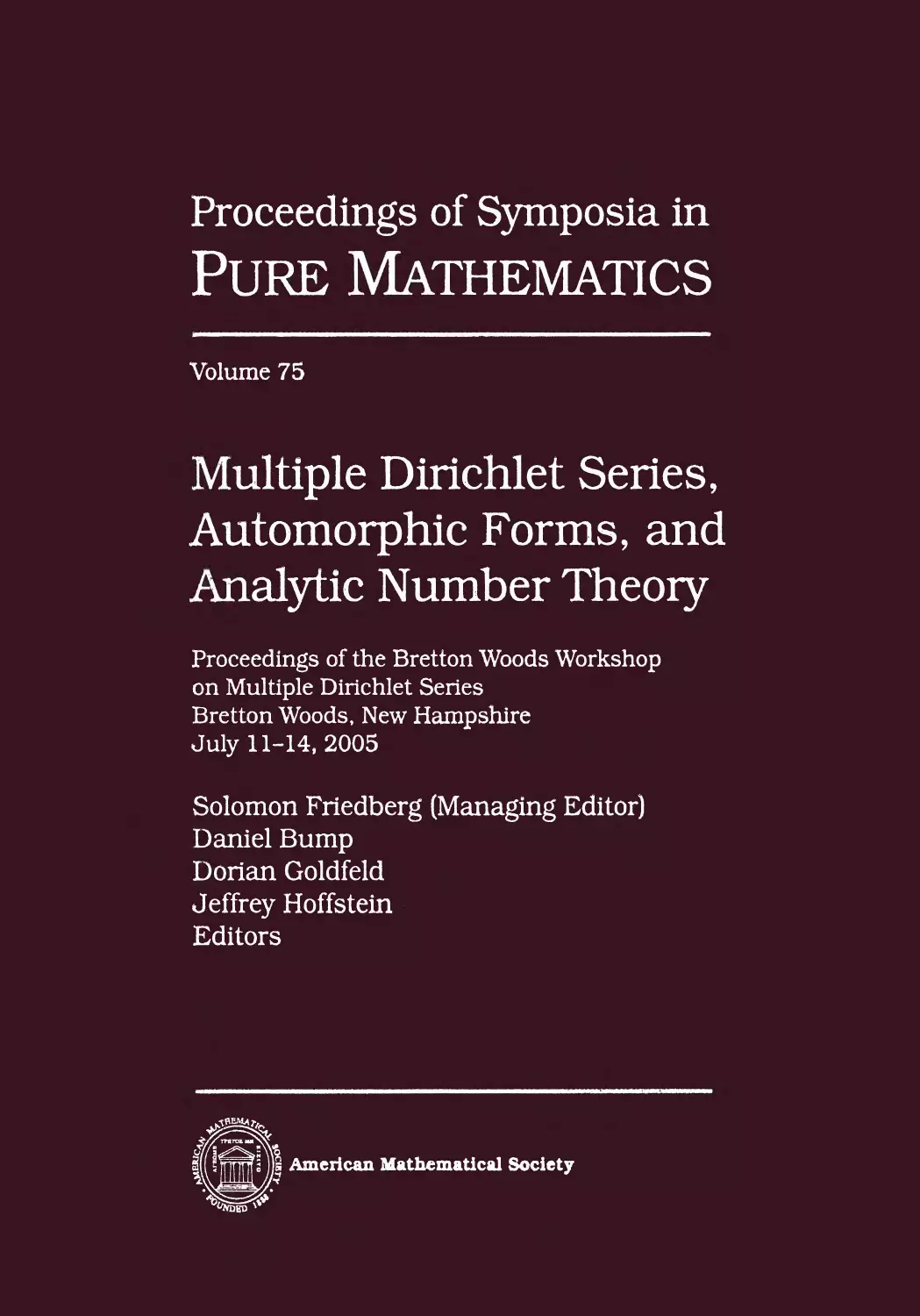


Author: Friedberg S. Bump D. Goldfeld D. Hoffstein J.
Tags: mathematics number theory mathematical analysis natural sciences
ISBN: 978-0-8218-3963-8
Year: 2005
Text
                    Proceedings of Symposia in
Pure * thematics
Volume 75
ultiple Dirichlet Series,
Automorphic Forms, and
4 alytic Number Theory
Proceedings of the Bretton Woods Workshop
on Multiple Dirichlet Series
Bretton Woods, New Hampshire
July 11-14,2005
Solomon Friedberg (Managing Editor)
• anielBump
• orianGoldfeld
Jeffrey Hoffstein
Editors

Multiple Dirichlet Series,
Automorphic Forms, and
Analytic Number Theory

This page intentionally left blank

Proceedings of Symposia in
Pure Mathematics
Volume 75
Multiple Dirichlet Series,
Automorphic Forms, and
Analytic Number Theory
Proceedings of the Bretton Woods Workshop
on Multiple Dirichlet Series
Bretton Woods, New Hampshire
July 11-14, 2005
Solomon Friedberg (Managing Editor)
Daniel Bump
Dorian Goldfeld
Jeffrey Hoffstein
Editors
American Mathematical Society
Providence, Rhode Island

2000 Mathematics Subject Classification. Primary llFxx, llMxx, 11-02;
Secondary 22E50, 22E55.
The Bretton Woods Workshop on Multiple Dirichlet Series was supported by a Focussed
Research Group grant from the National Science Foundation. Any opinions, findings, and
conclusions or recommendations expressed in this material are those of the authors and
do not necessarily reflect the views of the National Science Foundation.
Library of Congress Cataloging-in-Publication Data
Bretton Woods Workshop on Multiple Dirichlet Series (2005 : Bretton Woods, N.H.)
Multiple Dirichlet series, automorphic forms, and analytic number theory : proceedings of the
Bretton Woods Workshop on Multiple Dirichlet Series, July 11-14, 2005, Bretton Woods, New
Hampshire / Solomon Friedberg, managing editor... [et al.].
p. cm. - (Proceedings of symposia in pure mathematics ; v. 75)
Includes bibliographical references.
ISBN-13: 978-0-8218-3963-8 (alk. paper)
ISBN-10: 0-8218-3963-2 (alk. paper)
1. Dirichlet series-Congresses. 2. L-functions-Congresses. I. Friedberg, Solomon, 1958-
II. Title.
QA295.B788 2005
515'.243-dc22 2006049095
Copying and reprinting. Material in this book may be reproduced by any means for
educational and scientific purposes without fee or permission with the exception of reproduction by
services that collect fees for delivery of documents and provided that the customary
acknowledgment of the source is given. This consent does not extend to other kinds of copying for general
distribution, for advertising or promotional purposes, or for resale. Requests for permission for
commercial use of material should be addressed to the Acquisitions Department, American
Mathematical Society, 201 Charles Street, Providence, Rhode Island 02904-2294, USA. Requests can
also be made by e-mail to reprint-permission@ams.org.
Excluded from these provisions is material in articles for which the author holds copyright. In
such cases, requests for permission to use or reprint should be addressed directly to the author(s).
(Copyright ownership is indicated in the notice in the lower right-hand corner of the first page of
each article.)
© 2006 by the American Mathematical Society. All rights reserved.
The American Mathematical Society retains all rights
except those granted to the United States Government.
Copyright of individual articles may revert to the public domain 28 years
after publication. Contact the AMS for copyright status of individual articles.
Printed in the United States of America.
@ The paper used in this book is acid-free and falls within the guidelines
established to ensure permanence and durability.
Visit the AMS home page at http://www.ams.org/
10 9 8 7 6 5 4 3 2 1 11 10 09 08 07 06

I f
Bretton Woods Group photo.
Photo by C.J. Mozzochi

This page intentionally left blank

Contents
Preface ix
List of Participants xi
Multiple Dirichlet Series and Their Applications
Multiple Dirichlet series and automorphic forms
Gautam Chinta, Solomon Friedberg, and Jeffrey Hoffstein 3
Applications of multiple Dirichlet series in mean values of L-functions
Qiao Zhang 43
Second moments of quadratic Hecke L-series and multiple Dirichlet series I
Adrian Diaconu and Dorian Goldfeld 59
Weyl group multiple Dirichlet series I
Benjamin Brubaker, Daniel Bump, Gautam Chinta, Solomon
Friedberg, and Jeffrey Hoffstein 91
Residues of Weyl group multiple Dirichlet series associated to GLn+i
Benjamin Brubaker and Daniel Bump 115
Multiple Hurwitz zeta functions
M. Ram Murty and Kaneenika Sinha 135
Multiple zeta values over global function fields
Riad Masri 157
Generalised Selberg zeta functions and a conjectural Lefschetz formula
Anton Deitmar 177
Automorphic Forms and Analytic Number Theory
Rankin-Cohen brackets on higher order modular forms
Y. Choie and N. Diamantis 193
Eulerian integrals for GLn
David Ginzburg 203
Is the Hlawka zeta function a respectable object?
M. N. Huxley 225

viii CONTENTS
On sums of integrals of powers of the zeta-function in short intervals
Aleksandar Ivic 231
Uniform bounds for Rankin-Selberg L-functions
Matti Jutila and Yoichi Motohashi 243
Mean values of zeta-functions via representation theory
Yoichi Motohashi 257
On the pair correlation of the eigenvalues of the hyperbolic Laplacian for
PSL(2,Z)\iJII
C. J. Mozzochi 281
Lower bounds for moments of L-functions: Symplectic and orthogonal
examples
Z. Rudnick and K. Soundararajan 293

Preface
This volume represents the proceedings of the Bretton Woods Workshop on
Multiple Dirichlet Series which took place at the Mount Washington Hotel in Bret-
ton Woods, New Hampshire during the period July 11-14, 2005. The workshop
was organized by Daniel Bump, Solomon Friedberg, Dorian Goldfeld, and Jeffrey
Hoffstein, and was funded by an NSF Focussed Research Group grant1.
Multiple Dirichlet series are Dirichlet series in several complex variables. A
multiple Dirichlet series is said to be perfect if it satisfies a finite group of functional
equations and has meromorphic continuation everywhere. The earliest examples
came from Mellin transforms of metaplectic Eisenstein series and were intensively
studied over the last twenty years by the organizers above and their students.
More recently, many other examples have been discovered and it appears that
all the classical theorems on moments of L-functions as well as the conjectures
(such as those predicted by random matrix theory) can now be obtained via the
theory of multiple Dirichlet series. Furthermore, new results, not obtainable by
other methods, are just coming to light. It was felt that the subject had sufficiently
developed that an account of some of the major results to date and the opportunities
for the future should be recorded at this time. The pristine environment of the
White Mountains and the hospitality of the Mount Washington Hotel provided an
ideal venue to bring together researchers from around the world working in multiple
Dirichlet series and allied fields.
The workshop was centered around the following four themes:
• An exposition of the main results in the theory of multiple Dirichlet series,
• Moments of zeta and L-functions,
• New examples of multiple Dirichlet series,
• Connections with allied fields.
These themes appear in the papers of this volume in different mixes. The
contributions of Brubaker-Bump, Brubaker-Bump-Chinta-Friedberg-Hoffstein, Chinta-
Friedberg-Hoffstein, Deitmar, Diaconu-Goldfeld, Masri, Murty-Sinha, and Zhang
offer overviews of or new developments concerning multiple Dirichlet series. These
papers are presented in the first part of this volume, which is arranged thematically,
so that one can obtain an overview of the field by reading the papers consecutively.
Almost all of these papers describe connections to related fields as well. The papers
of Choie-Diamantis, Ginzburg, Huxley, Ivic, Jutila-Motohashi, Motohashi, Moz-
zochi, and Rudnick-Soundararajan concern the allied fields of automorphic forms
XNSF grants DMS-0354662 (Bump), DMS-0353964 (Friedberg), DMS-0354582 (Goldfeld),
and DMS-0354534 (Hoffstein).
ix

x PREFACE
and analytic number theory. These papers are presented in the second part of the
volume, and are arranged alphabetically. The theme of moments of zeta and L-
functions appears in papers in both parts of the volume, providing one indication
of the connection between the theory of multiple Dirichlet series and allied fields.
We would like to thank the National Science Foundation for funding the
workshop on multiple Dirichlet series and the Mount Washington Hotel for hosting it.
We express our deep appreciation to the AMS, in particular to Christine Thivierge,
for making it possible to publish this proceedings. Also, we would like to thank
C. J. Mozzochi for all the wonderful conference pictures and Steven J. Miller for
preparing T$£ files of many of the conference talks as they were being delivered.
Finally, special thanks go to Doreen Pappus of Brown University, without whose
help the running of this conference would not have been possible.
Daniel Bump
Solomon Friedberg
Dorian Goldfeld
Jeffrey Hoffstein

List of Participants
Jennifer Beineke
Western New England College
Kathrin Bringmann
University of Wisconsin
Benjamin Brubaker
Stanford University
Alina Bucur
Brown University
Daniel Bump
Stanford University
David Car don
Brigham Young University
Gautam Chinta
Lehigh University
YoungJu Choie
Pohang University of Science and
Technology
Marc de Crisenoy
University of Bordeaux
Paul Dehaye
Stanford University
Anton Deitmar
University of Tubingen
Adrian Diaconu
University of Minnesota
Nikolaos Diamantis
University of Nottingham
Ahmad El-Guindy
Texas A&M University
David Farmer
American Institute of Mathematics
Sharon Frechette
College of the Holy Cross
Solomon Friedberg
Boston College
Aiko Fujii
Rikkyo University
Jayce Getz
University of Wisconsin
Dorian Goldfeld
Columbia University
Paul Gunnells
University of Massachusetts, Amherst
Jeffrey Hoffstein
Brown University
Joseph Hundley
Pennsylvania State University
Martin Huxley
Cardiff University
Ozlem Imamoglu
ETH Zurich
Paul Jenkins
University of Wisconsin
Matti Jutila
University of Turku
Marvin Knopp
Temple University
Winfried Kohnen
University of Heidelberg
Jeffrey Lagarias
University of Michigan

Xll
PARTICIPANTS
David Lecomte
Stanford University
Ben Lichtin
University of Rochester
Wenzhi Luo
The Ohio State University
Kimball Martin
Columbia University
Riad Masri
University of Texas, Austin
Steven J. Miller
Brown University
Joel Mohler
Lehigh University
C. J. Mozzochi
Princeton, NJ
Erik Mueller
University of Muenster
Ritabrata Munshi
Princeton University
M. Ram Murty
Queen's University
Ken Ono
University of Wisconsin
Vladimir Pribitkin
College of Staten Island, CUNY
Michael Rosen
Brown University
Jeremy Rouse
University of Wisconsin
Yiannis Sakellaridis
Stanford University
J. Sengupta
Tata Institute of Fundamental Research
Freydoon Shahidi
Purdue University
Kannan Soundararajan
University of Michigan
Shuichiro Takeda
University of Pennsylvania
Meera Thillainatesan
University of California, Los Angeles
Eric Urban
Columbia University
Henri Virtanen
University of Turku
Sim an Wong
University of Massachusetts, Amherst
Qiao Zhang
Johns Hopkins University

Multiple Dirichlet Series
and Their Applications

This page intentionally left blank

Proceedings of Symposia in Pure Mathematics
Volume 75, 2006
Multiple Dirichlet Series and Automorphic Forms
Gautam Chinta, Solomon Friedberg, and Jeffrey Hoffstein
Abstract. This article gives an introduction to the multiple Dirichlet series
arising from sums of twisted automorphic L-functions. We begin by explaining
how such series arise from Rankin-Selberg constructions. Then more recent
work, using Hartogs' continuation principle as extended by Bochner in place
of such constructions, is described. Applications to the nonvanishing of L-
functions and to other problems are also discussed, and a multiple Dirichlet
series over a function field is computed in detail.
1. Motivation
Of the major open problems in modern mathematics, the Riemann hypothesis,
which states that the nontrivial zeroes of the Riemann zeta function £(s) lie on the
line SR(s) = \, is one of the deepest and most profoundly important. A consequence
of the Riemann Hypothesis which has far reaching applications is the Lindelof
Hypothesis. This states that for any e > 0 there exists a constant C(e) such that
for all t,
|C(l/2 + it)|<C(e)|t|e.
The Lindelof Hypothesis remains as unreachable today as it was 100 years ago, but
there has been a great deal of progress in obtaining approximations of it. These
are results of the form |C(l/2 + it)\ < C(e)|£|K+e, where k > 0 is some fixed real
number. For example, Riemann's functional equation for the zeta function, together
with Stirling's approximation for the gamma function and the Phragmen-Lindelof
principle, are sufficient to obtain what is known as the convexity bound for the zeta
function, namely k = \, or: \( (| +it)\ < C(e)\t\^+e.
Any improvement over ^ in this upper bound is known as "breaking convexity."
There are also many known generalizations of £(s) and analogous definitions of
convexity breaking that are viewed with great interest. This is, first, because of the
1991 Mathematics Subject Classification. Primary 11-02, 11F66, 11M41; Secondary 11F37,
11F70, 11M06.
Key words and phrases, multiple Dirichlet series, automorphic form, twisted L-function,
mean value of L-functions, Gauss sum.
The first author was supported in part by NSF Grant DMS-0354534 and a grant from the
Reidler Foundation.
The second author was supported in part by NSF Grant DMS-0353964.
The third author was supported in part by NSF Grant DMS-0354534.
©2006 American Mathematical Society
3

4 GAUTAM CHINTA, SOLOMON FRIEDBERG, AND JEFFREY HOFFSTEIN
connection with the Lindelof Hypothesis, and second, because any improvement
on the convexity bound or the current best value of k tends to have dramatic
consequences.
Dirichlet generalized the zeta function and introduced L-series. A well-known
example is
t( \ STXd(n)
71=1
where Xd is a character of (Z/dZ)x. These and other L-series mirror the Riemann
zeta function in that they have an analytic continuation and a functional equation1.
They also are conjectured to satisfy a corresponding generalized Riemann
Hypothesis. The presence of the extra parameter d leads naturally to the investigation
of the behavior of L(l/2 + it,Xd) f°r varying d, £, Prom this perspective, one can
formulate the Lindelof Hypothesis "in the d aspect", which states that for any e > 0
there exists a constant C(e) such that for all d, |L(l/2, Xd)\ < C(e)\d\e. In a manner
completely analogous to £(s) the functional equation for L(s, Xd) can be used to
obtain a basic convexity result: |L(l/2, Xd)| < C{e)\d\^+e. The first breaking of
convexity for L(l/2,Xd) was accomplished by Burgess [19], with k = 3/16, and
recently there has been the result of Conrey and Iwaniec [24], with k = 1/6. Such
approximations to the Lindelof Hypothesis in the d aspect have important
applications to such diverse fields as mathematical physics, computational complexity,
and cryptography.
The generalizations continue. One can consider, in place of ((s) or L(s,Xd),
the L-functions associated to automorphic forms on GL{r), with extra parameters
corresponding to various generalizations of Xd- In most of these instances one
expects generalizations of the Riemann and Lindelof Hypotheses to be true and the
consequences would again be remarkable.
Fortunately, if a result is elusive for a single object it is often more within reach
when the same question is asked about an average over a family of similar objects.
For example, consider the family of Dirichlet L-series L(s, Xd) with Xd quadratic
(i.e. x^ = 1). This family can be collected together in the multiple Dirichlet series
Z(s,w) = ^———.
d a
where the sum ranges over, for example, discriminants of real quadratic fields. This
is a very basic instance of the multiple Dirichlet series discussed in this article. It
is shown in [36] that Z(l/2,w) is absolutely convergent for $lw > 1 and has an
analytic continuation past $lw = 1 with a pole of order 2 at the point w = 1. By
combining this result with basic Tauberian techniques one may show that there
exists a non-zero constant c such that for large X
£ L(l/2,Xd)~cX\ogX,
0<d<X
the sum again going over discriminants of real quadratic fields. It follows that the
average value of L(l/2, Xd) for d < X takes the form of a constant times logX
In fact, Euler had used his theory of divergent series to guess the functional equation of the
zeta function roughly a century before Dirichlet and Riemann. It is also interesting to note that
Dirichlet L-functions were defined before the zeta function was studied by Riemann as a function
of a complex variable. We thank the referee for calling these historical facts to our attention.

MULTIPLE DIRICHLET SERIES AND AUTOMORPHIC FORMS 5
for d in this range and, thus, the Lindelof Hypothesis in the d aspect is true "on
average." Results of this type are significant in their own right and can also have
important applications.
One of the major breakthroughs in analytic number theory in the last 5 years
has been the following discovery: The assumption that the zeros of L-functions
are distributed in the same way as the eigenvalues of random hermitian matrices
allows one to obtain precise conjectures on the statistical distribution of values of
L-functions. For example, the conjectured moments of the Riemann zeta function,
by Keating and Snaith [43], were unattainable until the incorporation of random
matrix models into the theory. A major connection between this work and
multiple Dirichlet series was observed in [27] where it was shown that the conjectures
obtained by random matrix theory could also be read off from the polar divisors of
certain multiple Dirichlet series. It seems likely that multiple Dirichlet series will
play a key role in the future study of the statistical distribution of L-values.
In this article we discuss generalizations of the function Z(s,w) introduced
above, generalizations that capture the behavior of a family of twists of an auto-
morphic L-function. We describe different methods for obtaining the meromorphic
continuations of such objects, and consequences that can be drawn from the
continuations. Section 2 introduces the families of twisted L-functions of concern. It
also describes a number of Rankin-Selberg constructions that give rise to double
Dirichlet series. Section 3 concerns quadratic twists. We begin with a heuristic
that explains why these sums of twisted L-functions should have continuation in w
beyond the region of absolute convergence. We next describe the several-complex-
variable methods that seem most effective in terms of continuation of the multiple
Dirichlet series. We conclude with various applications, of interest both in their
own right and also as illustrations of the kinds of theorems that can be established
by these methods. Section 4 concerns higher order twists. The situation
concerning sums of higher twists is more complicated, with Gauss sums playing a key role,
and in the few known examples one is led to continue several different families of
weighted series simultaneously. Once again, various applications are presented.
Section 5 gives an explicit example in the function field setting, where many multiple
Dirichlet series can be shown to be rational functions in several complex variables.
The final section gives some additional examples and concluding remarks.
2. The Family of Twists of a Given L-Function
2.1. The basic questions. Fix an integer n > 2 and let F be a global field
containing all n-th roots of unity. (The reader may choose to focus on number
fields now, but in Section 5 we will give a concrete example in the function field
case.) Let 7r be a fixed automorphic representation of GL(r) over the field F, with
standard L-function
L(s,7r) = 2_]C(m)\m\~S
for 5t(s) sufficiently large. (In this article L(s, it) refers to the finite part of the L-
function.) Here \m\ denotes (an abuse of notation) an absolute norm. Throughout
the paper we normalize all L-functions to have functional equation under s i—» 1 — s.
Then our basic problem is to study the family of twisted L-functions
L(s,rr x x) = ^c(ra)x(m)|ra|

6 GAUTAM CHINTA, SOLOMON FRIEDBERG, AND JEFFREY HOFFSTEIN
where we fix n and vary the twist by a character x; X w^ range over the idele
class characters of order exactly n. We may also wish to modify the problem, and
suppose instead that x ranges over the subset of idele class characters of order
exactly n with local factors Xv specified at a finite number of places.
There are several natural questions to ask about this set of L-functions. The
first is nonvanishing:
(1) Given a point in the critical strip so (with 0 < SR(so) < 1)> can one show
there exist infinitely many x as above with L(so,7r x x) / 0? This
question goes back to Shimura [54], Rohrlich [51], and Waldspurger [58]. A
particularly interesting choice is so = \ ■ For example, L-series associated
to elliptic curves of positive rank will conjecturally vanish at so = \ but
twists may not.
(2) If n = 2 (the case of quadratic twists) and n is self-contragredient, and
if e(^,7r x x) — —1 f°r all twists x under consideration, can one show
there exist infinitely many x such that L'(|,7r x x) 7^ 0? Note that under
these hypotheses, the functional equation guarantees a zero of odd order
for each twisted L-function at the center of the critical strip.
In these questions, we need not assume that n is cuspidal - indeed, L(s,7r) could
be a product of L-series for lower-rank groups. Then the first question becomes
that of establishing a simultaneous non-vanishing theorem. Even in the case of two
independent GL(2) holomorphic modular forms, it is not known that there exists a
single quadratic twist such that both twisted L-functions are nonzero at the center
of the critical strip. In the case of two modular forms of weight 2, such a statement
would imply that given two elliptic curves E\, E2 over Q there exists a fundamental
discriminant D such that both twists E^ and E^ have finite Modell-Weil groups;
this is not presently known. Using multiple Dirichlet series, in fact one can establish
simultaneous non-vanishing for points s0 in the critical strip but sufficiently far from
the center of the strip [22] (see Theorem 6.1 in Section 6.2 below). Such results
can also be proved by the large sieve inequality, but the advantage of the multiple
Dirichlet series method is that the interval of nonvanishing obtained is independent
of the base field.
A related question, in some sense sharper, is to ask about the distribution of
twisted L-values. That is, one can seek to study the distribution of L(s,7r x x)
as we vary \ as above. For example, for positive integers k and weighting factors
a(s, 7r, d) we can study the asymptotics of the moments
Y^ L(s,tt x x)fca(s,7r,d).
cond(x)<X
Given n and /c, Langlands' theory of Eisenstein series implies that there is an
isobaric automorphic representation 11^ such that L(s,Uk x x) = L(s,7r x x)fc- So
it is natural to focus on the first moment, but to take tt to be general. Establishing a
suitable mean-value theorem for such moments would imply the Lindelof hypothesis
in the d-aspect.
Given a collection of interesting numbers a(d), the idea of studying their
associated Dirichlet series ^2a(d)d~s is well-known. In the questions above, the
interesting numbers are themselves Dirichlet series: a(d) = L(s, 7r x Xd)- Here \d
(or Xd wnen we need to indicate the cover) is the character given by the n-th
power residue symbol Xd(a) — (§) > a]Qd is attached by class field theory to the

MULTIPLE DIRICHLET SERIES AND AUTOMORPHIC FORMS
7
extension F( y/d)/F. Thus the sum of the numbers L(s, n x \d) is an infinite sum of
one-variable Dirichlet series—a multiple Dirichlet series. More generally, one may
introduce a weighting factor a(s,7r,d) and construct
(2.1) Z(s,w)
d
EL(s,tt x Xd)a(s,7r,d)
\d\w
Such a series will converge for 5ft(s), SR(it;) sufficiently large. The numerators are
Langlands L-functions on GL(r) and so each continues individually to all complex
s. Our goal is to find appropriate weighting factors a(s,7r, d) so that this series is
well-behaved in w. Indeed, as we shall explain, in some cases weight factors exist
such that the double Dirichlet series (2.1) possesses meromorphic continuation to
all (s,w) G C2 and moreover satisfies a finite group (typically non-abelian) of
functional equations in (s,w).
In the case that L(s, 7r) is a product of lower rank L-functions at shifted
arguments L(s, 7r) = ni=i -^(5i> ^1)1 Z{s-> w) is a multiple Dirichlet series of the form
Z(s1,s2,-' ,sr,w) = ^2
(111=1 L(su ni x Xd)) a({si}, {ttJ, d)
|d|-
for suitable weight factors a. One may study these series by similar methods.
2.2. A first example. Why is a series such as (2.1) a reasonable thing to
construct? We begin with the case of GL(1). Let 7(7, z) be the theta multiplier
J{1,Z) = ^Q (cz + d)V>, 7=(; J)er„(4),
where e^ = 1 if d = 1 mod 4, e^ = i if d = 3 mod 4, (^) is a (quadratic) Kronecker
symbol, and the square root is chosen so that — n/2 < arg((cz + d)1/2) < n/2. Let
E(z,s) be the half-integral weight Eisenstein series
e(z,s) = Yl jii^r1^)3-
7eroo\r0(4)
Maass [47] showed in 1937 that the rath Fourier coefficient of E(z, s) is essentially
equal to L(2s, Xm) where Xm is a quadratic character given by a Legendre symbol.
Here essentially equal means that this is correct up to Euler 2-factor, archi-
medean factors (suppressed from the notation) and most importantly correction
factors that adjust the formulas when m is not square-free. The correction factor
multiplying L(2s,Xm) is a product of Dirichlet polynomials in \v\~s at the places
v such that ordv(m) > 2.
Given any modular form, its Mellin transform is the Dirichlet series formed by
summing its Fourier coefficients. Siegel [55] applied a Mellin transform to E(z,s)
and observed that
/ [E(iy, s) — const termj ywdxy « V^
£(2s, Xm)
mu
Here the « is used to remind the reader that 2-factors, archimedian places and
correction factors are being suppressed. There is also an issue of normalizing the

8 GAUTAM CHINTA, SOLOMON FRIEDBERG, AND JEFFREY HOFFSTEIN
integral that we do not discuss in detail. This is the fundamental relation that
Goldfeld-Hoffstein exploited in [36] to obtain asymptotics for
0<±m<X
Later Goldfeld-Hoffstein-Patterson [37] used similar Eisenstein series over an
imaginary quadratic field together with the Asai integral [2] to get similar results for
L-functions attached to CM elliptic curves, and then Hoffstein and Rosen [40] used
the method over the rational function field ¥q(T).
Goldfeld and Hoffstein anticipated the difficulty of generalizing this
construction to automorphic L-functions of higher degree. They write [36]:
At present, however, we cannot obtain mean value theorems for
quadratic twists of an arbitrary L-function associated to an
automorphic form... These appear to be difficult problems and their
solution may ultimately involve the analytic number theory of
GL(n).
2.3. Examples of multiple Dirichlet series arising from Rankin-Sel-
berg integrals. The Mellin transform and Asai integral mentioned above are
examples of Rankin-Selberg integrals. In fact there are many other examples of
Rankin-Sel berg integrals that give rise to multiple Dirichlet series. A number of
interesting examples can be understood as follows: in Section 2.2 we saw that the
Mellin transform, which gives a standard L-function if applied to a GL(2) form of
integral weight, gives a multiple Dirichlet series of the desired type when applied
to an Eisenstein series of half-integral weight. Note that the integral is no longer
an Euler product in that case. In a similar way we can look at other integrals that
give Euler products—Rankin-Selberg integrals—when applied to an automorphic
form. Replacing the automorphic form by a rnetaplectic Eisenstein series (like the
half-integral weight Eisenstein series E), one can hope that the resulting object is
an interesting multiple Dirichlet series. We mention a few cases in which this hope
is realized.
2.3.1. Examples:
(1) Let 7r be an automorphic representation of GL(2) over Q(i). In [14] Bump,
Friedberg, and Hoffstein use ix to construct a rnetaplectic Eisenstein series En on
the double cover of GSp4. Now, an integral transformation due to Novodvorsky [50]
produces the spin L-function when applied to a non-rnetaplectic automorphic form
on GSp4. When the same transformation is applied to the rnetaplectic Eisenstein
series En a multiple Dirichlet series of type (2.1) is created, with n = r = 2. The
choice of ground field was for convenience. A cleaner approach was found using
Jacobi modular forms and presented in [15], over ground field Q. For applications
to elliptic curves see [13]. Another construction of Friedberg-Hoffstein [33] obtains
this same multiple Dirichlet series using a Rankin-Selberg convolution of n with a
half-integral weight Eisenstein series on GL(2). That paper works over an arbitrary
number field.
(2) Let 7r be a GL(3) automorphic form. Work of Bump, Friedberg, Hoffstein,
and Ginzburg (unpublished) obtains the double Dirichlet series of (2.1) as an
integral of an Eisenstein series on the double cover of GSp6, or as an integral of an
Eisenstein series on SO(7) (these two groups are linked by the theta
correspondence) .

MULTIPLE DIRICHLET SERIES AND AUTOMORPHIC FORMS 9
(3) Suzuki [57] and Banks-Bump-Lieman [3], generalizing earlier work of Bump
and Hoffstein [18], showed that there is a metaplectic Eisenstein series on the n-fold
cover of GL(n) (induced from the theta function on the n-fold cover of GL(n — 1))
whose Whittaker coefficients are n-th order twists of a given GL(1) L-series. An
integral transformation yields a sum of twists of GL(1):
where £ is on GL(1) and is fixed. One should then be able to control such sums;
however, the technical difficulties are substantial, as discussed in paragraph 2.3.2
below. In Farmer, Hoffstein, and Lieman [29], mean value results for cubic L-
series were obtained by this approach. (This series has been studied by Priedberg,
Hoffstein, and Lieman [34], using a different method that is explained in Section
4.1 below.)
(4) Similarly, working with n-th order twists, A. Diaconu [26] studied
2^ |m|™
This can be obtained from a Rankin-Selberg integral convolution of the metaplectic
Eisenstein series on the n-fold cover of GL(n) described above. Once again, Diaconu
used a different strategy to study this integral, as we shall explain.
2.3.2. Obstructions. In the above paragraph, we described a number of multiple
Dirichlet series that arose as Rankin-Selberg type integrals. Unfortunately, it turns
out to be rather difficult to study the series using such constructions. The following
obstructions arise:
(1) Truncation: The integrals involving Eisenstein series need to be truncated
or otherwise renormalized in order to converge. This can be handled in
principle via the general theory of Arthur [1]. It is, however, complicated
to do in the situations above;
(2) Bad finite primes: Bad finite primes are difficult to handle in Rankin-
Selberg type integrals, unlike the Langlands-Shahidi method (for the
latter, see [53] and the references there). This is particularly true in the case
of integrals involving metaplectic automorphic forms, where the primes
dividing n present additional complications;
(3) Archimedean places: Integrals of archimedean Whittaker functions arise
in the integrals. But the general theory of such integrals is not fully
developed. This is possibly the most serious obstruction to this approach.
Since many properties of L-functions are already known, one might hope that
one can write down and study multiple Dirichlet series without needing to employ
Rankin-Selberg integrals. Remarkably, this is possible in many cases, and it is one
main goal of this paper, and succeeding papers, to explain how. However, we note
that information obtained from metaplectic Eisenstein series does play a key role
in the study of higher twists, as we shall explain also explain in Section 4 below.

10 GAUTAM CHINTA, SOLOMON FRIEDBERG, AND JEFFREY HOFFSTEIN
3. Quadratic Twists
3.1. A heuristic. In Section 2.3 we have seen that a number of double Dirich-
let series arose via Rankin-Selberg integrals. Such series necessarily have
continuation coming from the integral. Could this have been predicted without the integral?
And what happens if one cannot find such an integral?
In 1996, Bump, Priedberg and Hoffstein [16] presented a heuristic that explains
what to expect in the quadratic twist case. We describe it now. Consider a GL(r)
L- function
L(s,tt) = y^c(m)|m|~s.
n
The family of objects of interest is L(s,7r x Xd), where \d varies over quadratic
twists; we write
L(s,7rxxd) = yVra) ( — ) \m\-s.
Note that (^-) is zero if (d,m) > 1, so this equation is not exactly correct if d is
not square-free, but we will not keep track of this complication at the moment. Set
m ' '
In fact, this is not the actual definition of the correct multiple Dirichlet series as
we are ignoring weight factors and also not specifying the m that we are summing
over. We are now in the land of the heuristic and things will get even looser. If
we temporarily pretend that all integers are square-free and relatively prime, then
we can expand the L-series in the numerator of Z(s,w) and write (for SR(s),SR(it;)
sufficiently large)
z(S,w) = EEcw(^)m_i(l"
d
In this heuristical universe we may as well assume that reciprocity works perfectly
with no bad primes. Assuming this, we can reverse the order of summation,
obtaining
(3.2) Z(s,w)= ]Tc(m)L(w,Xm)m-s.
m
Note that we started with a sum of L(s, n x \d), that is, a sum of twisted GL(r)
L-functions, in (3.1), and ended with a sum of L(w, Xm)-, that is, a sum of twisted
GL(1) L-functions in (3.2)! That is, our sum of Euler products in s is at the same
time a sum of Euler products in w\ Again, this is only a heuristic, as it assumes
(t) = (m) an<^ an" numbers are square-free and relatively prime. However it turns
out that reality can be made to fit this heuristic remarkably well.
We will now explore the functional equations of these twisted L-functions. For
d square-free there is a functional equation sending
(3.3) L(s,irxXd) - |d|r<i-'>L(l-*,Srxxd),
as well as one sending
(3.4) L(w,xm) -► \m\i-sL(l-w,Xm)-
Thus Z(s,w) satisfies two types of functional equations:

MULTIPLE DIRICHLET SERIES AND AUTOMORPHIC FORMS 11
(1) First we have a functional equation under s —► 1 — 5, obtained from (3.3).
Because of the power of \d\ that is introduced we have, upon substituting
into (3.1), w -► w + r(s - |). Thus
(3.5) Z(s,w) -► Z(l-s,w + r(s-1/2)).
(Strictly speaking we should write the right hand side as Z(l — s,w + r(s —
1/2)) as 7r is replaced by its contragredient.)
(2) We also have a functional equation under the transformation w —► 1 — w,
obtained from (3.4). Applying this to (3.2) yields a transformation
(3.6) Z(s,w) -► Z(s + w- 1/2,1-w).
Note that each of these functional equations goes hand in hand with an
extension of Z(s, w), originally defined by an absolutely convergent series inSR(s),SR(it;) >
1, to a larger region. It is convenient to think of these transformations as operating
(repeatedly) on a region of definition to extend the function to a larger region, and
we will do so below, but strictly speaking one obtains first the continuation to the
larger region (by Phragmen-Lindelof), and then the functional equation on this
larger region.
Writing these functional equations carefully would require writing the archime-
dean factors and also describing a suitable scattering matrix; for the heuristic this
level of detail is not needed.
One can apply the functional equations (3.5) and (3.6) successively. They
generate a finite group of functional equations for GL(1), GL(2) and GL(3), i.e for
r = 1, 2, 3 but an infinite group for GL(4) (in fact an affine Weyl group) and higher.
This suggests that it should be possible to define a precise, non-heuristic, Z(s, w)
that continues to C2 for GL(1), GL(2) and GL(3) but that significant obstructions
may appear for GL(4) and higher.
To go farther, let us consider poles. We expect that there is a pole at w = 1,
since ((w) arises in equation (3.2) when d = 1. This polar line is reflected by the
functional equations into a collection of polar lines that will be finite if r = 1, 2, 3 and
infinite if r > 4 (see [16]). For any fixed so the possibility of a pole at s = sq> w — 1
can be investigated by computing the sum of the contributions from the polar lines
that intersect (so, 1)- If Z(s,w) does in fact have a pole at (so, 1)? then, by (3.1),
this implies the non-vanishing of L(so,ir x Xd) for infinitely many Xd- Similarly if
one can continue to (s,w) = (1/2,1) and if all epsilon factors at 1/2 are —1 then
one can differentiate with respect to s and set s = 1/2. There should still be a pole
at w = 1 provided that the different polar divisors do not cancel when 5 = 1/2. In
that case, one may then obtain a non-vanishing theorem for 1/(1/2, tt x Xd) from the
pole of -^Z(s.w) at s = 1/2, w = 1. Standard methods involving contour integrals
can also give mean value theorems.
In the case of GL(4) and higher the group of functional equations is infinite.
If we take this infinite group and use it to translate the line w = 1, the poles
accumulate and create a barrier to continuation. See [16], Section 4, for some
elaboration of this point. Because of this we do not expect continuation to all of C2
when r > 4. However, if we could get continuation up to the conjectured barrier,
that would be very significant; we would get a tremendous amount of information
(Lindelof in twisted aspect, simultaneous non-vanishing at the center of the critical
strip). At the moment this problem seems extremely challenging.

12 GAUTAM CHINTA, SOLOMON FRIEDBERG, AND JEFFREY HOFFSTEIN
The situation for GL(1), GL(2) and GL(3) is different. There we can make
the heuristic rigorous and thereby prove continuation to C2 without using Rankin-
Selberg integrals! Applications (non-vanishing, mean-value theorems) then follow.
The key point is to take advantage of the finite group of functional equations, and
Hartogs' Continuation Principle.
3.2. Hartogs' continuation principle and Bochner's tube theorem.
To overcome the obstructions that arise in the Rankin-Selberg integral method of
studying multiple Dirichlet series, we shall employ Hartogs' Principle in a stronger
form due to Bochner. Let us describe this now. We recall the definition:
Definition 3.1 (Tube Domain). An open set Vt c Cm is called a tube domain
if there is an open set uj G Rm such that Vt — {s G Cm : SR(s) G w}. We write
fi = T(ui) to denote this relation.
If R C Rm or Cm and m > 2, let R be the convex hull of R. It is easy to see
that if fi = T(uj) then Q = T(Cj). Then the relevant result is
Theorem 3.2. (see Hormander [41], Theorem 2.5.10) If ft is a connected tube
domain, then any holomorphic function in Q can be extended to a holomorphic
function on Cl.
Thus if we can continue a meromorphic function whose polar divisor is a finite
number of hyperplanes to fi it automatically extends meromorphically to Q, since
its product with a finite number of linear factors is holomorphic. In many cases
this is exactly what occurs with multiple Dirichlet series.
The theorem above is due to Bochner. A weaker result of Hartogs states that
there are no compact holes in domains of holomorphy in more than one complex
variable.
3.3. Sketch of the continuation of Z(s, w) to C2 for GL(r) for r <
3. We can now sketch the continuation of Z(s, w) for n on GL(r) with r < 3.
First, suppose that we can introduce some weight functions a(s,7r,d) so that the
interchange of summation is actually valid. The original heuristic interchange of
summation implicitly assumed everything was square-free, which is not the case.
We assume now that with appropriate weight factors this interchange will in fact
work. The weight factors do exist; see Sections 3.4, 3.5 below for more details.
Moreover, as we shall explain there, they are unique—for r < 3 there are unique
factors that allow the sum of Euler products in s to equal a sum of Euler products
mw [17]!
The relevant series to look at is
(3.7) Z(s,w) = ^L(s,7r x Xd)a(s,ir,d)£(d)\d\-W,
where £ is on GL(1) and tt is an automorphic form on GL(r) with r < 3. When
the weight factors a(s, 7r, d), b(w, £, 7r, m) are chosen correctly, this can be rewritten
after applying quadratic reciprocity as
(3.8) Z(s, w) = Yl L(w> fXm) b(w, f, tt, m) \m\~s.
In addition to allowing this interchange of summation, the weighting factors, when
multiplied by the L-functions, satisfy the functional equations
(3.9) L(s, tt x Xd)a(s, tt, d) -► \d\r^~s)L(l - s, 5r x Xd)a(l - 5, tt, d),

MULTIPLE DIRICHLET SERIES AND AUTOMORPHIC FORMS 13
and
(3.10) L(w^Xm)Kw^^7r^m) -> \m\i~sL(l - w,£xm)&(l ~ w,&,rn).
The existence of these weighting factors for r = 1, 2 and the bounds
(3.11) |a(s,7r,d)| <e \d\e and |6(w,£,5r,m)| <e |m|*+€ for S(s),%) > 3/2
will be shown in the following section.
Prom (3.9),(3.10),(3.11) and the Phragmen-Lindelof principle, we deduce the
convexity bounds
(3.12) (1 - s)lL(s,ir x Xd)a(s,n,d) <e \d\3 for 5R(s) > -\
and
(3.13) (l-iy)fcL(iy,^Xm)6(^^^^)<e H for 5R(s) >-±
where / is the order of the pole of L(s,7r x \d) at 5 = 1 and k is the order of the
pole of L(w, £xm) at it; = 1. (Such poles occur only if tt is non-cuspidal with central
character Xd or if £ = Xm-) Thus by absolute convergence, the representation
(3.7) of Z(s,w) defines an analytic function for SR(s) > — ^,SR(it;) > 4 and the
representation (3.8) is analytic for $l(w) > —|,SR(s) > 2. Let X be the union of
these two regions. Then X is a connected tube domain. Let G be the finite group
of transformations of C2 generated by
(3.14) (s, w) >—► (1 — 5, w + r(s — !)) and (5, it;) ^^ (5 + w; — |, 1 — w)
As indicated in Section 3.1, the double Dirichlet series Z(s,w) has an invariance
with respect to this group G. Moreover, the tube domain X contains the
complement of a compact subset of a fundamental domain for the action of G on C2.
Therefore the union of the translates of X by G is f2, say, a connected tube domain
which is the complement of a compact subset of C2. It follows that we can
analytically continue Z(s,w) to the set f2, and in fact, P(s,w)Z(s,w) is holomorphic
on f2, where P(s,w) is a finite product of linear terms which clear the translates
of the possible polar lines s = 1, w = 1 of Z(s,w). We now apply Theorem 3.2 to
analytically continue Z(s,w) to C2. A similar argument is presented elsewhere in
this volume in [9], Section 1, and the reader may wish to see the figure illustrating
it there.
For example, let tt be an automorphic representation of GL(3) with trivial
central character. The group G is dihedral of order 12. In [17] it is shown that
w(w - l)(3s + w- 5/2)(3s + 2w - 3)(3s + w- 3/2) x bad prime factor x Z(s, w)
has an analytic continuation to C2.
Similarly, the multiple Dirichlet series (with suitable weight factors)
corresponding to GL(1) x GL(1) and GL(1) x GL(2) (resp. GL(1) x GL(1) x GL(1))
given by (2.1) meromorphically continue to C3 (resp. C4) with a finite number of
polar hyperplanes. The weight factors needed to make the heuristic rigorous (i.e.
to show that a sum of Euler products in the Si is also a sum of Euler products in
w) are once again unique.
Though the heuristics are easiest to explain over Q, we emphasize that the
method works over a general global field [31],[32]. To do so, one must pass to
a ring of ^-integers that has class number one, and look at a finite dimensional
vector space of multiple Dirichlet series. This space is stable under the functional

14 GAUTAM CHINTA, SOLOMON FRIEDBERG, AND JEFFREY HOFFSTEIN
equations, and the method applies. An additional complication is the epsilon-
factors that arise in the functional equations for automorphic L-functions. As
shown in Fisher and Friedberg [31, 32], it is possible to sieve the d's using a finite
set of characters so that for d, d! in the same class,
e(l/2,7r x xd) = e(l/2,7r x Xd')-
This is crucial, and allows one to apply the functional equation to the sum of L-
functions Z(s, w) and obtain an object that is a finite linear combination of similar
double Dirichlet series, rather than series with new weights coming from the epsilon
factors.
Since the base field may be general, one may study the functions Z(s, w) for
function fields. In that case, for tt on GL(r) with r < 3, Z(s, w) reduces to a rational
function in q~s and q~w (where q is the cardinality of the field of constants) with
a specified denominator; this comes from the functional equations. For example,
given any algebraic curve over a finite field one gets a finite dimensional vector space
of rational functions of two complex variables; see [31] for details and examples,
and Section 5 below for a discussion of the rational function field case. It would be
intriguing to give a cohomological interpretation of these rational functions, but so
far no one has done so.
In the next two sections, we discuss the crucial ingredient in making the
heuristic rigorous—the interchange of summation—in more detail. Then in Sections 3.6,
3.7 we describe several applications of the method.
3.4. The interchange of summation: GL(1) and GL(2) cases. In this
section, we explain the interchange of summation that relates (3.7) and (3.8) when
n is on GL(1) or GL(2) in more detail. For the moment, we simply exhibit the
weight factors a(s,7r, d),6(it;,£,7r,ra) directly. One might ask what conditions these
weight factors must satisfy if the method is to work, whether or not they are unique
(they are), and how they can be determined. These questions are taken up for tt on
GL(2) in the following section; the case of GL(1) is similar. The weight factors and
the interchange for tt on GL(3), as well as the uniqueness of these weight factors,
is more complicated, and we refer the reader to [17] for details. (For GL(4) and
beyond the interchange, functional equation and Euler product properties are not
enough to force uniqueness; see [17].)
Throughout this section we will write sums without specifying the precise set we
are summing over. For convenience, the reader may imagine that we are summing
over positive rational integers prime to the conductor. Over a general number or
function field, one sums over a suitable set of ideals prime to a finite set 5, and
adjusts the definitions to be independent of units. We refer to [31], Section 1, or
to Brubaker and Bump [7] for details.
3.4.1. Sums o/GL(l) quadratic twists. Let tt be an idele class character. Let
d — d$d\ where do is square-free. We write \d — Xd0 for the character given by the
quadratic Kronecker symbol Xd(a) = (^") if (a>do) = 1, and extend this function
to take value 0 if (a, do) > 1. Let a(s, 7r, d) be given by
(3.15) a(s,7r,d)= Yl M(ei)Xd(ei)^(e1e2)|e1|-s|e2|1-2s.
eie2|di
Here /x(ei) is a Mobius function. (This factor arises in the Fourier expansion of the
half-integral Eisenstein series E(z,s/2) described in Section 2.2 above; see [39].)

MULTIPLE DIRICHLET SERIES AND AUTOMORPHIC FORMS 15
Note that the estimate (3.11) holds for a(s,ir,d). Then we have
a(s, 7T, d) = Y^ Mei) Xd(ei) -x{exe\) \ex\~s\e2\X~2s
(3.16) eie2e3=dl
= n(d2)\d1\1-2s Yl ^Xdie^Tr-'ie.eDle^-1^2*-1.
eie2e3=di
Thus a(s,7r,d) satisfies the functional equation
(3.17) a(s,7r,d) = 7r(d21)\d1\1-2sa(l-s,7r-\d).
Since the conductor of Xd is do (remember, we will ultimately avoid even places by
passing to a ring of S'-integers), L(s,7r x Xd) is equal to a factor involving the bad
places times e(7TXd)\do\1^2~s L(l — s,7r-1 x Xd), where e(7TXd) is the central value of
a global epsilon-factor.
Recall that Z(s,w) (or Z(s, w; 7r, £) to be more precise) is given by
Z(s,w;tt,0 = ]PL(s,7r x Xd)a(5,7r,d)^(d)|d|~w.
d
Here £ is a second idele class character. Substituting in the functional equations for
L(s, 7r x Xd) and for a(s, 7r, d), one obtains a functional equation relating Z(s, w; 7r, £)
to Z(l - s,w + 5 - l/2,7f,0 (cf. (3.9)). Notice that a factor of |d0|1/2_s comes
from the functional equation for the GL(1) L-function, arising since the conductor
changes by do upon twisting. This factor fits exactly with the |di|1-2s arising
from the functional equation (3.17) of the weight factor a(s,7r,d), and it is this
combination that shifts w to w+s—1/2. We also have that c(irxd)ir{d\) is essentially
constant—this is true for d congruent to 1 modulo a sufficiently large ideal, and
so the epsilon factors do not create a series of a fundamentally different type after
sending s ^ 1 - s. See [31], Corollary 2.3, for more about the epsilon factors ([31]
works over a function field but the result is similar over a number field) and [31],
Theorem 2.6, for the exact functional equation.
We turn to the rewriting of Z(s, w) as a sum of Euler products in w, which
leads to the second functional equation (3.10). We always work in the domain in
which these sums converge absolutely (SR(s), $l(w) > 1 will do). Substituting in
the definition of a(s, 7r, d) and expanding the L-function L(s,7r x Xd) as a sum, we
obtain
Z(s,w;7r,0= Y 11, 5Z ^(^)7r(m)Xd(m)//(ei)xd(ei)7r(eie^)
d=dQd\ rn e1e2\d1
x \m\-s\d\-w|e1|-s|e2|1-2s.
The quadratic symbols give 0 unless (do, me\) = 1. Replace m by m! = me\. The
sum over m and e\ becomes Ylm' e 7r(m0 Xd(^/)lm/|_s//(ei)> where in the sum
ei|ra', ei\(di/e2). The sum over the Mobius function vanishes unless (ra', d\/e2) =
1, in which case it is 1. So we obtain
E E E m*(e22)Arn')xd(m')\d\-w\e2\'-2s\mT,
d=dod\ e2 \d\ m'
(m' ,dod\/e2) = l
Now replace d by de\. This gives a sum over d, ra',e2 subject to the constraint
(d, ra') — 1. The sum over e2 gives L(2s + 2w — l,7r2£2). Thus we obtain the

16 GAUTAM CHINTA, SOLOMON FRIEDBERG, AND JEFFREY HOFFSTEIN
equation (dropping the prime on the variable mf)
(3.18) Z(s,ti;;7r,0 = i(2s + 2«;-l,7r2^2) ^ £(d)ir{m)Xd{m)\d\-w\m\-s.
(d,m) = l
Modulo dealing carefully with quadratic reciprocity, we see that we have a
functional equation Z(s,w;ir, p) — Z(w,s; p, 7r). (For the precise statement, see [31],
Theorem 3.3.) This gives (3.8) and the second desired functional equation (3.10),
and allows us to establish the continuation of Z(s, w) to C2.
We remark that a similar proof applies to n-fold twists, provided that one writes
d = dodi with d\ n-th power free and one uses the weight function
a(s,ir,d)= J2 A*(ei)Xd(ei)7r(e1e5)|e1|-s|e2r-1-^.
eie2\di
See [34], Proposition 2.1, as well as Section 4.1 below.
3.4.2. Sums of GL(2) quadratic twists. In this section we follow the approach
of Fisher and Friedberg [32] to present the GL(2) computation. Suppose now that
7T is cuspidal on GL(2) with L(s,tt) = ]Jv((l-n1(v)\v\-s)(l-7r2(v)\v\-s))-1. Here
7Ti(^), 7T2(v) are the Satake parameters for ttv. (Once again we are really taking
the L-function with the primes in a finite set S of bad places removed, but we omit
this from the notation.) Extend 7Ti,7T2 multiplicatively to be functions defined on
ideals prime to S. Let
(3.19) A(s, 7r, d) = a(s, 7Ti, d) a(s, 7r2, d)
where the factors on the right hand side are given by (3.15). It will turn out that
A(s, 7r, d) is closely related to the desired GL(2) weight function a(s, 7r, d); see (3.23)
below. For £ on GL(1), we set
ZA(s, w; 7T, 0 = X) L(5' n x Xd) Ms, *, d) £(d) \d\~w.
From the functional equation (3.17) for the GL(1) weight function, we obtain
(3.20) A(s, 7T, d) = x^dD^-^Ail - s,it, d),
where as above d = d0d2 with do square-free, and where Xn is the central
character of 7r. From this and the functional equation for the L-function L(s,7r x Xd)-,
one immediately obtains a functional equation for Za(s,w) with respect to the
transformation (s,w) i—>• (1 — 5, w + 2s — 1).
A second functional equation is obtained by proving an analogue of (3.18).
Namely, we have the key (and remarkable) formula
(3.21) L(2s + 2w-l, x^2) ZA(s, w; tt, 0 = L(4s + 2w-2, xlC)
x ^2 vri(mi)7r2(m2)L(w;,^Xm1m2)a(w;,^,m1m2)|mim2rs.
mi ,7722
Here a(w,^mim2) is the GL(1) weight factor, given by (3.15). Though the full
details are too long to include here (see [32], Section 2), we will present a sketch of
the proof of this result.

MULTIPLE DIRICHLET SERIES AND AUTOMORPHIC FORMS
17
First, substituting in the Dirichlet series for L(s, tt x Xd) and changing variables
to sum the two Mobius functions, we find that
Y2 fl"i(rai) n2(m2) £(d) Xd(mie^2) Xd(m2e~2) |eie2| \m1m2\~8\d\-w
mi ,rri2,d,ei ,e2
where the summation variables are subject to the restrictions (mn d) = e2, i — 1, 2
([32]), Proposition 2.2). Introducing a variable e = (ei,e2), one can rewrite the
sum and pull out an L-function L(4s + 2w — 2, x2£2)- Then replacing d by defe2,
one arrives at a sum over variables mi,m2, d, ei, e2 subject to the constraints e2\rrii
(i = 1,2), (ei,m2) = (^2,^i) = 1, and (d, mim2e[2e^2) = 1. Replacing this last
equation in the standard way by a sum of Mobius functions, one can once again
obtain an L-function L(w^Xm1m2)' Then multiplying by L(2s + 2w — 1,Xtt£2)>
writing this last as a sum (over g) and changing several summation variables, we
obtain
(3.22) L(2s + 2w-l, X*Z2) ZA(s, w; tt, 0 = L(4s + 2w-2, xlt2) x
]T 7ri(mi)7r2(m2)L(w;,^x mi 7712 Xmim2
mi.m2,d,ei,e2,p
Imxmar-ldr^lexea^l1-^
with summation conditions ge2\rrii (i = 1,2), (de\e2g)2\m\'m2, (ei,rn2g~1) —
(e2,m\g~l) = (d,(mirn2)f) = 1, where the prime denotes the square-free part.
But given m\,m2, there is a one-to-one correspondence between triples (e\,e2,g)
such that ge2\rrii (i = 1,2), (ei,ra2#_1) = (e2,raig~1) = 1 and numbers / such
that f2\mim2; the correspondence takes (e\e2,g) to / = e\e2g (see [32], Lemma
2.5). Applying this, equation (3.22) can be rewritten
L(2s + 2w - 1, x^2) ZA(s, w; tt, f) = L(4s + 2w-2, X2£2) x
i sXmim2 Xmi'm-2
mi.m2,<i,/
|m1rn2|-|d|-u'|/|1-2»'
where in the sum d2/2|mim2> (d, {;rnirn2)') = 1. The sum over d and / gives the
GL(1) weight factor a{w^,rnirn2), and equation (3.21) follows.
Finally, let us give the GL(2) weight factors and explain the relation between
formula (3.21) and the equality of (3.7) and (3.8) for suitable weight factors. The
GL(2) weight factor is given by:
(3.23) a(s, tt, d) = ]T H1-2**^) A(s, tt, de~2).
e2\d
Since the quantity |e|1_2s A(s, 7r, de~2) satisfies precisely the same functional
equation (3.20) as A(s, 7r, d) itself, we see that Z(s, w; 7r, £) satisfies a functional equation
with respect to the transformation (s,w)\-^(l — s,w-\-2s — l). As for the
equality of (3.7) and (3.8) (for suitable 6), substituting (3.19), (3.23) in to (3.7), and
interchanging summation one obtains
Z(s, w;n,0 = Y. L(S>'r X Xd) a(s,irud) a(s,ir2,d)£(de2) X7r(e) \e\l~2s~2w \d\~w.
d,e

18 GAUTAM CHINTA, SOLOMON FRIEDBERG, AND JEFFREY HOFFSTEIN
Summing over e, we see that
Z(s, w; tt, 0 = L(2s + 2w - 1, x^2) ^ L(5> * x Xd) a(s, nud) a(s, tt2, ^(d) |d|-w
d
= L(2s + 2w - 1, Xwf 2) Za(s, w; tt, 0-
We may hence apply equation (3.21) in order to see that Z(s, w; 7r, £) is equal to a
sum of GL(1) L-functions in w, as desired.
3.5. More on the interchange of summation: an example of the
uniqueness principle. The interchanges of summation exhibited in the
previous section raise the following questions: (a) are the weight factors given there
canonical? and (b) how can one find such factors, if one does not know them in
advance? In this section we answer these questions when n is on GL(2). We will
explain how to determine the weight factors of the multiple Dirichlet series directly,
thereby establishing a uniqueness principle. More precisely, we will suppose that
the weight factor has three properties: (i) it has an Euler product; (ii) it gives the
proper functional equation for the product L(s, n x \d) a(s, tt, d) even when d is
not square-free; and (iii) it has the correct properties with respect to interchange
of summation. Under these assumptions, we will show that the weight factor for
generic primes is unique, and in fact may be determined completely. (We will still
ignore bad primes, for convenience.) The approach given here works for GL(1)
(an easy exercise), and it also generalizes to other situations, such as GL(3) ([17]),
where the weight factors are too complicated to guess.
So suppose that n is an automorphic representation of GL(2), with standard
L-function
L(s,7r)
Ec(ra)
ms
For convenience we take the central character of tt to be trivial.
Write d = d0dl with d0 square-free. We begin by assuming that
a(s, 7r, d) — P(s, d0dl),
where P(s, d$d\) is a Dirichlet polynomial, that is a polynomial in m~s for a finite
number of m (the factors P(s,d0dl) depend on 7r, but we suppress this from the
notation).
What properties should P(s,dod\) have? For the functional equation to work
out correctly we require
(3.24) P(Mod?) = d\-AsP(l-s,d0d\).
We also require that there be an Euler product expansion for P, namely
(3.25) P(s,dod?)
= [] (l + a(doP2aA)p-s +a(doP2a,2)p-2s + -.- + a(doP2aA*)p-4as) ,
Pa\\d!
where the a's are coefficients to be determined. Note that each factor is forced to
end at p~4as by (3.24). In fact (3.24) implies the recursion relation
a(d0p2a, k) = pk-2aa(d0p2ot, 4a - k)
for 0 < k < 4a.

MULTIPLE DIRICHLET SERIES AND AUTOMORPHIC FORMS
19
For an interchange in the order of summation to work nicely one would like to
have the following hold:
/oofi\ y^ L(s,7r x Xd0)P(s,d0dl) y-v L(w, Xrnp)Q(w, mpmj)
^°; ^ (d0d2)™ ^ (m0m?)^
Here the Q(w,mom2) should be Dirichlet polynomials with Euler products similar
to P. In fact, for the functional equations to work out properly we should have
(3.27) QO, ra0m?) = m\-2wQ(l ~ w, m0m\)
with
Q(w,m0m2) =
rV||mi (KmoP2p, 0) + b(m0p2^ l)p~w + K™oP2/?, 2)p~2- + • • • +
b(m0p2?AP)p-4f3w)
and the recursion relation
(3.28) b(m0p2p, k) = pk-pb(m0p2f3, 2/3 - jfc),
holding for 0 < k < 2/3. Notice that we can allow the first term of the Euler product
to equal 1 on one side of the equation, but we do not have that freedom on the
other.
Let us now consider the coefficients of l~s on both sides of (3.26). This is easily
done by letting s —» oo. As the coefficients must be equal, (3.26) implies that
{d0d\y
letting
i.e that Q(w, 1) = 1. Similarly, letting w —» oo and equating the coefficients ofl w
we see that
6(m0mf,0)
(m0ml)s
Implying that
b(m0ml,0) = c(m0m1)
for all m = mom2.
We continue now, equating coefficients of p~s on both sides of (3.26). For fixed
square-free do this yields the relation
y^ Xdo(p)c(p) y^ a(dpdl 1) y-v Xpidpdp yv Xd0(p)
As a consequence of ignoring bad primes we are assuming that reciprocity is perfect
(Xdoip) — Xp(do))' It now follows immediately that
a(d0dl,l) = -Xdo(p)c(p)
for all p\d\.
Evaluating the coefficient of p~w on each side of (3.26) yields, for fixed square-
free ra0,
T( ^ _ y^ Xm0(p)c(m0ml) | ^ b(m0ml, 1)
As
XP(m0ml)c(m0ml)
L(s,tt xXp) = Y1
(m0ml)s

20 GAUTAM CHINTA, SOLOMON FRIEDBERG, AND JEFFREY HOFFSTEIN
it thus follows that
b(m0ml, 1) = -c(rn0rnl)xm0(p)
for all p\mi. Referring to the recursion relation (3.28) and combining this with the
above we see that in the case /? = 1 we have now determined the first Q polynomial:
Q{w,P2)=c{p2){l-p-w+pl-2w)-
Computing the coefficient of p~2s one obtains from the left hand side of (3.26)
Combining this with the Hecke relation c(p)2 = c(p2) + 1 and the information
a(dod2,1) = — Xd0(p)c(p) obtained above this reduces to
V 1 V a(dodi>2)
^ (d0d?)w ir! (do4)w '
(p,d0df) = l P2\d-
The right hand side of (3.26) is
\(P,d)=i P|di v u iy
Equating the above two expressions we obtain
a(d0d2) = 1
if p||di and
a(d0d2) = 1 + pc(p2)
if p2\di. Thus because of the recursion relations we have completely determined
the first P polynomial:
P(s,d0p2) = 1 - Xd0{p)c{p)p-S +p~2s - PXd0(p)c(p)p-3s +p2~4s.
This process can be continued, leading to a complete evaluation of the P and Q
polynomials.
3.6. An application of the continuation of Z(s,w): quadratic twists
of GL(3). In this section we describe the consequences of the continuation to C2 of
the multiple Dirichlet series Z(s, w) in more detail when ix is on GL(3). Recall that
if it' is a cuspidal automorphic representation of GL(2) then the Gelbart-Jacquet
lift Ad2(7r') is an automorphic representation of GL(3) [35]. At good places v this
map is specified by the behavior of the local L-functions: if
L(syv) = ((l-av\v\-)(l-0v\v\-8))~1
then
L(s, Ad2K)) = ((1 - a„/?->|-s)(l - |V|-)(1 - a^PM"))'1 ■
(If n' is self adjoint this is the symmetric square lift.) In [17J the following is proved:
Theorem 3.3. Let it' be on GL2 (Aq). Let M be a finite set of places including
2, 00, primes dividing the conductor of n'. Then there exist infinitely many
quadratic characiers \d such that d falls in a given quadratic residue class mod v for all
v £ M (mod Sifv = 2) and such that L(\, Ad2(7r/) x \d) / 0.

MULTIPLE DIRICHLET SERIES AND AUTOMORPHIC FORMS
21
In this result, the ground field is chosen to be Q solely for convenience; the
method works in general. Moreover, with a little more work one could specify \v
for all places v G M. One should also be able to establish a similar result for GL(3)
automorphic representations that are not lifts from GL(2) by a similar method.
Theorem 3.3 is proved by continuing a suitable double Dirichlet series.
Applying Tauberian techniques to the previous theorem one gets
Theorem 3.4. Suppose tt is automorphic on GL»3(Aq) with trivial central
character. Then for a = ±1 we have
Y,LM{\,*,X*<i)a{\^,<jd)e-dlx = CXlogX+C'X+C"X3/4+C""+0(X-3/%
d>0
where C is a non-zero multiple of
lim (s - 1/2)Lm(2s, 7r, sym2).
s->l/2
The term C arises by contour integration as the leading coefficient of the second
order pole at w = 1. Note that by equation (3.8), this residue arises from the
summands indexed by m a perfect square, when £ is trivial, so it is approximately
Y^ c(m2)\m\~2s, which is related to L(2s, 7r, sym2).
To complete the proof of Theorem 3.3, suppose that n = Ad2(7r/). Then
(3.29) L(s,^,sym2) = ((s)L(s, sym4(7r'),Xl>)•
Here x-n' denotes the central character of 7r'. Using this equality, one can see
that L(s,7r,sym2) has a simple pole at s = 1. The proof in [17] uses the Kim-
Shahidi result on the automorphicity of sym4(7r/) as well as the Jacquet-Shalika
nonvanishing theorem to conclude that the second term does not vanish at s — 1,
and hence that C / 0. Prof. Shahidi has kindly informed us that a simpler proof
that L(l, sym4(7r/), x2/) ^ 0 is available in an older paper of his.
If we take an automorphic representation on GL(3) that is not a lift then C = 0.
Surprisingly, this thus gives an analytic way to tell if an automorphic representation
on GL(3) is or is not a lift from GL(2): the cases are separated by the asymptotic
behavior of their quadratically-twisted L-functions.
Returning to general tt on GL(3), and looking at the residue of the series Z(s, w)
at w = 1, one obtains a proof that for any tt on GL(3), the symmetric square L-
function L(s,7r,sym2) (which is of degree 6) is holomorphic; more precisely, one
sees that the product ((3s — l)L(s, 7r,sym2) is holomorphic except at s = 1, 2/3.
As the results of this section illustrate, the multiple Dirichlet series that
continue to a product of complex planes are ready-made for establishing distribution
results via contour integration. Though some of the results above are stated over
Q, in fact the method of multiple Dirichlet series applies over a general global field
containing sufficiently many roots of unity; thus such mean value theorems may
be established without being constrained by the proliferation of Gamma factors
in higher degree extensions. The most natural theorems to prove involve sums of
L-functions times weighting factors a(s, 7r, d).
3.7. Determination of automorphic forms by twists of critical values.
An additional application of multiple Dirichlet series, reflecting the power of the
method, concerns the determination of an automorphic form by means of its twisted
L- values.

22 GAUTAM CHINTA, SOLOMON FRIEDBERG, AND JEFFREY HOFFSTEIN
A special case of one of the results in the paper of Luo and Ramakrishnan
([45]) is
Theorem [45] Let /, g be two Hecke newforms for a congruence subgroup of
SX2(Z). Suppose there exists a nonzero constant c s.t.
L&f®Xd) =cL(±,g®Xd)
for all quadratic characters \d- Then f = eg.
This theorem has an application to a question of Kohnen: let gi,#2 be two
newforms in the Kohnen subspace S+ x with Fourier coefficients &i(n), 62 (^) re-
spectively. Suppose
b\{\D\) = bl(\D\)
for almost all fundamental discriminants with (—l)kD > 0. Then g\ = ±#2, i-e- y°u
can't just switch some of the signs of the coefficients and get another eigenform.
The proof uses Waldspurger's formula relating the square of bj(\D\) to a suitable
multiple of a twisted central value. A similar theorem holds for central derivatives
in the case of negative root number ([46]). By the theorem of Gross-Zagier, this
allows one to determine an elliptic curve by heights of Heegner points.
Recently, the results of Luo and Ramakrishnan have been extended in two
directions using the the methods of multiple Dirichlet series. First, Ji Li [44]
extends [45] to 7Ti,7T2 cuspidal automorphic representations of GZ^Ak), for K an
arbitrary number field. Secondly, Chinta and Diaconu [21] extend [45] to symmetric
squares of cusp forms on GZ/2(Aq).
Both of these theorems are proved by considering twisted averages of twists
of central L-values. The result of J. Li should also extend to cover the case of
determining tt by twisted central derivatives. Over a number field, the averaging
method employed by [45] (originating in the work of Iwaniec [42] and Murty-Murty
[49]) runs into complications.
By contrast with J. Li's result, the result of [21] is valid only over Q. This is
because the authors need to use the bound
(3.30) ^|L(i,7r®Xd)l«^5/4+e
|d|<a;
for 7r an automorphic form on GL(3). Of course,
]T|L(i,7r®xd)l«ez1+e
\d\<x
is expected because of the Lindelof conjecture but this is far out of reach. The
proof in [21] of the bound (3.30) is valid only over Q, because of an appeal to a
character sum estimate of Heath-Brown [38]. It would be of great interest to see
what types of bounds can be proved over an arbitrary number field.
4. Higher Twists
In this section we discuss higher twists. The situation here is different from the
quadratic twist case due to epsilon factors.
Let 7r be an automorphic representation of GL(r) over given base field, and
for the moment let L(s,7r) denote its standard complete L-function. Then L(s, 7r)
satisfies a functional equation
L(s, 7r) = e(s, 7r) L(l — 5, 7r).

MULTIPLE DIRICHLET SERIES AND AUTOMORPHIC FORMS 23
To study a sum of twists via Hartogs' principle/Bochner's theorem, the relationship
between e(s, tt) and e(s, n x Xd ) 1S needed. The quotient is a power of the
conductor, which is essentially the square-free part of n, times the quotient at s = 1/2.
This last factor is essentially the r-th power of a Gauss sum of order n, G(xY•> that
has been normalized to have absolute value 1. (More precisely, this is true after
sieving, so it is more convenient to work with a finite dimensional vector space
of multiple Dirichlet series; see Fisher-Priedberg [31] for a discussion of this point
in a classical language and Brubaker-Bump [7] for a discussion which is adelic in
nature.)
Because of this crucial change, the heuristic that describes the quadratic twist
case is not useful. In fact, after a functional equation one obtains a new mutliple
Dirichlet series—not Z(s,w), but a series whose weight factors involve n-th order
Gauss sums. A similar situation occurs if one interchanges and then applies a
functional equation. Moreover, these two operations need not commute (even ignoring
scattering matrix and bad prime considerations)! To use the convexity methods of
Section 3.2, one is then led to consider several different families of multiple Dirichlet
series that are linked by functional equations. We discuss two cases in detail (n-fold
twists of GL(1) and cubic twists of GL(2). This is followed by a discussion of the
nonvanishing of n-th order twists of a GL(2) automorphic L-function for arbitrary
n. Though the sum of twisted L-functions Z(s, w) has not been continued to C2, a
variation on the method of double Dirichlet series gives an interesting result.
4.1. n-Fold Twists of GL(1). The study of the sum of the n-fold twists of a
given Hecke character was carried out by Friedberg, Hoffstein and Lieman [34]. One
obtains two different families of multiple Dirichlet series: the n-th order twists of the
original L-function Yl L(s, £Xd )a(5> £> ^)|d|_w and a multiple Dirichlet series built
up from infinite sums of n-th order Gauss sums. The second series is obtained from
the first by use of the functional equation for L(s, £x)i f°ll°wed by an interchange
of summation. But these latter sums arise as the Fourier coefficients of Eisenstein
series on the n-fold cover of GL(2), and they can thus be controlled by using the
theory of metaplectic Eisenstein series. In particular, they satisfy a functional
equation of their own, even though they are not Eulerian! To keep this paper to
manageable length, we do not give many details; we will supply them in the more
complicated case of GL(2) below. We remark that automorphic methods, which
could be for the most part avoided in the quadratic twist case, seem unavoidable
in many problems involving n-th order twists for n > 2.
In the case at hand, the continuation of the two families of double Dirichlet
series to C2 is established from Bochner's theorem. Note that earlier we mentioned
that such a sum could be approached by an integral of an Eisenstein series on
the n-fold cover of GL(n). Thus the Hartogs/Bochner-based method allows one to
replace the use of Eisenstein series on the n-fold cover of GL(n) with the use of
Eisenstein series on the n-fold cover of GL(2), which are considerably simpler. We
shall see a similar reduction to GL(2) in the work on Weyl group multiple Dirichlet
series that is discussed in [9].
Let us also note that Brubaker and Bump ([8], in this volume) have obtained the
double Dirichlet series discussed in this section as residues of Weyl group multiple
Dirichlet series, and have shown that their functional equations may be understood

24 GAUTAM CHINTA, SOLOMON FRIEDBERG, AND JEFFREY HOFFSTEIN
as a consequence of this fact. They take n = 3 for convenience, but (as they explain)
one should have such a realization for all n > 3.
4.2. Cubic Twists of GL(2).
4.2.1. The main result. The double Dirichlet series coming from cubic twists
of an automorphic representation on GL(2) was continued by Brubaker, Friedberg
and Hoffstein [12]. Let K = Q(\/z3). For d G Ok, d = 1 mod 3 let \d\ denote
the absolute norm of d. Let P(s; d) denote a certain Dirichlet polynomial defined
in [12]; P(s;d) depends on tt but we suppress this from the notation. P(s;d) is a
complicated object, but has the properties that if one factors d = d±d^d^ with each
di = 1 mod 3, d\ square-free, d\d\ cube-free, then P(s;d) = 1 if d% = 1. Also for
fixed ^1,^2, the sum
P(s;d,d224)
E
Idol3™
d3 = l mod 3 ' ^'
converges absolutely for $lw > 1/2 and $ls > 1/2.
The main theorem of [12] is:
Theorem 4.1. Let tt = ®ttv be an automorphic representation of GL(2,Ak)
such that L(s, 7r, x) is entire for all Hecke characters x such that x3 — 1- Let S be
a finite set of primes including the archimedean prime and the primes dividing 2,3
and the level ofn. Then, for any sufficiently large positive integer k, the asymptotic
formula
E Ls(s,n,X%dl)P(s;d) (l - M)' ~ ^c<3W)*
|d|<X V J
holds for any s with 5Rs > 1/2. The constant c(3)(s,7r) is non-zero, and is given by
c(3W)=c5L5(3^,V^
where (s denotes the Dedekind zeta function of K with the Euler factors at the
places in S removed, 7P,^P are the Satake parameters of the representation ttp, and
cs is a non-zero constant.
An immediate consequence of this, the convergence of the basic sum, and the
usual convexity bound for 1/(1/2,7r, xd ^2) is
Corollary 4.2. Let tt be as in (4-1) Then there exist infinitely many cube-free
d such that 1/(1/2,7r, Xd ) ¥z^- More precisely, let N(X) denote the number of such
d with \d\ < X. Then for any e > 0, N(X) > Xl/2~e.
We sketch the proof, which is somewhat involved. Define the multiple Dirichlet
series
M*M= E jdj= •
d=l mod 3,(d,5) = l ' '
(Here the sum is over all d G Ok with d = 1 mod 3 and ordv (d) = 0 for all finite
v G S.) This series converges absolutely for SR(s), $l(w) > 1. Our goal is to establish
the continuation of this function to a larger region. Let
Z*(s, w) = Zi(s, w) (s(6s + 6w - 5) Cs(12s + 6w - 8)x

MULTIPLE DIRICHLET SERIES AND AUTOMORPHIC FORMS
25
H(i - 7^|p|2-3fl-3w)-1(i - *>l2-3'-3fT\
where 7P, £p are the Satake parameters of the representation ttp. In fact, Brubaker,
Friedberg and Hoffstein show that Z*(s, w) has a meromorphic continuation to the
half plane SR(s + w) > 1/2 and is analytic in this region except for polar lines at
w = 1, w = 0, w = 5/3 - 25, w = 3/2 - 2s, w = 4/3 - 2s, w = 7/6 - s, w = 1 - s,
w = 5/6 — s. (With a little more work, they could establish continuation to C2; see
below.) They also show that the residue at w = 1 satisfies
Resw=1Z*(s, w) = cs L5(3s, tt, s^/m3) Cs(6s) Cs(12s - 2)
and is an analytic function of s for 5Rs > —1/2, except possibly at the points
s = 1/3,1/4,1/6,0, which require a more detailed analysis. The properties of the
symmetric cube L-series have been completely described by Kim and Shahidi.
4.2.2. The first two series and the first functional equation. This step is based
on the exact functional equation for the cubically-twisted L-series. Write d —
did^dl as above. Ignoring bad primes such as those dividing the level of tt and the
infinite place, L(s, n, x^ \p) has a functional equation of the form
£(*.*> X&) - ^(X^)2L(1 - s^xfidl)\dM-2s-
Here tt denotes the contragredient of 7r, e^ (the central value of the usual epsilon-
factor for n) has absolute value 1 and G{\d ) is the usual Gauss sum associated
to \d •> normalized to have absolute value 1. The crucial factor \d\d2\l~2s arises as
part of the epsilon-factor of the twisted L-function since tt 0 \d ls ramified at the
primes dividing d\d2. This functional equation gives rise to a functional equation
for the double Dirichlet series Z\, reflecting Zi(s, w) into a second double Dirichlet
series
is(«,*,xgi?)G(xgi§)2i>(l-«;di^)|d2^l1-a'
Ze(s'w) = £ kMPIF •
More precisely, the functional equation above induces a transformation relating
Zi(s, w) to Zq(1 — s, w+2s — 1). (The exact transformation is somewhat complicated
due to bad primes.)
4.2.3. The second functional equation. Next we study the series Z6(s, w) itself.
The appearance of G{\d d2)2, the square of a cubic Gauss sum, introduces, via the
Hasse-Davenport relation, a conjugate 6-th order Gauss sum. However, the Fourier
coefficients of Eisenstein series on the 6-fold cover of GL(2) may be written as sums
of Gauss sums
G^\m,d)
E
\d\w '
d=l mod 3,(d,5) = l ' '
and accordingly series of this type possess a functional equation in w. One may
show, using this functional equation, that Zq(s,w) possesses a functional equation
as (s,w) —> (s + 2w — 1,1 — w), transforming into itself.

26 GAUTAM CHINTA, SOLOMON FRIEDBERG, AND JEFFREY HOFFSTEIN
4.2.4. The third series and the third functional equation. The authors of [10]
next show that the order of summation in Zi(s,w) written as a doubly-indexed
Dirichlet series can be interchanged, leading to an expression of the form
LsKx^^QKmimimi)
ZlO,W) = > . 2 3|. ,
where Q is once again a specific Dirichlet polynomial depending on tt and the L-
series on the right are Hecke L-series. Applying the functional equation in w for
the Hecke L-series they are led to introduce the third double Dirichlet series
Ls(w,xtlm^G(X^m2)Q(l-w;mMrnl)\m2m^2-w
Z^S^ = 2^ KmM- •
The functional equation for the Hecke L-series induces a transformation relating
Zi{s,w) to Z3(s + w- 1/2,1 -w).
Once again, the series Z$ may be studied using metaplectic Eisenstein series.
Indeed, after an interchange of the order of summation, this series is a sum of cubic
twists of Rankin-Selberg convolutions of tt with the theta function on the 3-fold
cover of GL(2). (Recall that this function is the residue of an Eisenstein series on
the 3-fold cover of GL(2); see Patterson's Crelle paper.) From the meromorphic
continuation of the twisted Rankin-Selberg convolutions one may then deduce a
corresponding continuation for Z3.
4.2.5. Applying Bochner's Theorem. One may now apply Bochner's theorem to
obtain the continuation of these 3 functions. The functions Zi(s,w) and Zq(s,w)
have overlapping regions of absolute convergence. If the functional equation
interchanging Zi(sJw) and Zq(s,w) is used several times, the convexity principle for
several complex variables applied to the union of translates of these regions implies
an analytic continuation of Zi(s, w) and Zq(s, w) to the half plane $l(w + s) > 3/2.
The relations with Z^(s,w) then imply an analytic continuation to the half plane
$l(w + s) > 1/2, which is what is required for the applications.
Remarks:
(1) A further functional equation, transforming Z$(s, w) into itself as (s, w) —>
(1 — 5, w+4s — 2), can be proved. This then allows an analytic continuation
of all three double Dirichlet series to C2. This also gives rise to a group
of functional equations which is non-abelian and of order 384. These
computations have not been written down in detail.
(2) As mentioned above, in the quadratic twist case the double Dirichlet series
for r = 1,2,3 can be identified, up to a finite number of places, with
certain integral transforms of metaplectic Eisenstein series. In the case at
hand, although there is no known way to construct the double Dirichlet
series as a similar integral transform (or as a Rankin-Selberg convolution),
there is a natural candidate attached to the cubic cover of G2, and it is
possible that the complicated formulas of [12] reflect in a certain sense
combinatorial issues arising from that group.
(3) One may also obtain a mean value result for the product of two Hecke
L-functions in different variables when they are simultaneously twisted
by cubic characters. This was accomplished by Brubaker [5] in his Brown
University doctoral dissertation.

MULTIPLE DIRICHLET SERIES AND AUTOMORPHIC FORMS 27
4.3. The nonvanishing of n-th order twists of a GL(2) form. Let E be
an elliptic curve defined over a number field K. The behavior of the rank of the
L-rational points E(L) as L varies over some family of algebraic extensions of K
is a problem of fundamental interest. The conjecture of Birch and Swinnerton-
Dyer provides a means to investigate this problem via the theory of automorphic
L-functions.
Assume that the L-function of E coincides with the L-function L(s,7r) of a
cuspidal automorphic representation of GL(2) of the adele ring Ax- Let L/K be a
finite cyclic extension and x a Galois character of this extension. Then the
conjecture of Birch and Swinnerton-Dyer equates the rank of the x-isotypic component
E(L)X of E(L) with the order of vanishing of the twisted L-function L(s, n ® x) at
the central point s = \. In particular, the x-component E(L)X is finite (according
to the conjecture) if and only if the central value L(|,7r ® x) is non-zero.
Thus it becomes of arithmetic interest to establish non-vanishing results for
central values of twists of automorphic L-functions by characters of finite order.
For quadratic twists this problem has received much attention in recent years.
Using the method of multiple Dirichlet series, the paper [6] addresses this question
for twists of higher order.
THEOREM 4.3. [6] Fix a prime integer n > 2, a number field K containing the
nth roots of unity, and a sufficiently large finite set of primes S of K. Let n be
a self-contragredient cuspidal automorphic representation of GL(2,Ak) which has
trivial central character and is unramified outside S. Suppose there exists an idele
class character xo of K of order n unramified outside S such that
Then there exist infinitely many idele class characters \ of K of order n unramified
outside S such that
L(i7T®X)^0.
Fearnley and Kisilevsky have proven a related result for the L-function L(s, E)
of an elliptic curve defined over Q. In [30] they show that if the algebraic part
Lalg(|, E) of the central L-value is nonzero mod n, then there exist infinitely many
Dirichlet characters x of order n such that L(^, E, x) 7^ 0. If L(^, E) ^ 0 then the
hypothesis Lalg(^, E) ^ 0 mod n is satisfied for all sufficiently large primes n. Note
the necessity of the assumption L (|,7r) ^ 0 in both [30],[6]. The theorem should
be true without this assumption. In fact, "almost all" twists should be nonzero
when n > 2. (See e.g. [25] where a random matrix model is given for predicting
the frequency of vanishing twists.)
Another related result is the beautiful theorem of Diaconu and Tian, [28].
Theorem 4.4. [28]Letp be a prime number, F a totally real field of odd degree
s.t. [Fd^p) : F] = 2. Let W$ be the twisted Fermat curve
W6 : xp + yp = 6.
Then there exist infinitely many 6 G Fx/Fxp for which W$ has no F-rational
solutions.
The proof of this result is based on Zhang's extension of the Gross-Zagier
formula to totally real fields and on Kolyvagin's technique of Euler systems. Then,

28 GAUTAM CHINTA, SOLOMON FRIEDBERG, AND JEFFREY HOFFSTEIN
a double Dirichlet series is used to show that a certain family of twisted L-series
has nonvanishing central value infinitely often.
5. A Rational Function Field Example
The goal of this section is to work out in detail the example of a double Dirichlet
series over a function field. Many key features of the theory of multiple Dirichlet
series appear already in this example and several technical complications that occur
in the more general cases are not present here. Among the advantages of working
over the rational functional field are that the rational function field has class number
one, quadratic reciprocity is particularly simple in this setting and there is only one
bad place.
5.1. The rational function field. We begin by setting up some notation and
reviewing some basic facts about the zeta function of the rational function field,
quadratic reciprocity and Dirichlet L-functions. For proofs of these facts see, for
example, Moreno [48] or Rosen [52].
Let q be an odd prime power, congruent to 1 mod 4. (This congruence condition
will simplify the statement of quadratic reciprocity.) Let ¥q[t] be the polynomial
ring in t with coefficients in the finite field ¥q. This is a principal ideal domain.
The nonzero prime ideals of ¥q[t] are generated by irreducible polynomials. We let
¥q(t) denote the quotient field. Define the norm function N(/) = |/| = #deg^ for
f€Fq[t].
The zeta function of the ring ¥q[t] is defined either by an Euler product or a
Dirichlet series
«*>= n O-]^)"^ e w
P£Fq[t] V ' ' 7 f£Fq[t] ]Jl
P irred,monic f monic
The equality of the product and sum above is a reformulation of the fact that F^ [t]
is a unique factorization domain. As there are qn monic polynomials of degree n, we
may sum a geometric series to get a very explicit expression for the zeta function:
<(*)
^-^ # of monic polys of deg n 1
/ J qTIS ^ — tf1— S
n=0 H H
This zeta function satisfies a functional equation. Define the completed zeta
function to be
C(s) = y^C(s)-
Then
C(s)=q2°-1C(l-s).
Remark The term (1 — #-s)-1 in the completed zeta function corresponds to
the contribution from the place at infinity. In what follows, we will find it convenient
to deal with this place separately.
We now turn to defining the quadratic residue symbol and quadratic
L-functions. For / an irreducible, monic polynomial in ¥q[t], define
Xf(g)
= (0=^(l/|-1)/2(mod/).

MULTIPLE DIRICHLET SERIES AND AUTOMORPHIC FORMS
29
Thus Xf(d) — ±1 f°r fid relatively prime. If /i,/2 are two monic polynomials
such that /1/2 is square-free, we define X/1/2 = X/iX/2- In this waY X/ now makes
sense whenever / is monic and square-free. The quadratic residue symbol has the
following fundamental reciprocity property:
Quadratic Reciprocity Let /,g G ¥q[t] be monic, square-free and relatively
prime. Then
Note that in the case where q is congruent to 1 mod 4 (as we will henceforth
assume) the sign on the right is always +1.
For / monic and square-free, define the L-series associated to the quadratic
residue symbol \f by
PJ{fv ' ' y
v^ Xf(g)
^. \g\s
g monic '
(s,/)=i
and the completed L-series by
T*(* v ^ = / T^L(s'Xf) if deS / even
^lS'X/j J L(SlX/) ifdeg/odd.
The completed L-function satisfies the functional equation
T*(* v \ = ! 12'-1\f\1/2-8L*0--s,Xf) ifdeg/even
^&Xf) \q2>-\q\f\)V2->L*(l-s,Xf) ifdeg/odd.
Remarks
(1) The term raised to the power \ — s is the conductor of the character %/• If
the degree of / is odd, the conductor of %/ is q\f\ because of an additional
ramification at the place at infinity.
(2) As in the case of the zeta function, the functional equations look simpler
when the Euler facter at infinity is included. However, for our purposes,
we will find it convenient to leave it out. Similarly, over a number field, a
finite number of places need to be dealt with separately.
5.2. The GL(1) quadratic double Dirichlet Series. In this section we
will construct the multiple Dirichlet series in two variables associated to the sum of
quadratic (GL(1)) L-functions. We will continue to work over the rational function
field, however all of the local computations we do in constructing the weighting
polynomials will be valid for any global field.
The double Dirichlet series we wish to construct is roughly of the form
iiL
/ monic
For maximal symmetery, we wish to sum over all / and g monic and nonzero,
however our quadratic residue symbol Xf(d) only m&kes sense when fg is square-
free. We want to define the quadratic residue symbols in such a way that
*c»>« E %^ = EE

30 GAUTAM CHINTA, SOLOMON FRIEDBERG, AND JEFFREY HOFFSTEIN
• the definition agrees with our old definition when fg is square-free
• summing over g (resp. /) produces an L-series in s (resp. w) with an
Euler product and satisfying the "right" functional equation
It turns out that there is a unique way to do this. We will explain in the
following section what "right" means. Basically, functional equations of the individual
L(5,x/)'s should induce a functional equation in Z(s,w).
The precise definition of the double Dirichlet series will be
X/o (£)%>/)
f 9 Ul
where
• /o is the square-free part of /, i.e. /o is the square-free divisor of / such
that f/fo is a perfect square,
• g is the part of g relatively prime to /, and
• the coefficients b(g, f) should be multiplicative and chosen to ensure the
proper functional equations.
5.2.1. Weighting polynomials and the coefficients b(g,f). We now turn to the
definition of the weighting coefficient b(g, /). These coefficients will be multiplicative
in the sense that
%,/)= n kp*^)-
P0\\f
We also require that 6(1, /) = &(/, 1) = 1 for all /.
Therefore
has the Euler product
XIo(Pk)b(Pk,f)
Kk=0
nE«FH(«».)«
say, where Qf(s) is a finite Euler product supported in the primes dividing / to
order greater than 1. We can describe Qf explicitly in terms of the weighting
coefficients. Let / = /o/i/f > where /o is square-free, $2 is relatively prime to /o/i,
and every irreducible divisor of fi divides /q. Then
(5.1) Qf(s) = [] Qp2a+1(5). [] Qp>e(s,Xfo(P))
Pa\\fl P0\\f2
where
°° Upk p2a+l\
(5.2) &».+,(») = E |>|t. • md
k=o ' '

MULTIPLE DIRICHLET SERIES AND AUTOMORPHIC FORMS
31
We want L(s,Xf) to satisfy the same form of functional equation as L(s,x/0)-
Namely, we want
[ j i,X/J \q2°-Hq\f\)V2-°L(l-s,xf) ifdeg/odd.
It follows that the weighting polynomials must satisfy the functional equation
2 "
Qf(l-s).
l/ol
This is motivated by the desire to have an (s,w) i—> (1 — s,s + w — ^) functional
equation in the double Dirichlet series Z(s,w). There is an identical requirement
for the sums
translating into an (s,w) i—> (s + w — |, 1 — it;) functional equation for the double
Dirichlet series. For simplicity, we stipulate that b(f,g) = b(g, /).
As we will describe below, it turns out that these conditions, i.e. multiplica-
tivity and functional equations for weighting polynomials, determine the the
coefficients b(g, /) uniquely.
Examples Let P be an irreducible polynomial of norm p
(i) Qi(s) = QP(s) = 1
(ii) Qp2(s) = l-± + fr
(iii) QP3(S) = 1 + ^
(iv) Qpi(s) = l-± + ^-^ + ^
5.2.2. A generating function. Let us reformulate the functional equations of
the weighting polynomials in terms of the coefficients b(Pk, Pl).
Fix an irreducible polynomial P of norm p and let x = p_s, y = p~w. Construct
the generating series
oo
H(x,y)= £ 6(P*,P')*V-
k,l=0
Summing over one index (say k) while leaving the other fixed, we get the P-part
of L(s,xPi) :
(5.4) V^,Py = f ^ ^ Vi°dd
v ' J-^ v ' y [ I3^QpHx) if ^ even.
Recall that the weighting polynomials satisfy
1
Kpx /
for 2 = 0,1.
By virtue of the functional equations satisfied by the Q, the generating series
H(x,y) will satisfy a certain functional equation. We describe this now, together
with the limiting behavior and x, y symmetry of H.
(Al) H(x,y) = H(y,x)
(A2) H(x,0) = l/(l-x)
QP2i+i(x) = (xyfp)2lQP2i+i ( -

32 GAUTAM CHINTA, SOLOMON FRIEDBERG, AND JEFFREY HOFFSTEIN
(A3) The auxiliary functions
H(x,-y)},
-y)\
are
H0(x
Hi{x
,y) :-
,y) ■--
= (l-x) [H(x
= l-[H{x,y)-
,y) +
H(x,
invariant under the transformation
(X,y)^ (^^vVp)'
The Ho and Hi isolate the the cases / even and / odd. This is necessary because,
as exhibited in (5.4), the weighting polynomials for / even and / odd have slightly
different expressions in terms of the generating series. The functional equations
above can be more cleanly written in vector notation as
H(x,y):--
( H(x,y) \
H(x, -y)
H(-x,y)
\ H(-x,-y) j
*(x,y)n(jz,xyy/p)
where $ is a 4 x 4 scattering matrix.
Another way to think of this is that in order to get precise functional equations
for the double Dirichlet series Z(s,w), it is necessary to consider also twists of the
form
by the idele class character ?/>(/) = (—l)deg^. Then, taking linear combinations with
the untwisted series, we can isolate the sum to be over / in congruence classes in
which the T-factor of the functional equation (5.3) is constant. Over a number field
(or function field of higher genus), in order to effect the interchange of summation,
one needs to do something similar to isolate congruence classes on which the Hilbert
symbol is constant.
5.2.3. The generating function H(x,y) and functional equations of Z(s,w).
There is a unique power series in x, y satisfying Al, A2 and A3:
(5.5) H(x,y)= l~XV
(l-x)(l-y)(l-pX2y2y
With the b(Pk,Pl) defined implicitly by the above generating series, the double
Dirichlet series Z(s,w) will satisfy functional equations
(s, w) H-» (1 — 5, W + S — |)
(5, w) h-» (s + w — |, 1 — w).
(To be more precise, the vector consisting of Z(s, w) and twists by the idele class
character ip defined above will satisfy vector-valued functional equations with a
scattering matrix.) These two functional equations generate a group G, isomorphic
to the dihedral group of order 6. The double Dirichlet series Z(s,w) may then be
analytically continued by the convexity arguments of Section 3.
We conclude this subsection by showing how the expression (3.15) for the GL(1)
correction polynomials can be recovered from the generating function H(x,y). For
simplicity, we take n in (3.15) to be trivial. Then, in our notation, Q/(s) =

MULTIPLE DIRICHLET SERIES AND AUTOMORPHIC FORMS
33
a(s,7r, /). Combining the expression (5.2) for the P-part of Qf with (5.5) we can
now compute
^ QP2k+i(s) _ 1
and
for /o square-free and relatively prime to P. Therefore
/ v \p\2kw
k=0 ' '
2-^ \p\2lw
1=0 ' '
(i-
(i-
_ |P|-2uA(l _ \p\l-2s-2w\
i-x/o(P)|P|—*"
- |F|-2w)(l - |P|l-2«-2«;)
£
e£Fq[t]
e monic
QP2k + i(S) \ / j-r ^ QP2l(s,Xfo(P))
UY.^SP)l n £
P\fok=0 ' '
C(2w)C(2s + 2w - 1)
P\fok=0 ' ' / \(P,/0) = 1/=0 ' '
L(s + 2w,Xfo)
Expressing the final quotient of L-functions as a Dirichlet series in w and extracting
the coefficient of \e\2w gives
Qfoe<s)= Y, Mei)X/0(ei)|eir|e3r-2s.
eie2e3=e
This is precisely (3.16).
5.3. Application: mean values of L-functions. Analytic properties of a
Dirichlet series can often be translated (via contour integration or Tauberian
theorems) into information about partial sums of the coefficients of the series.
For example, let
oo
F(s) = y *l
w *-*> ns
n=l
be a holomorphic function of s for SR(s) > a G K. Suppose that F(s) has a pole
of order r + 1 at s = cr with leading term c and is otherwise holomorphic for
SR(s) > cr — e. Then, under some mild growth restrictions on F,
Y,an~-}x°(\ogxy
n<X
as X —► (X).
One application of the theory of multiple Dirichlet series is to deduce mean
value properties for special values of L-functions from the analytic properties of a
multiple Dirichlet series.
To describe this in this simple example, we first need to compute the poles and
residues of Z(s,w).

34 GAUTAM CHINTA, SOLOMON FRIEDBERG, AND JEFFREY HOFFSTEIN
5.3.1. Poles of Z(s,w). The double Dirichlet series
K ! y \f\w
has an obvious pole at s — 1 coming from the pole of the ("-function when / is
a perfect square. Translating by the group G of functional equations gives the
complete set of polar divisors of Z(s,w):
s = l,w = l,s + w = 3/2.
(The other translates of s = 1 by the group G correspond to poles of the gamma
function.)
5.3.2. The residue at w = 1. We will use the expression
z(s,W) = rL{w>xr}Q9iw)
9
and knowledge of the weighting polynomials to compute the residue of Z(s,w) at
w = 1.
The numerator L(w, Xgo)Qg(w) °f the summand has a simple pole at w — 1 iff
g is a perfect square. In this case, the residue of L(w, Xgo)Qg(w) is simply c- 2^(1),
where c is the residue of the zeta function. Now, Qg(w) = np2«iu Qp2a(w).
From the explicit computation of H(x, y) we find that
Sp2fc(l) _ 1
and hence QP2k(l) = 1 for all /c, P, which implies
Res Z(s,w) = Bi(s) = <(2s).
w=l
5.3.3. The pole of Z (|,^) at w = 1. To compute mean values of L (|,X/)
we need to understand the polar structure of Z(|,it;) as a function of w. The
location of the first pole (w = 1) is immediate from what we have already done.
The computation of the order is a little more involved.
In a neighborhood of (|, l) the double Dirichlet series looks like
Z(s, w) = —^f + , w 3 + y(s,w),
w — 1 iu + s — I
where F(s,it;) is holomorphic in a neighborhood of (|, l) .
Using the facts that R\(s) has a simple pole at s = ^ and that Z (|, w) is
holomorphic for it; > 1 we deduce that it^C5) must also have a simple pole at 5 = |
which cancels the pole from Ri. Therefore, we have
Z(s,w)
(w-l)(s-±) w-1
Ai , B2
(w + s- |)(s- |) w + s- §
for some constants A\^A2^2- Setting s = | we conclude that
■y(s,w)
^(i^) = 7-A^ + -^T + °(1)
vz ' (w — \y w — 1

MULTIPLE DIRICHLET SERIES AND AUTOMORPHIC FORMS 35
in a neighborhood of w = 1, where Ax = A2 + B2.
5.3.4. Mean values of L (§,X/)- By contour integration, it follows that
5Z L(h*f) = Atxlogx + A[x + o(x)
\f\<*
as x —► 00.
Since Ai is nonzero, it follows that L (^, X/) is nonzero infinitely often.
5.4. Computing Z(s,w). As noted earlier, for a function field, the group of
functional equations satisfied by the double Dirichlet series Z(s, w) will force it to
be a rational function. In this section, our goal is the following
Goal: With b(g, /) defined as above, express
^ ' yv l/|w|5|s
as a rational function of x = q~s, y = q~w.
Recall: if / = /o/f with /o square-free,
L\siXf)= 2^ rp = M5>x/0)2/(s).
monic
Because of the functional equation L(s, x/) satisfies, it is either
• if / is not a perfect square, a polynomial of degree n — 1 in #-s, or
• if / is a perfect square, then
L(s,xf) = Qf(s)as)
where Qf(s) is a polynomial in #-s of degree n with 2/(1) = 1-
Therefore, for / a nonsquare of degree less than or equal to m, we know that
the mth coefficient of L(s,x/) vanishes, i.e.,
E KgJ)Xf0(9) = 0
deg g—m
if deg / < m, unless / is a perfect square. We write
Z(s,w) = Z0(s,w) + Z0(w,s) - Zi(s,w)
where
z0(s,w)= J2 ~^-^ Y. b(9,f)xf0(9)
and
qnsqn
m>n>0 deg f=n
deg g=m
Zi(s,w) = Y,^7s-^ Yl KgJ)xfo(g)-
n>0 q q deg f=n
deg g=n
The nice thing now is that in evaluating Z$ we only have to worry about when
/ is a perfect square. In this case, the character is Xf(d) 1S n°t present, and we
have a stronger multiplicativity statement which translates into an Euler product
for a closely related series.

36 GAUTAM CHINTA, SOLOMON FRIEDBERG, AND JEFFREY HOFFSTEIN
More precisely, let
Y0(s,w)
£
f,g monic
/ a perfect square
Kg J)
\f\w\a\s
Then Yq has an Euler product, and using our knowledge of b(Pk,Pl) we may
compute
i nl—s—2w
M^W) = (1 _ qi-2w)^ _ ^-^(l - q2-2s-2w) '
5.4.1. Convolutions of rational functions. Let Ri{x,y) and R2(x,y) be two
rational functions, regular at the origin
R1(x,y)= Y2 bi(j,k)xJyk
j,k>0
R2(x,y)= Y, h(j,k)xJyk.
j,k>0
Then we let let R\ • R2 denote the power series defined by
(R1*R2)(x,y)= J2 bi(j,k)b2(j,k)x!yk.
j,k>0
Then (Ri • R2)(x,y) is again a rational function of x and y. Indeed, write
(R1*R2)(x,y) =
x y \ dz\ dz2
z2
and evaluate the integral by partial fractions. The integrals here are taken over
small circles centered at the origin.
5.4.2. Computing Z(s,w) (concl.). The rest is easy: Since Z$ = Yq* K, for
1
Jf^MHYi
we may compute
K(x,y)= J2 *V
m>n>0
Z0(s,w)
[i-x){i-xyy
1
By a similar argument, we find
(1 - ql-w)(l _ q3-2s-2wy
1
(I _ q3-2s-2w\ '
Putting everything together, we arrive at
1 - q2~s-™
Z{s,w)
or after setting x = q~s, y = q~w,
Z(s,w) =
1 — q2xy
(1 - qx)(l - qy)(l - q3x2y2)
This computation was first done by a different method by Fisher and Friedberg,
[31]. In [31] there also appears a higher genus example.

MULTIPLE DIRICHLET SERIES AND AUTOMORPHIC FORMS 37
6. Concluding Remarks
We conclude by mentioning several additional applications of multiple Dirichlet
series to automorphic forms and analytic number theory.
6.1. Unweighted multiple Dirichlet series. Most of this article has
concerned perfect multiple Dirichlet series—functions that continue to the full product
of complex planes. Such objects (when they exist) depend on summing L-series
times weighting factors. It is natural to ask what would happen without the weight
factors. In [22], Chinta, Friedberg and Hoffstein show that it is possible to
continue unweighted multiple Dirichlet series and to thereby get information inside the
critical strip. They obtain mean value results, including a mean value theorem for
products of L-functions, inside the critical strip but successively farther from the
center as the degree of the Euler product increases. They also obtain a distribution
result for these L-functions at s = 1.
A consequence of their main theorem is the following non-vanishing theorem.
Theorem 6.1. [22] Fix n > 2. Let F be a global field containing n n-th roots of
unity, and let nj, I < j < k, be cuspidal automorphic representations of GLrj{Kp)^
Let r = Y^TjLirj^ an^ suppose that s$ G C satisfies 5ft(so) > 1 — l/(r + 1)- Then
there exist infinitely many characters \ °f order exactly n such that
L(so,7n®x) ^0 (1 <i < k).
Ifn = 2, the conclusion is true z/SR(so) > 1 — Vr-
This may be compared to the work of Barthel-Ramakrishnan [4], where a
theorem is established over a general number field concerning nonvanishing with regard
to a twist of finite—but undetermined—order. In that work, the authors average
over all characters of finite order, following an approach of Rohrlich [51]. The use of
multiple Dirichlet series in [22] allows one to establish nonvanishing under a twist
of specified order.
6.2. Relation of multiple Dirichlet series to predictions about
moments arising from random matrix theory. In [27], Diaconu, Goldfeld, and
Hoffstein applied the work [17] of Bump, Friedberg and Hoffstein on GL(3),
described in Section 3.6 above, to Eisenstein series on GL(3) to obtain mean value
results for cubes of quadratic L-series. The error term obtained improved on the
recent results of Soundararajan [56]. Moreover, they showed that natural conjectures
concerning the continuation of sums of quadratic twists of higher moments, though
this analytic continuation is expected to have an essential boundary, could be used
to derive conjectural formulas for arbitrary moments of the zeta function and of
quadratic L-series. These formulas agree with those of Conrey, Farmer, Keating,
Rubinstein, and Snaith [23], derived by random matrix methods.
6.3. Weyl group multiple Dirichlet series. One can attach a multiple
Dirichlet series to an integer n and an arbitrary reduced root system, whose
coefficients are products of n-th order Gauss sums. It is expected that the series
constructed from higher twists described in Section 4 arise naturally as residues of
these Weyl group multiple Dirichlet series. These series are described further in
the paper [9] in this volume. We give here one example of the application of these
series to number theory.

38 GAUTAM CHINTA, SOLOMON FRIEDBERG, AND JEFFREY HOFFSTEIN
The quadratic (n = 2) multiple Dirichlet series associated to A$ has the nice
property that it is essentially a sum of zeta functions of biquadratic extensions of
the base field. This multiple Dirichlet series is roughly of the form
E^Qi, Xd2)L(s3, Xd2d4)L(s5, XdA)
d822d?
d2,d4
Using the analytic continuation of this series Chinta [20] has established a mean
value result for this product of L-functions. For example, when the base field is Q,
we have
Theorem 6.2. [20]
^T a(dud2)L2(l,Xd1)L2(^Xd2)L2(^Xd1d2)
d1,d2>0
did2<x
odd
C2(f)C2(2)* 4
48
-X1ok4X,
X-+oc.
The weighting factor a(di,d2) appearing in the theorem satisfies
• a(di,d2) = 1 if did2 square-free
• The weights are "small" in the sense that, for d\d2 square-free,
1^ Yl a>(m1d1,m2d2)
n=l \mim2=n2
converges absolutely for $l(w) > 1/2.
An explicit description can be found in [20].
6.4. Over a number field, the theory of multiple Dirichlet series arising from
a sum of twisted automorphic L-functions gives one a unified way to study many
problems concerning growth in families of L-functions. Over a function field it gives
rise to rational functions in several variables that are natural objects (and that one
might wish to understand geometrically). In conclusion, it seems of genuine interest
to develop the theory of multiple Dirichlet series further.
References
[1] J. Arthur, A trace formula for reductive groups. I. Terms associated to classes in G(Q),
Duke Math. J. 45 (1978), no. 4, 911-95.
[2] T. Asai, On certain Dirichlet series associated with Hilbert modular forms and Rankin's
method, Math. Ann. 226 (1977), no. 1, 81-94.
[3] W. Banks, D. Bump and D. Lieman, Whittaker-Fourier coefficients of metaplectic Eisen-
stein series, Compositio Math. 135 (2003), no. 2, 153-178.
[4] L. Barthel and D. Ramakrishnan, A nonvanishing result for twists of L-functions o/GL(n),
Duke Math. J. 74 (1994), no. 3, 681-700.
[5] B. Brubaker, Analytic Continuation for Cubic Multiple Dirichlet Series, Ph. D. thesis,
Brown University, May 2004.
[6] B. Brubaker, A. Bucur, G. Chinta, S. Frechette and J. Hoffstein, Nonvanishing twists of
GL(2) automorphic L-functions, Int. Math. Res. Not. 2004, no. 78, 4211-4239.
[7] B. Brubaker and D. Bump, On Kubota's Dirichlet series, to appear in Crelle.
[8] B. Brubaker and D. Bump, Residues of Weyl group multiple Dirichlet series associated to
GLn+i, article in this volume.

MULTIPLE DIRICHLET SERIES AND AUTOMORPHIC FORMS
39
B. Brubaker, D. Bump, G. Chinta, S. Priedberg, and J. Hoffstein, Weyl group multiple
Dirichlet series I, article in this volume.
B. Brubaker, D. Bump, and S. Priedberg, Weyl group multiple Dirichlet series II: The
stable case, preprint, available at http: //sporadic. Stanford. edu/bump/wmd2.ps.
B. Brubaker, D. Bump, S. Priedberg, and J. Hoffstein, Weyl group multiple
Dirichlet series III: Eisenstein series and twisted unstable Ar, preprint, available at
http://sporadic.Stanford.edu/bump/wmd3.ps.
B. Brubaker, S. Friedberg, and J. Hoffstein, Cubic twists of GL(2) automorphic L-
functions, Invent. Math. 160 (2005), no. 1, 31-58.
D. Bump, S. Priedberg, and J. Hoffstein, A nonvanishing theorem for derivatives of
automorphic L-functions with applications to elliptic curves, Bull. Amer. Math. Soc. (N.S.)
21 (1989), no. 1, 89-93.
D. Bump, S. Priedberg, and J. Hoffstein, Eisenstein series on the metaplectic group and
nonvanishing theorems for automorphic L-functions and their derivatives, Ann. of Math.
(2) 131 (1990), no. 1, 53-127.
D. Bump, S. Friedberg, and J. Hoffstein, Nonvanishing theorems for L-functions of modular
forms and their derivatives, Invent. Math. 102 (1990), no. 3, 543-618.
D. Bump, S. Priedberg, and J. Hoffstein, On some applications of automorphic forms to
number theory, Bull. Amer. Math. Soc. (N.S.), 33 (1996), 157-175.
D. Bump, S. Friedberg, and J. Hoffstein, Sums of twisted GL(3) automorphic L-functions,
in: Contributions to automorphic forms, geometry, and number theory, Johns Hopkins
Univ. Press, Baltimore, MD, 2004, pp. 131-162.
D. Bump J. Hoffstein, Cubic metaplectic forms on GL(3), Invent. Math. 84 (1986), no. 3,
481-505.
D. A. Burgess, On character sums and L-series, I, Proc. London Math. Soc. 12 (1962),
193-206.
G. Chinta, Mean values of biquadratic zeta functions, Invent. Math. 160 (2005), 145-163.
G. Chinta and A. Diaconu, Determination of a GL% cuspform by twists of central L-values,
to appear in Int. Math. Res. Not.
G. Chinta, S. Friedberg and J. Hoffstein, Asypmtotics for sums of twisted L-functions and
applications, to appear in: Automorphic Representations, L-functions and Applications:
Progress and Prospects, Ohio State University Mathematical Research Institute
Publications 11.
J.B. Conrey, D.W. Farmer, J.P. Keating, M.O. Rubinstein, N.C. Snaith, Integral moments
of L-functions, Proc. London Math. Soc. (3) 91 (2005), no. 1, 33-104.
J. B. Conrey and H. Iwaniec, The cubic moment of central values of automorphic L-
functions, Ann. of Math. (2) 151 (2000), no. 3, 1175-1216.
C. David, J. Fearnley and H. Kisilevsky, On the vanishing of twisted L-functions of elliptic
curves, Experiment. Math. 13 (2004), no. 2, 185-198.
A. Diaconu, Mean square values of Heche L-series formed with nth order characters, Invent.
Math. 157 (2004), no. 3, 635-684.
A. Diaconu, D. Goldfeld, J. Hoffstein, Multiple Dirichlet series and moments of zeta and
L-functions, Compositio Math. 139 (2003), no. 3, 297-360.
A. Diaconu and Y. Tian, Twisted Fermat curves over totally real fields, Ann. of Math. 162
(2005), no. 3, 1353-1376.
D. Farmer, J. Hoffstein and D. Lieman, Average values of cubic L-series, in: Automorphic
forms, automorphic representations, and arithmetic (Fort Worth, TX, 1996), Proc. Sympos.
Pure Math., 66, Part 2, Amer. Math. Soc, Providence, RI, 1999, pp. 27-34.
J. Fearnley and H. Kisilevsky, Vanishing and non-vanishing Dirichlet twists of L-functions
of elliptic curves, preprint.
B. Fisher and S. Friedberg, Double Dirichlet series over function fields, Compos. Math.
140 (2004), no. 3, 613-630.
B. Fisher and S. Friedberg, Sums of twisted GL(2) L-functions over function fields, Duke
Math. J. 117 (2003), no. 3, 543-570.
S. Priedberg and J. Hoffstein, Nonvanishing theorems for automorphic L-functions on
GL(2), Ann. of Math. (2) 142, no. 2, (1995), 385-423.
S. Friedberg, J. Hoffstein, and D. Lieman, Double Dirichlet series and the n-th order twists
of Heche L-series, Math. Ann. 327 (2003), no. 2, 315-338.

40
GAUTAM CHINTA, SOLOMON FRIEDBERG, AND JEFFREY HOFFSTEIN
S. Gelbart and H. Jacquet, A relation between automorphic representations of GL(2) and
GL(3), Ann. Sci. cole Norm. Sup. 11 (1978), no. 4, 471-542.
D. Goldfeld and J. Hoffstein, Eisenstein series of 1/2-integral weight and the mean value
of real Dirichlet L-series Invent. Math. 80 (1985), 185-208.
D. Goldfeld, J. Hoffstein and S. J. Patterson, On automorphic functions of half-integral
weight with applications to elliptic curves, in: Number theory related to Fermat's last
theorem (Cambridge, Mass., 1981), Progr. Math., 26, Birkhauser, Boston, Mass., 1982,
pp. 153-193.
D. R. Heath-Brown, A mean value estimate for real character sums, Acta Arith. 72 (1995),
no. 3, 235-275.
J. Hoffstein, Eisenstein series and theta functions on the metaplectic group, in: Theta
functions: from the classical to the modern, CRM Proc. Led. Notes 1 (M. Ram Murty,
ed.), American Mathematical Society, Providence, RI, (1993), pp. 65-104.
J. Hoffstein and M. Rosen, Average values of L-series in function fields, J. Reine Angew.
Math. 426 (1992), 117-150.
L. Hormander, An introduction to complex analysis in several variables, Third edition.
North-Holland Mathematical Library, 7. North-Holland Publishing Co., Amsterdam, 1990.
H. Iwaniec, On the order of vanishing of modular L-functions at the critical point, Sem.
Theor. Nombres Bordeaux 2 (1990), no. 2, 365-376.
J.P. Keating and N.C. Snaith, Random matrix theory and £(1/2 + it), Comm. Math. Phys.
214 (2000), no. 1, 57-89.
J. Li, Ph. D. thesis, Determination of aGL^ cuspform by twists of critical L-values, Boston
University, May 2005.
W. Luo and D. Ramakrishnan, Determination of modular forms by twists of critical L-
values, Invent. Math. 130 (1997), no. 2, 371-398.
W. Luo and D. Ramakrishnan, Determination of modular elliptic curves by Heegner points,
Olga Taussky-Todd: in memoriam. Pacific J. Math. 1997, Special Issue, 251-258.
H. Maass, Konstruktion ganzer Modulformen halbzahliger Dimension, Abh. Math. Semin.
Univ. Hamburg 12 (1937), 133-162.
C. Moreno, Algebraic curves over finite fields, Cambridge Tracts in Mathematics, 97,
Cambridge University Press, Cambridge, 1991.
M.R. Murty and V.K. Murty, Mean values of derivatives of modular L-series, Ann. of
Math. (2) 133 (1991), no. 3, 447-475.
M.E. Novodvorsky, Automorphic L-functions for symplectic group GSp(4), in:
Automorphic forms, representations and L-functions (Proc. Sympos. Pure Math., Oregon State
Univ., Corvallis, Ore., 1977), Part 2, 87-95, Proc. Sympos. Pure Math., XXXIII, Amer.
Math. Soc, Providence, R.I., 1979.
D. Rohrlich, Non-vanishing of L-functions for GL2, Invent. Math. 97 (1989), 381-403.
M. Rosen, Number theory in function fields, Graduate Texts in Mathematics, 210, Springer-
Verlag, New York, 2002.
F. Shahidi, Automorphic L-functions and functoriality, Proceedings of the International
Congress of Mathematicians, Vol. II (Beijing, 2002), 655-666, Higher Ed. Press, Beijing,
2002.
G. Shimura, On the periods of modular forms, Math. Annalen 229 (1977), 211-221.
C.L.Siegel, Die Funktionalgleichungen einiger Dirichletscher Reihen, Math. Zeitschrift 63
(1956), 363-373.
K. Soundararajan, Nonvanishing of quadratic Dirichlet L-functions at s = |, Ann. of
Math. (2) 152 (2000), 447-488.
T. Suzuki, Metaplectic Eisenstein series and the Bump-Hoffstein conjecture, Duke Math.
J. 90 (1997), no. 3, 577-630.
J. L. Waldspurger, Sur les coefficients de Fourier des formes modulaires de poids demi-
entier, J. Math. Pures Appl. 60 (1981), 375-484.

MULTIPLE DIRICHLET SERIES AND AUTOMORPHIC FORMS 41
Department of Mathematics, The City College of CUNY, New York, NY 10031
Department of Mathematics, Boston College, Chestnut Hill, MA 02467-3806
E-mail address: friedber@bc.edu
Deparment of Mathematics, Brown University, Providence, RI 02912
E-mail address: jhoff@math.brown.edu

This page intentionally left blank

Proceedings of Symposia in Pure Mathematics
Volume 75, 2006
Applications of Multiple Dirichlet Series
in Mean Values of L-functions
Qiao Zhang
Abstract. Special values of L-functions provide links between such diverse
areas of mathematics as number theory, algebraic geometry, representation
theory, topology and mathematical physics, and have been the subject of much
interest and study. One successful approach is through the study of their
average behaviors (the "mean value problem"). In this expository paper, we
overview some recent developments in the study of mean values of L-functions
by applying the philosophy of multiple Dirichlet series.
1. Introduction
The study of special values of L-functions is one of the central themes in number
theory, with many classical results in algebraic number theory included as special
cases in this scheme. It is characterized by close connections between arithmetic
geometry and analytic number theory, and abounds in far-reaching open problems
such as the Birch-Swinnerton-Dyer conjecture and, more generally, the Bloch-Kato
conjecture.
It is generally expected that it is comparatively easier to derive information
about special values of L-functions on an average basis than for each individual
value. This belief leads to the study of their mean values, i.e. the average behavior
for special values and their powers, and has been proved to be very effective in
many basic problems. Further, for suitable families of L-functions one may
observe additional symmetries in average behaviors that are hidden when studying
individual special values. A close investigation of these structures involves ideas
from such diverse areas as high-energy physics (in terms of random matrix theory),
multi-variable complex analysis and metaplectic representation theory (in terms of
multiple Dirichlet series), and the interaction of different approaches on this subject
forms an active field in today's number theory research. The goal of the present
paper is to overview some recent developments in the study of mean values of L-
functions by applying the philosophy of multiple Dirichlet series. Because of its
expository nature, we do not give complete technical details of the proofs for our
2000 Mathematics Subject Classification. Primary 11-02, 11M06; Secondary 11F66, 11M41.
Key words and phrases. L-functions, mean values, multiple Dirichlet series.
©2006 American Mathematical Society
43

44
QIAO ZHANG
theorems (except for Theorem 3.4), but content ourselves with a good
understanding of how the ideas of multiple Dirichlet series come into picture and how they
bring new insights into these mean value problems.
The principles of analytic number theory which underlie multiple Dirichlet
series date back at least to Euler, who proved the infinitude of primes by showing
the divergence of the series £\ -. In general, as we study the arithmetic nature of
some discrete mean value problems of form
(i.i) Y,a^
or continuous mean value problems of form
(1.2) / a(t)
Jo
T
0
complex Tauberian arguments would lead us to the study of analytic properties for
the associated Dirichlet series
(1.3) Z(w) = ]T
a(n)
71 = 1
or the Dirichlet integral (which can be viewed as a continuous version of a Dirichlet
series)
(1.4) Z(w) = f°
a(t)t~w dt,
especially their meromorphic continuations and polar behaviors. In many cases,
analytic manipulations of Z(w) turn out to be much easier than direct arithmetic
studies of the mean values (1.1) and (1.2) themselves. A typical example is the
classical proof of the prime number theorem. The only difference is that in mean
value problems the arithmetic object a(n) or a(t) itself is no longer a number but
already a (discrete or continuous) Dirichlet series, either an L-function or its special
value, so Z(w) now becomes a multiple Dirichlet series.
In this paper, we will employ this general philosophy and survey the
applications of multiple Dirichlet series in some mean value problems. Much of the material
can be found in [2] [11] [39] [40] [41]. Conjecture 3.3 and Theorem 3.4 have not
previously appeared in the literature, but their basic ideas are already known to
experts. Our main aim here is to give an explicit discussion of these ideas and set
them down formally in print.
This paper is organized as follows. The integral mean values of GL(2) L-
functions will be briefly discussed in Section 2. The discrete mean values of
quadratic twisted L-functions, especially some newly discovered fine structure for the
cubic moment of quadratic Dirichlet L-functions, will be considered in Section 3,
and we will also investigate its conjectural generalizations to the higher moments
and to general L-functions. We should mention that, besides the quadratic twists,
people have also studied the discrete mean value problems for higher order twists
of L-functions, and achieved some successes. A nicely written expository discussion
on this topic can be found in [3, §4].

APPLICATIONS OF MULTIPLE DIRICHLET SERIES IN MEAN VALUES
45
Acknowledgement
The author would like to thank D. Goldfeld for drawing his attention to the
exceptional main term problems as discussed in Section 3, and for the continuous
guidance, help and support. Also, he would like to thank A. Diaconu for many
inspiring discussions and suggestions, especially for sharing his unpublished results
concerning Theorem 3.4. Finally, the author would like to thank the referee for his
careful reading of the manuscript and for his constructive comments.
2. Integral Mean Values of L-functions
Let 7r be a cuspidal automorphic representation on GL(n) over Q, and L(s, tt)
(the finite part of) its associated L-function. Then we consider the 2ra-th integral
moment of L(s,7r)
(2.1)
Jo
-i \ 12m
L ( - +zt,7T
dt.
It was first introduced to attack the Lindelof hypothesis in the ^-aspect that
LQ+i*,7rJ <7r,e(|t| + 2)e,
and has also found many other important applications, including zero density
estimates over short intervals and fine distributions of prime numbers. See, for example,
an excellent survey by K. Matsumoto [28].
The study of integral mean values of L-functions dates back to 1918, but over
the last 90 years the progress is very limited. For the Riemann zeta function,
the classical studies culminated in the work of G.H. Hardy and J. Littlewood [15]
[16] on the second moment, and of A. Ingham [21] and of D.R. Heath-Brown
[18] on the fourth moment. The spectral theory of GL(2) automorphic forms was
brought into this picture by the epoch-making work of H. Iwaniec [22] and of
Y. Motohashi [30] [31], and has been extensively studied in a series of papers
authored by Y. Motohashi, A. Ivic, or both. Further works on higher integral
mean values of the Riemann zeta function and on the integral mean values of
certain Dedekind zeta functions involve the contribution of many researchers in
this field, including Y. Motohashi [29], K. Ramachandra [33], D.R. Heath-Brown
[17] [19], M. Jutila [24] [25], P. Sarnak [34], W. Miiller [32], B. Conrey and A.
Ghosh [6], and K. Soundararajan [37]. The study for L-functions over SL(2, Z) was
mainly pioneered by A. Good [12] [13] who considered the integral squares of the
L-functions associated to cusp forms, and later N. Kuznetsov [27] studied those
associated to Maass forms. These results have been further studied and generalized
by Y. Motohashi [31], by M. Jutila [26], and by J. Beineke and D. Bump [1].
Despite their different approaches, either through approximate functional
equations or through Laplace transforms, in most cases the problem depends in a crucial
way on some delicate discussions of the arithmetic nature of the Fourier coefficients
A7r(n) for 7r, such as the "generalized additive divisor problems" which amounts to
estimates of the terms of form
n<x \n1...n
Y^ A7r(ni)... A7r(nm) I I V A^v (m)... A^v (nm)

46
QIAO ZHANG
where 7rv is the contragredient of tt and r is an integer. The diagonal term, namely
the term with r = 0, is easy to analyze and in some cases forms the main term
of the mean value problem. Hence the main challenge is the discussion of the the
off-diagonal terms with r / 0, especially in the hope of obtaining a good upper
bound for these terms that is smaller than the main term. Unfortunately, as the
group rank n or the moment exponent ra increases, the off-diagonal terms become
very difficult to manipulate, and sometimes they even contribute to the main term.
This fact poses a major obstacle in the study of integral mean values (2.1). Only
few special cases, namely those with ran < 2, are well understood, while the other
cases still defy the best efforts of generations of number theorists. For a long time,
there was even no clue about how to formulate a reasonable conjecture for the
asymptotic expression of (2.1), even just for the simplest case of the Riemann zeta
function. It was not until recently that both random matrix theory [5] and multiple
Dirichlet series
(2.1)
(2.2)
[11] yielded the heuristic arguments for the moment conjecture for
fM
+ it* 7T
2ra
d* ~ TPW,m(log T),
where P^^m is a polynomial depending on tt and ra.
A recent approach to apply multiple Dirichlet series to the study of integral
mean value problems was inspired by the ideas suggested by A. Good [14]. For
simplicity, let us consider the mean squares of an automorphic L-function over
GL(2)
(2.3)
i:h
it J
dL
where / is an automorphic form over a Hecke congruence subgroup T = To(N)
with nebentypus \ (mod A7"), either a holomorphic cusp form or a nonholomorphic
Maass form. According to the philosophy of multiple Dirichlet series, we introduce
a Dirichlet integral
(2.4) Zf(w) = J^L^+itJ^j
t~w At (ftiu > 1)
and study its analytic properties, especially its meromorphic continuation beyond
'Rw = 1 and its polar behavior at w = 1. By exploring the symmetries satisfied by
/, we can express Zf(w) as an inner product of / with a kernel function Pw$(z), so
that it suffices to only study the analytic properties of Pw$(z), which is independent
of the specific choice of / and is much easier to manipulate.
More explicitly, for every nonzero integer n, the function
Kw(2ir\n\$S(>yz))e(n.yi(>yz))
(2.5) iwoo= E (^z))7
7eroo\r
is called the nonholomorphic Poincare series of level N and weight n, where Kw
is the modified Bessel function of the second kind and e(x) = e2lxlx'. Obviously
Pn;w,r(z) is absolutely convergent for 3?r > \$lw\ + ^, and in this range defines an
analytic function over the upper half-plane $). Further, it is square integrable over
the quotient space T\^, and satisfies the Petersson formula
(2.6)
\-* 7i;u
a(n) r(
8|n|T7rT
T + W + JV
n
T + W-
T — w+iv
)r<
T—W—IV

APPLICATIONS OF MULTIPLE DIRICHLET SERIES IN MEAN VALUES 47
where
oo
u(z) = a+y^+iu + a.-y^~iv + ^ a(n)v^X^(27r|n|^)e(nx)
n= —oo
is an automorphic form over T with Laplacian eigenvalue \ + z/2. It follows from
(2.6) and the spectrum decomposition in L2(r\i}) that Pn;^,r(^) can be analytically
continued to the two-dimensional complex plane (w,r) G C2.
Now we introduce the kernel function
W\) '
which is absolutely convergent for 5Rr > l,SRit; > 1 and in this region defines an
analytic function over S). An easy application of the Poisson summation formula
gives
p/ W— 1 \ 97TT °°
PwA*) = ^-$^800(^ + 1) + --^- J2 H^pn;-ifT+¥W,
^2/ iV2/n=-oo
then the analytic information concerning the kernel function Pw,T(z) can be derived
from that of the nonholomorphic Poincare series -Pn;iy,r(z). In particular, Pw,T(z)
has an analytic continuation to 5Rr > —e, Kit; > |, and that P^0(^) is holomorphic
over SRw > \ except for a double pole at w = 1 and the simple poles at w =
ai,..., ar, where ^ < ai < • • • < ar < 1 such that ai(l — ai),..., ar(l — ar) are
the (expectedly non-existing) exceptional eigenvalues for I\ Further, the Laurent
expansion of Pw,o(z) at iu = 1 is given by
(2.8) PWi0(z) = vu* , * + O (t-^-7
Voi(r\^) (w -1)2 \p —1|
The kernel function Pw,o(z) an<^ the Dirichlet integral Zf(w), as defined in (2.4),
are related through the inner product of PWio(z) with the automorphic function
\f(z)\2yk associated to /
(PwfiJ)= ff Pwfi{z)\f{z)\2yk
J Jr\S)
dx dy
lr\s> '- '■ ~ yi
where k is the weight of /. If / is a holomorphic cusp form, then we have
2w~2(Air\k
(2.9) Zf{w) = r(w + fe_1)(^>,o,/) + gi«
where G\(w) is some complex function analytic at w = 1; if / is an even Maass
form of weight zero with Laplacian eigenvalue \ + z/2, then we have
(2-10) Z/H = ^mm^)m^u){P^ f) + °2iw)>
where G2(w) IS another complex function analytic at w = 1. By the polar behavior
(2.8) of the kernel function Pw$ at w = 1, the inner product (Pw,o, /) is a mero-
morphic function for IRw > \ with simple poles w = ai,..., ar and a double pole
it; = 1, and the Laurent expansion at w = 1 is of form
,P f) 4H/II2 1 if/ *
voi(r\s) («> -1)2 Vk-1

48
QIAO ZHANG
where the norm square for / is defined as
// \m\
J Jr\?)
12 _ / / \f^w2 k dxdv
y ,.2 -
r\so V*
Inserting this formula to (2.9) or (2.10) and applying complex Tauberian theorems
then give the asymptotic formula for the integral squares for L(s, /).
Theorem 2.1 ([40]). Let f e Sk(N, \) be a holomorphic cusp form for T0(N)
of weight k and nebentypus \ (mod N). Then asymptotically one has
(2.11)
Jo
L[\ + itJ
2(47r)fe II f\\2
dt ~ ——- — TIorT.
r(fc) voi(r0(iv)\^) s
Theorem 2.2 ([41]). Let f(z) be an even Maass form for T0(N) of weight
zero and nebentypus \ (mod N), and with Laplacian eigenvalue \ + v2. Then
asymptotically one has
(2.12)
fK5+*/X"
j. 8 11/11 rinp-r
~r(| + iv)T{\ - %v) v<A(r0(N)\S)) 8
7T Vo\(r0(N)\sj) 8 •
Further, using the re-normalized integrals as introduced by Zagier [38], along
this line one may also reproduce the classical results for the fourth moment of the
Riemann zeta function and Dirichlet L-functions. These investigations for GL(2)
L-functions can serve as a starting point for a systematic attempt to study general
integral mean value problems of L-functions through multiple Dirichlet series.
To conclude this section, we remark that recently A. Diaconu and D. Goldfeld
[9] [10] combined the studies of both the kernel function (2.7) in our discussion and
the original kernel function of A. Good [14], and succeeded in obtaining further
analytic information about the mean square
Jo
L[l-+itJ^
dt,
where / is an automorphic form on GL(2) over either Q or an imaginary quadratic
field. This has led to some interesting results, and for details readers are referred
to these nicely written papers.
3. Discrete Mean Values of L-functions
Let 7r be an automorphic form on GL(n) over Q and, for every fundamental
discriminant D, let L(s, n 0 \d) be (the finite part of) its L-function twisted by
the quadratic Dirichlet character \d associated to Q(\/Z)), so normalized that the
functional equation takes the form s \-> 1 — s. Both arithmetic and analytic studies
have called for the investigation of the ra-th moment
(3.1) Y, L(\^®Xd
\D\<x ^
D fund. disc.

APPLICATIONS OF MULTIPLE DIRICHLET SERIES IN MEAN VALUES
49
for every m > 1, especially with applications in the nonvanishingness of special
values and in attacking the long-standing Lindelof hypothesis in the level aspect
(3.2) l(^tt®xd) <w,c|£|c,
where e > 0 is an arbitrarily small constant.
Unfortunately, only in few special cases, virtually only when ran < 3, have we
succeeded in obtaining an asymptotic formula for (3.1), largely due to the work of
M. Jutila [23], of K. Soundararajan [36], of A. Diaconu, D. Goldfeld and J. Hoffstein
[11], and of D. Bump, S. Friedberg and J. Hoffstein [2]. As an application, this
implies [36] that L(^xd) / 0 for at least 87.5% of all the fundamental discriminant
D, while a conjecture credited to S. Chowla [4] predicts that this is true for every
fundamental discriminant D. Good upper bounds for special cases with ran > 4
have also been obtained by D.R. Heath-Brown [20], and by B. Conrey and H.
Iwaniec [7]. In general, heuristic arguments from either random matrix theory [5]
or multiple Dirichlet series [11] suggest the moment conjecture for (3.1)
/l \m
(3.3) ]P M^'71"0^) ~zi?7r,m(loga;),
\D\<x ^ '
D fund. disc.
where it^m is a polynomial depending on n and ra. This conjecture is compatible
with the known cases, and is supported by numerical evidence for small moments.
To better understand the average distributions for special values of the L-
functions I/(^, tt ® Xd), in particular to measure the "randomness" of these special
values, one needs to go beyond the main term xR^^ilogx) and determine the
nature of the missing part. Inspired by the classical results with ran < 2, one
is tempted to expect it to be just an error term of form 0(#2+e). Surprisingly,
studies through multiple Dirichlet series have indicated that there is in fact also an
3
"exceptional main term" of order x* for the cubic moment of quadratic Dirichlet
L-functions
(3-4) J2 L(\^D
\D\<X
D fund. disc.
To gain an intuitive understanding of this mysterious exceptional main term,
let us consider the multiple Dirichlet series associated to (3.4)
(3.5) Z(s,w)= Yl L{S{d\^ (»*>0,»u>»1).
D fund. disc.
The philosophy of multiple Dirichlet series dictates that analytic properties about
Z(^w) encode information about the cubic moment (3.4); in particular, the main
terms for (3.4) are determined by the polar behavior of Z(|, w). It is widely believed
that Z(^w) can be meromorphically continued up to $lw > ^, and this will give
the optimal error term 0(#2+e). Hence the focus is to meromorphically continue
Z(^,w) and to locate its poles for $lw > ^.
The basic observation is that Z(s, w) satisfies two functional equations. To see
this, let us assume for the moment
• that every nonzero integer is a positive fundamental discriminant;

50 QIAO ZHANG
• that the quadratic reciprocity law takes the form
(3.6) XD(n) = Xn(D);
• that the functional equation for quadratic Dirichlet L-functions takes the
form
(3.7) L(s,XD) = Di-'L(l-s,XD).
These assumptions, though over-simplified, have captured the essential ideas of our
argument, and can be corrected with some technical devices (see below). Now from
the functional equation (3.7), we have
Zls, w) = > ^—— = > — —o— = Z [ 1 — s,w + 3s — - ,
D D v 7
and this gives the first functional equation for Z(s,w)
3
(3.8) a : (s, w) i-> I 1 - s, w + 3s - -
The second functional equation is less obvious and follows from the quadratic
reciprocity law. As we expand the cubic powers, we have
Z(s w) = Yy L(s>Xd)3 = V^ V^ d3(n)xp(n) = y^ d3(n) y^ Xa(n)
^ ' ' 2-^ j)w 2-^ Z-^ Dwns ^—' ns ^—' Dw '
D D n n D
where d$(n) = Y^Ulu2u3=n 1- Applying the quadratic reciprocity law (3.6) gives
Z(s w) = V" d3(n) V" Xn(D) = y^ d3(n)L(w, x-n)
D
Dw ^—' ns
s + w — -,1 — w } .
and another application of the functional equation (3.7), this time for L(w,Xn),
then readily implies that
(3.9)
z( v = \p d3(n)L(w, Xn) = y^ d3(n)L(l -w,Xn) =z( 1
n n x
This leads to the second functional equation for Z(s, w)
(3.10) 0: (s,w) ^> (s + w--,l-w),
One may note that the functional equations a, /3 satisfy the relations
a2 = /32 = (a/3)6 = id,
so together they generate the dihedral group Dq.
In practice, to correct the above over-simplified assumptions it is more
convenient to work with, instead of Z(sJ w) itself, a related multiple Dirichlet series
ZM(s,w;a,b)
(3.11) = y^ L(s,XaXdo)3Xb(d)PS(s) yr L Xa(p)Xd0(py 3
d=l p\M x ^
(d,M)=l
where M is an even square-free positive integer, do denotes the square-free part
of d = dod\, a, 6 are some relatively prime (positive or negative) factors of M,

APPLICATIONS OF MULTIPLE DIRICHLET SERIES IN MEAN VALUES 51
Xd0 — ( — ) is the quadratic residue symbol as defined in [35], and the weighting
factor P$(s) is a Dirichlet polynomial
„ A{uy
PS(s)
to be determined later. We expect that, with a suitable choice of P^(s), the function
Zm(s, w; a, b) will behave "nicely" in the sense that Zm(s, w; a, b) also satisfies the
functional equations of form (3.8) (3.10). This poses several conditions for P%(s).
More precisely, we have to also introduce another auxiliary Dirichlet polynomial
/ B(l) B(2) B(v)\
pv\\n1 \ /
where no is the square-free part of n = n0nl.
(1) (Functional Equation) We require that
(3.12) d?'P%(s) = 4{1-S)P2(1 - s), n?Qbn(w) = n\-wQbn(l - w).
This can be regarded as an analogue of (3.7), and takes into account that
(3.7) is true (if we ignore the Gamma factors) only when the character is
primitive. Hence this condition is used to ensure the functional equation
(3.8).
(2) (Quadratic Reciprocity Law) We require that
/3 13n y* L(^Xd0Xa)3Xb(do)P%(s) tt/_ Xa(p)Xd0(p)
d=l p\M ^ P
(d,M) = l
V^ L{w,Xn0Xb)Xa{rio)Qbn{w) yr / Xb(p)Xn0(p)
2^ ns 11 I pw
n=l p\M v ^
(n,M)=l
where \d0 — (~cr) is the quadratic character of conductor do- This can
be regarded as an analogue of (3.9), and is used to ensure the functional
equation (3.10).
(3) (Shifting Property) Let IdAn G Z be square-free integers relatively prime
to d, n respectively, then we require that
(3.14) PSed(s) = Pf\s), Qbntn{w) = Qbn^(w).
This is required for the sieving process (see below).
As shown in [2], these conditions uniquely determine the weighting factors P$(s)
and Qbn(w), and it is straightforward to explicitly formulate the functional equations
(3.8) and (3.10) for Zm(s, w; a, b). The exact formulas, unfortunately, are too
complicated to reproduce here, and can be found in [11] [39]. With this information,
it is shown [11] using Bochner's theorem that Zm(s, w\ a, b) can be meromorphically
continued in s, w to everywhere. By complex Tauberian theorems, this implies an

52
QIAO ZHANG
asymptotic formula for the weighted mean value
d=l p\M ^ V J
(d,M)=l
To derive an asymptotic formula for the un-weighted mean value (3.4), one has to
apply a further sieving process to remove the weighting factors P$(s) and reduce
the study to the function Z(s, w) itself. In this process, new technical difficulties,
especially the convergence of some infinite series, have appeared. In [11], A. Dia-
conu, D. Goldfeld and J. Hoffstein managed to overcome these difficulties to some
extent, and obtained a meromorphic continuation of Z(s,w), in particular that of
Z(^w) up to $lw > | with a unique pole at w — 1, which in turn yields the best
known asymptotic formula for the cubic moment of quadratic Dirichlet L-functions
(3.15) Yl L(hXD) = xMlogx) + 0(x±L^M+%
\D\<x ^ '
D fund. disc.
where R% is some polynomial of degree 6. Note that the error term above is slightly
worse than 0(xs+e) due to technical subtleties involved in the application of
complex Tauberian theorems.
The determination for the poles of Z(^,w) up to ^Rw > | is subtler. The
expression (3.13) indicates that ZM(s,w;a, 1) has a polar divisor at w = 1, coming
from the terms with n perfect squares where L(w,Xn0Xb) — C(w)- Further, it is
obvious from the above meromorphic continuation that the poles of Zm(s, w; a, 1)
should all come from the images of the polar divisor w — 1 under the two
functional equations (3.8) and (3.10). For an explicit description of these divisors, we
refer interested readers to [11, Proposition 4.10]. In particular, as one successively
applies the functional equation (3.8) and then (3.10), the polar divisor w = 1 is
transformed to 3s + 2w — 3 = 0, which, in the case s = ^, suggests a possible simple
pole at w = | for Zm(\, w; a, 1). Recall that, to relate the analytic information of
the functions ZM(s,w;a,b) to that of the function Z(s,w), and eventually to the
asymptotic formula for the cubic moment (3.4), involves a sieving process and an
application of complex Tauberian theorems. At present there are still subtle
technical difficulties that defy our best effort to detect information beyond the error
term in (3.15), but it is believed that this line of argument should be applicable
well beyond this barrier. In particular, one may naturally employ this argument to
study the behavior of Z(^, w) near w = |, and it has been shown [39] that, under
this assumption, w = | is indeed a simple pole for the function Z(^,w) with
(3.16) Res Z l-,w « -0.1616.
w=\ \2 J
The existence of this pole, together with some suitable growth conditions for Z(^ w)
itself, implies information about the cubic moment of quadratic Dirichlet L-functions.
In particular, this leads us to the following conjecture.
Conjecture 3.1. We have
(3.17) Y. L(l'XD) =^3(logz) + c*i+0(*i+^
D fund. disc.

APPLICATIONS OF MULTIPLE DIRICHLET SERIES IN MEAN VALUES
53
where R3 is as given in (3.15), and
(3.18) c= -Res z(-,w) « -0.2154
is an absolute constant.
Conjecture 3.1 follows naturally from [39] under suitable technical conditions
3
which are not yet proved. Here the appearance of the exceptional main term ex 4
suggests an unexpectedly fine structure for the average behavior of the special
values L(^xd), and poses more questions than it settles. A first question would
be: is this a special case for the cubic moment of L{\,xd) only, or a common
phenomenon for general mean value problems?
To study the ra-th moment (3.1) in light of the above discussion, a seemingly
natural object is the multiple Dirichlet series
D fund. disc. ' '
which satisfies the two functional equations
mn\
(s,w) \-+ (1 — 5, w + mns
2 /
and
(5, w) 1—> ( s + w , 1 — w
and has a polar divisor w = 1. However, a closer study suggests that the appropriate
object to be associated to the ra-th moment (3.1) is not a two-variable multiple
Dirichlet series (3.19) but an (ra + Invariable multiple Dirichlet series
(3.20) Z(Sl,...,sm,W)= £ L(Sl'^XD)|^m,7r0XD)-
D fund. disc.
Our naive choice Z(s, w) is simply a specialization of Z(s\,..., sm, w), namely
(3.21) Z(s, w) = Z(s, 5,..., 5, w).
As it turns out, Z(si,..., sm, w) captures more information for the mean value
problem, and it is only in the case ran < 3 that the analysis of Z(s, w) and
Z(si,..., 5m, w) gives the same results.
The multiple Dirichlet series Z(si,..., sm, w) is absolutely convergent for Sftsi >
1,..., 5R5m > 1, $lw > 1, and is believed to have a meromorphic continuation up
to 5i = • • • = 5m = I and Kit; > |. As before, the functional equation for every
L-function L(sj, tt^xd) and the quadratic reciprocity law each induce a functional
equation for Z(si,..., sm, it;) of form
(3.22) aj : (si,...,Sj,...,sm,iy) i-> (si,...,l - 5j,..., sm, w + r
for every j = 1, 2,..., ra, and
(3.23) /3 : (si,..., sm, w) i-> f sx + w - -,..., sm + w - -, 1
respectively. Also, it can be shown that Z(si,..., sm, w) has a polar divisor iu = 1.
It is expected that all the poles for Z(^,.. .,^,w) in the region $lw > ^ come
from the images of this polar divisor under the repetitive actions of the functional
~2;

54
QIAO ZHANG
equations (3.22) and (3.23). This expectation is supported by the fact that the
study of polar behavior at w = 1 leads to exactly the same main term xR^^logx)
as in the moment conjecture (3.3). Further studies on the images of the polar
divisor w = 1 enable us to locate all the other possible poles for Z(|,..., |, w) in
the region $lw > |, and to study the polar behaviors at these poles. In particular,
if ran = 3, then there exists a unique exceptional main term of order x*; if mn > 4,
then there exist infinitely many exceptional main terms. The locations of these
terms depend on the cuspidality of n: the more that L(s,tt) can be factorized, the
more poles there may be, and the more exceptional main terms are to be expected.
More precisely, we can formulate the following conjectures.
Conjecture 3.2. Let n be an automorphic representation of GL(3) over Q.
Then there exists a unique "exceptional main term" of order x±
(3.24) Yl l[2^^Xd) =xRKil(logx) + c^ + 0(x*+e),
D fund. disc.
where c^ is a (zero or non-zero) constant depending on n.
Conjecture 3.3. Let tt be an automorphic representation of GL(n) over Q,
and let m > 1. Assume that mn > 4. Then there exist infinitely many "exceptional
main terms", i.e.
2>t®Xd) = ^/xa'Pi(logx) + 0(x*+€),
D fund. disc.
where 1 = a\ > Oi2 > <^3 > • • • > \ are certain explicit constants and every Pi
is a (zero or nonzero) polynomial, all depending on the choices of tt and m. In
particular,
(1) if n = l,ra > 4 and tt is the trivial representation, then we have
(3-26) °<-\ + b
(2) if m = 1, n = 4 and tt is cuspidal, then we have
(3.27) at = ~ + l
2 4^-2'
(3) ifm = 1, n > 5 and tt is cuspidal, then we have
1 s/ri^A
(3.28) ae
2 (A^-Ari)^+(Ari+Ari)v/^4'
where
n — 2 -f Vn2 — 4n n — 2 — VVi2 — 4n
Al = 2 _' A2 = 2 •
We may compare Conjecture 3.2 with [2, Theorem 3.8].
As an illustration of the heuristic arguments in support of these conjectures,
we consider the exceptional main terms (3.26) for the ra-th moment of quadratic
Dirichlet L-functions. Note that, due to the expository nature of this paper, in the
theorem below we do not attempt to assume the best possible growth condition for
Z(si,...,sm,w).

APPLICATIONS OF MULTIPLE DIRICHLET SERIES IN MEAN VALUES
55
Theorem 3.4. Let m > 4, and
(3.29) Z{su...,sm,w)= 2^ nrjhL •
D fund. disc.
Assume that Z(^,..., |, w) can be analytically continued to the region $lw > |,
and that all the poles for Z(^,... ,^,w) come from the images of the polar divisor
w = 1 under the repetitive actions of the functional equations ai,..., am and j3 as
defined in (3.22) (with n = 1) and (3.23) respectively. Also assume that we have
the growth condition
zQ,...,±,ti;)<(2 + |3u,|)e (V;>i
for every e > 0. Then we have
/i \m oo
(3.30) J] L(2'XD) =Exi + *P^loSx) + °(xi+e)'
D fund. disc.
where every Pi is a (zero or nonzero) polynomial depending on m, with degPi =
m(m+l)
2 '
Proof. We start with the case m = 4. A. Diaconu has shown [8] that the
polar divisors for Z(si, s2, S3, s4, iu) are given by
t(sx + s2 + s3 + s4) + (2^ -f l)w = 3^+1,
(^ + l)(si + s2 + *3 + 54) + (2^ -f l)w = 3^ + 3,
3
t(si + s2 -f s3 -f s4) + s^ -f (2^ -f l)w = U -f -,
5
(£ -f l)(si + s2 + s3 -f s4) - s^ -f (2^ + l)w = M+-,
£(si + s2 -f s3 -f s4) + sVl -f 2&u = 3^+1,
(£ + l)(si -f s2 + s3 + s4) - svi -f (2£ -f 2)w = 3^ + 3,
t(si + s2 -f s3 + s4) -f (5f/1 + sU2) -f (2^ -f l)w = 3^ + 2,
as ^ runs through all the non-negative integers and v\, z/2 run through distinct
indices in {1, 2, 3, 4}. In particular, if we specialize to the case s\ — s2 = S3 = s4 =
|, then with the above polar divisors we see that the poles for Z(^, \,\,\,w) in
the region %iw > ^ are given by
«H+5j (^=1,2,...).
This proves the theorem in the case m = 4 through a classical complex Tauberian
argument.
Now we consider the general case that m > 4. To begin with, if we apply only
ai, a2, #3, a4 and /? to Z(si,..., sm, iu), then it is easy to see that the resulting
polar divisors are exactly the same as in the case m = 4. In particular, W£ = | -f ^
is a pole for Z(^,..., ^, w) for every ^ > 1. Hence it suffices to show that there are
no other poles in the region $lw > ^.

56
QIAO ZHANG
The first observation is that the images of the polar divisor w = 1 under
repetitive actions of the functional equations ai,..., am and /3, as denned in (3.22)
and (3.23) respectively, are all of the form
/ \ , , ■ i, aiH + am + 6 + 1
(*) aisi H h am5m + to =
for some integers ai,..., am, 6. This can be checked directly by applying the
functional equations to (*). As we specialize si = • • • = sm = |, the polar divisor (*)
is simplified to bw — ^^, so the pole for Z(^,..., |, w) is given of form
6 + 1 1 1
w = = —| .
2b 2 2b
In particular, this pole lies in the region $lw > ^ if and only if b > 1. Hence every
pole for Z(|,..., |, iu) must be of form ^ + ^ for some £ > 1. This completes the
proof of the theorem in the general case. □
One may observe from the statements of Conjecture 3.2, Conjecture 3.3 and
Theorem 3.4 that in general we cannot guarantee that an exceptional main term is
indeed a main term, as its coefficient may be zero. The current knowledge is based
on an ad hoc study, and cannot distinguish those "pseudo-exceptional main terms"
from those "genuine exceptional main terms". We expect that the solution may
eventually come from an intrinsic arithmetic interpretation of the exceptional main
terms, and we wish to address this problem in future papers.
[2]
p;
[4
[5;
[«:
[10;
[11
[12;
[13;
[14;
[15:
References
J. Beineke and D. Bump, Moments of the Riemann zeta function and Eisenstein series. II,
J. Number Theory 105 (2004), no. 1, 175-191.
D. Bump, S. Priedberg and J. Hoffstein, Sums of twisted GL(3) automorphic L-functions,
Contributions to automorphic forms, geometry, and number theory, Johns Hopkins Univ.
Press, Baltimore, MD, 2004, pp. 131-162.
G. Chinta, S. Friedberg and J. Hoffstein, Multiple Dirichlet series and automorphic forms,
in this volume.
S. Chowla, The Riemann hypothesis and Hilbert's tenth problem, Mathematics and Its
Applications, Vol. 4, Gordon and Breach Science Publishers, New York, 1965.
J. B. Conrey, D. W. Farmer, J. P. Keating, M. O. Rubinstein and N. C. Snaith, Integral
moments of L-functions, Proc. London Math. Soc. (3) 91 (2005), no. 1, 33-104.
J. B. Conrey and A. Ghosh, On mean values of the zeta-function, Mathematika 31 (1984),
no. 1, 159-161.
J. B. Conrey and H. Iwaniec, The cubic moment of central values of automorphic
Injunctions, Ann. of Math. (2) 151 (2000), no. 3, 1175-1216.
A. Diaconu, personal communication.
A. Diaconu and D. Goldfeld, Second Moments of GL(2) L-Functions, preprint.
A. Diaconu and D. Goldfeld, Second moments of quadratic Heche L-series and multiple
Dirichlet series I, preprint.
A. Diaconu, D. Goldfeld and J. Hoffstein, Multiple Dirichlet series and moments of zeta
and L-functions, Compositio Math. 139 (2003), no. 3, 297-360.
A. Good, Beitrage zur Theorie der Dirichletreihen, die Spitzenformen zugeordnet sind, J.
Number Theory 13 (1981), no. 1, 18-65.
A. Good, The square mean of Dirichlet series associated with cusp forms, Mathematika 29
(1982), no. 2, 278-295 (1983).
A. Good, The convolution method for Dirichlet series, The Selberg trace formula and related
topics (Brunswick, Maine, 1984), Contemp. Math., vol. 53, Amer. Math. Soc, Providence,
RI, 1986, pp. 207-214.
G. H. Hardy and J. E. Littlewood, Contributions to the theory of the Riemann zeta-function
and the theory of the distribution of primes, Acta Math. 41 (1918), 119-196.

APPLICATIONS OF MULTIPLE DIRICHLET SERIES IN MEAN VALUES 57
G. H. Hardy and J. E. Littlewood, The approximate functional equation in the theory of the
zeta-function, with applications to the divisor-problems of Dirichlet and Plitz, Proc. London
Math. Soc. (2) 21 (1923), 39-74.
D. R. Heath-Brown, The mean value theorem for the Riemann zeta-function, Mathematika
25 (1978), no. 2, 177-184.
D. R. Heath-Brown, The fourth power moment of the Riemann zeta function, Proc. London
Math. Soc. (3) 38 (1979), no. 3, 385-422.
D. R. Heath-Brown, Fractional moments of the Riemann zeta function, J. London Math.
Soc. (2) 24 (1981), no. 1, 65-78.
D. R. Heath-Brown, A mean value estimate for real character sums, Acta Arith. 72 (1995),
no. 3, 235-275.
A. E. Ingham, Mean-value theorems in the theory of the Riemann zeta-function, Proc.
London Math. Soc. (3) 27 (1928), 273-300.
H. Iwaniec, Fourier coefficients of cusp forms and the Riemann zeta-function, Seminar on
Number Theory, 1979-1980 (French), Exp. No. 18, 36 pp., Univ. Bordeaux I, Talence, 1980.
M. Jutila, On the mean value of L(^, x) for real characters, Analysis 1 (1981), no. 2,
149-161.
M. Jutila, Transformation formulae for Dirichlet polynomials, J. Number Theory 18 (1984),
no. 2, 135-156.
M. Jutila, On the divisor problem for short intervals. Studies in honour of Arto Kustaa
Salomaa on the occasion of his fiftieth birthday, Ann. Univ. Turku. Ser. A I (1984), no. 186,
23-30.
M. Jutila, Mean values of Dirichlet series via Laplace transforms, Analytic number theory
(Kyoto, 1996), London Math. Soc. Lecture Note Ser., vol. 247, Cambridge Univ. Press,
Cambridge, 1997, pp. 169-207.
N. V. Kuznetsov, Mean value of the Hecke series of a cusp form of weight zero (Russian),
Zap. Nauchn. Sem. Leningrad. Otdel. Mat. Inst. Steklov. (LOMI) 109 (1981), 93-130, 181,
183,
K. Matsumoto, Recent developments in the mean square theory of the Riemann zeta and
other zeta-functions, Number theory, Trends Math., Birkhauser, Basel, 2000, pp. 241-286.
Y. Motohashi, A note on the mean value of the Dedekind zeta-function of the quadratic
field, Math. Ann. 188 (1970), 123-127.
Y. Motohashi, The fourth power mean of the Riemann zeta-function, Proceedings of the
Amalfi Conference on Analytic Number Theory (Maiori, 1989) (Salerno), Univ. Salerno,
1992, pp. 325-344.
Y. Motohashi, An explicit formula for the fourth power mean of the Riemann zeta-function,
Acta Math. 170 (1993), no. 2, 181-220.
W. Miiller, The mean square of the Dedekind zeta function in quadratic number fields,
Math. Proc. Cambridge Philos. Soc. 106 (1989), no. 3, 403-417.
K. Ramachandra, Application of a theorem of Montgomery and Vaughan to the zeta-
function, J. London Math. Soc. (2) 10 (1975), no. 4, 482-486.
P. Sarnak, Fourth moments of Grossencharakteren zeta functions, Comm. Pure Appl. Math.
38 (1985), no. 2, 167-178.
G. Shimura, On modular forms of half integral weight, Ann. of Math. (2) 97 (1973), 440-481.
K. Soundararajan, Nonvanishing of quadratic Dirichlet L-functions at s = ^, Ann. of Math.
(2) 152 (2000), no. 2, 447-488.
K. Soundararajan, Mean-values of the Riemann zeta-function, Mathematika 42 (1995),
no. 1, 158-174.
D. Zagier, The Rankin-Selberg method for automorphic functions which are not of rapid
decay, J. Fac. Sci. Univ. Tokyo Sect. IA Math. 28 (1981), no. 3, 415-437 (1982).
Q. Zhang, On the cubic moment of quadratic Dirichlet L-functions, Math. Res. Lett. 12
(2005), no. 4, 413-424.
Q. Zhang, Integral mean values of modular L-functions, J. Number Theory, 115 (2005),
no. 1, 100-122.
Q. Zhang, Integral mean values of Maass L-functions, Int. Math Res. Not., to appear.
Department of Mathematics, Johns Hopkins University, Baltimore, MD 21218
E-mail address: qzhang@math.jhu.edu

This page intentionally left blank

Proceedings of Symposia in Pure Mathematics
Volume 75, 2006
Second Moments of Quadratic Hecke L-Series and Multiple
Dirichlet Series I
Adrian Diaconu and Dorian Goldfeld
Abstract. In this paper we present a method, based on multiple Dirichlet
series, to obtain a new asymptotic formula for the second integral moments of
certain Hecke L-functions associated to imaginary quadratic fields.
1. Integral moments and multiple Dirichlet series, an historical
introduction
Let
(1.1) L(s) = ya(n)n-
oo
71=1
denote a Dirichlet series with complex coefficients a(n), n = 1, 2, 3,... We assume
that (1.1) converges absolutely in some half plane SR(s) > c. For k = 1, 2, 3,..., we
define the kth integral moment of L, along the line a G R, and up to height T, to
be
(1.2) / \L(a + it)\k dt.
Jo
The moment problem is to obtain asymptotic formula for (1.2) as T —> oo. Moment
oo
problems associated to the Riemann zet a-function £(s) = Yl n~s were intensively
71=1
studied in the beginning of the last century. The first breakthrough was in [Ha-Li]
who obtained the second moment
I
Jo
\C(i+it)\2dt ~ TlogT.
/o
About 8 years later, Ingham in [I] obtained the fourth moment
rT x
4 j, .. -1 rrn^rr^i
jT \C(l+it)fdt ~ ^-T(logT)4.
1991 Mathematics Subject Classification. 11R42, Secondary 11F66, 11F67, 11F70, 11M41,
11R47.
Key words and phrases. Integral moments, multiple Dirichlet series, automorphic forms, L-
functions, imaginary quadratic fields.
Both authors were supported in part by NSF FRG Grant DMS-0354582.
©2006 American Mathematical Society
59

60
ADRIAN DIACONU AND DORIAN GOLDFELD
I
In [H], the precise asymptotic formula
\a±+it)\4dt ~ JL.T-P^logT) + o(ri+<),
where P^x) is a certain polynomial of degree four was obtained. In [Za], this was
improved to
J ica+it^dt ~ ^.T-p4(iogT) + o(rl+e).
Shortly afterwards, [Ml] and [M2], the above error term was slightly improved to
o(Ti(logT)B)
for some constant B > 0. But more importantly, Motohashi in [M3] introduced the
double Dirichlet series
/oo
C(s + it)2((s-it)2t-wdt
into the picture. This point of view is further developed in his book [M4].
Unfortunately, an old paper of Anton Good [G] which much earlier outlined a
solution of the second moment problem for GL(2) automorphic forms using multiple
Dirichlet series has been largely forgotten. Using Good's approach, it is possible to
recover the aforementioned results of Zavorotny and Motohashi. The aim of this
paper is to illustrate the power of Good's approach by applying it in the situation
of second moments of GL{2) automorphic forms over an imaginary quadratic field.
Of course, it is not possible to simply generalize Good's method to quadratic fields.
There are some difficult obstacles in the way and some new techniques need to be
developed, but the approach is so elegant that it has to work.
Let us now explain the main idea in [G]. Let / and g, be two automorphic
forms for GL(2) with associated L-functions:
oo oo
Lf(S) = Y2arn7Tl~S; L9^ = ^2bnn~8'
ra=l n=l
Good found a natural method to obtain the meromorphic continuation of multiple
Dirichlet series of type
/oo
Lf(s1+it)Lg(s2-it)t-wdt.
For fixed g and fixed si,S2,w G C, the identity (1.3) is equivalent to the existence
of a linear map from the Hilbert space of cusp forms to C given by:
/oo
Lf(si +it)Lg(s2 - ii)t~
' dt.
The Riesz representation theorem guarantees that this linear map has a kernel.
Good computes this kernel explicitly. For example when s\ = 52 = \, he shows
that there exists a Poincare series Pw and a certain function K such that
(1.4) (/, Pwg) = j Lf(^ + it) Lg (\+it) K{t, w) dt,
2 y \2

QUADRATIC L-SERIES AND MULTIPLE DIRICHLET SERIES 61
where ( , ) denotes the Peterson inner product on the Hilbert space of cusp forms.
Remarkably, it is possible to choose Pw so that
K(t,w)~\t\-W, (as |t| ->oo).
Good's approach has been worked out for congruence subgroups of £L2(Z) in [Zh]
and leads to asymptotic formulae for the second integral moment.
At first sight, it does not seem to be possible to obtain strong error terms by
this approach because of several obstacles (see [DG]). With remarkable insight,
however, Good showed in [G] how to construct a Poincare series so that (1.4) also
satisfies a functional equation and becomes a perfect double Dirichlet series in the
sense of [DGH]. It then becomes possible to obtain strong error terms (see [DG]).
It is not clear how to generalize Good's construction of Poincare series that give
double Dirichlet series with functional equations to the higher rank case. Even for
SZ,2(Z[z]) it is not immediately obvious what to do. In Section 8 of this paper we
solve this problem and explain the idea behind the construction of double Dirichlet
series with functional equations in the Gaussian integer case. Further computations
along these lines will be the subject of a future paper.
Traditionally, the integral moments of the Riemann zeta-function were
obtained by the method of approximate functional equations. It is possible to
extend these methods and obtain bounds for the fourth moments of certain Dedekind
zeta-functions. More recently, Bruggeman and Motohashi (see [BM1] and [BM2])
obtained a spectral interpretation of the fourth power integral moments of the
Dedekind zeta-function of quadratic fields. In [Sa], a new approach for sharp
bounds for the second power moments of certain Hecke L-functions (with Grossen-
charakters associated to imaginary quadratic fields) is obtained by a method which
avoids the use of approximate functional equations. This was further investigated
in [PS], where convexity breaking results were obtained for the first time. The key
new observation in Sarnak's paper is that in the moment problem over quadratic
fields, one is forced to consider an average over a family of L-functions, namely,
the family of twists of a fixed L-function by powers of a Hecke Grossencharakter.
There seems to be no good way to isolate a particular term from the family. Of
course, when working over £L2(Z) one does not encounter Grossencharakters. This
phenomenon first presents itself when considering £L2(Z[z]), where the family of
L-functions with Grossencharakters appears. We will show that the same families
of L-functions also occur naturally when considering multiple Dirichlet series over
quadratic imaginary fields.
The main aim of this paper is to present a new approach (based on multiple
Dirichlet series and Good's method) which can be used to obtain asymptotic
formulae for the second moments of certain Hecke L-functions with Grossencharakters
associated to imaginary quadratic fields. This corresponds to fourth moments of
Dedekind zeta-functions in the case of Eisenstein series, as in [Sa]. While the
method can be easily worked out for any imaginary quadratic field, we only do the
case of £L2(Z[i]) to make the presentation as simple and as easy to understand as
possible.
Let 0 be a Maass cusp form for £L2(Z[z]) with associated L-function
L(s,<p) = \ Y, "MM"28-
meZ[i]

62
ADRIAN DIACONU AND DORIAN GOLDFELD
Here, we are assuming for simplicity that
a(m) = a(era),
for all units e G Z[i]x. For m G Z[i], m / 0, let
*~(m) := M
be the Hecke Grossencharakter. For every rational integer £, define
1
4
to be the twisted L-function. We require here the fourth power of the
Grossencharakter so that it is trivial on units.
In this paper, we develop novel methods to obtain the meromorphic
continuation of the double Dirichlet series
7 7 °°
Z(s,w)= \L(s + it,cf))\2t-wdt+ Y, \L(s + tt> 0®tf£)|2(4^+t2)-¥dt.
l o '=-<*>
Again, to simplify the exposition, we focus on the important situation where s = |,
in which case we prove, in Theorem 7.2, that Z(^,w) has a meromorphic
continuation to the half-plane $l(w) > |, and has a pole of order two at w = 2. As a
consequence, we obtain in Corollary 7.10 the asymptotic formula
VT2-4P
Y, I |Mi+tf,0®*£)|2d* ~ CT2\ogT,
Kl<¥ o
which holds for \T\ —> oo with C is a non-zero computable constant.
2. Automorphic forms for SL2(Z[i])
The notion of the quaternionic upper half-plane:
i}3 := {xi + ix2 + ky \ xi,x2 €R, y > 0}
was introduced in [A] in connection with Hilbert modular forms. Here i, k are
quaternions with i2 = k2 = — 1, ik = — fcz, and we may view x\ + z#2 as being
embedded in the complex plane. Then ()3 = SL2(C)/SU(2) is the hyperbolic 3-
space. As a hyperbolic manifold, ()3 is equipped with the metric
\Jdx\ + dx| + d?/2
and the corresponding volume element
dx\dx2dy
y3
The group
a b
c d
5L2(C):=|(
a, 6, c, d G C, ad — be = 1

QUADRATIC L-SERIES AND MULTIPLE DIRICHLET SERIES
acts on [)3 by linear fractional transformations
(2.1) z ^ (az + b)(cz + d)'1
a b
63
(ax + b) (ex + d) + aq/2
fc-
ex + d|2 + |cy|2 |cx + d|2 + |q/|2
with ( , J G £1/2 (C), 2; G ()3, and the multiplication in (2.1) is non-commutative
quaternionic multiplication. It follows that the group £1/2 (Z[z]) is a lattice in
£L2(C) which acts discontinuously on ()3, and the quotient £L2(Z[z])\()3 is a non-
compact hyperbolic 3-manifold of finite volume with Laplace operator
Then A maps the Hilbert space
+
dx2
+■.*)'
dy'
C2(SL2(Z[{])\^)
/:SL2(Z[i])\J)3-C
/
\m\
2 dx\dx2dy
< oo
5L2(Z[i])\f)3
z := Xi + ZX2 + ky := x + ky £ \) .
to itself.
Let
(2.3)
The £2-spectrum of A (see [EGM]) consists of the continuous spectrum [l,oo]
corresponding to the Eisenstein series E(z, 1 + it) (t > 0), and a discrete spectrum
corresponding to an orthonormal basis of Maass forms. With respect to the
standard parabolic subgroup < ±( J G £1/2 (Z[z]) > , which fixes the cusp at oo, we
have the following definition and Fourier expansion of the Eisenstein series E(z,s)
(s G C).
1
E(z^s):=- J2
y°
(2.4)
2 ^r (|cx + d|2 + |q/|2)s
(c,d)#(0,0)
(c,d) = l
2yg , ^ CqwO?-!)^-*
(for»(s)>2),
+
S-1 Cq(i)00
47TS7/
r(s)CQ(i)(s)
5^ \m\s-1a1.s(m)Ks.1(27r\m\y)e2^^\
ra^O
where for SR(s) > 1,
and
°>:=3 £
m^O
*»M := z £ Ml2
d€Z[i]
<i|m

64
ADRIAN DIACONU AND DORIAN GOLDFELD
The discrete spectrum of A corresponds to an orthonormal basis of Maass forms
3, 01, 02,..., with Fourier expansions:
0oO)
y/Vol(SL2(Z\i])\l)*)'
(2.5) Mz) = y J2 aj(m)^ (^Hy) • e2"^), (j = 1, 2, 3,...),
meZ[i]
where aj(m) G C,
A<PJ(z) = (l + n2j)-4>j(z),
and for y > 0,
oo
du
^(!/) = I|u"e-M»+»-1)^
0
is the if-Bessel function of order i/ G C. In what follows, we shall also assume that
the orthonormal basis of Maass forms consists of Hecke eigenforms, and let Aj(ra)
denote the eigenvalue of the Hecke operator Tm, m ^ 0. It follows as in [Ho-Lo]
that, for e > 0,
(2.6) \a3{m)\ «,
We also have:
(2.7) |A,(m)| «e |m|*+e,
(cf. [KS]).
Let 5 G C with SR(s) > 1. Associated to each <j)j with j > 1, we have the
standard L-function
|m|-2s,
(2.8) i(s,0j)= X) a^m)
m€Z[i]
which has a holomorphic continuation to all s G C.
We may also consider the Hecke Grossencharakter
777
(2.9) #00(777) = —, raeZ[i],
|777|
and, for ^ G Z, the twisted L-functions
(2.10) L(s,^®*£,) = ^ ^MO) • |m|
meZ[i]
That the study of such a family of L-functions is natural for moment problems in
analytic number theory was pointed out in [Sa].
-2s

QUADRATIC L-SERIES AND MULTIPLE DIRICHLET SERIES 65
3. Poincare series with generator depending on only one spherical angle
Let us fix
r = 5L2(z[»]), r00 = |±( J * )erj,
and set Z to be the center of T, so that Z = {±7} with I the identity matrix. For
7 G r and / a function of the quaternionic variable z = X\ + 1X2 + ky (as in (2.3)),
we define the slash operator | by the convention that
m I H := firiz).
We define the Poincare series
pi,..», = 1 £„ (^
(3.1) D/~ - -^ — ^ x ^ -•« 1 ^
[7]
7lr/z " \Vxi+x2 + y2J
= 16 5- ^+" 5Z |m + z|™ I [7]'
7er00\r mez[i] ' '
which converges absolutely and uniformly on compact subsets of ()3 for SR(v), SR(it;),
sufficiently large.
Letting m = rai + im2, it follows from the Poisson summation formula that
00 00
El °° r r p-2Txi(m1u1+7n2u2)
i_ = y e2*i(mlXl+m2X2) / / f wdUldu2
m£Z[i\ ' mi,m2 = -oo
(u? + «1 + y2)
— V Imlf"1.
io-2 r(f)
= 27rS + ^S! E klf-^f-1(2^l!/)-e2*).
Plugging this into (3.1), we obtain
(3.2) P(z; v, w) = J_ E(z, v + 2)
8T(f)
2 v^ , i» 1 „ / w w \
2 ' raGZ^
where Pm(z; v, 5) is the classical Poincare series
(3.3) Pm(z;V,S):= ]T yvKa(2ir\m\y) • e2™*(™> | [7].
It follows as in [Zh] that Pm(-; v, 5) is square-integrable, at least for SR(v) > 5ft(s) + c
with SR(s) sufficiently large, and a sufficiently large constant c. Accordingly, we have
the spectral decomposition
00
(3.4) Pm(z;v,5) = ^2(Pm('',v,s),<t>j)<l)j(z)
00
+ sw (p'»(-;?;''s)'£;(-'1 + iA'))£;(2'1 + v)d/i-

66
ADRIAN DIACONU AND DORIAN GOLDFELD
Here, we used the simple fact that (Pm(-;v,s), 0o) = 0.
By a standard computation, we have:
(Pm(-;v,s),4>J) = *1^gj$r
8T(w-l)
and
(Pm(-;v,s),E(;l + i[i))
r(l-t/i)<Q(0(l-t/i) Iml'-i+v
F f i> —1 —s —i/z\ F / t> — 1 + g—^M \ p / t> — 1 — s-\-ifi \ p / i> — l+s+^\
2T(v-l) '
Note that in the above two formulae we are assuming (for simplicity) the Selberg
eigenvalue conjecture, i.e., that jjlj and jjl are real. Otherwise, it is necessary to
replace //-/,// by their complex conjugates on the right hand sides of the above
formulae.
Prom (3.2) and (3.4), it then follows that
(™-2)
(3.5)
1 — ^ r/w\
1 _°°_ _|_ 1
K*)l 2 KQ(i)l 2 )
l+^r(l-i/x)CQ(i)(l-i/x)
J'=l
1 / SQ(i)l 2 KQ(i)l 2 / /Vi • \ eV i , • \ j
2^/ .-^ r(i - frwi - i„) g(1 ~ w "'W)E{Z'l + "° ^
where
F (v+2—s \ F /f+w—g\ f ( v+s \ F fp+w+s—2 \
(3.6) G(s; v, w) =: tt^-* l 2 j l 2 / l 2: j l 2- >-.
K J v ; i6r(v + f)
It is not hard to see that the series corresponding to the discrete spectrum in
(3.5) converges absolutely for (y, w) G C2, apart from the poles of Q(l + z/^-; v, w).
Also, one can proceed as in [DG] to obtain the meromorphic continuation of the
integral corresponding to continuous spectrum. Therefore, the spectral
decomposition (3.5) gives the meromorphic continuation of P(-; v,w) to C2. We record this
fact in the following:
Theorem 3.7. The Poincare series P(-;u,w), originally defined for SR(v) and
$l(w) sufficiently large, has meromorphic continuation to C2.
We should also remark that one can obtain complete information about the
polar divisor of the Poincare series P(-; v, w).

QUADRATIC L-SERIES AND MULTIPLE DIRICHLET SERIES
67
4. Convolution of two cusp forms
Let cf) and if; be two cusp forms for SZ,2(Z[i]) of type jjl and v, respectively.
We shall assume that <fi and if; are Hecke eigenforms. For simplicity, we shall also
assume that <fi and ip are eigenforms for the operator T^fz\ with eigenvalue 1, where
(T^/^t4)(x + ky) := (f)(ix + ky) z = x + ky £ F)3.
Then, 0 and ^ have Fourier expansions:
(4.1) 4>{z) = Y, a(m)yK^(2iT\m\y)-e2"m(mS\
meZ[i]
(4.2) #*) = £ &(n)2/^(27r|n|2/)-e2«5ft^.
n€Z[i]
In view of our assumptions, we must have:
a(m) = a(em), b(n) = b(en),
for all units e E Z[i]x.
Associated to cj) and ip we have the twisted L-functions:
(m)#0
a(m)
(")#0
K_n)
|n|:
with <GZ, and where
777/
(4.3) ^oc(m) = —-, for any 0 / m G Z[i],
\m\
denotes the Hecke Grossencharakter of the field Q(i). Here, the summations are over
all non-zero integral ideals of Z[z]. Note that the above definition of an L-function
differs from (2.8) and (2.10) by a factor of 4.
We now consider the inner product of our Poincare series P(z; v, w) (as denned
in (3.1)) with (j>(z) • ip(z). For SR(v), $l(w) sufficiently large, define

68
ADRIAN DIACONU AND DORIAN GOLDFELD
(4.4)
I(v, w)= [ P(z; v,w)- 4>(z) ■ W) dXld?dV
OO OO OO /
kill ^■^«"{^r
dx2dx\dy
16 J J J \ yjx\ + x\ + y2 J Vs
OO OO OO
= Y6 [ [ j Yl a(m)6(n).iir<A1(27r|m|y)iiril/(27r|n|y)
y=0 xi=-oo x2 = -oo rn,n^0
m=mi-\-im2
n=n\-\-in2
. e2iri(m1x1+m2x2) e2^i(-n1x1-n2x2) yv-l I V _ \ ^ ^ dy
\y/xl + xl + y2)
The main objective of this section is to prove the following
Theorem 4.5. Let v,w be complex variables with sufficiently large real parts,
and let I(v,w) be given by (4-4)- Then, for 2 < a < SR(v), we have
a-\-ioo
• Ku{s,v,w) ds,
where
9^—o /* /*
^(S'V'W)=(2^ J J
e
ioo — ioo
r (2+"-«-<" + ^) r (2+"-'+<" + ^) r (| - e)
p /m>-2-2£-2£'\ p /2g+2g' + 2\
• ——-—J-A—-—- de #,
r(f)
m£/i the understanding that when £ = 0, £/ie contours of integration (in the £ and
£' variables) are chosen so that the poles o/r(—£), T(—£') are to £/ie n#/i£.
Proof. Passing to spherical coordinates
y = r cos (/?, #i = r sin (/? cos #, X2 = r sin (/? sin #,
it follows that

QUADRATIC L-SERIES AND MULTIPLE DIRICHLET SERIES
69
(4.6)
OO "2 27T
I(v,w) = — ^ a(m)b(n) / / / KifJ,(27r\m\r costp) Kil/(27r\n\r costp)
m>n^° r=0 <p=0 6=0
27ri ( m\r sin <£> cos 6-\-rri2r sin <£> sin 6 J — 2ni \n\r sin if cos 6-\-ri2r sin <£> sin # J
• rv+1 (cos <f)v+w-1 sin <p d<9 dip dr.
By Mellin transform theory, we may express
^M(27r|m|rcos^)e2^(mirsin^cos^m2rsin^sin^)
00
= 1 /" /" ^(27r|m|Ucos^).e2^(miUsin^cos^m2Usin^sin^)
i/s — r ds.
u
(a) 0
Making the substitution
u
u
27r|ra|'
and using the fact that
Jro|/ VH/
we have
(4.7) ^(27r|m|rcos^)e2,ri(mirsin^cose+m2rsin^sine)
OO
— / JKlJucos^)eius^^sin{e+e^Ks — {2T:\rn\r)-sds,
7TI J J U
2m
(a) 0
where #m is denned so that
S1110m = -: r, COS0m = -j r.
|m| \m\
We write
00
cittsin^sin(? = \p g(u,ip-J)eue,
£=-00
where
g(u,<p;£) = ^- f eiusinipsint-utdt = J£(usm<p).
27r J-7T
This formula is valid for any real number 0. Hence,
CO y k£
(4.8) ci«8in^8in(e+em) = ^ (*'p|) Ji(usm<p)eii9.
It follows that

70 ADRIAN DIACONU AND DORIAN GOLDFELD
(4.9)
^(27r|m|rcos^)e2,ri(mirsinv,cos0+m2rsin¥'silie)
OO p
= —- / / Kiu(u cos ip) ^ (i-—-) - JAu sin (f)ei£e us — (27r\m\r)~s ds.
2m J J * /-^ \ \m\J u
(a) 0 £— °°
Similarly, we have
(4.10)
OO
/ ^(27r|n|rcos^)e-2^(nirsin^cos^+n2rsin^sin^) rv+1~s dr
dr
/CO • \ — K
Kiv(r cos ip) Y, H)" (o) Ur sirup)
q K — ~ OO ^ ' ' '
Substituting (4.9) and (4.10) into (4.6), one can easily see that
'<••->-(""'--'ssi/ £ °<m) **
e-i/«6'r,t;+2-s
{a) ™,n^0 'III
OO OO f- 2-7T
(4.11) I Kifl(u cos (p) Kiiy(r cos (f)
u=0r=0 (p=0 0=0
i<r— — r^ \ I I / \ I I /
l,K = — OO
rv+2~s (cosc/?)^™"1 sin^ W/W*/M" ""* ds.
.^t^-s/^^+ti;-! „:_ d0 d^ dr du
ur
The integral in # in (4.11) vanishes, unless £ = ft, in which case it equals 27r. Thus,
(4.11) can be written as
I(v, w) = (2
OO OO "J
A £=-00 x y
(4.12) ' / ^m^008^)^^^008^) J-^^sin^) J_4£(rsin(/?)
u=0 r=0 (p=0
■u°rv+2-°(<xx<p)v+w-1 sin^ ^^ d*.
ur

QUADRATIC L-SERIES AND MULTIPLE DIRICHLET SERIES 71
Now, for computational purposes, we replace —4£ by £ in the above triple
integral. We can evaluate the ^/-integral as
oo
/ Kifl(u cos (p) Ji(usimp) us — = 2S~2 cos~£~s((f) sme((f)
-p /l+g —i/x\ p /£+s+i/j,\
(4.13)
•F —-, —-; £+1] -tan2((/?)
which is valid for 3?(s) > -^ + |9(//)|. Similarly, for 3?(v - 5) > -^ - 2 + |9(i/)|, we
have
00
/" Ki^rcostp) Je(r sin <p) rv+2~s — = 2V~S cos'm'v'2+s(f) sme(^>)
r=0
p f£+2+v-s-ii/\ p /l+2+u-s+ii/\
(4.14)
_ (l + 2 + v-s-iv £ + 2 + v-s + iv 2
•F , ;*+l; -tan2(y>)
We now define
^OO /"OO
/>OC /.OO /-a"
(4.15) JCi(s,v,w) := / / / i^iM(^cos(/?)i;fjI/(rcos(/?)j£(i/sin(/?)j£(rsin(/?)
jo io Vo
• «'r«+2-(cos V)«+-'-1 sm v^^.
ur
Using the identity J-e(z) = (—1)£ Je(z), we can assume £ > 0. It follows from (4.13),
(4.14) and (4.15) that
p /l+g-2>\ p /l+S + Z>\ p /l+2 + U-S-2l/\ p /l+2 + U-S + 2l/\
«.(.... -> - ^ l ' ' { * >ril+1; 2
0
•F , ;*+l; -tan2(c^) dy>.
We now use the well-known Mellin transform representation of the Gaussian
hypergeometric function,
where |arg(—z)\ < 7r, and the path of integration is taken so that the poles of
T(a + 0 and T(/3 + 0 lie to the left, and the poles of T(-£) lie to the right.

72
ADRIAN DIACONU AND DORIAN GOLDFELD
It follows that, for SR(s), SR(v) and $l(w) sufficiently large, the kernel /Q may be
written as
^■'■w / y -^—r(<+\+o —
r (<+2+y~<- + £') r (<+2+«-'+<" + g') r(-f)
r(£ +1 + c)
2
• [(cos^r-2"-3-2^' • (sin^)2^'+2£+1 dy> d£ d£',
0
with the understanding that when £ = 0, the contours of integration (in the £ and
£' variables) are chosen so that the poles of r(—£) and r(—£') are to the right.
L & _> & _ L
2 > s ~* s 2'
If we now make the transformations £ —» £ — |, £' —* £' — §, we may rewrite
the above as
200 200
JCe(s,v,w)
2v~2 r r r(^ + £) r(^ + £)r(f-£)
(2ni)2 J J r (§ + ! + £)
2
• [(cosy)™-3-2*-2*' - (siny>)2*+2*'+1 dy> d£ d£'.
o
The latter integral in (4.16) is well-known. We have
f p /w-2-2£-2£'\ p /2£+2^+2\
jicos^r-3-2^' ■ («nV)*+*+1 dv = -* 2 2r[ }V 2 ^
Hence,
200 200
K*B>V>W)--&W I [_ r(f-n-K)
r (2+^-,-i, + £,) r (2+t,-a+u, + £/) r (| _ £/)
-200 —200
(4.17)
p fw-2-2Z-2S'\ p /2£+2£'+2\
r«) **"•
We now let s = a + iT with |T| —> oo, and we set
£ = (J + ^ £' = $' + i*',

QUADRATIC L-SERIES AND MULTIPLE DIRICHLET SERIES
73
with
(4.18)-- + -<^<-, U_ + - <«'<-, -i<« + «'<-1J_.
Here, we have used the estimates |3(/x)|, |S(i/)| < |, (cf. [KS]).
In the above integral representation (4.17) for JCe(s,v,w), we make the
substitutions
T T
It follows that
5'-\-ioo S-\-ioo , . . . . n ._,.
d'—lOO O — lOO
r ^2+«-g-^ + ^ r (2+i>-g+*" + ^') r (| - £' - f)
r(| + i + c + f)
d£d£'.
r(f)
This completes the proof of Theorem 4.5. D
5. Bounds and Asymptotics for the Gamma Function
In order to evaluate the kernel function in Theorem 4.5, it is necessary to obtain
very precise asymptotics and bounds for the gamma function. Our starting point
is the well-known asymptotic representation for large values of |s| :
(5.1)
r(.) - ,/&..-*.- (i + ± + ^ - ^ - jJgL-j + o (M-)),
which is valid provided |arg(s)| < n.
Proposition 5.2. Assume that s = a + it with 0 < a < \t\. Then,
|s|*-ic-fWc-i < |r(s)| < {s^-i e~^,
where the constants implied by the ^-symbols are absolute and independent of a
and t.
Proof. We may write s = \s\el6s with |0S| < n. It follows that
(5.3) ss = \s\8.ei9'a .e~M.
Here, 0S can be computed as
(5.4) 0S = arctan ( — 1 = — • — — arctan [ — ) .
v J \<tJ 2 |*| \tJ
Now, for —1 < x < 1, we have the Maclaurin series
^ ^ 7 Q
rp*~* ry*KJ ry* ' ry*«-'
(5.5) arctan(x) = x- — + — - — + — - ....

74 ADRIAN DIACONU AND DORIAN GOLDFELD
Since 0 < a < \t\, it follows from (5.4) and (5.5) that f|*|-<r < 0st < %\t\-cr+f^,
which implies that e~^^ea • e~3t? < e~°st < e~^^ea. Consequently,
(5.6) \s\ae-?wea'e-i? < \ss\ = \s\a • e~6st < \s\ae-5wea.
Proposition 5.2 immediately follows from (5.6) and (5.1). □
Proposition 5.7. Assume that s = a + it with 0 < a = \t\. Then, for \t\ -> oo,
we have
T(s) = yfae-1* ^ |s|-4 ei(»-1)*e-(* + 1)l*l |l + O (^\ ] .
Proof. When 0 < a = \t\ we have 0S = f t|t. Therefore, 5s = |s|s e*5* • e"*1*1.
The proposition follows immediately from this and (5.1). □
Proposition 5.8. Assume that s = a + it with a > \t\ and \t\ —> oo. Then,
i t2 i ft2 tM ^
|S|*-2C---* < |r(s)| < |s|ff-2C-U-3^;-^
where the constants implied by the ^-symbols are absolute and independent of a
and t.
PROOF. If a > \t\, then 0S = arctan (|) = | - ^ + -^ - • • • . Hence,
£ - 3^3 < 08 • * < £, and |ss| = |5|a • e~M satisfies
t2 f*2 tM
(5.9) \s\ae~- < \ss\ < \s\ae~\~~^).
We also note that (5.1) implies that
(5.10) I^Hsl-ie-' < lr00l < kTN"2^.
The proof of Proposition 5.8 immediately follows from (5.9) and (5.10). □
Then,
Proposition 5.11. Assume thats = a+it withO < a = o (|*|*) ,for\t\ -> oo.
n,
T(s) = y/to\s\a-*e-W-itei*M<'-i) • (\ + O (^\\ ,
|r(,)| = V^krie-fW. (l + O (^)) ,
where the constant implied by the O-symbol is absolute and independent of a and
t.
Proof. We have
7T. . /<7\ 7T. . a3
6st = — \t\ — ^arctan — = —\t\ — a -\ — • • •
2 ' ' V * J 2 M 3£2
7T , , ^ f cr3
= 2^-a + c(¥]-
Consequently,
(5.12) e-9'* = e"(f l'l-CT) -U + O f^X\ .

QUADRATIC L-SERIES AND MULTIPLE DIRICHLET SERIES 75
Similarly,
it t g2 g4
vsg = — — a 1 ^ — • • • .
2 |*| t 3t3
It follows, as before, that
(5.13) el6sa = e^^a >(l + 0 (t^J) '
Now, ss = \s\8ei9s(Te-9st. It, therefore, follows from (5.12) and (5.13) that
(5.14) ss = \s\s • c*f 7*T"c-f 1*1 • ea .(l + O ^X\ .
Hence,
(5.15) V2^ss~h-S = V2^ \s\s~i - e-%1^ • e~^ • e^^a • e~il -U + O (tt\) •
Note that
(5.16) e~^ = e~^T^'* - (l + o(f-
Proposition 5.11 immediately follows from (5.1), (5.15) and (5.16). □
PROPOSITION 5.17. Assume that s = a + it with 0 < a and t2 — o(a), for
a —> oo. Then,
T(s) = V^ \s\s-h-a >(l + 0 (~\
where the constant implied by the O-symbol is absolute and independent of a and
t.
Proof. We have 08 = arctan (|) = | - 3^3 + 5^5 = I + 0 OS) • lt
follows that
(5-18)
e-^ = 1+0(-), e»-°=Jt-(l + o(KY), c"^=l + 0^*J
G J \ \G2 J J \G
Proposition 5.17 is an immediate consequence of (5.1) and (5.18). □
Propositon 5.19. Let a, s G C with | arg(s)|, | arg(s + a)\ < n. Assume \a\ =
o (\/\s\) and \s\ —> oo. Then,
where the constant implied by the O-symbol is independent of a and s.

76 ADRIAN DIACONU AND DORIAN GOLDFELD
Proof. It follows from (5.1) that
='KriV;)*-«---r<->H(iii)
= s- . e(a~i)los(1+?) . e'Ml+t) ■ e~a • T(s) U + o(±
= sa ■ e(°-i)(--^+^-") • es(?-^ + ^--)
.e--r(s)(i + o(l
/ /la12
sa-r(s) (1 + 0"
a
6. Asymptotics and Bounds for the Kernel JCe(s,v,w)
Let £ be a non-negative integer. We shall assume SR(v), SR(it;) sufficiently large
and 2 < cr < SR(v), as in Theorem 4.5. We may further assume that 5 = 5' = —^.
This ensures that the conditions (4.18) are satisfied. The asymptotics and bounds
obtained for the gamma function in Section 5 will be applied to obtain asymptotics
and bounds for the kernel function,
5'-\-ioo 5+ioo
JCe(s,v,w)
8' — ioo 5 — ioo
(2vri)2 J J r(| + l+e-f)
c'—ioo 6 —ioo
r (2+v-2°-™ + ^) r (2+«-^+<" + ^) r (| - $' - f)
r(| + i + e + f)
(6.1)
p /u>-2-2£-2£'\ p /2£+2£+2\
• — J-A <«,
r(f)
occurring in Theorem 4.5. Note that the double integral expression (6.1) gives the
analytic continuation of the kernel function JCi(s,v,w) to the region V : SR(s) =
^ 3
We shall prove the following:
a > 1 — eo, K(v) > —eo and $l(w) > |, with a fixed (small) eo > 0.
THEOREM 6.2. Suppose s = a + zT, v and w are fixed, such that (s,v,w) G
V. Let fj, and v be fixed complex numbers, with \$s(/j,)\, |S(i/)| < |. Then, for

QUADRATIC L-SERIES AND MULTIPLE DIRICHLET SERIES 77
yj(? + T2 —> oo, we /mt>e £/ie asymptotic formula
Ki(s, v, w) = A(v, w, /x, v) ■ (y/P + T2) """ fl + CW,^ ((v^2+T2)"1
A(v in i, v) - 2V+W~3 ^ 2 ' ^ 2 i—-i 2 Hi 2 J
PROOF. In the integral (6.1), we shift the line of integration SR(£) = S to the
right, say, to SR(£) = L. We consider L fixed, but possibly depending on $l(w). We
then pick up poles at
, w ,, , ^ £ iT
with fc = 0,1,2,... < L + 1 + 5' - ^ and j = 0,1,2,... < L - f. We may write
(6.3)
Ke(s,v,w) = -^K(^-l-? + k)-^K\ji + Y+j\ + Se,L(s,v,w),
k 3
where 11(a) denotes the residue at £ = a, and
8'-\-ioo L-\-ioo , . . . . . , n ._.
s'*(*>v>w) = (2^ y y
„ . L . r(| + i + c-f)
<r — loo L—ioo
r (a+f-^-*" + r) r (2+»-t+<" + ^/) r (| - ^ - f)
r(| + i + e + f)
(6.4)
p /u>-2-2£-2£'\ p /2€+2^+2\
• — tM ^ <%
r(f)
denotes the shifted integral.
The proof of Theorem 6.2 is based on the next three lemmas which assert that
we have an asymptotic formula for the residues 1Z (^ — 1 — £' + fc) that occur in
(6.3), and all other terms in (6.3) are error terms.
Lemma 6.5. Let s, v and w be as in the statement of Theorem 6.2, and let //, v
be fixed complex numbers, with |9(/x)|, |9?(^)| < §• Let L > 0 be fixed, and assume
L depends at most on $l(w). Then, for (£2 + T2) —> oo, we have
\SitL(s,v,w)\ « (l + |3H|)-1-L-5'-(^ + T2)-1-L-*\
where the constant implied by the ^-symbol depends at most on a,v, 5R(i/j), L, //, v.
Lemma 6.6. Let s, v and w be as in the statement of Theorem 6.2, and let /i, v
be fixed complex numbers, with |9(/x)|, |9?(^)l < §. Let L > 0 be fixed, and assume
L depends at most on $l(w). Then, for (£2 + T2) —> oo, we have
/£ iT \ [=0 if £>2L
2^ 2 Tjj «e-f^V if£<2L, 0<j<L-%.

78
ADRIAN DIACONU AND DORIAN GOLDFELD
All the implied constants depend at most on L, o, v, w, //, v.
Lemma 6.7. Let s, v and w be as in the statement of Theorem 6.2, and let //,
v be fixed complex numbers, with |9?(/x)|, 19(^)1 < §. Let k > 0 be a fixed integer.
Then, for (£2 + T2) —> 00, we have
(_!)fc+i2^-3 r(f + fc)
(i-.-f+*)
fc!
V^2 + T2
r(f)
-2fe
1 + o((e2 + T2) *)
P f tf+f+2fc—i/u — i^\ p / w-\-v-\-2k-\-i(i—JL>\ p f w-\-v-\-2k—i^i-\-iu \ p f w+v+2k+in+iv \
v 2 ; v 2 ; v 2 ; v 2 ;
r(v + w + 2fc)
where the constant implied by the O-symbol depends at most on o, v, to, //, ^, /c.
The proof of Theorem 6.2 follows immediately from the above three lemmas,
provided we make the choice
2 2
in (6.3). Recall that we fixed 5' = — \. Note that since we must have 0 < k <
L -f 1 + 5' y^, this forces that only the term k = 0 will contribute on the right
side of (6.3).
Proof of Lemma 6.5. In the shifted integral (6.4), we have £ = L + it, £' =
5' + it'. We first assume that
(6.8) -logV2+T2) <*,*'< \og2(f+T2).
We shall estimate the shifted integral (6.4) by appealing to the asymptotic formulae
given in Propositions 5.11 and 5.19.
Applying Proposition 5.19, with s=|+l+£— ^ and a = — 2L — 1, we have
(6.9)
r(§-* + f)
r(f + i + £-f)
2 ' A ' s 2
r(i-f-f)
r(| + i + f-f)
<
^ ,. iT
2 + 1 + ^-T
-2L-1
<l (r + T2)
2x-L-J
In an entirely similar fashion, we may obtain
(6.10)
r(f-f-f)
«: (r + T2)
-2\-<5'-
r(| + i + e + f)
We now consider all the remaining gamma functions appearing in (6.4), namely,
. p \2 + v-a-iv + *A r p + tt-g + jf + ,
r(™-2-22*-2*')r(
2£+2$'+2
r(f)

QUADRATIC L-SERIES AND MULTIPLE DIRICHLET SERIES
79
Using Proposition 5.11, we have:
G < \t\(J+2L-l\t'\l+^v">-(T+26''e-^CW+l*'!)
_ . . S?(iu)-1
|M^|—2— -f|^(^)|
12 1 e
Here, we are assuming for convenience that |9?(w)| is large. However, as it can be
easily verified, the estimates we obtain for the function G (see (6.11) and (6.12))
hold uniformly for all values of |9(w)|.
To estimate the right hand side expression, we split into two cases according
to:
|3(w)| <\\t + t% 4\t + t'\ < \S(w)\ or \ \t + t'\ < \<S(w)\ < 4\t + t'\.
Suppose we are in the first case. Since
\%(w)\-2\t + t'\<\S(w)-2(t + t%
we further obtain
G <C \t\<7+2L~1\t',\1+^(V)-(T+2S''e-*-(l*l+l*'l)
rw \ 3E(m)-3 r r/ , .
2
ft + Q[~ |* + *
ft(w)-l
3(™) 2
I 2 I
Also, one easily verifies that
|^|(7+2L-l|^|l+^(t;)-(7+2<5,|^ + ^|L+<5, + ie-7r(|t| + |t,|) ^ e~f (l*l + l*'l) ?
and that
12 ,;*%-*— <i^)!-1^-'•
\3(W)\ 2
It follows that
(6.11) G(te',H,",<r,v,w) = O ((1 + ^{wW1-1-*'e~*™+W>) ,
where the constant implied by the 0-symbol depends at most on L, SR(w), //, v^a^v.
In the remaining case, we have
G ^ |Ha+2L-lu/|l+^(i;)-(7+2(5,e-7r(|t| + |t,|) I* + * I 2e 2'
Since e^(™)l < e^l*+*'lj we further have
q ^ u|a+2L-lu/il+^(t;)-(7+2<5,e-f (Itl + lt'l) \l + C I
ft(w)-i
|3(w)|—2—
«|9H|-1-L-<5,e-5(l^l^l).
Therefore,
(6.12) Gtf.r,^, *,«,«;) = O ((1 + |9f(«7)|)-1-i—«5'e-*<'*'+l*'l>) ,
where the constant implied by the 0-symbol depends at most on L, SR(w), //, v^o^v.
As mentioned before, the estimates (6.11) and (6.12) hold uniformly for all values
of |3M|.

80
ADRIAN DIACONU AND DORIAN GOLDFELD
Consequently, if we combine (6.12) with (6.9) and (6.10), we obtain:
<5'+ilog2(£2+T2) L+i\og2(£2+T2)
™-3
(27Ti)2
/ /
-ilog2(£2+T2) L-ilog2(£2+T2)
r(^ + Qr(^ + £)r(f-£ + f)
r(f + i + £-f)
r (2+«-^-^ + g/) r (2+"-^ + ^) r (| - f - f)
r(| + i + e + f)
(6.13)
p /m-2-2g-2g'\ p /2$+2g'+2\
r(f)
^^'
l-i-(5' //>2 | rr2\-l-L-S'
We now consider the case when
(6.14) \t\ > log2(£2 + T2), \t'\ < \og2(f + T2).
In this case, it again follows from Stirling's asymptotic formula, Proposition 5.11,
and Proposition 5.19 that
(6.15) G(£,£',/x,i/,<r,w,ti>) = Ol^^vM{w) ((1 + ^(w)^1-1-6'e~i^+^) ,
r(f-f-ff)
r(| + i + e + f)
<C (^ + 7*)"* "3.
To estimate the remaining ratio of gamma functions, it can be easily observed
that Proposition 5.19 fails to apply only if
In this instance, we have
(6.16)
i , , vr
2 + 1+^-y
r(f-€ + f)
<L 1.
r(§ + i-K-f)
Otherwise, we have the estimate
«i 1.
(6.17)
r(f-* + f)
r(| + i + €-f)
r(I-f-f)
r(| + i + f-f)
«:
e , iT
2 + 1+^-y
-2L-1
«L (^+1)
-2L-1

QUADRATIC L-SERIES AND MULTIPLE DIRICHLET SERIES 81
It follows that the contribution of the shifted integral (6.4) corresponding to
the region (6.14) is bounded by
\
(l + |9(w)|r1-L-<5'- f e^dt+ f e-*' dt
-oo log2(£2+T2) /
2 I nn2\— S -
+ T2)
< (1 + ^(w)!)-1-6-*' • (f + T2)'s'~i ■ e~i'-
(6.18)
< (i + \%(w)\)-1-L-s' • (t2 + r2)-1-L-*'.
A similar argument gives the same estimate for the region
(6.19) \t\ < log2(^2 + T2), \t'\ > log2(£2 + T2).
It remains to consider the case when
(6.20) |*|, \t'\ > log2(^2+T2).
In this case, it again follows from Stirling's asymptotic formula, Proposition 5.11,
that
(6.21) G(£,£',n, v,a, v, w) = 0Iw,„,8W ((1 + ^(w)])'1'^6'e'^^+^'^ .
It also follows, as in case (6.14), that
r(f-* + f) „ ,
■ - Trr <Cl 1,
r(f + i+^-f)
r(f-f-f)
r(f + i+e + f)
«: l,
as -*' = s < I-
It then follows, as before, that the contribution of the shifted integral (6.4)
corresponding to the region (6.20) is
O ((1 + ISHir1"^' • e"f los2^2+r2)) .
If we combine this bound with the bounds in (6.13) and (6.18), the proof of Lemma
6.5 immediately follows. □
Proof of Lemma 6.6. After shifting the line of integration to SR(£) = L in
the integral (6.1), we obtain the residue
<n l | iT | j\ = (~1)J + 1 2"-3 f r( 2 +Jjr( 2 + jj
V2 2 ^ j! 2™ J nt+l+j)
8' — ioo
r (2+"-/-^ +^) r (2+"-g+<'/ +gp r (f - f - f)
r(f + i + €' + f)
p /^-2-£-iT-2j-2^\ p /l+iT+2j+2g/+2>\
" r(f) ~ dr'
(6.22)

82
ADRIAN DIACONU AND DORIAN GOLDFELD
We shall obtain sharp bounds for ratios and products of gamma functions occurring
in (6.22) by the same techniques we employed in the proof of Lemma 6.5.
First of all, we immediately obtain, as in the proof of Lemma 6.5, the estimate:
(6.23)
r(| + i + e + f)
Next, recall the definition
r(i-f-f)
« i.
G«,{'lftl/)M)») = r(^ + {)r[^ + (
• r
2
2 + v
a ~ w + £') r 12 + v~a + iv +1>
p /m-2-2g-2$'\ p /2g+2g'+2\
r(f)
In (6.12), (6.15) and (6.21), we had previously obtained the bound
It easily follows by a change of variable (replace L by | + j and £ by ^) that
(6.24)
iT
G' \ + J' + T'5'+ ^''M' "' CT'v'w
<c (i + |3
HI)"
j-S' -f(|f| + |t'|)
If we now use the bounds (6.23) and (6.24) in the integral (6.22), it follows that
■i-j-s'
^2 + T+JJ << r(/ + i+J-)
in
/
e ^ di'
<Ce-fV/^+^+7?.
Here, we have used the classical Stirling formula which implies that
1
T(i + l + j)
« e-f(^).
D
Proof of Lemma 6.7. After shifting the line of integration to Sft(£) = L in
the integral (6.1), we obtain the residue
(-l)*+i T(f+fc) 2""3
7e
(!->-«•+*)-
fc!
r(f) 2m
<5'+ioop /tt;-2+2fc+cr-^ _ w\ p /n;-2+2fc+(T+2/Lt _ £/\ p <£-w+jT , ^ _j_ & _ £.)
/
8' — ioo
(6.25)
r(^pz-e + fc)
r (2+vj-™ + f) r (2+"-/+^ + g') r (| - ^ - f) ^,
r(| + i + e + f)

QUADRATIC L-SERIES AND MULTIPLE DIRICHLET SERIES
83
Assume first that \t'\ = |9?(f')l < log2(^2 + T2). We shall need the asymptotic
formula in Proposition 5.19
sa 1 + O
T(s)
which is valid for \s\ —> oo and \a\ = o f y/\s\) . We apply this asymptotic formula
(with a = — ^ — k) to obtain an asymptotic expansion for the following ratio of
gamma functions:
r (I -e - f)r {t=^L + !+? -k)
r(
1+w-iT
f + fc)r(| + i + e + f)
(6.26)
r(^=g-^ + fc + a)r(| + i + r + f + a)
r (^p2i - e + fc) r (I +1+ f + f)
v/FTt2
-tu-2fc
i + a
u>,/e
i + |f|
v^2 + T2
If |t'| > log2(£2 + T2), it follows, as in the proof of Lemma 6.5 (see (6.16) and
(6.17)), that
r(§-?-
p (t+w-iT
f)r(*=
- £' + *0
j^tiT + 1 + ^' _
r(| + i + e +
-*)
f)
<^™,/c 1-
Then, the exponential decay in |9(£')| of the remaining four gamma functions in
<5'+ilog2(£2+T2)
£' insures that we may truncate the infinite integral in (6.25) to J and
S'-i\og2(£2+T2)
introduce, at most, an error term which is smaller than the error term in Lemma
6.6.
To complete the asymptotic evaluation of the residue 1Z (y — 1 — £' + k) , we
shall need the well-known formula
(6.27)
-^ / I> + s)r(/3 + 5)r(7 - s)T(5 - s) ds =
27TZ 7
r(a + 7)r(a + <s)r(/? + 7)r(/3 + a)
r(a + /? + 7 + (J)
which is valid for 3ft(a), K(/3), ^(7), SR(5) > 0.
We shall apply (6.27) with
2 + v — a — iv „ 2 + v — a + iv w — 2 + 2k + a — iu
<*= o > /?= o ' 7= o ,
iu — 2 + 2/c + cr-M//
For this choice, we have

84
ADRIAN DIACONU AND DORIAN GOLDFELD
(6.28)
5' -\-ioc
^ J r(a + £W + Or(7-f)r(<5-0^'
5' — ioo
-p / w+v+2k — ifi — iv\ p ( w+v+2k+iyi,—iv \ p / w+v+2k — ifi+iv\ p / w+v+2k+ifi+iv^
~ Y{y + w + 2k)
It now follows easily using (6.26) and (6.28) that
,w x (-i)*+i y-3 r(f + fc)
|1 + o((£2 + T2)"^)
r(f)
f . \ -w-2k
Vt2 + T2\
2
p / u>+f +2k —i/z —it/ A p / w+v+2k+ifi—iv\ p / w+v +2k — ifi+iv \ p / w+v+2k+ifi+iv\
1 v 2 r v 2 r v 2 r v 2 y
r(v + w + 2fc)
where the constant implied by the 0-symbol depends at most on o, v, w, //, z/, k.
D
7. Some applications
Let (f)(z) be a cusp form for SL2(l\i\) of type //, as in Section 4, and for SR(w)
sufficiently large, consider the function Z(w) defined by
(7.1)
7 7 °°
Z(w)= \L(i+it,<l>)\2t-wdt+ Yl |i(i+^0®*^)|2-(^2+*2)"^A.
i o £=-^
The main object of this paper is to prove the following
Theorem 7.2. The function Z(w), originally defined by (7.1) for $l(w)
sufficiently large, has meromorphic continuation to the half-plane $l(w) > |, with a
pole of order two at w — 2.
PROOF. By Theorem 3.7, it follows that the function
I(v,w) = (P(.;^,^),|0|2)

QUADRATIC L-SERIES AND MULTIPLE DIRICHLET SERIES 85
admits meromorphic continuation to C2. In fact, by (3.5) and Parseval's formula,
we have the spectral decomposition:
1 —^ t(w.\
.-fr(f)/(..-) = ^I^l(£(,. + !»,l#l'>
1 °° ^ 1
(7-3) +-^L(^,^.)a(l + ^;^^)(^,|0|2)
s/^aS^-—«£(-)-i*i>»*
2wi J ir'-2r(2-a)<Q(0(2-s)
1 — ioo
where the function Q(s\v,w) is defined by (3.6). The meromorphic continuation in
v and w of the integral in (7.3) can be obtained as in [DG]. In particular, it follows
that 1(0, iu) is holomorphic for SR(iu) > §, except for a pole of order two at w = 2.
On the other hand, by Theorem 4.5, we have
cr+ioo
(270 /" Y^ T (S JL T4A T fV + 2~S -T T-4£
27TZ
cr —ioo
• /C4^(5, v, iu) ds,
with 2 < SR(s) < K(i>), and SR(it;) sufficiently large. Recall that the kernel function
/Q(s, i>, iu) is analytic in a region V : SR(s) = cr > 1 — eo, K(i>) > —eo and SR(it;) > §,
for a sufficiently small eo > 0. Specializing v = 0, and then shifting the line of
integration to SR(s) = 1, we obtain
1 7 °°
(7.4) 7(0, w) = — j £) lL U + ^ ® *~) f /C4*(l + 2tf, 0, w) d*,
-oo £=-°°
for $l(w) sufficiently large. Here, by Theorem 6.2,
(7-5)
)C4e(l+2it, 0, w) = 2~WA(0, w, /x,»)■ (v^2 + <2) "" [l + Ow^ (UaP + i2)
as \/4^2 +12 —> oo, where
2-^(0, «;,/i,/i)
-p / w+in+i/j, \ p (yj—iyb-\-i\i \ p (w+iyb—iyi \ p (w—iyb—i\i \
8r(to)
At this point, we split the right hand side of (7.4) as
/(O,«0 = ^ / 5Z |i(i+«. 0®^)|2/C«(l + 2i<,O,«;)^
(7.6) +i / X^ |L(i+ii, 0®^)|2/C«(l + 2ii,O,«;)(
oo
^2 / E |i(i+«,0®*»)rAC4/(l + 2ii,O,ti;)d<,
2tt2 ,
Kl>£„

86
ADRIAN DIACONU AND DORIAN GOLDFELD
with L™, Tw > 0 large enough depending on |3(it;)|. Precisely, we choose Lw, Tw
such that the asymptotic formula (7.5) holds in the ranges, \t\ > Tw and \(\ > Lw,
corresponding to the second and third integral, respectively. It follows that we can
write
T^W) = i / ^ \L(\+it, c{)®^)\2 Ku{l + 2it^w) dt
^ JTw \£\<LW
(7-7) - ^[^ I £ |i(i+«,0®^)|2-(^ + *2)-**
_JTw \£\<LW
oo
-oo £=-°°
• [i + oWjfM ((yw+py1} 1 dt,
with the understanding that, for £ = 0, the limits of integration in the second and
third integral are t G [—TW,TW] \ [—1,1] and t G (—00,00) \ [—1,1], respectively.
This gives the meromorphic continuation of
(7.8)
/OO r / _^
£=-00
eft
to the half-plane $l(w) > |. As the pole of 1(0,it;) occurs at w = 2, it follows
immediately from Landau's Lemma that
00 ~,
/. OO
(7.9) J Yl \L(i+it,</>®9li)\2-(4t»+t2)-*dt,
-00 ^=-°°
originally defined for 5ft (iu) sufficiently large, converges absolutely for $l(w) > 2.
Note that the expression under the integral (7.9) is an even function of the variable t.
Combining these with the fact that the expression in (7.8) represents a meromorphic
function in the half-plane $l(w) > §, the proof of Theorem 7.2 follows. □
By applying Stark's generalization of the Wiener-Ikehara Tauberian theorem
(see [St]), we have the following
Corollary 7.10. As \T\ —> 00, we have the asymptotic formula
VT2-4P
£ I |Mi+^®*~)fd* ~ CT2logT,
W<% 0
with C is a non-zero computable constant.
As an immediate consequence of this corollary, we deduce the following
estimate, see [Sa].

QUADRATIC L-SERIES AND MULTIPLE DIRICHLET SERIES 87
Corollary 7.11. We have the following estimate:
£>«
it, <b®9li)\2dt < T2logT.
\*\<T o
Proof. We start by observing that j < \/T2 - 4£2, provided 4\£\ < T. It
follows that
VT2-4P
J
4 V J- -*«-
£ f\L(i+it,<l>®9%)\2dt < Y, J \L{i+it,<f>®^)\2dt
~ CT2logT.
The corollary follows upon replacing T by 4T. □
8. Obtaining moments in short intervals
In a forthcoming paper, we shall improve the asymptotic formula in Corollary
7.10 by exhibiting an error term on the order of O (T^) , with $ < 2. Having such
an asymptotic result, one can easily break the convexity bounds in both the t and
£ aspects. For e > 0, it immediately follows that
T+H
T-H<\£\<T+H T_H
where H, T > 0, such that T^"1 < H < ^. From this, one can deduce that
|L(i+«,^®*«)|«e|*|*+%
|L(i + t*,0®*£)|«e|*|*+e.
To obtain these results, we shall modify the Poincare series (3.1) in such a
way that, besides having meromorphic continuation, it will also satisfy a functional
equation. Concretely, let
r(a)r(/3) ^ n! T(7 + n)
be the usual hypergeometric function. Then, for 3ft(iu) sufficiently large, let Pp(z, w)
by
(8.1) Pp(z,w) = \ £ Pbz>w) (Z = {±J})'
ier/z
where, for z G ()3 with
y = r cos (/?, Xi = r sin (/? cos #, X2 = r sin (/? sin #,

88 ADRIAN DIACONU AND DORIAN GOLDFELD
the function /3(z,w) is defined by
(8.2) P(z,w) :
cos-M-F(f,f;^;cos2(^)) if if + 0,
[0 if <£> = 0.
It can be easily seen that f3(z, w), for z G ()3, does not depend on the spherical
coordinates r and 6, i.e., it is a function of the angle (p only. Furthermore, for z G ()3
with y ^ 0, we have
(8.3) A/3 = w(2 - w)/3,
where A is the Laplace operator defined by (2.2).
With this definition, the Poincare series Pp(z, w) has meromorphic continuation
to all w G C, and satisfies a functional equation &sw —► 2 — w. These facts constitute
some of the main ingredients in establishing, as in [DG], that the function Z(w)
defined by (7.1) has not only meromorphic continuation, but also polynomial growth
in |S(it;)|, for w away from poles of Z(w). From this, an error term on the order of
O (T19) , with $ < 2, in the asymptotic formula of Corollary 7.10, can be obtained
by standard tauberian arguments.
We conclude with a final remark, which represents the motivation for the above
construction. It can be shown that the kernel function /Q(s, v, w) defined in
Theorem 4.5 behaves polynomially in |S(it;)|, for I2 -f &(s)2 small compared with |S(it;)|,
and it has exponential decay in |S(it;)|, for I2 + &(s)2 large compared with |S(it;)|.
It is precisely this change in behavior that prevents us from establishing the
polynomial growth of the function Z(w) defined by (7.1), and the necessity of modifying
the Poincare series (3.1), as described above, to achieve this.
References
[A] T. Asai, On a certain function analogous to \og(r](z)), Nagoya Math. J. 40 (1970),
193-211.
[BM1] R.W. Bruggeman and Y. Motohashi, Fourth power moment of Dedekind zeta-functions
of real quadratic number fields with class number one, Funct. Approx. Comment. Math.
29 (2001), 41-79.
[BM2] R.W. Bruggeman and Y. Motohashi, Sum formula for Kloosterman sums and fourth
moment of the Dedekind zeta-function over the Gaussian number field, Funct. Approx.
Comment. Math. 31 (2003), 23-92.
[DG] A. Diaconu and D. Goldfeld, Second moments of GL2 automorphic L-functions,
Proceedings of Gauss-Dirichlet Conference, (Gottingen 2005), to appear.
[DGH] A. Diaconu, D. Goldfeld and J. Hoffstein, Multiple Dirichlet series and moments of zeta
and L-functions, Compositio Math. 139 (2003), no. 3, 297-360.
[EGM] J. Elstrodt, F. Grunewald, and J. Mennicke, Eisenstein series on the three dimensional
hyperbolic space and imaginary quadratic fields, J. reine angew. Math. 360 (1986), 100-
213.
[G] A. Good, The Convolution method for Dirichlet series, The Selberg trace formula and
related topics, (Brunswick, Maine, 1984) Contemp. Math. 53 American Mathematical
Society, Providence, RI (1986), 207-214.
[Ha-Li] G. H. Hardy and J. E. Littlewood, Contributions to the theory of the Riemann zeta-
function and the theory of the distributions of primes, Acta Mathematica 41 (1918),
119-196.
[H] D. R. Heath-Brown, An asymptotic series for the mean value of Dirichlet L-functions,
Comment. Math. Helv. 56 (1981), no. 1, 148-161.
[Ho-Lo] J. Hoffstein and P. Lockhart, Coefficients of Maass forms and the Siegel zero, Ann. of
Math. 140 (1994), 161-181.
[I] A. E. Ingham, Mean-value theorems in the theory of the Riemann zeta-function,
Proceedings of the London Mathematical Society 27 (1926), 273-300.

QUADRATIC L-SERIES AND MULTIPLE DIRICHLET SERIES 89
[KS] H. Kim and F. Shahidi, Cuspidality of symmetric powers with applications, Duke Math.
J. 112 (2002), no. 1, 177-197.
[Ml] Y. Motohashi, The fourth power mean of the Riemann zeta-function, Proceedings of the
Amalfi Conference on Analytic Number Theory (Maiori, 1989), 325-344, Univ. Salerno,
Salerno, 1992.
[M2] Y. Motohashi, An explicit formula for the fourth power mean of the Riemann zeta-
function, Acta Math 170 (1993), 181-220.
[M3] Y. Motohashi, A relation between the Riemann zeta-function and the hyperbolic Lapla-
cian, Ann. Scuola Norm. Sup. Pisa CI. Sci. (4) 22 (1995), no. 2, 299-313.
[M4] Y. Motohashi, Spectral theory of the Riemann zeta-function, Cambridge University Press,
Cambridge (1997).
[PS] Y. Petridis and P. Sarnak, Quantum unique ergodicity for SL2(0)\H3 and estimates
for L-functions, Dedicated to Ralph S. Phillips, J. Evol. Equ. 1 (2001), no. 3, 277-290.
[Sa] P. Sarnak, Fourth moments of Grossencharakteren zeta functions, Comm. Pure Appl.
Math. 38 (1985), no. 2, 167-178.
[St] H. Stark, unpublished notes.
[Za] N. I. Zavorotny, Automorphic functions and number theory, Part I, II (Russian), Akad.
Nauk SSSR, Dal'nevostochn. Otdel., Vladivostok (1989), 69-124a, 254.
[Zh] Q. Zhang, Integral mean values of modular L-functions, J. Number Theory, 115 (2005),
100-122.
School of Mathematics, University of Minnesota, Minneapolis, MN 55455
E-mail address: cad@math.umn.edu
Columbia University Department of Mathematics, New York, NY 1002
E-mail address: goldfeld@columbia.edu

This page intentionally left blank

Proceedings of Symposia in Pure Mathematics
Volume 75, 2006
Weyl Group Multiple Dirichlet Series I
Benjamin Brubaker, Daniel Bump, Gautam Chinta, Solomon Friedberg,
and Jeffrey Hoffstein
Given a root system <£ of rank r and a global field F containing the n-th
roots of unity, it is possible to define a Weyl group multiple Dirichlet series whose
coefficients are n-th order Gauss sums. It is a function of r complex variables, and
it has meromorphic continuation to all of Cr, with functional equations forming a
group isomorphic to the Weyl group of <£. Weyl group multiple Dirichlet series and
their residues unify many examples that have been studied previously in a case-by-
case basis, often with applications to analytic number theory. (Examples may be
found in the final section of the paper.)
We believe these Weyl group multiple Dirichlet series are fundamental objects.
The goal of this paper is to define these series for any such <£ and F, and to indicate
how to study them. We will note the following points.
• The coefficients of the Weyl group multiple Dirichlet series are
multiplicative, but the multiplicativity is twisted, so the Dirichlet series is not an
Euler product.
• Due to the multiplicativity, description of the coefficients reduces to the
case where the parameters are powers of a single prime p. There are only
finitely many such coefficients (for given p).
• In the "stable case" where n is sufficiently large (depending on <£), the
number of nonzero coefficients in the p-part is equal to the order of the
Weyl group. Indeed, these nonzero coefficients are parametrized in a
natural way by the Weyl group elements.
• The p-part coefficient parametrized by a Weyl group element w is a
product of l(w) Gauss sums, where I is the length function on the Weyl group.
We note a curious similarity between this description and the coefficients of
the generalized theta series on the n-fold cover of GL(n) and GL(n — 1); these
coefficients are determined in Kazhdan and Patterson [17] and discussed further
in Patterson [21]. See Bump and Hoffstein [11] or Hoffstein [15] for a "classical"
description of these coefficients. The noted similarity means that the complete
Mellin transform of the theta function would be a multiple Dirichlet series
resembling our An.f.i multiple Dirichlet series. There is no a priori reason that we are
2000 Mathematics Subject Classification. 11F30 (Primary), 11F27, 20F55 (Secondary).
This work was supported by NSF FRG Grants DMS-0354662, DMS-0353964 and DMS-
0354534 and a grant from the Reidler Foundation.
©2006 American Mathematical Society
91

92 BRUBAKER, BUMP, CHINTA, FRIEDBERG, AND HOFFSTEIN
aware of for the complete Mellin transform of the generalized theta series to have
meromorphic continuation. For example if n — 4, the complete Mellin transform
of an GL(4) cusp form (nonmetaplectic) would have a meromorphic continuation
only in the special cases si = 52 + 53 or 53 = s\ + 52, in which case it produces a
product of L-functions by Bump and Friedberg [9]. (If si, 52 and 53 are in general
position, meromorphic continuation fails due to the Estermann phenomenon.) This
observation raises quite a few potentially interesting questions.
The Weyl group multiple Dirichlet series are expected to be Whittaker
coefficients of metaplectic Eisenstein series, though we will not prove that here; we will,
however, come back to it in a later paper. The claim that the Whittaker coefficients
of metaplectic Eisenstein series have such a simple structure appears to be new, and
is essentially global in nature, because the representations of the metaplectic
covers of semisimple groups do not in general have unique Whittaker models. In this
paper we will study the Weyl group multiple Dirichlet series without making use of
Eisenstein series on higher-rank metaplectic groups. However Eisenstein series on
the n-fold cover of SL2 underlie the functional equations of the Kubota Dirichlet
series that are the basic building blocks in our construction. Our methods are those
laid out in Bump, Friedberg and Hoffstein [10], applying a theorem of Bochner [1]
from several complex variables to reduce everything directly to the case of Kub-
ota's Dirichlet series. (The use of Bochner's theorem would also be implicit in an
approach based on higher-rank Eisenstein series, in the reduction of the functional
equations to rank one; this type of argument goes back to Selberg [22]. But an
approach based on the theory of higher rank metaplectic Eisenstein series would be
considerably more difficult.)
We will begin our treatment with a heuristic formulation, in which important
aspects of the true situation are ignored to obtain some intuition. We will thus
gain heuristics that predict the (twisted) multiplicativity of the coefficients and the
group of automorphisms of Cr comprising the group of functional equations; it is
isomorphic to the Weyl group of <£. Although we will not discuss it much in this
paper, the heuristic viewpoint is also useful for inferring facts about residues of
Weyl group multiple Dirichlet series.
Although the heuristic point of view is unrigorous, we will proceed to a
completely rigorous formulation. Our discussion will thus have three stages. The first
stage is the heuristic formulation. In the second stage, we will completely describe
the p-part of the "stable" Weyl group multiple Dirichlet series; this is accomplished
in Section 2. The third stage, completing the theory, requires careful bookkeeping
with Hilbert symbols. Stages 1 and 2 are carried out completely here; for the third
stage, we carry it out here for the A2 Weyl group multiple Dirichlet series, and for
general <£ in [5].
1. "Heuristic" Multiple Dirichlet Series
The paper of Brubaker and Bump [4] will be our general reference for most
foundational matters; particularly, the properties of Gauss sums, Hilbert symbols
and power residue symbols that we need are there. For root systems, see Bour-
baki [2] or Bump [8].
A root system is a finite subset <£ of Euclidean space W of nonzero vectors such
that if a G <£, and if aa : W —> W is the reflection in the hyperplane through
the origin perpendicular to the vector a then cra($) = <£, and if a, /? G <£, then

WEYL GROUP MULTIPLE DIRICHLET SERIES I
93
fi ~ &ol(P) is an integer multiple of a. Since —a — o~a(a), these axioms imply that
—a G <£. The root system is called reduced if a and 2a are not both in <£, and
it is called irreducible if it is not the union of two smaller root systems that span
orthogonal subspaces of Rr. The root system <£ is called simply-laced if all roots
have the same length.
We choose a partition of <£ into subsets <£+ and <£~ of positive and negative
roots such that for some hyperplane H through the origin, the roots in <£+ all lie
on one side of H, and the roots in <£~ lie on the other side. A positive root a G <£+
is called simple if it cannot be written as a sum of other positive roots.
Let $ be a reduced root system in Mr, and let A denote the set of simple
positive roots. The Weyl group W of <£ is the group generated by the aa such that
a G <£. It is also generated by the o~a with a G A. Let
A = {ai,--- ,ar}
be the set of simple positive roots, and denote o~i = aOLi. Then W has a presentation
consisting of the relations
a\ = 1, (ai<7j)2r(ai,a') = 1,
where, if # is the angle between the roots,
{0 if a, /? are orthogonal,
3 if (9=^.
Thus H^ is a Coxeter group.
Fix n > 1, and let F be an algebraic number field containing the group //n of
n-th roots of unity in C. We will also assume that —1 is an n-th power. It follows
that F is totally complex. Let S be a finite set of places including all the infinite
ones, those dividing n, all those that are ramified over Q and enough others that
the ring 05 of S'-integers is a principal ideal domain. We recall that 05 is the set of
elements a G F such that \av\v < 1 for all places v of F not in S. We will denote
^00 = 11 Fv, Ffin = 11 Fv, Fs = II Fv = Foo x Ffin,
veSoo veSnn ves
where Soo is the set of archimedean places in 5, and 5fin is the set of nonarchimedean
ones. We embed 05 in Fs along the diagonal. It is discrete and cocompact.
If v is a place of F, the Hilbert symbol is a map F* x Fvx —> //n, denoted
c,di—► (c,d)v, c,d G Fvx.
We will also denote
(c,d) = ^(c,,,^),,.
ves
The symbol ( , ) is a skew-symmetric bilinear pairing on F$ whose properties are
discussed in Brubaker and Bump [4].
If c and d are nonzero elements of 05, let (^) denote the power residue symbol.
Its properties are discussed in Brubaker and Bump [4]. We mention that it is
multiplicative in both c and d, depends only on c modulo d, and also depends only
on the ideal generated by d. Most important is the reciprocity law
(1.2) (i)-(*«)(f

94
BRUBAKER, BUMP, CHINTA, FRIEDBERG, AND HOFFSTEIN
If 0 / c G 05, and t G Z let
d mod c
where (^-) is the power residue symbol and ^ is a nontrivial additive character of
Fs whose conductor is precisely 05; since 05 is a principal ideal domain, such a
character always exists. The properties of Gauss sums are summarized in Brubaker
and Bump [4]. If t = 1 we may simply denote gi(a, c) = g(a, c).
Let $ be a reduced root system. For each ai we choose a complex variable
Soti — S{. We will define a multiple Dirichlet series Zyp(s) = Z\$(si, • • • , sr), which
will be a function of r complex variables. It will depend on an extra datum \I>
that we will eventually describe, but first we give a rough "heuristic" description
of Z\p. The heuristic description will be incorrect but suitable for fixing ideas. In
discussing the heuristic form the datum \I> is not too important, and we suppress
it from the notation. It will be restored when we move past the heuristic form to
a correct definition of Z^.
In this Section we will make an assumption that is unrealistic but convenient for
heuristic purposes. It will be seen in our discussions that both Hilbert symbols and
power residues symbols appear; the power residue symbols are essential, but the
Hilbert symbols are only needed for bookkeeping purposes. A lot can be inferred
by ignoring them. We will therefore pretend that the symbol (c, d) is trivial, and
that reciprocity is perfect:
'ds
(5)
Then the heuristic form of the Weyl group multiple Dirichlet series is
-r(a,/3)l
Z(S) = Yl 9cc{Ccc)
(a e A)
n -
n n(c«)~
•n^c*; Sa
where the product is over pairs of simple roots a and /?, and notation is as follows.
Due to our assumption on reciprocity, it does not matter whether we take the pair
a, (3 or /?, a, but we consider these to be the same pair, so there are \r{r — 1) factors
in the product. The Gauss sum is
{<7i(l, m) if a is a short root,
#2(1, m) if ol is a long root and $ ^ G2,
#3(1, m) if a is a long root and $ = G2,
and r(a, /?) is defined by (1.1). The absolute norm N(ca) is the cardinality of
os/caoS-
There is also a normalizing factor, N(s) = N(si, - - - ,sr). We will describe it
more precisely later; for the time being, let us only state that it is a product of zeta
functions and Gamma functions. We denote the normalized Dirichlet series as
Z*(s) = N(s)Z(s).
There are a couple of things that are wrong with this description. First, we
have made the unrealistic assumption of perfect reciprocity; we have written the
sum as if each term depends only on the ideal of ca, whereas what we have written
will change by a Hilbert symbol if ca is multiplied by a unit; and, most seriously,

WEYL GROUP MULTIPLE DIRICHLET SERIES I
95
we have only described the coefficient in the Dirichlet series in the very special case
where the ca are coprime.
Despite these defects, the heuristic Dirichlet series is useful for deducing
properties of the corrected version Z^, which we will come to later. So we will draw
what conclusions we can from the heuristic form. The defects can all be fixed, as
we will eventually see.
We will make use of the functional equations of Kubota Dirichlet series, which
are the Dirichlet series formed with Gauss sums. Let
V(s,a)= J2 9(a,c)N(c)-2s.
0^c£os/os
In writing this there is again an unrealistic assumption, since the summand is
actually not invariant under the action of units - but at the moment, we recall,
we are pretending that the Hilbert symbol is trivial, and accepting this fantasy
g(a, ec) = g(a, c) when e e o^. Let
P*(s, a) = Gn(s)^F:® (F(2ns - n + 1) V(s, a),
where
Gn(s) = (2tt)-
-(n-l)(2(-l)rWM)
r(2s-i) '
The exponent |[F : Q] is just the number of archimedean places of the totally
complex field F. By the multiplication formula for the Gamma function,
Gn(s) = (27r)-^-^2s-^ n-i/2+n(2*-i) JJ r Ls _ ! + I
j=l
Then P* has a functional equation, due to Kubota, which says (essentially)
(1.3) P*(s, a) = N(a)1-23 P*(l - s, a).
Once again, there are some problems to correct - the Dirichlet series V has not been
defined correctly, and the functional equation actually involves a finite scattering
matrix. See Section 3 (and [4]) for the correct definition and functional equation.
More generally, let 0 < t G Z be given, and let
Vt(s,a)= ^ gt(a,c)N(c)-
O^ceos/og
We define
(1.4) Pt*(s, a) = Gm(s)*fF:« (F(2ms - m + 1) Vt(s, a),
gcd(n, t)'
This value of m appears since gt is an m-th order Gauss sum.
The heuristic definition is sufficient to predict the variable changes for the
functional equations that Z will satisfy. It also predicts the normalizing factor of
Z. We illustrate these points with two examples, one simply-laced, the other not.
As a first example, consider the root system of Cartan type A2, whose Weyl
group is isomorphic to the symmetric group S3. There are two simple positive roots
a\ and a?2, and the root system looks like this:

96
BRUBAKER, BUMP, CHINTA, FRIEDBERG, AND HOFFSTEIN
Oi2
%OL\
The three positive roots are marked in black, the three negative ones in white.
The roots ot\ and a2 make an angle of ^. These facts can also be read off from
the Dynkin diagram:
Oil
CX2
We see that
(1.5) Z(sus2)= X>(l,ci)0(l,C2)
N(d)-^1 N(c2)
-2s2
1 /2
Since |#(1, ci)| = Nc/ , this series is absolutely convergent in the region
W) = 11
s1,s2) € C2 | re(si),re(s2) > t
Let us first consider the functional equation with respect to si. As we will see,
this functional equation has the form
(1.6)
We have
1 * S2 l >S1+S2~±.
^(l,ci)( -^ ) =^(c2,ci),
so
Z(s1,s2)
5>(1,<*)
^9(02,0^(0,)-^
N(c2)"
-2s2
^(l,c2)P(5l,c2)N(c2)
-2s2
Now it is expected that this expression has analytic continuation a larger region
than the original sum; indeed, this representation gives continuation to this region
Ai = {(si,s2)GC2| re(s2),re(si + s2-±) > f, re(si + 2s2 - \) > £}.

WEYL GROUP MULTIPLE DIRICHLET SERIES I
97
In this figure, illustrating Ao and Ai, we are representing the complex pair
(51,52) by its real part (re(si),re(s2)). We have tilted the 52 axis so that <j\ is a
rigid motion; it is the reflection in the marked line si = |. The region Ai is the
convex hull of A0 U aiAo-
There is, similarly, a functional equation
(1.7)
<?2
Si
S2
Si + S2
1 ~52,
which is the reflection in the other marked line s2 = ^. This gives analytic
continuation to the region
(1.8) A2 = {(si, s2) G C2 I re(si),re(si + s2 - \) > §,re(2*i + s2 - \) > \) .
Together the transformations o\ and o2 generate the A2 Weyl group, isomorphic
to the symmetric group S3. The analytic continuation to all (si, S2) now follows by
an argument based on Bochner's Theorem. See Theorem 3.4 below.
We can now prescribe the normalizing factor N(si,s2). It is
Gn(si) Gn(s2) Gnlsi+s2-
x(F(2ns1 - n + 1) Cp(2ns2 - n + 1) Cf^tisi + 2ns2 - 2n + 1).
With this factor we have
Z*(sus2)
Gn(s2)Gn I si + s2
1
(F(2ns2 - n -f 1) CF(2n5i -f 2ns2 - 2n + l)x
^^(l,C2)P*(5i,C2)N(c2)-
2s2
Now the functional equation (1.6) is perfect - the two factors
Gn(s2)(F(2ns2 - n -f 1) and Gnlsi + s2--j Cf^usi -f 2ns2 - 2n + 1)
are interchanged, and the third factor has been absorbed into V*. Note that in the
functional equation (1.3) the series V*(si, c2) is related to N(c2)1_25lX)*(l — 5i, c2),

98
BRUBAKER, BUMP, CHINTA, FRIEDBERG, AND HOFFSTEIN
so the Dirichlet series is transformed into
£5(1)C2)Z>*(1-*!,<*) Nfo)1-2*1-
■2s2
from which we get (1.6).
Next let us consider an example that is not simply laced. We consider the B2
root system, which looks like this:
OL2
*ai
In this example, we have the heuristic series
Z(si,s2)= £>(ci)<?i(c2) (^) N(Cl)-^N(C2)-2^.
Cl,C2 ^ '
We can write
Z(s1,s2) = Y2 9i{c2)
YJ92{c2,cl)n{cl)-2^
N(c2)
-2s2
J2 9i{c2)V2(suc2)N(c2)
-2s2
which gives us the functional equation
/ 5i l ► 1 - Si,
S2 l > Si + S2
More interestingly, if we write
Z(s1,s2) = ^2g2(ci)
J2gi(clc2)N(c2y
2s2
N(ci)-^1 =
Y,92{cx)V{s2,c\W{cl)-2s\
from which we deduce the functional equation
si i—► si +2si - 1,
s2\—> 1 - s2.
The two functional equations generate a group isomorphic to the Weyl group of <£,
which is of order 8.
In this example, there is a difference between the case where n is even and the
case where n is odd. Although the group of functional equations is independent of

WEYL GROUP MULTIPLE DIRICHLET SERIES I
99
the parity of n, the normalizing factor is dependent. This is because of (1.4). When
t — 2, the factor m = n/ gcd(2, n) is needed for the factor V2 coming from the long
root. The normalizing factor is
Gn(s1)CF(2ns1 - n + 1) G7n(si + s2 ~ -)Cp(2nsi - 2n + 1)
Gm(52)CF(2m52 - m + 1) Gm(2si + s2 - 1)Cf(4™si + 2ms2 - 2m + 1),
and the meaning of m is dependent on the parity of n.
Although the "heuristic" Dirichlet series is too unrealistic to be a perfect guide,
we have just seen that it can predict the group of functional equations. It can also
predict the multiplicativity of the coefficients, as we will now consider.
Returning to the A2 example to explain this point, the heuristic form (1.5) is
a stand-in for an actual Dirichlet series
(1.9) Zv(sus2) = ]T tffci^) *(ci,c2)N(Cl)-2si N(c2)"2s2.
Ci,C2
The factor \I> can be ignored for the time being; in this section we write
Z(Sl,s2) = J2 H(Cl,c2) N(Cl)-2si N(c2)-2S2.
Cl,C2
The coefficients i7(ci,c2) will have a "twisted" multiplicativity. True
multiplicativity would be the statement that if gcd(cic2, c[c2) = 1 then
H(cic[,c2c2) = H(ci,c2)H(c[,c2).
This is not true. Instead, we have
(1.10) H(Clclc2c2) =
Of course we are currently pretending that all Hilbert symbols are trivial so that
(p-) = (7T); one might therefore write the right-hand side as
We have written (1.10) without this "simplification" since as written it is correctly
stated, even without the simplifying assumption that all Hilbert symbols are trivial.
The multiplicativity (1.10) can be checked when all four parameters ci,c2,c[
and c2 are mutually coprime using the fact that
(1.11) g(jn, ccf) = f — j ( —■ I g(m, c) g{m, c;), if c, cf are coprime.
In this case we have specified
H(cu c2) = g(l, ci) flf(l, c2) ( —
The most serious defect in the heuristic form of the multiple Dirichlet series is
that we have only specified H(ci,c2) when Ci, c2, c[ and c2 are pairwise coprime.
However we have made some progress towards giving the general recipe, since we
have deduced the multiplicativity (1.10). It is a small leap to guess that this formula

100
BRUBAKER, BUMP, CHINTA, FRIEDBERG, AND HOFFSTEIN
is correct assuming only that gcd(ciC2,c'1cf2) = 1. Given (1.10), we are reduced to
specifying H(c\,C2) when c\ and C2 are powers of the same prime p. As we will
see in the following section, this question turns out to have a simple and beautiful
answer if n is sufficiently large.
2. The Stable Case
As we have explained in Section 1, the "heuristic" formula for the Dirichlet
series is sufficient to deduce the multiplicativity of the terms, which reduces their
specification to that of the p-part, where p is a prime of 05. By this, we mean the
coefficients
(2.1) ff(/\ •••,/-).
We will specify these in this section.
As in Section 1, no Hilbert symbols will appear in this section. How the defects
of the "heuristic" Dirichlet series are to be corrected has yet to be revealed, and
will be taken up in the next section. But we are now outside the heuristic realm,
and the formulas that we give for the p-part are exactly correct. The fact that no
symbols appear in this section, yet the statements will require no further revision
may appear surprising - see Remark 3.2 below for the explanation of this paradox.
There is an important caveat: we will give exact formulas for the terms (2.1),
but these are only correct if n is sufficiently large. The meaning of "sufficiently
large" is easiest to explain if <£ is simply laced. In this case, let a be the longest
positive root, and write a = Y^% diai where, we recall, the c^ are the simple positive
roots. In this case, if n ^ Yli di then the formulas we give will be correct. We call
this the stable case. (If <£ is not simply laced, see Brubaker, Bump and Priedberg [5]
for the precise condition that n must satisfy for stability.)
In the unstable case (where n is small) the multiple Dirichlet series should exist
and the nonzero coefficients that we describe will be present. However there will be
other nonzero coefficients as well. We do not yet have a precise description of the
terms (2.1) that is valid in the unstable case when <£ is an arbitrary root system.
However a conjectural statement when <£ = Ar may be found in Brubaker, Bump,
Priedberg and Hoffstein [6]. This conjectural description describes the coefficients
as sums of products of Gauss sums indexed by Gelfand-Tsetlin patterns. It is
proved correct when r — 2, or n = 1, and is consistent with results of Chinta [12]
that describe the Weyl group multiple Dirichlet series for Ar when r ^ 5 and n = 2.
Define the support of H to be
Supp(H) = {(ku ■ ■ • , kr) I H(pk\- ■ ■ ,/-) ± 0}.
It will be seen that this set, which does not depend on p, is finite, and in the stable
case, is in bijection with the elements of the Weyl group.
Let
If w G W, the Weyl group, we have
p - w(p) ]T a.

WEYL GROUP MULTIPLE DIRICHLET SERIES I
101
These \W\ points form a figure that is congruent to supp(i7). Before we give the
general presecription, let us illustrate this point with a couple of examples.
First, if <£ is of type A2, the points p — w(p) are marked by stars in the following
figure:
P
**i
The black dots are the positive roots; two of them, at the simple roots a\ and
#2, are obscured by stars. The white dots are the negative roots. It will be noted
that the stars form a hexagon. Here, for comparison, are the nonzero values of
H(pk\pk2) for the A2 Weyl group multiple Dirichlet series:
(2.2)
(ki,k2)
(0,0)
(1,0)
(0,1)
(1,2)
(2,1)
(2,2)
H(pkl,pk2)
1
0i(l,P)
0i(l,P)
9i(hp)9i(p,P2)
0i(1,p)#i(p,P2)
9i(l,P)'2 9i(p,P>2)
Thus
supp(ff) = {(0,0), (1,0), (0,1), (1,2), (2,1), (2,2)}
is a hexagon - exactly the shape of the figure of starred points p — w(p). More
precisely, the possible values of k\a\ + k2<y-2 are exactly the set of p — w(p).
As a second example, which is not simply-laced, suppose that $ is of type £?2-
The points p — w(p) are the starred vertices in the following diagram.

102
BRUBAKER, BUMP, CHINTA, FRIEDBERG, AND HOFFSTEIN
9? . •
O * **1
Again, the roots are labeled by dots (black for the positive roots, white for the
negative ones) and the values of p — w(p) are marked by stars. The nonzero values
of H(pkl,pk2) are given by the following table:
0
1
2
3
4
0
1
9i(hP)
1
92(h P)
02(1,P)
xgi(p2,p3)
2
£l(l,p)
xg2(p,P2)
9iO-,P)
XQ2(p,P2)
xgi(p2,p3)
3
92(h P)
xg2{p,P2)
xgi(p2,p3)
92(1, p)
xgi(l,p)
xg2(p,P2)
xgi(p2,P3)
Thus
supp(ff) = {(0,0), (1,0), (0,1), (2,1), (1,3), (3,3), (2,4), (3,4)}
is precisely the set of (&i, k2) such that k\a\ + k20t2 can be expressed as p — w(p)
for some w eW.
We will now describe the coefficients H(pkl,-— ,pkr) in the stable case. If
a G <£, we write
d(a) = /_£;, where a = 2_, ciai-
a^GA
Then we write
H(pk\---,Pkr)= rj 5a(/(a)-1,pd(a))
a G <£ +
u>(a) G <$"

WEYL GROUP MULTIPLE DIRICHLET SERIES I
103
if there exists a w G W such that
r
2=1
while H(pkl, • • • ,pkr) = 0 if no such w exists.
Returning to the case <£ = B2, we embed the root system into M2 so that the
simple roots and Weyl vector are
«i=(i,o), -2 = (-\,\), p=Q.i)-
The following table shows how the H(k\, k2) are to be computed.
p - w(p)
0
l~~2> 2 J
(1,0)
(3 1\
V2' 2/
(0,2)
f_I 3\
V 2' 2/
(1,2)
(3 3\
V2' 2/
(ki,k2)
(0,0)
(0,1)
(1,0)
(2,1)
(2,4)
(1,3)
(3,4)
(3,3)
a G $+, w(a) G $
none
Oi2
Oil
a2,a\ + a2
0:2,0:1 + o:2,2o:i + o2
Oi,2oi + o:2
01, 02, 01 + 02, 2oi + o:2
0:1,0:1 + o:2,2o:i + a2
Yl9a(pd{a}-\pd{a))
1
0i(l,P)
92(h P)
^l(l,P)^2(p,P2)
^l(l,P)^2(P,P2)
9i(p2,P3)
^2(1,P)^1(P2,P3)
^2(l,P)^l(l,P)
92(PiP2)gi(p2iP3)
^2(1, P)
92(PiP2)gi(p2,P3)
3. The ^2 Weyl group multiple Dirichlet series
The Weyl group multiple Dirichlet series are, at this point of the paper, only
partly defined. Coefficients H(pkl, — - ,pkr) have been defined, but other aspects
such as the multiplicativity have only been discussed under the unrealistic
assumption that the Hilbert symbols can be ignored. We will give a completely rigorous
discussion now of the case where <£ = A2, as an introduction to the more general
case which will be treated in [5].
We begin by recalling the functional equations of Kubota Dirichlet series. The
results of Kubota [18] were extended by Eckhardt and Patterson [13] and by
Brubaker and Bump [4]. We consider [4] to be a companion piece and assume
that the reader has it handy for reference.
Let F be an algebraic number field. As in the introduction we assume that F
contains //n and that —1 is an n-th power in F, and other notations such as 5, 05,
ip, etc. will be as in the introduction.
We say a subgroup T of F£ is isotropic if the Hilbert symbol (e, 5) = 1 for all
e,^GT. In particular, the group Vt — 0g(Fg)n is maximal isotropic. Let A4(Ct)
be the finite-dimensional vector space of functions \£ on F£n that satisfy
(3.1) *(ec) = (e,c)tf(c),
when e G Q. Note that if e is sufficiently close to the identity in F£ it is an n-
th power hence lies in f2, so such a function is locally constant. The dimension

104 BRUBAKER, BUMP, CHINTA, FRIEDBERG, AND HOFFSTEIN
of M(Vt) is equal to the cardinality of F$ /fi, which is finite. See Brubaker and
Bump [4], Lemma 3.
If *€M(£2), define
P(s, *,<*)= Yl g(«,c)*(c)N(c)-2s.
0^ceos/0g
Here N(c) = \c\ is the order of O5/CO5. The term g(a, c) \£(c) N(c)~2s is independent
of the choice of representative c modulo 0^ by (3.1) and the fact that if e G 0^ we
have
(3.2) g(<*,ec) = (c,e)g(a,c).
(See Brubaker and Bump [4] for details.) The normalized Kubota Dirichlet series
is
(3.3) P*(s, *, a) = G7n(s)*[F:Q1 (r^ns - n + 1) P(s, *, a).
If ^ G Sfin let ^ denote the cardinality of the residue class field ov/pv, where
ov is the local ring in Fv and pv is its prime ideal. By an S-Dirichlet polynomial
we mean a polynomial in q~2s as v runs through the finite number of places in £fin.
Also if * G Af(ft) and r] e F$ denote
(3.4) *t,(c) = (t?,c)*(c-V1).
One may easily check that ^ is in M(ft).
Theorem 3.1. Let \£ G A4(fJ), and let a G 05. T/ien D*(s, \£,a) /ms raero-
morphic continuation to all s, analytic except possibly at s — ^ ± ^, where it might
have simple poles. There exist S-Dirichlet polynomials Pv(s) depending only on the
image oft] in F£ /(Fg)n such that
(3.5) P>, *, a) = J] N^)1-2^*) P*(l - s, *„, a).
^FSX/(FSX)«
This is proved in Brubaker and Bump [4]; very similar results are in Eckhardt
and Patterson [13].
Let M(fl2) be the finite-dimensional vector space of functions ^ : F^n x F^n —>
C such that when 6\ and 62 are in Q
(3.6) ^(SlC1,£2C2) = (£l,Ci) (6±162, C2) ^(Ci, C2).
The dimension of M(fl2) is the square of the cardinality of F£ /Q, by adapting the
proof of Brubaker and Bump [4], Lemma 3.
We will define a function H(c\,c2) on 0^ x 0^ which satisfies the "twisted
mult iplicat ivity "
(3.7) H(cici,C24) =
It is understood that H(61,62) = 1 when 6\ and 62 are units, so using the special
case
( -) = (c, e) when 6 £ 0$
of the reciprocity law, (3.7) includes the rule
(3.8) H(61c1,62c2) = H(c1,c2)(c1,e1)(c2, e2)(c2, £i)_1.

WEYL GROUP MULTIPLE DIRICHLET SERIES I
105
This means that if ^ G M(Vt2) the function H{c\, c2) ^(ci, c2) depends only on
the values of c\ and c2 in 05/0^, and so the multiple Dirichlet series Zq, denned by
(1.9) can be written down.
Specification of a function H satisfying (3.7) is clearly reduced to the
specification of H{pkl ,pk<2) for primes p of 05, and these are specified by (2.2).
Remark 3.2. It may be checked using (3.8) and (3.2) that if we change p to
q — ep, where e is a unit, then this rule is unchanged, namely
H{l,l) = 1,
H(l,q) = H(q,l) = 5(1, q),
H(q,q2) = H(q2,q) = g(l, q) g(q, q2),
H(q2,q2) = 9(l,q)2g(q,q2).
No Hilbert symbols appear in these formulae! Thus it does not matter what
representatives we chose for the prime ideals - the definition of H is invariant. This
observation explains the paradox noted at the beginning of Section 2.
Now let A be the ring of (Dirichlet) polynomials in qf2si, qf2s2 where v runs
through the finite set £fin of places. Let Wl = A® M.{VL2). We may regard elements
of 9Jt as functions ^ : C2 x (F^)2 —> C such that for all (si,s2) G C2 the function
(ci,c2) 1—> ^(si,s2,ci,c2)
is in M(yt2), while for all (ci, c2) £ (Fg)2, the function
(sUS2) 1 > ^(S1,S2,C1,C2)
is in A. As a notational point, we will sometimes use the notation
(3.9) **(ci, c2) = *(si, 52, ci, c2), 3 = (sus2) e C2.
We identify M(Q) with its image 1 ® M(Q) in Wl; this just consists of the tys that
are independent of s G C2.
We define two operators G\ and g2 on C2 by (1.6) and (1.7). They satisfy the
braid relation
(3.10) <J\G2G\ = G2GiG2
as well as
(3.11) a\ = 1, <r| = 1.
The relations (3.10) and (3.11) are a presentation of the symmetric group S3. We
will denote this transformation group of C2 by W.
We define operators o\ and g2 on Wl by
((7i^s)(ci,C2) = (cri^)(5i,52,Ci,C2) =
^ (r7,CiC21)PC2C-2r?(5i)^ M -5i,5i + 52 --,ry ^i,^
^s/ftX)'
and
(<72*s)(Cl,C2) = (<72*;
Y, (v,c2)PClC-2r](s2)^(s1+s2-^,l-
eFsx/(Fsx)«
)(si,S2,Ci,C2)
- S2,Ci,TJ~1C2

106
BRUBAKER, BUMP, CHINTA, FRIEDBERG, AND HOFFSTEIN
Proposition 3.3. If ^ G 9Jt, then a^ and a2^ are in 9Jt.
Proof. Let £1 and £2 £ ^- We have
(o-i*)(si,s2,eiCi,£2C2) = Yl (^i^W^1)
r7GFsx/(Fsx)-
XPe2er2c2cr2r7(5l)^ U " *1, *1 + *2 ~ ^ l'16lCu 62C2) .
Making the variable change 77 1—> e^1^?] and using the fact that \I> G 9JI, this
equals
]T (e^2??, £1^2 ^lCg1) PC2cz2r,M
^sx/ftx)n
X^ M -Si,Si + 52 - -,7/ 1£2^i1Cl,6:2C2 j =
X^ M - 5i, 5i +52 - -,T]~1Ci,C2
(£U Cl)(€2€i1,C2)(<Ti^)(su «2, Ci, C2),
proving that cri^ G 9J1; the case of a2^ is similar. D
Let 2ZJ be the group of automorphisms of Wl generated by g\ and o2. This will
turn out to be the group of functional equations of the multiple Dirichlet series.
Clearly there is a homomorphism W —> W, where we recall that W = S3 is the
group of transformations of C2 generated by g\ and o2. It is an interesting question
to determine the kernel of this homomorphism 2ZJ —> W. One might hope that
this kernel is finite and perhaps trivial if ft.
Theorem 3.4. Let ^s G 9Jt. The function Z^s(si,s2) defined by (1.9) is
3
4*
?^ r\nr* _
\ ± 4~, and it satisfies
convergent in the region Ao defined by re(si),re(s2) > §• It has meromorphic
continuation to all s\ and s2; it is analytic except where s\,s2 or § — si — 52 equals
2 2n
(3.12) Z^s(as) = Zls(s)
for all a G 2U.
This is a special case of the Theorem 5.9 in [5].
that (with re(5i),re(52) ^ f + s)
Proof. The function ^ is bounded as a function of c\ and c2 because Q? has
finite index in (i7^)2, by (3.6). To prove convergence on Ao it is sufficient to show
3
4
00 > ^|//(Cl,c2)N(Cl)-2siN(c2)-2s2|
P ki,k2

WEYL GROUP MULTIPLE DIRICHLET SERIES I
107
It is easy to check that for the 5 possible (fci, k2) / (0, 0) such that H(pkl,pk2) / 0
we have
H(pk\pk2)N(p)-^kl+k2)-4e = OiNp-1-4*).
Thus
J2 \H{pk\pk2) \N(p)-^k^k^~4£ = 1 + OiNp-1'4")
ki,k2
and the convergence follows by comparison with the Dedekind zeta function.
Using standard bounds for the Gauss sums, we have
\H(cuc2)N(c1)-2siN(c2)-2s2\ < N(d)^-2re(si)N(c2)^"2re(s2).
It follows that (1.9) is convergent in Ao-
If (ci, c2) — {^i\Pkl, 72Pfc2) where p \ ji and fci < 2 we say c2 is c\-reduced at p
if (fci, k2) occur in the following table:
fci
0
1
2
fc2
0
0
1
We say that c2 is c\-reduced if it is ci-reduced at p for all p.
Lemma 3.5. We have H(c\,c2) = 0 unless C\ is cubefree and c2 is a multiple of
a ci-reduced integer. If c\ is cubefree and c2 is a c\-reduced integer, then H(ci, c2) ^
0.
Proof. This is clear from the definition of H.
□
Lemma 3.6. Suppose that c\ is cube-free and that c2 is c\-reduced. Then Co =
C\C^ G 05 and for every a G 05 we have
H(ci,ac2)
(3.13)
(a,c2) = g(c0,a).
H{cuc2)
Proof. It is clear from the definition of ci-reduced that c\ divides c\. Since
C\ and c2 are fixed, let h(a) denote the expression on the left-hand side of (3.13).
We first check that the multiphcativity of h matches that of a Gauss sum. Let
(a,/3) = 1. Factor c\ = 717^ and c2 = 7272 where (#71725/37(72) = 1. Then
expanding
h(ap)
# (7i7i, ^7272)^(7171,7272) (Q/3, C2)
h(a)h((3)
#(7i7i,<*7272)Jff(7i7{,/37272) (a, c2)(/3,c2)
^71W7iW72W72W71VV7{V1
W W W W \i2) W
x (^\(^\(a^\(WA( ^ V77M
UAWW/ W/ \I3Y2J \al2)
. (ii\ (iA (72 \ (ni2\ (71 y1 /7iy
' V7iA7iA/372A 72 A/372 y W
- fiiUiiu^v^uiiyv^iy
\7i/ V7i/ V 72 / W2/ \72/ \0n2J
- (S)(S)-

108
BRUBAKER, BUMP, CHINTA, FRIEDBERG, AND HOFFSTEIN
Comparing with (1.11), it is sufficient to check (3.13) when a = pr. We factor
ci — l\Pkl > ^2 = 72Pfc2 where p \ 7;. Then h(pr) equals
H(7iPh\l2Ph2+r),
H(npkln2Pk2)
<pr,c2)
(Pr ><*)[$
pkl
72
0^2+r
/C2+^
71 j \p 2_r' y v 72
xff(pfcSpfc»+r)ff(7l,72)
7i
1^2+r
72
(#) (£) (#) (£) W (^"W^W^)
7i\_1 H{pk\pk*+r)
(Pr,c2)
vP'7 V72/ VP'7 H(pk^pk*)
Since (p,p) = 1, (pr,C2) = (pr,72), so by the reciprocity law
W
7227i
_1 H(pk\pk*+r)
p' J H(pkl,pk*)
Table (2.2) shows that for k\ and k2 given (such that pk<2 is pfcl-reduced) there
are exactly two values of r for which h{pr) is nonzero: they are r = 0 and r =
fci -2/C2 + 1 =ordp(c0) + l.
If r = 0, then h(l) — 1. We may therefore assume that r = ordp(co) + 1. In
this case, we have
H(pk\pk2+r)
H{pk^pk2)
as may be seen from the following table.
g(pr-\pr)
kl
0
1
2
k2
0
0
1
r = ordp(co) + 1
1
2
1
H(pk\pk*+r)/H(pk\pk*)
g(hp)
g(p,p2)
g(hp)
We have
h(pr) =
7227i
Pr
g(pr-,Pr)=g(ni2Pr-,Pr).
We are done since with our assumption that r = ordp(co) + 1 we have 7172 2pr * =
Co- This proves the Lemma. □
For c\ and c2 given, if ^ G M{Vt2), or more generally if ^ = ^s G Wl let
*ci^(a) = *(ci,ac2)(a,C2)-1.
Lemma 3.7. The function ^Cl'C2 eM(Q).
Proof. This is easily checked using (3.6). □
Lemma 3.8. We have
(3.14) Zv(sus2) =
£
-2s
Nq2si Nc2-2S2^(Cl, c2) V(s2, ^Cl'C2, c^2).
0 ^ ci,c2 e os\os
ci cube-free
C2 ci-reduced

WEYL GROUP MULTIPLE DIRICHLET SERIES I
109
Proof. By Lemma 3.5, we may rewrite (1.9) by first summing over c\ cubefree,
then replacing c2 by 02^2, where C2 is a fixed generator of the ideal of c\-reduced
elements of 05 and d2 is summed over 05/0^. Then invoking (3.13) the summation
over d2 produces V(s2, \I>Cl'C2, ci<>r2), and the statement follows. □
Lemma 3.9. We have, for^eWl
(3.15) 2r(s2,tfci>cVlC-2) = N(^^
Proof. By Theorem 3.1 we have
P*(52,*Cl'C2,ClC2-2) =
J2 N^^2)1-^^^^)^^!-^,^1^^!^2)
r?eFsx/(Fsx)«
where with our definitions
%uC2(d) = (ri^^^id-1^1) = (V,d)(dr],C2)^(c1,d-1V-1c2).
(We are suppressing the dependence of ^ on s from the notation.) Now we take 52
to have large negative real part so that the right-hand side can be expanded out as
a Dirichlet series. Thus P*(s2, ^Cl'C2, cic^2) equals
J2 Nic^Y-^Pc^^Wil - ,2,^1'C2,c1c2-2) =
^Fsx/ftX)"
£ N(Clc2-V-2'aJWa>)
r/€F*/(*£)"
]T p(c1c2-2^)N^2-2(ry^C2)(d,c2)^(c1^-1ry-1C2) =
0y^de0s/0g
0^d€os/o^eFsx/(Fsx)«
g(clCz2, d) Nd2s2-2(d-2j1,dc2)(d, c2) *(ci, dj7_1C2) =
0^d€os/o^eFsx/(Fsx)«
g(clC2-2, d) Nd2^-2^, dc2)(d, C2)-1 tf (ci, j^dca) =
E ^CiC^2)1"28^^*) (Si, 82, CUdc2) g(ClC22, d)
0y^deos/0g
xNd2s2-2(d,c2)~1 = Nidc^y-^V^l - s2,(a2^)c^c^c1c^2),
where we have made a variable change 771—> d~2r\ and used the fact that (d, d) = 1.
This completes the proof of the Lemma. □
Lemma 3.10. The function Z^(si^s2) has meromorphic continuation to the
region A2 defined by (1.&), and satisfies the functional equation
Z*2y(<j2s) = Zy(s).
It is analytic except where s2 = \ ± ^.

110
BRUBAKER, BUMP, CHINTA, FRIEDBERG, AND HOFFSTEIN
Proof. The expression (3.14) gives the continuation to the region f22- The
functional equation follows by combining (3.14) with (3.15); note that of the
normalizing factor of Z,
Gn(s2)(F(2ns2-n + l)
is needed to normalize X), while the remaining parts are interchanged by the
transformation (1.7). □
There is of course also a second functional equation corresponding to (1.6).
This is similar and we omit details of it. We note that the Hilbert symbols that
appear look slightly different since we made an arbitrary choice in writing (3.7) by
choosing the last two symbols to be
' ' x » instead of I — '
C2/ \Cl
Thus merely interchanging the two coordinates does not quite preserve the space
M(VL2). Instead, if ^ £ M(Vt2) then so is tf' defined by
tf;(ci,c2) = (c2,ci)tf(c2,ci),
and conjugating o2 by this involution of M.(Vf?) (while interchanging the roles of
si and 52) gives the transformation a\ of Wl. We have, as in Lemma 3.10 the
functional equation
(3.16) Z'vfas) = Zl{s).
We may now prove the global meromorphic continuation of Z*(s). First we
obtain continuation of Z^ to the region (with Ai and A2 as in Section 1)
Ai UA2Ua1 XA2.

WEYL GROUP MULTIPLE DIRICHLET SERIES I
111
U A2 U ax 1A2
On A2, we have already noted the analytic continuation in Lemma 3.10, and
the continuation to Ai is given by the same method, and on the region Ai we have
(3.16). Of course, the two continuations agree on the overlap Ai D A2 = A0. Now
the continuation to aiA2 is obtained by the formula
(3.17) ZZ(*i1s) = ZZ1v(s), 5GA2,
and we must check that the continuations agree on the overlap Ai D A2 n af A2 =
aiA0; indeed, if s = a±sf where s' G A0 then the right-hand side of (3.17) equals
Zlia^s) = Z*ai„(s) = Z^fas') = Z$(8'),
where at the last step we have used (3.16). This is the same as the left-hand side
of (3.17). In conclusion, we have obtained the analytic continuation of Zy as a
well-defined function on Ai U A2 U a^K2. This region is a simply connected tube
domain whose convex hull is all of C2, and so the meromorphic continuation to C2
follows from Bochner's Tube Domain Theorem (Bochner [1] or Hormander [16],
Theorem 2.5.10). Note that Bochner's theorem applies to analytic functions; so we
apply it to the function
Si-\-h)(Sl~l2 + h
l-5i-52
1 1
52 " 2 " 2n
52
1 J_
2 + 2n
^H1-*1-**^.)^-
Now when a = ox or <72, (3.12) is known when s G A0, and by analytic continuation
it is therefore true for all s G C2. It follows that it is true for the group W they
generate.

112
BRUBAKER, BUMP, CHINTA, FRIEDBERG, AND HOFFSTEIN
This completes the proof of Theorem 3.4. □
4. Examples
In this section, we will discuss some examples. We return to the "heuristic"
viewpoint of Section 1. The heuristic point of view is best for quickly grasping the
relationships between various objects, before making those relationships rigorous
along the lines of Section 3.
In the case where n = 2, there is little harm in replacing the quadratic Gauss
sum g(a,c) by simply (^) Nc-1/2 in the definition of Z(s). (For simplicity, let us
restrict ourselves to the simply-laced case.) Thus we obtain the heuristic form
Z(s) = £
(a G A)
n
Cq
a, (3 not orthogonal x H
n n(c«)=
~2sQ
In the three cases where <£ = A2, A<$ and D4, the Dynkin diagram of $ is a "star"
with one vertex adjacent to all others; let us call the corresponding root ol\, and
the others a2, • • • , ar, where r = 2, 3 or 4 is the rank. Then, denoting D = cocl and
Ci — Can (2 = 2, • • • , r) we have
*<•>- E (|)-(|)nwj-
-2sQ
D,Ci £ os/o*
(a e A)
Denoting by \d the Hecke character which maps the principal ideal generated by
a to (^), we may write this
Z(s) = J2L (2*2 - \,Xd\ • • L (V - ±,Xd)
N(D) =
-2Sl
It is also possible to replace L (2s2 — \iXd) - • - L (2sr — \, xd) in this expression
by L(2s — |, /, Xd), where / is an automorphic form on GLr, with r — 1, 2 or 3. In
this case, they Weyl group $ = A2, As andD4 is replaced by its subgroup, A2, B2
or G2. These examples were considered in Bump, Friedberg and Hoffstein [10].
As we mentioned in the introduction, there is strong reason to believe that the
Weyl group multiple Dirichlet series (for arbitrary n and <£) are Whittaker
coefficients of Eisenstein series on metaplectic covers of semisimple algebraic groups.
(We will return to this point in a later paper.) But when n = 2, there may also be
nonmetaplectic Rankin-Selberg constructions. For example, applying the
construction of Maass [19] to an Eisenstein series of Klingen type and applying results of
Mizumoto [20] one obtains the B2 example; for the G2 example, one relies on an
unpublished construction of David Ginzburg involving SO7. Another
"nonmetaplectic" context in which these multiple Dirichlet series occur is the discovery by
Venkatesh [23] that when n = 2 the Ar multiple Dirichlet series are related to
periods of nonmetaplectic Eisenstein series.
Returning to general n, Friedberg, Hoffstein and Lieman [14] have considered
multiple Dirichlet series with the heuristic form
Z(s,w) = Y,l(2s-^xd) N(£>)
i-2w

WEYL GROUP MULTIPLE DIRICHLET SERIES I
113
where now Xd(c) — (~r) m terms of the n-th order symbol; these were applied to
mean values of L(s, Xd)« When n > 2 there are actually two distinct objects which
are interchanged by the functional equations, which form a nonabelian group of
order 32. There is convincing reason to believe that this multiple Dirichlet series is
a residue of the An multiple Dirichlet series, and this has been checked when n = 3
(see [3]).
Brubaker, Friedberg and Hoffstein [7] considered a multiple Dirichlet series
with the heuristic form
where n = 3 and / is an automorphic form on GL2. The group of functional
equations is of order 384. Although this is the same as the order of the classical
Weyl group of type £3, it is not the same group. Brubaker showed that the cusp
form may be replaced by an Eisenstein series, in which case one has a meromorphic
function of 3 variables. This appears to be a residue of the Eq multiple Dirichlet
series (with n = 3).
Chinta [12] made use of the A$ multiple Dirichlet series (with n = 2) in order
to study the distribution of central values of biquadratic zeta functions. We note
that Chinta's example is outside the stable case.
Finally, we take this opportunity to point out that as noted in the introduction
to [5] the residues the A3 multiple Dirichlet series when n — 4 are clearly connected
with the conjecture of Patterson [21].
References
[I] S. Bochner. A theorem on analytic continuation of functions in several variables. Ann. of
Math. (2), 39(1):14-19, 1938.
[2] N. Bourbaki. Lie groups and Lie algebras. Chapters J^-6. Elements of Mathematics (Berlin).
Springer-Verlag, Berlin, 2002. Translated from the 1968 French original by Andrew Pressley.
[3] B. Brubaker and D. Bump. Residues of Weyl group multiple Dirichlet series associated to
GLn+i, This Volume.
[4] B. Brubaker and D. Bump. On Kubota's Dirichlet series. J. Reine Angew. Math., to appear.
[5] B. Brubaker, D. Bump, and S. Friedberg. Weyl group multiple Dirichlet series II. The stable
case. Invent. Math., to appear.
[6] B. Brubaker, D. Bump, S. Friedberg, and J. Hoffstein. Weyl group multiple Dirichlet series
III: Eisenstein series and twisted unstable Ar. Annals of Mathematics, to appear, 2006.
[7] B. Brubaker, S. Friedberg, and J. Hoffstein. Cubic twists of GL(2) automorphic L-functions.
Invent. Math., 160(1):31-58, 2005.
[8] D. Bump. Lie groups, volume 225 of Graduate Texts in Mathematics. Springer-Verlag, New
York, 2004.
[9] D. Bump and S. Friedberg. The exterior square automorphic L-functions on GL(n). In
Festschrift in honor of I. I. Piatetski-Shapiro on the occasion of his sixtieth birthday, Part
II (Ramat Aviv, 1989), volume 3 of Israel Math. Conf. Proc, pages 47-65. Weizmann,
Jerusalem, 1990.
[10] D. Bump, S. Friedberg, and J. Hoffstein. On some applications of automorphic forms to
number theory. Bull. Amer. Math. Soc. (N.S.), 33(2):157-175, 1996.
[II] D. Bump and J. Hoffstein. On Shimura's correspondence. Duke Math. J., 55(3):661-691,
1987.
[12] G. Chinta. Mean values of biquadratic zeta functions. Invent. Math., 160(1): 145-163, 2005.
[13] C. Eckhardt and S. J. Patterson. On the Fourier coefficients of biquadratic theta series. Proc.
London Math. Soc. (3), 64(2):225-264, 1992.
[14] S. Friedberg, J. Hoffstein, and D. Lieman. Double Dirichlet series and the n-th order twists
of Hecke L-series. Math. Ann., 327(2):315-338, 2003.

114 BRUBAKER, BUMP, CHINTA, FRIEDBERG, AND HOFFSTEIN
[15] Jeff Hoffstein. Eisenstein series and theta functions on the metaplectic group. In Theta
functions: from the classical to the modern, volume 1 of CRM Proc. Lecture Notes, pages 65-104.
Amer. Math. Soc, Providence, RI, 1993.
[16] L. Hormander. An introduction to complex analysis in several variables, volume 7 of North-
Holland Mathematical Library. North-Holland Publishing Co., Amsterdam, third edition,
1990.
[17] D. A. Kazhdan and S. J. Patterson. Metaplectic forms. Inst. Hautes Etudes Sci. Publ. Math.,
(59):35-142, 1984.
[18] T. Kubota. On automorphic functions and the reciprocity law in a number field. Lectures in
Mathematics, Department of Mathematics, Kyoto University, No. 2. Kinokuniya Book-Store
Co. Ltd., Tokyo, 1969.
[19] H. Maass. SiegeVs modular forms and Dirichlet series. Springer-Verlag, Berlin, 1971.
Dedicated to the last great representative of a passing epoch. Carl Ludwig Siegel on the occasion
of his seventy-fifth birthday, Lecture Notes in Mathematics, Vol. 216.
[20] S. Mizumoto. Fourier coefficients of generalized Eisenstein series of degree two. I. Invent.
Math., 65(1):115-135, 1981/82.
[21] S. J. Patterson. Whittaker models of generalized theta series. In Seminar on number theory,
Paris 1982-83 (Paris, 1982/1983), volume 51 of Progr. Math., pages 199-232. Birkhauser
Boston, Boston, MA, 1984.
[22] A. Selberg. A new type of zeta functions connected with quadratic forms. In Report of the
Institute in the Theory of Numbers, pages 207-210. University of Colorado, Boulder, Colorado,
1959.
[23] A. Venkatesh. Private communication.
Department of Mathematics, Stanford University, Stanford, CA 94305-2125
E-mail address: brubaker@math.stanford.edu
Department of Mathematics, Stanford University, Stanford, CA 94305-2125
E-mail address: bump@math.stanford.edu
Department of Mathematics, The City College of CUNY, New York, NY 10031
E-mail address: chintaOsci. ccny. cuny. edu
Department of Mathematics, Boston College, Chestnut Hill, MA 02467-3806
E-mail address: friedber@bc.edu
Deparment of Mathematics, Brown University, Providence, RI 02912
E-mail address: jhoff@math.brown.edu

Proceedings of Symposia in Pure Mathematics
Volume 75, 2006
Residues of Weyl Group Multiple Dirichlet Series Associated
to GLn+i
Benjamin Brubaker and Daniel Bump
1. Introduction
Priedberg, Hoffstein and Lieman [11] considered a pair of double Dirichlet
series formed with n-th order L-functions, where n ^ 3. They showed that these
Dirichlet series have meromorphic continuation to all of C2, and the pair satisfies
an interesting group of 32 functional equations. The purpose of this paper is to
explain how to fit their result into the framework of Weyl group multiple Dirichlet
series as developed in Brubaker, Bump, Chinta, Priedberg and Hoffstein [3] and
Brubaker, Bump and Friedberg [4]. We recall that if $ is a root system and n a
sufficiently large integer, then working over a field K containing the group //n of
n-th roots of unity [3] and [4] constructed a multiple Dirichlet series whose group
of functional equations is the Weyl group of <£, and whose coefficients involve n-th
order Gauss sums. We will say that the type of this multiple Dirichlet series is $(n).
In this paper we consider the case where n = 3 and K = Q(e27™/3) with ring
of integers Ok — Z[e27™/3]. We will show that the Weyl group multiple Dirichlet
(3)
series of type A% ' has the pair of double Dirichlet series considered by Friedberg,
Hoffstein and Lieman as residues, and that we can understand their functional
equations as a consequence of this fact. We will give the definition of this series
(3) (3)
Z(s\, 52, 53; A% ;) and its normalization Z*(si, 52, 53; A% J) later in Section 4.
The functional equations found by Friedberg, Hoffstein and Lieman involve the
following two double Dirichlet series. The first (see equations (1.2), (1.3), and (1.4)
in [11]) is
(1.1) Z^w) = Y, L(8,X(£)P(8,d)Nd-w,
d e oK
d = 1 mod 3
where we have factored d = doR3 with do cube-free, and where in terms of the
cubic symbol
2000 Mathematics Subject Classification. 11F30 (Primary), 11F27, 20F55 (Secondary).
This work was supported in part by NSF Grant FRG DMS-0354662. We would like to thank
Jeff Hoffstein for helping us to understand the scenario described in this introduction.
©2006 American Mathematical Society
115

116
BRUBAKER AND BUMP
In (1.1) the factor P(s,d) is an Eulerian Dirichlet polynomial in divisors of d, which
we will now define. Let // be the Moebius function on o. Following Friedberg,
Hoffstein and Lieman [11] let
(i.2) p(S,d)= y u(fi3)f2)
We note that P(s, d) = 1 if d is cube-free. Second, we have (see equation (2.2) and
the Dirichlet series of page 324 in [11])
(1.3) Z2(s,w)= Y^ %m)Nm"s,
m € ok
= 1 mod 3
where
D(w,m) = (3(3w-l/2) ]T G(m,d)Nd-
d e oK
d = 1 mod 3
Throughout this paper £ is the Dedekind zeta function of if, and here £3 is the
partial zeta function, omitting the Euler factor at the ternary prime. Also
c mod d
is a normalized Gauss sum, with e(x) — e2lxl tr(x). The definitions of Z\ and Z2 can
be made with any n-th power residue symbol, but for simplicity, we focus on the
case n = 3.
Our main result is the following.
Theorem 1.1. With notation as above, we have
1 „ 1
2
(1.4) ResSl=2/3 Z*(sus2,s3;A{33)) = Z2 (ls2 ~ ^,2*3
(1.5) ResS2=2/3 Z*(sus2,s3;A{*)) = Z1 (2Sl~^2s3-
We will prove this in Sections 6 and 7 (see Theorems 7.1 and 6.1).
We now give an argument suggesting that the two-variable double Dirichlet
series constructed in [11] can be expressed as a residue of either the type An
or ^2n_2 Weyl group multiple Dirichlet series. Although, in this paper, we will
take n — 3, and realize the pair of double Dirichlet series as a residue of the A% *
Weyl group multiple Dirichlet series, the heuristic we will now explain shows that
we should also be able to construct the series (1.4) and (1.5) (or perhaps a slight
variant) as a residue of the A\ ' Weyl group multiple Dirichlet series. However,
this conclusion should be regarded as provisional, since the construction remains
uninvestigated.
Our starting point is the assumption, discussed in [5], that the Weyl group
multiple Dirichlet series Ar corresponds to the Whittaker function of an Eisenstein
series of minimal parabolic type on the n- fold metaplectic cover of GLr+i. We will
refer to this statement as the Eisenstein series conjecture. We say "the" metaplectic
cover but there is an abuse of language in the use of the definite article here, since
a few different covers were described by Kazhdan and Patterson [12]. If r ^ £,

RESIDUES OF WEYL GROUP MULTIPLE DIRICHET SERIES 117
then the standard embedding GL^ —> GLr induces a map H2;(GLt(A), fj,n) —>
i72(GLr(A), /jLn). We will describe metaplectic covers of t and r as compatible if the
corresponding cohomology classes match in this restriction map. If the restriction
of the cohomology class on GL^ is the inverse of the class on GLr, we say that they
are inverse covers. We will choose a compatible family of covers and denote them
by GLr; in these, we may take the parameter c of Kazhdan and Patterson [12]
to be 0. If / is an automorphic form on GLr then its complex conjugate / is an
automorphic form on the inverse cover.
We recall that Jacquet, Shalika and Piatetski-Shapiro gave Rankin- Selberg
constructions which, applied to a pair of automorphic forms (f)r and <\>t on GLr
and GL^ respectively, unfold to Whittaker integrals representing the L-function
L(s, 4>r x <t>t)- The fact that these constructions were also useful when (j)r and <\>t are
automorphic forms on the metaplectic group, even in cases where the uniqueness
of Whittaker models fails, was emphasized by Bump and Hoffstein, and T. Suzuki.
Usually these Rankin-Selberg constructions do not produce Euler products when
(f)r and <j)t are metaplectic, but they do produce Dirichlet series having functional
equations, and by abuse of notation, we will write these Dirichlet series L(s, 4>r x <pt)
even if this is not an Euler product.
Except in the special case t = r = 2, the constructions of Jacquet, Piatetski-
Shapiro and Shalika only work if the metaplectic covers on which <pr and <pt live
are inverse covers. Thus if instead <pt and <pr live on compatible covers, we can
replace <pt with its complex conjugate ^, which may naturally be regarded as
an automorphic form on the inverse cover, and we will denote the corresponding
Jacquet-Piatetski-Shapiro construction as L(s, <\>r x <j>s). It is a Dirichlet series with
a functional equation but generally not an Euler product.
Let 9r denote the generalized theta series on GLr. (Since n is fixed in this
discussion, we suppress it from the notation.) We are mainly interested in the case
r ^ n, since if r > n the function 0r does not have a Whittaker model. If r ^ n, it
does have a Whittaker model; this is only unique if r = n or n— 1. It is conjectured
in [7] and [9] that if / is an automorphic form on the n- fold cover of GL/e then
L(s, / x0r) agrees with a Whittaker coefficient of an Eisenstein series on the n-fold
cover of GL/e+n-r, induced from the automorphic forms / and 0n-r. We will refer
to this as the Bump-Hoffstein conjecture.
It was shown by Bump and Lieman [10] that an Eisenstein series on the n-fold
cover of GLn has unique Whittaker models (in a slightly modified sense). Let us
call this Eisenstein series En_i^(s), since it is the Eisenstein series of maximal
parabolic type formed with the theta function on the n-fold cover of GLn_i; it
involves a single parameter, which we will denote s. The spherical Whittaker vectors
were computed by Banks, Bump and Lieman [1], resulting in the fact that these
Whittaker coefficients involve n-th order L- series L(s,Xd )• ^n ^ne case n = 3,
such a phenomenon was noted much earlier by Bump and Hoffstein [8].
Now in light of the Bump-Hoffstein conjecture, we may consider the Mellin
transform of #n-i,i(s). This is a double Dirichlet series whose coefficients are
L(s, Xd )•> one noPes the same double Dirichlet series as in [11]. This Mellin
transform should be regarded as the Rankin-Selberg convolution L{w,En-i^i(s) x ^i),
which by the conjecture agrees with a Whittaker coefficient of an Eisenstein series
on GL2n-i induced from 2?n_i,i and 0n_i. The Eisenstein series 2?n-i,i of [1]

118
BRUBAKER AND BUMP
and [10] is a residue of the Eisenstein series of minimal parabolic type on GLn, and
0n-i is a residue of the Eisenstein series of minimal parabolic type on GLn_i, and
so the Eisenstein series on GL2n-i is a residue of the minimal parabolic Eisenstein
series. This means that the double Dirichlet series of [11] should be a residue of the
Whittaker coefficient of the Eisenstein series of minimal parabolic type on GL2n-i,
that is, assuming the Eisenstein series conjecture, of the A^_2 Weyl group multiple
Dirichlet series.
The argument that the double Dirichlet series of [11] should also be a residue
of the A{n] Weyl group multiple Dirichlet series is similar. One considers instead
L{w,En-\^ x 0n_i), which according to the Bump-Hoffstein conjecture should be
a residue of an Eisenstein series on the n-fold cover of GLn+i, By the Eisenstein
series conjecture, it should therefore be a residue of the An Weyl group multiple
Dirichlet series. Kazhdan and Patterson [12] proved that the Whittaker coefficients
of 0n-\ are n-th order Gauss sums, so one obtains a similar double Dirichlet series,
except that the L-series L(s,Xd ) aPPears paired with an n-th order Gauss sum
g(l,D). This Gauss sum disappears when one takes the functional equation in s,
and so one ends up with the same multiple Dirichlet series.
We will mostly use the notations of [3] for Gauss sums, etc. If c is squarefree and
prime to m, we will also use the normalized Gauss sum G(ra, c) = Nra-1/2 g(m, c),
whose absolute value is 1. We will also denote g(l,p) by g{p) or G(l,p) = G{p).
Regarding foundations, we will take some liberties with regard to Hilbert
symbols. Our approach is to work over the field Q(e27™/3), whose ring 0 — Z[e27™/3]
of integers is a principal ideal domain. Any ideal a of 0 that is prime to 3 has a
unique generator a such that a = 1 modulo 3. If a = f3 = 1 modulo 3, and if
gcd(a,/3) = 1, then the cubic reciprocity law has the simple form
(S)-(S
We can thus make the convention that Y^d means that we sum over ideals do, and
for each such ideal, we take the generator d = 1 modulo 3, as a consequence of
which Hilbert symbols will not appear in any of our computations. A better point
of view would be to carefully work out the Hilbert symbols in the manner of [3].
We will not do this, though if one wanted to extend our discussion to general n one
would want to do this.
There is another liberty that we will take. We will ruthlessly suppress mention
of what happens at the ternary prime. This means that all functional equations
involve scattering matrices, which we have not worked out. Thus when we write an
identity such as
Z(sus2, s3; A^) = Z(l-si,si + 52- -, s3; A{33)
we really mean is (in the notation of [3])
Z*(sus2, 53; A^) = Zaiy ( 1 - si, si + S2 - 2> 53; ^3
We hope that our suppression of the scattering matrix (which appears in this
formula through the action of a\ on the parametrizing data ^) will serve to make the
paper more readable, at the expense of being slightly imprecise.

RESIDUES OF WEYL GROUP MULTIPLE DIRICHET SERIES
119
2. Heuristic Approach
In this portion, we demonstrate a connection between cubic twists of GL(1)
L-functions and Weyl group multiple Dirichlet series on the heuristic level. We
obtain the objects in [11] by taking residues of the A3 } multiple Dirichlet series.
As noted in the introduction, we will work in the field K = Q(e27™/3) in order to
streamline and simplify the necessary foundations.
We may try to study these objects as residues of a Weyl group multiple Dirichlet
series associated to the A3 root system. Rather than writing down the precise
formulation of this series, we begin with an approximation to the series. In what
follows, we assume that our sums are over square-free integers which are pairwise
relatively prime. Of course, these collections no longer possess perfect functional
equations, but understanding how the functional equations act on these restricted
sums gives an indication of what may be true for the sum over all integers.
In this restricted sum over square-free, relatively prime integers, we have the
(3)
following simplified form for the A3 multiple Dirichlet series, a so-called heuristic
multiple Dirichlet series as in Section 1 of [3]:
Z(si,s2,s3;43)) =
(2.1) £ g{dl)g{d2)g{d,){^ 1 i^j 'Nd-^Nd^Nd-^.
The Gauss sums in this expression are unnormalized so that \g(l,p)\ = \g(p)\ =
Np1/2. Again, we emphasize that this is merely an approximate definition of Z in
this case, and we refrain from writing conditions on integers in the sum. The precise
definition will be given in Section 4. As we will now show, this approximation is
good enough to study residues and resulting functional equations.
We will give heuristic justification in this section for the two identities (1.4)
and (1.5). Later we will give proper justifications for these in Theorem 6.1 and
Theorem 7.1.
First we want to take the residue of Z(si,S2, s3; A3 ') in 51 at the right-most
pole. Rewriting (2.1) so that the inner sum is over di, we have
£ 9(d2)9(d3) (fY Nd^'Nda-2" 5>d0 (fY Nd^.
d2,d3 x d1
Assuming that d\ and d2 are relatively prime, the inner sum can be rewritten as
d\ d\
(2,) E»(«og)"V- = El^
We recognize this inner sum as part of the Fourier coefficient of a metaplectic
Eisenstein series on the 3-fold cover of GL2. Patterson [13], [14] proved that
(2.3) ResSl=2/3£^^N4/6 = T(</2),
the (d2)-th Fourier coefficient of the cubic theta function. This is true because
the Dirichlet series on the left is the (d2)-th Fourier coefficient of a metaplectic
Eisenstein series whose residue is the theta function. Moreover, Patterson evaluated

120
BRUBAKER AND BUMP
r finding that
/cy a\ ( \ _ j Nd1/2 G(l, c) if n = cd3 with c is squarefree,
\ 0 if n is not of this form.
Inserting the right-hand side of (2.3) into the expression for ResSl=2/3Z(si, s2, sz)i
we get (assuming d2 is square-free)
£ g(d2)g(d3) (jgj r(d2)Nd^-1/6Nd^
^G(l,d3)(|)"1Nd2-2s2+1/3Nd3-2s3+1/2 = Z2(2s2-1/3,2,3 -1/2).
This gives a heuristic version of (1.4).
By a similar argument, taking the residue in 52 = 2/3 we get
ResS2=2/3 Yl 9(di)g(d3)Nd-2siNd^Y/g(d1d3,d2)Nd,
\di,d3 d2
(2.5) ]T ^(^i)^(^3)r(d1d3)Nd-2si-1/6 Nd;
2si-l/6 ^-2*3-1/6
3
di,d3
Since we are taking d\ and d$ to be squarefree and coprime, we have
di\ * /d3N
ridrfz) = Gfada) = G(l, d1) G(l, d3) ( ^ 1 I ^
Recalling that our representatives di are restricted so that cubic reciprocity holds
in the form (1.6), the right- hand side of (2.5) equals
£ (|) ^2S1+1/VS3+1/3 = Z1(2s1 - 1/3,2-s " 1/3).
From this we get a heuristic version of (1.5).
(3)
This heuristic approach suggests that residues of the A3 Weyl group multiple
Dirichlet series realize the Dirichlet series of Priedberg, Hoffstein, and Lieman. It
also shows the appropriate changes of variables for the residues of the As series in
order to exactly realize the series from [11]. We show that these are consistent with
functional equations coming from the Weyl group multiple Dirichlet series in the
next section.
3. Functional Equations
Friedberg, Hoffstein and Lieman [11] proved the following functional equations
for Z\ and Z2.
(3.1) Z1(s,w) = Z1(w,s),
(3.2) z2(l-s,w + s- 1/2) = Zi(s, w),
(3.3) Z2(s + w - 1/2, l-w) = Z2(s, w).
Let us show how these follow from (1.4) and (1.5).

RESIDUES OF WEYL GROUP MULTIPLE DIRICHET SERIES
121
The As functional equations are generated by the following transformations:
ai : (si,s2,s3) i—> I 1 -si,si + s2 + -,s3
( 1 , 1
G2 : (5i,52,53) I > I Si + S2 + -,1 -52,52+53 + -
^3 : (5l,52,53) I > (si,S2 + S3+ 2'1_S3
Thus (ignoring, as we promised in the introduction, a finite scattering matrix)
Z(si,s2,ss;A3 ') is invariant under these transformations. They generate the As
Weyl group, which is the symmetric group of order 24. Since the As Dynkin diagram
has a symmetry, there is a larger group of order 48 which may be regarded as the
full group of automorphisms of Z(si, s2, s3; A% ).
Invariance under as gives the relationship
Z(su 52, 53; ^3)) = Z I si, s2 + 53 + -, 1 - 53; A
Taking the residue at si = | and using (1.5) gives
Z2 Us2 - ^2s3 - \ J = Z2 \2s2 + 2s3 - ^,5 - 2s3
which, taking s = 2s2 — | and w = 2s3 — | gives (3.3). Similarly invariance under
<j\o2 gives
(O 1
- - 5i - 52, 5i, S2 + 53 - -; A^
Taking residues at 5i = | and using both (1.4) and (1.5) gives
/ 1 1\ /4 4
Z2 f 252--,253--J =Zi f --252,252 + 253--
which implies (3.2). Finally, (3.1) follows by taking the residue at s2 = | in the
relation
(3.4) Z(su 52, 53; 43)) = Z(s3, 52, 5i; 43)),
which is the non-Weyl group symmetry corresponding to the symmetry of the
Dynkin diagram.
We now consider the following paradox. The As Weyl group W, together
with the "outer" symmetry (3.4) generate a group W of order 48. Yet Priedberg,
Hoffstein and Lieman [11] describe the group of functional equations generated by
(3.1), (3.2) and (3.3) as a nonabelian group of order 32. Since 32 \ 48, this group is
not a subgroup of the group of order 48. How can this be?
When we start with several objects Zi(s\, 52, • • • , 5r), (i — 1, • • • , k) which are
interchanged among themselves by functional equations, we must carefully describe
what we mean by a functional equation. We can take several copies of the variables,
Sij (i = 1, • • • , ft, j — 1, • • • , r) and consider the map Z : Crk —> Ck obtained by
putting these together; that is,
^($11, ' ' ' ^ Skr) = (Zi(sn, • • • , Sir), ' • • , Zk(Skl, ' ' ' , Sfer))-

122
BRUBAKER AND BUMP
A "functional equation" from this point of view is any linear (or affine)
transformation L of Crk such that there exists a transformation V of Ck such that the
diagram commutes:
crk
lz
ck
L
V
crk
lz
Ck
In the examples we have seen such groups have been wreath products, typically of
the form Hk x Sk, where H is a group of linear (or affine) transformations just of
Cr, and Sk is the symmetric group. This means that if \H\ — h, then the order of
the group of functional equations is k\ hk.
In the case at hand, the group H can be taken to be the group of functional
equations satisfied by Z\ alone. This group is generated by (3.1) and the symmetry
Z\{s, w) = Z\(l — w, 1 — s),
which may be obtained by taking the residue in the Weyl group symmetry
(corresponding tO a 1 (720"3CT2(T\)
- - s2 - 53, s2, 2~S2~ Si; A<3}
then taking the residue when 52 = § and taking s = 2s\ — ^,w = 2s% — ^. The group
H = Z2 x Z2, where Z2 denotes the cyclic group of order two. There is a similar
group of functional equations satisfied by Z2 alone; this group, also isomorphic to
Z2 x Z2. Combining these two groups as described above produces the wreath
product H2 x $2, a nonabelian group of order 32. The S2, interchanging the two
copies of C2, is generated by a transformation corresponding to (3.2), relating Z\
and Z2. The paradox is thus resolved, since while the group H itself is a subgroup
of the group W, this wreath product is not.
Two more examples of wreath products occurring as groups of functional
equations are the group of order 384 = 43 • 3! which occurs in Brubaker, Priedberg
and Hoffstein [6], and the group of order 7,962,624 = 244 • 4! in the example of
Brubaker [2]. The latter group is H4 x S4, where the group H = S3 x Z2 x Z2 has
order 24 but is not isomorphic to S4. The second wreath product can be
understood by realizing the multiple Dirichlet series as triple residues of the Weyl group
multiple Dirichlet series Z(si, • • • ,sq;Eq j) and the former is a variant involving a
GL2 metaplectic cusp form.
4. The Precise Definition of Z(si,S2,ss]A^ ^)
Recall, as in [3], that to each reduced root system $ of rank r and each integer
n sufficiently large, we have an associated Dirichlet series of the form
7( \ — \^ v^ h(Ci,-- ,cr)^f(Ci,"' ,cy)
We will recall this definition here, but for simplicity, we will assume that $ is
simply-laced, meaning that all roots have the same length; we normalize them to
have length 1.
The function \J/(Ci,--- , Cr) satisfies a transformation property when Ci is
changed by a unit or an n-th power. This property interacts with the twisted mul-
tiplicativity of H(Ci, • • • , Cr) in order to guarantee that the sum is well-defined

RESIDUES OF WEYL GROUP MULTIPLE DIRICHET SERIES
123
up to units. In view of the convention, stated in the introduction, that Ylc means
summing over ideals Co and choosing the generator C = 1 modulo 3, we could omit
\I> from the following discussion, taking it to be 1. However we will include it in
order to facilitate comparison of this paper with [4].
We remark that the foundations in [3] are different from those in Priedberg,
Hoffstein and Lieman [11]. The function ^ corresponds roughly to the ray class
characters built into the definitions of Z\ and Z2 in [11]. As explained in the
introduction, we will not try to match these up, since they have only to do with
the ternary prime.
This series exhibits a twisted multiplicativity described in the introduction to
[4], involving n-th order residue symbols. In the case of the As root system, this
multiplicativity is given, for gcd(CiC2C3, C^C^C^) = 1, by
H"(CiC{, C2C2, C3C3) _
H(C\, C2, Cs)H(C[, C'2, C3)
1 /^/ \ -1 3
<«» (§) (S) (!) (I) n(l) (g
This multiplicativity reduces the specification of H{C\, • • • , Cr) to values at prime
powers H{pkl, • • • ,pkr) for &i, • • • , kr non-negative integers and p any prime. The
non-zero values at these prime powers are in one-to-one correspondence with the
Weyl group associated to <£. More precisely, H(pkl, • • • ,pkr) for &i, • • • ,kr will be
non-zero if and only if there exists & w e W such that
p~Wp= ^P kiOLi
where p is the Weyl vector, equal to half the sum of the positive roots, and A is
the collection of simple positive roots. In this case,
H[pk\---,ih)= n 5(pd(a>-v<a>)
where Qw is the set of positive roots a such that w{a) is a negative root and d(a)
is the height of the root a, given by the expression
(a, a)
Given any fixed prime p, Table 1 gives the p-power values H(pkl,pk2,pks) for the
Z(si, S2, S3; A3 ^), where we list the element of the Weyl group £4, the symmetric
group, in the left column and the corresponding non-zero monomial in the right
column. The resulting 24 terms depend implicitly on the degree of the cover n ^ 3
as the Gauss sums are made of n-th order residue symbols.
We now recall the main theorem of [4] which gives the functional equations and
analytic continuation of Z{s\,..., sr; $(n)). First we need to attach additional zeta
and gamma factors to our definition of Z. If a is a positive root, write a = Y^ kiai
as before. Let
(4.2) Us) = C(1+2nJ2ki(si-\))

124
BRUBAKER AND BUMP
W € S4
1
(12)
(23)
(123)
(34)
(12)(34)
(132)
(13)
(24)
(124)
(243)
(1243)
(234)
(1234)
(14)
(142)
(143)
(1432)
(134)
(1342)
(1423)
(14)(23)
(1324)
(13)(24)
1 1 q(pd^~l pd(a~>)^p~2klSl~2k2S2~2k3S3
1
g(l,p)Np ^
g(l,p)Np *»
g(l,p)g(p,p')Np ^ "*
5(l,p)Np 2S3
g(l,p)2Np ^ »*
g(i,p)g(p,P2)^P 2Sl 4S2
g(l,Py9(P,pz)Np ^ ^
g(l,Pyg(p,p')Np ^ 4*3
g^pfgip^Wp^P^p bs> ^ ^
g(i,p)g(p,P2)^p-^-4S3
g(l,p)g(p,P'rnp-^-^-^
g(i,p)g(p,Pz)^p-iS2-'ZS3
g(i,p)g(p,P2)g(pz,P^p-tiSl-4S2-'2S3
g^pYgiP^YgiP^P6)^-^-^-^
g(i,prg(jt>y)9(piy)®p-'2ei-ti'a-'iea
g(hpy9(p, p2)gyy)nP-^ -*»-*>*
g(l,p)g(p, p')g(pz,p*)Np-^ ~^~^
gihpfgipyhyy^p-^-^-'1*3
g(l,p)2g(p2,P6)Np-^-^-^
g^pYgipyygyyWp-*81-*82-*83
gihpfgipyygyywp-^1-*82-*83
g(hPrg(p,P2)'2g(p2,P^p-^-^-^
giiygipyygyywp-*81-*82-483
Table 1. All terms in the p-part of Z{s\, s2, s3; A% )
and
Ga(s) = Gn(± + J2ki(si-£)]
where Gn(s) is defined by
(4.3) Gn(s) = (2n)-^-1^2s-^
1}r(n(25-l))
r(2s-i)
We define the normalized multiple Dirichlet series by
(4.4)
ZU*)
Z*(s).
In the case of <1> = A3 and n — 3, we have six positive roots {oc\, Oi2, ol%,ol\+ol2<>&2-
#3, &i + OL2 + ^3} corresponding to the zeta factors
C(6si - 2)C(6s2 - 2)C(6s3 - 2)
C(6si + 6s2 - 5)C(6s2 + 6s3 - 5)<(6si + 6s2 + 6s3 - 8).

RESIDUES OF WEYL GROUP MULTIPLE DIRICHET SERIES
125
Then we have the following theorem from [4], stated here in the case where the
associated root system <£ is simply-laced, as in the case of GLr, for any r. Let A
denote a base of positive simple roots for <£.
Theorem 4.1. The function Z^(s) has meromorphic continuation to the
complex space Cr and satisfies the functional equation
Z*wy(ws) = ZU*)
for each w G W, where the action of w on functions ty is given as in [4]. It is
analytic except along the hyperplanes //(a; s) = \ + ^, where a runs through <f>, n
is the degree of the cover, and fj, is defined by
/x(a; s) = 2_, kisi where a= \. kiai-
Along these hyperplanes it can have simple poles.
In particular, for <£ = A$ and n — 3, the leading pole in each Si occurs at
Si = 2/3.
5. Multiplicativity in Residual Dirichlet Series
In this section we will confirm that the multiplicativity of the two sides in (1.4)
and (1.5) are consistent. In subsequent sections, this allows us to verify (1.4) and
(1.5) by comparing the p-parts of the two sides.
Lemma 5.1. IfC2.Cs = 1 mod 3 in 0, define coefficients (f)(C2,Cs) by
ResSl=2/3Z(Sl,s2,S3;Ai3)) = y/4>(C2,C3)NC22SiNC32s\
Then if gcd(C2C3,C'2C'3) = 1 we have
<j){C2C2)C3C'3) f^\ f^3\ f^2\ (C2
(5'1} 4>(C2,c3)4>(c2,c3) \c3) \c3J \c3) \c3
This is what we want, since this is the same multiplicativity satisfied by the
coefficients of Z2(s, w), where s = 2s2 — |, w = 2s3 — |. Note that by reciprocity
we can write (§7-) ( ^ ) — (§7-) > but we are writing it as above to facilitate
comparison with [4].
Proof. As in [4], we may rewrite
Z(sus2,s3;AK3 J)
(3), v- HjCuC^CzWCuC^Cs)
^ NCJf5lNC|*2NCf*3
as a collection of Kubota Dirichlet series in si having poles at si = 2/3 multiplied
by monomials in the variable s^, i = 1, 2, 3. This is somewhat difficult, but carried
out in [4]. Performing this, we are left with
(5.2) ResSl_2/3 Y H>[Cl'Ct,C3L P(si,ttCl>c"c%Cr2C2)
C2, C3
C\ reduced
where the definition of "reduced" is given in Definition 5.1 of [4], coming from the
manner in which we assemble pairs of terms like those in the table into Kubota
Dirichlet series. In particular, the definition guarantees that C± 2C2 is an integer.

126
BRUBAKER AND BUMP
(The definition of "reduced" will be discussed in more detail in the following section,
as needed.) We may write (2.3) in the form
Ress=2/3 NCs0-1/2V(s, *, C0) = r(Co).
Again, this residue should depend on the choice of function \I> in the Dirichlet series.
We may choose ^ to correspond to Patterson's Eisenstein series defined in [13] to
obtain the above equality. Then taking the residue gives
yv H(CU C2, C3) tm^-1 WTl/6„
^ NC?*2NC?
oV ot ^C^LNC-"/0r(C^C2).
C\ reduced
Now we check the multiplicativity of resulting object. We have
<P(C2,C3) = Yl H(CuC2,C3)NC^NC^/6T(Cr2C2).
C\ reduced
If C\ is reduced and C[ is coprime to Ci, then C\C[ is also reduced, so we may
now compute (5.1). As shown in [4], the integer C0 = C^2C2 is cube-free (and in
general, n-th power free for An). Using (2.4),
r(C0) = t(Ci2C2) = Gi(l,Cf2C2).
By elementary properties of the Gauss sum, and cubic reciprocity, we have
(5.3) G(l,Cf2(C{)-2C2C0 _ ( Cr2C2 \ f(C[)-2C2\ _ fC[C2
G(l,Cr2C2)G(l,(Ci)-2C5) \{C[)-2C'2)\ C^2C2 ) yCtQ
whenever gcd(CiC2, C^C^) — 1. Upon taking conjugates of the Gauss sums, we
obtain conjugate characters. If the reduced C\ has value 1 or a single prime p,
then the multiplicativity of the two numerators agrees. We multiply (4.1) by the
conjugate of (5.3), then use reciprocity and the multiplicativity of the power residue
symbol to obtain the right-hand side of (5.1). □
Lemma 5.2. If C^Qs = 1 m°d 3 in o, define coefficients p(Ci,C3) by
ResS2=2/3Z(sus2, s3; 4°) = 5>(Ci, C3) NC^NC^.
Then if gcd(dC3, CiC^) = 1 we have
P(c,c[,c3c3) _(cx\(c-i;
(5'4) p(Gi,G3)/>(G{,G£) \C3J \C3,
Proof. Again, we want to rewrite this series as a collection of Kubota Dirichlet
series, now in S2 having leading poles at S2 = 2/3 multiplied by monomials in the
variable s^, i = 1, 2, 3. We obtain
(5.5) ResS2_2/3 y H2fl,C2: C3L P(s2, ^Cl'C2'Cs,C1C22C3).
C2 reduced
NGf8lNG|82NG|
Taking the residue, we find that
p{CuC3) = Yl ^(Ci,C2,C3)NC2-1(NC1NC3)-1/6t(C1C2-2C3).
C<2 reduced

RESIDUES OF WEYL GROUP MULTIPLE DIRICHET SERIES
127
To analyze the multiplicativity of p, we use (4.1), (2.4) and the fact that
G{C^C[C^{C'2)-*C3C>3) = (_C1C^C1_\ (C[{C'2)-*C'Z\ = (C[C'2C'3yl
G{CXC^C3)G{C[{C'2)-^C'Z) \C{(C^CU V C,C22CZ J {CrCiCs)
which then needs to be conjugated to obtain the result coming from the definition
of the theta function. We obtain
(c[c2c,\ fc^y1 fciy1 (c1y1(c^\-1"fQ\2
\ac2cj\cj \c2) \c'J \cj l\\cj '
This simplifies to give (5.4). □
We will show now that the multiplicativity (5.4) agrees with that satisfied by
the coefficients of Z\(s, w), where s = 2si —|,iu = 2s3 —|. Recall that the character
Xc3 is the primitive cubic residue symbol associated to the integer C$ = be2d3 with
6, c, and d square-free according to
Xc3(m) = Xb(m)xc(m).
The character xc3 is the only constituent of Z\, denned by (1.1) and (1.2), that is
not completely multiplicative, and this contributes
{gel) (CA(C{\
(&) m=[c>>[cs>
whenever the characters are non-zero for choices of Ci,C|, 6*3,63, matching the
multiplicativity (5.4).
6. First Main Theorem: the s2 Residue
In order to take the residue in the variable s2 of Z(si, s2, S3; A% ^), we organize
the Dirichlet series as in (5.5), in terms of Kubota Dirichlet series coming from
a GL2 metaplectic Eisenstein series. As shown in the last section, because the
multiplicativity of the residue matches that of the series in [11], it is enough to
consider only the prime power coefficients. Using (5.5), we see that prime powered
terms appear in the sum when Ci, C2, C3 are all powers of a single prime p with
C2 reduced.
Let us recall the precise definition of "reduced" as in [4], Section 5, in the case
$ = A3.
Recall that p is defined to be half the sum of the positive roots, so for A3, the
positive roots are
{ai, #2, #3, #i + #2, a2 + c*3, 0^1 + a2 + a3}
and p = |ai + 2a2 + §#3. We say that (Ci, C2, C3) is admissible if for each prime
p, there is a wp depending on p, such that the following equality holds:
p - wp(p) = ordp(Ci)ai + ordp(C2)a2 + ordp(C3)a3.
For such admissible triples, Ci is reduced if, for every prime p,
l(<TiWp) = l(wp) + 1
where 1(a) denotes the length of a root a as a product of simple positive roots.
In short, admissible triples (Ci,C2,Cs) are those for which H(Ci,C2,C^) is
non-zero. At each prime p, these admissible triples come in pairs corresponding to

128 BRUBAKER AND BUMP
Series with p-power terms
V>l(*2)
^(l,p)Np1/2-2«1-«2^(S2)
g(l,p)g(p,p2)Np-^-2s^1(s2)
g(hp)Np1/2-s--2s^p(s2)
g(l,p)2Np1-2s^-2^-2s^p2(s2)
g(l,p)g(p,P2)Np-2s>-^Ms2)
g(i,p)2g(p,p2)g(p2,p6)
xNpl/2-6Sl-5S2-4S3^(S2)
g0-,p)g(p,p2)2
xNpl-4Sl-4S2-4s3^2(S2)
#(1,p)#(p,P2Mp2,P3)
xNp-6si-4s2-2ss^i(s2)
g(^,p)2g{p,p2)2g{p2,p6)
xNp-6si-6s2-6s3^i(s2)
£(l,P)#(P,P2)#(p2,P3)
xNp-2si-4s2-6ss^i(s2)
#(1,p)2£(p,P2Mp2,^)
xNpl/2-4Sl-5s2-6s3^(S2)
Residue at s2 = \
1
^(l^JNp-Ve^^^)
^(l,p)^(p,P2)Np-4/3-4si
^(l^JNp-^-^r^)
^(l,p)2Np1/3-2fli-2fl3r(p2)
g(hp)g(p^P2)Np-^-^
g{^,p)2g{p,p2)g{p2,p6)
xNp-17^-6si-4s3r(p)
g(i,p)g(PiP2)2
xNp-5/3-4si-4s3r(p2)
g(iiP)g(PiP2)g(p2iP3)
x^p-S/3-6s1-2s3
g(iiP)2g(p,p2)2g(p2iPs)
xNp~4_6si_6s3
g(i,p)g(PiP2)g(p2iP3)
x^p-S/3-2s1-6s3
g(i,p)2g(p,p2)g(p2,p3)
xNp-17/6-4Sl-6s3r(p)
Table 2. All terms in the p-part of the residue at s2 = |
the elements (wp, <Ji(wp)). These pairs form the p-part of a Kubota Dirichlet series
in si (up to a twisted multiplicativity). We enumerate these pairs by choosing the
reduced member in each case (the triple in the pair with ordp(Cj) minimal).
Note that if (Ci,C2,Cs) = (pkl,pk2,pk3) for some fixed prime p, ki ^ 0, then
for each prime q / p, wq = 1 and the triple automatically has C2 reduced at every
prime q ^ p. At the distinguished prime p, we have our table of 24 non- zero triples,
of which 12 necessarily have C2 reduced according to the definition. Then by (5.5),
the prime power coefficients in the residue come from the following terms in the
left-hand column in Table 2.
In Table 2 we use Kubota's notation
(6.1) Vm(*2) = Nm^/2-S2)p(52, *, m),
where as in [3] and [4] we define
P(s,tf,m)= Yl g(m,c)y(c)N(c)-2s .
0#cGos/o*
Thus
ResS2=2/3Vy (s2) = r(pfc),
the pfc-th coefficient of the cubic theta function. The results of this are shown in
the right-hand column of the above table.

RESIDUES OF WEYL GROUP MULTIPLE DIRICHET SERIES
129
Since n = 3 we may use the identities r(p) = G(l,p), r(p2) = 0, and g(p2,p3) =
—Np2 to simplify the resulting 10 non-zero terms:
1 Npi~2si
^p2/3-4si ^pl/3-2s3
^^2/3-4s3 _^p5/3-6si-4s3
— Np4/3_6si ~2s3 _^p4/3-2si -6s3
_^p5/3-4si-6s3 _f^p2-6s1-6s3
The above collection of 10 monomials is the sum total of terms which involve p-
powers in the residue at 52 = 2/3. We are now armed with the data to prove the
first of our main theorems.
Theorem 6.1. With notation as above, and P as in (1.2), we have
ss2=2/3
ResS2=2/3 C(6si - l)C(6s3 - l)C(6si + 6s3 - 4)Z(si, s2, *s; A™)
2-" Ndw
d
under the change of variables s = 2s\ — ^, w = 2s$ — |.
This is (1.5). Note that the original definition of Z{s\, 52, 53; $(n)) has
accompanying zeta factors in one-to-one correspondence with positive roots of <£. In the
case of A% this gives six zeta factors. In the residue at 52 = 2/3 one of these zeta
factors reduces to a constant £(2) which we ignore, and five zeta factors in s\ and
53 of the form
C(6*i - 2)C(6s3 - 2)C(6*i - 1)C(6*3 - l)C(6*i + 6s3 - 4).
In the statement of the theorem above, we have omitted the zeta factors
(6.2) C(3s - 1) = C(6si - 2), C(3w - 1) = C(6s3 - 2).
These are interchanged by the functional equation (s,w) >—► (w,s). The gamma
factors, which we have also omitted, are worth discussing. Using the triplication
formula, we have
(6.3) G3(s) = (2tt)-(4s-1) 36*^r (2s - I) r Us - i) .
Using this, the gamma factor in (4.4) produces 12 gamma functions, two of which
are constant in the residue; the remaining 10 include
r(*), i», W* + w-M, r(s + w-l
which are exactly the gamma factors associated to Z\ in [11], and six others, which,
using the triplication formula again, produce
r(3s-l)r(3w-l).
These are the gamma factors that correspond to our "spare" zeta functions (6.2).
Proof. Having checked that the multiplicativity agrees in the previous section,
it remains to check the equality stated in the theorem at prime- powered terms with
respect to a single prime p. Writing out the left-hand side of the equation using

130
BRUBAKER AND BUMP
the ten non-zero terms from the residue in 52 and the accompanying zeta factors,
all under the change of variables (2si — 1/3, 253 — 1/3) 1—► (s, w) gives
C(p)(3s)C(p)(3«;)C(p)(3s + 3w - 2)
(1 + Np~s + Np~2s + Np-W + ^P~2w
(6.4) -Np-3s~2w - Np-3s~w - Np-S~3w - Np-2s~3w - Np-3s~3w)
where the superscript (p) in the zeta factors indicates we are only considering the
Euler factor at the prime p. We would like to compare this to the Dirichlet series on
the right-hand side of the equality in the theorem, previously labeled as Zi(s,w).
Note that P(s, d) is Eulerian and can be written explicitly as
P{s,d)= JJ (l-Xdo(p)Np-s + Np2-3s---- + Np2k-3ks)
Pk\\R
At prime powers d = pm, we can break the sum over d into three sums depending
on the residue class of m (mod 3). We call the resulting sums Z}q(s, w), Z-fl(s, w),
and Z} 2 (5? w), where the second subindex denotes the residue class of m.
Since do = 1 if m = 0 (3), then we may write
00
(6.5) Z[p)0(s,w) = ^p\s)J2NP~3lwpiP\s^P31)
1=0
where
P(p)(s, Np3/) = (1 - Np~s + Np2~3s + Np2/-3/s) .
We will show that (6.5) is equal to the following piece from (6.4),
C(p)(3s)C(p)(3«;)C(p)(3s + 3w - 2)
x (1 + Np-S + Np-2s - Np-S~3w - Np-2s~3w - Np-3s~3w)
or, upon factoring out (1 + Np~s + Np_2s),
C(p) (s)C(p) (3^)C(p) (3s + 3w - 2) (1 + Np~s-3w) .
Comparing with (6.5), we can immediately cancel the zeta Euler factors C^(5)> so
it remains to show
00
]T Np~3lwp(p) (5, Np31) = C(p) (3w)C(p) (35 + 3w - 2) (l + Np-S~3™)
z=o
00 00
= (1 + Np-S~3w) ]T ^P~3kw Yl Np(2-3s~3w)j
k=0 j=0
Setting k + j = I and then rewriting as a sum over / and inner sum over 0 ^ j ^ /
gives the equality with Zito(s,w).
Now if d = p™ and m ^ 0 (3), then L^p\s,Xd0) = 1 and we have
00
Z[pi(s,w) = J2^P~{3l+1)wP{p)(^P3l+1)i
1=0
00
zPM8'™) = Y,Np~(3l+2)wp(p)(s>Np3l+2)>
1=0

RESIDUES OF WEYL GROUP MULTIPLE DIRICHET SERIES
131
with, for example,
p(ri(Sj Np3/+1) = (1 + Np2~3s + N/-6s + • • • + Np2l~3ls) .
We now compare Z[i(s,w) with the following terms from (6.4):
({p\3s)((p)(3w)((p\3s + 3w - 2) (Np~w - Np-3s~w)
= Np~wC^ (3w)(^ (3s + 3w - 2)
= Np~w v] Np~3kw y2 Np2~3s~3w
Again letting k + j = l and summing over / and j gives the result. The comparison
between Zi2(s,w) and the terms from (6.4) consisting of
C^(3s)^p)(3w)C^(3s + 3w - 2) (Np~2w - Np-3s~2w)
follows similarly, and completes the proof of the theorem. □
7. Second Main Theorem: the si Residue
In this section, we repeat the calculation from the previous section. As before,
we can obtain all the prime-power terms (for a fixed prime p) in the residue by
reorganizing the Dirichlet series into Kubota Dirichlet series, summed over triples
(Ci, C2, C3) now with C\ reduced as in (5.2). Using the table of 24 non-zero terms,
we pick out the twelve for which C\ is reduced, and can compute the resulting
residue at s\ = |:
,p)Np-^~2s^r(p)
,p)Np-2s*
,p)g(p,p2)Np--3-^
,p)2g(p,p2)Np-^-4s2-4s3r(p2)
,p)g(p,p2)Np-i-2s2-4s3r(p)
,p)g(p,p2)Np-i-4sz-2s*T(p2)
,p)2g(p,P2)g(p2,P3)^p-^-6s2-6s3r(P)
,p)g(p,P2)g(p2,P3)^p--*-*S2-6s3
p) g(p ,p3)^p 2
|-6s2-2s3.
(P)
,p)2g(p,P2)2g(p2,P3)np-l-Ss^-^
,p)g(p,P2)2g(p2,P3)Np-l-8s*-4s*
Since n = 3 using the same identities as before, we have the following 10 non-zero
terms:
1 Npi~2s2
g(l,p)Np-2s* Np2/3~4S2
g(p,p2)Np1/3~2s2~^S3 _Np3-6s2-6s3
Np8/3-4s2-6s3 -g(l,p)Np1-6s2~2s3
_^pl0/3-8s2-6s3 _ 0(p)p2\^p4/3-8s2-4s3
Just as before, we are now prepared to assert the other main equality of Dirichlet
series.

132
BRUBAKER AND BUMP
Theorem 7.1. With notation as above
5si=2/3
Res8l=2/3 ((6s2-l)((6s3-2)((6s2+6s3-4)Z(sus2,s3;A{33)) =
m,d
under the change of variables s = 2s2 — | and w = 253 — \.
This is (1.4). We again have 5 zeta factors upon taking residues at s\ = 2/3.
The two not on the list above are
(7.1) C(3« - 1) = C(6«2 - 2), C(3s + 3«;-^) = C(6s2+6s3-5).
Under the substitution (2s2 — 1/3, 253 — 1/2) \-^ (5, w) these are invariant under the
functional equation (s, w) >—► (s+w —1/2,1 — w) and map to the previously excluded
two zeta factors in the residue of 52 (discussed in the remark after Theorem 1) under
(5, w) >—► (1 — 5, w + s — 1/2). Using (6.3), the gamma factor in (4.4) produces two
constants and 10 gamma functions in the residue. These include
T{s), r (. + «,-!), r(«,-i), r(«, + i),
which are the gamma functions associated to Z2 in [11], and six other, which, using
the triplication formula, produce T(3s — 1) T (3s + 3w — |), which are the gamma
factors associated with the two spare zeta functions (7.1).
Proof. As argued before, we only need to check prime power contributions
for a single fixed prime p, having shown that the two Dirichlet series possess the
same multiplicativity. On performing the residue and change of variables on the
left-hand side of the equality, we have the prime power contribution:
C(p)(3w - l/2)C(p)(3s)C(p)(3s + 3w - 1/2) (l + ^P~s + G(l,p)Np~w
+nP~2s + G(i,p)Np1/2-*-2w - mP1/2-3s-3w - np1/2~2s-3w
(7.2) -G(l,p)Np-38-w - nP1/2-4s~3w - G(l,p)Np1/2-4s-2w)
where we have repeatedly used the identity that g(m, d) = Nd1/2G(m, d). We want
to compare this with
00 00 ^/ r fas
zrM)=(«(to-i/2)EE^
and we can begin by canceling the zeta factors ^p\3w — 1/2) on both sides. We
proceed as in the proof of the previous theorem, separating Zrf (s,w) into three
separate sums according to the residue class of k mod 3. We call the resulting
Dirichlet series ^0(5, w), Z^1 (s, w), and Z^^s^w)^ respectively.
We first consider
/=0 r=0 y F

RESIDUES OF WEYL GROUP MULTIPLE DIRICHET SERIES
133
We want to show that this is equal to the set of terms on the left hand side of our
desired equality with Np~kw, k = 0 (3). These are
C(p)(35)C(p)(35 + 3^-l/2)
x (l + Np~* + Np-2s - Np^~^-3w _ Npl/2-3s-3w _ Npl/2-4s-3w^
= C(p)(*)C(p)(3s +3w-3/2) (l-Np1/2-2s-3w^j
Since n = 3, the Gauss sum G(pr,p31) reduces to a Ramanujan sum, with the
following evaluation:
1 if Z = 0,
-Np31'1 if r = 3Z-1,Z >0,
cj)(Np31) if r^ 31J >0,
0 otherwise.
g(pr,P31) = {
Upon making the translation for the normalized Gauss sum G(pr,p31), this allows
us to rewrite (7.3) as
00/ oo \
£(p)(s)+^2^p~31w -Np3Z/2_1~(3Z~1)fl + Y^<P(p3l)^p~3l/2~rs
1 = 1 \ r=3l J
oo
= c(p)(s) + J2^P~3lw (-Np3'/2"1-^-1)*
z=l
oo \
+(Np3'/a - Np3'/2-1)^-3'8 ^Np"rs
r=0 /
= <(p) («) + p3/2-3s-3^C(p) (s)<(p) (3a + 3w - 3/2)
_pl/2-2,-3«,^(P) (3s + 3w _ 3/2) _ Npl/2-3s-3w£<j>) (gs + 3w _ 3/2)£0>) (s)
= C(p)(s)Cb)(3s + 3w - 1/2) (l - Np1/2-2s-3w^ .
This completes the case when d = pk with k = 0 (3). We now consider the series
matching it to terms in (7.2) containing Npkw with k = 1 (3). This is much simpler
than the previous case since
lP ,p } \ 0 otherwise,
owing to the presence of the non-trivial residue character in the Gauss sum. This
gives
oo
Z%l(s,w) = ^TNP3l/2-3ls-(3l+VwG(l,p) = G(l,p)Np-w(ip\3s + 3w - 3/2).
1=0
Comparing with the terms from (7.2) (after canceling ^p\3w — 1/2)) of form
C(p)(3«)C(p)(3s + 3w - 3/2)(G(l,p)Np-w - G(l,p)Np-3s-w)
= C(p) (3s + 3w - 3/2)(G(l,p)Np-w)

134
BRUBAKER AND BUMP
which completes this case. The equality
oo oo ^/ r 3/-f2\
*8(*."> = £E N^«+a)l = GO^N^—»»CW(3« + 3«, - 3/2)
follows similarly and comparing with (7.2) gives the theorem. □
References
[I] W. Banks, D. Bump, and D. Lieman. Whittaker-Fourier coefficients of metaplectic Eisenstein
series. Compositio Math., 135(2):153-178, 2003.
[2] B. Brubaker. Analytic continuation for cubic multiple Dirichlet series. Brown University
Dissertation, 2003.
[3] B. Brubaker, D. Bump, G. Chinta, S. Friedberg, and J. Hoffstein. Weyl group multiple
Dirichlet series I. This Volume, 2006.
[4] B. Brubaker, D. Bump, and S. Friedberg. Weyl group multiple Dirichlet series II. The stable
case. Invent. Math, (to appear), 2006.
[5] B. Brubaker, S. Bump, D. Friedberg, and J. Hoffstein. Weyl group multiple Dirichlet series
III: twisted unstable Ar. Annals of Math, (to appear), 2006.
[6] B. Brubaker, S. Friedberg, and J. Hoffstein. Cubic twists of GL(2) automorphic L-functions.
Invent. Math., 160(l):31-58, 2005.
[7] D. Bump. The Rankin-Selberg method: a survey. In Number theory, trace formulas and
discrete groups (Oslo, 1987), pages 49-109. Academic Press, Boston, MA, 1989.
[8] D. Bump and J. Hoffstein. Cubic metaplectic forms on GL(3). Invent. Math., 84(3):481-505,
1986.
[9] D. Bump and J. Hoffstein. Some conjectured relationships between theta functions and
Eisenstein series on the metaplectic group. In Number theory (New York, 1985/1988), volume 1383
of Lecture Notes in Math., pages 1-11. Springer, Berlin, 1989.
[10] D. Bump and D. Lieman. Uniqueness of Whittaker functionals on the metaplectic group.
Duke Math. J., 76(3):731-739, 1994.
[II] S. Friedberg, J. Hoffstein, and D. Lieman. Double Dirichlet series and the n-th order twists
of Hecke L-series. Math. Ann., 327(2):315-338, 2003.
[12] D. A. Kazhdan and S. J. Patterson. Metaplectic forms. Inst. Hautes Etudes Sci. Publ. Math.,
(59):35-142, 1984.
[13] S. J. Patterson. A cubic analogue of the theta series. J. Reine Angew. Math., 296:125-161,
1977.
[14] S. J. Patterson. A cubic analogue of the theta series. II. J. Reine Angew. Math., 296:217-220,
1977.
Department of Mathematics, Stanford University, Stanford, CA 94305-2125
E-mail address: brubaker@math.stanford.edu
Department of Mathematics, Stanford University, Stanford, CA 94305-2125
E-mail address: bump@math.stanford.edu

Proceedings of Symposia in Pure Mathematics
Volume 75, 2006
Multiple Hurwitz Zeta Functions
M. Ram Murty and Kaneenika Sinha
Abstract. After giving a brief overview of the theory of multiple zeta
functions, we derive the analytic continuation of the multiple Hurwitz zeta function
C(*1,...,*r;xi,...,xr):= £ (m+xO'i.-.K + Xr)^
using the binomial theorem and Hartogs' theorem. We also consider the
cognate multiple L-functions,
Xi(^i)X2(n2)---Xr(nr)
L(si,...,sr;xi,---,Xr) = ^
i so
ni>n2>--->nr>l
7l-i '"O ' ' ' l"T
where Xi» •■•» Xr are Dirichlet characters of the same modulus.
1. Introduction
In a fundamental paper written in 1859, Riemann [34] introduced his celebrated
zeta function that now bears his name and indicated how it can be used to study
the distribution of prime numbers. This function is denned by the Dirichlet series
n=l
in the half-plane Re(s) > 1. Riemann proved that £(s) extends analytically for
all s G C, apart from 5 = 1 where it has a simple pole with residue 1. He also
established the remarkable functional equation
T-k(«)r(|)=^-<1->/2C(i-«)r(^
and made the famous conjecture (now called the Riemann hypothesis) that if £(s) =
0 and 0 < Re(s) < 1, then Re(s) = \. This is still unproved.
In 1882, Hurwitz [20] defined the "shifted" zeta function, £(s; x) by the series
OO
V l-
for any x satisfying 0 < x < 1. Thus, £(s; 1) = £(s).
1991 Mathematics Subject Classification. Primary 11M41, Secondary 11M35.
Key words and phrases. Hurwitz zeta function, multiple zeta functions.
Research of the first author was partially supported by an NSERC grant.
©2006 American Mathematical Society
135

136
M. RAM MURTY AND KANEENIKA SINHA
This Hurwitz zeta function, originally denned for Re(s) > 1, can also be
extended analytically for all s G C, apart from 5 = 1, where it has a simple pole
with residue 1. In his study of £(s;x), Hurwitz was motivated by the problem of
analytic continution of Dirichlet L-functions. For any Dirichlet character \ (mod
q), we may write
CO / \
n=l a(modq)
so that the analytic continuation for the Hurwitz zeta function gives us the same
for the L(s,x)- Thus, Hurwitz confined his attention for x rational lying in the
interval (0,1).
In this paper, we will indicate a method by which the analytic continuation of
C(s;x) can be easily derived from the continuation of ((s). In fact, our derivation
also gives the analytic continuation of ((s). The continuation of ((s;x) can be
enlarged to complex values of x in the cut complex plane C\(—oo, 0]. For instance,
we will show that for such complex z, the formula
ca-*,,)--«£>
is still valid for any natural number k > 2. Here Bk(z) is the k-th Bernoulli
polynomial. This formula is well-known for z real with 0 < z < 1.
The method of analytic continuation we will outline is applicable to a wider
context of the theory of multiple Hurwitz zeta functions and more generally to the
problem of analytic continuation of series of the form
^ ^ (n1+z1)si---(nr. + av)s>-'
n1>n2>---nr>l v v
Such series have also been studied by various authors (see [10] and [28], for
example). As David Bradley pointed out to us, our method appears in a nascent form in
a paper of Stark [36] where it is used to rederive Dirichlet's class number formula.
The study of special values of the Riemann zeta function has motivated the
study of multiple zeta values (MZV's) or the multiple zeta functions defined as:
c(si,...,sr) = Yl
— nSl---nsrr'
n1>n2>--->nr>l
Originally, the special values when si > 2 and s2,...,sr > 1 with S{ integral
for 1 < i < r, have been the main focus of attention. In this situation, the sum
$1 + s2 + • • • + $r is called the weight of C(5i> •••> sr) and r is called its length (or
sometimes depth).
The reader may find several excellent expositions of the theory of MZV's in
the literature. There are two aspects of the theory: algebraic and analytic. For
the algebraic aspect, we recommend Cartier [11], Waldschmidt [39] or Zudilin [43].
For the analytic side, we suggest Matsumoto [25]. Even though some special cases
of the theory were studied by Euler, their formal definition and study emerges in
the work of Hoffman [18] as well as Zagier [41].
It is easy to see that this series converges absolutely for Re(s;) > 1 for 2 < i < r
and Re(si) > 1 and so, one can consider the problem of analytic continuation.
This question has been studied by several authors. The earliest work seems
to be that of Atkinson [6] in his studies of the mean values of the Riemann zeta

MULTIPLE HURWITZ ZETA FUNCTIONS
137
function. He derived the analytic continuation of C(5i>52) using the Poisson
summation formula. Perhaps not aware of this work, Matsuoka [29] in 1982 derived
the analytic continuation of £(s, 1) and Apostol and Vu [5] in 1984 again studied
the case r = 2. In both papers, the main tool was the Euler -Maclaurin summation
formula. Fixing S2,..., sr, Arakawa and Kaneko [3] showed that C(5i> 525 •••> sr) can
be analytically continued as a function of si to the whole complex si-plane. The
general case of continuation to Cr seems to have been independently addressed by
Zhao [42] and Akiyama, Egami and Tanigawa [1].
In this paper, we will study the multiple Hurwitz zeta function:
^ V^l i '"•> $r i %11 -"i %r) '
^ (ni+xi)si •••(nr + xr)s
ni>n2>->nr>l v v
as well as the cognate multiple L-functions of Goncharov [17]:
XlOl)X2(>2)- ••XrOr)
L(>i,...,sr;Xi,...,Xr) := ^Z
ni>n2>-">nr>l
>2
where xi> X2> •••, Xr are Dirichlet characters (of necessarily the same modulus). The
analytic theory of the multiple Hurwitz zeta function has been studied by Akiyama
and Ishikawa [2], who derived the meromorphic continuation to Cr. The authors in
[2] used the Euler-Maclaurin summation formula to obtain their results. Our goal in
this paper is to show that this in fact is a simple consequence of the meromorphic
continuation of the multiple zeta function. We will not be able to discuss the
interesting algebraic and combinatorial aspects of multiple Hurwitz zeta functions
and consequently refer the reader to [9] and [30].
We should point out that terminology and notation vary in the literature
concerning multiple zeta functions. For example, some authors have the summations in
the reverse order with ni < ri2 < • • • < nr. With our notation, there are some
advantages. For instance, one can show [25] that the multiple Hurwitz zeta function
converges absolutely in the region denned by
Re(si) > 1, Re(si + s2)>2, ••• Re(si H h sr) > r.
In some papers, MZV's are also called Euler-Zagier sums.
2. An overview of MZV's
The study of MZVs has opened up fascinating connections to physics and other
branches of mathematics. For an elaboration of these connections, the reader may
consult Cartier [12] or Zagier [41] for the details. The theory has classical roots.
For example, the 1734 theorem of Euler states that
2C(2£0 = (-l)'c-i(2^)
(2*)!'
where Bn designates the n-th Bernoulli number. He deduced this from the fact
that
sin7r£ ^r ( t2
~^T = 11 I ~^2
n=l x

138
M. RAM MURTY AND KANEENIKA SINHA
By comparing coefficients of t2m of both sides of this formula, we see immediately
that
Jim
(2m+1)!'
Another pretty formula, conjectured by Zagier [41], is
2n4n
C(31l1_^1l) = w^.
This was proved by Borwein, Bradley, Broadhurst and Lisonek [9]. Their proof was
based on the identity
i+f:c(3,i,--,3,i)^=cosh^2:2cos^.
*-^ v / 7Tztz
n=l 0
2n
In this repertoire of formulas, we can also observe that the infinite product
cos nt = TT ( 1 — t-tt: 1
leads to the following special value of the multiple Hurwitz zeta function:
7T2m
C(2,...,2;-l/2,...,-l/2) = —-.
v—v—/ v v / (2ra)!
m m
Recently, many identities between MZV's have been found (see for example,
[43] or [8]). One expects that all of these identities can be "explained" by a theory
we will briefly outline below.
For one thing, it is hoped that the study of the MZV's will enhance our
understanding of ((2k +1), for k = 1, 2,.... In these cases, we know from the 1978 work of
Apery [4] that £(3) is irrational, and from the recent 2000 work of Rivoal [35], Ball
[7] and Zudilin [44] that infinitely many of these are irrational. One even has some
quantitative information. For example, it is known that the Q-space spanned by
C(3),C(5), ...,£(a) has dimension ^> log a. Recently, Zudilin has shown that one of
C(5),C(7),C(9),C(11) is irrational and that for some j G [5,69], the three numbers
l,C(3),C(j) are linearly independent over Q. It is conjectured that the numbers
tt,C(3),C(5),...
are algebraically independent over Q.
On the other hand, there are integral formulas for the MZV's describing them
as "periods." A formula of Chen allows us to express a product of such integrals
again as a linear combination of "shuffles" of the integral. One can also derive the
so-called "stuffle" relations arising from the series representations of MZV's. One
conjectures that these essentially exhaust all possible relations among the MZV's.
We give a more precise description below.
For example, for k a natural number greater than 1, we have the /c-dimensional
integral
f dt^ dtk-i dtk
il>ti>"->tfc>0 *1 *fc-l 1 — *fc

MULTIPLE HURWITZ ZETA FUNCTIONS
139
C(2,l)= /
as is easily verified by direct integration. Also,
dti dt2 dts
i>t2>t3>0 h 1 - *2 1 - *3
Following Chen [13], we define inductively the iterated integral of differential forms
0i,...,0m on [0,1] as
/ 01---0m-=/ <t>l(t) 02 •••0m.
Jo Jo Jo
With this convention, we define the two differential forms,
dt dt
then the above two formulas can be written as
Jo
Jo
and
C(2,l)= f uj0ujI
Jo
respectively. More generally, we have the Drinfeld-Kontsevich integral:
C0i,...,Sr) = / ^o1"1^!-"^"1^!.
Jo
The product of two such integrals is again a linear combination of such integrals
given by the "shuffle product."
To be precise, we review the notion of the shuffle product. Let X be a finite
alphabet and let X* be the set of words it generates. The length of a word is the
number of letters it has. The algebra generated by X* over Q will be denoted Q(X)
and this is just the polynomial algebra in the non-commuting variables of X.
We define the "shuffle product" of two words x\ • • • xm and xm+i • • • xm+n as
\X\ - • • Xm) J_1_L(Xrri+1 ' ' ' %m+n) = / v ^cr(l) * ' ' %a(m-\-n)
where Em)n is the set of all permutations a on {1,2, • • • , m + n} satisfying
cr(l) < cr(2) < • • • < a{m) and a(m + 1) < cr(m + 2) < • • • < a(m + n).
Thus, Em5n has
' m + n
m
elements. The terminology is suggested by the usual riffle shuffling of a deck of
m + n cards cut into two parts of m cards and n cards. Thus the summation is over
all the possible "shuffles." Here is the formal definition. If e denotes the empty
word, we define the shuffle product inductively:
e TTT w — w TTT e — w
for all w G X* and for x, y G X, u, v G X*, we set
(xu) Ul(yv) = x(u III yv) + 2/(m III v).

140
M. RAM MURTY AND KANEENIKA SINHA
This can be thought in the following way. When shuffling xu and yv, either x goes
first and we shuffle u and yv or y goes first and we shuffle xu and v. This rule is
extended by linearity to all of Q(X).
How this relates to MZV's can be explained as follows. Let X = {x,y} and
consider Q(X). To each tuple a = (si,..., sr) we associate the word
^a = xSl~1yxS2~1y • • • xSr~1y
and define ((wa) to be C(si, •••,5r). We extend the definition of £ by linearity to
the subalgebra H of Q(X) generated by all the words of the form wa.
Then, one can show that for wa and wp (not necessarily of the same length),
that
C(wa)C(wp) = C(wa HI wp).
These are called the shuffle relations among the MZV's. There are other
relations among the MZV's that are not included in the shuffle relations described
above. These arise from the series representations. For example, it is not hard to
see that
CO1KO2) = C(si,s2) + CO2, si) + COi + s2),
since the product on the left is a double sum
00 00 1 1
m=in2=i 1 2
which can be decomposed according as n\ > n2, n2 > n\ and ni = n2. In a similar
way, we see that the product
C(«i)C(»a,...,«r)= E nji^1..^
reduces to
C(^l, S2, S3, • • • , Sr) + C(S2, Si, 53, • • • , Sr) + C(S2, S3, Si, • • • , Sr) H
+ C(Sl + S2, S3, • • • , Sr) + C(S2, Si + S3, ' ' ' , Sr) H C(S2, S3, • • • , Si + Sr)-
It should come as no surprise that this argument can be extended and in fact, the
product of two MZV's of depth n and r2 is again positive integral linear
combination of MZV's of depth at most r± + r2. These are called the "stuffle relations"
and can be described as follows. In the notation introduced above, let Xj denote
the word x^~ly. The "stuffle product" * on Q(X) is denned as follows:
e*u = u*e = u
for the empty word e and all words u G X*;
XjU * XkV = Xj(u * XkV) + Xk(XjU * v) + Xj + /e(l/ * v)
which differs from the shuffle relation in the last term. Then, it turns out that
C(wa)C(wp) = C(wa * wp).
In addition to these relations, and the shuffle relations
t(wa)C(wp) = COaffl^),
seen earlier, there is one more family of relations. They are all of the form
C(xUlwa) = C(x*wa).

MULTIPLE HURWITZ ZETA FUNCTIONS
141
(We refer the reader to [40] for further details.) It is conjectured (see [43]) that
these are the only relations amongs the MZV's.
Zagier [41] has made the following more precise conjecture. Let Vk be the Q-
vector subspace spanned by the MZV's of weight k. Set Vo = Q, V\ = {0}. Using
either the shuffle or stuffle relations, we see that
Vk-Vk,(ZVk+kf.
If we denote by V the Q-vector space spanned by all the 14's, then V is a subalgebra
of the reals over Q graded by the weight. Goncharov conjectures (see [39]) that
v = Co^,
and Zagier predicts that if dk = dim V^, then
dk = dk-2 + dk-s-
In other words, the Hilbert series of the graded algebra V is completely determined:
k=0
This conjecture would imply the algebraic independence of 7r, £(3), £(5),.... In a
recent paper, Terasoma [37] as well as Deligne and Goncharov [16] proved using
the theory of mixed Tate motives that
dimVfc < dk.
In [16], the authors consider the more general problem of the Q-vector space
spanned by all the values
/n2-ni>n3-n2 f—nr
V^ Si C,2 ' " Sr
lb-\ Tiry ' ' ' I by
ni>n2>--->nr>l x ^
where Q are fixed iV-th roots of unity and si,..., sr are positive integers with si ^ 1.
3. A general theorem
We begin by proving the following theorem.
Theorem 3.1. Let
oo
n=l
be a Dirichlet series absolutely convergent in Re(s) > 1. Suppose f(s) extends to a
meromorphic function for all s G C. Then,
oo
n=l v '
extends to a meromorphic function for all s G C. Furthermore, the possible poles
of f(s;x) are contained in the positive integral translates of the poles of f(s). If
f(s) has a simple pole at s = 1 with residue 1, then f(s;x) also has only a simple
pole at s = 1 with residue 1. If f(s) extends to an entire function, then f(s;x) also
extends to an entire function.

142
M. RAM MURTY AND KANEENIKA SINHA
Proof. Without loss of generality, we may suppose 0 < \x\ < 1. (If not,
we may begin our summation of the Dirichlet series from no with no > \x\.) For
Re(s) > 1, we write our series as
/_^ ns \ nJ
n=l
We may expand the summand by using the binomial theorem and then interchange
summations to get
f(8;x) = ^l S)f(s + r)xr.
The absolute convergence of this series is easily established using any of the standard
tests. Indeed, for sufficiently large r, f(s -f r) is bounded. Applying the r-th root
test together with the observation
log
(rs)|^E1°g(1 + 7)«wiog^
shows that the series converges absolutely for \x\ < 1 and Re(s) > 1 since f(s) is
absolutely convergent there. In fact, we can say more. The summation from r = 1
to infinity is absolutely convergent for Re(s) > 0. More generally, the summation
from r = M -f 1 to infinity is absolutely convergent in the region Re(s) > — M for
any integer > 0. As the sum from r = 0 to M is meromorphic, we deduce that
f(s;x) is meromorphic for Re(s) > —M. Since M is arbitrary, this completes the
proof of meromorphic continuation. We note in this argument, that if f(s) extends
to an entire function, so does f(s; x). The second part of the assertion of theorem
is also clear since the possible poles of f(s; x) can only occur among the integer
translates of the poles of f(s). □
We will refer to the method encoded in Theorem 3.1 as the binomial principle
of analytic continuation. In the next two sections, we apply this theorem to study
£(s), £(s; x) and more generally C(5i>..., sr; #i,..., xr).
4. The Hurwitz and Riemann zeta functions revisited
Applying Theorem 3.1 with f{s) equal to £(s), we find that
Proposition 4.1. For 0 < x < 1,
i °° /_ \
Remark 4.2. Observe that this identity gives immediately the analytic
continuation of ((s,x) in an inductive way, once we know the continuation of ((s). Our
point is that, in fact, the analytic continuation of ((s) can also be derived from it
by considering x — \.
Notice that
1 ™ 1
«4) = 2*V
2 f0(2n+iy
= (2S-1)C(*)-
Therefore, putting x = \ in the proposition, we obtain:

MULTIPLE HURWITZ ZETA FUNCTIONS
143
Theorem 4.3.
oo
(2*-2)C(s)=2* + £( S 2-r<(s + r).
r=l ^ '
It is to be noted that recursions of this kind were also discovered by Ramaswami
[33] in 1934 by a completely different method. The reader may also consult section
2.14 of [38], as well as [23], [22], and [14].
Thus, the theorem gives the analytic continuation of ((s) by induction. This
is first valid in the half-plane of absolute convergence Re(s) > 1. The formula
allows us to inductively obtain a meromorphic continuation of C(5)- To be more
precise, we first consider Re(s) > 0. Then, the right hand side is analytic there.
Hence, (2s — 2)((s) extends analytically to this region. This gives us a meromorphic
continuation of £(s) for Re(s) > 0, with possible poles at
27n'ra _
5 = 1 + -——, m G £.
log 2
To derive the complete analytic continuation, we observe the following. For any
natural number q, we have
Proposition 4.4.
Proof. We have
(qs-q)C(s) = ^
\(s,~)-as)
a=l
q q oo
a=l y a=ln=0 V^ '
as the first summation on the right hand side is over a complete set of residue
classes (modg) and the inner sum is
oo
n=a(mod q)
□
By Proposition 4.1, we have an analytic continuation of £(s, -) — ((s) for
Re(s) > 0, with possible poles at
2mm
5=14- -; , m G £.
\ogq
Taking q = 3 and combining it with our remark before Proposition 4.4, we obtain
that ((s) extends analytically for Re(5) > 0 except for a possible pole at an element
of
f 27rim } f 2mn
{1+bi2-:TOGZ}nl1 + ^:ne
If 50 is in the intersection, we must have 2n = 3m for some m, n G Z. By unique
factorization, the only solution is m = n = 0. Thus, £(s) extends analytically for
Re(s) > 0 apart from a possible pole at 5 = 1. Now, by Theorem 4.3, we have an

144
M. RAM MURTY AND KANEENIKA SINHA
analytic continuation of (2s — 2)£(s) for Re(s) > 0. Moreover, a simple calculation
shows using Theorem 4.3
oo oo 1
lim(2s-2)<(S) = 2-Y(-lY2-rY-
r=l n=l
-1
oo 1 oo
■Y-Yi
n=l r=l
oo
^-Jn(2n + 1)
n=l v 7
^ / 1 1
= 2-2 >
^ V 2n 2n + 1
n=l x
= 2 log 2.
But,
Therefore,
2s — 2
lim =2 log 2.
s->l 5—1
lim (s - l)C(s) = lim ^^(2S - 2)C(s) = 1
and we deduce that £(s) has a simple pole at 5 = 1, and is analytic for Re(s) >
0, s/ 1. Combining this with Theorem 4.3 and induction, we immediately deduce:
Theorem 4.5. £(s) extends analytically for all s e C except for a simple pole
at s = 1 where it has residue 1.
Observe that from Theorem 4.3 and Theorem 4.5,
(? - 2)C(s) = r - ^til + £ (-«) c(s + r)2-r
where we see the right hand side is analytic for Re(s) > — 1. We may substitute
s = 0 in the above formula and deduce that £(0) = — \.
Using Proposition 4.1 and Theorem 4.5, we also obtain in a similar inductive
fashion the analytic continuation of £(s,x).
Theorem 4.6. ((s,x) extends analytically for all s G C except for a simple
pole at s = 1 where it has residue 1.
5. Analytic continuation of multiple Hurwitz zeta functions
Let us now consider the multiple Hurwitz zeta function. If we fix 52,..., sr and
consider it as a function of si, then it is not difficult to see that the binomial
principle allows us to extend the multiple Hurwitz zeta function to the entire complex
plane as a meromorphic function of s\. Thus,
00 /_ \
C(si,s2,...,sr;xi,...,xr) = Yj ( -1 ) xtt(Sl +J>2,...,sr;0,£2,...,£r).
J=0 ^ J '
Since the right hand side defines a meromorphic function of si for Re(s 1) > 0, we
can inductively derive the analytic continuation of £(si,..., sr; #1,..., a;r) for S2,..., sr
fixed. However, we would like to derive the continuation as a function in Cr.

MULTIPLE HURWITZ ZETA FUNCTIONS
145
For functions of several complex variables, a famous theorem of Hartogs [19]
applies. This says that if we have a function of r complex variables and we fix any
r — 1 of them and the resulting function is analytic in an open set DCC, then the
function itself is analytic as a function in D. We will apply this fact in dealing with
the meromorphic continuation of the multiple Hurwitz zeta functions. We proceed
by induction and take for granted that
COi,...,sr)
admits a meromorphic continuation to Cr. We state this fact formally for future
reference.
Theorem 5.1 ([42], [1]). The multiple zeta function
C(si,...,sr)
extends to a meromorphic function in Cr and has singularities on the hyperplanes
si = l, si+ s2 = 2,l,0,-2,-4,...
and for j = 3, ...,r,
si -f s2 H Sj E Z<j
where Z<j is the set of integers less than or equal to j.
A more precise statement of the previous theorem is the following which can
be deduced from [1]. In the region Re(si -f • • • -f sr) > —M (with M a positive
integer), there is a polynomial Pm(si, ...,sr) which is a product of distinct linear
forms of the form
si -f s2 H h Sj - t
with 1 < j < r and t a positive integer < j such that
is analytic there. Moreover, in this region, there are constants A and B (depending
only on M) such that
\Pm(su ..., sr)t(su ..., sr)\ < (| Im(*i)l + ••• + ! Im(5r)| + B)A.
This understanding will be implicit in our induction argument below where we
derive the meromorphic continuation of the multiple Hurwitz zeta functions. The
case r = 1 is the classical theory of the Riemann and Hurwitz zeta functions
discussed in the previous section. We therefore begin with the two variable case.
Let us consider the series
C(.i,<2;0,*2):= Y, s \
n1>n2>l x v '
and applying the binomial expansion as before shows that this is equal to
Yl ( j j^C(Sl,S2+ j)
3=0 V J J
and the summands on the right are the usual multiple zeta functions. Fixing si,
and applying Theorem 5.1, we deduce that C(5i> s2'-> 0, x2) is a meromorphic function
of 52 by an application of Theorem 5.1. Fixing 52, we see that it is a meromorphic

146
M. RAM MURTY AND KANEENIKA SINHA
function of si. Applying Hartogs' theorem, we get the meromorphic continuation
of £(si, S2; 0, X2). A similar reasoning applies to
If we fix 52 and apply our binomial principle, we get the sum is
J2( Sl)xias1+j,s2)
n—n \ J /
n
function of 52, we obtain
3=0
and the right hand side is meromorphic for all si. If we fix si, and consider it as a
C(sus2;xu0)= ^ -ij Yl
(ni+xi)81'
n2>l z n1>n2 v l LJ
Upon writing the inner sum as
ciai;xi)- ? kt^tf
ni<n2
we deduce that
00 -j
C0i,s2;xi,0) = C(si;a;i)C(s2)-C(s2,si;0,a;i)- ^ -j- ——.
n2=l ^ ^2 "hXl^
The last series may be written
f;("Sl)xic(Sl+S2+j)
j=o ^ ^ /
which again is analytic by our binomial principle.
Now we are ready to consider C(5i> S2;#i,#2)- Let us fix 52. Then,
By our preceding discussion, the right hand side is a meromorphic function of
si. If we fix si, then a similar analysis gives the meromorphic continuation of
C0i,s2;£i,£2).
If we call the x-length of £(si,..., sr\x\, ...,xr) to be the number of xi which are
non-zero, then we may apply induction on the x-length to deduce the
meromorphic continuation of C(5i> •••> sr'-> #1,..., xr). Indeed, fixing one of the variables and
applying the binomial principle, we immediately deduce by induction the desired
meromorphic continuation. For example,
C(5i,...,5r;xi,...,xr) = Yj[ r ) C(si>->sr +j;xi,...,xr_i,0).
3=0 ^ J '
Theorem 5.2. The multiple Hurwitz zeta function,
C(si,s2, ...,5r;xi,x2, ...,xr)
extends to a meromorphic function in Cr.

MULTIPLE HURWITZ ZETA FUNCTIONS
147
The inductive principle applied in the proof of the above theorem also shows
that for any positive integer M and for Re(sH \-sr) > —M, there is a polynomial
Pm(si, ..., 5r) which is a product of linear forms such that
-LM\sli -"•> sr)Q\sl') ..., Sr; #1, ..., Xr)
is analytic in this region. Moreover, as before, a polynomial growth estimate of the
form
|PM(5i,...,5r)C(5i,...,5r;xi,...,xr)| < (|Im(si)| H + | Im(sr)| -f B)A
also holds in this region.
By a more careful analysis, it is possible to identify the pole set of the multiple
Hurwitz zeta function. This has been done by Akiyama and Ishikawa and we state
it for future reference.
Theorem 5.3 (Akiyama and Ishikawa). The multiple Hurwitz zeta function
S V^l, •"■> ^r? 3?1 ? •••} <Er)
extends to a meromorphic function in Cr with possible singularities on
si = 1, si +S2 H H5j G Z<j, j = 2,3, ...,r.
// the Xi are all rational, and x2 — #i / 0 or 1/2, £/ien £/ie a6ove set coincides with
the complete set of singularities. If x2 — #i = 1/2, £/ien
5i = l, si+s2 = 2,0,-2,-4,-6,...
anrf /or 3 < j < r,
Sl + 52 H h 5j G Z<j
forms the complete set of singularities. If X2 —#1=0, £/ien
5i = l, si+s2 = 2,l,0,-2,-4,-6,-••
and /or 3 < j < r,
si -f s2 H h 5r G Z<j
forms the complete set of singularities.
We want to make some remarks concerning what we call quasi-multiple Hurwitz
zeta functions. The summation condition on multiple zeta functions are of the form
n\> ri2> - - - > nr.
Instead of considering the strict inequality condition, we may replace the condition
with any of the possible 2r_1 variations, where equality is also allowed. A
multiple Hurwitz zeta function with any of the possible 2r_1 such variations on the
summation condition will be referred to as a quasi-multiple Hurwitz zeta function.
Our point is that Theorem 5.2 allows us to deduce the meromorphic continuation
of these cognate multiple Hurwitz zeta functions also. To see this, let us consider
the simple case of the series corresponding to the condition
ni >n2 > - - > nr.
It is clear that the series corresponding to this condition is the sum of the usual
multiple Hurwitz zeta function and a series of the form
(ni -f Xi)Sl (ni -f x2)S2 • • • (nr + xr)

148
M. RAM MURTY AND KANEENIKA SINHA
This sum can be expanded as a double binomial series as
OO OO /_ \ /_ \
^2^2 ( -1 ) ( h ) xix2C0i -f 52-f j-f A;,53,...,5r;0,x3,...,xr)
j=ok=o \ •? / \ /
and the summands involve multiple zeta functions of depth r—1. One needs to apply
growth estimates to establish convergence. Thus, we can derive the meromorphic
continuation of the quasi-multiple Hurwitz zeta functions using a similar inductive
principle as before. This remark will be used in the next section to derive the
meromorphy of multiple L-functions.
As the referee has pointed out to us, the quasi-multiple Hurwitz zeta functions
discussed above are a special case of a general multiple zeta function discussed by
Matsumoto [26].
6. Multiple L-functions
As in [2], we can deduce the meromorphic continuation of multiple L-functions.
However, it does not seem to be a simple matter to clearly describe the
location of singularities. For characters Xi>--->Xr of modulus q, we begin by writing
L(si,--- ,5r;xi,-..,Xr) as
q-1
Q~s ^2 Xi(a>i)X2(a>2)'-Xr(ar)
a\ ,a2,.--,ar=l
v^ i i
\z \ . . .
qn1+a1>qn2 + a2>--->qnr + ar v L L/^/ v r r'^J
where s = s\+ S2 + - - - + sr. The condition of summation in the inner sum can be
rewritten as
(22 — &1 &r — 0>i—1
n\ > n2 H > • • • > nr H .
q q
If each of the differences a; — a^_i are non-negative, then, the summation condition
is the same as
n\> ri2> - - - > nr,
so that the inner sum is the multiple Hurwitz zeta function
COi,...,sr;ai/g, ••• ,ar/q).
If any of the differences ai — a^-i are negative, then the inner sum is a quasi-
multiple Hurwitz zeta function. By our remarks in the previous section, these admit
a meromorphic continuation to Cr and thus, we obtain the desired meromorphic
continuation of the multiple L-functions.
The precise location of the singularities of the multiple L-functions seems to
be an open problem worthy of further research. The r = 1 case is classical. The
r = 2 case was worked out in complete detail by Akiyama and Ishikawa [2]. We
also point out that the problem of locating the singularities of L(s,..., s; xi> •••> Xr)
is studied in [21].

MULTIPLE HURWITZ ZETA FUNCTIONS
149
7. Special values of £(s, x)
In this section, we want to show that Theorem 4.3 and Proposition 4.1 can be
used to derive the following classical results:
Theorem 7.1. For any positive integer k > 1, we have
\k-lBk
C(i-fc) = (-i)fc-^.
More generally, we have:
Theorem 7.2.
C(i-M) = -^,*>2.
We begin with the proof of Theorem 7.1. For k = 1, we have already noted
£(0) = —\. We proceed by induction on k. We put s = 1 — k in Theorem 4.3 and
take into account that ((s + r) has a simple pole at s = 1 — r. Thus, we obtain the
recurrence
fe-i
(21"fe - 2)C(1 - *) = 21"* + £ (V) 2T<(1 " fc + r)
side becomes
r_xBk-r 1
r=l
Then, by induction, we see that the right hand side becomes
fe-i
ol— A; \ ^ (ft J-\ J- / -\\k-
+ 2^1 r J^ } fc37"2^fc-
This can be re-written as
fe-i
r=l x 7
-»1- + iS:(')5:(-')"^Ia-r-i(-i)'-Ia-
,—n \ /
Thus, we get
k
(21"* - 2)C(1 - *) = 21"* - (-1)*"1 f - I £ (*) l(-l)*-Bfc_P.
r=0 ^ '
To determine what the right hand side is, we consider
00 k °° k °° fc
fc=0 fc=0 fc=0
Then,
c* = E(*)^(-Dfc-r^-
r=0
for every ft > 1. Note that
00 - p*/2
it! 1 - e
k=0
This can be rewritten as
Ck „k _ e ' %
ES*"
xex<2 +
■)QC I £ p OC I £

150 M. RAM MURTY AND KANEENIKA SINHA
The coefficient of xk/k\ in the first term is k/2k. To determine the corresponding
coefficient in the second term, we write it as
ix
2sin(zx/2)'
The power series expression for the last term is well-known. Recall from [15] (page
88) that
1 . , ~2ra-l
4- = x-1 + VJ B2m(-l)m+\22m - 2)£—-
sin a; ^-^ (2m)!
m>l V y
Using this formula, we can deduce that
te^ _-!-£>»<*»-*>(§)" '
Thus, if k is even
sm(ix/2) j~± K2J (2/c)!
k 2fc-2
Ck ~ ~2F^ ~ k 2k '
As a result,
(2^-2)C(l-*)=2^-(-l)^f-i{i-Bfc^>}=(2-2^)fL
That is, C(l -k) = -Bk/k. If it is odd,
k
Ck
2k-i'
Thus
(21-k-2)((l-k) = (-l)k^.
In particular, if k = 1, then £(0) = — \ = I?i. If ft > 3, and ft is odd, then
C(l~ k) = 0 = Bk- The result now follows from the different cases considered
above. The completes the proof of Theorem 7.1.
To prove Theorem 7.2, we have by Proposition 4.1
±+c(., *) - cw = D-irs(s+1)-.(s+r"1)c(g+r)x-.
r=l
In the above equation, put s — 1 — k and observe that if r > ft, then the sum
vanishes, since ((l-fc + r) is analytic and the binomial coefficient vanishes.
At r = ft, C(i — k -f r) has a simple pole. Thus,
lim(r- fc)C(l - k + r) = 1.
r—>fc
This implies that
lim(_ird-fe)(2-fc)...(rl-fe)(r-fc)
r—fcV ' r!
-fc£(-i>'-'<*-i» = 4
So,
-^+c(i-fc^)-c(i-fc) = E(fc;1)c(i-fc+r)x'--^.
r=l ^ '

MULTIPLE HURWITZ ZETA FUNCTIONS
151
Thus,
fe-i
— / 7 i \ k
C(l-fc,x) = xfc-1+C(l-fc) + ^ " )C(l-fc + rK-y
r=l V r /
= x*-1+ca - *) - £ (k ~*) fz1/+cm**-1 -
r=l ^ '
r=l '
r=l x 7
r=0 v 7
Bfc(s)
xk
"T
it
The idea of this proof originates in [31]. For a related derivation, see [36].
8. Poly-Hurwitz zeta functions
The series, which we met in the analysis of the previous sections,
~ 1
Z(s1,s2;xi,x2) := ^T
^ (n + xi)si(n-f x2)S2
already arises in several works (see for example, [24]). Our method of analytic
continuation of £(s) will also apply to poly-Hurwitz zeta functions which we define
as follows:
oo
Z(s1,s2,. • • ,sr;xi,x2, • • • ,xr) = ]P(n-f £i)~Sl ... (n + xr)~Sr,
n=l
for 0 < X{ < 1. This series absolutely converges when Re(si -f 52 -f • • • -f sr) > 1.
Then, using our binomial principle,
Z\S\, s2i - • • i sr'i %1, X2, . . . , Xr)
- ^ (7) (7) ■ ■ • (">>' • ■ ■ ■*«•■+*+• ■ ■+*+«•
Using methods similar to those used in previous sections, we can obtain a
meromorphic continuation of this function to Cr.
The values
Z(\ — &i, 1 — fc2,..., 1 — kr;xux2,... ,xr)
can also be expressed as a polynomial in #i,... ,xr with rational coefficients
involving Bernoulli numbers. For example, let r = 2. We will try to find the value
of
Z(sus2;xux2)

152
M. RAM MURTY AND KANEENIKA SINHA
when Si = 1 — ki, ki £ %, ki > 1. By the above calculation,
Z(\ — &i, 1 — /c2;xi,x2)
fei-ife2-i
E £ (fcl? *) (*V Vi^'cd - *i +1 - *2+ii +i2)
fei-ife2-i
jl=0 J2=0
il=oi2=o k h J\ h J x 2 KiuhY
where /(ji, j2) = &i + &2 — 1 — ji — 32 - More generally, the above argument shows
Z(\ - &i, 1 - /c2,..., 1 - A;r;xi,x2, ...,xr)
is a polynomial in #i, x2,..., xr with rational coefficients given by Bernoulli
numbers.
9. Multiple Hurwitz zeta functions at complex arguments
We now make a few final remarks about how ((s,x) and more generally,
C($i,..., sr; #i,..., xr) can be studied for complex values of X{. We begin with
00
n=0 v '
where z is a complex number. The summand is to be interpreted as
exp(—slog(n + z))
and therefore, for the logarithm to be defined, we need to have z not lie on the
negative real axis. Analogous to the proof of Theorem 4.1 , we note that
-1 °° / 1 1
-+c(s,z)-as) = Z{jz+&-*
n=l x x 7
Writing the summand as
and observing that the binomial theorem holds for all complex numbers with
absolute value less than 1, we obtain the following theorem.
Theorem 9.1. Consider the cut unit disc
D = {z : \z\ < 1} \ {z G R : -1 < z < 0}.
The function ((s, z) for z G D is analytic in the whole complex plane except for a
simple pole at s — 1.
Hence, by induction, we can derive the analytic continuation of ("(5, z) for z G D
to the whole complex plane apart from a simple pole at s = 1. This analysis can
be extended to a wider region of z-values. For given any non-zero complex number
z not lying in the negative real axis, we can find a positive intger m such that
\z\ < m. Now,
^ + c(„)_f(.)_-fir((1 + i)-_1) + f:^((l + £)-_1)
n=l / n=m x /

MULTIPLE HURWITZ ZETA FUNCTIONS
153
For \z\ < ra, we have \z/n\ < 1, for all n > m. Thus, applying binomial theorem to
the second term on the right hand side and by a change in the order of summation,
we obtain a modification of Theorem 9.1.
Theorem 9.2. Let
D' = {z G C} \ {z G R : z < 0} .
Then, given z G B', 3ra G N such that
.. ra —1 .. / _s N
-± + «.,,)-«.)-£-L((i + i)--i
+g(;-y(«-)-"f^)-
m — l
r=l x 7 \ n=l
Smce £/ie n#/i£ hand side is analytic for Re(s) > 0, we obtain an analytic
continuation of £(s, z) in this region. Thus, by induction, we can derive that the function
((s,z), for zGD' is analytic in the whole complex plane except for a simple pole
at s = 1.
It is now natural to inquire with this extended definition of the Hurwitz zeta
function for complex values whether the analogue of Theorem 7.2 holds. This is
indeed the case. We now prove the following result:
Theorem 9.3. For z e W,
C(l -k,z) = -^M /c G Z, /c > 2.
k
Proof. The result is clear for z G D since the argument is identical to the
proof of Theorem 7.2. More generally, let z G D'. We have
-j ra —1 -j • _ \ oo / v
_+«M-«.) = £-((i + i)--i)+£(-r'y«.+r)
n=l x y r=l x y
r=l v 7 \n=l
In the above equation, we put s = 1 — k where k G Z, k > 2. Then, we get the
following equation:
ra —1 1 / ,_-. \
-^-1+C(i-*,*)-C(i-*)=E^r=if((1 + D" _1
n=l x 7
+E(fc;1)c(1-fc+rK
r=l
/e fc—1 /7 ., \ ra —1
zk (k — 1\ 1
it ^ \ r / ^ n1-/e+r'
r=l v 7 n=l

154
M. RAM MURTY AND KANEENIKA SINHA
Now, the first term on the right hand side is
Vk-l
m — 1 -j
n=l
m — 1
/h 1\ 1 /Z~ 1\
^l r / \n/ ~ ~ 2^ ni-fe 2^ I r i Vn/
r=0 x 7 J n=l \_r=l x 7
fc —1 /7 1v m—1 .,
V ( \zr V 1
A—/ \ r I < ^ nl—k+r'
r=l V 7 n=l
Thus, this is cancelled by the last term and the proof is complete.
□
As the referee remarks, the last theorem is also clear by analytic continuation
in the variable z. The same technique can be applied to study Z(si,..., sr; z\,..., zr)
and C(5i> -"•> sr',zi, ...,^r) with Z{ G W. This topic has also been studied by Mat-
sumoto [27].
10. Concluding Remarks
The arithmetic nature of multiple L-values as well as conjectures concerning
their algebraic independence seems to not have been investigated in the literature.
Clearly, things become more subtle in this realm. For one thing, many of these
multiple L-values make sense with si = 1. In the r = 1 case, these values involve
regulator terms such as logarithms of fundamental units. It seems difficult at this
point to make precise conjectures in the spirit of Zagier or Goncharov.
The question of precise determination of the singularities of multiple L-functions
is still unresolved for r > 3. This looks like a very delicate problem requiring further
analysis.
There is also one more point worth noting. The shuffle identities seem to apply
only to multiple zeta values whereas the stuffle identities hold for multiple zeta
functions also.
Acknowledgments. We would like to thank Professors David Bradley and Pierre
Deligne for their comments on an earlier version of this paper. We are also grateful
to the referee for providing us with additional references relevant to the topics
discussed in this paper.
References
[1] S. Akiyama, S. Egami and Y. Tanigawa, Analytic continuation of multiple zeta functions
and their values at non-positive integers, Acta Arithmetica, 98 (2001), no. 2, 107-116.
[2] S. Akiyama and H. Ishikawa, On analytic continuation of multiple L-functions and
related zeta functions, Analytic Number Theory (Beijing/Kyoto, 1999), 1-16, Dev. Math., 6
Kluwer Acad. Publ., Dodrecht, 2002.
[3] T. Arakawa and M. Kaneko, Multiple zeta values, poly-Bernoulli numbers and related zeta
functions, Nagoya Math. J., 153 (1999), 189-209.
[4] R. Apery, Irrationalite de C(2) et <£(3), Asterisque, 61 (1979), 11-13.
[5] T. Apostol and T.H. Vu, Dirichlet series related to the Riemann zeta function, Journal of
Number Theory, 19 (1984), 85-102.
[6] F.V. Atkinson, The mean value of the Riemann zeta function, Acta Math., 81 (1949),
353-376.
[7] K. Ball and T. Rivoal, Irrationalite d'une infinite de valeurs de la fonction zeta aux entiers
impairs, Inventiones Math., 146 (2001), no. 1, 193-207.

MULTIPLE HURWITZ ZETA FUNCTIONS
155
J.M. Borwein, D.M. Bradley and D.J. Broadhurst, Evaluation of /c-fold Euler/Zagier sums:
a compendium of results for arbitrary k, Electronic Journal of Combinatorics, 4, No. 2,
(1997), # R5.
J.M. Borwein, D.M. Bradley, D.J. Broadhurst, and P. Lisonek, Combinatorial aspects of
multiple zeta values, Electronic Journal of Combinatorics, 5 (1998), no. 1, # R 38.
R. de la Breteche, Estimation de sommes multiples de fonctions arithmetiques, Compositio
Math., 128 (2001), no. 3, 261-298.
P. Cartier, Fonctions polylogarithms, nombres polyzetas et groupes pro-unipotents,
Seminaire Bourbaki, Vol. 2000/2001, Asterisque, 282 (2002), 137-173.
P. Cartier, A mad day's work: from Grothendieck to Connes and Kontsevich. The evolution
of concepts of space and symmetry, Bulletin of the Amer. Math. Soc, 38 (2001), no. 4,
389-408.
K.T. Chen, Iterated path integrals, Bulletin of the Amer. Math. Soc, 83 (1977), 831-879.
J. Choi and H.M. Srivastava, Series associated with the zeta and related functions, Kluwer
Academic Publishers, Dordrecht, Boston, London, 2001.
L. Comtet, Advanced Combinatorics, D. Reidel Publishing Company, 1974.
P. Deligne and A. Goncharov, Groupes fondamentaux motiviques de Tate mixte, Ann.
Scient. Ec. Norm. Sup., 38. 4th Series, (2005), 1-56.
A. Goncharov, Multiple polylogarithms, cyclotomy, and modular complexes, Math. Res.
Letters, 5 (4) (1998), 569-618.
M. Hoffman, Multiple harmonic series, Pacific Journal of Math., 152 (1992), no. 2, 275-
290.
L. Hormander, An introduction to complex analysis in several variables, Third Edition,
North-Holland Mathematical Library, 7, North-Holland Publishing Company, Amsterdam,
1990.
A. Hurwitz, Mathematische Werke, Vol. 2, Basel, Birkhauser, 1932.
H. Ishikawa, On analytic properties of a multiple L-function, in Analytic extension formulas
and their applications, (Fukuoka, 1999/Kyoto, 2000), 105-122, Int. Soc. Analytic Appl.
Comput., 9, Kluwer Acad. Publ., Dordrecht, 2001.
S. Kanemitsu, M. Katsurada, and M. Yoshimoto, On the Hurwitz-Lerch zeta function,
Aequationes Math., 59 (2000), no. 1-2, 1-19.
M. Katsurada, Power series with the Riemann zeta function in the coefficients, Proc. Japan
Acad. Ser. A. Math. Sci. 72 (1996), no. 3, 61-63.
R. Masri, The Herglotz-Zagier function, double zeta functions and values of L-series,
Journal of Number Theory, 106 (2004), 219-237.
K. Matsumoto, On the analytic continuation of various multiple zeta functions, in Number
Theory for the Millenium II, edited by M. A. Bennett et al, pp. 417-440, 2002, A. K. Peters.
K. Matsumoto, On Mordell-Tornheim and other multiple zeta functions, Proceedings of the
Session in Analytic Number Theory and Diophantine Equations, Bonner Math. Schriften,
360 (2003), 1-17.
K. Matsumoto, The analytic continuation and the asymptotic behaviour of certain multiple
zeta functions, I, Journal of Number Theory, 101 (2003), no. 2, 223-243.
K. Matsumoto and Y. Tanigawa, The analytic continuation and the order estimate of
multiple Dirichlet series, J. Theor. Nombres Bordeaux, 15 (2003), no. 1, 267-274.
Y. Matsuoka, On the values of a certain Dirichlet series at rational integers, Tokyo Journal
of Mathematics, 5 (1982), 399-403.
N. Minh, G. Jacob, M. Petitot, N. Oussous, De l'algebre des £ de Riemann multivariees a
l'algebre des £ de Hurwitz multivariees, Sem. Lothar. Combin. 44 (2000), Art. B44i, 21p.
M. Ram Murty and M. Reece, A simple derivation of £(1 — k) = — B^/k, Functiones et
Approximatio, 28(2000), 141-154.
M. Ram Murty, Introduction to p-adic analytic number theory, Studies in Advanced
Mathematics, 27, 2002.
V. Ramaswami, A note on Riemann's £-function, Journal of the London Math. Soc, 9
(1934), 165-169.
B. Riemann, Uber die Anzahl der primzahlen unter einer gegebenen Grosse, Monatsber.
Akadem. Berlin, (1859), 671-680.
T. Rivoal, La fonction zeta de Riemann prend une infinite de valeurs irrationnelles aux
entiers impairs, CR. Acad. Sci. Paris Ser. I Math., 331:4 (2000), 267-270.

156
M. RAM MURTY AND KANEENIKA SINHA
[36] H. M. Stark, Dirichlet's class number formula revisited, Contemporary Mathematics, 143
(1993), 571-577.
[37] T. Terasoma, Mixed Tate motives and multiple zeta values, Inventiones Math., 149 (2002),
no. 2, 339-369.
[38] E.C. Titchmarsh, The Theory of the Riemann Zeta Function, (Revised by D.R. Heath-
Brown), Second Edition, Clarendon Press, 1986, Oxford.
[39] M. Waldschmidt, Valeurs zeta multiples. Une introduction, Journal de Theories des Nom-
bres de Bordeaux, 12 (2000), 581-595.
[40] M. Waldschmidt, Multiple polylogarithms: an introduction, in Number Theory and
Discrete Mathematics, Hindustan Book Agency and Birkhauser-Verlag, 2002, 1-12.
[41] D. Zagier, Values of zeta functions and their applications, First European Congress of
Mathematics, Vol. 2, Paris, 1992, pp. 497-512.
[42] J. Zhao, Analytic continuation of multiple zeta functions, Proceedings of the Amer. Math.
Society, 128 (1999), No. 5, 1275-1283.
[43] V. V. Zudilin, Algebraic relations for multiple zeta values, Russian Math. Surveys, 58
(2003).
[44] V.V. Zudilin, One of the eight numbers f(5), C(7),..., C(17), C(19) is irrational, Mat. Za-
metki, 70 (2001), 147-148, translation in Math. Notes, 70 (2001), no. 3-4, 426-431.
Department of Mathematics, Queen's University, Kingston, Ontario, K7L 3N6, Canada
E-mail address: murty@mast.queensu.ca
Department of Mathematics, Queen's University, Kingston, Ontario, K7L 3N6, Canada
E-mail address: skaneen@mast.queensu.ca

Proceedings of Symposia in Pure Mathematics
Volume 75, 2006
Multiple Zeta Values over Global Function Fields
Riad Masri
Abstract. Let K be a global function field with finite constant field ¥q of
order q. In this paper we develop the analytic theory of a multiple zeta
function Zd{K\ si,..., Sd) in d independent complex variables defined over K.
This is the function field analog of the Euler-Zagier multiple zeta function
Cd(si» • • ■ » sd) °f depth d (see [Zl]). Our main result is that Z^(K\ si,.. . , s<j)
has a meromorphic continuation to all (s±,..., Sd) in Cd and is a rational
function in each of q~Sl,. .. ,q~Sd with a specified denominator.
1. Introduction
1. In [Zl] Zagier denned the multiple zeta function of depth d by
Q(su. • •,sd) = Yl niSl'''ndSd> s = (*i> • • • >sd) e Cd,
0<ni<---<nd
which is absolutely convergent and analytic in the region
(1.1) ReOfc H + sd) > d - fc + 1, fc = 1,.. •, d.
He then defined the multiple zeta values of depth d by
(d(au ..., ad) = ^T np1 •-n~a\ ak G Z>i, ad > 1,
0<ni<---<rid
and described in part the fundamental role these numbers play in geometry, number
theory, and physics. This has continued to be revealed in the work of Drinfeld,
Goncharov, Kontsevich, Manin, and Zagier, among many others (see the discussion
below).
In this paper we initiate the study of multiple zeta values over global function
fields. Our objective is to develop the analytic theory of two new multiple zeta
functions analogous to Q- The first of these is associated to the polynomial ring
¥q[T] over the finite field ¥q of order q, and the second of these is associated to
a global function field K with finite constant field ¥q. We will prove that each of
these functions has a meromorphic continuation to all 5 in Cd and is a rational
function in each of q~Sl,..., q~Sd with a specified denominator.
2000 Mathematics Subject Classification. Primary: 11M41; Secondary: 14H05.
Key words and phrases. Function field, Multiple zeta function, Meromorphic continuation,
Rational function.
©2006 American Mathematical Society
157

158
RIAD MASRI
We now describe the main result of this paper. Let K be a global function field
with finite constant field ¥q. For a divisor D of K let deg(D) be its degree and
|jD| = qde^D) be its norm. Let V^ be the sub semi-group of effective divisors of
K. We define the multiple zeta function of depth d over K by
d
Zd(K;su...,sd)= ]T II W*'
(Di,...,Dd)eP+x-xZ>+ *=1
(KdegCDi^-^degCDd)
which is absolutely convergent and analytic in the region (1.1). Our main result is
the following
Main Theorem. The multiple zeta function Zd (K; si,..., sd) has a meromor-
phic continuation to all s in Cd and is a rational function in each of q~Sl,..., q~Sd
with a specified denominator. Further, Zd (K; si,..., sd) has possible simple poles
on the linear subvarieties
Sk-i h sd = 0,1,..., d - k + 1, k = 1,..., d.
The proofs of the Main Theorem and other results in this paper are
straightforward. In each case we use either properties of the ring ¥q[T] or the Riemann-
Roch theorem for global function fields to reduce to an analysis involving sums
of geometric progressions. Nonetheless, we believe that the multiple zeta function
Zd (K; si,..., sd) provides an interesting example of a multiple Dirichlet series with
many possibilities for further research (see the discussion at the end of the
introduction). Our ultimate hope is that the study of multiple zeta values over global
function fields will lead to a better understanding of multiple zeta values over Q.
In the remaining part of the introduction we will provide some motivating
background on the multiple zeta values over Q and describe the results of this paper
in more detail. The multiple zeta values and their generalizations, the multiple
polylogarithms at iV-th roots of unity,
//-ai\ni (socd\nd
Ti /Yai rad\ — Vs VSjV ) ' ISjV ) > _ 2tti/N
lAn,...,ad VSiV ^ • • • >SjV / — 7. ai ad > SiV — e ,
Fi-l ' ' ' Fii
0<ni<---<nd l d
have been the focus of much attention in the past 15 years. A particularly
important development was Kontsevich's discovery that the multiple zeta values can be
expressed as an iterated integral of Chen type. This led to A. Goncharov's
interpretation of the multiple zeta values as periods of mixed motives and his remarkable
work [Gl, G2, G3, G4, G5] on mixed Tate motives over Spec(Z) and proof of
the upper bound in Zagier's dimension conjecture.
Zagier's dimension conjecture is perhaps the central problem in the subject.
This is a statement about the non-trivial Q-linear relations which arise between
multiple zeta values of the same weight (see [Zl]). Let Zw be the Q-algebra
generated by all multiple zeta values of weight w = a\ + • • • + ad. The
dimension conjecture states that dimQ Zw = dw, where do — 1, d\ = 0, c^ = 1, and
dw = dw-2 + dws for w > 3. For w > 2, this formula implies that dw is less than
or equal to 2™~2, the number of multiple zeta values of weight w, and hence that
there are many non-trivial Q-linear relations between multiple zeta values of the
same weight. Goncharov proved the inequality dimQ Zw < dw.
For some examples of how the multiple zeta values appear in geometry, number
theory, and physics we refer the reader to the work of Drinfeld [D], Goncharov and

MULTIPLE ZETA VALUES OVER GLOBAL FUNCTION FIELDS 159
Manin [GM], Kontsevich [Kl, K2], Manin [Mai, Ma2], and Zagier [Z2]. In the
excellent survey article [KZ] Kontsevich and Zagier discuss the multiple zeta values
in the context of periods and special values of L-functions.
Also of interest are the analytic properties of Q> The meromorphic
continuation of Q to all s in Cd was first established by Goncharov and Kontsevich in [G4].
The existence of such a meromorphic continuation was initially obscured by the
presence of points of indeterminacy, which are special types of singularities arising
in several complex variables (see [M]). Goncharov and Kontsevich established the
meromorphic continuation by using a d-dimensional Mellin transform to express Q
as the pairing of a meromorphic distribution and a test function in a certain
modified Schwartz class. These methods were subsequently extended by J. Kelliher and
the author in [KM] to give a sufficient condition for the meromorphic continuation
of a more general class of multiple Dirichlet series of Euler-Zagier type.
2. Let ¥q[T] be the ring of polynomials with coefficients in the finite field ¥q
of order q. For / in ¥q[T] let deg(/) be its degree and |/| = gdeg^) be its norm.
Recall that the zeta function of ¥q [T] is defined by
Z(Fq[T],s) = Yl 1/1"'- M*)>1-
fewq[T]
f monic
We formally define the multiple zeta function of depth d over ¥q [T] by
d
(1.2) Zd(¥q[T];s1,...,sd) = Yl H\fk\~Sk-
(fi,...,fd)£Fq[T]x--xFq[T}k=l
fi,...,fd monic
(KdegC/i^-^degC/d)
In the following theorem we establish the main analytic properties of (1.2).
THEOREM 1.1. (1) Z& (Fq[T]; si,..., Sd) is absolutely convergent and analytic
in the region (1.1).
(2) Zd (Fq[T]; 5i,..., Sd) has a meromorphic continuation to all s in Cd and is
a rational function in each of q~Sl,... ,q~Sd. In fact,
d
H (l - ^-*+i-(«*+-+«*)) Zd (¥q[T}; su ..., sd) = 1.
fe=i
(3) Zd (Fq[T]; 5i,..., Sd) has simple poles on the linear subvarieties
sk-\ h sd = d - k + 1, k = 1,..., d.
(4) The function
d —(sk H \-Sd — (d—k))
U (F9[T]; 3l,...,sd) := J] iq_,Sk+...+SiHd.k))Zd (¥q[T\; su...,sd)
is invariant under the involution
si »-». 2d - 1 - 2(s2 H \~ sd) - si.

160
RIAD MASRI
(5) Zd (Fg[T]; si,..., Sd) has the Euler product
Zd(Fq[T];Sl,...,sd)= [] II 1-|p,.w.<-M)
Pe¥q[T] k=i \ lrl
P monic
P irreducible
Prom part (2) of Theorem 1.1 and the identity
T1
Z(Fq[T],s) = Y-±r_
we immediately obtain the following
Corollary 1.2. Zd (¥q[T]; si,..., s^) ^^ the factorization
d
Zd (¥q[T}; su...,sd) = l[Z (F,[T], sk + ... + sd-(d-k)).
k=i
Remarks, (i) Zd (¥q[T]; si,..., Sd) is the first example of a Zagier type multiple
zeta function possessing a functional equation and Euler product. In fact, it is not
difficult to see that Q cannot satisfy a functional equation in any of the independent
variables si,..., Sd. This is because of a shifting in the variables ni,..., rid which
occurs if one expresses Q as a sum over Z^.
(ii) Using L' Hopital's rule one can compute the residues of Zd (¥q[T]; si,..., Sd)
at the simple poles on the linear subvarieties
Sk H h sd = d - k + 1, k = 1,..., d.
For example, suppose d = 2. Then the double zeta function Z2 (¥q[T];s,w) has
simple poles on the linear subvarieties s -\- w = 2 and w = 1 with the following
residues:
(1) For * / 1,
lim(.-l)Z^^^
(2) For w^l,
lim (s-(2-W))Z2(F9[T];S,W;)
(3) For s ^ 1,
wMm j(u, - (2 - S))Z2 (F,[r|; ,,«,) = <* ^ \
(m) Upon examining the proof of part (4) of Theorem 1.1 one sees that the
functional equation is actually satisfied by
q-(s1+-+8d-(d-l))
1 _ g_(si+...+Sd_(d_1)) Zd (F,[T]; su ..., sd).
However, as suggested by Corollary 1.2, by including the factors
0-OfcH \-sd-(d-k))
__* h — O A
l-q-(sk + -+sd-(d-k))' * *,--,">,

MULTIPLE ZETA VALUES OVER GLOBAL FUNCTION FIELDS 161
we can obtain additional functional relations. These are no longer involutions, but
instead involve a mixing of the variables. For example, suppose d = 2. Let
w \-^ 1 — w
in
£2(Fq[T];s,w).
Then arguing as in the proof of part (4) of Theorem 1.1 we obtain the functional
relation
6 (F9[T]; s, 1 - w) = 6 (¥q[T\; s-2w + l,w).
3. We now briefly review some background on function fields (see [R]). A
function field in one variable over a constant field F is a field K containing F and
at least one element x transcendental over F such that K/F(x) is a finite algebraic
extension. A function field in one variable over a finite constant field F = ¥q is
called a global function field. Throughout this paper we assume that K is a global
function field.
A prime in K is a discrete valuation ring R with maximal ideal P such that ¥q C
P and the quotient field of R equals if. The degree deg(P) of P is the dimension
of R/P over Fq, which is finite. The group P^ of divisors of K is the free abelian
group generated by the primes in if. A typical divisor D is written additively by
D = T,p a{P)P- The degree of D is defined by deg(D) = £p a(P)deg(P).
Given a G if*, the divisor (a) of a is defined by (a) = Yp ordp(a)P The map
if* —» X)^ defined by a i—► (a) is a homomorphism whose image Px is the group of
principal divisors. Two divisors D\ and D2 are linearly equivalent D\ ~ D2 if their
difference is principal; that is, D\ — D2 = (a) for some a G if*. Define the divisor
class group by CIk = T>k/Vk-
It can be shown that the degree of a principal divisor is zero (see [R],
Proposition 5.1). Thus, the degree map deg : CIk —^ Z is a homomorphism. Let
ker(deg) = Cl^ be the group of divisor classes of degree zero. It can also be
shown that the number \Cl®K\ of divisor classes of degree zero is finite (see [R],
Lemma 5.6). Define the class number of if to be Hk — \Cl\\. Because if has
divisors of degree one (see [S]), one obtains the exact sequence
0 -> Cl°K -> ClK -> Z -> 0.
A divisor D is effective if a(P) > 0 for all P. This is denoted by D > 0. Given
a divisor D, let
L(D) = {x e K* : (x) + D > 0} U {0}.
It can be shown that L(D) is a finite dimensional vector space over ¥q. Let /(D)
the dimension of L{D) over Fq.
We are now in a position to state the following form of the Riemann-Roch
theorem for global function fields.
Theorem 1.3 (Riemann-Roch). There is an integer g > 0 and a divisor class
C such that for C £ C and A G T>k we have
1(A) = deg(A) - g + l + l(C - A).
The integer g, which is uniquely determined by if, is called the genus of if.
4. For a divisor D of if let |D| = gdes(D) be its norm. Then |D| is a positive
integer, and for any two divisors D\ and D2, |Di +D2| = |Di| |Z3>2| - Let V\ be

162
RIAD MASRI
the sub semi-group of effective divisors of K. Recall that the zeta function of K is
defined by
z(K,S)= J2 iDr> Ms)>i.
oev+
We formally define the multiple zeta function of depth d over K by
d
(1.3) Zd(K;8U...,8d)= J2 Ill^r*-
(Di Dd)GP+x-xP+*=l
(KdegCDi^-^degCDd)
If K is a global function field of genus g = 0, then K = ¥q(T) is the rational
function field. In the following theorem we establish the main analytic properties
of (1.3) for if = Fq(T).
Theorem 1.4. (1) Zd (¥q(T); si,..., Sd) is absolutely convergent and analytic
in the region (1.1).
(2) Zd (¥q(T); si,..., Sd) has a meromorphic continuation to all s in Cd and is
a rational function in each of q~Sl,..., q~Sd. In fact,
Q(q-'\...,q-*)Zd(Fq(T);s1,...,sd)
is a polynomial of degree < 2d — 1 in each of q~Sl,..., q~Sd, where
Q (q~^,..., q-") ={q- l)d (l - 9—) (l - q1^)
d-1
X IT (\ _ q-(8k + -+8d)\ (Y _ ql-(8k + - + Sd)\ /j _ ^2-{8k + - + 8d)\ ^
k=l
(3) Zd (¥q(T); 5i,..., Sd) has possible simple poles on the linear subvarieties
sk-\ h sd = 0,1,..., d - k + 1, k = 1,..., d.
A multiple zeta value is said to be reducible (completely reducible) if it can be
written as a rational linear combination of products of lower depth (depth one)
multiple zeta values. In the following corollary we establish that Zd (¥q(T); si,..., Sd)
is always a rational linear combination of products of 1-dimensional zeta functions
overF^T].
Corollary 1.5. Zd (¥q(T); si,..., Sd) is a rational linear combination of
products of zeta functions from the set
{Z(F9[T],5fc + ... + 5d + i): fc = l,...,d, Z = -1,0,1}.
Example. The double zeta function Z2 (¥q(T); s, w) has the following
decomposition as a rational linear combination of products of 1-dimensional zeta functions
overFjT]:
„2
(Q- I)2
q
Z2 (¥q(T); s, w) = r^^Z (Fq[T], s + w-\)Z (Fq[T], w)
Z(¥q[T],s + w)Z(¥q[T],w + l)
^Z{¥q[Tls + w)Z{¥q[T],w)
q
(q-l)
_1
+ 77—7^Z (¥q[T], s + w + 1) Z (F9[T], w + 1).

MULTIPLE ZETA VALUES OVER GLOBAL FUNCTION FIELDS
163
Corollary 1.5 is in stark contrast to what occurs for the multiple zeta values,
where one must place restrictions on the depth d and weight w to guarantee re-
ducibility. For example, when the depth d and weight w of a multiple zeta value
have different parity, the multiple zeta value is reducible (see [T]). As a first
instance of this there is the following fact due to Euler and Zagier: Every double zeta
value C2(a> b) of odd weight k = a + b is a rational linear combination of the numbers
£(k) and ((r)((k - r) where 2 < r < fc/2.
5. If K is a global function field of genus g > 1, Zd (K; si,..., sj) no longer
decomposes as a rational linear combination of products of 1-dimensional zeta
functions. This indicates a more complicated arithmetic structure. In the following
theorem we establish the main analytic properties of (1.3) for K of genus g > 1.
THEOREM 1.6. Let K be a global function field of genus g > 1.
(1) Zd (K] si,..., Sd) is absolutely convergent and analytic in the region (1.1).
(2) Zd (K; si,..., Sd) has a meromorphic continuation to all s in Cd and is a
rational function in each of q~Sl,..., q~Sd with a specified denominator.
(3) Zd (K; si,..., Sd) has possible simple poles on the linear subvarieties
Sk-\ h Sd = 0,1,..., d - k + 1, k = 1,..., d.
As indicated in part (2) of Theorem 1.6 the denominator of the rational function
Zd (K; si,..., Sd) can always be specified. For example, in 2-dimensions we obtain
the following
Corollary 1.7. Let K be a global function field of genus g > 1. Further, let
u = q~(s+w) and v = q~w. Then
Z2(K;s,w) = — r,
Q(u,v)
where
P(u,v) GQ[u,v]
is a polynomial of degree < 2g + 1 in u and degree < (1 + 2 H -f 2g) -f 2g — 2 in
v, and
2g-2
Q(u, v) = (l- u)(l - qu){\ - q2u){\ - v)(l - qv) J[ vn e Z[u, v].
Remarks, (i) The polynomial P(u, v) can be given explicitly as follows. Let bn
be the number of effective divisors of K of degree n. Then
P(u, v) = Pifa v) + P2(% v) + P3(u, v),
where
2g-22g-2-n
PX{U, V) = Q(U, V) ]T Y^ bnbm+nUnVm,
P2(u,v) =
, 2g-2 2g-2
hK
(-(l - U)(l - qu)(l - q2u) [q°(l - v) - (1 - qv)] v2^1 £ bkuk ]J vn,
k=0 n=0

164
RIAD MASRI
and
, 2 2^-2
PM = T^I[vn ><
Vy ; n=0
[(1 - gti)(l - v)(l - u) (q2)9 - (1 - q2u) (1 - V)(l - u)q9
-(1 - gv) (l - q2u) (1 - u)q9 + (1 - gv) (l - g2u) (1 - gu)] u2*"1.
(ii) The rational function P(m, v)/Q(u, v) depends in a complicated way on the
function field K. For example, if K has genus g = 1 then
Z2(JT;s,ii;) = Z(jr,ii;) + ^2^7° f ><
(q-1)2 Q(u,v)
[(1 - qu)(l - v)(l - u)q2 - (1 - g2^) (1 - v)(l - u)q9
-(1 - qv) (l - g2^) (1 - u)q9 + (1 - gv) (1 - g2^) (1 - qu)] u29'1.
6. To conclude we want to emphasize that Zd(K; si,..., sj) provides ample
opportunity for further research. Three potentially interesting questions are the
following. First, do the special values Zd(K',ai,... a^), ctk € Z>i, a^ > 1, have
an integral representation analogous to Cd(ai> • • • > ad)? and if so> does this lead
to a cohomological interpretation of these special values? Second, in 1-dimension
the polynomial appearing in the numerator of the rational function Z(K, s) is the
characteristic polynomial of the action of the Frobenius automorphism on the Tate
module (see [R], pg. 275). Is there a similar interpretation of the polynomial
P(u,v)l Third, for K of genus g > 1 can anything in general can be said about
the dependence of the rational function Zd(K; si,..., Sd) on the function field K?
This paper is organized as follows. In section 2 we prove Theorem 1.1. In
section 3 we prove Theorem 1.4 and Corollary 1.5. Finally, in section 4 we prove
Theorem 1.6 and Corollary 1.7.
Acknowledgments. I would like to thank Sol Friedberg for encouraging me
to pursue this work, Jeff Lagarias and Don Zagier for helpful comments on a draft of
this paper, and the referee for some valuable suggestions. The author was supported
by a Postdoctoral Fellowship at the Max-Planck-Institut fur Mathematik-Bonn
during part of this work.
2. Proof of Theorem 1.1
The following analytic properties of Z(Fq[T], s) will be used repeatedly (see
[R]). We refer to these as properties 1-4.
(1) Z(¥q[T], s) has a meromorphic continuation to all s in C and is a rational
function in q~s. In fact, Z(¥q[T], s) = 1/(1 - q1'8).
(2) Z(Fq[T], s) has a simple pole at s = 1 with residue l/log(g).
(3) The function
i(¥q[T],s):=I^Z(¥q[T},s)
satisfies the functional equation
£(F?[T],l-s) = £(F9[T],5).

MULTIPLE ZETA VALUES OVER GLOBAL FUNCTION FIELDS
165
(4) Z(Fq[T], s) has the Euler product
z(Fq[n*)= n i1-]^
-1
P£Fq[T]
P monic
P irreducible
Proof of Theorem 1.1. Given a finite set X let \X\ denote the number of
elements in X. Define the nonnegative integers
ani,...,nd = |{(/i,...,/d) e¥q[T]d: fk monic, deg(/fc) = nfc, fc = l,...,d}|
and
Kk = \{fk € ¥q[T] : fk monic, deg(fk) = nk}\ .
Then
so that formally,
■ni,...,Tid — J[ J_ vnfe)
fc=l
d
~Sk
Zd(Fq[T];Sl,...,sd)= Yl ani,..,n*l[(qnk)
0<ni<'<rid k=l
= E Ub-A9nkr8k.
0<ni<---<nd k=l
The last sum can be expressed as
d co c>o d
e n*•* («"*)■'*=e e n *».+--** (?-*)ni+-+Bfc
0<ni<---<nd fc=1 ni=0 nd=Ofe=l
Therefore,
CO CO d
(2.1) Zd(F9[T];Sl,...,Sd)= E ••• E II6»i+-+»*(9"8fc)ni+'"+n*-
m=0 nd=0fe=l
Because the number of monic polynomials of degree n in ¥q[T] is gn,
so that
d d
\TliH |-Tlfc
l[bni + ...+nk (,-*)^ + -+»* = JJ ,"!+-+"» (,->)'
fe = l
=n ((zd-fc+i)nfc (v^+-+^y
k=i
d
k=l k=l
d
fc=l
Thus, if
Re(s/e H h Sd) > d - k + 1, fc = 1,..., d,

166 RIAD MASRI
substituting in (2.1) and summing geometric series yields
d oo
Zd(F9[T];51,...,5d) = n E (g<*-*+1-(**+-+'«>)n'c
k=l rik=0
(2.2) = Y[ (l - gd-fe+1-(^+-+^)^ .
fc=l
This proves (1).
It follows from (2.2) that Zj (¥q[T]; si,..., Sd) has a meromorphic continuation
to all s in Cd and is a rational function in q~Sl,..., q~Sd with
d
II (l- 9"-fc+1-('*+-+»«')) Zd (FJT]; Sl,..., sd) = 1.
fc = l
This proves (2).
It also follows from (2.2) that Zd (¥q[T]; si,..., Sd) has simple poles on the
linear subvarieties
Sk H h 5^ = d - k + 1, /c = 1,..., d.
This proves (3).
Write
d - fc + 1 - (sk H h Sd) = 1 - (sfc H h Sd - (d - fc)).
Then (2.2) and property 1 yield the factorization
d
(2.3) Zd(F9[T];si,...,Sd)=n^(F9[T],sfc + --. + Sd-(d-fc)).
fe=i
Prom the definition of £(Fq[T], s) and (2.3) we obtain
d
(2.4) & (¥q[T}; si,..., sd) = J} f (F9[T], sfc + • • • + sd - (d - fc)).
fe=i
From property 3 we obtain the functional equation
£ (F9[T], 1 - si + • • • + Sd - (d - 1)) = f (F,[T], si + • • • + sd - (d - 1)),
or equivalently,
(2.5) e(F9[T],d-(si + ... + Sd)) = ^(F9[r],si + ..- + Sd-(d-l)).
Let
si i-> -si - 2(s2 H h Sd) + 2d - 1
in
fd(F9[T];si,...,Sd).

MULTIPLE ZETA VALUES OVER GLOBAL FUNCTION FIELDS
167
It follows that
£d (¥q[T}- -Sl - 2(s2 + • • • + sd) + 2d - 1,..., sd)
= £ (¥q[T), (s1 - 2(s2 + • • • + sd) + 2d - 1) + s2 + • • • + sd - (d - 1))
d
x n *ow* **+• • •+sd - td - *)) (^ (2-4))
fc=2
=a^[T],d-(s1+...+sd))n^(F.[T]'^+---+^-^-^))
fc=2
d
= £ (Fq[T\, si + • • • + Sd - (d - 1)) [J £ (F9[T], sfc + ... + Sd - (d - fc)) (by (2.5))
fc=2
JJ^(F9[T],sfc + ... + Sd-(d-fc))
fe=i
= ^d(F,[T];s!,...,Sd) (by (2.4)).
This proves (4).
Finally, from the factorization (2.3) and property 4 we obtain the Euler product
Zd(Fq[T];Sl,...,sd)= J] rif1-^^
-1
I p\Sk~\ \-sd-(d-k) j
Pe¥q[T] k=l \ lrl /
P monic
P irreducible
This proves (5). □
3. Proofs of Theorem 1.4 and Corollary 1.5
It is known that for all integers n > 0 the number bn of effective divisors of
degree n is finite (see [R], Lemma 5.5). Further, it is known that if n is sufficiently
large compared to the genus of K this number takes an explicit form.
PROPOSITION 3.1. For all nonnegative integers n > 2g — 2,
q-l
We include a proof for convenience.
PROOF. Let ibea divisor and A be its divisor class. We will need the following
two facts.
(1) The number of effective divisors in A is
qW - 1
q-l
(2) If deg(A) > 2# - 2, then 1(A) = deg(A) -0+1.
Fact 1 can be found in [R], Lemma 5.7.
To prove Fact 2, first observe that by Theorem 1.3, Fact 2 is equivalent to
l(C-A) = 0. Now, by Theorem 1.3 with A = C, deg(C) = 1(C) +g-2 (here we used

168
RIAD MASRI
that 1(0) = 1), and by Theorem 1.3 with A = 0, 1(C) = g. Thus, deg(C) = 2g-2.
Since we have assumed that deg(A) > 2g — 2, it follows that
deg(C - A) = deg(C) - deg(A) < 2g - 2 + 2 - 2g = 0.
Finally, by [R], Lemma 5.3, deg(C - A) < 0 implies that l(C — A) = 0. This proves
Fact 2.
We now prove the proposition. From the exact sequence
0 -> Cl°K -> C/K -> Z -> 0
we conclude that for each nonnegative integer n there are /z^ = | Cl®K | divisor classes
of degree n. List these as {Ai,..., A^K }. By Fact 1, the number of effective divisors
in Ai is
qKAi) _ i
Therefore,
** g«(Ai) - 1
&n = > r—•
Assume that n = deg(^) > 2g — 2. By Fact 2, /(^) = n — g + 1. We conclude that
D
bn = hK-
Proof of Theorem 1.4- Define the nonnegative integers
am nd = |{(jDi,...,Dd) G £>£ x ... x D+ : deg(jDfc) = nfc, fc = l,...,d}|
and
bnk = \{DkeD+: deg(Dk) = nk}\ .
Then
n*n
so that formally,
k=l
oo d
(3.1) Zd(F,(T);Sl,...,Sd)= £"■£ nftn1+...+nfc(«-8fc)ni+""+n*.
m=0 nd=0fe=l
By Proposition 3.1,
|6ni+...+nJ<Cfeg'll+-+n*
for some constants Ck > 0, A: = 1,..., d. This yields the estimate
n \bni+...+nk (g-'*)"'+-+»*| < n cfc |g^+-»* (g-*)"i+-+'i
fe=i fe=i
TT Ck (qd-k+1-Re(s*+--+sd)\ k m
k=l

MULTIPLE ZETA VALUES OVER GLOBAL FUNCTION FIELDS
169
Thus, if
Re(sk H h Sd) > d - k + 1, k = 1,..., d,
substituting in (3.1) and summing geometric series yields
oo oo d
d oo
< TT Cfc V" d-/e+l-Re(sfc + -..+sd)
k=l nk=0
= TT Cfc f 1 - qd-k+1-Re(Sk+--+SdA
k=l
This proves (1) for any global function field.
Suppose first that d = 2. Because Fq(T) has genus g — 0 and class number
^f (T) = 1? Proposition 3.1 implies that
qn+l _ l
On = T—
q-\
for all integers n > 0. Then
6n6n+m(g-S)n(g-"')n+m
= _* [gn+ig»+m+i _ g"+i _ g™+™+i + i] («,-(«+»)) n (q-™)m
for all integers n, m > 0. Substitute in (3.1) and expand to obtain
(q-l)2Z2(¥q(T);s,w)
OO
q2^ ^))" £ («1-T-?£ (fl1-^))" E (<rT
n=0 ra=0 n=0 m=0
oo oo oo oo
- q E (V-^)" E (^T + E (V ^f E (Om •
n=0 ra=0 n=0 m=0
Summing geometric series in the preceding expression yields
(3.2) Z2(Fq(T);s,w) =
q2 1 1 g 1 1
(q - l)2 1 - q2~(s+w) 1 - q1-™ (q - l)2 1 - gi-(*+™) 1 - q~*
g 1 1 111
+ ■
(<? - l)2 1 - g!-(s+^) 1 - ql~w (q - l)2 1 - q~(s+w) 1 - q~w '
It follows from (3.2) that Z2 (¥q(T); s, w) has a meromorphic continuation to all
(s, it;) in C2 and is a rational function in q~s and q~w.
Let
Q(9"fl,9"u,) =
(<? - l)2 (l - q-(*+w^ (l - (j1-^)) (2 - g-(s+-)) (1 - g—) (1 - q1-") .

170
RIAD MASRI
Multiply both sides of (3.2) by Q (q~s, q'w) to obtain
Q(q-s,q-w)Z2(¥q(T); s,w) =
q2 (l - g-(s+-)) (l - gi-(«+»)) (1 - q-")
-q(l- q-(s+w^ (l - g2-(s+->) (1 - ql~w)
-q(l- <?-(*+-)) (l - g2-(^+-)) (1 - q-w)
+ (l - ^-(S+-)) (l - g2-('+«')) (1 - (J1 —) .
Thus,
Q(g-S,g-U')Z2(F?(T);S,W;)
is polynomial of degree < 3 in each of q~s and q~w. This proves (2).
It also follows from (3.2) that Z2 (Fq(T); 5, it;) has possible simple poles on the
linear subvarieties s + w = 0,1, 2 and it; = 0,1. This proves (3).
The proof for d > 3 is analogous. Substitute the product
fc=i vy ; fe=i
into (3.1), expand, and sum geometric series to obtain
2d
(3.3) Zd (¥q(T); su ..., sd) = ^ R% (q~Sl,..., q~Sd) ,
2 = 1
where Ri (q~Sl,..., q~Sd) is a rational function which is a product of one function
from each of the sets
{(q-l)-3,...,(q-iyd},
{(i-<r<r1>(i-91-'T1}.
and d — \ functions from the set
1 _ gM«*+-+«d)) _1 : / = 0,1, 2 and fc = 1,..., d - l.j
It follows from (3.3) that Zd (Fq(T); si,..., Sd) has a meromorphic continuation to
all s in Cd and is a rational function in q~Sl,..., g-Sd.
Let
Q (<TS1,. . ., g—) = (q - l)d (1 - q~Sd) (1 - g1"^)
d-1
X
fc=l
Then it is not difficult to show that
Q(<r*v..,<rs«)fliOrv--,<rSd)
is a polynomial of degree < 2d — 1 in each of g-Sl,..., g~Sd.

MULTIPLE ZETA VALUES OVER GLOBAL FUNCTION FIELDS
171
Finally, it follows from the explicit form of the functions Ri (q~Sl,... ,q~Sd)
that
2d
2 = 1
has possible simple poles on the linear subvarieties
Sk H h sd = 0,1,..., d - h + 1, /c = 1,..., d.
□
Proof of Corollary 1.5. It follows from property 1 that each function
-Ri (q~Sl > • • • •>(l~Sd) is the product of a rational number and products of zeta
functions from the set
{Z(F9[T],sfc + ... + sd + Z): fc = l,...,d, Z = -1,0,1}.
The corollary now follows from (3.3). □
4. Proofs of Theorem 1.6 and Corollary 1.7
Proof of Theorem 1.6. Part (1) was established in the proof of Theorem 1.4.
We will prove parts (2) and (3) for d = 2, the proofs for d > 3 being a more
complicated elaboration on the same idea.
Write
and substitute in (3.1) to obtain
oo oo
(4.1) Z2 (K; s,w) = Y bn (V^)" Y &n+m (r")m •
n=0 ra=0
Let i/ = q~(s+U)S) and v = q~w. Decompose the sum (4.1) as follows:
oo oo 2g—2 oo oo oo
^ 6n«n Y. bn+mVm = Y, &"«" E bn+mVm + Y *>»«" Y bn+mVm
n=0 ra=0 n=0 m=0 n=2g—l ra=0
= A(u, V) + i?(u, V) + C(U, V),
where
2p-2 2p-2-n
A(U,V) = Y2 bnUU Yl b™+nVm,
n—0 m=0
2g-2 oo
B(U,V) = Y b^uU Yl bm+nV™,
n=0 m=2g—l — n
and
oo oo
C(U,V)= Y bnUnYbn+mVm.
n=2g—l ra=0
It is immediate that
2g-22g-2-n
A(U, V) = Y Yl t>nbm+nUnVm
n=0 rn=0

172
RIAD MASRI
is analytic for all (s,w) in C2 and is a rational function in q~s and q~w.
To analyze B(u, v), first observe that if m > 2g — 1 — n, then m + n > 2g — 2.
Apply Proposition 3.1 and sum geometric series to obtain
^T bm+nvr
m=2g—l—n
hK
Yl (gm+n~^+1 - 1) Vr
m=2g—l—n
hK
q-1
hK
q-1 \
„n-g+
1 E &r- E vr
m=2g—l—n
m=2g—l—n
(4.2)
q-1
n-g+l
(qv)
2g-l-n v2g-l-n
1 — qv
q° 1
1 — qv 1 — v
1-v
2g-l-n
Substitute (4.2) into B(u, v) to obtain
B(u,v)
hK
q-1
1 — qv 1 — v
v2°-1Y,bn{uv-1)n.
n=0
This expression shows that B(u, v) has a meromorphic continuation to all (s, w)
m C2 and is a rational function in g s and g ™. Further, this expression shows
that B(u, v) has simple poles at v = 1 and v = g-1, which correspond to the linear
subvarieties w = 0 and it; = 1, respectively.
To analyze C(u,v), first observe that if n > 2g — 1, then m + n > 2g — 2 for all
m > 0. Apply Proposition 3.1 and sum geometric series to obtain
(4.3)
hK
E bm+nvm = ~ E (r+n'9+1 -1) «n
ra=0
ra=0
Kk
q-1
hK
q-1 |
rj+1Ewm-EcI
ra=0
1
ra=0
n-p+1
1 — qv 1 — v
Substitute (4.3) into C(u,v), apply Proposition 3.1, and sum geometric series to
obtain
C(u,v)
hx
q-1
X~^nkg-,
^ 00
bn(qu)n--— E b^n
1 — v ~* ,
n=2g-l

MULTIPLE ZETA VALUES OVER GLOBAL FUNCTION FIELDS
173
IK
q-l
hx
7-0+1
Hk
1 — qv ^ ^ I q
H n=2g-l lH
E 1^ (g»-.+i _ 1}
(?«)r
1 - v ^ \q - 1 Vy ;
n=2p-l
9-1
q-l
'q-9+i
1 — qv
9
1
1-
v
-q-9+l
1 — qv
9
1
1-
V
n=2p—1 n=2p —1
oo oo
n—2g— 1 n—2g—1
1 — g2?/ 1 — qu _
1 — qu 1 — u
n9
(Q2)9
h<K
q — lj [(I — qv)(l — q2u) (1 — qv)(l — qu)
q9 1
~(l-v)(l-gu) + (1 - v)(l - u)
(/2p-i
This expression shows that C(u, v) has a meromorphic continuation to all (5, w) in
C2 and is a rational function in q~s and g~™. Further, this expression shows that
C(u, v) has possible simple poles at v = 1, v = <?-1, ^ = 1, u = q~x, and 1/ = g-2,
which correspond to the linear subvarieties w = 0, w = 1, s + w = 0, s + w = 1,
and s -\-w = 2, respectively. □
Proof of Corollary 1.7. First, observe that the polynomial
2g-2
Q(u, v) = (l- qv) (1 - q2u) (1 - qu){\ - v)(l - u) JJ ^n
n=0
has degree 3 in u and degree 1 + 2 + h 2# in v.
Because
2p-2 2p-2-n
n=0 ra=0
has degree < 2g — 2 in u and degree < 2g — 2 in v, Q(ix, u)A(iz, v) has degree < 2g + l
in 1/ and degree < (1 + 2 H h 2#) + 2# — 2 in v.
Write
Zli~o2hukY[l9=oVn
XX^~T = fr55=2-n
n=0 lln=0 U
n^k
so that
B(u,v)
t>k
q-l
qg{l-v)-{l-qv)
(l-qv)(l-v)
Ell~o2hukYll9=oVr
})2g-l n#fc

174
RIAD MASRI
Then
Q(u, v)B{u, v) = x
2g-2 2g-2
(1 - q2u) (1 - qu)(l - u) [q9{\ - v) - (1 - qv)\ v29'1 ^ bkuk JJ vn
k=0 n=0
n^k
has degree < 2g + 1 in u and degree (1 + 2 + • • • + 2g — 2) + 2g in v.
Similarly, write
r( ,_^k i
l"' V) (q - l)2 (1 - qv) (1 - q2u) (1 - qu){\ - «)(1 - u)
x [(1 - qu){\ - v)(l - u)q2 - (l - q2u) (1 - v)(l - u)q9
-(1 - qu) (1 - q2u) (1 - u)q3 + (1 - qv) (l - g2u) (1 - qu)} u29~l.
Then
hi 29-2
Q(u,v)C(u,v) = —Z-- l[vn
x [(1 - qu){\ - v)(l - u) (q2)9 - (l - q2u) (1 - v)(l - u)q9
-(1 - qv) (1 - g2^/) (1 - u)q9 + (1 - gv) (1 - g2u) (1 - qrix)] u2g~l
has degree 2^ + 1 in ix and degree (1 + 2 H + 2^ — 2) + 1 in v.
The corollary follows by comparing the degrees of the polynomials on the right
hand side of the expression
Q(u, v)Z2 (K; 5, w) = Q(u, v)A(u, v) + Q(u, v)B(u, v) + Q(u, v)C(u, v).
D
References
[D] V. G. Drinfeld, On quasitriangular quasi-Hopf algebras and on a group that is closely
connected with Gal(Q/Q), Leningrad Math. J. 2 (1991), 829-860.
[Gl] A. B. Goncharov, Multiple poly logarithms, cyclotomy and modular complexes, Math. Res.
Lett. 5 (1998), 497-516.
[G2] A. B. Goncharov, Volumes of hyperbolic manifolds and mixed Tate motives, J. Amer. Math.
Soc. 12 (1999), 569-618.
[G3] A. B. Goncharov, Multiple (^-values, Galois groups, and geometry of modular varieties,
European Congress of Mathematics, Vol. I (Barcelona, 2000), 361-392, Progr. Math., 201,
Birkhauser, Basel, 2001.
[G4] A. B. Goncharov, Multiple poly logarithms and mixed Tate motives, at math archives.
[G5] A. B. Gonchrov, Periods and mixed Tate motives, at math archives.
[GM] A. B. Goncharov and Y. I. Manin, Multiple (^-motives and moduli spaces Mo,n, Compos.
Math. 140 (2004), 1-14.
[KM] J. Kelliher and R. Masri, Analytic continuation of multiple Dirichlet series using
distributions, submitted.
[Kl] M. Kontsevich, Vassiliev's knot invariants, I. M. Gel'fand Seminar, 137-150, Adv. Soviet
Math., 16, Part 2, Amer. Math. Soc, Providence, RI, 1993.
[K2] M. Kontsevich, Operads and motives in deformation quantization, Lett. Math. Phys. 48
(1999), 35-72.
[KZ] M. Kontsevich and D. Zagier, Periods, Mathematics unlimited—2001 and beyond, 771-808,
Springer, Berlin, 2001.
[Mai] Y. I. Manin, Iterated integrals of modular forms and noncommutative modular symbols, at
math archives.

MULTIPLE ZETA VALUES OVER GLOBAL FUNCTION FIELDS 175
[Ma2] Y. I. Manin, Iterated Shimura integrals, at math archives.
[M] R. Masri, Multiple Dedekind zeta functions and evaluations of extended multiple zeta values,
J. Number Theory 115 (2005), 195-209.
[R] M. Rosen, Number Theory in Function Fields, Springer-Verlag, New York, 2002.
[S] F. K. Schmidt, Analytischen Zahlentheorie in Korpern der Characteristik p, Math. Zeit. 33
(1931), 668-678.
[T] H. Tsumura, Multiple harmonic series related to multiple Euler numbers, J. Number Theory
106 (2004), 155-168.
[Zl] D. Zagier, Values of zeta functions and their applications, First European Congress of
Mathematics, Vol. II (Paris, 1992), 497-512, Progr. Math., 120, Birkhauser, Basel, 1994.
[Z2] D. Zagier, Periods of modular forms, traces of Hecke operators, and multiple zeta values,
in Studies on Automorphic Forms and L-Functions, Surikaiseki Kenkyusho Kokyuroko 843,
RIMS, Kyoto University, 1993, 162-170.
Max-Planck-Institut fur Mathematik, Vivatsgasse 7, 53111 Bonn, Germany
E-mail address: masrirnK9mpim-bonii.nipg.de

This page intentionally left blank

Proceedings of Symposia in Pure Mathematics
Volume 75, 2006
Generalised Selberg Zeta Functions and a Conjectural
Lefschetz Formula
Anton Deitmar
Abstract. A generalisation of the Selberg zeta function, or rather its
logarithmic derivative, to higher rank is given. In the compact case one gets
a Mittag-Leffler series expansion, the proof of which rests upon a dynamical
Lefschetz formula. A modified version of the Lefschetz formula is then
conjectured to hold in the non-compact case as well. A sketch of a possible proof is
included.
Introduction
In the nineteenfifties, A. Selberg introduced, together with the trace formula,
the Selberg zeta function for compact quotients of the hyperbolic plane. This was
later generalised to rank one spaces [19, 33] and also to non-compact spaces (still
of rank one) [20]. See also [7, 8, 15, 16, 17, 18, 23, 30, 31, 32].
In this paper we first survey results on a several variable Dirichlet series U (s)
which may be considered as a generalisation of the logarithmic derivative of the
Selberg zeta function. The main result is that L^(s) admits a Mittag-Leffler series
expansion. This can be used to derive asymptotical results as a prime geodesic
theorem or class number asymptotics [10].
Hitherto the Mittag-Leffler formula has been shown for compact locally
symmetric spaces only. In the second part we present a conjectural Lefschetz formula
for the non-compact case. Such Lefschetz formulae for compact spaces are in [13]
and [25]. We also give a sketch of a possible proof in the non-compact case, which,
however, rests on further, more technical conjectures.
1. Generalised Selberg zeta functions
First recall the classical Selberg zeta function. For this fix a semi-simple Lie
group G which is connected and has finite centre. Assume that the split-rank of
G is one. Let X = G/K be the associated symmetric space. Here K C G is a
maximal compact subgroup of G. Let F C G be a discrete, torsion-free subgroup.
Let P = MAN be the Langlands decomposition of a non-trivial parabolic subgroup
P (all such are conjugate in G). Then A is a split torus of dimension one and M
1991 Mathematics Subject Classification. Primary 11M36, 11F72; Secondary 37C27, 53C12.
Key words and phrases. Zeta functions, Lefschetz formulae.
©2006 American Mathematical Society
177

178
ANTON DEITMAR
is compact. Every 7 G T with 7 / 1 is G-conjugate to an element a7ra7 G A~M,
where A~ is the negative Weyl chamber in A with respect to P. The element a7
is uniquely determined and ra7 is unique up to M-conjugation. We say that 7 G T
is primitive if 7 = crn, a G T, n G N, implies n = 1. The Selberg zeta function is
defined by
Zr(s) = [J JJ det (l - e-s/(7)(a7m7)*>) ,
[7] prim k>0
where n is the Lie algebra of N and a7ra7 acts on n by the adjoint representation.
The first product is extended over the set of all primitive conjugacy classes [7] in
T. The length of 7 is defined by /(7) = |loga7|. Then the product converges for
Re(s) large enough and Zr(s) extends to a meromorphic function on C [7, 9, 25].
Note that to every 7 G T \ {1} there is a unique primitive element 70 such
that 7 is a positive power of 79. Note that
Zr w ^ det(l - a^mJn)
and thus for every j G N,
f(7b)
det(l — a7m7|n)
/(7)
J + l p-^(7)
e
Here the sum runs over the set of all conjugacy classes [7] / 1 in T.
Now for the higher rank case, i.e. rank(G) > 1. Then there can be several
conjugacy classes of non-trivial parabolics. For the Selberg zeta function one only
considers cuspidal parabolics, i.e., parabolics P = MAN such that M admits a
compact Cart an subgroup. Assume first that A is one-dimensional. Then one
defines the Selberg zeta function exactly as before, except that the first product is
extended over the set £p(T) of all conjugacy classes [7] in T with 7 ~g a1m1 where
a7 G A~ and ra7 G M is elliptic, and that the Euler factors come with an exponent
which is an Euler number given below. One can prove that the product converges
in a half-plane and Zr(s) extends to a meromorphic function on C [9].
For higher dimensional A it is natural to expect a Dirichlet series in several
variables for a generalised Selberg zeta function. The reason is this: if dim A = 1
then a7 G A~ is determined by a single value, the length £(7). If dim A > 1, then
a7 G A~ lies in a higher-dimensional Weyl chamber and the length alone does not
pin it down. Therefore, one rather expects a zeta function in r — dim A variables.
If [7] G £p(T), then 7 lies in a conjugate A1M1 oi AM. Let G1 and T7 denote
the centralisers of 7 in G and V respectively and let K1 be a maximal compact
subgroup of G7. Consider the locally symmetric space .A7 — 1 ~\(jr~/i\^y. oince
G1 C AyM7, the torus A1 lies central in G1 and therefore acts on X1. The Euler-
number xC^V^y) is non-zero. The group T7 is a discrete subgroup of AyM7 and
projects down to a lattice T7^ in Ay. Let
a7 = voi(A7/r7)A).
Set
ind(7)
A7x(^7\X7)
det(l — a7m7|n)'
If dim A = 1, then A7 = £(70) and if the rank of G is one, then x(^7\^7) = 1-

GENERALISED SELBERG ZETA FUNCTIONS
179
Let ai,..., ocr be positive multiples of the simple roots of (A, G) such that
a\ H \- ar = 2p G a*,
where a* is the Lie algebra of A and p is the modular shift of P. For a G A~ let
1(a) = |ai(loga) • • -ar(loga)|. For s £ Cr let
s-a = si^i + • • • + srar G a*.
Each A G a* gives a continuous group homomorphism A —> Cx written as a h-» aA.
For j G N let
#(s) tf J] ind(7)I(a)i+1ar-
This is a multi-variable Dirichlet series which converges for Re(sfc) > 1 for k =
l,...,r. We consider it a replacement for the lacking Selberg zeta function in
several variables. Indeed in the rank one case the proof of the meromorphic
continuation proceeds via the logarithmic derivative, but it is impossible to deduce
meromorphicity in several variables in this way.
Let D be the differential operator
D=^r #-•••#-■
OSi OSr
For a complex vector space V on which A acts linearly, and A G a*, let
Vx = {v G V : 3n G N, (a - ax)nv = 0VaGi}
be the generalised A-weight space. For (-zr, Vn) in the unitary dual G of G, let
Hq(n, ttk) denote the Lie-algebra cohomology of the Harish-Chandra module
ttk d^f {veVn'.vmK- finite}.
Then Hq(n, ttk) is a Harish-Chandra module for (m 0 a, KM) [22].
Since T is cocompact, the right regular representation of G on L2(T\G)
decomposes discretely,
L2(r\G) = 0 Nr(w)ir
Tved
with finite multiplicities iVrfV).
For A G a*, tt G G, let
H«(n,irK)x®/\pM) ,
/
where i^M = ^ H M and pM is the positive part in the Cartan decomposition
m = tM 0 Pm of m = Lie(M). Let
dimpM / P \ ^M
9M= £ (-l)pdim /\pM •
P=0 \ /
Then it turns out that qM £ N; see [12].

180
ANTON DEITMAR
Theorem 1.1. For j large enough the Dirichlet series L^(s) converges locally
uniformly on [Re(sk) > 1}. It can be written as a Mittag-Leffter series
; + l QM
L(s) = D^
(5i-l)...(*r-l)
1
ttGG-{1} AGa*
where the co-ordinates Xk are defined by X = Ai^i + • • • + Xrar. For n ^ 1 and
X e a* with m\(7r) ^ 0 we have Re(Afc) > — 1 for k = 1,..., r and there is at least
one k with Re(Afc) < — 1. The Mittag-Leffter series converges locally uniformly on
{Re(sk) > 1}.
This theorem is sufficient to prove asymptotic assertions about geodesies and
class numbers [10, 12], but it will not grant meromorphic continuation of U to all
ofCr.
Question 1.2. Does LJ(s) extend to a meromorphic function on Cr ?
In one variable, a convergent Mittag-Leffler series guarantees meromorphicity.
In several variables, however, poles can accumulate even though the Mittag-Leffler
series converges. The question of meromorphicity of LJ (s) thus amounts to subtle
questions of the distribution of automorphic representations which are beyond the
scope of our present methods.
The theorem is derived from a Lefschetz formula which we will present next.
Theorem 1.3 (Lefschetz formula). For <p £ C^°(A~) we have
^T iVr(7r) ^T raA(7r) / Lp(a)ax+P da = ]P ind(7)^(a7).
ttGG AGa* Ja H^p(r)
The proof of this formula [13] uses the trace formula and the Osborne conjecture
[22].
2. A conjectural Lefschetz formula
In this section we will formulate a Lefschetz formula for an arithmetic
subgroup r of G which is not necessarily cocompact. Fix a cuspidal parabolic P.
Let Gadm 3 G be the admissible dual, i.e. the set of classes of admissible
irreducible representations under infinitesimal equivalence. Harish-Chandra proved
that two unitary irreducible representations are unitarily equivalent iff they are
infinitesimally equivalent. Therefore G can be considered as a subset of Gadm- For
^ € Gadm let A^ G ()* be a representative of the infinitesmal character of tt. The
unitary G-representation on L2(r\G) decomposes as
L2(r\G) = LLc © L2cont,
where
ir£G
is a direct sum of irreducibles with finite multiplicities and L%ont is a sum of
continuous Hilbert integrals. In particular, L%ont does not contain any irreducible
subrepresentation.

GENERALISED SELBERG ZETA FUNCTIONS 181
Let aJ£ = {ti(*i + — --{- trar : £1,..., tr > 0} be the positive dual cone and let
a^ be its closure in aj.
For jtiGa* and j G N let C^^{A~) denote the space of all functions on A which
• are j-times continuously differentiable on A,
• are zero outside A~,
• satisfy \D<p\ < C\a^\ for every invariant diffferential operator D on A of
degree < j, where C > 0 is a constant, which depends on D.
This space can be topologized with the seminorms
ND(p) = sup \aT*Dip{a)\,
aeA
D G C/(a), deg(D) < j. Since the space of operators D as above is finite
dimensional, one can choose a basis Di,..., Dn and set
|M| =NDl(<p) + --- + NDn(<p).
The topology of C^^{A~) is given by this norm and thus C^^{A~) is a Banach
space.
Conjecture 2.1 (Lefschetz Formula). For A G a* and tt G Gadm ^ere is an
integer A^r?cont(7r, A) which vanishes z/Re(A) ^ a^'+ and there are jjl G a* and j G N
such that for each Lp G C^^(A~) we have
mx(7r) (-/VrO) + Accent O, A)) / v?(a)aA da = ^T ind(7) v?(a7).
Aea*
Either side of this identity represents a continuous functional on C^ (A ).
The numbers iVr,cont(fl") represent vanishing orders of the automorphic
scattering matrix. The conjecture can be proven for SL2.
3. A possible proof for Q-rank one
In this section we give a rough sketch of a possible proof for Q-rank one
congruence groups. We will point out the technical problems, each of which requires
further study. The main problem consists in a growth assertion for the logarithmic
derivative of the scattering matrix. The "proof" uses Arthur's trace formula.
3.1. The spectral side. We will now recall Arthur's trace formula. This
formula is the equality of two distributions on £?(A),
^geom = ^spec-
The geometric distribution Jge0m can be described in terms of weighted orbital
integrals. For the moment our interest however is focused on the spectral distribution
^spec
From now on we will assume that
rankQ(^) = 1.
Then, up to conjugation, there is only one Q-parabolic Vo different from Q. Let
To = £oAo be a Levi decomposition and let Po = MoAqNq be the Langlands
decomposition of P0 = P0O&) with MqAo — L0 = £0W- Let A be an
infinitesimal character of M0 and let Ho (A) be the space of all functions (j) on
7Vo(A)£0(Q)A)\£(A) whose pullback to £0(Q)\^o(A)1 x KA is square integrable

182
ANTON DEITMAR
and which satisfy <fi(Zx) = K(Z)<p{x) in the distributional sense for every Z G %m0-
The Weyl group W = W(G,A0) acts on the set of all infinitesimal characters A of
Mo- If one writes O for an orbit under that action, then O has one or two elements.
Let Ho(0) denote the sum of the Wo (A), where A ranges over O.
Let do,no be the complex Lie algebras of A$ and Nq respectively. For <fi G
H0(O) and A G aj we put (j)X(x) = e^+^'^^fx), where for X G a0 we set
p0(X) = ±tr(ad(X)|n0) and H: 0(A) -► a0,R is defined by e&>H(nlk» = i/>(l) for
every ijj G Xq(£0)> n G JVo(A), and fc G if a- We get a representation Iq,\ of £?(A)
on Wo (0) by
(/o,A(y)0)(a:) = 0A(a:y), £,2/ G £(A).
Let iu0 denote the non-trivial element of the Weyl group W(G,Aq) as well as any
representative in 0(Q). Let AGaJ. In the theory of Eisenstein series one considers
the operator M(0, A) on the subspace of J^A-nnite vectors in Ho(0), which is
defined for Re(A — po) positive with respect to Vo by
(M(0,\)(/))-x(x)= / </>x(w0nx) dn
I
JMo{
and has a meromorphic continuation to aj. This operator satisfies
M(O,\)M(O,w0\) = H and M(0, A)* = M((9, A)
and
M(O,A)/o,A = /o,tl,0AM(O,A),
so it intertwines ie^A and Io,w0x — Io,-\- F°r an irreducible unitary representation
7T of g(A) we write JV(tt) for the multiplicity of n in L2(£(Q)\£(A)). If T is a
truncation parameter, the spectral side of the trace formula is given by
^W tnoADdx
O
+ 1 E tr(M(0,O)Io,o(/)).
4
0:#0=1
Here we have written Yl(Q(A)) for the unitary dual of the locally compact group
Q(A). We further have identified a^R with 1R by ^ i—^ 2£p, which explains the
derivative M'(0,\) = ^M(0,A). This formula is a special case of Theorem 8.2
in [4].
3.2. A simple trace formula. In this section we recall the "simple trace
formula" from [11].
Let 7i be a linear algebraic Q-group. If E is a Q-algebra, any rational character
XofH defined over Q defines a homomorphism H(E) —► GLi(E'). If E comes with
an absolute value | . |, we define H(E)1 to be the subgroup of all elements g such
that |x(sOI = 1 f°r all rational characters x defined over Q. We will use this notation
in the cases when E is R or the ring A of adeles of Q. One should be aware that

GENERALISED SELBERG ZETA FUNCTIONS
183
'H(IR)1 could also be denned with respect to characters defined over the field R, but
this is not the point of view in the present paper.
Let Q be a semisimple, simply connected reductive linear algebraic group over
Q. If V is a parabolic Q-subgroup of Q with unipotent radical J\f, we have a Levi
decomposition V — CN'. Generally, we denote the group of real points of a linear
algebraic Q-group by the corresponding roman letter, so that P = LN. However,
if A is a maximal Q-split torus of £, we denote by A the connected component
of the identity .4(E)0. One has decompositions £(A) = £(A)M, L = MA (direct
products) and P1 = MN, where M = L1.
An element x of G(A) is called parabolically singular or p-singular, if there are
y G G(A) and a parabolic Q-group V / Q such that yxy~l G P(A)1. A function /
on G(A) is called p-admissible if / vanishes on all p-singular elements.
Example 3.1. Suppose that the function / on G(A) is supported on K^n x G
and vanishes on all G-conjugates of K^n x P1 for every parabolic Q-subgroup V / Q.
Then / is p-admissible.
Proof: Let q G V(A)1 for some proper Q-parabolic V and let x G £?(A). We
have to show that f(x~1qx) = 0. By the assumption on the support of / we have
only to consider q = qanqoo with x~1q^nx G K^n, i.e., q^n G xi^finx_1 fl V(A), a
compact subgroup of V(A). Any continuous quasicharacter with values in ]0, oo[
will be trivial on that subgroup, hence q^n G V{A)1. Since g was already in P(A)1,
it follows that q^ G P(A)1 fl P = P1, and so f(x~1qx) — 0 due to the assumption
on / applied to the parabolic Q-subgroup V. □
An element 7 G £?(Q) is called Q-elliptic if it is not contained in any parabolic
Q-subgroup other than Q itself. This notion is clearly invariant under conjugation,
and we say that a class o is Q-elliptic if some (hence any) of its elements is so.
It is known that Q-elliptic elements are semisimple, so Q-elliptic classes o are just
conjugacy classes in Q(Q).
Let r C G(Q) C G be a congruence subgroup, i.e., there exists a compact open
subgroup Kr of £?(Afin) such that T = Kr n£?(Q). Suppose the test function / is of
the form / = volAf ^ 0 /oo, where f^ is p-regular on G. Then / is p-regular [11].
Proposition 3.2. Let f be as above. Then we have
Jgeom(f) = J2 ™Kr7\G7) 07(/oo),
where the sum on the right-hand side runs over the set of all conjugacy classes [7]
in the group T which consist of Q-elliptic elements.
Proof: See [11]. □
Proposition 3.3. If the Q-rank of Q is one and f is p-admissible, then the
spectral side of the trace formula reduces to
]T JVMtrrrtf)
xsn(e(A))
- 71- E / tr (M(°' -^)M'(0, iA) Io,x(f)) dX
+ - Yl tr(M(O,0)/o>0(/)).
e>:#e>=i

184
ANTON DEITMAR
Proof: If / is p-admissible, then the geometric side of the trace formula, as
we have seen, is independent of T. Therefore the spectral side also is constant as a
function in the truncation parameter T. This means that the summand involving
T must be zero. □
3.3. The continuous contribution. In this section we will treat the
continuous spectral contribution which is
-^ / tr (M(0,-i\)M'(0,i\)I0,x(f)) dX.
J ttn to
U0,K
We abbreviate this as
or, if no confusion is possible, write it as
1
j- [ tT(M(\)IoAf))d\,
47F A* TO
. . . trM(A)-1M/(A)/A(/)dA.
3.3.1. Integral kernel. Fix an infinitesimal character A of Mo. Let
V(A) tf L2 (£0(Q)\£o(A)1) (A)
be the space of all square integrable functions 0 on Co(Q)\Co(A)1 satisfying T<fi —
A(T)(f) in the distributional sense for every T G 3m0- Let V(0) be the sum of the
V(A) where A ranges over O. Let Ro denote the right regular representation of
Co(A)1 on this space. Note that Ro is a direct sum of irreducible representations.
The representation Iq,\ can be viewed as the unitarily induced representation
Ind^^^^A^l),
where we have used V(A) — £o(A)1AoA/o(A). In other words, Iq,\ can be viewed
as the representation on the space Hq\ of functions 0: G(A) —► V{0) satisfying
<t>(manx) = ax+poR0(m)(f)(x) for m G £o(A)\ a G A0, n G jVb(A), and x G <?(A),
as well as Jk \<fi(k)\2 dk < oo. On this space, the representation Iq,\ is given by
Io,\{y)<l>(x) = <l>(xy)-
Since Q{A) = V(A)K&, any function 0 G Hq,\ is uniquely determined by its
restriction to K&> In this way, Hq,\ can be identified with the space L2(KA, Ro) of
all (f) G L2(KA, V(0)) such that (j){mk) = R0(m)<t>(k) for all m G KAn £0(A) and
all fc G KA-
Now let / be as above, and let (j) G Hq,\- Then for k\ G ATa,
Io,x(f)<P(ki) = I f(y)4>(kiy)dy
J 9(h)
s
f{Klv)^y)dy
JQ(A)
and this equals
/ / / / f{k^1nmak2)ax+poRo{m)(j){k2)dndmdadk2
JMq(A) JCq(A)1 JAq Jka

GENERALISED SELBERG ZETA FUNCTIONS 185
We thus interpret Io,x(f) as an integral operator on L2(K&, R0) with kernel
kf,\(ki,k2) = / f(ki1nmak2)ax+poRo(m)dnam
JM(A)Co(AyA0
= f f(kuk2,a)ax+p°da,
JAq
where
f(ki,k2,a)= I f{ki1nmak2)R$(rn)drnda.
Va^(A)£0(A)1
Thus we may view the kernel kj^\ pointwise as a Fourier transform in A of the
function /.
3.3.2. Moderate growth. An open set U C C is called an admissible set if each
connected component of U is bounded.
Let g be a meromorphic function on C. We say that g is essentially of moderate
growth if there is a natural number N, a constant C > 0 and an admissible set U
such that onC\ [/ one has \g(z)\ < C\z\N. The minimal number N for which
there exists such a set U is called the growth exponent of g.
Lemma 3.4. Let f be an entire function of finite order p and let g = f'jf be
its logarithmic derivative. Then g is essentially of moderate growth with growth
exponent < 2p + 3.
Proof: Let p be the order of / and let ai, <22,.. • be the non-zero zeros of /,
each repeated with multiplicity. By Hadamard's factorization theorem we can write
oo
f(z) = zmepM TJ Ep(z/an),
n=l
where P is a polynomial of degree < p and
z2 z*
This implies
Ep(z) = (1 - z) exp ( z + y + • • • + —
/■/ OO -i 771/
J Z ^_n Un £L/p
n=l
It suffices to show the claim for the sum over n. So we will assume that m — 0 =
P(z). As a consequence of Hadamard's factorization theorem one has
00
n=l
and this implies that there is C > 0 such that for x > 0,
#{n: \an\ < x} < Cxp+2.
For a G C and r > 0 let Br(a) denote the open disk of radius r around a. For n G N
we define
rn tf Kl-"-1.
We will first show that the set U = |JnBrn(an) has only bounded components.
Assume the contrary. By replacing the sequence (an) with a subsequence if
necessary it suffices to assume that B consists of a single component and that the

186
ANTON DEITMAR
balls Brn(an) and Brn+1 (an+i) have a nonempty intersection for every n G N. This
implies that
|an-an+i| < rn + rn+i = |an|~p_1 + |an+i|~p~1.
The finiteness of D then implies that
^|an-an+i| < oo.
This, however, implies that the sequence (an) converges, a contradiction. So the
set U has only bounded components.
We have to estimate the absolute value of
—^-(z/an) = — 1 + —+ ...+
p-1
1
1 - z/an
in C \ U. We first consider the case \z\ < \an\. Then
(z/an)
1
z z
1 + —+ •••+1 —
p-i
1--2-
£
J=V
CLr,
1
Z
1
For z G
\an^ \l-z/an[
B and \z\ < \an\ we have \an — z\ > rn = |an|_p_1, hence
1
so
|1 - z/an\
< \anF+1 < \z\v+\
(z/an)
<
and thus for z G C \ U,
£ ifw->
n:|an|>|z|
|2p+2
Jp+1
< D|z|2p+2.
Next we consider the case \z\ > \an\ for z G C \ 17. Then |an — z\ > \an\ p * and
so -I—-—| < |an|p+1 so that
\an-z\ — I n\
i K
— -^(z/an)
< \a,
ip+l + ^k/an|?
Summing over n we get
i K
n:|an|<|z|
^n -E-Jp
(z/an)
< #{n:\an\<\z\}\z\P+1+Dp\z\P
< C\z\2p+3+D\z\p.
The lemma follows.
D

GENERALISED SELBERG ZETA FUNCTIONS
187
3.3.3. A conjecture. We consider test functions of the form / = vq[L n1k> <8>
/oo- Note that for a unitary representation r\ of £?(Afin) one has r\ I vol}K ^ 1kf ) —
Prr, the orthogonal projection onto the space r]Kr of Kr-invariants.
Comparing the version of the trace formula used in this paper to the non-adelic
trace formula in Theorem 4.2 of [24] one sees that for / of the above form, the
expression
tr (M(X)IoAf))
equals
tr(c(A,0)-V(A,0)7rr,A(/oo)),
where we write c(A, O) for the scattering operator of [24] restricted to the space
attached to the orbit O and 7Tr,A equals Iq,x restricted to the space of i^r-mvariants
and considered as a G-representation.
Under the compact group K one has the isotypical decomposition
which is preserved by c(XO) and 7Tr,A(/oo)- For each a G K the space tt£ a is finite
dimensional. Let c(A, <r, O) denote the restriction of c(A, O) to the isotype 7rf A.
Conjecture 3.5. The map A i-> c(A, <j, 0)~V(A,<t, O) is a meromorphic
matrix valued function of essentially moderate growth. The growth exponent is
< 2(dim(G/K) + 2) + 3. The exceptional set U can be chosen independent of a.
We want to give the integral over ia^ in the continuous contribution of the trace
formula a different shape. To this end recall that the kernel kf^\ is a Paley-Wiener
function in the argument A.
We will formulate a general remark on Paley-Wiener functions. For a natural
number n let C™(M) denote the space of n-times continuously differentiable
compactly supported functions on R. By a Paley- Wiener function of order n we mean
a function h which is the Fourier transform of some g G C™(R). Since it better fits
into our applications we will change coordinates from z to iz. So a Paley-Wiener
function h will be of the form
/oo
g(t)eztdt
-OO
for some g G C£(R).
Proposition 3.6. Let h be a Paley-Wiener function of order n and fix a G C.
There is a unique decomposition
h = h+an + h-<n
such that the functions h^n are holomorphic in C — {a}, both have at most a pole
of order < n at a. Further for some C > 0 the following estimates hold:
\K'n(z)\ < r-^r for Re(z) < 0, z + a,
\z — a\n
\K'n{*)\ < r^^ for Re(z) > 0, z + a.

188
ANTON DEITMAR
Proof: Let us show uniqueness first. Suppose we are given two decompositions
h = h+ -f h~ = hf -f h^ of the above type then h = h+ — hf = h± — h~ satisfies
\h(z)\ < \z2Ca\n for all z ^ a. Therefore the entire function (z — a)nh(z) is bounded,
hence constant. But this function vanishes at a by the pole order condition, whence
the claim.
For the existence assume
/oo
g(t)eztdt
-OO
for some g e C"(R). Now define
K>n{z) ■= ( T / (g(t)eat)^
z-a Jo
e^-^dt -
c(9)
(z - a)*
and
c(g)
1 r°
h~'n(z) := (-3-)™/ {g{t)eat)(n)e(z-a)tdt +
z — a J -oo
(z~a)n'
where c(g) = f£°(g(t)eat)^dt. Partial integration shows that h = h^n + ha 'n, the
rest is clear. □
Note that if g vanishes at t = 0 to order j + 1 and n < j, then
h±,n=h±,n-l= =h±,l
and this further equals
rOC
/ 9(±t)<
Jo
/**(*) := / g(±t)e±tzdt.
Jo
In this case we say that h is orthogonal to polynomials of degree < j.
If a = 0, we will generally drop the index, so h^'7
Finally note that, by the formula given above, one sees that if g depends dif-
ferentiably or holomorphically on some parameter then the same holds for h^.
Fix some n < j, but still large and denote by k * ^a the kernels we get by
applying this construction to kf:\ as a function in A. Write T* ^a for the corresponding
operator at infinity and Ix:a(f) f°r the global operator Prr 0 T^nfl. Suppose
a £ a* has negative real part and does not coincide with a pole of M(X)~1M'(X).
We get that
-^ / trM(A)-1M/(A)/A(/)^A
equals
±- J^tvM{\)-^M'{\)it;:u)d\
+ -^ j^M{X)-'M'(\)I-::{f)d\.

GENERALISED SELBERG ZETA FUNCTIONS
189
We move the integration paths to the left and the right resp. to get the residues
plus a term which tends to zero according to the conjecture. The above becomes
ReA<0
+ iraA=atrM(A)-1M'(A)/+;T(/)
- \ E tri?A7A"a"(/),
ReA>0
where RXo := resA^Ao^M-1^'^)-
We say that a function / G CJC(G) is orthogonal to polynomials of degree < j if
the operator valued function A h-> rc^:\(f) satisfies this condition for any £ £ M. In
that case it immediately gives that the above equals
\ E tri?A/+(/)-i E ^a/a-(/).
ReA<0 ReA>0
Furthermore / is called positive if I^if) — 0- In that case we end UP with the
simple expression
\ J^ trRxhif).
ReA<0
From here the proof of the Lefschetz formula should proceed in a similar way
to the compact case [13]. There is, however, a difference and a further difficulty
in that the test functions chosen in [13] are not orthogonal to polynomials. They
can, however, be chosen to be approximately orthogonal to polynomials, meaning
that one can let them run through a sequence, giving the same geometric
contribution, such that the polar contributions above vanish in the limit. This is done by
shrinking the support of these functions so that in the limit it shrinks to a subset
of KmA~ . It remains to be shown that the necessary interchange of integral and
limit is justified, but I believe this can be done. The major problem, in my view,
of this approach lies in Conjecture 3.5, which I have at the moment no idea how to
prove in general.
References
[1] Arthur, J.: A trace formula for reductive groups I: Terms associated to classes in G(Q).
Duke Math. J. 45, 911-952 (1978).
[2] Arthur, J.: Eisenstein series and the trace formula. Automorphic Forms,
Representations, and L-Functions. Corvallis 1977; Proc. Symp. Pure Math. XXXIII, 253-274 (1979).
[3] Arthur, J.: A trace formula for reductive groups II: Applications of a truncation
operator. Comp. Math. 40, 87-121 (1980).
[4] Arthur, J.: On a family of distributions obtained from Eisenstein series II. Amer. J.
Math. 104, 1289-1336 (1982).
[5] Arthur, J.: Intertwining operators and residues I. Weighted Characters. J. Func. Anal.
84, 19-84 (1989).
[6] Borel, A.: Introduction aux groupes arithmetiques. Hermann, Paris 1969.
[7] Bunke, U.; Olbrich, M.: Selberg Zeta and Theta Functions. Akademie Verlag 1995.
[8] Cartier, P.; Voros, A.: Une nouvelle interpretation de la for mule des traces de Selberg.
Grothendieck Festschrift. Prog, in Math. 86, 1-67 (1991).
[9] Deitmar, A.: Geometric zeta-functions of locally symmetric spaces. American Journal
of Mathematics. 122, vol 5, 887-926 (2000).

190
ANTON DEITMAR
[10] Deitmar, A.: A prime geodesic theorem for higher rank spaces. Geometric and
Functional Analysis 14, 1238-1266 (2004).
[11] Deitmar, A.; Hoffmann, W.: Asymptotics of class numbers. Invent. Math. 112, 647 -
675 (2005).
[12] Deitmar, A.: A prime geodesic theorem for higher rank spaces II: singular geodesies.
http://arxiv.org/abs/math.DG/0410553.
[13] Deitmar, A.: A Lefschetz formula for higher rank.
http://arxiv.org/abs/math.DG/0505403.
[14] Dieudonne, J.: Treatise on Analysis. Academic Press 1976.
[15] Efrat, I.: Determinants of Laplacians on Surfaces of Finite Volume. Comm. Math. Phys.
119, 443-451 (1988).
[16] Efrat, I.: Dynamics of the continued fraction map and the spectral theory of 51/2(Z).
Invent, math. 114, 207-218 (1993).
[17] Elstrodt, J.: Die Selbergsche Spurformel fur kompakte Riemannsche Flachen. Jahres-
bericht der DMV 83, 45-77 (1981).
[18] Pried, D.: Analytic torsion and closed geodesies on hyperbolic manifolds. Invent, math.
84, 523-540 (1986).
[19] Gangolli, R.: Zeta Functions of Selberg's Type for Compact Space Forms of Symmetric
Spaces of Rank One. Illinois J. Math. 21, 1-41 (1977).
[20] Gangolli, R.; Warner, G.: Zeta functions of Selberg's type for some noncompact
quotients of symmetric spaces of rank one. Nagoya Math. J. 78, 1-44 (1980).
[21] Harish-Chandra: Harmonic analysis on real reductive groups I. The theory of the
constant term. J. Func. Anal. 19, 104-204 (1975).
[22] Hecht, H.; Schmid, W.: Characters, asymptotics and n-homology of Harish-Chandra
modules. Acta Math. 151, 49-151 (1983).
[23] Hejhal, D.: The Selberg trace formula for PSL2(R) I- Springer Lecture Notes 548, 1976.
[24] Hoffmann, W.: An invariant trace formula for rank one lattices. Math. Nachr. 207,
93-131 (1999).
[25] Juhl, A.: Cohomological theory of dynamical zeta functions. Progress in Mathematics,
194. Birkhuser Verlag, Basel, 2001.
[26] Kneser, M.: Strong Approximation. Proc. Symp. Pure Math. 9, 187-196 (1967).
[27] Miiller, W.: The trace class conjecture in the theory of automorphic forms. Ann. Math.
130, 473-529 (1989).
[28] Miiller, W.: The trace class conjecture in the theory of automorphic forms. II. Geom.
Funct. Anal. 8, 315-355,(1998).
[29] Miiller, W.: On the spectral side of the Arthur trace formula I: The tempered spectrum.
Geom. Funct. Anal. 12 (2002), no. 4, 669-722.
[30] Sarnak, P.: Special values of Selberg's zeta function. Number theory, trace formulas and
discrete groups. Symp. in honor of Atle Selberg, Oslo 1987, Ed.: Aubert,K; Bombieri, E.;
Goldfeld, D.; Academic Press 1989.
[31] Venkov, A.: Spectral theory of automorphic functions, the Selberg zeta function, and
some problems of analytic number theory and mathematical physics. Russ. math, surveys
34 no 3, 79-153 (1979).
[32] Voros, A.: Spectral Functions, Special Functions and the Selberg Zeta Function. Comm.
Math. Phys. 110, 439-465 (1987).
[33] Wakayama, M.: A note on the Selberg zeta function for compact quotients of hyperbolic
spaces. Hiroshima Math. J. 21, no 3, 539-555 (1991).
Math. Inst., University of Tubingen, Auf der Morgenstelle 10, 72076 Tubingen,
Germany

Automorphic Forms and
Analytic Number Theory

This page intentionally left blank

Proceedings of Symposia in Pure Mathematics
Volume 75, 2006
Rankin-Cohen Brackets on Higher Order Modular Forms
Y. Choie and N. Diamantis
ABSTRACT. The purpose of this note is to study Rankin-Cohen brackets in
the space of higher order modular forms and, more generally, in the space of
modular integrals. We prove that Rankin-Cohen brackets endow the space
of higher order modular forms with a canonical RC structure in the sense of
Zagier.
1. Introduction
It has been known for some time that there are many interesting connections
between differential operators and the theory of modular forms. The derivative of
a modular form is not a modular form in general. However, certain combinations
of derivatives of two modular forms are again modular and such combinations are
now called Rankin-Cohen brackets. One of the reasons that these operators are
important is that they extend the ring structure of the space of modular forms
induced by the usual multiplication.
In some cases, the definition of Rankin-Cohen bracket has been extended to
include functions that are not quite modular. Specifically, in [6], Rankin-Cohen
brackets are defined for the Eisenstein series E<± which is modular only up to a
simple rational function. In this paper we first interpret this example from a more
general viewpoint by studying Rankin-Cohen brackets of modular integrals with
a given family of period functions. In contrast to the operator defined in [6], the
one we define here is given by the same formula as the Rankin-Cohen bracket on
modular forms. In some sense it is more natural in that it maps all modular integral
of modular integrals of the same type, whereas Gouvea's construction is given for
E2 only.
As an application, we define and study Rankin-Cohen brackets of higher order
automorphic forms. These forms can be thought of as modular integrals with period
functions automorphic forms of lower order and they have recently been introduced
to study important problems in number theory as well as mathematical physics
(see [1], [8]). A fact first observed by C. O'Sullivan is that the space of higher
order automorphic forms has a natural ring structure under multiplication. So, the
2000 Mathematics Subject Classification. Primary 11F66, 11F67.
Keywords: higher order modular forms, Rankin-Cohen brackets.
This work was partially supported by KOSEF R01-2003-00011596-0, ITRC and a London
Mathematical Society Scheme 2 Grant.
©2006 American Mathematical Society
193

194
Y. CHOIE AND N. DIAMANTIS
question natually arises if one can also define in general Rankin-Cohen brackets
on the space of higher degree modular forms. Here we prove that such a bilinear
operator preserving higher order automorphicity does exist and endows the space
of higher order modular forms with a canonical RC structure in the sense of Zagier
([io]).
Thanks to results on the structure of the space of higher order modular forms
(e.g. [4]), the Rankin-Cohen operators defined here can also yield relations between
higher order modular forms and their derivatives. In this way we can obtain
relations among Fourier coefficients of higher order forms. It would be interesting to
further study this connection once the arithmetic interpretation of these Fourier
coefficients has been completed.
We are also currently exploring possible applications of the Rankin-Cohen
brackets defined here to L-functions of higher-order forms. Recently the second
author and Sreekantan have related higher-order forms to Chen's iterated integrals
([5]). Manin, in turn, has found a connection between Chen's iterated integrals
and Multiple Dirichlet Series (MDS) ([9]). Given this connection of higher-order
forms and their L-functions with MDS, we expect a formula analogous to Zagier's
expression of convolution L-series in terms of Petersson scalar products involving
Rankin-Cohen brackets ([11]). As in the classical context, this should have
interesting arithmetic consequences.
Acknowledgment. The authors thank the organizers of the 2005 Bretton
Woods Workshop for the invitation and support.
2. Rankin-Cohen brackets of modular integrals
We first describe the general set-up we will be using throughout the paper.
Let T be a Fuchsian group of the first kind with parabolic elements and of
genus g. We use the set of generators of T given by Fricke and Klein. Specifically,
there are 2g hyperbolic elements 71,... ,72^, r elliptic elements ei,..., er and m
parabolic elements 7Ti,..., 7rm generating T which satisfy the r + 1 relations:
[7l > 7p+l] • • • hg, 72<?]ei • • • er7Ti . . . 7Tm = 1, €*j = 1
for 1 ^ j ^ r and integers ej ^ 2. Here [a, b] denotes the commutator a~1b~1ab of
a and b.
Now, fix a fundamental domain # for T\l), where I) is the upper-half plane. Since
r is a Fuchsian group of the first kind we assume its boundary is a polygon and
label the finite number of inequivalent cusps with Gothic letters such as a, b. The
corresponding scaling matrices <Ja,<j[, in SL2(1R) map an upper part of the vertical
strip of width one to a neighborhood of a cusp. This means that <j~1ra<ja = T^
for
ra = {7 e r | 7a = a},
^ = {±[5?] |nez},
where T^ is not necessarily in T and 00 may not be a cusp of #.
For every even k G Z, we define an action of SL2(M) on the space of functions
on I), setting
(f\k-r)(z) := f(7z)(cz + d)-k(det(^))k/2
for all / : I) —> C, z = x + iy G I) and 7 = [* J] G SL2(R). We extend the action to
C[SL2(M)] by linearity. Throughout the paper we use S and T for the generators
[J}] and [J ~x] of SL2(Z), respectively.

RANKIN-COHEN BRACKETS ON HIGHER ORDER MODULAR FORMS 195
Let now {F7}7Gr be a family of holomorphic functions on I). A holomorphic
function / : \) —> C is called modular integral of weight k with period functions
{F7}7Gr if,
(i) for every 7 G T,
/|fe(7-l) = F7,
(ii) for each cusp a, (f\kcra)(z) << yc as y —> oo, uniformly in x for a constant
c > 0, and
(iii)/|fe(5-l)=0.
If r =SL2(Z) and f\k(T — 1) = #t, / is the modular integral with period
function q? originally defined in [7].
In the next section we will also need the cuspidal modular integrals. These are
defined as modular integrals which instead of (ii) satisfy the stronger condition:
(ii)' for each cusp a, (f\kO~a)(z) << e~cy as V ~^ °°> uniformly in x for a
constant c > 0.
We finally define a modular (resp. cusp) form of weight k for Y as a modular
(resp. cuspidal modular) integral of weight k with period functions {0}7er- We
denote their space by Mk(T) (resp. Sfc(r)).
We now set F^r\r) = ^^fry for a holomorphic function F on [). The next
lemma will be convenient in what follows.
Lemma 2.1. Let G\,Gi he holomorphic functions on \) such that Gi(*yz) =
(cz + d)kG2(z), where >y=:[*c*d}eSL2(R). Then
G{?\it) _ A (^-)n~rn(cr^d)k+rn+nG2n)^)
— = T
n\(n + k-l)\ ^ (n-m)\m\(m + k- 1)!
V 7 771 = 0 \ / \ /
Proof. Induction on n. The case n = 0 is clear. If the statement holds for n > 0,
then
GfV) = A (^l)n~m(CT + d)k+™^G^\T)
n\(n + k-l)\ ^ (n - m)\m\(m + k - 1)!
and upon differentiation of both sides we obtain
^(in+1)(7r)j(%r)-2 = A (^)n—+1(^ + m + n)(cr + ^+™+-^m)(r)
n!(n + fe-l)! ^ (n - m)\m\(m + fe - 1)!
\ / 771 = 0 \ / \ /
y- (2~)n"m(cr + ^)fc+m+nG^m+1)(r)
^ (n - m)\m\(m + k - 1)!
m=0 V / V ' /
The last sum equals
n+i (^)n-m+1 (cr + ^H-m+n-i^)(r)
^ (n - m + l)!(m - l)!(m + fc - 2)!
771=1 V 7 V 7 V 7

196
Y. CHOIE AND N. DIAMANTIS
+
and therefore
^n+1)(7r)j(7,r)-2_
n\(n + k- 1)!
V ^)n~m+1(cr + d)fc+m+n_1^m)(r)((A; + m + n)(n - ra + 1) + m(m + k - 1))
^ (n - ra + l)!m!(m + fe - 1)! "
771=1 V ' V 7
(^•)n+1(^ + n)(cr + d)fc+w-1G2(r) (cr + d)fc+2wG^+1(r)
n!(fc-l)! + n!(n + fc-l)!
_ (^} (^.)"-m+1(cr + ri^+^G^rKn + k)[n + 1)
~~ 2s In- m+ l)!ra!(ra + fe - 1)!
From this proves the statement for n + 1 follows immediately. □
Now, for each nonnegative integer TV, and any two holomorphic functions F and
G on I) we consider the function defined by the formula for the usual Rankin-Cohen
bracket:
(2.1) [F,G\N:= J2 (-^r(N^ks1-1)(N^kr2-1)F{rHr)G^(r).
r+s=N
Theorem 2.2. Let &i, &2 be integers and F, G holomorphic functions on I). Set
F1 :=F\kl(-y- 1) andG1 :=G|fe2(7- 1) /or 7 £ SX2(M). TAen
[F, G]iv|fe1+ib2+2iv(7- 1) = [F^G\n + [^^7]iv + [F7,G7]
iV,
/or a«7eSX2(R).
/n particular, if F (resp. G) is a modular integral of weight \kl (resp. \k2) with
period functions {F7}7 (resp. {G1}1) on V, then [F,G]n is a modular integral of
weight ki + &2 + 2N with period functions {[F, G7]jv + [F1^ G]n + [F1^ G^n}^-
Proof. In Th. 7.1, [2] it is proved that, for every 7 eSL2(R) + , we have
(2.2) [F,(^N\k1+k2+2N7=[F\kl>y,G\k2>y]N.
Therefore, using bilinearity of the brackets, we have
[F\kl (7-I), C\n + [F, G|fe2 (7 - 1)]jv + [F\kl (7 - 1), G|fe2 (7 - 1)}n =
[F\klj, G|fc27]iv - [F, G}N = [F, G]N\kl+k2+2N(l - 1).
This proves the first statement.
To complete the proof of the second statement we only need to verify that
[F, G]n satisfies the growth condition (ii) of the definition of modular integrals:
By differentiating the Fourier expansions of F, G we eliminate the constant terms.
Therefore, by the form of (2.1), we deduce that, when N > 0, [F, G]n satisfies (ii)'
and thus (ii) at infinity. We obtain (ii) at the other cusps by applying (2.2) with
7 = aa for each cusp a. If N = 0, the bracket becomes simply product of functions
and the growth condition is clear. □
We can use this theorem to obtain the identities proved in [6] using a Rankin-
Cohen operator defined specifically to handle F2. In our rearrangement of the
proofs of the identities in [6] we do not define new Rankin-Cohen operators to
handle F2.

RANKIN-COHEN BRACKETS ON HIGHER ORDER MODULAR FORMS 197
In this case T =SL2(Z) and G is the Eisenstein series E2 with Fourier expansion
oo
E2(2;) = l-24^c7i(n)gn.
n=l
This function transforms according to the equations:
E2(z + 1) = E2(z) and E2(-l/z) = z2E2(z) + 12z/(2m).
Hence it is a modular integral of weight 2 with period function qx(z) = ^z-1.
Theorem 2.2 then implies that, for even n, [E2,E2]n is a modular integral of
weight 4 + 2n with period function
(2-3)
[qT, E2]n + [E2, qT)n + [qT, qT]n = £(-1)' (^ + j) (" +. ^^ (2E2 + qT)
\ n — n / \ i I
3=0
-9a\^ r^M/^ + M yu-j): Fc
.n+l /n+l\
n+l\/n+l\ (n-j)! 0) 2-122(n+l)!
j J\n~ jj {2>Kiz)n-J+l 2 (n + 2) (27riz)n+2 '
To derive the last term we used the identity ]C?=i (n+1)(—l)"7 = —2.
On the other hand, Lemma 2.1 with G\ — E2 and G2 = E2 + #t implies
/2 4^ F(n+1)U ,T - Vro^-^-n-i (n + l)!(n + 2)! (j) a)
(2.4) 2<,2 |2n+4i - 2^(2ttz2;) (n + I - j)\j\{3 + l)V 2 + Qt }'
Since ^rb^ = — qr, we can apply Lemma 2.1 with G\ — qr,G2 — —qr- This, in
combination with (2.4), gives
f(»+i), t- >+1)| t i Y^o^-YJ-n-i (n+l)!(n + 2)! (j)
£2 |2n+4T--gT |2n+4T+2^(27r^) (n+l-j)\j\(3 + l)\ 2 '
3=0
Therefore, E^n+1)\2n+4(T - 1) equals
12(n+l)! A (n + 1 \ /n + 1\ (n-j)! 0)
(2ttz2)-+2 + [ + 2j ^ V 3 )\n- J J (2mz)n-^ 2
and, with (2.3), this is *$[E2y E2}n\2n+4(T - 1). Hence, [E2,E2}n - ^^n+1)
is invariant under T via |2n+4- Since, by Theorem 2.2 it also satisfies the other
conditions of modular forms, it belongs to M2n+4 and, for n > 0, to 52n+4. For
n = 0, 2,4, 6, 8, these spaces are at most 1-dimensional and a comparison of Fourier
coefficients yields the identities for weights 4, 8,12,16 and 20 in [6].
We can work in an analogous way with [E2, E/^n to obtain Gouvea's identities
in weights 6,10,12,14,18, 22 and 26. In this case, the computations are simpler
because the period of the modular integral [E2, E/^n is [^, E^n.
We should stress that the proofs of these identities are essentially the same
as in [6]. The only difference is conceptual in that they give a unified account of
Gouvea's identities in terms of the general Rankin-Cohen operators on modular
integrals we defined here.

198
Y. CHOIE AND N. DIAMANTIS
3. Rankin-Cohen brackets of higher order modular forms
In this section we will apply the constructions of the last section to the theory
of higher-order modular forms. There are various ways to define such forms (see
[3] and [4] for a related discussion). Here we view them as modular integrals with
period functions that are modular forms of lower order.
Specifically, with the terminology and notation fixed in the last section, we
define the space Mk(T) of modular forms of order s and weight k recursively by
setting:
• Af£(r) = {0} and
• letting Mf. (T) be the set of modular integrals / of weight k with period functions
in M^_1(r) and such that /|fc7r = / for all parabolic elements it G I\
Analogously, the space S^(T) of cusp forms of order s and weight k:
. 5fc°(r) = {0} and
• Sfc(r) is the space of cuspidal modular integrals of weight k with period functions
in S^_1(r) and such that f\kir = / for all parabolic elements it G I\
We will use the notation f1 := f\k{l — 1), for 7 G T.
Theorem 3.1. Let F e M^G G M^. Then
[F,G}NeMpk^2\2N.
Further, if N > 0,
[F,G]N G Spk^2Jr2N.
Proof. According to Theorem 2.2, [F,G]n is a modular integral of weight k\ +
k2 + 2N with period functions {[F7, G]n + [F, C7]jv + [F7, C7]jv}7- Therefore, since
F G Mfei?G G M|2, [F, Gf]ivU1+fc2+2iv(^ - 1) = 0 for all parabolic elements of I\
To show that the period functions of [F,G]n are in M^qk^J^2N for F G M% and
G G M^ we use induction on p + q — 1. The statement is clear forp + g— 1 = — 1
or 0. We assume it holds for p + g — 1 < n and we consider F G M% , G G Mj? with
p + g — 1 = n. Since F7 G M^~ and G7 G M%~ , the inductive hypothesis implies
that [F7) GJ.V e M^++q-l\N, [F, G,]N e Mg^ and [F7, G7]iv G Mg'^^ C
m£++1;1\n- Therefore, [F, GJ^ G Mg'^.
To prove the second statement of the theorem we only need to verify condition
(ii)' in the definition of cuspidal modular integrals. The assertion will then follow by
induction on p + q — 1 as above. Since the constant terms in the Fourier expansions
of the derivatives of F and G are zero, [F, G]n vanishes at infinity. (2.2) shows that
this is the case for the other cusps too. □
It is possible to deduce relations about higher-order modular forms and their
derivatives similar to those of Gouvea and others. We do not pursue this point
further here because we do not have yet an arithmetic interpretation for their
Fourier coefficients (the traditional reason for studying relations among classical
modular forms and their derivatives).
4. The structure of the RC algebra associated to
higher order modular forms
It is easy to see that the operators defined by Theorem 3.1 on the space of
modular forms of all orders satisfy the elementary identities that hold for the
standard Rankin-Cohen brackets, e.g.

RANKIN-COHEN BRACKETS ON HIGHER ORDER MODULAR FORMS 199
[F,G}N = (-1)N[G,F]N
[[F, G}u H]x + [[G, H]u F]i + [[H, F]u G]i = 0 (Jacobi identity)
[[F, G}0, HI = [[G, H]u F}0 - [[H, F]u G]u etc.
In fact, all algebraic identities satisfied by the standard Rankin-Cohen bracket are
satisfied by its extension to higher order modular forms because the proofs of these
identities are based only on the rules of differentiation and the form of the equation
(2.1). This, by definition, means that our operators endow the vector space
M* := 0 M*> where M* := 0 Mk
k£N p€N
with the structure of an RC algebra in the sense of [10]. (Note, however, that,
whereas in [10] the graded pieces are assumed to be finite-dimensional, the M^'s
here are infinite-dimensional).
It is possible to embed explicitly M* into a standard RC algebra (cf. [10]) on a
reasonably small space by observing that M* is even a canonical RC algebra. The
definition of a canonical RC algebra is based on the following theorem proved in
[10]:
Proposition 4.1 ([10]). Let M* be a commutative and associative graded C-
algebra with Mo = C Let d : M* —> M* be a derivation of degree 2, i.e. a
derivation d satisfying d(Mk) C M&+2 for all k. Let also $ G M4. Consider the
brackets [, ]a,$)n(n 6 N) defined on M* by
[/,*..,= £<-ir(n+ri)("+'~V
r+s=n ^ ' ^ '
where fr G Mh+2r,gs £ ^z+2s(f, s > 0) are defined recursively by
/r+i = dfr+r(r + k- l)$/r_i,#s+i = dgs + s{s + l- l)$g8_u(r,s > 0)
a^d /o = /, /1 = 9/, #0 = 9,9i= dg.
Then (M*, [, ]a,$,n) ^ a?2 .RC algebra. In fact it is a sub RC algebra of the
standard algebra on R* = M* ®C[0], (where <j) is in M2), with associated derivation
D given by D(f) = d(f) + k</>f, (f e Mk) and D(</>) = $ + 02.
An RC algebra M* is called canonical if its brackets are of the form [, ]a,$,n
for some derivation d : M* —> M* of degree 2 and some $ G M4.
A useful way to prove that an RC algebra is canonical is by means of the
following proposition proved in a slightly more general form in [10]:
Proposition 4.2 ([10]). Let M* be an RC algebra over C containing a
homogeneous element F such that:
(i) [F,M*]i C M* F and
(ii) [F,F]2GM*-F2.
Then [•] = [-]a,<i>,n for d : M* -> M* and
Hence, M* zs a canonical RC algebra.
We will use this proposition to prove that the ring of modular forms of all
orders is a canonical RC algebra. In fact, it turns out that the element F used in

200
Y. CHOIE AND N. DIAMANTIS
[10] to verify that the ring of modular forms gives rise to a canonical RC algebra
suffices in this case too.
Theorem 4.3. Let T be a subgroup of SL2(R) which is commensurable to
SL2(Z). Then
M* := 0 M^ where Mk := 0 Mpk
keN peN
is a canonical RC-algebra.
Proof. Set F = ni=i A|i27;, where A is the usual cusp form of weight 12 on SL2(Z)
and {~iiYi=i is a se^ °f °f representatives of (mSL2(Z))\r. This is a modular form
of weight 12r on T without zeros in I). It is easy to see that [F, F]2/F2 is invariant
under Y via the action of I4 and that it is holomorphic in I). It is also holomorphic
at infinity because, by (2.1), the order at infinity of the denominator cannot be
larger than the order of [F. F]2. The holomorphicity at the other cusps follows then
by (2.2). Therefore [F, F]2jF2 is a modular form of weight 4. On the other hand,
if / e Af£, then Th. 2.2 implies that [F, /]i|i2r+fc+2(7 - 1) = [F, /7]i and hence,
[FJ]l\ (7_1}_ [^/]l|l2r+*+27 [FJ]l
fc+2 F\12r7 F
12r+k+2 (7-1) [FJ,}i
F F '
Therefore, by induction on p, ^-yM- satisfies the functional equations of modular
forms of order p and weight k + 2. Since, in addition, it can be shown as above that
it is holomorphic at the cusps, we conclude that [F, M*]i C M* • F
Hence, Prop. 4.2 implies that M* is canonical and the RC bracket defined on
it coincides with the bracket [, ]a,$,n for
9(/)#,(/^,) c-^
F2 '
□
Thanks to this theorem and Proposition 4.1, it is possible to embed M* into
the standard RC algebra on R* = M* (g) C[(f>] (where 0 is a form of weight 2) with
associated derivation D induced by D(f) = *• ^ + k<f>f(f £ Mk) and D((j)) =
References
[1] G. Chinta, N. Diamantis and C.O'Sullivan, Second order modular forms, Acta Arithmetica,
103 (2002) 209-223.
[2] H. Cohen, Sums involving the Values at Negative Integers of //-functions of Quadratic
Characters, Math. Ann., 217 (1975) 271-285.
[3] N. Diamantis, M. Knopp, G. Mason, C. O'Sullivan, L-functions of second-order cusp forms,
Ramanujan Journal (to appear)
[4] N. Diamantis, C. O'Sullivan, The dimension of spaces of holomorphic second-order automor-
phic forms and their cohomology (submitted)
[5] N. Diamantis, R. Sreekantan, Iterated integrals and higher order automorphic forms, Com-
mentarii Mathematici Helvetici (to appear)
[6] F. Gouvea, Non-ordinary primes: A story, Experimental Mathematics 6:3, (1997), 195-205
[7] M. Knopp, Rational period functions of the modular group (Appendix by G. Grinstein) Duke
Mathematical Journal 45 (1) (1978), 47-62

RANKIN-COHEN BRACKETS ON HIGHER ORDER MODULAR FORMS 201
[8] P. Kleban, D. Zagier, Crossing probabilities and modular forms J. Statist. Phys 113, (3-4),
(2003), 431-454.
[9] Y. Manin, Iterated Integrals of Modular Forms and Noncommutative Modular Symbols
arXiv.math. NT/0502576.
[10] D. Zagier, Modular forms and differential operators, Prod. Indian Acad. Sci 104, (1), (1994)
57-75
[11] D. Zagier, Modular forms whose Fourier coefficients involve zeta-functions of quadratic fields
Modular functions of one variable, VI (Proc. Second Internat. Conf., Univ. Bonn, Bonn,
1976), pp. 105-169. Lecture Notes in Math., Vol. 627, Springer, Berlin, 1977.
Department of Mathematics, Pohang University of Science and Technology, Po-
hang, 790-784, Korea
E-mail address: yjc@postech.ac.kr
School of Mathematical Sciences, University of Nottingham, Nottingham, NG7 2RD,
UK
E-mail address: nikolaos . diamant is@nott ingham .ac.uk

This page intentionally left blank

Proceedings of Symposia in Pure Mathematics
Volume 75, 2006
Eulerian Integrals for GL
David Ginzburg
1. Introduction
Though there are now quite a few constructions of Eulerian integrals, the
method of constructing these integrals is still not well understood. Some attempts
to try to systemize the so called Rankin-Selberg method have been carried out, but
still the main problems remain. Is there a way to predict which global integrals
will be Eulerian and which not? Clearly, when one writes down such an integral,
it is quite routine to unfold it and check whether it is Eulerian or not. But how to
know in advance, without carrying out the unfolding process, which integrals one
should consider and which ones not, all this is still very unclear. This is only the
first problem. These constructions are mainly used to prove properties of global L
functions. A more fundamental problem is to determine which L functions can be
represented by an Eulerian Rankin-Selberg integral. In other words, is it possible to
give a complete list of L functions, which can be represented by the Rankin-Selberg
method?
In this paper I will try to give a general guideline to find some global
constructions of Eulerian Rankin-Selberg integrals. I do not claim to give a method or some
kind of a classification of such constructions, but rather a way of finding examples
of such integrals. Using this one can try to produce new Eulerian integrals. It is
not clear to me whether these specific cases that I will consider do produce new
examples of L functions.
To explain the ideas, it is best to use the language of unipotent orbits. Let G be
an arbitrary split reductive algebraic group defined over a global field F. We shall
denote by G(A) its adele points. Let it denote an automorphic representation of
the group G(A). Let O denote a unipotent orbit of C(C), the complex points of the
group G. For definitions and classifications we refer to [C-M] or [C]. As explained
in [G], to each unipotent orbit one can associate a set of Fourier coefficients. In
[G], the notation 0(ir) was defined. In [G-R-Sl] this notion was defined for the
symplectic group. We briefly recall the definition. The set 0(ir) is defined as follows.
A unipotent orbit O is in the set 0(tt) if it satisfies the following condition. For
every O' which is greater than O the representation it has no non-trivial Fourier
coefficient which corresponds to O'. Also, the representation has some non-zero
Fourier coefficient corresponding to the unipotent orbit O.
2000 Mathematics Subject Classification. 22E55; 11F70.
©2006 American Mathematical Society
203

204
DAVID GINZBURG
In [G-R-Sl] there is some information on the structure of the set 0(ir), mainly
for the symplectic group. In [G] we stated a few conjectures on the structure of
this set, and also proved some of them in several cases. But in general its structure
is not clear. For example, if G — GLn and tt is cuspidal, then G(tt) = (n). This
follows from the fact that every cuspidal representation of GLn is generic and from
the fact that the Whittaker coefficient corresponds to the unipotent orbit (n). As
another example for GLn, let tt = E(g, s) denote the Eisenstein series corresponding
to the parabolic subgroup whose Levi part is GLn-\ x GL\ induced from the trivial
representation. Then one can easily show that for Re(s) large, 0(tt) = (21n_2). In
general it is not clear if 0{tt) is a singleton.
To describe our method we recall the definition of the Gelfand-Kirillov
dimension. For a given unipotent orbit (9, we denote by dimO the dimension of the orbit
O as defined in [C-M]. To define the notion of Gelfand-Kirillov dimension we shall
assume that if 0i,02 £ 0(tt) then dimO\ — dim02. This is clearly true if 0(tt)
is a singleton. We now define the Gelfand-Kirillov dimension of the representation
7r, denoted by dimn, to be \dimO where O G 0(tt).
As one can easily verify, by surveying all known Eulerian Rankin-Selberg
integrals, one has the following
Experimental Fact: Suppose that a global integral involves a certain
integration of cuspidal representations and Eisenstein series. Suppose further that when
unfolding the integral, we obtain the Whittaker function in each cuspidal
representation, and a certain unique functional defined on the section in each of the induced
representations corresponding to the Eisenstein series which appear in the integral.
Then the sum of the Gelfand-Kirillov dimensions of all representations involved is
equal to the dimension of the group we integrate over. ■
To make things clear, consider the following two examples. Let tt and a be two
cuspidal representations of the group GLn(A). The well known Rankin product
integral is given by
(1) / ¥7r(g)v*(g)E(g,s)dg
Z(A)GLn(F)\GLn(A)
where Z is the center of GLn and E(g, s) is the Eisenstein series we defined above.
It is well known that (1) is Eulerian and that the cuspidal functions unfold to
the Whittaker functions defined on these representations. To verify the above
Experimental Fact, we need to verify that
dinriTT + dima -f dimE = dimGLn — dimZ.
Since tt and a are cuspidal representations, 0(tt) = O(a) = (n). Thus we have
dirrnr = dima = ^n(n — 1). We also mentioned above that for Re(s) large we have
0(E(g, s)) = (21n-2). Since dim(21n-2) = 2(n - 1), we have dimE = n - 1. The
above Experimental Fact is now easily verified.
As another example, let tt be a cuspidal representation on GZ/2n(A) and define
E(g, s) as above. The following integral was studied in [J-S].
/ / ^(C Xl)(9 g))^trX)E(9,s)dXdg.
Z(A)GLn(F)\GLn(A) X(F)\X(A)

EULERIAN INTEGRALS FOR GL
205
Here X = Matnxn. As shown in [J-S] this integral unfolds to the Whittaker
function defined on the representation it. Since 0(tt) = (2n), we have dimir =
n(2n — 1). We saw that dimE = n — 1. Since dimGLn — dimZ -f dimMatnXn =
2n2 - 1, once again the assertion made in the above Experimental Fact is easily
verified.
There are several important remarks to make. First, it should be clear that
the "converse" to the statement made in the above Experimental Fact is not true.
Namely, if the sum of the Gelfand-Kirillov dimensions of all representations equals
the dimension of the group it need not be true that the integral will unfold to the
Whittaker functions defined on the cuspidal representations. There are many
examples for that. A second remark concerns the fact that there are many Eulerian
integrals which do not unfold to Whittaker functions. In this case the numerology
statement made in the above Experimental Fact does not necessarily hold.
Moreover, there are many examples of Eulerian integrals which do not unfold to unique
models. (See for example [PS-R].) In this case one does not expect the
dimension equality to work, as we shall illustrate in the following example considered
in [B-F-G]. Let it denote a cuspidal representation on GZ/2n(A). Consider the
integral
/ ^(C i))^9^9'
GLn(F)\GLn(A)
It follows from [B-F-G] that this integral is Eulerian, but clearly the numerology
statement made in the above Experimental Fact does not hold for n large. We
should also mention the phenomenon that an integral can unfold to a sum of
integrals one of which is a Whittaker integral. For example, consider integral (1)
with n = 4, but now replace the Eisenstein series by the one which corresponds
to the induced representation IndQ,^\ *5q. Here Q is the parabolic subgroup of
GL4 whose Levi part is GL2 x GL2. Then a simple unfolding process will produce
a sum of two terms, one of them is a Whittaker integral and the other one, which
corresponds to the "open orbit", is related to some other functional. It is not clear
how to treat these integrals and we shall exclude them here.
In this paper we will try to use the above ideas in order to find some new
Eulerian integrals for the group GLn. Let it denote a cuspidal representation defined
on GLn(A). Let E(g,s) denote an Eisenstein series defined on GLn(A). Here s
denotes a multi-complex variable. The Eisenstein series may or may not be induced
from cuspidal data. Let 0 denote an arbitrary representation defined on GLn(A).
We want to find examples of representations such that the integral
(2) J <P*(9)0(g)E(g,s)dg
Z(A)GLn(F)\GLn(A)
will unfold to the Whittaker function on tt and to a certain model on 0 such that (2)
will be Eulerian. From the above discussion, it is natural to look for representations
which satisfy the identity
dimir -f dimO -f dimE = dimGLn — 1.
It follows from [C-M] that one can identify the set of all unipotent orbits of GLn
with the set of all partitions of n. Thus, if O(0) = A and O(E) = ji then the above

206
DAVID GINZBURG
equation reduces to
(3) dimX -f dimfi = n2 + n — 2.
Here we have used the fact that dimir = ^n(n — 1). Also, we denote by dimX the
dimension of the unipotent orbit corresponding to the partition A. Similarly for /x.
We now make the following
Definition: Let X and /x be two partitions of n. We will say that they are
compatible if they satisfy the identity (3). ■
As an example, let A = (n) and /x = (21n_2). Since (see Section 2 for details)
dim(n) = n(n- 1) and dim(21n-2) = 2(n- 1), it thus follows that (n) and (21n~2)
are a compatible pair of partitions.
Suppose that we have a compatible pair of partitions A and /x, and suppose
that one can find representations 6 and E(g, s) such that O{0) = X and O(E) = /x.
Then we can form integral (2), unfold it and check whether or not it unfolds to the
Whittaker function on it.
Thus one is led to consider the following two problems. First, we need to find the
set of all compatible pairs of partitions of n. Second, for a given pair of compatible
partitions, one has to find suitable representations of the group GLn(A). Then one
forms integral (2) and unfolds it. As an example, let A = (n) and /x = (21n_2). Then
one can take for 6 any generic representation. As we saw above, the Eisenstein series
E(g,s) which we considered in (1) does satisfy O(E) — (21n_1). Now we construct
integral (2) and it is well known that when we unfold it we obtain
W„(g)We(g)f(g,s)dg.
Z(A)U(A)\GLn(A)
Here Wn and We are the corresponding Whittaker functions, and U is the maximal
unipotent subgroup of GLn.
The content of the paper is as follows. In Section 2 we study some properties
of compatible pairs. We prove a simple lemma which will be useful later.
In Section 3 we study the question of how to associate a representation to a
partition. We show that given a partition /x one can find an Eisenstein series E(g, s)
such that O(E) contains a partition which is greater than or equal to /x. This will
be enough for us to obtain our results in later sections.
Section 4 is the main part of the paper. As it turns out, it is not easy to
classify all compatible pairs. Instead of doing that, we unfold integral (2) and ask
for conditions on 6 such that the integral will be nonzero, and that 6 and E(g, s)
will correspond to a compatible pair of partitions. In most cases the integral (2)
will vanish. In fact, using this method we were able to find only one new family of
nonzero Eulerian integrals (besides the family which corresponds to the compatible
partitions A = (n) and /x = (21n_2)) of the form (2) which do unfold to the
Whittaker function of it. In fact, we prove, and this is the content of Theorem 1,
that if E(g,s) is a degenerate Eisenstein series (see Section 3 for the definition),
then besides the example of integral (1), this is the only family of Eulerian integrals
which unfold to the Whittaker functional on the representation it.
In Section 5, we study this family of integrals and give a conjecture of what L
function these integrals represent. Since there are other constructions for these L
functions, we prove this conjecture only for the group GL4.
/

EULERIAN INTEGRALS FOR GL
207
Clearly, this suggested method can be applied to other reductive groups G.
In fact, in [G-H], we used these ideas to construct a Rankin-Selb erg integral
which represents the L function corresponding to the 32 dimensional representation
Spinio x GZ/2- This L function, which can be studied by the Langlands-Shahidi
method, had no known Rankin-Selb erg construction.
In addition, one can also change the basic integral one wants to start with, and
try to find examples of integrals which will satisfy the required properties. Another
way to extend this method is to look for representations Qi{g) of the group GLn(A)
for example, where 1 < i < r, such that the integral
(4) f <P*(9)0i(g)'-0r(g)E(g,s)dg
Z(A)GLn(F)\GLn(A)
will be Eulerian with the Whittaker function of re. So far, we have not been able
to find any examples of non-zero Eulerian integrals of the form (4).
2. Compatible Partitions
In this section we will consider some basic definitions and prove some
elementary facts concerning compatible pairs. We start with some basic notations.
Let A = (m^1 .. .mpv) denote a partition of the number n. Unless specified
otherwise, we will assume that mi > rri2 > ... > mp > 0. We shall denote by A'
the dual partition to A. Following [C-M] we have the following formula for dimX.
Assume that A' = (fc*1 ... kqq). Then we have dimX = n2 — (tik2 + ... + tqk2).
Another way to write this formula is as follows (see [C-M] p. 90). Let Si =
\{j : dj >i}\. Then, dimX = n2 - YT=i sl- Denote Sx = YT=\ sl This number
can be written as follows. Suppose that A = (&1&2 • • • kp) where k\ > ki+i. Then
S\ = h + 3/c2 + 5/c3 + • • • + (2p - 1) V
Using this, equality (3) is
(5) Sx + SfI = n2-n + 2.
As explained in [C-M], one defines a partial order on the set of all partitions of n.
If A and /i are two partitions of n, and A is greater than \x under this partial order,
we shall write A > \±. We have
Lemma 1. Suppose that X > \i. Then S\ < S^.
Proof. Suppose that \x — (m\mi... rap) where mi > mi+i. Since A > \x we
can write A = (k\ki.. .kp) with ki > fcf+i where it is possible that some of the
ki will be zero. By the definition of the partial order, we have k\ + • • • + kr =
mi + h mr + tr for all 1 < r < p. Here tr > 0, and since we assume that A > /i,
then for some j we have tj > 0. Also, since A and \i are both partitions of n, then
tp = 0. Prom the above equalities we deduce that kr = mr + tr — tr_\y where £q — 0.
We have
p p p—\
Sx = J2(2i - l)ki = Y^{2i - l)(rm + U- ti_i) = Sli-2j2ti.
Here, we used the fact that tp = 0. Since ti > 0 and there is some j such that
tj > 0, the lemma follows. □

208
DAVID GINZBURG
To look for Eulerian integrals of the form (4) we need to extend the above
notions for r partitions. We say that the r partitions of n denoted by Ai,..., Ar
are compatible if they satisfy the identity
(6) SXl + • •. + SXr = (r - l)n2 - n + 2.
For example, if n = 4 we have only one triple of compatible partitions. It is
given by Ai = A2 = A3 = (212). When n = 5 there is also just one triple. It is given
by Ai = A2 = (213) and A3 = (221).
3. Eisenstein Series on GLn
In this section we will state from [G] and also prove some of the relevant results
and conjectures we will need.
Let P = MU(P) denote a standard parabolic subgroup of G = GLn. Suppose
that
M = GLri+_.jrrrn x GLr2+...+rrn x ... x GLrm
where r\,..., rm are some nonnegative numbers such that n = r\ + 2r2 H \-mrm.
Let E(g,s) denote the Eisenstein series defined on the group GLn(A) associated
with the induced representation Indp^A^5p. Here s denotes a multi-complex
variable. We shall refer to these Eisenstein series as degenerate Eisenstein series. Let
/jl denote the partition of n defined as /jl = (mTrn(m — l)7"™-1 ... 2r2lri).
In [G] we conjectured
Conjecture 1 ([G], Conjecture 5.1). With the above notations, suppose that
Re(si) is large. We then have Oc(E(g, s)) = /jl.
We shall prove the following Proposition, which is a weaker version of the above
conjecture but enough for the results we shall prove in the next section. We have
Proposition 1. Let 11 and E(g,s) be as above. Then, for Re(si) large, the
set Oc{E{g, s)) contains a unipotent orbit whose partition is greater than or equal
tO fJL.
Proof. We need to prove that if Re(si) is large, then E(g, s) has a nontrivial
Fourier coefficient corresponding to the partition //. We shall assume that /x =
((2m)r2m(2m - ly^m-i m m m 2rnri). The other case is treated similarly.
The idea of the proof is as follows. We define a unipotent subgroup V of GLn
and a character ipy of V, and prove that the integral
Ev>*v(g,s)= J E(vg,s)^v(v)dv
V(F)\V(A)
is not zero for some choice of data. Then we will show that this Fourier coefficient
corresponds to the partition /jl. The way to associate with a partition, or a unipotent
orbit, a set of Fourier coefficients is explained in [G], Section 2.
We start with the definition of V. Let R denote the standard parabolic
subgroup of GLn whose Levi part is GLr2m x GLr2m+r2rn_1 x ... x GfLr2rTi+r2rTi_1+...+ri.
We let V be the unipotent radical of this parabolic subgroup. In term of
matrices we view V in matrix blocks denoted by X(i,j). Here the matrix X(i,j) is in

EULERIAN INTEGRALS FOR GLn
209
Matt
L(r2m + ---+r27n-i+i)x(r2m + -..+r2m-j + i)
group V consists of all matrices of the form
fh
For example, suppose m = 2. Then the
X(l,2)
^r4+r3
X(l,3)
X(2,3)
^r4+r3+r2
*(M) \
X(2,4)
X(3,4)
^r4+r3+r2+ri/
V
Given a matrix X = (X^j) G MatniXn2 we define £r(X) = Xi;i -f ^2,2 + ... + Xk,k
where k = mm(ni,n2). We define ?/v as follows. Let v = (X(i,j)) G V. Then
^v(v) = ^(*r(X(l, 2)) + tr(X(2, 3)) + ... + tr(X(m - 1, m))).
Let u>o denote the Weyl group element of GLn defined as follows:
/ Ir2m+...+ri\
lr2m + ---+r2
Wo
Vr2m
The first step is to show the identity
Ev^{g,s)= J f(w0vgrs)^v(v)dv
(7)
V(A)
where /(#, s) is a section in the corresponding induced representation. The proof of
the above identity is straightforward and is done by unfolding the Eisenstein series.
Indeed, after unfolding the Eisenstein series, we need to consider the space of double
cosets P\GLn/V. Each element in this space has the form wuw where it; is a Weyl
element and uw is an upper unipotent matrix. One has to show that given w ^ w$,
there is a v G V such that ^v{v) ^ 1 and (wuw)v(wuw)~1 G P. This is done in a
way similar to [G-R-S2], Key Lemma 2. More precisely, as in the above reference,
we show that if w is such that there is a v G V with ipv(v) 7^ 1 and wvw-1 G P,
then for any uw one can find a v G V with ipv(v) ¥" 1 and (wuw)v(wuw)~1 G P.
This means that we need to consider only the case when the representative is a
Weyl element. We shall assume that w is such that there is no xa(r) G V such that
ipv(xa(r)) 7^ 1 and wxa{r)w~l G P. We will then show that w = pw^ where p G P.
First, observe that if we write v G V in its matrix form, as we explained above,
then in each row, except in the last r2m + .. .+r*i rows, there exists a unique variable
such that ipv is not trivial on it. In other words, given a row, besides one of the last
r2m + ... + n rows, we can find a root a such that xa(r) G V and Vv(#a(?*)) ¥" 1-
From this we deduce that the ones which are in the first r2m + ... + n rows of w
must be in the last r2m + ... + r*i columns of w. Thus, modifying by an element in
P from the left we may assume that
w
ir2m+...+ri
and w' is a Weyl element of suitable size. Next consider the one located at the first
row of w'. Suppose that it is not in the last T2m + • • • + r2 columns of w'. Assume
it is in the j-th column of w. Then the one dimensional unipotent xa(r) for which
^v(xa(r)) ^ 1 and which is located on the j-th row of v will be conjugated by w

210
DAVID GINZBURG
to P. Thus the one on the first row of w' must be located in the last r2v
columns of w'. Continuing this process we may assume that
It
r2
'^m + '-ln
w =
lr2m + --- + r2
Applying induction we deduce that the only possible contribution to Ev^v (g, s)
comes from wq.
Having proved the identity (7), we notice that the right hand side of (7) is
factorizable. Also, since the corresponding local integrals are just convolutions of
intertwining operators and Whittaker type integrals, one can actually compute the
integral and obtain that it equal to a ratio of zeta integrals. Hence for Re(si) large
this integral is nonzero.
The next step is to identify the above Fourier coefficient, and to show that it
implies that E(g,s) has a nonzero Fourier coefficient associated with the partition
/i. We refer the reader to [G], Section 2 for the definition of the torus h^t). We
start by defining another torus element of GLn which we shall denote by h(t). For
all 1 < i < 2m define
Ti = diag(t
2m-2i+l
.>*
2m-2i ]
-!)•••>£
2m-
-<+1)
and let h(t) — diag(Ti,Ti,..., T2m). It is not hard to check that the torus h(t)
can be conjugated by a Weyl element to the torus h^t). Let w denote the shortest
Weyl element which conjugates h(t) to h^t). For example, when m = 2 we have
h(t) = diag{t
ST tT t2T t~
±r4 s b±r4 5 L ±rzi b
^r4> lr3-> ^r2 > t
2I Z"1/ I ^
ir3, l ir2 , ±r\)
and
fl/j, \t) — U/Kigyt i-r^i* Irs ' ^-*r"4 ■> ^^r2 i ^r^ ■> J-ri •> *
li J. yn , V
'Irj-
In this case the matrix w will interchange the second and third block in h(t). Move
the sixth block to the fourth, move the last one to the sixth, the fourth to the
seventh, the ninth to the eighth the eight to the ninth and the seventh to the
tenth. Also, by matrix multiplication, one can observe that if xa(r) G V such that
^v(xa(r)) ^ 1 then /i(£):ra(r)/i(£)_1 = xa(t2r).
Next we define two abelian unipotent groups. The first one, denoted by JV,
is a subgroup of V, and is defined as the group generated by all xa(r) such that
/i(£):ra(r)/i(£)-1 = xa(tlr) and i is not positive. The other subgroup, denoted by V,
consists of all lower unipotent matrices xa(r) such that /i(£):ra(r)/i(£)-1 = xa(tlr)
and i > 2. For example, when m = 2 we have
/Ir4 \
l-r^+rz ^1
-Lr4+r3 + r2
N =
\
n2
^r4+r3 + r2+ri/
Y
\
LrA + rz
zr4+r3
J-r4-\-r3
V2
lr2+ri/

EULERIAN INTEGRALS FOR GLn
211
Here
m
0 0 ni(l,3)
0 0 0
'0 0 n2(l,3) n2(l,4)>
n2= | 0 0 0 n2(2,4)
.0 0 0 0
where ni(l,3),n2(l,3) G Matr4Xr2, n2(l,4) G Matr4Xri and n2(2,4) G MatrsXri.
Also
—mu) o) »-(sSi!|B(U
where yi(l, l),y2(l, 1) G Matr2Xr4, y2(2,l) G MatriXr4 and y2(2,2) G MatriXr3.
Notice that we have dimN = dimY.
Returning to the Fourier coefficient Ev^v (g,s), we consider its Fourier
expansion along the abelian group Y(F)\Y(A). Using a suitable discrete matrix in
N(F), conjugating it from left to right and collapsing summation with integrations,
we obtain
Ev^v(g,s)= [I / E(yvng,s)ipv(v)dydvdn.
N(A) V(F)N(A)\V(A) Y(F)\Y(A)
Arguing similarly to Theorem 1, Lemmas 1 and 2 in [G-R-S3], pp. 889-898, we
deduce that the adelic integration on the group N can be ignored. In other words,
the right hand side of the above identity is nonzero for some choice of data, if and
only if the integral
/ / E(yvg,s)ipv(v)dydv
V(F)N(A)\V(A) Y(F)\Y(A)
is nonzero for some choice of data. The function E(g, s) is invariant on the left by
w. Conjugating from left to right by w, one obtains the integral
/
E(vwg, s)t/v (v) dv
V^(F)\V^(A)
as inner integration to the above integral. Here V^ and the character ?/v are the
unipotent integration which corresponds to the Fourier coefficient associated with
the partition /i as explained in [G] identity (1). For example, when m = 2 the
group V^ is defined by all matrices of the form
fir.
0
X(l,3)
0
^r4+r2
*
X(2,4)
0
J-r3-\-n
*
*
X(3,5)
0
J-r4-\-r2
*
*
*
X(4,6)
0
*
*
*
*
X(5, 7)
V
/
where the * indicates arbitrary entries. Also, we have ipv(v) — ^(£r(^(l> 3) +
tr(X(2, 4) + tr(X(3, 5) + tr(X(A, 6) + tr(X(5, 7)). This completes the proof of the
Proposition. □
Of course, the degenerate Eisenstein series are not the only Eisenstein series one
is interested in. Another type are the ones we shall refer to as generic Eisenstein
series. We define them as follows. Let Pmi>...,mT. denote the standard parabolic

212
DAVID GINZBURG
subgroup of GLn whose Levi part is GLrni x ... x GLmr, and let r^, for 1 <
i < r, denote generic representations defined on the groups GLmi(A). We denote
by ET(g,s) the Eisenstein series defined on GLn(A) associated with the induced
representation Indr} ^ a^p where r = ri <g)... <g) rr. In this set up, we also
allow induction from characters from the Borel subgroup of GLn. It is well known
that if Re(si) are all large, then these Eisenstein series are generic. In other words,
if a = ET(g, s) then Og(ct) = (n).
We shall now recall from [G] the general conjecture about the set Og{&) where
a = Er(g,s) , r an arbitrary representation, and where we assume that Re(si)
is large. For 1 < i < r let r^ denote arbitrary automorphic representations of
GLmi(A) such that Ofa) = A;. Here A; are all partitions of m^. As in [G] we shall
make the assumption that 0{ti) is a singleton. (See also [G], Conjecture 5.4.) As
above we define the representation a — ET(g, s). We have
Conjecture 2 ([G], Conjecture 5.6). With the above notations and for Re (si)
large, we have Og{&) — Ai + ... + Ar.
For the definition of the sum of partitions see [G], Definition 2.2.
4. Examples of Eulerian Integrals
In this section we will consider a few examples of the integral (2) which
correspond to two compatible partitions. We keep the notations of the previous
sections. Let A and jjl be two compatible partitions. Let a denote an Eisenstein series
ET(g, s) defined on the group GLn(A) which corresponds to the induced
representation Indp,j^ r5p. Here r is an arbitrary, not necessarily cuspidal, automorphic
representation of the group M( A) which is the Levi part of the parabolic subgroup
P. According to conjecture 1 the sets Og(0) and Og{&) are both singletons. We
shall assume that Og{0) = A. But as for (9g(c), we assume that if Re(si) are
large, then it contains a partition which is greater than or equal to /i. This last
assertion follows from Proposition 1. Our main objective is to determine which of
the integrals (2) are Eulerian with Whittaker model and which not. The way to
test it, is by unfolding the integral. Since the unfolding process is quite routine
and appears in many papers with complete details, we shall allow ourselves to be
sketchy with the details.
4.1. Generic Eisenstein series. We start with the case when ET(g,s) is a
generic Eisenstein series. In other words, we assume that r is a generic
representation. As mentioned in Section 3, this implies that for Re(si) large the representation
Er(g, s) is generic. Thus \x = (n). It is not hard to check that the only partition
A which is compatible with jjl is the partition A = (21n_2). Indeed, it is clear that
(21n_2) is compatible with (n). Since A > (21n_2) for all partitions, it follows from
Lemma 1 that there are no other partitions which are compatible with (n). If we
consider the corresponding global integral (2) one can show that the integral does
unfold to a Whittaker integral.
As an example, consider the Eisenstein series E(g, s) as defined in the
introduction. More precisely, let P denote the maximal standard parabolic subgroup
of G whose Levi part is GLn-\ x GL\. We denote by E(g, s) the Eisenstein series
associated with the induced representation Indp\^l5sP. As was mentioned in the

EULERIAN INTEGRALS FOR GL,
213
introduction for Re(s) large, Oc(E(g, s)) = (21n_2). In fact this is the only
representation known to me with this property. So if we let 0(g) = E(g, s), then integral
(2) becomes integral (1) where we replace (fcr(g) with Er(g,s). In this case the
unfolding process is clear.
4.2. Degenerate Eisenstein Series. In this subsection we will consider
integral (2) where E(g, s) is a degenerate Eisenstein series. In this case, keeping
the notations of Section 3, it follows that if E(g, s) is induced from the trivial
representation defined on the parabolic subgroup P whose Levi part is
M = GLrijr_.+rrn x GLr2+...+rrTi x ... x GLrrTi,
then 0(E(g,s)) , for Re(si) large, contains a partition which is greater than or
equal to \i = (mrm ... 2r2lri). Indeed, this follows from Proposition 1.
The main result is
Theorem 1. Suppose that X and jjl are a compatible pair of partitions of n.
Let E(g,s) denote the degenerate Eisenstein series such that Oc(E(g,s)) contains
a partition which is greater than or equal to jjl = (mTm ...2r2lri) and suppose
that Og(0) — A. The only such pairs (A,/x) such that integral (2) is possibly not
identically zero, are
((n),(21"-2)) ((2fc),(32fc"2l)) ((2fcl),(32fe-2)) ((32), (2212))
and the other four obtained by interchanging the X with jjl. In the second case n = 2k
and in the third n = 2k + 1.
PROOF. It will be convenient to give the proof in two steps. The first is
Step 1) Assume that the Eisenstein series E(g, s) is associated with the
induction from the standard parabolic subgroup of G whose Levi part is GLi+m+k x
GLi+m x GL\. From Section 3 it follows that Oc(E(g,s)) contains a partition
which is greater than or equal to /i = (3*2mlfc). By induction in stages we may
view E(g, s) as an Eisenstein series which corresponds to the induced
representation IndQ^AcrSQ. Here Q is the maximal standard parabolic subgroup of G whose
Levi part is GfL^+m+fc x GL2i+m and a is a degenerate Eisenstein series defined on
the group GI/2j+m(A). From Section 2 it follows that
*V-(/+ m + &)2 + (/+ m)2 +/2.
Write I + m + k = a(2l + ra) + /?. Here a > 0 and 0 < (5 < 21 + m. Hence
n = 3/ + 2m + k = (a + 1)(2/ + ra) + /?.
We unfold integral (2). Unfolding the Eisenstein series we obtain
(8) J <p(9)9(g)ftT(g,s)dg.
Z(A)Q(F)\G(A)
Next we consider the Fourier expansion of the function 9(g) along the unipotent
radical U(Q) of the parabolic subgroup Q. This is an abelian group and can be
identified with the group Ma£(/+m+fc)X(2j+m). The Levi part of Q(F), the group
GfL^+m+fc(F) x GL2i+m(F), ac^s on this expansion. Under this action, we can write
the expansion as a finite sum where each term depends on the rank of the
representatives. The full rank matrix, corresponding to the open orbit, will contribute

214 DAVID GINZBURG
to (8) the term
(9) J v(g)Ou{Q^(g)fa(g,s)dg
Z(A)Qi
where
Z(A)Q1(F)\G(A)
^U{Q){u) =1pU(Q)
6u^(g) = J 0(ug)^u{Q)(u)du.
U(Q)(F)\U(Q)(A)
Here ^u{Q) *s defined as follows:
Il+m + k x
hl+n
— ^(xl+m + k,2l+m + xl+m+k-l,2l+m-l +•••)•
In the case when a = 0 it is not important for us to specify Q\ explicitly. When
a > 0 the group Q1 equals (CI/(a-i)(2j+m)+/3 x GLll+rn)U1(Q) where
fh, V Xi \
Ul(Q) = {\ hl+m X2 }.
\ hl + m)
Here r\ = (a — I)(21 -f m) + /?. Suppose that a > 1. We then expand integral (9)
along Ui(Q)/U(Q) with points in F\A. If we once again consider the contribution
coming from the open orbit we obtain
(10)
Here
J ^g)6u^^(g)fa{g,s)dg.
Z(A)Q2(F)\G(A)
J
0(ug)^Ul{Q)(u)du
U1(Q)(F)\U1(Q)(A)
where
= ^(try2 + trx3).
( (Ir2 V\ Xl \\
hl+m V2 X2
hl+m #3
\ \ hl+m J )
Alsor2 = (a-2)(2Z+m)+/? and the group Q2 = (GL{a_2){2i+rnHpxGLll+rn)U2(Q)
where
(h2 z yi xi \
hl+m V2 X2 \\
hl+m X3
\ hl+m)
We continue this process a + 1 times and in each time we consider only the
contribution from the open orbit. We finally obtain the integral
u2(Q) = {
(ii)
Here
J ^9)0v^{g)Ug,s)dg.
I 6(vg)ipv(v) dv
Z(A)R(F)\G(A)
0v^(g) =
V(F)\V(A)

EULERIAN INTEGRALS FOR GLn
215
where
/Ip y * ... * \
V = {
hl+m Xl • • • *
hl+m • • • *
}•
\ l2l+m/
Also, we define the character i/iv(v) = ip(try + trx\ -f ... + trxa) where try =
2/i,i + ... + y/3,/3- The group R is the stabilizer inside Q of the character ?/v and we
shall not need to know its precise structure.
We claim that the Fourier coefficient 6v^(g) corresponds to the unipotent orbit
given by the partition v = ((a + 2)@(a + l)2/+m-^). To see this, define the torus
element h(t) of GLn by
h(t) = dia9(ta+1I0, r-1/^, taI2l+m-0, ta-3I0,ta-2l2l+m-l3, • • • ,
Notice that when we conjugate V by this torus, we have h(t)x1(r)h(t)~1 = x1(t2r)
whenever ipy(x^(r)) = ip(r). It is also not hard to check that there is a Weyl element
of GLn which conjugates this torus to h„(t). (The definition of hu(t) is given in [G],
Section 2.) Then one proceeds in a similar way as in the proof of Proposition 1.
Before we continue with integral (11) we recall that we also have to treat the
contribution to integral (2) coming from the other orbits as well, not only the open
orbit. The contribution consists of two type of integrals. The first type consists of
integrals where during the Fourier expansions we obtain an inner term which is an
integration over a unipotent radical of some parabolic subgroup of GLn. In other
words we obtain the integral
(12) J v(g)Ou^(g)f*(g,s)dg.
Z(A)L(F)\G(A)
Here U is a certain unipotent group which contains a unipotent radical, denoted
by X, of some parabolic subgroup, such that 6u,^(xg) = 0u^{g) for all x £ X(A).
Since all the Fourier expansions we preformed lie inside the subgroup GLi+m+k '
U(Q) of the parabolic group Q, and since by definition fa(g, s) is invariant under
the adelic points of that group, it follows that fa(xg, s) = fa(g, s) for all x £ X(A).
We want to emphasize that this is the precise reason why it is important for us to
induce from the one dimensional representation on the subgroup GLi+m+k of Q.
In integral (12), the group L is the stabilizer inside Q of the character defined in
0u,^(g). Hence it contains the group X. Thus, if we factor in integral (12) the
integration over X(F)\X(A), we obtain as inner integration the constant term of
it along X. By the cuspidality of it integral (12) is zero.
The second type of integrals are as defined in (12) with the following property.
The group U does not contain any unipotent radical of a parabolic subgroup such
that 0u^{g) is invariant under its adelic points. In this case the Fourier coefficient
0u^{g) of 8(g) corresponds to some unipotent orbit given by a certain partition,
say v\. By repeating the same arguments as-we did in the case of the open orbit
expansion one can show that v\ > v. That is the important thing for us and hence
we shall need no more information about these partitions.

216
DAVID GINZBURG
To sum up, unfolding integral (2) we can write it as a finite sum of terms where
in each summand we have the Fourier expansion of 0 which corresponds to the
unipotent orbit given by one of the partitions v, v1,..., i/p. Here v = ((a -f 2)@(a -f
l)2'+™-£) and Vi > v for all 1 < i < p. Recall that Og(6) = A. If A is smaller
or not related to v, then by definition all the above summands are zero and hence
integral (2) is zero. Hence, \>v.
Suppose that we can prove that Sy + S^ < n2 — n -f 2. (See Section 2 for
the definitions.) Then it follows from Lemma 1 and the fact that A > v that
S\ + Sy, < n2 — n -f 2. But this is a contradiction to our assumption that A and /x
are a compatible pair.
Using the definition from Section 2 we easily obtain that the inequality Sv -f
Sy < n2 — n -f 2 can be written as
(13) (32 - (4/ + 2m - l)(3 + (/ + m)2 + I2 + 21 + m - 2 < a((2l + m)2 - (21 + m)).
Assume first that 21 -f m — 1. Clearly then / = 0 and m = 1. Hence /x = (21fc) and
this is one of our cases. It is easy to see in this case that only A = (k + 2) can be
compatible to /x.
Henceforth we assume that 2Z + ra > 1. Assume that a > 0. As a function of
/?, the quadratic equation defined on the left hand side of (13) defines a decreasing
function in the domain 0 < j3 < 21+ m. Recall that this is the condition we have on
/?. Hence if we plug the value (5 = 0 in (13) and still get an inequality, then clearly
(13) will hold for all 0 < /? < 21 + m. Doing that we obtain
(14) 0 < 2(2a - l)l2 + 2(2a - l)lm + (a - \)m2 - (a + 1)(2Z + m) + 2.
If a > 1 and / > 0 then it is easy to see that 2(2a-l)(/2 + 2/m) > (a+l)(2Z+ra) and
hence inequality (14) holds. If a > 1 and Z = 0 then (14) is 0 < (ra-l)(ra(a-l)-2).
Since I = 0 and 21 + m > 1, then m > 2. Hence we obtain the inequality 2 <
m(a — 1). This holds unless m = 2 and a = 2. Since 0</?<2/ + m, Z = 0 and
m = 2, we obtain /? = 0,1 and hence the relation Z + m + ^ = <^(2Z + m) + /? implies
that k = 2, 3. From all this we get two more possibilities which are /x = (2212) and
/x = (2213). It is not hard to check that when /jl = (2212) the possibilities for A are
(32) and (412). A direct calculation of the unfolding process shows that the second
case is zero. Similarly, one can show that if \i — (2213), then integral (2) is zero in
this case. This completes the case when a > 1.
Next we assume that a = 1. In this case, (14) is then 0 < 2Z2 + 2/m — 2(2/ +
m) + 2. This inequality is satisfied when I > 2. When I = 0 we go back to (13) and
we obtain (/?- l)(/?-2ra + 2) < 0. Recall that 0 < (3 < 2Z + m. Hence there are only
three cases we need to check in which the last inequality does not hold. The first is
when (5 = 0. Since a = 1 and I = 0, the equality I + m + k = a(2Z -f m) + /? implies
fc = 0. We obtain that /x = (2m). When /? = 1 we argue in a similar way and we
obtain /x = (2ml). The third case we need to check is when 2m — 2 < (5 < 2l+m = m
since 1 = 0. This implies that m < 2 and going over all possibilities we get no new
cases. This completes the case a = 1 and 1 = 0. The next case is when a = 1 and
1 = 1. In this case, (13) is /?(/? - 2m + 4) < 0. Since 0</?<2/ + m = 2 + m
there are two cases to consider. First is the case (3 = 0. In this case we get from
l + m + k = a(2l + m) + (3 that k = 1 and we get the partition /x = (32ml). The
other case is when 2m — 4 < (3 < m + 2, which can easily be checked not to produce
new cases. This finishes the case when a = 1.

EULERIAN INTEGRALS FOR GL
217
Finally, we are left with the case a = 0. In this case I + m + k = (3 and hence
k — (5 — I — m > 0 Hence I + m < (3 and since 0 < (3 < 21 -f m we obtain that
1 + m < (3 < 21 + m. As we mentioned before, as a function of /?, the left hand side
of (13) is a decreasing function. Hence to show that the inequality (13) holds for
all (3 as above it is enough to prove the inequality for (3 = I + m. Plugging this into
(13) we obtain 3/ + 2m < I2 + 2lm + 2. This inequality holds if / > 2. When / = 1,
we get from lJrm<(3<2lJcm that (3 = m and from the relation / + m -f k = (3,
we get k = 0. Hence we get the partition /x = (32m). This completes the case when
a — 0 and finishes the first case where we assumed that /x = (3*2mlfc).
Step 2) In this step we argue by induction on the general case. Let P denote the
standard parabolic subgroup whose Levi part is
M = GLrijr.„jrrm x GLr2+...+rm x ... x GLrm.
From Proposition 1 it follows that Oo(E(g, s)) contains a partition which is greater
or equal to /x = (mrm (ra — l)7*™-1 ... 2T2 lri). From the induction hypothesis we may
assume that rm > 0. Write
n + r2 + . • • + rm = a(r2 + 2r3 + ... + (m - l)rm) + (3
where a > 0 and 0 < (3 < r2 + 2r3 + ... + (m - l)rm. Thus
n = n + 2r2 + ... + mrrn = (a + l)(r2 + 2r3 + ... + (m - l)rm) + /3.
It will be convenient to denote t = r2 + 2r3 + ... + (m — l)rm. From Section 2 we
have
SM = (ri + ... + rm)2 + (r2 + ... + rm)2 + ... + r^.
We repeat the same unfolding procedure for integral (2) as in Step 1. The open
orbit will contribute the Fourier coefficient of 0(g) associated with the partition
v = ((a + 2)P(a + 1)£_/3). As in Step 1, all other nonzero contributions to (2)
correspond to Fourier coefficients of 0(g) associated with unipotent orbits vi which
satisfy Vi > v. Hence, as was explained in Step 1, our result will follow if we can
prove that for all such v and \i we have the inequality S^ + S^ < n2 — n + 2. Plugging
in the corresponding values for S„ and 5M, this last inequality is equivalent to
(15) (32 - (2t - l)/3 + (r2 + ... + rm)2 + ... + r2m + t - 2 < a(t2 - t).
Since rm > 0 it follows that t > 1. As a function of /?, the left hand side of (15)
is a decreasing function in the domain 0 < (3 < t. Hence, if we prove an inequality
when (3 = 0 then we will prove it for all (3 in that domain. Plugging (3 = 0 in (15)
we obtain
(16) (r2 + ... + rm)2 + ... + r^ + t < a(t2 - t) + 2.
We have (r2 + .. - + rm)2 + .. . + r2Tl < (r2 + 2r3 + . .. + (m-l)rm)2 = t2. Hence to get
the inequality (16) it is enough to show t2+t < a(t2-t) + 2, or 0 < (at-t-2)(t-l).
Since t > 1 we need 2 < (a — 1)£, which holds if a > 1. So assume a = 1. For
2 < i < m we denote zi = r* + ... + rm. We have £ = z2 + ... + £m • Plugging a = 1
in (16) we obtain 2£ + £2 + 2:! + ... 2^ < £2+2. We have £2 = z% +.. . + z2n-2(z2z3 +
z2Z4 -f... + Zrn-iZrn) where the sum on the right hand side is over all possible pairs.
Using this, inequality (16) reduces to z2 +... + zm < z2z% + z2z± -f ... + zrn-1zrn + 1
which is clearly true. This completes the case when a > 0.
Assume now that a = 0. Plugging this into (15) we obtain
(17) f32 - (2t - i)/3 + (r2 + ... + rm)2 + ... + r^ + * - 2 < 0.

218
DAVID GINZBURG
We also have r1 + ... + rm = j3. Hence r1 = j3 — (r2 + ... + rm) > 0 from which
we deduce that r2 + ... + rm < j3 < t. As a function of /?, the left hand side of
(17) is a decreasing function in the interval we are interested in. Hence it is enough
to prove the above inequality when (5 = r2 + ... + rm. Plugging this into (17) and
expressing it in terms of z^ as defined above we obtain
(18) 2:3(2:3 + 1) + . .. + Zmizm + 1) < 22:22:3 + 22:22:4 + . .. + 22:22:m - 22:2 + 2.
Prom the definition of Zi it is clear that z2 > 2:3 > ... > 2m. Assume first that
Z2 = ... = Zm. Then the inequality (18) reduces to 0 < (z2 — l)(z2(m — 2) — 2).
Since m > 3, the inequality holds if 2:2 > 1. If 2:2 = 1, then all Zi = 1 and hence
r2 = ... = Tm_i = 0 and rm = 1, since we assumed that rm > 0. Plugging this in
inequality (17) we obtain (/? — 1)(/? — 2m + 4) < 0. Recall that in this case we have
1 < (3 < m — 1, hence there are two cases where the inequality (17) does not hold.
First, when (3 = 1. In this case 7*1 + ... + rm = 1 and hence n = 0. We then get
H = (m). The second case is when 2m — 4 < /3 < m — 1 which can only happen
when m < 3.
The final case we need to consider is when a = 0 and there exists an i such
that
Z2> ...> Zi > Zi_i > . . . > Zm > 0.
In this case we will verify inequality (18). Clearly,
(19) Zp(zp + 1) < 2z2zp 3 < p < m.
If ^m > I? then zrn—\ > 2. Hence zrn—\{^zrn_\ + 1) < 2:2(22:m - 1) and 2:m(2:m + 1) <
^2(22:m — 1) where there is a strict inequality since 2:2 > zm. Adding these two last
inequalities with inequalities (19) we deduce that (18) holds. If 2:m = 1, then (18)
becomes
2:3(2:3 + 1) + ... +
Zm — 1
(Zm-x + 1) < 22:22:3 + 22:22:4 + ... + 22:2 Zm — 1 •
Prom inequalities (19) we deduce that this inequality holds unless zp = 22:2 — 1
for all 3 < p < m. However, since 2:2 > 2^_i > 0 we obtain that z2 > 2 and
hence z2 > zp. Hence zp = 2z2 — 1 cannot hold. This completes the proof of the
Theorem. □
5. On L Functions
In this section we will consider the global integrals (2) which unfold to an
Eulerian integral with Whittaker function on the representation it. In each case,
we need to produce a representation 6 defined on GfLn(A), such that O(0) = A. As
we will see this choice is not unique.
The first case is when A = (n) and /i = (21n_2). We mentioned this case in the
introduction and also in some details in Section 4. Here we need to choose for 0
any generic representation. In this case, integral (2) unfolds to the so called Rankin
product, and the L function we obtain is the tensor product L function defined by
L(tt x 6,s).
The second and third cases represents a new family of integrals. We will now
study these examples. In Theorem 1 this family corresponds to the pair A = (2k)
and /jl = (32fc_2l) in the case when n = 2&, and A = (2fcl) and /jl = (32fc_2) in the
case when n = 2k -f 1. We will consider the first case only. The second case is dealt
in a similar way.

EULERIAN INTEGRALS FOR GL
219
First, it will be useful to recall the construction of the Rankin-Selberg
integral which represents the symmetric square L function. This construction was
introduced in [B-G]. Let 0n denote the theta representation defined on the group
GLn(A) - the double cover of GLn(A). This representation was constructed in
[K-P]. Even though it was not stated that way, it follows from [B-G], Section 2 that
O(02k) = (2fc) and O(02k-i) = (2fe_1l). To introduce the global construction which
represents the symmetric square L function, we denote by E(g, s) the Eisenstein
series defined on the group GL2k (A) which corresponds to the induced representation
Ind~ ^ 02k-i5sp. Here P is the standard parabolic subgroup of GL2k whose Levi
part is GL2k-i x GL\. It can be proved that for Re(s) large 0(E(g, s)) = (32fc_2l).
This is also consistent with Conjecture 2. Indeed, since O(02k-i) = (2fe_1l) and
(9(1) = (1) it follows from Conjecture 2 that 0(E(g, s)) = (2fc-1l) + (l) = (32k~2l).
Here 1 denotes the identity representation defined on the group GLi(A).
The global integral introduced in [B-G] is defined as
(20) f <p(g)02k(g)E(g,s)dg.
Z(A)GL2k(F)\GL2k(A)
As shown in [B-G] this integral unfolds to the integral
(21) J W^g)W2k(g)fW2k_1(g,s)dg.
Z(A)N(A)\GL2k(A)
Here N is the maximal unipotent subgroup of GL2k. Also, W^ denotes the
Whittaker function of the representation 7r, and W2k is defined as
W2k(g) = / 0(ng)ipN(n)dn
N(F)\N(A)
where ?/>jv(n) = ^(^l^+^^H \~n2k-ij2k). A similar definition holds for W^fc-i-
All this means that if we have a representation 0 and an Eisenstein series E(g,s)
such that O(0) = (2k) and 0(E(g,s)) = (32fc-2l) then we can formally apply the
above unfolding process as in integral (20) and obtain an integral similar to (21).
We shall introduce two representations defined on GL2k(A) such that O(0) — (2k).
The first one is the general Speh representation associated with a cuspidal
representation r defined on GL2(A). This representation, which we will denote by
0r(g), was defined and studied in [G], Section 5. It follows from Proposition 5.3 in
[G] that we do have O(0r) = (2k). Next, we define the Eisenstein series we shall
use. Let E(g,Si,s2) denote the Eisenstein series defined on the group GL2k(A)
corresponding to the induced representation Indg,^ \^n(^p(A) "p)^q- Here
P is the parabolic subgroup of GLk whose Levi part is GLk-\ x GL\ and Q is
the parabolic subgroup of GL2k whose Levi part is GLk x GLk. Arguing as in
[G], Proposition 5.2 one can show that 0(E(g,Si,s2)) = (32fc_2l). Now we form
integral (2) and, unfolding it in a similar way to integral (20), we may deduce
that the integral is Eulerian with the Whittaker function defined on the cuspidal
representation it. More precisely, with the above notations, integral (2) equals
(22) J Wv(g)WeT,2kig)fwn.1(9,si,82)dg
Z(A)N(A)\GL2k(A)

220
DAVID GINZBURG
where the functions WeT,2k(g) and W2k-i(g) are defined in a way similar to the
definition of W2k(g)-
To determine what L function we get, let F be a local non-archimedean field
such that all data is unramified. We have
Conjecture 3. Suppose that all functions are fixed under the maximal
compact subgroup of GL2k • Then
/ Wtp(g)WeT,2k(9)fw2k-i(9,suS2)dg
ZN\GL2k
_ L(tt x r, 2nsi - n + 1/2)L(tt, A2, s2)
~ C(ns2)C(2ns1 + (n - l)s2 - n + 1) n"=i C(2n*i - s2 - j + 1)'
Here L(it x r, 5) is £/ae /oca/ tensor product L function, and L(ir, A2, 52) is £/&e /oca/
exterior square L function of re.
As an example we shall prove
Proposition 2. Conjecture 3 holds for the group GL4.
Proof. We give a sketch of the proof. First, it will be convenient to further
unfold integral (22). In other words, using induction in stages we can view the
function fw3(g, si, S2) as an Eisenstein series on GLs(A). Unfolding it and considering
the relevant double coset we deduce that (2) equals
(23) j W^{g)WeTAg) J fs^s2{<r)g)^{r)drdg
Z(A)N(A)\GL4(A) A
where x(r) = I4 -f re2,3 where e2,3 is the matrix of size four which has a one at the
(2,3) entry and zero elsewhere. Also, the function fSl,s2(g) satisfies the property
for all h e GL2(A), a, b e A*, g e GL4(A) and n e N(A). Finally,
WoT,4(g)= / Or(ng)ipN(n)dn
N(F)\N(A)
where ^iv(^) = VKni,2 + ^3,4)- It follows easily from the definition of the function 0r
that WeT^{g) defines a unique functional on the space of the residue representation
6r. From this it follows that integral (23) is factorizable.
Denote by / the local unramified integral corresponding to integral (23). Let T
I/O
denote the maximal torus of the group GL4. Fori e TwriteK„(t) = Wn(t)8~L^(t).
If we parameterize Z\T as t = diag(abc, be, c, 1) then we have
w«t,4(*) = im(0 x))^((c ^T(t)\^\l/2-
Thus / equals
(24) j K„(t)KT((^ ^)KT((^ ^) j fsuS2(x(r)t)^(r)dr\ab-2c\^2dt.
Z\T F

EULERIAN INTEGRALS FOR GL
221
The inner integration equals
|/Sl,,2(x(r)^(r)dr=|aC|^|&cr2|&|^g^^(l-|6|4si-^-1g-4si+^+1).
F
Plugging all this into the integral, we deduce that / equals
C(45l -s2-l)
C(4si - s2)
Z\T
J Kv(t)Kr(^ x))
kt((c \)(i -1^451-52-^-451^^1)^^251-1/2!^!52^.
By the properties of the Whittaker function, we may restrict the integration domain
to |a|,|6|,|c| < 1. Write a = q~n\ b = q~n2, c = q~n3 and x = q~2si+1^,y = q~S2.
Denote
Kv(t)KT((" ^J)KT((C 1)) = (ni,n2,n3|(n1,n3)).
Thus, I equals
C(45l - 52 - 1) g (n „ n3|(ni>n3))(l_(a.2 -Ijn^l^n.+ns^+na.
Thus to prove Conjecture 3 we need to prove
1 - (zV1)"2^
ni+n3 n2+n3
2,i-l ' *
/ 1
(25) (1-x2?/) V (ni,n2,n3|(ni,n3)) ( -
ni,n2,n3=0 X
_ L(tt x r,25i - 1/2)L(tt, A2,52)
" CM "
The factor (711,713) should be understood as follows. Let [n] denote the irreducible
symmetric n-th power representation of GI/2(C). Then (774) = tr[ni](tr), where
tr is a representative of semi-simple conjugacy class in GI/2(C) associated with r.
Thus, we have (rii,n3) = tr([ni] (g) [ns])(tr) where (g) denotes the tensor product of
the two representations.
From the known constructions of Rankin-Selberg integrals for the above two L
functions we deduce that the right hand side of (25) equals
00 00
J2 (m1,m2,0\m1)xmi+2m* $>,&,0)l/fe
7711,7712=0 k = 0
oo
= J^ (rni,m2,0\m1)®(0,k,0)xmi+2m2yk.
7771,7772, k = 0
Here (g) is the tensor product operation in GL±(C) and by abuse of notations,
we write (mi,ra2,0|mi) (g) (0, fc,0) for £r([mi,m2,0] (g) [0, k, 0])(^7r) where ^ is a
representative of the semi-simple conjugacy class in GL 4(C) associated with it.
From the Littlewood-Richardson rule for tensor products we deduce that
(rai,ra2,0) <8)(0,fc,0) =
777277 {&, 777 + 77 } min{r,7l} 777277 {t7 —p,fc — r, 777 + 77 — r}
Yl Yl Yl (m + p + q-r,k + n-p-2q,r + q-p).
r=0 p=0 q=0

222
DAVID GINZBURG
Using this and after some manipulations of power series equation (25) follows. This
completes the proof of Proposition 2. □
The representation 0T is not the only representation of GL2^(A) with the
property O(0) = (2k). Indeed, let R denote the standard parabolic subgroup
of GL2k whose Levi part is GLk x GL^. Let E(g,s) denote the Eisenstein
series defined on the group GL2^(A) which is associated with the induced
representation IndR,^ 5R. It follows from [G], Proposition 5.2 that for Re(s) large
0(E(g,s)) = (2k). Using the Eisenstein series E(g,Si,s2) defined above, integral
(2) equals
(26) / <p(g)E(g,s)E(g,sus2)dg.
Z(A)GL2k(F)\GL2k(A)
Unfolding this integral in a way similar to the previous case we obtain an Eulerian
integral with the Whittaker function defined on (p. Some preliminary computations
indicate that the L functions obtained from this integral is the product
Ls(ir,s)Ls(ir,Sl)Ls(iT,A2,s2).
We shall not study this case any further.
Finally, from Theorem 1 there is one more case to consider. This is the case
when A = (32) and /jl = (2212). In this example, it is not clear that there are
representations 0 such that O(0) = (32) and such that integral (2) will unfold
to an integral with the Whittaker function of it. We shall construct two such
representations. In both of the corresponding global integrals, the unfolding process
leads to a nonzero integral, which does not unfold to the Whittaker function. To
describe the first, and maybe the more interesting case, let r denote a cuspidal
representation defined on the group GL$(A). Denote by 0T the corresponding
Speh representation defined on GLq(A). This representation was described in [G]
Section 5 in details. It follows from [G], Proposition 5.3, that O(0T) — (32). To
describe the Eisenstein series we shall use, let P denote the maximal parabolic
subgroup of GLq whose Levi part is GL4 x GL2. Let E(g, s) denote the Eisenstein
series defined on GLq (A) corresponding to the induced representation Indp,^\ 5p.
Prom [G], Proposition 5.2, it follows that if Re(s) is large then 0(E(g, s)) = (22l2).
If we unfold integral (2) with these representations we do not obtain a Whittaker
function on the vector (p. Instead we obtain a different function. Let
<27) / /
Z{A)GL2{F)\GL2{A) (Mat2(F)\Mat2(A))3
ll1 X Y\ I"
ip\\ I Z\\ g \\^(tr(X + Z))dXdYdZdg.
Here Mat2 denotes the group of all 2 x 2 matrices. It follows from [G-R] Theorem
4.2 that the above integral is related the value of Ls(ix, A3,1/2). We also have
reasons to believe that integral (27) defines a unique functional on the space of the
representation it. If we assume that, then integral (2) is factorizable. In this case
it will be interesting to know what L function this integral represents.

EULERIAN INTEGRALS FOR GLn
223
Another possible choice for a representation 6, which is denned on GLq(A)
such that O(0) — (32), can be constructed as follows. Let Q denote the standard
parabolic subgroup of GLq whose Levi part is given by GL2 x GL2 x GL2. Let
Eq(9-> si-> s2) denote the Eisenstein series defined on GLq(A) which is associated
with the induced representation Itk1q,^\ 5SQ5Sp. Here P is as denned in the
previous case, that is, the maximal parabolic subgroup of GLq whose Levi part is
GL4 x GZ/2- Direct calculations in the spirit of [G] Proposition 5.2 implies that for
Re(si) large we have 0(Eq(q,si,S2)) — (32). Notice that this is consistent with
Conjecture 2. We also use the same Eisenstein series E(g, s) as above. Once again,
when unfolding the integral we obtain on <p the function denned by integral (27).
References
[B-G] D. Bump, D. Ginzburg, The Symmetric Square L functions on GL(r), Annals of Math.
136 (1992), 137-205.
[B-F-G] D. Bump, M. Furusawa, D. Ginzburg, Nonunique models in the Rankin-Selberg
method, J. Reine Angew. Math. 468 (1995), 77-111.
[C] R. Carter, Finite Groups of Lie Type, J. Wiley and Sons, (1985).
[C-M] D. Collingwood, W. Mcgovern, Nilpotent Orbits in Semisimple Lie Algebras, Van Nos-
trand Reinhold (1991).
[G] D. Ginzburg, Certain Conjectures Relating Unipotent Orbits to Automorphic
Representations, To appear in the Israel J. of Mathematics.
[G-H] D. Ginzburg, J. Hundley, A Rankin-Selberg construction for Spinio x GL2.
[G-R] D. Ginzburg, S. Rallis, The exterior cube //-function for GL(6). Compositio Math. 123
(2000), No. 3, 243-272.
[G-R-Sl] D. Ginzburg, S. Rallis, D. Soudry, On Fourier Coefficients of Automorphic Forms of
Symplectic Groups, Manuscripta Mathematica 111 (2003), 1-16.
[G-R-S2] D. Ginzburg, S. Rallis, D. Soudry, Construction of CAP Representations for Symplectic
Groups Using the Descent Method, preprint.
[G-R-S3] D. Ginzburg, S. Rallis, D. Soudry, On a correspondence between cuspidal
representations of GL2n and §p2n, J. Amer. Math. Soc. 12 (1999) 3, 849-907.
[J-S] H. Jacquet, J. Shalika, Exterior square //-functions Automorphic forms, Shimura
varieties, and //-functions, Vol. II (Ann Arbor, MI, 1988), 143-226, Perspect. Math., 11,
Academic Press, Boston, MA, 1990.
[K-P] D. Kazhdan, S. Patterson, Metaplectic Forms, Publ. Math. IHES 59 (1984), 35-142.
[PS-R] I. Piatetski-Shapiro, S. Rallis, A new way to get Euler products, J. Reine Angew. Math.
392 (1988), 110-124.
School of Mathematical Sciences, Sackler Faculty of Exact Sciences, Tel Aviv
University, Ramat-Aviv, 69978 Israel
E-mail address: ginzburg@post.tau.ac.il

This page intentionally left blank

Proceedings of Symposia in Pure Mathematics
Volume 75, 2006
Is the Hlawka zeta function a respectable object?
M. N. Huxley
ABSTRACT. The Hlawka zeta function counts lattice points inside
enlargements of a fixed convex body, with respect to some internal point as centre.
There is an analytic continuation, but a functional equation is known only for
a centred ellipse. We speculate whether there may be an underlying perfect
object, and survey recent work on plane lattice points.
Questions in analytic number theory often lead to considering the integer points
in certain regions. If it is a contribution to the main term, then you want to count
the number of integer points with a main term and a remainder term. If it is a
contribution to the error term, then an estimate from above suffices. A common
requirement that the integer points be primitive leads to a Mobius inversion in the
possible common factors.
The remainder term when you count the number of lattice points is an edge
effect; it is caused by the boundary. The simplest case is in two dimensions,
counting integer points in a convex region S with piecewise smooth boundary C. The
remainder term is a sum of contributions from each piece of the boundary. There is
a small-scale structure corresponding to Diophantine approximation to the gradient
of the boundary curve C. If a piece of C is a straight line segment, the contribution
is built from terms corresponding to the layers of the continued fraction for the
gradient, plus edge effects at the ends of the line segment. The symmetry group of
the integer lattice is 5L(2,Z), and the continued fraction method involves
decomposing a group element into transvections (parabolics) and Weyl group rotations.
There is an underlying Lie group SX(2,R).
Applications in number theory often require you to take out common factors,
or to split into residue classes. You have to compare different regions
S(r-,u,v) = {r(x,y) + (u,v)\(x,y) e S}
2000 Mathematics Subject Classification. Primary 11M41, 11P21.
This paper forms part of INTAS research project 03-51-5070 on Analytical and Combinatorial
Methods in Number Theory and Geometry.
©2006 American Mathematical Society
225

226
M. N. HUXLEY
for r > 0 and (w, v) any shift vector. Let N(r; w, v) be the number of integer points
in S(r;u,v). The remainder term (signed discrepancy) is
D(r; w, v) = N(r; u, v) — Ar2,
where A is the area of S.
We really want a generating function that allows us to read off N(r; w, v) or
D(r; w, v) for different sizes r and different shift vectors (w, v). The classical authors
were too quick to place the point (w, v) at the origin, and to place the origin at the
centre of the shape S. This means that N(r; 0,0) = 1. The Hlawka zeta function is
jo+ r Jo r
I call it the Hlawka zeta function because Hlawka obtained the analytic continuation
to the whole s-plane when the boundary curve C is C°°. In fact he did it in higher
dimensions as well.
We allow a shift, provided that the origin remains within S(r;u,v). We shift
the origin first and then rescale, so that
f°° 1
Z(C,u,v,s) = / —dN(r;ru,rv)
Jo+ r
/o+
oo oo
£ E
R(m,n, u, f)2s'
m=—oo n= —oo v /
(ra,n)^0
where ^(772, n, w, f) is the smallest R for which the integer point (m, n) lies in the
set S(r;ru,rv). We use the boundary C as a label, not the shape 5, because the
boundary is where everything happens.
The action of a matrix of SX(2, R) changes S to another shape Sf of the same
area, and changes the shift vector (u, v) by a linear map to (V, f;). The subgroup
5L(2, Z) permutes the terms of the double sum, with
Z(C,u,v,s) = Z(C',u',v',s),
at any rate within the region where the series converges absolutely.
What use is the Hlawka zeta function? It contains all the information about
N(r;u,v) and D(r;u,v). However to estimate the discrepancy D(r;u,v) we use
different methods.
1. (Voronoi [15], Sierpiflski [14], Van der Corput [2]). Approximate the curve by
a polygon (linearity). Method 1 gets the estimate 0(r2^3) for a smooth curved
boundary C.
2. (Voronoi [16], Kendall [12]). Use the Fourier transform of the shape S (duality).
This expresses D(r; w, v) as a Fourier series in u and v. The coefficient of e(ku + £v)
is an integral around (7, concentrated at the places where (k,£) is a normal vector
(geometric duality).
3. (Van der Corput, see Graham and Kolesnik [3]). Symmetry-breaking: use a one-
variable Fourier series in local coordinates. Estimate exponential sums by repeated
use of Poisson summation (duality) and Weyl's lemma (positivity).
4. (Bombieri, Iwaniec, Mozzochi, see [11] and [6]). Divide and conquer: take local
coordinates corresponding to the sides of Voronoi's polygon by 5L(2,Z) action

IS THE HLAWKA ZETA FUNCTION A RESPECTABLE OBJECT?
227
(linearity), one-dimensional Fourier series and Poisson summation (duality) as in
Method 3, then the large sieve inequality (linearity and positivity).
Method 4 is the most successful so far, giving
D(r;u,v) = 0(rK (log r)x)
for suitably smooth boundary curves C, with k, — 131/208 and, since you ask,
A- 18627/8320 [7].
The Hlawka zeta function is easily modified to pick out primitive integer points,
since (dm,dn) G S(r;ru,rv) when (ra, n) G S(r/d;ru/d,rv/d). The generating
function for primitive integer points is Z(C,u,v,s)/((2s), although the numbers
R(m, n, w, v) are not integers most of the time. It was used by Huxley and Nowak [8]
to count the number of primitive integer points in a strip 5(r -f- (J, (r -f- S)u, (r -f
6)v) — S(r;u,v). Later work by Kratzel and Nowak [13] and by my student Beth
Boyce [1] use different combinatorics. To summarise her thesis, let 5r — r6*, 0 < 1.
Beth Boyce proves existence for 0 > 1/2, asymptotics for 0 > 2/3.
To be a respectable object, the Hlawka zeta function must have a functional
equation of reflection type. We understand one case. A non-holomorphic SX(2,Z)
Eisenstein series is
^,s) = ^-)Z(C(Z),0,s),
where C(z) is some ellipse determined by z, with centre at the origin and area it.
We have
r&Z(C(z), 0, s) = V-^zp-Z{C{z\ 0,1 - s).
Is this functional equation a special case of some more general relation for
G{s)W{u,v)Z{C,u,v,s)
~AS '
where A is the area of 5, W(u,v) has modulus 1, and G(s) is some generalised
gamma function, probably depending on the shape of C, normalised by G(l) — 1?
What should correspond under a reflection symmetry? A clue comes from Kendall's
Fourier series [12]:
oo oo
Y, J2 c(k,£)e(ku + £v),
k= — oo £= — oo
with c(0, 0) = A, and
c(k,£) = e(—kx — £y)dxdy — /
J Js 27™ Jc
e(—kx — £y)(k,£)-dn
[k2+£2)
for k and £ not both zero. The series is equal to iV(l; w, v) minus half the number
of lattice points on C.
Hlawka [4,5] obtained this series in higher dimensions too. He expanded the
boundary integrals for the coefficients as multi-dimensional stationary phase
integrals to get an asymptotic expansion, the first stationary phase expansion ever
found in two or more variables. The terms of the expansion for c(k,£) involve
derivatives computed at two points Pi and P2 where there is a tangent of the form
kx -f £y — 7. We write
(k,£) — (fi cos a, \x sin ot).

228
M. N. HUXLEY
At Pi we have a tangent with 7 = prji > 0, at P2, 7 = prj2 < 0. The leading terms
in the expansion give
c(M) = e {~m2^} ^ - e {~mi~£ ^ + o
27TZ/i3/2 27TZ/i3/2 \p5/2VR
where pi and /?2 are the radii of curvature at Pi and P2, and R is the infimum
of the radius of curvature, which exists piecewise on C by supposition. When we
collect terms,
c(kj)+c(-k,-e)
_ sin(27r/ir/i + f) Jpj sin (2tt/x|?72| + f) y^
7T/i3/2 7T/i3/2 Kp^VR
These tangents kx + £y = j must be intrinsic to the problem, because they are
used to construct the Voronoi polygon [15] and the Iwaniec-Mozzochi
approximations [11]. When we pass from S to S(r; w, v), then r)i is replaced by f(rji — u cos a —
vsina), pi is replaced by ^r, and the bound R for the radius of curvature, which
is independent of r, is replaced by r.
So you have to truncate the series in k and £, expand, and substitute the
expansion for the coefficients c(k,£), and continue in the complex variable s. For
0 < Re w < 1
^si„(2.t+^)^,2»r-r(l-»)c„s(=-i)^
In the leading term w = 2s + 1/2, giving the "wrong" gamma factors T(3/2 —
2s)cos7rs. Nevertheless, it is possible to prove the functional equation this way
when C is the unit circle x2 -j- y2 = 1.
The arithmetic factors coming from the leading term are
y/p(rj — u cos a — v sin a)3/2
(j]Vk2 + £2 - ku - £v)2~2s '
The denominator is what we would expect from the Hlawka zeta function of some
dual curve. The numerator is a weight depending on the direction a of the
vector (&, £); both p and 77 depend on a. For later terms of the expansion the gamma
factors change, and the weights depending on a become more complicated.
Perhaps it was too optimistic to expect a perfect functional equation in general.
In the case of the shifted zeta function, the functional equation involves a weighted
mean of shifted zeta functions, so there is a scattering operator. The eigenfunctions
are Dirichlet L-functions. Does something similar happen for shifted Hlawka zeta
functions?
Paradoxically, the average of the discrepancy, taken over interior points is
always positive:
J J D(S; u, v)dudv = J2YlJJ
e(ku -f £v)dudv
k 1
EEic(^)i2
k £

IS THE HLAWKA ZETA FUNCTION A RESPECTABLE OBJECT?
229
A class of means that can be expressed in terms of boundary integrals involves
the eigenfunctions </>(#, y) of the Laplacian on S with Dirichlet boundary conditions
(/> = 0 on C. Then
V2</> = -A</>, V2e(kx + £y) = -47r2/i2e(&£ + ^/),
so the divergence theorem,
/ y-Q^^ + ty)- ^{kx + £y)\ ds
= ((/)V2e(kx + £y) - (V2(j))e(kx + £y)) dxdy
= (47r2/i2 - A) / / (/>e(kx + £y)dxdy,
gives
/ / (j>e(kx + £y)dxdy = -— 2 / —e(kx + ^/)ds
if the eigenvalue A is not equal to 47r2/i2. If A is a single eigenvalue, then </> is real,
and the boundary integral has a stationary phase expansion at the points Pi and P2
as before. If A is a multiple eigenvalue, then the natural basis of eigenfunctions may
be complex, and the stationary phase points are shifted around the curve C.
For the circle everything is explicit, and there is some hope that the
continuation of the means can be expressed in terms of reflected series, possibly the
L-functions with Grossencharakter for the field Q(i). This would lead to a
continuation of Z(C, w, v, s) as a sum over known L-functions with weights depending on
the point (u,v), at least almost everywhere in the L2 sense. The weights on
integer points that would diagonahse the system of functional equations are probably
more complicated than the eigenfunctions, because we have a preferred direction
in the integer lattice. For a general shape S we don't even know the Dirichlet
eigenfunctions explicitly.
Hundley suggested after this conference that we use the SX(2, R) action. Maybe
Z(C,u,v,s) is an Eisenstein series for SX(2,Z) plus something in the L2 space.
Functional analysts would want to consider the effect of permutations of the shape S
and its boundary curve C as well.
In the degenerate case when S becomes a polygon, Hlawka's analysis does not
apply. For a unit square with centre at the origin, the Hlawka zeta function is
Z(C,0,0,s) = 23-2sC(2s-l),
which has a functional equation with s —> 3/2 — s. For the usual unit square with
centre at (1/2, 1/2), we get
z(C'ii5)=2C(2s_1) + c(25);
this case is doubly degenerate, because the origin is on the boundary C.
The motivation for returning to the Hlawka zeta function was to investigate
how the configuration J(r; w, v) of integer points in S(r; u, v) changes with the shift
vector (u,v). This is of interest in computer graphics and image recognition. As
part of an INTAS Research Programme in Analytic and Combinatoric Methods in
Number Theory and Geometry, Zunic and I have considered K(R), the number of

230
M. N. HUXLEY
different configurations J(R; u, v) as the shift (u, v) varies modulo the integer lattice,
and M(N), the number of configurations J(r; u, v) with N(r; u, v) fixed at iV, again
modulo shifts by the integer lattice. For a sufficiently smooth boundary curve C,
we find that K(R) is asymptotic to BR2, with a constant B bounded in terms of
the length L of C and its area A by
L2
AA < B < —.
7T
Both extremes are possible, even for algebraic curves. So we have an arithmetic
interpretation of the isoperimetric inequality.
The number of configurations with N fixed is more difficult. Our best guess
is that M(N) is asymptotic to 27V, with M(N) = 2N - 1 if the curve C is
sufficiently irrational in a certain sense. But we have not found a way to read off the
discontinuities of N(r; u, v) from the family of Hlawka zeta functions Z(C, u, v, s).
References
[I] E. S. Boyce, Topics related to prime number theory: primitive integer points in a plane
region, PhD thesis, Cardiff University, Cardiff, 2005.
[2] J. G. van der Corput, Over Roosterpunten in het Platte Vlaak, Noordhof, Groningen, 1919.
[3] S. W. Graham and G. Kolesnik, Van der CorpuVs Method of Exponential Sums, London
Math. Soc. Lecture Notes 126, Cambridge University Press, Cambridge, U.K., 1991.
[4] E. Hlawka, Uber integrale auf konvexen Korpern I, II, Monatshefte fiir Math. 54 (1950),
1-36, 81-99.
[5] E. Hlawka, Uber die Zetafunktionen konvexer Korper, Monatshefte fiir Math. 54 (1950),
100-107.
[6] M. N. Huxley, Area, Lattice Points, and Exponential Sums, London Math. Soc. Monographs
(New Series) 13, Oxford University Press, Oxford, 1996.
[7] M. N. Huxley, Exponential sums and lattice points III, Proc. London Math. Soc. (3) 87
(2003), 591-609.
[8] M. N. Huxley and W. G. Nowak, Primitive lattice points in convex planar domains, Acta
Arithmetica 76 (1996), 271-283.
[9] M. N. Huxley and J. Zunic, Different digitisations of displaced discs, Foundations of
Computational Math, (to appear).
[10] M. N. Huxley and J. Zunic, The number of N-point digital discs, IEEE Transactions on
Pattern Analysis and Machine Intelligence (to appear).
[II] H. Iwaniec and C. J. Mozzochi, On the divisor and circle problems, J. Number Theory 29
(1988), 60-93.
[12] D. G. Kendall, On the number of lattice points inside a random oval, Quarterly J. Math.
(Oxford) 19 (1948), 1-26.
[13] E. Kratzel and W. G. Nowak, Primitive lattice points in a thin strip along the boundary of
a convex planar domain, Acta Arithmetica 99 (2001), 331-341.
[14] W. Sierpiriski, O pewnem zagadneniu w rachunku funktyj asymptoticznych, Prace Mat.-Fiz
17 (1906), 77-118.
[15] G. Voronoi, Sur un probleme du calcul des fonctions asymptotiques, J. reine angew. Math
126 (1903), 241-282.
[16] G. Voronoi, Sur une fonction transcendente et ses applications a la sommation de quelques
series, Ann. Ecole Norm. Sup (3) 21 (1904), 459-533.
School of Mathematics, Cardiff University, 23, Senghennydd Road, Cardiff
CF24 4AG, U.K.
E-mail address: huxleyQcf .ac.uk

Proceedings of Symposia in Pure Mathematics
Volume 75, 2006
On Sums of Integrals of Powers of
the Zeta-function in Short Intervals
Aleksandar Ivic
Abstract. The modified Mellin transform Zk(s) = f£° |C(| + ix)\2kx~s dx,
where k 6 N is fixed, is used to obtain estimates for
£ /t+ lC(|+^)|2fcdt (T<t1<---<tR<2T),
where tr+i - U > G (r = 1,... , R - 1), T£ < G < T1'6. These results can
be used to derive bounds for the moments of |C(| + it)\.
1. Introduction
The (modified) Mellin transforms
/oo
|C(| + ix)\2kx~s dx (k e N, a - Sftes > c(k) > 1),
where c(k) is such a constant for which the integral in (1.1) converges absolutely,
play an important role in the theory of the Riemann zeta-function ((s) (see [1], [7],
[9], [14] and [19] for some of the relevant works, which contain further references).
The term "modified" Mellin transform seems appropriate, since customarily the
Mellin transform of f(x) is defined as
(1.2) F(s) := / f(x)xs~1 dx (s = a + ite C).
Jo
Note that the lower bound of integration in (1.1) is not zero, as it is in (1.2).
The choice of unity as the lower bound of integration dispenses with convergence
problems at that point, while the appearance of the factor x~s instead of the
customary xs~l is technically more convenient. Also it may be compared with the
discrete representation
oo
(2k(s) = X>fc(n)n-S (a>l,fcGN),
71 = 1
2000 Mathematics Subject Classification. Primary 11M06.
Key words and phrases. Riemann zeta-function, Mellin transforms, power moments.
©2006 American Mathematical Society
231

232
ALEKSANDAR IVIC
where dm(n) is the number of ways n may be written as a product of m factors;
d(n) = d,2(n) is the number of divisors of n. Since we have (see [3, Chapter 8])
\t(\+it)\2kdt < T^2^4logc{k)T (2</c<6; C(fc) > 0),
/o
it follows that the integral defining Zk(s) is absolutely convergent for cr > 1 if
0 < k < 2 and for a > (k + 2)/4 if 2 < k < 6.
The function Zk{s) is a special case of the multiple Dirichlet series
Jo
*>w) = \
(1.3) Z(su... ,s2k,w)= / C(5i+^)"-C(^+^)C(^+i-^)---C(^-^)^"^
considered in a recent work of A. Diaconu, D. Goldfeld and J. Hoffstein [1]. Analytic
properties of this function may be put to advantage to deal with the important
problem of the analytic continuation of the function Zk(s) itself. It is shown in [1]
that (1.3) has meromorphic continuation (as a function of 2k +1 complex variables)
slightly beyond the region of absolute convergence, with a polar divisor at w — 1. It
is also shown that (1.3) satisfies certain quasi-functional equations, which are used
to obtain meromorphic continuation to an even larger region. Under the assumption
that
Z{\,--- ,\,w) = Zk(w)
has holomorphic continuation to the region !fte w > 1 (except for the pole at w — 1
of order k2 -\- 1), the authors derive the conjecture on the moments of the zeta-
function on the critical line in the form
(1.4) / \C$+it)\2kdt = (ck + o(l))Tlogk2T (T-+oo),
Jo
where k > 2 is a fixed integer and
oo k — 1 ..
(L5) Ck = nrrW a«= IK1 - i/pfE^^p"5'. * = (*2)! n ttt^t-
v } v j=o i=o KJ h
The formulas (1.4)-(1.5) coincide with the well-known conjecture from Random
Matrix Theory (see e.g., J. Keating and N. Snaith [17]) on the even moments of
l«5+«)l-
In general one expects, for any fixed k G N,
(1.6) / |C(^^)|2"d^TP,2(logT)+^(r)
Jo
to hold (see the author's monograph [4] for an extensive account), where it is
generally assumed that
k2
(i.7) Pk*(y) = 52aj*yj
3=0
is a polynomial in y of degree k2 (the integral in (1.6) is ^>^ Tlog T; see e.g.,
[3, Chapter 9]). The function Ek(T) is to be considered as the error term in (1.7),
namely one supposes that
(1.8) Ek(T) = o(T) (T-+oo).

SUMS OF INTEGRALS OF THE ZETA-FUNCTION IN SHORT INTERVALS 233
So far (1.6)-(1.8) are known to hold only for k = 1 and k = 2 (see [3], [4] and [18]).
In case (1.6)—(1.8) hold, this may be used to obtain the analytic continuation
of Zk(s) to the region a > 1 (at least). Indeed, by using (1.6)—(1.8) we have
/oo /*oo
\a\+ix)\2kx~s&x= I x-sd(xPk2(logx) + Ek(x))
- / (Pk2(logx) + P^2(logx))x-sdx-Ek(l) + s / Ek(x)x~s-1 &x.
But for !fte s > 1 change of variable log x = t gives
/oo
(Ffc2(logx) + P^(logx))x-sdx
r
(1.10)
^2 aj,k w ^ + ^2u + !)aj+i,fc w ^ } zs d;r
j=o i=o
fc2 fc2-i
)fdi
70 [j=0 j=0 J
= TTzrfirr + 5>mj| + «J+1,fc(j + i)!)(s - i)-s-\
Hence inserting (1.10) in (1.9) and using (1.8) we obtain the analytic continuation
of Zk(s) to the region a > 1. As we know (see [3], [4], [11] and [19]) that
(1.11) / E2(t)dt^:T3/2, f E2{t)dt^T2\og22T,
it follows on applying the Cauchy-Schwarz inequality to the last integral in (1.9)
that (1.8)-(1.10) actually provides the analytic continuation of Z\{s) to the region
3i.es > 1/4, and of Z<i(s) to Iftes > 1/2, but is is actually known that Z\(s) (resp.
Z2(s)) has meromorphic continuation to C For this, see M. Jutila [16] when k — 1
and Y. Motohashi [19] when k = 2.
The preceding discussion shows one of the several aspects of the connection
between the function Zk(s) and power moments of |£(| -f it)\. The aim of this
paper is to bring forth some results concerning the mean values of Zk(s) and sums
of integrals of the form
(1.12) V/ |C(!+**)|2*d* (T<*1<...<**<2r)
r=1 Jtr-G
for well-spaced points tr which satisfy tr+i — tr > G (r — 1,... ,R— 1), where
G — G(T) is parameter satisfying T£ < G <Tl~£, while here and later e denotes
arbitrarily small constants, not necessarily the same ones at each occurrence.
Bounds for sums of the type (1.12) with k — 2 were obtained first by H.
Iwaniec [15], who showed that the left-hand side of (1.12) in this case is bounded
by T£(RG + RXI2TG'XI2) for T1/2 < G < T. Later the author and Y. Motohashi
[12] replaced T£ by a log-power. In their work [11] the range for G was relaxed to

234
ALEKSANDAR IVIC
log T <G <CT/ log T, and the result was generalized. Further generalizations and
results were obtained by the author in [5].
One of the applications involving sums of the form (1.12) consists of obtaining
upper bounds for moments of |£(| -f it)\. Namely one counts (see e.g., Chapter 8
of [3]) 5, the number of well-spaced points rs in [T, 2T] (rs+i — rs > 1) such that
|C(| + ir8)\ > V (> T£). Then, by Theorem 1.2 of [4], it follows that for any fixed
k G N we have
(1.13) V2k<\a^irs)\2k^logT r \(C-+iu)\2kdu (s = 1,2,..., S),
*/rs-l/3
and one groups integrals on the right hand side of (1.13) into sums of R integrals
over intervals [tr — G, tr + G] with tr+i — tr > G (by considering separately r
with even and odd indices). In this way sums of the type (1.12) arise, and their
estimation leads to estimates for JQ |£(| -f it)\2k dt, which is one of the central
problems in the theory of ((s).
2. Statement of results
We begin with a result, which obviously holds for a general continuous function
f(t) instead of |£(| -+- it)\. It is formulated for the zeta-function, because it is our
main object of study. This is
Theorem 1. Let T < t± < t2 < ... < tR < 2T, tr+! - tr > G for r =
1,... , R — 1. If, for fixed m, k £ N, we have
r2T ( 1 rt+G \m
(2.1) Jt [Gjt_G^+lu)l2kdu) dt^Tl+£
for Tak>™ <G = G(T) < T and 0 < ak^m < 1, then
(2.2) VT \a\+it)\2kdt^£{RG)^T-r
E / icci
The second result, although it could be easily generalized to sums of the form
(1.12), deals with sums of fourth powers. This is because we have satisfactory
results on the mean square of Zk(s) so far only for A; = 1, 2. The result is
Theorem 2. Let T < t± < t2 < ... < tR < 2T, tr+! - tr > G for r =
1,... , R — 1. Then, for fixed | < a < 1, we have
(2.3)
R U+G , T^^G-1 s 1/2
J2 f K(|+^)|4d< <e RGlog4T+ (rGT2*-1 f \Z2(a + it)\2dt\ .
Ltr-G
The estimate (2.3) clearly shows the importance of the estimation of .2^(s).
Concerning the pointwise estimation of Z2(s), we have (see the author's work [9])
(2.4) Z2(a + it) <£ fld-'H* (I < a < 1; t > t0 > 0),

SUMS OF INTEGRALS OF THE ZETA-FUNCTION IN SHORT INTERVALS 235
and it was conjectured in [7] that the exponent on the right-hand side of (2.4) can
be replaced by 1/2 — a. This conjecture is very strong, as it was shown in [7] that
it implies
(2.5)
/ \((±+it)\8dt «£ T1+£, E2(T) «£ T1/2^,
Jo
where E2(T) (cf. (1.6)) is the error term (see [4], [6], [19]) in the asymptotic formula
for the fourth moment of |£(| + it)\. Both estimates in (2.5) are, up to V, known
to be best possible.
For the mean square bounds of Z2(s) we have the following. It was proved in
by M. Jutila, Y. Motohashi and the author in [14] that
(2.6) / \Z2(a + it)\2 dt <£ T£(T + T2-^) (I < a < 1),
and we also have unconditionally
(2.7) / \Z2{a + it)\2dt < T^logcT (I <<j<1, C>0).
The constant c appearing in (2.6) is defined by E2(T) <C£ Tc+£, and it is known
(see e.g., [4] or [12]) that § < c < |. In (2.6)-(2.7) a is assumed to be fixed, as
s = a -f it has to stay away from the ^-line where Z2(s) has poles. Lastly, the
author [10] proved that, for | < a < | we have,
f'
1 ■> 15-12Q- , „
(2.8) / \Z2(a + it)\2dt <£ T—
The lower limit of integration in (2.6)-(2.8) is unity, because of the pole s — 1 of
Z2(s). By taking c = 2/3 in (2.6) and using the convexity of mean values (see e.g.,
[3, Lemma 8.3]) it follows that
(2.9) J \Z2(a + it)\2dt «£ T7-^+s (I<(7<§).
Note that (2.8) and (2.9) combined provide the sharpest known bounds for the
mean square of Z2(s) in the whole range | < a < |.
Corollary 1. We have
(2.10) / \((±+it)\12dt <£ T2+£.
Jo
This follows from (2.3) and (2.7) with a — 1/2 -f e, giving Iwaniec's bound
p tr+G
J2 / \ak+tt)\Ate^sTe{RG + Rl/2TG-l/2),
and then taking k = 2, G — VT~£ in conjunction with (1.13). One immediately
obtains R <£ t2+£V~12, and (2.10) follows. This result (with log17 T replacing T£)
is due to D.R. Heath-Brown [2], and still represents the strongest bound concerning
high moments of \((^ +it)\.

236
ALEKSANDAR IVIC
In obtaining the analytic continuation and bounds for Z<i(s) in [14], the authors
considered the function
(2.11)
oo oo
Z^s) := f J2(x;xt)x-Sdx, Jk(x;G) := -^=- f |C(§ + ix + iu)\2ke^ulG^ du,
1 —OO
where fc G N, 0 < ^ < 1, and initially Iftes > 1. Because of the smooth Gaussian
weight in (2.11) the function Z^(s) is in many aspects less difficult to deal with than
the function Z2(s) itself, especially in view of the spectral expansion of J2(x;G)
obtained by Y. Motohashi (see [18] and [19]). Moreover, by Mellin inversion and
Parseval's formula for Mellin transforms, one can connect bounds for Z^(s) to the
left-hand side of (2.1) when k = m = 2, and hence indirectly to power moments of
|C(| + it)\. Therefore it seems of interest to obtain bounds for ^(s), especially if
they improve on the existing bounds for Zi(s). In this direction we shall prove in
this work a result which is stronger than the analogous bound (2.4) for Z<i{s). This
is
Theorem 3. If a and £ are fixed, then
(2.12) Zc(<j + it) «£ l*!1"^* (§ < a < 1, I < £ < 1).
3. Proof of Theorem 1 and Theorem 2
We begin with the proof of Theorem 1. Set Lk(t, G) = f^° |C(| + iu)\2k du.
Note that if /x(-) denotes measure, the bound
(3.1) n(te [T, 2T] : Lk(t, G) > GU^j <£ T1+£C/-m (U > 0)
follows from the assumption (2.1). We fix G = G(T) and divide the sum over r in
(2.2) into O(logT) subsums where GU < Lk(tr, G) < 2UG. Then, for U0 (> 1) to
be determined later, we have
R
J2 Lk(tr, G) < GRU0 + logT max J^ L*(*r, G)
r=l ~ ° r,GU<Lk(tr,G)<2GU
< GRU0 + GU log T max V 1
U>U0 *-**
~ r,GU<Lk(tr,G)<2GU
1+Ejjl — m
l-\-£jjl — m
<£ GRU0 + logT max T1+£U
U>U0
<^eGRU0 + Tl+sU^
Here we used the condition that m > 1 and the bound
(3.2) J2 1 ^e Tl+eU-mG-1.
r,Lk(tr,G)>GU
To see this, note that if Lk(tr, G) > GU, then
Lk(t, 2G) > Lk(tr, G) > GU (for \t - tr\ < G).

SUMS OF INTEGRALS OF THE ZETA-FUNCTION IN SHORT INTERVALS 237
As we can split the sequence of points {tr} into five subsequences, say {^}, such
that \t' — t' | > 5G for n ^ r2, we see that
G J2 K m(* e [T, 2T] : Lk(t,2G) > Gtf),
r,Lk(tr,G)>GU
and (3.2) follows from (3.1). The choice
l/m
Uo = [~] (»1)
\RG
yields
R
J2Lk(tr,G) «e rl/m+efll-l/mGl-l/m)
r=l
which is our assertion (2.2).
Corollary 2. // the hypotheses of Theorem 1 hold, then we have
t-T
(3.3) / \C{\ + it)\2km dt <£ T1+(m-1)a'-+£.
Jo
This follows from (1.13), analogously to Corollary 1. Observe that (G = x^,Q± =
P4 + ^; see (1.6)))
Mx; G) = _ / {Q4(log(a; + «) + -^E2(x + u))e~MG^ duj
= 0(log4 *) + -=-- / ^2(x + u)e-^G)2du.
V^^ J-oo
Hence using the second bound in (1.11) it follows that (2.1), for k = m — 2, holds
with <^2,2 — \- By (3.3) this leads to the bound
/ \a±+it)\sdt «£ r3/2+£,
Jo
which is (up to V, see Chapter 8 of [3]) the sharpest one known.
We pass now to the proof of Theorem 2. By the inversion formula for the
modified Mellin transform (see Lemma 1 of the author's paper [7]) we have
(3.4) |C(| + ix)\4 = -L / Z2(s)xs-1 ds (x > 1).
In (3.4) we replace the line of integration by the contour £, consisting of the same
straight line from which the segment [1 -f e — i, 1-\- e -\- i] is removed and replaced
by a circular arc of unit radius, lying to the left of the line, which passes over the
pole s — 1 of the integrand. By the residue theorem we deduce from (3.1) that
|C(§ + ix)\4 = ~J Z2{s)xS~l d* + 04(logx) (x > 1)
holds, where we have set (cf. (1.6) with fc = 2)
Q4(logx) = P4(logx) + Pi(logx).

238 ALEKSANDAR IVIC
Therefore, for a suitable constant c satisfying | < c < 1, we have
(3.5) |C(^+^)|4 = ^~. I Z2(s)xs-1ds + Q4(logx) (*>1),
llTl J{c)
where f,, denotes integration over the line Iftes — c. Let now (fr(x) (> 0) be
a smooth function supported in [tr — 2G, tr -f 2G] such that ipr(x) = 1 when
x £ [tr — G, tr-f-G], so that
(3.6) <pW{x) «r,m G"m (r = l,.../E, m = 0,1,2,...).
Analogously as in the proof of Theorem 1, we can split the sequence {tr} into five
subsequences {t'r} such that that \t'ri — t'r2\ > 5G for n ^ r2- If we multiply (3.5)
by tpr(%), integrate and sum, we see (writing again tr for t'r) that the left hand side
of (2.3) is majorized by five sums of the type
/tr+2G
Vr{x)\t{\ +ix)\Adx = 0(RGlog4T)+
(3.7)
^2
-2G
the integrals on the left-hand side of (3.7) being taken over disjoint intervals.
Integrating by parts the integral over x in (3.7) m times, it follows that it equals
ptr-\-2G rpS+m — 1 rpcr+m — l
,3.8) (-.)"/ _m ^H(a + 1)...(, + ,„-!) J* «~ G^WTW
We can write
r<RJtr
tr+2G f5T/2
(fr(x)xs~1 dx = / $(x)xs~1dx,
-2G JT/2
where $(x) equals ipr(x) in [tr — 2G, tr -f 2G], and otherwise it is equal to zero.
The bound in (3.8) shows that the portion of the integral in (3.7) over s for which
\t\ > Tl+£G~l is negligibly small (i.e., <C T~A for any given constant A > 0),
provided that m = m(e, A) is a sufficiently large integer.
Thus the left-hand side of (2.3) is, for fixed \ < a < 1,
1 + £G_1 . 57y2
<^RG\ogAT + / \Z2(<r + it)\ \ ^(x)xs-16
J-Ti+eG-1 \Jt/2
( fT^G-1 \ 1/2 / f5T/2 \ 1/2
<:RGlog4T+ / \Z2(a + it)\2dt\ / i2^)^-1^)
/T/2
Ti+eG-i \ 1/2
< #Glog4T + f / |Z2(a + ^)|2dn (i^GT2"-1)1/2,
which is the assertion of Theorem 2. Here we used, beside the Cauchy-Schwarz
inequality, the estimation
/ ^2(x)x2a-1dx< / ^(x)x2a-1 dx ^ RGT2a~\
JT/2 JT/2

SUMS OF INTEGRALS OF THE ZETA-FUNCTION IN SHORT INTERVALS 239
and the following (this is Lemma 4 of [7])
Lemma 1. Suppose that g(x) is a real-valued, integrable function on [a,b], a
subinterval of [2, oo), which is not necessarily finite. Then
T b b
/ I / g(x)x~s dx\ dt < 2tt / g2(x)x1'2a dx (s = a + it, T > 0, a < b).
0 a a
This completes the proof of Theorem 2.
4. The proof of Theorem 3
The estimation of Z^(s) was indirectly carried out in [7] and [9] by the author, in
the process of the estimation of the function Z2(s). This function bears resemblance
to the function Z2(s), and it also has a pole of order five at s — 1, and infinitely
many poles on the line Iftes = \. For Z2(s) Y. Motohashi (see [19]) showed that
it has meromorphic continuation over C. In the half-plane a — 5Re s > 0 it has the
following singularities: the pole 5 = 1 of order five, simple poles at s = \±iftj (kj =
\ \j — |) and poles at s = \p, where p denotes complex zeros of ((s). Here as
usual {Xj = kJ -f \} U {0} is the discrete spectrum of the non-Euclidean Laplacian
acting on 5L(2,Z)-automorphic forms (see [19, Chapters 1-3] for a comprehensive
account of spectral theory and the Hecke L-functions).
The estimation of Z^(s) reduces to the estimation of 0(logt) finite integrals of
the form
r5X/2
(4.1) / a(x)J2(x;x*)x
JX/2
where (t > to > 0 is assumed) as in Section 3 of [7] t1^ < X < tA {A = A(a) > 0)
holds, and o~(x) (> 0) is a smooth function supported in [X/2, 5X/2], which equals
unity in [X, 2X]. For J2(x;x^) we use Y. Motohashi's spectral decomposition (see
[19]), which we state here as
Lemma 2. If J2(x;x^) is defined by (2.11), then we have
(4.2) j2(r;r^)-/2,r(r,r^) + /2A(r,r^) + /2,c(r,r^) + /2,d(r,r^).
Here Ii,r is an explicit main term, the contribution of /2,fc is small,
2A ' ' 7_0O|C(l + 2zr)|27Hr'J'J )ar'
OO
(4.3) l2td(T,T*) = S^-flf (|)A(«j;T,7<),
where
(4.4)
A(r;T,K) = iRe{(l + ^:)S(ir;T,re)
+ (x-^b SH^.K) (re

240
ALEKSANDAR IVIC
with
(4.5) ^'^ ) r(l + 2zr)70 [L+V) V
x exp {-\T2^ log2(l + 2/)) F(| + ir, § + ir; 1 + 2zr; -2/) dy,
and F is the hypergeometric function.
The contribution of the main term 72,r in (4.2) (of order <C log4 T) to (4.1) is
small if one uses integration by parts and ^^{x) <Cm X_m (m > 0). The same
is true of the contribution of the continuous spectrum Ii,c if one uses the bounds
for E(ir;T,T^) in Chapter 5 of [19]. The main contribution comes from 72,d (the
"discrete spectrum") in (4.2), and the problem reduces to the asymptotic evaluation
of the functions A(r;T,T^) and E(ir;T,T^) in (4.4) and (4.5), respectively. This
task was carried out in detail in the recent work of A. Ivic-Y. Motohashi [13].
In particular, we invoke the discussion in Section 5 of this paper. The major
contribution to (4.1) of E(ir;T,T^), by equation (5.14) of [13] turns out to be a
multiple of
(4.6) / a(x)x-s( J^ ctjHf&ItfaKMdx,
Jx/2 \ xvT3,. _ v J
Kj<X1-^\ogX
where, for any fixed integer TV, G — x^ and effectively computable constants c^
(4-7)
Is(x,Kj) :=x'1/2Kj 1/2 exp {-\G2 log2(I + y0) + ifiyo) -iKjlog4}
-1/^-1/*,
exp j -|G2 log2(l + y0) + iKj log (^L) + i £ crfx1^ + On(k?+1x-n)
This is understood in the following sense: the remaining terms in the evaluation
of the relevant expression are either negligible (smaller than X~A for any constant
A > 0), or similar in nature to (4.7) (meaning that the oscillating exponential
factor is the same, which is crucial), only of the lower order of magnitude than the
corresponding terms in (4.7). The remaining notation is as follows. We have
<"> »° = ?IV1+^+l
(4.9) F(y0) = Kj log y0 - 2k3 log ( \ ^ ) - x log(l + y0)
so that 2/0 ~ Kj/X as re —* 00 in the relevant range. Moreover, we have
i + vTTiAr
2
The term exp(Ojv(ft^+1x-iV)) in (4.7) is expanded into a power series. If we
take N sufficiently large, then only the first term unity will make a non-negligible
contribution. Hence instead of (4.6) we need to estimate
f5X/2
(4.10) J^ <*j"71,2h!(?) / x-1^-^-s(a(x)L^x^J))dx,
^ JrTl ,. _ v JX/2 V J
Kj<X1-Z\ogX

SUMS OF INTEGRALS OF THE ZETA-FUNCTION IN SHORT INTERVALS 241
say, where
{N
-\G2 log2(l + y0) + %k3 log (J^) + i ^ c^z1"'
We integrate (4.10) many times by parts, using (4.11) and the facts that a(X/2) —
<r(5X/2) = 0 and a^^x) <m X~m for m > 0. Thus, since the integral of
x-l/2-iKj-s 'ls
/yt _L / Zi trXij S
—- — (cr > |, \ - %K3 - 5^0)
2 ZAS s
and
(a(x)Lc(x, ^•))/ < X-1 + ^3X-3 < X-1 + X-3^ log3 X < X-1 log3 X
for ftj < X1_^logX and £ > 1/3 (which is our assumption for this reason), it
follows that only the values of k3- for which \kj —1\ <C£ t£ will make a non-negligible
contribution. To complete the proof we need now (see the author's paper [8]) the
bound contained in
Lemma 3. We have
(4.12) J2 aJH^\) «£ GK^E {K£ < G < K).
K-G<kj<K+G
Thus we are left with the contribution which is, by (4.12),
it-^i<te
Since a > |, the last expression is <C£ £1_£T+£ in the relevant range X ^> £1-£, and
(2.12) follows. Our result is certainly not optimal, since by using (4.12) we have
ignored the exponential factor in Lf (#, kj) in (4.11) and the factor x~1Ki in (4.10).
On the other hand, there do not exist yet non-trivial estimates for exponential sums
with ctjHj (|), which vitiates our efforts to improve on (2.12).

242
ALEKSANDAR IVIC
References
A. Diaconu, D. Goldfeld and J. Hoffstein, Multiple Dirichlet series and moments of zeta and
L-functions, Compositio Math. 139, No. 3. 297-360(2003).
D.R. Heath-Brown, The twelfth power moment of the Riemann zeta-function, Quart. J. Math.
(Oxford) 29(1978), 443-462.
A. Ivic, The Riemann zeta-function, John Wiley and Sons, New York, 1985 (2nd ed. Dover,
MineolaN.Y., 2003).
A. Ivic, Mean values of the Riemann zeta-function, LN's 82, Tata Institute of Fundamental
Research, Bombay, 1991 (distr. by Springer Verlag, Berlin etc.).
A. Ivic, Power moments of the Riemann zeta-function over short intervals, Archiv Math. 62
(1994), 418-424.
A. Ivic, On the error term for the fourth moment of the Riemann zeta-function, J. London
Math. Soc. 60(2)(1999), 21-32.
A. Ivic, On some conjectures and results for the Riemann zeta-function and Heche series,
Acta Arith. 109(2001), 115-145.
A. Ivic, On sums of Hecke series in short intervals, J. de Theorie des Nombres Bordeaux
13(2001), 1-16.
A. Ivic, On the estimation of ^2(5), in "Anal. Probab. Methods Number Theory" (eds. A.
Dubickas et al.), TEV, Vilnius, 2002, 83-98.
A. Ivic, On the estimation of some Mellin transforms connected with the fourth moment
°f IC(| +*£)!> m "Elementare und Analytische Zahlentheorie" (Tagungsband), Proceedings
ELAZ-Conference May 24-28, 2004 (W. Schwarz and J. Steuding eds.), Franz Steiner Verlag
2006, pp. 77-88.
A. Ivic and Y. Motohashi, The mean square of the error term for the fourth moment of the
zeta-function, Proc. London Math. Soc. (3) 69 (1994), 309-329.
A. Ivic and Y. Motohashi, On the fourth power moment of the Riemann zeta-function, J.
Number Theory 51 (1995), 16-45.
A. Ivic and Y. Motohashi, The Moments of the Riemann Zeta-Function. Part I: The fourth
moment off the critical line, in print in Functiones et Approximatio, ArXiv.math.NT/0408022.
A. Ivic, M. Jutila and Y. Motohashi, The Mellin transform of power moments of the zeta-
function, Acta Arith. 95(2000), 305-342.
H. Iwaniec, Fourier coefficients of cusp forms and the Riemann zeta-function, Expose No.
18, Seminaire de Theorie des Nombres, Universite Bordeaux, 1979/80.
M. Jutila, The Mellin transform of the square of Riemann's zeta-function, Periodica Math.
Hung. 42(2001), 179-190.
J.P. Keating and N.C. Snaith, Random matrix theory and £(§ + it), Comm. Math. Phys.
214(2000), 57-89.
Y. Motohashi, An explicit formula for the fourth power mean of the Riemann zeta-function,
Acta Math. 170(1993), 181-220.
Y. Motohashi, Spectral theory of the Riemann zeta-function, Cambridge University Press,
Cambridge, 1997.
Katedra Matematike RGF-a Universiteta u Beogradu, Dusina 7, 11000 Beograd,
Serbia and Montenegro
E-mail address: ivic@rgf.bg.ac.yu

Proceedings of Symposia in Pure Mathematics
Volume 75, 2006
Uniform Bounds for Rankin-Selberg L-Functions
Matti Jutila and Yoichi Motohashi
1. Introduction
Our aim in the present article is to establish new uniform bounds for Rankin-
Selberg L-functions, continuing our recent work [JM3] where we gave a uniform
bound for Hecke L-functions associated with cusp forms (see (1.9) below). We shall
work, as in [JM3], solely with the space of all automorphic functions and forms
over the full modular group, although our method seems effective, in principle,
for quite a wide class of groups including Hecke congruence subgroups. However,
new complications, say caused by possible exceptional eigenvalues, arise in such
generality. Since our argument is a direct extension of that of [JM3], we may
restrict our reasoning to salient points only.
We adopt the basic notation from the spectral theory of automorphic forms as
developed in the monograph [Mo4]. Thus, let ip be an arbitrary but fixed cusp
form, either holomorphic or real-analytic. Let {ipj : j — 1,2,...} be a maximal
orthonormal system composed of real-analytic cusp forms ipj attached to the
eigenvalues ~ -f k'j , kj > 0, of the hyperbolic Laplacian, with the set {k,j : j = 1,2,...}
being arranged in non-decreasing order; and let ijjj^ , for given k and 1 < j < #(fc),
run over an orthonormal basis of holomorphic cusp forms of weight 2k. We may
assume as usual that ipj and ipj^ are Hecke invariant. Let g^(n), Qj{n), and £j,fc(n)
stand for the Fourier coefficients of ip,ipj, and ^',fe? respectively, and let t^(n)y
tj(n), and tj^(n) denote the respective Hecke eigenvalues. In addition, we may let
ipj(—~z) — Cjipj(z) with Cj — ±1. Further, as a notational convention, we let e
generally denote a small positive constant, not necessarily the same at each occurrence.
Implicit constants may depend on e as well as on 1/).
With this, we consider the Rankin-Selberg L-functions
oo
L(s, ip (8) ipj) = ((2s) Y^ ti>{n)tj{n)n-s
71=1
and
oo
L(s, ij) (8) i/>jyk) = C(25) Yl trl>(n)tjAn)n~8i
71=1
2000 Mathematics Subject Classification. Primary 11F66; Secondary 11F72.
The first author was supported by the grant 8205966 from the Academy of Finland, and the
second author by Grants-in-Aid for Scientific Research 15540047.
©2006 American Mathematical Society
243

244
MATTI JUTILA AND YOICHI MOTOHASHI
where !fts > 1, and £ is the Riemann zet a-function. Each can be meromorphically
continued to the whole complex plane; the result has possibly a pole at s = 1, and
is regular elsewhere. We are interested in the mean values
(1.1)
and
(1.2)
S1(G,K)= J2 aj|£(5+**,^®^-)|2
K<Kj<K+G
tf(fc)
S2(G,K)= J2 J2ai>k\L(^+it>^®^k
K<k<K+G j=l
with a sufficiently large parameter K and a suitably chosen G; here t is real, and
<*j = |^(l)|2/cosh(7r^), aj>fc = 8(47r)-2fc-1(2A: - l)l\gjik(l)\2. Since it is well-
known that aj ^> kJ£ and otj^ ^> &_£, estimates for these sums imply bounds for
individual L-functions.
The first to consider such sums was P. Sarnak [S] who proved the estimate
(1.3) 52(G, K) <£ (GK)1^, i^151/i65 < G < Ki-e^
where the implicit constant may depend on t besides £, ?p. Also, he mentioned,
without details, that his method should give a similar estimate for S\{G,K) as
well. The estimate (1.3) yields the bound
(1.4) L (| + it, i/> <8> i/>jik) «£ fc158/165+*.
This supersedes the bound <Ct k1Jr£ which follows from the functional equation for
L(s,ip & ipj,k) via the convexity principle. Improvements on (1.4) (and also on its
analogue for L (| -f ^, ^ 0 V>j)) were subsequently obtained by Y-K. Lau, J. Liu,
and Y.Ye [LLY], and recently by V. Blomer [B]. We announced in [JM2] and
[JM3] the bound
(1.5) L (| + it, Jp <g> Jpj) < «*/3+e, 0 < * < ^2/3,
and analogously for L (| -M£, V> ® ^',fe)? with a brief sketch of the argument. Note
that here the implicit constant may depend only on e and ip; not only with respect
to the exponent but also with this feature of uniformity, our result supersedes those
bounds in [S], [LLY], and [B].
In the present article, we are going to establish the following theorem, which
readily implies (1.5) as a corollary.
(1.6) G
Theorem. Let K be a large positive number, and let
{ K1'3 forO<t< K2/3,
(1 + t/K)tll2 for K2'3 < t < K4/3~£,
Kl~e for K4/3~£ < t < if3/2"'
Then we have
(1.7) Si(G, K) « (t + K){K1'3 + tx'2)Ke, i = 1, 2.
The implied constant may depend only on e and ip.

UNIFORM BOUNDS FOR RANKIN-SELBERG L-FUNCTIONS
245
Corollary. We have
(1.8) L(\+it,il)®il)j) <
^/3+£ /orO<k<,f,
j
;3/4+£ for Kj <& t <& K3/2'*,
and analogously for L (^ + it,ij) <g> ipj,k), with Kj replaced by k on the right of (1.8).
The implied constants may depend only on e and ift.
The bound (1.8) should be compared with our main assertion in [JM3]: we
have
(1.9) Hj (| + it) « (Kj + *)1/3+e , * > °>
and analogously for Hj^ (§ + ^), where #j(s) and Hj^(s) are respectively the
Hecke L-functions attached to ipj and ipj^.. This bound is uniform in ^ and t\
that is, the implicit constant may depend on e only.
The key idea of the proof of the above theorem is to utilize the analogy between
L(s,?p (g) i/jj) and Hj(s), or between L(s,ip <S> i^j,k) and H2k(s). Thus the fourth
moments of Hj (| + it) or ii/j^ (| -{-it) in the spectra or weight aspects, which
were our main subject in [JM3], correspond to the sums 5;(G, K). The analogy is
perfect as far as 0 < t <C if2/3, but in the remaining range K2I3 <C t <C K3l2~e or
beyond we get only less satisfactory estimates for Si(G,K), and consequently we
end up with (1.8), admittedly an incomplete extension of (1.9). The reason for this
difficulty is that in the latter range of t we needed in [JM3] the auxiliary result
(1.10) £ a^(i)|i/,(i+ii)|2«(^2+i4/3)1^ t>0,
K<k3<2K
for which no counterpart seems available in our present situation. On the other
hand, as is to be made explicit later, such essential tools in [JM3] as the Vorono'i
summation formula for the divisor function and a spectral identity due to the
second author [Mo2] in the additive divisor problem have satisfactory analogues
for ip, and these alone suffice to establish the above mentioned estimates even in
the range K2/3 < t < K3/2~£.
The treatments of the sums S\(G,K) and S2(G,K) are much similar to each
other; in fact, the main difference is in that in the case of S\(G,K) we appeal to
the sum formula of R.W. Bruggeman and N.V. Kuznetsov ([Mo4], Theorem 2.2)
expressing spectral sums in terms of sums involving Kloosterman sums, while in
the case of S^G, K) we use a formula of H. Petersson (ibid, Lemma 2.3). Thus, we
shall restrict ourselves henceforth to the sum 5i(G, K) and write simply S\(G, K) =
S(G, K). The crucial ingredients in our proof of the estimate (1.7) are, in the order
of their appearances,
(1) An approximate functional equation for L(s,ip ® ipj),
(2) The Bruggeman-Kuznetsov sum formula,
(3) A sum formula of the Vorono'i type,
(4) A spectral expansion for a sum of the additive divisor problem type,
(5) The spectral large sieve.
Actually, such tools were used already in [JM1], and in [JM3] we invoked still
(1.10).

246
MATTI JUTILA AND YOICHI MOTOHASHI
Briefly, our scheme in the present work is that the divisor function d(n)
occurring in [JM3] be systemically replaced by t^(n). If ip is holomorphic, then the
analogy is perfect, save for (1.10), but if ip is real-analytic, then the step (4) above
is somewhat problematic though still manageable. Therefore this point will be our
main concern, although for the sake of completeness we are going to survey briefly
the whole argument as well. A little more details are to be supplied in Section 3;
see also Section 8 of [JM3].
2. Reduction
If a Dirichlet series satisfies a functional equation of the Riemann type, then
there are different ways to derive an approximate functional equation for the series.
In [JM3] (see Lemma 9 therein), we followed a method of K. Ramachandra to
deduce such an approximative formula for Hj(^ +it) from the functional equation
(o n TT*(* -.2(2,-1) (T (I (* ~ S + ™i + Si)) r (§ (i ~ S ~ iK> + 5i)) \ 2
{ ] j() { r(§(, + «i + *,))r (§(,-«,- + *,•)) )
x H]{\ - s),
with Sj = ^(1 — Cj). To do the same for L(s, ip®ipj), we need its functional equation:
Lemma 1. Let ip be specified as above. Firstly, let ip be a holomorphic cusp
form of weight 2k. Then we have the functional equation
(2.2) L(s, ^ ® ^-) =(2tt)2^-1) rti-s + k + iKArti-s + k-iKi)
K J ^ >V YjJ \ J T(s + k_^+ iK.} T(s + k-\- iKj)
X L(l - S,lj> ®lpj).
Secondly, let ip be a real-analytic cusp form, associated with the eigenvalue \ +
ft2, k > 0, of the hyperbolic Laplacian. We may assume without loss of generality
that the relation ip(-'z) = cip(z) with e = ±1 holds. Then we have the functional
equation
(2.3) L(s,^(g)^-)
=7r2(2*-l) r (I (1 ~ S + *(" + Kd) + S*j)) T (|(1 - 5 + i(ft - Kj) + Sjj))
r (|(S 4- i(K + Kj) + S^j)) r (|(s + i(K - Kj) + S^j))
r (|(1 - S - i(K + Kj) + fyj)) r (1(1 - 5 - j(K - Kj) + fyj))
r (i (5 - i(K + ^) + 5^-)) r (I (5 - z(ft - kj) + (5^))
x L(l - 5,^(8)^),
wi£/& ^ = |(1 — eey).
Proof. These assertions are well known. The idea of the proof is to reduce
the problem to the functional equations of suitable Eisenstein series in conjunction
with the Rankin-Selberg unfolding method. A proof of (2.3) is given in Lemma 3.1
of [Mo4]; note that the statement there contains an error (the factor (27r2)_s in
the definition of R* •, should be ir~2s). The proof of (2.2) is much easier than that
of (2.3). ' □
Let the cusp form ip be again either holomorphic or real-analytic. As (2.1)-
(2.3) show, the functional equation for L(s,ip ® ipj) is analogous to that of Hj(s);

UNIFORM BOUNDS FOR RANKIN-SELBERG L-FUNCTIONS
247
especially the asymptotic nature is essentially the same among these three T-factors,
as far as ip is fixed. Hence, we may imitate the argument in [JM3] and reduce our
sum S(G,K) as follows:
Y,4>{n)t^{n)t3{n)n-l^-u
2
h(Kj),
(2.4) S(G,K)<^K£Y^aj
where
(2.5) h(r) = K-2 (r2 + \) [exp (-((r - K)/Gf) + exp (-((r + K)/G)2)} ,
(j) is a smooth bounded function compactly supported in [M, 2M] with M «T,
(2.6) r = _i-(A: + t)(|A:_t| + G),
and moreover </>W(x) <„ ((logif)4/^)17- This corresponds to (4.1) in [JM3],
where d(n) stands in place of t^(n). We end the step (1) mentioned above.
Now, we proceed to the step (2) or follow the argument in Sec. 4 of [JM3] up to
eq. (4.11), transforming spectral sums by the Bruggeman-Kuznetsov formula into
sums involving Kloosterman sums. There, after having opened the Kloosterman
sums, we appealed to the following generalization of Voronoi's sum formula: if g
is a smooth function with a compact support in the positive reals, and (q,£) = 1,
then
(2.7) y2d(n)e2^n/eg(n) = - (logy+ 27E - 2log£)g(y)dy
n=i l Jo
+ 1 E ^n) / \^2ntnq*/£Ko (^V^y/^) ~ 27re-2™^Fo (±*Vw/t) }g(y)dy,
1 n=l J<> ^ '
where 7^ is the Euler constant, qq* = 1 mod £; and Kq, Yq are Bessel functions in
the common notation ([W]). We have the following analogues of (2.7):
Lemma 2. Let g be as in (2.7). Then we have, for the first case in the preceding
lemma,
(2.8) ^^(n)e2-^5(n)
n=l
= (-^-r E h(n)e-2niq*n/e / hk-i (47rVnj//*) 5(j,)dj/;
* „=i ^o
and for the second case
00
(2.9) Y,t^n>2ni9n/e9(n)
n=l
= 7 V Uin) / {4ee27"n«*/£ cosh(7r«)^2iK (Airy/ny/t)
1 n=l ^ L
- ^i^ye-27rm?V' ^ + y_2i(e} (4*^/*) }g(y)dy,
where J2/C-1, ^21kj and Y<nK are Bessel functions in the common notation.

248
MATTI JUTILA AND YOICHI MOTOHASHI
Proof. These assertions are well-known, although readable accounts are hard
to find; see, for instance, [Jl] for (2.7)-(2.8) and [Me] for (2.9), as well as [Mol]
for all the three. However, the procedure is simple in principle. We consider the
Hecke-Estermann zeta-function
oo
J2h(n)e2niqn^n-S.
n=l
This continues to an entire function, satisfying a functional equation. Integrating
the equation coupled with the Mellin transform of #, we get (2.8)-(2.9). The
derivation of the functional equation from the automorphy of ip is easy if ip is holomorphic;
but if ip is real-analytic, then the argument is somewhat involved, for then we have
to exploit, in addition, the fact that y (dx — idy) ip is of weight 2 (see pp. 106-107
of [Mo4]). It might be worth remarking that formally setting k, = i (| — k) the
relation (2.9) reduces to (2.8), as
^iL{Y2-+Y-2-} {x)=-^L~K {J2- - J-2-} {x)
by the definition of the F-Bessel function at 3.53 (1) of [W]. □
Analogously to the observation made prior to (2.4), an important feature of
(2.7)-(2.9) is that the asymptotic nature is essentially the same among the three
Bessel kernels of the integral transforms of #, as far as ip is fixed. Hence, we may
proceed in much the same way as in [JM3] until the end of its fourth section.
In this way, the estimation of 5(G, K) is reduced to that of
(2-10) S = ± ^n. £ *fgfi ± t,(m)h(m + f)X(m/f),
and our goal is to prove that S <C K£. Here the q(/) stand for Ramanujan sums;
the inner-most sum is actually over a range [M, 2M] with
(2.11) GK/logK<^M <T;
</>i is a smooth function compactly supported in [L, 2L] with
(2.12) 1 < L « (M/GK) log K, ^(x) <v L~v-
and </>2 is a smooth function compactly supported in [F, 2F] with
(2.13) 1 < F < L(t -f- K/G)K£, ^ (x) «, F~"\
Further,
1 r°°
(2.14) X(u) = - afJ,^v)eiYv-1-2itdv,
u Jo
where £(f,£,u,v) = (f) (fu)(t)((£v)2u/(16iT2f)) with cj) from (2.4), and thus v is
restricted to a range
(2.15)
v x F/L;

UNIFORM BOUNDS FOR RANKIN-SELBERG L-FUNCTIONS
249
that is, v is between two constant multiples of F/L\ and finally
(2.16) Y = -±(l-±-\-hv(l + -\)-28r-(l -I-
v ) 2u\ AuJ 2 V 32tz2 / uv \ 4u
with S = ±1 and r x jK\ There is, in fact, another situation where the definition
of Y is to be altered slightly; however, the discussion is the same.
With this we end the basic reduction, and proceed to the step (4) or a spectral
decomposition for sums of the type
oo
(2.17) D^Cf; W) = Y, M«)M« + f)W(n/f),
n=l
which is to be applied to the inner-most sum of (2.10); here W is a smooth function
with compact support in the positive reals. The case where ip is holomorphic is not
problematic at all, and will be considered in the next section. On the other hand,
if ip is real-analytic, then some technical difficulties arise; nevertheless, these are
still manageable as will be seen in Section 4.
In this context, the following inner products arise: denoting by E(z, s) the
real-analytic Eisenstein series of weight 0,
Cj = (^(z), y2kMz)\2) , C(r) = (E (z, \ + ir), y2k\i>{z)\2)
if ip is holomorphic, of weight 2k; and
Cj = (^(z), \iP(z)\2) , C(r) = (E (z, \ + ir), \iP(z)\2)
if ip is real-analytic. The next assertion is crucial in our discussion:
Lemma 3. We have, as K tends to infinity,
(2.18) J2 l^|2exp(7T^-) + / \C(r)\2exp(ir\r\)dr < K4k+£,
rK
(2.19) J2 l^|2exp(7r^) -f- / |C(r)|2exp(7r|r|)^r « K\
K,<K
PROOF. The former is due to A. Good [G], and the latter to the first author;
for a unified proof see [J 3—4]. □
3. First case: ?p holomorphic
To make our next motivation clearer, let us relate the most pertinent points of
[JM3]: Thus, as has been indicated above, the origin of our sum 5(G, K) is in the
fourth moment
(3.i) y, «il#i(5+^)l4-
K<k.j<K+G
In [JM3] this was reduced, via (2.1) and (2.7), to (2.10) and then to (2.17) both
with the divisor function in place of £^, while all other specifications are the same;
and we applied a spectral expansion for the latter or the additive divisor problem

250
MATTI JUTILA AND YOICHI MOTOHASHI
([Mo3]). The non-trivial contributions came mainly from the discrete and the
continuous spectrum, which are represented by
oo
(3.2) f/2J2aMf)H](h)n^W)
* J-oo |C(l + 2ir)r
where aa(n) = J2d\nda> and
1 f
(3.3) 9(r;W) = -J
X<ll + -^^-^+ir)
sinh(-7rr)/ T(l + 2ir)
x y-l'2-ir2Fl (i +ir,\+ ir; 1 + 2ir; -1/y) \w(y)dy,
with the Gaussian hypergeometric function 2-^1. This ended the step (4) for (3.1).
After an involved asymptotic analysis, relying heavily on the saddle point
method, of the result of such an appeal to the spectral method, we came to an
instance of the application of the spectral large sieve (its new treatment is
developed in Lemma 7 of [JM3]). That is, by the step (5) we reached the bound
(3.4) < (GK + VTt)j1+£
for (3.1), which is eq. (6.35) of [JM3]. It was proved with the choice
G = G0 = (K + t)4/3K~^£ for 0 < t < K^2~£,
but actually the result holds for Go <C G <C Kl~£. It should be stressed that (3.4)
for (3.1) was achieved without appealing to the auxiliary estimate (1.10); that is,
solely by the steps (l)-(5). Also, we should note that the spectral fourth moment
of Hj (|) as well as certain basic facts about £ (| -j- ir) played an important role,
and this corresponds to Lemma 3.
Now, choosing G as in our theorem, we see that (3.4) amounts to the bound in
(1.7). Therefore, if there is a good analogue of (3.2) for (2.17), then in conjunction
with (2.18)-(2.19) it should yield the bound (3.4) for S(G,K), and consequently
the assertion (1.7) will follow. That is, as we pointed out in the preceding section,
the main issue will be the sum (2.17) and its spectral decomposition. If ip is a
holomorphic cusp form, then a perfect analogue of (3.2) exists, as formulated in the
next lemma; indeed, the similarity between (3.2)-(3.3) and (3.5)-(3.6) is striking.
Therefore, our theorem certainly holds with ip being holomorphic.
Lemma 4. Let ip be a holomorphic cusp form of weight 2k, f a positive integer,
and W a smooth function of compact support in positive reals. Then we have
fl/2 ( °°
(3.5) ^(/;Wr) = __^__J Y.C3Q3{l)t3{f)$k{^W)
2V^ J-00 Wr r (f - ir) C(l - 2zr) J

UNIFORM BOUNDS FOR RANKIN-SELBERG L-FUNCTIONS 251
where Cj, C(r) are as above, and
<36» *^w>=Mr)r<v{v+i)ri,2*{v,
r(l
ir)
(2k~\~ ir) T(l + 2ir)
x yl/2~2k-ir2Fl {2k-\+ ir, § -Mr; 1 + 2ir; -1/y) I W(y)dy.
Proof. Let us put
Then we have
(3.7) IW; W) = * / ^^(s; /)W»ds,
where
oo
Ci,(s; /) = E ^(n)MiTT7)(n + /)-s"2fe+1, »* > l.
n=l
On the other hand, we have, by the unfolding method,
(A/-\s+2k-l
c^;/) = rU2^i)^(-'s)'^12)'
where Pf(^s) is the real-analytic Poincare series of the Selberg type (see (1.1.4) of
[Mo4]). The inner product on the right can be evaluated by Parseval's formula,
and we have the spectral decomposition
(3.8) c*(*;/)
2r(s)
(A \2k tl/2 — s ( °°
+ ^_ I C{r)a2tr{f)T (s-\+ir)T(s-\- ir) ^ I
V*J-
2^ J.^ (7r/)-r (| - ir) C(l - 2tr)
We plug this in (3.7), and exchange the order of the integral and the sum; then to
transform the resulting integrals into (3.6), we adopt the technicalities developed
in [Mo2]. □
4. Second case: ?p real-analytic
We now turn to Df(ip; W) with ?p being real-analytic. We have the following
analogue of Lemma 4 above.
Lemma 5. Let the real-analytic cusp form ip be specified as in the second case
in Lemma 1. Then we have
fl/2 ( °°
(4.1) Dt(/;W) » -2|^(1)|J £C,a(l)W)*o(«j;HO
V^ J-oo (nf)irr (± - ir) C(l - 2ir) J

252
MATTI JUTILA AND YOICHI MOTOHASHI
where C3, C(r), $o are as above; and E is a certain arithmetic correction term. In
particular, let
W(x) = G(x)exp(2iriF(x)),
where G has support in [M//, 2M/f] with 1 < / <C Ma for some constant a < 1.
Suppose that
GM(i) «, (M/fy, i/ = 0,l,...
and £/m£ £/ie rea/ function F(x) satisfies
F'(x)»F0(M//)-1, F<"'W«,Fo(M//)-v, i/ = 2,3...
m£/i Fq ^> Mb for some constant b > 0. Write the right hand side of (4.1) as
Dd + Dc + E. Then D^(f; W) can be expressed, up to an error <C M~A for any
fixed A > 0; as a finite sum of terms of the form D^ and Dc for certain functions
of the above type with the same function F(x) and with new G(x) satisfying the
above conditions.
PROOF. The identity (4.1) is proved in [J6] by an argument similar to the
proof of Lemma 4; in fact, (4.1) corresponds formally to the case k = 0 of (3.5).
Another model is Lemma 3 in [J2]. To begin with, the function (^(s; f) is defined
in terms of an inner product (with k — 0) as before, but unfortunately it is only
approximately equal to the zeta-function
oo
n=l
The approximation error gives rise to the correction term E, which is of the form
2 oo f-i
E = — J2 Kn)t(n + /)Wi(n, /) - - V t(n)t(f - n)W2(n, /).
IT L—' IT A—'
n=l n=l
Here the functions Wi(n, f) are defined as certain integrals involving W in the
integrand, and if W satisfies the conditions of the latter part of the lemma (and is
hence genuinely oscillating), then it is of advantage to apply repeated integration by
parts with respect to the oscillating part of the integrand, and the resulting integral
will be negligibly small after sufficiently many steps. The integrated terms vanish
in the case of Wi, and in the case of W\ these give new sums which are analogous
but easier than the original sum D^(f; W) because the respective functions G are
smaller. Iterating this procedure, we obtain finally a spectral decomposition with
a negligible error term. □
As we pointed out above, the formula (4.1) corresponds to the case k = 0 of
Lemma 4, and then even the estimate (2.19) corresponds to (2.18). Therefore it is
clear that if we ignore the term E for a moment, then we may follow practically
word by word the argument in the preceding section. Thence it remains to cope
with the effect of E. Also, Lemma 5 shows that new problems arise only if W fails
to be an oscillating function in the sense of the lemma.
Remark 1. Of course, it would be highly desirable to prove either a variant of
(4.1) without the correction term or a complete spectral decomposition analogous to
(3.2) and (3.8) which presumably involves a contribution from the holomorphic cusp
forms as (3.2) needs in fact to be completed with such a part. An approach to this

UNIFORM BOUNDS FOR RANKIN-SELBERG L-FUNCTIONS
253
direction is indicated already in [Mo5] with some details. Nevertheless, the formula
(4.1) as it stands suffices for our present purposes, at the cost of some technicalities.
See also the recent work [BM], where it is shown that the holomorphic cusp forms
play inevitably a role in the instance of (2.17) with t^ = d. We should remark,
further, that our treatment in [JM3] of (1.10) exhibits a much greater part taken
by the holomorphic cusp forms.
The purpose of the next lemma is to deal with sums D^(f;W) for
(essentially) stationary functions W, as a supplement to Lemma 5 which fails to give a
satisfactory expression for such sums.
Lemma 6. Let the real-analytic cusp form ?p be specified as in the second case
in Lemma 1. Let M ^> 1 and F <C Ma for some positive constant a < 1. Assume
that W(u) is supported in the range u x M/F and satisfies
uuwM(u)<z:„w0
for sufficiently many derivatives. Then
(4.2) J2 \D^U^W)\<^WQFMl^£.
l<f<F
PROOF. This follows from Section 6 of [J5] (with M x TV in the notation
of that paper). In the first place, the argument of that paper gives the bound
< W0/1/4M1/2+e for an individual sum D1fJ(f; W), so that the sum over / would
be too large by a factor F1/4. However, this factor can be saved by the following
reasoning. The factor f1/4 arises from the square root of the sum
(4.3) J^ ^f(/)«^2 + /1/2+£-
Kj<K
But instead of using this estimate, we sum over / getting first
E [ E °&f)) «pl/2 { E E *m)
t<f<F \kj<K J \l<f<F k3<K J
by Cauchy's inequality. Here we invert the order of the summations and invoke the
estimate
E *» « xkj
n<x
due to H. Iwaniec [I]. Then the sum of the sum (4.3) over / becomes <^ FK2+£,
which suffices to eliminate the factor F1/4. □
Remark 2. In the case of holomorphic cusp forms, the assertion of Lemma 6
follows from Lemma 4 because the spectral contributions decay rapidly as Kj or r
increases, and therefore only short spectral intervals are relevant. Likewise, in the
case of real-analytic cusp forms, we have (4.2) if Dxp(f; W) is replaced by Dd or Dc
in the notation introduced in Lemma 5.
Returning to the sum (2.10), we consider separately the cases
(4.4) t^K1'^
(4.5) KX~E < t < if3/2-£.

254
MATTI JUTILA AND YOICHI MOTOHASHI
By (2.14), the oscillatory nature of the function X(u) depends on the rate of change
of Y as a function of w, that is on the order of magnitude of the derivative
(4.6)
Yu
t_ 25r2
2 I 2+ v
t Sv
4^3 + 32^3
5r2
In the case (4.4), the term 2Sr2/(u2v) dominates here, whence
(4.7)
Indeed, we have
\uYu\ >
K2 K2L
M
t
u
tF tL
F3
K\ r^E K2~£L
K\3 L2 _ K2~£L
LM2 V G ) M2
M
by (2.12), (2.13), and (2.15).
If now K2L/M ^> K£ in (4.7), then our sum S can be written in terms of sums
Dxp(f; W) with W oscillatory, and we are done by Lemma 5. On the other hand,
if K2L/M <C K£, then we have
^(/;X)«M-1/2+e;
to verify this, estimate the ra-sum for given v by Lemma 6, and then estimate the
v-integral trivially. Further, we have now K2 ^> M ^> K2~£L, whence K2~£ <C
M < /f2, L < ife, and then F < (t + K/G)K£ by (2.13). Hence we see that
5 < FM~1/2+£ < (t + K/G)M-^2K£ < iT,
and the case (4.4) is settled.
Turning to the case (4.5), we note that the first one of the four terms in (4.6)
dominates except possibly if
(4.8)
say. Namely, if
(4.9)
t 25r2
2+ —
t 25r2
2+ —
<
t
>4
for all relevant values of v, then the second and fourth term are clearly dominated
by the first one. Moreover, v/u is of a smaller order than t because
v
u
<
ML ~ M
so that even the third term is dominated.
Suppose first that (4.9) holds. Then
\uYu\ > - >
t2K£L t2K£
~KG"
<
tF_
~M

UNIFORM BOUNDS FOR RANKIN-SELBERG L-FUNCTIONS
255
by the above remark. If now uYu <C K£ for some w, then this holds in the whole
w-range, and F <C (M/t)K£. Hence, by Lemma 6, we have
S « (£) Ml/2+£ « ^^ « K^
\Mj t
on noting that
Z>(/)i<£ E d«Lf£-
*xL l^Ld\(i,f)
On the other hand, if uYu ^> K£ for some w, then the same holds for all relevant
values of w, and this case is easy as before. Thus the situation (4.9) has been settled.
It remains to deal with the case (4.8). Then v x K2/t. If the integral in (2.14)
has a saddle point vq in this range, that is
2t_ 1 / _1_\ 2Sr2 f 1
v0 ~ 2 \ 32«2j + uv2 V 4u
then clearly we must have v x t. Hence t x K by (4.8), and the integral is very
small unless
(4.10) BXK < t < B2K
for suitable constants B{. Thus we may suppose (4.10) in the following, and also
that vx£
Observe that the three last terms on the right of (4.6) are insignificant as far as
the oscillatory nature of the factor elY as a function of u is concerned. This follows
from the estimation
t/u2 x K/u2 x KF2/M2 < K^e/(M/L)2 < Kl+eG~2 < K£;
recall that now G x K1/2. Thus uYu < K£ if
2(5r2
2 +
< (M/F)K£.
This holds in a certain v-interval of length <^ (M/F)K£. Otherwise we may apply
the spectral formula from the latter part of Lemma 5, and for the sake of
uniformity we use the same spectral expression in the whole f-range including the
above mentioned exceptional interval. By Lemma 6 and the subsequent remark,
this replacement causes an error
< (F/M)M1/2+£K~1(M/F) = Ml/2Jr£K~l < K£.
in the sum 5, which is admissible. Then we are left with spectral terms only, and
since the argument now goes on as in the case of a holomorphic cusp form, the
proof of the theorem is complete.
References
[B] V. Blomer, Rankin-Selberg L-functions on the critical line, manuscripta math. 117 (2005),
111-133.
[BM] R.W. Bruggeman and Y. Motohashi, A new approach to the spectral theory of the fourth
moment of the Riemann zeta-function, J. reine angew. Math. 579 (2005), 75-114.
[G] A. Good, Cusp forms and eigenfunctions of the Laplacian, Math. Ann. 255 (1981), 523-
548.

256
MATTI JUTILA AND YOICHI MOTOHASHI
[I] H. Iwaniec, The spectral growth of automorphic L-functions, J. reine angew. Math. 428
(1992), 139-159.
[Jl] M. Jutila, Lectures on a Method in the Theory of Exponential Sums, Tata IFR, Bombay,
Lectures on Mathematics and Physics, vol. 80, Springer-Verlag, Berlin etc., 1987.
[J2] M. Jutila, The additive divisor problem and exponential sums, Advances in Number Theory,
Clarendon Press, Oxford, 1993, pp. 113-135.
[J3] M. Jutila, The additive divisor problem and its analogs for Fourier coefficients of cusp
forms. I, Math. Z. 223 (1996), 435-461.
[J4] M. Jutila, The additive divisor problem and its analogs for Fourier coefficients of cusp
forms. II, Math. Z. 225 (1997), 625-637.
[J5] M. Jutila, Convolutions of Fourier coefficients of cusp forms, Publ. de l'lnstitut Math.
Belgrade 65(79) (1999), 31-51.
[J6] M. Jutila, Sums of the additive divisor problem type and the inner product method, Zap.
nauchn. sem. POMI 322 (2005), 239-250.
[JM1] M. Jutila and Y. Motohashi, A note on the mean value of the zeta and L-functions. XI,
Proc. Japan Acad. 78A (2002), 1-6.
[JM2] M. Jutila and Y. Motohashi, A uniform bound for Heche L-functions, Oberwolfach Reports,
vol. 1, No. 4, European Math. Soc, 2004, pp. 2455-2457.
[JM3] M. Jutila and Y. Motohashi, Uniform bound for Heche L-functions, Acta Math. 195 (2005),
61-115.
[LLY] Y-K. Lau, J. Liu, and Y. Ye, Improvement to subconvexity bounds for Ranhin-Selberg
L-functions of cusp forms, preprint.
[Me] T. Meurman, On exponential sums involving the Fourier coefficients of Maass wave forms,
J. reine angew. Math. 384 (1988), 192-207.
[Mol] Y. Motohashi, Voronoi'formulas for cusp forms, unpublished notes, Boulder 1987.
[Mo2] Y. Motohashi, The mean square of Heche L-series attached to holomorphic cusp-forms,
RIMS Kyoto Univ. Kokyuroku 886 (1994), 214-227.
[Mo3] Y. Motohashi, The binary additive divisor problem, Ann. Sci. Ecole Norm. Sup., (4) 27
(1994), 529-572.
[Mo4] Y. Motohashi, Spectral Theory of the Riemann Zeta-Function, Cambridge Univ. Press,
Cambridge, 1997.
[Mo5] Y. Motohashi, A note on the mean value of the zeta and L-functions. XIV, Proc. Japan
Acad. 80A (2004), 28-33.
[S] P. Sarnak, Estimates for Rankin-Selberg L-functions and quantum unique ergodicity, J.
Functional Analysis 184 (2001), 419-453.
[W] G.N. Watson, A Treatise on the Theory of Bessel Functions, Cambridge Univ. Press,
Cambridge, 1996.
Matti Jutila, Department of Mathematics, University of Turku, FIN-20014 Turku,
Finland
E-mail address: jutila@utu.fi
Yoichi Motohasi, Department of Mathematic, Nihon University, Surugadai, Tokyo
101-8308, Japan
E-mail address: ymoto@math.cst.nihon-u.ac.jp

Proceedings of Symposia in Pure Mathematics
Volume 75, 2006
Mean Values of Zeta-Functions via Representation Theory
Yoichi Motohashi
Abstract. The aim of the present article is to reveal a structure shared by
two basic zeta-functions in their fourth power moments. It might induce one
to ponder over the possibility to go beyond.
1.
To begin with, let J1 be a discrete subgroup of a Lie group G in the framework
of GL2, and let L^ be the L-function associated with a jT-automorphic function ip
on G. Then a major subject in analytic number theory is offered by the mean value
/oo
\L^{\+it)\2g{t)dt.
-OO
The principal issue is to establish an explicit spectral decomposition, and the
following two cases have so far been discussed in greater detail:
(1) the fourth power moment of the Riemann zeta-function ([9] [24] [25] [30]),
(2) the fourth power moment of the Dedekind zeta-function of the Gaussian
number field ([8]),
with ip being Eisenstein series, which correspond, respectively, to the specifications
(1.2) G = PSL2(R), r = PSL2(Z),
(1.3) G = PSL2 (C), r = PSL2 (Z[V=i\) .
We shall see that in each case the spectra come from irreducible representations of
G occurring in L2(r\G), and that the resulting integral transform of g has a kernel
composed of Bessel functions of representations of G. It should be noted that (2)
can readily be extended to any imaginary quadratic number field of class number
one. Other examples that share the same structure and have been more or less
worked out are
(3) the mean square of the Dedekind zeta-function of any quadratic number
field ([29]),
2000 Mathematics Subject Classification. Primary 11M99; Secondary 11F70.
The author was supported by Grants-in-Aid for Scientific Research 15540047.
©2006 American Mathematical Society
257

258
YOICHI MOTOHASHI
(4) the fourth power moment of the Dedekind zeta-function of any real
quadratic number field with class number one ([6]),
(5) the spectral fourth power moment of all Hecke L-functions, under either
(1.2) or (1.3) ([34]).
As far as our present purpose is concerned, (1) is the most fundamental, and (2)
comes next endorsing our conceptual view about M(L^, g) in general. The situation
with (3) and (4) is much similar to (1), though (3) requires F be replaced by a Hecke
congruence subgroup, and with (4) we need to move to Hilbert modular groups.
The case (5) might appear different from the others, but can in fact be regarded
as an extension of either (1) or (2), though the situation with (1.3) is still under
investigation. Note that in (2)-(4) as well as in (5) under (1.3) the twist and
the average with respect to Grossencharakteren can also be taken into account.
Concerning this, an interesting argument has been developed by P. Sarnak [37],
which seems to indicate another way to view (2)-(5). Despite this, we shall mostly
concentrate on (1) and (2).
To the list above one may wish to add, for instance, the mean square of
individual Hecke L-functions associated with cusp forms, and furthermore any extension
to the SL3 environment ([10]). It appears, however, somewhat premature to discuss
these subjects fully in the perspective described or suggested in the present work.
We plan to return to them in the near future; nevertheless, see [18] [26] [31] [35] [36]
for instance.
Convention. The weight function g in (1.1) is assumed to be even, entire,
real on R, and of rapid decay in any fixed horizontal strip. The symbol £ is reserved
for the Riemann zeta-function, as usual. We shall often use F to denote various
functions which are specified in local contexts. Other notations are introduced
where they are needed for the first time, and will remain effective thereafter unless
otherwise stated. Also we stress that we are concerned with the structural aspect,
and the asymptotic study is being more or less left aside; by the same token we
shall often skip the discussion of convergence, naturally under the premise that no
confusion be brought in.
Acknowledgements . This article is an outcome of our recent works which we
conducted either solely or jointly with R.W. Bruggeman. We are greatly indebted
to him for his invaluable cooperation. The text below will thus contain various
excerpts from those works, with appropriate modifications. We thank A. Ivic and
M. Jutila for their constant encouragement.
2.
First we shall describe an observation ((3.3)-(3.5) below) made in [24] (see
also [30], Section 4.2), a proper exploitation of which was only recently actuated
in our joint work [9] with Bruggeman on M(£2,#) the fourth power moment of the
Riemann zeta-function.
Thus we begin with an idea of H. Weyl: In analytic number theory we deal
mainly with sums over rational integers
(2-1) £>(n),
nei

MEAN VALUES OF ZETA-FUNCTIONS VIA REPRESENTATION THEORY 259
where / is an interval in R; and to estimate this there is a general principle due
to Weyl. A version of it is attributed to J.G. van der Cor put and built upon the
following triviality:
-j oo M
(2.2) EF(n)=M S EF(n + m)^(n + m)'
n£i n= — oo ra=l
where M > 1 is arbitrary, and Sj the characteristic function of /. If some effective
inequalities are applied to the right side, then the result does not look trivial any
more but can be a sharp tool (see [16], Chapter 2). In fact it could yield subcon-
vexity bounds for ( which have played basic roles in many problems in analytic
number theory. For instance the bound
(2.3) C (!+**) <£1/6log£, t>2,
is relatively easy to prove with (2.2), which is significantly better than the convexity
bound following from the functional equation (2.7) below.
One may regard (2.2) as a kind of lifting of a one dimensional sum to a two
dimensional sum. The original problem has been transformed into the one of finding
interaction among the non-diagonal entries. This observation leads us to another
triviality: For general double sums we have the decomposition
m,n \m=n m<n m>n)
(2.4) ^F(m,n)=n +2^ + 1. \ F(™,n).
m,n \m=n m<n m>n)
This is exactly the same as what F.V. Atkinson did in his important investigation
[1] on the mean square of (. In [30], Section 4.1, an essentially equivalent assertion
is formulated as
g(t)dt + 2TrBe{g(±i)}
(2.5) M(C,g) = p W ^{\ + it)\+ 2ie ~ log(27r)
oo /»oo
+ 4 V d(n) / (r(r + l))~1/2gc (log(l + 1/r)) cos(27rnr)dr,
n=l J°
where 7# is the Euler constant, d(n) the number of divisors of n, and
/oo
g(t) cos(xt)dt.
-oo
We should note that (2.5) implies (2.3); see Ivic's lecture notes [15] for the details of
various consequences of Atkinson's result. We stress also that the last infinite sum,
which is of a spectral nature, corresponds to the non-diagonal parts in (2.4), and
that (2.5) could be regarded as a completion of a particular application of Weyl's
idea to (.
This completion was realized in [30] via the functional equation
(2.7) C(l ~s) = 2(2tt)-s cos (±its) T{s)({s).
On the other hand, in [1] had been applied the Poisson summation formula
(2.8) Y1F^= F(r)dr + 2^ / F(r) cos(2ixnr)dr,
n=l J° n=l^°

260
YOICHI MOTOHASHI
where F is assumed to be smooth and of fast decay on (0,oo). However, this
difference is superficial, for (2.7) and (2.8) are equivalent to each other. In fact,
the kernel function cos(27rr) in (2.8), as well as in (2.5), is related to (2.7) via the
Mellin transform:
(2.9) / cos(2irr)rs-1dr = (2ir)-s cos (\irs) T(s), 0 < Re s < 1,
Jo
or, more precisely, via the convolution relation
(2.10) / F(r) cos(2irnr)dr = — [ F*(l - s) cos (ks) T(s)(2nn)-Sds,
Jo 27n J (a)
where F* is the Mellin transform of F, and (a) the vertical line Res = a with
a > 0. Summing (2.10) over n, and applying (2.7), we are led to (2.8). Reversing
the reasoning, one may reach (2.7) with a combination of (2.8) and (2.9).
In terms of the representation theory of the Lie group R, the identity (2.8)
is understood as a transformation formula of F that gives a way to compute the
values of projections of the Poincare series
(2.11) ^F(n + x), xGR,
to irreducible subspaces of L2(Z\R). The appearance in (2.8) of the Fourier-cosine
transformation indicates the nature of the harmonic analysis over the group R in
which Z is a discrete subgroup.
A motivation of the present article is to see how far extends the above harmonic
structure lying behind the important expansion (2.5).
In this context, one may ponder whether the dissection mode in (2.4) is optimal
or not. It is certainly not in general. An option to tune it up is to refine the notion
of being diagonal. A simple arithmetic way to do this is to replace (2.4) by
(3.1) £F(m'n) = { E + E + E }F(m,n),
m,n \km=ln km<ln km>ln)
where k, I are arbitrary non-zero integers. To extract information from all of these
dissections we multiply both sides by a weight W(kJ) and sum over all fc, /. We
get
(3.2) ( £V(M)) (EF(m,n)J
\ k,l / \m,n /
= { E + E + E \w(k,l)F(m,n).
\km=ln km<ln km>ln)
As before, we may regard (3.2) to be a lifting of a double sum to a four dimensional
sum; and we are led to the following trivial decomposition:
(3.3) ]T F(fc,/,m,n) = | ^ + 5Z + J2 [^(M,™,").
k,l,m,n \km=ln km<ln km>lnj

MEAN VALUES OF ZETA-FUNCTIONS VIA REPRESENTATION THEORY 261
Then we take a new viewpoint: We regard quadruple sums as sums over 2x2
integral matrices M. The last identity thus becomes
(3.4)
E^H E + E + slw-
|M|=0 |M|>0 |M|<oJ
M
Invoking Hecke's representatives of integral matrices with a given determinant, we
have further
oo
(3.5) Yl F(M) = E VfTfPFf(l), PF(g) = J2F to) > 8 G G'
|M|>0 /=1 7^r
with (1.2), where Ff(g) = F (y7/ • g) and
d
(3-6) ' "'
a/ T
d\f
w4EEKf
W <f|/ 6=1 VL
V7/d b
d/y/J.
Hereby we find a relation lying between the dissection (3.3) and the theory
of T-automorphic functions on G. If F is sufficiently smooth one may apply the
harmonic analysis over r\G to the Poincare series Pp. Thus, we are now to find the
transformation formula of F that gives a way to compute the values of projections
of Pp to irreducible subspaces of L2(r\G). In other words, our interest is in fixing
the kernel function corresponding to cos(27rr) of (2.8), via the theory of irreducible
representations of G occurring in L2(r\G). In the application to M(£2,#), as
developed in [9], those four integral variables in (3.3) correspond to the four zeta-
values in an obvious way. In the subsequent sections we shall show the salient points
of the pertinent parts of [9] and briefly describe a solution to the last problem.
It should be stressed here that the restriction of the sum (3.5) to those M with
\M\ — /, i.e., TfPpf, is perhaps more worth investigating. A typical example is the
additive divisor sum
(3.7)
5>A(n)a> + /)W>//),
n=l
where a\(n) — Yld\n^X w^h ^ £ C; and the smooth weight W has a support in
the positive reals. A detailed discussion of the spectral decomposition of (3.7) is
developed in [27], and the results there have recently found important applications
in our joint work [19] (see also [20]) with M. Jutila, where an instance of the case
(5) above is considered, and a new uniform bound for Hecke L-functions associated
with cusp forms under (1.2), which generalizes the classical subconvexity bound
(2.3) to a vast family of L-functions, is established.
In this and the next two sections, we shall deal with the Poincare series Pp,
with an analogy to (2.8) in mind. To begin with, we shall collect elements of the
theory of .T-automorphic representations of G, under the specification (1.2): Thus
we write
(4.1) n[x] =
1 x
1
4v\ =
Vv
l/^/y.
k[*] =
cos 0 sin t
- sin 0 cos (

262 YOICHI MOTOHASHI
Let N = {n[x} : x e R}, A = {a[y} :y>0}, and K = {k[0} : 0 <E R/ttZ}, so that
G = NAK is the Iwasawa decomposition of G. We read it as G 3 g = nak =
n[x]a[y]k[0]. The Haar measures on the groups TV, A, K, G are defined, respectively,
by dn — dx, da = dy/y, dk — dQ/it, dg — dnd&dk/y, with Lebesgue measures dx,
dy, dO. The space L2(r\G) is composed of all left .T-automorphic functions on G,
vectors for short, which are square integrable over r\G against dg. Elements of G
act unitarily on vectors from the right, and we have the orthogonal decomposition
into invariant subspaces
(4.2) L2(r\G) = c • i e cL2{r\G) e eL2{r\G),
where CL2 is the cuspidal subspace, and eL2 is spanned by integrals of Eisenstein
series.
The cuspidal subspace splits into irreducible subspaces:
(4.3) cL\r\G) =W; fl|v = («# " l) • 1,
where ft — y2 (d2 + d2) —ydxde is the Casimir operator. Under (1.2), we can restrict
our attention to two cases: either vy G i(0,oo) or i/y is equal to half a positive
odd integer. According to the right action of K, the space V is decomposed into
K-irreducible subspaces
oo
(4.4) V= 0 Vp, dimVp<l.
p— — oo
If it is not trivial, Vp is spanned by a .T-automorphic function cpp such that <pp(gk[0]) =
exp(2ip0)(fp(g); it is called a .T-automorphic form of spectral parameter vy and
weight 2p.
Let us assume temporarily that V belongs to the unitary principal series, i.e.,
vy £ z(0, oo) under (1.2). Then dim Vp — 1 for all p £ Z, and there exists a complete
orthonormal system {(pp E Vp : p G Z} of V such that
oo
(4.5) <pp(g) = Y^ \n\~uQy{n)An(t)p(g;isy)
n= — oo
oo f N
-7=->lsgn(n)^(a[|n|]g; z>v),
n= — oo
where </>p(g; ^) = ?/1/2+I/exp(2zp0), and .Au is the Jacquet operator:
(4.6) Au<j)p(g; v) = exp(-27riuv)(/)p(wn.[v\g; z/)dn, w = k [\ix\ .
It should be observed that the coefficients Qy{n) in (4.5) do not depend on the
weight. We note that for u £ Rx
(4.7) ^(g;,,) = 2/1/2-exp(27rmx)exp(2^)|^ ^^l (l^l)"dv
= {-ly^W-W expfrriux) exp(2^) ^"^r^^'^V
r (sgn(w)p + i + i/j

MEAN VALUES OF ZETA-FUNCTIONS VIA REPRESENTATION THEORY 263
where W\ifjL(y) is the Whittaker function (see [41], Chapter XVI). The first line is
valid for Rev > 0, while the second defines An(j)p for all v £ C In particular, we
have the expansion
2^1/2+i/v °^
(4.8) <p0(g) = —— -y/y V ev(n)Kl/v(2ir\n\y)exp(2'irinx),
\2 v ) n= — oo
with Kv being the K-Bessel function of order v. This is a cusp-form on the
hyperbolic upper half plane G/K.
Next, let us consider a V in the discrete series; that is, vy = £ — |, 1 < £ G Z.
We have, in place of (4.4),
oo -t
(4.9) either V = 0 Vp or V = 0 Vp,
p=^ p— — oo
with dimVp = 1, corresponding to the holomorphic and the antiholomorphic
discrete series. The involution g = nak i—> n_1ak_1 maps one to the other. In the
holomorphic case, we have a complete orthonormal system {(pp : p > £} in V such
that
(4.io) Mg) = ^1/2"<(r^^)1)) Jtn-^evWAnMsw)-
In particular, we have
024-.1/2+* °o
(4.11) ^(g) = (-iy-—=-exp(2i£0)y£ £ n'"1'V(n) exp(27rm(s + *2/)).
V1 \2E) n=l
in which the infinite sum is a holomorphic cusp-form of weight 2£ on G/K.
We may assume further that all V are Hecke invariant, so that there exists, for
any integer n > 1, a real number ry(n) such that
(4.12) Tn|v = 7v(n)-1,
where Tn is as in (3.6). Thus, for any non-zero integer n,
(4.13) QV(n) = £y(sgn(n))7v(|n|).
We may introduce the convention that Qy(—l) — 0 and Qy(l) = 0 for V in the
holomorphic and antiholomorphic discrete series, respectively, and Qy(—1) = eyQy(l)
with ey = ±1 for V in the unitary principal series. We associate, with each V, the
Hecke series
oo
(4.14) Hv(s) = ]T7y(n)n-s, Res > 1,
71=1
which continues to an entire function.

264
YOICHI MOTOHASHI
5.
With this, we are going to decompose Pp via (4.2). We may restrict ourselves
to the orthogonal projection wy with V in the unitary principal series. In fact,
the discrete series is highly analogous, the projection to the subspace eL2(r\G) is
facilitated by the fact that Eisenstein series are explicitly defined, and the space of
constant functions gives no specific problem.
We are of course concerned with how to compute wyPp in terms of F, or more
generally with the harmonic analysis on V while the variable g G G is restricted
to the big Bruhat cell. To this end we shall employ a reasoning which we term
the Kirillov scheme. This is because we utilize an operator K, defined by (5.3)
below, that apparently originated in A.A. Kirillov [21]. We shall exploit two basic
properties of %, and they are embodied here in two lemmas, respectively:
Lemma 1. Let U — Uv with v G iM, be the Hilbert space
oo
(5.1) © C(pp, <j>p{g)=4>P{g\v),
P— — OG
equipped with the norm
(5-2) \\4>\\u = .
OO OO
p= — oo p— — oo
For w G lx and smooth <j) G U, that is, with cp decaying faster than any negative
power of \p\, we let
(5.3) %4>{u) = \u\l'2-vAulj>{l) = A>gn(u)^(a[M])-
Then the operator % maps U unitarily onto I? (Rx,dx/-7r), where dxu = du/\u\.
Lemma 2. Let us define the Bessel function of representations o/PSL2(M) to
be
(5-4) Mu) = "^ (J-2"(u) (47r^) " J^(U) (4'V^f)) -
with J+ = Jv and J~ — Iv in the ordinary notation for Bessel functions. Then,
for any smooth </> £UV, we have
4>{u) = / jAi
(5.5) %R^<t>{u) = / ju{uv)X<t)(v)dxv, u e
It should be stressed that the definition (5.3) is taken from [9] [35], and
somewhat different from that employed in [32] [33]. A proof of the unitarity of % is
given in [32] and in [33], Theorem 1. It depends on the following integral formula
via the second line of (4.7): For any A, jjl G C and |Rez/| < \
/»00 J
(5.6) / Wx^(u)W^(u) —
Jo u
(A — /jl) sin(27rz/)
T{\-\ + v)T(\-n-v) r(£-A-i/)r(§-A* + «>)

MEAN VALUES OF ZETA-FUNCTIONS VIA REPRESENTATION THEORY 265
which is tabulated as [14], eq. 7.611(3). The verification of this made in [32]
[33] employs the Whittaker differential equation ([41], p. 337) which is related to
the Casimir operator. The surjectivity of % is proved in [9] via the first line of
(4.7) and the completeness of the system {((v + i)/(v — i))p : p G Z} in the space
L2 (R, dv/(ir(v2 + 1))). As to Lemma 2, the realization (5.5) of the action of w the
Weyl element in terms of the space L2 (Rx, dx/ir) seems to have been published for
the first time by N.Ja. Vilenkin (see [38], Section 7 of Chapter VII, as well as [39],
eq. (17) on p. 454), though the concept of the Bessel function of representations
had been coined by I.M. Gel'fand, M.I. Graev, and I.I. Pyatetski-Shapiro [12].
Two independent proofs are known; they are conceptually different. One is due to
M. Baruch and Z. Mao [2], which is along the line of [38] and fills a gap therein
concerning a convergence issue. The other is due to ourselves [31] [32] [33], and
seems more in line with the purpose of the present work. It is shown there that
(5.5) is in fact equivalent to the Jacquet-Langlands local functional equation ([17],
Theorem 5.15)
(5.7) (-l)prp(s) -21"2s7r-2sr(5 + u)T(s - v)
for the Mellin transform
X (cOs(7TS)rp(l - S) + COs(7Tl/)r_p(l - s))
(5.8) Tp(s) = Au
Jo
ci)p(l)us-u-ldu,
which continues meromorphically to C The Mellin inversion of (5.7) coupled with
(5.9)-(5.10) below gives (5.5) for </> = </>p; the extension to any smooth </> £ U is
easy. Thus, if |Rez/| — \ < Re 5, then
f° 1
(5.9) / j^uW^du = - (2tt)-2s cos(7ri/)r (s + \ + v) T (s + \ - v) ;
J — oo ^
and if |Rez/| — |<Res<— ^, then
f°° 1
(5.10) / j^uX^du = (2tt)-2s sin(7T5)r (s + \ + v) T (s + \ - v) .
Jo ^
The former follows from [40], eq. (8) in Section 13.21, and the latter from ibid,
eq. (1) in Section 13.24. This ends our brief discussion on the proof of the above
lemmas.
The above extends not only to the discrete and the complementary series but
also to the complex situation, i.e., to PSL2(C), as is to be shown in Section 8.
6.
Now we shall carry out the computation of vjyPp via the Kirillov scheme. It
should be stressed that absolute convergence required below can readily be
confirmed, provided F is sufficiently smooth.
Thus, the projection to Vp is, by the unfolding argument,
(6.1) <PF, <pp)r\G = J F(g)^pJgjdg
Jg
771 = 1 ^

266 YOICHI MOTOHASHI
where (4.5), (4.13) are used; Fm(g) = F(a[m]_1g) and
(6-2) **pF{y) = [ F(g)A^p~^)dg.
JG
Thus
oo
(6.3) VJVPF(g) = Yl (PF^p)r\G^P^)
ry(m)ry(n)
p— — oo
oo oo
= imi)i2 E E
wmn
m=l n=l v
x (S<+,+) + $(-,-) + Cvs(+.-) + Cvfi(-.+)) Fm (a[n]g; i^),
where
oo
(6.4) &s^F{g;v)= E ^W-A^g^)
p= — oo
oo
= exp(27ri<52x) E $^ WA52</>P(a[2/])exp(2ip6>).
p= —oo
Since it can be asserted, with an appropriate change of F, that our interest
is in the value wyPf(1) (see (3.5)), we may restrict ourselves to the subgroup A.
Namely, it suffices to consider eB^1^ F{o[y\\ z/), with a new F; and this can be
expressed in terms of the Kirillov operator:
oo
(6.5) 'B^^F(a[y];u)=XZSlF(S2y), LSF= E *pF(")<I>p>
P= — OG
where &6F G U is smooth. Hence, we may proceed in the sense of weak convergence,
appealing to Lemma 1; and we observe
(6.6) $£f(i/) = (£*F,0p)= - f %L6F{u)%(t)p{u)dxu.
This means that if we are able to transform (6.2) into
(6.7) Q6vF(y) = ~ f Y6(u)X$p(u)dxu,
then it should follow that
(6.8) &s^F(&ly];v) = Ysi(52y),
because of the surjectivity assertion in the lemma.
Since the integral in (6.2) is in fact over the big Bruhat cell, we perform the
change of variables accordingly. We have instead
(6.9) ¥pF{v) = [°° f F(4u]g)RgAs4>Mu})dg—.
JO JNwN u

MEAN VALUES OF ZETA-FUNCTIONS VIA REPRESENTATION THEORY 267
Here Rg is the right translation with g = nfxijwnfa^], and dg = dx1dx2/iT. We
observe that
(6.10) RgA$(/)p(a,[u]) = exp(27ri5xiu)AsRwRn[x2](t>p(a,[u])
= exp(2iri5xiu)XRvrRn[X2]<f)p(5u).
By Lemma 2 this is replaced by
(6.11) R^As<f>p(a.[u]) = exp(2iri5xiu) / exp(27rix2v) jl/(Suv)X(f)p(v)dxv,
and (6.9) by
(6.12) $?F(z/)=- / / F(a[u]n[x1]wn[x2])exp(-27ri(5x1u)
^ Jo Jr2
x / exp(—2Trix2v)jv(5uv)X(j)p(v)dxvdxidx2 —.
JRx u
Hence we find via (6.8) that
/»oo
(6.13) S^^)F(a[y];i/)= / ju^ihyu)
Jo
x< / F(&[u]n[xi]wn[x2])exp(—2iri5iUXi—2Tri52yx2)dxidx2?—,
Urn.2 J u
which ends the application of the Kirillov scheme.
We may compare (5.7) with (2.7). Then (5.5) may also be compared with (2.8).
That is, the formula (6.3) coupled with (6.13) which is a local assertion derived from
(5.5) corresponds to (2.8). As remarked above already, analogues of Lemmas 1 and
2 are shown in [9] [32] for the discrete series representations and the complementary
series, although the latter is irrelevant under (1.2). Hence, returning to (4.2), we
obtain a genuine extension of (2.8). The final result is, however, too complicated
to be stated as an independent assertion. We should instead be content with the
local expression (6.13) and with the fact that we have found that the combination
of Lemmas 1 and 2 is the key implement.
Hence, what corresponds to the cosine-transform in (2.8) is (6.3) with (6.13).
One may desire to compute the double sum (6.3) and the last double integral into
closed form. In the applications to M(£2,#) and to the sum (3.7), which will be
briefly dealt with below, we are in a fortuitous situation that the double sum is
transformed into a product of two values of Hy. As to the double integral, it is a
Fourier transform over the Euclidean plane, and thus might be expressed in terms of
a Bessel transform. With M(C2, g) as well as (3.7), the situation turns out in fact to
be as such, and we shall see that (6.13) is expressed as an integral transform whose
kernel is a convolution of two instances of the Bessel function of representations
(see (7.2) below).
Thus the matter seems to depend much on the specific nature of the seed F.
Nevertheless, with any smooth F, one might appeal to Mellin transform of several
variables, and the above could be pushed into a more closed form.

268
YOICHI MOTOHASHI
We are now at the stage to render the spectral decomposition of M(C2,#) in
terms of notions from representation theory: Thus, let us put
1 r°° ( u \1/2
™ 9^=4^h| WTi) So dog (1+ !/«)) S(«;,)^,
(7.2) ~(u;v)= f jo{-v)jva)^L
Then we have
(7.3) M(C2,#) = {M(r> + M(c) + M(e)} (C2,^),
where
(7.4) M{c)((2,9) = $>v#v ihf^vid),
V
with ay = |^y(l)|2-f-|^y(—1)|2. The V runs over a maximal orthogonal system
of Hecke-invariant cuspidal T-automorphic representations of G. Apart the term
27rRe {(log(27r) — ^e) 9 (§fc) — \ig' (|*)}> ^ne •M-^(C2>3f) IS an integral transform
of g whose kernel is given explicitly in terms of logarithmic derivatives of the Gamma
function.
The proof of (7.3) as developed in [9] starts with the integration of ((zi -f
it)((z2 -f it)C{z3 — it)({z4 — H) against g(t)dt over R, where (2:1,2:2,2:3,2:4) is to
remain in the region of absolute convergence. The device (3.3)-(3.5) is to be applied.
However, the naive choice of the seed does not work well, because we require it be
smooth and of rapid decay on G. Such a choice of the seed is not difficult but
somewhat subtle. Thus, we are forced to employ instead a sequence of suitable
F's and a limiting procedure with respect to F. Nevertheless, those F chosen in
[9] are nice in that they are A-equivariant, i.e., F(a[y]g) = yUJF(g) with an u £ C
being independent of F. Hence the summation over / in (3.5) is the same as the
multiplication by a value of Hy at each V; and also the sum over m in (6.1) can
be written in terms of a product of a value of Hy and (<£+ -f £v$p) F(i/y). In
particular, the omission of m in (6.4) is possible without changing the specification
of F, which amounts to a considerable simplification in the subsequent discussion
leading to (6.13). Besides, this makes (6.13) easier to handle; taking the limit in F
we come already close to the expression (7.2). Moreover, the sum over n in (6.3)
yields now another factor equal to a value of Hy. Then it remains to perform
analytic continuation and specialization with respect to (2:1,2:2,2:3,2:4). Thus the
factor jo in (7.2) stands for the integral kernel of the Bessel transform that emerges
from the inner double integral of (6.13) at the end of the whole procedure (see [9],
(8.34)). This explains how (7.2) originates and reveals especially the mechanism
behind (7.4).
The same argument can be applied to the additive divisor sum (3.7). We are
led to a spectral decomposition analogous to (7.3). Specifically, the cuspidal part

MEAN VALUES OF ZETA-FUNCTIONS VIA REPRESENTATION THEORY 269
is found to be
(7.6) I/(a+m+D/2 J2 avMWv (|(1 - A - M)) Hv$(l + \- /x))
4J
where
(7.7) **(!/; A, /x; W) = / W(u)A*(u; i/; A, /i)^A+^/2+1dxu,
Jo
with
(7.8) A5(u;z/;A,/i)= / J\/2{-Sv)ju{Sv/u) ^^1)/2.
It is safe to keep both |ReA|, |Re/x| sufficiently small so that (7.6) holds with the
expression (7.8). However, as can be seen from (5.9)-(5.10), A«$ can be expressed
in terms of the Mellin inversion of a product of four Gamma factors, and then (7.7)
allows us to continue (7.6) analytically to quite a wide domain of (A, /x).
It has been explained in the above how the factor jT0 in (7.2) turns up; the same
can be applied to j\/2 in (7.8). However, it is not done in any framework of metric
theory. This is sharply different from the situation with another factor ju shared
in both equations. Thus it remains still to find a genuine characterization of the
factors jo, j\/2> In passing, we note that instead of (7.2) we may write
(7.9) E(u;i/)
=2Re L-1'*-" (l - -r^-) ^ft^*! (§ + *,§+ i>; 1 + 2^; -1/u) 1,
I \ sm(iris) J r(l-h2z/) w z J \
with the Gaussian hypergeometric function 2F\ (see [30], (4.7.2)). This reminds us
of the free-space resolvent kernel of the hyperbolic Laplacian (see ibid, (1.1.49)), a
fact that appears mysterious to us.
It might be expedient to make here a digression on historical background: A
prototype of the spectral decomposition of M(£2,#) was obtained by the present
author in [24] [25], which was afterwards improved to (7.3) in [30], Theorem 4.1.
However, the assertion there did not reach the expression (7.2); it was stated with
(7.9). A reason for this is in that there we used the Kloosterman-Spectral sum
formula of N.V. Kuznetsov [30], Theorems 2.3 and 2.5, which is pretty handy
but hides the mechanism working behind the integral transform appearing on the
spectral side. Note that in the above we dispensed with Kuznetsov's sum formula.
The argument of [9], whose most salient part is depicted in the previous section, is
admittedly more involved than that in [30], but this is much due to the fact that
we started from the very fundamental assertion (4.2), whereas the discussion in
[30] lacks the perspective offered by representation theory. Thus, the appearance in
Kuznetsov's sum formula and consequently in [30], Theorem 4.1, of the contribution
of holomorphic cusp forms was just an accidental byproduct of a technical marvel
and remained mysterious there. Our discussion of M(£2,#) in terms of a Poincare
series on the group G allows us to see all contributions of cusp forms in a fairly
equal term, since our method is based on (4.2), where all irreducible representations
have equal rights.

270
YOICHI MOTOHASHI
It was Bruggeman [3][4] who tried for the first time to understand, via (4.2), all
the terms on the spectral side in Kuznetsov's sum formula. However, the real
comprehension of the structure supporting the sum formula appears to have been done
by J.W. Cogdell and I. Piatetski-Shapiro in [11]. In particular, the Kirillov scheme
together with the role of the Bessel function of representations was developed there,
and Kuznetsov's sum formula was newly proved, though their discussion appears
sketchy to us. The authors of [9] were inspired by the work [11].
8.
The aim of this and the next sections is to show that the above discussion
extends to the situation (1.3). In particular, we are going to show the complex
analogues of Lemmas 1 and 2. Note that some symbols used under (1.2) are now
assigned to corresponding notions under (1.3); this convention should not cause any
confusion.
Thus, let G = PSL2(C), and put
(8.1)
where z,u,a,(3 e C with u ^ 0, \a\2 + |/?|2 = 1; and also N = {n[z} : z G C},
A = {a[r] : r > 0}, K = PSU(2) = {k[a, /?] : a, (3 e C} with a[r] = h[y/r\. In terms
of the Euler angles (p,6,ip, we have
(8.2) k[a, /?] = h[e^/2]v[i#]h[e^/2], v[0] = k [cosh (\0) , sinh (§0)] .
The Iwasawa decomposition G = NAK is read as G 3 g = n[z]a[r]k[a, /?]. The
Haar measures on respective groups are given by dn = dz, da, = dr/r, dk =
sin6d(pd6dip/(8ir2), and dg = dnd&dk/r2. With this, the Hilbert space L2(r\G) is
formed, on which G acts from the right; and we have an exact analogue of (4.2).
See [5] [8] for more details of what follows.
The cuspidal subspace decomposes into irreducible subspaces
(8.3) cL2{r\G)=W.
To classify representations V, we need two Casimir operators f2±, f2_ = f2+, where
1 o 1 1 rei(?
(8.4) n+ = -r2dzdz + -re1* cot Od^ - -ire^dzd0 - ^—^dzd^
Zi Zi Zi Zi Sill U
+ l-r^dl - ±irdrdv - \dl - \rdr + \idv.
They become constant multiplications in each V:
(8.5) n±|v = Xy -1 = I ({pv t wf - i) • i, pv e z, w e ;[o, oo).
The pair (py, vy) is called the spectral parameter of V, but in the sequel we shall
write simply (py, vy) = (p, v).
According to the action of K, the space V decomposes into if-irreducible sub-
spaces
(8.6) V= © V5^, dimVi,q = l.
\p\<l,\q\<l
h[u} =
u
1/u
, k =
a (3
-(3 a

MEAN VALUES OF ZETA-FUNCTIONS VIA REPRESENTATION THEORY 271
To describe this precisely, let Qk be the Casimir element of the universal enveloping
algebra of K defined by
(8.7) nK = —^ (dl + sin2 0d2e +di-2 cosOd^ + sin0 cos 0 de) .
2 sin 0 *
Then
(8.8) Vi,q = {FeV: ftKF = -\l(l + 1), d^F = -iqF} .
Any non-zero element of V^q is called a .T-automorphic form of spectral parameter
(p,z/) and if-type (Z,g).
Next, we define functions $^q on K by
z
(8.9) (aX-rf-'ipX + a)1** = £ *j,l9(k[a,/?])*'-*.
The system {$p?(? : |p|, |#| < Z,1 < Z} is a complete orthogonal basis of L2(K) with
norms
x/2 / o7 \ -!/2
(8.io) $:
p.gllK
2/ W 2/
yftTiV-W V-l
Here are some of its properties which we shall need later: Under the convention
that &pq = 0 if the condition |p|, \q\ < I is violated, we have
(8.11) *j,,,(k[a,/?]) = e-^-^^^v^]),
(8.12) 20<,*|,i,(v[t0]) =i(l+p+ l)<^+i>^]) + i(l -p + l)<^-i,9(«
= i(l - *X,+ 1(v[i0]) + i(l + q)*lp,q-Mi0)),
(8.13) 2P~.9JS%^(v[^]) = i(i - g)$p,g+1 - i(i + q)^q_MiO}),
(8.14) 2g~fnC°S%^(v[^]) = i(Z + p + 1)*{,+1,, -»(i-p+ l)^_lig(v^]).
For a verification of (8.12)-(8.14) see [5], Lemma 5.
With this, we put <fo,q(g; v) — r1+u&pq(k)/ \\®lPiq\\K', and its Jacquet transform
is defined by
(8.15) Au(j)i,q(g;is) = / exp(-2iriRe(uv))(j)i,q(wn[v}g;v)dn.
Jn
Let (fi^q be a generating vector of V/)q, so that {^,q : |p| < Z, |g| < Z} is a complete
orthonormal system in V. Then we have
(8.16) <pliq(g) = ]T M-"M")A^j,q(g; i/), w G Z[i],
which is precisely an analogue of the first line of (4.5).
Further, we define the Hecke operator for each non-zero / G Z[i] by
(g-17) TfF^=w\i: e f(
d|/ bmodd
d/Vf

272
YOICHI MOTOHASHI
and we assume that all V are Hecke invariant so that there exists a real number
ry(/) such that Tf\V = ry(f) • 1. In particular we have, for all non-zero n G Z[i],
(8.18) gv(n) = QV(l)(n/\n\rTV(n),
and
(8.19) Ty( — n) = Ty(n), Ty(in) = 6yTy(n), €y = ±1.
The Hecke L-function of the space V is defined by
(8.20) Hv(s) = \J£Mn)\
A , n\ 2s
4
which continues to an entire function; note that Hy = 0 whenever ey = — 1.
Now, the complex analogues of Lemmas 1 and 2 are as follows:
Lemma 3. Let U = UPil/ be the Hilbert space
(8.21) © c^,q, <Mg) = <Mg;^)
|p|<Mg|<*
equipped with the norm
(8-22) 11011c; = / J] \cUq\\ J> = £ Q,^,q.
y IpI<M«I<* bl<M9l<*
For u G Cx and smooth (j) G U, we let
(8.23) 3C0(u) = M^u/M^A^l).
TTaera the operator % maps U unitarily onto L2 (Cx, (2/ir)dx), where dxu = (iw/|w|2.
Lemma 4. Le£ ?zs define the Bess el function of representations o/PSL2(C) as
to be
\u\2
(8.24) jPiU(u) = 2tt2 ' ' (Jp_I/(27ru) J_p_I/(27ru) - J_p+i/(2ttm) Jp+^Tru)).
srn^7n/j
TTaera we have, for any smooth <fi G UPlI/f
(8.25) XRw<l>(u2)= [ jp,„{uv)X(t)(v2)dxv, u e Cx.
#ere Jp-u{u)J-p-v(u) is understood to be equal to (u/\u\)p\u\~2y J*_„(u) Jlp_„(u)
where J*(u) is the entire function that coincides with u'^J^u) when u > 0.
With this, the analogues of (7.1)-(7.5) for the Dedekind zeta-function (k of the
Gaussian number field k = Q(i) can be rendered as follows: Let us put
(8.26) 8(p,i/;fl)= V Ir^--gc{2\og\l + l/u\)3{u-,p,v)d*u,
lbsm(Tcv) Jc \u -f 1|
r / . \ dxv
(8.27) E(u;p,v) = / j0,o {\fZv) jp,* Vv/U TT•
jcx v J \v\
Then we have
(8.28) M(42,g) = {M<r» + M<£) + M<e>} (Cfe2,5),

MEAN VALUES OF ZETA-FUNCTIONS VIA REPRESENTATION THEORY 273
with V running over a maximal orthogonal system of Hecke-invariant cuspidal r~
automorphic representations of G. Here M^(Cl^g) is analogous to M(r)(£2,#),
and
(8.29) M^(Clg) = J£\ev(l)\2Hv^)3e(Pv^v;g),
V
(8.30) *•><«.,„- f; / ^f^lfei^te
where (k(s,p) is defined by
(8.31) Ck(s,p) = \ ^(n/\n\)4p\n\-2s, Res > 1,
which continues meromorphically to C
The spectral decomposition (8.28) was proved in [8]. The argument was a
faithful extension of the older proof of (7.3); that is, it depended on the sum formula
of Kloosterman sums under the situation (1.3) that was established also in [8].
Thus, in much the same mechanism as Lemmas 1 and 2 did with Kuznetsov's sum
formula, the last two lemmas should allow us to dispense with the sum formula of
Kloosterman sums, in deriving (8.28). This claim is still to be checked fully; but it
is certain that such a new proof is available and conceptually simpler than that in
[8].
Comparing (8.26)-(8.30) with (7.1)-(7.5), the outward similarity is striking.
However, our good luck ends there. That is, the asymptotic nature of (7.3) is much
superior than that of its counterpart (8.28). In fact, (8.28) does not seem suitable
to be utilized as a means to derive quantitative assertions on the fourth power
moment of Cfc- Concerning this difficulty, Sarnak suggested that we try to take
further averaging:
oo
(8-32) ]T M(Cl(;q),g)h(q),
q= — oo
with a smooth weight h. The argument of [8] should extend to this sum. The same
can be said about an obvious analogue of (3.7). The latter is expected to yield
an extension of the main result of [19] to L-functions associated with the group
PSL2(Z[i]). In fact this is in our current investigation.
9.
Now, we are about to prove Lemmas 3 and 4. This section is a reworking of our
joint work [7] with Bruggeman; a few corrections are made. It should be stressed
that the surjectivity assertion in Lemma 3 is a new addition, and that the definition
(8.23) is somewhat different from that employed in [32].
We begin with the unitarity of %: Naturally it is sufficient to show the
orthogonality relation:
(9.1) -/ X(f)hq{u)%^^{u)dxu = V<W>
7T Jcx

274
YOICHI MOTOHASHI
with Kronecker deltas. By definition,
(9.2) 3C&,,(«) = («/M)-Ui^,,(a[M])/ |Kq\\K .
Note
(9.3) Al(pl>q(g) = exp(27riRe (z)) £ i(r)J^(k)
|m|<(
= exp(27rzRe(2)) £ e-"^-^*4(r)<i>^(v[i0]),
|m|<Z
where (8.11) has been used, and
(9.4) vlm(r) = A1(pl<rn(a[r})
\-v f exp(—27virRev)
, f exp(—2ixir.
Jc (i + M2)
2U+i/ P
= 27rrp-mr1
x_v f°° Jp+m(27rrv)
- / Jp+m\
Jo 0- + v
2\l+i/ P
V -1
v/i +1«|2' 7^>F
k
d+v
1
/o (1 + ^2)
with d+v — (dRev)(dlmv). The left side of (9.1) is equal to
-dr
VTT"^' vTT^"
t>cb,
(9.5)
4lfef*rK<r):
Then we observe that the functions ^(r) satisfy the differential equations
(9-6)
D+vlq(r) = -4Tri(l-q)r-1vq+1(r),
D~vlq(r) = Am{l + qy^v^r),
where Dq = D~^ and
(9.7) D+ ={£) ~ (2? + l)r-X J; + r"2 (92 + 2q - 4n2r2 - 8X+) .
To show this, we apply fl+ to (9.3). We have il+Ai4>i>q(g) = A\Q+4>i g(g). Thus,
by (8.4),
(9.8) xMi^fe) = exp(2niRez)
E -5^ + 5
re"
|m|<Z
^7rmrel(f cot0 + -irre^de — ixq—r ^
2 2 2 sin 0
+ ^r2d2 - \mrdr + l-m2 - l-rdr + \rr\e-^-^ vlm{r)^q(y[i6]).
On the other hand, invoking the first line of (8.12) and (8.14), we have
(9.9) (mcot0 + de - ^) *!„,,(v[*0]) =i(l-m + l)Ci,,(v[i«l).
In the last two identities we set g = a[r], and note that $>l (1) = £m)(?. Then we
get the first identity of (9.6). In much the same way we get the second as well.

MEAN VALUES OF ZETA-FUNCTIONS VIA REPRESENTATION THEORY 275
Returning to the integral in (9.5), we see that it is equal to
(9.10)
47TZ(/
1 r°°
1 f°° —z—
= -4Ml-q + l)J0 ^W-^<
r i , ^ v , a
(r)dr
l + q
i-q +:
This procedure is valid only if vLq(r) tends to 0 sufficiently fast as r tends to either
0 or oo, which is in fact implied by the second line of (9.4). Hence
-dr I — q f°° L f^—i—7Z\dr
r
-l
(9.11) jo v^r)^)^. = T--±J jo vlq+1(rX^)<
I lu'(r)l V
A ( 2l
\l-q
On the other hand we have, by the third line of (9.4) and by a formula of N.J.
Sonine ([40], eq. (2) on p. 434),
(912) v',(r) = 2(-iy->r'->„<- (( ^) £ ^"ij+^dv
^(-"'--'-'"'-"G-ir^T)^*2"'-
which gives, via either [14], eq. 4 in Section 6.576, or [30], (2.6.11),
and via (8.10), (9.5) and (9.11) we end the proof of (9.1).
We turn to the surjectivity assertion. Thus, let F(u), u G Cx, be smooth and
compactly supported, and such that
(9.14) / F{u)%(t)hq{u)dxu = 0, for all (q, I) with |p| < /, \q\ < I.
We are to show F = 0. In view of (9.2) we may assume that F is radial, i.e., the
Fourier expansion of F in u/\u\ has only one term, say, the g-th. With an obvious
change in F, we consider instead
(9.15) / F(r)vlq(r)dr = 0, for all (q, I) with |p| < /, \q\ < I.
Jo
We then invoke that in [8], Lemma 5.1, more than (9.12) is proved; thus there are
non-zero rjlpq(j; v) such that
Z-max{|p|,|qf|}
(9.16) vlq(r) = Yl ^(*^m"{|p|lM^^
3=0
Namely, we are given, for all integers / > max{|p|, \q\},
(9-17) / F(r)rl+1Kl/+l_lp+ql(2irr)dr = 0.
Jo

276
YOICHI MOTOHASHI
We replace the Bessel factor by a well-known integral representation (see e.g., [30],
(1.1.17)), and find, after some rearrangement, that (9.17) is the same as
(9.18) / exp(-7r0r+Mp+<?|-1 { / F(r)rl~v+\p+q\ exp (-7rr2/£) dr\ d^ = 0.
Because of the completeness of polynomials over [0, oo), the member inside the
braces should vanish for any £ > 0; that is, for Re£ > 0 by analytic continuation.
Hence, the choice £ = 1/(1 + it), t G R, yields that the Fourier transform of a
multiple of F (\/r) by a non-zero factor vanishes constantly. This ends the proof of
Lemma 3.
We now move to the proof of Lemma 4. It should be noted that with
ordinary bounds for Bessel functions one may verify absolute convergence and analytic
continuation needed to carry out the reasoning below.
Thus, we consider the integral
(9.19) r,,,(s) = / vlq(r)r2^s-lUr.
Jo
The third line of (9.4) gives
(9.20) r,,,(s) = 7T
_ ^y+v-is
(-1)
min(0,p+<7) :-p-q
r(s + |(b + g|-i/))
r(i-s + §(|p+ g| + i/))
U,q(S)'
with
(9.21)
-1
since for m G Z and — ||ra| < Res < \
(9.22)
poo y
Jo Jm{r){r/2)2s-'dr={-ir —
71 + ^2' VTTv2'
r(* + !|m|)
dv,
\\m\)'
We have the functional equation
(9.23) U,q(s) = (-l)l-PU^q(l-s),
which is a result of the change of variable v —± v~l in (9.21). The necessary absolute
convergence, and the meromorphic continuation to C of L/?9(s) can be confirmed
readily. Hence we have the local functional equation
(9.24) (-l)l-qTl:-q(s) = 7r2-4s(-l)max(W^I)rZ)q(l - s)
T(s + h(\p + q\ + v))r(8 + ±(\p-q\-v))
r (1 - s + \{\p + q\ + u)) T (1 - s + \{\p - q\ - i/))
(see [17], Theorem 6.4).
Then we observe, by convolving (9.22), that
(9
.25) / \2»-lJ\p+q](r\)J]p_q
Jo
(r/X)d\
~)S-3
r (j* + W + g| + »0) r (js + |(b - g\ -»/))
r^-Is + Klp + gl+i/^r^-is + idp-gl-,/))

MEAN VALUES OF ZETA-FUNCTIONS VIA REPRESENTATION THEORY 277
is a Mellin pair, provided 2|Rez/| < Res < 1 — 2|Rez/|. Thus, denoting the left side
by Ku^p(ryq), we get, by (9.19), (9.24) and the Mellin-Parseval formula,
(9.26) (-l)l-q\-2vl_q(\2) = 87r2(-l)max(^'l9l) / K^p{2ix\r,q)vlq{r2)rdr.
Jo
In this we set A = \u\ with u G Cx, and multiply both sides by the factor
(u/M)2V K.J*.. On noting that *p,,(k[-/3, a)) = (-l)l-«*p,-q(k[a,0\) or
Rw<t>i,q = (—l)l~q4>i,-q: we see by the definition (9.2) that (9.26) is identical to
(9.27) \u\-2XRw(f>l<q(u2)
=47r(-l)max(lpl'l9l) f Ku,p(2iv\uv\,q)(uv/\uv\)2qX(t>i,q(v2)\v\2dxv.
=4tt / I J2 (-l)max{W'lmnKu,p(2n\uv\,m)(~) \x<t>liq(v2)\v\2d*v.
•^x U=-°° VIUVI/ J
We then invoke that Graf's addition theorem ([40], eq. (1) on p. 359) gives, for any
Z, z > 0,
oo
(9.28) J! (-l)max(bl'|m|)^|m+p|(^)J|m-p|(^)e2m^
(-l)V2p(|Ze" + *e-"|)
Ze» + ze~ie ^ 2P
IZe^ + ze
-i0\
We apply this to the member inside the braces of (9.27), and find that the proof of
(8.25) with <j) = <j)^q has been reduced to that of
(9.29) jp,,(u)/(47r|U|2)
= {-l)P[ ^"^ (2?r|M| |Ae" + (Ae")_1|) (lA^ + lAe^Pl)2'^'
with u = |ii|ez^, which is, however, the same as [8], Theorem 12.1. We end the
proof; the extension to any smooth </> is immediate.
It does not seem that the identity (9.29) had been tabulated before [8], a fact
somewhat bizarre against its classical appearance. This integral representation of
the Bessel function of representations of PSL2(C) is quite important, for it allows us
to deal with test functions which do not necessarily decay exponentially. This merit
of (9.29) is indeed exploited fully in the proof of the spectral decomposition (8.28).
The proof in [8] of (9.29) is conceptually involved, depending for instance on the
Goodman-Wallach operator ([13]). The procedure above indicates the existence of
a simpler approach, and in fact an alternative proof has been obtained in [7] [32].
Any extension of (9.29) is highly desirable.
Lemmas 3 and 4 allow us to carry over the method of [11] to the complex
situation, so that the proof of the Kloosterman-Spectral sum formula established
in [8], Theorem 13.1, can now be proved in a simpler manner, although we have not
worked out the details yet. Finally, we should mention that our argument seems to
extend to Lie groups of real rank one; thus, the assertions due to R. Miatello and
N.R. Wallach [22] are hoped to be included in our future discussion.

278
YOICHI MOTOHASHI
References
[1] F.V. Atkinson, The mean value of the Riemann zeta-function, Acta Math. 81 (1949), 353-
376.
[2] E.M. Baruch and Z. Mao, Bessel identities in Waldspurger correspondence, the archimedean
theory, Israel J. Math. 145 (2005), 1-82.
[3] R.W. Bruggeman, Fourier Coefficients of Automorphic Forms, Lecture Notes in Math.,
vol. 865, Springer-Verlag, Berlin etc., 1981.
[4] R.W. Bruggeman, Automorphic forms, Banach Center Publ. 17 (1985), 31-74.
[5] R.W. Bruggeman, Sum formula for SL2(C), unpublished (2000).
[6] R.W. Bruggeman and Y. Motohashi, Fourth power moment of Dedekind zeta-functions of
real quadratic number fields with class number one, Functiones et Approximatio 29 (2001),
41-79.
[7] R.W. Bruggeman and Y. Motohashi, A note on the mean value of the zeta and L-functions,
XIII, Proc. Japan Acad. 78A (2002), 87-91.
[8] R.W. Bruggeman and Y. Motohashi, Sum formula for Kloosterman sums and the fourth
moment of the Dedekind zeta-function over the Gaussian number field, Functiones et
Approximatio 31 (2003), 7-76.
[9] R.W. Bruggeman and Y. Motohashi, A new approach to the spectral theory of the fourth
moment of the Riemann zeta-function, J. reine angew. Math. 579 (2005), 75-114.
D. Bump, Automorphic Forms on SL(3, M), Lecture Notes in Math., vol. 1083, Springer-
Verlag, Berlin etc., 1984.
J.W. Cogdell and I. Piatetski-Shapiro, The Arithmetic and Spectral Analysis of Poincare
series, Academic Press, San Diego, 1990.
I.M. Gel'fand, M.I. Graev, and I.I. Pyatetski-Shapiro, Representation Theory and
Automorphic Functions, W.B. Saunders Company, Philadelphia, 1969.
R. Goodman and N.R. Wallach, Whittaker vectors and conical vectors, J. Funct. Anal. 9
(1980), 199-279.
I.S. Gradshteyn and I.M. Ryzhik, Tables of Integrals, Series, and Products, Academic Press,
San Diego, 1979.
A. Ivic, Mean Values of the Riemann Zeta-Function., Tata IFR Lect. Math. Phys., vol. 82,
Springer-Verlag, Berlin etc., 1991.
A. Ivic, The Riemann Zeta-Function, Theory and Applications, Dover Publ., Inc., Mineola,
New York, 2003.
H. Jacquet and R.P. Langlands, Automorphic Forms on GL(2), Lecture Notes in Math.,
vol. 114, Springer-Verlag, Berlin etc., 1970.
M. Jutila, Mean values of Dirichlet series via Laplace transforms, Analytic Number Theory,
Proc. 39th Taniguchi Intern. Symp. Math., Kyoto 1996, (Y. Motohashi, ed.), Cambridge
Univ. Press, Cambridge, 1997, pp. 169-207.
M. Jutila and Y. Motohashi, Uniform bound for Hecke L-functions, Acta Math. 195 (2005),
61-115.
M. Jutila and Y. Motohashi, Uniform bounds for Rankin-Selberg L-functions, Proc.
Workshop on Multiple Dirichlet Series, Proc. Symp. Pure Math., AMS (to appear).
A.A. Kirillov, On oo-dimensional unitary representations of the group of second-order
matrices with elements from a locally compact field, Soviet Math. Dokl. 4 (1963), 748-752.
R. Miatello and N.R. Wallach, Kuznetsov formulas for real rank one groups, J. Funct. Anal.
93 (1990), 171-206.
Y. Motohashi, On SL(3, Z)-Ramanujan sums, unpublished (1990).
Y. Motohashi, The fourth power mean of the Riemann zeta-function, Proc. Conf. Analytic
Number Theory, Amalfi 1989 (E. Bombieri et al., eds.), Univ. di Salerno, Salerno, 1992,
pp. 325-344.
Y. Motohashi, An explicit formula for the fourth power mean of the Riemann zeta-function,
Acta Math. 170 (1993), 181-220.
Y. Motohashi, The mean square of Hecke L-series attached to holomorphic cusp forms, RIMS
Kyoto Univ. Kokyuroku 886 (1994), 214-227.
Y. Motohashi, The binary additive divisor problem, Ann. Sci. l'Ecole Norm. Sup. 4e serie 27
(1994), 529-572.
Y. Motohashi, A relation between the Riemann zeta-function and the hyperbolic Laplacian,
Ann. Scuola Norm. Sup. di Pisa, Sci. Fis. Mat. Ser. IV 22 (1995), 299-313.

MEAN VALUES OF ZETA-FUNCTIONS VIA REPRESENTATION THEORY 279
Y. Motohashi, The mean square of Dedekind zeta-functions of quadratic number fields, Sieve
Methods, Exponential Sums, and their Applications in Number Theory: C. Hooley Festschrift
(G.R.H. Greaves et al., eds.), Cambridge Univ. Press, Cambridge, 1997, pp. 309-324.
Y. Motohashi, Spectral Theory of the Riemann Zeta-Function, Cambridge Tracts in Math.,
vol. 127, Cambridge Univ. Press, Cambridge, 1997.
Y. Motohashi, Addition theorem for Whittaker functions and geometric sum formula, I; II,
unpublished (2001/2002).
Y. Motohashi, Projections of Poincare series into irreducible subspaces, unpublished (2001).
Y. Motohashi, A note on the mean value of the zeta and L-functions, XII, Proc. Japan Acad.
78A (2002), 36-41.
Y. Motohashi, A functional equation for the spectral fourth moment of the modular Hecke
L-functions, Proc. MPIM-Bonn Special Activity on Analytic Number Theory, Bonn 2002,
Bonner Math. Schrift., vol. 130, 2003, 19 pages.
Y. Motohashi, A vista of mean zeta values, I, RIMS Kyoto Univ. Kokyuroku 1319 (2003),
113-124; //, ibid 1384 (2004), 129-132.
Y. Motohashi, A note on the mean value of the zeta and L-functions, XIV, Proc. Japan
Acad. 80A (2004), 28-33.
P. Sarnak, Fourth moments of Grossencharakteren zeta-functions, Comm. Pure Appl. Math.
38 (1985), 167-178.
N.Ja. Vilenkin, Special Functions and the Theory of Group Representations, Amer. Math.
Soc, Providence, 1968.
N.Ja. Vilenkin and A.U. Klimyk, Representations of Lie Groups and Special Functions, vol. 1,
Kluwer Acad. Publ., Dordrecht, 1991.
G.N. Watson, A Treatise on the Theory of Bessel Functions, Cambridge Univ. Press,
Cambridge, 1996.
E.T. Whittaker and G.N. Watson, A Course of Modern Analysis, Cambridge Univ. Press,
London, 1969.
Yoichi Motohashi, Department of Mathematics, Nihon University, Surugadai,
Tokyo 101-8308, Japan
E-mail address: ymoto@math.cst.nihon-u.ac.jp

This page intentionally left blank

Proceedings of Symposia in Pure Mathematics
Volume 75, 2006
On the Pair Correlation of the Eigenvalues of
the Hyperbolic Laplacian for PSL(2,Z)\if II
C. J. Mozzochi
Abstract. Let H be the upper half plane and X = PSL(2, Z)\H the
corresponding modular surface. The eigenvalues of the hyperbolic Laplacian, A, on
X are denoted by Xj = \ +12.. For a > 0 and T > 2 let
E(a,T) = ^w(t±\caB(aTtj),
3
where W(u) = (1 + w4)-1. In this paper we evaluate E(a, T) by means of the
Selberg trace formula. A suitable asymptotic expansion of this function would
yield a solution of the pair correlation problem for the modular surface.
The point of this paper is to present the observation that, since several
terms in the resulting evaluation do not appear to be manageable, the error
term is larger than the main term so we have the unexpected result that the
Selberg trace formula, the seemingly natural tool to use to attack the pair
correlation problem, does not yield meaningful results when used with the
most natural choice of test function. In combining the results in this paper
with the results in Part I, substantial evidence is presented to indicate that
the Selberg trace formula may not be the natural tool to use to attack the
problem, after all.
1. INTRODUCTION
We consider T = PSL(2, Z).
Hence we have that
Ao = 0 < Ai < A2 < A3 < • • • are the eigenvalues
(i.e. the point spectrum) of the hyperbolic Laplacian associated with T and
XJ = 5j(! - sj) with Sj = - + itj,
so
Xj: = - + t) with tj > 0, j = 1, 2, 3, • • • .
1991 Mathematics Subject Classification. 11F03, 11F11, 11F12, 11F72.
Key words and phrases. Modular group, pair correlation, eigenvalues, Laplacian, Selberg
trace formula.
©2006 American Mathematical Society
281

282
C. J. MOZZOCHI
The Weyl-Selberg formula states that for T = PSL(2, Z),
M(T)= J^ rn(t3) = ±T2 + ClTlog T + 0(T)
0<tj<T
where m(tj) denotes the multiplicity of Aj, which is equal to the dimension of the
eigenspace of A^ (cf. [16], page 142).
This estimate follows from the Selberg trace formula by an appropriate use
of test functions, say h(t),g(x), where (as in every such application of the trace
formula)
1 r°°
h(t) is holomorphic in the strip |Im t\ < - + e,
h(t) < (|i| + l)"2_e in the strip |Im t\ < - + e,
and
h(t) is even.
Then for the group T the Selberg trace formula states
where / is the contribution of the identity and J5, P and H, respectively, are the
contributions of the conjugacy classes of the elliptic, parabolic, and hyperbolic
elements of T. Specifically,
12
i r°°
- / £tanh(7rt) h(t)dt,
-^ J — oo
771-1 i |-oo e-27rtk/m
where {R} denotes an elliptic class in T, and m = ord{fl} = 2,3,
1 f°° (T' 1 T' 1
P = JPpsL(2,Z) = -^J_oo \Y^2 + U) + T(1 + U)) H{t)dt
+ 5(0) log 1+2JT ^-9(2 log n),
n=l
H = E E {NP)k/02g-{NP)-k/^k l0* ^)>
where {P} denotes a primitive hyperbolic class in T and NP denotes its norm.
All series and integrals converge absolutely.
H. Iwaniec gives a nice presentation of the Selberg trace formula in [5].

ON THE PAIR CORRELATION OF THE EIGENVALUES II
283
For p < q and T > 2
Let N(p,q,T) =
m ± n|0 < tn,tm < T, ^ < tn - tm < ^}
The pair correlation problem for the modular surface is to obtain an asymptotic
expansion for N(p,q,T) as T —> oo.
For fixed a > 0 and T > 2 let
3
where W(u) = (1 + u4)"1.
In his conditional solution to the pair correlation problem for the zeros of the
Riemann zeta function Montgomery in [11] first estimates, using his modification
of the explicit formula, a function very similar to our E(a,T), but he uses log T,
the proper scaling factor for that problem, rather than T in his definition of said
function. He then convolves his function with a certain Fourier transform kernel to
obtain his ultimate result.
In [14] Rudnick and Sarnak combine the two steps of Montgomery into one step
by the assumption that the Fourier transform of a certain function has compact
support. They obtain and then extend Montgomery's result to a wide class of
L-functions.
In [6] Iwaniec and Kowalski present a very careful, detailed exposition of both
approaches.
In [13] Peters very closely follows Montgomery's two step approach to get a
result vis-a-vis the pair correlation problem for the modular surface. Like
Montgomery, he employs a function similar to our E(a,T) but with the improper scaling
factor log T, and he obtains for his first step an asymptotic expansion for it by using
the Selberg trace formula.
In a private conversation (c. 1998) Iwaniec informed me that it would be of
interest, as the first step via the Peters approach (as presented in [13]) to a proper-
scaling-factor solution of the pair correlation problem for the modular surface to
determine via the Selberg trace formula whether or not E(a, T), exactly as defined
in this paper with the proper scaling factor T, has an asymptotic expansion. In
this paper we determine that one cannot, by the presently available techniques
of estimating the hyperbolic contribution to the Selberg trace formula, show that
E(a,T) has an asymptotic expansion by said trace formula.
In [1] Bogomolny, Leyvraz and Schmit are concerned with correlations of the
eigenvalues of the automorphic Laplacian for the modular surface. Employing the
Selberg trace formula, the authors treat the Fourier transform of the two-point
correlation function, which is also called a form factor, using a generalized Hardy-
Lit tlewood method. As a result, it is shown that, for large values of the spectral
parameter, the form factor asymptotically approaches a constant value, i.e. the
corresponding form factor of a Poissonian random process. This is in contrast
to the widely accepted expectation for spectra of Laplacians on generic manifolds
with chaotic geodesic flows. For these it is believed that the local spectral
correlations can be described by the corresponding correlations of eigenvalues of large
random symmetric matrices. In contrast, Poisson-like correlations are expected for
Laplacians on manifolds with integrable geodesic flows.

284 C. J. MOZZOCHI
The main result in this paper is the following
Observation:
where the implied constant depends only on a.
To establish the observation we employ the Selberg trace formula with the
appropriate test functions.
For each a, T let
h(t) = h(t, a,T) = W (A) eiaTt + W (i) e"*™,
Clearly,
(1.1) h(t) = h(t, a, T) = 2w(^J cos(aTt),
and the h(t, a, T) satisfy the Selberg conditions for the Selberg trace formula.
Also,
oo
g(x, a,T) = ~ [ h{t, T, a)e~ixtdt.
27T J
— oo
It is easy to see
oo
(1.2) g(x, a,T) = ^J\V f^\ cos((x - aT)t)dt
o
oo
+ - / W ( - J cos((x + aT)t)dt.
o
Lemma 1.1. If Rev > Re/x > 0,
oo
f X^ IT //i7T\
/ ax = -cose — .
J l+xv v \ v J
0
Proof. 3.241 (2) page 292 in [2]. □
Lemma 1.2. If a>0,
oo
/cos(ax) 1 7T\/2 / a \ / / a \ . ( a> \\
T^rdX = _ exp (--^ j (^cos (^ j + sm (^ j j .
0
Proof. Immediate by Lemma 1.1 and 3.727 (1) page 408 in [2]. □

ON THE PAIR CORRELATION OF THE EIGENVALUES II
285
Lemma 1.3. For a > 0, T > 2 if x < aT, then
g(x, T, a) =
2>/2
T
e V2 . eV2 \ cos
fxT aT2
v7i ~72
-e v/2 . e V2 I Cos
xT aT2
+
sin
+ sin
xT aT2
xT aT2^
~72 V2
2>/2 V \V2 V2
Proof. Immediate by (1.2) and Lemma 1.2.
LEMMA 1.4. For a> 0, T > 2 if aT < x, then
g(x,T,a) =
T zj± _^r ( fxT aT2\ . fxT aT2
+-
T a?2
-e V2 . e V2 \ cos
xT aT"
2y/2 \ \y/2 y/2
Proof. Immediate by (1.2) and Lemma 1.2.
xT aT2
+ sin — +
y/2 V2
D
D
2. THE HYPERBOLIC CLASSES CONTRIBUTION
Consider primitive binary quadratic forms
/(#, y) = ax2 + bxy + cy2, a,b,c £ Z
{a,b,c) = 1.
Let d = d(f) = b2 - ±ac.
We will use |a, 6, c| to denote such a form. Two forms |a, 6, c| and |a', &', c'\ are
called equivalent (in the narrow sense) if there is a unimodular transformation 7
such that
7
a b/2
b/2 c
7
a' b'/2
b'/2 d _
Let h(d) = the number of equivalence classes.
Let T) — {d > 0\d = 0, l(mod 4), d not a square }.
Let (xd, yd) be the fundamental solution of the Pellian equation x2 — dy2 — 4.
Let ed = \ \xd + >/d2/d} •
Let ra(n) denote the multiplicity of distinct primitive hyperbolic classes (NPn)
in r with trace n > 3.
It is well-known that
(NPn) =
n + (n2 - 4)
1/2

286 C. J. MOZZOCHI
THEOREM 2.1 (Sarnak [15]). The norms (NPn) of the conjugacy classes with
trace n > 3 of primitive hyperbolic transformations of T are e2d where d G T> with
multiplicity h(d).
Theorem 2.2 (Sarnak [15]).
H{x) = J2 h^ = Li(x^ + °(*3/2(log x?)
{deD;ed<x}
as x —► oo where
"'"-fdiii*-
The proofs of the following two lemmas are straightforward.
Lemma 2.1.
/epx
epx cos(qx + X)dx = — -(p cos(qx + A) + q sin(qx + A)).
pl +ql
Lemma 2.2.
/epx
epx sin(qx + X)dx = —z -lp sin(qx + A) — q cos(qx + A)).
pl + qz
Lemma 2.3. For each fixed a > 0
•\ / • \ / 1 \ -1
where the implied constant depends only on a.
Proof. Immediate. □
Lemma 2.4. HT = O where the implied constant depends only on
a.
Proof.
Ht = £ h(d) £ f 4^ Wloge.)
d£T>
« £ ^Eer-fc(21oged)5(2Moged).
Let
OO
5rf = J2ed+e~k(2loZe^9(2kloged).
fc=i

ON THE PAIR CORRELATION OF THE EIGENVALUES II
Since 1 < k
Sd < S'd = J2^+e)k(^oged)g(2kloged)
fc=l
S'd^Sd1]+Sd2) where
— — 2 1oged
(o\ ^-^ ,aT2 (2fcloged) / (l + e)>/2\
5^2)- ]T (21oged)Te+^Te ^ Tlx 2t ^
aT
2 1oged
<k
Let A(x) = £ l = x + 0(l) = 0i(x)+02(aO. Then
m /i2 1oged / aT2\ T(2xloggd) / (l + e)y/2\
5^1}= / (2loged)T fe-^T J e ^ l1+ 2- ^(x)
/2lSg€d / Qr2\ T(2xlog£d) / (l + e)y2\
(21oged)T (e-^Tje ^ V+-^-)dQ2(x)
= /i+/2.
Let £ = x log €d so that
)QT
/* 2 aT2 2Tt /-, | (1 + QV2\ (l + e
h < / 2Te ^re^l1+ 2^ )dt<^e ^
Jo
ocT
I 2 (2loged)T;
0
aT2 (2xloged) / (l + e)V2\
+ (92(x)(21oged)Te"^"e ^ Vi+ ^ J
/2 <
2 1oged
0
Hence
/i\ (l + e)aT
S^^logedTe—s—.
In a similar way one shows
:(2)
(l + e)aT
5^«logedTe-^
So we have by Theorem 2.2
HT^Te^e^ 5^ft(d)
log^d
.2+e
d£T>
r^*+r^(o(^(K«x>»))

288
C. J. MOZZOCHI
and the result follows routinely. □
Remark 2.1. In the proof of Lemma 2.4 g is crudely estimated, which begs
the question what can be accomplished if one were to exploit the oscillatory nature
of g.
Let
* - f><»> ((jvP.^Hwk)-'/') 9(MJVP"))-
Then if one does not estimate #, one can show that for each k > 1, Sk — 0(1),
where the implied constant depends only on a.
We sketch the proof for S2. The proof for any k > 2 is identical in format, but
insignificantly different in details. The proof does not work for Si.
By Theorem 2.1
S2 = Limit J! ¥^(41oged),
2<ed<A1/2 d e2
so by Theorem 2.2
00
S2 = J^^-g(Alogx)dH(x).
2 x2
Since DxLi(x2) = ~^, we have
00 00
(2.2) 52=/MiM&+/?«&
J x J x(x4 - 1)
00
+ [ ^^g(4logx)d(0(x^(logxf))
2
= Ia + Ih + Ic.
But for each fixed a > 0
/a = 0(1), 4 = 0(1), /c = 0(l),
where the implied constant depends only on a.
This follows from Lemma 1.3, Lemma 2.4, Lemma 2.1, Lemma 2.2, the change
of variable t — log x and partial integration.
3. THE ELLIPTIC CLASSES CONTRIBUTION
Lemma 3.1. E = 0(1), where the implied constant depends only on a.
Proof.
00 , 00 00
T+^Ht) = J e-^h(t)dt + je-™(^)h(t)dt.
-00 0 0
The result follows from partial integration. □

ON THE PAIR CORRELATION OF THE EIGENVALUES II 289
4. IDENTITY CLASS CONTRIBUTION
Lemma 4.1. I = 0(1), where the implied constant depends only on a.
Proof.
oo
= 2 J th{t)dt + 0(l).
o
The result follows by partial integration. □
5. THE PARABOLIC CLASSES CONTRIBUTION
Lemma 5.1. g(0) log ^ =0(1), where the implied constant depends only on a.
Proof. Immediate. □
Lemma 5.2.
oo
-^/{rG+i<)+^(i+i°}M°d*=o(i)'
— oo
where the implied constant depends only on a.
PROOF. This follows by using the expansion
-(S) = log5--+0^
and partial integration. □
Lemma 5.3. S — ]T) ~7T^(21ogn) = 0(e^"j where the implied constant
n=l ^ '
depends only on a.
Proof.
A(n) ^ A(n)
5= ^ -^9(2logn)+ Y ^9(2logn)
z—' n *-^ n
ocT ocT <„
l<n<e~ e~-n
EccT2 (2 1og^)T
Te V2 e V2 .
aT
l<n<e 2
Let A(x) = J2 1 = x + °(!) = ^i(^) + ^(z)
n=l
e 2 e 2
/aT2 (2 1ogx)T Z1 aT2 (2 log x)T
Te V2 e v^ d01(x)+ Te ^e ^ d02(x)
1 1

290
C. J. MOZZOCHI
Letting t = log x in Ii we have
aT
h « e"* / (^ + l) e&+1>dt = O (e*)
e 2
f 02(x)T
2T \ _<*zi (2iog*)T
e V2 e V2 dx
Zy/2
Let
Then
and
qT2 (2 1ogx)T
+Te V2 e V2 <92(x)
= 0(T)
S2 < > —^Te ^2 e V2 .
e^
e 2 <n
^(i) = V ^^ = (logs + c) + O (-^s) for A > 1
^i n viogxy
= 0i(x)+02(*).
OO
/
XT2 (2 1ogx)T /" aT2 (2logx)T
52 <C / Te ^5 e ,/s <Mx{x) + Te ^ e vs dd2(a;)
= /l+/2
h
/aT2 (2logx)T (fo;
Te"^"e 75— -±=0(1),
aT
e 2
- J 02(x)T,
aT
e 2
aT2 / 2T \ (21ogx)T
e v^ [ — ) e ^ dx
xV2
cxT2 (2 log x)T
+Te v^ e V5 02(a;)
0(T).
a
6. PROOF OF THE OBSERVATION
The observation follows immediately from Lemma 2.3, Lemma 2.4, Lemma 3.1,
Lemma 4.1, Lemma 5.1, Lemma 5.2 and Lemma 5.3.

ON THE PAIR CORRELATION OF THE EIGENVALUES II
291
7. REMARK
It would be interesting to use the Selberg trace formula heuristically on a generic
fuchsian group to at least suggest that pair correlation there should be consistent
with GOE (not GUE). It would be interesting to identify what kinds of estimates
in Selberg trace formula terms would be needed to prove something rigorously and
to identify where that breaks down for the modular surface.
ACKNOWLEDGEMENTS
I thank Henryk Iwaniec for suggesting the problem that I address in this paper
and for several helpful conversations.
I thank Peter Sarnak for several helpful conversations.
I also thank the referee for several criticisms of the exposition of a previous
version of this paper.
References
1. E. Bogomolny, E. Leyvraz, and C. Schmit, Distributions of eigenvalues for the modular group,
Comm. Math. Phys. 176 (1996), no. 3, 577-617.
2. I. S. Gradshteyn and I. M. Ryzhik, Tables of Integrals Series and Products, Academic Press,
New York, 1980.
3. D. Hejhal, The Selberg Trace Formula for PSL(2,R) II; Lecture Notes in Math., vol. 1001,
Springer-Verlag, Berlin, New York, 1983.
4. K. Ito, Editor, Encyclopedic Dictionary of Mathematics, 3rd ed., M.I.T. Press, 1987.
5. H. Iwaniec, Introduction to the Theory of Automorphic Forms, Bibl. Rev. Mat. Iberoameri-
cana, Madrid, 1995.
6. Henryk Iwaniec and Emmanuel Kowalski, Analytic Number Theory, American Mathematical
Society, Providence, RI, 2004.
7. H. Iwaniec and P. Sarnak, The non-vanishing of central values of automorphic L-functions
and SiegeVs zeros, Israel Journal of Mathematics (to appear).
8. H. Iwaniec and P. Sarnak, Analytic theory of L-functions, Proceedings of the Conference
"Visions of Mathematics Toward 2000", Tel Aviv University (to appear).
9. N. Katz and P. Sarnak, Zeroes of zeta functions and symmetry, Bull. Amer. Math. Soc. 36
(1999), 1-26.
10. N. Katz and P. Sarnak, Random Matrices, Frobenius Eigenvalues and Monodromy, American
Mathematical Society, Providence, RI, 1999.
11. H. L. Montgomery, The pair correlation of zeros of the zeta function, "Analytic Function
Theory", Proceedings Symposia in Pure Mathematics, vol. 24, Amer. Math. Soc, Providence,
RI, 1973, pp. 181-193.
12. C. J. Mozzochi, On the pair correlation of the Eigenvalues of the Hyperbolic Laplacian for
PSL(2,Z), Journal of Number Theory 104 (2004), 62-74.
13. Manfred Peter, Anwendung der Paar-Korrelations-Methode auf die Selberg 'sche Zetafunktion
(German) [Application of the pair-correlation method to the Selberg zeta function], Math.
Nachr. 164 (1993), 315-331.
14. Z. Rudnick and P. Sarnak, Zeros of principal L-functions and random matrix theory, Duke
Math. J. 81 (1996), 269-322.
15. P. Sarnak, Class numbers of indefinite binary quadratic forms,, J. Number Theory 15 (1982),
229-247.
16. A. B. Venkov, Spectral Theory of Automorphic Functions, the Selberg Zeta Function, and
Some Problems of Analytic Number Theory and Mathematical Physics, Russian Math.
Surveys 34:3 (1979), 79-153.
Princeton, New Jersey
E-mail address: cjm@ix.netcom.com

This page intentionally left blank

Proceedings of Symposia in Pure Mathematics
Volume 75, 2006
Lower bounds for moments of L-functions:
Symplectic and Orthogonal examples
Z. Rudnick and K. Soundararajan
Abstract. We give lower bounds on moments of central values of L-functions,
which are of the conjectured order of magnitude, for an orthogonal and a
symplectic family of L-functions.
1. Introduction
An important problem in number theory asks for asmptotic formulas for the
moments of central values of L-functions varying in a family. This problem has been
intensively studied in recent years, and thanks to the pioneering work of
Keating and Snaith [7], and the subsequent contributions of Conrey, Farmer, Keating,
Rubinstein and Snaith [1], and Diaconu, Goldfeld and Hoffstein [3] there are now
well-established conjectures for these moments. The conjectured asymptotic
formulas take different shapes depending on the symmetry group attached to the family of
L-functions, given in the work of Katz and Sarnak [6], with three classes of formulas
depending on whether the group in question is unitary, orthogonal or symplectic.
While there are many known examples of asymptotic formulas dealing with the first
few moments of a family of L-functions, in general the moment conjectures seem
formidable. In [8] we recently gave a simple method to obtain lower bounds of the
conjectured order of magnitude in many families of L-functions. In [8] we illustrated
our method by working out lower bounds for ]T^ ^ ^mocj ^ \L{\->X)\2k where q is a
large prime, and the sum is over the primitive Dirichlet L-functions (mod q). This
was an example of a 'unitary' family of L-functions, and in this paper we round
out the picture by providing lower bounds for moments of L-functions arising from
orthogonal and symplectic families.
As our first example, we consider Hk the set of Hecke eigencuspforms of weight
k for the full modular group 5L(2, Z). We will think of the weight k as being large,
and note that Hk contains about fc/12 forms. Given / G Hk we write its Fourier
expansion as
oo
f(z) = Ylxf^n^le^nz^
n=l
2000 Mathematics Subject Classification. Primary 11M.
The first author is partially supported by a grant from the Israel Science Foundation. The
second author is partially supported by the National Science Foundation.
©2006 American Mathematical Society
293

294
Z. RUDNICK AND K. SOUNDARARAJAN
where we have normalized the Fourier coefficients so that the Hecke eigenvalues
Xf(n) satisfy Deligne's bound |A/(n)| < r(n) where r(n) is the number of divisors
of n. Consider the associated L-function
oo
L(s, f) = J2 A/(n)n"s = I](l - \f(p)p-' +P~2T\
n=l p
which converges absolutely in Re (s) > 1 and extends analytically to the entire
complex plane. Recall that L(s, /) satisfies the functional equation
A(s, /) := (2ir)-sT(s + *=*)L(5, f) = ikA(l - s, /).
If k = 2 (mod 4) then the sign of the functional equation is negative and so
L(|, /) = 0. We will therefore assume that k = 0 (mod 4).
While dealing with moments of L-functions in Hk, it is convenient to use the
natural 'harmonic weights' that arise from the Petersson norm of /. Define the
weight
where (/, /) denotes the Petersson inner product. For a typical / in Hk the
harmonic weight ujf is of size about fc/12, and so Y^fen ^J1 1S YerY nearly 1. The
weights Uf arise naturally in connection with the Petersson formula, and the facts
mentioned above are standard and may be found in Iwaniec [4].
For a positive integer r, we are interested in the r-th moment
fenk fenk J
This family of L-functions is expected to be of 'orthogonal type' and the Keating-
Snaith conjectures predict that for any given r G N as k —> oo with k = 0 (mod 4)
we have
Y?L{\JY ~C{r){\ogk)^-lV\
fenk
for some positive constant C(r). This conjecture can be verified for r = 1 and
r = 2, and if we permit an additional averaging over the weight k then for r = 3
and 4 also.
Theorem 1. For any given even natural number r, and weight k > 12 with
k = 0 (mod 4), we have
fenk
In fact, with more effort our method could be adapted to give lower bounds as
in Theorem 1 for all rational numbers r > 1, rather than just even integers.
Our other example involves the family of quadratic Dirichlet L-functions. Let
d denote a fundamental discriminant, and let Xd denote the corresponding real
primitive character with conductor |d|. We are interested in the class of quadratic

LOWER BOUNDS FOR MOMENTS
295
Dirichlet L-functions L(s, Xd)- Recall that, with a = 0 or 1 depending on whether
d is positive or negative, these L-functions satisfy the functional equation
A(s,xd) := (l)^r(^)L(s,Xd) = A(l - s,Xd).
Notice that the sign of the functional equation is always positive, and it is expected
that the central values L(^,Xd) are all positive although this remains unknown.
This family is expected to be of 'symplectic' type and the Keating-Snaith
conjectures predict that for any given k G N and as X —> oo we have
Y^ L{\,Xd)k ~ D{k)X{\ogX)k^lV\
\d\<X
for some positive constant D{k), where the b indicates that the sum is over
fundamental discriminants. Jutila [5] established asymptotics for the first two moments
of this family, and the third moment was evaluated in Soundararajan [10].
Theorem 2. For every even natural number k we have
X^(ixd)fc»feX(logX)fe(fc+1)/2.
\d\<X
As with Theorem 1, our method can be used to obtain lower bounds for these
moments for all rational numbers &, taking care to replace L(|, Xd)k by |L(|, Xd)\k
when k is not an even integer. In the case of the fourth moment we are able to get
a lower bound > (-0(4) + o(l))X(logX)10, which matches exactly the asymptotic
conjectured by Keating and Snaith. The details of this calculation will appear
elsewhere.
2. Proof of Theorem 1
Let x := k^ and consider
n<x
We will consider
Si :=£*£(§,/W)'-1, and S2 := J^ AUY-
fenk fenk
Then Holder's inequality gives, keeping in mind that r is even so that |A(/)|r =
A(f)r,
(X:"m,/)^(/r1)r<(EftL(^/)r)(E^(/)r)r"1'
feHk fenh fenk
so that
f€Hk ^2
We will prove Theorem 1 by finding the asymptotic orders of magnitude of 5i and
S2.

296
Z. RUDNICK AND K. SOUNDARARAJAN
We begin with 52- To evaluate this, we must expand out A(f)r and group
terms using the Hecke relations. To do this conveniently, let us denote by H the
ring generated over the integers by symbols x(n) (n G N) subject to the Hecke
relations
x(l) = 1, and x(m)x(n) = V^ x[~w)'
d\(m,n)
Thus H is a polynomial ring on x(p) where p runs over all primes. Using the Hecke
relations we may write
x(m) • • • x(nr) = Y2 h(ni,... , nr)x(t),
*l Urj=i nj
for certain integers 6t(ni,... ,nr). Note that 6t(ni,... ,nr) is symmetric in the
variables ni, ..., nr, and that 6t(ni,... ,nr) is always non-negative, and finally
that &t(ni,... , nr) < r(ni) • • • r(nr) <C (ni • • • nr)e. Of special importance for us
will be the coefficient of x(l) namely 6i(ni,... , nr). It is easy to see that b\ satisfies
a multiplicative property: if (n^=i mji FI^i nj) = 1 then
&i(mini,... , mrnr) = bi(mi,... , mr)&i(ni,... , nr).
Thus it suffices to understand b\ when the ni, ..., nr are all powers of some prime
p. Here we note that 6i(pai,... ,par) is independent of p, always lies between 0
and (1 + a\) •••(! + ar), and that it equals 0 if a\ + ... + ar is odd. If we write
Br(n) = Y2 bi(nu--- ^nr),
m ••■nr=n
then we find that Br(n) is a multiplicative function, that Br(n) = 0 unless n is a
square, and that Br(pa) is independent of p and grows at most polynomial^ in a.
Finally, and crucially, we note that
Br(p2)=r(r-l)/2,
which follows upon noting that 6i(p2,1,... ,1) =0 and that 6i(p,p, 1,... , 1) = 1.
Returning to S2 note that
A(/y= Yl -7=irr E h(ni,...,nr)\f(t),
ni,...,nr<x v t\n\-'-nr
and so we require knowledge of ^ r£n Xf(t). This follows easily from Petersson's
formula.
Lemma 2.1. If k is large, and t and u are natural numbers with tu < k2/104
then
J2h*f(t)*f(u)=S(t,u)+0(e-k),
f€Hk
where 5(t, u) is 1 if t — u and is 0 otherwise.

LOWER BOUNDS FOR MOMENTS
297
Proof. Petersson's formula (see [4]) gives
J2h Xf(t)Xf(u) = S(t, u) + 2«i* JT S-^^Jk-, (^
f€Hk c=l
. c )•
Note that if z < 2k then (z/2)k-^£/T(k - 1 + £) < {z/2)k-l/T(k - 1) for all £ > 0.
We now use the series representation for Jk-i(z) which gives, for z < 2&,
|j*_iW|-|2^ a r(t + k_1)\^ T(k-l)
(-lY(z/2Y (Z/2Y+*-1 I < (z/2)k~\z/2
Therefore, for tu < k2/104, we deduce that
'£lTy/tu^
(27rV(100c))fc-1 fc/50
- (*-2)!
Using the trivial bound |5(£, u;c)\ < c we conclude that
c=l
for large k, as desired.
Since ni • • • nr < xr = we see by Lemma 2.1 that
6i(ni,... ,nr) / _fc y^ r(ni)---r(nr)r(m •••nr)^
y^ Di(m,... ,nrj | Q/-fe y>
^ . aMi • • • nr V ^
ni,...,nr<x v ni,...nr<x v
The error term is easily seen to be <C e~kxk = k*e~k, a negligible amount. As for
the main term we see easily that
EBr(n) < y^ 6i(m,... ,nr) < y^ Br(n)
Jn ~ 2-** Jni • • • nr ~ ^ Jn
n<x v ni,...,nr<x v n<xr
Recall that Br(n) is a multiplicative function with Br(p) = 0, Br(p2) = r(r —
l)/2 and Br(pa) grows only polynomially in a. Thus the generating function
]C^Li Br(n)n~s can be compared with C(2s)r(r_1)/2, the quotient being a Dirichlet
series absolutely convergent in Re(s) > \. A standard argument (see Theorem 2 of
[9]) therefore gives that
£^~G.(]og*)p(-1)/a,
for a positive constant Cr. It follows that
S2 x (logx)7^"1)/2 x (logA:)"^-1)/2.
We now turn to S\. To evaluate 5i we need an 'approximate functional
equation' for L(|,/).

298
Z. RUDNICK AND K. SOUNDARARAJAN
Lemma 2.2. Define for any positive number £ the weight
1 t (2ir)-*-T(s + *) <fo
where the integral is over a vertical line c — ioo to c + ioo m£/i c > 0. Then, for
k = 0 (mod 4),
Lib /) = 2 £ ^W) = 2 2 ^W) + 0(e"*).
n=l Vn n<fc Vn
Further the weight Wk(£) satisfies \Wk(£)\ < kir~k/Uor^ > k, Wk(£) = l+0(e"fc)
/or £ < fc/100, and Wfc(f) < 1 /or fc/100 < £ < k.
Proof. The argument is standard. For 1 < c > \ we consider
J_ /■ (2,r)-*-r(, + f) d£
/-2«7(c) (2ff)-ir(|) L<* +'•'>,•
Expanding out L(| + 5, /) and integrating term by term we see that
oo
I = J2\f(n)n-iwk(n).
n=\
On the other hand moving the line of integration to the line Re(s) = —c we see
that
1 f A(±+s,f)ds
(_c) (27r)-*r(f)
S
and using the functional equation A(| + s, /) = A(| — s,/), and replacing 5 by —5
in the integral above, we see that / = L(|, /) — I. Thus
i(
A/(n).
Regarding the weight Wk(£) note that by considering the integral for some
large positive integer c we get that
|r<»+! + i)| \ds\
k
^ (2^)"C"V"^/"fcx' *' ^ (2<)-c(A: + c)c.
(c) r(|) |s(« + A:/2)|
_cr(c + i + f)
r(f)
Taking c = k we obtain that |Wfc(£)| < (k/(n£))k so that if f > A; then |Wfe(£)| <
(Jfc/0T"(fe_1)- This
proves the first bound for Wk(£) claimed in the Lemma, and
also shows that
| £ ^fW)| « far"* £ J^i « e~\
n>k n~>k
The other claims on Wk{£) are proved similarly; for the range £ < fc/100 we move
the line of integration to c = — | + 1, for the last range fc/100 < £ < k just take
the integral to be on the line c = 1.

LOWER BOUNDS FOR MOMENTS
299
Returning to 5i note that
AUY-X= J2 jm^-n,-! S h(nu...,nr-i)Xf(t).
Since yl(/)r_1 is trivially seen to be <C xr_1 < \/&, we see by Lemma 2.2, that
n</c v ni,... ,nr_i<xt|ni---nr_i v j€rtk
+ 0(Vke-k).
Now we appeal to Lemma 2.1. The error term that arises is trivially bounded by
<C ke~k which is negligible. In the main term S(n, t), since t < xr"1 < y/k we may
replace Wk(n) by 1 + 0(e~h). It follows that
Sl=2 V V M"l,-,nr-l) 1 +0(kK-ky
ni,... ,nr_i<xt|ni---nr_i v
Now observe that &i(ni,... ,nr_i, £) = &t(ni,... ,nr_i) if t divides n\ • • • nr_i, and
otherwise 6i(ni,... , nr_i, £) is zero. Therefore, writing nr for £, we obtain that
* =2 V V hl(7x ^-^of^-*)-
ni,...,nr_i<xrlr<>/fe v
Using &i > 0 we see that 5i > 2S2 + 0(ke~h), and moreover, arguing as in the case
of 52 we may see that
Si x (log ky^-v/2.
Theorem 1 follows.
3. Proof of Theorem 2
For simplicity, we will restrict ourselves to fundamental discriminants of the form
Sd where d is a positive, odd square-free number with X/16 < d < X/S. Let k be
a given even number, and set x = X^ok. Define
n<x
and let
5i:= £ v2(2d)L(lx8d)A(8d)k-\ and 52 := ^ M2(2d)A(8d)fc.
X/16<d<X/8 X/16<d<X/8
An application of Holder's inequality gives that
J2"L(hx8d)k> £ M2(2^a,X8rf)fc>-^r,
|d|<X X/16<d<X/8 2
so that to prove Theorem 2 we need only give satisfactory estimates for 5i and S2 •
We start with S2. Expanding our A(Sd)k we see that
(3-1} 52= £ -*= £ ^t^)-
n1,...,nfc<xVni nk X/16<d<X/8 ^ Uk'

300
Z. RUDNICK AND K. SOUNDARARAJAN
Lemma 3.1. Let n be an odd integer, and let z > 3 be a real number. If n is
not a perfect square then
d<z
while if n is a perfect square then
^/i2(2d)f—") <^nilog(2n),
e^^-^ii^
d<z x 7 bV ' p\2n X^
+ 0(z*+6n6).
Proof. Note that J2a2\d/^(ct) = 1 if d is square-free and 0 otherwise.
Therefore,
£,*<<) - E (£) E (t
n<z V 7 cx<V~z V 7 d<z/c? V
ex odd d odd
If n is not a square then the inner sum over d is a character sum to a non-principal
character of modulus 2n (we take 2n to account for d being odd), and the Polya-
Vinogradov inequality (see [2]) gives that the sum over d is <C v^log^n). Further,
the sum over d is trivially <C z/a2. Thus, if n is not a square, we get that
^/i2(2d)f — J < ^ minfv^log^n),^) < 2*n* log(2n),
n<z ^ ' <*<v^
upon using the first bound for a < z^n~^ and the second bound for larger a.
If n is a perfect square, then (^) = 1 if d is coprime to n, and is 0 otherwise.
Thus
E <«*«>'®- E ^> = <5)nO-iT)+0<-+'"'>'
d<z V 7 d<z SV J p\2n Ky 7
(d,2n) = l
by a standard argument.
Using Lemma 3.1 in (3.1) we obtain that
^~} e ^= n &i)+o(xw«>).
SV ' ni,...,nfc<x V 1 %|2ni-nfc V^ 7
ni---rife= odd square
Since x = X^ofc the error term above is <C Is. Writing n\ • • • nk — m2 we see that
dk(m2) j-r / p \ ^ 1 TT ( P
V- 4(^2) TT / P \ < V- 1 TT
Z-/ m 11 I r,4- 1 / - ^ . /n., • • • n... 11
m -J-1 \p+ly ^ a/72! * *' nk 10X1 VP+1
m2<x p\2m v x ni,...,rifc<x v p\2n1---rik
m odd ni---rifc= odd square
< y^ dk(m2) -j-y (_V_
m odd

LOWER BOUNDS FOR MOMENTS
301
A standard argument (see Theorem 2 of [9]) shows that
m<z p\2m KF J
m odd
for a positive constant C(k). We conclude that
(3.2) S2xX(logX)^+1)/2.
It remains to evaluate Si. As before, we need an 'approximate functional
equation' for L(±,X8d)-
Lemma 3.2. For a positive number £ define the weight
2™ J(c) r(^) s
where the integral is over a vertical line c — ioo to c + ioo with c > 0. Then, for
any odd, positive, square-free number d we have
u^=2±^wm.
The weight W(£) is smooth and satisfies W(£) = 1 + 0(^2_e) for £ small, and for
large £ satisfies W(£) <C e~^. Moreover the derivative W'(£) satisfies W'(£) <C
Proof. This is given in Lemmas 2.1 and 2.2 of [10], but for completeness we
give a sketch. For some 1 > c > |, we consider
1 f (SdMi+iT(l + l) ds
™JC) (M/*)ir(i) L^ + ^x8,)T,
and argue exactly as in Lemma 2.2. This gives the desired formula for L(|,xsd)-
The results on the weight W(£) follow upon moving the line of integration to
Re(s) = — \ + e when £ is small, and taking c to be an appropriately large positive
number if \ is large.
By Lemma 3.2 we see that 5i equals
(3-3)
2E4= e 1 e **W—-—Vftsy
If nni • • -rik-i is not a square, then using Lemma 3.1 and partial summation we
may see that
X/16<d<X/8

302
Z. RUDNICK AND K. SOUNDARARAJAN
If nn\ • • • rtk-i is an odd square then Lemma 3.1 and partial summation gives that
the sum over d in (3.3) is
X
n feUM^)™^"'^
16C(2) ,
p|2nni"-nfc_i
We use these two observations in (3.3). Note that the error terms contribute to
(3.3) an amount <C l2+£^_1^+e)l8+e <c X*o. It remains to estimate the main
term contribution to (3.3). To analyze these terms let us write n\ • • -rik-i as rs2
where r and s are odd and r is square-free. Then n must be of the form r£2 where
£ is odd. With this notation the main term contribution to (3.3) is
X v-^ 1 v-^ 1 f2 t-t / V \„,/r£2V2^
e - e 7 / n (aW^k
^ Ks2=n1--nk_1' ~ todd ~UL p\2rs£
ni,... ,rifc_i<x
v.fe-1
Note that r < x < X io, and an easy calculation gives that the sum over £ above
is
p\2rs v 7 p\2rs v y
It follows that the main term contribution to (3.3) is
2 ~IO„„ \^
VP + 1
rs2=ni-nfe_i P|2rs
ni,... ,rifc_i<x
*-^ rs x x \P + 1
r odd and square-free p\2rs
s odd
rs2<x
> XaogXXlogx)*-1^"1)/2,
where the last bound follows by invoking Theorem 2 of [9]. We conclude that
Si»X(logX)^+1)/2,
which when combined with (3.2) proves Theorem 2.
References
[1] J. B. Conrey, D.W. Farmer, J.P. Keating, M.O. Rubinstein & N.C. Snaith, Integral moments
of L-functions, Proc. London Math. Soc. 91 (2005), 33-104.
[2] H. Davenport, Multiplicative number theory, Graduate Texts in Mathematics, vol. 74,
Springer-Verlag, New York, 2000.
[3] A. Diaconu, D. Goldfeld & J. Hoffstein, Multiple Dirichlet series and moments of zeta and
L-functions, Compositio Math. 139 no. 3, 297-360.
[4] H. Iwaniec, Topics in classical automorphic forms, Graduate studies in mathematics,
vol. 17, AMS, 1997.
[5] M. Jutila, On the mean value of L(l/2,x) for real characters, Analysis 1 (1981), 149-161.
[6] N. Katz & P. Sarnak, Random matrices, Frobenius eigenvalues, and monodromy, AMS
colloquium publications, vol. 45, AMS, 1998.
[7] J. P. Keating & N. C. Snaith, Random matrix theory and L-functions at s = 1/2, Comm.
in Math. Phys. 214 (2000), 91-110.

LOWER BOUNDS FOR MOMENTS
303
[8] Z. Rudnick & K. Soundararajan, Lower bounds for moments of L-functions, Proc. Natl.
Acad. Sci. USA 102 (2005), 6837-6838.
[9] A. Selberg, Note on a result of L. G. Sathe, J. Indian Math. Soc. (N.S.) 18, 83-87.
[10] K. Soundararajan, Non-vanishing of quadratic Dirichlet L-functions at s = |, Ann. of
Math. (2) 152 no. 2, 447-488.
School of Mathematical Sciences, Tel Aviv University, Tel Aviv 69978, Israel
E-mail address: rudnick@post.tau.ac.il
Department of Mathematics, University of Michigan, Ann Arbor, MI 48109, USA
Current address: Department of Mathematics, Stanford University, Building 380, 450 Serra
Mall, Stanford, CA 94305-2125, USA
E-mail address: ksound@umich.edu

This page intentionally left blank

Titles in This Series
75 Solomon Friedberg (Managing editor), Daniel Bump, Dorian Goldfeld,
and Jeffrey Hoffstein, Editors, Multiple Dirichlet series, automorphic forms, and
analytic number theory (Bretton Woods, New Hampshire, July 11-14, 2005)
74 Benson Farb, Editor, Problems on mapping class groups and related topics, 2006
73 Mikhail Lyubich and Leon Takhtajan, Editors, Graphs and patterns in mathematics
and theoretical physics (Stony Brook University, Stony Brook, NY, June 14-21, 2001)
72 Michel L. Lapidus and Machiel van Frankenhuijsen, Editors, Fractal geometry and
applications: A jubilee of Benoit Mandelbrot, Parts 1 and 2 (San Diego, California, 2002
and Ecole Normale Superieure de Lyon, 2001)
71 Gordana Matic and Clint McCrory, Editors, Topology and Geometry of Manifolds
(University of Georgia, Athens, Georgia, 2001)
70 Michael D. Fried and Yasutaka Ihara, Editors, Arithmetic fundamental groups and
noncommutative algebra (Mathematical Sciences Research Institute, Berkeley, California,
1999)
69 Anatole Katok, Rafael de la Llave, Yakov Pesin, and Howard Weiss, Editors,
Smooth ergodic theory and its applications (University of Washington, Seattle, 1999)
68 Robert S. Doran and V. S. Varadarajan, Editors, The mathematical legacy of
Harish-Chandra: A celebration of representation theory and harmonic analysis (Baltimore,
Maryland, 1998)
67 Wayne Raskind and Charles Weibel, Editors, Algebraic if-theory (University of
Washington, Seattle, 1997)
66 Robert S. Doran, Ze-Li Dou, and George T. Gilbert, Editors, Automorphic forms,
automorphic representations, and arithmetic (Texas Christian University, Fort Worth, 1996)
65 M. Giaquinta, J. Shatah, and S. R. S. Varadhan, Editors, Differential equations: La
Pietra 1996 (Villa La Pietra, Florence, Italy, 1996)
64 G. Ferreyra, R. Gardner, H. Hermes, and H. Sussmann, Editors, Differential
geometry and control (University of Colorado, Boulder, 1997)
63 Alejandro Adem, Jon Carlson, Stewart Priddy, and Peter Webb, Editors, Group
representations: Cohomology, group actions and topology (University of Washington,
Seattle, 1996)
62 Janos Kollar, Robert Lazarsfeld, and David R. Morrison, Editors, Algebraic
geometry—Santa Cruz 1995 (University of California, Santa Cruz, July 1995)
61 T. N. Bailey and A. W. Knapp, Editors, Representation theory and automorphic
forms (International Centre for Mathematical Sciences, Edinburgh, Scotland, March 1996)
60 David Jerison, I. M. Singer, and Daniel W. Stroock, Editors, The legacy of
Norbert Wiener: A centennial symposium (Massachusetts Institute of Technology,
Cambridge, October 1994)
59 William Arveson, Thomas Branson, and Irving Segal, Editors, Quantization,
nonlinear partial differential equations, and operator algebra (Massachusetts Institute of
Technology, Cambridge, June 1994)
58 Bill Jacob and Alex Rosenberg, Editors, if-theory and algebraic geometry:
Connections with quadratic forms and division algebras (University of California, Santa
Barbara, July 1992)
57 Michael C. Cranston and Mark A. Pinsky, Editors, Stochastic analysis (Cornell
University, Ithaca, July 1993)
56 William J. Haboush and Brian J. Parshall, Editors, Algebraic groups and their
generalizations (Pennsylvania State University, University Park, July 1991)
55 Uwe Jannsen, Steven L. Kleiman, and Jean-Pierre Serre, Editors, Motives
(University of Washington, Seattle, July/August 1991)
54 Robert Greene and S. T. Yau, Editors, Differential geometry (University of
California, Los Angeles, July 1990)

TITLES IN THIS SERIES
53 James A. Carlson, C. Herbert Clemens, and David R. Morrison, Editors,
Complex geometry and Lie theory (Sundance, Utah, May 1989)
52 Eric Bedford, John P. D'Angelo, Robert E. Greene, and Steven G. Krantz,
Editors, Several complex variables and complex geometry (University of California, Santa
Cruz, July 1989)
51 William B. Arveson and Ronald G. Douglas, Editors, Operator theory/operator
algebras and applications (University of New Hampshire, July 1988)
50 James Glimm, John Impagliazzo, and Isadore Singer, Editors, The legacy of John
von Neumann (Hofstra University, Hempstead, New York, May/June 1988)
49 Robert C. Gunning and Leon Ehrenpreis, Editors, Theta functions - Bowdoin 1987
(Bowdoin College, Brunswick, Maine, July 1987)
48 R. O. Wells, Jr., Editor, The mathematical heritage of Hermann Weyl (Duke
University, Durham, May 1987)
47 Paul Fong, Editor, The Areata conference on representations of finite groups (Humboldt
State University, Areata, California, July 1986)
46 Spencer J. Bloch, Editor, Algebraic geometry - Bowdoin 1985 (Bowdoin College,
Brunswick, Maine, July 1985)
45 Felix E. Browder, Editor, Nonlinear functional analysis and its applications (University
of California, Berkeley, July 1983)
44 William K. Allard and Frederick J. Almgren, Jr., Editors, Geometric measure
theory and the calculus of variations (Humboldt State University, Areata, California,
July/August 1984)
43 Francois Treves, Editor, Pseudodifferential operators and applications (University of
Notre Dame, Notre Dame, Indiana, April 1984)
42 Anil Nerode and Richard A. Shore, Editors, Recursion theory (Cornell University,
Ithaca, New York, June/July 1982)
41 Yum-Tong Siu, Editor, Complex analysis of several variables (Madison, Wisconsin,
April 1982)
40 Peter Orlik, Editor, Singularities (Humboldt State University, Areata, California,
July/August 1981)
39 Felix E. Browder, Editor, The mathematical heritage of Henri Poincare (Indiana
University, Bloomington, April 1980)
38 Richard V. Kadison, Editor, Operator algebras and applications (Queens University,
Kingston, Ontario, July/August 1980)
37 Bruce Cooperstein and Geoffrey Mason, Editors, The Santa Cruz conference on
finite groups (University of California, Santa Cruz, June/July 1979)
36 Robert Osserman and Alan Weinstein, Editors, Geometry of the Laplace operator
(University of Hawaii, Honolulu, March 1979)
35 Guido Weiss and Stephen Wainger, Editors, Harmonic analysis in Euclidean spaces
(Williams College, Williamstown, Massachusetts, July 1978)
34 D. K. Ray-Chaudhuri, Editor, Relations between combinatorics and other parts of
mathematics (Ohio State University, Columbus, March 1978)
33 A. Borel and W. Casselman, Editors, Automorphic forms, representations and
L-functions (Oregon State University, Corvallis, July/August 1977)
32 R. James Milgram, Editor, Algebraic and geometric topology (Stanford University,
Stanford, California, August 1976)
For a complete list of titles in this series, visit the
AMS Bookstore at www.ams.org/bookstore/.