/


Author: Державина В.А.
Tags: английский язык языки мира лингвистика языкознание
ISBN: 978-5-17-145633-7
Year: 2022



Text
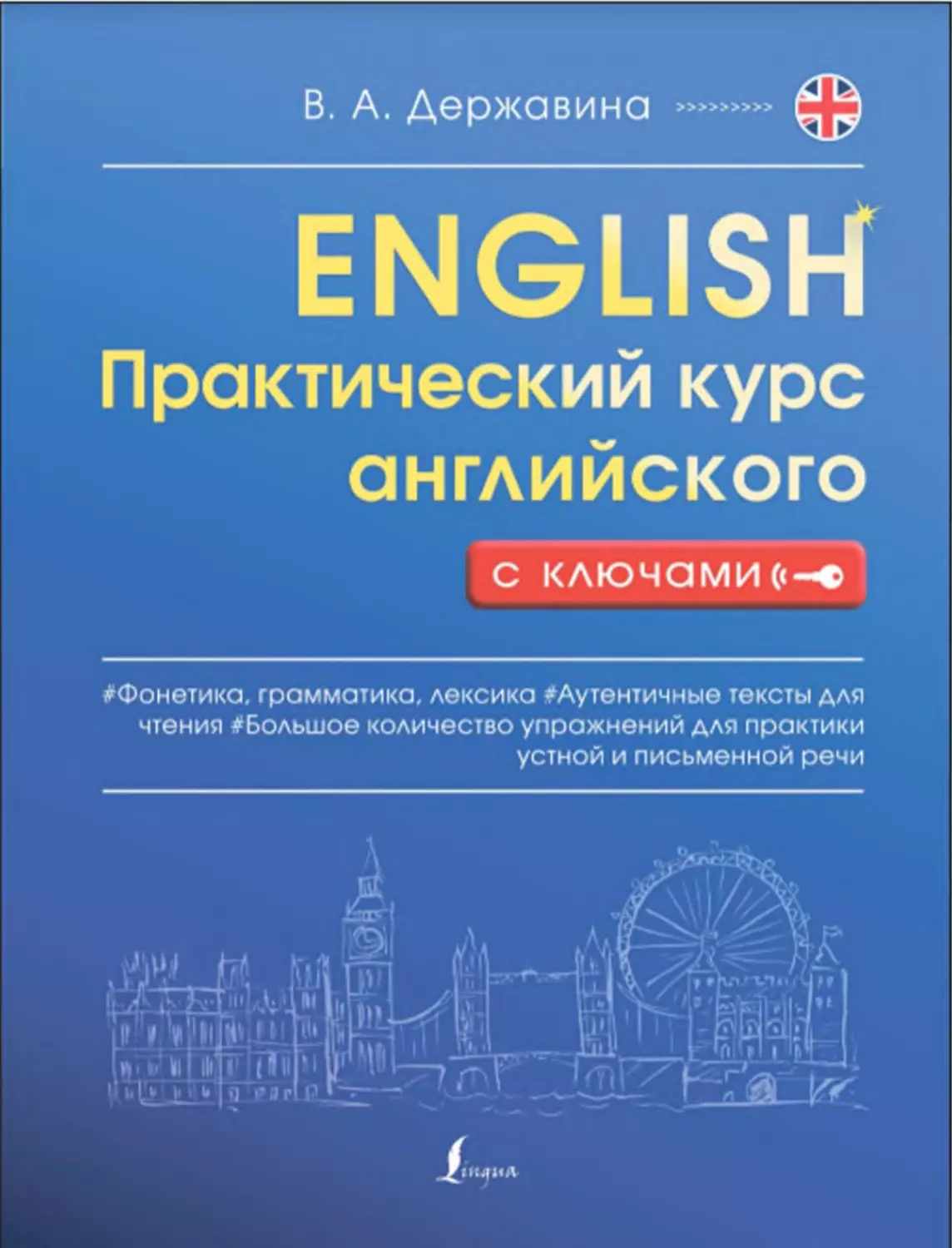
                    В. А. Державина
>>>>>>>>>
ENGLISH
Практический курс
английского
с ключами (<-<
#Фонетика. грамматика, лексика ^Аутентичные тексты для
чтения #Большое количество упражнений для практики
устной и письменной речи
<«««« в. А. Державина »»»»>
ENGLISH
Практический курс
английского
с ключами (<-<
к____________J
ИЗДАТЕЛЬСТВО ACT
МОСКВА
УДК 811.111(075.4)
ББК 81.2 Англ 9
Д36
Державина, Виктория Александровна.
Д36	Практический курс английского с ключами / В. А. Державина. — Москва: Издательство ACT,
2022. — 352 С. — (Практический курс с ключами |м|).
ISBN 978 5-17-145633-7
8 этом издании представлен практический курс английского, который охватывает лексический.
трамма»ический ифонетический разделы языка.
Вы начнете обучение с подробного разбора букв и звуков, правил чтения, а также уделите внимание
правильной постановке ударения произношению слов, ритму и интонации а предложениях
8 каждом уроке вы найдгт аутентичны» тексты для чтения Такие тексты способствуют не только
развитию навыков чтения но и помогают улучшить письменную и устную речь.
Изучение грамматики начинается с самых простых тем и усложняется от урока к уроку. Все правила
находтг отражение как а текстах, так и в упражнениях.
В самоучителе представлено большое количссто упражнений, чтобы применить теоретический
материал на практике В конце книги вы найдете ключи к упражнениям
Данное пособие предназначено для читателей, имеющих самые базовые знания английского языка
и желающих продолжать его изучение. Самоучитель станет надежным помощником для желающих
ос поить английский язык на уровне 82.
УДК 811.111(075.41
ББК81~2Англ9
ISBN 978 5-17 145633-7
С Державина 8. А.. 2021
О ООО ^Издательство АСЬ. 2021
CONTENTS
UNIT 1..........................................................................................4
UNIT 2.........................................................................................12
UNIT 3.........................................................................................24
UNIT 4.........................................................................................37
UNIT 5.........................................................................................50
UNIT 6.......................................................................................  60
UNIT 7.........................................................................................70
UNIT 8.........................................................................................82
UNIT 9.........................................................
UNIT 10.....................................................................................  105
UNIT 11.....................................................................................  116
UNIT 12.......................................................................................132
UNIT 13...................................................................................    143
UNIT 14L.....	   159
UNIT 15.......................................................................................172
UNIT 16.......................................................................................182
UNIT 17.........................	 191
UNIT 1Я...................................................................................... 201
UNIT 19.......................................................................................212
UNIT 20L........................	  ....221
UNIT 21.....................................................................................  230
UNIT 22.......................................................................................238
UNIT 23.................................................................................      247
UNIT 241..........................................................	 256
UNIT 25.......................................................................................267
UNIT 26.......................................................................................274
UNIT 27.......................................................................................285
UNIT 28.........................	............................................................299
UNIT 29.......................................................................................309
KEYS..........................................................................................318
- 3 -
UNIT1
1.	Согласные звуки в английском языке обозначаются данными в таблице буквами
и буквсхичетанинми и делятся по способу произношения на следующие группы:
•	губно-губные (bilabial) |b| b; [р] р. |m| m; |w| w
•	губно зубные (labiodental) — (f) f. ph; [v] v
•	переднеязычные (forelingual) — [t] b (d) d; (4 Иск* (I] I; [r] r. (nJ n; [d|, fO] th; | tfl ch
•	среднеязычные (frontlingual) — (JI sb; | Jj] g. J
•	заднеязычные Ibackllngual) — [kj k [g] g, (y] ng; [k»j, |kz] x
Особенности произношения некоторых согласных звуков:
1)	звуки (pt ||Цк| произносятся < придыханием (аспирацией): pen. apple, kite, top, cap:
2)	[u J произносится с усилием на вытянутых округленных губах: we, well. word;
3)	| f) и (\ ] произносятся с касанием нижней губы верхними зубами: flag, fast, very, river;
4)	согласные [dj. (t). [nJ, (I] произносятся посредством прижатия кончика языка к альвеолам: day,
land, mind, time;
5)	согласный |г| произносится в положении кончика языка несколько позади выпуклости альвеол:
rain, river, tram, drum;
б)	звуки |dj, |<1| произносится в положении кончика языка между зубами, звонкий звук |д)
с участием голоса (this, that), а глухой звук [0J — без его участия (three, thing);
7)	сочетание ch [tj] произносится посредством касания альвеол кончиком я зыка: chips, chalk;
8)	сочетание $h [f] произносится посредством поднятия средней части языка к твердому нёбу:
sheep, ship, shark
9)	согласный |dj) произносится посредством поднятия средней части языка к твердому нёбу, но
мягче, чем (if): Jug. Jam. gym. giraffe;
10.1 заднеязычноесочетаниепд |i)J произносится посредством пропускания воздуха через носовую
полость при фиксированном положении задней части языка у опущенного мягкого неба: sing
ring, long, song.
Провала чтения некоторых согласных:
1)	звонкие согласные на конце слова нс оглушаются: log, red. web;
2)	согласная s между двумя гласными буквами, а также в конце слова после звонкой согласной или
гласной читается как |z): base, days, noses; в начале слова, перед всеми согласными в середине
слова и после глухих согласных в конце слова s читается как (s]: sad. cats, faster.
3)	согласная с читается как |»| перед тласными г, i, у (nke, city, bkycle). а во всех остальным
случаях — как (kJ (cat. act, class);
4)	согласная g читается как (Ц$) перед гласными е, I. у (gym. gin), исключения — give, get; во всех
остальных случаях — (gj (glass, gap. leg):
5)	согласная x перед согласными и на конце слова читается как (kx) (text, next), а перед ударной
гласной — как [gz] (exist, exam).
Правила чтения некоторых буквосочетаний:
1)	сочетание th обычно читается как звонкий [б] в служебных словах (the. this, with) и как глухой
|0| — t* знаменательных (thin, thing, think);
2)	сочетания ck. ph. ch. sh читаются как [kJ. [f], [tj] и [J] соответственно: back, phone, kitchen, ship;
3)	cor ласная w не читается перед r (wrong, write), согласная k — перед n (knock, know), а согласная
b — перед t и после m (doubt, climb);
4)	в сочетании wh согласная w не читается перед гласной о (who, whole). а в остальных случаях не
читается согласная h (where, when. why).
2.	Гласные буквы английского языка — а, е, I о. о. Звуки, которые они обозначают, делятся на:
•	монофюнт и («одинарные*!: (п|. [о:], |и:> |u|, |г|. 11|, |е), |л|, [ж|. |ci:], |tJ. |.*»|;
•	дифтонги |«двойные*I |иа|, |ои|, (ат, |н|, |ю1|ат|, |auL|i*a).
Особенности произношения гласных зеукоо:
В зависимости от положения языка гласные звуки классифицируют на:
•	гласные переднего ряда.
•	гпасните заднего ряда
•	гласные смешанного ряда
1)	Гласные переднего ряда, [ ii. с. х]. при произнесении которых тело языка продвинуто вперед
кончик языка упирается в нижние зубы.
2)	Гласные заднего ряда: (х о:, и., и, д] — тело языка оттянуто назад кончик языка отходит от
нижних зубов.
31	Гласные смешанного ряда: [»:. а] — язык равномерно приподнят, и вся спинка языка лежит
максимально плоско.
4)	Среди гласных заднего ряда выделяют произносимые с округлением губ лабиализованные: | п|,
|.т], (и:), (и) и первые элементы дифтонгов |из|, (си), |л«|.
5)	Гласные: |т:|, |i], |ej. |ei|, (ю) произносятся с растянутыми тубами. Для остальных гласных:
|ж|, |и:|,	|э|, а также первых элементов дифтонгов (ат|. |uuL |сэ| характерно нейтральное
положение губ.
По степени подъема языка в ротовой полости монофтонги делятся т«а высокие, средние и низкие*
1)	Для гласных высокого подъема [t:J, [u:], [iJ, (и], называемых еще закрытыми, и первых элементов
дифтонгов |ю|. (иэ| основная масса языка поднимается высоко в ротовой полости
2)	Звук (и] значительно короче русского (у) Губы чуть скругляются, но не вытягиваются Из за
оттянутого назад языка [и] имеет как бы слабый отголосок [ы].
3)	Для произнесения долгого звука [и:] губы надо округлить сильнее, по сравнению с [и], но не
вытягивать. Рот приоткрыть меньше, а язык оттянуть сильнее, чета для (и).
4)	При произнесении звука [»:]. долго, как в слове ивушка, губы растягиваются, как будто в улыбке.
Кончик языка находится у нижних зубов. Средняя часть языка приподнята.
5)	Звук [i] более краток, как безударное [и] в слове игра. Кончик языка немного оттянут от нижних
зубов. Губы растянуты меньше, чем для (к]. а рот приоткрыт шире.
61	При произнесении средних гласных: |е), [i:L [э], (э:) и первых элементов дифтонгов |ш], [<>и],
|гэ| основная масса языка располагается в середине ротовой полости, средняя и задняя части
языка равномерно подняты.
7| При произнесении звука [е] кончик находится у основания нижних зубов, средняяспикка я зыка
выгибается вперед и кверху, но не слишком высоки. Этот звук немного похож на русский звук
|»| в словах этот, цель. Если язык будет касаться нижних зубов, |е| и |т| превратятся в русские | и
и [с|, а если я зык слишком оттянуть от нижних зубов, английские звуки |с|и |i| будут похожи на
згтухи русской речи (ы) и (>).
81	При произнесении английского звука (э:| плоский язык слегка приподнят, кончик языка
касается основания нижних зубов, губы напряжены и растянуты, чуть открывая зубы, особенно
при произнесении этого звука после [и ] в словах типа world work В русском языке похожего
звука нет.
- 5 -
9) При произнесении звука [л] губы находятся в нейтральном положении. Он всегда безударный,
самый короткий в английском языке, перед согласным [п] и [I] часто вообще исчезает. Может
иметь оттенки в зависимости от влияния соседних звуков, в начале или середине слова часто
напоминает очень краткий |з:]. на конце слова похож на (д): cotour, after.
101 Низкие гласные (открытые): |л], (ж), |и:|, |а| и первые элементы дифпхное [мЬ (ш|. |аи]
произносятся при низком положении языка в ротовой полости.
11)	Звук («) в отличие от (с) произносится при максимально открытом положении рта, нижняя
челюсть слегка опущена. По длительности звук [яс] более долгий, чем (с]. Он занимает
промежуточное положение между долгими и краткими гласными
12)	Столь же открытое положение рта характерно и для звука [о], напоминающего о**ень краткое
русское |о|. но юрамо более открытое. Губы слетка округлены, хотя вперед не вытягиваются.
Кончик языка отодвинут от нижних зубов, а задняя спинка слегка приподнята.
13)	При произнесении долгого гласного |х| раствор рта уже, чем для |о[. губы округлены, но не
выпячены. Задняя спинка языка поднимается выше, чем для [о]. Нельзя произносить этот звук
с начальным призвуком |у |. характерным для русскою |о|, поэтому язык надо оттянуть назад,
а губы значительно округлить.
141	При произнесении звука (а:] корень языка оттянут назад и в»«из, звук идет из глубины горла,
напоминает звук, произносимый при осмотре горла врачом. Язык лежит очень низко во рту.
кончик языка оттянут от нижних зубов.
15	J Звук [л] зна* тительно короче русского [а] и на поминает безударное [а] в с лове дала. Произносится
кратко и отрывисто, как бы сквозь зубы. Язык немного отодвинут назад. Расстояние между
челюстями меньше, чета при произнесении (о:).
16)	Гласные звуки, как и согласные, подвержены влиянию со стороны ближайшего окружения.
Например, звук [ж] в словах hand и land звучит по-разному, поскольку, находясь во втором
случае в окружении альвеолярных согласных, реально он тоже произносится с кончиком языка,
находящимся в области альвеол, а не у нижних зубов.
17)	Аналогично согласные звуки подвержены влиянию со стороны гласных. В словах two и tea
звук [I] имеет различные оттенки из-за последующих лабиализованного [и:] и произносимого
с растянутыми губами (i:|.
Правило чтения гласных:
Прежде всего, необходимо обрисовать 4 ба юных типа ч тения, в соответс i вии с которыми во зможны
разные варианты произношения:
Гил Г Гласная читается так же, как в алфавите в т.и. «открытом слоге*. Эта гласная стоит в слове под
ударением:
1) на конце слова при условии, что эта гласная — единственная в слове ([i:J — we. [ai] — hi. why);
2) перед одной согласной, за которой следует нечитаемая гласная ((ju:| tunc, |ai | bike, au]
горе, |ci] — cake).
Гил 2. Гласная читается кратко в т.н. «закрытом слоге»:
1) перед конечной согласной в односложном слове ((a) but. [с] let (о] rob. [г] cat);
2) перед 2-3 согласными (bottle, butter, letter).
Гил 3. Гласная стоит перед буквой г: [а:] — саг, [ж] — stir, fur.
Гил 4. Гласная стоит перед буквой г. за которой следует еще одна гласная: (га] — bare, [иэ] —риге,
(ia) — mere, [у] — store.
-б-
Далее условно мы будем каждый тип чтения обозначать цифрой в скобках — (II, (2). (3), {4):
1) А, а
<1)|а| — sale, bake
(2)|te| — plan, bat
(3)| a: I —star, bar
14) [гл | — parents, bare
NB! <14*11» (э:} vnall, all, tall;
a  |t>| — what
2) E,«
he, Pete
(2) [cj- let. wet
(3) [з:[-prefer
(4) [io] mere, here (исключения:
[co] — there, where;
3) Li
<1)[ai] — mile, write
(2)	[ij — win, hit
(3)	[з:] — stir
(4)	[aid] — fire, desire
4)	O,o
(1)[du) —no. pole
(2)	[o] — not. lot
5)	U, u
(1)	(ju:) —tune. refuse
(2)	(л) — cut. but (исключение: [u] — put)
6)	Y.y
(l)[ni| — type
<2)|i]- gym
13) [x] — port, resort
(4) [x] — more, adore
(3) (-»:] — fur. turn
(4) [up] — pure, lure
(3) [x] myrtle
(4) [ah] tyre
NB! В начале слом перед гласной читается как | j|- yummy, yesterday, yawn.
Правило чтения некоторых буквосочетаний с гласными:
1) оо: [u:] — loose, moon: [и] перед k — book, took;
2.1 ее. еа. ie: [i:] — meet. need. meat, neat, field:
3)	ai. ay: [ci] — paint, day;
4)	oi. oy: [ai] — soil, boy:
5)	ou. ow: [au] — mouse, house, now, wow. cow (ow читается как [эи] в конце двусложных слов
в безударном положении: sorrow, sparrow),
6)	er. or: [а] в безударном положении на конце слова — sister, doctor,
/) wa: [wn] — want, waltz: [wx] — walk, war:
8)	eer, ear: [id] — peer, near, ear;
9)	air: [ra] — fair, pair:
10)	our:[aud] — our. hour;
11)	ew: [ju:] — knew. stew.
3.	Ударение, ритм, интонация
1)	Ударение на отдельном слоге в слове называется словесным: ‘paper, prohibit, relace. К этому
виду ударения мы привыкли, поскольку запоминаем слова уже с конкретным местом ударения.
2)	Рели необходимо акцентировать внимание на отдельном слоне, используется фраювое
ударение: Give Bill a RED apple, please. В этом предложении, фра юное ударение падает на слово
•^красный*, чтобы подчеркнуть, что Биллу нужно именно красное, а не желтое или зеленое
яблоко. В этом случае в английском языке фразовое ударение падает на знаменательные части
речи (существительные, местоимения, глаголы, прилагательные и наречия), а не на служебные
слом (предлоги, союзы, междометия!.
3)	Логическое ударение выделяет группу слов в предложении. Каждая группа отделяется паузой.
На выходе получается как бы «рубленое произношение»: если произнести, например. Don’t let
me зро«1 the soup одновременно с хлопками в ладоши, как бы «отрезая* каждое слово, такое
упражнение будет отличной тренировкой техники чтения.
4)	Ритм, то есть прочтение или произнесение смысловых групп за более или менее равные
промежутки времени является важной характеристикой английского языка: Give Bill | a red
apple | please Таким образом, кроме того, что нужно резко отделять каждое слово друг от друга,
между группами слов необходимо делать более длительные паузы.
5)	Интонация в английском языке бывает двух видов нисходящая и восходящая. Как говорят сами
названия, при первой тон понижается, а при второй — повышается. С нисходящей интонацией,
как правило, произносятся утвердительные и повели тельные предложения-
•	Не didn’t steal the money.
•	The weather is fine.
•	Send him to bed!
Восходящая интонация предполагает некатегоричность, а иногда и незаконченность
высказывания. Как правило, она типична для общих вопросов и на стыке двух простых
предложений в составе сложного:
•	Were you present at the meeting?
•	When the meeting was over, everyone rushed to the door.
EXERCISES
1.1. Прочитайте слова, обращая внимание на артикуляцию монофтонгов.
[•:) be, we, he, she. me. mete. eve. Pete
[i] big, dig, sing, s»t. fit. miss, bliss, with
[c] bed. met. set. let. leg. beg pen. pet
pr | bag. mat. fat, dad. man. pan. ran. land
IX Прочитайте слова, обращая внимание на артикуляцию монофтонгов.
[i] —14 wwlk — bit — be. tin — dene, live — eve
[e] — (ae) bed — bad. pen — pan. red — rat. mess — mass, let — lad
[a] - [ar] cup cap, cut — cat, run — ran, drug drag
[s] — jn] luck — lock, duck — dock, fun — fond, sun — song
1.3. Прочитайте, обращая внимание на артикуляцию дифтонгов.
|ia] deer, beef, peer, hear. deaf. tear. mere. here, sere
[ca ] hair, fair, pair, air, care, fare, stare, ware. bare, parents
(ai | light, night, might, right, fight, high. sigh. hi. why, shy
1.4. Выберите и прочитайте слова, в которых буква а читается по первому типу слога — [ы].
Ann. game, sharp, arm. care, bank, take, fate, large, bag. make, fat plane, bake. park. mark., can. lake
-B-
13. Выберите и промигайте слова, в которых буква а читается по второму типу слога — [ж],
skate, glad, barn, саге, shake, park, flag. made. bad. can, mark. age. dark. mare. same, pan, fate, compare
1.6.	Выберите и прочитайте слова, в которых буква а читается по третьему типу слога — [х].
age. far, cat fare, mark, face. dad. table, garden, marc, dark, hand, shark, bad. large, care, mag
1.7.	Выберете и прочитайте слова, в которых буква е читается по первому типу слога — [i.J.
meet, pct, sec, her, chess, st cd, marc, feet Pete, term, me, им, kerb, bee, we, let ten, penon
1.8.	Выберите и прочитайте слова, в которых буква е читается по второму типу слога — [с],
he, let, here, bee. herb, me, bell, her, ten. net mere. leg. see. we. street, pen. she. spell
1.9.	Выберите и прочитайте слова, в которых буква е читается по третьему типу слога — [т:].
sleep, we, certainly, green, here, bed. me, swoop, bdl. kerb, her, ten. leg shelf, men, fresh, then, he. term,
person
1.10.	Выберите и прочитайте слова, в которых буква I читается по первому типу слога — [:и].
shirt, nine, dish, hre, first, hsh, bird, dirty, kick. kite. Mike, lie, wing sing five, wide girl, hi
1.11.	Выберите и прочитайте слова, в которых буква • читается по второму типу слога — (ij.
wide, firm, chick, ring fire, shirt dine, rich, nine. He. trip, list sit, dirty, dive, lit pie
1.12.	Выберите и прочитайте слова, в которых буква I читается по третьему типу слога — [т.).
dine, lip, girl, brick, mine, fire, shirt, like, first, this^ bird. pine. dive. hill. kite, with, nice
1.13.	Выберите и прочитайте слова, в которых буква о читается по первому типу слога — [эй],
box. bone, fore, stove, no, com, home. fort. tore, more, frog. pond. nose, close, fork, stone, bom, for
1.14.	Выберите и прочитайте слова, а которых буква о читается по второму типу слога — (п).
doll, so, pork, phone, got. tore. log. bone, horn, hot, fork, go, on. dog note, phone, short, frog
1.15.	Выберите и прочитайте слова, в которых буква о читается по третьему типу слога — (а ].
rose, born, cock, tom, bone, more, pork, storm, stove, hop. sport, not. fore. or. dog. code, home, note
1.16.	Выберите и прочитайте слова, в которых буква и читается по первому типу слога — (ju ).
curt, mute, purpose, true. bus, use. cube, pure, cure, hut trunk, pupil, turn, lunch, fur. fun, cut
1.17.	Выберите и прочитайте слова, в которых буква и читается по второму типу слога — [а].
cut dust true, tulip, cure. sun. hunt. fur. gull. sue. fun, pure, duh cute, curl endure, due, rule
1.18.	Выберите и прочитайте слова, в которых буква и читается по третьему типу слога — [т].
brush, curl, blue, purpose, plum, mute, fur, cure, glue, much, murmur, pure, fun. tube. turn. tub. dust, rule
1.19.	Выберите и прочитайте слова, в которых буква у читается по первому типу слога — [ii].
try, yard. why. gym. baby, by, puppy, cry. gypk type, yes, my. twenty, shy. gyp dry. pity, yell
120.	Выберите и прочитайте слова, в которых буква у читается по второму типу слога — |i |.
gym, shy. yet tasty, cry, yam. yelp, gyp. study, type, why, by, sky. mummy, pity, angry, myth, type
-9-
1 Л. Распределите слова на две группы: слова с открытым слогом и слова с закрытым слогом.
cut — myth — tide — mix — box — lake — Пу — plate—map — his — cat — dog — blue — site—meet —
he — sit - rose — home — stop — fond — game — plan — (ram — my — ill - system - tent - fed —
fed — fine — we — but — fun—use — tune
1.22.	Paccidttote слива в колонки с СООПзекгвующнм звуком: |w|. |h|, |г|.
what, who wrestling, when, why. whose, wrong, where, whom, write, white, which, whole, wrangler
1.23.	Pace iat»Bie слива в колонки c cooiвек «кующим звуком: |sj. |k|.
ke, celebrate, cold, comer, doctor, city, place, black, pencil, cage, club, nke camp, cinema
1.24.	Расставьте слова в колонки с соответствующим звуком- |gj. (dj(.
give. good. cage, ginger, girl, gypsy, gold. grey, grace, beige, gift, gymnastics, bag. village, game
1.25.	Расставьте слот» co слогом nma «гласная • в колонки с соответствующим звуком: (nJ, (о ], [з :]
stem, far, curt. form. girt. hard. cart. curl. word, car, born, term. fur. bird, herb. fork. her. first
1.26.	Расставьте слова co слогом типа «гласная г г 4 е» в колонки с соответствующим звуком: (о | [caj,
|шэ(. ЬМ-
fare, here, pure, core, rare, cure, mare, fire, bare, during stare, more, mere, store, tyre
137.	Распределите слова ка три группы в зависимости от чтения окончания -s: |s|. (zj или |i/|.
closes, lakes» hands» pages, catches, boys» voices, helps, works, washes» girls, sees, months, horses, plays,
kisses, plates, cars, runs
1.28.	Распределите слова на долгие и краткие гласные.
cat, park, sport, set. car, army. Lucy. Irve. red, water
1.29.	Распределите слова на звонкие и глухие согласные в конце слова.
had. leaf, leave, hat, back, bag pig pick, lived, tag
1.30.	Разделите следующие слова на две группы. В первой напишите слова со звуком |в|, а во
второй со звуком |д|. Используйте словарь, если затрудняетесь ответить.
with, think, thank, teeth, that there, thing thousand, those, through, though, throw
1.31.	Прочитайте следующие слова и назовите, в каких окончаниях читается [sj, а в каких (zj.
lamps, cats. days, feelings, roads, telephones, notes, rooms, plays, plates.
1.32.	Определите сколько в слове звуков, запишите его по образцу:
dog — спс (с — согласный звук, г — гласный звук).
1 gorilla 2. rabbit 3. snake 4. monkey
133. Прочитайте вслух скороговорки, обращая внимание на интонацию.
Jill helped Ted.
Ted helped Tim.
Tim helped Jim.
And Jim helped Jill.
Missis King is bringing something pink for Mister King to dnnk.
-10 -
The black cat sat on a mat and ate a fat rat.
Whether the weather be fine
Or whether the weather be not.
Whether the weather be cold
Or whether the weather be not.
We'll weather the weather
Whatever the weather
Whether we like it or not
A big black bug bit a big black bear, a big black bear bit a b<g black bug.
Thirty three thousand people think that Thursday is their thirtieth birthday.
Peter Piper picked a peck of pickled peppers.
A peck of pttkled peppers Peter Piper picked,
if Peter Piper picked a peck of pickled peppers.
Where s the peck of pickled peppers Peter Piper picked?
She sells seashells on the seashore, the shells that she sells arc seashells, I'm sure
William always wears a very warm white vest in winter.
Who ran across a rough road?
Ray Rag ran across a rough road.
Across a rough road Ray Rag ran.
But where is the rough road Ray Rag ran across?
Paul, please pause for proper applause.
A twister of twists once twisted a twist.
And the twist that he twisted was a three twisted twist.
Nov/ in tw sting this twist, if a twist should untwist.
Would the twist that untwisted untwist the twists.
UNIT 2
1.	Существительные (Nouns)
1)	В английским М5ЫКГ сущее пй*пельиые не разделнюкм по родам грамматически. Род
смысловая категория, относится только к существительным, обозначающим живью существа,
о которых можно сказать, что они мужского или женского пола. К среднему роду относятся лее
неодуиевленные предметы, а также названия животных:
•	Мужской род 1m. — masculine): a man — мужчина, a boy — мальчик, a father—отец, a brother —
брат и др.
•	Женский род (f. — feminine): a woman — женщина, a girl - девичка, a mother — мать, a sister —
сестра и др.
•	Средний род (п. neutral): a book книга, a window окно, a table стол, a dog собака,
a lion — лев, a bird — птица и др.
2)	Множественное число существительных образуется прибавлением окончания которое после
глухих согласных произносится как | s| {a cat — cats), после звонких согласньсх и гласных — как [/]
(a dog — dogs, a monkey — monkeys). Также существуют следующие особенности образования
множественного числа:
•	к существительным, оканчивающимся на буквы и сочета ния -s -ss,-х, -$h, -ch вомножественном
числе прибавляется окончание -es, которое читается как fix] (a glass — glasses, a box — boxes,
a bush — bushes, a church — churches);
•	как (iz) читается окончание множественного числа существительных, оканчивающихся на
звуки |s|, fz). |djt с нечитаемой •• на конце (a horse — horses, a rose — roses, a cage — cages).
•	как [u] читается окончание существительных с основой на -у, орфографически такое
окончание после согласной записывается как -й> |.а baby	babies, a lady — ladies);
•	существительные, оканчивающиеся на -f, -fe зо множественном. числе получают окончание
-ve* la wolf — wolves a leaf — leaves a wife — wives);
•	некоторые существительные образуют множественное число путем изменения корневых
гласных: a man — men, a woman — women (Чгтлп), a foot {ступня) — feet, a goose (гусь) —
goose, a tooth (зуб) tooth, a mouse (мышь) — mice, a child (ребенок) children, an ox (бык) —
oxen и др^
•	у некоторых существительных формы единственного и множественного числа совпадают:
a fish (рыба) — fish, a sheep (овца) — sheep, a deer (олень) — deer и др.
3)	Артикли (o/fici'es) используются с английскими существительными, чтобы указать на их
определенность или неопределенность. Неопределенный артикль l/ndefinde дгГ»г» — а/ап
используется только для существительных в единственном числе, а определенный артикль
(de finite article} the — для существительных как я единственном, так и во множественном числе.
Также есть такое понятие как нулевой артикль {zero article',. Выбор артикля неразрывно связан
с исчисляемостъю существительного.
• Неопределенный артикль а/ап используется с исчисляемыми существительными
и единс гщгнном числе; определенный ар1икль rhe ниже! ислильзшм1ьсн с исчисляемыми
существительными (независимо от их числа) и с неисчисляемыми существительными;
нулевой артикль (= значимое отсутствие артикля) употребляется с неисчисляемыми
существительными или с исчисляемыми во множественном числе:
-12-
Yesterday I read a nook (исчислимое существительное в единственном числе, пеопределенный
артикль). — Вчера я прочитал книгу {- какую-то. некую, одну!.
! liked the book very much (исчисляемое существительное в единственном числе, определенный
артикль). — Книга мне очень понравилось {= именно >mai.
) like books (исчисляемое существительное во множественном числе, нулевой артикле).
Я люблю книги (= вообще, в целом).
) like the hooks that you give me (исчисляемое существительное во множественном числе,
определенный артикль). Мне нравятся те книги, которые ты приносить I = именно те).
I've got milk in the fridge (перечисляемое существительное, нулевой артикль). У меня есть
молоко в холодильнике.
Con you give те the milk you have bought? (неисчисляемое существительное, определенный
артикль). — Ты можешь дать мне молоко, которое принес?
•	Главный принцип выбора артикля в английского языке: неопределенный артикль а/ап мы
ставим, когда говорим не о каком-то конкретном предмете, человеке или явлении, а ободном
из многих. Если же речь идет о чем-то или ком-то конкретном, употребляем определенный
артикль the. Артикли на русский язык не переводятся, но если попытаться перевести по
смыслу, то неопределенный артикль значит «один», определенный — «этот», «тот».
•	Выбор неопределенного артикля а или неопределенного артикля ап зависит от звука,
с которого нам икается слово, следующее за артиклем ставим артикль а. если слово начинается
с согласного звука: a 61m |э 'film), a university |э juni'v» (rhaii|, ставим артикль ап, если слово
начинается с гласного звука: ал arm |лл 'u m), an hour |жт аил).
•	При наличии определения описательного характера, выраженного прилагательным
сущее панельное обычно употребляете и с неопределенным артиклем к единственном числе
и с нулевым — во мнижес т вен ним, при лом артикль ставится перед всем словосочетанием:
a red apple  red apples.
2 Указательные местоимения (Demonstrative Pronouns) this — these, that — those
I)	Указательные местоимения указывают на лицо, предмет, явления, их признаки, время, не
называя их. Они могут самостоятельно выступать в предложении в качестве подлежащего (кто?
что?) или дополнения (кого? чего? что?).
2)	This и these, оба местоимения this (зто) и these (эти) указывают на лицо или предмет, находящиеся
рядом с говорящим, а также на явления, произошедшие недавно или в текущий отрезок
времени.
•	This используется только для единственного числа. These — для указания на множественное
число:
This will be our new house — Это будет наш новый дом.
This ocadent has happened just 5 minutes ago.—Это происшествие произошло только 5 минут
мшД
Are these Kate's friends? — Это друзья Кейт?
I will spend these holidays in Britain. — Эти каникулы я проведу в Англии.
•	This и these также используются при знакомстве людей или чтобы представиться по телефону.
.Mom, these аге ту friends Ann and Jack. Мама, это мои дру	Энн и Джек.
> lotto! This ft Robert Johnson. Алло! Это Роберт Джонсон.
3)	That и those, оба местоимения (hat (тот) и those (те* указывают на лицо или предмет, находящиеся
далеко от говорящего, а также на явления, произошедшие давно или те, которые произойдут
в далеком будущем.
-13-
•	That «пользуется только для единственного числа. Those — для указания на множественное
число.
That girl is Mary’s daughter. — Та девочка — дочка Мэри.
That is my house. H’s pretty far from here. — Вон там мои дом. Он сравнительно далеко отсюда.
•	В русском языке нет строгих правил для выражения отдаленности предметов. поэтому that/
those могут переводиться как «этот / эти», так и как «тот / те».
That was tasty. — Это было вкусно.
I fron t do that. — Я этого не сделаю.
that cake was tasty. — Вот тот пирог бып вкусным.
Those sneakers were mine. — Те кеды были моими.
4)	It — this that местоимение it (это) может заменять this. В большинстве случаев говорящий
может использовать место имения it, this, that по своему желанию.
This is a good idea!—Это хорошая идея!
That is a good idea! — Это хорошая идея!
It is a good idea!—Это хорошая идея!
That (тот) всегда используется к эмоциональных, жестких и решительных высказываниях или
о устойчивых словосочетаниях, выражениях:
06 ту goodness! That’s awful! — О Господи! Это ужасно!
That's right — Это правильно. Точно.
That's it.—Вот и всё.
That's why. — Вот почему.../Поэтому...
3.	Личные местоимения
Все личные местоимения английского языка можно разделить по таким признакам: местоимения
единственного и множественного числа; местоимения первого, второго или третьего лица.
1)	К группе единственного числа относятся:
1-е лицо: I — я (всегда с заглавной буквы*;
2-е лицо: you — ты
3-е лицо: he. she. it — ом. она. оно.
2)	Множес г венному числу же принадлежат:
1-е лицо: we — мы
2 е лицо: you — вы
3-е лицо: they — они.
3)	Формы для местоимений «ты» и «вы» совладают, и чтобы понять, о каком именно личном
местоимении идет речь, необходим контекст, в котором оно употребляется. Местоимения he
и she употребляются для обозначения одушевленных лиц, а для неодушевленных используйте
форму it. Кроме того, с помощью И обозначают животных и абстрактные понятия. У личного
местоимения rt есть еше одна функция — оно может иметь значение «это».
4.	Глагол to be
1)	Глагол (о be ;быгь| является т лаг олом-с вязкой, его форма изменяется в зависимости иг лица
и числа личного местоимения или числа существительного.
I — ат (я есть / существую!
he / she / it — is (он. она, оно есть / существует)
14-
we — are (мы есть / существуем)
you — аге (1Ы, выесть/ сущее itryeiel
they — arc (они есть / существуют)
2)	В отличие от русского языка, в английском языке глагол связка никогда не опускается, поскольку
английское предложение имеет строго фиксированный порядок слов — подлежащее (subvert)
+ сказуемое (verb) * дополнение (otyeef). Глагол robe входит в именное сказуемое, поэтому его
место а предложении — после подлежащего. На русский же я тык глагол to be а данных случаях
не переводится.
I ат а Гескбел — Я учитель (= Я есть учитель).
The weather is fine. — Погода хорошоя.
They are from Pahs. — Они из Парижа.
31 (лагол го бе не требует вспомогательного глагола для образования вопросительной или
отрицательной формы. Чтобы задать вопрос нужно поставить глагол to be перед подлежащим.
Ami happy? Я счастлив?
b the book interesting? — Книга интересная?
Is he our teacher? — Он наии учитель?
4)	Для образования отрицательной формы достаточно поставить отрицательную частицу лог
после глагола robe.
I am not hungry. — Яне голоден.
The book is not boring. Книга не скучная.
Не is not о teacher — Он не учитель.
5)	В разговорной речи отрицательная частица not часто сливается с глаголом го be. образуя
сокращения:
1$ not = isn’t
аге not = aren’t
I am I'm
We are  We re
He is = He’s
TEXT
About myself
My name is Brenda Foster. I am ten years old and I am in the fifth form. My birthday is on the first of
January. I am from Santa Monica. California. USA. I am American. My phone number Is 235-456-789.1 live
at 16 Park Street. Our house Is old but very nice and bg.
I’ve got a sister and a brother. Their names are Gina and Paul. Gina is 16 years o*d. She is beautiful and
clever. Paul is small, he's only three. We’ve got a dog. Its name is Spot. Spot is funny. My Mum is a doctor
She works at a hospital. My Dad is a driver. He works in Los Angeles. We are all friendly in our family.
VOCABULARY
Прилагательные (Adjectives)
old — старый
nice — милый
big — большой
beautiful — красивый
clever умный
small — гладенький
funny — веселый
fnendty — дружный, дружелюбный
good — хороший
bad — плохой
lazy —ленивый
kind — добрый
fine — хороший, отличный (о делах, погоде!
wonderful — замечательный, чудесный
interesting интересный
Профессии I Professions)
doctor — ороч
driver — водитель
student студент, ученик
pupil — ученик (в школе)
vet — ветеринар
shop assistant — продавец
dentst — дантист, стоматолог
manager менеджер, управляющий
programmer — программист
engineer — инженер
lawyer — адвокат
journalist — журналист
Притяжательные местоимения (Possessive Pronouns)
I — my (мой)
you — your (твой, ваш)
he —his (его)
she — her (ее)
ft — its (его — о животных и неодушевленных предметах)
we — our (наш!
they — their (их)
EXERCISES
2.1. Заполните пропуски подходящими по смыслу прилагательными !для одного существительного
может быть несколько вариантов! и существительными, исходя из содержания текста.
1.	Our house is,
2.	Му sister is,
3.	My brother is__________________,
A.	Our dog । s	.
5.	My mother is,
6.	My father b____________________*
7.	I am___________________________
&	Our family is__________________,
-16-
2Л. Поставьте соответствующий по смыслу артикль (если это необходимо).
1.	This is__house._____house is big.
2.	We've got____dog._____dog is funny.
3.	My_____mother Is____doctor. She works at______hospital.
4.	My_____father works In___Los Angeles. He is____driver.
5.	Our____family is friendly. We are from__Santa Munka.
6.	I’ve got____sister. Her name is__Gina. Gina is___clever
23. Пос талые глагол to be о нужную форму am, is. arc.
A Hi, Alex. How (1)you?
B: Hello David. I (2)fine and how (3)you doing?
A I (4J fine. too.
B: How (5)your sister? Where (62 she now?
A She (7)in London.
B: Really? That (9)wonderful! How about your parents?
A They 110)fine too. They (11) In Berlin now.
2.4.	Поставьте глагол to be а нужную форму в вопросе to ore'} и в краткую форму (НеХ SheX Гл?.
They're) — в ответе.
1.	How your mum?—______________________________fine, thanks.
2.	How your parents ? —OK.
3.	How	you?—	very well, thank you.
4.	How	your unde? — 	fine, thanks.
5.	How your children? —OK.
6.	How LU? —fine, thanks.
7.	How your cousin? —very well, t hank you.
23. Поставьте глагол to be и у птгрдитгльную или отрицательную форму: S/nn'tcw/arenT. am/'т not.
I	I___________I.- -
2.	My granny kind.
3.	My granddad clever.
4.	My teachers funny.
5.	I good student.
6.	I a businessman.
7.	I a pupil.
B.	My fnends teachers.
9.	My unde____________a driver.
10.	My pa rents doctors.
11.	My cousins vets.
12.	My mum____________a shop assistant.
2.6. Напишите данные существительные во множественном числе.
a cat —...
a box —...
a boy —...
а foot —...
a glass —...
a bus —...
a sock —...
one man —...
one woman—...
one mouse —...
one house —...
one tooth — ...
one goose — ...
one sheep —...
-17-
2.7. Поставьте данные ниже существительные в форму множественного числа и разделите их на
группы, в зависимости от окончания: -ез, -res, -ves.
a party, a banana, a room, a day, а fly, a knife, a sandwich, a university, a shelf, a play, a key, a taxi,
a way, a tragedy, a language, a comedy, a parrot, a dog, a watch, a puppy
2.S. Образуйте фирмы множественного числа, a dress —two |два)... a lady —tv/о... a baby three (три) .. astory —three... a fox — four (четыре)... a leaf — four ... a thief — five (пять)... a wolf — five...	a city — six (шесть)... a sheep — seven (семь). . a policeman seven... a sportsman — eight (восемь!... a bench— eight... a witch — nine (девять)... a photo — ten (десять)...
2.9. Подчеркните правильный вариант, this / these shoes this/thesetrousers this / these socks this / these shorts	this / these trainers this / these hat this/these dress this / these blouse
2.10. Подчеркните правильный вариант, this/these skirt this / these scarf this / these boots this / these tights	this / these cap this/these sneakers this/these jeans this / these sweater
2.11. Выбегите ухамтсльнос мех тои*хч«ис и поставьте глагол to be и соответствующую форму.
I.	This / These trousers black.
2.	That / Those shi rt very nke.
3.	That / Those shoes comfortable.
4.	This / These skirt old.
5.	This / Those T-shirts my brother’s.
6.	That / Those T-shirt very small.
2.12.	Впишите this или these.
1.	Take	trousers.
2.	Take_________sweater.
3.	Don't take________bag.
4.	Don't take	shorts.
5.	Take	hat
6.	Take scarf.
7.	Don't take boots.
B.	Take shoes.
2.13.	Выберите правильный парна мт.
I.	This is easy. a) questions bl homework
2.	These are my neighbors. a) women b) man
3.	What are you doing afternoon? a) that b! this
4	Who s speaking? a) this b) it
5.	These are my glasses and	are hers, al those bl that
6.	We are going to the seaside summer, b) this a) that
7.	man over there is a famous politician. b) These a) That
2.14.	Вставьте уха мтсльные местоимения: this, that. these. those.
I.	None of present expressed any surprise on hearing.
2.	Try one of.
3.	is a computer.
4	are the TV sets of the latest type.
5.	Suddenly I felt somethi ng soft and warm on my knees.was a cat.
6.	Whom were you talking with?was a friend of mine.
2.15. Поставьте артикли а или an.
1.	... elephant	5.	... Italian bag
2.	... English dictionary	6.	... American college
3.	... butterfly	7.	... Russian city
4.	...German car	8.	... French designer
2.16. Поставьте артикли а или an.
1.	... Indian river	5.	... Ice cream
2.	...egg	6.	... Japanese phone
3.	... notebook	7.	... University of Michigan
4.	...elegant lady	8.	... stressed syllable
2.17.	Поставьте соответствующий артикль.
1.	Is this your... fnend?” — *No, it isn't my ... friend it is my sister*
2.	I've got... sister. My... sister is... teacher. My aster s ... husband is... pilot.
3.	I have no... car.
4.	She has got... big... house.
5.	They have... dog and two ... cats.
6.	Would you like ... apple?
7.	This Is ... tree.... tree Is green.
8.	I can see three... children.... children are In... yard.
9.	I have... car.... car К white. My ... friend has no... car.
2.18.	Пос иные аржкль а (ап) перед сущее тигельным, где нужно.
1.	This is... boy. That is... girl.
2.	This is ... cat. It is my... cat.
3	Is this your... dog? No. I have no., dog. I have.., cat.
4	Is that his ... car? No it isn’t his ...car. It is his father’s ...car,
5.	She has... sister. Her sister’s... husband is... dentist
6.	They have got two... children.
7.	Their da ughter’s ... name is ... Nancy.
8.	Nancy is... kind girl. She is... 1S.
9.	He has many... fnends.
2.19.	Поставьте артикль a (on) перед существительными, где нужно.
1.	Her... brother Is ... very clever.
2.	This ... cat К very... nice.
3.	That... dog is very... big.
4.	My... dog has three ... puppies.
5.	I can see ... animal in the picture.
6.	This ... monkey is... funny.
7.	Give me... pencil, please.
8.	I want to draw ...dolphin.
9.	Woud you like to draw... animals?
10.	This ... family has no... pet
2.20.	Пис гаиые аргикли </ (an), (he перед сущее пепельным, где нужно.
1.	Ann has got two children:... boy and ... girl.... boy's name is Steve ... girl's name is Susan.
2.	I have got... pets:... dog and ...cat... dog is black and ... cat is white.
3.	What... clever dog!... dog can understand my questions.
4.	What... lazy cad ... cat sleeps all day.
5.	Hike ... sun. ...sun gives us light and warmth.
6.	...garden has no ...flowers.
7.	I can see ... birds in the trees.... birds are crows.
2.21.	Выберите правильный вариант ответа.
1.	Mary (am/is/are) beautiful.
2.	The house lam/is'are) good.
3.	You (am/is/are) my best friend.
4.	How lam/iVarel you ?
5.	My English lam/itfarel very well.
6.	I (am/is/are) Russian.
2.22.	Заполните пропуски соответствующими личными местоимениями (для некоторых
предложений возможно несколько вариантов).
1.		am a teacher.
1 _______are doctors.
3.		are a journalist.
4.	____are programmers.
5.		is a lawyer.
6.	____К an engineer.
7.	____am a doctor
8.	____are a manager
9.	____are vets.
10.		is a dentist.
2.23. Задайте общие вопросы к следующим предложениям, поменяв местами гмчное местоимение или
существительное и соответству Сорму глагола-свя зки го be.
Образец: Ней <? doc for. — it he о doctor? НИ Utter it fine.	tthit inter fine?
1.	Our house is old.
2.	They are engineers.
3.	He Is a clever boy.
4	The weather is fine.
5.	You are a teacher.
6.	My dog Is nice.
7.	I am a shop assistant.
8	Her brother is lazy
-20 -
9.	These are your books.
10.	That's a good idea.
2.24.	Переделайте mu утвердительные предложения в отрицательные.
1.	She is happy.
2.	His cumpulrr is old.
3.	Vera is his sister.
4	They arc his sons.
5.	It4 cold today.
6.	They arc students.
7.	My father is a businessman.
8	Our house is beautiful.
9.	He is in Los Angeles.
10.	You are a driver
2.25.	Найдите и исправьте ошибки в употреблении глагола to be там, где это необходимо.
1.	Is you at home?
2.	Are they friends?
3.	His uncle are a chief engineer.
4.	Are she 45?
5.	The weather Is not fine.
6.	I hose boys good dancers
7.	What your name?
8.	The childrens hands is dirty.
9.	My new dress red.
10.	Are your father a teacher?
11.	His sister4 birt hday today.
2.26. Выберите правильный вариант ответа.
1.	Arc you doctors? a. Yes, we arc	b.	No, we arc	c.	Yes, sve arc not
2.	Am 1 late? a. Yes, you am	b.	No, you are not	G	No, you am not
3.	Arc Steve and Slava good friends? a. Yes, he is not	b.	Yes. they are	G	No, he is not
4.	Is Sveta at work? a. No, Sveta is	b.	No is Sveta	C.	No, she is not
5.	Is he a manager? a. Yes, he Isn't	b.	No. he Is	C.	Yes, he Is
2.27.	Постройте утвердительное, вопросительное и отрицательное
словосочетанием, использовав соответствующую форму глагола (о be.
предложение с каждым
•	(she) a teacher
•	(dogs) angry
•	(shop) open
•	(it) free
•	(he) in l nndnn
•	(you) hungry
-21 -
2.28.	Вставьте подходящий артикль, где таковой необходим.
{1)...Ted Shell is (2)... worker. Не works al (31... factory. It S not in (4)... centre of the city. Every morning
he has (5)... breakfast and (6)... cup of tea. Then he goes to (7)... work by (81... bus. He works till five
o'clock in 19)... afternoon. He has 110)... son. His name is Fred. Fred goes to (11)... school. He likes (12)
...literature. Fred is(13l ...good pupiL He also likes (14)... sports.
2.29.	Вставьте подходящий артикль, где таковой необходим.
1.	... butter Is made of ...milk.
2.	I am studying ... English. I am studying ... grammar.
3.	We have ... dog and ... cat
4.	I seldom drink... water.
5.	I had... tea and ... sandwich for breakfast
6k ... history is my favourite subject.
7. There was... kindness in her eyes.
& I bought... bottle of... milk.
9. He has a lot of... work today.
10. This vase is made of... glass
230.	Вставьте подходящий аргикль. где таковой необходим.
(1)	... Frenchman was once travelling in (2)... England. He did not know (3)... English quite well He could
speakonly J4)... little. One day he was eating in (5J... small pub and he wanted to order (61... eggs. But
be didn't know (7)... English word for (8)... eggs.
Suddenly through (9)... window he saw that (10)... rooster (петух) was walking in (11)... yard. He asked
{12)... waiter what was the English for (131... ‘roster’ (14)... waiter told him. (15)... Frenchman then
asked what was the English for (16)... ’rooster's wife’. (17)... waiter told him that it was 118)... hen. Next
(19)... Frenchman asked what was the English for •'hen's children*. (201... waiter told him that they were
(21) ... chickens. (22) ... Frenchman asked what (23)... chickens were before they were born. (24)...
waiter told him they were 125)... eggs.
"You’ve explained everything very well.’ (261 ... Frenchman said. "Please bring me two (27)... eggs and
{28)... cup of (29)... coffee?
231.	Вставьте подходящий артикль, где таковой необходим.
We are in (1)... Scotland. Its capdal is (2)... Edinburgh. It is one of (3)... most beautiful cities in (4)...
Great Britain. There are (5)... many places of interest here. (6)... monument to (7)... Walter Scott is in (8)
... centre of (9)... city. (10}... National Gallery of Scotland К also situated in (11)... centre. There is (12)
... fine collection of (13)... pictures in (14). . gallery. (15)... Glasgow is (16)... greatest city in (17)...
Scotland. Scotland is (18)... land of (19)... lakes. They are calied ’lochs’ there. Let us go now to (20)...
Loch Lomond. What (21)... beautiful lake it ts!
232.	Определите правильный вар^ламт
1. a shower or the shower?
a)___________is broken at the moment.
b)	There isn't in this bathroom.
2.	a garden or the garden?
a) Our house hasn’t got
b) Maria is outside in
-22-
3.	a poster or the poster?
a) Look at____________
b • I've got
4.	a woman or the woman ?
a)	I can see
b)	Who is?
233. Вставьте подходящий артикль, где таковой необходим.
____best pet for__child is_dog.
if you don't like public transport, you should get car.
car isn't best way to travel in city.
There was____dead mouse in_____comer.
At___bottom of____page It said Please turn over’.
i don't ta ke sugar, thank you.
234. Переведите на русский язык.
1.	Эти дети — ученики.
2.	Этот мужчина — врач.
3.	Эта женщина — программист.
4.	Эти учителя хорошие.
5.	Мой дом старый.
6.	Моя сестра красивая.
7.	Его брат маленький.
8.	Тот менеджер дружелюбный.
9.	Ге журналисты интересные.
10.	Наша собака умная.
11.	Их мама — ветеринар.
UNIT3
I Повелительное наклонение (Imperative) — утвердительная форма
1)	Повелительное наклонение в английском языке используется для выражения просьбы или
приказания и совпадает с начальной (неопределенной) формой глагола без частицы го.
Например;
•	to read (читать) read (читай/че)
•	to write (писать) — write
•	to give (давать) — give
•	to take (брать) — take
•	to send (отправлять, посылать) — send
•	to put (класть) put
•	to rind (находить) — rind
•	to open (открывать) — open
•	to close | закрывать) — close
•	to meet (встречать) — meet
2)	Повелительное предложение чаше всего обращено ко второму лицу )уои — ты. Вы, вы), поэтому
в нем, как правило, нет подлежащего. Обращаетесь вы к одному человеку или нескольким,
можно понять только по контексту.
Stand up!—Встань(-те)!
Stop talking! Прекратимте} разговаривать
Switch off the light please. — Выключи! me) свет. пожалуйста.
Be quiet when you enter the lecture hall!—Веди! me) себя тихо, когда заходишь-me) в аудиторию.
3)	В предложении в повелительном наклонении гложет быть обращение. Не путайте его
с подлежащим, это не одно и то же.
Обращение
Alice. close the door (Элис, закрой дверь!.
Подлежащее и сказуемое.
Alice closed the door (Элис закрыла дверь!.
4)	Если вам необходимо использовать два глагола в повелительном наклонен ии, поставьте между
ними союз and.
Go and tell him to come back. — Пойди (и) скажи ему. чтобы он возвращался.
Sit down and hare a rest, you (oak tired. — Сядь отдохни, ты выглядишь уставшим.
5)	Вежливые формы повелительного наклонения образуются с помощью слов вежливости, таких
как please just, if you don't mind (»пожалуйста», «если ты (вы) не против»).
Please close the window. — Пожалуйста, закроите окно.
Put Р>е сир on the table, please. — Поставь, пожалуйста. чашку на стол.
Just buy two tickets to the cinema, please. — Купи два билета в кино, пожалуйста.
Please give ту cot to eat. if you don't mind. — Пожалуйста, покорми мою кошку.
6)	Второй способ более вежливо выразить просьбу — использовать вопросительные конструкции
will you или would you ♦ глагол без частицы to.
Will you / would you send this e mail. please? Отправьте, пожалуйста, утю письмо (- Не
отпоаеишь/отправите ли письмо?!
-24-
7)	Вопрос will I would you для выражения вежливой просьбы, также можно сделать его
разделительным. Такой «хвостик» сделает предложение на порядок мягче.
Send this e-mail, please, will you / would you? — Отправьте, пожалуйста. это письмо (- Не мо? бы
ты/не могли бы вы, ппикллуйсгу*?. отправить письмо?)
You've almost succeeded. Take another effort. will you / would you? — У тебя почти получилось.
Сделай еше одну попытку, хорошо?
81 Если мам необходимо обратиться к первому лицу Р — я. иг — мы) или третьему the — он, she
о*«а, it оно, They они), на помощь приходит глагол fet (позволять). Если мы говорим о своем
действии, за let будет следовать местоимение те (мне).
Let те buy you a present. — Дай мне купить тебе подарок.
Let те help you. — Позволь мне помочь тебе.
9)	Если мы приглашаем когото к совместному действию, то глагол let и местоимение из (нам)
образуют форму let's. В формальном контексте мы будем использовать полную форму fetus:
Let's go to the cinema on Saturday. — Давай пойдем в кино в субботу.
Let us begin the annual conference on computer technologies. — Позвольте нам открыть ежегодную
конференцию по компьютерным технологиям.
10)	В третьем лице местоимения he. she. it. they трансформируются в him, her, it them. Мы ставим их
после глагола let. Также после fer может стоять имя человека или существительное.
Let your children have fun on the playground. — Itycme дети повеселятся на площадке (= Позволь
детям повеселиться на площадке).
2 Предлоги места и предлоги направления а английском языке:
•	on the tabic на стопе / на стол
•	from the table - со стола
•	under the table под столом / под стол
•	from under the table — из под стола
•	above the table — над столом
•	at the table — за столом (у стола] / за стол
•	near the table — около стола
•	to the table — (no направлению) к столу
•	in the box — в коробке
•	into the box — в коробку (внутрь коробки)
•	into the box — в коробку
•	out of the box —- из коробки
•	oehind the box — за коробкой
•	in front of the box — перед коробкой
•	between the boxes — между коробками
•	next to the box — рядом с коробкой
Кроме того,существует ряд устойчивых выражений с предлогами in и at:
at
•	at school в школе
•	at home доела
•	at college — в колледже
•	at (the) university — в университете
•	at work - на работе
-25-
•	at the hospital — в больнице (навещать. работать!
•	at the lesson — на уроке
•	at classes — на занятиях
•	at the theatre — а театре
•	at the cinema о кинотеатре
•	at the zoo а зоопарке
in
•	in the garden — в саду
•	in the park — в парке
•	in the house — в доме
•	in the room — в комнате
•	in the street — на улице
•	in the town — в городе
•	in Moscow, in Russia — в Москве. в России
•	in the country	за городом
•	in (the) hospital в больнице (лежать!
•	in а/the book — в книге
•	in а/the picture — на картиме/фотографии
•	in а/the tree — на дереве
•	in bed — в кровати
3.	Специальные вопросы [Special Questions}
1)	В отличие от общих вопросов, на которые предполагается ответ «да* или «нет*, специальные
вопросы в английском языке задаются с целью выяснить какую-то конкретную, детальную
информацию о предмете или явлении.
2)	Отличительной чертой специальных вопросом в английском языке ншыекя обнза!ельное
наличие вопросительных слов Поскольку практически у всех таких слов есть одна общая
черта наличие букв wh. отс юда возникает ал ьтсрнативнос на зван ие специальных вопросов
*IVh questions'.
Вопросительное слово	Перевод
What?	Что?
Where?	Где?
When?	Когда?
Why?	Почему?
Who?	Кто?
Which?	Который?
Whose?	Чей?
Whom?	Косо?
How?	Как?
26
31 Кроме того, в английском языке есть и вопросительные конструкции, состоящие из двух слов:
Вопросительные конструкции	Перевод
What kind?	Какой?
What time?	Во сколько?
How many? How much?	Сколько? (дня исчисляемых существительных) Сколько? (для нсисчислясмых существительных)
How long? How often?	Как долго7 Как часто?
How far?	Как далеко?
4)	Глагол связка, как и вспомогательный глагол в соответствующем лице и числе, ставится сразу
после вопросительного слова (словосочетания).
What Is on the fah/e? — что находится на столе?
Where is the hook ?—Где находится книга?
Why is the book on the tobie?—Почему книга находится на стопе?
Whose books are on the table? — Чьи книги находятся на столе?
What kind of books are on the table? — Какие книги находятся на столе?
5)	Вопрос к подлежащему (who — кто? и what — что?) в английском языке, как и в русском, всегда
ставится в 3 лице единственного числа
The boys are at school. — Who is at school?
В вопросах после сочетания what kind of существительные всегда используются без артикля
4.	Альтернативные вопросы
Альтернативный вопрос в английском языке — это вопрос, который подразумевает выбор
между предметами, действиями, качествами и тд, Он состоит из двух частей, которые
объединяются союзом or (или), и может начинаться либо как общий вопрос ’те. с глагола), либо
как специальный вопрос (т.е. С вопроси тельною слова). Первая часть вопроса !до союза от)
произносится с восходящим тоном, вторая — с нисходящим тоном.
Areyou a full-time student ora part-brne student?— Ты учишься на дневном или вечернем отделении?
I am a full-time student. — Я учусь на дневном отделении.
6 she in Germany or in Switzerland? — Она в Германии или в Швейцарии ?
(She is) in Switzerland. — (Она? в Швейцарии.
TEXT
Everyday Life
I live in a small house in the mountains. I've got two brothers. My father is a teacher of Mathematics,
he works at school and now he’s at work. My mother is a nurse at a big hospital. My brothers are very smart
and work hard at dassec My little brother Pete is a naughty boy. hut he is very kind. My elder brother Max
is very dever, and he is keen on healthy food. Here is our small talk:
-27-
Me; I’m bored.
Max: What’s on TV?
Me. Nothing.
Max: There definitely is something on TV!
Me Nothing that interesting.
Max: What about that new game show? It's on right now. Let’s watch it together.
Me; Ok. Then will you think about lunch?
Max: Excuse me?
Me. What’s for lunch?
Max: I'm not sure.
Me How about a pizza?
Max: Pizza is for dinner.
Me But I love pzza.
Max: Everybody loves pizza.
Me: So let's have pizza for dinner!
Max: But you need variety.
Me What’s Variety*7
Max: Different things not the same thing all the time.
Me Can i choose then a pepperoni pizza or a cheese pizza?
Max: No I mean a salad instead of a pizza.
VOCABULARY
to be keen (on) обожать
to be bored — скучать (чувствовать скуку)
to be on (TV) — идти lo передаче;
to be sure — быть уверенным
to work hard — стараться (много и хорошо работать)
to watch — смотреть
to think думать
to love — любить
to choose — выбирать
to mean — иметь в виду
mountains — горы
nurse - медсестра
food пища, еда
lunch — ланч (в России — аналог обеда)
dinner — обед (позже. чем в России, может быть аналогом ужина)
variety — разнообразие
smart — умный, сообразительный
naughty — непослушный
elder — старший
healthy — здоровый
interesting — интересный
the same — тот же самый
nothing — ничего
something что нибудь
everything все
everybody — все
nobody — никто
somebody — кто-нибудь
definitely — точно, определенно
-28
right now — прямо сейчас
instead (of) — аллеею
EXERCISES
3.1. Задайте общий и специальный вопросы к предложениям из текста.
1. Му house is small.
Is 7 How
2.	My house is in the mountains.
Is 7 Where?
3.	My father is a teacher of Mathematics.
Is	7 What	?
4.	My mother is a nurse.
Is 7 What?
5.	My brothers ace very smart.
Are____________7 How?
6.	My little brother Pete is naughty.
Is_____________?How?
7.	My elder brother Max is clever.
Is	7 How	?
3 J. Ответьте на альтернативные вопросы
1. Is the boy’s house big or small? 2. Is his house in the mountains or in a town? 3. Is his father a teacher
or a dnver? 4. Does h»s mother work at school or at the hospital? 5. Are his brothers lazy or hardworking?
6. Is his eider brother’s name Max or Tim? 7. Is his little brother naughty or quiet? 8. Are the boys watching
TV or reading? 9. Is the new TV-show boring or interesting? 10. Does the boy like salad or pizza? 11. Does
Max like salad or pizza?
33. Ответьте на вопросы к подлежащему.
1. Who is a teacher of Mathematics? 2. Who works at the hospital? 3. Who is smart? 4. Who is naughty?
5. Who is kind? 6. Who Is keen on healthy food? 7. Who is bored? 8. Who wants to watch the newTV-show?
9. Who loves paza? 10. Who loves salad?
3.4. Перепадите предложения, ис ноль туя утверди тел ыту ю форму повелительного наклонения. Не
забывайте об использовании определенного артикля перед существительными
1. Возьмите ручку! 2. Напишите упражнение! 3. Прочитайте книгу! 4. Отправьте., пожалуйста, это
письмо. 5. Откройте окно. 6. Закройте книгу. 7. Встречайте гостей (guests)! 8. Отправьте факс 9. Дай,
пожалуйста, Максу карандаш. 10. Найди это упражнение в книге.
33.	Заполните пропуски артиклями, объясните их использование.
I Will you send .. letter, please? 2. Will you read this... book, please? 3. Would you give Max . notebook,
please? 4. Will you 6nd ... map, please? 5. Would you write those.. exercises, please? 6. Will you close ...
books, please? 7. Meet my ... sister, please, will you? 8. Will you put... pencil on ... table, please? 9. Will
you buy... food for... dinner, please? 10. Would you buy ... pepperoni pizza for... lunch, please?
3.6.	Поставьте глагол в правильную форму повелительного наклонения.
1.	Сделайте мне одолжение, откройте окно. — (То do) me a favor, and (to open) the wi ndow
2	Говорите медленное, пожалуйста. (To speak) more slowly, please.
3.	Да просыпайся же ты, не будь таким ленивым! — (То wake up), don't be so lazy.
-29
4.	Всегда будь готов ваять свои слова обратно. — Ahvays {to be) ready to take your words back.
5.	Давайте поспорим об этом. (То let) us (to argue) about it.
6.	Обязательно навести своего больного друга в больнице на этой неделе. — (То visit) your s»ck
friend in the hospital this week.
7.	Пожалуйста, дай мне немного денег.	Please {to give} me some money
8.	Пусть они смотрят этот фильм ужасов без меня. — (То let) them (to watch; the horror film without
me.
9.	Обязательно купи эту интересную книгу! — (То buy) this interesting book!
3.7.	Поставьте глагол в нужную форму повелительного наклонения и переведите предложения.
1.	(То bnng) me а сир of coffee and a glass of water, please (to bring — приносить; cup — чашка;
glass — стакан, water—вода).
2	(To bel honest with your wife and (to tell) her everything (to be — быть: honest — честный; with — c
wife — жена: to tell — рассказывать: everything — всё).
3.	(To turn off I your phone and (to put: it on the table (to (urn off — выключагь; phone — телефон;
and — и; to put — положить; on — на: table — стол).
4.	(To leave) him alone till tomorrow (to leave somebody alone — оставить кого-либо в покое; till —
до; tomorrow — saKipal.
5.	You (toanswer) my question immed atety! Ito answer — отвечать: question — вопрос; i mnsediately —
немедленно).
6.	Never Ito say) never {never - никогда; Io say говорить].
7.	(To let) us (to play) poker tonight {to play — играть; tonight — сегодня вечером).
8.	(To listen) to this young man very carefully (to I isten to — слушать: young man — молодой человек;
very очень; carefully внимательно)
9.	(To let) us (to go) to the cinema together the day after tomorrow Ito go — идти, cinema — кино;
together — вместе; the day after tomorrow — послезавтра).
3.8.	Переведите предложения на русский язык:
1.	Lets translate these articles into Tnglish. 2. Let him insist on his decision. 3. Let them pay attention to
what I say every day. 4. Let her put on a coat. It is very cold outside. S. Let me settle the matter myself.
6. Let them exchange of ideas. 7. Let her keep her engagement. 8. Let's ask the way to the station. 9. Let
me explain this rule to you. 10. Let them get to know each other better. 11. Let him persuade his sister to
see the doctor at once.
3.9.	Поставьте местоимения в нужный падеж и переведите предложения на русский язык
1.	Let (we) have another try.
2.	Let (they) answer all these questions.
3.	Let (I) see — where are my keys?
4.	Let (hei make an appointment with the doctor.
5.	Let (they) do the* best to improve the position.
6.	Let (she) praise her child for being very helpful.
3.10.	Поставьте местоимения в нужный падеж и переведите предложения на русский язык.
1.	Let (we) check all these figures.
2.	Let (they) go back to their place.
3.	Let (he) reserve a table at a restaurant.
4.	Let (we) congratu late Tom on his marriage.
5.	I et (she) choose a present for her granny.
6.	Let (they) stay where they are.
-30-
3.11.	Составьте специальные вопросы из предложенных слов.
1.	are/What/keen/you/on?
2.	to / go / are / not / you / ready / through / Why / the / test?
3.	К / member / a / of / school / a / football / Who / team ?
4.	Where / they / from / ace?
5.	name Zb/ What / his?
6.	When /your /is /sister /coming?
7.	room / Whose / it / is?
a old /How/your Zb /mother?
9 How/this/much/dress/is?
3.12.	Задайте специальные вопросы к предложениям
1.	Some children are naughty, (why?)
Z Meet my friends, please. Their names are Max and Peter. Jvdrat?)
3.	English is the national language in many countries, (what countries?}
4.	His house is in the mountains, (where?)
5.	His brother is keen on computer games, (what?)
6.	My mother is from America, (where?)
7.	My little brother is three, (how old?)
8.	They are fine, thanks, (how?:
9.	This Is Sue. my best friend. (who?)
3.13.	Переведите предложения в форме альтернативного вопроса.
1.	Твоему брату 3 года или 5 лет? 2. По телевизору сейчас идет ток-оюу или сериал? 3. Твой дом
находится в горах или в городе? 4. Его мама учительница или медсестра? 5. Ее брат обожает здоровую
пишу или пиццу пепперони? 6. Это платье стоит 50 или 60 евро? 7. Это твоя ручка или моя? 8. Каша
собака молодая или старая?
3.14.	Закончите предложения, использовав глагол (обе в нужной форме
1.	I a girl.
2.	Му father at work.
3.	Alex and Ono my cats.
4.	Alex in the garden.
5.	Di no on the floor
6.	My red pencil on the floor, too.
7.	The other pencils in my pencil case.
8.	My mother in the Irving room.
3.15.	Закончите предложения, использовав глагол го be в нужной форме.
1.	1. Eli and Rafa________good friends.
Z 2.They______________good at tennis.
3.	3.they in Amsterdam this week?
4.	4. The pupils not at school today.
5.	5. It	Monday.
6.	6.1	at home.
7.	7. We friends.
3.16.	Напишите утверждения с глаголом to be.
1.	I never happy on a Sunday afternoon.
2.	We Scottish.
-31 -
3.	He____________a pilot.
4.	Mayte and Joshua angry.
5.	You clever and good-looking.
3.17.	Напишите отрицательные предложения с глаголом to be.
1.	You not Dutch.
2.	Gemma at home.
3.	Agust and I pleased about it.
4.	I not cruel
5.	It good
3.18.	Напишите вопросительные предложения с глаголом to be.
1.	you from Malaga?
2.	_Isabel Spanish?
3.	_we ready to go?
4.	he married?
5.	you tired ?
3.19.	Вставьте глагол robe в нужной форме.
А.
1.	Joshua Marcos son.
2.	Patty's mother Joshua's sister.
3.	Beatrl? and Marcos their grandparents.
4.	They CristlnaS parents.
5.	Cecilia and Victor Maria’s children.
6.	Janke my grandmother.
7.	My father's name Juan.
8	Francisco and Jaime from Colombia
9.	It a donkey. It not a horse.
10.	It very hot today, it not very comfortable.
11.1 Peter. I not Paul.
12	She Miss Lee. She a teacher
13	He my father. He a doctor. He not a lawyer.
14	. vou a stranger. You not my friend.
IS	. We in the same class but we not on the same team.
B.
1.	The camel	a desert animal.
2.	Vegetables and fruit	healthy foods.
3.	Lambs baby sheep
4.	Kenneth a lawyer.
5.	Hex____________a clever dog.
6.	A duck akindofbrd.
7.	The playground full of people today.
a My house near the school.
9. The questions not too difficult.
10. The balloons very colorful.
C.
I.	They my good friends.
2.	He a soldier.
3.	You taller than Charlie.
32-
4.	She___________III.
5.	We very hungry.
6.	John's dog very friend ty.
7.	Robert ten years old.
a. These flowers very pretty.
9.	The two schools close to each other.
10.	Math not a very difficult subject.
It. dinner ready?
12.	This computer very easy to use.
13.	All the windows open.
14.	Sue and Jane neighbours.
15.	His hair curty.
3.20.	Заполните пропуски предлогами места и направления.
1.	The box is ... the table.
2.	Will you put the box. . . the table?
3.	Will you take the box ... the table?
4.	The laptop (ноутбук) is... the box.
5.	Will you put the laptop ... the box?
6.	Will you take the laptop ... the box?
7.	The programmer Is ... the table.
8.	Will you sit down ... the table?
9.	The lamp is... the table.
10.	The map is... the table.
3.21.	Заполните пропуски артиклями
1.	... laptop is on ... table.
2.	Will you take ... lamp out of... bag and put on... table?
3.	... children are at... table.
4.	... picture is above .. table.
5.	Will you take ... books out of... box?
6.	Take ... box from under... table, please.
7.	Will you take ...chairs out of... room?
8.	...ball is under ...table.
9.	... ball isin ... box.
3.22. Ответьте на вопросы, используя информацию из упражнения 3.21.
1.	Where is the laptop?
2.	Where ts the ball?
3.	Where are the children ?
5.	Where are the chairs?
6.	Where is the lamp?
4. Where are the books?
7.	Where is the picture?
8.	Where is the box?
3.23.	Задайте специальные вопросы к следующим репликам по модели.
— Will you take the laptop {where, table)! — Where is the laptop?—It К on the table.
1.	Will you meet a doctor Iwhere, room)?
2.	Will you take the book {where, shelf I?
3.	Will you call the children (where, playground}?
4	Will you hang this picture above the table (where, bag)?
5	Will you put the pen on the table (whose)?
6.	Will you read this book {what kindl?
33
7.	Will you take this laptop from under the table (why, under the table;?
8	Wil I you take this picture from the box (why, in the boxl?
9.	Will you send this letter today (what kind)?
3.24.	Заполните пропуски coot век тнующиг/м притяжательными местоимениями.
1.		(I) sister is at home.
2.	_____(He) father Is at the oflke.
3.	_____(They) ch<ldren are at school.
4.	_____Is (you) brother a programmer?
5.	_____Is (you) mother a nu rse?
6.	_____(We) computers are new.
7.	Are (she) books interesting?
8.	_____(We) managers are at work.
9.	_____(They) baby is in the park.
10.		(She) husband »s in the country.
3.25.
а)	Поставьте правильные предлоги (on, at. /л) в адресах.
I.	Gary Clench lives____Brighton
2.	He lives Clifton Street.
3.	He lives____3 3 Clifton Street
4.	Hrs flat ts the second floor.
5.	Carlos lives_Barcelona.
6.	I live__Main Street.
7.	I live__109 Main Street.
b)	What about you? Where do you l«ve? Make true sentences.
3.26.	Вставьте подходящий предлог места.
1.	There's a strange woman standing____(под) a tree.
2.	There's a motorbike__(перед! the car and a bicycle_____(позади) it so the car is____(между!
the yellow motorbike and the bicycle.
3.	There's a briefcase_(под) the desk.
4	There's a large picture____(на) the wall__1между1 two small.
5.	There a re two bedrooms___(в! the flat.
6.	Santa Monica is_____(в! Southern California.
7.	My fnend Max is (из) Boston.
8	I’ve got a poster of Kevin Costner__(на) my wall.
3.27.	Вставьте подходящий предлог места in или at.
1.	There's nobody waiting the bus stop.
2.	Meet me_____the bus station.
3.	I often have a coffee the Calypso Cafe.
4	I’m a student____Brighton College.
5.	Molly is____work at the moment.
6.	He saw a nest___the tree.
7.	How many misprints are there this book?
8.	What subjects do you study____school?
-34
3.28.	Заполните пропуски предлогами in. on, at. under.
1.	lam______the classroom.
2.	I am not_____the blackboard.
3.	I am_____the desk.
4.	There Is a hook___my desk.
5.	My pens and pent ils are_my pencil bux.
6	The pencil-box is_my bag.
7.	The bog is___the desk
8	We've got Howers___our school pork.
9	Two pupils are sitting__the tree__this park now.
3.29.	Поставьте подходящий предлог: in, at или on.
1.	My husband was born Germany. (Мой муж родился в Германии.)
2.	The dog is sleeping_____the grass________our garden. (Собака спит на тра ве в нашем саду.)
3.	There аге two funny posters the wall my bedroom. (На стене в моей спальне висят
два забавных постера.)
4.	Let's meet________the bus station. |Давай встретимся на а втовокзале.)
5.	Му room was the third floor. (Моя комната была на третьем этаже.)
6.	Не left his bicycle	the pavement. (Он оставил велосипед на тротуаре.)
7.	There Is a big hole my pocket. (В моем кармане большая дыра.1
8.	Му favorite restaurant is King street. (Мой любимый ресторан находится на Кинг стрит.)
330. Поставьте подходящий предлог: in, at или on.
1.	I prefer to spend my weekends home. !Я предпочитаю проводить выходные дома.)
2.	Look at those black clouds(he sky. (Посмотрите на черные тучи в небе.}
3.	You should turn left the traffic lights. (Тебе нужно повернуть налево у светофора.)
4	Sophie is the dentists now. (Софи у стоматолога сейчас.)
5.	Tom usually has breakfast school. 'ГГом обычно завтракает в школе.)
6.	I think I know this girl the picture. |Кажется, я знаю эту девушку на фотографии.)
7.	A huge fly was creeping the picture. (Огромная муха ползала по фотографии.)
8	The clock hang s the wall. (Часы висят на стене.)
3.	31. Выберите подходящий предлог и переведите предложения.
1.	The dock hangs on the wall_______the table, (above/under/on)
2.	He has played Hamlet the stage many times, (on/in/next to)
3.	The bank is the postoffice and the beauty salon, (behind/at’between)
4.	The ball has rolled the bed. (orVunder/above)
5.	Bob and Jane were sitting in the cafe each other. (between/behind«’in front of I
6.	The gym Is my college, inext to/on/between)
7.	I he monument Is the nght. (in/at/on)
8.	The office address It___the top of the page. (In/at/ahove)
9.	He spends all his life work. (IrVat/on)
10.	The kettle is boiling the kitchen, (in/al/on)
332. Переведите выделенные обороты.
1. Я пошел в комнату и сел за стол
2	Анна достала свой кошелек из сумки и положила его на стол
3.	Отец быстро шел впереди меня
4	Дети вышли иэ лесу, когда уже смеркалось.
5.	Он приехал иэ Лондона два года назад.
-35-
6.	Самолет летел под облаками
7.	Собака бежала позади мальчика.
& Она выглянула из окна и помахала рукой.
9. Вчера я получила письмо от своего брата.
10. Возьми книгу со стола и положи ее в сумку.
333.1 Переведите предложения.
1.	Компьютер на столе.
2.	Книга на полке.
3.	Картина на стене над столом.
4.	Коробка под столом.
5.	Мяч в коробке.
6.	Положи ноутбук в сумку.
7.	Возьми тетрадь со стола.
& Возьми ручку из коробки.
9.	Возьми лампу из коробки и поставь ее на стол.
10.	Дети сейчас на уроках в школе.
11.	Дети на улице?
12.	Книги в комнате?
13.	Вы в школе или в университете?
14.	Коробка находится на столе или под столом в комнате?
15.	1де Макс? — Он а комнате за столом.
UNIT4
1.	Настоящее продолженное время (Presenr Continuous Tense)
1)	Времена группы Continuous указывают на процесс, действие, длящееся в определенный момент
в прошлом, настоящем или будущем. Время Present Continuous обычно указывает на процесс
длящийся непосредственно в момент речи.
Solly is doing her homework at the moment — Салли сейчас делает домашнее задание.
Dad and I are fishing now. — Мыс папой сейчас рыбачим.
2)	На время Present Continuous могут указывать контекст или такие слова, как: now — сейчас, at the
moment — в текущий момент и др.
31 Обра топание Present Continuous
• Утвердительные предложения:
I am playing.
You are playing.
He / she / it is playing.
We are playing.
You ate playing.
They arc playing.
Вопросительные предложения-
Ат I playing?
Are you playing?
1$ he / she / it playing?
Are we playing?
Are you playing?
Are they playing?
• Отрицательные предложения:
I am not playing.
You are not playing,
He / she / it is not playing.
We are not playing.
You are not playing
They are not playing.
4)	Длятого, чтобы поста вить ma гол в форму времени Present Continuous, требуется вспомогательный
глагол to be в настоящем времени и причастие настоящего времени lAartAcipte С смыслового
глагола. Как вы помните, robe в настоящем времени имеет три формы:
ат — 1 лицо, ед ч. (I am shaving. — Я сейчас бреюсь.!
is — 3 лицо, ед. ч. (Не is reading. — Он сейчас читает.)
аге — 2 лицо ед ч. и все формы мн. ч. (They are sleeping. — Они сейчас спят.)
Личные местоимения и вспомогательный г латал часто сокращаются до I'm, he's, she’s, it's, were,
you're, they're.
5)	Причастие настоящего времени (Participle Л можно получить, прибавив к начальной форме
значимого глагола окончание -Ing.
jump — jumping
live — living
Некоторые особенности орфографии при образовании причастия:
•	если основа глагола мканчимаекн на гласную -е, ю при присоединении она кыпадает: to
give — giving, to write — writing;
•	если основа глагола заканчивается на гласную -у, изменений не происходит: to play — playing,
to stay — staying, to study — studying;
37
•	если основа глагола заканчивается на согласную букву и представляет собой краткий ударный
слит, согласная перед суффиксом -ing удваинаекм: (о 5Й sitting. (о put putting;
•	если основа глагола заканчивается на ie. это окончание перед ing меняется на у. to lie —
tying, to die — dying.
6)	В вопросительном предложении вспомогательный глагол выносите» на место перед
подлежащим, а значимый глагол остается после него.
Why are you toughing?—Почему ты смеешься?
Are yvu using г his dk (ionary? вы ис пользуете этот с ловорь ?
7)	В отрицательных предложениях за вспомогательным глаголом следует отрицательная частица
пог Формы is и аге при этом могут быть сокращены до isn't и aren't соответственно.
She is not studying	Она сеичос не занимается.
Radio isn't working.—Радио не работает.
81 Случаи употребления Prevent Continuous:
•	Указание на процесс, происходящий непосредственно в момент разговора.
The doctor is conducting on operation now. — Врач сейчас проводит операцию.
Jock is talking on the phone at the moment. — В настоящий момент Джек разговаривает по
телефону.
•	Действие, находящееся в процессе своего развития, но необязательно происходящее
в момент разговора.
Are you still working in London? — Ты все еще работаешь в Лондоне?
Chicago police ate investigating the case. — Полиция Чикаго расследует дело.
•	Описание повторяющихся действий с использованием слов always, constantly, forever. Как
правило это относится к характерным свойствам и поведению людей, часто с негативной
окраской.
Why ore you always interrupting people?—Почему ты вечно перебиваешь людей?
Не is constantly complaining about his brother. — Ом постоянно жалуется на своего брата.
•	Запланированное действие в будущем, часто с глаголами движения.
И/е are landing in Heothrow tn 20 minutes. — Mu приземляемся в Хитроу через 20 минут.
Не is speaking at the conference this evening. — Он выступает на конференции этим вечером.
9) Английские глаголы, связанные с восприятием (notice, hear, see, feel...), эмоциями (love, hate,
like ...), процессами умственной деятельности (thinA, believe. understand ...). владением (have.
possess ...I не используются во временах группы Continuous, потому что они сами по себе
обозначают процесс. Вместо них используется время Present Simple (Простое настоящее время).
(hear you. don’t shout. — Я слышу тебя, не кричи.
I love pancakes. — Я люблю блинчики.
2 Притяжательный падеж существительных (Possessive Case)
1)	Притяжательный падеж в английском языке используется с людьми и животными, которым
принадлежит какой-то предмет, качество или признак. Эту принадлежность мы показываем
с помощью апострофа П и буквы Например:
э girl’s future — будущее девочки (чье?).
-Зв-
students* life — жизнь студентов (чья Л;
a policeman's uniform — форма полицейскою (какам? чья?).
2)	В примерах апостроф и s меняются местами, а иногда $ вообще отсутствует. Первая таблица
иллюстрирует правила образования притяжательного падежа для существительных
в единственном числе, а вторая — для множественного числа:
Таблица 1
Окончание существительного	Правило	Пример
Любое окончание	+ *s	father's реп — ручка отца dog's bowl — миска собаки
Слово, которое обозна**ает человека, животное, птицу и т. д. —	+ *s с окончанием -s. -ss	Charles's book — книга Чарльза boss's laptop — ноутбук босса
Таблица 2 Окончание существительного	Правило	Пример
Любое окончание	+4	ch dreg's books — детские книжки women’s dresses — женские платья
Слово, которое обозначает людей. , животных, птиц и т. д. с окончанием з	brds* nests — птичьи гнезда the secretaries* working hours — рабочее врег/я секретарей
3)	Если существительное н единственном или множественном числе обозначает неодушевленный
предмет, лучше исполькжать не притяжательный падеж, а предлог of:
the cove* of t he book обложка книг и;
the history of the English language — история английского языка.
4)	Стоит также обратить внимание на произношение окончания -s. В приведенной ниже таблице
наглядно показаны варианты прочтения.
После глухого согласного
Kate’s phone — телефон Кейт
sheep’s milk — овечье молоко
-ми
После звонкого
соглаокхо и гласного
my friend’s brother —
брат моего друга
ал employee's table —
стол сотрудника
-S|tz|
После шипящих и свистящих
звуков
George’s girlfriend — девушка
Джорджа
horse’s saddle — седло лошади
3. Объектный падеж местоимений в английском языке
1)	Личное местоимение в предложении может использоваться в качестве дополнения
(дополнение — этого, над или с чеч^ совершается действие в предложении!. Такие местоимения
будут с тоятъ в объектном падеже. Оорма мес тоимемия в объектном падеже будет отличаться от
формы именительного падежа. Объектный падеж местоимений в английском языке заменяет
целых пять падежей в русском (родительный, дательный, винительный, творительный,
-39
предложный). Т.е. местоимения в объектном падеже отвечают на вопросы этих пяти падежей
в русском языке (кого? кому? кем? о ком?).
Например, местоимение she (ома) — это именительный падеж, а его объектный падеж — her. Т.е.
местоимение her можно перевести как сё. ей, сю. о ней.
Я люблю ее. — I love her.
Я думою о ней. — Гт fhinJkiпд about her.
2)	Сравним местоимения в именительном и в объектном падежах.
Лицо	Именительный падеж (кто? что?)	Объектный падеж (косо? что? кому? чему?)
	Единственное число

1 2 3	1	|а>|я you |ju:| ты he |hi:|OH she [р:)она it |п]он,она,оно	те (тт:| мне. меня you ||u | тебе, тебя him |Ыт|его.ему het jin:) ее, ей it |н| его, ее. ему. ей
	Множественное число
1 2 3	we [wi:J мы you [ju:] вы the [дсЦони	us (ль) нам, нас you [ju:] вам, вас them [6cm] их., им
3)	Личные местоимения в объектном падеже выполняют функцию:
•	прямого дополнения: (Винительный падем, отвечают на вопрос кого? что?)
I see it everywhere. — Я вижу это везде.
Не loves те. Он любит меня.
Do you know him? — Ты знаешь его?
Forget it!—Забудь это! (например, неприятность!
•	беспредложного косвенного дополнении: (дательный падеж, отвечающий на вопрос кому?}:
Tell her to call him up right oway. — Вели ей позвонить ему сейчас же.
Show те the CD. — Покажите мне этот CD.
В последнем примере СО — прямое дополнение. Местоимение бет предлога, отвечающее на вопрос
whom? кому?, является беспредложным косвенным дополнением и всегда стоит перед прямым
дополнением (в отличие от местоимения с предлогом].
•	местоимений в коротких репликах:
lam feeling tired. Я (очень) усталЦнуоствоеал себя уставшим).
Me too, — Я тоже.
•	родительного, творительного и предложного падежей, если используются с предлогами at (у. на,
в), to (kJ. with (с), from (от), for (для), about (о) и др^ at me (you. him. us), to me (you. him. us), with me
(you him. us), about me (you. him. us) и др.
40-
TEXT
Claire is at the office
A new secretary is at the office nw. She is really a nice girl. Her name is Claire. She is tall with big
green eyes and long dark hair. Max. a manager, likes her very much. He is not working. He is looking at
Gaine. She is sitting at the table in a beautiful blue dress. She's very busy. She's checking a new file.
Max: Hi, Claire, what are you doing?
Claire: I'm working.
M.: Are you hungry?
Yrs, I am.
M.: Are you going Io have lunch at McDonalds?
C.r May be, but not now
M Then, are you going tn buy sandwiches and have lunch at the office? We’ve got tea here.
C Why not. I'd like to have lunch at the office. But not now.
M.: Okay. Listen. Claire, today is Friday, the end of the working days. What are you doing tonight
tomorrow and on Sunday?
C_ I'm going to visit my friends in the country. They are going to have a party.
M.: Will you invite me to your friends' party?
C. Sorry, but I'm not gong to invite you to the party, because I'm going to invite my boyfriend there.
M.:Oh...
VOCABULARY
Verbs (глаголы)
to look at — смотреть на кого-л
to sit — сидеть (to sit down — садиться!
to check — проверять
to be going to — собираться что-л делать
to do — делать
to buy — покупать
to visit — посещать, навешать
to have lunch (breakfast, dinner! обедать (завтракать, обедать/ужинать)
to be busy — быть занятым
to be hungry быть голодным
to be happy быть счастливым
Nouns (существительные)
an eye (eyes! — глаз :глаза)
hair — волосы (неисчисляемое сущ.)
a day — день
days of the week (дни недели): Monday — понедельник. Tuesday — вторник. Wednesday — среда,
Thursday — четверг, Friday — пятница. Saturday — суббота, Sunday — воскресенье
on Monday — в понедельник (on Tuesday — во вторник и тд.)
working days — будние дни / рабочие дни (on working days — в будни;
weekend — выходные дни (at weekend — в выходные дни)
a party — вечеринка
Adjectives (прилагательные)
tall- высокий
long — длинный
-41 -
short — короткий
dark— геммы й
ccMourj (uee/nal; black (черный), white (белый). blue (синий, голубой), red красный), yellow (желтый),
green (зеленый), brown (коричневый), purpie (фиолетовый), pink (розовый)
Adverbs (наречия)
really — действительно
very (much) — очень
today — сегодня
tomght — сегодня вечером
tomorrow — завтра
here здесь
there — там
Other words and expressions (другие слова и выражения)
because — потому что
maybe — возможно
I’d like to ... — я хотел бы ...
EXERCISES
4.1.	Поставьте глаголы в скобках в Present Continuous.
1.	The new secretary (to sit) at the computer.
2.	Max (not to work).
3.	Max (to look) at Claire.
4.	Max (to invite) Claire for lunch.
5.	Claire Ito be going) to have lunch at the office.
6.	Claire Ito visit) her friends at weekend.
7.	Claire Ito come) to the parly with her boyfriend
4.2.	Ответьте на вопросы по содержанию текста.
1.	What's the secretary's name?
2.	How is Claire?
3.	What colour is her dress7
4.	Where is she sitting?
5.	What is she doing?
6.	What is Max (what’s his profession) ?
7.	Is he working.7
8	What is he doing?
9.	Why is he looking at Claire?
10.	Is Claire going to McDonald's or having lunch at the office?
11.	What is she going to do at weekend?
12	With whom is she going to come to the party?
13.	Is Max happy7
4.3.	Добавьте окончание -ing к глаголам ниже, обращая внимание на орфографию, и переведите
глаголы на русский язык.
Пример: sing (петь) singing
read, write, take, sit, play, look, swim. jump. run. go, do, buy
42-
4.4.	Добавьте окончание -тд к глаголам ниже. обратная внимание на орфографию, и переведите
глаголы на русский язык.
help eat, dean, make, speak, sleep listen, talk, fly, lie, die
4-5. Добавьте окончание -mg к глаголам ниже.
1. camp___
2.
3.
4
5.
б
7.
8.
swim____
travel _
walk___
have___
write__
cook___
shop_
4.6.	Добавьте окончание - ing к глаголам и распределите их по группам в соответствии с написанием,
come, dean, swim, do, write, make, shop, live, sing, run, dance, play. work. sit. sleep, take, have, eat, jump,
cry
cleaning.
coming.
swimming,_______________________________
flying,_________________________________
4.7.	Напишите глаголы, от которых обраюнамы данные ПричдС тин. Переведите их на русский я мяк.
reading —_______________________________
living —________________________________
showing ________________________________
giving —________________________________
cleaning —______________________________
opening —_______________________________
sitting —_______________________________
taking —________________________________
standing —______________________________
saying —________________________________
4.8.	Выберите правильную форму глагола to be (om/is/are).
1.	My friend (am. is. are) playing in the garden at the moment.
2.	I (am. Is. are) writing an exercise at present.
3.	They (am. Is, arel doing homework now.
4.	Look! He (am, is, are) looking at us.
5.	Listen! I he bfds (am, is, are) singing In the forest.
6.	We lam. is, are) going to have a party with our friends.
7.	She (am, is, are) cooking dinner.
4.9.	Вставьте нужную форму яс ппмога тел иного глагола to he (am/Wate) я предложения. Переведите
их на русский язык.
I.	Му friend reading a book.
2.	I having lunch.
3.	The children making noise.
4.	The cat_________looking through the w ndow
43-
5.	My brother	helping about the house.
6.	We____________watching TV.
7.	Mum cooki ng din ner.
8.	The ducks swimmi ng on the lake.
9.	The dog sitting at the door. It looking at me.
4.10.	Переделайте предложения так. чтобы глаголы стояли в Present Cont/nuous. Каждый pas
добавляйте слово подсказку now или at the moment.
1.	I close the door.
2.	The dog sleeps on the mat
3.	My friends write letters.
4.	We sing songs.
5.	Granny makes a cake.
6.	The bell rings.
7.	You read an interesting book.
8	Max looks at Claire.
9.	Claire sends faxes.
10.	Claire visits her fnends.
4.11.	Поставьте глаголы в скобках в Present Continuous. Переведите предложения.
1.	It (rain; ail day.
2.	They (hang) the picture on the wall
3.	Claire (have) a good time with her friends.
4.	I (play) the piano now.
5.	Mary (come) to see us.
6.	Max (put: the lunchbox on the table.
7.	The boy (climb) the tree.
8	The baby (drink: milk.
9.	My fnend (speak) English.
4.12.	Перепишите предложения, используя сокращеннуюотрицательную форму глагола Го be.
1.	They are not working m the garden now.
2.	Mother is not having dinner now
3.	Granny is not sleeping now.
4.	I am not listening to the radio now.
5.	Г he boys are not making noise now.
6.	The puptls are not listening to the teacher.
7.	It is not raining now.
8	I am not writing an essay.
9.	Tom’s brother is not coming to the party.
4.13.	Сделайте данные предложения отрицательными.
1.	We a re listening to the rock music.
2.	I am writing on the paper.
3.	You are learning Present Continuous.
4.	It is raining hard (сильно).
5.	He is going to the cinema.
6.	The horses are njnni ng very fast.
7.	Mary is helping her mother to cook.
8.	I am working very hard.
9.	You are singing well.
4.14.	Раскройте скобки, поставив глагол-действие в скобках в Present Continuous. Используйте
сокращенные формы глагола to be Cm not, isn't, aren't).
1.	Pam ... (not help) about the house now.
2.	My sister... (not play; the piano now.
3.	The father.... (not work) in the garden.
4.	The boy ... (not ride) a bike.
5	He ... (not look) at the pictures in the book.
6	Max and Harry... (not swim) in the river.
7.	He... (not have) tea for breakfast.
8	She .. (not make) a cake
9.	Kate ... (not dance) now.
4.15.	Дайте краткий положительный ответ на вопросы ниже.
Пример: Is Ann ssvimming now? — Yes, she is. Are you reading an interesting book now?—Yes. I am.
1.	Are you playing with a dog now?
2.	Is your sister watering flowers now?
3.	Are they going home now?
4.	Is your cat sleeping now?
5.	Are your fnends having lunch now?
6.	Is Tom listening to music now?
7.	Are the children playing in the garden now?
& Are you riding a scooter now?
4.16.	Дайте краткий отрицательный ответ на вопросы ниже.
Пример: b yuur friend watching TV now? — hkihe isn't.
1.	Are they slecpinq now?
2.	Is she going to the party now?
3.	Arc you standing at the bus stop?
4.	Am I reading a book now?
5.	Is he going by car now?
6.	Is your granny washing plates now?
7.	Are the girls making noise?
8.	Is your grandfather looking at the bi rds now?
9.	Is the dog barking now?
4.17.	Составьте специальные вопросы изданных слов, принимая во внимание их порядок.
1.	you/what/are/domg
2.	cooking/are.‘you/what
3.	tonlght/where/you/golng/are
4.	play Ing/we/tennis/what time/are
5.	crying/glrVwhy/is/this
6.	dinner/are/they/for/coming/when
7.	he/why/iv$o/talking/loud
8	whonvwith/pldying/are/chestfthey
9	Claire/where/utting/is
4.18. Напишите no идиому вопросу к каждому предложению, начиная их сливами данными
в скобках.
1	The cat is eating fish. • What?)
2.	The g«rl is crying (Why?)
-45-
3.	My fnends are skating on the rive*. (What... the friends...?)
4.	The bird is flying in the sky. (Where?)
5.	The dog is barking at people. (Who... at? — На кого...?)
6.	They are sitting on the floor.; Where?}
7.	I’m leaving tomorrow morning. (When?;
8	Mum is cooking breakfast. (What?)
4.19.	Напишите no одному вопросу к выделенным словам.
I.	The children are swimming in the river.
2.	Granny is knitting socks.
3.	We are going to the theatre.
4.	The pupils are working hard.
5.	They are looking at stars
6.	She is thinking about you.
7.	I am coming home tomorrow.
8	My brother is writing an essay
9.	The children are having lunch at school.
4.20.	Слово stift' — ♦ всё еще* очень часто употребляется в Present Continuous, так же как пом/ «сейчас»
Вставьте слово still в предложения по обращу и переведите их.
Пример: Не is working. — Hen still working. Is he still working? Why is he still working?
1.	I am lying In bed.	6.
2.	He is having a bath.	7.
3.	She is washing the dishes.	8.
4.	Mother is watering flowers.	9.
5.	Granny Is knitting.	10.
Dad Is painting the floor.
The children are playing computer games.
Grandad is reading newspaper.
The dog is barking.
The cat ts sleeping.
4.21.	Ответьте на следующие вопросы, используя глаголы, данные в скобках.
1.	What are you going to do on Monday? (to write an essay,’
2.	What are you going to do on Iuesday ? (to meet my friends)
3.	What are you going to do on Wednesday ? (to work at the office!
4	What are you going to do on Thursday? (to swim in the swimming pool)
5.	What are you going to do on Friday? (to make a party)
6.	What are you going to do on Saturday ? Ito buy new clothes)
7.	What are you going to do on Sunday? (to do something about the house)
4.22.	Закончите предложения.
1.	His dad and brother _ (cycle) to the shops.
2.	We _ (not travel! in Japan.
3.	I (sunbathe) on the beach.
4.	She I not watch? I ;
5.	They__(not swim) in the sea.
6.	Sue__(stay! at home today.
4.23. Напишите вопросы и дайте к ним краткие отпеты.
1	your dad / work / today / ?
ves.
2.	you / have a good time / on holiday / ?
*05. _
3.	your mum/cook dinner/now/?
Yes»
4.	your fnends / play football/?
Ycs»_
46-
4.24.	Закончите предложения.
1.	I _ (watch) а геа Irty show on TV.
2.	My favourite team___(win)!
3.	Someone _ (swim) in the sea.
4	Two people____(cook) di nner on the beach
4.25.	Закончите предложения.
1.	Dad _ (not cook) dinner.
Z Tara _ (talk; by phone.
3.	Joe _ (play) on the computer.
4.	Who _ ;watch) TV?
4.26.	Закончите предложения.
1.	Amy _ (not go) to school today.
2.	We____(not have) fun today.
3.	My team (not win) the match.
4	My parents___(drive) to work now
5-	. they _ (read) magazines ? Yes. they are.
4.27.	Закончите предложения.
1.	Tnna	(walk) past the supermarket.
Z Where are you? We (wait) for you'.
3.	I’m on a bus and it _ (not move).
4.	When __ you _ (cornel to see me?
5-	I__(sit) on a bus.
4.28.	Закончите предложения.
1.	I__(learn) how to swim.
Z I _ (eat) my lunch.
3.	I _ (watch) television.
4	She _ (read) a book.
5.	Dad _ (bake) a cake.
6.	My sister _ (listen) to musk.
7.	Peter _ (clean) his car.
5.	We _ (not watch) a soap opera.
6.	I__(not do| my homework.
7.	Mum _ (read) a magazine.
8.	My brother _ (not listen) to the radio.
5.	Tina _ (dol grammar exercises.
6.	I _ (eat) a pizza.
7.	We____(sit) in the classroom.
8.	I_ (not wntel an email.
6.		you _ (learn) English? Yes I am.
7.	  I lelen _ (write! a letter? No, she isn't.
8.	Sarah (play) the guitar? Yes, she is.
9.	We _ (not play) basketball
6.	Petes mother _ (not have! a burger.
7.	John's friends___(play) football at the Sports
Centre.
8.	My best friend _ (sit) next to me.
9.	I__(not wear) something blue.
10.	My teacher___(not stand) behind me.
8.	The dog _ (bark) in the garden
9.	We (sing) our favourite song.
10.	My brother and I (play) a computer game.
11.	The teachers___(showiusafilm.
12.	They___(bring) a TV In the classroom.
13.	She’s bored. Her friend_(watch; TV again.
14.	Martin's excited. Chelsea _ (win) the match.
4.29.	Заполните пропуски притяжательными местоимениями.
1.	This is	new secretary. name is Claire.
2.	Claire is very beautiful:eyes are green,hair is long,dress is Ыие,
3.	Max is	manager. _ work isn’t hard.
4.	Claire and Max are talking.talk is very interesting.
5.	Max is friend. We often have lunch together.
6.	Claire is going to have a party on Saturday and to invite friends there. They are very nice,
they’re going to come with husbands.
47
430. Поставьте апостроф в нужное место и переведите предложение.
Пример:That’s Jims new girlfriend. Jims new girlfriend
1.	Can you tell me where the girls mother is?
2.	Where are the childrens books?
3.	The students results arc very good.
4.	I’ve got to go to the doctors.
5.	These are John and Mary children.
6.	Sarah pupils are very smart.
7.	Maxs work Is Interesting.
8	Will you give me our sons timetable?
9.	Claire computer in on the table.
431. Ответьте на вопросы, используя существительные в скобках в притяжательном падеже.
1.	Whose computer is it? (my brother!
2.	Whose room is it? (my sister)
3.	Whose book is it? (our teacher}
4.	Whose wife is she? (their boss}
5.	Whose friend is he? I Brad Pitt)
6.	Whose party is tomorrow? four friends)
7.	Whose boyfriend is going to come to the party? (Claire!
8.	Whose work is it ? (our programmers)
9.	Whose house is it? (my parents!
432. Заполните пропуски соответствующими местоимениями в объектном падеже.
1.	Will you give (he) this book, please?
2.	Will you meet (I) in the park, please?
3.	I'm going to i nvite (she) to the theatre.
4.	He is going to invite (they) to the party.
5.	Wil I you send (we) these letters, please.
433. Заполните пропуски соответствующими местоимениями в объектном падеже.
1.	This is a new magahne; I’d like to read(it).
2.	The documents are at the office. Will you find(they), please?
3.	My fnend is going to visit____(I) on Sunday.
4	I would like to start working with(you! as soon as possible.
5.	I d like to start working with(he} on Monday.
4.34. Раскроите скобки, соединив существительные с помощью конструкции притяжательного
падежа.
Пример: SbowrneftimetoWe, Kate). — Show me Kate's («mefaWc.
1.	Are (sons. Ma ry) naughty?
2.	Where is ialbum, Ted) ?
3.	On Sunday I'm visiting (new house, my friendsl.
4.	Is (Bob. school) far from his house?
5.	Do you know (Richard, new teacher)?
& What arc (names, their children)?
7. Is (car, your mother) new?
Л (dog. Kitty) Is smart and funny.
9. (birthday, my mum) is on Tuesday.
-44-
435. Переведите словосочетания на английский язык. используя притяжательный падеж
существительных.
1.	The (котенок мальчика) ts hiding In the mitten.
2.	The (котята мальчиков) are hiding In the mittens.
3.	The (кошка женщины) is sleeping on the mat
4.	These [кошки женщин) are sleeping on the mats.
5.	I he (лица детей) are happy.
6.	We are going to meet at my (дом друга) and have a good time.
7.	The (платье девочки) Is red.
8.	(платья девочек! are new and beautiful.
9.	You can buy the [мужская) clothes on the second floor of the shop.
436. Переведите на английский язык.
1.	Наша новая секретарша очень милая девушка.
2.	Ее зовут Клэр, и сейчас она работает за столом в офисе.
3.	Клэр высокая, у нее зеленые глаза и длинные темные волосы.
4.	Макс — наш менеджер, и он не работает, а смотрит на Клэр.
5.	Клэр читает письмо на компьютере. Она очень занята.
6.	— Клэр, ты хочешь есть? 11оцдем пообедаем. — Спасибо, я собираюсь обедать здесь, в офисе.
7.	— Клэр, что ты делаешь в пятницу? — Еду к своим друзьям за город.
8.	— Почему ты едешь за город? — Мол друзья устраивают вечеринку.
9.	— 1ы пригласишь меня? — Нет, прости, я тебя не приглашу.
10.	— Почему ты не пригласишь меня? — Я собираюсь на вечеринку со своим парнем.
11.	— Мария в Москве? — Нет, она не в Москве. — А где она? — Она в Лондоне.
12.	Мой отец не водитель. Он учитель.
13.	Мой старший брат в парке, а младший — дома.
UNIT 5
I Настоящее простое/меолределенное время (Present Simple/lndefinite)
1)	Present Simple обозначает действие в настоящем времени в широком смысле слова. Данное
время используется для обозначения обычных, регулярно повторяющихся или постоянных
действий, например, когда мы говоримо чьих-либо привычках, режиме дня. расписании. Таким
образом. Present Simple обозначает действия, которые происходят в настоящее нремя, но не
привязаны именно к моменту речи.
Г live in Moscow. — Я живу в Москве.
The meeting starts at 5 o'clock. — Собрание начинается (начнется! в пять часов.
2)	АнглийскийглаголбовремеинойформеРгезепгЯтр^почтиесегдасовпадаетсосвоейначальной,
то есть умазанной о словаре, формой без частицы ГО. Лить в 3-ем лице единственного числа
в утвердительной форме к ней нужно прибавить окончание з:
I work — he works
Если глагол оканчивается на -s. -ss. -sh, -ch, -х. -о, то к нему прибавляется окончание -es:
I wish — he wishes
К глаголам оканчивающимся на у с предшествующей согласной тоже прибавляется окончание
•«, а у заменяется на -г-:
I try — he tries
Если же глагол оканчивается на -у с предшествующей гласной, то -у сохраняется и добавляется
только окончание -S:
I play — he plays
I play	We play
You play	You play
He / she / It plays They play
3)	Для того чтобы построить общее вопросительное предложение, перед подлежащим нужно
поставить вспомогательный глагол. Время Present Simple в утверждениях используется без него,
поэтому в этом случае добавляется вспомогательный глагол do (или does в 3 л. ед. mJ.
Do I play?	Do we play?
Do you play?	Do you play?
Does he / she / it play? Do they play?
Do you like rock? — Гебе нравится рок?
Does he speak Spanish?—Он говорит по-испански?
4)	В специальных вопросительных предложениях порядок слоя следующий.
вопросительное слово ♦ вспомогательный глагол do/does ♦ подлежащее ♦ основной глагол.
When do you get up on Sundays? — Когда ты встаешь no воскресеньям?
Where do you live? — Где ты живешь?
Если вопрос задается к подлежащему, вс поыы аильный глагол не требуется, а основной глагол
всегда следует за вопросительным словим (whaAvhot) в 3 п.ед.ч. с окончанием •>:
Who lives in this house? — Кто живет в этом доме?
What goes round the Earth? — Что вращается вокруг Земли?
5)	8 отрицательных предложениях тоже используется вспомогательный глагол do/does. но не
перед подлежащим, а перед глаголом. После него прибавляется отрицательная час тица not Do?
does и not часто сокращаются до don't и doesn't соответственно.
-SO-
I do not play	We do not play
You do not play	You do not play
He / She / It does not play They do not play
I do not like black coffee. — Я не люблю черный кофе.
She doesn't smoke. — Она не курит.
6)	Случаи употребления Presen Г Simple:
•	Ре» улярные, ПУиЮрНЮЩИГСН деЙС ТЦИЯ.
I often до to the park. — Я чосто хожу в парк.
They play tennis every weekend. — Каждые выходные они играют в теннис.
•	Действие и настоящем в широком смысле слива (нс обязательно в момент речи).
Jim studies French. —Джим изучает французский.
We live in Boston. — Мы живем в Бостоне.
•	Общеизвестные факты
The Forth is round. — Земля — круглая.
The Volga is the longest river in Europe. — Волга — саман длинная река в Европе.
•	Перечисление последовательности действий.
We analyze what our clients may need, develop a new product, produce a sample, improve It and sell it. —
Мы анализируем, что может понадобиться нашим клиентам, разрабатываем новый продукт,
изготавливаем образец, дорабатываем его и продаем.
•	некоторые случаи указания на будущее время (если имеется в виду некое расписание или
план действий, а также в придаточных предложениях воемени и условия).
The airplane takes off at 2.30 p.m. — Самолет взлетает в 1430.
When you see а Ыд green house, turn left. — Когда вы увидите большой зеленый дом. поверните
налево.
7)	Есть некоторые слова, которые указывают и помогают определить, что перед нами Present
Simple. Все эти слова объединяет то, что они показывают, что действие происходит I мл и не
происходит! периодически.
always — всегда
о'ten — часто
usually — обычно
sometimes — иногда
rarely — редко
never — никогда
every time, every morning. every evening, every day каждый раз. каждое утро, каждый вечер,
каждый день
She usually cooks dinner herself.—Она обычно готовит ужин сама,
they never play football. — Они никогда не играют а футбол.
2. Отрицательная форма повелительного наклонения образуется с помощью глагола to do
в отрицательной форме: don't (сокращение от do not;.
Doni take my papers. He бери мои документы.
Don't open the window, please — He открывай, пожалуйста, окно.
-31 -
3. Количественные числительные я английском языке образуются следующим образом:
1	—one
2	—two
3	— three
4	-- four
5	—five
6	— six
7	— seven
8	— eight
9	— nine
10	—ten
11	- eleven
12	— twelve
13	—thirteen
14	—fourteen
15	—fifteen
16	— sixteen
17	— seventeen
18	— eighteen
19	— nineteen
20	— twenty
21	- twenty-one
22	— twenty two
23	twenty three
24	— twenty-four
30 — thirty
40 — forty
50-fifty
60 — sixty
70 — seventy
80 — eighty
90 — ninety
100 rx'e hurxlred
Количественные числительные свыше сотни образуются следующим образом:
101 — one hundred and one
102 one hundred and two
200 — two hundred
300 — three hundred
1000 — one thousand
1001 one thousand and one
1346 — one thousand, three hundred and forty-six
3000 — three thousand
10 000 — ten thousand
100 000 — one hundred thousand
1 000 000 — one million
1 000 000 000 — one milliard Iпривычнее в Англии)
и one billron (привычнее в США)
К исчисляемым существительным ставится вопрос с словосочетанием how many («сколько*)
How топу friends аге you going to invite to the party? — Сколько друзей ты собираешься пригласить на
вечеринку?
TEXT
Му working day
Hello, I’m Jane. Гт nine. I m a pupil of the third form. I go to school every day and l*m busy all day long.
I usually get up at 7 o'clock. 1 hen I do exercises, take a shower, wash my face and hands, clean teeth and
dress. Then I have breakfast and go to school. At 8 o'clock my classes begin. We usually have five lessons.
We have lunch at school after the second lesson.
-52-
My favourite subject Is English. I have English on Monday, Wednesday and Thursday. English is usually
the second lesson. At the English lessons, we speak read and write. We speak about school, pupils and
teachers, about lessons, animals and nature, about our friends, sports and games. We read books and
stories about children, nature, school life and so on. We write letters, words, sentences, exercises and
dictations. We play at English, too. We sing songs and learn poems.
When the lessons are over, I go home. I come home at one o'clock. I wash my hands and have dinner.
It is always very tasty. After dinner I go for a walk or read books. Sometimes I watch TV when an interesting
film is on. At 4 o’clock I do my homework. At 6 o'clock I have supper. In the evening I help my parents
about the house, play chess or computer games with my father, read, watch TV or play with my friends. At
9 o'clock I go to bed. I like the proverb, ’Never put off till tomorrow what you can do today’. So I try to do
everything in time
VOCABULARY
to get up — вставать
to do exercises делать грядку
to take a shower принимать душ
to wash — мыть
to dean teeth — чистить зубы
to dress — одеваться
to begin начинатъ(сн)
to speak — говорить, разговаривать
to play chess — играть в шахматы
to sing — петь
to learn — учить (наизусть!
to be over — заканчиваться
to go home — идти домой
to go for a walk — идти на прогулку
to help — помогать
to put off откладывать
to try — пытаться, стараться
the first — первый
the second торой
the third — третий
at 7 o'dock — в 7 часов
all day long — весь день
favourite любимый
animals — животные
nature — природа
a story — рассказ
a sentence - предложение
tasty — вкусный
supper — ужин
a proverb — пословица
in time — вовремя
EXERCISES
$.1. Ответьте на вопросы по содержанию текста, используя Present Sample.
1. When does Jane get up? 2. What does she do in the morning? 3. When do her classes begin? 4. What is
Janes favourite subject? 5. What do they do at English lessons? 6. When does Jane come home? 7. What
does she do after dinner? 8. When does she have supper? 9. What does Jane do In the evening? 10. Why
docs she try to do everything in time?
52. Продолжите предложения, опираясь на содержание текста.
1 At	4. At 4 o'clock.
5. At 6 o’clock...
6. At 9 o'clock...
2. At 8 o’clock ...
3. At 1 o’clock ...
53. Поставьте глаголы в следующих предложениях в утвердительную форму flretenf Simple, опираясь
на содержание текста
1.	Jane (to do) morning exercises every day.
2.	She (to work) hard at school.
3.	They (to read, to write, to speak) at their English lessons.
4.	Jane (to go) home after school.
-S3-
5.	At home she Ito have) tasty dinner.
6.	In the evening jane and her father Ito play) chess or computer games together.
7.	Jane (to like) the proverb:•'Don't put off till tomorrow what you can do today'*.
5.	4. Напишите форму 3-го лица ед. числа следующих глаголов и прочитайте их вслух.
du —	study	—
go - 	tidy -
read —	wash —
collect —	watch -
__________________________	brush —____________________________
play—	teach —
5.	5. Замените местоимение / на местоимения .be или she по образцу.
Образец: I до to the office every day. — He goes to the office every doy
1.	I write many letters every day.
2.	I read books from the library.
3.	I study grammar rules by heart.
4.	I usually go to work by bus.
5.	I often meet my friends on the way to work.
6.	I work in an office.
5.6	. Замените местоимение l на местоимения he или she no образцу.
1.	I come home very late.
2.	I have supper at 9 o'clock.
3.	I go to bed at 12 o'clock.
4.	I sleep very badly.
5.	I often send emails in the evening.
&	I play the guitar every day
5.7	. Допишите окончания глаголов (-5 или es) там. где это нужно.
1	Нс go ..to school by bus.
2.	She like... milk.
3.	My father watch ... TV in the evening.
4.	I play ... tennis on Sundays.
5.	My brother play ...football quite well
6.	My sister sing ... very well.
7.	She wash ... her face and hands in the morning and in the evening.
8.	I usually dn nk... tea for breakfast
9.	Jane do ... her English exerases after school.
10.	Peter dove ... a car.
5.8	. выберите нужную форчту глагола.
1.	She (swlm/swims) very well.
2.	Luc (llve/lrves? In London.
3.	Jack (come/comes) from the USA.
4.	Betty (dance/dances) a little.
5.	He (have/hasl three brothers.
&	My granny ispeak/speaks) French.
7.	My cat JsIccpMccps) on a mat.
8.	I often (scc/sccs) Jane.
54
9.	Ted (hke/likes) music.
10.	Chris (cook/cooks) cakes quite well.
5.9	. Поставьте глаголы в скобках в соответствующую форму Present Simple.
1.	One fly__________{to fly), two flies(to fly).
2.	One gi rl(to ay), four gi rls(to cry).
3.	When a wolf	(to see: the moon, it	(to begin) to howl [выть).
A. Wolves and sheep	(to be) never friends.
5.	Our hens[to lay — откладывать! a lot of eggs.
6.	Boys(to fight) and(to shout J.
7.	If one goose(to have! one tooth, bow many teeth Ito have) thirteen
geese7
5.1	0. Раскройте скобки, употребляя глаголы в Present Simp/e.
1.	Alice (to have) a sister.
2.	Her sister's name (to be) Ann.
3.	Ann (to be) a student.
4.	She (to getl up at seven o'clock.
5.	She (to go) to the university in the morning.
6	Jane Ito be) fond of sports.
7.	She (to do) her morni ng exercises every day.
8.	For breakfast she (to have; two eggs, a sandwich and a cup of tea.
9.	After breakfast she (to go) to the institute.
10.	Sometimes she (to ta ke) a bus.
5.11.	Вставьте глаголы я Present Simp/e.
go, like, love, watch. read, like, walk, come, do. watch
1.	My name’s Paul. In the evening I usually (1)my homework.
2.	Then I (2)TV or video.
3.	I (3)action fi Ims! They are super!
4.	Then I (4)_______my dog.
5.	After that I (5)	home. (6)	a book and (7)	to bed.
6.	My sister is little. She doesn't (8)_action films.
7.	She (9)cartoons. She (10}them every day.
5.12.	Задайте общие вопросы к предложениям и дайте краткий утвердительный ответ
Пример: She speaks English well. — Does she speak English well? — Yes. she does.
1.	Her friend usually calls lief at about 8 o'clock.
2.	Ann takes a shower before going to bed.
3.	She goes to bed at 11 o’clock.
4	My working day begins at six o’clock.
5.	I get up and switch on the TV.
6.	I have breakfast at seven o'clock.
7.	I take a bus to the university.
8.	Classes begin at eight.
9.	We usually have four classes a day.
5.13. Испольэуйте снова в скобках для обра ювания отрицательных предложений в Present Simple
1.	She____emails, (not / to write)
-55 -
2.	HK wife_______a motorbike, (not / to nde)
3.	My mother_____fish, (not / to like)
4.	I hey_____football at the university, (not / to play)
5.	His brother___in an office, (not / to work}
6c She_____very fast, (not / to read)
7. Elizabeth_______coffee, (not / to drink)
5.14.	Переделайте данное предложения п отрицательные Используйте вспомогательные глаголы
don't и doesn’t
I Mary takes the dog for a walk in the evenings.
2.	Peter boys a morning newspaper every day.
3.	I come to every lesson.
4.	We go to the seaside every summer.
5.	You go shopping on Saturday mornings.
6.	Peter plays the pia no very well.
7.	My elder brother knows everything.
8.	Dogs like cats.
9.	Some children 11 ke chocolate.
10.	It rains very often in summer.
5.15.	Вставьте глагол to be а требуемой форме Present SJrnpJe. Переведите предложения.
1.	I... a student.
2.	My father... not a shop assistant, he ... a scientist.
3.	... your aunt a nurse? —Yes, she....
4.	... they at home? — No, they... not. They ... al school.
5.	..you an engineer?—Yes, l....
6.	... your friend a photographer? No. she .. not a photographer, she... a student
7.	... your brothers at school7 Yes, they ....
8.	... this her watch? — Yes, it....
9.	... Max... an office worker
10	We. late,sorry!
5.16.	Замените утверждения на отрицания.
1.	I am a pupiL I am at school.
2.	My brother is a painter.
3.	My sister is at work. She is a doctor.
4.	He is a student.
5.	My sister is at home.
6.	We are at home.
7.	My brother Is a pupil He Is at school.
8.	My gra ndfather к a scientist.
5.17.	Задайте вопросы. Используя do или does. Дайте краткие ответы.
Пример: Do Jane and Nkk tpeak Cnqlith in the camp every day? — Yes, they do. (No, they don't).
1	Jane / speak English / in the camp / every day?
2.	he / play / board games?
3.	Nkk / eat / fast food / in the camp?
4.	they/go hiking?
5.	children / go / on a trip / every day?
56-
6.	Nek / have / English classes / every afternoon?
7.	they / sometimes / sit / by the fire У or / round the Christmas tree?
5.18.	Переделайте данные предложения н вопросительные.
1.	Ann watches TV. |How often?)...
2.	I write emails to my parents. (How often?)...
3.	They have dinner in the evening. (What time/usually?)...
4	Tom works. (Where7)...
5.	Mark and his sister go to the cinema. (How often?)...
6.	People do stupid thingy I Why?)...
7.	The car breaks down. (How often?)...
5.19.	Составьте изданных слов вопросительные предложения.
1.	buy У you / do У what / at the shops
2.	is / who У that man
3.	your parents / moment / where / at the / are
4.	you У how У come У to school / do
5.	is У your car У where
6.	the У in / evening / do / what / do / you У usually
7.	when / bed / go У you / do / to
8.	brothers У whose У they / are
9.	at / time У what У he / does / breakfast У have
5.20.	Сое таяьте вопросы к данным предложенным. начинам словами, ураганными н скобках.
1.	The Greens (семьи Гримов) live in Manchester. (Where)
2	She lives in Green Street. (Where)
3.	Grace usually has supper at nine o'clock. I When)
4	Tim reads many books. (Docs)
5.	Sally speaks Spanish. (Does’*
6.	We have English lessons on Tuesdays and Fridays. (Do... or...)
5.21.	Составьте вопросы к предложениям, начиная словами, указанными в скобках.
1.	They work on a farm. (Where)
2.	I make my bed in the morning. (Do)
3.	The children play in the park, not in the square. (Do ... or...)
4.	They do their homework after school. (When)
5.	I have a glass of milk for supper. (What)
6.	We like watchi ng TV In the even ing. (Do)
5.22.1 Переведите предложения, используя глагол to Лст/е и вопрос Лож топу.
1.	С колькп у тебя сестер ? — У меня дяе сестры.
2.	Сколько у них детей? — У них трое детей.
3.	Сколько у вас компьютеров? — У нм один компьюгер.
4.	Сколько у тебя братьев? — У меня четверо братьев.
5.	Сколькл у вас менеджеров? — У нас пять менеджеров.
б Сколько у нас сегодня уроков? У ом сегодня шесть уроков.
7.	Сколько у тебя друзей? У меня двое друзей.
5.23.	Заполните пропуски глаголами в Present Simple или в Present Continuous.
1.	She (to read) an i nteresting book now. She usually (to read) interesting books about animals.
-57-
2.	Our boss Ito have) lunch at the office now. He always (to have) lunch at this time.
3.	T he gif I (to write) an e-mail to her boyfriend. She often (to write) letters by e-mail to him.
4.	1 he lady (to buyl a black dress now. She always (to buy) clothes in this shop.
5.	The boy (to look) at the picture above the bed now. He often Ito look) at this picture.
6.	The teacher (tocheck) our tests now. He usually Ito check) tests after lessons.
7.	My sister |(o work) in the garden now. She (to work! in the garden every Sunday.
5.24.	Поставьте вопросы с местоимением whose к следующим предложениям
1.	The girls father ploys chess well.
2.	Claire's friends like to make parties.
3.	My brother’s wife comes to visit us very often.
4	Our cat's favourite toy is a small green ball.
5.	Max’s colleague is a very good programmer.
6.	My sister 4 favourite subject is English.
7.	The teacher ts checking the students’ tests.
8.	I’m reading my mother’s book naw.
9.	Claire is doing her colleague’s work.
5.25.	Ответьте на вопросы, используя существительные в притяжательном падеже.
1.	Whose breakfast is К? (P«t8f
2.	Whose test are you checking? (Mary)
3.	Whose letter are you reading? (My fnend)
4.	Whose songs do you like? (Celine Оюп)
5.	Whose friends do you visit on Sundays? (Our parents!
6.	Whose family comes to visit you every summer? (My sister I
5.26.	Составьте предложения n отрицательной форме повелительного наклонения
I. Look at me, please!
2.	Read this book please.
3.	Cook dinner, please.
4	Write this exercise, please
5.	Come here, please.
6.	Sing this song, please.
7.	Take these documents, please.
8.	Send this file, please.
9.	Buy this dress, please.
5.27.	Раскажите о себе, закончив предложения.
1.	On Mondays I usually...
2.	On Tuesdays I often ...
3.	On Wednesdays I always...
4.	On Thursdays I sometimes ...
5.	On Fridays i seldom...
6.	At weekends I never...
5.28.	Расскажите об одном из своих будних дней, закончив предложения.
Today is...	It begins at...
On ... I usually get up at... o’clock.	There I usual ly...
I have breakfast at...	At... I have lunch.
I go to work / to school / to the university at...	Then I...
-58-
After...
I come home at... and ...
I often / never... / Sometimes I...
In the evening...
I go to bed at...
5.29.	Переведите на английский язык.
1.	Меня зовут Аня. я живу в Москве и учусь в третьем классе. 2. По будням каждое утро я встаю
в 7 часов, умываюсь, завтракаю и иду « школу. 3. Обычно у меня 5 или 6 уроков. 4. Мой любимый
предмет — английский язык. 5. На занятиях мы много читаем, разговариваем и слушаем. 6. Иногда
мы пишем тесты, а учитель после уроков их проверяет. 7. Я прихожу домой а 2 часа и обедаю.
530. Переведите на английский язык.
1. Моя бабушка очень хорошо готовит. Она говорит: «Мой руки и садись за стол. Не ешь конфеты
перед обедом». 2. Я люблю читать и после обеда часто читаю что-нибудь интересное, обычно это
книги о природе и о животных. 3. Что я делаю лотом? Иду гулять с друзьями, а после прогулки
делаю уроки. 4. В 7 часов с работы возвращаются родители. Мы ужинаем. 5. По вечерам мы
обшаемся. играем в настольные игры, смотрим телевизор. 6. Еще я иногда играю в компьютер
и каждый день общаюсь с друзьями в чате. 7. Я обычно ложусь спать в 10 часов и никогда не
откладываю на завтра то, что можно сделать сегодня.
UNIT 6
1 Неопределенные местоимения (Indefinite Pronouns} much/many, few/little, a few/а little
в английском языке
1)	В группу неопределенных местоимении в английском языке входят такие местоимения, как
«олу (anything, anyone, anybody}*, «some (something. someone, somebody)», *no (nothing, no one,
none, nobody)», «few», «much», «httle», «топу».
2)	Местоимения «мало — few*, «много — many», «несколько — a few* используются в речи
в со*»етании с существительными исчисляемого характера и предшествуют им. К таким
местоимениям может быть поставлен вопрос ^сколько (конкретно)? — how manyh. например:
Jane has few books at home. — У Джейн дома мало книг.
John always choses manyinteres ting tasks for his children. Джон всегда выбирает много интерес ных
заданий для своих детей.
They 're roasting о fewuabcakes. — Они сейчас жарят несколько котлет из крабов
Если высказывание имеет утвердительный характер, то «топу» заменяется, как правило, на
выражение «а lol of», например:
Ann has many houseplants (1).-Лпп has a lot of houseplants (2). У Энн много комнатных растений
(второй вариант предпочтительнее и значительно более распространен в английской речи).
3)	Если мы имеем дело с именами неисчисляемого характера или же с глаголами, то тогда в pein
используются местоимения «мало — little», «немного — a little», «мною — muc/п». К ним может
быть задан вопрос «сколько? — howmuch?». Например:
Their children eat too much every evening. — Их дети слишком много едят каждый вечер.
His brother has very little patience. — У его брата слишком мало терпения.
Elisabeth has to add only a little garbc vinegar. — Элизабет нужно добавить лишь немного чесночного
уксуса.
«.Much» крайне редко используется п высказываниях, носящих жара к тер утверждений, и обычно
замещается выражениями »а great deal of» / «а lot of», например:
Hrs Dodge consumes о lot of (= a great deal of) expensive petrol. — Его «Додж» потребляет очень
много дорогостоящего бензина.
4)	dew» и diltle» обычно передают значения «мало», «едва ли», «немного» и т.п., например:
Few vegetables have such a good accessibility. - Not many vegetables have such a good accessibility. —
Немного (мало, овощей имеют подобную хорошую усвояемость Имеется в виду содержащихся
в них питательных веществ!.Сравните в русском: <Нем.ногие овощи ... Мало какие овощи
К обыденной речи перед dew» и «little» часто используются слова «слишком — too», «крайне —
extremely», «очень very», «бесконечно inbmtely». «сраонителыю comparatively» и т.п.
Например:
His wife has too little possibilities. — У его жены слишком мало возможностей.
John reads very few newspapers and magazines. — Джон читает очень мало газет и журналов.
2.	Порядковые числительные (Ordinal Numerals) определяют порядок предметов при счете
и отвечают на вопрос Н'б.сЪ? 'какой, который).
1)	за исключением первых трех, они образуются путем прибавления к количественному
числительному суффикса -th. 8 числительном nine при образовании соответствующего
порядкового числительного финальная -е выпадает, а в числительном hvr»Ve -ve меняется на -f.
1 - one first (один первый):
2	- two - second (ana - второй I.
-60
3	— three — third (три — третий);
4	— four — fourth (четыре — четвертый):
5	— five — fifth [пять — лятый|.
6	— six — sixth (шесть — шестой);
7	— seven — seventh (семь — седьмой);
8	— eight — eighth (восемь — восьмой);
9	— nine — ninth (девять — девятый);
10	— ten — tenth (десять — десятый);
11	Seven eleventh (одиннадцать одиннадцатый);
12	—twelve —twelfth (двенадцать двенадцатый).
В таких порядковых числительных, как двадцатый, тридцатый, сороковой и т. д.. конечную у
меняем на ге.
20	— twenty — twentieth;
30	— thirty — thirtieth:
40 — forty — fortieth.
2)	Для составных порядковых числительных английского языка характерно то. что только
последнее слово принимает форму порядкового числительного, а все остальные остаются
количес геенн ыми.
53 — fifty three — fifty-third;
307 — three hundred and seven — three hundred and seventh;
600 — vx hundred — six hundredth;
9000 — nine thousand — nine thousandth;
1000 000 - one million — one millionth.
3)	Несмотря на то, что числительные в английском языке являются самостоятельной частью речи,
чаще всего они относятся к какому то существительному. Поэтому перед ними ставится либо
определенный артикль the. либо притяжательное местоимение (ту мой: his enol
the fourth episode — четвертая серия;
the ninth floor — девятый этаж,
my second book — моя вторая книга.
4)	Мы употребляем порядковые числительные не только в устной речи, но и в письменной.
Поэтому важно знать не только, как они произносятся, но и как пишутся. Для этого необходимо
запомнить всего несколько правил.
• Если мы обозначаем, порядковое числительное цифрой, к ней добавляется соответствующее
окончание.
1 — first — 1*;
5 —fifth —5«*;
10 —tenth —10*.
• При написании дат ар1икль the и предло! of час to опускаются, ко все» да произносятся
в устной речи.
Пишем: The ллл/итмгу Л on 5* Моу.	Юбилей плтого моя
Говорим: The anniversary is on the hfth of May.	Юбилей питого моя.
3 Числительные в функции обстоятельства времени употребляются следующим образом:
1)	Для обозначения года употребляются количественные числительные, при произнесении
хронологическая дата делится пополам и произносится как 2 отдельных числа.
-61 -
? 985 — nineteen eighty five
1812 eighteen twelve
2006 — twenty о six ИЛИ (чаще! rwo thousand six
При указании грда употребляется предлог in, а само с ущес тли те тжое «грд» lyror) опус кается.
in 2011 — в 2011 году
2)	При обозначении прсмсни годе или месяца и года предлог in ставится перед сущее твительным,
обозначающим время года или месяц.
in winter 2012 — зимой 2012 года
in August 2018 —в августе 2018 года
3)	При обозначении даты употребляется порядковое числительное с определенным артиклем,
для указания месяца при этом используется предлог of, год указывается без предлога. При ука-
зании даты. характеризующей какое-либо действие, употребляется предлог on:
Today is the 1 2” of September 2020.
We are going to meet on rhe 8" of July.
4.	Безличные предложения не имеют подлежащего, выраженного существительным. Его заме-
няет местоимение it. Такие предложения используются для обозначения времени суток, состо-
яния или явлений природы.
it is 8 o'clock /п the morning/In the evening. — (Сейчас} 8 часов утра/вечера.
It is cold/ warm / hot. — (Сейчас) холодно/тепло/жорхо.
TEXT
Meals
There are four meals a day in an English home: breakfast, lunch, tea. and dinner.
Breakfast is the first meal of the day. It is at about В o'clock in the morning, and consists of porridge
with milk and salt or sugar, eggs — boiled or fried, bread and butter with marmalade or jam. Some people
like to drink tea. but others prefer coffee. Instead of porridge they may have fruit juice, or they may prefer
biscuits.
The usual time for lunch is 1 o'clock. This meal starts with soup or fruit juice. Then follows some meat
or poultry with potatoes — boiled or fried, carrots and beans. Then a pudding comes. Instead of the
pudding they may prefer choose and biscuits Last of all coffee black or white. Englishmen often drink
something at lunch. Water is usually on the table. Some prefer juice or lemonade.
Tea Is the third meal of the day. It Is between 4 nr S o’clock, the so-called 5 o'clock tea. On the table
there is tea, milk or cream, sugar, bread and butter, cakes and jam. Friends and visitors are often present at
tea.
Dinner is the fourth meal of the day. The usual time is about 7 o'clock, and all the members of the
family sit down together.
Dinner usually consists of soup, fish or meat with vegetables — potatoes, green beans, carrot and
cabbage, sweet pudding, fruit salad, ke cream or cheese and biscuits. Then after a talk they have black or
white coffee.
This is the order of meals among English families. But the greater part of the people in the towns,
and nearly all country-people, have dinner in the middle of the day instead of lunch. They have tea a little
later — between 5 and 6 o'clock, and then in the evening, before going to bed. they have supper.
So the four meals of the day are either breakfast, di nner. tea, supper: or breakfast lunch, tea. dinner.
62-
VOCABULARY
Nouns:
meal — пища, прием пищи
porridge — каша
egg — яйцо
salt — соль
sugar — сахар
vegetables — овощи
fruit — фрукты
soup - суп
carrot — морковь
cabbage — капуста
beans —фасоль
potato — картофель
pineapple — ананас
pear г|>уша
peach персик
steak — стейк
sausages — сосиски
hotdog — хот-дог
ham — ветчина
garlic — чеснок
water гтхЧоп	арбу г
Verbs:
borl — варить
fry — жарить
prefer — предпочитать
Other words and expressions:
sweet сладкий
salty — соленый
bitter — горький
together — вместе
EXERCISES
melon — дыня
ice cream — мороженое
cookie — сдобное печенье
cheese — сыр
biscuit — сухое печенье, крекер
cream —сливки
bread — хлеб
butter — масло
cake — пирожное, topi
jam — варенье
water — вода
milk молоко
juice — сок
tea — чай
wine — вино
black coffee — кофе без молока
white coffee — кофе с молоком
member — член (здесь: семьи)
talk — беседа, разговор
order порядок
to be present — присутствовать
to consist (of) — состоять :из)
either... ex	или ... или
nearly — почти
instead of — вместо
among — среди
6.1. Закончите предложения, опираясь на содержание текста.
1. There are four meals a day in an English home:... 2. Breakfast consists of... 3. For breakfast people
often drink ... 4. In Britain people usually have lunch at... 5. Lunch always starts with .... then follow...
and finally ... comes. 6. The third meal of the day is... 7. The dinner time is about... Dinner consists of...
6. People in the towns and in the country have ... 9. They have ... at 5 o'clock, and before going to bed
they have...
6.2. Ответьте на вопроси по содержанию текста, используя время Present Sirnple.
1. What is the first meal of the day in Great Bn tain? 2. What do Englishmen drink at lunch? 3. When do
Englishmen have tea? 4. Who is often present at the English tea? 5. At what time do Englishmen have dinner?
6. What do people usually do after dinner? 7. What is the difference between meals that people in cities and
in the country have?
63 -
63. Распределите названия продуктов по следующим категориям. Цифра обозначает количество
слон н категории.
chocolate, potato, tea. steak, pear, carrot, garlic, cake, pineapple, broccoli, wine, water, peach, coffee, icecream,
tomato, ham, watermelon, cookies
MEAT (мнео —> 2):
DRINKS (напитки —4}:
DESSERTS (десерты — 4):
FRUIT (фрукты —4|:
VEGETABLES (овощи-5):
6.4.	Назовите продукт по описанию.
I)	You need me to make a sandwich or toast — В
2)	I’m yellow or white. I'm made from mil k. People I ike me on their pizza. — C
3)	People eat us fried, bolted or sera m bled. — E_
4)	I'm a very popular fast food with a sausage in the middle. — H
5)	l*m a long yellow fruit — В
6)	Rabbits love this orange vegetable. — C
63. Ответьте на вопросы.
1. How often do you drink milk? 2. How often do you eat at restaurants? 3. What's your favorite food?
4. What food do you hate |терпеть не можешь! ? S. What's your favonte ice cream flavor? 6. What's the
strangest thing you've ever eaten? 7. Are you allergic to any food? 8. What's your favorite drink?
6.6. Назовите продукты, разделив их на тематические группы.
1. Name 5 fruits. 2. Name 5 vegetables. 3. Name 5 drinks. 4 Name 3 sweet foods. 5. Name 3 salty foods.
& Name 3 bitter foods.
6.7. Соотнесите идиомы и их значения.
1.	chew the fat
2.	mouth is water ng
3.	half-baked idea
4.	your finger in the pie
5.	cook your goose
6.	eat dirt
7.	cry over spilled milk
8.	hungry as a horse
9.	go bananas
a.	to be Involved in something
b.	to make someone want to cat or drink
c.	to hurt or ruin someone
d.	to act humble
e.	to not think about or study carefully
f.	chat
g.	to complain about something that has
happened
h.	able to eat a lot
i.	to become too excited and behave crazily
6.8.	Переведите словосочетания no теме <зЛища». при необходимости используя словарь.
red pepper, sweet grapes, tasty strawberry, juicy raspberry, crisp cereal, olive oil bitter chocolate, sour
lemons, spicy curry, mushroom soup, mild butter, healthy seafood, unhealthy nee. frozen prawns, fresh
bread, organic food, salty ham (17}
6.9.	Переведите словосочетания no теме оКафс>. при необходимости используя словарь
crowded cafe, relaxed atmosphere, attractive choice, traditional dishes, modern design, spacious terrace,
delicious pasta, spectacular view, expensive prices, unusual starter, noisy dining hall, trendy (tecor, GM
food (13)
6.10.	Переведите на английский язык, используя материал из упражнения 6.8.
сладкий виноград, сочная малина, оливковое масло, красный перец, горький шоколад, пряное
карри, грибной суп, полезные морепродукты, мягкое масло, не полезный рис. замороженные
креветки, натуральная еда. кислые лимоны, соленая ветчина, хрустящие хлопья, вкусная клубника,
свежий хлеб (17)
6.11.	Переведите на английский язык, используя материал из упражнения 9.
генетически модифицированная еда: кафе, в котором много людей; дорогие цены, расслабляющая
обстановка, привлекательный выбор, традиционные блюда, необычная закуска, современный
дизайн, просторная терраса, шумный зал. восхитительная паста, зрелищный вид. модный интерьер
(В)
6.12.	Закончите предложения.
1.	This cheese is too (соленый). 2. He (любить) to eat out. 3.1 (предпочитать) the French cuisine. 4. This
(мясо! is very tasty. 5. Strawberry is my (любимый) fruit. 6. It's a good idea to eat much (овощи и фрукты).
7. (Ананас) is bigger than an apple. 8. Завтрак) Is the first (прием пищи) of the day.
6.13.	Составьте диалог no образу.
Пример:
Do you like Chinese food? Yes. I do. / No. I don’t.
Would like to try? — I'd love to. / No. thanks.
Why not? — I don’t like Chinese food because it is spicy.
6.14.	Поставьте «+» при верном употреблении much и many и «-• при неверном.
1.	We don't have many food in the house.
2.	I can’t give you many information about the company.
3.	I need muc h apples for the pic.
4.	How many people are there in your office?
5.	There is much wine in the
6.	She doesn t have many luggage.
7.	My son ea rns much money now.
8.	They saw many snow in the mountains.
9.	I have tried diving many times In my life.
10.	John will have much exams next year.
6.15.	Используйте «much* или «толу* для выражения «Сколько...?».
How... days?
How... sugar?
How... cigarettes?
How... wu<k?
How... petrol?
How... children?
How... theatres?
How ...juice?
6.16.	Вставьте вместо точек much или топу.
1.	There isn’t... money in the pocket.
2.	There aren't. . pears in the basket.
3.	There isn’t... food left.
4	Then? are... grapes on the bunch.
-65 -
5.	There are... hamburgers on the plate.
6.	There Isnl... jam on the plate.
7.	There is... money in his purse.
ft. There are. people in the street.
6.17.	Переведите на английский язык.
много есть, много слать, много смотреть телевизор, много болтать, много говорить по-английски
6.18.	Перепишите вопросы, заменив some на «о little* или <0 few*.
1.	Would you like some cheese?
2.	Would you like some mineral water?
3.	Would you like some strawberries?
4.	Can I offer you some black coffee?
5.	Can I offer you some bread?
6.	Shall I bring you some biscuits?
7.	Shall I bring you some pl urns?
a Would you like some meat?
6.	19. Поставьте подходящее сполп ит скобок.
1 There is too .. (much/many/a few) salt in the soup. (В супе слишком много соли.)
2.	There are ... (much/а littie/a few) sky scrapers in our city. {В нашем городе есть несколько
небоскребов.)
3.	I’ve got ... (much/а few/а little! albums of this singer. (У меня есть несколько альбомов этого
исполнителя.)
4.	Myjoballowsmetotravel...(much/many/afew).(Mo«pa6oTanowionaeTMHeMHoronyTewecTBOBaTb.)
5.	We've got... Jlittle/many/few) free time. (У нас мало свободного времени.)
&	I have never seen so ... (much/littlc/mjny) stars in the sky. (Я никогда нс видел так много звезд
в небе.)
7.	Anna spent... (much/a few/а little! days in Rome. (Анна провела несколько дней в Риме.)
8.	I’d like just... {much/а few/а Irttle) tea. (Я бы хотел лишь немного чая.)
9.	There was very... {little/few/many) rain last autumn. {Прошлой осенью было очень мало дождей.)
10.	Very ... (few/little/much) Russian tourists are staying at our hotel. {Очень мало русских туристов
проживает а нашем отеле.)
6.20.	Виавы г в пропуски топу, muth, few, little по смыслу.
Пример:
I сап rest today; I hove few things to do. (мало/
I am very busy today: I have many things to do. (много;
I.	It is a secret very people know about it.
2.	They eat so oranges that they arc going to have a stomachache.
3.	We can’t get into the taxi we are too.
4.	My sister usually does a lot of shopping and spends money.
5.	The old man is poor. He has	money to live on.
6.	I have so	books to read that I don't know what to start with.
7.	Nowadays he is very busy and sees______of his old friends.
6.21.	Вставьте в пропуски (a) few. 'a) little по смыслу.
I She earns money and can't buy expensive clothes.
2.	She has earned money and can buy a ha ndbag.
3.	He has very	information on the subject and can add nothing.
4.	He has	on the subject and can add some details.
5.	The child has friends and he somet mes feels lonely.
6.	It is good if you have close friends.
7.	people like him because he is a bore! (мнуда)
6.22.	Вставьте в пропуски much, little, о little в качестве наречия.
1.	Hove him very________,
2.	I speak English______. (немного)
3.	She earns and can go to the restaurants every week.
4.	She earns money, she cant go to the restaurants.
5.	Say|мало| but do(много).
6.	Don't talk too . he is very bred and needs a rest
6.23.	Вставьте в пропуски much, толу, (a) little, (a) few по смыслу.
7.	There isn’t harm in that
a Give milk to the kitten, please?
9.	I have so things to do that I don't know which to do first.
10.	I suggest that he should get	wine and some bread.
11.	The cat eats so	that it can’t move.
12.	There is milk in the bottle, it’s not enough for everybody.
13.	Do you know French words?
6.24.1 переведите на английский язык.
1.	В бутылке есть немного кока-колы.
2.	У нее мало одежды.
3.	Кто иэ них переводит много статей с русского на английский?
4	Сколько иностранных языков вы собираетесь учить?
5.	И гяините. у меня мало времен и. и я не могу долго разговаривать с вами.
6. Мы будем обедать через несколько минут.
7.	В комнате много света.
8.	Вы пригласили много гостей?
9	У вас много бумаги. Дайте мне немного, пожалуйста.
6.25.	Подбери)* к указанным порядковым числи1ельмым подходящую пару.
Пример: the 56й — the fifty-sixth (пятьдесят-тестой)
the 30я	the forty ninth
the 2**	the sixty eighth
the 17*	the thirtieth
them*	the fifth
the 5"	the second
the 23”*	the eighty-first
the 49*	the seventy fourth
the 116”	the twenty -1 hi rd
the 74*	the seventeenth
the 68^	the one hundred and sixteenth
6.26.	Напишите порядковые числительные словами.
Пример: the 34* — the thirty fourth (тридцать четвертый)
1. the12'h________________________
-67 -
2.	the 91*
3.	the 15
4.	the 22й___________________________
5.	the73‘ ____________________________
6c the 60”_____________________________
7.	the 37*____________________________
8.	the 46”
9.	the 58”
10.	the 89»___________________________
6.27.	Посмотрите на список жильцов дома Напишите, используя порндковые числительные. кто на
каком этаже живет.
Пример: Kelly lives on the seventh floor. (Келли живет на седьмом утоже)
1.	Floor 7 — Kelly
2.	Floor 6 — John
3.	Floor 5 — Diana
4.	Floor 4 — Peter
5.	Floor 3 — Sofia
6.	Floor 2 —Oliver
7.	Floor 1 — Amanda
6.28.	Напишите следующие даты при помощи порядковых числительных.
Пример: the New Year rt on (31. 12). — (he New Year is on the thirty-first of December. (Новый год —
тридцать первого декабря.)
1.	New Year is on (1.011.
2.	The Women’s Day is on (08.03).
3.	The Victory Day Is on (09.05).
4.	Christmas In Russia is on (07.01).
5.	Christmas in America is on (25.121.
6.	St. Valentine's Day is on (14.02).
7.	Halloween is on (31.10).
6.29.	Рас предел и i e с леду тощие 6ein ичные предложении на i ри i рут u ты *Пог ода и явлении i трирод ы»,
«Время и расстояние» и «Оценка действия, отношение к факту». Переведите предложения.
1.	It always rains in autumn.
2.	It is impossible to reach her by phone.
3.	It snows heavily here in December.
4.	It is six o'clock already.
5.	It Is much cheaper to get here by train.
6.	It is getting cold.
7.	It is early morning.
8.	11Ъ 10 degrees above zero.
9.	Itt quite expensive to buy a brand new car.
10.	It4 quite far from the post office.
11.	It is about 5 kilometres to the village.
12.	It is quiet and mysterious up in the mountains.
13.	It isn’t cloudy this afternoon.
14.	Ifsnoon.
15.	It4 not easy to find an experienced babysitter.
68
630. Переведите на английский язык.
1. Англичане обычно завтракают в 8 утра. 2. Некоторые люди любят на завтрак кашу, другие
предпочитают вареные яйца или яичницу :6ука. «жареные яйца») и бутерброд с маслом. 3. Ланч —
это второй прием пищи у англичан. 4. Ланч обычно начинается с супа, затем идет мясо с гарниром,
а на десерт — пудинг. 5. Англ ичане за ланчем часто пьют воду, но некоторые любят сок или лимонад.
6. Время чая в Англии — 5 часов. На столе во время этого приема пищи — чай. молоко или сливки,
сахар, хлеб и масло, пирожные и варенье. 7. Четвертый прием пиши, обед, обычно в 7 часов. В это
время вся семья собирается вместе. В. Порядок приема пищи в английских городах и деревнях
отличается. В сельской местности вечером, перед отходом ко сну. ужинают.
UNIT 7
I Прош9дш« простое время (Past Simple / Indefinite)
1)	Время Past Simple используется для обозначения действия, которое произошло в определенное
время в прошлом и время совершения которого уже истекло. Для уточнения момента
совершения действия в прошлом при использовании времени Post Simple обычно используются
такие слова, как:
five days ago пять дней назад
last year — в прошлом году
last time — в прошлый раз
last Friday — в прошлую пятницу
last week — на прошлой неделе
yesterday вчера
the day before yesterday — позавчера
in 1980 — в 198U году
the other day — на днях
2)	Глагол to be имеет и Post Simple форму сди»«ственного и множественного числа и спрягается
следующим образом.
I was	We were
You were	You were
He. she. It was	They were
My friend was at the party yesterday. — Mau друг был вчеро на вечеринке.
Му friends were at the party yesterday. — Мои друзья били вчера но вечеринке.
Wos your fnend at the party yesterday? — Yes, be was. / No, he wasn't — Твой друг был вчера на
вечеринке?—Да, был. / Нет, не был.
Where were your friends yesterday? — Где вчера были menu дру тг>я ?
Who was at the party yesterday?	Кто вчера был на вечеринке?
3)	Все прочие глаголы делятся на правильные (Regular Verbs', и неправильные (irregular Verbs)
и употребляются в Post Simple с формой прошедшего времени вспомогательного глагола го
do — did. У।ьердительная форма правильных глаюлов в Past Simple образуется посредством
присоединения к основе глагола суффикса ed (-d. если основа заканчивается на е).
I played	We played
You played	You played
He / She / It played	They played
При добавлсни и окончен ия ed [Past Simple}, надо л римснятъ те же правила, что и при добавлении
окончания s/es (Present Simple) и окончания ing (Present Continuous):
•	Правило 1. Если правильный глагол оканчивается на -у, перед которой стоит согласная, то
у меняется на i.
Пример: I cry — I cried, но I stay — I stayed
•	Правило 2. При добавлении окончания е — немое на конце убираем.
Пример: I dose — I closed
•	Правило 3. Согласный на конце, перед которым стоит ОДНА гласная, удваиваем.
Пример: I stop — I stopped, но I look — I looked
«70-
4)	Вопросительные предложения:
Did I play?	Did we play?
Did you play?	Did you play?
Did he/she/it play? Did they play?
В вопросительном предложении перед подлежащим нужно использовать вспомогательный
глагол do в прошедшем времени — did. а после подлежащего поставить основной, значимый
глагол в начальной форме.
Did you wash your hands? — Ты помыл pyxu?
Did they ugn rhe contract? — Они подписали контракт?
5)	Отрицательные предложения:
I did not play	We dd not play
You did not play	You did not play
He / She /It did not play	They did not play
В отрицательных предложениях перед глаголом нужно поставить вспомогательный глагол did
и отрицагельную частицу not:
We did not find our car. — Мы не нашли свою машину.
(did not understand this question. — Я не понял этот вопрос.
6)	Существует также достаточно большая группа неправильных английских глаголов, которые
образуют форму прошедшего времени не по общим правилам, для них форму прошедшего
времени нужно просто запомнить.
We saw your dog two blocks from here. — Мы видели вашу собаку в двух кварталах отсюда.
Таблица неправильных глаголов английского языка
В первом столбике таблицы вы увидите глаголы в той форме, в которой они встречаются в словаре,
то есть это инфинитив (/nl5n»hve>. Второй столбик — глаголы во времени Past Sample (по-другому их
на зывают «второй формой глагола» V21. Все неправильные глаголы даны с переводом на русский,
чтобы легче было запомнить слово.
Infinitive	Past Simple (V2)	Перевод
arise	arose	подниматься
awake	awoke	пробуждать
be	was (were)	быть
bear	bore	рожать, переносить
beat	beat	бить
become	became	становиться
begin	began	начинать
bend	bent	наклоняй.
bet	bet	заключать пары
bind	bourd	связывать
bite	bit	кусать
bleed	bled	кровоточить
71
Infinitive	Past Simple (V2)	Перевод
blow	blew	дуть
break	broke	ломать
breed	bred	разводить животных
bring	brought	приносить
build	built	сгро/ть
buy	bought	покупать
catch	caught	ловить
choose	chose	выбирать
cling	clung	цепляться
come	came	приходить
cost	cost	стоить
cut	cut	резать
deal	dealt	вес пл дела
dig	dug	копать
do	did	делать
draw	drew	рисовать, тянуть
drink	drank	лить
drive	drove	водить автомобиль
eat	ate	кушать
fall	fell	падать
feed	fed	кормить
feel	felt	чувствовать
fight	fought	бороться
find	found	находить
flee	fled	сбегать
fly	flew	летать
forbid	forbade	запрещав
forget	forgot	забывать
forgive	forgave	прощать
freeze	froze	замораживать
get	got	получать
give	gave
go	went	идти
grow	grew	расти
hang	hung	висеть
have	had	иметь
Infinitive	Past Simple (V2)	Перевод
bear	heard	сгыиать
hide	hid	прятать
hit	hit	ударят t>v попадать
hold	held	держать
hurt	hurt	причинять боль
keep	kept	сохранять, соблюдать
know	knew	знать
lay	laid	класть
lead	led	вести, лидировать
learn	learnt (learned)	учиться, узнавать
leave	left	пок/дати. оставлять
lend	lent	давать взаймы
let	let	позволять
lie	lay	лежать
light	lit	зажигать, освещать
lose	lost	терять
make	made	делать, мастерить
mean	meant	значил,
meet	met	встречать, знакомиться
pay	pad	платить
put	put	класть, ставить
read	read	читать
ride	rode	етдгпь верхом
ring	rang	звонить
rise	rose	возрастать, подниматься
run	ran	бежать
say	said	сказать
see	saw	видеть
seek	sought	искать
sell	sold	продавать
send	sent	посылать
set	set	устанавливать
shake	shook	грясти
shine	shone	светись, сиять
shoot	shot	стрелять
show	showed	показывать
73
Infinitive	Past Simple (V2)	Перевод
shrink	shrank	сжиматься
shut	shut	закрывать, затворять
sing	sang	петь
sit	sat	сидеть
sleep	slept	спать
slide	slid	скользить
smell	smelt	пахнуть, нюхать
speak	spoke	говорить
spell	spelt (spelled 1	произносить или писать по буквам
spend	spent	тратить, проводить время
spill	spit (spdledl	разлить
spin	spun	крутить
split	split	разделять, раскапывать
spoil	spoilt spotted;	портить
spread	spread	разворанива’ь. распространять
stand	stood	СТОЯТЬ
steal	stole	воровать
sting	stung	жалить
stink	stank	вонять
strike	struck	бастовать, ударять
swear	swore	клясться, ругаться
sweep	swept	подметать
swell	swelled	опухать
swim	swam	плавать
take	took	брать
teach	taught	обучать
tear	tore	рвать
tell	told	рассказывать
think	thought	думать
throw	threw	бросать
understand	understood	понимать
wake	woke	будить
•wear	wore	носить (одежду)
win	won	побеждать
wind	wound	обматывать. изгибаться
write	wrote	писать
74
71 Случаи употребления Post Simple:
•	Указание на простое действие в прошлом.
I saw Jeremy in the bank. — Я видел Джереми в банке.
•	Регулярные, повторяющиеся действия в прошлом.
The old man often visited me. — Старик часто меня навещал.
{noticed this charming shopgirl each time I went to buy something. —Я замечал эту очаровательную
продавщику каждый рак когда шел за покупками.
•	Перечисление последовательности действий в прошлом-
!	heard a strange sound, looked back, and saw a huge cat sitting on the table. — Я услышал странный
звук, обернулся и увидел здоровенного кота, сидящего на столе.
2. Временные интервалы, выраженные в минутах, образуются с помощью предлогов past и to.
14:30 — half past two
14:15	a quarter past two
14:05 — 5 minutes past two
14:10 — 10 minutes past two
14:20	20 minutes past two
14:45 — a quarter to three
14:55 — 5 minutes to three
14:50	10 minutes to three
14:40 — 20 minutes to three
TEXT
The Wrong Day
Yesterday Debbie had a job interview. She went downtown to the company. The interview was for an
accounting job. Debbie graduated unrversity 3 months aga
Her interview was at 10Ю0 a.m. She woke up at 7Ю0 a.m. and left her house before 8:00 a.m. She
waited for the bus, hut it was late. She was very worried because she did not want to be late for the
interview. She tried to phone the company to warn them, but her phone battery was dead.
When the bus arrived, it was almost 9<X> a.m. Then the bus was slow because there were many other
cars. The bus finally arrived at Debbte's stop at 9:45 a.m.
Debbie ran from the bus stop to the office building. When she entered she saw a sign that said the
company was on the 24* floor. The elevator ride took almost 5 minutes because many people stopped at
different floors.
When Debbie amved at reception, it was 9:58. She was in time!
1 am here tu see Mrs. Lewis* said Debbie.
The receptionist checked her book and replied:
"She is not here today. What is your name, please?’
•My name is Debbie Gregson.’
•Sorry Debbie, but your appointment is tomorrow.’
Debbie checked her agenda. It was true. She 'was there on the wrong day4
-75-
EXERCISES
7.1. Выбери le вариант ипгета, исходя hj содержания текста.
1.	What time did Debbie wake up? a. at 8:00	b.	at 7Ю0
2.	When did the bus arrive at the stop?
	a. at 8:00	b.	at 8:30
3.	Was Debbie late? a. Yes, she was	b.	No, she wasn’t
4.	D»d Debbe have an interview? a. Yes, she did	b.	No, she didn't
g at 10Ю0
c at 9:00
73. Поставьте правильные глаголы в форму Pent Simple, опираясь «а содержание гекс та
1	Debbie (to graduate) university 3 years ago.
2.	Debbie (to wait’1 for the bus, but it was Late.
3.	Debbie (to want) to be late for the interview.
4.	She (to try) to warn the company on the phone.
5.	When the bus (to arrive), it was almost 9:00.
6.	She (to enter] the office building approximately at 9.45.
7.	Many people Ito stop] at different floors during the elevator r»de.
a. The receptionist (to check] her book and (to reply) that Debbie's appointment was on the next day.
73. Поставьте неправильные глаголы в форму Past Simple, опираясь на содержание текста.
1	Yesterday Debbie (to have) a job interview.
2.	She (to go) downtown to the company.
3.	The interview (to be) for an accounting job.
4.	She (to wake up) at 7:00 a.m. and (to leave) her house before 8.D0 a.m.
5.	Debbie (to run) from the bus stop to the office building.
&	When she entered she I to seel a sign that (to sayl the company was on the 24” floor.
7.	The elevator ride Ito take) almost 5 minutes.
7.4.	Напишите правильный глагол во второй форме,
want —____________________________
watch —___________________________
finish —
copy —____________________________
love —
like —____________________________
study —___________________________
die ______________________________
finish —__________________________
happen —__________________________
76
73. Напишите неправильный глагол во второй форме.
до—___________________________
see —_________________________
speak —_______________________
do-___________________________
teach —_______________________
drink —_______________________
eat —
understand —_____________________
7.6.	Определите в каких из предложений используется время Pas!Simple.
1.	I worked.
2.	Не didn't read.
3.	Do you know?
4	What arc you doing ?
5.	Yes. he did.
6.	Is he a student?
7.	He tried.
8.	She was pretty.
9.	It is my car.
10.	It is raining.
7.7.	Вставьте глагол robe в требуемой форме Post Simple.
1.	I... a student.
2.	My father... not a shop assistant he ... a scientist.
3.	... your aunt a nurse? — Yes, she ....
4.	... they at home? — No they... not. They ... at school.
5.	... you an engineer? —Yes, I....
6.	... your friend a photogra pher? — No, she... not a photographer, she... a student.
7.	... your brothers at school? —Yes. they....
8	... this her watch? — Yes, it....
9.	Max ... an offkc’worker.
10.	We... late, sorry!
7.8.	Переведите на английский язык.
1. Она была занята. 2. Я не был занят. 3. Вы были заняты? 4. Они были дома? 5. Его не было дома.
6 Дети были в школе. 7. -Мой брат работал и больнице. 8. Кто это был? 9 Вчера было холодно.
7.9.	Поставьте глаголы я следующих предложениях в утвердительную форму Past Simple.
1.	I	(to do) morning exercises.
2.	He(to work) at a factory.
3.	She(to sleep) after dinner.
4.	We(to work) part-time.
5.	They(to drink) tea every day.
6.	Helen(to have) a car.
7.	He	(to say) that he	(to rememberi everything.
8.	I(to eat) eggs for breakfast yesterday.
9.	Last month we(to see) our friends every weekend
10.	My son(to enter) a university 2 years ago
77
7.10.	Раскройте скобки, употребляя глаголы в Past Simple.
1.	Alice(to have: a sister.
2.	Her sister’s name(to be) Ann.
3.	Ann(to be) a student
4	She(to get) up at seven o'clock
5.	She(to go) to the institute In the morning.
6	Jane________(to bel food of sports.
7.	She	(to do) her mom mg exercises every day.
8.	For breakfast she(to have) two eggs, a sandvnch and a cup of tea.
7.11.	Раскройте скобки, употреблю* г пагоды и Post Simple.
1.	After breakfast she____(to go) to the institute.
2.	Sometmves she	Ito take) a bus.
3.	It(to take! her an hour and a ha If to do her homework.
4.	She(to speak) English well.
5.	Her friends usually(to call) her at about 8 o’clock.
6	Ann(to takel a shower before going to bed.
7.	She(to go) to bed at 11 pm.
7.12.	Раскройте скобки, употребляя глаголы в Past Sample.
1.	Му working day(to begin) at six o’clock.
2.	I(to get) up.(to switch} on the TV and(to brush) my teeth.
3.	It(to takel me about twenty minutes.
4.	I	(to have) breakfast at seven o’clock.
5.	I________Ito leave) home at half past seven.
6.	I(to take) a bus to the institute.
7.	It usually(to take) me about fifteen minutes to get there.
8.	Classes(to begin) at eight.
9.	We usually(to have) four classes a day.
10.	I________(to have) lunch at about 2 o’clock.
7.13.	Раскройте скобки, употребляя глаголы в Post Sample. Перескажите текст.
What did the family (to do) yesterday?
Mr Smith (to wash) his car yesterday morning. Mrs Smith (to water) plants in the garden. Then they
(to dean) the yard and (to play) chess. In the evening their boys (to listen) to the music and (to watch) TV.
Their little sister (to play) dolls and them (to cry) a little. In the evening the children (to brush) their teeth
and (to go) to bed.
Aunt Ndly (to work: in the kitchen all day. She (to bake) a delicious apple pie. Then she (to washi the
dishes and (to look} very tired. In the evening she (to brush) her hair and (to talk) on the phone. Her
husband (to smoke) a cigarette and (to wait) for her in the garden.
7.14.	Расскажите о своем вчерашнем дне. используя конструкции упражнений 10-12.
7.15.	Пос гавые глаголы и 1 настоящего в прошедшее время. Неправильные глаголы выделены жирным
шрифтом. Не забудьте, что их форма меняется полностью.
1.	I play dolls.	S.	It begins to ram.
2.	He wants to go home.	6.	They like our house.
3.	The driver stops the car.	7.	I drcam every night
4.	He drinks tea every day.
7B-
7.16.	Поставьте глаголы из настоящего в прошедшее время. Неправильные глаголы выделены
мирным шрифтом. Не забудьте, 'сто их форма меняется полностью.
1.	Му sister cleans the room.
2.	The teacher gives us dictation
3.	He sits at his desk and writes a letter.
4.	Mary comes early.
5.	I he cat catches the fish in the river.
6.	The dog eats its dinner.
7.17.	Поставьте глаголы из настоящего в прошедшее время. Неправильные гпаголы выделены
жирным шрифтом. Не забудьте, чти их форма меняется полностью.
1.	the boys go for a holiday.
2.	Richard knows George.
3.	The plane flies very high.
4	He teaches us English.
5.	I wash my hands every day.
6.	I i? cuts her finger.
7.18.	Лслользуйте слова в скобках для образования предложений в Past Simple. Обратите внимание,
в какой форме должно стоять предложение (утвердительной, вопросительной или отрицательной;.
1.	They football at the institute, (to play)
2.	She emails, (not / to write)
3.	you English ? (to speak;
4.	My mother	fish, (not / to like)
5.	____________Ann____________any friends? (to have)
6.	His brother in an office. Ito work;
7.	She very fast (cannot / to read)
8	they________________________the flowers every 3 days? (to water)
9.	His wife a motorbike, (not / to ride)
10.	Elizabeth	coffee? Ito drink;
7.19.	Вставьте глаголы из списка в предложения в нужной форме.
ptoy. те. get up know, to de. to be. hewe, rtad, to be, watch
1.	They dinner at 8 o'clock.
2.	It	my car two years ago.
3.	They early this morning.
4	Anna the piano yesterday.
5.	They solders last year.
6	It a clear car yesterday.
7.	He	TV last evening.
8.	I much about games many years ago.
9.	Lansa didn't__________books last week.
10.	She didn’t____________laptop last month.
7 JO. Дайте краткий положительный и отрицательный ответы на заданный вопрос.
1.	Dd you know Mark?
2.	Dd he like fast cars?
3.	Was Natali beaut ful?
4	Od they live in Moscow?
5.	Od he play football?
6.	Did Peter drink tea?
7.	Were you a manager?
8.	Were they students?
9 Did Anna love me?
10. Did they read books?
721. Вставьте did или didn't.
1.	he work In a shop?
2.	1			lie.
3.	She	watch TV.
4.		you like bananas?
5.	They			know Sara.
б.	Where			he live?
7.	What			they like?
а	Katrine _		love Alex.
9.		_ hr eat meat?
10.	She			wear skirts.
7.22.	Вставьте глаголы и пропуски по обращу.
Пример: / didn’t до (о Ntw York, I went to Chicago, — Я ле люгхала e Нью Норк, v поехало в Чикаго.
I We. Jim, we ... Max. (meet;
2.	He ... last Tuesday, he. last Thursday Heave)
3.	Wo... Jack, we... David, (sec)
4.	They... a Vol vo. they ... a Fiat, (boy)
5.	You ... the answer, Tom .. the answer (know)
6.	I... to the theatre. I... to the cinema, (go)
7.	We. . the pizza, we... hot dogs, (have)
8	He ... a letter, he ... a postcard, (write)
10 My sister... at the theatre yesterday, she... at the disco. Ibe)
7.23.	Вставьте вместо точек глаголы, данные в скобках, в нужном времени.
1.	James always ... work at 4.30 p.m. Yesterday he... work at 1.00 p.m. (finish)
2.	He never... Susan on his way home. Yesterday he... Ann on his way home, (see)
3.	He often... dinner at home. Yesterday he ... d inner in a restaurant with his friends. Ihave)
4	She seldom... to bed early. Yesterday she... to bed late, because it... her birthday, (go / be)
5.	The him usually... at 6.30 p.m^ but yesterday it... at 730 p.m. (begin)
6.	At 8 o’clock Max ... to school. Yesterday the first lesson was cancelled, and he... there at 8.45 'go).
7.24.	Задайте S вопросов к предложению.
Mary saw her teacher in the street after school.
Did___________________________________________________
Whom__________________________________________________
Where
When
Who___________________________________________________
7.25.	Прочитайте текст. Образуйте от глаголов, данных в скобках. прошедшее время.
Last weekend we Igo) to Edinburgh (Эдинбург, столица Шотландии) by train from London. We (stay) at
a hotel. It Ibe) cold and windy when we (arrive) in Scotland, but the hotel I be I warm and comfortable. On
Sunday morning we (gel up) al 8 o'clock and (have) a good breakfast. We (walk) around the city and (look)
at the lovely shops. We (visit) the Edinburgh castle in the afternoon and (enjoy) sitting in the gardens. We
(not/go out) in the evening, we (stay) in the hotel and (talk) to some people from America.
Запомните распространенные выражения с этими неправильными глаголами:
go by train ехать на поезде
stay at a hotel — остановиться в отеле
-80-
get up at 8 o’ckxk — встать в 8 часов
have breakfast — позавтракать
walk around the city — гулять no городу
go out — выходить куда-нибудь (поесть, развлечься)
736.	Используя текст из предыдущего упражнения и слова до — ехать, stay—останавливаться,- ger
up — вставать meet — встречать. Составьте 7 вопросов к тексту.
1.... last week? to Edinburgh
2....? by train
3....? In a hotel
4.... on Saturday morning? at 8o'clock
5.... in the afternoon? to the castle
6.... In the evening? some American guests
7.27.	Составьте вопросы из данных слов. Ответьте на них. Помните о порядке слов в предложении.
1.	In the morning / you / when i get / up / did?
2.	for dinner f last night / have f what / you / did?
3.	did / by train / last time / you / when / travel?
4.	do/what/last Sunday/you/did?
5.	d»d / last summer/ go / where / you?
6.	visit /you / an ait gallery / last time / did / when?
7.	go / you / how / to work / did / on Monday ?
738. Составьте предложения, используя слова ниже и глаголы: be, до, visit, work.
1.	yesterday, my sister, the park
2.	last week, my brother, the disco
3.	In summer, my friends, went, the museum
4.	two days ago, my parents, office
5.	last year, Jack and Jill, the library
6.	In 1995,1, the country
7.	In September, we, the seaside
8.	In winter, you. shopping
739. Придумайте вопросы к предложениям из предыдущего упражнения со словами: When, Who
Whor, Where.
730. Переведите на английский язык, напишите временные интервалы цифрами и (в скобках)
словами.
1.	Деби проснулась а 7:05, умылась и позавтракала.
2.	В 7:55 ока вышла из дома и пошла на автобусную остановку.
3.	Автобус приехал в 8:45. Деби не хотела опаздывать и очень нервничала (to be very nervous).
4.	Деби хотела быть в офисе в 830, но вошла в здание офиса в 8:40.
5.	Подняться на лифте на 24-й этаж заняло у нее почти 5 минут, поэтому на ресепшен она была
в 8:45.
б Деби пришла на собеседование не в тот де«ь. Сначала она расстроилась Ito get upset), но потом
выпила кофе с пирожным в кафе и в 1020 села на автобус домой.
UNIT 8
1 Past Continuous — прошедш^ длительное время. Как следует из названия, оно. в первую
очередь, отвечает за события, которые происходили в прошлом и продолжались какое то
время.
1)	Сказуемое в Post Continuous состоит из вспомогательного глагола и основного глагола. Для того
чтобы образовать PtJsf Continuous. нам нужны формы прошедшего времени to be — were.
Was используется в единственном числе, н/ггс ио множественном. У основною глагола мы
убираем частицу to и добавляем окончание чпд.
l/He»‘She.4t + was ♦ глагол-зпд	We/You/They + were • глаголи ng
I was stnging. — Я пел (в тот самый момент).
Не was walking. — Он гулял fa тот самый момент).
She was writing. Она писала.
We were reeding. — Мы читали.
You were talking. — вы разговаривали.
They were running. — Они бежали.
2)	В отрицательном предложении между испомигательнымглаголоми основным ставится частица
not В разговорной речи was и were объединяются с лог, образуя сокращенную форму.
1/He/SheAt + was not/wasn't ♦ глагол-mg We/You/They * were notAveren't ♦ глагол-тпд
I was not / wasn't singing. — Я не пел.
We were not / weren? reading. — Мы не читали.
3)	В вопросительном предложении в Post Continuous мы выносим на первое место вспомогательный
глагол was (were), затем ставим подлежащее и основной глагол.
Was + l/he/she/tt + глагол-lng Were * we/you/they + глагол-lng
lAtot he walking?— Он гулял?
Were you talking? Вы pa наваривали?
4)	Past Continuous показывает действие, которое длилось в определен ное время в прошлом. Мы не
знаем, когда оно началось, сколько времени занимало, закончилось или все еще продолжается.
Обычно в таких предтюженийх есть слова, ука зы мающие на время. Здесь возможныд на кариа hi а:
•	В предложении указано конкретное время, когда продолжалось действие. Для этого
используются такие выражения at 7 a.m. (в 7 утра), ot9p.m. (в 9 вечера?, о: 3 o'clock (в 3
часа), at 5 o'clock yesterday (вчера в 5 часов), this morning at 6.20 (сегодня утром в 6:20), аг
noon (в полдень), at midnight (в полночь) и т.д.
At midnight I was reading a book. 8 полночь я читал книгу, (я ночпл чутоть Во полуночи.
возможно, продолжал после и в это конкретное время находился в процессе чтения)
What were you doing at 8 a.m. ? — Что ты делал в 8 утра? — I was drinking coffee.—Я пил кофе.
•	В предложении указан период времени. когда длилось действие. Здесь используются
следующие выражения: all day {весь день', in the moming/afternoon/evening (утром/днем/
вечером?, yesterday morning (вчера утром), this afternoon (сегодня днем), last night (вчера
вечером?, this time last month/yeor (в это время в прошлом месяце/году), dunng some time
(в течение какого-то времени) и тд.
Whnf were you doing during your vacation?— Что вы делали а отпуске?— We were travelling. —
Мы путешествовали, fa период, когда у нос был отпуск)
This time last year they werelrvingin Argentina. — 8 это время в прошлом го&у они жилив Аргентине.
В2 -
•	Важно помнить, что в Post Continuous мы можем использовать такие выражений, как oil day,
this murning/afternoon/evening. in the morning/afternoon/rrening, только если они относятся
к законченному периоду времени.
She was watching TV in the afternoon. — Она смотрела телевизор днем. (то есть день уже
закончился. наступил вечер}
•	Past Continuous используется, когда мы говорим о временной ситуации в прошлом, то есть
о действии, которое длилось небольшой промежуток времени. Этот промежуток уточняется
в предложении.
Kate was studying history in summer. — Летом Кейт изучала историю.
5i Post Continuous и Post Simple часто используются вместе. В этом сочетании Post Continuous
обозначает длительное действие, a Post Simple — короткое единичное действие. В таких
предложениях единичное действие прерывает длительное. Обычно два действия соединяются
союзами юбеп (когда}, as /just os [когда, в то время как), before (перед тем как), after (после того
как), while !в то время как), until (пока не).
We were laying the table before her parents arrived. — Мы накрывали на стол, перед тем как пришли
ее родители, (они пришли, тем садты.м прервав наше действие)
I was reading а book when ту friend knocked at the door. — Я читал книгу, когда мой друг постучал
в дверь (чтение — бдительное действие, мой друг постучал и прервал его)
2.	Неопределенные местоимения some и any
1J *Апу / some* используются для указания на какое-то определенное количество чего-либо
и ставятся перед английскими существительными, употребленными во множественном
числе (plural) или именами, которые являются неисчисляемыми. При этом в утверждениях
используется к$оте», а в отрицаниях — *апу*. •(Some (someone, something, somebody}»
могут употребляться в высказываниях, предложение или просьба в которых выражены
в вопросительной форме. Также »some* может употребляться в вопросах, подразумевающих
положительные ответы. Например:
Give him some milk with honeyf—Дайте ему немного молока с медом!
John usually doesn’t see any children in the mountains. — Джон обычно не видит никаких детей
в горах.
Does he have any flowers in his garden) — У него есть какие-нибудь цветы в саду)
Will you buy some vegetables for supper, please) — Купите, пожалуйста, немного овощей для ужина.
Witt you *we some strawberry juice?—He хотите ли ей немного клубничного сока?
Sam hears a soft sound. Is there somebody m the bathroom) — Ann is there. — Сэм слышит тихий
звук. В ванной комнате кто-то есть) — Там Энн.
Полезные разговорные выражения с местоимениями something, nothing-
There is something wrong with it. — С ним (ней) что-то не так.
Something like that. — мто-то вроде этого.
There is nothing to be done about it,—С зтим ничего нельзя поделать.
The girl is nothing special. — В этой девушке нет ничего особенного.
21 При употреблении «any / some* перед именами, относимыми к неисчисляемым, перевода
данных местоимений на русский не происходит, а существительные при зтом переводятся
в русском варианте родительным падежом. Если неисчисляемое имя ставится в винительный
падеж с определенным артиклем, то оно передает значение «всё имеющееся количество, без
остаткам например:
Give James some wine! — Дай Джеймсу немного вина*
-83-
Have they bought any butter?—Они купили (сколько-нибудь) масла?
Give her the ford — Доите ей (всё имеющееся) растопленное свиное сало.
3)	Сочетание «some of* передает значение мето то из...», «любой из...»; *лопе/апу* — «ни один из
...». При упо1ре6пении производных мес тоикзекий (nobody, anybody, somebody) «of* нико»да не
ставится. Такие местоимения замешаются в высказываниях словами «оле», «each», «any*. «попе*,
cvxnn. Например:
Some of them hove to go out — Некоторые из них должны выйти.
Are any of them going out? — Кто-то из ник выходит ?
None of them us going out — Никто из них не выходит.
4)	При употреблении юпу» в предложениях утвердительного характера это местоимение
приобретает течение хлюбой», например:
You can draw on any brown gioves. — Гы можешь надеть любые коричневые перчатки.
Не may choose any toy. — Он может выбрать любую игрушку.
Если «аггу* занимает место после наречий «scarcely* (1). «hardly* (2). то оно получает знамение
«навряд ли» 12). «едва ли» (1), например:
Jane has hardly any coffee. — У Джейн навряд ли есть кофе.
Jane has scarcely any British Pounds.	У Джейн едва ли найдутся фунты стерлингов.  У Джейн
почти нет фунтов стерлингов.
5)	Образованные от «опу* местоимения «везде — anywhere*, олюбой, почти каждый —
anyone, anybody*, «что угодно, все — anything* имеют указанные значения в предложениях
утвердительного характера, например:
Anybody will tell you where John lives. — Тебе любой скажет, где живет Джон.
You can find goad restaurants anywhere. — Ты везде сможешь найти хорошие рестораны.
6)	«No» и «апу» употребляются в высказываниях-отрицаниях и переводятся при этом как «ни
один, нисколько, никакие, никакой^ и гл. Английский язык предполагает использование
^предложении юлько лишь одно» о огрицания, полой причине при у 1керждении какою-либо
факта должно употребляться местоимение «по», а при отрицании — «апу*. Если в утверждении
имя опускается, то нмес то «по» используется «попе». Например:
Mary has по big doffs — У Мэри нет больших кукол (утверждение).
Mary doesn't have big dolls. — У Мури нет больших кукол (отрицание).
Oleg as a rule finds по mushrooms in the wood. — Олег, как правило, не находит в лесу грибов
(утверждение).
Okg as a rule doesn't find any mushrooms in the wood — Олег, как правило, не находит в лесу грибов
(отрицание).
Some of our fner.ds hove cats, but we have none. — У некоторых из наших друзей есть кошки. у нос их
нет (ни одной) (имя опущено, поэтому «по» заменено на «попе*).
3.	Предлог of выражает опюшения родительного падежа, а также может иметь значение
принадлежности и употребляться в тех случаях, когда не употребляется притяжательный
падеж, а сир of coffee, a book of poetry — книга стихов, a piece of paper — лист бумаги, the name
of the street — название улицы. Предлог of употребляется также после числительных и ряда
неопределенных местоимений (см. выше — some of), часто после него в этом случае стоят
местоимения в объектном падеже: one of my friends — один из моих друзей, two of us — двое
из нас.
-84-
TEXT
(After "Circus* by George CEvequej
That year my brother did something new. He knew I was shy about meeting girls, so he brought a girl
named Sally to the circus to meet me.
She was the prettiest girl I'd ever seen. One day I was showing her around the circus and we watched
a guy by the name of Tom. He was a circus strong man with all kinds of overdeveloped muscles, and all he
did was lift enormous barbells It was the most boring act. but not to Sally!
“Isn't that •wonderful?*she said.
“What’s so wonderful Fl asked her.
TtSjust wonderful, that’s all.’
That doesn’t take any brains.* I said/lt's not a skill. All it takes is muscle*
It's st II ’wonderful.* she said. “Can you do betterFI could see I was never going to get anywhere with
Sally. “WhatS the matter with you?* my brother said when be saw me. "You look as И you just lost your best
friend.”
It’s Sally,-1 said. “She thinks that weightlifting's the greatest thing she's ever seen.*
That’s because she's never seen you act,-my brother said.‘Once she sees you In the center nngi she’ll
never be able to talk about anything else.*
“Well, she’s never gang to see me out there.* I said.
“That’s too bad,* Ray said, 'because she's going to have a prom at school, and she doesn't have a date
for tt. Her father said she wanted to ask you. But now, shell ask Tom.*
*Oh.*
I didn’t show how annoyed I was, but my blood was boiling. A few days later Ray gave me the news
that Sally and her parents were going to the circus that night.
This is your chance,* my brother said. ‘You could show up Tom and make Sally forget she ever saw
him.*
VOCABULARY
shy скромный, стеснительный
circus — цирк
pretty (the prettiest) симпатичный (самый симпатичный!
show around ноказытмгь, нринидить экскурсию
guy — парень
overdeveloped - - слишком нлкачгнмы/
enormous — огромный
barbell — штанга
brain — мозг
skill — умение
weightlifting — тяжелая атлетика
prom — выпускной
date — здесь: пара
annoyed — обеспокоенный, раздраженный
blood — кровь
to boil — кипеть
to show up — сконфузить
85 -
EXERCISES
8.1.	Закончите предложения, опираясь на содержание текста.
1.	One day my brother brought...
2.	We saw a guy named Tom when...
3.	Tom was lifting enormous barbells, and Sally...
4.	Sally was going to... at school and she didn't...
5.	Ray gave his brother the news that...
6.	The boy had a chance to...
8.2.	Ответьте на вопросы по содержанию текста.
1.	Did the boy like Sally? Why?
2.	Whom did Sally like at the circus? How d»d the boy feel about it?
3.	What did his brother tell him about Sally’s prom?
4.	What news did the boy’s brother bnng him one day?
5.	What advice did he give to the boy?
83. Заполните пропуски глаголом e Present Continuous и Post Continuous, используя правильную
форму глагола 6с
	Present Continuous	Past Continuous
1 / wnte	1 am writing	1 was writing
We / read
He/count
She / speak
It / rain
You / talk
They ' translate
8.4.	Заполните пропуски глаголом о Post Continuous, используя правильную форму глагола be.
1.	I..........reading a book at 4 o'clock yesterday.
2.	You........reading a book...
3.	He.........reading a book..,
4.	We.........reading a book...
5.	She........reading a book...
6	They.......reading a book...
8.5.	Раскройте скобки, употребляя глаголы в форме Past Continuous.
I Around me people (to talk) Russian. Italian and English. 2. Arnold (to talk) tu some of the other guests
on the terrace when Hardy came. 3. Alex (to look) at his watch. 4. All night long the stars (to glitter). 5.
Elizabeth {to eat) and didn’t raise her head. 6. He drank some of the wine and ate several chunks of bread
while he (to wait) for his dinner to come up 7 The family (to prepare) for the party. 8. She (to argue) that
only Belinda knew how to treat men. 9. A few minutes later Edward (to hurry) through the streets to his
bus stop. 10. They moved across the room, which (to start) to fill up to a vacant comer.
• 86-
8.6.	Раскройте скобка, /потребляя глаголы в форме Past Continuous {асе предложения относятся
к прошлому).
1 .They (to write) the test at this time yesterday. 2. He (to work) in the garden from six till nine o'clock. 3. We
(to watch) television the whole evening. 4. You (to play) chess at six o'clock? 5. You (to drink) tea at seven
o'clock? 6. He (to draw) from three till five o’clock? 7. Who (to listen) to the radio at this time? 8. It (to rain)
the whole day yesterday? 9 They (to skate) at five o’clock? 10. She Inot to help) mother about the house
from two till seven.
8.7.	Перед нами вчерашний список дел Элис. Напишите, когда и чю она делала. Исполыуйге
словосочетания.
read; dean the room, have lunch; wash the dishes, watch TV; cook dinner; talk on the phone; wr/te a letter: play
computer games
1.	At 9 o’clock she was having breakfast.
2.	At 9:30 she...
3.	At 11a.m...
4.	At 1pm...
5.	At 3 pm...
6.	At 5 p.m ...
7.	At 6:30 pm...
8.	At 8 o’clock ...
9.	At 9:30 In the evening ...
8.8.	Раскройте скобки, употребляя глаголы в Present Continuous или Past Continuous.
1.	I(to wvM an Engl I sh exercise now. I (to ’write) an English exerc । se
at that time yesterday.
2.	My little sister(to sleep) now. My little sister(to sleep) at that
time yesterday.
3.	My friends	(not to do) their homework now. They	(to play)
volleyball
4.	My friends  (not to do) their homework at seven o'clock yesterday. They
to play) volleyball.
5.	What you(to do) now? — I(to drink) tea.you
(to drink) tea at that time yesterday? — No. I(not to drink) tea at
this time yesterday. I(to eat) a banana.
8.9.	Заполните пропуски глаголом a Past Simple и Past Continuous, исполыуя правильную форму
глагола de
1.	When I went out into the garden, the sun(to shine).
2.	I	(to eat) Ice cream when you met me in the park yesterday.
3.	When I came home, Tom(to speak) over the phone.
4	Somebody got into the room when we(to sleep).
5.	He saw Jane when she (to cross) the street.
6.	He(to wait) for Jenny when it started raining.
7.	The woman(to have) a bath when she fcft bod
8.	The man(to sit) by the window when he heard the noise.
9.	We	(to watch TV) when the door bell rang.
10.	She Ito read) when somebody knocked at the door.
11.	They(to talk) about him when he suddenly came in.
87 -
8.10.	Спросите по образцу.
Пример: When tM you meet Jerry/1 met Jerry when (was waiting in the park.
1.	When did you break the window? (play football: 2. When did the phone ring? (cook breakfast) 3. When
did she write the stnry ? (fly to London) 4. When did mother cornel (watch TV) 5. When did he catch that
butter fly? Igo through the fields! 6. When did she tell you the news? (talk on the phone! 7. When did you
cut your finger? {make dinner) 8. When did you saw the rainbow? (walk in the garden!
8.11.	Выберите правильный вариант.
I David (came / was coming) in when the children I wrote / were writing: a test 2. Mike (phoned / was
phoning) me when I Itook / was taking) a shower. 3. Mike (spoke / was speaking) to me when his little
sister (took / was taking) his book out of his schoolbag. 4. We (met / were meeting) them when '/re (stood /
were standing) at the bus stop. 5.1 (slept I was sleeping: when his mother (came / was coming) back. 6. On
Monday Mary (cooked / was cooking) lunch when the postman (brought/was bringing) her a letter from
her fnend. 7. When the teacher (came / was coming) into the classroom, the children (sat / were sitting)
at their desks.
8.12.	Ответьте на вопрос, что делали члены семьи, когда приехала тетушка Кейт.
What were family doing yesterday when auntie Kate came?
1.	John / listen to the radio
2.	his sister / have a bath
3.	the baby / play______________________________________________________________
4.	father / read a book_________________________________________________________
5.	Mother / clean the room
6.	the cat / sleep______________________________________________________________
7.	grandparents / wa tch TV_____________________________________________________
8.13.	Составьте предложения по образцу, используя Past Simple или Past Continuous
Пример: Mum / wash up / telephone / ring Mum was washing up when the telephone rang.
I.	Tom / have a shower / doorbell / ring.
2.	I/study/Jill/call.
3.	Dad / have breakfast 7 post / arrive.
4.	Nancy / read a book / she / hear a noise.
5.	John 7 shop in town 7 he/meet Kevin.
6.	The whole class / ’write a test /1 / come.
7.	We / drive along Park Avenue 7 something / go wrong in the car.
8.14.	Прочитайте историю, которая вполне могла случиться. Выберите правильны й вариант глагола-
действия.
I (met/ was meeting) a friend while I (did / was doing) the shopping. While i (paid / was paying) for my
things. I (heard / was hearing! someone call my name. I (turned / was turning! round and Isaw / seeing)
Paula. She ('wore / was wearing: bright red coat. We (decided / were deciding) to have a cup of coffee. While
we (had / were having! a drink, a waiter (dropped / was dropping) pile of plates. We all (got / were getting)
a terrible shock. While the waiter (picked / was picking) up the broken plates, he (cut / was cutting! his
finger. We (left / were leaving! the cafe and (said / were saying) goodbye. I (finished / was finishing: my
shopping and (went / was going: home.
8.15.	Заполните пропуски глаголами в Past Continuous, учитывая длительность действия в главном
и придаточном предложениях. Дополните предложения.
1	While my brother I(to watch, to listen).
2.	While my fnends__________________, I(to play, to read).
3.	While my mother	_J	(to cook, to do).
4.	While my father	. my sister	 (to speak on the phone, to listen).
5.	While my colleague I(to make a translation, to tell words).
6.	While I, my colleague(to write, to smoke).
7.	While our secretary	.	ii:> v - J. tn i«>»
while we.	 tn(to have dinner, to play).
8.16.	Дополните следующие предложения в Acts? ConUnuous.
1.	When I was doing my hair,.,,
2.	When my father was reading a newspaper,..
3.	When my parents were watching TV....
4.	When I was maki ng my bed,...
5.	When I was speaking to a shop assistant...
6.	When we were having lunch,...
7.	When we were playing tennis,...
8.	When I was paying for vegetables,...
9.	When we were listeni ng to the music,...
8.17.	Заполните пропуски в общих вопросах соответствующими вспомогательными глаголами
в Present Simpte. flast Simple. Present Continuous или Past Continuous.
1.	... you study English at the university last year?
2.	... you at the cinema last Sunday?
3.	... you busy today?
4.	... you going to buy a present yesterday?
5.	...you like music?
6.	... your father have a car?
8.18. Заполните пропуски н общих вопросах соответствующими
в Present Simple, Past Simple. Present Continuous или Past Continuous.
вспомогательными гваюлами
1.	... you working the whole day yesterday?
2.	... you go to the country last week?
3.	... you sure (hat you arc right?
4.	... your sister eat much?
5.	... you doing your homework now?
6.	... you help your parents yesterday?
8.19.	Вставьте some или any.
1	Arc there ... rabbits in the garden?
2.	Arc there ... children in the class?
3.	There aren t... chairs in the room.
4.	Are there ... birds in the tree?
5.	There isn’t... money in the bag.
6.	There is ... coffee in the cup.
7.	There arc... policemen in the police station.
8.	There are... crabs in the water.
9.	Are there.. oranges in the basket?
10.	There isn't... milk in the fridge.
8.20. Вставьте some, a (on), any.
a boos (some booki — качая-то книга
some books — несколько книг
НО только some coffee — кофе (неисчисляемое существительное, артикль «а* не ставится)
1.	There's... bread on the table.
2.	Have you got... eggs?
3.	There's... orange on the plate.
4.	There are... oranges in the bowl.
5.	Is there... bread?
6.	I haven’t got... mushrooms.
7.	I've got ...apples.
8.	There is ... beautiful woman In the window.
9.	There isn't... butter.
10.	Would you like... coffee?
-89-
8.21. Выберите верный вариант.
1. There people In the restaurant
a. are any		b. are some	c.	is some
2.	There	information about careers in the library, a. are some	b. »s some		c.	isn’t some
3.	There	money on the table, a. Isa	b. is any	c.	Is some
4.	cheese In this sandwich? a. Are there any	b. Is there a	c.	Is there any
5.	Yes. _. a. there are	b. there cheese	c.	there is
6		letter for you a. ThereX a	b. ThereX any	c.	There's come
7.	_ customers in the shop? a. Are there any	b. is there	f	Is there any
8.	Nq_ a. there any	b. there are	c	there aren’t
8.22.	Внавые a/on/some.
1.	I have good idea.
2.	That's	interesting job!
3.	They have found gold in that old mine.
4.	Do the Smiths have yellow van?
5.	Look’ He’s having sandwiches.
&	He always likes piece of chocolate.
7.	I have homework to do foi tomorrow.
8.	There's nice gid in the red car.
9.	Would you like________m«lk with your cookies?
10.	How about grapes?
8.23.	Вставьте some или any.
1	They need bananas.
2.	We cant buy posters In this shop.
3.	We haven’t got________oranges at the moment.
4.	Tom has bought new books.
5.	He always takes sugar with her coffee.
6.	I have seen nice postcards in this souvenir shop.
7.	There aren't folders in my bag.
8.	I have magazines for you.
9.	There are apples on the table.
10.	Kate does not have pencils on her desk.
8.24.	Скажите no английски следующие предложения с использованием some/any.
1.	У вас есть помидоры? 2. На полу лежат учебники. 3. Тебе дали кетчуп? — Нет. у них нет вообще
кетчупа. 4. Вы должны есть свежие фрукты 5. Нам пришлось подождать несколько минут, б. Остался
ли у нас хлеб? 7. Они не пели никаких песен. 8. Вот кукурузные хлопья, но молока нет. 9. Я ищу
хорошую музыку. 10. В холодильнике нет гласга. Пойдем купим немного.
8.25.	Составьте предложения со словами, данными в скобках, по образцу. Пример:
{coffee / table / ♦): There is same coffee in the cup.
{butter / ptate Z	There isn't any butter on the plate. /There is no butter on the plate.
-90-
1.	(milk i fridge / ♦)	4. (chicken / plate / +)
2.	(banana / bag: ♦)	5. (cups / table / -)
3.	(cookies / saucer / -)	6. (eggs / basket / *)
8.26.	Выбериie правильный вариант.
1.	There is some/any bread and butter but there aren't some/any sandwiches.
2.	Have you got some/а ny salt?
3.	Is there some/any water left?
4.	There Isn’t some/any money left
5.	We haven't got some/any cheeseburgers.
8.27.
А. Составьте предпожения. There is somebody at home.
В. Вы pa тите сомнение. Is there anybody at home'
С. He согласитесь. There isn’t anybody at home. There is nobody at home.
8.28.	Составьте предложения no обращу и переведите.
Пример: Рот wanted to soy something to Pete. (Пум хотело что-то скозотъ Питу.) — No. Рот didn't
want to say anything to Pete Pam Hinted to say nothing to Pete. /Пэм ни<«еао не хотела сказать flumyj
1. They put something into the bag.
2.	Mary took something from the table.
3.	There was something in the box.
8.29.	Выберите правильный вариант и переведите предложения с английского.
1.	Не did anything/nothing special yesterday. 2. Do you sec anything/nothing in the sky? 3. Somebody/
Anybody was in this house. 4. Nothing/Anythinq will help you now. 5.1 saw anythinq/something strange.
6.	It was night and he couldn't see something/anything. 7. He saw anything/nothing because it was night.
8.30.	Вставьте местоимения somebody, anybody nobody, something, anything, nothing по смыслу.
1.	Yesterday they bought for me, but l don't know what it is.
2.	There are books on the table, but I don’t know how many.
3.	Were there	stars In the sky yesterday? Yes, there were
4.	Did you see in the held? No, I saw there.
5.	The boy didn't ask to help him make a chair.
6.	get into the house.
7.	I here was bread on the table and I asked to give me.
8.	Is there	coffee in the cup? No there isn’t. There is	milk in it.
831. Вс таььте местоимения some, any, no, somebody, anybody, nobody, something anything, nothing no
смыслу.
1.	I have_____________to tell you.
2.	He never puts__________sugar in his tea.
3.	I must find for you to play badm inton with.
4.	There's in my soup. US a mosquito
5.	Let's have_____________to drink. How about Juice?
6.	No. thanks. I’m not thirsty. I don’t want______.
7.	There’s at the door. I heard the doorbell ring.
-91 -
832. Вставьте местоимения some. ony./xx somebody. anybody, nobody, something. anything, nothing no
смыслу.
1.	Remember not to tell____________about him. it s a secret.
2.	Isn’t there___________more Interesting to look at?
3.	I’m thirsty. Can I have	cold water? (просьба!)
4.	I opened the door, but I could see.
5.	Susan seldom says.
6.	Stop sitting there dong	and help me.
7.	can speak all the languages in the world.
a We didn’t have milk for out kitten so I went out to buy it.
833. Переведите на русский язык, обращая внимание на употребление Pott Simple и Past Continuous.
1. В тот год мой брат привел в цирк девушку по имени Салли. 2. Однажды, когда я показывал ей
цирк, мы увидели Тома — нашего силача. 3. У Тома были чересчур накаченные мускулы, потому
что он поднимал гигантские штанги. 4. Салли очень понравился Том и я понял, что у нас с ней
ничего не получится. 5. Салли хотела позвать меня на выпускной, а теперь собралась пригласить
Тома. 6. Я не показал, насколько был зол. но во мне все кипело. 7. Салли собиралась с родителями
в цирк, и я решил показать ей свои умения на арене и заткнуть Тома за пояс.
UNIT9
1 Future Simple {Future Indefinite) — просто» будущее время
1) Время Future Simple ссылается на действие, которое совершится в неопределенном или
отдаленном будущем. Оно образуется с помощью вспомогательного глагола will или shall
(устаревшее употребление для 1 -го лица — I и	и простого инфинитива без частицы to. Глагол
to be (от, is, аге) в будущем нремени приобретает форму will be (реже — shall be). В современном
английскими) всеми числами и лицами использустсн только will и зто не является ошибкой. Но
shod еще можно встретить в газетах, старых текстах или текстах при собеседовании на работу,
при поступлении в учебное учреждение, в художественной литературе.
М/ husband will buy this ring for me. — Moi) муж купит мне это кольцо.
We will find your key tomorrow. — Мы найдем твои ключи завтра.
The project will be presented next week.	Проект будет представлен на следующей неделе.
Will (shall) = 11 (сокращение): 111 go to the cinema next ’леек. — На следующей неделе я пойду
в кино. — He'll fly to Pans next winter. — Он полетит в Париж следующей зимой.
2) В отрицательном предложении в Future Simple добавляется отрицательная частица not после
вспомогательного глагола will или shall.
I will not go for a walk tomorrow. —Яне пойду завтра на прогулку.
Му husband w/И not buy this ring for me. — Мой муж не купит мне это кольцо.
We will not find your key tomorrow. — Мы не найдем твой ключ завтра.
The project will not be presented next week. — Проект не будет представлен на следующей неделе.
will not - won't She wont go to the cinenna. — Она не пойдет в кино,
shall not = shan't I shan't work there. — Я не буду там работать.
31 Образование общего «опроса о Future Simple происходит с помощью вынесения
вспомогательного глагола will или shall в начало предложения перед подлежащим.
Will I go for о walk tomorrow? — Я пойду завтра на прогулку?
Will ту husband buy this ring for me?—Мой муж купит мне это кольцо?
Will we find your key tomorrow? — Мы найдем твой ключ завтра?
Will the project be presented next week?	Будет ли проект представлен на следующей неделе?
4)	Специальный вопрос в Future Simple образуется с помощью вопросительного слова или фразы,
которая ставится в самом начале предложения. Дальнейший порядок слов такой же. как
в общем вопросе для future Simple.
Where wilt I go tomorrow? Куда я ювтра пойду?
What will my husband buy forme? — Что купит мне мой муж?
When will we find your key? — Когда мы найдем твой ключ?
Why will the project be presented next week? — Почему проект будет представлен на следующей
неделе?
5)	Употребление Future Simple
•	Общее будущее: Future Simple используется для описания единичных, повторяющихся или
последовательных действий в будущем.
Не will come here tomorrow. Он придет сюда завтра.
I vrih run every morning next summer. — Следующим летом я буду бегать каждое утро.
-93 -
They wiilgo to the cinemo, buy some snack s, and watch good movie next Monday. —Они пойдут в кино,
купят что то перекусить и будут смотреть хороший фильм в следующий понедельник.
•	Предположения о будущем: Future Simple используется для описания предположений
о будущих действиях. В этом случае Future Simple часто используется вместе с глаголами
и выражениями в Pres ел г Simple, think (думать). believe (верить), expect (ожидать), be afraid
(бояться), be sure (быть уверенным] или наречиями: probably (вероятно), perhaps (возможно),
certainly (безусловно).
I think he edit win this competition. — Я думаю, он выиграет это состязание.
I’m afraid she won't come here on vme.—Боюсь, он не придет вовремя.
Probably they will find the way out. Возможно. они найдут выход.
•	Обещания, опасения, надежды* Future Simple используется для выражения обещаний,
описаний и надежд, связанных с будущим. Часто в предложении это время используется со
сливами: promise (обещать), swear (клясться), guarantee (гарантировать), hope (надеяться),
threat (угрожать), warn (предупреждать), request (просить, запрашивать), offer (предлагать).
I promise we will go to the seaside next year	Я обещаю, мы поедем на море о следующем году.
We hope he will enter the university. — Мы надеемся, что он поступит в университет.
She swears she will come home in time. — Она клянется, что будет дома вовремя.
•	Прогнозы на будущее* Future Simple используется для описания вещей, которые непременно
случатся в будущем, и на которые мы не можем повлиять.
The great storm will be tomorrovr. — Завтра будет сильный шторм
Anyway she will fly away. — В любом случае она улетит.
The dawn will came soon. — Скоро наступит рассвет.
•	Спонтанные решения: Future Simple используется для описания мгновенно принятых,
спонтанных решений, действий, которые не были запланированы и пришли на ум только что.
I will take this dress, — Я возьму это платье. (не запланированная покупка в магазине;
We will go there right now! — Мы пойдем туда прямо сейчас! (эмоционально решение)
I willpomt this table. — Я покрашу этот стол, (решение принято спонтанно, глядя на стол)
6)	Маркеры времени:
tomorrow — метра
the day after tomorrow — послезавтра
tonight — вечером
soon — скоро
as soon as — как только
later — позже
next week — на следующей неделе
next month — в следующем месяце
next year - в следующем году
next century — в следующем столетии
in a week — через неделю
In a month — через месяц
in three year — через три года
in two days — через два дня
in one of these days — в один из этих дней
94-
71 Future Simple используется. если на вопрос «когда это будет?» можно указать приблизительное,
неточное время. Если известно точное, конкретное время или временной промежуток, когда
будет совершаться действие, то это Present Continuous или Future Continuous. Present Continuous
также ис пользуется для выражения запланированного действия или определенного намерения
в будущем (чаще всего с глаголами to 90. to come, to leavel: ИЛ* ate leaving tomorrow.
81 Future Simple употребляется в главном предложении с обстоятельственными придаточны-
ми времени и условия с союзами when, as soon as (как только), after (после того. как), before
(прежде чем, до того как), until/lill (пока нс), if (если! При этом после указанных союзов
в придаточных предложениях Future Simple НЕ УПОТЕБЛЯЕТСЯ и заменяется на Present Sim
pie. При переводе таких придаточных предложений на русский язык используется будущее
время.
(‘((continue ту work when г receive the fax.—Я продолжу работу, когда получу факс.
He’ll buy а саг as soon as he gets money. — Он купит машину, как только получит деньги.
Well come after we finish the article. — Мы придем после того, как закончим статью.
2. Оборот there is/there аге. Оборот There is / There are в английском языке
1) Оборот there is/there ore а английском языке употребляется, когда нужно указать на
наличие какого-либо лица или явления в определенном месте. После оборота there is/
there ore ставится подлежащее. Перевод предложений с этим оборотом начинается обычно
С обстоятельства места.
there Is a lamp on the table. — на столе (находится) лампа.
There was a storm last night. — Прошлой ночью была буре.
2) Если подлежащее выражено сущеегвигельным ии множеспленном числе, ю глагол (и бе после
there ставится также во множественном числе.
There arc two lamps on the table	На столе (находятся! дне помпы.
Если в предложении с оборотом there isAhcrcare несколько подлежащих, то глагол to be обычно
согласуется в числе с подлежащим, которое следует непосредственно за ним.
There is о pen and six pencils on the table. — Но столе ручка и шесть карандашей
There are six pencils and one pen on the table. — На столе шесть карандошей и одна ручка
ЗАМЕТЬТЕ: Имеется тенденция, однако, употреблять этот оборот с глаголом to be во
множественном числе (there ore) в случаях, если второе подлежащее стоит во множественном
числе.
There are a pen and six pencils on the table. — На столе ручка и шесть карандашей.
3i При изменении времени изменяется форма глагола to be.
There was a lamp on this table. — На этом столе была лампа.
there 'were three cars in the yard. — Во дворе было три машины.
there will be a crystal chandelier ewer this table. — Над этим стопам будет хрустальная люстра.
4)	После формальною подлежащего there глагол to be можег употреблягься с модальными
глаголами или с глаголами to seem, to appear в значении «казаться».
There must be somebody in the room.	Кажется, а комнате кто-то есть.
There seemed to be a way out. Каюпось, выход (из положения} был
5)	Отрицательная форма образуется при помощи отрицания по. которое ставится после глагола
to be перед существительным.
There is по lamp on the table На столе нет лампы.
- 95 -
Если перед существительным стоит определение, выраженное местоимениями any. much и др„
ю после inai она 1о Ьеоавикн часшца not.
There rs not any lamp on (he table. — На столе нет (никакой) пампы.
There n not much snow in the street. — На улице не много снега.
6)	Вопросительная форма при употреблении глагола to be в Present Simple или Past Simple (или
Present Indefinite и Past Indefinite} образуется путем постановки глагола to be на первое место —
перед there.
Is there a lamp on the table? — На с топе есть лампа ?
При наличии сложной формы глагола !тл». при наличии вспомогательных или модальных
глаголов) вспомогательный или модальный глагол ставится перед there, а глагол to be — после
there.
Will there be an English lesson at J o'dock? — Будет ли урок английского языка в три часа?
7)	При постановке вопроса к подлежащему с оборотом there is / there аге употребляется
тюпроситслыюс слооо what, которое является подлежащим предложения. Глагол to be в этих
случаях всегда употребляется в единственном числе, даже если вопрос ставится в отношении
наличия нескольких предметов или явлений.
What is there on the table? — Что на столе?
НО: В ответе на такой вопрос глагол to be употребляется во множественном числе, если
констатируется факт наличия нескольких предметов или явлений (или. например, в случае их
перечисления!.
What rs there on the table? Что па столе? There are some books. Несколько книг.
Вопросы к другим членам предложения с этой конструкцией строятся по общему правилу.
8)	Краткие ответы на вопрос, содержащий оборот there is / there аге. также строятся по общему
правилу.
Are there any books on the table? — Ha столе есть какие-либо книги? — Yes, there ate (some). Да.
есть (No. there aren't.) (Hem.)
ЗАМЕТЬТЕ: Частица there в обороте there rs / there are не имеет значения, т.е. значения наречия
there — там. туда. Поэтому если в предложении с этим оборотом нужно передать значение «там» (т.е.
употребить наречие there в смысловом значении), то это второе there ставится в конце предложения
как обстоятельство места.
Hut there are по lemons there. — Но там нет никаких лиионое.
TEXT
A Trap for the Terrible Heffalump
(From: Winnie- the-Pooh, by A. Milne)
Piglet What will happen when the Hcffalum p comes?
Pooh: Perhaps, he will not notice you. Piglet
Piglet Why?
Pooh: Because you are a very small animal.
Piglet: But he will notice you, Pooh.
Pooh: Yes, he will notice me. And he will say,*’Ho-hor
Piglet W what w wil I you say?
Pooh:	I shall not say anything I shall just hum to myself, as if I am waiting for something
-96-
Piglet: Then perhaps he will say 'Ho-ho' again?
Pooh: Ke will. He will say It again and I shall go on humming. That will upset him.
Piglet: W-why?
Pooh:	Because when he says his ‘Ho-ho’two times and I only hun\ he will suddenly find...
Piglet: W-what?
Pooh: He will find that I... am not.
Piglet: You are not... what?
Pooh: Well. I can keep humming all the time, but he cannot say his'Ho-btf’all the time?
Piglet But be can say something else.
Pooh: Well, he will say, ’It is my trap for Poohs and Piglets!*
Piglet. And w-what w-will you say?
Pooh: And I shall say, ’No, it is my trap for Heffalumps! And I am waiting for the Heffalump to come and
fall inrThat will upset him completely!
Piglet: Pooh, you are so eleven
VOCABULARY
trap — лопушка, западня
terrible —ужасный
Winnie-the-Pooh — Винни-Пух
Piglet — Пятачок
Heffalump — Спонопотам
to happen — происходить, случаться
to notice — замечать
to hum — малевать Iвполголоса)
to upset — огорчать, выводить из душевного равновесия
to find — здесь: убеждаться
else — еще
fall In — упасть, сяалиться
completely — полностью, совсем
EXERCISES
9.1. Ответьте на вопросы по содержанию текста
1 Who is talking in the dialogue? 2. What arc they talking about? 3. Why won't Heffalump notice Piglet? 4.
Will he notice Pooh? Why? 5. What will happen if Pooh hums to himself? 6. What will I leffalump say besides
-Ho-ho*7 7. What will Pooh answer?
9.2. Прочитайте, переведите на русский, подчеркните глаголы в форме Atrturc Sirryulc.
DAVID: What will we do tomorrow?
SUSAN: We ll go into space Well see a space school.
DAVID: Will we see computers there?
SUSAN: Certainly well do.
DAVID: Will we play computer games?
SUSAN: Yes, we will.
DAVID: Do the pupils write and count at space schools?
SUSAN: No, they don’t. The computer counts and types instead.
DAVID: Will we come back tomorrow?
SUSAN: No, we won t.
DAVID: Will we come back in two days?
SUSAN: I hope we will.
97 -
93. впишите соответствующие сокращенные формы Future Simple: ГН, we'll, hell, she 'll they'll itU
1.	I*d like to see animals. I think go to the zoo today.
2.	Wendy likes dinosaurs. I think go to the Natural History Museum.
3.	We like dancing. I think go to the disca
4.	My parents want to buy presents. I think go to the gift shop.
5.	Jim likes walking. I think_____gn to the park.
6.	Put on yuur scarf and hat I think be cold today.
7.	I want to watch a cartoon. I think go to the cinema tomorrow.
Я Mike is ill. I don’t think go for a walk with him.
9.4.	Вставьте 'll или won?.
I.	Lucy was born in 1995 In 2007 she be 12.
2.	ИЪ sunny today. It rain.
3.	Kelly is eleven today. She be twelve и ntil next year
4.	Rob is nine. He be ten on his next birthday.
5.	This month is May. It be June next month.
6.	Jenny: ‘Mum, the bus is late. I be home unti I eight o'clock;
7.	It^ 25 degrees today. It snow tomorrow.
8.	I sent the letter this afternoon. It arrive until tomorrow.
9.5.	Закончите предложения с помощью II или won't.
1.	Amy’s brother ts thirteen. He be fourteen on his next birthday.
2.	I bought a lottery ticket, but I win.
3.	My dad is thirty-nine. He be forty on his next birthday.
4.	My sister Mary is fifteen. She be sixteen until next year.
5.	My brothers clever. He pass all his exams.
6.	It’s rainmg now. But it be sunny later.
7.	Debbie and Bob are always late. They arrive unbl eight o'clock.
9.6.	Раскройте скобки, употребляя глаголы в утвердительной форме Future Simple.
1.	Alice (to havel a sister. 2. Her sister's name (to bei Ann. 3. Ann (to bei a student 4. She (to get’, up at
seven o’clock. 5. She (to go) to the institute In the morning. 6. Jane {to be) fond of sports. 7. She Ito dol her
morning exercises every day.
9.7.	Раскройте скобки, употребляя глаголы ft Future Simple.
I My working day (to begin) at six o'clock. 2.1 (to gel) up, (to switch) on the TV and (to brush) rny teeth.
3. it (to take) me about twenty minuter 4.1 (to have) breakfast at seven orclock. 5.1 (to leave) home at half
past seven. 6.1 Ito take) a bus to the institute. 7. It usually (to take) me about fifteen minutes to get there.
8. Classes (to begin) at eight. 9 We usually Ito have) four classes a day. 10.1 (to have) lunch at about 2
o'clock.
9.8.	Задайте общие вопросы, используя глаголы в скобках в форме Future Simple.
1 For breakfast she (to have) two eggs> a sandwich and a cup of tea. 2. After breakfast she (to go) to the
institute. 3. Sometimes she (to take? a bus. 4. It (to take) her an hour and a half to do her homework. 5. She
(to speak) English well. 6. Her friends usually (to call) her at about 8 o’clock. 7. Ann (to take) a shower
before going to bed. 8. She (to go) to bed at 11 pm.
-98-
9.9.	Поставьте глаголы в следующих предложениях в утвердительную, вопросительную
и отрицательную формы Future Simple.
1.1 (to do) morning exerciser 2. He Ito work! at a factory. 3. She Ito sleep! after dinner. 4. We (to work) part-
time. 5. They (tn drink! tea every day. 6. Mike Ito be) a student. 7. Helen (to have) a car. 8. You (tn be) a good
friend. 9. You (to be) good friends. 10. It Ito be) difficult tn remember everything.
9.10.	Используйте слова вскобкахдлн образования предложений в Future Simple. Обратите внимание,
в какой форме должно стоять предложение (утвердительной, вопросительной или отрицательной).
1.	They footba II at the institute, (to play)
2.	She email s. (not / to write)
3.	you Engl ish? (to speak)
4.	My mother fish, (not / to like)
5.	Ann any friends? Ito have)
6.	His brother in an office, (to work)
7.	She very fast (cannot / to read)
8.	they the flowers every 3 days? (to water)
9.	His wife a motorbike, (not / to nde)
10.	Elizabeth	coffee?'to dnnk)
9.11.	Переведите на английский язык.
1.	Она будет занята. 2. Я не буду занят. 3. Вы будете заняты? 4. Оми будут дома? 5. Его не будет дома.
6. Я не буду знать. 7. Они будут знать? 8. Она не будет знать. 9. Кто будет знать? 10. Никто не будет
знать. 11. Он будет читать английские книги? 12. Они никогда не будут читать. 13. У нее будет
квартира? 14. У него ничего не будет. 15. Кто это будет?
9.12.	Постройте предложения о том, чем будут заниматься члены Вашей семьи в воскресенье.
Используйте следующие выражен ля: go to the pork wn/k out a (fog, read a book, play gomes, Ihlen to
music, cook dinner.
It wi II be Sunday tomorrow.	My Granny...
My Mummy will...	My sister...
My Dad...	My brother...
9.13.	Прочитайте предложения в колонке А и найдите решение в колонке В. Напишите свои решения
начиная с f thinkI'll...
Пример: It's hot in the room. I think П1 open a window.
A
1.	It's hot in this room.
2.	I’m hungry.
3.	My flat ts in a mess.
4.	I haven't got any stamps.
5.	I want some new glasses.
6.	I’m cold.
7.	I’ve just missed my bus.
Я. There’s a good film on TV.
9.	My watch is broken.
В
go to the optician’s
open a window
-99-
buy a new one
turn on the heating
watch it
take a taxi home
get something to cat.
go to the post office
tidy it
9.14.	Предложите помощь, используя Future Simple.
I It’s hot in here
2.	These boxes are heavy.
3.	The windows are dirty.
4.	I haven’t got any money.
9.15.	Опишите свои планы на день.
Пример: First til have dinner, then lit go for a walk After that...
9.16.	Напишите и будущем времени.
a.	You can speak to him. — _	to him.
b.	You can dance there. —there.
G We must stay here. —here.
d.	I can help you. —you.
e.	She must make sandwiches. -sandwiches.
f.	She can read English books. —English books.
g.	They can go to the party. —to the party.
h.	They must Invite their fnends. —	their friends.
i.	You can buy food there. —food there.
j.	We can grow vegetables. —vegetables.
9.17.	Что вы будете и что нс будете делать на летних каникулах? Используйте следующие выражения.
до to the theatre, до to the rivet, go to the zoo. collect pebbles, read books, read magazines, wotch films, make
friends, go sunbathing, write a diary
I think 111.
I don’t think I’ll_____________________________
9.18.	Вы на острове, что вы будете делать?
Пример: Will you live in a cave or in a village? I think I'll live in a cave
1.	Will you sleep on the grass or in the tree? 2. Will you eat caterpillars or snakes? 3. Will you go fishing or
collect fruit? 4. Wil you wash in the sea of in the rivet? 5. Will you ride a horse or an ostrich? 6. Will you
make friends with dolphins or with parrots? 7. Will you drink milk or water?
9.19.	Напишите предложения помощи. используя следующие выражения: answer it, help you. close
the window, buy you a dnnk. get you some fruit.
Пример: The phone is ringing. til answer it.
It's cold in here.	Tm really thirsty.
I can't do my Maths homework.	I’m hungry.
-100-
9 JO. Прочитайте текст, ответьте на вопросы.
Му name is Tanya. I am a pop I. Tomorrow I will not go to school. It will be Sunday. Father and Mother will
not be at home. I hey will go to see their fnends.
1.	Why won't Tanya go to school tomorrow7
2.	Will her Mother and Гather be at home?
3.	Where will they go?
4.	What will Tanya do when her parents go to see her friends?
9.21.	Прочитайте текст.
а)	Раскроите скобки, поставив глаголы в форме Future Simple (Indefinite).
I like to go to school I have many good friends there. But I like Sundays more. Soon it< 1. be)
Sunday, and all our family	’2. be) at home. I	(3. get up) at 9 o’clock, and then
I(4. do) my morning exorcises and have breakfast together with my parents. After breakfast
I(5. help) my mother in the kitchen and my father(6. go) shopping. Then we
(7. go) for a I walk in the park or to the cinema.
After dinner my friends	(8. come) to me, and we	(9. play) together at home or in
the yard In the evening my mother(10. knit), my father(11 watch) a concert on
TV and I _	(12. listen) to music or read a book. I know that I	(13. have) a lot of fun
next Sunday.
b)	Найдите ответы на следующие вопросы и прочитайте их вслух
Will all the family be at home on Sunday?
When will the boy get up?
What will he do In the morning?
What win he do after breakfast?
Who will come after dinner?
What will they do at home or in the yard?
What will they do in the evening?
The boy will have a lot of fun next Sunday, won’t he?
9.22.	Запишите предложения во Future Simple (Indefinite).
Пример: She / trove! by cor /next summer
♦ She will travel by car next summer.
- She won't travel by car next summer.
? Will she travel by car next summer?
I / buy a present / tomorrow
t____________________________________
?____________________________________
We / go to the cinema / after classes
9 J3. Задайте всевозможные вопросы (общий и специальные) к предложению.
Helga will read King tomorrow.
101
9.24.	Какова будет жизнь через 100 лет? Составьте вопросы и дайте ответы на них.
flpwaep: Will children до to schoohn lOOyeors? — Children will go to school in 100years/Children won't go
to school In TOO years.
1.	children;go/toschool in 100years?
2.	people / watch / more TV than they do now?
3.	people / read / (rwet books?
4.	people / live / longer?
5.	everyone / speak / the same language?
6.	the worlds climate/be/different?
7.	life/be/better?
9.25.	Задайте вопросы: al Who? b) Whcit/c) When7 d) Where?
1.	Peter will learn English in Oxford next year.
2.	We will go to the zoo on Sunday.
3.	They will go to the park next Sunday.
4.	My father will go to the country next month.
5.	My fr end will come to see me on Sunday.
6.	You will see an interesting film over TV next week.
9.26.	Задайте вопросы к следующим предложениям.
1.	Не will buy tickets tomorrow.
When?
2.	Mike will gn to the railway station in the afternoon.
Who?
3.	Sally will gu to the airpurl un Monday
How 7
4	I think the ticket will cost 100 pounds
How much?
9.27.	Раскройте скобки, используя Future Simple или Present Simple.
1 By the time she (come), I (be) home. 2.1 (not/go) unless the weather (be). 3. As soon as we (finish) this,
we (have) a break. 4. Before you (leave), he (give) you the right address. 5.1 (stay) with your daughter until
you (return). 6. If you (give up) smoking, you (live} longer. 7. They (not/buy) the house, unless they tget)
enough money. 8. While you (drink) your coffee. I (call) aunt Alice.
9.28.	Переведите.
1.	Мы поедем в аэропорт, как только приедет такси. 2. После того как мы позавтракаем, мы пойдем
гулять. 3. Если ей понравится свитер, она его купит. 4. Ты не закончишь вовремя Ion time), если
не будешь усердно работать. 5. Не открывай глаза, пока я тебе не скажу. 6. Она сделает это. когда
вернется. 7. Том помоет машину, пока ты будешь мыть окна, а Они будут готовы, как только он уйдет.
9.29.	Вставьте к или аге,
1.	There_two cups Ы tea on the table.
2.	There_some milk in the cup.
3.	There_an orange in the salad.
4.	There_six bolls in the box.
5.	There_some c heese on the plate.
6.	There_a blue chair at the door.
7.	There_five chicks and a hen on the farm.
8	There_a table and nine desks in the classroom.
- 102
9.	There	a b*g window to the left of the door.
10.	There____three rooms in our country house.
11.	There____3 doqs in Hie box.
12.	There____4 hens in the house
13.	There____о pot on the table
9.30.	Задайте общие вопросы.
1.	there three cups on the coffee table?
2.	there a carpet on the floor?
3.____________there cats In the sitting room I
4______________there a cat on the table?
5.____________there a bathroom near the kitchen ?
6.____________there four rooms in the house?
7.	there a kitchen under your bedroom ?
931.	Вставьте ГЛегеЗ/ Therere.
1.	some sandwiches in the fridge.
2.	a biscuit on the plate.
3.	some jam on the tahle.
4.	some cornflakes in the cupboard.
5.	some sugar in the glass.
6.	two cups of tea on the table.
932.	Впишите к there/Are there. Дайте краткий отпет.
there rs. / Ves, there are.
No. there isn't. /No. there aren't.
1.	a ny sausages in the fridge?.
2.	any sugar in the cupboard?.
3.	any rolls on the ta ole?.
4.______________________any eggs in the fndge?
5.	any jam in the fridge?.
6.	any biscuits in the cupboard?.
933.	Напишите каждое предложение в отрицательной и вопросительной форме.
1.	There are many pupils in the classroom.
2.	There is some meat on the plate.
3.	There are four paries in the oty.
934.	Сосгаиьте и запишите предложения.
1.	pears / there / ten / in the / are / bay.
2.	aren’t / pupils / there / classroom / in the.
3.	an egg/on the/there/plate/is?
4.	on the / there / a / cat / chair / is / white.
5.	a turtle/on /there/isn't / farm/ this.
6.	at the/tv/о/bikes/door/are/there?
935.	Перекеди1е на аж лийский язык:
11 — Что будет, когда придет С позолотам?
• Ом тебя нс ыгаепгт.
— А почему он меня не заметит?
юз
I I I I I I I
Потому что ты очень маленький.
Значит, он заметит тебя и скажет * привет».
Нет. ом скажет: «Это ловушка для I lyxoe и Пятачков!»
А ты что сделаешь?
Я крикну: «Нет, это ловушка для СлонопотамовЬ
И Сгюнопотам расстроится?
Он испугается!
2)	— На столе лежит книга моего любимого писателя.
— Ты собираешься ее прочитать?
— Не знаю. Сейчас у меня много работы. Думаю, что прочитаю ее, как только закончу все дела.
— Тогда я ее прочитаю после тебя.
3)	а. В этом журнале (magazine! много интересных статей (articles).
b.	В нашем городе много музеев и театров.
с.	В этой комнате есть телефон?
d.	В этой комнате два окна.
е.	В чашке не было чая.
f.	С колько статей было в этом журнале ? — Там было несколько статей.
д. Сколько студентов в группе (group)? — Двадцать.
h.	Рядом с нашим домом будет парк.
L На этой улице была школа?
J. На столе лежит несколько книг.
UNIT 10
Модальные глаголы
1)	Модальные глаголы в английском языке отличаются от остальных глаголов тем, что они не
используются самостоятельно и не обозначают конкретного действия или состояния, они
отражают его модальность, то есть отношение к нему говорящего, вместе модальный глагол
и инфинитив значащею глагола образуют составное чюдальное сказуемое (compoundmodal
predicate):
I can play volleyball. — Яу.иею играть в волейбол.
2)	О каком именно отношении идет речь? Например, говорящий гложет оценивать действие
как возможное, необходимое. разрешаемое, просимое, запрещенное, приказываемое,
маловероятное. очень вероятное и т. д_-
I will до to London. — Я поеду е Лондон.
I con до го London. — Я могу поехать в Лондон.
I have to go to London. — Я должен поехать в Лондон.
Моу I go to London? — Можно я поеду а Лондон?
3)	В зависимости от такой оценки и структуры предложения нужно использовать один из
следующих английских модальных глаголов:
can / could	should
may / might	would
must	shall
have to / have got to	will
be to	dare
need	used to
ought to
Чаще всего используются первые три: con, may и must Эти глаголы имеют самое общее значение
и иногда могут заменять собой остальные модальные глаголы.
4)	Глаголы долженствования [must hove го)
Основные глаголы долженствования — это «must* и *haveto*. «Must* выражает необходимость
совершения действия (обычно согласно какому-то правилу или закону!, а также приказ или
совет Перевод — «должен*, «нужно*, «надо*. «Hove to> говорит о необходимости совершения
действия при вынужденных обстоятельствах, когда вам явно не хочется что то делать, но. что
называется, «надо*. Обычно переводится на русский как «должен», «вынужден» «придется*.
I hove to work overtime. — Мне приходится работать сверхурочно (ине не хочется, но я вынужден
это делать).
You mustn't smoke at the airport Нельзя курить в аэропорту (такое правило).
5)	Просьбы Hhall, will)
*Shatt*. «игШ» еще называют модальными глаголами по совместительству. С их помощью можно
создавать будущие времена Как только «shall», «v/tAS появляются в предложении — это верный
признак долга необходимости, приказа или даже угрозы	означает желание или намерение,
вежливую просьбу.
I wont to come in. Shall»open the door? — Я хочу войти. Я наверно (должен) открою дверь?
Will you give те the ketchup? — He передадите ли мне кетчуп?
Эти глаголы являются своеобразными передатчиками нужной формы модальности, а не только
могут образовывать будущее время.
105
6)	Советы (should, ought to, hod better)
Глагол nought to» является глаголом долженствования Но и отличие от *must*. который
означает должен в связи с требованиями правил, законов, авторитетов, «ought fo* означает
долженствование в силу моральных обязательств. Например:
You ought to visit your parents more often.	Навещай своих родителей чище.
You must keep the (aw. — Соблюдай законы.
7)	Возможность, вероятность кол. may, must, might)
Чаще всего в этом значении используются модальные глаголы «can». «must*. *тау*. Это глаголы
общего значения с возможностью заменять остальные модальные глаголы. Модальный глагол
<соп> самый популярный. Обычный перевод на русский «мочь», выражение умения
и способности что либо делать Например:
(can help you. — Я могу помочь тебе.
Глагол ксал» имеет форму прошедшего иремени «coukb. Например:
She could dance beautifully when she was young. — Она могла красиво танцевать, когда была
молодой.
Модальный глагол «mush, так же как и ссап>, используется в речи очень часто. Важно помнить,
‘по кроме своего первоочередного значения — сбыть должным*, он еще используется, когда
мы говорим о вероятности, что что-то случилось. И эта вероятность граничит с уверенностью.
Например:
(phoned, but nobody answered—they must be at work. — Я звонил. но никто не отвечал—должно
быть, они на работе (т.е. я почти уверен в этом).
Модальный глагол «тир имеет два основных значения: разрешение и вероятность. Форма
прошедшего времени — «m>ght». Например:
May I come In? — Можно я войду? (Разрешение).
(might have taken only three seconds to show it to you. Мне могло бы понадобиться всего 3 секунды,
чтобы показать тебе зто.
Ho«m/ght* может использоваться и совершенно самостоятельно, а значении «возможно*. Если
сравнивать <тау» и *might>, то в случае с последним что-то возможно произойдет, но навряд
ли; если вы говорите «may* — то вероятности больше. Например.
the sky is gray—it may rain today. — Небо серое, возможно, пойдет дождь.
They might come, but I don't think so — Может. они и придут, но я думою. вряд ли.
8)	Вопросительные предложения с модальными i вагонами образуются без вспомогательною
глагола to do. при этом .модальный глагол выносится в начало предложения:
May I соте т? — Можно мне войти?
Could you give те his address? — He дадите мне его адрес?
9)	Отрицательная форма модального глагола образуется постановкой после него частицы пог.
Зачас тую, особенно в ус тной речи, они слипаются м сокращенную форму:
Полная форма	Сокращенная форма
may not	mayn’t
must not	mustn't
should not	shouldn't
will not	won’t
shall not	shan't
can not	can't
106
6)	Советы hhouJd. ought to, had better)
Глагол nought to» является глаголом долженствования Но и отличие от xmc/sh, который
означает должен в связи с требованиями правил, законов, авторитетов. «ought to* означает
долженствование в силу моральных обязательств. Например:
You ought to visit your parents more often.	Навещай своих родителей чаще.
You must keep the taw. — Соблюдай законы.
7)	Возможэюсть, вероятность кол, may, must, might)
Чаще всего в этом значении используются модальные глаголы *сат>, «must*. «may*. Это глаголы
общего значения с возможностью заменять остальные модальные глаголы. Модальный глагол
<сол> самый популярный. Обычный перевод на русский «моим, выражение утаения
и способности что либо делать. Например:
(can help you. — Я могу помочь тебе.
Глагол чал» имеет форса)* пришедшего времени *соиЮ». Например:
She could dance beautifully when she was young — Она могла красиво танцевать, когда была
молодой.
Модальный глагол imust*, так же как и ссап», используется в речи очень часто. Важно помнить,
что кроме своего первоочередного значения — сбыть должным*, он еще используется, когда
мы говорим о вероятности, что что-то случилось. И эта вероятность граничит с уверенностью.
Например:
I phoned, but nobody answered—they must be at work. — Я звонил, но никто не отвечал—должно
быть, они на работе /т.е. я почти уверен в этом/
Модальный глагол «тар имеет два основных значения: разрешение и вероятность. Форма
прошедшего времени — *n»ght*. Например:
May I соте In? — Можно я войду? (Разрешение).
(might have taken only three seconds to show it to you. Мне могло бы понадобиться всего 3 секунды,
чтобы показать тебе это.
Hounlght* может использоваться и совершенно самостоятельно, а значении «возможно». Если
сравнивать <тау> и *might>, то в случае с последним что-то возможно произойдет, но навряд
ли; если вы говорите *тоу» — то вероятности больше. Например:
the sky is gray—it may rain today. — Небо серое, возможно, пойдет дождь.
They might come, but I don’t think so. — Может, они и придут, но я думаю, вряд ли.
8)	Вопросительные предложения с модальными глаголами образуются без вспомогательною
глагола to do, при этом модальный глагол выносится в начало предложения:
Мау I соте /л? — Можно мне войти?
Could you give те his address? — He дадите мне его адрес?
9)	Отрицательная форма модального глагола образуется постановкой после него частицы not.
Зачас тую. особенно в ус тмой речи, они слипаются н сокращенную форму:
Полная форма	Сокращенная форма
may not	mayn’t
must not	mustn’t
should not	shouldn't
will not	won’t
shall not	shan't
can not	can't
-106-
10)	Надо запомнить, мто после модальных глаголов, кроме глаголов 0096! г<х have (got) to * be to,
следует так называемым «ГОЛЫЙ инфинитив» {bare infinitive), то ес ть инфинитив без частицы (о:
(гпи>1 до. — Я должен идти.
TEXT
(From: The Story of Bottle Hill, Inth legend)
Once upon a time in a little cabin there lived a farmer, whose name was Mick. He worked very hard,
but was very poor His wife d»d what she could in order to help him, as their children were too young to
work in the fields. Then came a bad year. Day after day the rain poured down. So they had no money to
pay the landlord.
•	What can we do. Molly?* said the farmer sadty to his wife.
"You must take the cow to the market, Mick, and sell her.* said Molly.
*	1 believe you are right, Molly. Ill qo tomorrow.*
Early next morning he took his stick in his hand, and drove his co*// slowly along the road. It was a fine
day and the sun was shning brightly on the fields. After srx long miles the farmer came to the top of the
hill. Just then he met a man.
"Good morning* he said.
"Good morning' said the farmer, looking at the stranger who was a very little man. His face was
yellow and his nose was as sharp as a bird\ beak.
"Where are you going with the cow. my honest man?*
*	To the market,* said Mick.
"Are you going to sell her?’asked the stranger.
"Of course I am going to sell her;’said Mick.
"Will you sell her to me?"
Mick was afraid to have anything to do with the little man. but he was more afraid to say na
"What will you give fur her?' he asked.
Til give you this bottle/said the little man. pulling a bottle Irom under his coat.
The farmer looked first at him and then at the bottle, and in spite of his fear he began to laugh.
"Laugh if you wish.* cried the little man angrily. ‘I tell you this bottle Is better for you than all the
money you will get for your cow at the market.*
Mick laughed again.'Do you think I am so silly as to give my good cow for an empty bottle? What will
Molly say?'
"Take the bottle, Mick: and give me the cow."
*	How do you know my name?* asked the farmer.
"Never mind,*answered the little man, and then he said with a smile,* I like you. Mick. Do as I tell you
or you may be sorry for it. Your cow may die before you get to the market. There may be many cows at the
market, and you will get a low price. Perhaps, you will be robbed on your way home. So take the bottle,
and when you come home, do just as 1 tell you."
It was very difficult for Mick to part with hiscow. but. at last, he took the bottle.
"When you come home, ask your wife to put a dean tablecloth on the table. Then put the bottle on
the floor and say these words: ’Bottle, do your duty.’
"Is that all?" asked Mick.
"Yes,* said the stranger. ’Say that and you will be rich. Goodbye.*
So Mick went home. When he reached home. Molly said to him:
"Did you sell the cow? How much money did you get for her?*
"	H you give me time. Hl tell you all about it," he said putting the bottle on the table *1 sold the cow,
and this is all I got for her.'
107
His poor wife looked at him In surpnse. 'I never thought you were so sidy.* she said. “How can we pay
the landlord with this bottle?*
•Now listen, Molty. and 1*11 tell you the whole story?
When he finished his story. Molly stood up without saying a word and put a clean table-cloth on the
table. And Mick, putting the bottle on the floor, cned, “Bottle do your duty?*
In a moment two tiny fairies rose from the bottle and dim bed up on the table. They covered the table
with dishes and plates, made of gold and silver, full of the richest food. When all was ready, the fairies went
back into the bottle again...
VOCABULARY
cabin — здесь: димик
farmer — фермер
poor бедный
to pay — платить
landlord — землевладелец
to pour down — лить (о дожде)
to shine — светить
top —вершина
hill — холм
nose — нос
sharp — острый
beak — клюв
to be afraid (of) — бояться
to laugh — смеяться
bottle — бутылка
coat — пальто
silly — глупый
empty — пулом
cloth скатерть
tiny — крошечный
fairy — фея
EXERCISES
10.1.	Вставьте подходящий модальный глагол (can/may).
I.	you see anything in this dark room?
2.	I borrow your rubber, please ? Yes. of course you__.
3.	Kate	speak Fnglish.
4.	Mike has got many books so he_read them.
5.	I borrow your pen ?
6.	Only a person who knows the language very well answer such a question.
7.	Most children side on the ice very welL
8.	You	find any kind of information on the Internet.
9.	Bntish Parliament issue laws and form the budget.
10.________________I try on this coat?
11.	You not talk loudly in libraries.
12.	He read and write in English.
10.2.	Вставьте подходящий модальный глагол: must mustn't, или don't have to
I(1) go to sc hool from Monday to Friday. We(2) wear a uniform,
so I normally wear sports clothes. We(3) arrive late, and we
(4) go to every class, in class, we(51 shout, play or sing. We
(6) have lunch at school, so I sometimes go home. When school finishes. I_________________(7) look
after my I ittle sister. When my parents come home, I	(8) stay in. so I usual ly go out
with my friends. When I get home. I	lo my homework. I
110) goto bed late, except on Fridays, when I	(11) go to bed before midnight.
10.3. Вставьте подходящий модальный глагол (mustn't/needn't|.
1.	Shall I turn on the light? No. you.It is still light in the ronm.
2.	You make your bed. I’ll do it for you.
-108-
3.	You buy mineral water, we have plenty.
A. We_________stay up late.
5.	You take an umbrella today. The sun is shining.
6.	It’s prohibited to go into that building. You go in.
7.	The meeting is very important We be late.
ft. I forget my keys or I won t get in.
9.	You	bring sandwiches. We ca n stop at a cafe.
10.	Pupils smoke.
11.	In this school pupils wear school uniform. They can wear jeans and T-shirts»
10.4.	Виавые подходящий модальный глагол (must/сап/need).
1.	Sonia practise so much If she wants to take part In the marathon.
2.	If you want to Improve your English, you	work very hard.
3.	You______not come to help them tomorrow; the work is done.
4	You_______not cha nge the whole text as the begi nning is al I right.
5.	John not tell us the rules of the game; we know them.
6c We not afford to pay the bill.
7.	It Is already six o’clock. We_hurry if we don’t want to be late.
8.	She	decorate a room nicely.
9.	You	take care of your parents.
10.	We stay with my brother when we are in Paris.
10.5.	Пидчержниге правильный варианг употреблении модальною глагола.
1.	You must / should / shouldn’t be 18 before you can drive in Spain.
2.	You don’t have to I m ustnY / shouldn't go to bed so late. Its not good for you.
3.	You don’t have to / mustn't / shouldn't wear a school uniform in most Spanish state schools.
4.	You must / mustn't / need n’t come. I can do it without you.
5.	You don’t have to /must / mustn’t copy during exams
6.	You don’t have to /mustn’t / shouldn’t be very tall to play football.
7.	You must /mustn't / needn't be a good writer to win the Pulitzer Prize.
10.6.	Вставьте подходящий модальный г ла юл (must /may/сап).
1.	You not smoke here.
2.	you hear that strange noise?
3.	He come today or tomorrow.
4.	My little brother count to ten.
5.	This incident have serious consequences.
6.	You have a valid permit to enter.
10.7.	Воавые подходящий модальный глагол (rnusl/mcry).
1.	I'm not sure but perhaps Roberto leave for Australia soon.
2.	You talk to your daughter about her future.
3.	You______have a visa to travel to some countnes.
4	You_______stop smoking. It is bod for your health.
5.	I______make sure cargoes reach their destination.
6.	However cold it be, we’ll go skiing.
7.	People take care of future.
10.8.	Вставьте подходящий модальный глагол (must/соиМ/ought/may).
1.	Einstein speak English when he went to live in the USA?
2.	Mary swim when she was three.
- 109
3.	You be joking. No one buys two Rolls Royces.
4.	They be tired. They've been travelling all night.
5.	He to go to the dentist because he has toothache.
6.	I swim quite well when I was five years old.
7.__________________I ride your bic yc le, please, Jane?
& She be Scottish with a surname like McKenzie.
9. Al your aqe yuu to be earning your livi nq.
10 You to feel some respect fix your elders.
10.9. Вставьте подходящий модальный глагол (must/may/need).
1.	I invite Nkk to our house?
2.	It rain soon.
3.	You not make notes in the books.
4.	You	pay your bills in restaurants.
5.	The baby is sleeping. You_not shout
6.	That diamond bracelet is very elegant but it have cost a fortune.
7.	You	not say anything if you don t want to.
8.	I can hear you quite well. You not shout.
9.	He has left the army and doesn't to wear a uniform any more.
10.	I've bought everything, so you not go shopping.
11.	Tim gave me a letter to post. I not forget to post It.
10.10.	Вставьте глаголы must/hove Го в утвердительной или отрицательной форме.
1.	Brilliant! I study tonight because I've finished my exams.
2.	You use a mobile phone on a plane.
3.	You can go out, but you be home by midnight.
4	Joe go to school by bus. She lives псаrby.
5.	Wo cook tonight. Wc can get a pizza.
6.	She get и p early. She’s on holiday.
7.	You study harder ex you are going to fail.
8	You drive faster than 120 km/h on the motorway.
10.11.	Перефразируйте предложения. используя модальный глагол might.
Пример: Perhaps the children will be noughty tonight. — The children might be naughty tonight. (Возможно,
дети будут капризничать вечером J
1.	Perhaps it wil I snow tomorrow.
2.	Perhaps I 'll travel to the islands for my hoi »day.
3.	Perhaps he won't send the flowers to her.
4.	Perhaps you’l I get a brand new car for your birthday.
5.	Perhaps she'll be late because of a traffic jam.
10.12.	Посганые модаг ьные i лаг илы hereto, has to или had to. Переведиге предложения.
1.	I can't see you quite well. I put on my glasses.
7. In I ondon we drive on the left side.
3.	Jack wear a suit and a tic to school.
4.	Yesterday I stay at work till midnight.
5.	She go now or she ll miss the train.
&	If I lose my jobi I will sei I my diamonds.
7.	She doesn't buy an expensive present.
-no-
10.13.	Выберите подходящий модальный глагол.
1.	I сап / can’t / might go out tonight. I’m too busy
2.	I haven't studied enough. I may / may not / might pass my exams.
3.	They say it must’ need / might snow tomorrow.
4.	She can /might not / won’t be able to help us She’s not available.
5.	Can / May / Might you come to my party?
6.	We should run or we can / might / m>ght not miss the bus.
10.14.	Выберите подходящий модальный глагол:
1.	You couldn't / mustn’t / shouldn't eat so many hamburgers. They're not good for you.
2.	You can’t have / don’t have to /mustn’t study at the weekends, except when yuu have exams.
3.	You may not / might not /needn’t ’worry. Everything will be OK.
4	You don’t have to /might not/mustn't use your mobile phone in class
5.	Diana looks happy. She can /can have /must have heard some good news.
6	I can’t /may not /might not have left my mobile phone al school un Friday afternoon — I had it on
Fnday night
7.	It can /could / couldn’t rain tomorrow.
10.15.	Вставьте подходящий модальный глагол (must/сап/should/may).
1.	I have some free time. I help her now.
2.	I drive Susan's car when she is out of town.
3.	I have a glass of water?
4	Anyone become rich and famous if they know the right people.
5.	You______go to this party. It's very important.
6.	Bird be known by its song.
7.	He is coming here so that they discuss it without delay.
8.	№ late. You_____go to bed.
9.	He_______have told me a bout It himself.
10.16.	Переформулируй le предложения, используя модальные г ла юлы.
1.	Some people just don’t know how to sing. (be able to)
2.	ThereX a chance that she’s in the airport, (could)
3.1 knew how to nde a horse when I was six. (could)
4.	John isn't sure if he is going to Turkey. Imght notl
5.	Do not block the emergency exit, (mustn't)
6.	It is dangerous to use mobile phones on the plane, (mustn't)
7.	It Is necessary to fasten your seat belt for landing and taking off. (must)
& Its possible that he'll be there to meet us. (mayl
9. This К a surpnse. Don’t tell anybody about it. (shouldn’t)
-ill -
10.17. Закончите предложения, используя следующие модальные глаголы: must. don't have to might,
should, must hove, mustn't. can't hove или shouldn't.
1.	You drive on the pavement. It's illegal.
2.	You say that, it's not nice.
3.	I go to work tomorrow because its a public holiday.
4	I buy this CD. but I'm not sure.
5.	He’s not here. He gone out.
6.	She didn't study enough. She passed her exam.
7.	You eat more vegetables. They're good for you.
8.	You be 18 before you can buy alcohol.
10.18.	Переформулируйте предложения, используя подходящие по смыслу модальные глаголы.
1.	It’s possible Mary saw him. (must / may / can)
Mary___________________________________________________________________________________________
2.	I am certain Peter has got lost, (should / cou Id / must)
Peter__________________________________________________________________________________________
3.	My advice is that you stop, (should / must / could)
You____________________________________________________________________________________________
4	Perhaps we went to London (must / can / might)
We_____________________________________________________________________________________________
5.	I am sure Pierre is French, (can / must / could)
Pierre_________________________________________________________________________________________
6.	It's not possible that Peter kissed Helen, {might not / can't / should)
10.19.	Выберите правильный вариант модального глагола. Переведите предложения.
1.	Не... (can't / couldn't? open the window as it was stuck.
2.	Interpreters... (may / m ust) translate without dictionaries.
3.	... {Сап/Мау) I use me your bike for today?
4.	... iMay / Could: you give me the recipe for this cake?
5.	I hardly ever see Jane, she ... (may / might) have moved to Africa.
6.	Take an umbrella. It... (may f can) rain.
7.	You ... (could / should) stop smoking.You know you ... (cannot / must not) buy health,
a You ... (may / must) finish the article as soon as possible.
10.20.	Выберите правильный вариант модального глагола. Переведите предложения.
I.	Liz doesn't... (ought to / have toj keep to a diet anymore.
2.	Lara .. (can / mightl get a playstation for her birthday.
3.	You ... (must not / needn't? read in the dark.
4.	My gra ndfather is retired, so he... {shouldn't / doesn’t have to) go to work.
5.	The fridge is full, so we... (must not / needn’t? go shopping.
6.	Our employees ... (can / must) sign this agreement
7.	We... (may / ought to) reserve a table in advance if we want to have dinner there.
a I... (cant / needn’t) believe It! You ... (have to / must) be joking.
10.21.	Выберите правильный вариант модального глагола. Переведите предложения.
I)	Ann... (must / is lol finish school next year.
2)	Sorry. I’m late. I... (needed to / had to) wait for the plumber
3)	What time do we... (should / have to) be at the railway station?
4)	Don’t wait for me tonight I... (m»ght / must) be late.
112-
5)	I... (maynot / can't) watch this him. It's too boring.
6)	We've got a dishwasher, so you ... (couldn't / needn t) wash up.
7)	You look very pale. I th* nk you ... (need / should) stay at home.
8.1 ... (Could / Might) you, please, pass me the mustard?
10.22.	Преобразуйгелредложенимс модальными глаголами н прошедшее время, начиная с данных
слое. Используйте could, had го. мн fo, /ли o/towed to.
Пример: Bob can't dive. (Боб не умеет ныряты) — tost year Sob couldn't dive. (B прошлом году Боб не
умел иыряты.
I.	You must show your identity card here. (Ты должен показать удостоверение личноетм здесь.!
last night ..
2.	We can't buy a new car. (Мы не можем купить новую машину.) — Last summer...
3.	Mike may Take my laptop computer for a couple of hours. !Майк может взять мой ноутбук на пару
часов.) — This morning ...
4	Victor has to call his mother. (Виктору нужно позвонить своей маме.) — Yesterday...
5.	You don’t need to paper the wal Is. (Вам не нужно оклеивать с темы обоями.) Yesterday ...
б She is to be at the office at 9 am. (Ей нужно быть н офисе н 9 утра.) — Last Friday ...
7.	You must not tell I ies. (Ты не должен лгать.) — Last night...
10.23.	Преобразуйте предложения с модальными глаголами в будущее время, начиная с данных
слов. Используйте will be able fa wifi be allowed to. will have to.
Пример: The baby can talk. (Малыш умеет рамооориаоты)	Soon the baby will be able to talk. (Скоро
малыш сможет раиомримты)
1.	Не can't get the tickets. {Он не может достать билеты.) — I’m afraid ...
2.	You may use my camera. (Ты можешь пользоваться моей камерой.! — Tomorrow ...
3.	I am to wait lor him at the airport. (Мне нужно подождать его в аэропорту.) — Next Sunday ...
4	You must tell me the truth. (Ты обязан рассказать мне правду 1 Very soon ..
5.	I have to take these pills 3 times a day. IМне нужно пить эти таблетки 3 раза в день.) — Tomorrow...
6.	I can read this book in Italian. (Я могу прочитать эту книгу на итальянском языке.; — In two years...
10.24.	Переведите английские пословицы, обращая внимание на модальные глаголь Постарайтесь
вспомнить русские эквиваленты пословиц, где это возможно.
1.	A man can do по more than he can.
2.	Anyone who has to ask the price cannot afford It.
3.	People who live in glass houses should not throw stones at their neighbours.
4.	You must learn to walk before you can run.
5.	He who falls today may rise tomorrow.
6.	A bird may be known by its song.
7.	He who laughs at crooked men should need to walk very straight.
8.	Talk of the devil a nd he is to appear.
9.	A tree must be bent whi le young.
10.	The wind can't be caught in a net.
10.25.	Дайте совет, используя модальный глагол should (Возможны несколько советов.)
Пример: Му eyes are Н/ed. (Мои гломус тали.) — You should go (о bed. (Тебе следует пос паты)
1.	lam cold. (Мне холодно.]
2.	I am thirsty. {Я хочу пить.)
3.	I am h ungry. (Я голоден)
-113-
4.	My life is too hect<. (Mor жизнь слишком насыщенная.*
5.	Г ve caug ht a cold. (Я простудился.:
6.	Somebody has stolen my purse. (Кто то украл мой кошелек.)
10.26.	Составьте предложения с модальными глаголами, рас с га л ил слова л нужном порядке.
Переведите получившиеся предложения.
Пример; don't/to/(/answer/have/questions/youf. — (don't have to answer your questions. (Я не обязан
отвечать на ваши вопросы.)
1	the party / Linda 7 to 7 come7 might 7 tonight.
2.	round 7 work 7 have to / fanmen 7 the year 7 all.
3.	you 7 not 7 hospital 7 noise 7 must 7 make 7 In.
4.	the light 717 switch 7 may 7 on ?
5.	your 7 look 7 could 7 passport 717 at ?
6.	my 7 cook 7 can 7 quite 7 wife 7 well.
7.	catch 7 last 7 able to 7 we / ’were I train 7 the.
10.27. Составьте предложения с модальными глаголами, расставив слова в нужном порядке.
Переведите получившиеся предложения.
1.	not 7 jeans 7 you / must 7 wear 7 to 7 school.
2.	dkln t 7 you / drink 7 have to 7 much 7 yesterday 7 so.
3.	ought to 7 bill / Robert / the electricity 7 pay 7 today.
4.	better 7 we 7 find 7a 7 should 7 job.
5.	too much / you 7 salt / and 7 eat 7 sugar / shouldn't.
6.	do 7 get 7 to 7 Turkey 717 have to 7a visa?
7.	he 7 manners /«mprove 7 his7 needs to.
6.	needn't 7 you 7 complain.
10.28	. Выберите подходящий модальный глагол в скобках.
1.	You ... (don't have to 7 must not) go to school if you have a high temperature.
2.	The exam is next v/eek. So you ... (must 7 can) study hard.
3.	I will cook everything for the party, so you... (don't have to 7 mustn't) bring any food.
4	He needs more exercise, he... {should 7 can) go to a gym.
5.	Women ... (are allowed to 7 have to) cover their heads in a church.
6.	I... (can't / can} speak Italian very well because I didn't learn it at school.
7.	We... Icould s couldn't) sleep last night because of the storm.
10.29	. Выберите подходящий модальный глагол.
1.	Sam .. (must 7 had to) leave the party early because his wife disappeared
2.	If you train more you {could / will be able to) run faster
3.	I was... (ought to7 able to; buy a dishwasher with my credit card.
4.	You ... (ought / can) to apologize.
5.	We... (needn’t 7 mustn't; book a room in advance. They always have some vacant rooms.
6.	Your hair looks awful. You... (can 7 should) get it cut.
7.	I am exhausted. I... (am able to 7 need to) get some rest
10.30	. Выберите подходящий модальный глагол.
1.	When they were rich they were... Jable to 7 al lowed to! travel abroad every month.
2.	Visitors of our hotel... (may / can) use the car park.
3.	Dogs... (aren't allowed to 7 aren’t a ble to) get inside.
4	I'm not sure but Bob ... (could 7 must) be in England now.
-114-
5.	... (Must / May) I use your treble phone?
6.	Tom doesnt answer the phone. HU car... (should / must! be In a tunnel now.
10.31	. Расставьте слова в предложениях с модальными глаголами по порядку.
1.	chairs — have — to many you — did — buy — so — why?
2.	alter — to — you — tree have — look — this — carefully — very.
3.	have — doesn't — my — correct — she — to — mistakes.
4.	invite — wedding — should — our — we — cousins — the — to.
5.	shouldn't today without an outside go she umbrella.
6	socks — the — wash — must — every — their — boys — evening.
7.	mustn't — son — lighter — my — play — with — a.
8.	I — off — can — day — have — a?
9	aren’t — in — you — shout — the — to — allowed — museum.
10.	could — to —have — station — he — gone — the.
10.32.	Ответьте на вопросы no содержанию текста.
1.	How did Mick and his wife hve?
2.	Why d»d Mick have to sell his cow?
3.	Was he able to sell it at the market? Why?
4.	What did the little man look like?
5.	How did Mick feel when talking to the little man?
6.	What did the man give Mick for his cow?
7.	How did Mick's wife react when be brought the bottle home?
8.	What happened when they said: 'Bottle, do your duty?-
10.33.	Перефразируйте предложения из текста, используя подходящие по смыслу модальные
глаголы.
1.	Mick and his wife had no money to pay the landlord.
2.	*1 believe you are right* Mkk said to his wife.
3.	‘Perhaps, you will be robbed on your way home So take the bottle, and when you come home do
what I will tell you* the little man said.
4	‘How wi II we pay the landlord with this bottle?* Molly asked
5.	"Now. listen to me and I will tell you everything' Mkk answered.
10.34.	Переведите на английский язык.
1.	Когда-то в маленьком домике жил фермер, которого звали Мик. Он очень много работал, но был
очень беден. 2. «Что мы можем сделать, Молли?» — грустно сказал фермеру своей жене. «Ты должен
отвести корову на рынок, Мик, и продать ее», — сказала Молли. 3. «Отдай мне корову, а я дам тебе
за нее эту бутылку», — сказал маленький человечек, вытаскивая из-под пальто бутылку. Фермер
посмотрел сначала на него, а затем на бутылку, и, несмотря на свой страх, он начал смеяться. 4.
Человечек сказал с улыбкой: • Ты мне нравишься, Мик, сделай то. что я тебе скажу, или ты можешь
пожалеть. Твоя корова .может умереть, прежде чем ты дойдешь до рынка. На рынке может быть
много коров, и ты получишь низкую цену. Возможно, тебя убьют по дороге домой. Так что возьми
бутылку, и когда ты вернешься домой, сделай то, что я тебе скажу». 5. Мик рассказал жене о своей
встрече со странным маленьким человечком и о том, как ом продал корову за пустую бутылку. Когда
он закончил рассказ, Молли встала, нс сказал ни слова, и постелила на стол чистую скатерть. 6. Мик,
поставив бутылку на пол. воскликнул* «Бутылка, делай свое дело!» Через мгновение из бутылки
вылетели две крошечные феи и поднялись на стол. 7. Феи накрыли стол блюдами и тарелками из
золота и серебра, наполненными изысканной пищей. Когда все было готово. Феи снова вернулись
в бутылку.
UNIT 11
1) Prrsrnt Perfect обо з*мчаст дсйстиия, которые завершились к настоящему моменту или и текущий
период времени. Хотя английские глаголы в Present Perfect обычно переводятся на русский язык
в прошедшем времени, в английском языке они тесно связаны с результатом обозначенного ими
действия в настоящем времени.
Формы Present Perfect образуются при помощи вспомогательного глагола to have в настоящем
времени и причастия прошедшего времени (т.е. 3 ей формы) смыслового глагола.
Утвердительные предложения:
I have played	We have played
You have played	You have played
He / she: It has played They have played
Вопросительные предложения:
Have I played?	Have we played?
Have you played?	Have you played?
Has he / she / it played? Have they played?
Отрицательные предложения:
I have not (haven't) played
You have not (haven't? played
He / she i it lias not (hasn't) played
We have not (haven't) played
You have not (haven't! played
They have not (haven't) played
Словами-маркерами, укалывающими на использование Present Perfect в предложении, служат:
ever, never, just, already, yet, recently, lately, so far, since, for. forages. for a long time. thisyear.Aveek/rnorning
Present Perfect не употребляется c when или словами маркерами прошедшего времени.
2) Причастие прошедшего времени (Past Particlple/Partldple II) правильных глаголов образуется
путем присоединения к основе окончания cd и совпадает с формами простого прошедшего
времени (Past Simple).
play — played — played
ask — asked — asked
follow — followed — followed
Причастие прошедшего времени неправильных глаголов образуется особым образом:
-116-
Infinitive	Past Simple	Participle II
1. Неизменная, постоянная форма (для всех трех случаев)
beset [окружить, осадить)	beset	beset
bet (биться об заклад!	bet	bet
bid (предлагать, повышать цену на аукционе)	bid	bid
burst (взорваться, разорваться, лопнуть)	burst	burst
cast (швырнуть, кинуть, бросить)	cast	cast
cost (обходиться, расценивать, стоить!	cost	cost
cut (стричь, резать, отрезать)	cut	cut
fit (подходить, вмещать)	fit	fit
forecast [прогнозировать, предвидеть, предсказывать)	forecast	forecast
hit (поразить цель, попасть)	hit	hit
let (сдавать, позволнть.допускать)	let	let
put (поставить, поместить. положить!	put	put
read (прочитать, толковать, читать); но: в последующих двух формах изменяется прочтение слова — [red]	read	read
rid (освободиться, избавиться)	rid	rid
set (поместить, установить, поставить)	set	set
shed (ронять, терять (зубы, волосы и т.п.); проливать (свет и т.п.)	shed	shed
shut (захлопнуть, закрыть, запереть)	shut	shut
slit (нарезать узкими полосками, вдоль)	slit	slit
split ;расщепитъ(ся), расколоться))	split	split
thrust I толкать, пробиваться, протискиваться)	thrust	thrust
2. Редукция окончания ed в t
bend (согнуться, наклониться)	bent	bent
build (возводить, сооружать, строить)	built	built
bum (сжечь, жечь, сгореть, гореть)	burnt	burnt
creep (ползать, медленно передвигаться)	crept	crept
deal [торговать вести дела, иметь дело, общаться)	dealt	dealt
dream [грезить, видеть сны, видеть во сне, мечтать)	dreamt	dreamt
dwell (находиться, обитать, пребывать, жить)	dwelt	dwelt
lean (прислоняться, опираться, облокачиваться)	leant	leant
-117-
Лродогмгмье пктб.таиь»
Infinitive	Past Simple	Participle II
lend (одалживать, давать в долг]	lent	lent
lose (утратить, лишиться, потерять, терять!	lost	lost
mean (подразумевать. означать, обозначать)	meant	meant
rend (разорвать, расколоть, разодрать, рвать)	rent	rent
send (отослать, поспать, отправить)	sent	sent
sleep (почивать^ мсыпать, спать, ночевать)	slept	slept
smell (нюхать, чувствовать, пахнуть, распространять запах)	smelt	smelt
spell (читать. произносить по слогам или по буквам)	spelt	spelt
spend (растрачивать, расходовать, тратить (время, деньги и пр.))	spent	spent
3. Чередование гласных еа, е и ее в корне
bleed (кровоточить; обливаться или истекать кровью)	bled	bled
breed (вскармливать; выводить, разводить животных)	bred	bred
feed (питать, подпитывать, кормить)	fed	fed
feel (ощущать, ощупывать, чувствовать)	felt	felt
flee (сбегать, убегать, избегать, спасаться бегством)	fled	fled
keep (удерживать, держать, сохранять, хранить)	kept	kept
kneel (вставать на колени, преклоняться, стоять на коленях)	knelt	knelt
lead (руководить, предводительствовать, вести м собой, возглавлять)	led	led
leave (уезжать, покидать, оставлять]	left	left
meet (сталкиваться, встречать, знакомиться)	met	met
sweep (проноситься, промчаться)	swept	swept
weep (оплакивать, плакать, всплакнуть)	wept	wept
4. Приобретение окончаний wn, еп в Participle II
arise (подниматься, воскресать, появляться)	arose	arisen
be (находиться, быть, существовать]	was, were	been
beat (колотить, бить, ударять, избивать)	beat	beaten
befall (происходить, выпадать, случаться, приключаться)	befell	befallen
beget (порождать, производить, вырабатывать)	begot	begotten
bid (приказывать, просить, велеть]	bade	bidden
-Ив
Продыгмм* таблицы
Infinitive	Past Simple	Participle II
bite (укусить, кусать, клевать!	bit	bitten
blow (веять, дуть, продувать!	blew	blown
break I разрывать, ломать, прерывать!	broke	broken
chide (ворчать, попрекать, бранить?	chid	chidden
choose (избрать, выбрать, предпочесть)	chose	chosen
draw (лытлскимтк тцдлигатъ, вытягивать, чертить)	drew	drawn
drive (управлять водить; преследовать, гнать)	drove	driven
eat {покушать, съесть, есть, употреблять в пищу)	ate	eaten
fall (спускаться, снижаться, падать, гибнуть)	fell	fallen
fly (лететк пролететь, доставить по воздуху!	flew	flown
forbid (не разрешать, нс допускать, запрещать)	forbad(e)	forbidden
forget (упустить из виду, забыть, запамятовать)	forgot	forgotten
forgive тростить, извинить)	forgave	forgiven
forsake I покинуть, оставить, отказаться, бросить)	forsook	forsaken
freeze (застынуть, заледенеть, замерзнуть)	froze	frozen
give (отдать, дать, передать, вручить, подарить)	gave	given
grow (вырасти, расти, подрасти, отрастить)	grew	grown
hide (скрыться, спрятаться, укрыться)	hid	hidden
know (быть осведомленным, знакомым: знать, отличать, различать!	knew	known
mistake {неверно понимать, ошибаться, заблуждаться)	mistook	mistaken
ride прогуливаться, ездить на велсснпеде, верхом!	rode	ridden
rise (подниматься, возвышаться, всхрдлтг». вставать)	rose	risen
see (наблюдать, видеть, глядеть, смотреть)	saw	seen
sew (пришивать, шить, зашивать)	sewed	sewn
shake (встряхнутьсяI. трясти(сь). взволноваться)	shook	shaken
shave !бриты(ся), стричь)	shaved	shaven
show (демонетриромтц показывать, представлять)	showed	shown
smite (разрушить, ударить, наказать, покарать)	smote	smitten
speak (сказать, высказать, говорить, сообщать)	spoke	spoken
-119-
npodoWHUf rrwfauuw
Infinitive	Past Simple	Participle II
steal (украсть, своровать, делать что-либо незаметно. тайком, украдкой!	stole	stolen
stride (гхгрсшагитыг, вышаги|мть, шагать широкими шагами)	strode	stridden
swear (присягать, ручаться, клясться)	swore	sworn
take (брать. получать. захватывать. роставать!	took	taken
thrive (разрастаться, преуспевать, процветать!	throve	thriven
throw (шнырить, кидать, бросать)	threw	thrown
tread (топать, шагать, следовать, ступать!	trod	trodden
wear (измашивать(ся), носить I одежду!!	wore	worn
weave (сплетать, плести, соединять, ткать)	wove	woven
write (написать, «писать, писать, печатать)	wrote	written
5. Приобретение окончания ought
bring (привозить, приносить, доставлять)	brought	brought
buy (покупать)	bought	bought
catch (поймать)	cought	cought
seek !разузнавать, разыскивать!	sought	sought
think (размышлять, думать, полагать)	thought	thought
fight (сражатья. биться, бороться)	fought	fought
б. Чередование гласных корня I — а, и
begin Iприступать, начинать)	began	begun
drink (пить)	drank	drunk
ring (звенеть, звучать. звонить!	rang	rung
shrink (сокращаться, сжиматься, сморщиваться)	shrank	shrunk
sing (петь)	sang	sung
sink (опускаться, понижаться, тонуть)	sank	sunk
spring (вскакивать, прыгать, возникать)	sprang	sprung
stink (неприятно пахнуть, вонять)	stank	stunk
swim (плыть, плавать)	swam	swum
7. Чередование гласных корня i — ои
bind (соединять, связыват, сплетать, переплетать!	bound	bound
120-
тоб/юцы
Infinitive	Past Simple	Participle II
find (обнаружить, найти, встретить, получить)	found	found
grind (перемолоть;	ground	ground
wind (наматывать, виться)	wound	wound
31 Сложные неопределенные местоимения, отрицательные местоимения и наречия
образуются от местоимений some. any. по. every и употребляются по тем же правилам:
somebody (кто-то)	someone (кто-то}	something iMTO-TOl	somewhere :где-то|
anybody (кто-нибудь)	anyone (кто-нибудь, кто угодно)	anything (что нибудь, что угодно)	anywhere !где угодно»
'"-о body (никто)	по one (никто)	nothing (ничего)	nowhere :нигде)
everybody (все)	everyone (все:	everything (все)	everywhere I везде)
TEXT
Success story
(by ).O. Covens)
I met Richards ten or more years ago when I first went down to Cuba He was a short, sharp-faced,
agreeable chap then about 22. He introduced himscH to me on the boat and I was surprised to find that
Panamenca Steel was sending us both to the same job.
Richards was from some not very good state university engineering school. Being the same age
myself, and just out of technical college I saw at once that his knowledge of engineering was rather poor.
I couldn't imagine how he had managed to get this job.
Richards was naturally likable, and I liked him a lot. The firm had a contract for the construction of
a private railroad. For Richards and me it was mostly an easy job of inspectons and routine paper work.
At least it was easy for me. It was harder for Richards, because he didn’t appear to have mastered the use
of a slide rule. When he asked me to check his figures I found his calculations awful. "Boy,* I was at last
obliged to say, "you are undoubtedly the silliest wh ле man in this province. Look, stupid, didn't you ever
take arithmetic? How much are seven times thirteen?*"Work that out? Richards said, 'and let me have
a report tomorrow.'
So when I had time I checked his figures for him, and the inspector only caught him in a bad mistake
about twice. In January several directors of the United Sugar Company came down to us on business,
but mostly pleasure; a good excuse to get couth on a vacation. Richards and I were to accompany them
around the place. One of the directory Mr Prossct was asking a number of questions I knew the job well
enough to answer every sensible question the sort of question that a trained engineer would be likely
to ask. As it was Mr Prossct was not an engineer and some of his questions put me at a k>ss< For the third
time I was obliged to say, "I'm afraid l don't know, sir We haven’t any calculations on that.’When suddenly
Richards spoke up.
-121
*1 think, about nine mill»on cubic feet, sir* he said.“I just happened to be working this out last nght.
Just for my own interest'.
'Oh,-said Mr Prosset, turning in his seat and giving him a sharp look, 'that's very interesting, Mr —
er — Richards, isn't it? Well, now, maybe you could tell me about —*
Richards could. Rkhards knew everything. All the way up Mr Prosset fired questions at him and he
fired answers right back. When we reached the head of the rail a motor was waiting fix Mr Prosset. He
nodded absent-mindedly, shook hands with Richards. -Very interesting, indeed/ he said. ‘Good bye. Mr
Richards and thank you.*
'Not at all, sir/Richards said. *Glad if I could be of service to you.'
As soon as the car moved off, I exploded. 'A little honest bluff doesn't hurt but some of your figures.. .!
‘1 like to please/said Richards grinning. Tf a man like Prosset wants to know something, who am I to
bold out on him?"
'What’s he gomg to think when he looks up the figures or asks somebody who does know?"
‘listen, my son/ said Richards kindly. "He wasn't asking for any information he was going to use. He
doesn't want to know these figures. He wont remember them. I don't even remember them myself. What
he is going to remember is you and me. Yes, believe me. he is going to remember that Panamerica Steel
has a bright young man named Richards who could tell him everything he wanted — just the sort of
chap he can use; not like that other fellow who took no interest in his work, couldn’t answer the simplest
question and who is going to be doing small-time contracting all his life."
It is true. I am still working for the company, still doing a little work for the construction line. And
Richards? I happened to read in a newspaper a few weeks ago that Richards had been made vice-president
and director of Panamerica Steel when the Prosset Group bought the old firm.
VOCABULARY
Verbs
to work out — посчитать, понять, разобраться, решить
to accompany сопровождать
to nod — киьать
to grin — ухмыляться
Nouns
a chap — парень
knowledge — знания
Adjectives
short — небольшого роста, низкорослый
same — такой же
likable — приятный, симпатичный
easy —легкий
routine — обычный, будничный, рутинный
Adverbs
rather — относительно, более-менее
calculations — расчеты
a report — от^ет
awful — ужасный
trained — опытный, квалифицированный
sharp — острый, пронзительный
absent-minded — рассеянный
bnght — блестящий
Expressions
to get a job — получить работу
to have a contract for the construction of smth — иметь кон т pa к i на сгрои1ельскю чею-ro
to check the figures — проверить цифры
on business по делам
to be somewhere on business быть где-то по делам
-122-
to travel on business — совершать деловые поездки
a good excuse — веская причина, хорошее оправдание
to put smb at a loss — поставить в тупик
just for my own interest — из любопытства
to fire questions at smb — задавать кому то один вопрос за другим
to fire answers — тут же отвечать
right back — сразу же
to shake hands — пожать руку кому-то (перех.), пожать руки
not at all — не за что
It/smth doesn't hurt — Ничего страшного в зтом нет
to take (по) interest in ones work — (не) интересоваться своей работой
EXERCISES
11.1.	Проспрягайте перечисленные правильные глаголы в Present Perfect
/ntroduce, imagine, manage. appear, master, cheek, accompany, nod, move, explode, grin
11.2.	Проспрягайте перечисленные неправильные глаголы в Present Perfect.
meet, go. be, find, send. see. read, buy, come, know, hurt have, tell
11.3.	Что успел и не успел сделать Мэт т после возвращения из кругосветною лу тешес твин?
Пример:
♦ give presents to everyone
-goto work
He has given presents to everyone. He hasn't gone to work.
Matt
4 see his family	unpacked his luggage
4 meet his fnends	- exchange foreign money
4 go out wrth his girfriend	- print any photos
4 check his emails	- find a job
4 rent a Hat	- buy a car
11.4.	Заполните пропуски, используя слова в скобках о форме Present Perfect.
А ...................................Kim yet? (see)
В: Not yet But I am going to see her on Friday.
A: Has Karl ever been to England?
B: No, never. But he.................................to	Scotland twice. (already go)
A How many foreign languages have you learned?
B: Unfortunately, I.................................any	foreign languages so far. (not study)
A*...................................the email from me? (get)
B: I’m afraid I haven’t received any email from you since last week.
A:	Why is Mary crying? What................................to her? (happen)
B:	Poor Mary. Her mum has been ill for a long time.
A:	Where.................................so long ? (be)
B: I’m sorry, I missed the bus
A* look. The sun.................................(disappear)
B:	It’s fascinating. It has been covered by the moon.
-123-
A:	Have you called your grandma?
B:	Oh, по! I...........................her yet (not telephone:
A.- it's quite cold In here. Isn’t it?
B: Is it? I.............................the window, gust open)
11.5. Перелетите предложения u Present Perfect.
Пример: I went to shops on Saturday.I............already..........to shops. — I have already gone ro
shops.
1.	I didn't do it yesterday.
I.......................it	yet
2.	We bought the tickets on Monday.
We.............already.............the tickets.
3.	My girlfriend wasn't there. She didn’t arrive.
My girlfriend isn't here. She....................
4	The team wasn't successful. They lost.
The team isn’t successful. They ............just..............
5.	I didn't find my keys. I couldn’t open the door.
I......................my keys. I can't open the door.
6.	Did the postman deliver the parcel in the morning?
............the	postman.............. the parcel yet?
7.	Iculmyfinger.lt hurt.
I......................my finger. It hurts.
&. They worked in Wales for a week in May.
They..............................in Wales since last week-
9. She was on her holiday for a month. She came back yesterday
She...........................on her holiday for a month. She............just............back.
11.6. Закончите предложения, используя слова в скобках и нижеперечисленные маркеры Present
Perfect. Переведите на русский язык.
never, снег, for. since, already, just, yet, so for, recently, up to now
Пример: I............................................ft (do) — I have already done it.
1.	I..........................................a	ghost (see) But I would I ike to.
2.	.........-	Peter....................„	his studies........? (finish) — No. not yet.
3	............ you......................anyone	famous? (meet) — No, never.
4.	What..........Greg..........................since the morning.......................... ? (do) —
Quite a lot of things.
5.	I feel so relaxed. I......................................back	from my holiday, (get)
6.	You should send him an email. — But I...........................................to	him. (write)
7.	My grandma............in the same place........................she	was born, (live) — Really?
& This is Fiona. She............ my best friend......................a	long time, (be)
9. I have a plaster on my leg. I.......................................it. (break)
10. How many jobs............you..........................? (have) — Not very many.
11.7. Закончите предложения, используя слова в скобках.
A:	How long..............................- unemployed? (you / be)
В:	any	job since May. (I / not have) But.............
a job as a waiter. (I / just / apply for)
A:..............................- as a waiter, (you / never / work)
B:	at	a ’wedding reception twke or three times. (I / help)
-124
A:	  you	about their choice yet? (they / contact)
B:	No, they haven't	_	In touch with me since the Interview, (nobody /
get)
Ai And.................................to them? (you I write)
B:	Should I?	. the courage to do that. (I / not find)
A. If...............................it	yet you should do ft as soon as possible, (you / not do)
11.8. Составьте вопросы в ftneseor Perfect.
Пример:...................................?	(do /the shopping) — Have you done the shopping?
Ben: Can I qo out mum?
Mum:.................................................M?	(do / your homework)
Ben: Mum? It’s Saturday tomorrow.
Mum: Is It? And.................................................?	 bdy / your room)
Ben: Yes, I have. You can have a look.
Mum: All right..................................................?	(dust / the furniture)
Ben: The furniture? I forgot. But I’ll do it tomorrow morning. I promise.
Mum:.................................................? (take out / the rubbish;
Ben: Of course. I have. Anything else, mum?
Mum: Ehm... What about the carpet?..................................................? (vacuum / it)
Ben: I did it yesterday. Can I go out now? Sam is waiting (or me.
Mum: Sam?.................................................  .you?	(he/call)
Ben: No, he hasn't. But we’ve arranged to meet at S o'clock.
Mum: By the way. Susan has called you. She'd like to see you.
Ben: Really?.................................................from	Greece? (she / come back)
Mum: Yes» she is bock home. How long...............................................there? (she / be)
Ben: For a month. I'm sorry, mum, I must be off now. Susan is wading for me.
11.9.	Выберите правильный вариант.
1.	Your house is finished.
A How long you worked on it?
В How long did you work on it?
C How long have you worked on it?
2.	We live in a village now.
A But we lived in a big city for S years.
В But we have lived in a big city for S years.
C But we lived in a b<g city lately.
3.	Can I borrow your car?
A Did you ever drive a car?
В Did you drive a car yet?
C Have you ever driven a car?
4.	Where is Elizabeth?
A She went to school already.
В She has already gone to school.
C She already went to school.
5.1 have had good lunch today
A Where had you the lunch?
В Where did you have the lunch?
C Where have you had the lunch?
6.	Do you think you can do it for me?
A I’m sorry, I didn’t understand.
8 I’m sorry, I haven't understood.
C I’m sorry. I didn't understood.
7.	Do you know James Stuart?
A Yes. I have known him since 1997.
В Yes. I knew him since 1997.
C Yes, I have known him from 1997.
8.	Peter Is back from London.
A Did he bring me any postcards?
В Did he bring any postcards for me?
C Has he brought me any postcards?
9.	Have you seen the headmaster?
A Yes. I’ve seen him in his office.
В Yes, I saw him in his office.
C Yes, I have seen.
10.	Your sister speaks English very well.
A She studied English since she was seven.
В She has studied English since she was seven.
C She has studied English from the age of seven.
-125-
11. Could I speak to Mr. Daly?
A Hold on. He has just come.
В Hold on. He just came.
C Hold on. He came just now.
12. Nice to meet you’
A How long have you been here?
В How long you were here?
C How long 'were you here?
11.10. Заполните пропуски, выбран
Have you seen Did you see
didn’t haven’t
have talked — talked
didn’t see — haven't seen
did he travel — has he travelled
flew — has flown
иэдвух
предложенных вариантов правильный,
was in- have been to
have spent spent
was never in — have never been to
has Greg come — did Greg come
called — have called
was — has been
A:......................Greg lately?
B:	No, I 	I .........to him at the airport two weeks ago But
I.......................him since then.
A:	Where.................?
B:	He....................to	Greece for a holiday.
A:	I..................Greece three times. I love Greece.
B:	Really? My wife and I.....................a week in Turkey last year, but I.......................
Greece. By the way,........................back	yet?
A: I don't know. I.....................him yesterday, but there........................no	reply.
11.11. Исправьте ошибки.
Пример: Dfd you /лее? him befate ? Have you met.
I.	He has waited for an hour and then he went away.
2.	Here is your car. I just washed it.
3.	Have you closed the window* before you left?
4.	Were you here before? — Yes, last year.
5.	Did you order the magazine yet?
& I never saw the him, but I’d like to see it
7. He didn't finish the letter yet.
a. We've done nothing like this at that time.
9	. It s quite complicated. Have you understood?
10	. She always loved Spain. She is going there again in June.
11	Aren’t you hungry? When have you eaten?
12	We missed the plane! What shall we do now?
11.12. Заполните пробелы, поставив слова ит скобок в нужную форму.
1.	This winter................long. When is It going to end? (be)
2.	He..................an	accident. He isn't able to walk. {have)
3.	When...................Arthur...................?	(leave)
4.	I.................beer	up to now. (never drinkj
5	you	already.................about the times of trains? (ask)
6.	Look at him. He................asleep.	Ijust fall)
7.	I..................the	USA before 1998. (never visit)
8.	I...................to	England three b mes so far. (be)
9.	How long..................in Berlin now? (you / be)
10	How long..................in Paris before that? (you / live)
-126
11	you....................your	meal yet? (finish)
12.	Where	when	I called you? (you / be)
11.13. Заполните пропуски, используя выделенный глагол з форме Present Perfect или Past Simple.
1.	She someti rres wears a wig.
When......................She last................it?
2.	I can't find my keys. I keep loosing them.
......................you................your keys again?
3.	I left the house early in the mom ing.
What time.....................you.................the house yesterday?
4.	Can you lock the door, please?
I..............................it.	Here's the key.
5.	It^ time we had breakfast.
Marry and me.................................something to eat already.
6.	I've just finished reading this book.
How long.......................you................it?
7.	Do you eat avocado?
Avocado? I...............................yet
8	We got married and built our house.
How long...................you...............your house?
9.	My mum retired when she was 60 years old.
......................your father..............later?
10.	Where did you find this knrfe?
I...............................it	in the backyard.
11.14. В письме есть 4 ошибки на использование for и since. Найдите и исправьте их.
Dear Mum and Dad.
t*ve lived in Africa since two weeks and I love It! Africa is beautiful! I haven't travelled to any faraway place
for last summer. I’m so happy now!
I've already seen Mr. Rambler. He Is working for WWF here and taking photos of wild ammaK I haven't
seen any lions yet. I think I'll see them later.
Thank you for the trip. I've dreamed of Kenya for my childhood. I haven't seen you since ages! I miss you
so much!
Love, Nigel.
11.15. Дополните предложения словами for или since.
1.	I’ve lived in Washington 1997.
2.	Ben has studied English	three years.
3.	They haven't visited their grand parents	months.
4.	Julie's ill. She's been in bed	Tuesday.
5.	My dad has had his car sixteen.
6.	It's been ten years we moved to Oxford.
11.16.	Обратуйте причастие прошедшего времени от правильных глаголов,
introduce, imagine, manage, master, check, accompany, move
11.17.	Образуйте причастие прошедшего времени от неправильных глаголов,
meet, go. be. find, send, see. read. buy. know, hurt tell
-127-
11.18.	Образуйте причастие прошедшего времени от следующих глаголов.
a)	to hope, to stop, to produce, to listen, to open, to study, to concentrate, to determine, to start to
develop, to play
b)	to be. to have, to do. to get. to come, to meet to know, to make, to cut to go. to see, to buy, to begin, to
choose, to say, to sell
11.19.	Переведите словосочетаний, содержащие причастие прошедшего времени.
a)	a broken сир, an unanswered letter, an opened window, a closed door, a wntten exercise, a developed
country, a mixed economy, a discussed problem, produced goods, satisfied needs, privately owned firms,
a translated text widety used irrigation
b)	knowledge acquired by the students, the questions put to the teacher, the subjects studied by the
first year students, economic system based on private ownership, specialists trained at our university, the
house built in our street
11.20.	Переведите предложения на русский язык.
I The main subject studied at our university is economics. 2. Here is a letter addressed to you. 3. The
machines made at our plant are exported to several countries. 4. If invited, he will come. 5. We have used
the book taken from the library. 6 The contract signed last year was soon broken 7. Have you answered all
the questions asked? 8. She was always well dressed. 9. He has travelled a lot. 10. When asked, he always
helped me. 11. My sweater is made in England 12. You have made a mistake. 13. Used economically, these
food supplies could last for a month.
1U1.11ерееедите на английский язык.
I. Он не любит кипяченое молоко. 2. Я хорошо помню его слова, сказанные на встрече. 3. Нам не
нравится книга, купленная на прошлой неделе. 4. Украденные вещи были возвращены владельцу.
5. Когда у него спросили о случившемся, он ничего не ответил. 6. Данное объяснение было
неполным. 7. Когда уголь горит, он выделяет тепло. 8.11олученные результаты были очень важны
для дальнейшей работы. 9. После реконструкции театр стал выглядеть лучше, чем прежде. 8. Она
показала нам список опубликованных недавно книг.
1122. Поставьте следующие предложения я отрицательную и вопросительную форму.
1. They have done something. 2. He has given them some money. 3. You have brought something for us.
4 I have taken some English books from you 5. She was reading something. 6. He has wntten a letter to
somebody. 7. Somebody by the name of Peters lives on the third floor. 8. They have some English books.
9- There are sume tall trees in (runt of their house. 10. Peter Ims something in hrs box. 11. There are some
parks in this town. 12. There are some good bookshops in our district
1123. Вставьте something (anything. nothing), somebody (anybody, nobody. или everybody (everything,
everywhere) no смыслу.
1.	lam afraid he knows	about it.
2.	Is there in the basket? - No. it’s empty.
3.	I've prepared	for dinner «which you'll I ike very much.
4.	I know who can help you.
5.	Is there______________here who can speak Japanese?
6.	There was in the room. It was dark.
7.	The room was full.	was present at the meeting.
8	We can start was ready for the party
- 128-
11.24. Вставьте something (anything, nothing), somebody (anybody. nobody) или everybody (everything,
everywhere) no смыслу.
1.	I want to tell you.
2.	My husband can’t teach his son.
3.	My husband taught his son he knows.
4.	Her student has an excellent memory. She remembers.
5.	There is in the room, I heard voices.
6.	There is in the room, it was empty.
7.	I can't find my book. I looked for it.
8.	I read all the text but can’t understand.
9.	______________came and the party began.
10.	Can translate these sentences?
11.25. Вставьте some. any, no или something (anything, nothing) или somebody (anybody, nobody) или
somewhere (anywhere, nowhere) или everybody (everything, everywhere).
1.	He has got money. He can’t spend his holidays abroad any more.
2.	The student didn't understa nd because he heard.
3.	I need to buy a lot of things. There isn’t	time to waste.
4.	Is there	in the office?
5.	There Is	white In the box. What Is it?
6.	Would you Ike Juice >
7.	Life is not easy.has problems.
8.	I understand now. Thank you for your explanation.
9.	Do you live near Hyde Park?
10.	came and he felt lonely.
11.	26. Измените предложения no образцу
Пример: There is nobody in the bus (B aamobycc никого нет.)	Yes. There isn't anybody in rhe bus
I.	There was nobody in the yard. (Во дворе никого не было J
2.	This is nobody’s land. (Это ничья земля.)
3.	He could find nobody to dance with (Ом не смог никого найти, чтобы потанцевать.)
4	There is nobody at home now. (Сейчас никого мет дома.)
5.	We can see nobody in the car-park. (Мы никого не видим на автостоянке.)
6.	It was nobody’s fault. (Это была ничья вина.!
11.27. Выберите верную форму глагола. Переведите предложения.
1.	Everybody... (know/knows) his name.
2.	Everyone... (Is/are) happy.
3.	Somebody ... Its/are) waiting for you in the halL
4.	Everybody... |was.*were) at work on time.
5.	... (is/Are} everybody ready for the test?
6.	Nobody... (love/loves) me.
7.	Everyone... (was/werej so kind tu her.
8.	... IDo/Does) anybody play the violin here?
9.	Fverybody ... |need/needs} a good friend.
10.	Somebody ... Ihas/have) left a telephone on the table.
11.	28. Переведите на русский язык.
This is a story about four people: Everybody, Anybody, Somebody and Nobody. There was an important
job to be done. So Everybody was sure that Somebody ’would do it. Anybody could have done it but
129
Nobody did it. Somebody got angry about that because it was Everybody's job. Everybody thought that
Anybody could doit. But Nobody realised that Everybody wouldn't do it. So Everybody blamed Somebody
when Nobody did what Anybody could have done...
11J9, Заполните пропуски необходимыми no смыслу глаголами.
construe (a building	ewe ual е о building
demolish о building	restore a building
convert a building
1	Our company has the contract to design and the new parliament building
2.	This beautiful building has painstakingly to its former glory.
3.	Within minutes of receiving the bomb threat we had the building.
4.	There are plans to the old school building into homes for the elderly.
5	Engineers say that the building is unsafe and that it will have to be.
11	.30. Заполните пропуски необходимыми no смыслу глаголами.
apply for a job	look for о job
get о job	fose your job
hold down a job
1.	Max had better be careful. If he's late for work again, he might	hrs Job
2.	I’ve been	for a job for 3 months, but I haven't had much success so far.
3.	I’ve	for a job with a company m Berlin. The Interview is next week.
1 Hr ir it-h after only a v/eek He never manages tu	down a job for long.
5. I finally a temporary job, washing dishes in a hotel, but its only for л тип th.
1131. Переведите перечне ленные ниже выражения.
a change of career, a turning point in your career, your choice of career, the heigh t/pinnacle of your career, the
greatest performance of your career
Сопоставьте:
1	She is now the managing director of the organization.
2.	At SO he felt like a change of career.
3.	Parents should advise and support their children in their choice of career.
4.	At a concert in front of 40 000 people.
5.	Moving to a new company marked a turning point in my career.
a.	Gabrielle gave the greatest performance of her career so far.
b.	So he gave up his job as a lawyer and went into teaching.
g I'm much happier in my new job.
d. However, ft’s i mportant that they don’t try to influence their choice.
e. At the age of only thirty, she has reached the height of her career.
1132. Составьте на английском языке собственные примеры употребления выражений из
упражнений 11.29-11.31.
1133. Сое тавые предложения из перечисленных слов, используя rhe some os.
Пример: (Tom/same age/George) Torn is lire same age os George.
1	(your hak/same colour/mine}. Your hair
2.	(I arrived/same time/you)..
3.	(you made/same mistakes.'! made}..
-130
11.34. Переведете на английский язык.
1. Каждый день она делает одну и ту же работу снова и снова. 2. Каждый вечер отец сидит
в одном и том же кресле. 3. Мы живем в одном и том же доме уже двадцать лет. 4. Анна уже
давно выполняет одну и ту же работу. 5. По дороге домой я обычно встречаю одних и тех же
людей. 6. Каждый год они выращивают одни и те же овощи в своем саду. 7. Напиши те же самые
слова снова. 8. Я услышал то же самое объяснение. 9. Я снова оказался в той же самой ситуации.
11.35. Найдите а тексте соответствия предложениям.
1. Он был низким, приятным парнем с острым лицам, ему было примерно 22 года. 2. Будучи
того же возраста, но только из технического колледжа, я сразу увидел, что его технические
знания были довольно скудными. Я не .мог себе представить, как ему удалось получить эту
работу. 3. Ричардс от природы был наделен способностью нравиться людям, и мне он очень
понравился. 4. Для нас с Ричардсам это была в основном легкая рутинная бумажная работа.
5. Когда он попросил меня проверить его цифры, то я о б на ружил, что его расчеты просто ужасны.
6. <Рассчитай это», сказал Ричардс, «и завтра предоставь мне отчет». 7. В январе несколько
директоров Объединенной сахарной кампании приехали к нам по делам, но в основном ради
удовольствия: хороший повод, чтобы выбраться на юг. 8. Я знал работу достаточно хорошо,
чтобы ответить на каждый разумный вопрос — такой вопрос, который вероятнее всего задаст
опытный инженер. 9.1ак как мистер Просеет был не инженер, то некоторые вопросы поставили
меня в тупик. 10. «Я думаю, что около девяти миллионов кубических футов, сэр», сказал он.
«Я как раз рассчитал это прошлым вечером. Просто ради интереса». 11. Мистер Просеет сыпал
вопросам, а он их молниеносно отвечал ан каждый из них. 12. Он рассеянно кивнул и пожал
руку Ричардсу. 13. *Не за что, сэр», ответил Ричардс. »Рад если смог оказаться полезным для
вас*. 14. Да, поверь мне. он запомнит, что в Ponamert'ca Steel есть такой умный парень, как я,
который смог рассказать ему все. что он хотел — такой малый может пригодиться; не то что тот,
другой, который не проявляет интереса к работе, не может ответить на самые простые вопросы
и всю оставшуюся жить будет выполнять работу по краткосрочным контрактам.
11.36.	Ответьте ка вопросы по тексту.
1.	Where and when did the author meet Richards?
2.	What was Richards like?
3.	What was their job?
4.	Was Richards fit for the job?
5.	Did Richards get caught on mistakes? Why?
6.	What was the turning point or Richards*career?
7.	Why couldn't the author answer Mr. Posset's questions?
8.	Did Richards, in his turn, really know the answers?
9.	What for did he invent the answers?
10.	Whom of the two did Mr. Posset remember?
11.	How did the author and Richards perform later In their career ?
UNIT 12
1 Степени сравнения прилагательных и наречий
1)	Сеть три степени сравнения прилагательных и наречий: положительная (pOS/fiW dr^rrh
сравнительная [comparative degree} и превосходная KuperJohVe deg/eel Положительная
степень прилагательного в английском языке — это его форма, в которой оно записано
в словаре, например. Ыд. small или pretty.
2)	Сравнительная (cumpcwtiVr c/egrrel и прение ходкая (superfa/rve degree) степени образую км
несколькими способами:
•	У односложных прилагательных или наречий сравнительная степень образуется за счет
присоединения суффикса ег, а превосходная - с помощью суффикса est:
brood—broader — the broades t
soon — sooner — the soonest
•	Если прилагательное оканчивается на сочетание гласная * согласная, то конечная согласная
удваивается.
big (большой) biqqrt (больше)
thin (тонкий, худой) — thinner (тоньше. худее)
fat (толстый, жирный) — fatter (толще, жирнее)
•	Если прилагательноеоканчивается на у, она меняется на i.
busy (занятой) busier (более занятой)
cosy (уютный) — cosier (уютнее,'
3)	Все многосложные и большинство двусложных прилагательных и наречий (в том числе на -mg,
cd. ful и less) образуют сравнительную и превосходную степень с помощью слов more (less)
и most (least).
famous (знаменитый) — more (less) famous — the most (the least) famous
interesting (интересный) — more (less) Interesting — rhe most (the least) Interesting
beautiful (красивый) — more (less) beautiful—the most (the least) beautiful
friendly (дружелюбный) - - more (less) friendly — Che most (the least) friendly
4)	К образовании степеней сравнения прилагательных есть исключения:
good (хороший) — better — the best
bad (плохой)—worse — the rrorst
much/many (много) — more — the most
little/few (мало) — less — the least
5)	У некоторых прилагательных есть два варианта степеней сравнения. Выбор нужной формы
зависит от смысла слова.
Положительная степень	Сравнительная степень	Превосходная степень
old	older с тарше (взрослей!	oldest самый с тарший 1 взрослый!
старый	elder старший !в родственных отношениях)	eldest самый старший (по положению!
-132-
Окончание таблицы
Положительная степень	Сравнительная степень	Превосходная степень
late поздний	later более поздний	latest последний (самый свежий, новый, мапр. последние новости)
	latter последний из двух (former первый из двух)	last прошлый (время)
		last крайний, последний (порядок)
far далеко	farther более дальний	farthest* самый дальний
	further дальнейший (последующий:	furthest* самый дальний
near близкий	nearer более близкий	nearest ближайший (расстояние)
		next следующий (время)
		the next следующий (порядок!
•обе прелосходные формы равнозначны, если они употреблены для обозначения рас стояния
61 Сравнительная конструкция с трои к я по схеме:
•	Прилагательнос/марачие в сравнительном степени ♦ союз than (чем) + сравниваемый
объект. Это может быть существительное с указательным или притяжательным
местоимением. Зачастую для избежания повторов существительное заменяется на one/ones
либо не пользуется абсолютное притяжательное местоимение (подробнее об абсолютных
притяжательных местоимениях см. главу 14):
This now) is more interesting than that now) (that one).
His car is more expensiw than her cor (hers).
•	Для указания степени различия перед прилагательными осрдтмтитслыюйстспсниисполъзуют
a little. a bit (немного) или much, a lot (or (гораздо). Также в сравнительном обороте может
указываться, например. разница во времени, весе и т.п.
This (иг coat is far mote expensive than that parka.
My elder sister is 10 years older than me.
• As ♦ прилагательное/наречие ♦ as ♦ существительмое/местоимение [такой же/так же,
как).
This house is as big as yours.
• Not so -г- прилагательное/наречие ♦ as + существительмое/местоимение (не такой /так,
как).
The cake is not as tasty os the muffins.
- 133 -
2.	Прошедшее совершенное (Post Perfect)
1)	Время Past Per fa f ука зыме г на мвершенное дейс т виг. лрсдшес т вомвшсс друг ому рейс i вию
в прошлом (как правило, выраженному через Past Simple). Past Perfect образуется при помощи
вспомогательного глагола to have а прошедшем времени и причастия прошедшего времени
значимого (лагала {had + 3-я форма глагола).
•	Утвердительные предложения:
I had played
We had played
You had played
He /she /it had played
They had played
•	Вопросительные предложения
Had I played?
Had we played?
Had you played?
Had he / she/ it played?
Had they played?
•	Отрицательные предложения:
I had not played
We had not played
You had not played
He / she / it had not played
They had not played
2)	Слова маркеры, указывающие на употребление Past Perfect в предложении.
If—если,
by —к;
hard ty... when / no sooner... than — как только, едва, не успел я;
after — после.
earlier — ранее, before — до;
first — сперм,
when — когда;
just — только что;
already — уже;
yet — уже. еще не.
3.	Разделительные вопросы (tag questions! состоят из утвердительного или отрицательного
предложения, к которому через запятую присоединяется краткий общий вопрос. Рели первая
часть разделительного вопроса — утвердительная, то краткий вопрос стоит в отрицательной
форме, и наоборот.
Г bey да to work, don't they? — Они ходят но работу, не ток ли?
She likes to dance, doesn't she’ Ей нравится танцевать. не так ли?
They mamed last year, didn't they?—Они поженились в прошлом году, не текли?
Не moved, didn't he?—Ом переехал, не текли?
We witt not meet with you, will we? Мы не встретимся с тобой, не так ли?
She can run fast cant she? — Ома может бегать быстро. не так ли?
-134
TEXT
Unicorn in the Garden
(by James Thufber)
Once upon a sunny morning a man who sat in a breakfast nook looked up from his scrambled eggs
to see a white unicorn with a gold horn quietly cropping the roses in the garden.The man went up to the
bedroom where his wife was asleep and woke her.
There's a unicorn in the garden” he said. 'Eating roses.’
She opened one unfriendly eye and looked at him. ’The unicorn is a mythical beast.’ she said, and
turned her back on him.
The man walked slowly downstairs and out into the garden The unicorn was still there; he was now
browsing among the tulips.
•Here. unicorn.”said the man. and he pulled up a lily and gave it to him.
The unicorn ate it gravely. With a high heart, because there was a un com in the garden, the man went
upstairs and roused his wife again.
The unicorn’ he said, ’ate a lily."
His wife sat up in bed and looked at him coldly
“You are a booby,’ she said, «and I am going to have you put in the booby-hatch.’
The man, who had never liked the words "booby" and "booby-hatch’ and who liked them even less
on a shining morning when there was a unicorn in the garden, thought for a moment.
•We’ll see about that,’ he said.
He walked over to the door.
’не has a golden horn in the middle of h«s forehead.’ he told her.
I hen he went back to the garden to watch the unicorn; but the unicorn had gone away. Ihe man sat
down among the roses and went to sleep.
As soon as the husband had gone out of the house, the wife got up and dressed as fast as she could.
She was very excited and there was a gloat In her eye. She telephoned the police and she telephoned
a psychiatrist; she told them to hurry to their house and bring a strait-jacket. When the police and the
psychlatnst arrived they sat down In chairs and looked at her. with great Interest
•My husband."she sad."saw a unicorn this morning”
The police looked at the psychiatrist and the psychiatrist looked at the police.
•He told me it ate a lily,’ she said.
The psychiatrist looked at the police and the police looked at the psychiatrist.
"He told me it had a goden horn in the middle of its forehead.’ she said.
At a solemn signal from the psychiatrist, the police leaped from their chairs and seized the wife.They
had a hard time subduing her. for she put up a terrific struggle, but they finally subdued her. Just as they
got her into the strait jacket the husband came back into the house.
Did you tell your wife you saw a и nicorn?" asked the police.
Df course not’said the husband. ’The unicorn is a mythical beast."
That’s all I wanted to know."said the psychiatrist. ’Take her away. I'm sorry, sir, but your wife is as crazy
as a jay bird."
So they look her away, cursing and screamings and shut her up in an institution.The husband lived
happily ever after.
MORA I: Don’t count your bonbies until they are hatched.
VOCABULARY
Verbs
to wake up — разбудить I кого-то), проснуться	to seize с хватить
to rouse поднять	to arrive — приехать, прибыть
-135 -
to subdue — смирить, покорить, укротить
to struggle — бороться
to lake smb away — увести
to curse — ругаться
Nouns
a rose — роза
a beast — животное
a tulip тюльпан
a lily — лилия
a booby — псих, сумасшедший
Adjectives
asleep — спящий
Adverbs
downstairs — внизу, на первом этаже
upstairs — наверху
to scream — кричать
to shut smb up — запереть, закрытt>
tu hatch — выс иживать, вылупляться
a Forehead — лоб
gloat — злорадство
a jay/>aybird сойм
a strait-jacket смирительная рубашка
finally — наконец
Expressions
scrambled eggs — яичница
with a high heart — с легким сердцем, с радостью в душе
EXERCISES
12.1. Образуйте сравнительную и превосходную степень прилагательных
hot. long, short, clever, silly, great, red. black, white, thin, thick, fat nice. warm, cold, merry, small, tall, high,
weak, strong, heavy, light, green, dry. dean, dirty, vnde. deep, brave
12.2. Переведите на английский язык.
с тарый, с тарше, с детый с тарый. с амый с тарший, мой с гарший брат, мой с тарый друг, дальше, самый
дальний, самый длинный, короче, счастливый, счастливее, самый счастливый, самый лучший, самый
черный, длиннее, хуже, лучше, теплее, ее лучший друг, ее галадши сын. его старший сын
123. Заполните пропуски.
1.	— brighter — the brightest
2.	easy —— the easiest
3.	funny -- the funniest
4.	— hotter —
5	new — newer —
6	— noisier —
7.	red ——
8	ripe —— the ripest
9	tall -—
12.4.	Запишите прилагательные в нужную группу в соответствии с л равилами образования степеней
сравнения.
modem, fast, clever, comfortable, fnendly. young, wonderful, gentle, lucky, dangerous, smart, thnk,
stupid, easy, attractive
1.	-crX-est
-136
2.	more/most
3.	ег/ est or more/most
12.5.	Образуйте положительную степень сравнения прилагательных.
the wettest. w»der. elder, more marvellous, better, crazier, the slowest. the tidiest, the smallest, cheaper,
dirtier, the worst more helpful, thinner, the largest richer, the furthest
12.6.	Поставьте прилагательные в скобках в нужную по контексту форму
Crocodiles are {ancient) animals in the world. There are 25 kinds of crocodiles and their relatives on our
planet nowadays, (large) of them is the Crested crocodile which lives in the south cast of Asia and in
Austra lia.They are (long) (about six metres) and (strong) among their relatives, that’s why Crested crocod < les
arc Idangcrous). Unlike other kinds of crocodiles, which live in lakes, rivers and bogs, the Crested crocodile
lives in the sea. Alligators are (small) than crocodiles. The Chinese alligator is considered to be (small) kind
of crocodiles (only two metres long)/. It is also (rare! one.
12.7.	Переведите на английский язык.
1.	Я знаю и мтересну ю историю. 2. Он знает более и мтересну ю историю. 3. Она знает самую имтересну ю
историю. 4 Эю длинный путь. 5. Этот путь длиннее. 6. Это самый длинный путы 7. Ес работа очень
важна.
12.8.	Переведите на английский язык.
1.	Его работа важнее. 2. Мои работа саман важная 3. Это плохая пес нм. 4. Эта песни хуже. 5. Это саман
плохая песня. 6. Он хороший инженер. 7. Он лучший инженер.
12.9.	Переведите на английский язык.
1.	Он самый лучший инженер. 2. Он принес ей красивый цветик. 3. Он принес ей цветок красивее.
4.	Он принес ей самый красивый цветок. 5.0н рассказал нам о счастливом человеке. 6. Он рассказал
нам о более счас тливом человеке. 7. Он расска мл нам о самом с час тли ном человеке.
12.10.	Вставьте в предложения коне трукциоги... os и frfce. Придумай те с пои примеры на английскрм
языке с этими устойчивыми выражениями
1.	She is ... light... feather.
2.	The little boy is. good ...gold.
3.	He is always hungry. He eats... ahorse.
4.	She is... hard ...nails.
5.	I slept ... a log last night.
12.11.	Составьте выражения с конструкцией os...as. переведите на русский язык, придумайте пять
примеров на английском языке с любыми из перечисленных вь ражений.
easy	nails
cold	hotse
hard	hills
сиЫ	ice
old	gold
-137-
fresh	fiddle
happy	daisy
fit	lion
white	feather
light	ABC
good	cucumber
happy	king
strong	owl
brave	lark
free	bird
busy	snow
clever	bee
wise	fox
12.12.	Раскройте скобки, поставив предложенное прилагательное в нужной степени
1)	Jill's a far(intelligent) person than my brother.
2)	Kate was the(practical) of the family
3)	Greg felt(bad) yesterday than the day before.
4)	This wine is the(good) I’ve ever tasted.
5)	Jack was the(tain of the two.
6)	Jack is the(clever) of the three brothers.
7)	If you need any(far) information, please contact our head office.
8)	The sinking of Titanic is one of(famous) shipwreck stories of all time.
9)	Please, send the books back without	(far) delay.
10)	The deposits of oil in Russia are by far the(rich) In the world.
11)	Could you come a bit	Nearly} tomorrow?
12)	I like this song	(well) than the previous one.
13)	Which of these two performances did you enjoy_(much) ?
14)	The fire was put out	(quickly) than we expected.
12.1	3.11ереведите на английский язык, используя конструкцию nor so. ..os.
1.	Эта девочка не такая внимательная, как ее соседка. 2. Вечер не такой теплый, как день. 3. Он не так
молод, как его жена. 4. Она не такая симпатичная, как ее сестра. 5. Джои не такой высокий, как его
брат. 6. Луна расположена не так далеко, как солнце. 7. Рим не такой древний, как Афины.
12.14.	Переведи ie на английский язык, используя конструкцию nut so...os.
1 Вода не такая теплая, как песок. 2. Сегодня не так холодно, как было вчера. 3. Кусты не такие
высокие, как деревья. 4. Они не такие трудолюбивые, как их родители. 5. Фильм не такой интерес ный,
как книга, б. Теннис нс такой популярный, как футбол. 7. бразилия нс такая большая, как Канада.
8 Яблоки нс такие кислые, как лимоны.
12.15.	Измените предложения таким образом, чтобы использовать в них абсолютные
притяжательные местоимения: mine, yours, hrs, her*, ito, oun, them.
1 My parents are not so strict as your parents. 2. His salary is not so high as my salary. 3. My room is not
so big as your room. 4. His health is not so poor as her health. 5. Her smile is not so pleasant as your smile.
6. Their marks are not so good as our marks. 7. Our family is not so hch as your family.
-138-
12.16.	Измените предложения таким образом, чтобы использовать в них абсолютные
притяжательные местоимения: mine, yours, his. hets. its, outs, theirs.
1.	His uncle was not so generous as her uncle. 2. Нес husband is not so young as my husband. 3. His visits
were not so regular as her visits. 4. Their parents are not so old as our parents. 5. My father Is not so angry
as your father. 6. His apology was not so sincere as her apology. 7. Her mood was not so good as his mood.
8 His job is nut so exhausting as my job.
12.17.	Переведите, используя местоимения thisAhot и these/those и слово заместитель one
1.	Этот отель ко такой дорогой, как тот. 2. Эти экзамен нс такой трудный, как предыдущий. 3. Новое
кресло нс такое удобное, как старое. 4 Эта книга нс такая интересная, как та. 5. Эта комната нс такая
темная, как другие, б. Эта дорога не такая длинная, как та. 7. Эта собака не такая послушная, как та.
12.18.	Переведите, используя местоимения еМЛЬоги these/those и слово заместитель оле
1.	Эти правила не такие легкие, как предыдущие. 2. Эта веревка не такая короткая, как та. 3. Эти
коробки не такие тяжелые, как те. 4. Старые улицы не такие широкие, как новые. 5. Этот мальчик не
такой высокий, как тот. 6. Эти яблоки не такие сладкие, как те. 7. Первое издание словаря не такое
хорошее, как новое. 8. Эта ситуация не такая ужасная, как предыдущая.
12.19.	Составьте предложения с Post Perfect.
Пример: They graduated.They got married, (as soon as)—They got married as soon as they had graduated.
1.	They entered the restaurant. They were served, (after)
2.	I didn't use my credit card. I lost It. (because)
3.	They didn’t tell me. Easyjet cancelled the flight, (that)
4.	I couldn't go out. I broke my leg. (because)
5.	He took up a job. He left school, (as soon as)
6	Susan fell in lose with Jack. She told her parents, (after)
7.	I was in Paris for a week. I met Ann there, (when)
8	Jim called Jane from his office He came back home (before)
9.	Maria finished the meal. And I arrived, (by the time)
10.	Messi scored the goal The fans went wild, las soon as)
12.20.	Заполните пропуски, используя слова в скобках в нужной форме.
1.	Не couldn't go skiing because he..........................ill the night before, (fall)
2.	...........................off the lights before you left home? (you / switch)
3.	The plane crashed because the engines...........................fire, (catch)
4.	After Sam...........................the bank, he got into his car. (leave)
5.	When he arrived at the office, everyone.........................gone,	(be)
6	anything to eat before you fed him? (the dog У have)
7.	By the time Joseph returned home Sarah.............................to get »n touch with him
several times, (try)
8.	Why............................me before you refused their offer? (you / call)
9.	I was so sad because Jill........................somewhere In Spain, (disappearl
10.	What..........................with the computer before you called I lie technician? (you / do)
12.21.	Закончите диалог.
Пример: / didn't clean my teeth after breakfast.	Why not ? Hod you done it before breakfast?
I.	I didn't watch the film.
(you/see/it/before)
Why? ......................................................................................
-139
2.	I wasn't surprised by the birthday present,
(you / already / know / about / it)
Really?......................................................................................?
3.	I didn't know how to wrthraw money from the cash machine.
(you/not do/it/before)
What a shame!.............................................................................
4	I got to the airport on time, but I missed my plane,
(you / leave / your ticket / at home)
How come?........................................................................................?
5.	I didn't have to do my English homework at home.
(you / write / It / at school)
Why not? ....................................................................................?
6.	I was so sick when I went to bed!
(what / you / eat / before that)..............................................................?
7.	I got lost on my way to your place.
(Sharon / not tell | you | the way)
That's a pity................................................................................?
& I saw Jane for the first time at your party last Saturday.
(you | not meet | Jane | at my previous party)
Are you sure? .............................................................................  ?
12.22.	Марк рассказывает своей сестре Еве о вечеринке, на которой он побывал. Дополните
диалог, используя нижеперечисленные глаголы в нужной форме,
never be eot, not buy, never meet. noteot, ploy, notdnnk, not hove, finish
Eve: Did you enjoy the party?
Mark: Not at all. I....................................to such a party before. It was a disaster.
Eve: A disaster?
Mark: Exactly. When I arrived at the party, they...................................all the sausages.
There was nothing to eat
Eve:.......................................enough sausages for everyone?
Mark: No, they hadn't. The house was full of people I..................................before.
Eve: So you were hungry all afternoon.
Mark: I was pretty hungry. I.....................................anything	before I left home.
Eve: Did you dance?
Mark: No. I didn't. There was a DJ at the party, but after he.....................................
a couple of songs, he disappeared.
Eve: What did you do then?
Mark: Fortunately, they......................................all the wine before I came. I had two or
three
glasses of red wine and went home.
Eve: Mark? You told me you.......................................anything to eat. You must have got
drunk!
Mark: To tell the truth, when I.......................................the	third glass, I felt a little bit
dizzy. But I am all nght now. Am I not?
140 .
12.23.	Сопоставьте первую и вторую части разделительных вопросов.
1. Tigers are dangerous animals.	a) didn’t IF
2. They have a wonderful garden.	bl haven’t you I
3. He bought an expensive TV-set,	c) aren't they?
4. You have a terrible toothache.	dl haven’t they?
5. She has read an interesting book.	e) hasn't she?
6. We gave all possible answers,	0 didn’t we?
7. 1 asked a foolish question.	g) didn’t he?
8. It will be a useful exercise,	hl wasritit?
9. His speech was boring.	I) won’t it?
12.24.	Выберите подходящее окончание для разделительных вопросов. Переведите разговор.
haven't you — aren't you—won't t—don't they—впТ It—can you
Mark: You are going to Madrid next Friday...? (11
Anna: Yes. I am going there by train.
Mark: Madrid is in Italy,..?|2)
Anna: No, itX the capital of Spain, Mark.
Mark: Sorry. You have been to Spain before..? (3>
Anna: Yes, I’ve been there twice.
Mark: And you can’t speak Spanish......? (4)
Anna: I can speak it a little.
Mark: I think Spanish people speak English too,........? (5)
Anna: Unfortunately they speak only their native language.
Mark: It’s a pity. Well, I will see you before Friday,.? (6)
12.25.	Закончите разделительные вопросы.
1.	She won't do this to him,__________?
2.	They bought this hose last year,?
3.	I am a teacher?
4.	There are too many people,_________?
5.	There are no chances that he can get here in an hour,	?
6.	He never hands In his wnting in time.	?
7.	They have found a place to stay for the ntght	?
8.	They had to buy a new car,_________?
12.26.	Заполните предложения подходящими no смыслу прилагательными.
a high heart, a broken heart, a cold heart, a kind heart, a heavy heart
1.	My music teacher has a heart — a real heart of gold.
2.	I watched him go with a heart. I knew it was the last time I’d see him.
3.	People say t hat she died of a heart.
4.	He rarely thinks of other people. He has a heart — a real heart of stone.
5.	With a heart, because there was a unicorn in the garden, the man went upstairs and
roused his wife again.
12.27.	Названия каких цветов упоминаются в тексте? Переведите на русский нзык.
I.	There's a unicorn in the garden," he said 'Eating roses."
2.	The unicorn was still there; he was now browsing among the tulips.
3.	"Here, unicorn," said the man. and he pulled up a lily and gave it to him
Прочитайте отрывок из скалки Оскара Уайлда «Преданный друг». Найдите в отрывке названия
цветов. Какие цветы ваши любимые и почему?
Не lived In a tiny cottage all by himself, and every day he worked In his garden. In all the country-
side there was no garden so lovely as his. Sweet-william grew there, and Gllly-flowers, and Shepherds7-
purses, and Fair-maids of France. There were damask Roses, and yellow Roses. I Jac Crocuses, and gold,
purple Violets and «white. Columbine and Ladysmock. Marjoram and Wild Basil, the Cowslip and the
Flower-de-luce, the Daffodil and the Clove-Pink bloomed or blossomed In their proper order as the
months went by. one flower taking another flower's place, so that there were always beautiful things to
look at, and pleasant odours to smell.
12.28.	Найдите в тексте предложения, которые переведены ниже.
1.	Мужчина поднялся в спальню, где спала его жена, и разбудил ее. 2. Она открыла один глаз
и недружелюбно посмотрела на него. «Единорог — мифическое животное*, сказала она,
и отвернулась от него. 3. Мужчина медленно спустился вниз и вышел в сад. 4. С радостью на
сердце, потому что в саду был единорог, мужчина поднялся наверх и снова разбудил свою жену.
5. «У него золотой рог в середине лба», сказал он ей. 6. Она позвонила в полицию и психиатру;
она сказала поспешить к ним в дом и захватить смирительную рубашку. 7. По сигналу психиатра
полиция вскочила со своих стульев и схватила жену. В. Им понадобилось много усилий, чтобы
удержать ее, потому что она сильно сопротивлялась. Но в конце концов им удалось. 9. Они
вывели ее, выкрикивающую проклятья, и закрыли в психиатрической лечебнице.
12.29.	Придумайте собственные примеры употребления перечисленных выражений на английском
языке.
a high heart, a heavy heart, to wake up, to be asleep, to seize, to curse, to struggle, finally, upstairs,
scrambled eggs
1230.	Составьте от лица полицейского отчет о событиях, описанных в рассказе. Используйте Post
Perfect.
Начните так: We received a telephone call from a woman who claimed that her husband had gone mad.
When we arrived, she told us that...
12.31.	Ответьте га вопросы no тексту.
1.	Who are the protagonists of the story? 2. What did the husband see one morning? 3. Did he share
the news with his wife? 4. What was her reaction? 5. Did the husband like the way his wife spoke with
him? 6. What did the wife do as soon as her husband had gone? 7. Did the police and the psychiatrist
believe her? 8. How did the story end?
12.32.	Как вы понимаете чюрзль рассказа: Don't count your boobies until they are hatched.
UNIT13
Sequence of tenses (согласование времен) — это определенная зависимость времени глагола
придаточного предложения от времени глагола в главном предложении.
•	Если сказуемое главного предложения выражено глаголом в одной из форм ностоящего или
будущего времени, то глагол в придаточном предложении применяется в любом времени,
которое нужно по смыслу.
Не says that he is here — Он говорит, что он здесь.
Не says that he was here. — Он говорит что он был здесь.
Не says tfurt he will be here — Он говорит, что он будет здесь.
Не will say that he rs here. — Он скажет, что он здесь
Не will say that he was here. — Он скажет, что он был здесь.
Не will say that he will be here. — Он скажет, что он будет здесь.
•	Если сказуемое главного предложения выражено одной из форм прошедшего времени
(обычно в Past Simple',, то и глагол-сказуемое придаточного предложения употребляется
тоже в одной из форм прошедшего времени, или в форме будущего в прошедшем времени
(Future in the Past). Нас тоящая и будущая форма времени глаголов и вменяются следующим
образом:
am/is -> was	do’does -> d»d	will -> would
are -> were	have/has > had	can -» could
go/know/wanVlike/may и тд, > went/knew/wanted/liked/might и тд.
В случаях, когда действие я придаточном предложении происходило одновременна с действием
а главном предложении, тоа придаточном предложении используется АиГ Simple или Past Continuous
(если действие было продолжительным).
I was sure Kate was busy that day.—Я был уверен, что Кейт занята в тот день.
Jane knew Matt didn't want to go there. — Джейн знала что Мэтт не хочет туда идти.
I came to the stadium and saw that my friends were playing rugby. — Я пришел но стадион и увидел, что
мои друзья играют в регби.
Janice understood that the guys behind her were talking about her friend. — Дженис поняла, что парни
позади нее разговаривают о ее друге.
Если действие в придаточном предложении предшествовало действию в главном предложении, то
в придаточном предложении используется Past Perfect.
I thought you had finished your work already. — Я думал, что ты уже закончил работать.
Jack knew that Kate had not had time to write him a letter. — Джек знал, что у Кейт не было (до этого}
времени написать ему письмо.
Если действие в придаточном предложении происходит последействия в главном предложении, то
о придаточном предложении используется одно из промен Future in the Post
I felt you would say this to me. Я чувствовал, что ты скажешь мне зто.
You said you would be waiting for me. — Ты сказал, что будешь ждать меня.
We didn't expect we would have finished this project by the end of the week.	Мы не ожидали, чтп окончим
проект до конца недели.
Исключения:
I 8 придаточных можно использовать формы настоящего времени, если то, о чета говорится, до
сих пор является правдой ^общеизвестной информацией):
-143
My лате Henry. — He said his name is (was.» Henry.
Water boils at 100 degrees Celcius.	She said that water both at 100 degree* Celsius.
2.	Формы настоящего времени в придаточном предложении также сохраняются, если событие,
о котором говорится, произойдет в будущем
I am having a party next Friday. — Не said he is having a party next Fnday.
Правила согласования времен часто используются для передали косвенной речи (indirect speech).
При этом преобразование прямой речи в косвенную имеет ряд особенностей:
•	Повествовательные предложения в косвенной речи становятся придаточными
и присоединяются к таимому предложению союзом that либо без него.
John said *1 will be late.”—John said (that) he would be late.
•	Спсцлдлъ^ыи вопросы присоединяются к главному предложению при помощи
вопросительных слое, выступающих в качестве союзов. Порядок слов в таком придаточном
прямой, как в любом повествовательном рпедложении.
Не asked 'Why are you cryingF He asked Jane why she was crying.
•	Преобразование общих вопросов в косвенную речь подчиняется тем же правилам, при этом
придаточное присоединяется к главному предложению с помощью союза или whether.
She asked. 'Will you give me a lift?—She asked tf/whether I would give her a lift.
•	Просьбы и приказания передаются с помощью глаголов ask. tell, insist, order и инфинитивной
конструкции.
Му тот said: *5tay in bed for several days' — My mom told me to stay in bed for several days
•Stop right there.* they ordered us. — They ordered us to stop right there.
В случае передачи приказания запрещающего характера, необходимо употребить лог
с инфинитивом:
The father said to the son. ‘Don't touch the socket.” The father warned the son not to touch the socket.
Маркеры времени и наречия в косвенной речи также изменяются:
Прямая речь	Косвенная речь
today	that day/the same day
tomorrow	the next day/the following day
yesterday	the day before/the previous day
next week.’month/year	the following week/montlvyear
last week/month/year	the previous week/month/year
now/just	then
ago	before
here	there
this.* these	thavthose
•Т will buy a book tomorrow’' -» She said that she would buy a book, the next day.
*1 am hoppy now' > He said that he was happy then.
1 like this book's He said that be liked that book
Существует ряд глаголов, помогающих передать косвенную речь, так называемые глаголы
сообщения reporting verbs',
add — добавлять
accuse — обвинять, упрекать
admit — допускать, соглашаться
advise — советовать
allege — утверждать, ссылаться
agree соглашаться
apologize — извиняться
ask спрашивать
beg — просить, умолять
boast — хвастаться
complain — жаловаться
deny отрицать
explain — объяснять
inform — сообщать
imply — предполагать
invite притыкать. побуждать
mention — упоминать
offer — предлагать
order — приказывать
promise — обещать
reply — отвечать
say — говорить, сказать
suggest предлагать, советовать
tell — говорить
explain — обяснггъ
request — просить, предлагать
remind — напоминать
Обратите внимание!
Разница употребления soy и tell заключается в том, что после геЯ будет стоять лицо Umdl,
которое чаще всего выражено местоимением в объектном падеже l/ne, her, him. us, them, you},
а после say наоборот, лицо употреблять нельзя: tell smb сказать кому то. soy smth сказать
что-то. Но если необходимо указать объект после глагола say, то нужно использовать частицу
to: say sth to smb.
Tell не употребляется со словами word (слово}, поте (имя), sentence 'Предложение: и phrase (фраза).
Don’t you dare totellsaya word. — He смей произносить ни слова.
Ус юйчииые выражения с глаголами say и telh
to say hello — поздороваться
to му goodbye  - попрощаться
to say nothing промолчать
to say something — сказать что-то
to say a prayer — произнести молитву
to say yes - согласиться
to say по отказаться
Say no more! — Понятно! / Ни слова больше!
to tdl a joke — рассказать шутку
to tell a lie — соврать
to tdl a story рассказать историю
to tdl the truth - сказать правду
to tdl the future — предсказать будущее
to tdl the difference отличать, различать
to tdl the time сказать, который сейчас час
При обращении к кому-то после глагола speak (говорить) ставам го или wrth. Если используем глагол
в значении «говорить о чем-то*, то после него ставим предлог of или about. Распространенное
значение speak — это «говорить на языке».
I want to speak to the manager of Ore restaurant. — Я хочу поговорить с менеджером ресторана.
Му daughter speaks Spanish and French. — Моя дочь говорит по-испански и по-французски.
Talk очень похож по значению на speak, но используется в более неформальной обстановке
и переводится как «говорить»,«вести диалог», «беседовать». Вы ражение *stop talking* — «перестаньте
разговаривать», следует запомнить, так как здесь не употребляется глагол «spea/c*.
14S
TEXT
The Patient
(by Conan Doyb)
On? October evening when Sherlock Holmes and I returned to our rooms in Balter Street we found
a gentleman waiting for us."Good evening.-sad Holmes.‘What can I do to help you Г
‘My name is Percy Irevetyan/said our visitor. ’Well, some very strange things have been happening
recently at my house and I felt that I ought to come and ask for your advice and your help.*
Sherlock Holmes sat down and lit his pipe. ‘You are welcome to both’’ he said. ’Please tell me all the
frl.-J'.’
*1 am a doctor.’ said our visitor. ’I graduated from London University and began to work at King's
College Hospital. I continued to devote myself to research. My special interest Is catalepsy and I wrote
a book on this subject whch won a prize. There was a general impression that a distinguished career lay
before me. But. gentlemen. I had no money and a man who wants to become a specialist must live in
a good house, have a horse and carriage. Suddenly, however, an unexpected incident opened up quite
a rew prospect for me.
‘This was a visit from a gentleman of the name of Blcssington, who was a complete stranger to me.
He said that he had heard about me and he was surpr sed that I was not working as a private specialist.
But t>e understood I had not enough money.”
*1 have a few thousand pounds that I am not usings he said. I want to use it to help you to establish
a private practice. I will rent a house for you, buy the furniture, pay all your costs. You will keep a quarter
of the money you earn and give me the other three quarters.’
‘Yes. Mr. Holmes. It was a strange offer but I accepted it. A few weeks later I moved Into my new house.
Mr. Blessington came to live there too. He explained that his heart was weak and he needed constant
medical supervision. He had rather strange habits, he very rarely went out and nobody came to see him.
’1 have been very successful and in the last few years I have made him a rich man. He kept the money
in the strongbox in his room.
’A few weeks ago I noticed that Mr. Blessington looked very worried. He never Stopped looking out of
the window. He seemed to be terribly afraid of something or somebody. I talked to him and he mentioned
a recent London robbery and he wanted to get stronger locks on our doors and windows. It seemed
rather strange to me, but days passed and he slowly forgot his fears.
‘ I wo days ago I received a letter 'without address or date on It. It said:
Dear Dr Trevelyan.
A Russian nobleman who some years has been suffering from catalepsy would be glad to get
a professional assistance from Dr. Percy Trevelyan.
He will call at about quarter past six tomorrow evening if that is convenient for Dr. Trevelyan.*
‘At six next evening two men entered my consulting room. The Russian was a thin old man who did
not look very much like a lord.
His son — a tall and good looking young man — supported him as they entered.
‘The young man stayed in the waiting room and I began examining the older man. I asked him several
questions about hrs illness but his English was very poor — so it was difficult.
Suddenly he stopped answering my questions. He was sitting very stiffly and looking at me with
empty eyes. He was in a state of catalepsy! As a professional I was excited. I examined him carefully and
then I went to my storeroom to get some medicine. Unfortunately it look me five minutes to find it and
when I returned into my consulting room the old man was not there.
‘The waiting room was empty too. It was very strange, but at six this evening both Russian gentlemen
came into my office.
-146-
1 am very sorry that I left so suddenly yesterday, doctor,’ the old man said. ’But when my catalepsy
goes away. I do not remember what has been happening. Yesterday I woke up alone in a strange room.
So I simply walked out*
’And I thought the examination was over.’ said the young man
•Only when we came home I understood what had happened.'
*	So everything was explained. For about half an hour I continued the examination and I gave the old
gentleman the best advice I could. Then he and his son left.
•	Soon Mr. Blessington came home and went up to his room. A moment later he rushed into my
consulting room.
•	Who has been to my rooms?' he cried.
•	No one,” I answered.
"But when I went up to his rooms with him I saw footprints on the floor. They seemed to be quite
fresh. । understood that the younger man must have gone up to Mr. Biessington^ rooms. But nothing was
missing.
1 was shocked to see that Mr. Blessington was crying. He could hardly speak but he mentioned your
name and of course I came here immediately. He will be so grateful if you can come back with me.**
VOCABULARY
Nouns
a pipe трубка, труба
an incident — случай
a stranger — незнакомец
an offer — предложение
a habit — привычка
a strongbox — сейф
а k»ck мwk
assistance — помощь
a medicine — лекарство
an examination — осмотр
a footprint — след
Verbs
to light (fit. lit) зажигать
to graduate (from university) — окончить (университет)
to earn — заработать
to accept (smth) — принять
to suffer (from smth) — страдать от...
to examine — исследовать, осматривать
to remember — помнить
to be over — закончиться
to rush — бежать, торопиться, спешить
Adjectives
private — частный
worried — взволнованный
strange —странный
fresh — свежий
grateful — благодарный
Expressions
ask for your advice — просить вашего совета
to light a pipe — закурить трубку
You are welcome to (smth: advice, help)! — С радостью дам вам (что-то: дам совет, окажу услугу)!
to devote oneself to smth — посвятить себя чему-то
a distinguished career lies before smb — перед кем-то открывается выдающаяся карьера
to opened up a new prospect for smb открыть новые возможное ти для кого либо
to establish a private practice открьпь собственную практику
147
to rent a house — снять дом
to move into a new Iwuse — переехать в новый дом
to be terribly afraid — быть перепуганным до смерти
poor English — плохой английский
to be missing — не хватать, исчезнуть
EXERCISES
13.1.	Закончите предложения.
Пример: 7 went to shops*—John sari he had gone to shops
1.	7t is so sad?
I said.....................................................................................
2.	7*ve already done it?
He claimed that ...........................................................................
3.	7 saw you at the station?
Kim told me ...............................................................................
4.	7 can! help you?
Dan explained that.........................................................................
5.	7 could fail the exam?
He was afraid that ...................................................................
6.	*The Amazon is the biggest river?
He knew that...............................................................................
7.	7 may come a bit late?
Bill told me that .........................................................................
13.2.	Закончите предложения.
1.	7*ve been reading a book?
He replied that ...........................................................................
2.	David must be on a diet?
The doctor said............................................................................
3.	*You haven't written the essay?
the teacher thought that...................................................................
4.	7 was with her?
Jim admitted that .........................................................................
5.	I’m texting my boyfriend?
She said...................................................................................
6.	7 will finish the picture?
Marlon promissed...........................................................................
7.	7 would accept it?
She said...................................................................................
13.3.	Заполните пропуски, выбрав правильный вариант ответа.
1.	7 wish you were with me?’
Trevor said he wished .....................................................................
a) i was with him
b) I had been with him
2.	‘While I was having dinner, the phone rang?
He told me that...............................................  the	phone rang.
- 143-
al while he was having dinner
Ы while be had been having dinner
3.	Tlona started her project when she had raised enough funds.**
I knew that.............................. when she had raised enough funds,
al Fiona started her project
bl Fiona had started her project
4	‘We used to work long hours.’
She claimed that................................................ long	hours
□I they bad used to work
bl they used to work
5.	It is time we got up”
Sue suggested that it was time..............................................
al we had got up
bl we got up
6.	‘You must be tired after work.**
He said that........................................................after	work.
al I must be tired
b) I had to be tired
7.	‘Sam may contact you.’
My dad thought.............................................................
a) Sam may contact me
bl Sam might contact me
a Tm enjoying my holiday.’
Carmen says that...........................................................
al sfw is enjoying her holiday
bl she was enjoying her holiday
9 nf I got a new job, I would move*
My friend was convinced that .......................  a	new job, be would move,
al if he had got a new job
bl if he got a new job
10.1 shall appreciate your support*
The manager informed us that...............................................
a) he shall appreciate our support
bl be would appreciate our support
13.4.	Преобразуйте косвенную речь в прямую.
Пример: Не laid that he hod never seen me. — *) hove never seen you/ he said.
1.	We told them that we were working on It.
•........................................on It.’ we told them.
2.	She sa d she lived In York.
•........................................in York,’she said.
3.	Paul claimed that he had been exercising for several years.
•........................................for several years; claimed Paul.
4	He said that at one o'clock he had been having lunch.
"At one o'clock..........................lunch;he said.
5.	They replied that they had started on time.
•........................................on time,* they replied.
6.	Phil said he wanted to be a lawyer.
•........................................a lawyer,’said Phil.
149
7.	Mary told us she wouldn t be in her office.
•........................................office.'told us Mary.
а. Нес laimed that he had always been my friend.
*........................................friend? he claimed.
9.	Betty told me that she hadn't known about the email I had sent to her.
*........................................ about the email.............................'told me	Betty.
13.5.	Закончите предложение в косвенной речи, выбрав иэ предложенных вариантов правильный
1.	On Monday: 'We will set off tomorrow.*
A week later. They said they would set off........................................................
a) tomorrow b) the next day
Z In the morning: *l’m going to meet Greg tomorrow.’
In the evening: Marion said she was going to meet Greg............................................
a) tomorrow bl the following day
3. *1 don't want to put this shelf here?
Mark told me in the bedroom be didn't want to put ................................................
a) that shelf there b) this shelf there
4 On 1 June: *1 invited him last week?
On 10 June: She told me that she had invited him..................................................
a) the previous week b| last week
5.	On Thursday: "We went to see our g randma last week?
On Friday: They said they had gone to see their grandma...........................................
a) the previous week bl last week
6.	At school ‘We are writing a test today.’
After school: Jim told me they were writing a test ...............................................
al today b) that day
7.	*l will resign today.*
Last Friday Tina announced that she would resign..................................................
a) today b) that day
&. ’1 entered the university the day before yesterday.*
Yesterday Peter said he had entered the university ...............................................
a) two days before b) in two days’ time
9. *1 got my driving licence two years ago?
Betty told me today she had got her driving licence...............................................
a) two years ago b) in two years’ time
10 Yesterday:*1’11 manage to finish the project the day after tomorrow*
Today: Bob promised he would manage to finish the project ........................................
a) in two days’ time b • the day after tomorrow
11 ‘We can do it now*
My mum said we could doit.........................................................................
a) now bl then
13.6. Исправьте ошибку.
Пример: */ have been wrtb Jill since yesterday." said Joe on Fnday morning. — On Friday morning Joe said he
hod been with Jill since yesterday the day before.
1. ‘We arrived last week? said Sarah when I met her in Paris.
When I met Sarah In Paris she said she had arrived last week.
Z ‘1 will contact Tim the day after tomorrow? Sue told me on Sunday.
Sue told me on Sunday she would contact Tim the day after tomorrow.
3. ‘Mary used to be here nearly every day? Jim told me in the gym.
-iso
Jim told me in the gym Mary used to be here nearly every day.
A. TH take this blouse. Mow much is it?' said bnda in the shop.
Linda said she would take this blouse and she asked how much it was.
5.	1 will leave tomorrow,* Julie announced yesterday.
Julie announced yesterday that she would leave tomorrow.
6.	Tm going to do it tomorrow.* Brad told me today.
Brad told me today that he would do it the following day.
7	*Youll write a test next month,* the teacher warned us in May
The teacher warned us in May that we would write a test next month.
8	“Bill graduated a year ago,’ said Sam when I met him at Christmas.
When I met Sam at Christmas he said Bill had graduated a year ago
9.	Yesterday I met Liz outside Carl's house and she said: “He moved in this house last year*
Yesterday I met Liz outside Carl s house and she sad that he had moved in this house last year.
10.	When Greg saw the hotel we stayed in during our holiday in 2017 he claimed; 'I stayed here last year.*
When Greg saw the hotel we stayed in du ring our holiday in 2017 he claimed that he had stayed there
last year.
13.7. Преобразуйте косвенную речь в прямую.
1.	Jim promised he would come the following day.
*.............................................../ promised Jim.
2.	We told them that we had started working on it two days before.
*.............................................../we told them.
3.	LU said she lived in a new house then.
*...............................................Г said Liz.
4.	Joseph claimed lhal he had been learning French since (he previous year.
*...............................................* claimed Joseph.
5.	He said that he had not eaten anything that day
*...............................................* he said.
6.	They replied they were going to set off in two days' time.
................................................/they replied
7.	Peter pointed at the shirt and said he wanted to take that
•.............................................../said Peter.
8.	Marion told us she ‘would like to join us the next day.
*,"told us Marion.
9.	Tim sa d he had worked with the company the previous month.
•.............................................../said Tim.
10.	Naom. looked around and told us she didn’t know what to do there.
*.............................................../told us Naomi.
13.8.11 ресбразуйте прямую речь в косвенную.
Пример: "Whor do you wnnr for hre^kfour — She wondered whof I wanted for breakfait.
1.	“Du you need your dictionary?*
Joe asked me.....................................................................................
2.	“Where did you work Г
He wanted to know..........................................................................
3.	“Where are you staying?*
Sarah asked me ..................................................................................
4	“What will you order?*
The waiter wanted to know..............................................................        .
-151 -
5.	‘Are you leavi ng soon?*
He asked me..............................................................................   soon.
6.	‘May I ask you for help?*
The lady wanted to know ................................................................for help.
7.	‘Have you bought the new phone?"
My friend asked me................................................................ the new phone.
& ‘Was the hotel round the comer?’
The man asked us .................................................................round the corner.
9.	‘How long has Liz been attending the Spanish school?'
He wanted to know.......................................................        the	Spanish school.
13.9.	Передайте реплики Тима в форме косвенной речи.
Тип: Did you pass your exam. Sue?
Sue: Yes. I did. But it was extremely difficult.
Tim: How long did it take?
Sue: Four hours. I was really exhausted.
Tim: How much had you revised for it?
Sue. Quite a lot I started two weeks before the exam.
Tim: What Is the most difficult part?
Sue: I don’t know. Use of English? Or reading?
Tim: Have you celebrated your success?
Sue: Mot yet.
Tim: And are you going to celebrate it?
Sue: Yes. I am. I’d like to go to a pub with my friends.
Tim. Will you invite Sarah?
Sue: Definitely. Sarah Is my best friend.
Tim: Er... Sue, can I come too?
Sue: Of course, you can. You fancy Sarah, don’t you?
Tim asked Sue....................................................................................
He also wanted to know ..........................................................................
Tim wondered.....................................................................................
then he asked....................................................................................
He wanted to know................................................................................
And he asked.....................................................................................
Tim was curious..................................................................................
Finally, he enquired.............................................................................
13.10.	Переведи-е косвенную речь в прямую.
11рилаер: Sam wanted to know why f hodnr come. — "Why didn’t you come?'
1.	Betty asked me what I expected from her.
2.	Liam wondered if we had finished two days before.
3-	My mum wanted to know why I was laughing.
4	Dan asked me whether I would come again the following year.
5.	The car mechanic started the engine and enquired if he should test that car.
6.	Bnan wondered whether he might have a look at my photos.
7.	The manager wanted to know if I had already thought his suggestion over.
8	Marion asked us why we had been ’working there so long.
157-
9.	The teacher wanted to know why I had been crying at the concert.
10.	The receptionist asked us if we were going to leave the following day.
13.11.	Переведите nрямую речь в косвенную.
1.	‘Have something to eat.*
He told me.......................................................................................
2.	‘Don’t travel alone."
They warned me ..................................................................................
3	‘leave your room.’
He asked me .....................................................................................
4.	‘Jim, dance with Lola.’
She persuaded ...................................................................................
5.	‘You mustn’t drive so fast."
He urged me......................................................................................
6.	‘Don’t worry about it, Mrs. Johnson*
I advised........................................................................................
7.	‘Children, you must finish your work.’
The teacher ordered..............................................................................
8	‘Stop shouting at me. Linda," asked Mary
Mary.............................................................................................
9.	‘Don’t be silly/my mum advised my sister.
10.	‘Derek, you mustn’t use your brother's phone.’Sally warned him.
13.	12. Исправьте ошибки в предложениях с косвенной речью.
Пример: ‘Take this glass."— Мутит told те in the kitchen to take thn glass. that
1.	*Sit down here by the window.’
Die teacher told me in the classroom to sit down here by the window.
2.	Т>опЧ leave your keys in the car!"
My dad reminded me to not leave my keys in the car.
3.	Ttay football behind your house, please?
Our neighbour asked us to play football behid their house
4.	‘Do not do it*
Joe told me I didn't do it.
5.	"Please, text Mr. Clark today."
Two days ago the secretary asked me to text Mr. Clark today
6.	*ОопТ start the course tomorrow?
The director told us on Monday not to start the course tomorrow’
7.	*8uy it now!*
The shop assistent in the department store advised me to buy it now.
8.	‘Don't feed the a nimals!"
The zoo keeper told us we didn’t feed the animals.
9.	"Stop smoking!"
The doctor asked me stop smoking.
10.	‘Hand in your application form the day after tomorrow?
The deck reminded me to hand in my application after two days.
-153 -
13.13. Вставьте на тлеете пропусков глаголы soy или tell в правильной форме.
1.	Julie			that she would join us after work.
2.	She			me that she was going running this evening.
3.	John	us that he couldn't come to the party.
4.	John		that he had been to the cinema at the weekend.
5.	She			them she wanted to quit.
6.	David			he was going to arrive at eight.
7.	They	that they d»dn't want to meet us on Tuesday.
13.14.	Вставьте на тлеете пропусков глаголы soy или telt в правильной форме.
1	I him I wasn't impressed.
2.	Lucy Julie that she was leaving on Wednesday.
3.	We that we were going on holiday the following week.
4.	Jack my mother he would be in Spain this week.
5.	I that I hated mushrooms.
6.	She she loved chocolate.
7.	They they were meeting Luke today.
13.15.	Вставьте на тлеете пропусков глаголы soy или tell в правильной форме.
1	They us they were going to the museum this afternoon.
2.	He he wouldn’t start without us.
3.	I them Id bring pudding.
4.	Jonathan it wou Id rain today
5.	They us that it was fine to come late.
6.	The boss me that I should do some more work on this report.
13.16.	Заполните пропуски глаголами soy или tettо нужной форме.
1.	They wal ked out of the room without___a word.
a) say	Ы tell	cj saying	d) telling
2.	That’s what everybody___.
a) is saying	bl is telling
3.	Don't try to persuade me to talk because I'm not_a word.
a) saying	bl telling
4	____us the story againl
a) Say	bl Tell
5.	I’m afraid I can't_for sure but I think it's OK.
a) say	bl tell
&	I dare___things will turn out fine.
a) say	bl toll
7.	I’ve_____you not to do that
a) said	Ы told
8.	Do what I____, not what I do.
a) say	bl toll
13.17.	Вставьте на тлеете пропусков глаголы say или teff в правильной форме.
1.	I can't___• it’s a secret.
a)	said you	c l say you
b)	told you	dl tell you
2.	Dkf the joke he____make you laugh7
a) said	bl told
-154
3.	Could you	me the right time, please? al say	b) tell
4.	What did she just	? a) say	c) said
	b) tell	dl told
5.	She	she wasn't coming, al said	bl told
6.	Who do you think is	the truth?	c) saying
	Ы tell	dl telling
7.	1	them not to do it. al said	Ы told
Я.	1	her a lie.
	al said	bl told
13.18.	Заполните лроьбслы, выбрав правильный вариант.
1.	She_____several languages.
al speaks	bl talks
2.	He_____a lot of nonsense.
al speaks	Ы talks
3.	It was an interesting_____
a) speak	bl talk
4.	He's always ___ behind peoples barks.
al speaking	bl talking
5.	И its worrying you you should___your mind.
al speak	bl talk
6	There’s a scnous problem — I th ink we should____.
a) speak	bl talk
7.	We_____things over and everything's OK between us now.
al spoke	bl talked
8.	It's just_they II never actually do it.
a) speak	bl talk
9.	She in her sleep.
a) speaks	bl talks
13.19.	Заполните пробелы глаюпами spy, left speok или talk н нужной форме.
1.	We weren't about these new requirements.
2.	You’ll have to to my manager about that.
3.	No, that's not what I to him.
4.	Let’s over lu nch.
5.	Some of the things he worry me.
6.	You should her that we re going to be late.
7.	Do you English?
8.	I don't know what to	to you.
9.	He has been	lies to everyone.
10.	Let’s	sports. = Let’s talk about sports.
13.20.	Переведите предложения на английский язык.
1 Он говорит, что Мэри сделает это. 2. Он только что ска ил мне, что урок начался. 3. Он ска ил мне,
что урок начался. 4. Мой брат только что сказал, что он придет в 5 часов. 5. Он сказал, что он встает
-155-
в а часов. 6. Он сказал, что делегация уезжает в конце недели. 7. Он сказал, что напишет письмо
в тот же день. 8. Он спросил .меня, где я живу. 9. Он спросил .меня, когда они вышлют документы.
10. Он спросил меня, получил ли я его телеграмму. 11. Он попросил ее дать ему стакан воды. 12. Она
сказала ему прийти я 5 часов.
13.21.	Дополните предложения, используя следующие выражения.
a career 1>е$ (before smb) — карьера ожидает (кого-то), открывается перед (кем-то)
to begin a career — начинать карьеру
to choose a career — выбрать карьеру
to pursue a career — продолжить карьеру
to further your career — продвигаться no карьерной лестнице, развиваться а профессии
to wreck you career — покончить с карьерой, погубить карьеру
1.	There was a general impression that a distinguished career	before me.
2.	This scandal has his career as a politician. It’s now in ruins.
3.	He’s the owner of a chain of hotels, but he hK career as a porter.
4.	Getting more qualifications is the best way to________your career.
5.	I thin k money is a big fac tor for most people when it comes to your career.
6.	I graduate from the university soon and I’m hoping to a career in business.
13.22.	Переведите перечисленные ниже выражения и дополните ими предложения. Придумайте
собственные предложения или ситуации на английском языке с этими выражениями.
make
get
have
watt for
keep
miss
cancel
an appointment
1.	Can I	an appointment to see Dr Wilkins, please?
2.	I'll ring the surgery, but I don’t drink HI	an appointment at such short notice.
3.	I	my appointment at the dime today. I forgot all about it.
4.	I had a sore throat, so I had to phone up and	my dental appointment.
5.	Unfortunately, you may have to__ up to six months for an appointment
6.	I wont be at work tomorrow morning. I	an appointment with the dentist.
7.	A lot of valuable time is lost when pattents fail to	their appointments.
13.23.	Выучите выражения co словом advke, перечисленью ниже Заполните пропуски
в предложениях подходящими по смыслу выражениями. Придумайте свои примеры использования
этих выражений на английском языке.
to give advice — дать совет
to follow.'take smb’s advice — следовать совету
to refuse smbS advice — не послушаться совет/консультацию
to ask for advice — просить совета
to get advke — получить совет
good advice дельный совет
professional advke — профессиональный совет, мнение эксперта
a piece of advke — один совет (если же нужно подчеркнуть, что совет именно один)
1.	John me some useful advice.
2.	I met my lawyer to his advice on the subject that interests me
156 .
3.	Let me give you a	of advice.
4.	Do you knov/ anyone who can give me some_________advice on divorces?
5.	If he had my advice then, he would be a rich man now.
6.	We heard you had advice for the biology students.
7.	She will probably hh advice, because she does not like him.
Я I came and your advice and your help
13.24.	Переведите выражения на русский я зык; найдите в тексте предложения с этими выражениями
и переведите. Составьте собственные примеры на английском языке с любыми тремя выражениями
из предложенных.
to establish a private practice
to rent a house
to move into a new house
to be terribly afraid
poor English
to be missing
13.25.	Найдите в тексте предложения, которым соответствует следующий перевод.
1.	В последнее время в моем доме творятся очень странные вещи, и я чувствовал, что должен
прийти и попросить вашего совета и вашей помощи. 2. Я окончил Лондонский университет
и начал работать в больнице Королевского колледжа. 3. Однако неожиданный случай открыл
передо мной новые возможности. 4. Ьыло впечатление, что я нахожусь на пороге выдающейся
карьеры. 5. Я хочу помочь вам начать частную практику. 6. Сниму дом для вас, куплю мебель,
оплачу все ваши расходы. 7. Это было странное предложение, но я его принял.
13.26.	Найдите в тексте предложения, которым соответствует следующий перевод.
1.	Мистер Бпессингтон выглядел очень обеспокоенным. Он, казалось, ужасно боится чего то
или кого то. 2. Я говорил с ним, и он упомянул о недавнем лондонском ограблении и он хотел
установить более надежные замки на двери и окна. 3. Я задал ему несколько вопросов о его
болезни, но он очень плохо говорил по-английски — так что это было трудно. 4. Я внимательно
осмотрел его, и затем пошел в кладовую, чтобы взять лекарство. 5. Мгновение спустя он бросился
в мою приемную. 6. Но когда я подошел к его комнате вместе с ним. то увидел следы на полу. 7. Он
будет очень благодарен, если вы сможете пойти со мной.
13.27.	Заполните пробелы, используя выражения из текста.
a habrt. to devote oneself to, to be missing to move into a new bouse, a stranger, to accept an offer, a strongbox,
footprints.
1.	I continued to	to research.
2.	The robbers left many on the floor.
3.	A few weeks later I a new house.
4.	He had rather strange_________. No wonder he didn't get along with his roommates.
5.	He kept the money In the_________In his room.
6.	Mr Jackson said someone had broken into the house the night before, but nothing.
7.	My mother forbids me talk to
a It was a generous, and I it right away.
13.26.	Переведите предложения, измените прямую речь на косвенную.
I.	“Му name is Percy Trevelyan,* said our visitor. ’Well, some very strange things have been happening
recently at my house and I felt that I ought to come and ask for your advice and your help*
2.	“Please tell me al I the details,* he said.
-is; -
3.	’I am a doctor? said our visitor. *1 graduated from London University and began to work at King's
I. ioltge Hosptai.*
4.	’lhls was a visit from a gentleman of the name of Blessington. who was a complete stranger to
me. He said that he had heard about me and he was surprised that I was not working as a private
specialist. But he understood I had not enough money?
5.	*1 have a few thousand pounds that I am not using. ‘he said."I want to use it to help you to establish
a private practice. I vnII rent a house for you. buy the furniture, pay all your costs. You wll I keep a quarter
of the money you earn and give me the other three quarters?’
6.	‘1 am very sorry that I left so suddenly yesterday, doctor, 'the old man said. * But when my catalepsy
goes away. I do not remember what has been happening. Yesterday I woke up alone In a strange
room. So I simply walked out?
7.	‘Who has been to my rooms?’ he cried.
13.29. Ответьте на вопросы no тексту.
1. Who is Sherlock Holmes? 2. Who was the gentleman, Mr Trevelyan, who paid him a visit one day? 3. What
do you know about Mr Trevelyan's education and career? 4. Who helped him establish a private practice
and bow? 5. In what way was Mr Blessington strange? 6. What incident made Mr Blessington even more
worried and afraid than before? 7. Was anything missing In his room after the Incident? 8. Whose Idea was
rt to ask Sherlock Holmes for advice and help?
UNIT 14
• Future Continuous (будущее продолженное) описывает действие, которое будет
происходить о определенное время в будущем.
Формы Future Сопрлисил образуются с помощью не помоеатслытого глагола will be и I причастия
смыслового глагола:
Утвердительное предложение	Подлежащее	Вспомогательный глагол	Смысловой глагол
	V he. she. it, you. we. they	will be или сокращенная форма II be	основная форма глагола с окончанием ing
Отрицательное предложение	Подлежащее	Вспомогательный глагол с частицей not	Смысловой глагол
	(, he. she. It, you, we. they	ул11 not be или сокращенная форма won't be	основная форма глагола с окончанием -ing
Вопросительное предложение	.Чсгюмоллпельнгл/ глагол	Подлежащее	вспомогательный глагол и смысловой глагол
	will	1, he, she, it, you. we. they	be ♦ основная форма глагола с окончанием ing
Примеры:
Jack will be writing tests at exactly this time tomorrow — Джек будет писать завтра тесты именно
в это время.
We wiil not be wortong on Tuesday — Мы не будем работать во вторник.
Will Jessica be painting the picture the whole evening?—Джессика будет рисовать эту картину весь
вечер?
What will your brother be doing at 12 o'clock tomorrow? — Чем твои брат будет занят завтра о 12
часов?
Will she not be playing the violin tomorrow in the morning? — Она не будет играть на скрипке завтра
утром?
future Continuous используется в следующих ситуациях:
I.	Выражение выполнения какого-либо действия или происхождения событий в будущем;
связанных с конкретным указателем времени. В роли указателя могут выступать как
обстоятельства времени, так и другие собьпия/действия.
t will be studying English from 4 till 6 o'clock on Monday. — Я буду учить английский в понедельник с 4
до 6 часов вечера.
Het son will he playing football when she goes to the post office. — Fe сын будет играть в футбол,
когда она пойдет на почту.
Alex will be watching these movies all day tomorrosv. — Алекс будет просматривать эти фильмы
завтра весь день.
2.	Обозначение периода выполнения длительного действия. Процесс считается единым, даже
если логически понятно, что действие осуществляется с перерывами
We will be repairing the boat during next week.	Мы будем ремонтировать лодку всю следующую
неделю.
-159
Will you be rehearsing this song all month?—Вы будете репетировать зту песню весь месяц?
Не will be reading (he War und Peace (or two month. — Он будет читать «войну и мир» w течение
двух месяцев.
3.	Ви ражение двух параллельных действий в будущем.
While ту brother is doing his homework, I will be watching the cartoons. — Пока мой брат будет
делать свою домашнюю работу. я буду смотреть мультики.
She won't be washing the dishes and I shan't be washing the car in the evening. Она не будет вечером
мыть посуду, а я нс буду мыть машину.
А. Предсказуемые действия или события, которые возникнут в ближайшем будущем.
We must call right now or our parents will be worrying. — Мы должны позвонить прямо сейчас или
наши родители будут волноваться.
(am sure they will be writing me about their pets again. — Я уверен, что они с нова будут мне писать
о своих домашних питомцах.
Смысловая разница между future indefinite и Future Continuous заключается в том, что в первом
случае важен сам факт производимых действий, а во втором акцентируется процесс, который
будет продолжаться в укатанное время.
Маркерами времени, указывающими на использование в предложении форм Future Continuous,
выступают выражения:
at that time — в это время
at that moment — в этот момент
at... o'clock tomorrow/on Monday — завтра/в понедельник в ... часов завтра
all day весь день
intheevening/moming всчером/утром
in ... hours — через ... часов
from... till... today/tomorrow — с... до... сегодкя/завтра
•	Future Continuous in the Past (продолженное будущее в прошлом) исгюлыуется. когда
в прошлом говорим о длительных действиях, которые совершатся в будущем. Формы Future
Continuous in the Past строятся аналогично Future Continucx/s (см.. Таблицу выше), но вместо will
вспомогательным глаголом выступает would.
Предложение, содержащее Future Continuous In the Past, cqcicmi из двух частей: первая стоит
в прошедшем простом времени (Past Indefinite}, вторая содержит указание на длительное
действие в будущем (FutureContinuous in the Past).
He said he would be studying the whole evening. — Он сказал, что будет учиться весь вечер.
They thought he would be dnv/ng all night long. Они думали, что ом будет вести машину всю ночь.
•	Future Perfect (будущее совершенное время) обозначает дейс твле, которое будет завершено
к указанному моменту в будущем. Форма Future Perfect состоит из трех элементов: глагола will,
вспомогательного глагола have и причастия прошедшего времени (Participle If}-
Утвердительное	Подлежащее	Вспомогательный глагол	Смысловой глагол
предложение	1.be, she, it, you, we, they	will have ипи сокращенная форма И have	3-я фортка глагола
>160-
Окончание таблицы
Отрицательное предложение	Подлежащее	Вспомогательный глагол с частицей not	Смысловой глагол
	I. he. she, it. you. we, they	will not have или сокращенная форма won! have	3-я форма глагола
Вопросительное предложение	Вс помыательный глагол	Подлеющее	Вс поносительный глагол и смысловой глагол
	will	V he, she, it, you. we. they	have г 3-я форма глагола
I will have hnished my work by 7 p.m.	Я закончу работать к 7 twrpa. (не по г же 7, .мажет быть»
раньше 7)
I won’t have finished ту work till 7 p.m.—Я не закончу работать до 7 вечера. (весь период времени
до 7 вечера).
Will she have quit smoking in a year? — Она бросит курить через год?
Маркерами future Perfect выступают следующие выражения:
by the time, by the end. by... day. month, year and etc. — к данному времени, к концу, ко дню,
месяцу, году и т.л.
untH/till — до тех пор, пока;
before прежде чем; до того, как;
when когда; п то время как.
•	Future Perfect In the Past (совершенное будущее в прошлом) образуется от Future Perfect
и обозначает действие, которое завершится к определенному моменту в будущем,
воспринимаемое из прошлого.
Future Perfect; I wUl have got о driver i license by June
Vs
Future Perfect in the Past: (knew I would hove got a driver’s license by June.
Такие предложения, как все другие предложения с глаголами в форме Future In the Past, состоят
из двух частей: первой части в Past Indefinite и второй, содержащей формы Future Perfect in the
Past.
Формы ГиГигг Perfect in the Post стромкм no аналогии c future Perfect, но вспомогательный
глагол will в этом случае заменяется на would.
•	Возвратные местоимения (Reflexive pronouns) образуются с помощью прибавления корня
ЗеИ* (selves — мн. число) к личным местоимениям.
	Единственное число	Множественное число
1 лицо	myself	ourselves
2 лицо	yourself	yourselves
3 лицо	himself herself itself	themselves
-161 -
Возвратные местоимения в английском языке выражают категорию возвратности, чаще всего
возвратности действия: я (сам} оделен, он 1сам1 умылся, оно (само) выключилось. 0 русском
языке категория возвратности передается с помощью суффикса ся |-сь).
Му cat hurt itself. — Мой кот поранился.
They cannot look after themselves. — Они не могут позаботиться о себе (сам;.
Они могут иегюльэоватьен й/w ус щ.гния подлежащего или дополнения в предложении:
She confirmed it herself — Она сама это подтвердила.
We ourselves bake the bread. — Мы сами печем хлеб.
• Притяжательные местоимения в абсолютной форме употребляются самостоятельно и не
требуют после себя существительного. Они обозначают принадлежность
	Единственное число	Множественное число
1 лицо	mine	ours
2 лицо	yours	yours
3 лицо	his hers its	theirs
Му work is os good as yours — Моя работа такая же хорошая, как и твоя.
Our house is bigger than theirs — Наш дам больше, чем их.
TEXT
Name on the Wall
(by Robert Marmorstcin)
Steve Mason had lived in New York for three years. His address book was fil led with the phone numbers
of girls he knew and had dated. Then why, he wandered, was he sitting in a phone booth about to dial PL
1 2450 the phone number of a girl he had never seen or even heard about?
Because he was curious.
He had seen the name Pam Starr and the number PL 1-24S0 twice in one week. The first time had been
on the wall of a phone booth on 42^ Street It was just one of the many names and numbers written on
the phone booth wall. Then a minute ago he saw the name and number again — this time near a phone
in a drugstore. The name Pam Starr was the same.
The handwriting was the same. And beneath it the same person had wntten. *Quite a chick.'
Steve was so curious that he looked up the name in the telephone book It could be an interesting
adventure. He could hear himseif telling the whole story to his friends and laughing about it when it was
over. So he took a deep breath, dropped in his dime, and dialled PL 1 -2450.
He heard two rings, then a soft, pleasant girl’s voice said, 'Hello.'
•May I speak to Pam Starr?”Steve asked
'This is Pam,' she answered. ‘Who is this?*
‘Steven Wordsley,*’ he said using a phoney name. 'You don't know me.' he added quickly. I've just
moved to New York from Chicago. But before I left, a friend of a friend of mine gave me your name...
Perhaps we could meet and go somewhere for a drink:
The girl hesitated. nt’s impossible for me to know much about you from a phone call*.
-162-
That's r»ght.' Steve said. "But there's no way for you to find out about me except by taking a chance.
So how about a date?* He paused. ‘Come on. Gamble, i swear I don t have two heads?
She laughed and said. ’I'm sure you don't. But I've had a couple of blind dates before, and they've
been pretty gruesome, if you know what I mean?
Steve had a good idea of what she meant. He could picture this gorgeous doll getting stuck with
some real dug for a date.
Then she said. Tve qot an idea. I like your voice, and I think I’ll like you. But I might not. And then
again, you m ight not like me So why don't we go to a movie? I like foreign ones best. You pick one out and
call me back. Then we’ll go out. and even if wo don't like each other at least we can both enjoy the show*
“Uh. all right, sure,* Steve answered. He was a little surprised by the way she was arranging the date,
but he promised to pick out a movie and call her back. Then he said goodbye and hung up. He fed proud
of himself. There was no question in his mind that this chick knew her way around with men.
Steve found a Swedish movse that sounded good, but he didn't call her back right away. He waited
two days so he wouldn't seem too eager. Then he called and made a date for the next Saturday evening
At seven-thirty Saturday mght Steve went to her address. For a moment he hesitated. But he was too
cunous to give up now. So he knocked on the door of her apartment
She opened the door, and Steve knew he was a loser.
The girl had tried to make herself look attractive, but she couldn't hide her homeliness. She wasn't
really ugly, but she was no gorgeous chick. She smiled weakly at Steve, and he couldn't be sure if it was to
apologise for het looks or to hide her fear that he might turn around and walk away.
Steve covered up his disappointment with a friendly smile.‘Hello. Pam. I'm Steve?
She laughed and said,*! know I'm not the most beautiful girl In the world, but ...*
1 wasn't looking for the most beautiful girl in the world? Steve lied. Tome on. let's go see the movie?
He smiled as cheerfully as he could. He had taken a chance on a blind date and had lost, but he
decided to go through with it. anyway. This homely girl probably accepted a lol of blind dales just so she
could go out.
And the boys who got stuck with her probably thought it was a good joke to write her name and
number on the walls Ы phono booths. StiM. the girl seemed nice, and the adventure would be something
he could tdl his friends.
As they headed for the movie, Steve expected Pam to be nervous, but she acted as relaxed as if she
had been dating him for months.
After the show they went to a restaurant.
While they were eating she talked about her life in New York.
‘Do you go out often?*Steve asked.
It's probably luck," she sa»d. ‘but I get enough phone calls to keep me busy. I get a lot of calls from
guys I don't know. I’m not sure where they get my name. Maybe from a friend, like you did. I don't know.
Some are nice and some aren't*
•WetI. which am I?*Steve asked.
•Nice? she laughed.
On their way back to her apartment. Steve lied again and told Pam that his company was sending him
back to Chicago the next week and that he didn’t know when he would return to New York. Steve couldn't
decide if she believed his story, but he didn’t realty care. He had taken her out and shown her a good time.
That was all she could expect with her looks.
When they got to her apartment they stood in the doorway and said goodnight.
Thanks for the lovely evening? she said.
"Yeah? Steve said. It was a good movie?
She smiled and said, *1 enjoyed it. I realty did? She seemed lu know that she wouldn't be asked for
another date
Suddenly Steve felt very sorry for her. He dec ded that it wouldn t hud him to fake an interest in her,
and it would probably mean a lot to her if she thought someone wanted to see her again.
163
•I'm kind of sorry I have to leave town/he said.'I really would have liked to see you again. There’s just
a chance that HI get back to New York soon. For a day or so. Maybe we can go out again Could I call you?*
For a minute she looked as if she didn't believe what she had heard. Then her smile got brighter.
'Could you? I'd love that Do you think they'll send you back soon?'
'Sure, sure, you never know!* Steve said.'And when I get back here. 111 definitely call.'
Td be so happy to hear from you," she said "You won’t lose my number, will you? Гт in the phone
book if you do. But if you’re here only for a day, you could call me at my office. 111 write down my office
number for you nght now. Wait Just a second."
She ran into her apartment to get a pencil and some paper. As sl»e ripped a sheet from a pad. she
dropped the pencil on the floor. She got down on her hands and knees and scrambled after the rolling
pencil. Finally she grabbed the pencil and then quickly wrote her name and office phone number.
Steve watched her sadly. Even before she handed him the piece of paper, he knew that her handwriting
would be the same as the handwriting on the phone booth walls.
VOCABULARY
Verb*
to date — встречаться (с девушкол’молодым человеком!
to dial la number) — набрать (телефонный номер)
to look sth up — искать что-либо (например, имя в справочнике!
to meet — встретить (ся)
to pick — выбрать
to hang up — повесить трубку
to apologise for sth — извиниться за что-либо
to care — не все равно
to grab — схватить
to hand smb sth /sth to smb — передать что-то кому-то
Nouns
a date — свидание
a drugstore — магазин, торгующий лекарствами, косметикой, журналами, мороженым, кофе
a handwriting почерк
a loser — неудачник
a disappointment — разочарование
a booth — кабина
a pad блокнот
Adjectives
phoney - фальшивый	foreign — иностранный
curious — любопытный	eager — нетерпеливый
Expressions
to take a deep breath сделать глубокий вдох
to take a chance — испытать удачу
How about a date? — Как насчет свидания?
to go to a movie —пойти к кино
a blind date — свидание вслепую
right away — сразу же
to knock on the door — постучать вдверь
you never know никогда не знаешь
- IM
EXERCISES
14.1.	Заполните пробелы возвратными местоимениями.
Пример: The water is .hot, don't burn__________________, — The water is hot. don’t hum yoursetf.
1.	I am angry with
2.	He fell down and hurt.
3.	Tell me more about.
4.	She believes in__________________..
5.	We a re so re of ________________.
6.	T hey did everything.
7.	Did you translate the text.
8	I saw everything.
9.	The knife was sharp, and she cut.
14.2.	Заполните пробелы возвратными местоимениями.
1.	They introduced.
2.	Can you do many things?
3.	Does your friend Nick often talk to you about?
4.	Did your mother buy anything for_last week?
5.	Are you always sure of?
6.	Can a little child take care of?
7.	Do you believe in?
8.	Did the pupils answer all the questions?
9.	Did you make the dress.
14.3.	Исправьте ошибки там, где они есть.
1.	Му sister taught himself to swim.
2.	Anna repaired the chair herself.
3.	The children are making themselves something to eat.
4.	I hurt me when I fell down the stairs.
5.	We’re meeting ourselves at 8.00 this evening.
6.	We re enjoying ourselves very much.
14.4.	Заполните пропуски возвратными местоимениями, где это необходимо.
1.	All our fnends enjoyed	at his birthday party.
2.	Polly and Nancy, help to sweets and juice.
3.	They haven’t decided yet where they’d meet.
4	She got up washed and left the house without disturbing anyone.
5.	Relax__when you dance.
6.	Who went with her? — Nobody. She went by
7.	He feels not well today.
8	We didn’t know who that young guy was. He didn't introduce.
9.	I ft windy, you may catch соИ.
14.5.	Заполните пробелы возвратными местоимениями, где это необходимо.
1.	Children, take the towel and dry_.
2.	I often speak to when I'm in bad mood and alone.
3.	Concentrate if you don’t want to fail you r exam.
16S
4.	Little Polly is only two but she can dress
5.	I'm not angry with him. I*m ang ry with.
6.	I hey never think about other people. They only think about.
7.	Lets hide under that tree. The fain Is so heavy.
a Put a sheet of paper before imagine a nice landscape and draw.
9.	Don't take him to the party. He’ll spoil everything.
14.6.	Замените притяжательные местоимения с существительным на абсолютные местоимения
Пример: Whose dog л this? It'sту dog,	it's mine.
1.	These are my documents. Your documents are on that table.
2.	Our computer is newer than their computer.
3.	Is it your charger? — No. my charpet is in my bag
4.	Shall we drive your car or outeat?
5.	Have you got your parcel? My parcel arrived yesterday.
6.	My phone is not world ng. Can I use your phone?
7.	It’s not her camera. She didn t take her camera.
8.	Shall we go to my house or your house?
9.	I can't find my keys. I can borrow your keys.
14.7.	Выберите из подчеркнутых местоимений правильные.
1.	Is this ypurs/ypur daughter ?
2.	ItX theirs / their problem, not our/ours.
3.	ItX a good idea of vour/yours to go to the bar tonight.
4.	Are these her / hers shoes?
5.	We’re going swimminq with some friends of our/ours.
6c Is it yours/your article about spiders? No, it’s not my/ mine.
7.	We know their / theirs address but they don t know our/ours.
8.	ThatX not my/mine wallet. Mine/my is black.
9.	His cottage is bigger tha n her/hers but her/hers i s nicer.
10	My / mine parents live in Vitebsk region, and your / yours?
14.8.	Поставьте перечисленные глаголы в форму Future Continuous.
to make, to swim, to work to study, to fly. to sing, to dial, to call to read
14.9.	Дополните предложения, используя Future Continuous.
Пример: Don't call Greg at seven, (hove a bath) — DonY call Greg at seven, he will be having a bath.
1.	Don't leave the tiny newborn alone, (cry)
2.	Don't call on Steven tonight, (pack}
3.	Don't ring anybody up at six am. Isleep;
4.	Don't wait for Melody tomorrow. (train)
5.	Don't tell yuur Granny, (grumble)
& Don't expect Molly to come on Saturday, (work)
7.	Doni come to see Miranda after lunch, (typing her novel!
a Don't send Molly any letters in July, (travel)
14.10.	Заполните пробелы глагогом из скобок в форме Future Continuous.
1	This time next Monday, I in a huge office in New York (work)
2.	This time on Tuesday, Mary on a beach in Italy (sunbathe)
166
3.	Don't make noise after midnight — I	soundly. I hope, (sleep)
4.	Jackeline to Kenya tomorrow at this time, (fly)
5.	Students copies while he the report, (make / finish)
6.	I In my study library at 6pm tomorrow. (work)
7.	This time next year we the Pacific Ocean, (cross)
14.11.	Заполните пробелы г л ar or ом и з скобок к форме Future Continuous.
1 I the dinner table while my mother the meat, (lay / prepare:
2.	You’ll recognize Molfyf She a p< nk hat. (wear)
3.	From 7 till 121 classes (have)
4.	you your bike this evening? (use)
5.	My auntie and uncle with us this weekend, (stay)
6.	I television from ten pm to midnight, (to watch)
7.	This time on Friday I__________on the beach, (to lie)
14.12.	Заполните пробелы глагогом из скобок в форме future Continuous.
1.	What____________you tomorrow evening? Ito do)
2.	you	late tomorrow night? (to work I
3.	Don't ring Greg up at 10a.m. He	hts music lesson, (have)
4.	The boys of our team	football tomorrow morning, (play)
5.	It probably when we arrive in Kongo, (rain)
6.	It Is mid-autumn, the leaves soon, (fall)
14.13.	Сделайте предложения отрицательными и нос рос и тельными.
Пример: She will be doing aerobic sot 7 o'clock tomorrow evening.	She won't be doing aerobics at 7 o'clock
tomorrow evening Wilt she be doing aerobics at 7 o'clock tomorrow evening?
1 We will be cycling tomorrow morning. 2. Henry will be walking his dog at 2 o'clock tomorrow. 3. Molly
will be making a cake for our party at 3 o’clock tomorrow 4. The girls will be preparing the costumes for
the performance since 3 o'clock tomorrow. 5. Brian will be writing an article at this time next Friday. 6. We
will be exercising in the gym from 2 pm. till 5 p m tomorrow 7. Mr Peters will be visiting our country from
Monday till Friday. 8. It will be raming all day tomorrow. 9. You will be seeing your dentist at S o'clock next
Thursday.
14.14.	Составьте вопросы к предложениям.
1.	Helen will be preparing for the exam in the library at 11 o'clock tomorrow. 2. We will be having tea in
the garden at 6 o'clock tomorrow. 3. You will be translating an article at 3 o'clock tomorrow. 4. They will
be playing volleyball on the beach at lOo'dock tomorrow morning. 5. Jim will be snorkelling in the Red
Sea at this time next Sunday.
14.15.	Переведите на английский. Используйте future Continuous.
1.	Сегодня я кино ты будешь сидеть со мной. 2. Алиса будет ждать тебя возле гипермаркета в 4.
2. Ты пообедаешь со мной завтра? — В это время я сдаю экзамен. 3. Интересно, чем будут заняты
дети, пока мы будем наслаждаться концертом. 4. Как я узнаю Точта? На нем будет зеленое пальто.
5. Интересно, будем ли мы ясе еще встречаться через год. 6. Fenn ты ей расскажешь, она будет
плакать. 7. Чем ты будешь занят завтра о шесть? 8. Уже через час Макс будет работать о огороде.
14.16.	Выберите правильный вариант
1.	Shall I say hello to Sharon? I.to her today
□I write	b) be writing	c) will be writing
167
2. Can I help you? I....you that blouse.
a) will be showing	b) will show	c) won't show
3. Good Lord? Ihe engine has stopped. — No problem. Bill..... a look at It
a) is having		b) will have	c) will be having
4.	Why don’t you have dinner with us? 1	anyway.
	a) will be cooking	b) am cooking	c) cook
5.	This time next week we	. round the Aegean Sea.
	a) sail	b) will be sailing	c) will sail
6.	If you take three cassettes, you....	one cassette free.
	a) are going to get	b) are getting	c) will get
7.	1	my ’work before they arrive.
	a) will be finishing	b) finish	c) will finish
a	By the end of this century everyon	e	English.
	a) will be speaking	b) is going to speak	c) speaks
14.17.	Поставьте перечисленные глаголы в форму Future Perfect.
to finish, to correct to repair, to make, to dial, to call, to read, to write, to return, to be, to have, to become,
to disappear
14.18.	Поставьте глаголы в скобках в форму Future Perfect.
1.	By next February I(write) my third book.
2.	I hope you	(not / forget? my name by tomorrow.
3.	By next week we(redecorate) the house.
4.	Next July she(be: dead for ten years.
5.	I hope I(not / make! a lot of mistakes in this exam when I finish it.
6.	By the end of this yr.n I	(drive) more than one hundred thou^nc
kilometers with this car.
7.	I hope it(stop) raining before the match starts.
14.19.	Пос гавые глаюлы к скобках в форму future Perfect.
1.	I	(have) an operation when you tum back.
2.	By this time next week I(marry).
3.	The tropical ram forests(disappear) in thirty years.
4	I a Londoner for five and a half years by next September, (be)
5.	By Tuesday Jill these novels by O’Henry, (finish)
6.	Next year is Fred and Kates 10th wedding anniversary.They happily
married for ten years, (be)
7.	Before his hoi »day Tom all his money, (to spend)
14.20.	Поставьте глаголы в скобках в форму Future Perfect.
1.	The train	by the time they get to the station, (to leave)
2.	I dinner by then, (cook)
3.	I	my chemistry homework before Jillian comes home, (finish)
4	John ny this document by 7pm о clock this afternoon (translate)
5.	Helen this doll by her daughters txrthday. (make)
6.	Steven his lesson by tomorrow, (not/leam)
7.	I won’t see Molly on the 1st of August since I	to the South by that
time, (go)
- IM-
14.21.	Ответьте, используя future Perfect Тете и слова в скобках.
Пример: ИМ Jill be busy at 6 p.m.? I finish essay) — Oh. no. Ally will have finished her essay by that time.
1.	Will the couple be at their hotel on Monday ? (move to the old beach house)
2.	Will the committee be discussing the project at 2 o’clock? (make a decision)
3.	Will the pupils be writing their test at ten? (finish)
4.	Will Mike’s niece still be a pupil next autumn? (finish school)
5	Will Greg still remember Molty in ten years? (forget!
6	Will Greg be at home on Tuesday? (leave for China)
14.22.	Составьте предложения во времени Future Perfect.
1.	have / Jill / she • perfected / will / from / her / by the time / Japanese / comes У Tokyo.
2.	promotion /Melody / have / By December / will / her / received.
3.	gets home / Helena / cleaned У By the time У relatives У she / will У the house / have.
4.	to communicate У Steven / he • learned У Will / have / well / Chinese / before / enough /flies to Beijing?
5. finishes У have У By the time / twenty / taken / Jillian’s father / that course / he •’ will / online tests.
14.23.	Переведите на английский язык, используя формы Future Perfect.
1.	Майкл закончит этот отчет до завтра. 2. Студенты доделают работу к трем часам по полудню.
3. К июню мы сдадим сессию. 4. Строители построят школу к началу сентября. 5. Я напишу заявление
к тому времени, как приедет секретарь. 6. Поезд уйдет, пока мы доберемся до станции. 7. Зоя
переведет этот доклад к понедельнику. В. К ночи Меган переведет эту длинную статью. 9. Стивен
уже уедет в Париж, когда Молли вернется из Конго. 10. Зора не дочитает эту дурацкую книгу к концу
года.
14.24.	Употребите следующие предложения как придаточные дополнительные с глаголами в Future
in the Post В роли главных предложений используйте предложения.
I supposed ..; We were told	heard...; She said. He understood..The letter said...
I The teachef will have corrected our papers by the beginning of the lesson. 2.The children will be playing
in the yard. 3.1 shall have done my homework by nine o'clock. 4. My friends will be waiting for me. 5. My
friend will have returned by that time. 6. They will be working the whole evening.
14.25.	Переведите на английский язык.
1.	Я думаю, что она будет спать в это время. 2. Я думал, что она будет спать в это время. 3. Она думает,
что сделает всю работу к пяти часам. 4. Она думала, что сделает всю работу к пяти часам. 5. Я был
уверен, что к десяти часам он уме выучит стихотворение. 6. Я знал, что к девяти часам мама уже
приготовит ужин, и в девять часов вся семья будет сидеть за столом.
14.26.
а)	11ереведите выражения.
a blind date, to arrange a date. How about a date, to date smb, make a dare for Saturday, ack for another
due
b; Найдите в тексте отрывки, которым соответствует следующий русский перевод.
1.	Frn записная книжка была заполнена телефонными номерами девушек, которых он знал
и с которыми встречался. 2. «Это верно», сказал Стив. «Но для Вас нет другого способа узнать обо
мне. кроме как воспользоваться шатком. Как насчет свидания?» 3. «Я уверена, что нет Но у меня
было пару свиданий вслепую прежде, и они были довольно ужасными, если вы знаете, что я имею
в виду». 4. Он был немного удивлен тем. как она организовала свидание, но пообещал выбрать
Фильм и перезвонить. 5. Затем он позвонил и назначил свидание на следующий субботний вечер
- 169
6.	Он улыбнулся, так весело, как только смог. Он отважился на свидание вслепую и проиграл, но,
так или иначе, он решил пойти до конца. У этой девушки, вероятно, было много свиданий вслепую,
только так она могла хоть с кем-то встречаться. 7. Ока, каталось, знала, что ей не предложат
второго свидания.
14.27.	Сопоставьте существительные и прилагательные, переведите получившиеся выражения.
smile	good
movie	cheerful
date	foreign
looks	blind silent friendly bad bright
14.28.	Заполните пропуски подходящими по смыслу глаголами в соответствующей грамматической
форме
see a movie. worch a movie. shoor a movie, show a mov.'e, release о mov^ ban a movie, appear in / star in
a movie
1.	Go and	Woody Allen's latest movie. I've never laughed so much in all my life.
2.	The movie was made for television. It was mostly on location in Egypt
3.	We stayed up to _	the late-night movie.
4.	For your m flight entertainment today, we are the movie Men in Black.lt will start in
approximately ten minutes.
5.	The movie was In this country for having too many explicit sex scenes.
6.	ItS ridiculous that Tom Cruise was paid $ 10 million for in that movie.
7.	The movie was	in the US two months ago. but only came out in the UK the week
before last
14.29.	Найдите в тексте выражения с существительным топе, переведите их на русский язык
и придумайте свои прсдложсния/ситуации на английском языке с этими выражениями
14.30.	Переведите на русский язык.
1. Then why. he wondered, was be sitting in a phone booth about to dial the phone number of a girl
he had never seen or even heard about? 2. Steve was so curious that he looked up the name in the
telephone book. 3. So he took a deep breath, dropped in his dime, and dialled PL 1 2450. He heard two
rings; then a soft, pleasant, girl's voice said, ‘Hello.* 3. Perhaps we could meet and go somewhere for
a drink. 4. There’s no way for you to find out about me except by taking a chance. So how about a date?
5 Why don't we go to a movie? I like foreign ones best. You pick one out and call me back. 6. Then he
said goodbye and hung up. 7. Steve found a Swedish movie that sounded good, but he didn't call her
back right away. He waited two days so he wouldn't seem too eager. 8. So he knocked on the door
of her apartment. She opened the door, and Steve knew he was a loser. 9. He had taken a chance on
a blind date and had lost, but he decided to go through with it. anyway. 10. Steve couldn’t decide rf
she believed his story, but he didn’t really care. 11. "Sure. sure, you never know.* Steve said. 'And when
I get back here. I’ll definitely call:’ 12. Even before she handed him the piece of paper, he knew that her
handwriting would be the same as the handwriting on the phone booth walls.
-170-
1431. Ответьте из вопросы по тексту.
1. What do you learn about Steve Mason from the text? 2. How dd he find Pams phone number? 3. Why
was he dialing the number of a complete stranger? 4. What dd they talk about? 5. Was Steve eager to
meet the gid? 6. Why did the date turn out to be a disappointment? 7. Where dd Pam and Steve go on
a date? 8. Did Steve intend to invite Pam on another date? 9. Why dd he still promise to call her again?
10. How did Steve discover who wrote Pam’s number on the wall of the phone booth?
UNIT 15
а) Страдательный залог (Passive voice) используется в случае, когда подлежащее обозначает
лицо или предмет, на которые направлено действие, выраженное глаголом-сказуемым. При
преобразовании предложения в пассивную форму дополнение становится подлежащим, а глагол-
сказуемое приобретает форму страдательного залога. В форме страдательного залога могут
употребляться все переходные глаголы. Непереходные глаголы (т.е. глаголы, не принимающие
прямое дополнение), как правило, не имеют форм страдательного залога или и глею т их лишь
в отдельных случаях.
Страдательный залог образуется при помощи вспомогательного глагола Го бе в соответствующей
форме и Participle II смыслового глагола (или третьей формы смыслового глагола). Отрицательная
и вопросительная форма страдательного залога образуется по общим правилам.
Фирмы пассивного залога
	Present	Past	Future
Indefinite	Present indefinite Passive: I am told He Ishc, it} is told We (you. they) are told	Post Indefinite Passive: 1 (he, she, it) was told We (you, thcyl were told	Future indefinite Passive: 1 (you. he, she, it they, we) will be told
Continuous	Present Continuous Passive: I am being told He (she, it} is being told We (you. they) are being told	Past Continuous passive: 1 (he, she, it) was being told We (you. they) were being told	Future Continuous Possive
Perfect	Present Perfect Passive: 1 (you, we, they) have been told He (she, it; has been told	Post Perfect Passive 1 (you. he, she, it. we. they) had been told	Future Perfect Passive 1 (you. he. she, it, they, we) will have been told
They weren't seen cinytvhere.
И/е haven't been told to come.
h the table made of wood?
Will they be forgiven?
Is she being listened to?
Wasn't she invited to the party?
Действие производит лицо или предмет, выраженный существительным или местоимением
в функции дополнения с предлогом by (кем) или with (чем). Но дополнение в страдательном залоге
часто отсутствует, поскольку осноыюс внимание тмправлсгю на объект действия и его результат,
а не на лицо (или предмет), совершающее действие.
In the film the song was performed by O'Connor. — В фильме композицию исполнил Дональд О'Коннор.
The note was wntten with a pencil. — Записка была написана карандашом
172-
TEXT
Ticket to Rio
(by Rcry Bsudbury)
•Well, Smith, here's my house. Now, would you like to know my secret?*
•Will you really tell me?*
look up, there!* sad Braling.
They both looked up through the dark air. In the window above them, on the second floor, they could
see a man. He was about thirty-five years old. with a touch of grey at the sides, sad grey eyes, and a small
moustache. He was looking down at them.‘Why, thatS you!* cried Smith.
*Sh-h-h. not so loud!' Braling waved his hand to the man. The man in the window waved back and
disappeared.
1 must be mad,’ said Smith.
•Wait a minute.*
They waited.
The door of the house opened, and the man came out.
•Hello. Braling,*he said
•Hello. Braling'sad Braling. They looked the same.
Smith's eyes were wide. "Is (his your twin brother ? I never knew *
•No. no,” sad Beal ing quietly. “Come here. Put your ear to Braling Two's chest.*
Smith hesitated for a moment and then put his head against the man’s chest.
Tick tick tick tick tick tick tick tick.
•Oh no! It can t be!’
It is.’
let me listen again.*
Tick-lick-tick-tick-tick-tick-tick-tick.
Smith took a step back and looked hard at Brailing.
•Where did you gel him?*
Isn’t he excellently made?*
Incredible. Where?’
*G<vc the ma n your ca rd. Braling Two.’ Braling Two d»d a magic trick and took out a white card: HU MAN
COPIES, INC. Have copies of yourself or friends! New materials! Never needs repair! From $ 7.600 to our $
15, (XX) de luxe model
*No.’ said Smith.
*YexT said Braling.
•Naturally.’sad Braling Two.
•How long have you had him?*
Tve had him for a month. I keep him in the cellar in a box. My wife never goes downstairs^ and I have
the only key to that box. Tonight I went down the cellar and took Braling Iwo out of his box and sent him
to sit with my wife. Then I went to see you. Smith*
•Wonderful! He even smells like you!*
*At first I thought that the whole idea was wrong But then I decided it was all right. After all. what my
wife wants most of all is me. And Brailing Two is me. I've been home all evening. And I'll be home with her
for the next month. During that lime, another gentleman will be in Rio — after ten years of waiting. When
I return from Rio. Braling Two will be back in his box.’
Smith thought that over a minute or two.
•Will he be аЫс to walk around for a month?*he finally asked.
-173-
•for ux months If necessary. And he's built to do everything — eat drink, sleep — everything. You’ll
take good care of my wife, won't you, Braling Two?”
‘Your wife Is rather nice.* said Braling two. ‘I've grown rattier fond of her.”
Smith was beginning to trembe. ‘How long has Human Copies, Inc., been In buunessr
‘Secretly, for two years*
‘Could I — I mean, is there a possibility** Smith look his friend's elbuw. ‘Can you tel I me where I can get
a robot lor myself? You will qive me the address, won’t you?*
‘Here you are.*
Smith took the card and turned it round and round.
‘Thank you,* he said. ‘It’s so wonderful to be free from time to time. Just for a night. Even once
a month. My wife loves me so much — but too much. She hates it when Гт away even lor an hour. I love
her dearly, you know, but sometimes I like to meet my old friends.’
‘You're lucky. Your wife loves you. Hate's my problem. Not so easy.’
‘Oh. Nettie loves me madly. But too much love isn’t easy either.*
‘Good luck to you. Smith. Come around while I’m in Rio It will seem strange, if you suddenly stop
coming to our place. Treat Braling Two just like you treat me.*
•Right! Goodbye. And thank you.”
Smith went smiling down the street Braling and Braling Two turned and walked into the house.
VOCABULARY
Verbs
to look — смотреть
to disappear — исчезать
to wait — ждать
to hesitate — колНдаться, быть
в нерешительности
to listen слушать
to repair чинить
to keep держать, хранить
to smell — пахнуть, нюхать
to decide — решить
to think — думать
to build — строить
to tremble — дрожать
to turn повернуть (cn)
tu treat smb обращаться С кем-то
Nouns
air — воздух
a moustache — усы
a chest — грудь
a card — визитная карточка
a wife — жена
a trick — трюк, фокус
a copy — копия
a cellar — подвал
an idea — идея, мысль
a possibility — возможность
an elbow — локоть
Adjectives
dark —темный
mad — сумасшедший
wide — широкий
incredible — невероятный
wonderful — замечательный, чудесный
wrong — ошибочный
right — правильный
necessary — необходимый
lucky — счастливый
strange — странный
Adverbs
up — «верх
down — вниз
out наружу
quietly тихо
hard — тяжело
naturally — естественно
downstairs внизу
easy легко
-174-
Expressions
a twin brother — брат близнец
to take a step — сделать шаг
at first — сначала
finally — наконец
to take good care of smb — хорошо о ком-то заботиться
to grow fond of smb проникнуться симпатией к кому то. полюбить кого-то
to be in business — быть на рынке, работать
Here you аге* — Вот! Пожалуйста!
from time to time — время от времени
Good luck to you! — Удачи тебе!
to come around — заходить в гости
EXERCISES
15.1.	Поставьте глаголы в форму страдательного залога Passive Jndefin?re
а) 2 лица ед и мн. числа.
Пример го send — you аге sent you /теге sent you will be sent
to look, to listen, to ask. to invite, to see. to pay. to forget, to call, to correct, to find, to lose, to miss
b; 3 лица ед числа.
Пример, го find — she is found, she was found, she will be found
to repair, to keep to build, to make, to send, to forget to invite, to correct to dean
с} 3 лица ми. числа.
Пример: to pay—They are paid, they were paid, they will be paid
to listen, to forget, to repair, to keep, to see. to build, to pay. to invite, to lose, to find
15.2.	Заполните пропуски.
1.	Gram mar rules... always learnt by heart 2. Rare animals... protected in many countries. 3. This scarf...
made by my granny. 4. Animals at the zoo ... fed two times a day. 5. The same shirts ... worn by all the
members of our team. 6. Nev/ books... shown in our library. /. Many places ... desenbed in this book.
8 Dinner... always cooked by my mother. 9. This place . crowded on Sunday 10.1... impressed by this
film. 11. Our village... surrounded with a forest
15.3.	Составьте предложения в Passive Indefinite, используя таблицу.
The house The children We The letter The newspapers Dinner The picture The classroom 1 Potatoes	am is are	invited to the concert brought in the morning cooked by my mother painted by my friend cleaned every day given text*books at school built of stone written in English not allowed to ride a motor- b<ke. grown in many countries.
-175-
15Л. Поставьте предложения в tossive/nde/in/te.
Пример: On Sundays granny makes pancakes.	Рапс akes are made on Sundays.
1. She pays a tot of money. 2. You did not write the letter. 3. Did the police officer catch the thief? 4. Alice
invited her friends to the party. 5. My cousin wrote this book.
15.5.	Заполните пробелы, используя глаголы в нужной форме Passive Indefinite
а)
First, 5 mushrooms(cut) into small pieces and(mix) with twucul spring onions.
Then, cooked ham(cut) into fine cubes. Now. mushrooms, onions and ham
(mix) in a bowl. Finally. 2 tablespoons of lemon juice	(mix) with 1 tablespoon of soy sauce
and the mixture(add) to the salad.
b)
The news reporter and a camera operator  Isend) to investigate a news story. People
(interview) by a reporter and the interviews(film) by a camera operator. The
him(take) back to the TV studio, and the best parts of the him(choose) by the
news editor. Finally, the news report	(send) to televisions m people’s homes and the news
(watch) by people all over the country.
15.6.	Раскройте скобки, употребляя глаголы в Present. Past или Future indefinite Passive.
1.	Tom always(to ask) at the lessons. 2.1	Ito ask) at the last lesson. 3. Our country
house(to finish) next year. 4. The dog(to find) by my sister yesterday. 5 ThH
work(to do) tomorrow. 6. This text(to translate) at the last lesson. 7. These trees
(to plant) every autumn. 8. Many interesting games always(to play: at our P.E.
lessons. 9. This bone(to give) to my dog tomorrow. 10. We(to Invitel to a concert
last Saturday.
15.7.	Ответьте на вопросы, используя отрицательные формы указанных глаголов Passive Indefinite.
Пример: Cars are mode at this factory, (bicycles! — Suf bicycles are not mode at this factory.
1.	Bread is sold in this shop, (milk; 2. Our house is built of wood, (their house) 3. My books are kept on the
shelf, (exercise-books) 4. My sister Is usually given fruit and milk for supper, (brother) 5. Apples are grown
in Russia (oranqes) 6. Glass is made of sand (paper) 7. My dresses are made by my mother, (jackets)
8. Films are watched by many people, (sports programmes) 9. This apple tree was planted by me. :that
cherry-tree) 10. All the words are alv/ays leamt by the pupils, (rules)
15Л. Ответьте на вопросы.
Пример:
Is football played in the yard?
Yes, it is. It's sometimes played in the yard
— No, it isn't. It's usually ployed in the field.
Is it played by boys or by girts?
ItS usually played by boys.
1. Are you always given good marks? 2. Is your friend also given good marks? 3. is your homework always
done in time? 4 Are you often given money by your parents? 5. Is chess played by two or three people?
6. Are you often punished at home? 7. Are trees planted in summer or in autumn? 8. Are you shown
-176
pictures at your English lessons? 9. Are your exercise-books collected at the beginning or at the end of
the lesson?
15.9. Задайте вопросы к предложению, исполыуя вопросительные слова в скобках.
Пример:
The children иге left after the Jrssom. (why. /row often)
— Why are the children (eft after the lessons 7
— How often are the children left after the lessons?
1 The game is won by our school team, (what game, by whom) 2. The map is brought from England
(when, where from) 3. My books are not kept on the shelf. Iwhy. what, where) 4. School meetings are held
every month, (where, what, how often) 5. The glass is filled with something, (what) 6. Hockey is usually
played by boys, (when, where) 7. Oranges are not grown in Russia, (why, where) 8. The dinner is not yet
served, (why, what) 9. New rules are explained at the lesson, (what, by whom)
15.10. Переведите на английский язык.
1. Нам показали очень странную картину. 2. Почему над ним всегда смеются? 3. Нам дали билеты
на выставку. 4. Им задали три трудных вопроса. 5. Всех пригласили в большой зал. 6. На станции их
встретил гид и отвез в гостиницу. 7. Эти журналы будут возвращены в библиотеку на следующей
неделе. 8. Джону велели объяснить, почему он не пришел в среду. 9. Детей оставили дома одних.
15.11.11оставъте глаголы в форму Passive Continuous
а)	2 лица ед, и мн. числа.
Пример: to send — you are being sent, you were being sent
tu look at. to listen tu. to ask, tu invite, to pay, tu call, tu correct, to visit, to watch
b)	3 лица ед-числа.
П римср: to find	she is being visited, she was being visited
to repair, to build, to make, to send, to invite, to correct, to clean, to play, to sing, to look through, to
examine
сВлица мн числа.
П ример: to pay — They are being paid they were being paid
to listen, to repair, to build, to invite, to correct, to discuss, to translate
15.12.	Поставьте глагол в скобках в нужную форму Passive Continuous.
1.	Your money transfer	(to process). Please wait.
2.	I think I	(to follow) when I was driving home.
3.	The building(to inspect) by the firemen, so we decided not to go there.
4.	Your stuff(to pack) right now.
5.	Look at that! A new supermarket	m this street, (b..
6.	Youcarwillbereadysoon.lt	just	.(wash?
7.	You can’t see the horses, they now. (feedl
8.	What's the problem? The film today, (not/ show)
9.	Wait a minute, please. The dinner for you. (prepare)
10.	Because of the fire children at their classrooms, (not/ teach)
II.	I can't use my PC. A new operating system on it (install
12.	The pool is now full of hair because swim caps in it. (not/ use)
13.	Christmas is coming and much more goods in shops (display)
14.	I'm sony, it's 10 o’clock. Customers anymore, (not/ serve)
-177-
15.13.	Поставьте предложений из активного залога в Passive Continuous. Пример.-б/оплу is making
pancokes now. — Pancakes a'c being made now.
1.	My father is washing the car 2. Farmer Joe is milking the cows. 3. He is not wearing a tse. 4. is she watering
the flowers? 5. The removal men are carrying the boxes into the van 6.1 am afraid that somebody else is
using my laptop. 7. They aren’t feeding the lions at the moment
15.14.	Поставьте предложения из активного залога п fiflstfze Continuous.
1.	Someone is speaking Spanish in this classroom. 2. Doctors are operating a patient. 3.They are putting
books on shelves. 4. Look, they are killing the ants. 5. Can you see that? The policemen are chasing
a robber. 6.1 don't know why they aren't cutting the trees today. 7. They are wnting a test in this lesson.
Л They aren’t decorating the hall because Sam is ilL
15.15.	Составьте предложения а Фореле Passive Continuous. используя предложенные слова,
make z at the moment / your coffee
by cars / nowadays / big cities / block
grow / In the garden / flowers Z now
right now Z In pnson / keep f the man
much pollute / by smoke Z air / at this time of the year
cut down z Just now z on this planet Z millions of trees
use Z for this shot Z a different camera
in the cinema / today Z show / two films
the economy Z by consumer spending Z this year z drive
do Z about it Z these days / nothing
15.16.	Выберите правильный вариант из двух предложенных.
I.	German doesn't teach / isn't being taught in this school (his year 2. The finals are being played t are
played today. 3. Be careful. This doer is just painting Z is just being painted. 4. Sad stories are being
nkiblhhsdjLikh!^	nowadays. 5. Your car ц checked Zb being checked. We arc working on
rt. 6. Bananas arent grown / aren't being gzown on our fazr this season, z. The new iPhones are sold Z
arc being sold today for the first time. 8. The information is being sent bv / with a computer. 9. A lot of
modem art is showing / is being shown at this exhibition. 10. Look, hippos are fed i are being fed over
there. 11. The same colours arc being worn i arc wearing at this party. 12. My colleague is investigated Z is
being investigated for fraud.
15.17.	Переведите на английский язык, используя формы Passive Continuous.
1.	С учеником разговаривала Мисс Купер. 2. На старика не смотрели. 3. Новый дога строила компания?
4. Где тебя ждали? 5. Судья обвинял меня? 6. Твою машину не реглон тировал и. 7. Мультфильмы
скачивал малыш.
-17В
15.18.	Поставьте глаголы в формы Perfect Passive.
to fix, to find, to install, to ask. to repair, to show, to feed, to smell, to touch, to buikl
15.19.	Раскроите скобки и поставьте глагол в одну из форм Perfect Passive.
1.	The program(to install). — Прог рамма установлена.
2.	Thcdoof Ito fix) by the time we came back. —Двсрьбыл отремонтирована
к тому времени, как .мы вернулись.
3.	Don’t worry. The boy	(to find). — He беспокойтесь. Мальчика нашли.
4.	Hie furniture(to deliver) yet. * Мебель всё еще не дис тавлена.
5.	I(to search) before I entered the building. — Меня обыскали перед тем, как
я зашел в здание.
6.	Sorry, but the article you gave me Ito publishl. — Простите, но статья,
которую вы мне дали, (уже) была опубликована.
15.20.	Переведите на английский язык, используя глаголы в форме Perfect Passive.
Наш дим наконец отремонтировали. Старую крышу починили, заменили все окна, покрасили
двери, положили новые полы. Купили и установили новую наружную дверь.
15.21.	Раскройте скобки, используя формы Passive indefinite, Passive Continuous или Perfect Passive.
I.	German in Germany. Austria and Switzerland, (speak)
2.	Two films at the cinema at the moment (show)
3	t very year millions of people____________________for cancer, (treat?
4.	Don’t switch off the computer. New updates. (install)
5.	It to take photos inside, (forbid)
6.	Your room will be availsble at 10 o’clock. It now. (tidy)
7.	Look at the car in front of us. It by the police, (stopi
8	The cat was sleepy after it with chicken breast, (feed)
9.	The doctor put my leg i n plaster. It. (break)
10.	Before we arrived at the party all food	.(eat)
11.	The cake into pieces and disappeared, (cutl
12.	Sue was happy again after her dog____________________, (find)
15.22.	Составьте предложения в страдательном залоге.
Пример:
nothing/say/last time — Nothing was said tost time.
nothing / do/yet — Nothing has been done yet.
the mistake / make / a long time ago
such a Iron / not see / so far
I / give / this watch / last year
l / not tell; anything / since my arrival
how long ; nugby / play?
the furniture / move/ on Monday
-179
nothing i lose / up to now
when / these documents / create?
15.23.	Дополните предложения нужным no смыслу глаголом.
to keep. to think, to build to turn
1.	He ... silent all day. 2.1 want . . a fountain in my garden. 3. Do you mind if I... off the light? 4.1 have
always... my promises. 5. The house ... of red bricks. 6. Do what you ... is right. 7. Birds... nests of twigs.
8.	Wait till the light... green. 9. She... away and began to cry.
15.24.	Дополните предложения нужным no смыслу глаголом.
to keep. to think, to build to turn
1.	They used local wood... the ships. 2. The shop... under police supervision. 3. tin sorry I... you waiting
so long. 4. Please... on the TV. 5. What does Tom... of this? 6. Everything I... you should be kept secret. 7.
I...	the $201 found in the street. 8. Go straight then ... right.9.Tom ... he was in big trouble.
15.25.	Дополните предложения.
He was asked...
•	представить своего брата-близнеца друзьям
•	спуститься янит. в подпал
•	время от времени заходить в гости
•	хорошо обращаться с младшим братом
•	соблюдать тишину
•	выключить телевизор
They decided...
•	что их не слушают
•	что во viy* здесь пахнет чудесно
•	сделать копию рисунка
•	научиться фокусам
•	отпустить усы
15.26.	Переведите прилагательные и найдите сочетающиеся с ними существительные из
перечисленных ниже.
dark, mad, wide, right wrong, strange, lucky
place, forest, eyes, moustache, dog. idea. cho«ce, shoulders, man. day. number
15.27.	Найдите в тексте примеры употребления страдательного залога.
15.28.	Составьте ситуации со словами и выражениями из текста,
to be in business
from time to time
Here you are?
Good luck to you!
to grow fond of smb
- ISO-
15.29.	Ответьте на вопросы по тексту.
1.	Who were the men standing In the street? 2. What did Braling look like? 3. What did be want to show his
fnend Smith? 4. Where d»d Braling get a copy of himself? 5. How much did such a thing cost? 6. How long
had he had It? 7. Where did he keep it? 8. Did Braling hesitate before buying the thing? 9. What for did he
purchase this copy?
UNIT 16
Инфинитна в английском языке (Infinitive) это неличная форма глагола. Как и глагол, инфинитив
называет действие, но в отличие от глагола, не указывает на лицо и число. В своей основной форме
(Sjmpfe /лЯл/гл/е) инфинитив отвечает на вопросы: что делать? что сделать? Например, жить — го
hve. Есл* перед глаголом стоит частица to, то перед вами инфинитив (или неопределенная форма
глагола). Иногда инфинитив может употребляться и без частицы То. Отрицательная форма образуется
с помощью частицы not. которая ставится перед инфинитивом: not to use — не использовать.
Инфинитив и предложении может выступать в роли:
I. подлежащего
То speak English was her greatest dream. — Говорить по-английски было самой большой ее мечтой.
И /з difficult not to discuss this interesting topic. — Трудно не обсуждать эту интересную тему.
2. прямого дополнения или части сложного и еде иного сказуемого
I don't like to get up early. — Мне не нравится рано вставать.
Му idea was to дне him this chance. — Моей идеей было предоставить ему этот шанс
Инфинитив имеет различные формы:
Формы инфинитива
	Active (Активный залог)	Passive (Пассивный залог!
Indefinite (Sample)	to do	to be done
Continuous	to be doing
Perfect	to have done	to have been done
Perfect Continuous to have been doing
Активная и пассивная форма инфинитива indefinite означают одновременное действие.
IVhor иг need is to do something right now. — Что нам нужно — это сделать что нибудь прямо сейчас.
Форма СопРпюсл означает одновременное действие я его развитии.
IVc know someone to be doing it right now.	Мы з» гаем что, кто-то делает это прямо сейчас.
Perfect Infinitive выражает действие, которое происходит до действия, выраженного глаголом
в личной форме.
ИЛ* hope something to have been done about it, — Мы надсгмс я, что что-то уже предпринято.
Инфинитив з форме Perfect Continuous или совершенно-длительный инфинитив подчеркивает, что
действие качалось раньше, чем действие глагола-сказуемого, длилось какой-то период времени
и все еще длится. Эта форма не используется в пассивном залоге.
Не seemed to have been domg it ad day. — Казалось, что он делал это весь день.
Инфинитив может выступать в качестве сложного дополнения, в этом случае он называется
Complex Object. Он употребляется следующим образом
•	после глаголов восприятия to see, to hear, to feel, to watch etc.
I saw him leave me room. - Я видел. как он вышел из комнаты.
1В2
Частица to в этом случается не употребляется. На русский язык такой оборот переводится
придаточным предложением с союзами как, что, чтобы.
•	после глаголов to таке (заставлять! и to let [разрешать)
Му parents made те visit this museum. — Мои родители заставили мося пойти в этот музей.
Who kt you drive' — Кто разрешил тебе сесть за руль.'
Как мы видим, в данном случае инфинитив также употребляется без частицы to.
•	после глаголов to want, to wish, to expect и выражения would Should) like:
He wants me to lend him my textbook. — Он хочет, чтобы я одолмил ему свою книгу.
IVe would like you to help us. — Мы бы хотели, чтобы вы ном помогли.
Кроме того, существует Complex Subject — субъектный инфинитивный оборот. Complex
Subject в переводе значит «сложное подлежащее». Такое подлежащее состоит из двух частей:
сущсствительнос/мсстоимсчие ♦ глагол. Complex Subject подразделяется на несколько групп
в зависимости от глагола-сказуемого:
•	глаголы знания и речи: know, say, think, report etc.
Our dentist is said to have a house in Spain. — Говорят, у нашего дантиста ест» дом в Испании.
Му father is known to have pointed a lot — Известно, что мой отец написал много картин.
Тот Is thought to be leaving the country now. — Предполагается. что в данный момент Том
покидает страну.
Инфинитив в функции обстоятельства цели, который отвечает на вопрос what for? — зачем? / для
чего?, for v/hat purpose? — с какой целью? В этой функции инфинитив может сопровождаться союзом
m order to — для того чтобы.
i phoned you just to be sure you were at home.	Я позвонил просто, чтобы убедиться, что ты дома.
I changed the job tn order to earn more money. — Я сменил работу, чтобы больше зарабатывать.
TEXT
Appointment with love
(after SJ. Kishori
"Six minutes to их,**said the great round clock over the information booth in Grand Central Station.
The tall young army lieutenant who had just come from the direction of the tracks lifted his sunburned
face, and his eyes narrowed tn note the exact time. His heart was pounding with a beat that shocked him
because he could not control it. In six minutes he would see the woman who had filled such a special
place In his life for the past thirteen months, the woman he had never seen, yet whose written words had
been with him and sustained him unfailingly
He placed himself as close as he could to the information booth, just beyond the ring of people
besieging the clerks.
Lieutenant Blandford remembered one night in particular, the worst of the fighting, when his plane
had been caught in the midst of a pack of Zeros. He had seen the gn nmng face of one of the enemy pilots.
In one of his letters he had confessed to her that he often felt fear, and only a few days befixe this
battle, he had received her answer. ‘Of course you fear... all brave men do. Didn't King David know fear?
Thar's why he wrote the Twenty-third Psalm. Next time you doubt yourself. I want you to hear my voice
reciting to you: '’Yea, though I walk through the valley of the shadow of death, I shall fear no evil, for
- 183 -
Thou art with me...* And he had remembered, he had heard her imagined voice, and it had renewed his
strength and skill.
Now he was gong to hear her real voice. Four minutes to six. His face grew* sharp.
Under the immense, starred roof, people were walking fast, like threads of color being woven into
a gray web A girl passed close to him and Lieutenant Blandford started. She was wearing a red flower in
her suit lapel, but it was a crimson sweet pea, not the little red ruse they had agreed upon. Besides this
girl was too young about eighteen, whereas Hollis Meynell had frankly told him she was thirty. ’Well what
of it?* he had answered ‘Гт thirty two.* He was twenty-nine.
His mind went back to that book the book the Lord Himself must have put into his hands out
of the hundreds of army library books sent to the Florida training camp Of Human Bondage, it was;
and throughout the book were notes in a womans writing. He had ahvays hated that writing-in habit
but these remarks were different. He had never believed that a woman could see into a man's heart so
tenderly, so understanding ly. Her name was the bookplate: Hollis Meynell. He had got hold of a New York
City Telephone book and found her address. He had written, she had answered. Next day he had been
shipped out but they had gone on writing.
For thirteen months, she had faithfully replied, and more than reply. When his letters did not arrive,
she wrote anyway, and now he believed he loved her, and she loved him.
But she had refused all his pleas to send him her photograph. That seemed rather bad. of course. But
she had explained:’’if your feeling for me has any reality, any honest basis, what I look like won't matter.
Suppose l*m beautiful. I d always be haunted by the feeling that you had been taking chance on just that
and that kind of love would disgust me. Suppose I am plain (and you must admit that this is more likely),
then I d always fear you were going on writing to me only because you were lonely and had no one else.
No, don't ask for my picture. When you come to New York, you see me and then you shall make your
decision. Remember, both of us are free to stop or to goon after that whichever we choose...*
One minute to six...
Then Lieutenant Blandford s heart leaped higher than his plane had ever done
A young ’woman was coming toward him Her figure was long and slim; her blond hair lay back in
cuds from her delicate cars. Her eyes were blue flowers; her lips and chin had a gentle firmness. In her pale
green suit she was like springtime come alive.
He started toward her, entirely forgetting to notice that she was wear no rose, and as be moved,
a small, provocative smile curved her lips.
’Going my way. soldier?’she murmured
Uncontrollably, he made one step doser to her. Then he saw Holly Meynell.
She was standing almost directly behind the girl, a ’woman well past forty, her graying hair tucked
under a worn hat. She was more than plump; her thick-ankled feet were thrust into low-heeled shoes. But
wore a red rose in the rumpled lapel of her brown coat.
The girl in the green suit was walking quickly away. Blandford felt as though he were being split in
two. so keen was his desire to follow the girl, yet so deep was his longing for the woman whose spirit
had truly companioned and upheld his own; and there she stood. Her pale, plump face was gentle and
sensible,- he could see that now. Her gray eyes had a warm, kindly twinkle.
Lieutenant Blandford did not hesitate. His fingers gripped the small, worn, blue leather copy of
Human Bondage which was to identify him to her. This would not be love, but it would be something
precious, something perhaps even rarer than love — a friendship for which he had been and must ever
be grateful...
He squared his broad shoulders, saluted, and held the book out toward the woman, although even
while he spoke he felt choked by the bitterness of his disappointment.
’Tm Lieutenant John Blandfurd, and you you are Miss Meynell. Гт so glad you could meet me.
May — may I take you to dinnerFThc woman’s face broadened in a tolerant smile.’*! don't know what
this is all about son.* she answered. ‘That young lady in the green suit — the one who just went by —
begged me to wear this rose on my coat. And she said that if you asked me to go out with you. I should
-IM-
tell you that she's waiting for you in that big restaurant across the street. She said it was some kind of
a test. I've got two boys with Uncle Sam myself, so I didn't mind to oblige you?
VOCABULARY
lift one's spirit — подмять кому либо настроение
note smth down — записать что-либо, чтобы не забыть
control smth — контролировать что либо
fail in smth — потерпеть неудачу в чем-либо
unfailingly безошибочно
failure неудача, провал
catch — схватить, окружить
catch smbs attention/fancy — привлечь чье-либо внимание
without doubt — без сомнений, не колеблясь
agree with smb on smth — договориться с кем-либо о чем-либо
agreement — взаимопонимание
haunt — населять (о привидениях)
hesitate — медлить; without hesitation — без промедления
take smb to dinner — пригласить кого либо на ужин
precious — ценный
some kind of своего род.’
to be with Uncle Sam — быть в армии
long (for) очень сильно желать чего-либо
EXERCISES
16.1. Заполните по смыслу пропуски данными глаголами в Infinitive.
to return, to boiber, to prepare, to notice. to meet, to do, to watch, to love, to forgive, to come, to argue, to sing,
to invite, to deaf, to leave
1. We hope our mother... dinner this evening. 2. There is nothing ... in this project, let us change the work
group. 3.1 like ... this interesting film. 4.... children is natural. I think. 5. My greatest dream is ... home
as soon as possble. 6.1 am glad ... your parents. 7. It is really difficult to correct this problem, because it
»s hard .... 8.1 am very sorry ... you. but I really need your help. 9. It is not a good idea not... anyone.
10.1 asked her... for me a little. 11.1 hate people... about unimportant things. 12. Sometimes he is a very
difficult person . . with. 13. My parents allow me ... my friends home. 14 I always expect my children...
humc on time. 15.1 desperately want... my town and to move to the capital.
16.2. Переведите следующие предложения, используя инфинитив.
1. Ты действительно хочешь, чтобы он занялся спортом? 2. Она не вцдела, как кошка разбила вазу
вдребезги. 3. Почему ей так хочется, чтобы вы станцевали? 4. Вам будет интересно прочесть эту
статью. 5. Я не рассчитывал на то. что доклад будете делать вы. 6. Ему там не с кем играть в шахматы.
7. Главное — это, чтобы ты все понял. 8. Я договорился, что ты будешь отвечать первым. 9. Она
говорила слишком быстро, чтобы ее могли понимать. 10. Он хочет, чтобы ты помог ему или сделал
все за него? 11. Вы сделали слишком много ошибок, чтобы получить хорошую оценку. 12. С ее
стороны было глупо спорить. 13.Я три раза пытался начать все сначала, но ничего не вышло. 14. Это
неправильно опаздывать на встречи 15. Переводить научные труды моя работа.
- IBS -
163. Заполните пропуски данными глаголами в форме indefiniteInfinitive. Continuous Infinitive, Perfect
Infinitive активного или пассивного залога.
1. The problem is ... by somebody (to bother). 2. Do you know anybody ... this article already (to
translate!? 3. Kate was the last... to school (to cornel. 4. They all ask me... it (to do). 5.by everybody
was not ’what this astronaut wanted (to recognise). 6.1 hope my mother ... dinner now (to prepare).
7. This student was the last... by our professor (to examine). 8. lam very glad ... this country recently
(to visit). 9.1 think this book ... three centuries ago (to wnte). 10. It is time ... to bed (to bed). 11.There
is nothing more ... on this subject (to say). 12. We think them ... home nght now (to drive). 13. It is so
nice ... and ... (to love). 14. Here is a small topic ... during the lecture (to discuss). IS. It is wrung ...
something and then ... nothing (to promise, to do).
16.4. Образуйте Complex Object с глаголами восприятия. Дополните предложения глаголами по
смыслу.
1.1 like my friend ... this song. 2. Did you notice anyone ... the house? 3. Let me... it alone. 4.They made
me ... that there was no danger. 5. Do you th<nk this trip... dangerous? 6.1 suppose him ... about fifty.
7. Have you seen your colleagues and me ... this matter? 8. Will you watch our friends ... football? 9. He
told me ... the documents from you. 10. We expected the children ... after. 11.1 felt my friend ... angry
with me. 12.1 have never known my mother... poems by heart. 13. Have you ever heard your teacher...
such words?
16.5. Дополните следующие предложения, используя Comptex Object с глаголами восприятия.
1.1 have never seen как он улыбается
как она работает
как они учатся
как мой дядя курит
2. We watched	как они плавали в озере
как они мыли руки
как он бегал
как она дарит учителю цветы
3. We have never heard как они кричат друг на друга
как она плачет
как он поет
как ты разговариваешь на английском
4.1 did not notice как ты вернулся
как телевизор выключился
как наступило утро
как пошел дождь
16.6.	Ответьте на следующие вопросы.
1.	Have you ever heard birds sing? 2. Have you ever watched children play football? 3. Have you ever seen
your grandfather dance? 4. Have you ever noticed your family hide anything from you? 5. Have you ever
known anyone play computer games day and night? 6. Have you ever heard your mother shout at her
colleagues? /. Have you ever seen anyone ski in summer? 8. Have you ever watched the sun nse? 9. Have
you ever heard anybody sing in the shower? 10. Have you ever seen anyone steal money or other things?
16.7.	Заполните пропуски в данных предложениях подходящими по смыслу глаголами в нужной
форме.
to see, to hear. to feel, to let to moke, to have, to order, to allow, to forbid, to like, to prefer, to want, to know, to
expect
- 1B6-
1.	Why don't you ... her to wear high heels? 2. The way she looks at me... me feel qulte nervous. 3. Do you
... me to show you the place on the map? 4. No one had ... her to return so early. 5.1 have never... her
look so sweet. 6. Who ... known to be the most famous American actress of the 1950s? 7. Who ... you to
miss lectures? 8. She ... the children to be well behaved. 9. You can't... him to come if he doesn’t want to.
10. Will you ... me help you?
16.8.	Дополните следующие предложения, используя Complex Object с глаголами to токе и го Дее.
1.	Who made you	так много работать?
говорить такие слова?
помогать этим людям?
самому делать все уроки ?
просить прощения?
2.	Don’t let	ей брать эти вещи
им гулять, когда идет дождь
ему лгать тебе
ей звонить в любое время
им хранить деньги дома
16.9.	Обра туйте Complex Object с глаголами, выражающими попей тъялление to want, to wish. to expect
и выражением would Икс. Используйте следующие глаголы: to become to learn. to do, to get up, to come,
to marry. to have to drive, to wait, to impress. to help, to go, to send to stay, to write.
1.	Yesterday my friend wanted me___early in the morning. 2.1 dont wish you___a manager. 3. Who
wants you_____this work? 4. Does anybody wish you_____a colleague of yours? S. Do you expect your
parents ___home not late tonight? 6. Do you expect English within a year? 7. Do you expect such
a film your friends greatly? 8.1 would like my fnend for me at the office. 9. My mother would like
us______her in the kitchen. 10. Would you like the secretary_a fax? 11. Would you like my colleague
________you home? 12. Who would like you_here for a night or two? 13. Our neighbours would like their
son______________________________________to the university. 14.1 wish you_a lot of children. 15. My sister wanted me_a few articles
for this newspaper.
16.10. Дополните следующие предложения, используя Complex Object с глаголам* волеизъявления.
1. Nobody wanted	чтобы ты развлекался в клубе до утра чтобы она пользовалась моим компьютером чтобы гной брат ушел от жены чтобы твой друг к нам присоединился чтобы ты с ним общался
2 We expected	что твоя сестра проинформирует нас о своем визите что она позвонит нам сегодня что вы будете обедать в саду что твой муж приедет не так поздно что этот фильм закончится в полночь
3.1 would like	чтобы она мне доверяла чтобы ты простил свою жену чтобы мы забыли об этом чтобы ты погасил свет ч’обы он здесь большие не появлялся
16.11.	Ответьте на следующие вопросы.
1.	Do you want your friend always to tell you the truth? 2. Does your father often make you do your
room? 3. Do you let your cat sleep in your bed? 4. Doesn't Anna want Peter to propose her? 5 Who thinks
187
the computer to be broken? 6. When did you hear them arguing? 7. Who asked you to lock the door?
8. Parents always bcl »cve the» r chi Idren to be the best, don't they? 9. Don't you bear the bell ring ? 10. Does
he want you to help him or do it for him? 11. Why did you allow the workers to go home? 12. Would you
like other people always solving your problems?
16.12.	Переведите следующие предложения, используя Complex Object.
1.	Ты действительно считаешь, что мне нужно заняться спортом? 2. Он сделал так. что мне трудно
было отказаться 3. Почему ей так хочется, чтобы вы спели? 4 Вам будет интересно прочесть эту
кн иг у. 5. Я не рассчи т ывал, доклад будете дела т ь вы. 6. Е му там не с кем играть» шахма ты. 7, Главное —
это. чтобы ты все понял. 8. Я договорился, что ты будешь отвечать первым. 9. Она говорила слишком
быс три, чтобы могли ее понимать. 10. Игра была настолько интересной, что дети забыли об уроках.
11. Я не могу заставить его это сделать. 12. С ее стороны было глупо спорить.
16.13.	Переведите предложения на русский язык, обращал внимание на сложное подлежащее.
I Не is said lu know all about it. 2. He was said to haw known the whole truth about it. 3. The American
astronaut Neil Armstrong is known to be the first man on the moon. 4. He is believed to be innocent of the
crime. 5. Innocent people were announced to have been murdered by terrorists. 6. The exhibition of 19**
century French painting is expected to open by the end of next week. 7. The number of the unemployed
is reported to be increasing with every year. 8. He is supposed to be a very good actor. 9. He was expected
to amve at the weekend. 10. The President of Russia was reported to speak to the nation on TV tonght.
11 A hare is known to run very fast. 12. She was known to be an honest and hard working girl.
16.14.	Переведите на английский язык, использую конструкцию Complex Subject.
1.	Предполагают, что собрание закончится в 8 часов. 2. Никак не ожидали, что холодная погода
наступит так рано. 3. Из трех сестер бронте Шарлотта считается наиболее талантливой. 4. Как
известно, английская писательница Войнич некоторое время жила в Петербурге и изучала русскую
литературу 5. Считают, что русская литература оказала влияние на их творчество. 6. Известно, что
римляне построили на Ьритамских островах хорошие дороги. 7. Полагают, что поэма кЬеовульф*
была написана в 15 веке. 8. Вальтер Скотт считается создателем исторического романа. 9. Сообщают,
что экспедиция скоро заверши к я. 10. Полатают, что они знаки об этом, больше, чем хотят пока за 1ь.
11. Говорят, что он работает над своим произведением уже пять лет. 12. Говорят, что эта статья
переведена на все я зыка мирз.
16.15.	Перефразируйте следующие предложения, употребляя Complex Subject.
1.	People consider the climate there to be very healthy. 2. It was announced that the Chinese dancers
were arriving the following week. 3. It is expected that the performance will be a success. 4. It is said that
the book is popular with both old and young. 5. It is believed that the poem was written by an unknown
soldier, 6. It is supposed that he is working at a new comedy. 7. It is reported that the flood has caused
much damage to the crops. 8. It was supposed that the crops would be nch that year. 9. It has been
found that this mineral water is very good for the stomach. 10. Scientists consider that electricity exists
throughout space. 11. It is said that the weather in Europe was very hot last summer. 12. It was reported
that two planes were missing after the battle.
16.16.	Переведите следующие предложения, используя инфинитив в функции обстоятельства цели.
1. Все было сделано, чтобы спасти его. 2. Он вызвал скорую помощь, чтобы отвезти ребенка
в больницу. 3. Я встал рано, чтобы не опоздать на занятия. 4 Я написал ему письмо, чтобы напомнить
о его обещании. 5. Вы приехали для участия в конференции? 6. Давайте дадим ему деньги, чтобы он
купил словари для всей группы. 7. Для того чтобы операция прошла успешно, хирург изучил много
-1М-
аналогичных случаев. 8. Чтобы защититься от опасных солнечных лучей, используй крем от солнца.
9. Для охраны здоровья детей принимаются различные меры 10. Мы должны торопиться, чтобы не
опоздать на лекцию.
16.17.	Дополните следующие предложения.
1.	Му parents made me провести каникулы дома
рано летать, одеться и поехать с ними за город
работать в саду весь вечер
сидеть с младшей сестрой
помогать им с ремонтом
2.	This man is said	не всегда чистит зубы
остался один на Рождество
всегда приходит на работу со своей едой
никогда не ремонтирует машину
очень хорошо одевается
3.	This woman arrived в Санкт-Петерсбург, чтобы насладиться видами
домой, чтобы помыться и переодеться
в гостиницу, чтобы послать
и Париж, чтобы побывать на Эйфелевой башне
домой, чтобы отремонтировать свою квартиру
16.18.	Ответьте на следующие вопросы I по тексту).
1 Whom was the lieutenant waiting for at the information booth? 2. Why was he so excited7 3. How did
he make the woman's acquaintance? 4. Why was Lieutenant Blandford so anxious to see the girl ? 5. What
made the friendship of the two people who had never seen each other so strong? 6. Why didn’t she send
him her photograph ? 7. How old were the lieutenant and the g«rl? 8. Why did he start toward the girl In the
green suit? 9. What made Lieutenant Blandford step forward without hesitation to meet the plump plain
woman in her late forties? 10. Why did Hollis Meynell ask the woman to play the role?
16.19.	Переведите следующие предложения, используя Comp/ex Object и Complex Subject.
1.	Ты когда нибудь слышал, чтобы люди влюблялись. ни разу не встречавшись? 2. Вы видели, как он
пытается привлечь ее внимание? 3. Я никогда не чувствовал, что вы сильно желаете общаться со
мной. 4. Вы ожидали, что он, не колеблясь, согласится на это? 5. Я не знал, что этот старинный дом
населен привидениями. 6. Мы не слышали о том, что он провалигкя на ж замене. 7. Я бы хотел, чюбы
ты провел со мной весь день. 8. Кто заставил вас переводить эту статью? 9. Кто позволил тебе остаться
дома вечером одному? 10. Известно, что этот писатель написал уже более сорока книг. 11. Я бы хотела,
чтобы вы встретили Новый год вместе с нами. 12. Говорят, »гго наш начальник никогда не приходит на
работу вовремя.
16.20.	Найдите в тексте следующие слова и выражения на английском языке.
часы пока зывал и, бюро информации; за горелое лицо; точное время: его сердце сильно забилось;
неустанно поддерживать; сражение; попасть в кольцо истребителей; ухмыляться; удвоить свою
силу; честно; женский почерк; привычка делать заметки; заглянуть в душу мужчины; ему в руки
попал; такая любовь мне отвратительна; более вероятно; прямо позади; седеющие волосы;
ноги с толстыми лодыжками; удаляться (уходить); колебаться; расправить плечи; ценный; лицо
расплылось в улыбке; пригласить куда либо
- 1В9-
16.21.	Перефразируйте или объясните своими словами следующие выражения.
his eyes narrowed; sustained him; besiege the clerks; know* fear; doubt oneself; recite the Psalm; his face
grew sharp; starred roof; his mind went back to. throughout the book; writing-in habit; the bookplate; get
hold of smth; honest basis, be plain: his heart leaped; well past forty; rumpled lapel; blue leather copy; he
felt chocked; be with Unde Sam
16-22. Переведите следующие идиоматические выражения и используйте их для перевода
предложений ниже.
пог bft а finger; glre smb a lift; catch smbs eye; catch one's breath; go bock to; lose control of; bnng under
control; catch up with smb; strike the right/false note; make one's decision; go out with smb; split in two
1. Мы медленно шли no дороге и несли тяжелые сумки. Вдруг остановилась машина, и молодой
водитель предложил подвезти нас до станции. 2. В море во время шторма очень трудно
бороться со стихией, здесь нужно огромное мужество. 3. Потеряв мужа, она разрывалась на
части, чтобы накормить и воспитать детей. 4. Он долго болел и сейчас много работает, чтобы
догнать группу. 5. Елена только улыбалась и ничего не отвечала, когда родители спрашивали,
почему она не встречоется с молодыми людьми. 6. Она смотрела на него, пытаясь поймать его
взгляд. 7. Разговор предстоял очень важный, и было необходимо сразу взять верный тон. 8. Его
мысли вернулись к тому вечеру, когда он впервые открыл книгу и увидел заметки на полях,
сделанные аккуратным женским почерком. 9. Следы на песке говорят о том, что он потерял
управление машиной еще до того, как она столкнулась с автобусом. 10. Они долго готовились
к этому разговору; взять неверный тон значило потерять доверие ребенка. 11. Он угрожал,
что и пальцем не пошевельнет, чтобы помочь сыну, но ничего не помогало. Он принял решение
и намеревался следовать ему до конца. 12. Услышав шаги, мы затаили дыхание, надеясь, что он
нас не заметит.
16.23.	Переведите предложения с русского языка на английский, используя слово fait
1.	Он не пришел на соревнования и подвел команду. 2. Неужели он опять провалился на экзамене?
3. Мы не смогли вовремя послать письмо, и родители очень волновались. 4. За что бы она ни бралась,
она всегда терпит неудачу. 5. Говорят, они обиделись на мои слова. Неужели чувство юмора им
изменило? 6. Я не смог объяснить свое вчерашнее поведение. 7. В этом году наше правительство не
смогло выполнить свои обещания. 8. Почему ты не сумел вовремя меня предупредить? 9. Как ты мог
подвести всю семью? 10. Мы очень старались все успеть, но потерпели неудачу.
16.24.	Выпишите из текста случаи употребления Complex Object.
16.25.	Поставьте в косвенную речь высказывания, переданные в тексте в прямой речи.
16.26.	Основываясь на тексте, выразите свое согласие или несогласие с данными предложениями.
1. Lieutenant Blandford was waiting for the woman who had fi lied such a special place in his life for the
past thirteen years. 2. Ihe words of that mysterious woman had always been with him and sustained
him unfalthingly. 3.The worst n»ght of the fighting was when Lieutenant Blandford had been captured
by the enemy soldiers. 4. She wrote him that next time he would doubt himself he should rensember
her voice reciting to him a love poem. 5. He actully l»ed about his age in order not to confuse her. 6. He
had pleaded her several times to send him her photograph, and finally she did it. 7. She explained that
she would not send her photo to him out of fear that in this case she would disgust him. 8. The girl tn the
green suit walked quickly away as soon as Lieutenant Blandford made a step towards her. 9. Blandford
hesitated for a few moments: he didn't want to ask this plump woman well past forty to go out with
him. 10. Holly Meyneil invented a test for Blandford and, obviously, he failed In It.
UN1T17
Причастие
а) Причастие (Participle) — это одна из неличных форм глагола, которая имеет свойства
прилагательного, наречия и глагола. Существуют причастия настоящего (Participle I) и прошедшего
времен (Participle II) (способы образования — Unit 4b и Unit 11b). Они могут употребляться
в предложениях как самостоятельнье формы глаголов, для образования страдательного залога
1	Причастия имея свойства прилагательных, могут выполнять в предложениях роль определен ля.
Participle I и Participle II могут находиться перед или после определяемых существительных
и переводиться на руский язык, соответственно, причастиями действительного залога (или
причастными оборотами, придаточными определительными, иногда деепричастиями)
и причастиями страдательного залога (или придаточными определительными).
ГАг singing boys ore our neighbours. Поющие ребята ноши соседи
The boys singing in the next room are my brothers — Ребята, поющие (которые поют) e соседней
комнате, мои братья.
She took the broken pen. — Она взяла сломанную ручку.
The pen broken by that man was her favounte. — Ручка, сломанная тем мужчиной (которую сломал
тот мужчина), была её любимой.
2.	Как и наречия, причастия могут служить в предложениях обстоятельствами, определяющими
действия, выраженные сказуемыми.
2.1.	Participle • в данной роли может иметь простую (Simple) и перфектную (Perfect) формы,
употребляемые как а действительном, так и в страдательном залогах.
Participle I Simple	Participle I Perfect
Active	writinp	hairing written
Passive	being written	having been written
• Participle (Simple* роли обстоятельства обозначает действие, осуществляемое одновременно
с действием, выраженным сказуемым о настоящем, прошедшем или будущем временах. Для
перевода на русский язык «аких конструкций используются деепричастии.
Singing this great song the singer always feels proud. — Певица всегда испытывает гордость,
исполнял зту великую песню.
Singing that great song the singer felt proud.—Исполняя эту великую песню, певица испытывала
гордость.
Singing this great song the singer will surely feel proud. — Певица наверняка будет испытывать
гордость, исполняя эту великую песню.
Перед Participle I Simple в роли обстоятельства времени могут употребляться союзы when
и while. Они не переводятся на русский язык, но указывают в предложении на. соответственно,
многократность или однократность действия.
When reading a book she always finds топу interesting details. — Читая книгу она всегда находит
много интресных деталей.
While reading this story she was looking for any interesting details. — Читая эту историю она
искала какие нибудь интересные детали.
-191 -
•	Participle I Perfect в роли обстоятельства времени или причины обозначает действие,
предшествующее действию, выраженному сказуемым. На русский язык такая конструкция
переводится деепричастием.
Having examined the students (he teacher quickly left (he ckMsroom обстоятельство
времени). — Приняв взамен у студентов, преподаватель быстро покинули аудиторию.
Hat having learnt the subject well he wot afraid of the exam обстоятельство причины:.	He
выучив предмет как следует, он боялся зк замена.
Having been examined (t>e students went to the canteen (обстоятельство времени) Сдав
экзамен, студенты отправились в столовую,
•	Participle I Simple, в случае, если оно образованно от глаголов движения (enter, соте,
run, arrive и тд.) или физического восприятия bee, feel, hcor, notice, look, learn, understand
и tju), тоже может употребляться в значении предшествования В предложениях
с такими конструкциями действие, выраженное причастием, непосредственно
предшествует действию определяемого сказуемого, и нет необходимости подчеркивать
последовательность.
Arriving in the town he hurried to the office — Приехав в город ом поспешил в офис.
Hearing the news I wrote him at once. — Услышав новости, я сразу написал ему.
22.	Participle (I в роли обстоятельства имеет одну форму, вне зависимости от порядка действий,
выраженных причастием и сказуемым. На русский язык чаще всего переводится придаточным
обстоятельственным предложением. Перед Participle (I в роли обстоятельства времени может
употребляться союз when. На русский язык такая конструкция переводится при помощи
обстоятельственных предложений.
Frightened by the noise from the kitchen my little sister began crying — Напуганная шумом с кухни, моя
маленькая сестренка начала плакать обстоятельство причины!.
When given (he book please read chapters one and two. — Когда Вам дадут книгу, прочтите,
пожалуйста. главы один и два (обстоятельство времени).
When called she immediately came. — Когда ее позвали, ано немедленно пришла (обстоятельство
времени).
3.	Причастия я сочетании с существительными или местоимениями в объектном падеже образуют
сложные дополнения — Complex object На русский язык такие конструкции переводятся
придаточными дополнительными предложениями, вводимыми союзами «как», «что», «чтобы».
• Pnrtkiple) используется в гостам* Complex object после глаголов физического восприятия  w,
feel hear, notice took, learn, understand и тд.) (Unit 16b. 1 J.
He watched his daughter playing in the yard.	Он наблюдал как его дочка играла в соду.
I hear the phone ringing in his room. Я слышу, что or его комнате звонит телефон
• Partkiplc И используется в составе Complex object поле глагола to have, указывая на то, что
действие совершается не подлежащим, а другим лицом за или для него.
She is going to have the walls of her room painted — Она собирается покрасить стены в своей
комнате (подразумевается, что кто-то другой, не она сама, будет красить стены в ее
комнате)
) have ту hair done every week. —Я делаю прическу каждую неделю (подразумевается, что не
сам/сама говорящий, а кто-то другой, например, парикмахер, делает ему/ей прическу)
-192
TEXT
The Doll's House
(Adopted from Katherine Mansfieid)
When dear old Mrs. Hay went back to town after staying with the Burnells, she sent the children
a dolls house. It was so big that the servants carried it into the yard and left it there.
The Burnell children had never seen anything like it in their lives. All the rooms were papered with
pictures on the walls. A red carpet covered all the floors except the kitchen; there were tables beds with
real bedclothes, a stove, a dresser with very small plates and one big jug. But «what Kezia liked more than
anything, was the lamp. It was even all ready for lighting.
The Burnell children could hardly walk to school fast enough the next morning. They burned to tell
everybody about their doll4 house.
The mother said that while the doll's house stood in the yard, they might ask the girls at school, two
at a time, to come and see it.
Playtime came and the girls of Isabel's class nearly fought to put the r arms round her, to be her
special friend, and there were only two who stayed outside, the little Kelveys.
For the fact was, the school the Burnell children went to was not at all the kind of place their parents
would have liked them to attend But it was the only school for miles.
As the result all the children of the neighbourhood, rich and poor, had to mix together. But many of
the children. Including the Burnells, were not allowed even to speak to the Kelveys. They walked past the
Kelveys with their heads in the air. Even the teacher had a special voice for them, and a special smile for
the other children.
They were the daughters of a hardworking little washerwoman who went one day to one house and
one day to another They ’were dressed in od clothes grven to their mother by the peop'e for whom she
worked. Lil came to school in a dress made from a green table-cloth of the Burnells Her little sister Else
wore a long white dress and a pair of little boy s boots. Nobody had ever seen her smile: she hardly ever
spoke. She went through life holding on to Lil.
Now agam they did not mix with the girls, but you couldn’t stop them from listening.
And Isabel’s voice, so very proud, went on telling. Isabel was choosing the two who would come back
with them that afternoon and see it, and the others knew they all had a chance.
Only the little Kelveys moved away forgotten, there was nothing more for them to hear.
Days passed, and as more children saw the dollS house, the one question was, 'Have you seen Burnells'
doll’s house? Oh. isn't it lovely ’
At last everybody had seen it. only the Kelveys remained.
•Mother’ said Kezia one day, ’can't I ask the Kelveys just ones?*
•Certainly not, Kezia,-
•But why not?’
*Яип away. Kezia, you know quite well why not?"
One afternoon after school Kezia was playing In the yard. Nobody was about. Looking up from her
toys, she suddenly saw the Kelveys on the road. Kezia was going to run away, bl and Else came nearer, and
she made up her mind.
’Hello,*’she said to the passing girls. They were so surprised that they stopped.
*You can come and see our doll’s house if you want to,'said Kezia. But at that bl turned red and shook
her head quickly.
•Why not*’asked Kezia.
•Your ma told our ma you must not speak to us,*Ul answered.
•Oh, well,’ said Kezia. She didn’t know what to reply, "it doesn't matter. You can come and see our doll's
house all the same* Come on. Nobody’s looking.’
193 -
But Ы shook her head still harder.
When she turned to go, she saw Else looking at her with bg eyes: she wanted to see the house. Foe
a moment Lil looked at Else, and then they started forward. Kezia led the way.
‘Here it Is,’ said Kezia, when they were neat the house, there was a pause. Flse was all attention.
•	HI open it for you.”said Kezia kindly. She opened the door and they looked inside.
•	I heres the drawing-room and the dining-room, and that's the—*
It was Aunt Beryl's voice. They turned round and saw Aunt Beryl in the doorway.
*	1 told you not to ask the little Kelveys into the yard! Youll be punished (or that’* she said to Kezia. *Off
you go immediately;*she called, turning to the Kekeys. ‘And don’t come back again!**
They did not need telling twice. Burning with shame, the two girls hurried out of the yard.
‘A bad little girl!* Aunt Beryl said to Kezia and shut the door of the dollS house.
When the Kelveys were out of sight of the Burnells’ they sat down to rest by the side of the road. Lil's
face was still burning, she took off her hat. What were her thoughts?
After a while Else moved up close to her sister. By now she had forgotten the angry lady.
Tve seen the little lamp.* she said.
Then both were silent once more
VOCABULARY
stove — кухонная плита
Jug — кувшин
special friend особый, близкий, закадычный друг
side of the road — обочина
put one’s arms (a)round smb — обвить кого-то руками, обнять
at a time — за раз, одновременно
go about with (one's) head in the air — задирать нос. задаваться, важничать
mix with общаться, контактировать
out of s*ght — вне поля зрения, за пределами видимости
make up one's mind — решиться, принять решение
turn red - - покраснеть
all the same — все равно, без разницы, безразлично
tell twice — повторять дважды
bum with shame (for smth) — сгорать co стыда (за что-то)
burn to do smth — сгорать от нетерпения сделать что-то
EXERCISES
17.1.	Переведите следующие объяснения из словаря и назовите слова и выражения активной
лексики, которые им соответствуют.
I.	То communicate with smb, to meet people in social situations and talk to them. 2. When you arc
ashamed or embarrassed and your face change the colour, when you blush. 3. A machine or a piece
of equipment that provides heat for cooking or heating a room. 4. Despite what has been mentioned;
it makes no difference to smb whether one thing happens or another thing happens. 5. Feeling guilty
a lot because you have done smth wrong. 6. A very close person to you. 7. To hug smb showing
love or friendship. 8. To repeat smth several times 9. Used for saying how many things there arc in
each group or on each occasion. 10. A container from which you pour liquids, such as water or milk.
11. With an attitude that shows that you think you are better than other people. 12. In a place that
you cannot sec from where you arc. 13. To feel a great need for smth. 14. To make a decision.
- 194
17.2.	Расскажите в каком контексте слова и фразы активной лексики встречаются в истории.
17.3.	Перефразируйте следующие предложения, используя слова и фразы аминной лексики.
1.	Mary hugged her mother and told her all the truth. 7.1 want to try my new kitchen range today and
cook something tasty. I invite you for a dinner. 3. How many packages can you carry in one go? 4. This
pitcher holds three litres, so we can use it for compote. 5. Jack always turns up his nose at everybody He
is so egotistic. 6.1 stood by the wayside trying to hnd my way. 7.1 made a decision: I want to connect my
life with teaching. 8. My husband still keeps in contact with his school friends. Even his best friend Sam
was his classmate. 9. When understood that he had deceived me I blushed with angry. 10. It makes no
difference to me. I am just tired from all these problems. 11. Danny’s father doesn t need to repeat his
requests. Danny always does everything in time. 12. Francs was very ashamed of the words she had told
to her sister. 13.1 can't wait to see her here. I have a lot of neves to tell her.
17.4.	Переведите предложения, используя в них активную лексику. Найдите и объясните случаи
употребления причастий.
1.	Остановив машину на обочине, он стал нервно искать телефон. 2. Услышав, что мама уезжает на
месяц, дочка обвила ее руками и заплакала. 3. Ты видишь, что делет та нарядная компания? — Нет,
они вне эоны видимости. 4. Сгорая от стыда, он вышел в центр зала. 5. Проснувшись утром, она
сгорала от нетерпения поехать в ателье и увидеть свое платье. 6. Где мои отпечатанные документы?
Почему все нужно повторять дважды? 7. Достигнув своей цели, ты сможешь больше контактировать
с людьми из твоего пофсссионального сообщества. 8. будучи расстроенным, я позвонил своему
близкому другу. 9. Я покраснела, увидев его с цветами. 10. Женя наконец решился продолжить свое
незаконченное образование. 11. Девушка, танцующая с Пашей, такая недружелюбная. Она все<да
задирает нос. 12. «Давай починим сломанные дверь и окно за раз?* — «Хорошо. Но нам нужно
ещё проверить кухонную плиту*. 13. «Какого цвета кувшин ты хочешь купить?» — «Мне все равно.
Главное, заменить разбившийся».
17.5.	Заполните пропуски словами ил и фразами активной лексики,употребляя их в соответствующих
грамматических формах
1.	Fortunately, they didn’t need ..., they left the house immediately. 2.I don’t want to listen to your excuses.
It’s... to me. I...: I am going to move to Petersburgh. 3.1... as I didn’t expect so many compliments about
my performance, 4. Kate is my , I can share all my problems with her. 5. Peter always knows what is
happening in the firm because he... all the departments. 6. Could you please pull the car into the.. and
stop it I feel myself bad. 7.1 can’t cook without .. We need to buy it at the weekend.
17.6.	Ответьте на вопросы по тексту.
1.	Who sent the Burnells the doll s house? 2. How was the doll's house decorated? 3. What did Kez>a I ke in
the doll’s bouse best of all? 4. How many girls from school were allowed to сопле to see the doll's house at
a time? 5. What did we find out about the school the Burnell children attended? 6. Why did nobody speak
to the Kelveys? 7. What dd Ul and Else look like? 8. What did Kez^a do one afternoon? 9. What was the
girls’ (Lil and Else) response to the Invitation? 10. What dd Aunt Beryl say when she saw Lil and Else in her
yard? 11. What did impress Else about the dolls house best of all? 12. What do you think about the fact
that both, Kezia and Else, emphasized the lamp in the doll 's house?
17.7.Определите какие высказывания верны, а какие нет. Исправьте неверные высказывания.
1. The doll’s house was left In the kitchen. 2. The dolls house was small. 3. The carpel in the doll s house
was red. 4. For Kezia, the lamp was the most impressive thing in thedoHS house. 5. The next morning after
the Burnell children had been given the doll's house they were not in a hurry and walked to school slowly.
6 Kezia's mother didn’t allow the Kelveys to see the dolls house. 7. The school which the Burnell children
attended was a special place for rich girls. 8. The teacher liked the Kelveys and considered them to be
- 195
lovely little girls. 9. EKe didn't speak and smile a lot. 10. Lil wanted to see the doll's house more than Else.
11 Kczia listened to her parents. 12. Immediately after leaving the Burnell’s yard the Kctvcys stopped in
the middle of the road to exchange impressions.
17.8.	Найдите в тексте эквиваленты к следующим фразам,
после того, как гостила у семьи Беня
дети никогда не видели ничего подобного
крокати с нас г ом щи м пос тельным бельем
красный ковер застилал полы
они сгорали от нетерпения рассказать всем
пригласить одновременно двух девочек из школы
пришло время отдыха
девочки почти сражались за
дело было в том
все дети в округе
она едва ли когда-либо говорила
голос такой гордый
у них у всех есть шанс
ушли позабытые
никого не было рядом
это ничего не значит
сейчас же уходите
они сели отдохнуть на обочине
она сняла шляпу
немного погодя
17.9.	Подберите к существительным прилагательные так. чтобы сформировать словосочетания,
которые встречаются в тексте.
carpet, bedclothes, plates, jug. lamp, table-cloth, smile, clothes lady, house
beautiful, yellow, small, blue, dim, new. pink, fashionable, red. special, old, lovely, green, little real,
angry, lovely, white, fresh, friendly
17.10.	Образуйте наречия от данных прилагательных и заполните ими пропуски в предложениях.
proud, hard. poor. rich, dear, kind, bad, real special angry
1.	He loves his grandfather.
2.	The director was	speaking by phone without suppliers.
3.	Jack speaks about his wife’s achievements.
4.	Don’t touch the cake. It is	for Martin.
5.	After such intensive training he can move.
6.	This room is not suitable for reading because it t$illumined.
7.	The encyclopedia that Mary presented yesterday will be very interesting to Tom as it is
illustrated.
a. I asked him to calm down and not to cry so loudly.
9.	We can't accept your idea because there are still many details to discuss. Now it is thought
out.
10.1 think that it is your best photo.
-196-
17.11.	Заполните пропуски, употребив предложенные глаголы в соответствующих грамматиче-
ских формах. Найдите и объясните случаи употребления причастий.
take off, hurry, punish, reply, tun away, took up, go on, allow, attend smile
1.	you yesterday for coming home late?
2.	Please your shoes before entering the playing room.
3.	I didn't want to talk to John. Seeing him at the theatre I was ready.
4	Please 11 bum to find out the end of the story.
5.	you that special English school?
6.	She at him. It was the beginning of a beautiful love story.
7.	I to the university when my brother called me to tell about the wedding.
8.	He at her trying to find the answer in her eyes.
9.	I by our teacher to use library at the weekend.
10.	to their letter I tried to be very polite.
17.12.	Заполните пропуски соответствующими предлогами.
1.	Не put hrs arms ... me and told me everything he had been keeping ... secret. 2. Michael a nd Jane are
brother and sister. However, have you ever noticed that they are absolutely different? Michael is such
a simple and friendly boy. But Jane is so rude, always goes.her head ... the air. 3. James Is a very
responsive and hard*workmg. You can rely ... him. He can easily work ... several questions ... a time.
4. Ask Ann ... help She always mixes... people... your sphere. 5. You are very talented. Please don’t put
... everything... tomorrow. You need to make... your mind... last and start doing something. 6. Burning
... shame she came... their house to apologize... her behaviour. 7. The news was so thrilling that he burnt
... tell the family about it. 8 I stopped running only when I was.sight ... that hooligans. 9. Qukkly
take all your clothes ...I You are soaked ...the skin! 10. lusy impressed everybody... the theatre. She was
dressed .. a gorgeous costume.
17.13.	Ответьте на вопросы
I .What was your favourite toy in the childhood? 2. Whose gift it was? 3. Could you describe it? 4. Did
you allow anybody to play with it? 5. Did you take it to school? 6. What was your school life? 7. Do
you remember your school fhends? 8. Were you obedient in the childhood? 9 Do you have brother
or sister? 10. Are you friends?
17.14.	Переведите предложения, назовите причастия и функции, которые они выполняют
в предложениях.
1.	Возвращаясь в город Миссис Хей купила в подарок детям кукольный домик. 2. Приобретая
кукольный домик сестре, она надеялась, что он ее впечатлит. 3. Создав потрясающий кукольный
домик, мастер решил подарить его своей дочери. 4. Сделанный меньшего размера по сравнению
с оригинальным, этот кукольный домик поместился в мою комнату. 5. Играя с кукольным
домиком в саду. Кезия увидела Лил и Элси. 6. Когда Лил присела, она сняла шляпу. 7. Рассказав
подругам в школе о кукольном домике. Кезия была очень горда. Я. Получив кукольный домик
в подарок. Кезия побежала в школу, чтобы рассказать о нем подругам. 9. Услышав от Кезии
насколько прекрасен кукольный домик, Лил захотела увидеть ею. 10. Купленный Миссис Хей,
кукольный домик стал центром внимания детей в семье Ьбнель.
17.15.	Найдите в тексте и объясните случаи употребления причастий.
17.16.	Образуйте причастия [Participle I Simple} от данных глаголов и заполните ими пропуски
в предложениях Переведите предложения и назовите, какие функции выполняют в них причастия
be, express, think, allow. walk, hold took for. tremble, (not) understand, reflect
197
1.	in the forest at the morning I dreamed about our trip.
2.	He looked at Laura on her words.
3.	She will be given a permission_her to start that project.
4.	Amber looks like a person too much of herself.
5.	what was the right decision, Kevin was at a copmlete loss.
6.	my idea I rose from the table.
7.	I lost an hour	the flowers for Lusy before I found that lovely flower shop.
8.____________________________such a rich man he never looks down on anybody.
9.	Molly retuned home with cold.
10.	her by the hand, he entered the room.
17.17. Образуйте причастия {Participle ID or данных глаголов и заполните ими пропуски
в предложениях. Переведите предложения и назовите, какую функцию выполняют в них причастия.
connect. Introduce, come, park, lose, show. buy. fix. hide, prescribe
1.	Jesse looked out of the window and saw het brother's car	near the house.
2.	There was a wonderful lake among the mountains.
3.	Hisdog	in a crowd was trying to find her master.
4.	This is a device with your mobile phone.
5.	The picture	by her grand mother made her smile.
б I didn't know that the news from Jake was so important for you.
7	. Watch out! The machinery	m the workshop is very expensive.
8	This is a list of vitamins to me yesterday
9	. All the amendments at the meeting were accepted.
10	Nancy put on the dress yesterday.
17.18.	Образуйте причастия {Participle I Perfect) от данных глаголов и заполните ими пропуски
я предложениях. Переведите предложения и назовите, какие функции выполняют я них причастия.
complete. fulfill, observe, come, work. see. get acquainted, hear, participate
1.	so many pictures in that huge gallery I think I am unable now to distinguish one painter
from another.
2.	to the cinema earlier I had some time to talk to Betsy.
3.	He was very sad their conversation in the morning.
4.	the castle we decided to have dinner.
5.	Celia changed her job the project she had been working on.
6.	the book he asked for Carl left the library.
7.	with all my new neighbours I felt myself at home.
8.	Sam was tired_seven days a week.
9.	the task she called her chief to inform him.
lO.	Never	in such events he was happy to be there.
17.19.	Составьте предложения, используя Participle I Perfect.
Example: to come home - to begin washing — Having come home she began washing.
1.	to finish the book — to return it to the library
2.	to come to the university — to check the timetable
3.	to enter the house — to take off one’s shoes
4.	to receive this warning — to check one's accounts
5.	to arrive at the village — to go to call on one's old friends
6.	to get a drivers license — to decide to go to the sea
7.	to get an increase in pay — to pay one's loans
17.20.	Перефразируйте при да томные предложения с союзами when и while, используя причастия
(Participle! и Participle II), и переведите получившиеся предложения.
Example: When you cook, be careful with knifes — When cooking, be careful with knifes.
1.	When she was playing the piano she looked much happier than when she was translating texts. 2. While
I was running yesterday I was listening to music. 3. When Cole was told about the prize he was shocked.
4. When the regulation is discussed it will be issued. 5. While she was read-ng in her room she heard
a strange sound in the kitchen 6. When we were children we used to build huts. 7. When I arrived at
the hotel I checked in and went to sleep. 8 You need to be attentive while you are passing your exams.
9. When Sara had finished her work and was watching TV she suddenly understood that she had missed
the dancing classes. 10. While I was meeting with Zoe a week ago I forgot to share the news about Walter
with her.
17.21.	Раскройте скобки, образуя coo i tie к i кующие причастия, назокиге функции, киюрые они
выполняют в данных предложениях.
1.	(Get stuck) in a traffic jam be was very angry. 2. (Judge! by the weather we won't be able to go to the
picnic 3.1 saw a strange letter task) him to come to Paris immediately. 4. |Wash) the dishes she started
hoovering up the room. 5. (Not remember) the number of my house he called me to ask it. 6. (Do) his
homework Walter went to meet with Kyle and have a walk with him. 7. There were a lot of ducks at the lake
(look for) food. 8. My parents always paid attention to my opinions and ideas (give? me an opportunity
to express myself. 9. Take public transport today! It is dangerous to drive a (break) car. 10. (Watch) by the
nurse the boy is afraid to misbehave himself.
17.22.	Раскройте скобки, выбрав необходимое причастие, укажите на случаи использования
конструкций Complex object
I The grammar book (writing/written) by our professor is very useful. 2. Il is difficult to remember all
the countries (visit ing/visitedl by them in last three years. 3.1 listened to my sister (singing/sung) her
new songs in the concert. 4. When he looked back he saw a person (comlng/come) towards him. 5.1 am
surprised at the amount of mushrooms Igathering/gathered) by your grandfather. 6. The boy (drawing?
drawn) a lion is my son. 7. In the illustration in my book I saw a lovcfy house Isurrounding/surroundcd) by
blooming yard, a (Walking-’walked) in the park I found a small pond never Iseeing/seen) before. 9. Julia
and I were at the exhibition (organaing/organized) by her student. 10. Do you see that woman (washing/
washed! the windows? This is my grumbling neighbour I told you about
17.23.	Переведите предложения, используя причастия [Participle I и Participle it).
1.	Будьте осторожны, когда катаетесь на лыжах. 2. В книге было несколько картинок, нарисованных
сыном автора. 3. Отправив электронное письмо клиенту, я пошла на совещание. 4. Я знаком
с девушкой, разговаривающей с твоим братом. 5. Улетев утром, к вечеру наша семья оказалась на
море. 6. Наша отремонтированная машина выглядела намного лучше, чем три недели назад. 7. Она
написала еще одно сообщение, не получив ответ на первое. 8. Чувствуя головную боль, ока решила
померить темпера туру. 9. Мы болтали, сначала играя в бадминтон, а затем купаясь в реке. 10. Деньги,
заработанные вчера, он отдал на благотворительность.
199 .
17.24.	Переведите предложения, используя Ашю'рАе I ftossive.
1.	Проект, над которым мы работаем сейчас, возможно самый важный в нашей карьере. 2. После
того как меня спросили о моем путешествии в Европу, я рассказала все в деталях. 3. Как только
книга будет закончена автором, она должна быть отправлена а издательство как можно скорее.
4. Он с нетерпением ждал, что его назначат на эту должность. 5. Купленное три года назад, это платье
сейчас вышло из моды. 6. Я была неприятно удивлена, что в этом доме гаме даже не предложили чашку
чая. 7. После того как мне рассказали об условиях работы, я задала ещё несколько вопросов на эту
тему. 8. Будучи предупрежденными об изменениях в погоде, мы решили взять зонты. 9. Посланное
по ошибке, это письмо может доставить много проблем. 10. Так как её не проинформировали об
изменениях, она опоздала на час.
17J2S. Заменитепридаточные предложения конструкциями с причастиями (Partkiplei Perfect. Active/
Passive).
Example: After she bod packed up all her things she went to the station. — Having packed up all her things she
went to the station.
1.	After Brian had passed his driving license exam he went to buy a car. 2. After Anita had completed the
research she published a very curious report. 3. As they had travelled a lot they knew many Interesting
facts about different countries. 4. As I had found my old skates I decided to go to the rink. 5. As Alex had
been told all the truth he asked for time to think everything over. 6. After she had done her work she went
to meet her friends. 7. After the guests had been given all the presents they went to the hall. 8. As he had
written the letter he went to the post to send It.
17.26. Раскройте скобки, употребляя причастия (Participle I, Active/Passlve], укажите на случаи
использования конструкций Complex object.
1. (Be) surprised at his arrival we couldn't say a word. 2. (Break! the keys I couldn't get home. 3. She spent
the whole Saturday [clean} the house. 4. (Work) in Europe for a year. Alan returned to Moscow. 5.1 watched
my sister (walk) in the yard and (playl with her doll s house. 6. The proposal (consider) today is very
unexpected. 7. (Decorate) with flowers the cake looked fantastically. 8. (Doi morning exercises i heard my
brother crying in his room. 9. (Decline) by everybody h«s novel proved to be a complete failure. 10. (Give)
a wrong address Gloria couldn't find the office.
17.27. Раскройте скобки, образуя соответствующее причастия, переведите предложения.
1. lhe doll (bring) from the trip could dance. 2. My hotel room (face) the sea fits for a king. 3. While
(interview) he was very nervous. 4. (Instruct) the players the moderator left them alone. 5. I Be tired)
she canceled the meeting. 6. (Disappoint: and (frustrate! she arrived crying to her mother. 7. (Suggest)
a wrong plan they lost a lot of time. 8. Children were running In the playground (scream) and (laugh).
9. When (work) with wielding machine you need to be very careful not to do harm to yourself. 10. Emily sat
(read) the recommendations when the nurse returned.
UNIT 18
а) Герундий (Gerundl — это неличная форма глагола, имеющая свойства глагола и существи-
тельного. В русском языке такого понятия как герундий нет. Герундий образуется от основы глаго-
ла путем прибавления суффикса -ing: to do — doing, to write — writing.
1.	Имея свойства существительного, герундий может употребляться в следующих функциях:
и как подлежащее
Н роли подлежащего герундий употребляется без предлога и на русский я зык переводится
существительным или неопределенной формой глагола (инфинитивом).
Smoking п bad fur you. — Курение — вредно для тебя (Курить — вредно для тебя J
i	.? му. прямое или предложное ыкрсннос дополнение
На русский я тык может переводиться существительным, инфинитивом или скатуемым
и придаточном предложении.
to remember
to busy
to be worth
to give up
Как прямое дополнение герундий используется после следующих глаголов и выражений
to enjoy	to excuse
to hate	to find
to like	to need
to avoid (избегать)	to suggest
Did you enjoy swimming? Тебе понравилось плавать?
герундий чаше всего употребляется после следующих
сочетаний:
to be tired of	to be (get) used to	to insist on
to be proud of	to look forward to	to depend on
to be fond of to be good * bad) at	to object to to approve of	to apologize to smb for doing
to be surprised at	to dream of	smith
to be interested in	to accuse smb of	to excuse for
Гт fond of reading. Я увлекаюсь чтением.
Mr look forward (о hearing from you soon (Мм с нетерпением ждем отпета от вас J
13	как часть сказуемого
They started arguing. — Они начали ссориться.
1Л герундий с предлогами может выполнять функцию определения
I Itke hts way of explaining this rule. — Мне нравится, как он объясняет правило.
2.	Обладая свойствами глагола, герундий может иметь функции:
2.1	дополнения
She likes reading books. — to нравится читать книги.
2.2	может определяться наречием
Excuse ту calling you up so late. — Извините, что звоню так поздно.
23 имеет формы времени и залога
Active Gerund — waiting
201 -
Perfect Gerund — having written
Passive Gerund being writtcn/hjving been written
(hate interrupting people. — Я ненавижу перебивать людей.
I hatr being interrupted Я ненавижу. когда меня перебивают.
з.	герундий употребляется после следующих предлогов и наречий
На русский яэык переводится придаточным прсдпожснисм или деепричастным оборотом.
3.1	without
The bus passed us without stopping. — Автобус проехал мимо нос не останавливаясь.
3.2	after/bcftxe
Не thought a long time before answering. — Он долго думал, прежде чем ответить.
After hesitating a moment he knocked at the door. — Поколебавшись минуту, он постучал в дверь.
3.3	on (после)
On finishing the test he put it aside.	Закончив тест, он отладил его в сторону,
3.4	by (посредством:
Learn to swim by swimming — Учись плавать, плавая.
3.5	(or
The player was punished for cheating — Игрок был наказан за жульничество.
З.б	besides
What do you bke doing besides playing football? — Что ты любишь делать, помимо игры
в футбол?
3.7	In spite of (не смотря на то, что)
We came late in spite of driving fast. — Мы опоздали, не смотря на то, что ехали быстро.
3.8	instead of (вместо того. что6ы1
Instead of doing homework, he watched TV. — Вместо того, чтобы делать домашнее задание, он
смотрел телевизор.
TEXT
The ski race
(After Alf Proysen)
Part II
But a moment later a big hand took up the cap. put it on and Mrs. Pepperpot was trapped.‘Oh, well Г
she thought Td better not say anything before the race starts.*For she knew Mr. Pepperpot hated to think
anybody might get to know about her ability to change her sue. Mr. Pepperpot hated to think that people
could understand what an unusual creature Mrs Pepperpot was. He was sure it could endanger her life
and destroy their comfort. She was a brt d rfferent from all the known mammal species but just a bit
‘Number Forty-Six!**Mrs. Pepperpot heard the starter shout."On your mark ... get set ... go!" And
Number Forty Six. with Mrs. Pepperpot in his cap started off.
202
•Somebody has lent him some wax/ she thought. ‘There Is nothing wrong with his skis, anyway.*Then
from under the cap she shouted. ‘Don’t overdo it. now. or you’ll have no breath left at the end!”
She could feel the skier stow up a little. ‘I'm sure you know who's under your cap,’ she added. ’You had
forgotten to take the wax. so I brought it along. Only I fdl into your cap instead of the wax.”Mrs. Pepperpot
now felt the skier's head turn around to see if anyone was talking to him from behind. It's me, you fool!’
said Mrs. Pepperpot. 'I’ve become small again. You'll have to put me off somewhere near our house. You
pass right by. remember?*
But the skier had stopped completely now.
•Come on, man. get a move on!* shouted Mrs. Pepperpot. “ They'll all pass your*
Is it... is it true that you're the little old woman who can become as small as a pepperpot?*
•Of course — you know that’’ laughed Mrs. Pepperpot
•Am I married to you? Is it my wife 'who can change her size?*
•Yes, yes, but hurry now!’
Her words produced a great effect on the skier. •No.’ he said, "If that's how It is, I’m not going on with
the race at all.’
•Kubbish!’shouted Mrs. Pepperpot. ’You must go on’’
But the skier did not move.
•Maybe you'd like me to get out of your cap and show myself to everybody ? Any minute now I may go
back to my full size and then the whole crowd will see who you are married to. Come on. now! With some
luck you may just do it! But there is no time to lose. Hurry!**
This worked. The skier started running as fast as he could. ’Track” he shouted as he was passing the
other skiers. But when they came to the refreshment stand Mrs. Pepperpot cuuld smell the lovely hot
soup and she thought her h usband should have some. ’We’re way ahead now,’ she called.“You could take
a rest’
The skier slowed down to a stop, and Mrs. Pepperpot could hear there were many people standing
around him. •'Well done»’ they said. ’But why are you looking so friqhtened?”lt Is this cap of mine I’m
afraid of my cap’But the people told him not to worry, he had a good chance of winning.
Under the cap Mrs. Pepperpot was getting nervous again. “That's enough of that;’ she called. ‘Well
have to go on now.'’
The people who stood nearest heard the voice and wondered who spoke.
•Probably some loudspeaker; someone said.
And Mrs. Pepperpot couldn't help laughing. ’Nearer the truth than you think** she thought. Then she
called out again,‘Come on, husband, let’s see rf we can make rt.’
And the skis shot away again. Very soon Mrs. Pepperpot could hear the sound of clapping and
cheering. Suddenly the skier stopped, took off his cap and threw it off under the fir trees. Mrs. Pepperpot
found herself in the snow and felt that she began growing big. So she got up, shook the snow off
her skirt, and walked quietly home to her house. From the cheering in the distance she was sure her
husband had won the cup.
Sure enough. Mr. Pepperpot soon came home without the cup. 1 forgot to take the wax/ tie said,
“so I didn’t think It was worth going in for the race. But I watched It. Paul Peterson had won the cup. I have
never seen him run like that In all my born days. All the same he looked very strange, as if he’d seen a ghost
or somethi ng extinct — reptile or insect. When the race was over he was not cured and kept talking about
his wife and his cap. He even telephoned his house to make sure his '/rife had been there all the time,
watching the race on television/
I hen Mrs. Pepperpot began to laugh. And ever since, when she is feeling sad or things are not going
just right, all she has to do is to remember the day she went ski-racing in the wrong cap. and then she
laughs and laughs and laughs.
203
VOCABULARY
trapped — ползла в ловушку
might get to know — гложет узнать
on your mark! get set... go! — На старт! Внимание! Марш!
to put me off — отделаться от меня
get a move on — двигайся, трогайся с места
rubbish - чепуха
track — лыжня
refreshment stand — место отдыха
We’re way ahead now. — Мы далеко впереди.
frightened — испуганный
nervous — обеспокоенный
couldn’t help laugh — не могла не рассмеяться
The skis shot away again. Лыжи снова понеслись вперед,
fir trees — ели
I didn't think it was worth going in for the race. — H подумал, что не стоит принимать участие
в соревновании.
in all my born — за всю свою жизнь
ghost — привидение
EXERCISES
18.1.	Образуйте герундий от глаголов, данных в скобках и переведите предложения на русский
язык. Обратите внимание на перевод герундия в функции подлежащего.
1.	is necessary (to sleep). 2.	a good book gives me a lot of pleasure (to
readi. 3.	makes me feel nervous (to fly). 4. It is no use over split milk (to
cry). 5.bears is dangerous (to hunt). 6.helps to discover a lot of things
(to travel). 7.in the lake is forbidden (to swim). 8.six glass of water
a day is important for health (to drink). 9.on this beach is much more pleasant than
In the office (to lie, to sit). 10.her for help was useless (to ask).
18.2.	Образуйте герундий от данных глаголов, заполните пропуски по смыслу и переведите
предложения. Обратите внимание на перевод герундия в функции прямого дополнения.
to repair, to hold, to smoke, to go. to skate, to drmk. to read, to write, to borrow, to play. to do, to visit, to paint,
to work. to stand, to study, to keep
l.i don't enjoy	to the dentist. 2. What do you think of	a cup of tea? 3. This
clock is hardly worth	__.4. They don’t allow	n here 5 Would you mind
your name and address on the blank? 6.1 suggest	another meeting next
week. 7. The boys like computer games but hate lessons. 8.1 remember
a review of that book 9. We are ready for. 10. I hate
the money. 11. Try to avoid at night. 12. The teacher suggested in the
evening. 13. Would your children mind quiet ? 14.1 don’t mi nd by bus but
I hate	in queues. 15. She gave up the idea of	Budapest. 16. lhe floor of
the room needs
18.3.	Дополните следующие предложения, используя герундий.
Excuse за то, что доставил вам столько хлопот
за то, что перебиваю вас
за то, что я ухожу в такой трудный момент
204
Would you mind чтобы приехать снова через день или два
чсли я задам вам трудный вопрос
чтобы открыть окно
Stop
дрожать
смеяться
разговаривать
спорить
18.4.	Заполните пропуски соответствующими формами герундия с глаголами to prefer. Обратите
внимание на употребление этою глагола с предлогом (о.
to prefer doing srrvth to domg smith — предпочитать (делать, что-то чему vno
1.	Му brother prefers(to playl games to(to study) lessons. 2. My mother
prefers(to go) to a hairdresser to(to cut) her own hair. 3. Most people
prefer(to spend! money to(to earn! it. 4.1 prefer (to
drive) to Ito travel) by train. 5. A lot of young people prefer{to serf) the
internet to	(to read) the book. 6. My father prefer	(to cook) dinner to
(to wash: up the dishes. 7. The government prefers(to issue) new laws
to{to solve) people's current problems. 8. Do you prefer(to live) in the
country to(to live) in the city?
18.5.	Переведите следующие предложения на английский язык, обращая внимание на герундий.
1.	Ты соби раешься бросать курить? 2. Я не против того, чтобы помыть посуду. 3. Продолжай взбивать
яйца. 4 Думаю, она нс хотела тебя обидеть. 5. Девочки, перестаньте хихикать. 6. Тебе нужно бросить
употреблять алкоголь. 7. Не могли бы Вы показать мне как работает лифт? 8. Его врач посоветовал
ему бросить бег 9. Пожалуйста, простите меня ла то. что перебиваю Вас, но нс могли бы Вы повторять
последнее предложение? 10. Наконец они перестали смеяться. 11. Она отрицала, что была дома
в тот вечер
18.6.	Переведите данные глаголы, употребляемые с герундием, и дополните предложения
герундиальным оборотом. Переведите предложения на русский язык.
fo regret, to avoid, to deny, to imagine
He regrets	(to tell} me a lie. — He regrets telling me a lie.
1.	I regret(to inform! you that your applications has been refused.
2.	You will never regret(to do) a kind action.
3.	What do you regret(to dol in the past ?
4.	They denied(to sell) the house.
5.	A girl imagi nes(to be) a princess.
6.	I can't imagine(to live) in that big house.
7.	Jane avoided(to seel John alone.
8.	My mother tried to avoid	(to make) my father angry.
9.	She avoided(to tell) him about her plans.
10.	Try to avoid(to be) late.
11.	My friend avoids(to talk) to drunk people
12.	He denied(to commitl the crime.
13.	Mark denied(to cheat) on test.
-205-
18.7.	Заполните пропуски соответствующими формами герундия от данных глаголов. Обратите
внимание, что некоторые глаголы из списка имеют различия в значении при употребление
с герундием и инфинитивом.
Infinitive:
to remember — вспомнить
I will remember him about the
meeting when I see him.
to forget забыть (сделать
что-то)
I never forget to take my pills.
to stop — остановиться
He stopped to have a break.
to need — нуждаться в чем-
либо
I need to drink some water.
Gerund:
to remember — помнить
I remember talking to him.
to forget - забыть что (с)
делал что-либо
I will never forget meeting her
to stop — перестать (делать
что то)
Stop talking, please.
to need — нуждаться
(e значении Passive)
His shirt needs ironing
1.	Remember ............(to lock) the door before........... (to go) to bed. 2. Od you remember
...........(to give) him the key of the safe? 3.1 remember ........(to leave' my mobile phone
on the table. 4.1 will never forget................................	(to drive) along the rood to lake Ritza. 5.1.(to
forget) to buy a milk. 6.1 finally stopped ...(to cat) at n»gbt. 7. My brother stopped............................
(to ask) for directions. 8. I suggest.......-	(to read! more Spanish short stones. 9. Don’t forget
............Ito	meet) the children at school. 10.1 can t stand....(to wait) in traffic jam for a long
time. 11. Don't forget..........................................(to	grve) me a ring as soon as you get back. 12.1 will never forget
............(to	meet? you in Barcelona when you were with Mike. 13. You must remember.........
(to call) at the supermarket on your way home because we need...............................(to	buy) some bread and
milk. 14.1 can’t help........(to think! that we should"! have agreed.......Ito lend) him our car.
15.1 can't help.........(to wonder) why she never goes anywhere. 16 The piano needs............
(to tune). 17.1 hate.........Ito be) left alone on weekends. 18.1 hate.........(to sit) at a small
table at meals.
18.8.	Переведите следующие предложения на английский язык, используя герундий.
1.	Я не мог не услышать что ты сказал. 2. Не могли бы Вы закрыть окно? 3. Я ненавижу сидеть на
сквозняке. 4. Я отчетливо помню как платил ему. 5. Я очень жадный, я предпочитаю экономить
деньги, а не тратить их впустую. 6. Тебе не нужно спрашивать его разрешения каждый раз. когда
ты хочешь выйти из комнаты. 7. Я предпочитаю зарабатывать на жизнь драя пол, а не зарабатывать
деньги шантажируя людей. В. Я ненавижу давать советы по таким сложным вопросам. 9. Люди
любят сидеть ночью у костра и слушать как воет ветер. 10. Мальчики по соседству ненавидят
делагь модели самолетов. 11. Есть люди, которые не могут удержаться от смеха, когда видят,
как кто-то скользит на банановой кожуре. 12. Я бы предпочел остаться на выходных дома, чем
ехать на машине до деревни твоего друга. 13- Пол надо помыть. 14. Большинстпу людей нравится
продавать свой дом и переезжать на новое место. 15. Моя младшая сестра нс может перестать
есть конфеты 16. Ты нс мог бы перестать свистеть? 17. Вы не могли бы перестать так шуметь,
мальчики?
-206-
18.9.	Дополните следующее предложения, содержащие герундий после предлогов after, before, on,
besides. Переведите предложения на русский язык.
Before writing the exercise..........— Before writing exercise, read the rule.
1.	Before going out..............
2.	Before gelling angry with me..........»..
3.	Before making a decision.............
4	Before reaching the destination ...........
5.	After visiting the Buckingham Palace the tourists.....
6	After hearing the news........-.
7.	After checking the students’ test.......
8.	After explaining this difficult task the teacher..
9.	Besides taking part in school performances, she.......
10.	Besides speaking Chinese, he.........
11.	Besides reading..........
12.	On the teacher's appearing in the hall.........
13.	On standing for some weeks in he country.........
14.	On checking the paper sheets, she..........
15.	On hearing my words..........-.
18.10.	Дополните следующие предложения? Содержащие герундий с предлогом in spite of
и наречием instead of Переведите на русский яшк.
In spite of looking attractive, my friend.......-In spite of looking attractive, my friend is single.
1.	In spite of arriving Idle.....-.
2.	In spite of being anqry. he......
3.	In spite of having good salary, our secretary.........
4.	In spite of feeling strong headache. Mary.........
5.	In spite of talking his problems, she.......-.
6.	In spite of falling the last question of the examiner, my friend.....
7.	Instead of cntiquing the others, he.........
8.	Instead of stopp< ng the rain.........
9.	Instead of laughing at that case..........
10.	Instead of keeping silence...........
11.	Instead of stoppi ng on the crosswalk the car....„.
18.11.	Переведите следующие предложения на английский язык, используя герундий с предлогом
in spite of и наречием instead of где необходимо.
1.	Несмотря на то. что он много учился, он не сдал экзамен. 2. Я почистил зубы после того,
как позавтракал. 3. Вместо того, чтобы ужимать дома, мы пошли в китайский ресторан. 4. Мы
пробежали 5 километров без остановки. 5. Он покинул медицинское учреждение, не оплатив
счет. 6. Он потерялся потому что поехал прямо вместо того чтобы повернуть налево. 7. Я никогда
не рекомендовал бы принимать таблетки без консультации врача. 8. Перед тем как лечь спать,
я выпил какао с печеньем. 9. По возвращению домой он обнаружил что дверь открыта. 10. Кроме
того, что он поет в церковном хоре, он увлекался рок музыкой.
18.12.	Дополните следующие предложения, используя герундий после предлогов of t» сочетаниях
с именным сказуемым to be afraid of / to be sure ol / to be proud of / to betond ot
1 My friend was afra»d of.........(to be later) for the plane. 2. He is proud of.......(to drivel
a motorcycle. 3. I’m bred of.........Ito sit) here........(to do) nothing. 4 Most people afraid of
207
.............(to	go out) at night. 5. Гт fond of.......... (to collect) the stamps. 6. He was always fond
of..........................................................(to travel) and.(to visit) museums. 7. Wa got tired of.. Ito wait) for the
weather dears. 8. Are you afraid of............(to	bel followed? 9. My sister к fond of........Ito learn)
foreign languages. 10. Гт tired of.............(to	stand) in queues. 11. She was proud of..............
(to winj the fust prize. 12. Betsy is fond of......- Ito collect! posters of pop singers.
18.13.	Переведите предложения на английский язык. используя герундий.
1.	Она боится быть преданной. 2. Машину нужно помыть. 1 Он выбросил сигарету в окно, не затушив
ее. 4. Я боюсь что меня ограбят. 5. Его мама гордится тем. что он выиграл первое место в турнире
по вольной борьбе. 6. Сначала Юле нравилось слушать Мишу, но спустя какое-то время, она
устала слышать одну и ту же истирию. 7. Марта устала красить стену. 8. Я не понимаю как мой дядя
может рыбачить часами ничего не ловя. 9. Она боялась раговаривать с незнакомцам/. 10. Я устал
объяснять ути сложные правила.
18.14.	Дополните следующие предложения, содержащие герундий с предлогами without, by. (or
и переведите их на русский язык.
.......... without hawing lunch. Нс went awuy without having lunch.
1	. ...........an instrument for opening the door.
2	. ...........for	being late.
3	.for	interrupting you.
4............... for	losing her mobile	phone.
5	............... without stopping
6	. ............ without checking the bill.
7............... without getting the permission.
8	. ............ without saying Goodbye.
9	.by	breaking the rules.
10	. ..........by	gating Into the crystal ball.
18.15.	Переведи те следующие предложения, используя герундий.
1.	Мы практикуем наш английский язык заучивая новые слова и правила каждый день. 2. Дети
вышли не закрыв дверь. 3. Отвечай на вопросы не задумываясь. 4. У нее была какая-нибудь
причина сделать это? 5. Он сожалел что доставил им столько забот. 6. Спасибо что пришли.
7. Они сбежали, спускаясь вниз по веревкам, сделанным из одеял. 8. Работы день и ночь, он
преуспел в том. чтобы закончить работу вовремя. 9. Не осознавая этого, она мешала ему вместо
тою. чтобы помочь ему. 10. Он удивил нас уходим со встречи без объяснения причин.
18.16.	Исправьте неверные утверждения.
1.	Mr. Pepperpot wanted to tell eveyoody what an unusual creature his wife was.
2.	Mrs. Pepperpot was in the cap of skier number 87
3.	The skier understood at once who was in hts cap.
4.	Mrs. Pepperpot used her magic to make the skier run as fast as he could.
5.	The skier was sure there was a witch in his cap
6.	The skier stopped at the refreshment stand because he was hungry
7.	The skier looked frightened because he understood he couldn't win the race.
8.	Mrs. Pepperpot had hurt her arms a nd legs badly when she found herself under the fi r tree.
9.	Mr. Pepperpot won the cup.
10	When Mrs. Pepperpot feels sad or things do not go just right she at once changes her size.
208 .
18.17.	Поставьте предложения я правильном порядке.
1.	Mr. Pepperpot wanted to tell everybody what an unusual creature his wife was.
2.	Mrs. Pepperpot was in the cap of skier number 47.
3.	Mrs. Pepperpot used het magic to make the skier run as fast as he could.
4.	The skier was sure there was a witch in his cap.
5.	The skier stopped at the refreshment stand because he was hungry.
6.	The skier understood at once who was in his cap.
7.	The skier looked frightened because he understood he coukln t win the race.
8	Mr Pepperpot won the cup
9.	Mrs. Pepperpot had hurt her arms and legs badly when she found herself under the hr tree.
10.	When Mrs. Pepperpot feels sad or things do not go just right she at once changes her size.
18.18.	Ответьте на вопросы
1.	What did Mr. Pepperpot hate to do? 2. Why did Mrs. Pepperpot start talking with the skier? 3. In what
way was Mrs. Pepperpot different from all the known mammal species? 4. Where did Mrs. Pepperpot ask
the skier to pul her off? 5. What made the skier run as fast as he could? 6. What did Mrs. Pepperpot say to
Paul Peterson when they came to the refreshment stand? 7. What happened to Mrs. Pepperpot when the
skier took off his cap? 8. When did Mrs. Pepperpot begin growing big? 9. How d*d Mr. Pepperpot explain
to his wife the fact that he had not won the cup? 10. What was strange about Paul Peterson during and
after the race?
18.19.	Согласитесь или не вогласитесь с высказываниями. Объясните свой выбор.
1.	Mr Pepperpot hated to think anybody might know the truth about Mrs. Pepperpot, didn’t he? Why?
2.	Mrs. Pepperpot thought that somebody had given wax to her husband, didn't she? Why?
3.	Mrs. Pepperpot didn't speak to the skier before the race began, d id she?
4.	Mrs. Pepperpot asked the skier not to overdo the race, not to run very fast at first, didn’t she? Why?
5.	The skier turned his head when he heard Mrs pepperpot's voice, didn’t he? Why7
6.	The skier deeded not to go on with the race at all. d id he?
7.	Mrs. Pepperpot was sure her husband had won the race, didn't she? Why?
a Mr. Pepperpot came back home without the cup didn’t he? Why ?
9.	Mr. Pepperpot thought Paul Peterson was a bit strange during the race and after it didn’t he? Why?
10.	Mrs. Pepperpot laughs when she remembers the day she went ski-racing in the wrong cap doesn't
she? Why?
18.20.	Задайте вопросы к данным утверждениям для того, чтобы узнать больше.
1.	Mrs. Pepperpot was an unusual woman. 2. Mr. Pepperpot left his wax at home. 3. Mrs. Pepperpot got
trapped in the skier's cap. 4. The skier couldn't believe his ears when he heard a voice from under his cap.
5 Mrs Pepperpot grew big again 6. Mr Pepperpot came back home without the cup. 7 Mrs Pepperpot
always laughs when she remembers the day when she went ski-racing in the wrong cap.
18.21.	Поставьте True (T|, Fate (Fl или Doesn'tstated(DS).
1.	The skier started running as fast as he could.
2.	Paul Jackson had won the cup.
3.	Mrs. Pepperpot found herself In the field.
4	Mr Pepperpot had a good chance of winning
5.	The ski race was held in the Alps.
6	Mr. Pepperpot watched the race.
7.	It was December.
8.	Mrs. Pepperpot felt that she began decreasing in size.
-209-
18.22.	Дополните предложения фразами из текста и переведите.
1.	I have never seen him run I ike that
2.	When the race was over he was not and kept his wife and his
cap
3.	He WM sure it could 	herlifeand	their comfort.
4.	Only I fell into yuur cap the wax.
5.	I didn't think it was m for the race
&	When she is or things a re_______________________________, all she has to do is
the day she went ski racing in the cap, and then she.
18.23.	Выберите правильный вариант.
1.	George was also someone his entire country cou Id take great HOPE / STRENGTH / FAITH / PR1 DE in. as
he had been much talked about in the press as a chess genius
2.	He had finally deeded to AGREE / ACCEPT / ADMIT / APPROACH a match where his opponent was
a computer.
3.	There was Garry Kasparov, who competed AGAINST / OVER / AROUND / ASIDE the computer Deep
Blue in 1996.
4.	But considering he had SEEN / TAKEN / WON / MADE off so many human competitors. George
imagined it was about TIME / HOUR / MOMENT / POINT he turned up the pressure.
5.	And he almost felt like throwing in the RAG / CLOTH / TOWEL •’ SHIRT and not finishing the rest of the
tournament.
6.	Rather than be a SAD / BAD / POOR / ILL loser, however, the boy got back out there the next day.
18.24.	Заполни te пропуски в гекс re слонами изсписка (а «I подходящими по смыслу.
a) {cad. huge, d fianc/sorne. d) tlhn. c) wrr, () bfightryt, g) enjoy, h) took*. <) find*
Guess, who is he?
He is one of Hollywood's 1)stars. He is a very successful actor who starred in many
films. He is tall and 2)His beautiful blue eyes and good 3}are difficult
to forget. He is rather humorous person: his friends 4)his company. He is a sensible
person who doesn't 5)a glamorous life. When he has free time he enjoys reading about
architecture, a subject that he 6)rather interesting He also enjoys listening to music and
has a 71	_ CD collection. He is a talented as well as a 8) _	_ young actor. We
are 9)to see a lot more of him in the future.
18.25.	Заполните прогтуски подходящими no смыслу словами.
1.	Education is a way a society prepares its young ... to adu Ithood.
a) nationality b) generation cl state
2.	... was given through family. rel»glon and apprenticeship.
a) knowledge b) teachers cl students
3.	Periods of ful Mime study... with periods of full time work.
al alternate b) trouble c) hang about
4.	The system of mass education is one of the ... of the industrialism.
al purpose bi features c) cause
5.	Universities... students mainly nn the basis of their "A* level results,
al admire b) advise c) admit
6.	The .. system is a traditional feature of the colleges of Oxbridge.
aj teaching bl tutorial c) technical
7.	Mentors would show how the information of textbooks is ... in life.
a) applied b) arrived c! annoyed
210
a. At the same time, you could have a bad IQ score and be quite....
al light Ы bright cl naughty
9. ... is much wider In universities.
a) list bl curnculum c) subjects
UNIT 19
а) Герундий п функции предложного допол»«ения употребляется после следующих глаголов,
имеющих устойчивые сочетания с предлогами
to think of — думать
to go on — продолжаться}
to succeed — добиться успеха, преуспеть
to speak of говорить
Со keep on — продолжать
Со be interested in — интересоваться
Со dream of — мечтать
Со depend on — зависеть
Со make progress in делать успехи
Со complain of — жаловаться
Со insist on — настаивать
to suspect of — подозревать
to congratulate on — поздравлять
to accuse of — облинять
to praise for — хвалить
to object to — возражать
to feel like — быть расположенным
to blame for — винить, порицать
to look forward to — ожидать с нетерпением
to keep from удерживаться
to apologize for - извиняться
to give up — сдаваться, отказываться
Предложное дополнение, выраженное герундием, может быть переведено на русский язык
с । юмищыо с ущгс । ви I ельниг о, г лаг ила и неся |ределе иной форме или i лаг ода в сос iaue при да i ичног о
предложения.
/ would hke to congratulate you on your entering the university. — Я бы хотел поздравить тебя
с поступлением в университет.
Have you given up smoking at last/— 1ы бросил курить, наконец/
Му brother insists on his driving us home. — Мой брат настаивает на там, что он noeesem нас домой
Ь) Герундий совершенного вида (Perfect Gerund} образуется с помощью вспомогательного глагола го
have в форме простого герундия и причастия II смыслового глагола.
Герундий совершенного вида, образованный от переходных глаголов, имеет действительный
и с т рада тельный млог. Отрицательная частица not всегда ставится перед вспомогательным
глаголом.
Active	Passive
Perfect Gerund (not} having told	(notl having been told
Perfect Gerund обозначает действие, предшествующее действию, выраженному в предложении
глаголом сказуемым.
И/е regret our not having rented a car abroad. — Мы жалеем, что не взяли .машину напрокат за границей.
Does thrs man deny his having committed a crime/ — Этот человек отрицает, что он совершил
преступление/
Му sister Complains of her not having been praised at the meeting Моя сестра жалуется, что се не
похвалили на собрании.
Однако следует отметить, что в ряде случаев для обозначения действий, предшествующих действию
глагола-сказуемого, может употребляться как Perfect Gerund, так и JndertnJfe Gerund. К таким случаям
относится употребление герундия в качестве прямого дополнения с глаголами to remember, to
forgive, to excuse, to thank, а также употребление герундия после предлогов offer, on. without.
Indefinite Gerund	Perfect Gerund
Do you remember your travelling abroad? Do you remember your having
travelled abroad?
-212-
Can you forgive my not telling you the truth?
After having an accident this girl recover.
On returning home he phoned his friends.
My colleague left without saying good-bye.
Can you forgive my not having
told you the truth?
Alter having had an accident couldn't
she couldn t recover.
On having returned home he
phoned his fnends.
My colleague left without having
said good-bye.
с} Отличие герундия or причастия в предложении не представляет особой сложности, если учесть,
что герундий в отличие от причастий часто употребляется после предлогов, а также с местоимениями
в притяжательном падеже или существительными одушевленными в притяжательном падеже.
Однако при употреблении Participle I Perfect в функции обстоятельства возможна его замена
герундием с предлогом after, а при быстрой смене действий — с предлогом on.
Participle I Perfect	Gerund
Having entered the university	After entering the university
he gave up his job.	He gave up his job.
Having packed out things we left the place. On packing our things we left
the place.
TEXT
The hungry yellew lion
(After R Dunlop)
Early one spring Saturday, it began to rain so hard that I thought the sky would fall down. It rained all
that day and night. There was a lot of water on the roads.
I thought it was great. I jumped up and down. *1 hope it rains forever" I shouted to Mum. *1 hope
I won’t have to go to school on Monday and have a math test.** Mum looked furious. ‘What a foolish thing
to say. Rain can be a disaster/ she said.
Mum turned on the radio to listen to the daily weather forecast. At 10 o'clock our local weathermen
spoke about weather and barometer changes. 1he«r report couldn't make Mum calm, they promised
a rainstorm. But I was happy.
After breakfast on Sunday I put on my raincoat and boots and went to the river. The wind and rain tore
at my clothes and hurt my face. I had never seen anything so wonderful. Instead of our quiet narrow river
there was a roaring yellow lion running away down the valley. Though it was nearly afternoon it was misty
and you could hardly see because of the rain.
On my way back from the river, I saw Dad and our dog. Don. driving the cows up to the house. "Come
on/ Dad shouted tn me.'See if you can help the young ones.’
I ran over to Dad I came up to my pet cow Isobel and her new calf. Isobel looked at me. She mooed
sadly. I felt really important helping Dad. *'Wc are going to have a disaster/1 whispered to myself. ’There’ll
be no math test tomorrow because of the disaster"
After tea. it rained harder than ever. The wind howled around the house, and in the distance we could
hear the roar of the river. Don howled so loudly at the kitchen door that we had to let him Inside. I went to
bed early and hid myself under the blankets. I felt warm and safe.’Please, God. let’s have a real rainstorm/
I prayed.
In the morning I woke up and looked through the window. It was still raining, and there was yellow
water down in the valley. Our farm had changed into another world. I understood — no school today*
213
I jumped into my clothes and ran out to the dining room.‘Mum! Dad!" I shouted. ‘Come and look at all the
water?* Then I stopped.
I he dining room was full of animals and birds» some of pigs were by the fireplace. There were a lot of
chickens on the sofa. Mum came Into the room with some turkeys. * There are still some left in the basket
outside/ she called to me. She looked as if she hadn't been to bed. "Get them in for me, will you?* my
mother said.
Dad came from behind the house. He was half pulling and half carrying a wet sheep He pulled it to
the veranda and tied it to the door. I ran outside Our house was sitting on an island. I could see the water
dancing around the logs of Isobcl's new caM. Then I heard a sad ‘moo* and the calf was gone. The hungry
yellow river had swallowed it. I could hear Isobcl’s mooing, then she was swallowed by the hungry river
too. The yellow river was a hungry lion. It had swallowed many cows and calves, and now it was going to
swallow us all.
Mum came back from outside. She smiled at me, but I could see she was fnghtened. We went inside
and Mum made hot dnnks. It took her a long time because everything was so wet. Mum put an arm
around Dad and me. ‘Drink up.’ she said. ‘It may not be as bad as it looks. The water will go down soon,
and we might be able to save some of the cows.*
But the water didn’t go down. Within [wi’din] an hour, the hungry yellow Iron was starting to come
into the house. And because we couldn't do anything else, we got onto the table with some blankets and
sat there trembling, watching the yellow water. Dad gave me a hug. "We're certainly having an adven ture.”
he said. “It's a disaster, Isn't it. Dad?" I asked. He nodded. Suddenly he held up his hand. ‘Hush!* he said.
"Listen! It's Ted Jackson in his motorboat.” he cried. He opened the window and waved. I had never been
so glad to see old led Jackson in my life.
Nobody talked much. We got into the boat and made our way through the yellow water tn Ted's
house on high ground at Use other side of the valley.
The next day the water went down, we went back to the farm. We saved most of the birds and animals
from the house, but all the cows were gone. Dad had to borrow money from the bank* and we were hard
for a long time. As for me. I couldn't believe that I was the same girt, who had asked God for a rainstorm
and disaster.
VOCABULARY
to be frightened — испугаться
to be half pulling — наполовину тянуть
might be аЫе to — может быть смажем
within — в течение
to grve a hug — обнять
trembling — дрожа
to swallow — проглотить / глотать
to borrow money from the bank — взять кредит в банке
1. Расставьте предложения в правильном порядке.
Mum turned on the radin to listen to the daily weather forecast.
The wind and rain tore at my clothes and hurt my face.
We got into the boat and made our way through the yellow waler to Ted s house.
Wit hi n an hour, the hungry yellow lion was starting to come into the house.
Mum came into the room with some turkeys.
It rained all that day and night.
In the morning I woke up and looked through the window.
We went inside and Mum made hot drinks.
The next day the water went down, we went back to the farm.
On my way back from the river, I saw Dad and our dog. Don.
-214-
2. Исправите утверждения.
1.	Linda was very unhappy when it began raining hard.
2.	Linda was afraid of the coming rainstorm.
3.	Linda's parents kept all their animals in the farmhouse.
4.	The river was narrow and quiet during the rainstorm.
5.	Linda couldn’t sleep because of the rain.
6.	Isobel and her calf ran away.
7.	Linda’s mother quickly made hot drinks for her husband and daughter.
8	Ted s house was in town.
9.	The rainstorm lasted for ten days.
3. Ответьте на вопросы
1. What season was it when it began raining hard? 2. What made I inda's mother angry? 3. What was the
weather forecast? 4. How did the river change during the rainstorm? 5. What was Linda's father doing
when she met him on her way back from the river? 6. Who was Linda’s pet? 7. What dd Linda see in the
dining room the next morning?». In what way did Linda's mother try to calm her daughter? 9. Who saved
Linda and her parents? How? 10. How did Linda’s life change after the rainstorm?
EXERCISES
19.1.	В следующих предложениях замените придаточные дополнительные герундием с предлогом
1.1 thought I would come and sec you some day. 2.1 am thinking that I shall go out to the country next
Sunday to see my mother. 3. What do you think you will do tomorrow? — I don’t know now; I thought
I would go to the zoo, but the weather isn’t very good that probably I shan't go. 4 I hear there are some
English books by William Shakespeare at our institute library now. — So you are thinking that you will
take some, aren't you? 5.1 thought I would go to the cinema with my friends this evening, but as you have
come. I won’t go to the cinema.
19.2.	Выберите предлог.
1.	Read the rule ... doing the exercise, (after, before, by the time)
2.	Oana is fond ... painting landscapes, (for, to, of)
3.	Betty likes feature films very much and she is keen ... visiting e nemas (in, on, about;
4.	Black is tired... doing his homework. He has been working for S hours, (of. after, for)
5.	Susan is clever... learm ng foreign languages, (of. for, at)
6.	I don't understand how David can fish for hours ... catching anything, fwrth, without, on)
7.	Kate boug ht a book... buying a new bag. (but. without, instead of)
8.	... visiting the Hermitage the tourists were very much impressed. (After. Before. Instead of)
9.	I can't get used ... getting up early. (for. rrith. to)
10.	... hearing the news I felt upset. (On. With. By)
11.	We were fascinated ... Ella's dancing, (by, about, on)
12.	I like the idea ... visiting Moscow this summer, (of, to. about)
13.	Jack said some rude words ... thinking and later he regretted it. (without, instead of, with)
14.	Thank you... helping us in such a difficult situation, (about. by. for)
15.	My friends and I dream ... going to Japan, (to, of, for)
19.3.	Раскройте скобки, употребляя герундий, где зто необходимо.
Stop (talk). 2. When will you finish (make) the task? 3. He gave up (play) basketball last year and took up
(ski). 4 Continue (play). 5. Please, don't pay attention to him and keep on (write). 6.1 started (playl the flute
when I was four. 7. When will you begin (think) about your job? 8. Go on (write).
-215-
19.4.	Переведите, используя герундий.
1.	благодарю вас, что вы прислали мне такую красивую открытку. 2. Ею обвинили в том. чюои рассказал
государственную тайну. 3. Он настаивал на том. что невиновен. S. О боялся, что его посадят в тюрьму.
6.	Шум в соседней комнате мешал мне спать 7. Я думаю о тога чтобы поехать на море летом. 8. Ваня
отрицал, что его постоянно ругают и накатывают. 9. Я нас таинаю на том. чтобы поговори гь с директором.
10. Я с нетерпением ждал встречи с мамой. 11. Мне что-то не хочется сегодня играть в шахматы. 12- Ей
удалось сделать очень хороший перевод этого трудного текста.
19.5.	Дополните данные предложения, используя герундий
1.	They аге thinking of..................................................................
2.	Му mother often thinks of.............................................................
3.	Last Monday at the lesson we spoke of.................................................
4.	Have you spoken to your teacher of....................................................
5.	The girls are dreaming of.............................................................
6.	Mary dreams of .......................................................................
7.	Children have never complained to their parents of ...................................
8.	My dad often complains of ............................................................
9.	Do you suspect me of......................................................................?
10.	They have never suspected their children of ..............................................
11	Who accuses this old woman of.............................................................7
12.	We don't accuse you of...............................................................
19.6.	Переведите предложения на русский язык.
1.	She is very good at swimming. 2. He was afraid of speaking to his parents. 3.1 am looking forward to
going to Pans. 4.1 thanked her for helping them. 5. He thinks of buying а new carpet. 6. He gave up the
idea of visiting Russia. 7. He congratulated his friend on entering the college. В. I succeeded in writing this
difficult text 9. We suspected him of lying to us. 10 After checking the students*compositions, the teacher
left the classroom.
19.7.	Переведите предложения на английский я зык.
1.	Она всегда мечтала поехать за границу. 2. Он упорствовал в решении этой трудной проблемы.
3. Они обвинили его в том, что он ограбил их дом. 4. Мое счастье зависит от твоей любви ко гаме.
5. Я возражаю против предоставления ему денег. 6. Им хотелось плакать. 7. Ома должна извиниться
перед мим за потраченное время 8 Ничто не может помешать нам посетить наших бабушку
и дедушку этим летом. 9. Они привыкли к большому количеству кофе. 10. Я привык пить стакан сока
по утрам.
19Л. Замените придаточные предложения герундиальным оборотом с предлогом
1.	Thank you that you invited me to the cafe. 2. The '/roman insisted that her son should consult the doctor
at once. 3.1 he thought that he had missed the train made him unhappy. 4. Ihe teacher insisted that the
students should come after the lessonsand discuss some problems 5 Helen suggested that they should
have a talk, б I don’t mind if the children go to the meeting with me
19.9.	Ответьте на вопросы.
1 Will you keep on looking for your friend in the supermarket if he suddenly goes away? 4 Docs your
choosing of your future job depend on your fol lowing your parents'advice? 5. Does your salary depend
on working overtime? 6. Does your mother often insist on your cleaning the carpets? 7. Do your fnends
always insist on your spending the time with them? 8. Docs anybody congratulate you on your being
a success in sports?
216
19.10.	Переведите предложения с герундием на английский язык.
1.	Я настаиваю на том. чтобы помочь ему. 2. Он отрицал, что видел их. 3. Ом боится получить
плохую оценку. 4. Мои родители подумывают о том, чтобы поехать в Рим. 5. Перестань плакать.
6. Она не одобряет, что ее дети так много времени играют в компьютерные игры. 7. Он простил
ее за то, что она не отвечала ему. 8. Вы не возражаете, если я чуточку опоздаю? 9. Продолжайте
петь.
19.11.	Переведите данные глаголы и выражения с предлогами т и /ос заполните пропуски
герундием в функции предложного дополнения по смыслу.
to succeed in / to be «nte/ested in / to mokeprogress in /to proiuf for I to btom* for / to apologise for
1.	This surgeon succeeded in quite a lot of serious operations. 7. My friend has succeeded
in well known muskian. 3. Has your mother succeeded in a driving
licence7 4. Arc your children interested in a birthday party at home? 5 Our teachers arc
interested in	us knowledge. 6. Are you making progress n	socks and
mittens? 7 It is not easy to make progress in wooden things. 8. Does anybody praise
you for your	the competition? 9. Tom doesn't find it necessary to apologize to the
librarian for not the books to the library in time. 10. Ihe doctor blames his patient for
not the medicines three times a day.
19.12.	Дополните данные предложения, используя герундий.
1.	Little children succeeded in ......................................................      .
2.	Od women are interested in................................................................
3.	I am interested In........................................................................
4.	My brother is interested in ..............................................................
5.	Are they making progress in....................................................................?
6.	Our trainer is making progress in................................................................
7.	I low do your parents ususily praise you for ................................................  ?
8	Does your boss praise you for................................................................. 1
9.	Do your friends blame you for...............................................................?
10.	Does your sister always apologize for .....................................................?
19.13.	Переведите, используя герундий.
1.	Единственная мечта моей сестры — преуспеть в игре на флейте. 3. Мой папа добился успеха
в починке новых принтеров. 4. Наш сосед интересуется только игрой в компьютерные игры. 5. Вы
заинтересованы в подписании лих договоров? 6 Кто интересуетси просмотрим документальных
фильмов? 9. Этот юноша делает успехи в плавании. 10. Я слышал, что твой брат делает успехи
в изучении немецкого языка. 13. Вам бы следовало хвалить вашего ребенка за его достижения
в учебе. 16. Вам не следует винить меня за то, что я не последовал вашему совету.
19.14.	Переведите предложения, содержащие Gerund/odefinfte и Лгг/ccf Gerund.
We are tired of working so hard. — They were surprised at Tom's having worked so slowly.
This musician is good at playing difficult parts. — The famous actor was proud of having payed the part
of Hamlet.
The actor's mother was proud of her son's playing the part of Hamlet. — The actor's mother was proud of
her son's having played the part of Hamlet.
The passenger was suspected of travelling without a ticket — The passenger was suspected of having
travelled without a ticket.
The man was accused of stealing the car. — The man was accused of having stolen the car.
I remember meeting this lady somewhere. — I don't remember ever having met this lady.
Excuse me for being so rude — She couldn’t excuse me for having been so rude.
-217-
19.15.	Переведите предложения на русский язык.
1.	learning without thought is labour lost, thought without learning is perilous. 2. Seeing is believing.
3. Appetite comes with eating. 4. Upon switching off the current the pressure dropped. 5. Instead of
using chlonne, they took bromine. 6. A committee has been established for the purpose of coordinating
the nomenclature. 7. They continued experimenting with the substance. 8. Having access to the code
was symbolic 9. It is worthwhile thinking over the effects I have just described. 10. Besides being useful
in general interpolation technique, the procedure can be effectively used to approximate the first
coefficients of F. 11. The new opportunities may make life on this planet much more worth living. 12. They
were against postponing the meeting and for going on with the discussion of this problem. 13. We were
all for starting the experiment at once.
19.16.	Дополните предложения следующими фразами.
your thinking, her talking, my bringing, our waiting. hb being taken, my not bitting, our keeping, your being left
alone, your heanng
l.’You do not mind	Graham? said Danlel/'l find It best to keep him under my eye.’2. It is
true she had prevented to a menial home for treatment. 3.1 like the idea
of other projects. 4. Some people it seems don’t like to the rules. 5. But that doesn’t excuse
to Mrs Leidner as though Mrs Leidner were her great aunt. 6.1 could see that Robinson
was making an effort to form some communal for the period of on the island. 7. ‘You
didn’t mind at one of your tables this afternoon’* he asked once, when he was walking
to the station with her. 8. There must be something wrong with Godfrey. 9.1 should have
thought that	alone has given you a lot of opportunities.
19.17.	Раскройте скобки, употребляя герундий в активной или пассивной форме
1.	Не was always ready for (to help) us. 2.1 was very glad of (to help) in any difficulty. 3. On (to allow?
to leave the room, everybody immediately ran out into the yard and began (to play). 4. In (to make)
this experiment, they came across some very interesting phenomena. 5. The results of the test must be
checked and rechecked before (to publish). 6. Darnel was bred of (to scold) all the time. 7. The car requires
(to repaid. 8. The problem Is not worth (to discuss). 9. Jane remembered (to lock) up in the fed room for
(to contradict) Mrs. Smith. 10. Why do you avoid (to speak) to your mother? 11. He tried to avoid (to speak)
to. 12. The doctor insisted on (to send) the sick old man to hospital. 13. The student insisted on (to send)
home at once. 14. Do you mind him (to examine) by another specialist? 15. She showed no sign of (to
recognize) me. 16. Mike showed no sign of (to surprise). 17. Lora had a strange habit of (to Interfere) In
other people's business. 18. Mom was angry at (to interrupt) every other moment.
19.18.	Раскройте скобки, употребляя требующуюся форму герундия.
1.	The carpet needs (to clean). 2.1 am quite serious in (to say) that I don’t want to go to the party
tonight. 3. He seemed sorry for (to be) inattentive to his daughter 4.1 confessed to (to forget) to send
the letter. 5. The old woman could not stand (to tell) what he should do. 6. Going to the party was no
use: she had no talent for (to dance). 7.1 he Bronze Horseman Is worth (to seel. 8. After thoroughly (to
examine) the student, the professor gave him a good mark. 9. She accused him of (to steal I her money.
11. He reproached me for (not to write) to him. 12. This job is not worth (to take). 13. After (to look)
through and (to mark) the students compositions, the teacher handed them back. 14. After :to look)
through and (to mark), the compositions were handed back to the students. 15. These clothes want
(to wash). 16. David was very glad of (to find) his uncle. 17. Excuse me for (to break) your beautiful
cup. 18. You never mentioned (to be) to Goa. 19. He was proud of (to avrard) the cup of a champion.
20.1 don’t remember ever (to meet) your brother. 21. He doesn't remember (to ask) this question by
anybody. 22. The cat was punished for Ito break! the plate. 23. The cat was afraid of (to punish) and
hid itself under the sofa.
218
19.19.	Замените выделенные части предложений герундиальными оборотами, употребляя, где
необходимо, соответствующие предлоги.
1 Му mother insists that I should read aloud every day. ? Will Jane have anything against it if I take her
umbrella for some time? 3.1 remember that I have teen this picture somewhere. 4. That you are against
John't proposal does not mean that I must decline it 5. The fact that you took English lessons some
years ago helps you in your studies now. 6. She ts told that you are very busy. 7. Do you mind if I smoke
here? 8. Will you object if I close the door? 9. Thank you that you did it
19.20.	Переведите на английский язык, употребляя герундий.
1.	Я настаиваю на том, чтобы помочь ей. 2. Он отрицал, что разбил вазу. 3. Она боится потерять
свой кошелек. 4. Я не одобряю того, что вы тратите так много времени понапрасну. 5. Она
думала о том, что все время занята. 6. Она обвиняет его в том, что он слишком редко звонит
ей по телефону. 7. Перестань плакать 8 Мой маленький брат нс давал мне делать уроки. 9. Вы
не возражаете, если я приду немного попозже? 10. Продолжайте писать. 11. Папа возражает
против того, чтобы я шел с ней в театр. 12. Я не могу не смеяться, когда смотрю на вас.
19.21.11од6ерите соответствующие значения к данным глаголам.
to appoint, to belong, to doubt, to hand, to install, to accuse, to apologize, to object: to prefer. to postpone, to
sign, to refute, to regret
1. to put off until another time 2. to give to smb. 3. to make a protest against smth. 4. to be a member of
5. to say one is sorry 6. to choose a date {time, place) of a meeting 7. to write one's name on a document
to show that one agrees with the contents 8. to place apparatus 9. to say that smb has done smth
wrong, broke the law 10. to be sorry for smth. 11. to like better 12. to say‘no’to a request 13. to feel
doubt about smth.
19.22.	Заполните пропуски подходящим no смыслу глаголом.
omwet, apply. be. listen, be moke, mt. try, use, wash, work, write
1.	He tried to avoid answering my question
2.	Could you please stop so much noise?
3.	We enjoy to music.
4.	He considered	for the job but in the end he decided against it.
5.	Have you finished	your hair yet?
6.	If he walks into the road without looking, he knoc ked down.
7.	Sam is 65 but he isn’t going tu retire yet. He wants to cany on,
8	I don t mind you the phone as long as you pay for all your calls.
9.	Hello’ Steve you here’What a surprise’
10.	What a stupid thing to do. Can you imagine anybody so stuptd!
11.	You've put off	the letter so many times. You really must do it today.
12.	Sarah gave up	to f nd a job <n this country and decided to go abroad.
19.23.	Переделайте предложения так, чтобы смысл совпадал с исходным предложением.
1,1 con do what I want and you can't stop me. — You cont stop me doing what i wont.
2.	It s not a good idea to travel during the rush hour. —
it's better to avoid..........................................................................
3.	Shall we go away tomorrow instead of today? —
Shall we postpone.................until...................................................  ?
4	The driver of the car said it was true he didn’t have a license. —
The driver of the car admitted................................................................
-219-
5.	Could you turn the radio down, pleave? —
Would you mind...............................................................?
6.	Please don’t interrupt me all the time. —
Would you mind...............................................................?
19.24.	Ответьте на вопросы.
1.	What do you think Is not worth doing in this world las you live In it}? 2. is it worth living very long? 3. Its
not worth being a rascal, for instance. Isn't It? 4. Is It worth learning English?
19.25.	Составьте предложения c worth.
I'd reod this book if (were you. this book Is worth reading.
1.	I d visit the museum if I were you. The museum Is
2.	I wouldn't read this book if I were you. This book
3.	I wouldn t repair these old shoes If I were you They
4.	I wouldn't keep these old things if I were you. These old clothes
5.	I'd consider the plan if I were you. The plan
6.	My house Is only a short walk from here. It's not worth(take a taxi!
7.	You should go and see this film. The film
a. It was so late when we got home, it wasn't	{go to bed)
19.26.	Переведите на английский, используя выражение con'rhe/p.
1.	Н постоянно думаю об этом. 2. Не могу сдержать улыбку, когда вижу ее. 3. Я всегда спорю с ним.
Не знаю почему, я просто не могу сдержаться. 4. Это было ужасно, но я не мог удержаться от смеха.
5. Извини, я разбил тарелку. Ничего не мог сделать. Пак получилось.}
UNIT 20
1. The Present Perfect Continuous — настоящее совершенное длительное время. Обозначает
действие, которое началось в прошлом, продолжалось в прошлом, продолжается в данный момент
или только что закончилось. Обычно имеется /мазание на весь период протекания действия for 2
hours/days/weeks/years или на начало действия since 2 o'clock/friday/2020.
The Present Perfect Continuous образуется с помощью вспомогательного глагола to be в форме
Present Perfect (have been) и причастия Participle I смыслового глагола.
I have been waiting for you for 40 minutes. — Я ждал тебя 40 минут.
My mother has been learning French since childhood. — Моя мама учит французский язык с детства.
С глаголами, которые не употребляются в продолжительных временах, такими как to be, fo know,
to love, to (ike, to hear, to cee, to want, to forget, to remember, to recognize, to understand употребляется
Present Perfect.
haven't seen you (or ages. — Яне видел тебя целую вечность.
I have been hear you for 2 hours. — Я слушало тебя в течение 2я часов.
The Past Perfect Continuous — прошедиюе совершенное длитепьнпе время. Обозначает действие,
которое началось до определенно! о момент а в прошлом, протекало в темен не некоторою времени
и либо закончилось к указа и почту моменту, либо (тридолжагюсь в указанный гломент. Образуется
при помощи вспомогательного глагола to be и Past Perfect (had been) и причастия Participie
I смыслового глагола.
lie had been reading fur 2 hours when his parents came. Он читал в течение 2-я часов когда его
родители пришли.
The Future Perfect Continuous будущее совершенное длительное время Обозначает действие,
которое началось в прошлом, протекало в прошлом и будет продолжаться и течение некоторою
времени в будущем до определенного момента Образуется с помощью вспомогательного глагола
to be В форме Future Perfect (will (shall) have been) и причастия Participle I смыслового глагола.
! will have been reading the article (or 2 hours when he comes. К тому моменту когда он придет,
я буду читать статью в течение 2я часов.
The Future Perfect Continuous in the Past образуется по общим правилам:
will have been learning — would have been learning
The Perfect Continuous Passive отсустствует
2. Употребление существительных только в единственном числе или только во множественном
числе. Только в единственном числе употребляются следующие сущее тигельные:
advice information news money hair	permission	fun progress	research furniture	gossip knowledge	equipment luck	evidence
В предложении все эти существительные заменяются на it. Эти существительные никогда нс
употребляются с неопределенным артиклем, даже если есть описательное определение.
good advice — хороший соест
beautiful hair красивые волосы
hard work тяжелая работа
-221 -
Только во множественном мне ле употребляются следующие существительные:
tights	spectacles	goods —	товары
trousers	glasses	people
pants	contents	police
shorts	catt e — крупный рогато и скот wages —	зарплата
pyjamas	cloths	scissors
В предложении эти существительные заменяются местоимением they, many. Глагол сказуемое
после лих сущее тигельных всегда с тоит но множественном числе.
TEXT
The Princess in the Suit of Leather
(Egyptian Legend)
Once upon a time there lived a king who had a wife whom he loved with all his heart and a daughter
who was the light of his eyes. The princess had hardly reached womanhood when the queen fell ill and
died. A year passed and the king expressed his wish to marry again. He asked the matchmakers to find
him the girt The king gave them his poor queen s anklet and said that he had promised his late wife to
marry the girl, rich or poor, humble or well*born, whose foot the anklet would fit.
The matchmakers travelled up and down the kingdom but couldn't find such a girl. Then one wrinkled
elderly woman, wise in the ways of living, said that they had been to every house of the kingdom except
the palace where the princess, the king’s own daughter, lived So they went to the palace and when they
slipped the anklet on to the princess^ foot it suited her all rightThen the matchmakers went to the king
and told him what they had found out. The wrinkled matron spoke up: "Why not marry the princess? Why
give her to a stranger and deprive yourself?'At first the old king was really shocked. But then he thought
it over. He knew he would miss his beloved daughter. He realised he would be very lonely without her and
finally the king agreed. But he didn't tell his daughter anything about his plan. He simply mentioned that
she was to be wed
On the eve of the princess's wedding the minister's daughter told her the truth The young girl turned
white and trembled like one who is sick with fever. She understood she had to escape. So she sent away
her servantsand ran out of the palace. She came to the tanner, gave him a handful of gold and asked him
to make her a suit of leather to hide her from head to heals showing only her eyes. When the suit was
ready she put it on and in this disguise left the tanner and lay down beside the city gate, waiting for the
day. When it was day and the city gate was opened she left her father’s city and fled.
She walked and walked and walked. When the sun was setting she came to another city. She felt she
couldn’t travel any longer and fell to the ground in the shadow of the wall of the sultan's palace. A slave
girl noticed a heap of skins on the ground and saw two bnght eyes staring out at her. She thought it was
a monster, sprang back in terror and told about it to the queen.
•Bring It up for me to see and judge,” said the queen.
The slave girl went down trembling with fear, not knowing which was the easier thing to face — the
monster outside or her mistress's rage should she fail to do her bidding. But the princess followed the
slave girl and went to the sultan’s wife without a sound.
Never had such an astonishing creature been seen in that country. When the queen asked the
monster, ‘Who are you?”the heap of skins answered:
•My name Is Juleldah for my coat of skins,
My eyes are weak, my sight is dim.
My ears are deaf, I cannot hear.
I care for no one far or near”
222
The queen liked the answer and laughed and decided to send the girl to the kitchen to help the cook.
So now our fine princess was a kitchen feeding the fires and raking out the ashes. But the queen when she
felt bored often called Juleidah and laughed at her prattle.
One day the wizard sent word that the sultan's harem was invited to a night's entertainment. As the
queen prepared to set out in the evening she stopped by the Juleidah and asked if the latter would like to
come with her. because all the servants and slaves had been invited. But the girl politely refused saying:
’My ears are deaf. I cannot hear.
I care for no one far or near.’
Su the feast began. There was dining and music and much merriment. Suddenly, at the freight of
the talk and enjoyment, such a one entered that they all stopped in the middle of the word they were
speaking. The newcomer was a real beauty. Who was it? Juleidah, of course, who had shaken off her suit
of leather as soon as the sultan's harem had gone.
When dawn was near, Juleidah took a handful of god coins and scattered them on the Boor. The
ladies quarrelling began to pick them up. And while they were occupied Juleidah left the hall. Quickly she
raced back to the palace kitchen and put on the suit of leather. Soon the others returned, and everybody
went to their own beds to sleep.
The next day al I people in the palace could speak only about the beauty they had seen at the wizard s.
When the sultan's son came to see his mother and bd her good morning she could talk only of the visitor
to the feast. The prince got intrigued and deeded to find out her background.
A week later the wizard was giving another feast and all the maidens of the country again were
invited. And again in the middle of the feast the beautiful lady appeared in the hall. All the guests pressed
close around Juleidah, wanting to see her and ask where she came from. But to all their questions she
gave no answer, whether yes or no, although she sat with them until the dawning of the day. Then she
threw a fistful of pearls on the marble tiles, and while the women pushed one another to catch them, she
slipped away.
But this time the sultan's son was standing by the door. He had been waiting for this moment. The
prince blocked her path, grasped her arm and asked who her father was and from what land she came
But the princess had to be back in her kitchen or her secret would be known. So she fought to get away
and in the scuffle she pulled the prince's nng dear, off his hand. **1 live in a Land of paddles 1 and lad les,* she
replied as she ran. Then she fled into the sultan's palace and hid in her coats of hides.
Meanwhile the prince decided to make a journey and find the girl he liked so much He gave orders
to prepare provisions. Immediately the kitchen became the busiest comer of the palace. Everybody made
something for the prince. Juleidah also made a cake and when no one was watching her, she pushed the
princes ring inside it.
Early on the next morning the prince set off with his servants and
his men. He rode without stopping until the sun grew hot and then decided to rest the horses and
have something to eat. JuledahX little cake was placed on top of the rest. The prince tore it open and saw
his own ring. Nov/ he knew where lay the land of ladles and paddles. The prince gave orders to turn back
Soon Juleidah and the prince got married and they lived together in the sweetest bliss.
Now we make our way back to the king. Julerdah's father. When he found his daughter gone, and
when he had searched the city in vain for her, he set off travelling, taking with him in chains the old
woman who had first suggested to him that he marry his ov/n daughter. From country to country he
journeyed, but couldn't find his daughter. At last he reached the city where Juleidah was Irving with her
husband the prince.
Now, the princess was sitting in her window when she saw her father and his fol low travellers entering
the gates. She went to her husband and asked him to invite the strangers. Disguised as a man, Juleidah sat
with the guests. When the coffee cups had been filled and emptied, she sad. let us tell stones to pass the
time. Will you speak first, or shall 1Г
leave us to our sorrows,’ said the king, her father. *We have not spirit to tell tales.’
-223 -
‘ill entertain you. then, and dhtract your mind? said Juleidah. And she told them the story of her ovm
adventures from the beginning to the end. When she finished she said. 1 am your daughter, the princess
upon whom all these troubles fell through the words of this old sinner and daughter of shame.”
In the morning they flung the old woman over a tall cliff Into the wadi. Then the king gave half his
kingdom to his daughter and the prince, and they lived in happiness and contentment until death., the
parter of the truest lovers, divided them.
VOCABULARY:
anklet — браслет
humble — скромный
wrinkled elderly woman — морщинистая поминая женщина
deprive yourself лишать себя чегол
feast — пир
lived together m the sweetest bliss — жили вчтесте в сладком блаженстве |жили душа в душу?
maidens — девы
disguised as a man — а образе мужчины
slip away ускользнуть
in vam — напрасно
to be wed — быть замужем
wadi — ручей в Северной Африке или на Ближнем Востоке, который обычно сухой, за исключением
того времени. когда только что прошел дождь
EXERCISES
20.1.	Образуйте форму Present Perfect Continuous от следующих глаголов.
to wnte. to walk, to read, to work, to fight, to rain, to translate, to speak, to learn, to wart, to run, to live, to
arrive, to move, to play, to travel
20.2.	Переведите следующие предложения, используя Present Continuous или Present Perfect
Continuous.
1.	Ты очень переутомляешься в последнее время. 2. Пока я с тобой разговариваю, мой обед
гори1. 3. Мальчик по соседству ездит на лошадях с лжи лет. 4. В настоящий момент н рабомю
над своим докладом. 5. Моя бабушка уже много лет ухаживает за своей старой сестрой. 6. Ты
давно ждешь? 7. Что ты делаешь сегодня в 5 часов? 8. Он смотрит телевизор уже 3 часа. 9. Ты
кладешь зонт нс туда. 10. Моя мама устала, она готовила и убирала дом в течение трех часов.
20.3.	Переведите следующие предложения, используя Present Perfect или Present Perfect Continuous.
1 Я был очень занят с тех пор. как мы встречались последний раз. 2 Твоя жена рассказывала
мне что ты не очень хорошо спишь в последнее время. 3. Что она сказала тебе об этом? 4. Мой
сын уже два года переживает трудный подростковый кризис 5. Ты что мибудь слышал о Маше
за последнее время? 6. Моя бабушка живет здесь всю свою жизнь, вот почему она знает имена
всех в деревне. 7. Младший брат моею мужа годами создавал только неприятности. 8. Мы здесь
гостим всю эту неделю. 9. Когда мы попьем чаю. я покажу тебе свою коллекцию марок. 10. Я вижусь
с твоим приятелем каждый день, с тех пор как мы работаем над статьей.
20.4.	Образуйте фортку Post Perfect Continuous от следующих глаголов.
to sit, to discuss, to hold, to correspond, to swim, to do. to think, to stay, to threaten, to wander, to h unt, to
happen, to eat, to write, to finish
224
20.5.	Переведите следующие предложения на английский язык. Обратите внимание на употребление
Яс15( Per fa t Continuous
1.	Мистер Галлагер проработал 50 лет. когда в 2006 году он окончательно ушел на пенсию. 2. Она
переводила статью в течение полутора часов, когда я пришла домой. 3. Мы гуляли около полутора
часов, когда неожиданно начался дождь. 4. Мои руки были покрыты мукой, потому что я готовила
яблочный пирог. 5 Он изучал русский язык два года и даже не знал алфавита. 6. Я пытался закончить
писать этот доклад в течение последних нескольких часов. 7. Фиона поставила тяжелую сумку,
которую она держала я руках с тек пор. как вошла я комнату. Я. Последние несколько дней было
холодно. 9. Он представить себе нс мог, сколько времени он просидел в очереди к врачу. 10. Я знал
что они уже много лет переписываются.
20.6.	Образуйте форму Future Per fat Continuous от следующих глаголов.
to show, to play, to translate, to wa it to calculate, to solve, to paint, to stay, to carry, to live, to pay, to jump,
to fall, to travel
20.7.	Персведитеследующий предложения наанглийскийязыкОбра тите внимание на употребление
Future Perfect Continuous.
1.	Я буду работать уже 12 часов, когда ты позвонишь мне завтра во время завтрака. 2. К тому
времени, как он закончит институт, его родители будут жить в Лондоне три года. 3. Как долго
ты будешь практиковаться в клинике на тот момент, когда закончишь учебу? 4. В Апреле
исполнится 5 лег, как мы живем в Корее. 5. В следующем году исполнится 10 лет, как мы живем
вместе. 6. К тому времени как мы доберемся до Будапешта, мы будем ехать уже больше трех
дней. 7. Макс устанет, когда вернется догаой, потому что он будет бегать больше часа. 8. Ты не
получишь повышения в этой компании, пока не проработаешь здесь столько же, сколько Дэбби.
9. Завтра будет три дня как идет дождь. 10. К концу сентября будет уже год как Лена и Аня нс
разговаривают друг с другом.
20.8.	Дополните следующие предложения. используя Future Per fat Continuous.
1.	By six o'clock on a Saturday morning.....for ten years.
2.	By the end of next week.......for	two month.
3.	By the end of the term Harold......for half a year.
4.	By the end of my university I......for five years.
5.	By rmdn>ght he........for forty-eight hours.
6.	By this time tomorrow.......twenty-five hours.
20.9.	Переведите предложения на английский язык используя вреьзена Present Perfect Continuous,
Past Perfect Continuous, Future Perfect Continuous, Present Continuous, Past Continuous, Future Perfect.
Прокомментируйте выбор того или иного грамматического времени.
1.	Мы спорим об этом уже два часа. 2. Вы обычно знаете, когда кто-то ел чеснок. 3. К полуночи он
будет без сознания уже 36 часов. 4. Дети ждали этого праздника месяцами 5 К тому моменту как мы
дойдем до вечеринки, все будет съедено. 6. Сара была девушкой, которую он искал всю свою жизнь.
7. Как долго ты читаешь эту книгу? 8. Он пошел в театр посмотреть пьесу, которая шла уже неделю.
9. К концу этого года он будет жить здесь уже 10 лет. 10. Она вечно показывает снимки своих детей.
11. Я пытался найти издателя для моей новой книги.
- 225 -
20.10.	Заполните пропуски по смыслу соответствующими глаголами в единственном числе
а сочетании с существительными, употребляемыми только в единственном числе. Переведите
предложения.
1.	Maths............my best subject at school. 2. Gymnastics.......great fun — you should try it!
3.	No news............. good news. 4. There........Information about careers in the library. 5. There
...........petrol in the car. 6. There...........some	money in the bag. 7. Fortunately the news
.......................................................as bad as we had expected 8. We...nu furniture, not even a bed or a table. 9. Her
knowledge in Spanish...................................nearly perfect. 10. Her long blond hair.lovely II. The
knowledge she had got at college........ very deep. 12. The evidence...........................against him.
20.11.	Заполните пропуски no смысле соответствующими глаголами во множественном числе
о сочетании с существительными, употребляемыми только во множественном числе. Переведите
предложения на русский язык.
I.	There ...........few people out in the street. 2. The police......  looking	for the murderer.
3 My cousin found the held where the cattle........ grazing 4,Thepolke......................... . Investigating
the rubbery, but they haven't arrested anybody yet. 5. My scissors........... not sharp enough.
6............the polke know how the accident happened? 7. The police...............to	interview
our neighbors about the robbery last week. 8. You trousers.......dirty.	I need to wash them. 9. If
the cloth...........wet you can dry them downstairs. 10. Many cattie.........suffering from the
mad cow disease. 11. Where.............my	glasses? 12. These scissors.......for cutting paper.
13.	There..........more than 200 people waiting because the flight to Russia has been canceled.
20.12.	Переведите предложения на английский язык. Обратите вникгание на перевод
существительных.
1.	Моя одежда была вся в крови. 2. Во сколько идут новости по телевизору? 3. Брюки, которые
ты купил мне, не подходят мне. 4. Мои ножницы затупились. 5. Твой совет всегда приветствуется.
6. Полицию просят показать свои полномочия. 7. Информация об ограблении была отправлена
во все отделения полиции района. 8. Математика не самый легкий из предметов. 9. Твои брюки
грязные, тебе нужно переодеться. 10. Мало денег лучше, чем ничего.
20.13.	Составьте предложения с союзами neither... nor. either... or. both... and. Обратите вниглание
на то, что эти союзы соединяют любые однородные члены предложения, «both» и «neither» имеют
прямо противоположное значение: «оба» и «ни один», a «either» используется, когда нужно сделать
выбор в пользу одного или другого; «neither» не употребляется в отрицательных предложениях.
Mary cant play the piano. Her sister can't play the piano too.
Neither Mar у nor her sister con play (he piano.
Fither Mary or her sister can't play the piano.
I. My father doesn’t smoke. He doesn't drink alcohol either. He b an ideal husband. 2. My lather-in-law has
lived in Tokyo and Chiba. But he didn’t like it. 3.1 don't drink coffee and my husband doesn’t like coffee too.
4. We have tickets for Saturday or Sunday’concert. Whkh day do you prefer? I don’t car, I can go. 5. Is today
the 14* or the 15* of FebruaryI. * * * * * 7 You are wrong, it is the 16* of February. 6 The mother didn’t come and the
father didn't come to the school meeting. 7. Amina didn’t mention that they were moving house and her
husband Samir didn’t mention that they were moving house. 8. You need buy some fruit and vegetables.
9. You can go to Prague by plane or by train. Which transport do you prefer? 10. My left hand and my right
hand were injured.
226
20.14.	Переведите следующие упражнения на английский язык, используя союзы neither... пог,
either... пог, both.. and.
1.	Ни кошки, ни собаки не едят апельсины. 2. Ни Максима, ни его родителей не было дома. 3. Она
не пробовала ми пирог, ми сэндвич 4 Ни Лена, ни Аня не любят кофе. 5. После его выступления
люди были вдохновлены и находились под впечатлением, б. Или моя жена, или дочери ходят за
продуктами. 7. Она ни посуду не помыла, ни пол не подмела 8. Вы мажете позвонить мне или домой,
или в офис. 9. Все эти дороги ведут в Москву, вы можете пойти любым путем. 10. Я сэкономила
немного денег, чтобы купить или сумку, или платье
20.15.	Переведите следующие предложения, используя предлог towards в значении «к, по
направлению*.
1.	Мы будем ехать по направлению к юрам в ни момент. 2. Шел сильный дождь, когда н шел по
улице к станции в шесть часов утра в субботу. 3. Сколько шагов осталось до вашего дома? 4. Пароход
шел по направлению к северу. 5. Я надеюсь получить посылку к концу* мая. 6. Мой старший брат
только что сделал первый шаг к примирению со своими роди! елями.
20.16.	Прочитайте текст Скажите верны (True) или неверны (Fo/s«; данные высказывания.
Информация может отстутствовап» (Not stated).
After a year of mourning for his wife the king made up his mind to remarry.
The king was easily convinced to many his own daughter.
The tanner spent all night making a sut of leather for the princess.
The girl ran all way through until she reached another city.
the slave girl brought the princess to the sultanX wife.
The queen was horrified when she saw the heap of skins
The entertainment at the wizard's palace lasted all night.
Juleidah arnved at the feast at midnight
The prince fell in love with Juleidah at first sight.
Juleidah told the prince her background.
A lot of meat was cooked for the prince’s journey.
The princess became the queen of the land of lad les and paddles.
The princess's father suffered a lot after his daughter's disappearance.
The king, Juleidah's father, immediately recognised his daughter though she was in disguise.
The prince and the princess had three children.
20.17.	Поставьте предложения в правильном порядке.
The matchmakers travelled up and down the kingdom.
The princess came to the sultan's palace.
The sultan's wife was fascinated by Juleidah's prattle.
lhe prince guessed where the kingdom of ladles and paddles was.
The prince and Juleidah got married.
The old matchmaker got punished.
The princess lost her mother.
the king. Juleidah's father, started on a journey seeking for his child.
The old wrinkled servant advised the king to marry his own daughter.
The prince lost his ring.
The tanner made a suit of leather.
Juleidah told her father the story of her adventures.
The late queens anklet fitted nobody but her daughter.
Juleidah went to the wizard's palace.
-227-
20.18.	Скажите. кто в рассказе.
•	tried on the late queen’s anklet
•	wanted to remarry;
•	advised the king to marry his own daughter;
•	made the suit of leather;
•	noticed a heap of skins near the sultan's palace;
•	sent Juleidah to the kitchen to help the cook.
•	fed the fires and raked out ashes in the kitchen;
•	was invited to the wizard's entertainment
•	scattered the coins/pcarls on the floor before leaving the feast
•	got intrigued by the beautiful stranger,
•	gave orders to prepare provisions;
•	guessed where the land of ladles and paddles was;
•	invited Juledah’s father to the palace where the princess lived;
•	was punished at the end of the story.
20.19.	Ответьте на вопросы.
1.	In what way did the king seek for his second wife to be? 2. Where did the matchmakers travel? 3. What
did they find nut during their journeys? 4. What advice did the old wrinkled matchmaker give to her king?
5. The king followed the advice, didnl he? 6. What did the minister s daughter tell the princess on the eve
of the latter’s wedding? 7. How much dd the princess pay the tanner for the suit of leather? 8. Where did
the princess decide to have a rest after a long day of walking?
What was the princess’s reply when she heard the queen s question: *Who are you?’
What effect did Juleidah's appearance at the wizard's feast produce on his guests?
How did the princess leave the hall of the feast first? How did she do it the second time?
What order did the pnnee grve before he started his journey to find the girl he liked so much?
What d»d Juleidah put in the cake she was making for the prince?
How did the prince and his young wife live after the wedding?
What made Juleidah disguise herself before she entered the room where her father was sitting?
In what way was the od matchmaker punished?
20.20.	Отпстъте на попроси
1.	Why did the king send the matchmakers to find him a girl whose foot the anklet of his late wife
would fit? 2. Why do you think the old woman suggested that the king should marry his daughter?
3. Why didn’t anyone object to that idea? 4. Why didn't the king tell his daughter anything about his
wedding plans? 5. Why do you think the minister’s daughter tell the princess about her fathers plans?
6. Why did the princess order a suit of leather and decide to run away from her native land? 7. Why did
the princess fall onto the ground at the wall of the sultanX palace? R. Why did the slave gid think that
the princess was a monster? 9. Why was she afraid to disobey the sultan's wife? 10. Why did the sultan's
wife send Juleidah to the kitchen? 11. Why dd the queen invite Juleidah to go to the wizard’s palace?
12. Why did the people of the land speak so much about the young lady who so unexpectedly came to
the feast and left it? 13. Why was the prince intrigued? 14. Why did the prince decide to make a journey
and find the beauty? 15. Why were the kitchen people so busy before the princes departure? 16. Why
did the prince decide to finish his Journey after the lunch he had? 17. Why dd Juleidah ask her husband
to invite her father to the palace where they lived? Why didn’t she do it herself? 18. Why did she decide
to disguise herself before entering the room where the quests were sitting? 19. Why did she offer to tell
tales? 20. Why didn't her father want to do it? 21 .Why was the old matchmaker punished? 22. Why did
the king give half his kingdom to his daughter and his son in law?
228
20.21.	Докажите.что:
•	the princess was a decisive, Inventive and brave young lady;
•	the slave g«f I was afraid of the sultan's wife;
•	the princess produced a great impression on everybody during the feast;
•	the prince became interested In the unknown young lady;
•	the prince liked Juleidah very much;
•	the prince was a clever young man;
•	Juledah wanted to forgive her father
20.22.	Переведите выражения
•	the princess had hardly reached womanhood
•	the girl... humble or well born
•	our fine princess was a kitchen skivvy
•	at the height of the talk and entertainment
•	to find out her (the princess's) background
•	in the scuffle she (the princess) pulled the princes ring clean off his hand
•	the land of ladles and poddies
•	leave us to our sorrows
•	this old sinner and daughter of shame
•	they flung the old woman over a tall cliff into the wad
20.23. Укажите русский эквивалент для английских слое.
1.	to include
2.	compulsory
3.	to afford
4.	vocational
5
6.	elective
7.	contribution
8.	to award
9.	skill
10.	to support
а.	профессиональный
b.	факультативный
с.	навык
d.	вклад
e.	награждать
f.	поддерживать
g.	включать
h.	коллектив
i.	обямтсльный
j.	позволять себе
20.24. Вставьте по смыслу слова из списка в нужной форме.
to provide. to admit staff, to require, curriculum, to arrange
The industrialism a new kind of man.
At a university the	is wider and the course of studies longer.
Most of the universities	hostels for their students.
Professors are helped by a_______________of teachers.
The university	courses lectures, conducts examinations and awards degrees.
20.25. Закончите предложения словами, подходящими по смыслу.
used, dangerous, smoothly. throughout foreign .native, official
1.	The number nf people think that the use nf the English words Is... for the purity of their... language.
2.	Some people believe that business would run more... if everyone spoke the same language.
3.	English is the must.. language in many countries.
4	The knowledge of... languages helps us to understand the customs and traditions of other countries.
5.	English is one the... languages in many countries all over the world..
6.	Many languages haw changed and disappeared ... the history.
UNIT 21
Сослагательное наклонение в английском языке (the Subjunctive Mood) (Part 1)
Сослагательное наклонение в английском языке — это форма глагола, выражающая желание,
предположение, сомнение ипинереальность выполнения действия. Врусскомязыке это выражается
глаголами в прошедшем времени в сочетании с частицей «бы* (чтобы, если бы и т. д.).
Сослагательное наклонение в английском языке подразумевает применение Subjunctive 1
и Subjunctive 2. Существуют две формы: синтетическая и аналитическая. Синтетическая форма
имеет много совпадений с настоящим и прошедшим временами. Образование аналитической
формы подразумевает использование модальных и вспомогательных глаголов^ а также инфинитива,
в котором отсутствует частица to.
Subjunctive 1 у Present Simple
Форма представлена инфинитивом, глагола без to. Инфинитив остается неизменным 1для первого
и третьего лица он будет одинаковым).
1 think tlwt wecorigroiutafr her togetlie».	Я предлагаю нам пищраки1ьее ьмесre.
Sara confirmed that she be at the factory during the inspection.	Сара подтвердила желание присутствовать на фабрике во время осмотра.
Данная форма относится к настоящим или будущим действия. Чаще всего форма применяется
в строгом публицистическом. научном и официально деловом стилях.
Аналитическая форма Subjunctive 1 образуется при помощи глагола would / should (not).
l/nfor tunate/y. she won't come tommorrow. She would explain everything. — К сожалению, она завтра не
npudem. Оно бы все объяснило.
Также, аналитическая форма употребляется с выражениями типа «на твоем месте».
In your place I wouldn't come so early. — На твоем месте в бы не приходил так рано.
Subjunctive 1 у Past Simple
Прошедшее простое время сослагательного наклонения ассоциируется с невыполнимым
пожеланием, условием, которое имеет место в настоящем и будущем времени.
К she didn't speak Spanish, we would probably get bored among all those Spanish speaking citizens. — Если
бы она не говорила на испанском, мы бы вероятно юскуиали среди всех утих испаномюорящих
жителей.
Часто используются словосочетания • wish .„/Л only .,/asif... /as though... /Щ (about/hiqh) time...
Фразы выражают нереальное состояние или действие. Примеры:
If only she came back on these days!	Вот бы она вернулась этими днями!
It’s high time our guests went home.	Самое время нашим гостям уходить.
ItX about time he understood that they abused his good name.	Пора бы ему понять, что они злоупотребляют его добрым именем.
-230-
TEXT
The dinner party
(after N. Monsorrot)
There are still some rich people in the world; and there were very many more some decades ago.
Many of them load lives of particular pleasure; commanding the finest artists to play and sing
exactly what they wish to hear, and eating and drinking precisely what they want. But rich people
have their problems too. They are seldom problems of finance, since most rich people have sufficient
sense to hire other people to take care of their worries. But there are other problems. They are the
problems uf behaviour.
Let me tell you one such a problem, 'which beset my uncle Octavian some decades ago
At that time I myself was fifteen. My uncle Octavian was then a rich man. He was a charming and
accomplished host whose villa on the Cote d'Azur was an accepted rendezvous of the great and he was
a hospitable, contented, and most amiable man,— until one day in January.
There was nothing special about that day, in the life of my uncle Octavian, except that it was his fifty-
fifth birthday. As usual on such a day, he was giving a dinner party, a party for twelve people. All of them
were old friends; two of them, indeed, were what were then called, unambiguously,‘old flames**.
I myself was deeply privileged. I was staying with my unde at his villa near Cap d'Antibes; and as
a special concession on this happy day. I was allowed to come down to dinner. It was exciting to me to be
admitted to such company, which included besides the twofold flames’. and their respective husbands,
a newspaper proprietor of exceptional intelligence and his fabulous American wife: a recent prime-
minister of France and a monumental elder statesman of post war Germany, and a Hubsburg prince and
princess.
Towards the end of a wonderful dinner when dessert had been brought In and the servants had left
my uncle leant forward to admire a magnificent solitaire diamond ring on the princess's hand. She was
a handsome woman, of regal bearing; I remember the candlelight flashing on. and within, the canary-
yellow stone as she turned her hand gracefully towards my uncle.
The newspaper proprietor leant across the table and said: ’May I also have a look?’ She smiled and
nodded. She took off the nng and held it out to h»m.
nt was my grandmother's — the old empress.’ she said. ’I have not worn It for many years. It was said
to have once belonged to Genghis Khan.’
There were exclamations of delight and admiration. The ring was passed from hand to hand For
a moment it rested on my own palm, gleaming splendidly with that 'wonderful interior yellow glow that
such jewels can command. Then I passed it on to my next door neighbour.
As I turned away again, I thought I saw her pass It on. At last I was almost sure I saw her. it was
some twenty minutes later when the princess stood up, giving the signal for the lad»es to withdraw. She
looked round us with a pleasant smile. Then she said:
’Before we leave you may I have my nng ЬаскГ
Then there was a pause, while each of us looked expectantly at his neighbour. Then there was silence.
The princess was still smiling, though less easily. She was unused to asking for things twice. *lf you
please,** she said, with a touch of hauteur. “Then we can leave the gentlemen to their port.’
When no one answered her. and the silence continued, I still thought that it could only be
a practical joke, and that one of us — probably the prince himself — would produce the ring with
a laugh and a flourish, perhaps chiding her for her carelessness. But when nothing happened at all,
I knew that the rest of the night would be dreadful.
I am sure that you can guess the sort of scene that followed. There was the embarrassment, immediate
and shattering, of the guest — all of them old and valued friends. There was the freezing politeness of the
prince, the near tears of the princess There were the demands to be searched, the overturning of chairs,
-231 -
the minute scrutiny of the carpet, and then of the whole room. There was the fact that presently no one
would meet anyone else* eye.
All these things happened, but they did not bring the princess's ring back again, it had vanished — an
irreplaceable heirdom, worth possible two hundred thousand pounds — In a roomful of twelve people,
all known to each other.
No servants had entered the room. No one had left it for a moment. The thief (for now it could only be
theft) was one of us one of my uncle Octavians cherished friends.
I remember it was the French cabinet minister who was most insistent on being searched: indeed,
in his excitement he had already started turning out his pockets, before my uncle held up his arm and
stopped him.
Uncle Octavian’s face was pale and tremendously tense as he had been dealt a mortal blow. ‘There
will be no searching.* he commanded. *Not in my house. You are all my friends. The ring can only be lost If
it is not found* — he bowed towards the princess — *1 will naturally make amends myself.*
The dreadful and fruitless search began again.
The ring was never found, though the guests stayed nearty till dawn — unwilling to be the first to
leave, wishing to comfort my uncle (who though deadly calm was deeply stricken), and still hoping that
from the shambles of the din mg-room. the ring «would somehow appear.
It never d d appear, either then or later. My uncle Octavian, to the last remained true to his rigid code,
and adamant that no one was to be searched.
I myself went back to England, and school, a few days later. I was very glad to escape. The sight of my
uncle's face, and the knowledge of his overturned world, were more than I could bear All that he was left
with, among the ruins of his way of life, was a question mark; which of his intimate friends was the th»ef?
I do not know how. or on what scale, my uncle Octavian‘made amends.* I know that he never returned
to his lonely house near Cap d'Anlibes, and that he remained a recluse for the rest of his days. I know that,
to our family surprise, he was a comparatively poor man when he died. He died, in fact a few weeks ago,
and that is why I fee I can tell the story.
It would be wrong to say that he died a broken man, but he did die a profoundly sad one, with the
special sadness of a hospitable host who never gave a single lunch or dinner party for the last thirty years
of his life.
VOCABULARY
dietary dross — еда. не пригодная для употребления
to beset — смущать, беспокоить
«old flame» — старая любовь
•full Irfe» — жизнь, полная удовольствий / впечатлений
of regal bean ng — вести себя по-королевски
to make amends — компенсировать убыток
bonng — скучный
compel — принудить, вынудить
sense — чувство (одно из пяти), разум, смысл
concern — иметь значение для кого-либо
be concerned about / for smb/smth — беспокоиться, тревожиться о ком-либо/чем-либо
genuine — подлинный. оригинальный
confirm — подтверждать
accomplish преуспеть я чем-либо
turn	повернуть, обратить; to turn ones attention to smth more interesting	обратить внимание на
нечто более интересное
search — искать что либо
vanish — внезапно исчезнуть
withdraw отвести назад, вывести (из употребления)
-232-
EXERCISES
21.1.	Образуйте утвердительную и отрицательную аналитическую форму Sutyunctw 1 от следующих
глаголов.
to understand, to refuse, to allow, to make, to run. to leave, to go. to appreciate, to stay, to manage, to talk
to get. to concentrate
21.2.	Заполните припуски глаголами и соответствующей фирме Subjunctive Г.
1.	In my place she ... him (avoid). 2. In his place I ... my parents )help). 3. In your place I ... in solving
someone’s problems .’not to be interested in). 4. In her place they... a meeting on Tuesday (not to appoint*.
5. In his place I... work home I prefer 1.6. In their place we... a house there (not to buy). 7. In your place I...
of being in a bad mood Inot to complain). 8. in his place I... my children to eat such food Inot to allow;.
9 In my place he... everybody (to forgive) 10. In his place I... to help those people (not to lift a finger;
11.	In her place he... wrth me (agree). 12. In my place she .. someone else with this question (adress).
21.3.	Переведите предложения, используя Sufyuncrw I.
1.	На твоем месте м бы ра повари ла л спокойно. 2. На его месте я бы не доверяла ному человеку.
3. На их месте мы бы дозвонились до родителей. И они бы сразу приехали. 4 На твоем месте я бы
гордился своим сыном. 5. На ее тлеете я бы извинилась за свои слова. 6. На твоем месте я бы помог
другу с переездом. 7. На их месте мы бы не ссорились на глазах у детей. 8. На моем месте ты бы не
смог здесь работать. Ты бы уволился. 9. На вашем месте я бы не стал и пробовать. 10. На нашем месте
вы бы сразу сдались.
21.4.	Заполните пропуски глаголами в Subyuncfrve в придаточных условия с глаголом to wish
и переведите их на русский язык.
1.1 wish I	him better (to know)! 2.1 wish you	here (to be). 3.1 wish
I 	to translate this difficult article Imanage). 4.1 wish I	not co tired (to be).
5 I wish my brother a lawyer (to be). 6.1 wish I into a powerful person
(to turn). 7.1 wish we a rest somewhere at the Spanish seaside Ito have). 8.1 wish you
present at that meeting (to be). 9.1 wish she	not so selfish (to be). 10.1 wish
we	everything about our new boss (to know).
21.5.	Переведите предложения с русского на английский.
1.	Я хотел бы быть готовым к вьктуплени ю. 2. Жаль, что его нет дома. 3. Жаль, у них нет таланта. 4. Жаль,
что ты сердиш ься на меня. 4. Хотел бы я там присутствовать. 5. Жаль, что вы ничем не интересуетесь.
6. Мне хотелось бы. чтобы вы добились успеха. 7. Жаль, что здесь так неуютно. 8. Жаль, что вы не
пользуетесь новым компьютером. 9. Мне хотелось бы, чтобы ян ели больше фруктов. 10. Жаль, что
вы не разрешаете нам присоединиться.
21.6.	Дополните данные придаточные нереальные предложения условия главными л редложениями
по смыслу.
1.	If I were the English Queen,............................................................
2.	If I lived in London....................................................................
3.	If I had a car, ........................................................................
4.	If I were old...........................................................................
5.	If I cared about my friend .............................................................
6	If it weren't snowing now...............................................................
7.	If it were autumn, .....................................................................
8	If I were the President.................................................................
233 -
9.	If I had a plane,........................................................................
10.	If I turned into an animal,..............................................................
21.7.	Дополните данные главные предложения условия соответствующими придаточными по
смыслу.
1.	I would not refuse if.....................................................................
2.	I would never doubt your words if .......................................................
3.	I would do everything to make you happy If...............................................
4.	She wouldn't forgive n>e i...............................................................
5.	They wouldn't refuse if..................................................................
6.	If ......................................................................I would do it by myself.
7.	If .....................................................................she would be successful.
8	If ............................................................       be	would visit us tomorrow.
9.	If ............................................................ we	would buy this present to you.
10.	If ....................................................................... you	wouldn't stand it.
21 Л. Ответьте на следующие вопросы.
1. What would you do If your found yourself on an unknown planet? 2. What would you do if you lost your
money? 3. What would you dp If your friend betrayed you? 4. What would you do if you won a lottery?
5. What would you do if you had twenty cats? 6. What would you do it you lied to someone you cared
about? 7. What would you do if you visited Paris? 8. What would you do if you realized that you were going
to die? 9. What would you do If you got In trouble with the police? 10. What would you do if someone
insulted you?
21.9.	Переведите с русского на анлийский.
1.	Если бы ты все делал вовремя, ты бы сейчас гулял с друзьями. 2. Если бы сейчас шел дождь, я была
бы очень несчастна. 3. Если бы мама предложила поехать за город, я бы согласился. 4. Если бы он
был прав, все бы следовали его совету. 5. Если бы она была заинтересована в бизнесе, она бы не
оскорбляла нас. 6. Если бы они задали нам этот вопрос, я бы не смог на него ответить. 7. Если бы
мне разрешили присоединиться, я был бы очень рад. 8 Если бы мне нужно было выяснить правду,
я сделал бы для этого все. 9. Если бы он нуждался в помощи, он бы позвонил тебе. 10. Если бы
я бегала по утрам, я была бы спортивнее.
21.10.	Заполните пропуски глаголами в форме Sub/unchw в обстоятельственных придаточных
предложениях образах действия с союзами os cf и os though.
1.	She Is looking at me in such a way as though she__________angry wrth me (to be). 2. You speak
of serious things as if they of no importance (to be). 3. You keep concealing everything
as if you me (not ♦ trust). 4. They are asking us such questions as if they
what we have done (to know). 5. Why are you treating me as though I nothing (to be)?
6.	She can draw so realistically as if she	a real painter (to be). 7. You come here every
day as if you ... to meet her (to hope! 8. They ahvays pass by as though they us (not ♦
recognize). 9. You are saying so as if you a friend of mine (not ♦ be). 10. He looks as if he
_______________20 (to be: •
21.11.	Переведите следующие предложения.
1.	Этот мужчина одевается, словно ему пятнадцать лет. 2. Он все время играет в компьютер. как
будто ему нечего делать. 3. Ты грустишь, словно кто-то тебя обидел. 4. Он все время отвлекает тебя,
как будто ему есть что сказать. 5. Она мне «юнит каждый день, как будто мы хорошие друзья. 6. Вы
работаете так, слоено вы уверены, что добьетесь успеха. 7. Он так со мной разговаривает, будто
234
я ему чем-то обязана. 8. Почему ты ведешь себя так, будто ты мой начальник? 9. Она так легко тратит
деньги, словно получила наследство. 10. Ты выглядишь так. будто тебе 18.
21.IX Переведите неправильные глаголы tog/не. го Move, to find, to до. to draw и заполните пропуски
соответствующими грамматическими формулами.
1. Du you prefer  or  ((о give)? 2.  you ever
 your (own ((о leave)? 3. Here we should  a line (to draw).
4 Unfortunalety the ring never found (to find). 5.1 wish you to this
party* 6. If only we earlier (to »cavc)l The train has already left. 7. They
me a bycide when I was twelve (to give). 8.1 a picture, when a friend of mine came in
(draw). 9. We wish they and someone else to talk with (to go/to find!.
21.13. Дополните следующие предложения.
1.1 don't care что ты не можешь найти кольцо
если ты уедешь завтра вечером
‘по ты собираешься рисовать всю мочь
если ты не подаришь мне кота
если ты никуда не пойдешь
2. In your place я бы нашел кольцо
я бы не уезжал вечером
я бы не рисовал всю ночь
я бы подарил кота
я бы куда-нибудь с ъездил
21.14.	Ответьте на следующие вопросы.
1 What ’would you do if you found the ring of the Princess? 2. What would you do if you were a famous
artist and drew wonderful pictures? 3. What would you do if your best friend left you7 4. What would you
do if you were given two cats? 5. What would you do if you went abroad every month? 6. What would you
do if you left your home without money? 7. What would you do if someone gave you 20 million dollars?
8 What would you do if you found someone s wallet in the street? 9. What would you do if your brother
went to another city at sixteen? 10. What would you do if I draw a picture of you?
21.15.	Переведите глаголы to compel, to concern, to confirm, to accomplish и заполните пропуски
соответствующими грамматическими формами.
l.He	by illness to resign last month. 2.1 wish I	all ths work on time!
3.	As far as I	this man has never visited our country. 4. Please	your
telephone message by a letter. 5. They all are waiting for you	your participation
in the conference. 6. If only you	 me, but, unfortunately, you don't. 7.1 want you
him to do it, because he wouldn't agree. 8.1 feel as if I nothing all
day.
21.16.	Переведите следующие предлиженя, иегюлыуя глаголы Io compel Io concern, to confirm, lu
accomplish.
1.	На твоем месте я бы вынудил его это сделать. 2. Насколько гаме известно, твой дядя никогда не
работал парикмахером. 3. Вот бы закончить этот перевод вовремя' 4. Сели бы м мог пойти завтра на
конференцию, н бы встретился с ней. 5. Если бы меня пригласили на лекцию, я бы подтвердил свое
участие. 6. На вашем месте я был бы этим обеспокоен. 7. Такое ощущение, что я за весь день ничего
не сделал. 8. Что меня серьезно беспокоит — это его неопытность. 9. Я не виноват, меня вынудили
это сделать!
235
21.17.	Дополните следующие предложения.
1.1 would prefer подтвердить свое участие заранее
побеспокоиться об этом позже
чтобы меня заставляли учить уроки
завершить все сегодня
2. Гт not interested in чтобы волноваться о таких пустяках
чтобы заставлять его бросить курить
чтобы мклмчикать работу за наг
чтобы подтверждать каждый раз одно и то же
21.1В. Ответьте на следующие вопросы (по тексту).
1. How does the author describe his unde Octavian as he was in 1925? 2. Where, when and how did unde
Octavian celebrate his fifty-fifth birthday? 3. On what terms were the guests with uncle Octavian? 4. What
attracted the host’s attention on the princess’s hand? 5. Why did the princess take off her ring? What did
she say about it? 6. What did the princess say before leaving? 7. What sort of scene followed? 8. Why was
the boy sure it could only be theft? 9. What did unde Octavian say to his guests and to the princess?
10. What does the young man know about the rest of his unde's life?
21.19. Переведите следующие предложения, используя Subjunctive.
1. Если бы мы могли найти кольцо принцессы! 2. Принцесса делала вид, что кольцо Чингисхана было
подлинным. 3 . Я бы не с тал есть диетичес кую пищу, если бы не был юлидмым. 4. Я бы под твердил эту
информацию, если бы знал ее. 5. Был бы сейчас смет, враги бы отвели свои войска. 6. Вы бы поискали
пропажу получше. 7. Если бы тут было скучно, я бы ушел. 8. Думаю, он бы поехал туда, если бы это
его беспокоило. 9. Если мы не найдем кольцо, я компенсирую убытки. 10. Все гости предпочли бы,
чтобы кольцо не исчезало
2120. Найдите в тексте следующие слова и выражения на английском языке.
скучный; в точности, современник; хозяин; гостеприимный; восхищение; замешательство; обыскать;
безрезультапю; важно для меня; о расцвете; по меньшей мере; близкий друг; взглянуть; говорят, что
оно принадлежало когда-то..не привыкла просить о чем-либо дважды; нанес ти смертельный удар;
возместить; переходить из рук в руки: мотка высокомерия: журить; ледяная вежливость; отшельник
21.21.	Перефразируйте или объясните своими словами следующие выражения.
hire other people; the estrangement of their wives; the problems of behaviour contemporary; was an
accepted rendezvous; to give point to the story; of regal bearing; a practical joke; the freezing politeness;
meet anyone’s eye; remain a recluse; the greed of their servants
21.22.	Переведите следующие выражения и используйте их для перевода предложений ниже
be OHured, Iff me do smffi; on the ffiresboM of; at host; It и said; there was a sihnee/a pause; remain true to;
ttyd code (of honour)
1.	Что бы ни случилось, будь верен кодексу чести. 2. По крайней мере, мы почти достигли успеха.
3. После того что случилось, в комнате на несколько минут повисло молчание. 4. .Меня уверили, что
будет скидка! 5. Было с ка мио, что на приеме будут наши самые бли ткие дру я»н. 6. Мне кажется, я на
пороге необычайного открытия. 7.11озвольте мне вахт помочь. 8.11рошло несколько лет, но они так
и остались верны своему слову и не приехали к нам. 9. В тексте сказано, что принцесса сняла кольцо
с руки и передала его гостям. 10. Нас уверили, что эта посадка безопасна.
236
21.23.	Переведите предложения с русского языка на английский, нс пользу я слова из текста
и словаря к тексту.
1.	Его обслуживает множество слуг. 2. Слуги готовят еду. открывают и закрывают двери,
присматривают за гостями и так далее. 3. На мои семинары всегда приходит множество студентов,
а также преподаватели. Л. Сообщение о наводнении только что было подтверждено. 5. Что
касается этого вопроса, то он будет решен в ходе дальнейшей работы. 6. Я готов признать, что
ошибся. 7 Этот скульптор заслужил величайшее уважение своих современников. 8. Это тебя не
касается. 9. Думаю, к утру они отзовут свои войска. 10. Я бы хотел обратить ваше внимание на
другую проблему.
21.24.	Выпишите из текста случаи употребления Sufyuncr/ve.
21.25.	Поставьте в косвенную речь высказывания, переданные в тексте в прямой речи.
21.26.	Объясните следующее.
1.	why the host (Mr. Octavian) sad there would be no searching in his house;
2.	the change in uncle Octavian's character after the unfortunate incident:
3.	the guest's reaction to the ring disappearance.
21.27.	Прочитайте стихотворение. Обсудите его в связи с сюжетом текста.
То a False Friend
Our hands have met. but not our hearts;
Our hands will never meet again.
Friends, If we have ever been.
Friends, we cannot now remain:
I only know I loved you once,
I only know I loved In vain.
Our hands have met. but not our hearts;
Our hands will never meet again.
f/homosHoodJ
UNIT 22
Сослагательное наклонение в английском языке IThe Subjunctive Mood) (Part 2)
Subjunctive 1 у Past Perfect
Если мы хотим выразить сожаление по поводу того, что уже свершилось (или еще не свершилось),
то используем Post Perfect Subjunctive 1. Данная форма употребляется аналогично Past Simple
Subjunctive I, разница только и том, чти конструкции I wish.../as though нацелены на прошлое,а не
на настоящее или будущее.
/ wish she hadn't brought these cocktails. — Жаль. что она принесла эти коктейли (Котел бы я. чтобы
она не приносила эти коктейли).
Had I had free time yesterday,I would have gone to the cinema. — Если бы у меня было вчера свободное
время, я бы сходил а кино.
Subjunctive 2
Форма состоит из комбинации модальных или вспомогательных глаголов в прошедшем времени.
Сюда относят: could, might, would, should, а также инфинитив без частички to.
I) Present Subjunct/vr 2 > меперфекпмн форма (действие еще несостоялось)
Our family would go for a barbecue if it didn’t rain. — Мы бы пошли на пикник, если бы не было дождя.
Vou shouldn't do this. It can be dangerous. — Тебе не стоит делать этого. Это может быть опасно.
We might show you the way to the nver if you were not against this idea. — Мы могли бы показать вам
дорогу к реке. если бы вы не были против этой идеи.
They could translate this article on their own instead of searching for a specials t. — Они могли бы перевести
эту статью самостоятельно вместо того, чтобы искать специалиста.
2) Perfect Subjunctive 2 -> перфектная форма (действие уже состоялось)
She wouldn’t have missed the bus if she hod hurried up — Рели бы она поторопилась, оно бы не апо здала
на автобус.
Andry should have asked first before he had come to our house. We would have told him that we were going
away. — Эндрю стоило спросить перед тем, как приезжать к нам. Мы бы сказали ему. что уезжаем.
They might have visited their fnends another day. We needed them here. — Они могли бы отведать друзей
в другой день. Они нужны были ним здесь.
Why didn't Helen apply for this offer? She could hove got it — Почему Хелен не подала заявку ни это
предложение? Она могла бы получить его.
Употребление субстантивированных прилагательных и причастий
Подобное употребление встречается в нескольких значениях:
1	Характеристика определенной группы людей (мн. число, обязательно наличие определенного
артикля):
the nch. the poor, the young the old. the hving, the dead etc
2	. Абстрактные понятия (ед. число, обязательно наличие определенного артикля):
the good, the evil
3	. Национальная принадлежность (с большой буквы с неопределенным артиклем •.
a Russian, an American.
4	Нация в целом-
the Russians, the Americans.
2 за
TEXT
The Magi
(after O. Henry)
One dollar and eighty-seven cents. That was all. And sixty rents of it was in pennies. Pennies saved
one and two at a time by bulldozing the grocer and the vegetable man and the butcher until one's cheeks
burned with the silent imputation of parsimony that such close deal ing implied. I hree times Della counted
it. One dollar and eighty seven cents. And the next day would be Chhstma*.
There was clearly nothing left to do but flop down on the shabby little couch and howl. So Della
did it. Which instigates the moral reflection that life is made up of sobs, sniffles^ and smiles, with sniffles
predominating.
While the mistress of the home is gradually subsiding from the first stage to the second, take a look
at the home. A furnished flat at $8 per week. It did not exactly beggar description, but it certainly had that
word on the look-out for the mendicancy squad.
In the vestibule below was a letter box into which no letter would go. and an electric button from
which no mortal finger could coax a nng. Also appertaining thereunto was a card bearing the name *Mr.
James Dillingham Young”
The 'Dillingham” had been flung to the breeze during a former period of prosperity when its possessor
was being paid $30 per week. Now. when the income was shrunk to $20, the letters uf”Dill»ngfiam'k>uked
blurred, as though they were thinking seriously of contracting to a modest and unassuming D. But whenever
Mr. James Dillingham Young came home and reached his flat above he was called Jim*' and greatly hugged
by Mrs. James Dillingham Young already introduced to you as Della. Which ts all very good.
Del la finished her cry and attended to her cheeks with the powder rag. She stood by the window and
looked out dully at a grey cat walking a grey fence in a grey backyard. To morrow would be Christmas Day,
and she had only $1.87 with which to buy Jim a present. She had been saving every penny she could for
months, with this result. Twenty dollars a week doesn’t go far. Expenses had been greater than she had
calculated.They always are. Only $137 to buy a present for Jim. Her Jim. Many a happy hour she had spent
planning for something nice for him. Something fine and rare and sterling — something just a little bit
near to be ng worthy of the honour of being owned by Jim.
There was a pier-glass between the windows of the room. Perhaps you have seen a per -glass in an $8
Bat. A very thin and very agile person may. by observing his reflection in a rapid sequence of longitudinal
strips, obtain a fairly accurate conception of his looks. Della, being slender, had mastered the art.
Suddenly she whirled from the window and stood before the glass Her eyes v/ere shining brilliantly,
but her face had lost its colour within twenty seconds. Rapidly she pulled down her hair and let it fall to
its full length.
Now, there were two possessions of the James Dillingham Youngs in which they both took a mighty
pride. One was JimSgold watch that had been his father's and his grandfather's. The other was Della's hair.
Had the Queen of Sheba lived in the flat across the airshaft. Della would have let her hair hang out of the
window some day to dry Just to depreciate Her Majesty's jewels and gifts. Had King Solomon been the
janitor, with all his treasures piled up in the basement. Jim would have pulled out hi$ watch every time he
passed. Just to see him pluck at his beard from envy.
So now Delias beautiful hair fell about her. ripplinq and shining like a cascade of brown waters. It
reached below her knee and made itself almost a garment for her. And then she did it up again nervously
and quickly. Once she faltered fur a minute and stood still while a tear or twu splashed un the wurn red
carpet.
On went her old brown jacket; on went her old brown hat. With a whirl of skirts and with the brilliant
sparkle still in her eyes, she cluttered out of the door and down the stairs to the street.
239 -
Where she stopped the sign read:’Mme Sofronie. Hair Goods of All Kinds? One tight up Della ran, and
collected herself, panting. Madanx\ Urge, too white, chilly, hardly looked the “Sofronie?
‘Will you buy my hair?** asked Della.
‘1 buy hair? said Madame. ‘Take yer hat off and let's have a sight at the looks of it*
Down rippled the brown cascade.
‘Twenty dollars? said Madame, lifting the mass with a practised hand.
‘Give it to me quick? said Della.
Oh. and the next two hours tripped by on rosy wings. Forget the hashed metaphor. She was ransacking
the stores for Jirn\ present.
She found it at last. It surely had been made for Jim and no one else. There was no other like it in any
of the stores, and she had turned all of them inside out. It was a platinum fob chain simple and chaste in
design, properly proclaiming its value by substance alone and not by meretricious ornamentation — as
all good things should do It was even worthy of The Watch. As soon as she saw it she knew that it must
be Jim’s. It was like him. Quietness and value — the description applied to both. Twenty-one dollars they
took from her for It, and she hurried home with the 78 cents. With that chain on his watch Jim might be
properly anxious about the time in any company. Grand as the watch was, he sometimes looked at it on
the sly on account of the old leather strap that he used in place of a chain.
When Della reached home her intoxication gave way a little to prudence and reason. She got out her
curling irons and lighted the gas and went to work repairing the ravages made by generosity added to
love. Which is always a tremendous task dear friends — a mammoth task.
Within forty minutes her head was covered with tiny, dose-lying curls that made her look wonderfully
like a truant schoolboy. She looked at her reflection m the mirror long, carefully, and critically.
‘if Jim doesn t kill me? she said to herself, •'before he takes a second look at me. he'll say I look like
a Coney Island chorus girl. But what could I do — oh! what could I do with a dollar and eighty seven
cents?*
At 7 o'dock the coffee was made and the frying-pan was on the back of the stove hot and ready to
cook the chops.
Jim was never late. Del la doubled the fob chain in her hand and sat on the comer of the table near the
door that he ahvays entered. Then she heard hrs step on the stair away down on the first flight, and she
turned white for just a moment. She had a habit of saying little silent prayers about the simplest everyday
things, and now she whispered:‘Please. God, make him think I am still pretty?
The door opened and Jim stepped m and closed it He looked thin and very serious. Poor fellow, he
was only twenty-two—and to be burdened with a family! He needed a new overcoat and he was without
gloves
Jim stepped inside the door, as immovable as a setter at the scent of quail. His eyes were fixed upon
Della, and there was an expression in them that she could not read, and it temfied her. It was not anger,
nor surprise, nor disapproval, nor horror, nor any of the sentiments that she had been prepared for. He
simply stared at her fixedly with that peculiar expression on his face.
Della wriggled off the table and went for him.
‘Jim, darling? she cned,‘don't look at me that way. I had my hair cut off and sold it because i couldn't
have lived through Christmas without giving you a present. It'll grow out again you won’t mind, will
you? I just had to do it. My hair grows awfully fast. Say Merry Christmas’’Jim, and let's be happy. You don't
know what a nice, what a beautiful, n ice gift I've got for you?
‘Youve cut off your hair?’asked Jim. laboriously, as If he had not arrived at that patent fact yet. even
after the hardest mental labour
‘Cut it off and sold it? said Della. ’Don't you like me just as well, anyhow? I’m me without my hair,
ain’t I?
Jim looked about the room curiously.
‘You say your hair is gone?’ he said, with an air almost of id»ocy.
-240-
•You needn't look for It,* said Delia. *lfs sold. I tell you — sold and gone. too. It’s Christmas Eve, boy.
Be good to me. for it went for you. Maybe the hairs of my head were numbered. — she went on with
a sudden serious sweetness, "but nobody could ever count my love for you. Shall I put the chops on. JimT
Out of his trance Jim seemed quickly to wake. He enfolded his Della. For ten seconds let us regard
with discreet scrutiny some inconsequential object in the other direction. Fight dollars a week or a million
a year — what b the difference? A mathematician <x a wit would give you the wrong answer. The rnagi
brought valuable gifts, but that was not among them. This dark assertion will be illuminated later on.
Jim drew a package from his overcoat pocket and threw it upon the table
Don’t make any mistake, Dell,* he said, ’about me. I don't think there’s anything in the way of a haircut
or a shave or a shampoo that could make me like my girl any less. But if you’ll unwrap that package you
may see why you had me going a while at first.*
White fingers and nimble tore at the string and paper. And then an ecstatic scream of /оу; and then,
alas! a quick feminine change to hysterical tears and wails, necessitating the immediate employment of
all the comforting powers of the lord of the flat.
For there lay The Combs — the set of combs, side and back, that Della had worshipped for long in
a Broadway window. Beautiful combs, pure tortoise-shell, with jewelled rims — just the shade to wear in
the beautiful vanished hair. They were expensive combs, she knew, and her heart had simply craved and
yearned over them without the least hope of possession. And now, they were hers, but the tresses that
should have adorned the coveted adornments were gone.
But she hugged them to her bosom, and at length she was able to look up with dim eyes and a smile
and say:'My hair grows so fast, Jim!-
And then Della leaped up like a little singed cat and cried.‘Oh. oh!*
Jim had not yet seen his beautiful present. She held It nut to him eagerfy upon her open palm. The
dull precious metal seemed to flash with a reflection of her bright and ardent spirit.
Isn't it a dandy. Jim? I hunted all over town to find it. You’ll have to look at the time a hundred times
a day now. Give me your watch. I want to sec how it looks on it.*
Instead of obeying, Jim tumbled down on the couch and put his hands under the back of his head
and smiled.
Dell.’'said he, ‘let's put our Christmas presents away and keep 'em a while. They're too nice to use just
at present. I sold the watch to get the money to buy your combs. And now suppose you put the chops on.*
The magi, as you know, were wise men — wonderfully wise men — who brought gifts to the Babe in
the manger. They invented the art of giving Chnstmas presents Being wise, their gifts were no doubt wise
ones, possibly bearing the privilege of exchange in case of duplication. And here I have lamely related
to you the uneventful chronicle of two foolish children in a flat who most unwisely sacrificed for each
other the greatest treasures of their house. But in a last word to the wise of these days let it be said that
of all who give gifts these two were the wisest. Of all who give and receive gifts, such as they are wisest.
Everywhere they are wisest. They are the magi.
VOCABULARY
count — считать; count on/upon smb/smth — рассчитывать на кого-либо, что-либо: count smb out —
исключить ит числа
bear in mind - не забывать о чем-либо
pull — тащи 1ь, тянуть; pull oneself together — собраться, кон(ролировать себя
take a pride — чувствовать удовлетворение
collect — собирать, коллекционировать
pant коротко и прерывисто дышать
fix закрепить; fix on договориться о чем-либо; fix up снабжать чем-либо
worship — восхищаться кем либо, боготворить кого-либо
sacrifice — жертва; to make a lot of sacrifkies for —- многим пожертвовать ради
magi — волхвы
241 -
embezzlement — растрата
hashed metaphor и убитая метафора
go a while — оторопеть
EXERCISES
22.1. Заполните пропуски модальными глаголами сап или may к фирме Present Subjunchvr 2
в следующих предложениях.
1.1 wish ... help him (can). 2. Were I a doctor. I... earn a lot of money {mayI. 3. If you were interested in
this job. you... ask more about it (may). 4. If my sister had free time tonight, she... visit my sick aunt (can).
5. She is so sure of herself as if she... make all people happy {may). 6. Were I you chief. I... he! p you to save
you workplace (can). 7. In your place I... do it alone lean). 8. If they ... ask me this question, (hey would
ask ft (may). 9.1 wish I... do everything I want to (may). 10. If she... take part in our conference, she ... do
Л (may).
22 J. Образуйте форму Perfect Sutyuocnve 2 от следующих глаголов.
to be, to qo, to sleep, to have, to become, to lose, to find, to offer, to accept, to fix. to break, to forget to
forgive, to refuse, to propose
22.3.	Заполните пропуски глаголами □ форме Prefect Sutyunctfve 2.
1.	In my place she.....that invitation (to accept). 2. In his place I..my keys (not ♦ to lose). 3. In
their place I......all day on vacation (to sleep). 4. In his place I.this difficult work alone (not ♦
to do). 5. In my place you.....him for what he did (not 4 to forgive). 6. In her place I.very glad
to meet all these wonderful people (to be). 7. in his place I..time to talk to her (to find). 8. In your
place I.......her a job (to offer). 9. In their place I.to such places (not t to go). 10. In my place
you.........his words (not * to forget).
22.4.	Переведите, используя Perfect Sutyunctrve 2.
1.	На твоем месте я бы извинился за свои слова. 2. На моем месте он бы отказался от этой работы.
3. На их месте я бы предпочел нс обращать на это внимания. 4. На вашем месте я бы испугалась
и не пошла туда. 5. На моем месте ты бы не смог столько работать над этим проектом. 6. На твоем
месте я бы не noipat ил столько денет на развлечения. 7. На ею мес те я бы не испортил отношения
с родителями. 8. На твоем месте я бы не выдержала такого горя. 9. На их месте я бы бросил такую
скучную работу. 10. На его месте я бы сделал еще одну попытку выяснить отношения.
22.5.	Заполните пропуски глаголами в форме Рая Perfect Subjunctive 1 после глагола fo wish.
1.1 wish I....how to drive a car in 1990 (to drive). 2.1 wish..those people before (not ♦ to meet).
3.1 wish I....you then (to understand) . 4.1 wish it...... to me what the matter was (to be explained).
5.1 wish he...my computer on time (to fix). 6.1 wish they......me to that party Ito invite). 7.1 wish
I.....my hair one week aqo (to fix). 8.1 wish I..in my work (to succedl. 9.1 wish I.... . home a lot of
cats Inot + to bnng). 10.1 wish I..a chance to visit London last year (to have).
22.6.	Переведите следующие предложения.
1.	Жаль, что мы не смогли пойти вместе в театр. 2. Жаль, что вы пришли так поздно. 3. Жаль, что
никто нс рассказал ему об этом. 4. Жаль, что мы потратили столько денег на этот дом. 5. Жаль, что
я прожил свою жизнь таким образом. 6. Жаль, что никто не понял, что ты имел в виду. 7. Жаль, что
это произошло именно с нами. 8. Я жалею, мто не последовал его совету. 9. Жаль, что у нас так и не
было времени познакомиться поближе. 10. Жаль, что твоя сестра так и нс навестила нас.
242
22.7.	Заполните пропуски данными глаголами в форме Азп Perfect Subjunctive 1 и Perfect Subjunctive2.
1.	If we...that you were coming we............a cake Ito know. to bake). 2. if you.....that the traffic
lights were red you........(to realise, to stop). 3. If we.the meeting for today the problem.........................................................
already (to appoint.tosolve}.4.l......to help him ifl......that he was ill (to suggest, to realize). 5.1...
...here if I......my job (to come, not ♦ to lose). 6. If I.you yesterday. I.............you about it (to
meet, to warn). 7. If you...........................................................this newspaper you.It... (to need, not ♦ to throw away). Я. If I.
proper lunch I....to the restaurant late in the evening (to have, not * to go). 9. If I.that it was such
along way I.......a taxi (to realize, to get), io I...the office early yesterday ifl my work (not
♦ to leave, not ♦ to finish).
22.8.	Дополните следующие предложения, используя Perfect Subjunctive 2.
I lf I had known all about her past before...........................................................................................................
2.	If I had had a chance to change my workplace,....................................................................................................
3.	И you had been in the mood for writing a book....................................................................................................
4.	If my dream had come true........................................................................................................................
5.	If I had kept my promise.........................................................................................................................
6.	if she had made an attempt to understand us,.....................................................................................................
7.	if they hadn't taken care of me. ................................................................................................................
8.	If this man hadn't brought a TV-set home.........................................................................................................
9	If they had told me about the incident yesterday, ...............................................................................................
10.	If we had paid more for this car................................................................................................................
22.9.	Дополните следующие предложения, используя Разг Perfect Subjunctive J.
1.....................................................1 would have helped you.
2.....................................................1 would have run away.
3.....................................................you would have failed.
4.....................................................we would not have lost.
5.................................................... we would have enjoyed our holiday.
6...................................................... ...................................................I would have finished the translation today.
7.....................................................the acc dent would not have happened.
8...................................................... ...................................................I would have met you at the station.
9...................................................... ...................................................you would not fixed this computer.
10.... ...............................................I would have spoken at the meeting.
22.10.	Переведиге следующие предложения.
1.	Если бы ты разрешил ему тогда приехать, переговоры прошли бы лучше. 2. Если бы не случай, ты
бы никогда нс узнал об этом. 3. Если бы дорога была лучше, мы приехали бы на два часа раньше
4. Если бы он отказался, я бы смог его убедить. 5. Если бы я не простудилась, я бы обязательно
навестила вас. 6. Если бы он нс попал в аварию, он бы выступил на конференции. 7. Даже если
бы ты очень изменилась, я бы тебя узнал. 8. Если бы магазин был открыт, я бы купил что-нибудь
на ужин. 9. Если бы я поступил тогда в институт, у меня бы сейчас была профессия. 10. Если бы
я писал эту статью, я бы не стал приводить столько цитат.
22.11.	Продолжите следующие предложения с субстантивированными прилагательными
и переведите их на русский язык.
1.	The poor are the people who	. 2. The rich are the people who
3.	The dead are the people who. 4. The sick are the people who.
243
5.	The unemployed are the people who. 6. The deaf are people who,
Hind are the people who. 8. The old depend on 9 Tht young
dream of.
22.12.	Переведите следующие предложения.
1.	Если бы молодые больше общались со стариками, они бы совершали меньше ошибок. 2. Если
бы больные могли, они бы сразу выздоровели. 3. Если бы бедные больше работали, они могли бы
стать чуть богаче. 4. Если бы слепые прозрели, они были бы счастливы. S. Если бы раненых быстрее
доставили в госпиталь, многие из них были бы живы. 6. Если бы все безработные нашли работу4
7. Жаль, что богатые становятся только богаче и не помогают бедным. 8. Если бы ты был старым что
бы ты сказал на это? То же. что и все старики 9. Если бы глухие могли слышать, им было бы легче
общаться. 10. Если бы мертвые ожили, где бы они стали жить?
22.13.	Исправьте предложении с ошибками.
1.	Molty might have thought that Paul was enjoying the weather, if there had been any to enjoy.
2.	И Krassotkin had known what an effect his words might have on the child, nothing would have had
induced him to play this trick on him.
3.	Even if Jack had died, he wouldn’t just the same has escaped from his bom ble position.
4.	It can all have gone off more harmoniously if Peter had taken the trouble to embellish his story.
5.	I wonder what might have happened if a Gatling Скорострельное стрелковое оружие! had been
used.
6.	But if Molly had stayed in her home, she wouldn't have any home left to stay in.
7.	Bill dreamed of it at the age when everyone would laugh to his face if they could have guessed what
was in his head.
8.	If the robber had been someone like Molly Smith, she’d simpty have put the chain straight in her
pocket and get away as fast as she could.
9.	If Greg could move. Greg would have leapt upon me.
10.	If Sally had been with us. the sense of complicity would be cloying.
22.14.	Образуйте из названии государств субстантивироеаннъю прилагательные. обозначающие
нацию в целом.
England. Russia, Spain. France, Italia, Holland. Sweden, Germany, Denmark, the USA. Japan. China. Algeria,
Argent na, Brazil. Finnland
22.15.	Образуйте из данных субстантивированных прилагательных, обозначающих нацию в целом,
значение единственного числа по принципу the Russians — a Russian
the Danish, the Americans, the Germans, the Swedes, the Bulgarians, the Polish, the Portuguese, the
French, the Austrians, the Chinese, the Spanish, the Japanese, the Australians, the Finnish, the British, the
English
22.16.	Переведите следующие предложения
1.	Если бы ты пригласил этого японца в ресторан, мы бы заключили сделку. 2. Если бы мы
познакомились с англичанами, я бы говорил только на английском. 3. Если бы у моей сестры был
шанс яыйти замуж з.з американца, она была бы очень рада. 4. Испанцы очень любят смотреть футбол.
5. Если бы этот китаец знал несколько иностранных языков, ему не пришлось бы оставаться в Китае,
б. Жаль, что этот датчанин уже уехал. 7 Если бы я вышла замуж за голландца, я бы уехала в Амс тердам.
8. Если бы этот француз не потерял свои документы, его бы пропустили на таможне. 9. Мой брат так
говорит по немецки, будто он немец. 10. Если бы я уехала в Италию, меня бы окружали итальянцы.
-244-
22.17.	Ответьте на следующее вопросы |ло тексту).
1.	Why was Della saving money? 2. Dd she have enough money for a Christmas present? 3. How did Jim
and Delia live (relations, financial position)? 4. What v/ere their possessions? 5. What decision did Della
take? & What did she do after she had cut her hair7 7 What d»d she fear for she was waiting for Jim? 8. How
did Jim behave when he saw Delia's hair cut short? 9. How was Jim аЫе to get money for the Christmas
present? 10. What do you think the title means?
22.18.	Переведете следующие предложения, используя Sutyunctrvc.
1.	Если бы я не взял себя в руки, я бы не нашел работу. 2. Жаль, что ты на меня рассчитывал. Я не могу
тебе помочь. 3. Если бы ты правильно посчитал, мам хватило бы денег. 4. Если бы ты не использовал
избитые метафоры, с тобой было бы интересно разговаривать. S. Если бы я мог пожертвовать ради
вас всем! 6. Если бы мы не договорились о встрече, она бы не состоялась вообще 7. Если бы он ее
боготворил, он бы не говорил о ней так. 8. Если бы я узнал тогда, что происходит, я бы оторопел.
9. Если бы я коллекционировал что-либо, я бы искал все новые экземпляры 10. Если бы я мог
удержать это в памяти!
22.19.	Найдите в тексте следующие слова и выражения на английском языке.
экономить деньги; буквы его имени поблекли: заслуживать подарка; точный: внешность; распустить
волосы; обладатель: гордиться: одна или две слезинки упали; глаза искрились; выпорхнуть из
комнаты; рыскать по магазинам благоразумие; ос тан овить взгляд; затуманенные глаза, подпрыгнуть;
драгоценный металл; изобретать; иметь привилегию, неубедительно; жертвовать
22.20.	Перефразируйте или объясните своими словами следующие выражения.
hire other people; the estrangement of their wives, the problems of behaviour, contemporary, was an
accepted rendezvous; to give point to the story; of regal bearing: a practical joke; the freezing politeness;
meet anyone's eye; remain a recluse, the greed of their servants
22.21.	Переведите следующие выражения и используйте их для перевода предложений ниже.
count smb in; count on; count smb out count heads; bear fruit bear in mind; bear one's cross; bear the brunt;
bear one's age well; bear with; pull faces; pull oneself together; pull strings; collect one's thoughts; pull one's
weight
1.	Он очень много сделал для нас нужно включить его в наследство. 2. Возьми себя в руки, нельзя
так себя вести. 3. Я так и не смог собраться с мыслями во время экзамена. 4. Я надеялся, что ты
выполнишь свою часть работы. 5. Не забывай п том, что здесь произошло. 6. Мы устали пнносить
натиск их требований. 7. Ни одна из этих идей не принесла плодов. 8. Мы никогда не рассчитываем
на то, что он придет вовремя. 9. Этот ребенок постоянно гримасничает. 10. Ома очень старается,
чтобы выглядеть моложе. 11. Мне придется исключить тебя из списка приглашенных. 12. Не надо
пересчитывать детей, я уже это сделал. 13. Я только прошу относиться к нему терпеливо. 14. Если он
повлияет на ход дела, мы добьемся успеха. 15. Ома всю жизнь терпеливо несет свой крест.
22.22.	Заполните пропуски словами habft или custom в зависимости от значения.
1 Religious... are very strict in that country. 2. You know, you have that irritating... of interrupting people?
3. It is the... for men to take off their caps when they enter a room, but women may leave their hats on if
they wish. 4. You should try to get Into the ... of knowing exactly what you wa nt to say before you speak.
5. My father smokes out of..., not for pleasure. 6. She has an annoying ... of biting her nails. 7. Socal...
vary greatly from country to country. 8. It was her... to go for a walk before lunch.
245
22.23.	Выпишите из текста случаи употребления Subjunctive.
22.24.1 (оставьте в косвенную речь высказывания, переданные а тексте в прямой речи.
22.25. Перескажите рассказ от лица:
1. автора; 2. Джима; 3. Деллы.
22.26. Выпишите из текста слова и выражения, относящиеся к:
1. волосам Деллы; 2. часам Джима; 3. квартире, где живут Джим и Делла.
22.27.11рочитайте стихотворение. Обсудите его в связи с сюжетом текста.
О, my Love s like a fed. red rose
That's newty sprung In June:
О, my Love s like a melody
That’s sweetly played In tune.
As fair art thou, my bonny lass.
So deep in love am I:
And I will love thee still, my deaf,
Till all the seas gang dry:
Till all the seas gang dry. my dear.
And the rocks melt with the sun;
I will love thee still, my dear.
While the sands of life shall run.
And fare thee well my only Love!
And fare thee well a while.
And I will come again, my Love.
Though it were ten thousand mile.
(Robert Bums}
UNIT 23
Конструкция uwd to с инфинитивом употребляется для выражения повторяющегося действия
(или состояния) в прошлом В том же значении может использоваться сочетание вспомогательного
глагола would [для всех лиц) с инфинитивом без частицы to.
На русский язык эти сочетания обычно переводятся посредством таких слов как бывало, раньше,
обычно.
Нс used го Ьг/п9 гос flowers in spring. Он бывало (раньше) приносил мне осс ной цветы.
They would donee at the disco on Sundays. — Очи бывало (обычно) танцевали по воскресеньям на
дьсхотеке.
Конструкция used to + Inf. употребляется в том случае, если действие или состояние в прошлом
противопоставляется настоящему:
Не used to bring те flowers in spring. (But he doesn’t bring me flowers any more)
She used to feet hoppy at home. (But she doesn't fee) hoppy at home any longer)
Конструкции used to может употребляться также к вопрос и тел мой и отрицательной форме.
Did you use to stay at home alone when you were a child?
I didn't use to stay at home alone when I was a child.
Сочетание would + Inf. (без частицы to) употребляется в случае, если действие происходит время
от времени до сегодняшнего дня и прошлому не противопоставляется. Состояние посредством
данной конструкции выражено быть нс может.
They would dance at the disco on Sundays (They go on doing it from time to time till now)
He would see me home horn the disco. (He goes on doing it till now)
Сложные союзы (Compound Pronounsl образуются из слияния простых союзов whof, who, which,
where, when с наречием ever.
whatever что бы ни; whoever	кто бы ни. ко’орь й бы ни; whichever — какой бы ни, какой угодно;
wherever — где бы ни. куда бы ни; whenever —когда бы ни.
в основном, такие союзы употребляются как союзные слова в придаточных предложениях
уступительных, места и времени.
Whatever he soys we can hardly t rus I him. — Что бы он ни говорил, едва ли .мы можем ему доверить
Whoever is doing те a favour. I am always thankful to him. — Кто бы ни оказывал мне любезность
я всегда благодарен ему.
Whichever dress you wear, you'll be a queen at the party. — Какое бы платье на тебе ни было, ты будешь
королевой на вечеринке.
Wherever you go, I'll follow you.	Куда бы ты ни пошел. я последую м тобой.
(VbencvTf we meet, 111 be very glad to see you. — Когда бы мы не встретились, я буду род видеть тебя.
Обратите внимание. что в придаточных предложениях времени с союзом whenever. будущее время
в соответствии с общим правилом не употребляется low. U.9c).
Составные предлоги (Composite Prepositions) образуются из сочетания простого предлога или
союза с существительные прилагательным, наречием или причастием, и имеют, таким образом^
общее значение. К составным предлогам относятся следующие:
because of — из-за: as to (for) — что касается; instead of — вместо: according to — согласно; in
spite of несмотря на; contrary to л противоположность; in front of перед, напротив; thanks
to благодаря; in case of в случае, due to — из за: by means of посредством; in addition
247
to — в дополнение к: for the soke of — ради; In connection with — а связи c; In accordance with —
a coo i не к i ни и c as compared with — no сравнению C-
According to our agreement you should kave the office not earlier than at haff рая five	Согласно нашему
договору. вы не должны уходить из офиса ранее, чем в половине шестого
In connection with an ocodent on the rood we had to turn to the right — В связи с несчастным случаем на
дороге. нам пришлось повернуть направо.
Той may convince your opponents by means of demonstrating a fragment of your work. — Вы монете
убедить опгюнентов посредством демонстрации фрагмента своей работы.
TEXT
The ski race
(After Aif Proysen)
Part I
Mrs. Pepperpot is a funny fragile old woman who at some moments becomes as small as a pepperpot.
Sbe never knows when it can happen but she feels ‘when she is going to be her normal size again. Mrs.
Pepperpot is married. Her husband, Mr. Pepperpot is a sportsman. He has been gong in for sports for
many years and is good at winter and summer sports. The Pepperpots live In Norway. They are fond of
growing vegetables in their greenhouse and travelling all over the world.
Last summer they spent a month on the coast of the Mediterranean. Though the heat was really
unbearable Mr. Pepperpot spent many hours a day in the sunshine. He liked the sunlight and did not
believe that it can do humans any harm or badly influence their health or even ruin it. He swam a lot too.
Mrs. Pepperpot suffered a little from the changes in the climate. She was used to warm summer
afternoons and cool evenings of her native country where you always breathe in fresh air and feel active.
But she enjoyed her holiday. The Pepperpots stayed out a lot and Mr. Pepperpot even slept out.
When they came home it was autumn in Norway. The days became shorter. The weather got
changeable. Il started raining. It often snowed. Soon real winter began. Winter had always had a great
influence on Mr. Pepperpot. He was fond of taking part in different winter sports competitions. Thus as
usual he deeded to go in for the local ski race. He had been a pretty good skier when he was young, so
he said to Mrs. Pepperpot. 1 don’t see why I shouldn’t have a go this year; I feel much better than I have
for many years?
‘That’s right, husband, you do that; said Mrs. Pepperpot, "and If you win the cup, you’ll get your
favourite cake when you come home.*
So Mr. Pepperpot put his name down and on the day of the race he put on his white parka and red
cap and got out He slung his skis over his shoulders and said he would wax them when he got to the
starting point
•Best of luck!' said Mrs. Pepperpot and her husband went off. It was not before he had turned the
corner by the main road that Mrs. Pepperpot caught sig ht of hts can of wax which he had left on the chair.
•Oh. my*' exclaimed Mrs. Pepperpot 'Now I shall have to go after him or his skis won’t go forward and
there'll be no cup in this house today. The day will be ruined for Mr. Pepperpot? Sex Mrs. Pepperpot ran up
the rood as fast as she could with the can of wax
When she got near the starting point there was a huge crowd there. She tned to find her husband, but
everyone seemed to be wearing white parkas and red caps.
At last she saw a pair of sticks stuck In the snow with a red cap on them. She could see the letters P.P.
on the cap.'That must be his cap.'thought Mrs. Pepperpot.'Those are his initials. Peter Pepperpot. HI just
put the wax in the cap. then he’ll find it when he comes back."
Nobody knows what influenced Mrs. Pepperpot but she suddenly got very small and it was she who
fell into the cap. “No harm done?’ thought Mrs. Pepperpot 'When Peter comes, he’ll see me in his cap.
-24B-
Then he can put me down somewhere out of the wav of the race. And as soon as I grow large again I can
90 home’
VOCABULARY
unbearable — невыносимый
have a go — попытать счастья, рискнуть
parka — куртка с капюшоном
slung his skis over his shoulders — перекинуп лыжи через плечо
wax — натирать
caught sight — заметила
can of wax— коробка с мазью
exclaimed воскликнула
everyone seemed to be wearing — на всех, казалось, были надеты
stuck — воткнуты
out of the way — 0 стороне
1.	«Truex, «False* или «1 don't know».
1.	Mrs. Pepperpot was a very good looking old lady
2.	The Pepperpots spent their summer In Italy.
3.	It was very hot during their stay on the Mediterranean coast.
4.	Mr. Pepperpot liked sluing more than swimming.
5.	Mr. Pepperput felt bad before the race.
6.	Mrs. Pepperpot was going to make her husband's favourite cake.
7.	Mr. Pepperpot's parka was blue.
8	Mrs. Pepperpot had to run to catch up with her husband.
9.	There were a lot of people near the starting point of the race.
10.	Mrs. Pepperpot put the can of wax in a rod cap with the letters RP. on it.
2. Ответьте на вопросы.
1. Where do the Pepperpots live? 2. Where did they spend their summer holidays? 3. What was the
weather like on the coast? 4. How did Mr. Pepperpot spend hts holiday? 5. What was the weather like in
Norway when the Pepperpots came back7 6. Mr. Pepperpot was not a good skier, was he? 7. What did
Mrs. Pepperpot promise her husband if he came home with the cup? 8. What did Mr. Pepperpot leave at
home? 9. What did Mrs. Pepperpot see when she got to the starting point of the race? 10. What made Mrs.
Pepperpot think that she had found her husband's cap and skis?
3. Докажите, что следующие высказывания верны.
1. Mr. Pepperpot was fond of sports. 2. Mrs. Pepperpot loved her husband. 3. Mrs. Pepperpot had a kind
heart. 4. The autumn in Norway was not very pleasant. 5. Mrs. Pepperpot was an unusual woman. 6. Mrs.
Pepperpot was a clever woman with a lot of imagination 7. Mrs. Pepperpot was a brave woman. 8 The
Pepperpots' stay on the coast did Mr. Pepperpot a lot of good.
EXERCISES
23.1.	Образуйте отрицательные предложения с коне трухциямио$ссТ to или 6с used to.
We used ro five in France. (Когда-то он жил во Франции.) — He didn’t use to hve in France.
We are used to working at nights. (Мы правыми работать no ночам.) — We aren't used to working at
nights.
-249-
1.	People used to make then own cheese and butter. (Бывало, люди готовили свой собственный сыр
и масло.)
2.	Му sister used to wear leans. (Когда-ю моя cecipa носила джинсы.)
3.	I am used to rude neighbours. (Я привыкла к грубым соседям ).
4	Jill used to eat raw fish. (Бывало, Джилл ела сырую ръбу.)
5.	Tom is used to cycling to school. (Том привык ездить в школу на велосипеде.)
23.2.	Раскрой»? скобки, используя кине грукцию used 10, и напишите о том, что люди делали раньше,
но нс делают сейчас. Переведите предложения.
1	Ann... (buy) white bread but now she buys brown bread.
2.	Susan ... (drink) black coffee, but now she drinks white.
3.	Henry... (smoke) a pipe, but now he doesn’t smoke at all.
4.	My dad... (run) 5 km every day. but now he doesn’t run.
5.	My wife... (spend) much money on clothes, but now she spends It on travelling.
23.3. Переведите на английский язык.
1 Бывало, он разрешал мам приглашать друзей Ito invite our friends! 2. Бывапо. у нес были проблемы
в школе. 3 Бывало, они обсуждали свои проблемы. 4 Бывало, мы ездили поездом. 5. Бывапо. они
проигрывали. 6. Бывало, я сердился на него. 7. Бывало, они пели английские песни. 8. Бывало,
я встречал его в школе каждый день. 9. Бывало, наши уроки начинались в 730. 10. Бывало, они
смотрели видеофильмы на уроках 1>п class).
23 Л. Задайте 5 вопросов, используя конструкцию used го и ответьте на них.
(where /live?)	Where did you use to live when you were 0 child?
1. (where / play?) 2. ('who / play ’/nth?) 3. (play toy cars?) 4. (play darts?l 5. (what / collect?)
23.5.	Дополните данные предложения с сочетанием would * Inf. без частицы to, используя данные
в скобках глаголы, и переведите их на русский язык.
Му brother would(to share)
My brother would chare his secrets with me.
1.	My dad would	Ito spoil). 2. Our classmates would	:!: >
3.	Our boss would(to involve).
4.	His doctor would (to prescribe’. 5. My friends would.
Ito congratulate ) 6. These women would Ito suspectl. 7. This young men would
(to offer). 8. This secretary would(to forget). 9. My Grannies
woman would (to look after). 10. The nch people would
Ito afford). 11. The poor ones would	(to Irve). 12. The homeless people would
(to feel i.
23.6.	Переведи re предложении, иыюльзун сочетание would ♦ Inf. без мосглицы (и.
I В нашем детстве мы. бывало, плавали в этой реке. Мы плаваем в ней и сейчас. 2. Наши родители
раньше предпочитали не вдаваться в подробности. Они ведут себя так же и сейчас 3. Эти люди,
бывало, тратили все деньги на казино. Они делают это и сейчас. 5. Мой друг обычно посылал мне
письма на новый год. Он посылает мне такие письма и сейчас 6. Мюи друзья, бывало, шутили надо
мной 1 апреля. Они делают это и сейчас.
23.7.	Bi »аьые whenever, wherever, whatever, whoever, whichever, however.
I	. EMe told her daughter she could use her birthday money to buy she liked
2	.cake you choose to bake, all these recipes use apple sauce.
3	. This plant will do v/сП you place it: in the shade or in the sun.
250
4	. Could you please go over my email	you have time?
5	.wrote this on the board, you obviously don't know how to spell ’retard?
6	With this handy self-charging battery yuu can use your phone you go.
7	The lovely woman Prince Charming had danced with was fitted the glass slipper.
8.1 can tell my cat many times I want not to wake me at 6 in the morning, but he won't
listen.
9. The student was advised to attend vocational school, in	city he preferred.
10.	else you do with that scarf, don t put it rn the washing machine!
23.8.	Переведите на английский.
1.	Друзья должны держаться вместе, что бы не происходило. 2. Где бы ты не странствовал, звезды
будут освещать твой путь. 3. Какое бы платье ты не выбрала, ты будешь выглядеть восхитительно.
4. Я могу измениться, когда захочу, но я не хочу! 5. Кто бы это не сделал, он будет наказан. 6. Любой,
кто нарушит закон, должен быть наказан. 7. Как много он бы ни съедал, он никогда не толстеет.
23.9.	Дополните следующие предложения со сложными союзами и переведите их.
Whatever they suggest in such situation_________________________________________________
Whatever we compare with this piece of work_____________________________________________
Whatever we cook for the party____________________________________________________________
Whatever they used to think about his behavior__________________________________________
Whatever the Granny say_________________________________________________________________
Whoever finds my keys___________________________________________________________________
Whoever comes to us tonight_____________________________________________________________
Whoever comes to wrong conclusions______________________________________________________
Whoever interrupt you any time__________________________________________________________
Whoever gives your advice_______________________________________________________________
Whichever impression of these children you have_________________________________________
Whichever fault is mine_________________________________________________________________
Whichever disadvantages this house has
Whichever habits have these men
Wherever they meet next time
Wherever we spend our next weekend______________________________________________________
Wherever we go for a walk_______________________________________________________________.
Wherever I put the rest of the cake_____________________________________________________
Wherever we fly next year_______________________________________________________________
Whenever I hear this song_______________________________________________________________
23.10.	Выберите правильный вариант ответа.
1.... the watch was expensive, be bought it.
al Although	b) Despite
2. We went out... the rain.
a) in spite of	b) despite
3. We went out... it was raining.
a) although	b) however
4.... my husband didn't like the movie, I enjoyed it a lot
al Although	b) Though
5. He passed the lest.he didn't gel the job.
a) Despite	b) Although
6 ... he passed the test, he didn’t get the job.
a) In spite of	b) Although
c) However
c) either could be used here
c) despite
d Either could be used here
c) However
c) However
-251 -
7. They managed to do it... I was not there.
dl although	b) despite	0	however
8. Tired ... he was. he went on working. a) though	b) however		c)	despite
9.... hard she tried, she couldn’t do it. dl Despite	b) However		c)	In spite of
10.... of the headache, 1 enjoyed the movie, al Despite	b> In spite		c)	However
11.... 1 don't agree with him, 1 think lie is honest. al Although	b) However		0	Despite
12. We understood him .. ai despite	.. his strong accent. b) however	0	although
23.11.	Заполните пропуски данными составными предлогами по смыслу. Обратите внимание на их
употребление с существительными или герундием. Переведите предложения на русский язык,
because и( instead of, In ypiic of, in case of. by means of, fot the take of
1.	We stayed at home the rain.
2.	giving up his job under such circumstances my brother went on ruining his life.
3.	Mike used to overcome all obstacles playing a fool.
4.	I'll join my friends tomorrow my not being busy.
5.	______ being disappointed my Granny agreed to see me off.
6	Mr. Johnson lives his I rve saving money.
7.	having been late for the lessons our classmate wasn't in the mood to speak to us.
8.	My partner opened a bottle of his small pocket knife.
9.	I cannot bear you your fa Ise manner s.
10	My attitude towards Jane hasn’t changed her making attempts to become better.
11	Perhaps, these men will do us a favour our asking them again and again.
12.	_	arranging a meeting tomorrovr they had to postpone it.
13	Mike, you shouldn’t smoke so much your health.
14.	a lot of difficulties my elder brother has managed to enter the university.
23.12.	Заполните пропуски соответствующим предлогом.
1 Не applied_______the job that hel saw advertised_______the paper 2.1 think they're quite right.
I absolutely agree______them. 3. We are arguing______who’s going to win the World Cup. 4. Water
consists hydrogen and oxygen. 5. After six months of working overtime, Molly succeeded
paying off her debts. 6. It took Mike a long time to recover_____the injuries he sustained in the
car crash 7. I'd like to complain____the manager_________the state of my room It isn't very tidy.
8. Compared________many countnes, the cost of living in France is quite high. 9. Kate was concentrating
so hard her book that she didn’t hear me come into the room. 10. Do you believe
reincarnation? I do. 11 Who does that car belong_____? It's in my way 12. Could I speak____you,
Jane, for a moment______our plans for next month? It's rather important. 13. Gold is not affected
morsture. 14. The work was divided ___ four pupils. IS. The ship cruises___ Feodosia and
Yalta.
23.13. Закончите вопросы необходимым предлогом английского яаыка.
1.	What are you worrying ? 2. Who do you agree ? 3. What do you hope ? 4. Who did
you cooperate_____? 5. What exam are you preparing__? 6. Who have you just danced_____?
7. Where are you hurrying___? 8. What disease did she die__? 9. Who are you waiting___?
252
10. Who has it happened	? 11. What are you Iistemng	? 12. Who have you learned it
13. What railway station does this train arrive_? 14. What have you congratulated John_?
23.14.	Вставьте: regrets, harm, hurt, persuade, dissuade.
1.	Not eating properly and getting too little sleep wn eventually our health.
2.	How can we you to join us at the restaurant on Sunday evening?
3.	Bill________his decision to leave school early and work at his father s shop.
4.	Jack was going to quit his guitar lessons, but hrs parents managed to	him.
5.	Michael needs to apologize to Kate because he\ really her feelings
23.1 S. Выберите правильный вариант.
1. Ben joined a gym so that / in case he could become fitter. 2. Tom went to the bank due to / with
the aim of asking lor a loan. 3. Mary will get her umbrella to / in case it rains. 4. Knife is for / because
of cutting food. 5. Ann switched on the TV due to / to watch the news.
23.16.	Переведите на русский язык.
point / What's (he point? / point of view/point of destination / There is no point in / What's your point?/ The
point is (that} / (o get (straight) to the pomt/to get the point /to miss the point
1.	Point is an exact position in space that has no size. 2. You have reached the point of destination.
3.1 don't share that point of view. 4 Ten points to Gryffindor! 5. We are running late! Let's get a cab!
— What's the point? We've missed the flight already. 6. There is no point in pretending, we know you
stole the cookies. 7. What's your point? — Can I stay at your place for a few weeks? 8. It's not hard for us
to win the match, but the point is, we need to lose it. 9. The speech was long. The point was. we have
to keep working hard etc. 10. Let's skip the formalities and get to the point. 11. I've read the article
but didn't get the point. 12.1 think you missed the point of the quote.
23.17.	Образуйте наречия от следующих прилагательных с помощью суффикса (у Переведите
наречия на русский язык.
soft, quick, correct, sudden, loud, nice, kind, easy, free, especial, careful, secret, bad wonderful, happy,
comfortable, beautiful, wide, complete, considerable, faithful, honest, sincere, curious, reasonable, bitter,
lazy. equaL similar, separate, painful, soft stupid, deep, private
23.18.	Выберите правильную форму слов, данных я скобках.
1 She speaks Italian (fluent fluently). 2 They behave (honest honestly). 3. He was (bad. badlyl hurt. 4. The
children did the exercise (easy, easily). 5. That is an (intense, mtensfy) novel. 6. Bob plays the violin (good
well). 7. The sun is shining (bright, bnghtlyi. 8. The table has a (smooth, smoothly) surface. 9. They didn't
like to drink (bitter, bitterly) coffeee. 10. Pete spoke Isad, sadly) to Mary. 11. everybody thinks (well, good)
of Samual. 12. The boy runs (quick, qucklyj. 13. The clients sat (comfortable, comfortably! 14. Are these
articles (well good)?
23.19.	Переведите на английский, используя слово several в значении «несколько, но немного*.
1.	Несколько американских военных кораблей было отправлено в Панаму. 2. У меня есть книги,
которые я перечитывал по несколько раз. 3. Том задал один и тот же воп рос разным людям. 4. Мы не
ели мясо несколько дней. 5. Н хочу остаться на несколько дней. 6. За жаркой погодой последовало
несколько дождливых дней. 7. Католическая библия содержит тоже, что и протестантская библия,
плюс еще несколько книг. 8. Я спрашивал его несколько раз. но он просто не отвечал. 9. Мэри
развелась с мужем несколько лет тому назад. 10. С Рождества в клуб приняли несколько новых
членов. И. Снег был глубиной несколько метров. 12. На небе виднелось несколько звезд. 13. У нас
было несколько встреч.
253
23.20.	Вставьте before или beforehand.
1.	The parties cannot agree to waive this right.
2.	I’ve seen that.
3.	So that’s why the .Magistrate asked about that.
4.	In case l can’t come. I’ll give you a call.
5.	These disagreements must be carefully planned.
&	So we can’t run recon.
7.	ItS still awhile she comes.
8	Well fill it up we leave.
9.	However, many decisions on disaster response are taken,and participation is essential
at the planning stage.
23.21.	Дополните предложения и переведите.
to remind of smb, smth f about smb, smth — напоминать кого л„ что-л. /о ком л, мем-л.
to remind smb to do smth — попомнить кону-л. сделать что-л.
1.	This picture reminds me about.
2.	This view reminded me about__________.
3.	Our new secretary reminded us of
4.	This singer reminds of
5.	My brother reminded me to.
6.	Our head master reminded us to
7.	My mother reminded me to.
8	Will she remind me about,
9.	Nobody reminded me to.
10	IB our mother’s duty to remind everybody about.
11	Who reminded them about 7
23.22.	Переделайте предложения, используя фразу it goes without saying бесспорно, само собой
разумеется.
Ann can play the piano excellently. — It goes without saying that Ann is an excellent pianist.
1 My father likes to drive fast 2. Everybody wants to be healthy and happy. 3.1 know that any errors
in this work are my own. 4. The suggestions concerning the development of the journal can be made
by any of the readers. 5. It is becoming even more urgent that we work together closely to counter
terrorism. 6. However, it will be necessary to deviate from this outline on certain points. 7. Of course,
you'll be paid for the extra hours you work. 8. You must know that the staff restrooms are not to be used
by students or visitors. 9. Mark has lung problems so he should give up smoking. 10. It is clear that you
will receive an automatic zero if you are caught cheating on the exam.
23.23.	Вставьте: to sum up. in addition, not only. but. nevertheless.
1.	Firstly, new roads destroy wildlife habitats.they are very expensive to build.
2.	_ do •	time and effort but you don’t h.ivt* tu follow л fixed
either. 3.although there are many disadvantages to public transport, it is more
environmentally friendly than using cars. 4. Petrol is expensive_______. solar energy
cannot provide for our modern lifestyles. 5. Firstly, zoos provide protection for endangered species
you can visit them to sec animals you don't normally find in your country.
23.24.	Переведите предложения.
1 There is uncertainty over who will be responsible for marketing the oil in the East. 2. The question arose
as to who would be responsible for caring for our s»ck grandmother. 3. John is responsible enough for this
254
job. 4. The town services are responsible for snow removal. 5. Who is responsible for this terrible mess in
my mind? 6. How responsible are you with your money?
23.25.	Напишите, что самое главное для каждой И1 следующих профессий.
a pilot/а nurse/ап IT specialist / a salesman /a mechanic /a doctor/а driver
We think that a nurse should be responsible for correctly dispensing medicines to patients,
23.26.	Заполните пропуски предлогами.
1.1 like It when adults are responsible	(heir actions. 2. They waited___ their partner for 3 hours
but nobody turned up 3. When she arrived the airport, she found______________that she had left tier
passport home.4.Callyourfrlendsifyou needtofind more information. 5.1 remember my
feelings when I first arrived Paris. 6. Why is she so rebellious? Why does she need to get involved
bad companies? 7. If the tram turns____________on time, we won’t miss our train. 8. The twin*brothers
have a lot common. Both of them are always responsible their actions, they always turn
up time.
23.27.	Вставьте следующие предлоги.
according to/as from/os far as/in consequence of/ as compared with / because of/as ro fas for) /due to/by
means of/\n addition to/In case of/thanks to/in connection with
1.the information received by us. the steamer will arrive on the 10" of May. 2. He'll
go with you	the station. 3. lh»s law comes Into force	June lr.
4.	the journey, well speak about that later. 5. They didn't go there
the tain. 6. In big international ports ships are unloaded of cranes. 7. He achieved these
results hard work. 8. Neither of whom you've questioned the kill ing
of this woman in the subway. 9. Everyone acted	our instructions. 10.
your help we finished our work earty. 11. We are sending you this letter	my telegram.
12.	I ire г ing up 01.13. The percentage remained constant	2011/12.
14.	this accident the car was damaged.
UNIT 24
а) Употребление модельных глаголов с инфинитивом Indefinite. Continuous, Perfect, Perfect
Continuous в аспекте выражения отношения к происходящему в настоящем, будущем или
прошедшем времени имеет некоторые особенности.
Выбор модального глагола зависит от липкого отношения к происходящему, степени уверенности,
сомнения, или иной личностной оценки какого либо события или явления.
may (might) — слабая уверенность; предположение с оттенком сомнения fmoyde. perhaps;.
При переводе на русский язык используются наречия «может быть, возможно*. Форма прошедшего
времени выражает меньшую степень проявления уверенности.
must — уверенность, твердое предположение (probably. evidently, obviously,.
На русский язык переводится как «должно быть, надо полагать, наверно, вероятно, очевидно».
В данном аспекте модальны й глагол must употребляется в настоя щем и прошедшем времени только
в у1мерди!елы«ой фирме. В значении будущею времени используекн выражение to be likely/to be
unlikely + Inf.
can (could) — сомнение, неуверенность, удивление
На русский язык переводится как «не .может быть, вряд ли, неужели*. В данном аспекте модальный
глагол сел употребляется только в отрицательной или вопрос и тельной форме. Форма проих'дик'го
времени could выражает не временное, а лексическое значение. те. меньшую степень уверенности
по отношению к высказыванию.
should (ought to) — совет. рекомендация. порицание, упрек
На русский язык переводится как «следует, следовало, следовало бы». Часто употребляется
в отрицательной форме в значении прошедшего времени (с перфектны м инфинитивом;, выражая
упрек или порицание.
needn't отсутствие необходимости
На русский язык переводится как «нс нужно, не нужно было, не нужно было 6ы>. Употребляется
преимущественно в отрицательной форме. Выбор формы инфинитива зависит от времени,
к которому относится высказывание: инфинитив Indefinite и Continuous употребляется в значении
настоящего времени, инфинитив Perfect и Perfect Continuous - в знамении пришедшего времени.
В значении будущего времени модальные глоеолы тоу (might), should (ought to) и needn't могут
употребляться с инфинитивом Indefinite и Continuous (т.е. в грамматической форме настоящего
времени).
В виде таблицы употребление модальных глаголов может быть представлено следующим образом.
глагол	значение настоящего времени	значение лрошедшедшего времени	значение будущего времени
may (might)	Не may be busy today They may be discussing this matter now.	He may have solved this matter. Tlx*y may h.iw bren discussing this matter fur a fortnight.	He may arrive tomorrow. It may be raining tonight.
256
Окончание mod/юцы
глагол	значение настоящего кремами	значение прошедшедшего времени	значение будущего времени
must	He must be busy today, they must be discussing this matter now.	He must have solved this matter. They must have been discussing this matter for a fortnight.	He is likely (unlikely) to arrive tom off ova
can (could)	He can t be busy today Can he be busy today? They can’t be discussing this matter now.	He can't have solved this matter Can he have solved this matter? They can’t have been discussing this matter for a fortnight.
should (ought to)	He should go to the doctor. They shouldn't be waiting for us.	He should have gore to the doctor. They shouldn't have been discussing this matter for such a long time.	They shouldn’t arrive tomorrow.
neednt	He needn t go to the doctor. They needn't be waiting for us.	He needn t have gone to the doctor. They needn’t have been discussing this matter for such a long time.	You neednt be waiting for us tomorrow.
b? Модальная конструкция to be ♦ Inf. используется для выражения долженствования. следующего
из намеченного плана или договоренности, и употребляется в Present Indefinite и Post Indefinite для
выражения настоящего или прошедшего времени.
We are to iolve this matter today.
they were to so)vr> thK matter yesterday.
TEXT
Treacle tart
(after Robert Groves)
The news travelled from group to group along the platform of Victoria Station. A lord was coming
to our prep school. A real lord. A new boy, only eight years old. Youngest son of the Duke of Downshire.
A new boy, yet a lord. Lord Julius Bloodstock.
Excitement strong enough to check the tears of home-Tovers» and make our last goodbyes all but
casual. None of us has had any contact with peerage so far.
Mr Lees, the Latin Master, confirmed the report. The lord was being driven to school that morning in
the ducal Rolls Royce. This was to be his first experience of school I<fe. The Duke had hitherto kept him at
the Castle under private tutors.
-257 -
Should we be expected to call him ’Your Grace* or “Sir* or something? Would the masters dare cane
him If he broke school rules or didn’t know his prep?
We arrived at the Cedars just In time for school dinner. thos :the Rev Thomas Pearce, our Headmaster}
rather setf-consc tously led a small pale, fair-haired boy into the din ing ha 11, and showed his seat at the end
of the table, among the other newcomers. "This is Lord Julius Bloodstock, boys.’ he said.“You will just call
him Bloodstock. No titles or other honorific) here.*
’Then I prefer to be called Julius.* His first memorable words.
’We happen to use only surnames here,*chuckled Thos.
None of Julius's tablemates called him anything at all To begin with, they were cither too
miserable or shy even to say. ’Pass the salt, please.'* But after the soup, and half way through the
shepherd's pie. BellingtonTertius. to win a bet. leant across the table and asked. ’Lord, why didn't you
come by train, same as the rest of us?*
Julius didn't answer at first but when hrs neighbours nudged him, he said, ’The name is Julius, and
my father was afraid of finding newspaper photographers on the platform. They can be such a nuisance.
Two of them were waiting for us at the school gates, and my father sent the chauffeur to smash both their
cameras.*
This information had hardfy sunk in before the third course appeared, treacle tart. Today was
Monday, опюп soup, shepherd s pie and carrots, treacle tart. Always had been. Even when Mr Lees had
been a boy here and won top scholarship to Winchester. Mr Lees, who sat at the very end of the table
eating treacle tart, looked up and noticed that Julius had pushed away his plate, leaving the tough
burned pastry untouched.
’tat It, boy!" said Mr Lees. "Not allowed to leave anything here for Mr Good Manners. School rule.*
‘I never eat treacle tart,*explained Julius with a little sigh.
‘You’re exptx ted to address me as 'sir? said Mr Lees.
Julius seemed surprised. *1 thought we didn't use titles here, or other honorifics,’he sakJ, ‘but only
surnamesr
‘Call me'sir?insisted Mr Loes» not quite certain whether these words were innocence or impertinence.
‘Sir,*said Julius, shrugging faintly.
‘Eat your tart.’snapped Mr Lees.
‘But I never eat treacle tart — sirl*
’It's my duty to see that you do so, every Monday*
Julius sm iled. ’What a queer duty!' he said.
‘Headmaster.’said Mr Lees.’I cannot persuadean impertinent boy to taste our traditional treacle tart.*
’Send him up here,’said Thos in hts most portentous voice. ’Send him up here, plate and all.’
When Thos recognized Julius, his face changed and he swallowed a couple of times, but having
apparently lectured the staff on making not the least difference between duke’s son and shopkeeper's
son. he had to put his foot down. ’My dear boy.”he sad. ’let me see you eat that excellent piece of food
without further demur, and no nonsense.’
‘I never eat treacle tart. Headmaster?
I hos started as though he had been struck In the face. He said slowly,’You mean perhaps: *l have lost
my appetite, slr.’Very well, but your appetite will return at suppertime, you mark my words — and so will
the treacle tart.’
The words seemed to surprise Julius but did not shake his poise. Walking to the buttery table, he laid
down the plate, turned on the heel, and walked calmly back to hr$ seat.
A hell rang for supper. The rule was that cakes were put under Matron's rharge and distributed among
all fifty of us while they lasted. The Matron, to cheer up the first evening, had set the largest cake she could
find on the table: Julius's.
‘You will get your slice, my dear, when you have your treacle tart,’ Matron gently reminded Julius.
’Noblesse oblige”
‘1 never eat treacle tart. Matron "
zse
It must have been hard for him to see his cake eaten by strangers before his eyes, but he made no
protest, just sipped a little tea and went supperless to bed.
In the dormitory he told a ghost story, which is soil, I hear, current »n the school after all these years.
Lights out! Sleep.
Bells for getting up; for prayers, for breakfast.
1 never eat treacle tart.*
So Julius had no breakfast, but we pocketed slices of bread and meat to give him in the playground
afterwards The school porter intervened. His orders were to see that the young gentleman had no food
given to him.
Bell: Latin. Bell Maths. Bell: long break Bell: Scripture. Bell wash hands for dinner.
*1 never eat treacle tart.* said Julius as a sort uf response tolhos's question; and this lime fainted.
Ihos sent a long urgent telegram to the Duke, explaining the situation: school rules, discipline,
couldn't make exceptions, and so forth.
The Duke wired back: Quite so. Stop. The lad never eats treacle tart Stop. Regards.
Matron took Julius to the sickroom, where he was allowed milk and soup, but no solid food unless he
chose to call for treacle tart, He remained firm and polite until the end, which came two days later, after
a further exchange of telegrams.
We were playing when the Rolls-Royce arrived. Presently Julius, in overcoat and hat. came down
the front steps, followed by the school porter carrying his things. We let out three cheers, which Julius
acknowledged with a gracious nod of his head. The car purred off.
Thereupon in token our admiration of Julius, we all swore to strike against treacle tart the very next
Monday, and none of us cat a single piece, even if we liked it. which some of us did.
When it came to the point of course, the boys sitting close to Ihos took fright and ratted, one after
the other. Even Bellington and I, not being peers sons, regretfully conformed.
VOCABULARY
Your Grace	титул для обращения или разговоре о герцоге, герцогине или архиепископе
prep — подг о то ви тельные работы, которые выполняются дома
Rev = Reverend — христианский слященник
shepherd's pie — залеченное блюдо из нарезанного вареного мяса, покрытого вареным картофелем
chauffeur — личный водитель, шофер (человек, намятый водить машину для кого то другого)
scholarship — денежная сумгла. предоставленная студенту официал ьным органом для оплаты курса
обучения
to put his foot down голприть и дейс топать тпердо
Noblesse oblige. — Положение обязывает.
stop = full stop — том казна к препинания в конце предложения
in token of sth  to show sth — показывать что-либо
1. Выберите правильный парна мт.
1.	On the platform of Victoria Station the schoolchildren...
al couldn't wait to part with their parents
bl were unable to relax looking forward to something surprising
c) were relaxed and not worried about anything
2.	On the train the schoolchildren ...
al were absolutely sure how to address Julius Bloodstock
bl worked out the way to address Julius Bloodstock
c) felt uncertain how to call Julius Bloodstock
3.	Julius Bloodstock...
al was a regular school-goer
bl had for a time been a pupil of a private school
c) had never gone to school
259
4.	The p<ep school described In the story was a...
a) mixed school
bi private girls'school
c) school for boys only
5.	Belling ton Tertius was the fir st to speak to Julius because ...
al be wanted to become his friend
b)	be was eager to win some money
c)	be felt he was Julius's equal
6.	Julius came to school by car because ...
a)	the photographers threatened the Duke
b)	the Duke was afraid of the photographers
c)	the photographers were impertinent
7.	On Monday ...
a) the school dinner menu had never been changed
bl they had various dishes on the dinner menu
c) the pupils didn’t have any dessert for dinner
8.	The Headmaster wanted Julius to eat his treacle tart because ...
a)	he disliked the school rules to be broken
b)	he thought the boy was hungry
c)	he cared much for the boy s health
9.	Julius's ghost story ...
a) was told after the lights were out
b l was too scary for the listeners
c) is still told in school
10.	Julius's schoolmates...
a)	gave him some slices of bread and meat
b)	passed him some slices of bread and meat
c)	meant to pass him some slices of bread and meat
11.	Julius was made to leave school because...
a)	be was ill
b)	the Headmaster couldn't let him be the winner
c)	be didn't like the school
2. Скажите •'True: -Разили'Not Staled"
1. Julius had pushed away his cup 2. Julius came to school by bus. 3. This was to be his first experience
of school life. 4. On Mixvday the school dinner was always the same. 5. Schoolchildren pocketed slices of
bread and meat to eat them in the playground afterwards. 6. The school porter’s orders were to see that
the young gentleman bad no food given to him. 7. The Duke answered that the lad never ate treacle tart
and carrots. 8. Julius was made to leave school. 9. All the children swore to strike against treacle tart Use
very next Tuesday.
3. Задайте как можно больше вопросов к следующим предложениям
1 The lord was being driven to school that morning in the ducal Rolls Royce. 2. It must have been hard
for him to see his cake eaten by strangers before his eyes. 3. Julius had pushed away his plate, leaving
the tough burned pastry untouched. 4. Matron took Julius to the skkroom. 5. We were playing when the
Rolls Royce arrived. 6. None of us eat a single piece.
-260-
EXERCISES
24.1.	Обведите правильный вариант употребления may/might.
1 This smartphone is very expensive Oh dear. I may / may not have enough money! 2. Paula’s tired. She
might not / might go out tonight. 3. Nick is very clever. He may not / may know the answer. 4. John feels
ill. He might / might not go to school tomorrow. 5. Look at the sky! I think it may / may not rain. 6. I'm not
thirsty. I might / might not have any juice. 7. If the taxi is late, we may / may not be late.
24.2.	Перефразируйте, с использованием may/ might.
1.	Everybody is allowed to make one photocopy of this document but only for personal use. 2. Perhaps.
Jane needs to take Vanessa to hospital. 3. It Is possible that Vanessa has broken her leg. 4. Perhaps. Sally
didn't have Daniel's phone number. 5. Little Mel was allowed to stay up late to watch the World Cup.
6 Maybe, the Police officer did not understand the urgency of the problem. 7. Would you mind my eating
in my bedroom? 8. Perhaps Sally is late, but I am not sure as she very punctual.
24.3.	Вставьте may / might / may not / might not.
1.	Sandy isn't feeling very well Sally (not go)to school tomorrow. 2. It'smy aunt's birthday,
so we(buy) her a new bag. 3. Mike doesn't study very much. He(not
pass) his exams. 4. Our friends(not come) to the beach with us this weekend 5 My
cousin is going to London for a week. I	llend) her my new camera. 6. I'm really tired, so
I_________(not go) to my Granny tonight 7. My brother Is starting at your school next term. You
{be) in the same class! 8. Nick s going away tomorrow, and we(not
see) him before he goes
24.4.	Переделайте предложения, используя глаголы в скобках.
1.	Perhaps it will rain tomorrow, (might! 2. Perhaps my stepbrother will visit me next weekend, (nsay)
3. Perhaps Ann will buy a new computer, (may) 4. Perhaps I will change my job next month. Imight)
5. Perhaps I won't go to work next Friday. Imightl 6. Perhaps Mike won't have a holiday next summer, (may)
24.5.	Переведите предложения. Используйте may/might.
1.	Возможно. вы встретите Билла на станции. 2. Вероятно. Тим оставил вам вчера записку. 3. Ольга,
eepoHiuo, забыла зонт дома и поэтому промокла. 4. Сэм, возможно, поймет все, когда повзрослеет.
5. Может быть, окно нс закрыто.
24.6.	Образуйте, используя модальный глагол may (might). сочетания с инфинитивом Indefinite.
Continuous, Perfect. Perfect Continuous от данных глаголов.
to до, may (might) tell, may have told, may be telling, may have been telling
to learn to fight, to offer, to accept, to improve, to persuade, to fulfil. to damage, to interfere, to argue, to
switch, to lead, to count, to write, to read, to choose, to announce
24.7.	Раскройте скобки, поставив инфинитив в необходимую временную форму.
1.	Bill may(to leave) the room now.
2.	She said that he might(Io be) free.
3.	Ben m ight(to hear) our talk.
4.	Grandmother may(to make) tea in the kitchen now.
5.	The brothers may	(to play) tennis since breakfast.
6.	Why is your sister crying? — She might(to hurt) herself.
7.	When may we(to come) to you?
8.	Alec may(to go) away from home last night
261 -
9.	She told me the news too late. I think she might	Ito tell) it sooner.
10.	It may(to be) frosty tomorrow morning.
24.8.	Образуйте из данных предложений предложения с модальным глаголом пхту (might),
выражающие слабуюс телень уверенное ги в значении мм тонщего и будущего времени. Переведи ie
предложения на русский язык.
They ore of ichoo). — They may (might) be at school
I.	My rrother is not in the mood for making dinner. 2. This circus Is worth visiting. 3. These students are short of
money. 4. It is not her fault that she failed at an exam. 5. There is a rumour that my fnend 6 going to leave our
country. 6. This woman has no soul. 7. Serg finch faults with everybody. Я. In the dejHh of his heart Mike hopes
for success. 9. It is forbidden to smoke in tra^s. 10. My parents are still arguing about buying a new car. 11. My
sister is not driving now. 12. These teachers arenl looking forward to our next meeting 13. Our solution will
depend on circumstances. 14. Mary will be looking after her children. 15.1 accept that these teachers will be
arguing every point of my composition
24.9.	Перепишите сначала все предложения, о которых модальный глагол may (mtght) выражает
разрешение, а затем предложения. 8 которых он выражает предположение. Переведите
предложения на русский язык.
1.1 may have wrecked my own life, but I will not let you wreck yours. 2. Justice may be slew, my child, but it
comes in the end. 3. She may have written the letter, but the signature is certainly not her 4. It might have
been worse. 5. May we come and see you some day? 6. We asked the tutor if we m»ght use dictionaries.
7. All the children may borrow books from the school library. 8.1 may show him your results later. I don't
know. 9. Your hair is getting rather thin. Bill. may I advise to change your parting? 10. Mother, may I have
a glass of orange juice?
24.10.	Перефразируйте следующие предложения, употребляя модальный глагол may.
РотЫууои left your book behind. — You may have (eft your book behind.
1.	Perhaps it was too cold for the pupils to go out. 2. Il is possible that he look his daughters to the
zoo. 3. Possibly they did not see you in the crowd. 4. Perhaps Leon used a dictionary. 5. Possibly Jane
misunderstood you. 6. Perhaps Jess waited for us there. 7. Possibly Mike returned very late last night.
8. Possibly my grandparents have seen the new play. 9. Perhaps John has left his exercise book at home.
10 Perhaps she left her umbrella in the buv 11. Perhaps she went to the cafe to wait for you. 12. Perhaps
ft was Fiona who rang you up. 13. Perhaps they came by train. 14. Perhaps she had a very good teacher.
24.11.	Перефразируйте следующие предложения, употребляя модальный глагол musr.
1 Probably they have changed the school curriculum. My granddaughter knows a great deal more than
I dd when I was her age. 2. It is probably a very difficult task. 3.1 am sure it is pleasant to spend summer
holidays in such a picturesque place. 4. You have probably read books of this famous author before.
5.1 feel sure they are preparing a surprise for her. 6. These old legends were probably composed about
2 thousand years ago. 7. It is probably five o’clock now. 8. He is very old. I think he is nearly ninety. 9. It is
probably time to go now. 10. You have been absent very long. I am sure you are hungry. 11. Where are
our children? — They are at the river with Jane. I am sure they are having a very good time. 12. He has
probably worked very hard to finish hts project 13. She is a very experienced musician. I am sure she has
been working at this music college for at least fifteen years. 14. Look! МагуЪ windows are open. I feel sure
she is at home. 15. The Ivanovs have always been great football fans. I am sure they are at the stadium
watching the football match.
-262-
24.12.	Переведете на английский язык, употребляя модальный глагол must.
1.	Наверное, ома пытается найти старые письма. 2. Вероятно, они сейчас любуются красотой южной
природы. 3. Вероятно, он уже вернулся с юга. 4. Наверное, она потеряла мой адрес. S. Должно быть,
они уже закончили свою работу. 6. Должно быть, он знает несколько иностранных языков. 7. Должно
быть, он сейчас работает над этой проблемой. 8. Наверное, они сейчас наслаждаются прекрасной
погодой 9. Вероятно, он асе рассказал на суде. 10. Должно быть, ома осе приготовила заранее.
1I. Должно быть, он еще здесь. 12 Должно быгь. они только что пришли. 13. Пи-видимому, он унес
бумаги с собой. 14. Очевидно, здесь уже кто-то был. 15 Вероятно, они над ним смеются. 16. Должно
быть, пни тогда жили здесь. 17. Должно быть, идет дождь. 1 В. Вероятно, это здесь.
24.13.	Замените сложные предложения простыми при помощи оборота *имснителъный падеж
с инфинитивом* и переведите их на русский язык.
It is likely that the ship will arrive tonight — The ship is likely to arrive tonight.
1.	It is not I* kely that they will return soon. 2. It is very likely that his ar t>cle will be published in the newspaper.
3. It was not likely that the telegram would reach them in time. 4. It is unlikely that the meeting will be
postponed. 5. It is likely that the conference will be held in Moscow. 6. It is likely that he has accepted the r
offer. 7. It is likely that the goods were shipped on Monday. 8. It is certain that they will be here on Monday.
9. It is sure that they will come to Moscow. 10. It seems likely that an agreement will be reached in the
near future. 11. It appears likely that he will recover soon. 12. It seemed unlikely that the price of these raw
materials would rise. 13. It appears unlikely that the experiment will give good results. 14. It seems likely
that there will be a storm on the sea 15. It is likely that there will be a heated discussion of this question
16 It is likely that there will be a good wheat crop »n the Ukraine this year.
24.14.1 (ерепишите сначала предложения, в которых модальный глагол сап выражает возможность,
затем предложения, в которых он выражает вежливую просьбу, затем предложения, в которых он
выражает недоумение, и. наконец, предложения, в которых модальный глагол can't имеет значение
«we может быть*. Переведите предложения на русский язык.
1. "But you can’t be as bad as he!- 2. Can you tell me the way to the nearest bank? 3. A little bit of boiled
meat can't hurt you, you know. 4. Could you help me with the translation of this text71 am afraid I cannot
do it alone. 5 Mike shut himseff up in the study for the whole day, and I could see through the window
that he was writing busily. 6. Can Jane have been wailing fur us all this time? 7. Kale can’t come tomorrow
because she will be working the whole day. Я. I simply could not refuse: you would have been hurt. 9. He
was not old. He couldn’t have been more than thirty. 10. Could you leave Jacob here for half an hour?
I want him to help me. 11. “Oh!" mother cried in surprise, ‘it’s impossible! You cant have done it1* 12. The
island can be reached by a small boat or even on foot when the tide is low.
24.15.	Скажите, что, на ваш взгляд, эти события не могли произойти.
This old bracelet was found in Africa. — This old bracelet can't have been found in Africa.
1.	This house was built twenty years ago. 2. These photographs were taken in the south. 3. This tape
recording was done last month. 4. James was given an excellent mark in biology. 5. Ann was given an
excellent mark for her English test. 6 This church was built at the beginning of this century. 7. This castle
was built In the 9th century. 8. This book was written by a very famous vmter. 9. This 61m was made by an
excellent director. 10. This play was written by W.Shakespeare. 11. This wonderful him has been shot in
a fortnight. 12. This book was translated into Russian in the 17* century. 13. This Abbey was built in the
1 Sth century. 14. This picture was pa mted by an unknown artist 15. This milk was produced ten days ago.
24.16.	Переведите на английский язык, употребляя модальный глагол сап
1.	Неужели он хороший лыжник? Он такой маленький. 2. Не может быть, что Маша уже окончила
школу 3. Нс может быть, что он врач. 4 Нс может быть, что он был врачом 5. Неужели Катя еще спит?
263
6.	Неужели мы проиграли? 7. Не могла она этого сказать! 8. Не может ребенок любить такие книги!
9. Не может быть, что мой мама вам это рассказала. 10. Неужели было так марко? 11. Не может быть,
что Васи опоздал на урок: он никогда не опаздывал. 12. Не можем быть, что я перепутала улицы.
13 Не может быть, чтобы это была нс правда 14. Неужели ты разорвал эту записку7 15 Не может
быть, чтобы они были в парке сейчас. Уже ночь. 16. Не может быть, что Катя это написала. Я уверен,
что это написал кто то другой.
24.17.	Постами? should / should not /ought to/ought not to.
1 You argue with your father; you obey him. 2. Mothers
look after thei r children. 3. What are you doing here?you be in bed? it is very late 4.That hat
doesn't surt you; you buy it 5. There are too many accidents. Everyone
be much more careful. 6. The teacher told us that we	write new words in our notebooks.
7.	Tom was often Late and his father told him that he	wake up earlier. 8. She told her
children that they	always say 'Please' and Thank you'. 9. The old man's eyes are weak,
and he read without glasses. 10.I learn the poem by heat?
24.18.	Переведите
I Bbi должны обязательно пойти и навестить своего старого друга. Он сейчас болеет и нуждается
в вашей помощи. 2. Вы делаете много ошибок когда переводите тексты на английский язык. Я думаю,
вы плохо знаете грамматику. Поэтому, вам следует заниматься английским языком каждый день.
3. Он должен обязательно позвонить Анне. Я знаю, что она ждет его звонка. А. Я думаю, что ему
следует еще раз обдумать это предложение. 5. Ей не следует так разговаривать с родителями. Это
очень грубо и невежливо. 6. Вы прост обязаны принять его предложение. Я настаиваю на этом.
Я думаю, кам надо ппгппприть с ним откровенно и выяснить этот вопрос. Я Я полагаю, что тебе не
следует принимать решение второпях. 9. Где дети? Они смотрят телевизор. Но уже поздно.
Детям следует ложиться спать. 10. Дело очень срочное. Вы обязательно должны его сделать, не
откладывая. 11. Не будь таким застенчивым. Тебе следует сказать пару слов о себе. 12. Перестань
волноваться о своем сыне. Он в полном порядке. 13. Ты выглядишь нездоровым. Тебе следует
остаться дома. 14. Ему надо подстричься. У него слишком длинные волосы. 15. Ему не следует
никому об этом упоминать. 16. Она должна сказать Джону, что он был не прав. 17. Ты должен помочь
ем.у с работой. Он не смажет сам справиться. 18. Тебе не следует упускать эту япзмлжногть. 19. Ты
обямтельно должен подумать дважды. прежде чем что-либо сказать. 20. Я полагаю. что тебе надо
говорить погромче, чтобы тебя слышали.
24.19.	Переведите на русский язык
1.	You cannot read so many books. 2. You need not read so many books. 3. Nick canrot go to school today.
4. N»ck need not go to school today. 5. They cannot translate this article. 6. They need not Translate this
article. 7. My sister cannot write this letter: she is very busy. 8. My sister need not write thts this letter:
I shall phone them. 9. She cannot buy bread. 10. She need not buy bread. 11. He could not stay there for
the night. 12. He need not haw stayed there fur the night. 13. We could not du all this work. 14. We need
not have done all this work. 15. She could not cook such a big dinner. 16. She need not have cooked such
a big d»nner. 17. They could not write the composition. 18. They need not have written the composition.
19.1 could not go to the library. 20.1 need not have gone to the library
24.20.	Перефразируйте следующие предложения, употребляя модальный глагол need.
U It ft not necessary го go there. You need not go there. 2J It was not necessary to go there. You need not have
gone there.
I Why do you want to do it all today? 2. It was not necessary for grandmother to cook this enormous
dinner: we have brought all the food the children may want. 3. It is not necessary to take the six forty.
A later bus wi II do as well. 4. There was no necessity for him to do it himself. 5. There is no reason for mum
-264-
to worry: he is as strong as a horse.6. There Is no need for her to be present. 7. Is It any use our gong into
all that now? 8. Why did she mention all these figures? The situation was clear as It was. 9. Why do you
want to press the shirt? It is not creased at alL 10. It was not necessary for you to remind me about his
birthday. I remember the date very well.
24.21.	Переведите на английский язык, у потреби нм модальный i лаюл need.
1.	У вас много времени в запасе, и вам незачем спешить. 2. Мне незачем делать з то сейчас. Я мог у зто
сделать и завтра. 3. Ты можешь и не помогать. Все уже сделано. 4. Ей незачем было продавать свое
пианино. 5. Ты могла и нс кричап» так на ребенка. 6. Дети теперь нс могут спать. Им »«с зачем было
смотреть фильм ужасов. 7. Нам нужно тебе помогать? — Нет, спасибо, я все сделаю сам. 8. Маша
может не ходить туда. 9. Кате незачем беспокоиться о бабушке. 10. Я могу и не спрашивать маму,
она сама мне все расскажет. 11. Тебе не обяза-ельно звонить мне: я не забуду о своем обещании.
12. Надо ли ей покупать столько одежды? 13. Ты можешь не ходить в библиотеку: я дам тебе книгу.
14. Пала мог и не брать зонт: я уверен, что дождя не будет.
24.22.	Вставьте модальные глаголы may, must или need.
1.		I take this pen for a little while?—I am sorry, but I	return rt to my friend at once.
2.	Ann	practise this sound specially, but the other pupils	not: they all pronounce
it properly. 3. You	come at any time they like between ten and twelve in the morning, but
you	not come If you don't want to. 4.	I go shopping right now? — Yes. you
, 5.we hand In our compositions tomorrow? — No. you not, you
hand them In after Monday. 6.Ken really do this today? — No. he
not, he	do it tomorrow ifhe hkes. 7.You____ not let this cup fall: it __________break.
8.	I help you ’/nth yin.’ J.i: i t I tin’ 9. Гvvryone	park his car only in his own \p.« r
in the back of the building. 10. You have cancelled your trip lu Irsdia. But you have always
wanted to visit the largest French city Montreal and see your friend Olga.
24.23.	Вставьте модальные глаголы can. may, must или need.
1.	You return the book to the library. We all want to read it. 2. Why not she
understand it? It is so easy. 3.I do the exercise at once? — Yes, you do it at
once. 4.you pronounce this sound? 5. You not have bought this fish: we have
everythi ng for dinner. 6. You not go out today: it is too cold. 7.I take your pen? —
Yes, please. 8. You 	not carry the bookcase upstairs: it is too heavy. 9. We not carry
the bookcase upstairs ourselves: the workers will come and do it 10. When they come to see
us? I— They come only on Sunday. 11. Shall I write a letter to L nda? — No, you
not it is not necessary. 12.	you cut something without a knife? 13. Everything is dear and
you	not go into details now. 14. Nobody ... dnnk alcohol when he drives. 15. Don't worry!
change a light bulb. 16. By the end of the week I	have finished writing my essay.
17. You not call the doctor aga.n unless you feel worse.
24.24.	Укажите предложения, я которых глагол be имеет модальное значение.
1.	Her plan was to drive straight up to the house. 2. Jane said that mother was awake and was
delighted to hear that Martha had cume tu see her. 3. Richard was waiting for him at the door, and
on his rugged, goodlooking (ace was a queer, yearning, yet happy look 4 "When are you to be
marriedr asked Jack, after a pause. 5. My advice, Kate, is to stay away from the law. 6. No one else is
to be admitted, under any circumstances. 7. Ann prided herself upon being a hostess and her idea of
"making things go" was to talk and laugh a great deal. 8. The entire sum of money is to be converted
to bank notes of small denomination. 9. He was silent. His sympathy was too acute to be put into
words. 10. How many times am I to go over all this? 11. ’Is Mrs. Simpson interested in her husband's
work?" I asked. 12. She went off with David to the lab as usual directly after breakfast, and it was clear
- 26$ -
that they were to have an arduous and busy day there. 13. Ken was startled and amazed. At last the
tears ran from his eyes. And the worst of it was that, though you hated Portland, and the exhibition
was horrible, it was impossible not to laugh.
24.25.	Дополните данные предложения, используя модальную конструкцию to be + inf. для
выражения долженствования, следующего из намеченного плана или договоренности.
Why do you hurry? — fhe meeting.
The meeting is to begin at 9 o'clock.
1.	Who will speak at the meeting? — My colleague	__.
2.	Who will take part In competition ? — My cousin Jane
3.	Why are you so late? — lhe meeting	. but It wasoveronly
at 10 o'clock In the evening.
4.	Who accompanied you at the exhibition? — My cousin, but he didn't
come.
5.	Who fixed your bookshelf? — My grandfather	, but he didn't
manage It, and we called a master.
&	Who will arrange your birthday party? — My mum.
24.26.	Переведите, используя конструкцию robe т Inf^ поставив глагол «to be» в нужную форму.
1.	Вы должны прийти в следующую пятницу. 2. Она должна оставаться здесь, пока мы не вернемся.
3. Премьер-министр прибывает в Санкт-Петербург. 4. Олимпийские игры будут проходить в кашей
стране. 5. Я должен встретить ее вечером. 6. Эту новую книгу можно купить в любом, книжном
магазине. 7. Я должен был встретить ее. 8. Я должен был встретить её. (Но не встретил). 9. Моя
мечта — поехать в Италию.
24.27.	Вставьте нужное слово.
1 .We have asked them both but... (neither / both; of them knows his e-mall. 2. She has lived in Milan and
Madrid but she didn't like... (either / neither) of the cities m uch. 3. Kate is very slim. I think she is... (either
/ neither! a sportsman ... lor / nor! a model. 4. Liza never works all day. She works ... (either / neither) In
the morning... (or / nori after lunch. 5. Mike has 2 cars, but I don't like... (either / neither) of them. 6. Mary
couldn't choose between them, she IIked them... (both / either). 7. We can take... (either / neither) a bus
or a train to get to Oxford. 8. Would you like meat or chicken? — It doesn't matter.... (Either / Bothl will
do for me. 9. Would you like apple juice or tomato juice? —... (Either / Neither), thanks. I don't like juice.
10. Would you hke some potatoes or some steak? — ... (Either/Both). I'm so hungry. 11. Doesn't Bill use
...(either / neither) of hi s phones? 12. Myoid granny Martha could ... (either/neither! read ...(or/nor)
write. 13.... (Either / Neither) of them invited us. so we d idnt go there. 14. You should keep... (either/both)
hands on the steering wheel. 15.1 don't like horror films, and my sister doesn't like ... (either / neither).
16.... (Either / Both) my mother and father have brown eyes. 17.1 asked two classmates to help me
with the test, but... (either / neither) of them knew the answer. 18. My dress was... (elther/both) black
or brown. 19. Please ask ... (either/neither) Bill or Maty to buy some milk. 20. We can meet... (either/
neither) today ... (or/nor) tomorrow. I am terribly busy.
UNIT 25
Инверсией в английскам языке напвается нарушение прямого порядка слов в предложении,
при котором сказуемое может быть поставлено перед подлежащим. Нес тандартньй гюрндок
слов применяется в некоторых конструкциях или при необходимости эмоционально выделить
опрсдспсмнэсслово.
Основнысслучаи инверсии в английском языке:
I.	Оборот there is/ore. Данный оборот используется для указания факта нахождения предмета или
лица в определенном месте. В предложении данный оборот ставится на первое место, затем
существительное и относящиеся к мечту слова, а затем обстоятельство.
There « о nice place nearby — рядом есть чудесное местечко.
2.	После прямой речи.
лНон areyou^ said Win/ve-the-Pooh. — «Как ты?- спросил Винни Пух.
3.	Предложения, начинающиеся с may. Данные предложения используются для пожелания чего-
либо.
Мау оМ your dreams с оте true. — /Тус та с будут пс я ас г г поим мечты.
4	В предложении, которое начинается с наречий или союзов (never микосдо. seldom
редко, little мало. in vain напрасно, scarcely едва, not only нс только и др.} в случае
их логического выделения с целью эмоционального усиления. 0 этих предложениях перед
подлежащим ставится не сам глагол сказуемое, а вспомогательный глагол соответствующий
данному глагольному времени или модальный глагол.
Seldom can he come to seem — Редко он может чос чаеетать.
In va/n does he spend hrs bme — Напрасно он тратит свое время.
5.	8 предложениях типа So	Neither dot— >И я тоже*. Для выражения согласия и солидарности
со сказанным.
( don't hke such staff — Neither do I — Мне такие вещи не нравятся. Мне тоже.
I try to keep fit —So do I,— Стара /ось быть я форме. — Я тоже.
6-	В обороте II is/was... that/who/whom и г д, использующемся для лот ическот о вы деления.
It was me who found the solution yesterday. — Именно я вчера нашел решение.
TEXT
Му salary had been raised to fifty dollars a month and I felt that the bank was the only place for it So
I walked m and looked round at the clerks. I had an idea that a person who was about to open an account
must necessarily speak to the manager.
•Can I see the manager ГI asked the clerk and added 'alone.‘1 don't know why I said •alone*.
•Certainty? said the clerk, and brought him.
The manager was a calm, serious man. While talking to him I held my fifty-их dollars in my pocket.
•Arc you the manager?** I said. God knows I didn't doubt it.
•YcsThesaid.
•Can I sec you,* I asked, •alone?'I didn't want to say “alone'* again, but without this word the question
seemed useless.
•Come in here,’he said, and led the way to a private room.
267
‘We're safe from interruption here,* he said. *Sit down.”
We both sat down and looked al each other. I found no voice to speak.
‘You're one of PinkertonS detectives, I suppose,* he said.
The expression in my eyes had made him think that I was a detective, and he looked worried.
‘To speak the truth; I began. ‘I'm not a detective at all. I've come to open an account. I intend to keep
all my money in this bank.*"
The manager looked senous, he felt sure now that I v/as a very rich man, probably a son of Baron
Rothschild.
‘A large account. I suppose,* he said. ‘Rather a large one,* I whispered.*1 intend to place in this bank
the sum of fifty-six dollars now. and fifty dollars a month regularly;
The manager got up and opened the door. He called out to the clerk.
‘Mr Montgomery; he said loudly, ’this gentleman is opening an account. He will place fifty-six dollars
in It. Good morning.’
‘Good morning;*I said, standing up. and walked through a big door into a safe.
‘Come out.’said the manager coldly and showed me the other way.
I went up to the clerk and pushed the money to him. My face was terribly pale.
‘Here,’ I said, ’put it on my account” The sound of my voice seemed to mean. *Let's do this painful
thing while we feel that we want to do it*
When the operation had been performed, I remembered that I hadn’t eft any money for present use.
My idea v/as to draw out six dollars. Someone gave me a chequebook and someone else began telling
me ho»// to write it out. I he people in the bank seemed to think that l was a man who owned mill>ons of
dollars hut was not feeling very well. I wrote something on the cheque and pushed it towards the clerk.
He looked at It
‘What, are you drawing it all out again?" he asked in surprise.
Then I realized that I had written fifty-six dollars instead of six. I was too upset to think clearly now.
I had a feeling that it was impossible to explain the thing. Ail the clerks stopped writing to look at me. One
of them prepared to pay the money.
‘How will you have it ?’ he said.
‘What?’
‘How will you have it?*
‘Oh.* I caught his meaning and answered without even trying to think. — *in fifty dollar notes.* He
gave me a fifty-dollar note.
’And the six?* he asked coldly.
‘in slx-dollar noted said.
He gave me six dollars, and i ran out. As the big door closed behind me. I heard a sound of laughter
that went up to the roof of the bank. Since then I use a bank no more. I keep my money in my pocket and
my savings in silver dollars in a sock.
EXERCISES
25.1. Cor паситесь co ска мин нм, ис no л му я обороты So do I/Neither do I.
1. Sarah loves such games. Me:
2.1 can't play the piano. Me:
3. Cathen ne is English. Me:
Л. She isn't coming to the party. Me.
5.	Lucy will come early tomorrow. Me
6.	I have to study this weekend. Me:
7.	Dan lives in Madrid Me:
a She doesn’t have any brothers or sisters. Me:
-268-
9. I've been to .Mexico. Me:
10. I’m going home now. Me:
11.1 didn't pass the exam. Me:
25.2.	Перепишите данные предложения, ис пол му я инверсию с never.
1.	She had never been so happy before. 2.1 have never heard such nonsense! 3.1 have never seen such
a mess In my life. 4. Our profits this year are higher than they have ever been. 5. She would never again
trust her own judgement when buying antiques. 6. The film had never before la»d on such a sumptuous
celebration. 7. I've never come across such a horrifying film 8. I've never been so moved by a Shakespeare
production. 9.1 never for one moment thought the consequences would be so far reaching. 10.1 had never
tasted such a wonderful combination of flavours before.
25.3.	Перепишите данные предложения, используя инверсию с rarefy, seldom и never.
1.	One rarefy finds good service these days. 2. She has rarely travelled more than fifty miles from her
village. 3. It is very unusual for a military campaign to have been fought with so little loss of life. 4. It is
unusual for the interior of the island to be visited by tourists. 5. Publk borrowing has seldom been so
high. 6. They had seldom participated In such a fascinaating ceremony. 7. They little suspected that the
m uslcal was going to be a runaway success. 8. The embassy staff little realized that Ted was a secret agent
9. She didn't realize what would happen to her next. 10.1 didn’t think that one day I’d be appeanng in
films rather than just watching them
25.4.	Перепишите данные предложения, исполыуя иннерсию с onfy.
1.1 only reakzed how dangerous the situation had been when I got home. 2. It wasn't until last week that the
Agnculture Minister admitted defeat. 3.1 understood Hamlet only after seeing it on the stage. 4. They didn't
get round to business until they had finished eating. 5. They had to wait for twelve hours before their flight left.
& I didn't realize who he was unbl later. 7. The door could not be opened without using force. 8.1 won’t agree
until Tom s apologized. 9. To get the 40% discount, you must buy all twelve books at the same time. 10. The only
way you can become a good athlete К by training hard every day.
25.5.	Поставьте слова в скобках в правильной последовательности.
Under по circumctances 1. (you / should / tell) any journalists about our recent decision and in no way
2. (you / must / give) the third part any clues about which actions we arc ready to perform. Mot until after
the launch of the project 3. (you / will / be able to! talk to reporters. Only in this way 4. (our plan / will / be)
a success.
25.6.	Перепишите данные упражнения, используя инверсию.
She at по time said she was vegetarian. —At no time did she say (that) she was vegetarian.
1.1 had hardly begun to apologize when the door closed. 2.1 have seldom heard such a talented singer.
3. rf John had known that she liked curry, he would have brought her to an Indian restaurant. 4. I he artist
rarely paid any attention to his agent's advice. 5. He had never felt so depressed. 6. The shop can in no
way be held responsible for customers' lost property. 7. The couple had no sooner arrived than the pnest
started the ceremony 8. Tom only understood the meaning of the comment when he saw his wife's face.
9 She never at any time said that she was allergic to cats. 10 Tire restaurant cannot accept animals under
any circumstances.
25.7.	Перепишите данные предложения, используя инверсию.
1.	Не spent all his money. He even borrowed some from me.
Not only______________________________________________________________________________________
2.	He had hardly left the office when the telephone rang.
No sooner_____________________________________________________________________________________
269
3.1 had only just put the phone down when the boss rang back.
Hardly__________________________________________________________________________________________
4. He didn’t finish his work until the bell rang.
Not until_______________________________________________________________________________________
5. We only began to see the symptoms of the disease after several months.
Only____________________________________________________________________________________________
6.1 haw never seen anyone in my life drink as much as you.
Never___________________________________________________________________________________________
7.	A sleeping dog was lying under the table.
Under the table_________________________________________________________________________________
8.	His brother had rarely been more excited.
Rarey___________________________________________________________________________________________
9.	The facts were not all made public until later.
Only____________________________________________________________________________________________
10.	If I had realized what would happen. I wouldn't have accepted the job.
Had_____________________________________________________________________________________________
25.8.	Перепишите следующие предложения, используя инверсию.
1.	You come to realise the significance of the events only in the last 10 minutes of the film.
Only in the last
2.	The demands of her job are such that she Is rarely able to take a holiday.
Such____________________________________________________________________________________________
3.	The matter could be explained in no other way.
In______________________________________________________________________________________________
4.1 haw seldom heard such nonsense.
Seldom__________________________________________________________________________________________
5.	Peter didn't realize that be had forgot his tickets until he got to the airport
Not_____________________________________________________________________________________________
6.	There are no circumstances where audience members may consume alcohol.
Under no circumstances__________________________________________________________________________
25.9.	Заполните предложения следующими выражениями
else way. did. circumstances, nothing, such. nor. until woukJ, account, only, even
1.	At no time he seem to realise what an idiot he was making of himself. 2. At no time
before have i heard	arrant nonsense. 3. Nowhere	do they charge you so
much for water 4. On no	should you miss this once-in-a-lifetime opportunity. 5. Under
no	must this door be left unlocked. 6. Not	she apologises for what she
said will I speak to her again. 7. Not	if they halved the price would I buy such a heap of
old rubbish. 8. Not for all the money in the world I do what you're suggesting. 9. Not
do i know you’re wrong, but I can also prove you’re wrong. 10. Neither was the food up
to standard	was the service particularly good. 11. Everyone except me got soaked. Not
for do I always carry an umbrella. 12. No am I going to jump into that icy
cold water!
25.10.	Выберите правильный вариант.
1.	There is always the that the plane will be early, (opportunity / chance /
possibility) 2. My grandfather gaw me a very useful piece ot(advise / advke)
3. The strike will all trains in the London area, (effect / affect) 4. The police
will anyone from leaving the building, (avoid / prevent) 5. Come and is down
270
me. I beside / besides! 6.	managing the shop, he teaches
•n the evening. (beside / besides) 7. Can you switch to 4 for the news? (channel /
canal} 8 Our team has a good of winning, (opportunity Z chance Z possibility)
9.	You should travel early to traffic jams, (avoid / prevent! 10.1 am getting fed
up with her complaints, (continual / continuous) 11. It took two policemen to
the traffic, (direct / conduct)
25.11.	Выберите подходящий вариант. При необходимости воспользуйтесь словарем.
1.	Do you ... payment by credit card? (accept / except I 2. Everybody turned up at Fionas party ... her
exboyfrlerd. (accept / except) 3. What.. . did the high altitude have on you? (affect Z effect) 4. Did the
high altitude ... you when you were in Quito? (affect / effect) 5. She gave me some excellent... about my
girlfriend, (advice /advise) 6.1... you not to get involved in Sandra and Mike's problems, (advke / advise)
7. We need to find something to ... the curtains, (complement Z compliment) 8. She got annoyed with me
because I didn’t... her on her new hair style, (complement Z compliment) 9. Don't tell anyone about my
promotion. I want to be as... about it as poss- ble. (discreet Z discrete) 10 Catalan and Valenoan are not...
languages, (discreet / discrete:
25.12.	Прочитайте текст. Переведите следующие выражения из текста.
1.	had been raised to fifty dollars a month 2. to open an account 3. certainty 4. calm, serious man 5. We’re
safe from interruption here б. I intend to place in this bank the sum of fifty-six dollars 7. My face was
terribly pale 8. to draw out six dollars 9. prepared to pay the money
25.13.	Переведите следующие предложения
1.	Его лицо было мертвецки бледным. 2. Менеджер был спокойным и серьезным человеком. 3. Я бы
хотел разместить крупную сумму денег в данном банке. 4. Когда операция была завершена, я понял,
что у меня не осталось при себе денег. 5. Я понял, что вместо 6 я написал сумму 56. 6. Это было
невозможно объяснить. 7. Простите, что перебиваю. В. Я бы хотел смять 100 долааров со счета.
25.14.	Ответьте на вопросы
1 Why did the man come to the bank? 2. Why did he want to speak to the manager? 3. What kind of man
was the manager? 4. Who was the man mistaken for? 5. How much money d»d the man intend to place
into the bank? 6. How did the bank manager react to his request? 7. Whywas the man embarrassed?
8. Why did he dec»de not to use the bank services?
25.15.	Заполните следующие предложения нижеследующими словами.
AIM (Automated Teller Machine)			Bank card/ATM card
PIN (Personal Identification Number)
transaction	account	saving account	checking account	withdraw money
transfer	deposit (n.)	deposit money	enter	confirm
amount	magnetic card	smart card with clip		swiped out
debit card	low-interest	high-interest		receipt
1.	I need to find an ATM and some money. I am short of cash.
2.	If you want to put money in, you select or if you want to take out some
money, you select But you will have to confirm the
of money you enter.
-271 -
3.	I need to	some money to an Internet shop; I just bought a bag from them!
4.	You choose the first and then you will get the service you want on ATM.
5.	I want to apply for a debit card, because the balance on my is zero
But the Is too high, I am worried about that.
& My bankcard doesn't work, is it out?
Oh, ATMs read  card  only, not
______________________cards.
25.16.	Ответьте на следующие вопросы
1.	What is the main function of the bank? 2. How often do you go to the bank? 3. What would you do if
a bank deposited millions of dollars into your bank account by accident? 4. Do you carry cash nowadays
or do you use credit card more often? 5. Where is a good place to hide money besides the bank? 6. Do you
have any good or bad experiences in a bank or with an ATM?
25.17.	Вставьте пропущенные слова no смыслу.
a) contain, b) life. c) desirable weight, dl lead, e) alcohol intake, fl its best, gl liver damage, hf associated
I.	to prolong______________________
2.	to plenty of vegetable fibre
3.	above the_______________________
4.	with many potentially dangerous conditions
5.	excessive_______________________
6.	to cause_____________________
7.	to to dependence.
25.18.	Найдите английский эквивалент.
1.	чувствительный — a) sociable bl sensitivec) serious d) separate
2.	сдержанный — a) relaxed b.i relayed c) reserved d) reminded
3.	вежливый — a) popular bi polite <• possible dl plump
4.	грубый, нележпилый a) rude hi rigid c) risky d} rough
5.	расстроенный a} unfortunate b! unhappy c) upset di upside
25.19.	Вставьте пропущенные словосочетания и переведите на русский.
a) break the rule b; obey certain rules c) jumped trie goeue d) traffic jam el bad publicity
1.	Sorry for my missing the lecture but I got into a________________.
2.	Smoking and drinking have received	in most European countries.
3.	If you'd like living in our room you should
4.1 couldn't buy tickets because a young man	and got the last one.
5. Never and everything will be all right.
25.20.	Переведите пре;1ложенин,ислолыуя слона.
a) job bl work c) labour d) profession ej trade
1.	Писатель проделал большую работу над этим романом 2. Молодой ученый представил свой научный
ПРУД з. Эти вопросом занимается Министерство Труда Росс/м .4. Этой молодой девушке пссчгктпивдгос ь
найти высокооплачиваемую работу в банке. 5. Джейн по профессии маляр штукатур. 6. Моя будущая
профессия - - преподаватель 7. Первой работой Майкла была мойка машин в автосервисе
25.21.	Найдите соответствия.
-272
1.	to cope	а; завещать. передавать потомству
z	divorce	bl пара
3.	to accept smth.	cl раздражаться
4.	to bequeath	dl развод
5.	to turn one's mind to	e) распадаться
6.	to sanction	f) справляться
7.	a couple	gl подумать о чем-либо
8	to get on with smbd.	h) утвердить, одобрить
9.	to split up	1) принимать что-либо
10.	to get annoyed	j) уживаться с кем-либо, ладить
25.22.	Исправьте ошибки в предложениях.
1.	From reading his letter. I Inferred that he was having financial problems. 2. He put his keys in his coat
pocket so that he would not loose them. 3. Can you let the student continue with this course if he makes
up all missed work? 4. Please leave him find out the truth by himself. 5.I do not trust that man; he has
absolutely no principles. 6.1 most fell off my seat laughing when I saw the clown chase the bull. 7.1 think
my battery has a loose connec tion. 8. Are you trying to infer that I vxiuld study more?
25.23.	Выберите правильный вариант.
1.	You are__losing your things!
(A) continuously IB! continually
Z The police are on the _ of the th»eves.
(A) cent (0} scent
3.	Witnesses the policemens statement.
(A) collaborated (0) corroborated
4.	His blood _ the ground.
(A) dyed (B) died
5.	A referee will judge a basketball game fairly.
(A) disinterested IBI uninterested
6.	He was on ly three years old when his family from Germany.
(A) immigrated (0) emigrated
7.	If you want to speak English fluently, you need more English
(A) practice IB) practise
8.	I too much. I'm going to have a diet.
(A) weight (0) weigh
25.24. Выберите правильный вариант.
1. The student Iraised / rose) his hand in class. 2. Hot air Raises: rises). 3. Ann (set / sat) In a chair because
she was tired. 4.1 (set / sat) your dictionary on the table a few minutes ago 5. Hens (lay / lie) eggs. 6. Al is
(laying / tyr ng) on the grass in the park right now. 7. Jan (laid / lay) the comb on the top of the dresser a few
minutes ago 8. If you are tired, you should (lay / lie) down and take a nap
25.25. Выберите правильный вариант
1. In our city you can explore a lot of historic / historical buildings. 2. Learning classic / classical languages is
an evitable component of university education. 3. Our equipment is maintained and repaired by qualified
electric / electrical fitters. 4. A small car is more economic / economical to run. 5. All rooms In our hotel
have an electro / electrical kettle. 6. Unfortunately, a lot of politicians seem to ignore historical / historic
trends. 7. James is a classic / classical example of an only child. That^ why he tends to be a bit selfish.
UNIT 26
Неопределенный артикль (Indefinite article) имеет два варианта — если существительное
начинается с согласного звука, то используется форма а. если с гласного — форма on.
Случаи употребления неопределенного артикля о/ап
1. Предмет упоминается впервые, речь не идет о каком-либо конкретном предмете	We are tired. Let's have a break. Му friends Irve in a village.
2. Обобщение, речь идет о какой либо предметной группе	A car is faster than a horse.
Э. Перед каминном профессии или должности, национальности (если в намшнии национальности есть слово "man"!, если мы говорим о черте характера	Emily is on optimist. George is on intelligence analyst. Mr 8>n is on Englishman.
4. Если мы говорим о стоимости за единицу товара или меру веса, частоте в единицу времени, а также о определенных болезнях	My motorbike goes JOO kilometers on hour. This wine costs 500 rubles о bottle. We play tennis twice a week.
5. Перед исчисляемыми существительными в единственном, числе, определяемыми such.quitejather.most (в значение кочены*, «в высшей степени»!	IVs such a sunny day.1
Определенный артикль (definite article) the употребляется перед исчисляемы ми и неисчиспяемыми
существительными как в единственном, так и во множественно*! числе.
Случаи употребления определенного артикля the
1.11редмет уже упоминался ранее в разговоре или в ходе речи	I'll до to the shop, the one l ire told you about, today.
8. Речь идет о единственно*! в своем роде или в данной ситуации предмете или лице	The Eifel tower is the symbol of Pans.
9. Перед существительным стоит прилагательное в превосходной степени	It'S the most difficult task.
4. Перед на «маниями морей, Океании, рек. каналом, побережий, пустынь, торных цепей, групп островов	The Pacific, The Volga, The English Channel, The Bahamas, The Sahara Desert, The Andes
5. Перед названиями определенных зданий: кинотеатров, гостиниц, музеев, галерей, ресторанов, учреждений	TheOdeon, The Bolshoi Theatre, The National Gallery, The Pizza House, The fotz
274-
Окончат? таблицы
Случаи употребления определенного артикля the
6. С прилагательными, обозначающими класс или группу людей	The rich and the poor
7. Перед фамилией или названием нации для обозначения всех членов семьи целом, всех представителей национальности	The Smith, The Japanese
8. Со словами only,same,порядковыми числительными	This is the only way to that town. Men are not all the same.
9. В сочетании существительное + of осуществите л t-ное	The statue of Liberty
10. С названиями частей света |North.South;East,West)	The North, The South. The East. The West
С названиями исторических событий	The Russian Revolution NB: World War II
Отсутствие артикля
1. Перед исчисляемыми существительными во множественном числе, в том случае, если в единственном числе следовало бы поставить неопределенный артикль	Children are better than adults.
2. При обобщении, когда один предмет символизирует все подобные предметы	The lion is the king of animals.
3. Перед неисчисляемыми абстрактными существительными	Experience is the best teacher
4 Перед именами людей, кличками животных, названиями улиц, городов, отдельных островов, горных пиков, стран, штатов, континентов, станций, названиями дней недели, месяцев NB: The Hkjh Street. The Hague, The Vatican NB: При употреблении с названиями сезонов определенный артикль обязателен, если речь идет о конкретном сезоне Do you remember the winter of 1987?	Emily Howard, Tverskaya street Paris. Ibiza, Serbia. Monday, July. Texas
5. Перед названиями скверов, парков, озер	Lilac square. Eastern park. Lake Ontario
6. Перед названиями ресторанов, отелей, магазинов и кд, если в нем присутствует имя собственное	Emily's restaurant. Harrods
7. Перед названиями компаний	Air Trance. British Petroleum
- 275 -
Окончание тсблицы
Отсутствие артикля
& Перед названиями журналов, цветов, спортивных игр. учебных дисциплин, языков NB Ihe Economist NB The Russian language	Newsweek. footboll. Greek, math
9 Перед словами bed. court, church, home, hospital, prison, school, university, work, если речь идет о, ис голь ким нии пи прямому назначению	I qo to bed early Harold was in hospital wtth hrs kg fast week. But: Sarah wear to the hospital to visit her ill friend
10. Перед существительными в функции определения	Summer holidays
TEXT 1
United Kingdom is an island country located off the northwestern coast of mainland Europe. The
United Kingdom comprises the whole of the island of Great Britain which contains England. Wales.
Scotland and the northern portion of the island of Ireland. The name Britain is sometimes used to refer to
the United Kingdom as a whole. The capital of the country is London, which is among the world's leading
commercial, financial, and cultural centres. Other major cities include Birmingham. Liverpool. Manchester
in England. Betfast in Northern Ireland. Edinburgh and Glasgow in Scotland and Swansea and Cardiff in
Wales.
The island of Great Britain is comparatively small, but is has a surprisingly various landscape. The
British landscape can be divided roughly into two kinds of terrain. We can say that there are two main
regions — Lowland Britain and Highland Britain.
Lowland Britain covers southern and eastern England. Lowland Britain ts a plain with chalk, sandstone
and limestone hills, long valleys and plains, basins such as the Wash. The world famous white cliffs of
Dover are also formed of chalk.
Highland Britain includes mountains of Cumbria, Scotland the Lake District in the north west
England, the Pennine Chain, the counties of Devon and Cornwall in the south-western part of England
and almost the whole of Wales and Northern Ireland. The southern part of Great Britain is known for
its valleys and the best soil. Kent is often called "Ihe Garden of England*, because It is the largest fruit
producer.
The United Kingdom straddles the higher mid-latitudes between 49* and 6 Г N on the western
seaboard of Europe. Since the UK is always in or close to the path of the polar front jet stream, frequent
changes in pressure and unsettled weather are typical. Many types of weather can be experienced in
a smgle day In general the climate of the UK is cool and often cloudy and rainy, and high temperatures
arc infrequent.
TEXT 2
For centuries people have migrated to the British Isles from many parts of the world, some to avoid
political or religious persecution, others to find a better way of life or to escape poverty.
Migration within the United Kingdom has at times been sizable. Until 1700 the relatively small
population was largely rural and agricultural, much as it had been m medieval times. From the mid-18^’
century, scientific and technological innovations created the first modem industrial state. At the same
276-
time, agriculture underwent technical and tenurial changes that allowed increased production with
a smaller workforce. and revolutionary improvements in transport facilitated the movement of materials
and people. As a result, by the late 19* century a theretofore mainly rural population had largely become
a nation of industrial workers and town dwellers.
The rural exodus was a long process. The breakdown of communal farming started before the 14*
century. Subsequently enclosures advanced steadily, especially after 1740, until a century later open fields
had virtually disappeared from the landscape. Many of the displaced landless agricultural labourers were
attracted to the better employment opportunities and the higher wage levels of the growing industries.
Meanwhile, a raprd nse in the birth rate had produced a growing population of young people m the
countryside who faced little prospect of agricultural employment, these groups contributed to a high
volume of Internal migration toward the towns.
Industry, as well as the urban centres that inevitably grew up around it, concentrated near the coalfields,
while the railway network, which grew rapidly after 1830, enhanced the commercial impurlance of many
towns. The migration of people, especially young people, from the country to industrialized towns took
place at an unprecedented rate in the early railway age, and such movements were relatively confined
geographically. Migration from agricultural Ireland provided an exception, for. when the disastrous potato
disease of 1845-49 led to widespread famine, large numbers moved to Great Britain to become urban
workers in Lancashire, Clydeside (the Glasgow region), and London. The rural exodus continued, but on
a greatly reduced sea e. after 1901.
Soon after World War I. new interregional migration flows commenced when the formerly booming
19th-century industrial and mining districts lost much of their economic momentum. Declining or
stagnating heavy industry m Clydeside, northeastern England, South Wales, and parts of Lancashire and
Yorkshire swelled the ranks of the unemployed, and many migrated to the relatively more prosperous
Midlands and southern England.This movement of people continued until it was arrested by the relatively
full employment conditions that obtained soon alter the outbreak of World War II.
In the 1950s opportunities for employment in the United Kingdom improved with government
sponsored diversification of industry, reducing the volume of migration to the south. The decline of certain
northern industries—coal mining, shipbuilding, and cotton textiles in particular—had nevertheless
reached a critical level by the late 1960s, and the emergence of new growth points i n the West M idlands and
southeastern England made the drift to the south a continuing feature of British economic life. Dunng the
1960s and 70s the areas of most rapid growth were East Anglia, the South West, and the East Midlands,
partly because of limitations on growth in Greater London and the development of peripheral new towns
in surrounding areas.
During the 19R0s the government largely abandoned subsidies for industry and adopted a program of
rationalizetion and privatization.Thc result was the collapse of coal mining and heavy industry in the north
and the West Midlands of England and in the Lowlands of Scotland and a similar loss of heavy industry in
Northern Ireland; this unleashed a wave of migration from these regions to the more prosperous south of
England, especially East Anglia, the East Midlands, and the South West. As the economy stabilized during
the 1990s, migration from Scotland, Northern Ireland, and northern England subsided. While the South
East (including Greater London) was the chief destination of external immigrants into Britain, this region,
along with the West Midlands, produced a growing internal migration to surrounding regions of England
during the 1990s. This pattern reflected a larger trend of migration out of older urban centres throughout
Britain to surrounding rural areas and small towns at the end of the 20th century.
EXERCISES
26.1. Вставьте подходящий артикль.
1. ...cheese is made of... milk. 2.1 study ... French. I study ... grammar. 3.We have ... parrot and ... cat.
4 I seldom drink ... water. 5.1 had ... coffee and ... sandwich for breakfast 6.... history is my favourite
- 277 -
subject. 7. There was... kindness in her eyes. 8.1 bought... bottle of... milk. 9. He has a tot of... work
today. 10. This souvenir is made of... glass.
26.2.8c талые подходящий артикль.
1.1 suppose that ... education should be free. 2. Unfortunately,... education I got at college was not
that excellent. 3. I'd like my children to have ... good education 4. ... car is not very expensive to run
nowadays. 5. In many cities ... cars tend to be banned from the city center. 6.... car is the main cause ol
the air pollution.
26.3.	Вставьте артикль в следующие английские пословицы и поговорки Попробуйте подобрать
русский эквивалент.
1.	Don't cross... bridge until you come to it 2. Don't make... mountain out of... anthill. 3.... still waters
run deep. 4.... curiosity killed ... cat 5.... pen is mightier than ... sword. 6.... squeaky wheel gets ...
grease 7. No man is ... island. 8.... people who live in ... glass houses should not throw ... stones. 9....
early bird catches ... the worm. 10.... beggars can't be choosers 11.... penny saved is... penny earned.
12.... cat may look at... king. 13.... drop of... poison infects the whole tun of... wine 14.... liar is not
believed when he speaks... truth. 15. We never know ... value of water till... well is dry.
26.4.	Заполните данные цитаты артиклями. Прокоментируйте.
1.	‘’Two things are infinite:... universe and ... human stupidity; and I'm not sure about... universe.* MJbcri
Einstein)
2.	*... room without books is like ... body without... soul.* (Marcus TuJfius Cicero)
3.	*... Friendship is bom at... moment when one man says to another ’What! You too? I thought that no
one but myself.. * (CS. Lewis, The Four Loves)
4.	‘If you tell... truth, you don't have to remember anything.’/Mark Twain)
5.	*... Darkness cannot drive out... darkness: only... light can do that. Hate cannot drive out hate: only
love ca n do that.* {Martin Luther King Л. A Testament of Hope. The Essential Writings and Speeches}
6.	“Wthout... music.... life would be... mistake.* (Friedrich Nietzsche. Twihghtofthe idols)
26.5.	Используйте нужный артикль с географическими названиями.
1...	. Lena leads to... Arctic Ocean. 2.... Great Lakes consist of several lakes connected with each other:...
Lake Superior.... Lake Michigan.... Lake Ontario,... Lake Huron and ... Lake Erie 3.... Victoria Falls is
the largest waterfall In the world. ... Tugela Falls is the world's second tallest. Europe's highest waterfall
is ... Utigard In Norway. 4 ... group of unusual fish was found in ... Gulf of Mexico 5.... Oxford street
is one of... CuropeS favorite fashion areas. 6.... Ellis Island was ... gateway for millions of immigrants.
7. The lowest lake of the world is ... Dead Sea. the deepest lake is ... Lake Baikal the longest lake is ..,
Tanganyika. 8 ... Bermuda Triangle is located in .. Atlantic Ocean. 9. Several rivers run into ... sea at ..
New York.... most important is ... Hudson River which empties to ... Atlantic Ocean Besides ... Hudson
there are.. two other rivers:... East River and ... Harlem River.
26.6.	Заполните текст необходимыми артиклями.
Му journey took me across... Atlantic Ocean from... Europe to... South America. I travelled through ...
Amazon rainforest and down through the interior of... Brazil as far as... Iguacu Falls. From there I headed
north again, through ... Bolivia, round ... Lake Trtikaka and up to Cuzco. Then I crossed ... Andes and
finally arrived in Uma. For the last part of the journey I flew to ... Jamaica m ... West Indies.
26.7.	Выберите правильный вариант.
1.	Can you turn on ... radio, please?
a) a b) an c) the d) —
2.	Excuse me. can I ask... question, please?
- 278 -
ala	b)an	cjthe	dl —
3.	You look very tned. You need ... holiday.
a) a	b) an	c) the	d) —
4.	Alan Is... best player In our football team.
ala	b)an	cjthe	dl —
5.	Britain is... Island.
al a	b) an	c) the	dl —
6.	Montreal is a large city in... Canada.
al a	b) an	c) the	dl —
7.... Smiths have a dog and a cat.
aja	bjan	cjthe	dl —
8 l have no ... car.
aja	b)an	cjthe	dl —
9. Would you like... apple?
ala	b)an	cjthe	dl —
10..	.. rose is my favorite flower.
a)a	bjan	cjthe	dl —
11.	What is the longest river in ... world?
aja	b)an	cjthe	dl —
12.	How much time do we have? Just... hour.
a) a	b) an	c) the	dl —
13.	They spent summer holidays on the popular resort at... Mediterranean Sea.
ala	b)an	cl the	dl —
14.... Lake Baikal is the deepest lake in the world.
aja	b)an	cjthe	dl —
15.... Kilimanjaro is a sacred place for many Afncan tribes.
ala	bjan	cjthe	dl —
26.8.	Заполните следующие предложения артиклями.
I.	In some cities, ... cars have been banned from the centre. 2.1 went to ... Buckingham Palace today.
It was great 3. I took ... train to London and then ... underground to ...Victoria Station. It's ... short
walk from there. 4. Would you like to come with us to see ... Titanic at the cinema tomorrow? 5.1 had ...
expenence at ’work today. 6. The car sped past at 100 miles ... hour. 7.... Mount Everest is the highest
mountain In ... wold. 8.... Middle East Is one of the worlds hot spots. 9. We lived in... Netherlands before
moving here. 10. If you ever go to london you must see ... Tower of London and ... Tate Gallery. 11. We
notkcd ... strong smell coming from ... refrigerator. 12. She lives in ... England, which is part of... UK.
13. After his wife's death he left... home and joined ... army. 14 He should have called me ... hour ago.
15. They visited grandmother in... hospital
26.9.	Заполните текст необходимыми артиклями.
Froien Is ... 2013 American 31) computer-animated musical fantasy 61m produced by ... Walt Disney
Animation Studios and released by ... Walt Disney Pktures.... 53” Disney animated feature 6lm, it is
•nsp<rcd by......Hans Christian Andersen's fairy talc *.. .Snow Queen* It tells .. story of a fearless princess
who sets off on ... journey alongside ... rugged iceman, his loyal reindeer, and a naive snowman to 6nd
her estranged sister, whose icy powers have inadvertently trapped their kingdom in... eternal winter.
... Princess Elsa of... Arendelle possesses magical powers that allow het to control and create... Ice and
... snow, often using them to play with her younger sister. Anna. After Elsa accidentally injures Anna with
her maqk. their parents .. King and Queen, take both siblings to a colony of trolls led by Grand Pabbie. He
heals Anna, but alters her memories so that she forgets about Elsa’s magic. Grand Pabbie warns Elsa that
she must learn to control... powers, and that fear will be her greatest enemy. The King and Queen isolate
279
both s-teters within ... castle, dosing ... castle gates to their subjects. In an effort to protect her sister from
her increasmgfy unpredictable powers. Elsa ceases all contact with Anna, creating ... rift between them.
26.10.	Заполните текст необходимыми артиклями.
... Canada s ... country in ... northern part of... North America. Its ten provinces and three territories
extend from ... Atlantic to ... Pacific and northward into ... Arctic Ocean, covering 9.98 million square
kilometres (385 million square miles), making it ... worlds second-largest country by total area. Its
southern border with . . United States, stretching some 8.891 kilometres (5,525 mij, is world s longest
bi national land border. Canada’s capital is Ottawa, and its three largest metropolitan areas are... Toronto,
... Montreal, and ... Vancouver.
As a whole, Canada is sparsely populated, with most of its land area dominated by forest and tundra. Its
population is highly urbanized, with over 80 percent of its inhabitants concentrated in large and medium-
sized cities, and 70 percent residing within 100 kilometres of... southern border. Canada’s climate varies
widely across its vast area, ranging from Arctic climate in ... north to hot summers in... southern regions,
with four distinct seasons.
26.11.	Раскройте скобки, поставив глагол в нужное грамматическое время. Заполните текст
артиклями.
I...(mean) to do this for some time but with ... pace of everyday life, I... (have)... spare second to really
do this right. I... Hike! to be rushed around and I want... ability to relax if I want to. I... (prefer) historic
over... art. small town culture over... big city and I ... (not like) outdoors activities (biking, camping,
hiking etc.)
We ... (go) to ... London the following day. we ... (pay) fat... HOHO bus and we only ... (plan! to stop at
... Tower of London. It... (be) lhe‘Original Bus'*and it... (include) a boat ride. We ... (go off)... bus for
the changing of... guard at Buckingham because the lines .. (be) horrible.
It ... (be) nice to qet to see little of everything. ... Tower was amazing and ... Beefeaters tour is
recommended and was very entertaining. We... (roam).., Tower and. museums and ended up catching
... boot ride portion right outsde the walls.... boat ride was okay;... tour guide for the boat wasn't...
’trained guide” but he was really funny. We ... (use) ... Tube after that, realizing that we ... (have) much
more time that I... (expect) to have and was able to see ... Piccadilly Circus,... Buckingham Palace,...
Trafalgar Square and roam ... streets of London, stopping at ... pub for some food and drinks We ...
(leave) London on ... last train back to Windsor (around lOp) and ... (stop) again for drinks before going
back to... hotel.
26.12.	Переведите следующие выражения (Text 1).
1.	located off the northwestern coast of mainland Europe 2. which contains 3. is sometimes used to refer
to 4. the northern portion of the island S. commercial, financial, and cultural centres 6. comparatively
small 7. surprisingly vanous landscape 8. I.mestone hills 9. the largest fruit producer
26.13.11ереведите следующие выражения на английский язык (Text 1).
1.	северная часть ирландских островов 2. столица государства 3. Грубо 4. знаменитые белые скалы
Дувра 5. включают скалы Кумбрии, Шотландии и Озерного края 6. почва лучшего качества 7. частые
изменения давления 3. сильные повышения 1емперв1уры случаю!ся редко
26.14.	Продолжите следующие предложения (Text 1).
1.	The United Kingdom comprises ......................................................
2.	The island of Great Britain is...........................................................
3.	The British landscape.....................................................................
4.	Kent is often called.....................................................................
5.	The United Kingdom straddles.............................................................
-2BO-
6.	Since the UK is always in or close to.................................................
7.	Many types of weather.................................................................
26.15.	Ответьте на вопросы
1.	What is the difference between Great Britain and the UK? 2. What are the main four parts of the
UK? 3. What are the most important cities of the UK? 4. What kind of landscape does Great Britain
have? Is it the same In all parts of the country? 5. What are the main natural attractions of the
northern part of the country? 6. What is the southern part of the country famous for? 7. Can British
weather be called stable? Why?
26.16.	Перттедите следующие предложения.
1.	Великобритания — это островное государство, расположенное на севера западе Европы.
2.	Великобритания состоит ит Англии. Шотландии, Уэльса и северной масти Ирландии. 3. Лондон,
столица Великобритании, является одним из мировых экономических и культурных центров.
4.	Несмотря на сравнительно небольшой размер государства, ею ратмер поразительно
разнообразен.
26.17. Соедините название достопримечательностей и их описание.
1.	buckingham palace	6.	Westminster abbey
2.	stratford-upon-avon	7.	london eye
3.	Stonehenge	8.	the tower of london
4.	palace of holyroodhouse	9.	big ben
5.	Trafalgar square
a)	The tallest Ferris wheel in Europe. The wheel has a diameter of 120 m and its total height is 135 m. The
wheel offers nde in 32 capsules that can bold up to 25 persons and are fully air-conditioned. During
the ride passengers can move freely inside the capsules and thus enjoy astonishing views of London
b)	The place of political demonstrations and busy traffic. Its name commemorates the naval victory of
Admiral Nelson ove* the French and Spanish. In the middle, there is Nelson s Column.
cl This building bouses the Crown Jewels, guarded by men who wear 16th century costumes and are called
‘Yeomen of the Guard'or incorrectly ‘Beefeaters*. It has been both a palace and a prison for kings, queens
and other important people, many of whom were executed there, including two of Henry VIII4 six wives.
d)	This balding is the official residence of the Royal Family. It was built in the early 18th century for the
Duke of Buckingham. Queen Victoria made it her official residence In London. Visitors can watch the
changing of the Guard in front of it.
e)	The birthplace of William Shakespeare
f)	The official residence of the Queen in Scotland.
g’ The original purpose of this landmark is unclear but some people speculate that it was a temple made
to worship ancient earth deities. It has been called an astronomical observatory for marking significant
events on the prehistoric calendar. Others claim that it was a sacred site for the burial of hiqh-rankinq
citizens from the societies long time ago
h} This important Gothic church is located next to the Palace of Westminster. It is a traditional place of
coronation of English rulers and a burial place for English monarchs and other important persons of
Fnqlish history such as William Shakespeare, Sir Isaac Newton, Charles Darwin, Sir Winston Churchill
and many others.
i) This great bell is located in the clocktower ol Houses of Parliament but people usually use its name for
the docktower itself. The clocktower was finished in 1858 and even after more than 150 years it still
houses the world's largest four faced tower clock (it has 7 meters in diameter).
2B1 -
26.1	В. Прочитайте текст. Вставьте пропущенные слова.
tapestry outbuildings, authentic, available, memorable, wooded, inspirational
Ireland's unusual places to stay
(Ry Oda OKarroll I onefy Planet)
Irelands colourful history has led to a rich 1)of architectural styles, with Norman
castles and neo-classical mansions sitting side by side with cosy farmhouses and contemporary wonders.
All around the island, these interesting, charming accommodations are packed with character and
characters! So In the spirit of turning your Ireland trip into a real Journey, here are some of the most
2)places to stay along the way. Cullintra House. Inisbogue, County Kilkenny The
Cui (intra House, a cosy. 19th-century home in the Kilkenny heritage village of Inistiogue, offers a warm
welcome — but you will soon discover you are not the house's most important guest. Here cats are
king, and the owner s feline friends quite literally have the run of the place. You will find cat memorabilia
galore and little lurries in the bedrooms, in the dining room where guests eat communally and rambling
the gorgeous grounds, like they — quite rightly — own the place. Grouse Lodge. Roesmount, County
Westmeath Grouse Lodge, the rambling stone farmhouse and beautiful 31 that act as
a residential recording studio for Irish and visiting bands, became Michael Jackson's secret h deout for six
weeks in 2006. REM. Shirley Bassey. Manic Street Preachers and Sinead O'Connor have all recorded in this
reasonably priced midlands village property, complete with an indoor heated pool Jacuzzi, nine double
bedrooms and an on-site organic chef. Come for the rock 'n* roll stories, retold in the small hours at the
on-site pub. Number 25 Eustace Street Dublin You could easily pass Number 25 Eustace Street in Dublin's
cobbled Temple Bar area without realising the treasure that lies within. The 18thcentury merchant's
house sleeps seven, was carefully restored using 4)	materials and furnishings, and is
5)to rent on a nightly basis. Climb the creaky stairs to the drawing room where you
can play the Bechstein boudoir piano. or lounge in the rolltop free standing bath and imagine what life
was like as a Georgian city slicker. The Schoolhouse, Annaghmore. County Sligo This atmospheric little
schoolhouse, built in the 1860s on the 6)_______________banks of the Owenmore river, now sleeps
four but was once the schoolroom and two-bedroom house of the schoolmaster. It still has the original
school fireplace, chalk boards and coat hooks, and legend has it that the last owner buried all of his money
in a bn on the school grounds. Number JI, Leeson Close. Dublin Little has changed since the days when
every visiting celebrity from Henry Kissinger to Ted Kennedy dropped in to Number 314 sunken lounge
for a martini. Iconic Irish architect Sam Stephenson's 1960s home and party pad has kilim rugs, a big
open fire, mirrored cocktal bar and floor-to-ieiling windows that look ontu an inner Japanese garden,
all evoking the heady decade that once made this discreet guesthouse a magnet for Dublin's glitterati.
Gyreum, Castlebaldwin, County Sligo If you want to reinvigorate your soul and get back to nature, it does
not get much more earthy than a trip toGyreum. a wind- and solar-powered eco retreat in a colossal yurt-
like timber temple with a living wildflower roof, sunk into the hills of Sligo. Many come fur its Pilgrim's
Progress six-county walking tour that culminates in a full moon lit hot tub soak, but either way, it is an
7)space to take part in a range of creative and eco-centred events. Built on a ley line,
stay in one of Gyreum's inner tents, break bread at the great communal table and absorb some of Mother
Earth's free energy. Inisturkbeg. Clew Bay. County Mayo If you cannot afford your uwn island, why not stay
on someone else s? Inisturkbeg is a luxury island retreat in the extraordinary setting of Clew Bay in County
Mayo, overlooking the ancient Croagh Patnck mountain, inisturkbeg offers five island ‘cottages*; with an
infinity pool, gym and spa. access to a private chef and butler, and use of the retreats horses or catamaran
for a scenic spin round the tiny ancient Island
26.19.	Переведите следующие словосочетания иэ текста.
1.	Interesting, charming accommodations 2. a residential recording studio 3. reasonably priced 4. afford
your own island 5 carefully restored 6. discreet guesthouse 7. materials and furnishings a a luxury island
9. to rent on a nightly basis 10. floor to ceiling windows
-2B2-
26.20.	Переведете следующие предложения.
1.	Он был очень сдержанным и всегда говорил разумно. 2. Старое здание кинотеатра реставрируется.
3. Это был неприятный дом. и мебель и картины были отвратительны 4. В этом магазине продается
высококачественная мебель по разумным ценам 5. Я не могу себе позволить такое путешествие
6 Комнаты в гостинице былишикарныс 7. Комнаты возможно арендовать посуточное Внимательно
следуй за мной.
26.21.	Ответьте на вопросы.
1.	Which kind of buddings are there in Ireland? 2. Which are the real main guests in Culhntra House?
3. What does the Grouse Lodge offer to their visitors? Is this a quiet place? 4. If you want to stay in
Number 25 Eustace Street. Dublin, what do you have to take in mind before booking it? 5. Would you be
comfortable staying in The Schoolhouse? What does the legend tcll?6. When was Number 31 built7 7. Can
you paraphrase in a colossal yurt-like timber temple with a living wildflower roof? 8. If you stay in Gyreum,
where are you going to sleep? 9. If you are staying at inisturkbeg. do you need to do the house chores?
10. Choose one of the places described above and explain why you would stay there.
26.22.	Переведите следующие выражения (Text 21.
1.	migrated to the Bntish Isles from many parts of the world 2. to avoid political or religious persecution
3. to escape poverty 4. sizable 5. the first modem industrial state 7. with a smaller workforce 8 facilitated
the movement of materials and people 9. the breakdown of communal farming 10. contributed to a high
volume of internal migration toward the towns 11. relatively more prosperous 12. a similar loss of heavy
industry 13. external Immigrants
26.23.	Найдите эквивалентные сочетания (Text 1).
1.	в средневековую эпоху 2. научные и технические инновации 3. позволило увеличить
производительность 4. городские жители 5. были привлечены лучшими возможностями
трудоустройства 6. более высокий уровень мрабигной платы 7. быстрый рост рождаемости
8. улучшилось 9.близлежащие области Ю.основное направление П.лриостановилосубсидирование
промышленности 12. отличительная черта
26.24.	Соедините слова и их синонимы.
migration	neighboring
persecution	relocation
avoid	wealthy
improvement	escape
advanced	prosecution
confined	receive
rapid	think over
reflect	restricted
obtain	progressive
prosperous	fast
decline	regress
surrounding	advance
283
26.25.	Заполните предложения следующими словами, при необходимости меняя их грамматическую
форму.
health, confine, tmprove. persecute, surround, reflection, relocate advance
1.	Doctors are trying to	the disease within the city.
2.	Is not a measure of happiness
3.	He saw the of the clouds on the lake.
4.	Employees who refuse to are in breach of contract.
5.	She demanded payment in
6.	The Puritans left England to escape being
7	He reads to his mind.
& Armed police	a house in the High Street.
26.26. Продолжите следующие предложения, перефразировав информацию из Текста 2.
1. For centuries Great Britain ... 2. The breakdown of communal farming ... 3. Until 1700 ... 4. The
rural exodus ... 5. The migration of people from the country to Industrialized towns ... 6. In the 1950s
opportunities... 7. During the 80s ... 8. As the economy stabilized during the 1990s...
26-27. Верны (True) или неверны (False! данные высказывания (Text 2)?
1. The migration to Great Britain has always been very scarce. 2. From the m»d-16n century, scientific
and technological innovations created the first modern industrial state. 3. The rural exodus was very
rapid. 4. The industrial areas provided better employment opportunities for the former rural dwellers.
5. At the beginning of the 20r century the main mining regions were in decline. 6. During the 1980s the
government largely granted subsidies for industry. 7. West Midlands attracts mainly external migrants.
26.28. Ответьте на следующие вопросы (Text 2).
1 Which region is the main British destination for external immigration? 2. What were the main reasons
for the rural exodus? 3. How did the process of industrialization change British society? 4. How did the
development of the railway system contribute to the migration processes? 5. What made people migrate
to England from the Northern Ireland in the middle of the 19* century7 6. Mow did the government
manage to improve the employment environment during the 50s? 7. Which areas enjoyed considerable
economic growth during the 60s-70s? 8. Would you like to live in the UK? Why? If yes, which region would
you chose?
26.29 Переведите следующие предложения (Text 2).
1 Люди веками мигрировали набританскиеостроваизразличных частейсвета. 2.Индустриализация
создавала лучшие возможности для трудоустройства, что вызывало отток сельского населения.
3. Быстрый рост рождаемости привел к росту числа молодежи и недостатку рабочих мест
в сельской местности. 4. К концу 19 века сельское общество превратилось в нацию промышленных
рабочих и городских жителей. 5. В 40 х годах 19 века в Северной Ирландии бушевал голод что
заставляло население мигрировать в Англию 6. После Первой Мировой войны некоторыеобласти
находились в упадке, другие экономически развивались. 7. В 80 е правительство отказалось
от субсидий в области промышленности и взяло курс на рационализацию и приватизацию.
8. Результатом проводимой политики стал крах угольной промышленности в ряде регионов 9. Юг
Англии остается одним из привлекательных мест для миграции.
UNIT 27
Словообразование существительных в английском языке. Английские существительные
разделяются на простые (Simple} и производные (Derived). образованные при помощи суффиксов
и префиксов.
Распространенные суффикс ы сущеетвительных:
1.	Глагол 4 -ег/ог, глагол 4 -ent/ant испил ни» ель действии, инструмент, с помощью которого
выполняется действие.
translate — translator
inhabit — tohofttanf
2.	Глагол 4 ее: лицо, на которое направлено действие,
emptoy — employe
3.	Глагол 4 -Ing: действие в процессе.
learn — learning
fed feding
А. Глагол 4 -age: факт действия, акт действия.
pack—package
break — breakage
5.	Глагол 4 -meat процесс, результат.
improve— improvement
manage — management
б.	Глагол 4 -al: действие, состояние,
remove — removal
refuse — refusal
7.	Существительное 4 -hood: положение, качен.iво, совокупность лиц.
brother — brotherhood
child — childhood
8.	Существительное 4 -age: содержание чего-либо.
percent — percentage
9.	Прилагательное ♦ -nets: свойство, качество
blind — blindness
happy—happiness
10.	Прилагательное 4 -ity/ty/iety: состояние,условие, качество.
cruel — cruelty
active—aanrity
11	Прилагательное 4 -th: процесс, состояние,
fruc frutfi
deep — depth
2«S -
Составные существительные (Compound Nouns). Составные существительные — это
сущеетвительные, образованные путем сложения двух или более полнозначных слов. О английском
языке существуют следующие основные модели образования составных существительных:
существительное + существительное	football — футбол a sunflower — подсолнух
существительное + предлог / предложная группа	a day off — выходной a mother-in-law — свекровь
существительное + глагол	a doorstop доводчик двери a dragonfly стрекоза
прилагательное • существительное	full moon — полнолуние
предлог/наречие + существительное	the inside — внутренняя часть, сторона downtime — простой, вынужденное бездействие
предлог/наречие + глагол	an outlet — сток, рынок сбыта
глагол + существительное	a breakwater — волнорез a driveway — подъездная дорога
Множественное число составных существительных образуется путем прибавления s к главному
слону конструкции, которое обычно (но не всегда! кщет вторым.
a car park (парковка) — carparks (парковки)
В случае, если компоненты равноправны, то маркер множественного числа также добавляется ко
второму элементу.
a tablespoon (столовая ложка) — tablespoons (столовыеложки)
Если один из элементов, входящих в состав составного существительного, имеет особую форму во
множественном числе, меняются оба элемента.
a mameivant (слуга) — лтелзелиал» (слуги)
TEXT
British Culture and Social Norms
There are no strict etiquette rules that you have to stick to when in the UK. It is advisable, however. to
demonstrate decent manners and respect to lhe local culture and traditions.
The first and most important step is to be aware of the clearly distinct nations which form the UK. The
United Kingdom of Great Britain and Northern Ireland consists of England, Scotland, Wales and Northern
Ireland The citizens of any of these countries may be referred to as "British’ This term is also the safest
to use 'when not certain of a person s heritage. When certain of heritage, you are free to call the different
residents as follows: English. Scot, Welsh or Irish. While the four countries share many customs, each has
its own set of traditions and history.
Greetings and meetings
When first meeting a Brit, he or she may seem reserved and cold, but that is just an impression. In
reality, they are very friendly and helpful to foreigners. A handshake is the common form of greeting, but
try to avoid prolonged eye contact, as it may make people feel ill at ease. Use last names and appropriate
-286-
titles, until specifically invited to use first names. It is proper to shake hands with everyone to whom you are
introduced, both men and women: the appropriate response to an introduction isTIcoscd to meet you*'.
Bntlsh people are very strict when it comes to punctuality. In Britain people make a great effort to
arrive on time, so it is considered impolite to be late, even with by few minutes. If you are delayed, be sure
to inform the person you are meeting. Here are some situations when you are obliged to be on time, as
wdl as some situations when it is advisable:
•	For formal dinners, lunches, or appointments you always come at the exact time appointed.
•	For public meetings, plays, concerts, movies, sporting events, classes, church services, and weddings,
it’s best to arrive a few minutes early.
•	You can arrive any time during the hours specified for teas, receptions and cocktail parries.
The British often use expressions such as ‘drop in anytime* and ‘come see me soon*: However, do
not take these literally. To be on the safe side, always telephone before vtsrtlng someone at home. If you
receive a written invitation to an event that says ’’RSVP". you should respond to the sender as soon as
possible, whether you are going to attend or not
Body language and dress code
British people are not very keen on displaying affection in public. Hugging, kissing and touching are
usually reserved for family members and very close friends. You should also avoid talking loudly in public
or going to extremes with hand gestures during the course of communication. The British like a certain
amount of personal space Do not stand too close to another person or put your arm around someone's
shoulder.
When it comes to clothes, there are no limits and restrictions on how to dross. Just make sure that
you respect the general rules when in formal situations. Observation will reveal that people in larger cities
dress more formally, especially in london. Men and women «wear wools and tweeds for casual occasions
Slacks, sweaters and jackets are appropriate for men and women. Do not wear a blazer to work — it is
country or weekend wear. On formal occasions, always select an outfit that fits the dress code. When
attending a holiday dinner or cultural event, such as a concert or theatre performance, it is best to dress
formally.
General advice
Mien should open doors lor women and stand when a woman enters a room, although it is generally
accepted for men and women both to hold the door open for each other, depending on 'who goes through
the door first.
It is important to respect the British desire for privacy. Don't ask personal questions about family
background and origin, profession, marital status political preferences or money issues. It is considered
extremely impolite to violate a queue, so never push ahead in a line. It is also considered very rude to try
to sound British or mimic their accent.
Remember that humour is ever present in English life. It is often self deprecating, ribbing, sarcastic,
sexist or racist. Try not to take offense.
Cultural etiquette dictates that when invited to someone’s home, you should bring a small gift for
the hostess. Give flowers, chocolates, wine, champagne or books. Feel free to express your gratitude and
delight with the visit on the next day with a note or a telephone call.
Women's rules
Women in Britain are entitled to equal respect and status as men, both at work and daily life. The
British have the habit to use "affectionate'’names when addressing someone, soda not take any offense if
they call you love, dearie, or darling These are commonly used and not considered rude.
2B7
it Is acceptable, but may be misconstrued, for a foreign woman to invite an English man to dinner. It is
best to stick with lunch. Also, if you would like to pay for your meal, you should state it at the outset.
Remember that when in public, it Is proper to cross your legs at the ankles, instead at the knees.
EXERCISES
27.1. Образуйте существительные от следующих слов.
1. manage. 2. astonish. 3. time, 4. confuse. 5. neighbor. 6. bore, 7. treasure. 8 deep. 9. employ, 10. remove,
11. bake, 12. musk. 13. invent. 14. hunt 15. ready, 16 fluent 17. popular. Inactive. 19. train, 20. hard,
21 fail, 22. free. 23. present 24. enter, 25 decide. 26. special, 27. friend. 28 arrive, 29. award
273. Образуйте существительные от следующих глаголов.
1. achieve 2. add 3. adjust 4. agree 5. align 6. analyse 7. apologize 8. appear 9. apply Ю. assess 11. assign
12. assume 13. attend 14. behave 15. compare 16. classify 17. complete 18. comply 19. conclude 20. confuse
21. convert 22. defend 23. depart 24. depend 25. describe 26. develop 2 7. differ 28. discover 29. distinguish
30. disturb 31. divide 32. employ 33. emit 34. enclose
273. Раскройте скобки и образуйте существительные.
1. We need to find a	(solve) to the problem as soon as possible. 2. The teacher
keeps a record of every student's	_. (attend) 3. Ibe company is trying hard to improve
customer	. (satisfy) 4. The president's speech went on for so long that I almost died
of	___. (bore) 5. Naomi and Kurt have three children. Naomi also has a daughter from
a previous . 6. You will need your pa rents	if you wa nt to go on the
school trp. i perm t:
27 Л. Образуйте существительные от глаголов, указанных справа. Заполните предложение.
1. We apologize for the of the event CANCEL 2.1 have not received confirmation of the
of my article ACCEPT. 3. If you want to teach anyth mg, you need not only a good subject
education but also a teaching	. QUALIFY 4.The project is nearing
COMPLETE 5. In this area, extreme temperatures are a rare_________. OCCUR
27.5.	Образуйте существительные.
1.never pays. (LAZY) 2. How can I repay your. (KIND) 3. The real
Is the of mind. (UGLY) 4. When Helen Keller was nineteen months
old she с э'"1€ do wn with an that caused her
and	___. (ILL / BLIND / DEAF / MUTE) 5. There is only one cause of
the false beliefs you have in your head. (UNHAPPY) 6. The way you overcome Is to
forget you are afraid. (SHY) 7. Helen Keller once said, ‘My has been filled With the
light of intelligence, and behold, the outer day lit world was stumbling in social•
)DARK / BLIND) 8.	of attitude becomes _	of character. (WEAK)
9.is lack of respect and irresponsibility toward society. (PERMISSIVE) 10. Fear is
a destructive feeling. It can create. (AGGRESSIVE) 11. If you are sad because you are
alone, you suffer from . (LONELY)
27.6.	Выберите элемент из скобок, чтобы составить сложное существительное.
1.	Prevent a heart by eating properly and getting enough exercise. IA — stroke, В — attack, C —
murmur)
2.	Do you prefer peppermint or cinnamon flavored...? (A— cookies. В — toothpaste, C — applesauce)
3. The full... looked enormous as it rose over the horizon. (A — moon, В — sun. C —sunset)
4	I’m going to the barber for a... (A — trim, В — new style, C — haircut)
-288-
5.	They're digging a new swimming ... in the park. (A — suit В — pool. C — game!
6.	I'd love to learn to pilot an... (A — boat. В — airplane. C — submarine)
7.	One reason donuts are fattem ng is that they're fried in cooking ... IA — oil В — sugar. C — pans]
27.7.	Образуйте множественное число от следующих составных существительных.
lord-jusfice. ski boot, gentleman farmer, spoon fat snowball gunpowder, coufl-marbal, hen-turkey, man-of-
war, father-in-law
27.8.	Соедините дм элемента, чтобы получить (Остагчюе сущсстпитсльнос. Руководствуйтесь
определениями.
bag ball beat board boa? break bums dog fish head house lid moon overs power rood
snake stool time walk washer work
1.	Day— the time in the morning when light first appears.
2.	Dish— a machine for washing dishes.
3.	Heart— intense and overwhelming sorrow. grief.
4.	Home— schoolwork done out of lessons especial ly at home.
5.	Honey	— a holiday or trip taken by a newly married couple.
6.	Horse	— the power exerted by a horse in pull mg.
7.	Jelly— a fish having a gelatinous umbrella-shaped body with trailing tentacles
8.	Left— food remaining from a previous meal.
9.	Light	— a tall structure topped by a powerful light.
10.	Side	— facial hair that has grown down the side of a man s face.
11.	Side— a paved walkway.
12.	Eye— the fold of skin over (he eye.
13.	Egq— an intellectual.
14.	Bed the time at whic h one goes to bed.
15.	Bill a panel for the display of advertisement in public places.
16.	Bull— an animal with a stocky body.
17.	Soft— a variation of baseball
18.	Cross_________— a road that intersects another road.
19.	Hand— a woman’s purse.
20.	Tug___________— a vehicle designed for towing or pushing larger vessels.
21.	Battle________— a venomous animaL
22.	Toad__________— an inedible or poisonous fungus.
27.9.	Раскройте скобки, образовывая существительные.
Whatever your age, physical (1)	(active) should be part of your lifestyle. Sports are
a good source of both exercise and (2)	. (entertain). They contribute to your physical
and intellectual (3)  (develop) and to better social (4)  (Interact;.
Physically you burn < » i: i. . and get fit. improving youf (5)	endure). Hy ncreasing
bone (6)(dense), you prevent diseases like osteoporosis. Intellectually, sports help
you develop (7)(think) by taking quick decisions. At the same time you gain more
(8.1(confide) and reduce symptoms of !9I(anxious) and (10)
(depress). Consequently, it increases your (11)lhappy) and sense of П 7)
(belong) to your (13)(commune).
27.10.	Переведите следующие слова и словосочетания из текста.
1.	There are по strict etiquette rules 2. respect to the local culture and traditions 3. is to be aware of
the clearly distinct nations 4 be referred to 5. a person's heritage 6. to avoid prolonged eye contact
-289-
7.	appropriate titles 8. to whom you are introduced 9. the appropriate response to an introduction
10. make a great effort 11. are obliged to be on time 12. appointments 13. whether you are going to
attend or not 14. displaying affection in public 15. during the course of communication 16. origin,
profession, marital status, political preferences or money issues 17. deprecating 18. to express your
gratitude 19. misconstrued
27.11.	Соедините слова и их синонимы.
deprecating	misunderstood
misconstrued	bound
respect	disapproving
gratitude	corresponding
appropriate	appreciation
obliged	assignation
appointments	honor
27.12.	Заполните пропуски, используя слова из упражнения 27.2.
1.	She expressed her______	______for our help 2. He did this In	of the help
that he had received. 3. A	frown settled on her face. 4. lhere are currently two
vacant. 5. It was an	to be invited. 6. All rights carry with them
___________________responsibilities.
27.13.	Переведите следующие предложения на русский Я1ык.
1.	We have a common organic chemistry and a common evolutionary heritage. 2. And you tell your
clients there'll be no need to be deprecafing. 3. Their martial status has no influence on their social
security entitlements. 4. Restorative justice and community conferencing also seek to involve victims
in the determination of the appropriate response to crime 5. States ore obliged to ensure the effective
investigation and prosecution of such cases 6. Such appointments can be made by way of consent order.
7. In the meantime, the bulletin should be withdrawn ro avoid prolonged discussion and debate. 8. Both
sides should be aware that these mechanisms are established to serve their own security, especially in
times of crisis.
27.14.	Заполните пропуски в следующих предложениях, опираясь на текст.
1.	The first, and most important	. is to be aware of the clearly
nations which form the UK. The United Kingdom of Great Britain and Northern Ireland
England, Scotland. Wales and Northern Ireland.
2.	A	is the common form of greeting, but try to avoid _	eye
contact, as It may make people feel ill at ease.
3.	It is considered	impolite to violate a queue, so never push ahead in a line. It is
also considered very rude to try to sound British or mimic their accent.
4.	When it comes toclothek there are no limits and_________________on how to dress. Just make sure
that you the general rules when in formal. Observation will
that people in larger cities dress more formally, especially in London.
5.	Women in Britain are to equal respect and status as_______________________________________, both
at work and daily life.
6.	It is__________________, but may be____________________, for a foreign woman to invite an English
manto dinner.
-290-
27.15.	Верными (true) или неверными Jfalsel являются данные высказывания.
1.	In Britain it's crucially important to be aware of the regional cultural peculiarities. 2. The citizens of all
British regions can be referred to as'’English’ 3. A handshake is absolutely unacceptable form of greeting.
4 For formal dinners, lunches, or appointments you should always come at the exact time appointed. 5. It's
not habitual to phone a person before visiting her or him at home. 6. When attending a holiday dinner or
cultural event, such as a concert or theatre performance, it rs best to dress formally. / .Affectionate names
are not considered rude.
27.16.	Ответьте на следующие вопросы.
1.	Why *Впtish* is the best term to call a UK resident? 2. What are the main forms of greet ng in the UK?
3. What is British attitude to the punctuality? 4. What are the main situations when you are obliged to
arrive on time and can t be late? 5. What are the main rules of dressing In the UK? 6. What kind of topics
should he avoided in communications? 7. What are the main characteristics of the British humour? Я. How
arc ’women treated in the UK? Arc there any restrictions for them?
27.17.	Переведите следующие предложения.
1.	В Великобритании необходимо оказывать должное уважение местным традициям 2. При общении
старайтесь долго не смотреть в глаза собеседника. Это может показаться невежливым. 3. Британцы
очень ревностно относятся к пунктуальности. 4. Люди очень стараются прибыть вовремя, опоздания
считаются проявлением неуважения. 5. При получении письменного приглашения необходимо дать
письменный ответ о том. собираетесь пи вы посетить мероприятие. 6. Нельзя нарушать порядок
очереди 7. британский юмор может быть весьма саркастичным. Не стоит обижаться. 8. Если вы
хотите заплатить за ужин, это необходимо обозначить отдельно.
27.18.	Прочитайте текст. Подберите заголовок для каждого параграфа. Один из заголовков не
используется.
A r^tfrofHomr
fxWvopGnf or Simple
A Victorian Tradition
The most important meal of the day
Traditionally Eaten At Any Time Of The Day
The Splendid Breakfasts Of The English Gentry
The Tull English Breakfast
The Full English Breakfast
The Tradition Of The English Breakfast
The full English breakfast is a centunes old British tradition which dates back to the early 1800 $. when
the Victonans first perfected the art of eating breakfast and elevated the most important meal of the day
into an art form.
When the Victorians combined tradition with the most important meal of the day, they created
a national dish, one that is widely loved to this day and regularfy enjoyed by millions of English breakfast
lovers all over the planet.
The story of the English breakfast begins in the country houses of the English gentry and their
tradition of hospitality.
The idea of the English breakfast as a unique national dish, stretches back to the thirteenth century
and an Enq lish institution called the gentry, who cou id be considered to be the guardians of the traditional
English country lifestyle and a group of people who saw themselves as the cultural heirs of the Anglo
Saxons.
291 -
The gentry were considered to be a distinct social class, made up of the ‘high born and people of
noble and distinguished blood; its numbers were the senior members of the clergy, those with social
connections to landed estates, relatives of titled families with no title of their own, landowners and
genteel*families of long descent
The gentry saw it as their duty to keep alive the traditional practices, values, cuisine and the English
country lifestyle. The great country houses of England, owned by members of the gentry and the centre
of huge country estates, were important hubs of local society, where breakfast was considered to be an
important social event.
The breakfast table was an opportunity to display the wealth of the estate and the quality of the meats,
vegetables and ingredients produced on the surrounding land and a chance to show off the skills of the
cooks who prepared a vast selection of typical Engltsh breakfast dishes every morning, for the residents and
guests of the house.
The gentry used to love their breakfast feasts and in the old Anglo-Saxon tradition of hospitality, used
to provide hearty full breakfasts for their visiting friends, relatives and neighbours. The gentry used to
enjoy a full breakfast before they wert out to hunt, before a long journey, the morning after their parties
and when reading the mail and periodicals of the day.
Breakfast was always a leisurely affair and considered to be a splendid way to start the day, (f you
wanted to get an Idea of what members of the gentry were like, take a look at Mr Algernon Moncneff and
his best friend, Mr John Worthing.
Breakfast served in these country houses was made up of ingredients sourced from farmers based on
the estate, the meats were cured and cooked using regional recipes and methods. Their breakfasts were
made up of traditional English dishes, cooked in a typical English way and it was here that the idea of the
traditional English breakfast began.
By the time Queen Victoria came to the throne, the gentry class was in decline and a wealthy middle
class was emerging.
The Industrial Revolution and the British Empire at its height were fantastic creators of wea rth and the
newly rich middle classes saw the idea of the gentry as a social model to aspire towards. Those seeking to
advance themselves socially, studied the hahts of the gentry, the traditions of their country houses and
their fondness for the English breakfast.
For the aspiring Victorian middle classes, breakfast became a chance to demonstrate your wealth and
social upbringing.
Like all great Victorian traditions, the eating of full English breakfast can be a refined and elegant
experience, it is easy to understand why the more affluent middle and upper class Victorians thought of
the traditional full English breakfast as the most civilised way to begin their day and regularly indulged in
the tradition.
But the full English breakfast was not just a meal for the wealthy, during the industrial revolution,
the working classes began to eat a full English breakfast on a regular basis, it was sensible to eat a hearty
breakfast before starting the day. providing them with the energy they needed, to work a full days worth
of gnnding manual labour.
The English breakfast tradition spread until its peak in the earty 195CK when roughly half of the
British population started their day with a full Cnglish breakfast, turning what was once a meal for the
nobility into a national breakfast dish.
For more than two centuries, the tradition of the full English breakfast has been enjoyed across the
full spectrum of British society and it for this reason that the full English breakfast is still being served
in family kitchens, hotels, bed & breakfast's and pubs throughout Great Britain and in countless British
{English, Irish or Scottish I pubs internationally.
The traditional full English breakfast was so popular, that the Scottish and the Irish developed their
own versions and in doing so, changed what was a predominantly English tradition into a much loved
-m-
British tradition and it is for this reason that the full English breakfast must be considered to be a British
cultural institution.
Known colloquially as a fry up. the traditional English breakfast is called a full breakfast for good
reason, although you do not absolutely have to eat two sausages, three sixes of bacon and two fried eggs
in order for it to still be traditional.
But whichever way you look at it. he full English breakfast is a substantial meal consisting of back
bacon, eggs, British sausage, beans, tomato, mushrooms. Wack pudding and toast. These ingredients may
vary depending on the specific region of the British isles you happen to be in and a subject that is still
open to (sometimes quite fierce) debate.
For example, the Southern English generally would argue that black pudding Is something that the
English breakfast inherited from the Scottish, but in the North of the country, black pudding is widely
consumed and viewed as an essential part of the traditional full breakfast. We side with the Northerners
here, there is nothing wrong with black pudding and it has been produced in the North of England for
longer than we have been eating traditional English breakfasts
Hash browns however Isa controversial Ingredient that many believe does not belong Ina traditional
English breakfast and we agree, hash browns are for Americans and if we want potato in our breakfast, we
will have chips (quite common).
Then there exist the regional variants like the Scottish/] rish full breakfast usually exactly the same
dish, but with slight changes in the ingredients depending on the region and preference of the I оса К
The full Irish breakfast usually contains Irish bacon and sausage, but also traditional regional
ingredients such as white pudding. Irish soda bread and Irish potato cake, whereas the full Scottish
breakfast usually contains local ingredients as black pudding or a sike of haggis.
The meat ingredients were traditionally sourced from local farmers and if you were to travel all over
the country and eat a full English everyday, you had a breakfast which tasted completely differently each
and every time, giving you the opportunity to explore the nch diversity of the British sausage, black
pudding and bacon from across the land.
Each region of Great Britain had a full breakfast that contained pork which had usually been raised in
that reg on. and some regions are famed for their bacon and sausage, famous British sausage producing
regions of note are Lincolnshire & Cumberland, but many other parts of the country have also produced
their own sausages and bacon for centuries.
For the connoisseur of the traditional English breakfast, the regional differences in the pork
ingredients present an opportunity to add variety into the tradition, but if you wanted to add even
more variety and extravagance, do what the wealthy Victorians did and add baked halibut steaks, fried
whiting, stewed figs, pheasant legs, collared tongue, kidneys on toast, sausages with fried bread, pig's
check and Melton pork pie
The traditional full English breakfast can either be formally served on white linen in a fine dining
establishment and contain a veritable feast of breakfast dishes, or informally served on a plastic tablecloth,
in a greasy-spoon cafe, with much less decorum and french fries or chips.
In Great Britain, you can find greasy-spoon cafe's on Industrial estates serving the most amazing (if
a little greasy) English breakfasts and exactly the same dish served as a fine din ing experience in the nicest
hotels and restaurants around the country and a lot of the rime, the best English breakfasts are not always
found in the nicest places to eat
Do not be fooled by mention of the word 'breakfast'in all of this, its presence does not necessarily
mean that the traditional full English breakfast has to be eaten at breakfast time, indeed, it is such
a substantial a meal that it can be enjoyed at any time of the day If you are anything like the members of
293 -
this society, you sometimes eat your English breakfast around lunchtime, but have also been known to
eat one for dinner too.
Even though the traditional English breakfast is served at famify and social gatherings, it is culturally
acceptable to ignore the other occupants of your table whilst you eat your English breakfast and read
your newspaper, do not be offended if the person you are eating your English breakfast with ignores you
other than to comment on what he or she is reading.
It is traditionally during the eating of the English breakfast that the British would acquaint themselves
with the current affairs of the day and contents of their periodicals, this is an important part of the tradition
and Society feels that our favourite places to eat should ahvays contain a selection of the most popular
periodicals of the day.
To British expatriates living overseas, the traditional full English breakfast will always taste like a little
piece of England and m some parts they will kidnap you for a packet of Lincolnshire sausages, black
pudding and five slices of back bacon.
British pubs in foreign countries everywhere have long offered a taste uf home and a full breakfast
to their customers, providing an environment that nostalgically and culturally resonates with the more
expatriate amongst us.
The traditional English breakfast is truly a national dish, it is nut fur nothing that we call it a British
institution and usually the very best English breakfasts are served by our mothers and made with love.
27.19.	Переведите следующие слиеосиче танин из гекс та.
dates back to the early 1 BDO s. their tradition of hospitality, a unique national dish, could be considered to be
the guardians of the traditional English country lifestyle, cultural heirs, distinct social class, of long descent
important hubs of local society, surrounding land, a lesurely affair, using regional recipes and methods,
a wealthy middle class was emerging, grinding manual labour, predominantly English, a controversial
ingredient contained pork, are famed for their bacon and sausage, providing an environment, living
overseas, acquaint themselves with
27.20.	Заполните пропуски в предложениях следующими словами
descent surround overseas, emerge contain, (urifroverwt manual labour, environment
1.	He grew up in a loving	.2. This product may	nuts. 3. Concrete barriers
the race track to protect spectators. 4.1 was stationed at the time.
5.	A from the sublime to the ridiculous is quick. 6. The Bowers in (he
spring. 7. Many women do hard	. 8. He made a public apology for his
remarks.
27.21.	Являются ли данные высказывания верными (true) или неверными tfalsel?
1.	The Victorians intentionally created The full English Breakfast 2. The gentry considered themselves
to be superior to other people. 3. The word ‘genteel- in line 20 means ‘respectable*. 4. The traditional
Full English Breakfast is served in the morning. 5. The ingredients used to prepare the traditional English
Breakfast come from all over England. 6. The gentry perceived breakfast as a feast 7. Duong the Victorian
era. the gentry was al Its peak. 8. The gentry became a source of inspiration for the middle cUss. 9. The
English breakfast is served exclusively in England. 10. They also call the traditional English breakfast a fry-
up. because everything is fried 11. Everyone agrees that the typical English breakfast should consist of
specific ingredients. 12. Most variants of English Breakfast also contain pork. 13.ТЬе traditional full English
breakfast is meant to be eaten quietly. 14. During the eating of the English breakfast the British usually
read the news.
-294-
27.22. Заполните следующую таблицу, используя информацию из текста.
English	Irish	Scottish


27.23.	Прочитайте текст и ответьте на вопросы.
Much like kilts, the Highlands and bagpipes. Scotland is inseparable from whisky, its national drink. So it
makes sense that the only malt whisky trail in the ’world is nestled among histone castles in the rolling
green hills of Speyside, a region in the northeast Highlands. Created in the early 1980s. Scotland's Malt
Whisky Trail does not encompass all of the distilleries in the area, though It includes seven working ones,
a cooperage and a historic distillery. Drive through the lush countryside and follow the signposts to each
locale, which can be visited in any order. Though the distilleries are fairty close together, leisurely travellers
may want to dedicate a few days to taking in the distinct traditions and lore at each stop. Also be sure
to build in time to sample all of the unique flavours since every working distillery gives guests the
opportunity to smell and taste the handcrafted drink. Whisky has played an integral role in Scottish life
since 1494.The term 'whisky*comes from the Gaelic *uisge beatha' or 'usquebaugh* which means'water
of life'and Scotch whisky — which Is often referred to as Scotch — must be made in Scotland. Travel back
in time at the Dallas Dhu Historic Distillery, a state-owned site that became a museum in 1988. Located
just outside the ancient market town of Forres, the well-preserved Victorian distillery was the last one
tn he built in the 19th Century. Visitors can wander the grounds, learn about the craft of Scotch whisky,
and tour the two-storey malt barn warehouse, kiln and other original sections of the distillery. Located
about 14 miles north, Glen Moray is a traditional Scottish farm turned distillery, with a courtyard that
is surrounded by traditional low roofed brick warehouses and rich blue doors that match the bottles
label. Founded in 1897. Glen Moray is located on the banks of River Lossie. in the Royal Burgh of Elgin,
the caprtal of Speyside. Distillery employees, who are known for shanng their insider expertise about the
whisky making process, may be on hand to lead you through the working distillery, lhe Internationally-
celebrated label is known for its classic single malt whisky, with notes of butterscotch, shortbread and
lemongrass. The oldest continuously operating distillery in the Highlands — and home of the famed
Chivas Regal brand is Strathisla, located about 18 miles east of Glen Moray in Keith. Known (or its double
pagodas and cobbled courtyard, the enchanting grounds have not changed much since it was established
m 1786. Take the guided tour to learn about the history of its single malt and blended whiskies, and see
the traditional warehouse where the single malts that make up the premium and super premium blends
are stored. You will not just learn about its past, you vnll taste it too — with a dram of 12-year-old Chivas
Regal and 18-year-old Chivas Regal. Caroline Mitchell, the manager of the Chivas Brothers Visitor Centre,
described the Strathisla single malt whisky as having a 'distinctive mellow honey flavour, offering a full
nutty, balanced whisky**. About 27 miles farther south along lhe trail Is The Gleniivet, which was founded
in 1824 as the first licensed distillery in the Lrvet Valley and is also known for Its distinct taste a defining
fruity pineapple note. An exhibit at the distillery explores how The Glenlivets natural resources the
mineral rich spring water, cool mountain climate and raw terrain — provide the ideal environment for
295
producing the spirit. ‘Two centuries ago, the whisky from the remote and vnld reg»on of Glenhvet was
sought after for its smooth and character-full qualities,’Mitchell said. During a guided tour, sample a dram
of the 12-year-old Glen 11 vet, which has delicate layers of honeyed, floral aromas. In nearby Knockando,
west of Aberlour, Cardhu is a Scotch that may taste familiar because it is used in Johnnie Walker's Wended
whiskies. But that is not Cardhu's only boasting point; it is also the only malt distillery pioneered by
a woman. After her husband and whisky-smuggling inlaws passed away, Elizabeth Robertson took over
in 1872. In 1884, she expanded and built a new distillery, tripling the output of Cardhu single mall whisky
within a year. She eventually sold the distillery to John Walker and Sons in 1893.
27.24.	Переведите следующие выражения из текста.
inseparable from, encompass all of the distilleries in the area, includes seven working ones, the
opportunity to smell and taste the handcrafted drink, located about 18 miles east traditional, low roofed
brick warehouses, is often referred to as. was established in 1786, are known for sharing their insider
expertise about, the mineral-rich spring water, the remote and wild region.
27.25.	Отвелле на следующие вопросы.
1.	Cite two Scottish stereotypes mentioned in the text. If you know more, feel free to write them! 2 What
does the Scotland's Malt Whisky Trail contain? 3. If you want to visit the Scotland's Malt Whisky Trail, are
you allowed to taste it? What do you have to take in mind previous to your visit? 4. What does ‘whisky*
mean? 5. Which flavours does the Glen Moray s whisky have? 6. Why is Strathlsla famous? 7. If we
visit Strathisla. what can we see in the warehouse? 8. Write two characteristics of I he Glenlivet. 9. Two
hundred years ago people looked for this special whisky. Why? 10. Would you like to own a distillery? If
so, what would you do to make it a new experience, both for visitors and buyers?
27.26.	Прочитайте следующие предложения, содержащие устойчивые выражения — идиомы. Что
они означают Выберите правильный вариант.
1	A fair weather friend always tries to fish in troubled waters of his friends and benefactors.
a.	to borrow money
b.	to steal belongings of
c.	to get benefit in bad situation
d.	to extend a helping hand
2.	His arrogant behavior with others has left him h>gh and dry.
a.	to be penniless
b.	to be very sick.
c.	to be very famous
d.	isolated
3.	All the residents of the colony pa inted the town red on the eve of festival.
a.	to white wash buildings
b.	to renovate buildings
c.	to celebrate noisly in public places
d.	to create nuisances
4.	The chairman pulled a kmg face when the house did not accept the suggestions put forth by him.
a.	to look disappointed
b.	to get annoyed
C. to he agitated
d.	to make a quancM
5.	The fair and square polk.у of the chairman of the committee has made him very popular among the
residents of the town.
a.	clever and Deceitful
b.	honest
-296-
c.	ambigious
d.	relevant and practical
27.27.	Выберите правильный вариант.
1.	If you’re up to your ears with homework you ....
A)	don't have much to do
B)	have a lot Iodo
Cl can't wait to get started
2.	If your teacher has told you it «5 out of the question for you to turn in your term paper late, you ....
A)	must turn in your paper on time
B)	have extra time to work on your paper
C)	don't have any more questtons to ask your teacher
3.	tf Johannes finally got rid of his old football, he....
A)	is saving it for the future
B)	no longer has rt
G loaned rt to a freed for a short time
4.	tf Wai was the one who got the ball rolling on your group soence project, she ....
A) put off working on the project
Bi rolled a ball around as part of the project
C) started work on the project
5.	tf you gave your neighbor a hand with her groceries, you ....
Al helped her
B) avoided her
Cl shook hands with her
6.	Stanley used a bit of wire to fix his car dour fur the lime being. Stanley ....
A)	permanently fixed the car door
B)	temporarily fixed the car door
C)	didn’t know how to fix the car door
27.28.	Заполните пропуски, используя данные идиомы
Г. right away 6. make a point of 2. give a hand with 7. take it easy 3 out of the question & for the time being
4. make up one's mind 9. in the long run 5 few and tor between 10. for good
I .There are so many interesting dishes on the menu that it's hard for me to... which one I want. 2. A: I’m
nervous about my interview. B:.... You’ll make a better impression rf you're relaxed. 3. A: Why do we
need to get gas now? We have quite a bit left. B. This highway goes through some empty country, and
gas stations are .... 4. A: Are you moving to Baltimore ? B: No. just.... I’ll be back here in a month or
two. 5. Can you ... me ... this luggage? It’s too heavy for me to carry myself. 6. The company may lose
some money now. but.... this >s a good investment. 7. Write down your *deas .... If you wait to write
them down, you may forget them. 8. A: You did a fine job on this research paper, especially on the
bibliography. B: Thanks. I ... getting the bibliography exactly right. 9. A: What did Professor Spencer
say when you asked him if the final exam could be postponed? B: He said that it was... because there's
no time to reschedule the test.
27.29.	Выберите правильный вариант.
I.	If your teacher has told you it is out of the question for you to turn in your term paper late, you....
A) must turn in your paper on time B) have extra time to work on your paper C) don't have any more
questions to ask your teacher
2.	If Johannes finally got rid of his оИ football, he....
A) is saving rt for the future 3) no longer has rt О loaned rt to a friend for a short time
297
3.	If Mai was the one who got the ball rolling on your group science project, she....
A) put off working on the project B) rolled a ball around as part of the project C) started work on the
project
4.	If you gave your neighbor a hand with her groceries, you ....
A) helped her В» avoided her C} shook hands with her
5.	Stanley used a bit of wire to fix his car door for the time being. Stanley....
A) permanently fixed the car door Bl temporarily fixed the car door СI didn't know how to fix the car door
6.	Carl and Monica are keeping their fingers crossed that the weather will be nice on ther wedding day.
They
A) are wishing for nice weather B) have been told the weather will be nice Cl don't really care about the
weather
27.30.	Прочитайте текст. Выпишите все идиоматические выражении.
Emma: Oh Hi. Salty* Haven't seen you for a while. How are you?
Sally: Hl. Emma. Speak of the devil! Mark and I were only talking about you this morning. How are you
and Jo getting on m your new flat?
Emma: it s great, thanks. We really like it. although we haven't got as far as we wanted with the decorating
yet.
Sally: Have you got a lot to do?
Emma: The whole place needs doing, but I think we've bitten off more than we can chew trying to get it
all done ourselves. Jo has her exams coming up and she's really burning the midnight oil studying at the
moment.
Sally: Poor thing! When does she finish her course?
Emma: This is her last lot of exams and then she'll be fully qualified. After that shell need to find a job. but
we'll cross that bndge when we come to it. How about you — are you still working at the hospital?
Sally: Yes. but I've changed jobs. I didn't get on with my old boss and then one day she had a go at me
for something I hadn't done. It really was the last straw, so I decided to apply for another job. It was all
done in the heat of the moment, but actually I realty landed on my feet. I m working on a children's ward
now and I much prefer It.
Emma: I hat's great news. I've changed jobs too — the rent on the new flat is much higher than the last
one so. you know, desperate times call for desperate measures. I’m back at Wetherspoons again.
Sally: I thought you said you wouldn't be seen dead going back there!
Emma: I know, but t*m much higher up the salary scale now. so financially It’s a no bralner. Have you
seen Ken and Marie recently? I heard they were splitting up — is It true?
Sally: I haven't seen them for ages, so your guess is as good as mine. I texted Marie a few weeks ago
because I was going to visit my Mum and I thought I'd kill two birds with one stone and call in and
see her at the same time, but she never replied.
Emma: Oh. that's a shame. Well, maybe she never got your text.
Sally: Yes. I suppose I should give her the benefit of the doubt. Anyway, I must dash. It’s lovely to see
you. How about meeting for a coffee soon — are you free next week?
Emma: What about Saturday — 2 o'clock at Bibl's?
Sally: Sounds good — see you then!
UNIT28
Образование прилагательных в английском языке. Прилагательные о английском языке разделяются
на простые (SimpfeJ, не имеющие в своем составе суффиксов или префиксов (sad — грустный}
и производные 'Derived:, в составе которых есть суффиксы и/или префиксы (famous — знаменитый.
Indifferent — безразличный).
Суффиксы прилагательных в английском языке
•	-able/ible: возможность выполнения действия
drink — drinkable
•	Глагол ♦ent/ant: качество
differ—different (различаться—различный)
•	Существительное+-агу, существительное ♦ -ate, глагол ♦ -Ing: признак, свойство, качество
fortune — fortunate (удача — удачливый)
•	Существительное ♦ -od: черта, качество
education — educated (образование — образованный.;
•	Глаол/Существительное/Лрилагательное + -ive/sive: признак, свойство, качество
ottrort — attractive (привлекать — привлекательный,
•	Существительное ♦ -fill: полный чего-либо
meaning — meaningful (значение — значимый)
•	Существительное ♦ -егп: прииадпсжность к части света
west — western (запад — западный)
•	Существительное. + -proof: защищенный
ой — airproof (воздух — воздухонепроницаемый)
•	Существительное ♦ Чу: качество
fnend — fnendiy (друг-другкелюбный)
•	Сущ. ♦ -ous: признак, свойство, качество
fame famouslcnaea знаменитый)
•	Существительное *-less: отсутствие чего-либо
shame — shameless (стыд — бесстыдный,
Префиксы прилагательных в английском языке
•	Un-, dis-: отрицание наличие ••его-либо
honest—dishonest (честный— нечестный)
• In-, Im-, il-, in отрицание наличие чего-либо
persona) — impersonal (личный — безличный). legible — illegible (разборчивый — неразборчивый,'
-299-
•	Non-: отрицание наличие чего-либо
trivial — nontrivial (тривиальный — нетривиальный)
Образование глаголов в английском языке. Глаголы разделяются на простые (ask, ay)
и производные, в которых можно выделить корень и продуктивный суффикс или префикс.
Основные суффиксы глаголов в английском языке
•	Существительное♦ -ire: делаться) таким, как на ю укатыкает основа
crystal — crystallite (кристалл — кристадлизираоатьсч)
•	Существительное * 4fy, -fy: превращать в. делать то. на что указывает основа
•	Существительное + -ate: подвергать воздействию, превращать в то, на что указывает основа
•	Прилагательное/существительное ♦ -ел: делать, делаться, становиться
black — blacken (черный — чернить)
•	Прилагательное + -fy
ТЕХТ1
United States officially United States of America, abbreviated U.S. or U.S.A.. byname America
country in North Amenca, a federal republic of SO states. Besides the 48 conterminous states that occupy
the middle latitudes of the continent, the United States includes the state of Alaska, at the northwestern
extreme of North America, and the Island state of Hawaii, in the mid-Pacific Ocean, lhe conterminous
states are bounded on lhe north by Canada, on the east by the Atlantic Ocean, on lhe south l>y the
Gulf of Mexico and Mexico, and on the west by the Pacific Ocean. The United States is the fourth largest
country in the world in area {after Russia. Canada, and China). The national capital is Washington, which is
coextensive with the District of Columbia, the federal capital region created in 1790.
The major characteristic of the United States is probably its great variety. Its physical environment
ranges from the Arctic to the subtropical, from the moist rain forest to the arid desert, from the rugged
mountain peak to the flat prairie. Although the total population of the United States is large by world
standards, itsoverall population density is relatively low. Thrcountry embraces some of the world s largest
urban concentrations as well as some of the most extensive areas that are almost devoid of habitation.
The United States contains a highly diverse population. Unlike a country such as China that largely
incorporated ndigenous peoples, the United States has a diversity that to a great degree has come from an
immense and sustained global immigration. Probably no other country has a wider range of racial ethnic
and cultural types than does the United States. In addition to the presence of surviving Native Americans
{including American Indians, Aleuts, and Eskimos) and rhe descendants of Africans taken as slaves to the
New World, the national character has been enriched, tested, and constantly redefined by the tens of
millions of immigrants who by and large have come to America hoping for greater social, political and
economic opportunities than they had in the places they left. (It should be noted that although the terms
'America*'and 'Americans* are often used as synonyms for the United States and its citizens^ respectrvely,
they are also used In a broader sense for North. South, and Central America collectively and their citizens.)
The United States is the world’s greatest economic power, measured In terms of gross domestic
product i.GDP). The nation’s wealth is partly a reflection of its rich natural resources and its enormous
agricultural output, but it owes more to the country’s highly developed industry. Despite its relative
economic self sufficiency in many areas, the United States is the most important single factor in world
300 .
trade by virtue of the sheer size of its economy. Its exports and imports represent major proportions of
the world total. The United States also impinges on the global economy as a source of and as a destination
for investment capdal.The country continues to sustain an economic life that is more d (versified than any
other on Farth, providing the majority of its people with one of the world’s highest standards of living.
TEXT 2
The differences among America s traditional regions, or culture areas, tend to be slight and shallow
as compared with such areas in most older, more stable countries. The muted, often subtle nature of
interregional differences can be ascribed to the relative newness of American settlement a perpetually
high degree of mobility, a superb communications system, and the galloping centralization of economy
and government. It might even be argued that some of these regions arc quaint vestiges of a vanishing
past of interest only to antiquarians.
Yet, in spite of the nationwide standardization in many areas of American thought and behaviour, the
lingering effects of the older culture areas do remain potent. In the case of the South, for example, the
differences helped to precipitate the gravest political crisis and bloodiest military conflict in the nations
history. More than a century after the Civil War, the South remains a powerful entity in political, economic,
and social terms, and its peculiar status is recognized in religious, educational athletic, and literary circles.
Even more intriguing is the appearance of a series of essentially 20th-century regions. Southern
California is the largest and perhaps (he most distinctive region, and its special culture has attracted
large numbers of immigrants to the state. Similar trends are visible in southern Florida; in Texas, whose
mystique has captured the national imagination; and to a certain degree in the more ebullient regions
of New Mexico and Arizona as well. At the metropolitan level, it is difficult to believe that such distinctive
cities as San Francisco, Las Vegas, Dallas. Tucson, and Seattle have become like all other American cities.
A detailed examination, however, would show significant if sometimes subtle interregional differences
in terms of language, religion, diet, folklore, folk architecture and handicrafts, political behaviour, social
etiquette, and a number of other cultural categories.
A multitiered hierarchy of culture areas might be postulated for the United States; but the most
interesting levels are. first, the nation as a whole and. second, the five to 10 large subnational regions,
each embracing several states or major portions thereof. There is a remarkably close coincidence between
the political United States and the cultural United States. Crossing into Mexico, the traveler passes
across a cultural chasm. If the contrasts are less dramatic between lhe two sides of the U.SXanadian
boundary, they are nonetheless real, especially to the Canadian. Erosion of the cultural barrier has been
largely limited to the area that stretches from northern New York state to Aroostook county, Maine. There,
a vigorous demographic and cultural immigration by French Canadians has gone far toward eradicating
international differences.
While the international boundaries act as a cultural container, the interstate boundaries are
cunously irrelevant. Even when the state had a strong autonomous early existence—as happened
with Massachusetts. Virginia, or Pennsylvania—subsequent economic and political forces have tended
to wash away such initial identities Actually, it could be argued that the political divisions of the 48
conterminous states are anachronistic in the context of contemporary socioeconomic and cultural forces.
Partially convincing cases might be built for equating Utah and Texas with their respective culture areas
because of exceptional historical and physical circumstances, or perhaps Oklahoma, given its very late
European occupation and its dubious distinction as the territory to which exiled Indian tribes of the East
were relegated, in most instances, however, the states either contain two or more distinctly different
culture and political areas or fragments thereof or are part of a much larger single culture area. Thus sharp
North—South dichotomies characterize California. Missouri, Illinois, Indiana. Ohio, and Florida, while
Tennessee advertises that there are really three Tennessees. In Virginia the opposing cultural forces were
301 -
so strong that actual fisuon took place in 1863 (with the admission to the Union of West Virginia) along
one of those rare interstate bourxJaries that approximate a genuine cultural divide.
The culture areas of the United Slates are generally European in origin, the result of importing
European colonists and ways of life and the subsequent adaptation of social groups to new habitats. The
aboriginal cultures have had relatively little influence on the nation's modern culture. In the Southwestern
and the indistinct Oklahoman subregions, the Indian element ments consideration only as one of several
ingredients making up the regional mosaic. With some exceptions, the map of American culture areas
in the East can be explained In terms of the genesis, development, and expansion of the three principal
colonial cultural hearths along the Atlantic seaboard. Each was basically British in character, but (heir
personalities remain distinct because of. first, different sets of social and political conditions during the
critical period of first effective settlement and. second, local physical and economic circumstances. The
cultural gradients between them tend to be much steeper and the boundaries more distinct than is true
for the remainder of the nation.
EXERCISES
28.1.	Образуйте прилагательные от следующих глаголов и существительных. Переведите
fear, water, observe, discipline, read. gold, distinct, face, victory, use. day. east. care, detect, eat. value,
access, ignore, affection, form. end. glory
28.2.	Раскройте скобки и образуйте прилагательные при помощи суффиксов и префиксов.
I.	We're going to change our suppliers as they have become very in the last year, (rely)
2.	Rubella is a highly disease which many people catch as a child, (infect) 3. My roommate
is very. He always wants to be the best of the best, (compete) 4. In the UK it is
to sell cigarettes to children under 16. (legal) 5. Thank you so much for the food. It's very
of you. (thought) 6. Oliver’s CV is truly	. He's bound to get the job. (impress) 7. Pulling my
tooth didn't hurt. — It was completely______(pain). 8. Please be careful with this ceramics. It's
extremely. (value)
28.3.	Образуйте прилагательные.
1	.Thanks. Jack, you've been so	(help). 2. The crisis has become __________.
It affects every country I nation 1.3. Toms Just bought a	car (power). 4. Sarah Is a really
_________________girl (beauty). 5.114  __________tocreate new jobs to red uce unemployment
(essence). 6. Carrieafways wr.r. the most _______(lothr*. of the season (fashion). 7.1 don't
agree with you, Mr. Smith. Your sons behaviour has been terribly(responsibility).
8.1 can t stand Mary. She’s so(nose). 9. Sue always teasing her classmates, so she's
rather(popularity:. 10. Teachers are fed up with pupils
(politeness!. 11. MY grandma is the most	person t’ve ever known (generosity).
12	I im can be nice and the next minute he gets angry. Hes really	(mood). 13. Don't
sit there, Ппа! It's the most chair of the living room Icomfortl. 14. You shouldn’t drive
so fast. It's very cold and, so the road is(fog / ke). 15. Dick is
rather to old people. He’s very rude, (respect)
28.4.	Раскройте скобки и образуйте глаголы, при необходимости, меняя грамматическую
форму.
1.	You сап your teawith honey instead of sugar, (sweet; 2. You need to
the Anal point of the presentation. It's rather confusing, (dear) 3. He loves insects. He can
over 50 different types of beetle, (identity) 4. I'm studying medicine. I want to in
genetics, (special) 5. My electronic dkbonary me to listen to the pronunciation of
-302-
new words. (able) 6.1 think the government should	alcohol, (criminal) 7. lhe burglar
that no one was in the house before he broke in. (sure)
28.5.	Образуйте глаголы.
1	As a result of the economic crisis, the government is to some companies
(rat on). 2. I*m sorry, but i cant	your problem. Tony (solution). 3. You'd better
In photography (speciality!. 4. Although my father isn’t old enough, he’s been
made to(retirement) 5. What should we do to less petrol?
(consumption). 6. You have to	the prepositions according to their meaning
(classification). 7. Carl should for being late (apology). 8. Do you
with Paulas decision? (agreement). 9. He didn’t want to it was his fault not mine!
(recognition). 10. You shouldnt	other people so much, nobody's perfect! (criticism).
11	. Mr. Black Biology at University (teacher).
28.6.	Заполните таблицу, образуя од покоренные части речи, где это вот можно.
noun	adjective	verb
absence
action
activity
administration
adventure
amazement
ambition
analysis
application
argument
arrogance
attention
awareness
addition
basement
beauty
belief
blood
28.7.	Раскройте скобки и образуйте необходимую часть речи.
1.	The stock market has nsen	in the last six months and now is a good time to invest
(consider) 7. I'm afraid Mr. Perkins is at the moment. He seems to be in a meeting. Is
there any message you would like me to pass on to him? (available) 3. Stop sitting there looking so bored
303
and	. Get up and find something to do! I don't want you sitting around the house like
this all summer, (enthusiasm)
28.8.	Раскройте скобки и заполните текст подходящими частями речи.
Shopping is one of the most popular spare time(active). Magazines are full of
pictures of celebrities(leave) exclusive boutiques, with armfuls of bags bearing
distinctive designer logos. Millions of us bead off at the weekend to shopping malls near city centres.
For the	(major) of shoppers, the biggest problems are finding somewhere to park or
gelling information from(help) shop assistants. But for some, lhe kive of shopping
can lead to more serious problems. An estimated one in every five people is(able) to
keep their spending habits under control. Teenagers are twice as likely as adults to become compulsive
shoppers. Experts who specialize in peoples* shopping habits view it as an
(addict). However, they point out two important differences between shopaholism and other types of
addictive(behave). Firstly, it is not taken(serious) by society,
even though it can happen to anyone from any sooai background. Increasing numbers of men are
seen going on uncontrollable shopping sprees, although, when asked, they refer to themselves as
'collectors' rather than shopaholics. The second is that, unlike drugs, alcohol or gambling, shopping is
socially	(accept) and therefore easily available. We are constantly bombarded with
advertisements(persuade) us to buy items we really don't need.
28.9.	Соедините приставку и ее значение.
under-, in-, со-, dis-, mis-, re-, over-, un-, ir-. by-. Inter-
1.	with, together 2. again 3. too much
4. not enough  5. two  6. between
7. opposite __________, _____________,	.	.
28.10.	Вставите подходящую приставку.
1.	Clark failed his maths exam after having studying quite hard, so he was really ... appointed. 2. Peter ts the
most... friendly person rve ever met 3. I'm afraid we’ve... estimated the candidate's qualities. 4. Stark speaks
British and Spanish fluently; he is.. lingual since his mother is from London and his father is from Madrid. 5. The
research cant be earned out without everybody's... operation. 6. Carl is an expert in ... national law. 7. The
athlete was ... qualified for... fair play*. & The inhabitants are.. building the houses knocked down by the
typhoon. September 9. The conditions the boss offered me were .. acceptable, thatS why I d«dn1... new my
contract. 10. Everybody was wearing... formal clothes except for Sarah that was wearing an elegant evening
dress. 11. Paul к... confident, which makes him act rather... responsibly. 12. Do you usually have lunch ’with
your.. .-workers? 13.1 explained Tom what was happening, but he definitely... understood my point of view.
14. Sam went to bod so late yesterday that he. . slept and didn't get to work in time this morning. 15. The two
ministers are participating in a... lateral conference.
28.11.	Переведите следующие словосочетания (Text 1).
conterminous states, the middle latitudes of the continent, the island state of Hawaii, the fourth largest
country In the world In area, physical environment, and desert, devoid of habitation, an immense and
sustained global immigration, measured in terms of gross domestic product, enormous agricultural
output
28.12.	Найдите в тексте английский эквивалент следующих слов и словосочетаний.
занимать» включая штат Аляска. на севере граничат с Канадой, столица государства, совпадающий,
основные характеристики, население, плотность населен ия, разнообразный, индейские народности,
304
расовые, этнические и культурные типы, надеясь на социальные, экономические и политические
возмижности. и широком смысле, высокие с мкддр1ы жи ии
28.13.	Соедините слова с их синонимами
1. devoid of	reflection
2. population	lacking

3. consideration	total
4, overall	varied
S. virtue	adequately
6. impinge	invade

7. diversified	inhabitants
8. sufficiently	advantage
28.14.	Заполните пропуски следующими словами, при необходимости меняя Форму
inhabit, invasion, sufficient, diversify, consider, overall, vary
1.	Last year these people	all the islands 2. He had not	courage
for it. 3. My doctor said I should	mydietmore.4.They	themselves
to be middleclass. 5. The world is showing concern over the 6 '*'/<• <!• .n i л11 the
details now. just the picture. 7. Many publishing companies have
intoonline service.
28.15.	Продолжите следующие предложения, перефразируя информацию иэ текста 1.
1.	Besides the 48 conterminous states.... 2. The major characteristic of the United States is.... 3. The US
population ... .4. The United States is the worlds greatest economic power.... 5. The US exports and
imports....
28.16.	Ответьте на вопросы no тексту 1.
1.	How many states does the USA consist of? 2. Are all of the states conterminous? 3. Why can variety.
2. How did the US national character form?4. What role does the US play in the global economy? 5. Why
is the US the world’s greatest economic power?
28.17.	Переведите следующие предложения, основываясь на тексте 1.
1.	Помимо основных граничащих с друг другом штатов, в состав США входит Аляска и Гавайи. 2. На
севере США граничат с Канадой. 3. Население США крайне разнообразно. 4. Национальный характер
постоянно обогащался многими иммигрантами, которые прибывали в США в поисках лучших
экономических возможностей. 5. Соединенные Штаты являются крупнейшей экономической
державой в мире, на основании измерения валовом внутреннем продукте 1ВВП). 6. Несмотря на
относительную экономическую самообеспеченность, из-за размера страны Соединенные Штаты
являются наиболее важным игроком на мировой торговой арене. 7. США являются одним из важных
источников инвестиционного капитала.
28.18.	Переведите следующие выражения из текста 2.
interregional differences ascribed to the relative newness, perpetually high degree of mobility, vanishing
past remain potent, gravest political crisis» its peculiar status is recognized in religious» educational,
305
athletic and literary circles, distinctive dies, remarkably close coincidence, curiously irrelevant, their
personalities remain distinct because
28.19.	Продолжите данные предложения, перефразируя информацию, данную в тексте 2.
1.	The differences among America's traditional regions ... . 2. The South remains ... .
3. A multitiered hierarchy Ы culture areas .... 4. The XT century states .... 5. There is a remarkably close
coincidence between .... & Ihe Interstate boundaries are.... 7. the culture areas of the United States are....
8.	The map of Amencan culture areas in the East
28.20.	Ответьте на следующие вопросы
1.	Why du the cultural differences between American regions tend to be slight and shallow as compared
with such areas in most older, more stable countries? 2. Why are the interstate boundaries irrelevant?
3. What are the mam characteristics of the 20** century states? 4. In which states can we find Indian traces?
5. How many subnational regions can be distinguished in the USA? What are their main charactenstcs?
28.21.	Прочитайте текст. Какое из данных блюд вам хотелось бы попробовать7 Почему7
10 AMERICAN YUMMY FOODS
Just add crispy strips of bacon for a saltyzsweet/spongey delight. (AP PhotoAVichita Falls Times Record
News. Torin Halsey)
If you're planning on a food induced early death then you've relocated to the right country. With so many
irresistible edibles on offer, you may need to request two plane scats on your next flight home.
Grits
Just the name is enough to put most foreigners off, but this southern maize porridge — usually served at
breakfast — is superb when cooked properly. Depending on who you ask, this might mean adding a heart
attack's worth of butter, and possibly cheese.
Buttery popcorn
Have you noticed the giant liquid soap dispensers that spew toxic looking yellow fluid onto cinema
patrons' salty popcorn? That would be butter, which the foamy snack soaks up like a sponge. Looks vile
ЫЛ ! .iV.es brilliant.
Chicken and waffles
Here’s another dish from the Deep South, which sounds uninspired but is. in fact, dreamy. What shocked
me on first sampling were the waffles This beng a fried chicken dish. I expected the accompanying
carbohydrate to be vsvory possibly a delicious spin on the classic Birdseye potato waffle. But they were
sweet! And they were served with maple syrup, and whipped cream! Americans see no problem with
combining sugar and salt, and they're definitely onto something.
Pumpkin flavored drinks
Gourd infused beverages — coffee and ale mostly — start appearing on bar and cafe menus this time
of year, then disappear after Christmas. They sound appallingb but I promise you they're not Done right
thereS just a hint of earthy caramelized pumpkin No one's going to ask you to dunk a squash wedge in your
morning Java, I promise.
Salads that are basically candy
My friends from the Midwest assure me that it’s the birthplace of both the Snickerdoodie salad (chopped
up Snickers bars served ’with apple, whipped cream and various pudding mixes) and the Jello salad (Jelly
set with fruit, topped with whipped cream). Preferably, these should be enjoyed alongside your main
meal. They're the sort of decadent dishes eight-year-olds would invent if they controlled the kitchen. Just
fantastic.
Pancakes and bacon with maple syrup
Another example of Americans mixing up salt and sugar to great effect But be warned; it’s a slippery —
syrupy — slope Next you’ll be wanting to sample swine infused ice cream and cocktails made with maple
smoked bacon whiskey.
-306-
Buffalo wings
If possible, you should <Mt these with (and by that I mean "in the company of*] small children. Simply
because its fun trying to convince them that buffalo have wings. Of course, this dish is actually just spicy
fned chicken parts, served with celery sticks and a blue cheese dip.
Com dogs
Take a hotdog, drench in cornmeal batter and deep fry until golden. Serve on a stick. ItS like a warm,
meaty lollypop — the ultimate American street food.
BBQ
Comparing American barbcnfue to our sad British version (sbppy ribs out of a packet from Morrisons) is like
weigh ing Italian food against a jar of supermarket Ragu sauce. In the USV grilling is the way serious meat eaters
cook their fare. But depending on where you are, the rules change. Cooks in some states like to rub their brisket
and ribs with a dry spicy mix. while others baste their slabs of pig and cow for hours, giving them a thick, sweet
and sticky crust. You'll fall in carnivorous love with all of it. And you’ll know you’ve integrated when you spend
hours fighting about which corner of which state does it best.
Mexican food
OK, I know this is a cheat, but remember those loathsome theme restaurants in big British cities where
sombreros hang from the ceiling and crude cactus stencils prettify the walls? If you’re lucky enough to
have relocated to a part of the ILS., like California or Texas, where many Mexicans live and cook their own
cuisine, you'll love getting to know the real deal — from fat, oozy burritos to lime-splashed tacos.
28.22.	Выпишите из текста слова и словосочетания, которые автор использует для описания еды
и национальной кухни.
28.23.	Являются ли данные высказывания верными (True) или неверными (False!.
1.	Foreigners like Grits. 2. Grits is usually made with plenty' of butter. 3. In America, liquid soap is yellow.
4.Chicken and waffles is a savoury dish. 5. Pumpkin flavoured drinks contain pumpkin seeds. 6. Traditionally,
you dip a cooked pumpkin piece in your coffee 7. Sweet salads are very popular among eight-ycar olds
8. Pancakes and bacon with maple syrup are often accompanied with maple smoked bacon whiskey.
9. Buffalo wings are tastier if eaten in the company of small children. 10. Buffalo wings are actually chicken
wings. 11. Corn dogs are dipped into cornmeal butter and then deep-fried. 12. When barbecuing, it is way
tast*er if you baste your meat for hours before cooki ng it than rubbing it with a dry spicy mix. 13. Mexican
food in America t$ tastier than rt is in Britain.
28.24.	Прочитайте текст. Вставьте недостающие элементы.
Uncle Sam
purchased for. used as a term for, were nor familiar to. associate with, pervasive symbol responsible for
Uncle Sam is a popular name for the government of the US. Its origin was as follows: Samuel Wilson,
commonly called 'Uncle Sam*, was an inspector of beef and pork, in Troy. N Y. He inspected the meat
(1)the government after the declaration of war against England in 1812. A contractor
named Elbert Anderson purchased a quantity of provisions, and the barrels were marked "EA**, the initials
of his name, and “U.S* for United States. The latter initials (2)Wilson's workmen, who
inquired what they meant. A facetious fellow answered, T don't know, unless they mean ‘Uncle Sam’
A vast amount of property afterwards passed through Wilson's hands, marked m the same way, and he
was rallied on the extent of his possessions. Г he joke spread, and It was not long before the initials of the
United States were regarded as Unde Sam*, which name has been in popular parlance ever since. Even
a popular song says:‘ Unde Sam is nch enough to give us all a farm’.
So,	by 1820, Uncle Sam was sometimes (3)	the United States. The popular image of Uncle
Sam d«d not emerge until some time later, in fact, prior to the Civil War, another character was much
more commonly used as a symbol for our country; Brother Jonathan. Brother Jonathan had many of the
307
features we (4)	Uncle Sam: striped pants, a coat with tails, and a tall top hat At the start
of the Civil War. Brother Jonathan was almost always used as the symbol of the United States.
By 1864, Uncle Sam had become the more (5} _	of the United States In newspapers and
other publications, as Brother Jonathan gradually faded away.
The popular Image of Uncle Sam was defined in large part by Thomas Nast, who was one of the most
popular artists of the 1800s. Mast was also 16)popular images of Santa Claus, the
Republican Elephant, and the Democratic Donkey. Nast's first Illustration of Uncle Sam appeared In the
November 20.1869.
Unde Sam Is a symbol of the best Ideals of the United States. From the earliest days until today, he has
stood for Freedom, Equality, and Justice. While as a Nation. Americans do not always perfectly achieve
those Ideals. Uncle Sam remains a poignant symbol and reminder of the goal and objective... One Nation,
Under God, Indivisible, with Liberty and Justice for AIL
28.25.	Верно (True) или неверно I False) ?
1.	Americans often call their Government Brother Jonathan. 2. Uncle Sam was used as a term for the
United States since the beginning of the 18* century. 3. Brother Jonathan had many of the features we
associate with Unde Sam: striped pants, a coat with tails, and a tall top hat. 4. Brother Jonathan gradually
faded away. 5.1 he popular Image of Uncle Sam was defined In large part by Ihomas Nast
28.26.	Ответьте на следующие вопросы.
1.	Who was Samuel Wilson? How is he connected with the American symbol the text was about? 2. Who
was the symbol of the US before Uncle Sam? Dd he have anything in common with the latter symbol?
3. When did Uncle Sam become the major American Symbol? 4. Who designed the popular image of
Unde Sam? 5. What ideas does Uncle Sam symbolize? Does he inspire Americans?
UNIT 29
Лхглийскан пунктуация. В английском я тыке правила пунктуации менее строгие, чем в русском
языке. Наибольшие трудности представляют собой правила постановки депятой.
Также как в русском языке, точка и вопросительный знак ставятся в конце предложения, помимо
этого точка ставится после аббревиатур и инициалов имен. Точка обычно ставится в конце таких
сокращений, как ле. (reporting), prof, professor}, dep. (departure), arr. (omvall и др. Если аббревиатура
заканчивает предложение, то точка не ставися.
Кавычки кыделяют прямую речь и нзтяания, а также используются для подчеркивания какого-
либо слова на письме:
Were you really "ИГ or just dipped your classes? — Ты и правда болел или прогуливал юпятця?
Апостроф может указывать на сокращенную форму слов (dont didn't и т. д.) или родительный падеж
существительных.
Тире! а отличие от более короткого дефиса, используемого внутри слов — motber-in-tow) отделяет
в предложении дополнительную информацию или комментарии, прерывающие естественный
поток речи
Запятая используется:
• для разделения перечисляемых однородных членов предложения.
) want го buy some bread, eggs milk, cookies and bananas. — Я хочу купишь немного хлеба. яии,
.молока и бапамол.
•	для оформления приложения после описываемого существительного
Bedin, the capital of Germany, formerly n*os divided into eastern and western part
•	для оформления вводных слов и обращений
By the way. the rain has stooped.
•	для выделения причастных оборотов
Agriculture, remaining the main sector of our economy, provides employment for millions of people.
•	для разделения частей сложносочиненного предложения, если в них разные подлежащие
The weather was excellent, and тхе decided to play badminton outs ’tde.
•	для отделения описательных определительных предложений
The old book, which I had seen on the shelf of that bookshop, was gone.
• для отделения обстоятельственных придаточных, стоящих перед главным предложением
Н you need this book so badly, I can (end it for a couple of days.
-309
TEXT
American customs and traditions
Every part of the world has its own customsand traditions. Some are rooted in the historic values held
by certain cultures, while others are born from social patterns. These are the traditions that have been
bred from the American way of life.
Driving Everywhere
Americans live fast paced lives. Big cities like New York and Los Anqeles are especially fast moving and
therefore require getting around by way of anything but foot. Most Americans own cars and those who
don't usually rely on public transportation You’ll find a few smaller towns where people walk to and from
places, but for the most part, driving everywhere is how Americans get around
Not Taking Maternity Leave
Among 41 nations, the United Stated is the only country that doesn’t mandate paid leave for new
parents. The closest option for working professionals is to take unpaid time off that allows for job security
under the Family and Medical Leave Act IFMLAj. Under this law, employees can take up to 12 weeks of
leave, as long as they have worked for their employer for at least 12 months and put in a minimum of
1,250 hours of work. President Trump has recently proposed a historic plan that would offer six weeks of
paid maternity leave to new mothers.
Eating Fast Food and Large Portions
The American way is often the easy way, due in part to the busy lives that they live. Fast food chains
arc as prosperous as ever, and many Americans rely on drive thru windows to grab a quick meal on the
go. In most restaurants, guests arc served large portions of food, contributing to the obesity problem that
exists in America. When a high end restaurant does serve smaller portions, people often make up for it by
ordering a big dessert.
Celebrating the Fourth of July
To commemorate the United States' birth and newfound freedom, Americans celebrate on July 4th.
On that date in 1776, the Declaration of Independence granted the United States freedom from the British
Empire. The 4” of July is often celebrated with parades, cookouts, concerts, and most notabty, fireworks It is
a federal holiday where many d.splay Amencan flags and dress in red. white and blue to honor the colors of
the fag. Some even incorporate the colors into holiday food, drinks and decor.
Constantly Striving to Maintain a Youthful Appearance
The United States has an obsession with youthfulness. Women, tn particular, are constantly coloring
their hair, getting plastic surgery, seeking out the latest age-defying beauty products and eating foods
that contribute to graceful aging. Even many American men have jumped on board the ant»-aging train,
using products that maintain younger-looking hair and skin, and squeezing in time for exercise to stay
fit. Wrinkles and gray hair are generally not favored in America, which is why many popular American
celebrities fall off the grid after a certain age.
Working Way Too Many Hours
Not only do American workers put in more hours than workers in most other countries, they also
retire later and take fewer vacations. According to the ILO. Americans work almost 25 percent more hours
than Europeans. 137 more hours per year than Japanese workers, and 499 more hours per year than
French workers. More than half of American men and women work more than 40 hours a week. There is
no federal lav/ requiring American workers to take paid sick days, and the United States is one of the few
industrialised nations with no legally mandated annual leave
310-
Tipping For Services
In lhe United States, it is customdry to tip (or various services. This includes tipping servers at
restaurants, hairstylists, taxi drivers, and bartenders. Standard tipping rales range from 15-20 per cent for
most servkes. Most restaurant servers make around $2.13 per hour, retying heavily on tips to pay their
bills and support their families. Workers in other industries are paid tips on top of a higher hourly wage.
EXERCISES
29.1.	Расставьте запятые в следующих предложениях
1 When going on a trip I like to take my guitar with me. 2. I've been to France Germany China and Spain.
3. Next week I am going to have a party so I invited my friends Mark and Sue. 4. There are exactly 4897341
people living in this city most of whom take a train a bus or a tram to work. 5. ’Look at this’ he whispered.
6. Paulina his wife of many years decided to live m Greece. 7. As the plane was coming to a halt on the
runway I was beginning to feel less nervous.
29.2.	Расставьте запятые в следующих предложениях
1.	The thief had very impractical shoes so he couldn’t run very fast. 2. ’I’m warning you’ said the teacher ‘don’t
even try to cheat or else you will be expel ted from school.’ 3.1 dedicate this work to my brothers John Smith
and God. 4. Sarah the most .nte «gent pupd in the class was always late for school 5.I said that she Is intelligent
not pretty. 6. Once the storm was over we could sail to the island. 7. Given the terrible weather conditions
it n surprising that lhe holiday was so enjoyable. 8 India a truly beautiful interesting and exotic country is
now a popular tourist destination. 9. During lunch at the campus cafeteria Henry noticed the dirty tables the
overworked cashiers and the high prices of food.
29.3.	Расставьте знаки препинания в следующих предложениях.
1.1 tried to respond correctly to all the questions on the test 2. The teacher asked Why did everyone fall
the test 3.3. I’ll tell you one thing Ms. Wallis said I’d be so happy to see every student get an A 4. When my
friend stayed up all night to study I thought she was mad 5. Tlx? longest living cells in the body are the
brain cells which can live an entire lifetime 6. He took a deep breath I don t know what you mean he said
7.1 like reading going for long walks playing my guitar and hanging out with my friends 8.1 played ball
with John Cade and Joey
29.4.	Расставьте знаки препинания я следующих предложениях.
1.	During the long cold winter in 1963 the temperatures set records 7. To play well you must practice
hard 3. Wow I never thought we d be allowed to go to the concert 4 Jason s birthday if Friday January
25 1982 5. Jane of course will bring cupcakes to the birthday party next week 6. We had a lot of tun
at the amusement park, so I think I will bring the class there ... again 7. Jared didn’t I just ask you to
finish your homework 8. Jessica my sister is a construction worker 9. Jonas read a book then he did
his book report 10. Have you heard the song Somebody to Love by Justin Bieber
29.5.	Расставьте знаки препинания о следующем тексте
Lost week I decided to visit my best friend John. He is о very smart handsome and kind person and
he always manages to find some time for me. Last week however the situation was different. Because
he had just got a new job John had very little free time. Nevertheless we managed to arrange a quick
15-minute-long meeting In the ‘Blue Rose’ cafe which Is said to be owned by a very famous actor.
I was wearing my checked red green and blue T-shirt my brown trousers and a pair of sneakers.
I arrived at 9:30 and John at 9:45. The waiter who was working that day took our order. We weren't
hungry so we only ordered drinks. John who seemed rather tired told me that his new job was very
time consuming demanding and difficult. ’I don't know if I'll manage to work like that for long-John
-311 -
said. However he also admitted that his job had advantages some of which were: a comfortable
working environment free lunch for each employee and a salary of over 11000 USD.’’That's a lot of
money’I said. ‘Do you even know* I asked 'what to spend it on?* John had no ideas but if I had that
much money I ’would probably go on a long holiday renovate my house and buy a new car. That car
would have to be fast comfortable and safe. Our conversation ended quickly because John had to go
back to work and I had a bus back home to catch. When I reached for my wallet to pay for my drink
John offered to pay for everything which was very nice of him. That’s something I can spend my
money on* he said. ’I can pay for my friends' drinks lunches and so on.’
29.6.	Исправьте пунктуационные ошибки в следующих предложениях.
I The new regulations will prove to be to everyones disadvantage. 2. All of these books arc to be
catalogued the ones on geology natural history philosophy and scientific method. 3. As well as being
an excellent basketball player the girl was also a member of the winning squash team. 4. The point is
according to my understanding that we should move quickly. 5. Instead Chambers 1988 suggests the
importance of the genetic influence in determining the antecedents. 6. It was found however that most
of the liquid could not be absorbed. 7. The miner his face covered in mud climbed slowly out. 8 The trend
toward specialization is very clear particularly in the professions see Table 7
29.7.	Расставьте знаки препинания в следующем тексте.
American forces in Iraq were withdrawn in large numbers in 2009 and 2010. and the war in the region
was declared formally over in December 2011 But months earlier, the government authorized the
operation code named Operation Neptune Spear, which was accomplished by United States Navy
Seal and successfully killed the leader uf Al-Qaeda Osama Bin Laden in Pakistan The withdrawal caused
an escalation of sectarian insurgency leading to the rise of the Islamic State of Iraq and the Levant the
successor of al-Qaeda in the region In 2014 Obama announced a restoration of full diplomatic relations
with Cuba for the first time since 1961 though in June 2019 the Trump administration announced new
restrictions on American travel to Cuba In 2015 the United States as a member of the PSr 1 countries
signed the Joint Comprehensive Plan of Action, an agreement aimed to slow the development of Iran's
nuclear program though the U.S withdrew from the deal In May 2018 in the United States presidential
election of 2016 Republican Donald Trump was elected as the 45th president of the United States making
him both the oldest and wealthiest person elected president In the country’s history
29.8.	Расставьте знаки препинания в следующем тексте.
The United States has an establ ished structure of foreign relations, it is a permanent member of the United
Nations Security Council and New York City is fsome to the United Nations Headquarters. Il is a member
of the G7, G20, and OKD. Almost all countries have embassies in Washington, D.C, and many have
consulates around the country. Likewise, nearly all nations host American diplomatic missions. However
Iran North Korea Bhutan and the Republic of China (Tarwan: do not have formal diplomatic relations with
the United States (although the U.S. sbll maintains unofficial relations with Taiwan and supplies it with
military equipment)
The United States has a’Special Relationship" with the United Kingdom and strong ties with Canada
Australia New Zealand the Philippines Japan South Korea Israel and several European Union countries,
including France Italy Germany, and Spain. It works closely with fellow NATO members on military
and security issues and with its neighbors through the Organization of Amencan States and free trade
agreements such as the trilateral North American Free Trade Agreement with Canada and Mexico
29.9.	Рассгаеые гнаки препинания н следующем гексге.
According to the Bureau of Meteorology's 2011 Australian Climate Statement Australia had lower than
average temperatures In 2011 as a consequence of a La Nlria weather pattern however, ‘the country's
10-year average continues to demonstrate the rising trend in temperatures with 2002-2011 likely to rank
in the top two warmest 10 year periods on record for Australia at 0.52 *C (0.94 *F) above the long term
-312-
average" Furthermore 2014 was Australia's third warmest year since national temperature observations
commenced in 1910
29.10.	Расставме знаки препинание келгдутнцих отрывках.
1.	Irish culture has had a significant influence on other cultures, especially in the field of literature
Alongside mainstream Western culture, a strong indigenous culture exists, as expressed through
Gaelic games, Irish music and the Irish language The island s culture shares many features with
that of Great Britain, including the English language and sports such as association football rugby,
horse racing and golf
2.	In 1172,thenewpope,Alexandef IHfurtherencouragedHenrytoadvancetheintegrationoftbelrishChurch
with Rome I Irnry was authorised to impose a tithe of one penny per hearth as an annual contribution This
church levy called Peters Pence is extant in Ireland as a voluntary donation In turn Henry accepted the
title of Lord of Ireland which Henry conferred on his younger son John Lackland In 1185 This defined the
Irish state as the Lordship of Ineland When Henry's successor died unexpectedly in 1199 John inherited the
crown of England and retained the Lordship of Ireland
3.	In the af termath of the famine, an increase in industrial production and a surge in trade brought a succession
of construction booms The population soared m the latter part of this century and the architectural legacy
of Georgian Ireland was buit. In 1782 Puyrings* Law was repealed giving Ireland legislative independence
from Great Bntain for the first time since 1495. The British government, however, still retained the right to
nominate the government of Ireland without the consent of the Irish parliament
29.11.	Расставьте знаки препинания в следующем тексте.
Although most of Australia is semi arid or desert, thecontinent includes a diverse range of habitats from
alpine heaths to tropical rainforests Fungi typify that diversity an estimated 250,000 species of which
only 5% have been described occur in AustraliaBecause of the continent’s great age. extremely variable
weather patterns, and long-term geographic isolation, much of Australia's biota is unique. About 85%
of flowering plants, 84% of mammals more than 45% of birds and 89% of m-shore, temperate-zone
fish arc endemic Australia has the greatest number of reptiles of any country, with 755 species Besides
Antarctica Australia Is the only continent that developed without feline species Feral cats may have
been introduced in the 17* century by Dutch shipwrecks, and later in the 18w century by European
settlers They are now considered a major factor in the decline and extinction of many vulnerable and
endangered native species
29.12.	Соедините синонимы в британском и американском вариантах.
Британский	Американский
estate саг	gas
biscuit	subway
ground floor	candy
petrol	station wagon
pavement	first floor
sweets	cookie
tap	sidewalk
underground	faucet
-313-
29.13.	Перефразируйте данные предложения, заменив британские слова на их американские
зк ли мл сн ты из списка.
rhe faucet movie suspenders, after, candies, bathroom, do the dishes fall, kids the check, sneakers, the
highway, vocation. the sidewalk. line, the shopping mall
It is the best film I have ever seen.
On October 31 *• «4 Halloween. Children get a lot of sweets when they say lock or treat*
I have drunk sn much water. I really need to go to the toilet.
There are lots of lorries on the motorway today.
There •$ a long queue of people waiting at the bus stop.
White trainers are fashionable this summer.
It's ten past two.
My grandfather used to wear striped braces to keep his baggy trousers up
I am on holiday for a week and I will return to work next Monday.
I'm going to the shopping centre, do you want to come with me?
You mustn’t ride your bike on the pavement!
I do the washlng*up every day after dinner.
Wallen Could you please bring me the bill ?
Autumn is my favourite season.
Turn off the tap when ynu clean your teeth.
-314-
29.14.	Заполните таблицу названиями овощей, которые употребляются в том или ином варианте
английского языка.
л/cchinf. beefs, eggplant, aubergine, spring onion. cilantro courgette, coriander, rocket, rutabaga, arugula,
swede, icallion, beetroot
British name	American name


29.15.	Прочитайте текст. Вставьте недостающие фрагменты.
When Did Americans Lose Their British Accents?
1.	is the General American (GenAml accent, sometimes called a "newscaster accent“or“Net work F nglish’.
2.	Nov/ York, Philadelphia. Pittsburgh. Cleveland. Chicago, Detroit, etc
3.	We're looking at a silent gap of some 300 years
4	Because the Received Pronunciation accent was regionally‘neutral’and easy to understand.
there are many, many evolving regional British and American accents, so the terms’British accent’and
"American ассепГагс gross oversimplifications. What a lot of Americans think of as the typical “British
accent’is what's called standardized Received Pronunciation tRP). also known as Public School English
or BBC English. What most people think of as an "American accent’, or most Americans think of as ’no
accent’_________
English colonists established their first permanent settlement in the Nev/ World at Jamestown, Virginia,
in 1607, sound ng very much like their countrymen back home. By the time we had recordings of both
Americans and Brits some three centuries later (the first audio recording of a human voice v/as made in
1860). the sounds of English as spoken In the Old World and Nev/ World were very different. , so
we can't say exactly when Americans first started to sound noticeably different from the British. As for the
"why", though, one big factor in the divergence of the accents Is rhotacism, rhe General American accent
is rhotk and speakers pronounce the r in words such as hard. The BBC-type British accent is non-rhotic,
and speakers don’t pronounce the r, leaving fiard sound* ng more like hahd
Talk This Way
Around the turn of the 19* century, not long after the revolution, non-rhobc speech took off in southern
England, especially among the upper and upper-middle classes. It was a signifier of class and status. This
posh accent was standardized as Receded Pronunciation and taught widely by pronunciation tutors
to people who wanted to learn to speak fashionably. It spread across England and the empire
through the armed forces, the civil service and. later, the BBC
Acruss the pond. many former colonists also adopted and imitated Received Pronunciation to s>xjw off
their status. This happened especially in the pod cities that still had close trading ties with England —
Boston, Richmond, Charleston, and Savannah From the Southeastern coast the RP sound spread through
much of the South along with plantation culture and wealth.
315
After industrialization and the Civil War and well into the 20th century, political and economic power
largely passed from the port cities and cotton regions to the manufacturing hubs of the Mid Atlantic
and Midwest —____________. I he British elite had much less cultural and linguistic Influence m these
places, which were mostly populated by the Scots Irish and other settlers from Northern Britain,
and rhotk English was still spoken there. As industrialists in these cities became the self-made
economic and political elites of the Industrial Era. Received Pronunciation lost its status and fizzled
out in the 0Л. The prevalent accent in the Rust Belt, though, got dubbed General American and
spread across the states just as RP had in Britain.
Of course, with the speed that language changes, a General American accent is now hard to find in much
of this region, with New York Philadelph ia, Pittsburgh, and Ch icago developing the< r own unique accents,
and GenArn now considered generally confined to a small section of the Midwest.
As mentioned above, there are regional exceptions to both these general Amencan and British sounds.
Some of the accents of southeastern England, plus the accents of Scotland and Ireland, are rhotic. Some
areas of the Amencan Southeast plus Boston, are non-rhotic.
29.16.	Заполните дефиниции следующих слое следующими словами.
gross, settlement. took off, among, posh, across the pond, hubs, fizzled out. dubbed
I in total: A person’s income is the money they eam before tax is deducted from it.
2. the central or main part of something where there is most activity: The City of London is the
of Britain's financial world.
3. the moment when an aircraft leaves the ground and begins to fly: Night	and landings
are banned at this airport.
A. happening or being Included as part of a group of people or things: Relax, you're	friends.
5.	to gradually end. often in a disappointing or weak way: They went off to different universities and
(heir relationship just______________.
6.	informal (of places and things) expensive and of high quality: He takes her to some really
restaurants.
7.	an official agreement that finishes an argument: It now seems unlikely that it will be possible to
negotiate/reach a peaceful of lhe conflict.
8.	to give something or someone a particular name, especially describing what you think of them. She
was by the newspapers "The Angel of Death*.
9.	on the other side of the Atlantic Ocean. Said the Captain: Tm travelling to discover new
land and Lads'*
29.17.	Переведите следующие выражении из гекс га.
1.	oversimplification 2. established their first permanent settlement 3. sound noticeably different from the
British 4. audio recording of a human voice 5. the self made economic and political elites 6. with the speed
that language changes 7. spread through much of the South 8. developing their own unique accents 9.
considered generally confined to a small section of the Midwest
29.18.	Переведите следующие предложения
1.	В 1894 году переселенцы основали свое первое поселение. 2. Английский язык некоторых
регионов США значительно отличается от британского варианта. 3. Изолированность данных
областей позволило их жителям выработать собственный уникальный акцент. 4. Первая запись
человеческого голоса была сделана в 19 веке. 5. Данный вариант произношения считается
уникальным. 6. Он — выдающийся профессионал, сделавший себя сам. 7. Впоследствии данное
явление распространилось в другие регионы страны
316-
29.19.	Верными (True) или неверными (False) являются данные высказывания?
1.	The standardised Received Pronunciation SRPI is the official variant used by British Mass-media. 2. In
the W' century there were almost no difference between the American and the British English 3. The
General American accent is rhotic while the British one is not. 4. In the port cities the RP pronunciation was
considered prestigious. 5. The industrialization affected the influence of the British elite.
29.20.	Переведите следующие выражения иэ текста 1.
1.	historic values held by certain cultures 2. are born from social patterns 3. rely on public transportation
4. Maternity Leave 5. unpaid time off 6. due In part to the busy lives that they live grab a quick meal on the
go 7 serve smaller portions 8. granted the United States freedom from the British Empire 9. incorporate
the colors into holiday food, drinks, and dtfcor 10. obsession with youthfulness 11. fall off the grid after
a certain age 12. retire later and take fewer vacations 13. to take paid s»ck days 14. legally mandated
annual leave 15. rt Is customary to tip for various services 16. are paid tips on top of a higher hourly wage
29.21.	Соедините слова и их синонимы.
customary	include
incorporate	order
grant	snap
retyon	preoccupation
mandate	confer
obsession	usual
grab	entrust
29.22.	Заполните пропуски недостающими словами из упражнения 29.21, при необходимости
менкя их форму.
1. The new director of the school board  regular tests. 2. Sid was not his
smiling self. 3. Their main was how to feed their families. 4. It is
to hold the door open for someone who is entering a building behind you. 5. They
have an with making money. 6.1 the child to your care. 7. The
mayor refused to my request for an interview.
29.23. Переведите следующие предложения.
1. Maybe that’s where the obsession with eternal youth started. 2. There ate пи family mondbred provisions
for persons with physical, sensory, intellectual, or mental disabilities 3.The representative pointed to various
measures in education, including equal nghts education in schools and legs ly mandated vocational training
for women. 4. All employees are entitled to take a reasonable amount of unpo/d time off to deal with an
emergency or unexpected situation involving a dependant. 5. You can arrive, entrust your bags to us, drop
off your car and re(y on puW.c transportation for the rest of your stay in Milan 6. Families had the option of
indicating the monthly or hour.* 1/ лиде. 7. In some places it « customary to forward the truck with a shipment
first to the border.
KEYS
Unitl
1A [ci]: gome, tike, fate. make, plane, hake, lake
1.5. [<]: glad. Гag. bad. con. pan
1 .6. [л: j: hr. mark. garden, dark, sha'k. large
1.7.	|i;|: meet. see. steel, feet. Pete, me. sea. bee. ле
1 Л. (c|: lot. bril ten, not. log, pen. ч**П
1.9.	(т / certainly. kerb. her. term, pervon
1.10.	[aij: nine kite. M ike, He. hve. wide. hl
1.11.	(i): etwek nnq. nch, trip, test sit. lit
1.12.	(s flirt. shirt, first, bod
1.13.	[auj: bone. Move, no. heme. пом?, close, stone
1.14.	[nJ: don, got. log. hot. on, dog. Irog
1.15.	-v |: bom. tom. more, pork storm, sport, fore. or
1.14.	jii•]: mutr, use, rube*, purr, cure. pupil
1.17.	(л): cut, dust. sun. hunt, gull fun, dub
1.18.	[s. J: cuil, purpose, fur. munmur. turn
1.19.	j 11: try. why. by. cry. type, my, shy. dry
1.20.	(ij: gym. gyp pity, myth
1 JI.Открытый слог tide. lake, fly, plate, buc, site. meet, he, rose. home. game. my. fed. fine. we. use, ture
Закреп ый слое cut, myth. mix, box. map. hx cat dog. sit, stop, fond, plan, tram. ill. system, tent, fell, but, lun
1.22. u | — what. when, why, where. white, which
(bj — who, whose. whom, whole
[r] wrestling wrong, write. wranger
1.23.	|ч] — ice. celebrate, city, place, pencil, nice, cinema
[kJ — cold, corner, doctor, black, cage, club, camp
1.24.	| к |	give, good, qirl.qold, grey, grace, gift, bag, game
[d$] — cage, ginger, gypsy, beige, gymnastics, village
1.25.	[a.] — far. hard, cart, car
[э: J — form, born, fork
|э I - stem, curt, girl, curl, word, term, fur, bird, herb her. first
136.	(»:] — core. more, store
[w] — fare. rare, mare, bare, stare
[ia] — here, mere
|aia| —fire, tyre
[jua] — pure, cure, during
1.27.	[»] — lakes, helps, ’works, months, plates
[7 J — hands, boys, girls, sees, plays, cars» runs
|iz| — closes, pages, catches, voices, washes, horses, kisses
1.28.	Долгий: 2.3.5.6.7.10 Краткий: 1.4.8.9
1.29.	Звонкий: 1,3.6,7.9.10 Глухой: 2.4.S.8
1.30.	[DJ: think thank, teeth, thing, thousand, through, throw
|d|: with. that, there, those, though.
131. (*.]: lamps, cats, notes, plates.
[zj: days, feelings, roads, telephones, rooms, plays.
1.32.1.crcrcr 2.СГСГС З.ссгс 4.crccr
Unit 2
2.1.1) ohd. nice and big: 2) beautiful and devet; 3) small; 4) funny: 5) a doctor; 61 a driver; 7) American; 8) friendfy
23. Da. the 2: a the 3: -a.a4i —. — a 5)- . — 6) a. — . —
318
2.3.1) are 2) am 31 аге 4| am 5) К 6) is 7| Is 8> is 9) аге 10} are
2A. I) e. she's 2) are. they’re 3) are. Гт 4} в. he's 51 are. they re 61 lx she's 7| ix (s)he\
2.6.	cats, boxes, boys. feet, glasses, busex socks, children men. women, mice, houses teeth, geese, sheep
2.7.	•$: bananas, rooms, days, plays, keys taxts. ways, languages parrots, dogs
-es: sandwiches watches
-les: parties, flies, unher utex tragedies, comedies, puppies
w$: knives, shelves
2 Л. a dress — two (дм) dresses
a lady — two ladies
a baby three |три| babies
a story — three stories
a fox — four (ч<тырс) foxes
a leaf — four leaves
a thief — hve (пять) thieves
a wolf — five wolves
a city — six Imecfb) cities
a sheep — seven (семь) sheep
a policeman — seven policemen
a sportsman — eight (восемы sportsmen
a bench - mght beeches
a witch nine (деашъ1 witches
a photo — ten (десять) photos
2.9.	these, these, these, these, these, this, this, this
2.10.	thix thix these, these, this, these, these, this
2.11.	1} These. are 2J That. Is 31 These, are 41 This, Is 5} Those, are 6) That is
2.12.	These. this. this, these, thix thix these, these
2.13.	ba. bAAba
2.14.1) those, that 2) these: 3) this: 4) these. 51 that: 6) that
2.1 5. an, an. a. a. an. an. a. a
2.16. an, an. a. an. an. a. a. a
2.17.1}—. — 2)a. — ,a, — .a3) — 4)a, — 5)a. — 61anfla.the8)—,the.the9)a.the.—.—
2.18.1) a, a2) a, —3) — , — ,a4) — , — ,—5) a. — , a 6|-7)—.-8’a,-9) —
2.19.1} — . — 21 — . — 31 — , — 4l —,— 5) an 6) —. — 7)a B)a 9) —10) —. —
2.20.1! a, a, the. the 2)	,a. a, the. the* 3) a. the 4i a. the 5) the, the 6} the,	7) .the
2 J1. is. is. are. are, ix arn
2.22.1:121 You we. they 3) You 4) You. we. they 51 He. she 6} He. she 7) 18) You 9) You. we. they 10) He, she
2.23.1) Is your house old? 2) Are they engineers? 3) Is he a clever boy? 4| Is the weather fine? 5) Are you a teacher?
6! Is your dog nice? 7) Are you a shop-assistant? 8) Is her broUter lazy? 9: Are these your books’ 101 Is dial a good
idea?
2.24.11 She is not happy. 2) His computer isn't od 3) Vera is not his shter. 4)They aren't his sons. 5) It's not cold today.
6} They aren’t students. 7j My father is not a busmessman. 8] Our house Is not beaut/ul. 9) He tsnT о Los Angeles.
10) You aren’t a driver
2-25.1! are* 35 ix 4] ix 6} a'e, 7| ix 8! are. 9] ix 10) is. 111 is
2.26. a b b с. c
2.27.1 —,2a. 3a,4thr, 5—,6a. 7.8 —,9 the. 10a. 11 —.12 —,13a. 14 —
2-29.1 —/—.2 —7 —.За/а.4 —.5 —/a. 6 —,7 —,8a/ —.9 —, 10 —
230.1 A. 2 — 3 — .4a.5a.6-,7the.8 — ,9the,l0a.l1the.i2the.l3 —, 14 the. 15 the. 16 — ,17the. 18 a. 19the.
2Cthe.21 22 the. 23	. 24 the. 25	26thc.27-.28a.29-
231.1-.2 — ,3the.4-.5-.6^7 — ,8 the. 9 the, 10 the, 11 the, 12a. 13 — .14 the. 15-J6the.17 —J8the,
19-.20-.21a
232.1 the shower / a shower 2. a garden f the garden 3. the poster /a poster 4. a woman f the woman
233.1 thef a) a. 2 — /a. 3 a (the) / the i a. 4 а У the. 5 the/the. 6 —
-319-
2.34.11 These children are pupils 2) This man is a doctor. 3! This woman is a programmer 4) These teachers are good.
5) My house is old. 6) My sister is beautiful. 7) He brother a little. 8) That manager is friendly. 9l Those journalists are
interesting. 101 Our dog is clever 111 The' mother is a vet.
Unit 3
3.4. I.Take the pen! 2 'Mite the exercise! 3. Read the book! 4. Send the letter, pease. 5. Open the window. 6. Cose tftt
cook 7 Meet the guests! 8 Send the fax 9. Give Max the pencil, please.
33.I.the, 2.—. 3thr, 4.the, 5.—,6лhr, 7.—, 8,thr, the. 9,—, 10a,
3.6.l.do, open 2.speak 3.Wake up 4.be S.let argue 6.visit 7.give B.let, watch9.buy.
3.7.1 .bring 2 be. tell 3 turn off. put 4 leave Sanswer 6.say 7 let play 8.listen 9.let. go
3.9.1.us 2them 3.rre 4him S.them 6-hcr
3.10.1 .us 2 them 3.hlm 4,us 5.her 6.them
3.11.1 .What are you keen on? 2- Why are you not ready to go through the test? 3. Who is a member of a school
football team? 4. Where a*e they from? 5. What is his name? 6. When your sister is coming? 7. Whose room is it?
8. How old is your mother? 9. How much is this dress’
3.14.1 .am 2л Злге 4.is 5л 6л 7 arc B.is
3.15.1 .are 2 are 3.are 4 .are 5Js 6. am 7.are
3.16. l am 2 are 3i$4.are Sare
3.17.1.are not 2.is not З.аге not 4am not 5.is not
3.18.1.Are 2B3 Are 4.1$ 5.Are
3.19. A: 1.«2. is 3 are 4. arc 5. arc 6л 7.is8.arc 9л.« not 10.is> is not 11am, am not 12л. п 13л, is. is not 14 arc. arc
not 1 Sare, are not
B: l .ls 2.are 3are 4 is 5.1s 6.1s 7n 8»s9.are W are
G 1 are 2js 3.are 4л 5.arc 6.is 7,is 8are 9.are 10tis 11 л 12.is 13.аге 14.are 1 Sis
3.20.1 .on 2.on 3.from 4Jn 5>nto 6 from 7.at 8 at 9.near lO.above
331.1.thc. the 2.the, the. the j.thc. the 4 the. the 5 the. the6 the the /.the. the8. the. the9.thc, the
3.24. l.my 2-his 3.their 4.your 5.your 6.our 7.her B.our 9.their lO.her
3.25.a l.ln2.ln 3.at4on5ln6in7at
3.26.1 .under 2.in front of. Behind, between 3.under 4.on. Between Sun 6m 7.from 8on
3.27.1 .at 2.at 3at 4.Ш 5.at 6Jn 7jn 8at
338.1 in 2 .at 3 at 4on Sxn 6.m /.under 8,in 9.in, in
339.1 .in 2.ОП. in 3on. in 4.at 5.on 6on Zin BJn
3.30.1 at 2.Ш 3.at 4.at 5.at 6in 7on 8 on
331.1.above 2xxi 3-bctwecn 4.under Sun front of 6.next to 7.on fiat 9.at lO.in
3.32	.1 went In/into the room-ente^eo the room, at the table 2.from.’out of the bag, on the table 3.ln front of me
4.out of the forest 5.from london 6 under the clouds /behind 8out of the window 9,from my brother 10.from the
table, in/into the bag
3.33	.1 • The PC Is on the table 2) The book s on the shed. 3) The picture $ on the wan above the table 4| The box Is
under the table SI The ball is in the box. 61 Put the laptop into your bag 71 Take the notebook from the table. 8) Take
the pen out of the box. 91 Take the lamp from tbe box and put it on the table. 10: The Children are at classes now.
11) Are the children in the street? 121 Are the Books in the mom? 131 Are you at school or at the university? 1*1 Is the
box on the table or under the table in the room? 1S) ‘Where is Max?’ ’He is at the table in the room.'
Unit 4
4.1.	1 n sitting 2 л not/isn t working 3л looking 4 is invitmg 5,is going 6 is visiting /.is coming
4.3.	reading, writing, taking, sating, playing, looking, swimming, jump ng, running, going, doing buying.
4.4.	heicmg eating, cleaning making, speaking sleeping htermg talking, flying, lying dyng
4.5.	camping, swimming, travelling, walking; having, writing, cocking, shopping.
4.6.	cleaning doing, singing working sleeping, eating, jumping
coming, writing, making, living, dancing taking having
swimming, shopping running sitting
flying, playing crying
320
4А. 1 .Is 2am 3 are 4 Is 5are баге 7 Is
4.9.1 .Is 2 am Загс 4.1$ 5.1$ 6 are 7.1$ «.arc 9.«$. is
4.10.1.1 Am closing the door at the moment 2.The dog is sleep ng on the mat now. 3. My friends are writing letters
at the moment. 4. We are singing songs now. 5. Granny is making a cake now. 6 The bell is ringing at the moment.
7. You are reading an interesting book now. a. Max is looking at Claire now. 9. Claire is sending faxes at lhe moment.
10 Claire is visiting her friends now
4.11.1.is raining 2a*e hanging 34$ having 4am playing 5.i$ coming 6.1s putting 7.1s climbing B.ls dnnkmg 10.1$
speaking
4.14.1.isn't helping 2isnY playing Ihnft working 4 л n't riding S^sn t looking 6.arm*t swimming 7.iw't having fi.isnt
making 9лп1 dancing
4.17. 1 .Wlsal are you doing? 2. Wlsat are you cooking? 3. Where are you going tonight? 4. Wlsal time are we playing
tennis? 5 Why is this gin crying» 6. When are they coming for dinner? 7 why is he talking so loud? в Whom they are
play ng chess with? 9. Where rs Claire sitting?
432.1 .are cycling 2.ve not/aren’t trave img Ллт sunbathing 4.t$ not/isn't watching Sarr noVarrnt swimming 63$
staying.
434.1 .am watching 2.1$ winning 33$ swimming 4.are cooking 5 Are поМагепЧ watching 6агп nol/Vn not doing 7.1$
reading 8.is noL’isn't listening
4.25.1 .is not/isn't cook ng 2.H talking 3.i$ playing 4.is watch »rg 5.1s doing 6,am eating 7 are sitting 8.am notAn not
writing
436. 1 is not/nn’t going 2are not/amn't having 3л not/isn't winning 4arc dnvmg S.Are they reading (>.Arr you
Irarrmg... 7.K Helen writing .. A.ls Sarah playing... 9.arr nnt/amn't playing
437.1 .is walking 2.are waiting J.is not/isn't moving 4,are you coming Sari sitting 6л not/isn't having 7.are playing
8.is silling 9am not/'rn not wearing 10л iroVoifl standing
4.28.1 am learning 2am eating 3.am watching 4 л reading 5.1$ baking 6л listening 7.is cleaning 8.ls barking 9.are
singing Ware playing Hare showing 12.arebringing 13.1$ watching 14.1 s winning
4.29.1 .his. her Zhrr. her. her 3her. his 4 their S.my Ahrr. their
4.32.1 .him 2 me J.hcr 4.thcm Sais
4.33. Lit 2.them 3.me4.you S.him
435. I.boy's kitten 2.boys* kittens 2.womars cat 3.women's cats S.childrenS faces бЛпегиП house 7.girr$ dress
8.gkis* dresses 9menr
Unit5
5.3. Ldoes 2.works 3.read. write, speak 4 goes 5.has 6 play 7.likes
5.4. do — does go — gr»; f pad — reads collect — collect* na:e — hates play — ploys *ti idy — stuoes noy — tidies
wash washes watch watches brnsh brushes teach teaches
5.7. I.goes 2.likr$ 1 watches 4.play Splays Usings 7.wa$he$ ftxirink 93ое$ 10. drives
53. I.swims2Jive$ 3xomes 4xlances 5.has 6apeak$ 7.sleeps 8aee9.likes lO.cooks
5.9.1 .flies, fly 2.cries, cry Заееь, begwis 4.are S.lay 6/ight and shout 7.has, have
5.10.1 .has 2.is 3 К 4 gers S.goes 6.1s 7 .does 8has 9 goes 10.takes
5.11.1.do 2.watch 3 Jike 4.walk 5 come, read go 6 like 1 loves, watches
5.13.1 does not.'deesn’t svntr 2 does not/dorsnt ride l.dors not/dorw't I kr 4.do not.'don't pUy S.dorc not /doesn't
work 6.dors not.'docsn t read 7jdocs not/docsnY dnok
5.15. I Am 23s. is 3 л. is 4 Are, are not, are Sate, am 6л. is not is 7.are. are 8.is, is9.rs lOare
5.18.1 How often does Ann watch TV? 2. How often do you write emails to your parents? 3. What time do they
usually have dinner? 4. where does Tom work? 5. How often do Mark and his sister go to tne cinema? 6. Why do
people do stupid things’ 7. How often does the car break down?
5.19.1 Wh.it do you buy at the shoos’ 2 Who is that man’ 3 Where arc your parents at tbr moment? 4. How do you
come to school? S. Where is your car? 6. What do you usually do in the evening? 7. When do you go to bed? ft. Whose
brothers are they? 9. At what time does he have breakfast?
533.1 .is reading, reads 2 л having, has 3.1$ writing, writes 4 .Is buying, buys 5 л looking, looks 63s checking, checks
7.1s working, works
-321 -
5.29.1) My name is Anya, । live <n Moscow and study in the third grade 21 On weekdays every morning I get up at
7 ocloct wash my face, have breakfast and go to school 3) usually haw S or 6 lessons. 4) My favorite discipline is
English. 51 At classes we read a tot. talk and fcsten. 61 Sometimes ле have tests, and the teacher checks them after
school ЛI come home at 2 odock and have lunch
Unit 6
6.3. MEAT: stea< ham
DRINKS: tea. wine, water, coffer
D65SE.RTS: chocolate, case. ice cream, cookies
FRUIT: pear, pineapple, peach, watermelon
VEGETABLES: potato, carrot, garlic, broccoli, tomato
6.4.1.bread 2 cheese 3.eggs 4 hotdog 5.banana 6 canrot
6.7.1.f2.b 3.e4a$.c6.d 7g8h9
6.12.1.salty 2.doesn*t like 3prefer 4.meat 5.favourite 6 .veg etables and fruits 7a pineapple fl.breakfast, meal
6.14.1	5-4 • 5 ь- .♦ .8-94 10-
6.15.1.many 2 much 3.many 4much 5.muchO.nany 7.many &much
6.16. l.much 2.many 3.much4.many S.many 6 much 7,much 8. many
6.17.1.eat a lot 2 sleep a lot S watch TV a lot 4 chat a lot 5 speak Engksh a lot
6.18.1. Would you like a little cheese? 2. Would you l*e a little mineral water? 3. Would you like a lev/ strawberries?
4. Can I offer you a little black coffee? 5 Can I offer you a «ttie oread’ 6 Shall I bring you a few biscuits? 7 Shall I bring
you a few plums? 8. Would you like a little meat?
6.19. l.much 2.a few 3a few 4much 5 J We &many 7.a tew 8a little 9Jittle 10 Jew
6.20.1 few 2 many 3 many 4,much S.little 6.many 7 Idtle
621.1 .little Za Irttlc J.littlc 4.a little 5Jew 6a few 7,few
6.22.1 .much 2.a little 3.much 4.11 tt le S.little, much 6.much
6.23. l.much 2.9 little З.гпапу 4a Irttlc S.much 6 •ttic 2 a few
6.24.1) There is a little Coke in the bottle. 2) She has few clothes. 31 Which of them translates many articles from
Russian Into English? 4| How many foreign languages a<e you going to learn? 51 Sorry. I don't have much time, and
I can't talk for a tong time with you. 61 We will have lunch in a few minutes. 7} There is a lot of light in the room.
8) Have you invited many guests? 9} Гои have a lot of paper. Give me some please.
6.28.1 New Year is on the first of January. 2. The Women's Day is on the eighth of March. 3 The Victory Day is on the
ninth of May. 4. Christmas in Russia is on the seventh of January. 5. Christmas in America is on the twenty-fifth of
December. 6 St Valentine’s Day is on the fourteenth of February 7. Halloween is on the thirty-first of October
Unit 7
7.4. want — wanted, watch — watched, finish — finished, copy — coped, love — loved, like — liked; study —
studied, de — died, finish — finished, happen — happened
73. go — went, sec — saw. speak — spoke, do — did. teach — taught, drink — drank, eat — ate. fly — flew, fall —
fei». understand — understood
73.1,2.5. 7,8
7.7.1 .was 2.was not v/as 3.was. was 4.were. were not. were 5.were was 6.was, was not. was 7.were. were 8.was was
9. was 10 were
7.9.1 -did 2.worked 3.slcpt 4.worked Sdrank b.had 7.said, remembered 8ate 9.saw ID.eriterrd
73.1» She was busy. 2) I was not busy. 31 Were you busy? 4) Were they at home? 5) He was not at home. 6) The
children were at school. 7) My hrolher worked in a hospital 8 i Who was it? 9) It was cold yesterday
7.10.1 .had 2.was 3.was 4,got 5. went 6.was 7.did B.had
7.11.1.went 2.took 3took 4spoke 5 ca'ied 6took 7.went
7.12.1 began, 2.got. switched. brushed Злоок 4had Sleft b.took /took Sdcgan 9had 10.had
7.13. What did the family do yesterday?
Mr Snvtn washed hrs car yesterday morning. Mrs Smith watered plants in the garden Then they cleaned the yard
and played chess. In the evening their boys listened to the music and watched TV.Ther little sister played dolls and
then cried a little, in the ever ng the children brushed their teeth and went to bed.
- 322 -
Aunt Nelly worked in the kitchen all day She baked a detoous apple pie. Then she washed the d*shes and looked
very tired in the everwig she brushed her hair and talked on the phone Her husband smoked a cigarette and waned
for her m the garden
7.15.1 .played Z.wanted 3 .stopped 4.drank s.began 6J ked 7.dreamed
7.16.1.cleaned 2.gave 3.sat wrote 4 .came S.catched 6.ate
7.17.l.went 2Anew 3.flew4 taught 5 washed6.cut
7.18. 1.played 2.did noVdidn t write 3 Did you speak English? 4.dld noVdidnl like 5.Did Ann have any Mends?
6.worked 7.could not/couldn't read 8.Did they watered the flowers every 3 days? 9.did not/didnl ride lO.Dd
Elizabeth drink coffee?
7.19. I .hid 2.was 3go< up 4.played 5. were? 6.was 7.wal(.hed 8knew 9.read lO.use
7-21. (.did 2.didn*t Ididn’t 4.did 5.didn't 6did 7did8.didn't 9did lO.didnt
723. 1 .finishes, finished 2 sees. wrw that, bad 4gar\ went, was S.brgins. began 6gor\ went
7.23. Last weekend we went to Edinburgh by train from utndon. We stayed at a hotel. It was cold and windy when
we arrived in Scotland but the hotel was warn and comfortable. On Sunday morning wc got up at 8 o’clock and had
a good breakfast. We walked around the city and coked at the lovely shops. We visited the Edinburgh castle о the
afternoon and enjoyed sitting In the gardens We didn’t go out in the evening; we stayed in the hotel and talked to
some people horn Amenca
7.30.1 ? Ueby woke up at 7.05. washed her face and had breakfast 21 She left home at 755 and went to the bus stop
3} The bus arrived at 8:45. Oeby did not want to be late and was very nervous. 4) Deby wanted to be in the office at
8:30. but entered the office building at 8:40.5) It took her almost 5 minutes to take the elevator to the 24th floor, so
she was at the reception at 8:45.6) Oebi came for an Interview on tne wrong day. At first she got upset, but then she
had coffee and cake in a cafe and at 10:20 got on the bus home.
Unite
	Present Continuous	Past Continuous
	lam wrii^g	.’was writing
We/reod	We am reading	We were reading
He'count	l‘e is cuunt rq	He was counting
She/spea<	She is speaking	She was speaking
IL’rain	It is raining	It was raining
YowTaik	You are talking	You were talking
TheyAranslatr	They are translating	They were trandating
8.5.I. were Id I king 2.was talking J.was looking 4.were glittering 5.was eating 6.was waiting 7.were preparing 8.was
arguing 9.was hurrying 10.was starting
8.6. 1 .were svnting 2.was working l.wrrv watching 4 Were you playing... S.Werr you drinking... 6.*iVas he drawing...
7.was listening B.Was it raining... 9.Were they skating... 10.was notAvasn t helping
8Л. I.am writing, was writing In deeping, was deeping Загс not-arent doing, are playing 4,wcrc not’wrren't
doing, were paying S.are you doing, am dnnking, were you dnnking. was not/wasnt drinking, was eating
8.9.1 was shirvng 2.was rating < was speaking 4.wrrp sJrepirg 5 was crossing 6. was waiting 7.was havng a hath 8was
sitting 9Avem watching TV IQ was reading 11 Avem talking
8.11.1.carve, were wntng, 2 phoned. was taking 3.was speaking, took 4/net. were standing 5 was sleeping, came
6.wa$ cooking, brought 7<ame. were wring
8.14.1 met a Mend while I was doing the shopping. While I was paying for my things. I beard someone cal my name
i turned round and saw Paula. She was wearing bdght red coat We decided to have a cup of coffee While we were
- 323 -
having a drink, a waiter dropped pile of plates. We all got a terrible shock While the waiter was picking up the broken
plates, he cut hrs finger. We left the cafe and wd goodbye. I finished my shopping and went home.
8.17.1.Did 2.We*e 3.Are 4.Were 5.Do 6 Does
8.18.1 .Were ZDid 3.Are 4.Dce$ 5Are 6 Did
8.19.1 .any 2.any Злпу 4лпу 5лпу блоте 7.some B.some 9any 10лпу
8.20.1 some 2.any 3 an 4 some 5 any 6 any 7.some 8,a 9 any 10 some
8.21.I.b Zb 3 c 4 c 5x6л ?.a 8x
8.22.1 .a 2.an 3some 4.a 5 some 6a 7.some 8a 9.$ome lO^ome
8.23.1 some 2.алу 3any 4.some b.some 6some zany B.some 9 some W.any
8.24.1J Do you have any tomatoes? 2)There are some textbooks on the floor. 3| Have you been given any ketchup?
No. they don’t have any ketchup at all. 4j You should eat some fresh fruit. 5) We had to wait some minutes. 6) Have
wc got any ЬтхР /1They did not sing any songs. 8) Hex are some cornflakes, but no milk. 9) I am looking for sone
good muse. 10) There is not any oil in the refrigerator. Iet4 go buy some.
8.26.1 some any 2.some З.апу 4any 5any
8.29.1.nothing 2anything 3 .somebody 4.nothing S.something ^anything 7.nothing
8.30.1.something 2.some З.апу, some 4.any body, nobody S.anybody 6aomebody 7aome. some 8лпу. some
8.31.1.something 2any i somebody 4 something 5 some бапу /.somebody
8.32. I .anybody Zanything l.some 4jio(hing S.anything 6. nothing 7.Ncbody 8 an у
8.33.11 That year my brother brought a qlrl named Sally to the circus 2.1 Once, when' was showsrq her the circus we
saw Tom cur strongman. 31 Tom had too much musdr as hr lifted giant rods. 4| Sally rrolfy hkrd Tom and I realized
that nothing would work out with her. 5} Sally wan ted tu call me to ttie graduation parly, and now six? v/as going to
и vie lorn. 6:1 did not show how anqry I was, but I was boiling with anger inside 71 Sally was qoing to the о reus with
my parents, and I decided to chow her all my skills at the arena and run rings round Tom.
Unit 9
9.6.	l.wti nave 2 will be 3 will be 4 will get up 5 will goO.wiii be 7.w II do
9.7.	I.wil begin 2.wiU get up. switch, brush 3.will take4.will have S.will leave 6.will take 7 .will take fi.wiil begin 9.w«
have 10.will have
9.8.
Will she have twu eggs, a sandwich and a cup ol tea fur breakfast?
Will sheqo to the institute after breakfast?
Will she take a bus?
Will it lake her ari hour and a half to do her homework?
Will she speak English well?
Will her friends call he* at about 8o’clock7
Will Ann take a showe' before going to bed?
Will she go to bed at 11 pm?
9.10. 1 .will play 2.will noL'worft write 3.Will yvu speak English? 4лм8 notAvon't ike 5ЛМИ Ann have... 6 will ’work
7.win nothvonY be able to read 8 Will they water. 9 will noVwon’t ride iO.wili tuzabeth drink coffee ?
9.11.1} She will be busy. 2) I will not be busy. 3l Will you be busy? 4J Will they be at home? S i He will not be at home.
6} I will not know. 7) Will they know? 8* She will not know. 91 Who will know? 10) No one will know. 11) Will he read
English books? 12) They will newr read. 13) W-1 she have an apartment? 14) He will have nothing. 1 51 Who will it be?
9.21.(a) I .w II be 2.will be T.wilget up4.v/ill do S.will help 6.wvllgo 7.wii gu8.will come 9.will play 10.wili knit 1 l.wdl
watch I2.will listen 13 will have
9.26. 1. He wfl buy tickets tomorrow.
When will he buy tickets?
2. Mike will go to the railway station In the afternoon
Who will go to the rarfway station in the afternoon?
3. Sally will go to the airport on Monday.
How will Saiy go to the airport on Monday?
4.1 think the ticket will cost 100 pounds.
Hosv much will the ticket cost?
324 -
9.27.1.comes. wth be 2 will novwonT go is 3 finish, will have 4 leave, will give 5 will stay, *etum 6grve up. w<il live
7.will not .’won't buy. get fi.drink, will call
9.29.1 лее 2i$ 3.1s 4.are 5.«s 6Js 7.are 8.1s 9 л 1 Oare 11 are 12.are 13.is
9.34. l The*v are ten pears in the bag 2 There arent pup К in the classroom. 3. There is an egg on the plate 4 There
is a white cat on the chair. 5. There isn't a turtle on this farm. 6. There are two bikes at the door.
Unit 10
10.1.1 > can. 2i may. may. 3) can. 4) can. 51 may. 61 can. 7) can. 8} can, 9i can. 101 may. 11) may. 121 can
10 J. U must. 2) don't have t<\ 3) mustn't, 4| must. Si mint n t. 6) dont have to, 7) must 8 don't havr t<x 9) must.
10) mustn’t. 11) don’t have Co
10.3.11 needn't. 2) needn’t, 31 neednt 4) mustrvt. 51 neednt6imustnt. 7|mustnt Simustnt. 9) neednt i0)mustnt
11) needn’t
10.4.1: must 2) must 3) need. 4,i need, 5) need, 61 can. 7) must Bi can. 9) must. 101 can
10.5. i: must. 2) shouldn’t. 31 don’t haw to* 4) nrrdnt 5! mustn’t 6) don’t have trx 7| must
10.6.1) must 2) can, 3] may. 41 can. 5) may.'can. 61 must
10.7.1} may. 21 пли st. 3} must 4) must. 5) must. 61 may. 7) must
10Л. 11 Could, 2> could. 3) must. 4} must. 5) ought, 6| could, 7) May. 8) must 9; ought. 10) ought
10.9.1: Mary. 2J may. 3) must 41 must 51 mjst/may, 6) must 7) may. 8) need. 9) need, 10) need. 11I must
10.10.11 don e have tex 2) mustn't 31 must 4| dont have to. 5)6004 have t<x 61 don t have to. 7} must. 8) mustn't
10.11.1] It m>ght snow tomorrow. (Завтра водможно будет снег.)
2} । might travel to the elands for my holiday {Возможно, я поеду на острова во время отпуска.;
3) Не might not send the flowers to her (Он. может быть, не пошлет ей цветы.)
4} You might get a brand new car for your birthday. {Ты, возможно, получишо новую машину а день рожденья.)
5) She might be late because of a traffic pm (Она. возможно, опоздает из за пробок на дороге I
10.12.1; have to (Я вижу тебя нс очень хорошо. Мне нужно надеть очкя.)
2} have to (В Лондоне мы должны ездить по левой стороне.1
31 has to 'Дмму нужно носить костюм и галстук а школу)
4; had to (Вчера мне пришлось остаться на работе до полуночи.1
51 has to (Ей нужно идти сейчас, или она опоздает на поезд .I
6! have to (Сели я потеряю работу, мне придемся продать бриллианты.)
7} have to (Ей не нужно покупать дорогой подарок)
10.13.11 can’t 21 may rot. 3) might. 4) won't he able. 5) Can. 6) can
10.14.1| should n’t, 21 don't have to. 3) neednt, 4) mustn’t 5) must have. 6) can!. 7) can
10.15.11 can, 21 may. 3i May. 4; can. 51 must 61 may, 7| can. 8) should 9! should
10.16.11 Some people are not able to sing.
2} She could be in the airport
3} I could nde a horse when I was s«
4; John might not go to Turkey*.
5} You mustn't block the emergency exit.
6} You mustn’t use mobile phones on the pant*.
7} You must fasten your seat belt for landing and taking off.
8} He may be there to meet us. / He may meet us
9; This a a surprise. You shouldn't tell anybody about it.
10.17.1) mustnt 2) mustn't / shouldn't. 3i dont have to / needn't. 4,i might, 51 must have. 6! canrt have, 7) should,
8; must
10.18. i; Mary can/may have seen h>m.
2} Peter must have got lost.
3; You should stop
4; We car go to London.
5} Pierre must be French.
6! Peter can’t have kissed Helen.
10.19.11 couldnt Юн не мог открыть окно, так как оно застряло)
- 325 -
2) must (Переводчики должны переводин. без словарей)
3} Мау (Можно мне воспользоваться твоим велосипедом сегодня?!
4} Could Пы не могла бы дать мне рецепт этого торта Л
S) might (Я почти не вижу Джейн, возможно она переехала в Африку.)
6} may (Возьми зонт. Может пойти дождь j
7) should — cannot (Гебе следует перестать курить. Ты же знаешь, что не сможешь купить здоровье!
В) must (Ты должен закончить статью как можно скорее.)
10.20.11 have to (Лизе больше не нужно сидеть на диете.!
2)	might (Лара возможно получит игровую гриставку на свой день рождения.!
3)	must not (Тебе нсл^хя читать в течка тс. I
4)	doesn't have to (Мой дед на пенсии, поэтому ему не нужно ходить на работу.)
3) ncednt (Холодильник полон, поэтому нам не обязательно идти г магазин.)
б) must (Наши служащие должны подписывать это соглашение.)
7) ought to (Нам следует зарезервировать столик заранее, если мы хотим там поужинать»!
Я! can't must (Я не могу к зто поверить! Должно быть, ты шутишь.)
1021. )| is to (Ани должка закончить школу в следующем году.)
2)	had to (Извините, я опоздал. Мне пришлось жда’ъ водопроводчика )
3)	have to (Во сколько нам нужно быть на ж/д вокзале7]
4)	might (Не ждите меня вечером. Возможно, я буду поздно.!
5)	can't !Я не могу смотреть этот фильм Он слишком скучный.1
6)	needn't (У нас есть посудомоечная машина, поэтому тебе не нужно мыть посуду.1
7)	should Пы выглядишь очень бледным. Думаю. тебе следует остаться дома)
Я) Could (Не моти бы вы передать мне горчицу, пожалуйста?)
10.22. 11 Last night you had to show your identity card here.
2)	Last summer we couldn’t buy a new car
3)	This mornog was allowed to take my laptop computer for a couple of hours.
4)	Yesterday Victor had to call his mother.
5)	Yesterday you didn’t need to pape' the walls
6)	Last Friday she was to be at the offtcc at 9 am.
7)	Last night you didn’t have to te« Kes
10-23.11 I’m afraid he won't be able to get the tickets
2)	Tomorrow you will be allowed to use my camera.
3)	Next Sunday I will have to wall for him at the airport.
4)	Very soon you will have to tell me the truth.
5)	Tomorrow I will have tu lake these pills 3 times a day.
6)	in two years I will be able to read this book in Italian.
10.24. 1) Человек может сделать не больше, чем может. (Выше галопы не прыгнешь.)
2)	Любой, кто вынужден спроси»ь при цену, не может этою себе позволигь.
3)	Людям, живущим в стеклянных домах, не следует бросать камни в соседей (Как аукнется, так и откликнется.
Не рой другому мму — сам  нее попадешь.]
4)	Ты должен научиться ходить, прежде чем сможешь бегать. (Сперва «аэ» да «буки», а л о тога науки.)
5)	Тот, кто падает сегодня может подняться v.<rpa (После ненастья	солнышко Не терт, не мят не будет
кагач.)
6)	г (тлцу можно узнать по ее песне. (Птицу видно по полету.)
7)”пму, кто смеется над горбатыми. нужно самому ходить очень прямо. (Нет пучим* шутки, как подсобой)
8! Заговори о дьяволе, и он появится. (Легок на помине.)
9) Дерево нужно гнул, пока оно молодое. (Учи ребенка, пока мал. Куй железо, пока горячо.!
10) Ветер невозможно поймать и сети. (За ветром в попе нс угонишься.!
10J5.1! yoj should put on warm clothes. You should drink hot tea. (Тебе нужно надеть теплую одежду, тебе
нужно попить горячей чай.]
2) You should dnnk water. (Тебе нужно выпит» поды.)
3) You should have lunch (Тебе нужно пообедать)
326
4} You should calm down. (Тебе нужно успокоиться)
5} You should take medicine. You should wit the doctor. Небе нужно принять лекарство. Тебе нужно сходить
к доктору.)
6} You should phone the police. You shouldn't carry your oag open (Тебе надо потомить в полицию. Тебе не
следует носитьсумку открытой.1
10J6. К bnda might come to the party tonight. (Линда, возможно придет вечером на ве*«ринку.1
2} Farmers have to work all the year round (Фермеры должны работать круглый год.)
3} You must not make noise in hospital. l вам нельзя шуметь в больнице.:
4} Мау । switch on the light? (Можно ине включить свет?)
5} Could I look at your passport? (Могла бы я взглянуть на паш паспорт?)
6:	Му wife can cook quite well. 1Моя жена умеет готовить довольно хорошо.I
7} We were abe to catch the lost train. (Мы смогли успеть на последила поезд I
10.27.	I| You must not wear jeans to school. (Вы не должны носить джинсы в школу.)
2)	You didn't have to drink so much yesterday. (Тебе не нужно было пить так много вчера.)
3} Rnhrrt ought to pay thr electricity hill today. (Рпбпрту нужно оплатить счет па зпектричеспю сегодня)
4} We should find a better job. (Нам следует кай in работу получше)
5} You shouldn’t eat too much salt and sugar, (lebe не следует есть слишком много соли и сахара.I
6( Do I have tn grt a visa to Turkey? (М.ме необходимо получить визу я Турцию?)
7} Не needs to improve his manners. (Ему нужно работать над своими манерами.:
8} You needn't complain (Тебе не нужно жаловаться I
10.28.	I} must rot (Ты не должен ходить в школу с высокой температурой.)
2} must (Экзамен на следующей неделе. Поэтому ты должен много заниматься.)
3} don't have to (Я все приготовлю для вечеринки. поэтому вам не нужно приносить никакую еду.;
4} should (Ему нужно больше заниматься, ему следует пойти в тренажеркуЗ
5} have to (Женщины обязань покрывать голову в храме.I
б] can't |Я не могу очень хорошо говорить по итальянски, так как но изучал язык в школе)
7} couldn't (Мы не могли спать вчера из-за шторма.)
10.29.1: had to Кэму пришлось уйти с вечера рано, так как его жена исчезла)
2( will be аЫс to (Если будешь больше тренироваться, ты сможешь бегать быстрее.)
3} able to (Я смог купить посудомоечную машину по кредитной карточке.)
4} ought (Тебе следует извиниться)
5} needn t (Нам не обязательно бронировать номер заранее. У них исе'да имеются свободные номера.)
б( should (Твои волосы выглядят ужасно. Тебе следует их подстричь.)
7} nerd to (Я обессилена. Мне нужно немного отдохнуть.;
1030. С аЫе 1о (Когда они были Got ат ы они могли путешествовать затраиицу каждый песни.)
21 may (Посетителям отеля разрешено пользоваться автоооянкой.:
3} aren’t allowed to (Собакам не разрешается пхпдлтъ п помещение*.:
4)	could (Не уверен, ни может быть. Боб сейчас в Антии.)
5)	Мау (Могу я воспользоваться вашим телефоном h
б)	must (Том не отвечает на звонок. Должно быть, его машина сейчас находится в туннеле.:
10Э1.1! Why did you have to buy so many chairs? (Почему тебе пришлось купить так много стульев?:
2} You have to look afte' this tree vrry carefully. |Tr6r нужно ухаживать за этим деревом очень бережно.;
3} She doesn’t have to correct my mistakes. (Ей не обмза*ельки исправлять мои ошибки.:
4} We should invite our cousins to the wedding (Нам следует пригласить кузенов на свадьбу)
5} She shouldn't go outside without an umbrella today. (Гй не следует выходить ил улицу без зонта сегодня )
6( The ocys must wash their socks every evening (Мальчики обязаны стирать свои носки каждый вечер.1
7} Му son mustn't play with a lighter i Моему сыну нельзя играть с зажигалкой.|
8( Can I ha\e a day off? (Моту я взять выходной?!
9) You aren't allowed to shout In the museum. (He разрешается кричать з музее.)
Ю) Не соиИ h»w gone to the station (Возможно, он уехал на вокзал)
10 J2.1J Mick was a farmer. Не lived in a cabin with his wife. They wexxed hard but were very poor.
2} He couldn't pay his landlord.
- 327 -
3> No. he wasn’t.
4)	He was very little. I (is face was yellow and his nose was as sharp as a b rd s beak.
5)	Mick was afraid of the little mao
6)	He gave Mick a bottle.
7)	She was greatly surprised.
81Two tiny fairies rose from the bottle and climbed up on the table. They covered the table with dishes and plates,
made of gold and silver, full of the richest food When all was ready, the fames went back into the boric again.
1033. II Mick and his wife СОикМЧ pay the hndlui d
2)	’You may be nqht’. Mick $a d to his wife
3)	’You may be robbed an your way home. Sc you should take the bottle and do what I will tell you' the little man
said.
4)	’How can we pay the landlord with this boric?' Mclty asked.
5} 'Now. yuu should listen to me and I will be able tell yuu everything”, Mick answered
10	34.1) Once upon a time In a little cabm there Irved a farmer, whose name was Mick He worked very hard, but
was very poor.
2)	’Wtsal can we do. Molly?’ said the farmer sadly to his wife.'You must take lhe caw to the market, Mick, and se«
her.* said Molly.
3)	’Give me the cow. and I’ll give you this bottle,” said the little man, pulling a bottle from under his coat The farmer
looked first at him and then at the bottle, and In sole of his fear he began to laugh.
4)	Thr httlr man said with a smile, 1 like you. Mick. Do as I tell you. or you may bo sorry for it. Your cow may d*c before
you gel lu Pie market. There may be many cows at Use market, and yuu will gel a low price. Perhaps yuu wil be
nobbed on your way home. So take the botte. and when you come home, do just as tell you.'
5)	Mick told his wife of his meeting with the strange little man. and how be had sold thr cow for an empty botUr.
When Ise Crushed his story. Molly stood up without saying a word and pul a clean iaofe*clolh on the table.
6> MicK putting the bottle on the fkxx. cried. ’ Bottle, do your dutyt' i n л moment two tiny faines rose from the bottle
and climbed up on the table.
7) lhe fairies covered the tabe with dishes and plates, made of gold and silver, full of the richest food. When al was
ready, thr fairies went bock into thr hottlr again
Unit 11
113. He has seen his famdy.
Hr has mrt his friends.
He has gone out with his girlfriend.
He has checked his emails
He has rented a flat.
He has not unpacked his luggage.
Hr has not exchanged foreign money.
He has not printed any photos.
He has not found a job.
He has not bought a car.
11 A. Have you seen Kim yet?
But he has already gone to Scotland twice
Unfcrtunale'y, I have not studied any foreign languages so far.
Have you got the email from me?
What has happened to her?
Where have you been so long?
The sun has disappeared.
I have not telephoned her yet
i have just opened the window.
113.1 I have not done it yet 2. We have already bought the tickets 3 She has not arrived 4 They have just lost.
5.1 have not found my keys. & Has the postman delivered the parcel yet? 7.1 have cut my finger. 8. They have worked
in Wales since last week. 9. She has been on her holiday for a month. She has just come back.
328
11 -6. 1 I have never seen a ghost. 2. Has Peter finished his studies yet' 3. Have you ever met anyone famous? 4. What
has Greg dene since the morning up to now? 5.1 have just got back from my hokday. 6. But I have already written to
him. 7. My grandma has lived In the same place since she was born 3. She has been my best friend for a long time
9.1 have recently broken rt 10. How many jobs have you had so far?
11.7. How long have you been unemployed?
I have not had any job since May. But I have just applied 'or a job as a waiter
You have never worked as a waiter.
I have telped at a wedding reception twice or three times.
Have they contacted you about ther choice yet?
Nobody has got in touch with me since the mterview.
And have you written to them?
Should I ? I have not found the courage to do that so for
II you have not done it yet. you should do it as soon as possible.
11Л. Have you done your homewo'k?
And have ynu hd«eri your room?
Have you dusted tlx? furniture?
Have you taken out the rubbish?
Have you vacuumed it?
Has he called you?
Has she come back fmm Greece?
How long has she been there?
11.9.1.C How long have you worked on it? 2. В But we have lived In a big city for 5 years. 3. C. Have you ever driven
a car? 4. В She has already gone to school. 5. В Where did you have the lunch? 6. A I'm sorry. I didn't understand
7. A Yex I have known him since 1997.8. C Has he brought me any postcards? 9. В Yex I saw him in b s office. 10. В She
has studied English snee she was seven 11. A Hold on He has just come. 12. A How long have you been here?
11.10. A: Have you seen Greg latch’?
B: No. I haven11 talked to him at the axport two weeks ago. But I haven't seen him since then.
A:	Where did he travel?
B:	He few to Greece for a holiday.
A: i have been to Greece three times. I love Greece.
8: Really? My wife and I spent a week »n Turkey last year, but I have never been to Greece. By the way. has Greg come
bock yet?
A: I don't krow. I called him yesterday, but there was no reply.
11.11.1 .waited /.have just washed J.Did you dose 4 Haw you been S.Have you ordered 6 have never seen /.hasn't
finished 8.didn't du 9.Did you understand? 10.has always luvrd 11 .did you eat 12.lsave missed
11.12.1. This winter has been long. 2. He has had an accident. 3. When did Arthur leave? 4.1 have never drunk beer up
to now. 5. Have you already asked about the times of trains? 6. Hr has just fallen asleep. 7.1 never visrted the USA before
1998. 8.1 haw been to England three limes so far. 9. How long liave yoj been in Berlri now? 10. How long did you live
m Bans before that? 11 Нагие you finished your meal yet' 12. Where were you when i called you?
11.13.1. When did she last wear it? 2. Have you lost your key’s again? 3. What time did you leave the house yesterday?
4.1 have locked it 5. Many and me have bad something to eat already. 6. How kxig have you read it? 7.1 have not
eaten it yet. A Hnw Inng did you huild your house? 9. Did your father retire later? 10 I found it in the backyard.
11.14. for two weeks, since last summer, since my childhood, for ages
11.15.1 .since, 2 for. 3.for, 4.since, 5 since, б.япсе
11.16. introduced, imagined, managed, mastered, checked, accompanied, moved
11.17. met. gone, been, found sent, seen, read, bought, known, hurt, told
11.16. a: hoped, stopped, produced listened opened. stocked. concentrated, determined. started developed,
payed b; been, had, dune, got, come. met. known, made. cut. gone, seen, bought, begun, chosen, said, sold
11 JO. 1 .Основной предоет. который изучают в нашем университете.—экономика. 2. Вот письмо, адресованное
тебе 3. Оборудование, про и эведенмое на нашем «воде, экспортируется в несколько стран. 4. Он придет, если
его пригласят. 5. Мы пользовались книгой, которую влили в библиотеке. 6. Договор, подписанный в прошлом
году, вскоре нарушили. 7. Вы ответили на все заданные вам вопросы? 8 Ока всегда была одета с иголочки
-329-
9. Ом много путешествовал 10 Ом всегда помогал мне, когда я об этом просил. 11. Мои свитер с делан в Англии.
12 Вы совершили ошибку. 13. Если -экономить запасы еды, их хватит надолго.
1131. t Не doesn't like boiled mak. 2.1 remember Kvell Ms words said at the meeting. 3. We don’t like the book
bought last ’week 4 The stolen things were returned to the owner. 5. Asked about this event he replied nothing.
6.The explanation given was not complete. 7. When burnt, coal produces heat. 8. The results received were of great
•mportance for the further work. 9. When reconstructed the theatre looked more beautiful than before. 10. She
showed us a kst of the newly published books.
1132.1. Tlsey haven't done anything. Have they done anything? 2. Ke hasn't given them any money. Has he given
them any money’ 3. You haven t brought anyth.ng for us. Have you brought anything for us? 4.1 haven't taken any
English books from you. Have I taken any English books from you? 5. She* wasn't reading anything. Was she reading
anything? 6. He hasn’t written a letter to anybody. Has he written a letter to anybody? 7. Nobody by the name Peters
' ves on the thed floor. Docs anybody by the name Peters live on the third f oor? 8. fhey haven't any/havc no English
books. Do they have any English books? 9.Thr-r are no / There aren't any tall trees in front ol the house. Are there any
tall trees in front of the house? 10. Peter doesn't have anything / has nothing m h*s box. Does Peter have anything
m his box? 11. Thprr .ve no / There aren't any parks in this town. Are there any parks m this town? 12. Them are no /
There aren’t any good bookshops in our district. Are there ary good bookshops in our cfrslrkl?
1133. nothing / everyth mg. anything something, somebody, anybody, nobody, everybody, everything
11 -24. something, anyth ng. everything, everything, somebody, nobody, everywhere, anything, everybody, anybody
1125. I no 2<anything, nothing 3^ny 4^nybody 5.something 6.$ome /.everybody e.everything 93nyv/here
10 Nobody
11-26. 1. There wasn't anybody in the yard. 2. This isn't anybody^ land. 3. He cou dn't find anybody to dance with.
4. There Isn't anybody at home now. 5. We carrt see anybody In the car park. 6. It wasn't anybody's fault.
1127.1 knows |Bce vu<r его имя I Xis (Все счастливы ! 3.1s (Кто то ожидает вас я холле.} 4 was |8се пришли
на работу вовремя.) 5.1s (Все готовы к тесту?) 6Joves ’Никто мене не любит.; 7.was (Все были так добры к ней.)
8.Does IЗдесь кто мибудь играет на скрипке?) 9 needs (Каждому нужен хороший друг.) 10.has (Кто-то оставил
свой телефон на столе )
1138. Это рассказ о 4 людях: Каждый, Любой, Кто-то и Никто. Появилась важная работа, и Каждый был уверен,
что Кто-то ее выполнит Любой мо' ее сделать но Никто не сделал. Кто-то разозлился, потому что это была
Рабата для Каждого. Все полагали, что Любой это может сделать, мо Никто и нс представлял, что Каждый нс
сделает мо Итак. Каждый обвинял Кого-то за то. ио Никто не сделал того, что мог сделать Любой...
1121 construct, restored, evacuated, convert demolished
1130. lease, looking, applied, hold, got
1131.le.2b.3d, 4a 5c
1133.1 .Your hair 1$ the same cokxr as minr
2.1 arrived at the same time as you
3.You made the same mistake as I made
1134. 1. Every day she dors the same job again and again. 2. Father vts in the same arm chair every evening. 3. We
have beet' living in lhe same house fur twenty years. 4. Ann Isas been dong lhe same job fo* a lung lime. 5.1 usually
meet the same people on my way home. 6. I hey usually grow the same vegetables in the< garden evryy year. 7. write
the same words once again. 6 I have heard the same explanation. 9.1 found myself in the same situation again.
11.35.1. He was a short, sharp-faced, agreeable chap, then about 22.2. Being the same age myself, and lust out
c.f technical college I saw at once that his knowledge of engineering was rather poor. I couldn’t Imagine haw ho
had managed to gel this job. 3. Richards was naturally likable, and I liked him a lol. 4. Гог Richards and me it was
mostly an easy job of inspections and routine paper work. 5 When he asked me to check his figures I found his
calculations awful. 6. ’Work that out? Richards said, ‘and let me have a report tomorrow.* 7. In January several
directors of the United Sugar Company came down to us on bu^ress, but mostly pleasure; a good excuse to get
south on a vacation 8. I knew the job well enough to answer every sensible question — the sort of question that
a trained engineer would be likely to ask. 9. As it was Mr Prosset v/as not an engineer and some of his questions
put me at a loss. 10.'I think, about nine million cubic feet. 11Г, he said. "I just happened to be working this out last
night Just for my own interest*. 11 All the way up Mr Prosset fired questions at h«m and he fired answers right
back. 12. He nodded absent-mindedly, shook hands with Richards. 13. ’Not at all. sir.* Richards said. *Glad if I could
be of service to you* *4. Yes. believe me. he Is going to remember that Panamerca Steel has a bright young man
330
named Richards who could tell him everyth ng he wanted — Just the sort of chap he can use: not hke that other
fr'low who took no interest in his work, couldn't answer the simplest question and who is go*ng to be dong
small-time contracting all his life.
Unit 12
12.1. hotter, the hottest, longer, the longest: clever er. the cleverest; sillier, the silliest greater, the greatest: redder, the
reddest blacker, the blackest whiter, the whitest; thinner, the thinnest* thicker. I lie thickest: latter. Use fattest* nicer,
the nicest; warmer, the warmest colder, the coldest merrier, the merriest smaller, the smallest taller, the tallest
higher, the highest weaker, the weakest stronger, the strongest: heavier, the heaviest: lighter, the lightest greener,
the greenest, drier, the driest, cleaner, the cleanest: dirtier, the dirtiest, wider, the widest, deeper, the deepest, braver,
the bravest
12J. old. older, the oldest, the eldest, my elder brother, my old friend, farther, the farthest, the longest, shorter,
happy, happier, the happiest, the best, the blackest longer, worse, better, warmer, her best friend, her younger son,
his elder son
12 J. bright easier, funnier, hot — tne hottest the newest, noisy — the nosiest, redder — the reddest, nper. taller —
the tallest
12.4. 1. fast, young, lucky, smart, thick, easy; 2. modern, comfortable, fnrndfy, wonderful, dangerous, attractive;
3. clever, gentle, stupid
12.5. wet, svide.uld, marvellous, good, crazy, slow, tidy, little, cheapi dirty, bad. helpfu , thin, large, rich, far
12.6. me most ancient, the largest, the longest, the strongest, the most dangerous, smaller, the sma lest, the rarest
12.7.1.1 know an interesting story. 2. He knows a nxxe interesting story з She knows the most interesting story. 4. rt
is a long way. 5. It Is a longer way. 6. Ittsthe longest way. 7. Her work Is very Important.
12.8. ’ His work is more important. 2. My wore ts the most important 3. ft is a bad song. 4. rt is a worse song. S. rt
h the worst song. 6. He is a good engineer. 7. He is a better engineer.
12.9.1. He is the best engineer. 2. He brought her a beautiful tower. 3. Ke brought her a more beautiful flower. 4. He
brought tier the most beautiful tower 5. He told us about a Iwppy man. 6. He told us about a happier nsan. 7. He
told us about the happiest man.
12.10. as as as as like, as as, i«<e
12.11. as easy as ARC легким как дплжды дкл
as cold as ice холодный как лед
as hard as nails — выносливый. закаленный. жесткий
as cool as a cucumber — m 8 ус не дует, и глазом не моргнет»
as old as the hits — очень старый, «старо как мир»
as fresh as a daisy — свежа как маргаритка
as happy as a king счастлив как король, очень счастливый
as fit as a fiddle — гдоров как бык
as wMe as snow — белый как снег
as light as feather — легкий как перышко (пушинка)
as good as gold — очень хороший
as happy as a lark — счастлив как жаворонок
as stmng as a horse — силен как бык
as brave as a lion храбр как псп
as free as a bird — свободен как innua
as busy as a bee — трудолюбивый как пчела
as clever as a fox — хитрый как лиса
as wse as an owl — мудрый как сова
12.12. more intelligent most practical, worse, best, tallest, cleverest, further, the most famous, further, nchrst
earlier, better, most, more quickly
12.13.1. This girl is not so attent-ve as her neighbour. 2. The evening is not so warm as the day.3. He is not so young
as his wife. 3. She is not pretty as her sister. 4. John is not so tall as his brother. S. The moon is not so far as lhe sun.
6. Rome is not so old as Athens.
-331 -
12.14. i The water is not so warm as the sand 2. Today it is not so cold as it was yesterday 3 Bushes are not so tall
as trees. 4. They are not so hard-working as their parents. 5. The film is not so interesting as the book. 6. Tennis is not
so popular as football. 7 Brazil is not so big as Canada. 8. Apples are not so sour as lemons.
12.15.1. My parents are not so stnet as yours. 2 His salary is not so high as mine 3. \*y room r$ not so big as yours.
4. His health is not so poor as hers. 5. Her smile ts not so pleasant as yours. 6. Their marks are not so good as ours.
7. Ouf family ts not so rich as yours.
12.16.1. His unde was not so generous as hers. 2. Her husband is not so young as mine. 3. His visits were not so
regular as hers. 6. The* parents are not so old as ours 7. My f ather is not so angr у as yours. B. His apology was not so
sincere as hers 9 Hee mood was not so good as hts. 10. His job rs not so exhaust «ng as mine.
12.17.1.This hotel is not so expensive as that one. Z This examination is not so difficult as the previous one. З.ТЬе
new armchair is not so comfortable as the old one. 4. This book s not so interesting as that one. 5. This room is not so
dark as the other ones. 6 This road is not so long as that one. 1 This dog is not so docile as that one
12.18. 1. These rules are not so easy as the previous ones. 2. This rope is not so short as that one. 3. These boxes are
not so heavy as those ones. 4. The old streets are not so txoad as the new ones. 5. This boy ts not so tall as that one.
6. Three appirs arr not as sweet as those ones. 7. The first edition of thr dictionary is not as good as thr new one.
8. The situation is nut so terrible as I lie prevous one.
12.19.1. After they had entered the restaurant they were served 2. i didn t use my credit card because I had lost it.
3.They didn't trll me that Fasyjrt had cancelled thr fbght. 4.1 couldn't go out because I had broken my leg. 5. Hr took
up a /ob as soon as he had le't school. 6. After Susan had fallen in love with Jack she tod her parents. 7. When had
been In Parts for a week. I met Ann there. 8. Jim had called Jane from hrs office before he came back home. 9. Mana
had finished the meal by the time I arrived. 10. As soon as Messi bad scored the goal, the fans went wild
12 JO. 1. He couldn't go skiing, because it had rained the night before 2. Had you switched off the lights before you
left home’ 3. The plane crashed because the engines had caught fire 4. After Sam had left the bank, he got into his
car. 5. When he arrived at the office, everyone had been gone. 6. Had the dog had anything to eat before you fed
him? 7. By the time Joseph returned home Saran had tried to get in touch with him several tunes 8. Why had you
called me before you refused their offer? 9.1 was so sad because Jil had disappeared somewhere in Spain. 10. What
had you done with the computer before you called the technician?
12 JI. * Had you seen it before’ 2 Had you already known about It? 3. Had you not done / hadn't you done it
before? 4. i lad you left your ticket at home? 5. Had you written rt at schoo ? 6. What had you eaten before that? 7. Had
Sharon not toM / hadn't Sharon told you the way? 8. Had you not met / hadn't you met Jane at my previous party?
12 J2. i had never been to such a party before.
When I arrived at the party, they had eaten all the sausages.
Hadn't they bought enough sausages for everyone?
The house was full of people I had never met befom
I hadn't eaten anything before I left home.
There was a OJ at the party, but after be had played a couple of songs, he disappeared
Fortunate y, they had not drunk all thr wine before I came.
You told me you lud not had anything to eaL
Io tell the truth, when I had finished the third glass, i felt a Imle t>t dizzy.
12 J3. I c. 2d. 3g. 4b. Se. 61. 7a. &, 9h
12 J4.1 .aren't you 2.isn’t it 3.havent you 4,can you SjdonY they 6.won 11
12 J5.1. She won't do this to him. will she? 2. They bought this hnsr last year, didn't they? 1 I am a teacher, aren't I?
4. There a'e too many people, aren't there? 5. There a*e no chances that he can get here in an hour, are there? 6. He
never hands in his writing in time, does he ? 7. They have found a place to stay for the night, haven't they? 8. They had
to huy л new car. dirin t they?
12J6. l.kind 2.heavy ЗЬгокеп 4xold. S.high
12 J8.1. The man went up to the bedroom where his wife was asleep and woke her 2 She opened one unfriendly
eye and looked at han. *The unicorn is a mythical beast,* she said, and turned her back on him. 3. The man walked
slowly downstairs and out into the garden. 4. Wth a high heart, because there was a uc corn In the garden, the man
went upstairs and roused his wife agam. 5 *He has a golden horn in the middle of his forehead.* he told her 6. She
telephoned the police and she telephoned a psychiatrist, she told them to hurry to their house and bring a strait*
Jacket. 7. At a solemn signal from tne psychiatrist, the police leaped from their chans and seized the wife. 8. They had
<332-
a hard time subduing her. foe she pot up a terr the struggle, but they finally subdued her 9 So they too* her away,
cursing and screammg, and shut her up in an mstitufxxY
12 J 2. He считайте болванов пока они нс пылу пились.
It is a play ол the phrase "Don't count your chickens until they are hatched*. with the alternative meaning ul
'boobies'as both a small seabird and an insane person. The phrase'booby hatch'was once used as a derogatory
term for an Insane asylum, a hospital for the mentally III.
Unit 13
13.1.1.1 said It was so sad 2 He clamed that be had already done ft 3. Kim told me she had seen me at the station
a. Don explatnod that he coudnY help me. 5. He was afraid that he could fail the exam. (> He knew that the Amazon
was / ts the biggest nver. ?. Rill told me that he m»ght come a bit late.
13 J. 1. He replied that he had been reading a book. 2. The doctor said David had to be on a diet. З.ТЬе teacher
thought that I hadn't written the essay. 4. Jim admitted that he had been with her. 5. She said she was texting her
boyfriend. 6. Marion promised she ‘would finish the picture. 7. She said she would accept it.
13.3.1 Trevor said he wished I was with him. 2. He told me that while he was having dinner the phone rang 3.1 knew
that Fiona had started her project when she had ra sed enough funds. 4. She daimed that they used to work long
hours. 5. Sun suggested that it was time we got up. 6. Hr said that I must hr tired after wnrk. 7. My dad thought Sam
might contact me. 8 Carmen says that she ts enjoying her holiday. 9. My friend was convinced that rf he got a new
job a new job. tie would move. 10.The manager informed us that he ‘would appreciate our support.
13.4.1. 'We are ‘working on It* we told them. 2. h live n York.' she said. 3.'I nave been exercising fo* several years,'
daimed Paul. 4. ‘At one o'clock I was having lunch:' he said. 5. 'We started on time? they replied. 6. *1 want to be
a lawyer.' said Ph< 7. 'I won't be m my office,* tod us Mary. 8. 'I haw always been your friend,' he ckvmed. 91 didn't
know about the email you had sent to me.'tod me Betty.
133. I. A week Utter They sa.d they would set off the next day. 2. In the evening: Mahon sad she was going to meet
Greg tomorrow. 2. Mark tod me in the bedroom he didn't want to put that shelf there. 3. On 10 June: She told me that
she had invited him the prevous week. 4. On Friday: They said they had gone to see their grandma last week. 5. After
school: Jim tod me they ‘were writing a test today. 6. Last Frday Dna announced that she would resign that day.
/. Yesterday Peter sad he had entered the university two days before. 8 Betty toW me today she had got her driving
kernec* two years ago. 9 Today: Roh promised hr would manage to firwth the project in two cays’time 10. My mum
•.aid we could do it then.
133. I. When I met Sarah in Pam sire said die had arrived last week. I lx? previous week 2. ue .old me ori Sunday site
would contact Tim the day after tomorrow, in two days' time 3. Jim told me in the gym Ma^y used to be here nearly
every day there 4. Lnda sad she would take thb blouse and she asked how much it was. that 5. Julie announced
yesterday that she would leave twwrm, the next / following day 6 Bmd told me today that he would do It the
foHewtneday. tomorrow 7. The teacher warned us in May that we wood wnte a test nretmont*». the foflowing month
8. When I met Sam at Christmas hr said Bill had graduated a yra* aqa. year before 9. Yesterday I met Liz outside Carlk
house and she said that he had moved in this house last year, that 10. When Greg saw the hotel we stayed in during
our holiday in 2017 Ise claimed that he had stayed there last year, lhe previous year
13.7.1 .'I w* i come tomorrow,' promised Jim
2.'We started working cn it the day before yesterday.’ we told them
1'1 live in a house now,** said L17.
4	.*l have oern Irarnrrg French serreo last year.' daimed Joseph.
5	."l have not eaten anything today,* be said.
6	.'We are going to set off the day after tomorrow,* they replied.
7,*l want to take this,' w«d Peter.
8	.4 would like to join you tomorrow.'told us Marlon
9.'l worked with the company last month,' said Tim.
10*1 don't know what to do here,* told us Naomi.
13Л. 1. Joe asked me if / whether I needed my dictionary. 2. He wanted to know where I had worked. 3. Sarah asked
me where I was staying. 4. The waiter wanted to know what I would order. 5. He asked me И / whether I was leaving
/1 would leave soon. 6. The lady wanted to know If / whether she mght ask me for help. 7. My friend asked me If /
- 333 -
whether I had bought the пег/ phone 8. The man asked us if / whether the hotel had been round the comer. 10 He
wanted to know how long L <r had been attending the Spanish school
13.9. Tim asked Sue rf: whether she had passed her exam.
He also wanted to know how long it had taken.
Tim wondered how much she had revised foe IL
Then he asked what the most difficult part was.
He wanted to know if / whether she had celebrated her success.
And he asked if / svhether she was going to celebrate I she would celebrate it.
Tim MN curious If I whether she would arvrtr Sarah.
Really, he enquired if .* whether be could corrie too.
13.10. l.*Whal do you expect Irom me?’2. “Did you finish the day beloie yesterday?* 3.*Why weie you laughing?*'
4. *w-n you come again next year ?* 5. *bhall I test this car?* 6. ‘May I have a look at your photos’’ 7. ‘Have you already
thought my suggestion over? / Have you thought my suggestion over yet?’ 8 'Why have you been working here so
long?’ 9 "Why were you crying at the concert?* 10. ’Are you gong to leave tomorrow?*
13.11.1. Me told me to have something to eat. 2. They warned me not to trawl alone J.Hc asked me to leaw my
room. 4 She persuaded Jim to dance with Lola. 5. He urged me not to drive so fast. 6.1 advised Mrv Johnson not to
worry about it 7. The teacher ordered the children to finish their work. 8. Mary asked Linda to slop shouting at her.
9. My inum advised my sister not to be silly. 10. Sally warned Derek not to use ha brother s phone.
13.1	2.1. The teacher told me in the classroom to sit down here by the window ihee 2. My dad reminded me to-not
my key’s in the car. not to ^aw 2 Cur neighbour asked us to play football behind thetr house our J Joe told
rrw> Hhdwwfo it, not to do 4 Two days ago the secretary asked me to tert Mr Clark tmtay. that day 5. The director
told us on Monday not to start the course	tic next / following day 6. The* shop assistant in the department
store advised me to buy it now. then 7. The zoo-keeper told us we dtdn t feed the animals, not to feed 6. The doctor
asked me stop smoking, to stop 9. The clerk renv nded me to hand in my application after two days, in two days' lime
13.13.1. Julie said that she would loin us after work. 2. She told me that she was going running this evening.
3. John told us that he couldn't come to the party. 4. John said that he had been to the cinema at the weekend.
5. She told them she wanted to quit 6 Davd said he was going to arrive at cght 7. lhey said that they ddn’t want
to mrrt us on Tuesday
13.14.	I. I told him I wasn't enpressed. 2. Lucy told Julie that she was leaving on Wednesday. 3. We said tnat we were
going on holiday the fol owing week. 4. Jack lokl my mother he would be in Spam this week. 5.1 sad that I hated
mushrooms. 6 She said she loved chocolate. 7. They said they were meeting Luke today.
13.15.	’ lhey told us they were gomg to the museum this afternoon 2. He said he wouldni start w thout us. 3.1 told
them I'd bring pudding. 4. Jonathan sa d it would rain today 4 They told us that It was fine to come late. 5. The boss
told me that I should do vxrv morn work on this report.
13.16.	с. а.эДк a. b.a
13.17.	d. UUa.a.db. b
13.18.	a^b. b, b.a. b b. b b
13.19.1. told 2 speak 3. sad 4. talk 5. said 6. tell 7 speak 8. say 9. telling 10 talk
13.20.1 He says ithatj Mary will do It. 2. He has Just told me that the lessor has oegun 3 He told me that the lesson
had begun 4 My brother has just sad That he will come at > o’clock, 5 He said that he got up at 8 o'clock. 6. He sad
that thr delegation would Itssvr at thr end of thr wrrk. 7. Hr sad that hr would writr thr irttrr that day. Й. Hr asked
me where I kved. 9. He asked me when they would send the documents. 10. He asked me if (whethcrl I had received
his telegram. 11. He asked her tu give him a glass o? waler. 12. She lukJ him to cume al 5 o'clock.
13 Л. lay. wrecked, began, further, choosing, pursue
13 J2. make. get. missed, cancel wait. have, keep
13-23. gave get p*ece. professional, taken, good, refuse, ask for
13.23. 1. Well. cocnc very strange things have born happening recently at my house and I felt that I ought to come
and ask for your advice and your help. 2.1 graduated from London University and began to work at King’s College
Hosptal. 3. Suddenly an unexpected incident opened up quite a new prospect for me. 4. There was a general
impression that a distinguished career lay before me. 5.1 want to use it to help you to establish a private practice.
6.1 will rent a house for you. buy the furniture, pay all your costs. 7. It was a svarge offer but I accepted It.
334
13-26.1. M*. filessington looked very worred He seemed to be terribly afraid of someth ng or somebody. 2 I talked
to him and hr mentioned a recent London robbery and he wanted to get stronger locks on out doors and windows.
3. • asked him sever al questtons about his illness but his Eng tsh was very poor so it was difficult. 4.1 exam *ied him
carefully and then I went to my storeroom to get some medicine. 5. A moment later he rushed into my consulting
room. 6. But when I went up to his rooms with him I saw footprints on the Boor. 7. He will be so grateful if you can
come back w4h me.
13.27.1.1 continued to devote myself to research. 2 fhe robbers left many footpr nts on the floor. 3. A few weeks
later I moved into my new house 4 Hr had rather strange habits. 5. He kept the money in thr strongbox in his room
6. Mr Jackson said someone had broken into thr house the night before, but nothing was missing. 7. My mother
forbids me talk to strangers. 8. It was a generous offer, and I accepted it right away.
Unit 14
14.1.1. myself, 2. himselt 3. yourself. 4. herselt 5. ourselves. 6. themsetves, 7. yourself, 8. myself, 9. herself
14J. 1. themselves, 2. yoursetf. 3. himself. 4. he-self 5. yourself. 6. himsetf. 7. yourself. 8. themselves. 9. yourself
14 J. 1. h tmseff •> he'self 2. correct. 3 correct. 4. me -> myseff, 5. ourselves не нужно. 6. correct
14.4.1 themselves. 2 yourselves, 3 —. 4. herself, $. —. 6 herself. /. —. 8 himself 9. —
143.1. yoursdvm, 2 mysrlf. 1 ,4. hrrsrf, 5. myself. 6 thnmwlvrs, 7. . 8 yourself, 9
14.6.1. yours 2. theirs, 3. mmc^ 4. curs, 5. mine. 6. yours. 7. hers, 8. yours, 9. yours
14.7.1, your, 2. their /ours, 3. yours, 4. her, 5.ours, 6.your / mine. 7. their •' ours. 8. my /mine.9. hers/ hers 10. my/
yours
14.9. ’ It’ll be crying. 2. Steven w«ii be pacing tonight 3. Everybody will be sleeping. 4. Melody w»li be training
5. Cranny will be gambling f> Molly will b? working. 7. Miranda w И be typing her novel after lunch. 8. Molly will be
travelling.
14.10.1. will be workings 2. w*il be sun-bath ng, 3. will be sleep ng. 4. will belying, 5. will be making / is finishing. 6.11
be working. 7. will be crossing
14.11.1.11 oe laying / is preparing 2. wil be wearing 3. will be having 4. will... be usings 5. wil be staying 6.11 be
watching 7. will be lying
14.12.1. will. be doing 2. will ... be working 3 will be having 4. will be playing у will be raining 6. will be falling
14.13.1. Wn won't be cycling tomorrow morning. Will wn br cyrang tomorrow mnrning? 2 Hmry won’t be walking
his dog at 2 o'clock tomorrow. Will Henry be walking bs dog at 2 o’clock tomorrow? 3. Molly wont be making a cake
for our party at 3 и cluck tomorrow. Will Molly be making a cake for uur patty at 3 o'clock tumccruw? 4.The girls wexi’t
be preparing the costumes for the performance since 3 o'clock tomorrow. WHi the girts be preparing the costumes for
the performance since 3 o'clock tomorrow? 5. Brian -won’t be writing an a*t*de at this time next Friday Will Brian be
writing an article at this time next Friday? 6 We wont be exercising in the gym from 2pm till 5pm tomorrow W1I
wr be exercising in the gym from 2 pm. till 5 pm. tomorrow? /. Mr Peters won't be visiting our country from Monday
til Friday. Will M' Peters be visiting our country from Monday till Friday? 8 It won’t be raining all day tomorrow. VW I
it be raining all day tomorrow? 9. You won't be seeing your dentist at S оdock next Thursday. Will you be see ng your
dentist at 5 o’clock next Thursday?
14.14.1. Who will be preparing for the exam in the library at 11 odock tomorrow? What will Helen be doing in
the library at 11 odock tomorrow? What will Helen be prepannq for m the horary at 11 oclock tomorrow* Where
will Helen be preparing for the exam at 11 o'clock tomorrow? 2. Who wiU he having tea in the garden at 6 o'clock
tomorrow? What will wr be having in the garden at 6 o'clock tomorrow? Where wil we be havwig tea at 6 o'clock
tomorrow? What lime will we be having tea in the garden tomorrow? 3. WIk> will be translating an article al 3 O'clock
tomorrow? What will you be doing at 3 oclock tomorrow*? 'What will you be vanslating at 3 o'clock tomorrow?
4. what will they be doing on the beach at 10 o'clock tomorrow mom-nq? What will they be playing on the beach at
10 o'clock tomorrow morning» Where will they be playng volleyball at IDodock tomorrow morning? $ Who will be
snot celling in the Red Sea at this time next Sunday ? What will Jim be doing at th»s time next Sunday? Where will lim
be snorkefling at this time next Sunday?
14.15.1. Today at the cinema you'll be sitting next to me. 2. Alice will be waiting for you next to the supermarket
at 4.3. Will you have dinner with me tomorrow? — At this time П be sitting for my exam. 4.1 wonder what the
children will be doing while we are enjoying the concert. 5. How will I recognize Tom? He’ll be wearing a green coat.
>335-
6.1 wonder rf we v»iin be dating in a year 7. If you tell her, she’ll be crying. 8 What will you be doing at 6 tomorrow*
9. In an hour, Max will be working ю the kitchen garden.
14.16.4, b. b. 4, b.C, C, 4
14.18. I. «rrill have written 2. won't have forgotten 3. will have redecorated, 4. will have been 5. won't have made
6. will have driven 7. will have stooped
14.19. ’ wu I have had 2. will have marred 3. will nave duappeared 4. will have been, 5 wtl have finished 6 win have
been, 7. w4l have spent
14-20.1 will have left 2 will have cooked 3 will have firnhrd 4 will have translated $.w I have made 0. won't have
learnt 7. wil have gone
14-21. 1. Oh, no, the couple wll have moved to the old beach home. 2. Oh, no, the committee will have made
a decision by then. 3. Oh, no, lhe pupils will have finished their test by 10.4. Oh. no. Mike’s niece will have finished
school by next autumn. 5. Oh, no, Greg w4l have forgotten Molly. 6. Oh, no. Greg will have left for China by luesday
14.22.1. Jill will have perfected her Japanese by the time she comes from Tokyo 2 8y December. Melody will have
received her promotion J. Ry thr time Hclrnk relatives gets home, shr will have cieanrd thr house 4. Will Strven
have learned Chinese wrO enough to communicate oefore he flies to Beijing? 5. By the t*ne Jillian’s, father finishes
that course, he will have taken twenty online tests.
14.23.1. Michael will have finished th>s report by tomorrow. 2. The students will have finished the work by 3p.m.
3.8y June, we ll have passed our exams. 4. The builders will have built a school by September. 5.1 ws i have written an
application by the time the secretary comes 6. The train wll have left before we get to the station. 7 Zoe will have
translated the report by Monday. 8 Ry night Megan mil have translated this long article 9 Steven will have left for
Paris when Molly comes hack from thr Congo. 10.7ora won’: have read thr stupid bonk by the rnd of thr year.
14-24. I. We were told that the teacher would have corrected our papers by the beginr mg of the lesson. 2. She sad
that lhe children would be playng in the yard. 3.1 supposed that I should have dorse my work by nine o'clock. 4.Tire
letter sad that my friends would be waitng for me. 5.1 supposed that my friend would have returned by that time.
0. He understood that they would be working the whole evening.
14_25.1.1 think that shr wil1 hr sleeping at this hmr. 2.1 thought that shr would hr sleeping at that tune. 3. Shr
thinks that she will haw done all thr work by five o’clock. 4. She thought that sic would have done all the wo*k ay
five o'clock. 5.1 was sure that by ten o’clock he would have learnt the purn. 6. I knew that by nine unlock rnother
would have cooked supper and at nine o’clock the svfioie family would be setting at the table.
14.26.	bl 1. Hrs address book was feed with the phone numbers of girls he knew and had dated. 2. ’That's right.* Steve
said 3ut there's no way for you to find out about mo except by taking a chance. So how about a date** ЗЛгп sure you
don't. But I’ve had a couple of blind dates before, and they've been pretty gruesome, if you know what I mean.* 4 He
was a little surprised by thr way shr was arrarging thr date, hut hr promised to pek out a movie and cal her back.
5. Then he called and made a date for the next Saturday evening. 6. Ke smiled as cheerfuty as he could. He had taken
a chance on a blirxJ dale and bad lost but he decided to go through with it. anyway. This homely girt probably accepted
a lot of bind dates just so she could go out. 7. She seemed to know that sbe wou'dnl be asked for another date.
14.27.	smile — bright. cheeHul. friendly
movie — foreign, silent, good, bad
date Ы nd. good, bad
locks — good, bad
14.28.	see. shot, watch, showing, banned, appearing / starring released
Unit 15
15 J.
1 .are Xare 3.was 4зге 5are6are 7 зге B.is9.is 10. was 11.1s
15Л. A lot of money rs paid. The letter wasn’t written by you Was the thief caught iby the pohee officerl? Alice's
friends were minted to thr party. This book was written ny my cousin.
15.5.	a] are cut: are m-xed; is cut" arc mixed; arr mixed; arc mixed: rs added
b) are sent; are interviewed, are filmed: is taken, are chosen: is sent* is watched
15.6.	Is always asked: was asked; will be finished; was found: will be done; was translated; are planted: are always
pUyed; will be given; we^e invited.
336
15.7.	But milk t$ not sod in this shop: but their house is not bu*lt of wood, but my exercise books are not kept on
the shelf; but my brother is not given fruit and milk for supper, but oranges are not grown in Russia, but paper is not
made of sard, but my jackets are not made by my mother: but sports programmes are not watched by many people;
but that cherry-tree was not planted by me; but rules are not always learnt by the pupils
15.10.1. We were shown a very strange picture. 2. Why is he always laughed at? 3. We were given tickets to the
exhibition. 4. They were <nked three difficult question*. 5. Everyone was invited to the great hail 6. At Hie station
they were welcomed by the guide and were driven to the hotel. 7. These magazines will be 'etumed to the library
next week. 0. John was asced to explain his absence on Wednesday. 9. The children were left at home alone.
15.12. I. Your money transfer is bewrg processed. Please wait. 2.1 think I was being followed when I was dnving
home. 3. The building was being inspected by the Bremen, so we decided not to go there. 4. Your stuff is being
packed right now. S. look at that! A new* supermarket is beng built «n this street. 6. You car svil be ready’ soon. It is
just be ng washed. 7. You can’t see the horses, they are being fed now. fl. WhatX the problem? The him isn’t being
shown today. 9. Wait a minute please. The dinner is being prepared for you. 10. Because of the fire chrfdmn aren't
being taught in the* classrooms 11 I can't use my PC A new opcrat ng system is being installed on it. 12. The pool
•s now full of ha* because swim caps aren't being used in rt. U Christmas is coming and much more goods is being
displayed m shops. 14 I’m sorry. It4 10 o'clock. Customers aren't being served anymore
15.13.1. The carls being washed by my father 2 The cow is being milked by Farmer Joe 3 His tie is not being worn
4. Are the flowers being watered? 5.1 he boxes are being earned into the van. 6 am afraid that my laptop is being
used by somebody else. 7. lhe Hons aren’t being fed at the moment
15.14.1. Spanish Is being spoken in this classroom. 2. The red light is on because a patient is being operated (by
doctors). 3. Books are being put on shelves 4. lock the ants are beirg killed. 5. Can you see that? A robber is being
chased by the poficemen. 6.1 don’t know* why the trees aren’t being cut today. 7. A test is being written in this lesson.
8. The hall isn't being decorated because Sam is й L
15.15.1. Your coffee a being made at the monier t 2. Big cities are being blocked by слъ nowadays. 3. Flowers are
being grown in the garden now. 4.The man is being kept in prison r ight now. 5. Air is being much polluted by smoke
at this time of the year. 6. Millions of trees are being cut down on this planet just naw. 7. A different camera is being
used for this shoe. 8. Two films are being shown m the cinema today. 9. The economy is being driven by consumer
spending this year. 10. Nothing is being done about it these days.
15.16. isn’t being taught arc bring played, is just being painted: arc being published; is bring checked, aren’t being
grown; are being sold; by: is being shown; am being fed. am being worry is being investigated
15.17.1 The student was bring talked to hy Miss Cooper. 2 The old man was not being looked at. 3. Was a new
cottage being built by the company' 4. Where ’were you being waited for? 5. Was i being blamed for by the judge?
6. Your car was not being repaired. 7. lhe cartoons were being downloaded oy the We boy.
15.19.1. The program has been installed. 2. The door had been fixed by the time we came back. 3. Doni worry. The
boy has been found 4. The cargo has not been delivered yet 5. i (had been searched before I entered lhe building
6. Sorry, but the ankle you gave me had been published
15 JO. Our house has finally been renovated The old roof has been repaired, all the window’s have been replaced
the doors have been repainted, and new floors have been laid. A new exterior door has been bought and installed.
15 Л. 1. German is spoken in Germany, Austria and Switzerland. 2. Two films are being shown at lhe onema at the
moment. 3. Every year millions of people are treated for cancer. 4. Don't switch ofl the computer. New updates are
being installed. S. It is forbidden to take photos inude. 6. Your room will be availabe at 10 oklock. It is being tidied
now*. 7. Loos at the car in front of us. It is being stopped by the police. 8. The cat was sleepy after it had been fed with
chicken breast. 9. The doctor put my leg in plaster. It was broken. 10. Before we arrived at the party all food had been
eaten. 11.The cake was cut into pieces and d ^appeared. 12. Sue was happy again after he* dog had been found.
15.22.1. The mistake was made a Inng time agn 2 Such a linn has nec been seen so far 3 I was grven tbs watch last
year 4 I haven't been told anything since my arrival. $ How long has rugby been played ? 6. The furnttum was moved
on Monday. 7. Nothing has been lost up to now. 8. When were these documents created'
15.23. i He kept sdent all day. 2.1 want to build a fountain m my garden 3. Do you mind rf I turn off the light?
4. i have always kept my promises 5 The house Is built of red brkks. 6. Do what you think is right 7 Birds build nests
of twigs. 8. Wad :ii the got turns green 9 She turned away and began to cry.
- 337 -
15.24.1 They used local wood to build the ships. 2 The shop is kept unde* police supervision 3 I'm sorry I kept you
waiting so long. 4. Please tom on thr TV. 5. What docs Tom think of this? 6. Fvr’ytbng Гмг told you should be kept
secret 7.1 kept the $201 found in the street. Й. Go straight, then turn right. 9. Tom thought he was n big trouble.
Unit 16
16.1.1 to prepare 2.to be done 3.to watch 4 to owe 5 to return 6 to meet 7 to notice 8.to bother 9to forgive lO.to
sing 11 .to argue 12.to deal 13.to »rvrtc 14.to come 1 $ to leave
16-2. 1 Do you realty want him to 90 in for sports? 2. She didn't see the cat to break thr vase into pieces. 3. Why
does she want you to dance so much? 4. It will be interesting for you to read this article. 5.1 d-dn't expect you to do
the report. 6. He does not have anyone to play chess with there 7. The main thing for you is to understand all of
it 8.1 agreed you to be the first to answer. 9. She was speak ng too fast to be understood 10 Does he want you to
help hen o* do it all for him* 11 You have made too many mistakes to be yven a good mark. 12 It was s Ily of her to
argue 13.1 haw tried tn start rvrrytnmg again fnr thmr times hut failed. 14. tt4 v/rnng to enme late tn dates. 1 $. tt
ts my job to translate scientific works.
16.3.1 .to be bothered 210 have translated З.Ю have come 4.to do 5.to be recognized 6lo be preparing 7.to haw been
examined 8.to have visited 9.to have been written lO.to go 11.to be sad 12to be dnving 13.to love and to be loved
14 to be discussed 15.to promse .do
16.4.1 to sing 2.to leave 3.do 4think/beliew 5tobe6tobe7tobe discussing 8.to play 9.to take 10 to be looked
after 11 to be 12.to have learnv’to learn 1 J.to say
16.5. 1.1 have never seen h*n to smile/her to woduthem to study/my uncle to smoke. 2. Wr watched them to swim
in the lake-'lhem to wash hands**him to run/her to give flowers to her teacher. 3. We have never heard them to shout
at each otnef/her to cry/him to sing/you to speak English. 4.1 did not notice you to have retumecUthe TV to have
turned off.’the morning to have come,-the ram to have started
16.7.1 forbid 2 makes 3.want 4 .expected 5 seen 6 n known / did allow fl.hkes 9order lO.let
16.6. 1. Who made you work so hard?/say such words?,'help these propc’.'do thr whole work on your onr?>*ask for
pardon? 1 Don't let her take these thngs/them go for a walk, when it rains/him to tell you liev'phone her any time she
(kesahem to keep money at home.
16.9.1 to get up 2.to become 3.to do 4,to marry 5.to come 6.to learn 7 to «mpress 8.to wait 9 to help lO.to send 11 .to
dnve 12 to stay 13.to go 14,to have 15.to svnte
16.10.1. Nobody warted you to have fun in the club till morning.-her to use my computer,«your brother to leave his
wife/your friend to join us/you to communicate with him.
2. We expected yuur sister to inform us about her visib'ber to phone us today/you to have dinner in the garden/ your
husband roc to come $0 late/thd movie to end at midnight
16.12.1 Do you really think me to need to go In for sports? 2. He made It difficult for me to say no 3. Wny does she
want you to urg $0 much? 4 tt will be interesting for you to read tbs book. 5.1 did not expect the report will be made
by you. 6. Hr has no one to play chess with. 7. Thr mam thing is that you understand everything, ft I agreed that you
will anssver first. 9. She spoke too fast to be understood. 10.The game was so interesting that the children forgot to do
the lessons. 11.1 car! make him do this. 12. It was foolish of her to argue.
16.13. 1. "оеорят. что он >ает об этом все. 2 Говорили, что он знает об этом вс о правду. 3. Известно, что
американский астронавт. Нил Армстронг, был первым человеком на Луне. 4.1 Юлагают. что он невиновен
г» преступлении 5. Сообщили, что террористы убили невинных людей 6. Ожцдлется, иго выставка фран((уккой
живописи девятнадцатого пгкэ откроется л конце следующей гсдели. 7. Сообщает, что число безработных
возрос тает с каждым годик* 6. Предполагается, что он очечь хороший актер. 9. Сто прибытие ожидалось ча
выходных. 10. Сообщалось, что Президент России сегодня вечером обратится к нации. II. Известно, что заяц
очень быстро бегает. 12. Известно. что она была честной и трудолюбивой девушкой.
16.14.1. The meeting is supposed to end at 8 ockxk 2 The cold weather wasn't expected to have come so early 3 Of
the throe slstm Bronte Charlotte is considered to be the most talented. 4. The English writer Voynich >s known to have
kvrd in Petersburg for scene time and studied Russian itrraturr. 5. Thr Russian literature is believed to have influenced
their work. 6 The Romans are known to have built good roads in the British Isles 7. The poem Beowulf is believed
to have been written in the 15” century. 8. Waller Scott is considered to be the ceatcr of a historical novel. 9. The
expedition is reported to wil end soon 10 They believe to know more about tills than they want to show. 11 He is
338
said to hwe worked on Ns wo* for five years. i2.TNs article is said to have been translated into all the languages of
the world.
16.1S. 1. The ckmate here is considered to be very healthy. 2. The Chinese dancers were announced to amve the
following «seek. 3. The pedormance n expected to will be a success. 4. The book is sad to be popular with old and
young. 5. The poem is believed to have been written by an unknown soldier. 6. He is supposed to be working at
a new comedy. 7. The flood d reported to have caused much damage to the crops a The crops were supposed to be
rich dils year 9.1 his mineral water was found to be very good for the stomach. ’0. tJectncity is considered to exist
throughout space. 11 The weather in Europe is said to have been very hot las: summer 12. Two planes were reported
tn br missing after the battle.
16.16. 1. Ex’erything was done to save him. 2. He called an ambulance to take the child to the hospital. 3.1 got up
early in urder nut to be late lur classes 4.1 wrote hirn a letter tu remind him uf his promise. S. Have you come to
participate in the conference? 6. Let s give him money to bus* dictionaries for the whole group. 7. In orde* for the
operation to be successful the surgeon studied many similar cases 8. To protect yourself from dangerous sun rays,
use a sun cream 9. various measures are taken to protect cn< drork heaftn 10. We must hurry so avln order not to
be late for the lecture
16.17.1. V.y parents made me spend vacatxxi at home,-’get up early, get dressed and go with them out of town/
work in the garden all eveningdoos after the little slster-’help them repairs 2. This man is said to not always crush
his teeth/lo be left alone for CNrstmas/lo always come to work with his own food/to never repair his carlo be very
wen dressed
3. TNs woman arrived to St Petersburg to enjoy the viewyhome to wash and changelo the hotel to sleep*To Paris
to visit the Fiffel Tower,‘home to repair her apartment
16.19.1. Have you ever heard people fall in love without ever having met? 2. Have you seen him to be trying to get*’
draw her attention? 3. I’ve never felt you to strongly desire to communicate with me. 4. Did yuu expect him to agree
to this without hesitation? 5.1 did not know this od house to be haunted. 6. We didn’t hear him to have failed in the
exam. 7.1 would fake you to spend all day with me. 8. Who made you translate this artice? 9. Who allowed you to stay
home alone tonight? 10. This writer Is known to have already written more than forty books 11 I ’would:«ke you to
celebrate the New Year with us 12. Our boss is sa*d to never come to work on time
16 JO. the dock said; the information booth; sunburned face: the exact time; h*s heart was pounding; to sustain
unfailingly; the battle; to be caught in the midst of a pack of Zeros; to grin; to renew one's strength, frankly/honestly:
a ’woman's writing: the wntng-in hab*L to see into a man's heart he got hold of; that kind of love would disgust
me; more likely; directly behind; graying hair: thkk-ankied feet: to walk away; to hesitate; to square one's shoulders,
valuable, the face broadened in a snuto; to take smb out
16.22. не лскъееел-лте и лалъце v. псдаезпи дого-гибл поймать меллибо взгляд. загонит». дыхание (щмем!
х чалу либо; потерять донгпроиъ ияд чг*< ni.Wo, Л1ягп«. лерх m3 чем m.vfo r,ry*jiivATvrs г хсм либр,
ддоютк aiwra eccviMU- 1*еаср н*и ток; принят» petuCAJc; встргАзтеся с *ем лиСо. роiptuajmcr n .но части
1. Wr were walking slowly along the road carrying heavy bags. Suddenly a car stopped, and a young driver offered to
give us a lift to the station. 2. m the sea during a storm it is very difficult to bring the element under control, here you
need great courage. 3. Having lost her husband, she was spllttaig in two trying to feed and raise her children. 4 He
was sick for a tong time and now Is working hard to catch up with the group 5 Elena only smiled and dto not answer
anything when her parents asked why she did not go out with young men 6. She looxed at him trying to catch his
rye. 7. The conversation was very important, and it was necessary to immediately strike the right note. Я. И is mind
went back to that rvmng when he first opened the book and saw marginal notes made in a neat woman's writing.
9. Footprints in the sand indicate that lie Isad lust control ul lhe cat even before it co*ded with a bus. 10. They have
been preparing for this conversation for a long trne: to strike the wrong note was to lose the trust of the chid. 11. He
threatened that he would not lift a finger to help his son. but nothing helped. He made he deoson and intended to
folow it to the end. 1 2. Having heard the steps we caught our breath, hoping that he woud not notice us
16.23.1. Hr dd not come to the competition and failed the team. 2 Do he fail again in the exam? 3. We 'ailed to
send the letter in time, and the parents were very worried. 4. Whatever she takes, she always fails. 5.They say they
were offended by my words. Did the sense of humor fail them? 6.1 failed to explain my behavior yesterday. 7. This
year, our government have failed to fulfill its promises. 8. Why did you fail to warn me in time? 9. How could you fad
the whole family? 10. We tried very hard to manage everything but failed.
-339-
Unit 17
17.1.1.пил with 2turn red 3.slove4.dll the sa^ne S.burn with shame 6apecial (rend 7put oneS arms lalruurxj sn4>
S tell twice 9.at a time 10 jug 1140 about svith loneSI head in the air 12.out of sight 13 burn to 14make up one's
mind
173.1 to be told twice 7-aII the wme. have made up my mind 3.turned red 4 special friend 5 mixes with 6 side of the
road 7 л stove
17.9.1. red carpet 2.real bedclothes Злта! ptates 4.big jug S.little lamp 6. green tabe-cloth /.special smile dxMd
dcches 9angry lady lOJovely house
17.10.1.deady 2.anqfily ЗргоибГу Especially 5.hardfy б.роогly /.richly Bkicd у 9.badly 10.reaily
17.11.1 were you punished 2 take off 3.to run away 4.90 or 5 Do you attend 6 smiled 7 was hurrying в looked up
9.1 am a lowed 10. replying
17.12.1.around, in /goes about with her head in the air i.on, over, at 4.lor. with, from Soft, till, up at d.with, to, for
/.to S.ojt of sight of 9.off, to 10-st. in
17.16.1 walking 2.reflecting 3.allowing 4.thirking 5.no< understanding 6.expressiny 7Jooking for (Lbeing
9.trembling iQ.holding
17.17.1.parked 2.h*dden 3.lost 4 connected b.shown 6,come / fixed ^prescribed 9.mtroduced lO.bought
17.18.1.having seen /.having come 3.having heard 4.having observed S hawig completed fi.having found 7h.wing
got acquainted Shaving worked 9Jiaving fulfiled 10.having never participated
17.21.1.got stuck 2.judging 3asked 4.having washed 5.not remembering 6.havwig done 7looking fur 8giving
9.broken lO.watched
17.22.1 written 2.vlsrted 3sinq»rq 4.cominq 5gathered ^drawing /.surrounded 8walkmq.$een 9.orqamzed
10 washing
Unit 18
18.1.1.sleeping /.reading 3.fly»ng 4rrying 5.hunting ^traveling /.swimming Я.drinking 9.lying. sitting lOaskang
18.2.1 going 2 d rm ong 3 repairing 4лтоктд 5.writing 6.bo ding /.playing, doing S.reading 9.skating 10. borrowing
11 .working I/.studying 13.keeping 14.go«ig, standing 15.visiting 16-paint ng
183.1 Excuse for giving you so much troubles. 2. Excuse my interrupting you. 3. Excuse my leaving you at such
difficult moment 4 Would you mmd coming again in a day or two? 5. Would you mind my asking you a drfficUt
question? 6 Would you mind opening the window? 7. Stop trembling. 8. Stop laughing 9. Stop talking 10. Stop
arguing.
18.4. I.playing, studying /going. cutting lapending. earning 4.driving, traveling S selfing reading 6. cooking,
wash ng 7.tssu ng. solving 8JMng kving
18.5.1. Are >»ou going to give up smoking? 2 I don’t mind washing up. 3. Keep beaticg the €9gs. 4.1 think she didn't
mind hurting you. 5. Girls, stop giggling. 6. You should give up onnking alcohol. 7 Would you mind showing me how
working the lift? 8 His doctor advised him to give up jogging 9. Please forgive me for interrupting you but would
you mind repeating thr last sentence. 10. Finally they stopped laughing 11. She denied having been at home that
evening.
183. 1 .informing 2лк>пд 3.doing 4.selling 5.seing 6living /.seeing e.making 9.telling 10.being ll.talking
12 committing 13. cheating
18.7.1 .to lock, gomq 2 giving J ieavng 4 driving 5forgot 6 eating /.to ask 8 readmg 9 to meet 10 waiting 11 .to give
12 meeting 1 leading, to buy. 14 think>ng, to lend IS.wondering Ifi.tuning 1/.being Ift.sitting
18.8. 1 I couldn't help overhearing what you said. 2. Would you mind shutting the window? 3. I hate Utting
on a draught. 4.1 distinctly remember paying him. 5. Гт very greedy. I prefer saving the money to wasting it.
6. You don't need asking his permission every time you want to leave the room. 7.1 prefer earning my Irving by
scrubbing floors to making money by blackma ling people. 8.1 hate giving any advice on such a difficult matter
9.1 he people enjoy vtting by the fire at night and hearing the wind howling outside. 10. the boys next door hate
making model aeroplanes. 11. There are people who can't help aughing when they see someone slipping on
a banana skin. 12.1 prefer spending the weekend at home to driving a I the way to your friend's country. 13. The
floor needs cleaning. 14. Most peope en.oy selling their house and moving to a new places. 15. My younger sestet
can’t stop eating sweets. 16. Could you please stop whistling? 17. Will you stop making so much noise, boys?
140
18.11.1 In ч»1е of studying a lot he didn’t pass the exam 2 After having breakfast, i brushed my teeth. 3. instead of
eating at home, we went to the Chinese restaurant 4. Wo ran fare kilometers without stopping '>. He left the medical
center without paying his bill. 6. He lost hrs way because he 'went straight or instead of moving to thr left. 7.1 would
never recommend taking pills without doctor's consulting. 8. Before going to bed I drank cocoa with cookies. 9. On
returning home he found the door opened. 10. Besides s nging In church choir, he was keen on hard-rock music.
18.12.1 be ng late 2.drMng 3 sitting, doing Ageing out 5 collecting ^travelling visiting. 7 waiting 8 being 9 learning
W standing 1 ’ winning 12 collecting
18.13.1 She is afraid of bring betrayed. 2. The car needs repairing 3. He threw the cigarette out of the window
without putting it out. 4. I'm afraid of bring robbrd. 5. His mother is proud of tvs having won thr hrs: place in thr
freestyle wrestling tournament. 6. At first Jane enjoyed listening to Michael but after a while she got tired of hear ing
the same story. 7. Marta is tiled of painting the wall. 8.1 don't understand how my uncle can fish for hours without
catching anything. 9. bhe is afraid of talking to strangers. Ю. mitred of explaining these difficult rules
18.15.1. We practice our English by learning new words and rules every day. 2. The children went out without
dosing thr door 3. Answer thr questions without thinking. 4. Did she have any reasons for doing that? 5. He was
sorry for giving them sc much trouble 6.Thank you far coming. 7. They escaped by sliding down the ropes made of
blankets. 8. By working and night he succeeded in finishing his job in time. 9. Without realizing him she hindered him
instead of helping him. 10. He surprised us by going away from the meeting without giving any reasons.
Unit 19
19.1.1.1 thought of coming and seeing you some day. 2.1 am thinking of going out to the country next Sunday to
see my mother. 3. What do you think you wil I do tomorrow? — i don’t know, I thought of going to the zoo. but the
weather Is isn't wry good that probabty • shan’t go. 4 I hear there are some English books by William Shakespeare
at our institute I brary now So you a»r thinking of taking some, aren't you? $. I Thought of gong to the cinema
with my friends this evening, but as you have come. I won't go to the cinema.
19 J. 1 .before 2.of 3on 4x»f 5,at ^without 7.instead of fl.after 9.to I O.by 11 -by 1 lot 1T.witbout 14.fcr
19.3.1.talking 2making 3.piaying, skiing 4.playing S.writing 6.playing 7 to think 5.writing
19.4.1 Thank you for having sent me such a beauttfui postcard. 2. He was accused of having told an Important state
secret 3. He msnted on being innocent. 5 He was afrad of bemg put into pnson. 6 The nose m the next room prevented
me from deeprtg. 7 I think nf going to the see m summer. R Vanya denied being constantly scnlded and punished
9.1 insist on speaking to the headmaster. 10t I was looking forward to srozig my mother. 11. don’t feel like playing chess
today. 12. She succeeded in пчкгд a very good translation ul this difficult text.
19.7.1. She has always dreamt of go ng abroad. 2. He persisted и solving that difficult problem. 3. They accused
himof having robbed therhouse 4 My ha poness depends on your loving me 5.1 object to lending money to him.
6. They fed like crying 7 She must apologize to him for wasting bis time 8 Nothing can prevent us from vlsmng our
grandparents th s summer 9 They got used to much coffoc. 10.1 am used to drinking a g ass of ji*oc m the morning
19-8. I Thank you for laving invited (inviting! me to the cafe. 2. Thr woman insisted on her son consulting the
doctor at once. 3. The thought of his missing the train made him unhappy. 4. The teacher insisted on the students
comog after lessons and discussing some problems. 5. Helen suggested their going on a trip.
6. i don’t mind the children going to the meeting with me.
19.10.1.1 insist on helping him. 2. He denied having seen them. 3. He is afraid of getting a bad mark 4. My parents
are thinking about going to Rome. 5. Stop cryingl 6 She doesn't approve idtsapprnvr) of her children playing
computer games for so long. 7. He forgave her for not responding to him. fl. Do you mind my (mel corr*ng a little
Later? 9. Keep singing.
19.11.1 .canying out 2-becoming 3 getting 4.making S.ghring 6Anitting 7.designing 8.winning Returning lO.taking
19.16.1.your benq left alone 2. my bring ng з.оиг waiting 4.our keeping Sher talking 6.his being taken 7my not
sitting 8.your hearing 9.your thinking
19.17. 1.helping 2 .being helped J.borg allowed 4.making S.brirg published 6.being scolded ? .repairing
fl.discussing. 9.having been (being!*; having contradicted 10.speaking 11 bring spoken 12.sending 1 Ton bring sent
14beingexamined I S.recognixing I6.being surprised I7interfering IRbeing interrupted
19.18. I.cleaning Xsaying 3.having been ^.having forgotten 5. be ng told 6.dancing 7 .seeing 8.examining 9being
thoroughly examined lO.having stolen 11.not writing Ihavng swltten) 12taking Blocking: marking 14being
-341 -
booked And marked 15 washing 16.having found 17 havng broken itxeakmg) I8havawj been 19 being awarded
20 mertmg (having met) 21 being adeed 22. having broken 2 ibe I ng punished
19.19.1. My mother insists on my reading aloud every day. 2.Will Jane have anything against my taking her umbrella
for some time? 3.1 remember seeing this picture somewhere. 4. Your being against John's proposal does not mean
that I must decline it 5. Your having taken English lessons some years ago helps you in your studies now. 6. She
r$ told of you being very busy. 7 Do you mmd my lose} smoking here? 8. W и you object to my dosing the door*
9. I Mnk you Rx having done (domqi it
19.22.2.mak>rg JJistrning 4applying 5. washing 6.br«rq /.working S.uwrig 9 seeing 10being 11 writing 12trywg
19-23. /.travelling during the rush hour i.going asvay (until) tomorrow 4.not having a licence 5.turning the radio
down 6.not interrupting me all the lime
Unit 20
20.1. have been writing, have been svalking. have been reading, have been wxxbng. have been fighting, have been
raining, have been translating^ have been speaking have been learning have been waiting, have been running, have
ceen living, have been arriving, have been moving have been playing have been traveling
202. i You have been overworking lately. 2. While I’m talking to you my dinner is burning 3. The boy next door
has hmn riding horses smer hr was five. 4. Гт working at my mpo4 at thr moment. $. My grandmother has been
looking after her old sister for many* years naw. 6. Have you been waiting eng? 7. What are you doing today at
5 o'clock? 6. He Ims been watching TV since 3 o'clock. 9. You are putting lhe umbrella in lhe wrung place. 10. My
mother d tired she has been cookng and cleaning the house for 3 hours.
203.1.1 have been busy since we last met 2. Your wife has been telling me that you have not been sleeping very
well lately 3 What has she said to you about it? 4 My son has been going through the difficult teen crisis for already
two years. 5. Have you heard anything of Mary lately? 6. My grandmother has been Irving here all her Me that's why
she knows the name of everyone in thr village. 7. My husband's younger brother has made nothing bul trouble for
years. 8. V/e have been staying here all this week. 9. When we have had tea I'll show you my collect on of stamps.
10 I have been meeting your friend every day since we have been working on the article.
20.4.1 had been sitting 2. had been discussing 3 had been holding 4. had been corresponding 5. had been swimming
6. had been doing 7. had been thinking 8. had been staying 9 had been threatening i o. had been wandering 11. had
been hunting 12 had bmn happening 13 had born rating 14. had bmn writing IS had been finishing
203. 1. Mr. Gatagcr had been working for 50 years when he finaty retired in 2205. Z She had been translating the
article fur hall and an huur when I came home. 3. We liad been walking lur abuut hal' and an Ixxjr when И suddenly
started to rain. 4. My hands we-e all covered with Hour because i had been cooking the apple pie. 5. He had been
studying Russian for two years and ddnY even know the alphabet yet 6.1 had been trying to finish writing this report
for the last few hours. 7 Fiona put down the heavy bag she had been holding since she came into the mom 8. It had
been freezing ‘or thr last few days. 9. He couldn't imagine how long hr had been sitting in queues to the doctor.
10.1 knew that they had been texting for years.
20.6.1. will have been showing 2. will have been playing 3.will have been translating 4. will have been waiting 5. wll have
been calculating 6. will hare been solving 7. will have been painting 8. wl have beer staying 9. will have been carrying
10. wll have been living 11 wMI have been paying 12 will have been imping 13. will have been falling 14 wll have been
traveling
20.7. 1. I will haw hern working for 12 hours when you rail me at breakfast tnw tomorrow 2. By thr t«mr hr
graduates from thr university, his parent will have beer living in London for 3 years. 3. Haw long will you have been
practcing in Hie clink. wlsen you graduate? 4. Next April we will have been living in Korea for frve years. 5. Next
year we will have been living together lor 10 years. 6. We will have been driving for over three days when eve get to
Budapest. 7. Max will be taed when he gets home oecause he wll have been logging for over an hour. 8. You won't
get a promotion In this company until you have been working here as long as Dabby 9. Tomorrow It will have been
пмтгд for three days. 10. fly thr md of September. Helen and Ann won t have born talking to each other for a year.
20.9. I. We have been arguing about this for two hours 2. You usually krow when someone has been eating garlic.
3. By midnight he will have been unconscious for thirty six hours. 4.The children have been looking forward to this
holiday for months. 5. By lhe lime we get to the party everything will have been eaten. 6. Sarah was lhe girls he had
been looking for an ns life. 7. How long have you been reading this book? 8. He went to the theatre to see the play
-342-
which had been running for а леек. 9 By the end of the month he will have been Irving here for ’0 years. 10 She Is
always showing pictures of her children. 11.1 was tryng to find a publisher for my new bock
20.10.1 is 2 <s 3 Is 4 IS 5.is 6 s 7.was not 8,have9.wa> KMs 11 is 12 is
20.11.1.лесе 2.arc 3 were4,аге ьare not Odo / want B.u'eY.are iO.are ll.anp 12 are
20.12.1. My clothes were all sodden with blood. Z What time is the news on television? 3. The pants you bought
for me don't fit me A. My scissors are getting blunt 5. You advxe Is always welcome 6. The police ae requested to
show the* credentials to the guards. 7. Thr information about the robbery was sent to all the police station of the
district. 8. Mathematics isn't the easiest of subjects. 9. Yotx trousers are dirty, you should change it. 10. A little money
»s better than noth ng.
20.14.1. Neither cats nor dogs eat oranges. 2. Neither Max wn rxx his parents were at home. 3. She has tried neither
the cake nor the sandw<he$. 4. Neither Helen nor Ann likes coffee 5. After n«s speech peope were both inspired and
impressed. 6 Either my wife or daughters go shopping /. She neither washed the dishes nor swept the floor в You
can either call me at home or the office. 9. Both these roads go to Moscow. you can go either ways. 10.1 have saved
some money to buy either a baq or a dress
20.1 S. 1. Wo will bo driving towards the mounters at that moment. 2. It was raining heavily as I was walking up the
street towards lhe station at six o’clock on Saturday morning. 3. How many steps left towards your house? 4. The ship
sailed towards the north. S. I expect to rcccwe my parcel towards the end of V«ay 6. My elder brother has just made
the first step towards conciliations with hh parents.
Unit 21
21.1. i woud Inotl understand, you would Inot] refuse, he would Inotl allow. she would Inot? make, we would inot)
run. I would |not) leave, you would Inot} go. they would Inot) appreciate, we would Inot] stay, you would (not)
manage. I would (not) talk, we would (not.» get she would (not) concentrate
22 J. 1 .she would avoid 2J would help 3.1 wouldn-t be interested n 4.they wouldn’t appoint SJ would prefer 6.wr
wouldn't buy 7.1 wouldn’t cornplain of 8J wuuldnl allow 9.lte would luryrve I0J wouldn't Ml a finger 1I .he would
agree 12.she would address
21 J. 1. IfI were you, I would talk calmly. 2. In his place, I would not trust this person. 3. In their place we would have
phoned parents And they would come immediately. 4. if i were you. i would be proud of my son. 5. In her place,
I would apnlogiTc for my words. 6. If I were you, l would help my friend wrth thr mow. 7. In their place, we would not
quanel in front of lhe children. 8. In rny place yuu would rxM be able to wore here. You would quit. 9. In your place,
i would not try 10 In our place, you would have gven up immediately.
21Л. 1.1 wish I knew hies better! Хотел бы я ткать его лучше! 2.1 wish you were here. Жаль, что тебя ддесь мет.
3.1 wish I managed to translate this difficult artchf. — Хотел бы я суме ft перетягай эту сложную с шью. 4.1 wish
I were not so tired. — Хотел 6v я w быть таким уставшим S I wish rny brother were a lawyer. — Вот бы мой
брат был лдглатом, 6 I wish I turned >nto a powerful person. — Bor бы мне превратиться и могущественного
человека. 7.1 wish we had a rest somewhere at the Spanish seaside. — Вот бы нам отдохнуть где-нибудь на
испанском поборс»ж|и' R. I Wrsh you were present at that meeting Жаль, тебя мет ил епбплини. 9.1 wish shr
were nut so selfish. — Вот бы она не была татшй ломиком. 10.1 wish we knew everything about our new boss (to
know). — Как бы мне хотелось, чтобы мь знали все о нашей новом начальнике
213. 1 I wish I were ready to speak. 2.1 wish hr were at home 3.1 wish they had talent. 4.1 wish you wrrr not angry
with me 4. i wish I were there. 5.1 wish you were interested in something. 6.1 wish you succeeded. 7.1 wish it were not
so uncomfortable here. R I wish you were using a new computer 9.1 wvsh you were eating mom fruits. 10 I wish you
л low rd us to join.
21.9. i If you did everything on time, you would be walking with friends now. 2. if it was raining now. i wojid be very
unhappy. 3. If mom suggested going exit of town, I would agree. 4 If hr wrrr nght. rvrryonr would follow his advcc.
5. If she was interested in business, she would not offend us. 6. II they* asked us this question, I would not be aofe to
answer it 7 If i were allowed to join. I would be very happy 8 If i needed to 6nd out the tnith, I would do everything
for this. 9. If he needed help he would call you. 10. tf I ran in the mornings, I would be more athletic.
21.10.I.were2.were 3.dld not trust 4.knew 5.were6.were 7.hoped 8.did not recognise9.were lO.were
21.11.1. Th$ man dresses as if he were fifteen years old 2. He plays the computer all the time, as if he had nothing
to do. 3. You are sad. as if someone offended you. 4. He distracts you aU the time, as tf he bad something to say. 5. She
calls me every day as though we were good friends. 6 You work as if you were confident that you would succeed.
343
7.He talks to me hke I awed him something 8 Why do you act like you were my boss* 9 She spends money so easily,
os If inherited. 10 You look as though you were 18
21.12. Ito give to be given Zhave ... 'eft J.draw* 4 was ... found S.wwi: O.li/t /.gave 8.was d'awing 9.wrn: and
found
12.13.1.1 don e care if you can't find the ring / it you leave tomorrow night / if you are going to draw a I night 7 if you
don't give me a cat / if you don't go anywhere
2. in your place I would find a ring/1 wouldn't leave in the evening/1 wouldn't draw all night/1 would give a cat/
I would go somewhere.
12.15. l.was compelled 2 accomplished l.am concerned Aconfirm S.to confirm 6.concrmed 7.to compel fl.havr
accomplished
21.16.1. In your place I would compel him to do it. 2. As far as I am concerned, your uncle has never worked as
a hairdresser. 3.i wish I accomplished this translaton on time. 4 if i could go to the conference tomorrow. I would
meet her. 5 If they invited me to go to the lecture. I would confirm my participation 6 In your place I ’would be
concerned about it. 7.1 feel as if I haw accomplished nothing all day. Я. What molly concerns me is his lack of
experience. 9. It is not my fault I’ve been compc cd to do this.
21.17. 1.1 wou’d prefer to confirm my participation in advance / to be concerned about it later / to be compelled to
do my home work / to accomplish all today.
2. IVn not Interested in being concerned about such trifles / making him quit smoking / accomplishing work for you
/ confirming the same thing every time.
21.19. If we could find the princess's ring! 2. The princess pretended as if the nng of Genghis Khan were genuine
3.1 vsKxild not rat dietary gross if I were not hungry. 4.1 would confirm this information if I knew it. S. There would
be snow now, cnemes would withdraw their troops. 6. You would search better for a loss. 7. if it were boring here.
I would leave. 8.1 think lie wos/d go there if he -were concerned about il/il cor Kerned him. 9. If we do not find Vie
ипд, I will make amends 10. AH guests would prefer the ring not to have disappeared.
21 JO. boring precisely contemporary: host hospitable, admire; embarrassment: search; fruitless, important to me;
»n the lavish prefo nf manhood, at least; i ntm.it r frimd; haw a Inok; it is sard tn haw once belonged tn...; she was
unused to asking for things twice: deal a mortal blow; to be passed from hand to hand: a touch of hauteur elide:
freezing politeness; recfuse.
21.22.1. Whatever happens, remain true faithful to the rigid code. 2. At least we have almost succeeded. 3. After
what happened, there was a silence in the room for several minutes. 4 I was assured that there will be a discount! 5. it
was said that our closest friends would be at the dinner 6 I think rm on the threshold of an extraordinary discovery.
/. let me help you 8 Several years passed, but they remained true to the* word and did not come to us 9 it«said
tn thr text that thr princess took thr ring off hrr hand and handed it to thr guests. 10. We wrrr assured that this trip
esafr.
21.23. I. He is se’Ytd by many servants 2. Servants p*epare food. open and c'use doors, look after guests, and so on.
3. Many students, as well as teachers always attendd my seminars. 4. The flood report has Just been confirmed. 5 As for
this issue, it wMI be accomplished <i the coirse of further wo4c & I am ready to admit that was mistaken. / This sculptor
has earned thr greater respect nf his contemporaries. fl.Thrs dnes not enrerm ynu 9.1 think that in rhe marring they wO
withdraw their troops. 10.1 would like to turn yoir atten tion to other problem.
Unit 22
22.1.1.could 2,might Irught 4.could S.might kcould /.could «.might 9.rr ght 'O.might
22 J. wou'd have been, would have ’went, would have slept, ’would have had. wou d have become, would have k»l,
would have found, would have ottered, would have accepted, would have fixed, would have broken, wou d have
forgotten, would have refused, would have proposed
223.1 woiAJ have accepted /.wouldn’t have lost 3.would have slept 4 wouldn't have done 5 wouldn't have forgiven
(.would have been /.would have found «.would have offered 9.wnuldn ? have gone 10 wouldn't have forgotten
22 A. 1 If I wrrr you, I would haw apologized for my words 2. In my place, hr would have refused this work. 3. In
their place. I would have prefered not to pay attention to it 4. ИI were you. I would have been scared and wouldn't
have gone there. 5. In my place, you ’wouldn't nave been able to ’work so much on this project 6. If I ’were you,
i wouldn't have spent so much money on entertainment. 7. In h«$ place. I wouldn’t have ruined the relationsho with
344
my parents, a If i were you, I wouldn't have endured such grief 9. In then place. I would have given up such a boring
job. 10. In hd place, I would have made another attempt to sort tilings out.
223.1 hod known Zhad not met Jhad understood 4.nad been explained 5 had fixed fchad invited /.had fixed
8.had succeeded 9.had not brought l0.had had
22Л. 1 I wish wr could have gone together to the theater 2.1 wish you had not come so late. J. I wish someone had
told him about It. 4.1 wtsh ле had not spent so much money on this house. 5.1 wish I had not Irved my l/e this way.
6.1 wish someone had understood what you meant. 7. We wnh the had not happened to us. 8. I wish I had followed
his advice. 9.1 wish we bad had time to get to know each other better. IQ I wish your sister had visited us.
22.7.1 had known, woUd haw baked 2.had realised would have stopped 3.had appointed, would have been solved
4,woi4d have suggested, had realised S.woud have comp, had not lost 6.tad met you, woUd have warned /.had
needed. would not have thrown B.had had would not have gone 9.had realized, would have qoL 10. would no: have
left, hod not finished
22.10.1. if you had allowed him to come then negotiations would have been better. 2. if rt hadn't been for the case,
you would never know about it. 3. И the road had been Letter, we would have arrived two hours rar be r. 4. II he had
refused, t could have convinced him. 5 If I had not caught a co*d I would have definitely visaed you 6 If he had not
had an accident, he would have spoken at the conference. 7. Even if you had charged a kx. I would have recognized
you. В if thr store had been open, I would have bought something for dinner. 9. If I had entered thr msttute then.
I would nosv have a profession. 10. If i wrote this article, I would not give so many quotes
22.12. I. If the young commune a ted more with the old, they would make Ins mistakes. 2. If the sick could, they would
»nmedia:e<y recover 3. tf the poor worked more they could become a little ncher. 4. if the blind could see. they svoukJ
be happy. 5. If the wounded had been taken to the hospital faster, many of them woiAd be alive. & tf all the unemployed
found a jnhl 7. It is a pity that thr rich only get nchrr* and dn not help thr poor. 8. if you wrrr old what would you say to
that7 — The same as all the old da 9. tf the deaf could hear. »t would be easier for them to communicate. 10. if the dead
came to life, where 'would they live?
22.13.1 .correct 2?would have induced 3.have escaped 4,cojld 5 correct 6 wouldn't have had /.svould have laughed
8.got / would have got 9хогге<! 10. would have been
22.14. the English, the Russians the Spanish, the French, the Dutch, the Swedes the Danes, the Americans, the
Japanese, llie Chinese. Use Algerians, Use Argentinians, lhe Brazilians, the ГйчмьЬ.
22.15. a Dane, an American, a German, a Swede, a Bulganan, a Pole, a Portuguese, a French, an Austnan, a Chinese
a Spaniard, a Japanese, an Australian, a Finn, a British, an English
22.16.1. If you had invited this Japanese to a restaurant, we wnukf have made a deal. 2. If wr met thr Fngksh, I svould
only speak English. 3. rf my sister had a chance to marry an American, she would be very happy 4. The Spanish are very
fond of watching football 5. If this Chinese knew several fexegn languages, be would not have to stay in China. 6. It is
a prty that this Dane has already left. /. If I mamed a Dutch, I would go to Amsterdam 8. if this French had not ost his
documents, he would have been let through at customs. 9. My brother speaks German as if he were German. 10. It I had
left for Italy, Italians wxxild surmund me.
22.18.1. If I had not pulled myself together, I would not have found a Job. 2.1 wtsh you hadn't counted on me.
I cannot help you 3. If you had courted correctly, we would have had enough money. 4. If you had not used hashed
metaphors* it would be interesting to talk wth you. 5. If I could sacrifice everything for you! 6. if we had not fix on
the meeting, it svould not have taken place at all. 7. If he worshiped her, he would not talk about her Ske that. 8. II
I had know then what was happening, I would have gone a while. 9 If I collected something. I would look for all new
items. 10. If I bore this in mind!
22.19. Save money: the letters of «Dillingham • looked blurred: to be worthy of a present accurate; looks; pi. II down
one's hair: owner, take a pride, a tear or two splashed; her eyes were shining brilliantly, flutter out the door; ransack
the stores; prudence; to fix eyes upon* dim eyes: leap up; precious metal; invent; bear the privilege; lamely; sacrifice.
22.21,1 He d«d a kx for us* we need to count him m the nhehtance. 2. Puli yourself together, you can't act like that.
3.1 was not able to collect my thoughts during the exam. 4.1 was hoping you would pull your weight 5. Bear in yxxir
mind what happened hem 6. We am tmd of hoanng the brunts of their demands. 7. hone </ these ideas bore fruit.
8. We never count on him to arrive on time 9. This chad is constantly pulling faces. 10. She is trying very hard to bear
her ago well. 11.1 will have to count you ou1 from thr hst of invrt<*ev 12. No nerd to count the children's heads, I have
already dore It. 13 I only ask you to bear with him. 14. If it pulls the stmqs In this business, we will succeed. 15. She
patiently bean, her cross all her rfe.
2232.1 customs 2. ba bit 3.custom 4.hab<t 5. habit 6.hablt 7 customs 8 habit
345 -
Unit 23
23.1.
1. People didn't use to make their own cheese and butter 2. My sister d-dn’t use to wear jeans. 3 I’m not used to nide
neighbours. 4.-Ml didn't use to eat raw fish. 5. Tom Isn’t used to cycling to school.
23.7.1.whatever 2. whichever 3. wherever 4 whenever 5. whoever fi wherever 7 whoever 8. however 9 whatever
10. whatever
23A. I. friends must Hick together whatever happens. 2. Wherever you may roam, the stars will light your way.
3. Whichever dress you choose, youl look gorgeous in it 4.1 can change whenever I want, but I do rot want to!
5. Whoever did that should be punlsned. 6. Whoever disobeys The law must be pumshed. 7 However much he eats,
he never gets fat
23.10.1 although 2 despite / rn spite of ^.although though 4 though f although 5 however ^.although / though
7.though .* although 8.though G.howrvef 10.in spite of 11 although 12.drsprfc
23.11.1 .because ol 2.instead of 3.by means of 4.in case of 5 jn spite of 6.far the sake of 71>ecause of 8 by means of
9.because of lO.in spite of 11.in case of 12jnsleado( 13/or the sake of Kin spite of
23.12. l.fof. ln;2.wnh, 3 about. 4 of; 5.l<v6.from, 7 to,about; B witn. 9 on; loin, 11.to: 12 taabout; 13.by: I4among
15 between
23.14. 1 .harm 2 persuade 3.regrrts4d-ss.iodr S hurt
23.13.1 .so that 2.w-th the a»m 3.in case 4.far S.to
23.18. I.Паеntly 2Jiunestly 3badly Jjeasily S.inlerise 6.we4 7.brightly 8.snioulli 91ktter lO^adly 11.well I2.quiddy
13 comfortably Kgood
23 JO. 1 beforehand 2.before 3.before 4,beforehand S.beforehand ^beforehand 7 before 8 before 9 beforehand
23.23.1 m addition z.noc only 3 to sum up 4 nevertheless 5 In addition
23 J6.1 .for 2.far 3at; out: at 4.out S.in 6.in 7.up B in: for: on
23 J7. I according to 2.as far as las from 4.as to (at for) S.becaine of 6.by means 7jdue to 8.in connection with 9.in
accordance with 10.thanks to 11 Jn addition to 12Jn case of 13.as compared with 14. in consequence of
Unit 24
24.1.1.may not 2.mignt not З.тау 4,mlght not 5/nay 6/nlght not 7.may
243.1 .might not 2.may 3.mightn‘t 4.may not 5/nay f might ^.mightn't 7/night be 8.may not: mightn't
24.7.1 .leave 7 he 3.havr heard 4,hr making S.have born playing G.havc hurt 7.visit S.havr run 9 have tcM 10.br
24.13.1. They arc not likely to return soon. 2. His article h very likely to be pubfcshrd »i the ncv/soapcr. 3. The telegram
was not likely to reach them in time. 4. The meeting is unlikely to be postponed. 5.The conference a likely to be held
in Moscow. 6. He is likely to have accepted their offer. 7. The goods are likely to have been shipped on Monday. 8. They
are certain to be here on Monday. 9. They are sure to come to Moscow. 10. An agreement seems likely to be reached
r the near future 11. He appears likely to recover soon 12. lhe price of these raw materials seemed unlikely to rise.
13 The exoeranent appears unlikely to give good results. 14. There seems likely to be a storm on the sea 15. There is
»krly to hr a heated discussion of th« question 16. There h likely to be a good wheat crop in the Ukraine this year.
24.17. Lshouldnt .* ought rot to. should ** ought to 2.should : ought to 3.shouldnt 4 shouldn't l ought not to
S.should / ought to 6.should /ought to 7^houid / ought to 8shouk) / ought to 9_sbojidn't / ought not to 10.should
24.18. i. You must go and see an old fnend of ycurs. He is n and need your help 2. You make a lot of mistakes when
translate texts I think you knosv grammar rules baeffy. So. you should have your English every day 3. He must call up Ann
mmediately Shr is waiting far his calling now. 4.1 think hr should think over thrs suggestion опте again. 5. Shr shouldn't
talk to his parents like this. Il is rude and mpolite. 6. You must accept his offer. I insist on this. 7.1 think you should speak
to him frankly and clear up the matte*. 8.1 think you shouldn't make a decision in a hurry. 9. Where are the children? —
They are watching TV. — But It is already late. The chUd'en shot*) go to bed. 10. The matter б vet у urgent. Yoj must do
this without delay 11 Don't be so shy. You ought to say a wofa or two about yourself. 12. You must stop worrying about
your son. Hr ts wed. 13. You look very fl. You should stay at home. 14. He must have his har cut. its much tno long. 15. He
oughtn't to mention rt to anybody 16. She should tell John that hr was wrong. 17. You should help hm with this svork.
He can’t manage it himsel
24 J2.1 /nay must 2/nust. need З.тау, need 4/nay (mustl. may (must: 5/nusl need, may 6.must. need, may 7.must,
may 8 may 9. must 10/nust
346
24.23. i must 2.can 3.must must 4 can S.need6can 7 may8.can9.need Юхап.сап 1i need 12 can 13 need M.must
IS.can t6.may 17 need
24.26. 1. You are to come next Friday. 2. She Is to stay here till we return. 3. The Pome Minister к to arrive In 5t-
Petprsburg 4 The Olympic Games are to be held in our country. 5. I am to meet her in the evening, 6 This new boo<
is to be bought at any bookshop. 7.1 was to meet he*. В. I was to have met her. 9. My dream is to go to Italy.
24.27. i.nelther 2either 3either . or 4eithe< or S.either 6.botn /either 8either 9neither lOboth 11 either
12. norther... nor 1 J.ncrthrf U.both IS.cvtncr 16both 1 /.neither IS.crther I9.orthcr 20 л cither... nor
Unit 25
2S.1.1. So do 1.2. Neither can I 3. So am1 4 Ne ther am I. $. So will 1.6. So have 1.7. So do 1.8. Neither do I 9 So have
L 10. So am I 11. Neither did I.
25 J. I. Never before had she been so happy. 2. Never have I heard such nonsensei 3. Never In my lite have I seen
such a mess. 4. Never have ou* profits been higher than.’ as higher as they are this year. > Never again woud she
trust her own judgment when buying antique. 6. Never before had the firm laid on such a sumptuous celebration.
7. Never have I come across such a horrifying film. 8. Never have I been so moved by a Shakespeare production.
9. Never for one moment did I think the consequences would be so far reaching. 10. Never before had I tasted such
a wonderful combination of flavours.
25.3. 1 Rarefy does one find good service these day* 2 Rarely has she travelled more than fifty miles from her
village. 3. Rarely had a military campaign been fought wfth so little loss of life.4. Seldom has the intercr of the island
been visited by tourists. 5. Seldom has public borrowing been so high. 6. Seldom had they participated in such
a fascinating ceremony / Never did they suspect that the musical was going to be a runaway success 8 Never
did the embassy staff realize that Ted was a secret agent 9. Never did she realize what would happen to her next.
10. Never dd think that one day I'd be appearing In films rather than just watching them.
25Д. 1. Only when got home did I rralczr how dangerous thr situation had been. 2. Only last week did thr
Agriculture Minister admit defeat. 3. Only alter seeing Hamlet on tin? stage did I understand it 4. Only alter they had
finished eating did they get round to business. 5. Only after they waited for twelve hours did their flight leave. 6. Only
after did I realize who she was. 7. Only by [using) force could the door be opened. 8. Only when Toms apologized
will I agree. 9. Only when you buy al twelve books at the same time can / will you get the 40% discount 10. Only by
Traeeing hard can f will / could yo.i become a good ath-etr.
25 J. I .should you tell 2.must you give 3.will you be able 4.will our plan be
25.6. i Hardly had I begun to apoloqze when the door closed. 2. Seldom have I heard such a talented srqe* 3. Had
John knosvn that she iked firry, hr would Kwc brought her tn an Indan restaurant. 4. Rarely did thr artist pay attention
to his agents advice. 5. Never had he felt so depressed $ In no way can the shop be held responsible for customers* lost
property 7. No sooner had the couple arr ved than the pnest started the ceremony 8 Only when he saw hrs wifes face
did Tom realize the meaning of the comrrcrt. 9. Never at anytime did she say that she was alergic to cats. 10. Under no
circumstances can the restaurant accept animals.
2S.7.1. Not only did hr spend all his money bi/t shr also bormsved snme frnm me 2. No socnr* had I left thr office
than the phone rang. 3. Hardy had I put the phone down when the boss rang back. 4. Nut until the bell rang dk! he
finish his work. 5. Only after several months did we begin to see the symptoms of the d scase 6 Neve' in my <fe have
seen anyone dnnk as much as you. 7. Under the table was lying a seep ng dog 8. Rarely had his brother been rrexe
excited. 9. Only later were all the facts made public 10. Had I rea ped what would happen. I wouldn’t have accepted
rhepb
25Л. ' Only m the Last few pages of the book do you come to realise the significance of the murder. 2. Such are
the demands of her job that she is rarely able to take a holiday. 3. In no ocher way could the matter be expiated.
4. Seldom have I beard such beautiful и nging 5. Not until he got hnmr did Peter realize that he had lost his keys.
6. Under no circumstances may audience members consume alcohol.
25.9.1.did 2.such 3 else4,account Surcumstances 6.unltl 7.even 8.would 9only iC.nor H nothing 12 way
2S.10.1.posvbrlrty 2.advice J affect 4.prevent S.bcsdc b Besides /.channel Bxhancc 9-avoid lO.contmua 11 direct
25.11.1 accept 2 e*cept 3.effect 4.atfect 5.advice6.advise 7 complement 8.compliment 9.discreet lO drsctete
25.15.1 withdraw money 2. deposit money: withdraw money; amount 3. transfer4 ATM [AutomatedTelle* Machine)
5. account; high-interest $ swiped; smart; wrth clip; magnetic
25.17.	1.b2.a 3c4h 5.e 6 g 7jd
347
25.18.	lb 2.С ЗЬ4а5<
25.19.	Id2.С ЗЬ 4x 5л
25.21.	U 2d 3j 4 л 5 g 6h 7 b 8.j 9.e 1O.c
25-23. 1 b 2.b 3.b 4 a 5л 6.b 7л 8.b
25.24.	1 .raised 2.files 3.sat 4^et Slay 6.lying 7.1a d B.lie
25.25.	i.tvstorkal 2classkal 3eiectrkal 4econom<al 5.e<ectrk «.historical 7xiassk
Unit 26
26.1.1,—.— 2 — 3.a.a4 — 5. а.аб— 7.— 8. a.— 9 —10 —
26.2.1. ?.fhe 3.a4 a $.—6 the
26-3.1. The 2. Л, ал 3.	4	. the 5. The. the 6. The, the/.An & . .	9. The, the 10.	11 A,a 12Aa 13 a. the
14 a, the 15 the, the
26.4.1. the, —, the 2. A, a. a 3. —. the 4. lhe 5. —. —. — 6.	-л
263.1. The, the 2. The —. —. —. —. — 3. —. —.—4 A the 5. —. — 6. —. a 7. The. —, the 8. The the 9. The, —. the.
the, the. the, —, the. the
26.6. the, —. —, the. —. —, the
26.7.1,r 7л Зл 4,r S.h 6d 7x Ad OblOx 11.c 1 2b 13x I4.d 1Sd
26-8.1.	2. IThc.th?, ,a4	5.A6.An7. , the A 9.Thc10.tbe.	11. A. the IX thell .the 14. an
15 the
26.9. Frozen is a 2013 American 3D computer-animated musical fantasy him produced by Watt Disney* Animation
Stvdos and released by Walt Disney Pictures, the 53rd Osney an mated feature him. it is Inspired by Hans Christian
Andersen's fairy tale "The Snow Queen* It tells the story of a fearless princess who sets off on a journey alongside
a rjqgcd «стал, his loyal reindeer, and a naive snowman to hnd her estranged sntcr, whose icy powers have
•ladvrf.rntly trapped their kingdom in eternal winter.
Princess Elsa of Arendelle possesses magical powers that allow her to control and create ke and snow, often using
them to play with her younger sister, Anna. After Eha accidentally injures Anna with her magic, their parents, the
King and Queen, take both siblings to a colony of trolls led by Grand Pabbie He heals Anna, but alters her memories
so that she forgets about Elsa's magic. Grand Pabbe warns Elsa that she must learn to control her powers and that
frar will br her greatest enemy Thr King and Quern isolate both sisters within the castle, rinsing thr castir gates to
their subjects. In an effort to protect her sister f*om her increasingly unprrd ctabie powers, Elsa ceases all contact
with Anna, creating a lilt between them.
26.10. Canada is a country in the northern part of North America, its ten provinces and three territories extend
from the Atlantic to the Pad6c and northward into the Arctic Ocean, covering 9.98 million square kilometres 13,85
million square miles), making rt the worlds second largest country by total area Its southern border with the United
States, strctchmg some 8,891 kilometres lS.525 mi), rs the world's longest b> national land border Canada s capital is
Ottawa, and its three largest metropolian areas are Toron to. Montreal, and Vancouver.
As a whole, Canada is sparsely populated, with most of its hnd area dominated by forest and tundra. Its population
о highly urban zed. with over 60 percent of ill inhabitants concentrated in large and medium-shed cities, and 70
percent residing within 100 kilometres \62 ml) of the southern border. Canada s climate varies widely across its vast
area, ranging from Arctic climate in the north to hot summers in the southern regions, with four distinct seasons
26.11.1 have meant to do this for some time but with thr parr of everyday Me, I haven't had a spare second to really
do this right. I don't like to be rushed amund and I want the ability to relax if I want to. I prefer historic over art. smal
town culture over lhe big city and I don't really like outdoors activities (biking. campng, hiking elc.l
We went to London the following day, we paid for a HOHO bus and we only planned to stop at the ’owvr ol London,
rt was the *01101031 Bus* and it included a boat ride. We didnl qet off the bus for the changing of the guard at
Buckingham because the lines were horrible
it was nee to get to see a Irttk* of everything. The Tower was amazing and thr Beefeaters tour is recommended and
was very ent rrta nmg. We roamed the Tower and the museums and ended up catchrig the boat ride portion right
outside the walls. The boat ride was okay; the tour guide for the boat wasn't a ‘trained guide* but he was really funny.
We used lhe Tube after that, realizing (hat we had much more Ume that I had expected to have and was able to see
Piccadilly Circus Buck ngham Palace. Trafalgar Square and roam the streets of London stopping at a pub for some
- 348-
food and dnnks We left London on the last tram back to Windsor (around Юр? and stopped aga*n for drinks before
going back to the hotel.
26.17.1A 2.e 3g 51>6.h 7.a 8J 9л
26.18.1 .tapestry 2.memorable 3outbuildings «authentic Sava able 6.wooded z.insp^ratioral
26.20. 1. Hr was reserved and always spokr reasonably 2. Thr old cinema facilities are being restored 3. t was
ar unpleasant bouse, and the furniture and partings were disgustng. 4. Dus store sdb high quality furniture at
reasonable p«es 5.1 cant afford such trip. 6. The hotel rooms were luxurious. 7. The rooms can be rentered on
a rughtly basis 8. FoMow me carefully.
26-24. 1.relocation 2.prosrcution 3.escape «advance 5.progressive 6.restricted 7.fast Athink over 9/eceive
10. wealthy 11.regress 12.neighboring
26.25.1 confine 2 weahh ^.reflection «.relocate 5 advance 6persecuted /.improve e.surrounded
26.26. 1. For centuries people have migrated to thr 8nt>sh Isles from rnany parts of the world 2. The industry
provided better employment opportunities which contributed to rural exodus З.ТЬе rapd increase of population
led to an increase m the number of jobless rural youth. 4 By the late 19" century the mainly rural population had
largely become a nation of industrial workers and town dwellers. $. In thr 40s of thr 1*7* century, famine raged in
Northern Ireland, which forced the population to migrate to England 6. Afte» lhe First Work! War. some arras were in
decline, while others were developing 7. During the' 980s the government largely abandoned subsidies for industry
ard adopted a program of rat onakzabon and prrvatization 8 The result was the collapse of coal mining in several
regions. 9. The South of England remains the chief destination for immigration.
Unit 27
27.1. 1.management 2.astonlshment. l.umlng, «.confusion. Sjnelghbourhood, 6.boredom. z veasurement.
8.deepness. Oemptoyment. lOremovenrent 11 baking 1/.musician. B.inventmn. 1 «hunting. 1 S teadiness.
I&fluenting, 12.popularity, 18. activity. 19.training. 20. hardness. 2 If ailing. 22. freedom, 23.presenting. 24.entering,
2Sdecislon. 26apeciaiist. //.friendship, 28anlval 29 awarding
27J. 1 achievement /addition 3 adjustment «agreement 5 alignment. 6 analysing / apologising 8 appearance
9appl>*mcnt 10assessment 11 .assignment 12assunvng 13.attrndirg 1 «.behavior IS.comparing 16.c falsification
1/.completion 18.complying 19лoccluding 20.confus*ng /Icuirverting. //.defending 23depdttment 2«.depending
25.describing Zfxdcveiopment 2/.difference 28.dlscoverlng 29.distingul$hing 30disbirbance 31.dividing
32.rmptoyment 33.em«tting 34.rnclosrment
27.3. l.solvnq 2 attending 3.sati$fying/ satisfactxxi «Jtxxeness S.mamage б.регткюп
27 A. I.canceling/canceftation 2acccptance 3.qualifyirg/qualrfic3ton «.completion 5.occurrence
27.5.1.laziness 2kindness 3 ugliness « illness, blindness, deafness, muteness S.unhapplness 6.shyness /.darkness,
blindness 8. weakness 9.permiswvity 10 ^ggressivity 11 .loneliness
27.6.1 -8.2-B, 3-A. 4-C. 5-8.6-8. 7-A
27.7.1 justice lords /.ski hoots T.gentlrmen farmers «.spoonfuls 7.snmvballs Agunpawdr* 9martial courts lO.hrn
turkeys ll.men-of-war. 12.fat bets-in-law
27-8. 1.daybreak 2 dishwasher 3 heartbeat «homework Shoncymoon b.horsepcwcr /.jellyfish ^.leftovers
9.lighthouse 10sideburns 11.sidewalk l/.eyelid 13egghead UJbedtime 1 S.blllboard 16bulldog 17jsoftbai
18 crossroad 19 handbag 20 tugboat 21.rattlesnake 2 2. toad stool
27.9. 1.activity /.entertainment /.development «.interacton S.endurance 6.density 7.think<ng 8.con6dence
9 .anxiousness lO.dcpression 11 happmoss 12 belonging 13.community
27.11. I. deprecating — disapproving 2. misconstrued — misunderstood 3. respect — Ixxiur 4. gratitude —
appreciation 5. appropriate — corresponding 6. obliged — bound / appointments - assignation
27.18. 1. The Splendid Breakfasts Of The English Gentry 2. A Victorian Tradition 3. The Full English Break'ast
«. Extravagant or Simple 5 A Taste of Home 6 Traditionally Eaten At Any Time Of The Day
27 JO. 1. environment 2. contain 3. surround 4. overseas 5.descent 6. emerge 7. manual labour 8. controversial
27.21.1.E 2.NS 3 1 4.E 5.F6.I 7Л8Л 9> 10Л5 11A 12Л 13.NS 14 1
27-26.1.C2.D 3.C «А 5.B
27.27.1.B2A 3B4.C 5A6.B
27_28.1. make up my mind 2. take rt easy 3. few and far between 4. for good, in the long run 5. grvr me a hand 6. for
the time be>ng 7. for good 8 made a point of 9. out of the quest on
- 349
2739.1А 28 ЗС 4А 58бА
2730. haven! seen you for a while, speak of the devil bitten off than we car chew, burning the midnaght oil. cross
that bridge w*en we come to it it was the last straw, m the heat of the moment. lanoed on my feet desperate times
call for desperate measures, haven't seen them for ages. I’d kill two birds with one stone, give her the benefit of the
doubt
Unit 28
283. 1 .unreliable ^.infectious J.compcbtive 4.illcgal 5 thoughtful birr pressrve /.unpamful evaluable
283. i helpful 2.national 3.powerful 4. beautiful 5essenda< 6Jash<onabte 7.if responsible 8. nosy 9.unpopu*ar
10 impolite 1Ixyenernus 12. moody 1 luncomfnrtahlr 14 foggy, icy 1 S.divespectful
28.4.l,sweaten 2.clarify 3.idmtify 4-specials S.unable 6.cnminalue 7.unsures
28-5. 1 nationalize 2 solve 3.specialize 4,retire S.consumc O.dassify Zappologw Bagroe Q.recognize 10cnheze
28.7.1 .considerably 2.unavailiable 3 unethusiastK
28.8.1.acti vibes 2.leaving 3.majority 4.unhelpful S.unabe baddicton 7Jbehaviour fl.seriously 9ж.сер1аЫе
10 persuading 11 .medkal 12 management
28.10. 1 .disapoointed 2.unfrendly 3overestimated 4bilingual 5cooperation 6 jntef national 7jdisquali6ed, unfair
8.rebjilding 9.unacceptable, renew lO.lnformal tl.overconfident irresponsible 12<oworkers B.mlsunderstood
14 overslept 1 trilateral
28.13.1.lacking Inhabitants J.reflection 4.total S^antage 6anvade 7 varied e^dequatey
28.14.1.inhabited 2 sufficient l.vary 4.con$idcr >.invasion Govrrall Jdivvruftrd
28.18.1. Besides Ute main conterminous slates, the United States ncludes the slate of Alaska and the island slate
of Harwa * 2. The USA is bounded on the north by Canada 3. The United States contains a highly drverve population
4. The natonai character has been enriched by the immigrants who came to America hoping for greater social
political and economic opportunities. 5. The United States к the worlds greatest economic powe*. measured in
terms of gross domestic product IGDP). 6. Despite its relative economic self-sufficiency m many areas, the United
States is one of the most important players on the global market 7.1 he United States s an important source of
investment capital
28.25.1 .purchased for 2/amiliaf to 3.used as a 4.assoc ate with 5 pervasive e.responsible for
Unit 29
29.7. American forces in Iraq were withdrawn In large numbers in 2009 and 2010. and the war in the region was
declared formally over m December 2011 But months earlier, operation Operation Neptune Spear led to the death
of thr leader of Al Qaeda in Pakistan. Thr withdrawal caused an escalation of sectarian insurgency, ending to the
rise of the Isamic State of Iraq and the Levant, the successor of al-Qaeda in the region. In 2014, Obama announced
o restoration of full d piomatic relations with Cuba for the first t«me since 1961. though in June 2019. the Trump
administration announced new restrictions on American travel to Cuba. In 2015, the United States as a member of
the PS* 1 countries signed the Joint Comprehensive Plan of Action, an agreement aimed to stow the development
of Irans nuclear program, though the U.S. withdrew from the deal in May 2018 In the presidential election of 2016.
Republican Donald Trump was clnctcd as the 4Sth prescient of the United States, making him both the oldest and
wealthiest person elected president in the country^ history.
The United States has an established structure of foreign relations. It is a permanent member of the United Nations
Security Council. New York City is home to the United Nations headquarters. Almost all countres have embassies
m Washington, D.C„ and many have consulates around the country. Likewise, nearly all nations host Amencan
diplomatic missions. However, Iran, North Korea, Bhutan, and Use Republic of China (Taiwan! du nut leave formal
diplomatic relations with the united States (although the U.S. still maintains unofficial relations with Bhutan and
Tarwan) It »s a member of the 67,620, and OFCD.
The United States has a‘Special Relationship’with the United Kingdom and strong tics with India. Canada, Austral a.
New Zealand, the Phi I ppines, Japan. South Korea, biael. and several European Union countries, including France,
rtaly, Germany. Spain and Poland it works closely with fellow NA l и members on military and security issues and with
rts nrghbors through thr Organization of American States and free trade agreements such as the trilateral North
American Free Trade Agreement with Canada and Mexico. Colombia is traditionally considered by the Umtea States
as Its most loyal ally m South America.
-350
29Л. According to the Bureau of Meteorology's 2011 Australian Climate Statement AustraM bad lower than average
temperatures in 2011 as a consequence of a La Nina weatlier pattern; however, ‘the country's lOyvar average
cant mum to demonstrate the rning trend in temperature^ with 2002-2011 likely to rank in the top two warmest 10-
year penods on record for Australia, at 0.52 *C1094 "Fl above the long-term average*. Furthermore 2014 was Australia's
third warmest year since national temperature observations commenced m 1910.
29.9.1. Insh culture has had a significant influence on other cultures, especially in the field of literature Alongside
mainstream Western culture, a strong indigenous culture exists, as expressed through Gaelic games. Irish musk
and thr Irish language. The ivands culture shares many features with that of Great Bn tarn, including the English
language, and sports such as association football, rugby, hone racing, and goH
2. In 1172, Pope A'exandef III further encouraged Henry to advance the integration of the Irish Church with Rome.
Nervy was authonsrd tn impose a tithe of nnr penny per hearth as an annual cnntnbutinn. This church levy, called
Peter's Pence. Is extant n reland as a voluntary donation. In turn, Henry accepted the title of lord of Ireland which
Nervy conferred on his younger son, John Lackland, in I IBS. This defined the Irish state as the Lordship of Ireland.
When Henry's successor died unexpectedly in 1199, John Inherited the crown of England and retarded the Lordship
of Ireland.
3. In the aftermath of the famine, an increase in industrial production ano a surge in trade brought a succession of
construction booms. The population soared in the latter part of th*s century and the architectural legacy of Georgian
Ireland was txrilL In 1782, Poynings Law was repealed, giving Ireland legislative independence from Great Britain (or
the first time since 1495. The British government, however, still retained the right to nominate the government of
Ireland without the consent of the insh parliament.
29.10. Although most of Austrau «s semi-arid or desert, the continent indudes a diverse range of habitats from
alpine heaths to tropical rainforests. Fungi typify that diversify -an estimated 250,000 species-of which only 5%
have been described—occur in Australia. Because of the continent s great age extreme»»* variable weather patterns,
and long term geographic isolation, much of Australia's biota is unique. About Я5% of fkvwrnng plants 844j of
mammals, more than 45% of beds, and 89% of In shore, temperate zone fish are endemic. Austral a has the greatest
number of reptiles of any country, with 755 species. Besides Antarctica, Australia is Use only continent that developed
without feline species Feral cats may have been introduced in the 17* century hy Dutch shipwrecks, and later In the
IBth century by European settlers. They are now considered a major factor in die decline and extinction of many
vulnerable and endangered native species.
British name	American name
spring onion	zucchini
courgette	brrt
coriander,	eggplant
rocket	cilantro
arugula swede	rutabaga scallion
beetroot
29	.14.1. is the General American (GenAml accent, sometimes called a 'newscaster accent* or "Network English*.
2.	Were looking at a silent gap of some 300 years
3.	Because the Received Pronunciaton accent was rog ona^y ’neutral* and easy to understand,
4.	New York. Philadelphia. Pittsburgh, Cleveland. Chicago. Detroit, etc
29.15.1 .gross 2 hubs T.took off 4 among S.fxTTird out fkpnch 7.srttk»mrnt Rdubbfod 9.acrnss the pond
29.22.1 .relies on 2.granted ^preoccupation 4.customa<y S.obsesson 6entru$t to 7 confer
3S1
Издание для дополнительного образования
Для широкого крута читателей
Практический курс с ключами (м)
Дярждвима Виктория Алвкслндрокнл
Практический курс английского с ключами
Заведующий редакцией К. В. Игнатьев
Ответственный редактор A fl. Пуляшкина
Димин обнимки Я Г. По/кящсвои
Технический редактор Н.А. Чернышева
Компьютерная верстка И. fl. Гришин
Подписано в печать 05.102021. Формат 84x108/16. Гарнитура Mynad Pro.
Печать офсетная. Бумага офсетная. Усл. печ. л. 37,0. Тираж эка. Заказ №
Произведено в Российской Федерации
Изготовлено о 2021 г
И:и о । они । ель: ООО • И:щ;нельС1ми ACT*
129085, Российская Федерация г. Москва.
Звездный бульвар, д 21. стр. 1. ком»*. 705. пом I. этаж 7
Наш сайт www.ast.ru, e-mail: ask0nst.ru
Общероссийский классификатор продукции ОК-034-2014 |КЛЕС 2008);
58.11.1 книги, брошюр печатные
«Баспа Дета* деген ООО
129085 г. Мусксу. Жуддызды гулзар. д. 21.1 курылым, 705 билми пом. 1.7-кабат
Б1ЭД1Н электрондык мекенжаймыз . мм ast ru
E-mail: askdast.ru
Интернет-магазин. www.book24.kz
Интернет-дукен: www.book24.kz
Имг юр । ер в Реа ублику Казахе i ан и Предо i аьи i ель по < >риему i ipe i емзий
в Республике Казахстан — ТОО РДЦ Алматы, г Алматы
Кдзакитан Рсслубликасына импорттаушы жене Казакста»« Рссп>6ликииында наразылыктарды
кабылдау бойымша выл — «РДЦ-Алматы* ЖШС. Алматы д..
Домбровский кеш . 3»а«. Б литер| офис 1
Тел 8(727) 251 59 90.91. факс 8(727) 251 59 921шю 107;
E-mail: ROC-AlmatyOekfxno.kz, vAvw.tx>nk24.k?
Таузр бег rd: <АСТ> Окд1р1лген жьлы 2021
0HIMHIH жарамдыгык; мерзли шск^епмогон